Vladimir Putin, president of Russia,has received wishes from the president of Belarus in honour of his 70th birthday, which falls on Friday, October 7.
Aleksandr Lukashenko, the president of Belarus, has sent his congratulations to Russian President Vladimir Putin on his 70th birthday.
“Please accept my warmest congratulations on your anniversary. Being a true leader of great power, you make deliberate and difficult decisions in order to ensure the independent development of the Russian Federation, and protect the traditions and values of the Russian people,” Aleksandr Lukashenko said.
The Belarus president said that “he cherishes open and trusting relations with the Russian President and an equal and fruitful dialogue, which serves to strengthen the allied Belarusian-Russian ties.”
“Recently, this has clearly manifested in the closer integration of our countries. I am convinced that together Minsk and Moscow will adequately respond to global challenges and reach a new level of strategic partnership.
“I wholeheartedly wish you, dear Vladimir Vladimirovich, excellent health, constructive accomplishments for the benefit of the Russian state and long years in a circle of loving family and reliable friends,” the message read.
The news comes after Lukashenko to the nation of Belarus that “From October 6, all price increases are FORBIDDEN. Forbidden!”
President Joe Bidenon Thursday delivered a stark warning about the dangers behind Russian President Vladimir Putin’s nuclear threats as Moscow continues to face military setbacks in Ukraine.
“First time since the Cuban missile crisis, we have a direct threat of the use (of a) nuclear weapon if, in fact, things continue down the path they are going,” Biden warned during remarks at a Democratic fundraiser in New Yorkwhere he was introduced by James Murdoch, the youngest son of media mogul Rupert Murdoch, according to the pool report.
He added: “I don’t think there’s any such thing as the ability to easily (use) a tactical nuclear weapon and not end up with Armageddon.”
It’s striking for the President to speak so candidly and invoke Armageddon, particularly at a fundraiser, while his aides from the National Security Council to the State Department to the Pentagon have spoken in much more measured terms, saying they take the threats seriously but don’t see movement on them from the Kremlin.
“I’m trying to figure out what is Putin’s off ramp?” Biden said during the event, “Where does he find a way out? Where does he find himself in a position that he does not only lose face but lose significant power within Russia?”
His comments come as the US considers how to respond to a range of potential scenarios, including fears that Russians could use tactical nuclear weapons, according to three sources briefed on the latest intelligence and previously reported by CNN.
Officials have cautioned as recently as Thursday that the US has not detected preparations for a nuclear strike. However, experts view them as potential options the US must prepare for as Russia’s invasion falters and as Moscow annexes more Ukrainian territory.
“This nuclear saber-rattling is reckless and irresponsible,” Pentagon spokesperson Brig. Gen. Pat Ryder said earlier Thursday. “As I’ve mentioned before, at this stage, we do not have any information to cause us to change our strategic deterrence posture, and we don’t assess that President Putin has made a decision to use nuclear weapons at this time.”
A US official said that despite Biden’s warning that the world is the closest it has been to a nuclear crisis since the 1960s, they have not seen a change to Russia’s nuclear posture as of now. White House press secretary Karine Jean-Pierre’s Tuesday statement that there has been no indication of a change in Russia’s posture and therefore no change in the US posture still stands, the official said.
A senior US government official expressed surprise at the President’s remarks, saying there were no obvious signs of an escalating threat from Russia.
While there is no question Russia’s nuclear posture is being taken seriously, this official said the President’s language at a fundraiser tonight caught other officials across the government off guard.
“Nothing was detected today that reflected an escalation,” the official said, who went on to defend Biden’s remarks because of the ongoing gravity of the matter.
At the fundraiser, Biden was speaking clearly about the threat officials believe Russia poses, a person familiar with his thinking told CNN.
Still, US officials have taken somber note of the Russian President’s repeated public threats to use nuclear weapons. In a televised address late last month, Putin said, “If the territorial integrity of our country is threatened, we will, without doubt, use all available means to protect Russia and our people. This is not a bluff.”
Last Friday, at a ceremony in which he announced the illegal annexation of four Ukrainian regions, Putin said Russia would use “all available means” to defend the areas, adding that the US had “created a precedent” for nuclear attacks in the bombings of Hiroshima and Nagasaki in World War II.
“We’ve got a guy I know fairly well,” Biden said of Putin Thursday. “He’s not joking when he talks about the potential use of tactical nuclear weapons or biological or chemical weapons because his military is, you might say, significantly under-performing.”
Russia’s foreign minister, Sergei Lavrov, says remarks by Ukrainian President Volodymyr Zelenskyy recommending that NATO undertake preventative strikes on Russia validate the need for a “special operation” in Ukraine.
“By doing so, (he) essentially presented the world with further evidence of the threats posed by the Kyiv regime,” Mr Lavrov said.
“This is why a special military operation was launched to neutralise them.”
For context: During an Australian think tank last night, Mr Zelenskyy said he believed strikes were necessary to preclude any use of nuclear weapons.
He did not go into detail about what kind of strikes he meant and made no reference to any need for nuclear strikes.
The Ukrainian leader also urged the world to “show strength” following the annexation of four Ukrainian regions.
He told the think tank: “The head of Russia is now carefully analysing the world’s reaction to the sham referenda he organised on Ukrainian soil and to the announcement of the annexation of our territory.
“He is interested in whether he still has the potential for escalation. If the world’s reaction is weak now, Russia will come up with some new escalation.”
Kremlin spokesman Dmitry Peskov denounced Mr Zelenskyy’s comments as “an appeal to start yet another world war with unpredictable, monstrous consequences”, according to RIA news agency.
The US president is hardly unique in saying that the risk of nuclear Armageddon is higher now than it has been since the Cuban missile crisis, or as it is known in Russia, the Caribbean crisis.
Anyone who has thought for more than five seconds about Vladimir Putin‘s nuclear threats given the geopolitical state of play would conclude the same and indeed it is a staple comment across Russian state TV.
And though the Russian president’s assertion that “this is not a bluff” is the kind of statement you make when you’re bluffing, Russia’s nuclear arsenal should be taken seriously. That is why it’s there.
Clearly, US officials are which is why they have reportedly been making firm comments behind closed doors to their Russian counterparts that a nuclear strike is the worst of all possible ideas and that retaliation would be decisive.
At their core, the power of nuclear weapons lies in their ability to persuade the opposing party to do or not to do something, that is the very nature of deterrence.
Actually putting them to use in any capacity, tactical or strategic, has undeterminable benefits and escalation risks which are in all likelihood impossible to control and potentially catastrophic for all concerned.
At a very basic level – the wind might blow in Russia’s direction, Vladimir Putin would lose his friends in China and India, and a Western conventional retaliatory strike might knock out the Russian infrastructure President Putin needs to keep his country going and his people on side.
The question is whether Vladimir Putin, who celebrates his 70th birthday today, is thinking rationally about any of that.
Russia’s nuclear doctrine allows for a first-strike nuclear attack only if the very existence of the state is deemed at risk. It is a high bar.
Russia seems to have preferred not to make too big a deal out of it. Although these illegitimate annexations mean Russia can claim these territories as its own and therefore that any Ukrainian attack is a strike on the Russian state, it is a stretch to claim that as existential and a road that Russia has so far chosen not to travel.
Nor does Russia appear to have moved to take any of its nuclear warheads out of central storage and unite the payload with the means of delivery. So far, its nuclear threats are just that – threats. There is still a long way to go in the way of signalling and warnings before we reach actual Armageddon.
And although Russia may be losing ground on the battlefield, it does still have other options beyond continuing to hammer it out in Donbass and Kherson.
Why hasn’t it taken out targets in Kyiv, for example, since the early days of the war? What about other forms of hybrid warfare, (continuing to) target energy infrastructure in Ukraine and beyond? Vladimir Putin is a master of those dark arts. A nuclear strike, one would hope, would be his weapon of last resort.
The talk now in Russia is moving increasingly toward the Kremlin’s willingness to talk. The proposition seems to be – let’s discuss ending this now with Russia claiming a huge chunk of Eastern Ukraine as its own and there is the threat of tactical nuclear weapons if you don’t or if NATO troops get involved.
Ukraine’s president is understandably not convinced. Volodomyr Zelenskyy wants his country back, whole. He is not the one thinking about potential off-ramps for Vladimir Putin, he’s thinking about winning.
Which is why it is so important that the US president is. As Joe Biden put it in comments overheard by reporters, he’s trying to figure out where Mr Putin finds a way out where he “does not only lose face but lose significant power within Russia”.
The trouble is it is incredibly hard to determine what that is and by raising the rhetorical stakes, Vladimir Putin appears to be backing himself increasingly into a corner. The prospects are deeply worrying.
In an interview with Sky News, a Russian lawmaker and TV host Evgeny Popov insisted Russia would never makethe first strike.
“Using a nuclear weapon in the 21st century is an insane decision. We are not insane and we hope you are not either,” he said.
They told her that because she was asleep when the incident happened, two sleep experts employed by the defence team had claimed she could have suffered a random episode of ‘sexsomnia’ – and therefore the case was no longer viable.
Sexsomnia is a rare sleep condition that causes people to engage in sexual activity while unconscious.
In her police statement after the incident in 2017 she had briefly mentioned being a deep sleeper and sleepwalking a couple of times when she was a teenager – but in the three years since it had never been brought up again.
“It was the first I’d ever heard of it,” she told Sky News.
“I was trying to understand. It didn’t make any sense to me. It was baffling. I was completely shellshocked.”
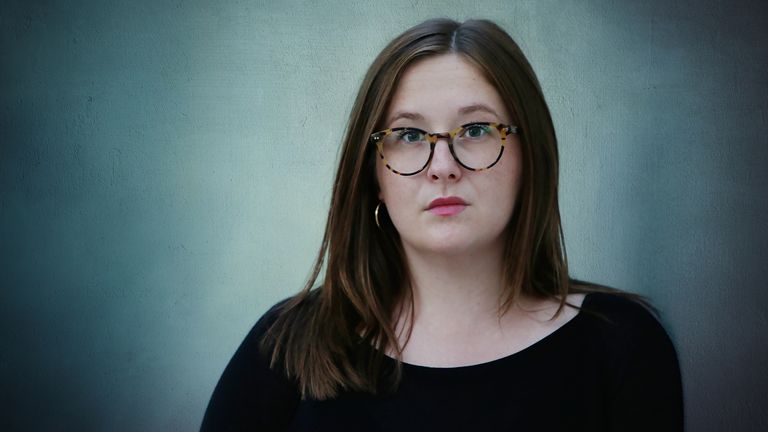
Ms McCrossen-Nethercott had gone back to a friend’s house for a drink after a night out in south London when she woke up feeling as though she had been sexually assaulted.
She had fallen asleep on the sofa at around 2 am and awoke roughly three hours later naked from the waist down and with her necklace broken on the floor.
A man, whose semen was later found on her vaginal swabs, was sitting next to her on the sofa.
Asking him what had happened, he replied: “I thought you were awake.”
Ms McCrossen-Nethercott reported it to the police, underwent forensic testing, and the man was charged with rape.
“I made a few blasé comments to the police about sleepwalking when I was younger.
“They were clutching at straws, it was them panicking,” she said.
Sleep experts had never met or spoken to her
With the right to appeal the CPS’s decision she requested all the case documents, including those linked to the two sleep experts.
“Those two experts had never spoken to me on the phone – let alone met me in person,” Ms McCrossen-Nethercott said.
“Their decision was based on a 15-question questionnaire – and the defendant’s statement.
“It was so loosely drawn together – this ‘argument’ that I had sexsomnia.”
She then commissioned her own sleep expert, from the London Sleep Centre, to provide counterevidence.
He had never come across an alleged victim having the condition. In the UK only people accused of rape or sexual assault have alleged to have had it – using it as a defence.
The expert also explained it usually occurs in men – who have had a history of it before.
Image:Pic: BBC
Sleep tests commissioned by him showed Ms McCrossen-Nethercott had mild sleep apnoea – when breathing briefly stops and starts again during sleep.
Because this has been identified as one of the triggers of sexsomnia, he said he couldn’t rule out an isolated episode.
“Sleep apnoea is so common a lot of people don’t even know they have it,” she said.
Determined to prove the CPS wrong, she turned to a lawyer instead.
According to the law in England and Wales, a person cannot consent to sex if they are asleep.
But someone cannot be found guilty of raping someone if they can prove they had “reasonable belief” the other person consented.
The lawyer, who had defended men in cases involving sexsomnia, claimed sleep and medical experts are never able to definitively prove someone has the disorder.
This means it could be used to convince a jury someone is not guilty.
Finally, she submitted her appeal.
CPS review ruled the decision was wrong
A retired crown prosecutor not involved in the original case concluded it should have gone to trial.
He said the sleep experts and the defendant’s claims of sexsomnia should have been cross-examined.
Ultimately he believed it was “more likely than not” the defendant would have been convicted by a jury.
But despite his verdict and an apology from the CPS, the case cannot be reopened, as the man was formally acquitted and there are laws against double jeopardy.
Ms McCrossen-Nethercott told Sky News that with just 1.3% of rape cases resulting in a prosecution in England and Wales, she did not expect the case to reach trial.
“I felt confident in how I reported what had happened.”
With the help of the Centre for Women’s Justice, she has now submitted a letter of claim to sue the CPS on human rights grounds.
“The CPS let me down and they’re letting every other woman and girl down to,” she said.
“I did as much as I could and yet nothing can be done.
“It’s really hard to heal from something that makes no sense.”
After further communication with the CPS last year, the now 30-year-old was unable to work for six months due to mental ill-health.
“Last year I had really bad dark times. But I’m in a better place now, with the support of my friends, family, and my partner.”
A CPS spokesperson said in a statement: “We have apologised unreservedly to the victim in this case. The expert evidence and the defendant’s account should have been challenged and put before a jury to decide.
“We are committed to improving every aspect of how life-changing crimes like rape are dealt with and are working closely with the police to transform how they are handled.
The race organiser MSVR said it was investigating the incident with the coroner, police, and the Motorcycle Circuit Racing Control Board.
Rouse moved into British Superbikes this season and rode for Crowe Performance BMW, the same team he won the national superstock title in 2020.
He was also a maths teacher.
Many well-known British bike racers have been paying tribute, including fellow British Superbikes competitors Tarran Mackenzie, Glenn Irwin, and Peter Hickman.
Mackenzie tweeted: “This sport is so cruel sometimes. Talented in so many different ways and truly one of the nicest people in the paddock. RIP Chrissy.”
Irwin, currently second in the standings, called him a “truly talented person” who was “always smiling”, while Hickman said it was a “pleasure to know you and share a track with you, champ”.
Rouse’s death was announced on the same day British motorcycle racing also lost its most successful racer ever.
Phil Read MBE died peacefully in his sleep, aged 83, his son said.
Read won 52 grand Prix in the 1960s and 1970s, and was world champion in the125cc, 250cc, and 500cc classes. He also won eight times at the Isle of Man TT races.
The most recent statistics, this summer’s heatwaves caused more than 2,000 additional deaths, which is the largest ever recorded number since a new heatwave plan was adopted in 2004.
In England, the predicted overall excess mortality for people 65 and older, excluding COVID-19, was 2,803 deaths.
This is the highest excess mortality figure during heat periods observed since the introduction of the Heatwave plan for England in 2004.
In July, some places in England recorded temperatures of over 40C for the first time in recorded history, prompting the UKHSA to issue its first-ever Level 4 Heat Health Alert.
According to Berit Reiss-Andersen, chair of the Norwegian Nobel Committee, the judges sought to recognise “three exceptional supporters of human rights, democracy, and peaceful coexistence.”
Ales Bialiatski, a jailed human rights advocate from Belarus, Memorial, a Russian advocacy organisation, and the Center for Civil Liberties in Ukraine have all received the Nobel Peace Prize.
The winners were announced in Oslo by Berit Reiss-Andersen, chair of the Norwegian Nobel Committee.
She said the judges wanted to honour “three outstanding champions of human rights, democracy, and peaceful coexistence in the neighbour countries Belarus, Russia, and Ukraine”.
She added: “Through their consistent efforts in favour of human values and anti-militarism and principles of law, this year’s laureates have revitalised and honoured Alfred Nobel’s vision of peace and fraternity between nations, a vision most needed in the world today.”
The award traditionally recognises the work of groups and activists seeking to prevent conflict, tackle hardship, and protect human rights.
Last year’s winners have faced a difficult time since receiving the prize.
Journalists Dmitry Muratov of Russia and Maria Ressa of the Philippineshave been fighting for the survival of their news organisations and defying government efforts to silence them.
They were honoured last year for “their efforts to safeguard freedom of expression, which is a precondition for democracy and lasting peace.”
A week of Nobel Prize announcements kicked off on Monday with Swedish scientist Svante Paabo receiving the award in medicine for unlocking secrets of Neanderthal DNA that provided key insights into the immune system.
Frenchman Alain Aspect, American John F Clauser, and Austrian Anton Zeilinger had shown that tiny particles can retain a connection with each other even when separated, a phenomenon known as quantum entanglement, that can be used for specialised computing and to encrypt information.
The Nobel Prize in chemistry was awarded on Wednesday to Americans Carolyn R Bertozzi and K. Barry Sharpless, and Danish scientist Morten Meldal for developing a way of “snapping molecules together” that can be used to explore cells, map DNA and design drugs that can target diseases such as cancer more precisely.
French author Annie Ernaux won this year’s Nobel Prize in the literature on Thursday.
The panel commended her for blending fiction and autobiography in books that draw on her experiences as a working-class woman to explore life in France since the 1940s.
The 2022 Nobel Prize in economics will be announced on Monday.
The prizes carry a cash award of 10 million Swedish kronor (around £800,000) and will be handed out on 10 December.
The money comes from a bequest left by the prize’s Swedish creator who invented dynamite.
WWE reality show winner who passed away at the age of 30 has received tributes from professional wrestlers.
Sara Lee won the 2015 season of Tough Enough,a talent-spotting programme with an elimination-style format.
According to local media, Sara was a track star and powerlifter at her US high school before she embarked on her wrestling career.
Her mother Terri Lee announced the death in a statement posted online.
“It is with heavy hearts that we share the news that our Sarah Weston has gone to be with Jesus,” she wrote. “We are all in shock.”
Lee, from the US state of Michigan, was awarded a $250,000 contract after her winning appearance on Tough Enough but was released the following year.
She was married toformer WWE wrestler Cory James Weston, known as Westin Blake.
Wrestling star Saraya, formerly known as Paige, was among those to pay tribute to Sara, describing her as a “very sweet human who I got the pleasure to know and work with”.
This is heartbreakingly tragic. Sending love to her family. Very sweet human who I got the pleasure to know and work with. 💔 RIP Sara Lee pic.twitter.com/bGZ9FZNnXj
Impact star Chelsea Green said she would remember her friend as “laughing, smiling” and “carefree”.
No tweet or amount of words can bring back this beautiful human, but all of my heart goes out to @TheWestinBlake & their family. Sara Lee will be missed greatly. ♥️
The photo on the left is how I will always remember her – laughing, smiling, carefree. pic.twitter.com/XLlLFXDOcF
Fellow wrestler Bull James launched a GoFundMe campaign in aid of Sara’s family, which quickly smashed its $20,000 target – raising almost three times that amount in 10 hours.
Tough Enough, which ran until 2015, followed the fortunes of 13 WWE hopefuls as they competed to win a spot on the company’s roster.
A male and female winner chosen at the end of each season was awarded a WWE contract.
Molly Russell’sfather says legislation to prevent minors from viewing hazardous content should be passed immediately.
An investigation concluded that social media posts “more than minimally” led to Molly’s suicide in 2017 after she committed a self-harming act while depressed.
The coroner ruled she saw images that “shouldn’t have been available” to her.
Ian Russell said: “It’s clear to me that the age of self-regulation on internet platforms must be ended for the sake and safety of our children.”
He told BBC Radio 4’s Today programme: “The current government has said that they want the UK to be the safest place in the world to be online and yet we’re still here and we’re not regulating the platforms.
“I think it’s really important, firstly, that something that is illegal in the offline world must be illegal and we must be better protected when it’s found on the online world.
“And I think the hardest thing that the online safety bill is tackling is perhaps this contentthat’s described as ‘legal but harmful.”
IMAGE SOURCE, KIRSTY O’CONNOR / PA Image caption, Ian Russell has campaigned for a safer online world for children since his daughter’s death
Andrew Walker, the senior coroner for north London, said Molly, from Harrow, north London, appeared a healthy girl who was flourishing at school, having settled well into secondary school life and displayed an enthusiastic interest in the performing arts.
However, Molly had become depressed, something common in children of this age, the coroner said. The inquest was told her condition worsened into a depressive illness.
Mr Russell also described the impact the inquest has had on his family.
He said: “When the verdict came in, I think we were quite numb and we’re still processing it.
“It was exhausting for us as a family. It was two weeks in court, but five years since Molly died.
“It’s just extraordinary, overwhelming grief that I think probably is one of the strongest emotions that anyone can ever feel.
“So, the inquest itself couldn’t compete with those early days of huge grief and just struggling to get by a second sometimes.
The mysterious statues on Easter Island have suffered fire damage, some of which is considered to be irreversible.
According to Chile’s undersecretary of culture, a number of the stone-carved statues were damaged by the fire.
Easter Island has nearly 1,000 of megaliths, known as moai. They have oversized heads and generally stand about 4m (13ft) high.
They were carved by a Polynesian tribe more than 500 years ago.
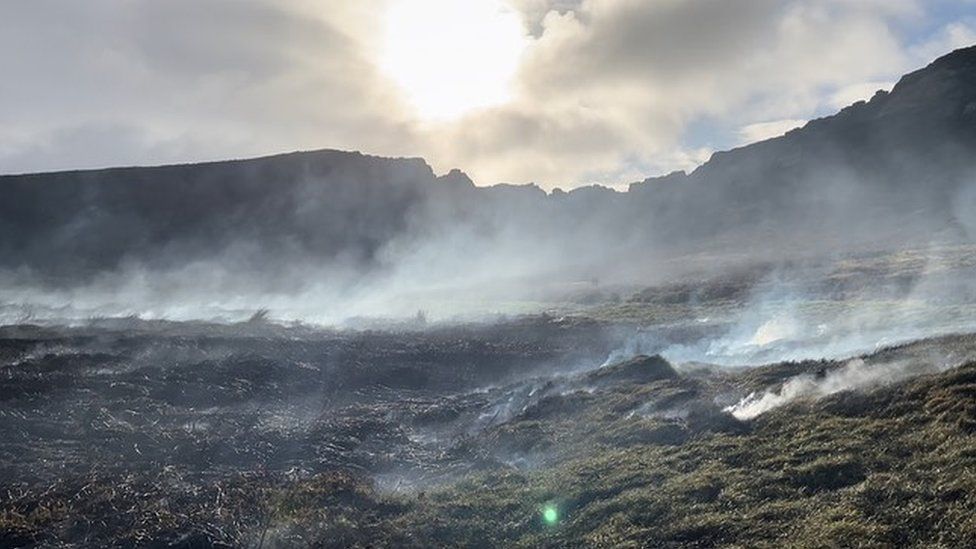
The fire, which broke out on Monday, affected “nearly 60 hectares (148 acres)”, Carolina Perez Dattari, the cultural heritage official, tweeted.
It is reported to have been started deliberately and is centered around Easter Island’s Rano Raraku volcano – which is an Unesco World Heritage Site.
Easter Island lies 3,500km (2,174 miles) off the coast of Chile. It relies on tourism and reopened just three months ago following its closure during the Covid-19 pandemic. The site has now been closed again while a conservation team examines the extent of the damage.
The island’s Mayor Pedro Edmunds told local media: “The damage caused by the fire can’t be undone.”
“The moai are totally charred,” Ariki Tepano said through the park’s official social media pages.
IMAGE SOURCE, RAPA NUI MUNICIPALITY Image caption, The fire, which broke out on Monday, affected nearly 60 hectares (148 acres)
The are some 1,000 giant stone statues and carvings on Easter Island- the largest of which weigh 74 tonnes and stand 10m tall.
The figures were carved by the indigenous Rapa Nui people sometime between the years 1400 and 1650, and positioned to form a ring around the island, facing inland.
Best known for their deep-set eyes and long ears, they also sport impressive multi-tonne hats made from a different rock type.
They were figures of spiritual devotion for the Rapa Nui, embodying the spirit of a prominent ancestor. Each one was considered to be the person’s living incarnation.
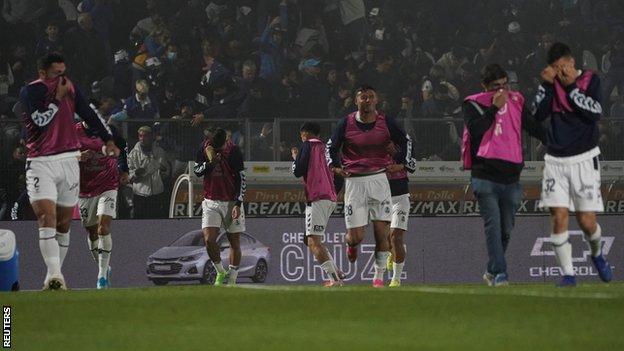
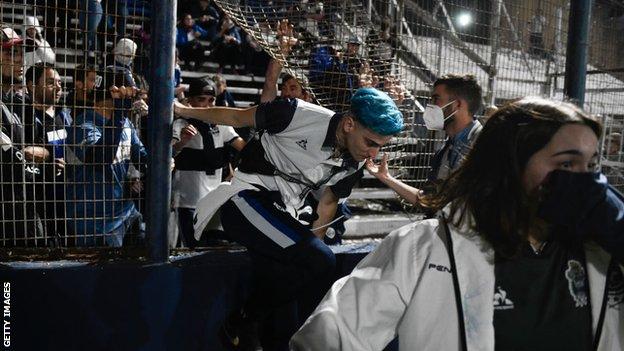
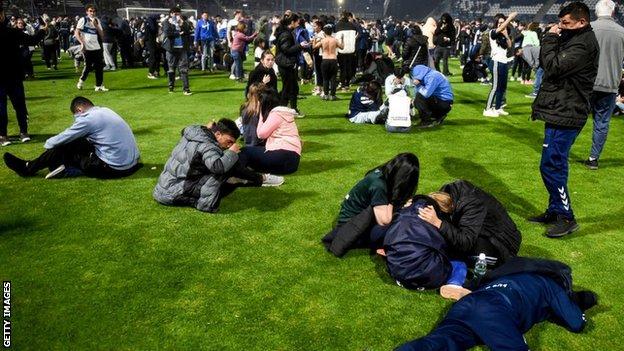
During the match between Gimnasia and Boca Juniors in Argentina,police used tear gas on spectators outside the stadium, resulting in at least one death.
On Thursday, police attempted to prevent supporters from entering the already crowded stadium by firing rubber bullets at them.
The game was called off after nine minutes, with fans spilling onto the pitch trying to escape the turmoil.
Buenos Aires security minister Sergio Berni confirmed there was one death and that they “died of cardiac arrest”.
Authorities at San Martin hospital in La Plata, the city where Gimnasia is based, also confirmed the death, of a 57-year-old man because of cardiac arrest as he was being transferred from the stadium to the hospital.
Berni said an investigation would be opened, with the possible over-selling of tickets in one area being looked at.
Fans were squeezing through fencing to try to get onto the pitch of the Juan Carmelo Zerillo stadium in La Plata.
Referee Hernan Mastrangelo said: “It affected all of us on the field.
“The air became unbreathable. The situation got out of control and there were no security guarantees.”
The events in Argentina took place in the wake of the recent tragedy in Indonesia when at least 131 people died.
The disaster in Indonesia happened when police fired tear gas at fans who invaded the pitch after a game and hundreds tried to flee through the exits, which caused a deadly stampede.
Players cover their faces to stop being affected by tear gasFans affected by tear gas jumped the fence into the field of playFans got through fencing to get onto the Carmelo Zerillo stadium in La PlataFans recovered from the effects of tear gas on the pitch
They say there can be no new projects if there is to be a chance of keeping global temperature rises under 1.5C.
Both the Intergovernmental Panel on Climate Change (IPCC), the global body for climate science, and the International Energy Agency (IEA) have expressed such a view.
Business Secretary Jacob Rees-Mogg says the new exploration will boost energy security and support skilled jobs.
And supporters of new exploration insist it is compatible with the government’s legal commitment to reach net zero greenhouse gas emissions by 2050. They say the North Sea fossil fuel will replace imported fuel and so have a lower carbon footprint in production and transportation.
Licences are being made available for 898 sectors of the North Sea – known as blocks.
“Putin’s illegal invasion of Ukraine means it is now more important than ever that we make the most of sovereign energy resources,” Mr Rees-Mogg said in a statement.
The licensing process will be fast-tracked in parts of the North Sea that are near existing infrastructure and so have the potential to be developed quickly, according to the North Sea Transition Authority. It says the average time between discovery and first production is close to five years but that gap is shrinking.
Both campaigners and the oil industry agree that the reserves will not be large enough to have a significant impact on the prices consumers pay for energy in the UK.
“This government’s energy policy benefits fossil fuel companies and no one else,” said Philip Evans, energy transition campaigner for Greenpeace UK.
“New oil and gas licences won’t lower energy bills for struggling families this winter or any winter soon nor provide energy security in the medium term.”
North Sea oil and gas production peaked about 20 years ago and since then the UK has gone from producing more oil and gas than it needs, to importing it from other countries.
Offshore Energies in the UK, which represents the oil and gas industry says there could be as much as 15 billion barrels of oil left in the North Sea. It says that new fields will be less polluting than their predecessors and in a statement said there would be an environmental “bonus”.
The decision to launch a licensing round follows the publication of the government’s “Climate Compatibility Checkpoint”, which “aims to ensure” the new exploration aligns with the UK’s climate objectives.
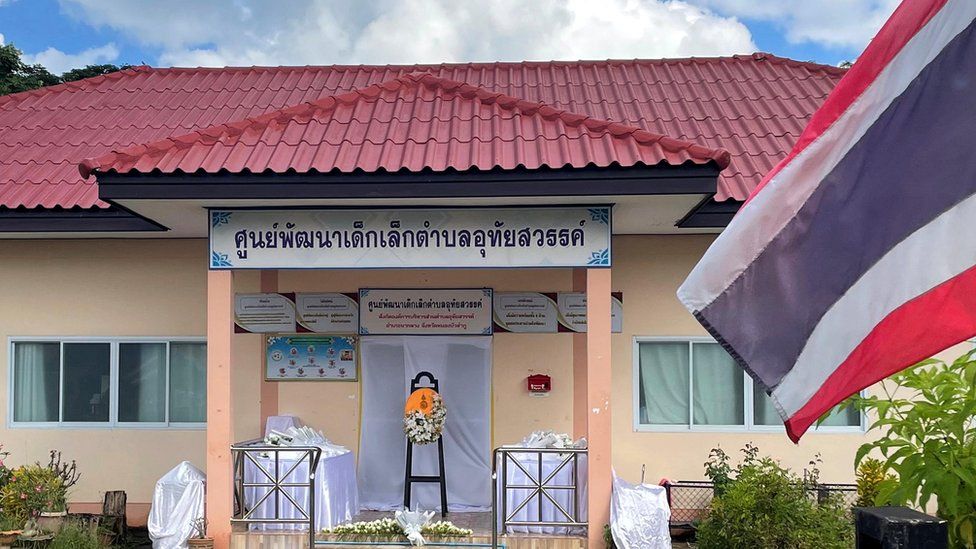
Duangphan Patphaothanun was pacing in front of a daycare centre while carrying a backpack filled with toys.
The 64-year-old grandmother wants to know when she can see her grandson, so she can place his most treasured possessions with him in his coffin – the bag includes a large plastic dinosaur.
A former policeman had stormed the building, killing children as young as two while they slept, leaving at least 37 people dead.
More than 90 children usually attend the center but because of poor weather and a bus breakdown, only 24 of them were there on Thursday. Only one child has survived.
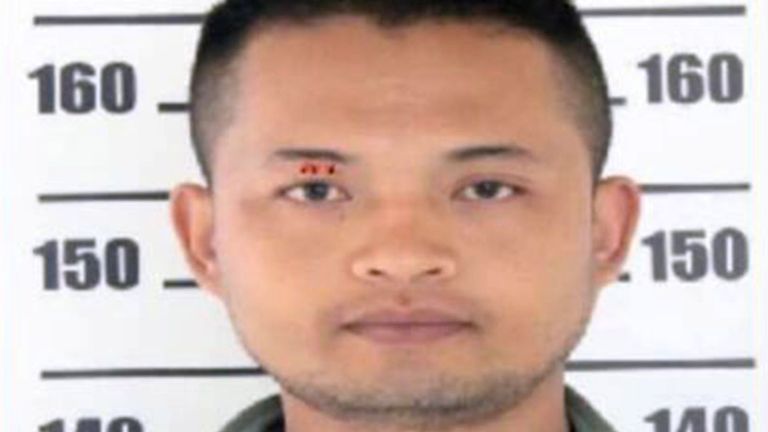
Police say the 34-year-old attacker – a local named Panya Kamrab – killed his wife and his stepson, before killing himself after a manhunt. His stepson used to attend the center but hadn’t been for the past month.
The motive for the attack is not yet known. But police said Kamrab was fired from his job in June for drug use.
“When I heard the news about the shooting, I just fainted,” Duangphan said. On her phone are photos of Pattarawut, taken just hours before the shooting.
Like many childcare centers, this one too regularly posts photo updates for parents to see – the images show happy, smiling faces, writing or finishing a drawing.
Duangphan was one of several grieving relatives who had gathered outside the center in Nong Bua Lamphua province on Friday morning.
“I am full of such pain… [and] anger because I cannot do anything,” she says.
She’s not the only one. Others too say they are filled with grief – and unanswered questions.
“Why did he take it [out] on the children? Why kill them when they did nothing to him?” says 27-year-old Naliwan Dungkhet, whose two-year-old nephew Captain also died in the attack. He was just a month away from his third birthday.
Among the mourners was Komsan Norraburh. His ex-wife married the attacker who killed both her and Norraburh’s three-year-old son, Worraphat.
“I was at the factory [when] my friend asked me to check the news. I called my ex-wife and son to see if they were ok but no-one answered,” he said. “He was a good boy who liked to talk a lot. I’m waiting to pick up his body and see his face one last time.”
Many of the relatives said they had waited outside the childcare centre well into the night on Thursday, while others gathered at the police station.
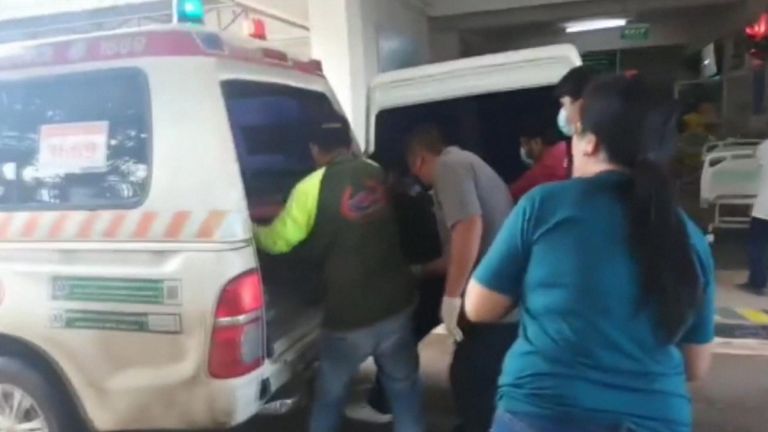
They would eventually be greeted by the sight of pink and white coffins adorned with gold, bearing the bodies of the children, which were brought to a hospital morgue in Udon Thani and laid out in rows.
IMAGE SOURCE, REUTERS Image caption, The daycare centre on Friday morning
Police said the armed attacker broke into the building just after lunchtime on Thursday, shooting his way past a teacher and parent outside. He was recognized by one of the teachers when he burst in.
Witnesses said he first shot staff – including a teacher who was eight months pregnant- before forcing his way past teachers into a room where children were napping. He then stabbed most of his victims before fleeing.
Officers who rushed to the nursery were confronted with the bodies of adults and children, lying inside and outside the building.
Kamrab had appeared in court the morning of the attack on charges related to the use and possible sale of methamphetamine. He had been due to face a verdict on Friday.
Mass shootings in Thailand are rare, although gun ownership rates are relatively high for the region.
In 2020 a soldier killed 29 people and injured dozens more in the city of Nakhon Ratchasima. Thursday’s attack comes less than a month after an army officershot dead two of his colleagues at a base in Bangkok.
All those who were found guilty of national marijuana possession convictions have received pardons from President Joe Biden.
About 6,500 people with federal convictions for basic marijuana possession are expected to benefit, according to officials.
No one is currently in federal prison solely for possession of marijuana. Most convictions occur at the state level.
But the federal pardons will make it easier for people to get employment, housing, and education, Mr Biden said.
As a presidential candidate, Mr Biden promised to decriminalise cannabis use, as well as expunging convictions.
“Sending people to prison for possessing marijuana has upended too many lives and incarcerated people for conduct that many states no longer prohibit,” Mr Biden said on Thursday.
As a White House candidate, Mr Biden was criticised for writing a 1994 crime bill that stiffened penalties for drug crimes and led to more incarceration of minorities.
The Democratic president said he would call upon all state governors to issue their own marijuana pardons.
He is also directing the Department of Justice and the Department of Health to review how cannabis is classified under federal law.
“We classify marijuana at the same level as heroin – and more serious than fentanyl,” said Mr Biden. “It makes no sense.”
Recreational marijuana is already legal in 19 states and Washington DC. Medical use is legal in 37 states and three US territories.
However, the drug remains illegal at the federal level, even in states where it can be legally bought and used, meaning people there could still be convicted for possession in certain circumstances.
The pardons come a month before November’s congressional mid-term elections,which will determine the power balance in Washington for the last two years of Mr Biden’s term.
Life for Pot, a website advocating for the release of non-violent marijuana offenders, noted that there are no known federal prisoners that will be affected by Mr Biden’s measure, tweeting: “This is window dressing.”
Cannabis company shares jumped on the stock market by around 20% with news of Mr Biden’s pardons.
Mr Biden is not the first US president to pardon cannabis offenders.
On his final day in office,Donald Trump pardoned 12 marijuana offenders, including some who had been jailed for life under the three-strikes rule created by Mr Biden’s 1994 crime bill.
Billionaire Elon Musk has said that he intends to complete buying Twitter by the end of the month, but the firm “will not accept yes for an answer.”
He said in a court document that the social media site had expressed worries about the “theoretical possibility of a future failure to get debt financing” to pay for the deal.
Twitter sued Mr Musk in July after he tried to back out of buying the firm.
Mr Musk asked the court to put that legal fight on hold.
Mr Musk said litigation was no longer necessary after he said in a surprise move this week that he was prepared to go forward with the original takeover plan, pending receipt of the financing and an end to the legal battle.
“There is no need for an expedited trial to order defendants to do what they are already doing,” Mr Musk’s attorneys wrote in a filing.
“Yet, Twitter will not take yes for an answer. Astonishingly they have insisted on proceeding with this litigation, recklessly putting the deal at risk and gambling with their stockholders’ interests.”
In its own filing for Delaware Chancery Court on Thursday, Twitter said it was opposed to suspending litigation, calling such a move “an invitation to further mischief and delay.”
It said it did not trust Mr Musk’s promises, noting that one bank helping to finance the deal had testified this week that it had not received any notice from Mr Musk about plans to move forward.
“Defendants can and should close next week,” the company wrote. “Until defendants commit to close as required, Twitter is entitled to its day in court.”
Mr Musk announced a plan to buy Twitter for $54.20 per share in April. But he backed away from the dealjust a few weeks later saying he was concerned that spam accounts on the platform were higher than Twitter had claimed.
Twitter ultimately sued to force Mr Musk to complete the deal.
In its lawsuit, Twitter argued Mr Musk was worried about the price he had agreed to pay, after a sharp downturn in the value of tech shares, including Tesla, the electric car company he leads and is the base of much of his wealth.
Mr Musk was due to be questioned this week as part of the preparation for the trial, which was scheduled to begin on 17 October. The trial is now postponed to 28 October to allow a deal to close, according to a court filing.
Shares in Twitter ended the day down more than 3%, amid investor doubts the deal will go through.
The police say, the suspect in a shocking mass stabbing in Canada acted alone, and one of the victims was his own brother.
After being arrested on an interstate on September 7, 32-year-old Myles Sanderson passed away.
His brother, 31-year-old Damien, was found dead several days earlier.
Ten other people were killed in the attack, including nine from the James Smith Cree Nation, an indigenous community.
The rampage shocked Canada – where mass killings are rare – and many questions remain about the motive and timeline of events.
The killings, which unfolded on 4 September over Canada’s Labour Day weekend, sparked a massive manhunt for the Sanderson brothers.
In a news conference on Thursday, the Saskatchewan Royal Canadian Mounted Police (RCMP) said that “we will never really know why” the incident took place.
Rhonda Blackmore, commander of the Saskatchewan RCMP, said that both brothers were actively dealing drugs in the community on the eve of the attack, 3 September, and had been involved in three violent altercations on the same day. None of these were reported to authorities, she said.
According to Ms Blackmore, both brothers were involved in “the initial planning and preparations” for the killings. For reasons that remain unclear, however, “Damien was killed by Myles Sanderson”.
“We know that to be true,” she said. “And he [Damien] was not involved in these homicides.”
Police did not clarify whether Damien’s death took place before or after the other killings, or whether he was responsible for any of the injuries sustained by the attack’s survivors.
On 3 September, police responded to a call about a vehicle believed to have been stolen by Damien Sanderson in James Smith Cree Nation. At the suggestion of the vehicle’s owner, officers visited a nearby residence where they found the car keys and three men – one of whom, they afterward learned, was Damien Sanderson.
“We later confirmed that Damien provided a false name to officers – he was in that original residence,” Ms Blackmore said. At the time, she said, police only had a 2014 photograph of him available.
It remains unclear how Myles Sanderson died. He was in police custody at the time. Chief coroner Clive Weighill has said the official cause of death is unlikely to be released until early 2023, after the culmination of two separate inquests.
The remaining mysteries about the killings and police response have prompted Senator Denise Batters to urge the federal government to press the RCMP for answers.
On Thursday, Ms Blackmore said it would be “pure speculation” to respond to questions about whether the killings could have been prevented.
The COVID-19 outbreak prevented travel for more than two years, but today India’s tourist and hospitality sectors are pretty hopeful. Journalist Rubina A. Khan, a freelance, on the roots of optimism.
Nearly 3% of India’s GDP and roughly 100 million jobs were created by tourism in 2019.
But the sector was severely hit in India – like in other countries – when the pandemic struck. Only 2.74 million foreign tourists visited India in 2020 compared with 10.93 million the year before, official data shows.
While the number of foreign visitors is still nowhere close to pre-pandemic levels, travel company operators and hotel industry executives say an upsurge in domestic tourists is making them more upbeat.
After two years of being cooped up inside, Indians are now travelling with a vengeance – ‘revenge travel’, as the phenomenon is called. And many, experts say, now prefer to travel within the country instead of flying to more expensive destinations abroad.
The industry is also benefiting from new trends borne of the pandemic such as micro-holidays and workcations.
Deep Kalra, the founder, and chairman of the travel website Make My Trip, says the sector started seeing an upturn in the last quarter of 2020, and has been consistently recovering ever since
Experts say the pandemic offered Indians an opportunity to explore their own country.
India has always been a popular tourist destination. From historic forts and stunning palaces to dense jungles, there’s no shortage of options for visitors.
But with international travel disrupted for months, more and more Indians became open to the idea ofvacationing within the country, says Vishal Suri, the managing director of travel company SOTC.
IMAGE SOURCE,GETTY IMAGES Image caption, The Taj Mahal is one of the biggest tourist attractions in India
“The pandemic has given Indians a new-found appreciation for the outdoors,” Mr Suri says.
He adds that there has been an uptick in demand for unexplored destinations – people are seeking ways to combine pilgrimages and spiritual trips with experiencing local food, cultural trails and adventure.
The pandemic also generated new trends such as staycations and workcations – combining remote working with vacations.
“Travellers are now extremely comfortable with booking homestays that offer exclusivity, privacy, and the comfort of a home away from home,” says Pradeep Shetty, a senior official at the Federation of Hotel and Restaurant Associations Of India (FHRAI).
Mr Kalra from Make My Trip agrees – he says that people have warmed up to the idea of travelling within India whenever possible.
“Even the travel frequency has changed and become more regular. The annual break has now turned into micro-holidays with people increasingly taking more breaks in the form of multiple weekend getaways and seasonal holiday breaks,” he says.
Impact on the hospitality sector
This shift has turned out to be a revenue-spinner for hotels in India, as people are now willing to use the money they would normally reserve for their international vacations on better facilities domestically.
Some luxury hotels dropped their prices at intervals in the pandemic, leading to a spike in bookings and short-term revenues.
Puneet Chhatwal, the COO of The Indian Hotels Company Ltd (IHCL)– India’s largest hospitality company which operates the Taj chain of luxury hotels – says that after each successive Covid wave, the recovery was “stronger and quicker”.
“The ICHL’s occupancy figures today exceed the pre-pandemic levels – a resurgence that is primarily fuelled by domestic tourism,” he adds.
IMAGE SOURCE,GETTY IMAGES Image caption, The Taj in Mumbai is one of India’s most premium hotels
Raffles Udaipur – run by international hotel chain Raffles – is situated on a private island and opened in August 2021, just months after the devastating second wave of the pandemic in India.
But the hotel has seen a “healthy rate of occupancy” every month throughout its first year of operations in India, says Puneet Dhawan, the hotel’s senior vice-president for India and South Asia.
“While we have no pre-pandemic metric to compare to, we have observed a steady rise in the response to our property,” he adds.
Mr Dhawan says the hotel is gearing up for an even busier year ahead – starting with the tourist rush in winter and the upcoming wedding season.
Mr Kalra says there are other positive signs too, such as the resumption of corporate travel – a trend that is likely to increase in the coming quarters, aiding overall recovery for the travel industry.
Challenges
But despite the optimism, people in the industry say that domestic tourism alone cannot take the sector back to the pre-pandemic-level of growth.
In September, India’s tourism minister said that the government was working towards the all-round revival of the tourism sector.
But foreign arrivals continue to be dismal – data shows they dipped by 44.5% in 2021 compared with the year before.
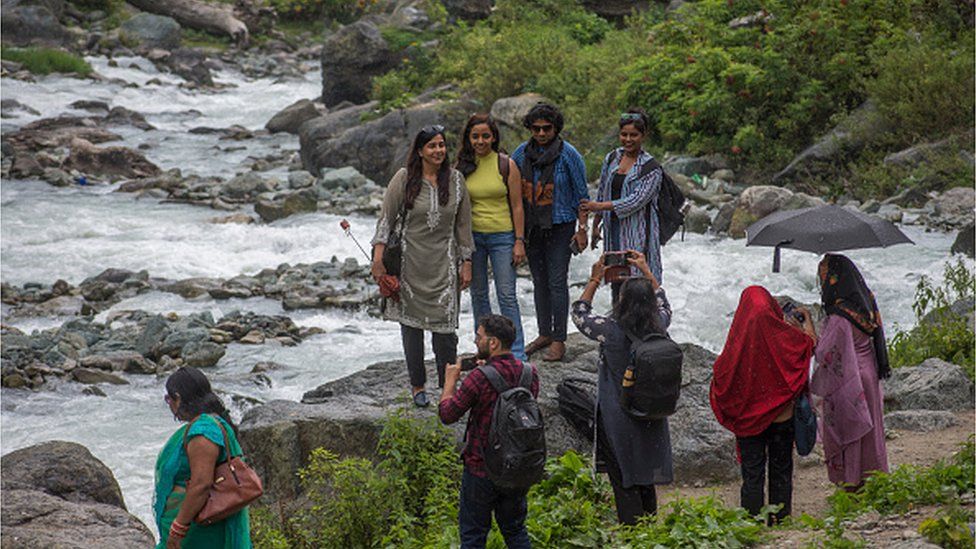
IMAGE SOURCE,GETTY IMAGES Image caption, Experts say more and more people are willing to travel within India
“India has not released a single campaign inviting the world to us. What we need is a stellar marketing strategy that excites travellers enough to choose us, especially the 60 million people that used to travel to China and aren’t today,” says Dipak Deva, managing director of the Travel Corporation of India, one of India’s best-known travel agencies.
He adds that the government also needs to restore its e-visa facility – especially for countries such as the UK from where a large number of tourists visit India – as the current procedure is too cumbersome.
“With international travel now returning to the fore, we are confident that in a few quarters, international travel will also be able to recover completely.”
Indonesia’s police chiefsays, six individuals, including police officers and organisers, are being investigated for their roles in a crash at a football stadium that claimed at least 131 lives.
The maximum punishment for the crime of criminal negligence causing death is five years.
The disaster happened last week when police fired tear gas at fans who invaded the pitch after a defeat.
Hundreds tried to flee through the exits, which caused a deadly stampede.
The incident has led to public anger, with much of it directed at the police and their use of tear gas. The local police chief in Malang, where the incident took place, was fired and nine other officers were suspended.
Those now facing charges include three police officerswho had tear-gassed fans, the head of the home club Arema FC’s organizing committee, and one of the club’s security officers.
Two of the police officers had ordered their colleagues to fire tear gas, national police chief Listyo Sigit Prabowo told local media. The third knew about FIFA’s safety regulations that prohibit the use of tear gas at matches but did not prevent it from being used, he added.
Authorities have said that some 2,000 officers – including several police units and soldiers – were at the stadium that night.
Videos from the incident, which took place on Saturday night in East Java, showed Arema FC fans running onto the pitch after the final whistle marked the home team’s 2-3 defeat and police firing tear gas in response.
More than 320 other people were injured as supporters were trampled on and suffocated in crushes as they fled the gas. Indonesia’s deputy minister of children and women affairs said the victims included children between three and 17 years.
Footage online showed fans clambering over fences to escape. Separate videos appeared to show lifeless bodies on the floor.
“We [saw] these different police forces running around the pitch, brutally kicking people, hitting people. This is completely unacceptable behaviour,” Jacqui Baker, a policing expert, told the BBC after the incident.
The stampede is one of the worst stadium disasters ever. In the UK, 97 Liverpool fans died in a crash at the Hillsborough stadium in Sheffield in 1989. They were attending the club’s FA Cup semi-final against Nottingham Forest.
Days after Kanye West exhibited a “White Lives Matter” T-shirt design at Paris Fashion Week, Adidas claims that it is examining its Yeezy collaboration with the rapper.
The company stated that “successful partnerships are founded in mutual respect and shared principles” without mentioning the controversy.
The rapper and fashion designer responded on Instagram, claiming the firm “stole” his designs.
A spokesperson for the German sportswear company also said that the “Adidas Yeezy partnership is one of the most successful collaborations in our industry’s history.”
In his Instagram post, Mr West also used a strong expletive, adding “I AM ADIDAS.”
Earlier this week, he was criticised after he presented a collection at Paris Fashion Week that included T-shirts with the slogan “White Lives Matter”.
The phrase Black Lives Matter, which represents opposition to racism and police brutality, was widely used after George Floyd, an unarmed black man, was killed by a police officer in Minneapolis in the summer of 2020.
Vogue’s Gabriella Karefa-Johnson, who is global fashion editor-at-large at the fashion magazine, was among those that criticised West over the T-shirts, calling the move “hugely irresponsible.”
In response, Mr West responded by lashing out at Ms Karefa-Johnson and posting photographs of her mocking her appearance to his 17.9 million followers.
In a statement, Vogue said it “stands with Gabriella Karefa-Johnson”.
“She was personally targeted and bullied. It is unacceptable. Now, more than ever, voices like hers are needed and in a private meeting with Ye today she once again spoke her truth in a way she felt best, on her terms.”
IMAGE SOURCE, GETTY IMAGES Image caption, Vogue editor Gabriella Karefa-Johnson at this year’s Paris Fashion Week
The almost decade-long partnership between Adidas and West has been strained for some time.
At the centre of their collaboration is a hugely popular range of sneakers – known as Yeezy – which cost hundreds of dollars, with new releases often selling out within minutes.
In June, he accused Adidas of making a shoe that looked similar to the distinctive Yeezy design, but was not part of their deal.
Adidas said it will continue to co-manage the partnership while the review is underway.
The announcement from Adidas comes less than a month after West’s lawyers sent a letter to fashion chain Gap to say he would no longer work with the firm.
Throughout her leadership campaign, Ms. Truss had refrained from stating whether the French President was a “friend or foe.”
The French President said he hoped for a “new phase” in post-Brexit relations.
The pair agreed to step up cooperation on “ending” small boat crossings in the Channel and announced a summit in 2023.
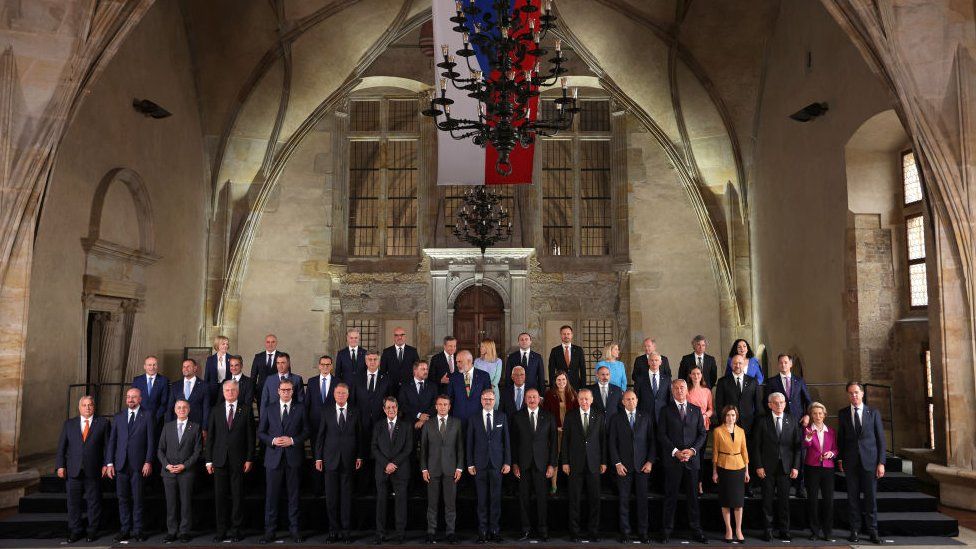
Leaders from the EU, the UK, Turkey, Norway, and the Balkans met at the first European Political Community in Prague on Thursday.
They discussed energy, migration, and security, with a particular focus on the war in Ukraine. Ukrainian President Volodymyr Zelensky spoke via video link.
The summit billed as a European Political Community beyond the EU has been championed by Mr Macron, who told reporters on Thursday it sent a “message of unity”.
IMAGE SOURCE, SEAN GALLUP/GETTY IMAGES Image caption, Among the European leaders taking part were Liz Truss (top left) and Turkey’s Recep Tayyip Erdogan (bottom row, 7th from the right)
The prime minister and Mr Macron released a joint statement promising an “ambitious” package of measures aimed at “ending” small boat crossings on the Channel.
Mr Macron said: “We have values and history so I’m happy that we meet again.
“This is an island, but this island didn’t move from the rest of the continent so we do have so many things in common.”
Ukraine’s president told the summit: “You and I are now in a strong position to direct all the possible might of Europe to end the war and guarantee long-term peace for Ukraine, for Europe, for the world.”
Following the meetings, Ms Truss said: “Leaders leave this summit with a greater collective resolve to stand up to Russian aggression.
“What we have seen in Prague is a forceful show of solidarity with Ukraine, and for the principles of freedom and democracy.”
As well as the UK, non-EU members Switzerland, Turkey, Norway, Iceland, Georgia, Azerbaijan, and western Balkan countries took part in the first gathering of the EPC.
Britain is now expected to host the fourth EPC meeting in 2024, with Moldova and Spain to hold the second and third respectively.
When he proposed the plan this year, Mr Macron said it would “offer a platform for political co-ordination” for countries, both those in the EU and those not.
Russia’s invasion of Ukraine gave new impetus for cooperation among nations beyond the EU’s 27 member states.
But the EPC has no institutions or dedicated staff. That has led to questions about how any decisions would be implemented.
If it proves to be a success, it may continue to take place up to twice a year. If it’s a failure, it could fizzle out.
Centre for European Reform Director, Charles Grant said one of the measures of success will be “does it persuade Serbia, Azerbaijan, and Turkey to lean a bit more to the West and less towards Russia”.
US President Joe Biden, says the risk of a nuclear “Armageddon” is higher than it has ever been since the 1962 Cuban Missile Crisis.
Vladimir Putin’s threat to use tactical nuclear weapons after suffering setbacks in Ukraine, according to Mr. Biden, was “not joking.”
The US was “trying to figure out” Mr Putin’s way out of the war, he added.
The US and the EU have previously said Mr Putin’s nuclear sabre-rattling should be taken seriously.
However, the US National Security Adviser Jake Sullivan last week said that, despite Moscow’s nuclear hints, the US had seen no signs that Russia was imminently preparing to use a nuclear weapon.
Ukraine has been retaking territory occupied by Russia, including in the four regions Russia illegally annexed recently.
For several months US officials have been warning that Russia could resort to the use of weapons of mass destruction if it suffers setbacks on the battlefield.
President Biden said the reason the Russian leader had not been “not joking” when he talked about using tactical nuclear, biological, or chemical weapons – “because his military is, you might say, significantly underperforming”.
“For the first time since the Cuban Missile Crisis, we have a direct threat to the use of nuclear weapons, if in fact, things continue down the path they’d been going,” Mr Biden told fellow Democrats.
“We have not faced the prospect of Armageddon since Kennedy and the Cuban Missile Crisis.”
The confrontation is considered by many experts to be the closest the world has ever come to full-scale nuclear war.
During a speech last Friday, President Putin said the US had created a “precedent” by using nuclear weapons against Japan at the end of World War Two – a comment that would not have gone unnoticed by Western governments, our Russia editor Steve Rosenberg points out.
Mr Putin has also threatened to use every means at his disposal to protect Russian territory.
Even as Mr Putin signed the final papers formally annexing four regions of Ukraine – Luhansk, Donetsk, Zaporizhzhia, and Kherson – Kyiv’s forces were advancing inside those areas he had claimed.
Hundreds of thousands of men have been fleeing Russia rather than wait to be drafted to fight in Ukraine.
Ukraine’s President Volodymyr Zelensky has previously dismissed Moscow’s nuclear threats as a “constant narrative of Russian officials and propagandists”.
Paul Stronski, of the Carnegie Endowment for International Peace, told the BBC that Russia’s “destabilising rhetoric” is aimed at deterring the West.
There has also been some pushback against Moscow’s nuclear threats in Russia itself. An editorial in the country’s mainstream Nezavisimaya Gazeta newspaper was heavily critical of “senior Russian officials” for “talking about the nuclear button”.
“To allow, in thoughts and words, the possibility of a nuclear conflict is a sure step to allowing it in reality.”
The Nord Stream 1 and Nord Stream 2 pipelines sustained significant damage last week as a result of “detonations,” according to the Swedish Security Service’s initial investigation.
The agency also said the leaks from the two Russian gas pipelines in the Baltic Sea “has strengthened the suspicions of serious sabotage” as the cause.
Last week, undersea explosions ruptured Nord Stream 1 and Nord Stream 2, at two locations off Sweden and two off Denmark. The pipelines were built to carry Russian natural gas to Germany.
While Vladimir Putin accused the West of attacking the pipelines, the US and its allies have vehemently denied it.
The agency did not give details about its investigation, but in a separate statement Swedish prosecutor Mats Ljungqvist said: “Seizures have been made at the crime scene and these will now be investigated.”
Danish authorities said the two leaks they were monitoring in international waters stopped over the weekend. One of the leaks off Sweden also appeared to have ended.
A Kremlin spokesperson on Thursday said he did not think the investigation could be objective without Russia’sparticipation after Russia had not been invited to take part.
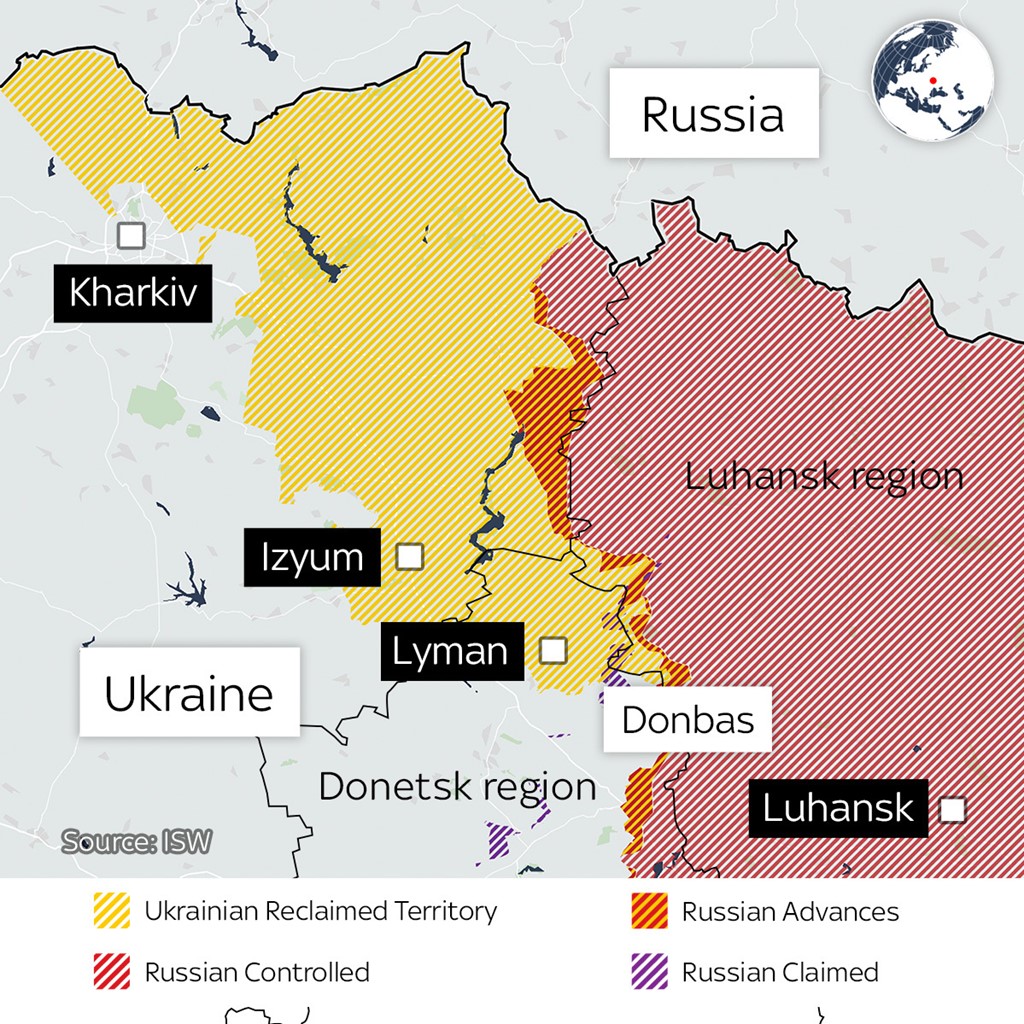
Brigadier General Oleksiy Gromov told a briefing that Ukraine had taken back 93 settlements and liberated over 2,400 square km (926 square miles) in the region since 21 September.
Sky News could not verify these claims.
Ukrainian forces have been advancing in the east and south of the country under a counteroffensive that has seen the country take back key cities like Lyman in eastern Ukraine.
Mr Gromov said Russian troops were fighting to slow a Ukrainian advance outof Kupiansk, a recently liberated railway hub town.
This map shows the areas controlled by each side in the east according to the latest Sky News analysis.
The Zaporizhzhia nuclear power plant is considered to be a Ukrainian facility, the head of the International Atomic Energy Agency said tonight.
Moscow seized control of the plant in southern Ukraine in March, shortly after invading Ukraine, but Ukrainian staff continues to operate it.
Shelling and damage near the site, which both Ukraine and Russia have blamed each other for, have caused concerns over the safety of the plant.
On Wednesday, Vladimir Putin signed a decree declaring that Russia was taking over the plant. However, Ukraine’s foreign ministry said it considered Mr Putin’s decree “null and void”.
Rafael Grossi today visited Kyiv, the Ukrainian capital.
He said: “This is a matter that has to do with international law … we want the war to stop immediately, and of course, the position of the IAEA is that this facility is a Ukrainian facility.”
He was due to travel to Moscow for talks to meet Russian officials following his talks in the Ukrainian capital.
Local media has announced that two Russian men were caught after travelling 300 miles to Alaska via the Bering Strait.
Authorities on St Lawrence Island found the two men in a small boat near the city of Gambell on Tuesday, Alaska News Source claims.
They allegedly told locals they were “fleeing the Russian military”.
A statement from the State Senator’s office said: “Given current heightened tensions with Russia, Senator Sullivan then called the Secretary of the Department of Homeland Security (DHS) and spoke to him as well as another senior DHS official.
“Since those calls, Customs and Border Protection is responding and going through the process to determine the admissibility of these individuals to enter the United States.”
The man claimed they had set sail from Egvekinot in northeastern Russia hours earlier.
Governor Mike Dunleavy said on Wednesday that the men had been detained.
Russian President Vladimir Putin last month ordered a partial mobilisation for the war in Ukraine, sparking a mass departure of menof fighting age.
Upwards of 260,000 people have fled the country since.
Atash and Nika’s uncle, Mohsen, were detained by authorities after Atash posted messages online about her niece’s death and spoke to the media. The televised statements were recorded before they were released, according to the source.
Relatives of a girl who died during protests in Iran have been forced into making false statements, a source close to the family has told BBC Persian.
Nika Shakarami, 16, went missing in Tehran on 20 September after telling a friend she was being chased by police.
On Wednesday night, a state TV report showed her aunt, Atash, saying: “Nika was killed falling from a building.”
Her uncle was also seen on TV speaking against the unrest, as someone seems to whisper to him: “Say it, you scumbag!”
The source told BBC Persian that these were both “forced confessions” that came “after intense interrogations and being threatened that other family members would be killed”.
Atash and Nika’s uncle, Mohsen, were detained by authorities after Atash posted messages online about her niece’s death and spoke to the media. The televised statements were recorded before they were released, according to the source.
Relatives of a girl who died during protests in Iran have been forced into making false statements, a source close to the family has told BBC Persian.
Nika Shakarami, 16, went missing in Tehran on 20 September after telling a friend she was being chased by police.
Her uncle was also seen on TV speaking against the unrest, as someone seems to whisper to him: “Say it, you scumbag!”
The source told BBC Persian that these were both “forced confessions” that came “after intense interrogations and being threatened that other family members would be killed”.
Atash and Nika’s uncle, Mohsen, were detained by authorities after Atash posted messages online about her niece’s death and spoke to the media. The televised statements were recorded before they were released, according to the source.
Forced TV confessions of protestors on Iran’s state TV is nothing new especially after the death of #MahsaAmini, but this time the evidence was noticed. In tonight’s news broadcast, the shadow of a person can be observed in the background whispering ‘say it you piece of dirt’. pic.twitter.com/jqUdUTQ4qw
Atash told BBC Persian prior to her arrest on Sunday that the Revolutionary Guards had told her that Nika was in their custody for five days and then handed over to prison authorities.
The judiciary has said that on the night she disappeared Nika went into a building where eight construction workers were present and that she was found dead in the yard outside the next morning.
Tehran judiciary official Mohammad Shahriari was cited by state media as saying on Wednesday that a post-mortem showed Nika suffered “multiple fractures… in the pelvis, head, upper and lower limbs, arms and legs, which indicate that the person was thrown from a height”.
He declared that this proved her death was nothing to do with the protests.
However, a death certificate issued by a cemetery in the capital, which was obtained by BBC Persian, states that she died after suffering “multiple injuries caused by blows with a hard object”.
Nika’s Instagram and Telegram accounts were also deleted after she went missing, according to Atash. Iranian security forces are known to demand that detainees give them access to social media accounts so that the accounts or certain posts can be deleted.
Wednesday night’s state TV report also featured footage in which Atash was seen confirming that her niece’s body was found outside the buildingmentioned by the judiciary, even though that contradicted previous statements made by her and other members of the family.
The family has said they located Nika’s body at the mortuary of a detention centre 10 days after she went missing, and that they were only allowed by officials to see her face for a few seconds in order to identify her. Atash said before she was detained that she did not go to the mortuary.
Nika’s family transferred her body to her father’s hometown of Khorramabad, in the west of the country, on Sunday – on what would have been her 17th birthday.
A source close to them told BBC Persian that the family agreed, under duress from authorities, not to hold a public funeral. But, the source said, security forces then “stole” Nika’s body from Khorramabad and secretly buried it in the village of Veysian, about 40km (25 miles) away.
Hundreds of protesters later gathered in Khorramabad’s cemetery and chanted slogans against the government, including “death to the dictator” – a reference to Supreme Leader Ayatollah Khamenei.
IMAGE SOURCE,TIKTOK/FACEBOOK Image caption, Hadis Najafi, 22, and Sarina Esmailzadeh, 16, died after taking part in protests in the city of Karaj
Nika is not the only young female protester to have been killed during the unrest that erupted last month following the death of Mahsa Amini, a 22-year-old woman who was detained by the morality police for allegedly violating the Islamic Republic’s strict hijab law.
The family of Hadis Najafi, 22, have said that she was shot dead by security forces while protesting in the city of Karaj, west of Tehran, on 21 September. Officials allegedly asked her father to say that she died of a heart attack.
Another 16-year-old girl, Sarina Esmailzadeh, died after being severely beaten on the headwith batons by security forces during protests in Karaj on 23 September, Amnesty International cited a source as saying. The source also told the human rights group that security and intelligence agents had harassed the girl’s family to coerce them into silence.
Several videos made by Sarina before her death have now been posted on social media. In one record after finishing some school exams, she says: “Nothing feels better than freedom.”
Prince Harry and Sir Elton John are among a group of celebrities suing the publisher of the Daily Mail, Mail on Sunday, and Mail Online.
The action claims they have “compelling and highly distressing evidence” they have been “victims of abhorrent criminal activity” and “gross breaches of privacy by Associated Newspapers”.
Prince Harry and Sir Elton John are among a group of celebrities suing the publisher of the Daily Mail, Mail on Sunday, and Mail Online.
The action claims they have “compelling and highly distressing evidence” they have been “victims of abhorrent criminal activity” and “gross breaches of privacy by Associated Newspapers”.
Also in the group is Baroness Doreen Lawrence, David Furnish, Elizabeth Hurley, and Sadie Frost said a statement from the law firm Hamlins.
Associated Newspapers has not yet responded to a request for comment by the Reuters news agency.
Prince Harrysuccessfully sued Associated Newspapers in the past with a judge ruling in July that parts of an article in The Mail On Sunday were defamatory.
And in 2021 he accepted an apology and “substantial damages”over false claims he snubbed the Royal Marines after stepping down as a senior royal.
Meghan alsowon damages following a three-year legal battle against the publisher for printing parts of a letter to her father.
Adib Saani, the executive director of the Jatikay Center for Human Security and Peace Building, has encouraged Ghana’s security forces to investigate the possibility that terrorist and jihadist organisations operating in the West African region may be raising money in Ghana.
In an interview with GhanaWeb, Adib, a security analyst, added that the re-arrest of a prominent Fulani Imam, Sheikh Dukere, who was reported to be the emergency contact of five terrorists killed in Burkina Faso, indicates that there might be terrorists who have passed through Ghana or are currently living in the country.
“His (Sheikh Dukere’s) arrest is significant because it tells us a lot about the presence of alleged militants in Ghana. The probability that they are in Ghana is extremely high.
“The possibility that there is a sleeper cell in Ghana recruiting Ghanaians is also very high. And the possibility that they are organizing or planning something against our interest in Ghana is very high.
“And we also need to look at the sale of cattle. It is a potentially huge source of income for militants. The terrorists bring in cattle which they steal from neighbouring countries and export to Ghana to be sold by their agents, who then send back the monies realized to these militants.
“We also need to look at the gold mines, especially in the north. It is a source of revenue for these terrorist groups. The possibility that terrorists have infiltrated the mining sites is very high,” he said.
According to a Joy News report, Sheikh Osman Dukerewas arrested for the second time in Ghana by National Security, together with 12 of his followers on Saturday, October 1, 2022.
Although the reason for his arrest has not been disclosed, the Imam was arrested in 2019 with 20 of his disciples when he was accused of having links with a jihadist group in Burkina Faso.
The first arrest was made after the security operatives in Burkina Faso informed the National Security of Ghana that Imam Dukuri was the emergency contact of 5 jihadists it had killed in a gunfight.
Three victims of the June 29, 2021 shooting in Ejura allege the government has abandoned them despite their injuries and high medical bills.
When some state security officers in Ejura fired into a crowd in response to a youth protest, Louis Ayipka, 30, Nazif Nuhu, 20, and Awal Mesbawu all suffered bullet wounds.
Subsequently, President Nana Addo Dankwa Akufo-Addo instituted a committee of inquiry chaired by Justice George Kingsly Koomson which recommended compensation for the victims.
The Attorney General and Minister of Justicehas also set up a committee of medical professionals to assess the conditions of the victims has since forwarded a computated compensation advice to the presidency.
This, according to a document intercepted by GhanaWeb was contained in a letter addressed to the Minister for Interior, Ambrose Dery by the Attorney General and Minister for Justice, Godfred Yeboah Dame dated July 22, 2022.
The AG in his advice said he took into consideration the assessment of the health professionals and some claims for compensation made by two of the victims through their lawyers.
“Pursuant to a request of this office, the victims have also provided receipts covering their medical bills as a result of their injuries. Additionally, Mr Ayikpa and Mr Nazif Nuhu have made claims for compensation,” the AG noted.
While Louis Ayikpa’s lawyers made a claim for GH¢1,280,850.00 (US$175,262.034), Nazif Nuhu’s lawyers also made a claim for GH¢230,000.00 (US$31,593.914).
But according to the AG, after assessing the claims and the medical reports under two categories of pecuniary and non-pecuniary losses, the computation of compensation for Loius Ayikpa arrived at some GH¢347,953.00 while that of Nazif Nuhu arrived at GH¢192,425,00.
The recommended compensation for the third victim, Awal Mesbawu also arrived at GH¢678,519.00.
This brought to a total of GH¢1,218,897.00 the amount recommended by the Attorney General to be paid by the state to the three victims.
As part of his recommendations, the AG further asked the state to offer psychological evaluation and support to the victims as well as rehabilitation and training to the victims.
“They should be followed up medically for a minimum of two years to manage any long-term complications that may arise,” the A-G added.
It is, however, not known what the ministry of interior has intended to do with the A-G’s recommendations as the victims and their families continue to demand for their compensation.
Albert Antwi-Boasiako, acting director-general of the Cyber Security Authority, says Ghana is the third most active social media user in the world.
Appearing on The Asaase Breakfast Show on Thursday (6 October), as part of this year’s cyber security awareness month in Ghana, Antwi-Boasiako said this will make Ghanaians more vulnerable online.
“Our citizens are quite active on social media, and statistics show that we are ranked the third country with active social media presence behind Nigeria and the Philippines in the whole world.
“Averagely it’s about five hours daily in Ghana, but I wouldn’t want to look at it from the economic impact, whether it is positive or impacting on economic development,” he told the show host Benjamin Offei-Addo.
“You may be surprised, access to betting sites is one of them, also it is not very nice to say but even pornographic access is one of them,” he said.
The Electricity Company of Ghanasays that despite the cash it is losing, it cannot take the chance of restoring power to some flood-affected areas in Ga South.
Speaking on Joy FM’s Midday News, the Accra West Electricity Company of Ghana’s communication officer, Fred Baimbill-Johnson says this is a result of some of ECG’s transformers in the affected districts being submerged in water.
“We have some situations where some of our ground-mounted transformers are in flooded areas so it is difficult to wheel power to the various communities,” he said on Thursday.
This comes after scores of residents in the Ga South municipality of the Greater Accra Region were displaced with several others trapped in their homes as Ashalaja, Weija, Oblogo, and Tetegu areas flood.
He explained that the power supply was curtailed due to the flood to ensure the safety of residents and their properties.
“Now we have done that knowing that indeed, once people are not using the power, it means that we are losing some revenue, but at this point in time what is more paramount to us is to make sure that life and property are safe,” he said.
According to ECG, a technical audit of its equipment must be done when the flood subsides to know the extent of damage and when to restore power supply to the affected communities.
However, he stated that power has been restored to the Weija Old Townarea because the water level in that area has receded.
Meanwhile, there is a temporary relief for the residents who were displaced by floods three days ago.
The National Disaster Management Organisation, (NADMO), says the water is receding and is likely to be safe for residents to return home.
But NADMO is warning of more trouble for the people as Ghana Water Company Limited (GWCL) continues spillage of the Weija Dam.
The Head of Communication at GWCL, Stanley Martey has already warned residents that the Weija Dam will remain open till the water reaches acceptable levels.
stated, is because some of ECG’s transformers in the affected areas are in the water.
“We have some situations where some of our ground-mounted transformers are in flooded areas so it is difficult to wheel power to the various communities,” he said on Thursday.
This comes after scores of residents in the Ga South municipality of the Greater Accra Region were displaced with several others trapped in their homes as Ashalaja, Weija, Oblogo, and Tetegu areas flood.
He explained that the power supply was curtailed due to the flood to ensure the safety of residents and their properties.“Now we have done that knowing that indeed, once people are not using the power, it means that we are losing some revenue, but at this point in time what is more paramount to us is to make sure that life and property are safe,” he said.
According to ECG, a technical audit of its equipment must be done when the flood subsides to know the extent of damage and when to restore power supply to the affected communities.
However, he stated that power has been restored to the Weija Old Town area because the water level in that area has receded.
Meanwhile, there is a temporary relief for the residents who were displaced by floods three days ago.
But NADMO is warning of more trouble for the people as Ghana Water Company Limited (GWCL) continues spillage of the Weija Dam.
The Head of Communication at GWCL, Stanley Martey has already warned residents that the Weija Dam will remain open till the water reaches acceptable levels.
The rate hike means it will become more expensive to borrow from the banks, a situation that will push the cost of living and doing business in the country further up.
Addressing the media, the Governor of BoG, Dr. Ernest Addison, explained that the committee reached the decision in order to check the rising rate of inflation as the country negotiates with the International Monetary Fund (IMF) for an economic programme.
“Inflation remains elevated and the balance of risks is on the upside. Although the forecasts are for monthly inflation to continue to slow down, the risks are on the upside, emanating largely from pass-through effects of the currency depreciation, the recent upward adjustment in utility tariffs, and rising inflation expectations”.
“The Committee remains committed to re-anchoring inflation expectations and returning to a disinflation path,” Dr Addison added.
Interest rates surge
The Bank of Ghana also said short-term interest rates on the money market have reflected recent developments, while medium-term to long-term rates have remained relatively behind the yield curve.
For example, while the discount rate on the 91-day instrument has increased to 29.7% in September 2022 from 12.5% in September 2021, the coupon rates on the 7-year, 10-year, 15-year, and 20-year have remained unchanged at 18.1%, 19.8%, 20.0%, and 20.2% respectively.
The interbank market weighted average rate has increased to 22.05% in September 2022 from 12.61% in September 2021, consistent with the rise in the policy rate.
Average lending rates of banks have also adjusted upwards to 29.81 percent in September 2022 from 20.20 percent recorded in the corresponding period of 2021.
The governor of the Bank of Ghana (BoG), Dr. Ernest Addison, has stated that controlling fuel prices is a bad strategy.
There have been calls for the government to intervene and cap the prices of fuel to cushion consumers.
But speaking at the 108th MPC press briefing in Accra on Thursday (6 October), Addison said, “Capping fuel prices is not an innovation. In fact, it is a wrong policy. When you have fuel prices rising and you also have a budget deficit problem, who is going to pay for the difference in the cost of fuel?”
“That will create further fiscal subsidies and worsen your fiscal deficit problem that we are all trying to resolve. So on the contrary, we should really be pushing towards full cost recovery to minimize the burden on the budget,” he added.
Oil prices held near three-week highs on Thursday after OPEC+ agreed to tighten global crude supply with a deal to cut production targets by two million barrels per day (bpd), the largest reduction since 2020.
Brent crude futures edged down 16 cents, or 0.2%, to US$93.21 per barrel by 1020 GMT after settling 1.7% up in the previous session.
U.S. West Texas Intermediate (WTI) crude futures lost 14 cents, or 0.2%, to US$87.62 after closing 1.4% up on Wednesday.
After six years of deficits, the Volta River Authority (VRA)has effectively reversed the company’s fortunes, generating a profit of GHC112.76 million in 2021, with management poised to maintain the pattern.
This is the second year running that the VRA, the country’s largest power producer, has made a profit; having earned a net profit of GHC156 million in 2020.
Presenting last year’s performance to VRA stakeholders – including representatives from the Ministries of Energy and Finance, State Interest and Governance Authority (SIGA), the Public Utilities Regulatory Commission (PURC), Electricity Company of Ghana, and the Select Committee on Mines and Energy of Parliament – at a stakeholder interface in Accra, its board chairman, Kofi Tutu Agyare, attributed the achievement to VRA’s Financial Recovery Programme (FRP) and a sustainability plan.
He noted that despite challenges posed by the COVID-19 pandemic and other difficulties in the energy sector, these initiatives along with cost-reduction measures, technology, and an aggressive export strategy, as well as the effective leadership of the board and the management team coupled with the commitment of staff, have significantly ensured the strong position VRA finds itself in.
The stakeholders commended VRA for the significant turnaround in its operations, noting that efforts of the board, the chief executive, management, and staff in transforming the company, are rare in the public sector.
“A state institution moving from a negative to positive deserves a standing ovation. VRA, you have done very well! You deserve applause,” Samuel Atta Akyea, chairman of the Parliamentary Select Committee on Mines and Energy, said at the event.
By 2025, VRA hopes to increase its renewable footprint to 200MW. Among the renewable projects soon to be rolled out are included a 60MW Bongo Solar Power project in the Upper East Region and a 75MW Wind Power Project at Anloga in the Volta Region.
Meanwhile, the Authority is also working with the Ministry of Energy to relocate the 250MW AMERI Plant from the VRA Aboadze Power Station to Kumasi in the Ashanti Region, and also rehabilitate its 132MW T3 Power Plant in Aboadze within the 2023 to 2024 time-frame.
Two of its simple cycle power plants in Tema and Kpone in Accra will also be converted into combined cycle plants for generation efficiency.
Since the government is currently negotiating with the IMF, Mr. Amidu has called nationalists and crusading civil society organizations to insist on and demand openness and accountability from them.
Mr. Amidu has therefore urged patriots and crusading civil society organizations to insist and demand transparency and accountability from the government in the manner the negotiation with the IMF is being undertaken now.
“This year, the International Monetary Fund is to be the excuse for Ghanaians being asked to tighten their belts while the political elite loosens theirs and feed fat on our sweat. We should not wait for the IMF to be used by the authors of our economic hardships to blackmail the nation and ram an austerity budget down our throats without any consultation for our inputs into and acceptance of the proposals. We must ask for transparency and accountability now. The 1992 Constitution gives us the right to do so and put Ghana First,” he wrote in a statement.
The finance minister is upbeat that the negotiation with the IMF “will be fast-tracked to ensure that key aspects of the programme are reflected in the 2023 Annual Budget Statement in November 2022.”
Mr. Ofori-Atta has also disclosed that a team of government officials will from this weekend travel to Washington, DC in the USA for two weeks to continue negotiations with the Fund to fast-track the deal.
But the former Special Prosecutor argued the People are entitled to know the content of the dialogue with the Bretton Woods Institution billed to form part of the Minister for Finance’s 2023 Budget Statement to Parliament.
He said the government has refused to be guided by the resistance its unpopular economic policies such as the E-levy were met with in the past.
“In the November 2021 Budget for the year 2022, this government rammed down our throats the E-Levy that went to Parliament without any prior consultation with the generality of the people and stakeholders. It is an understatement to say that a majority of Ghanaians were against the E-Levy but with arrogance and impunity, the government corruptly bought its way with the political elite to approve and enact the E-Levy into law. The consequent reaction from Ghanaians is there for all to see how successful a reception that policy received and is receiving.” Martin Amidu added.
Attempts to politicize cocoa prices, according to COCOBOD’s head of public affairs, Fiifi Boafo, will not be beneficial to Ghana.
The Ghana Cocoa Board’s (COCOBOD) Fiifi Boafo, the director of corporate affairs, has warned Cassiel Ato Forson, the ranking member of the parliament’s finance committee, to refrain from any attempts to politicise the cost of cocoa.
Ato Forson said the 21% increase in the producer price of cocoa, which has been pegged at GHC800 per bag is too small.
Talking to the sit-in host of The Asaase Breakfast Show on Thursday (6 October), Boafo said such utterances will not inure to the benefit of Ghana.
“Ato Forson said the cocoa day event that was organised, was poorly attended, an event that had over 2,000 persons present, that tells you what he sought to portray,” Boafo said.
“He made a point that, if you juxtaposed what Ivorian farmers are receiving and what Ghanaian farmers are receiving, we should pay our farmers more.
“I don’t think we should politicise pricing of cocoa because if you do so, it does not inure to the benefit of our country,” Boafo said.
Cocoa producer price increased by 21% per tonne
Meanwhile, the government has increased the producer price of cocoa to GHC12, 800.00 per tonne, which translates into GHC800 per bag of 64 kg gross weight for the 2022/ 2023 cocoa crop season.
This represents an increase of 21% from GHC10, 560 per tonne, taking effect from Friday 14 October 2022.
Announcing the new cocoa price, Dr Owusu Afriyie Akoto, Minister for Food and Agriculture, and chairman of the Producer Price Review Committee (PPRC), said that the new producer price of cocoa represents 89.99% of the net freight on board (FOB) value.
“The 21% rise in the producer price of cocoa is a testament to the government’s resolve to ensure farmers earn a decent income and make cocoa farming lucrative. The government will continue to implement initiatives to build a robust, resilient, and sustainable cocoa industry where cocoa farmers and their communities will thrive,” Afriyie Akoto said.
Last year, government maintain the producer price at GHC660 as the farm-gate price for a bag of 64kgof cocoa for the 2021/2022 crop season. This was in spite of the fall in the world market price of cocoa, among other factors, such as the effects of the COVID-19 pandemic on the global economy.
In effect, the decision maintained the producer price at GHC105, 600 per tonne, representing 87.15% of the FOB value, as a demonstration of its commitment to improving the livelihoods of cocoa farmers.
Mass spraying
The minister assured farmers that government will continue to assist cocoa farmers through the mass spraying program to control pests and diseases and the rehabilitation of infected cocoa farms.
In order to boost farm productivity, the government will also help cocoa farmers by making necessary inputs like fertilizers available for purchase. The government is committed to continuing to offer high-yielding, early-bearing, and drought-tolerant planting materials that have received certification.
“The government will also assist cocoa farmers by making the requisite inputs such as fertilizers available for farmers to buy to increase farm productivity. Government is committed to continuing to supply certified planting materials that are drought tolerant, early bearing and high-yielding,” he said.
EU due diligence
To help the country comply with EU due diligence requirements, the government is developing the Cocoa Management System (CMS) through COCOBOD.
The minister noted that the government is still committed to preventing child labour and deforestation from occurring during the production of Ghanaian cocoa.
After its completion, the CMS will create a legally binding national traceability system that will be open and accountable. By doing this, it will be possible to trace every single batch of Ghanaian cocoa beans back to the farm where they were grown. According to the EU’s due diligence requirements, this is a crucial requirement.
“Once completed, the CMS will establish a national mandatory traceability system that will be transparent and accountable. This will ensure that all Ghana cocoa beans are traceable from the port of shipment to the plot of land that produced the beans. This is a key requirement under the European Union Due Diligence requirements,” he said.
“I am pleased to inform you that the first component of the CMS, which involves the establishment of a reliable farmer database (farm mapping and enumeration), is expected to be completed by the end of October 2022,” the minister stated.
The team chatted with the hosts and panellists on the morning show after stopping by UTV, Peace FM, Neat FM, and Okay FM. They seized the occasion to meet with the Despite Media Group’s management as well.
The team led by the Director of Communications, Mr. Richard Ahiagbah together with some of the Deputy Communications Directors in the persons of George Krobea Asante, Ernest Owusu Bempah, Kamal Deen, Jennifer Oforiwaa Queen, visited Despite Media Group to interact not only with the hosts of their various programs but also a staff of the outfit.
Other members of the Communications Directorate who went with the team were Nana Ayimadu Bekoe who is in charge of Deployment and Emmanuel Yaw Mensah, Administrator of the Directorate.
Also with the team as part of the media tour were Hon. Alexandra Akwasi Aquah, the Honourable Member of Parliament for Akim Oda, and Hon Ayepe, Former MP for Ayensuano are also members of the National Communications Team.
The team after visiting UTV, Peace FM, Neat FM, and Okay FM, interacted with the hosts and the panelists on the morning show. They also took the opportunity to meet with the management of the Despite Media Group to discuss some pertinent issues.
In September, the first IGNITE event was organised as a part of the mentorship programme to encourage young women with untapped potential.
Obuobia Darko-Opoku, a public speaker and broadcaster, has launched the IGNITE Youth Empowerment Initiative, to engage, empower and embolden young ladies to become better versions of themselves and position them strategically for leadership.
The first edition of IGNITE was held in Septemberas part of the mentorship programme to inspire young ladies with untapped potential to learn how to communicate persuasively.
A pioneer in applying successful mentorship practices to young girls, Obuobia Darko-Opoku, said: “This initiative is a dream that means a lot to me because it’s a dream coming to fruition. This is what personally makes me a happy girl. That quest, that desire, to develop your talent, pursue your dream, and wanting to lead change is a good thing.”
Continuing with the commitment to build the capabilities of young girls in the non-profit sphere, the Obuobia Foundation has completed a mentorship programme with over 300 young girls at the University of Ghana, Law Faculty in September.
She noted that the initiative mentored about 300 young girls between the ages of 18 and 25
“I think the registration and the virtual registration alone is giving us an impression. And an idea of the kind of people who have shown interest in this programme.
“Because what we realised is that the age has been between 18 and 25, and those are our targets. So, we think that we have achieved our target. We believe that we have achieved our target. So, at least we know that we have made that impact,” the business executive said.
She said, “I always ask myself how I can achieve this. Working with like-minded persons to provide an opportunity for our younger sisters to have a learning opportunity that encourages. And also network amongst themselves to get support for their steps towards success and leadership training.”
According to her, “there are many young ladies with untapped potentialswho are deferring their dreams and will do with deliberate mentorship and programming. With the right mentorship programmes we can fuel the birth of a new revolution that harnesses the energy and potential of our teeming women for social economic transformation.”
“I’m sure a lot of you are asking what my goal is. It is to build that critical young woman who will lead change and champion progress in all sectors of life. IGNITE is here to engage, empower, and embolden young people. This is not the usual mentorship programme or you are my role model cliché. IGNITE is and will be different,” Darko-Opoku said.
Speaking at the youth empowerment initiative, the Special aide to former president John Mahama, Joyce Bawah Mogtari encouraged young girls to speak with conviction.
“The only thing lacking is that sometimes we speak without conviction. Communicating is ideal for us. I think one of the greatest things any leader can do is to learn how to be effective and intentional about what they want to sell, and how they want to do it,” she said. “It is important to reject gender straight jackets. In your attempt to be a female leader you will meet a lot of people who will tell you it’s not possible.”
She added: “These are the things that worked for me and I think they will work for you as well in trying to speak with clarity. A lot of time when people are standing in front of you even with a microphone you can’t hear them because they are mumbling.”
“You don’t have to mumble you need to be confident enough to open your mouth for your words to roll off your tongue, in such a way that every word you use is easily spelt by the person listening to you.”
Other speakers at the forum included Dr Ike Tandoh and Nana Aba Anamoah.
In its latest economic update, Deutsche Bank said: “Since our last growth update, the UK economic outlook has weakened further.
“We now see the UK in a recessionary orbit with growth likely to remain subdued for much of the next year or so, with GDP slowing from 4.5% this year (previously: 3.5%) to -0.5% next year (previously: 0%), and rising by 1% in 2024 (previously: 1%).
“We now expect GDP to return to its pre-pandemic level only in 2024, with growth recovering to its trend rate (1.25%) around the middle of the decade.”
Writing for The Independent, Ms Abbott highlighted how she was a member of the first cohort of black MPs in the House of Commons.
But instead of welcoming her, the Labour Party were “embarrassed”, she writes.
Ms Abbott, who was shadow home secretary under Jeremy Corbyn, said: “We were associated with the ‘loony left’ and the party was anxious to keep us at arm’s length.
“Us so-called ‘loonies’ were described in this way because we campaigned on race, equality for women and LGBT+ rights.
“Nowadays, these issues are mainstream.”
Ms Abbott goes on to criticise the Labour Party for messages highlighted in the Forde report, which included “expressions of visceral disgust, drawing (consciously or otherwise) on racist tropes, and they bear little resemblance to the criticisms of white male MPs elsewhere”.
She says she has not received an apology from Sir Keir Starmer following the report.
Ms Abbott goes on: “The Tories have seven black and brown cabinet ministers, and there is not a single white man in one of the great offices of state.
“An older generation of black and brown voters gave the Labour Party undying support. Younger people see it differently.
“The Labour Party should stop taking the black vote for granted and thinking that the answer to institutional racism is to revisit the race relations quangos of the 1970s.
“Black people are tired of warm words. They want respect and practical action.”
It is hoped that the offer of cash rewards for households participating in energy-saving schemes will lessen the possibility of blackouts during the upcoming chilly winter months.
The country has been put on notice that the chances of gas shortages this winter have risen markedly, prompting a contingency plan to prioritise heating.
National Grid’s Electricity System Operator (ESO) warned that planned three-hour power blackouts could be imposed in some areas, in the “unlikely” event supplies of gas fall short of demand.
It revealed the measure in an update on the UK’s state of energy readiness for the cold months ahead but it said that the risk of temporary power cuts could be avoided with help from the public.
The report showed, under a base case scenario, that margins between peak demand and power supply were expected to be sufficient and similar to recent years thanks to secure North Sea gas supplies, and imports via Norway and by ship.
A separate study by National Grid Gas Transmission, which is a separate business to the ESO, saw the potential for the shortfall in gas supplies within continental Europe – as a result of Russia’s war in Ukraine – to impact the UK’s usual ability to attract imports.
It suggested gas needed to power the UK’s electricity grid was expected to rise by nearly 22% – offsetting savings from lower household and business use – largely because of a need for power in France where many nuclear plants are offline.
It saw LNG (liquefied natural gas) from the US and Qatar acting as the new primary source of supply flexibility.
Gas accounts for over 40% of UK power generation – more if the wind fails to blow and other plants are offline for maintenance.
The ESO’s report marked a darkening in the prospect for disruption in the months ahead following a comparatively rosy early view report in July.
There was a clear sign of a shift in direction earlier this week when it emerged that the energy regulator Ofgem had warned of a “significant risk” of a gas supply emergency.
It blamed the international scramble for supplies because of the war, which has starved continental Europe of its main source of natural gas.
A gas supply emergency can be declared when suppliers are unable to safely get gas to homes and businesses.
It could mean that some customers, starting with the largest industrial consumers, will be asked to stop using gas for a temporary period.
The aim would be to keep gas and gas-generated electricity supplies stable for households for as long as possible.
For the electricity market, coal-fired power stations can be brought back online under what is known as a system notice to help fill stopgaps. This has traditionally happened when nuclear plants go offline or the wind fails to blow.
The hope is that these sorts of measures will not be necessary because of the looming demand for flexibility services.
It is expected to be implemented at least 12 times, whatever happens, from November to March to ensure a benefit for signatories.
The ESO’s director of corporate affairs, Jake Rigg, said: “If you put your washing machine or other electrical appliances on at night instead of the peak in the early evening, you can get some money back when we all need it.”
Energy bills have rocketed this year but now come under the protection of government caps on wholesale costs, shielding both households and businesses from the worst in the price surge ahead of winter.
It means the taxpayer will foot the bill for wholesale prices above the unit cap level.
The scheme does not cap your bill, which will continue to depend on the amount of energy used.
An Ofgem spokesperson said of the National Grid reports: “We have one of the most reliable energy systems in the world and we are in a favourable position.
“However, it is incumbent on a responsible and prudent energy sector to ensure the right contingency measures are in place, which is why we are working with the government, National Grid and key partners to protect consumers, so that Great Britain is fully prepared for any challenges this winter.”
A mother says she will be forced to freeze this winter after her energy bill surged to £530 a month – the majority of which is used on life-saving equipment for her disabled daughter.
Carolynne Hunter, from Tillicoultry in Scotland, told Sky News she is “exhausted and scared” about the winter ahead.
She also requires two-bed linen changes and multiple clothing changes per day, generating a significant amount of laundry that all needs to be washed and dried.
Freya is unable to regulate her own body temperature, so requires constant heating in the winter.
Ms Hunter has seen her bill more than double since March – from £225 a month to £530. This winter she will turn off the heating in every room except Freya’s – and said she and her other daughter will “freeze”.
🗣️”I don’t know how I’m going to afford it. I’m worried and anxious.”@CazMac38 is an unpaid intensive carer who has historically lived in fuel poverty to support Freya’s energy needs.
But, she told Sky News, she has no choice if she wants to keep her daughter alive.
“The staff who support Freya also need heating, so I have to pay for them to be warm.
“It’s causing friction between me and them as I have to keep telling them to turn off unnecessary taps and heating. They’re not my staff, they’re NHS staff.”
She added: “I pay for them to be warm – they can’t freeze all night, but I can. I don’t matter, do I?”
Ms Hunter is calling on energy companies to offer discounted rates to people living with disabilities, who require energy to keep them alive.
“She said the water was up to her wheelchair and hitting her belly button,” Mr Lauder said.
At this point, he helped his three children crawl into his son’s attic with the three family pets and dove out of the window to rescue his mother.
Image:Karen Lauder on a makeshift bed. Pic: Johnny Lauder/AP
45-minute swim through flooded streets
It took him 45 minutes of swimming against the current through five feet of floodwater – with various vehicles floating by him – to reach Mrs Lauder’s house.
“It was a very rough swim, if you can call it that, and I knew the water was coming up faster and faster,” he said.
“I was aware of the dangers any type of current could take me, I could be hit by debris, but my mom was there and I knew she didn’t have much time.”
But he added: “Who wouldn’t go for their mom?”
Mr Lauder took pictures throughout the journey so he could send them back to his family as proof he was okay.
“It was a sense of terror and relief at the same time,” he said.
“The terror was that I didn’t know if something was falling on her or if she was trapped and hurt. But the relief was knowing that there’s still air in her lungs.”
Image:Eventually they wheeled her back through the streets. Pic: Johnny Lauder/AP
Showing signs of hypothermia
As a former rescuer diver and police officer, he could see she was showing signs of hypothermia and had sores on her body, so lifted her on top of a table and wrapped her in sheets while they waited for the water to subside.
After three hours he was able to push her to safety in her wheelchair – with the help of his son.
Mrs Lauder was taken to the hospital after contracting infections, but her son said: “They were treated and she’s warm. She’s in a soft, comfy bed. She’s good.”
Image:John and Karen Lauder. Pic: Johnny Lauder/AP
Mr Lauder, his eldest son, and his mother have all had their homes destroyed.
His sister-in-law in Miami set up a crowdfunding that has raised more than $17,000 (£15,050) after it emerged the family did not have rental insurance.
“All that can be replaced, life can’t,” Mr Lauder said.
“My mom has changed her tone: she will be evacuating next time. I hope people learn from other’s mistakes and not their own.”
His mother added: “I’m just so glad I’m here today.”
The UK’s biggest mortgage lenders will urge the chancellor to extend a government home loans initiative that helps first-time buyers get onto the property ladder.
Sky News understands that executives from major banks and Nationwide, Britain’s biggest building society, will ask Kwasi Kwartengto commit to renewing the Mortgage Guarantee Scheme, which is scheduled to expire at the end of the year.
Launched in the spring of 2021, the scheme gives lenders an option to underwrite through the government the losses incurred on mortgages above 80% of the purchase price of a property.
The request to extend the scheme will form part of the banks’ agenda as they and the Treasury seek to address the disruption in the mortgage market following Mr Kwarteng’s ‘mini-Budget’ last month.
Lenders will also highlight the need for stability in financial markets in order to price home loans properly and will flag potential risks under the City watchdog’s new ‘consumer duty’ from agreeing to unaffordable mortgage loans.
Hundreds of mortgage deals have been pulled or frozen by banks in the last fortnight as a result of volatility in how banks price such loans.
The chief executive of the City watchdog told The Sunday Times at the weekend that he wanted lenders to justify the withdrawal of fixed-rate mortgage products.
“If a product is withdrawn for a temporary period, we want to understand when they’re going to come back to the market so that those people who may need to refinance are able to proceed with their plans,” Nikhil Rathi told the newspaper.
“Starting pay is a minimum of between £10.50 and £11.45 per hour, depending on location.
“Employees are offered a comprehensive benefits package that includes private medical insurance, life assurance, income protection, subsidised meals, an employee discount, and more, which combined are worth thousands of pounds annually, as well as a company pension plan.
“On top of this, we have announced that every full-time, part-time, and a seasonal associate will receive an additional one-time special payment of up to £500 this year.”
The dinghy departed the Turkish coast carrying 40 people in extremely strong gusts, according to the Greek coast guard.
Elsewhere in Greece dozens of migrants were rescued when their boat hit rocks near the southern island of Kythira.
A Coastguard video showed a group of people trapped beneath a cliff as rescuers pulled them to safety.
Both boats went down within hours of each other on Wednesday night and early on Thursday, hundreds of kilometres apart.
Volunteers joined rescue officials at the top of the cliff face on Kythira, an island off the Peloponnese region of southern Greece.
The migrant boat broke up close to the island’s eastern harbour at Diakofti in winds of up to 70km/h (45mph) and according to Greek reports, one of those on board raised the alarm when it got into trouble.
“We could see the boat smashing against the rocks and people climbing up those rocks to try and save themselves,” local resident Martha Stathaki told the Associated Press news agency.
Eighty of the 95 people on board are said to have been rescued on the Kythira coast. Reports say they had originally come from Iran, Afghanistan and Iraq.
Meanwhile, on Lesbos, authorities said the bodies of 16 young women of African origin had been recovered after their boat went down near Thermi. Nine women were rescued and taken to the local hospital at Mytilini. “Already today many lives lost in the Aegean, people are drowning in unseaworthy vessels. EU must act,” he tweeted.
Local officials said the boat had left the Turkish port of Ayvali and Greek migration minister Notis Mitarachi called on Turkey to take “immediate action” to put an end to irregular migrant crossings in harsh weather. “
While Lesbos is a short distance from the coast of western Turkey, Kythira lies some 400km (250km) west of Turkey’s coastline on the Aegean Sea and is on what has become known as the smugglers’ “Calabrian” route, named after their destination in southern Italy.
Last month two migrant boats landed on Kythira carrying almost 100 people, mainly from Afghanistan. More and more crossings are being made from Turkey to the Italian coast, bypassing Greece.
Pensions faced being wound up due to the turmoil in the markets following the mini-budget, the deputy governor of the Bank of England has said.
Sir Jon Cunliffe was writing in response to a letter from the chair of the Treasury Select Committee, Mel Stride.
In it, Sir John noted that the “first concerns” about the state of the economy came after the “growth plan” announced by Chancellor Kwasi Kwarteng on 23 September.
Sir John added that the following week, the Bank got news of “increasing severity” from the markets – including some types of pension funds that lend the government money and get paid back over decades.
On Tuesday night, the Bank was told by managers that somepension funds risked falling into “negative net asset values” – and may begin “the process of winding up” on Wednesday 28 September.
This would have had a knock-on effect and threatened “severe disruption of core funding markets and consequent widespread financial instability”, the deputy governor said.
Bank of England employees worked overnight to come up with a plan to buy some government debt to stabilise the market.
So far, £3.7bn worth of debt has been purchased by the Bank.
During a meetingin Prague, Liz Truss had a conversation with Petr Fiala, her Czech counterpart.
The pair met ahead of the European Political Community’s inaugural summit.
A Downing Street spokesperson said: “The Prime Minister met the Czech Prime Minister Petr Fiala in Prague this morning.
“The prime minister thanked Prime Minister Fiala for hosting today’s gathering of European leaders, welcoming the important opportunity to discuss regional issues like energy security and migration.
“The leaders were in strong agreement on the importance of like-minded European democracies presenting a united front against Putin’s brutality.
“They discussed the UK and Czech Republic’s early supportfor Ukraine’s defence and the need to continue military aid, help on reconstruction, and sanctions on Putin’s regime.
“The prime minister and Prime Minister Fiala also noted opportunities for our countries to work together to secure long-term energy supplies, including cooperation on nuclear and renewables.
“Both leaders welcomed the prospect of the United Kingdom resuming participation in the North Seas Energy Cooperation group. The prime minister looked forward to work progressing at pace on developing next-generation energy interconnectors in the region.”
The victims include children and adults,authorities say, adding that the gunman was an ex-police officer who appeared in court on a drugs charge before the attack.
At least 30 people have been killed in a mass shooting by a sacked policeman at a children’s daycare centre in Thailand.
The victims included 22 children – some as young as two years old – as well as adults, authorities said, adding that the gunman was a former police officer.
A manhunt was initially launched to catch the perpetrator, named by police as Panya Khamrap, who fled the scene shooting at bystanders and driving his vehicle at them.
Officials later said the gunman had killed himself, after shooting dead his wife and child.
Image:Gunman Panya Khamrap. Pic: Shutterstock
The shooting took place in the town of Uthai Sawan in the northeastern province of Nong Bua Lamphu.
At least a dozen other people were injured in the attack, officials said.
Wielding a knife, he then forced his way into a locked room where children were sleeping, district official Jidapa Boonsom said, continuing his attack.
There were around 30 children inside the entire building at the time, she said.
The gunman first shot four or five staff, including a teacher who was eight months pregnant, before attacking the sleeping youngsters.
“At first, people thought it was fireworks,” she said.
Videos posted on social media showed emergency services at the scene, and sheets covering what appeared to be the bodies of children at the centre.
The gunman was fired from the police force last year for failing a drugs test, district police official Chakkraphat Wichitvaidya told reporters.
He was facing trial and had been in court on a drugs charge hours before the rampage, and had appeared agitated when arriving at the children’s centre.
The suspect was last seen driving a white pickup truck with Bangkok number plates.
The Daily News reported that the assailant returned to his home where he killed his wife and child, before taking his own life.
Nineteen boys, three girls and two adults were killed in the centre – and a further 12 people outside, including two children. This includes the gunman, his wife and his son, police said.
Prime Minister Prayut Chan-o-cha described the attack as a shocking incident in a Facebook post and alerted all agencies to take action.
The country’s previous worst mass shooting involved a disgruntled soldier who opened fire in and around a shopping centre in the northeastern city of Nakhon Ratchasima in 2020, killing 29 people.