EU member countries have agreed on another round of sanctions against Russia over its aggression against Ukraine, the Czech EU presidency said on Wednesday.
We have just reached a political agreement on new sanctions against Russia – a strong EU response to Putin’s illegal annexation of 🇺🇦 territories. Written procedure follows, sanctions enter into force on publication in the Off. Journal. #EU2022CZ#COREPERII
Edita Hrda, permanent representative of the Czech Republic to the EU, said the sanctions were in response to Russia’s annexation of four regions in Ukraine, which the West has deemed illegitimate.
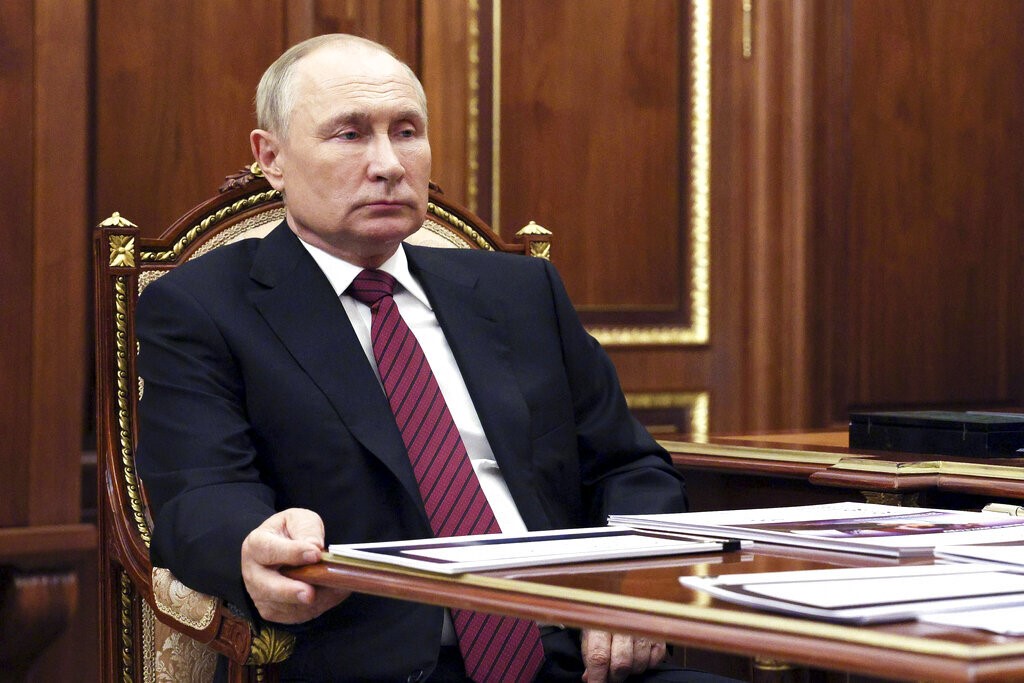
This morning we reported that Vladimir Putin had signed laws absorbing four Ukrainian regions into Russia.
The 45p tax rate was introduced in Chancellor Kwasi Kwarteng’s tax-cutting mini-budget last month and overturned last week. On Tuesday, Home Secretary Suella Braverman accused Tory MPs of launching a “coup” against the PM.
Foreign Secretary James Cleverly has urged his ministerial colleagues to keep their views on government policy “around the cabinet table” as Liz Truss faces an open split within her top team over the 45p tax rate U-turn.
The senior cabinet member warned his peers that it is “always better to feed straight into the boss” if there are any issues regarding “policy or the relationship with other ministers”.
On Tuesday, Home Secretary Suella Braverman accused Tory MPs of staging a “coup” against the PM over the 45p tax rate – a policy which was unveiled in Chancellor Kwasi Kwarteng’s tax-cutting mini-budget last month and reversed last week.
“She chose the words that she chose,” the foreign secretary told Sky News, responding to Ms Braverman’s comments.
“But when you’re in government, you have the opportunity to feed your ideas straight to the top machine. It’s always best done around the cabinet table or in the cabinet committee meetings.
“My view is anything to do with policy or the relationship with other ministers – always better to feed straight into the boss”.
The Levelling Up, Housing and Communities secretary posted on social media: “Suella speaks a lot of good sense, as usual.”
The tax cut for the wealthiest 1% was one of a raft announced by Mr Kwarteng in his mini-budget less than two weeks ago that led to market turmoil – with the pound plummeting, the Bank of England having to step in to rescue pension funds, and mortgage products being withdrawn.
Despite standing by the policy in the opening days of the conference, Mr Kwarteng confirmed on Monday it would no longer go ahead, saying the measure had become a “distraction” from his objective to grow the economy.
Yesterday, Ms Truss told Sky News’ political editor, Beth Rigby, she had “absolutely no shame” in performing the dramatic U-turn.
Mr Cleverly told Kay Burley that “a lot of discussions weren’t able to be had” over the chancellor’s mini-budget proposals because of the death of the Queen.
The foreign secretary also disputed that a U-turn took place, adding: “What you’re describing as a U-turn is the smallest element of a really big and significant support package to families, a tax cut to families, the stimulus package for the British economy.”
Ms Truss is also facing the threat of another major split within her top team over the level of benefits.
On Tuesday, Leader of the House of Commons Penny Mordaunt joined backbench rebels in calling for welfare payments to be raised in line with inflation, which has been at around 10%, rather than earnings at 5%.
Two additional cabinet ministers have also told Sky News that they believe benefits should be uprated in line with inflation.
Sky News understands that Chairman of the 1922 Committee of backbench Conservative MPs Sir Graham Brady has warned Ms Truss any attempt to uprate benefits by average earnings rather than by inflation is unlikely to get through Parliament.
At around 11 am, Ms Truss is due to deliver her keynote speech at the Conservative Party’s conference in Birmingham as she battles to save her premiership just one month into the job.
The PM will wrap up the event by defending her approach and pledging a “new Britain for the new era” after a week of U-turns and infighting.
PM: I am ‘not ashamed’ for listening
The prime minister will tell her audience: “Whenever there is change, there is disruption. Not everyone will be in favour.
“We need to grow the pie so that everyone gets a bigger slice.”
She is expected to say: “I am determined to take a new approach and break us out of this high-tax, low-growth cycle.”
Ms Truss will also put her government forward as having an “iron grip” on the UK’s finances that will help everyone.
The hall in Birmingham is not expected to be full as many MPs said they were leaving on Tuesday evening ahead of train strikes on Wednesday.
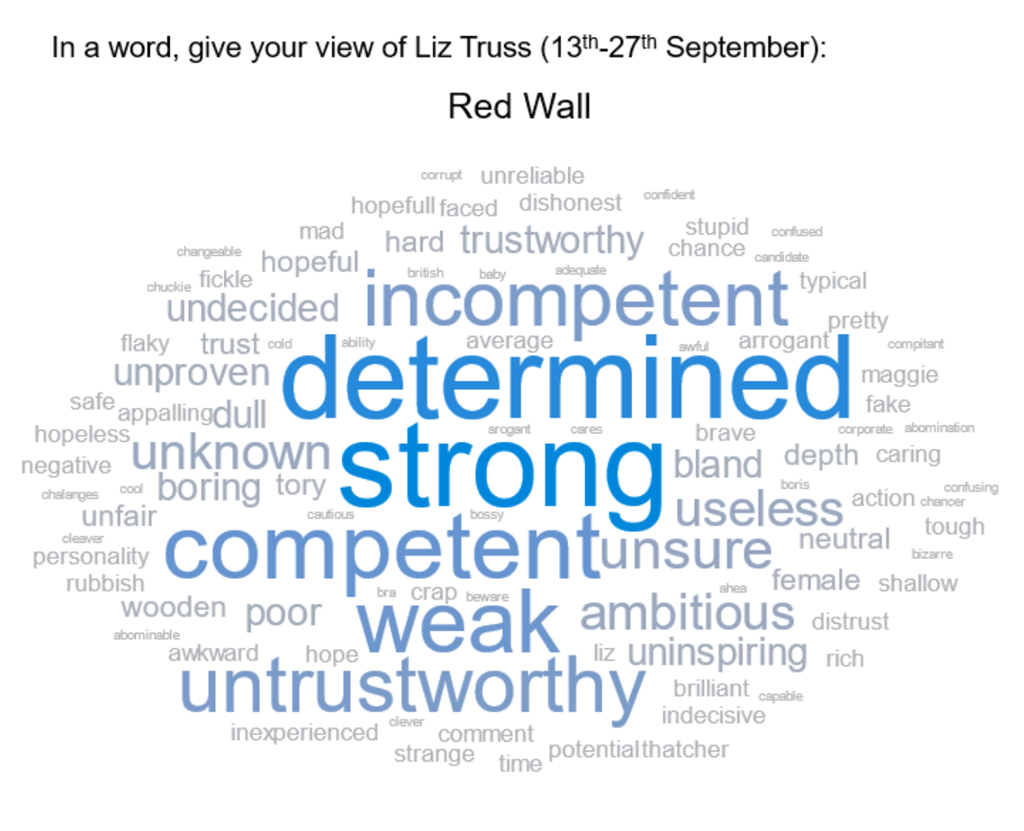
As Liz Truss prepares for her first conference speech as prime minister today, a word cloud created by the research group JL Partners has revealed the most commonly used words used to describe the current leader and her rival Keir Starmer.
When asked to give a view this week on the Tory leader after the mini-budget, the public most commonly used the words “incompetent”, “useless” and “untrustworthy”.
Word cloud for Liz Truss after the mini-budget
In comparison, the words used to describe the prime minister before the mini-budget were “determined”, “strong” and “competent”.
Word cloud for Liz Truss before the mini-budget
The prime minister is currently facing the tough task of restoring Torymorale after a conference that has seen a U-turn over a totemic tax policy, cabinet dissent, and the threat of another major split over the level of benefits.
Meanwhile, the most commonly used words to describe Mr Starmer were “boring”, “leader” and both “competent” and “untrustworthy”.
Margaret Thatcher would never have tried to cut benefits amid the cost of living crisis, Conservative former minister David Davis has said.
Speaking to BBC Radio 4’s Today programme today, he said while the Tory leader modelled herself on Ms Thatcher, she should “actually model herself really on Thatcher”.
“Thatcher was strategically terribly bold, but actually tactically incredibly careful. And (Liz Truss) should do the same,” he said.
“All this stuff about, let’s say one of the controversies, cutting benefits. Well, that’s not a real option. Margaret Thatcher would never have tried that, and under these circumstances with the winter coming up that we have.”
Asked what he would say to those in his party who want to change leader, Mr Davis said: “Well, firstly, you haven’t got time for that.
Addressing Ms Truss’s start as prime minister, he added: “It would be a very, very unwise person who tried to make a judgment over two years on what’s happened in four weeks.”
A Ukrainian commander has been seen driving a captured Russian tank as the army continues to make rapid advances into previously held Russian territory.
In the video – shared on the official Twitter account for Ukraine’s defence – Colonel Pavlo Fedosenko, commander of the 92nd Mechanised Brigade, is seen smiling as he drives the Russian tank.
The video said he captured the tank “personally”.
Sky News has been unable to verify the claims made by the account – however, the vehicle does appear to be a T-90, a third-generation Russian main battle tank.
It is also not the first enemy tank to be captured by advancing forces; in recent weeks a number of T-72 and T-80 tanks have been added to the Ukrainian arsenal.
Colonel Pavlo Fedosenko, Hero of Ukraine, Defender of Kharkiv, commander of the 92nd Mechanized Brigade is driving modern russian T-90A tank captured by the #UAarmy.
russian lend-lease continues. pic.twitter.com/v0XLDVf6f9
John Bolton, a formerUS national security adviser and ambassador to the United Nations, told Sky News the Russian president is in “greater trouble than at any point since the invasion”.
Vladimir Putin’s mounting problems in Ukraine make Russia’s use of a tactical nuclear weapon more likely, a senior US expert has told Sky News.
Tactical nuclear weapons are designed to be used on a battlefield.
John Bolton, a former US national security adviser and ambassador to the United Nations, said that the Russian president is in “greater trouble than at any point since the invasion”.
Discussing the Russian “annexation” of four occupied areas in eastern and southern Ukraine following a series of referendums described by Kyiv and the West as a “sham”, Mr Bolton said: “Obviously he (Putin) thought it would be a morale booster for Russia, (that) it would help lay the groundwork for future borders with Ukraine.
“But the fact is, at least according to Putin’s view of the world, fighting is now taking place on the ‘soil of Russia’ and the Russian militaryis not doing very well.”
Mr Bolton added: “So I think without question that increases Putin’s domestic difficulties in regular Russian politics and makes it somewhat more likely that the use of a tactical nuclear weapon might be possible.
“Because with ‘Russian soil’ itself affected I think Putin could see that as regime-threatening, which would be the circumstance when use of a nuclear weapon would be more likely.”
When asked what the US response might be, Mr Bolton said: “I don’t think it needs to be nuclear, depending on what the Russians actually do.
It’s important to note that this isn’t coming from Russian state media – rather from the independent outlet Readovka.
The website says Mr Putin could change the status of the “special military operation” – known to most of the world as its invasion of Ukraine.
In a previous address, Mr Putin accused the West of engaging in “nuclear blackmail” and said he wasn’t bluffing and would use “all the means available to us” if Russian territory was threatened.
His father Rob described him as a “private young man of drive, purpose, and conviction”.
He went on: “Though we are deeply saddened at his death, we are enormously proud of his courage and determination and his selflessness in immediately enlisting to support Ukraine.
“Rory was never political but he had a deep sense of right and wrong and an inability to turn the other way in the face of injustice.”
The International Legion for the Defence of Ukraine said that while conducting operations, Mr Mason’s unit came under attack.
A spokesman said in a statement:“Our brother in arms, Rory Mason, has taken part in the Kharkiv counteroffensive with his unit and was killed in action.
“Rory’s memory will live on in his unit, in the legion and the armed forces of Ukraine.”
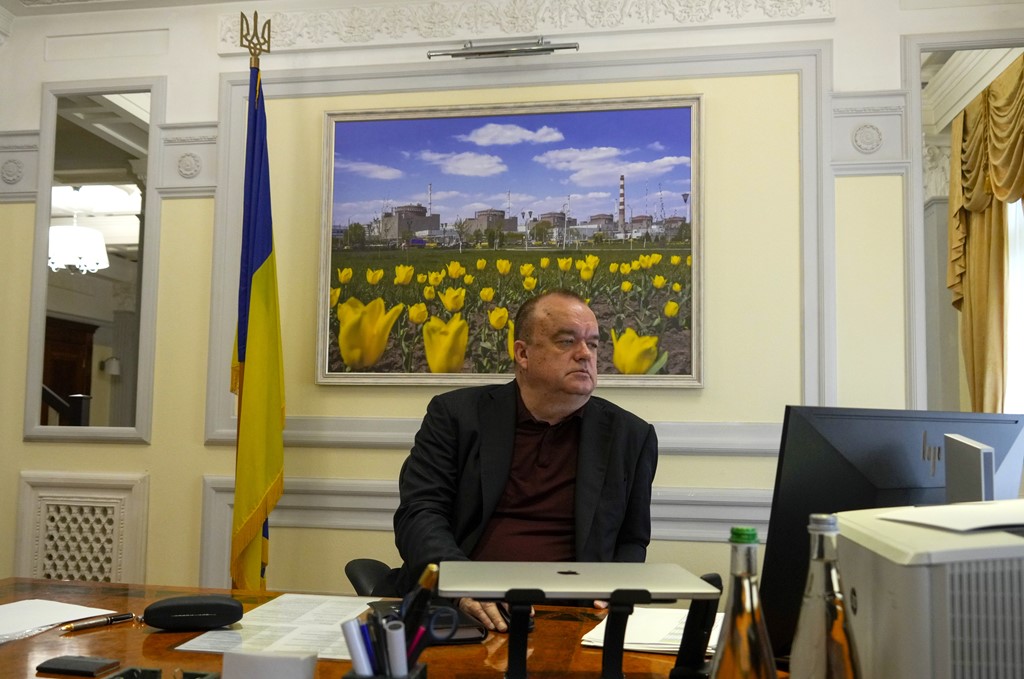
Workers from the Zaporizhzhia nuclear power plant have recounted their fears of being abducted and tortured by Russian forces occupying the facility and the city of Enerhodar.
Ukrainian officials say the Russians have sought to intimidate the staff into keeping the plant running, through beatings and other abuse, and to punish those who express support for Kyiv.
Enerhodar’s exiled mayor Dmytro Orlov estimated that more than 1,000 people, including plant workers, were abducted from Enohodar, and an estimated 100-200 remain abducted.
Mr Orlov alleged they were tortured at various locations in Enerhodar, including at the city’s police station and in basements elsewhere.
“Terrible things happen there,” he said.
“People who managed to come out say there was torture with electric currents, beatings, rape, shootings… some people didn’t survive.”
He was freed on Monday after being forced to make false statements on camera, according to Petro Kotin, head of Energoatom, Ukraine’s state nuclear company.
Mr Kotin said: “I would say it was mental torture.
Petro KotinAP
“He had to say that all the shelling on the Zaporizhzhia nuclear power plant was made by Ukrainian forces and that he is a Ukrainian spy… in contact with Ukrainian special forces.”
Mr Orlov, who spoke to Mr Murashov after his release, said the plant official told him he had spent two days “in solitary confinement in the basement, with handcuffs and a bag on his head. His condition can hardly be called normal”.
Shelling and damage near the site have raised international alarm over the plant’s safety, as both Russia and Ukraine blame each other for the shelling.
The company warns its annual profits will be at the lower end of expectations as it invests in its prices and staff in a bid to bolster its defences against the challenge posed by discount rivals.
The boss of the UK’s biggest retailer says it is “inflating prices a little bit less and a little bit later” than the competition as families’ budgets are squeezed.
Tesco chief executive Ken Murphy made the claim as the chain revealed first-half profits that reflected, it said, its decision to maintain the best value possible for the customer as the cost of goods spiked amid the cost of living crisis.
Underlying retail operating profits fell 10%, the company said, to £1.25bn for the six months to 27 August.
It warned that, as a result of “significant” inflation pressures and consumer caution, annual profits would likely be at the lower end of its earlier guidance of between £2.4bn and £2.5bn by the same measure.
It reported that shoppers were trading down to own label products and frozen food, and buying fewer non-food products.
Tesco said contributing to that profit guidance too was a decision to freeze prices on more than 1,000 everyday goods.
It also revealed a second pay rise of the year for its staff amid pressure from unions which had declared that the UK’s grocery market leader had slipped behind rivals.
Shopworkers’ union Usdaw said that Tesco’s hourly-paid retail and customer fulfillment center staff would receive an additional 20p per hour increase from 13 November, taking the base rate from £10.10 to £10.30 per hour.
This was on top of an increase in July of 5.8%, taking the overall increase this year to 7.85%, it said while welcoming the move.
Tesco, like Sainsbury’s, Asda, and Morrisons, has been battling since the financial crisis a challenge to their dominance from discounters Aldi and Lidl.
Industry data from Kantar Worldpanel last month showed Aldi had overtaken Morrisons as the fourth largest chain by market share.
Tesco recorded UK like-for-like sales growth of 0.7% over the six months – recovering from a 1.5% decline in the first quarter – potentially reflecting a greater desire by shoppers to rein in their spending outside the home as energy and other costs surge.
“That’s why we’re working relentlessly to keep the cost of the weekly shop as affordable as possible, with our powerful combination of Aldi Price Match, Low Everyday Prices and Clubcard Prices, together covering more than 8,000 products, week in, week out.”
“By staying laser-focused on value and sticking to our strategy of inflating a little bit less and a little bit later, our price position has got even more competitive,” he added.
Shares – down by more than a quarter in the year to date – fell by 1.5% at the market open.
Police officials in Wales and England have promised to send an officer to each and every house that has been burglarized.
The pledge commits forces to send an officer to investigate every report of home burglary, regardless of location and what has been stolen.
All 43 forces agreed to the commitment at last week’s meeting of the National Police Chiefs’ Council.
Its chairman Martin Hewitt said the move was aimed at giving people “peace of mind”.
The pledge follows a report from the police watchdog in August which found most victims of burglary, theft, and robbery in England and Wales were not being given the justice they deserve.
In the year to March, Home Office figures showed just 6.3% of robbery offences and 4.1% of thefts in England and Wales resulted in charges, while recent figures found police attendance at burglaries in London had fallen to 50%.
Mr Hewitt said some forces had struggled to attend all burglaries because of “limited resources”.
“We want to give people the peace of mind of knowing if you experience that invasion, the police will come, find all possible evidence and make every effort to catch those responsible,” Mr Hewitt wrote.
“That’s a critical part of the contract between the police and public.”
Mr Hewitt added that burglary was “invasive” and could be “deeply traumatic” for victims.
The plan is to prioritise incidents where a home has been burgled, as opposed to outbuildings and garden sheds.
Sara Thornton, previous head of the NPCC, told the BBC in 2015 that budget cuts and the changing nature of criminality meant the public should not expect to see an officer after crimes such as burglary.
The latest agreement, signed up to by all forces in England and Wales, follows similar commitments from several services across the country, including the Metropolitan Police Service.
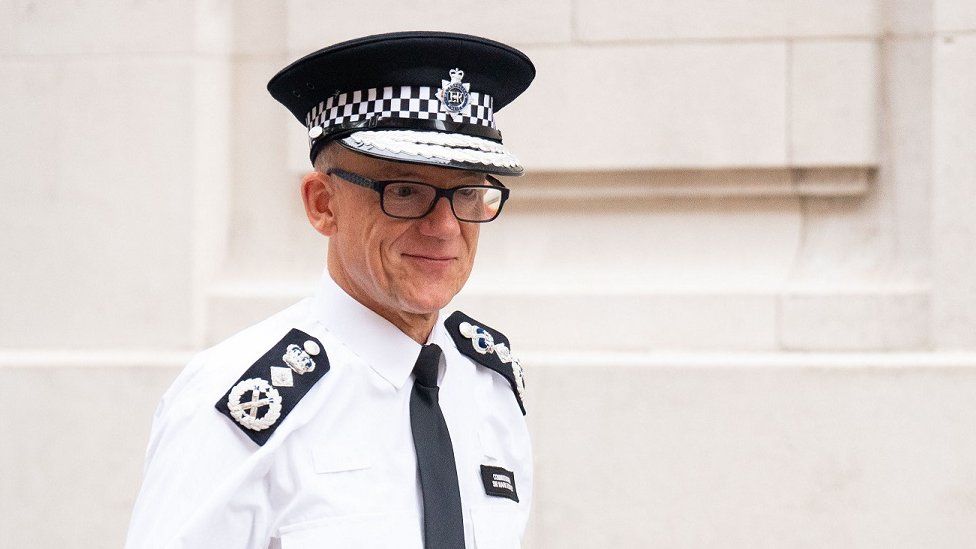
The Met’s recently-appointed commissioner, Mark Rowley, last month said his officers would “get back” to attending all reports of a burglary in London.
IMAGE SOURCE,PA MEDIA Image caption, Sir Mark Rowley said the Met’s low attendance record for burglary was “unacceptable”
Sir Mark told the BBC a crime as severe as burglary needed a “proper policing response” and described the Met’s low attendance record as “unacceptable”.
“We’re never going to turn up to every single crime, and the public understands that, but something as severe as burglary needs a proper policing response,” he said.
“It’s too serious an intrusion not to have somebody turn up”.
Greater Manchester Police committed to attend to every report of a burglary in July last year and said it had since seen “a number of positive results”, including a 95.8% increase in arrests between August 2021 and July 2022.
Supt Chris Foster, the force’s lead for tackling burglary, said: “It is therefore only right that we use all of our policing powers to deal with those individuals who invade the homes of others and steal their property.
An avalanche struck a group of mountaineers in the Indian Himalayas, killing at least ten persons.
The 34 trainees and seven instructors were practising navigation on Tuesday when they were hit on their descent from a peak in the northern state of Uttarakhand.
Officials said that 14 people have been rescued, while 20 were still missing.
The Indian Air Force is helping with the rescue efforts.
The group was made up of trainees from the nearby Nehru Institute of Mountaineering. It said they had been returning from Mount Draupadi Danda-2 (5,670m; 18,602 feet) when the avalanche struck.
Authorities were alerted at around 09:30 local time on Tuesday (04:00 GMT), rescue workers said.
Search efforts were paused in the night because of rain and snowfall but resumed on Wednesday.
Uttarakhand police chief Ashok Kumar told ANI news agency that rescue teams could restart operations as the weather had cleared up. “Today six bodies have been recovered. And till now a total of 10 bodies have been recovered,” he said.
Earlier, Mr Kumar had told Reuters news agency that the Indian Air Force was doing an aerial recce of the mountain as “it wasn’t easy to reach the spot” where the accident happened.
Defence Minister Rajnath Singh wrote on Twitter: “Deeply anguished by the loss of precious lives due to landslide which has struck the mountaineering expedition carried out by the Nehru Mountaineering Institute in Uttarkashi.”
It comes a week after the body of famed US ski mountaineer Hilaree Nelson was found in the Nepali Himalayas.
Ms Nelson, regarded as one of the greatest mountaineers of her generation, was reported to have fallen into a deep crevasse after reaching the summit of Mount Manaslu.
On the same day, she went missing, one person was killed and more than a dozen injured in an avalanche lower down on the same peak.
In court papers, Angelina Jolie accuses her ex-husband Brad Pitt of beating her and their children while intoxicated while travelling on a private jet, which prompted her to file for divorce.
In a lawsuit over a French winery that the stars bought, Ms Jolie says Mr Pitt grabbed her by the head and attacked two of their children on the 2016 trip.
Mr Pitt also verbally abused and poured alcohol on his family during the flight from France to Los Angeles, she says.
He denies the allegations.
A source close to the actor told the BBC that Ms Jolie’s claims were false.
“She continues to rehash, revise and reimagine her description of an event that happened six years ago by adding completely untrue information each time she fails to get what she wants,” said the source. “Her story is constantly evolving.”
Ms Jolie’s claim of abusive behaviour by Mr Pitt on the 14 September 2016 flight have emerged in previous court papers, including the Oscar-winning former couple’s divorce settlement.
But new details were alleged in Tuesday’s filing in Los Angeles by Ms Jolie’s legal team. It is part of an ongoing lawsuit over Chateau Miraval SA, a home and vineyard in the south of France that the former Hollywood couple acquired together.
Mr Pitt argues that he and his former wife had agreed not to sell their stakes in the venue without the permission of the other.
Ms Jolie disputes this, and blames Mr Pitt for ending negotiationsover purchasing her shares of the property.
Her cross-complaint on Tuesday says the actor was physically and emotionally abusive towards her and their six children – aged 8 to 15 at the time – during the private plane flight.
Her lawyers allege the Fight Club star began shouting, accusing her of being “too deferential to the children”.
Shortly into the flight, Mr Pitt “pulled her into the bathroom” in the back of the plane, says the lawsuit.
“Pitt grabbed Jolie by the head and shook her, and then grabbed her shoulders and shook her again before pushing her into the bathroom wall,” the filing adds.
IMAGE SOURCE,GETTY IMAGES Image caption, Miraval is known for its rosé wine
“Pitt then punched the ceiling of the plane numerous times, prompting Jolie to leave the bathroom.”
After one child verbally intervened, Mr Pitt “lunged at his own child”, says the filing.
Ms Jolie then “grabbed him from behind to stop him”, according to the court papers.
“To get Jolie off his back, Pitt threw himself backward into the airplane’s seats injuring Jolie’s back and elbow,” the legal filing continues.
“The children rushed in and all bravely tried to protect each other. Before it was over, Pitt choked one of the children and struck another in the face.”
Ms Jolie’s lawyers say she and her children “sat still and silent under blankets” for the remainder of the flight.
IMAGE SOURCE,GETTY IMAGES Image caption, The French estate, seen in 2008
“Pitt periodically emerged from the back of the plane to yell and swear at them. At one point, he poured beer on Jolie; at another, he poured beer and red wine on the children,” says the filing.
The incident was investigated by the FBI in 2016. Authorities decided not to press charges.
Last year, a judge awarded joint custody of the children to both parents.
The Miraval estate is located in the village of Correns in south-eastern Franceand was bought by the couple for around €25m (£21.3m; $25m) in 2008.
The stars got married there six years later.
Mr Pitt has sued Ms Jolie, claiming that her decision to sell her stake in the estate to a Russian oligarch amounted to an attempt to “undermine” his investment and cause “gratuitous harm” to Mr Pitt, who had “poured money and sweat equity into the wine business”.
Ms Jolie’s lawyers say in their filing that the actress “has gone to great lengths to try to shield their children from reliving the pain Pitt inflicted on the family that day”.
They add that her decision to sell her stake in the venture was in part due to her “growing increasingly uncomfortable with continuing to participate in an alcohol-related business, given the impact of Pitt’s acknowledged problem of alcohol abuse on their family”. Mr Pitt told the New York Times in 2019 that he had joined Alcoholics Anonymous following his split from Ms Jolie.
Ms Jolie’s court filing lays bare the tension between the couple over their plans for the winery.
Mr Pitt, who has previously spoken of his love for architecture and design, decided the chateau needed the fifth pool at a cost of €1m and wanted a staircase to be rebuilt four times, according to Ms Jolie.
A West African mission that went to assess Burkina Faso‘s situation following the coup left Ouagadougou “confident” despite gatherings by demonstrators who criticised its visit.
The delegation on Tuesday met Capt Ibrahim Traoré, the military leader who on Friday overthrew Lt Col Paul-Henri Damiba, who himself came to power in a coup in January.
They met at the Ouagadougou airport where dozens of demonstrators were calling for more Russian cooperation and chanting anti-France and anti-Ecowas slogans.
Former Niger president Mahamadou Issoufou, who was part of the Economic Community of West African States (Ecowas) delegation as a mediator, said they would stand by the Burkinabè people in the very difficult ordeal they were going through.
Over the weekend he had said the country was “on the brink of collapse”.
After initially opposing his removal from office, Lt Col Damiba agreed to resign on Sunday and left for Lomé, the capital of Togo.
The coups have been triggered by worsening insecurity amid frequent jihadist attacks.
Since 2015, Burkina Faso has been the target of regular attacks by armed groups affiliated with al-Qaeda and the Islamic State group.
The anaesthetic officer who passed away in the early hours of Wednesday has been confirmed by the Ugandan health ministry.
Margaret Nabisubi, 58, is the fourth medical worker to die of Ebola, according to Health Minister Jane Ruth Aceng.
I regret to announce the passing of another Health worker, Ms. Nabisubi Margaret, an anesthetic officer. The 58 year old succumbed to Ebola at 4.33am this morning at Fort Portal Hospital (JMedic) after battling the disease for 17 days.
— Dr. Jane Ruth Aceng Ocero (@JaneRuth_Aceng) October 5, 2022
A team of medics got exposed to the virus when they treated the first confirmed case, who needed surgery, and they have been admitted to Fort Portal regional hospital.
A Tanzanian medical student, who was part of the team, died at the weekend.
Separately, a health assistant in the district of Kagadi died of the virus too.
It is suspected that a midwife also died from Ebola.
Medical workers expressed concerns about not having enough personal protective gear in the first days of the outbreak.
Official figures show that there have been 43 confirmed cases since the outbreak was announced two weeks ago, and 10 of these have died.
Health officials said they have traced more than 800 people suspected to have come into contact with those who contracted the disease.
An investigation found that a chess player at the centre of a cheating scandal “possibly” cheated in more than 100 online games.
Hans Niemann has been accused by world champion Magnus Carlsen of cheating, though no evidence has been presented.
Now an investigation by Chess.com says it is likely Niemann has cheated “much more often” than he has acknowledged.
But it found no evidence he had cheated in his game against Carlsen or in any “over-the-board” games.
The American has admitted cheating in informal games when he was younger but denies doing so in competitive games.
The 19-year-old,who has been approached by the BBC for comment, has previously accused Carlsen and Chess.com of trying to ruin his career.
The scandal began earlier this month after Carlsen, considered by many to be the greatest player of all time, was defeated by Niemann at the Sinquefield Cup in a major upset.
The Norwegian made veiled accusations of cheating against Niemann at the time before openly accusing him last week.
Now Chess.com has produced a 72-page investigation into Niemann’s games on the site, which most of the world’s top players compete on, including for cash prizes.
The site, which has banned Niemann for alleged cheating, claims it is likely he cheated as recently as 2020, including in prize money events and against highly-rated “well known” figures in the game.
Its analysis compared Niemann’s moves to those suggested by chess computers – which are far stronger than even the best players – and the probability of his results, among other factors.
“Overall, we have found that Hans has likely cheated in more than 100 online chess games, including several prize money events,” the report said.
“He was already 17 when he likely cheated in some of these matches and games. He was also streaming in 25 of these games.”
The report contradicts statements previously made by Niemann that he had only cheated in informal games on the site when he was 12 and 16, but never in competitive games or when he was streaming on gaming platforms such as Twitch.
However, although his results are “statistically extraordinary”, Chess.com said there was no “direct evidence” Niemann had cheated in his win against Carlsen or in other over-the-board games in the past.
In his statement last week, Carlsen suggested Niemann had cheated in their game at the Sinquefield Cup in the US state of Missouri, saying he “wasn’t tense or even fully concentrating” while outplaying him using the black pieces “in a way I think only a handful of players can do”.
He also said he had become suspicious of Niemann because he has made “unusual” progress in recent years. Others have argued that Niemann’s progress, while fast, is comparable to other top junior players.
Chess.com said there were “certain aspects” of the game that were “suspicious”, including Niemann’s explanation of the game afterward.
The site also noted “anomalies” in Niemann’s rate of improvement, which has seen him soar up the rankings in classical chess from around 800 in the world to the top 50 in less than two years.
Chess.com said this rise was the fastest in “modern recorded history” and had occurred “much later in life than his peers”.
The site also denied it had been pressured by Carlsen, who has dominated chess for more than a decade, to remove Niemann.
Carlsen has insisted he will not play Niemann, and earlier this month resigned in protest after just one move when they re-matched each other in an online tournament.
When the controversy erupted earlier this month, Niemann issued a strenuous denial, saying he was willing to play naked to prove he was not concealing electronic devices that could allow him to cheat.
“I don’t care, because I know I am clean. You want me to play in a closed box with zero electronic transmission, I don’t care. I’m here to win and that is my goal regardless.”
A statistical analysis of Niemann’s over-the-board games by Prof Kenneth Regan, widely regarded as the world’s leading expert on cheating in chess, found no evidence he had cheated.
An alleged rape that occurred within Canberra’s Parliament House was described by a former political worker from Australia as feeling “trapped and not human.”
Prosecutors say Bruce Lehrmann sexually assaulted Brittany Higgins in March 2019 while she was drunk and asleep in the office of a government minister.
Mr Lehrmann, 27, has pleaded not guilty and denies the pair had sex at all.
In a recorded police interview played to the jury on Wednesday, Ms Higgins said she had woken up on a sofa to find Mr Lehrmann – her colleague – having sex with her.
Crying, she told him “stop” and “no”, Ms Higgins said in the interview from 2021.
“I wasn’t screaming but there was obviously an urgency to it,” she added. “He just kept going.”
When it was over, Mr Lehrmann quickly left the office, Ms Higgins said. “[There] was a strange moment of eye contact… I didn’t say anything to him.”
After waking up again hours later, with her dress bunched around her waist, Ms Higgins said she went home and cried all weekend.
The following week, she told a senior staff member she had been assaulted.
“It didn’t feel real,” she said in the police tape. “[But] the moment I vocalised it, it hit me.”
Earlier, the court heard the pair had ended up in Parliament House after a night out with colleagues in Canberra.
By the time they left a second bar Ms Higgins told police she was “the most drunk I have been in my life”.
She and Mr Lehrmann were heading in the same direction, so agreed to share a ride. He said he had to stop at work to pick up something, she said.
“It didn’t seem overly strange,” Ms Higgins told the police interview. “At that point I was focussed on not being sick.”
Prosecutors have told the Australian Capital Territory Supreme Court they will argue that Ms Higgins was so intoxicated she would have been unable to consent to sex.
But Mr Lehrmann’s barrister has told jurors the case was about the “reliability” and “credibility” of Ms Higgins, saying his client denied the two ever had sex, and that “the Australian public has been sold a pup with this story”.
Earlier the court heard that Ms Higgins initially reported the incident to police in April 2019, but withdrew her complaint because she feared it would interfere with her job during an election campaign.
Almost two years later, in February 2021, she asked police to reopen the case after conducting interviews with two journalists, the jury was told.
Anatoly Antonov, the Russian ambassador to the US, referred to it as an “urgent threat” to Moscow and labelled the US as “a participant in the battle.”
Earlier, the US announced another $625m (£547m) in military aid to Ukraine.
Advanced US weaponry has been credited with helping Ukraine build momentum against occupying Russian forces.
Ukrainian troops have made significant advances in the country’s northeast and south in recent weeks.
The latest US hardware includes another four of the high-precision Himars multiple rocket systems.
In all, Washington has committed nearly $17bn in military support for Kyiv since Russian President Vladimir Putin invaded Ukraine on 24 February.
In a statement on Thursday, Mr Antonov warned that the US decision “to continue pumping the Kyiv regime with heavy weapons only secures Washington’s status as a participant of the conflict”.
He said this would result in “protracted bloodshed and new casualties”.
After suffering a string of major defeats on the battlefield in Ukraine in recent weeks, Russia has vowed to defend itself with all means available – not ruling out the use of its nuclear weapons.
Moscow is also pushing ahead with its annexation attempts of four Ukraine regions: Donetsk and Luhansk in the east, and Kherson and Zaporizhzhia in the south.
However, Russia does not fully control any of the regions, and Ukrainian troops have been making rapid advances in the Kherson region in recent days.
Mr Antonov’s warning comes shortly after US President Joe Biden and Vice-President Kamala Harris discussed further military co-operation with Ukraine’s President Volodymyr Zelensky.
In a statement, the White House stressed that “the United States will never recognize Russia’s purported annexation of Ukrainian territory.
“President Biden pledged to continue supporting Ukraine as it defends itself from Russian aggression for as long as it takes.”
The statement said the new military aid package included “Himars, artillery systems and ammunition, and armoured vehicles”.
The US-made HIMARS -High Mobility Artillery Rocket System – has been used to hit Russian targets such as command posts and ammunition depots.
After a failed missile launch during a joint drill with the United States alarmed locals in the coastal city of Gangneung, the South Korean military has apologized.
They reported hearing an explosion and seeing a fire overnight.
But the military, which has said there were no casualties, did not acknowledge the incident until seven hours later.
The launch was in response to North Korea firing a missile over Japan early on Tuesday.
This is the first time Pyongyang has flown a missile over Japan since 2017 – and it prompted a show of force from the US, Japan, and South Koreawhich conducted military drills. Seoul and Washington also fired a volley of missiles into the East Sea – also known as the Sea of Japan – between the Korean peninsula and Japan.
The South Korean military later confirmed that one of their missiles failed soon after it was launched and crashed – this was separate from the ones launched by the US.
The military also said that the Hyunmoo-2 missile carried a warhead but that it did not explode, and apologised for causing worry.
Residents in Gangneung said they saw a bright flash and heard an explosion at around 01:00 on Wednesday (16:00 GMT Tuesday).
They were left in the dark for hours, and many of them posted on social media wondering what had happened while sharing photos and videos of the incident. The footage showed what appeared to be a brightly burning fire, with smoke rising from a distance.
“I can’t sleep because I feel anxious [after hearing] the explosion,” said one user, according to news site Kang Won Ilbo. Another wondered if a plane had crashed.
It’s only just been confirmed that the US and ROK conducted their own missile drill in response to North Korea’s recent missile test.
One of South Korea’s Hyunmoo-2 failed shortly after launch and crashed, but caused no casualties.https://t.co/j7K3semX3g
An explosion near Gangneung last night caused a social media storm in South Korea. Zero media reports or emergency alerts, raising suspicions of a cover up, a jet crash, or a missile launch.
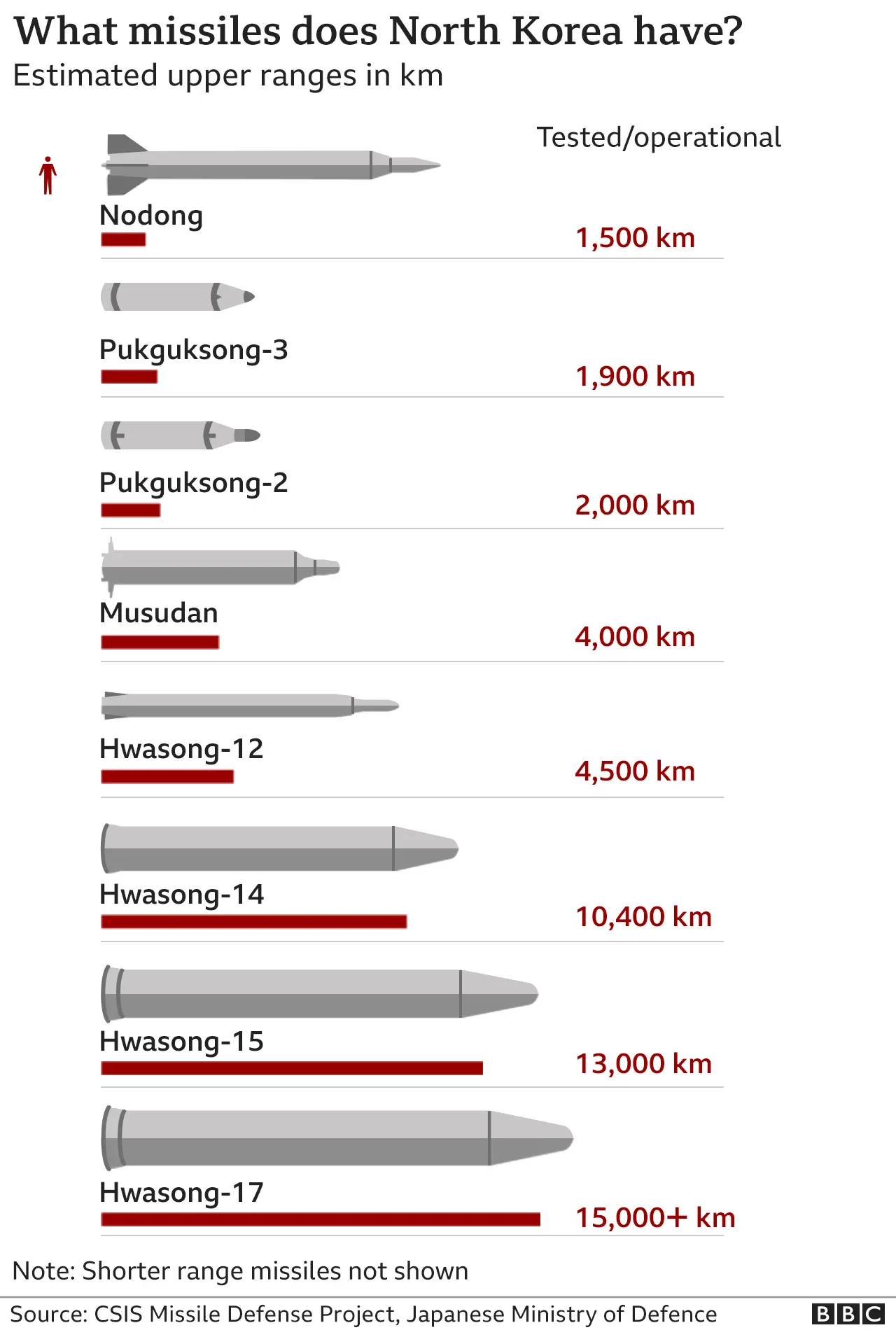
North Korea’s missile launch on Tuesday was the fifth carried out by Pyongyang in a week. Many of its missile tests are conducted on a flight path that reaches a high altitude, avoiding flights over its neighbours.
But firing over or past Japan allows North Korean scientists to test missiles under circumstances “that are more representative of the conditions they’d endure in real-world use”, analyst Ankit Panda told news agency Reuters.
In September, North Korea passed a law declaring itself to be a nuclear weapons state, with leader Kim Jong-un ruling out the possibility of talks on de-nuclearization.
Despite Somaliaexperiencing its worst drought in 40 years, more and more young children are dying there.
In the coming days or weeks, an even worse catastrophe, according to government authorities, might engulf the nation.
The tears tumbled down 11-year-old Dahir’s hunger-hollowed cheeks.
“I just want to survive this,” he said quietly.
Seated beside the family’s makeshift tent, on the dusty plain outside thecity of Baidoa, his weary mother, Fatuma Omar, told him not to cry.
“Your tears will not bring your brother back. Everything will be fine,” she said.
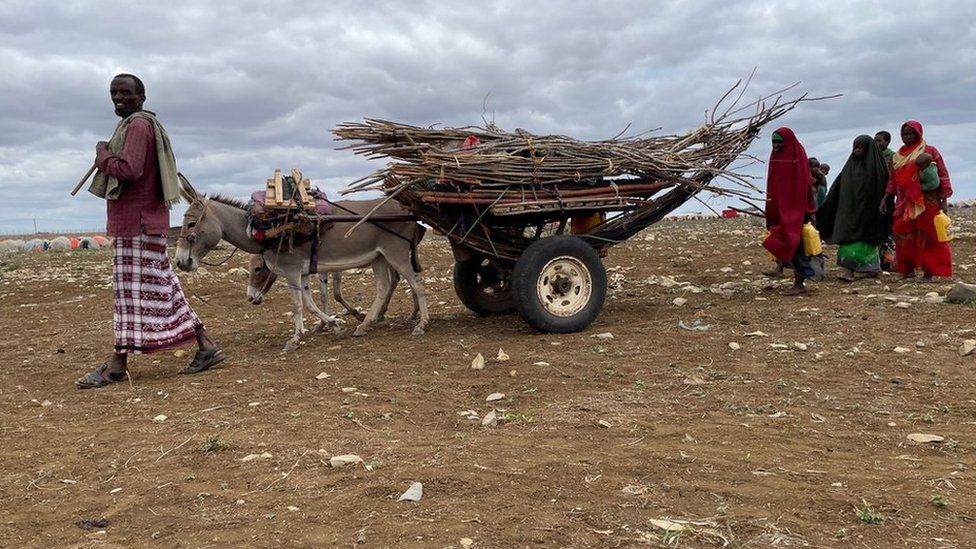
Fatuma’s second son, 10-year-old Salat, died of starvation two weeks ago, shortly after the family reached Baidoa from their village, three days’ walk away. His body is buried in the rocky earth a few metres from their new home – the grave already covered in litter and increasingly hard to spot as new arrivals set up camp around them.
“I cannot grieve for my son. There is no time. I need to find work and food to keep the others alive,” Fatuma said, cradling her youngest daughter, nine-month-old Bille, and turning to look at six-year-old Mariam as she gave a rasping cough.
On the other side of the dirt road that loops to the southeast, towards the coast and Somalia’s capital, Mogadishu, other displaced families told more grim stories of long treks across a drought-parched landscape in search of food.
‘No strength to bury my daughter’
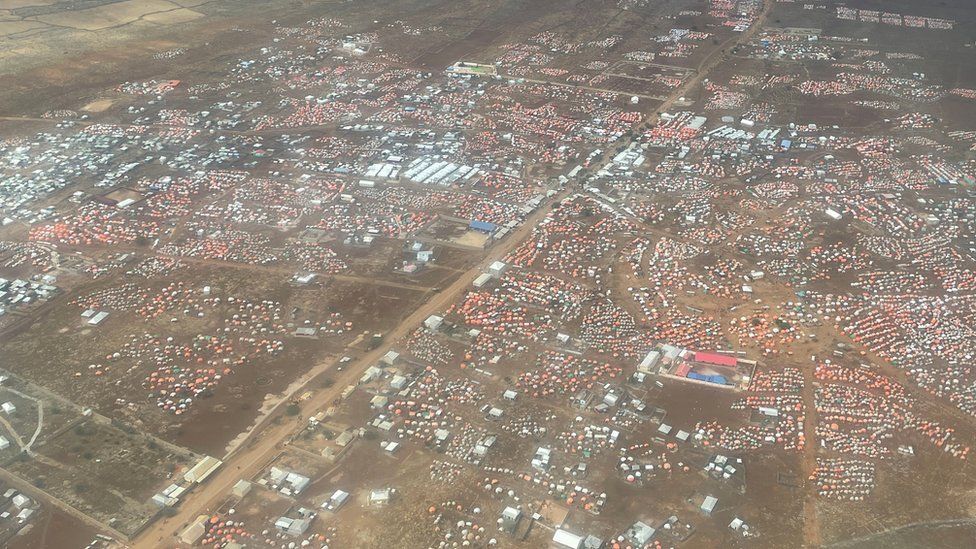
A new survey has shown that almost two-thirds of young children and pregnant women in the camps are suffering from acute malnutrition, which, along with a high death rate, could indicate that a localised declaration of famine is already overdue.
“I saw my daughter [three-year-old Farhir] die before me and I could do nothing,” said Fatuma, who had walked for at least 15 days with her nine children from a village called Buulo Ciir to reach Baidoa.
“I had been carrying her for 10 days. We had to leave her by the side of the road. We had no strength to bury her. We could hear the hyenas closing in,” she continued.
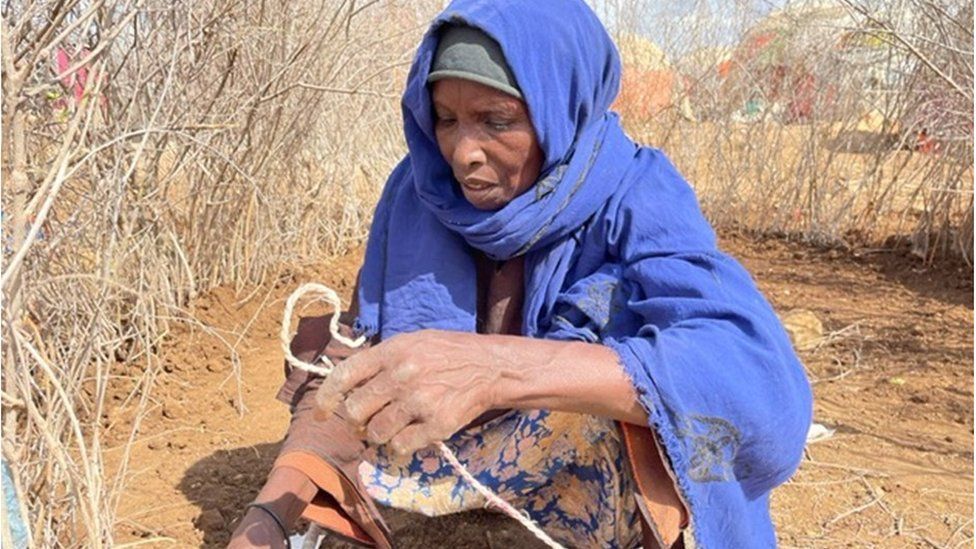
Image caption, Habiba Mohamud says her home village is unrecognisable
“I’ve brought nothing with me. There is nothing left at home. The cattle are dead. The fields are dry,” said Habiba Mohamud, 50, clutching a piece of twine in one hand, and acknowledging that she will never return to her village.
A succession of droughts, turbo-charged by climate change, is now threatening to end a pastoral way of life that has endured for centuries across the Horn of Africa.
Like other new arrivals, Habiba was busy erecting a tent for her family from branches, twigs, and scavenged scraps of cardboard and plastic sheeting, hoping to finish it before the chill of night. Only after that could she turn to find food and medical help for some of her five children.
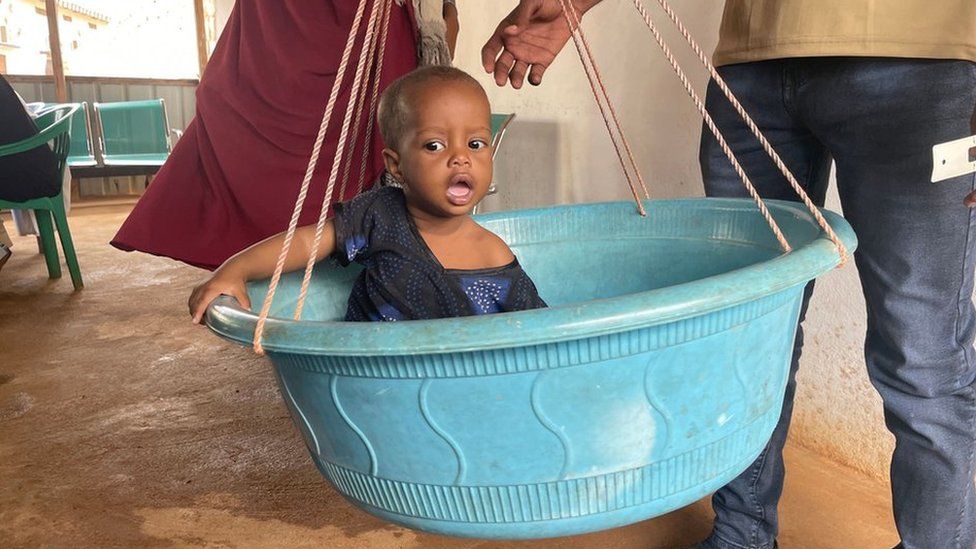
On the admissions ward in the city’s main hospital, Dr Abdullahi Yussuf moved between beds, checking on his tiny, emaciated patients. Most were children between two months and three years old.
All were severely malnourished. Some had pneumoniaand many were battling a new outbreak of measles too.
Few infants had the strength to cry. Several had badly damaged skin, broken by the swelling that sometimes accompanies the most extreme cases of hunger.
“So many die before they even reach a hospital,” said Dr Abdullahi, watching his team struggling to connect an intravenous tube to the arm of a moaning two-year-old.
‘It’s terrifying, people are dying’
Although Somali officials and international organisations have been sounding the alarm for months about an impending famine in this south-western region, Dr Abdullahi said his hospital was already short of basic items including nutritional supplements for children.
“Sometimes we lack supplies. It’s terrifying, actually, because people are dying, and we can’t support them. Our local government is not handling this well. It has not been planning for the drought or for the arrival of displaced families,” he said, with visible frustration.
A local government minister conceded there had been failings.
“We need to be faster than we are, and we need to be accurate… and more effective,” said Nasir Arush, Minister for Humanitarian Affairs for South West state, on a short visit to one of the camps around Baidoa. But more international support, he insisted, was key.
“If we don’t receive the aid we need, hundreds of thousands of people will die. The things we’re doing now we neededto do three months ago. In reality we are behind. Unless something happens [fast] I think something catastrophic will happen in this area,” he said.
The process of formally declaring a famine can be a complicated one, reliant on hard-to-pin-down data, and, often, political considerations.
Britain’s ambassador in Mogadishu, Kate Foster, described it as “essentially, a technical process”. She pointed out that during the 2011 drought “half of the 260,000 deaths happened before famine was declared”.
IMAGE SOURCE,BBC/ ED HABERSHON Image caption, Locals have been migrating from their villages to Baidoa in search of resources and medical care
The presidential envoy leading Somalia’s international effort to secure more funding thanked the US government, in particular, for recent new funding, saying it “has given us hope”.
But Abdirahman Abdishakur warned that without more help, a localized crisis in one part of Somalia could quickly spin out of control.
“We were raising the alarm… but the response of the international community was not adequate,” Mr Abdishakur said.
“Famine is projected. It happens [already] in some places, some pockets, in Somalia, but still, we can prevent the catastrophic one,” he continued, speaking by phone during a stopover in Toronto, Canada.
Women fleeing, men stay behind
Although estimates vary, the population of Baidoa has roughly quadrupled in the past few months, to around 800,000 people.
And any visitor will quickly notice one striking fact: almost all the new adult arrivals are women.
Somalia is at war. The conflict has endured, in different guises, since the central government collapsed three decades ago, and it continues to affect almost every part of the country, tearing men away from their families to fight for an array of armed groups.
Like most of those arriving in Baidoa, Hadija Abukar recently escaped from territory controlled by the militant Islamist group al-Shabab.
“Even now I’m getting calls on my phone from the rest of my family. There is fighting there – between the government and al-Shabab. My relatives have run away and are hiding in the forest,” she said, seated beside her sickly child at a small hospital in Baidoa.
Other women spoke of husbands and older sons being blocked from leaving areas controlled by the militants, and of years of extortion by the group.
Baidoa itself is not quite surrounded by al-Shabab, but it remains a precarious place of refuge. International aid organisations, and foreign journalists, require heavy security to move around, and any travel beyond the city limits is considered extremely risky.
“We’re looking at populations that are under siege. Sometimes it feels quite hopeless,” said Charles Nzuki, who heads the UN children’s fund, Unicef, in central and southern Somalia.
Image caption, Women and children are leaving areas where they cannot get humanitarian assistance
According to some estimates, more than half the population affected by the current drought remains in areas controlled by al-Shabab. Strict US government rules blocking any assistance from benefitting designated terrorist groups have complicated efforts to reach many desperate communities.
But international organisations, and the Somali authorities, are working with smaller local partners to increase access and are now planning air drops into some contested territories.
Still, one aid worker, speaking off the record, acknowledged that it was almost impossible to guarantee that no food or funds were reaching al-Shabab.
“Let’s not be naïve, [al-Shabab] taxes everything, even cash donations,” they said.
Over the years, the militant group has established a reputation not just for violence and intimidation but for delivering justice in a country with a hard-earned reputation for official corruption.
In at least four villages close to Baidoa, al-Shabab runs a network of Sharia courts that are routinely used by the city’s residents and, reportedly, by people in Mogadishu and beyond, to settle business and land disputes.
Further to the north-east, a sudden uprising against al-Shabab has seen local communities and clan militias – now heavily backed by the central government – drive the group out of dozens of towns and villages in recent weeks.
The military successes have prompted a surge of optimism, but it is not clear if that will help in the fight against famine, or simply distract the Somali government.
“It might, or it might not [help]. I think it may create more [civilian] displacement. Or the government might liberate more areas and people might have more access [to aid]. So, we’re looking at it from all sides,” said local minister Nasir Arush.
IMAGE SOURCE,BBC/ ED HABERSHON Image caption, Baidoa is providing a safe haven for those fleeing villages with no resources
In Baidoa itself – a busy city of narrow, cobbled streets scarred by decades of conflict and neglect – the prices of basic goods, like rice, have doubled in the past month. Many residents blamed the drought, but others also looked further afield.
“Flour, sugar, oil – they’ve all risen by about the same amount. Sometimes we have to skip meals. I heard about the war between Russia and Ukraine. People say that is the root cause of these problems,” said Shukri Moalim Ali, 38, walking over to her dry well, and barren vegetable patch.
While the fight to ward off a deeper, spreading famine is the immediate focus in this region, Somalia’s new government is also looking ahead, seeking to address more existential questions about the future.
“It is a challenging task, to respond to the drought, to fight against al-Shabab, and to campaign to access [international] climate justice finance,” Abdirahman Abdishakur said.
“We have a young population, an enormous diaspora, and vibrant entrepreneurial skills. So that gives us hope. It’s challenging, but we don’t have an alternative.”
In the state of Uttarakhand in northern India, a bus crashed down a gorge, killing at least 25 people.
At least 40 people were on board when the bus went off the road and crashed into a ravine on Tuesday night in the Pauri Garhwal area, according to officials.
So far, 21 passengers have been rescued following an overnight operation led by the state’s disaster response force.
The bus was carrying a wedding procession from Laldhang to Bironkhal village in Uttarakhand when the accident happened.
The cause of the crash was not immediately known, but state authorities said they were investigating the incident.
Senior police official Swatantra Kumar Singh told ANI news agency that a rescue operation was still underway on Wednesday.
Pictures from the scene showed the mangled remains of the bus lying near a steep hill as rescue personnel helped pull out the survivors.
Uttarkhand’s Chief Minister Pushkar Singh Dhami said that all possible help was being provided to the rescue teams to aid their efforts.
Road safety is notoriously bad in India, with more than 100,000 dying each year in crashes due to poor driving and dilapidated roads.
Buses are a popular mode of transport in India, especially in smaller towns. But operators often flout safety rules and pack them beyond their capacity.
In an unprecedented displayof support for the protests rocking the nation, Iranian schoolgirls have been yelling against clerical authorities and waving their hijabs in the air.
Videos verified by the BBC showed demonstrations inside schoolyards and on the streets of several cities.
They echoed the wider unrest sparked by the death last month of a woman who was detained for breaking the hijab law.
In Karaj, girls reportedly forced an education official out of their school.
Footage posted on social media on Monday showed them shouting “shame on you” and throwing what appear to be empty water bottles at the man until he retreats through a gate.
In another video from Karaj, which is just to the west of the capital Tehran, students are heard shouting: “If we don’t unite, they will kill us one by one.”
In the southern city of Shiraz on Monday, dozens of schoolgirls blocked traffic on the main road while waving their headscarves in the air and shouting “death to the dictator” – a reference to the Supreme Leader, Ayatollah Ali Khamenei, who has the final say on all state matters.
Iranian schoolgirls remove their head coverings and chant “mullahs must go away” today, on day 18 of protests over the death of #MahsaAmini in morality police custody for “improper hijab” amid mass arrests of activists and an internet shutdown.#مهسا_امینیpic.twitter.com/a01ILrgOlS
Further protests by schoolgirls were reported on Tuesday in Karaj, Tehran, and the north-western cities of Saqez and Sanandaj.
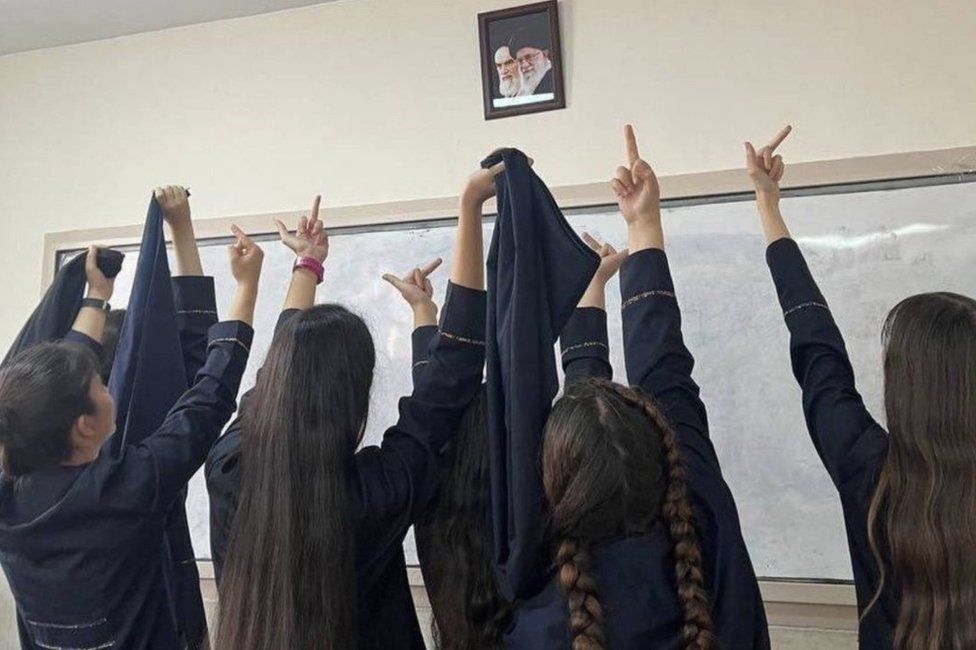
A number of students were also photographed standing in their classrooms with their heads uncovered.
Some were raising their middle fingers – an obscene gesture – at portraits of Ayatollah Khamenei and the founder of the Islamic Republic, Ayatollah Ruhollah Khomeini.
IMAGE SOURCE,TWITTER Image caption, The protests by the schoolgirls began hours after Iran’s supreme leader defended the government’s response
In an odd turn of events, Kwaku Yayente, 37, of the Atwima Mponua District in the Ashanti region of Ghana, died after heavy alcohol consumption in Kansakrom.
The deceased reportedly had his stomach exploding after drinking excessively.
Mr. Aguuri, an eyewitness in an interview revealed that the late Yayente had been an alcohol addictfor many years.
According to him, the family of the deceased had tried all the necessary means to stop him from drunkenness but all efforts proved futile.
A senior mortuary attendant, Mr. Kwame Nyamekye aka Last Doctor, mentioned that he was at the mortuary when a family member and three(3) policemen brought the body.
According to him, the family revealed to him that their late relative’s stomach was bloated due to excessive drinking.
“Unfortunately for them, they heard a blast inside his room, and upon checks on him, they found out that his stomach had exploded with the intestines gushing out.
“He did not die on the spot, so they rushed him to the Bibiani hospital here, but unfortunately, he was pronounced dead upon arrival,” he said.
According to him, the family further told him that their relative had been sick for some days due to drunkenness. “I’m reliably informed he drinks every day, and even before his demise this morning, he drunk,” he concluded.
Director of NADMO in the Eastern Region Kwame Koduah,, said ten people are still missing in the Nsawam Adoagyiri area following Saturday’s floods.
At least five people have been confirmed dead following last weekend’s floods in the Eastern Region, the National Disaster and Management Organisation (NADMO) confirmed on Tuesday (4 October 2022).
The Eastern regional director of NADMO, Kwame Koduah, said ten individuals are still missing in the Nsawam Adoagyiri constituency after Saturday’s floods.
“The severity of the flooding has left the Eastern Region in a … devastating situation,” said Koduah, speaking on the Asaase Breakfast Show on Tuesday. “Seventeen districts have been affected, including Ofoase Ayirebi.
“We’ve lost five lives in the Eastern Region as a result of the devastating nature of the flooding. In Nsawam Adoagyiri ten people are missing now. It’s catastrophic and devastating.
“Over 100 houses were submerged in the river and 750 people are displaced and are now being accommodated at church halls and community centres,” Koduah said.
River Densu breaks its banks
Meanwhile, close to 2,000 residents of Nsawam, also in the Eastern Region, have been made homeless after floods swept away their homes over the weekend.
The River Densu overflowed its banks after the downpour, forcing residents of the area to abandon their houses, livestock and other property.
The zongo community was worst affected, including areas such as Gyankrom, Lanteh, Adoagyiri and the main Nsawam lorry station.
Addressing the media, the MP for Nsawam-Adoagyiri, Frank Annoh-Dompreh, said: “We will all continue to monitor the situation and see what we can do. We appeal for calm.”
Last year Turkish President Recep Tayyip Erdogan took the unorthodox step of cutting interest rates to try to boost the economy. Most central banks raise interest rates to fight inflation.
The transport sector saw the sharpest increases in annual prices at 117.66%, followed by food and non-alcoholic drinks at 93%.
Mr Erdogan has described interest rates as “the mother and father of all evil”, and his economic policies include intervening in foreign exchange markets.
Last year’s cut in interest rates from 19% to 14% has led to a fall in the value of the Turkish lira, which means it costs more for the country to import goods from abroad.
The lira, meanwhile, hit a new record low of 18.56 against the US dollar.
US Banking giants JP Morgan said Turkey’s inflation would remain in the “abnormally high range until policies get orthodox”.
“We will build the century of Turkey together, hopefully by overcoming the inflation issue,” said Mr Erdogan in a televised address on Monday.
The record high is the sharpest inflation surge since World War Two, according to former Turkish central bank chief economist Hakan Kara.
High inflation and the economic crisis is the main problem facing Mr Erdogan’s ruling party, as he looks to secure another term in next year’s election.
Prices are rising quickly around the world, due to factors including Covid-related supply shortages and the Ukraine war, which has driven energy and food prices higher.
President of Ukraine Volodymyr Zelensky reacted to Elon Musk after the Tesla CEO shared a Twitter poll with his ideas for stopping Russia’s invasion.
Voting options that included giving territory to Russia were put to the vote by Mr. Musk’s 107.7 million followers.
In response, Mr Zelensky posted his own poll asking users if they liked the world’s richest person more when he supported Ukraine.
Other Ukrainians criticized Mr Musk.
Ukraine’s outgoing ambassador to Germany, Andrij Melnyk, used a strong expletive, which he described as his “very diplomatic reply”.
Meanwhile, Russian chess grandmaster Garry Kasparov said: “This is moral idiocy, repetition of Kremlin propaganda, a betrayal of Ukrainian courage & sacrifice.”
Mr Musk’s ideas included votes in parts of Ukraine occupied by Russia that the Kremlin says it is annexing.
The multi-billionaire said: “Russia leaves if that is the will of the people.”
President Vladimir Putin has already declared four Ukrainian regions to be part of Russia, following so-called referendums denounced as fraudulent by Kyiv and its Western allies. Russia does not fully control any of the four regions.
Mr Musk also suggested the worldshould formally recognise Crimea – annexed by Russia in 2014 – as part of Russia. And the world’s richest person in 2022, according to Forbes magazine, cautioned that the conflict could end in nuclear war, though added this was “unlikely”.
This is highly likely to be the outcome in the end – just a question of how many die before then
Earlier in Russia’s invasion, Mr Musk’s satellite internet company sent equipment to Ukraine.
That gained Mr Musk popularity in Ukraine and he was subsequently invited by Mr Zelensky to visit when the war with Russia was over.
The businessman posted his poll during a busy week when he is due to give evidence to lawyers acting for Twitter ahead of a trial set to begin on 17 October. Twitter is suing Mr Musk after he walked away from a $44bn deal to buy the social media platform.
Twitter is hoping the court in Delawarewill order Mr Musk to complete the takeover at the agreed price of $54.20 per share.
A lotteryin the Philippines that saw 433 winners has surprised and sparked the investigation.
It was the highest number of people to have ever won the Grand Lotto’s top prize, according to local media.
The winning combination for last weekend’s 236m pesos ($4m; £3.5m) jackpot was a series of numbers that were all divisible by nine.
Philippines senate minority leader Koko Pimentel has called for an inquiry into the “suspicious” results.
One expert told the BBC, on the assumption that 10m bets had been placed, he had estimated that the probability of having this many winners was “1 out of 1 followed by 1,224 zeros”.
“I don’t know a name for this number since it is so large. The number of molecules in the known universe has 80 zeros,” said Guido David, a mathematics professor at the University of the Philippines.
Participants in the Grand Lotto select six numbers from 1 to 55. To win the jackpot all six of a player’s numbers have to match those drawn by the lottery’s operator.
“These lotto games are authorized by the Republic of the Philippines. Therefore, we need to maintain and protect the integrity of these gambling games,” Mr Pimentel said as he called for an investigation into the lottery’s unusual outcome.
On Sunday, Melquiades Robles, general manager of the Philippine Charity Sweepstakes Office (PCSO), said there were no irregularities and highlighted that people in the Philippines tended to bet on number sequences.
“Many have held on to their numbers. It’s not only good to be loyal to your wives and husbands, it’s also good to be loyal to your numbers,” Mr Robles told a news conference.
IMAGE SOURCE,PHILIPPINE CHARITY SWEEPSTAKES OFFICE Image caption, The winning combination for Saturday’s draw
The PCSO also shared photographs and videos of people collecting their prize money at its office in Mandaluyong city, close to the capital Manila.
“I’ve been betting on pattern 9, pattern 8, pattern 7, and pattern 6 for many years and I’m thankful I just won,” one winner said.
Terence Tao, a maths professor from the University of California, Los Angeles told the BBC that a pattern like this being a winning series of numbers is rare “for any single lottery.”
“But there are hundreds of lotteries every day around the world, and statistically it would not be surprisingthat every few decades, one of these lotteries would exhibit an unusual pattern,” he said.
“It’s similar to how in any given hand of poker it would be unlikely to draw a straight flush, but if one looks at hundreds of thousands of hands at once then it actually becomes quite likely that a straight flush would be drawn,” he added.
A domestic flight from the capital, Naypyidaw, to Kayah state was hit by bullets at a height of about 1,000 metres (3,280 feet).
Myanmar’s military government has promised to take “serious action” against rebel forces that it has blamed for an attack on a passenger plane that left one person hospitalized and damaged the aircraft’s fuselage.
A passenger on the Myanmar National Airlines domestic flight sustained facial injuries on Friday when bullets passed through the aircraft’s cabin as it prepared to land at Loikaw, the capital of eastern Kayah state, at 8:45 am local time (02:15 GMT). The flight had 63 passengers on board.
“Although the plane was damaged … it landed successfully at Loikaw airport due to the efforts of crews,” government spokesman Major-General Zaw Min Tun was quoted on Saturday by the State-run Global New Light of Myanmar news outlet.
The injured passenger had received treatment in hospital, said Zaw Min Tun,who described the attack on the civilian aircraft and passengers as “a military crime, a criminal act”.
“What I want to say is that the security forces will take serious action against the perpetrators or groups that launch such brutal attacks,” he said, according to the news outlet.
The plane, flying from the capital Naypyidaw, came under fire at a height of about 1,000 metres (3,280 feet) and about 6km (3.7 miles) north of Loikaw airport, the military government said, blaming fighters from the Karenni National Progressive Party, an ethnic rebel army, for the shooting.
State media released photos it said were of the bullet-damaged plane and the passenger being treated. Myanmar National Airlines’ office in Loikaw announced that all flights to the city were canceled indefinitely.
Kayah state has experienced intense conflict between the Myanmar military and local resistance groups since the army seized power last year, overthrowing the democratically elected government of Aung San Suu Kyi.
February 1, 2021, military takeover was met with peaceful nationwide protests, but after the army and police killed demonstrators opposing military rule, civilians throughout the country formed armed units as part of a People’s Defence Force (PDF) to fight the military rule.
Thousands have been killed in the fighting and many more jailed by the military.
Vladimir Putindoesn’t have many partners who are willing to send weaponry, despite the fact that the West has been arming Ukraine throughout the conflict.
It has been widely reported that Russia has received Iranian drones for use in Ukraine – but Iran, according to Kyiv, has not been upfront with them about this.
Now Ukraine has called them out on Twitter
Recently, in response to a note from the Ministry of Foreign Affairs of Ukraine, the ambassador of Iran stated that his country has not supplied drones to russia.
Here is the Iranian drone Qods Mohajer-6, which was launched to coordinate an attack on Odesa a few days ago. pic.twitter.com/C5Ep0kj7GZ
More losses for Russia in Ukraine, this time around in Kherson – Ukraine’s long-telegraphed Kherson counter-offensive is making some headway along the western banks of the Dnipro river, between the villages of Zolota Balka and Dudchany around 100km north of Kherson.
Russia’s Ministry of Defence admitted on Monday that the Ukrainians had broken through Russian lines at Zolota Balka and Oleksandrivka but that the Russians had taken up pre-prepared defensive positions and were continuing to inflict “massive fire on the enemy”.
Our warriors from @ng_ukraine reported that the village of Zolota Balka, Kherson region, has been liberated.
russians control less territories in Ukraine each day. pic.twitter.com/zPTOsafHmv
Just four days after Russia declared all this territory theirs, it doesn’t look good for them. Plus Russian losses are appearing in the public domain, in a way that one month ago they would not have done. Russian military bloggers are documenting Russian setbacks in expanding groups of followers.
The likes of Ramzan Kadyrov, who incidentally has just announced he’ll be sending his three teenage sons to fight (including his 14-year-old), has poured criticism on the Russian military command in charge of the Lyman debacle, as has Evgeny Prigozhin who recently revealed himself to nobody’s great surprise as head of the Russian mercenary group, Wagner.
Pundits on state TV are expressingconcern at the dire state of affairs. Could this open Pandora’s box for the Kremlin, criticism which gathers pace and which it cannot control, triggering a slow unraveling?
Perhaps. It could also, intentionally or not, serve a purpose for Vladimir Putin. If his nuclear bluffs are to be taken seriously and given Russian capabilities it would be foolish not to, he needs to present a case to his people that the nuclear option is – at some point – justified.
He and his propagandists are pitching this as anexistential battle against the military might of the collective West, out to destroy and dismantle Russia.
A nuclear strike is an abhorrent option in any scenario but it makes no sense if you’re winning. With Russia losing ground though, and the outlook increasingly bleak, it might become more appealing as Vladimir Putin sees his options shrink.
DISCLAIMER: Independentghana.com will not be liable for any inaccuracies contained in this article. The views expressed in the article are solely those of the author’s, and do not reflect those of The Independent Ghana
Source: Skynews By Diana Magnay, Moscow correspondent
A Royal Navy frigate has been sent to the North Sea after suspected sabotage last week on the Nord Stream gas pipelines.
The Ministry of Defence (MoD) said the ship was working with the Norwegian navy “to reassure those working near the gas pipelines”.
European nations believe the damage to pipelines under the Baltic Sea could only have been caused by an attack, with Russia strongly suspected.
The Kremlin has denied it was responsible and instead pointed the finger at the West.
Russia’s Gazprom said on Monday that the pipelines had now stopped leaking. The gas giant said pressure had stabilised in the damaged pipelines and that it was pumping gas out of the undamaged string B of Nord Stream 2so that its integrity could be checked.
Methane had been bubbling up since four leaks were found on the pipelines near Denmark’s Bornholm Island.
A British defence source told Sky News they were likely premeditated attacks using underwater explosives.
Defence Secretary Ben Wallace said on Sunday at the Tory Party conference that Russia made “no secret” of its ability to attack underwater infrastructure.
He said the damage to the pipelines – which run from Russia to Germany – showed “the Nordic states and ourselves are deeply vulnerable to people doing things on our cables and our pipelines”.
Mr Wallace said the UK would acquire two specialist ships to protect the network as the country’s “internet and energy are highly reliant on pipelines and cables”.
“The first multi-role survey ship for seabed warfare will be purchased by the end of this year, fitted out here in the UK and then operational before the end of next year,” he said.
“The second ship will be built in the UK and we will plan to make sure it covers all our vulnerabilities.”
Mr Wallace met other ministers of the Joint Expeditionary Force (JEF) on Monday to shareassessments of what the MoD called a “blatant and irresponsible” attack.
In a statement, it said the members had decided to increase their presence in the area, as well as “intelligence surveillance and reconnaissance activities” to deter future acts and reassure allies.
The JEF is focussed on security in the High North, North Atlantic and Baltic Sea region.
It includes Denmark, Estonia, Finland, Iceland, Latvia, Lithuania, Netherlands, Norway, Sweden, and the UK.
Kenya haslifted a restriction that had been in place for ten years due to health concerns, allowing the cultivation and importing of genetically modified crops and animal feeds.
It comes after a catastrophic drought grips the nation. Millions are going hungry as a result of the worst drought in 40 years.
President William Ruto’s government has turned to genetically modified crops as a way of helping boost yields.
It says the country needs seeds that are resistant to drought, pests, and diseases.
A decade ago the production and import of GM crops were banned due to concerns over possible health risks.
It was clearly an unpopular decision in America, which is home to major producers of genetically engineered seeds.
In July, Joe Biden’s administration announced a new partnership with Kenya which included a commitment to boost trade in the agriculture sector.
Despite the prospect of better yields, some are wary that farmers could become too reliant on rules laid down by foreign, private companies.
There has been sparse media coverage in Senegal following a visit to Dakar by Ukraine Foreign Affairs Minister Dmytro Kuleba, who is embarking on an African tour.
The Ukrainian diplomat met Senegal’s Foreign Minister Aissata Tall Sall and they signed several bilateral cooperation deals.
Mr Kuleba is on an apparent counteroffensive tour following a visit to the continent by Russia’s top diplomat Sergei Lavrov in July, ahead of plans to host the second Russia-Africa summit in Ethiopia next year.
Ukraine President Volodymyr Zelensky has repeatedly made overtures to African leaders to condemn Russia over its invasion of his country.
Months after going missing, thirteen young women who were kidnapped in Zambia by unidentified individuals have been found.
The women, aged between 17 and 28, including a mobile money booth operator who became the face of the abductees after a video in which she appeared to be beaten with a metal rod while pleading for mercy went viral about six months ago.
But on Monday, one of the abductees managed to scale a wall of the house where they were being held in the capital, Lusaka’s Chalala residential area.
She then alerted neighbours who broke in to rescue the rest of the women.
Robby Chitambo, who was the first to respond to the distress call, mobilized his friends to break into the house, and narrated graphic details of what he saw.
He said he found a casket, used condoms, and sanitary pads in the house before calling the police who later arrived at the scene.
“We helped the ladies by taking them out. One of them is pregnant. We found a casket and a shrine inside the house. There were also charms, pads, and condoms everywhere,” he narrated.
The Australian government has announced that there won’t be any more species extinctions and the country will no longer be known as “the mammal extinction capital of the world.”
More than 100 endangered species, including well-known ones like the koala, will receive priority protection under new conversational tactics.
Earlier this year a report found Australia’s environment is in shocking decline.
Many native animals and plants face threats including habitat loss, invasive pests and weeds, climate change, and more frequent and destructive natural disasters.
Environment Minister Tanya Plibersek said the need for action has never been greater.
“Our current approach has not been working,” Ms Plibersek said in a statement. “We are determined to give wildlife a better chance.”
The 10-year strategy also aims to improve resilience to climate change, build “insurance” populations of some key species in predator-free zones, and better monitor existing populations.
It calls for more efforts to reduce the impact of feral cats, foxes, and a prolific weed known as gamba grass, and to better harness Aboriginal expertise in managing the environment.
Twenty areas with high densities of threatened species will be specifically targeted. They include Kangaroo Island in South Australia and the Blue Mountains in New South Wales, which were devastated by bushfires in 2019-20.
The 110 species to be prioritised include the Australian sea lion and the rarest marsupial in the world, Gilbert’s Potoroo – of which only about 100 remain.
Ms Plibersek says the strategy is the government’s answer to the State of the Environment report, which found Australia has lost more species to extinction than any other continent.
The survey of the country’s ecological systems concluded that more than half were in a poor state.
“A lot of people have followed along with the process since it takes time.
“But I’m glad that people are seeing the fascinating side of bacteria and my videos are opening up a new perspective.”
IMAGE SOURCE,CHLOE FITZPATRICK Image caption, This “knuckle-duster” ring is made from a petri dish containing bacteria
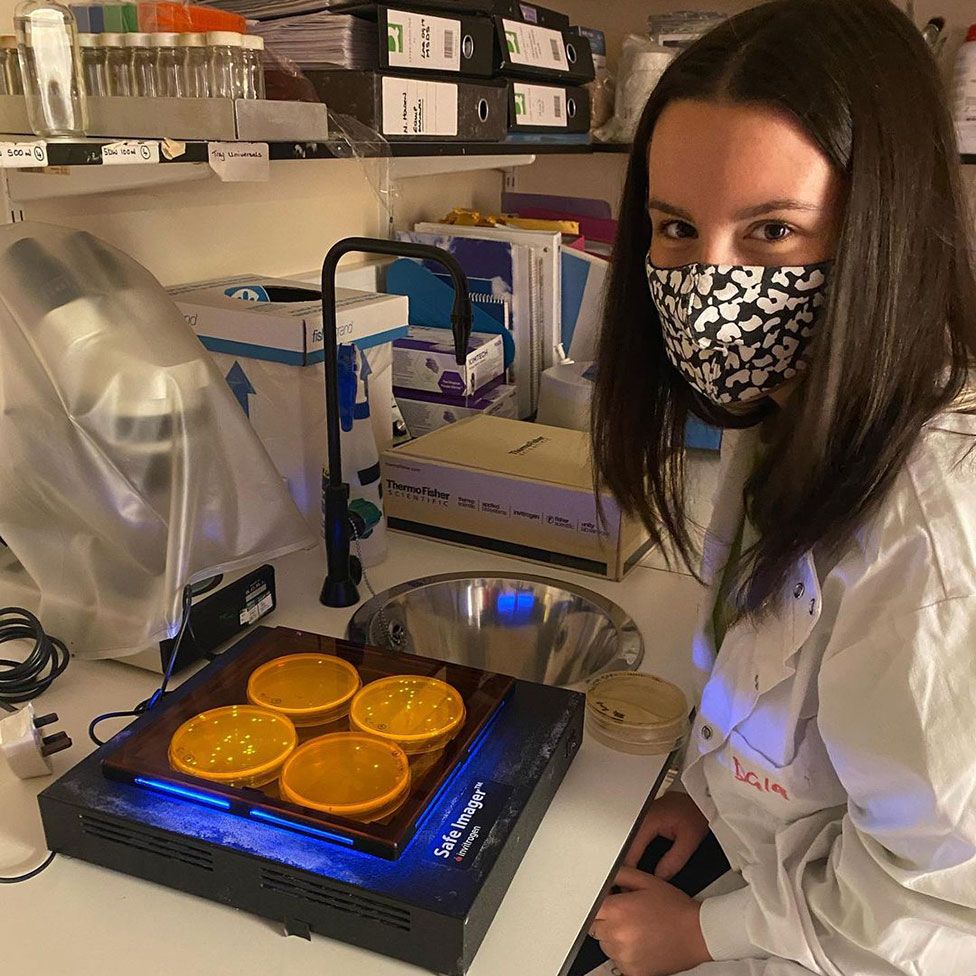
Chloe swabs parts of her body, or plants, and transfers the samples to petri dishes with a special growth medium inside called agar.
The bacteria samples are covered and allowed to multiply into coloured colonies for about a week at room temperature.
She then isolates particular colours in a new dish so they can multiply further.
The colours can be used to dye materials like cotton clothing or resign jewellery sustainably.
“When you press your hands and feet into the agar plates, you get lots of different reds, oranges, and yellows.
“Everyone’s bacteria is so different and develops differently,” she said.
IMAGE SOURCE,CHLOE FITZPATRICK Image caption, Chloe Fitzpatrick has worked with scientists at the University of Dundee on her bacteria project
And she claims it is more environmentally friendly than traditional dying processes used in the textile industry.
“They used a lot of harmful chemicals,” she said.
“Using bacteria is an eco-friendly alternative, they multiply fast, and you get a good range of colours.”
Chloe has mostly created rings and she has even used the bacteria dye to create resin “gemstones”.
Each sample is a gamble, but she has noticed some patterns in how the bacteriadevelops.
She said: “Human bacteria tend to have more colours, especially from the skin.
“So humans tend to have a variety of pinks, reds, and yellows, and while plants can show the same colours, it is normally in a smaller amount.”
Image caption, Chloe dyed cotton strands using isolated colours from bacteria
She has worked with scientists at the University of Dundee throughout the development of the process, to ensure the experiments are streamlined and safe.
She said: “Everything is tested thoroughly to make sure the bacteria has been killed off.
“I want to test the limits of this process as there’s so much I can do with it.
“I wanted to be part of the BioArt movement, which is a collaboration of art and science.
“I believe the art world is heading in that direction since there’s a lot of possibilities and it’s not been fully explored yet.”
Examples of her work are currently on display in an exhibition of BioArt at Kulanshi Art Centre in Nur-Sultan, Kazakhstan
And she has been commissioned by the University of Dundee to create a bacteria-inspired sculpture for the medical garden outside of the School of Life Sciences.
The Danish Queen hasexpressed regret for depriving four of her grandchildren of their royal titles, but she has not changed her mind.
Queen Margrethe II said she wanted the monarchy in “keeping with the times”, that her decision had been a long time coming, and that it would “future-proof” the institution.
But she “underestimated” her family’s reaction “and for that I am sorry”.
The initial decision was announced last week, to begin next year.
“The titles of prince and princess that they have held up until now will be discontinued,” the initial statement said. “Prince Joachim’s descendants will thus have to be addressed as excellencies in the future.”
Prince Joachim – the younger son of Queen Margrethe – said he was upset by the change.
“It’s never fun to see your children being mistreated like that,” he told Ekstra Bladet. “They find themselves in a situation they do not understand.”
His wife, Princess Marie, said her youngest child had been bullied at school following what she called the “short-notice” announcement.
In an interview, the couple also saidMargrethe had not spoken to them since the changes were announced. One grandchild, Prince Nikolai, said his family were “shocked” by the decision.
From the beginning of 2023, Joachim’s four children – Prince Nikolai, 23, Prince Felix, 20, Prince Henrik, 13, and Princess Athena, 10 – will be known by the titles Count and Countess of Monpezat instead of Prince and Princess.
The palace said this was a “natural extension” of the Danish monarch’s desire to slim down the monarchy.
“Her Majesty The Queen wishes to create the framework for the four grandchildren to be able to shape their own lives to a much greater extent,” last week’s statement said.
But following what Margrethe described as “strong reactions” to her decision, she apologised in a new statement for underestimating the reaction.
“No one should be in doubt that my children, daughters-in-law, and grandchildren are my great joy and pride. I now hope that we as a family can find the peace to find our way through this situation,” she said.
Queen Margrethe II’s oldest son, Crown Prince Frederik, is first in line to the throne. His four children will keep their titles.
His wife, Crown Princess Mary, supported the Queen, saying “change can be difficult and can really hurt. But this does not mean that the decision is not the right one”.
The Danish monarch, 82, tested positive for Covid-19 after attending the state funeral of Queen Elizabeth II– who was her third cousin.
More territory has been retaken by Ukrainian forces in regions that Russia illegally annexed, with Kyiv’s soldiers moving closer to Kherson in the south and consolidating gains in the east.
Officials from Russia who had been deployed in Kherson acknowledged the advance but claimed that Moscow’s men had dug in.
In the east, Ukrainian forces pushed into the Russian-held Luhansk region.
Speaking during his nightly address, President Zelensky said “fierce fighting continues in many areas”, but he did not give details. The progress of Ukraine’s counterattacks have been closely guarded and reporters have largely been kept away from the front lines.
But in the south, Vladimir Saldo, the Russian-installed leader in the Kherson region, admitted that Ukrainian forces had broken through near Dudchany, a town on the Dnipro river about 30km (20 miles) south of the previous front line. The river is called Dnieper by Russians.
“There are settlements that are occupied by Ukrainian forces,” Mr Saldo said. Some Russian reports say the Ukrainians have now taken Dudchany.
A Russian defence ministry spokesman, Igor Konashenkov, said “numerically superior” Ukrainian tanks had “driven a deep wedge” south of Zolota Balka, a village that marked the previous front line on the Dnipro. He claimed the Russians had killed about 130 Ukrainian troops in that fighting.
According to Mr Saldo, two Ukrainian battalions tried to reach the Kakhovka hydroelectric power station, about 70km (44 miles) east of Kherson. The power station is in the port city of Nova Kakhovka.
Meanwhile, in the east Kyiv’s troops have continued an advance that has seen them slowly making inroads into Luhansk, a province annexed by Moscow last week and previously under almost complete Russian control.
On Saturday Ukrainian forces recaptured the important hub town of Lyman in the east, lying near the Luhansk regional border. Russia’s military had turned Lyman into a logistical base.
Russia’s proxy forces in Luhansk said Ukrainian troops had pushed a few kilometres into the Luhansk region. Reports suggest that the Ukrainians are moving towards the Russian-held towns of Kremenna and Svatove in Luhansk, with some pro-Kremlin bloggers suggesting that Russian forces have again been ordered to retreat.
Kherson and Luhansk are among four regions which Russian President Vladimir Putin has declared to be part of Russia, following so-called referendums denounced as fraudulent by Kyiv and its Western allies. Russia does not fully control any of the four regions.
On Monday, Kremlin spokesperson Dmitry Peskov attracted ridicule online after he admitted that Russia was still deciding which areas it had “annexed”, suggesting that Moscow does not know where its self-declared borders are.
Mr Peskov claimed the entirety of Luhansk and Donetsk regions were part of Russia, but said the Kremlin will “continue consultations with the population regarding the borders of the Kherson and Zaporizhzhia regions”.
Kyiv has vowed to retake all the territory annexed by Russia, including Crimea, seized by Russian troops in 2014.
The Russian defence ministry says reservists drafted into the army under Mr Putin’s mobilisation order last month are now undergoing intensive combat training in the Russian-controlled Luhansk and Donetsk regions. The Kremlin plans to call up about 300,000 reservists – though Mr Putin did not set an upper limit.
Ponniyin Selvan:1, an epic period drama in Tamilby renowned Indian director Mani Ratnam, has been a box office sensation. Sudha G. Tilak discusses what makes a successful movie.
Many people believe that Ponniyin Selvan, which is based on one of India’s greatest kings, is the best Tamil novel ever written.
It was the name conferred by the loyal subjects on Rajaraja Chola – whose name means ‘king of kings’ – of the Chola dynasty, which ruled Tamil land from the 9th Century to the 13th Century.
Rajaraja was not the first of the Chola dynasty but he took their empire to its zenith – from a relatively small kingdom to the dominant empire in India. Their political influence extended across Sri Lanka, Maldives, Sumatra, parts of Thailand, and Malaysia, and they had diplomatic ties with China.
Historian Sunil Khilnani wrote that Rajaraja “pulled off something that no Indian ruler before him seems to have done: he’d commandeered trading boats, timber sailed craft and launched maritime expeditions, bringing far-flung wealth back home”.
The star-studded film, which cost $70m (£62m) to make, revolves around Ponniyin Selvan’s ascendency to the throne as his father, the ailing king, retreats from royal duties.
IMAGE SOURCE,LYCA/MADRAS TALKIES Image caption, The film revolves around Ponniyin Selvan’s ascendency to the throne as his father retreats from royal duties
The kingdom is embroiled in palace intrigues and an impending coup. Rival members of the royal clan plot to usurp the throne, and enemy kings conspire assassinations.
Leading the stratagem is a powerful and enigmatic noblewoman Nandini (played by Bollywood star Aishwarya Rai Bachchan) on a vengeful path to destroy her former lover and the prince-in-waiting (played by award-winning actor Vikram).
Her rival is princess Kundavai (played by leading Tamil actress Trisha) who wants to defeat the plots, protect her brothers, and see that her rightful sibling ascends the throne.
Actor Karthi plays the part of the colourful Vandiyathevan, a swashbuckling warrior and loyal friend of the princes. He is a musketeer-like figure, charming women, averting disasters, and thwarting plots with clever antics.
Ponniyin Selvan is a fictional literary record of the glory of the Cholas, whose cultural contribution remains visible in modern-day Tamil Nadu.
The king’s imprint can be seen in the stunning sculptures and inscriptions in a towering granite temple in the city of Thanjavur, which was the seat of the Cholas.
The story of Ponniyin Selvan was serialised in Kalki, a Tamil magazine, by writer and journalist Kalki Krishnamurthy in 1955. The sprawling historical fiction, running to nearly 2,000 pages, has been published in several editions and translated into English.
IMAGE SOURCE,LYCA/MADRAS TALKIES Image caption, The film boasts a galaxy of Tamil stars like Trisha (left) and Vikram (right)
Comic books for children based on novels and theatre productions have kept the epic alive in the popular imagination.
“The novel has a cult following across generations of Tamils. It will be interesting to see how a 21st-Century audience reared on Game of Thrones and homegrown fantasy movies like Baahubali responds to this film based on 10th Century dynastic Tamil politics, royal intrigue, and chicanery,” says Chennai-based film scholar Pritam Chakravarthy.
Director Mani Ratnam, described as “India’s top pop-film auteur”, said in an interview that he wanted Ponniyin Selvan to be an “immersive experience” for the audience.
Scenes of bloody battles and warring soldiers, horseback and elephant chases, and dances with actors in regalia captivate audiences. A beachfront invasion, the king battling the savage seas, and the sinking of a ship are a nod to the maritime escapades of the Cholas. The dialogue is in medieval Tamil but written to be accessible to a contemporary audience.
Critics have appreciated Mani Ratnam for his deft adaptation of a five-part novel into two parts – the second part is due for release next year. Despite the pandemic, the director managed to wrap up filming both parts of the movie, each running to nearly two-and-a-half hours, in 150 days.
IMAGE SOURCE,LYCA/MADRAS TALKIES Image caption, Mani Ratnam wanted the film to be an ‘immersive experience’ for the audience
Ponniyin Selvan opened to a thunderous reception at the weekend.
Cinema halls in the southern city of Chennai saw people queue up for special shows that opened after midnight to accommodate the huge volume of ticket sales. Scenes of fans dancing to folk drumbeats outside cinema halls celebrating the release of the movie were seen across Tamil Nadu.
The frenzy over the film has spilled over with fans forming groups to travel across the former kingdoms and villages across Tamil Nadu ruled by the Cholas as mentioned in the novel.
The first part ends with a cliffhanger. And fans say they are waiting with bated breath for the second part next year.
Bruce Lehrmann, a political staffer, is accused of sexually assaulting Brittany Higgins at a government minister’s office in March 2019.
Mr. Lehrmann, 27, entered a not guilty plea and says they never had intercourse.
The trial in a Canberra court is scheduled to last up to six weeks and could call on a number of high-profile witnesses.
Opening their case on Tuesday, prosecutors said the alleged incident had happened after “a drunken night out” with colleagues.
Mr Lehrmann and Ms Higgins had stopped at Parliament House,where they both worked, and a “heavily intoxicated” Ms Higgins soon fell asleep on a sofa in a minister’s office, the jury was told.
She awoke to find the accused’s knee on her thigh and he was having sex with her, prosecutor Shane Drumgold said.
Mr Drumgold said Ms Higgins had cried throughout the alleged sexual assault, and had said “no” half a dozen times.
Her level of intoxication was also “relevant to her absence of consent, as well as the accused’s recklessness”, the Australian Capital Territory Supreme Court heard.
When telling a friend what had happened the next morning, Ms Higgins said she had been “barely lucid”, the prosecutor said.
Opening the defence case later, Mr Lehrmann’s barrister Steven Whybrow said Ms Higgins’s account contained holes and inconsistencies.
“Mark Twain once said: ‘Never let the truth get in the way of a good story.’ And this case is the epitome of that phrase,” he said.
“He is entitled to that presumption of innocence,” Mr Whybrow said.
Chief Justice Lucy McCallum warned jurors the case had received “a fair measure of media publicity” but that it was “very important” they put this out of their minds.
Prostitution dates back to ancient societies and occurs in various forms within communities but when and how did it become common among universitystudents?
Over the years, the name prostitution or Commercial sex work has evolved to what is now known as Hookup or Slay Queens.
Despite being a criminal offence in Ghana, some students are finding ways and means to engage in illegal activity for various reasons.
A brief study conducted on selected university campuses has revealed that the proliferation of commercial sex work among students is for financial, material, and emotional gains. Student sex workers have devised various strategies to combine academic work and sex work.
Student sex workers seek out their potential clients by hanging out in pubs and nightclubs on and around university campuses at night and/or leaving contact details on their various social media handles.
Some student sex workers also convert their hostel rooms into brothels. Price negotiation is based on the environment, duration, the sex workers’ perceived safety of the sexual act, customers’ preferences for styles, and positions adopted for sex.
A level 400 student at the University of Ghana speaking on condition of anonymity said she engages in the act to pay her fees and also to keep up with the increasing financial burden on her. According to her, she is not perturbed that the laws of the country are against prostitution as long as she gets her daily bread.
“Prostitution started right from the bible [ancient times and recorded in the bible], or you don’t know? So what has the law got to do with me? So far as I disguise myself, nobody will know my sister… I have to do what I have to do to survive, the financial pressure is real and that [prostitution] is my only option.”
The Criminal code 1960 Act 29, sections 273-279, specifically makes it an offense to engage in prostitution. Section 273 – Persons Trading in Prostitution:
(1) Any person who
(a) knowingly lives wholly or in part on the earnings of prostitution; or
(b) is proved to have, for the purposes of gain, exercised control, direction or influence over the movements of a prostitute in such manner as to aid, abet, or compel the prostitution with any person or generally, shall be guilty of a misdemeanor.
“Oh honestly, I was desperate because I was in my final year as an undergraduate student in the University of Ghana and all my mates from high school that were in different schools had completed and were doing well so I wanted to use all means possible to get money. Currently I am pursuing a master’s programme at GIMPA and I am able to fund my education because of this sugar mummy… So how I go fit stop! You barb?” A male student who referred to himself as Johnny at the Ghana Institute of Management and Public Administration said.
Obiora, a Nigerian student at the University of Ghana also said “shebi you know I be Nigerian? Eheh! Na my friend tell me say work dey… wey I fit do get money so me too gree follow her come. But the truth be say she no tell me say na olosho oh, na later I come find out but anyhow shaa edey ok so make I kuku do am as money no dey house. My mama don sick wey my papa na one rubbish man so you sef you for understand now”.
Even though they say that prostitution is a gold mine being exploited by students, there are risks involved. Some of them are assaulted, others contract sexually transmitted diseases, while some after giving out their bodies are not paid for and threats.
Johnny also added “This is funny but…my client’s husband almost caught me. The woman wasn’t aware that the husband was going to come home so we were resting when we heard the door bell ringing and a call followed afterwards and it was a call from the husband. I remember the words vividly “darling please open the door I am home, I wanted to surprise you”. You should have seen how my heart left my body haha but I managed to escape.”
Is there a way out?
Well until the problem of unemployment is resolved, prostitution will continue to increase especially among students. Realistically, we all know that it cannot be fully eradicated but there are a few things that can help curb the menace.
Recent statistics by the National STIs and HIV/AIDS Control Programme revealed a total of 23,495 people in Ghana tested positive for HIV in the first half of this year (January to June).
The figure is two percent of the 948,094 people who undertook HIV testing from January to June 2022. The majority of the newly infected people were youth. This means something urgent must be done to fight prostitution among students.
Parents must be interested and more responsible in the lifestyles and upkeep of their children in universities than allowing students to fend for themselves.
This one may sound exhausting but I believe students can apply for evening or weekend jobs.
Students must not also look for the easy way out but rather look out for the weekend and paid part-time jobs to help them meet their financial demands.
Students who intend to make money can also enroll in skill training programmes such as soap making, wig making, and dressmaking which can provide an avenue to establish a business after school.
The writer is a student at the Ghana Institute of Journalism (GIJ)
DISCLAIMER: Independentghana.com will not be liable for any inaccuracies contained in this article. The views expressed in the article are solely those of the author’s, and do not reflect those of The Independent Ghana
A police investigation has been launched into claims that Mahatma Gandhiwas portrayed as a demon during the present Durga Puja event in Kolkata, India.
The argument was started by a festival structure depicting the Hindu goddess Durga aiming her trident at a man with a walking stick and a bald head.
A wig and mustache were added to the figure after it led to outrage.
Mahatma Gandhi, called the ‘father of the nation’, is revered in India.
But in recent years, several Hindu hardliners have openly criticised him, accusing him of being too pro-Muslim and soft on Pakistan.
The structure was put up during celebrations of Durga Puja, an annual Hindu festival that reveres the goddess Durga.
It is the biggest festival in the eastern state of West Bengal – of which Kolkata is the capital – and elaborate stage decorations, known as “pandals”, draw huge crowds.
The organisers of the controversial pandal belonged to the All India Hindu Mahasabha, a right-wing group.
IMAGE SOURCE, ANI Image caption, A wig and mustache were later added to the controversial figure
Local media reported that visitors to the pandal had noticed the resemblance of the figurine to Gandhi.
Police officials then visited the site on Sunday night and asked the organisers to add a wig and mustache to the model.
A leader of the All India Hindu Mahasabha told The Hindu newspaper that they reluctantly made the changes because the police “forced us to do so”.
“Our freedom of expression has been curtailed,” Chandrachur Goswami said.
He acknowledged that the demon figure had “physical similarities with Gandhi” and added that they did not consider him to be the ‘father of the nation’.
Political parties in the state have strongly condemned the incident – news agency ANI reportedthat a Congress leader has filed a police complaint.
“If such a move had been made, it is unfortunate. We condemn it,” the Bharatiya Janata Party’s state president told reporters.
In what looks to be a calculated escalation to grab the attention of Tokyo and Washington, North Korea fired a suspected missile over Japan.
The ballistic missile travelled about 4,000 kilometres (2,800 miles) before crashing into the Pacific Ocean; on another trajectory, it may have struck the US territory of Guam.
It is the first missile launch by North Korea over Japan since 2017.
The launch saw Japan issue a rare alert to some citizens to take cover.
The UN prohibits North Korea from testing ballistic and nuclear weapons. Flying missiles towards or over other countrieswithout any pre-warning or consultation also contravenes international norms.
Most countries avoid doing it completely as it can easily be mistaken for an attack. While it is not as big as a nuclear test – which could be next – it can be considered hugely provocative.
People in the north of Japan, including Hokkaido island and Aomori city, reportedly woke up to the noise of sirens and text alerts that read: “North Korea appears to have launched a missile. Please evacuate into buildings or underground.”
As the missile flew overhead, they were warned to look out for falling debris. Many appeared to remain calm according to reports, with one video showing Tokyo commuters walking calmly as loudspeakers blared out warnings.
But others were more shaken. “If a missile hit, I was worried it would be a big problem not only here but also nationwide,” Aomori resident Kazuko Ebina told the Asahi Shimbun newspaper.
Officials later said the intermediate-range ballistic missile fell into the Pacific Ocean far from Japan, and there were no reported injuries.
It had covered the longest distance ever travelled by a North Korean missile, and reached a height of around 1000km – higher than the International Space Station.
Japan’s Prime Minister Fumio Kishida described the launch as “violent behaviour”, while defence minister Yasukazu Hamada said Japan would not rule out any options to strengthen its defences including “counterattack capabilities”.
The US National Security Council spokesperson Adrienne Watson called it a “dangerous and reckless decision” that was “destabilising” to the region.
The launch comes as Japan, the US and South Korea have been working together to strengthen their defences, in response to the growing threat posed by the North.
Last week, the three countries conducted naval exercises together for the first time since 2017. Such drills have long antagonised Pyongyang leader Kim Jong-un, who views them as proof that his enemies are preparing for war.
Following the combined exercises in 2017, North Korea fired two missiles over Japan in response. A week later, it conducted a nuclear test.
Recent intelligence has suggested that North Korea is getting ready to test another nuclear weapon.
It is expected that North Korea would wait till after China – its main ally – holds its Communist party congress later this month.
The missile launch is the fifth carried out by Pyongyang in a week. On Saturday, two rockets came down in waters outside Japan’s exclusive economic zone.
Many of North Korea’s missile tests are conducted on a high, lofted flight path – reaching a high altitude, avoiding flights over its neighbours.
But firing over or past Japan allows North Korean scientists to test missiles under circumstances “that are more representative of the conditions they’d endure in real-world use”, analyst Ankit Panda told news agency Reuters.
These actions have contributed to enduring tensions between North Korea and Japan, rooted in Japan’s previous colonisation of Korea from 1910 to 1945 and the North’s abduction of Japanese citizens in the past.
Earlier this month, North Korea passed a law declaring itself to be a nuclear weapons state, with leader Kim Jong-un ruling out the possibility of talks on denuclearisation.
Pyongyang conducted six nuclear tests between 2006 and 2017, incurring widespread sanctions.
On the anniversary of the unificationof the former West and East Germany, Germany’s leading politicians gathered in the city of Erfurt to encourage unity amid a range of challenges.
Germany’s celebrated its 32nd Unity Day on Monday. But this year, the tone of the festivities was more muted than in previous celebrations as the effects of the war in Ukraine and the cost of living crisis are felt more keenly across the country every day.
The national holiday marks when the formerly divided Germany became one country again in 1990.
Chancellor Olaf Scholz arrived at the ceremony in Erfurt, the capital of the eastern state of Thuringia, looking gaunt and pale after recently recovering from COVID-19.
In a short speech, he recalled the words of former West German Chancellor Willy Brandt, also a Social Democrat (SPD), who said that things “must grow together that belong together.” Scholz also sought to assuage worries about a looming energy crisis, promising continued government involvement to protect consumers as much as possible.
Like Scholz, Bundestag President Bärbel Bas used the occasion to call for solidarity in trying times.
“Since 1990, we Germans have overcome many crises and upheavals,” she said. “The most important reason for that was and is: We stick together!”
Bas acknowledged that “the celebrations come at a difficult time this year,” as inflation nears 10%.
“The consequences of the war in Ukraine and of climate change are causing many people to worry,” she said, but added, “How we treat one another shows the strength of our country. We have to look after each other.”
Armed police in the area quickly detained a 56-year-old guy, and early this morning they detained a second suspect, a 27-year-old man.
After a man in Coventry was fatally stabbed outside a mosque, two men have been taken into custody.
West Midlands Policewere called to the Jamiah Masjid & Institute just after 9 pm on Sunday after reports of a fight involving a large group of men, some armed with knives.
Officers found two men who had been injured, including a 52-year-old man who died a short time later.
A second man, aged 44, suffered a small stab wound.
A 56-year-old man was arrested by armed officers nearby a short time later, while a second suspect aged 27 was arrested in the early hours of this morning.
Both men are being questioned on suspicion of murder.
Detective Superintendent Shaun Edwards, overseeing the investigation, said: “We’re supporting the family of the man who has died at what is a truly awful time for them, and our thoughts go out to them.
“We’ve made some really good early progress in this investigation, but there is still a lot of work to be done in identifying all of those involved in what happened last night.
He said patrols in the area are being stepped up and asked anyone who may have seen what happened on a mobile phone or dashcam to get in touch with the police.
One of the best bowlers in the world at age 28. The 28-year-old recently withdrew from India’s T20 series against South Africa due to a back problem.
India says the decision was taken after a “detailed assessment and in consultation with the specialists”.
They are seen as one of the favourites for the tournament which begins later this month.
India are already without all-rounder Ravindra Jadeja, who has a right knee injury.
A replacement for Bumrah will be announced “soon”, the Board of Control for Cricket in India said, with Mohammed Shami and Deepak Chahar the other pace bowlers on their reserve list.
The BCCI did not specify Bumrah’s injury but the International Cricket Council called it a back stress fracture.
India’s first match of the World Cup is againstrivals Pakistan at the Melbourne Cricket Ground on 23 October.
The preliminary stage of the tournament starts on 16 October before the main group phase follows on 22 October.
England’s opener is on 22 October against Afghanistan in Perth.
A 36-year-old man passed away after passing out close to the finish line of the London Marathon.
He received quick care between miles 23 and 24, according to the organisers, and an ambulance was on the way in three minutes. However, he eventually passed away in the hospital.
The man was from southeast England and no further details will be released as the family have asked for privacy.
Organizers ofthe event said in a statement: “Everyone involved in the organization of the London Marathon would like to express sincere condolences to his family and friends.”
More than 40,000 runners competed in Sunday’s event.
Kenyan Amos Kipruto won the men’s race in 2:04:39, while Ethiopian Yalemzerf Yehualaw was the fastest woman in 2:17.25.
Thousands lined the 26.2-mile route to cheer on the elite athletes and themasses of amateur runners who raise money for charity.
The reshuffle comes in five months after she made minor changes in a cabinet in April this year.
In the new changes announced in a statement by the Directorate of Presidential Communication Stergomena Tax has been appointed as Minister for Foreign Affairs and East Africa Cooperation, replacing Liberata Mulamula.
Prior to the new appointment, Tax served as the Defence Minister, being the first woman on the docket.
Innocent Bashungwa who was the Minister of State in the President’s Office of Regional Administration and Local Government has been moved to the Defence ministry taking over from Stergomena Tax.
In another development, Samia has appointed Ms Angela Kairuki a member of parliament and will succeed Bashungwa in the President’s Office of Regional Administration and Local Government.
The appointees will take theoaths of their respective offices on Monday, October 3, 2022, at State House Dar es Salaam.
The Federal High Court in Gusau, Zamfara State has nullified the Peoples Democratic Party’s governorship primary election in the state held on May 25, 2022.
The primary election was nullified on the grounds of irregularities and non-compliance with the party’s 2017 Constitution as well as its electoral guidelines for the conduct of elections.
Justice Aminu B. Aliyu nullified the governorship primary while delivering judgment in Suit No. FHC/GS/CS/13/2022, filed by Dr. Ibrahim Shehu Gusau, Aliyu Hafiz Muhammad and Mallam Wadatau Madawaki against the purported primary election, which sought the order of the court to nullify it for breaching the constitutional provisions and other instant laws.
Joined in the suit were the Peoples Democratic Party (PDP), Adamu Maina Waziri, Chairman, Zamfara State Governorship primary election of PDP; Col. Bala Mande (rtd), Chairman, Zamfara State chapter of the PDP; Dr. Dauda Lawal Dare and Independent National Electoral Commission (INEC) as defendants 1 to 5.
Justice Aliyu in a Certified True Copy of the judgment delivered on September 16, 2022, which SaharaReporters obtained exclusively, restrained the PDP from submitting the name of Dr. Dauda Lawal Dare, the 4th Defendant to INEC as its candidate for the governorship election in Zamfara State come 2023 unless a valid primary election is conducted in compliance with the 2017 Constitution and electoral guidelines of the PDP.
The Plaintiffs/Applicants in the suit filed on July 6, 2022, had sought other reliefs “an Order directing the 1st Defendant (PDP) to conduct a valid Primary Election for Governorship position in Zamfara State under the full supervision of the 5th Defendant (INEC) and present the winner to the 5th Defendant for enlistment as the party’s candidate for the 2023 General Election in Nigeria.
“An Order directing the 5th Defendant (INEC) to accept the Governorship candidate of the Peoples Democratic Partyin Zamfara State for the 2023 General Election upon the valid conduct of Primary Election on the Order of Court.”
But in its judgment, the court ordered: “A declaration is made that the 1st Defendant Governorship Primary Election in Zamfara State Claimed to have been held on 25th May, 2022 was conducted in flagrant violation of Sections 50(2) (b) & (3) of the Constitution of the Peoples Democratic Party, 2017 (as amended).
“A declaration is made that the importation of staunch members of the opposition party into the 1st Defendant’s list delegates and the consequent failure to validly conduct accreditation of delegates and announcement of the total number of delegates accredited to vote at the 1st Defendant’s Governorship Primary Election in Zamfara State on the 25th May, 2022 is a substantial irregularity and same is offensive to part V8(c) (d) (e) & (6) of the Peoples Democratic Party Electoral Guidelines for the conduct of Primary Election.
“An Order is made nullifying the Peoples Democratic Party’s Governorship Primary Election in Zamfara State claimed to have been held on the 25th May, 2022 on the grounds of irregularities and non-compliance with the 2017 Constitution of the Peoples Democratic Party as well as its Electoral Guidelines for the conduct of Primary Election.
“An Order of injunction is made restraining the 1st Defendant from submitting the name of the 4th Defendant to the 5th Defendant as the Peoples Democratic Party flag bearer for the Governorship Election in Zamfara State come 2023 unless a valid Primary Election is conducted in compliance with the 2017 Constitution and Electoral Guidelines of the Peoples Peoples Democratic Party.
“An Order is made directing the 1st Defendant to conduct a valid Primary Election for Governorship position in Zamfara State under the full supervision of the 5th Defendant and present the winner to the 5th Defendant for enlistment as the party’s candidate for the 2023 General Election in Nigeria.”
The plaintiff had while arguing their case told the court that the electoral act provides a mandatory 21-day notice to the Independent National Electoral Commission (INEC) before the conduct of any primary election, adding that a non-compliance with this provision of the law renders any purported election, primary or nomination invalid.
Section 85 (1) of the Electoral Act (as amended) provides that: “Every registered political party shall give the Commission at least 21-day notice of any convention, congress, conference or meeting convened for the purpose of electing members of its executive committees, other governing bodies or nominating candidates for any of the elective offices specified under this Act.”
A source who is a legal practitioner said, “It is well-settled law that where legislation lays down a procedure for doing a thing, there should be no other method of doing it. Thus, where a notice of primary election given to INEC whereat a candidate emerged as a candidate is short of the mandatory 21 days, that candidate is not qualified to contest the election.
“While surprisingly Zamfara state PDP conducts a primary election within three days which is purely a violation of electoral legislation and it’s highly nonsensical.
“As it has been held that any violation of the 21 days mandatory notice goes to the root of the sponsorship or qualification of a candidate. See Dangana v. Usman. In that case, the qualification of the 1st Appellant to contest election into the Senate was attacked on the basis of the invalid primary election from which he emerged as a candidate and which primary election did not comply with the mandatory provision of Section 85 of the Electoral Act 2010.
“Therefore, Dr. Dauda Lawal has breached the statute in order to impose himself as ‘a candidate’ of the PDP in the upcoming 2023 general election. In the eye of the law, his failure to meet the due process of law will surely invalidate his attempt to be regarded as a candidate sponsored by the PDP.
“Also, the case of C.P.C. v. Ombugadu further underscores the point that for a candidate to emerge and properly acquire the right to be nominated and sponsored by a political party at an election, he ought to have emerged from a properly conducted primary election. Per Ngwuta J.S.C. thus: ‘…the sole purpose of a party’s primary election is the emergence of one of the contestants as the party’s candidate at the election…I subscribe to the above view and I wish to add that there can be no nomination of a candidate and acquisition of a vested interest in an inconclusive party primary election.’
“In the case of Labour Party v. Wike, the Court of Appeal, Abuja Division reviewed and upheld the earlier decision of the Tribunal on its interpretation and application of Section 85(1) of the Electoral Act 2010 (as amended). In that case, the Labour Party had sponsored a candidate for the governorship election but the notice it gave for its primary election was less than the 21 days prescribed by Section 85(1) of the Electoral Act 2010 (as amended). The party and its candidate lost the election and the party presented the election petition subject matter of the appeal.
“In conclusion, the above position of the law has shown that only a candidate who duly complied with electoral provisions can participate in an election.”