Liz Truss and her ministersarrived as anticipated in a combative, flinty tone, ready to stick with their mini-maxi budget.
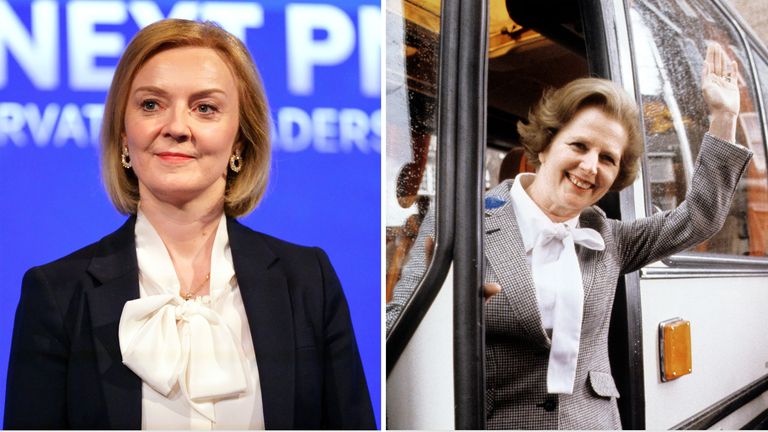
In her no-surrender speech on the 45p top tax rate, the prime minister paid homage to Thatcher by blaming international forces for domestic interest rate increases that are driving up mortgage and business costs for millions of people.
Conservative party chairman Jake Berry went further, suggesting markets can overreact.
The only contrition so far has been an acknowledgment that the communications around the growth plan weren’t up to scratch.
So far so expected.
But a number of unexpected things have already happened today.
First is the public scale of the opposition the PM is already experiencing.
Mel Stride, chair of the Treasury Select Committee, wants to bring forward the Office for Budget Responsibility forecasts.
Others are planning to speak publicly.
Secondly is the huge disquiet from dozens of Tories not in Birmingham who are contemplating how to stop – in their view – Ms Truss wrecking the reputation for financial probity of the Conservative Party.
One Tory MP even suggested they would contemplate voting to force a general election soon, arguing it could be in the national interest, even if that meant expulsion from the party and being ostracised by everyone who they have worked with in the last decade.
Thirdly, confusingly, Liz Truss has knocked down her relationship with her Chancellor Kwasi Kwarteng.
She appeared to blame him for the 45p tax row, saying it was his decision, as she admitted it wasn’t put to the cabinet.
This prompted even Truss loyalist Nadine Dorries to raise an eyebrow, saying “there is a balance, and throwing your chancellor under a bus on the first day of the conference really isn’t it. Fingers crossed things to improve and settle down from now.”
Last week, Sky News outlined how Ms Truss needed convincing by Mr Kwarteng to acknowledge the Bank of England’s concerns.
This creates a toxic impression the two are not getting along. This isn’t a straightforward start to Ms Truss’s first conference.
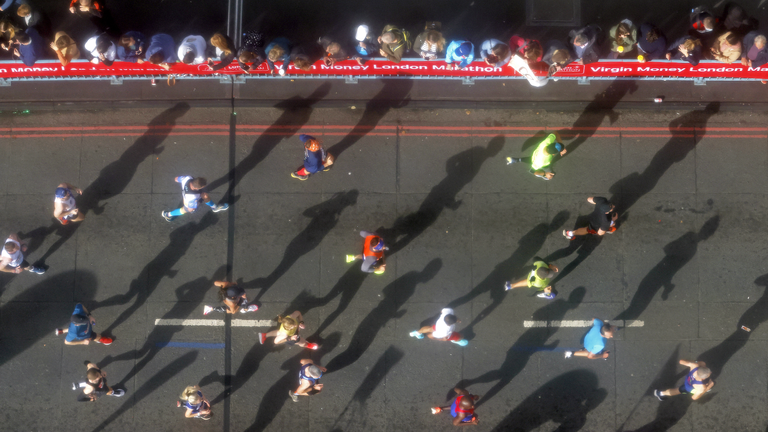
Today is the London Marathon, which is expected to exceed all previous records for the largest marathon ever with more than 50,000 participants.
Elite runners are at the front of the pack, and thousands are running the gruelling 26.2-mile route through the capital for charity.
Just some of the famous faces on the starting line include the actor Stephen Mangan and the TV presenter Mark Wright, who was forced to drop out last year due to injury.
Outbreaks of rain are set to keep competitors cool, with forecasters warning there could be some heavy showers through the morning.
Temperatures of about 13C (55F) are expected at the start of the race – rising to 17C (62F) by the middle of the afternoon.
Met Office meteorologist Steven Keates encouraged spectators to bring an umbrella “as the weather may not be the best when standing around”.
Competitors and their families had been warned of disruption this morning because some trains were starting later than normal owing to yesterday’s rail strikes.
But services to Blackheath – the station closest to the start line – were expected to run as normal.
Image: The 2022 London Marathon is set to be the biggest ever. File pic
Among those taking part will be Rob Duncombe, chief pharmacist at The Royal Marsden NHS Foundation Trust.
He is hoping to raise thousands of pounds for The Royal Marsden Cancer Charity while setting a new world record for the fastest marathon dressed as a tree.
Kitted out in a 2.4m (8ft) tall oak tree costume, Mr Duncombe is supporting the charity’s Oak Cancer Centre appeal, which aims to develop a new treatment and research facility in Sutton.
He told Sky News: “When the opportunity came to run the marathon for the Royal Marsden, just to add a little bit of extra challenge, I said I’d run it as a tree for us.”
The current men’s world record for the fastest marathon dressed as a tree stands at four hours, five minutes, and six seconds.
Mr Duncombe is aiming to run the marathon in a time of four hours, despite his costume being “seriously uncomfortable”.
Hugh Brasher, the London Marathon’s race director, told Sky News that the virtual marathon introduced in 2020 will run again this year – allowing thousands around the globe to participate. There’s going to be a mini-marathon for children, too.
This year’s course also features a 250m stretch called Rainbow Row, celebrating the LGBTQ+ community at the 21st mile.
Mr Brasher said it will create a carnival atmosphere, to give runners “that extra boost” as they approach the last five miles.
He added: “The marathon might be painful at times… it probably will be.
“But that spirit, the crowd, you’re going through this amazing capital city and you’ve got maybe three quarters of a million people shouting and cheering you.
“It is an incredible, emotional, heartfelt experience, lap it up.
It was widely rumoured last week that Willis had sold his face to a deepfake startup called Deepcake in the first deal of its sort.
However, a spokesperson for the actor told the BBC that he had “no partnership or agreement” with the company.
And a representative of Deepcake said only Willis had the right to his face.
Willis announced his retirement from acting in March after being diagnosed with aphasia, a disorder that affects speech.
Deepfakes use artificial intelligence (AI) and machine learning technology to create realistic videos – often of celebrities or politicians. For actors that can no longer act, the technology has the potential to be game-changing.
On 27 September, the Daily Mail reported that a deal had been struck between Willis and Deepcake.
“Two-time Emmy winner Bruce Willis can still appear in movies after selling his image rights to Deepcake,” the story reads.
The story was picked up by the Telegraph and a series of other media outlets.
“Bruce Willis has become the first Hollywood star to sell his rights to allow a ‘digital twin’ of himself to be created for use on screen.” said the Telegraph.
But that doesn’t appear to be the case.
What is true is that a deepfake of Bruce Willis was used to create an advert for Megafon, a Russian telecoms company, last year.
Russian firm Deepcake used an authorized deepfake of the Bruce Willis in the commercial for telecoms company Megafon. The company uses an artificial neural network to impose Willis’ image onto the face of a Russian actor pic.twitter.com/7bizoLsk2S
The tech used in the advert was created by Deepcake, which describes itself as an AI company specializing in deepfakes.
Deepcake told the BBC it had worked closely with Willis’ team on the advert.
“What he definitely did is that he gave us his consent (and a lot of materials) to make his Digital Twin,” they said.
The company says it has a unique library of high-resolution celebrities, influencers and historical figures.
On its website, Deepcake promotes its work with an apparent quote from Mr Willis: “I liked the precision of my character. It’s a great opportunity for me to go back in time.
“The neural network was trained on content of Die Hard and Fifth Element, so my character is similar to the images of that time.”
However, Willis’s agent told the BBC, “Please know that Bruce has no partnership or agreement with this Deepcake company.”
The BBC asked Willis’s agent whether he had ever worked with Deepcake, or whether the quote used by the company was accurate.
The BBC has not yet received a response.
In a statement from Deepcake, the company said reports that it had bought the rights to Bruce Willis’s face were inaccurate.
“The wording about rights is wrong… Bruce couldn’t sell anyone any rights, they are his by default,” a representative for the company said.
The confusion highlights just how new this technology is – and the lack of clear rules around it.
AI replacement appears to be a growing trend. Darth Vader actor James Earl Jones has recently retired from playing the famous character, but his voice has carried on. Respeecher, another AI firm, has reportedly used archival materials and a proprietary algorithm to replicate the Vader vocals.
This summer, Disney released its latest Star Wars spinoff, Obi-Wan Kenobi. The show used Respeecher’s technology to reproduce Vader’s speech and even make him sound younger.
AI replacement, however, is controversial.
In April, Equity, the UK’s performing arts workers union, launched the campaign, Stop AI Stealing The Show. Some are concerned AI deep fakes could take work away from actors.
There are also concerns that actors could lose control of their faces and voices.
You can follow Ben Derico and James Clayton on Twitter @ben_derico & @jamesclayton5
After the mini-budget, Prime Minister Liz Trussacknowledged there had been “disruption” in the UK economy.
She declared in a letter to The Sun that she had “acted forcefully” and would maintain a “iron grip” on the country’s finances.
The government unveiled £45bn of tax cuts funded by borrowing last week – but did not accompany it with the usual economic assessment of the plans.
That worried investors causing the pound to slump and forcing the Bank of England to step in to reassure markets.
Ms Truss has resisted calls to reverse the cuts or to bring forward the publication of the independent fiscal watchdog’s economic forecasts and analysis of her tax plans.
The prime minister said she was “committed” to publishing the Office for Budget Responsibility (OBR) forecast on 23 November, the same day the chancellor is due to set out further economic plans, after she met the OBR on Friday.
But some Conservative MPs want to see this sooner to reassure the financial markets after turbulent trading.
The Treasury argues it should wait until additional changes are announced.
Ms Truss wrote in the Sun: “I am going to do things differently. It involves difficult decisions and does involve a disruption in the short term.”
She reiterated her commitment to “get the economy growing”, with plans to stimulate growth expected to include measures in eight areas – business regulation, agriculture, housing and planning, immigration, mobile and broadband, financial services, childcare, and energy.
And she insisted she would maintain an “iron grip on the national finances”.
Her chancellor, Kwasi Kwarteng, writing in the Telegraph newspaper, insisted that November’s statement would include a “credible plan” to get the public finances back on track, with a “commitment to spending discipline”.
“The British taxpayer expects their government to work as efficiently and effectively as possible, and we will deliver on that expectation,” Mr Kwarteng said.
But senior minister Simon Clarke told the Times newspaper the government needed to explain more about how it would control spending, as well as boost economic growth.
“We have acquired spending habits that outstrip our ability to pay for it. That needs to change,” he said.
He suggested the government was looking to make significant cuts and “trim the fat” when it comes to public spending.
“I think it is important that we look at a state which is extremely large, and look at how we can make sure that it is in full alignment with a lower tax economy.”
Ms Truss confirmed on Thursday that she was looking for cuts across the government as a way to pay for the mini-budget measures.
Waveney MP Peter Aldous said the timing of last Friday’s plan had been “hopelessly wrong”, and the rest of the details should be brought forward to October.
Liberal Democrat leader Sir Ed Davey argued that the government, by waiting until 23 November, was allowing the UK economy to “fly blind” for two months.
“Families and businesses can’t afford to wait any longer for this government to fix their botched, unfair budget,” he said.
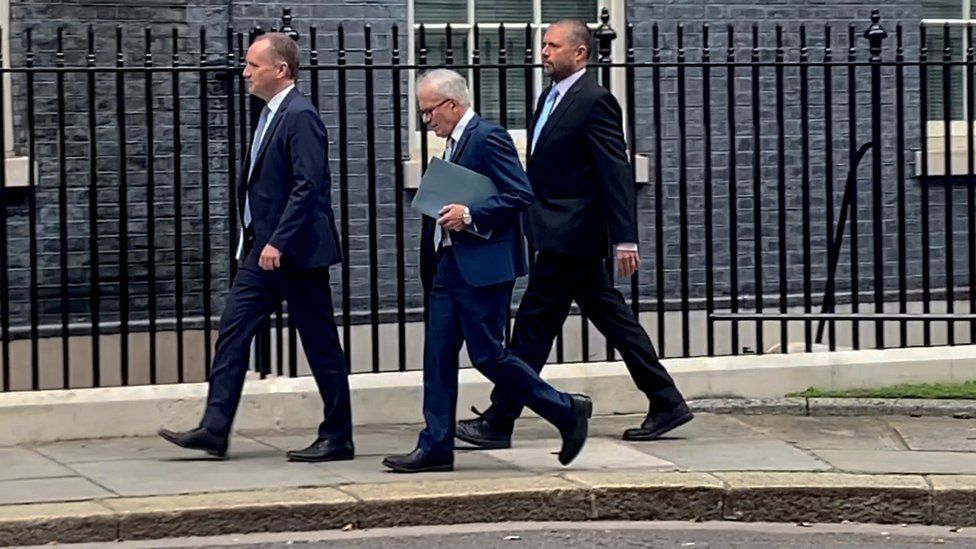
IMAGE SOURCE,PA MEDIA Image caption, Leading members of the Office of Budget Responsibility arriving at 10 Downing Street for a rare meeting with the prime minister
What is the Office for Budget Responsibility?
The Office for Budget Responsibility is the independent watchdog for the government’s finances.
It usually produces economic forecasts twice a year, to accompany each autumn budget and spring statement.
It scrutinises government plans, to increase taxes or borrowing for example, and predicts what the likely impact on the overall economy will be.
These forecasts are so important because a strong one gives investors confidence to put money into the UK economy – whereas a weak one is likely to have the opposite effect.
The government can request forecasts from the OBR at any time to get independent advice on big moves.
But it did not take the OBR up on its offer ahead of last week’s mini-budget. This is thought to have undermined confidence in the markets.
This led to the pound dropping to its lowest rate against the dollar in 37 years on Monday, before returning to its previous level.
The government’s tax-cutting plan faced criticism from the International Monetary Fund, and the pound dropped to a 37-year low of $1.03 on Monday.
On Friday, the sterling rose to $1.12 – close to the level the currency was at before the mini-budget was announced.
Despite that, the rating agency Standard & Poor’s cut the outlook for its AA credit rating for British government debt from “stable” to “negative” on Friday, because of the prospect of higher borrowing needed to fund the pledges.
In recent days, the Conservatives have posted some of their worst opinion poll ratings in more than 20 years.
A poll published on Thursday by Survation put the party on 28%, more than 21 points behind Labour, while a separate survey by YouGov put the Tories on 21%, 33 points adrift.
Labour’s shadow business secretary Jonathan Reynolds said ministers should “get back to Parliament, revoke the changes, and start again to try and rebuild confidence”.
And Conservative MP Martin Vickers urged the prime minister not to scrap the 45p tax rate and the bankers’ bonus cap, describing the move as “a political own goal”.
However, another Tory backbencher, Andrea Leadsom, said the mini-budget was “unashamedly pro-growth”, and that the markets were “wrong to be jittery” about the changes.
Buckingham Palace says, King Charles will not go to the COP27 climate change meeting, which will take place in Egypt next month.
It was in response to a Sunday Times article that claimed Liz Truss, the prime minister, had “directed” the King not to attend.
The Palace said advice had been sought by the King and given by Ms Truss.
“With mutual friendship and respect there was agreement that the King would not attend,” the Palace stated.
Before his ascension to the throne last month, the King – then the Prince of Wales – had indicated he would attend the annual conference.
Royal correspondent Jonny Dymond said the BBC had put it to the Palace that the King must be personally disappointed given his long decades of passionate environmental campaigning.
But the Palace responded that the idea the King was uncomfortable was not the case, and he was ever mindful of the sovereign’s role to act on the government’s advice.
Last November – Prince Charles – the King travelled to Egypt with the then-government’s blessing to urge the Egyptian administration on its efforts, meeting President Abdel Fattah Al-Sisi during a planned visit.
In the past, the King has demonstrated his deep commitment to environmental issues and, as Prince of Wales, had a long history of campaigning to reduce the effects of climate change.
Only last year he made a speech at the COP26 opening ceremony in Glasgow, when the summit was hosted by the UK. The late Queen also gave a speech at the event, via video link.
Senior Conservative MP Tobias Ellwood said he hoped “common sense would prevail” and the King would be allowed to go to Egypt.
He said in a tweet that King Charles was a “globally-respected voice” on the environment whose attendance would add “serious authority” to the British delegation.
At last year’s COP26 conference, King Charles – or Prince Charles as he was then – was one of the star turns, delivering a passionate call for world leaders to adopt a “war-like footing” over climate change.
This year he’ll have to keep his powder dry, after what’s presented, on the surface at least,as a dispute-free agreement that he shouldn’t go.
Although it’s worth noting this is about not attending “in person”, which might leave the door ajar for other virtual contributions.
There will inevitably be speculation that, below all the constitutional smoothing, this will have really disappointed the King. He has campaigned devotedly for decades, heart on sleeve, on such environmental issues.
And it could also raise the prospect of early tensions between a new King and a new PM.
But it’s a case of different roles, and different rules and the King has always known that as sovereign he would have to act within a different set of politically-neutral constraints.
The Egyptian authorities say they hope to use their presidency of COP27 to urge the international community to act on pledges of support for developing countries to cope with the devastating impacts of climate change.
However, there has been criticism ahead of the summit. Human Rights Watch has said Egypt has severely curtailed the work of environmental groups. Officials in Cairo said the report was “misleading”.
COP27, a United Nations event, is being held in the coastal city of Sharm el-Sheikh from 8 to16 November.
Next week, King Charles will attend his first public engagements since the royal periodof mourning came to an end, including a reception in Edinburgh for South Asian communities from across the UK and a visit to Dunfermline Abbey in Fife.
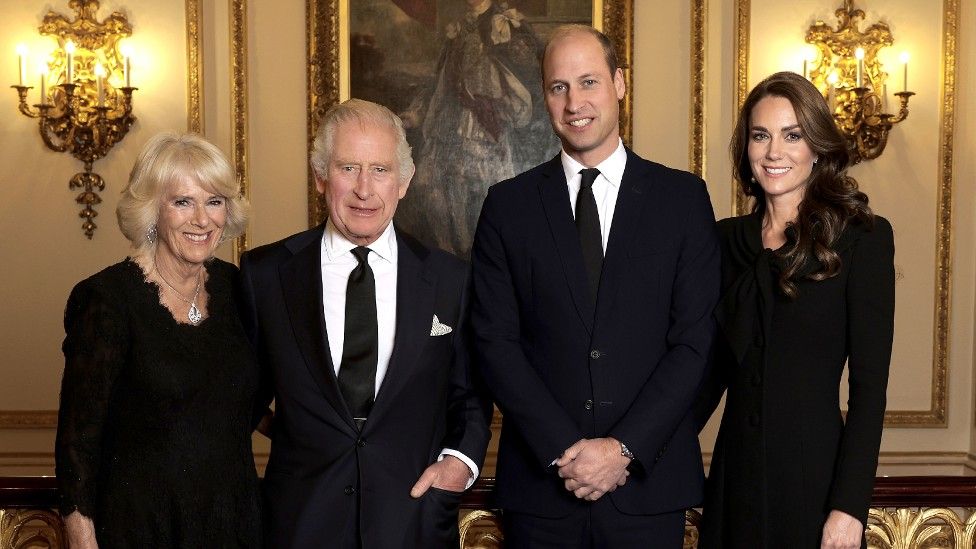
IMAGE SOURCE, BUCKINGHAM PALACE/GETTY IMAGES/PA Image caption, A new picture of the King with the Queen Consort, Prince, and Princess of Wales was released on Saturday
Bawumia is optimistic KsTU can tap into Addo Kufuor’s diverse and rich experience to become an enviable educational institution in Ghana.
Vice-President Mahamudu Bawumia has described the selection of Dr Kwame Addo Kufuor, a former Minister of Defence, as the first chancellor for the Kumasi Technical University (KsTU) as a step in the right direction.
Bawumia is optimistic KsTU can tap into Addo Kufuor’s diverse and rich experience to become an enviable educational institution in Ghana.
“I joined H.E John Agyekum Kufuor and other dignitaries for the investiture of Dr. Kwame Addo Kufuor as the first Chancellor of Kumasi Technical University.
“I commended the authorities of the University, for the excellent choice of a distinguished person, one who is also happily a firm believer in academic freedom. I am sure that the University will feel the added benefit of his diverse and rich experiences,” he posted on Facebook.
He added: “Dr. Kwame Addo Kufuor has a brilliant mind, is a high academic and professional achiever, and a statesman. Most importantly he is a man of utmost integrity. Kumasi Technical University could not have chosen a better person as its first Chancellor.”
“Congratulations to Dr. Kwame Addo Kufuor. I wish you the very best in your stewardship of Kumasi Technical University. May God continue to bless you. You inspire all of us,” he added.
One of the deadlieststadium disasters in history occurred at an Indonesian football game, where at least 174 people perished.
In the aftermath of the host team Arema FC’s defeat to ferocious opponents at the packed stadium late on Saturday in Malang, East Java, some 180 people also sustained injuries.
The crash took place after police tear-gassed fans who invaded the pitch.
As panic spread, thousands surged towards Kanjuruhan stadium’s exits, where many suffocated.
Fifa, the world’s governing football body, states that no “crowd control gas” should be carried or used by stewards or police at matches.
One eyewitness told the BBC that police had fired numerous tear gas rounds “continuously and fast” after the situation with fans became “tense”.
Fifa President Gianni Infantino said it was “a dark day for all involved in football and a tragedy beyond comprehension”.
‘It had gotten anarchic’ – Police
Early reports put the death toll at about 130, but officials later announced a significant rise to 174, with 11 more people seriously injured.
President Joko Widodo has ordered that all matches in Indonesia’s top league must be stopped until an investigation has been carried out.
“It had gotten anarchic. They started attacking officers, they damaged cars,” said Nico Afinta, police chief in East Java, adding that two police officers were among the dead.
“We would like to convey that… not all of them were anarchic. Only about 3,000 entered the pitch,” he said.
Fleeing fans “went out to one point at the exit. Then there was a build-up, in the process of accumulation there was shortness of breath, lack of oxygen”, the officer added.
Videos on social media show fans clambering over fences to escape. Separate videos appear to show lifeless bodies on the floor.
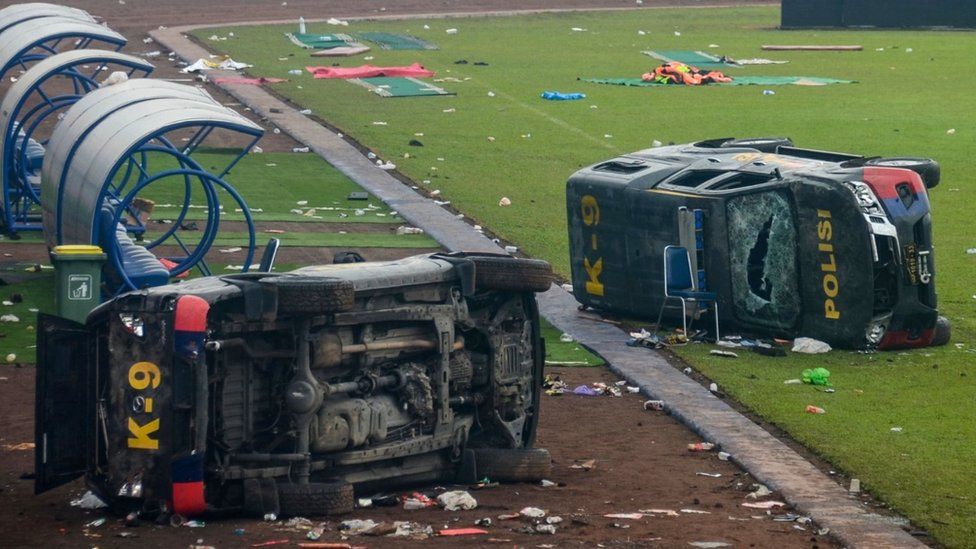
IMAGE SOURCE,EPA Image caption, Damaged police vehicles lay on the pitch inside Kanjuruhan stadium
The Indonesian football association (PSSI) said it had launched an investigation, adding that the incident had “tarnished the face of Indonesian football”.
Violence at football matches is not new in Indonesia, and Arema FC and Persebaya Surabaya are long-time rivals.
However, Persebaya Surabaya fans were banned from buying tickets for the game because of fears of clashes.
Chief Security Minister Mahfud MD posted on Instagram that 42,000 tickets had been sold for the match at Kanjuruhan stadium, which has a stated capacity of 38,000.
President Widodo called for this to be the “last soccer tragedy in the nation” after ordering that all Liga 1 games should be paused pending an investigation.
‘It was bang, bang, bang’ – Eyewitness
Muhamad Dipo Maulana, 21, who was at the match, told BBC Indonesian that after the game had ended a few Arema fans went on the pitch to remonstrate with the home team players but were immediately intercepted by police and “beaten”.
IMAGE SOURCE,BBC INDONESIAN Image caption, Muhamad Dipo Maulana said he saw people suffocating while trying to get out of the stadium
More spectators then took to the pitch in protest, the supporter said, adding that the situation became “tense”.
“Police with dogs, shields, and soldiers came forward,” Mr Dipo told the BBC.
He said he had heard more than 20 tear gas shots toward spectators at the stadium.
“There was a lot, like bang, bang, bang! The sound was continuous and fast. The sound was really loud and directed to all the stands,” he added.
Mr Dipo said he saw people in disarray, panicking and suffocating while trying to get out of the stadium. There were many children and old people who were affected by the tear gas, the eyewitness added.
One of the worst football disasters
The stampede is one of the worst of a tragically long line of stadium disasters.
In 1964, a total of 320 people were killed and more than 1,000 injured during a stampede at a Peru-Argentina Olympic qualifier in Lima.
In 1985, 39 people died and 600 were hurt at the Heysel stadium in Brussels, Belgium, when fans were crushed against a wall that then collapsed during the European Cup final between Liverpool (England) and Juventus (Italy).
In the UK, a crush developed at the Hillsborough stadium in Sheffield, resulting in the deaths of 97 Liverpool fans attending the club’s FA Cup semi-final against Nottingham Forest.
The envoy’s visit was to formally invite the Minister to a forum on cocoa slated for Monday, October 3, 2022, as well as to discuss issues of relevance to both nations.
The Dutch ambassador to Ghana, Jeroen Verheul on Friday, September 30, 2022, led a delegation from the Dutch Embassy to pay a courtesy call on the Minister for Lands and Natural Resources Samuel Abu Jinapor.
The visit by the envoy and his entourage were to formally invite the Minister to a cocoa forum scheduled for Monday, 3 October 2022, and to discuss matters of mutual interest to both countries.
In his opening remarks, Jeroen Verheul indicated that his major focus is strengthening the economic and diplomatic relations between Ghana and the Netherlands.
He disclosed that the growth of the Ghanaian agriculture sector is of key interest to the Dutch government. The cocoa industry is at the heart of their plans for Ghana and they desire to see the development of the sector.
Jeroen Verhel stated further that his outfit recognizes the importantrole the Ministry of Lands and Natural Resources plays in the agriculture sector of Ghana and deems it necessary to solicit the Ministry’s support and opinion on their plans, strategies, and programs for the Agriculture sector.
On his part, the Minister for Lands and Natural Resources, Samuel A. Jinapor, MP, acknowledged the effort of the Netherlands in the preservation and protection of Ghana’s forest cover and wildlife conservation.
Jinapor thanked the Netherlands for their long-standing friendship and collaboration and called for stronger and enhanced economic ties between both countries.
The French government has denied claims made by Burkina Faso’s new military junta that it is siding with deposed commander Lt. Col. Paul-Henri Sandaogo Damiba.
The statement was made by the juntaheaded by Captain Ibrahim Traore, which came to power on September 30, 2022, promising to restore stability throughout the country of West Africa.
According to an October 1, 2022 statement read on national TV, RTB, a member of the new junta, Sous-Lieutenant Jean-Baptiste Kabre, said the former leader of the MPSR – the name of the junta, had refused to leave power quietly.
Kabre alleged that Sandaogo Damiba was planning a “counter-offensive” and claimed further that he was doing this from a French base.
On Saturday, there were violent attacks against the French Embassy in Burkina Faso as protesters marched on the facility and threatened to burn it by lighting fires around the building
In an October 1, 2022 statement from the French Ministry of Europe and Foreign Affairs, France denied the allegation and said it was not hosting Damiba in any of its facilities.
“France formally denies any involvement in the events underway since yesterday in Burkina Faso.
“The camp where the French forces are located has never hosted Paul-Henri Sandaogo Damiba, nor has our embassy,” the statement read.
Read the complete statement below:
STATEMENT BY THE SPOKESPERSON OF THE MINISTRY FOR EUROPE AND FOREIGN AFFAIRS
Burkina Faso
October 1, 2022
France formally deniesany involvement in the events underway since yesterday in Burkina Faso.
The camp where the French forces are located has never hosted Paul-Henri Sandaogo Damiba, nor has our embassy.
PRESS SERVICE
Spokesperson Sub-Directorate
New junta leader Captain Traore’s announced the takeover of executive power and deposition of Damiba, barely 10 months after the later seized power from democratically elected Christian Roch Marc Kabore.
The junta dissolved the government and the transitional national assembly as well as imposed a curfew and closed all the country’s borders.
The overthrow was premised on the continued deterioration of the insecurity situation even as terrorists continue to launch deadly raids on security forces and the local population.
ECOWAS and AU sound condemnation
The West African regional bloc, Economic Community of West African States, ECOWAS, has condemned the September 30, 2022 coup that took place in Burkina Faso, where a new military junta overthrew another.
What started out as an exchange of heavy gunfire on Friday morning was confirmed late in the evening with a broadcast on National TV announcing the takeover.
In a statement issued from the ECOWAS Commission hours after the announcement, the bloc said it firmly condemned the incident at a time the Sandaogo Damiba-led junta was making progress on an orderly return to constitutional order by July 1, 2024.
The junta said a new leader – civilian or military will be announced in due course, but before that, some measures put in place include the dissolution of the government, the Transitional Legislative Assembly (ALT), and the Transition Charter as well as the closure of borders.
The AU statement signed by the Chairperson of the African Union Commission was titled: ‘The Chairperson of the African Union Commission unequivocally condemns the second takeover of power by force in Burkina Faso,’ and it read:
“In strong support of ECOWAS, the Chairperson of the African Union Commission, H.E. Moussa Faki Mahamat, and in conformity with the Lomé Declaration of the Year 2000, the African Charter on Democracy, Elections and Governance and the Accra Declaration on Unconstitutional Changes of Government, expresses his deep concern about the resurgence of unconstitutional changes of Government in Burkina Faso and elsewhere on the African Continent.
“The Chairperson calls upon the military to immediately and totally refrain from any acts of violence or threats to the civilian population, civil liberties, human rights, and ensure strict compliance with electoral deadlines for the restoration of Constitutional order by 1 July 2024, at the latest.
“The Chairperson reaffirms the continued support of the African Union to the people of Burkina Faso to ensure peace, stability, and development of the country.”
As the Muhammadu Buhariadministration draws to a close, Aisha Buhari, the first lady of Nigeria, has pleaded with people to pardon her husband for failing to advance the country’s economy during his nearly eight years in power.
Aisha Buhari made the prayer of forgiveness at a special Juma’at service and public lecture to celebrate the nation’s 62nd independence anniversary, held at the National Mosque Conference Hall in Abuja on Friday. The event was themed: ‘Shura: The Islamic Foundation of True Democracy.
“Your Excellencies, distinguished guests, ladies, and gentlemen, as you may be aware that this government is making its exit and perhaps witnessing the last anniversary of the regime, I ask Nigerians to pray for a successful election and transition programme,” urged Mrs. Buhari.
“The regime might not have been a perfect one,but I want to seize this opportunity to seek forgiveness from the Ulamas and Nigerians in general. We all need to work together to achieve a better Nigeria,” she added.
The First Lady acknowledged that the naira’s helpless fall in her husband’s tenure had subjected many citizens to untold hardship. The policies of Godwin Emefiele appointed by Mr. Buhari to man the nation’s apex bank, the Central Bank of Nigeria, had yet to positively impact the economy.
“Your Excellencies, distinguished guests, it is also noticeable that our Naira is being evaluated and the foreign exchange rate has affected our economy causing a lot of hardship and difficulties in terms of education, health, and other day-to-day activities of our citizens.”
She commended the efforts of security operatives in fighting terrorists and bandits, she prayed “for more successes in their operations,”
“I’m particularly happy that our security agents have stood up to the challenges of security more than ever before. And at the moment, their efforts have been pushing the effects of banditry, kidnapping, and many other ills in society.
“I commend the efforts of our gallant security men and women.”
Mum-Zi was just eight years and four months old when she gave birth to a baby girl in 1884.
From Nigeria, on an island called Akwa Akpa, now known as the city of Calabar, Mum-Zi’s daughter followed her mother’s footsteps, becoming a mother at the age of eight years and eight months.
Over the years, it has not been uncommon to find young parents out there but what is perhaps unusual is to find young teens – as young as 17 – as grandparents.
In recent times, most people at that age are looking to complete their education or to graduate from high school. The thought of even becoming a parent is rare, thus, having grandchildren is often out of place.
According to Lyall Archibald’s 1936 book, The Future of Taboo in These Islands, Mum-Zi was a member of Chief Akkiri’s harem in Akwa Akpa (now Calabar), who would later be the father of her daughter.
Since the 16th Century, Calabar had been a busy international seaport, shipping out goods such as palm oil.
Historical accounts state that during the Atlantic slave trade, it became a major port in the transportation of African slaves, with most slave ships being owned by Bristol and Liverpool.
Some missionaries would later record the challenges of poor water supplies, malaria, and the presence of some tribes who were sometimes not too welcoming to evangelists and other slave traders.
What was common, however, was the fact that chiefs kept a harem of wives and slaves.
The harem is basically a female backyard or household largely reserved for princes and lords of this world.
This privatespace has traditionally served the purposes of maintaining the modesty, privilege, and protection of women.
In most parts of Africa and elsewhere, a harem, in terms of royal harems of the past, may house a man’s wives and concubines, as well as, their children, unmarried daughters, female domestic workers, and other unmarried female relatives.
Mum-Zi was one of the many women and girls who lived in a harem belonging to Chief Akkiri. After giving birth at 8 years and four months, with the chief being the father, her daughter would also become a mother exactly eight years later. She was reportedly impregnated by the same chief who happens to be her father.
She gave birth at an age slightly older than that of her mother, as she was 8 years plus 8 months. Nevertheless, this remains one of the most shocking moments in history.
Ever since the 1700s, a number of cases have been highlighted to show how girls and women across the world suffer just because of their gender.
Among these forms of gender-based violence is child marriage, which denies children the right to be children and takes away from them the opportunities for education and a better life. It also exposes them to the risk of violence at the hands of their usually older and more powerful husbands.
A recent report by Girls Not Brides revealed that globally, more than 700 million women alive today were married as children and 17 per cent of them, or 125 million, live in Africa.
It added that about 39 percent of girls in sub-Saharan Africa are married before the age of 18 and all African countries face the challenge of child marriage.
According to the report, Niger has the highest number of child brides, with three out of four girls married before they are 18.
The Central African Republic follows. There, the legal minimum age for marriage is 18, however, girls can get married at 13 years if it is approved by a court and/or if the girl is pregnant.
Some of the drivers for child marriage in these countries are poverty, upholding social and religious traditions, as well as, conflict, which forces many parents to consent to child marriage as a way of protecting their girls from violence and sexual assault.
The former president of Zambia, says he is prepared to go to jail if he was caught stealing while in office.
Mr. Lungu is dissatisfied that he has been under investigation for crimes allegedly committed while he was president, together with his former government officials and family members.
He was particularly displeasedthat state investigators on Thursday went to a piece of land that he owns to carry out investigations.
Mr Lungu has since appealed to his successor Hakainde Hichilema to start the process of removing his constitutional immunity from prosecution so that he can clear his name.
“He who alleges, must prove and we will defend ourselves,” he later told members of parliament and supporters from his Patriotic Front party who visited him.
“My urge is that may the president institute the lifting of my immunity by going to parliament to lay a case so that he can eventually prove what crimes I committed,” he said.
Mr Lungu, who last year lost power to Mr Hichilema, has previously denied many allegations of corruption during his time as president.
The man who was overthrown in a coup in Burkina Faso, according to the self-proclaimed leader, is preparing a counterattack.
Lt Col Paul-Henri Damiba, per Col Ibrahim Traoré, is being held in one of the French Army’s bases, a claim that has been refuted by French officials.
Gunshots have been heard in Burkina Faso’s capital city Ouagadougou and helicopters are circling overhead.
Witnesses say troops have blocked main roads around the city and shops that had opened earlier are now shut.
Friday’s apparent takeover had been announced on national TV and was the second time this year that the country’s army had seized power.
On both occasions, the coup leaders said they had to step in because national security was so dire.
Burkina Faso controls as little as 60% of its territory, experts say, and Islamist violence is worsening. Since 2020 more than a million people have been displaced in the country due to the violence.
The African Union has demanded the return of constitutional order by July 2023 at the latest, agreeing with the regional group Ecowas that the ousting of leader Lt Col Damiba was “unconstitutional”.
Ecowas earlier said it was “inappropriate” for army rebels to seize power when the country was working towards the civilian rule.
The latest international criticism has come from the UN, whose chief António Guterres sayshe “strongly condemns” the coup.
For the second time in under 24 hours, the coup leaders have issued a statement on national TV, signed by their leader Col Ibrahim Traoré.
This time they claimed Lt Damiba was planning a counter-attack because of their own willingness to work with new partners in their fight against the Islamists. The statement did not name these potential new partners, but rights groups say troops in neighbouring Mali have been working closely with Russian mercenaries from the Wagner group – although both nations deny this.
On Friday evening flanked by rebel soldiers in fatigues and black facemasks, an officer had read an announcement on national TV stating that they were kicking out Lt Damiba, dissolving the government and suspending the constitution.
That statement was also read on behalf of an army captain called Col Traoré, who said Lt Col Damiba’s inability to deal with an Islamist insurgency was to blame.
“Our people have suffered enough, and are still suffering”, he said.
Little is known about Col Traoré, the 34-year-old soldier who led an anti-jihadist unit in the north called Cobra.
His statement effectively declared himself the interim leader of Burkina Faso. But in Friday’s announcement came the promise that the “driving forces of the nation” would in time be brought together to appoint a new civilian or military president and a new “transitional charter”.
Lt Col Damiba’s junta overthrew an elected government in January citing a failure to halt Islamist attacks, and he himself told citizens “we have more than what it takes to win this war.”
But his administration has also not been able to quell the jihadist violence. Analysts told the BBC recently that Islamist insurgents were encroaching on territory, and military leaders had failed in their attempts to bring the military under a single unit of command.
On Monday, 11 soldiers were killed when they were escorting a convoy of civilian vehicles in Djibo in the north of the country.
The African Union has urged the military to “immediately and totally refrain from any acts of violence or threats to the civilian population, civil liberties, human rights”.
The Economic Community of West African States (Ecowas) earlier condemned the move too, stating it “reaffirms its unreserved opposition to any taking or maintaining of the power by unconstitutional means”.
The United States said it was “deeply concerned” by events in Burkina Faso and encouraged its citizens to limit movements in the country. France issued a similar warning to its more than 4,000 citizens living in the capital city Ouagadougou.
As protests against the murder of a woman in police custody reached their third week, demonstrators protested all throughout Iran on Saturday, and strikes were reported all over the country’s Kurdish region.
The protests, sparked by the death of Mahsa Amini, a 22-year-old from Iranian Kurdistan, have spiralled into the biggest show of opposition to Iran’s clerical authorities since 2019, with dozens killed in unrest across the country.
People demonstrated in London and Paris and elsewhere on Saturday in solidarity with Iranian protesters, some holding pictures of Amini, who died three days after being arrested by the Islamic Republic’s morality police for “unsuitable attire”.
In Iran, social media posts showed rallies in large cities including Tehran, Isfahan, Rasht, and Shiraz.
In Tehran’s traditional business district of Bazaar, anti-government protesters chanted “We will be killed one by one if we don’t unite”, while elsewhere they blocked the main road with a fence torn from the central reservation, videos shared by the widely followed Tavsir1500 Twitter account showed.
Students also demonstrated at numerous universities. At Tehran University, dozens were detained, Tavsir1500 said. The semi-official Fars news agency said some protesters were arrested in a square near the university.
Tavsir1500 also posted what it said was a video taken at the gates of Isfahan University during which shots could be heard. A separate video showed tear gas being fired at the university, dispersing a group of people.
The protests began at Amini’s funeral on Sept. 17 and spread to Iran’s 31 provinces, with all layers of society, including ethnic and religious minorities, taking part and many demanding Supreme Leader Ayatollah Ali Khamenei’s downfall.
Amnesty International has said a government crackdown on demonstrations has so far led to the death of at least 52 people, with hundreds injured. Rights groups say dozens of activists, students and artists have been detained.
In London, about 2,500 people staged a noisy protest in Trafalgar Square. Few women among the mostly Iranian crowd agreed to be interviewed on camera, fearful of identification and reprisals by the authorities.
In central Paris, a crowd of several dozen people gathered to show support for Iranian protesters, holding Iranian flags and pictures of victims who have died in the protests.
Iran’s battered currency approached historic lows reached in June as desperate Iranians bought dollars to protect their savings amid little hope Tehran’s nuclear deal with world powers would be revived and concerns over the economic consequences of the unrest.
The rial fell to 331,200 per U.S. dollar, compared to 321,200 on Friday, according to the foreign exchange site Bonbast.com. The currency had plummeted to an all-time low of 332,000 per dollar on June 12.
ATTACK IN ZAHEDAN
Iranian authorities say many members of the security forces have been killed, accusing the United States of exploiting the unrest to try to destabilise Iran.
The Revolutionary Guards said four members of its forces and the volunteer Basij militia were killed on Friday in attacks in Zahedan, the capital of the southeastern Sistan-Baluchistan province.
State television had said on Friday that 19 people, including members of the security forces, had been killed in Zahedan after unidentified individuals opened fire on a police station, prompting security forces to return fire.
Guards Commander-in-Chief Hossein Salami vowed revenge, calling the dead “martyrs of Black Friday”.
A lawmaker from Zahedan said security had been restored to the city on Saturday, a semi-official news agency reported.
Authorities blamed a separatist group from the Baluchi minority for starting the shootout in Zahedan. State media said two prominent militants linked to that group had been killed.
IRNA posted a video showing destroyed cars, an overturned and burning trailer or bus, and fires in burnt-out buildings and shops, describing it as footage of “what the terrorists did to people’s shops last night in Zahedan”.
Reuters could not verify the footage.
Protests have been particularly intense in Iran’s Kurdistan region, where authorities have previously put down unrest by the Kurdish minority numbering up to 10 million.
Fearing an ethnic uprising, and in a show of power, Iran fired missiles and flew drones to attack targets in neighbouring northern Iraq’s Kurdish region this week after accusing Iranian Kurdish dissidents of being involved in the unrest.
Shops and businesses were on strike in 20 northwestern cities and towns on Saturday in protest against attacks on Iraq-based armed Kurdish opposition parties by Iran’s Revolutionary Guards, the Kurdish rights group Hengaw reported.
It also said security forces had fired at protesters in Dehgolan and Saqez, Amini’s hometown.
After a significant fresh defeat on the battlefield, Ramzan Kadyrov, the leader of Russia’s Chechnya region, suggested on Saturday that Moscow might use a low-yield nuclear weapon in Ukraine.
As Russia confirmed the loss of its stronghold of Lyman in eastern Ukraine, Kadyrov slammed top commanders for their failings and wrote on Telegram: “In my personal opinion, more drastic measures should be taken, right up to the declaration of martial law in the border areas and the use of low-yield nuclear weapons”.
He was speaking a day after President Vladimir Putin proclaimed the annexation of four Ukrainian regions – including Donetsk, where Lyman is located – and placed them under Russia’s nuclear umbrella, saying Moscow would defend the lands it had seized “with all our strength and all our means”.
Russia has the world’s largest atomic arsenal, including low-yield tactical nuclear weapons that are designed to be deployed against opposing armies.
Other top Putin allies, including former president Dmitry Medvedev, have suggested that Russia may need to resort to nuclear weapons, but Kadyrov’s call was the most urgent and explicit.
The influential rulerof the Caucasus region of Chechnya has been a vocal champion of the war in Ukraine, with Chechen forces forming part of the vanguard of the Russian army there. Kadyrov is widely believed to be personally close to Putin, who appointed him to govern restive Chechnya in 2007.
On Friday night in Burkina Faso, armed soldiers wearing fatigues and masks came on television to confirm the overthrow of President Paul-Henri Damiba, the second coup in the unstable West African nation this year.
The announcement capped a day that began with gunfire near a military camp in the capital Ouagadougou, an explosion near the presidential palace, and interruptions to state television programming.
It is a pattern that has become increasingly familiar in West and Central Africa in the past two years as Islamist insurgents wreak havoc across the arid expanses of the Sahel region, killing thousands and eroding faith in weak governments that have not found a way to beat them back.
Mali, Chad, and Guinea have all seen coups since 2020, raising fears of a to backslide towards military rule in a region that had made democratic progress over the past decade.
Burkina Faso’s new leader is army Captain Ibrahim Traore. In a scene that replicated Damiba’s own power grab in a Jan. 24 coup, Traore appeared on television surrounded by soldiers and announced the government was dissolved, the constitution suspended and the borders closed. He declared a nightly curfew.
Damiba’s whereabouts were unknown on Friday evening.
Traore said a group of officers who helped Damiba seize power in January had decided to remove their leader due to his inability to deal with the Islamists. Damiba ousted former President Roch Kabore for the same reason.
“Faced with the deteriorating situation, we tried several times to get Damiba to refocus the transition on the security question,” said the statement signed by Traore and read out by another officer on television.
The statement said Damiba had rejected proposals by the officers to reorganise the army and instead continued with the military structure that had led to the fall of the previous regime.
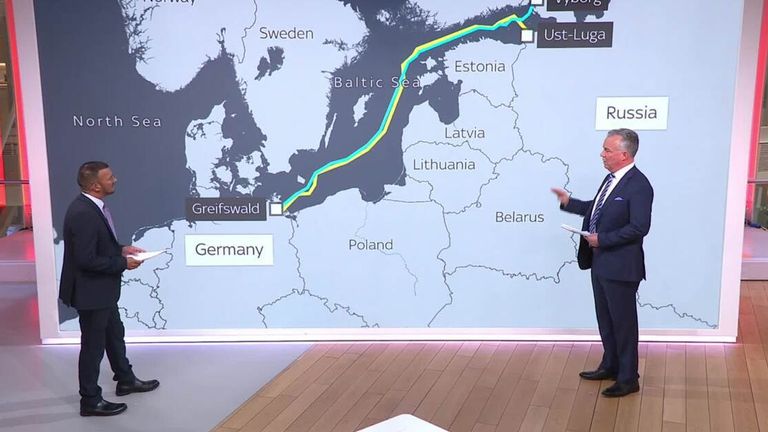
Downing Street says that during her meeting with Danish Prime Minister Mette Fredriksen, the leaders agreed that the ruptures of the Nord Stream 1 and 2 pipelines on Monday were clearly sabotaged and more work needs to be done to increase energy independence.
Liz Truss has agreed the cause of the leaks in the Nord Stream pipelines was “sabotage”, her spokesperson has said.
The British prime minister was discussing the ruptures in the Russia-Germany gas supply lines with the Danish PM during the latter’s visit to Downing Street on Saturday.
It is believed to be the first time Ms Truss has described what happened in the Baltic Sea on Monday as a deliberate act.
While Western governments are yet to do so, many commentators have said that Russia is most likely to be responsible for damage to the pipelines. Moscow, meanwhile, has sought to blame the West.
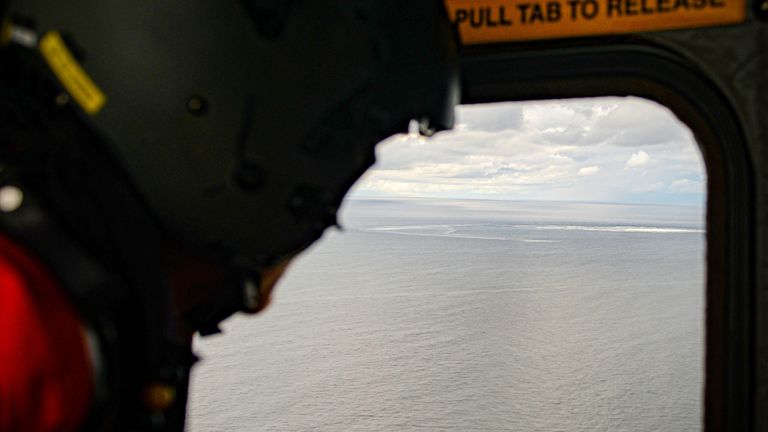
Image: Aircrew on board a Danish defense aircraft monitor Nord Stream gas leak over the Baltic Sea
The leaks have caused huge alarm in Europe as, if deliberate attacks are found to have caused them, it reveals how vulnerable the vast network of undersea pipelines and infrastructure is to interference, as the Ukraine war rages on the continent.
The prime ministers also said their nations looked forward to working witheach other more closely through the Joint Expeditionary Force, which involves sending UK troops to the Baltic, to work alongside Danish and other forces.
A Downing Street spokesperson said after the visit of Danish Prime Minister Mette Fredriksen to Number 10: “The leaders stressed the need to stay united in the face of Russia’s despicable action in Ukraine.
“Prime Minister Fredriksen updated the prime minister on the damage caused to the Nord Stream pipelines last week. They agreed the incidents were clearly an act of sabotage. The prime minister offered the UK’s support for the ongoing investigation.
“The leaders agreed that the safety and security of the Baltic Sea are in everyone’s interest, and welcomed increased cooperation through the Joint Expeditionary Force.
“On energy security more widely, the prime minister and Prime Minister Fredriksen agreed on the need for like-minded democracies to work together to increase our energy independence.”
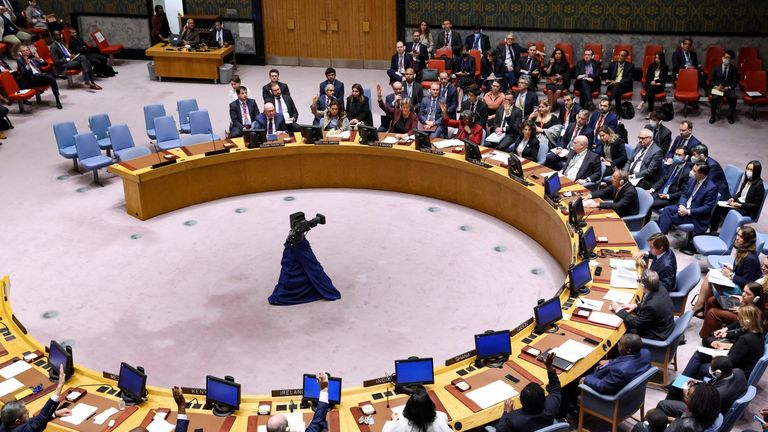
Image:Members of the United Nations Security Council convene at the request of Russia to discuss damage to two Russian gas pipelines to Europe in New York
A network of pipelines runs under the North Sea from gas fields in Britain’s economic zones and there are also electricity and data cables going to and from the UK, including those involving the huge wind farms off the coast.
Overnight, Washington said the US and its allies would send divers to find out what happened before a series of leaks erupted in the Nord Stream 1 and 2 pipes on Monday night, close to the Danish island of Bornholm.
At the time, they were not carrying gas from Russia to Germany but remained pressurized.
Nord Stream ‘sabotage sends powerful message’
Analysts have said that explosions were the most likely cause for the ruptures.
On Friday, Vladimir Putin, without providing evidence, blamed the United States and its allies for blowing up the pipelines.
At the United Nations, Russia’s ambassador told the UN Security Council that the US had much to gain in gas trade from damage to the Nord Stream pipeline system but stopped short of blaming Washington.
Russians ‘pumping out lies and disinformation’
US President Joe Biden said the leaks were a result of “a deliberate act of sabotage” and added, “now the Russians are pumping out disinformation and lies”.
Gazprom – Russia’s state-owned gas supplier which is the majority shareholder of Nord Stream’s holding company – said 800 million cubic metres of gas had escaped after the blasts.
The United Nations Environment Programme said the release of gas from the pipelines adds up to what is likely the biggest single release of climate-damaging methane ever recorded.
The growing insecurity comes as gas started flowing on Saturday morning to Poland through the new Baltic Pipe pipeline from Norway via Denmark and the Baltic Sea, a move that was supposed to help boost the amount of gas reaching northern Europe after Russia cut supplies in the wake of Ukraine war sanctions
Sky News learns that Jingye Group has stated that without hundreds of millions of pounds in taxpayer subsidies, British Steel’s two blast furnaces will not be commercially viable.
Amidst fresh worries over the future of thousands of industrial jobs in the north of England, the owners of Britain’s second-largest steel manufacturer are pleading with taxpayers for an immediate package of financial assistance.
Sky News has learnt that Jingye Group, which bought British Steel out of insolvency in 2020, has told ministers that thecompany’s two blast furnaces are unlikely to be viable without government aid.
British Steel, which is headquartered in Scunthorpe, north Lincolnshire, employs about 4,000 people, with thousands more jobs in its supply chain depends upon the company.
The request from Jingye poses a major headache for Jacob Rees-Mogg, the new business secretary, on the eve of the Conservative Party’s annual conference in Birmingham.
While the precise scale of the support being sought by the Chinese industrial group was unclear this weekend, insiders suggested that it would need “hundreds of millions of pounds” to keep the Scunthorpe blast furnaces operational.
It was also unclear whether any financial subsidy would be in the form of a loan or grant.
One insider said that Jingye was prepared to make thousands of people redundant if ministers rejected its request.
It would then plan to import steel from China to roll at British Steel’s UK sites, according to the insider.
This weekend, the government confirmed that it was “working at pace with the company to understand the best way forward as it seeks to secure a more sustainable future”.
“We recognise that businesses are feeling the impact of high global energy prices, particularly steel producers, which is why we have announced the Energy Bill Relief Scheme to bring down costs,” a spokesman for the Department for Business, Energy and Industrial Strategy said.
Industrial consumers of energy have complained for months that soaring prices are imperilling their ability to continue investing, with continuing uncertainty about the duration and cost of a recently announced government subsidy scheme.
For Mr Rees-Mogg, who took over as business secretary less than a month ago, a decision over government support presents a politically undesirable menu of choices.
If no state funding is made available and significant numbers of jobs are axed, it would undermine a key tenet of the ‘levelling-up’ strategy that became a doctrine of Boris Johnson’s administration.
An agreement to provide substantial taxpayer funding to a Chinese-owned business, however, would almost certainly provoke outrage among Tory critics of Beijing.
China’s role in global steel production, after years of international trade rows about dumping, would make any subsidies even more contentious.
A British Steel spokesman said: “We are investing hundreds of millions of pounds in our long-term future but like most other companies we are facing a significant challenge because of the economic slowdown, surging inflation, and exceptionally high energy and carbon prices.
“We welcome the recent announcement by the UK government to reduce energy costs for businesses and remain in dialogue with officials to ensure we compete on a level playing field with our global competitors.”
It is the second time in little more than three years that serious doubt has been cast over British Steel’s future.
In May 2019, the Official Receiver was appointed to take control of the company after negotiations over an emergency £30m government loan fell apart.
As part of the deal that secured ownership of British Steel for Jingye, the Chinese group said it would invest £1.2bn in modernising the business during the following decade.
Jingye’s purchase of the company, which was completed in the spring of 2020, was hailed by Mr Johnson as assuring the long-term future of steel production in Britain’s industrial heartlands.
“The sounds of these steelworks have long echoed throughout Yorkshire and Humber and the North East,” he said.
“Today, as British Steel takes its next steps under Jingye’s leadership, we can be sure these will ring out for decades to come.
“I’d like to thank every British Steel employee in Scunthorpe, Skinningrove, and on Teesside for their dedication and resilience which has kept the business thriving over the past year.
“Jingye’s pledge to invest £1.2 billion into the business is a welcome boost that will not just secure thousands of jobs, but ensure British Steel continues to prosper.”
Tata, which owns the vast Port Talbot steelworks in Wales, remains Britain’s biggest steel producer.
It, too, has sought government support in recent months, with the Financial Times reporting in July that the Indian-owned group was seeking £1.5bn of taxpayer funding to help it decarbonize its operations.
Liberty Steel, the third-biggest player in the industry, saw a bid for £170m in state aid rejected last year by Kwasi Kwarteng, the then business secretary.
As chancellor, Mr Kwarteng will play a key role in determining the fate of Jingye’s request for support.
This weekend, it was unclear how quickly a decision would be reached by ministers or whether advisers had been drafted in to help negotiate on either side.
Damage of tens of billions of pounds has been done, and around 1.7 million homes and businesses are without power. Rescuers are still searching the rubble, so it’s possible that the death toll may grow.
At least 30 people have been killed after one of the most powerful storms ever to strike the US mainland wrought widespread destruction, with the number of dead expected to rise.
Hurricane Ian has caused tens of billions of pounds in damage and left around 1.7 million homes and businesses without power, leaving residents to liken the impact to “an A-bomb”.
In Florida, where the storm made landfall after battering western Cuba, coastal towns were turned into disaster areas and around 10,000 people remain unaccounted for although the authorities believe many are likely to be in shelters or without power.
Image:Whole neighbourhoods remain flooded in Florida
Rescuers are continuing to search for survivors among the ruins of flooded homes.
Ian went on to hammer North and South Carolina with winds of 85mph, destroying piers and leading roads to be blocked by flooding and fallen trees.
Although now a post-tropical cyclone and weakening, it was still expected to bring treacherous conditions to parts of the Carolinas, Virginia and West Virginia on Saturday.
The National Hurricane Center said: “The dangerous storm surge, flash flooding, and high wind threat continues.”
While the number of casualties and repair costs remain unclear, the scale of the damage was becoming apparent in Florida.
State governor Ron DeSantis said: “Those older homes that just aren’t as strong built, they got washed into the sea.
“If you are hunkering down in that, that is something that I think would be very difficult to be survivable.”
Meanwhile, insurers are braced for a hit of up to $47bn (£42bn), in what could be the costliest Florida storm since Hurricane Andrew in 1992, according to US property data and analytics company CoreLogic.
US President Joe Biden has approved a disaster declaration, making federal resources available to areas impacted by the storm.
“We’re just beginning to see the scale of that destruction.
“It’s likely to rank among the worst… in the nation’s history,” he said.
Mr Biden also declared an emergency in North Carolina on Saturday.
The confirmed dead include 27 victims in Florida, mostly from drowning but also as a result of the storm’s aftermath.
An elderly couple died after their oxygen machines shut off when they lost power, authorities said.
Other victims included a 68-year-old woman swept into the ocean by a wave and a 67-year-old man who fell into rising water inside his home while awaiting rescue.
A 71-year-old man suffered a fatal fall from a rooftop while putting up rain shutters.
Image: Protests have been held in Havana over continuing power cuts following the storm
The authorities have warned the number of dead is likely to rise much higher once more extensive searches were carried out.
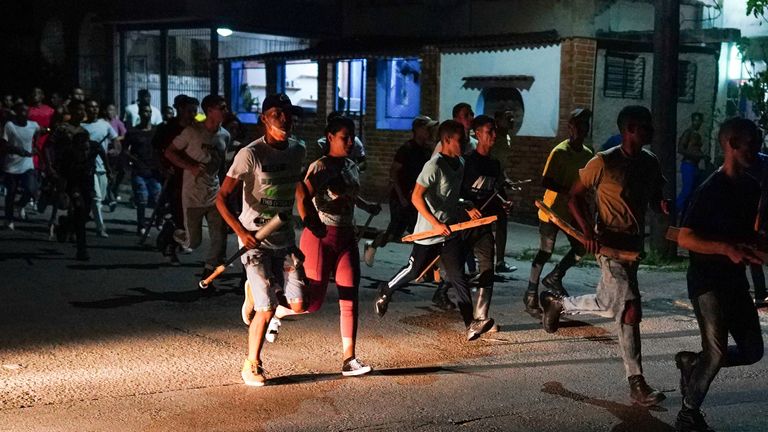
Meanwhile, Cubans have staged protests in neighborhoods of Havana still without electricity,days after Hurricane Ian knocked out power to the island, as well as flattening homes and ravaging agricultural fields.
The health ministry confirms that an intern physician who participated in the frontline fight against the Ebola outbreak in Uganda has passed away from the disease.
Ali Mohammed, 37, travelled from Tanzania to pursue his surgical master’s degree.
He was one of six medical trainees working at Mubende regional hospital who contracted Ebola and were moved to a quarantine center.
Mr Mohammed is the second health worker to die of the virus. The first was a midwife from a private clinic in the Mubende district.
Official figures indicate that the total number of confirmed Ebola cases stands at 35, with eight deaths.
Mubende is at the centre of this outbreak, and medical students there warned the government they were putting their lives at risk because they lacked proper equipment and sometimes had to handle patients with bare hands.
The medical association and the surgeons’ association in the country have issued messages of condolence on their Twitter accounts.
It is with great sorrow that we have received the news of the passing of Dr. Mohammed Ali, a 37 years old Tanzania national who has been pursuing a Master of Medicine in Surgery at Kampala International University.
After the service at Westminster Abbey, Household Cavalry Trooper Jack Burnell-Williams was one of those who escorted the late monarch’s coffin as it was driven by a gun carriage down Whitehall and along the Mall.
A teenage soldier who took part in the Queen’s state funeral has been found dead at his barracks.
Household Cavalry Trooper Jack Burnell-Williams was among those to escort the late monarch’s coffin as it was carried by gun carriage through Whitehall and down the Mall following the service at Westminster Abbey.
The Army has confirmed that the 18-year-old, from Bridgend, South Wales, died on Wednesday at Hyde Park Barracks in Knightsbridge.
Police are not treating his death as suspicious.
He was believed to be one of the newest recruits to the Household Cavalry.
An Army spokesman said: “It is with sadness that we can confirm the death of Trooper Jack Burnell-Williams on 28 September 2022 at Hyde Park Barracks.
“Our thoughts are with the soldier’s family and friends at this difficult time and we ask that their privacy is respected.”
The case has been referred to the coroner.
Sharing a picture and tribute on Facebook to her son, known as Jak by his family and friends, his mother Laura Williams, 42, wrote: “Never ever thought I would be saying this but we as a family are all heartbroken with the sudden passing of our wonderful son Jak Williams.”
The case has been referred to the coroner.
Sharing a picture and tribute on Facebook to her son, known as Jak by his family and friends, his mother Laura Williams, 42, wrote: “Never ever thought I would be saying this but we as a family are all heartbroken with the sudden passing of our wonderful son Jak Williams.”
The Artificial Intelligence (AI) Knowledge Series Forum on Music, Entertainment, Culture, and the Creative Arts has been organised by the Ghana-India Kofi Annan Centre of Excellence in ICT (GI-KACE).
Some of the dignitaries who were present include; Musicians Union of Ghana (MUSIGA) President, Bessa Simons; renowned Ghanaian poet, Rhyme Sonny; Host of Peace FM’s Entertainment Review show, Kwesi Aboagye; and Director of Communications and Special Projects at MUSIGA, Ahuma Bosco Ocansey, popularly known as ‘Daddy Bosco’ among others.
Speaking at the event, the Director-General for GI-KACE, Dr Collins Yeboah-Afari, stated that the session’s relevance was to help create awareness about the opportunities available in using Artificial Intelligence (AI) in the music, entertainment, culture, and Creative Arts industry.
He also stated that with the right application of AI in the Creative Arts Industry, several jobs would be created in that space which will also increase revenue and impact Ghana’s Gross domestic product (GDP).
“The adoption of AI technologies in the music, entertainment, culture, and Creative Arts industry will promote professionalism and enhance the quality of output churned out by the various players in the industry. This will also help showcase our talents to the rest of the world while in turn increasing the tourism value of Ghana,” Dr Yeboah-Afari said.
He noted that the event forms part ofGI-KACE’s mandate to grow the ICT ecosystem in the ECOWAS sub-region and contribute to youth development while the Centre tries to achieve the Sustainable Development Goals (SDGs).
Presenting on how AI is transforming the music industry globally, Kobby ‘Spiky’ Nkrumah, Host of Joy Geek Squad, Multimedia Group disclosed that AI is striking a chord in the music industry with many artists employing artificial intelligence in their music-making process.
He added that some Ais had been developed so well that they could even analyse the style of musicians and create songs based on the data collected, which will sound exactly like the musicians themselves.
“There are a few AI-powered music production platforms like JUKE Box and iZotope, among others, that can create and master music once all the right elements like genre and lyrics are provided. Some of these platforms can even continue the beat production for you if you want them to,” Mr Nkrumah noted.
He also added that Digital music streaming platforms like Apple Music, Spotify and the like are AI-powered that analyzes what you listen to regularly and send music recommendations to keep you updated on new trending songs based on your taste in music.
On her part, Winifred Kotin, Co-founder of CDD Super Fluids Labs, mentioned: “We can also use AI in Tourism through Virtual and Augmented realities powered by Virtual assistants which deliver immersive experiences. There are also a lot of opportunities for AI in Tourism through AI-Power Chatbots on Digital Kiosks. Digital Kiosk can have AI Chatbots installed and placed at vantage places like the airports.”
Eyram Tawia, Chief Executive of Leti Arts, noted that AI plays an essential role in the development of Video Games, especially for him, who is a Ghanaian game developer.
The AI Knowledge Series was organized by GI-KACE in partnership with the Institute of ICT Professionals GH, AI Association Ghana, Runmila AI Institute and GIZ.
Turkey’s foreign ministryhas said it rejects Russia’s annexation of four regions in Ukraine, adding the decision is a “grave violation” of international law.
Turkey, a NATO member, has conducted a diplomatic balancing act since Russia invaded Ukraine on February 24.
Ankara opposes Western sanctions on Russiaand has close ties with both Moscow and Kyiv, its Black Sea neighbours. It has also criticised Russia’s invasion and sent armed drones to Ukraine.
The Turkish ministry said on Saturday it had not recognised Russia’s annexation of Crimea in 2014, adding that it rejects Russia’s decision to annex the four regions, Donetsk, Luhansk, Kherson, and Zaporizhia.
The director-general of Ukraine’s Russian-occupied Zaporizhzhia nuclear power plant has been detained by a Russian patrol, according to Energoatom, the state agency in charge of the plant.
Ihor Murashov was detained on his way from Europe’s largest nuclear plant to the town of Enerhodar at about 4 pm (13:00 GMT) on Friday, the company said in a statement.
“He was taken out of the car, and with his eyes blindfolded he was driven in an unknown direction,” it said.
According to the Polish gas pipeline operator, gas has begun to flow via the new Baltic Pipe network from Norway to Poland via Denmark and the Baltic Sea.
The pipeline is at the heart of Poland’s plan, which was developed years before Moscow’s invasion of Ukraine in February, to diversify its gas supply away from Russia.
A Gaz-System spokeswoman told the Reuters news agency that flows started at 6:10 am (4:10 GMT) and nominations, or requestsfor sending gas through the pipeline on October 1, totalled 62.4 million kilowatt-hours.
Many young Tunisians stillwant to take the perilous boat crossing over the Mediterranean because they believe they would be better off in nations like Italy, even though the economic situation in Europe is getting worse and governments are cracking down on migrants.
The husband of Hanan Erdidi has made a choice that will alter his life. He informed her of his impending departure the evening before we met in Tunis, the nation’s capital.
Many young Tunisians still want to take the perilous boat crossing over the Mediterranean because they believe they would be better off in nations like Italy, even though the economic situation in Europe is getting worse and governments are cracking down on migrants.
The husband of Hanan Erdidi has made a choice that will alter his life. He informed her of his impending departure the evening before we met in Tunis, the nation’s capital.
Smugglers have offered him a seat on a boat to Italy and he’s decided to take the risk: he’s had enough of being squeezed into a tiny, damp room in a former army barrack in Tunis with their two young children.
He wants better for his family and now he’s seizing his chance.
“Sometimes we both cry because our kids don’t have toys to play with. Even the clothes they wear are second-hand, given to us by other people,” Hanan tells me.
“Sometimes we prefer to keep the kids at home and not take them to the market, because if we take them there, they will see fruit. We can’t afford even things like apples or grapes. We keep them indoors, so they don’t cry over seeing the things we can’t buy for them.”
“My husband wants to leave to make our living conditions better. Either he improves our situation, or he dies at sea,” she says.
For men like Hanan’s husband, this is becoming a common choice.
Tunisia is in the grip of a cost-of-living crisis. The number of families in need has tripled since 2010 and now stands at almost one million.
Half of the country’s population is living in poverty. Last year, unemployment stood at almost 20%.
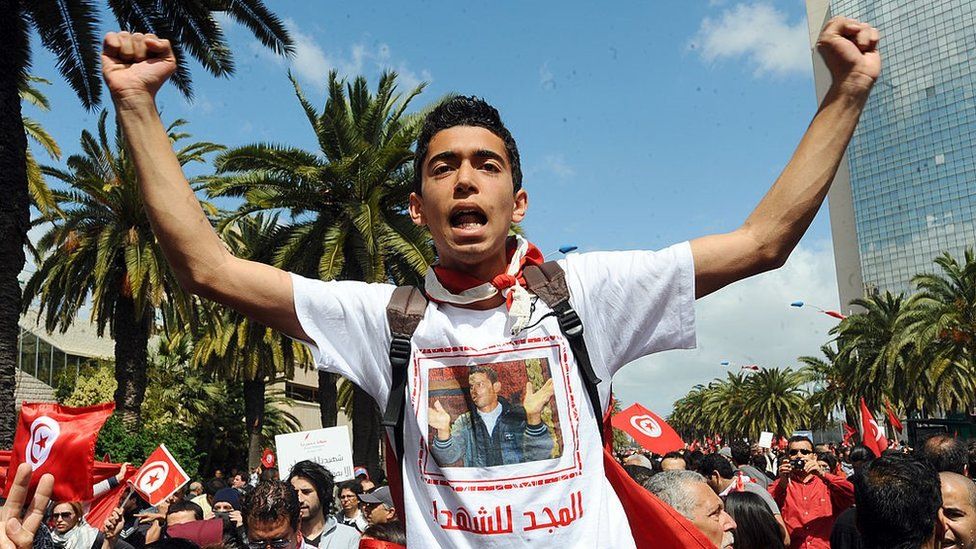
IMAGE SOURCE,GETTY IMAGES Image caption, A decade ago, Tunisia was at the forefront of political change in the region
This is the country that ignited the Arab Spring. It’s long been considered one of the movement’s very few success stories.
For many countries in North Africa and the Middle East, the uprisings more than a decade ago brought instability and chaos.
But Tunisia managed to claw its way towards democracy. Its president of 23 years – Zine al-Abidine Ben Ali – was deposed and a new constitution was carefully crafted, based on public will.
When thousands of chanting Tunisians first filled the streets at the end of 2010, marking the start of the Arab Spring, it was a visceral reaction to the death of a fruit and vegetable seller, Mohamed Bouazizi.
He set himself on fire outside a municipal building after having his cart confiscated by the authorities.
I wondered how fruit and vegetable sellers felt now, so I have gone to talk to them at one of Tunis’ many street markets.
Among piles of shining red tomatoes and sun-plumped seasonal fruit, a theme emerges – these men are saving whatever money they can, and then spending it all on dangerous boat trips, believing they will be better off in Europe.
They are unlikely to be deterred by a new right-wing government, which has promised a tough response to irregular migration, taking office following Sunday’s election.
One of them, Seif Eddin Hassouine, details how he has already spent $4,000 (£3,600) on two unsuccessful boat trips, each time intercepted by coastguards and sent back home. But he is about to do it again.
“This country has no jobs, no money, it’s better to leave,” he says.
Rachid Ben Jaafar, selling watermelons from a nearby stall, agrees: “Prices are high, life is very expensive, I can’t afford it any more. There’s no oil or sugar. Sometimes there’s no bread. How can people live? What can people do? All ways are closed.”
The original Arab Spring uprisings are branded deep into the memory of people here.
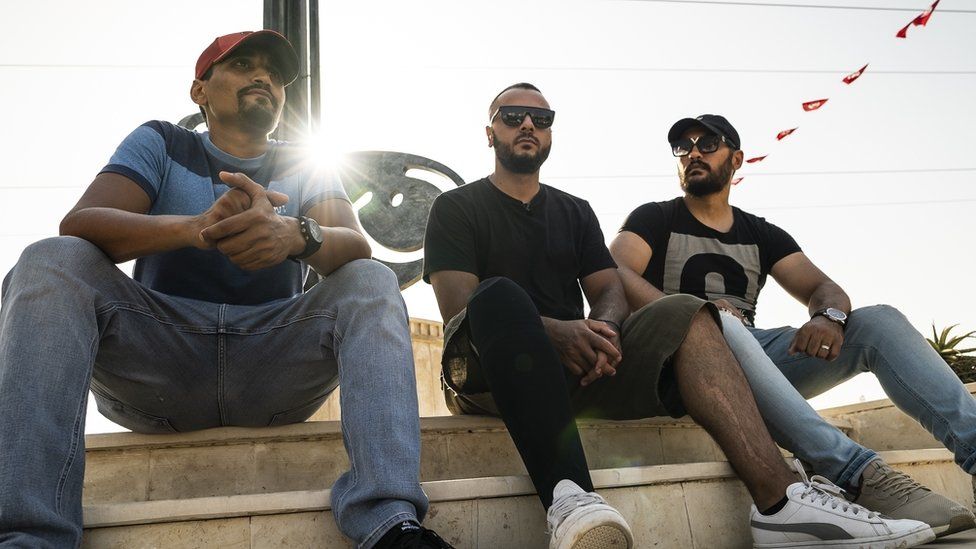
Walid Kassraoui sacrificed more than most. He was shot in the leg while demonstrating and it couldn’t be saved. Now he’s struggling to get a job, his prosthetic limb a daily reminder of what he’s lost.
IMAGE SOURCE,LEE DURANT/ BBC Image caption, Walid Kassraoui (C) is a father-of-two who lost his leg during the Arab Spring uprising
As we stand in the same street where he protested, he shows me a sign on the road. It lists the names of those who died there, including one of his closest friends.
“During the revolution, the slogans were all about finding jobs, freedoms, and national dignity,” he remembers. “Unfortunately, jobs and national dignity have not been achieved over the past 12 years. I’m a dad of two kids who is growing, I was hoping to raise them in better conditions, but unfortunately, I can’t.”
But those hard-fought rights and freedoms are being eroded as people hope they can trade them for jobs and better economic prospects.
President Kais Saied, a constitutional law professor, along with a small group of hand-picked allies, wrote a new framework for the country’s constitution, concentrating power in his own hands.
It was the culmination of a process that started in 2021 when he sacked the prime minister, dissolved the government, and suspended parliament.
In July, a referendum put these changes to the people, but the result was always a foregone conclusion.
In just a few hours, Tunisia’s constitutional landscape had rolled back more than a decade.
But for ordinary Tunisians, the focus now is on how to feed their families or find a job.
Left behind and desperately hoping the sea will spare her husband, Hanan sees a bleak future ahead of her.
“My mother and father are dead,” she cries. “I don’t have brothers, or anybody else. He is my mum, dad, brother – he’s everything to me. If he dies in the sea, I will be orphaned once again.”
The country’s neighbours have blasted Friday’s alleged coup, calling it “inappropriate” for army rebels to take control when efforts were being made to impose civilian authority.
The removal of leader Lt Col Paul-Henri Damiba was deemed “unconstitutional” by regional organization Ecowas.
Both times, the coups’ leaders said they had to step in because national security was so dire.
Burkina Faso controls as little as 60% of its territory, experts say, and Islamist violence is worsening.
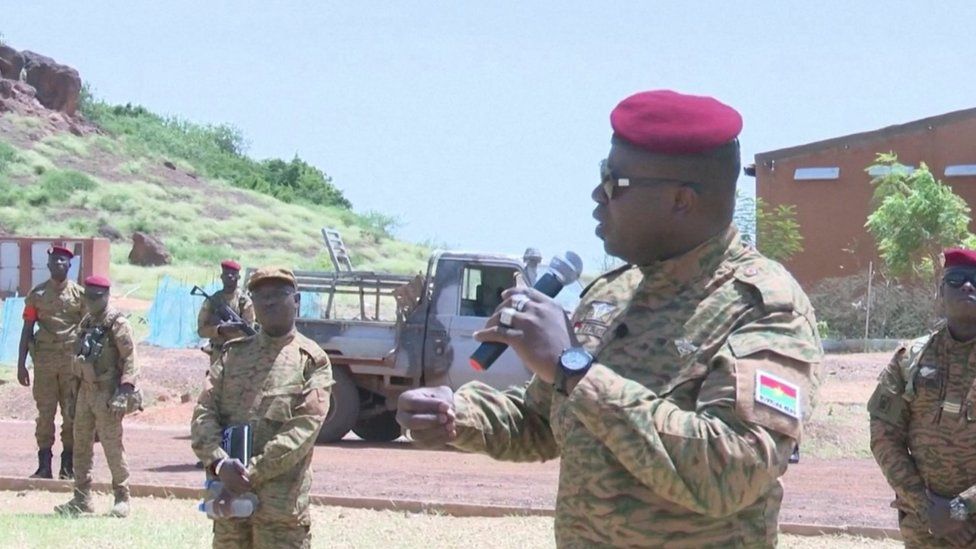
Flanked by rebel soldiers in fatigues and black facemasks, an army captain announced on national TV on Friday evening that they were kicking out junta leader Lt Col Paul-Henri Damiba, dissolving the government and suspending the constitution.
Ibrahim Traoré said Lt Col Damiba’s inability to deal with an Islamist insurgency was to blame.
“Our people have suffered enough, and are still suffering”, he said.
He also announced that borders were closed indefinitely, a nightly curfew was now in place from 21:00 to 05:00, and all political activities were suspended.
“Faced with the deteriorating situation, we tried several times to get Damiba to refocus the transition on the security question,” said the statement signed by Traoré.
“Damiba’s actions gradually convinced us that his ambitions were diverting away from what we set out to do. We decided this day to removeDamiba,” it said.
Since the takeover, there has been no word on the whereabouts of the ousted leader.
Lt Col Damiba’s junta overthrew an elected government in January citing a failure to halt Islamist attacks, and he himself told citizens “we have more than what it takes to win this war.”
But his administration has also not been able to quell the jihadist violence. Analysts told the BBC recently that Islamist insurgents were encroaching on territory, and military leaders had failed in their attempts to bring the military under a single unit of command.
On Monday, 11 soldiers were killed when they were escorting a convoy of civilian vehicles in Djibo in the north of the country.
Earlier on Friday, Lt Col Damiba urged the population to remain calm after heavy gunfire was heard in parts of the capital.
A spokesman for the ousted government, Lionel Bilgo, told AFP news agency on Friday that the “crisis” was, in essence, an army pay dispute, and that Lt Col Damiba was taking part in negotiations.
But since Friday evening Lt Col Damiba’s whereabouts are unknown.France is a traditional ally, but French diplomatic sources have told RFI radio that Lt Col Damiba is not with them nor is he under their protection.
The United States said it was “deeply concerned” by events in Burkina Faso and encouraged its citizens to limit movements in the country.
“We call for a return to calm and restraint by all actors,” a State Department spokesperson said.
The Economic Community of West African States (Ecowas) has condemned the move, stating it “reaffirms its unreserved opposition to any taking or maintaining of the power by unconstitutional means”.
IMAGE SOURCE, REUTERS Image caption, Lt Col Damiba urged the population to remain calm after heavy gunfire was heard in parts of the capital on Friday
In January, Lt Col Damiba ousted President Roch Kaboré, saying that he had failed to deal with growing militant Islamist violence.
But many citizens do not feel any safer and there have been protests in different parts of the country this week.
Climate experts have called for stricter regulations to prevent companies from buying ineffectual offsets in the future.
Nearly half of the carbon offsets held by energy company Centrica on behalf of its UK business and residential customers have such a poor reputation that the EU banned them from its own emissions trading system in 2013.
Centrica, which owns British Gas, says it is committed to a cleaner and greener future.
Like lots of companies involved in fossil fuels, Centrica compensates for its own pollution and boosts its climate credentials by purchasing credits from projects around the world that reduce or avoid greenhouse gas emissions.
This is called offsetting, and typically involves things like tree planting or nature restoration projects.
But it is an industry that has long been criticized for a lack of transparency and consistent standards.
Now records provided by Centrica to the Open Democracy news website and shared exclusively with Sky News, reveal that 44% of Centrica’s credits purchased between July 2020 and June 2022 come from a Chinese chemical company called Shandong Dongyue Chemical Company.
This company has sold carbon offsets in return for the safe disposal of a dangerous greenhouse gas called HFC-23.
HFC-23 is a by-product of a chemical commonly used in refrigerators and air-conditioners and it is thousands of times more potent than carbon dioxide.
Over a decade ago, EU and UN officials became concerned that HFC-23 credits weren’t actually benefiting the environment at all, and that companies like Shandong Dongyue were producing extra gas simply to sell more offsets and maximize profits.
Shandong Dongyue and other manufacturers denied this, but the offsets were widely discredited and eventually banned by a number of tightly regulated Emissions Trading systems in the EU and elsewhere.
There is no suggestion that Centrica has done anything illegal.
Shandong Dongyue, which has not responded to Sky’s request for comment, was able to continue to sell old credits to those who would accept them, in what’s known as the voluntary carbon market.
Still, to some, it is surprising that Centrica bought them in the first place.
Policy director at Carbon Market Watch Sam Van den plas told Sky News: “This is not a small company. “We’re talking about a large company that should do their due diligence.
“I believe they take their corporate image and their environmental objectives seriously, therefore, you don’t need to look very far in order to find out that those types of credits are highly unreliable and they have been widely critiqued in the past.
“We’re not doing anything meaningful to solve the climate crisis if you rely on these credits.
“On the contrary, you give your consumers the impressionthey do something good for the environment, whereas in reality it just contributes to increasing greenhouse gas emissions.”
Centrica would not explain why it purchased the credits in November 2021, or disclose the price it paid for them.
But in a statement, a company spokesperson told Sky News: “These carbon offsets were initially brought to back a tariff which has not been sold since 2019.
“We subsequently made the decision not to use them again as they were not aligned with our high environmental standards.
“The current Green Future tariff has achieved Gold Standard accreditation from USwitch since the scheme was launched two years ago.
“Any future offset purchases for British Gas will be of the same high standard associated with the Green Future tariff.”
But this is about much more than Centrica and one particular type of carbon offset.
The voluntary carbon market is essentially unregulated and it is growing at an extraordinary pace.
In fact, one estimate suggests that if demand continues to grow, by 2030 it could be worth nearly £50bn.
As more and more companies make serious net zero commitments and turn to the voluntary carbon market to help deliver on those promises, experts are calling for better transparency and consistency.
Rob Macqaurie, policy analyst and researcher and the London School of Economics Grantham Research Institute on Climate Change, told Sky News: “There are quite a lot of dodgy claims being made.
“Policymakers should be looking at potential rules and even watchdogs to govern the kind of information that companies are putting out about their use of carbon credits.
“There are rules emerging to help us understand what high quality looks like, the trick now is to take those rules and ensure that they’re really widely adhered to.”
One of the organizations working to put an agreed set of global standards in place for businesses purchasing carbon credits is the UN-backed Voluntary Carbon Markets Integrity Initiative (VCMI).
The group’s executive director Mark Kenber told Sky News: “Carbon credits can be a powerful tool for decarbonisation – but only if we can make sure they’re used correctly, above and beyond action companies are taking to cut their own emissions.
“Equally, companies must be clear with consumers about the action they’re taking to reach net zero, which is why we’re spearheading a more transparent and accountable way to make this the norm.
“VCMI’s Code of Practice – which is currently being trialed by leading climate-conscious businesses – will create a commonly agreed set of standards to allow companies who are genuinely making progress to demonstrate this.”3:36
William McDonnell, Chief Operating Officer of the Integrity Council for Voluntary Carbon Markets, which is attempting to build a globally accepted standard for the quality of carbon credits, told Sky News: “You need an independent body to clearly mark which credits are high quality, which is what we’re doing with the Core Carbon Principles.
“Once this is in place, it will be completely transparent which companies are choosing to buy junk credits, and that transparency will disincentivise companies from doing so.”
He continued: “The principles will underpin confidence, reduce confusion and fragmentation, and pave the way for scaled finance and investment so high-quality carbon credits can unlock additional urgently-needed private capital and channel it efficiently towards the most impactful, cost-effective climate mitigation activities globally, particularly in developing economies.”
Ms Dale’s death was one of three fatal shootings within a week in Liverpool, with nine-year-old Olivia Pratt-Korbel killed on 22 August and 22-year-old Sam Rimmer gunned down in Dingle on 16 August.
Police investigating the murder of a council worker in Liverpool have released images of a vehicle travelling in the area shortly before she was shot.
Ashley Dale, 28, was found with gunshot wounds in the back garden of her home in Old Swan in the early hours of Sunday 21 August. She was taken to hospital but died a short time later.
Ms Dale, an environmental health officer for Knowsley Council, is not believed to have been the intended target of the shooting.
Her death was one of three fatal shootings within a week in Liverpool, with nine-year-old Olivia Pratt-Korbel killed in her home in Dovecot on 22 August and 22-year-old Sam Rimmer gunned down in Dingle on 16 August.
On the night of Ms Dale’s death, officers were called to an address in Leinster Road at around 12.40 am following reports of concern for a woman at the property.
Image:Ashley Dale was shot dead in Old Swan. Pic: Merseyside Police
Eight people have been arrested in connection with Ms Dale’s murder and remain on conditional bail or under investigation.
Police are now appealing for information about a grey Hyundai i30 N performance car that was spotted in the area earlier in the evening. The car has not yet been recovered.
Detective Chief Inspector Cath Cummings, of Merseyside Police, said: “We now believe that this Hyundai was driven in the areas of Dovecot and Page Moss during the evening of Ashley’s murder, including on Pilch Lane.
“As we look to gather all available evidence, I want to continue to appeal to anyone who lives in these areas and may have any information about this car.
“This might range from knowing who was driving, seeing someone being picked up, or capturing further images or footage on CCTV, dashcam or doorbell devices. We also need to know where the car is now.
“A minor detail could have major significance and we will review everything that comes in and make that assessment, and it all forms part of detectives building up an evidential picture, something that can of course take time.
“Please come forward with anything you know to help us bring those responsible before the courts and get justice for Ashley’s family.”
The footage in relation to Ms Dale’s death comes as police have made another arrest in connection with the murder of Olivia Pratt-Korbel.
A 40-year-old man from Dovecot was arrested on suspicion of assisting an offender on Friday.
It comes a day after a 34-year-old man was arrested on suspicion of her murder.
Anyone with information about Ms Dale’s murder is asked to contact the investigating team through the online portal at mipp.police.uk, or via social media @MerPolCC. Alternatively, they can call 101 or Crimestoppers anonymously on 0800 555 111 quoting reference 22000615873.
After the inquest into Molly Russell, 14,’s death, Prince William stated that young people’s internet safety should be “a prerequisite, not an afterthought.”
A coroner concluded that the teenager from Harrow diedfrom an act of self-harm while suffering depression and the negative effects of online content.
Molly’s father Ian called for urgent changes to make children safer online.
The prince said: “No parent should ever have to endure what Ian Russell and his family have been through.”
It is unusual for any member of the Royal Family to make any comment during or following any legal proceedings – but mental health is a topic on which the new Prince of Wales has spoken and campaigned on regularly in the past.
She said that in most instances of harassment, trans-Pakistanis are either beaten, harangued, or publicly arrested by the police.
She added: “How can we call on this hotline when our phones are snatched? When we are arrested like a robber from wedding parties where we have to perform and earn?
“Who harasses us the most? Yes, indeed, the police. And we will have to call the police to seek justice.”
She estimates there are about 10,000 trans people living in Pakistan.
The hotline has been announced as the Pakistani governmentattempts to pass an amendment to a 2018 transgender rights bill to allow people to choose their gender identity for documents such as identity cards and education certificates.
A 50p coin with King Charles’s picture will go into widespread circulation in the coming weeks, according to newly disclosed coins bearing his likeness.
The commemorative £5 Crown and 50p, both of which include a carving of the King by British sculptor Martin Jennings, were initially seen to BBC News.
The monarch is now facing left, the opposite direction from his predecessor, on the coins, keeping with centuries of custom.
As with previous British kings, and unlike the Queen, he wears no crown.
King Charles personally approved the effigy and was understood to be pleased with the likeness.
The coins will be sold to collectors by The Royal Mint from early next week. The 50p coin will be available for general use well before the end of the year, distributed according to demand by banks, building societies, and post offices.
They will co-circulate with coins featuring the late Queen, so those 27 billion coins will still be accepted in shops.
Anne Jessopp, chief executive of The Royal Mint, said that coins generally lasted for 20 years, so both Queen Elizabeth and King Charles coins will be in circulation together for many years to come.
From the start of next year, coins from the 1p to the £2, which we use in day-to-day life, will be minted carrying the same image of King Charles. They will be sent out when needed to replace damaged and worn older coins and to cover any extra demand.
“People should not worry if they have coins with the Queen on. We will keep those coins in circulation,” Mrs Jessopp said. “We are seeing people moving to different forms of payment, but people really like to use coins as well for lots of different reasons.”
IMAGE SOURCE,PA MEDIA Image caption, King Charles personally approved the design
The official portrait was designed to give an accessible look to the King, and the same is true of the inscription.
Previous British monarchs have been denoted on the inscription using the Latin version of their name. However, the new coins say Charles III rather than Carolus.
The full inscription surrounding the effigy reads “CHARLES III • D • G • REX • F • D • 5 POUNDS • 2022”, shortened from Latin, which translates to “King Charles III, by the Grace of God, Defender of the Faith”.
The reverse of the new £5 coin shows two new portraits of the Queen, charting her journey from a young monarch to a long-standing head of state.
On the 50p coin, the reverse is a copy of the design used on the 1953 Crown struck to commemorate the Queen’s coronation.
IMAGE SOURCE,PA MEDIA Image caption, The reverse of the two coins commemorate the late-Queen
King Charles’s portrait is the first coin design undertaken by Martin Jennings, but his public sculptures include poets John Betjeman, in St Pancras Station in London, and Philip Larkin in Hull.
He used photographs to come up with the design, rather than the King sitting for a specific portrait.
“It is the smallest work I have created, but it is humbling to know it will be seen and held by people around the world for centuries to come,” he said.
The coins will be struck at The Royal Mint’s site at Llantrisant, south Wales, where the official coin maker – and Britain’s oldest company – moved to accommodate the decimalisation process in 1967.
Before decimalisation, it was common for people to carry coins featuring different monarchs in their pockets.
A memorial coin range to commemorate the life and legacy of Queen Elizabeth, including the £5 Crown, will be put on sale by The Royal Mint on Monday.
What is the Royal Mint?
It is one of the oldest companies in the world, striking its first coin in the late 9th Century, during the reign of Alfred the Great
The Mint was based inside the Tower of London for most of its existence, but since the late 1960s its home has been Llantrisant in Rhondda Cynon Taf
The current facility was opened by Queen Elizabeth II on 17 December 1968, just in time for the massive task of replacing the billions of coins in circulation ahead of decimalisation
There are more than 27bn coins in circulation in the UK, with the Mint issuing around one billion new coins every year – although this figure does fluctuate.
Separately, people are being urged to check whether they have any paper banknotes at home, as they will be withdrawn from circulation by the weekend.
Shops are permitted to no longer accept £20 Adam Smith and £50 notes featuring the portraits of Matthew Boulton and James Watt from Saturday.
In addition to these Bank of England banknotes, paper £20 and £50 notes issued by Clydesdale Bank, Royal Bank of Scotland and Bank of Scotland will also be withdrawn on the same date.
The paper £20 notes issued by Bank of Ireland, AIB Group, Danske Bank, and Ulster Bank in Northern Ireland will also be taken out of circulation.
Anyone who misses the deadline should still be able to exchange the old notes at their bank.
Official estimates indicate that there are now over one million Covid infections in the UK.
The number of individuals testing positive increased by 14% in the week ending September 20. This is the highest increase since the summer.
But according to theOffice for National Statistics, there is no concrete indication that a fall Covid surge has begun (ONS).
More recent data showing a rise in hospital admissions with Covid has been called “a wake-up call”.
Dr Thomas Waite, deputy chief medical officer for England, told BBC News that a number of new sub-variants of Omicron were circulating at low levels, and could be behind the hospital figures.
Daily hospital admissions are lower than where they were for much of July but highest among the oldest age groups.
However, six out of 10 people with Covid in hospital are being treated for something else – not Covid-19.
“The fact there are people getting so seriously ill they need to go into hospital is a wake-up call to us all that Covid is still here,” said Dr Waite.
Health experts have warned of a flu and Covid “twindemic” this winter, urging those who qualify to get their free jabs now.
Too early to call
Although Covid is increasing in England and Wales, the trend is uncertain in Scotland and Northern Ireland, the ONS says.
Sarah Crofts, from the ONS Covid-19 Infection Survey, said: “It is too early to identify whether this is the start of a new wave of infections. We will continue to closely monitor the data.”
The ONS estimates are based on thousands of random tests on people in private households across the UK, whether or not they have symptoms.
In the UK as a whole, it is the first time estimated Covid infections have risen above one million since the end of August 2022.
In England, infections rose in the North West, Yorkshire and the Humber, the West Midlands, the East of England, London, and the South East – and in all age groups.
The tests found that about one in 60 people had Covid in the UK in the week to 20 September, up from one in 70 the week before.
But there were noticeable differences in trends in the four nations of the UK.
The ONS says Covid is infecting:
one in 65 people in England (up from one in 70)
one in 50 people in Wales (up from one in 75)
one in 80 in Northern Ireland (the same as the week before)
one in 45 in Scotland (up from one in 55)
Data is for the week ending 17 September 2022 for England, and the week ending 20 September 2022 for Wales, Northern Ireland and Scotland.
The most common Covid symptom is currently a sore throat, with fever and loss of smell much rarer, according to symptoms logged by 3,000 people testing positive via the Covid symptom app.
Booster jabs against Covid, alongside flu vaccinations, are now being offered to the most vulnerable to help protection over the winter.
Most people will receive a new type of vaccine – made by Pfizer or Moderna – which tackles both the original Covid virus and the recent Omicron variant, offering better protection.
‘Unpredictable’
There were 7,000 people in hospital in England with Covid last week – a 37% increase from the week before.
Hospital admissions with Covid were running at around 900 per day, compared to roughly 2,000 in early July during the last surge of Omicron infections.
Hospital patients and care home residents are no longer being tested for Covid in most of the UK unless they have symptoms.
Dr Mary Ramsay, director of public health programmes at the UK Health Security Agency, is expecting “an unpredictable winter” which will put additional pressure on health services.
“In the coming weeks, we expect a double threat of low immunity and widely circulating flu and Covid-19,” she said.
“While Covid-19 and flu can be mild infections for many,we must not forget that they can cause severe illness or even death for those most vulnerable in our communities.”
She urged people who were unwell this winter to stay at home and avoid contact with vulnerable people to help prevent infections from spreading.
While Major Jamie Lee Henry’s husband, Anna Gabrielian, is a Russian speakerconnected to Johns Hopkins Hospital, she also held secret security clearance.
They are accused of giving confidential information to a covert FBI agent acting as a member of the Russian Embassy.
The FBI discovered Gabrielian had offered his services to Russia through its embassy in Washington, according to the Justice Department.
It is alleged that Gabrielian met the undercover agent in a hotel room last month – and said: “she was motivated by patriotism toward Russia to provide any assistance she could to Russia, even if it meant being fired or going to jail”.
Gabrielian told the agent that she had reached out to the Russian Embassy by email and phone, offering Russia assistance from both her and her spouse Henry, the indictment says.
The indictment refers to Henry as male – but in 2015, they went public as thefirst openly transgender Army officer.
Marcia Murphy, a spokeswoman for the US attorney’s office in Baltimore, said Henry referred to himself as a male in interactions with the undercover FBI agent.
It is also alleged that Henry had looked into volunteering to join the Russian army after the conflict in Ukraine began, but Russia wanted people with combat experience and Henry did not have any.
“The way I am viewing what is going on in Ukraine now is that the United States is using Ukrainians as a proxy for their own hatred toward Russia,” Henry allegedly added.
Gabrielian did express concern about her children, demanding they have a “nice flight to Turkey to go on vacation because I don’t want to end in jail here with my kids being hostages over my head”.
On 31 August, the FBI agent met Gabrielian and Henry at a hotel in Maryland, near Washington DC.
Gabrielian gave the agent medical information about the spouse of a person employed by the Office of Naval Intelligence – and highlighted a medical issue that Russia could exploit, the indictment claims.
Henry allegedly provided information on at least five individuals who were patients at Fort Bragg, including a retired Army officer, a current Department of Defence employee, the spouse of a US Army veteran, and two spouses of deceased US Army veterans.
Court records say Gabrielian and Henry have been arrested – it was unclear whether they have lawyers.
For more than six decades, some of the UK’s most devastating economic events have happened under an autumn cloud. Is history repeating itself?
The poet and banker T S Eliot got it wrong – April is not the cruelest month, at least when it comes to financial crises. Autumn is crueller.
The months of September, Octobe,r and November are when gestating economic turbulence tends to burst into full-blown economic storms.
The precedent of the calendar should give the prime minister and chancellor something additional to worry about as the government insists the present shocks to sterling, inflation and mortgages are nothing to worry about in spite of the Bank of England having to intervene with £65bn worth of reserves.
The big daddy of them all, the Wall Street Crash in the United States, is dated to September and October 1929. In the UK, the economic crises of the post-Second World War period have had an autumnal flavour.
Timeline of tumbles
November 1967: The Wilson government’s “pound in your pocket” devaluation took the value of a pound sterling down to $2.47.
October 1974: At the second general election of that year, Labour consolidated its victory over Ted Heath’s Conservative government. Heath’s chancellor, Sir Anthony Barber, quit politics after his disastrous “dash for growth”.
October 1976: The “Crisis What Crisis” crisis when the UK needed a $3.9bn bailout loan from the IMF. Free-floating exchange rates pushed the pound to a then-record low of $1.57.
26 October 1989: Nigel Lawson, at the time the longest-serving Chancellor, resigned from Margaret Thatcher’s government over economic policy differences, precipitating the year-long Tory turmoil that resulted in her resignation as prime minister.
October 1990: John Major, the Conservative prime minister, took the pound into the European Exchange Rate (ERM) mechanism, having failed to announce the decision at the Conservative Party conference days before.
Image:The pound crashed out of the ERM after John Major’s decision to take it in
16 September 1992: Black Wednesday. The pound crashed out of the ERM after the failure of the Major government’s panic measures, which briefly lifted interest rates as high as 15%. Although it had only been re-elected that summer and although the new chancellor, Kenneth Clarke, adopted a new economic strategy, the government’s fortunes never recovered. Labour and Tony Blair won the election in May 1997 by a landslide.
September 2007. The building society Northern Rock closed its doors to savers. To continue trading, it had to seek support from the Bank of England as lender of last resort. By February 2008 the mortgage lender had to be nationalised. It was an early harbinger of:
September 2008 banking crisis: Overextension and insecure loans resulted in the bankruptcy of Lehman Brothers and the need for taxpayer bailouts of lending institutions on both sides of the Atlantic.
Gordon Brown “saves the world [banking system]” by marshaling an emergency meeting of the G20. In the UK, the public stakes taken to support major banks resulted in a squeeze on public spending and the “austerity” policies followed by subsequent governments.
October 2016: The pound dropped 28% after the vote to leave the EU, hitting a then-record low of US$1.14.
September 2022: Markets lose confidence in UK economic managementafter an uncosted “fiscal event” announcement by the new chancellor, Kwasi Kwarteng, on 23 September. The pound dips to a new record low of $1.03 before recovering to around $1.08.
Gilt yields, the driver of domestic inflation, surged – even as pension funds obliged to sell them courted bankruptcy until the Bank of England made its intervention. Hundreds of mortgage products were withdrawn, paralysing the housing market. The International Monetary Fund publicly rebuked the government for proposing huge tax cuts without the funds to pay for them.
That is where the UK finds itself today, on top of the cost of living crisis it already faced, in large part because of Russia’s attack on Ukraine and the consequent rises in energy prices.
It is too soon to tell where the economy is going to end up. Each of the autumnal plunges listed above had different causes resulting from the same mix of political and financial ambitions, and human hubris, greed, ambition, and overconfidence.
But why in autumn?
The reasons economic crises come to a head in the autumn are speculative. It is certainly a time of year for stocktaking in Western market economies after a break or slowdown over the summer holiday period.
Autumn, mid-October this year, is when the International Monetary Fund and the World Bank hold their annual joint meeting. With the year’s three-quarters done, it is natural to look back and assess whether things have gone well or badly. If there are problems, governing politicians and markets are likely to take steps to correct them, which sometimes only leads to bigger mistakes.
Autumn crunch points are stronger in this country because of the long summer parliamentary recess and the ritual of the annual party conference season.
If they had to change leader, and Tory MPs decided Boris Johnson had to go, they were determined to have a new leader in place in time for a relaunch at the Conservative Party conference next week in Birmingham.
No need for an ethics watchdog
Ms Truss, in turn, was so anxious to hit the ground running that she launched her new economic strategy without running it through the usual channels of the Office of Budget Responsibility (OBR) and having sacked Sir Tom Scholar, the long-standing permanent secretary at the Treasury.
The OBR is not the only regulatory institution treated with contempt by Ms Truss. She has also closed down the National Security Council and the Independent Office of Tax Simplification and suggested she will not need a No 10 ethics watchdog.
Her role model Margaret Thatcher – who like Sir Tony Blair avoided economic smashes while in office – played by the rules and conventions. She believed in balancing the books and famously observed, “You can’t buck the markets.”
The new prime minister thinks she and her chancellor know better, commenting: “We have had a consensus of the Treasury, of economists, with the Financial Times, with other outlets, peddling a particular type of economic policy for 20 years. It hasn’t delivered growth.”
Gamble
One can quibble with the accuracy of this statement, noting the early decade of this century was mostly characterized by on or above-trend growth and that since 2010, a Conservative government has been in charge, of which Ms Truss has been a supporter and member.
What matters is that Ms Truss has decided to gamble the economy on a new policy of pursuing growth at all costs even when her proposals seem contradictory, such as simultaneous borrowing, tax cuts, and huge government spending, to stabilize energy markets only temporarily.
Her opponent for the leadership, Rishi Sunak, warned of the consequences of her plans but was rejected by the party membership.
DISCLAIMER: Independentghana.com will not be liable for any inaccuracies contained in this article. The views expressed in the article are solely those of the author’s and do not reflect those of The Independent Ghana
Ashong’s recognition in the Business and Entrepreneurship category was for her spirited leadership role in championing the inclusion and elevation of talented women.
The founder and chief executive officer of TheBoardroom Africa (TBR Africa), Marcia Ashong, has been recognized as one of the 100 Most Influential People of African Descent (MIPAD) in the 100Under40Edition of #Class2022.
MIPAD was set up under the International Decade for People of African Descent, proclaimed by the United Nations General Assembly’s Resolution 68/237, and, having started in 2015, will be observed until 2024.
MIPAD identifies high achievers of African descent in the public and private sectors from around the world as a progressive network of actors who will join together in the spirit of recognition, justice, and development of Africa, its people on the continent, and across the diaspora.
Ashong’s recognition in the Business and Entrepreneurship category was for her spirited leadership role in championing the inclusion and elevation of talented women on to boardrooms across a wide range of public and private corporate organizations across the entire African continent.
TheBoardroom Africa officially launched in 2016, but in many ways, it had been operating years before then.
Ashong says her own journey navigating the corporate ranks as a young executive inspired the desire to build what has now become Africa’s most vibrant community of female executives.
“What started with a handful of women across a few countries has now developed into a continent-wide movement for change,” she said.
Today, TBR Africa is enhancing and amplifying the potential of Africa’s exceptional female leaders. They support companies hoping to unlock the power of diversity and improve business performance, by connecting them with exceptional female leaders.
TBR Africa also works with women to equip them with the resources they need to navigate their journeys in and outside the boardroom.
The membership of TBR Africa has grown to more than2,500 women leaders from 2,067 organisations across the continent. Over the past four years alone, the company has placed over 70 women on boards and investment committees, 23 of them in 2021 alone, and it is on track to place another 25 women this year.
Some executives in the TBR Africa network come from companies such as Actis, General Electric, the African Finance Corporation, Google, GlaxoSmithKline, Standard Chartered, Uber, and other top global multinationals.
DISCLAIMER: Independentghana.com will not be liable for any inaccuracies contained in this article. The views expressed in the article are solely those of the author’s, and do not reflect those of The Independent Ghana
Before hosting the COP27 summit,Egyptian human rights organizations demand that their nation release political prisoners and open civic space.
It comes in response to a study by Amnesty International that claimed Egypt was experiencing a “human rights catastrophe.”
According to Human Rights Watch (HRW), Egypt has severely restricted the activities of environmental organizations. Cairo authorities deemed the information to be “misleading.”
The UN Climate Change Conference takes place in Sharm el-Sheikh in November.
More than 100 international non-governmental organizations (NGOs) have already signed a petition organized by the Egyptian Human Rights Coalition, which consists of 12 groups.
“We emphasize that effective climate action is not possible without open civic space,” a petition launched by the coalition says. “As host of COP27, Egypt risks compromising the success of the summit if it does not urgently address ongoing arbitrary restrictions on civil society.
“Moreover, we stress the importance of the right to freedom of expression and independent reporting to foster efforts to address the climate crisis.”
In a joint statement in July, three dozen groups expressed concern that Egypt would largely maintain its prohibition on protests during the conference aimed at slowing climate change.
Under Egypt’s President Abdul Fattah al-Sissi, there has been a widespread crackdown on dissent. Rights groups estimate the country has had as many as 60,000 political prisoners, many detained without trial.
They say that activists are routinely intimidated and that new laws make it practically impossible for many civil society groups to function.
“You will have activists from everywhere in the world coming to COP, but Egyptian activists are either blocked from going or they’re in jail,” a leading human rights campaigner in Cairo told the BBC, asking not to be named for fear of reprisal.
“Basically, nobody is safe in Egypt,” the campaigner said.
The Egyptian authorities say they hope to use their presidency of COP27 to urge the international community to act on pledges of support for developing countries to cope with the devastating impacts of climate change.
“They are the most deserving of our support,” Foreign Minister Sameh Shoukry told the UN General Assembly this month.
After a tumultuous decade since the 2011 uprising that overthrew then-President Hosni Mubarak, the country is also looking to boost its standing on the world stage.
‘PR tool’
However, critics, such as the Egyptian human rights campaigner, said the government sees the event as a way of “whitewashing its reputation”.
A few hundred less high-profile prisoners have been released in recent months since Mr Sisi unveiled a new pardon committee, in a move that many link to Egypt’s hosting of COP.
Amnesty’s new report focused on how Egyptian authorities have used a National Human Rights strategy launched a year ago “as a PR tool to deflect attention from its real human rights record”.
Meanwhile, HRW researched instances of repression against environmental groups.
Following interviews with academics, scientists and activists, it said that government restrictions amounted to human rights violations and left in doubt Egypt’s ability to meet basic climate commitments.
A spokesperson for the Egyptian foreign ministry dismissed the report as “deplorable and counterproductive” saying it contained “inaccuracies”, and questioned the use of unnamed sources.
This week, Ambassador Wael Abul-Magd, assisting him, told journalists that civil society and environmental groups would be represented at the talks.
“We don’t believe in tokenism,” he said in a virtual briefing. “We are involving these stakeholders across the board in every step of the way.”
However, Egyptian activists told the BBC that many local groups had been unable to register for the conference.
They questioned the independence of those who had been given access in a special process overseen by the government and facilitated by the UN. One called the lack of transparency “a scandal”.
In a statement issued on Thursday, the Minority described the development as a serious concern.
“The decision by the current NPP government to transfer revenues accruing from about 944,164bbls of crude lifting in the Jubilee and TEN fields to a company established in a safe haven (outside Ghana) without Parliamentary approval, amounts to a gross violation of the Petroleum Revenue Management Act, 2011 (Act 815) and Public Financial Management Act (Act 921),” John Abdulai Jinapor, the ranking member on the Energy and Mines Committeeof Parliament, said.
The government is yet to respond to the allegation.
Below is the full statement:
US$100 MILLION WORTH OF GHANA’S OIL MONEY MISSING – MINORITY RAISES CONCERN
The Minority in Parliament has noted with serious concern the inability or refusal of the Akufo-Addo/Bawumia led Government to account for over $100Million accruing from Ghana’s Petroleum lifting in the first quarter of 2022.
The decision by the current NPP Government to transfer revenues accruing from about 944,164bbls of crude lifting in the Jubilee and TEN fields to a company established in a safe haven (outside Ghana) without Parliamentary approval, amounts to a gross violation of the Petroleum Revenue Management Act, 2011 (Act 815) and Public Financial Management Act (Act 921).
We have become aware that following the acquisition of a Seven percent (7%) interest in the Occidental (Oxy) transaction in respect of the Jubilee and TEN Fields by the Government ostensibly for GNPC in 2021, the Minister of Finance has clandestinely ceded the shares to an offshore company known as JOHL (a company set-up in the Cayman Islands) in a very surreptitious and opaque manner.
The Minority is very much alarmed that contrary to requirements of the PRMA, revenues accruing from the nation’s oil fields are not being paid into the Petroleum Holding Fund (PHF), which has been confirmed in the 2022 semi-annual report on petroleum receipts by the Public Interest and Accountability Committee (PIAC).
As if this is not enough, the report further reveals that Capital Gains Tax was not assessed and collected by the Ghana Revenue Authority (GRA) in the sale of the 7% interest by Anadarko in the Jubilee and TEN Fields in 2021.
This NPP Government is proving by the day, that the nation’s oil resources cannot be entrusted in their care because not long ago the PIAC under the chairmanship of Dr. Steve Manteaw accused them over their inability to account for about GHȼ2 billion of Ghana’s oil cash for the 2017, 2018 and 2019 fiscal years.
This is surely another “Agyapa” deal in the making and we as a Minority will not sit aloof for this Government to raid the national purse, especially at a time when the nation is struggling to raise much needed revenues for critical expenditure.
We demand that the Minister of Finance and for that matter Government, must with immediate effect repatriate all such illegal transfer payments back into the Petroleum Holding Fund (PHF).
Failure to comply with our ultimatum will compel the Minority to use the necessary parliamentary processes to haul the Minister of Finance to parliament for possible censure.
*John Abdulai Jinapor
(Ranking Member, Mines and Energy Committee)*
Following the completion of the inquest involving the death of the schoolgirl, the attorney for Molly Russell‘s family advised Meta to “have some humility.”
Merry Varney, a partner at Leigh Day solicitors, said there had been some acknowledgment from social media companies, with Pinterest perhaps “more fuller than Meta”, but that it remained to be seen how firms ultimately responded to the coroner’s findings.
She said she hoped “Meta in particular” followed through after offering to meet with the Molly Rose Foundation and that “they listen very carefully and have some humility”.
Molly’s father Ian Russell said the measures currently taken to ensure safeguarding online have been “tiny”.
“I think that those steps are tiny and I think that globally dominant platforms can move a lot faster,” he said.
“I think we should all be looking at them and judging them on their actions.”
We’re in the town of Estero, about 15 miles east of Fort Myers, in a sizable retail center with just one gas station.
Dozens of cars are approaching the gas station from each end – all barely moving. We’ve seen similar scenes at two other stations as we approach Fort Myers.
Sixty-year-old Dean Perfetti – who was waiting to fill up multiple jerry cans – told us he’d already been there over an hour.
Perfetti considers himself lucky: he only had “landscape” damage to his house.
Many of the stores in the complex are still without water. The shortages have prompted Publix – an enormous grocery store – to put yellow caution tape around its washrooms to ward off customers in need of a working toilet.
At a store next door, school textbook vendor Kamal said the storm was by far the worst he’s seen in 10 years living in the area.
The aftermath of Hurricane Ian has affected countries other than the United States.
As the nation entered its third day of darkness following the seismic storm, Cubans rushed to the streets last night to beat pots and protest in various Havana neighbourhoods.
The massive storm caused Cuba’s grid to collapse earlier this week, knocking out power to the entire island of 11 million people, flattening homes, and obliterating fields.
For some Cubans – already reeling from shortages of food, fuel, and medicine – the prolonged blackout was the last straw.
Jorge Luis Cruz, of Havana’s El Cerro neighborhood, stood in his doorway on Thursday evening banging a metal pot and shouting in anger.
Dozens of others on side streets around his home could be heard banging pots from terraces and rooftops in the dark. “This isn’t working, enough of this,” Cruz told Reuters. “All my food is rotten. Why? Because we don’t have electricity.”
Cruz said his family did not want him to take to the street out of fear he would be hauled off to jail. “Let them take me,” he said.
The town’s fire chief says no deaths have been officially reported in the devastated Florida city of Fort Myers.
Speaking to local NPR affiliate 91.3 WLRN early on Friday morning, Chief Tracy McMillion said that while authorities are still working on a detailed damage assessment of the “catastrophic devastation”, it is increasingly clear that Hurricane Ian “totally changed the face of our charming city”.
“Concrete blocks flew more than half a mile,” he said. “Boats are on roads in areas that they shouldn’t even have gotten to.”
McMillion added that coastal parts of the city, as well as the city’s downtown area, have “taken a beating”.
“These are the things that made our city really charming,” he added.
Many local residents remain without power in the town. McMillion said that authorities are currently focused on making sure residents have all the supplies they need and on repairing critical infrastructure.
We’re on our way to Ft Myers now and will be able to bring you some updates from the town shortly.
It ordered that all the imitation bunnies be destroyed, but suggested the chocolate needn’t be wasted and could be melted for use in other products.
“Destruction is proportionate, especially as it does not necessarily mean that the chocolate as such would have to be destroyed,” it said in a summary of its verdict on Thursday.
It said that even though there are some differences between the two products, there was still the possibility of confusion for consumers.
Lindt’s bunny has a red bow and bell,while Lidl’s has a green bow and bell. The colour of the foil is similar as are the illustrations of the features.
A “so-called referendum” conducted by Russia in Ukrainian territory has been denounced by Joe Biden as a “shameless and transparent endeavor by Russia to acquire parts of neighboring Ukraine.”
The US president made the comments during a White House summit with Pacific Island nations.
Mr Biden said the results of Russia’s “referendums” “were manufactured in Moscow”.
He added “the United States will never, never, never recognise Russia’s claims on Ukraine sovereign territory.
The US and its allies have promised to adopt even more sanctions than they’ve already levied against Russia and to offer millions of dollars in extra support for Ukraine.
UK intelligence has gathered that newly recruited Russian reserve troopshave been instructed to procure their own combat first aid supplies.
Female sanitary pads have been recommended to soldiers arriving at the front lines as a cost-effective alternative, which is just another indication of the problems hindering Kremlin forces.
The UK Ministry of Defence said on Twitter: “Medical training and first-aid awareness is likely poor.
“Some Russian troops have obtained their own modern, Western-style combat tourniquets but have stowed them on their equipment using cable-ties, rather than with the Velcro provided – probably because such equipment is scarce and liable to be pilfered.
“This is almost certain to hamper or render impossible the timely application of tourniquet care in the case of catastrophic bleeding on the battlefield.”
The MoD said this shortage of medical equipment is almost certainly contributing to a “declining state of morale and a lack of willingness to undertake offensive operations” in many units in Ukraine.
Latest Defence Intelligence update on the situation in Ukraine – 30 September 2022
In Moscow’s Red Square, arrangements are being made for a large event that will formally ratify Russia’s takeover of four regions of Ukraine.
The area has been closed to visitors and tourists for the works and a stage, giant video screens, and billboards can be seen that read, “Donestsk, Luhansk, Zaporizhzhia, Kherson – Russia”, declaring the inclusion of the regions into Russian territory.
A pop concert is also planned on Red Square.
Vladimir Putin’s spokesman Dmitry Peskov has said the Russian president will sign accession documents in an ornate Kremlin hall, give a speech, and meet leaders of the self-styled Russian-backed Donetsk People’s Republic and Luhansk People’s Republic as well as the Russian-installed leaders of the parts of Kherson and Zaporizhzhia that Russian forces occupy.
Mr Peskov did not say whether Mr Putin will attend the Red Square celebration, as he did a similar event in 2014 after Russia proclaimed it had annexed Ukraine’s Crimea region – however, the Russian leader is widely expected to be there.
Donetsk, Luhansk, Kherson, and Zaporizhzhia would never be accepted by the UK, according to Prime Minister Liz Truss.
In advance of President Vladimir Putin’s anticipated decision to recognise the territories once occupied by Ukraine as Russian following widely condemned referendums, she released a statement on Friday morning.
She said: “Vladimir Putin has, once again, acted in violation of international law with clear disregard for the lives of the Ukrainian people he claims to represent.
“The UK will never ignore the sovereign will of those people and we will never accept the regions of Donetsk, Luhansk, Kherson, and Zaporizhzhia as anything other than Ukrainian territory.
“Putin cannot be allowed to alter international bordersusing brute force. We will ensure he loses this illegal war.”
In a move that follows a plodding and predictable script Russia will recognise the four territories it has occupied and captured in conquest.
Under the country’s 1993 constitution there needed to be a popular vote for this to happen – hence the hurried fake referenda.
Like other autocratic police states, pseudo- legalism is of the utmost importance in Russia – we’ll hear a lot more turgid legal language today as a way of giving this international outrage a veneer of legitimacy.
Moving to annex Russia has overturned centuries of convention – that you don’t steal land with force.
Putin is also returning Europe to a period pre-WW2.
Russia has lost as many citizensin the last week as it has throughout the whole battle. Children cannot be nurtured in a nation that sends soldiers to murder against their choice, a young mother crossing into Georgia told Sky News.
Vladimir Putin has for seven months insisted his invasion of Ukraine was only a special military operation.
That way he hoped the conflict would seem distant and contained to the broad Russian public.
With his military suffering setback after setback, a week ago he announced the mobilization of hundreds of thousands of reservists. But even that was qualified.
It was a partial mobilization and so far the bulk of men being drafted are said to be from areas far from Moscow and in the Russian federation’s autonomous republics.
He will have hoped again that the bulk of ethnic Russians will still not feel directly affected by this latest escalation.
But it is not working out that way, it seems, not for hundreds of thousands of Russians across the country.
They’ve felt so strongly about his latest moves that they have left their homes and everything in them and made the long and difficult journey out of Russia. To Georgia, or to Mongolia and Kazakhstan or Finland, where so many Russians have crossed that the authorities have now closed the border to them.
As many have left in the past week as in the entire conflict. One young mother crossinginto Georgia told Sky News that she cannot raise children in a country that sends men to kill against their will.
Others are less prepared to talk to news crews when they cross. Many of them are from those autonomous republics.
Areas such as Dagestan, in the North Caucasus, Buryat far to the east, and Chechnya have suffered a disproportionately high amount of casualties in the Ukraine war and suspect the new mobilization will mean an unfair number of their men are forced to join up.
Startling levels of unrest
There has been an unprecedented level of unrest in these republics in the last week. We have seen startling videos online of men headbutting policemen and kickboxing them in mass brawls.
And in deeply conservative Islamic areas of Russia, women have been so angry they have taken to the streets to chant “No more war” against the police.
We were able to talk to a few men anonymously who come from these areas.
One from Dagestan would not show his face on camera but said the situation there was getting worse. Young men, he said, were being forced into minibusses and sent for military training. He was getting out of Russia while he could.
Another man from Chechnya said zthat since Mr Putin’s mobilisation order “the mood of younger Chechens worsened. Everybody is trying as fast they can to leave the Chechen territory, fearing they’ll be mobilised.”
He questioned the Kremlin’s logicin forcing men to fight against their will.
“I don’t think they’ll try hard because many of us think this isn’t our war and that Russia is an aggressor. This is not defending the interests of their motherland.”
He had been working hard to get Chechen men across the border.
‘I don’t really understand’
We filmed our interview at night and obscured his identity to avoid retribution by Chechen authorities back home against members of his family. Chechnya has been subject to brutal repression since its subjugation by Russia in two conflicts.
He said Russia was fighting a war and there was no other way of describing it.
So did another man who approached us under cover of darkness. A military veteran, he had fought for Russia and served four years, he said, but had just crossed the border to avoid being called up.
Mr Putin’s announcements showed Russia was notfighting a limited military operation, he said.
“I really don’t understand why I should go,” he told us. “This is not our territory. The fact they’re trying to mobilise this many people means it’s the start of something very serious.”