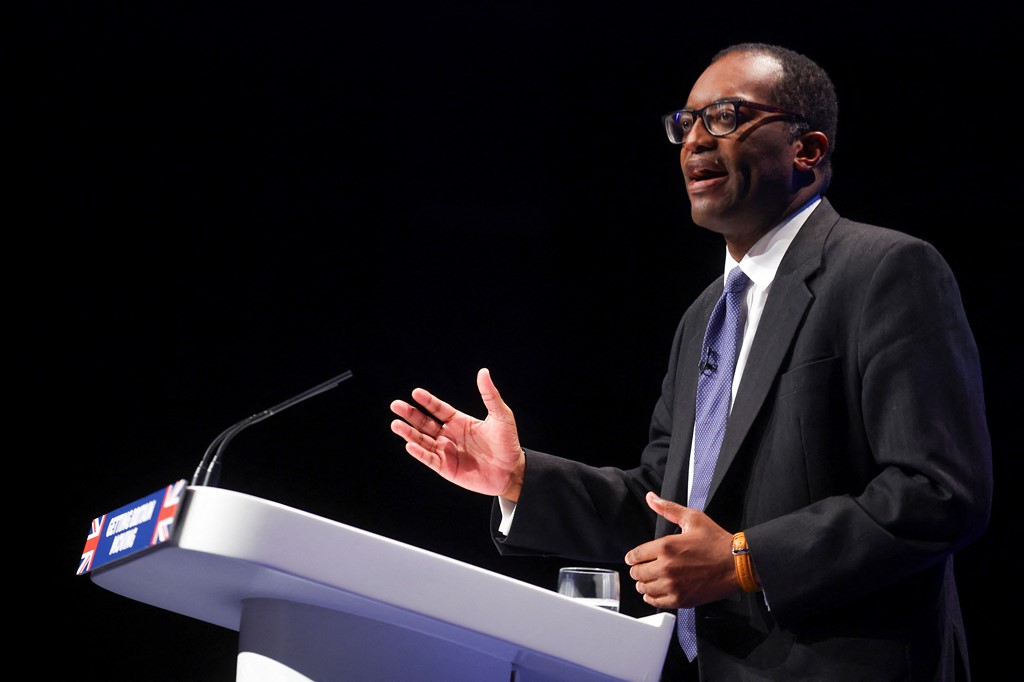
Giving his keynote Conservative Party conference speech following the 45p tax rate cut U-turn earlier this morning, Kwasi Kwarteng began by saying: “What a day.
“It has been tough, but we need to get on with the job in hand.”
The chancellor continues: “No more distractions, we have a plan and we have to get on and deliver it.”
But the chancellor acknowledges that his tax-cutting mini-budget caused economic turmoil, saying: “I know the plan we put forward 10 days ago caused a little turbulence. I get it.”
In order to resolve allegations made by the US Securities and Exchange Commission regarding a post on Kim Kardashian’s Instagram account, she has agreed to pay $1.26 million (£1.12 million).
According to the SEC, the reality TV actress did not declare she received $250,000 (£220,000) for endorsing a bitcoin asset on her feed.
The commission said the post was touting EMAX tokens, the asset security being offered by EthereumMax, and she was paid by EthereumMax, through an intermediary, but did not reveal the payment.
In June last year, Kardashianposted to her 331 million followers writing: “ARE YOU INTO CRYPTO??? THIS IS NOT FINANCIAL ADVICE BUT SHARING WHAT MY FRIENDS JUST TOLD ME ABOUT THE ETHEREUM MAX TOKEN.”
Her Instagram post contained a link to the EthereumMax website, which provided instructions for potential investors to purchase EMAX tokens.
Under US law, people who tout a certain stock or crypto security need to reveal not only that they are getting paid, but also the amount, the source, and the nature of those payments, SEC chair Gary Gensler said.
He also said the Kardashian case was “a reminder that, when celebrities or influencers endorse investment opportunities, including crypto asset securities, it doesn’t mean that those investment products are right for all investors”.
Lawyers for Kardashian released a statement saying she was pleased to have resolved the matter.
“Kardashian fully cooperated with the SEC from the very beginning and she remains willing to do whatever she can to assist the SEC in this matter,” the statement read.
“She wanted to get this matter behind her to avoid a protracted dispute. The agreement she reached with the SEC allows her to do that so that she can move forward with her many different business pursuits.”
Failing to disclose payment for promoting securities is a violation of federal law. The $1.26m (£1.12m) she paid includes her fee for the promotion, the interest and the $1m penalty.
The reality TV star isn’t the only celebrity to have been charged by the SEC over crypto promotions.
Boxer Floyd Mayweather Jr and music producer DJ Khaled were both charged in 2018 for allegedly not disclosing payments they received for promoting crypto coins.
A swan was seen on the railway line on Monday morning, which caused rush hour trains to be delayed for approximately an hour.
The bird was found on the tracks in Staines, Surrey, at about 8 am, stopping trains through the area towards Ascot in Berkshire.
South Western Railway’s Twitter account joked that “our very own Sgt Angel” dealt with the swan – a reference to the 2007 police comedy Hot Fuzz.
The film has a scene where Simon Pegg’s character Nicholas Angel and his partner chase an escaped swan through the town.
Network Rail’s Wessex route posted an image on its Twitter account showing the animal being carried in a bag.
“If you swan around on the railway, you get The Bag,” it said.
If you swan around on the railway, you get The Bag.
Thanks to our ops manager Chris for helping this feathered friend safely from the line at #Staines and to @SW_Help customers who had to wait for us to arrive.
The swan is off to a sanctuary to relax. pic.twitter.com/LI8kZnIlqt
Some affected passengers in Staines were not amused,with one tweeting: “Stuck on the bridge between Staines and Egham because ‘a swan is sitting on train tracks’… 50 minutes now passed. Can someone come and move the bird.”
In an effort to make its chocolates more environmentally friendly and prevent the roughly two billion wrappers that end up in landfills each year, Quality Street is doing away with the iconic colourful plastic packaging.
The change to the foil wrapping comes after 86 years and is expected to be made in time for Christmas.
Chocolates such as strawberry delight will continue to come in bright wrapping which will instead be coated in a vegetable-based wax.
Quality Street manufacturers Nestle said it believes people will respond “positively” when it unveils the new plastic-free wrappings in the coming weeks.
Head of sustainability, Cheryl Allen, said: “Quality Street is a brand that people feel very strongly about.
“We know that opening the lid and seeing ‘the jewels’, as we call them, is really important.
“We think we’ve done a really good job with the redesign and feel confident that people will respond positively.”
Around 1.7 billion Quality Street chocolates are enjoyed every year in the UK.
Nestle has been working for a number of years to reduce packaging and food waste across its products.
On its website, the company says: “Packaging helps protect food and beverages, ensure product quality and safety, communicate nutritional information and prevent food waste.
In his first public remarks on the unrest, Iran’s supreme leader blamed the US and Israelfor the anti-government rallies sweeping the nation.
Ayatollah Ali Khamenei claimed that Qurans had been destroyed and said that “riots” had been “manufactured” by Iran’s fiercest foes and friends.
Additionally, he urged security forces to be prepared to handle any future unrest.
The protests – the biggest challenge to his rule for a decade – were sparked by the death in custody of a woman.
Mahsa Amini, 22, fell into a comahours after being detained by morality police on 13 September in Tehran for allegedly breaking the strict law requiring women to cover their hair with a hijab, or headscarf. She died three days later.
Her family has alleged that officers beat her head with a baton and banged her head against one of their vehicles. The police have said there is no evidence of any mistreatment and that she suffered “sudden heart failure”.
Women have led the protests that began after Ms Amini’s funeral, waving their headscarves in the air or setting them on fire to chants of “Woman, life, freedom” and “Death to the dictator” – a reference to Ayatollah Khamenei.
After unrest at many universities, school protests are now spreading in Iran. In Shiraz, schoolgirls wave their head coverings in the air today chanting “death to the dictator” on day 18 of protests over the death of #MahsaAmini.#مهسا_امینیpic.twitter.com/rCIhihzR7U
Iranian schoolgirls remove their head coverings and chant “mullahs must go away” today, on day 18 of protests over the death of #MahsaAmini in morality police custody for “improper hijab” amid mass arrests of activists and an internet shutdown.#مهسا_امینیpic.twitter.com/a01ILrgOlS
Addressing a graduation ceremony of police and armed forces cadets on Monday, the supreme leader said Ms Amini’s death “broke our hearts”.
“But what is not normal is that some people, without proof or an investigation, have made the streets dangerous, burned the Quran, removed hijabs from veiled women and set fire to mosques and cars,” he added, without mentioning any specific incidents.
The ayatollah, who has the final say on all state matters, asserted that foreign powers had planned “rioting” because they could not tolerate Iran “attaining strength in all spheres”.
“I say clearly that these riots and the insecurity were engineered by America and the occupying, false Zionist regime [Israel], as well as their paid agents, with the help of some traitorous Iranians abroad.”
He also gave his full backing to the security forces, saying that they had faced “injustice” during the unrest.
Iran Human Rights, a Norway-based group, said on Sunday that at least 133 people had been killed by security forces so far. They include 41 protesters whom ethnic Baluch activists said had died in clashes in Zahedan on Friday.
Ayatollah Khamenei’s comments came a day after security forces violently cracked down on a protest by students at Iran’s most prestigious science and engineering university, reportedly arresting dozens.
The BBC’s Kasra Naji says the gunfire heard around the campus of Sharif University of Technology in Tehran on Sunday night spread fear among many Iranians that authorities had decided to make an example of the students.
Security forces tried to the enter the campus, but the students drove them back and closed all the entrance gates.
But, our correspondent adds, a siege developed and the students who tried to leave through an adjacent car park were picked up one by one and beaten, blindfolded and taken away.
In one video posted on social media, a large number of people are seen running inside a car park while being pursued by men on motorbikes.
Breaking: #Iran security forces have laid siege to #Sharif university of Tehran. Many students and professors have been beaten up, some students are entrapped inside. The security forces are rounding up students. Shots can be heard in these videos… #MahsaAminipic.twitter.com/gx9Bugu4ea
The siege was lifted later in the night following the intervention of professors and a government minister.
On Monday, students at the university announced that they would not go back to classes until all of their fellow students had been released from detention. The university meanwhile said it had moved classes online, citing “the need to protect students”.
People expressed their “thrill” and pride at seeing the King and his wife at Dunfermline, Fife, where they were attending one of the royal couple’s Monday engagements.
King Charles and the Queen Consort have carried out their first official engagement together since royal mourning ended.
Hundreds of people lined the streets in Dunfermline to greet the couple as they left the city chambers.
They were seen chatting, smiling and shaking hands with people who had waited patiently for their arrival – with the monarch even being offered a free haircut.
When asked if he would like to go into a local barber’s shop, King Charles smiled and said “next time”.
The crowds were “thrilled” with the royal visit. Teacher Carol Williams, 52, who was waiting to catch a glimpse of the couple, said “it’s such an honour for Dunfermline to be his first visit as the new King”.
It was the first time King Charles and the Queen Consort had carried out a public engagement since the Queen’s funeralon 19 September.
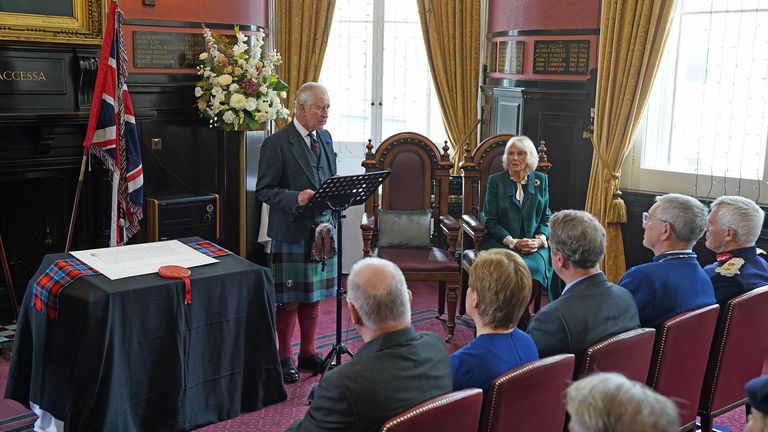
Before spending time with the crowds, the royals had attended an official council meeting where the King formally marked the conferral of city status on Dunfermline and signed a guest book.
During the ceremony, the King said he was “delighted” when it was announced the town would become a city.
He said he hoped people would feel a “real sense of pride in this new chapter”.
The Fife city was one of eight places to be awarded its new status as part of the late Queen Elizabeth’s Platinum Jubilee celebrations.
Scottish First Minister Nicola Sturgeon was also at the chambers for the royal engagement.
King Charles and the Queen Consort then visited Dunfermline Abbey to mark its 950th anniversary and to see the resting place of Robert the Bruce.
Image:The King and Queen Consort attend the council meeting in Dunfermline
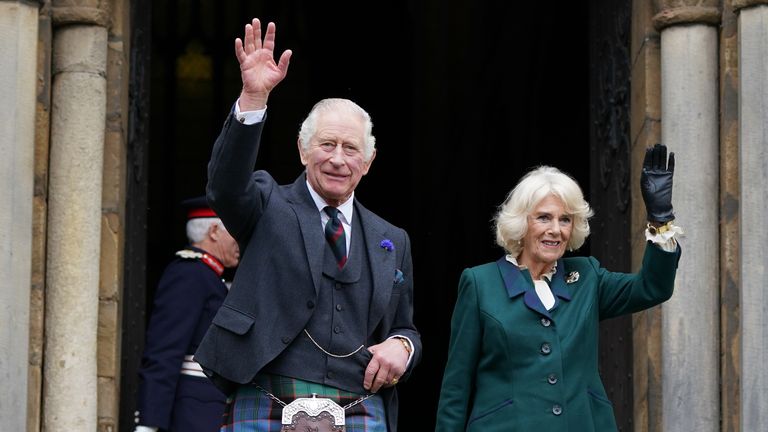
Image:The royal couple wave to the crowd as they leave Dunfermline Abbey
They were again greeted by crowds of well-wishers and met officials from Historic Scotland to learn more about the conservation of the site.
The King and his wife will be hosting a reception at the Palace of Holyroodhouse in Edinburgh later on Monday to celebrate British South Asian communities.
They are expected to meet between 200 and 300 guests of British Indian, Pakistani, Bangladesh, Sri Lankan, Nepalese, Bhutanese and Maldivian heritage from across the UK.
The event will recognise the contribution many from these communities havemade to the NHS, arts, media, education, business and the armed forces.
Polish Foreign Minister Zbigniew Rau formalized Poland’s demand for reimbursement before a visit by Berlin’s top diplomat by signing a diplomatic note to Germany on World War II reparations.
The action on Monday comes after Poland’s ruling nationalists claimed that Germany owed their nation 6.2 trillion zlotys ($1.26 trillion) in debt last month.
“[The note] expresses the position of the Polish minister of foreign affairs that the parties should take immediate steps to permanently and effectively … settle the issue of the consequences of aggression and German occupation,” Rau told a news conference.
Lukasz Jasina, Poland’s foreign ministry spokesman, told reporters that Rau would raise the issue with his German counterpart Annalena Baerbock during her visit to Warsaw on Tuesday.
The damages
About six million Poles, including three million Polish Jews, were killed during the war, and Warsaw was razed to the ground following a 1944 uprising in which about 200,000 civilians died.
In 1953, Poland’s then-communist rulers relinquished all claims to war reparations under pressure from the Soviet Union, which wanted to free East Germany, also a Soviet satellite, from any liabilities.
Poland’s ruling nationalists Law and Justice (PiS) say that agreement is invalid because Poland was unable to negotiate fair compensation.
It has revived calls for compensation since it took power in 2015 andhas made the promotion of Poland’s wartime victimhood a central plank of its appeal to nationalism.
The combative stance towards Germany, often used by PiS to mobilise its constituency, has strained relations with Berlin.
A central bank poll,indicates that the business climate for Japanese manufacturers deteriorated in three monthsbetween July and September as the third-largest economy in the world struggled with rising expenses, a falling yen, and pandemic restrictions.
Big manufacturers’ business outlook fell to plus 8 in September from plus 9 in June, the Bank of Japan’s “tankan” survey showed on Monday.
Service sector sentiment improved slightly from three months ago, the survey showed, although retailers were less optimistic due to rising living costs stemming from higher commodity prices and the weakening yen.
The index measures corporate sentiment by subtracting the number of companies saying business conditions are negative from those that view them as positive.
Japan’s economy is under strain as the plummeting yen exacerbates the cost of living pressures sparked by Russia’s invasion of Ukraine.
The declining value of the yen, which last month hit a 24-year low against the US dollar, has driven up the cost of food and energy imports, burdening households and retailers.
Asia’s second-largest economy, which has struggled with stagnant growth for decades, is also grappling with more than two and a half years of pandemic-related border restrictions that are set to be lifted from October 11.
Japan’s economy grew an annualised 3.5 percent in the second quarter, but analysts expect it to have slowed in the third quarter as slowing global demand and rising materials costs sap exports and consumption.
As part of an expedited initiative to utilise gas discharged as a byproduct of oil production, Nigeria will award contracts for its flared gas by the end of December, according to the country’s petroleum regulator.
President Muhammadu Buhari first launched the programme to auction rights to capture and sell flared gas in 2016. Four years later, the government approved 200 bidders but the process was stalled due to the outbreak of the coronavirus pandemic.
On Sunday, Nigerian Upstream Petroleum Regulatory Commission chief executive Gbenga Komolafe said the auction was being restarted and would be open to previous applicants and new bidders.
“The auction process has been streamlined to enable an accelerated delivery schedule for this exercise with the announcement of winners planned for December 2022,” Komolafe said in a statement.
The government has said flaring costs it roughly $1bn a year in lost revenue. The gas can be used in power plants, in industry or exported.
Last month, Petroleum Minister Timipre Sylva said Nigeria’s plan to commercialise gas burned from its oilfields was at an advanced stage and would help cut 15 million tonnes of carbon emissions from the atmosphere.
Nigeria, which has Africa’s largest gas reserves of more than190 trillion cubic feet, first targeted gas flaring in the late 1970s and, through various schemes and regulations, has more than halved it since 2001.
Stockton Police have said they could be a suspect or a witness.
Rewards totalling $85,000 (£76,000) are being offered for information leading to an arrest after the shootings.
Stockton Police Chief Stanley McFadden said the latest victim was a 54-year-old man, who was shot dead in a residential area.
He was the fifth man fatally shot since 8 July within a radius of a few square miles in Stockton.
A top Iranian official has urged security forces to deal with protesters harshly as videos emerged of people running down a street while gunfire rang out.
Some of the most serious protests in the country for years have been taking place over the past two weeks following the death of Mahsa Amini.
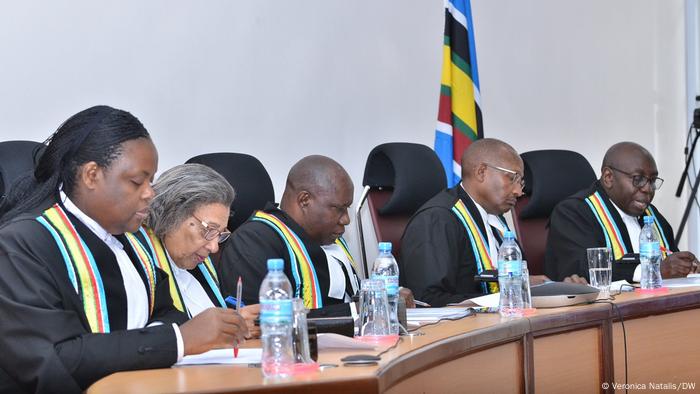
The five-member bench has accepted Khan’s written apology for comments he made against officials during a rally in August.
A court in the Pakistani capital Islamabad has accepted former Prime Minister Imran Khan’s written apology for comments he made against a female judge in August, relieving him of a contempt case.
The five-member bench, led by Islamabad High Court (IHC) Chief Justice Athar Minallah, expressed its satisfaction with the apology on Monday, adding that the verdict was unanimous.
Khan was charged with contempt of court following a speech he made at a public rally in Islamabad on August 20, during which he threatened “action” against Judge Zeba Chaudhry and senior Islamabad police officials for arresting his top aide Shahbaz Gill, whom he accused police of torture in custody.
Gill was charged with attempting to incite a mutiny in Pakistan’s powerful military after remarks made on a TV show, an allegation Khan’s Pakistan Tehreek-e-Insaf (PTI) party denies.
Khan had initially refused to apologise for his comments but did so eventually, in the last hearing on September 22.
If he had been convicted, he could have been disqualified from running in the next election, which is scheduled for October next year.
Khan still has another case before the courts regarding the same comments in the August speech, for which he was granted bail on Sunday after an arrest warrant was issued a day before. He has been charged under various sections of the Pakistan Penal Code for the same speech.
He had also been charged under the country’s terrorism laws for the August 20 speech, but a court dropped the charges last month. The IHC had said Khan’s comments did not warrant charges under the harsh Anti-Terrorism Act, which carries a maximum sentence of life in prison and even capital punishment.
Khan’s government was toppled via a parliamentary vote of no confidence in Aprilthis year and since then he has been conducting rallies across the country, demanding early elections.
He has also alleged a US-led foreign regime change conspiracy behind the removal of his government, which both US and Pakistani officials have denied.
A senior government official has stated that fans who showed Nazi salutes and insignia during the Australia Cup final “should be banned for life.”
After initiating disciplinary proceedings, Football Australia (FA) stated that it “seriously condemns the behaviour of a small minority” of Sydney United 58 supporters.
New South Wales state Premier Dominic Perrottet said the behaviour of some supporters was “absolutely horrendous”.
The club said it was “concerned” by reports of the actions of supporters.
In a statement, Sydney United 58 said it had “zero tolerance towards any form of disrespect, racism or discrimination”.
Supporter attempts to drown out the Indigenous welcoming ceremony prior to kick-off at Western Sydney Stadium are also being investigated.
FA said on Monday it had issued a show-cause notice to semi-professional side Sydney United 58, this requiring the club to respond before any sanctions are implemented.
The governing body added it was working with New South Wales police “to determine strong and swift action on any identified anti-social behaviour”.
Pictures on social media showed some Sydney United supporters making Nazi salutes during the match.
“It has no place, not just at sporting games, but anywhere in our state, and I know the police are looking at it,” said Perrottet.
“Those people who have done that through those salutes should be banned for life.”
The chanting and booing during the pre-match Welcome to Country – a practice of Aboriginal and Torres Strait Islander peoples – will be considered as part of the FA investigation.
“The incidents last night caused by some individuals and groups in the stadium was ignorant,” said Jade North, chair of the Football Australia National Indigenous Advisory Group (NIAG).
“This type of behaviour was disrespectful and must not continue in our game and attitudes must change.”
The first non-A-League side to reach the final, Sydney United 58, formerly known as Sydney Croatia, lost 2-0 to Macarthur FC in front of a crowd of 16,461 on Saturday.
“The club is deeply committed to creating an environment that is respectful and inclusive, which allows our community members to celebrate their heritage in a meaningful and responsible way,” the club’s board said.
“Those that do not align themselves with these values are not welcome at Sydney United 58 FC and their views will never be tolerated.”
FA said eight people were evicted during the match “to address some isolated behaviours by a small minority of individuals”.
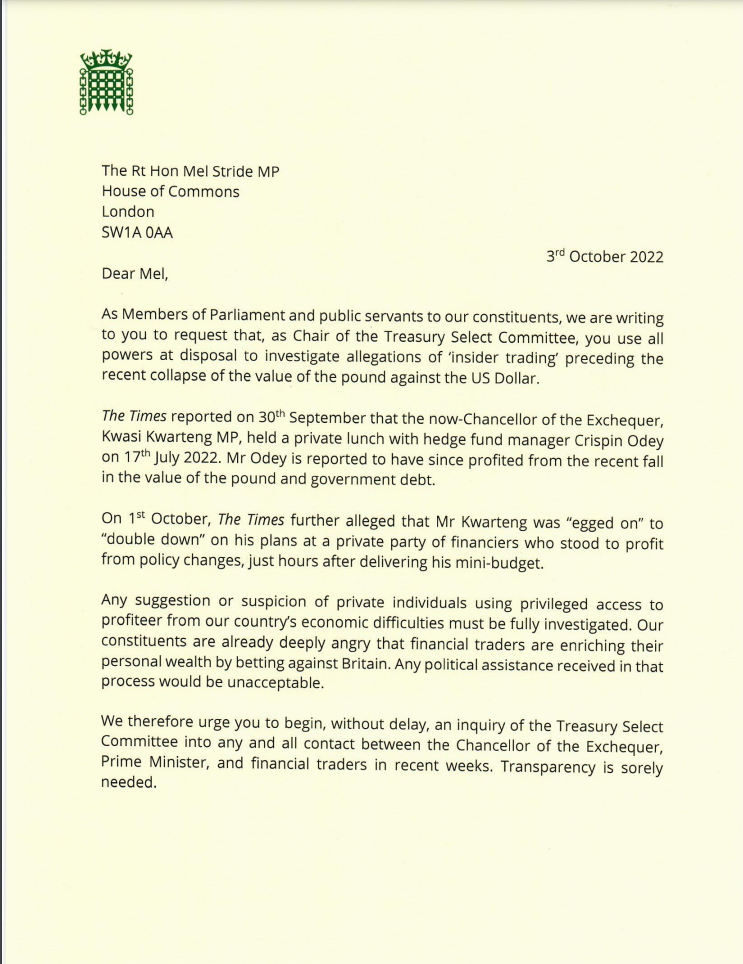
An investigation into “allegations of ‘insider trading’ before the recent collapse in the value of the poundagainst the US Dollar” is being pressed on the Treasury select committee’s Conservative chairman.
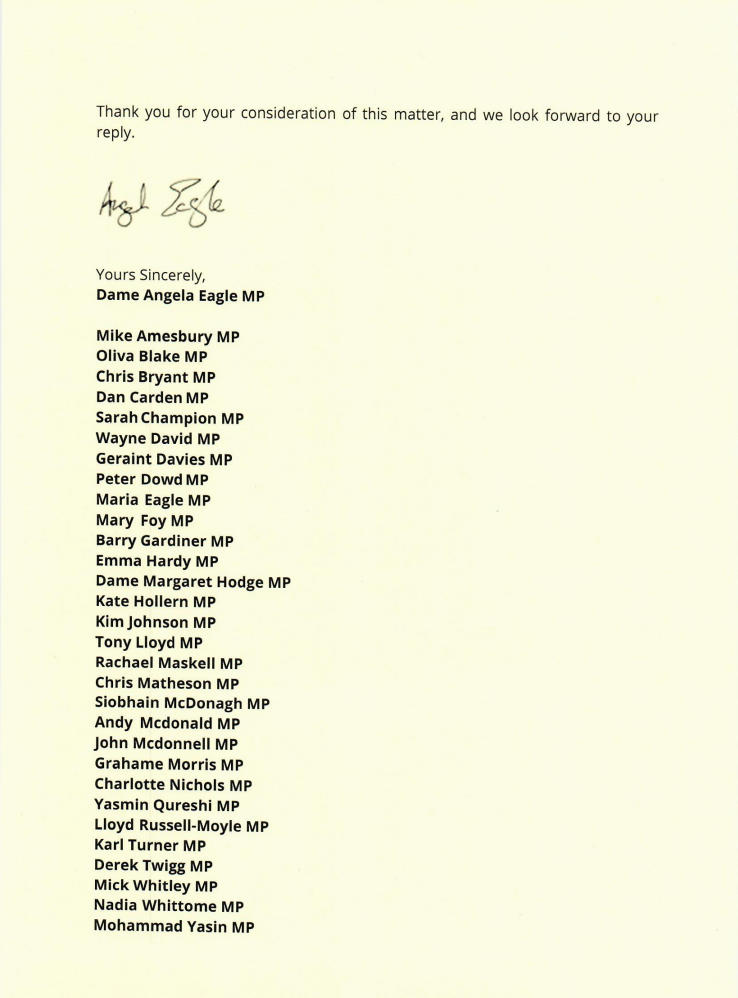
Senior Labour MP Dame Angela Eagle, a member of the select committee, has written to chair Mel Stride requesting the cross-party group investigate any meetings held between financial traders and the chancellor and prime minister – before and after the mini-budget last week.
In her letter, she writes: “Any suggestion or suspicion of private individuals using privileged access to profiteer from our country’s economic difficulties must be fully investigated.”
Her letter has been signed by 31 Labour MPs.
It is the latest of several demands for investigations that have been made in recent days.
Yesterday, Lib Dem Treasury spokeswoman Sarah Olney said: “While struggling homeowners saw their mortgage bills spiral, it seems the chancellor was sipping champagne with hedge fund managers profiting from the falling pound.
Last week, shadow treasury minister Tulip Siddiq called on the Financial Conduct Authority to investigate whether “leaks” of last week’s mini-budget “contributed to the crash of the pound.”
A surgeon at the main hospital in the capital of Ethiopia’s Tigray region says that the 23-month civil war has led to patients dying needlessly because of a lack of medicines and treatments.
“We don’t have medicines for our patients, we don’t have surgical materials… we don’t have vaccines… we don’t have insulin,” Dr Fasika Amdeslasie told the BBC’s Newsday programme.
Tigray has been cut off for most of the conflict which has seen forces from Tigray clashing with Ethiopian federal troops and their allies since November 2020.
Some medicine has got through, thanks to the International Committee of the Red Cross and the World Health Organization, but the supply has been sporadic, Dr Fasika said.
He added that diabetic patients are dying because of a lack of insulin and kidney patients may also die because dialysis treatment cannot continue.
On top of this, Dr Fasika says that the staff at the hospital have not been paid for 17 months.
“We are trying to save those who we can… but it’s difficult now to save those who can be saved,” he concluded.
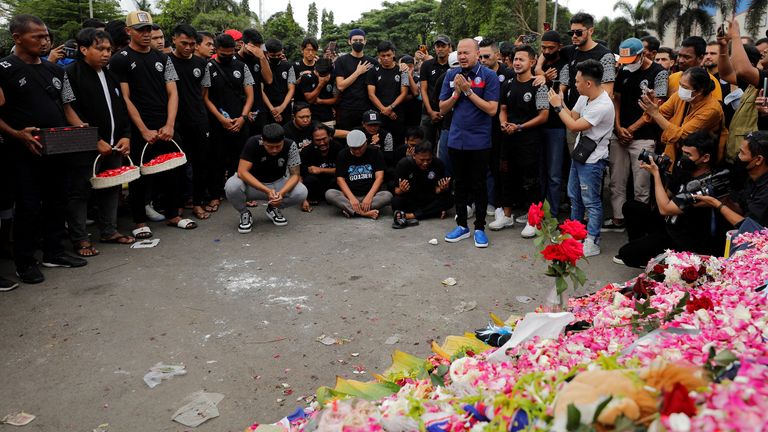
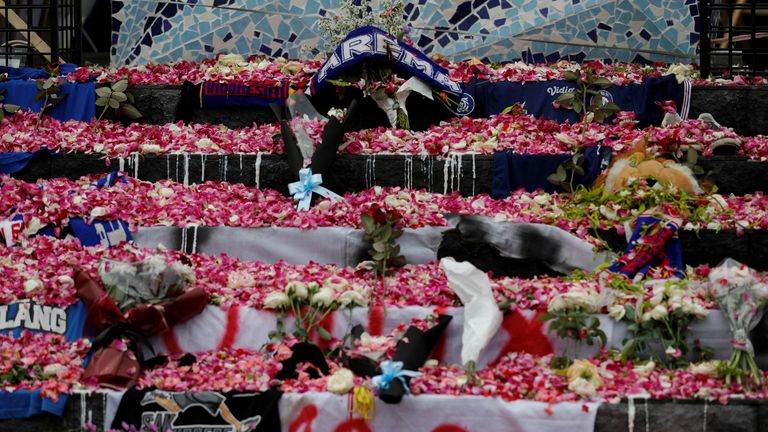
Some of the 42,000 Arema fans flung bottles and other missiles at players and officials and at least five police vehicles were toppled and set alight outside the stadium.
Riot police trying to stop the violence fired tear gas in the stadium, triggering panic in the crowd and sparking the crush as they stampeded for the exits.
Most of the 125 people who died were trampled or suffocated.
Image:Arema FC players and officials pray for the victims
Police chief Listyo Sigit Prabowo said in a news conference: “I ensure that investigation on this case will be conducted thoroughly and seriously.”
President Widodo has ordered a suspension of the Indonesian premier league until safety is re-evaluated and security is tightened.
The nation’s football association has also banned Arema from hosting any matches for the rest of the season.
Human rights group Amnesty International has urged the Indonesian governmentto investigate the use of tear gas at the stadium and ensure that those found in violation are tried in open court.
Police are still questioning witnesses and analysing footage from 32 security cameras inside and outside the stadium and nine mobile phones owned by the victims, as part of the investigation to identify suspects.
The 18 officers responsible for firing tear gas as well as security managers are also under investigation.
‘A tragedy beyond comprehension’
FIFA, which has no control over domestic games, has previously advised against using tear gas at stadiums.
Hooliganism is rife in Indonesian football, with fanaticismoften spilling over into violence.
Prior to the stampede on Saturday, 78 people have died in game-related incidents over the past 28 years, according to data from Indonesian watchdog Save Our Soccer.
Thomas Cashman is also charged with the attempted murder of the girl’s mother Cheryl Korbel and convicted burglar Joseph Nee, as well as two counts of possessing a firearm with intent to endanger life.
Thomas Cashman, 34, appeared at Liverpool Magistrates’ Court this morning.
The case has been sent to Liverpool Crown Court where it will be heard at 2pm today.
Olivia was fatally shot by a gunman who chased convicted burglar Joseph Nee into her home in Dovecot on 22 August.
Her mother Cheryl Korbel, 46, was injured in the shooting, which happened just after 10pm.
Cashman, of Grenadier Drive, West Derby, is also charged with the attempted murder of Ms Korbel and Nee, as well as two counts of possessing a firearm with intent to endanger life.
Cashman, wearing a pale T-shirt, was in handcuffs in the dock and surrounded by four police officers. He spoke to give his name, date of birth and address.
The court heard the case could only be dealt with by the crown court.
Eight years after the war started in eastern Ukraine and six months after Russia launched a full-scale invasion, Kyiv is facing a major mining problem. With an estimated 160,000 square kilometers contaminated by landmines, Ukraine is now one of the world’s most heavily mined countries. To put that in perspective, that is an area almost double the size of Ireland.
The United States has led the effort to tackle this leviathan issue, pledging $89m to fund 100 anti-mining teams in Ukraine for the next year. This is a concrete move that will see some results. But it will not be enough. A mere $2 to plant, each mine costs up to $1,000 to remove.
To gauge the scale of the problem, look to the Karabakh region in the South Caucasus. In the early 1990s, it became one of the most intensely-mined areas on Earth after the first Nagorno-Karabakh War between Azerbaijan and Armenia. A conflict in late 2020 reversed much of the territory the former had lost in the first conflict – and granted it access to mine-strewn lands. Azerbaijan has since begun making the liberated territories safe for post-conflict reconstruction. To date, 514sq km have been cleared. For those involved in the industry, this may sound impressive, but 11,270sq km still remains uninhabitable.
The problem with mine clearance is the cost. Azerbaijan is better economically placed than most to fund activities and still, it could only clear 514sq km in two years. In general, the countries that need demining the most are those least able to afford it, as conflicts that contaminate territories with landmines also shatter economies. To ensure funding, a landmine-free world should be made a United Nations Sustainable Development Goal (SDG), alongside the 17 interlinked global goals to be achieved by 2030.
This idea was put forward and discussed at the Humanitarian Conference on Mine Action, organized by the Azerbaijan Mine Action Agency and the United Nations Development Programme (UNDP) in Baku earlier this year. Current international treaties are not enough, nor are national programmes.
According to a report by the demining monitor Mine Action Review, only 153.4sq km were cleared across the world in 2020. It also rated less than a quarter of national demining programmes as “good” or “very good”; the rest were too underfunded to make any significant progress. That does not bode well for Ukraine.
However, if demining is given SDG status, the benefits would be felt immediately. First, this designation would help coordinate global efforts, bring access to international financial mechanisms and ease the burden on underfunded national programmes.
Second, an SDG status would help to ring-fence that funding, putting budgets for demining on the same footing as, for instance, education development programmes. In a post-war, post-COVID setting where funds are limited, this is critical.
Third, SDGs attract more funding for research and development, as we have seen with efforts to promote clean energy and sustainable cities. Simply throwing money at demining is not enough: the cost per unit for removal needs to come down.
However, perhaps the strongest argument for making a mine-free world an SDG is the simplest: it should be. In areas contaminated with mines, development, let alone sustainable development, is impossible.
According to a 2017 joint study by the Geneva International Centre for Humanitarian Deminingand the UNDP, mine action is of direct relevance to 12 of the UN’s existing SDGs, while indirectly supporting another four. Take SDG number two: to end hunger, achieve food security and achieve sustainable agriculture. Where mines cover large swathes of farmland – as they do in Ukraine – they directly impact a country’s ability to produce its own food. Or take SDG number four: to ensure equitable and inclusive education. Mined areas can make it much more difficult for children to reach school and even educational facilities themselves may be mined during a conflict. This inevitably impacts school enrolment and access to education.
Landmine-strewn lands are not a new problem. But a new solution is needed. If we are to ever see a world free of them, we need to see them as a social development issue, rather than a technical or military one.
If it can be said that there is a silver lining to the horror we are witnessing in Ukraine, it has thrust the world’s attention back to the critical efforts of demining in conflict and post-conflict zones. That attention should be harnessed to ensure we make it an SDG. After all, SDGs are all interlocking. Without widely supported global demining efforts, there is no hope of achieving the other goals.
The death and funeral of Britain’s Queen Elizabeth II have rightly provided many occasions for exploring the often ignored, brutal history of British colonialism – the story of the country’s murderous subjugation and plunder of populations across the world and the royal family’s role in it.
It was gratifying to see so many people refuse to be railroaded into mourning the passing of perhaps the most visible symbol of that history. However, I couldn’t help but notice a significant divide.
While their subjects seemed keen to highlight past British crimes, the present-day rulers of former UK colonies were less enthusiastic. In fact, almost unanimously, they joined in memorializing Elizabeth II, flying flags at half mast, extolling her virtues as a symbol of dedication to duty, and even flying to London by the dozen to attend the funeral.
It is interesting that amid all the exhumations of the past, there was so little discussion on how that history is playing out in the present. Here’s the truth: Even as we condemn the British and European exploitation of what they considered their colonial possessions, many of us continue to live our lives surrounded by reminders of their time here, decades after “independence”.
A week before the queen’s death, Kenya’s Supreme Court had begun hearing challenges to the declared result of the August 9 presidential election, which had delivered victory to William Ruto. The robes and wigs that the lawyers and judges bedecked themselves in as well as the archaic manner of address – My Lords and My Ladies – are all traditions borrowed from Mother England.
For many former colonies, political independence did not really mean decolonisation. As a political scientist and anthropologist Partha Chatterjee put it in an interview published in Nermeen Shaikh’s book, The Present as History: Critical Perspectives on Global Power, “many of the postcolonial state forms … replicated quite consciously the forms of the modern state in the West”.
Of course, there have been exceptions such as Thomas Sankara in Burkina Faso who understood decolonization as a revolutionary, experimental process centred on the intellectual liberation of ordinary people, who would be responsible for their own empowerment.
Still, scholars like Mahmood Mamdani have argued that post-independence leaders, especially in Africa, focused on deracialisation – undoing white domination through Africanisation and nationalisation – rather than decolonisation. “Everywhere, decolonisation began with deracialisation,” he once noted.
Sadly, once local elites secured for themselves the privileges, resources, and opportunities formerly reserved for white people, they never sought deeper decolonisation. Deracialisation without decolonisation in turn left so-called independent national governments vulnerable to influence and pressure from foreign interests because their umbilical cords to colonial-era systems and practices had never been snapped.
In fact, many liberators did end up like the pigs in George Orwell’s Animal Farm – retaining or recreating the very same colonial structures they had once railed against. In Kenya, for example, as related by former Attorney General Githu Muigai in a 1992 paper, the attempt to impose a liberal constitution on the authoritarian colonial administrative structure at independence failed, with the former adapting to the latter rather than the other way around.
More recently, Ruto and his former boss and predecessor as president, Uhuru Kenyatta, have since 2013 been tasked with imposing a new constitution, promulgated in 2010, on the existing authoritarian colonial state, but to a large extent have backtracked on that.
In a throwback to what his father, the first post-independence president, Jomo Kenyatta, did to the new constitution at the time of independence, Uhuru in his second and final term even attempted to introduce amendments meant to weaken constraints on corruption. These amendments, eventually blocked by the country’s top court, focused on enabling power-sharing governing arrangements by multiplying the number of available state positions – president, deputy presidents, prime minister, deputy prime ministers, and the official leader of the opposition – that could be distributed among partners. Of course, this would have revived the associated opportunities to loot the exchequer that had existed prior to 2010.
The evidence is therefore clear: Even this latest generation of rulers, which has inherited colonial states relatively intact, sees former European masters as its political kin.
The passing of Elizabeth II provides an opportunity to do much more than debate the past. It should also provoke a long overdue self-examination that acknowledges our own role in preserving the colonial heritage we inherited from Europe, and rebooting the project of decolonisation that was aborted at independence.
The idea behind such a conversation is not to recreate the pre-colonial past. As Chatterjee noted, it is a dialogue “about whether a different modernity is possible”. It is a debate that would benefit even Western nations that seem to have trouble defining themselves outside frameworks created by imperialism that had placed them at the top of the pile.
Of course, we wouldn’t be starting from scratch. Many thinkers and writers working outside Western frameworks, from Frantz Fanon to Ngugi wa Thiong’o, have laid the groundwork for the monumental project of cleaning up the political, social, economic, and cultural mess left behind bythe likes of Elizabeth II.
However, to do this, we must not only remember the past, but must also confront its presence in the present. And that means dealing with our own post-independence failure to birth “a different modernity”.
DISCLAIMER: Independentghana.com will not be liable for any inaccuracies contained in this article. The views expressed in the article are solely those of the author’s, and do not reflect those of The Independent Ghana
Next month, King Charles III will host South African President Cyril Ramaphosa for three days of high-level negotiations in the United Kingdom. This will be the first official visit since the king succeeded his late mother Queen Elizabeth II last month.
In a statement on Monday, Buckingham Palace announced that Ramaphosa has accepted Charles’s invitation for a state visit from November 22 to 24.
The South African leader will be accompanied by First Lady Tshepo Motsepe.
South Africa is a member of the Commonwealth, a political association of 56 countries, mostly former British colonies.
Ramaphosa’s predecessors Nelson Mandela, Thabo Mbeki, and Jacob Zuma, the other presidents the country has had since its first multi-ethnic elections in April 1994, have also previously made state visits to the UK.
While still the prince of Wales and the Duchess of Cornwall, Charles, and Camilla, the queen consort, welcomed former South African President Jacob Zuma to the UK at the start of a state visit in 2010.
The new monarch has visited South Africa on several occasions since 1997. At Mandela’s funeral in 2013, he said the world would be a “poorer place” without the man who led South Africa’s transition from apartheid to multi-ethnic democracy, adding that Mandela was owed “an enormous debt of gratitude” for his achievements.
The visit comes as Ramaphosa faces a huge scandal back at home. Arthur Fraser, the former head of the country’s spy agency has accused the president of kidnapping, bribery, money laundering, and “concealing a crime” in relation to the alleged theft of $4m in cash found at his Phala Phala game ranch in northern South Africa.
Four-year-old Teona sits in a room filled with purple beanbags and other sensory toys, patting an inflated balloon vigorously with both her hands. She seems cheerful and vivacious, occasionally crying out in joy. Speaking to her in a kindly, the measured tone is a play therapist, Sofia. Her job is to help Teona improve her social skills. Watching the two interact, it’s hard to imagine that the last few months have been intenselytraumatic for Teona in ways that she cannot articulate.
For now, she is safe at the Dzherelo Children’s Rehabilitation Centre, an NGO offering rehabilitation services and treatment for young people with disabilities in the western Ukrainian city of Lviv. The journey was not easy, though. She and her mother, Viktoria Plyush, 33, fled by train, waiting fearfully at dangerous checkpoints before arriving on July 9, just over four months after Russian forces captured their hometown of Hola Prystan in the southern region of Kherson.
Teona has non-verbal autism, and before the Russians overran Hola Prystan she had been attending a kindergarten that provided play and speech therapy. For months, her mother clung to the hope that Ukrainian forces would liberate the area. Teona had been confined to their home for several months, unable to go to school or see any of her classmates, who had all gone to Poland or Romania with their families. She grew agitated, covering her ears and screaming constantly.
“All the facilities for children with developmental disabilities shut down because they refused to cooperate with the Russian occupiers, which we think is the honourable thing to do,” Plyush says. A mild-mannered woman with a determined gaze, she sits ramrod straight in her chair as she speaks, occasionally glancing at Teona as she plays with Sofia.
The family lived in fear. “Rockets were flying everywhere and there were no air raid sirens to warn us,” she recalls. The only times she left the housewere to dash out to the market to buy food. The last straw came when she heard about the Russian army kidnapping civilians or fighters with Ukrainian loyalties.
Teona wailed throughout the arduous two-day journey from Hola Prystan into Lviv.
Now, Plyush, her husband and Teona live with her sister in Lviv. Plyush is relieved that Teona can resume the therapy she needs, and not be isolated any longer.
Despite her sunny disposition and the friends she’s made at Dzherelo, Teona is still on edge following her ordeal. After months at home with Plyush in Hola Prystan, she also has separation anxiety, screaming if her mother is out of sight for more than a few minutes.
But it’s not just Teona who has needed extra care after all the stress she has endured. Yaroslava Nikashin, 35, an easy-going and warm social worker at Dzherelo, says that her work in recent months has focused on supporting parents and ramping up psychological help and counseling for caregivers. “Some of the parents like her [Plyush] seem calm, but on the inside, they’re also really scared and sad,” she says.
Despite worries that financing for NGOs like Dzherelo will dwindle as the war drags on and most financialaid is diverted to the armed services, Nikashin has made up her mind to continue her work. “We have to try and maintain both the quality and quantity of the services we offer and give as much as we can,” she says.
The Dzherelo centre, in a suburb of Lviv, offers treatment and rehabilitation services for disabled young people [Amandas Ong/Al Jazeera]
Challenges accessing support
As the Russian invasion grinds into its eighth month, Ukrainians with intellectual and physical disabilities – as well as their carers – continue to encounter huge challenges in accessing the support they need.
According to two Brussels-based NGOs, the European Disability Forum and Inclusion Europe, some 2.7 million people with disabilities are registered in Ukraine. Of these, an estimated 261,000 have intellectual disabilities. Both organisations have documented a drastic deterioration in the quality of life for Ukrainians with disabilities.
Some are unable to access medication or food, while those with developmental disabilities have seizures or become aggressive while frightened by shelling. In addition, wheelchair users or those with mobility issues are not able to access bomb shelters, so people with physical disabilities have no choice but to remain at home, leaving them at a disproportionate risk of death. Thousands more are believed to be trapped in care homes or poorly-maintained institutions, cut off from their communities and languishing in neglect.
Since the end of June, Dzherelo has been working with UNICEF and the Ukrainian government on an emergency intervention, dispatching mobile teams of medical experts to seven regions of western Ukraine, focusing on remote areas where children with physical impediments and developmental difficulties might struggle to receive the assistance they need. In total, Dzherelo has supported more than 750 families through this scheme and their Lviv facility.
Zoreslava Liulchak, the director of Dzherelo, says that in the early days of the war, the centre met people at the train station in Lviv who had carried their children for the entire journey from the east to western Ukraine, as they were not able to bring wheelchairs from home. “There’s also a big problem with leaving itself,” she adds. “The Russians often do not release people from the occupied territory.”
She cites the example of a rehabilitation specialist from Kherson who is nowworking at Dzherelo. Along with his two nephews who have cerebral palsy, he had to escape through Russian-controlled Crimea, as they were not permitted to leave via any other route. These stories are commonplace, Liulchak says, and such stressful journeys can “provoke complications in physical and psychological conditions” already experienced by children with disabilities.
A trampoline at the Dzherelo centre, which has helped more than 750 families through a joint emergency programme focusing on remote areas which started in late June [Amandas Ong/Al Jazeera]
Grueling, expensive work
Some 735km (575 miles) away in Galway, Ireland, 40-year-old Ukrainian disability rights activist Yuliia Sachuk is all too familiar with the frustrations faced by people with disabilities who are trying to evacuate to safety – whether to western Ukraine or abroad. As the chair and co-founder of Fight for Right, a female-led Ukrainian NGO for disability rights, Sachuk and her team of nearly 30 have been overworked arranging the delivery of essential medications, financial support and legal advice for more than 4,100 individuals in the disabled community since the end of February.
Sachuk was studying for a master’s in disability law in Galway when she returned home in early 2022 as tensions were rising in eastern Ukraine. She fled the country in the late hours of February 24, following the invasion, with her 17-year-old son and sister after hearing about a bombing near a medical facility for people with disabilities. Their train from Kyiv kept stopping amid explosions and she frantically texted other activists in neighbouring countries for help. One of her contacts helped the family get to Romania, and eventually to Ireland. Her husband has remained in Ukraine and is volunteering with the Territorial Defence Forces.
Sachuk says her work has been non-stop, gruelling and expensive. Arranging a medical evacuation for a person with disabilities, especially from the worst-affected cities, can cost the equivalent of $5,100 to $10,300 – in part due to the equipment needed.
The group started a GoFundMe online crowdfunding campaign to help with evacuations and support those who cannot leave with food and medicine. As of late September, it has raised 481,096 euros ($464,188) of its 700,000-euro ($675,390) goal. According to Sachuk, requests for help from people with disabilities continue to stream in.
Aside from receiving initial guidance from two US-based organisations – the Partnership for Inclusive Disaster Strategies and the World Institute on Disability – on how to set up Fight For Right’s response strategy, Sachuk says they were let down by other international disability charities.
“In the first months of the war, all these organisations were not helpful at all when it comes to direct support. Nobody worked with us,” Sachuk says. “If [we’re talking about] getting a person here and now to help a disabled person to their car, or to buy some food or medicine, all of these organisations have failed.” Ukrainian disability organisations were left on their own to save people, she says.
With sadness, she recalls the first few months of the war when she received goodbye calls and messages from people with disabilities in occupied regions. “They were stuck in their houses and they didn’t have the possibility of evacuation,” she says.
Sachuk knows intimately what it means to live with a disability. Born in the western Ukrainian city of Lutsk with severe congenital visual impairment, she was in and out of hospital throughout her childhood as she underwent multiple eye surgeries. Her sight is still poor today but she says she manages to get by with the aid of magnifying glasses and enlarged letters on computer screens. “When you have lived with this for all your life, you get used to it, and stop thinking of it as a problem,” she says.
She credits her parents for fighting for her to attend a state-run school, instead of one of the boarding schools for children with disabilities that are infamous for rampant abuse and mistreatment. At school, she was bullied by classmates.
She remembers hearing stories about children with disabilities who were confined to their homes as some parents were ashamed of them. “It was just not talked about so much in the past,” she says.
Sachuk is proud of how Fight for Right has brought people with disabilities safety and comfort. She recalls how, in June, her team helped organise the delivery of a prosthetic breast from Germany to a woman in the northeastern city of Kharkiv in Ukraine. The woman had had a mastectomy following a breast cancer diagnosis and was also suffering from mobility problems. “She was just so, so happy. She couldn’t believe it was possible,” Sachuk remembers.
Routine is critical
One formidable task for NGOs working with people with developmental disabilities is the pressure to provide stability amidst the turmoil of war. Routine is especially important for children with autism; disarray can jeopardise any progress that comes with therapy.
Anna Perekatiy, founder of the Start Centre in Lviv, an NGO that supports children with developmental disabilities, says 35 displaced families from regions in eastern Ukraine that were shelled intensely by the Russians, such as Kherson, Donetsk and Mykolaiv, have come to her for help since the start of the war. They have children with a range of physical, developmental and learning disabilities. Some 90 percent of them have autism.
“These children need stability, they need permanent therapy to help them develop crucial skills,” says Perekatiy, who has a 12-year-old son with autism. She stresses that children’s development deteriorates quickly when pedagogical therapy is put on pause.
Olha Chermayina, left, and her daughter Alisa, who has non-verbal autism, play at the Start Centre. When their city of Berdyansk was occupied in late February, Alisa’s speech therapy was disrupted [Amandas Ong/Al Jazeera]
Two-year-old Alisa has non-verbal autism – a diagnosis that she only formally received upon arriving in Lviv from her home in Berdyansk in southeastern Ukraine. Her mother, 37-year-old Olha Chermayina, cries as she describes how Alisa’s behavior changed when the Russian occupation began. “She stopped making eye contact and shut down completely,” Chermayina recalls. As doctors fled the city, there was no proper medical care for children, and Alisa had no access to speech therapy.
When the family began to feel the impact of food shortages, they decided to flee. Upon arriving in Lviv, Chermayina and her husband Shota took Alisa to a children’s hospital, where a doctor confirmed she had autism. “He said we would have to start her treatment right from the beginning,” Chermayina says. “We’re taking a risk in staying here, but … we don’t know if she’ll get the care she needs if we go abroad, and there’s no guarantee that she can get used to it there.” Today, Alisa goes to the Start Centre five times a week.
Many children with disabilities were deprived of educational opportunities once the war started, as they could not partake in the online learning offered in mainstream schools. Perekatiy is also frustrated by the lack of governmental support, with the majority of rehabilitative services provided by NGOs like hers. She says the “old Soviet education system”, where the learning needs of people with disabilities were largely ignored, has meant that those who need support still feel stigmatized. Though she is optimistic that attitudes are changing, she worries that recognition of these needs won’t come quite fast enough for those most affected by the war.
Nine-year-old Milena, her hair in braids, who is from Bilytske in Donetsk, enjoys a play session at the Dzherelo centre [Amandas Ong/Al Jazeera]
Structured environment
Even for children with intellectual disabilities who may not have outwardly shown signs of trauma, a structured environment is just as important for their development. In Dzherelo’s spacious garden, with its trampoline and playground, Olena Filippova watches her daughter, nine-year-old Milena, play with other children.
At the beginning of April, Filippova travelled with Milena, who has Down’s Syndrome, westward from their home city of Bilytske in Donetsk. Unable to get on a bus to Poland, she decided to stay in Lviv and enrol Milena at Dzherelo for play therapy five days a week. For the time being, the pair lives in an overcrowded dormitory for internally displaced people where the conditions are dismal. But Filippova, 49, a secondary school teacher, hopes to secure a teaching job in the autumn.
Milena, who has limited speech and communicates predominantly with gestures, is curious and observant, having picked up new words in Ukrainian simply by listening to other people. Since she grew up speaking Russian, the linguistic switch is particularly remarkable. “But she’s very mischievous,” Filippova laughs. “Once she knows a new word, she’ll say it once but refuse to repeat it. It’s like she’s making fun of me.”
For Milena, it was only after the war started that she began receiving specialist care. In Bilytske, Milena attended a regular kindergarten where Filippova says the teachers “made sure to be very inclusive” and had similar play therapy but for only two hours a week, which her mother felt wasn’t sufficient.
“My daughter was born at a time when rehabilitation centres [for children with learning disabilities] were just starting to open,” she says. As the field opens up and improves, she hopes that “with this change of circumstances, Milena will start talking to me”.
From left to right, Volodymyr, Ivanka, and Danylo, long-term residents of the Emmaus Centre, are shown with two of the centre’s assistants, including Tetiana, standing, in the building’s lounge [Amandas Ong/Al Jazeera]
A glimmer of hope
At the Emmaus Centre, a home for adults with intellectual disabilities on the grounds of the Ukrainian Catholic University in Lviv, residents offer fellow members of the disabled community a glimmer of hope by showing how stability and opportunities can facilitate social integration.
Emmaus provides individualised care – its four assistants live on site and support its five permanent residents – aged between 25 and 45 – with all aspects of their lives, from vocational training to employment to daily tasks such as shopping for groceries. At Emmaus’s request, the residents interviewed are referred to by their first names only.
The atmosphere in the home is relaxed and inviting, with the residents chatting and laughing with each other. Sitting at the dining table in a cosy room lit by the afternoon sun, 32-year-old Ivanka speaks enthusiastically about her experiences with the 500-odd displaced people with disabilities who have over six months sought refuge at Emmaus and its surrounding dormitories for a few days at a time. Emmaus supported their subsequent evacuation to other countries in Europe.
Ivanka, who has a developmental disability, attended a boarding school for years, only coming to live in Emmaus in September 2017. “It was good when the refugees came because I was able to volunteer as a nanny for some of their children,” she says. In particular, she misses a pair of twin boys who were five months old and had mobility issues. Prior to the war, she had been regularly attending a workshop where she learned to craft origami and artwork for sale. “I stopped going because it was not safe. There was no bomb shelter near the place where the workshop was held. But I hope to go back soon,” she says with a smile.
Ivanka and Danylo are among the five permanent residents at the Emmaus Centre [Amandas Ong/Al Jazeera]
Two of her other housemates found their lives severely disrupted when the war began. One, 33-year-old Volodymyr, who has Down’s Syndrome, lost his job as a cleaner in a tech company several months ago. Having immensely enjoyed it, it was he who first suggested that other residents of the house would benefit from working.
“We are hoping to find him something else in the meantime,” says Tetiana Chul, one of the assistants at Emmaus.
“But it is still important to help out,” Volodymyr interjects. With not much on his plate at the moment, he spends his days cooking and cleaning for his roommates, and often volunteers to do chores on behalf of the staff. In his free time, he watches TV programmes from the 1990s and dreams of visiting Turkey, where one of his favourite soap operas is set.
Another resident, 25-year-old Danylo, who also has Down’s Syndrome, was taken by his family to Poland at the start of the war. “They felt I would be safer there. It was fun and I enjoyed going to school in Poland, but the language barrier was difficult for me,” he confesses. He ended up missing his friends in Lviv so much that his family agreed that he should return – and now he is back at Emmaus.
Danylo thumbs through a photo album to show Al Jazeera photosof his time in Poland. Suddenly, he recalls his mother, who died a few years ago and whom he calls his best friend. “Her lifelong dream was for me to live in a place like this, where I could be independent, and loved. I miss her very much,” he says, choking up with tears.
As Ivanka pats him on the shoulder, Chul holds out her hand to comfort him, and he kisses it. “Because of you, I am happy now,” he tells them.
DISCLAIMER: Independentghana.com will not be liable for any inaccuracies contained in this article. The views expressed in the article are solely those of the author(s) and do not reflect those of The Independent Ghana
Seven Americans were released by Venezuela in exchange for the release of two of President Nicholas Maduro’s wife’s nephews who had spent years in prison due to drug smuggling convictions in the US.
The Biden administration exchanged the most imprisoned Americans ever, including five oil executives who had been held for nearly five years, on Saturday.
“These individuals will soon be reunited with their families and back in the arms of their loved ones where they belong,” President Joe Biden said in a statement.
“Today, after years of being wrongfully detained in Venezuela, we are bringing home” the seven men, whom the president cited by name. “We celebrate that seven families will be whole once more.”
The prisoner swap amounts to a rare gesture of goodwill by Maduro as the socialist leader looks to rebuild relations with the US after vanquishing most of his domestic opponents.
The deal follows months of back-channel diplomacy by Washington’s top hostage negotiator and other US officials – secretive talks with a major oil producer that took on greater urgency after sanctions on Russia put pressure on global energy prices.
Those freed include five employees of Houston-based Citgo – Tomeu Vadell, Jose Luis Zambrano, Alirio Zambrano, Jorge Toledo and Jose Pereira – who were lured to Venezuela in 2017 to attend a meeting at the headquarters of the company’s parent, state-run-oil giant PDVSA. Once there, they were hauled away by masked security agents who burst into a Caracas conference room.
Also released was Matthew Heath, a former US Marine corporal who was arrested in 2020 at a roadblock in Venezuela on what the Department of State has called “specious” weapons charges, and Osman Khan who was arrested in January.
The US freed Franqui Flores and his cousin, Efrain Campo, nephews of “First Combatant” Cilia Flores, as Maduro has called his wife.
The men were arrested in Haiti in a Drug Enforcement Administration sting in 2015 and immediately taken to New York to face trial. They were convicted the following year in a highly charged case that cast a hard look at US accusations of drug trafficking at the highest levels of Maduro’s administration.
The Biden administration has been under pressure to do more to bring home the roughly 60 Americans it believes are held hostage abroad or wrongfully detained by hostile foreign governments.
While much of the focus is on Russia, where the US has so far tried unsuccessfully to secure the release of WNBA star Brittney Griner and another American Paul Whelan, Venezuela has been holding the largest contingent of Americans suspected of being used as bargaining chips.
At least four other Americans remain detained in Venezuela, including two formerGreen Berets involved in an attempt to oust Maduro in 2019.
“To all the families who are still suffering and separated from their loved ones who are wrongfully detained – know that we remain dedicated to securing their release,” Biden said.
Svante Paabo of Sweden has been named the winner of the 2022 Nobel Prize in Physiology or Medicine for his research “concerning the genomes of extinct hominins and human evolution,” according to the organisation that bestowed the prize.
The prize, arguably among the most prestigious in the scientific world, is awarded by the Nobel Assembly of Sweden’s Karolinska Institute and is worth 10 million Swedish crowns ($900,357).
Monday’s announcement is the first of this year’s batch of prizes.
Created in the will of Swedish dynamite inventor and wealthy businessman Alfred Nobel, the prizes for achievements in science, literature, and peace have been awarded since 1901, though the economics prize is a later addition.
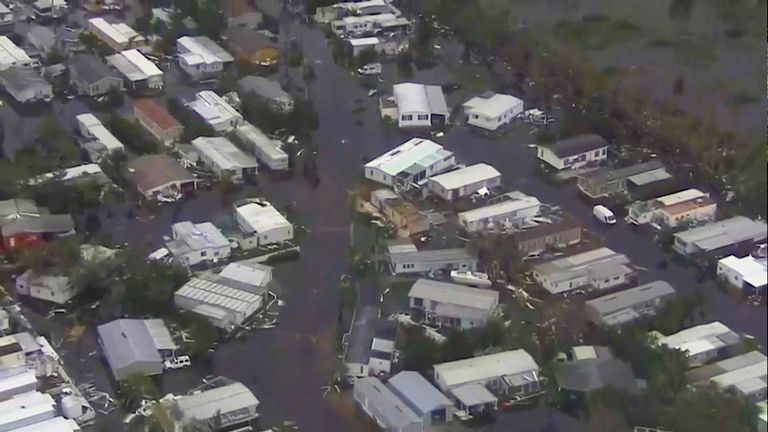
As certain government officials come under fire for their handling of the storm, the number of people killed as a result of Hurricane Ian in the Southeast United States has surpassed 80.
Since Category 4 Hurricane Ian made landfall on Florida’s Gulf Coast on Wednesday with maximum sustained winds of 249 km per hour, at least 85 storm-related fatalities have been verified (155 miles per hour).
Florida accounted for all but four of the fatalities.
The sheriff’s office in coastal Lee County, which includes devastated Fort Myers, said it had counted 42 dead, with 39 deaths reported by officials in neighbouring counties.
Officials in Lee County have faced questions over whether they mandated evacuations in time.
Cecil Pendergrass, chairman of the county’s board of commissioners, said on Sunday that evacuation orders were given as soon as the hurricane’s direction became clear. Even then, some people chose to ride out the storm, Pendergrass said.
“I respect their choices,” he said at a press conference. “But I’m sure a lot of them regret it now.”
Deanne Criswell, the Federal Emergency Management Agency administrator, said the federal government planned to unleash a huge amount of aid, focusing its attention on Florida first. President Joe Biden and first lady Jill Biden are due to travel to the state on Wednesday.
Criswell told Fox News Sunday that the federal government, including the Coast Guard and Department of Defense, had moved into position “the largest amount of search and rescue assets that I think we’ve ever put in place before”.
Still, she warned that dangers remain.
“We see so many more injuries and sometimes more fatalities after the storm,” Criswell said. “Standing water brings with it all kinds of hazards — it has debris, it could have power lines.”
Ian made landfall on Florida’s Gulf Coast on Wednesday as a Category 4 hurricane, with maximum sustained winds of 249km/h (155mph) [Marco Bello/Reuters]
Authorities in North Carolina said at least four people had been killed there. No deaths were immediately reported in South Carolina, where Ian made another US landfall on Friday.
Chugging over land since then, Ian has diminished into an ever-weakening post-tropical cyclone, but water levels have continued to rise in some flooded areas, inundating homes and streets that were passable just a day or two earlier.
The National Hurricane Center forecast more heavy rainfall was possible across parts of West Virginia and western Maryland into Sunday morning, and “major to record flooding” in central Florida.
Washed away
As the full scale of the devastation became clearer, officials said some of the heaviest damage was inflicted by wind-driven ocean surf that smashed into seaside communities and washed buildings away.
Satellite images from the National Oceanic and Atmospheric Administration showed beach cottages and a motel that lined the shores of Florida’s Sanibel Island had been destroyed in storm surges. Although most homes appeared to still be standing, roof damage to all was evident.
Surveys from the ground showed that the barrier island, a popular tourist getaway that was home to some 6,000, was devastated.
“It’s all just completely gone,” Sanibel’s city manager, Dana Souza, said. “Our electric system is pretty much destroyed, our sewer system has been damaged badly and our public water supply is under assessment.”
The National Guard and the Coast Guard were flying in helicopters to the islands to rescue people after Sanibel’s only bridge to the mainland collapsed.
More than 700,000 businesses and homes remained without power on Sunday afternoon in Florida alone, where more than 2 million customers lost electricity the first night of the storm.
The International Energy Agency (IEA) has announced that theworld’s natural gas markets will likely remain constrained well into 2023 as Russia limits supplies and Europe reduces consumption in the face of high costs and energy-saving initiatives.
Global gas consumption is expected to drop by 0.8 percent in 2022 – the result of a record 10 percent contraction in Europe and static demand in the Asia-Pacific – and grow just 0.4 percent next year, the IEA said in its quarterly gas market report on Monday.
Still, the market outlook is subject to a “high level of uncertainty” due to Russia’s future actions and the economic effect of high energy prices over time, the IEA said.
“Russia’s invasion of Ukraine and sharp reductions in natural gas supplies to Europe are causing significant harm to consumers, businesses, and entire economies – not just in Europe but also in emerging and developing economies,” said Keisuke Sadamori, the IEA’s director of energy markets and security.
“The outlook for gas markets remains clouded, not least because of Russia’s reckless and unpredictable conduct, which has shattered its reputation as a reliable supplier. But all the signs point to markets remaining very tight well into 2023.”
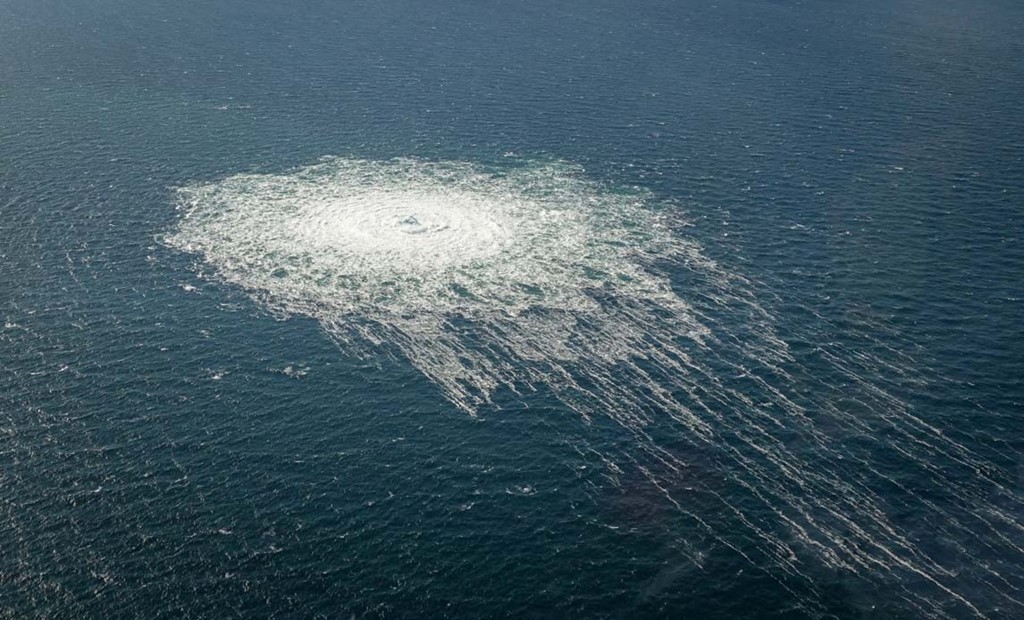
Russia’s supply of gas to Europe has dwindled to a trickle since the shutdown of the Nord Stream 1 last month and the recent discovery of leaks in the pipeline.
Moscow has threatened to sanction Ukrainian energy firm Naftogaz, one of the last remaining Russian gas supply routes to Europe, a move that would exacerbate energy shortages coming into winter.
Europe has offset the decline in Russian gas supplies by importing LNG and using alternative pipeline supplies from producers such as Norway.
The IEA said it expected Europe’s LNG imports to increase by more than 60 billion cubic metres this year, keeping the market under pressure for the short to medium term.
However, China’s new LNG contracts since 2021 and a colder-than-average winter could cause additional demand from Northeast Asia, the Paris-based intergovernmental organization said.
An agreement between two countries who are still formally at war gained more traction when Israel applauded a US plan to settle the country’s maritime border issue with Lebanon.
The draft agreement floated by United States envoy Amos Hochstein aims to settle competing claims over offshore gas fields and was delivered to Lebanese and Israeli officials at the weekend.
Lebanese authorities, who confirmed receipt of the terms, have pledged to deliver a reply “as quickly as possible”, following a flurry of recent announcements from Beirut that a deal with Israel was close.
Israeli Prime Minister Yair Lapid told his cabinet on Sunday that the US proposal “strengthens Israel’s security and Israel’s economy”.
His government was “discussing the final details, so it is not yet possible to praise a done deal”, Lapid said.
“However, as we have demanded from the start, the proposal safeguards Israel’s full security-diplomatic interests, as well as our economic interests.”
They reopened negotiations on their maritime border in 2020, but the process was stalled by Lebanon’s demand that the map used by the UN in the talks be modified.
Progress resumed after Lebanon appeared to modify its position, specifically concerning the Karish natural gas field, which Israel claims as its territory and is not open to negotiation.
The head of the powerful Lebanese Shia movement Hezbollah, Hasan Nasrallah, had threatened Israel with attacks if it began production from Karish.
But Nasrallah on Saturday called the US proposal “a very important step”.
‘Irresponsible announcements’
Lapid said Israel had been seeking an agreement with Lebanon “for over a decade”.
He added that his government does “not oppose the development of an additional Lebanese gas field, from which we will of course receive the share we deserve” – an apparent reference to the Qana field, which could be subject to a revenue-sharing mechanism under the US proposal.
“Such a field would weaken Lebanese dependency on Iran, restrain Hezbollah and bring regional stability,” said Lapid.
The Hochstein proposal will be submitted for final approval following a legal review, he said.
Progress towards the deal comes before Israel’s November 1 election, its fifth vote in less than four years.
Former Prime Minister Benjamin Netanyahu, a staunch foreign policy hawk seeking a return to power, warned that the right-wing government he intends to form after the vote could undo any pact. “If this illegal ploy passes, it won’t oblige us,” he said.
Netanyahu accused Lapid of “giving Hezbollah sovereign Israeli territory with a huge gas field that belongs” to the Jewish state, without specifying which Israeli waters he believes are being surrendered.
Israel and Hezbollah fought a 34-day war in 2006. Netanyahu said Lapid had “shamefully capitulated to Nasrallah’s threats”.
Lapid shot back, accusing Netanyahu of making “irresponsible announcements” that undermine Israel’s “security interests”.
‘Invest in our gas’
Defence Minister Benny Gantz, who also aspires to be elected prime minister in less than a month, said Netanyahu’s criticism was uninformed and dangerous.
“I’d suggest that Netanyahu … requests an orderly update on the topic before he adds fuel to Nasrallah’s propaganda, which has endangered and still endangers the agreement,” Gantz said in a statement.
It was not yet clear whether such an agreement would need the approval of parliament, where Lapid does not have a majority.
The justice ministry said late Sunday it was still examining the agreement and legal issues accompanying it.
With the Lebanese economy in deepening distress, Hezbollah has pledged to abide by whatever Beirut agrees to in the indirect talks.
“We support the Lebanese position so that we safeguard our right to demarcate our maritime borders and invest in our gas,” Lebanon’s National News Agency quoted senior Hezbollah official Mohammad Raad as saying.
The bodies of the two men were taken by the Israeli army after they were killed, while the man who was wounded was arrested.
News of the killings came in at about 7 am local time (04:00 GMT).
The Israeli army said its men were attempting to arrest a suspect in Jalazone when they suspected that the three men were planning to carry out a car-ramming attack against the soldiers, before being shot.
That claim could not be independently verified.
The Fatah movement of Ramallah and the el-Bireh region announced a general strike in the areas after the killings.
Israel has been carrying out near-daily raids in the West Bank, largely focused on the towns of Jenin and Nablus, where new armed Palestinian groups have been formed.
More than 150 Palestinians have been killed by Israeli forces in the 1967-occupied territories since the start of the year, including 51 in the blockaded Gaza Strip during Israel’s three-day assault in August.
In one of the most recent raids, on Thursday in a town near Bethlehem, a seven-year-old boy died after his family said he had been chased by Israeli soldiers.
The US State Department has called for an investigation into the death of Rayyan Suleiman.
Twenty people have also been killed in attacks carried out by Palestinians in Israel and the West Bank in 2022.
An Iranian-American citizen convicted of spying was freed from custody amid rumours that Iran and the US were discussing prisoner releases.
According to his lawyer, he has been imprisoned in Iran for over seven years on espionage-related charges and has been given a one-week holiday from the Evin prison in Tehran.
Siamak Namazi’s temporary release on Saturday came as his father, former United Nations official Baquer Namazi, who was also convicted on spying charges, was permitted to leave Iran for medical treatment.
It was not clear if the moves might be a step towards Siamak’s full release, nor whether it signals the possible furlough or release of other United States citizens detained in Iran.
Iranian Americans, whose US citizenship is not recognized by Tehran, are often pawns between the two nations, now at odds over whether to revive a fraying 2015 pact under which Iran limited its nuclear program in return for sanctions relief.
Soon after news of Siamak’s furlough broke, Iran’s Nournews said an unnamed regional nation had mediatedbetween Tehran and Washington for the “simultaneous release of prisoners”. The semi-official news agency also reported that “billions of dollars of Iran’s frozen assets because of the US sanctions will be released soon”.
There was no official comment from the Iranian government.
Jared Genser, an international human rights lawyer handling the Namazi cases, said on Twitter that he was “delighted to confirm for the first time in seven years that Siamak #Namazi is spending a night at home with his parents in Tehran”.
“Baquer Namazi’s travel ban has been lifted. We won’t rest until they return to the US & their long nightmare has ended,” he added.
Baquer Namazi, a former UNICEF representative, was detained in 2016 when he travelled to Tehran to see his son, a businessman arrested in Iran months earlier. Both Namazis were sentenced to 10 years in prison in Iran on what the US and UN say were trumped-up spying charges.
Baquer Namazi was granted medical furlough in 2018 and his sentence was subsequently commuted to time served, but Iranian authorities had not permitted him to leave the country. Last October, he underwent surgery in Iran to clear a blockage in an artery to the brain that his family and supporters described as life-threatening.
After getting a bomb alert aboard Mahan Air travelling to Guangzhou, China, the Indian Air Force claimed it temporarily scrambled fighter aircraft.
The Indian Air Force (IAF) says it temporarily scrambled fighter jets after receiving a bomb alert on an Iranian airlinerthat turned out to be false.
“IAF fighter aircraft were scrambled, which followed the aircraft at a safe distance. The aircraft was offered the option to land at Jaipur & then, at Chandigarh,” the IAF said in a statement on Monday, referring to two airports in northern India.
The statement said the pilot was unwilling to divert to either airport.
The air force said it later received information from Iran’s capital Tehran to disregard the bomb scare and the flight continued its journey, according to a statement.
Iran’s foreign ministry spokesman, Nasser Kanani, told reporters during a press conference on Monday that he has heard the reports about the aircraft, but cannot confirm the details at the moment.
The Airbus A340 operated by Iranian carrier Mahan Air, with a capacity of between 320 and 475 passengers, was headed from Tehran to Guangzhou in China.
It’s hard to think of another episode like this. There have been budget U-turns before, but it’s hard to think of any which came so soon after they were announced and were not just an obscure technical consequence of a bigger measure (for instance George Osborne’s pasty tax).
The question now, however, is whether this change of mind changes the mind of the millions of investors who have, in the past week, been eschewing UK investments. That resulted in a fall in the pound and a sharp increase in government borrowing rates.
Yet – and this is something those inside Number 10 have pointed out themselves – the removal of the 45p rate was not all that expensive when compared to the other bits of the mini-budget: around £2bn of a total £45bn package.
They saw no arithmetic link between the measure in numerical terms and the reaction from currencies and bonds. The most straightforward conclusion, then, was that rather than responding to this 45p rate, investors seemed instead to be responding to something broader: a crisis of confidence in the government’s economic leadership.
Whether the abolition of the 45p rate is enough to change that view remains to be seen. In the immediate wake of the news, the pound rallied against the US dollar and money markets responded by reducing their expectations of future interest rates.
That is, from the government’s perspective, quite promising. But these are just small moves and we shall have to see what happens next.
Perhaps they will decide this is a sign of readiness from the government to try to rebuild their credibility; that they have moved away from the denial stage. Or perhaps not: we shall see.
DISCLAIMER: Independentghana.com will not be liable for any inaccuracies contained in this article. The views expressed in the article are solely those of the author’s and do not reflect those of The Independent Ghana
Source: Skynews, Ed Conway, data and economics editor
An investigation by the Associated Press has revealed that Russian tortureof residents and soldiers alike in the eastern Ukrainian city of Izium was random, pervasive, and completely routine.
In the Kharkiv region, the agency found 10 locations of Russian torture and met with 15 survivors as well as two families whose loved ones vanished. Two of the men were frequently taken and mistreated.
One battered, unconscious Ukrainian soldierwas displayed to his wife to force her to provide the information she simply didn’t have.
The AP also confirmed eight men killed under torture in Russian custody, according to survivors and families. All but one were civilians.
AP
At a mass grave site created by the Russians and discovered in the woods of Izium, at least 30 of the 447 bodies recently excavated bore visible marks of torture — bound hands, close gunshot wounds and broken limbs, according to the Kharkiv regional prosecutor’s office.
Those injuries corresponded to the descriptions of the pain inflicted upon the survivors.
Ukrainian intelligence officers said women were held in a garage near Russian soldiers’ quarters where they were raped regularly.
AP
A physician who treated hundreds of Izium’s injured during the Russian occupation said people regularly arrived with injuries consistent with torture, including gunshots to their hands and feet, broken bones, and severe bruising.
“Even if people came to the hospital, the silence was the norm,” chief Dr. Yuriy Kuznetsov said.
Torture in any form during an armed conflict is a war crime under the Geneva Conventions, whether of prisoners of war or civilians.
Ben Wallace, the governmentwill purchase two specialised ships to guard pipes and cables that are submerged in the ocean.
In remarks to the Conservative Party conference in Birmingham, the defence secretary referred to the “mysterious damage inflicted” last week following leaks in the Nord Stream gas pipelines in the Baltic Sea.
There have been suggestions that Russia could have been behind the alleged sabotage of the pipes, including Nord Stream 1 which was already shut but had previously pumped gas from Russia to Europe. Nord Stream 2 had not started operations.
Gas bubbles rise to the surface from the Nord Stream 2 leak
Mr Wallace said the pipeline incident “should remind us of how fragile our economy and infrastructure is to such hybrid attacks”.
“Our intent is to protect them. Our internet and energy are highly reliant on pipelines and cables. Russia makes no secret of its ability to target such infrastructure.”
He went on: “So for that reason, I can announce we recently committed to two specialist ships with the capability to keep our cables and pipelines safe.
“The first multi-role survey ship for seabed warfare will be purchased by the end of this year, fitted out here in the UK, and then operational before the end of next year.
“The second ship will be built in the UK and we will plan to make sure it covers all our vulnerabilities.”
These guys are steadily retaking Ukrainian territory on the eastern front, and despite their exhausted appearance, they can smell victory, according to Sky’s special correspondent Alex Crawford.
They have a lot of self-assurance and confidence right now. They are eager to retake more, too.
I asked the soldiers: “How confident are you about retaking Severodonetsk, Lysychansk?”
One replied: “100%. This is Ukraine.”
Lyman is their biggest win on the battlefield in weeks and the first since President Vladimir Putin declared this Russian territory.
So tearing down the Russian flags inside Lyman is delivered with particular relish.
Pic: Reuters
Seizing Lyman it is hoped will be the launchpad to reclaim even more land in the east.
The Ukrainians have been celebrating with their foreign friends who have fought alongside them.
Now they’re pushing forward. The road to Lyman is littered with the discards of fierce fighting but the Ukrainians say they have also surrounded their enemy in parts of Lysychansk nearly 60km (37 miles) away.
A soldier said: “Now they are on the Lysychansk plant. They are surrounded, they will be pushed back and the road to Lysychansk will be opened.”
Neighbouring towns, like Siversk, have suffered badly in the fight to retake Lyman – with house after house destroyed. Those still here are just clinging to hope.
A local man said: “I want peace. I want that my parents will be alive. I want that my wife will be alive. Nothing more.”
But Russians are still close enough to instill much fear.
The Ukrainians have blown up bridges into Bakhmut to slow down any Russian advance
Forty minutes south, the ferocity of the Russian assault is stark in Bakhmut. This was the Ukrainians’ key military hub for the east, now blasted to bits and a virtual ghost town.
There are enormous craters that have utterly changed the geography around here and ripped the heart out of the town.
The holdouts move around in a war-torn haze – weary and tearful.
Irina said: “These borders that they’re trying to change. It’s for those who divide. They divide big money between them and they don’t care about us people, the people who are living here. I’m sorry because a lot of my friends died. Big politics is filthy.”
Irina
Victory tastes very different depending on where you are.
The Russians are still on the edges of Bakhmut fighting and making their presence very much felt.
I asked a local man: “Did you think the Russians were close to coming in?”
He replied: “You understand maybe for a little while they will succeed, but everyone wants the opposite. But here there are a lot of collaborators, a lot, and they are saying a lot of terrible things.
“I start arguing with them, which I shouldn’t do, because God forbid if they do come here, those people will be first who betray.”
Before the host intervenes and denies it, a pundit on Russian official television appears to have revealed that the panellists weren’t intended to bring up the liberated city of Lyman.
Maxim Yusin, a foreign policy specialist, asserts that Russians likewise think the conflict is not going well for their nation.
He says on the show: “I see the dynamics of the military action on the front.
“We aren’t talking about what is happening near Lyman.”
The host then interjects with: “Who forbade you to talk about it?”
Russian troops pulled out of the eastern city of Lyman due to the risk of being encircled by Ukraine’s forces.
Mr Yusin later said on the Russian state TV broadcast: “Ask anyone here, when they’re in the make-up room.
“I think anyone will honestly admit they don’t know whether the mobilisation will help us or not, to change the course of military actions.
“It’s easy to say ‘after the liberation of Zaporizhzhia’.
“Yeah, try liberating it, the way everything is going.”
The host Andrey Norkin also said at one stage the Ukrainians are “planning to declare war against Russia” before another pundit suggest Ukraine might start bombing Moscow.
Retired four-star US army general Barry R McCaffrey shared the video and said it shows “Russian State TV is starting to fragment.”
He continues: “Lyman a disaster for the Russians. The Kherson pocket could lose 15,000 Russian prisoners. The mobilisation a disaster. All pressures on Putin criminal action might generate a desperate reaction. He’s unravelling.”
Kenya’s wildlife agency is looking for an elephant that got loose over the weekend and damaged a portion of a private home on the outskirts of the capital Nairobi.
On Sunday night, the Kenya Wildlife Service (KWS) said a lone elephant had been reported on Friday night at a home in Kerarapon, about 30km (18 miles) from the city centre.
The KWS said its security officers conducted a “thorough search” in response but they did not find the elephant, which is said to have damaged the access gate of the residence where it had strayed into.
The wildlife service suspects that the animalmay have moved into a nearby forest, and says that it’s still patrolling the affected area.
On Friday, 30th September, 2022, a lone elephant was reported in a Private residence in Kerarapon area at around 23.20 hours.
KWS security personnel responded immediately.
On arrival, they conducted a thorough search, however, the Elephant could not be found. pic.twitter.com/bdFIYtr183
Captain Ibrahim Traoré, the head of Burkina Faso’s new junta and the youngest leader in the country, is a combat-tested soldier who has grown increasingly critical of his predecessor’s “unsuccessful policies” against the Islamic State and al-Qaeda extremists.
Capt Traoré toppled Lt Col Paul-Henri Damiba on 30 September, marking the country’s second military coup this year that could slow down an eventual transition to civilian rule.
He was among a group of soldiers who backed Lt Col Damiba’s 24 January coup against democratically-elected President Roch Kaboré. However, eight months later, divisions emerged in the junta known as the Patriotic Movement for Preservation and Restoration (MPSR).
Various tactics applied by Lt Col Damiba’s interim military administration – including reforms to a pro-army self-defence force, the appointment of military governors to violence hotspots, and heightened operations in the north and east – have failed to curb deadly militant attacks against civilians and security forces.
According to conflict data analysts ACLED Info, Burkina Faso replaced neighbouring Mali as the epicentre of militant violence this year, leading to protests demanding Lt Col Damiba’s resignation.
While the counter-coup was surprising, Burkina Faso’s army has long grappled with mistrust and disaffection since the failed coup of 2015 that led to the disbandment of an elite force.
The morale of security forces has been further blighted by persistent insurgent attacks and poor working conditions, particularly in volatile borderlands.
In the immediate aftermath of Capt Traoré’s power grab, a war of wordsensued between his faction and that of Lt Col Damiba, raising fears of a violent power struggle.
Lt Col Damiba’s resignation on Sunday put Capt Traoré firmly in charge of a fragmented army struggling to face a brutal insurgency that continues to destabilise vast parts of Burkina Faso and the wider Sahel.
Abdullahi Nadir, a co-founder and top al-Shabab member, was reportedly killed on Saturday in the Middle Jubba region of southern Somalia, according to the Somali authorities.
The director of al-religious Shabab’s indoctrination unit, Nadir, was the target of a $3 million (£2.7 million) US bounty, according to the Somali communications ministry.
It added that al-Shabab considered Nadir a potential successor to its current leader, Ahmed Omar Diriye, aka Abu Ubaidah, who has long been rumoured to be “in poor health”.
Abdullahi Nadir, a top leader of #Alshabab terrorists, wanted by Somali government for long time has been killed in operation conducted by Somali National Army and international security partners in Haramka village in Middle Jubba region, on 01-10-2022.#Somaliahttps://t.co/yJsfQL6Wts
— Ministry of Information, Culture & Tourism (@MOISOMALIA) October 2, 2022
Private media reported that Nadir was killed in a drone strike.
The information ministry said that Somali security forces and international partners killed Nadir in an operation, but did not mention a drone strike.
The US Africa Command,which frequently targets top al-Shabab militants and positions, has not yet commented on the development.
Why is France’s contribution to the war effort in Ukraine so minimal if it aspires to lead Europe into a new era of military independence?
Some of the nation’s leading strategic thinkers are pressing President Emmanuel Macron to decide quickly whether to send more armaments to Kyiv, and they are asking him this hard question.
Recent analysis conducted on the ground in Poland and Ukraine shows that the French share of foreign arms deliveries is less than 2%, way behind the US on 49%, but also behind Poland (22%) and Germany (9%).
“I was concerned about the reliability of the statistics which showed France low on the list of contributing countries,” says François Heisbourg, who is perhaps France’s most influential defence analyst.
“So I went out to the main distribution hub in Poland to see how much in tonnage was actually being delivered, rather than just promised.
“Unfortunately the figures bore out my fears. France is way down the list – in the ninth position.”
The official reaction to this in Paris is: “Yes, but…”
Yes, the aid statistics are unflattering, but there are other factors at work.
First, defense officials say the true measure of military help is quality, not quantity. Some countries are delivering masses of outdated equipment. France has given 18 Caesar self-propelled artillery units, which are now celebrated along the Ukrainian front line.
France, they add, is like other Western countries in having run down military stocks as part of the post-Cold War peace dividend
Ukraine’s Caesars are fully one-quarter of France’s entire mobile artillery. It cannot offer much more without making itself vulnerable in regions where it is already committed, like the Sahel and the Indo-Pacific.
“It might look like we are behind other countries, but France has every intention of playing its part,” says Gen Jérome Pellistrandi, editor of the National Defence Review.
These arguments are not without merit, says Mr Heisbourg. The problem is that by not being more present in the theatre, France risks writing itself out of the plot.
“When I was in Kyiv, everyone was very polite. I had no sense that the Ukrainians disapproved of us,” he says. “In a way, it was worse. I had the distinct feeling we were becoming irrelevant.”
For Mr Heisbourg the equation is simple. Ukraine will talk to countries that it knows are likely to deliver the weapons it needs. France at the moment is not one of them.
IMAGE SOURCE,REUTERS Image caption, French Foreign Minister Catherine Colonna discussed the supply of defence equipment with President Zelensky in Kyiv
But there is another danger for France. Its relative absence in Ukraine undermines its bid for leadership in the cause of European defence.
Already many countries of eastern Europe are wary of President Macron, who they believe was far too indulgent towards Russia’s Vladimir Putin in the first months of the war. A narrative has taken root according to which France still feels ambivalent about an outright Ukrainian triumph.
For Pierre Haroche, who lectures on international security at the Queen Mary University of London, this narrative is unfair – and is not the reason for France’s low levels of arms deliveries to Ukraine.
However, he is firm of the view that France should beef up its contribution as early as possible, in order to reassure eastern European countries like Poland that “we are all on the same page”.
“France’s goal of strategic autonomy for Europe is focused primarily on building up our defence industries via joint procurement. But if you want joint procurement, you have to demonstrate to other countries that you have the same vision about our common security,” he says.
“In order to make our objective of European co-operation viable, we need to show eastern European countries thatco-operating with France and buying the idea of strategic autonomy is not a strategic risk.”
Dr Haroche is calling for France to send 50 Leclerc main battle tanks. Mr Heisbourg would prefer air defense systems, which he says Ukraine is more in need of.
“It is like a fire extinguisher,” says Dr Haroche. “If there is a fire in a neighbour’s house it is better to offer your extinguisher straightaway, and not wait till the fire reaches your own home.
“It’s not just generosity. It’s also for your own protection.”
Young cancerpatients facing rising living expenses are in a “desperate” situation, charities are warning.
According to Macmillan Cancer Support and Young Lives vs. Cancer, the number of persons requesting emergency funds has dramatically increased.
Research suggests tens of thousands of 18 to 39-year-olds with cancer are struggling to pay basic living costs.
Shell Rowe was among those who told BBC Newsbeat they’re worried about becoming financially independent.
She was diagnosed with stage four non-Hodgkin’s lymphoma at age 20 in 2019, just as she was about to study film in California for her third year of university.
“I turned to the mirror and it was like a tennis ball in my throat,” she says.
“One minute you’re about to go on this adventure of a lifetime and then you’re sat in a hospital room – you’re bald, you’re looking really skinny and frail.”
More than half of the 18 to 39-year-olds with cancer surveyed by Macmillan and Virgin Money said they needed more financial support to manage the rising cost of living.
One in four young people are getting further into debt or have fallen behind paying rent and energy bills because of increased living costs, according to the survey of 2,000 people across all age groups.
That’s compared with 13% of people with cancer in their 40s and 50s, and 6% of those aged over 60.
The research found almost three-quarters (74%) of younger people with cancer were worried about the cost of food over the next 12 months.
Shell is one of them.
“Prices have skyrocketed. I haven’t been able to work andhaven’t been able to save and get a job,” she says.
“How am I ever going to be able to be financially independent? It really scares me.”
IMAGE SOURCE,KAMUI OSHINO Image caption, Kamui Oshino, whose weight has dropped significantly as a result of treatment, is struggling with food price increases
I
Kamui Oshino, 20, is studying journalism at the University of the West of England in Bristol. They were diagnosed with stage four Hodgkin’s lymphoma in December 2021.
“When you go through chemo, a lot of people start off very underweight. I was 40kg so I had to buy new clothes,” Kamui says.
“And then being on steroids, I had to eat absolutely all the time. Obviously the price of food is going up. I couldn’t afford that.”
More than a tenth (11%) of those surveyed say they’ve had to delay or cancel medical appointments due to the rising cost of petrol.
Many people have to travel long distances for treatment, often in their own cars or a taxi because the risk of infection rules out taking public transport.
Image caption, Tyler Hale was diagnosed with testicular cancer in hospital
Tyler Hale, who was diagnosed with testicular cancer in November 2021, had to swap from driving his car to taking the bus, which takes an hour each way.
“I’ve had to pay a lot of travel costs to go from Weston-super-Mare to Bristol for treatment. With the costs of that going up, it’s ridiculous,” he says.
A third of young people surveyed also say their mental health has deteriorated with the financial worry.
‘Never been as bad as this’
People with cancer already face significant extra costs of nearly £900 when they get diagnosed, such as buying extra clothes, food or using more heating to stay warm, Macmillan’s data shows.
Now inflation has driven those costs up and the charity says they’ve seen a surge in demand for their means-tested financial grant to help cancer patients with costs, including energy bills.
“In July we saw a 292% increase in grant applications versus the same month last year. It is really worrying to see so many people worried about food,” says Chris Jones from Macmillan.
Macmillan is not the only charity seeing an increase in young cancer patients needing support.
“It’s never been as bad as this. Young people with cancer are in reallydesperate circumstances, because of the cost-of-living crisis,” says Rachel Kirby, chief executive of Young Lives vs Cancer.
The UK charity supports cancer patients under 24 and has given 1,319 people up to £372,825 in financial help since launching its Winter Emergency Grant in 2021 to help with rising costs.
“No young cancer patient should have to think about the choice of putting fuel in the car to get to treatment, or whether they can heat their homes. But those are the kinds of situations they’re facing,” Rachel says.
UK
Macmillan and Young Lives vs Cancer are calling on the government to give more financial help to cancer patients.
“We are calling for the government to really step up and support families with the cost of cancer. Because this situation is only going to get worse as we move into a cost of living crisis over the next six months,” Rachel says.
“There’s an average of a 20-week wait to claim a disability allowance that could help young people with travel and heating costs. We are asking the government to take urgent steps to reduce the delays,” Chris adds.
The Department of Health and Social Care said Prime Minister Liz Truss had announced new measures to help people with energy bills, such as the recent energy price guarantee and £400 discount for all households.
A spokesperson added: “We are streamlining cancer diagnostic services to get people diagnosed faster, backed by £325m.
“The NHS continued to prioritise cancer treatment throughout the Covid pandemic. Overall cancer treatment was maintained at 100% of pre-pandemic levels, and 94% of people starting treatment have done so within a month.”
Iranian police and students battled on Sunday at one of the nation’s most prestigious institutions according to reports in the official media and social media.
Reports say a large number of students at Sharif University in Tehran have been trapped in the campus car park.
Videos on social media appear to show students running away from security forces, with apparent gunshots fired.
Anti-government protests erupted in Iran in September after the death of a woman detained by the morality police.
Mahsa Amini, 22, fell into a coma hours after morality police arrested her for allegedly breaking headscarf rules.
Officers reportedly beat Ms Amini’s head with a baton and banged her head against one of their vehicles. The police have said there is no evidence of any mistreatment and that she suffered “sudden heart failure”.
Protests started at her funeral and have spread across the country to become the worst unrest seen in the country for years.
One video posted on social media shows students running from security forces on Sharif university’s campus. Sounds resembling gunshots can be heard from a distance.
In another, security forces on motorbikes appear to shoot at a car holding the passenger filming the video.
Iran International cites reports which say security forces attacked student dormitories and fired guns at their dorms. Other reports mention the use of tear gas on protesters.
Sunday was the first day of term for many students attending Sharif university for the first time. Reports say crowds had gathered outside the campus’s main gate late in the evening after hearing about the clashes.
The BBC is unable to verify the events at the university.
The last two nights have seen an escalation in anti-government protests in Tehran and many other cities across the country, despite a growing death toll.
Iran Human Rights, an NGO based in Norway, says 133 people have been killed across Iran to date.
Authorities have promised to come down hard on the protesters, who they say have been put up to it by Iran’s external enemies.
In the first of two profiles of the front-runners for the position of president of Brazil, Katy Watson questions if incumbent Jair Bolsonaro is, as his supporters claim, a wonderful leader or someone who despises democracy.
Wherever Jair Bolsonaro goes, he likes to stir controversy – but few were expecting him to do so on the eve of Queen Elizabeth II’s funeral. As world leaders flew to the UK to mark her passing, President Bolsonaro saw an opportunity to do some campaigning.
While British mourners accused him and his fans of lacking respect in a period of mourning, he was undeterred.
“We’re on the right path,” he told his supporters from the balcony of the Brazilian residence, saying Brazil did not want to discuss the legalisation of abortion or drugs, with cheers from the crowd in response. And he repeated his often-cited slogan: “God, homeland, family and freedom”.
Another familiar mantra at his campaign events is the chant: “Mito, mito, mito.”
He is, to his fans, a “myth” – a legendary leader – and they are convinced their man will be re-elected in October.
Despite polls showing his main rival, Luiz Inácio Lula da Silva, in the lead, nothing will deter Mr Bolsonaro’s greatest supporters from believing the president, who has himself denounced the polls as a lie, is the only man to lead the country.
Pastor Laura Almeida, at the Mustard Seed Ministry in the northeastern city of Recife, is one of his most committed fans. Standing in front of her Sunday congregation, she sings his praises.
“We’ll vote for Bolsonaro because he is God,” she tells her members. “He defends the same principles as us in accordance with the word of God.”
Image caption, Pastor Laura Almeida says she believes that President Bolsonaro is the saviour who will ease the people’s suffering
After the service, she explains her thinking to me.
“Whenever people are suffering, when they believe in an all-powerful creator, I think God raises up a saviour,” she says.
I ask her if that saviour is President Bolsonaro. “Yes,” she replies. “Today in Brazil, I think that’s him.”
Mr Bolsonaro sings from the same song sheet as many evangelicals. He preaches the importance of family, he is vehemently against abortion and he is known for his homophobic comments.
And it was congregations like Laura’s that got him elected in 2018.
“Evangelicals are growing in Brazil,” says Prof Vinicius do Valle, Director of the Evangelical Observatory information service in Brazil. “They are now about 30% of the population – only two decades ago, it was about 15% so they are increasing very quickly and it’s changing the way we do politics here.”
But it is not the same way that the church has traditionally been involved.
“The Catholic Church played a democratic role in the past decades,” says the professor, referring to the Church speaking out during the military dictatorship. “But that hasn’t happened when it comes to evangelical churches. They are playing a role in Bolsonaro’s election and against democratic institutions in Brazil – we see ministers calling people to go to protests against democratic institutions.”
Mr Bolsonaro does not separate politics from prayer. His campaign language is littered with religious references. Even lifting himself up to a godly status.
He hit this year’s campaign trail in Juiz de Fora, the city where he was stabbed in 2018 – the place where, in his own words, he was “born again”.
Image caption, Gilson Machado describes the president as an “old uncle”
But in the north-east of Brazil, he has a tough job on his hands to convince voters he is the man for them. This is not Mr Bolsonaro’s natural stomping ground. In fact, it was the only region where he lost in 2018.
The poorest region in the country, it is where Lula was born and with which he has been associated for all of his political careers. For that reason, it has become the ultimate challenge for President Bolsonaro to gain ground here.
Gilson Machado is an affable local politician. A former tourism minister under Mr Bolsonaro, he is perhaps most well-known – or infamous – for his love of playing the accordion. Now, he is running for senate in Pernambuco, but he is also head of Mr Bolsonaro’s national campaign in the north-east and is a great friend of the president.
“He’s an old uncle and he likes football, he doesn’t drink, he loves his family, he’s a Christian and he’s a hard, hard worker,” he says. “He’s the man for the world – the biggest right-wing president of the world right now.”
In such a polarised political contest, it is surprising the three remain friends. So many relationships have fallen foul of politics in Brazil these past few years.
“What makes you a Bolsonarista [a Bolsonaro supporter] is when he speaks directly to your heart, to your soul,” he says. “Bolsonaro freed this voice from all these people you see in the streets screaming ‘Mito!’.”
Geraldo says he is going to vote for Lula. Mitchell shakes his head.
“Bolsonaro lost a great opportunity to be seen as responsible and confront this pandemic in an intelligent way,” Geraldo says, criticising how he behaved during the pandemic. “I don’t think he has the emotional intelligence for this.”
Kalina though, is on the fence after having voted for Bolsonaro in 2018.
“I am totally against [Lula’s] Workers’ Party, but I don’t think Bolsonaro was a good leader,” she says. “He has not listened, and with that, he lost my vote. Those who support Bolsonaro do so no matter what, independently of what he does.”
In their first joint public appearances since the Queen’s funeral, the King and Queen Consort are scheduled to go to Dunfermline and Edinburgh.
They will visitDunfermline Abbey to mark the former town’s new status as Scotland’s eighth city.
Charles and Camilla will also attend a council meeting at the City Chambers.
The King and his wife will then host a reception at Edinburgh’s Palace of Holyroodhouse, to celebrate British South Asian communities.
The late Queen Elizabeth previously visited Dunfermline Abbey to mark its 900th anniversary and this year it is celebrating its 950th anniversary.
Royal mourning ended last Tuesday and Scotland has since seen the Prince and Princess of Wales visit for the first time since taking up their news titles.
King Charles and Camilla attended church at Crathie Kirk, near Balmoral, last Sunday as they were seen in public for the first time since the late monarch’s funeral.
Dunfermline’s regal past
IMAGE SOURCE , GETTY IMAGES Image caption, Charles and Camilla will visit the Category A-listed Dunfermline Abbey, built in the 12th Century
Eight places in the UK were made cities as part of platinum jubilee celebrations marking the 70-year reign of the late Queen Elizabeth.
Dunfermline’s bid was based on its historic status after King Malcolm III established its ancient seat in 1057.
He married Margaret of Wessex, who was later canonised as a saint and considered a religious and cultural pioneer.
She brought Benedictine monks to Scotland and introduced cultural innovations from the Courts of Europe.
As Scotland’s only female saint, she attracted pilgrims from all over the world, leading to the building of Dunfermline Abbey.
It was later established as a royal mausoleum for the Scottish Crown. A total of 18 royals, including seven kings, were buried there – from Queen Margaret in 1093 to Robert Stewart, Duke of Albany, in 1420.
Robert the Bruce, otherwise known as Robert I, became the last of the seven Scottish kings to be buried there in 1329 – although his heart was taken to Melrose – and his name is carved into the top of Dunfermline Abbey.
The couple will be welcomed on their visit to Dunfermline by community groups, including a pipe band and local schoolchildren.
King Charles will formally mark the conferral of city status and make a short speech in the chamber room.
He will also meet the Lord Lieutenant of Fife, Robert Balfour, who will introduce Scotland’s First Minister Nicola Sturgeon and Scottish Secretary Alister Jack.
After the ceremony, Charles and Camilla will take a short walk to Dunfermline Abbey to formally mark its 950th anniversary.
They will be introduced to representatives from Historic Scotland and learn about the heritage of the local area and conservation of the site.
The lord provost of Fife, Jim Leishman, was looking forward to welcoming the royals.
“It has been a long hard journey and a lot of people deserve a lot of credit for the work they have put in over ten years,” he told BBC Radio’s Good Morning Scotland programme.
“The King and Queen Consort are having a wee walk going down to the abbey after he has given us the city status – the people of Dunfermline will love that.
“That is what makes it very very special – his first official engagement in Scotland and he is coming to Dunfermline. That is a tremendous accolade for the people of Dunfermline.”
Palace reception
The King and Queen Consort will later host a reception in the great gallery at the Palace of Holyroodhouse in Edinburgh.
They will meet between 200 and 300 guests of British Indian, Pakistani, Bangladeshi, Sri Lankan, Nepalese, Bhutanese and Maldivian heritage from across the UK.
The event will recognise the contribution many from these communities have made to UK life, from the National Health Service to the arts, media, education, business and the armed forces.
The chancellor stated that the government has changed its mind about wanting to eliminate the 45p income tax rate.
Kwasi Kwarteng told the BBC the proposals, announced just 10 days ago, had become “a massive distraction on what was a strong package”.
“We just talked to people, we listened to people, I get it,” he added.
The decsion, which marks a humiliating climbdown for Prime Minister Liz Truss, comes after several Tory MPs voiced their opposition to the plan.
Ex-cabinet minister Grant Shapps had warned the prime minister would lose a Commons vote on the proposal.
The plan to scrap the 45p rate, paid by people earning over £150,000 a year, had been criticized as unfair at time of rising living costs.
On Sunday, the prime minister had told the BBC she was absolutely committed to it as part of a package to make the tax system “simpler” and boost growth.
But the measure has seen remarkable opposition from the markets, opposition parties and a growing number of Tory MPs.
Increasingly, it seemed Ms Truss did not have the numbers to get it through.
On Sunday, senior Tory Michael Gove hinted he would not vote for the plan when it came to Parliament, saying “I don’t believe it’s right”.
The former cabinet minister said the PM’s decision was “a display of the wrong values”.
Mr Shapps also urged Ms Truss to U-turn, warning her not to have a “tin ear” to voters’ concerns about rising living costs.
“I don’t think the House is in a place where it’s likely to support that,” he told the BBC on Sunday.
The U-turn, suggestions of which were first reported by the Sun, comes on the second day of the Conservative conference in Birmingham, with Mr Kwarteng due to speak later on Monday.
The currency touched a record low last week after Mr Kwarteng’s mini-budget – which contained around £45bn of unfunded tax cuts – created turmoil on the markets.
In a case involving a land dispute between them and the Tanzanian government, the Maasai community’s appeal was denied by the East African Court of Justice. The property is situated in the well-known Serengeti.
The Maasai petitioners wanted the East African Court of Justice (EACJ) to stop the Tanzanian government from removing them and their livestock by force from the border of the Serengeti Reserve and Loliondo Wilderness.
They argued that the government had violated the terms of the agreement for establishing the East African Community.
However, reading the court’s decisions, judge Charles Nyachae on behalf of judge Monica Mgenyi, said that the petitioners, livestock keepers of the Maasai community, failed to prove their claims that they were tortured and beaten.
Nyachae also said the petitioners could not provide evidence that their property was destroyed by people they described as soldiers of the police force.
“We are unable to receive sufficient evidence from the petitioners and we dismiss the reference,” the judge said while reading the verdict.
The East African Court of Justice judges said the Maasai petitioners failed to prove their claims
In their defense, the attorney general of the Tanzanian government pointed out that they did not use force or torture to remove the herders who invaded the Serengeti National Park which borders the Ngorongoro area in the north.
Long-standing case
In the case opened in 2017 at the East African Court of Justice, the Maasai people had hoped for a declaration stating that the Tanzanian government violated the set laws.
They also wanted an order from the court to stop the citizens’ evictions, arrest, detention, prosecution, and damage to their homesteads, livestock, and other property.
They were also seeking an order for restitution and reinstatement from the government, their members, and residents to their lawful property and full reparation and general damages of one billion Tanzanian shillings ( €446,000, $428,000).
Labour’s shadow chancellor,Rachel Reeves says, the government’s economic plan won’t result in annual growth of 2.5%.
Liz Truss, according to Ms. Reeves, does not understand how her policies are affecting the public.
“The prime minister just doesn’t seem to understand the anxiety and fear,” Ms Reeves told the BBC.
“This is a crisis made in Downing Street but it is ordinary working people who are paying the price.”
It has been suggested that the Truss administration is trying to use “tickle down economics” – the idea that tax cuts for the rich will create greater wealth in general, some of which will “trickle down” to those who are less well off.
It was announced in the mini-budget nine days ago that the top rate of tax – 45% – was being abolished.
But Ms Reeves commented: “The idea that trickle-down economics is somehow going to deliver the 2.5% growth we all want to see is for the birds.
“The prime minister and the chancellor are doing some sort of mad experiment with the UK economy and trickle-down economics.
“It has failed before and it will fail again.”
The prime minister has said that removing the top rate of tax was the chancellor’s idea.
But the chancellor’s spokesperson has said the pair are “in lockstep” on the issue (12.18 post).
Jude Bellingham donned the Borussia Dortmund captain’s armband for the first time on Saturday but couldn’t prevent his team losing to Cologne.
Head coach Edin Terzic had strong words for his players ahead of a big week.
Ahead of kick-off in Cologne, Borussia Dortmund head coach Edin Terzic sat down with Jude Bellingham for a quiet chat in the corner of the away dressing room.
In the absence of injured club captain Marco Reus and sick vice-captain Mats Hummels, the armband passed to the English teenager, officially third in the BVB captaincy pecking order.
“Is he the youngest captain in the history of Borussia Dortmund?” asked Terzic himself in a pre-match interview. “We don’t know. But he’s definitely old enough.”
Bellingham: ‘A dream come true’
The 19-year-old’s talents in dribbling, passing, composure, and defensive discipline have been clear for some time and his ability to turn defensive situations into offensive ones have often helped Dortmund out of tricky situations.
On Saturday afternoon, a typical drive forward opened up space behind the CologneCologne defense, before an inch-perfect pass into Julian Brandt allowed the German international open the scoring.
Bellingham’s double fist-pump and the yell of delight as he ran back towards to the centre circle after celebrating with his teammates showed how much it meant. A couple of hours later, however, his mood was very different.
After Cologne had produced an impressive second-half comeback to win 3-2, Bellingham led his teammates over to the traveling supporters, arms raised, palms facing outwards, an expression of acceptance of responsibility.
“When I first signed for this club, I never thought it would be possible,” he then told the Bundesliga’s official channel pitch-side. “But then I met the players and they gave me the belief that one day I could be captain.”
But as he trudged down the tunnel, his disappointment and anger at the result and performance became clear as he ignored waiting for journalists and hurled his coat onto the floor en route back to the dressing room, where he would speak to Terzic again.
Annoyed: BVB coach Edin Terzic cut a frustrated figure in Cologne
Terzic: ‘Brutal, annoying, bitter’
What exactly the head coach told his players will remain between those four walls, but the 39-year-old certainly cut a consternated figure as he spoke to reporters.
“For 15-20 minutes after half-time, in an important and decisive phase of the game, we weren’t prepared to invest all we had to defend our goal and win the ball back,” he said.
“When there were an extra three or four steps to take to get into the challenge, we weren’t prepared to do it. When you look at how we went into tackles at the start of the second half, it’s no wonder we ended up losing.
“And that annoys us. We’re annoyed that we once again have to ask these questions of ourselves. We’re annoyed as a coaching team that we can’t show 20 examples of good possession play tomorrow, but once again have to discuss the same topics.
“It’s brutal, it’s annoying, it’s bitter,” he concluded – for Bellingham as well, whose debut as captain ended in defeat, but whose reputation continues to grow.
“[Being captain] is something that other people have always mentioned to me, and I’ve always brushed it off,” he said. “But, I’m really grateful to have been given the chance today. “Still, I’m ultimately disappointed that we’ve lost.”
Sevilla and Bayern are to come
Dortmund officials are hopeful that vice-captain Hummels, who missed the trip to Cologne with a heavy cold, will be available again for the trip to Sevilla in the Champions League on Wednesday and for the visit next Saturday of Bayern Munich, who drew level on points with BVB thanks to their thrashing of Bayer Leverkusen.
Hummels’ return should not only see him resume his partnership with Nico Schlotterbeck but should also offer the experience and pedigree to implement Terzic’s demands.
As third-choice captain, Bellingham will also have a role to play.
The Lyman’s capture by Ukraine was praised as hopeful by US Secretary of Defense Lloyd Austin. UK Defense Intelligence described it as a significant political setback for Russia in the meantime.
US Defense Secretary Lloyd Austin on Saturday cheered Ukraine’s capture of the key bastion of Lyman from Russia in eastern Ukraine, saying it was an encouraging battlefield success that would create new dilemmas for Russia’s military.
“Absolutely, it’s significant. We’re very encouraged by what we’re seeing right now,” Austin told reporters at a news conference in Hawaii.
Austin noted that Lyman was positioned across supply lines Russia has used to push its troops and materiel down to the south and to the west as the Kremlin presses its more than seven-month-long invasion of Ukraine.
“Without those routes, it will be more difficult,” Austin added. “It presents a sort of a dilemma for the Russians going forward.”
Meanwhile, US Secretary of State Antony Blinken spoke by phone with his Ukrainian counterpart, Dmytro Kuleba, and “reiterated President Biden’s message that the United States will always honor Ukraine’s internationally recognized borders.”
“We will continue to support Ukraine’s efforts to regain control of its territory by strengthening its hand militarily and diplomatically,” Blinken said.
The capture of Lyman came just a day after Putin proclaimed the annexation of four Ukrainian regions — including Donetsk, where the city is located. The proclamation of Russian rule over 15% of Ukraine was roundly rejected by Ukraine and Western countries as illegal.
The visit occurs as China escalates its threats against the democracy on the island.
The German delegation wants to strengthen its cordial relations with Taiwan.
A group of six German parliamentarians arrived in Taiwan on Sunday at the start of a five-day visit that will include meetings with President Tsai Ing-wen, Vice President Lai Ching-te, Foreign Minister Joseph Wu, and the country’s parliamentary speaker, You Si-Kun, German media, and news agencies have reported.
The cross-party delegation, led by Klaus-Peter Willsch of the opposition Christian Democrats, said the trip aims to assess Taiwan’s security situation on the ground and gain an overview of the country’s economic and political development.
The delegation was to examine “issues regarding the political, economic and social situation, bilateral relationships and the development of relations on the two sides of the Taiwan Strait,” the Federal Press Office said on Friday.
The visit comes just two months after a Taiwan trip by the speaker of the US House of Representatives, Nancy Pelosi, brought a vehement reaction from Beijing, which considers the island as part of China and has frequently threatened to bring it under Chinese control.
A delegation of French lawmakers also visited Taiwan in early September.
Why are the German delegates visiting?
Germany has no official diplomatic ties with Taiwan but has maintained friendly relations, including close economic, cultural and academic cooperation.
Till Steffen, a delegation member from the co-ruling Green Party, told DW ahead of the visit that the trip aimed “to show our friendship to Taiwan.”
“Taiwan is a democracy and it’s important for us to be in contact, to have cooperation with other democracies,” he said, adding that it would be a “negative signal” to Taiwan not to conduct such a visit at a time when China is increasing its threats of taking the island.
He said that the visit respected Germany’s acceptance of the “One China” policy and China’s sensitivities in that it involved members of parliament but none from the government itself.
“I think China should not interfere in this cooperation because we strengthen democracies in Germanyand Taiwan with it,” he said.
Criticism of the visit was, however, forthcoming from the Chinese side, with a government spokesman calling, in comments to the dpa news agency, for the German delegation to adhere to the “One China principle” and “immediately cease” any interactions with pro-independence elements in Taiwan.
The Asantehene Otumfuo Osei Tutu II has said traditional leaders cannot be blamed for the resurgence of illegal mining in Ghana, especially when they are not consulted when mining licences are issued.
“At the district level, we have the political administration – the district chief executive and the security council. Are they all saying that they are unaware of the activities of these galamseyers?” Otumfuo asked when the new U.S. ambassador to Ghana Virginia Palmer paid a courtesy call on him at the Manhyia Palace in Kumasi.
“If they are unable to detect and stop the operation of these galamseyers then they are unworthy to be there, it is as simple as that,” he added.
During her first trip to the Ashanti Region, U.S. ambassador Palmer met with the Asantehene, other traditional leaders, civil society, and U.S. government alumni in Kumasi. The trip reiterated the United States’s commitment to economic development, inclusive prosperity, and accountable governance in Ghana.
“I’m thrilled to visit Kumasi, the historic capital of the Ashanti Region. I was honoured to meet the Asantehene. Kumasi and its people are an important priority for the United States and I’m glad to have met so many Kumasifuo. I will be back soon,” said Palmer.
Their discussions centered on the continuous U.S investment in Ghana’s human capital based on strong bilateral ties rooted in historyand common democratic values. The Ambassador also paid a call on the leadership of the National House of Chiefs to discuss the vital role of traditional leaders in development, prosperity, and peace.
She also met with the Ashanti regional minister Simon Osei-Mensah, focusing on the U.S government’s support for peacebuilding and governance, as well as promoting opportunity and development through inclusive investments in people.
At a media roundtable with Kumasi journalists, ambassador Palmer reiterated to journalists the United States’s commitment to safeguarding press freedoms while promoting professional development for journalists.
Meeting with the local entrepreneurs during her visit to the Kumasi Hive, Palmer underscored the importance of entrepreneurship in developing Ghana’s economy.
“Promoting inclusion and economic growth, trade, and investment is one of the top priorities of the U.S. government, and enhancing the skills of entrepreneurs across various sectors can boost sustainable economic growth,” said Palmer.
Earlier this year, with the support of the U.S. Embassy, the Kumasi Hive trained more than 300 local Senior High School students with entrepreneurship skills, including design thinking, marketing, and a pitch competition.
Ambassador Palmer concluded her trip with Kumasi-based alumni of U.S. Government exchange programmes, including alumni of the Fulbright Program and Mandela Washington Fellowship.
The American Red Cross has dispatched more than 1,000 emergency personnel to Florida in response to Ian, which they have called as one of the worst natural catastrophes to ever impact the state.
After Hurricane Ian hit the US, at least 77 deaths have been verified, and rescuers are frantically looking for survivors among the wreckage of flooded homes.
The remnants of one of the strongest and costliest hurricanes in American history is now headed north, with authorities in Florida and South Carolina left assessing the damage.
Ian has been likened to an “A-bomb” and about 10,000 people remain unaccounted for, although the authorities believe many are likely to be in shelters or without power.
It comes as President Joe Biden and the first lady confirmed their plans to travel to Florida and Puerto Rico next week to survey the damage and meet officials and residents after the hurricane-battered both regions.
The Bidens will visit Puerto Rico on Monday and then Florida on Wednesday.
According to the American Red Cross, more than 1,300 disaster workers are supporting relief efforts across five states.
Of those killed, 73 were in Florida – mostly from drowning. But the storm has also had knock-on effects, and an elderly couple lost their lives after oxygen machines stopped working because of a power outage.
A further four fatalities connected to the severe weather were reported in North Carolina – including two who died in a road crash during the storm.
Hurricane Ian’s winds and coastal surges have terrorised millions of people for most of the week – and although it has now been slightly downgraded to a cyclone, officials have warned the storm is still dangerous.
“Treacherous” conditions are still forecast throughout this weekend for large swathes of the east coast – including New York, New Jersey and Washington DC.
Image:Lee County, Florida
Back in Florida, a massive clean-up effort is now underway, and the latest figures suggest that more than 1.1 million residents are still without power and WiFi.
Governor Ron DeSantis said SpaceX chief executive Elon Musk had agreed to provide the company’s satellite internet service Starlink to all those without connectivity trying to get help or reunite with loved ones.
Celebrities are also beginning to donate to a disaster relief fund.
American football star Tom Brady, who now plays for the Florida-based Tampa Bay Buccaneers, tweeted that he would be contributing to the Florida Disaster Fund, and urged other NFL players to do the same.
‘I want to sit in a corner and cry’
Anthony Rivera, 25, described climbing through the window of his ground-floor Fort Myers flat during the storm to carry his grandmother and girlfriend to the first floor.
As they hurried to escape the rising water, the storm surge hadwashed a boat right up next to his apartment.
“That’s the scariest thing in the world because I can’t stop no boat,” he said. “I’m not Superman.”
Other distraught residents waded through knee-high water, salvaging what possessions they could from their flooded homes and loading them onto rafts and canoes.
“I want to sit in the corner and cry. I don’t know what else to do,” Stevie Scuderi said after shuffling through her mostly destroyed Fort Myers home.
Heather Wheeler, Conservative MP for South Derbyshire and a former junior minister, was asked about the mood among Tory MPs.
She told Sky News: “Well, it’s interesting.
“I must be on different WhatsApp groups to everybody else because I haven’t had a single Tory tell me that things are all doom and gloom.
“I think I remember after the fiscal statement, was it five newspapers that said this is the best statement the Conservative government has ever made?”
She added: “And I know a week’s a long time in politics, but should we just calm down a bit?
“Should we just see the growth plan? Should we just make sure this is goingto happen and get behind the leader, who was undeniably elected in the summer?”
Regarding polls, she said: “What is the real poll? The real polls are elections, and what happened on Thursday? Two massive wins for the Conservatives up in Jake Berry’s constituency (Rossendale and Darwen).
“So people actually voted Conservative with all this noise going on, and that’s what I hold onto.
“The important thing here is we’ve got a growth plan. It’s going to take time.
Former culture secretary Nadine Dorries has said that Liz Truss has “thrown under a bus” her chancellor, Kwasi Kwarteng.
It comes after a morning interview in which the prime minister said that Mr Kwarteng made the decision to lower the top, 45%, rate of taxation.
Ms Dorries tweeted: “One of Boris Johnson‘s faults was that he could sometimes be too loyal and he got that.
“However, there is a balance, and throwing your chancellor under a bus on the first day of the conference really isn’t it.”
Using a finger crossed emoji, Ms Dorries said she hoped “things improve and settle down from now”.
One of @BorisJohnson faults was that he could sometimes be too loyal and he got that. However, there is a balance and throwing your Chancellor under a bus on the first day of conference really isn’t it. 🤞 things improve and settle down from now. https://t.co/72cBRWo2c1
Ms Dorries, who left the government when Liz Truss became prime minister, has also given an interview to The Sunday Times, in which she describes Boris Johnson as “one of the world’s best leaders”.
Since the mini-budget, nine days ago, the Conservatives have plummeted in the polls.
A YouGov/Times survey placed Labour 33 points ahead of the Tories.
Ms Dorries reflected: “The day they ousted Boris we were five points behind in the polls, which was actually fantastic.
“To be only five points behind in the polls when you have been in power for 12 years was an incredible place to be.
“Those of us who had been around in politics for more than five minutes knew in the full heat of the general election campaign that would burn away like the June mist on a morning lawn.
“At the time it seemed utterly incomprehensible the position MPs were about to put the government in by removing our most electorallysuccessful prime minister.”