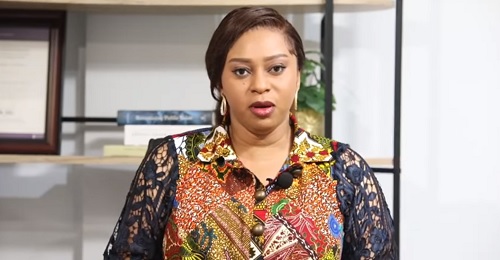
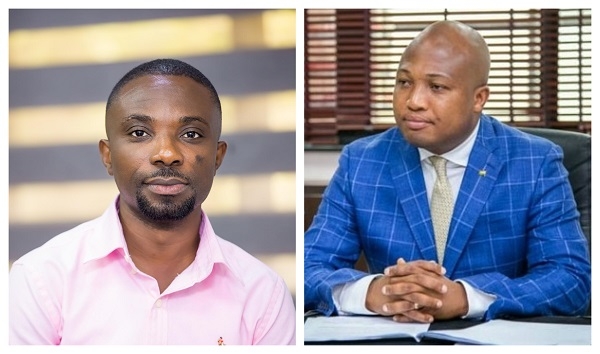
In the aftermath of her loss in the New Patriotic Party (NPP) parliamentary primaries, Dome-Kwabenya lawmaker Sarah Adwoa Safo has quashed rumors suggesting her potential run as an independent candidate in the upcoming December elections.
Asserting her unwavering commitment to the core values of the NPP, Adwoa Safo explicitly stated that she has no intention of running as an Independent Candidate in the forthcoming December 7, 2024, presidential and parliamentary elections or at any foreseeable point in the future.
In an official statement, Adwoa Safo highlighted her enduring dedication to the NPP’s shared values and the collective goal of securing victory in the December 7, 2024, elections alongside Dr. Mahamudu Bawumia in their pursuit to “break the 8.”
‘’My attention has been drawn to several recent misinformation and speculation in the media regarding my political future in the Dome-Kwabenya Constituency in particular and the New Patriotic Party as a whole’’.
‘’I wish to clarify, that despite the setback and outcome of last Saturday’s parliamentary primaries in Dome-Kwabenya, I remain steadfast in my commitment to the shared values of the New Patriotic Party and our corporate quest to break the 8 with H.E. Dr. Mahamudu Bawumia come December 7, 2024’’.
She explained that ‘’As a three-term Member of Parliament and a true party person, I am cognizant of the fundamental principles which underpin the Danquah-Dombo-Busia tradition for which internal competition and afterward cooperation, remains the guiding light’’.
She further used the opportunity to express her eternal appreciation to the good people of Dome-Kwabenya Constituency especially the hard-working Polling Station Executives for the opportunity to represent their interests and aspirations in the august house of Parliament in the last 12 years, adding that ‘’It has been a real honor and privilege working for and with you on matters and issues that border on our common interests and for which I do not take lightly. From the depths of my heart, I say Thank You’’.
‘’For the next few months, I remain dedicated to working collaboratively with the Leadership of the party in the constituency in collectively pursuing goals to unite us for the task ahead in campaigning to maximize our votes for both Parliamentary and Presidential candidates and in Parliament, to execute Government business expeditiously’’ she concluded in the statement posted on her Facebook page.
Adwoa Safo faced defeat at the hands of the Chief Executive Officer of the Free Zones Authority, Mike Oquaye Jnr, who secured over 1194 votes, while Adwoa Safo garnered 328 votes. A third candidate, Sheela Oppong Sakyi, placed third in the contest with just over 100 votes.
Ladies, let’s be honest; the default gift options for our boyfriends often revolve around boxers and singlets. Isn’t it time we added a dash of creativity to the mix? If you’re seeking something unique to surprise your man, here are some imaginative gift ideas that go beyond the usual suspects.
Gadgets for Tech Lovers: For the tech enthusiast, consider trendy and useful items like wireless earbuds or a smartwatch. Every use becomes a reminder of your thoughtful gift.
Food and Drink for the Foodie: If your boyfriend enjoys exploring new culinary delights, go for something special like quality coffee, a set of unique beers, or perhaps some artisanal hot pepper sauces. Add flavor to his day in a fun and delicious way.
Fashion Items that Break the Mold: Swap out the typical boxers or singlets for a stylish leather wallet, a classy watch, or a cool T-shirt from his favorite brand. These gifts are both practical and fashionable.
Experience Gifts for Fun Times: Plan a memorable day out – surprise him with a special date, tickets to a concert, or a game he’s been eager to see. Create lasting memories together.
Gifts Tailored to His Hobby: Consider his hobbies and interests. For a fitness enthusiast, new workout gear or a fitness app subscription could be perfect. If he loves reading, find a compelling book he hasn’t read yet. These gifts show you understand his passions.
Remember, it’s all about bringing a smile to his face. Whether it’s a gadget, something related to his hobby, or planning a special day, what matters most is that you’ve put thought into what he likes. So, step away from the typical boxers and singlets; surprise him with something truly different!
Night blindness, or nyctalopia, extends beyond difficulties seeing in the dark; it signals an underlying issue affecting low-light vision. Let’s illuminate the causes, symptoms, and treatments associated with this condition.
Root Causes: Night blindness can stem from various factors. A prevalent contributor is a deficiency in Vitamin A, crucial for a healthy retina. Other triggers encompass cataracts, retinitis pigmentosa, certain medications, and genetic factors. Awareness and preventive care are essential given the diverse origins of this condition.
Symptoms: Indications are often evident – challenges in transitioning from well-lit to dimly lit environments or struggling with nighttime driving visibility. These signs should not be overlooked, as they may point to deeper health concerns.
Treatments: The positive aspect is that addressing night blindness hinges on identifying its cause. For Vitamin A deficiency, dietary adjustments and supplements prove beneficial. Conditions like cataracts may necessitate surgical intervention. Early detection and intervention are pivotal, prompting timely consultation with healthcare professionals for symptomatic individuals.
Prevention Measures: Prevention surpasses cure. To avert night blindness, uphold a diet rich in Vitamin A, utilize protective eyewear in bright settings, and adhere to regular eye check-ups. Prioritize the well-being of your vision – it’s invaluable!
Night blindness transcends a mere inconvenience; it can be a signal necessitating medical attention. Always heed your body’s signals, stay informed, embrace a healthy diet, and never underestimate the importance of routine eye examinations. Safeguard your vision – it’s your gateway to the world.
When it comes to indulging in a cold beer, moderation is often emphasized, but did you know that beyond being a refreshing beverage, beer can offer some surprising health benefits?
A Toast to Heart Health: Research suggests that moderate beer consumption may positively impact heart health. The alcohol and specific compounds, like flavonoids, in beer can enhance blood circulation and reduce inflammation, potentially lowering the risk of heart disease.
Building Stronger Bones: Beer contains dietary silicon, crucial for bone health. Moderate consumption could contribute to stronger bones, potentially minimizing the risk of osteoporosis.
Boosting Brain Health: Surprisingly, beer may have cognitive benefits. Studies indicate that moderate beer drinking could lower the risk of Alzheimer’s and cognitive impairments, thanks to silicon content that protects the brain from aluminum effects.
Kidney Care with Every Sip: Beer might be advantageous for your kidneys. A study found a link between beer consumption and a reduced risk of developing kidney stones, attributed to the high water content and diuretic effect helping prevent stone formation.
Fights Gum Disease: Hops, a key ingredient in beer, contains compounds with antibacterial properties. These properties can combat oral bacteria associated with tooth decay and gum disease, contributing to better oral health.
While these health benefits are intriguing, moderation remains crucial. Excessive alcohol consumption can lead to adverse health effects.
So, while you enjoy your beer, savor it within healthy limits to maximize these unexpected benefits.
Sipping on your favorite brew can be more than a leisure activity – it’s a toast to your health! Cheers to that!
The Member of Parliament for Ningo Prampram, Sam George, is pressing the Public Accounts Committee (PAC) of Parliament to declare Rev. Dr. Ammishaddai Owusu-Amoah, the Commissioner-General of the Ghana Revenue Authority (GRA), persona non grata.
He asserts that Owusu-Amoah has been working without a government contract since October 2021, having exceeded the retirement age, raising concerns about potential illegality in his position. During a recent Public Accounts Committee (PAC) session, Sam George highlighted the age-related issues surrounding the GRA Commissioner-General.
In an interview on Citi FM, Sam George expressed his intention to formally write to Speaker of Parliament Alban Bagbin and the finance committee, urging them exclude Owusu-Amoah from all Public Accounts Committee’s engagements.
“I know for a fact that the GRA Commissioner-General, since turning 60 years old in October 2021, has not had a contract. This is not the first time I’ve raised this matter directly with the Commissioner-General, drawing his attention to the fact that he’s engaged in illegality,” he said.
He added: “I will be raising this with the Speaker [Alban Bagbin] as well when Parliament reconvenes, drawing the attention of the Speaker and the finance committee to the fact that Dr. Ammishaddai Owusu-Amoah must be declared persona non grata before PAC. We should not entertain someone who has no legal basis.”
“He has engaged in a number of dubious and unscrupulous contracts. The whole country knows about the $100 SML contract. He has been used to carry out all the legalities for Ken Ofori-Atta [Finance Minister]. Why have they kept Dr. Ammishaddai Owusu-Amoah in the post, if not that he’s facilitating corruption and blatant stealing at GRA? This must be a cause of worry for all of us.”
In a notable accomplishment, 22-year-old Adwoa Tima Awuah has earned a coveted spot in the finals of the esteemed Miss Germany awards, a platform renowned for recognizing women for their societal contributions, as reported by Graphic Showbiz.
Miss Germany has transcended traditional beauty standards to become an accolade honoring women actively involved in societal responsibilities and impactful projects benefiting the German community. Adwoa Tima Awuah, the founder of the Yemiyiefo Foundation (YFM Ghana), has secured a place as a finalist, lauded for her outstanding contributions.
Established in 2021, the Yemiyiefo Foundation focuses on supporting young girls in rural areas of Ghana, ensuring their completion of Junior High School (JHS) and transition to Senior High School (SHS).
The foundation has already granted 15 full scholarships to girls in underserved communities for JHS education and conducted Life Skills workshops, reaching over 1000 Junior High School students in the Eastern and Central Regions of Ghana.
In addition to her impactful work in Ghana, Adwoa is actively engaged in a mission to improve the lives of African immigrants in Germany. Her project involves offering psychosocial services to aid the integration of migrants into German society.
Notably, Adwoa Tima Awuah stands out as the youngest and sole black candidate among the top 10 finalists in the Miss Germany competition. The grand finale is set to take place on February 24 at Europapark, Germany.
Articulating her mission at Miss Germany, Adwoa emphasized, “As a former migrant from Ghana to Germany, I know how challenging migration and integration can be, especially without sufficient support. My mission at Miss Germany is to create more empathy for migration and integration with a documentary. I also work at a psychosocial center to support migrants, especially the African community. This trip is more than a mission. It is my connection to my roots, the challenges of my family, and the difficulties of all those who had to leave their familiar surroundings and start anew in Germany.”
On January 26th, 2024, a heartwarming celebration unfolded as Lawyer Stephen Asante Bekoe and his son, Paa Kwasi Adom Asante, marked a significant milestone by graduating with Master’s degrees in Law from the esteemed University of Ghana School of Law.
Lawyer Asante Bekoe achieved a remarkable feat by earning his LLM in Natural Resources Law, while his son, Paa Kwasi Adom Asante, excelled in his studies, graduating with an LLM in Energy Law.
Beyond their academic accomplishments, Lawyer Asante Bekoe has a rich history of leadership roles and contributions to various organizations.
He proudly serves as the National President of the Okuapemman Past Students Association and holds the prestigious position of President of the Ghana Canoeing Federation.
In addition to these roles, Lawyer Asante Bekoe is dedicated to the betterment of society, serving as a board member of the Ghana Library Authority and contributing as a member of the Legal and Constitution sub-committee of the Ghana Olympic Committee.
The achievements of both father and son stand as a testament to their commitment to academic excellence and service to the community.
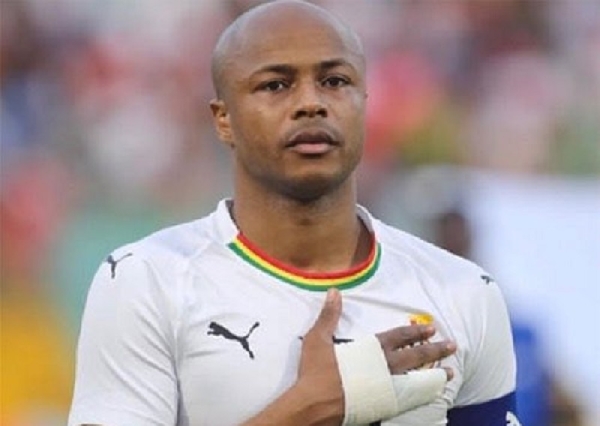
Andre Dede Ayew, the captain of the Black Stars, has formally apologized for the team’s performance at the 2023 African Cup of Nations (AFCON).
In a recorded video message, Ayew expressed regret for the team’s winless campaign that led to their exit in the group stage, including a loss to Cape Verde and draws against Egypt and Mozambique.
“These past days have been very difficult for every Ghanaian football fan and myself. I would like to apologize for the results at the AFCON that we just exited; we know that we should have done better,” Ayew stated, taking full responsibility as the captain.
He acknowledged the disappointment of the fans, emphasizing that setbacks in football make a team stronger. Ayew assured Ghanaians that the Black Stars would rise again and promised to put the nation’s flag back where it belongs.
In response to the criticism and public outcry, the Ghana Football Association (GFA) also issued a public apology.
The GFA acknowledged the frustration and disappointment of Ghanaians and accepted full responsibility for the Black Stars’ performance, expressing sincerest apologies to the nation and all stakeholders.
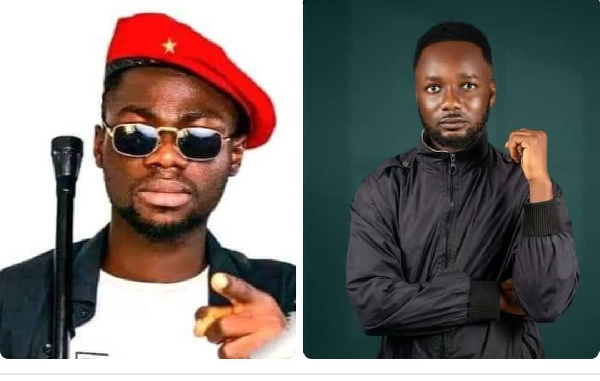
Get ready for a musical extravaganza as Ghanaian rap sensations Kojo Fyneboy and Danito gear up to showcase their lyrical prowess on the Today’s TV Sunday special show.
Hosted by the charismatic Kojo Pooley, the event is scheduled for Sunday, February 4, 2024.
Initiated by the renowned music promoter Mixtic Romras, this rap battle promises to be a stage where both artists can flaunt their unique styles and lyrical dexterity.
With reputations hanging in the balance, Kojo Fyneboy and Danito are prepared to deliver a performance that will enthrall audiences nationwide.
Excitement is buzzing among fans and music enthusiasts as they eagerly await the clash of these titans. With high stakes and anticipation building, the countdown to the showdown has begun.
His Excellency Boniface Gambila, Ghana’s Ambassador to Burkina Faso, has dismissed assertions implying that Burkina Faso’s exit from the Economic Community of West African States (ECOWAS) would strain the ties between the two neighboring countries.
Ambassador Gambila underscored that despite Burkina Faso’s decision to withdraw from ECOWAS due to dissatisfaction with the regional body’s management of critical issues, the personal and diplomatic connections between the leaders of Ghana and Burkina Faso remain strong.
He expressed confidence that Burkina Faso’s departure from ECOWAS would not result in adverse trade implications for Ghana. Ambassador Gambila cited the enduring closeness between the two presidents and the deep historical bond shared by the nations as factors ensuring the resilience of diplomatic and trade relations.
“Our two presidents are very close, and historically, the fact that we are brothers and sisters, this would not affect us. I am very optimistic. Don’t let any security analyst sit back there and frighten you. There would be nothing of the sort,” Ambassador Gambila affirmed in an interview with Bolgatanga-based A1 Radio.
The withdrawal of Burkina Faso, alongside Mali and Niger, from ECOWAS was motivated by grievances over what they deemed as unfair treatment by the regional organization.
Despite concerns voiced by certain international trade experts about the potential adverse effects of these exits on trade and diplomatic relations, Ambassador Gambila brushed aside such notions. He affirmed the enduring strength of the Ghana-Burkina Faso relationship in the face of regional transformations.
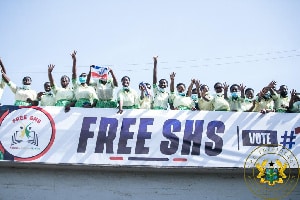
In a significant development, the Nana Addo Dankwa Akufo-Addo government has officially declared its intention to review the flagship Free Senior High School (Free SHS) program.
This revelation comes as part of the information presented in the International Monetary Fund’s (IMF) latest report on Ghana’s US$3 billion bailout programme.
The pertinent details of this policy shift are outlined on page 76 of the comprehensive 155-page report, falling under the section titled ‘PUBLIC SPENDING EFFICIENCY.’
Within this segment, the government articulates its plans, which extend beyond the Free SHS program to include recalibrating the expenditure portfolio of Municipal and District Assemblies (MDAs) responsible for social spending.
This strategic move suggests a broader commitment to enhancing public spending efficiency and highlights the government’s proactive stance in evaluating and adjusting key initiatives for the overall benefit of the nation.
The decision to review the Free SHS program, a cornerstone of the government’s education policy, is likely to spark discussions and debates on the potential implications and desired outcomes.
The relevant portion on education read: “The key objective is to shift the composition of spending by these MDAs towards targeted and well-designed interventions.
“In addition to functional review of relevant MDAs, we will carry out a comprehensive assessment of public sector wages, including in education and health sectors.
Just weeks ago, the government found itself embroiled in a verbal exchange with former President John Dramani Mahama, who pledged to review the Free Senior High School (Free SHS) program if elected in 2025.
Despite the government’s staunch defense, led by the education minister, asserting that the program requires improvements rather than a review, the debate surrounding the Free SHS policy remains contentious.
The Free SHS policy, a cornerstone of the government’s education initiatives, focuses on eliminating financial barriers by absorbing fees approved by the GES council. Its objectives include not only enhancing accessibility by removing cost constraints but also improving educational quality. This is achieved through measures such as providing core textbooks and supplementary readers, implementing teacher rationalization and deployment strategies, and other impactful initiatives.
Furthermore, the policy aspires to address the anticipated surge in enrollment by expanding physical school infrastructure and facilities. As the government and former President Mahama lock horns over the future of the Free SHS program, the debate underscores the significance of this education policy and its potential impact on the nation’s educational landscape.
“In the education sector, we will review and rationalize the Free Senior High School (SHS) program. We will continue our support to tertiary education, take targeted measures to improve foundational learning (e.g., increasing capitation grants) and introduce reforms with the help of development partners to improve overall learning outcomes.”
The December 18, 2023 report was titled: “STAFF REPORT FOR THE 2023 ARTICLE IV CONSULTATION, FIRST REVIEW UNDER THE ARRANGEMENT UNDER THE EXTENDED CREDIT FACILITY, REQUEST FOR MODIFICATION OF PERFORMANCE CRITERIA, AND FINANCING ASSURANCES REVIEW.”
This study investigates how Ghana’s domestic debt crisis in 2022/2023 has affected economic growth. It scrutinizes the constraints imposed by debt overhang, crowding out, and debt reduction effects. The crisis, triggered by pre-existing imbalances and external shocks, led to a full-blown macroeconomic downturn, hindering the post-COVID-19 recovery.
Facing a mounting fiscal deficit and escalating debt levels, Ghana embarked on an aggressive debt restructuring program to achieve a more sustainable debt-to-GDP ratio by 2028. The restructuring efforts target rationalizing development spending, aligning the Producer Purchase Price (PPP) setting process with financial constraints, and enhancing oversight. The study discusses the challenges encountered and the potential economic implications of these restructuring
Examining historical patterns, this section delves into sovereign debt issues and restructuring experiences. It explores the challenges faced by countries during debt restructurings or defaults, emphasizing the impact on the macroeconomy. Stylized facts emerge, highlighting the effects of debt operations on recessions, exchange rates, and recovery. The discussion provides insights into the economic turbulence surrounding debt crises and the subsequent recovery processes.
Drawing from past experiences, this section considers factors influencing a country’s ability to regain access to external financing after a debt restructuring. It explores how the type of restructuring, the cost for creditors, and the economic conditions during and after the restructuring can impact a nation’s access to international debt markets. The study also evaluates the historical context of debt restructurings and their implications for subsequent economic stability and growth.
Overview of Ghanaian economy in the Pre-DDEP period
By the end of the 3rd Quarter of 2021, Ghana’s fiscal vulnerability had been evident to the market resulting in a loss of market access largely consistent with the country’s struggle to manage its public debt since independence.
In all of Ghana’s program engagements with the International Monetary Fund (IMF) debt unsustainability has been recurring reflecting a weak fiscal regime of expenditure rigidities and low domestic revenue mobilization.
The latest IMF Supported Program is unique given the number of prior actions the country had to undertake to qualify for help from the IMF including taking a comprehensive approach to restructuring the country’s public debt with the domestic debt restructuring being a condition precedent to getting IMF Board approval.
Unlike the case of Zambia, which excluded the domestic debt from its debt restructuring to protect the domestic financial system, Ghana applied the most aggressive debt restructuring which was first announced on December 5th, 2022. Arguably the first of its kind in the history of the country.
Government instruments (excluding only treasury bills) held across households (including pensioners), financial institutions, body corporates, and resident and non-resident investors were considered to be in the universe of eligible bonds.
The country’s economic fundamentals had deteriorated to the extent that the traditional fiscal consolidation measures embodying expenditure restraint and revenue enhancement measures were considered to be inadequate and therefore restructuring had become fundamental to restoring fiscal sustainability.
The Ghanaian economy has witnessed poor revenue growth, and low export earnings from cocoa, gold, and oil because of over-dependence on international capital markets and low tax capacity over the past decade. The country’s debt stock as a result has increased considerably over the past decades – a trend generally connected with expansion in the size of government expenditures.
Ghana’s economy entered a full-blown macroeconomic crisis in 2022 on the back of pre-existing imbalances and external shocks. Large financing needs and tightening financing conditions exacerbated debt sustainability concerns, shutting off Ghana from the international market.
Large capital outflows combined with monetary policy tightening in advanced economies put significant pressure on the exchange rate, together with monetary financing of the budget deficit, resulting in high inflation. These developments interrupted the post-COVID-19 recovery of the economy as GDP growth declined from 5.1% in 2021 to 3.1% in 2022. World Bank (2022) found that the fiscal deficit widened slightly to 15.2% of GDP in 2020 but further improved to 12.1% of GDP in 2022 due to higher spending.
Public debt declined from 79.6% in 2021 to over 88.1% of GDP in 2022, as debt service-to-revenue reached 117.6%. The country’s debt overhang sets in when the face value of debt reaches 60 percent of GDP or 200 percent of exports, or when the present value of debt reaches 40 percent of GDP or 140 percent of exports.
The monetization of fiscal deficits., and Bank of Ghana lending to government through ways and means advances have risen to GHS 50 billion in 2022, exceeding the threshold set by Bank of Ghana Act 2002 Act 612 as amended Act 2016 Act 918 Section (2) the total loans, advances, purchases of treasury bills shall not at any time exceeds 5% of the total revenue of the previous fiscal year.
These ways and means advances are temporary overdraft facilities provided to the Government of Ghana (GoG) to help with financial difficulties caused by a cash flow mismatch by bridging the gap between expenditure and revenue receipts.
This level of borrowing from the Bank of Ghana to finance fiscal deficit was unsustainable, fueled inflation, and endangered growth. In Ghana, deficit financing has led to borrowings from multinational finance institutions, such as the International Monetary Fund (IMF), the World Bank, the African Development Bank (ADB), and Euro-markets amongst others.
Unfortunately, the rising national debt in Ghana began to outweigh the country’s revenue generation capacity and draw down on foreign reserves, hence stifling the much-needed public capital investments and economic productivity.
Also, it has been reported that these borrowed funds are often mismanaged and misapplied, hence, were not used for economically productive activities, leading to debt burden, capital flight, and economic instability in the long run.
Ghana has accumulated huge debt with the rising cost of debt service which has undermined economic stability as domestic investments are being crowded out by the rising cost of debt servicing. Komlan and Essosinam (2022) opined that nations like Ghana that adopt unsustainable fiscal policies have an ever-increasing debt-to-GDP ratio that violates their budgetary restraint.
High debt levels resulted in high debt servicing, which has led to a low amount of money available for investment in infrastructure and other economic sectors.
Ghana’s debt profile continued to increase in the face of expanding fiscal deficit and low revenue-generating capacity. This was concerning because the country’s debt profile became more and more dominated by commercial debt.
Weak fiscal and economic performance over extended periods led to an unsustainable fiscal situation for Ghana in 2022 which led to the domestic debt restructuring. The debt exchange perception has increased the risk of Ghana government securities as expected to significantly blunt confidence in the Ghanaian economy in general, thereby affecting the creditworthiness of private institutions as well as individuals.
This has translated into a further cut in letters of credit lines to domestic banking institutions, which have had grave implications for external trade and the stability of the local currency (Cedi). The Ghana Domestic Debt Exchange (DDEP) was launched on 5th December 2022.
It was designed to offer relief to fiscal accounts through a sizable reduction of the coupon rates as well as through the extension of maturities on most domestically issued bonds.
While par-neutral, the exchange aimed to provide a solid foundation for reducing Ghana’s debt to sustainable levels in the medium term via offering an effective cap on interest payments on public debt and stronger growth prospects. Without effective debt restructuring, reduction, or forgiveness, middle-income debtor nations risk falling into a debt trap with debt overhang where economic policies focus solely on servicing unproductive debt repayments to creditors and propping up an unfair global financial system.
AN OVERVIEW OF GHANA’S PUBLIC DEBT SITUATION OVER THE PAST DECADE
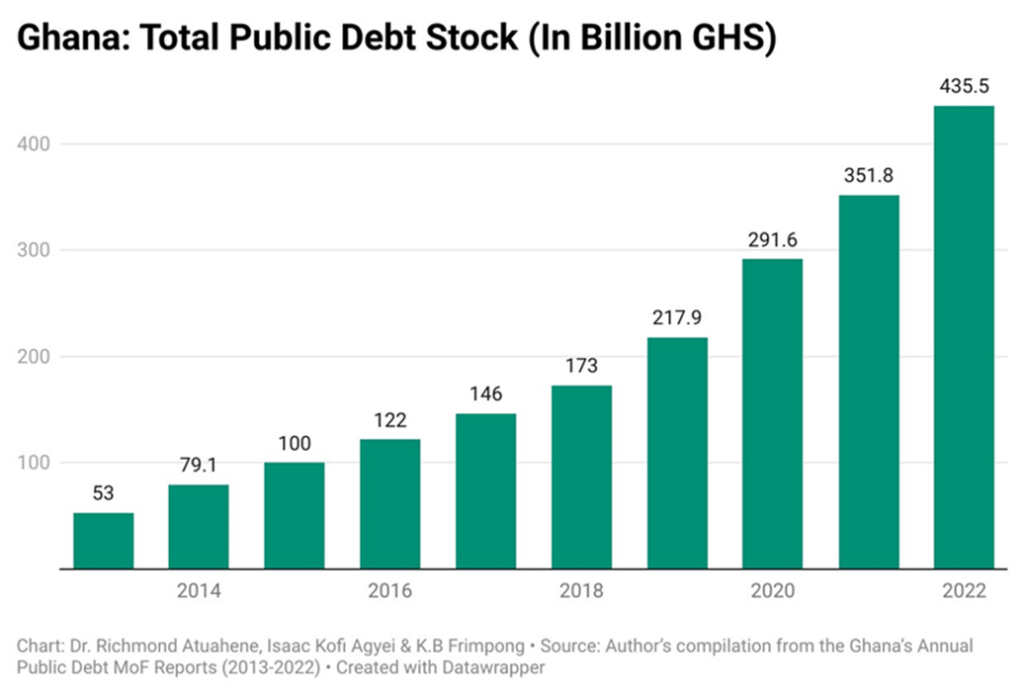
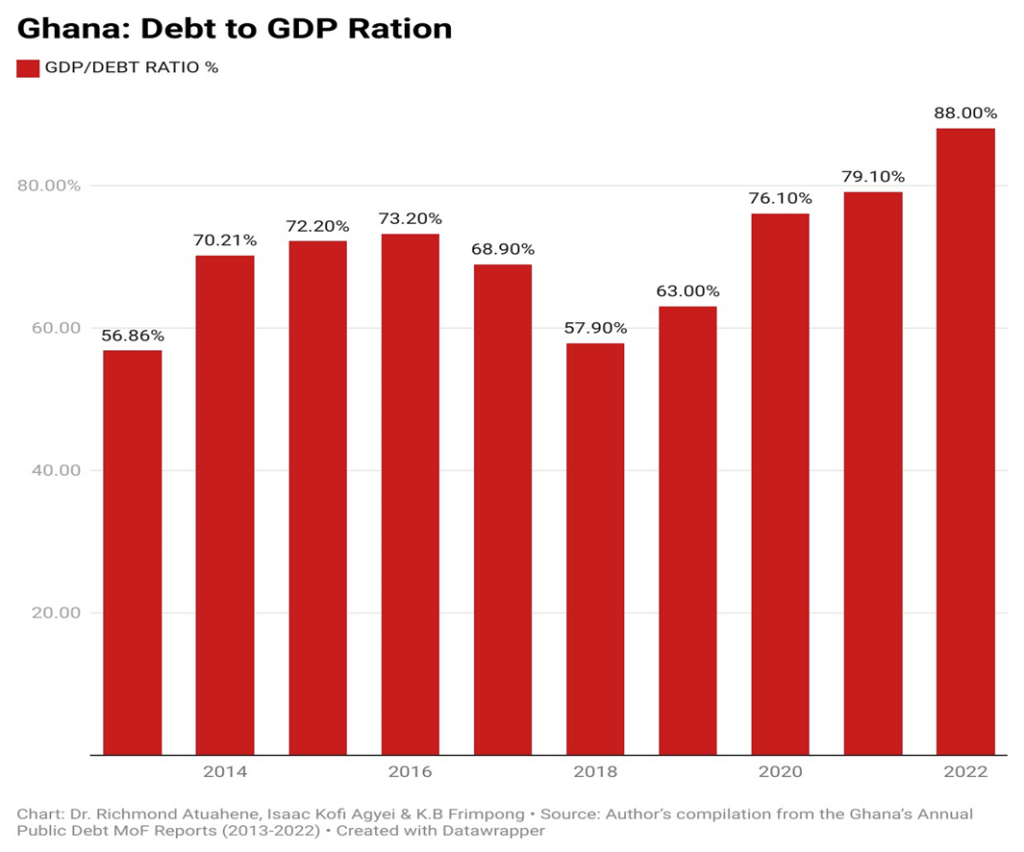
According the Ministry of Finance posited that Ghana’s total public debt in 2012 was GHC 35.9 billion (US $19.2 billion) thus represented 47.8% of GDP after rebasing in 2010 but increased significantly to GHC 53.1 billion (US$24.4 billion) or 56.8% of GDP in 2013.
In 2014, Ghana’s public debt rose to GHC 79.5 billion (US$ 24.7billion) or 70.2% of GDP and further increased significantly to GHC 100.2 billion (US$ 26.4 billion) in 2015 thus representing 72.2% of GDP.
By the end of December 2016, the public debt stock stood at GHC 122.2 billion (US$ 29.3 billion) thus representing a debt/ GDP ratio of 72.5%. Ghana’s public debt stock stood at GHC 146.6 billion (US$ 32.3 billion) at the end of 2017, up from the 2016 figure of GHC 122.3 billion (US$ 29.3 billion).
The total public debt as a percentage of GDP declined from 73.2% in 2016 to 69.8 % of GDP in 2017. Ghana’s public debt stock as of the end of December 2018 was GHC 173.1 billion (US$ 35.9 billion) representing 57.9% of the rebased GDP.
According to the Ministry of Finance and Economic Planning Annual Debt Review (03/2019), a large part of the 2018 public debt stock additions of GHC 11.1 billion resulted from the banking sector bail-out program of the government.
The cost incurred by the government to clean up the banking sector impairments resulted in the public debt increasing by 3.2% of the rebased GDP. Excluding the bail-out costs, however, the stock of public debt amounted to GHC 163.4 billion (US$ 33.9 billion) thus representing 57.9% of rebased GDP as of the end of December 2018.
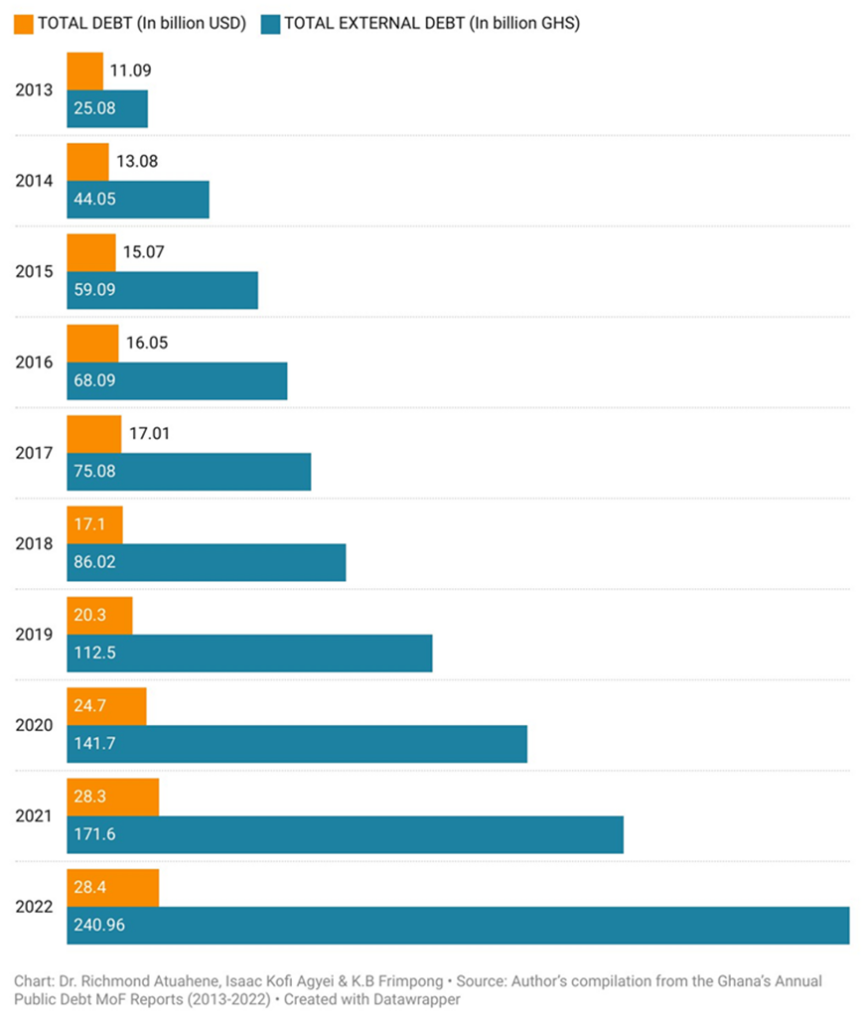
At the end of December 2018, the stock of external debt was GHC 86.2 billion (US 17.9 billion) representing 28.9% of GDP while the domestic debt stood at GHC 86.78 billion which represented 28.9% of GDP. By the end of June 2019, the stock of public debt rose to 59.2% of GDP (GHC 204 billion compared with December 2018 representing 57.9% of rebased GDP.
Thereafter, domestic debt increased very sharply, reaching GH₵86.2 billion in 2018 and then to GH₵94.8 billion at the end of May 2019. This indicates that domestic debt increased by GH₵4.1 billion between 2000 and 2008, GH₵13.6 billion between 2008 and the end of 2018 later increased to GHC 94.8 billion at the end of May 2019.
Total domestic debt stood at GH₵86.889.3 billion at the end of December 2018, indicating an increase of GH₵6.0 billion by the end of March 2019. Ghana’s debt stock as of the end of December 2018 stood at GHC173,068.7 billion (US$ 35,858 billion) comprising external and domestic debt of GHC 86,169 billion (US$ 17.868 billion) and GHC 86.9 billion (US$18.020 billion) respectively.
This represented 57.9% of the debt/GDP ratio. External and domestic debt accounted for approximately 49.7% and 50.3% respectively. The Cedi recorded a cumulative depreciation of 8.4% against US$ as of the end of December 2018 and this impacted negatively on external debt.
The total public debt stock has increased from GHC 173 billion at the end of December 2018 to GHC 198 billion at the end of March 2019 further increasing to GHC 204 billion at the end of June 2019. The external debt stock increased from GHC 86.2 billion as of December 2018 to GHC 115 billion at the end of June 2019.
Similarly, the domestic debt component has also increased from GHC 86.9 billion at the end of December 2018 to GHC 99.8 billion at the end of March 2019 but declined to GHC 94.6 billion. Ghana’s total public debt rose to 54.8% of the GDP (GHC 198.0 billion) at the end of March 2019 compared with 57.9% of the GDP at the end of December 2018 but increased further to GHC 204 billion or 59.2% of GDP in June 2019. Of the total public debt stock of GHC 198 billion, GHC 11.0 billion or (3.2% of GDP) represented bonds issued to support the banking sector cleanup.
As a percentage of the GDP, the external debt has declined marginally from 29.6% in 2018 to 26.3 % at the end of March 2019, while domestic debt increased from 29.3% in December 2018 to 31.2% at the end of March 2019. The stock of public debt rose to 59.2% of GDP (GHC 204 billion) at the end of June 2019 Of the total debt stock, domestic debt was GHC 94.6 billion (27.5% of GDP) while external debt was GHC 105. 4 billion (30.6 % of GDP) and the end of June 2019.
The accumulation of public debt has been a direct result of the gap between unplanned expenditures and revenues, which has widened due to the inelasticity of debt servicing and infrastructural needs, deteriorating terms of trade, and the failure to improve and enhance revenue collection over the long period. Ghana’s public debt stock stood at GHC 173.1 billion (US$35.9 billion) at the end of December 2018.
This was made up of GHC 86.2 billion or (US$ 17.9 billion) of external debt and GHC 86.9 billion or (US$ 18 billion) of domestic debt Also, persistent currency depreciation over the period contributed to the stock of Ghana’s public debt of GHC 204 billion (US$ 38.7 billion) at the end of June 2019.
According the Ministry of Finance and Economic Planning (29/07/ 2019) opined that the total public debt has increased from GHC200 billion (58.1% of GDP) at the end of May 2019 increased further to GHC 204 billion (US$ 38.7 billion) at the end of June 2019 representing 59.2% of GDP nearing the high distress threshold of 60% set by the IMF/World Bank.
The share of the external debt stock increased from 50.2% at the end of December 2018 to 52.8% at the end of June 2019 mainly driven by the issuance of Eurobonds of US$ 3 billion in March 2019. The IMF also disbursed an amount of SDR132.84 million (US$184.30 million) in March 2019 after their 7TH and 8th reviews of the Extended Credit Facility Program. On account of these two major inflows, a net amount of US$ 2.9 billion, equivalent to approximately GHC14.8 billion was added to the debt stock.
The increase in the external debt stock amounted to GHC 23.8 billion between December 2018 and June 2019 reflecting a volume transaction of GHC 14.8 billion and exchange rate depreciation of GHC 9 billion (MOF, Mid-year Fiscal Policy 29/07/2019).
Ghana’s public debt stock increased from GH¢218.2 billion (US$39.4 billion) in 2019, representing 62.4 percent of GDP, to GH¢291.6 billion (US$50.8 billion) in 2020, representing 76.1 percent of GDP. The increase resulted mainly from increased fiscal deficit and primary balance deficit, exchange rate depreciation, disbursement of existing loans, and contracting of new loans.
Ghana’s public debt as of end-December 2021 was GH¢351.7 billion (US$58.6 billion), comprising external debt of GH¢170.billion (US$28.3 billion) and domestic debt of GH¢181.8 billion (US$30.3 billion), respectively.
The domestic debt stock compared to the external witnessed a relatively higher nominal increase, attributable to net issuances of domestic instruments to pay down the cost incurred from the crystallization of contingent liabilities in the energy sector and the financial sector bailout, while the external debt rose mainly on account of disbursements due on new and existing loans, the Eurobond issuance in March 2021, and fluctuations in the exchange rate over the period under review.
In 2022 due to high inflation, interest rates, and portfolio reversals, issuances of Government securities remained under pressure, highlighted by weak demand, and various undersubscriptions during the year. The provisional stock of public debt increased from GH¢351billion (US$58.6 billion) in 2021 to GH¢435.3 billion (US$52.3 billion) at the end of December 2022, representing an increase of 23.7 percent.
The depreciation of the cedi alone accounted for GH¢67.1 billion (equivalent to 88.1%) of the increase in the debt stock at the end of December 2022 (Ministry of Finance, 2013-2022). billion), respectively.
The domestic debt stock compared to the external witnessed a relatively higher nominal increase, attributable to net issuances of domestic instruments to pay down the cost incurred from the crystallization of contingent liabilities in the energy sector and the financial sector bailout, while the external debt rose mainly on account of disbursements due on new and existing loans, the Eurobond issuance in March 2021, and fluctuations in the exchange rate over the period under review.
In 2022 due to high inflation, interest rates, and portfolio reversals, issuances of Government securities remained under pressure, highlighted by weak demand, and various undersubscriptions during the year. The provisional stock of public debt increased from GH¢351billion (US$58.6 billion) in 2021 to GH¢435.3 billion (US$52.3 billion) at the end of December 2022, representing an increase of 23.7 percent.
The depreciation of the cedi alone accounted for GH¢67.1 billion (equivalent to 88. %) of the increase in the debt stock at the end of December 2022 (Ministry of Finance, 2013-2022.). The increase in the debt-to-GDP ratio of 88% led to the realization that Ghana’s debt was not sustainable.
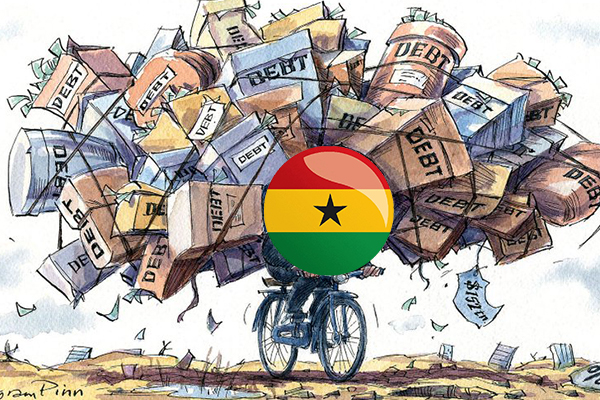
The sharp deterioration in terms of trade, higher interest rate changes on non-concessional loans, huge currency depreciation, and higher fiscal deficits are often mentioned as some of the major causes of the rapid growth of the domestic debt crisis in Ghana over the past decade. Debt has already placed a significant burden on Ghana’s economy and society, and the country has fallen back into a debt trap, with economic stagnation possible increases in poverty rates, and failure to implement the Sustainable Development Goals.
First, one of the major factors that has contributed to Ghana’s domestic debt crisis was the unproductive use of borrowed funds. Funds have not been used judiciously. Ghana with huge infrastructural deficits, borrowed funds to supplement its small domestic revenue but invested in unproductive and uneconomic viable ventures. The huge borrowing was expected to generate higher returns on capital compared to that of some emerging economies.
However, borrowed funds have not been invested in productive and commercially viable ventures capable of generating enough economic returns that could have been used to service the debt and eventually pay back the debt. Using part of Eurobond proceeds in financing a major project like Cocoa farm roads, the government should principally look to the cash flows and earnings of the Cocoa sales as the source of funds for repayment for principal and interest payment but if borrowed funds are used in funding social project like funding the Free SHS then the repayment created debt crises. Furthermore, such projects should pass a sensitivity analysis test that quantifies the effect on the project (and in the case of a project loan, the effect specifically on cash flow available for debt service and loan repayment.
In preparation for the international capital market, the first task of the government was to identify a portfolio of projects that are viable for commercial funding with enough economic rate of service return the underlying debt. Projects selected for funding were not commercially viable in their own right but sometimes for political expediency and also project yields did not have a high economic rate of service return to the underlying debt. The decision on how to use borrowed funds is important to ensuring debt sustainability.
At all costs, funds raised by issuing debt should be invested in projects that have a high private or social return. When borrowing in foreign currencies, the country should take great care to ensure that future export revenues will be sufficient to service the additional debt. Debt accumulation is unlikely to be sustainable if domestic or foreign borrowing is used to finance public or private consumption with no effect on long-term growth.
Most of the selected projects were desirable but did not meet the criteria for access to commercial funding. However, the first debut sovereign bond in 2008 met the project criteria for sourcing external funding as it was not properly appraised and evaluated. Eurobond proceeds must be used judiciously to support projects that generate more future export revenues to service the debt. Furthermore, sovereign bond or Eurobond proceeds should not be thinly spread as done recently.
Eurobond proceeds of US$ 1 billion were thinly shared among the Ministry of Energy and Petroleum, Ministry of Food and Agriculture, Ministry of Roads and Highways, Ministry of Railways Development, Ministry of Water Resources, Works and Housing, Ministry of Education Ministry of Health. Some of the detailed allocations under the Eurobonds looked very frivolous and flimsy, for example, the allocation of GHC50 million for the construction of greenhouses and capacity building training centers while not supporting the growth of oil palm and cashew sectors and also spent a whooping GHC45 million for supplying and installation of integrated e-learning laboratories for senior high schools in Ghana while we still have some primary schools in our villages and cottages operating under trees and dilapidated structures ( Report of the Finance Committee, Parliament of Ghana, 03/2018).
The government should have sought concessional funding for projects like coastal protection green housing projects and capacity building instead of funding these projects with expensive commercial debt. The decision on how to use borrowed funds is important to ensuring debt sustainability. At all costs, funds raised by issuing debt should be invested in projects that have a high private or social return. Debt accumulation is unlikely to be sustainable if loans are used to finance public or private consumption, with no effect on long-term growth. The fact is that development cannot be justified by high and unsustainable public debt.
The country’s debt can only be reined in through sustained fiscal prudence to help reduce borrowing. It is important therefore that loans contracted are used to develop the economy to enable it to ‘grow out of debt.’ It would be a fatal mistake to use loans to fund recurrent spending or refinance debts that were used to fund recurrent spending that did not have a direct bearing on growth. But there are conditions under which even debt used to finance productive investment could turn out to be unsustainable.
This happens if the ex-post returns on a project end up being lower than the interest and principal debt repayments and should therefore be guided against very carefully. Borrowing from the local bond market at 19.1% to finance social projects at 0% returns has caused domestic debt crises over the past six years.
Second, another factor that has contributed to the country’s debt crisis has been the continuous high fiscal deficits driven by unproductive public spending influenced by vague political promises made during political campaigns.
According to Bawumia (2010), the global food and fuel price increases in 2007-2008 adversely impacted most Sub-Saharan African countries, including Ghana. In the context of these global shocks and the 2008 elections, public sector spending increased substantially, raising the fiscal deficit from 7.6% of GDP in 2006 to 14.5% of GDP in 2008 to further record high of 15.2% of GDP in 2020. Contributing to the strong fiscal expansion were high energy-related subsidies, increased infrastructure investment, higher wages and salaries, and a rise in social mitigation expenditures to dampen the effects of the global price shocks.
Over the past decade the government primary deficits have been arising thus increasing the burden of debt because the governments had little resources to service interest on public debt. Fiscal deficits had worsened not only because of the plunged in export revenues but also because of the need to increase social spending and safety nets over the period.
In Ghana, the lack of fiscal discipline is identified as a cause of the ballooned public debt up. For example, Ghana has been accumulating relatively large primary fiscal deficits over the past two decades, amplified every time the country was approaching elections. According to various IMF Country reports recorded high budget deficit over the past decade, for example in 2007 was 7.8% of GDP, 14.5% of GDP in2008; 10.9% of GDP in 2011; 10.2% of GDP in 2012; 10.3% of GDP in 2013; 12% of GDP in 2014. 9.5% of GDP in 2015; 9.3 % of GDP in 2016; 6.3% of 2017; 7% of GDP in 2019; 15.2% in 2020 9.4% in 2021; 12.4%in 2022.
In 2020, Ghana was hit hard by the Covid 19 pandemic which accelerated fiscal deficit of 15.2% of the GDP that included energy and financial sector costs with a further 2.1% of GDP in additional spending financed through the accumulation of domestic arrears (IMF, 21/221). Ghana’s continuous high fiscal deficit was driven by partly by unproductive public spending that was not efficient in supporting equitable development. However, around the 2008, 2012, 2016 and 2020 elections, fiscal slippages and unduly spending led to deep holes in the budget and unfavorable debt issuances.
For example, the fiscal slippage in 2008 was the result of government subsidies of utilities, election year wage and salary increase and increased capital investment from proceeds of Ghana’s sovereign bonds to deal with energy crisis (Bawumia, 2010). At root of Ghana’s fiscal deficits was out of control government spending, largely to pay salaries of an overgrown civil service (Adams,2015). Fiscal slippages were due to bad public finance management in Ghana.
As a result of this weak fiscal discipline, decline in commodity prices and high investment needs, the Ghanaian public finances have been under serious pressure over the years. A major factor that has contributed to the debt problem is the levels of fiscal deficits over the past decade, borrowing to finance the deficits and the terms of borrowing. Among all these factors the most important is probably the fiscal deficit as it drives the level of borrowing and even the terms that can be obtained for such borrowing.
Ghana opted for major development programs and highly expansionary fiscal policies during the oil findings in the late 2000s, acquiring external debt as spending increases outpaced the rise in tax receipts. These spending policies continued for some time after the post- collapse in commodity prices (cocoa, gold and oil). Ghana also used external borrowing to maintain consumption in the face of falling export earnings.
The growing fiscal deficits also reduced the ability of governments to make debt-service payments as they led to declines in the growth of real national income, inflationary pressures, and depreciation of Cedi against major trading currencies. Private savings, which could have been an alternative to foreign borrowing, were also discouraged by policies designed to keep domestic interest rates low. This resulted frequently in negative real interest rates and disintermediation in the financial sector.
Third, the rising Ghana’s debt has limited the economy and has hampered tax collection system which accounted for only 13%. tax to country’s GDP ratio which the lowest among our peers in the sub-region.Total tax revenue collections in 2019 totalled GH¢45.6 billion, implying a tax-to-GDP ratio of 13% (IFS, 2021). The tax-to-GDP ratio in Ghana increased by 1.0 percentage points from 13% in 2020 to 14.1% in 2021 (IFS,2022) low than Africa’s average tax-to-GDP rate of 16.5%.
Tax evasion, tax avoidance and tax exemptions are some reasons that have accounted for low tax to GDP ratioin Ghana. The defining feature of tax systems across in Ghana is their inability to collect a significant share of revenue through income taxation of individuals and corporations. Ghana’s overwhelmingly collect far less direct tax than developed countries, both as a share of total taxation and as a share of GDP. Also, the higher debt affected the revenue mobilisation in several important ways.
Revenue mobilisation was directly affected by debt constraining the economic environment in a way that led to low economic growth. Low economic growth meant less tax to collect. These were some of the channels that debt affected tax collection in the country. Domestic government debt crowds out the private sector by limiting the funds available to borrow. This has constrained the private sector’s ability to grow the economy, create jobs, and generate revenues that could be taxed. Debt also increased the risk of fiscal crises by creating an unstable macroeconomic environment.
External debt repayments put pressure on the exchange rate contributed to it deteriorating and made imports more expensive thereby contribute to higher inflation in 2022. This, in turn, has contributed to lower growth. Further, debt has created a crowding-out effect, where the government’s high interest payments and repayments consume a significant portion of the government’s revenue, leaving less room for the country’s self-financed public investment. This has created a greater incentive to borrow to finance public investment and thus, beginning the cycle again.
Fourth, one key factor that has contributed current debt crisis in Ghana has been the endemic corruption prevailing the public sector, as huge fiscal revenue continues to be lost, impeding the ability of government to invest in public social spending using domestic revenue. The 2022 Auditor General’s report shows that irregularities in the public sector in 2021 amounted to about GH¢17.5 billion. Similarly, the Auditor General’s COVID-19 expenditure report shows that US$81 million worth of vaccines paid for by the state were never delivered, among other infractions.
Over the years there has been a growing interest on the relationship between public debt and corruption globally. Voluminous studies have looked at this relationship and out of these studies the main finding has been that corruption increases public debt and also that a larger shadow economy reduces tax revenues and thus increases public debt, similarly, higher government expenditure enhances the effects of corruption on government debt. Transparency International defines corruption as abuse of entrusted power for private gain.
The World Bank defines corruption as the abuse of public office for private gain. Corruption and unsustainable public debt are twin governance challenges confronting Ghana’s public finance management system. Corruption in Ghana has resulted in a marked increase in levels of fiscal deficit and domestic indebtedness as central government has bailed out and taken over the debts of several parastatals. Corruption has increased public debt, and a larger shadow economy has reduced tax revenues and thus increased public debt. Similarly, higher government expenditure enhances the effects of corruption on government debt.
In Ghana corruption and unsustainable public debt are twin governance challenges confronting the public finance management system. Corruption often leads to adverse influences on the economy. It is one of the main constraints facing companies in developing economies (World Bank, 2021). Gupta et al. (2002) highlights that corruption increases income and wealth inequality and poverty in several developing countries like Ghana.
In particular, it enhances the transaction costs of private investors, which leads to a decline in profit and investment. Widespread corruption tarnishes a country’s international reputation and reduces its attractiveness for foreign investment, public debt, tourism, and development assistance. It undermines Ghana’s standing in global indices that measure corruption levels, such as the Corruption Perceptions Index, and can hinder international cooperation and partnerships. Corruption hampers economic growth and development.
It distorts market mechanisms, undermines fair competition, and diverts resources away from productive sectors. It creates barriers to investment, reduces investor confidence, and deters both domestic and foreign direct investment. Corruption also leads to inefficient allocation of resources, loss of public funds, reduced government revenue and increased domestic debt. The effect of corruption on public debt is increased by government expenditure, the shadow economy and military expenditure and they found out that the effect of corruption on public debt is compounded by increased government expenditure and increased size of the shadow economy.
In another related study by Cooray, Dzhumashev and Schneider (2017) confirmed that increased corruption and a larger shadow economy leads to an increase in public debt. More so they did find that a larger shadow economy reduces tax revenues and thus increases public debt, similarly, higher government expenditure enhances the effects of corruption on government debt. Theoretical literature shows that there is link between corruption and government debt through a regime-based approach and they found that public debt appears to respond faster to a high corruption regime compared to a low corruption regime.
The fifth factor that has brought about the Ghanaian debt crisis was the many years of unfavorable terms of trade. The widening external debt to current account receipts ratio has been a major feature over the past decade. Strong public spending growth combined with rapid credit expansion and rising oil import costs contributed to a widening of the external current account deficit from 9.9% of GDP in 2006 to 19.3% of GDP in 2008.
While Ghana’s external indebtedness has increased in recent years, the current account receipts have decreased since 2011. According to IMF Country reports (2011-2022) the current account recorded negative ratios of GDP (-9.3% in 2011; -11.7% in 2012; -11.9% in 2013; -9.6% in 2014; -8.3% in 2015; -7.2% in 2016 and -5.5% in 2017; -3.1% of GDP in 2018; -2.78 in 2019; -3.2%; in 2020; -2.8% in 2021 and -2.1% in 2022). The decline in the export receipts contributed significantly to debt crisis of the 2000s. The significant drop in export receipt from cocoa, gold and oil, combined with a strong US$ (i.e. the value of the dollar increased relative to the value of other currencies) and high global interest rates, depleted foreign exchange reserves that Ghana relied upon for international financial transactions. Ghana consequently began to feel the strain of having to borrow to refinance the maturing 2008 Eurobond of US$ 750 million in 2019. The interest payment of the huge foreign debt has recently compounded depreciation of the cedi against the major trading currencies and massive capital flight. The persistent current account deficits not only depleted gross official foreign reserves but also involved an accumulation of external debts.
The terms of trade have shifted against Ghana over past decades. Revenues from commodity taxation did not rise as fast, and previous governments used foreign borrowings to meet the cost of projects. When commodity prices declined, expenditures were not reduced commensurately, but governments resorted to additional borrowing to maintain expenditure levels.
This policy would have been appropriate had the decline in the terms of trade been temporary but the deterioration of the terms of trade had persisted through the 2000s. As the country still dominantly consists of a commodity-based economy, the drop-in receipts from cocoa, gold and oil has been mainly due to decline in commodity prices. Oil discovery and volatility in commodity prices have been another cause of the Ghana’s debt problem.
According to some analysts, Ghana’s post HIPC/MDRI debt crisis is a result of the gradual increase in borrowing off the back of the discovery of oil and volatility in world commodity prices. In early 2013, the price of gold fell significantly, as did the price of oil from the start of 2014. More money was therefore borrowed following the fall in the price of oil and other commodities to deal with the impact of the commodity price crash while the relative size of the debt also grew because of the fall in the value of the cedi against the dollar. At the same time, the rapid economic growth in the 2010-2016 periods, driven by the coming on stream of oil production in the country has led to an increased willingness and desire of various institutions to lend to the country, with a corresponding willingness to borrow (Jones, 2016).
Secondly, on the revenue side, the Ghana has been seriously affected by the decline or collapse of commodity prices on the international market over the past decade. Ghana as a major exporter of cocoa, gold and oil have experienced significant decrease in fiscal revenues, yet the lion’s share of export receipts did not build up sufficient buffers during the boom period to deal with shocks.
A continued and sustained decline in commodity prices jeopardized the debt sustainability position of this commodity dependent nation since drop-in commodity prices reduce export earnings and therefore increase the debt service to export earnings ratio. Consequently, the country’s debt increased astronomically during the last decade. A combination of commodities price fall and loans not being used judiciously enough to ensure that they could be repaid also contributed to pushing the country back into debt crisis.
Sixth, one major factor that has contributed to the current domestic debt crisis has been the energy sector debt since 2014. Ghana’s energy sector debt has been a major contributor to her current domestic debt crisis. According to IMF country report (23/168) found that shortfalls in the energy sector have been significant due to below-cost-recovery tariffs, large distribution losses, and excess capacity amid take-or-pay contracts have all contributed to the debt crisis.
The deficiencies in the sector characterized by the tariff systems and management issues coupled with expensive power purchases by the state in addition to the transmission losses, poor revenue mobilization, wastage and losses in power distribution were the major problems in the energy sector driving Ghana’s into her current debt crisis.
The mismatch between the production cost of the Independent Power Producers (IPPs) vis-à-vis how much consumers paid led to an upsurge of debts since the Government could not make financial commitments to them (IPPs). The Power Purchasing Agreements (PPAs) signed were expensive (World Bank, Laporte, 2023). In addition to the exorbitant power purchases the country was paying for energy it does not use due to the ‘’take or pay contracts.
According to the Fitch Ranks, the energy sector is the biggest driver of the national debt as the West African Country currently owes independent power producers to the tune of $1.58 billion. The economy is on the verge of collapse and a legacy of take or pay contracts saddled our economy with annual excess capacity charges of close to $1 billion. These were basically contracts to supply energy to Ghana way more than our requirements, but we were obligated to pay for the power whether we use it or not. Excess electricity take-or-pay charges.
ECG (and the central government) are counterparties to several take-or-pay contracts with independent power producers. The contracts require payment for contracted volumes of electricity even if the electricity is not consumed (take-or- pay charges). When ECG expenses the charge, its equity is reduced, and its liabilities (accounts payable) increase.
The reduction in equity lowers the value of the government’s investment in ECG. The actual payment of the claim by ECG or the government does not alter the public sector’s net worth. The debt overhang has forced the government at times to borrow from international capital to settle part of the legacy debt. Government has been trying to renegotiate and restructure the Power Purchase Agreements (PPAs) with six (6) operational Independent Power Producers (IPPs), namely, Karpower, Cenpower, Early Power, Twin City Energy (formerly Amandi), AKSA Energy, and CENIT Energy but it has achieved little success to ensure that power is affordable and available for industrial, commercial, and residential use.
The government has been trying to renegotiate commercial agreements with each of the IPPs to convert power plants to tolling structures, and switch to the use of natural gas to power the plants and to ensure achieve sustainable power. The Ministries of Energy and Finance must collaborate with the World Bank to work closely to reduce future legacy debt which has been albatross on the country’s meagre finances.
To make total savings of millions of dollars are expected when all agreements are finalized and executed. To avoid the debt overhang in the energy sector, the government must renegotiate with N-Gas to reduce the take-or-pay and other financial obligations on the gas supply agreement with VRA were concluded and this is expected to lessen the take-or-pay burden on the Government. The energy debt has become debt overhang.
To reduce the debt overhang, the government must agree with the IPPs to restructure the huge indebtedness owed by the government.
Seventh, one most important single contributor to the current domestic debt crisis has been the financial sector clean up to the tune of almost of GHS 26.05 billion in 2017-2019. In line with the above, the Bank of Ghana (BoG) as the resolution authority for banks and specialized deposit-taking institutions (SDIs) revoked between 2017 and 2019 the licenses of four hundred and twenty (420) financial institutions in an exercise dubbed the Banking Sector Cleanup.
Among the 420 institutions were nine (9) Banks, twenty-three (23) Savings and Loans /Finance Houses Companies, three-hundred and forty-seven (347) Microfinance Companies, thirty-nine (39) Microcredit Companies, one (1) Remittance Company, and One (1) Leasing Company.
The total assets taken over for the 420 defunct institutions amounted to GHȻ26.05 billion (7.45% percent of GDP). The Government of Ghana spent GHȻ18.99 billion (5.49% of GDP) to fund the repayment of the deposits of affected depositors’ including the establishment of a bridge bank (Consolidated Bank Ghana Limited). The Banking Sector Clean-up was aimed at ensuring orderly exit of insolvent institutions to protect depositors’ funds and also ensure the safety and soundness of the banking sector which was in a state of distress (GH-MOF FSD-315018-CS-INDV, 2022).
Lastly, another contributing factor to the current domestic debt crisis has been the government flagship programs over the past six years. The government flagship programs have enjoyed budgetary allocation worth GH¢33 billion in a span of three years (2020-2023) and added to the country’s domestic debt crisis. According to IMF Country report on Ghana (23/168) Ghana spent close to 4 percent of GDP on education with good results in terms of enrollment but poor learning outcomes.
The flagship program Free Senior High School (SHS), which covers the full cost of secondary education, has helped increase enrollment but is poorly targeted. Key identified areas of potential improvement of education spending include strengthening primary education resources, better teacher training, and stronger performance-based funding practices.
The flagship programs captured in the report include Free SHS, Planting for Food and Jobs (PFJ), One-district, One-factory (1D1F), Infrastructure for Poverty Eradication Program (IPEP), Ghana School Feeding Program, Railways Development, Agenda 111 and Coastal Fish Landing Sites. For education, it said Ghana spends close to 4% of GDP on education with good results in terms of enrollment but poor learning outcomes. It pointed out that the flagship program Free Senior High School (FSHS), which covers the full cost of secondary education, has helped increase enrollment but is poorly targeted.
The challenges associated with the implementation of the policy were financial constraints, infrastructure deficit, inadequate and delayed release of food items, lack of teaching and learning materials, inadequate contact hours, and poor implementation of the policy and the double-track system. The challenges associated with the implementation of the policy were financial constraints, infrastructure deficit, inadequate and delayed release of food items, lack of teaching and learning materials, inadequate contact hours, and poor implementation of the policy and the double-track system.
The government must comprehensively review the FSHS policy and consider cost sharing with parents and caregivers to sustain the policy. The accumulated debt is part of past excesses of the Ghana government flagship programs and, the corruption of the Ghana political system, the dysfunctional public sector, the high rate of tax evasion, tax exemption and persistent fiscal deficits.
In conclusion, Ghana domestic debt crisis has been caused by a combination of factors. The debt was accumulated over many years as successive governments borrowed heavily to finance public spending and social programs. Another factor was the country’s weak economy, which was hit hard by the Covid 19 pandemic and Russia and Ukraine. The crisis led to a sharp decline in economic growth, rising inflation, persistent depreciation of the local currency, and falling tax revenues. Ghana also suffered from a lack of competitiveness, with high labor costs and low productivity.
5.0. Ghana’s Domestic Debt Exchange Program (DDEP). (Debt Reduction)
Theoretical literature by Picarelli (2018) argues that the choice between these two restructuring strategies is usually driven by whether a country is experiencing a solvency or a liquidity crisis. Debt rescheduling is generally used to help solvent but illiquid countries that are temporarily unable to roll over their debt; Debt reduction is used instead in the case of insolvent countries that are permanently unable to pay back their debt. Deciding whether the Ghana restructuring domestic debt was the right decision hence involves two questions. First, had Ghana reached the threshold level of distress and high debt which would justify a debt restructuring purely from a domestic standpoint, abstracting from contagion?
Second in light of the collateral damage that the Ghana restructuring was likely to inflict on other institutions operating within the economic space – and arguably did– was there a better alternative? Ghana government decided to adopt the Domestic debt exchange to help protect the economy and enhance the country’s capacity to service the public debts effectively. The debt sustainability analysis demonstrated unequivocally that Ghana’s public debt was unsustainable, and that the Government would not be able to fully service its debt down the road if no action was taken. Indeed, debt servicing absorbed more than 50% of the total revenue and almost 70% of tax revenues, while the total public debt stock, including that of state-owned enterprises and all, exceeded 100% of GDP. This was reason why the government adopted the DDEP to help to restore the capacity to service the debt (MOF/05/12/2022). Public debt increased to 88.1 percent of GDP by end-2022, almost evenly split between external (42.4 percent of GDP) and domestic (45.7 percent of GDP), with the latter generating over 80 percent of overall debt service in 2022 due to high interest rates and short average maturity.
The situation of the public finances was unsustainable, with debt inclusive of the SOEs reaching 100% of GDP and nearly half of the budgetary resources in December 2022 dedicated solely to interest payments. On the domestic front, the government launched a debt exchange program in early-December, opting for a voluntary approach, seeking to swap outstanding medium- and long-term domestic bonds for lower-coupon and longer maturity bonds. The exchange, which covered about 65 percent of total outstanding domestic bonds (and excluded bonds held by pension funds to protect pensioners’ savings), received about 85 percent participation (IMF Country report, 23/168).
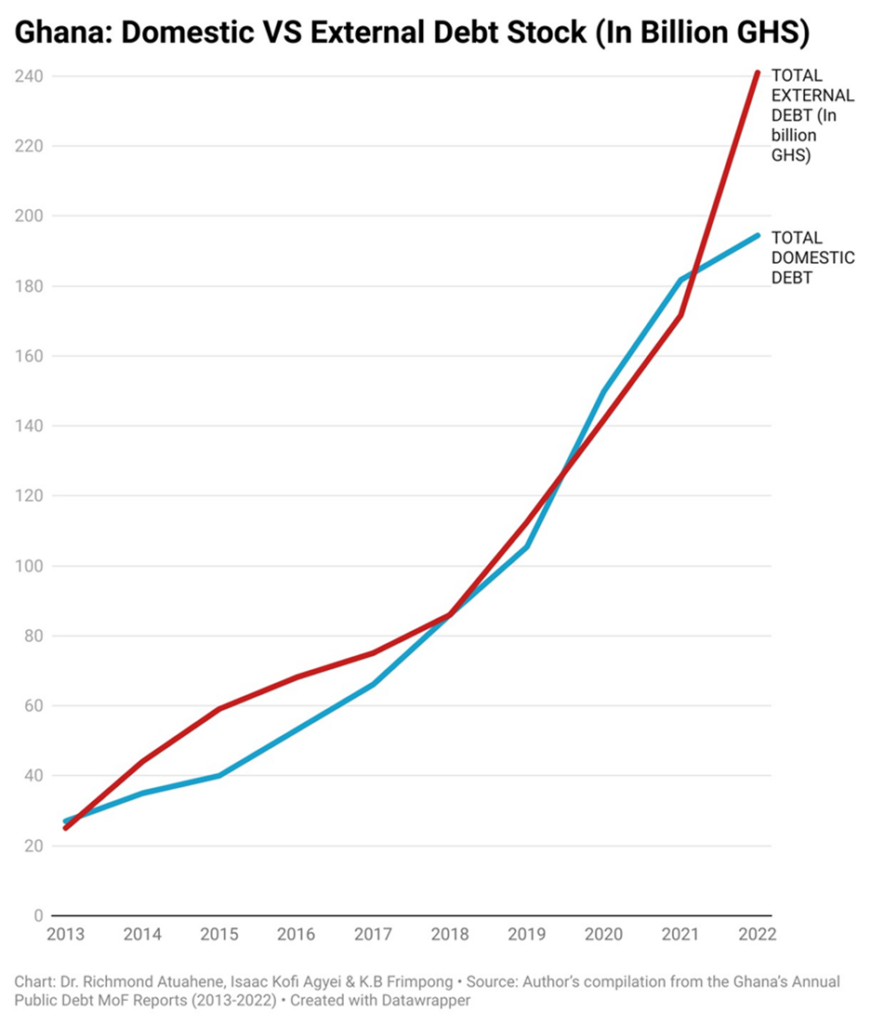
According to Bank of Ghana’s financial data on public debt rose to GH¢435.5 billion as of December. 2022 representing 88.1% of Gross Domestic Product with external debt stood at GHS 240 billion while the domestic debt also stood at GHS 194.8 billion. But however,the total public debt rose to GHC575.5 billion at the end of June 2023, with domestic debt at GHC246.9 billion and external debt at GHC328.6 billion at 80.1% of GDP. The persistent high fiscal deficit in the country has been partly attributed to the excessive government spending that was not productive and failed to effectively promote equitable development. During the period the central bank financed the government by ballooning deficits directly or by offered short‐term refinancing to banks by investing the liquidity in government securities. Regardless, this practice has exposed the economy to recent inflation and currency depreciation.
Large external shocks in recent years have exacerbated Ghana’s pre-existing fiscal and debt vulnerabilities, resulting in a loss of international market access, increasingly constrained domestic financing, and reliance on monetary financing of the government. Decreasing international reserves, Cedi depreciation, rising inflation and plummeting domestic investor confidence, eventually triggered an acute crisis. The authorities have taken bold steps to tackle these deep challenges, including by accelerating fiscal adjustment.In Ghana’s shallow financial market, especially where firms have limited access to international finance, domestic debt exchange could lead to swift and severe crowding out of private lending.
This raised the cost of private capital and created an adverse selection problem for banking institutions as more conservative risk-averse borrowers shy away from the credit market. To help restore macroeconomic stability, Ghana has secured a three-year IMF Extended Credit Facility (ECF) program of about $3 billion and has embarked on a comprehensive debt restructuring. The authorities have committed to a front-loaded fiscal consolidation while pursuing a tighter monetary policy, complemented by structural reforms in the areas of tax policy, revenue administration, and public financial management, as well as steps to address weaknesses in the energy and cocoa sectors.
The government launched a comprehensive debt restructuring to address severe financing constraints and the unsustainable public debt. The government has completed a Domestic Debt Exchange Program (DDEP), implemented an external debt repayments standstill, and sought official debt restructuring under the Common Framework. The revised- DDEP has marginally affected both profitability and solvency of the financial sector given its sizeable exposure to the public sector debt. However, the revised domestic debt exchange implemented has moderately affected the ability of domestic banks and businesses to grow, could possibly result in a decrease in overall economic output.
Additionally, restructuring including a “haircut”, has led to a further loss of confidence in the government’s ability to repay its debts and in the country’s economy. Both domestic and external debt became an issue when debt service payments become unaffordable compared to state revenue and other spending requirements. Ghana’s higher levels of debt repayments has resulted in: damage to economic growth as other spending is crowded out, constraints on the ability of governments to spend counter-cyclically, reduced resources for current spending needs, and also created debt overhang. As to address the above challenges, the country decided to adopt debt treatment from the Paris Club takes two forms: i rescheduling: i. Postponing debt service repayments, ii. reduction in debt service obligations: This occurs during a set period as flow treatment (debt service payments) or at a set date for stock treatment (treating the original loan and interest/arrears). Ghana adopted in domestic debt exchange in December 2022 as the country’s debt reduction methodology.
In the case of Ghana, debt exchange was one of the methodologies for debt reduction because the country was insolvent, i.e. permanent inability to honor debt obligations. In practice, sovereign debt resolution often includes a mixture of fiscal adjustment and additional funding coupled with a reduction of the outstanding debt, extending maturity of the debt from 3.8 years to 8.3 years and cutting the coupon rate from 19.1% per annum to 9.1%.
According to Minister of Finance the overall domestic bonds ¢203 billion were exchanged, which has resulted in debt service savings of ¢61.7 billion over 2023 (Joy business/17/10/2023). The Ministry of Finance posited the under-listed of domestic debt exchange program. Debt reduction might produce positive consequences by reducing the uncertainty level.
Indeed, a large amount of outstanding debt creates uncertainty about government’s future policies, since the debt servicing obligation will need to be met. As a result, economic agents will be inclined to postpone their investment decisions. Creditors would suffer a reduction in the market value of creditor exposure toward the debtor country, as high uncertainty might imply an increase in default risk. In this context, a debt reduction measure would help to restore normal conditions in the financial markets (i.e. markets do not like uncertainty).
The Original DDEP without the Pension. Cocoa bills, Domestic debt denominated bonds, Bank of Ghana non-marketable securities. The government launched on December 5, 2022, a DDEP covering all medium- and long-term debt issued in local currency by the Government of Ghana, Daakye and ESLA.
Government-issued T-bills have been excluded from the DDEP perimeter. The initial exchange did not yet include domestic debt denominated in U.S. dollars and Cocoa bills issued by Cocoa board. Over the course of discussions with bondholders the government also agreed that pension funds (representing about 20 of the debt eligible for the exchange) would not be expected to participate in the exchange. The original DDE settled on February 21, 2023. In total, 85 percent of the face value of bonds held by investors other than pension funds was exchanged in the DDE, equivalent to 28 percent of all outstanding domestic debt (which includes, among others, non-marketable debt, verified arrears and Cocoa bills). The government offered most bondholders a set of new bonds at fixed exchange proportions with a combined average maturity of 8.3 years and coupons up to 10 percent (with part of the coupons capitalized rather than paid in cash in 2023 and 2024). At a 16-18 percent discount rate, the final terms of the DDE imply an average NPV reduction of about 30percent for these bondholders.
Individual bondholders1/ were offered an exchange into shorter term debt with higher coupons. Crucially, the completed DDE has also produced very large cash debt relief for the government of almost GHS 50 billion in 2023, relieving pressure on the domestic financing market (IMF, 23/168).
7. Detailed of the Final Breakdown of Revised Restructured Domestic Debt (Debt Reduction)
On the revised DDEP included Treasury bonds, ESLA, Daakye bonds; US$742m restructured from dollar-denominated local bonds with average coupon rate and maturity period being 3% (previously 5.3%) and 1.5 years (4.5 years); GHS 7.7bn restructured from Cocoa bills with the coupon rate and maturity period being 13% (previously above 30%) and 4.4 years (previously 0.7 month); GHS 70.9bn principal haircut on the non-marketable debt instrument of the Bank of Ghana with the current coupon rate and maturity period 10% and 15 years respectively but excluded the pension bonds (MoF, 09/2023).
The breakdown of the GHS 203bn restructured domestic debt is as follows:
GHS 87bn restructured from Treasury bonds, ESLA and Daakye bonds excluding pension funds. The average coupon rate and maturity period of the restructured bonds currently stands at 9.1 (previously 19.1%) and 8.3 years (previously 13.8 years)
GHS 29.6bn restructured Pension Fund holdings in Treasury bonds, ESLA and Daakye bonds excluding pension funds. The coupon rate and average maturity period remains the same at 20% and 4 years respectively.
US$742m restructured from dollar-denominated local bonds with average coupon rate and maturity period being 3% (previously 5.3%) and 1.5 years (4.5 years).
GHS 7.7bn restructured from Cocoa bills with the coupon rate and maturity period being 13% (previously above 30%) and 4.4 years (previously 0.7 month).
GHS 70.9bn principal haircut on the non-marketable debt instrument of the Bank of Ghana with the current coupon rate and maturity period 10% and 15 years respectively.
DATA ANALYSIS USING THE NPV DISCOUNT RATE IS 16% (DEBT REDUCTION)
The government offered most bondholders a set of new bonds at fixed exchange proportions with a combined average maturity of 8.3 years instead of the original 13.8 years and coupons of up to 10 percent (with part of the coupons capitalized rather than paid in cash in 2023 and 2024).
It started by launching a voluntary Domestic Debt Exchange Program (DDEP), which is intended to increase average debt maturity from 3.8 years to 8.3 years instead of the original13.8 years and reduce average coupon payments from 19.1% to 9.1%, with only 5% paid in cash in 2023 and 2024. Crucially, the completed DDEP has also produced a very large cash debt relief for the government of almost GHS 61.7 billion in 2023, relieving pressure on the domestic financing market.
The average haircut on Ghana of Ghana and Bank of Ghana bonds of GHS 203 billion has resulted in government savings of GHS 61.7 billion or 30% haircut which at same time represented a significant loss to all bondholders especially Bank of Ghana that has taken massive hit to its balance sheet.
With push back by Trade Union Congress, Pension Funds, Individual Bondholders and Civil Societies the government decided to shift the original NPV losses to the Bank of Ghana in the revised DDEP to save the banking sectors.
We conclude that there was a reduction in the net present value of debt servicing costs does not mean that more money is available now for Ghana to spend. The reduction means that future debt servicing costs are reduced compared to the current baseline during the next decades and, therefore, Ghana would have to spend less on financing its debt in the future.
DETAILED CUMULATIVE SAVINGS OF GHS 61.7 BILLION ON GOVERNMENT BONDS VALUED GHS 203 BILLION ON THE DDEP IMPLEMENTATION.
The Government issuer of Treasury bonds (Daakye and ESLA) valued GHS 87 billion would saving approximately GHS12.4 billion (14%) after the DDEP while making savings of GHS 7.2 billion on US $ Dominated local bonds valued US$742 million.
The Government made saving GHS 4.5 billion (58.4%) on the Cocoa bills valued GHS7.7 billion while the government made savings of GHS37.6 billion (53%) on the Bank of Ghana’s marketable and non-marketable bonds valued GHS 70.9 billion.
On the Pension fund bonds valued GHS29.6 billion the government made no savings (0%) on the DDEP because of their complete exemption from the program. The government made total savings of GHS 61.7 billion on the Government bonds valued GHS 203 billion.
The revised DDEP marginally impacted on the banking sector, while NPV losses of the Bank of Ghana impacted negatively and significantly on their assets, while Cocoa bills suffered negatively likewise US$ dominated local bonds with the pension suffered no hair cut at all.
The largest holders of domestic debt in the country included domestic banks, the Bank of Ghana, non-bank financial institutions, private individuals, pension funds, insurance companies, rural and community banks and foreign investors. Investor losses ranged from 14% to 58.4%, with an average haircut of 30% based on comparing the market value of the new debt with the net present value of the old debt evaluated at the sovereign yield immediately following the debt exchange.
The NPV haircuts—defined by comparing the present value of new instruments received with that of old instruments tendered, both evaluated at yields prevailing immediately after the debt exchange—varied substantially across the debt restructurings studied. The DDEP has offered important lessons for other countries in similar situations.
With hindsight, the revised DDEP led to a stronger reduction in debt in NPV terms of GHS61.7 billion against the Original DDEP fiscal savings of GHS 50 billion. The “toughest” restructuring was Argentina’s 2005 exchange with an average haircut of almost 75%, followed by the Russian GKO exchange (50-70%), with Ghana’s milder haircut of 30% while the mildest was Uruguay’s international bond exchange, with a haircut close to 10%.
The revised DDEP has shifted the loss burden from the banking sector to the Bank of Ghana which took a hit of DDEP loss of GHS 37.6 billion followed by the Cocoa bills which also took a hit of DDEP loss of GHS 5.4. billion also affected some banks that were part of the institutional investors. The interest rate of 13% was significantly lower than the average rate of 30% that cocoa bill holders enjoyed. This reduction has led to some banks having to significantly write down the value of their cocoa bills as well as a significant reduction in their interest income. Those banks suffered from GoG bonds as well as cocoa bills ‘double whammy’.
The debt exchange became a burden for domestic investors who have already been hit by a significant loss in real returns due to decades of high inflation and sharp depreciation of the Ghana Cedi against the major trading currencies. Addison (23/12/23) found that the initial debt restructuring scenarios had to be tweaked several times between the initial announcement and the final scenarios.
On the domestic side, households, institutions, pension funds, and Banks somewhat saw less punitive treatment than initially designed. Given that the debt threshold remained unchanged, the Bank of Ghana had to therefore step in as the “loss absorber” with a more punitive treatment (50% haircut) than initially designed, leading to a large loss at the Bank of Ghana, driving it into negative equity at the end of 2022. This is not to justify the losses but to indicate that the policy choices made by the Bank during those difficult times were for the greater good of the economy.
However, the revised DDEP freed the banking sector from huge recapitalization and shifted losses to the central bank.
The ability of the Bank of Ghana to operate with negative equity does not imply fiscal risks are reduced when crisis interventions were undertaken on the Bank of Ghana’s balance sheet.
As the losses from the Bank of Ghana’s non-core operations were large enough that generate an overall net operating loss, they may be financed through equity buffers (where sufficient) or with government transfers, both of which imply fiscal costs. Alternatively, the Bank of Ghana may operate with negative equity but finance itself through the issuance of additional Bank of Ghana debt.
However, this outcome could also lead to fiscal costs – for example, if it jeopardizes the central bank’s ability to achieve its core policy mandates (so-called policy insolvency). As part of the revised DDEP policy intervention conducted on the Bank of Ghana’s balance sheet, there were strong arguments for the fiscal authority, the Ministry of Finance to directly bear any associated financial risks.
Governments faced incentives to let the Bank of Ghana bear the risks and costs from its domestic debt exchange policy interventions, partly due to the NPV losses in the original DDEP impact on the banking sector from GHS37.3 billion to the revised NPV losses of GHS7.3 billion where the differences were passed onto the Bank of Ghana. However when associated losses were eventuated, these impacted the Bank of Ghana’s profitability and balance sheets, and in turn, could jeopardize the conduct of monetary policy and undermine macro and fiscal stability.
The restructuring of the country’s domestic debt had marginally impacted individual households, whether through direct ownership of debt or investments in mutual and insurance companies as the tenor has been reduced from 13.8 years to 8.3 years with a coupon rate from 19.1% to 9.1% where the pension funds suffered no nominal NPV losses. The revised DDEP has affected the access to bank credit and the cost of borrowing for Ghanaian businesses and households, which could have further distributional consequences.
Ghana’s debt restructuring achieved a reduction in the debt but led to a contraction in consumption, driven by the effects of the austerity measures put in place e.g. cuts in public spending and a decrease in social welfare benefits like Leap. This resulted in a decrease in living standards for many individuals, as well as increased poverty and unemployment. It also affected the ability of domestic banks and businesses to grow, resulting in a decrease in overall economic output.
Additionally, restructuring including a “haircut”, has led to a further loss of confidence in the government’s ability to repay its debts and in the country’s economy. The channels of crowding-out, debt overhang, and debt reduction could impact the economy in the post-recent domestic debt restructuring. The debt crisis caused the Ghanaian financial sector to deleverage in doing so, banks cut off credit to the non-financial sector — the now infamous “credit crunch.” Because credit is a fundamental ingredient in the smooth operation of asset markets, the crunch adversely affected the value of all types of tangible business capital.
The steep drops in the value of assets owned by the bank and non-bank financial sectors also lowered the sector’s net worth and raised the frequency of business failures. Ghana’s bigger debt servicing burdens have reduced available fiscal space for development and stabilization and growing sovereign debt financing also has crowded out domestic investment.
For the first time in 30 years of international syndicated loan facilities, Ghana’s credit rating is so broken that the global banks don’t want to participate in international syndicated loan facilities. The presence of collateral damage in Ghana post-DDEP has affected the country’s international trade finance and payment system. Domestic debt exchange has caused a reputational spillover that has depressed Foreign Direct Investment and other foreign capital inflows into the country including international cocoa syndicated loans for 2023.
The domestic debt exchange has negatively impacted on 2023 international syndicated loan of US$800 million as a result of reputational spillover with international financiers (The Thomson Reuters;07/11/2023). The growing loss of market confidence caused the Cocoa Board to raise funding earlier than expected.
Cocoa Board’s worsening financial position including the restructuring of the cocoa bills and the prevailing economic challenges heightened fears of debt default. Ghana’s credibility and financial standing are now being questioned by international financial institutions. This has caused collateral damage to the country’s credibility and financial reputation.
FINDINGS AND DISCUSSION ON THE EFFECT OF DEBT OVERHANG, CROWDING OUT, AND DEBT REDUCTION ON THE ECONOMY
First, despite the domestic debt restructuring, over-indebtedness has slowed down and restrained economic growth and development through many channels including—”debt overhang,” “crowding out”, and debt reduction on increased crisis risk —making vulnerable to abrupt changes in market sentiment, jeopardizing both stability and future economic growth.
The results of this study also suggest that domestic debt restructuring continues to hamper economic growth through the debt overhang effect and the crowding-out effect. Heavy public debt service obligations resulted in a large risk premium on interest rates, periodic bouts of financial market instability, and a crowding out of bank credit to the private sector, all of which had contributed to a very low potential growth rate.
For Ghana’s public debt reduction to be successful, debt reductions must be mainly driven by decisive and lasting (rather than timid and short-lived) fiscal consolidation efforts focused on reducing government expenditure, in particular, cuts in social benefits and government flagship program and public wages. Second, Ghana has to experience robust real GDP growth in the next five years to increase the likelihood of a major debt reduction so that it could help the country “grow their way out” of indebtedness”.
Third, high debt servicing costs play a disciplinary role strengthened by market forces and require the government to set up credible plans to stop and reverse the increasing debt ratios. Debt reduction has reduced the uncertainty and also increased the confidence in the Ghanaian economy and its policies that could foster economic growth. Debt restructuring will be a prerequisite but not enough to restore its sustainability.
To reduce public debt to 55% of GDP by 2028, it will also be necessary to continue the ambitious fiscal consolidation strategy set by the IMF, namely an adjustment of 5.1% of GDP over the 2023-2026 period. While we conclude that there was a reduction in the net present value of debt servicing costs does not mean that more money is available now for Ghana to spend. The reduction meant that future debt servicing costs are reduced compared to the current baseline during the next decades and, therefore, Ghana would have to spend less on financing its debt in the future.
First, debt reduction in the medium to long term has the tendency to reduce uncertainty and increases the market confidence in the country and in its policies, fostering future economic growth. Debt reduction could also have the effect of increasing capital inflows by strengthening confidence in the government structural reforms and in the new policies introduced recently. This could happen because investors look at debt reduction’ as an endorsement’ by the international community including IMF, World Bank and other international donors that the country has been successful in pursuing sound macroeconomic policies and structural reforms. A successful debt reduction could facilitate early access to the international financial markets.
Second, the successful debt reduction operation has appreciably reduced the level of country’s indebtedness and it’s expected benefits of debt reduction is that it reduces the cost of debt servicing, thus increasing the “fiscal space” available to debtor governments including Ghana. Crucially, the completed DDEP has also produced a very large cash debt relief for the government of almost GHS61.7 billion in 2023, relieving pressure on the domestic financing market.
Debt reduction has created fiscal space that means the availability of additional resources that can be used in desirable government spending (or tax reduction). The fiscal space is used to enhance medium-term growth and finance this growth from future fiscal revenue. In fact, there are different channels through which a county can create or enlarge its fiscal space.
Third, however, despite the successful implementation of the domestic debt exchange, one negative effect of domestic debt reduction has caused investors to lose confidence in the country’s bond market and the ability to repay its debt on time.
This has led to a decrease in domestic investment and an increase in the cost of borrowing for the government and local businesses. The decreased domestic investment has a ripple effect on the local economy. As businesses including SMEs have struggled to access the funds they need to grow and hire workers, the unemployment rate in Ghana has dramatically increased. This lack of investment has also led to an increase in the cost of borrowing for the government and local businesses, making it more difficult for them to finance their operations and invest in growth. In terms of the effects on the domestic bond market and local financial institutions (banks, insurance, asset management companies & pension scheme agencies), domestic debt exchange had both direct and indirect effects. The direct effect was that the restructuring has resulted in a loss of value for domestic bondholders.
This has led to a decrease in demand for Ghana government bonds and a decreased in the overall value of the bond market. The indirect effect was that the restructured domestic debt has affected the stability of local financial institutions, especially in the area of liquidity and solvency. If the government was unable to manage its domestic debt exchange process properly, the economy would suffer as a result, local banks had face increased risks and potentially experienced financial difficulties.
This has led to a decrease in the availability of credit for local businesses as well as higher cost of credit and households, thus hindering economic recovery and growth. Ghana’s balance of payments is expected to continue to deteriorate further in 2024, on the back of continued capital outflows, and the continued Cedi depreciation because of decline inward remittances, low returns on extractive industries like gold and poor cocoa syndication loan of US $ 800 million lowest recorded over the past two decades.
Fourth, debt reduction has caused reputational costs, market exclusions, borrowing costs, sanctions, trade embargo, asset confiscations (sovereign assets outside the country) are examples of costs that a debtor country might suffer in case of default. Most correspondent banks of the Ghanaian banks withdrew their credit lines when the country was downgraded by the credit rating agencies as well as the country defaulted in the payment of external debt in December 2022. Reputational costs include market exclusion and increased borrowing costs for the country creditors might refuse to purchase the debtor country’s bonds following debt restructuring. Future Creditors impose this punishment on the debtor country like Ghana.
Creditors might purchase the debtor country’s bonds following debt restructuring but request a premium (i.e. a higher interest rate to compensate the risk of future default or other restructuring).
Fifth, the domestic debt exchange has marginally affected domestic banks and non-banking financial institutions on solvency and regulatory capital requirements but impacted negatively on the economic and financial livelihood of Ghanaians, especially the poor and vulnerable in the society whose incomes have whittled away by the higher inflation. Domestic debt exchange which included principal haircut and coupon rate reduction has triggered a decline of domestic investors’ confidence in governments’ creditworthiness and raised doubts about the sustainability of government finances. As the country has reduced the value of its bonds, the domestic banks have had a marginal reduction in the number of assets on their balance sheet and possibly insolvency.
Due to the growing interconnectedness of the country’s financial system, a bank failure couldn’t happen in a vacuum. Instead, there is the possibility that a series of bank failures could spiral into a more destructive ‘contagion’ or domino effect’.
Ghana’s debt reduction has already affected capital spending and recurrent spending other than wages and transfers have been cut to levels that hamper potential growth and the provision of basic public services. On the revenue side, an increase in already high tax rates levied on narrow bases has contributed to a dramatic further deterioration in already low current tax collection rates.
Sixth, the domestic debt reduction has also created a situation known as an inverted yield curve. An inverted yield curve occurs when short-term interest rates bills are being quoted between 22% and 33.7% exceeding long-term rates on Government bond’s coupon rate of 9.1%. The term yield curve refers to the relationship between the short- and long-term interest rates of fixed-income securities issued by the Ghana Government Treasury.
The yield curve has inverted—meaning short-term interest rates moved higher than long-term rates—and could stay inverted through 2023 and 2024. This has signaled an imminent recession or slowdown in the Ghanaian economy. An inverted yield curve is when shorter-term notes pay higher effective yields than longer-term bonds. The yield curve is considered “normal” when longer-term bonds yield more than shorter-term ones.
In post-DDEP era, the government has been borrowing at the money market at the rate between 22% and 33.7% while the government bond coupon rate is quoted 9.1% per annum. The inverted yield curve has been viewed as an indicator of a pending economic recession in the country. When short-term interest rates exceed long-term rates, market sentiment suggests that the long-term outlook is poor and that the yields offered by long-term fixed income will continue to fall. In the existing bond market was considered a major prerequisite to sustainable debt dynamics as well as improved growth prospects by the financial sector and the wider public.
However, the DDEP has not managed to lower of signal rates during the post-DDEP era, as the market interest rates on short-term government bills has risen historically high levels and thus created inverted yield curve and remained unstable.
Seventh, domestic debt reduction could have lasting effects on the country’s economic growth, confidence in domestic market and the financial sector. Following domestic debt exchange, universal banks with large exposures to government bonds have experienced a deterioration in their balance sheets, thus reducing the supply of loans to firms via a traditional bank lending channel ( (Gennaioli et al. (2014) and Acharya et al. (2014b). Furthermore, the weakened financial sector could impair financial intermediation leading to a hesitance of financial institutions to provide funds to individuals and businesses as well as poor low savings culture. This would then threaten future economic growth and development. Indeed, the present economic challenges may compromise the ability of individuals and businesses to pay their loans that would heighten the impairment levels. Both the Ghana budget and its debt might seem well manageable in the coming years.
However, debt trap caused a long shadow, thus causing lingering challenges and risks. Future higher interest rates, budgetary pressure, and weak growth can lead to a higher debt-servicing burden and refinancing needs. Keeping up fiscal strength and, first and foremost, promoting growth, are the best ways for Greece to address these challenges.
Eighth, the debt reduction has caused collateral damage as well as loss of market confidence on the Ghanaian economy. Debt exchange has caused reputational damage on Cocoa bod as they were unable to raise financing for the 2023/2024 cocoa season purchase.
Ghana’s cocoa output target of 830,000 metric tonnes delayed as international financiers as Cocoa bod rated as a higher risk institution which financier demanded higher premium. The presence of collateral damage on other institutions – contagion –changes the interpretation of default costs but does not change the answer; except for one key complication: it implies that there may be a second instrument – transfers across institutions – as an alternative to default.
Ninth, Ghana has been still experiencing debt overhang as the country’s debt burden in the power sector so large that in post DDEP era, that the power sector providers cannot take on additional debt to finance future projects or pay off the existing debt to the power generation companies in the energy sector. The domestic debt reduction has not addressed the debt overhang for the power sector arrears or the legacy debt. According to IMF Country Report No. (19/367) posited that power sector arrears were about US$2.7 billion in late 2018, of which US$800 million was owed to private fuel suppliers and independent power plants (IPPs).
For 2019, the authorities project the financing shortfall for the sector to be at least US$1 billion (1.5 percent of GDP), which they plan to partially finance off budget. Partial payment arrangements may be insufficient to stave off more formal approaches by IPPs to collect amounts due. Absent measures to address the sector’s financial problems, the accumulated cost to the government, including current arrears, could reach US$12.5 billion by 2023. The burden is so large that all earnings pay off existing debt rather than fund new investment projects, making the potential for defaulting higher. The findings confirmed that debt overhang has led to under-investment in the Ghanaian energy sector.
For example, most of the firms in the energy sector are in financial distress and it difficult to pay off their suppliers or raise funds for new investments because the proceeds from these new investments mostly serve to increase the value of the existing debt instead of new investment. Debt overhang has caused under-investment problems in the energy sector that could impact negatively on future production and supply of electricity to the entire country. Debt overhang could be alleviated if the various creditors like WAPCo, Sunon Asogli Power Co ltd, Bui Power Authority and Government of Ghana manage to renegotiate their contracts and restructure the balance sheets.
The debt overhang also currently being experienced by Bui Power Authority because of the inability of Electricity Company of Ghana to pay for power supplied and this could cause underinvestment by the various power generators in the country. ECG (and the central government) are counterparties to several take-or-pay contracts with independent power producers. The contracts require payment for contracted volumes of electricity even if the electricity is not consumed (take-or-pay charges).
When ECG expenses the charge, its equity is reduced, and its liabilities (accounts payable) increase. The reduction in equity lowers the value of the government’s investment in ECG. The actual payment of the claim by ECG or the government does not alter the public sector’s net worth.
Tenth, another negative effect of debt overhang is that it has caused investors to lose confidence in the country’s ability to repay its debt on time. This has led to a decrease in foreign investment and an increase in the cost of borrowing for the government and local businesses with yearly treasury bill rates had increased from 22% to 33.7% post DDEP era.
The higher interest rates on treasury bills also affect the country’s banking institutions thus creating an adverse selection problem. As interest rates rise more conservative, risk-averse borrowers shy away from the credit market. A larger proportion of the people applying for loans are thus those who are willing to take risky bets. The likelihood of default increases and so therefore does the banks’ proportion of non- performing loans. The domestic debt exchange has resulted in the government regularly mopping liquidity from the banking sector through purchasing considerable volumes of Treasury bills at increasing high interest rates.
The domestic debt exchange has also weakened the financial sector through impaired financial intermediation that led to a hesitance of financial institutions to provide funds to individuals and businesses. Credit to the private sector has contracted in the third quarter of 2023 as Banks continued to deploy their resources towards treasury bills as opposed to extension of credit facilities in response to the increased risks associated with lending due to the deteriorating macroeconomic conditions and the impact of the domestic debt exchange program thus confirming the crowding out hypothesis.
This has threatened future economic growth and development. Indeed, the present economic challenges that have compromised the ability of individuals and businesses to pay their loans which impacted negatively on the non-performing assets of the banking sector. The recent Bank of Ghana’s report on the increases in the non-performing asset ratio from 15% to 20% confirmed the debt overhang hypothesis. Weaker economic activity has translated into higher non‐performing loans by both firms and households which could increase bank distress through balance sheet and liquidity effects.
The 2022 currency depreciation has exacerbated non‐performing loan volumes through currency mismatches. From a citizen’s viewpoint, the numerous taxes introduced in 2023 budget by the Government meant that high debt means higher future taxes and/or reduced social benefits – and when combined with reduced corporate activity – less employment.
Eleventh, the country’s debt overhang has also led to stagnant growth and a degradation of living standards from reduced funds to spending in critical areas such as healthcare, education, and social care like Leap. The debt overhang had resulted in non-payment of some road contractors as well as food suppliers to the National Food Buffer Stock Company that have resulted in higher non-performing assets of the banking sector.
Because of the way they affected balance sheets and bottom lines, debt overhangs have distressed entities including banking institutions in different ways. The decreased domestic investment has a rippling effect on the local economy. As businesses including SMEs have struggled to access the cheaper funding to grow and expand their businesses and impeded the hiring workers, and thus unemployment rate in Ghana has dramatically increased. This lack of investment has also led to an increase in the cost of borrowing for the government and local businesses, making it more difficult for them to finance their operations and invest in growth.
Twelfth, the debt overhang has occurred as the country’s debt stock exceeded the government’s ability to repay it her existing debts in the post domestic debt restructuring. The debt overhang has led to an increase in taxes towards generating adequate revenue to settle both foreign and domestic creditors, thus discouraging investments due to a sudden increase in taxes. As part of the country’s debt overhang, the government introduced a myriad of taxes in 2023 including Income Tax Amendments Act, 2023 (Act 1094).
Minimum chargeable income system: Tax is imposed on a minimum chargeable income of five percent of turnover where a person has been declaring tax losses for the previous five years of assessment. This excludes persons:within the first five years of commencement of operations; andengaged in farming, ii)Unification of the provision on carry-forward of tax losses; All taxpayers are allowed to carry forward tax losses from business for a period of five years.
Restriction of foreign exchange loss deduction; The deductibility of foreign exchange loss in respect of debt claim, debt obligation or foreign currency holdings is limited to realized losses incurred in the production of income. Exchange losses on transactions with resident persons are also not deductible. Taxpayers are allowed to capitalize foreign exchange losses of a capital nature and claim capital allowance accordingly. iii)Realization of assets and liabilities; A person who realizes an asset or liability is required to file a return, in the form prescribed by the Commissioner-General of the Ghana Revenue Authority, within 30 days after the realization. Qualifying consideration payments for the realization of assets and liabilities will attract a withholding tax of three and ten percent for resident and non-resident personsrespectively, iv) Broader definition of controlled relationship; The scope of association of persons in a controlled relationship has been broadened by reducing the minimum control threshold to 25% direct or indirect control.
This means that a person is an associate of an entity and deemed to be in a controlled relationship where the person has directly or indirectly at least 25% of the voting right of the entity, v) Increase in the income tax rate for persons entitled to temporary concessions. The income tax rate for persons entitled to concessions such as those engaged in the business of farming, agro-processing, cocoa by product, rural banking, waste processing, low-cost housing, unit trust, mutual fund and venture capital financing has been increased to 5%. Taxation of lottery operations and winnings from lottery. The gross gaming revenue from lottery operations, including betting, gaming and any game of chance is taxed at an income tax rate of 20%. Payments in respect of winnings from lottery are subject to a final withholding tax rate of 10%. vi)Increase in the upper limits of quantifiable motor vehicle benefits.
The upper limit of motor vehicle benefits to be included in the employment tax computation has been increased as follows:Driver and vehicle with fuel – GHS1,500; Vehicle with fuel – GHS1,250; Vehicle only – GHS625; andFuel only – GHS625. vii) Revision of the personal income tax bands and rates: The personal income tax bands and rates for individuals have been revised to align with the 2023 minimum daily wage. There is an introduction of an additional tax rate of 35% on income exceeding GHS600,000 per year. Growth and Sustainability Levy, 2023 (Act 1095) Act 1095 repeals the National Fiscal Stabilization Levy, 2013 (Act 862) and introduces the Growth and Sustainability Levy (GSL or levy). The GSL is payable by entities categorized into three groups as follows: Category A- Existing National Fiscal Stabilization Levy entities plus six additional sectors: 5% of profit before tax; Category B- Mining companies and upstream oil and gas companies: 1% of gross production); andCategory C- All other entities not falling within Category A or Category B: 2.5% of profit before tax. The levy is applicable for the 2023, 2024 and 2025 years of assessment. It is payable quarterly and due on 31 March, 30 June, 30 September and 31 December of the year. The above new taxes introduced by the government has affirmed the debt overhang hypothesis.
Excessively high rates of tax exact a high cost in terms of lower private investment and growth. They reduce the incentive to invest because the after-tax returns to investors are lower. In addition, the cost of compliance with the administration of taxes can be high. The literature shows that lower rates of tax can increase investment and growth. Higher rates of tax can decrease business entry and the growth of established firms, with the medium sized firms hit hardest, as the small can trade informally, and the large avoid taxes. As well as reducing tax rates, policies that broaden the tax base, simplify the tax structure, improve administration, and give greater autonomy to tax agencies help to reduce this constraint. The new myriad of taxes introduced in 2023 and 2024 budget statement has been impacting negatively on the private sector especially the SMEs.
Thirteenth, the debt overhang has affected and discouraged private investments depend on how government has raised fiscal revenue necessary to finance local debt-service obligations (an inflation tax and excessive government expenditure that has contributed increased the domestic inflation that also discouraged private investment). These combined effects had discouraged private investment and thus had a negative impact on national output growth. As part of domestic debt restructuring the country has experienced debt overhang which has led to recent increase in taxes towards generating adequate revenue to settle domestic creditors, thus discouraged investments due to a sudden increase in recent taxes. Thus, the indebted country like Ghana retained only a fraction or nothing from domestic output and export revenue.
This implied that accumulation of debt has hampered economic prosperity through tax disincentive. Tax disincentive denoted debt overhang has impaired investments as potential investors foresee a possible tax increase on future income in a bid to repay the borrowed funds. Excessive taxes on production are hampering the growth and competitiveness of domestic businesses. Taxing production excessively has already affected local industries and worsened the already high unemployment situation in the country.
As such, the debt overhang theory posited that borrowed funds be well invested in productive sectors capable of generating adequate revenue for repaying the debt and financing domestic investments but that is not the case of Ghana because of higher unplanned government expenditures. In those developing economies such as Ghana with heavy indebtedness “debt overhang” was considered to have led to cause of distortion and slowing down of economic growth as the World Bank has revised Ghana’s gross domestic product growth in 2023 to 1.5% from earlier the 1.6%. Ghana’s economic growth has slowed down because it lost their pull-on private investors.
Additionally, servicing of debts has exhausted up so much of the Ghana’s revenue to the extent that the potential of returning to growth paths is abridged. The theory asserts that if there is a probability that Ghana’s future debt will be more than its repayment ability, then the anticipated cost of debt-servicing can depress the investment. However, the extent to which investment is discouraged by debt overhang depends on how government generates resources to finance debt service obligations.
Fourteenth, debt overhang has bound the economy as is in a downturn since investment returns are low. As a result, high levels of debt have created multiple equilibria in which the profitability of investment varies with economic conditions showed that debt overhang has distorted the level and composition of investment, with a severe problem of underinvestment for long-lived assets.
A significant debt overhang effect is found, regardless of countries’ ability to issue additional secured debt. Hennessy et al. (2007) corroborate large debt overhang effects of long-term debt on investment, especially for countries with high default risk.
Fifteenth, the crowding-out effect in the post- DDEP experience seemed to be occurring as the government has been borrowing from money market rate surge from 22% per annum in 2022 to a high of 33.7% per annum in 2023 which have affected the private sector to source funds to expand as well as grow their businesses to expand the economy. As the government continued to borrow from domestic market at higher prevailing rates between pre-DDEP era of 22% per annum and 33.7% per-annum post-DDEP period could cause a serious crowding out of the private sector which is said to be the engine of growth.
This postulated that Ghana’s economic stability could be undermined by debt burden if debt service cost weighs down excessive public expenditures. This implied that public investments are crowding out as rising national debt obligations consume a large proportion of government revenue. The current situation where the government is currently borrowing from the short-term end of money market through treasury bill rate has pushed from 22% last year to 33.7% in October,2023 thus crowded out the private sector to slow down the expansion and growth of Ghana’s economy.
As government continued to waste resources through loose public expenditures such as the government flagship program as ‘one district, one factory’, as the entire economy has faced a resource shortage, thus preventing sufficient private-sector investment. As the crowding-out mechanism has triggered, private-sector capital accumulation has consequently become insufficient, which led to economic stagnation.
Sixteenth, this study concludes, therefore, that government budget deficit has crowded out private investment through its effect on interest rates. Crowding out refers to the negative impact that government spending can have on private investment. The theory of crowding out has suggested that as the government increased its spending, it has thus increased the demand for goods and services, which has led to the current higher interest rates and higher inflation in the country.
A crowding-out has caused a rise in real interest rates in the post DDEP era. By the crowding-out effect, a decrease in public investments had transmitted to a reduction in private investments due to the complementary of some private and public investments. In as much as extreme national debt can result in liquidity constrain by crowding-out domestic investments in the debtor country; reliance on debt is a necessity for unindustrialized economies at their early stage of development since available financial resources at that phase could be inadequate to enhance the needed growth and development.
The crowding out could also impact negatively on economic growth as it slowed down because Ghana has lost their pull-on private investors while servicing of debts exhausts up so much of the indebted country’s revenue to the extent that the potential of returning to growth paths is abridged. The most severe negative effects of domestic debt are, however, also channeled through the financial sector. The crowding out effect of domestic debt on private investment is a serious concern. Bank credit to the private sector has been empirically proven to be a contributor to economic growth.
However, when governments borrow domestically, they use up domestic private savings that would otherwise have been available for private sector lending. As increasing public financing needs push up government debt yields, this has further caused a net flow of funds out of the private sector into the public sector, and this has pushed up private interest rates. In shallow financial markets, especially where domestic firms have limited access to international finance, domestic debt issuance of treasury bills could lead to both swift and severe crowding out of private lending. In most developing countries like Ghana, only large, well-established firms have access to international finance, suggesting that the burden of crowding out fell heavily on small and medium-sized enterprises and rural borrowers.
The higher interest rates on treasury bills have also affected banking institutions in Ghana thus created an adverse selection problem. As interest rates rise more conservative, risk-averse borrowers shy away from the credit market. A larger proportion of the people applying for loans are thus those who are willing to take risky bets.
The likelihood of default increased and so therefore does the banks’ proportion of non-performing loans. Philosophy behind the crowding out effects concept assumes that government debts expend a greater part of the national savings meant for investment due to increase in demand for savings while supply remains constant, the cost of money therefore increases to make it difficult for the private sector to source funds for production which is expected to be engine of growth. The long-term evidence showed that economic stability has collectively undermined by indicators of debt burden.
In the short run, shortages of foreign exchange reserve, revenue inadequacy and unstable exchange rate had adverse and significant impact on real GDP growth rate. Thus, it was concluded that excessive borrowing on the money-market by the government has deprived Ghana of the revenue and reserves required to fund domestic investments and enhance economic stability.
In sum, the confirmation of the lazy bank hypothesis together with the growing government deficit financed mainly from the banking sector poses a few momentous challenges in Ghana with short-run and long-run ramifications. Besides the apparent adverse effect of the observed unsustainable government deficit, this paper has uncovered another serious channel coming from the financial sector, or more precisely the banking sector. As the government issues more debt instruments (ie Treasury Bills) to finance its deficit, banks tempted by the risk-free high return motive shift their portfolio away from risky private loans and opt for lazy behavior characterized by a shrinking overall credit tilted more and more toward government debt-instruments. This behavior not only limits their exposure toward the private sector, hence reducing private investment, but also affects adversely investment and hence overall growth potential in the future.
Also, from the banking sector perspective, although lending to the government has a positive impact on banks’ profitability, it distorts banks’ incentives and the process of financial deepening since banks earning relatively risk-free returns from the government have little incentive to develop the banking market. This double-edged sword is fatal to the stance of the economy, especially in a period of rather gradual economic recovery.
Lastly, the domestic debt reduction has impacted negatively on the Bank of Ghana’s balance sheet and its solvency as it took the biggest hit of NPV losses of GHS 37.6 billion. The NPV losses of GHS 37.6 billion in the revised domestic debt exchange on Bank of Ghana could impact negatively on the functioning of the central bank. Bank of Ghana may be able to continue its monetary policy and regulatory functions despite the debt restructuring. But Bank of Ghana’s ability to be able to continue its other functions, such as operating payments systems, providing emergency liquidity support for the banking system or conducting it corresponding banking operations could be compromised.
Depending on its ex- ante equity position, any losses on the central bank balance sheet that may result from the DDEP would have to be addressed, including through recapitalization (Liu, Y; Savastano, M & Zettelmeyer, J. 2021).
Another finding revealed the negative effect of the revised DDEP has shifted the massive previous NPV losses (GHS30.7 billion) of the banking sector to Bank of Ghana’s NPV losses of GHS 37.6 billion, in the revised-DDEP which has thus reduced the central bank’s ability to (i) manage liquidity in the banking system through open market operations and emergency liquidity support ; (ii) define and implement collateral policy given the decline in the stock of available government securities; and (iii) hold government securities as counterpart to central bank liabilities, such as currency in circulation and commercial bank deposits with the central bank. In the case of Bank of Ghana, a recapitalization of the central bank by the government (to compensate for the losses from haircuts on its holdings of government securities) may be unavoidable.
Bank of Ghana’s liquidity facilities was designed to provide emergency support to banking institutions affected by DDEP have been key elements of the financial safety net in the recent episode. A liquidity backstop served as a lifeline for banking institutions which might lose access to market or deposit funding. It could be especially useful for a banking system with a high degree of interconnectedness and for financial institutions which otherwise do not have access to Bank of Ghana window for liquidity support.
Collateral eligibility requirements for Repos might need to be reviewed, especially as banks faced marginal haircuts on government bonds typically used as collateral for central bank operations. In countries such as Ghana where financial market is not well developed, however, the size and scope of liquidity backstop facilities would be limited.
IMF country report (23/168) noted that as the Bank of Ghana’s balance sheet has been impaired by the NPV losses of GHS 37.6 billion because of domestic debt restructuring, the Government and Bank of Ghana would have to assess the impact and develop plans for its recapitalization with IMF technical assistance support. It can be inferred from this study that domestic debt crisis had a negative impact on economic stability in consonance with the debt overhang, crowding out and debt reduction effects.
In an environment of limited fiscal space by the government, the risk of crowding out of the private sector by the government is real. The recent evidence on the money market (upswing of the Treasury bill rates from 22% in 2022 to 33.7% in the late 2023) this has validated the crowding out hypothesis.
This might lead to lower projected economic growth, further leading to lower tax collection. Thus, policymakers should ensure that public debt is used to finance high income generating investments capable of attracting adequate revenue required to amortize the debt and create future streams of revenue that would help reduce national debt and enhance future economic growth.
They suggested that even if it can be inferred from this study that recent domestic debt restructuring has a negative impact on economic stability in consonance with the debt overhang and crowding-out effect structural adjustment programs are put in place by governments of these countries, adverse effects can still be felt on development of general economic performance. Therefore, to accelerate economic growth, developing countries like Ghana must adopt policies that are likely to result in a reduction in the debt burden, and at least to ensure that the rising debt burden does not reach an unsustainable level.
CONCLUSION AND RECOMMENDATIONS.
Economic recovery from domestic debt crisis has been slowed down, through the channels of debt overhang; crowding out and debt reduction problems accompanied a financial crisis lower country’s net worth. if the country has been carrying debt, the loss of net worth brought Ghana closer to default which has impacted negatively on country’s reputation and credibility. It can be inferred from this study that domestic debt burden has a negative impact on economic stability in consonance with the debt overhang, crowding out and debt reduction theories.
It is believed that, if DDEP is accompanied by a comprehensive fiscal reform strategy, a debt reduction would preserve Ghana’s reputation and be beneficial for the economy and all stakeholders. On the other hand, in the absence of a credible plan to address the debt overhang, the country’s ability to service its debt obligations would remain in serious doubt going forward and the risk of financial instability would remain high. Debt overhang occurred when there was a significant probability that a Ghana could go bankrupt soon. The debt overhang has reduced the incentives of new domestic investors to invest in business capital because, in the event of default, part of the return on new investment accrues to existing creditors.
The debt overhang has also led deterioration of the fiscal outlook which has resulted to fiscal measures such as tax increases and without government spending cut which has reduced economic activity, thus lowered household and firm incomes. This has led to a deeper reduction in tax revenues and further undermined the fiscal position. Debt overhang also has decreased country’s incentives to invest their current revenue in financial assets because these assets are easier to liquidate when business conditions deteriorate, and bankruptcy becomes more likely.
On both counts, the rate of investment in social infrastructure is adversely affected. Thus, debt overhang has been one of potential explanations for why domestic firms have been reluctant to expand capacity in this recovery. The macroeconomic consequence of this reluctance to invest is a slow recovery. In conclusion it has been suggested that a restructuring can allow to exit from a default but, to be growth improving, it has to address the debt overhang problem and then it might imply larger haircuts.
Post- DDEP experience has shown that crowding out has led to higher interest rates on banking credit facilities that has slowed down economic growth. As the government has aggressively borrowed funds from the money market (Treasury Bills market) to finance its spending, it has been competing with private borrowers for available funds. According to reports, the government has cumulatively as of 20 November 2023, issued GHS 128.93 billion on the money market, surpassing the GHS 119.77 billion target (GCB Capital, 11/20/2023). This competition between government, banking institutions and private sectors has driven up interest rates (i.e. higher treasury bill rates), which has made it more expensive for businesses to borrow money for both working capital and expansion. Crowding-out has occurred when increased government borrowing reduces investment spending.
Higher interest rates also reduced consumer spending, as people chose to save their money instead of spending it. In the medium term, crowding out could also reduce private investment. When interest rates rise, businesses may choose to delay or cancel their investment plans.
This could lead to lower levels of economic growth and fewer job opportunities. Crowding out has led to higher inflation. As the government spent more money, it increased the demand for goods and services. As the supply of goods and services did not increase to meet this demand, prices rose, leading to higher inflation over the past two years.
Crowding out could also reduce long-term economic growth rate to 1.5% of GDP in 2023. According to the World Bank. Ghana’s economic growth will remain depressed in 2024 at 2.8% of GDP but the economy is expected to recover to its potential growth by 2025.
Bretton Wood institution posited that the economic growth rate would be held back by high and persistent inflation, lower credit because of elevated interest rates and weakness in the energy sector. According to the World Bank, these drivers would operate through a slowdown in the growth of household consumption and investment.
As the government spends money on projects that do not generate a return on investment, such as social welfare programs, it may divert resources away from more productive uses. This could lead to lower levels of economic growth over the long term. As the government issues more treasury bills to finance its deficit, banks shift their portfolio away from risky private loans and opt for lazy behavior characterized by a shrinking overall credit tilted more and more toward government debt-instruments. To the extent that a slow recovery engenders pessimism, it exacerbates the crowding out and debt overhang problems in the post DDEP period.
It could be inferred from this study that domestic debt exchange has a negative impact on economic stability in consonance with the debt overhang, and crowding-out effects. Thus, policymakers should ensure that public debt is used to finance high income generating investments capable of attracting adequate revenue required to amortize the debt and create future streams of revenue that would help reduce national debt and enhance future economic growth. First, major debt reductions must be mainly driven by decisive and lasting (rather than timid and short-lived) fiscal consolidation efforts focused on reducing government expenditure, in particular, cuts in social benefits and public wage spending. Revenue-based consolidations seem to tend to be less successful.
Second, real robust GDP growth also increases the likelihood of a major debt reduction because it helps Ghana to “grow their way out” of indebtedness. Here, the literature also points to a positive feedback effect with decisive expenditure-based fiscal consolidation because this type of consolidation appears to foster growth, in times of severe fiscal imbalances. Third, high debt servicing costs exert a disciplinary effect via market forces and require governments to set up credible plans to stop and reverse the increase in debt ratios.
The Ghana’s domestic debt exchange was both unavoidable and partially successful in the sense of being a bit orderly, reasonably quick, and in providing significant government savings of GHC 61.7 billion at the expense of bondholders. One of the benefits of debt reduction is that it has reduced the cost of debt servicing, thus increasing the “fiscal space” available to the government. The successful debt exchange operation has appreciably reduced the level of the country’s indebtedness.
Positive market developments since the launch of the revised debt exchange have also played an important role in helping to contain potential financial sector spillovers. Bank deposits remained stable and liquidity pressures in the SDIs sector did not emerge as predicted the original DDEP. At the same time, it has been subjected to a battery of criticisms such as lack of transparency and openness, bad faith efforts for a collaborative process to restore debt sustainability, partiality, and unfair treatment across various creditors. Ghana’s domestic debt exchange was bedeviled with poorly and untimely flow of information, lack of transparency, bad faith actions and unfair treatment of some domestic creditors.
Most importantly, it was too little, too late, or both; hence failing to clearly restore Ghana’s debt sustainability. The question is whether this reflected avoidable policy mistakes or unavoidable trade-offs – in the sense that Ghana and its domestic creditors faced difficult choices, and did their best given what was feasible.
Recommendation
i. Ghana should always avoid excessive borrowing from both domestic and external sources. Excessive borrowing by the public sector should not be driven by political or electoral considerations and by the fact that politicians may decide to maximize their own welfare rather than that of their constituencies. Innovative debt instruments can limit the risk of a debt crisis at any level of debt. However, for any set of debt instruments, the risk of a debt crisis can be reduced by borrowing less. This suggests that the first step towards achieving debt sustainability is to borrow for the right reason and not borrow too much during “good times.” This does not mean that countries like Ghana should not borrow, but rather that they should not over-borrow. Borrowing for the right reason means that debt should only be used to finance projects that generate returns which are higher than the interest rate charged on the loan. Moreover, foreign currency borrowing should be limited to projects that can either directly or indirectly generate the foreign currency necessary to service the debt.
A way to maintain prudent debt levels is to complement macro-level debt sustainability analysis with a careful evaluation of the sustainability of each project. Before borrowing abroad, a country should evaluate a project by asking the following three questions: (i) Will the project have a social return which is higher than the cost of funds? (ii) Will the project generate the amount of foreign currency necessary to service the debt? (iii) Will the resource flows match the payment schedule of the debt contract? Only projects with positive answers to the above three questions should be financed with standard external debt contracts.
It is likely that in lower middle-income countries like Ghana there are several high social return projects like FSHS do not satisfy the second and third requirements, in which case such projects should be financed with grants and concessional loans.
ii. To prevent future debt crisis and support the recommendation one, Ghana must ensure the 1992 Constitution amended and enshrined with debt limit or debt cap of Debt to GPD ratio of 60%. The public debt limit is defined as the maximum level of debt beyond which the government cannot roll debt over. It depends on the growth and interest rate, and the previously observed capacity of governments to react to rising debt. The public debt limit is defined as the maximum level of debt beyond which the government cannot roll debt over. It depends on the growth and interest rate, and the previously observed capacity of governments to react to rising debt. The concept of a debt limit is closely associated with fiscal sustainability.
It represents the explicit stock implications to the flow variables that are used to calibrate fiscal sustainability. There are at least three ways debt limits can be defined: First, a debt limit can be the debt ratio to which the economy converges in the steady state (e.g., Blanchard, 1990; and Blanchard and others, 1990). Second, it could be the level of debt that the economy can service or carry without generating debt distress and requiring debt restructuring. Third, a debt limit could be the optimal level of debt given an economy’s policy objectives, stage of development, and policy environment.
The domestic debt exchange must be underpinned by strong fiscal consolidation, to be necessary to reverse the adverse fiscal dynamics and reduce the debt overhang and crowding out that had plagued Ghana for the past decade. These significant efforts to reduce fiscal dominance were to be aimed at encouraging private sector investment to catalyze the underlying conditions for robust economic growth. The experiences of many of the countries that have undertaken some form of debt restructuring suggests that the transformation to virtuous cycle of sustained macroeconomic improvement hinged strongly on a substantially improved external environment which facilitated an export‐led recovery. Russia (1999, 2000) and Ecuador (2000), for example, benefited from the dramatic rise in oil prices following their restructuring. Similarly, Uruguay (2003) and Argentina (2001) had significant positive terms of trade windfalls arising from commodity prices with average growth rates of about 8.0 per cent between 2004 and 2008. Ukraine’s post‐crisis recovery was primarily driven by a rapid expansion in exports to Russia the x‐axes in the graphs depict quarters, where quarter coincides with the debt exchanges and China as well as buoyant international liquidity conditions in 1999. However, the global conditions to reinforce a meaningful post‐restructuring recovery did not exist at the end of both debt transactions for Ghana especially given its very narrow export base. Notwithstanding the absence of a favorable external economic climate, a depreciated but stable real exchange rate is a critical component of Ghana’s economic program which will increase profitability of the tradable sector. This boost in competitiveness is expected to catalyze strong GDP growth, reduce unemployment and strengthen the current account which should result in a more sustainable reduction in Ghana’s debt‐to‐GDP.
iv. Despite its achievements, domestic debt restructuring arguably did not directly address the debt overhang problem. The stock of debt and its structure continue to pose risks for fiscal sustainability and policy slippages could put Ghana right where it started before the domestic debt exchange. Ghana’s debt outlook remains vulnerable to a wide range of issues including fiscal and structural, as well as to the external factors (such as the path of the global recovery after Covid 19). Domestic debt exchange did not trigger any meaningful fiscal consolidation beyond the reduction of the interest rate , especially the recent rises in the Treasury Bill rates. Instead, the sense of additional fiscal space created by lower interest bill gave way for more pressures on the public wage front in the recent 25% wage increases for the public sector in 2024, building permanent pressures into the fiscal outlook and weakening the overall/net impact of the debt exchange in the medium term. Another critical aspect that may have gotten worse around the timing of domestic debt exchange (having been exacerbated by the global commodity prices of gold, cocoa and oil and its implications on the domestic economy) that could jeopardize its achievement and debt sustainability in general is the contingent liabilities. All in all, there is an urgent need to implement policies that would help restore debt sustainability and investor confidence, as well as safeguard the stability of the financial sector. A multi-year credible fiscal adjustment framework would be required to put the debt ratio on a downward trajectory. In contrast to consolidation attempts in the past, this effort would have to be underpinned by efforts that would aim to substantially strengthen expenditure management including reduction of the government size and expand the scope of public liability management to include state owned enterprises, which have in the past had a significant drain on public resources, mostly taking place off budget. Ghana’s debt overhang is likely to be a key factor behind the weak economic growth and financial market volatility and until/unless addressed would remain a drag on economic progress for years to come.
v. For Ghana to address future country’s debt reduction, debt overhang and crowding out would require strategic economic diversification: The country must be serious in the promotion economic diversification by reducing reliance on a cocoa and mineral sector of the Ghanaian economy in the areas of unprocessed raw materials. This can be Arch entrepreneurship and the development of new industries, encouraging innovation and entrepreneurship, and investing in education and skills training to create a versatile and adaptable workforce. The government and private sector (PPP) develop strategies to make conscious efforts to diversify the economy from mono-agriculture to polyculture to boost foreign exchange reserves as well as promote the stability of the Cedi against major trading currencies like UK pounds sterling, US$ and Euro.
vi. Debt reduction will be more successful if fiscal adjustment is combined with accommodative monetary policy. Lower interest rates stimulate investment and can help spur growth if credible fiscal consolidation aims at reducing solvency risks. Fiscal consolidation will also be more successful when private investment returns through the positive effect on growth. There are two channels through which the fiscal policy mix affects the probability of successful fiscal adjustment. First, fiscal adjustments based on an appropriate combination of expenditure cuts and revenue increases allow country to sustain persistent fiscal consolidations and larger debt reductions. This reflects the scope for large fiscal savings from the adoption of fiscal measures that improve the composition of the budget. Second, an appropriately balanced fiscal policy mix can boost output growth and help lower credit risk premia, thereby reducing the interest rate-growth differential component of debt dynamics. (IMF 2010 Working paper WP//10/232).
vii. The government must maintain fiscal discipline is essential as lower public debt levels would reduce government bond yields with (other things being equal) positive spillovers on the borrowing costs of the private sector. In addition, governments should aim to strengthen the management of public finances, increase debt transparency, support the deepening of domestic capital markets and market-based capital allocation. Is crowding out of private sector credit inhibiting Ghana’s growth? and review incentives to hold public debt. Development finance institutions can support these efforts through providing technical assistance and catalyzing private sector resources to fund investments with a high social or economic impact, e.g. in the health or education sectors, related to climate change mitigation/adaptation or addressing development bottlenecks.
viii. In a nutshell, Ghanaian governments need to control their excessive appetite for debt by eliminating large budget deficit positions due to high expenditure levels. Reduced government appetite for debt will give room for institutional investors to widen their range of possible assets they can hold in their portfolios and not limit their investment choices to sovereign debt instruments alone. Such actions can, in turn, contribute to orderly issuance of government securities in a manner which does not necessarily crowd out the private sector. Proper coordination between the Government Debt Management Office and stock exchange will enable government issuances to complement corporate issuances, especially in the formulation of a proper yield curve. Government fiscal actions can also be complemented with appropriate monetary policy actions. Regulations and rules requiring institutional investors to invest a certain percentage of their assets under management in government securities also need to be revisited.
By:
Dr. Richmond Atuahene, Isaac Kofi Agyei & K.B Frimpong (UK)
General Overseer of the Redeemed Christian Church of God, Worldwide, Pastor Enoch Adejare Adeboye, has acknowledgment that before he became born again, he engaged in unpleasant actions with one of his ex-girlfriends.
This confession was made by the celebrated man of God during a Special Holy Ghost Congress held on Sunday Jan 28 2024, in Port Harcourt, Rivers State under the theme, “Promoted for a purpose.”
The Pastor noted that he had several girlfriends, but there was one in particular with whom he was involved in inappropriate activities.
“It happened that before I got born again, I was rotten, I mean really rotten. I had many girlfriends. And this particular one, what I did with her was awful. Of course, I won’t tell you. But after I became pastor, I got married, and my ex-girlfriend got married. One day, she came to our church to seek healing for his child, who could not walk. When she got to her turn and she saw me, she was surprised. She asked to see the pastor, and I told her that I’m the pastor. She retorted: ‘You? You mean you will pray and God will hear?’ And I said yes. And we prayed a simple prayer and the child began to walk, ” the Man of God revealed.
Meanwhile in 2023, During the RCCG Holy Ghost Service at the 71st Annual Convention, the revered man of God called upon the church members to pray for his death if he is consulting demons for performing miracles, signs, and wonders.
This declaration came in response to accusations by some prophets who alleged that Adeboye used demonic powers in leading the church and delivering messages to the congregation.
Adeboye addressed the congregation, urging them to pray for his demise before sunrise if there is any truth to these allegations.
Initially ignoring the rumors, he decided to address them to prevent any misunderstanding among believers.
“But, I learned that recently some people are saying Pastor Adeboye is using demonic forces, that there are some demons at Redemption Camp, that Pastor Adeboye will consult. Then, He would come and say ‘My Daddy said’.
“I just felt I should not pay any attention, but they said they put these things on the internet. Then, when I was praying, I think about two or three days ago, as I was praying for the Convention naturally, then I felt the leading, that there might be some people, who might believe this thing.”
He asked the congregation to pray, “If there is any connection between him and forces of darkness. You are going to call on Almighty God, kill him before the sun rises so that he doesn’t spoil Your Name.
“So, that he doesn’t lead several innocent people to hell. Then, you add to that prayer. Say Father, but if this boy (Adeboye) is using your power and your power alone, then multiply that power seven folds.”
Manhyia South NPP Chairman, Richard Adjei Mensah Ofori Atta, has revealed that most of the Ashanti Regional Chiefs are staunch members of the National Patriotic Party (NPP).
He believes this is why Chairman Wontumi was cleared of any charges at his appearance at the Kumasi Traditional Council.
His comment comes after the Asanteman Traditional Council cleared the Ashanti Regional Chairman of the ruling New Patriotic Party (NPP), Bernard Antwi Boasiako, a.k.a. Chairman Wontumi, of any wrongdoing.
The chiefs summoned the NPP regional chairman after he allegedly made derogatory comments against the Asantehene, Otumfuo Osei Tutu II.
But Mr. Richard Adjei Mensah Ofori Atta is insinuating that there was no way the traditional leaders were going to be hard on Wontumi because they are all members of the same party.
“At Menhyia, Kwame, the chief, and some individuals there are our uncles. The political influence of the party is concentrated here in Ashanti. Kwame, the majority of them are members of the NPP, but due to their current position in power, they can choose to disregard it. Do you believe they would have prolonged the issue if it meant jeopardizing their political power?,” the chairman told “Ade Akye Abia radio show host, Kwame Nkrumah Tikese.
Manhyia Chiefs are Npp and can't do anything to hurt the Npp.- Manhyia South Npp constituency chairman on Chairman Wontumi’s case.
General Overseer of the Redeemed Christian Church of God, Worldwide, Pastor Enoch Adejare Adeboye, has revealed that he had many concubines before he became born again.
He made this revelation during a Special Holy Ghost Congress held on Sunday Jan 28 2024, in Port Harcourt, Rivers State.
According to him, unlike the experience at salvation nowadays, when he got born again and became a pastor, he no longer yielded to the carnal cravings.
“It happened that before I got born again, I was rotten, I mean really rotten. I had many girlfriends. And this particular one, what I did with her was awful. Of course, I won’t tell you. But after I became pastor, I got married, and my ex-girlfriend got married. One day, she came to our church to seek healing for his child, who could not walk. When she got to her turn and she saw me, she was surprised. She asked to see the pastor, and I told her that I’m the pastor. She retorted: ‘You? You mean you will pray and God will hear?’ And I said yes. And we prayed a simple prayer and the child began to walk, ” the Man of God revealed.
Meanwhile in 2023, During the RCCG Holy Ghost Service at the 71st Annual Convention, the revered man of God called upon the church members to pray for his death if he is consulting demons for performing miracles, signs, and wonders.
This declaration came in response to accusations by some prophets who alleged that Adeboye used demonic powers in leading the church and delivering messages to the congregation.
Adeboye addressed the congregation, urging them to pray for his demise before sunrise if there is any truth to these allegations.
Initially ignoring the rumors, he decided to address them to prevent any misunderstanding among believers.
“But, I learned that recently some people are saying Pastor Adeboye is using demonic forces, that there are some demons at Redemption Camp, that Pastor Adeboye will consult. Then, He would come and say ‘My Daddy said’.
“I just felt I should not pay any attention, but they said they put these things on the internet. Then, when I was praying, I think about two or three days ago, as I was praying for the Convention naturally, then I felt the leading, that there might be some people, who might believe this thing.”
He asked the congregation to pray, “If there is any connection between him and forces of darkness. You are going to call on Almighty God, kill him before the sun rises so that he doesn’t spoil Your Name.
“So, that he doesn’t lead several innocent people to hell. Then, you add to that prayer. Say Father, but if this boy (Adeboye) is using your power and your power alone, then multiply that power seven folds.”
General Overseer of the Redeemed Christian Church of God, Worldwide, Pastor Enoch Adejare Adeboye, has indicated that prior to his new life as born again, he was living a morally corrupt life.
The revered man of God said he chased several ladies and engaged in unpleasant deeds with them.
During a Special Holy Ghost Congress held on Sunday in Port Harcourt, Rivers State, Adeboye shared this revelation under the theme, “Promoted for a purpose,” the man of God shared several other lifestyles he as abandoned after the Grace of God located him.
“It happened that before I got born again, I was rotten, I mean really rotten. I had many girlfriends. And this particular one, what I did with her was awful. Of course, I won’t tell you. But after I became pastor, I got married, and my ex-girlfriend got married. One day, she came to our church to seek healing for his child, who could not walk. When she got to her turn and she saw me, she was surprised. She asked to see the pastor, and I told her that I’m the pastor. She retorted: ‘You? You mean you will pray and God will hear?’ And I said yes. And we prayed a simple prayer and the child began to walk, ” the Man of God revealed.
Meanwhile in 2023, During the RCCG Holy Ghost Service at the 71st Annual Convention, the revered man of God called upon the church members to pray for his death if he is consulting demons for performing miracles, signs, and wonders.
This declaration came in response to accusations by some prophets who alleged that Adeboye used demonic powers in leading the church and delivering messages to the congregation.
Adeboye addressed the congregation, urging them to pray for his demise before sunrise if there is any truth to these allegations.
Initially ignoring the rumors, he decided to address them to prevent any misunderstanding among believers.
“But, I learned that recently some people are saying Pastor Adeboye is using demonic forces, that there are some demons at Redemption Camp, that Pastor Adeboye will consult. Then, He would come and say ‘My Daddy said’.
“I just felt I should not pay any attention, but they said they put these things on the internet. Then, when I was praying, I think about two or three days ago, as I was praying for the Convention naturally, then I felt the leading, that there might be some people, who might believe this thing.”
He asked the congregation to pray, “If there is any connection between him and forces of darkness. You are going to call on Almighty God, kill him before the sun rises so that he doesn’t spoil Your Name.
“So, that he doesn’t lead several innocent people to hell. Then, you add to that prayer. Say Father, but if this boy (Adeboye) is using your power and your power alone, then multiply that power seven folds.”
Dancegod and Afronita’s recent TikTok collaboration has stirred conversations and raised questions about Afronita’s loyalty to DWP (Dance With Purpose).
In their impressive routine to OV’s latest song, “Saara,” the duo showcased their exceptional skills and synchronization.
This video surfaces shortly after Afronita declared her departure from the DWP academy, a dance group co-founded by Dancegod, who is no longer affiliated with them.
Speculation has been rife that Afronita might join Dancegod’s new crew, and their latest collaboration further fuels these rumors. The question lingers: Did Afronita leave DWP to reunite with her former boss and trainer?
Ghanaian herbalist Dr. Grace Boadu of Grace Gift Clinic has sadly died under mysterious circumstances. Reports suggest she fell in her bathroom or was battling health issues.
Amidst the sorrow, social media reacts to her death, with a video showcasing her opulent mansion surfacing.
The video captures her celebrating with guests Keche Andrews and Joshua during the Christmas season, highlighting the luxurious interior of her spacious living room.
Controversial entertainment pundit, Sally Mann, has strongly criticized comic actor Funny Face for seeking financial support on social media.
She argued that Funny Face made a wrong move by publicizing his predicament and asking for financial help, leading to vehement criticisms from certain segments of the public.
Mann asserted that Funny Face should take a different approach, advising him to seek employment opportunities as a young man to support himself.
She emphasized that resorting to soliciting public financial aid exposes him to public criticism, and instead, he should focus on finding ways to fend for himself.
“He [Funny Face] needs help in what sense? Is he a cripple? Can’t he go and find work to do? Or he cannot work because he is a celebrity? He should knock on the doors of people to help him instead of going on social media to beg for money,” she said while speaking on Adom TV and monitored by GhanaWeb.
Funny Face was further criticized by Sally Mann for using social media to ask for help, and she urged him to stop doing so since it damages his reputation.
“Funny Face said he is sick and has recovered now. If you make your predicaments known to the whole world with some people chiding you, how would you heal? I think he should keep certain things to himself.
“Look at how Asamoah made it public that he had promised him 1,000 cedis and people were criticizing him, it was not good. I have a problem with him making the issue known on social media because that is causing more public havoc,” she fumed.
Recently, Funny Face took to his social media to disclose the financial challenges preventing him from seeing his children for an extended period. He appealed to the public for support, urging them to contribute any amount to improve his situation.
The announcement received varied reactions on social media, with some expressing skepticism about the authenticity of his claims. Notably, Ghanaian footballer Asamoah Gyan and other personalities have stepped forward to contribute funds to assist him.
Daughter of former Ghanaian President Dr. Hilla Limann and wife to musician Reggie Rockstone, Dr. Zilla Limann, expresses dismay over the lack of recognition for her late father’s contributions to the nation’s development.
She revealed that there was a deliberate effort by the Provisional Defence Council (PNDC) government during the coup d’état era to erase Dr. Hilla Limann’s accomplishments from Ghana’s history. This included the burning of documents containing his achievements.
Dr. Zilla Limann pointed out that due to these actions, her father, Dr. Hilla Limann, does not receive adequate recognition in the country as a former president. The information about him in history books is limited due to the deliberate erasure of his feats.
“When the coup d’etat happened and the after-effects of the coup d’etat, one of the things that the PNDC government did was to consciously erase a lot of things about Dr. Hilla Limann. They erased, so literally, from the bizarre burning of GBC to whatever.
“They erased everything or almost everything. So you know that you’ll notice that when we go back into history, it is very hard to find things on Dr. Hilla Limann. If you go back to what we studied in school, it was always just glossed over,” she said during an interview with 3FM monitored by GhanaWeb.
She added that a foundation she founded has taken up the task of ensuring that Dr. Hilla Limann’s accomplishments as a former president are known to the public and that he is acknowledged in history books as well.
“Now that the foundation has been formed and we are putting things together, that’s one of the things we want to do to create more awareness. To get people to know about him [Dr. Hilla Limann], about what he did, the impact he had, how he contributed to the building of our motherland today, and what he probably could have done if his rule hadn’t been prematurely terminated.”
In a recent installment of the “Uncut with D-Black” show, Ghanaian reggae and dancehall sensation Jupitar delved into the complexities of managing his music career alongside family obligations.
He openly discussed the challenges that come with navigating the demanding landscape of the music industry while trying to foster strong familial connections.
Referring to the music industry as “suicidal” for those aiming to establish a stable family life, Jupitar candidly addressed the inherent difficulties.
Despite acknowledging the uphill battle, he shared occasional compromises made in an effort to find a harmonious balance, recognizing that sacrifices are often unavoidable.
Jupitar highlighted the ongoing struggle to synchronize his musical pursuits with the responsibilities of family life, underscoring the essential nature of making sacrifices to effectively manage both aspects of his life.
“I try as much as possible to sometimes violate the process. Even if I will come home at ten, I will come home the next morning. I won’t do it often. The balance is quite difficult,” he said.
A video featuring Mona Gucci and her newest follower, Rashida Black Beauty, has raised concerns among social media users, prompting a cautionary message to the media personality.
Users expressed apprehensions about Mona Gucci, who has faced previous accusations of involvement in questionable relationships with young girls.
The warning advises Rashida to be cautious, suggesting that she could potentially be taken advantage of, drawing parallels to her recent public outcry against a pastor.
For context, Rashida recently accused a prophet named Elisha of engaging in a relationship with her, promising financial support for her business but eventually abandoning her.
Mona Gucci, claiming to know the pastor and other victims, interviewed Rashida, and since then, the two have been frequently seen together.
Social media users are urging vigilance, emphasizing their reluctance to hear another story involving allegations of inappropriate relationships.
The General Overseer of the Redeemed Christian Church of God, Worldwide, Pastor Enoch Adejare Adeboye, disclosed that his former girlfriend was surprised to discover that he, as a pastor, would be the one to pray for her sick child.
During a Special Holy Ghost Congress held on Sunday in Port Harcourt, Rivers State, Adeboye shared this revelation. The congress, themed “Promoted for a purpose,” served as the platform for him to recount his experiences.
Adeboye noted, “Unlike your experience at salvation nowadays, when I got born again and became a pastor, I no longer yielded to the carnal cravings.”
“It happened that before I got born again, I was rotten, I mean really rotten.
“I had many girlfriends.
“And this particular one, what I did with her was awful.
“Of course, I won’t tell you.
“But after I became pastor, I got married, and my ex-girlfriend got married.
“One day, she came to our church to seek healing for his child, who could not walk.
“When she got to her turn and she saw me, she was surprised.
“She asked to see the pastor, and I told her that I’m the pastor.
“She retorted: ‘You? You mean you will pray and God will hear?’
“And I said yes.
“And we prayed a simple prayer and the child began to walk.”
Presidential staffer, Dennis Miracles Aboagye, has responded to accusations from Member of Parliament for North Tongu, Samuel Okudzeto Ablakwa, asserting that the MP is prone to exaggeration and overpoliticization of national matters.
Ablakwa, on Monday, January 29, 2023, disclosed details indicating that the government of Ghana, through the Ministry of Youth and Sports and the Ghana Football Association, allocated $8.5 million for Ghana’s participation in the ongoing African Cup of Nations (AFCON) in Ivory Coast.
In his reaction to the MP’s revelation, Miracles Aboagye accused Ablakwa of diverting attention from the broader issue of the Black Stars’ consistent failures.
He alleged that Ablakwa was exaggerating the team’s budget while overlooking the fact that previous governments had allocated similar amounts with less favorable outcomes for the team.
“Anytime we have to deal with a national issue nooor then he will come and spoil it with the Drama , exaggerations and partisanship.
“Was he not in there when his Government transported $3Million Dollars in Cash in an aeroplane to Black Stars Players in Brazil.
“Was it not in 2014 that Black Stars players were kissing Hard dollar currency in Brazil? We are all trying to work together to deal with a national issue, let him not distract the conversation with his unnecessary finger pointing,” he wrote.
The presidential staffer continued by pointing out that during a period of severe power outages in 2013, the Ghanaian government, then led by the National Democratic Congress, approved a budget of $15 million for the country’s participation in the AFCON.
“In 2013 when his government approved $15million Dollars for AFCON, we had Dumsor and all we needed was money to buy fuel. At the 2013 AFCON, the prize money was $1.5Million Dollars.
“He should leave us to deal with our football issues without splitting our heads. Check the trend of Expenses over the party 5 AFCONS,” he stated referring to an artwork accompanying his post.
Investigations by the media reveals that the speculated expense of US$15 million for the 2013 budget is, at best, unfounded. Our sources indicate that only US$8 million was both budgeted and subsequently disbursed.
Ghana’s performance in the 2023 AFCON was disappointing, with the country exiting the ongoing tournament during the group stage with only two points.
In the midst of controversy surrounding the team’s coach, Mr. Ablakwa made the expenditure revelation on Monday, accusing the government, FA, and the sports ministry of corruption and financial mismanagement.
Leading up to the tournament, the Ministry of Youth and Sports had refrained from disclosing the budget allocation for the Black Stars’ participation in the AFCON.
Ghanaian Dancehall sensation, Shatta Wale, has voiced his concerns on social media regarding a worrisome trend he observes among fans of certain musicians.
In a recent Facebook post, the “I Know My Level” artist accused some musicians of instilling a spirit of jealousy and sadness in their followers.
Shatta Wale claimed that these musicians have successfully transferred their own feelings of jealousy to their fans, who subsequently adopt their favorite artists’ adversaries.
In a post shared on Sunday, January 28, 2024, and seen by Graphic Showbizon, Shatta Wale remarked, “When I talk and I see these sad fans commenting under posts, I pity them because spiritually their favorites transferred the spirit of sadness and jealousy into them, so they take it everywhere with them.”
The candid artist didn’t hold back, suggesting that certain fans were negatively influenced by their idols, leading them to carry a sense of jealousy wherever they go.
In a lighthearted manner, he added, “It’s not my fault your fav is not rich like me, bro… I’m self-made, and your fav is china-made 🤣🤣 sorry 🙏 pains 🥲🥲 They brainwashed you oooooo 🤣🤣🤣”
Entrepreneur and former journalist, Serwaa Amihere, expresses frustration over the daily challenges of business operations, emphasizing the struggle to establish and sustain a reputable business in Ghana.
She highlights the constant effort required to attract and convince clients to make purchases.
Despite her success on social media, the media personality is encountering difficulties in expanding her product line. Serwaa, in collaboration with her sister, manages two enterprises encompassing a clothing brand and a range of human hair products.
“Being an entrepreneur in this country ( I don’t know about other places) is no joke.
First you struggle to find money to start and then the people who are supposed to work will just stress you!” She wrote on X.
Being an entrepreneur in this country ( i don’t know about other places) is no joke. First you struggle to find money to start and then the people who are supposed to work will just stress you!
General Secretary of the Society of Obstetricians and Gynaecologists of Ghana, has expressed deep concern over the escalating number of young women succumbing to cervical cancer in the country.
In an interview with the Ghana News Agency, Dr. Sefogah highlighted that a significant number of cases are diagnosed at advanced stages, limiting the possibilities for life-saving interventions.
Cervical cancer ranks as the fourth most prevalent cancer among women worldwide and is the second most common in Ghana, becoming a leading cause of death due to its high mortality rate.
The disease is primarily caused by the Human Papilloma Virus (HPV), affecting the cervix in the female reproductive system. HPV transmission occurs through unprotected sex, with the virus remaining dormant in the cervix for 10 to 15 years without displaying symptoms.
Affected women may manifest symptoms such as abnormal vaginal bleeding, bleeding after sex, offensive vaginal discharge, back pain, and weight loss in the advanced stages of the disease.
Addressing misconceptions, Dr. Sefogah clarified that certain family planning methods, specifically Intrauterine Devices (IUDs), do not cause cervical cancer. Rather, he emphasized that IUDs are effective in preventing unwanted pregnancies.
However, he cautioned that IUD users engaging in unprotected sex with multiple partners could be exposed to HPV. Dr. Sefogah underscored the importance of Pap smear screening and vaccination to combat the disease.
He emphasized, “The good news about Cervical Cancer is that it can be prevented through vaccination. When we screen, we can detect the presence of the virus, and then interventions can be put in place.”
Encouraging women to undergo annual Pap smear screenings and get vaccinated if tested negative, Dr. Sefogah acknowledged financial barriers hindering vaccine accessibility for many women. He urged the government to eliminate these barriers and incorporate the vaccines into Ghana’s routine vaccination package.
Dr. Hilda Mantebea Boye, President of the Pediatric Society of Ghana, emphasized the significance of vaccinating children before they become sexually active.
“For children, we encourage vaccination against the human papilloma virus so that from the age of nine years, they receive the necessary shots to protect them, significantly reducing their risk of infection.”
In addition to being a member of the Medical Women Association of Ghana and an advocate for maternal and child health, Dr. Boye observed that not enough attention has been paid to the situation despite the high number of deaths among women.
“It is for this reason that we are engaging in advocacy through teaching and training across the country to raise awareness about the disease.
“We also provide free screening for women in collaboration with selected hospitals, including Lester Ghana, and conduct awareness campaigns in schools and markets to educate young girls and mothers.”
The Northern Regional Police Command has taken charge of the investigation into the reported assault on Mohammed Aminu M. Alabira, the Northern Regional correspondent for Citi FM/Citi TV, allegedly by the Member of Parliament for Yendi, Farouk Aliu Mahama.
The incident unfolded amidst the tumultuous New Patriotic Party’s parliamentary primary in the Yendi constituency, prompting Alabira to file an official report with the Yendi Divisional Police Command.
Alabira, who was covering the chaotic events, recounted offering MP Farouk Aliu Mahama an opportunity to share his perspective on the violence.
Instead, Alabira claims he was slapped by the MP, leading to further violence with the MP’s team and the confiscation of his phone.
Despite suffering no physical injuries, Alabira revealed in an interview on the Citi Breakfast Show that the incident had caused him sleepless nights.
In response to inquiries about the party’s actions, Justin Kodua Frimpong, the General Secretary of the NPP, stated in an interview on Citi FM that the party had not yet received a formal report on the assault.
The investigation into the alleged assault on Mohammed Aminu M. Alabira, the Northern Regional correspondent for Citi FM/Citi TV, reportedly by the Member of Parliament for Yendi, Farouk Aliu Mahama, has been taken over by the Northern Regional Police Command.
The incident transpired amid the disorder that unfolded during the New Patriotic Party’s parliamentary primary in the Yendi constituency.
Following the episode, Alabira officially reported the assault to the Yendi Divisional Police Command.
While covering the tumultuous events, Alabira claimed to have offered MP Farouk Aliu Mahama an opportunity to provide his perspective on the violence.
However, according to Alabira, instead of a response, he was allegedly slapped by the MP. Subsequent violence involving the MP’s team reportedly led to the confiscation of Alabira’s phone.
In an interview on the Citi Breakfast Show, Alabira revealed that despite not sustaining any physical injuries, the incident had taken a toll on his well-being, causing him sleepless nights. He expressed, “Physically, there are no visible injuries; however, for the past two days, I don’t know, maybe if I’m overthinking or something, I couldn’t sleep.”
The NPP’s general secretary, Justin Kodua Frimpong, said in an interview on Citi FM that the party had not yet received a formal report on the assault in response to inquiries concerning the party’s actions.
A young woman has revealed that she achieved her first million at the age of 23 by engaging in transactional relationships, commonly known as hook-ups.
In a viral video capturing a street interview, the woman was asked about the age at which she reached her first million, leaving the presenter visibly surprised by her candid response.
When queried, “How old were you when you made your first 1 million?” the lady took a moment to contemplate before admitting she was “23 years old’.
The intrigued presenter delved further, seeking insights into the business or venture that enabled her to accumulate such wealth at a young age.
Overcoming a bit of shyness, she mustered the courage to confess that she earned her million through involvement in hook-up activities.
Grace Gift Herbal Clinic’s Dr. Grace Boadu, has tragically passed away, as initially reported by Kessben FM on its social media platforms.
According to the reports, Dr. Grace Boadu succumbed to a prolonged illness hours ago.
Online, Ghanaians are expressing their condolences on their social media profiles to show support for the grieving family. The nation mourns the loss of an esteemed heroine and philanthropist.
It is worth noting that in November of the previous year, she generously contributed Ghc10,000 to the ‘Heal Okomfo Anokye Project,’ an initiative spearheaded by Otumfuo Osei Tutu II.
In a recent appearance on JoyNews’ PM Express, Political Science lecturer at the Kwame Nkrumah University of Science and Technology (KNUST), Dr. Richard Amoako Boah, forecasts an uptick in independent candidates for the upcoming general elections due to perceived unfair treatment by the New Patriotic Party (NPP).
He particularly highlights concerns among losing candidates, especially incumbent MPs who were not successful in retaining their candidacy during the party’s recent parliamentary primaries.
The lecturer emphasizes that internal divisions within the NPP might lead disgruntled individuals to consider running as independents if they feel the party played a role in their defeat.
“Anyways, it is not good for the party as the division continues. If candidates who lost think your party didn’t treat you right, are you going to keep supporting your party in the upcoming general elections?” he asked.
“Think the things that have happened in the past have disseminated the party and it continued in the just-ended parliamentary primaries,” he told host Evans Mensah.
NPP parliamentary primaries resulted in the defeat of about 28 sitting MPs, sparking questions about the party’s cohesiveness. Dr. Amoako Baah emphasized that the party is still in the thick of things as party leaders work to mobilize the entire membership in anticipation of the December elections.
He also said that further division within the party might result from powerful members of the party supporting certain newcomers.
“Now it doesn’t matter how long you’ve been with the party if you ran against a candidate who has the support of the Vice President, then you’ve lost.
In addition, he posed the question of whether candidates who were defeated by vice president Mahamudu Bawumia’s support would stick with the vice president in the general elections.
“The results are an indication of that; disunity, dissemination,” he observed.
Dr. Boah acknowledged the uncertainty regarding Vice President Bawumia’s potential to regain support within the party. Nevertheless, he alluded to the significant influence of financial resources in Ghanaian politics, commenting, “In Ghana, money can accomplish anything, so let’s wait and see.”
The 25th Ghana Music Awards are open to nominations from musicians, music executives, composers, instrumentalists, and other industry participants.
Nominations for the esteemed awards program, Charterhouse, are being accepted through February 29, 2024.
Submissions for works must be made through the www.entry.ghanamusicawards.com website of the Ghana Music Awards. The release window for these songs should have been from January 1 to December 31, 2024.
As the awards scheme marks its 25th anniversary, anticipation grows for an extravagant celebration featuring grandeur, surprises, and a showcase of Ghanaian music and industry professionals’ contributions.
The Ghana Music Awards has steadfastly honored the nation’s musical achievements over the past quarter-century.
Ghanaian sensation Gyakie has dropped hints about the surprise release of her debut album, opting for a strategy devoid of traditional publicity.
The revelation was made through her social media platform X, where she cryptically shared, “How I plan to sneak in the album.”
Accompanying the announcement was a video featuring a model in a shark suit, skillfully concealing and then flaunting what appeared to be a bag filled with money on the runway.
Known for her chart-topping EPs, “Seed” (2020) and “My Diary” (2022), Gyakie is poised to take a unique approach with her upcoming musical endeavor.
In the unfolding auto fraud case, an Accra Circuit Court has mandated former Black Stars player, Prince Tagoe, to reimburse GH₵10 for each dollar implicated in the alleged scam, according to GNA reports.
Tagoe has repaid $21,000 (equivalent to GH₵210,000), leaving an outstanding balance of $19,000.
During the court session, Tagoe suggested repaying the money based on the 2021 dollar rate.
Still, Prosecution, led by Detective Chief Inspector Agartha Abena Asantewa, opposed this request, arguing that the funds given to Tagoe by the complainant, Black Stars Assistant Coach George Boateng, were in dollars.
They maintained a rate of GH₵10 per dollar, even though it wasn’t the current forex market rate.
Prince Tagoe faces allegations of defrauding George Boateng of $40,000, ostensibly for importing a Lexus sports utility vehicle.
Tagoe denies the charge but has made partial payments of GH¢20,000, GH¢70,000, and GH¢71,000. The court granted him bail at GH¢100,000 with three sureties, one of whom must be a civil servant. Additionally, the court allowed one of the sureties to be justified with landed property.
The complainant, George Antwi Boateng, a former player residing in Germany, recounted that Tagoe and Boateng, who had a previous player-manager relationship in Germany, met in Ghana in 2020. Tagoe agreed to import a vehicle for Boateng at the cost of $40,000, equivalent to GH¢265,200.
Chief Inspector Asantewaa explained that $40,000 was deposited into Tagoe’s bank account on January 8, 2021. Despite Tagoe’s assurance of delivering the vehicle by March 30, 2021, he failed to do so. Upon returning to Ghana on April 27, 2021, Boateng discovered the unfulfilled transaction. Tagoe allegedly admitted to spending the money on other matters, leading to the fraud allegations.
The Eastern Region is preparing to welcome the National Democratic Congress (NDC) flagbearer, John Dramani Mahama, as he embarks on an extensive two-day Building Ghana campaign tour scheduled from January 30th to January 31st, 2024.
The primary aim of this campaign tour is to establish connections with diverse communities and key stakeholders, underscoring the party’s unwavering commitment to national development.
According to a statement from Kojo Danquah, the Eastern Regional Communications Officer of the NDC, the tour will commence with a pivotal meeting at the Peduase Resort in the Akuapem South Constituency. President Mahama will engage with the Regional Executive Committee (REC) and other influential stakeholders during this session.
The tour’s agenda includes strategic visits to significant locations such as Anum Palace, a courtesy call to Koforidua Zongo Chiefs, and a durbar with Transport Unions and Traders in Agormenya.
Prominent stops during the tour feature a Town Hall Meeting in the New Juaben South Constituency and a visit to the Asokore SDA Training College in the New Juaben North Constituency.
The activities on the second day will commence with a breakfast meeting with the Clergy at Koforidua Eastern Premier Hotel. Following that, President Mahama will pay respects to the Kukurantumi Chief, interact with local farmers at Ahumanhumasu Pentecost Church, host an engagement ceremony at the Nsutam Community Center, and wrap up the tour with a rally and a round table discussion with party executives.
The International Monetary Fund (IMF) has acknowledged that the Ghana Cocoa Board (COCOBOD) has implemented a turnaround strategy aimed at enhancing transparency, efficiency, and financial sustainability.
COCOBOD, responsible for facilitating cocoa production and holding an export monopoly, has historically faced losses due to a lack of systematic mechanisms for setting producer purchase prices (PPPs), significant quasi-fiscal activities (such as road construction and input subsidy programs), and substantial administrative costs.
The accumulated debt of COCOBOD in recent years became burdensome, necessitating a restructuring.
The IMF reports that COCOBOD’s turnaround strategy primarily focuses on streamlining development spending, aligning the PPP setting process with the Board’s financial constraints, and improving oversight.
The IMF finds these efforts broadly consistent with its own recommendations.
Quasi-fiscal Initiatives
The document stated that COCOBOD has assessed current cocoa road contracts with the intention of substantial rationalization, taking into account factors such as their progress, performance, and termination expenses.
“Additional rationalisation may be pursued in case of financing pressures. The board also intends to scale down fertilizer and pesticide subsidy programmes”.
Price setting
The IMF announced that the government and COCOBOD will initiate the implementation of a designated range for Producer Purchase Price (PPP) as a percentage of the Free on Board (FOB) export price.
This range, subject to biennial reviews, aims to ensure an equitable distribution of export proceeds among farmers and various stakeholders in the value chain. Additionally, it is designed to secure a reliable revenue stream for COCOBOD, covering both operational and financial costs.
For the upcoming 2024 and 2025 seasons, the authorities have established the minimum and maximum PPP (inclusive of Living Income Differential cost) at 60% and 70% of the contract FOB price.
Oversight
The document clarified that the government will enhance the Ministry of Finance’s supervision of COCOBOD’s finances, which includes the establishment of a specialized cocoa desk within the Ministry of Finance.
Farmers in rural areas without access to the national grid face significant challenges that negatively affect their livelihoods.
To alleviate this burden, a lecturer at Takoradi Technical University has designed and provided free bicycle-mounted blenders and shellers to support communities lacking electricity.
In Ghana’s northern regions, where approximately 75% of households are engaged in farming, the absence of electricity makes it extremely difficult for them to live comfortably.
The absence of electricity significantly affects women and children in these regions.
As part of the Pedal 2 Empower initiative, scientists at Takoradi Technical University have developed a straightforward, eco-friendly device to assist residents in the Upper West Region.
The blenders and shellers are constructed on a bicycle frame, utilizing pedaling to activate the blades for cutting and shelling.
Kwadwo Asare Apori, the project’s team leader, explains that the machine operates efficiently by converting paddling energy into electricity.
“The machine employs the dynamo mechanism to power the blenders and sheller to function. The greater the force applied, the more efficient the machine works. This is actually sustainability designing,” he said.
As cycling is the primary mode of transportation in the majority of rural communities across the five regions, most people in Ghana’s north are well-known for their skill with it.
“The bicycle blenders and shellers will be easily adopted by these communities,” Kwadwo Asare cites as one of the reasons for developing the machines.
For the benefit of the communities of Mangu, Goli, Kperisi, and Manwe, the group constructed a shea nut grinder, a rice dehusker, and a maize sheller.
In addition to being convenient, the pedal-powered device lowers carbon emissions.
“Because there’s no fossil fuel usage, the machine helps reduce greenhouse gas emissions. It helps in personal health improvement. This is a practical eco-friendly project. It can be used for educational purposes,” Kwadwo Asare added.
Developer, Kwadwo Asare Apori
This would improve the health of the machine’s users and lessen the strain of farming tasks and stone grinding.
“This machine is a better alternative to the electric blenders. If have this machine at home, I will be able to prepare meals and blend spices. I sometimes have to hide or go to a friend’s place to use a blender,” one of the beneficiaries shared her experience with the machine.
When the machine’s demand soars, the developers hope to expand the project to other areas.
“If we have enough funding, we will be able to provide these machines freely to these communities to facilitate their domestic chores,” Kwadwo Asare appealed for support.
Ashanti Regional Chairman of the ruling New Patriotic Party NPP Bernard Antwi Boasiako, popularly known as Chairman Wontumi has noted that he has never disrespected any traditional authority particularly, the Kumasi Traditional Council despite his hot headedness in Ghana’s political affairs.
His comment comes after he was accused of making derogatory remarks against the Ashanti Kingdom.
Chairman Wontumi has indicated he only has the confidence to speak ill of issues in politics but never make ill remarks about the Ashanti Kingdom
“Everyone knows that Chairman Wontumi is deeply involved in politics, but that doesn’t extend to matters concerning chiefs. That’s why I mentioned the names of my chiefs, not because I am a royal. I cannot act in that way anywhere, and I can never say that anywhere. This is what led me to curse myself, stating that if I have ever thought of that or said that, a specific water should kill me. So, Nananom, you know I cannot be cruel to myself. I cannot be cruel to myself. So, it is not true. But someone wants to misinterpret it when I could never do that,” he explained.
The Ashanti Regional Chairman has for the umpteenth time pleaded innocent over allegations of derogatory remarks against the Ashanti Kingdom.
Chairman Wontumi on Monday arrived at Manyhia Palace to engage members of the Kumasi Traditional Council over the aforesaid claim.
Chairman Wontumi has been on the wanted list of the second-highest decision-making body of the Asante Kingdom, comprising traditional leaders.
On Thursday, January 22, 2024, the Kumasi Traditional Council directed the NPP, led by its General Secretary, Justin Frimpong Kodua, to produce Chairman Wontumi for an appearance regarding alleged derogatory remarks against the Asantehene.
This directive follows a confrontation between Mr. Antwi Boasiako and the Kokosohene, Nana Kwaku Dua, during the recent vetting of parliamentary aspirants in the Ashanti region.
Despite Chairman Wontumi’s denial of the accusations, he was invited by the traditional council for a hearing, which he failed to attend citing health reasons.
The NPP national leadership, seeking more time, appeared before the Council and was instructed to ensure Chairman Wontumi’s presence within one week.
And before the Council today, he reiterated his earlier submission that he never insulted the Ashanti kingdom as alleged.
“Everybody knows that I am tough on politicians, but I can never disrespect royalties. I can never say those things. It is not true that I spew those words. That is why I decided to swear and let the outcome of my oath determine my innocence,” he said.
Following his statement, Bernard Antwi Boasiako, popularly known as Chairman Wontumi, has been cleared of allegations of disrespecting the Ashanti stool.
U.S.-based Ghanaian political commentator, Kevin Taylor, has launched a scathing attack on Stonebwoy, accusing him of failing to advocate for the development of Ashaiman, his hometown.
Taylor alleges that Stonebwoy exploits his Ashaiman background to profit from the community without contributing to its development.
On a recent episode of his ‘With All Due Respect’ online show, Taylor claimed that Stonebwoy has never actively supported the development of Ashaiman.
According to Taylor, Ashaiman residents have endured poor road conditions for years, but Stonebwoy has not spoken up for them. Instead, Taylor asserts that the musician accepts money from politicians to remain silent on community issues.
Taylor further claims that Stonebwoy only engages with Ashaiman when he needs the youth to attend his concerts or events, emphasizing the alleged lack of genuine advocacy for the community.
In his critique, Taylor did not spare other musicians, including Samini and Sarkodie.
Former manager of singer Sista Afia, Emmanuel Bossu Kule Arhin, has criticized Fancy Gadam for his recent explanation regarding his non-performance at Afia’s Tamale show two years ago.
The show, held on May 14, 2022, at the Tamale Sports Stadium, experienced low turnout after Fancy Gadam withdrew from the lineup.
Bossu Kule, who claims to have been involved in the negotiations, disputes Fancy’s account, stating that it is filled with inaccuracies.
Fancy Gadam had told Majority Radio in Tamale that the agreement with Sista Afia was only reached one week before the event.
“Sista Afia didn’t approach us. Someone called and said he wanted to do a show with me and her. We charged GH¢100,000. Then she called herself, wanting me to help her, so I took GH¢50,000 per artiste-to-artiste agreement, meaning half of the initial fee” he said.
Fancy Gadam added that the event’s timing was unfavorable as well. He explained that they had to reschedule it in order to have enough time for promotion because the original date was closer to Ramadan.
“We needed time to promote the show. Timing was the main issue and it was Ramadan. We are all Muslims and fasting so they will not want to attend,” Fancy Gadam explained.
The “Total Cheat” hitmaker claimed that despite having received payment a week earlier, he did not attend the event as a result. “I didn’t want to dent my reputation. The timing was the main thing,” Fancy said.
Bossu Kule’s account
In a now-deleted Facebook post, the ex-manager of Sista Afia refuted Fancy Gadam’s assertion about the timing, revealing that Afia had to reschedule her show three months prior due to Fancy Gadam’s reasons.
Criticizing Fancy’s statements as untruthful, he also rebuked the musician for inconsistencies in the details about the agreed-upon amount.
Sista Afia’s disappointment
Sista Afia has expressed her disappointment in Fancy Gadam in interviews especially ignoring all her calls.
According to her, Fancy Gadam is yet to explained to her personally what really happened let alone render an apology to her or her team for the no-show.’
She described the incident as an embarrassing situation which could have been easily managed.
A Political Scientist, Dr. Emmanuel Asaah Asante, dismisses the notion that politicians who bribe voters during elections would be inclined to address their needs once in office.
Expressing his views on the Joy Super Morning Show in the aftermath of the recently concludedNew Patriotic Party (NPP) parliamentary primaries, particularly in constituencies with incumbent MPs, he decried the widespread monetization of the primaries.
Dr. Asante emphasized that the extensive influence of political monetization in Ghana is undermining the nation’s democracy.
“Because [the] message that you’ll expect them to give you in terms of your needs, in terms of your interests, all will be shoved under the carpet and that whoever can pay more will carry the day.
“If we continue on this trajectory I’m afraid this democracy is going to suffer a lot of setbacks,” he said.
“You will have people that you have voted for but they will go to parliament, do what they want or they’ll have power, they’d do what they want and anytime you’d want to show them the exit they’d bring money and cool the people down.
“Is that the democracy that we’re fighting and trying to maintain since 1992? Obviously, the answer is no,” he said.
Dr Asaah Asante has urged for more advocacy to break the monetization of politics in Ghana to safeguard the democracy of this country.
“So we have to continue the advocacy, by telling people that anybody who comes to serve you, politicians are servants and I can’t understand how you allow a servant who wants to serve you to bribe you to serve you.
“If we understand it from this perspective, we can make a lot of sense out of that – anybody who brings anything to you in terms of resources, in terms of money whatever to influence you that person is not ready to serve the society. These are people we must chase them out of the political system,” he said.
Nollywood actress Victoria Inyama revealed that her estranged husband, Godwin Okrim, would often channel his frustration towards her whenever his favorite football club, Manchester United, performed poorly.
In an interview with Chude Jideonwo, Inyama shared that the traumatic experiences still affect her, leading her to develop a strong dislike for the football club.
Watching Manchester United lose a match serves as a painful reminder of the abuse she endured during her marriage.
She said, “I hate Man Utd, ehn. The number of beatings wey dem beat me because Man United lose match ehn.
Even up to today when there is a football match and Man U loses, I am like Thank God, today would have been a beating day. Even my son knows and would be laughing.”
She went on to describe incidents in which she claimed her ex-husband harassed her by bringing other women into their house.
“So your husband was bringing his girlfriends home?” Chude asked.
And in response, Victoria Inyama said, “Oh wow, yes. There was even one instance where the girl was telling me what to cook.
I should not be cooking meat; I should be cooking fish. Fish is more healthy. I was just looking at this girl, and they were ‘working together.’”
Afrobeats sensation Davido and his wife Chioma create a buzz on social media as suggestive photos from their night out surface online.
In the pictures circulating on various social media accounts, Davido is seen playfully admiring his wife’s appearance before his highly anticipated performance at London’s O2 Arena.
The Grammy Award nominee shared these moments on his Instagram page, featuring snapshots of himself, Chioma, and their entourage.
In a remarkable achievement, Davido created history by selling out his third concert ticket within just five days, treating fans to an unforgettable night. T
he highlight of the show came when he invited his colleague Kizz Daniel on stage, delivering a memorable performance of their hit remix, “Twe Twe.”
A Senior Midwife at Achimota Hospital, Maame Akosua Asante, has advised women in their ninth month of pregnancy to engage in more sexual activity as the hormones in sperm can expedite labor.
“Women who are almost due for labour need more sex, especially if they have no complications. Sex at this stage of the pregnancy is very essential and we encourage the men to have more sex with their pregnant partners if they are comfortable,” Maame Akosua Asante advised. Advising husbands on their role in the lives of their pregnant wives, she said;
“The men must attend antenatal classes with their women. In fact, to encourage the men to do so we attend quickly to such a couple in some of the hospitals”. This is the time pregnant women need support from their men by way of giving them compliments especially with the changes in their bodies”.
Ghanaian media personality, Gh Mouthpiece, recently disclosed the reasons behind the deterioration of her friendship with fellow presenter Mona Gucci.
In an interview with Deloris Frimpong Manso on the Delay Show, Gh Mouthpiece described Mona Gucci as a deceitful individual and someone with snake-like qualities, making it impossible for any decent person to maintain friendship.
The rift between Gh Mouthpiece and Mona Gucci, according to Gh Mouthpiece, was exacerbated by actress Joyce Boakye.
She recounted an incident when Mona Gucci attempted to involve her in spreading incriminating information about Joyce Boakye.
This action led to a heated disagreement between them, ultimately causing the breakdown of their friendship.
Gh Mouthpiece further revealed that Mona Gucci has a penchant for dishonesty, comparing her ability to lie effortlessly to breathing.
She emphasized that such a person cannot be deemed trustworthy. When questioned by Delay on how she came to this conclusion, Gh Mouthpiece cited instances such as the Abigail Williams and Co issue, along with other personal encounters, as evidence of Mona Gucci’s untruthfulness.
For more insights into the details of the fallout and Gh Mouthpiece’s perspective,
Fish farmers and key stakeholders in the aquaculture sector have been introduced to an innovative technology called Bacterisk+ kits, representing a significant leap forward in the quest for efficient and sustainable fish farming practices.
The primary goal of this cutting-edge technology is to help industry participants to overcome the challenge of the absence of a diagnostic equipment in evaluating water quality and environmental health, critical elements for ensuring ideal conditions for fish growth and meeting the escalating production demands of consumers.
Speaking at a workshop organized by the CSIR, in collaboration with GCRF Agrifood, on the topic, “Rapid Assessment of Water and Sediment to Support Safe Aquaculture in Ghana,” Mr Etornyo Agbeko, explained the usefulness of Bacterisk+ kits to fish farmers.
“So if you have water for aquaculture, it helps you to be able to determine that I have high levels of pathogens that can cause disease or I have less levels of pathogens that cannot cause diseases as far as my fish production is concerned.”
Reflecting on the influence generated by the introduction of Bacterisk+ kits, Ken Kinny, the Executive Director for the Development Institute, which operates in coastal communities, expressed that the training has elevated the capability to assist other communities interested in utilizing this valuable tool for their work as fish farmers.
“ This particular project has opened our eyes to know that we need to support communities to do physico-chemical analysis for the water they use in their ponds and also how to be able to use the new test kit to be able to access pathogens in their own fish ponds.”
A representative from the Fisheries Commission Ga South Zone, Madam Olivia, additionally mentioned that the kits will instill confidence in them to address issues encountered in their daily activities on fish farms.
“This is a training that is awakening our work as extension officers. As extension officers our paramount work is to help farmers or stakeholders to get the best out of their produce and to minimize losses. For that matter pathogens are things that we cannot do without as we deal with living things. And to to physicochemical test in our farms, this kits is going to make our work very easy. If the fisheries commission can get every zonal officer or zone with this kit, so that immediately we get to a farm that has a problem , we can help it by just conducting a test on the farm. We need not take it to the lab which takes days before we will get results.”
Ghanaian music icon Abrewa Nana has voiced concerns regarding the media’s biased treatment of ‘A-List’ artists, pointing out its negative impact on the overall advancement of the country’s music industry.
During an exclusive interview with Graphic Showbiz, she emphasized the necessity for a more united and inclusive approach, underscoring how focusing solely on a few artists can create divisions.
Abrewa Nana argued that such media practices contribute to the perception that Ghanaian artists face challenges on the global stage. She called for a shift towards providing equal opportunities to a diverse range of talents, citing successful approaches adopted by other nations.
Expressing dissatisfaction with current disparities in the industry, Abrewa Nana urged industry leaders, record labels, and policymakers to implement measures breaking down barriers hindering the progress of musicians, particularly emerging talents.
She advocated for the creation of an environment that supports artists from all backgrounds, emphasizing the importance of unity.
“I believe in a music industry that provides equal opportunities for everyone, regardless of their background or origin. It’s time for us to come together and create a space where talent can flourish, irrespective of gender, ethnicity or socio-economic status,” she said.
The National Drug Law Enforcement Agency (NDLEA) in Nigeria is actively searching for Aderinoye Queen Christmas, also known as Queen Oluwadamilola Aderinoye, following allegations of her involvement in drug trafficking.
Last week, officers raided her residence in Lagos, but she managed to evade arrest.
The NDLEA stated that the raid was conducted based on “credible” intelligence pointing to the ex-beauty queen’s connection to illicit substances.
“Recovered from her home during the search witnessed by the estate officials include 606 grams of Canadian Loud, a synthetic strain of cannabis, an electronic weighing scale, large quantities of drugs packing plastics,” the statement added.
The suspect was the creator of the Queen Christmas Foundation and Miss Commonwealth Nigeria Culture 2015–2016.
She has not yet responded to the charge.
According to the agency, another suspect was detained at the Murtala Muhammed International Airport last week while returning from Brazil after consuming 60 large wraps of cocaine.