Author: Amanda Cartey

  • Volunteers intensifies efforts to rejuvenate Mogadishu’s golden coast

    Volunteers intensifies efforts to rejuvenate Mogadishu’s golden coast

    On Urubo, Liido, and Sugunto Liido beaches, the once pristine sands are now obscured by heaps of debris.

    The pollution has marred the landscape, creating a stark contrast to the image of tranquility that draws people seeking solace from the conflicts between rival armed factions in this historic port city.

    However, the local residents have rallied together, determined to reclaim their beaches. A collective effort is underway to clean up the coastline, with the hopes of reviving local tourism and bolstering the city’s economy.

    At the heart of this endeavor are young volunteers, many of them students or university workers, who have taken the lead in this grassroots movement.

    Week after week, these dedicated youth have been diligently gathering the litter that has defaced the beauty of the coast and posed a threat to marine life. Their hard work is already paying off, as patches of the beach are beginning to shine once more under the warm sun.

    One of the enthusiastic volunteers, Maama Ugaaso, expresses her pride in being a regular participant in the beach clean-up sessions. She highlights how the younger generation is embracing a sense of ownership and responsibility for their city.

    With their earnest efforts, they are sowing the seeds of hope for a brighter future for Mogadishu’s golden coast.

    “It is the 87th week that we have been cleaning the beaches. This is a voluntary activity where young graduates, lecturers, and other ordinary Somalis participate. Among the reasons why these young people are doing such wonderful work is that they understand the fact that this country belongs to no one but themselves,” she says.

    According to the organizers, 2 million kilograms of trash have already been gathered here.

    That contained plastic waste, which is bad for aquatic life.

    Even abandoned vehicles had been thrown on the shore, which had turned into a landfill.

    All of the rubbish is being transported to a government dump outside of Mogadishu.

    Arabow is pleading with the government to support the effort to restore beaches.

    He says: “Currently, we are conducting this clean-up campaign on our beaches and we are hoping to expand it to other beaches across the country. Also, a beach clean-up campaign like the one we’ve done in the Liido should be replicated throughout the country. We also have done some cleaning up work on beaches like Isaley, Jazeera, and other places, but God willing, I hope that this campaign will reach every place in the country in order to live in a rubbish-free country.”

    The primary focus of the beach restoration initiative is to actively engage young people, constituting 75% of the country’s population. For fisherman Hassan Mohamed, this work holds immense significance for the survival of the coastal region.

    Expressing his pride in the dedicated young volunteers, Hassan emphasizes the importance of governmental support for their efforts.

    He stresses that maintaining the health of marine life and promoting tourism go hand in hand, making this endeavor critical for the entire community.

    The volunteers have garnered not only public but also government endorsement for their beach-cleaning endeavors. When the municipality of Mogadishu became aware of their restoration project, they stepped in to provide vehicles to assist in the removal of the accumulated rubbish.

    Yaasir Baafo, an advisor to Somalia’s tourism authority, believes that aligning volunteer efforts with supportive government policies will lead to substantial progress. He emphasizes the vital role of the environment as a valuable resource that can breathe new life into the city and the entire country. With a collaborative approach, the initiative aims to harness the potential of the natural surroundings to foster growth and rejuvenation for Mogadishu.

    Pointing to old photos on his laptop he says: “It’s really a breathtaking time, 1970s, 80s in Mogadishu as it was one of the most clean city in Africa, the most beautiful city in Africa. And when you look back at today what have been in Mogadishu, when we talk about the cleaning and the beach sites, so it’s really totally different and that’s what makes Mogadishu, people are still think about: how can we get back those glory and golden days of Mogadishu.”

    With a bit of work, the beautiful sand beaches can be uncovered once again.
  • Cedi displayed outstanding strength against key trading currencies in H1 of the year – Ofori-Atta

    Cedi displayed outstanding strength against key trading currencies in H1 of the year – Ofori-Atta

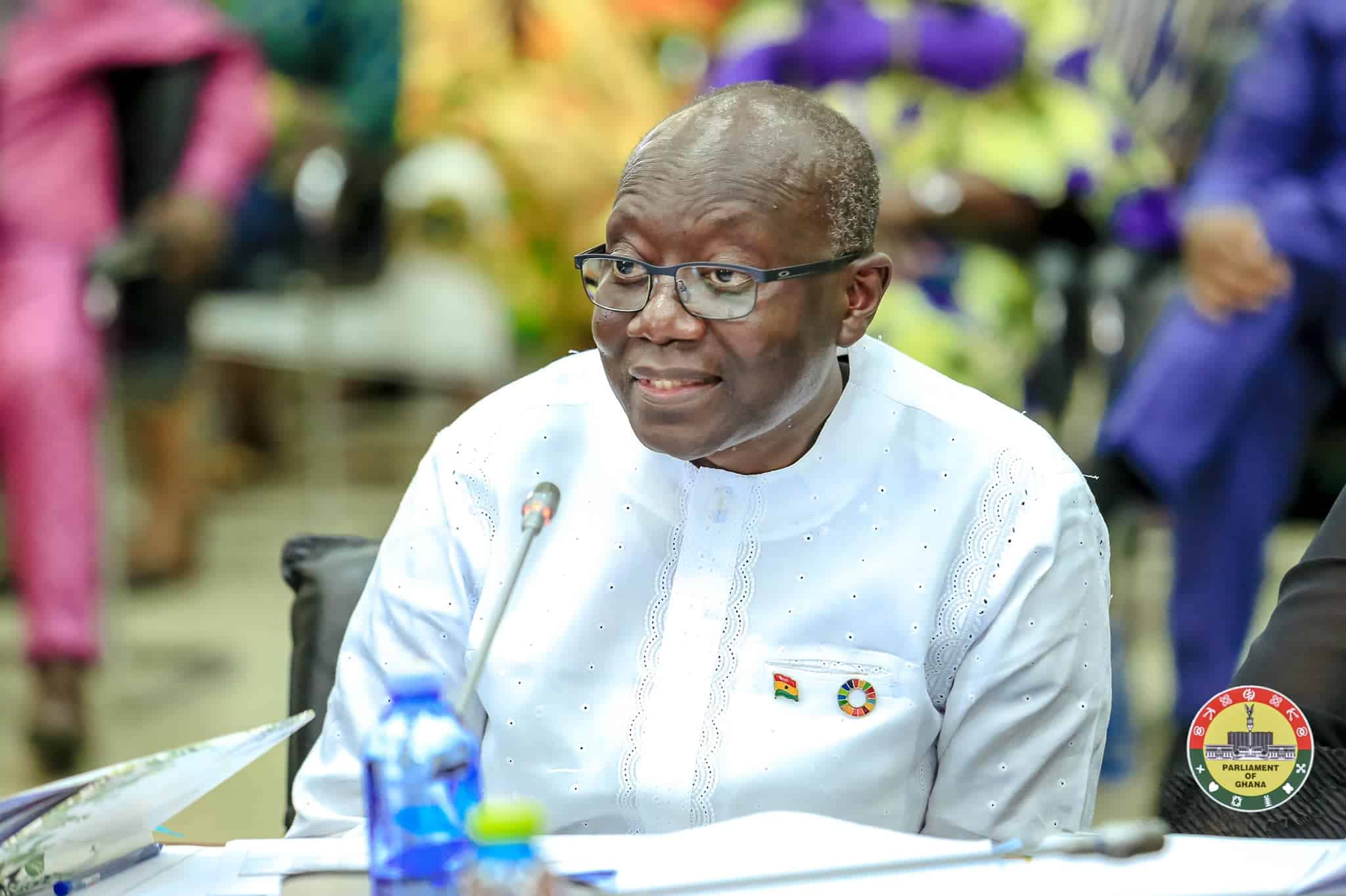
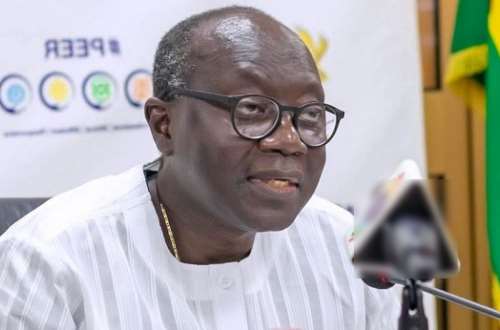
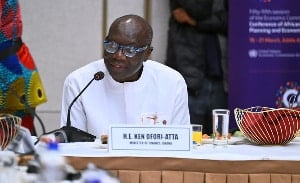
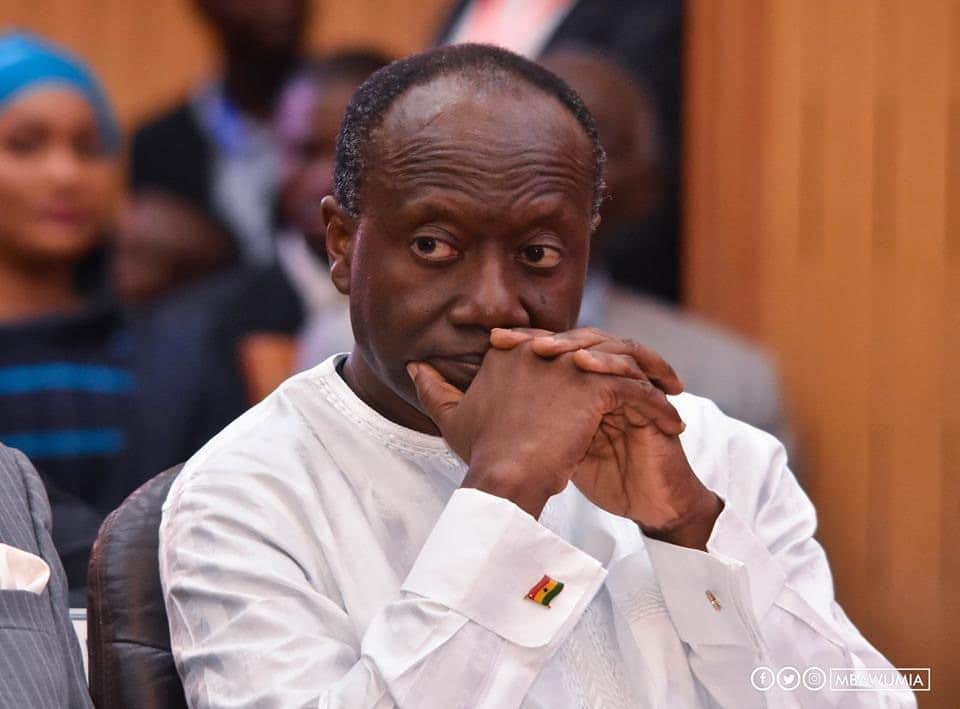
    The Ghana cedi fared well versus major trading currencies in the first half of the year, according to Finance Minister Ken Ofori-Atta.

    He asserts that the Cedi has only fallen by 1.8% in the first half of 2023, despite having lost 20% of its value on average against major currencies during the previous two years.

    He said that in order to keep the devaluation under control, the administration is focusing its efforts.

    “Overall, first-quarter growth for 2023 was 4.2 percent, up from 3.0 percent recorded for the same period in 2022. This growth largely reflected an increase in the services sector which recorded a growth of 10.1 percent,” he said.

    “Headline inflation eased in the first half of 2023. From the peak at 54.1 percent in December 2022, headline inflation gradually trended downwards from 53.6 percent in January 2023 to 42.5 percent in June 2023. The moderation in inflation was largely supported by monetary policy tightening, relative stability in the exchange rate and lower and stable ex-pump petroleum prices;”

    “Cumulatively, the Ghana cedi depreciated by 22.1 percent against the US Dollar in the year to July 17, 2021, compared to 21.1 percent in the same period in 2022. The Cedi, excluding the January 2023 depreciation of 20%, has depreciated by an impressive 1.84% between February and July 17, 2023.”

    Additionally, Mr. Ofori-Atta stated that “due to lower crude oil export receipts, total export receipts declined by 7.9 percent to US$8,178.56 million. Crude oil exports fell by 41.3% year over year as a result of volumes falling by 21.4% and prices falling by 25.3%;

    “Current account recorded a provisional surplus of US$849.16 million (1.1% of GDP) compared with a deficit of US$1,111.87 million (1.5% of GDP) for the same period in 2022; and Gross International Reserves dropped from US$6.2 billion at the end of December 2023 to US$5.3 billion (2.5 months of import cover) in June 2023, reflecting BOG’s objectives of reducing their foreign liabilities in line with the IMF programme.”

    “Net International Reserves received a boost from gold reserves and improved to US$2,353.95 million equivalent to 1.1 months of import cover, compared with US$1,440.00 million (0.6 months of import cover) recorded at the end of December 2022.”

  • All agreements with 10,832 school food providers have come to an end

    All agreements with 10,832 school food providers have come to an end

    According to Lariba Zuweira Abudu, the Minister for Gender, Children, and Social Protection, the contracts of school feeding caterers have lapsed.

    The Minister, who is also the Member of Parliament for Walewale, disclosed this information during her appearance before Parliament on Tuesday, August 1, 2023, in response to questions.

    She informed the House that all 10,832 caterers’ contracts had expired and that she plans to initiate a thorough and rigorous process for awarding new contracts.

    Dr. Clement Apaak, the Member of Parliament for Builsa South, inquired about the number of caterers in the program and their recruitment process.

    In her response, the Minister confirmed that all the caterers’ contracts had indeed expired. She revealed that the selection of new caterers would be carried out through a competitive advertisement process.

    The Minister further explained that advertisements for prospective caterers would be published in national newspapers, and only qualified caterers would be chosen following the selection process.

    The new selection procedure will encompass eight distinct steps, as follows:

    Competitive Advertisement: We will advertise soon. The Ministry and Ghana School Feeding Programme National Secretariat will advertise nationally specifying the selection criteria and mandatory requirements.

    Applications will be submitted: Caterers will apply online and submit required documents including registration certificates, financial statements, health certificates, and permits.

    Assessment of applications: The National Secretariat will evaluate the applications based on the criteria and compile a list of qualified applicants.

    Interview for selected applicants: An interview panel will assess the shortlisted caterers individually, considering their advertised criteria and the highest-scoring caterers assigned to the schools.

    Submission and approval: The interview panel will submit the evaluation report to the National Secretariat, and the final list of qualified caterers, will be sent to the Ministry of Gender for approval and contracting.

    Contracting Phase: The National Secretariat prepares caterer documents, including details of the caterer, and assigns school, and signatures officials. The contracts are distributed to relevant applicants.

    Assigning a caterer to a school: The National Secretariat Officials will use the MIS through the digitisation process to assign the schools while selecting the appropriate classes.

    Authorising a caterer assigned to a school: The National Secretariat reviews and approves validated caterer records at the district, regional and national levels.

    The Minister stressed that the process involves advertisement, application assessment, interview selection, contracting, and assigning caterers to the schools, with necessary approvals at each stage.

  • Brain injury patients at London exhibition showcases artworksby

    Brain injury patients at London exhibition showcases artworksby

      Brain injury survivors who are now artists are presenting their works in the Barbican Center in London.

      The Barbican arts center and the charity Headway, which uses music and the arts to assist people with brain impairments regain control of their lives, have worked together for four years to create the Differently Various show.

      People who have benefited from the charity also wrote the music for the display.

      Yokabet Mekuria is one of the artists on display at the Barbican.

      In her self-portrait, she is depicted in vivid colors.

      “With the colours I suppose it’s like to say I’m joyful, I’m not hiding in the background any more, I’m here,” Mekuria says.

      “To actually see myself here is unbelievable because I never thought I would be here,” she adds. 

      The artistic process has served as a way of rehabilitation for the artists here, like Mekuria.

      The artworks in Differently Various celebrate survival and the courage of those who inspired them, even though the artists’ injuries permanently altered their lives.

      Up through August 6, the exhibit is on view at the Barbican Center in London.

    • EU condemns detention of ministers in Niger

      EU condemns detention of ministers in Niger

      The detention of former government ministers by Niger’s new junta was denounced and their immediate release was sought by the European Union on Monday

      “The EU denounces the continued arrests of ministers and senior officials of President Mohamed Bazoum’s government by the putschists in Niger,” EU foreign policy chief Josep Borrell said on Twitter, renamed X. “We call for their immediate release ,” he added.

      Ousted President Mohamed Bazoum ‘s party has warned that the West African country is at risk of becoming a “dictatorial and totalitarian regime” after a series of arrests. The Nigerien Party for Democracy and Socialism (PNDS, in power), denounced the “abusive arrests” of four ministers – Interior, Petroleum, Mines and Transport – as well as the head of its national executive committee.

      The European Union, which views Niger as a crucial pillar of security in the unstable Sahel area, has denounced the coup there. It stopped providing fiscal assistance to Niamey and issued a warning that it might follow this coup with fresh sanctions.

      The elite presidential guard overthrew Mr. Bazoum on July 26, a Western friend whose victory just over two years ago marked the first peaceful transfer of power in Niger since independence.

      Despite having uranium resources, Niger is one of the world’s poorest nations. It is the third nation in the area to have a coup since 2020, following Mali and Burkina Faso, and is beset by attacks from organizations affiliated with the Islamic State and Al-Qaeda.

    • Residents in Niger react to evacuation plan for French nationals

      Residents in Niger react to evacuation plan for French nationals

      Residents of Niamey, the capital of Niger, are responding to the recent announcement of France’s intention to evacuate its nationals from the country.

      On Tuesday, both France and Italy made preparations to airlift their citizens and other European residents from Niger.

      This decision comes six days after a coup resulted in the ousting of President Mohammed Bazoom, who was considered one of the last pro-Western leaders in the Sahel region, which has been facing challenges from jihadist group

      “I dare say that we live in symbiosis with this French population living in Niger, so they really have no reason to repatriate them. As far as we’re concerned, this is yet another failure on the part of French politicians, and one that we all condemn.”  Idrissa Adamou Kimba, resident of Niamey

      “We don’t have a problem with the French, European nationals, we have problems with European governments, if they said they were going to repatriate their population, they only have to repatriate their army first.”  Hamidou Ali, resident of Niamey

      Amid the deteriorating security situation in Niamey, the French embassy conveyed a message to its citizens, stating that an air evacuation operation is being organized, taking advantage of the relatively calm conditions in the area.

      The evacuations are expected to occur promptly within a short timeframe.

      The initial flight from Paris has already departed, and it was reported that unarmed military transporters, capable of accommodating more than 200 people, would be used for the evacuation.

      The French foreign ministry estimated that there were about 600 French nationals in Niger but did not disclose the number of individuals wishing to leave.

      Meanwhile, an Italian government spokesperson in Rome mentioned that a “special flight” would be provided for Italians who wanted to leave the country, although they emphasized that it was not classified as an evacuation.

      In Niamey, one resident, Almoctar Boukari, expressed discontent and held France responsible for the challenges faced by Africans in Niger, urging them to leave the country.

      The situation in Niger has drawn regional and international attention. The Economic Community of West African States (ECOWAS) imposed sanctions on Niger and warned of possible military intervention if the coup leaders do not reinstate President Bazoum. The junta accused France of seeking military intervention, which France denied, while neighboring countries under junta rule, Mali and Burkina Faso, warned that any military intervention in Niger would be considered an act of war against them.

      Niger is experiencing instability in a nation that has faced multiple coups since gaining independence in 1960. President Bazoum had previously survived two attempted coups before the recent events that led to his detention by the Presidential Guard. However, the junta’s claim to leadership has been rejected internationally by various organizations and countries, including ECOWAS, the African Union, the United Nations, France, the United States, and the European Union.

      The coup in Niger has raised concerns among Western nations dealing with a jihadist insurgency that began in northern Mali in 2012 and spread into Niger and Burkina Faso. This insurgency threatens the stability of fragile states in the Gulf of Guinea region and has resulted in significant loss of life and displacement of populations. France and the United States have had military deployments in the region, with France reconfiguring its force and focusing on Niger last year after withdrawing troops from Mali and Burkina Faso.

      The military takeovers in the Sahel region have been accompanied by anti-French and pro-Russian sentiments, with Mali forging closer ties with Russia, leading to the deployment of Russian military hardware and paramilitaries, which Western nations claim to be Wagner mercenaries. The situation remains concerning and complex as regional and international stakeholders seek to address the security challenges in the region.

    • Burkina Faso, Mali issue warning against foreign military action in Niger

      Burkina Faso, Mali issue warning against foreign military action in Niger

      Any military action taken against the leaders of last week’s coup in Niger would be viewed as a “declaration of war” against those countries, according to the military governments of Burkina Faso and Mali.

      Following threats from West African leaders to use force to restore deposed Niger President Mohamed Bazoum, Niger’s neighbors on Monday issued the warning in unified declarations that were read out on their national broadcasters.

      “The transitional governments of Burkina Faso and Mali express their fraternal solidarity … to the people of Niger, who have decided with full responsibility to take their destiny in hand and assume the fullness of their sovereignty before history,” the military governments of the two countries said.

      “Any military intervention against Niger would be tantamount to a declaration of war against Burkina Faso and Mali,” they warned, adding that such a move could result in “disastrous consequences” that “could destabilise the entire region”.

      The military authorities of Burkina Faso and Mali have expressed their refusal to adhere to the “illegal, illegitimate, and inhumane sanctions against the people and authorities of Niger” in response to the coup that took place in Niger on July 26. This coup has created ripples across West Africa, leading to divisions among the country’s former Western allies and regional bodies and other nations in the region.

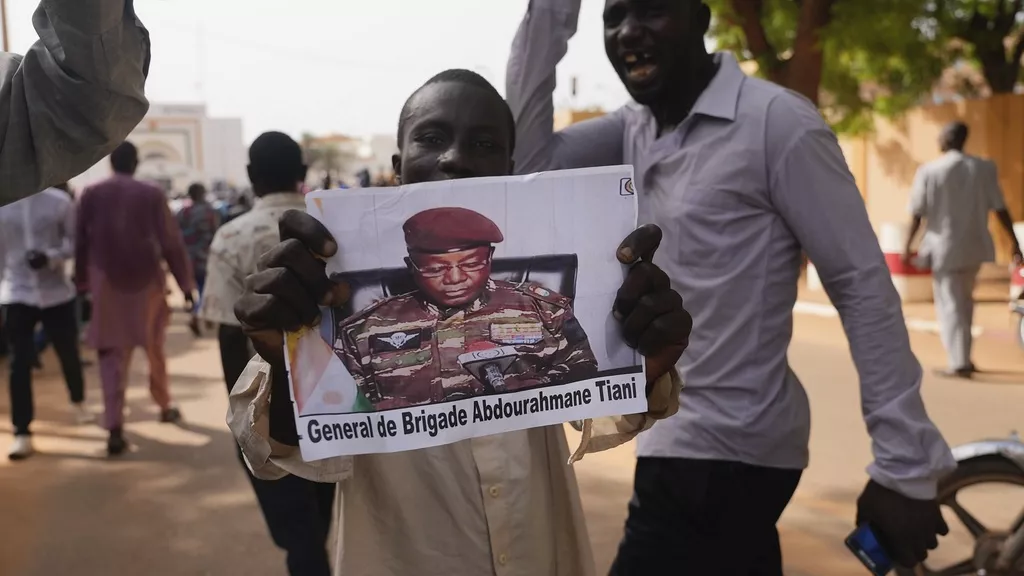
      The coup leaders in Niger, led by General Abdourahamane Tchiani, the former presidential guard chief, cited poor governance and dissatisfaction with President Bazoum’s handling of security threats from al-Qaeda and ISIS-linked groups as the reasons behind their actions.

      This coup marks the seventh military takeover in less than three years in West and Central Africa, prompting immediate condemnation from the African Union, the United States, the United Nations, the European Union, and other influential powers.

      The regional bloc ECOWAS has imposed sanctions on Niger, including a halt in all financial transactions and a freeze of national assets. It has also indicated the possibility of authorizing force to reinstate President Bazoum, who is believed to be under house arrest in Niamey, the capital.

      In response to the sanctions, Burkina Faso, Mali, and Guinea have expressed their disagreement. Guinea’s President Mamady Doumbouya, whose government also came to power through a coup, stated that the sanctions would not solve the current problem and could lead to a humanitarian disaster extending beyond Niger’s borders. Guinea’s government has decided not to apply the sanctions, considering them illegitimate and inhumane, and has called on ECOWAS to reconsider its position.

      Meanwhile, the coup leaders in Niger have attempted to consolidate their control by arresting top officials of the toppled government. The situation in Niger has drawn international concern, with the United States, France, and Germany calling for a restoration of President Bazoum to power.

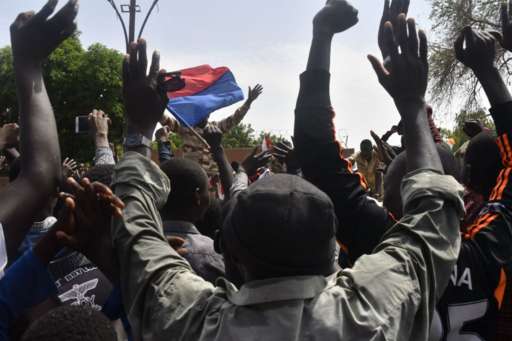
      Amid the coup’s aftermath, anti-French sentiments have fueled protests outside Paris’s embassy in Niamey, with demonstrators expressing support for Russia. There are concerns that the instability in Niger may present opportunities for groups like the Wagner Group, a Russian private mercenary company, to exert influence.

      Yevgeny Prigozhin, the leader of the Wagner Group, spoke approvingly of the coup, while the Kremlin in Russia expressed serious concern over the situation in Niger. The developments in Niger are closely monitored by the international community due to their potential implications for regional stability and security.

    • LGBTQ community revokes scholarship of Ghanaian PhD student after comment against them

      LGBTQ community revokes scholarship of Ghanaian PhD student after comment against them

      Ghanaian student studying in the United States of America, Derrick Boadi Sakyi, has his scholarship withdrawn due to his involvement in hateful attacks against LGBT Ghanaians on Twitter.

      The attacks came to light when a Ghanaian LGBT activist, known as Papa Kojo, exposed them after receiving a threat from Sakyi.

      Papa Kojo’s investigation revealed that Sakyi had recently commenced a PhD program in Biological Science at Ohio University in the United States on a scholarship. However, it was later discovered that the scholarship was intended for LGBTQIA+ community members, applicants from the Global South, first-generation students, and people with disabilities.

      Upon realizing this contradiction, Papa Kojo informed the university about the attack he received from Sakyi, providing evidence of other abusive and hateful posts made by Sakyi against the LGBT community in Ghana. Subsequently, the scholarship was withdrawn as a consequence of his actions.

      He wrote on Twitter: “One guy sent me death threats and I just checked his profile. He’s been inciting hate for years…in one of his most recent tweet, he confessed setting up gay men to be beaten and blackmailed and said if Ama allows him to correctively rape her, he’ll get her to the bar.

      “I’ve found his name and details on LinkedIn and he moved to the US two weeks ago to start a PhD in Ohio. I want everyone to hold on tight because this TL is about to get bloody messy af in the coming days. 😂,”

      In response to his letter to the university, he learned that Sakyi’s scholarship had been put on hold while a review was conducted.

      “Stay away from progressive funding and scholarships if you’re a homophobe. Apply to Iran, Saudi Arabia or Afghanistan since you love oppression so bad,” Papa Kojo captioned his new post.

    • Ban on rice importation by India, likely impact on Ghana, other African countries

      Ban on rice importation by India, likely impact on Ghana, other African countries

      The recent decision by India, the world’s largest rice exporter, to ban rice exports is expected to have a significant impact on rice prices in Ghana.

      This move by the Indian government, aimed at addressing domestic inflation concerns, has raised concerns about potential global food price increases.

      India accounts for more than 40% of the world’s rice shipments, making it the leading rice exporter. As a result of the export ban, rice prices from various Asian nations have already risen in the global markets, and traders predict further substantial increases in the near future.

      In 2022, Ghana imported rice worth $552 million, making it the 13th largest rice importer globally.

      Rice was the third most imported commodity in Ghana during that year. Notably, Ghana imported rice worth over $100 million from India, according to data from the Observatory of Economic Complexity (OEC).

      The repercussions of this export ban will soon impact Ghana, affecting not only the prices of non-basmati rice but also basmati rice varieties. Experts warn that this ban adds to the challenges faced by the global rice market, which has already experienced price hikes of 15%-20% since September 2022.

      Based on current trends, the cost of a 50kg bag of non-basmati rice, typically priced between GHC750 and GHC800, is expected to surpass GHC1000 in the coming days. As India plays a significant role as a major rice supplier to important markets in Asia and Sub-Saharan Africa, these regions are particularly vulnerable to disruptions in the rice market.

      Moreover, it is important to note that forty-two countries rely on India for over 50% of their total rice imports, making it difficult to easily substitute Indian imports with those from other major rice exporting nations like Vietnam, Thailand, or Pakistan. In Africa, India’s market share in 2022 surpassed 80% for several countries.

    • 12 High Courts designated by CJ to sit as Judiciary begin legal vacation

      12 High Courts designated by CJ to sit as Judiciary begin legal vacation

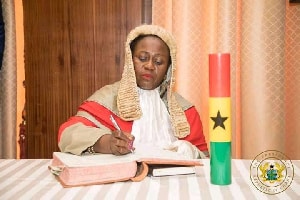
      In a two-month legal vacation, starting from August 1, 2023, until September 30, 2023, the Chief Justice (CJ), Her Ladyship Justice Gertrude Araba Esaaba Sackey Torkornoo, has designated specific courts to remain operational within the Law Court Complex in Accra.

      While the superior courts, including the Supreme Court, the Court of Appeal, and most High Courts, will be on recess, the Chief Justice has taken measures to avoid creating a judicial vacuum.

      As a result, 12 out of the 42 High Courts within the complex will continue to function during the legal vacation, in addition to some of the lower courts.

      The 12 High Courts designated to sit over the course of the legal vacation are Commercial Court 2, Commercial Court 10, Criminal Court 1, Criminal Court 3, General Jurisdiction Court 12, General Jurisdiction Court 9, General Jurisdiction Court 6, General Jurisdiction Court 3, Financial Court 2, Land Court 10, Land Court 3, and Probate Court 3.

      Below are the presiding judges of those courts sitting during the vacation

      1. His Lordship Justice Francis Obiri (Commercial Court)

      2. Her Ladyship Justice Adelaide Abui Keddey (Commercial Court 10),

      3. Her Ladyship Justice Ruby Aryeetey (Criminal Court 1),

      4. Her Ladyship Justice Mary Maame Ekue Yanzuh (Criminal Court)

      5. His Lordship Justice Charles Gyamfi Danquah (General Jurisdiction 12)

      6. Her Ladyship Justice Audrey Kocuvie-Tay (General Jurisdiction 9)

      7. Her Ladyship Justice Abena Amponsah Buansi (General Jurisdiction 6)

      8. Her Ladyship Justice Marian Affoh (General Jurisdiction 3)

      9. His Lordship Justice Edward Twum (Financial Court 2)

      10. His Lordship Justice Kwame Gyamfi Osei (Land Court 10)

      11. Her Ladyship Justice Jennifer Anne Myers Ahmed, (Land Court 3)

      12. Her Ladyship Justice Sarah Aryee (Probate Court 3)

    • ‘First English slave fort in Africa’ located in Ghana by Archaeologists

      ‘First English slave fort in Africa’ located in Ghana by Archaeologists

      Ghana has once again captured the world’s attention as news emerged confirming the beginning of the story of slavery in Africa, particularly in Ghana.

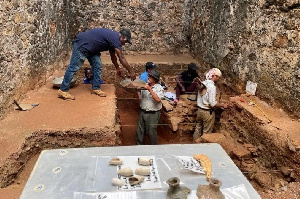
      Leading an archaeological team, Prof. Christopher DeCorse, an archaeologist from Syracuse University in the United States of America, successfully uncovered the exact location of what is believed to be the first English slave fort in Africa.

      The team diligently worked under the ruins of Fort Amsterdam, carefully extracting remains of an older fort called Kormantine. Buried beneath the earth, the long-lost fort has kept the archaeologists busy as they methodically sift through distinct layers of soil, as reported by the BBC.

      Among the ruins, the team discovered significant artifacts such as gunflints used in old-fashioned guns, tobacco pipes, broken pottery, and the jawbone of a goat. These findings provide evidence of “the first English outpost established anywhere in Africa.”

      Prof. Christopher DeCorse expressed his excitement, stating that any archaeologist who claims not to be thrilled when making such discoveries is not entirely truthful. He announced this pivotal moment in the history of European involvement in Africa during the slave trade era with great enthusiasm.

      This archaeological discovery may shed light on the lives of early traders and the activities that took place, as well as the experiences of those who were sold as slaves and the impact on the surrounding community.

      According to the report, the slave trade began at the location of Fort Kormantine in 1663 when King Charles II granted a charter to the Company of Royal Adventurers of England Trading into Africa, later known as the Royal African Company. The company was given a monopoly on the trade of human beings.

      Two years later, the Dutch seized the fort, but it does not diminish the fact that Fort Kormantine played a crucial role in the early stages of the slave trade.

      “We don’t have that many details on exactly what these early outposts of the slave trade looked like, which is one of the things that make uncovering the foundations of Fort Kormantine interesting,” Prof DeCorse added.

    • €1m per week offer from Al Hilal to Victor Osimhen rejected

      €1m per week offer from Al Hilal to Victor Osimhen rejected

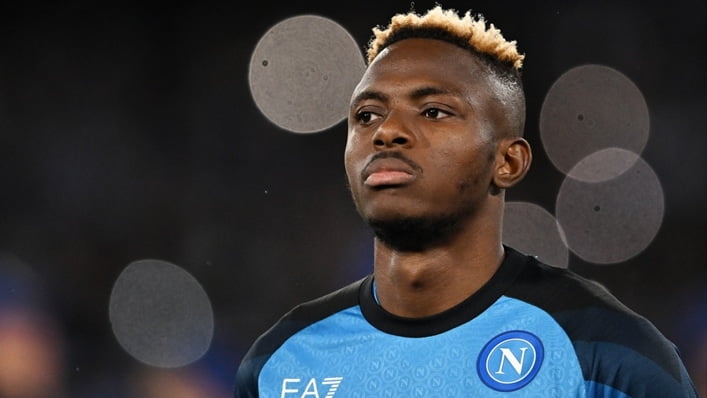
      Napoli’s striker, Victor Osimhen, has declined a staggering €1 million per week offer from Saudi Arabian club Al Hilal.

      The Nigerian forward had the opportunity to earn €52 million annually if he had accepted the deal to join the Saudi Pro League side.

      Al Hilal made a second bid of €140 million to Napoli, following their initial €130 million offer, but both offers were rejected by the Italian side, as reported by the Italian newspaper Il Mattino. Napoli is reportedly seeking €150 million for Osimhen’s transfer.

      The pursuit of Osimhen by Al Hilal comes after their unsuccessful attempt to sign Paris Saint-Germain’s Kylian Mbappe.

      Victor Osimhen had an exceptional campaign last season in Serie A, finishing as the top scorer with 26 goals in 32 games. His outstanding performance has attracted interest from several European giants, including Bayern Munich.

    • Key indicators see downward adjustment in mid-year budget review

      Key indicators see downward adjustment in mid-year budget review

      Finance Minister Ken Ofori-Atta has announced significant downward revisions in key macroeconomic indicators.

      The overall real gross domestic growth and inflation rates for the end of the 2023 fiscal year have been revised to 1.5 percent and 31.3 percent, respectively. This is down from the initial projections of 2.8 percent for GDP growth and a sub-20 percent target of 18.9 percent for inflation.

      Despite the revisions, inflation remains at more than three times the central bank’s upper band target of 10 percent.

      The minister made this announcement during his presentation of the mid-year budget review to lawmakers in Accra.

      These revisions were made to align with market expectations and adhere to the targets of the International Monetary Fund (IMF)-supported Policy Coordination and post-COVID-19 Programme for Economic Growth (PC-PEG).

      During the presentation before parliament, the minister emphasized the need for these revisions, citing factors such as a broad economic slowdown across various sectors due to the fiscal consolidation plan and challenging global economic conditions.

      “All these developments, together with the need to align with targets of the IMF-supported PC-PEG, warrant a revision of the macroeconomic framework. This was necessary because the framework was guided by the September 2022 data that underpinned the 2023 budget in November 2022. The revisions of the macro-fiscal framework generally seek to align the 2023 mid-year fiscal policy review with the IMF-ECF supported PC-PEG,” he explained.

      Similarly, there have been revisions in several key non-oil real GDP growth rate, primary balance, and gross international reserves indicators. The non-oil real GDP growth rate has been adjusted to 1.5 percent, a reduction from the previous target of 3 percent. The primary balance on a commitment basis now reflects a deficit of 0.5 percent of GDP, in contrast to the initial plan of a 0.7 percent surplus. Additionally, the target for gross international reserves has been adjusted to cover at least 0.8 months of imports of goods and services by the end of 2023, significantly lower than the prudential threshold of three months.

      Regarding the fiscal framework, Mr. Ofori-Atta emphasized that it now fully aligns with the fiscal objectives of the IMF programme, encompassing primary balance, revenue path, and trajectory of primary expenditures.

      Various factors have contributed to these realignments, including fiscal developments between January and June 2023, changes in base pay, and disbursements from the IMF ECF Programme. The revised primary balance on a commitment basis now stands at a deficit of 0.5 percent of GDP, aligning with the fiscal consolidation path supported by the IMF’s PC-PEG program.

      “The revisions of the 2023 fiscal framework are driven by several factors… There was an increase in the base pay on the Single Spine Salary Structure, which was set at 30 percent instead of the previously assumed 20 percent for the 2023 Budget. Third, there was a partial restoration of capped transfers to the National Health Insurance Scheme (NHIS) and Ghana Education Trust Fund (GETFund).

      “Fourth, the completed Domestic Debt Exchange Programme (DDEP) had an impact on both debt service costs and revenue mobilisation,” he explained.

      “Additionally, there were disbursements from the International Monetary Fund (IMF) Extended Credit Facility (ECF) Programme amounting to US$1.2billion for 2023, along with other catalytic financing including US$530million from the World Bank (US$300million from Development Policy Operations and US$230million from Emergency Projects), and an expected disbursement of US$103million from the African Development Bank (AFDB). These various factors collectively influenced the revisions made to the fiscal framework for the year 2023,” the finance minister added.

      The finance minister also addressed the modification of petroleum receipts, pointing to a decline in the demand for crude oil in light of recent developments in the world economy. In order to predict petroleum revenues for 2023, the average crude oil price was changed from US$88.55 per barrel to US$74.0 per barrel. As a result, the overall petroleum receipts were reduced by 32%, from US$1.48 billion to US$1.08 billion.

      The finance minister, however, projected a recovery in GDP growth over the coming years and was upbeat about the future.

      “Overall GDP growth is projected to rebound to 2.8 percent, 4.7 percent, and 4.9 percent in 2024, 2025 and 2026, respectively. This is a result of implementing growth-oriented and structural transformation strategies in the PC-PEG,” he stated, while highlighting the importance of developing an enhanced Growth Strategy supported by private domestic and foreign investments to further boost growth and create job opportunities

    • Third richest person in Africa close to making $10b net worth – Report

      Third richest person in Africa close to making $10b net worth – Report

      South African billionaire Nicky Oppenheimer has experienced remarkable financial success this year, witnessing a surge in his net worth by over $1.3 billion, inching closer to the $10-billion milestone.

      Currently ranking as Africa’s third-richest person and the second-richest man in South Africa, trailing behind Johann Rupert, Oppenheimer’s net worth has soared by a significant $1.38 billion since the beginning of the year.

      According to Bloomberg Billionaire Index, his net worth has risen from $8.03 billion to an impressive $9.4 billion, elevating him to the 237th spot among the world’s wealthiest individuals.

      The driving force behind Oppenheimer’s wealth gains lies in his private equity investments, particularly through his ventures, Stockdale Street in London, and Tana Africa Capital in Johannesburg. These shrewd investments have capitalized on lucrative opportunities, generating substantial returns and solidifying his position among the continent’s few billionaires who have witnessed substantial growth in their fortunes this year.

      Oppenheimer’s financial success reflects his astute approach to wealth management and diversification of investments, which include stakes in various companies, notably Integrated Diagnostics Holdings (IDH), a healthcare services provider based in Cairo, led by Egyptian businesswoman Hend El-Sherbini.

      Beyond his business interests, the billionaire is renowned for his unwavering commitment to wilderness conservation. Oppenheimer owns and operates Tswalu Kalahari, South Africa’s largest private game reserve, in partnership with his son Jonathan. The reserve serves as a sanctuary for wildlife, playing a crucial role in preserving the country’s natural heritage.

      Additionally, Oppenheimer owns the Shangani Ranch, a sprawling 65,000-hectare property known for its wildlife sanctuary status. The ranch boasts a robust cattle operation and employs 400 workers, exporting beef to the United Kingdom since 1937. Moreover, it serves as a vital corridor for migrating animals, underscoring Oppenheimer’s dedication to wildlife preservation and ecological balance.

      With a year-to-date wealth gain of $1.38 billion, Oppenheimer is poised to join the ranks of the few African billionaires with a fortune surpassing $10 billion. His impressive financial achievements and commitment to wildlife conservation have solidified his status as a prominent figure in the business and philanthropic spheres.

    • UT trial: GCB consolidated Ghana Exim Bank’s investments with UT Bank – Sampana

      UT trial: GCB consolidated Ghana Exim Bank’s investments with UT Bank – Sampana

      In the trial of the former Chief Executive Officer of the now-defunct UT Bank Ghana, Prince Kofi Amoabeng, and others, fifth prosecution witness, Mr. Joseph Yeebo Sampana, provided significant evidence.

      He revealed that three of Ghana Exim Bank’s investments with UT Bank were consolidated by GCB Bank, totaling GH¢25,877,825. Additionally, GCB Bank also assumed control of another investment worth GH¢5,133,728.80 that was previously held by UT Holdings.

      Mr. Sampana, who serves as a treasurer with Exim Bank, submitted his witness statement on June 24, 2020, which was accepted as evidence without objection from the accused.

      The five accused individuals in the trial are Johnson Pandit Asiama, the former Second Deputy Governor of the Bank of Ghana (BoG); Raymond Amantu, Head of Banking Supervision Department (BSD) at BoG; UT Holdings Limited, which held shares in UT Bank Ghana; Catherine Johnson, Head of Treasury; and Robert Kwesi Armah, General Manager of Corporate Banking, UT Bank.

      The charges against the accused include willfully causing financial loss, abetment of crime, contravention of the Bank of Ghana Act, fraudulent causing of financial loss to the Republic, fraudulent breach of trust, deceit of public officer, and fabrication of evidence.

      All of the accused individuals have pleaded not guilty to the charges and were granted bail with various conditions.

      Mr. Sampana revealed that the GH¢5,133,728.80, previously with UT Holdings, initially represented an investment of GH¢4,475,246.05 with UT Bank.

      He further informed the Court that Exim Bank only became aware of the transfer of the said amount to UT Holdings in the latter part of 2017, when it received a UT Holdings certificate of investment instead of a UT Bank certificate of investment.

      Mr. Sampana also stated that UT Bank had engaged in business with Export Development Agricultural and Investment Fund (EDAIF) before EDAIF was converted into Exim Bank through Act 911 in March 2016. During that time, EDAIF operated as one of the Designated Financial Institutions (DFI).

      “Based on the approval of Bank of Ghana for Exim Bank to operate as a DFI, Export Development Agricultural and Investment Fund (EDAIF) started giving out loans through UT Bank and when funds were placed with UT Bank, EDAIF was issued certificates of placement by UT Bank,” Sampana added.

      During the trial, the witness disclosed that when GCB took over UT Bank, the management of Exim Bank and GCB convened to discuss an agreement. As per the proposal, GCB would assume control of all the investments Exim Bank had with UT Bank.

      Under cross-examination by Counsel for the 3rd accused, UT Holdings Limited, the witness revealed that he had been an employee of Exim Bank for the past 13 years. He further disclosed that he is a qualified Chartered Accountant with 12 years of experience, having attended the University of Ghana where he studied Finance and Banking.

      According to the witness, UT Bank had issued an investment certificate amounting to GH¢4,475,246.05, with an additional investment of GH¢4,703,548.25 made on January 30, 2017, and set to mature on May 1, 2017.

      He clarified that the GH¢4,475,246.05 investment was rolled over upon maturity. However, Exim Bank later discovered that their investments with UT Bank had been transferred to UT Holdings after GCB’s takeover of UT Bank. The witness, however, was not aware of the exact date when the transfer of Exim Bank’s placement with UT Bank occurred.

      Mr. Sampana explained that, at the time of the takeover by GCB, there was a balance remaining as a cost, as the initial amount was lower. Interest added to the amount eventually resulted in Exim Bank having GH¢4,703,548.25 as of August 2017.

      He also stated that he possessed an investment certificate indicating the lesser amount before it appreciated to GH¢4,703,548.2.

      In response to the Court’s request, the witness was ordered to produce all Exim Bank’s rollover certificates in his possession on the next adjourned date.

      The case has been adjourned until October 17, 2023.

    • Aliko Dangote losses $36m due to naira devaluation

      Prominent integrated sugar business, Dangote Sugar Refinery Plc, owned by Africa’s renowned entrepreneur Aliko Dangote, encountered substantial foreign exchange losses exceeding $100 million in the first half of 2023.

      These staggering foreign exchange losses, amounting to N83.1 billion ($107.3 million), were a consequence of the devaluation of the Naira.

      This devaluation adversely affected the company’s earnings capacity, leading to the revaluation of its foreign currency obligations.

      As a result, Dangote Sugar experienced a significant loss of N27.98 billion ($36.17 million) during the first six months of 2023.

      This is in stark contrast to the N20.24 billion ($26.2 million) profit recorded in the first half of 2022, when foreign exchange losses amounted to only N1.89 billion ($2.44 million).

      Despite a growth in sales and revenue during the first half of 2023, with revenue rising from N185.45 billion ($240.6 million) to N202.78 billion ($263.1 million), Dangote Sugar’s profit was heavily impacted by the foreign exchange losses.

      While the company’s total assets saw an increase during the same period, rising from N492.43 billion ($638.8 million) at the beginning of the year to N565.98 billion ($734.32 million), its retained earnings experienced a decline, falling from N158.84 billion to N112.64 billion.

      In a strategic move aimed at creating value for its shareholders, including Aliko Dangote, who holds a 72.7-percent stake in the company, Dangote Sugar announced plans for a proposed merger with Nascon Allied Industries Plc and Dangote Rice Limited, both subsidiaries of the Dangote Group.

      The proposed merger aims to establish a formidable food conglomerate with a diverse product portfolio, encompassing sugar, rice, salt, vegetable oil, tomato paste, seasoning, and savory products.

      This merger is anticipated to herald a significant transformation in Nigeria’s food and consumer goods industry.

      The consolidation of these businesses is projected to reshape the market landscape and usher in new growth opportunities, paving the way for a transformative chapter in the country’s economic landscape.

    • DDEP GHC31b of local pension funds to be restructured by government

      DDEP GHC31b of local pension funds to be restructured by government

      Ghana has extended an invitation to local pension funds for a debt restructuring deal aimed at providing the government with fiscal flexibility in the medium-term without impacting the retirement funds’ value.

      Under this initiative, pension funds have been offered the opportunity to exchange approximately 31 billion cedis ($2.7 billion) of their existing investments. These existing investments currently carry an average coupon of 18.5%. In exchange, the government is proposing two new bonds maturing in 2027 and 2028, with an average interest rate of 8.4%. The Ministry of Finance announced this exchange memorandum on Monday.

      As part of the deal, the holders of these pension funds will receive a larger portion of the new securities, which were originally issued in February. Additionally, they will be given an additional cash-payment instrument with a 10% return. This arrangement will result in a total stream of coupon payments amounting to 21%, according to the memorandum.

      For the years 2023 and 2024, both instruments will pay a 5% coupon in cash, while the remaining amount will be added to the nominal value of the two bonds and paid upon maturity.

      This restructuring is designed to ensure the government’s compliance with macroeconomic requirements under its program with the International Monetary Fund, as stated by the Finance Ministry.

      The key aim is to facilitate financial stability while safeguarding the interests of local pension funds.

      “This alternative offer has been designed to achieve the same average maturity, achieve a better average coupon while alleviating the cash constraint for the government during the initial years after the exchange.”

      As of end-April, Ghana, which earlier this year missed a payment on a Eurobond, was restructuring most of its 569.3 billion cedis of debt to make them sustainable as part of the $3 billion IMF program it enrolled in mid-May.

      Following the completion of the first phase of a domestic debt exchange in February and the receipt of funding assurance from bilateral creditors under the Group of 20’s Common Framework in May, Ghana received IMF support.

      Investors exchanged 87.8 billion cedis in obligations for new securities that paid as little as 8.35% instead of the old notes’ average interest rate of 19%.

      Eurobond Revamp

      The pension funds have declined the initial offer due to the potential losses they would face. However, they now have until 4:00 p.m. on August 18 to consider and accept a new offer.

      In addition to this, Ghana has already initiated the reorganization of $809 million worth of domestic dollar bonds and 7.9 billion cedis of cocoa bills, a process that began on July 14 and will conclude on August 4.

      The outcome of these exchange programs, as well as the specific terms of debt relief negotiated with bilateral creditors, will play a significant role in shaping the terms that Ghana will propose to Eurobond investors. The country aims to complete its overhaul of dollar bonds by a self-imposed deadline of September.

    • Forex rates show a USD goes for GHC 11.70, BoG interbank rates at GHC11.00

      Forex rates show a USD goes for GHC 11.70, BoG interbank rates at GHC11.00

      On August 1, 2023, the Bank of Ghana’s Interbank forex rates revealed the exchange rates for the Ghana Cedi against various currencies.

      The Ghana Cedi trading against the US Dollar at a buying price of 10.9979 and a selling price of 11.0089.

      For the Pound Sterling, the Cedi was trading at a buying price of 14.1389 and a selling price of 14.1574.

      Meanwhile, against the Euro, the Cedi’s buying price was 12.1208, and its selling price was 12.1336.

      Regarding the South African Rand, the Cedi’s buying price stood at 0.6243, and the selling price was 0.6251.

      For the Nigerian Naira, the buying price was 70.2583, and the selling price was 70.8499.

      In terms of the CFA Franc, the buying price was 54.0612, and the selling price was 54.1183.

      At a Forex bureau in Accra, the dollar is being bought at a rate of 11.40 Cedi and sold at a rate of 11.70 Cedi.

      The pound sterling is being bought at a rate of 14.70 Cedi and sold at a rate of 15.40 Cedi.

      The Euro is being bought at a rate of 12.40 Cedi and sold at a rate of 13.10 Cedi.

      The South African Rand is being bought at a rate of 0.30 Cedi and sold at a rate of 0.90 Cedi.

      The Nigerian Naira is being bought at a rate of 12.00 Naira for every 1 Cedi and sold at a rate of 18.00 Naira for every 1 Cedi.

      The CFA Franc is being bought at a rate of 17.00 CFA for every 1 Cedi and sold at a rate of 21.00 CFA for every 1 Cedi.

      Our forex bureau rates are provided by Afriswap Bureau De Change in Osu, Accra.

      Note that these rates may be different at a forex bureau near you. Our forex bureau rates are provided by Afriswap Bureau De Change in Osu, Accra.

    • Economic crisis: Have faith in me – Tinubu tells Nigerians

      Economic crisis: Have faith in me – Tinubu tells Nigerians

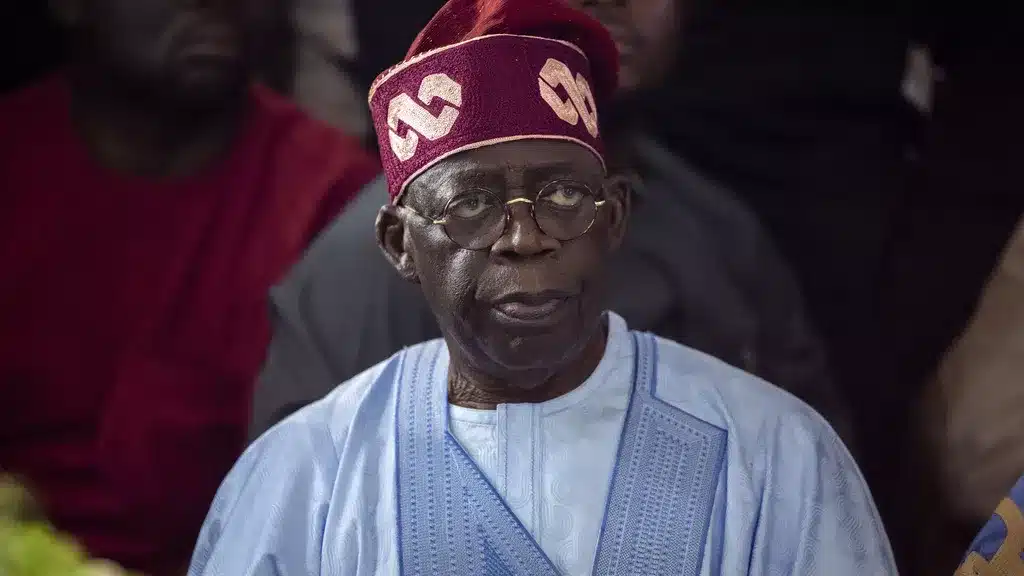
      Nigeria’s President Bola Tinubu has urged his citizens to trust him on solving the perennial challenges in Nigeria

      Mr. Tinubu announced in a televised speech to the country that he had directed the release of 200,000 tonnes of grain from strategic stocks.

      Additionally, he pledged to raise the minimum wage, promote more well-paying jobs, and provide financial support for the manufacturing, farming, and small business sectors.

      While acknowledging the challenges individuals faced, Mr. Tinubu justified the recent elimination of a fuel subsidy, claiming it had saved Nigeria about $1.3 billion (£1 billion).

      Protests have been sparked by the elimination of the subsidy.

      “I understand the hardship you face; I wish there were other ways, but there are none… Have faith in our ability to deliver. We will get out of this turbulence,” he assured citizens.

      In order to counteract the rising expense of transportation, he proposed a $129 million fund to buy around 3,000 commercial buses that would be spread across the country.

      He pleaded for tolerance as he carried out his economic strategies.

    • Dr. Vladimir Antwi Danso’s analysis of the Niger coup

      Dr. Vladimir Antwi Danso’s analysis of the Niger coup

      International Relations Analyst, Dr. Vladimir Antwi Danso, has shared the recent coup in Niger comes as no surprise, as he believes all the necessary elements for a coup are present in Africa.

      He pointed out that the signs of Niger’s potential coup were evident following the toppling of the Malian leader.

      Dr. Antwi Danso had previously expressed his concerns during a meeting discussing Mali, where he predicted that Niger could be susceptible to a coup, but unfortunately, his warning went unheeded.

      Regarding the possibility of ECOWAS (Economic Community of West African States) taking military action in Niger, he doubts its effectiveness, stating that such a move could exacerbate the situation.

      The analyst emphasized that any democratic system in Africa that doesn’t truly cater to the needs of its people is prone to facing similar repercussions.

      Dr. Antwi Danso stressed the importance of tailoring the continent’s democracy to align with its socio-historical and cultural realities as a crucial step towards political stability.

    • France will ‘soon’ repatriate its citizens from Niger

      France will ‘soon’ repatriate its citizens from Niger

      The French foreign ministry has announced its plans to promptly initiate the evacuation of its citizens in Niger following the recent coup.

      Amid the deteriorating security situation, the French embassy in Niamey conveyed that preparations for air evacuations were underway and would occur within a very limited timeframe, according to the AFP report.

      Last week, Niger President Mohamed Bazoum was overthrown when troops from his presidential guard seized power.

      Notably, this is the third Sahelian country, following Burkina Faso and Mali, to experience a coup in less than three years.

      These incidents have been accompanied by growing anti-French sentiments, leading these nations to strengthen their ties with Russia.

    • 2 deaths reported in Senegal’s opposition protests

      2 deaths reported in Senegal’s opposition protests

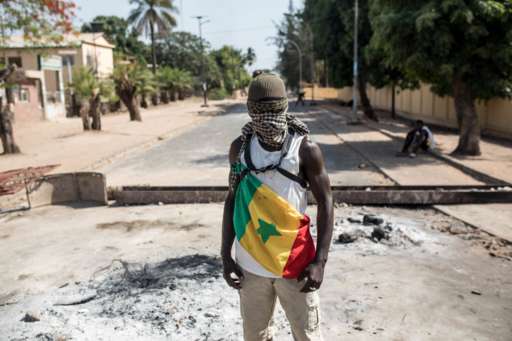
      The interior ministry of Senegal has reported that two individuals lost their lives in Ziguinchor during protests opposing the detention of the prominent opposition leader, Ousmane Sonko.

      Although the ministry did not disclose the identities of the deceased, it called for calm and assured that measures were being implemented to uphold stability in the nation.

      In a prior move, the government dissolved Mr. Sonko’s party, alleging that it had incited its supporters towards an insurrection.

      On Monday, Mr. Sonko made an appearance in court and was ordered to remain in custody. He faces charges of plotting an insurrection, criminal conspiracy, and other related offenses.

      The opposition leader vehemently refutes these charges, asserting that they are driven by political motives.

    • Salvaged Kenyan cult followers to be charged with murder

      Salvaged Kenyan cult followers to be charged with murder

      Earlier this year, forty-one individuals were rescued from a doomsday cult in Kenya. However, instead of being free from legal repercussions, they now face serious charges, including murder and other offenses, alongside the cult’s leader.

      According to prosecutors, these rescued individuals, who were either parents or grandparents, are now considered suspects as they were responsible for the well-being of children who died or went missing within the cult.

      The cult’s leader, Paul Mackenzie, is alleged to have played a significant role in the tragic events. He is accused of promoting the belief that followers should starve themselves to death in order to achieve entry into heaven before the world’s end.

      The police, while investigating what appears to be a mass suicide, have uncovered a startling number of bodies—over 400—exhumed from the Shakahola forest in the south-eastern region of Kenya.

      More than 600 people are still missing.

    • Rapper from France postpones performance in Tunisia due to migrant treatment

      Rapper from France postpones performance in Tunisia due to migrant treatment

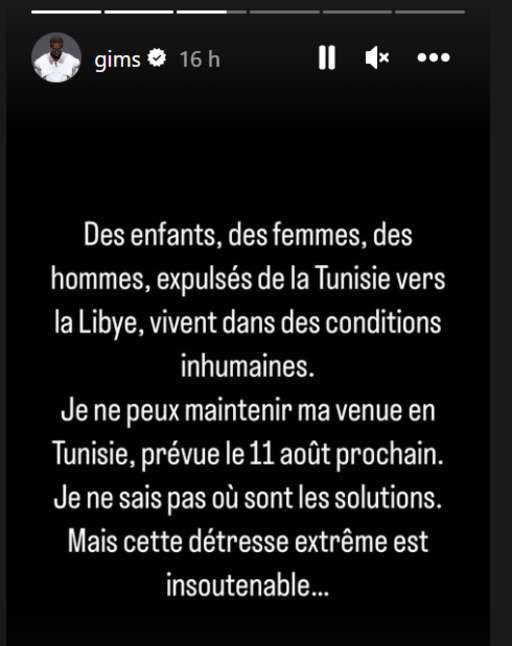
      Congolese-born French rapper Maitre Gims has cancelled a concert in Tunisia that was scheduled for 11 August.

      In an Instagram story, the rapper cited the mistreatment of migrants for the cancellation saying: “Children, women, men expelled from Tunisia to Libya, live in inhumane conditions. I cannot maintain my visit to Tunisia.”

      Dozens of sub-Saharan migrants were recently rescued by Libyan guards in a desert area along the border between Libya and Tunisia. The migrants reported that they had been abandoned there without any provisions of water, food, or shelter after arriving from Tunisia.

      Tunisia has become a major departure point for migrants attempting to make the perilous journey across the Mediterranean to Europe.

      In recent months, black migrants in Tunisia have faced violent attacks as the environment has grown increasingly hostile towards them.

      Tunisia’s President, Kais Saied, has previously made accusations against migrants, suggesting they were involved in a “plot” to alter the country’s demographic profile and accused some of being “traitors” working for foreign countries. However, he later denied any racist intent behind his remarks.

    • More government ministers detained by Niger junta

      More government ministers detained by Niger junta

      AFP news agency has reported that, the PNDS party has expressed concerns that Niger might transform into a “dictatorial and totalitarian regime” in the aftermath of the military junta taking control.

      The party reported that several prominent figures, including Oil Minister Mahamane Sani Mahamadou, Mining Minister Ousseini Hadizatou, and Fourmakoye Gado, the head of the party’s national executive committee, have been detained. In total, 130 party activists have been held since Sunday.

      The coup leaders have made claims, unsupported by evidence, that an attack on the presidential palace to free President Mohamed Bazoum is imminent, alleging that France might be involved in such a plot.

    • Ofori-Atta announces govt’s plan to renovate Aburi Gardens, Yaa Asantewaa Mausoleum, other sites to stimulate economic growth

      Ofori-Atta announces govt’s plan to renovate Aburi Gardens, Yaa Asantewaa Mausoleum, other sites to stimulate economic growth

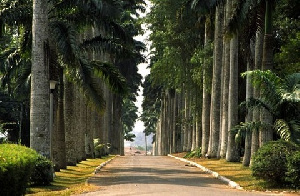
      After the successful refurbishment of the Kwame Nkrumah Memorial Park, the Minister of Finance, Ken Ofori-Atta, revealed the government’s ambitious plans to redevelop several historical and cultural sites to bolster the local economy.

      The targeted sites for redevelopment include the Aburi Botanical Gardens, Yaa Asantewaa Mausoleum, Salaga, and Pikworo Slavery Camps. Additionally, the government intends to collaborate with the Ghana Museums and Monuments Board (GMMB) to renovate selected forts, castles, and museums situated across the country.

      The primary objective of these efforts is to promote domestic tourism, which, in turn, will contribute to the growth of the local economy.

      Ofori-Atta emphasized, “Government is committed to continuing the redevelopment of Aburi Botanical Gardens, Salaga, and Pikworo Slavery Camps, as well as the Yaa Asantewaa Mausoleum, to enhance domestic tourism. Furthermore, in partnership with the Ghana Museums and Monuments Board (GMMB), we will persist in renovating chosen forts, castles, and museums nationwide.”

      The government aspires to attract a total of 3.5 million visitors, comprising both local and foreign tourists, by the year 2025. This ambitious target reflects the nation’s dedication to fostering tourism and leveraging its historical and cultural heritage to boost economic development.

      “We have made considerable progress towards achieving 1.2 million visitors for 2023 with 150,000 jobs along the value chain, and 2 million foreign visitors and 1.5 million in domestic tourism by 2025,” the minister said on the floor of parliament,” he stated

      On Tuesday, July 4, 2023, President Nana Addo Dankwa Akufo-Addo officially inaugurated the redeveloped park.

      As for the entry fees, non-Ghanaian adults will be charged GH¢100, while Ghanaian adults will pay GH¢25 to access the premises.

      For school children, the entry fee has been raised to GH¢5 from the previous charge of GH¢1.

      For non-Ghanaian tertiary students visiting the facility, the fee will be GH¢60, while Ghanaian tertiary students will pay GH¢15 for entry.

    • Check out 59 dead pensioners still receiving a regular check

      Check out 59 dead pensioners still receiving a regular check

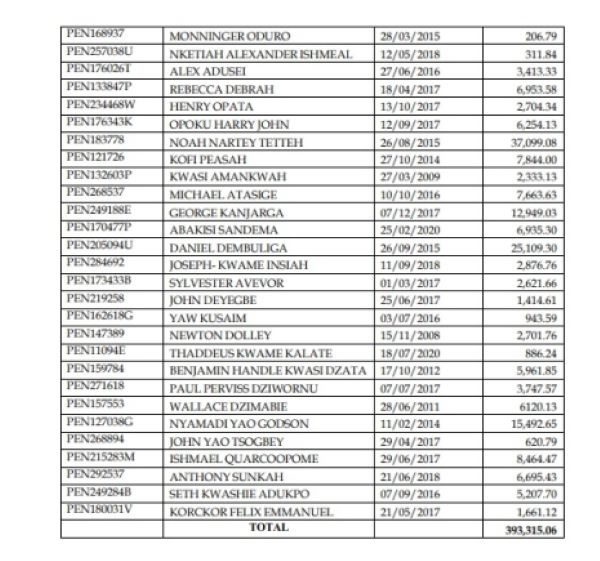
      The 2022 Auditor-General’s report has brought to light a troubling situation involving 59 deceased pensioners who are still receiving pension payments, amounting to an astonishing GH¢393,315.06, from public funds.

      According to a news report on graphic.com.gh, this issue was revealed during an audit of the public accounts of various ministries, departments, and agencies.

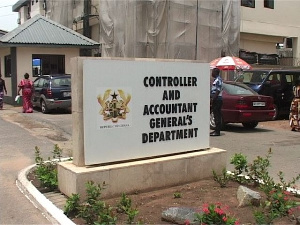
      The report places responsibility on both the Controller and Accountant General, as well as the director of the pensions unit, for their failure to stop these unauthorized payments.

      The Auditor-General’s report highlights that these pensioners passed away between 2013 and 2019, yet their pension payments have not been discontinued, in clear violation of Regulation 92 of the Public Financial Management Regulations 2019.

      This regulation explicitly mandates the immediate termination of salary payments to deceased employees and requires the Controller and Accountant-General to be informed promptly in such cases.

      “Our review of pensioners files disclosed that the Controller and Accountant General did not stop the payment to 59 deceased pensioners from the FAAB system resulting in the payment of unearned pension totalling GH¢393,315.06,” part of the report stated.

      Consequently, the Auditor-General has provided recommendations, urging the Controller and Accountant General to take action. Specifically, they are advised to ensure that the Director of the Pensions Unit recovers the excessive payments made to the beneficiaries of the deceased pensioners.

      The report proposes that the retrieved funds be deposited into the Auditor-General’s Recoveries Account at the Bank of Ghana.

      In the event of non-compliance, the Director of the Pensions Unit would be held responsible for repaying the amount.

    • Salaries and wages experienced an increase as against what 2023 budget stated

      Salaries and wages experienced an increase as against what 2023 budget stated

      Leader of the opposition in the House, Cassiel Ato Forson, l has stated that the Finance Minister cannot make certain expenditure decisions without getting parliamentary consent.

      He claims that the minister went against his word, despite it being stated in the 2023 budget that there would be no pay or salary increases.

      When the minister pretended to give the statement for the mid-year budget review, Ato Forson presented the argument on the floor of the legislature.

      He said: “I am of the view that if the minister of Finance is varying any expenditure line downwards there is the need for parliament to approve it. We know for a fact that the budget was prepared with the note that the government was not going to increase wages and salaries.

      “Mr. Speaker, subsequently, government increased salaries and wages. It means that the mid-year review the minister is presenting today will include an increase in the compensation line. He can’t do it unilaterally; parliament will need to give him permission,” he noted.

      On Monday, July 31, 2023, the mid-year budget review for 2023 will be presented to Parliament by Finance Minister Ken Ofori-Atta.

      The Budget Statement on the Economic Policy of the Government of Ghana for the Fiscal Year is being presented in compliance with the Public Financial Management Act 2016’s provisions, which require the Minister of Finance to do so.

      It aims to give the administration a platform to inform the House and the public of its economic progress and to lay out any modifications to the budgetary allocations and policies that may be required.

    • DACF chief, Naa Torshie dragged by Dan Botwe before Akufo-Addo

      DACF chief, Naa Torshie dragged by Dan Botwe before Akufo-Addo

      In a letter to President Nana Akufo-Addo, the Minister of Local Government and Rural Development, Dan Botwe, strongly criticized Administrator of the Districts Assemblies Common Fund (DACF), Irene Naa Torshie Addo-Lartey, for what he called her refusal to work with his ministry on the equitable distribution of Common Funds to the various MMDAs in in the best interest of the government.

      “It is instructive for His Excellency to note that this Ministry has not had the expected level of cooperation from the Office of the Administrator of the District Assemblies Common Fund.

      “In the past two (2) years and three (3) months since I have been in the Ministry, efforts to get the Office of the Administrator of District Assemblies Common Fund to align with the Ministry in the strategic determination of the beneficiary Districts of such allocations has not been successful”, an unhappy Minister Botwe, noted in his letter to the President, dated Monday, July 10, 2023.

      He continued: “Even more worrying is the fact that, as the Ministry responsible for the MMDAs we are not involved, engaged or consulted in any form by the Administrator of the District Assemblies Common Fund in the development of the formula proposed to Parliament. We are of the view that Government would be more efficient in the utilization of such resources if we align the decision-making process with all relevant stakeholders.”

      Dan Botwe contended that his ministry has the legal authority to direct the MMDAs’ development operations and to coordinate and supervise such activities. As a result, he claimed, the ministry has the authority to choose which districts get support and special consideration.

      Read the full statement below:

      Annually, the Administrator of the District Assemblies Common Fund proposes the formula for distribution of the District Assemblies Common Fund to the Parliament of Ghana.

      Once the approval is done, the Administrator of the District Assemblies Common Fund has the function under section 129 of the Local Governance Act, 2016 (Act 936) to “administer and distribute moneys paid into the Common Fund among the District Assemblies in accordance with the formula approved by Parliament.

      Section 126 (3) of the same Act states; The Minister shall in consultation with the Minister responsible for Finance, determine the category of expenditure of the approved development budget of District Assemblies that must in each year be met out of amounts received by the District Assemblies from the District Assemblies Common Fund.

      Part of the approved formula/allocation are activities like;

      1. National Projects

      2. Special Projects

      3. Distressed District Support

      4. Reserve funds

      The Ministry holds the view that, when it comes to the above activities in the approved formula, the Administrator of the District Assemblies Common Fund does not have the authority to determine the distribution unilaterally, as it must sit within a broad strategic framework of Government.

      As the supervisory Ministry of the Local Governance Act, 2016 (Act 936) and the Ministry responsible for coordinating the MMDAs, we are of the view that , the mandate to determine which Districts receive such support and special attention, lies with the Ministry. We are of the firm belief that the trigger for distribution should be initiated by the Ministry, on behalf of the Government, to ensure it sits well within the broad government strategy.

      Even more worrying is the fact that, as the Ministry responsible for the MMDAs we are not involved, engaged or consulted in any form by the Administrator of the District Assemblies Common Fund in the development of the formula proposed to Parliament.

      We are of the view that, Government would be more efficient in the utilization of such resources if we align the decision-making process with all relevant stakeholders.

      It is instructive for His Excellency to note that, this Ministry has not had the expected level of cooperation from the Office of the Administrator of the District Assemblies Common Fund.

      In the past two (2) years and three (3) months since I have been in the Ministry, efforts to get the Office of the Administrator of District Assemblies Common Fund to align with the Ministry in the strategic determination of the beneficiary Districts of such allocations has not been successful.

      In the meantime, the Ministry has requested from the Office of the District Assemblies Common Fund Administrator, details of the disbursement done so far from the approved allocations to enable the Ministry align and strategize to aid equity and strategic development of the MMDAs.

      However, the Office of the District Assemblies Common Fund Administrator has since refused to respond to my letter. (Copy of letter attached).

      In Conclusion, this Ministry is of the view that, the trigger for the utilization of the activities and allocations stated above can and should only be done by the Minister for Local Government, Decentralization and Rural Development, on behalf of Government to ensure consistency with Government’s aspiration for development of the MMDAs.

      I count on your continued support.

      SIGNED,

      DANIEL BOTWE (MP)

    • 70% of cases dismissed from court over poor legal representations – Chief Judge

      70% of cases dismissed from court over poor legal representations – Chief Judge

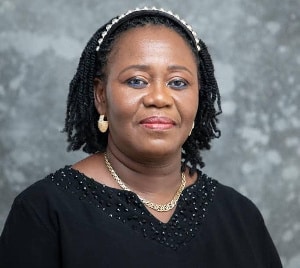
      Her Ladyship Gertrude Torkornoo, the Chief Justice, expressed concern that approximately 70% of cases dismissed by the court can be attributed to inadequate legal representation.

      According to her, the legal profession is intricate and requires a significant level of diligence, competence, and integrity from its practitioners.

      She pointed out that many lawyers fail to adhere to the established rules of procedure and often present insufficient evidence and poorly defined causes of action, leading to the denial of justice for numerous clients.

      Her Ladyship Gertrude Torkornoo emphasized the crucial role of diligence and competence in maintaining ethical standards within the legal profession.

      During her address at the 7th annual legal ethics training programme organized by the Africa Centre for Law and Ethics in collaboration with the GIMPA Faculty of Law, she highlighted that lawyers’ failure to adhere to ethical conduct has resulted in severe consequences, causing many individuals to lose their properties, businesses, and entire livelihoods. Some nations, too, have suffered significant losses due to the consequences of poor legal representation.

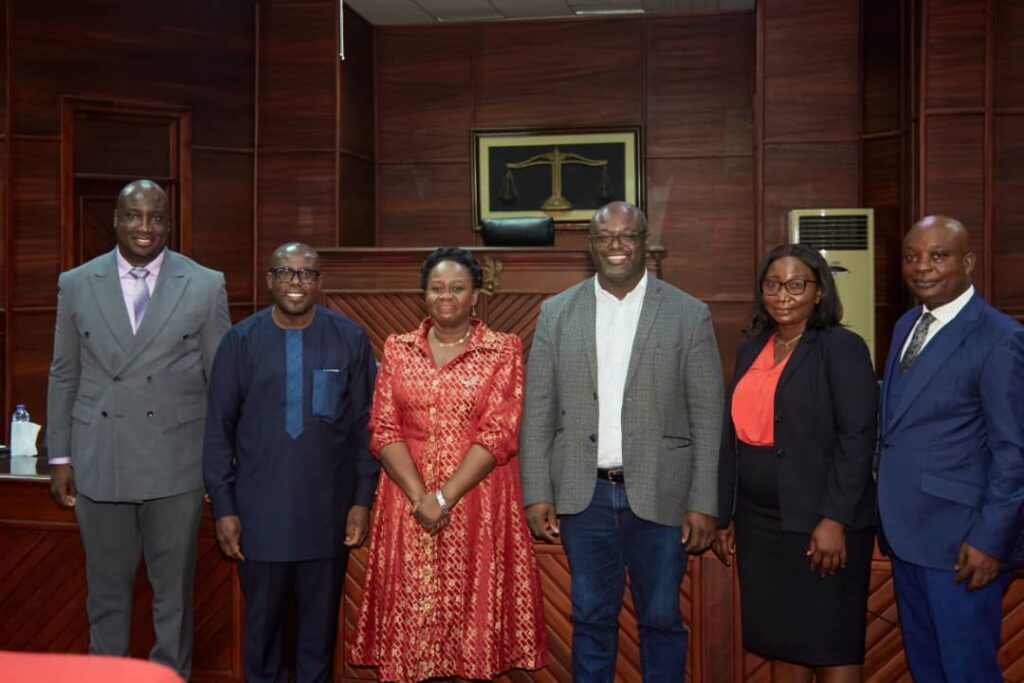
      Chief Justice, Her Ladyship Gertrude Torkornoo and colleagues

      Her Ladyship urged law students and lawyers to prioritize ethical behavior to enhance the justice delivery system. She stressed that legal ethics is a collective responsibility shared by lawyers, judges, court registrars, bailiffs, Parliament, and the executive arm of government.

      In her address, she urged lawyers not to resort to media publicity whenever they lose cases due to their own incompetence and lack of diligence, but instead, they should focus on being diligent and following proper procedures.

      Dr. Kwaku Agyemang-Budu, the Dean of the GIMPA Faculty of Law and founder of the Africa Centre for Law and Ethics, further emphasized the importance of ethical behavior in the legal profession. He announced that the GIMPA Faculty of Law plans to introduce a course in Law and Ethics in the upcoming academic year to instill ethical principles in law students.

      The purpose of the Legal Ethics Training Program is to introduce law students to the basic tenets and guidelines that govern professional legal and judicial practice.

    • Mid-year budget review was exclusive of new taxes

      Mid-year budget review was exclusive of new taxes

      The mid-year budget review did not include any mention of tax revisions, which may come as a relief to the business community and all Ghanaians.

      Prior to the budget presentation, various trade unions, experts, and the minority in parliament had warned the government against any potential tax hikes or the introduction of new taxes in the mid-year review.

      Finance Minister Ken Ofori-Atta, during the review’s presentation, emphasized that there was no need for a supplementary budget, indicating that the government did not seek additional funding for the projects outlined in the 2023 budget.

      Instead, the government made downward revisions to its Appropriation, reducing allocations from GH¢227.7 billion, as initially presented and approved in November 2022, to GH¢206.0 billion.

      Furthermore, key macro-fiscal targets for 2023 were also revised as part of the mid-year budget review.


      The Minister announced several revised economic indicators for 2023:

      i. The overall Real GDP growth rate is projected to be 1.5 percent, down from the previous estimate of 2.8 percent.

      ii. The Non-Oil Real GDP growth rate is expected to be 1.5 percent, down from the previous estimate of 3.0 percent.

      iii. The end-period headline inflation is projected to be 31.3 percent, significantly higher than the previous estimate of 18.9 percent.

      iv. The Primary Balance on Commitment basis is expected to have a deficit of 0.5 percent of GDP, which contrasts with the previous surplus of 0.7 percent of GDP. This adjustment aligns with the IMF-supported PC-PEG target for Primary balance.

      v. The Gross International Reserves (programme definition) are projected to be sufficient to cover at least 0.8 months of imports of goods and services by 2023.

      The Minister attributed the downward revision in projected growth for 2023 to a general slowdown in all three sectors of the economy, which was influenced by factors such as the fiscal consolidation plan and challenging global conditions.

      However, the Minister provided an optimistic outlook for the subsequent years. He stated that overall GDP growth is anticipated to rebound, with projections of 2.8 percent, 4.7 percent, and 4.9 percent for the years 2024, 2025, and 2026, respectively. These positive forecasts are attributed to the implementation of growth-oriented and structural transformation strategies outlined in the PC-PEG.

      Moreover, the Minister highlighted the importance of developing an enhanced Growth Strategy in accordance with the PC-PEG’s directives. This strategy aims to encourage private domestic and foreign investments to further stimulate economic growth and generate more job opportunities. The government expressed confidence in the private sector’s ability to contribute to this growth and employment expansion.

    • Nigeria becomes first African country to qualify out of group stages in Women’s World Cup

      Nigeria becomes first African country to qualify out of group stages in Women’s World Cup

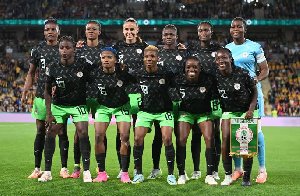
      Nigeria’s national women’s team, the Super Falcons, has made history in the 2023 Women’s World Cup by becoming the first African team to secure a spot in the knockout phase.

      The team’s journey to the Round of 16 was confirmed following a goalless draw against Republic of Ireland in Group B at the Brisbane Stadium.

      With this hard-earned draw, the Super Falcons finished as Group B’s runners-up, accumulating 5 points during the group stage.

      The Nigerian side displayed remarkable performance, particularly in the first half, where Barcelona striker Oshoala came agonizingly close to breaking the deadlock, creating the best chance of the match.

      In the second half, the former African champions continued their domination, and Kanu’s header posed a serious threat to the Irish goal, only to be brilliantly saved by their goalkeeper.

      Oshoala almost capitalized on the rebound, further showcasing Nigeria’s attacking prowess.

      With their impressive second-place finish in Group B, the Super Falcons secured their place in the Round of 16, while host country Australia emerged as the group winners.

      Australia bounced back from their previous defeat against Nigeria, sealing their position atop the group with an impressive 4-0 victory against Canada.

      As the tournament progresses to the knockout stage, Nigeria is set to face the winners of Group D, with England emerging as the likely opponent in this crucial Round of 16 encounter.

      The Super Falcons have undoubtedly made their mark on the world stage, and fans and supporters in Nigeria and across the continent eagerly anticipate their continued success in the tournament.

    • We are still engaging Pension Funds to assist second DDEP – Ken Ofori-Atta

      We are still engaging Pension Funds to assist second DDEP – Ken Ofori-Atta

      Pension Funds continue to remain in government’s plan for a second Domestic Debt Exhange Programme (DDEP), Finance Minister Ken Ofori-Atta has revealed.

      While presenting the 2023 Mid Year Budget Review Statement, the sector Minister said “
      although Pension Funds were exempted from the main DDEP, we
      continue to engage them.

      To complete the domestic debt operation Government announced in April 2023 its intention to further pursue the discussions around the following domestic debt instruments which were excluded from the DDEP perimeter:

      i. Energy sector Independent Power Producers (IPPs);

      ii. Cocobills;

      iii. Local US dollar denominated bond; and

      iv. Bank of Ghana non-tradable debt.

      Out of these remaining Debt instruments, Government launched debt operations
      for the Cocobills and local US dollar-denominated bonds on 14th July, 2023.

      The settlement date is today 31st July, 2023.

      In response to the inclusion of Pension Funds,
      Organised labour opposed new attempts to restructure pension funds worth about $2.7 billion.

      On 5th December 2022, government launched the DDEP in a
      transparent manner while seeking to minimise its impact on bondholders.

      After three (3) months of negotiations with the different bondholder groups and
      amendments to the original terms, Government successfully completed the DDEP
      on 14th February.

      Total bonds outstanding at the settlement date amounted to GH¢126,978.5 million, of which GH¢29,286.2 million were held by Pension Funds, bringing the total eligible bonds to GH¢97,749.6 million.

      The Finance Ministry received final participation of GH¢82,994.5 million, representing 84.9 percent of total eligible bonds.

      According to Mr Ofori-Atta, the DDEP has provided the Government with increased fiscal flexibility and addressed cash and other liquidity constraints.

      Source: Andy Ogbarmey Tettey

    • The economy is showing signs of recovery – Finance Minister

      The economy is showing signs of recovery – Finance Minister

      Finance Minister Ken Ofori-Atta has indicated that Government’s efforts to restore the economy to a stable situation is on course.

      Presenting the Mid-year Budget Review to Parliament on Monday, July 31, the Finance Minister indicated that “the economy is showing signs of recovery.”

      “As I have indicated, we have made significant progress on restoring macroeconomic
      stability and the narrative is changing,” he added.

      According to him, the exchange rate has stabilised, inflation has softened, and interest rates have
      declined since December, 2022.

      This follows government’s agreement with the International Monetary Fund (IMF) for a $3 billion Extended Credit Facility.

      However, government failed to meet a number of its targets for 2022.

      i. Overall Real GDP growth was 3.1 percent compared to the revised target of 3.7
      percent;

      ii. Non-Oil Real GDP growth was 3.8 percent compared to the revised target of
      4.3 percent;

      iii. End-December inflation rate was 54.1 percent compared to the projected 28.5
      percent.

      iv. Total Revenue and Grants for the period amounted to GH¢96.7 billion (15.8 %
      of GDP) compared with the revised target of GH¢96.84 billion (16.4 percent of
      GDP).

      v. Total Expenditure on commitment basis amounted to GH¢165.1 billion (27.0%
      of GDP) against the revised target of GH¢133.8 billion (22.6% of GDP).

      vi. Overall Budget deficit on commitment basis was 11.8 percent of GDP against
      the revised target of a deficit of 6.3 percent of GDP.

      vii. Primary Balance on commitment basis was a deficit of 4.3 percent of GDP
      against a revised target of a deficit of 0.7 percent of GDP.

      viii. On cash basis, the Overall Budget deficit was 10.7 percent of GDP against the
      revised target of a deficit of 6.6 percent of GDP.

      ix. The corresponding Primary Balance on cash basis was a deficit of 3.2 percent
      of GDP against a revised target of a surplus of 0.4 percent of GDP; and,


      x. Gross International Reserves was equivalent to 2.7 months of import cover.

      Source: Andy Ogbarmey Tettey

    • Ivan Quashigah envisions Ghana becoming film production hub of Africa

      Chief Executive Officer of Farmhouse Productions, Ivan Quashigah, is certain that Ghana will soon become the hub of filmmaking on the African continent.

      He believes that the nation’s film sector has enormous potential and requires significant investment.

      Mr. Quashigah has a strong conviction that the National Film Authority’s present initiative would advance the growth of the film industry.

      “Corporate organisations should also look at the film sector. It’s going to be a very vibrant film industry. The structures that are being put in place, led by the National Film Authority, will make Ghana the hub of film production in Africa. Corporate organisations should look at the film area as a space they can work with,” Mr. Quashigah indicated.

      “Corporate organisations should also look at the film sector. It’s going to be a very vibrant film industry. The structures that are being put in place, led by the National Film Authority, will make Ghana the hub of film production in Africa. Corporate organisations should look at the film area as a space they can work with,” Mr. Quashigah indicated.

      During the third edition of Joy FM’s Showbiz Roundtable in Accra, the Creative Director expressed his views. The thought-leadership program delved into the dynamics of sponsorship within the creative space.

      The CEO of Farmhouse Productions highlighted that, in recent times, the movie sector has seemingly been overlooked compared to other creative sectors. Nonetheless, he expressed optimism that the tide is turning, urging businesses to consider investing in the film industry.

      He also mentioned the Film Authority’s comprehensive product placement packages, which corporate Ghana can leverage at discounted rates.

      Mr. Ivan Quashigah remained hopeful that with the right investments in the movie industry, Ghana will advance significantly as a major player in film production on the continent and even beyond.

    • Action must be quickly taken by OSP to clear up mysteries around Cecilia Dapaah – Emmanuel Bedzrah

      Action must be quickly taken by OSP to clear up mysteries around Cecilia Dapaah – Emmanuel Bedzrah

      The Office of the Special Prosecutor (OSP) has been encouraged by the member of parliament for Ho West, Emmanuel Bedzrah, to swiftly solve the mystery surrounding the stash of cash that is allegedly missing from the residence of the former sanitation minister, Cecilia Dapaah.

      According to him, the results of the investigations will determine whether or not the fourth republic of Ghana may once again have hope. As a result, the OSP must treat the matter with some seriousness and priority.

      “We are hopeful that the Special Prosecutor would diligently investigate the matter with the urgency required while using appropriate laws to exact some sanity.

      In a statement reported by Myjoyonline.com, Mr. Bedzrah, the Chairman of the African Parliamentarians Network Against Corruption (APNAC), highlighted the significance of the investigation’s outcome in restoring the tarnished image of African politicians and renewing hope in our fourth republic as a nation.

      Despite initial disbelief, Mr. Bedzrah confirmed that the Special Prosecutor’s preliminary inquiries substantiated the news. An undisclosed amount of cash was discovered at Madam Dapaah’s residence, implicating the embattled Minister in hoarding substantial sums of both local and foreign currencies. This revelation has had a damaging impact on the perception of Africa’s political class.

      “We at the African Parliamentarians Network Against Corruption (APNAC) are equally shocked at the sad development. We are however delighted with the swift action by the Special Prosecutor to arrest and investigate the former minister. We commend the Special Prosecutor and urge him and his team of investigators to work hard and unravel the mystery behind the stockpile of cash at Madam Cecilia Dapaah’s home”, he said.

      Mr. Bedzrah further indicated that “Ghana as a country has witnessed a decline on the global Corruption Perception Index for some time now, and one would have thought that our actions as politicians would have been geared towards reversing the downward trend.

      Unfortunately, citizens are being fed with the realities of corrupt practices and unbridled greed by the ruling class on daily basis. The current exposure only worsens public perception of politically exposed persons relative to corruption.”

      Therefore, he urged the citizens to extend their support to the OSP through providing information and offering prayers during its investigation into the origin of the cash and the decision to keep such substantial sums of money at home, among other matters.

      The OSP has already assured Ghanaians that it will keep them updated on the progress of its inquiries into the scandal. As part of their investigative measures, the OSP detained Madam Dapaah and conducted searches at two residential properties connected to her.

      The investigation was triggered when news spread about her two house-helps facing court appearances for allegedly stealing $1 million, 300,000 Euros, millions of Ghanaian cedis, and other personal belongings from Madam Dapaah and her husband’s residence. Consequently, the Special Prosecutor took action to probe the former minister.

      Following her resignation from her ministerial role, Madam Dapaah was subsequently arrested, and searches were conducted at her two homes before she was eventually granted bail.

    • Russia to aid reduction of Africa’s debt load with a $90m pledge

      Russia to aid reduction of Africa’s debt load with a $90m pledge

      In order to help reduce Africa’s debt burden, the Russian government pledged more than US$90 million during the Second Summit of the Russia-Africa Economic and Humanitarian Forum.

      This aid is intended to support the continent in addressing its debt issues.

      A significant portion of African countries’ debt issues with the East European giant has already been settled, with Moscow writing off their indebtedness amounting to US$23 billion.

      In his address at the Summit, Russian President Vladimir Putin acknowledged that African states continue to face challenges related to displays of colonialism, particularly in the economy.

      “The main thing is that the Summit has again confirmed the firm resolve of both Russia and Africa to continue developing mutually beneficial partnerships and seeking new forms and areas.

      “We appreciate this and are convinced of the successful future of Russia-Africa relations.

      “They rest on the traditions of time-tested friendship, and historical experience of multifaceted productive interaction dating back to the early period in African states’ formation,” he noted.

      The adoption of the St Petersburg Declaration emerged as one of the key highlights of the Summit.

      Through this declaration, the participating parties have committed to creating a fair and democratic multi-polar world order based on the universally recognized principles of international law and the United Nations Charter.

      Africa, with its 1.3 billion people and 54 nations, forming the largest voting bloc at the UN, has successfully convinced an increasing number of powers, including the United States (US), to organize such gatherings.

      The Summit extensively discussed the prospects for further developing relations between Africa and Russia, with a specific focus on supporting the continent’s national sovereign development.

      The primary objectives emphasized were ensuring equitable access to food, fertilizers, modern technologies, and energy resources, as highlighted by Yuri Ushakov, the Kremlin Foreign Policy Advisor.

      The growing role of Africa was acknowledged, and there was a rising demand for an African stance on global affairs.

      Additionally, on the sidelines of the Summit, the 2023-2026 Russia-Africa Partnership Forum Action Plan was signed by Russian Foreign Minister Sergei Lavrov and AU Director of Peace and Security Division of the Intergovernmental Authority on Development, Mr. Siraj Tagesa Shurafa.

      Comoros President and Chairman of the African Union, Mr. Azali Assouman, expressed his observations during a joint press conference, where he highlighted Russia’s consistent support to the continent during challenging times.

      “It was one of the first countries to help with fighting colonialism, apartheid and slavery.

      “So, for many centuries, we have had good relations, but this time we need a new impetus to the relationship to take it forward,” said Mr Assouman.

      He expressed gratitude to Russia for committing to support Africa by providing training for professionals and supplying grain.

      Regarding the Russia-Ukraine political crisis, the AU Chair advocated for peace between the two countries, stating, “What we need is a ceasefire because war is always unpredictable. The longer it lasts, the more unpredictable it becomes.”

      Numerous other African leaders also called for peaceful resolutions to the conflict.

      South African President, Cyril Ramaphosa, emphasized the importance of negotiations, dialogue, and commitment to the UN Charter for achieving peaceful and fair resolutions to conflicts.

      President of the Republic of Congo, Denis Sassou Nguesso, emphasized the significance of the African initiative, urging an end to the Russian-Ukrainian conflict.

      The African Union Commission Chairman, Moussa Faki Mahamat, stressed that the conflict is having a negative impact on the entire world, expressing concern over the grain supply issue. He emphasized the urgent need to resolve the problem of food shipments to countries in need.

    • Niger junta accuses France of plot to reinstate ousted President Mohamed Bazoum

      Niger junta accuses France of plot to reinstate ousted President Mohamed Bazoum

      Niger’s junta has made accusations against France, their former colonial ruler, alleging that France has intentions of intervening militarily to reinstate ousted President Mohamed Bazoum.

      In a statement broadcast on national TV, the junta accused France of planning a strike on them with the assistance of some officials from the deposed government.

      Last week, soldiers in Niger announced a coup on national TV, declaring the dissolution of the constitution, suspension of all institutions, and the closure of all borders.

      The coup received widespread condemnation, including from France, the UN, and the West African regional body Ecowas.

      President Mohamed Bazoum has been detained by the junta inside his presidential palace in Niamey, and the junta has previously warned against any foreign attempts to extract him.

      Chad’s transitional President, Mahamat Idriss Deby, held talks with the Niger junta leader and Mr. Bazoum on Sunday in an effort to help resolve the political crisis in Niger.

    • Citizens of Sudan continue to suffer as bombing persists

      Citizens of Sudan continue to suffer as bombing persists

      The suffering of civilians in war-torn Sudan remains relentless.

      Recent reports indicate that homes and civilian neighborhoods in Nyala, the capital of South Darfur state and Sudan’s second-largest city, have been incessantly bombed for days, forcing many residents to flee.

      Displaced individuals in camps disclosed that they are now exposed to the elements during the rainy season, and they have received no assistance from any organizations. They fear that the ongoing fighting will eventually reach them.

      In the southern region of the capital, Khartoum, residents have reported that paramilitary RSF forces have ordered hundreds of people to evacuate their homes, declaring the Jabra neighborhood a military zone where civilians are not allowed to stay.

    • Haiti accepts Kenya’s offer to lead a multinational force

      Haiti accepts Kenya’s offer to lead a multinational force

      Haiti has expressed great interest in Kenya’s offer to lead a multinational force to restore order in the country.

      Haiti’s Foreign Minister, Jean Victor Geneus, conveyed his appreciation for the expression of African solidarity.

      Amidst a surge in gang violence and facing a deep security, political, and humanitarian crisis, Haiti seeks assistance in stabilizing the situation.
      Kenyan Foreign Minister Alfred Mutua acknowledged that an immediate resolution to Haiti’s problems might not be feasible. However, the mission aims to bring stability to the nation and facilitate the training of a competent Haitian police force.
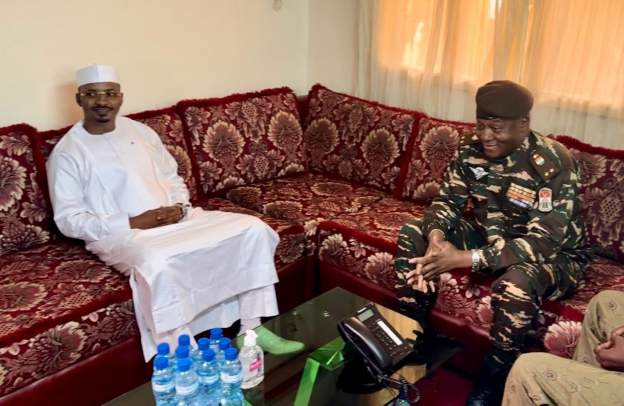
      Mr. Mutua emphasized that the people of Haiti have endured significant suffering, and Kenya feels a sense of responsibility to support their brothers and sisters in the African diaspora.

    • Here is what to know about Niger’s new military ruler, Gen Abdourahmane Tchiani

      Here is what to know about Niger’s new military ruler, Gen Abdourahmane Tchiani

      In the aftermath of the democratically elected president was overthrown in coups, Niger joined other African nations that currently have military administrations.

      Mali, Burkina Faso, Guinea, and other West African countries like Chad all have military governments.

      Up until late in the evening, when 10 soldiers appeared on television and declared that president Mohamed Bazoum had been overthrown, there remained ambiguity after a group of Nigerian troops began what appeared to be a coup.

      Later on Thursday, a general by the name of Omar Tchiani, also known as Abdourahmane Tchiani, was chosen to lead the new junta.

      Here are five things we know about him – Courtesy the BBC

      a. Gen Tchiani, 62, has been at the helm of the presidential guard since 2011

      b. The 700-strong force was established by the ousted president’s predecessor Mahamadou Issoufou to guard against military takeovers

      c. He was linked a 2015 coup attempt against Mr Issoufou. A subsequent court case in 2018 cleared him of involvement

      d. He was promoted to the rank of general in 2018 by Mr Issoufou

      e. Before the military takeover, President Bazoum had planned on removing the general as part of changes he had been making to the security forces, Niger’s private L’Enqueteur newspaper reports.

    • 8 sanctions imposed by ECOWAS on Niger after coup

      8 sanctions imposed by ECOWAS on Niger after coup

      On July 30, in Abuja, Nigeria, an extraordinary meeting of West African leaders was convened under the auspices of the Economic Community of West African States (ECOWAS) bloc.

      The primary purpose of the meeting was to discuss the recent coup in Niger, which resulted in the removal of democratically elected President Mohamed Bazoum and the assumption of power by Gen. Abdourahmane Tchiani-led junta.

      After the meeting concluded, a series of sanctions were imposed on the country, which includes:

      1. Closure of land and air borders between ECOWAS countries and Niger;

      2. Institution of ECOWAS no-fly zone on all commercial flights to and from
      Niger;

      3. Suspension of all commercial and financial transactions between
      ECOWAS Member States and Niger;

      4. Freeze of all service transaction including utility services;

      5. Freeze of assets of the Republic of Niger in ECOWAS Central Banks;

      6. Freeze of assets of the Niger State and the State Enterprises and
      Parastatals in Commercial Banks;

      7. Suspension of Niger from all financial assistance and transactions with
      all financial institutions, particularly, EBID and BOAD;

      8. Travel ban and asset freeze for the military officials involved in the coup
      attempt. The same applies to their family members and the civilians who
      accept to participate in any institutions or government established by
      these military officials;

      9. Calls on WAEMU and all other regional bodies to implement this
      decision.

      Nigerian president Bola Ahmed Tinubu is the current Chairperson of ECOWAS having been elected barely a month ago.

    • No jobs for graduates, unemployment in Ghana at an all-time high – Mahama

      No jobs for graduates, unemployment in Ghana at an all-time high – Mahama

      Former President John Dramani Mahama asserted that Ghana’s unemployment rate had reached its highest point, marking the first occurrence of such a high rate in the nation’s history.

      During a speech at the graduation ceremony of the Academic City University College over the weekend, Mr. Mahama pointed out that there were very few job opportunities for graduates, leading to extended periods of unemployment for many of them.

      He recalled that during his tenure, there were abundant job opportunities, and for those interested in teaching, automatic postings were provided.

      However, the former president noted that the situation has changed significantly, with fewer job openings and reduced retention of individuals after their national service.

      In addition, Mr. Mahama expressed concern over the state of the local economy, stating that it was in a state of disarray.

      While delivering his speech, he said, “We left the university gates and walked into ready jobs waiting for us. There was automatic posting if you wanted to go into teaching. Many of us were retained and absorbed into workplaces where we had been posted for National Service…Our colleagues who made first class were quickly snapped up by prestigious banks and private corporations like UAC, Lever Brothers, now Unilever, and Standard Chartered Bank as management trainees.”

      “There are no ready jobs to absorb you. It may take years for you to find decent employment. There are cases of students who remain unemployed five years after completing university. Unemployment in Ghana is at its highest in history today, estimated at 13%. Our economy is in crisis. The closure of indigenous banks and the banking sector cleanout have led to the loss of several jobs,” John Dramani Mahama stated.

    • Interest rates hit 30.30% as government records marginal oversubscription

      Interest rates hit 30.30% as government records marginal oversubscription

      Government has witnessed a slight oversubscription of the treasury bills auction, while interest rates continued their upward trend in the money market.

      According to the Bank of Ghana’s auction result, the government received approximately ¢2.34 billion in total.

      The target for this auction was around ¢2.28 billion.

      For the 91-day bill, bids tendered amounted to ¢1.493 billion, and all of these bids were accepted.

      Similarly, all bids for the 182-day T-bills, totaling about ¢503.58 million, were accepted as well.

      From the auction of the 364-day bill, the government obtained about ¢345.14 million.

      However, it’s worth noting that the interest rates on the 364-day bill rose by 0.26% to 30.30%.

      The yield on the 91-day bill also increased to 25.24% from the previous rate of 24.92%. Meanwhile, the yield on the 364-day bill stood at 27.14%, which was higher than the previous 26.80%.

      The escalating interest costs are a significant concern as the government will have to allocate more funds for servicing the debt instrument.

    • 2023 Mid-Year Budget Review identifies energy, cocoa sectors as areas committed to transform

      2023 Mid-Year Budget Review identifies energy, cocoa sectors as areas committed to transform

      Today, Monday, July 31, 2023, Minister for Finance, Ken Ofori-Atta, is scheduled to present the Mid-year budget to Parliament. This highly anticipated review will primarily focus on outlining a comprehensive set of growth strategies, all geared towards promoting greater stability and prosperity for Ghana’s economy.

      Ghana, like many other nations, has encountered significant economic challenges due to the impact of COVID-19 and the ongoing conflict in Ukraine. These external factors have significantly influenced the nation’s economic trajectory.

      Nevertheless, the government aims to address these issues and capitalize on growth opportunities through the Mid-year budget. By implementing effective strategies and policies, the government seeks to steer the country’s economy towards a positive trajectory.

      In particular, there are speculations that the energy and cocoa sectors will be given priority for transformation in the Mid-year budget, given their crucial roles in Ghana’s economic landscape.

      Sources from the Ministry of Finance indicate that the reform agenda for the energy and cocoa sectors is part of a broader Transformation and Growth Agenda. This initiative aims to tackle immediate policy and financing challenges while propelling the nation towards greater stability and prosperity.

      It is believed that the “Ghana Mutual Prosperity Dialogue Framework” will serve as a cornerstone of these reforms, promoting shared growth anchored on job creation, exports, and import substitution.

      The upcoming energy sector reforms are poised to concentrate on ensuring a reliable and efficient energy supply, which is crucial for promoting industrial growth and overall economic development.

      Addressing weaknesses within the energy sector is expected to attract investments, stimulate economic activities, and ultimately lead to job creation.

      Likewise, the cocoa sector, being a significant agricultural export for Ghana, is slated for substantial modernization to enhance production, improve value addition, and increase export earnings. These advancements will directly benefit cocoa farmers and communities reliant on cocoa cultivation.

      Revitalizing the cocoa sector can play a pivotal role in driving inclusive growth and reducing poverty in the country.

      By focusing on these pivotal sectors and implementing strategic reform measures, the government aims to establish a favorable environment for private sector-led investments, further boosting economic growth.

      Moreover, the emphasis on sustainable economic growth and development aligns with long-term objectives to enhance the overall standard of living and quality of life for the people of Ghana.

    • Assault case in Adisadel College could have been handled out of court – Joe Wise

      Assault case in Adisadel College could have been handled out of court – Joe Wise

      First Deputy Speaker of Parliament, Joseph Osei-Owusu, also known as Joe Wise, has raised concerns about the declining standards of discipline in Ghana’s educational sector.

      He believes that it is crucial to reevaluate the upbringing of young people to ensure they become more responsible adults in the future.

      Speaking at the 10th-anniversary celebration of Fettehman Senior High School over the weekend, he also commented on the widely known Adisadel College assault case.

      “We should look at how we bring up children in this country since it is becoming a challenge. The kind of upbringing is important. There is no need for him to be that violent towards another student.

      “If we discuss this in isolation, we would miss it. What happened in the school is a reflection of what is happening in the country. We think we are not supposed to punish students and this is how we pay for it as a country.

      “There is nothing wrong with students being at each other, but when it gets beyond regular bullying, it is bad. I regret that it has been taken to the court since this matter could have been addressed in the school, but the Attorney General thinks otherwise,” Joseph Osei-Owusu said.

      He expressed the belief that, although the act was condemnable, a more effective approach to address the situation would have been to counsel both the victim and the perpetrator, allowing them to focus on their studies and future prospects.

      The individual responsible for the assault, who forcefully slammed his colleague’s head against a bunk bed causing swelling, was brought before the court late last week. As a consequence of his actions, he was expelled from the school and would only be permitted to write his WASSCE exams under the supervision of WAEC.

      The Ghana Education Service, the Ministry of Education, and other relevant stakeholders took the matter seriously once the video of the incident went viral on social media.

    • COPEC to increase increase fuel prices in first pricing window of August

      COPEC to increase increase fuel prices in first pricing window of August

      In the current pricing window, the Chamber of Petroleum Consumers (COPEC) has projected a slight increase in fuel prices.

      According to the Executive Secretary of COPEC, Duncan Amoah, petrol and diesel prices are anticipated to rise by approximately 9% compared to the current pump prices.

      Furthermore, the price of liquefied petroleum gas (LPG) is expected to see a 20 percent increase.

      The primary reason behind the increase in petroleum products is the surge in international market prices for fuel.

      Duncan Amoah pointed out that crude oil also witnessed a rise of 10.53 percent, with the mean price escalating from $75.85 per barrel to $83.84 per barrel.

      As a result, petrol is projected to be sold at GH¢13.27 per litre at pumps, while diesel is expected to be priced at GH¢13.93 per litre.

      Previously, petrol was being sold at GH¢12.45 per litre, and diesel was priced at GH¢12.55 per litre.

    • Here’s Kwabena Agyepong’s text message to Bawumia about centralising NPP polls

      Here’s Kwabena Agyepong’s text message to Bawumia about centralising NPP polls

      One of the flagbearer hopefuls of the New Patriotic Party (NPP), Kwabena Agyepong, has revealed a significant step he took before the collective decision made by him and other aspirants who sought a centralised system for their internal polls.

      In preparation for the special delegates congress, scheduled for August 2023, aimed at streamlining the number of aspirants for the NPP’s flagbearer position, all candidates except Vice President Dr. Mahamudu Bawumia, advocated for a centralised voting process.

      However, during an interview with Kofi TV, the former General Secretary of the NPP, Kwabena Agyepong, disclosed that he personally sent a text message to the vice president to inform him of the decision.

      He emphasized that this decision was made with no negative intentions or ulterior motives.

      “The idea was that if all the 900 people or so are brought to one location and we all vote, it would be of great help. This would also ensure that people are not singled out because of who they voted for. And we did all this with good intention.

      “When doing this, we did not leave the vice president out of it. I personally sent him a text message on the day we were doing this, asking him what his thoughts were on the decision. And I did same to all the aspirants,” he said.

      Kwabena Agyepong emphasized that the decision to opt for a centralised voting system is rooted in past experiences, where individuals faced victimization based on how they voted in the decentralised system.

      He further explained that with the country’s expansion of regions, the review of the voting process becomes even more crucial, considering that while the decentralised system might have worked in the past, a better alternative is needed now.

      The New Patriotic Party (NPP) has set November 2023 as the date for electing its presidential aspirant for the 2024 general elections. Prior to that, the party has scheduled a special delegates congress in August, following the NPP’s constitution, to narrow down the current 10 hopefuls to 5 candidates.

    • Financial irregularities in MDAs amounts to GHC1.412bn in 2022 –

      Financial irregularities in MDAs amounts to GHC1.412bn in 2022 –


      The 2022 Auditor-General’s report on the Public Accounts of Ghana revealed that approximately ¢1.412 billion were recorded as financial irregularities in that year.

      This figure represents an increase of ¢332 million compared to the ¢1.080 billion reported in 2021.

      The financial irregularities encompass various categories, including Tax Irregularities (¢1.247 billion), Cash Irregularities (¢57.471 million), Indebtedness/Loans/Advances (¢89,744 million), Payroll Irregularities (¢14.254 million), Stores/Procurement Irregularities (¢321,950), Rent Irregularities (¢2.142 million), and Contract Irregularities (¢556,333).

      Tax Irregularities

      Tax irregularities accounted for a significant portion of the total financial infractions, amounting to ¢1.247 billion, which constituted 88.3% of the reported cases.

      This figure included a sum of ¢327.63 million owed by 18 Oil Marketing Companies (OMCs) that defaulted in paying their rescheduled debt between January 2022 and December 2022.

      Additionally, ¢361,677 million was found to be owed by 2,557 registered VAT traders during the assessment period.

      The report attributed these irregularities mainly to the Ghana Revenue Authority’s failure to take appropriate measures and sanctions against defaulters among the OMCs and registered VAT traders.

      In response to these findings, the Auditor-General advised the Commissioner General of the Ghana Revenue Authority (GRA) to enhance the monitoring and supervision of staff to address these issues effectively.

      Cash Irregularities

      The sum of ¢57.471 million accounted for 4.1% of the total irregularities and constituted the total cash irregularities during the period. These irregularities were observed across various MDAs and were attributed to several factors, including unapproved disbursements, unpresented payment vouchers, unaccounted revenue, unsupported payment vouchers, funds not credited to the bank, non-lodgement of public funds, embezzlement of funds, and unretired imprest.

      In light of the absence of payment vouchers and supporting documents, the Auditor-General recommended that the Chief Executive Officer and the Director of Finance be held responsible for repaying the money.

      Indebtedness/Loans/Advances

      Total Indebtedness/Loans/Advances amounting to ¢89.744 million represented 6.4% of the total irregularities.

      A significant amount of these irregularities was ¢1.763 million owed by 72 farmers who received farm equipment on credit basis under the Ministry of Food and Agriculture’s Brazilian More Food Programme. 24.

      The report recommended that the Chief Director ensure that the Head of Tractor Accounts recovers the outstanding amount of ¢1.763 million from the beneficiaries.

      Payroll Irregularities

      An amount of ¢14.254 million was recorded as payroll irregularities during the reviewed period.

      Within the total payroll irregularities, ¢1.922 million represented unearned salaries paid to 95 unidentified individuals from an institution under the Ministry of Health.

      In response to these findings, the Auditor General recommended that the Regional Health Director and the Medical Director promptly initiate the recovery process for the full amount.

      The audit covered the period from January 2022 to December 2022.

      The audit objectives included reviewing the internal control and internal audit functions to assess the risks associated with the management and utilization of public resources. It also aimed to determine the presence of fairness and integrity in administrative decision-making and interactions with stakeholders.

    • “I have a political affiliation but I am not a politician” – Gabby Otchere-Darko clarifies

      Lawyer Gabby Asare Otchere-Darko, often regarded as a stalwart of the New Patriotic Party (NPP), has clarified that he does not consider himself a politician.

      In an interview shared on Facebook on July 28, 2023, with the host Kwahu Ambassador, Odame Agyare, Gabby explained that while he is affiliated with the NPP, this affiliation does not define him as a politician.

      Describing himself as a public figure and political strategist, Gabby interjected when the journalist referred to him as a politician, stating, “I’m not a politician.”

      “Yes, I’m a public figure; I have been a journalist, I have been on radio. I’ve been a political strategist. I have a political affiliation but I am not a politician,” he reiterated.