Author: Amanda Cartey

  • US airman, 21, charged over pentagon document leak

    US airman, 21, charged over pentagon document leak

    In a court hearing in Boston, the US airman accused of disclosing secret intelligence and defense documents was formally charged.

    Jack Teixeira, 21, wore shackles and a prison uniform as he stood before a federal judge on Friday.

    After a shout of “love you, Jack” from a person in the courtroom, the defendant replied “you too, dad”.

    Mr Teixeira faces up to 15 years in prison over charges of unauthorised transmission of defence information.

    He is also charged with the unauthorised removal and retention of classified documents.

    The airman faces up to 10 years in prison for the first charge, and up to five years in prison for the second.

    The dozens of leaked documents had revealed US assessments of the war in Ukraine as well as sensitive secrets about American allies.

    The leaks embarrassed Washington and raised fresh questions over the security of classified information.

    Mr Teixeira was arrested by armed FBI agents at his family home in Massachusetts on Thursday.

    The judge ruled that the suspect qualifies for a public defender – a lawyer employed at public expense in a criminal trial for people who cannot afford legal fees.

    Mr Teixeira remains in custody.

    US President Joe Biden thanked law enforcement in a statement for their “rapid action” to investigate the source of the leaks. He said he has directed US military and intelligence to secure and limit distribution of any more sensitive information.

    https://emp.bbc.com/emp/SMPj/2.49.2/iframe.htmlMedia caption,

    Watch: How damaging are 21-year-old Jack Teixeira’s US intelligence leaks?

    ‘Top secret clearance’

    The leaked intelligence material first appeared in a Discord chat room on which Mr Teixeira is said to have been an administrator. Its members would often discuss geopolitical affairs and wars.

    The affidavit provided by FBI Special Agent Patrick Lueckenhoff to the court stated that the suspect began posting the leaked documents some time in December.

    The initial leaks were in the form of paragraphs of text, according to the affidavit, but Mr Teixeira then moved on to posting photographs of documents in January.

    It was not until intelligence material was posted outside the chat room group that Pentagon officials became aware of the leak, prompting a search for the culprit.

    Mr Teixeira worked as an IT specialist in the intelligence wing of the Massachusetts National Guard, based at Otis Air National Guard Base in western Cape Cod.

    The National Guard is a reservist wing of the US Air Force. They are not employed full-time in the military, but can be deployed when necessary.

    Mr Teixeira’s official title was cyber defence operations journeyman, according to the criminal complaint filed in the Boston court. He held the rank of Airman 1st Class – a relatively junior position.

    The affidavit stated that Mr Teixeira held a “top secret” security clearance since 2021, and that he would have “signed a lifetime binding non-disclosure agreement” to take on his role.

    Mr Luekenoff added the suspect “would have had to acknowledge that the unauthorized disclosure of protected information could result in criminal charges”.

    The affidavit also alleged that Mr Teixeira used his government computer to search classified intelligence reporting for the word “leak” on 6 April – the day when public reporting about the documents first emerged.

    Prosecutors alleged that Mr Teixeira searched the term to learn whether US intelligence had information on the identity of the person behind the leaks.

  • Kenyan church cult probed over starvation plot

    Kenyan church cult probed over starvation plot

    Police in Kenya are looking into the deaths of four people who may have been starved to death at the order of a controversial cult leader.

    Pastor Makenzie Nthenge is alleged to have told his followers in the coastal area of Kilifi to starve themselves in the hope of getting to heaven quickly.

    Following a tip-off, police found 15 seriously ill people on Thursday, but only 11 made it to hospital alive.

    Police are also looking into reports of a mass grave in a nearby forest.

    Last month Mr Nthenge was charged in connection with the deaths of two children whose parents had joined his Good News International Church.

    He pleaded not guilty and was released on bail. The current whereabouts of the pastor are not clear.

    The identities of those who died on Thursday have not yet been established.

    Some of the survivors, including a teenager, are currently in a critical condition having become so emaciated.

    A security source told Kenya’s Nation Media group that those rescued from their homes were extremely unwell: “We found them in a very bad state, others fainted on the way to hospital.”

    Police said they began their search for followers of the Good News International Church after receiving intelligence that “ignorant citizens” were “starving to death in pretext to meet Jesus after being brainwashed by a suspect”.

    They were also warned about “a mass shallow grave of victims of that brainwashing totalling to 31 bodies in an unidentified place at Shakahola Forest”, the police statement said.

    Kenya is a religious country and this is not the first time people have been lured into joining dangerous, unregulated churches or cults.

  • Protests at funeral of Tunisian footballer who set himself on fire

    Protests at funeral of Tunisian footballer who set himself on fire

    A football player from Tunisia, Nizar Issaoui, set himself on fire in a protest against “police injustice” and later perished from the wounds he received, according to his family.

    He had appeared in a video posted online showing him shouting that he had been accused of terrorism by officers after a dispute with a fruit seller.

    In a separate post, he said he sentenced himself to “death by fire”.

    There were angry clashes at funeral of the 35-year-old on Friday in his home town of Haffouz, local media reported.

    Issaoui had been accused of terrorism by police officers after he complained that he was unable to buy bananas for less than 10 dinars ($3.30; £2.66) a kilogram, double the price set by the government, reports say.

    In a Facebook post, the footballer had written: “For a dispute with someone selling bananas at 10 dinars, I get accused of terrorism at the police station. Terrorism for a complaint about bananas… I have no more energy. Let the police state know that the sentence will be executed today.”

    In protest, Issaoui burned himself to death.

    Violence erupted at the footballer’s funeral as demonstrators threw stones at police who fired tear gas.

    He was a former player for the Tunisian top-flight side US Monastir and a father of four.

    His brother told local reporters that Issauoi suffered third-degree burns and doctors were not able to save his life.

    His action was an echo of a 2010 protest when street vendor Mohamed Bouazizi set himself alight. That kicked off a wave of demonstrations that led to the overthrow of President Zine al-Abidine Ben Ali the following year.

    The current President, Kais Saied, sparked controversy in 2021 when he sacked the prime minister and suspended parliament. He has since pushed through a new constitution enshrining his dominance.

    The Tunisian government has not commented on Issaoui’s death.

  • UTV release disclaimer regarding  bogus John Mahama remark shared by NPP activists

    UTV release disclaimer regarding bogus John Mahama remark shared by NPP activists

    An alleged artwork that the management of Despite Media Group subsidiary UTV, based in Accra, purportedly released over remarks about ethnic groups allegedly made by former president John Dramani Mahama, has been retracted.

    The false artwork depicting Mahama reportedly urging delegates in the Eastern Region to reject the New Patriotic Party (NPP) was categorically denied by the show’s host on Friday (April 14) on the Mpu Ne Mpu program.

    “Owners of our station are responsible and have toiled to make it, so there are somethings we don’t do.

    “It has come to light that some people are using UTV’s name and logo on purported comments by former president John Dramani Mahama, that we were the authors of that statement,” the host said.

    He continued: “I stand on behalf of our owners …and management to state that as UTV, what is said, was not authored by us. It is some unscrupulous people who manufactured it and put the UTV logo on it to make it look as though it was by us.

    “This is to state officially that UTV knows nothing about this. Our logo was misused in the context. It is people whose thinking I do not know of,” he stressed before reading out the real quote that was doctored into the now disclaimed version.

    Some known New Patriotic Party (NPP) activists including a presidential staffer, Nana Hesse Ogyiri, shared the artwork of the purported quote, in which the former president “speaks” against the Ashanti Region.

    “Don’t be like Ashanti Region. They are emotionally attached to the NPP that they don’t even think before voting for them. Your party and your son has led Ghana into a ditch, be bold to vote against them. Be different. Come back to the NDC in 2024 and we wont neglect you this time,” the comment read.

    A search on UTV’s social media feeds at the time of the publication showed that a similar artwork was posted on April 11, 2023 except that the accompanying text has nothing to do with the Ashanti Region or the NPP.

    The original quote reads: “By God’s grace we have the experience, we didn’t buy it in the store, we didn’t learn it in school, it is God who gave us the opportunity to gather that experience. Don’t worry about what some people are saying, it is God’s will, I attend church and when I pray God speaks to me and God has said this is the time for NDC, he has given us power. If God decides no one can change it.”

    Mahama completed his regional tour of the Eastern Region on Thursday and is expected to start the Greater Accra Regional tour almost immediately.

    His aide, Joyce Bawah-Mogtari has also dismissed the purported quote via a tweet that read: “Wait a minute: Treat with utmost contempt,fake news headlines being churned out by a desperately unscrupulous government that has absolutely nothing to show for itself than to hide behind faceless lies and propaganda against notable political opponents!”

    Find the original and fake artworks below:

    Former President John Mahama has expressed optimism that the opposition National Democratic Congress (NDC) will win the 2024 elections.#UTVNews pic.twitter.com/eqqryJgI8V— UTV Ghana (@utvghana) April 11, 2023

  • Why is akwaaba an ‘official’ greeting in Accra, what about ‘awaa waa atuu,’ in Ga? – Ayikoi Otoo asks

    Why is akwaaba an ‘official’ greeting in Accra, what about ‘awaa waa atuu,’ in Ga? – Ayikoi Otoo asks

    Former Minister of justice and Attorney General, Ayikoi Otoo, has criticized what he claims is a deliberate effort to gradually decrease the influence of the Ga language, especially in Ga land-dominated areas like the Greater Accra Region.

    He mentioned instances of nations around the globe where native people are treated with respect for their customs, with political power recognizing those traditions at official events.

    He berated particularly how the pouring of libation, a custom of the Ga people has now been removed from national events even in Accra before wading into the issue of language and how Ga is being moved to the periphery.

    “Like I said of the people in Canada, lands taken from indigenous people, the Innuits, they recognize them at every function,” he said zooming in on libation, “and they used to allow them to pour libation… they’ve stopped.

    “You are in Accra land, we also have our gods, we have our customs, we have our traditions. This can be done and shown to other people. Why is it that in Accra, no more but you can import people to come and dance and other things?

    “Who says we don’t have the equivalent of Akwaaba, we used to say ‘awaa waa atuu’ when we were young, you leave in a nuclear house and when you go to the family house the old people come and hug you with ‘awaa waa atuu.’

    “The Dangbe people have it, they say ‘moyeee’ we have it but they deliberately say that you don’t have it so it should be replaced with akwaaba. Everywhere you go should be Akwaaba,” he stressed.

    Ayikoi Otoo was speaking in an interview on Joy News’ Upfront programme on April 15 when he made the comments.

    The name gobe which translates into Gari, oil, Beans, EGG which has become slang for ‘Yo ke gari’ is generating controversy.

    Former Attorney General Ayikoi Otoo is not happy with what he describes as the subtle attempt to deface the Ga language. #UPfront pic.twitter.com/gViVXUSOTz

    — JoyNews (@JoyNewsOnTV) April 14, 2023

  • Investigation by Nat Geo exposes syndicate transporting stolen vehicles from US to Ghana

    Investigation by Nat Geo exposes syndicate transporting stolen vehicles from US to Ghana

    Mariana van Zeller’s investigation for the National Geographic Channel has disclosed a car smuggling organization that was linked to Ghana.

    The investigation that led to the publication of the film a week ago began in the United States of America, when the investigative journalist monitored a gang’s theft of high-end vehicles.

    Some of the gang members who spoke to Van Zeller explained to her how they undertake their activities and the structure of the international crime syndicate where cars stolen on the streets of America end up in third world countries such as Ghana.

    Van Zeller travelled to Ghana to meet some of the local players.

    She met a hacker/black market trader and another person who handles the business aspect of the enterprise.

    The two gave the journalist insights into the local trading of stolen cars and how they are able to get the cars into the Ghanaian system without raising any red flag.

    With import duties costing as much as 20% of the value of a car in Ghana, the hacker told van Zeller that he is able to hack into the system of the Customs Division of the Ghana Revenue Authority to help the syndicate get away with paying the required import duties.

    “It is my duty to attack the Tema Harbour… We make it seem as if you’ve paid everything,” the hacker stated.

    Being the people at the end of the trail, the Ghanaian syndicate are deemed as being at the summit of the international car smuggling syndicate.

    Calling himself Ivan, a man who leads the importation and selling of stolen cars in Ghana opened up more about the operations of the gang to the journalist.

    “It is possible that most of these cars are stolen. Most of the boys come here to hang out. There are top guys that are in the business now; the stolen cars business. This is how some family generations have made money,” Ivan told the journalist while they drove through some areas in Accra where nightlife is buzzing.

    In all, the investigation uncovered the Ghanaian players as those sitting on top of the international car theft ring. They make the most money from a criminal enterprise that sees cars belonging to people in America, stolen and shipped some six thousand miles away from their owners.

  • Kayamata: How women use spell to potion men

    Kayamata: How women use spell to potion men

    They are aphrodisiacs, oils, herbs, potions, or other substances, and their sole function is to improve romantic relations or sex.

    It is a combination of two Hausa words – ‘Kayan’ which means; property, or things, and ‘Mata’ which means women. Put together, the word literally means ‘women’s things’.

    It appears to have existed for centuries and originated from Northern Nigeria.

    Originally, it was used by these women for sexual pleasure, and served as enhancers, or aphrodisiacs, especially for young brides, but in recent times, it has become a really huge trend for women all over the world.

    In Ghana, the trend has become very prevalent and these products are even advertised via the internet and on various social media platforms.

    Patrons of these products have diverse interests, to attract men for money, sex, marriage, etc.

    What some may not know is how the Kayan Mata (kayamata) is used by its clients.

    In a post on media personality – Naa Ashorkor’s Facebook page, she indicates how some women with in-depth knowledge about how people use the Kayan Matan for their ‘victims’ shared this with her on her show; ‘Just us’.

    According to her, she picked some pointers which include the fact that the Kayan Mata products are in 3 categories; vaginal upgrade, faithfulness, and libido boosting, and the third; favour and attraction potions.

    Users of the potion need to talk to the oil and indicate exactly what they want from it and it happens.

    “In order to activate the potion, you simply talk to the oil. For instance – “oil, please let me attract rich men who can buy me a car”. When you go out, the men will literally be falling over themselves for you. They can’t help it,” she wrote.

    She however indicated that some men who called into the show also shared how the male variation referred to as ‘For girls’ is used by some men for similar interests.

    “Interestingly, when I activated the phone lines to ask ladies to share their experiences, only men called! Apparently, Kayan mata is a variation of “For girls’ and the men have interesting stories about the potency of this potion. Scary! One guy said his friend used it to get his wife to accept his marriage proposal. So this woman is currently under a spell. Apparently, a lot of married people are under spells they are not aware of,” Naa Ashorkor narrated.

    Naa Ashorkor also shared stories of how some users of these products suffered side effects or had experiences which didn’t go in their favour.

    In one instance, a woman who tried using it to attract men ended up attracting mad men. In another, a woman who tried using it on another man who already had activated the ‘For girls’ potion ended up dying.

    “A lady who bought and used attraction potion now attracts only “mad men” literally, in traffic, they approach her and try to touch her, they literally chase her around town, sometimes more than one at a time. When she complained to the vendor she bought it from, she told her to go to Benin to see the original seller. There is no other way to undo this charm,” she shared.

    Adding, that “The side effects are dire. Sometimes you cannot break away from this spell or spirit even if you want to. My guest shared a story about a girl who used it on a man, the man apparently had more potent potions which killed her. She is dead oo”.

  • No distinction between mad individuals and LGBTQ+ persons –  Osofo Kyiri Abosom

    No distinction between mad individuals and LGBTQ+ persons – Osofo Kyiri Abosom

    The general overseer and founder of Life Assembly Worship Centre, Osofo Kyiri Abosom, has sparked LGBTQ+ controversy.

    Reverend Christian Kwabena Andrews did not mince words to say those who engage in lesbianism and gay are “mad.”

    According to the pastor, the purpose of sexual intercourse is to procreate and anything devoid of that is madness.

    He explained that, two people having an affair that cannot bring forth an offspring therefore, is akin to two mentally derailed persons who indulge in sexual activity, lacking the wisdom to make babies out of it.

    The third wave of discussion on the LGBTQ matter under the Akufo-Addo-led administration has stirred controversies just like the previous two due to comments coming from some duty bearers on whose shoulders the passage or otherwise of the bill that will bare the act in Ghana lie.

    President Akufo-Addo for instance was not clear whether the nation is for the act or against it when US Vice President Kamala Harris visited and the issue popped up in their addresses to the state.

    During Madam Harris’ visit, President Akufo-Addo said among others that: “But in the meantime, Parliament is dealing with it and I have no doubt that the Parliament of Ghana will ensure as is done, first of all the sensitivity to human rights issues as well as to the feelings of our population and will come out with a responsible response.

  • UK influenced Nigeria to rig elections  for 99 years — Ex-INEC REC, Igini

    UK influenced Nigeria to rig elections for 99 years — Ex-INEC REC, Igini

    Mike Igini, a former Akwa Ibom State Resident Electoral Commissioner (REC) for INEC, has claimed that the UK brought election manipulation to the Nigerian political system.

    Igini noted that the UK has no post-election adjudication court, whereas Nigerians are in court today over the election outcome.

    Igini stated this while on Arise Television’s Morning Show program on Friday, where he was fielding questions about the conduct of the just concluded 2023 general elections

    He said, ”What I want Nigerians to know is that whatever we make of this country, that is what it will become. It is clearly in our hands because, in this country, Nigeria, with all the human and material resources, all that’s required is leadership.

    ”Today, we are now in Court over the election that has been conducted. It should be noted that the United Kingdom, UK, that today is one of the countries that our people are going to; in short, after Nigeria, they go to the UK. It should be noted that even the UK, which introduced Nigeria to election rigging for a period of 99 years, almost a hundred years, had no post-election adjudication in the United Kingdom.”

  • IMF appeals for assistance in managing serious financial deficit in Sub-Saharan Africa

    IMF appeals for assistance in managing serious financial deficit in Sub-Saharan Africa

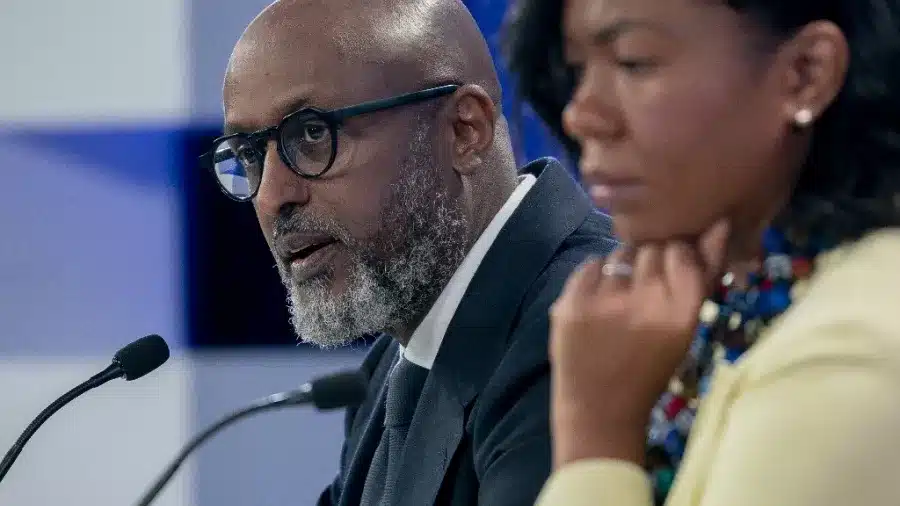
    The IMF predicted in a press briefing on April 13, 2023 that growth in sub-Saharan Africa will drop to 3.6 percent in 2023 due to a “big funding squeeze” brought on by the region’s inability to access private financing and the drying up of aid.

    If no measures are taken, this shortage of funding may force countries to reduce fiscal resources for critical development like health, education, and infrastructure, holding the region back from developing its true potential.

    “I wish I was bearing better news, but unfortunately, we’re expecting growth to decelerate from 3.9 percent to 3.6 percent in 2023. And this to a large extent reflects the big funding squeeze tied to drying up of aid and access to private finance” said Abebe Aemro Selassie, Director of the IMF’s African Department. 

    Sub-Saharan African countries lag significantly in revenue collections, with a median tax ratio of only 13 percent of GDP in 2022, compared with 18 percent in other emerging economies and developing countries and 27 percent in advanced economies.

     “So, there are a number of reforms that need to be pursued. I think first and foremost, of course, is policies to strengthen the resilience of economies. So, many countries, for example, there’s a big challenge on mobilizing more domestic revenues. That needs to be addressed wherever that’s the main challenge. Second, I think it’s also important to consider policies to insulate domestic economies from external environment. So, allowing exchange rates to adjust, interest rates to be recalibrated, to reflect better to reduce inflation are all going to be very important part of the policy response to this adverse external environment,” added Selassie.

     The IMF has provided the region with around $50 billion dollar in financing since the start of the pandemic and will continue to work with the region to put in place the right type of policies that are tailor-made to each country’s needs. 

    “We are engaging like never before with the region. Of course, over the last couple of years, we’ve provided considerable financing to the tune of around $50 billion to support the region. Whether the very difficult economic environment that was facing and we continue to try and provide as much financing as possible to support countries in the coming months. As important, however, of course, are policies and reforms that needs to be pursued by countries, and we are deeply engaged with working with countries to navigate and to put in place the right types of policies in each individual country,” said Selassie.

  • Egypt requests Turkey to get its troops out of Syria

    Egypt requests Turkey to get its troops out of Syria

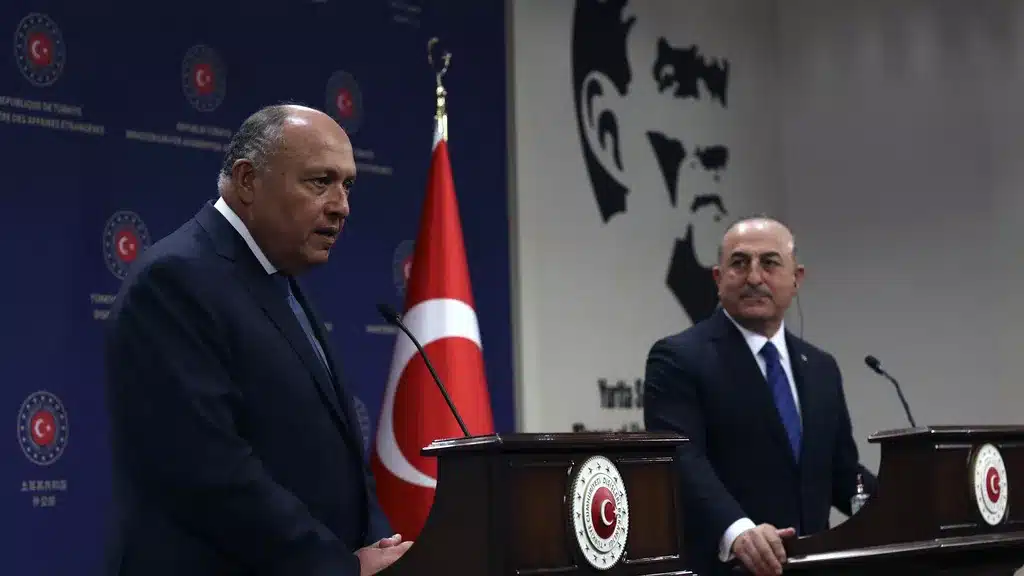
    Despite efforts by Ankara and Cairo to mend relations, Egypt’s foreign minister called on Turkey to remove its troops from Syria on Thursday. This was a sign of the ongoing tensions.

    “I said that the sovereignty and territorial integrity of Syria should be preserved. I also said that foreign forces should withdraw from the territory of Syria,” Egyptian Foreign Minister Sameh Choukri said. visiting Ankara on Thursday, about his exchanges with his Turkish counterpart during a joint press conference.

    “We are committed more than anyone” to the territorial integrity of Syria, replied Turkish Foreign Minister Mevlut Cavusoglu.

    “Our priority is the fight against terrorism. (…) Our presence there is important to prevent threats against us, but also to block efforts to break up Syria,” he said. he adds.

    Cairo and Ankara had been cold since Abdel Fattah al-Sisi came to power in 2013, after the overthrow of President Mohamed Morsi, who was close to Turkish President Recep Tayyip Erdogan.

    Turkey , however, has been seeking for months to normalize relations with several regional powers, including Egypt and Israel. But the Turkish military presence in Syria complicates these efforts.

    Egypt and other Arab countries have recently renewed contact with Damascus, causing consternation in Washington. But Syrian President Bashar al-Assad has conditioned the dialogue with his Turkish counterpart Recep Tayyip Erdogan on the withdrawal of Turkish troops from Syria.

    The head of Egyptian diplomacy had visited Turkey at the end of February after the devastating earthquake which killed more than 50,000 people in Turkey and Syria.

    “We are opening new pages in our relations with Egypt,” Mr. Cavusoglu then welcomed during a press conference with Mr. Choukri in the port of Mersin, in southern Turkey, where a ship of humanitarian aid provided by Egypt landed.

    The Turkish and Egyptian presidents thus exchanged their first handshake at the end of November on the sidelines of the opening of the FIFA World Cup in Qatar.

  • Nigeria: Reaction, as Lagos Banana Island building collapse

    Nigeria: Reaction, as Lagos Banana Island building collapse

    A seven-story structure under construction on First Avenue in the Banana Island neighborhood of Ikoyi, Nigeria’s commercial capital Lagos, has made headlines once more.

    The latest incident in the exclusive neighbourhood of some of the wealthiest Nigerians brings to fore what seems to have become an incident common in the southwestern state.

    While residents try to figure out why Lagos has continued to be in the news for cases of building collapse, building experts question the role of government agencies in the approval processes for buildings in the state.

    A Former President of Nigerian Institute of Building, Kenneth Nduka says the inability of government to prosecute those responsible for building collapses in the country is a factor fueling reoccurrence.

    ‘Let me integrate backwards, there have been collapses and these collapses have been investigated. I am yet to hear or maybe I am not being so cognizant of what is happening, but I am yet to hear that Mr. X or Mr. Y has been sent to jail because he participated in the development of a building that has collapsed.’ Nduka Said

    Nduka while reacting to the collapse of a seven-storey building under construction in Lagos called on the Lagos state government to ensure buildings in the state are constructed under proper guidelines.

    ‘If you are using material, there is a specification of the type of material you use. If you are going to start a multistorey building, it should be such that there should be geotechnical investigation of the soil.” Nduka says.

    Officials of the state government who visited the site of the incident said rescue efforts were in top gear to find whoever was trapped under the rubble.

    On Thursday, April 13 a team of Lagos state government officials were on the scene of the incident for an on-the-spot assessment.

    Oluwafemi Oke-Osanyitolu, Director General, Lagos State Emergency Management Agency says the rescue team swung into action on getting to the site.

    ‘With our combined effort, we were able to recover seven people alive. Those people that were rescued were treated on the spot and discharged.’ Oke-Osanyitolu said.

    ‘One was transferred to a private hospital where he is receiving adequate treatment.’ He adds.

    Mobolaji Ogunlende, Special Adviser to Lagos Governor on Special Duties and intergovernmental relations gave an update on the rescue effort .

    ‘Lagos State Emergency Ambulance Services (LASAMBUS) were already on ground by the time I personally got here, they had treated about 7 to 8 minor injuries on getting to the scene. And a few of them we felt needed to go to the hospital have been taken to the hospital.’ Ogunlende said.

    When asked of the fatality figure, he said ‘In terms of fatalities which you asked, as of this moment we have not recorded any fatalities. We are here, our equipment is here, what we are trying to do now is to see how we can go through the rubble very quickly to say if and indeed any fatality we can recover.’

    According to the Lagos State health authorities, out of the 25 persons rescued by emergency responders, 16 victims who sustained moderate injuries were receiving treatment.

    Africanews Correspondent David Agunlouye Tayor reports that the Building Collapse Prevention Guild in Nigeria says Lagos State has recorded 115 building collapses in the last 10 years.

  • Locals in Senegal driven to despair by gas project

    Locals in Senegal driven to despair by gas project

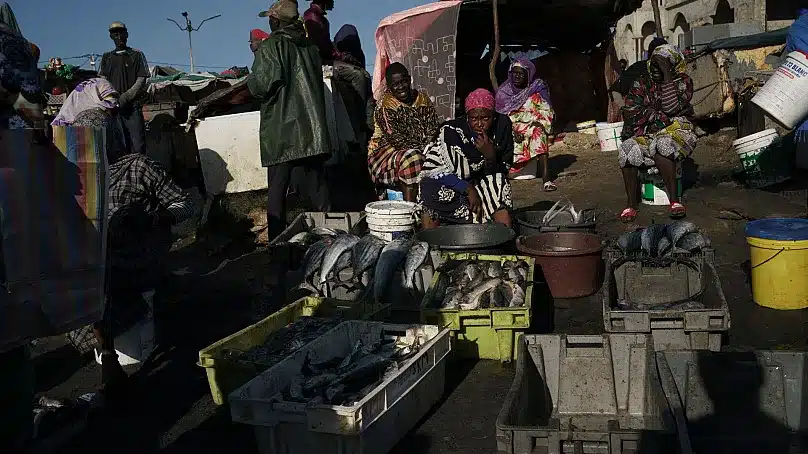
    Residents of Saint-Louis, a small fishing village in Senegal, have been having difficulties for a long time. The COVID-19 pandemic, foreign industrial trawlers, and climate change have all made it challenging to make a living off the water.

    When officials announced a new gas project off the coast in 2015, the community was hopeful it would bring new opportunities. Instead, many locals say, the gas has only brought a wave of problems and pushed people to desperation. That includes forcing some women to turn to prostitution to support their families, they told The Associated Press in interviews.

    Four women who shared their stories said they started working as prostitutes because their husbands, all fishermen, could no longer make a living after the gas deal came to town and the rig restricted access to fertile fishing areas, known locally as diattara. The women all said they knew of several other women in the same position.

    The women spoke on condition of anonymity because their families do not know what they do. Prostitution is legal in Senegal, but the women do not want to register, citing cultural shame.

    For them, prostitution is faster and more reliable than working in a shop or restaurant — jobs that do not pay well and can be hard to find.

    The deal — planned by a partnership among global gas and oil giants BP and Kosmos Energy, and Senegal and Mauritania’s state-owned oil companies — is expected to produce around 2.3 million tons of liquified natural gas a year, and Mauritania and trying to benefit the wider economy by locally sourcing products, developing the workforce and supporting sustainable development.

    More than 3,000 jobs in some 350 local companies have been generated in Senegal and Mauritania, according to BP. The company also cited its work to renovate the maternity unit at the Saint-Louis hospital and its help of 1,000 patients with a mobile clinic operating in remote areas.

    In a statement, Kosmos spokesman Thomas Golembeski, said the project will provide a source of low-cost natural gas and expand access to reliable, affordable, and cleaner energy. He also cited access to a micro-finance credit fund established for the fishing community.

    “I pray that this ends, because it’s not what I want to do from the bottom of my heart. I do it for my children,” one mother said, her shoulders hunched and voice weary in a hotel room where she would not be seen by her husband or friends.

    Traditionally, many women make a living processing fish, while the men catch it; sons, husbands and fathers spend weeks at sea. But with the restrictions, families could not feed their children or pay rent.

    In some cases, families had to pull their children out of school or switch them from private to public schools where the teachers don’t show up for days.

    BP and Kosmos did not respond to questions about the women turning to prostitution.

    They also did not respond to questions about whether they stood by their initial risk assessment of the project, which acknowledged in a 2019 environmental and social impact assessment that there were “a lot of uncertainties around the consequences for Saint-Louis fishermen” but still considered the intensity of the impact to be low.

    The local government said people’s concerns about the rig were overblown and that the community needs to be patient, at least until after production, which is expected to start by the end of this year.

    Papa Samba Ba, the director of hydrocarbons for Senegal’s Petroleum and Energy Ministry, said the objective is that by 2035 half of all gas projects will go to local companies and services.

    Local officials have acknowledged an increase in prostitution in Saint-Louis, but they attribute it to economic woes and widespread poverty in general — not directly to the gas project.

  • UN cannot feed chad refugees next month

    UN cannot feed chad refugees next month

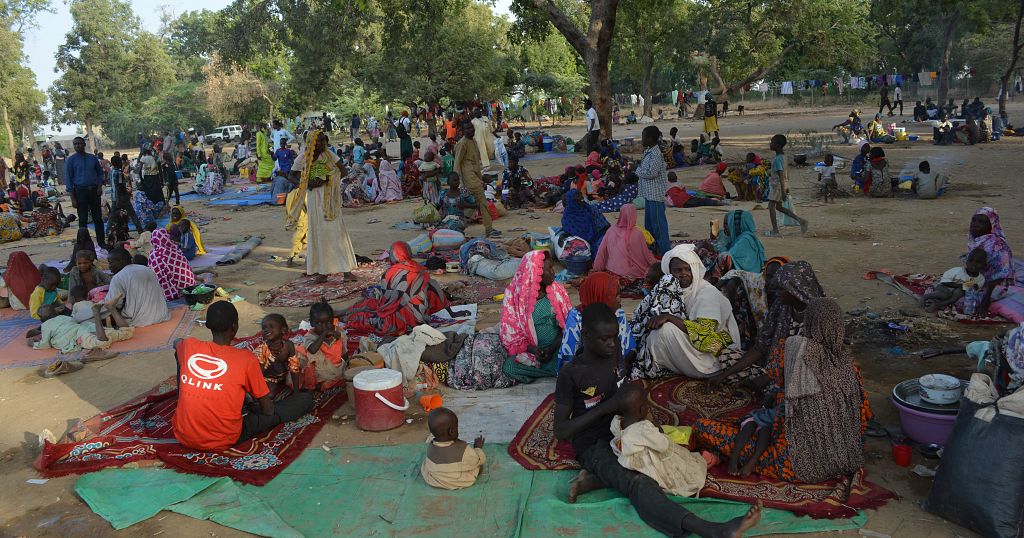
    The United Nations warned Friday that it would no longer be able to feed 600,000 refugees in Chad within weeks unless it receives urgent international funding.

    The UN’s World Food Programme said Chad was hosting the biggest refugee population in west and central Africa, with the numbers rising due to unrest in neighbouring Sudan.

    The WFP said that despite refugees being a priority, it had to reduce its plans to support 455,600 refugees down to only around 270,000 in April.

    “We have already done a drastic targeting to ensure that the poorest among the poor will be assisted,” WFP’s Chad country director Pierre Honnorat told reporters in Geneva via video-link from the capital N’Djamena.

    However, “we have absolutely no funding from May onwards for the refugees and displaced people. It’s really catastrophic.”

    WFP wants $142.7 million for the next six months to feed all crisis-affected populations in Chad, including refugees, the 380,000 internally displaced, and other Chadians who have been hit by extreme weather in recent years.

    “If no further funding is received, food assistance will come to a 100 percent halt in May 2023 for both refugees and internally displaced,” the agency said in a statement.

    Chad is facing its fourth consecutive year of very high severe food insecurity.

    The country suffered the worst lean season in a decade last year, plus the most devastating floods in 30 years. WFP said there were 1.9 million people in Chad who are food insecure.

    Meanwhile, the UN refugee agency said it was looking to raise $172.5 million to provide protection and relief assistance to one million forcibly displaced people and their hosts in Chad.

    “That is just 15 percent funded so we desperately need money for that country,” UNHCR spokesman Matthew Saltmarsh told reporters.

    He said the agency was encouraging Nigeria and Chad to look at voluntary returns of refugees.

    “The numbers envisaged might be relatively modest but we think this is an important signal in terms of finding solutions for the displaced in Chad but also for the region.”

  • The enormous frogs of Cameroon are in danger of going extinct

    The enormous frogs of Cameroon are in danger of going extinct

    A fisherman named André Nkoudi resides in the village of Mangamba on the coast of Cameroon.

    At least once per week, he patrols the rivers near his hamlet.

    Nkoudi looks for frogs’ nests, tadpoles, frogs caught in the traps of fishermen’s nets or footprints that indicate the presence of poachers hunting the Goliath frog, known officially as Conraua goliath.

    Nkoudi wasn’t always so concerned for the welfare of the amphibian, having previously been a hunter.

    Now he monitors the species for scientists hoping to protect them.

    Today, he notices a small frog caught in a net planted in a river. He takes a photo which he sends to the researchers. Then, crucially, he releases the frog.

    The Goliath frogs are the world’s largest. They’re only found only in the tropical rainforest of central Africa, within the southwestern part of Cameroon and north of Equatorial Guinea.

    Some of the adult frogs weigh several kilograms and measure more than 33 centimetres in length, when fully grown.

    Nkoudi has noticed they’ve diminished over the years.

    “In 2003, when I walked in here, as soon as I got there, I was going to catch at least 20 frogs. There were many. We didn’t have to go far to hunt frogs. We just had to walk from there to there to catch even 15, and I went home. Now I walk miles and I don’t even see one. Because a lot of people hunt now too.”

    Now Nkoudi is involved in trying to inform other villagers about the importance of protecting the endangered frog.

    We have been informed that this frog is important to the government. So, I decided not to go into the water anymore to hunt frogs, because the government took control. So, I’m no longer involved in the frog hunt. And I explain to people to be careful, to stop hunting frogs because there is now a law that protects frogs. The government, the projects, take care of the frogs. I stopped hunting them. That’s how I educate the people in the village,” says Nkoudi.

    The Conservation Leadership Programme, an NGO, is now trying to improve data collection so the scientific community has more evidence-based information about the frogs’ welfare and environment.

    The group’s Ecological Monitor, Robillard Kouekam, joins Nkoudi to measure and weigh the frogs and detail where they were found.

    “These data will, at the end of the investigation help to map the presence of frogs in the study environment. The measurements will allow us to model the growth parameters, to find the condition factor and the coefficient of allometry (organ measurements), in short to determine whether the location is favourable for them or not. These data will, at the end of the investigation help to map the presence of frogs in the study environment. The measurements will allow us to model the growth parameters, to find the condition factor and the coefficient of allometry (organ measurements), in short to determine whether the location is favourable for them or not,” he says.

    According to Kouekam, local communities will be offered alternative ways of making an income.

    But the money which can be earned from hunting the goliath frog means it will be difficult to persuade villagers they should be protected, not hunted.

    Nkoudi explains: “It depends on the size. The big ones are at 6,000 CFA francs ($10), the small ones at 5,000 CFA francs ($8.40). Other smaller ones are at 2,000 CFA francs ($3.40). That’s how we sold these frogs here. It helped us manage our lives. I, for example, have two kids in college. It was the money from those frogs that allowed me to send them to school.”

    Kouekam says new forms of farming can be introduced.

    “We have a snail breeding project. These people who hunted frogs will be introduced to the breeding of snails, which will generate income,” he says.

    Environmentalist Ghislain Fomou says stricter measures are needed.

    “The middle ground will, first, be better regulated access to this type of living species, sampling must be controlled, I think the problem is when going to a high level of sampling that is not in coordination with the degree and the level of reproduction, this is what constitutes a threat in the first place.”

    The goliath frog has been classified as an ‘endangered species’ by IUCN and as a protected species of class ‘A’ according to the Cameroonian wildlife law.

    The total population of goliath frogs has dropped by at least 50 percent over the last 15 years, according to the International Union for Conservation of Nature (IUCN).

    According to local fishermen, these frogs are caught for local consumption, but they’re also believed to be trafficked to neighbouring countries like Nigeria.

  • My own mother cut off my hands and ruined my life: A shocking tale of tragedy!

    My own mother cut off my hands and ruined my life: A shocking tale of tragedy!

    In a harrowing account that has gone viral on social media, a young woman identified as Glory has recounted the horrific incident that left her without both hands.

    According to her account, Glory’s mother allegedly attacked her with a machete while she was attempting to relieve herself at the back of their house. Despite her attempts to defend herself, Glory’s mother succeeded in cutting off both of her hands.

    Glory’s father, who was present during the attack, reportedly rushed to her aid after hearing the commotion.

    However, by the time he arrived on the scene, it was too late to save his daughter’s hands.

    In the aftermath of the incident, Glory’s mother reportedly confessed to being a witch before taking her own life.

    Despite the unimaginable trauma she has endured, Glory has refused to let her disability define her.

    In the video, she can be seen carrying out daily tasks such as cooking, cleaning, and washing, using her feet and arms to compensate for her lost limbs.

    Glory’s story is a testament to the strength of the human spirit, and her resilience and determination are truly inspiring.

    Her experience serves as a reminder of the dangers of superstition and the devastating consequences it can have on innocent lives.

    We can only hope that her story will inspire others to persevere in the face of adversity and to never give up on themselves.

    Authorities must also take swift action to prevent similar incidents from occurring in the future.

    Source: The Independent Ghana

  • Women continue to hold a “marginal” position in food producing industry – FAO

    Women continue to hold a “marginal” position in food producing industry – FAO

    In spite of being crucial to feeding the globe, women still hold a “marginal” position in food production, according to a rare FAO research on the stark disparities in the industry. They own less land, make less money, and are more susceptible to catastrophes.

    From the fields to the production lines, they have to “deal with working conditions that are often more difficult than those of men, insofar as they are confined to occasional or part-time, informal, low-skilled jobs” and therefore more precarious.

    Even if their access to technology or credit has improved since 2010, the date of the last report of the Food and Agriculture Organization of the United Nations on the subject, “the reduction of most gender disparities has stalled”, and some gaps have widened with the Covid-19 pandemic.

    By addressing these inequalities and “empowering women, we will take a big step towards the goals of eradicating poverty” and hunger, FAO Director-General Qu Dongyu said in the report.

    According to the study, women make up more than half of the agricultural workforce in many sub-Saharan African countries, and just under half in Southeast Asia.

    They “occupy a larger share of agricultural jobs in less economically developed countries, as they have very few opportunities for non-agricultural employment” due to a lack of education.

    Around the world, they lag far behind in access to land, inputs (fertilizers, seeds), financing or technology, while they are often more dependent on agriculture for survival. Due to this lack of resources among women, male-run farms are 24% more productive than theirs of equal size.

    In the livestock sector, women tend to own fewer livestock, and smaller animals (sheep, goats).

    – Rigid” distribution of roles –

    Despite some progress, “the share of men who hold property rights or secured rights to agricultural land is twice as high as that of women”, in the 40% or so of countries that provide data on women’s land ownership.

    Their income is also 18.4% lower in the wage agricultural sector.

    Because of their lack of resources and information, “women also have less capacity to adapt and resilience to climate shocks” or economic crises.

    During the first year of the Covid-19 pandemic, “22% of women lost their jobs” in the agri-food industries, compared to only 2% of men, and women’s food insecurity “worsened faster than men’s”.

  • A fresh opposition platform in congo for an alternative in 2026

    A fresh opposition platform in congo for an alternative in 2026

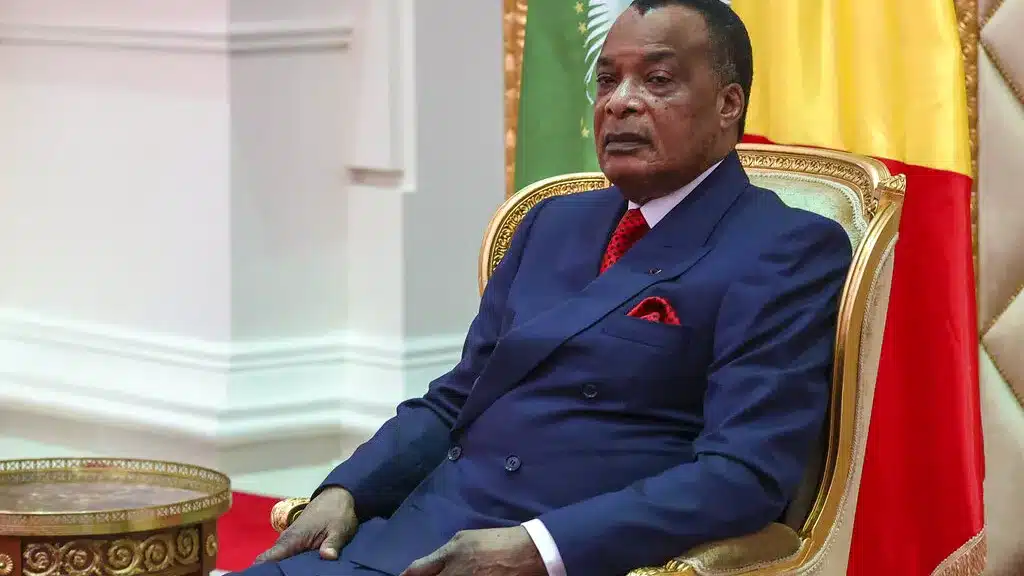
    On Thursday, April 13 2023, three political parties in Congo-Brazzaville announced the formation of a “alliance for democratic change in 2026” in light of the possibility that President Denis Sassou Nguesso, who has held office for nearly 40 years, could run for office again.

    This new opposition platform includes the Rally for Democracy and Development (RDD) of former president Jacques Joachim Yhomby Opango, who died in 2020 and led the Congo between 1977 and 1979 under Marxism-Leninism, as well as the Movement of Republicans (MR) and the People’s Party (PAPE).

    Although they have no elected members in parliament, these three parties often gather their activists to sensitize them to the need, in their view, for alternation.

    “There are people (from other parties) who will arrive. We have the people with us. There are many corrupt people in our country. But we want to bring something new,” Jean-Jacques Serge Yhomby Opango, vice-president of the RDD and son of the party’s founder, told AFP after the official launch of the platform in front of activists of the three formations.

    “There must be in 2026 a political and democratic alternation. We can not let things happen like that, because the country is going down the drain,” he said.

    The next presidential election is scheduled for 2026. Denis Sassou Nguesso, almost 80 years old, with nearly 40 years in power, has the possibility of running for a fifth term, according to the country’s current constitution.

    “We have three years left and plenty of time to address the problems that plague our country during the elections, including electoral governance, the electoral file,” said Destin Gavet, of the Movement of Republicans.

    “The bodies that plan and conduct all pre-election and election operations are monopolized by one party, the ruling party. De facto, the rules of the game are vitiated from the start,” said Jean-Jacques Agnangoye of the People’s Party.

    In Congo, the opposition has contested the results of all elections held since 2002 and won by Mr. Sassou Nguesso.

  • Kenya’s first observation satellite’s launch once more aborted

    Kenya’s first observation satellite’s launch once more aborted

    There will be a slight delay in the launch of Kenya’s first operational earth observation satellite.

    Satellite Taifa-1 was supposed take off from California USA on Friday (Apr. 14) but exploration technology company Space X, cancelled the exercise nearly 28 seconds into flight.

    The launch is scheduled on Saturday (Apr. 15).

    Friday’s cancellation marked the third failed attempt to launch the satellite. The bad weather which caused the delay hasn’t deter engineers on site. They took the the news philosophically.

    “Ingenieurs, what’s happening with the weather, what type of weather is this? […] We’re sorry, it’s a very delicate process and a lot of money has been invested on different pilots so it’s not good to risk it.”

    Taifa-1’s payload is an optical camera capable of imaging in five multispectral bands with a ground sampling distance (GSD) of 32 metres and the panchromatic band with a GSD of 16 metres.

    According to the Kenya Space Agency, Taifa-1 is the first of what is intended to be a constellation of small earth observation satellites that will form the Taifa-1 mission.

  • South Africans worried energy crisis could prevent promised investments

    South Africans worried energy crisis could prevent promised investments

      Over the next five years, South Africa has been able to secure new investment commitments from investors totaling around 84 billion US dollars.

      President Cyril Ramaphosa met with investors as part of the fifth South Africa Investment Conference. The Chief Executive Officer of the South African Breweries, Richard Rivett-Carnac explains that their investment pledge is expected to create forty thousand jobs in the country.

      “ We are committing R5.8 billion and will invest the full amount by the end of this year. It’s primarily for the expansion of our brewery in Gqeberha. It was a project that was started last year and will be completed this year. And this is at the back of last year’s investment commitment to invest in 4 point five.,”

      While President Ramaphosa has put forward his multibillion-dollar US investment target, South Africans on the street believe that he needs to focus on eradicating electricity blackouts in order to boost investor confidence.

      “I feel like President Ramaphosa should be focusing on sorting out our electricity problem because in terms of business, we are losing more than we are profiting because of the extra provisions we have to make for electricity,” explains Miles Thomas, a South African citizen

      Kavish Ramanand, also a South African citizen raises concerns regarding the expenditure of the funds injected by investors.

      “If people are willing to invest then that’s great. The first thing they need to look at is the issue of corruption and protecting the funds. I think also load-shedding.” said Ramanand

      Cebo Ngema, a South African citizen insists that President Ramaphosa’s energy investment plan will turn around the country.

      “They can invest and the electricity crisis will be alright meaning they can continue with the business. Not everything is about electricity. We do have generators now to boost businesses,”

      The South Africa Investment was first introduced by President Cyril Ramaphosa in 2018 to help attract more investors to the country.

    • 4 members of kenyan church die during a fast ‘to meet Jesus’

      4 members of kenyan church die during a fast ‘to meet Jesus’

      In Kenya’s coastal Kilifi county, four individuals have been discovered dead on Thursday and a dozen more sent to the hospital after being rescued while anticipating the end of the world.

      The victims who are believed to be members of Pastor Paul Mackenzie’s Good News International Church say they had been told to fast to avoid “apocalyptic damnation”, the police said.

      The authorities said they rescued 11 people – six of them were emaciated and in critical condition.

      Police said they will resume a search for more members of the group on Friday morning following reports that others were still in the forest.

      The police also found a mass shallow grave at Shakahola Forest in Langobaya, Malindi.

      ”The police were unable to conduct any further activity at the mass grave because of the hostile residents in the forest believed to be the suspect’s followers” part of the report read.

    • 6 quick facts about the 1994 genocide attack

      6 quick facts about the 1994 genocide attack

      On April 6, 1994, a plane carrying Habyarimana and Burundi’s president Cyprien Ntaryamira was shot down over the capital city of Kigali, leaving no survivors. (It has never been conclusively determined who the culprits were. Some have blamed Hutu extremists, while others blamed leaders of the RPF.)

      The Rwandan Genocide was a mass slaughter of Tutsi people and moderate Hutus that occurred between April and July 1994, resulting in an estimated 800,000 deaths.

      The genocide was sparked by the death of Rwandan President Juvenal Habyarimana, a Hutu, whose plane was shot down on April 6, 1994, leading to widespread violence and killings.

      The genocide was carried out by the Hutu-led government and militias, who targeted Tutsis, moderate Hutus, and anyone who opposed their agenda.

      The violence was fuelled by propaganda and hate speech disseminated through government-controlled media, which portrayed Tutsis as enemies of the state.

      The international community failed to intervene, despite warnings of impending genocide, and many Rwandans were left to fend for themselves.

      The aftermath of the genocide saw the establishment of the International Criminal Tribunal for Rwanda to prosecute those responsible, as well as efforts to promote reconciliation and rebuild the country.

    • Biden in Irish parliament ahead of speech

      Biden in Irish parliament ahead of speech

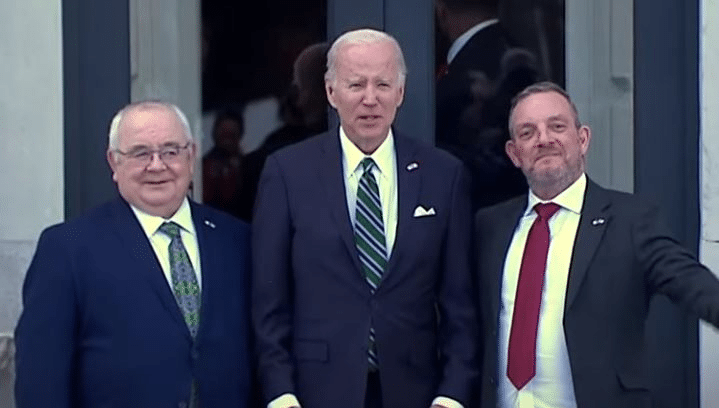
      Joe Biden has arrived at Leinster House in Dublin and he paused for a picture in front of the structure.

      Speaker of the Dail Sean O Fearghail and Chair of the Seanad Jerry Buttimer welcomed him.

      In a moment, Mr. Biden will address the Irish parliament.

    • 10 everyday habits you do not pay attention to

      10 everyday habits you do not pay attention to

      The act of gaping or yawning

      Admit it: most days you greet the morn with oscitancy. In addition to referring to the act of yawning, oscitancy also refers to drowsiness (often demonstrated by yawns) as well as to general dullness or sluggishness. Oscitancy has a related adjective in the form of oscitant, which is used to describe one who is yawning with drowsiness (“the sweetly oscitant infant”) or, less kindly, to one who is lazy or stupid (“an oscitant ne’er-do-well”). Both words have their origin in the Latin oscitare, meaning “to yawn,” itself from the inspired combining of os (“mouth”) and citare (“to put in motion”).

      image108669285

      A stretching and stiffening especially of the trunk and extremities (as when fatigued and drowsy or after waking from sleep)

      There’s nothing wrong with a good stretch, and there’s no shame in accompanying or quickly following your oscitancy with pandiculation. The word comes to English by way of the French, who took it from the Latin pandiculari, meaning “to stretch oneself. Pandiculari comes from pandere, meaning “to spread, unfold,” the root also of expand.

      image1761231402

      The act of moving from place to place : walking

      After you have sat up in bed and put feet to floor, if you then proceed to walk, you are engaging in ambulation. The word comes from the Latin ambulare, meaning “to walk.”

      The verb form of ambulation is, unsurprisingly, ambulate. It has related adjectives too: ambulant means “moving about,” while ambulatory shares the meaning of ambulant but has several other meanings as well. Even better are a host of other uncommon ambulare words, among them circumambulate (“to circle on foot especially ritualistically”), deambulation (“the act of walking abroad or about”), obambulate (“to walk about”), noctambulist (“a person who walks while asleep”), and the slightly more common synonym of that last one, somnambulist.

      image812185631

      A long deep breath : sigh

      Whether your first suspiration of the day precedes or follows your first sip of coffee (or your first check of Twitter), be aware that this word is from wholly uninteresting origins: the Latin word suspirare, meaning “to sigh.” Sigh.

      James Joyce didn’t mind, apparently:

      With deep inspiration he returned, retraversing the garden, reentering the passage, reclosing the door. With brief suspiration he reassumed the candle, reascended the stairs, reapproached the door of the front room, hallfloor, and reentered.
      — Ulysses, 1922

      image641457957

      1 a Obsolete : the taking of food : eating b : the part of a Communion service in which the sacrament is received 2 : the act of chewing

      No, this word is not some new-fangled portmanteau referring to the education of (or by) men. It refers—in 16th century texts, anyway—to the act of eating. It also refers to the act of chewing, but mostly when that chewing is done by an invertebrate. The word does have some current use referring to something involving humans: manducation is also the part of a Communion service in which the sacrament is received.

      (Other obscure and overly complex words for eating exist, but we’ve already covered mastication (chewing) and deglutition (swallowing) in “Strange Words for Body Functions”, which, uh, see.)

      image1387348616

      Intestinal rumbling caused by moving gas

      We are sorry if you did not choose your breakfast wisely, but be assured that noises emanate from the bellies of us all from time to time. The technical word for such emanating noises sounds about as dignified as it feels. Borborygmus traces back to the Greek borboryzein, a verb meaning “to rumble” that is believed to be of onomatopoeic origin. The fact that saying “borboryzein” repeatedly provides a decent sound effect for this clip from Charlie Chaplin’s Modern Times (1936) is a silent movie supports this theory:

      The plural of borborygmus is, by the way, borborygmi.

      image1434354040

      A glance of the eye; especially : Ogle

      Did you sit down to work, turn on your computer, and find your intended brief social media oeillades turning into lingering surveys of the entire internet? There, there. It happens to everyone. At least with this particular iteration you’re learning something. Though oeillade does indeed sometimes refer to a simple glance of the eye, it more often refers to the kind of glance that constitutes flirtation.

      image616190078

      Hiccup

      We hope you do not suffer from singultuses daily. If you suffer from them even weekly we feel for you and hope the knowledge of this obscure Latin word helps make the best of an annoying situation. Hiccup is, naturally, a synonymous and helpfully onomatopoeic term.

      image1164094654

      Festivity, merrymaking

      The best days include some jollification, and some of the best jollification includes cat pictures. Jolly had been around for centuries before someone recognized what adding -ification to the word could do for the language. Jolly is believed to come from an Old Norse word meaning “midwinter festival.”

      image410377518

      A lulling to sleep

      When the day’s work has done, and the laughter of the jollifying cats has waned, there is (in an ideal world) a gentle consopition. We don’t know why such a lovely word as this one has fallen nearly completely out of the language but it has: the entry even sports an obsolete label. The word has a ho-hum Latin pedigree—it’s from sopor, meaning “deep sleep,” the likely source also of soporific—but almost no one uses it anymore, which we think is a shame.

      There also exists a verb sopite to sopite you—if, that is, obscure words put you to sleep. It is also used to mean “to put an end to (something, such as a legal claim).”

      Source: merriam-webster.com

      DISCLAIMER: Independentghana.com will not be liable for any inaccuracies contained in this article. The views expressed in the article are solely those of the author’s, and do not reflect those of The Independent Ghana

    • 8 words to kill your appetite

      8 words to kill your appetite

      There are some bad words in the nid– section of the alphabet. The word nidor may describe a strong smell, but is especially used to refer to “the smell of cooking or burning meat or fat”; the adjective nidorous is defined as “smelling of or like burning or decaying animal matter.” As unlovable as these words are, they pale in comparison with nidorosity, which was memorably defined by Samuel Johnson as “eructation with the taste of undigested roast meat.” And however objectionable you might find this concept, you must at least admit that the word nidorosity itself is rather more pleasing to say than meat-burp.

      I have been within the influence of their nidorosities.
      —James Beckett, Remarks on Conversations Occasioned by Mr. Burke’s Letter, 1796

      crapulous

      Definition:
      1. marked by intemperance especially in eating or drinking
      2.  sick from excessive indulgence in liquor

      Well-nigh everyone has suffered from feeling crapulous, and most of us have been forced to make do with inelegant words such as hungover to describe our delicate condition. But what if one feels the ill-effects of over-consumption of eating overmuch, rather than those arising from intemperance?

      For such occasions you may now say that you feel crapulous. It’s not related to the word crap—the two words come from different languages.

      When in France, either occupied or unemployed, he has always led a life so crapulous and debauched, that it has even scandalized his vicious and immoral countrymen.
      —Lewis Goldsmith Stewarton, The Revolutionary Plutarch, 1804

      keck

      Definition: to make the sounds of retching

      It has been remarked by H. L. Mencken, Neil Simon, and many others that words with K in them are funny (or at least funny-sounding). If we accept this tenet of humor then keck must be a very funny word indeed, with its swaggering ratio of K to non-K letters. Even if you don’t think keck is a funny word, you must admit that it is useful, insofar as it describes not the action of retching, but simply making the sound of one who is attempting to vomit.

      The blood-red venom on his lips
      Foamed as he kecked;
      Rabid he bit, loon-frantic tore,
      Like demon checked!
      —Francis Saltus Saltus, “Arabesque”, Honey and Gall:Poems, 1873

      sushi

      Definition: lavish spending on food and drink

      Abligurition appears to have entered our language through being included in Nathan Bailey’s 1724 Universal Etymological English Dictionary, in which he defined the word as “a prodigal spending in Belly-Cheer.” A few decades later Samuel Johnson borrowed most of this definition (but unfortunately took out the part about “belly cheer”), and said that it was “A prodigal spending on meat and drink.” Despite being included in these two fine works abligurition is rarely, if ever, found outside the confines of a dictionary. In the event that it is encountered in general writing, it typically is still not in natural use; people will occasionally employ it to show that such a word exists.

      This lady is a pedant, who culls all the difficult words from dictionaries to grace her speech; ex. gr. “…Pray, Sir Charles, make your evolution from your subderisorious cousin; manuduct the fair troglodyte (who is your sun, and be your station perihelium) to our little zeta; where you will find no supervacaneous abligurition, &c. &c.”
      The Literary Journal, Dec. 1806

      borborygmus

      Definition: a rumbling sound made by the movement of gas in the intestine

      If, soon after reading this list, someone happens to ask you “what is the least useful thing you learned today?” you may tell them that the word borborygmus may be pluralized in two ways, as borborygmi or borborygmies. The word may be traced back to the Greek verb borboryzein, which means “to rumble.” Knowing what the word is for this condition will not alleviate any embarrassment you might feel if this happens to you at a dinner party.

      Expressed a strong desire to evacuate his bowels; the borborygmus being distinct to all in the room.
      The Choler Epidemic of 1873 in the United States, 1875

      inesculent

      Definition: inedible

      Everyone has been in a situation where the food being served is inedible, and yet where propriety and good manners prevent one from proclaiming this. Now, rather than offend the cook, you may refer to the meal as “simply inesculent,” and most people will not be any the wiser. Inesculent is formed by combining the prefix in– with esculent, which simply means “edible,” and generally is used for matter that is not meant to be eaten, rather than to describe food that is disgusting.

      For my part I care not a rush (or any other aquatic and inesculent vegetable) who or what sucks up either the water or the infection.
      —Thomas Love Peacock, Maid Marian, and Crochet Castle, 1856

      skippered

      Definition: Infested with maggots

      We sincerely hope that you never have the occasion to use this word in a non-nautical sense (skipper may also refer to the action of being the captain of a ship). However, since we aim to provide our readers with the means to describe any kind of situation which may arise in life, we have included it in this list.

      In the unlikely event that you have need of a word to refer to a specific type of food that it so infested, the adjective skippery refers to either cheese or meat that has been infected with the cheese fly larva (also known by the winsome name of cheese skippers).

      It was not lawful, in those days, to pay God’s minister in musty meal, or rotten wood, or frosted fruits, or skippered meat.
      —J. R. Deering, in Kentucky Conference Pulpit: Being Sermons by Ministers of the Methodist Episcopal Church South, 1874

      moo

      Definition: to chew repeatedly for an extended period

      These days when ruminate is applied to people it most often is used to refer to the action of contemplating something, or musing on a subject (and this is the earliest meaning of the word). However, it also may refer to the action of chewing food for a long time, or to chew again on food that has been swallowed and brought back up. This sense is more frequently employed for animals, such as cows, which have more than one stomach, and chew their food repeatedly (which is why they are called ruminants). But we have all shared a table with a human ruminant, and it may be helpful to know the word with which you may describe this creature.

      This ruminating man lived at Bristol. He would begin to chew his meat over again within a quarter of an hour after his meals, if he drank upon them; if not, it was some time longer.
      The Philosophical Transactions of the Royal Society of London, 1691 (1809)

    • US State Department’s 2022 report addresses arrest of Barker-Vormawor, threats against journalists, and arbitrary detention

      US State Department’s 2022 report addresses arrest of Barker-Vormawor, threats against journalists, and arbitrary detention

      The 2022 arrest of Oliver Barker-Vormawor, the convener of the #FixTheCountry Movement, limitations on free expression and police impunity in Ghana were highlighted as human rights violations in the US Country Report on Human Rights Practices for 2022.

      The country is also cited for violating the rights of LGBTQ+ targeting and the lack of investigation and accountability for gender-based violence.

      Released in April 2023, the report highlighted “Significant human rights issues included credible reports of arbitrary or unlawful killings including extrajudicial killings; torture or cruel, inhuman or degrading treatment or punishment by the government or on behalf of the government.

      It noted “arbitrary arrest or detention; serious restrictions on free expression and media, including violence and threats of violence against journalists, and unjustified arrests or prosecutions of journalists; substantial interference with the freedom of peaceful assembly.”

      There were also cases of “serious government corruption; lack of investigation of and accountability for gender-based violence, including domestic or intimate partner violence.”

      The report took an exception to “crimes involving violence or threats of violence targeting lesbian, gay, bisexual, transgender, queer or intersex persons; laws criminalising consensual same-sex sexual conduct between adults, although not fully enforced.”

      Also, the report highlighted “crimes involving violence or threats of violence targeting persons with disabilities.”

      The US Department noted that although the Akufo-Addo government “took some steps to address corruption and human rights abuses by officials, whether in the security forces or elsewhere in the government impunity remained a problem.”

    • Rights group in Ethiopia demands investigation into Amhara killings

      Rights group in Ethiopia demands investigation into Amhara killings

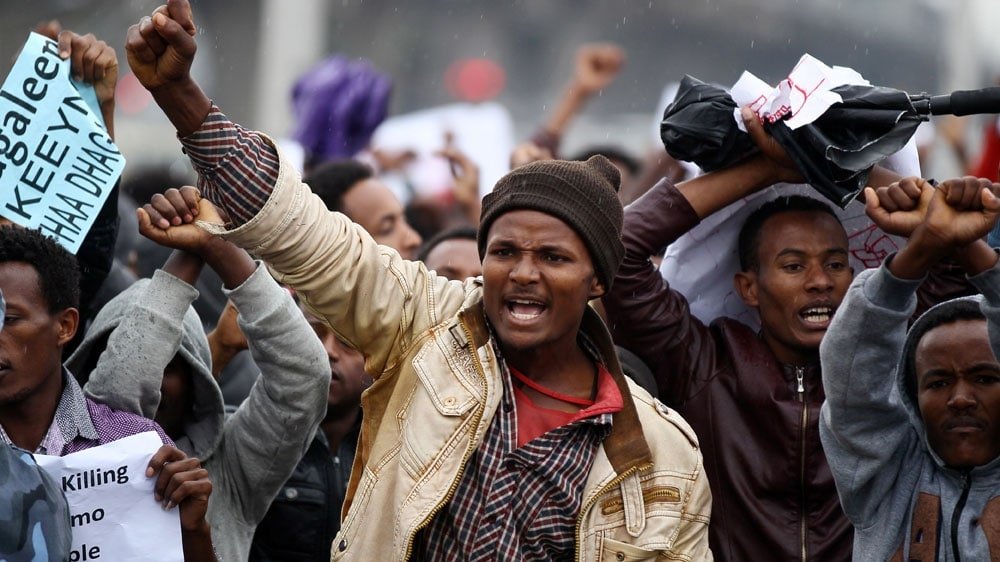
      Ethiopia’s state-linked rights watchdog has called for investigations into the killing of civilians and humanitarian workers during recent protests in Amhara region.

      The killings were reportedly carried out by security forces and other unknown people

      The Ethiopian Human Rights Commission said that worsening insecurity could lead to abuse of rights and urged security forces against using excessive forces.

      Protests in Amhara began last week in opposition to moves by federal authorities to dissolve a regional paramilitary unit.

      The government says the unit will be integrated with the army or police to create a unified force, but opponents argue its dissolution could leave the region vulnerable to attacks by neighbours.

      Many of the major cities in the region appeared to have returned to normalcy on Wednesday afternoon after days of protests, with businesses and offices reopening.

      A resident in the regional capital, Bahirdar, has told the BBC that the reduced protests could be linked to the upcoming Ethiopian Easter to be celebrated this Sunday.

    • Ethiopian journalist arrested over reported crackdown

      Ethiopian journalist arrested over reported crackdown

      Local media has reported that individuals thought to be security personnel have detained a well-known Ethiopian journalist.

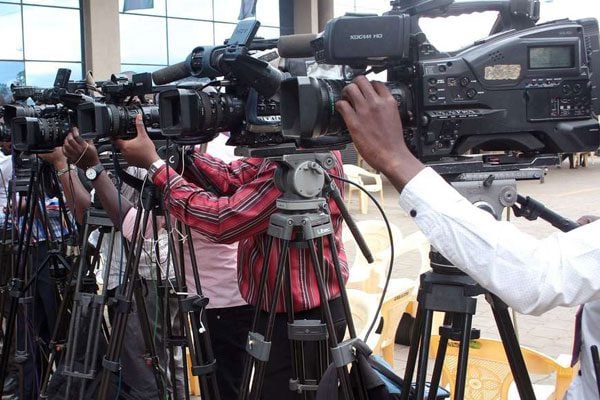
      Freelance journalist Dawit Begashaw was allegedly “abducted by security forces” on Wednesday night, according to reports.

      The journalist’s current whereabouts are unclear, according to the Mereja website.

      According to Mereja, another journalist, Meskerem Abera, was arrested over the weekend.

      “In recent months, non-state-affiliated media outlets are coming under relentless attacks as the Ethiopian government moves to stifle critical voices,” the website added.

      Media watchdogs accuse Prime Minister Abiy Ahmed’s administration of eroding press freedom gains in the country amid ethnic conflicts and a civil war in the north of the country.

    • Bola Tinubu to be sworn in as president despite court cases

      Bola Tinubu to be sworn in as president despite court cases

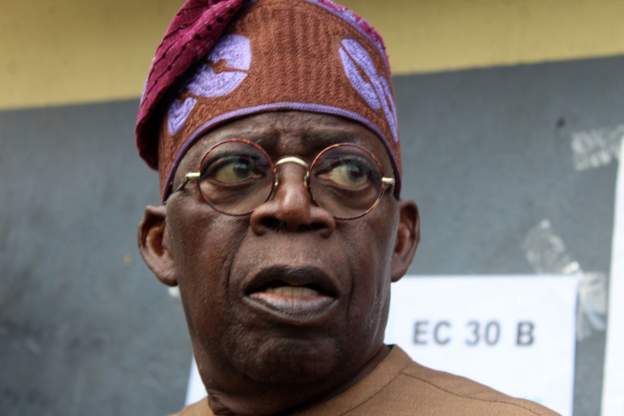
      Despite legal challenges to his victory, the president-elect of Nigeria, Bola Tinubu, will be sworn in on May 29, according to Lai Mohammed, the minister of information.

      As outgoing President Muhammadu Buhari officially leaves office in May, groups angry over the results of the presidential election on February 25 are calling for an interim administration.

      Mr Mohammed said there was “no basis” for the constitution of an interim government. He said the opposition political parties have the right to challenge the presidential election in court

      Four presidential candidates filed legal challenges on 21 March against Mr Tinubu’s victory, alleging widespread rigging and manipulation of tallies.

      It takes about eight months for the judiciary to determine a presidential election petition. The petition must be heard within 180 days from the day it is filed. A petitioner can appeal the tribunal’s judgement at the Court of Appeal within 21 days from the decision date.

      If petitioners are dissatisfied with the appellate court’s decision, which is delivered within 60 days, they have 21 days to appeal it at the Supreme Court, whose decision is final.

    • Amanda Cartey writes: A brush with crime; my experience outsmarting a thieving taxi driver

      Amanda Cartey writes: A brush with crime; my experience outsmarting a thieving taxi driver

      In the past few years, I have heard many stories about people’s experiences with taxi robberies but I always thought it was just a tale.

      They talked about how taxi drivers tricked them by locking the car doors and stealing their money and phones from their bags and purses. Unfortunately, I soon discovered that I was not far from experiencing this uncivilised behaviour of some drivers in town.

      One day, a taxi driver offered me a free ride from Dzorwulu Junction to Achimota Overhead. I was heading to Achimota Mile 7. The plan was to continue my journey from the Achimota Overhead to Mile 7.

      I hopped into the taxi with my luggage in a white polythene bag and a brown purse containing my phone and some cash.

      Our journey to Achimota Overhead began at 11 am, and the driver engaged me in a conversation. He suggested that I should pay him to take me to Achimota Mile 7 but I insisted that he should ‘let me off’ at the Achimota Overhead because it would still be convenient for me to continue my journey from there.

      In less than 15 minutes, we arrived at Achimota Overhead and I needed to get out of the taxi. But that was when the drama and the trickery by the taxi driver began.

      The taxi had stopped; so, I tried to open the door to alight from the car but the door would not open. For a moment, I focused on trying to get the door opened – which meant that I had abandoned my purse and luggage on my thighs, and my backside was halfway facing the driver, while I struggled to open the door.

      I am sure that was when the criminal taxi driver attempted to silently snatch my purse from my thighs to himself so he could steal my phone and money but he did not succeed because I also gave up and insisted that he open the door for me.

      Then he asked me for a coin, which he claimed could help with opening the gate. So, I quickly grabbed my purse, which was lying halfway on my seat open, and my phone was almost falling out.

      Seeing that his unscrupulous plan would not be successful, he opened the door for me to come out of the taxi. Apparently, the drivers control the doors from where they sit, so when they steal your items, they ‘release’ the door from their end and allow you to go.

      Hmmm… Now, as soon as I came out of the taxi, I realized that the taxi driver was trying to steal from me. I thanked God for exempting me from the plan of this wicked taxi driver.

      My journey continued in another public transport to Achimota Mile 7, where I met my friends and shared with them what happened to me.

      I was shocked to hear that Abigail and Diana had also experienced the same thing before.

      Unfortunately, the drivers succeeded in stealing their phones and cash. Eiii….thieves are smart o! Hmm

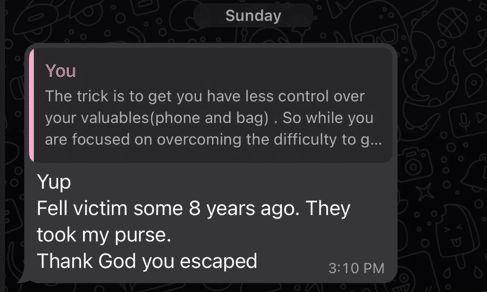
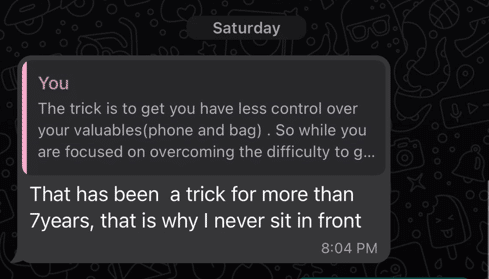
      I felt it was important to share my experience on WhatsApp so my friends and family could learn from it to avoid similar situations. I was grateful to receive some feedback from them as well!

      I, therefore, want to share some guidelines to help others avoid this kind of experience.

      Avoid the front seat of taxis at all costs if you can. If you must sit in the front seat, make sure your items (bag, phone, purse etc) are placed on your right side close to the door.

      Don’t go through the stress of opening a car door if it’s refuses to open. If you try once and it doesn’t open, insist that the driver opens it for you.

      Be suspicious about a driver who will ask for coins to help him open a door and stay away from that trap!

      Let’s all stay safe out there!

    • 8 candidates, including former MP, pick nomination papers for Kumawu NPP primary

      8 candidates, including former MP, pick nomination papers for Kumawu NPP primary

      The ruling New Patriotic Party (NPP) will end nominations today, April 13, 2023 in preparation for the Kumawu by-election.

      This follows the passing of Philip Atta Basoah, the area’s member of parliament.

      On April 3, 2023, Alban Sumana Kingsford Bagbin, the Speaker of Parliament, declared the seat of Philip Basoa, the New Patriotic Party’s (NPP) MP for Kumawu, vacant.

      The decision followed the death of Mr Basoah, 53, on March 27, 2023.

      The party has opened nomination from Monday 11th – 14th April 2023 for interested party members to pick nomination forms.

      So far, 8 party members have picked nomination to contest. Ashanti regional Chairman Benard Antwi Boasiako popularly known as ‘Chairman Wontumi’ is currently in Kumawu to ensure no prospective candidate is denied access to picking of the nomination forms in the party’s constituency office.

      Aspirants who have picked nominations form at the time of filing this report on Thursday April 13th 2023 include:

      1. Lawyer Edward Kofi Osei.
      2. Dr. Philip Bannor
      3. Dr. Dacoster Aboagye
      4. Mr Ernest Yaw Anim
      5. Mad. Ama Serwaa
      6. Kwame Appiah-Kubi
      7. Yaw Baah former Kumawu MP unseated by the late MP.
      8. Osei Hweree Kwame Bempah.

      Overnight road construction ahead of the by-election

      Concerned citizens of Sekyere Kumawu district earlier this week threatened to vote against the ruling party, NPP in this all important by-election citing total neglect of the Kumawu constituency in terms of roads infrastructure, abandoned Kumawu district hospital project initiated by the NDC administration among other basic needs of the district.

      A vote against the party in this by-election means the party will lose their majority position in Parliament hence immediate response to the concerns of Kumawu constitituent to calm all tempers.

      On Wednesday day 12 April 2023, Minister of roads and highways, Kwasi Amoako Atta visited the Kumawu town with road contractors to commence construction of Kumawu to Afigyasi major road, a move Kumawu constituents have discribe as vote buying.

      Assembly member of Dadiese electoral area Kofi Addei who has been moniting overnight constriction of the Kumawu to Effiduase told GHone News Ashanti regional correspondent Isaac Justice Bediako that” After the sod cutting ceremony yesterday the road contractor immediately started working on site right from Kumawu.

      Every person in Kumawu district is calling the project vote buying road. They are all asking why now, why this overnight speed road construction project.

      He added” some of the NPP party members believe that the ruling government was anti Kumawu development because the government didn’t ever support any thing which was proposed by the late MP who is believed to be Alan Kyeremanteng loyalist”.

    • Saga involving Ugandan roofing sheets: Minister denied bail

      Saga involving Ugandan roofing sheets: Minister denied bail

      A second time bail has been rejected for a Ugandan cabinet minister accused in a scandal involving the theft of thousands of metal roofing sheets.

      The sureties put out by Mary Goretti Kitutu Kimono’s attorneys were rejected by a magistrate at the anti-corruption court as insufficient.

      After entering a not guilty plea to corruption last Thursday about 14,500 corrugated iron sheets that were supposed to be delivered to at-risk villages in the northeastern Karamoja region but never arrived, Mrs. Kitutu was remanded in detention.

      The 60-year-old politician is the minister for the region that for decades has faced persistent droughts and flooding when it rains, leaving many in the semi-arid area dependent on aid.

      At least 10 other senior government figures are alleged to have received some of the stolen metal sheets.

      These include the vice-president, the prime minister, the parliamentary Speaker and other ministers.

      Earlier this week, police said more files related to the scandal had been sent to the prosecutors and indictments may follow.

      President Yoweri Museveni has said those who took the corrugated iron must return them or pay back the cash equivalent.

    • Syria’s embassy in Tunisia will reopen

      After more than ten years, Syria will restore its diplomatic post in Tunisia.

      The choice was made in response to Tunisia’s president Kais Saied’s declaration that his nation will reopen its embassy in Damascus.

      Relations between Syria and Arab nations have lately improved. President Bashar al-Assad has met with Saudi Arabia and traveled to Oman and the United Arab Emirates.

      Later this week nine Arab countries are due to meet in Riyadh to discuss moves to end Damascus’s isolation since the start of Syria’s long civil war.

    • Migrants heading to Europe perish in boat disaster

      Migrants heading to Europe perish in boat disaster

      Off the coast of Tunisia, ten individuals who were sailing to Europe perished in the sea after their boat capsized.

      According to the coast guard, 72 of the passengers, all of them were from sub-Saharan Africa, were saved close to the coastal city of Sfax.

      As the primary departure point for individuals escaping poverty and conflict in Africa and the Middle East, Tunisia has replaced Libya.

      The Tunisian National Guard says 14,000 migrants have been rescued in the first three months of this year – five times more than in the same period last year.

    • 2022 Human Rights Report by US State Department highlights grave violations of human rights in Ghana

      2022 Human Rights Report by US State Department highlights grave violations of human rights in Ghana

      The 2022 Country Reports on Human Rights Practices in Ghana have been published by the US State Department.

      On the State Department website, the executive summary of the study stated that Ghana would continue to experience significant human rights problems in 2022.

      It cited violence against the LGBTQI community in Ghana and the enactment of legislation to criminalise LGBTQI activities as serious human rights issues in the country.

      Other human rights issues cited in the report included the unlawful killings of persons, serious restrictions to free expression and media, baseless arrests and prosecutions of journalists as well as restrictions to freedom of assembly.

      “Significant human rights issues included credible reports of: arbitrary or unlawful killings including extrajudicial killings; torture or cruel, inhuman or degrading treatment or punishment by the government or on behalf of the government; arbitrary arrest or detention; serious restrictions on free expression and media, including violence and threats of violence against journalists, and unjustified arrests or prosecutions of journalists,” parts of the executive summary read.

      The other human rights issues include “substantial interference with the freedom of peaceful assembly; serious government corruption; lack of investigation of and accountability for gender-based violence, including domestic or intimate partner violence; crimes involving violence or threats of violence targeting lesbian, gay, bisexual, transgender, queer or intersex persons; laws criminalizing consensual same-sex sexual conduct between adults, although not fully enforced; and crimes involving violence or threats of violence targeting persons with disabilities”.

      The report also indicated that even though the government is taking steps to resolve issues of corruption and human rights abuses by officials, the “impunity remained a problem”.

    • Will France still be able to ship wheat to Africa?

      Will France still be able to ship wheat to Africa?

      Will France on April 25, still be able to export grains to Africa? The government wants to instill confidence, but producers and merchants are worried that they won’t be able to apply an insecticide (phosphine) in direct contact with the grains, which would force them to lose access to their longtime clients.

      “There is nothing to worry about for our exports,” French Foreign Trade Minister Olivier Becht said on Tuesday, while his Agriculture counterpart, Marc Fesneau, underlined the major role that France would continue. to stand for global “food security”.

      The government was questioned by several deputies on the consequences of a decision by the French Health Security Agency (Anses), dating from October 2022, which does not authorize, from April 25, the use of PH3 insecticide (or phosphine ) in the fumigation of the holds of ships only on condition that it is not “in direct contact with cereals”.

      “If no decision is taken, on April 25, we will no longer be able to export to countries such as Togo, Cameroon, Algeria, or Egypt, which require in their specifications fumigation in direct contact with grains,” Eric Thirouin, president of the Association of French Grain Producers (AGPB), told AFP.

      Food Safety

      “We are up against the wall. Belgium, Germany, and all the other European countries have reauthorized the use of direct fumigation, except France. This means that the 4th largest wheat exporter in the world may no longer be able to deliver to its customers. , which would have a serious impact on food security, and on the trade balance of France” where cereals weighed “11.5 billion euros” in 2022, he underlined.

      Well aware of the issues, the government explained that it was seeking a “legal” solution to circumvent this constraint. “France will continue to export cereals. It does so within the framework of European law which allows derogation from the ban (…) at the request of importing countries”, indicated Marc Fesneau.

      “There are still legal clarifications to be made, but I can guarantee you that by April 25, decisions will be made so that exports can continue,” said Olivier Becht.

      Fumigation

      Until now, insecticide tablets have been placed directly on grain shipments. Although it is technically possible to perform the fumigation indirectly by placing the tablets in a box or pierced pocket, this process is refused by certain third countries, which consider that they do not have the capacity to reprocess packaging considered to be toxic waste.

      For Synacomex, the exporters’ union, it was ANSES’s decision that caused this deadlock, because the agency “restricted” the marketing authorization (MA) requested by the Dutch company UPL Holdings Coöperatief UA which markets PH3.

      Contacted by AFP, ANSES said it had only responded to the file sent by the company UPL.

      “We have not banned phosphine (a gas that can be dangerous for humans in the event of inhalation of massive doses, editor’s note). We have deemed the files submitted by UPL to be compliant. But all the tests on the residues ( of insecticide) sent by the applicant related to a protocol where the product is never put directly into the grain. We have therefore only validated these protocols, “ said Charlotte Grastilleur, deputy general manager of the pole, to AFP. ANSES-regulated products.

      European law

      “On February 21, the company UPL even explained to us that it was not claiming the use at the heart of the grain (direct fumigation, editor’s note) because its results of analyzes concerning (pesticide) residues would be non-compliant. European regulations,” she added.

      ANSES explains that it can only review its decision in the event of “new scientific fact”, which is not the case here.

      In this situation, estimates ANSES, one of the avenues would be to rely on European law which authorizes exceeding maximum residue limits in certain cases for export, independently of the MAs issued at the national level.

    • Panic, as unknown individuals board Singaporean tanker off the coast of Ivory Coast

      Panic, as unknown individuals board Singaporean tanker off the coast of Ivory Coast

      Officials reported on Tuesday that “unknown persons” stormed a tanker with a Singaporean registration about 550 kilometers off the coast of Ivory Coast.

      According to the Maritime and Port Authority of Singapore, the Success 9 had twenty crew members of various nationalities when people boarded it on Monday in the Gulf of Guinea. (MPA).

      The MPA said on Tuesday evening it was working closely with the shipowner, as well as the Monrovia Area Maritime Relief Coordination Center and Singapore’s Changi Command and Control Center “to review the situation . and provide the necessary assistance”.

      No other details were released.

      The Gulf of Guinea has long been plagued by acts of piracy, as a key delivery route from Senegal to Angola over 5,700 km. Nigerian criminal gangs are behind most of the attacks.

      Since 2021, however, pirates have been carrying out attacks further afield, in international waters, according to carriers.

      Their violence and sophisticated techniques have encouraged companies in the sector to call for a larger foreign naval presence as the mission launched a decade ago to stem attacks by Somali pirates.

      “It appears that serious attacks are increasing in the Gulf of Guinea. We hope that more international warships equipped with helicopter assets will be able to patrol the area,” Noel Choong of the Information Center on Security told AFP on Wednesday. piracy, emanating from the International Maritime Bureau.

      In March, pirates seized a Danish tanker off the Congo, kidnapping six crew members before abandoning the ship.

    • Tunisia: 10 migrants from Africa perish as boat capsizes

      Tunisia: 10 migrants from Africa perish as boat capsizes

      Ten migrants from sub-Saharan Africa who were trying to enter Europe illegally perished after their boat capsized in the Mediterranean Sea off the coast of Tunisia, according to the Tunisian coast guard on Wednesday.

      “Seventy-two migrants were rescued and ten bodies were recovered after the sinking of the boat on Tuesday” off Sfax in east-central Tunisia, National Guard spokesman Houssem Jebabli told AFP, saying the dead were nationals of sub-Saharan African countries.

      In a statement, the National Guard said Tuesday to have foiled “two operations of illegal crossing of maritime borders”, that off Sfax and a second in the north of the country.

      In total, 76 migrants including only four Tunisians were rescued

      In addition to the ten dead, “between 20 and 30” other African migrants are missing after the shipwreck off the coast of Sfax, told AFP the spokesman for the local court investigating this drama, Faouzi Masmoudi,

      Twenty-seven migrants from sub-Saharan Africa had died or are missing after two other shipwrecks Friday and Saturday off Tunisia.

      At the end of March, the bodies of 29 other migrants from sub-Saharan Africa were recovered after three separate shipwrecks off the coast of Tunisia.

      Tunisia, whose coastline is less than 150 km from the Italian island of Lampedusa, regularly records attempts by migrants, mostly from sub-Saharan African countries, to leave for Italy.

      The departures intensified after a violent speech on February 21 by Tunisian President Kais Saied, who denounced illegal immigration.

      Saied said the presence in Tunisia of “hordes” of illegal immigrants from sub-Saharan Africa was a source of “violence and crime” and a “criminal enterprise” aimed at “changing the demographic composition” of the country.

      After this speech, a significant portion of the 21,000 sub-Saharan Africans officially registered in Tunisia, most of whom were in an irregular situation, lost their jobs, usually informal, and their housing overnight as a result of the campaign against illegal immigrants. Most African migrants arrive in Tunisia and then attempt to immigrate illegally by sea to Europe.

      On Friday, the National Guard announced that it had rescued or intercepted “14,406 people, 13,138 of whom were from sub-Saharan Africa, the rest being Tunisians,” in the first three months of the year, more than five times the number recorded for the same period in 2022.

    • Mahama ‘sweet talks’ NDC branch executives

      Mahama ‘sweet talks’ NDC branch executives

      Executives of the National Democratic Congress (NDC) branch and constituency have been promised lavish incentives before the general elections of 2024. John Mahama, the party’s former president and current vice presidential candidate, said that if the party wins the presidency in January 2025, the executives will be rewarded for their dedication to the cause.

      Explaining himself, the former president who’s currently on a tour of the Eastern Region told the crowd of party delegates and executives at Lower Manya Krobo that the award scheme will reward branches and constituencies of the party that work hard to increase the party’s parliamentary and presidential votes in 2024.

      According to Mr. Mahama, his 2024 campaign will be anchored by the branches, adding that the award aims to set targets for the constituencies and inspire them to meet or exceed them.

      “We’re going to look at all the results starting from 2012, 2016, 2020 and for every branch, we’re going to give you a percentage that we want you to increase your votes by, if you achieve that percentage or exceed it, all you the nine-member executives, we’re going to reward you…and it’ll be the same for the constituency executive, we have 28 constituency executives in each constituency, we’re also going to give the constituency executives a target and if you also
      exceed that target, all you the 28 constituency executives, you’ll get a handsome reward,” assured Mr. Mahama.

      He furthered that though the revolutionary ideologies of the party impressed on members to sacrifice for the Ghanaian people, the time was ripe for executives to also get their fair share of the national cake.

      “Because of the tradition of our party that we’re a revolutionary party, we’ve always had the sense of sacrifice, that we must sacrifice for the rest of Ghanaians to enjoy and so most of the time, our party executives, our party cadres, they’ve worked without expecting any reward but we’re in new times, our party executives are also Ghanaians, they’re entitled to benefit from the
      opportunities that Ghana has to offer so I want to assure you that when we come into office, any opportunity that are available in Ghana for Ghanaians, our party executives are also going to benefit,” he said.

      The benefits, he explained would be in the form of loans, employment opportunities, empowerment through entrepreneurship skills, educational scholarships, etc.

      His words excited the executives who received the message and shouted in pleasure. The NDC flagbearer hopeful added the branch executives would take charge of the party’s campaign in the run-up to the upcoming general elections with the regional and national executives and flagbearer following.

      “This campaign belongs to you, you’re going to lead the campaign, the 2024 election is going to be different, the branch executives are going to lead the campaign, the constituency executives are going to follow, the regional executives will follow, the national executives will follow and I the flagbearer, insha alla will follow,” he said to loud cheers from the crowd.

      Addressing the enthusiastic party faithful, he further assured them that the old system of campaign resources being delivered to national through regional executives to constituency executives that resulted in the reduction of campaign materials would give way to a new order where constituency executives would directly receive the logistics and resources.

      He assured them: “Because you’re going to lead the campaign for the 2024 elections, the resources and logistics needed for the campaign are going to come to you the branch executives. Mr. Mahama said the new system would present some transparency and address the age-old complaints from branch executives of being denied campaign materials.

      As part of efforts to win the 2024 general elections, he charged supporters of the party to work hard and stay awake and vigilant to police the counting process.

      According to him, a computing system would be installed at the constituency offices to relay the results to the national head office in real time, adding that victory for the NDC would be confirmed by midnight.

      He said, “We’re putting a system in place and you’re all going to be involved…by twelve o’clock, one o’clock, 2am we would have received our results and we’d know that NDC has won, you can start jubilating.”

      He also accused the Akufo-Addo government of failing to complete the 15.8km Trom-Kpong highway since his party left office in January, 2017. The former president further chastised the current government for failing to maintain the
      completed portions of the road, leading to its complete destruction within few years of construction.

      Member of Parliament for the Lower Manya Krobo Constituency, Ebenezer Okletey Terlabi and the Constituency Chairman, John Matey assured ex-President John Mahama of delivering to him 99.9 percent of votes in the presidential primaries slated for May, 2023.

      The aspiring NDC flagbearer on Tuesday also visited all four constituencies in the Krobo bloc including Lower Manya Krobo, Yilo Krobo, Upper Manya Krobo and Asuogyaman as well as Akuapim-North.

    • Pay us as you promised; Ofori-Atta’s unresponsive demeanor is lacking in many ways – Bondholders to Akufo-Addo

      Pay us as you promised; Ofori-Atta’s unresponsive demeanor is lacking in many ways – Bondholders to Akufo-Addo

      A petition filed by the coalition of Individual Bondholders Forum has urged President Nana Akufo-Addo to keep his promise to pay bondholders’ coupons when their bonds mature.

      The coalition, made up of the Ghana Individual Bondholders Forum and the Individual Bondholders Association of Ghana, said they are owed GHS1,051,548,001.

      “We are saddened to have to resort to petitioning you [president] for a resolution to the continuous non-payment of old bonds due”, the petition read, adding: “Your Excellency, you have been categorical in your assurances of payment to individuals who opted to trust your government and invest in its bonds”.

      “At your recent state of the nation address, you reaffirmed your honourable position saying: ‘I know it has been said over and over again in the past few weeks, but the voluntary nature of the DDE Programme bears repeating, as is the fact that the government is committed to honouring all coupon payments and maturities in respect of both old bonds and the new bonds in line with government fiscal commitments’”.

      “Unfortunately, contrary to your professed honourable position, the government has since the completion of the Domestic Debt Exchange programme (DDEP) failed to honour five out of eight payments due under the old bonds totalling about GHS1bn for individual bondholders. The following payments remain outstanding”, the group said.

      It noted: “Your Excellency, we have endeavoured to nurture a very cooperative and healthy relationship with the Ministry of Finance to effectively manage expectations of our membership and sustain a stable social environment relative to the tensions that marked the beginning of the DDEP”.

      Unfortunately, the bondholders noted, “our cooperation has been taken for granted”.

      “We have, on four occasions, requested the Minister of Finance to advise a payment schedule to provide guidance to investors”, the coalition said.

      It noted: “We are disappointed to bring to your notice that none of these requests has been responded to. Neither has our request to meet been honoured”.

      “Needless to say, amidst the current economic challenges, savings have become a major source of income for many families to self-sustain”.

      “The continuous delay or disregard for these payments is creating undue distress for your fellow Ghanaians”, the group complained.

      “Our members depend on these funds to meet pertinent needs like medication, children’s education and the general welfare of their families and include pensioners whose sustenance, health, dignity of independence and honour of responsibility in taking care of their young wards and families are contingent on these savings”.

      “We do recognise the fiscal challenges government faces and for which reason we have expressed willingness to cooperate over a mutually viable payment schedule and structure”.

      “Respectfully, the non-responsive conduct of the Finance Ministry leaves much to be desired and represents a gross breach of trust not just with us, as creditors, but between the government and the governed”.

      “Your Excellency, your fellow Ghanaians are suffering unduly”.

      “We urge you to take urgent and necessary steps to rationalise this situation and honour your word to effect payments due to individual old bondholders”.

    • Former NPP Women’s Organizer  reported dead

      Former NPP Women’s Organizer reported dead

      Hajia Amama Shaibu, the former New Patriotic Party (NPP) Northern Regional Women’s Organiser, has reportedly passed away.

      Deputy NPP National Women’s Organiser, Hajia Safia Mohammed revealed this in a post on Facebook.

      She said Hajia Amama Shaibu passed on Tuesday, April 11, 2023.

      “It is with a heavy heart that I mourn the loss of my former boss, Hajia Amama Shaibu.

      “Hajia’s passing has left a void in the hearts of everyone who had the privilege to know her, work with her, and interact with her. She was a selfless leader, a role model, and a true inspiration to many people, especially women in politics.

      “I had the privilege of working alongside her as the Deputy Northern Regional Women’s Organiser of the NPP, and I can say without doubt that she was one of the most remarkable individuals I have met.”

      She described Hajia Amama Shaibu as a force to be reckoned with – a woman of unwavering faith and immeasurable courage.

      “As my boss, she was an incredible mentor who inspired me to be the best version of myself,” she added.

      Hajia Amama Shaibu was said had dedicated her life to advancing the status of women, especially in politics.

      “Her passing is a huge loss not just to the NPP but to the women’s movement in the northern region, Ghana, and the world at large. She will always be remembered as a trailblazer, a visionary leader, and a true inspiration to women everywhere.

      “On behalf of my Boss, the National Women’s Organiser, Maa Kate Gyamfuah and the entire women’s wing of the party, I extend our solemn and sincere condolences to the bereaved family.

      “And may the Almighty Allah grant the soul of Hajia Amama Shaibu and the soul of all departed ones Jannatul Firdaus and continue to comfort her family and loved ones,” she indicated.

      Meanwhile, funeral arrangements is yet to be announced.

    • Elon Musk overthrown by Bernard Arnault as richest person in the world

      Elon Musk overthrown by Bernard Arnault as richest person in the world

      Elon Musk has been demoted from the top slot for the wealthiest person in the world, marking another upheaval.

      Chairman of French luxury goods brand, LVMH Bernard Arnault, saw his net worth increase by $3.1 billion to $211 billion as of March 10, 2023, according to Forbes Magazine.

      This would be the first time the shares of the luxury good brands hit a record high.

      Bernard Arnault becomes the only third person to attain the feat after Elon Musk’s Tesla and and Jeff Bezoz’s Amazon also reached the milestone.

      Elon Musk was the previous holder of the top position until his net worth dropped following a dip in share prices after he took over Twitter, and troubles at his Tesla company.

      The recent development in Bernard Arnault’s net worth, according to a Bloomberg index, showed that his wealth increase has so far increased by $39 billion, as shares in LVMH have risen 30 percent – due to a surge in demand across the world among rich patrons.

      In addition to his LVMH brand, Bernard Arnault’s company also owns champagne brand, Moët & Chandon, Christian Dior, and Louis Vuitton, where he serves as Chairman and Chief Executive Officer.

      In 2022, the luxury goods brand recorded sales amounting €79.2 billion. The company also commenced a €1.5 billion share buyback programme, which has helped increase its share price.

      The French billionaire, first co-founded the luxury goods group [LVMH] some 35 years ago and maintains majority shareholding in the company.

      He has since appointed his children to serve in key position within the business venture, which is widely patronized across the world.

      In January 2023, Bernard Arnault appointed his eldest child to serve as Head of Christian Dior, while the other children have also been given key roles spanning across different brands.

      In 2022, LVMH recorded €79.2 billion in sales, while its revenue surpassed €20 billion. The company also recently named US musician, Pharrell Williams, as its new menswear designer for Louis Vuitton following the demise of Virgil Abloh.

    • Nigerian Election Commission wants to dismiss objections

      Nigerian Election Commission wants to dismiss objections

      The Independent National Electoral Commission (Inec), the electoral body of Nigeria, has requested that challenges to the results of the presidential election held in February be dismissed by an election court.

      Bola Tinubu of the ruling APC party was declared the winner with 37%. But his opponents, second-placed Atiku Abubakar and third-placed Peter Obi, have rejected the results and they want the election tribunal to nullify the result.

      In its defence at the Presidential Election Petitions Tribunal, the electoral commission described the petitions filed by the opposition candidates as “grossly incompetent, vague and academic”.

      It said they were “an abuse of the court process”.

      Inec has previously apologised for “technical glitches” that hindered the electronic transmission of results from polling stations.

      It said that any discrepancies between results on its website and “physical results” would be investigated and resolved.

      The electoral process was criticised by observer groups as falling short of required standards.

    • How an Amedzofe warrior consumed poison to help his people defeat Baya

      How an Amedzofe warrior consumed poison to help his people defeat Baya

      History records the numerous inter-tribal conflicts that early immigrants in what is now Ghana engaged in to assert their superiority and claim the areas they desired.

      From the Ga-Fante War to the Ashanti–Akim–Akwapim War to the Ashanti–Fante War to many others not listed, feuding factions certainly went into battle with strategies they believed would give them victory.

      While the strategies of some factions worked for them, that of others didn’t and they sadly had to accept defeat.

      One group of people whose strategy worked for them well was the people of Amedzofe who currently occupy the highest human settlement in Ghana, about 2,400 feet above sea level.

      The people of Amedzofe were part of the Avatime people who migrated from Ahanta in the Western region to Dodowa.

      They then moved to Agotime Kpetoe but due to their ‘war-like’ nature, they couldn’t co-exist with the people there so they had to move again to Matse and Taviefe.

      Their love for war made it impossible for them to reside in the same place with these people as well so they had to move again.

      Their next place of settlement was Nkoroso, a community near Biakpa, and there they spread out to check the whole area to find a final place to settle.

      While their counterparts settled within the valley, the people of Amedzofe climbed up the mountain to find a suitable place to settle.

      The site-manageress of the Amedzofe eco-tourism centre, Rubby Ameh, who shares this history with Wonder Hagan on People & Places said “before the people of Amedzofe got here, there were some giants on this land and they were known as Baya.”

      The people of Amedzofe settled at Kukuava, where the Ote waterfalls is located, and from there, they spied on the Baya to know their strength while developing strategies with which they can defeat the giants.

      “They sent their warriors to come and make peace with the people of Baya. So they made peace with them through the sharing of drinks and after that, they were able to conquer them, marry their wives and share them among the seven communities as well,” Rubby shared.

      Wondering how they conquered them with drinks? Well, very simple, the drinks were poisoned.

      In the early days, to prove you are really for peace, you are expected to take the first bite of anything you present to your foes so one warrior from Amedzofe sacrificed his life so his people can be victorious.

      He took the first sip of the drink his people presented and when the poison started taking effect, they claimed he was drunk and took him away before he died.

      The warriors of Baya then took the drinks and died, leaving behind their wives and children who were shared among the seven communities under the Avatime traditional area.

    • Egyptian President praises African Dev’t Bank’s assistance to Africa in addressing challenges of global economy

      Egyptian President praises African Dev’t Bank’s assistance to Africa in addressing challenges of global economy

      The President of the Arab Republic of Egypt Abdel Fattah El-Sisi has praised the African Development Bank Group’s efforts to assist the continent in coping with the effects of global economic issues. 

      The Egyptian leader on Tuesday received the President of the African Development Bank Group Dr Akinwumi Adesina in the capital Cairo. 

       Dr Adesina was accompanied by the bank’s Chief Economist and Vice President Professor Kevin Urama and the Secretary General Professor Vincent Nmehielle. Others at the meeting included the Governor of the Central Bank of Egypt Hassan  

      Abdallah, Deputy Governor for Monetary Stability Rami Aboul Naja and Deputy Governor for External Affairs Mannullah Farid. 

      Dr Adesina was in Egypt to familiarise himself with preparations ahead of the Bank Group’s 2023 Annual Meetings scheduled for 22-26 May in the resort city of Sharm El-Sheikh.  

      Up to 13 heads of state and government are expected to join the bank’s Governors, executive directors, development partners and management at the meetings to discuss Mobilizing Private Sector Financing for Climate and Green Growth in Africa. 

      President El-Sisi said Egypt looked forward to continuing and increasing cooperation with the bank in various development sectors. 

      The bank is closely working with Egypt to mobilise international climate financing to address the country’s climate challenges, building resilience of vulnerable systems and promoting sustainable development.  

      The Just Green Transition (JGT) initiative has a pipeline of investment-ready projects worth $14.8 billion to tackle the Nexus on Water, Food and Energy.  

      The African Development Bank was asked to lead mobilisation of financing for the water pillar projects.  

      Dr Adesina said, “The bank has mobilised $2.3 billion exceeding the initial target of $1.4 billion.”  

      In addition, the bank is supporting water desalination projects in the country. 

      The African Development Bank Group head praised Egypt’s bold efforts to tap into private sector finance for green growth initiatives. 

      The government of Egypt plans to issue a green bond in the Chinese capital markets by end of June this year. The Green Panda Bond with a face value of $500 million will be issued in Chinese Renminbi. 

      Dr Adesina said, “This will be the first time for an African country to issue a bond in the Chinese capital markets.” 

      The bank’s Board of Directors will in the next couple of months discuss Egypt’s request to provide a partial credit guarantee of $345 million to support the issuance of the bond. 

      The Green Panda Bond will be the latest among several other bonds that Egypt has issued since 2020 when it launched its Green Financing Framework. 

      Adesina also commended Egypt for its commitment to increasing the role of the private sector in the economy. 

      Egypt launched early this year the privatisation of 32 state-owned entities worth $40 billion over the next four years to reduce the footprint of the public sector in the economy and give more room to private sector to grow. 

      In terms of additional financial support to Egypt in 2023, the bank plans to provide the country $133 million to deal with macroeconomic instability caused by the continuing global compounded crisis.  

      Last year, the bank provided $272 million policy-based operation in supporting Egypt’s efforts to tackle the impact of the crisis. 

      On Wednesday, Dr Adesina met with the Governor of South Sinai Governorate, Major General (Rt) Khaled Fouda who said the city of Sharm El Sheikh was ready to host more than 2,000 delegates who will be attending the bank’s Annual Meetings in May. 

      Adesina said the bank was impressed by the infrastructure and facilities the Egyptian government had established in Sharm El-Sheikh, which successfully hosted last year’s COP 27. 

      “The infrastructure you have developed in Sharm El-Sheikh is amazing. It’s world class. The city is constantly changing, putting green growth at the heart of its development. It’s an example of how  

      successful financing of municipalities and other sub-national entities can deliver impactful social economic development,” the bank chief said. “Other African countries can learn from Sharm El-Sheikh.” 

      Adesina also met with diplomats representing the bank’s shareholders and development partners in Egypt. He said the bank was committed to supporting countries across Africa achieve accelerated development despite the recent economic shocks and geopolitical tensions affecting them. 

      “It is a very difficult world to be dealing with, and so as African Development Bank, our role is to support the accelerated development of African countries in financing their economic and social development agenda, and also building the resilience of their economies. We help African countries to be able to deal with the series of shocks—whether it is climate, whether it is debt, whether it is recovering from the Covid-19 situation, or whether it is investing in the things they need for structural transformation of their economies,” Adesina reaffirmed. 

      Present at the event were Egypt’s Minister for International Cooperation Rania Al-Mashat; Deputy Assistant Minister for Regional Economic Organizations Ebtisam Rakha; the Acting Central Bank Governor of Egypt, Mr Hassan Abdallah, who is also the Governor for Egypt of the African Development Bank; Dr Mohamadou Labarang, Cameroon Ambassador and dean of African Ambassadors in Egypt; and the bank’s Executive Director Nomoto Takaaki. 

    • Woman from Tanzania marries three men

      Woman from Tanzania marries three men

      A mother of two, identified as Nellie, has astounds people by telling them about her happy marriage to three husbands, Jimmy, Danny, and Hassan.

      She married her brother in law after her husband of eight years died in a car accident and later proceeded to marry the other two men. Nellie is a car dealer and provides for all her three husbands who are currently unemployed.

      The most fascinating part is that she bought all her three husbands cars, they all live in the same house and they all spend quality time with her.

      Nellie is confident that her husbands can not cheat since they are happy and claims that she treats them equally.

      They have all lived together for three years and the husbands say that this has resulted to them becoming bestfriends. Their respect for each other is what has made them live peacefully.

    • Man kills himself on a GRIDCo pylon in Saki

      Man kills himself on a GRIDCo pylon in Saki

      In Saki, in the Nmlitsakpo Electoral area of the Kpone-Katamanso municipality of the Greater Accra Region, a middle-aged man who’s name is still unknown, was electrocuted after scaling the Gridco/VRA pylons.

      The Ghana News Agency (GNA) on arriving at the scene, noticed some residents gathered at the place to catch a glimpse of what might have warranted such an incident.

      The deceased is also unknown in the community making it difficult for the police to trace and find his identity or relatives.

      The GNA observed that the victim rode on a bicycle to the place and committed the act.

      Residents and passersby remained in shock trying to figure out what might trigger the man to end his life in such a manner.

      A joint police team from the Tema Regional Command and the Tema Community 25 Unit of the Ghana Police Service conveyed the lifeless body to the hospital for autopsy and preservation.

      Meanwhile, the Police have commenced an investigation and called on the public with any information to contact the Tema Regional Command, a police source told the GNA.

    • Shootout with South African police kills 9 suspects

      Shootout with South African police kills 9 suspects

      In a gunfight with police early on Thursday morning in South Africa, nine suspected armed robbers were dead, according to authorities.

      Police Minister Bheki Cele, who visited the scene in the Sebokeng township south of Johannesburg, reported that three other suspects had been hurt. According to Cele, two of the injured suspects were hospitalized in critical condition.

      The suspects were believed to be responsible for armed heists on vans carrying money in the area and were about to launch another robbery, police said.

      Six firearms and explosives were recovered at the scene of the shootout and Cele said there were three cars outside the house “ready to roll” when police arrived at 4.30 a.m.

      The suspects shot at police and officers “responded,” Cele said.

    • Nigeria’s Northern Knot of Dutse Palace, a representation of African culture and unification

      Nigeria’s Northern Knot of Dutse Palace, a representation of African culture and unification

      The Dutse Palace art is a testament to the rich cultural heritage of Northern Nigeria. Its intricate designs and motifs are not only aesthetic but hold great significance to the people of the region. One motif, in particular, known as the Northern Knot, is central to the art, and has a special place in the hearts of many due to the political weight and identity it carries. It was popularized by the political elite led by Alhaji Ahmadu Bello, the first premier of Northern Nigeria and holder of the Sokoto Caliphate traditional title of Sarduana.

      The northern knot was formally adopted by the ruling class in 1950 when Nigeria was fighting for political independence from Britain. It became a rallying symbol that projected the agenda of “One North” which pushed for representation as well as privileges for Northern Nigeria. It was also used to diffuse the overarching perception of Southern Nigeria’s persecution and political dominance, according to the journal of the international institute.

      The northern knot, also known as the “dagin arewa” motif, is one of the most prominent motifs in the Dutse Palace art. It is a symbol of unity and is used extensively in the decoration of the palace. The knot is made up of two interlocking squares, which were arranged to form a diamond shape. The star-like image is said to represent the four corners of the world, while the interlocking squares represent the unity of the people.

      It is believed that the knot originated from Christian missionaries in the 15th century. There are other accounts that say it was motivated by the Star of David. Irrespective of historical accounts, the northern knot is not only significant in palace art, but is also used in other aspects of Hausa culture. For example, it is commonly found in the embroidery of Hausa dresses and is used as a symbol of pride and identity. The knot is also used in the decoration of homes and public buildings, and is seen as a way to bring people together.

      The art in itself is a product of the Hausa people, who are known for their artistry and craftsmanship. The Dutse palace, located in Garu, Jigawa State, is the seat of the emir of Dutse and is home to some of the most exquisite examples of art. They are created using a variety of materials, including wood, leather, and metal, and are characterized by intricate designs and patterns, according to Daily Trust.

      The significance of the northern knot and the Dutse Palace art as a whole cannot be overstated. It is a testament to the rich cultural heritage of the Hausa people and serves as a reminder of the importance of unity and diversity. The art form has survived for generations and continues to inspire artists and craftsmen today. The Dutse Palace art is a true treasure of Northern Nigeria, and the northern knot is a central part of its legacy.

      Source: face2faceafrica

      DISCLAIMER: Independentghana.com will not be liable for any inaccuracies contained in this article. The views expressed in the article are solely those of the author’s, and do not reflect those of The Independent Ghana

    • Furious Egyptians angry slam government over new flashy mosque amid economic squeeze

      Furious Egyptians angry slam government over new flashy mosque amid economic squeeze

      It is perplexing when voters criticize the government for investing in infrastructure because it represents a significant portion of government spending.

      Over in North Africa, a section of the Egyptian population is expressing discontent with the decision of the Abdul Fattah Al-Sisi government to invest in a new giant mosque in the new city in Africa’s second most populous nation.

      Even though the government celebrated the US$25.9 million new Islamic Cultural Center facility, poor Egyptians battling with rising cost of living and galloping inflation (over 30% in March) took to social media to protest the investment.

      A Yahoo News report profiling the country’s economy said: Egypt is facing a deepening economic crisis. Its currency has lost half of its value against the dollar over the past year, causing inflation to reach its highest level in five years.

      The country has also been selling state assets to Gulf investors to help plug a widening budget deficit, the report added.

      Why spend on lavish project amid economic headwinds?

      Some of the critical remarks posted online included one by a Facebook user who said:

      “Overspending, insanity and waste of money. The tallest pulpit, the heaviest chandelier and people can’t find anything to eat. Sell this chandelier and pulpit and the whole mosque if this will help solve the problem.”

      For yet another critic, it was worrying that the facility was closed for nine months, open for three months so a hundred people can use it, then it is closed again.

      A third spelled out the economic difficulties that government chose to sidestep to spend on the giant project.

      “Well, what should we do with people who can’t find what to eat or young men who can’t get married? It does not matter. We have the largest mosque, heaviest chandelier, and the biggest foreign debt that we will continue to pay till Doomsday.”

      About the lavish mosque poor Egyptians are protesting against

      a. The facility costs 80 million Egyptian pounds (equivalent to US$25.9 million)

      b. It is located in the country’s new administrative city which government is building to ease congestion in Cairo.

      c. The facility, known as the Islamic Cultural Center covers over 19,000 square meters of land.

      d. It is capable of hosting 107,000 worshippers at a time making it the biggest mosque in the country.

      e. State media reported that it had the highest pulpit in the world, standing at 16.6m (54.5ft) and handcrafted from the finest types of wood.

      f. It is reputed that main chandelier of the mosque is the heaviest in the world at 24,300kg (53,572lb), and the largest, with a diameter of 22m (72.2ft) and comprising four levels.

      g. The new purpose-built city is situated 45km east of the political capital, Cairo.