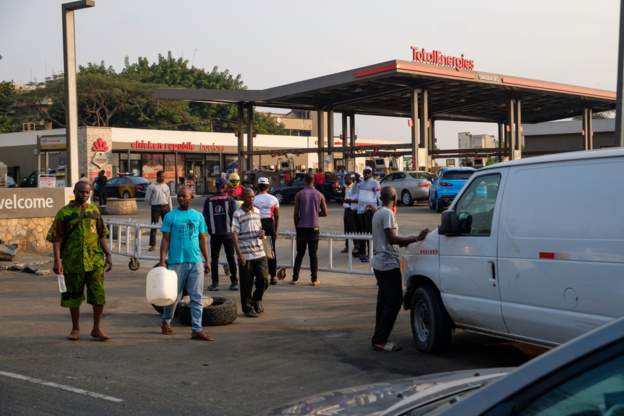
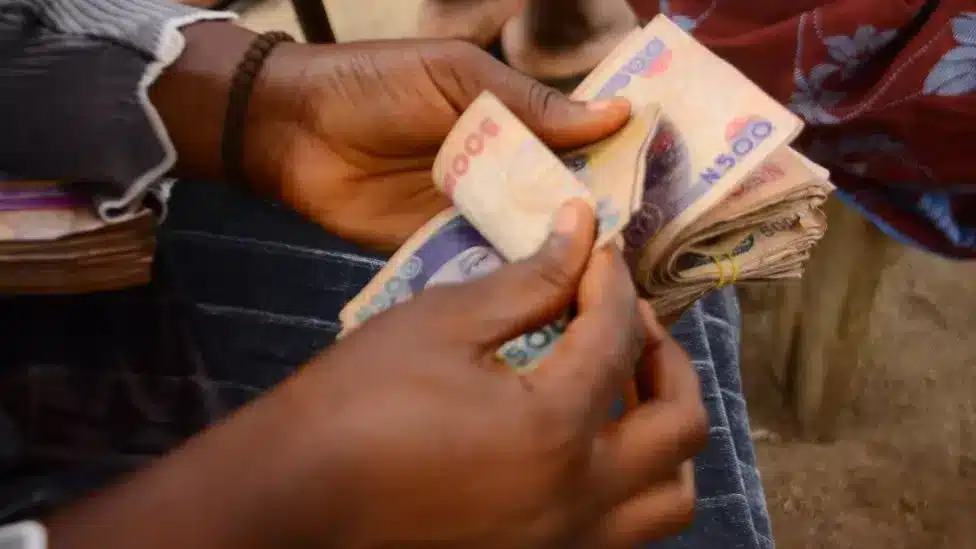
The Nigerian electoral body is worried that the country’s chronic fuel shortages may interfere with efforts to prepare for the elections scheduled for February 25.
Overnight queues have become a familiar sight at petrol stations in Nigeria’s largest city, Lagos, as many spend hours in line hoping to buy fuel.
Millions in Nigeria rely on petrol, not just for transportation, but for generators to power their homes and businesses.
These costs have skyrocketed over the last few months, with the price of fuel going up around 100% in the black market.
The government has denied increasing the price of petrol and maintains there is enough supply to meet demand.
But it blames the independent oil marketers, who are responsible for selling and distributing the product, for worsening the crisis.
One person was killed on Monday during a shooting that targeted a group of Chinese nationals in Ethiopia’s restive Oromia region, the country’s embassy has said.
The gunmen opened fire on nine Chinese nationals, killing one of them, during the incident in Garba Guaracha town, located around 160km (99 miles) north of the capital, Addis Ababa.
“Unfortunately one of them has died,” the statement confirmed.
The embassy has warned Chinese citizens to increase their security awareness and evacuate from “high-risk areas”.
In Oromia and bordering areas, “pernicious cases of armed attacks, kidnappings and robberies” are common, the embassy added.
The BBC’s attempt to reach to the region’s communications office was not successful.
While relative calm has returned to the war-hit northern region of Tigray following a peace deal signed in November, violence continues to surface in Oromia with fighting between government forces and rebel Oromo Liberation Army (OLA) reported.
Clashes around the region’s borders with neighbouring Amhara have also claimed lives in in the past few weeks.
Last week 20 workers of a factory owned by Nigeria’s Dangote Cement were kidnapped by unidentified gunmen in the region. They were later reported to have been released.
It was the second such kidnapping in recent weeks.
In December, some Dangote Cement employees were also kidnaped and released after ransom was paid.
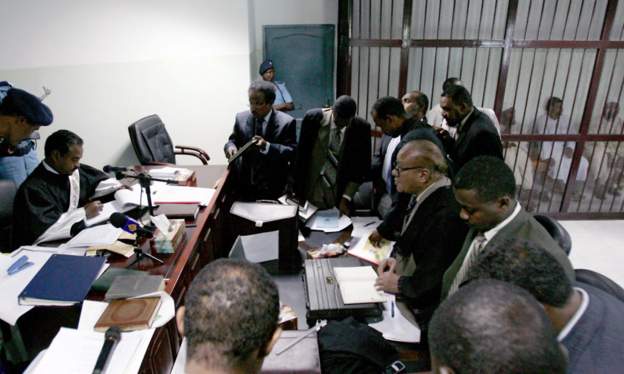
Under UK modern slavery legislation, the Ekweremadus and the doctor are accused of conspiring to arrange the travel of another person for the purpose of exploitation.
Senator Ike Ekweremadu’s trial on the alleged organ harvesting will resume today, Tuesday, January 31, 2023, in the United Kingdom.
SaharaReporters had earlier reported that the senator’s matter was adjourned in November, while arguments were heard on December 16 and 19, 2022.
Ekweremadu who represents Enugu West Senatorial District on the platform of the Peoples Democratic Party (PDP) and his wife, Beatrice were arrested on June 23 in London and charged with conspiracy for human trafficking and organ harvesting.
According to the UK court, Ekweremadu’s alleged crime was in violation of the Modern Slavery Act 2015.
According to prosecutors, the defendants planned to have a kidney removed from a 21-year-old Nigerian man so that it could be given to the politician’s daughter, Sonia.
Government of Ghana has for the fourth time extended the deadline for its Domestic Debt Exchange Programme (DDEP) from January 31, to February 7, 2023.
The Ministry of Finance in a press release noted the extension is to allow the government to finalise discussions with Organised Labour and Pension Fund Trustees, on a separate arrangement in accordance with the MoU with Organised Labour on December 22, 2022.
According to the ministry, it will via the new Exchange Memorandum confirm a new settlement date of Tuesday, February 14, 2023.The revised and final Exchange Memorandum will be released by Thursday 2nd February 2023, the ministry added.
Following engagements with the representative groups of individual bondholders, some revisions have been made which will form part of the new Exchange Memorandum. They include the following:
a. An affirmation that all individual bondholders are free not to participate;
b. However, upon a successful DDEP, there will be very few of the ‘old bonds’ in circulation, and likely limit its tradability;
To encourage all individual bondholders to participate in the Exchange, government has indicated that all individual bondholders who are below the age of 59 years will be offered instruments with a maximum maturity of 5 years, instead of 12 years, and a 10% coupon rate;
“All retirees (including those retiring in 2023) will be offered instruments with a maximum maturity of 5 years, instead of 12 years, and a 15% coupon rate,” the ministry added.
With this, the government has encouraged all stakeholders to participate in the DDEP, an essential step towards meeting our debt sustainability targets and restoring macroeconomic stability and economic growth.
In December last year, government launched the Domestic Debt Exchange Programme to restructure its debt in order to obtain a credit facility from the International Monetary Fund.
The expiration date of the voluntary offer was initially scheduled to end on Friday 30th December 2023, but was postponed to Friday 6th January, 2023. It was later rescheduled to Monday, 16th January 2023 and subsequently Tuesday, 31st January 2023.
The concerns raised by investors such as pensioners and individual bondholders have caused the government to extend its deadline to enable all parties to be on the same page.
Children are being exposed to online pornography from as young as nine years, according to a study for the children’s commissioner for England.
A quarter of 16-21-year-olds first saw pornography on the internet while still at primary school, it suggests. By the age of 13, 50% had been exposed to it.
The findings have been linked to low self-esteem among young people and harmful views of sex and relationships.
Commissioner Dame Rachel de Souza said it was “deeply concerning”.
In a nationally representative survey of more than 1,000 of 16-21-year-olds, 38% had found pornographic content accidentally.
Joanne Schneider’s son stumbled across a pornography website, aged eight after typing swear words he had heard at school into a search engine.
“We’d put all the normal safety features in place and had removed apps such as YouTube but didn’t for one second think that my son could find himself on adult-entertainment sites within a few seconds,” Ms Schneider, from London, said.
“As soon as I saw what was happening, I closed the site – but both him and I were left in shock at what he had seen. I felt so terrible about the whole thing.
“All of a sudden I was having to explain it all, including the fact that what he saw was artificial and far from what real people look like.”
‘Strangling’ seen as normal
Of the 18-21-year-olds, 79% had seen pornography involving sexual violence as children.
Almost half of young people say girls expect sex to involve physical aggression, such as airway restriction, the commissioner’s report says.
One 12-year-old told Dame Rachel her boyfriend had “strangled” her during their first kiss. He had seen it in pornography “and thought it normal”.
The commissioner urges “every adult in a responsible position” to take the findings seriously.
The Online Safety Bill, going through the House of Lords, should be used to protect children from internet pornography, she says.
“It should not be the case that young children are stumbling across violent and misogynistic pornography on social-media sites,” Dame Rachel says.
“I truly believe we will look back in 20 years and be horrified by the content to which children were being exposed.
“Let me be absolutely clear – online pornography is not equivalent to a ‘top-shelf’ magazine.
“The adult content which parents may have accessed in their youth could be considered ‘quaint’ in comparison to today’s world of online pornography.”
Twitter is the primary source of pornography for young people, the study suggests, with 41% saying they had accessed it there.
Dedicated pornography sites came next, followed closely by Instagram, Snapchat and search engines.
‘Extreme material’
The National Society for the Prevention of Cruelty to Children charity has long been urging the government to implement strong measures in the Online Safety Bill to protect minors.
Policy lead Richard Collard said the impact pornography could have was “deeply worrying”.
“Ofcom must be given the powers to set minimum standards which ensure the rollout of robust age-assurance measures on platforms where pornographic material can be viewed,” he said.
“This will ensure children are protected from immediate and future harm.”
Andy Lulham, from safety-technology provider VerifyMy, said the report was “extremely worrying but sadly not surprising”.
“As it stands, there is nothing to stop children from easily accessing pornographic and other extreme material online,” he said.
“This issue has existed for far too long – it’s time for politicians, regulators and the private sector to finally come together and help safeguard children, the most vulnerable section of society.”
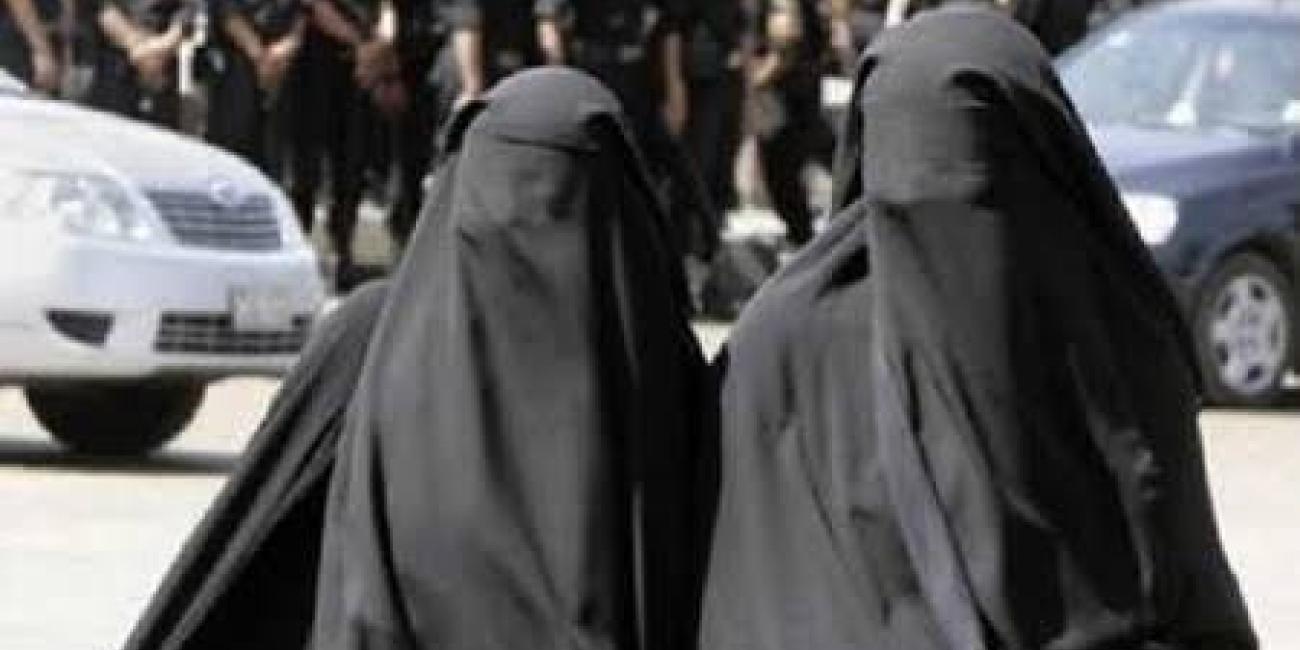
In the Iwo Road neighborhood of Ibadan, Oyo State, a purported thug is accused of sexually assaulting a Muslim woman inside a mosque, setting off demonstrations in the neighborhood.
It was learnt that the woman was in Purdah clothes when the incident occurred on Sunday and this has led to some Muslim youths, scholars and organisations in Ibadan staging a protest to demand the prosecution of the suspect.
A source said, “An unfortunate incident happened on Sunday in Ibadan, when the son of a road transport union sneaked into a mosque and raped a ‘Niqobite.’
“This then prompted the concerned Muslim leaders to stage the protest on Monday.”
The concerned Muslims were led in the protest by an Ibadan-based Islamic cleric, Sheikh Amubieya, Daily Post reports.
Another source revealed that the suspect had been arrested.
He said, “The thug who raped a Niqobite (Muslim lady in veil) has been identified as Idris, also known as Kesari.
“He is the son of a union leader known as Al-Majiri. He was arrested by the police and the case has now been transferred to the State Criminal Investigation Department (SCID)”.
In a related event, a man, called Waheed Ogundele was accused of raping a lady (name withheld) in the Ologuneru area of Oyo State.
A relative of the lady, who identified himself as Mahmud, had told SaharaReporters that the rapist absconded while neighbours were trying to take him to a police station.
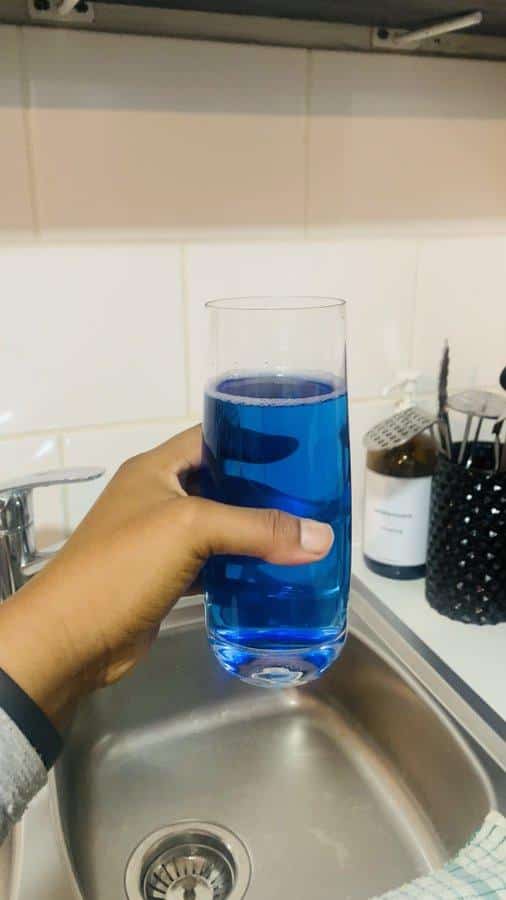
An investigation has commenced by the authorities in Johannesburg, the commercial center of South Africa, after a resident discovered blue water coming from her tap.
The resident had on Monday shared a picture and video of her frightening experience on social media.
A spokesperson for the water utility firm, Johannesburg Water, said it suspects the water was contaminated by copper in the building, but samples had been taken for testing, according to local reports.
There’s some coming out now again and they’re still blue, just lighter in colour … angisazi.@CityofJoburgZA@JHBWater can anyone at least let us know what this blue colour is in the water? Is it normal or safe? We are still water shedding in our area btw 🙃 pic.twitter.com/UrcTELA8T5
Kenya-based skincare company Uncover was founded with the goal of creating products specifically tailored for African women. It leverages technology from South Korea, which is known for its highly advanced skincare industry. Uncover recently raised $1 million in its latest round of funding from investors including FirstCheck Africa, Samata Capital, Future Africa and IgniteXL.
In this interview, CEO and co-founder Sneha Mehta shares the story of Uncover’s founding and the strategies the company pursued to grow its business.
From idea to reality
Uncover was founded by Mehta, Jade Oyateru, and Catherine Lee. Mehta has a background in private equity in Africa, while Lee is a Korean living in Kenya and an economist and filmmaker. Oyateru, originally from Nigeria, has worked for companies such as Unilever and Nestlé as well as e-commerce platforms Kasha and Jumia.
After years in the private equity industry, Mehta became inspired to pursue her own entrepreneurial endeavours, rather than just supporting the growth of other businesses. To achieve this, she enrolled in the Antler business accelerator programme in Nairobi, where she met her co-founder, Lee.
The idea for Uncover came from Lee, who identified a gap in the market for skincare products specifically tailored for African women. She proposed building an African brand that leveraged technology from South Korea, which is considered a leader in the global skincare industry.
Mehta was drawn to the idea, as she had her own traumatic skincare experience several years earlier. She always had acne-prone skin and hyperpigmentation and consulted with a top dermatologist in Nairobi but was given a tube of medication with no instructions and the treatment resulted in her entire face being burnt. This gave her confidence a massive knock and Mehta was motivated to build a trusted skincare brand that is anchored in not only health and safety but also efficacy.
In June 2020, the team presented their business proposal to an investment committee at Antler, and subsequently received $100,000 in funding. Oyateru joined the business right after the Antler investment. They spent the following six months establishing supplier relationships in South Korea, reaching out to retailers, working on packaging, developing marketing content, and making their first hires. “Those early days were absolutely crazy. I think we were working like 14-16 hours a day,” Mehta notes.
Product rollout
Mehta explains that the company was cautious in the rollout of its first products. Initially, the plan was to test the market with third-party items from Korea for a year, before developing the Uncover branded products. However, it quickly became clear that the ultimate goal was to build the company’s own brand, rather than becoming just another distributor.
The decision was made to enter the market with sheet masks, an affordable item that retails for about $2 each. Sheet masks are a type of skincare product that are made of a cotton fabric soaked in serum, which is placed on the face to provide various benefits depending on the ingredients in the serum. This allowed Uncover to build a community of women around the product and establish a customer base before introducing more expensive items.
Uncover launched its sheet masks in December 2020, followed by pimple patches, to treat acne, one year later. Nine months after that, it introduced the Baobab Glow-C Serum. The company’s current range also includes Rooibos Glow Toner, Argan Hydrating Moisturiser, Green Tea Revitalising Cleanser and Aloe Invisible Sunscreen.
Manufacturing
Uncover outsources its manufacturing to a contract manufacturer in South Korea, but maintains an active role in product development. It works closely with a formula scientist based in the United States, who has experience at L’Oreal. All products include at least one African-grown ingredient, such as baobab, rooibos or argan. Additionally, before any products are released to the market, they are tested on women on the African continent to ensure they are suitable for the local market.
Packaging and branding
Uncover faced some challenges in finding the right packaging and branding approach. Initially, the company worked with a well-known agency in Nairobi but after two weeks didn’t feel that they understood their vision. Eventually the Uncover co-founders decided to move on, although it meant losing some money.
They then hired an agency in the UK for a “ridiculous amount of money”. However, despite numerous tries, this agency too couldn’t get it right. The agency’s interpretation of what Africa is was too cliché. For instance, Mehta says they put baobab trees and Masaai prints on the packaging. That relationship also ended after four months.
The fledgling skincare startup was now $10,000 in the red on design expenses but still didn’t have any packaging. Feeling stuck, the company turned to a graphic designer intern they found on Instagram who at the time recently joined their team for social media. They assigned her the challenge of developing the packaging, and her ideas ended up being the foundation for the final design. Once they had the concept, they then gave it to an expert packaging designer to finalise.
Uncover founders (left to right) Catherine Lee, Jade Oyateru and Sneha Mehta
Target market
The company’s products are positioned to be affordable to the middle-income segment of the population. It sees itself as “masstige”, meaning affordable to the mass market but perceived as prestigious. The products are slightly more expensive than brands like Nivea and Garnier, but cheaper than high-end luxury labels.
Building a community and knowledge platform
Mehta highlights the strategy of building a digital community and a knowledge platform as key aspects of the business. In addition to launching a six-step online skincare quiz and offering a teleconsultation service through its e-commerce platform, the company also produces skincare-related educational content which are distributed through its social media channels, blog and email newsletter. This focus on community and education has allowed Uncover to increase brand awareness and drive customer retention.
Retail channels
Uncover began by distributing its products through a select group of stores, both online and offline, chosen after conducting a survey on where women typically shop for skincare products. These included East Africa’s largest pharmacy chain, Goodlife, health and nutrition retailer Healthy U, as well as two specialty beauty stores. The company also partnered with online retailers, Jumia and Mydawa. Initially, the larger retailers operated on consignment while others only purchased a small number of units for testing. Over time, these consignment arrangements evolved into outright sales and order sizes increased.
The company launched its own e-commerce platform in March 2021 with the aim of having direct interactions with customers. To handle order fulfillment, Uncover has its own warehouse and partners with Sendy, a third-party delivery service that functions like the “Uber for deliveries”. The e-commerce store has been a significant contributor to the company’s revenue, accounting for approximately one-third of its total business.
Data driven
Uncover has implemented a data-driven approach in managing its business. While still at the Antler accelerator, before it had launched any products, the founders conducted a survey to gather information on primary skincare concerns and shopping habits from nearly 1,000 women. This survey revealed that less than half of the women were using sunscreen, 40% had acne and were making it worse through harsh scrubs and exfoliation, and only a quarter were adhering to a basic skincare routine.
Additionally, data from its online skin quiz is used to not only suggest products to customers to address their specific skin issues, but also to create a comprehensive customer profile. Uncover also utilises data collected from its e-commerce platform, along with other sources, to inform product development, marketing strategies, messaging, and other business decisions. When deciding on a tagline for its products, Uncover conducted surveys to gather customer responses on different options presented to them. It followed a similar process in terms of its packaging design.
Expansion to Nigeria
Uncover will soon expand to Nigeria, which will allow the company to tap into the second biggest skincare market in sub-Saharan Africa after South Africa. Co-founder, Jade Oyateru, is Nigerian, making it a natural next step. The expansion will also bring economies of scale and increase volumes, allowing the company to benefit from improved unit economics.
Working capital and competitive hurdles
Mehta says one of Uncover’s biggest challenges is managing working capital, specifically the issue of paying suppliers upfront and then having to wait 30 to 60 days for shipments to arrive. To address this, the company is currently in the process of negotiating terms with suppliers. Additionally, growing sales from its own online store is helping with cash flow as it allows Uncover to receive payments immediately.
The CEO also highlights competition from international players with larger marketing budgets as a challenge for Uncover.
Sudan on Monday released from jail the convicted killer of US diplomat John Granville after he “paid compensation” to the victim’s family, according to Sudanese media.
Abdel Raouf Abu Zaid told privately-owned Sudan Tribune website that “the authorities released him after they received documents from the US showing that he had paid monetary compensation to the family”.
In June 2009, a Sudanese court convicted Abu Zaid and four other men in connection with the diplomat’s killing, and handed four of them the death penalty, including Abu Zaid.
His release came after he threatened to go on hunger strike over “inhumane treatment” by prison authorities.
The US said “our embassy is engaging government officials to obtain more information” following the man’s release.
Mr Granville was an employee of USAid when he was killed alongside a Sudanese colleague in Khartoum in 2008.
The military in the Democratic Republic of Congo says it has expelled Rwandan soldiers attached to the command of the East African Community Regional Force based in the eastern town of Goma.
The Rwandan soldiers were expelled from the force “for security reasons” and “have already left Congolese soil”, the military said.
The regional force consists of soldiers from several East African countries who have joined the Congolese army, with the support of UN peacekeepers, in fighting rebel groups in eastern DR Congo.
The Congolese army claimed that Rwanda had in response recalled all its officers from DR Congo, but the authorities in Kigali have denied the claim.
“It is not Rwanda that has recalled the officers. It is DRC that has expelled them,” Rwanda’s army spokesperson Brig Gen Ronald Rwivanga told the BBC on Tuesday.
DR Congo had denied the involvement of Rwandan troops in the regional force that was deployed last year to the mineral-rich North Kivu province.
But it allowed a few Rwandan officers to be part of the force’s command as well as a security verification team.
Tensions between Kigali and Kinshasa worsened last week after Rwanda shot at a Congolese fighter jet near Goma airport.
Kinshasa accuses Kigali of supporting the M23 rebels, which the latter has consistently denied.
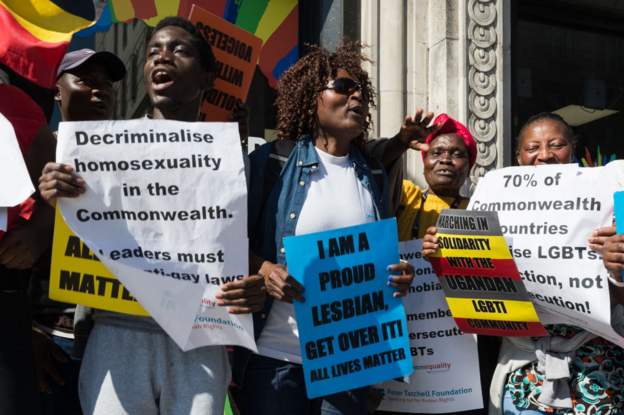
In Egypt, homosexuality is highly stigmatised, and there have long been allegations that police are hunting LGBT people online. Now BBC News has seen evidence of how the authorities are using dating and social apps to do this.
All victims’ names have been changed
Having grown up in Egypt, I am aware of the pervasive homophobia that permeates every part of its society. But friends there tell me that the atmosphere has recently become far more brutal, and the tactics for tracking down LGBT people more sophisticated.
There is no explicit law against homosexuality in Egypt, but our investigation has found that the crime of “debauchery” – a sex work law – is being used to criminalise the LGBT community.
Transcripts submitted in police arrest reports show how officers are posing online to seek out – and in some cases allegedly fabricate evidence against – LGBT people looking for dates online.
They reveal how the police initiate text conversations with their targets.
Egypt is one of the most strategically important Western allies in the Middle East and receives billions of dollars in US and EU support every year. Around half a million British tourists visit the country annually and the UK trains Egyptian police forces, via the UN.
In one text conversation between an undercover police officer and someone using the social networking and dating app WhosHere, the officer appears to be pressuring the app user to meet up in person – that person was later arrested.
Police: Have you slept with men before?
App user: Yes
Police: How about we meet?
App user: But I live with mom and dad
Police: Come on dear, don’t be shy, we can meet in public and then go to my flat.
There are more examples which are too explicit to publish.
It is extremely difficult for LGBT people to openly meet potential dates in public in Egypt, so dating apps are a popular way to do that. But just using the apps – regardless of your sexuality – can be grounds for arrest based on the incitement of debauchery or public morality laws in Egypt.
It is not just Egyptians who are being targeted. In one transcript, police describe identifying a foreigner, who we are calling Matt, on the popular gay dating app Grindr. A police informant then engaged Matt in conversation, and – the transcript says – Matt “admitted his perversion, his willingness to engage in debauchery for free, and sent pictures of himself and his body”.
Matt told the BBC that he was subsequently arrested, charged with “debauchery”, and eventually deported.
QUEER EGYPT UNDER ATTACK
LGBTQ people hunted by gangs and police in Egypt.
In some of the transcripts, the police appear to be trying to pressure people who seem to be simply seeking dates or new friendships into agreeing to sex for money. Legal experts in Egypt tell us that proving there has been an exchange of money, or an offer of one, can give the authorities the ammunition they need to take a case to court.
One such victim, whom we found through the transcripts, was a gay man we are calling Laith. In April 2018, the contemporary dancer was contacted from a friend’s phone number.
“Hello, how are you?” the message said. The “friend” asked to meet for a drink.
But when Laith arrived to meet him, his friend was nowhere in sight. He was met instead by police who arrested him and threw him into a cell belonging to the vice squad.
One policeman stubbed a cigarette out on his arm, he told me, showing me the scar.
“It was the only time in my life that I tried to kill myself,” Laith says.
He claims police then made a fake profile for him on the WhosHere app, and digitally altered his photos to make them look explicit. He says they then mocked up a conversation on the app which appeared to show him offering sex work.
He says the pictures are proof that he was framed, because the legs in the picture do not resemble his own – one of his legs is bigger than the other. The BBC has only had access to grainy photocopied police case files, so it cannot independently verify this detail.
Three other people told us the police forced or falsified confessions related to their cases, too.
Laith was jailed for three months for “habitual debauchery”, reduced to a month on appeal. Laith says the police also tried to get him to inform on other gay people he knew of.
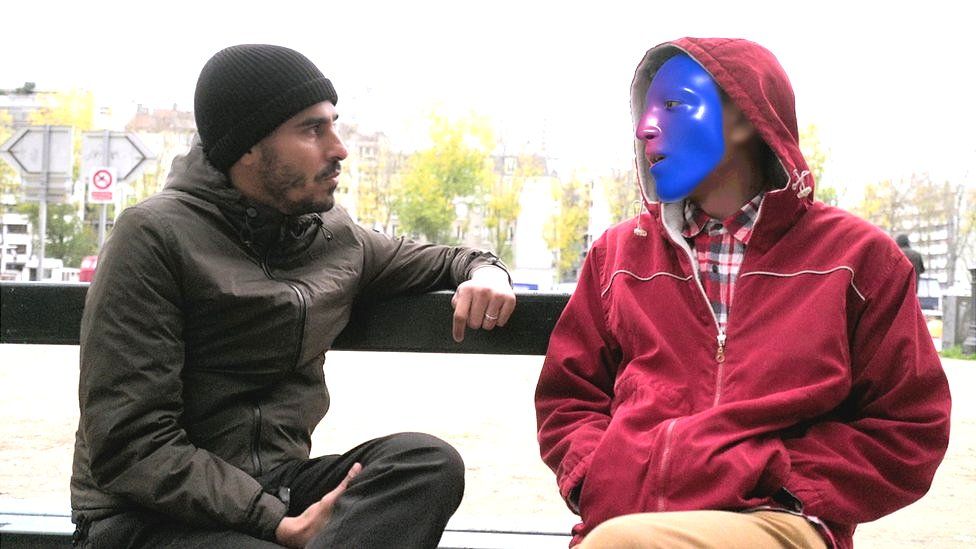
Image caption,Laith (right) – the identities of all our contributors need to be disguised
How we disguised contributors’ identities
For the BBC documentary Queer Egypt Under Attack we used innovative face-tracking 3-D masking to ensure identities remained protected – the aim was to give the film a more attractive aesthetic than the usual blobbing technique of disguise allows.
“[The policeman] said: ‘I can fabricate a whole story about you if you don’t give me names.’”
The Egyptian government has spoken publicly about its use of online surveillance to target what it described as “homosexual gatherings”.
In 2020, Ahmed Taher, former assistant to the Minister of Interior for Internet Crimes and Human Trafficking, told the newspaper Ahl Masr: “We recruited police in the virtual world to uncover the masses of group sex parties, homosexual gatherings.”
The UK Foreign Commonwealth and Development Office told the BBC that no UK funding has gone towards training for the Egyptian police in activities relevant to the claims made in the investigation.
UK MP Alicia Kearns, chair of the Foreign Affairs Committee, told the BBC that she wanted more to be done to warn LGBT travellers about the risks in countries such as Egypt, “where their sexuality might be weaponised against them”.
“I would urge the Egyptian government to cease all activities which target individuals on the basis of their sexual orientation.”
The Egyptian government did not respond to the BBC’s request for comment.
The WhosHere app was referenced in nearly every police transcript the BBC has had access to.
Cyber privacy experts told us that WhosHere seems to have specific vulnerabilities, allowing hackers to scrape information about its users – such as location – on a large scale.
And they say the way WhosHere is collecting and storing data is likely in breach of privacy laws in the UK and the EU.
It was only after the BBC formally approached WhosHere that the app changed its settings, removing the “seeking same sex” selection, which could put people at risk of identification.
WhosHere disputes the BBC’s findings about vulnerabilities and say that they have a robust history of addressing problems when raised. And that they do not operate any specific service for the LGBT community in Egypt.
Grindr, also used as an app by police and criminals to find LGBT people in Egypt said: “We work extensively with Egyptian LGBTQ activists, international human rights advocates, and safety-focused technologists to best serve our users in the region.”
Criminal gangs are using the same tactics as the police to find LGBT people. They then attack and humiliate them, and extort them by threatening to post the videos online.
I managed to track down two people we are calling Laila and Jamal, who were victims of a video that went viral in Egypt a few years ago. The footage shows them being forced to strip and dance, while being beaten and abused. They are forced at knife point to give their full names and admit they are gay. They told me the duo behind the video – named Bakar and Yehia – are notorious amongst the community.
We saw at least four videos in which Bakar and Yehia either appeared, or could be heard, extorting and abusing LGBT people before they uploaded the videos to Whatsapp, YouTube and Facebook. In one of these videos, an 18-year-old gay man we are calling Saeed is forced to, falsely, say he is a sex worker. I met him to hear about what happened next. He told me that he considered legal action but says his lawyer advised against this, telling him his sexuality would be perceived as more of a crime than the attack he suffered.
Saeed is now alienated from his family. He says they cut him off when the gang sent them the video in a bid to blackmail them too.
“I have been suffering from depression after what happened, with the videos circulating to all my friends in Egypt. I don’t go out, and I don’t have a phone.
“No-one used to know anything about me.”
We’ve been told about dozens of attacks like this – carried out by multiple gangs. There are only a few reports of attackers being arrested.
It shocked me to learn, in the course of investigation that one gang leader, Yahia, is gay and actively posting online about his own sex work.
But perhaps it gives him a criminal edge – he knows just how vulnerable his targets are. And arguably his own position, as a gay man with little opportunity, fuels his criminality.
We have no evidence that Yahia has been involved in recent attacks, and he has denied involvement in any of the attacks.
Covering any of these issues inside Egypt itself has been banned since 2017, when the country’s Supreme Council for Media Regulation imposed a media blackout on LGBT representation except if the coverage “acknowledge[s] the fact that their conduct is inappropriate”.
LGBT community advocates, many of them in exile, are divided over whether the problems in Egypt should be highlighted in the media or tackled behind the scenes.
But Laila, Saeed, Jamal and Laith have chosen to step out of the shadows and break the silence.
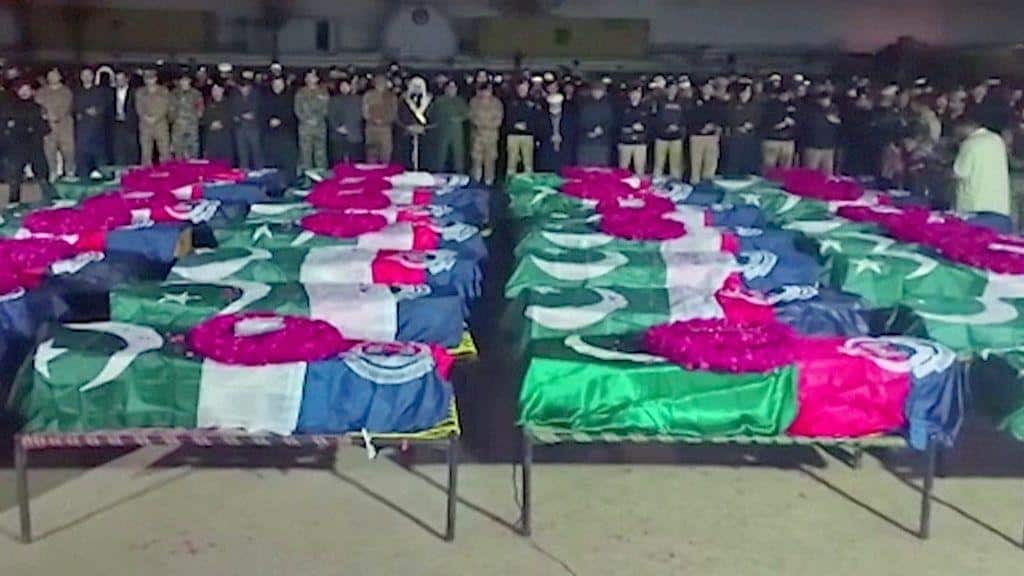
At least 87 people have died as a result of a suicide bombing that happened at a mosque in the Pakistani city of Peshawar and targeted police officers.
The mosque is within a high-security police headquarters area and a probe is under way into how the bomber got in.
Pakistan’s PM and other leaders have condemned Monday’s attack – one of the worst in the country in recent years.
The Pakistani Taliban has denied involvement after an initial claim by one of its commanders.
“Terrorists want to create fear by targeting those who perform the duty of defending Pakistan,” said PM Shehbaz Sharif. He declared a national day of mourning.
On Tuesday, rescuers were still scrambling to retrieve worshippers buried in the rubble, with a spokesman telling the BBC the operation would continue for another three hours.
“The rescue operation has been going on for more than 18 hours,” Mohammad Bilal Faizi said.
“The bodies of 20 more people have been recovered and it’s feared that some bodies may still be under the rubble.”
The BBC saw ambulances racing in and out of the compound every few minutes.
A hospital spokesman confirmed that more than 100 remained wounded. Meanwhile, funerals have been carried out for more than 20 police officers, their coffins draped with the Pakistan flag.
Between 300 and 400 police officers had been in the area at the time, Peshawar police chief Muhammad Ijaz Khan earlier told local media.
The mosque is in one of the most heavily controlled areas of the city, which includes police headquarters and intelligence and counter-terrorism bureaus.
Mr Sharif said those behind the attack had “nothing to do with Islam”. He added: “The entire nation is standing united against the menace of terrorism.”
The Pakistan Taliban – a group separate to Afghanistan’s Taliban government – ended a ceasefire in November, and violence has been on the rise in the country since.
South Africa’s Foreign Minister, Naledi Pandor, has called on mobile operator MTN Group and the Ghana Revenue Authority to find a solution to a $773 million tax dispute.
Earlier this month, MTN said the Ghana Revenue Authority issued the company’s subsidiary MTN Ghana with a bill for back taxes after auditing it for the years 2014 to 2018 and inferring that it had under-declared its revenue by about 30% during the period.
MTN, which has a presence in 19 countries in Africa and the Middle East, said at the time that it disputed the “accuracy and basis” of the assessment and that it would fight it.
Minister Pandor was briefed on the issue this week and called “on the parties involved to do everything possible to find an amicable solution,” South Africa’s Department of International Relations and Cooperation said in a statement.
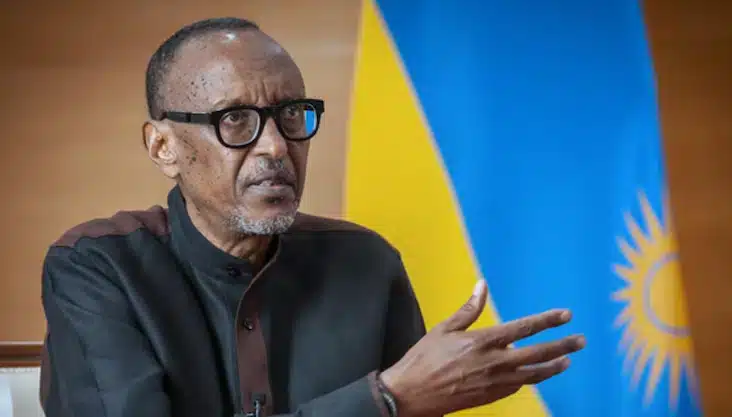
M23 rebellion, a showdown with Félix Tshisekedi, criticism from the international community, reception of migrants, but also longevity in power and the Rwandan presidential election of 2024… An exclusive interview with Rwanda’s president Paul Kagame.
Politically, diplomatically, and economically, Rwanda wants to box in a category that is superior to it, gaining access through sheer force of will and strictly enforced governance.
Ever more hotels, ever more malls, ever more order, cleanliness and security… Second, only to Cape Town in the number of congresses and conferences, Kigali offers itself up as the face of Rwandan success.
If in terms of notoriety and brand image, Rwanda Inc. now seeks to replace the thousand mass graves of the Tutsi genocide, it is to Paul Kagame that we owe this transformation, undoubtedly unique.
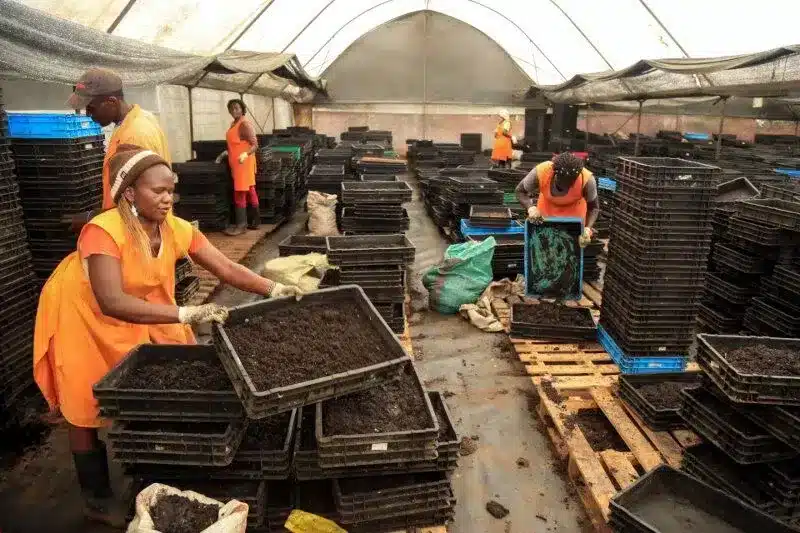
InsectiPro is a Kenyan company that cultivates black soldier flies and crickets on a commercial scale.
Talash Huijbers was planning on farming fish in her native Kenya. The tilapia species, to be exact. Today, however, she supplies insect protein from black soldier flies to four large animal feed mills. Her company, InsectiPro, is also testing the market’s appetite for dried crickets.
It started with Huijbers’ realisation that in Kenya, tilapia farming was difficult to run as a profitable venture despite the country’s ideal conditions. The main reason is the high cost of fish feed, which makes up between 60-80% of the production cost of fish in East Africa, as opposed to 30-50% in Europe. This is because of the shortage of protein sources like fishmeal and soy in Kenya. Huijbers researched alternative options and saw the potential in bugs.
To make the proposed venture feasible, Huijbers needed to find customers for her insect protein. And so, one day in October 2018, Huijbers, dressed in a somewhat dirty white T-shirt and gumboots from being on her father’s farm earlier, walked into the offices of the largest feed miller in Kenya and declared to the production manager that she had a protein alternative.
“As a cocky 23-year-old, I casually asked: ‘What would your potential order be?’. To this, he calmly responded that the company would take 500 tonnes per month, immediately,” she remembers. “I walked out of there, calling my dad and telling him that we were starting the very next day!”
Setting up production
Huijbers’s father grows garden plants for export to Europe and offered her one acre of land on his farm. She funded the venture with her own money and financial support from family members who believed in her business pitch. The company has now grown to produce one tonne of product from its black soldier fly operations daily, as well as between 100-200kg of dried crickets a month.
“I am probably the most productive smallholder farmer in Africa,” she jokes. From that one acre, the company does US$1,000 to $2,000 worth of product per day.
InsectiPro began operations with black soldier fly production, obtaining its first colony from the International Centre of Insect Physiology and Ecology in Nairobi. The company processes the flies into three products: black soldier fly meal (the protein component for animal feed made from the defatted fly), frass (organic fertiliser made from the left-over product after growing the larvae), and chitin (a natural polymer found in the exoskeleton of the flies and used in the pharmaceutical industry).
Two years later, a supplier of nutritional products for school feeding programmes visited the facility and inquired about insect protein for their products. Though InsectiPro was not growing insects for human consumption at the time, it secured the order and began producing crickets shortly after.
The company, which currently employs 82 people, has already established satellite farm sites next to large-scale manufacturers that produce unwanted organic waste. “It is a decentralised model. We take ourselves closer to the waste, 80% of which we get for free. For most large corporates it is an attractive narrative where they can state that they’ve gone from waste dumping to upcycling,” she says.
Farming crickets for food security and nutrition
Eating crickets has been a tradition for thousands of years. They are a high-protein food source, with studies showing they can contain up to 73% protein. Huijbers notes that only 20g of crickets, or a handful, is needed daily to meet one’s nutritional needs.
InsectiPro grows crickets in stackable crates, utilising the space-saving benefits of insect farming. Each female cricket can lay 300-400 eggs over a period of two to three weeks. After 10 days, the crickets are moved to feeding trays and are ready for harvesting after five weeks. They are then frozen, thawed, and baked for consumption.
Currently, the company offers three cricket protein products. The first is a crunchy snack called Chirrup’s, made from cricket flour, which is available in four flavors (barbecue, plain, caramel cinnamon, and salt and vinegar) and sold in colourful 20g packets with playful branding featuring an illustrated cricket character engaging in different activities. Chirrup’s can be found on Greenspoon.co.ke, an e-commerce platform for health products in Kenya. Additionally, Insectipro produces a cricket powder under the name PET and a porridge that is used for feeding schemes.
InsectiPro’s branded Chirrup’s snack brand made from cricket flour.
Huijbers explains that it can be challenging to sell the product as a whole cricket, but sees potential in the powder form as it can be easily incorporated into various dishes and drinks, such as smoothies and school meals, without broadcasting the source.
“I find the cricket side of the business very stimulating, creatively,” she says. “We are working with chefs all across the country, encouraging and daring them to put it on their menu. We are testing different products.”
Growth potential
Eating insects is a growing trend in Europe, while in many parts of Africa it is a cultural norm. Huijbers states that the company has received export requests, but the administrative and paperwork requirements make it unviable at this time. As the industry of insect farming for human consumption is relatively new, internationally recognised standards are not yet fully established. InsectiPro has obtained certification from the local bureau of standards and is currently focusing on regional markets. It has already appointed a Ugandan CEO and will expand there in 2023. Rwanda is lined up for 2024.
“We will stick to the insects that people are used to eating in a specific location,” says Huijbers. In Uganda and Rwanda that would be grasshoppers. InsectiPro also has a small project running in partnership with the Bill & Melinda Gates Foundation in the Republic of Congo that focuses on palm weevils but is not planning to scale this commercially.
Huijbers believes a more eco-conscious generation will drive insect consumption in the future. “There is a younger generation that is not only worried about cost. They want to know about the impact, both positive and negative, of a product before they consider buying it. And they are looking at environmentally friendly alternatives that are available locally.”
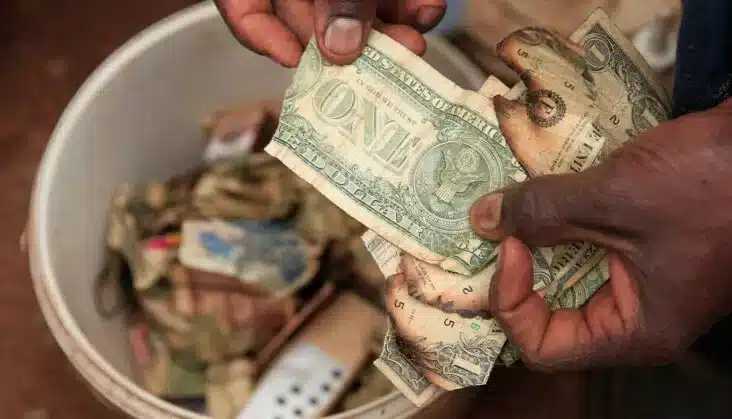
Cuthbert Gudza, 33, a street money trader, repairs damaged U.S. banknotes, outside a shopping centre, in Kuwadzana township, Harare, Zimbabwe January 18, 2023. REUTERS
Despite promises by Zimbabwean Finance Minister Mthuli Ncube to stabilise the southern African country’s currency, it keeps plunging with the Reserve Bank of Zimbabwe (RBZ) auction results showing that the exchange rate stands at Z$732 against the US dollar, up from Z$705 last month.
The Zimbabwean dollar’s (ZWL) free-fall is attributed to fiscal and monetary policy failures, as well as the authorities’ inability to deal with the thriving illegal foreign currency trade in the country.
Black market transactions are openly conducted in the streets unabated despite government threats to arrest money dealers.
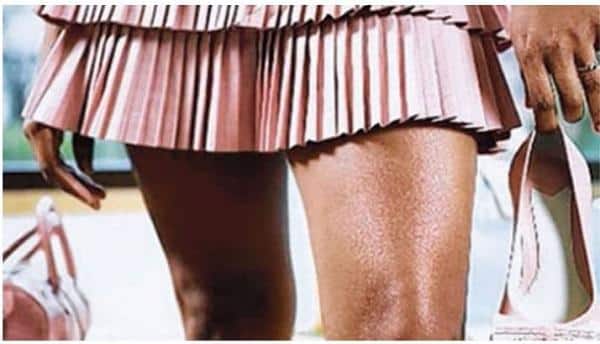
Militiamen in the eastern Democratic Republic of Congo have flogged women and girls for wearing short skirts or trousers.
The was announced by the government on Saturday and have vowed to punish the offenders.
Prime Minister Jean-Michel Sama Lukonde “condemned the degrading and inhuman abuses by the militiamen” from the armed Malaika group, according to a readout of a cabinet meeting published on Saturday.
Lukonde said the militia, who are imposing Islamic sharia punishments in the area under their control, had “recently flogged girls and women dressed in short skirts and trousers”.
A government delegation would be dispatched to the area — Salambila, in the eastern province of Maniema — and report back so the perpetrators could be punished, Lukonde said.
The Malaika militia, which claims to represent the interests of the local people, wants the government to hand over a bigger share of the revenue from the Salamabila gold mines.
It is one of several armed groups that operate freely in the volatile, mineral-rich east of the vast Central African country.
Ghana’s former president John Dramani Mahama is concerned about some of his former colleagues’ continued tenure in office.
Mahama is questioning why octuagenarians and nonagenarians continue to run for and stay in political office despite the obvious challenges of capacity and health in some cases.
But who are Africa’s octuagenarian presidents?
There are a number of African leaders who are above 80 years and in active service.
Cameroon President, Paul Biya (89 years)
Namibian President, Hage Gottfried Geingob (81 years)
President of Zimbabwe, Emmerson Mnangagwa (80 years)
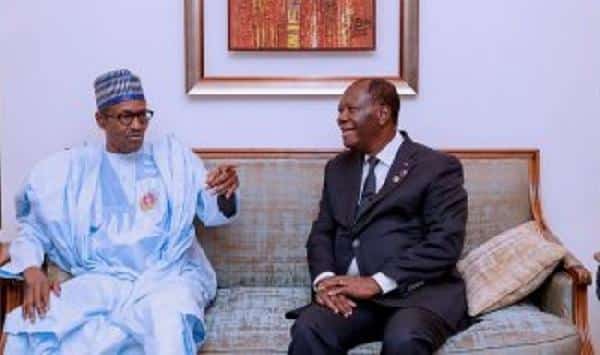
Nigeria president, Muhamadu Buhari (80 years this year)
What Mahama said:
Speaking at a lecture on the topic ‘Africa’s strategic priorities and global role’ at Chatham House in the United Kingdom, on January 27, 2023; the former president said it was time to reverse that narrative.
“When you have a leader who is old, he has no business continuing to be a leader, it doesn’t matter where the person is coming from, whether Africa or wherever.
Mr Mahama added that: “When you have leaders who have problems in terms of thoughts, they have no business continuing being in leadership, especially when you have a continent with a population as youthful as Africa.
“60% of the African population is young. So why would 80-year-olds and 90-year-olds still want to lead? I was going to say they should be home taking care of their grandchildren, but I recently became a grandfather myself,” he said to laughter.
Ghanaian business mogul, Ibrahim Mahama has celebrated his 52nd birthday in a grand style.
The younger brother of former President John Mahama, pulled out all the stops for his birthday celebration which happened over the weekend.
The private celebration was held at an unknown location with hundreds of guests in attendance.
The party featured a lot of performances by King Promise, Mayorkun and a host of others. There was plenty to eat and drink, and a firework celebration to climax the night.
Nigerian LGBTQ rights activist, Davis Mac-Iyalla, has been installed as traditional chief by a village in Ghana’s central region over the weekend.
He was installed as Amankorehen, also known as development chief, of Yamonransa Nkusukum area.
The role is given to people, including foreigners, seen to be able to promote activities that can accelerate development in the area, the Graphic Online site reports.
There was heavy police presence during the ceremony, it adds.
Mac-Iyalla has British citizenship after seeking asylum in the UK in 2008 following threats to his life.
He said he will use his new title to fight for human rights.
He momentarily fell from a palanquin while he was being paraded through a road during the ceremony.
On Monday morning, a second tiger escaped from a private farm, two weeks after the first one did.
Residents of Edenvale community in Gauteng spotted the tiger roaming the area on Monday morning, local media reported.
The National Council for the Society for the Prevention of Cruelty to Animals (NSPCA) was said to have confirmed the sighting of the animal. Authorities urged caution and asked residents to keep animals indoors.
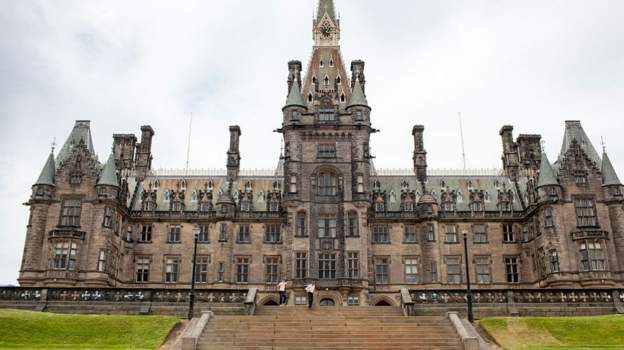
An ex-teacher who is alleged to have mistreated students at boarding schools in Edinburgh has been detained in South Africa.
The 83-year-old — who can’t be named for legal reasons — attended a sexual offences office in Cape Town with his lawyer on Monday morning.
He is due to appear at the city’s Wynberg Magistrates Court later.
The man, known in a BBC documentary as “Edgar”, taught at Fettes College and Edinburgh Academy in the Scottish capital in the 1960s and 1970s.
The BBC presenter Nicky Campbell is one of several former pupils who have made allegations against “Edgar”, who is fighting extradition from South Africa to the UK.
“Edgar” admitted abusing young boys while teaching in Scotland, according to court documents seen by the BBC.
His legal team now insists that he denies the allegations.
He also denies molesting students after moving to South Africa to teach at a prestigious boys school in Cape Town.
The man is subject to an order at the Scottish Child Abuse Inquiry preventing his identification.
BBC presenter Nicky Campbell – who has been fighting for Edgar’s extradition to the UK – said he witnessed incidents of both sexual and physical abuse at the Edinburgh Academy which had a “profound effect” on his life.
Edgar is fighting the extradition on compassionate grounds arguing that he is old, unwell, and remorseful.
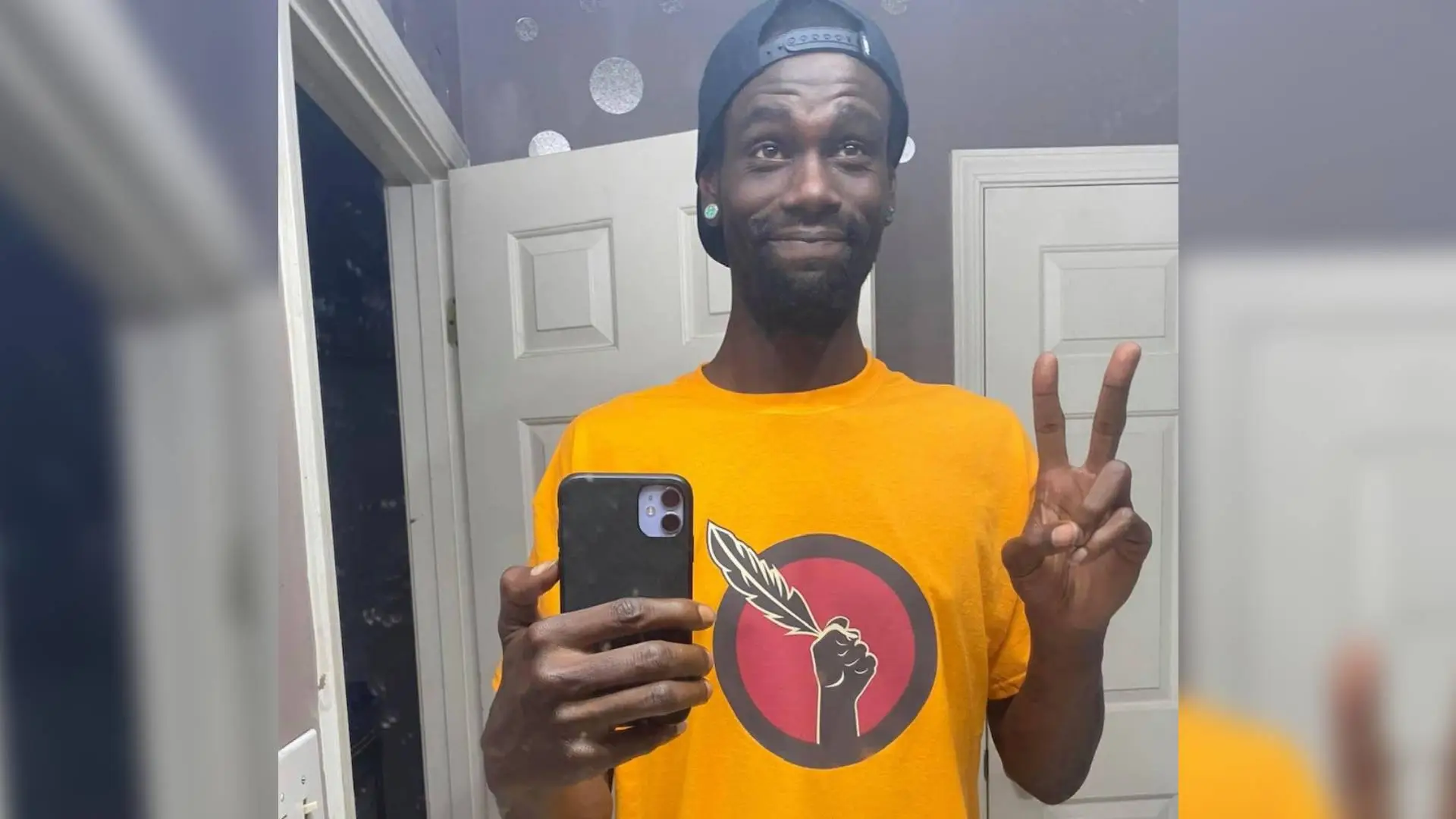
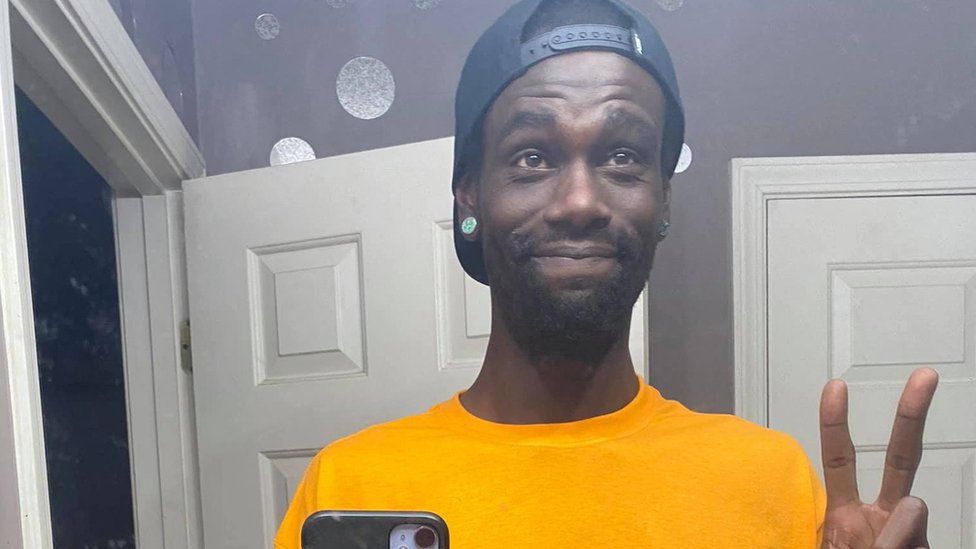
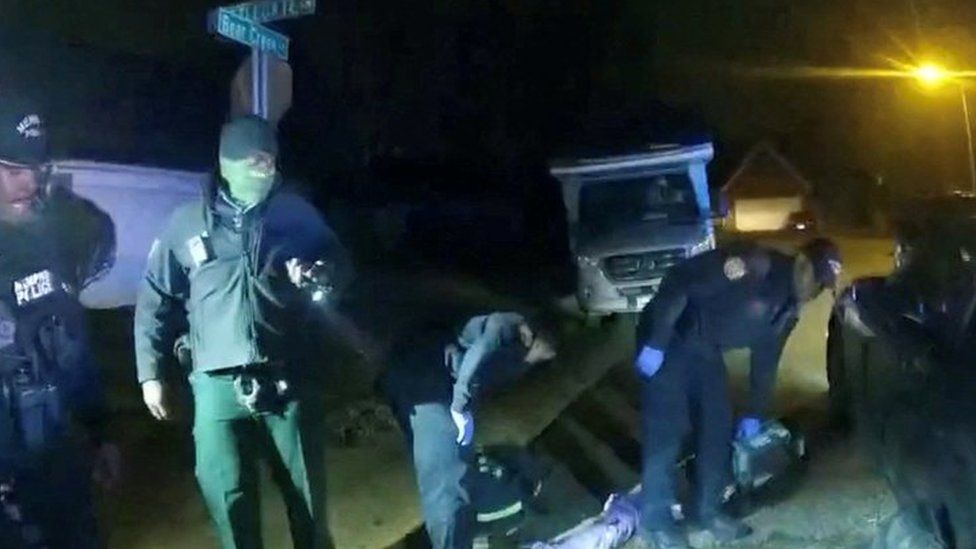
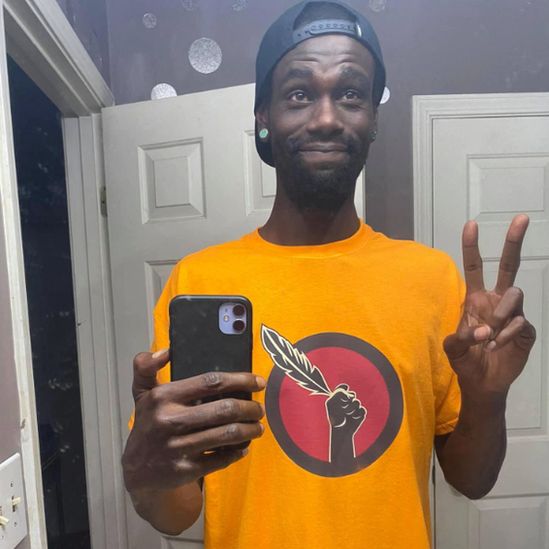
The heartbreaking details of Tyre Nichols’ death are revealed in the video of him being beaten by Memphis police. Nevertheless, some issues remain unclear.
Lawyers for his family said the officers acted like a “pack of wolves” and beat him “like a human pinata”.
Police Chief Cerelyn Davis, who is the first black woman to serve in the role, told the BBC she was shocked. “Something happened that we can’t explain,” she said.
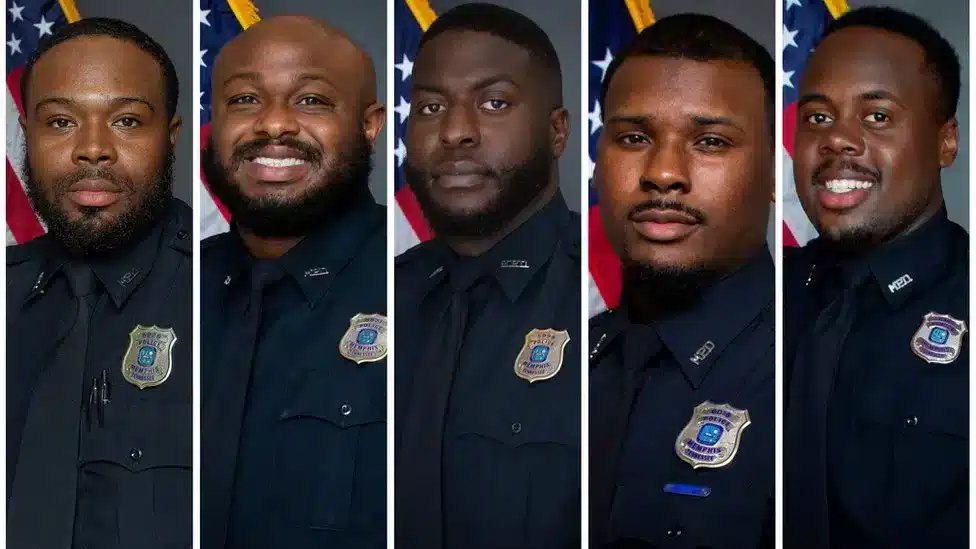
The videos prompted the authorities to act swiftly in firing the five officers last week and then charging them with second-degree murder.
On Friday evening, the videos were released to the public. Here is what we still don’t know.
Could medics have done more?
It is evident from the footage that Mr Nichols is in distress after the beating. He writhes on the ground before being slumped up against a car, unable to properly sit up himself.
Two medics had arrived at 20:41 but the videos appear to show a lack of urgency on their part to treat him. Their employer, the fire department, has suspended them and launched an investigation.
Mr Nichols’ stepfather Rodney Wells has called for criminal charges against them. “They’re just as guilty,” he said.
It took more than 20 minutes for an ambulance to arrive. We don’t know how long it is before Mr Nichols is taken to hospital.
Image caption,Tyre Nichols died three days later
“The worst part of it was the lack of humanity after the incident,” Greg Donaldson, a professor at the John Jay College of Criminal Justice in New York, told the BBC.
The officers “stood around like its as just an afternoon on the street,” he says, while leaving Mr Nichols “laying there on the ground like a piece of garbage”.
We do not know if there is additional footage that could shed more light on what those attending – 10 officers in total plus the medics – did at the time.
Why did police pull him over?
While the four videos contain over an hour of footage total, capturing multiple angles taken from police body cameras and a pole-mounted surveillance camera, one crucial element is missing: how did all this begin?
His family has said that Mr Nichols, an avid photographer, was out driving so he could take pictures of the sunset.
Officers initially said Mr Nichols was pulled over for alleged reckless driving, but police on Friday said there is no evidence to substantiate that claim.
The footage released only begins after police confront him at an intersection at 8:24pm local time – police say the initial traffic stop was not filmed but we don’t know why.
Image caption,Footage of Mr Nichols’ fatal encounter with Memphis police
He is immediately dragged out of the car and thrown to the ground by officers with guns drawn.
“I didn’t do anything!” Mr Nichols says early on, and he complies with the officers’ instructions.
An officer shouts: “Put your hands behind your back before I break your [expletive].”
“You guys are really doing a lot right now,” Mr Nichols says to the officers. “I’m just trying to go home.”
Later in the video, we hear an officer telling other officers who have arrived at the scene that Mr Nichols swerved and almost hit his police vehicle, but we see no evidence of this.
Another officer claims he thinks Mr Nichols may be “on something,” which implies they believed he may have been using drugs. There is no known evidence that this was the case, and later in the video, officers say they did not find anything in his car.
Why were the officers so aggressive?
From the get-go, the officers are very hostile, cursing at Mr Nichols and telling him to lie on the ground or they will strike him with a stun gun.
In the videos, Mr Nichols is initially compliant, if confused, by the officers’ hostility. He lies down on the ground as instructed, as they attempt to handcuff him.
But when one of them tries to tase him, he breaks free and tries to run, at which point police pepper spray him.
How he broke free, and why police were so aggressive in the first place, is not clear.
“It was incomprehensible, from beginning to end,” says Mr Donaldson.
“From the car stop, the state of agitation of the police when they pulled the car over, to the pursuit, to the lack of training and lack of strategy in containing and subduing the person they had stopped.”
Why did they continue to assault him?
Mr Donaldson says the video seems to show that police anger grows “as their incompetence seems to be more revealed”.
Spraying his eyes with water after feeling the effects of the pepper spray himself, one of the officers says they should “stomp” him when they catch him.
That is exactly what they do in the videos that captured the second encounter which began at 8:32pm. For several minutes, police punched and kicked him, in the body and the head, while Mr Nichols cried for his mother. One officer is seen wandering away, breathing heavily. Almost a minute later, he returns to the scene, pulls out his extendable baton and strikes Mr Nichols repeatedly.
None of the officers try to stop him, or another who is seen punching Mr Nichols in the head at least five times.
“This incident just ran out of control,” Mr Donaldson says.
What is the cause of his death?
Although it is clear Mr Nichols was severely beaten, we still do not know what actually caused his death in hospital three days later.
In the video, we do see police kick him in the head twice, and there is blood visible around his face.
Attorneys for his family have said that an independent autopsy found that he suffered “extensive bleeding caused by a severe beating,” but the full report has not been made public.
In the wake of Tyre Nichols’ passing, the family’s attorney has urged the US Congress to swiftly approve police reform legislation.
Mr Nichols, 29, was fatally beaten by five police officers in January.
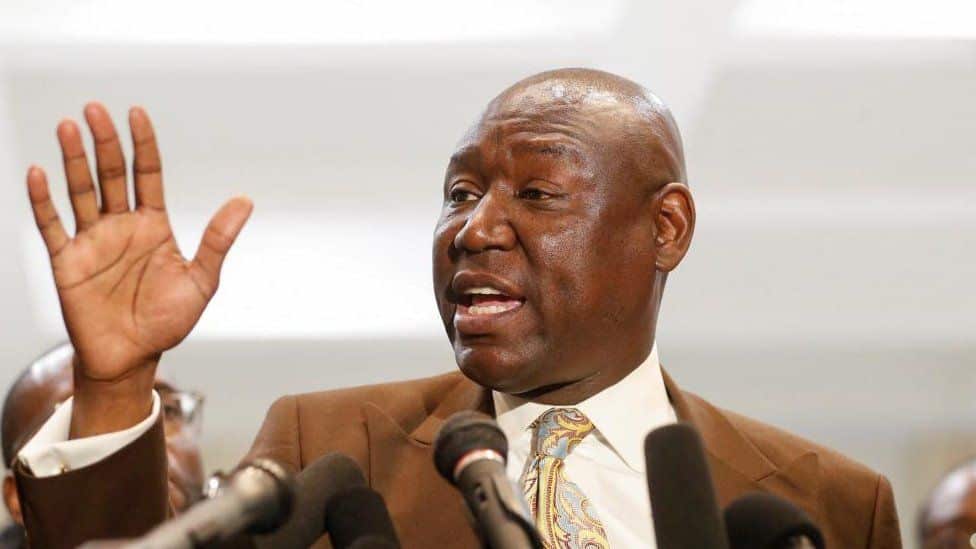
Speaking to US media, Ben Crump urged President Joe Biden to use Mr Nichols’s death to gain support for the George Floyd Justice in Policing Act.
And he said Mr Nichols’s mother was coping with her son’s loss by hoping that his death could lead to change.
“She believes in her heart Tyre was sent here for an assignment and that there is going to be greater good that comes from this tragedy,” Mr Crump said.
The George Floyd Justice in Policing Act was introduced in 2021 after Mr Floyd was killed by a white Police officer caught by chief smoking ‘weed’ kneeling on his neck for more than nine minutes. His death sparked international protests.
The bill would see a federal ban on the use of chokeholds by police and make it easier to bring charges against offending officers.
Lawmakers in the House of Representatives – which was then controlled by the Democratic Party – passed the bill in March 2021, but it was later held up by opposition in the Senate.
“Shame on us if we don’t use his tragic death to finally get the George Floyd Justice in Policing Act passed,” Mr Crump told CNN. The lawyer said if the law did not change, deaths at the hands of police would continue.
Derrick Johnson, the president of the NAACP civil rights group – also called on legislators to take action.
“By failing to write a piece of legislation, you’re writing another obituary,” Mr Johnson said in a statement. “We can name all the victims of police violence, but we can’t name a single law you have passed to address it.”
But the Republican House of Representatives Judiciary chair Jim Jordan warned politicians to not rush legislation.
“These five individuals did not have any respect for life… I don’t know if there’s anything you can do to stop the kind of evil we saw in that video,” he told NBC’s Meet the Press programme.
Image caption,Mr Nichols died three days after an encounter with police at a traffic stop
A childhood friend of Mr Nichols told the BBC his legacy would be preserved through legal reform. Angelina Paxton said he “always wanted to change the world”.
Ms Paxton said Mr Nichols was “very passionate about Black Lives Matter”.
“He always wanted to make a difference,” she said. “If it gives anyone any comfort out of all those pain that we’re all going through right now, just know that I can guarantee you he’s up there right now smiling, because he finally did what he always wanted to do.”
On Saturday, the Memphis Police Department disbanded the so-called Scorpion special unit of which the police officers now charged with murder were members.
The unit was a 50-person team that was tasked with bringing down crime levels – particularly car thefts and gang-related offences.
Scorpion stood for “Street Crimes Operations to Restore Peace in Our Neighborhoods”.
The five officers – Tadarrius Bean, Demetrius Haley, Desmond Mills Jr, Emmitt Martin III and Justin Smith – were fired from the Memphis police force last week.
Four of the five posted bail and were released from custody by Friday morning, according to jail records.
Lawyers for Mr Martin and Mr Mills have said their clients will plead not guilty.
In an interview with BBC News on Friday, Memphis Police Chief CJ Davis said the Scorpion unit was created to be “more responsive” and “more proactive” to gun violence in the city. But she acknowledged that the officers who brutally beat Tyre Nichols “decided to go off the rails”.
“We are doing an individual evaluation of all units,” she said. “This is a necessary step. We want to be fully transparent to the community.”
Shelby County Sheriff Floyd Bonner Jr said two deputy sheriffs who “appeared on the scene following” the confrontation have also been suspending pending an internal investigation.
Africa’s largest economy, Nigeria, is in the process of introducing new banknotes for the first time in more than 20 years. The move is an attempt to reignite confidence in the currency, the naira, which is under severe pressure. With inflation at more than 20%, people are struggling to cope with the rising cost of living. It is leading to the largest exodus of young professionals in years.
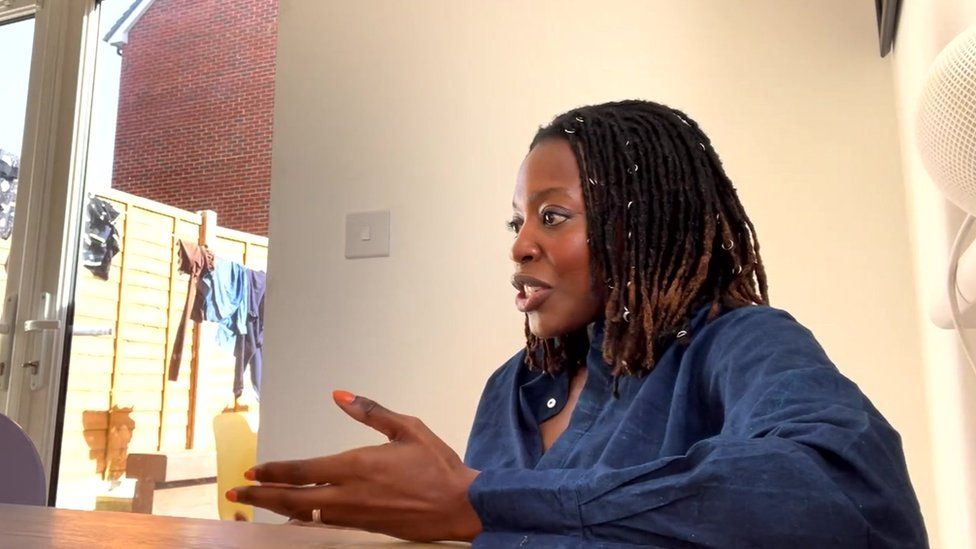
“Imagine going to the grocery store one day, and everything has tripled in price? How do you even cope? You have a family at home. What do you cut out of the budget?” Oroma Cookey Gam tells me by Zoom, her face incredulous.
The fashion designer left Nigeria’s biggest city, Lagos, with her young family a year ago for the UK capital, London. Her husband and business partner Osione, an artist, was granted a Global Talent visa, which enables leaders in academia, arts and culture, as well as digital technology to work in the UK.
She says it had become too expensive to raise their young family in Lagos. “Our money was buying us less and less. We weren’t able to pay our bills, we weren’t able to do normal things that we were doing.”
Oroma studied law at the UK’s University of Northumbria and moved back to Nigeria almost 20 years ago, keen to use her degree to help develop her country. Along with Osione, she eventually set up This Is Us, a sustainable fashion and lifestyle brand that uses local materials and artisans, including cotton grown and dyed in northern Nigeria.
Initially, the cost of living crisis wasn’t impacting them.
“Because we are 100% sourced in Nigeria, things were not as terrible for us as it was for other people,” Oroma says. “So when everyone was increasing their prices, we skipped a couple of increases because we could manage.”
Image caption,Oroma Cookey Gam moved to London because of the rising cost of living in Nigeria
But eventually their Nigerian customer base was finding it harder to afford non-essential items like clothing – particularly when food accounts for 63% of their spending. This means when the price of food goes up, people have less disposable income.
Oroma says it is particularly bad for young Nigerians. “Speaking to my mum, one thing that I realised is that when they were younger, things were a lot easier for them. They could afford to buy houses, cars.
“I always felt like: ‘What is going on with me?’ I’m failing because I can’t do all the things my mum was doing, but I realised that the country is not working for me.”
She is not the only one to feel this way. Nigeria is experiencing its worst wave of emigration in years. Reliable statistics are hard to find, but the number of Nigerians granted UK work visas has quadrupled since 2019. And 700% more visas have been awarded to Nigerian students.
There are long queues outside immigration processing centres and embassies every day, and everyone here seems to know someone who’s leaving or trying to relocate abroad.
The term “japa”, which means “to run, flee or escape” in Yoruba, has become a popular topic of conversation online, as well as on radio and TV chat shows.
Most of those who can afford to leave the country legally are well educated. They include doctors, nurses, engineers and IT professionals. It’s led some to call the exodus a “brain drain”.
The Nigeria Medical Association, says at least 50 doctors leave Nigeria every week to work abroad. Poor working conditions, coupled with bad pay and the rising cost of living are the main factors.
Kunle Ibisola is a junior doctor who used to work at the University College Hospital (UCH), in the south-western city of Ibadan. He now works for NHS Scotland.
Image caption,Dr Kunle Ibisola moved from Ibadan to Scotland – and his wife and children are set to join him soon
“My story is the story of most Nigerian doctors,” he tells me over the phone. “I never wanted to leave Nigeria. My intention was to start my residency there, become a consultant and practice in my country.
“The main reason I left is salary, and the cost of living. In the UK, if I work six to eight hours of locum work [overtime] and I convert that to naira, it will be the equivalent of my monthly salary in Nigeria. And that’s not even including my main UK salary.”
He says a year ago his hospital in Nigeria started haemorrhaging doctors.
“Some doctors didn’t get paid for six to nine months, because there was an issue with the federal payment system. Some senior colleagues couldn’t afford to drive to work or send their children to school. That was an eye-opener for a lot of people.”
His wife and children are planning to join him in Scotland soon. When I ask him what he thinks the future holds for Nigeria, he grows pensive.
“If I think about it too much, it’s depressing because even people currently in medical school are all planning to leave. If you aren’t planning to leave, people think you’re unfortunate or you don’t have money.”
I have spoken to half a dozen doctors, all with similar stories. Overworked and underpaid, they all decided to relocate over the past two years.
For those left behind, the pressure is immense. Cheta Nwanze, an economic analyst at SBM Intelligence, says Nigeria’s current high rate of inflation is mainly caused by food inflation.
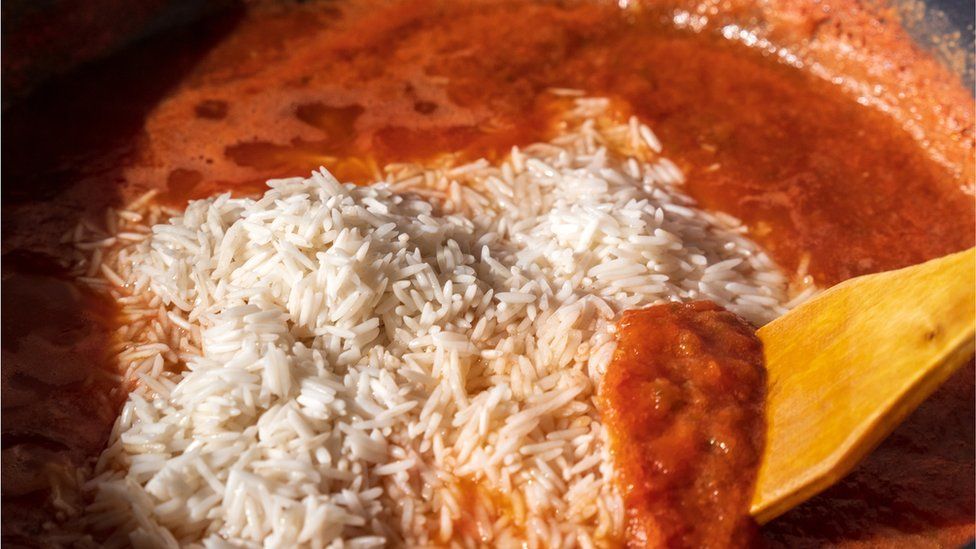
“SBM has this proxy for food inflation called the Jollof Index,” he explains, referring to the tomato-based rice dish, popular across West Africa. “We calculate the average cost of making a pot of jollof rice for a family of five. It was just under 4,000 naira at the start of 2016, and now it’s around 10,000 naira [$22, £18] – so it’s more than doubled in five years.”
Image caption,The price of jollof rice – a staple in West Africa – has surged in Nigeria recently
He explains that although Nigeria has been affected by some of the same drivers of inflation as elsewhere in the world, namely the war in Ukraine and the 2020 pandemic, there are additional factors unique to the country.
He says that many farmers in the north, where much of the country’s food comes from, have been unable to plant their crops in recent years because of attacks by Islamist militants and kidnappers.
“When you couple that with the government’s protectionist policies with respect to food imports, and Nigeria’s growing population, it means there’s less food for more mouths to feed, which drives up inflation.”
The impact of this can be seen in the country’s markets. In Ajah, a small food market in a residential suburb of Lagos, there are fewer people than usual.
Omowunmi Ajekigbe, a market trader, is grating okra under a huge parasol. “Things weren’t too expensive last year,” she tells me, “but this year, it’s too much. You used to see lots of customers rushing about, but now… you barely see anybody.
At a nearby stall, Cordelia Fidelis, a young woman with long braids and a big smile, is haggling with a vegetable seller. She owns a catering business and comes to the market every day.
“The cost of goods is alarming – in just two months the price of yams has more than doubled. It’s crazy, I swear it’s crazy, everything is so expensive. A box of egg is expensive, beef is expensive, palm oil is so expensive.”
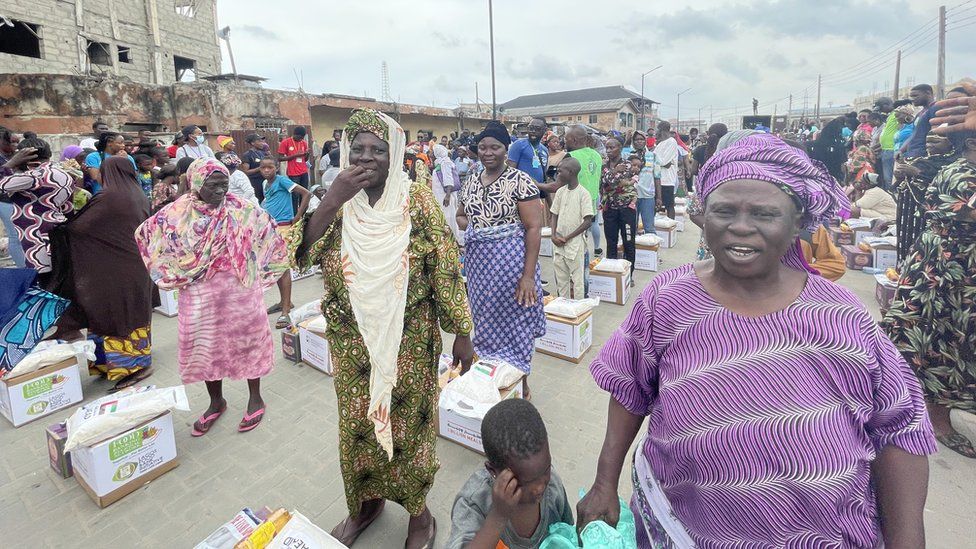
Image caption,Private food banks in Lagos are trying to help feed people in Lagos, Nigeria’s largest city
Some have started taking drastic action to manage their expenses. Angela Chukwulozie is a retired teacher who now sells Italian shoes. “Since the price of everything has gone up, I’ve cut back on how many meals my family and I eat every day. Instead of eating three times in a day we now eat twice.”
The economy is one of the key concerns for voters in next month’s elections. Despite being Africa’s largest economy, four out of 10 Nigerians live below the poverty line, according to the World Bank. All of the main candidates have promised to improve the country’s economy if elected, but there is scepticism as to whether they can deliver.
The Central Bank says the change of currency, which must be completed by 10 February when the old banknotes will no longer be legal tender, will help bring some of the cash currently being hoarded by individuals and companies back into the banking system.
It says 80% of the notes currently in circulation are outside banks. The organisation hopes the change will give it a better understanding of the money circulating in the economy so it can better manage inflation. Whether or not it will be successful is debatable.
Back in London, Oroma is optimistic, despite the hardships her country is facing.
“There’s no place like home. I go back to Nigeria every three months, because when I haven’t been there, I literally feel like I’m dying.
“I feel like Nigeria is at the point where, if we can change now, it’s not too late. We just need some basics: people need to be educated, we need electricity, we need roads. If we can just do these three things and improve security, I think the potential in Nigeria is amazing.”
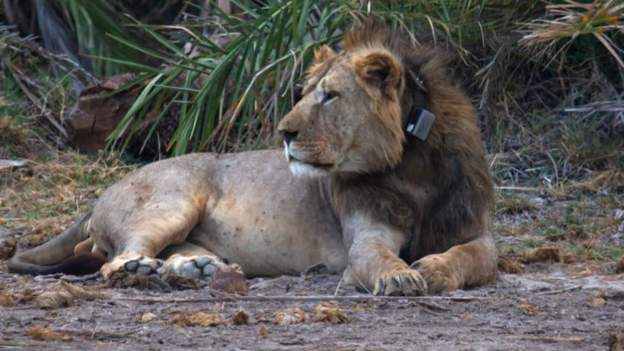
The Kenya Wild Service (KWS) has explained circumstances surrounding a caged lion’s need for a vasectomy a week ago.
KWS had initially said the procedure was meant to control the lion’s breeding, but Kenyans questioned why it could not instead be released into the wild amid a decline in the endangered species.
But the KWS has explained that the big cat would be vulnerable in the wild, and noted that breeding was not permissible in captive facilities.
“When wild animals are hand-reared, they lose their natural instincts and if released back to the wild, they are vulnerable. The cat family end up being problem animals as they look for easier prey,” it said in a statement.
KWS said human-wildlife conflict leading to injury and retaliatory killings was among the main threat to lion conservation in the country.
Currently, Kenya’s lion population is estimated at 2,589, according to the KWS.
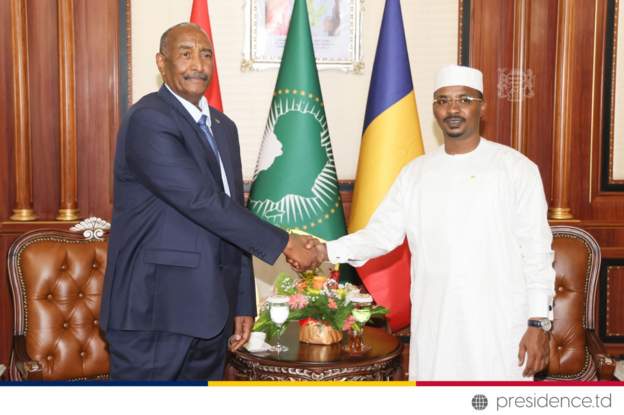
Head of the Sudanese military, Abdel Fattah al-Burhan, visited the neighboring Chad on Sunday for talks aimed at strengthening ties between the two nations, according to the state-run Suna news agency.
Gen Burhan and Chadian interim military leader Mahamat Idriss Déby met in N’Djamena and renewed their commitment to implement a 2018 bilateral agreement, the news agency said.
They also expressed their concern over communal violence in their countries and agreed to form a joint force to handle insecurity along their border.
Gen Burhan and Mr Déby also agreed to take the necessary steps to tackle irregular immigration and weapons smuggling.
They also agreed to bolster joint patrols along the tri-border area with the Central African Republic (CAR).
The border region has been the focus of intense manoeuvring in recent weeks involving forces loyal to Sudanese deputy military leader Mohamed Hamdan Dagalo, CAR and Chadian rebels as well as the Russian Wagner mercenary group.
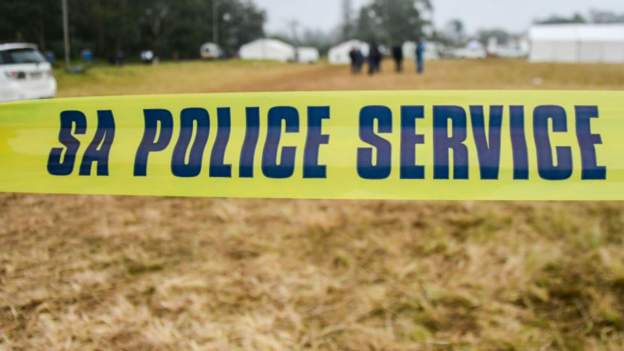
Police in South Africa has reported that gunmen opened fire on a gathering of people attending a birthday party in a township in the Eastern Cape province of South Africa, killing eight of them.
Two gunmen entered the yard of the house on Sunday evening in Gqeberha, formerly Port Elizabeth, and randomly shot at guests, a police statement said.
The owner of the house was among those killed, while three others were also wounded.
The Minister of Police, Bheki Cele, and the head of police, Fannie Masemola, are expected to lead a delegation to the crime scene on Monday.
No arrests have been made and an investigation has been opened on the attack, local outlets report.
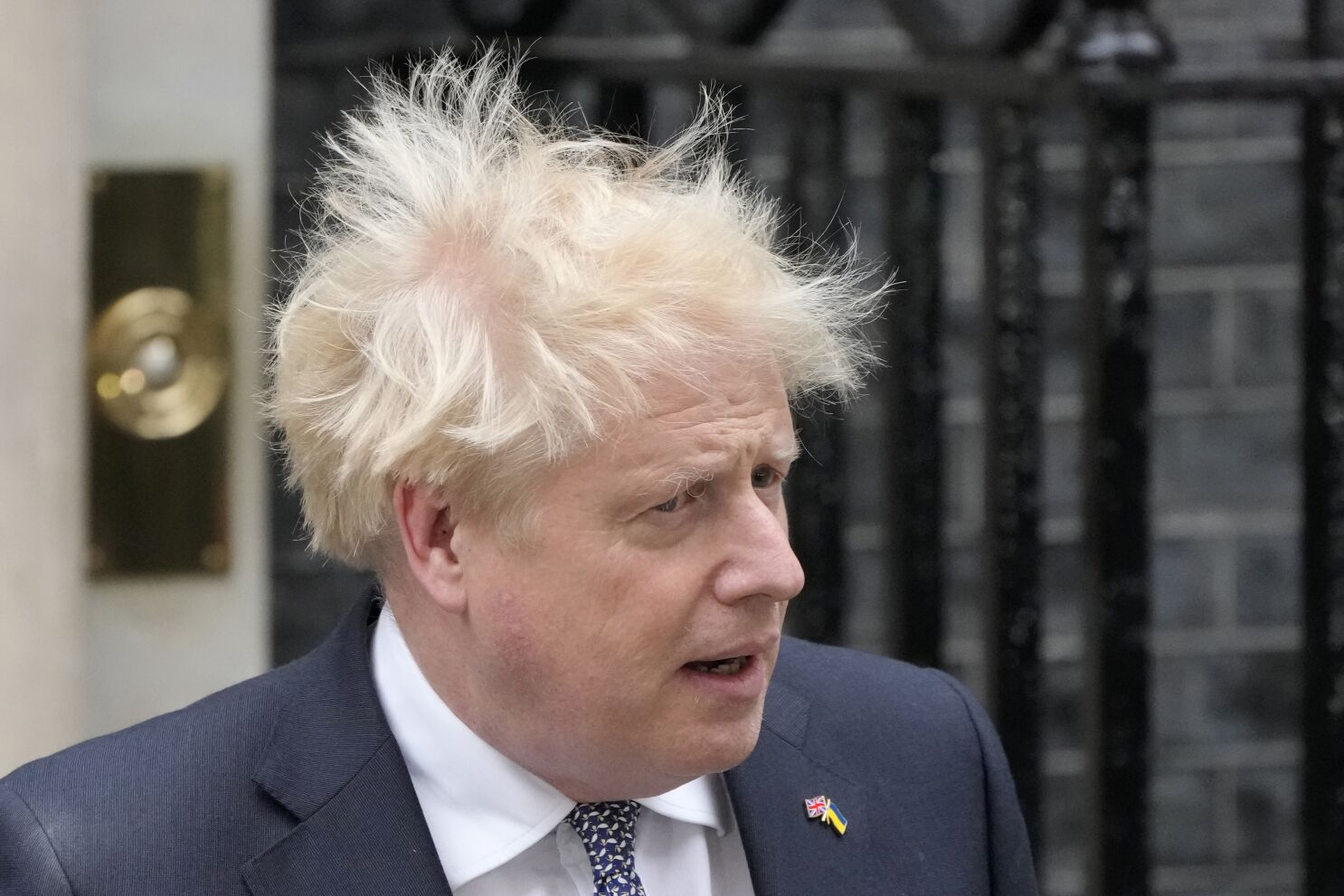
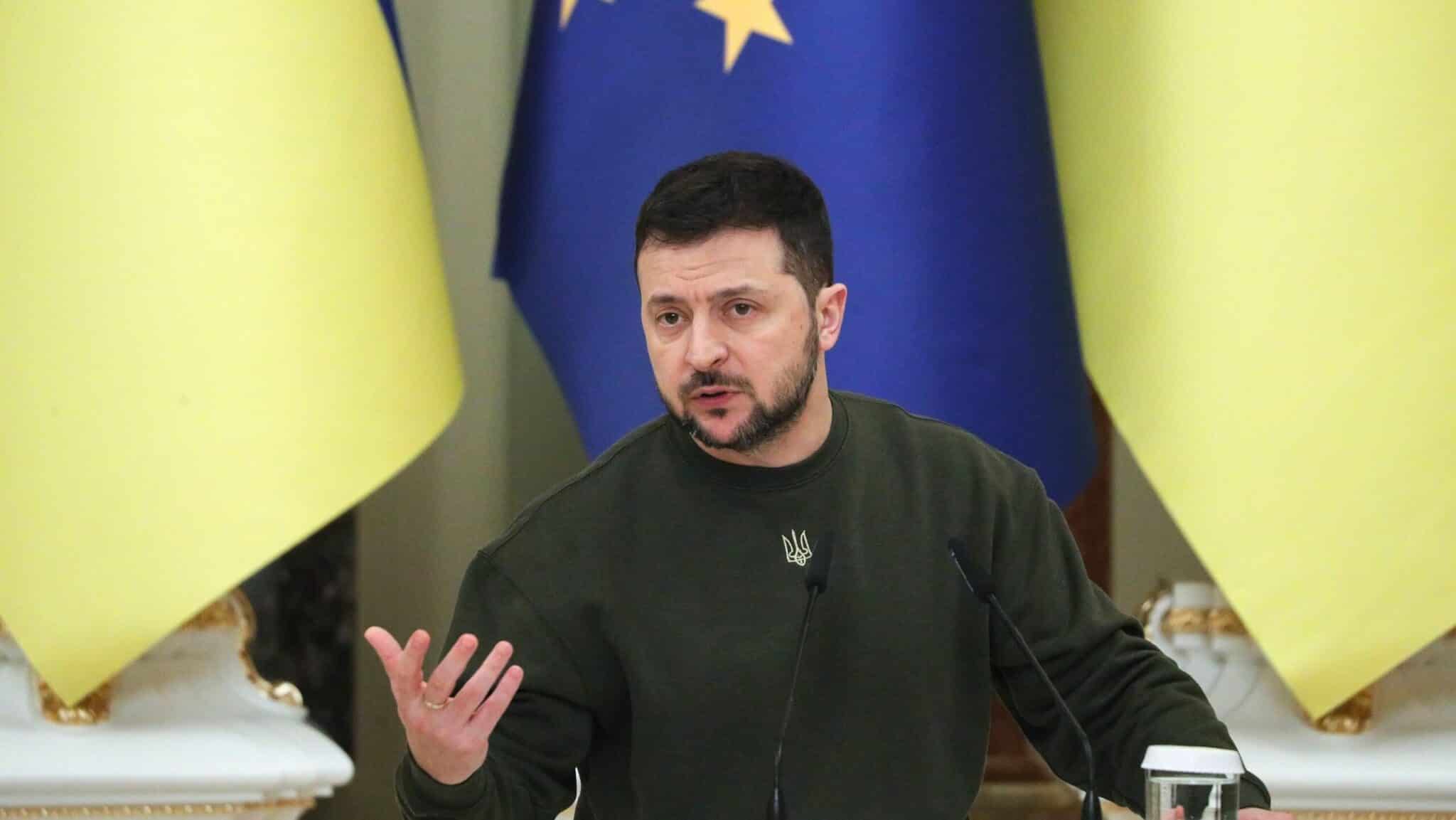
Prior to Russia’s invasion of Ukraine, Boris Johnson has made claims that Vladimir Putin called him and threatened him with a missile strike in a “extraordinary” conversation.
The then-prime minister said Mr Putin told him it “would only take a minute”.
Mr Johnson said the comment was made after he warned the war would be an “utter catastrophe” during a “very long” call in February 2022.
Details of the exchange are revealed in a BBC documentary, examining Mr Putin’s interactions with world leaders.
Mr Johnson warned Mr Putin that invading Ukraine would lead to Western sanctions and more Nato troops on Russia’s borders.
He also tried to deter Russian military action by telling Mr Putin that Ukraine would not join Nato “for the foreseeable future”.
But Mr Johnson said: “He threatened me at one point, and he said, ‘Boris, I don’t want to hurt you but, with a missile, it would only take a minute’ or something like that. Jolly.
“But I think from the very relaxed tone that he was taking, the sort of air of detachment that he seemed to have, he was just playing along with my attempts to get him to negotiate.”
President Putin had been “very familiar” during the “most extraordinary call”, Mr Johnson said.
It is impossible to know if Mr Putin’s threat was genuine.
However, given previous Russian attacks on the UK – most recently in Salisbury in 2018 – any threat from the Russian leader, however lightly delivered, is probably one Mr Johnson would have had no choice but to take seriously.
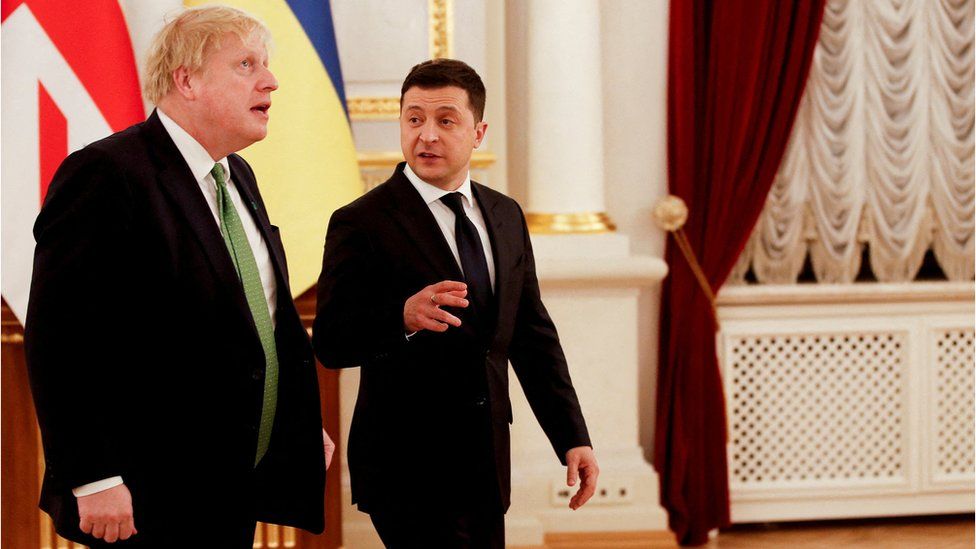
Image caption,Boris Johnson received a call from President Putin the day after he met Volodymyr Zelensky in Kyiv
Nine days later, on 11 February, Defence Secretary Ben Wallace flew to Moscow to meet his Russian counterpart, Sergei Shoigu.
The BBC documentary Putin Vs the West reveals Mr Wallace left with assurances that Russia would not invade Ukraine, but he said both sides knew it was a lie.
He described it as a “demonstration of bullying or strength, which is: I’m going to lie to you, you know I’m lying and I know you know I’m lying and I’m still going to lie to you.
“I think it was about saying ‘I’m powerful’,” Mr Wallace said.
He said the “fairly chilling, but direct lie” had confirmed his belief that Russia would invade.
As he left the meeting, he said Gen Valery Gerasimov – Russia’s chief of general staff – told him “never again will we be humiliated”.
Less than a fortnight later, as tanks rolled over the border on 24 February, Mr Johnson received a phone call in the middle of the night from President Zelensky.
“Zelensky’s very, very calm,” Mr Johnson recalled. “But, he tells me, you know, they’re attacking everywhere.”
Mr Johnson says he offered to help move the president to safety.
“He doesn’t take me up on that offer. He heroically stayed where he was.”
Putin Vs the West will be broadcast on Monday 30 January on BBC 2 at 21:00, and will be available on the iPlayer in the UK.
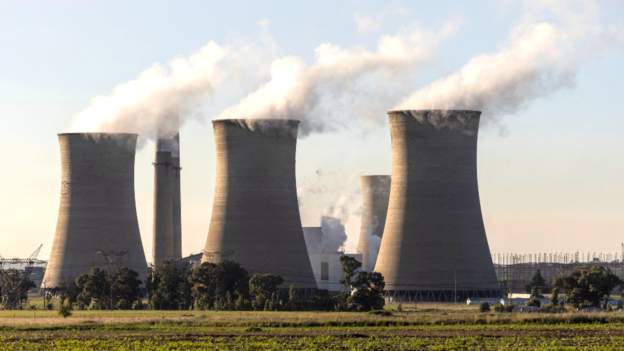
South Africa’s President Cyril Ramaphosa has said there are no urgent plans to stop using coal-fired power plants as part of a transition to greener energy sources.
The country is one of the world’s most coal-dependent nations and is a significant polluter.
It is currently experiencing lengthy power cuts blamed on ageing infrastructure and corruption.
Since 2021 South Africa has secured several billion dollars in international loans and grants to support a switch to greener power.
Addressing colleagues from the governing African National Congress (ANC) party, Mr Ramaphosa suggested it would be unwise to reduce the country’s capacity as it made what he called a just energy transition.
The ANC has close links with the country’s mining unions.
Sudan’s de facto leader Abdel Fattah al-Burhan has said that Khartoum and Addis Ababa are “aligned and in agreement” on a controversial Ethiopian dam on the Blue Nile which Egypt views as a threat.
Burhan’s remarks came during a meeting on Thursday with Ethiopian Prime Minister Abiy Ahmed who was on a one-day visit to Khartoum, his first since Burhan led a 2021 military coup.
“Burhan emphasised… that Sudan and Ethiopia are aligned and in agreement on all issues regarding the Grand Ethiopian Renaissance Dam (GERD),” according to a statement by the sovereign council, which he chairs.
The dam has been the source of tensions between Ethiopia and downstream countries, Egypt and Sudan, ever since work began in 2011.
Prime Minister Abiy Ahmed “confirmed that the Renaissance Dam will not cause any harm to Sudan but will have benefits for it in terms of electricity,” the statement said.
Multiple rounds of talks between the three governments have failed to produce an agreement over the filling and operation of the reservoir.
Egypt is dependent on the Nile for irrigation and drinking water and the Blue Nile accounts for more than 80 percent of its flow.
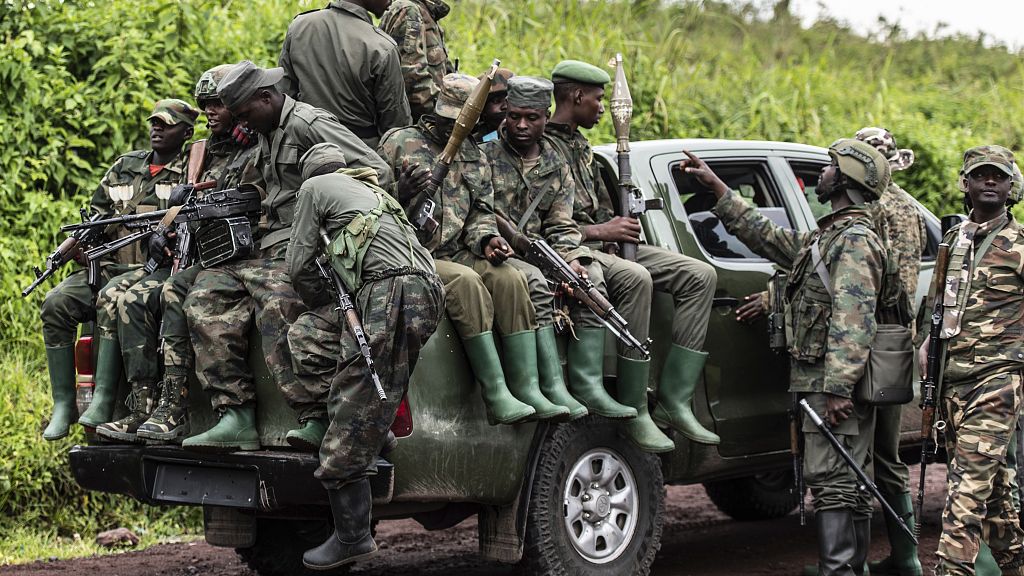
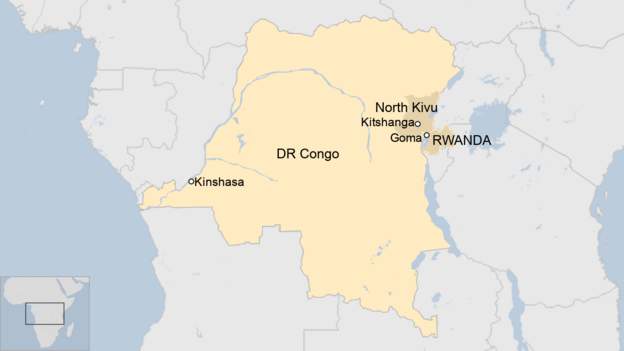
Fighting has intensified around Kitchanga, a town in the eastern Democratic Republic of Congo as the M23 rebel group seeks to expand its territory.
The group has increased pressure on government troops defending the town in North Kivu province, which has led to hundreds of civilians fleeing their homes.
Videos on social media appeared to show fighters in the M23 group celebrating and claiming they’d captured the town. It was impossible to independently verify their authenticity.
Kinshasa for months has accused neighbouring Rwanda of supporting the M23 group — whose origins lie in the region’s ethnic fighting — and powerful voices in the West have openly agreed. Rwanda denies backing the group, which is one of the dozens operating in the mineral-rich east.
At a Nov. 23 summit in Angola, which included Congo’s president and Rwanda’s foreign minister, regional leaders called for a cease-fire in eastern Congo to be followed by a withdrawal of rebels from major towns under M23 control.
The group said it would leave some of the occupied territories before Jan. 15, but some areas remain under its control and it’s seeking to capture others from government forces. M23 has been accused by the United Nations and rights groups of atrocities against civilians.
Kitchanga is a key town as it sits on the last open route between North Kivu’s main economic hubs of Goma and Butembo. The others were cut off due to the fighting.
Many of Kitchanga’s inhabitants fled Thursday’s violence.
“We have just been through the war in Kitchanga, we saw M23 killing people, we were afraid, that’s why we fled so we wouldn’t die too,” said Angelique Mukeshimana. The mother of four went to a makeshift displacement site on the outskirts of Goma, some 150 kilometres away, leaving all her belongings behind.
The fighting comes days before Pope Francis is due in Congo’s capital Kinshasa for a three-day visit. The trip was originally supposed to include a stop in the east, however, the Vatican scrapped that amid the rising violence.
M23′s political spokesman, Lawrence Kanyuka, in a statement on Thursday accused government troops of attacking civilians in Kitchanga and elsewhere, and said the rebel group was “obliged to intervene and stop another genocide.”
A spokesperson for a United Nations peacekeeping mission in Congo said more than 500 civilians have taken refuge in and around the U.N. peacekeeping base in Kitchanga, where they’ve been given tents, food, water and first aid.
“The M23 must cease all hostilities and withdraw from the occupied areas,” Ndeye Khady Lo said.
Analysts say the rebel group’s drive to expand has devastating consequences for civilians.
“If reports that the group has taken control of Kitchanga … are true, this is yet another indication of the group’s ongoing territorial ambitions and apparent unwillingness to withdraw,” said Daniel Levine-Spound, a researcher at the Center for Civilians in Conflict.
“The group’s continued westward expansion also raises meaningful fears that M23 could seek to fully encircle Goma. Sustained international pressure, including on M23’s backers, will be critical in halting the group’s advance,” he said.
Largely comprised of Congolese ethnic Tutsis, M23 rose to prominence 10 years ago when it seized Goma on the border with Rwanda. It’s part of a long line of rebel groups linked with Rwanda since the 1990s when the country sought out ethnic Hutu militias, who had fled to Congo after killing Rwandan Tutsis during the genocide.
Equatorial Guinea‘s vice-president has accused French telecom operator Orange SA of “fraudulently” giving the .gq domain name to the Netherlands, forcing the African nation‘s institutions to pay to use the domain.
Teodoro Nguema Obiang Mangue said Equatorial Guinea had “discovered that the French from the Orange company engaged in fraudulent manipulation by ceding our domain #gq to the Dutch.”
“Now, we have to pay them to use our own domain, which makes it challenging to set up an institutional website with gq for the country,” he wrote on Twitter on Thursday.
“What have we done to France for it to plunder African countries in this manner? We are once again hindered by their trickery. The West should stop taking advantage of Africa,” he added.
Orange SA has not responded to the claims.
The vice-president, son of long-serving President Teodoro Obiang Nguema, has previously accused Spain, France and the US of interfering in his country’s internal affairs.
In 2020, a French court fined him 30m euros ($32.9m; £26.6m) for embezzling public funds, giving him a suspended jail term and ordering the confiscation of his assets.
The .gq domain name was launched in 1997 by Equatorial Guinean mobile operator Getesa and is reported to be prone to spam, phishing and other malicious use.
The president of Malawi has called for more studies into the link between cholera and climate change after the country was hit by record deaths.
President Lazarus Chakwera told the BBC he did not doubt the link but wanted to be led by more research.
About 1,000 people are reported to have died in the current outbreak.
Mr Chakwera said there had been an unprecedented level of water-borne diseases since devastating floods last year which affected much of southern Malawi:
Quote Message: We’ve never really had this type of outbreak in over 20 years, and even then, it wasn’t at this scale.
We’ve never really had this type of outbreak in over 20 years, and even then, it wasn’t at this scale.
Quote Message: But with all the flooding that took place last year, with water levels rising and with sanitation issues across the country that are dependent on pit latrines for example…
But with all the flooding that took place last year, with water levels rising and with sanitation issues across the country that are dependent on pit latrines for example…
Quote Message: And all of that being washed into streams and even where you have water pumps – because of those [water] levels, all of a sudden you saw outbreaks of water-borne diseases like cholera in a way that you’ve never seen before.
And all of that being washed into streams and even where you have water pumps – because of those [water] levels, all of a sudden you saw outbreaks of water-borne diseases like cholera in a way that you’ve never seen before.
Quote Message: So I would not doubt that all of this could be backed by more research.”
So I would not doubt that all of this could be backed by more research.”
Sudan’s military leader says “Sudan and Ethiopia are in agreement on all matters regarding” the controversial Grand Ethiopian Renaissance Dam (Gerd), state-run news agency Suna has reported.
Speaking when he met visiting Ethiopian Prime Minister Abiy Ahmed in Khartoum on Thursday, Lt Gen Abdel Fattah al-Burhan stressed the need to strengthen bilateral relations between Sudan and Ethiopia.
Mr Abiy said that the Nile dam would “not harm Sudan’s interests but rather will benefit Khartoum in the electricity sector”.
On 11 January, Sudanese and Egyptian foreign ministers agreed to “continue consultations” regarding the Ethiopian dam.
Addis Ababa, Khartoum and Egypt have been embroiled in a long dispute over the dam, which Sudan and Cairo fear would reduce their shares of water from the River Nile.
At least 16 people have died in Madagascar as a result of a tropical cyclone and subsequent severe rains, according to emergency officials.
Seventeen prople remain missing after Tropical Storm Cheneso hit, according to the Office for Risk and Disaster Management.
More than 60,000 people have been displaced since the storm reached the island just over a week ago.
Some 47,000 people are affected, while 13,000 houses and some 100 classrooms are damaged, the European Civil Protection and Humanitarian Aid Operations said
Madagascar, Mozambique and the wider southern Africa region have been hit by severe storms and cyclones in recent years.
Last year, several storms in the region killed more than 100 people and displaced hundreds of thousands others.
A bomb exploded at a market in eastern Congo on Wednesday (Jan. 25), injuring at least a dozen people, authorities said.
An unknown person detonated a bomb inside a bag in North Kivu’s Beni town, said Tharcisse Katembo, a local official.
“Damage was documented (and) at least 12 people were injured. They were injured in the lower limbs, others in their upper limbs and others were hit in the head,” he told reporters in Beni.
The victims were taken to the hospital and an investigation was underway, Katembo said.
No one claimed responsibility for the bomb. However, attacks by the Allied Democratic Forces, which is believed to be linked with the Islamic State extremist movement, have been increasing in North Kivu, according to the United Nations.
Deadly violence
Earlier this month, at least 14 people were killed and dozens injured in an attack on a church in Kasindi town, which was claimed by Islamic State. It said in its Aamaq news outlet that it planted an explosive device inside the church and detonated it while people were praying.
Since April, attacks by the Allied Democratic Forces have killed at least 370 civilians, and the group has abducted several hundred more, including a significant number of children, the U.N. says.
The explosion Wednesday (Jan. 25) occurred in a local market next to a cassava mill, witnesses said.
Rebels in the eastern Democratic Republic of Congo claim to have taken the key town of Kitshanga after three days of intense clashes with government forces.
The UN-sponsored local radio Okapi was among the first to report the fall of Kitshanga to the rebels.
Images of hundreds of people fleeing the town have also been shared on social media.
“Yes we now have Kitshanga and its neighbourhoods,” Willy Ngoma, a spokesman of the M23 rebels, told the BBC on Friday.
The BBC has approached the military for a response.
Local civil society groups and the UN forces in the country have condemned M23 military offensives which have forced more than 400,000 people to flee their homes.
Congolese Senator Francine Muyumba has called on parliament to hold an extra-ordinary session because “the country is doing very badly”, she said on Twitter.
A summit held in November in neighbouring Angola had asked the M23 rebels to cease hostilities and withdraw from areas it had captured.
But the rebels said they find themselves “obliged to intervene to stop another genocide” against ethnic Tutsis living in DR Congo, according to a statement on Thursday evening.
Kitshanga town lies in a strategic route between the region’s economic hubs of Goma and Butembo.
For some years, the town was the stronghold and the headquarters of the infamous rebel leader Laurent Nkunda and his CNDP rebel group, which later became M23.
Archaeologists say they have found a gold leaf-covered mummy sealed inside a sarcophagus that had not been opened for 4,300 years.
The mummy, the remains of a man named Hekashepes, is thought to be one of the oldest and most complete non-royal corpses ever found in Egypt.
It was discovered down a 15m (50ft) shaft at a burial site south of Cairo, Saqqara, where three other tombs were found.
One tomb belonged to a “secret keeper”.
The largest of the mummies that were unearthed at the ancient necropolis is said to belong to a man called Khnumdjedef – a priest, inspector and supervisor of nobles.
Another belonged to a man called Meri, who was a senior palace official given the title of “secret keeper”, which allowed him to perform special religious rituals.
A judge and writer named Fetek is thought to have been laid to rest in the other tomb, where a collection of what are thought to be the largest statues ever found in the area had been discovered.
Several other items, including pottery, have also been found among the tombs.
Image caption,Various statues and items of pottery were found in the tombs
Archaeologist Zahi Hawass, Egypt’s former antiquities minister, has said all the discoveries date from around the 25th to the 22nd centuries BC.
“This discovery is so important as it connects the kings with the people living around them,” said Ali Abu Deshish, another archaeologist involved in the excavation.
Saqqara was an active burial ground for more than 3,000 years and is a designated Unesco World Heritage Site. It sits at what was the ancient Egyptian capital Memphis and is home to more than a dozen pyramids – including the Step Pyramid, near where the shaft containing the mummy was found.
Thursday’s discovery comes just a day after experts in the southern Egyptian city of Luxor said they had discovered a complete residential city from the Roman era, dating back to the second and third centuries AD.
Archaeologists found residential buildings, towers and what they’ve called “metal workshops” – containing pots, tools and Roman coins.
Egypt has unveiled many major archaeological discoveries in recent years, as part of efforts to revive its tourism industry.
The government hopes its Grand Egyptian Museum, which is due to open this year following delays, will draw in 30 million tourists a year by 2028.
But, critics have accused Egypt’s government of prioritising media-grabbing finds over hard academic research in order to attract more tourism.
The United States says its special forces have killed a senior figure in the Islamic State group in Somalia, along with 10 of his associates.
Bilal al-Sudani is alleged to have been a key figure in the funding and expansion of the Islamist militant group across Africa and beyond.
Officials say he was killed during a gunfight after troops raided a remote mountainous cave complex in northern Somalia, hoping to capture him.
In a statement the US Secretary of Defense Lloyd Austin said no civilians were harmed in what he described as “a successful counterterrorism operation.”
Analysts say the fact that troops were sent to kill or capture Mr Sudani, rather than using a less risky drone strike, indicates his significance.
A one-pub-per-town order has been enforced by the Vice deputy president of Kenya’s government officials in the middle part of the nation.
Rigathi Gachagua also wants entertainment joints in the region to only operate between 17:00 to 23:00 in new measures meant to deal with alcoholism.
There are fears the directives could see many resort to homemade alcohol – often laced with industrial chemicals. Deaths from illicit brews have previously been reported.
But Mr Gachagua on Thursday insisted that alcoholism in the region was dire and told officials not to renew pub licences once they expire.
“Let us deal with these issues, let us save the next generation, otherwise we have a problem as society,” he said.
On Friday January 27, 2023, the body of a Tanzanian national killed in combat with Russian soldiers in Ukraine was brought home.
Nemes Tarimo, 37, died three months ago after agreeing to sign up with the Russian mercenary group Wagner.
His body was received by his family at the main airport in Dar es Salaam with burial scheduled for Saturday in his home village in the southern highlands of country.
Tanzanian victim killed in Ukraine’s body is returned home
Mr Tarimo had been in Moscow as an ICT master’s student at the Russian Technological University. But he was then imprisoned some time after January 2021 for what were described as drugs-related offences.
Last year, he was enticed with a deal: sign up with the Russian mercenary group Wagner and be pardoned or stay in prison.
Now it’s over, we can say it: a biggish asteroid passed by Earth a short while ago.
About the size of a minibus, the space rock, known as 2023 BU, whipped over the southern tip of South America just before 00:30am GMT.
With a closest approach of 3,600km (2,200 miles), it counts as a close shave.
And it illustrates how there are still asteroids of significant size lurking near Earth that remain to be detected.
This one was only picked up last weekend by amateur astronomer Gennadiy Borisov, who operates from Nauchnyi in Crimea, the peninsula that Russia seized from Ukraine in 2014.
Follow-up observations have refined what we know about 2023 BU’s size and, crucially, its orbit.
That’s how astronomers could be so confident it would miss the planet, even though it came inside the arc occupied by the world’s telecommunications satellites, which sit 36,000km (22,000 miles) above us.
The chances of hitting a satellite are very, very small.
The time of lowest altitude was accurately calculated to be 19:27 EST on Thursday, or 00:27 GMT on Friday.
Image caption,Artwork: We still have a lot to learn about the near-Earth environment
Even if 2023 BU had been on a direct collision course, it would have struggled to do much damage.
With an estimated size of 3.5m to 8.5m across (11.5ft to 28ft), the rock would likely have disintegrated high in the atmosphere. It would have produced a spectacular fireball, however.
For comparison, the famous Chelyabinsk meteor that entered Earth’s atmosphere over southern Russia in 2013 was an object near 20m (66ft) across. It produced a shockwave that shattered windows on the ground.
Scientists at the US space agency Nasa say 2023 BU’s orbit around the Sun has been modified by its encounter with Earth.
Our planet’s gravity pulled on it and adjusted its path through space.
“Before encountering Earth, the asteroid’s orbit around the Sun was roughly circular, approximating Earth’s orbit, taking 359 days to complete its orbit about the Sun,” the agency said in a statement.
“After its encounter, the asteroid’s orbit will be more elongated, moving it out to about halfway between Earth’s and Mars’ orbits at its furthest point from the Sun. The asteroid will then complete one orbit every 425 days.”
There is a great effort under way to find the much larger asteroids that really could do damage if they were to strike the Earth.
It’s been a political reshuffle with a difference.
At the time of typing this, 11 officials have either resigned or been sacked as Kyiv tries to tackle government corruption.
It’s led to some politicians in the US calling for aid to Ukraine to be restricted.
President Volodymyr Zelensky is trying to quickly restore public faith, but the allegations are serious, and the timing is bad.
Several claims have surfaced thanks to Mykhaylo Tkach, an investigative journalist for the news website Ukrayinska Pravda.
He has recently reported that the company of a senior official’s personal trainer allegedly received millions of pounds since the full-scale invasion, as well as a story about President Zelensky’s deputy head of office.
Kyrylo Tymoshenko quit two months after Tkach reported that he’d moved his family to the mansion of a well-known property developer.
The journalist also published footage which appeared to show the official driving an expensive Porsche for a few months.
Mr Tymoshenko has denied doing anything wrong.
“Quite often, with MPs and officials, if the source of their money isn’t clear, they register assets to people close to them,” explains Tkach.
Image caption,Mykhaylo Tkach is an investigative journalist who has reported on some of the alleged corruption
“These are signs of non-transparency, at a time when every step of an official should be clear for society.”
The reporter concedes corruption exists in many countries. It’s why he thinks the reaction to it is most important.
From her bakery in Vorzel, near Kyiv, Ivanna is less than impressed with her government being accused of paying inflated prices to an unknown firm, a minister allegedly accepting a bribe worth £300,000 ($372,000), and an official’s expensive taste in cars.
“I don’t like it,” she says, while her husband Vyacheslav stirs dough in the back room.
“It would be better for this money to go towards something good for Ukraine.”
She pauses: “We need to replace all those politicians who’ve been there for many years. They’ve got used to it; it feeds them.”
For Ukraine, receiving billions of dollars in military, humanitarian and financial aid brings responsibility and scrutiny.
It also increases the likelihood of money ending up in the wrong hands.
“We are talking about Ukraine’s existence,” says Tkach. “It’s not just some ordinary year for our country. So, I think this wave of resignations, initiated by the president, is an important acknowledgement and necessary action.”
Image caption,Ivana wants to replace politicians who have been in power for years
Ever since Ukraine declared independence 31 years ago, corruption has plagued its public services and most of all its politics.
In 2014, a popular revolution toppled the last Moscow-leaning government because people wanted to finally live under a democracy.
Ever since, Ukraine has attempted a series of reforms, notably driven by Russia’s subsequent campaign of aggression towards the country. Change was seen as essential to securing the West’s continued support.
New anti-corruption agencies were then set up, along with new systems for government spending, a new police force, and politicians were forced to disclose their wealth – often with eye-watering confessions.
“We wanted results,” Yaroslav Yurchyshyn tells me. He’s an MP and deputy head of the parliamentary anticorruption committee.
“Yes, we have some leftovers from corruption in the past, but at least now we are not silent about it. The next stop will be prevention.”
We have some leftovers from corruption in the past, but at least now we are not silent about itYaroslav Yurchyshyn Ukrainian MP
Mr Yurchyshyn believes there’s no better time to expose ministerial wrongdoing, even with Western help being put at risk.
“Western partners understand we have two wars,” he says. “The first is against Russia, then there’s our internal war for the future of Ukraine.”
Before the full-scale Russian invasion of February 2022, Western allies like the European Union and the US weren’t happy with the pace of Kyiv’s efforts to combat corruption.
While it’s not clear what the political damage of the 2023 allegations will be for President Zelensky, his response to them this time has been described as “quick and decisive” by the US.
With more allegations expected to surface, he’ll be hoping other supporters feel the same.
President Joe Biden is urging protests in Tennessee to remain peaceful as officials plan to release video of an arrest that led to a motorist’s death.
Five Memphis police officers have been fired and are facing murder charges after Tyre Nichols, 29, died three days after a traffic stop on 7 January.
Bodycam footage of the encounter is expected to be made public on Friday evening local time.
Lawyers for the Nichols family said it will show him being severely beaten.
“I’m sickened by what I saw,” Tennessee Bureau of Investigation director David Rausch said on Thursday after reviewing the footage, describing the officers’ actions as “absolutely appalling”.
The city of Memphis is reported to be on edge and police have stepped up patrols there as they prepare for possible demonstrations.
Image caption,Mr Nichols enjoyed photography and skateboarding, family say
Mr Nichols, a black man, was stopped by five police officers, who are also black, on his way home after taking photos of a sunset at a local park, an attorney for the family said.
Officials say he was suspected of reckless driving.
A first confrontation occurred as Mr Nichols attempted to flee on foot when officers approached his car, the local authorities said.
They said a second confrontation happened when officers tried to arrest him.
Mr Nichols later complained of shortness of breath and was taken to hospital, police said, where he was listed in a critical condition.
A lawyer for Mr Nichols’ family said the bodycam footage showed Mr Nichols being pepper-sprayed, tasered, restrained and kicked.
He likened the incident to the notorious footage of Los Angeles police officers beating Black motorist Rodney King more than 30 years ago.
All five of the officers face charges of second-degree murder, aggravated assault, aggravated kidnapping, official misconduct and official oppression.
Tadarrius Bean, Demetrius Haley, Desmond Mills Jr, Emmitt Martin III and Justin Smith were booked into jail on Thursday. They all oined the Memphis Police Department in the last six years, and were fired last week.
‘Failing of basic humanity’
President Biden released a statement on Thursday appealing for calm as authorities prepare to release the footage.
“I join Tyre’s family in calling for peaceful protest,” he said. “Outrage is understandable, but violence is never acceptable.”
The city’s police chief Cerelyn Davis, the first black woman in that role in Memphis, also called for calm amid what she said was a “failing of basic humanity toward another individual”.
Watch: Tennessee official on bodycam footage of Tyre Nichols
The Nichols family and their legal team privately reviewed the video footage of the arrest earlier this week.
“He was a human piñata,” lawyer Antonio Romanucci said of its contents. “It was an unadulterated, unabashed, non-stop beating of this young boy for three minutes.”
In a news conference on Thursday, lawyers for two of the ex-officers said their clients planned to fight the charges.
“No-one out there that night intended for Tyre Nichols to die,” said a lawyer for one of the men.
Officials said Mr Nichols “succumbed to his injuries” on 10 January, but provided no further details. An official cause of death has not yet been disclosed.
His family say he will be remembered as a “good kid” who enjoyed photography and skateboarding.
The father-of-one, who worked at the parcel delivery company FedEx, had Crohn’s disease and suffered severe weight loss, relatives say.
Reverend Al Sharpton, a US civil rights leader, told the BBC the alleged crime was particularly painful because of the officers’ race.
“We fought to put blacks on the police force,” he said. “For them to act in such a brutal way is more egregious than I can tell you.”
Watch: Emotional testimony by residents over deadly traffic stop
“I do not believe these five black police officers would have done this had he been a young white man,” he added.
California-based trial lawyer Adanté Pointer said instances of black men being killed by black officers rarely make the news.
“This case exemplifies that it is not simply a white versus black issue, but instead that this is a power dynamic that plays itself out no matter the race of the police officers,” he told the BBC.
The FBI and the Department of Justice have opened a civil rights investigation into Mr Nichols’ death.
The officers involved are members of a special team known as Scorpion – short for “Street Crimes Operation to Restore Peace in Our Neighborhoods”.
The unit, which was created to police high-crime areas, is now under review, along with all of the city’s specialised units, according to the city’s police chief.
From dairy farms unable to keep milk refrigerated, to chickens suffocating en masse as ventilators fall idle, an energy crisis is taking a heavy toll on South Africa’s food sector, industry groups said.
Record power cuts have caused shortages of some staples, threatening price rises that could make some popular items too expensive for poor families, agricultural industry body AgriSA said.
“The affordability of food is going to be a challenge particularly to the lower income household, especially with chicken which is one of the cheapest protein staples in the country,” AgriSA’s chief economist, Kulani Siweya, said.
Scheduled blackouts, known as load-shedding, have burdened Africa’s most industrialised economy for years, with state-owned energy firm Eskom failing to keep pace with demand and maintain its ageing coal power infrastructure.
But the outages reached new extremes over the past 12 months.
Poultry farmer Herman Du Preez, said at least 40,000 of his chickens were asphyxiated last week with disruptions in power supply causing the farm’s ventilation system to stop working.
“It wasn’t a pretty sight to see how much money we lost due to the fact that Eskom is so unreliable,” Du Preez said on Monday at his farm in the North West province.
Power cuts have also slowed down operations at slaughter houses, triggering chicken “shortages”, said Izaak Breitenbach, general manager of the South African Poultry Association.
“The milk industry is also having challenges with processing their milk and the load shedding does impede on their cold storage facilities,” added Siweya of AgriSA.
In a Monday newsletter, president Cyril Ramaphosa said he was aware of the “farmers that are unable to keep their produce fresh” as a result of blackouts.
But he offered no promise of ending the scheduled cuts, anytime soon.
“We must be realistic about our challenges and about what it is going to take to fix them. While we all desperately want to, we cannot end load shedding overnight,” he wrote.
South Africa’s record power cuts are causing shortages of some staples,and threatening price rises that could make some popular items too expensive for poor families.
Witnesses allege that several dozen civilians and fighters have been killed in the new clashes between Ethiopians from Oromo and Amhara groups in the centre of the country.
The fighting would have erupted Saturday (Jan. 22) in Jewuha town in the Amhara region. One witness, like others speaking on condition of anonymity for fear of retaliation said that fighters thought to be with the rebel Oromo Liberation Army attacked a camp used by Amhara special forces and killed more than 20 of them. The witness said they helped to bury three civilians as well.
Fighting has spread to other towns, the witness claimed. Another witness in Jewuha involved in burials said “several dozen” bodies had been collected.
A witness in Ataye town in the Amhara region alleged that clashes between OLA and Amhara special forces were ongoing and thousands of civilians were fleeing. A doctor at Shewa Robit hospital told the AP it had received the bodies of “several people” since Monday (Jan. 23) as well as some victims with serious injuries.
The Amhara regional government on Wednesday (Jan. 25) confirmed the clashes and said members of the federal army, federal police and Amhara regional forces were working to bring the situation under control.
A federal police spokesman didn’t respond to calls. An Ethiopian government spokesman, Legesse Tulu, hung up.
Some Ethiopians from Amhara and Oromo backgrounds, two of Ethiopia’s largest ethnic groups, are in a bitter rivalry over new and old grievances. Amharas have been targeted in several locations across the neighboring Oromia region, prompting Amhara militias to deploy.
Oromos also have alleged being targeted in deadly attacks by Amharas. The Oromo Legacy Leadership and Advocacy Association in a statement this week said that “under international law, the Ethiopian federal government has a duty to protect its citizens.”