Author: Amanda Cartey

  • Nursing student vanishes mysteriously in Wyoming

    The youngest of his three children, Irene, was always the subject of Francis Gakwa’s adoration.

    “We were always very close,” Francis, 64, tells PEOPLE from Nairobi, Kenya, about the 33-year-old nursing student he called “my Irene.”

    “I did spoil her,” Francis, a retired aeronautical engineer, adds.

    In 2019, after living with her parents in her native Nairobi for years, Irene, then 30, decided to move to Boise, Idaho, where her older brothers live, to go to school.

    “I kept telling her, ‘You can study here [in Nairobi],’” Francis recalls.

    She headed to the U.S., but they made staying in touch a priority. “We used to talk on WhatsApp all the time,” says Francis.

    But Francis has been in agony since Feb. 24, the last time he and Irene’s mother, Joyce, spoke to her.

    “We can hardly sleep and when we sleep, we keep waking up and it’s like dreaming,” Francis says, breaking down into tears.

    Since March, police and volunteer search parties have looked for Irene in Gillette, Wyo., where she’d moved in 2021, but have found no sign of the sweet, shy woman.

    Not knowing where she is “is unbearable,” says Francis.

    On May 11, Gillette police announced that they’d arrested Irene’s boyfriend, Nathan Hightman, 39, and charged him with two counts of felony theft, two counts of crimes against intellectual property and unlawful use of a credit card.

    Nathan Hightman.Campbell Country Sheriff’s Office

    He allegedly deleted an email account of Irene’s, transferred nearly $3,700 out of her bank account and used her credit card after she vanished.

    Though authorities have called Hightman “a person of interest” in Irene’s missing person case, he has not been charged in her disappearance.

    He pleaded not guilty and is out on $10,000 bail, awaiting trial. Hightman and his public defender did not respond to PEOPLE’s requests for comment.

    In a statement in May, Gillette police said they were “requesting information regarding the possibility of a 55-gallon metal drum, which may have been burned or abandoned within the county.”

    ‘He Started Isolating Us From Our Sister’

    When Irene moved to Boise, she spent a lot of time with her brothers, Kennedy Wainaina, 44, and Chris Gakwa, 38, as well as her nieces and nephews.

    In 2020, she began dating Hightman after meeting him online.

    “He seemed quiet,” Kennedy recalls. “Didn’t say much. He told me he doesn’t really have any friends.”

    Hightman and Irene began showing up less and less to family functions. Calling Hightman “controlling,” Kennedy alleges, “He started isolating us from our sister.”

    In early March, after about two weeks of receiving strangely worded text message purportedly from Irene, the family determined through family phone plan records that the couple had moved to Gillette — without telling her brothers.

    They called police.

    Irene Gakwa.City of Gillette/Facebook

    “Nate told them Irene … took a couple of trash bags with her and got into a dark SUV and left,” says Kennedy.

    “All her social media was deleted,” he says. “Her friends hadn’t heard from her. All of us were freaking out.”

    As police investigate, her worried family waits for answers.

    A GoFundMe has been set up for a reward leading to information about Irene’s whereabouts.

    Anyone with information related to Gakwa’s disappearance is asked to contact the Gillette Police Department at 307-682-5155.

    Source: People.com

  • Man detained over tragic suicide of a California teen caused by’sextortion’

    A 25-year-old man has been detained in relation to an online scam that tragically resulted in the suicide of a teen in February.

    According to a statement from the San José Police Department, Jonathan Kassi was arrested on December 15 and lodged at the Santa Clara County Main Jail for “extortion and attempted disorderly conduct – uploading a photograph or recording without consent.”


    “Suspect Kassi sexually exploited children online utilizing the usernames ’emillysmith’ and ‘kassijonathan’ on various social media applications,” added the statement, which revealed that the warrant resulted from an investigation into West African financial sextortion by the San José Police Internet Crimes Against Children (ICAC) Task Force.

    Kassi will make his first court appearance in Santa Clara County court on Monday to enter a plea, the New York Post reported.

    Although police withheld the name of the victim because he was a minor, his mother, Pauline Stuart, confirmed to CNN that it was her son, Ryan Last.

    The teenager was days away from turning 18 and weeks away from graduating from Ann Sobrato High School, according to the New York Post.

    Stuart told CNN that authorities found her son was contacted online by someone pretending to be a girl, and that the conversation quickly turned intimate. The online perpetrator also sent Last a romantic picture of a young female and asked for one of him in return, CNN reported.

    After Last shared an intimate photo of his own, the perpetrator demanded $5,000, threatening to make the photo public and send it to his family and friends, investigators said, via CNN.

    Within hours, police said, a panicked Ryan tragically took his own life, CNN reported.

    The victim’s mother spoke with ABC7 News in San Francisco about the arrest, saying that while it was welcome, it did not bring closure to her family.

    “I’m very beyond grateful that it happened,” she said. “But deep down, I would rather have my son.”

    The suspect’s arrest was announced on the same day the Justice Department issued a public safety alert on financial sextortion schemes over an “explosion in incidents of children and teens being coerced into sending explicit images online and extorted for money.”

    “Over the past year, law enforcement has received over 7,000 reports related to the online financial sextortion of minors, resulting in at least 3,000 victims, primarily boys, and more than a dozen suicides,” it added.

    “A large percentage of these sextortion schemes originate outside of the United States, and primarily in West African countries such as Nigeria and Ivory Coast. As many children enter winter break this holiday season, the FBI and our partners implore parents and caregivers to engage with their kids about financial sextortion schemes so we can prevent them in the first place.”

    According to authorities, financial sextortion schemes take place online where young people feel most comfortable — using common social media sites, gaming sites, or video chat applications that feel familiar and safe. Online predators frequently use fake female accounts and pursue minor males, between 14 to 17 years old, but the FBI has interviewed victims as young as 10.

    If young people are being exploited, the FBI urges them to report it. Contact your local FBI field office, call 1-800-CALL-FBI, or report it online at tips.fbi.gov

    Source: People.com

  • The cultural history of waist beads

    Although it has long been a part of African tradition, many more people now are in love with the idea of wearing them themselves or seeing someone they care about do so.

    Waist beads are adornments or decorative pieces made from cowries, precious shells, beads, pearls, or small metal strung onto a wire or fish line(not the one used for fishing). These waist beads come in different lengths, waist sizes, colours, and shapes and could be worn in single strands or multiple strands as they sit beautifully on the waist of the wearer.

    As earlier stated, waist beads have been a part of African culture, especially West Africa’s, for the longest time. In Nigeria, waist beads were worn as a sign of spirituality, femininity, sensuality, growth, and fertility in the olden days. In Ghana, it is a symbol of a rite of passage and coming of age for a young girl, and this is usually proof of her sexual maturity. It also helps to accentuate the waist, giving it a smaller frame.

    When a baby is born, the baby is traditionally beautified with waist beads, and once the baby is grown to about a year, if he is a boy, he stops wearing, while the girl continues to wear them. The young girl will continue to wear the beads on her waist till puberty; she automatically outgrows them and is given new ones as she transitions into womanhood.

    In some other cultures, the waist beads are worn for protection from the ‘evil eye,’ As such, precious beads invoked with charms are added to give maximum protection.

    One thing that is common to every wearer worldwide is that waist beads are the fact that they serve as a form of body shapers. They are excellent tools for monitoring weight gain and weight loss. A little weight loss or weight gain is easily detected; once the wearer gains weight, the beads easily roll up and eventually break, and if the wearer loses weight, the beads roll down and become so loose that they finally fall off. So if you are going on a weight loss or weight gain journey, it would be an excellent pointer to get waist beads to track your progress somewhat.

    Source: PULSE

  • Until a replacement is found, Musk says he’ll continue to lead Twitter

    Elon Musk declared on Tuesday that he intends to continue leading Twitter until he can find a suitable candidate to take his place.

    Musk’s announcement came after millions of Twitter users asked him to step down in an unscientific poll the billionaire himself created and promised to abide by.

    “I will resign as CEO as soon as I find someone foolish enough to take the job!” Musk tweeted. “After that, I will just run the software & servers teams.”

    Since taking over San Francisco-based Twitter in late October, Musk’s run as CEO has been marked by quickly issued rules and policies that have often been withdrawn or changed soon after being made public.

    He has also alienated some investors in his electric vehicle company Tesla who are concerned that Twitter is taking too much of his attention.

    Some of Musk’s actions have unnerved Twitter advertisers and turned off users. They include laying off half of Twitter’s workforce, letting go of contract content moderators and disbanding a council of trust and safety advisors that the company formed in 2016 to address hate speech, child exploitation, suicide, self-harm and other problems on the platform.

    Musk, who also helms the SpaceX rocket company, has previously acknowledged how difficult it will be to find someone to take over as Twitter CEO.

    Bantering with Twitter followers last Sunday, he said that the person replacing him “must like pain a lot” to run a company that he said has been “in the fast lane to bankruptcy.”

    “No one wants the job who can actually keep Twitter alive. There is no successor,” Musk tweeted.

    As things stand, Musk would still retain overwhelming influence over the platform as its owner. He fired the company’s board of directors soon after taking control.

    Source: Africa News

  • Man mourns friend killed by kidnappers despite ransom payment


    A Nigerian, John Mademo, has expressed his sorrow over the passing of his friend who was killed by kidnappers after having paid the necessary ransom for his release.

    Mademo who made this known in a Facebook post disclosed that the deceased, Owo Monday, 36, was laid to rest on Monday, December 19, 2022, in Woleche-Ebo, Yaya Local Government Area of Cross River State.

    He said, “I was shocked when I heard that you were kidnapped and despite all efforts made to pay the ransom, they still went ahead to take your life.

    “Owolabi, as you were fondly called, your demise has created an indelible mark on my mind, but it is my earnest prayer that God should give me the fortitude to bear it.

    “Monday was an easygoing personality, very humble and humane. As your death touched every youth and the entire people of Woleche-Ebo and beyond, I believe it has already touched God and he will handle your matter.

    “And to the Kidnappers, you will never see peace in your lives, and the wrath of God is awaiting you on the last day,” he added.

    The flourishing kidnap-for-ransom enterprise, which has assumed an industrial dimension and the status of a sub-sector of the economy, is one of today’s Nigeria’s mysteries.

    According to a recently published report by SBM Intelligence titled “The Economics of Nigeria’s Kidnap Industry”, about N653.7 million was paid as ransom in Nigeria between July 2021 and June 2022. More than 500 incidents were recorded, and 3,420 people were abducted across the country, with 564 others killed in the violence associated with kidnapping in one year.

    In a similar incident, SaharaReporters had also reported a Nigerian man who did not mention his name recounted in a video how he escaped from being killed by suspected armed kidnappers who abducted him and other passengers in a commercial bus at the Lekki-Ikoyi axis of Lagos state in November 2022.

    Narrating his ordeal with bruises and blood on his nose and mouth, the man who said he has facilities in Ajah, Jakande, Elegosi, Marariwa or Banana Island that provide skate coaching services daily, said he had a lot of sessions and thereafter was tired.

    According to him, he decided to board a commercial bus but noted something unusual immediately after he entered the vehicle.

  • Kenya’s William Ruto marks 100 days in office, says ‘Life is worse’

    Kenyan shop assistant, Winnie Wanjiru Mwaura, signed up to work as an electoral agent for William Ruto during the voting on August 9 and was ecstatic when he was elected president.

    But barely 100 days after the rags-to-riches businessman took office on September 13, the 21-year-old wants nothing to do with him.

    “Life has only become worse under him,” the first-time voter told AFP.

    Ruto came to power casting himself as a champion for the downtrodden, vowing to create jobs and tackle a cost-of-living crisis that has left many Kenyans struggling to put food on the table.

    “If we take care of the bottom, we take care of everybody,” the 56-year-old leader once told a campaign meeting, outlining his plan for a “bottom-up” economic transformation.

    Since then, the notoriously ambitious politician has been on a publicity overdrive, travelling across the East African nation and beyond, while touting Kenya’s economic potential in speeches.

    As far as voters like Mwaura are concerned however, Ruto has done far too little to improve the lot of ordinary Kenyans in a country where about a third of the population lives in poverty.

    ‘Not very strategic’

    Ruto had promised to restructure the economy by slashing government debt, bringing down prices of essential commodities, and creating a “hustler fund” to offer personal loans to any Kenyan with a cellphone and a mobile money account.

    But his first act after assuming office was to slash food and fuel subsidies introduced by his predecessor Uhuru Kenyatta.

    While Ruto argued that the interventions had “not borne any fruit”, their removal was a request from the International Monetary Fund, a major lender to the East African economic powerhouse.

    Experts called it a rash decision.

    “The move to remove the fuel subsidy was not very strategic as it has led to a slower economy, rising inflation and higher interest rates,” Ken Gichinga, chief economist at business analytics firm Mentoria Economics, told AFP.

    The Central Bank of Kenya raised interest rates by a cumulative 1.75 percent in 2022, the most in seven years, while inflation soared to a five-year high of 9.6 percent in October.

    Even Ruto’s pet project, the 50-billion-shilling ($408-million) “hustler fund”, has sparked controversy, with some accusing him of reneging on promises to make the credit scheme interest-free.

    The fund, launched last month, will offer personal loans of up to 50 000 Kenyan shillings, with interest charged at eight percent a year — lower than the rate of inflation.

    Borrowers have already complained of difficulty in getting loans higher than 1,000 Kenyan shillings approved, despite the fund’s stated objective of boosting financial access for the country’s poorest citizens.

    “They inflated the prices of goods, then give you a 500-shilling loan which can only buy two packets of maize flour,” Michael Wafula, a 35-year-old mechanic, told AFP.

    For shop attendants like Mwaura, who earns just 700 Kenyan shillings a day, the fund will do little to change her fortunes.

    Still, she borrowed 1 000 Kenyan shillings to pay for a trip to the hair salon.

    “I used the loan to get my hair braided,” she said. “What else can one do with a 1 000-shilling loan?”

    ‘The ship is floating’ 

    Ruto – who will mark his one hundredth day in the job on Thursday – also failed to deliver on his campaign pledge to achieve gender parity in his cabinet, naming just seven women to his 22-member team.

    Meanwhile critics have accused his administration of engaging in political vendettas.

    Earlier this month, four election commission officials who had cast doubt on the poll results that brought him to power, were suspended by the government.

    “They are not behaving like they are in power; they are still fighting wars that you would expect to be fought during an election,” political analyst Herman Manyora told AFP.

    Despite a “disappointing” start however, Manyora, who supported Ruto’s opponent Raila Odinga during the polls, said it was too early to dismiss the president and his team.

    “We would give them five out of 10 because the ship is floating,” he said, adding that he was cautiously hopeful.

    For Ruto’s hustler voter base however, the verdict is already a foregone conclusion.

    “Ruto has a sweet tongue but I haven’t seen anything from the new administration,” said a car washer, who gave her first name as Jane.

    Source: Africa Insider

  • I paid attention to your disrespect and I turned it into peace

    My circle seems to be getting smaller as I get older.
    I’ve learnt to be pickier about who I voluntarily choose to spend time with and open up to about my life.

    But I wasn’t always this way. I wasn’t always looking for peace.

    I shared this post on Facebook that reads:

    “I paid attention when I didn’t get the invite.

    I paid attention when I didn’t get a thank you.

    I paid attention when I didn’t get the apology.

    I paid attention when a room would go silent when I entered.

    I paid attention when folks believed lies about me and never asked me.

    I paid attention when they didn’t show up for me.

    I paid attention when my important life events didn’t even get a congratulatory phone call or text.

    I paid attention to the disrespect and yes I took it personally.”

    And this post spoke volumes to me.

    For the longest time, I took things personally. When I would see friends on Instagram hanging out without me, if I saw there was a big event that I didn’t get the invite to, or if people didn’t show up for me when I would be there for them, I would become upset.

    It would make me feel invisible and wonder why I put time into the relationships around me.

    I would sit there wondering, “Why didn’t they ask me to come? Am I not cool enough to be invited? Am I not memorable?”

    I remember last year venting to my best friend when a group of classmates that I worked with closely made plans in front of me to get dinner and didn’t think to ask me if I wanted to come. People I spent so much time working with, and they excluded me.

    I didn’t want to go, and couldn’t have gone if I wanted to, but that’s not the point. The point is I sat there in the room listening to these people make plans right in front of me, and they didn’t think once to extend the offer for me to come.

    When you do that to someone, that stings, whether you mean for it to or not. It’s a slap in the face, and it truly makes you wonder if you mean anything to the people you see on a daily basis.

    As time has gone on and I’ve drifted away from people, I’ve begun to realize how much I simply don’t care anymore.

    If I see people I care about hanging out without me, I look at the photo for a second, then keep scrolling.

    So what? They didn’t ask me to come. What do I care?

    I’ve learned that the only person you need to worry about liking you is yourself.

    Don’t get me wrong. I have my people, they know who they are. They’re the ones I know will always be there for me when I need them. But sometimes, you’re just better off riding solo than being with people who just don’t give a s***.

    It gets lonely sometimes, but I’d rather be on my own, at peace, than be with people who I know don’t care.

    Peace is expensive, but it’s worth it.

    To those in my group — the ones who will never let me down — thank you. You mean more to me than you’ll ever know.

    And to the ones who claim they care, remember that when you don’t show up and remember people do the same for you.

    Source: Your Tango

  • Ten indications that you are not quite over your ex

    It’s typical to receive conflicting advise from all sides following a breakup: Have a rebound fling!
    Spend a week in hibernation while donning sweatpants, chowing down on ice cream, and sobbing over terrible romantic films!
    Spend money you don’t have on shopping!
    You merit it.

    Considering the whirlwind of emotions you feel when a relationship ends, any of these behaviors are okay. But what comes after that? And are you even ready for it?

    It can be difficult to know the signs you’re in love with him or if you even have a chance of getting over that ex. After sharing a significant chunk of your life with someone, it makes sense that they’d remain perpetually in your thoughts, at least in some capacity.

    So how do you know if you’ve really put your past to rest, or if you’re still mired in your last relationship?

    Here are 10 signs you’re definitely not over your ex:

    1. Everything reminds you of him

    You break into sobs every time you hear “your song.” Your weekly date with Dr. House is just not the same without him. Not only that, but you have a running list of things you need to tell him when you see him, based on everything exciting, hilarious, and/or tragic that has occurred since you split.

    Because who else would you share these things with? Well, your best friend, for starters. Your mom. Your shrink. Or — gasp! — a new man. Try to forget the lists, stop putting energy in the past, and instead bond with the people who are actually in your life.


    2. You’re lashing out in public forums

    You trash-talk him on Twitter and Facebook. At last night’s open mic night, he appeared in your confessional poetry. And, honey, it would be better for all involved if you kept that song you wrote earlier today a secret.

    While it’s healthy to let out your feelings, if it’s been several months and he’s still inspiring your inner artist, you’re letting history take precedence over the right now.

    3. You’re overcompensating

    You dress up in the hopes you’ll run into him, and when you do see him, you make your life seem really, really awesome. Because, obviously, you’re better off without him and — dude! — he’s gotta see what he’s missing! And you’ve got to realize what you’re missing in making him the center of your life.

    4. You have no interest in that hot dude giving you the eye

    You have men throwing themselves at you left and right, eager to love the pain away. But all those guys hitting on you at parties and bars? They seem pretty repulsive right now.

    When your ex calls, however, you pick up right away. (What? It could be important!) Try chatting up a new guy. You never know what could happen…

    5. You compare everyone to him

    Even if you think you’re ready to start dating again, every time you meet a new guy, you make a list of all the ways he doesn’t measure up to your ex. Once you’re really over him, you’ll measure men on their own merits.

    6. You still cyberstalk him… in addition to all of his friends and relatives

    The other day, while innocently wandering about Facebook, you noticed that a cute girl had left a flirtatious message on your ex’s wall. So you attempted to hack into her Facebook account and scoured the Facebook pages of your ex’s mom, sister, and grandmother for even the subtlest mention of either you or a new romance.

    We want you to know: This is unhealthy. And possibly illegal.

    7. You are unable to let go of your relationship mementos

    And by mementos, we don’t just mean the gifts he gave you during the course of your relationship, like that Swarovski necklace or that cute winter hat. Because we wouldn’t get rid of those, either.

    Rather, we’re referring to the more random stuff, such as those matches from the restaurant where you had your first date or the movie tickets from every single film you’ve ever been to together. Trashing them will be freeing — try it!

    8. Seeing him still makes you go weak in the knees

    Literally. You get the shakes. And you’re sort of afraid you might projectile vomit. Which would be embarrassing. Sound familiar? If your reaction is this visceral, we’re going to hazard a guess and say you’re still not over him.

    9. You harbor the (not-so-)secret fantasy that the two of you still have a future together

    And this misguided belief is keeping you from living life, or at least giving anyone new a chance. While no one can really know what the future holds, it’s best to remember that breakups happen for a reason. And often, that reason was a darn good one.

    If you’re holding back on your future, it’s likely that you’re still stuck in the past.

    10. You’re still intimate

    Sleeping with an ex isn’t always a terrible idea, but it usually is. If you’ve recently broken up, you can’t be intimate and expect that you won’t remain emotionally involved. We know, we know. No one else has ever been able to do that to you. But still.

    Source: Your Tango

  • Tips for having a budget-friendly Christmas

    A lead financial consultant, Jemima Okyere Tabiri has provided some advice on how people can enjoy themselves this holiday season while still having money left over for future needs.

    The expert said individuals should first prepare a budget that includes all their sources of income and a list of their expenses.

    According to her, the prices of items should be known so that expensive ones are substituted with equally good but affordable items.

    She made these comments on Joy Prime on Monday, December 19, 2022.

    Jemima also cautioned individuals to allocate some percentage of money for January and the subsequent months.

    “What we should bear in mind is after Christmas there’s January, we always say January is 60 days so you put aside some emergency funds to keep you till January,” she mentioned.

    The financial consultant advised that because Christmas is full of entertainment, it has to be factored into all that cost which means expensive venues have to be substituted for cheaper options when it comes to parties.

    Jemima mentioned that giving gifts should not necessarily be so huge looking at the economy, rather anything as small as a bar of chocolate or toffee would still be thoughtful.

    While explaining on the show, Jemima indicated that to prevent impulse buying, individuals could keep a portion of their money with trusted friends or at a bank.

    “What we can say is you need to be disciplined… so for me, where my savings is, the bank is not even close to me, I have to drive a long way and I don’t have an ATM for that account so it’s about the discipline,” she said.

    She also said that a budget should not always be too strict and could be purposefully reviewed at any time.

    Jemima then encouraged individuals that regardless of their income, they could still make the season an enjoyable one without having to empty their accounts.

    Source: Your Tango

  • I date and get with married men — and have zero guilt about it

    Valentine’s Day in 2021 might be the ideal occasion to rekindle a romance that has fizzled out due to the pandemic’s excessive coziness.

    I just finished reading a blog post discussing the issue of whether or not the other woman should apologize when an affair or cheater is exposed.

    The argument was that the “other woman” should apologize for everything that she did, and several of the comments conveyed that opinion.

    However, I have an entirely different attitude and opinion on the subject matter.

    Why should the other woman apologize? She isn’t sorry for anything. You only apologize when you’re truly sorry for your actions, and in these situations, the “other woman” is never sorry for what she did.

    Only on rare occasions does the other woman not know that the man is married, and in that case, I suppose that an apology would be in the works.

    However, when the other woman knows that the man is married, she knows what she’s getting into.

    It’s no secret, therefore, there is no sense in apologizing for something that you do not regret.

    I’ve been down this road before, I have traveled this road many times, I have lived on this road, and quite frankly, I know what’s at the end of this road. In my opinion, there are only two types of people who do not cheat.

    1. The person who is afraid to lose what he or she has
    2. The person who has not found someone that he or she wants bad enough

    Everyone cheats. If you’re not a cheater, then I would be willing to bet that you fall into one of the two categories I listed above.

    I’m a cheater. I am a proud cheater. I’ve cheated on men that I’ve dated and I’ve been the other woman.

    I’ve never been married, but I’ve had a lot of husbands to hold me. I’ve also been cheated on.

    I have never been the type of girl that worries about whether or not her man is cheating on her.

    The issue is something that I very seldom think about (unless I have a strong suspicion or evidence). If he says he’s working late, he’s working late. If he says he’s going out with friends, he’s out with friends. If he says he’s tired, he’s tired.

    I don’t “read between the lines” or ponder why he says or does the things he does. If he says he’s been “thinking about things,” I take it at face value. Men need time to themselves, too.

    I work with many, many men. In fact, I work with nothing but men on most days, and we’ve had more therapy sessions than I’d like to recall.

    I work with America’s finest and bravest (not to mention best-looking) police officers and firefighters. I hear horror stories because I’m the guy’s best friend or sister in most cases.

    I cannot count how many times I’ve had one of the guys complain about their girlfriend or wife constantly asking them if there was someone else when there wasn’t.

    The guys are tormented. Usually, when they say that there is no one else, of course, she doesn’t believe him, and the suspicion begins.

    I hear guys complain about the fact that they don’t have what we gals refer to as “me time.” He needs time to himself, too. You don’t need to talk to him every hour or a couple of hours, or every day for that matter. You don’t have to be at his place or with him every moment of his off time.

    Let him do things with the guys, let him be alone and watch football all night, and let him have room to breathe.

    One of the chief complaints I hear is about wives or girlfriends being too clingy or dependent. Please, stop it — for my sanity at least.

    I also get rather irritated with wives and girlfriends who always suspect the girl at work. In my case, a majority of the time, as I mentioned, we’re the best friend or sister that you don’t know about… and he likes it that way.

    Very seldom are we “work wives,” but it does happen from time to time. Furthermore, the more insight we get into his personal problems, the less interested we become (in him as a partner).

    I have gotten involved with an individual at work, and a married man at that.

    However, his wife is clingy, she’s jealous, she’s controlling, she’s obsessive, accuses him of everything under the sun, she nags, she rants, she raves, she’s stalked him at work, and I’d be willing to classify her as “psycho,” and he’s not getting any to boot.

    You’re talking about a handsome man that would be any woman’s dream (including mine). She talks down to him, hangs up on him, sends him nasty emails … and all the while I say, why the hell do you tolerate this?

    You’ve got options — not saying that I’m his only option because Lord knows I’m not, but he has options. There are other people who would love to have a chance with him and he stays with this woman who is verbally and emotionally abusive.

    You cannot blame him for looking elsewhere. You can not blame him for wanting a comforting voice and reassurance. And you can’t blame me for giving him my world because he’s worth it.

    Obviously, she’s missing something because he’s a truly wonderful man and I’d be glad to take him off of her hands. I’m not working to break their marriage up by any means, but I am the other woman.

    I see that our men in public safety are some of the most neglected men around.

    Sure, they’re rough and tough, don’t show feelings or emotion, and most women just have fantasies about a man with a badge, but these guys desire reassurance and comfort because they cannot get it at home.

    Furthermore, if you’re married to or dating a man in this field, DO NOT — and I repeat, DO NOT — upset him before or during work. He has his life on the line while he’s on duty and he does not need you whining, complaining, or bitching at him in the process.

    I suppose I am looking for meaning in why everyone obsesses over cheaters and cheating. In all actuality, I’ve never seen what the fuss was all about.

    I was in a relationship for three years and was engaged for one of those years. I was faithful because I chose to be faithful. However, I had always seen the co-worker mentioned above as my “dream.” He was everything I wanted.

    For once, he was the man I wouldn’t change anything about. I love his wit and sarcasm, I love his moodiness, I love his attitude, I love all of his personality defects, and I wouldn’t change anything about him. In fact, I wouldn’t make him taller even if I could. And the sex is mind-blowing (might I add).

    I never, ever thought he’d be interested in me. So, I always shrugged him off when I thought he was flirting or hinting around.

    Then out of nowhere, we started talking to one another constantly and we both revealed that we’d liked one another for quite some time.

    In fact, it probably dates back to the day we met, but neither of us has the audacity to state that we’d been hardheaded that long, and he wasn’t married at that time.

    He told me that all of the flirting and hint-dropping he’d done had gotten him nowhere and he was convinced that I wanted nothing to do with him, and all the while he never knew that he was to me: my knight in shining kevlar.

    So, we hooked up and we continue to do so. We don’t talk about his marriage — that’s HIS business and I tell him all the time that there are two relationships, not one. We’re not some jumbled love triangle. What he feels for me and I for him is between us, and the same for him and his wife.

    I do not pressure him or ask him what he’s going to do. I broke off my engagement and I’m single again. I date.

    I’m not stuck in “Mr. Big” syndrome or anything of that nature. Sure, I’d be in Heaven if he were to leave and be with me, but it’s not what I expect. I never got into this thinking that the other woman would become his new “wife.” It was simply an opportunity that I couldn’t pass up because there might be, just might be something there.

    Well, sparks have flown and they continue to fly and he excites me (and pleases me) like no man ever has before.

    Yet, I don’t sit and wonder whether or not he’ll eventually leave. If he leaves, he leaves, if he comes to me, then he comes to me. There is no sense in isolating yourself or waiting for a married man — have fun while it lasts because you never know how long it will last.

    In the meantime, date, go out, and have fun. I don’t mention my dates to him because he’s jealous. He gets jealous when I’m talking to other co-workers, which I will admit is odd, considering the circumstance.

    Nonetheless, those relationships are separate — anyone else I am involved in does not join the circle of him and me. We remain separate and it’s none of his business, just like whatever is going on with him and his wife is their business, not mine.

    Sure, I may sound like a cold-hearted woman; however, life is a game: you either get busy playing or you die. The choice is yours. The more you play, the better your skills become.

    My last bit of advice is that when it’s over, it’s over. Exes are exes for a reason, so cut your ties and cut your losses.

    There is nothing less attractive than a poor girl who is waiting for the “love of her life” to return when she should be busy trying to love her life.

    Source: Myjoyonline.com
  • Zelensky in Washington: Ukraine’s president makes his first overseas trip to the US

    President of Ukraine Volodymyr Zelensky has announced that he is en route to Washington, where he will meet with US President Joe Biden on Wednesday.

    It is his first foreign trip since Russia invaded in February.

    Details of how and when he travelled are unlikely to be made public, given the security risks involved.

    The White House confirmed it would supply Ukraine with a Patriot missile battery, significantly increasing the country’s air defence capability.

    “On my way to the US to strengthen resilience and defense capabilities of Ukraine,” Mr Zelensky wrote on Twitter.

    He also said he would give a speech to Congress and hold a number of meetings.

    The visit was, unsurprisingly, kept as a secret, with official confirmation coming only hours before it was due to start.

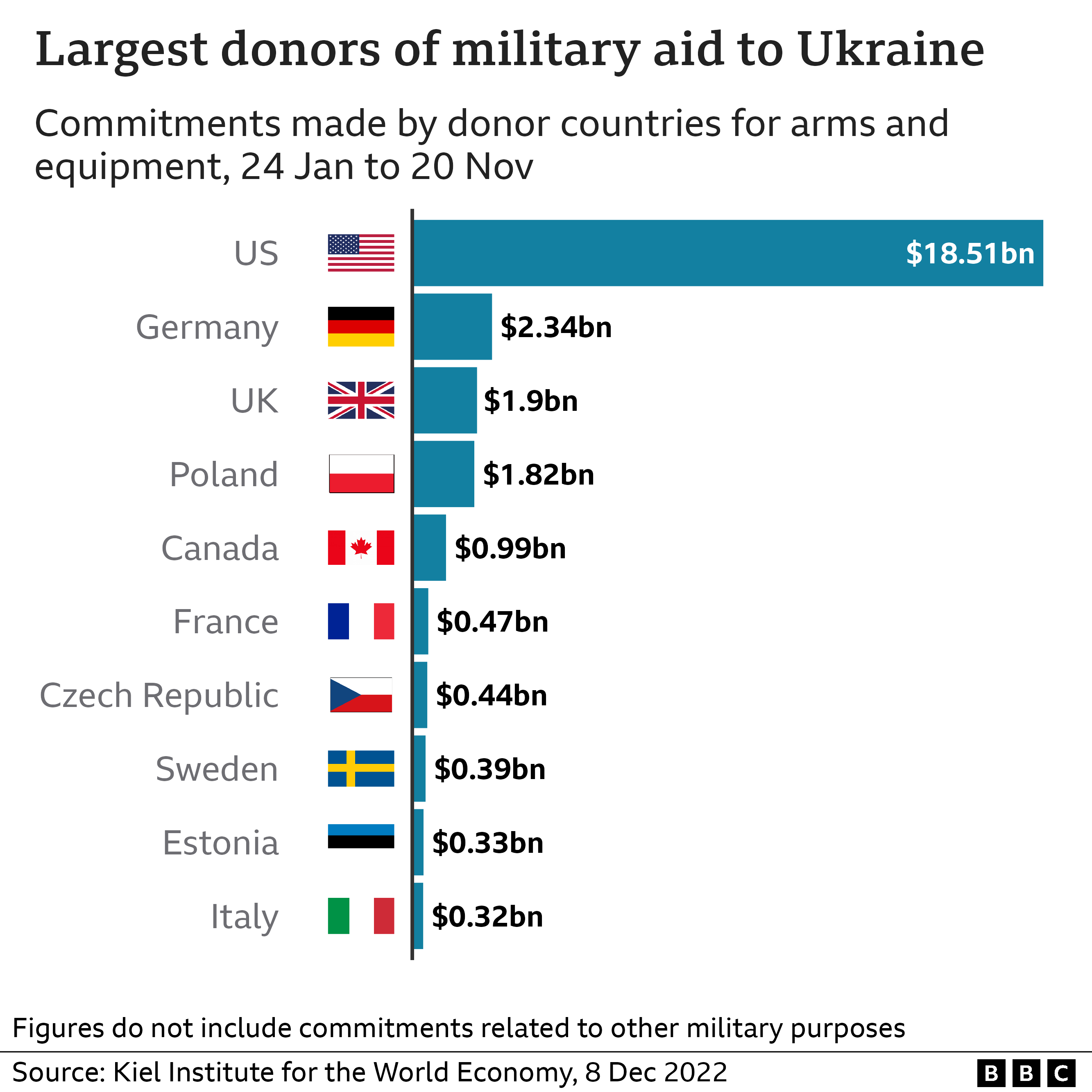
    The US has been Ukraine’s most important ally in the war, committing $50bn of humanitarian, financial and security assistance – far more than any other country.

    Mr Zelensky has held regular phone calls with Western leaders since the start of the war. But by hosting him at the White House, President Biden will signal that Washington is committed to supporting the country for “as long as it takes”, as has been repeatedly said.

    Russia said the visit would lead to an “aggravation of the conflict”.

    “This does not bode well for Ukraine,” Kremlin spokesperson Dmitry Peskov said.

    In its briefing ahead of Mr Zelensky’s visit, the White House confirmed a new package of nearly $2bn (£1.6bn) of security assistance for Ukraine.

    That includes a new Patriot missile battery – a sophisticated air defence system that will help Ukraine to protect its cities from missiles and drones that Russia has fired at critical facilities.

    The attacks, which officials here say are designed to break Ukrainian morale, have left millions without electricity and heating as temperatures across the country plummet below freezing.

    President Zelensky, however, is unlikely to receive the longer-range weapons he’s been calling for, to hit Russian targets away from the front lines.

    In his address to Congress on Wednesday, the Ukrainian leader will probably use the infrastructure strikes to plead for more weapons. There, he will find some Republicans who have voiced criticism about the level of US support, as Congress considers approving an extra $50bn in aid.

    The monthly cost of defence for Ukraine is reportedly about $5bn (£4.1bn).

    Chart showing largest donors of aid for weapons and equipment to Ukraine including the US, $18.5 billion and Germany $2.3 billion and UK $1.9 billion. Updated 16 Dec.

    The visit to Washington comes a day after President Zelensky, dressed in combat khaki, was in Bakhmut, a front-line city in eastern Ukraine that has seen some of the fiercest battles in this war.

    He met troops and handed out awards to soldiers, the presidency said.

    The visit was a significant show of defiance – and a demonstration of support for Ukrainian forces on the front line.

    Soldiers gave Mr Zelensky a Ukrainian flag with their names signed on it and asked him to give it to President Biden and the US Congress, in a moment that was captured on camera.

    President Zelensky has vowed to take back all territory that’s under occupation, including areas invaded before February. Before the visit, in his traditional evening address, he said Ukraine would do “everything possible and impossible, expected and unexpected” to get “the results that all Ukrainians expect”.

    Also on Wednesday, the Kremlin says Russian President Vladimir Putin will set Russia’s military goals for 2023 in an “important, voluminous speech”.

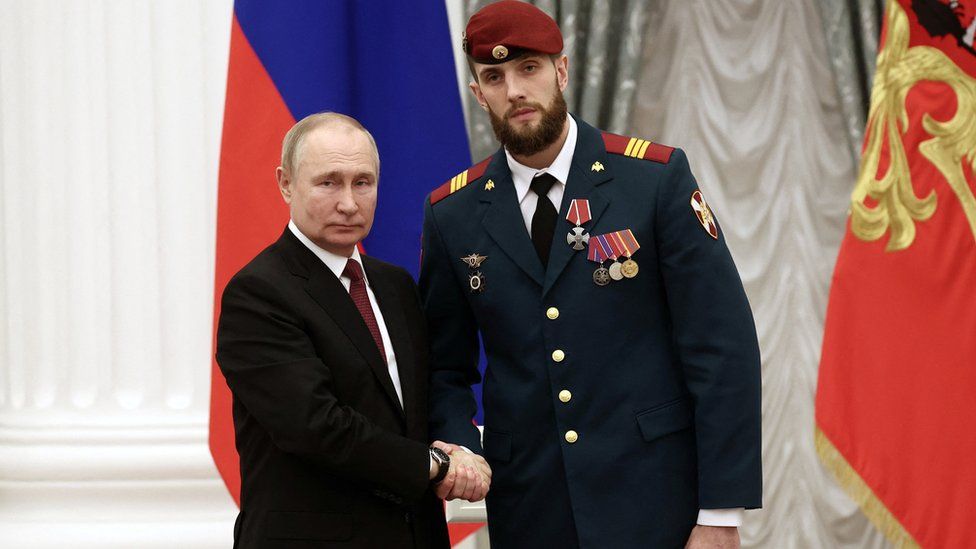
    Vladimir Putin awards sergeant of the Russian National Guard Troops, Lev Makeyev, with the Order of Courage during a ceremony at the KremlinImage source, Reuters
    Image caption, Vladimir Putin awarded National Guard Sergeant Lev Makeyev the Order of Courage on Tuesday

    The UN has recorded 7.8 million people as refugees from Ukraine across Europe, including Russia. However, the figure does not include those who have been forced to flee their homes but remain in Ukraine.

    Source: BBC

  • 33 militants slain at a police station in Pakistan, taking hostages

    The defence minister reported that Pakistani security forces killed all 33 hostage-takers as they retook a police station that had been kidnapped.

    Islamist militants from the Pakistani Taliban seized the centre in the remote north-western Bannu district on Sunday.

    Several people, including security officials, were inside at the time.

    The defence minister, Khawaja Muhammad Asif, said all hostages were freed, two special forces killed, and 10 to 15 members of the military injured.

    The Pakistani Taliban – also known as the TTP – confirmed it was behind the attack, according to a statement reported by local media.

    The group stepped up its attacks after ending a ceasefire with the government last month. The two sides have been locked in conflict for years.

    The group emerged in 2007 and was suppressed by a military operation in 2014, before re-emerging.

    It is separate to the Afghan Taliban, though it has been more active since the Afghans agreed a peace deal with the US in 2020, and took control of the country last year. The two groups share a hard-line Islamist ideology.

    The hostage incident unfolded in a region near the two countries’ shared border.

    Explaining events, Mr Asif told parliament that the 33 militants had links to different groups, and were being held in a counter-terrorism compound.

    He said the hostages were taken after one militant hit a guard on the head with a brick and snatched his weapon.

    The militants are said to have requested a safe exit in return for releasing the hostages. A standoff emerged as negotiation efforts failed.

    Army commandoes are said to have taken the chance to take back the police station at 12:30 local time (07:30 GMT) after the hostage-takers found themselves arguing among themselves.

    Witnesses of the siege reported explosions and heavy gunfire.

    Mr Asif told parliament that “all the terrorists” had been killed, and all the hostages freed – without specifying what the latter number was.

    He blamed a “total collapse” of the provincial Khyber Pakhtunkhwa government for the deadly incident.

    Nearby schools, businesses and roads remained closed on Tuesday, with police checkpoints in place.

    The incident came amid a wave of deadly attacks in Pakistan – many of these targeting the security forces.

    Four policemen were killed during a separate attack elsewhere in Bannu on Sunday.

    Source: BBC

  • Ethiopia’s largest bank resumes business in Tigray

    Ethiopia’s largest bank, the Commercial Bank of Ethiopia, declared on Monday that it has reopened its doors to business in some towns in the unstable Tigray region after a more than 12-month hiatus.

    “Following the recent peace agreement, the branches we have in the towns of Shire, Alamata and Korem have started receiving money sent from abroad and locally. And they have also received money on deposit,” the bank said in a statement.

    The bank said it was “continuing its efforts to expand (its) services and gradually resume operations in all branches.

    The government and rebels signed an agreement in Pretoria on November 2 that included a cessation of hostilities, the withdrawal and disarmament of tiger forces, the restoration of federal authority in Tigray and the reopening of access to the region, which is in a catastrophic humanitarian situation.

    On December 7, tiger authorities confirmed that Mekele, the capital of Tigray region, had been reconnected to the national power grid after more than a year of being cut off due to the war in the northern region of Ethiopia.

    The northernmost region of Ethiopia, home to six million people, has been virtually cut off from the world since the start of a conflict between the federal government led by Prime Minister Abiy Ahmed and the regional authorities of the Tigray People’s Liberation Front (TPLF).

    It had been deprived of many basic services (electricity, telecommunications, banks, fuel, etc.) for more than a year.

    The fighting began in November 2020, when Abiy Ahmed sent the federal army to arrest the region’s leaders, who had been challenging his authority for months and whom he accused of attacking federal military bases.

    On December 7, tiger authorities confirmed that Mekele, the capital of Tigray region, had been reconnected to the national power grid after more than a year of being cut off due to the war in the northern region of Ethiopia.

    The northernmost region of Ethiopia, home to six million people, has been virtually cut off from the world since the start of a conflict between the federal government led by Prime Minister Abiy Ahmed and the regional authorities of the Tigray People’s Liberation Front (TPLF).

    It had been deprived of many basic services (electricity, telecommunications, banks, fuel, etc.) for more than a year.

    The fighting began in November 2020, when Abiy Ahmed sent the federal army to arrest the region’s leaders, who had been challenging his authority for months and whom he accused of attacking federal military bases.

    Sourc: African News

  • Tunisia: First legislative vote after dissolution of the parliament saw low turnout.

    The official turnout for the parliamentary elections in Tunisia, which took place on Saturday, was 11.22%, according to the country’s electoral commission on Monday. This is just marginally higher than the 8.8% preliminary figure that was made public after the polls closed.

    The final turnout was announced by the president of the electoral authority Isie, Farouk Bouasker, at a press conference in Tunis.

    Even revised upwards, this turnout is the lowest since the revolution that toppled the dictatorship in 2011, after records (nearly 70% in the October 2014 legislative) and is three times less than for the referendum on the Constitution last summer (30.5%), already marked by a high abstention. According to Bouasker, 1.025 million people out of just over 9 million registered voters cast their ballots.

    The head of the main coalition of opponents in Tunisia, Ahmed Nejib Chebbi, called on President Kais Saied to “leave immediately”, after the fiasco of massive abstention in the legislative elections, boycotted by the opposition.

    After his coup de force on July 25, 2021 and the dissolution of the old Parliament, denounced as a “coup d’état” by the opposition, President Saied had a constitution adopted this summer that drastically reduces the prerogatives of Parliament.

    The new Assembly of MPs will not be able to dismiss the president and it will be almost impossible for it to censure the government. It will take ten deputies to propose a law, and the president will have priority in getting his laws passed.

    Source: African News

  • 17 former ISIS militants executed by Libyan court

    The Prosecutor General’s office has announced that a criminal court in Tripoli on Monday sentenced 17 individuals to death for supporting the extremist organization Islamic State (EI) and engaging in lethal action on its behalf in Libya.

    In addition to the 17 death sentences, the court sentenced two suspects to life in prison and 14 others to various prison terms, according to the same source. The nationalities of those convicted were not specified.

    The 17 men were found guilty of committing “acts associated with” the EI and “undermining the state and social peace, adopting violence and armed action in the western city of Sabratha and its surroundings,” the prosecutor’s office added in a statement.

    They were accused of “killing 53 people, destroying public buildings and making dozens of people disappear,” the source said.

    Libya descended into chaos after the uprising that toppled Muammar Gaddafi’s regime in 2011, with rival powers, a myriad of armed militias and foreign mercenaries scattered across the country, amid foreign interference.

    Taking advantage of the absence of the state, the iE has established itself in several Libyan cities, making Sirte its stronghold in June 2015 before being driven out in 2016. The jihadists who were not killed in the fighting or were arrested retreated to the desert but also to cities in western Libya.

    EI fighters had briefly occupied the centre of Sabratha in February 2016 before government forces retook the city.

    Libya voted in 2010 against a UN General Assembly resolution calling for a global moratorium on capital punishment, but no official statistics are available on the number of executions in the country.

    Source: African News

  • Burkina Faso: Two different attacks resulted in at least eight deaths, including six civilians

    In two separate strikes on Saturday in northern and eastern Burkina Faso, at least two Burkinabe soldiers and six civilians were murdered, according to information obtained by AFP on Monday from local and security sources.

    The first attack took place near Bouroum, in the northern province of Namentenga, where “a team of defense and security forces (FDS) on a mission hit an improvised explosive device,” a security source told AFP.

    “Unfortunately, two soldiers were killed and five wounded who were evacuated for appropriate care,” the source said.

    The second attack, also on Saturday, occurred in the village of Kokodé, on the Tendokogo-Bittou road, in the east-central part of the country, near Ghana.

    “Armed individuals intercepted a public transport bus, also causing casualties,” the security source said.

    Another security source said “six civilians were killed by the assailants, who also robbed the bus passengers.

    “Among the victims is an important economic operator in the region,” said a member of the union of traders in the region, confirming the toll of the attack.

    Since 2015, Burkina Faso has been regularly plagued by jihadist attacks that have killed thousands and forced some two million people to flee their homes.

    These attacks by groups linked to the Islamic State and al-Qaeda targeting military and civilians have increased in recent months, mainly in the north and east of the country.

    Captain Ibrahim Traoré, the transitional president who emerged from a military coup on September 30 — the second in eight months — has set himself the goal of “reconquering the territory occupied by these terrorist hordes.

    Between December 1 and 10, 39 “terrorists” were killed in an anti-jihadist operation conducted in northwestern Burkina Faso, the army said.

    Called “Feleho” or “take back one’s property” in the local Bwamou language, this operation aimed at “securing the Banwa province” in the Boucle du Mouhoun region (north, bordering Mali), made it possible to liberate a dozen localities under siege by armed groups, according to the army.

    Source: Africa News

  • Over 20 villagers killed in northern Nigeria by gunmen

    Nigeria, the country with the largest population in Africa, reported Monday that gunmen killed more than 20 villagers in two separate attacks in the violent northern province of Kaduna.

    The death toll from Sunday’s violence against the villages of Malagum 1 and Sakwong in Kaura district rose to 28 or 37, according to sources.

    Criminal gangs have been attacking villages in the northwest and central parts of the country for years, stealing livestock, kidnapping people for ransom, looting food and burning down homes.

    Atuk Stephen, a Kaura district official, told a local television station that 37 people had been killed by bandits who had burned more than 100 homes and several vehicles.

    Other local sources put the death toll at 28.

    The Kaduna State Commissioner for Internal Affairs, Samuel Aruwan, confirmed that several people were killed in the attacks, but did not give a definite death toll. He added that the army had deployed to the area to hunt down the attackers.

    Kaduna is one of the states most affected by “bandits” in northern Nigeria.

    This situation is compounded by sometimes deadly clashes between nomadic cattle herders and local farmers over grazing and water rights, which have taken on ethnic and religious dimensions.

    Nigerian President Muhammadu Buhari is under intense pressure to end the violence before he leaves office next year after an eight-year term.

    The “bandits”, described as “terrorists” by the federal government, are motivated by greed. But analysts worry about growing links with jihadist groups in the northeast, which have been waging an insurgency there for 13 years.

    Source: Africa News

  • Rwanda welcomes UK judges decision approving deportation plan

    The British courts’ approval of the deportation of migrants who entered the UK unlawfully to Rwanda has been welcomed by the central African nation’s authorities.

    The Rwandan government spokesman Alain Mukuralinda called the ruling a “positive step” towards solving the global migration crisis.

    “And it is also a satisfying decision because we can find new solutions. New ways of doing things because today we have always hidden ourselves from international conventions, international law, to keep the status quo, but today we will evolve and implement distinct solutions, such as trying to solve this deadly migration problem.” Alain Mukuralinda, spokesman for the Rwandan government.

    After hosting student survivors of the 1994 genocide for nearly three decades, the Hope Hostel is one of the major properties that will be the first home for migrants deported from the United Kingdom in Rwanda.The renovated 50-room facility in Kigali’s Kagugu neighborhood has a new coat of paint, fresh bedding, and new security cameras. This is just one of the ways Rwanda has prepared for this.

    “There are Rwandans who study, there are Rwandans who have businesses, there are migrants who study here, we forget. There are refugees who have been living here for 10/15/20 years. And it’s not just 10,000/15,000/20,000, there are over 100,000 refugees. Why not use this experiment to solve this problem. So Rwanda, no matter what people think, is ready to try new ways of doing things and attract that human capital. Why not. ” Mukuralinda says.

    Judges in London on Monday ruled that the UK government’s controversial plan was lawful, after a legal challenge by migrants and campaigners.

    In July trade unions in the UK held demonstrations in a StopRwanda campaign, to protest the move.

    Source: Africa News

  • Neck and back pain may result from your sleeping habits

    Numerous factors, including stress, bad posture, texting, sports-related injuries, auto accidents, and chronic conditions like fibromyalgia, can contribute to neck pain. But there’s another culprit you may not be considering — how you sleep.

    “Generally, when you wake up with neck pain, either your pillow isn’t right for you or the position in which you sleep is aggravating your neck, or both,” said sleep specialist Dr. Raj Dasgupta, an associate professor of clinical medicine at the University of Southern California’s Keck School of Medicine.

    Experts suggest choosing a pillow that supports the natural curve of your neck, which could be quite different to the pillow used by your sleeping partner.

    “Sleeping is an individual experience,” said Colleen Louw, a certified spinal and therapeutic pain therapist and spokesperson for the American Physical Therapy Association, in an email.

    “Working with a physical therapist can help you understand what is resulting in exacerbations of pain and what positions or strategies might result in more restful sleep,” Louw said.

    In general, sleeping on your back or side is best for preventing neck or back pain, experts say, as both positions help maintain your spine’s natural curves.

    Back is best: The ideal position is to sleep on your back on a pillow that allows your neck to be positioned so you’re looking straight at the ceiling, Dasgupta said.

    “If the pillow is too fluffy or too big, then you’re going to flex your head forward, and it’s going to cause some issues,” he said. “Stand up against a wall and put the pillow behind your head. Are you still looking straight? You don’t want to be looking at the ceiling or looking down, you want to be perpendicular to the wall. That pillow will hopefully translate to no neck pain.”

    Back sleepers should also try to sleep with hands by their sides. A 2017 study found sleeping with one hand up by the head significantly increased a person’s neck and shoulder pain.

    “If you sleep on your back, try using a firm pillow or bolster under your knees,” Louw added. “This can help keep blood flow moving to avoid back pain if your knees are slightly flexed while you sleep.”

    Side sleepers: Sleeping on your side is OK as long as you keep your head and neck aligned with the rest of your body. To do that, you’ll need the right pillow.

    One 2010 study on side sleepers found people who slept on feather pillows woke much more often than those who slept on latex pillows, thus ruining the quality of their sleep. Dasgupta suggests side sleepers choose a firm pillow that will stabilize the neck during sleep.

    “If you’re a side sleeper, you might think that a hard pillow can hurt your neck, but it’s usually a pillow that’s too soft that makes you wake up with neck pain,” Dasgupta said. “There’s going to be a gap between your head and the mattress, so your pillow should serve as a filler.”

    Sleeping with additional pillows can also help keep head, shoulders, hips and knees on the same plane, Louw said.

    “(Use) pillows between your knees, and sometimes in front of your chest or belly to rest your arm,” she suggested, “(to) prevent your shoulders from rolling forward which could rotate your neck while you are sleeping. The idea is to keep blood flowing through your joints and subsequently your nerves to prevent pain.”

    No belly flops: “The one position that we don’t encourage is sleeping on your stomach,” Dasgupta said.

    Sleeping on your stomach forces your neck to tilt on one side for an extended period of time and forces your lower back to arch inward due to gravity, leading to neck and back pain.

    People who sleep on their stomachs should do their best to transition to sleeping on their sides or back, experts suggest. Try a cervical pillow that is especially designed to keep your neck in place. Tuck firm pillows, rolled up bath towels or blankets, or a long body pillow on either side of your body to keep you from rolling onto your stomach during sleep.

    What’s the best course of action if you wake up with neck pain?

    Heat and ice: Try taking a very warm shower to loosen and relax your neck muscles, which can reduce your pain and improve your range of motion, Dasgupta said. You can also try ice packs, and even alternate between a heating pad and ice.

    “The main thing is not to use either one for more than 15 minutes at a time,” Louw said. “But they could be used hourly if needed.”

    Massage: Manipulating muscles and tendons in the neck can increase blood circulation and reduces muscle tension, Dasgupta said. Try different massage techniques until you find the one that works for you.

    Move and stretch: While you should avoid strenuous activities and limit movements that worsen pain, “walking and moving around are still encouraged, because full bed rest may cause the stiff neck and back pain to last longer,” Dasgupta said.

    Should you stretch? If you do, keep the movement very gentle so you don’t make matters worse. But there are more effective treatments, Louw said.

    “Gradual and paced active movement can be more beneficial to decrease stiffness and pain than stretching if instructed by a healthcare professional or physical therapist,” she said.

    Studies show exercise can improve neck pain from sleep much better than other noninvasive interventions such as massage, acupuncture, yoga or relaxation techniques. A 2020 study found mood and sleep improved when people with chronic neck pain increased their exercise levels.

    “If the pain and stiffness are bad enough to significantly limit movement, consider taking acetaminophen or ibuprofen at the recommended dosing. Ask your healthcare providers if you should avoid any of these medications,” Dasgupta said.

    Source: edition.cnn.com

  • COP15: Nations reach ‘historic’ deal to protect nature

    In a “historic” accord designed to maintain biodiversity, nations have committed to protect a third of the world by 2030.

    There will also be targets for protecting vital ecosystems such as rainforests and wetlands and the rights of indigenous peoples.

    The agreement at the COP15 UN biodiversity summit in Montreal, Canada, came early on Monday morning.

    The summit had been moved from China and postponed due to Covid.

    China, which was still in charge of the meeting, brought down the gavel on the deal despite a last minute objection from the Democratic Republic of Congo.

    The main points of the agreement include:

    • Maintaining, enhancing and restoring ecosystems, including halting species extinction and maintaining genetic diversity
    • “Sustainable use” of biodiversity – essentially ensuring that species and habitats can provide the services they provide for humanity, such as food and clean water
    • Ensuring that the benefits of resources from nature, like medicines that come from plants, are shared fairly and equally and that indigenous peoples’ rights are protected
    • Paying for and putting resources into biodiversity: Ensuring that money and conservation efforts get to where they are needed.

    The summit in Montreal had been regarded as a “last chance” to put nature on a path to recovery. Throughout the talks there was division over the strength of ambition and how to finance the plans.

    One big sticking point was over how to fund conservation efforts in the parts of the globe that harbour some of the world’s most outstanding biodiversity.

    Biodiversity refers to all the Earth’s living things and the way they are connected in a complex web of life that sustains the planet.


    Lady birdImage source, Getty Images
    Image caption,

    Biodiversity includes all living things, big and small, and the way they fit together in a web of life

    A new text of the agreement was released by China on Sunday.

    Delegates convened a full session of the summit early on Monday morning after hours of delays, but then agreed to the text quickly.

    The president of COP 15, Minister Huang Runqui, declared the deal approved despite objections from the Democratic Republic of Congo, which said it couldn’t back the deal.

    Georgina Chandler, senior international policy advisor for the Royal Society for the Protection of Birds said people and nature should both be better off thanks to the deal struck in Montreal.

    “Now it’s done, governments, companies and communities need to figure out how they’ll help make these commitments a reality.”

    Sue Lieberman of the Wildlife Conservation Society said the agreement was a compromise, and although it had several good and hard-fought elements, it could have gone further “to truly transform our relationship with nature and stop our destruction of ecosystems, habitats and species”.

    The agreement follows days of intense negotiations. On Saturday, ministers made impassioned speeches about the need to agree on clear goals to put nature on a path to recovery by the end of the decade.

    “Nature is our ship. We must ensure it stays afloat,” said EU Commissioner for Environment, Oceans and Fisheries, Virginijus Sinkevicius.

    Colombia’s environment minister, Susana Muhamed, drew applause when she called for ambition in protecting the planet for the good of all. “Nature does not have boundaries,” she said.

    Source: BBC

  • Thailand warship capsizes leaving 31 sailors missing

    A warship carrying more than 100 crew members collapsed and sank in the Gulf of Thailand during a storm, according to the Thai navy, leaving 31 servicemen unaccounted for.

    The HTMS Sukhothai sank after water flooded its power controls on Sunday night. Images shared by the navy showed some crew who survived in a life raft.

    On Monday, authorities said they had rescued 75 sailors, but 31 were still missing in rough seas.

    “We will keep looking,” a navy spokesman told the BBC.

    Search crews worked through the night to find survivors, with the operation continuing on Monday with air force assistance.

    The navy also announced an investigation into the cause of the disaster.

    “This has almost never happened in our force’s history, especially to a ship that is still in active use,” spokesman Admiral Pogkrong Monthardpalin told the BBC.

    Footage shared by the navy on Twitter showed crew members wrapped in blankets and receiving treatment after they had been rescued. Some were being airlifted to hospital.

    Other images showed sailors from the Sukhothai in a life raft, having jumped from the sinking vessel.

    One unnamed crew member said he had been in the water for several hours before he was rescued.

    “The waves were quite high, about three metres when the ship sank,” he said in a clip shared on local media. “I put on the life jacket and jumped. I swam for three hours.”

    Officials said the ship went down after it took on water, which flooded its hull and short-circuited its power room.

    With the power lost, the crew battled to retain control of the ship which listed on to its side before sinking around 23:30 local time Sunday (16:30 GMT).

    The ship had been on a patrol 32km (20 miles) east of Bang Saphan, in the Prachuap Khiri Khan province, when it got caught in the storm on Sunday.


    Source: BBC

  • Cyril Ramaphosa defies scandal to win party vote

     The scandal-plagued president of South Africa,Cyril Ramaphosa, has been re-elected as head of the ruling ANC to raucous applause from his followers.

    He defeated his rival Zweli Mkhize by 2,476 votes to 1,897.

    Mr Ramaphosa won despite being dogged by allegations of money laundering, and a last-minute surge in support for Mr Mkhize, who has also been accused of corruption. Both deny the allegations.

    His victory puts him in pole position to lead the ANC in the 2024 election.

    But he is still at risk as he is being investigated by police, the tax office and central bank over allegations that he stashed at least $580,000 (£475,000) in a sofa at his private farm, and then covered up its theft.

    A panel of legal experts, appointed by the speaker of parliament, said that he had a case to answer as he may have both violated the constitution and broken an anti-corruption law.

    His supporters burst into song and dance after he was declared the winner, in a result that saw him win by a bigger margin than when he first ran for the leadership of the governing party – the African National Congress – in 2017.

    Mr Ramaphosa’s re-election bid was bolstered by the fact the ANC used its parliamentary majority to vote down the findings of the panel.

    The president has denied any wrongdoing, and has launched legal action to annul the panel’s report.

    He said the $580,000 came from the sale of buffaloes, but the panel said there was “substantial doubt” over whether a transaction took place.

    Mr Mkhize was the health minister in Mr Ramaphosa’s government until he was forced to resign last year over allegations of misspending funds set aside to deal with the Covid-19 pandemic.

    He too has denied any wrongdoing, and his supporters saw the allegations as an attempt to discredit him.

    Mr Ramaphosa was the odds-on favourite to win, but some of Mr Mkhize’s supporters looked stunned after the result was announced.

    They were confident of victory after offering key posts to other powerful leaders in deals struck just ahead of delegates casting their ballots at the conference.

    Both sides denied accusations of vote-buying.

    The ANC has been in power since white-minority rule ended in 1994, and is hoping to secure a sixth term in the 2024 parliamentary election. But opinion polls suggest that its vote has shrunk considerably because of widespread corruption in government, high unemployment and poor public services – including constant power cuts.

    The ANC elected a new deputy leader, Paul Mashatile, who defeated Mr Ramaphosa’s preferred candidate for the second-most powerful post in the party.

    Mr Mashatile is now the front-runner to become South Africa’s deputy president, and president in the event Mr Ramaphosa is forced out of power.

    The president’s allies won other powerful posts in the party, including that of secretary-general and national chairperson.

    Defeated candidates embraced the winners in a show of unity after a bruising conference.

    Supporters of ex-President Jacob Zuma had heckled Mr Ramaphosa during his opening speech at the conference last week.

    But no leader from KwaZulu-Natal, the political heartland of Mr Zuma, was elected to any of the ANC’s top seven posts, in the latest sign of his and the region’s declining influence in the party.

    Source: BBC

  • Full list of winners at NDC National Delegates Congress

    On Saturday, December 17, the National Democratic Congress (NDC), the main opposition party,

    A total of 9,200 delegates from the 276 constituencies gathered at the Accra Sports Stadium for the event, which was attended by party delegates from all over the country.

    Chairmanship 

    At the end of the voting process, Mr Johnson Asiedu Nketiah, former General Secretary of the party, emerged winner in the chairmanship contest.

    The 65-year-old politician received 5,569 votes, while the incumbent National Chairman Samuel Ofosu-Ampofo received 2,892 votes, making him the closest rival.

    Vice chairmanship position 

    Eight people competed for three spots in this category, but the three people; Sheriff Abdul-Naziru, Dr. Sherry Ayittey, and Awudu Sofo Azourka were chosen as the first, second, and third vice chairs, respectively.

    General Secretary 

    Fiifi Fiavi Kwetey, a former NDC Member of Parliament of Ketu South, won the election to succeed Johnson Asiedu Nketiah as general secretary.

    He ran against former Sports Minister Elvis Afriyie Ankrah and Mr. Nketiah’s deputy Peter Boamah Otukunor.

    Deputy General Secretary 

    For the two openings in this post, there were seven applicants. Gbande Foyo Mustapha, Barbara Serwaa Asamoah kept her job as deputy general secretary.

    National Organiser

    The former Deputy Ashanti Regional Minister, Mr Joseph Yamin, won this position.

    Deputy National Organiser

    Just two of the four candidates were required for this position. At the end, Kobby Barlon and Elikem Kotoko were chosen following the election.

    National Communications Officer 

    Mr Sammy Gyamfi has been retained as the Communication Officer position after he contested unopposed.

    Deputy Communications Officer 

    Malik Basintale and Ako Gunn were elected the deputy National Communication Officers.

    Zongo Caucus Coordinator

    Five people competed for this position, but Mamah Mohammed Cole Younger ultimately prevailed.

    NEC members

    This position saw the highest number of contestants. Nineteen persons contested for five slots.

    Victor Wonder Kutor, Araba Tagoe, Cecillia N. Asaga, Victoria Kuma-Mintah and Ephraim Nii Tan Sackey were elected.

  • Ukraine: Russia to deploy musicians to front to boost morale

    Russia says it will deploy musicians to the front lines of its war in Ukraine in a bid to boost morale.

    The defence ministry announced the formation of the “front-line creative brigade” this week, saying it would include both vocalists and musicians.

    The UK’s ministry of defence highlighted the brigade’s creation in an intelligence update on Sunday.

    Meanwhile, Russian Defence Minister Sergei Shoigu visited frontline troops in Ukraine, the government said.

    In a statement posted to Telegram, the defence ministry said Mr Shoigu “flew around the areas of deployment of troops and checked the advanced positions of Russian units in the zone of the special military operation”.

    It added that he “spoke with troops on the frontline” and at a “command post” – but the BBC cannot confirm when the visit took place or whether Mr Shoigu visited Ukraine itself.

    The reported visit comes as UK defence officials said low morale continues to be a “significant vulnerability across much of the Russian force”.

    The UK said the new creative brigade – which follows a recent campaign, urging the public to donate musical instruments to troops – is in keeping with the historic use of “military music and organised entertainment” to boost morale.

    But they questioned whether the new brigade would actually distract troops, who have been primarily concerned about “very high casualty rates, poor leadership, pay problems, lack of equipment and ammunition, and lack of clarity about the war’s objectives”.

    According to the Russian outlet RBC news, the brigade will consist of troops mobilised under President Vladimir Putin’s recruitment drive, as well as “professional artists who voluntarily entered military service”.

    The new unit will be tasked with maintaining “a high moral, political and psychological state [among] the participants of the special military operation,” the outlet cited the defence ministry as saying.

    Meanwhile, intense fighting has continued around the town of Bakhmut in the eastern Donbas region on Saturday, Ukraine’s general staff said.

    The area has seen heavy clashes between Ukrainian and Russian troops for months, as Russia seeks to retain territory following a string of defeats in eastern Ukraine earlier this year.

    Western intelligence officials have previously said Russian attacks on the town are being spearheaded by the private military contractor, Wagner Group.

    Moscow hopes to use the town as a staging ground to launch attacks on the Ukrainian-held cities of Kramatorsk and Sloviansk.

    Elsewhere, heating has been restored to the Ukrainian capital of Kyiv, after Russian launched widespread strikes on Friday that targeted power and water infrastructure, Mayor Vitali Klitschko said.

    Moscow launched 76 missiles on Friday, hitting nine power supply stations and plunging much of the country into darkness. Ukraine said it intercepted 60.

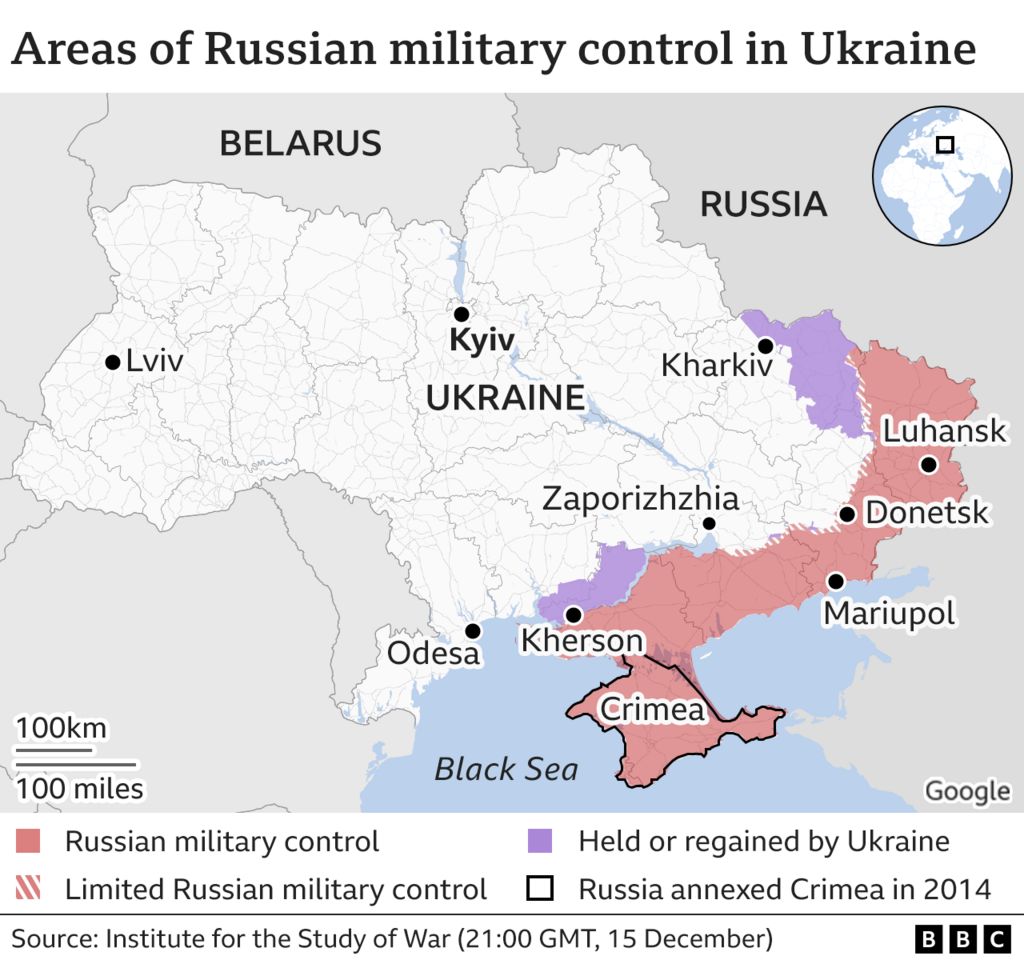
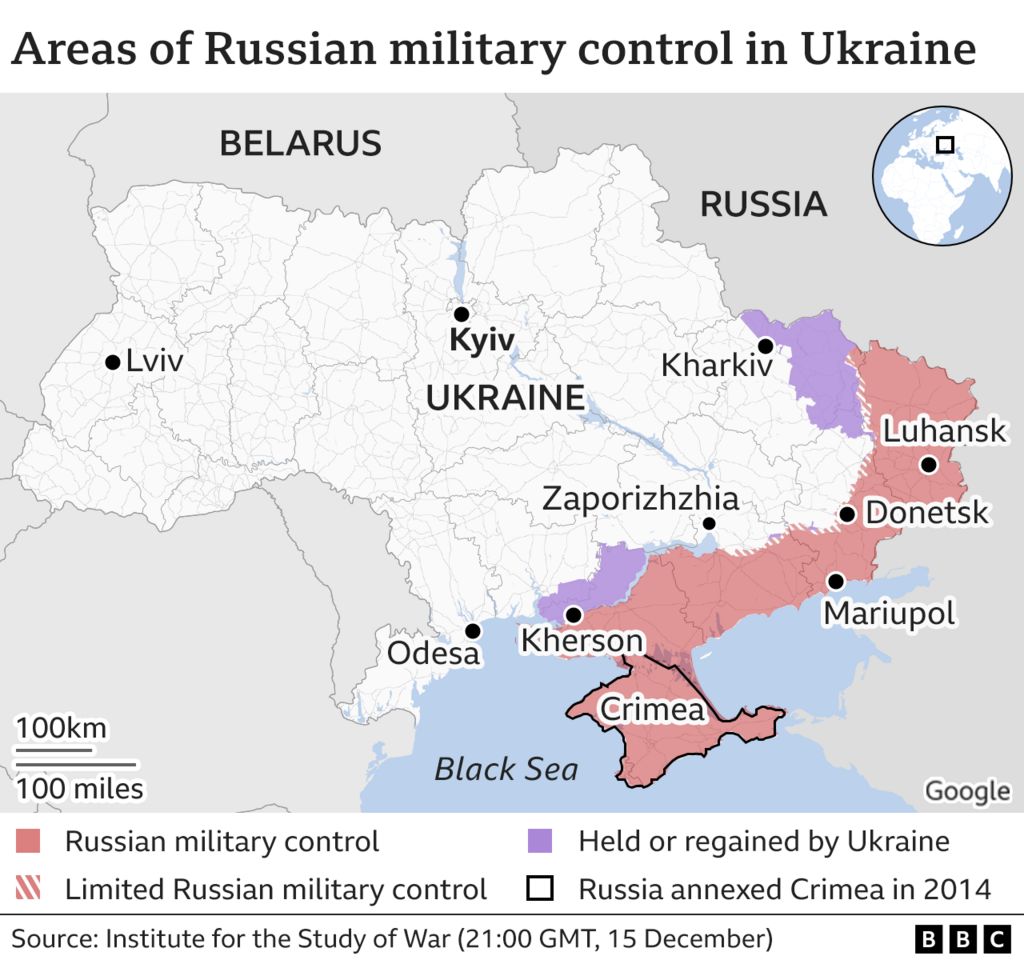
    A map showing areas of Russian control in Ukraine

    Source: BBC

  • BOST discounts claims of diesel leakage, says substance was sludge

    The Bulk Oil Storage and Transportation Company Limited (BOST), has discounted claims in the media that a liquid substance thought to have leaked from a national oil pipeline at a spot near Atimpoku in the Eastern region, was diesel.

    A statement issued by BOST said the reported liquid was actually sludge consisting of water, dirt and fuel residue it had spilled during testing of the integrity of a pipeline being refurbished.

    Residents living around the spillage reportedly scooped up gallons of the flowing material, assuming it was wholesome diesel.

    According to BOST, it owns and operates a 71-kilometre Petroleum-Product-Pipeline stretching from its Accra Plains Depot at Kpone in Tema to the Akosombo Depot at the banks of the Volta Lake in the Eastern Region.

    “The pipeline had been decommissioned from 2015 due to vandalism of the line by unknown assailants. This resulted in BOST resorting to the use of Bulk Road Vehicles, popularly known as tankers in the haulage of petroleum Products from the Tema to the Akosombo Depot for onward transmission using river badges to the Buipe Depot in northern Ghana.

    “Repair works on the pipeline commenced a year ago and was expected to be completed by the third quarter of the year 2022. Due to the impact of the construction of the Railway Line from Tema to Mpakadan in the Volta region, the line had to be re-routed which affected the completion time.

    “As a further boost, the company commissioned the installation of a leak and intrusion detection system on the line for the safety and security of its operations when it is recommissioned.

    “For a proper assessment of the degree of damage at the commencement of the repair works, water was pumped up the line to help with the full detection of all leakages for repairs.

    “After the repair works, the company carried out a pressure testing of the line to be sure all the leakages detected have been rectified. It is this pressure testing which resulted in the pushout of a sludge in the Maame Water area which is being reported in the media. The sludge is a combination of water, dirt and fuel residue formed in the pipeline which was pushed out in the pressure testing.”

    Source: Myjoyonline.com

  • The hidden dangers lurking in your kitchen

    Cooking might be the way to someone’s heart, but it could also be the way to hospital. The number of accidents involving knives, boiling water, and deep-fat fryers is truly impressive. More than 67,000 children alone are injured in the kitchen in the UK every year, according to the Royal Society for the Prevention of Accidents, and that doesn’t include those adults who decide to deep-fry a whole chicken or put the bagel knife through their finger.

    Some of the dangers lurking in the kitchen are more insidious than you might realise – there is one source of indoor air pollution that you probably use every day and have never suspected. And yet, we’ve come a long way over the last century towards making the kitchen less of a death trap.

    After World War Two, the boom in consumer goods and materials meant that the home became flammable in all sorts of exciting new ways. Nylon and other synthetic fabrics draped housewives and children in elegant, fluttering costumes, and now a sleeve against the gas range could not only catch fire, but melt, coating the skin with droplets of molten plastic that caused horrific burns.

    A 1946 poster campaign from the Royal Society for the Prevention of Accidents urged citizens to use close-fitting garments and put guards over fires, lest their children wind up like the one on the poster, sporting a dress of flames. Legislation brought flame retardants to many home furnishings, though lately we’ve realised these have brought other dangers: they are endocrine disruptors, interfering with hormones.

    Sometimes the danger in the kitchen came from gadgets intended to be safer than the ones they replaced. Electric kettles are a particularly ironic example. Even as early as the 1920s they had automatic shut-offs intended to keep them from boiling dry, and some even had plugs that would pop out when the correct temperature was reached. However, the plugs could easily plop into a full sink of water if the kettle was on the drainboard (death to whoever was washing the dishes, sadly), and if the safety mechanism made it hard to put a popped plug back in, people would inquisitively shove knives and other metal objects in.

    Pathologist F E Camps wrote in 1956 of one instance, involving an elderly woman: “Under the impression that there was ‘something stuck’ she took the plug in one hand, thereby earthing herself with the earth safety metal strip upon it, and with the other hand introduced a metal screw driver into the positive terminal which was still connected to a 25-ampere power plug at ‘on’, she somewhat naturally received the full charge with fatal results.”

    The hidden dangers lurking in your kitchen

    In the 1960s, the British Medical Journal noted that this was still a particular scourge of older ladies. Thankfully, modern electric kettles use a different kind of safety switch, activated by steam and not risking electrocution.

    But we have a surprising danger still lingering on in our kitchens, one that most of us have never given much thought to, because it is not flamboyant or dramatic in its effects. A growing body of evidence suggests that gas stoves, even when they are off, leak methane, and when on, produce carbon dioxide gas and nitrogen oxides. In fact, one study out of Stanford University found that, although it’s small compared to what comes from industry and agriculture, enough methane is leaked from stoves to make a significant contribution to greenhouse gases in the atmosphere.

    Meanwhile, nitrogen oxides, produced when the gas is burned, have been linked to respiratory problems and cardiovascular disease. In just a few minutes of cooking on a gas stove without a fan hood on, levels in the kitchen were exceeding US national standards, according to the Stanford study, which was published in January 2022. As Rebecca Leber notes in her coverage of this study for Vox, another study found that kids in homes with gas stoves, rather than electric, were 42% more likely to have asthma.

    That doesn’t mean electric stoves are without risks. According to research by the National Fire Protection Association, the rate of cooking fires is 2.5 times higher in households with electric ranges.

    The hidden dangers lurking in your kitchen
    Using a fan hood is recommended, as gas stoves can produce harmful fumes (Credit: Brizmaker/Getty Images)

    Like many dangers in the home, both past and present, the gas stove has a strong PR team. Leber notes that this source of pollution can be replaced with an electric or induction stovetop with relatively little trouble, but in the United States, the natural gas industry is working to avoid a consumer exodus, going so far as to hire social media influencers to tout the benefits of cooking with gas. They are also lobbying against municipalities banning new gas hookups and transitioning to a cleaner infrastructure.

    Perhaps in 20 years’ time we will look back and shake our heads at the dangers we unknowingly harboured. But the scientific picture, at least, is growing clearer: your new stove should probably be electric or induction. And in the meantime, remember to switch on your fan.

    Source: BBC

  • Border barriers hurt EAC’s trade ambitions with Africa

    Efforts by the bloc to align with the continental free trade policies Immigration could be derailed by restrictions between citizens of East African Community member states.

    New data prepared by the African Development Bank in collaboration with the African Union Commission show that while the EAC is generally supportive of integration and regional trade, members of the bloc have retained certain barriers to the movement of people within partner states.

    The Africa Visa Openness Index (AVOI), which tracks the readiness of countries to accept each other’s citizens, shows that while the EAC had one of the highest openness scores in 2017, that grade dropped last year as member states increased and individual member states imposed their own restrictions.

    South Sudan and the Democratic Republic of Congo, have joined the bloc since the first index was released seven years ago.

    This expansion, it seems derailed wider openness in the bloc.

    Visas

    Both DR Congo and South Sudan still require visas from some of the EAC member states but overall, each of the seven-member states still asks for visas from at least one other member state. It means that EAC member states are only 76 percent open to each other’s citizens.

    At the release of the report on Sunday, experts warned that the slow pace of opening up may in fact hurt trade ambitions.

    “If you look at some of the regions that have some of the highest inter-regional trade, these are the regions that have inter-regional mobility,” said Maureen Achieng, the Chief of Mission and International Organisation for Migration Representative to Ethiopia, the African Union, the UN Economic Commission for Africa and the Intergovernmental Authority on Development, commenting on the findings.

    Ms. Achieng compared the free movement of people, labor policies, and open skies for air transport and the African Continental Free Trade Area Agreement (AfCTA) as “four wheels of a vehicle.”

    “If one of those wheels does not move right, the vehicle will possibly grind to a halt.”

    Members of AfCTA

    All of the EAC member states are members of the AfCTA but South Sudan has not yet ratified it.

    Only Kenya, Rwanda, and DR Congo have joined the Single African Air Transport Market (SAATM). Both are definitive continental pacts to improve trade and movement by air transport.

    The report says that the ratification of AfCTA and SAATM helps improve integration but warns that “in the absence of progress in a host of other disciplines, opportunities for trade will always be limited.”

    “Access to the continent’s markets also depends on conditions that govern the trade in services.

    Trading across borders requires communications, financial services, and transport, and many of these involve people moving across borders.

    So do tourism, higher education, medical care, professional services, and many others, says the Africa Visa Openness Report, 2022.

    There were good signs, however.

    Burundi’s immigration policies for other Africans improved significantly, seeing the country’s visa openness ranking rise by 32 places over the past year, and becoming the second most open country behind Rwanda in the East African Community.

    Source: theeastafrican.co.ke


  • Tunisians to vote in lacklustre election shunned by opposition

    Tunisia holds a lackluster election on Saturday for a parliament with virtually no power, the final pillar in President Kais Saied’s political overhaul in the birthplace of the Arab Spring.

    The vote comes after three weeks of barely noticeable campaigning, with few posters in the streets and no serious debate among a public largely preoccupied with pressing financial concerns.

    Opposition political groups in the North African country have called for a boycott, saying the poll is part of a “coup” against the only democracy to have emerged from the 2011 wave of uprisings across the region.

    Last year, after months of political deadlock and economic crisis exacerbated by the coronavirus pandemic, Saied suspended parliament and sent tanks to surround it in a dramatic power grab more than a decade after a popular revolution unseated dictator Zine El Abidine Ben Ali.

    Unrestrained powers

    Saied, a former law professor, has since pushed through a new constitution giving the presidency almost unrestrained powers and laying the ground for a 161-seat rubber-stamp legislature.

    His moves were initially supported by many Tunisians tired of the messy and corrupt democratic system in the post-Ben Ali era.

    But almost a year and a half on, the country’s economic woes have gone from bad to worse, with 10 percent inflation and frequent shortages of milk, sugar, and petrol fuelling a growing wave of emigration.

    The previous legislature had far-reaching powers in the mixed presidential-parliamentary system enshrined in Tunisia’s post-revolution constitution.

    But candidates in Saturday’s poll are standing as individuals under a system that neuters political parties including Saied’s nemesis, the once powerful Islamist-leaning Ennahdha party.

    The new chamber “won’t be able to appoint a government or censure it, except under draconian conditions that are almost impossible to meet,” said analyst Hamadi Redissi.

    A ‘non-event’

    Analyst Hamza Meddeb told AFP the election was a “non-event” and predicted that few Tunisians would turn out to vote.

    “This election is a formality to complete the political system imposed by Kais Saied and concentrate power in his hands,” he said.

    “Tunisians know that this parliament will have no political weight and will be stripped of all power.”

    Meddeb added that most of the candidates are “political newcomers” unable to mobilize a public struggling with “extremely difficult” economic conditions.

    The Tunisian Observatory for Democratic Transition, a non-governmental organization, said around half the candidates are either teachers or mid-level civil servants.

    And in contrast with the previous gender-equal system, women represent less than 15 percent of all candidates for the new parliament, according to the official list released by the election board.

    IMF bailout ‘easier’

    Almost all of Tunisia’s political parties, including Ennahdha, have said they will boycott the vote.

    The powerful UGTT trade union federation has called the poll meaningless.

    Al Bawsala, a civil society group that has monitored Tunisia’s parliamentary politics since 2014, said it would boycott the activities of what it called a “puppet parliament” whose only role would be to “back the president’s programme”.

    Hamish Kinnear of risk intelligence firm Verisk Maplecroft said the vote would “serve primarily as a tool for President Kais Saied to legitimize his grip on power”.

    Ease relations

    But it would also “ease Tunisia’s relations with key external partners by closing out 17 months of constitutional and governance uncertainty”, Kinnear added.

    Tunisia is in the final stages of negotiating a nearly $2-billion bailout package from the International Monetary Fund (IMF) to rescue its crisis-hit public finances.

    Kinnear said the vote meant “securing financial assistance… will be easier now that greater political predictability is returning, even if the democratic legitimacy of the (constitutional) referendum and upcoming legislative elections is weak.”

    The IMF’s top committee was set to approve next week the country’s fourth loan in 10 years, but has postponed its decision until early January at the request of the Tunisian government pending final measures, a source close to the talks told AFP.

    Source: theeastafrican.co.ke

  • Three killed by freak wave in South African beach, injures 17

    Spokesman for KwaZulu-Natal Emergency Medical Services, Robert Mckenzie has confirmed the death of three people who got drowned after a huge wave at Durban’s Bay of Plenty in South Africa.

    He said at least 17 people have been hospitalized and in critical condition.

    The incident occurred at approximately 5.00 pm local time (15:00 GMT) on Saturday, according to a statement from the eThekwini municipality.

    The office said 35 lifeguards were involved in the “mass rescue effort” and that paramedics attended to more than 100 people caught in the incident.

    The dead included a teenager, it said.

    The incident took place as Durban has gradually been reopening its beaches after closure due to high levels of E. coli bacteria coming from the city’s sewer system, which was badly damaged by deadly floods earlier in the year.

    The floods, the worst in living memory, killed more than 400 people in April.

    Durban’s beaches are also preparing for an influx of visitors over the coming festive holidays, according to local media outlets.

    Source: Aljazeera

  • Alarm blows as 20 Somali girls subjected to FGM in Somalia’s Kismayu

    The UN sexual and reproductive health agency, UNFPA, is raising the alarm after 20 girls underwent the proscribed female genital mutilation (FGM) in Kismayu, Somalia’s Jubbaland state, indicating the tough road ahead to end the practice.

    The incident this week came amid strong campaigns by government officials to educate parents to end one of the most prevalent but dangerous rites of passage in Somalia.

    UNFPA’s Somalia Representative Niyi Ojuolape on Friday condemned the incident which he said had subjected the girls to injury and heavy bleeding.

    “All the victims are too young to give their informed consent. This is a shocking and deeply disturbing incident that violates the rights of these young girls and should have no place in society,” the UNFPA representative said in a statement released on Friday.

    Grim FGM figures

    In Somalia, the UNFPA gives grim figures on FGM, indicating that as many as nine in ten women have undergone some form of FGM. And despite the practice having devastating health ramifications for women and girls, including pain, bleeding, possibly a permanent disability, or death, cultural barriers have mostly stood in the way of ending it.

    These days though, public policymakers and politicians have publicly spoken against it, a significant improvement from the days when discussing the subject was taboo. The country has not yet passed a law to ban FGM but has been working with UN agencies to spread awareness of the dangers of the practice.

    ‘Dear Daughter’ campaign

    Earlier this year, the UNFPA launched a campaign known as ‘Dear Daughter’, encouraging parents to individually pledge in open letters to protect their daughters from any harmful cultural practices including FGM. The campaign was suitable especially since most of the parents had undergone the practice while still young but admitted to experiencing the problems of FGM even in their later lives.

    UNFPA says the campaign teaches parents and societies in general how FGM is a human rights violation issue as it is a form of gender-based violence that exposes children to danger.

    On Friday, Mr. Ojuolape said FGM should be condemned because “it causes irreparable physical and psychological harm to women and girls”.

    FGM is the partial or total removal of the female genitalia.

    “Sadly, the drought and the humanitarian crisis have increased the risk that Somali girls face as a result of this practice,” he said.

    “I stand in solidarity with the young girls who were affected by this incident and condemn this act of violence. I also want to assure the Somali people that UNFPA has taken immediate note of this situation and is working closely with the government of the Jubbaland State of Somalia as well as like-minded partners to address it.”

    Emergency support

    Somalia’s prevalent FGM is only one form of threat targeting women and girls. A three-year drought has meant that more people need emergency health and food support. A situational report by the UN Children’s agency, UNICEF, said early this month that at least 6.7 million children were in danger of starvation with at least 1.5 million children likely to be malnourished by Christmas Day this year. More than one million people have been displaced, most of who are women and children, due to drought.

    So far, UN agencies working in concert with local authorities say they have supplied some 1.1 million children and women with essential healthcare services, against the initial target of 1.3 million. Reaching these groups is also often affected by the security situation on the ground as Al-Shabaab militants have often blockaded certain parts of the country where drought is also biting.

    As FGM is largely a man-made problem, UNFPA is calling on Somali authorities to punish perpetrators of the practice.

    “I call on the government to take all necessary measures to ensure that those responsible for this incident are held accountable, to serve as a deterrence to others, and to protect the rights of women and girls.

    “I also urge the federal government and the international community to take swift and proactive measures to help eradicate the practice of female genital mutilation,” said the UNFPA Somalia country representative.

    Source: theeastafrican.co.ke

  • Salah Hammouri: Israel deports Palestinian lawyer to France

    Israel’s interior ministry says it has deported a Palestinian-French human rights lawyer after accusing him of security threats.

    Salah Hamouri, 37, was escorted onto a flight to France by police early on Sunday morning, the ministry said.

    A lifelong resident of Jerusalem, he was stripped of his residency rights after officials accused him of being a member of a terrorist organisation.

    Mr Hamouri denies the charges and rights groups have condemned the move.

    But in a statement, the interior ministry said Mr Hamouri had “organised, inspired and planned to commit terror attacks” against “citizens and well-known Israelis”.

    Interior Minister Ayelet Shaked, part of the outgoing Israeli government, hailed the move as a personnel success.

    “The sentence for the terrorist Saleh Hamouri has been completed and he has been deported from Israel,” she said in a statement.

    “This was a long and protracted process and it is a tremendous achievement that I was able to bring about his deportation just before the end of my duties, using the tools at my disposal to advance the fight against terrorism.”

    Mr Hamouri holds French citizenship through his mother. He held residency rights in Jerusalem, which can be revoked by authorities.

    He works for Addameer, a Palestinian legal aid and prisoners’ rights group that was designated a terrorist organisation by the Israeli defence ministry in October 2021 along with five other Palestinian civil society groups.

    The military said they were linked to the Popular Front for the Liberation of Palestine (PFLP), a Palestinian militant group that Israel considers a terrorist organisation.

    In March, Mr Hammouri was arrested and the Israeli military commander in the occupied West Bank ordered that he be held without charge or trial for three months under what is known as administrative detention.

    After four months in detention, Mr Hammouri wrote a letter to French President Emmanuel Macron appealing for help. He was subsequently classified as “a prisoner of high risk” and transferred to a high security prison in central Israel.

    In late September, he began a hunger strike to protest against his administrative detention. He ended it after 19 days, during which he was reportedly placed in solitary confinement.

    Last month, he was informed he would be deported, but the expulsion was delayed as his lawyers contested the case. The Supreme Court rejected his appeal earlier this month.

    Amnesty International condemned his deportation and said he was “paying a high price for his work as a lawyer for Palestinians”.

    “The expulsion from the occupied Palestinian territories constitutes a serious violation of international law and the Fourth Geneva Convention and a potential war crime,” the body added. “It could also constitute a crime against humanity.”

    And HaMoked, a Palestinian rights group, said the deportation set “a dangerous precedent” and constituted “a gross violation of basic rights”.

    The French embassy in Jerusalem has yet to reply to a BBC request for comment.

    Source: BBC

  • South Africa’s ruling party launches five day conference to elect leadership

    South Africa’s ruling party on Friday launches a closely watched conference that looks set to re-elect Cyril Ramaphosa as leader, despite a tarnishing cash-heist scandal.

    Some 4,500 African National Congress (ANC) delegates from across the country are due to vote during the five-day convention at an events centre near Johannesburg.

    Ramaphosa is bidding to retain the reins of the African National Congress (ANC) as the storied party struggles with rifts and declining support after 28 years in power.

    Portraying himself as a graft-busting champion, Ramaphosa took control of the ANC in 2017 after his boss Jacob Zuma became mired in corruption.

    The party’s majority in parliament means that it also has control over approving the national president.

    But Ramaphosa’s clean-hands image has been dented by allegations he concealed a huge cash burglary at his farm rather than report the matter to the authorities.

    Despite this, analysts say the 70-year-old leader remains on track to win the party leadership election, expected to take place among delegates on Saturday.

    “The ANC needs Ramaphosa. He will win,” said political writer Ralph Mathekga. “Even those who hate him need him to win.”

    Outside the conference venue, decked out in the party’s green, yellow and black colours, a group of delegates chanted in Zulu that Ramaphosa should leave the presidency over the farmgate scandal. They also sang a popular pro-Zuma song.

    On the eve of the conference Zuma announced he is suing Ramaphosa over a leaked medical report linked to a 1990s arms corruption trial.

    But the lawsuit is unlikely to hamper Ramaphosa’s chances of securing a second term as ANC leader.

    A victory would secure him a ticket to a fresh term as president after the 2024 elections, if his party wins that vote.

    Source: Africa News

  • South Africa: Cyril Ramaphosa heckled at ANC conference

    South African President Cyril Ramaphosa displayed serenity and authority Friday at the opening of the ANC convention, the historic party in power, on the eve of a crucial vote to designate its next leader and probable future head of state.

    He maintained a tight smile in the face of the jeers and chants of opponents in the hall where 4,500 delegates from all over the country were gathered. Before delivering a speech similar to those he regularly addresses to the nation, reviewing the challenges and successes of his first term.

    As if to inscribe his action in the continuity.

    South Africans “expect us to have the courage and honesty to recognize our failures and to correct them,” he declared in an ANC jacket, referring to “the triple challenge of poverty, unemployment and inequality.

    But “green shoots are beginning to sprout,” he added. “I am convinced that better days are ahead.

    The “comrades” of the African National Congress (ANC) have taken over this conference center near Soweto for five days of debates in a green-yellow-black mass atmosphere.

    “Let us show discipline, political awareness,” Ramaphosa demanded, calling for unity and hoping that delegates would debate calmly “rather than shouting at each other.

    Due to major delays in the schedule, the vote could now take place late Saturday, a senior ANC official who did not wish to be named said.

    The affable Cyril Ramaphosa, 70, sometimes mocked for a bonhomie that hides a shrewd negotiator, is well placed to retain the party’s presidency and win a second term, if the ANC wins the 2024 general election.

    His only rival at this stage, far behind, is his former health minister, Zweli Mkhize, 66, who was removed after a corruption scandal.

    – No credible alternative –

    The head of state is approaching this vote just days after escaping impeachment proceedings, which paradoxically have closed ranks around him.

    Mr. Ramaphosa is accused of trying to cover up the theft in 2020 of bundles of dollars hidden in a sofa at his rural Phala Phala estate. He has not been charged and the police investigation is continuing.

    In the absence of a credible alternative within the ANC, the majority party in parliament supported him, ruling out on Tuesday the possibility of a vote on a forced departure of the head of state. Some voices have been raised against the “line” imposed, but the watchword is clear: play the Ramaphosa card.

    Thwarting an impeachment procedure has “probably strengthened his candidacy for re-election”, eliminating any “uncertainty” on the choice to be made, says the political analyst Susan Booysen to AFP.

    The ANC has been losing votes for the past ten years and for the first time fell below 50% in local elections last year. The party, which has been in power since the end of apartheid, is thus haunted by the fear of defeat in the 2024 general election.

    Cyril Ramaphosa, who is very popular despite the scandal, seems to be the party’s best asset.

    Tumi Mogotla, 37, who sells ANC-branded items outside the congress, hopes he will be nominated for a second term. Despite the turmoil of recent weeks, he still believes “Ramaphosa is best placed to root out corruption.

    “The ANC needs Ramaphosa. He will win,” says analyst Ralph Mathekga. “Even those who hate him need him to win,” he added, referring to the internal divisions tearing the party apart.

    And with the opposition struggling to organize itself, the way seems clear for Ramaphosa to retain power.

    Source: African News

  • Qatar 2022: FIFA President Gianni Infantino lauds African teams’ performance at World cup

    As the 2022 World Cup in Qatar comes to an end this weekend, it is already time to take stock. Morocco, the surprise team of the tournament, was able to place Africa on the world map of football.

    Never a team of the continent had reached the semi-finals of a World Cup. A unique performance that was greeted Friday by the president of FIFA, the Italian Gianni Infantino

    “I want to congratulate Morocco, hat. And also I want to congratulate the other African teams. Senegal made it through the group stage. they played against a very strong England. And also Cameroon, Ghana and Tunisia. Fighting until the last minute to qualify. This puts on display the level of African soccer. I am very happy. The moment of African soccer was always about to arrive. And it finally did.

    Gianni Infantino also recalled that from the next edition, which will take place in the United States, Canada and Mexico, twice as many African teams will qualify. Indeed, the World Cup will be held in 2026 with 48 teams instead of 32 until now.

    In total, 9 or 10 places will be allocated to African soccer.

    Source: African News


  • Kinshasa floods kill at least 169 people

    The UN office in DRC’s capital, Kinshasa, announced that last Tuesday’s heavy rains and flooding had killed at least 169 people.

    Earlier, Congolese authorities had announced that the floods had caused at least 120 dead.

    According to the UN’s Office for the Coordination of Humanitarian Affairs the heavy rains affected an estimated 38 000 people destroying at least 280 houses.

    A three-day national mourning period was declared from Wednesday.

    Source: African News

  • Tunisians choose a new parliament

    Tunisians are heading to the polls this Saturday to choose a new parliament.

    The election of the 161-seat assembly is taking place after President Kais Saied dissolved the legislative body earlier this year.

    The opposition, including Islamist-inspired Ennahdha party have appealed to voters to boycott these elections claiming the poll is a “coup” against the only democracy to have emerged from the Arab Spring in 2011.

    President Saied, a former law professor, has also pushed through a new constitution giving the presidency almost unrestrained powers while stripping parliament of any real power.

    Source: African News

  • Tensions rise between Burkina Faso and Ghana

    Tensions are rising between Burkina Faso and neighbouring Ghana following Ghana’s claim that Ouagadougo had invited Russian mercenaries into the country.

    Ghana’s President Nana Akufo-Addo made the comments last Wednesday sparking a diplomatic row.

    “These 48 hours were marked by the words of Ghana’s president Nana Akufo Addo on an alleged contract between the transitional government and a private Russian company. Faced with such a situation, the logical thing to do was to urgently summon the Ghanaian ambassador in Ouagadougou, but also our ambassador in Accra for consultation”, said Karamoko Jean Marie Traoré, Burkina Faso’s Deputy Minister for Regional Cooperation.

    Faced with jihadist attacks since 2015, Burkina Faso has been increasing ties with Russia in a bid to defeat the rebels.

    “As for our ambassador in Accra, he reported to us as soon as these remarks were made. So we also invited him for consultation so that we could examine together what action would be taken on this matter. In any case, a verbal note of protest was sent to the Republic of Ghana via its national representation in Burkina Faso”, added the Deputy Minister for Regional Cooperation.

    Moscow has been actively courting public opinion on social media and enjoys growing popular support in several French-speaking African countries as France, the former colonial power, is increasingly reviled.

    Source: African News

  • Innovative wheelchair by SA man makes waves in France

    South African innovator, Ernest Mongezi Majenge is helping improve mobility for wheelchair users. His invention has earned him the nickname ‘wheelchair doctor.’ His wheelchair comes with grooves that enable it to be pulled up and down stairs, according to ThisAbility.

    Majenge’s invention was born out of research to understand the challenges that wheelchair users face. He realized that accessing buildings with stairs but no elevators or ramps was a major struggle for wheelchair users. So he developed the idea to invent a wheelchair that can climb stairs.

    Majenge started his company, 911 The Wheelchair Doctor and Manufacturing, in 2018, as a wheelchair repair service. He then moved into developing his off-road wheelchairs that will cater to people in townships, rural areas and on farms. “The wheelchair works by gripping onto the stairs to protect the user from falling off while someone easily pulls them up and down the stairs,” Majenge told ThisAbility.

    He started his company after he won $1,500 in seed funding from Y-Beca and Transnet Matlafatso Centre at Wits University, which was sponsored by the Industrial Development Corporation. He began refurbishing old wheelchairs to make them stair-friendly. It takes Majenge 24 hours to put together all the parts needed for each product, Africanews.com reported.

    “The secret of the wheelchair are the wheels,” he told the platform. “The wheelchair has been there for years but we only changed the wheels which has star wheels. We can also transform it to have the normal circle wheels that you can use it on a flat surface. It is a two in one wheels.”

    His off-road wheelchairs are already making waves in the international market. According to him, he has received orders from France.

    “So far we have in a day we can manufacture four wheelchairs and it depended on the order we get since it is a new start-up company. On the ruby side, there were 5 that were sold in France and in South Africa, there were only four,” he said to Africanews.com.

    His innovative wheelchair has won him prestigious awards. He received the South African Breweries Foundation disability empowerment award and Transnet Matlafatso Centre pitching competition in 2021 and 2020, respectively.

    Source: Face2faceafrica

  • Black engineer shares why she deliberately wears braids in the lab

    Engineer Fionnghuala “Fig” O’Reilly went viral on Twitter earlier this month when she shared a photo of herself wearing braids while working in a lab.

    “As a Black woman on a national science show, I intentionally wear braids and my curly Afro to normalize Black hair in stem. In this pic, I’m wearing cornrows to study plants being sent to space at NASA,” she wrote.

    Her tweet, which was to emphasize the need to have representation in STEM, received over 100,000 likes. People commented, sharing their experiences rocking natural hair in their workplaces. O’Reilly told Yahoo Life that she “was very glad to see that so many people were proud and happy and felt inspired. Those were the messages that meant so much to me, because it did reach so many.”

    The 29-year-old’s mission is to recruit and mentor Black women pursuing careers in science, technology, engineering and mathematics (STEM), Yahoo Life said. Born in the U.S. to an American mother and an Irish father, O’Reilly got attracted to STEM after a teacher in high school asked her to apply to a summer academy at UC Berkeley for students of color that were inner city and from low-income families.

    O’Reilly, coming from a “relatively food insecure house”, felt she could not access such a program so she brushed it aside. But the teacher pushed her to apply and she ended up being accepted. “And for the next three years I was exposed to nothing but STEM and other students of color who had similar backgrounds. And that was what inspired me to become an engineer to begin with,” she said.

    O’Reilly then went on to study engineering at George Washington University, where she was usually surrounded by white young men. Some of her fellow students also had issues with her hair. “I remember being told more than once I’m ‘blocking’ someone’s view with my hair because I had it in a curly afro,” she recalled.

    Even when her colleagues thought she was not fit for the course, she proved everyone wrong, graduating with a systems engineering degree. Thanks to this experience, O’Reilly said she is very intentional about the decisions she makes as a Black woman in STEM, including her appearance, particularly, her hair.

    “I intentionally make the effort to show up in these spaces where we’re not often seen at all. We’re underrepresented in this field. If you Google a scientist, I can promise you, you’re not going to get pictures of a Black woman with cornrows in her hair popping up,” she said. “Right now, this is for our community.”

    Per a 2021 Pew research study on Gender, Racial and Ethnic Diversity in STEM, women make up 15% of engineering jobs. Black people make up 5%. O’Reilly wants to change this with her startup called Space to Reach, whose mission is to bridge the tech industry with qualified Black and brown women who work in STEM to help them get job opportunities and mentorship.

    Besides her engineering job, O’Reilly is a correspondent on CBS’s Mission Unstoppable with Miranda Cosgrove, a show about women working in STEM.

    “The goal of this show is to show women across various fields of STEM and what it looks like to work in their job and one thing that is important to us on the show is showcasing women of a variety of backgrounds. So I do intentionally show up as myself as I normally would with my hair in a wide array of natural hair styles, because that’s how I show up in life,” said O’Reilly.

    In 2019 when she became the first Black woman and first woman of color, in general, to represent Ireland at the Miss Universe pageant, she wore her natural hair. She said the pageant thought her so much about the impact that representation can have on young people and young girls.

    Source: face2faceafrica

  • Mom of four becomes first Black woman to graduate from St. Edward’s with a doctorate

    Brandie Medina on Friday made history at St. Edward’s University when she became the first Black woman to graduate from the school with a doctorate. The 42-year-old was joined by six other students as part of the first cohort to complete the university’s first-ever doctoral program, American-Statesman reported. The program was designed to prepare students for success in the rapidly changing world of postsecondary education, according to the school’s website.

    Medina’s parents are among the university’s alumni. Her father earned his undergraduate degree and later his master’s degree from St. Edwards. Her mother also received her undergraduate degree from the university.

    Medina attended Prairie View A&M University for her undergraduate and master’s degrees but her will to study at her parents’ alma mater pushed her to start the virtual Doctorate of Education of Leadership and Higher Education program at St. Edward’s in fall 2019.

    “It’s not really highly expected of Black individuals to go to predominantly white institutions, so for both of my parents to finish their degrees there, and to go off and become highly successful, that resonated with me,” Medina told American-Statesman. “It showed me that by going to St. Edward’s and finishing my doctorate degree, as long as I persevere, I can be highly successful as well.”

    The Doctorate of Education of Leadership and Higher Education program “teaches students how to handle crises, maintain ethics in leadership and research postsecondary education — all through a lens of diversity, equity, inclusion and social justice, multiple students and administrators,” American-Statesman explained.

    Medina wrote her dissertation on “The Intersectionality of the Professional Black Woman in Education Administration.” Medina is an early college administrator in the High Island Independent School District near Galveston. She chose a career in education to help students succeed. She has been in the education sector for 20 years now, starting as a prekindergarten teacher in Houston’s Third Ward to her present role as an administrator.

    Being a mom of four living in a women’s shelter, she faced several challenges while pursuing a doctorate. She said Wi-Fi at the shelter she lived in was so unreliable, hence, she had to drive to a library on weekends to finish her class assignments. Medina could have given up, but she knew she wanted more for herself, she said.

    “I knew that I wanted more for my kids. I knew that, if I were to give up, I’m going to end up right back where I started. I’ll still be a classroom teacher. There would be no growth in giving up.”

    According to the National Science Foundation’s Survey of Earned Doctorates, 4.4% of doctoral degrees are earned by Black women. This makes the story of Medina important.

    Source: Face2faceafrica

  • Nigerian chess master at age 12 granted asylum in U.S.

    12-year-old chess master Tanitoluwa “Tani” Adewumi and his family, who fled Boko Haram in northern Nigeria in 2017, have officially been granted asylum in the United States.

    Tani’s family first applied for asylum in 2019 and are elated that the long process has come to an end. “We felt so good and thank God for His mercy upon us. Thanks to our attorneys and the Americans, they are wonderful people,” his father Kayode Adewumi told Chess.com.

    Tani made headlines at 8 years old, after defeating 73 of the best chess players in his age group in New York to win his division in the state championship. It took him a little over a year to learn to play chess and become the New York State Primary Chess Champion (Top Players K – 3rd Grade) after debuting at the New York State chess championship.

    After arriving in the U.S. in 2017, Tani and his older brother and parents showed resilience in their new life as refugees and through their immigration hearings to stay in the country legally. Their story, which is one of the many experiences of African immigrants, was made known to the public by New York Times columnist Nicholas Kristof who visited them in a homeless shelter in Manhattan where they lived.

    Tani won over half a dozen trophies in the few months he started playing chess with the help of a part-time chess teacher at his local elementary school, P.S. 116, who taught his class how to play. Tami’s interest in joining the chess club forced his mother, Oluwatoyin Adewumi, to get him enrolled after explaining to the program’s patron, Russell Makofsky, about their financial woes.

    Tami’s fees were waived by Makofsky and he won his first tournament in 2018 with the lowest rating of 105. The story of Tani and his family received a lot of attention from New York Times readers who set up a GoFundMe account to support the family. This enabled the family to move out of the homeless shelter to their own apartment.

    At 10 years old, Tani became the 28th-youngest chess player to become a national master in the U.S. Chess Federation. The chess genius has since become an International Chess Federation (FIDE) master, after winning the under-12 division of the North American Youth Chess Championship in 2021.

    Tani can now compete internationally after being granted asylum in the U.S. His family’s subsequent goal is to obtain U.S. citizenship.

    Source: Fce2faceafrica


  • 96-year-old Jamaican-American earn college degree

    A Florida woman who immigrated to the United States from Jamaica in 1973 recently earned her college degree at the age of 96. According to WPLG Local 10, Violet Edwards, in the early 1980s, was initially a student at New York state’s College of New Rochelle.

    She, however, had to drop out as she had to find work to enable her financially support her daughter in medical school. The nonagenarian eventually felt the urge to return to school and complete her degree course after a number of decades. That was after she helped look after her grandkids. Edwards had also worked at her daughter’s medical practice for a very long while.

    And though the College of New Rochelle is no longer functioning, Edwards successfully managed to have her records transferred to Mercy College in New York. She ended up taking online courses at the college and eventually earned her degree in June. She also graduated with a 4.0 GPA.

    But Edwards faced some hurdles during her time in college. The nonagenarian was battling breast cancer at the time she finished her coursework. She also went under the knife and completed her radiation treatment on July 5.

    For her remarkable achievement, the Jamaican Consulate General honored Edwards with a proclamation. Edwards is also reported to be one of the oldest people to graduate with a college degree.

    Source: Face2faceafrica

  • Why Ghanaians have a love-hate affair with the Ayews

    When Andre “Dede” Ayew stepped up in the 21st minute to take the penalty kick against Uruguay at the World Cup in Qatar, he was hoping a successful shot would accomplish two germane issues. The first was to banish the lingering memories of 2010 which are firmly etched in the minds of all who love the game and are old enough to remember. Uruguay forward and universally-acclaimed pantomime villain Luis Suarez had impeded the goal-bound header in Johannesburg, South Africa with his hand. Ghana then missed the resulting penalty that was awarded and have since been condemned to relishing an opportunity to avenge what they feel was a sporting injustice.

    If things had gone the way of the West Africans that night, Ghana would have been the first African country to qualify for the semis of a World Cup. That feat has since been chalked by Morocco in Qatar.

    But the other box Ayew would have wanted to tick with a goal on December 2nd, 2022 in front of an audience of nearly 40,000 fans, was to put Ghana on the path to the second round of a World Cup as captain of the national team nicknamed the “Black Stars”.

    That morning, his father, Abedi “Pele” Ayew had tweeted his support of the national team and spared words of encouragement for Andre and his brother Jordan, another player in the team, exhorting their achievement of playing at the World Cup when he, Abedi, could not.

    But Andre’s penalty kick against Uruguay was saved and Ghana went on to lose two goals to nil. The revenge dish they had waited 12 years to serve had apparently been undercooked. What however resembled a consolation for Ghana was the fact that Uruguay had not beaten Ghana by enough goals to make it out of the group stage themselves. Their place was taken by South Korea.

    In Ghana, the customary inquisition after a Black Stars defeat was reconvened. It was fairly easy to see who was going to come in for blame. It was none other but the captain who had missed the penalty. The indignation has been an all-consuming fire, swift and merciless, with every diatribe and critique thrown in the way of not only Andre but the entire Ayew household.

    Father Ayew has, for instance, been accused of intimidating Ghanaian soccer administrators into calling up his sons for national duties. However, all of this is the latest episode in the enigmatic affair between House Ayew and Ghanaian soccer fans.

    Abedi Pele is the most famous Ayew by any stretch of recollection. He was nicknamed Pele after the Brazilian soccer legend due to a similarity in both men’s style of play. Abedi is also the most successful footballer in his family, individually and for Ghana. Regarded as one of Africa’s greatest ever to strut his stuff on a pitch, Abedi was part of the contingent to win Ghana’s last major trophy – the African Cup of Nations in 1982. He was only 18 at the time but the subsequent years were gracious to him, as he went on to star for various top-flight European club teams in France, Germany and Italy over a period of 15 years.

    He won the coveted UEFA Champions League – one of only five Ghanaians to do so – with French giants Marseilles in 1993. Now an astute football businessman who owns a football club, Abedi continues to enjoy the respect and admiration of many home and across the world. But for people in his home country, the feeling about the man has not always been positive.

    Abedi Ayew with his children, Andre and Jordan.

    As part of the pioneering class of young Ghanaian footballers who were taken on by European clubs in the early 90s, Abedi was a recipient of both praise and suspicion by Ghanaian fans. There were many times in his 16-year Ghana career where he was accused of not fully committing to the national cause because he was afraid of incurring injuries that would cost him his place and privilege in a European club. Abedi was not the first and will certainly not be the last African to receive such suspicion from their own people. And as many technical insiders and administrators would tell you, Africans who ply their trade weekly for European clubs can be reluctant to put in a tackle or run a few more yards on national duties because of this fear.

    If they are injured playing for their clubs, somehow that mishap was forgivable. Of course, this dynamic was part of a larger anti-African or even racist scheme whereby African soccer players are gently but firmly reminded to be cognizant of who pays the monthly bills. It certainly wasn’t their home countries doing that.

    Abedi’s time in the national team was also marked by an infamous rift between himself and another man good enough to make the list of greatest African footballers ever, Tony Yeboah. As the two biggest players in many of Ghana’s national team call-ups in the 90s, Abedi and Yeboah were known to have segmented the team into two factions, maybe unintentionally.

    Various former colleagues of the two players have reported that there was palpable tension between Ghana’s two best players. Nii Darko Ankrah, a former Ghana defender who was part of the Black Stars team that played at the Cup of Nations in 1992, said last year that “There were two factions in the Black Stars camp; which is the Kumasi and Accra representations.” While Yeboah was born and bred in Kumasi, Abedi was known to identify with other players who were from Accra, like Ankrah.

    Ghana lost the final of the Cup of Nations that year to the Ivory Coast on penalties. And even though Abedi, Ghana’s captain at the time, did not feature because he was suspended for the game, there is a very solid constituency that believes if Yeboah had been handed the captain’s armband for the final, he would have given the game his all. So how is Abedi to blame for another player getting the armband in his absence? It is rumored that he lobbied the coach against Yeboah.

    Abedi finished his Ghana stint in 1998 having represented his country on more than 70 occasions, at times, alongside his brother, Kwame Sola Ayew. They were the first brotherly duo to represent Ghana, a situation that has curiously repeated itself thanks again to House Ayew.

    In 2010, Ghana called up for the World Cup, Abedi’s three; sons Andre, Jordan and the oldest Rahim. The latter who has had the least memorable Ghana career (only seven games) is Abedi’s first son from an earlier relationship before his marriage to Maha, the mother of Andre and Jordan. Abedi’s clan is not complete without Imani, his only daughter who was at one point a national tennis player for Ghana.

    Even after his retirement more than two decades ago, Abedi has appeared to Ghanaians to have an almost insoluble prominence regarding soccer administration in their country. Whether his football team is facing disciplinary action due to allegations of match-fixing or whether he is criticizing the choice of foreign clubs some individual Black Stars players make, Abedi is never really out of the picture.

    In 2007, his connection to the Black Stars saw a new phase with the enrolment of his son Andre. That decision was greeted with excitement by those who thought Andre was a teenage prodigy, and with fury by those who thought Andre was rushed into the senior men’s team on the power of nepotism.

    Rahim’s short-lived Black Stars career was between 2009 and 2010, while Jordan was first picked in 2010. They have not replicated their father’s success but have probably superseded the drama he was involved with in his days. For instance, the manner in which another controversial former Black Stars player, Asamoah Gyan, lost his captaincy in the team to Andre was an issue that was masticated thoroughly.

    Interestingly, neither Jordan nor Andre has been accused of lacking commitment to the national team as their father was. However, the pair are victims of this complete and total commitment in the sense that calls have been increasingly ringing for them to step aside. Their performances have been panned on certain occasions with the meanness of the scorching sun. They are nearly always selected to walk onto the pitch by the myriad of Ghana coaches but fans do not believe the coaches are freely in command. The control of the not-so-invisible Ayew hand is always assumed by millions.

    Andre and Jordan’s continuous inclusion in Ghana teams have earned them the rather cynical nickname The Landlords. Such unchallengeable authority they are thought to have.

    Andre is now the most capped Ghana player of all time, representing his nation 113 times and scoring more goals than his father as well. As fate would have it, when he came closest to winning a trophy with the Black Stars in 2015, it was The Elephants of the Ivory Coast that would trump Ghana in the final. And just like it happened in 1992 in the days of his father, Ghana were beaten on penalties.

    After he missed the penalty against Uruguay, Andre was informed at the end of the game that his daughter was in the hospital because she fainted. She had collapsed due to his misfortune from 12 yards out, it is reported. One can imagine how crushing the feeling was for him – to be fully aware of your hand in your country’s defeat to a sporting nemesis and inadvertently sent your daughter to the hospital. But many people would fancy Andre to come out of tough times because he seems to be made of stern material.

    His resilience and his eagerness to protect teammates is not a phenomenon lost on Ghanaians. He has had to speak up at several pre and post-match conferences for his camera-shy brother Jordan. After Ghana beat South Korea in the second group game at Qatar, Andre reminded all who cared to listen that “Jordan has always played well for Ghana” even if some choose to misremember.

    Even in defeat, Andre is expected to insist that he gave his all. He and his brother have become accustomed to the backlash and know very well that negativity often reigns supreme when they are in the court of Ghanaian public opinion. Despite all of that, they will hold their heads high, perhaps citing the fact that they beat all those nepotism charges.

    They have been good enough to trivialize those accusations. But in football and much of life, you are as good as your last work. Their father, Abedi, more than anyone would know that. He could not win Ghana a trophy as captain of the Black Stars and is also well-remembered for a string of lackluster performances in the latter days of his Ghana career.

    Post mortem analyses of the game against Uruguay are still ongoing even at the time of going to press. It’s been ten days since the defeat but the Ayews are not naïve. They know that until they have given enough for which the people can rejoice in the meantime, absolution will not be granted. On to the next match, they’ll say.

    Source: Face2faceafrica

  • Claudine Gay becomes first Black president of Harvard

    Daughter of Haitian immigrants, Claudine Gay has been declared the 30th President of Harvard University.

    This makes her the first Black person and the second woman to lead the Ivy League school.

    Gay currently serves as a dean at the university and will assume her position in July 2023. She will replace Lawrence Bacow, who is stepping down to spend more time with family. She was elected to the presidency by the Harvard Corporation, the University’s principal governing board, with the consent of the University’s Board of Overseers, The Harvard Gazette reported.

    “She is a terrific academic leader with a keen mind, great leadership and communication skills, excellent judgment, and a basic decency and kindness that will serve Harvard well,” Bacow said. “Perhaps most importantly, she commands the respect of all who know her and have worked with her.”

    Penny Pritzker, senior fellow of the Harvard Corporation and chair of Harvard’s presidential search committee, praised Gay’s qualities. “For all her professional accomplishments, even more impressive are Claudine’s personal qualities—her quality and clarity of mind, her broad curiosity about fields beyond her own, her integrity and fair-mindedness, and her dedication to creating opportunities for others. She will be a great Harvard president in no small part because she is such a good person,” Pritzker said.

    In her acceptance speech, Gay said the appointment reflected her journey from the child of poor Haitian immigrants who believed firmly in the power of education to a career in academia.

    “My parents are immigrants from Haiti. They came to the U.S. with very little and put themselves through college while raising our family,” Gay said. “My mom became a registered nurse and my dad a civil engineer. And it was the City College of New York that made those careers possible. College was always the expectation for me. My parents believed that education opens every door.”

    Gay was recruited by Harvard in 2006 as a professor of government. She was also appointed a professor of African and African American Studies in 2007. In 2015, she was named the Wilbur A. Cowett Professor of Government when she also became dean of social science at FAS.

    She is reorganized as an influential expert on American political participation, according to Harvard Gazette. Her research and teaching explore how various social and economic factors shape political views and voting behavior, the platform added.

    She is the founding chair of Harvard’s Inequality in America Initiative which advances scholarship in the effects of child poverty and deprivation on educational opportunities. She is also a member of the American Academy of Arts and Sciences and was a member of the American Association of Universities advisory board on racial equity in higher education.

    Gay received her bachelor’s degree in economics from Stanford University in California in 1992. She got her doctorate degree in government in 1998 from Harvard, where she won the Toppan Prize for the best dissertation in political science. Gay served as an assistant professor and then a tenured associate professor at Stanford before joining Harvard in 2006.


    Source: Face2faceafrica

  • The parents who sever ties with their children

    Many children cut off contact with their parents due to conflict. It’s less common for parents to sever ties with their kids – but it happens, and can be incredibly lonely.

    Helen hasn’t spoken with her son in more than a year. The last she heard, he was in prison. Now aged 31, he’s been addicted to opioids for more than a decade.

    “He’s tried to call me, probably to ask for money, and I have not been picking up,” explains Helen, who lives in England. “Right now, that’s the right decision for my safety and sanity.” As the primary caregiver for her son’s young daughter, Helen’s focus is providing a loving and secure environment for her to grow up in.

    Helen remembers her son as an impulsive and destructive child, but with a wicked sense of humour and a kind heart. So, she was confused when, as a teenager, “his behaviour turned hostile and he started locking himself in the toilet for hours at a time”, she recalls. “When I confronted him, he’d tell me I was the mad one, the one on drugs. Sometimes, I wanted to laugh, it was so ridiculous.”

    When Helen found out he was using heroin, she didn’t know where to turn. He would disappear for days, returning with all kinds of injuries. When he was at home, he was difficult to be around. “He never hit me, but would often destroy the flat in anger – there’s still a hole in the corridor where he kneed it,” she explains.

    At work, she was paid in cash, which she says her son began taking from her wallet. Not wanting to say anything in case he got violent, she began keeping the money in a belt around her waist. “I said my earnings were going straight into an account so I could get a better credit rating,” she says. She ultimately felt unsafe living with someone deep in an addiction, and cut contact with him.

    The relationship between a parent and their child is expected to be lifelong – a fruitful, loving bond that can survive any highs and lows. However, for some parents, maintaining this connection can be difficult. Eventually, a parent might feel they have reached a point of no return, and so choose to step away from their role.

    Some parents who decide to sever ties say they do so for their own health and safety (Credit: Getty Images)

    Some parents who decide to sever ties say they do so for their own health and safety (Credit: Getty Images)

    In an increasingly polarised world, conversations about children who stop speaking to their parents have become common. Yet it also happens the other way around, even if the discourse is less frequent. This may be in part because data indicates parents severing ties with their children is rarer: a 2015 study conducted by the British estrangement charity Stand Alone showed that 5% of estranged parents had initiated it themselves.

    The decision is already difficult and painful, and those who experience this estrangement say its relative rarity makes it especially isolating, and can add to stigma for those who choose to pursue this path.

    ‘Unconditional love can be problematic’

    “In both research and popular culture, we rarely hear from parents who estrange themselves from their children because it’s so taboo, and there are very few non-judgemental places to speak openly about the experience,” explains Lucy Blake, a senior lecturer in psychology at University of the West England, Bristol, who specialises in estrangement.

    The reasons parents end relationships with their children are similar to the reasons kids cut off their parents: according to Blake, among the most common cited are family conflict, differences in personal values (such as religious beliefs), substance abuse and other toxic behaviour. The Stand Alone research showed that for relationship breakdowns with sons, issues linked to divorce, in-laws and marriage were the most widely reported drivers; while with daughters, mental-health problems and emotional abuse were more common.

    Yet this decision to fracture with children tends to be far more trying and ultimately difficult. Societally, parents are expected to cherish and care for offspring without exception. “We have very high, almost godlike expectations of a parent, where we want them to be unconditionally loving,” explains Blake. “This can be quite problematic, as it suggests they should accept any kind of treatment, including all kinds of psychological and financial abuse.”

    This is perhaps why, even when their children are hurting them, parents struggle to let go. Jennifer Storey, a psychology lecturer at the University of Kent, UK, who specialises in interpersonal violence, finds that in most of her interviews with victims of elder abuse, parents are still worried and sad for their children. “I am struggling to remember one parent who really wanted to cut their child off – they almost always wanted the relationship to continue, but the abuse to end,” she explains.

    It can also be hard for both them and the people around them to accept the reality of what’s happening. “Parents are assumed to have all the power, but as the child grows older, that power dynamic shifts,” says Amanda Holt, author of the book Adolescent-to-Parent Abuse: Current Understandings in Research, Policy and Practice. “The lack of belief that child-parent abuse can happen, or that it can be so bad a parent needs to leave, is another reason that it’s so difficult to walk away.”

    The “intergenerational stake hypothesis” may also be at work. This theory suggests that parents are typically more invested – emotionally, financially and physically – in the parent-child relationship than their children. Greater positive ties with children are associated with a parent’s improved wellbeing, a greater quality of life and lower depressive symptoms; greater positive ties with a parent do not guarantee the same benefits. This means that the parent’s choice to sever contact with a child, whether abruptly or gradually, doesn’t just come with the weight of failure.

    “Parenthood is a role and identity that’s respected and admired – it’s also life-changing and lifelong,” explains Blake. “When a parent does not have an active relationship with their child, they might feel they have failed in this role, bringing feelings of intense pain and shame, changing or challenging how parents think about themselves and who they are.”

    Given these elements, it can be more challenging for parents to sever ties than it is for children. “It could certainly be a different kind of pain, because for parents, there’s the possibility that their life seems emptier or less meaningful,” says Blake. Many will lose friendships and relationships with other family members as a result. “The loss and pain that accompanies estrangement ripples out to touch many different aspects of people’s lives,” says Blake.

    Estrangement from a child can be an extremely lonely ordeal, and damage relationships with friends and family alike (Credit: Getty Images)

    Estrangement from a child can be an extremely lonely ordeal, and damage relationships with friends and family alike (Credit: Getty Images)

    Murky and muddled

    In some cases, like Helen’s, the decision to cut off contact is clearly made by one party. But the source of estrangement between parents and children can often be more muddled.

    Jack, who lives in the US, was married to his wife for nearly two decades, during which time they had four children together. At the time of the divorce, their youngest daughter was a year old. When his ex-wife remarried, he says, his youngest child gravitated more towards her stepfather than him – and as she grew older, seemed not to enjoy spending time with Jack.

    Jack says he reached a breaking point during a visitation when his daughter was aged 14. After a disagreement about curfew, she told Jack she hated her weekends with him, and called her mother for a ride to the event she had planned to attend. “I emailed my ex to say it appeared [my daughter] no longer wanted to spend every other weekend’s visitation with me, and if that were to change in the future, she would be welcomed back with open arms,” says Jack. He doesn’t blame his daughter for acting as she did, but hasn’t heard from or seen her since.

    Although his daughter cut off contact initially, Jack hasn’t felt the need to re-kindle contact with her directly. “The longer it has drawn out, it’s lessened my need to re-establish this relationship. It feels similar to a death to me, and I have moved on,” he says. “At this stage of my life, with the comfort level I enjoy in the relationships I have, I doubt I would be interested in the time needed to invest in building a meaningful relationship with her, not to mention the drama from her that would come with that,” he explains.

    Jack’s story reflects the murky reality of parent-child estrangement, which is that it’s not always cut-and-dried who drops whom. His daughter made her disinterest in him apparent, but he was the one to actually suggest they stop seeing one another.

    This isn’t an uncommon situation, say experts: “For some estranged parents, there’s no one clear answer on who initiated it, and it’s quite messy,” says Blake. When asked who initiated the estrangement (with the options of “they did”, “I did”, “we cut contact with one another” and “I’m not sure”), 10% of respondents in Stand Alone’s community study chose one or more responses, showing that the direction is not always clear.

    Estrangement is also not always a permanent or static state. Moving through periods of estrangement and reunification is common, especially, as Stand Alone found, for mothers and daughters.

    This is also the case for many parents whose child has an addiction. A 2020 Swedish study showed parents of adult drug addicts remained hopeful about an eventual reconciliation, in part because they were able to see their child as two different people: one sober, and one under the influence. If the latter were to leave, as it were, the relationship could continue.

    Helen, for her part, has severed contact with her son several times – they have cycled through periods of estrangement and reconciliation for years. But for now, she is out of touch with him – and unsure what will come next. “If he could show me he was committed to staying clean and out of jail, perhaps I’d want him back in our life,” she explains. “But I don’t know how I could ever trust him again, and certainly not to care for his little one.”

    ‘A lonely ordeal’

    Even for the parents who are steadfast in their reasoning for initiating a break-up, the day-to-day reality of their decision is far from easy. “Configured through biological, legal and social bonds, there is an attachment with one’s child that is very profound,” explains Holt. “Such that if parents do walk away, the relationship may be gone but those bonds persist. It can be very difficult to leave all of that behind.”

    Many parents who initiate estrangement find that the shame and blame surrounding their decision also leads to acute isolation, and ruptures with their established support network even beyond blood relatives. “Parents who have initiated estrangement have very few [people] they can talk to who will show compassion and understanding,” explains Blake. “There might be some room for talking about feelings of grief and loss, but it’s as if it runs out and people are expected to get over it and get on with life.”

    Jack has fielded discussions with friends who don’t understand his non-relationship with his daughter and say they could never turn their back on a blood relation. “To me, just because someone is ‘blood’ does not give them the right to treat [you] poorly,” he explains.

    Compassion and a space to talk may be particularly important at specific moments throughout the calendar year – and this time frame is different for every parent. Wounds feel rawer during the holidays in particular: according to Stand Alone, 90% of people estranged from a family member find holiday seasons challenging, while 85% struggle with the passing of birthdays and 81% find it difficult to be around other families.

    For her part, Helen is feeling particularly reflective as Christmas approaches and she shows her granddaughter the Christmas lights. It was something she often did with her son, and she wishes they could share this together.

    “I was the only lifeline he had, and dealing with my choice to step away never gets easier,” she says. She feels lucky that her daughter has been so supportive, and six months ago, Helen moved closer to her place so they could see one another regularly. “Without the help and understanding of my daughter, I don’t know where I’d be, as this has been a very lonely ordeal,” she says. “The best I can do is keep myself well so I can do the same for others – I’m trying to take it day by day.”

    Source: BBC

  • Peru protests: High-level talks amid deepening crisis

    Authorities in Peru have held high-level talks to try to resolve a deepening political crisis triggered by the ousting of the former president.

    The Council of State, the body made up of representatives of all branches of power, and church leaders had a three-hour meeting in the capital, Lima.

    Earlier, two government ministers resigned, following days of violent protests over the impeachment of Pedro Castillo on 7 December.

    More than 20 people have been killed.

    After the meeting on Friday evening, the head of the National Board of Justice, José Ávila, called on Peruvians to avoid violence and engage in peaceful dialogue with the authorities.

    He said government ministers would be travelling to the areas where people were protesting, in order to promote such a dialogue.

    The new President, Dina Boluarte, gave no statement to the press.

    In another development, thousands of tourists are trapped in the south-eastern city of Cusco after protesters forced the local airport to close.

    Peru has been through years of political turmoil, with the latest crisis coming to a head when Mr Castillo announced he was dissolving Congress and introducing a state of emergency.

    However, his plan backfired and Congress instead voted overwhelmingly to impeach him. Mr Castillo, who is currently in detention, is being investigated on charges of rebellion and conspiracy.

    He denies all the accusation, insisting that is still the country’s legitimate president.

    Demonstrators are calling for the closure of Congress, the resignation of Ms Boluarte and early elections. On Friday, Congress voted against a proposal to bring elections forward to next year.

    Thursday’s clashes between the army and Castillo supporters in the central Ayacucho region left at least eight people dead, health authorities said. Footage on social media showed protestors blocking main roads and airports.

    Just hours later, Education Minister Patricia Correa said she was stepping down. In a Twitter post on Friday, she wrote that the “death of compatriots has no justification”, and that “state violence cannot be disproportionate and cause death”.

    Culture Minister Jair Perez also resigned.

    The protests are also affecting the country’s tourism industry. The mayor of Cusco told AFP news agency that about 5,000 tourists are stranded in the city after the airport there closed when protesters tried to storm the terminal.

    The city is the gateway to Macchu Picchu, an ancient Inca citadel which is visited by hundreds of thousands of people a year.

    About 800 tourists are also stuck in the small town at the foot of the mountain where the citadel stands, because the railway line which serves it has stopped running.

    Some mostly American and European tourists have reportedly left the town on foot along the train tracks in an attempt to return to Cusco.

    Source: BBC

  • Ukraine war: Russia could launch more heavy strikes, Zelensky warns

    Russia has enough missiles to carry out yet more heavy strikes against Ukraine, but Ukrainians will resist, President Volodymyr Zelensky has said.

    Engineers are continuing work to restore electricity to homes, hospitals and infrastructure following a ninth wave of Russian strikes on Friday.

    The attacks have targeted civilian infrastructure, as temperatures drop below freezing in many regions.

    Kyiv has accused Moscow of using winter as a weapon.

    Parts of the Ukrainian capital remained without power and heating on Saturday, the city’s Mayor Vitali Klitschko said. But water supplies have now been fully restored in the city.

    Power has been restored in the country’s second city of Kharkiv, after it was left without electricity for hours following Friday’s wave of strikes that targeted energy stations across the country.

    Local officials said as many as nine power facilities were hit as Russian forces fired 76 missiles and carried out drone attacks.

    Kharkiv’s mayor said the city suffered “colossal” damage.

    One resident, Anastaisa, told the BBC the strikes began on Friday morning.

    “In a matter of minutes, the lights started blinking,” the mother of a two-month-old child said.

    “Just 10 seconds later, we were out of power, everything just went still and that’s it.”

    Friday’s attack on Kherson was the third in as many days on the southern city, a month after Russian forces retreated

    Defence Ministry adviser Yuriy Sak told the BBC on Friday that Russia’s frequent attacks meant that repairing the damage to electricity infrastructure is getting harder.

    Elsewhere, in the city of Kryvyi Rih, four people have been confirmed killed after a residential building was hit -a 64-year-old woman, a 30-year-old couple and a one-year-old boy, whose body was found overnight. A third person died in Kherson. In Kyiv, the city’s metro was left at a standstill.

    The alarm was raised across Ukraine on Friday and Commander-in-Chief General Valeriy Zaluzhny said air defences had intercepted 60 of the 76 missiles fired, most of them cruise missiles.

    Kyiv city officials said about 40 missiles had been fired at the capital alone – one of the biggest barrages since Russia’s 24 February invasion.

    Thirty-seven were brought down by air defences, the officials added.

    “It’s very stressful, but now I’m used to this,” said 42-year-old Oksana, who lives in the capital. “I don’t want our children to live through this, to be in basements, shelters, I don’t want this for them.”

    Map showing areas controlled by Russia in Ukraine

    Russia’s attacks also cut power in the north-eastern Sumy region that borders Russia, and also in the central cities of Poltava and Kremenchuk.

    Russia has launched more than 1,000 missiles and Iranian-made attack drones since the wave of strikes began on 10 October.

    The UK’s Ministry of Defence says there has been an “uptick” in Russia’s campaign of long-range strikes against Ukraine’s critical infrastructure in recent days.

    UN human rights commissioner Volker Turk warned Thursday that more attacks on power facilities could “lead to a further serious deterioration in the humanitarian situation and spark more displacement”.

    “I’m angry,” said Yelyzaveta, 21. “They [Russia] are destroying our lives. We are used to it now. The most important thing is that Russia isn’t here.”

    And Anastasia said that life was becoming more difficult as winter sets in.

    “When it’s daytime it is still OK, it is tolerable and I can manage the situation, but when it’s dark outside, this is when my problems begin because I need to see clearly, to measure baby formula and also to attend to the baby – those are stressful,” she said

    “And, of course, just the effect that we are out of power creates a lot of tension and lots of stress. So we just survive through the night and when the day breaks, it gets a bit better, but we cannot compare it to our normal day.”

    Source: BBC

  • Capitol riot: Committee to seek charges for Trump – Reports

    The congressional inquiry into last year’s Capitol riot will reportedly recommend three criminal charges against former President Donald Trump.

    The House of Representatives select committee will seek an unprecedented charge of insurrection against a former US president, according to US media.

    The panel is expected to publish its final report next week.

    Trump supporters stormed Congress on 6 January 2021 in a bid to stop Joe Biden’s certification as president.

    The justice department – which is already investigating Mr Trump’s role in the unrest – is not obliged to consider referrals from any congressional panel.

    Source; BBC

  • Twitter reinstates banned journalists’ accounts

    Billionaire businessman Elon Musk says several journalists he suspended from his social media company, Twitter, will have their accounts reinstated.

    Reporters for the New York Times, CNN and the Washington Post were among those locked out of their accounts, after Mr Musk accused them of sharing location data about him.

    But amid mounting criticism, he asked Twitter users what to do next.

    And 59% of the 3.6 million who took part voted to lift the ban immediately.

    “The people have spoken. Accounts who doxxed my location will have their suspension lifted now,” he tweeted.

    The ban was condemned by the EU and UN.

    However, one notable account, @ElonJet, remains suspended. The account’s owner Jack Sweeney, 20, used publicly available flight-tracking information to tweet every time Mr Musk’s jet took off and landed.

    Mr Musk had blamed the account for an incident involving “a crazy stalker” who he said had accosted his son while travelling in a car.

    On Thursday, Mr Musk said legal action was being taken against Mr Sweeney and others.

    Twitter’s privacy policy was also updated to say that users “may not publish or post other people’s private information without their express authorization and permission”.

    Some of the journalists suspended on Twitter had reported on the incident involving the jet tracking account.

    Following the suspensions, bodies such as the EU and the UN, as well as governments and journalists, condemned the move.

    “Media freedom is not a toy,” the UN’s under secretary general Melissa Fleming said. “A free press is the cornerstone of democratic societies and a key tool in the fight against harmful disinformation.”

    EU commissioner Vera Jourova had threatened Twitter with sanctions under Europe’s new Digital Services Act which she said requires “the respect of media freedom and fundament rights”.

    Since taking the helm at Twitter, Mr Musk has made a host of changes to its moderation practices.

    He has restored a handful of previously banned accounts, including former President Donald Trump’s profile, which was banned following the 6 January insurrection at the US Capitol.

    The Tesla CEO has also slashed the social media company’s staff and has reportedly stopped paying rent for some of Twitter’s offices, including the company’s San Francisco headquarters, according to the New York Times.

    Source: BBC

  • ‘Immigrant’ footballers ‘don’t represent France’ – far-right politician

    “Immigrants are over-represented in the French national team in the World Cup,” a far-right politician has said adding, “I do not think this team represent France”.

    Marion Marechal is the niece of far-right politician Marine Le Pen, and belongs to the recently formed Reconquête party, whose name refers to Spain’s “Reconquista” period when Christians drove Muslim rulers out of the country.

    Her comments ignore the fact that many black and Arab players were born in France, as well as the reality that the players – like millions of others in the country – are proud to be both French by nationality while also having roots in Africa or elsewhere.

    Some have jokingly called France Africa’s sixth team on account of having many footballers who boast African connections, and this image from Morocco World News

    is being shared widely online:

    Source: BBC