Survivors of the Kishishe massacre recounts how they escaped to Kitshanga, a camp for internally displaced people that has housed many displaced people for more than 20 years, after leaving the bloody east of the Democratic Republic of Congo.
“We were told that many people died in Kishishe,” says one woman who followed the river’s path to escape the massacre with some of her children.
They saw horrors in their village of Kishishe fled and walked in fear and cold for dozens of kilometres to escape the M23 rebels who are backed by Rwanda, according to the UN.
An AFP team met Samuel, Tuyisenge, Eric, Florence and others on Friday in a camp for displaced people in the locality of Kitshanga, in the Masisi territory, where they arrived in recent days.
Depending on the route they took, they travelled 40 or 60 kilometres through the hills to arrive at this camp called Mungote, after fleeing the November 29 killings.
According to a preliminary U.N. investigation, at least 131 civilians were executed that day by the M23 (“March 23 Movement”), a predominantly Tutsi rebellion that has seized large swaths of Rutshuru territory, neighbouring Masisi, north of the North Kivu provincial capital, Goma, in recent months.
The rebels are also accused of rape, abduction and looting, committed against the civilian population in retaliation for an attack by mainly Hutu armed groups.
“The M23 rebels started shooting everywhere,” said Samuel, a young man who said he saw six dead – three members of his family, including his older brother James, and three other residents of Kishishe.
“I decided to run away and it took me a week to get to Kitshanga on foot,” he says.
Tuyisenge is a 30-year-old mother. “I was in church and I was able to escape. Some resisted and were killed. I saw nine dead,” she says, with tears in her eyes.
“I have seven children, but I came here with three. The other four have disappeared and my husband, I have no news”, she adds, surrounded by other women who also want to tell the terror they have experienced.
They have nothing, just the clothes they were wearing when they ran away.
A little further on, in the middle of the displaced persons’ huts, Florence, 45 years old, explains that she walked for several days to get here. She has no news of her husband or two of her children. “In the camp, the one who takes pity on me gives me sweet potatoes,” she says sadly.
Eric is haunted by the image of his older brother’s two children who “came out of the house shouting ‘there’s shooting’”. “They were shot right at the door and died on the spot”, their names were Jacques and Musayi.
According to the Congolese government, UN experts and the American and Belgian diplomatic corps, Rwanda supports the M23. Kigali disputes this, accusing Kinshasa of supporting Hutu rebels, some of whom were involved in the 1994 genocide of Rwandan Tutsis.
The former colonial power Belgium tweeted a statement about the massacre.
It called on Rwanda “to cease all assistance to the M23 and to continue to use all the means at its disposal to persuade it to re-engage in a process of disarmament, demobilization and community reintegration.”
🇨🇩 België veroordeelt ten stelligste de moord op een groot aantal burgers in #Kishishe en #Bambo, in de provincie Noord-Kivu in de Democratische Republiek Congo.
Lees onze verklaring over de situatie in het oosten van de Democratische Republiek Congo.
There have been war-displaced people in Kitshanga for years, some having arrived at the time of a previous M23 offensive. The movement occupied Goma for about 10 days in late 2012, before being defeated the following year by the Congolese army supported by UN peacekeepers.
The M23 took up arms again late last year, blaming the Kinshasa government for not respecting commitments to demobilize its fighters.
According to its officials, the Mungote camp was already home to more than “40,000 households” and about 4,000 more arrived just recently.
“Up to four families are sleeping in a hut, men, women and children. People are dying,” says Vumilia Peruse, vice president of the camp. “They arrive with nothing… The authorities must intervene as soon as possible to avoid a catastrophe,” she said.
“We thought that this war was between soldiers and that we would be spared,” comments Toby Kahunga, president of the civil society of the Bashali chiefdom (grouping of villages). “But they are killing people,” he said, demanding that Rwandan President Paul Kagame “withdraw his men.”
The city of Angola, Luanda, hosted the penultimate summit of the 79-member Organization of African, Caribbean, and Pacific States on Friday.
It’s the tenth heads of state summit that the OACPS has held and the first of three that Angola will hold as the rotating presidency.
The theme for this year’s meeting is titled “Three Continents, Three Oceans, a Common Destiny: Building a Resilient and Sustainable OACPS.”
Angola decided that it should focus on the pressing issues of climate change and good governance, including combatting corruption.
For the Maldives climate change is a threat to its very existence.
According to the World Bank, with “future sea levels projected to increase in the range of 10 to 100 centimetres by the year 2100, the entire country could be submerged”.
“Most of the existential dangers faced by our communities are driven by climate change,” says Dhumya from Maldives.
The foreign minister of France has traveled to the Ivory Coast to meet with President Alassane Ouattara and his administration to discuss trade and security.
Speaking in the economic capital Abidjan on Friday, Catherine Colonna said France will remain at the side of its former French colony “in all areas.”
Around 900 French soldiers are stationed in Ivory Coast and France is one of its biggest investors.
“France believes in the potential of Ivory Coast,” she said.
“It is ready, willing – and has shown it – to accompany its progress, especially through the programme that has worked very well and continues, the famous contract of debt reduction and development that allows us to be the first foreign investor in Ivory Coast, with good results.”
Colonna also met with her Ivorian counterpart Kandia Camara, who told her she was concerned about what she called “terrorists” crossing over from neighbouring Mali and Burkina Faso.
Both countries are struggling to defeat Islamic insurgencies.
“Insecurity is everywhere”, but “in terms of security, we have always benefited from the support of France”, said Camara.
On Saturday the French foreign minister was due to meet Defence Minister Birahima Ouattara, who is the president’s brother, to discuss security issues.
Colonna also stressed that one of Ivory Coast’s challenges is to prevent young people from falling into the hands of jihadists by promoting growth. and providing employment.
And she promised to “make up for the delay” in issuing visas, especially for students.
A major shakeup in the Tanzanian governmentlooks imminent as President Samia Suluhu Hassan, who is also the national chairperson of the ruling Chama Cha Mapinduzi (CCM), seeks to get rid of “detractors” and “languid” individuals ahead of the 2025 elections.
This is what came up at the end of CCM’s national congress in Dodoma on Thursday when some party heavyweights insisted that there were some “detractors” within the ruling party who were derailing the implementation of the 2020 election manifesto.
“I need your (party) blessings for me to go and shake up the government. I need a team that will be able to match my speed and implement the resolutions that the party has reached today,” said President Hassan.
Make State House bid easy
She said going towards 2025, she wants the party to market itself to voters based on tangible things that they have done and, therefore, the need to have people who implement the 2020 election promises with the speed and zeal that will make the 2025 State House bid easy.
According to President Hassan, there have been grudges in the party, something that should not happen among CCM adherents.
“In other words, members whose roots are grounded within the party cannot stick to the grudges to the point of destroying their party,” she said.
She said the task ahead for the party is to implement what it promised Tanzanians through the 2020 election manifesto.
Toe the line
Technocrats in the government, said President Hassan, must be compelled to work in line with the whims of the ruling party’s leadership.
“They are there because this party has formed the government. As such, they are compelled to implement the ruling party’s election manifesto. Thus, the implementation of our party’s manifesto is not an option but a duty for government executives,” the president said.
Though she did not openly say what grudges are there within the CCM, her statement came after some influential members raised concerns about the presence of “dissidents” within the party.
Those who openly castigated the presence of “dissidents” in the ruling party included former CCM secretary-general Yusuf Makamba and former president Jakaya Kikwete.
Mr Makamba lashed out at those whom he said appear unhappy when the leadership of the country is praised.
At the same time, Mr Makamba said it was about time the ruling party made a resolution that come 2025, President Hassan should be its sole presidential candidate for the union government.
In his remarks, Mr Kikwete said there was no way that a CCM member could challenge President Hassan in the 2025 presidential race.
“It is not our tradition, but if I am to say the truth, there is no politician who is more popular than Samia in Tanzania at present. Seriously, there no one within and outside CCM,” Mr Kikwete said.
The All Progressives Congress’ (APC) Bola Ahmed Tinubu, who is running for president, is heard on tape urging that his supporters should use all means necessary to gain power.
He said this while addressing some party members after his Chatham interview in London.
The video which has since been making rounds showed how Tinubu urged his campaign members to “fight, snatch and run away with political power“.
He said: “Political power is not going to be served in a restaurant. They don’t serve it a la carte. At all cost, fight for it, grab it and run with it.”
Tinubu’s statement brought about a loud cheer from members of the party who were present, accompanied by applause.
Sharing the video on his Twitter page, Dino Melaye, a member of the People’s Democratic Party wrote;
“How else will power be snatched through the ballot box if not a resort to violence, electoral violation, and other unorthodox methods of grabbing power? It is now very clear why Tinubu refused to sign the Peace Accord. The international community and security agencies take note.”
Reacting to Tinubu’s statement, some Nigerians have shared their thoughts on social media.
Abiodun of Lagos: Sir Dino if that is your understanding of that statement, then it is unfortunate. Meaning they say resides in man and not in words so good luck.
Emmanuel Atser: Tinubu won’t succeed, he is not God.
Tinubu bragged that he hasn’t lost the election but God is going to put him to shame.
He will lose the 2023 election and his money.
D Senator: He is not God, but what of U that said he won’t win, are U too God?
Exactly the mistake U guys are all making.
Oluwatoyin Adeyemi: You guys should open your eyes very well and match him war strength to war strength. He is aware that his deceit stopped working long ago. Imagine Tinubu choosing the next INEC chairman. Most of his opponents will just have to flee to exile. Fight to stop him. I say my own o!
Winny: Fact. BAT is everything a leader should not be
You Know Who: Political power is not something you snatch. It’s something you bargain for with the people. What happened to the government of the people, by the people and for the people?? This looks like a government for only Apc and their cohorts. Nawa ooo.
KADOZO: “At all cost,” Y’all think Atiku and BAT will allow voters to come out where PO will have more votes? Anyways, 4 newborn babies were kidnapped in a hospital in Anambra today sha in case you don’t know.
umoru I. Abdulkadir: I’m optimistic he (Tinubu Ahmed) will sign it because he’s a law-abiding citizen.
A reminder sir, prior to your dramatic video kindly note that there’s nothing like Minister of London.
Uthman Mujeeb Olalekan: Nigeria and Nigerians are in real trouble.
In an effort to persuade the world that Kiev needs to be free so it can export grain to nations that depend on its agricultural output, a vessel filled with donated Ukrainian wheat has docked in Djibouti on its route to Ethiopia.
The Ukrainian embassy in Ethiopia confirmed the arrival of the shipment in the port of Doraleh. A second freighter with 30,000 tons of wheat is currently at the Ukrainian harbour of Chornomorsk and should set off towards Ethiopia in a matter of days.
Both shipments will have to be shipped by land to reach Ethiopia fro the port.
A third ship with 25,000 tons of wheat is also set to sail soon, but this time to Somalia, a country being threatened with famine. All in all, Ukraine has plans to send 60 loads of grain to countries at the greatest risk of famine, including CongoKenya, South Sudan, Sudan and Yemen.
Global food markets have been in turmoil since Russia’s invasion of Ukraine began in February, since the fighting meant much of Ukraine’s harvest couldn’t be shipped from its ports. Ukraine is a key producer of critical crops like wheat and sunflower seeds, much of which is purchased by African countries or taken by global aid programmes.
Aside from simply donating the food to needy lands, Ukraine is trying to build a consensus among nations that have been hesitant to criticize Russia, to show them that it is in their interests to condemn the attack and back Ukraine.
Germany helped finance the shipment with a $14 million investment. German Agriculture Minister Cem Özdemir has noted that 1.6 million people in the Horn of Africa can be fed for a month with the aid, which will be distributed by the UN’s World Food Programme.
There are plans by the Akufo-Addo administration to establish an Agricultural Development Zone in the Northern Region.
The agricultural development zone, which will cover between 20-40 hectares of farm land, will be developed for prospective agriculture investors.
The Minister of Food and Agriculture (MoFA), Dr. Owusu Afriyie Akoto, made the disclosure when he paid a courtesy call on the Overlord of the Kingdom of Dagbon, Ya-Na Abukari II, at his Gbewaa Palace, Yendi in the Northern Region on Wednesday, December 7, 2022.
The visit by the minister formed part of his ongoing working tour in the northern part of the country.
“I have with me a proposal to the Ya-Na. We are proposing to set up an Agricultural DevelopmentZone in the Kingdom of Dagbon. This zone will consist of 20-40 hectares of farm land,” he disclosed.
According to him, his ministry already has some international companies who are willing to invest in agriculture in Ghana, assuring that “I will bring them to the Kingdom of Dagbon.”
The minister confidently expressed that within a space of three (3) to four (4) years, the economic landscape of the Northern region will be transformed after the establishment of this “special agricultural development zone.”
This facility, he said, will provide jobs to the teeming youth in the region, adding that “we will furnish it well with accurate machinery to help brand our farm produce well for domestic and foreign exports.
He added that the zone will not only cultivate crops but more importantly, add value to the produce.
Dr. Afriyie Akoto, however, used the visit to appeal to Ya-Na Abukari II to use his authority to help the government enforce the ban on export of foodstuffs to Ghana’s neighbouring countries.
He said it was sad that his ministry continued to receive reports of foodstuff being smuggled to Ghana’s neighbouring countries,
“I plead with you to use your power and authority to act as a check on the illegal export of food to our neighbouring countries. This issue has been discussed with the regional minister already, but I am pleading with you together with your various traditional rulers to help the government deal with it,” he appealed.
He stressed that the essence of the Planting for Food and Jobs (PFJ) policy is to inure to the benefit farmers and by extension Ghanaians, hence “if there is an outcome of the initiative, it should benefit us in the country and not outsiders.”
In a show of appreciation, the Overlord of the Kingdom of Dagbon, Ya-Na Abukari II, warmly welcomed the minister and commended him for his hard work in the agriculture sector.
“Your visit today shows your continuous recognition and readiness to collaborate with the traditional authorities as custodians of the land and major stakeholders in agriculture and its related fields.”
“I further wish to thank the President of the Republic for the confidence he has reposed in you to continuously steer affairs of the agriculture ministry,” Ya-Na Abukari II gladly expressed.
He encouraged the minister to continue the path of forging good working relationships with the traditional authorities.
“I wish, once again, to give you the assurance and readiness of the Dagbon Chiefs to collaborate with you to ensure that you leave an excellent footprint in the ministry,” the Overlord of Dagbon firmly assured.
He seized the opportunity to congratulate the 2022 National Best Farmer, Nana Yaw Sarpong Serebour, who is a traditional ruler.
“His award serves as an inspiration to the chiefs and increasing unemployed youth in the country,” he stated.
On that score, Ya-Na Abukari II called on the youth and chiefs in the Dagbon Kingdom to direct more attention to agriculture to help deal with food shortages and increasing unemployment in the country.
He bemoaned the fact that northern Ghana was still lagging behind in development.
“I must say it is unfortunate that our vast arable lands are left without any attention, and despite the enormous interventions by governments, Dagbon is still struggling with high levels of youth unemployment,” he lamented.
This, he stressed, required an immediate action, calling on the minster to direct more attention to the Kingdom of Dagbon to help create opportunities for the many unemployed youth.
Managers of the four-star Best Western Premier (BWP), Accra Airport Hotel, have lavishly praised and thanked the facility’s patrons and partners for their deserving and profitable business collaboration throughout the year.
The hotel is a totally owned Ghanaian institution.
At a bookers’ cocktail event hosted by BWP Hotel last Friday, management thrilled representatives of the hotel’s bookers and business partners with mouth-watering packages, delicious recipes of the hotel’s cuisines and good music, all in appreciation of their support throughout the year.
Chief Executive Officer (CEO) of BWP, Zibrim Yamusah, in an address read on his behalf by his wife, Sheila Yamusah, pointed out to the bookers, saying: “We rely significantly on business from your esteemed companies to keep our rooms occupied, and the state-of-the art meeting, conference and events facilities we have filled all the time to enable us continue to generate adequate revenue to keep our hotel in business”.
According to Mr. Yamusah, due to the premium placed on the contribution of the hotel’s business partners, there was always a need on the part of the hotel to aim to deliver thoughtful, individualised service, and always find new ways to surprise and delight esteemed corporate guests.
The CEO stated: “As bookers of your esteemed companies, you are the most important advocates of our brand. We, therefore, assure you that we will continue to be recognisable for personalised and high-quality standards, and maintain the values that we stand for”.
Recounting how it all began, Mr. Yamusah said: “My wife, Sheila, and I decided to start something small that would give us additional income to supplement our salaries when we returned from a tour of posting to Germany”.
Airside hotel, which was originally being built as residence for the couple was, therefore, converted into a 7-guest room hotel.
With a robust vision to grow the hotel business into the largest locally-owned hotel business in Ghana, the couple opened BWP Hotel in May 2010.
The soon-to-be opened third hotel, which is a member of the Marriott brand – Protea Hotels by Marriott – a 15-storey building with 200 guest rooms, will get the investors close to achieving their vision.
Mr. Yamusah assured clients that the Best Western Premier, Accra Airport Hotel will continue to keep up with the new trends in the industry and respond appropriately.
“Indeed, as a world-class hotel, we accept the fact that the only constant in life and in business is change. Customer satisfaction comes for us as a daily joy, not a daily challenge.
“The guest is considered the king in our hotel since the whole purpose of the business is to keep him or her happy. As an indigenous hotel which is sometimes discriminated against, we are, therefore, always striving extra hard to be ahead of the competition and we will always continue to look out for new ways to achieve that,” he said.
Regulators in the financial sector will “use all regulatory and supervisory tools to mitigate risks to financial stability.
This will protect the integrity of the industry and reduce risks related to the recently announced Debt Exchange Programme (DEP), according to the Financial Stability Council.
In a communiqué dated Wednesday, December 7, 2022, the council indicated that it will initially employ a three-pronged strategy and make adjustments whenever they are required.
The measures include regulatory forbearance on liquidity and solvency, standardisation of accounting treatment to be applied regarding the DEP, as well as the establishment of the Ghana Financial Stability Fund (GFSF) earlier announced by the Finance Minister, Ken Ofori-Atta.
“Financial sector regulators will temporarily reduce regulatory capital and liquidity
requirements for regulated firms and schemes that voluntarily participate in the debt 0peration,” the statement read in part, adding that respective watchdogs will, in addition, suspend or delay any new rules that will have an adverse impact on liquidity or solvency.
The GFSF, which is being established with collaboration from development partners, is targetting to raise at least GH¢15billion and will be limited to institutions “that participate fully in the debt exchange”.
The fund will be managed by the Bank of Ghana under unique operational guidelines being
developed by the council, which will also provide guidance and oversight for the use of the
GFSF.
“In keeping with its mandate, the Financial Stability Council will continue to closely monitor the impacts of the debt exchange on financial institutions and on the financial system as a whole, as well as the effectiveness of the measures outlined above,” the statement said.
To guarantee maximum efficacy and protect the stability of the domestic financial system, these measures will be regularly evaluated and adjusted as necessary, it added.
Financial Stability Council
The Financial Stability Council was established in the wake of the sector cleanup to “identify and evaluate the threats, vulnerabilities and risks to the stability of the financial sector”.
The council is chaired by the Governor of the Bank of Ghana and has as members, a Deputy Governor of the Bank of Ghana, a Deputy Minister of the Ministry of Finance, and the Director-General of the Securities and Exchange Commission (SEC).
Others are the Commissioner of the National Insurance Commission (NIC), the Chief Executive Officer of the National Pensions Regulatory Authority (NPRA) as well as the CEO of the Ghana Deposit Protection Corporation (GDPC).
Millions of people in Ghana rely on the fisheries sector for employment and nourishment, but for a very long time, the sector has been severely hampered by illicit fishing practices.
Activities of illegal foreign fishing trawlers are not only depleting fish stocks and affecting the livelihood of local fishers, but they are also a threat to the country’s food security.
The illegal activities, by both local and foreign actors, have over time eroded the gains made in the sectorand pose a great threat to the sustainability of the local sector and to the country’s economy.
A worrying phenomenon that further compounds the woes of Ghana’s finishing industry is the sheer number of foreign trawlers in Ghanaian waters.
In our investigations into the fisheries sector, we found different data on the number of foreign vessels in Ghanaian waters. A study by the Overseas Development Institute (ODI) puts the number of foreign trawlers operating in Ghana at 137. These vessels are operating with impunity, while law enforcers look on, our sources told us.
A fisheries economist at the Ghana Institute of Managementand Public Administration (GIMPA), Prof Wisdom Akpalu says the highest number of vessels ideal for Ghana’s fishing industry should be 48. He explains that with just about 48 vessels the country can generate the highest benefits from the sector.
Hit hard by the activities of these trawlers, local fishermen are expressing their frustrations over what they see as an invasion. They don’t even believe official statistics on foreign trawlers. Adjetey Tawia, the organizer of canoe and fishing gear owners association in Tema, said, “things have deteriorated because from 2001 when we received the Chinese trawlers into our oceans, a lot of damages have occurred in our ocean. We have 74 Chinese trawlers on our oceans but we the fishermen know it is more than that. How can you allow such a large number to work in our small oceans?” He said.
Meanwhile, data from the Fisheries Commission (FC) on registered vessels in Ghana’s territorial waters in 2021 alone indicates that a total of 80 vessels have been in operation.
A list of some of the registered fishing companies and licensed vessels. Source: Fisheries Commission
BO disclosures in the fisheries sector
While the fisheries sector is a capital-intensive investment sector, it appears the lawmakers did not include it in the beneficial ownership regime. But officials admit it should have been in.
Deputy Chief Company Inspector at the Office of the Registrar of Companies (ORC) Mrs Yayira Banini said unlike companies that operate in the financial, minerals, petroleum, insurance and real estate sectors among others, which are high-risk areas, “the fisheries sector is not part of the high-risk area and there will certainly be the need to amend the law to rope in the sector.”
“The fisheries sector has not been on the radar with regards to BO disclosures because the sector is considered not a high-risk area and so there will be the need for some amendments to the law,” she stated.
Mrs Banini, however, assured that even though the current law does not absolve low-risk companies from disclosing their beneficial ownership information, the ORC would critically focus on the fisheries sector and expand its scope to ensure that companies there comply with BO requirements.
“Being a new concept the ORC will keep updating and developing the BO registry to add up to the existing list,” she added.
Meanwhile, data from the ORC of a sample of eight (8) fishing companies registered in 2021, show no single company in the sector has filed their BO information. The data has only the usual information of shareholders and directors of the companies. But, it must be noted that the composition of the shareholders is both foreign and local, in accordance with the shareholding structure stipulated by Section 47 (1) (b) of the Fisheries Act, 2002, Act 625, though under the current arrangements, the general threshold for a BO is 10 percent or greater interest in a company, be it direct or indirect interest.
From the list of shareholding of the sampled companies, it is indicative by the given names that they are of Asian origin. For example, the directors of ‘Dong Sheng Limited’ are given as Xing Yanwei, and Yueke Bi but among the shareholders, Rongcheng Ocean Fishing Co. Ltd. holds the majority shares of 756,000.
Similarly, AFKO Fishes Company Limited has Yopungok Han being the highest stake of 2,000,000 among the six shareholders.
A group of fishermen mending their canoes, at Abrofo Mpoano in Cape Coast in the Central region of Ghana
According to the data, as of the 3rd and 4th quarters of 2021, there were 23 licensed fishing companies and 45 licensed fishing vessels or trawlers. In the same period of 2021, there were 13 tuna-licensed fishing companies operating through 28 vessels. The data suggested that four companies were foreign-owned. From the data, the BO regime has not significantly impacted the fisheries sector.
Fronting and abuse of rules
Even though about 44,000 companies in Ghana have so far complied with Ghana’s Beneficial Ownership Transparency initiative and submitted to submitted information about their corporate ownership structure or legal and beneficial owners to the ORC, according to the Centre for Extractive Development Africa, Fisheries economist, Prof Akpalu says local people are fronting for foreigners, contrary to the provisions of Ghana’s fishing regulations.
“At the end of the day, foreigners get almost all of the benefits. We get nothing,” he laments.
Prof Akpalu stressed that the Fisheries Act 625 2002 prohibits foreigners from operating industrial vessels/trawlers in Ghana. He explained that industrial trawling is a preserve of Ghanaians so those vessels are supposed to be fully owned by Ghanaians. But “the problem is that Ghanaians do not have the capital to acquire those vessels and the laws make provisions for hire purchase agreements, so if you don’t have money, you can buy on hire purchase and pay over time,” he explained.
According to the fisheries expert, Ghanaians who front for the vessels pretend to be in a hire purchase agreement with the owners of the vessels but “these are phoney agreements.”
“As per those agreements, the vessels are supposed to be fully owned by Ghanaians at the end of five years for example, but then we see that by the end of the five years, all they do is to change the name and a new person becomes the new owner who has gone into some hire purchase agreement with the same vessel so the same thing keeps rotating. This means that although we have laws that make it illegal for foreigners to operate those vessels in our waters, the provisions in the law that make it possible for one to go into a hire purchase agreement have been abused,” Prof Akpalu explained.
“The beneficial owners are foreigners,” the fisheries expert asserted.
Similarly, Nii Odametey, Chief Fisherman at the Tema Newtown Canoe Basin, alluded to the team “the trawlers are owned by foreigners, not Ghanaians.”
Background to Beneficial Ownership (BO) in Ghana
Ghana has in 2016, committed to implementing a BO regime. This was backed by signing on to several global conventions such as Extractive Industries Transparency Initiative (EITI), Financial Action Task Force ( FATF), Global Forum, Open Government Partnership (OGP), and United Nations Convention Against Corruption (UNCAC) among others.
The ORC was mandated to house the BO central register. The Companies Act 1963 (Act 179) was amended to include provisions on BO. This amendment was the Companies Amendment Act, 2016 (Act 920) and Act 992 (2019)
Currently, all new companies are required to provide BO details before registration while existing ones are required to update ORC with their BOs. Companies are to give the ORC their BO details at the time of filing annual returns and have a 2022 deadline, failing which sanctions will apply.
Depletion of fish stocks in Ghanaian waters
In 1992, the artisanal canoe fishers within a year could catch 35 tons of fish a year. In 2016/17, they were catching about 15 tons a year which is a sharp decline. And this is not peculiar to artisanal fishers. There is much evidence that certain fish stocks have completely gone extinct.
Chief Fisherman at Tema Newtown, and some of his council members in an interview with the team at Tema Newtown, in the Greater Accra region of Ghana.
For example, artisanal fishers have over 14,000 canoes that are fishing in Ghanaian waters. But then not more than 9,000 vessels are required in the waters. So, Ghana has in excess of 5,000 plus canoes that are fishing in its waters. This is actually a problem and to compound this problem they are competing with these same stocks they are catching. They normally catch the ones on the surface of the water like the anchovies, sardines and mackerel and these are the same stock the trawlers are targeting as their Saiko (term used in Ghana to refer to the transfer or ‘transhipment’ of fish at sea from industrial trawlers) meanwhile, they are not registered to catch these species that are free-flowing on the surface and mid-waters. They are licensed to catch bottom-dwelling species which are called the missile stock but they leave that or catch that and on top of it catch the ones supposed to be caught by artisanal vessels.
According to Prof Akpalu, “the main problem in our fisheries sector is the lack of political will to do the right things because we know the problems and we have been talking about this for a long time. The will to implement some of these policies that we have always recommended is our problem. If trawlers violate fishing regulations, for instance, we give them the option of either going to the courts or going to seek an alternative dispute resolution (ADR). And at ADR, the minister has so many powers and at the end of the day, he exercises an unfitted discretion on how much the trawler should pay.”
Laxity in the enforcement of the law
Most of the fishermen we spoke to in our investigations believe the challenge has to do with the enforcement of the country’s laws.
“This is why we have become an attractive place for foreign vessels that are just going around and looking for money. It will continue to be so when our punishments are not deterrent enough”, Adjetey Tawia asserted.
The way forward
To help salvage the situation in the fisheries sector of the economy, Prof Akpalu makes the following recommendations.
He suggested that “to be able to see what happens in the trawlers, authorised video (monitoring system) devices should be placed in all trawlers. This would show what types of fish they are catching and in what quantities.
“We should, with immediate effect, do away with the ADR option for foreign vessels, or if we should have ADR at all, they should be mandated not to set fines below the minimum that the court would have fined an individual who engages in illegality.
“We should have ways of verifying whether those fronting for the trawler vessels are true owners of it or not. We should do it in such a way that if the hire purchase is for five years, at the end of the fifth year, the vessels are owned by the Ghanaian or confiscated by the state. If this is done well, we will have only Ghanaian vessels fishing in our waters. They will obey the rules and regulations and once we get the industrial trawlers in check, the artisanal fishermen will have no reason not to obey the rules and regulations,” according to the Fisheries Economist
He added that the “government should stop subsidising premix fuel and use the money to support the artisanal fishing industry or communities by providing alternative livelihood empowerment for the youth.
“Oil Marketing Companies should be encouraged to set up fuel stations within the fishing communities to sell premix fuel at market rate and make sure it is always available by creating an enabling environment for private investors,” he opined.
Chief Fisherman at the Tema Newtown Canoe Basin, Nii Odametey and his council members reiterated calls on the Ghanaian government to adequately resource the Ghanaian Navy and marine police so they can effectively protect the waters and ward off the industrial trawlers who illegally fish in Ghanaian waters.
“We are of the view that poaching from foreign industrial trawlers which is a contributory factor to the depletion of fish stocks makes nonsense of the implementation by the sector ministry of the closed season which is meant to replenish stocks,” the fishermen told the team during focus group engagements.
Speaking to the issue, the Chief Fisherman in Cape Coast, Kobina Kakraba believes there were about 100 foreign vessels operating in Ghanaian seas. “When they see us, they run to the Ivorian border pretending to be working there and still bringing the catch here. When they see the navy is operating on the seas, they flee but once the navy leaves, they hurriedly return to do their illegal activities. Most of the trawler vessels belong to the Chinese. I believe that it is some ‘big’ men in the country who are behind their operations. Our own people are involved and it disturbs our work on the seas. The industrial trawlers are really disturbing us, they fish at places they are not supposed to,” Kobina Kakra lamented. He urged the government to sack all of the trawlers from Ghanaian waters.
The organizer of the canoe and fishing gear owners association in Tema, Adjetey Tawia, bemoans how illegal activities are affecting artisanal fishing. According to him, the trawlers target some particular fishes, if their nets get hold of the fishes they are not interested in, they discard them back into the sea. This activity pollutes the sea.
Fish production
The Ministry of Fisheries and Aquaculture Development 2020 Annual Progress report shows a total domestic fish production of 471,794.79 metric tons (mt) in 2020 as against a year target of 562,063.82 mt.
Data Source: Ministry of Fisheries and Aquaculture Development
Though the actual domestic fish production for 2020 fell short of the target by 16.1 percent, it was an improvement on that of 2018 (452,679.30) and 2019 (465,700.03). The total domestic production figures show a general increasing trend of 2.6 percent for the past three years with a decline of 0.09 percent between 2018 and 2019 and 0.49 percent between 2019 and 2020.
Domestic fish production is from three main sources namely marine, inland capture fisheries and aquaculture sub-sectors. The marine sub-sector contribution to domestic fish production in 2020 was 326,867.56 mt as against a target of 347,754.11 mt, a shortfall of 6 percent.
Analysis of the marine production figures from 2017 to 2020 shows a relatively increasing production trend of 4.6 percent. (This may be partly due to the overexploitation of marine fishery resources resulting from illegal fishing activities, climate change, and increased fishing efforts among others)
Data Source: Ministry of Fisheries and Aquaculture Development
The contribution of inland capture fisheries mainly from the Volta Lake in 2020 was 80,923.18 mt representing 17.2 percent of domestic fish production for the year.
A comparative analysis of the inland capture fisheries production for 2019 and 2020 shows a decrease in production level by 0.3 percent. It is noted from the data that aquaculture production for 2019 and 2020 fell below the production figure for 2018 by 31.68 percent and 16.47 percent respectively.
It is also noted that even though aquaculture production for 2020 showed a 22.3 percent increase over that of 2019, the target of 129,302.00 mt for the year was not met.
During the year (2020), a total of 193,226.87 mt of fish were imported to augment domestic fish production/supply to meet domestic fish requirements for the year, while total fish export was 69,152.43 mt. Fish imported are mostly low-valued but high-quality fish such as chub mackerel, horse mackerel and sardinella to offset the deficit in domestic fish production. Exported fish products include canned and raw tuna, frozen demersal fish, and dried and smoked fish.
A fishmonger processing fish for use at Castle market in Cape Coast, in the Central region of Ghana
The total fish supply for 2020 was 595,869.23 mt, which showed a shortfall of 12.1 percent against a target of 677,785.38 mt.
Commenting on the situation, Prof Akpalu says Ghana’s own local laws, the Fisheries Act 625 2002 and all the laws in the books do not permit foreigners to operate industrial trawlers in Ghana.
“The implication is that they fish in such a way that they destroy a whole ecological system, it destroys the ability of the system to produce more fish because when they fish using certain destructive techniques it destroys the benthic flow of the ocean and that leads to the environmental carrying capacity or the ability of the ocean to produce more fish for us.” Prof Akpalu says.
For an industry that plays a major role in sustainable livelihoods in several households and communities in Ghana, the fisheries sector must earn equal attention as others with regard to Beneficial Ownership.
Editorial team
This article is the result of investigations undertaken by the following journalists: Kizito Cudjoe (B&FT), Isaac Aidoo (The Finder), Emmanuel Wiafe Aboagye (Asaase Radio), Alberta Bissue Ansong (Metro TV), Adnan Adams (newsguideonline.com) and Prince Appiah (Multimedia).
About the report
This study was supported by the Opening Extractives Programme jointly implemented by the Extractive Industries Transparency Initiative (EITI) and Open Ownership (OO) and supported by the BHP Foundation. Its contents are the sole responsibility of the author and can in no way be taken to reflect the views and positions of the EITI, OO nor BHP Foundation. Any errors or omissions are the responsibility of the authors.
A few blocks from Ghana’s statehouse in Accrasits a 14.5-acre parcel of prime real estate with a football field-sized hole in the middle of it. What should be emerging from the ground is the frame and sweeping, concave roof of the futuristic 5,000-seat National Cathedral of Ghana.
Instead, the project has stalled, a victim of an economic crisis in the West African country, which was until recently one of the world’s fastest-growing economies and a magnet for foreign investment.
The cathedral’s original price tag of $100 million has quadrupled amid an economic crisis that has seen record inflation and the cedi, the world’s worst-performing currency this year, lose close to 60% of its value — almost double that of Ukraine.
With debt interest payments eating up more than half of government revenues Ghana has asked the IMF for a $3 billion bailout, proposed a debt restructuring that could involve losses of up to 30% for foreign investors, and is planning to barter some of the gold it produces for oil. It represents a sharp reversal in fortune from a sub-Saharan success story to the harbinger of what awaits several emerging markets that borrowed heavily at a time of low-interest rates but now face expensive repayments.
The government in Accra has already spent more than $58 million on the cathedral with nearly half going to the firm of star architect Sir David Adjaye. The project has become one of the most high-profile in a decade-long spending spree by successive Ghanaian governments after debt forgiveness in 2006, the discovery of oil and the issuance of its first Eurobond in 2007 helped boost growth.
The country of 31 million people embodies a period when emerging-market borrowing by sovereign nations surged, hitting a record total of $250 billion in 2020, according to Bloomberg data. But its plight is a test case: if a country that until very recently was a darling of lenders is struggling to dig its way out of this crisis, how will other frontier markets fare?
The country’s economic descent has been swift. In February 2020 it raised $3 billion in a debt auction that the government said was five times oversubscribed. A little over a year later it was locked out of international debt markets altogether. Since January, it has repeatedly been downgraded to junk status by rating agencies.
It is not alone. At least 15 of the 72 emerging markets in a Bloomberg index including Ethiopia, Pakistan, and Tajikistan now have dollar debt trading at distressed levels, after Russia’s invasion of Ukraine fueled global energy and food price inflation. Central banks have responded by increasing interest rates, which has shrunk the available liquidity for junk-rated nations. At least $80 billion has flowed out of emerging-market debt funds this year.
Eight banks may be the ones most negatively impacted by the nation’s debt exchange program, according to reports.
The banks whose names have been withheld have a chunk of their investments in the government of Ghana securities, particularly bonds.
If the debt exchange programme targeting about GH¢137 billion worth of bonds successfully goes through, these banks may suffer some losses, myjoyonline.com reports.
Even though the extent of the loss cannot be quantified yet, the programme may affect its liquidity position depending on the size of its balance sheet.
The November 2022 Ghana Fixed Income Market report, showed that the banks (four foreign and four local) controlled about 83.91% of the debt market share.
The myjoyonline.com report also said despite the knowledge of a possible debt restructuring, the banks traded a significant volume of bonds and bills on the bond market in the month of November 2022.
The report also stated that these banks, if push comes to shove, could be cushioned by their parent companies.
Meanwhile, rating agencies have downgraded four Ghanaian banks this year. The downgrades came after Ghana’s creditworthiness status was downgraded consistently throughout 2022.
“The downgrade of the banks follows the downgrade of Ghana’s Long-Term IDRs as the banks’ standalone credit profiles are closely linked to that of the sovereign (Ghana),” one of the rating agencies said.
Also, six leading investment banks that control about 89.13% of the debt instrument market may be affected by a restructuring.
During the announcement of the debt program by the finance minister on December 5, 2022, he stated that a financial Stability Fund would be created to offer liquidity support to banks during the exchange program.
According to him, the fund will provide liquidity support to banks, pension funds, insurance companies, fund managers, and collective investment schemes to ensure that they can meet their obligations to their clients.
Speaking at a press conference to launch Ghana’s debt restructuring, the finance minister said the Governor of the Bank of Ghana will follow suit with details of the necessary assistance in due course.
“We have also dialogued extensively with regulators across the financial sector, including the Securities and Exchange Commission (SEC), National Insurance Commission (NIC), and National Pensions Regulatory Authority (NPRA) to agree that regulatory forbearance will be provided to all entities whose financial position is adversely affected by virtue of participating in this exchange,” Ken Ofori-Atta explained.
The Ghana cedi has been somewhat more stable against the dollar.
The dollar sold for less than GH14 and a GH13 purchase price at the Afriswap forex bureau.
As of December 10, 2022, the dollar is selling at GH¢12.60. This has been attributed to the announcement of a debt restructuring programme by the government.
The dollar has also experienced some weakening in recent times and that can also be attributed to the cedi’s strength lately.
The British Pound is being bought at GH¢15.00 and selling at GH¢16.30 while the Euro is being bought at GH¢12.80 and GH¢13.70.
The governmentannounced that Ghana’s debts have reached unsustainable levels therefore the need to restructure.
The Finance Minister said that Ghana’s debt has exceeded 100% of GDP. He stated that the government is inviting domestic bondholders to voluntarily swap their existing bonds for new ones with new maturity dates.
This announcement has led to a further downgrade of Ghana’s credit ratings as it implies that Ghana is at a high risk of default.
Nigerian music star D’banjsays he has “no business with fraud” after his lawyer says he was released from custody by the Nigerian anti-corruption agency – the ICPC.
He was arrested earlier this week on allegations of fraud after millions of dollars meant to help unemployed youths start businesses was reported missing.
“I have assisted the commission with all I know”, D’Banj said on Instagram.
“I am confident in their capacity to unravel the truth,” he continued.
D’banj also added that he has been released on “self-recognition”, which mean he did not have to post bail before being allowed to go free.
Meanwhile, a spokesperson for the ICPC has told the BBC that “investigations are ongoing”.
The artist – whose real name is Oladapo Daniel Oyebanjo – has claimed to be the brand ambassador for the youth business scheme.
However, the Ministry of Humanitarian Affairs, which oversees the N-Power scheme, said it had no official engagement with the artist and that his claim to be an ambassador for the scheme was misleading.
N-Power was launched in 2016 by President Muhammadu Buhari.
But many beneficiaries have complained for months that they were not receiving their grants.
Nigeria’s anti-corruption agency said in a statement on Wednesday that “billions of naira” had been diverted.
Ten other people, as well as D’banj, are being investigated, the agency previously said.
D’banj’s lawyer said it was an “embarrassment to the entire country that such a huge allegation [was made] against a public figure without any evidence”.
D’banj’s 2012 hit Oliver Twist won him fans across the continent and in the diaspora.
Two years ago his one-year-old son drowned in a pool at his home in the commercial city of Lagos.
Who is D’banj?
Forty-two-year old singer, entrepreneur and television personality
Voted best African Act at the MTV Europe Music Awards 2007
Best-selling African Artist at the 2014 World Music Awards
“They are making history, they’re making us so proud!” Ines and Chaimae are looking forward to Morocco’s World Cup quarter-final against Portugal.
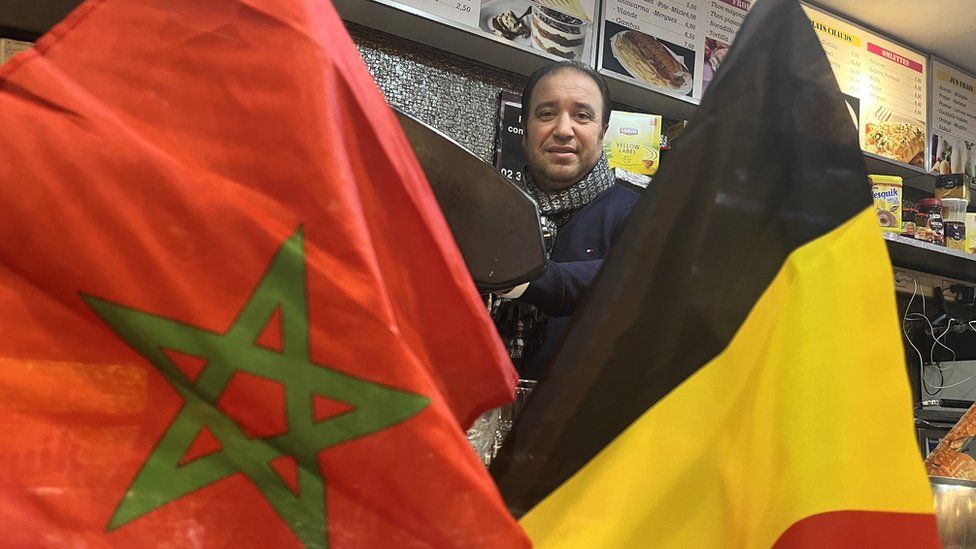
Draped around us, a red Moroccan flag with a green star is on display.
Walk through this part of central Brussels on a sunny morning and you could just as well be in Rabat or Tangiers.
In this Moroccan neighbourhood in the heart of the Belgian capital, you pass men sipping mint tea and families filling the many fish restaurants. The atmosphere is undoubtedly Moroccan as you head down the main street towards Midi train station.
The delicious smell of traditional Moroccan crepes, M’semen, fills the air.
Five million Moroccans live abroad, most of them in Europe. They make up large minorities in France, Spain, Belgium, Italy and the Netherlands.
Here in Brussels and surrounding regions, they number 400,000.
And just like their compatriots at home, they have been celebrating their national team’s successes in the World Cup.
“It’s been a great party, people were singing and dancing, all the cars were beeping their horns, we had a great time,” says Chaimae.
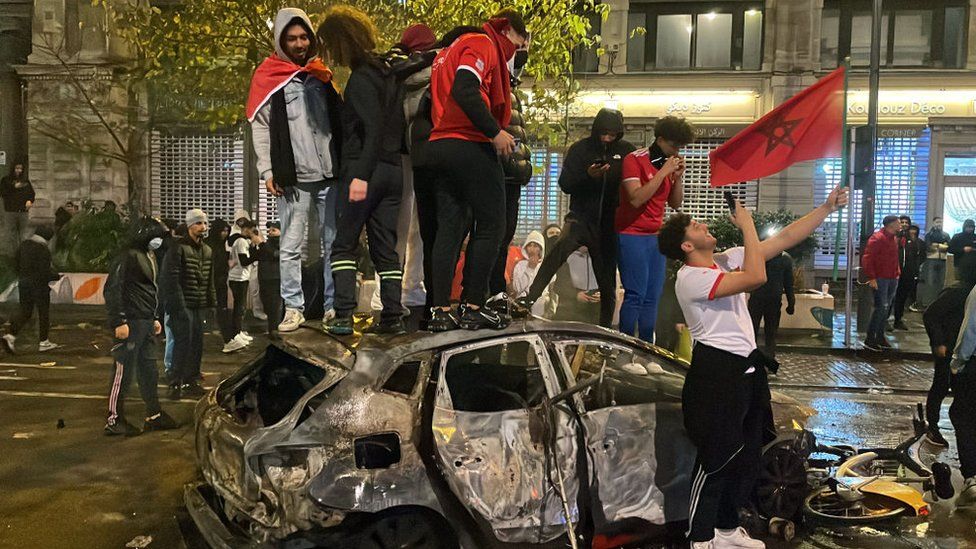
But it has not all been partying. Some of the images that spread on social media after Morocco’s victories showed celebrations turning ugly in several European cities.
In places, celebrations turned to street battles involving young Morocco fans and police.
Image source, Getty ImagesImage caption, This was the scene on Boulevard Lemonnier as Moroccans celebrated victory over Belgium
Some of the pictures were taken on Boulevard Lemonnier, where Ines and Chaimae are standing.
“They’ve damaged our reputation; that was way out of place; this is not how we celebrate!”
Right-wing politicians across Europe were quick to spread pictures of the clashes and the resulting damage, suggesting it was a sign of failed integration.
In Spain, where most Moroccans are first-generation migrants, the partying passed off peacefully, even after Morocco beat Spain on penalties last Tuesday.
But celebrations were tainted by trouble in cities in France and the Netherlands, where Moroccan communities are well-established.
Young fans who clashed with police were largely from second- or third-generation families.
In France, 13 police officers were hurt in clashes in Lille on Tuesday night, and there was unrest in Rennes and Brest. Disturbances were also reported in the Dutch cities of Amsterdam, Rotterdam and The Hague.
Hicham Achrayah had a front-row seat from the windows of his Brussels café, Le Tetouan, when clashes erupted after Morocco defeated Belgium 2-0 two weeks ago.
Image caption, Hicham Achrayah says local Moroccans suffered most from rioting fans
“I tried to speak to them, to calm them down, but they weren’t listening. They were small in number, around 200 of them, and they were very young – kids really. All they wanted was to fight with police.”
Hicham says those who came to riot felt hate towards the police and wanted to show off in front of their friends. But it was the residents who suffered.
“We are the first victims of these young thugs, one of my clients’ car was burned down. The police protected the city centre and the Christmas market, but here nothing. Our shops were not protected.”
After the unrest, many in the Belgo-Moroccan community decided to help calm the youths down.
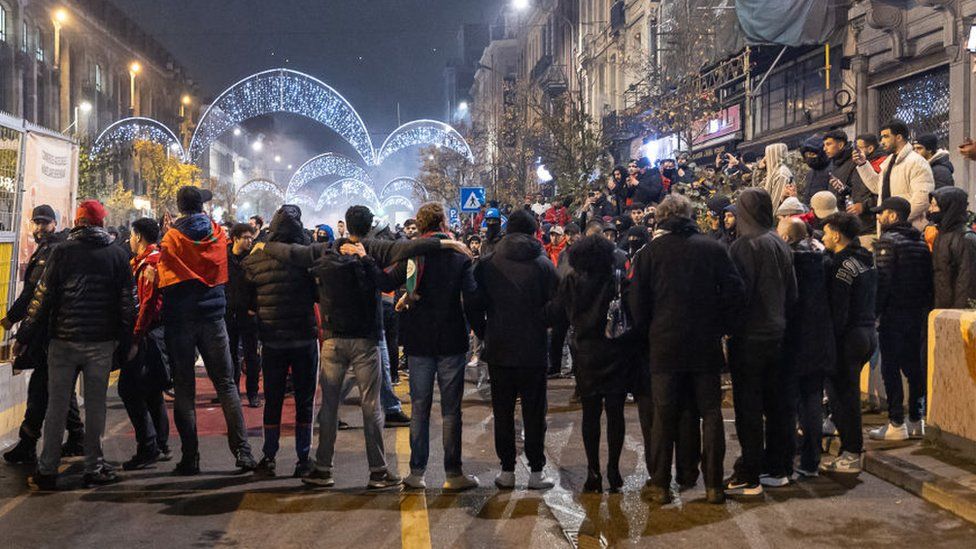
For each game, young adults and neighbours now form a human chain between the young fans and the police.
Image source, Getty ImagesImage caption, Since Morocco beat Belgium, members of the community have tried to ensure things do not get out of hand
Many from the community spoke out on the street and on social media, appealing to young people to celebrate peacefully.
Ahead of Saturday’s quarter-final, Hicham is no longer worried: “The atmosphere is going to be incredible and we’ll form a human chain again to avoid trouble.”
Ines and Chaimae are looking forward to the game too. For Chaimae, whatever happens on Sunday, Morocco’s national team has already won her heart.
“Even if they lose against Portugal, this is a great moment and we are proud. I just hope that if we lose, those kids won’t make trouble and ruin the party.”
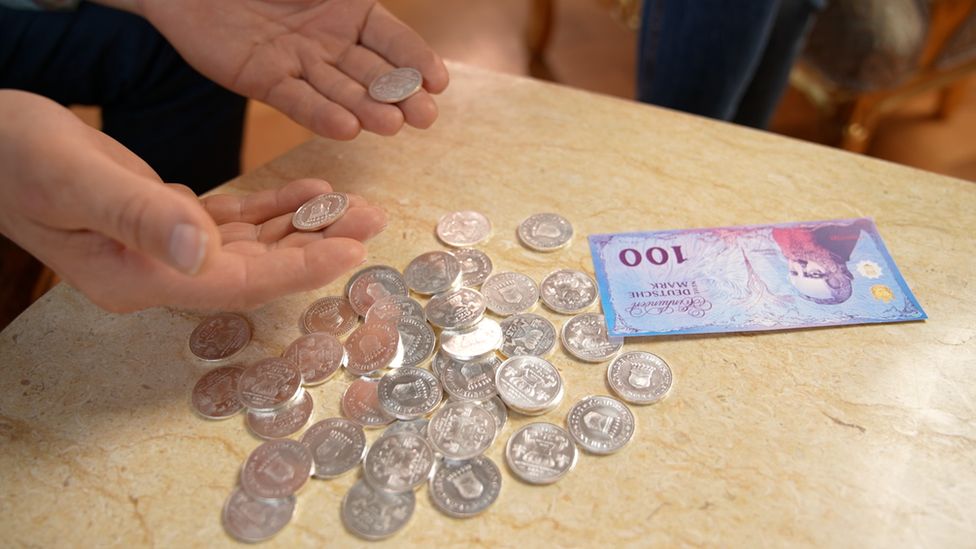
The so-called Kingdom of Germany is a self-proclaimed state, complete with its own monarch
]In the depths of the countryside in eastern Germany, there’s an invisible border.
The turrets of an imposing castle loom out of the treetops. A sign on its front door solemnly informs the visitor that they’ve entered – in effect – a new country.
The “Königreich Deutschland” (Kingdom of Germany) is a self-proclaimed independent state – complete with its own self-appointed king.
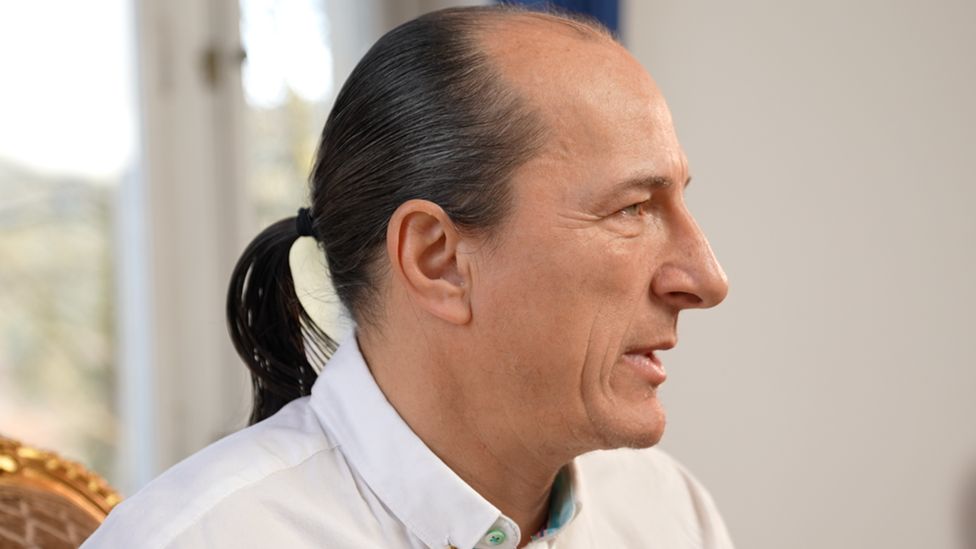
Peter the First, as he prefers to be known, receives us in a rather gloomy wood-panelled hall.
It’s about a decade since his coronation – there was a ceremony, complete with orb and sceptre – and the foundation of his so-called kingdom, which mints its own money, prints its own ID cards and has its own flag.
He’s what’s known in Germany as a “Reichsbürger” (Citizen of the Reich), one of an estimated 21,000 people who are defined by the country’s intelligence agencies as conspiracy theorists who don’t recognise the legitimacy of the post-war German state.
King Peter says he has no such violent intentions.
But he does believe the German state to be “destructive and sick”.
“I have no interest in being part of this fascist and satanic system,” he says.
Image caption, King Peter told the BBC his kingdom now has 5,000 citizens
We settle in another room to talk, on plush armchairs under a glittering chandelier.
But this is no salon; we’re surrounded by lights and cameras. This is King Peter’s own TV studio – he hopes to start a TV channel – and I learn that one of his subjects will be recording every moment of our interaction.
He felt, he said, that he had no choice but to found his kingdom, having tried, unsuccessfully, to run as a mayor and a member of the German parliament.
“People who are corrupt, criminal or willing to be used thrive in the German system and those with an honest heart, who want to change the world for the better, in the interests of the common good, don’t have a chance.”
His real name is Peter Fitzek, and his activities have brought him into frequent conflict with the German law.
Germany doesn’t recognise the kingdom or its documents: Mr Fitzek has several convictions for driving without a licence and running his own health insurance programme. He also went to prison for several years for embezzling his citizens’ money but the conviction was later quashed.
The regional intelligence service, which has been watching him and his kingdom for nearly two years, told us they regarded it as a threat. They liken it to a cult which exposes people to conspiracy theories and extremist ideology.
Such theories and ideology have proliferated in Germany in recent years, fuelled by the pandemic. And Covid-19 appears to have increased support and membership of the kingdom.
Mr Fitzek tells us he has about 5,000 citizens. He’s expanding the kingdom, buying up land in Germany in order to set up a number of communities in which those people can ultimately live.
Image caption, The self-proclaimed kingdom has even minted its own currency
We visited one such outpost about 150 miles (240km) away from the king’s castle.
Ancient trees surround the site of another old castle in the village of Bärwalde, an hour and a half’s drive south of Berlin. Around 30 people live on the site either in the main building or caravans which scatter the lawn along the main driveway.
Despite the faded beauty of the castle, it’s a bleak place. They’re still renovating the buildings and clearing the grounds. Tree trunks still grow through the skeleton of an old greenhouse.
But the people here are proud of their home which they also consider to be kingdom territory.
Citizens don’t pay German tax and won’t send their children to school, which is illegal in Germany. They are bound by their own legal structure – presided over, I’m told, by King Peter – and ultimately they intend to have their own healthcare system.
“The kingdom can provide everything that you need in daily life. Food and nourishment, social security, all these systems are there,” says Benjamin, who recently moved in with his young family and is responsible for PR.
For all their plans to build a sustainable green community, using modern technologies, citizens appear to have little faith in modern medicine.
No-one here is vaccinated against Covid-19, Benjamin told me. It’s a common position for Reichsbürger, many of whom joined protests against measures to control the pandemic.
“People who think for themselves today will often be condemned as conspiracy theorists,” says Benjamin. “But it’s a fact that these are often the people who stay up at night thinking about problems, not just their own but those of society and politics.”
As we left the commune and drove back through the village, a neighbour was standing on his front lawn.
When I asked what he thought of his neighbours, he frowned. They should pay tax he said. After all, they still accessed Germany’s resources. But what worried him the most, he added, were his own children. “What kind of influence will this lot have on them?”
For many years Reichsbürger were a bit of a national joke. Germany is learning to take them seriously.
A disgraced cryptocurrency executive, Sam Bankman-Fried, claims he intends to launch a new company in order to generate enough revenue to compensate FTX collapse victims.
The 30-year-old faces several federal investigations into his former company’s handling of funds.
Speaking in a luxury complex in the Bahamas, the former billionaire denies fraud but says he was “not nearly as competent as I thought I was”.
He admits worrying about possible arrest while “ruminating at night”.
The FTX crypto exchange allowed customers to trade normal money for cryptocurrencies like Bitcoin.
It was the second largest in the world, trading about $10bn of crypto coins every day.
But last month it was revealed that FTX and Mr Bankman-Fried’s separate company – Alameda Research – were financially unstable.
In just eight days everything came crashing down and bankruptcy was filed.
It is estimated that more than a million FTX users are locked out of their crypto wallets and cannot access their funds.
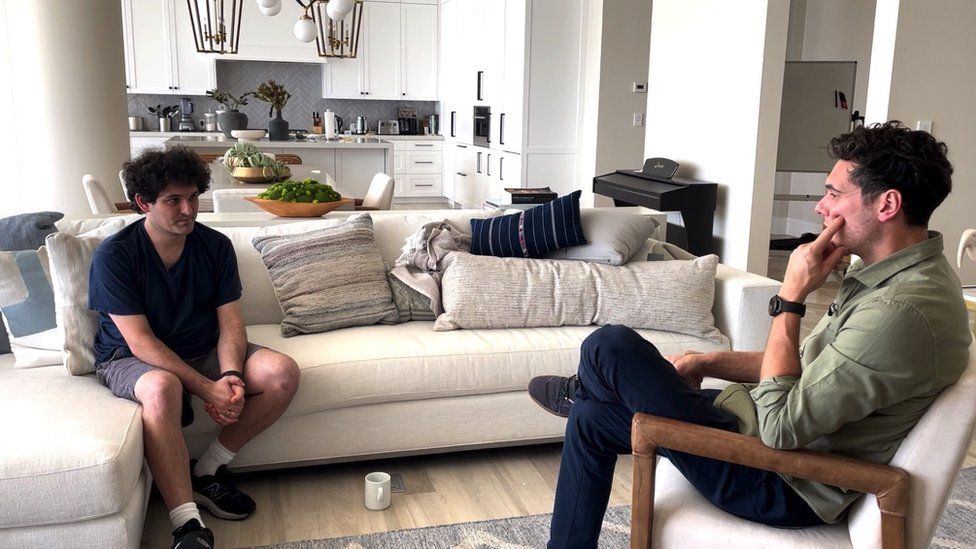
Mr Bankman-Fried invited the BBC to the residential complex in the Bahamas where he still lives and said he hopes to find a way to pay back FTX users.
“I’m going to be thinking about how we can help the world and if users haven’t gotten much back, I’m going to be thinking about what I can do for them. And I think at the very least I have a duty to FTX users to do right by them as best as I can,” he told me.
Asked if he planned to start a new business venture to earn the money to pay investors back, he said: “I would give anything to be able to do that. And I’m going to try if I can.”
Bankruptcy lawyers have described the FTX scandal as “one of the most abrupt and difficult collapses in the history of corporate America”.
They accuse Mr Bankman-Fried of running the company as “his own personal fiefdom”.
The US Senate Banking Committee wants the former CEO to testify at next week’s hearings into the collapsed exchange, and he said on Friday that he would attend.
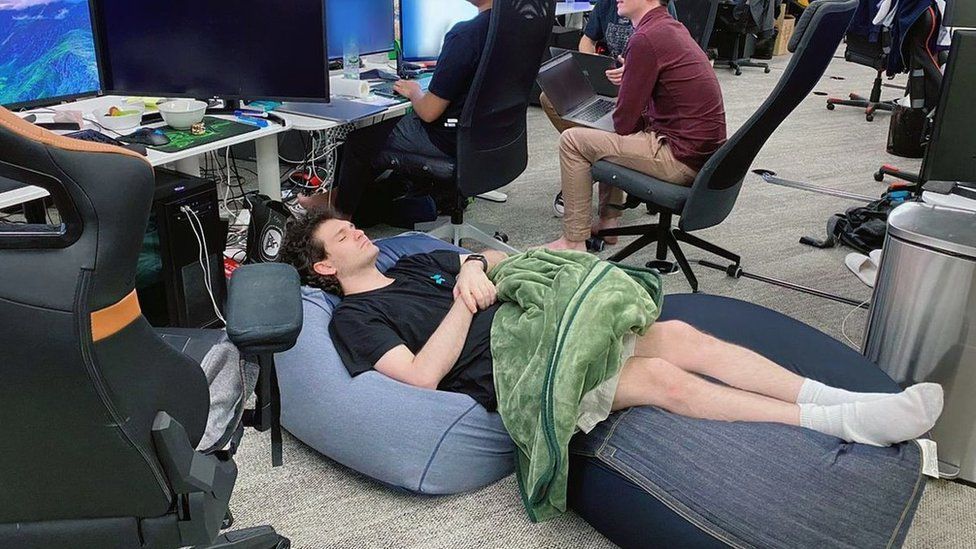
Image source, TwitterImage caption, “Mostly I sleep on a beanbag,” Mr Bankman-Fried once told his Twitter followers
At the top of a long list of alleged failings, there are allegations that Mr Bankman-Fried’s Alameda Research hedge fund was using FTX customers’ money to make risky financial bets.
A former senior FTX employee who worked with Mr Bankman-Fried has told the BBC he thinks the former CEO must have been aware that Alameda Research was using FTX customer funds.
He accused Mr Bankman-Fried of lying when he said in recent interviews that he did not know about the flows of cash and cryptocurrencies between the companies.
“No that’s not true,” Mr Bankman-Fried said, while going on to acknowledge that as CEO he was ultimately responsible for any mishandling of funds. “That’s on me, one way or another,” he said.
Asked whether he was fraudulent or incompetent, he replied: “I didn’t knowingly commit fraud, I don’t think I committed fraud, I didn’t want any of this to happen. I was certainly not nearly as competent as I thought I was.”
Image caption, Mr Bankman-Fried is meeting reporters at a luxury apartment owned by FTX
The American has conducted nine lengthy self-critical interviews in the last six days.
His team say they’ve had to relocate to an unknown location in the luxury resort where he lives, because of “security concerns”.
Reporters have taken pictures of him in his apartment with telescopic lenses from the sea, and at least two YouTubers have managed to sneak into the complex to film videos.
Mr Bankman-Fried, who comes from a wealthy family, claims to be concerned about his own personal finances with no access to his bank accounts and “less than $100K left”.
When asked if he is preparing for the possibility of arrest and prison, he said: “There’s some time at night ruminating, yes, but when I get up during the day, I try and focus, be as productive as I can and ignore things that are out of my control.”
The US claims that there is now a full-fledged defense alliance between Russia and Iran.
Russia is giving an unprecedented level of military support, said US national security council spokesman John Kirby.
The US has seen reports that the two countries are considering joint production of lethal drones, he added.
Australia has announced it is sanctioning three Iranians and one Iranian business for supplying Russia with drones to use against Ukraine.
Co-operation between Russia and Iran has been highlighted recently, with Ukraine accusing Russia of using Iranian drones in its attacks.
After initially denying sending any drones to Russia, the Middle Eastern country later admitted it had supplied some before the invasion of Ukraine.
Mr Kirby said that a partnership between Iran and Russia to produce drones would be harmful to Ukraine, Iran’s neighbours and the international community.
“Russia is seeking to collaborate with Iran in areas like weapons development, training,” he said, adding that the US fears that Russia intended to “provide Iran with advanced military components” including helicopters and air defence systems.
“Iran has become Russia’s top military backer…” he said. “Russia’s been using Iranian drones to strike energy infrastructure, depriving millions of Ukrainians of power, heat, critical services. People in Ukraine today are actually dying as a result of Iran’s actions.”
In response to Mr Kirby’s comments, UK Foreign Secretary James Cleverly said that Iran had become one of Russia’s main military supporters and that the relationship between them was threatening global security.
The “sordid deals” between the two countries have seen Iran send hundreds of drones to Russia, he said.
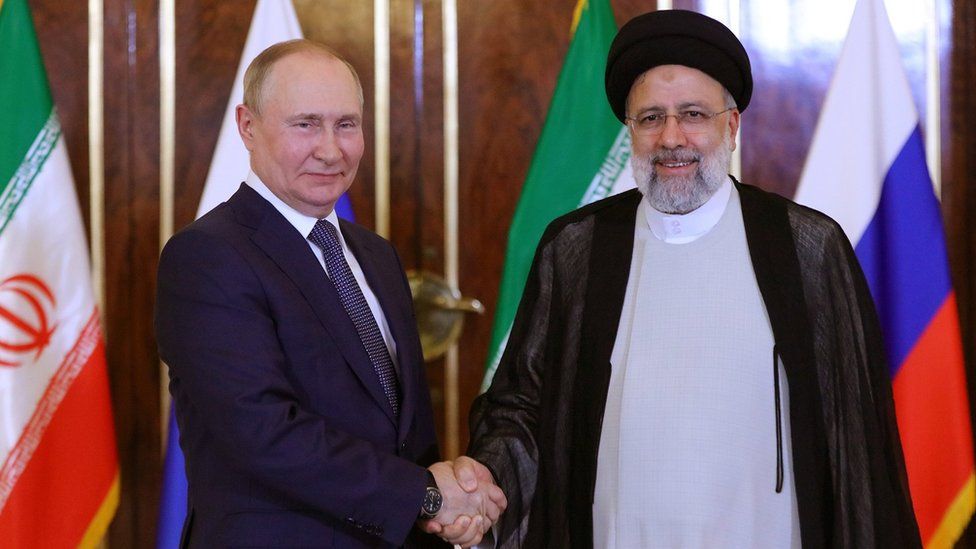
Image source, Getty ImagesImage caption, Russian President Vladimir Putin with Iranian President Ebrahim Raisi in July.
“In return, Russia is offering military and technical support to the Iranian regime, which will increase the risk it poses to our partners in the Middle East and to international security,” he added.
He said the UK agreed with the US that Iranian support for the Russian military would grow in the coming months as Russia tried to get hold of more weapons, including hundreds of ballistic missiles.
Ukraine accused Iran of supplying Russia with “kamikaze” drones used in a series of attacks which killed at least eight people on 17 October.
After denying this, Iran later admitted sending a “limited number” of drones to Russia, “many months” before the war in Ukraine.
Ukraine’s President Volodymyr Zelensky said this was a lie and that Ukraine was shooting down about 10 Iranian drones a day.
Image source, ReutersImage caption, Russia’s war on Ukraine continues to affect many cities and regions, including Bakhmut in the Donbas
On Saturday, Penny Wong, Australia’s foreign minister, said in a statement: “The supply of drones to Russia is evidence of the role Iran plays in destabilising global security. This listing highlights that those who provide material support to Russia will face consequences.”
She also announced measures against 19 other people and two entities, including Iran’s Morality Police, for the brutal treatment of anti-government protestors following the death of 22-year-old Mahsa Amini in custody earlier this year.
In other developments:
Russia has turned the Ukrainian city of Bakhmut into “burnt ruins”, President Zelensky says, following months of deadly fighting in the eastern Donbas region
The United Nations says Belarus will allow the transit of Ukrainian grain through its territory for export from Lithuanian ports
The head of a Ukrainian human rights organisation that was jointly awarded this year’s Nobel Peace Prize – Oleksandra Matviichuk of the Centre for Civil Liberties – has called on nations to set up an international tribunal to try Russian President Vladimir Putin for Russia’s war in Ukraine
The International Olympic Committee says it will explore a proposal to allow athletes from Russia and Belarus to take part in sporting events in Asia – despite an international ban.
A prominent football journalist from the United States has died while covering the World Cup in Qatar.
Grant Wahl, 48, collapsed as extra time began in the Argentina-Netherlands game on Friday night.
Early reports suggest he may have had a heart attack, but this has yet to be officially confirmed.
Last month Mr Wahl was briefly detained by Qatari authorities for trying to enter a stadium wearing a rainbow shirt, in support of LGBT rights.
“Fans of soccer and journalism of the highest quality knew we could always count on Grant to deliver insightful and entertaining stories about our game, and its major protagonists,” it said.
In a tweet, Mr Wahl’s wife, Céline Gounder, said she was in “complete shock”, adding that she was “so thankful” for the support she had received from friends.
Mr Wahl celebrated his 48th birthday on Thursday with friends in Qatar, a day before he collapsed. He wrote on his website on Monday that he had been unwell in the last 10 days and was on a course of antibiotics for suspected bronchitis.
“My body finally broke down on me,” he wrote. “What had been a cold over the last 10 days turned into something more severe on the night of the USA-Netherlands game, and I could feel my upper chest take on a new level of pressure and discomfort.
“I didn’t have Covid (I test regularly here), but I went into the medical clinic and the main media center today, and they said I probably have bronchitis.”
FIFA President Gianni Infantino said Mr Wahl’s love for football was “immense”, adding that his reporting would be “missed by all who follow the global game”.
Tributes have poured in from several UK journalists. Piers Morgan described Mr Wahl as a “brilliant journalist”, while the Times’ Henry Winter said he was a “fine man” and “giant of the press box”.
BBC Sport’s Dan Roan tweeted: “Grant Wahl was a renowned and hugely respected journalist and the flood of tributes is testament to the esteem in which he was held.”
Major League Soccer commissioner Don Garber tweeted: “We are shocked, saddened and heartbroken over the tragic passing of Grant Wahl. He was a kind and caring person whose passion for soccer and dedication to journalism were immeasurable.”
US tennis icon Billie Jean King also paid tribute to Mr Wahl, describing him as an “advocate for the LGBTQ community and a prominent voice for women’s soccer”.
A spokesperson for the Qatari body responsible for planning the World Cup, the Supreme Committee for Delivery & Legacy, said: “We are deeply saddened by the death of the US journalist Grant Wahl.
“Grant was known for his enormous love of football and was in Qatar to cover his eighth Fifa World Cup.
“He fell ill in the Lusail Stadium media tribune, during last night’s quarter-final match between Argentina v Netherlands. He received immediate emergency medical treatment on site, which continued as he was transferred by ambulance to Hamad General Hospital.
“We are in touch with the US Embassy and relevant local authorities to ensure the process of repatriating the body is in accordance with the family’s wishes.”
Earlier this week, Mr Wahl was presented with an award by Brazilian football legend Ronaldo for reporting on eight consecutive World Cups – his first was in the US in 1994.
Prominent Nigerian singer Oladapo Oyebanji, often known as D’banj, will continue to be detained by the Independent Corrupt Practices and Other Related Offences Commission (ICPC), following the recent finding of 20,000 ghost names inserted into the N-Power Program.
The anti-graft agency detained D’banj on Tuesday over fraud allegations involving the N-Power Programme.
On June 8, 2016, President Muhammadu Buhari launched the programme to address the issues of youth unemployment and empowerment, and also promote social development.
SaharaReporters earlier reported how top government officials introduced over 70,000 ghost workers into the N-Power Programme and fraudulently diverted billions of naira into their pockets.
“70,000 names were infused into N-Power by officials of the Buhari regime in the last four years.
“The fake list costs Nigeria N2.1 billion per year while original N-Power candidates are left unpaid,” a source had told the newspaper.
In June 2021, SaharaReporters reported that 14,000 beneficiaries of the N-Power programme were owed for five months.
N-Power is a youth empowerment scheme sponsored by the Nigerian Government under the Social Investment Program (SIP).
Other programmes under the scheme include Home Grown School Feeding, Tradermoni, Marketmoni and the Conditional Cash Transfer in the 36 states of the country.
SaharaReporters gathered that since the social investment programme of the government was moved to the Ministry of Humanitarian Affairs and Disaster Management, the minister, Sadiya Farouq, had been making attempts to stop some of the programmes under the scheme.
Aside from announcing that beneficiaries would be laid off, she had also refused to release funds for the school feeding programme in some states.
A source at the humanitarian ministry on Wednesday night told SaharaReporters that top government officials in President Buhari’s government have been using cronies to siphon funds under the social intervention programmes.
A source had confided in SaharaReporters that ICPC would release D’banj on Wednesday night after failing to successfully link the musician to the fraudulent activities in the N-Power Programme.
“D’banj will be released tonight by the ICPC. The agency is unable to link him concretely with fraudulent activities in N-Power,” a top source in the agency had told SaharaReporters.
However, the source on Thursday said investigators discovered a fresh list containing over 20,000 ghost names, tagged “D’banj’s list.”
He said the names were allegedly used to divert over N600 million monthly for over two years by government officials in connivance with the Nigerian musician.
The source however added that D’banj refuted the allegation and denied any knowledge of the list.
“Like I told you yesterday, D’banj was to be released last night but our (ICPC) Director of OperationS wasn’t available. So, his lawyers were asked to come back today,” he said.
“But our investigators just discovered another 20,000 N-Power list, so he (D’banj) will remain in detention.
“Today when his lawyers arrived for his release, they were told about this fresh list containing 20,000 names. This list was being used to divert N600 million monthly from Nigeria in the last two years by Buhari government officials. The list containing 20,000 names has been bleeding Nigeria N600 million monthly over the last two years.
“It’s named the D-banj’s list. He actually denied the list when he was interrogated by our officials. That’s the reason he wasn’t released as planned.”
South Africa’s passenger rail agency (Prasa) has prohibited preaching, gambling, and unauthorized trade in its new trains.
The local media reported that the new development is among measures meant to ensure that “one particular behavioural system of any other group cannot be imposed on other commuters on board”, the agency’s spokesperson Lilian Mofokeng is quoted as saying.
It will also enhance passenger safety and onboard cleanliness.
“We are doing this in an effort to ensure that there is the free passage of movement for our commuters, so that they are kept clean and safe,” she said.
Informal traders and preachers have opposed the new measure.
A student from Zambiawho died in Ukraine while fighting for Russia, Lemekhani Nyirenda, is expected to return home on Sunday, according to Zambia’s foreign ministry.
Stanley Kakubo told parliament that the body had now reached the Russian port city of Rostov-on-Don and a Zambian diplomat would accompany it back to Lusaka, the foreign ministry has tweeted
The 23-year-old died in September but news of the death only came out last month. It left his family and the Zambian government pressing the Russian authorities for answers.
Nyirenda, who had been studying nuclear engineering in Moscow, was serving a drugs-related prison sentence in Russia.
His sister Muzang’alu Nyirenda said he had been an unwitting drugs courier.
The foreign minister told parliament on Friday that the Russian government confirmed Nyirenda was pardoned in August “to join a military operation in exchange for amnesty”.
Mr Kakubo said he was still asking the Russians for more details about the death of the young Zambian.
Congolesegynecologist Denis Mukwege will visit Pope Francis on Friday at the Vatican.
Denis Mukwege is known as “Dr Miracle” for his ability to repair through reconstructive surgery the damage inflicted on women who have been raped.
He was jointly awarded the Nobel Peace Prize in 2018 for his work.
The Popeis scheduled to visit Democratic Republic of Congo in late January 2023, after a previously planned visit was cancelled mid this year.
Dr Mukwege met the Pope three years ago and later told journalists that: “I met with Pope Francis to share my vision for a world where rape is no longer used as a weapon of war.”
The exact agenda of today’s meeting is not known.
Since 1996, the DR Congo has been engulfed in a string of conflicts that have claimed the lives of at least six million people.
South African Comedian, Trevor Noah, has hosted his final edition of The Daily Show after seven years as the host of the US late-night comedy show.
In an emotional farewell he gave what he called a “shout out to black women”.
“Who do you think teaches me? Who do you think has shaped me, nourished me, informed me? From my mum, my gran, my aunt – all the black women in my life,” he told the audience.
Trevor gives thanks to the fans who supported him over the last seven years and the Black women who shaped his life. pic.twitter.com/p2VpOkSm4T
In his goodbye monologue, he references the fact that he first found it hard to fill the seats in the studio but over the last seven years, Noah himself has brought in a younger enthusiastic audience.
He has also offered a more international take on events in the US. During his time as host he has covered the presidency of Donald Trump, the Black Lives Matter protests and the impact of the Covid-19 pandemic.
Noah said that it was black women who had taught him most about America as they know that if things go bad then they are the first to suffer.
When he announced his planned departure in September the 38-year-old said: “I remember when we first started… so many people didn’t believe in us… [Appointing me as host] was a crazy bet to make. I still think it was a crazy choice, this random African.
“I just [find] myself filled with gratitude for the journey. It’s been absolutely amazing. It’s something that I never expected.”
He got into many arguments over the years of hosting the programme, including one with the French government after he celebrated France’s 2018 World Cup win as an African victory:
South Africa has sent a proposal to the Justice Minister, to push for the amendment of decriminalizing sex work
The Criminal Law (Sexual Offences and Related Matters) Amendment Bill was approved by cabinet late last month.
It seeks to decriminalise the sale and purchase of adult sexual services, the ministry said. It was published on Friday for public comment and will then have to be passed by parliament.
“It is hoped that decriminalisation will minimise human rights violations against sex workers,” Mr. Ronald Lamola said
He added: “It would also mean better access to health care and reproductive health services for sex workers.”
The AFP news agency quotes sex workerrights’ group SWEAT as saying: “With sex workers no longer labelled as criminals, they can work much better with the police to tackle violence”.
SWEAT welcomed the bill as “incredible news”.
Laws prohibiting children from selling sex and trafficking for sexual purposes will remain in force.
Member of Parliament for North Tongu, Samuel Okudzeto Ablakwa, has stated that the country will forever recognize the Finance Minister Ken Ofori Atta, as the first to face a censure vote despite failed attempts in parliament to remove him from office
His comment comes few minutes after the majority’s failure to participate in summing up to the number of votes required to impeach the minister.
Nonetheless, Mr Ablakwa is “exceedingly proud that NDC MPs chose to align with suffering Ghanaians but not the disastrous & destructive Ken Ofori-Atta.”
Adding that “No matter the outcome, history will eternally remember that Ken was the first Minister to face a censure vote,” he wrote on twitter.
The vote of censure against the Finance Minister, Ken Ofori-Atta, failed after less than 183 Members of Parliament voted to oust the embattled Minister.
136 National Democratic Congress MPs voted on Thursday to demand removal of Mr Ofori-Atta but NPP New Patriotic Party MPs staged a walkout and decided not to support the motion of their colleagues from the opposition side of the House.
Members of the Majority caucus of Parliament staged a walkout as Parliament voted to decide the fate of the Finance Minister, Ken Ofori-Atta after the debate on the report of the censure motion.
The Majority Leader, Osei Kyei-Mensah-Mensah, who led the walkout said his side cannot be part of a process that was baseless and politically motivated.
A leading human rights organization claims that a domestic abuse law adopted in Tunisia five years ago has not succeeded in protecting women.
In a new report, Human Rights Watch has concluded that poor implementation of what it describes as one of the strongest laws against domestic violence in the Middle East and North Africa has left Tunisian women at risk.
The group alleges that the Tunisian authorities have failed to systematically respond, investigate and provide protection to women who report violence.
Member of Parliament representing Bolgatanga, Isaac Adongo, has questioned why the Finance Minister, Ken Ofori-Atta, is still so committed to serving the nation despite the pressures mounted on him.
He asked the minister why he feels he is the only person who can do the job when it is clear that the very people who put him at post no longer want him there.
The National Democratic Congress (NDC) MP made this in his submission on the floor of parliament when it debated the report of an ad hoc committee that looked into a vote censure that was before the Minister of Finance, by the Minority.
In his comments, Isaac Adongo explained that the job that has been handed to people like the minister is for them to make better the lives of Ghanaians, and not for them to use it as an opportunity to enrich themselves.
He described the performance of Ken Ofori-Atta as a failure.
“We need to ensure that Ghanaians take us seriously and that when we have jobs, it is not to grow our businesses; it is to serve the people, that Ghana becomes the winner.
“Mr. Speaker, if anybody continues under this (sic) that the finance minister should continue to remain in government, then we might as well dissolve parliament and dissolve government, because we are failing the people who voted for us and we are failing the people that we’re supposed to serve,” he said.
Isaac Adongo further called on the Minister of Finance to do the honourable thing by saying goodbye to the job.
He explained that this would be the best thing for him to do since he knows he has under-delivered in the mandate handed over to him.
“You cannot be serving yourselves. You must serve the nation and you have failed. It’s time to say, Ghana, you gave me an opportunity to serve you, I’ve served you to the best of my ability; my ability is not good enough, bring in somebody else to do the work,” he added.
Before resuming his seat, the Bolga MP questioned the minister, who was also in the Chamber, on whether it is mandatory that he serves Ghanaians.
“Why are you still sitting there? We gave you the job, we say we don’t want you again. Is it force; is it force to serve us? So please, the finance minister should do the honourable thing and leave government,” he said.
Parliament is currently debating the report of the committee, with a determination expected to be made on whether Ken Ofori-Atta will be voted out as minister or not.
The authorities in Ghana say more than eight million unregistered Sim cards have been blocked in the country after their owners failed to meet a final registration deadline.
The disconnection of the mobile lines means their owners will no longer be able to make calls or access the internet, neither will they be able to use mobile money services.
Ghana’s Ministry of Communication and Digitisation and the National Communications Authority had said the mandatory Sim card registration was to help fight crimes such as fraud and to ensure digital security.
The process started in October last year when the government issued a directive for people to register their mobile lines.
The first stage of the registration involves mobile phone customers linking their Sim cards with their national identity card details.
A significant number of Ghana’s population of 31 million have yet to acquire a national identity card, making it difficult to register their Sim cards.
The authorities say more than 20 million lines have been fully registered so far. Individuals are allowed to register a maximum of 10 Sim cards with their national ID card.
Meghan Markle and Prince Harry shared a slew of never-before-seen photos and video of their life and children in the new Netflix docuseries “Harry & Meghan.”
The ex-royals — who share Archie, 3, and Lilibet, 1 — shared several snaps and videos in the first three episodes of the show, which dropped Thursday, of their son.
One video shows him riding around on a suitcase, while another reveals Markle introducing him to a photo of his late grandmother, Princess Diana.
Up Next
“I have always been a hugger… I didn’t realize that…
The pair also shared pics of themselves before their relationship became public, including shots of them in a photo booth and on their now-famous third date to Botswana in 2016.
They also included shots of the couple FaceTiming in the early days of their relationship.
Harry, 38, and Markle, 41 — who left the UK in March 2020 and moved to Montecito, Calif. — were “having second thoughts” about the series following Queen Elizabeth II’s death in September, Page Six previously reported.
Enlarge ImageIn one video, Markle introduces her son to his late grandmother Princess Diana.Netflix
“Harry and Meghan are panicked about trying to tone down even the most basic language,” an insider told us at the time.
Since stepping down from their royal duties, the couple — who tied the knot in 2018 — has been the target of international media, TV personalities and social media commentators alike.
Enlarge ImageThey also shared photos from early on in their relationship.Netflix
They eventually sat down with Oprah Winfrey for a tell-all interview in March 2021, where Markle revealed the scrutiny she was put under by the British press drove her to contemplate suicide while pregnant with her son, Archie.
“I just didn’t want to be alive anymore,” she told Winfrey, explaining that she “just didn’t see a solution” to the tidal wave of negative reports about her.
Up Next
“I have always been a hugger… I didn’t realize that…
“I would sit up at night, and I was just like, ‘I don’t understand how all of this is being churned out.’”
The “Deal or No Deal” alum and the grandson of the late Queen Elizabeth ll later revealed they had signed on to film a series with the streaming giant, and chose Liz Garbus to direct.
Enlarge ImageThe first three episodes of their docuseries dropped Thursday.Netflix
“It’s nice to be able to trust someone with our story — a seasoned director whose work I’ve long admired — even if it means it may not be the way we would have told it,” the former “Suits” star told Variety in October about working with the Oscar-nominated director.
Markle also told The Cut that the series would focus on the couple’s “love story.”
“[It’s] the piece of my life I haven’t been able to share, that people haven’t been able to see … our love story,” she said.
The last three episodes of the Netflix series comes out Dec. 15.
Foreign secretary for the UK, James Cleverly, has stated that his nation “wants to make sure” that the family of a Kenyan woman who was reportedly slain by a British soldier a decade ago receives justice.
The body of Agnes Wanjiru, 21, was found in a septic tank at a hotel in central Kenya in 2012, nearly three months after she had spent an evening partying with soldiers.
Last year the UK defence ministry said that it was co-operating with a Kenyan inquiry into the death following allegations of a cover-up.
Mr Cleverly, who was in Nairobi on Wednesday, said Ms Wanjiru’s murder was discussed in his meeting with Kenyan President William Ruto.
“We take our responsibility incredibly seriously to ensure that there is a proper legal process and that any perpetrators are brought to justice and we will continue working closely with the Kenyan government on this,” he said.
Ms Wanjiru, who dropped out of high school and later became a sex worker to look after her baby, was last seen by witnesses on the night of 31 March 2012. She was walking out of a bar in the town of Nanyuki accompanied by two British soldiers.
Kenyan judge Njeri Thuku concluded after an inquest in 2019 that Ms Wanjiru had been murdered by one or two British soldiers.
13.Broke up: Arnold Schwarzenegger and Maria Shriver
14.Survived: Woody Harrelson and Laura Louie
15.Broke up: Sandra Bullock and Jesse James
16.Survived: David Letterman and Regina Lasko
17.Survived: David Boreanaz and Jaime Bergman
18.Broke up: Iggy Azalea and Nick Young
But it was she who got the last laugh. In an appearance on Watch What Happens Live, she told Andy Cohen what she did to work through the pain: burning all of his things. “I burnt it all, darling,” she said with a smile. “Every designer you could think of, I’ve burned.” She went on to say that she gave him fair warning though, “I text him a video and I was like, ‘Hey, I’m burning your shit. I don’t know where you’re at – probably with some girl. I hope you get home quickly because we’re progressing on the spectrum of cheap to expensive.’” Needless to say, the engagement was called off and the couple called it quits.
Elisabeth Finch, screenwriter for the ABC drama “Grey’s Anatomy,” finally fessed up to her elaborate medical ruse.
“I’ve never had any form of cancer,” she admitted to the Ankler in a bombshell interview.
“I told a lie when I was 34 years old and it was the biggest mistake of my life. It just got bigger and bigger and bigger and got buried deeper and deeper inside me,” she continued.
Finch was put on a leave of absence earlier this year after allegations swirled that she concocted her supposedly debilitating health crises for attention and was placed under investigation following the explosive news.
Several storylines for “Grey’s,” from which she later departed of her own accord, were based on Finch’s supposed life experiences, which she has now confessed were entirely fabricated.
“What I did was wrong. Not okay. Messed up. All the words,” said the former crew member, who first began writing for the hit drama in 2015.
What started as an honest knee injury in 2007 quickly unfurled into a complex monstrosity of falsehoods. The “context” of the lie, she explained, began with an addiction to the intensive care she received after her hiking accident and while recovering from surgery.
Then, it was “dead quiet” — no more special treatment or hands-on care — and, thus, the lie began “in that silence.” She also placed blame on the childhood abuse she suffered at the hands of her brother Eric, accusing him of “terrorizing” her, but not enough to leave a mark.
“I had no support and went back to my old maladaptive coping mechanism,” she said. “I lied and made something up because I needed support and attention and that’s the way I went after it.”
In 2012, she broke devastating news to her friends and colleagues: Doctors allegedly found a tumor. She claimed the rare malignancy was encroaching on her spine and was not responsive to chemotherapy treatments, and she went on to publish multiple personal essays in Elle about her harrowing tale, stories that have since been removed.
She chose the specific type of cancer — chondrosarcoma — due to its difficulty to treat, she told the Ankler. At the time she spun her first fib, she also claimed that she lost a kidney and part of her leg — hence, the knee replacement.
Finch (left) based storylines on the hit drama off of her own life experiences — or so the Shondaland team thought.Disney General Entertainment Content via Getty Images
“I know it’s absolutely wrong what I did,” she admitted. “I lied and there’s no excuse for it. But there’s context for it. The best way I can explain it is when you experience a level of trauma a lot of people adopt a maladaptive coping mechanism. Some people drink to hide or forget things. Drug addicts try to alter their reality. Some people cut. I lied. That was my coping and my way to feel safe and seen and heard.”
Her weave of deception extends far beyond herself. In addition to embarrassing the iconic screenwriter Shonda Rimes — the mastermind behind “Grey’s” — and the entire Disney family, she fabricated the deaths of other people to elicit sympathy. She even went so far as to claim that her brother Eric had committed suicide in 2019.
It turned out he works as a doctor in Florida.
“I didn’t know the connective tissue between my brother and my medical trauma and my depression and PTSD and anxiety,” she said, claiming she’s met with multiple therapists in an attempt to reach a diagnosis. Despite desperate attempts to be labeled with a personality disorder, she said the professionals chalked it up to trauma.
A professor of psychiatry and an adjunct professor of psychology at the University of Alabama spoke to the Ankler about the mysterious case of Elisabeth Finch. The expert, Dr. Marc D. Feldman, said it’s a “classic case of factitious disorder,” despite never meeting the disgraced screenwriter.
“The main reason people seem to do this is that they have an underlying personality disorder or have a difficult time getting their needs met that aren’t self-defeating,” he said. “Instead of asking for attention or care, they engage in pathological behaviors that allow them to get what they want indirectly.”
Finch snacked on saltine crackers — claiming at the time it was the only food she could stomach — while keeping her skin pale and head buzzed. She even went so far as to attach a fake port catheter to herself and would fake vomit in the bathroom to keep the lie alive.
Her performance of a lifetime resulted in her own chair in the writing room, which no one would dare sit in even if she wasn’t present, and she reportedly concocted a slew of supporting lies that painted her as a magnet for misfortune.
Finch rose to acclaim with the “Grey’s” cast and crew, but it quickly disappeared when the truth came to light.Disney General Entertainment Content via Getty Images
“She always had some tragedy or bizarre hardship going on in her life,” recalled an unnamed colleague. “Things that don’t happen to other people happen to her all the time.”
A Gulf War veteran stalked her, slashed her tires and knifed her apartment door, she allegedly claimed. A man exposed himself to her, while masturbating, in a fit of road rage while stopped at a red light, she said. She also claimed she was bombarded with anti-Semitic posters that were pushed under her door.
Finch insisted to the Ankler that those stories were true, although her word has been tainted by her deceitful habit.
Once, she even claimed she had an abortion due to her cancer diagnosis, filming a video for NowThis as political tensions rose around reproductive freedoms.
It wasn’t until March 2022, after more than a decade of carefully crafted lies, that she was caught. Inside sources revealed that her too-good-to-be-true stories were, in fact, just that.
At least, they were too good to be truly happening to her. Doubts over Finch’s claims first arose when a co-worker phoned Jennifer Beyer, Finch’s wife, and noticed that Beyer’s own ailments and incidents bared a striking resemblance to the stories they heard from Finch.
When Beyer met with both Shondaland and Disney, which owns the ABC network, it was clear their sickly screenwriter was healthier than they thought.
“When you get wrapped up in a lie you forget who you told — what you said to this person and whether this person knows that thing — and that’s the world where you can get caught,” Finch said.
Now, her paranoia has dissipated and the only thing left to do is clean up her mess, she said.
“I could only hope that the work that I’ve done will allow me back into those relationships where I can say, ‘OK, I did this, I hurt a lot of people and I’m also going to work my f–king ass off because this is where I want to be and I know what it’s like to lose everything,’” she said.
UN humanitarian coordinator for Somalia has declared “catastrophic emergency” in the country as a result of the severe drought.
Speaking on Tuesday at a joint meeting between the UN and the League of Arab States, the coordinator said Somalia was suffering from its fifth consecutive failed rainy season.
“The end to the emergency is nowhere in sight. As we gather here today, approximately 7.8 million Somalis, and that is nearly half of its population, have been affected by the drought and nearly 1.3 million people have been displaced since January 2021, 6.7 million people are expected to face high levels of acute food insecurity. That is by the end of this coming year”, said Adam Abdelmoula, UN Humanitarian coordinator for Somalia.
The Arab League secretary-general stressed the risks for the security situation in the country.
“Statistics indicate that the numbers of people who are living in pre-famine or near famine conditions in Somalia have increased five times since the beginning of the year and internal displacement is still ongoing. the conflict for scarce resources is dangerously affecting peace and security for society and the political situation in Somalia”, said Arab League Secretary-General, Ahmed Aboul Gheit.
Nearly half of Somalia’s 15 million people are affected by food insecurity.
Since January 2021 that 1,3 million people have been forced to abandon their homes.
Ghana armed forces has detained a guy who was impersonating a high military officer at the army base in Burma Camp.
The Ghana Armed forces has arrested a man posing as a senior military officer at the forces base in Burma Camp located in the capital city, Accra.
The suspect identified as Rufai Abubakar was arrested after trying to access a military installation using forged credentials.
“The suspect who entered Burma Camp in a commercial vehicle was closely monitored as he alighted at a bus stop and headed to the Air Force Base. The guards on duty noticed his suspicious behaviour, questioned him and after some incoherent answers, he confessed he was not service personnel”, a press release by the Ghana Armed Forces on Wednesday, December 7, 2022 read.
Details of the statement also has it that the suspect “…posed as a Senior Military Officer to enable him to defraud one Mr Abdallah Abdul Fatahu from whom he had collected an amount of three thousand Ghana Cedis (GH3,000.00) ($230) under the pretext of recruiting him into the Ghana Armed Forces.
“The suspect who was dressed in a military camouflage uniform, decorated with fake Lieutenant Colonel ranks, claimed he was stationed at Northern Command Headquarters and was proceeding to the Air Force Base to book a flight to Tamale (Northern region),” the press release stated.
It added that fake military identification and business cards and other documents bearing his name were found on the suspect at the time of his arrest.
Rufai Abubakar took the Military Police officers to two residences where they discovered documents including several certificates and fake GAF recruitment reports bearing names of defrauded persons, military uniforms and a toy pistol.
The suspect, according to the GFA has since been handed over to the Criminal Investigations Directorate (CID) of the Ghana Police Service for further investigation and prosecution.
The capital of the northern Tigray state, Mekelle, has power again thanks to Ethiopia. Federal troops fought rebels there during a two-year civil war that just ended last month.
Residents in the city are now enjoying full resumption of electricity after supply was disconnected for more than a year, sources in the city told the BBC.
“Electricity has been everywhere in the city since yesterday (Tuesday),” said a resident.
The state-affiliated Fana broadcast quoted a spokesman of the state-owned Ethiopian Electric Power (EEP) as saying that power had been restored after repair on a high-voltage line.
State-run telecommunications firm Ethio Telecom has also restored services in Shire town and surrounding areas.
Families living abroad have told the BBC how they finally managed to call their loved ones after two years.
Power and telecommunication services were disrupted after war broke out in the Tigray region in November 2020.
The future of the UN mission in Mali (Minusma), according to the head of the country’s transition Col. Assimi Goita, would depend on a shift in strategy and improved ties with the military.
that he had held discussions with the UN head of peacekeeping operations Jean-Pierre Lacroix, who has been on a two-day tour of Mali ahead of the renewal of Minusma’s mandate.
The state-linked L’Essor
quoted Mr Lacroix as saying that this was about ensuring there was an agreement between Mali and the UN “so that when the time comes, the recommendations at the level of the [UN] Security Councilare in line with the objectives of the Malian authorities”.
UN peacekeepers have been in the country since 2013, but relations with Bamako have recently deteriorated.
Several countries, including Germany and Cote D’Ivoire, have announced plans to withdraw from the mission or scale down their presence.
Nigerian Communications Commission (NCC) has issued a warning regarding the risks of taking part in specific TikTok video challenges, stating that doing so could expose devices to malware that steals information.
An advisory shared on Tuesday by the NCC’s Computer Security Incident Response Team (NCC-CSIRT) said hackers had taken advantage of a viral TikTok challenge, known as the ‘Invisible Challenge’, to disseminate an information-stealing malware called the WASP (or W4SP) stealer.
“This malware may be capable of covertly collecting screenshots, video recordings, or the ability to activate any connected camera or microphone,” the advisory said.
It added that personally identifiable information (PII), including names and passwords, keystrokes from emails, chat programmes, websites visited and financial activity may also be harvested by the malware secretly monitoring user behaviour.
TikTok’s popularity continues to grow rapidly in Nigeria, especially among young people.
It is the ninth most popular social media app in the country, but has largely escaped the attention of regulatory authorities.
A two-week measles vaccination campaignwill begin in Kenya’s health ministry, aiming to protect 1.2 million children between the ages of nine months and five.
It follows an outbreak in seven counties where 90% of children below five years have missed out on the two-dose vaccine.
The ongoing drought has made it difficult for health workers to give children this life-saving vaccine, due to the movement of people from one place to another in search of food and water.
The ministry has not disclosed how many cases and deaths have been reported, but is urging parents and guardians to ensure their children get vaccinated to contain the outbreak.
Measles is a highly contagious disease characterised by a high fever and a rash. The vaccination coverage has steadily declined globally since the beginning of the Covid-19 pandemic.
The campaign will begin on Friday and end on 18 December.
The son of a former president and others have received a 12-year prison sentence in Mozambique for their involvement in the “tuna bonds” corruption scam.
Ex-President Armando Guebuza’s son, Ndambi Guebuza, and two former heads of intelligence, Gregorio Leao and Antonio do Rosario, each got 12 years behind bars.
Eight of their co-accused were convicted and sentenced to between 10 and 12 years.
“The crimes committed have brought consequences whose effects will last for generations,” Judge Efigenio Baptista said while handing down the sentences.
A total of 19 people had been charged with blackmail, embezzlement and money laundering over their alleged roles in Mozambique’s biggest financial Scandal. Eight have been acquitted for lack of evidence.
The scandal involved the country borrowing more than $2bn ($1.6bn) from international banks, much of it without the knowledge or approval of the country’s parliament, triggering an economic crisis.
Commander of the Sudanese military, Abdel Fattah al-Burhan, has declared that the army will handover power as soon as the country’s political groupings agree on the creation of a new transitional administration.
Parties that signed the 5 December framework agreement – which paves way for the formation of a new civilian-led transitional government – are expected to set up committees to work on a new constitution for the country, Gen Burhan said.
He said the timeline for formation of a new government would depend on how fast civilian groups can reach an agreement on outstanding issues.
He insisted that the military “saved the country” on 25 October last year when it toppled a civilian-led coalition government in a coup.
Gen Burhan spoke on Tuesday to several pan-Arab news channels, including Al-Jazeera, Sky News Arabia and Al-Arabia TV.
The latest Sudanese political agreement was signed by the military junta and a faction of the former ruling civilian bloc Forces for Freedom and Change-Central Council (FFC-CC) and allied political groups.
While widely welcomed by the country’s international partners, the deal has been rejected by powerful pro-democracy protest organisers known as Resistance Committees and key pro-military and Islamist groups.
In the state’s Gwarzo Local Government Area, agents of the Sharia Police, Hisbah, Kano State Commission, and the Sharia Board seized three trucks carrying 18,000 beer bottles.
The Commander General of the Board, Sheikh Harun Sina, who made this in Kano on Tuesday, noted that the truck containing the beer was intercepted at Gwarzo road on its way to Kano on Monday.
According to the commander general, the law establishing the Kano State Hisbah Board prohibits the sale and consumption of beer and other intoxicants.
He added that the agency had also intensified campaigns and advocacy visits to enlighten the public about the dangers of engaging in immoral activities.
He however commended the head of the anti-intoxicants unit of the board and his team for their efforts in mitigating the spread of beer and other harmful drugs in the state.
“The board currently had over 10 trucks loaded with the commodity in its custody stressing that it would follow due process to secure a court order for the destruction of the intoxicants,” he added.
Hisbah, in Kano State Commissionhad in October impounded three vehicles with 5,800 bottles of beer.
The three vehicles were impounded included a Mercedes Benz car, with 1,800 bottles of beer in it; a Sienna minibus, conveying 3,000 bottles of beer and a Volkswagen Golf car conveying 1,000 bottles of beer.
Friday’s Independence Day festivities in Tanzania has been canceled by President Samia Suluhu Hassan, who has instead ordered that the budget be used to construct dormitories for children with special needs.
The $445,000 cost of the 61st Independence Day celebration will be utilized to construct eight dorms in elementary schools around the nation.
On Monday December 5 2022, Tanzania’s minister of state, George Simbachawene confirmed that the money has been disbursed, thus the East African country will celebrate Independence Dayby having public dialogues on development.
Celebrations of Independence Day in Tanzania are typically distinguished by pomp and state banquets.
It is however, not the first time Tanzania has canceled the celebrations.
In 2015, then-President John Magufuli canceled celebrations and diverted funds towards the building of a road in the commercial capital, Dar es Salaam.
In 2020, he did the same and directed that the budget be used to buy medical facilities.
The current president, Hassan, is Tanzania’s first female head of state.
She drew attention by ordering big-bellied policemen to lose weight to be more effective at work.
She also reversed her predecessor’s stance on contraceptives by urging Tanzanians to embrace family planning. Magufuli discouraged the use of contraceptives.
The much-touted lecture at Chatham House in London, England, where the presidential candidate of the All Progressives Party (APC), Asiwaju Bola Ahmed Tinubu, was expected to finally come clean with the Nigerian people turned out a monumental embarrassment. But the press must not fall for its frenzy. It is nothing but a fragment of a long-running scheme. The apparent logic is that the show of shame would rapidly grow to overshadow the prevailing charges against the Asiwaju, especially a drug case.
But the Nigerian masses are no fools.
Like the audience at the Chatham House, the Nigerian masses will not back down from probing the APC flagbearer on the serious allegationsfacing him. These allegations, of course, hover around his biographical details, such as name, age, state of birth and origin, education, career, and the source of his sudden billions. Throw in perjury, bribery, forgery, and so forth… And now the incident at Chatham!
There is also the issue of a failing health. Even blind men could see that the Asiwaju no longer has the physical ability nor the mental stability for any serious leadership position. Further, Nigeria’s misfortune with two ailing presidents—in Umar Yar’Adua and Muhammadu Buhari—is still fresh in our memory. Though both leaders would become largely incapacitated while in office due to ill-health; they never appeared as unhealthy or as impaired as Tinubu before they were elected.
Not to be forgotten is corruption. Running away to a foreign land or dodging the press will not cut it. The masses are keenly aware that despite Nigeria’s sleazy reputation, none of her leaders in history—whether military or civilian—assumed the governance of the country with a background as shady as that of Bola Ahmed Tinubu.
Of course, most of these charges have been proven beyond reasonable doubt, and ought to be very disqualifying. However, Tinubu’s montage of mess has lingered up to the point of shaming Nigeria at the Chatham House, because of the prevailing socio-political culture at home. The civil society is as wobbling as the country’s economy. The local press, which is typically vibrant, has become understandably overwhelmed or intimidated and thus appears to be treating anything relating to the Asiwaju with kid gloves.
BUT the allegation of drug trafficking is a new low in the Nigerian presidential politics. Tinubu and his handlers recognize its magnitude. They know it is like none of the other accusations and have been perfecting schemes that could overshadow the crisis. One could notice the pattern of the unending shows of shame in his campaign, including the Chatham calamity. The spirited shenanigan is a page from the Donald Trump political book: ‘The best solution to a crisis is another explosive crisis.’ Be that as it may, the Nigerian press must not allow the drug trafficking issue to be swept under the carpet without full investigation, no matter what.
The consequences are grave.
To refresh, the records show that Mr. Bola Ahmed Tinubu forfeited $460,000.00 to the authorities in the United States of America, allegedly for drugs trafficking and money laundering. The American country is also known to be very unforgiving of individuals who use drug proceeds to gain power in foreign nations. A perfect example is the case of Manuel Antonio Noriega, the former President of Panama.
Like Tinubu, Noriega had amassed a huge personal fortune but had a background tainted with drug allegations. Though the U. S. authorities initially turned a blind eye to the Panama president, allowing him to enter the country as he pleased, they chose the pertinent time to exhume his drug case. They eventually convicted Noriega, removed him from power, jailed him for life, and shamed his country forever.
A similar fate awaits Nigeria if Tinubu is ever to emerge president. Like the incident at Chatham, the world would like to know the Asiwaju. Since the former Lagos State Governor has continued to deny any connection to massive corruption in Nigeria, the logical question becomes: What is the source of this man’s sudden billions?
Any serious attempt to answer the above question must peep into Tinubu’s evasive past. The drug case that once led to his forfeiture of $460,000.00 will automatically take center stage.
Some legal commentators have argued that the narcotics case is barred by the Statute of Limitation and Double Jeopardy Clause of the Fifth Amendment to the US Constitution. But they are merely glancing the gist from a foggy lens. The objective fact is that the very nature of this high-profile case still presents prosecutors clear legal avenues to explore the Separate Sovereigns Doctrine to seek Tinubu’s indictment. Yes!
Nigeria has endured all manners of stigma in the comity of nations. The last thing the country would wish is a president who is globally seen as a corrupt kingpin cum drug lord.
Instead of addressing the drug charges, the Tinubu campaign has deployed a cocky cocktail of coercion, intimidation, distractions, and deceptions, heaping insults on the media organizations, and going as far as threatening them with baseless lawsuits. In short, the APC flagbearer has been doing everything humanly possible to avoid being held accountable for his past or present. The man dodges press interviews. He dodges town hall meetings. He dodges presidential debates. He dodges the truth. Thus, the hullabaloo at the Chatham House was not unexpected.
THE PRESS must not succumb to the sheer arrogance and political chicanery. The men and women of the press should live up to their constitutional obligations and thoroughly interrogate the former Lagos State governor on the drug allegations. Please!!
Importantly, there must be consequences for bad behavior in the relationship between the press and politicians. The media organizations must not be seen to be promoting an anti-democratic character—in this case Mr. Bola Tinubu—who continually circumvents an integral role of the press, which is to not only ensure that people in a democracy are free to receive information and ask questions, but also to investigate individuals seeking public office without fear or favor.
SKC Ogbonnia writes from Houston, Texas
Source: Sahara Report
DISCLAIMER: Independentghana.com will not be liable for any inaccuracies contained in this article. The views expressed in the article are solely those of the author’s, and do not reflect those of The Independent Ghana
Twenty-five employees have been recognized for their valor in repelling a bandit attack on a detention facility in Niger State.
Rauf Aregbesola, the interior minister, gave the Nigerian Correctional Service instructions on Monday to redeploy female prison guards who cannot use lethal force.
He gave the directive at the unveiling of the new service logo and uniforms and the commissioning of a new staff quarters, ICT infrastructure and operational vehicles at the Service headquarters.
Twenty-five personnel who displayed gallantry to repel a bandits’ attack on a custodial facility in Niger State were rewarded by the minister at the event.
Aregbesola, while commending the 25 personnel for their act of gallantry, expressed dismay that some personnel in other custodial centres chickened out when faced with attacks by criminals, Daily Trust reports.
According to him, custodial centres are now red zones and personnel should shoot to kill whenever an intruder attempts an attack.
“Rifles are not for play, they’re meant to kill criminals. Any officer that cannot shoot to kill, any lilly-liver officer that cannot shoot on the head should be trained or replaced.
“Criminals should not sustain injuries. Those people who cannot shoot to kill, if you don’t want to dismiss them, redeploy them to female prisons.
“People who will be in maximum and medium custodial centres must be tough.
“We’ve had too many embarrassing attacks and we must put a stop to it,” he said.
He said most of the hoodlums causing havoc in the South East were some of the escapees from the custodial centres in Imo State.
He said anybody who tried to attack any custodial centre should pay the supreme price going forward.
A football Star Samuel Eto’o and the current president of the Cameroon FA, has been cited on camera assaulting a guy outside a stadium at the World Cup in Qatar.
The clip incredibly captured the former Bacelona and Chelsea striker leaving Stadium 974 in Doha after watching Brazil easily defeat South Korea in their round of 16 match.
He formerly played for Barcelona, Inter Milan, and Chelsea.
According to the International media Eto’o was initially smiling for pictures with waiting supporters as he exits the arena, then a man approached him on his right with a video camera, according to the Daily Mail.
At first, Eto’o appears happy to pose for photos with waiting fans as he makes his way out of the venue, before a man with a video camera approaches him to his right.
The footage, filmed by La Opinion, then seemingly shows the pair exchanging words, before the video cuts to a few seconds later, and Eto’o returning to the scene to confront the man.
It is unclear what was said to rile Eto’o – who is in Qatar in his role as World Cup 2022 legacy ambassador – but he reacts furiously and begins to push the cameraman.
At this point, various onlookers step in to try and quell the disruption, but Eto’o is set on chasing the man and eventually has to be held back as he continues to try and confront him.
With four men holding Eto’o back, the footage then shows him giving his phone to a man, before breaking out of the huddle to knee the man in the face, knocking him to the ground.
As reported by La Opinion, Eto’o was quickly asked what had happened by reporters, but he was ‘out of his mind’ and was quickly led away by security.
An hour before the unsavory incident occurred, Eto’o was pictured inside the stadium with former NFL player Chad Johnson while watching the Brazil match.
His primary concern in Qatar was, clearly, watching his nation Cameroon and how their tournament unfolded, but it came to a disappointing end with a group stage exit – despite a victory over Brazil.
Daily Mail has contacted both Eto’o and the Cameroon Football Federation for comment.
Eto’o retired from playing the game in 2019, following a spell in Qatar with Qatar SC. He is most famous for spells with Barcelona, Inter Milan and Chelsea, after coming through Real Madrid’s academy in 1997.
He also has 118 caps for his country – the second-most of any player in history.
It is not the first time the 41-year-old has hit headlines for non-footballing reasons in recent months, having been handed a 22-month suspended prison sentence in June for a £3m tax fraud, having failed to declare income from the transfer of image rights.
According to Sport, the former Barcelona and Inter Milan striker admitted the offence but alleges that he was a victim of manipulation by his former agent Jose Maria Mesalles.
The fraud relates to Eto’o failing to declare income derived from the transfer of image rights to Puma and Barcelona in his personal income tax return between 2006 and 2009.
Malawi’s Anti-corruption Chief, Martha Chizuma has been released on police bail after she was detained in connection with a leaked audio recording.
She has complained about lack of assistance from the government while charged with “making use of speech capable of prejudicing a person against a party to judicial proceedings”, after she claimed in the leaked audio that a top state official was “corrupt and compromised”.
Her lawyer said the Anti-Corruption Bureau (ACB) boss was arrested on Tuesday just before 04:00 local time by heavily armed police who raided her home.
Local outlet Nation online has tweeted
pictures of her release.
In parliament, Justice Minister Titus Mvalo told lawmakers that the arrest was “the work of those trying to frustrate the fight against corruption”.
Ms Chizuma is highly regarded for her strong stance in the fight against corruption – which has led to the indictment of the vice-president, one cabinet minister and the head of police service.
They all deny any wrongdoing.
The leaked audio started circulating on social media in April in which she was recorded speaking to a person not employed by Anti-Corruption Bureau on the fight against corruption.
Critics accused her of breaching the oath of secrecy and called for her sacking, but President Lazarus Chakwera said he would reprimand her both in private and public.
Three civil society organisations have said that the “government needs to desist from frustrating those fighting against corruption”.
Last year, Malawi was ranked 110th out of 180 countries in Transparency International’s Corruption Perceptions Index.
Gunmenabducted 19 Muslim worshippers after attacking a mosque in the restive northwest of Nigeria, police said Sunday November 4.
The attackers stormed the mosque in Maigamji village, in Katsina state, during evening prayers Saturday and carried out the kidnappings after shooting and wounding the imam and another worshipper said local police spokesman Gambo Isah.
“Our men went after the bandits and managed to rescue six of the worshippers from their abductorswhile efforts are underway to free the other 13,” he added.
The two injured people are being treated at a hospital, the spokesman said.
Criminal gangs known locally as “bandits” operate in northwestern and central Nigeria, where they terrorise people, attack and loot villages, killing many.
These armed gangs also carry out many kidnappings for ransom but rarely target places of worship, instead targeting schools or travellers on the roads.
Hostages are usually released after paying ransom to the gangs who take refuge in the vast Rugu forest, which straddles Zamfara, Niger, Katsina and Kaduna states.
In November, 15 people were killed and several others injured in multiple bandit attacks on villages in neighbouring Kaduna state, according to authorities.
President Muhammadu Buhari is under fire after two terms in office marked by rising insecurity, two and a half months before the presidential election in which he will not stand for re-election, in accordance with the Constitution.
Major gas stations in Sierra Leone continue to see long queues as the west African nation struggles with high gas prices and a lack of supplies.
The gas prices have nearly doubled compared to the previous year to 1.14 USD.
“If I come to the gas station and there is no gas, I will go to the black market, the Jebu, where people sell it in bottles. They sell it in the black market for 30 Leones for one litter. 30 Leones for 1 litre at the black market,” said Modiboh Jebbo, a motorcycle taxi driver.
“When we came, we were expecting to buy gas at 21 Leones. If I want to buy 5 litres, it will cost me 105 Leones. I will ride with this for the rest of the day so I have to maintain the bike, I have to pay my boss 80 Leones (nb, he rents the bike), I buy fuel 105 Leones, I have to eat and I have to maintain the bike, change the oil, so I have to do all those things.
So if we have this fuel crisis, it affects us and now we cannot buy directly from the gas station, we buy at the black market for 30 Leones (per liter).” said Alhaji Mohammed Kamara, a bike rider.
But with shortages at gas stations, taxi drivers riding motorcycles or tricycles called Kekes are forced to turn to the black market, where the price is even higher. This has now forced them to increase fare prices.
Despite being illegal gas from the black market costs 50 percent more than at petrol station and increase that motorists like taxi drivers have to direct to their customers.
“The price of gas is high so I have to increase the price for the passengers and the passengers have to pay me a high price because I paid a very high price for my gas,” said Alhaji Mohammed Kamara, a motorcycle taxi driver.
Just like the rest of the world, Sierra Leone is also faced with high inflation and a dwindling economy.
In August, a protest against “economic hardship” in Freetown, Sierra descended into clashes between security forces and youth demanding the president resign amid the struggling economy.