Doctors recruited from some of the poorest countries in the world to work in hospitals in the UK say they are facing exploitation and are so overworked they worry about putting patients’ health at risk.
A BBC investigation has found evidence that doctors from Nigeria are being targeted by a British healthcare company called NES Healthcare.
It found they are expected to work in private hospitals under conditions that are not allowed in the National Health Service – the UK’s publicly funded healthcare system.
NES Healthcare disputes the BBC findings and insists it provides a safe and supportive career route.
The company says feedback about doctors’ experiences with them is extremely positive.
But the British Medical Association has called some of the working conditions a disgrace to UK medicine.
A viral video clip showing two primary school children slaughtering a chicken in Kenya has caused uproar and some hilarity about the country’s new curriculum, which has more of a focus on practical skills.
During the outdoor lesson for 11 year olds on how to kill and cook a chicken, one boy is seen pinning down the fowl as another holds a knife nervously to its neck.
Some curious classmates watch as the teacher, who is filming the episode with his mobile phone, congratulates the boy for cutting off the head and then instructs another, who holding the body, to put it in a nearby cauldron of boiling water.
But as the child lets go over the pot, the headless chicken flaps its wings and escapes.
The 19-second clip ends with the teacher’s laughter and the hapless and headless chicken still running around as screaming children scamper after it.
When a chicken’s head is chopped off it can run around for several minutes as for a short period its spinal cord circuits still have residual oxygen.
It is unlikely to be something this grade-six class will forget.
The video sparked an outcry on social media with many people concerned about the safety of the children, although hardly anybody raised the issue of the chicken’s suffering, asin rural Kenya, the sight of chickens being slaughtered is a common one.
Since they started primary school, they have been the guinea pigs for a new curriculum, and have experienced many different practical projects over the last few years – from making scarecrows to selling goods at markets.
Supporters of the Competency Based Curriculum (CBC) see them more as pioneers, saying it is an improvement on the old theory- and exam-based system as it better prepares them for life and to find jobs in the 21st Century.
They also argue that as there is continuous assessment it will reduce cheating in exams, which has been a massive problem for the government.
About 1.25 million grade-six pupils are soon to sit exams as part of the Kenya Leaving School Certificate that determines their entrance to secondary school.
For the first time, the exam will only contribute 40% to their final marks as their assessment scores since grade one will make up the rest.
‘Feasting at parents’ expense’
But some parents are unhappy at the expense of the new curriculum as schools expect them to contribute material and money for items – like chickens – needed for the practicals.
A home science teacher at Kangundo Primary School in eastern Kenya says that those from less well-off households are sometimes forced to watch others do their practicals.
“My grade-five pupils, for example, were sewing a handkerchief for their project and some could not afford to buy the fabric, so we ended up using the few that were bought by some pupils,” Jemimah Gitari told the BBC.
She feels some colleagues take advantage too – asking pupils to bring in meat, but she says this was not in fact compulsory for the stewing project.
“My school is in a village where some families cannot even afford a meal due to the rising cost of food so I couldn’t ask them for meat,” she said.
Following the chicken practical – done by grade-six pupils nationwide in September – photos were shared on social media which appeared to show teachers eating chicken in a staffroom.
An MP from western Kenya, Didmus Barasa, accused them of feasting on food paid for by parents who could ill afford it.
“Now there are no hens in homesteads,” he said in remarks which angered the teachers’ union.
The heated chicken debate even reached the ears of Kenya’s newly elected President William Ruto, who has since set up a 49-member task force to evaluate the new curriculum, which was a pet project of his predecessor, Uhuru Kenyatta.
It has until the end of the year to make recommendations about whether the CBC rollout should continue for the grade-six students going into their first year of secondary school, which starts in January.
“The books and curriculum designs are ready but we are holding on to get advice before we can distribute them,” Prof Charles Ong’ondo, who heads The Kenya Institute of Curriculum Development, told the BBC.
Some parents do not mind the practical side of the curriculum, but say it lacks balance as book work suffers.
“My daughter, who is in grade four, is doing 12 subjects and each of them has a project. They spent most of their time last term doing projects and so most classwork was not covered,” Rozina Kisilu, a mother of two who lives in the capital, Nairobi, told the BBC.
The focus on practicals makes it harder for teachers to finish the syllabus in time, adds Ms Gitari – pointing to the two-week interruption to the last term because of the general election.
In fact the last two academic years have been unusual, with four instead of three terms – to make up for time lost during the Covid pandemic.
Others argue it will just take time for teachers to get to grips with the new curriculum.
This also came in for criticism recently when several videos trended showing pupils in rural areas lying on the ground pretending to swim as they had no access to a swimming pool.
But Nairobi teacher Marion Muthoni says the physical activity project gave teachers two options: pupils could either swim or skip using a rope depending on their facilities.
“Some of my colleagues are just exaggerating things. The things I’ve seen on social media are quite different from the guidelines we have. With time, teachers will realise not everything needs to be practical,” Ms Muthoni told BBC.
Image caption, Teachers say they need more time time to implement the new curriculum
Indeed the recommendation of the Kenya National Union of Teachers (KNUT) after a two-year pilot was that the CBC should not be introduced across the board until teachers were properly trained.
Some educationists recommend that a pilot should allow for a complete education cycle before a full rollout is considered so that adjustments can be made.
Sophia Mbevi, the director of a private school in Nairobi, agrees, saying that while the CBC had the best intentions, it was too hurriedly implemented.
Her school offers an alternative curriculum – which under Kenya law is allowed for private institutions as long as it is approved by the education department.
Some parents who can afford it are opting for private schools with established curriculums, like the one Ms Mbevi heads, as they do not want their children’s future to be an experiment.
“There are far-reaching implications to overhauling an education system. A lot needs to be done to expand resources and train teachers before a full rollout,” Ms Mbevi told the BBC.
“I just hope we can stop politicising education and do the right thing to ensure good quality education for the children.”
The fate of the CBC now rests with the task force, which has six months in total to give its full evaluation.
Ms Mbevi suggests that one solution would be for the government to invest in community learning centres where “learners could be assisted to complete their projects, especially in households where the parents themselves are school drop-outs”.
And to further ease the burden on parents and address the social divide, Ms Muthoni says the government should provide some of the materials needed for projects.
As to whether this should include live chickens, she suggested that schools should rear their own.
Results from Friday’s parliamentaryelection in Lesotho have seen a recently founded party led by a millionaire diamond magnate winning the highest number of seats.
However Sam Matekane’s Revolution for Prosperity party won 56 seats, just short of securing the majority needed to end a long-running political gridlock.
The All Basotho Convention party, which led the outgoing government, lost a lot of support and only won eight of the country’s 120 seats.
Over the last decade, numerous coalition governments have been undermined by infighting and no prime minister has served out a full five-year term.
Mr Matekane, who only formed the party six months ago, will now have to secure the support of smaller parties to form a government.
Politicalanalysts say Lesotho’s mining magnate Sam Matekane – whose new party has won the most seats in parliamentary elections – captured the imagination of young voters, and those jaded with the country’s broken politics.
He is a political novice but is well regarded in business circles, having made his money in the diamond, construction and transport industries.
But it is Mr Matekane’s philanthropy that the people of Lesotho took notice of, especially in the last few years.
He has built a state-of-the-art school in rural areas and has funded the education of many children from impoverished communities.
Mr Matekane launched the Revolution For Prosperity (RFP) party earlier this year.
Its impressive electoral performance comes at a time when hundreds of thousands of Basotho are facing food shortages, unemployment is on the rise and there have been allegations of widespread corruption in government.
While campaigning Mr Matekane promised to make these areas a priority should he win.
Some are seeing the RFP’s electoral success as a warning to older parties not just in Lesotho but also in other parts of Africa that they risk dying if they do not deliver.
analysts say Lesotho’s mining magnate Sam Matekane – whose new party has won the most seats in parliamentary elections – captured the imagination of young voters, and those jaded with the country’s broken politics.
He is a political novice but is well regarded in business circles, having made his money in the diamond, construction and transport industries.
But it is Mr Matekane’s philanthropy that the people of Lesotho took notice of, especially in the last few years.
He has built a state-of-the-art school in rural areas and has funded the education of many children from impoverished communities.
Mr Matekane launched the Revolution For Prosperity (RFP) party earlier this year.
Its impressive electoral performance comes at a time when hundreds of thousands of Basotho are facing food shortages, unemployment is on the rise and there have been allegations of widespread corruption in government.
While campaigning Mr Matekane promised to make these areas a priority should he win.
Some are seeing the RFP’s electoral success as a warning to older parties not just in Lesotho but also in other parts of Africa that they risk dying if they do not deliver.
A judge in Guinea has rejected a request from a former military ruler, Moussa Dadis Camara, that he be placed under house arrest rather than remain in prison during his trial for mass murder.
Captain Camara was returned to the country last month after 12 years in exile.
He’s on trial together with 10 other former officials over atrocities that took place in 2009 soon after he seized power.
He’s charged with being responsible for the killing by soldiers of more than 150 people and the rape of more than 100 womenat an opposition rally in a Conakry stadium.
Relatives of 10 Egyptian men say they have been sentenced for up to 18 years in jail in Saudi Arabia for trying to organise a remembrance event for the 1973 Arab-Israeli war.
The men, all from Egypt’s Nubian minority, had organised similar events there without a problem.
But in December 2020 they were charged with establishing an association without a licence and showing solidarity with the Muslim Brotherhood – designated a terrorist organisation in Saudi Arabia and Egypt.
Amnesty International, which has campaigned for their release, has denounced the proceedings as a “travesty of justice”.
Rivers United’s JosephOnoja believes the Nigerian side can turn in another supreme effort against title-holders Wydad Casablanca this weekend to reach the African Champions League group stage for the first time.
Onoja starred as Rivers, who have been promised a financial windfall if they knock out their illustrious opponent, came from behind to defeat the Moroccans 2-1 in the first leg of their second preliminary round tie in the south-eastern city of Port Harcourt on Sunday.
Bouly Sambou gave three-time African champions Wydad a first-half lead that lasted only two minutes before Malachi Ohawume equalised, while Paul Acquah scored the 53rd-minute winner for the hosts.
“We bounced back from a debatable goal to win at home and we know what awaits us from their fans and the antics in Morocco,” midfielder Onoja, 23, told BBC Sport Africa.
“One thing I am sure of is that Wydad fans won’t come on the pitch to play. It’s us against the players and as defending champions, they will be under pressure.
“The most important thing for us is to walk away from the Mohammed V Stadium with a group-stage ticket.”
Rivers State governor Nyesom Wike, the sole sponsor of Rivers United, rewarded each player with $20,000 for winning the Nigerian league for the first time in their history in June.
Wike has since doubled the incentive, with players expected to pocket $40,000 each should they eliminate Wydad and become the first Nigerian club into the group stage since Lobi Stars in 2018-19.
“This is our job, career and profession. But for the governor to promise us such an amount of money, I think it’s just an extra motivation,” said Onoja.
“The main motivation for us is our careers because beating Wydad and making a name for ourselves by reaching the group stage will definitely lift our profile.
“Whether they like it or not, we’re going with our own tactics. We know what we can do to get the game out of their hands, and to be the best we have to beat the best in Wydad.”
Struggling champions
After an impressive 2-0 victory over record 10-time winners Al Ahly of Egypt in the last Champions League final, Wydad have suffered setbacks on and off the field.
Coach Walid Regragui resigned and has since become the coach of World Cup-bound Morocco.
He was succeeded by Houcine Ammouta, who saw his team crash 2-0 to underdogs Renaissance Berkane in an all-Moroccan Caf Super Cup match.
Now, Wydad must win at home against Rivers on Sunday to avoid a shock elimination from the premier African club competition, which would see them drop into the second-tier Caf Confederation Cup.
Elsewhere, a joyful day for Nigeria in the Champions League was completed when Plateau United also came from behind to beat four-time winners Esperance of Tunisia 2-1 in Abuja.
All the goals came in the first half with Mustapha Ibrahim scoring the match winner after Ifeanyi Emmanuel had cancelled out the lead which Anice Badri gave the visitors.
Confederation Cup holders Renaissance Berkane were also beaten in the first leg of their second preliminary round tie, losing 3-1 to Kwara United, another Nigerian side.
The trialof a former Liberian rebel commander charged with committing crimes against humanity has started in a Paris court, AFP news agency reports.
Kunti Kamara is the first Liberian to be tried in France under the principle of universal jurisdiction, which recognises that the prosecution of certain crimes transcends all borders.
He is accused of rape, murder and torture during Liberia’s first civil war in the 1990s.
Mr Kamara admits he was a commander of a rebel group, the United Liberation Movement of Liberia for Democracy (Ulimo), in Lofa county, north-west Liberia, but denies the charges.
If found guilty, he faces a sentence of life imprisonment.He was arrested four years ago.
The South African PoliceService (SAPS) say a 21-year-old man will be charged with murder following the discover of six bodies – five of them in an advanced state of decomposition – in a building in the main city, Johannesburg.
Police launched an investigation after complaints of a foul smell coming from one of the rooms in the building.
The body of a woman was discovered in the building, and her clothes matched the description of a woman reported missing earlier this month, a police statement said.
Five more bodies were found outside “where there is a makeshift workshop and rubbish dumpsters”, the statement said.
“Unfortunately, the other five bodies are at the late stage of decomposition. They will be subjected to forensic analysis for identification,” it said.
The 21-year-old man – who is believed to be the last person to have been seen with the woman – had been arrested, the statement added.
He is to be charged with six counts of murder.
Police have not yet given a possible motive for the killings.
The breast cancer death rate in the United States has dropped significantly, but Black women continue to be more likely to die from the disease despite having a lower incidence of it, according to a new American Cancer Society report.
The study published this week in the CA: A Cancer Journal for Clinicians finds that in total, the death rate dropped by 43% within three decades, from 1989 to 2020, translating to 460,000 fewer breast cancer deaths during that time.
When the data were analyzed by race, Black women had a lower incidence rate of breast cancer versus White women, but the death rate was 40% higher in Black women overall.
“Death rates are declining in Black women, just like they are in almost every other group, but we’re still seeing the same gap,” said Rebecca Siegel, senior scientific director of surveillance research at the American Cancer Society and senior author of the report.
“The evidence is consistent that Black women receive short shrift in the health care system at every point of the breast cancer care continuum, from lower-quality mammography to delays between the time of diagnosis and the beginning of treatment to poor quality treatment when they are diagnosed,” Siegel said. “The take-home message is that we really need to take a hard look at how we’re treating Black women differently.”
Researchers from the American Cancer Society, Emory University and Weill Cornell Medicine analyzed data on breast cancer incidence and deaths from the National Cancer Institute and registries at the US Centers for Disease Control and Prevention, dating to 1975.
The researchers found that the incidence of breast cancer has risen slowly since 2004, by about 0.5% per year, driven mostly by diagnosing the disease early and more quickly at a localized stage.
In contrast, breast cancer death rates have declined steadily since their peak in 1989, the researchers found, falling 1.9% annually from 2002 to 2011 and then 1.3% annually from 2011 to 2022.
The ongoing racial disparities highlighted in the new American Cancer Society report came as no surprise to Dr. Samuel Cykert, professor of medicine at the University of North Carolina School of Medicine in Chapel Hill, who has conducted research on racial disparities in cancer treatment.
“The fact that the gap is still there doesn’t surprise me because people haven’t focused on it to do something about it,” said Cykert, who was not involved in the report.
“In the late ’70s, outcomes were equal. The reason for that is at that time, diagnosis was lousy, and treatment was very crude, and so nobody had excellent care and so deaths were equal in both groups,” he said. “Then, as you look at the graphs between 1976 and 1985, they split off where the mortality for White patients markedly improved, and for Black patients, they improved but not so much, and then around the mid-‘80s, the gap has remained constant until today.”
To eliminate racial disparities among cancer patients, Cykert said, ensuring that Black women have the same access to hospitals, breast cancer screenings and adequate treatments as White women is key.
“You really need two things: You need a system change that acknowledges that there are disparities and care and outcomes,” Cykert said.
“You also need community involvement so that individual health systems understand what the barriers are for their community. Plus, there also needs to be an accountability,” he said, adding that “health care systems should use their digital data to look at treatment progress for all their patients in real time, especially disadvantaged groups, and build systems to keep engaging folks to complete all care.”
The year 2022 has been a black year for Ghana’s creative fraternity as the industry loses top actors.
Veteran and budding thespians have tragically lost their lives either from chronic illnesses or unforeseen circumstances.
The industry has for some time now been hopping from one funeral and burial to another, laying their colleague to rest.
Here is a list of actors that have passed in 2022
PSALM ADJETEFIO
Veteran actor Psalm Adjetefio, better known as TT from the sitcom ‘Taxi Driver.
TT succumbed to complications from end-stage heart failure at his Ayikuma home on April 8 as reported by his doctors. The actor died aged 55.
He was laid to rest on June 4 at the forecourt of the Trade Fair center and his final interment was at the La public cemetery.
PATRICK SARFO
PATRICK SARFO
Kumawood actor Patrick Safo was reported dead on June 6, 2022, following an unfortunate drowning incident.
The Goodwill Ambassador for UN Youth Ghana was said to have drowned in a swimming pool after a meeting. He was 35.
He was laid to rest at his Kanda residence at Sal Valley Park, behind the Jubilee House.
OSEI TUTU
The Kumawood industry was hit with another sad news when famed actor, Osei Tutu Nyamekese was confirmed dead.
The gangster actor, popularly known as Tutu, was said to have passed on in his sleep.
According to reports, he suffered an ailment following his return from the USA some months back. He died at age 51
He played roles in several movies alongside big names like Agya Koo, Kyeiwaa, Emelia Brobbey, and several others.
His final funeral rites were observed in his hometown at Sakora Wonoo
PRINCE YAWSON
Veteran actor Prince Yawson alias ‘Waakye’ passed on recently on August 2.
He died aged 65 at the 37 Military Hospital after suffering a stroke and a heart-related ailment for years.
Waakye became a household name in the early 2000s when he starred in comic movies including Diabolo, and Babina and the popular sitcom, Chorkor Trotro.
He was a Minister of the Gospel, having attended a Bible school in Accra.
KWAKU DANQUAH
Comedian and actor Kwaku Danquah aka Ice kenkey graced the Ghanaian entertainment scene for several years with his jaw-dropping jokes and comedy.
The actor rose to fame following his appearance at the Concert Party. He starred alongside actors like Bob Okala, and Agya Koo among others.
RITA KISSIWAA BAMFO
Maa Rita, an actress in the popular television series Efiewura, passed on in February, this year 2022.
Prophetess Rita Kissiwaa Bamfo aka Sweety, died when her biological mother’s one-week observation was being held.
She was buried on Saturday, April 2, 2022.
EKOW BLANKSON
Veteran actor Ekow Blankson was reported dead on Monday, October 3.
Although the cause of his demise is unknown yet, the news has left the industry in a mournful state.
Ekow Blankson was the commercial manager of GhanaWeb, before this role he was the Director of Brands and Corporate Communications at Media General.
The actor has starred in several movies including Borga, Frozen Emotions, Savannah, In April, Checkmate, and Illusions amongst others.
Their contributions and support to the industry will forever be cherished and appreciated.
The Grammy Award is a scheme that celebrates and recognizes artists across the world for their contributions and achievements through their body of work.
The trophy depicts a gilded gramophone. The Grammys are the first of the Big Three networks’ major music awards held annually.
Today in this article is a list of potential Ghanaian artists who are destined to get to the doorsteps of the Grammy awards.
Below are some top names that are putting in the work to inch close to getting Grammy recognition for Ghana.
WIYAALA
Noella WIYAALA is a Ghanaian Afro-pop singer-songwriter with a unique personality who blends her native language to produce sounds of originality is soul captivating. Her stage name, WIYAALA, means “the doer” in the Sissala dialect.
The Sissala goddess is popularly known as the “Lioness” which she lives up to through her stagecraft. Her first single “Make Me Dance” was originally produced by “Genius Selection”
She gained popularity in 2013 with her hit single “Rock My Body”, which won her two awards in the 2014 first edition of the All Music Awards, “the Most Promising Artist in Africa, and Revelation of the African Continent”. With her love for her indigenous culture and how she portrays African culture in her songs, we wish to see her at the top. Likely, the Grammys.
KWESI ARTHUR
Emmanuel Kwesi Danso Arthur Jr, known in the music world as Kwesi Arthur, is a Ghanaian rapper, singer, and songwriter. He rose to fame in 2017 with his hit single “Grind Day” which received widespread acclaim and got rap heavyweights like Sarkodie and Medikal jumping on the remix of the song.
Kwesi Arthur has several accolades to his name including “Rapper Of The Year” and “Hip Hop Song Of The Year” at the “Vodafone Ghana Music Awards” as well as a “Viewer’s Choice Best International Act” nomination at the 2018 BET Awards.
His hard work and consistency over years make him a strong contender for the accolade. The artist blessed us with hard Hip Hop tunes and Afro Pop songs like “Anthem”, “Woara”, “Don’t Keep Me Waiting feat Kidi”, “African Girl feat Shatta Wale”, “Bajo”, an EP titled “Thoughts of a King” and other notable features from top African Artist like Nasty C. With his style of music and quick recognition in the outside world, he is a promising artist to take Ghana to the Grammys.
FUSE ODG
Born Nana Richard Abiona, better known by his stage name Fuse ODG is a British-Ghanaian recording artist. He gained international appeal after his hit song “Azonto” in 2014 received massive attention.
He created several bangers like “Antenna” and “Dangerous Love” and got featured on Major Lazer’s “Light it Up”. his style and knowledge of music, tip him a promising Grammy nominee for Ghana.
SHATTA WALE
Charles Nii Armah Mensah Jr is a Reggae-dancehall artist with the stage name Shatta Wale. formerly Bandana, the artist released his debut hit song “Moko Hoo” and later went behind the scenes for some years and came back rebranding himself as “Shatta Wale”.
He blew up after his return with the release of hits like “Dancehall King”, “Enter the Net”, “Baby”, and “Mahama Paper” among others which won him some awards.
His “Reign” album debuted at number 6 on the “Billboard Top World Albums Chart” after its release in 2018. He later got featured on the worldwide hit song “Already”, a song from Beyonce’s “The Lion King: The Gift Album” alongside Major Lazer in 2019, and again featured in the 2020 film “Black is King”.
His fourth and much-anticipated body of work “Gift of God” is yet to be released as said has top music players on the album including names like Vybz Kartel and many others. His personality and style of music make him a top pick for the Grammy.
Stonebwoy
STONEBWOY
Livingstone Etse Satekla known by his stage name Stonebwoy, is a Ghanaian Afropop, dancehall, and reggae musician.
He is the CEO of Burniton Music Group. He won the Best International Act: Africa category at the 2015 BET Awards and Artist of the Year at the 2015 Ghana Music Awards. He is also a recipient of two Billboard plaques. He has been described as the king of reggae and dance hall in Africa.
Stonebwoy is also an actor, having appeared in the movies Happy Death Day and My name is Ramadan. He is a global ambassador for sanitation. In 2022, he signed onto Universal Music Group’s Def Jam Recordings, and its flagship Def Jam Recordings Africa. He’s poised to make three albums under the label.
The decorated act is definitely an equal contender for a Grammy nomination for Ghana.
SARKODIE
Michael Owusu Addo known professionally as Sarkodie is a Ghanaian rapper, songwriter, and entrepreneur. His contributions to the Ghanaian music industry have earned him numerous accolades, including the Vodafone Ghana Music Award for “Artiste of the Decade”. He was announced the first winner of BET’s Best International Flow artist at the 2019 BET Hip Hop Awards.
He is also considered one of the major proponents of the Azonto genre and dance and one of the most successful African rappers of all time.
The well-embodied artist with his consistency over the period and still counting in the game is a strong head to lead Ghana to the Grammys.
M.ANIFEST
Kwame Ametepee Tsikata known professionally as M.anifest is a Ghanaian musician, rapper, and record producer.
He won Best Rapper and Hip-Hop song of the year at the 2017 Ghana Music Awards. He has worked with Damon Albarn, Flea, Tony Allen, and Erykah Badu, and is featured on five songs on the Rocket Juice and The Moon album. He is the grandson of one of Africa’s foremost ethnomusicologists and composers J.H. Kwabena Nketia.
In 2012, The Strand on BBC Radio tipped him as one of four acts to look out for 2012. In 2015 M.anifest’s single “Someway bi” earned him a third-place honor in the International Songwriters Competition (ISC).
In the same year, The Guardian named M.anifest as “the foremost rapper on the continent.” M.anifest’s creatively curved style and uniqueness put him ahead of many and one who is likely to score a Grammy recognition.
MZVEE
MZVEE
Vera Hamenoo-Kpeda known by her stage name MzVee is a Ghanaian singer, Afropop, dancehall, and R&B artiste. Her debut solo album features several hit singles including ‘Borkor Borkor’ (meaning – Slowly), ‘Natural Girl’, and ‘Dancehall Queen’.
MzVee was signed to the record label Lynx Entertainment and was the winner of the New Artiste of the Year award at the 2015 Ghana Music Awards and successfully scored a nomination at the BET awards in 2016.
She is currently a solo artist after she parted ways with her previous management LYNX. The natural hitmaker is one of the very few female music stars in Ghana who tirelessly puts in the work and is more likely to bag a Grammy nomination.
EFYA
EFYA
Jane Awindor better known by her stage name Efya is a Ghanaian singer, songwriter, and actress. She is the daughter of Nana Adwoa Awindor, a filmmaker and celebrity host of the late television show Greetings From Abroad. Efya got her first exposure to fame when she participated in the maiden edition of the Stars of the Future talent show.
She won the Best Female Vocal Performance category at the Ghana Music Awards in four successions, beginning in 2011. Moreover, she was applauded for her performance at the 2013 Africa Magic Viewers Choice Awards.
Her debut mixtape TINT was released on November 11, 2013. The mixtape was supported by two singles: “Getaway” and “Best In Me”. She released her long-awaited debut studio album Janesis on April 22, 2016. On January 11, 2014, Efya released “Forgetting Me” as the album’s lead single. Later in March 2021, she was among the Top 30 Most Influential Women in Music by the 3Music Awards Women’s Brunch.
The vocal queen and sensational live band performer is a powerhouse of talent and craft that can frontier Ghana to score a Grammy nomination.
BLACK SHERIFF
Born Mohammed Ismail Sherrif known professionally as Black Sherif is a Ghanaian musician and performer. He gained mainstream acclaim with his street anthem “Second Sermon” released in July 2021. His catchy hooks and choruses have garnered him over 100 million streams on Audiomack, while his music tops charts and is played everywhere from influencer videos on social media to NBA All-Star games.
His March 2022 single “Kwaku the Traveller” reached number 1 on the Ghanaian and Nigerian Apple Music charts and by August of that year was the most Shazamed song in the world across genres.
Blacko recently scored a BET nomination in the category of “Best International Flow”. The young Soja is a rolling stone that can herald Ghana’s success in bagging a Grammy nomination.
The above names are not arranged in any order of performance or world recognition. Your views and comments are welcomed.
Okechukwuwas shot dead on Saturday night in Unadu town.
Some unidentified gunmen have reportedly killed Hon. Lucky Okechukwu, the youth leader of the All Progressives Congress (APC) in the Igboeze South Local Government Area of Enugu State.
Although details of the incident are still sketchy, SaharaReporters gathered that Okechukwu was shot dead on Saturday night in Unadu town.
A chieftain of the party in the state, who spoke on condition of anonymity because he was not authorised to speak for the party, confirmed the incident.
“Yes, it is true. I don’t know his real name but we received information that he was shot dead by unknown gunmen last night. If the party wants to speak on the incident, it is definitely going to issue a statement on that,” the source said.
The police have yet to confirm the incident and when SaharaReporters called the spokesperson for the state police command, DSP Daniel Ndukwe, he neither answered the calls nor replied to a text message sent to him, seeking information about the incident.
One observer was able to capture footage of the incident from a nearby building.
The Secret Service vehicle carrying United States’ Vice President Kamala Harris struck a curb, and agents had to transfer her to another vehicle in the middle of a Washington, D.C., street on Monday, reports state.
The Secret Service agents involved initially reported to their superiors that the incident was due to a “mechanical failure” but later confirmed that the agent driving had “overcorrected,” Fox New reports. Secret Service Director Kim Cheatle reportedly expressed concern that agents had incorrectly reported the incident to their superiors, according to the Washington Post.
“During a protective movement this morning, a vehicle in a motorcade overcorrected and struck a curb. Out of an abundance of caution, the protectee was transferred to a secondary vehicle and the motorcade continued to its destination,” Secret Service Communications Chief Anthony Guglielmi told Politico.
“Initial radio traffic indicated this was a mechanical failure, and that was communicated to agency leadership by personnel supporting the motorcade movement,” he continued. “After the protective movement was completed, leadership was verbally updated with additional pertinent facts that the vehicle struck a curb.”
Cheatle, who entered the top role at the Secret Service in August, only discovered after the fact that the driver had struck a roadside curb leading into a tunnel.
The Secret Service did not respond to a request for comment from Fox News Digital.
One observer was able to capture footage of the incident from a nearby building and posted the footageon TikTok.
The video shows Harris’ motorcade after it had already come to a halt and armed agents secured the area while the vice president was transferred.
Harris was on her way back to the White House for the trip, and she soon arrived there safely.
“The Vice President sustained no injuries and appreciates the quick response by her USSS detail to get her to the White House safely,” Harris’ press secretary, Kirsten Allen, told WaPo.
Police in The Gambia have started an investigation into the deaths of 66 children, which have been linked to four brands of imported cough syrup.
Senior officials from the Medicine Control Agency and the importers have been called for questioning, the president’s office said.
President Adama Barrow said that the authorities would “leave no stone unturned” in the investigation.
Gambians, angry about what happened, are wondering who is to blame.
On Wednesday, the World Health Organization (WHO) issued a global alert over the four cough syrups – warning they could be linked to acute kidney injuries and the children’s deaths in July, August and September.
Bereaved parents have told the BBC how their children stopped being able to pass urine after being given the syrups. As their condition worsened, efforts to save their lives were fruitless.
The products – Promethazine Oral Solution, Kofexmalin Baby Cough Syrup, Makoff Baby Cough Syrup and Magrip N Cold Syrup – were manufactured by an Indian company, Maiden Pharmaceuticals, which had failed to provide guarantees about their safety, the WHO said.
The Indian government is also investigating the situation. The firm has not responded to a BBC request for comment.
Gambian health officials and Red Cross workers are now going door-to-door, as well as to pharmacies and markets, searching for the syrups as well as other medicines.
More than 16,000 products have been located so far and have been taken away for destruction, a Red Cross official told the BBC.
On Friday, President Barrow addressed the nation, expressing his regret for the loss of life saying that “the source of the contaminated drugs” would be investigated.
He announced plans to open a laboratory capable of testing whether medicines are safe and a review of relevant laws and guidelines for imported drugs.
He also said that “the child mortality figure of 66 is not at much variance with the recorded data for similar periods in the past”, which left some wondering whether the authorities thought that these deaths were unusual.
The president followed this up on Saturday evening with a more robust statement, suspending the licence of the suspected importer and announcing the police investigation.
Some of the parents who lost their children have told the BBC that they are considering taking legal action of their own against the authorities.
Three things to know about cough syrup and deaths in The Gambia.
We all know that exercise is not only good for physical health, but also for our mental well-being.
Fortunately, you don’t have to work out at the gym every day; a run is also effective for burning fat. And it also seems that running extends your life!
Healthy That running (and exercise in general) is good for you is not news to anyone. But that it is so good that it can extend your life, you probably didn’t see coming. Yet it can.
According to research from the University of Iowa, it turns out that running and the length of your life are related. And not just a little bit.
Living Longer If you run two hours a week for the next forty years, your life will be extended by a whopping 3.2 years, the study states. Converted: every hour of running extends your life by seven hours. Wow! Don’t go crazy on running now though, because, unfortunately, humans are not immortal.
No Nigerian airline on top performing airlines in Africa 2022
With the Nigerian government’s launch of a national carrier, Nigeria Air, attention has shifted to other national airlines operating in Africa, including privately owned ones.
Unarguably, air travel is one of the hallmarks of a developed economy, aiding global interaction, commerce and international trade.
The International Air Transport Association (IATA) projected that the airline industry would make a massive comeback as economies worldwide recover from the debilitating effects of COVID-19.
According to IATA’s projection, the industry losses will reduce to $9.7 billion from the October 2021 projection of $11.6 billion loss, a net margin of 1.2 per cent.
Also, IATA said that industry profitability for 2023 is achievable, with North America already expected to deliver about $8.8 billion in 2022.
The global airline body said that gains are improving yields and helping airlines to reduce losses despite rising labour and fuel costs.
The body said that industry revenue is expected to reach about $782 billion, a more than a 54.5 per cent increase and that flights operated in 2022 are expected to amount to $33.8 million, an increase of 86.9 per cent compared to 2019, with 38.9 million flights.
Passenger revenues are also expected to account for $498 billion of total industry revenue, doubling 2021 revenue of $239 billion.
Additionally, cargo revenues will account for $191 billion of industry revenues, a decline from the $204 billion recorded in 2021.
Some countries in Africa with robust airline industries will benefit from IATA’s optimistic forecast in 2022 and 2023.
Have you ever felt unheard in your marriage? Does your partner merely think about what they’ll say next instead of actively listening to your ideas and feelings? Do you feel accused when you have a disagreement with your spouse? These are some indications that you can improve communication in your relationship.
This post examines three principal elements of effective, assertive communication in marriages affected by obsessive-compulsive disorder (OCD): building trust, communication skills and behaviors, and action plans.
Building Trust in Relationships
Trust is your inherent confidence in your partner (Covey, 2006). It transcends actions, discussions, and behaviors. Think of a low-trust relationship you have had or observed. The partners likely often disagreed, even with well-organized arguments or well-meaning sentiments. Contrarily, a trusted spouse will likely understand you when you are unclear or misspeak. In trusting relationships, partners give each other a margin of error, a moment of grace.
In addition to trust, the intent to improve a relationship is necessary for constructive communication. Well-researched variables such as nonverbal cues are important in communication, but partners must want to communicate well to communicate effectively. “Simply teaching people to lean forward or to maintain eye contact is, in my experience, less effective than trying to get the partners to value listening to each other” (Halford, 2001, p. 244). In other words, partners must value themselves and each other to improve the quality of communication in the marriage.
Communication Skills and Behaviors
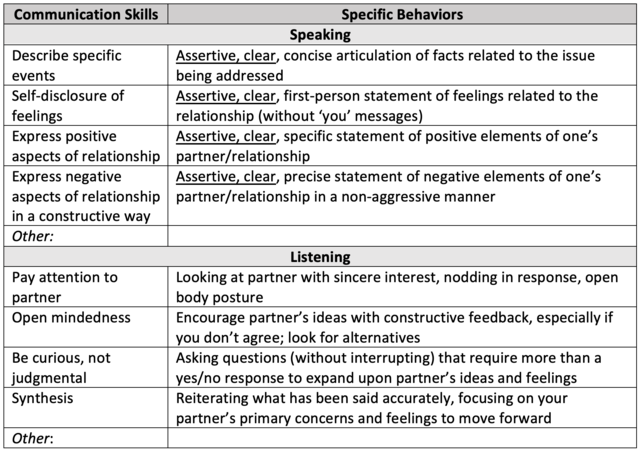
One experienced couple’s therapist broke communication skills into speaking and listening skills. He suggested that couples can discern what they need to work on during therapy and at home by reviewing a list of skills and behaviors. The table below is adapted from Halford’s (2001) taxonomy and includes some attributes from my experience while allowing space for a couple to identify their skills and behaviors:
Communication skills and behaviors
Source: Halford (2001)
Do you notice a pattern? The attributes “assertive” and “clear” are key elements in many effective communication-related behaviors. Couples who deliberately work on having each partner’s voice expressed and received in a safe space will likely enjoy more effective communication in their relationships.
Action Plans for Assertive Communication
So, what can you do to improve communication in your marriage? Once you better understand the context of trust and the skills and/or behaviors that affect the quality of communication, setting up an action plan is a viable next step. An action plan is an agreement, usually written but not necessarily, of specific attitudes and behaviors both partners choose to employ to improve some aspect of their relationship. It could involve tracking unwanted behaviors to become more mindful of them, or it could consist of a list of meditative practices you want to try to help manage stress triggers.
In our marriage, we have used action plans to address specific issues that drain the effectiveness of our trust and, therefore, the quality of our communication. For instance, we developed an action plan to manage my religious ritual compulsions, which manifested in me placing hands on my wife’s head to somehow “bless” her spontaneously–in the middle of supermarket aisles and other public places.
What Is Assertiveness?
Find counselling near me
While not a violent act, it certainly was embarrassing. My OCD prevented me from perceiving my wife’s shame and frustration. After some therapy and coaching, we developed an action plan to mitigate this public scrupulosity by using multiple pathways to identify challenges, opportunities, and strategies (Culkin & Culkin, 2021, table 14.1).
As a result of working together to cope with the issue through effective communication using the structured technique of an action plan, I no longer engage this misplaced scrupulosity.
To reiterate, employing an assertive style that allowed each partner to express his/her ideas and feelings has enhanced the effectiveness of our communications when developing our marriage.
Assertiveness Essential Reads
In this context, an assertive communication (as opposed to passive, aggressive, or passive-aggressive) style involves respecting your partner while standing up for yourself through active listening, clearly and civilly expressing your feelings and ideas, and “taking a stand when you disagree” (Abramowitz, 2021).
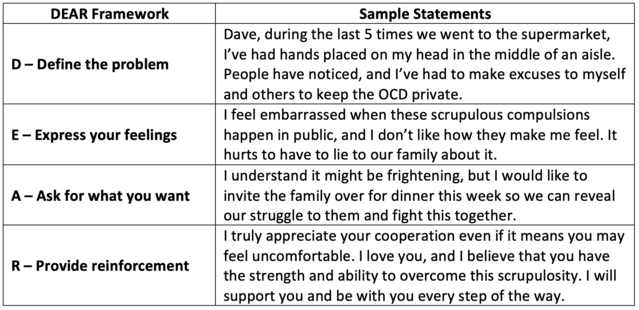
It presumes each partner implicitly trusts the other to do what’s best for the relationship. The DEAR technique provides a simple structure that facilitates assertive communication while using key skills and behaviors to highlight positive “I”–rather than confrontational “you”–statements (Abramowitz, 2021). Using the previous action plan as a template, a sample discourse could look something like Abramowitz’s DEAR framework (see image).
DEAR framework
Source: Abramowitz (2021)
Conclusion
Focusing on effective, assertive communication elements can help your m
arriage develop. Building trust establishes a foundation upon which partners can work on constructive skills and behaviors that can support action plans that result in higher degrees of assertive communication in a marriage. How’s the communication in your marriage?
References
Abramowitz, J. S. (2021). The Family Guide to Getting Over OCD: Reclaim Your Life and Help Your Loved One. The Guilford Press. See pp. 91-92 for more details of the DEAR Method.
Covey, S. M. R. (2006). The Speed of Trust: The One Thing That Changes Everything. Free Press.
Culkin, D. T., & Culkin, M. A. (2021). OCD and Marriage: Pathways to Reshaping Your Lives Together. Specialty Press, Inc. https://ocdandmarriage.com
Halford, W. K. (2001). Brief Therapy for Couples: Helping Partners Help Themselves. The Guilford Press.
The Apple blue versus Android green messaging war isn’t about color. It is about membership and identity. All powerful brands rely on symbolic meaning drawing on universal and cultural archetypes that reflect social values. Some rule through success (Mercedes) or celebrate the hard-fought victories of warriors and heroes (Nike).
Apple is no different. They have built their brand as much on the symbolic meaning of their products as on the technology. The genius here is not the color of the messages but that Apple’s brand story shows at every turn and continually reminds us that they are different and special and, by extension, so are their customers. And like a not-so-secret handshake, when you text a friend, and it’s blue, they can tell you’re special too.
Source: Kaspars Grinvalds/Canvas Pro
Drawing a Line in the Sand
Apple has been a master of using symbols, like color, to establish emotional connections with consumers and reinforce its brand story. Order a new Apple product, and the high-quality packaging tells you something important and special is in the box.
Starting with the iconic “1984” commercial, Apple has been drawing lines in the sand between them and everyone else. Apple doesn’t sell products. They sell the most human of things: membership in a community built on creativity and freedom–where authenticity and self-expression are empowered and celebrated. They humanized technology.
Whether intentional or not, Apple’s design decisions turned Apple computers into friends, from the Happy Mac icon to user-centric design. They were happy when you turned them on. Using them made sense to regular people thanks to the graphical user interface and the mouse. They were easy to use. They made you feel good.
When something is easy to use, we feel smarter. We get more done. We feel more productive. We are happier. Positive emotions have all kinds of benefits psychologically and physiologically for the user and the brand. Positive emotions shift the brand-consumer connection from one of utility to one that becomes integrated with identity, self-efficacy, and self-esteem.
Brand Archetypes and Belonging
Apple reinforces its archetype through voice, color, and values, not product attributes. Things like screen resolution are what our rational brains use to “rationalize” our decision to let our emotions loose and buy a new iPhone. Apple is an outlaw–breaking the bonds of social convention through originality, creativity, and nonconformity.
If it is clear what Apple’s brand is, it is also clear what it is not. It is not PCs. It doesn’t matter what company is the biggest competitor because whoever they are, they are not Apple. They are not part of the in-crowd–a group that’s so superior they don’t even have to be mean about it. They just need to remind people who’s “in” and who’s not.
Think about it. We don’t ask what kind of computer you use; we ask if you are a Mac person or a PC person with all the stereotypes that difference implies. Product affiliations become part of one’s social identity.
Why Blue and Green?
Apple could have used plenty of super-ugly colors (ochre comes to mind) or with worse contrast (red). However, the point is that the color identifies a non-Mac IOS, not that it’s ugly.
Android green is the same color intensity as Apple blue. Blue is more pleasing to read as it fights less with text, but that’s not the point. Message color has become a social categorization tool used to recognize and classify others. Apple’s strategy is not just to be distinct from all “those other guys” but to provide an elevated psychological experience that is subjectively “better” and exclusive.
Green (even lime green) has mostly positive connotations in color psychology. Green is associated with things like money, nature, prosperity, health, and “go.” In most contexts, green is a positive restful, and approachable color. For example, people are more likely to be happier and spend more time shopping in green stores.
However, Blue may have hidden benefits. It is mentally soothing, creating positive emotions that can increase creativity. Also, the text lacks physical cues, so a calmer person may be less likely to overreact when the meaning of a text is unclear, late, or short. But that’s just speculation.
The point is that the important thing about Apple blue and Android green is that they are different. It marks you as “in” or “out.” Biologically and psychologically, people instinctively want to be “in.” There are probably people reveling in their greenness in protest to Apple’s blue. However, social media is full of the blue-green debate, aided by Google’s #getthemessage attempt to shame Apple to change.
Good luck with that. Apple must be very pleased with all the people who don’t want friends with green messages. Talk about social influence.
Let’s face it; it’s not easy if you are single and want to be in a relationship. Dating apps technically should facilitate the process, as they give you access to thousands of peoplewho also want to meet someone.
However, dating apps also open up more opportunities to be ghosted and flat-out rejected. They force you to encounter fears and insecurities you might not want to confront.
The desire to meet someone “organically” (i.e., in daily life) also brings up similar issues that cause anxiety and distress.
As a psychologist, I frequently talk to single clients about their dating woes. Even when they rank meeting someone as one of their highest priority goals, they repeatedly avoid doing what it actually takes to meet that person. Often people talk themselves out of dating by buying into some commonly held dating myths.
Again and again, people hold onto these myths to protect themselves from getting hurt. It is as if they are saying, “If I can come up with an excuse to avoid doing this, I won’t have to deal with being rejected” (or whatever the dating fear might be for that person).
Here are some common myths about dating and how to see things differently:
Myth 1: I need to love myself before someone else can love me.
There are different iterations of this commonly held myth, including the belief that you must have most of your issues worked out before you can be in a successful relationship. Also related is the idea that to attract others, you need to feel confident and radiate that confidence.
Debunking Myth 1
Would it be great if you fully loved yourself, had most of your issues worked out, and felt confident and radiated this confidence? Absolutely!
Do most people feel this good about themselves most of the time? No!
Virtually everyone has negative core beliefs about themselves that get activated at times. Examples of negative core beliefs are:
I am unlovable
I am a failure
I am worthless
I am bound to be rejected
Stress, vulnerability, and emotional insecurity trigger these types of beliefs. Putting yourself out in the dating world opens you up to feeling, well, stressed, vulnerable, and insecure. Thus, dating is bound to trigger these negative core beliefs, especially after experiencing rejection or even thinking about the possibility of being rejected. So, you are less likely to feel like you love yourself when you are single and actively trying to meet someone else.
Keep in mind that when you do start a relationship with someone, it is highly possible to be in a healthy relationship with someone even if you still struggle with unresolved issues. You can work on these personal issues within the context of a healthy relationship.
Myth 2: Dating should be fun.
A minority of people luck out and have great dating experiences. Some people never like dating, and others have a lot of enthusiasm for it when they start out but quickly burn out when things don’t go as well as planned.
It feels like work, a common refrain I hear from people who are on dating apps.
Debunking Myth 2
Dating is often hard work. I often tell people who ascribe to this myth about my friend, a fellow psychologist, who wanted to meet someone after her brief marriage dissolved. “If you want to meet someone, you need to treat dating like a part-time job,” she said. Even though she had a full-time job, she managed to make dating her part-time one. This approach did indeed pay off, and she is now remarried and has three children with her second husband.
In addition, because of the negative core beliefs that often get activated during the dating process, understandably, it can be unpleasant and stressful.
Finally, when you think dating should be enjoyable, it puts even more pressure on it. If you aren’t having fun, it just makes the experience feel worse, making it more likely you will give up on the process.
Myth 3: I need to be motivated to date.
There is often a vast discrepancy between people’s desire to be in a relationship and the motivation to do what it takes to reach that goal. People frequently avoid going on dating apps or responding to messages because they aren’t motivated to do so.
Debunking Myth 3
It can be hard to be motivated to do something when it activates your negative core beliefs, and the chances of success are uncertain. While it is easier to do things when you are excited and motivated, you can still do things like dating and not have much motivation.
When motivation is a challenge, validate yourself about how challenging the process is, and also focus on why you are doing it and what you ultimately want to accomplish.
Focus on your values, not your fears.
Finally, when you are thinking about dating, but noticing some hesitation, focus on your goals and values and what is important to you. Remind yourself that many people struggle with the dating process, and it’s okay to be unenthusiastic about it. If it causes you stress and anxiety, that’s normal and expected. Acknowledge your fears, and then let your values guide your behavior.
I secretly love when someone says they aren’t a “kid person.” These are the people who might respond to a toddler’s proclamation, “I’m a princess,” with a cruel, “No, you’re not.”
They struggle to go along with the flights of fancy for which children are so famous.
Even parents can fall into this category. They say they’re not silly and don’t play. They have both feet planted firmly in adulthood, and that’s that.
But there is evidence that playful parents make for socially savvy and imaginative young people.
But first, let’s talk about what being playful with your childrenis. And isn’t.
Playful Parenting
Much has been written about our century-long parenting evolution from not being expected to play with our kids (like ever) to today’s unrealistic expectation that we entertain our children (like all the time). As is often the case, using play to connect with our children falls between these extremes.
Source: Joice Kelly/Unsplash
Children need time for free play and time to explore without being expected to follow their caregiver’s lead. However, children can also benefit from connecting with their guardians through imaginative play. But playing with your child does not mean doing whatever they tell you to do, just as it doesn’t mean bossing kids around. It is a back-and-forth exchange of ideas, much like a brainstorming session. When it’s working, both parties are having fun, listening to each other, and trying to make the game enjoyable for everyone.
This is where improv’s “Yes, And…” rule comes in handy, especially for all the “not-a-kid-person” people out there.
Yes, And…
Improv’s “Yes, And…” rule means going along with someone’s idea and then adding on in a logical way. It works best when you aren’t trying to be funny or clever. Keeping the scene going and making it make sense are the priorities.
If your child says you’re a princess, you can say, “Yes! Princess Delusia. I live in a castle in Birmingham, and my superpower is napping and braiding hair.”
If she talks like a robot, you can respond by also beeping and booping and saying that you have to find your charging station.
If he says there’s a cat living under the bed, you can say that you’d like to meet her and give her some milk.
Following the “Yes, And…” rule during playtime helps boost creativity and keep play going. It’s a roadmap that parent and child can follow and a skill both can practice. Two of my favorite aspects of it are that I don’t have to plan and that imaginative play can keep going indefinitely.
Even if my daughter says I’m dead, I can come back to life or become a ghost. “Yes, And…” means we can just keep riffing.
I spoke with improviser Marla Caceres while researching my book Theatrical Improvisation, Consciousness, and Cognition, and she told me a story about an adult using “Yes, And…” with her that still sticks in my brain as a kind of play to which to aspire.
When Caceres was 4 or 5, she and an adult were looking at an ant hill. Caceres explains:
Source: Liane Metzler/Unsplash
I was like, “Where are the ants going?” And he’s like, “Oh, that’s where they live.” And I’m like, “Oh really, do they have like…” He’s like, “That’s where they live. That’s like their house.” And I said something like, “And they have furniture in there?” And he goes, “Yep, they do.” (115)
Then Caceres’ game of “Yes, And…” came to an abrupt end when the adult went off to talk to another grown-up, but it’s a terrific example of how easy and imaginative “Yes, And…” can be. Just go with it, add on, and see what happens.
Imaginative and Authentic Play
The beauty of improvisational parenting is that it helps us bring our authentic selves to each interaction, listen deeply, and create imaginative moments, no props needed.
“Yes, And…” has its limits. It is great for riffing and can be a powerful tool to deescalate tantrums, but it does not mean you should say yes to everything children say. If you want to make imaginative play more fun, try “Yes, And…” If some kid says that they want to put their jacket on by themselves, “Yes, And…” can help them test their own limits. If your teenager says they want to drop out of school, you can use “Yes, And…” to explore how they’re feeling instead of negating their reality by cutting them off and saying that’s not an option. “Yes, And…” can help you hear your child out, which can be a powerful negotiation tool. But if a baby demands to eat all the cookies or climb to the top of a cliff, a clear, firm “no” will suffice. Boundaries are the fence that makes playing in the yard safe.
Sometimes, real-life adult and child scenes are slow to get going, but they often end in laughter when we focus on and riff off each other. When they don’t, we have something to talk about and practice. What can we do next time so that both of us have fun playing? Using the “Yes, And…” tool gives us something to practice and a goal to reach. How can this be fun for everyone? How can everyone’s ideas get some airtime?
“Yes, And…” gives us a language to connect through play. And that language may even mean that, deep down, we are all kid people at heart. At the very least, it should make imaginative play slightly more palatable, somewhat more often.
References
Alcee, M. (2022, September 23). How parents can have less drama, more fun! Psychology Today. Retrieved October 5, 2022, from https://www.psychologytoday.com/us/blog/live-life-creatively/202209/how…
Balachandra, L., Bordone, R. C., Menkel‐Meadow, C., Ringstrom, P., & Sarath, E. (2005). Improvisation and negotiation: Expecting the unexpected. Negotiation journal, 21(4), 415-423.
Drinko, C. (2021). Play your way sane: 120 improv-inspired exercises to help you calm down, stop spiraling, and embrace uncertainty. Simon & Schuster.
Drinko, C. (2013). Theatrical improvisation, consciousness, and cognition. Springer.
Felsman, P., Gunawardena, S., & Seifert, C. M. (2020). Improv experience promotes divergent thinking, uncertainty tolerance, and affective well-being. Thinking Skills and Creativity, 35, 100632.
Living with children: You shouldn’t high-five a child. Omaha World-Herald. (2022, October 3). Retrieved October 5, 2022, from https://omaha.com/ap/lifestyles/living-with-children-you-shouldnt-high-…
MacDonald, K. (Ed.). (1993). Parent-child play: Descriptions and implications. SUNY Press.
MacDonald, K., & Parke, R. D. (1984). Bridging the gap: Parent-child play interaction and peer interactive competence. Child development, 1265-1277.
Moyer, M. W. (2022, October 4). Actually, high-fiving kids is totally fine. Actually, High-Fiving Kids is Totally Fine. Retrieved October 5, 2022, fcrom https://melindawmoyer.substack.com/p/actually-high-fiving-kids-is-tota
“He asked me, ‘What should we do this Saturday?’ While I would have liked to have said, ‘Let’s enjoy each other’s bodies,’ I didn’t,” said Jen, 38.
Jen believed that the sex she would inevitably have with her husband of nine years would be the same as it usually was—rushed. They would “get off” and, well, get on with life. “I know he wants more sex, but I just can’t ramp up that quickly,” she said.
“Why do you think he wouldn’t want to have sex for longer periods?” I asked.
She didn’t hesitate, blurting out a list of evidence: He bolts up and puts on clothes directly after sex (after he comes); he says things like, “We have better things to do than dilly-dally in bed,” and he changes the subject when she suggests they plan a sexual evening. “It was different at the beginning of our relationship,” she added wistfully.
This type of self-talk explains why so many couples fall into a routine of “efficient” sex. And yet, while many people hold the view that their partner doesn’t want to put the time or effort into an extended sexual experience, there is strong evidence for the opposite view.
Many men and women come into my office wanting to extend their sexual experiences, but complain that their partner seems to want an orgasm quickly or get sex “over with.” And the research backs this up, finding both heterosexual men and women want sex (both intercourse and “foreplay”) to last longer (Millers & Byers, 2004).
If both men and women say they want to have sex to last longer, then why do most couples eventually move into fast and “efficient sex”?
During the beginning stages of the relationship, we spend time focused on one another, enjoying the sensations of this new person, learning about their body, and being excited by their first touches. We don’t know exactly what the other person likes, so there is lots of experimentation. We spend hours mapping our lover’s body and learning what makes them tremble with pleasure. It can take a lot of time and exploration to learn your new lover’s preferences.
Are there benefits to efficient sex?
Efficient sex is fast and direct. It suggests—and you can pat yourself on the back here—that we have become experts on getting each other off. We have figured out what works to give our partner pleasure and reach orgasm. But once we have learned our lover’s patterns, we can then fall into a routine of getting straight to those same motions. After all, we have kids’ bedtimes to attend to, lunches to prepare, and pressing deadlines at work. Why waste time on further discovery if we already know what we both like? Pulling it off once per week through efficient sex can seem like the only sex possible in our busy lives.
The drawbacks of efficient sex
Researchers have found that there are good reasons to invest in non-efficient sex. When analyzing the elements of “optimal sex,” they found an extended duration of sex (more than 30 minutes), and that more varied acts are associated with greater sexual satisfaction (Fredrickson et al., 2017).
The drawbacks of efficient sex are:
Lower arousal. “Efficient” usually implies speedy. If we jump straight to the things that “work,” without lingering in the build-up to arousal, our bodies may not be ready for sex. Lots of things happen in the body and mind to prepare us for a good sexual experience. If we don’t take the time, the sex just might not work as well.
Loss of desire. Some people who have engaged for years in efficient sex can lose their desire altogether. But when you probe them further, they report that they are not losing the desire for sex itself, but the desire for the “efficient” type of sex routine they have fallen into.
Less sensual enjoyment. With less time to linger, we have a hard time feeling or enjoying our full sensations.
“Meh” orgasm strength. “Efficient” sex can lead us to miss out on stronger, more intense orgasms. Prolonged stimulation can lead to extended, more intense orgasms or multiple orgasms in women (Sayin, 2012).
Where is the excitement? “Efficient” also implies a focus on the same acts that led to arousal in the past. This leaves out new or different sensations, thoughts, and fantasies. Newness is one of the main elements of eroticism which can amplify excitement and light up our erotic brains.
The Fundamentals of Sex
Find a sex counsellor near me
There is nothing wrong with a good quickie. But after the initial stages of the relationship, most people long for the non-efficient kind of sex they had at the beginning of the relationship. Couples in long-term relationships who are having “optimal sex” can sometimes be found setting aside whole weekends to spend in bed.
Just gaining an awareness of the benefits of non-efficient sex and the pitfalls of efficient sex can be the answer. I suggested Jen talk with her husband about how sex had changed for them over the years and if and how they would each like their rhythms to change.
They agreed that they had stopped exploring new ways of touching one another and added one to two dates per month of “non-efficient sex” into their busy schedules. However, they had to work out a few logistics to do so, such as finding ways to get privacy for prolonged periods (with two children in the house). They invested in some soundproofing and a “do not disturb” sign, and scheduled the kids to have more sleepovers with friends. They created guidelines to help them stay in the moment. Phones were banned from the room.
Sex Essential Reads
Jen reported that instead of being disappointed by efficient sex, she and her husband both looked forward to planning slow, luxurious, hot sexual evenings. And quickies also became more enjoyable because they weren’t so routine anymore.
Our world is speeding up, and it feels like we have less and less time to indulge in our senses. Sex is one delicious place we can slow down and be present.
References
Frederick, D. A., Lever, J., Gillespie, B. J., & Garcia, J. R. (2017). What keeps passion alive? Sexual satisfaction is associated with sexual communication, mood setting, sexual variety, oral sex, orgasm, and sex frequency in a national US study. Journal of Sex Research, 54(2), 186-201.
Kleinplatz, P. J., Ménard, A. D., Paquet, M. P., Paradis, N., Campbell, M., Zuccarino, D., & Mehak, L. (2009). The components of optimal sexuality: A portrait of “great sex”. Canadian Journal of Human Sexuality, 18(1-2), 1-13.
Miller, S. A., & Byers, E. S. (2004). Actual and desired duration of foreplay and intercourse: Discordance and misperceptions within heterosexual couples. Journal of Sex Research, 41(3), 301-309.
Sayin, H. Ü. (2017). Tantra, ESR and the limits of female potentials. SexuS Journal, 2(3), 55-74.
Do you believe that there’s nothing better than so-called “make-up sex”? In your own relationship, how many times has an angry exchange with your partner evolved into a passionate embrace followed by an unusually ardent expression of sexuality? Even if the end result wasn’t quite as extreme, did you feel that the argument somehow brought a new spark into your feelings about your partner?
A close relationship wouldn’t be a real relationship if partners never disagreed. The better test of a relationship is not whether couples never argue but whether the agreement-disagreement ratio moves the needle in a positive direction overall. According to a new study by Baylor University’s Amber Cazzell and colleagues (2022), the two “basic dimensions of adaptive interpersonal processes” include those that are “positive and helpful” and those that are “negative and damaging” (p. 1050).
Abbreviated as PPE (Positively Perceived Exchanges) and NPE (Negatively Perceived Exchanges) the authors conceptualize them as not one low-to-high continuum but as two distinct types of relationship behavior that can each vary independently. Your relationship may be high on PPE and NPE, low on both, or high on one and low on the other. The high PPE-NPE couple may have more excitement in their relationship compared to those who are low on both. Either combination of high or low PPE or NPE would, alternatively, indicate a relationship fraught with ambivalence.
PPEs, NPEs, and Relationship Satisfaction
When you think about those interactions that are positive and helpful, what comes to mind? The Baylor researchers suggest that they involve providing support, expressing warmth, and promoting intimacy or closeness. The opposite includes interactions in which partners criticize each other, miscommunicate and withdraw.
As Cazzell and her team conceptualize these, PPEs and NPEs can be seen as forms of “dyadic coping” or ways of handling stress. As in the stress and coping literature, in which stress is defined in terms of the perception that a person lacks the resources to manage a challenge, it’s the perception of the exchange that matters, a perception that partners can either share or not share. You might think that you’re showing an enthusiastic response when your partner shares some good news with you, but in your partner’s mind, you’re acting in a way that seems more passive-aggressive.
Because they’re independent dimensions, it’s possible to examine the separate contributions that PPEs and NPEs make to relationship satisfaction. Furthermore, because they represent perceptions rather than some objectively measured count of partner exchanges, it’s possible to test separately the ways that each partner rates their interactions along the same scales. Combining both into a PPE X NPE factor makes it possible, additionally, to see if there’s something unique about a couple who is high on both.
Testing the Kiss and Make-Up Theory
Using an online sample of 886 mixed-sex marital dyads recruited from across the U.S. (average years of marriage 11 years), Cazzell et al. administered a simple five-item relationship quality measure as the outcome variable (scored separately for wives and husbands). As predictor variables, the research team used all possible combinations of wife positive-negative exchanges and husband positive-negative exchanges that included a so-called “interaction” factor for each consisting of PPE X NPE scores. The “kiss and make-up” theory would account for those couples whose interaction shows up as high-high on PPE and NPE.
Putting yourself in the place of these couples, see how you would rate on the PPE and NPE items. Using a 1-6 (not at all to extremely) scale, rate how “helpful” and “upsetting” your partners are when:
Needing advice or guidance about personal problems
Needing to feel cared about, understood, and sympathized with
Needing favors or assistance
When feeling excited, happy, or proud of something
During routine daily interactions, conversations, or activities.
Turning to the results, and using the length of marriage as an additional predictor, the authors were able to support their proposal that PPEs and NPEs don’t just sit along a single dimension but that each contributed independently to overall relationship satisfaction. Furthermore, the effects remained significant even after controlling for the cross-partner perceptions. In simple terms, it appears that what matters in determining your relationship satisfaction is your own perception of the combination of plusses and minuses in the way that your partner handles key basic areas of your daily lives.
Get Ready to Pucker Up
As you can see, negative interactions with your partner don’t have to mean that your relationship is doomed. It’s possible for you to experience some interactions as upsetting such as having your partner fail to help you, or, vice versa, when your partner thinks you’re not being all that supportive of their accomplishment. What matters is that you’re able to show intimacy and support at other times, preferably (we can assume) within a reasonably short time frame. Unfortunately, the Baylor study only examined couples at a single measurement point. It would have been interesting to see just how the PPE-NPE cycle might have performed in predicting changes in relationship satisfaction.
The findings also indicated that it doesn’t matter whether, at least among couples who were not the same biologically assigned sex, it’s the husband or wife whose buffering matters the most. There was no more buffering of husbands to wives than wives to husbands.
Putting these findings to use, then, would seem to involve several relatively simple steps. First, ask yourself those PPE and NPE questions and see where you fall on the joint set of dimensions. Then figure out where you’d like to be. Are you in the middle on both? Perhaps you might try pumping up the volume at least on the PPE side of your relationship. Do your NPEs outweigh your PPEs? The questionnaire itself gives you guidance on how to achieve a greater balance. If you’re already high on both, you can now reassure yourself, and your partner, that all the drama might actually be working in your favor. The NPEs never feel very good, but taking solace in the high level of PPEs you also experience can help you gain perspective on the value of putting some buffering to good use.
To sum up: The Cazzell study certainly reinforces the fact that relationships are indeed a complex mix of the good and the bad or at least perceptions of the good and the bad. The path to relationship fulfillment may very well be one of allowing both of those qualities to express themselves, preferably to an equal degree.
References
Cazzell, A. R., Rivers, A. S., Sanford, K., & Schnitker, S. A. (2022). Positive exchanges buffer negative exchanges: Associations with marital satisfaction among US mixed-sex couples. Journal of Family Psychology, 36(7), 1050–1060. https://doi,org/10.1037
Burkina Faso’s coup leader, Captain Ibrahim Traoré,will convene a so-called “national assembly” on October 14 and 15 to appoint a transition charter and most likely a new “transitional president”.
The announcement came Saturday after a decree was read on state television.
The assembly talks are set to take place in Ouagadougou, it is on that occasion that the “Transitional Charter” which will set out the steps to be taken by the country towards the convocation of elections, will be ratified.
Jihadist militants have killed thousands and forced 2 million to flee their homes since 2015.
Despite military operations, attacks increased since mid-March and continue to plunge many families into mourning.
“Terrorism is making things difficult for the Burkinabe people“, the uncle of a slain soldiers laments.
“We are with the new president and we pray that God assists him and also, we’re looking for equipment and personnel so that we get out of this. If not, a lot of our children will die”, Moumouni Zoundi alerts.
He was on one of the tourners attending Saturday the funeral of 27 soldiers who were slain in an ambush on September 26. Captain Ibrahim Traoré also attended the funeral.
The 27 soldiers were part of a supply convoy of more than 200 trucks heading to the town of Djibo, capital of the northern Sahel region, when they were attacked.
In addition to them, at least 10 civilians died, others are still unnacounted for.
The al Qaeda terrorist group claimed responsability for the attack. This military setback is seen as the catalyst for the 2nd coup.
Shortly after ascending to power, Junta leader Traoré argued soldiers lacked the basic logistics under his predecessor Damiba. It remains to be seen if he can turn around the crisis.
Chad’s national forum, announced Saturday, that Mahamat Idriss Itno, who took over in April last year after his father demise would remain in power during the 2-year transition to elections.
At a ceremony boycotted by opposition members, leading armed rebel groups and civil society organisations, the “Transitional Military Council which had ruled the country for the past 18 months”was formally dissolved”.
Despite calls urging the 38-old general not to extend the transition, and not to run for president in upcoming elections, the forum, among a raft of resolutions adopted under a revised transition charter, ratified Deby’s right to vye for the presidency after the transition.
The national talks which were wrapped in N’Djamena hab been launched 7 weeks earlier, on August 20.
Iran’s state-run broadcaster was apparently hacked on air Saturday, with a news bulletin interrupted by a protest against the country’s leader.
A mask appeared on the screen, followed by an image of Supreme Leader Ali Khamenei with flames around him.
The group called itself “Adalat Ali”, or Ali’s Justice.
It comes after at least three people were shot dead when protesters clashed with security forces in new unrest over the death of Mahsa Amini.
Ms Amini was detained in Tehran by morality police for allegedly not covering her hair properly. The 22-year-old Iranian Kurd died in custody on 16 September, three days after her arrest.
Her death has sparked an unprecedented wave of protest across the country.
Saturday’s TV news bulletin was interrupted at about 18:00 local time with images which included Iran’s supreme leader with a target on his head, photos of Ms Amini and three other women killedin recent protests.
One of the captions read “join us and rise up”, whilst another said “our youths’ blood is dripping off your paws”.
The interruption lasted only a few seconds before being cut off.
Such displays of rebellion against Ayatollah Ali Khamenei are historically rare, and he wields almost complete power within Iran. But following Ms Amini’s death, there has been some open dissent.
Also on Saturday, social media videos emerged which seemed to show female students at a university in Tehran chanting “get lost” during a visit by President Ebrahim Raisi.
Earlier in the day, two people were killed in Sanandaj, including a man shot in his car after he sounded his horn in support of protesters. A video shared online also showed a woman shot in the neck lying unconscious on the ground in Mashhad.
In Sanandaj, a police official said a man had been killed by “counter-revolutionaries”, the state-run news agency IRNA reported.
On Friday, Iran’s Forensic Medicine Organisation said Ms Amini had died from multiple organ failure caused by cerebral hypoxia – and not from blows to the head, as her family and protesters contend.
Rights groups say more than 150 people have been killed since the protests in the Islamic Republic began on 17 September.
Shops in several cities have shut in support of the protesters, including in Tehran’s bazaar where some set fire to a police kiosk and chased the security forces away.
The protests reaching the bazaar in Tehran will ring alarm bells with Iranian leaders who have counted the merchants as among their supporters.
The human and material cost of Russia’s invasion of Ukraine is well documented. But rare species of animals and flowers that had flourished in the country’s north have also been badly hit by the invaders’ destructive use of weaponry and landmines, with fearsthey will take decades to recover.
Valery Alexandrovitch is dressed like a soldier, flanked by men armed with Kalashnikovs while keeping a constant eye on the news.
He is a forest ranger in Ukraine’s Drevlyansky nature reserve, helping to patrol what once was a pristine sanctuary for wildlife in northern Ukraine. With its marshes, lakes, woods and heathland, it is a place so rich in wildlife it has even been called Europe’s Amazon.
But situated just 15 miles from the border with Belarus, it is in a dangerous part of the world and Mr Alexandrovitch has every reason to be wary.
It was across this border in February that Russia sent rockets, missiles and artillery shells, followed by an invading armoured column that got all the way south to the outskirts of the capital, Kyiv, before being driven back by Ukrainian defenders armed with the latest Western weapons.
“Russian land mines,” Mr Alexandrovitch says, perched on a fallen log beside a forest track. “That’s the worst legacy left behind by the invasion. That and the forest fires they set off with their shell fire.”
Image source, BBC/Frank GardnerImage caption, The Drevlyansky is an important refuge for rare birds and wildfowl
The Russians invaded Ukraine on 24 February from three sides – from the north in Belarus, their own territory in the east, and Crimea which they had seized and annexed in 2014.
It is fair to assume preserving Ukraine’s rarer species of flora and fauna was probably not top of President Putin’spriorities when he sent his tanks rolling across the border.
The artillery shells the Russians fired into northern Ukraine ignited forest fires that have burnt through more than 2,000 hectares (nearly 5,000 acres) of previously-untouched forest, sending wildlife scattering, incinerating recently-discovered orchids and hundreds of other rare plants.
One look at the scorched and fire-blackened trunks of the trees suggests wildlife in this part of Ukraine will not be coming back any time soon. There is simply nothing for them to eat, nowhere for them to hide.
Shells also landed on the nearby town of Narodychi where, according to the Ukrainians, local collaborators helped the invading Russians by guiding their artillery fire towards concentrations of troops.
“We still have to watch out for infiltrators coming across from Belarus,” says Mr Alexandrovitch. This would explain the heavily-armed Ukrainian patrols we witnessed here near the border – small groups of fit-looking men carrying sniper rifles and walkie talkies, with Alsatians panting at their side.
Image source, BBC/Frank GardnerImage caption, Russian shelling this year has devastated large tracts of pristine forest, driving out wildlife that has still not returned
This part of Ukraine is a region known as Polesia, a giant oval on the map that extends into Belarus, Poland and Russia. It is home to species like lynx, wolf and moose that disappeared from most of the rest of Europe a long time ago.
The Russian invasion is not the first disaster Polesia has endured. On 26 April 1986, reactor number four in the Chernobyl nuclear power plant exploded, sending a plume of highly radioactive particles right across Europe and contaminating parts of northern Ukraine with radionuclides.
Chernobyl is just 40 miles (65km) away – most of the remote villages and cottages in this part of Ukraine were abandoned when the human population was hurriedly evacuated to safety.
Yet, the wildlife largely survived that disaster, even benefitting from the newfound absence of humans.
Image source, BBC/Frank GardnerImage caption, The black redstart is a familiar bird in the villages of northern Ukraine
“There have been two wolf packs in this region, and the Polesian wolf is one of the largest in the world,” Mr Alexandrovitch explains. “Before Chernobyl, they used to skirt around the villages but now, if it suits them, they would come straight through them at night.”
The landmines planted by the Russians have left Ukraine’s part of Polesia with a very different problem. Russia is not party to the 1997 Mine Ban Treaty, although Ukraine is. Since they invaded, Russian forces have planted at least seven different kinds of anti-personnel mines in various parts of the country, mostly in unmarked minefields.
Here in the northern forests, that means the unpaved tracks the rangers used to patrol down are now too dangerous to use. In early September one of their vehicles drove over a landmine, killing one of the occupants and badly injuring another.
“Sometimes,” says Mr Alexandrovitch, “we come across the remains of a deer that has been blown up by a mine. The animals can’t see them. It’s so sad.”
So, how long it will it take to make the area safe again?
He takes a long drag of his cigarette before raising his eyes to the pine branches swaying gently in the autumn breeze. “Years,” he answers. Then he turns and adds with a sigh, “Decades, in fact.”
A lack of basic medicine is killing patients in Ethiopia’s Tigray region, which is the epicentre of a 23-month civil war and is under blockade. Both sides have agreed to peace talks in South Africa, and a doctor pleads for the humanitarian crisis to be one of the first issues addressed.
Dr Fasika Amdeslasie speaks in a matter-of-fact voice, but what he has to say is devastating.
“We have a lack of anaesthesia drugs, lack of intravenous fluids, lack of antibiotics and so you see complications arising [with] the patients and you see them dying helplessly – your arms folded,” the surgeon says on a WhatsApp call using a rare satellite internet connection from the Tigrayan capital, Mekelle.
The patients are helpless but the doctors are too.
Nevertheless, there is barely a hint of emotion as Dr Fasika, who works at Mekelle’s main Ayder Hospital, relates the impact of the conflictin Tigray on the region’s health service.
For most of the past two years Tigray has been isolated from the rest of the world.
Fighting started in November 2020 when federal Ethiopian forces tried to wrest control of the region from the Tigray People’s Liberation Front (TPLF). An effective blockade began when the TPLF mounted a counter-offensive and recaptured much of Tigray in June 2021.
Image source, AFPImage caption, Tigrayan troops were welcomed back to Mekelle in June 2021 but that is when the region was cut off from the rest of the world
Deliveries ground to a halt, banking services stopped and telephone connections were largely cut making it almost impossible to phone anyone up. The UN says that currently 5.4 million people – around three-quarters of Tigray’s population – need some kind of food aid as the fighting has disrupted supplies.
The sick are not exempt, even though they are not directly involved in the conflict.
Some drugs and other vital equipment have come through the World Health Organization and the International Committee of the Red Cross – but their arrival has been sporadic and supplies stopped completely when fighting resumed in August, ending a five-month humanitarian ceasefire.
“We don’t have medicine for our patients, we don’t have surgical materials to do surgery, we don’t have vaccines to vaccinate children, we don’t have insulin to give to diabetic patients,” Dr Fasika tells the BBC’s Newsday programme, listing the impact the last 16 months have had.
“So all kinds of patients are suffering. We are telling them to return home without treatment.”
Drugs to treat cancer patients have not been available at all and they cannot get radiotherapy as the equipment for that is in the federal capital, Addis Ababa. Travelling there is impossible.
“Basically cancer patients are doomed to die,” says the 41 year old, who was once the dean of the medical school.
‘Patients do not have time’
Medics have also had to watch those suffering from kidney failure deteriorate as supplies for dialysis have only come through intermittently.
“The last arrival was June and there has been a complete blockage since August and now this week we are running out of materials for the 25 patients we have,” according to Dr Fasika.
He says that 90 kidney patients have died “in front of the doctors” and he wonders what will happen to the 25 who remain.
Regarding diagnosis, the hospital laboratory lacks the chemical reagents vital for the tests, meaning that often doctors cannot tell what is wrong with patients.
Added to this, the unreliable electricity supply and the absence of fuel for the generators means that the hospital can go days without power.
Fasika Amdeslasie
I have run out of emotion because it is a living reality, I am just describing what I face daily”
Throughout the grim catalogue of what he and his fellow medics are dealing with, Dr Faseka’s even voice does not reveal the weight of what he is describing.
“I have run out of emotion because it is a living reality, I am just describing what I face daily.
“We are protecting ourselves emotionally. We will not know how much burden we are carrying until we are relieved. Otherwise it’s a natural defence mechanism not to think about it – you don’t dwell there and you do what you have to do.”
But the doctors and nurses themselves are also having to deal with the fact that, as federal employees, they have not been paid since May last year. Dr Fasika gets sent money from friends and family abroad, but this comes at a price as money changers charge a high commission for having to smuggle the cash into Tigray.
“This hospital is my life,” Dr Fasika says, explaining what motivates him despite the difficult conditions.
“Professionalism calls you. If you can go and talk to patients and counsel them and do what you can, then that’s the most important thing. Not only me but all the professionals here.”
When it comes to possible peace talks between the federal government and the TPLF, Dr Fasika shies away from getting involved in the politics.
But he is worried that as the talks are a political process they will be drawn out as the different sides debate the details.
“The talks may take time, but our lives, the children’s lives and the patients’ lives may not have that time. So I wish they do things on the humanitarian situation first.
“Humanitarian law has to be respected. Why does it fail in Tigray when it is not failing in Ukraine? Is it because we are not important people?”
In the fight against terrorism in general and the Al-Shabab extremist group in particular, the Somali government has decided to enforce a new measure.
On Saturday (Oct.7), the deputy minister of information announced the government banned what it calls “the dissemination of extremism ideology messages both from official media houses and on social media”.
“I want to inform the Somali media and all Somali people in general that we’ll regard all al Shabaab related propaganda coverage including their terrorist acts and their ideology as punishable crimes, Abdirahman Yusuf said.
“Thus, implementing its decision, the government started cyber operations fighting against terrorist accounts on social media, so far, we have suspended more than 40 accounts on Facebook and Twitter”, the deputy minister added.
Speaking the AFP news agency, Yusuf insisted the decision would not affect normal news coverage about al-Shabab by journalists in Somalia.
The armed forces, backed by local militias and international allies, have waged a campaign against the al-Qaeda-linked group which still controls swaths of the countryside.
Earlier this week, the jihadists carried out a deadly triple bombing.
The ministry of information, in a statement, urged Somalis to report accounts linked to terrorist activities.
One of the challenges in enabling some African countries to reach their full potential is a lack of robust infrastructure, from utilities to roads and widespread railways, as well as reliable healthcare.
As pension funds around the world increasingly invest in new asset classes in search of yield, investments in infrastructure have been identified as offering the potential to not only provide diversification, but to match other long-term pension assets and to enable positive socioeconomic change. While infrastructure investments typically needed to be made through listed entities or real estate portfolios, funds are increasingly investing through alternative channels, such as private equity funds, or directly.
Monique Pennells, Head of Non-Banking Financial Institutions at Absa Corporate and Investment Banking (CIB), part of Absa Group, believes that the pension fund market has a significant role to play to increasing infrastructure investment on the continent.
Pennells refers to the recent change in pension fund legislation in South Africa which broadens the definition of infrastructure and allows South African pension funds to increase investments into infrastructure development projects elsewhere on the continent.
“These changes are critically important and relevant in the African context because the South African pension fund market is sizeable at USD213bn. It’s currently ten times the size of the next largest market in Africa and estimated at 85% of the total pension fund market on the continent, with the South African pension fund market representing 57% of the country’s GDP.” she explains. “This change in legislation and widening of the infrastructure development definition, paired with changes in asset allocation decisions by Pension Fund Trustees has the ability to change the face of the continent.”
Pennells says that whereas previously pension funds were limited in terms of type and size of infrastructure investment within South Africa – which was limited to a narrow definition of infrastructure asset allocation – the new regulations allow for up to 45% of pension fund assets to be invested in a broadened definition of infrastructure developments, and an increased allowance for investment into infrastructure in other African countries. She believes this will see an uptick in investments into infrastructure projects that will help to address current gaps that government and the traditional sources of funding alone cannot fund.
A broad trend, with energy implications
Pennells also believes that this is a trend that could be replicated in other African countries too, as the African pension fund regulations match the need for infrastructure of the continent. She says that the continent is expected to deliver opportunities for investment advisors, asset managers and pension fund trustees to revise investment allocations, and shift towards long term sustainable infrastructure projects. Pennells says that there is a still a deepening of the pension fund market expected in Africa, with countries like Nigeria, Tanzania and Egypt’s pension fund assets still representing less than 20% of the respective GDP’s. There is strong need to develop and maintain a track record of investable deals to manage the overall risk appetite and encourage investment from the pension fund market.
“At the recent 5th Pension Funds and Alternative Investments Conference held in Mauritius,” Pennells explains, “there were calls for active asset allocation into infrastructure investment, particularly from a resources and energy perspective. It would be amiss to disregard the potential risks to pension fund savings in investing in alternative assets and infrastructure development – striking a balance between long term yields for pension capital and safeguarding of the pension assets, but still allows for progressive investment decisions where long term sustainability is considered as part of the performance metric of a fund.”
Absa CIB believes that renewable energy is a vital investment for a cleaner, better future and has committed to the financing of clean energy by accelerating investments that make an impact on the continent’s provision of energy. Pennells believes that access to capital for such projects will be unlocked by facilitating pension fund investment into the energy sector. “At Absa CIB, we are working across the value chain to bring the owners of capital closer to those in need of capital, while managing the risks and packaging the deals to encourage increased participation by the pension fund market.”
Alternative investments and the move to mainstream asset allocation
“By giving pension funds the ability to invest in what we would typically have seen as alternative investments, we anticipate that these will become mainstream as the search for sustainable investment increases across the ESG (Environmental, Social and Governance) spectrum,” says Pennells.
She notes that moves to facilitate pension fund investment into infrastructure will affect also the ability of insurers to invest alongside the traditional lenders. “What’s interesting is that South Africa has one of the highest insurance penetration rates in the world, behind Luxembourg. Our long-term savings within the insurance industry are significantly large. And many people who might not be operating within the formal sector have a version of savings in the long-term life insurance market or with long term savings schemes. This emergence of a sustainable, albeit still alternative, asset class can create investment diversification broadly across financial services – which also benefits the community at large, so there’s a wide social development angle too.”
Absa CIB views pension fund investment in infrastructure as an opportunity to boost capital spend across Africa. “It’s something I’m very passionate about,” says Pennells. “Often, in financial services, it feels like we’re a step removed from being able to see the positive change we’re working towards in the real economy. The recent regulatory change and the drive to invest in sustainable projects by pension capital could mean the impact can be felt in a single generation, which is quite exciting.
For many, seeing the world’s most famous shipwreck is a lifelong dream. And now, paying adventurers called “mission specialists” can get the chance to explore Titanic up close.
Four-hundred miles from St Johns, Newfoundland, in the choppy waters of the North Atlantic Ocean, a large industrial vessel swayed from side to side. Onboard, Stockton Rush expressed a vision for the future:
“There will be a time when people will go to space for less cost and very regularly. I think the same thing is going to happen going under water.”
The Travel Show’s TV broadcast
The full story is airing this weekend on BBC World News’ The Travel Show. Check here for specific broadcast times.
Rush hopes that his company OceanGate will do for deep-sea exploration what innovators like Elon Musk, Richard Branson and Jeff Bezos are trying to do for space travel: allow anyone with enough money to venture to new worlds, even if they lack the specialist training.
Rush’s location in the North Atlantic is unremarkable at first glance. However, it is here that one of the most renowned and tragic events in history took place: 3,800m below the surface lies the wreck of the Titanic, which sank in April 1912 after striking an iceberg on its maiden voyage.
For Rush, who is trying to make deep-sea exploration for the masses commercially viable, the site of the world’s most famous shipwreck was a “must-do dive”. He added, “I read an article that said there are three words in the English language which are known throughout the planet. That’s Coca-Cola, God and Titanic.”
Watch the mission down to the Titanic
But to make his Titanic dream a reality, Rush has had to create a new type of submersible made of lightweight materials that could take up to five people down from the ocean vessel to Titanic’s depth. Many thought it couldn’t be done.
Now though, Rush was at the site (after successfully reaching the wreck in the submersible last year) with a large mix of people, including the crew aboard the vessel, OceanGate staff, scientists and a small but crucial group of paying adventurers called “mission specialists” who each paid up to $250,000 (about £225,000) for a chance to see Titanic up close.
While there, they would also have the chance to help as citizen scientists, gathering pictures and video of the deep-sea biodiversity.
This particular dive included banker Renata Rojas, businessman Oisin Fanning and television professional Jaden Pan, plus oceanographer Steve Ross and submersible pilot Scott Griffith.
Jaden Pan is one of several “mission specialists” who get to see the Titanic up close (Credit: BBC’s The Travel Show)
Rojas explained, “I’m not a millionaire. I’ve been saving money for a long, long time. I made a lot of sacrifices in my life to be able to get to Titanic. I don’t have a car, I didn’t get married yet, I don’t have children. And all those decisions were because I wanted to go to Titanic.”
For Ross, these dives offer a rare chance to study the deep ocean environment by taking water samples around the wreck site and making a record of the biodiversity with his camera. He said, “There is sort of a race to understand the deep sea, which is the largest environment in the oceans and the most poorly explored. Changes in the ocean have a huge impact over the whole globe.”
As the submersible descended for more than two hours to the bottom of the ocean with its passengers, onboard, Ross observed this biodiversity through the porthole window.
Dives to the Titanic wreck offer a rare chance to study the deep ocean environment (Credit: BBC’s The Travel Show)
“On the way down, we saw mesopelagic animals [that are] involved in the largest migration on Earth. Every evening, this big community migrates to the surface, and each morning they migrate back down to 500 to 1,000m. A lot of those animals have bioluminescence, so you get flashes of light here and there.”
When the submersible hit the ocean floor, it landed in the 15sq m debris field that surrounds Titanic’s severed bow and stern.
“All five of us unofficially had this moment of silence,” said Pan. “The first thing I see are pieces of coal. That’s the moment that connected me to the humanness of the Titanic. The fact that people had shovelled this, had brought it onto the boat, and during the sinking, it just all spilled out.”
Stockton Rush is trying to make deep-sea exploration for the masses commercially viable (Credit: BBC’s The Travel Show)
From the other end of the submersible, Pan heard pilot Griffith say, “Oh no. We have a problem.”
“When I’m thrusting forwards, one of the thrusters is thrusting backwards,” Griffith explained. “Now all I can do is a 360.” On the ocean vessel above, Rush considered remapping Griffith’s controller. “It’s not going to be easy”, he told his fellow support crew.
“I thought, we’re not going to make it!” Rojas said. “We’re 300m from Titanic and all we can do is go in circles.”
The solution which came to Rush was brilliantly simple: “Tell him to hold it the other way,” he said. After establishing that turning left on the controller will move the submersible forwards, he concluded that turning the controller 90 degrees clockwise will make the submersible possible to go forward again.
An large ocean vessel takes people from St Johns, Newfoundland, to the Titanic site (Credit: BBC’s The Travel Show)
Passing colourful tiles, plates and a sink in the debris field, they soon reached their goal: the bow of the Titanic – iconic from when romance blossomed between the fictional Jack and Rose in the movie Titanic. Selfies taken, the remaining hours on the ocean floor were spent exploring the rest of the bow and more of the debris field before ascending to the surface.
While the analysis of the data they collected (from the video) will take some months to complete, the mission was instantly gratifying. Soon after emerging from the submersible back on the ocean vessel, Rojas wiped away a tear, saying “I needed to do it to feel complete. I feel now complete.”
Russia ramped up security on its only bridge to Crimea after a huge blast destroyed sections of it on Saturday.
President Vladimir Putin has now ordered the country’s Federal Security Service (FSB) to oversee the key connector to the occupied peninsula.
The bridge is also a pivotal symbol of Russia’s annexation of Crimea from Ukraine in 2014. The blast killed three people, Russian investigators said.
Officials said work to fix the damaged sections would begin immediately.
Russia’s deputy prime minister ordered the destroyed parts of the bridge to be taken down immediately, and said divers would begin investigating damage below the waterline on Sunday morning, Russian news agencies report.
Hailed by Russian media as “the construction of the century”, the bridge has been crucial to Russia for the movement of military equipment, ammunition and troops into southern Ukraine.
But new satellite images released on Saturday showed smoke and fire near the collapsed areas of the 19km (12-mile) bridge, which was opened with much fanfare four years after Moscow annexed Crimea.
Since it plays a strategic role in the war, Ukrainian authorities have said it is a legitimate target, as they vow to retake the peninsula.
Ukrainian officials responded with thinly-veiled approval to the explosion – but have not indicated that their forces were behind the attack.
President Volodymyr Zelensky acknowledged the incident in his nightly address on Saturday, saying: “Today was not a bad day and mostly sunny on our state’s territory.”
“Unfortunately, it was cloudy in Crimea. Although it was also warm,” he added.
Russian authorities moved swiftly to reopen those parts of the key connector still intact, and said late on Saturday that the bridge has been partially reopened to road and rail traffic.
It is a vital artery in Moscow’s supply chain to the battlefront in its invasion of Ukraine – and to the annexed Crimean territory itself.
The Moscow-appointed governor of Crimea, Sergei Aksyonov, said there was a desire for revenge, but made reassurances that the peninsula still had a month’s worth of fuel and more than two months’ worth of food.
“The situation is manageable – it’s unpleasant, but not fatal,” he said.
Ukrainian official David Arakhamia, parliamentary head of Mr Zelensky’s party, said “Russian illegal construction is starting to fall apart and catch fire.
“The reason is simple: If you build something explosive, then sooner or later it will explode.”
And a Ukrainian MP told the BBC that regardless of who was responsible for the attack, this was a “big Ukrainian victory and very severe and hard loss for Russia”.
“The bridge is not destroyed but damaged, but the image of Putin is destroyed, that is the most important thing,” Oleksiy Goncharenko said.
It is hard to overstate the political, symbolic and strategic significance of the Crimean bridge. Russian officials previously claimed it was well protected from threats from air, land or water – particularly since it is more than 100 miles from Ukrainian-held territory.
A Russian national anti-terrorism committee said the damage was caused by a truck bomb blowing up, which caused seven railway carriages to catch fire. The home of a man from the Krasnodar region of southern Russia is being investigated, it added.
While Ukraine has not linked its armed forces to the explosion, it has targeted Crimea in the past. Last month, Ukraine claimed responsibility for a series of air strikes on Crimea – including an attack on Russia’s Saky military base.
Since the bridge attack on Saturday, Ukraine’s social media has erupted in celebration. Its second-largest bank says it has already issued a new debit card design featuring the collapsed bridge.
In recent weeks, Kyiv’s forces have taken back significant amounts of territory seized by Russia earlier in the war.
Hours after the bridge explosion, Russia appointed a new commander to lead its troops in Ukraine. Sergei Surovikin is a veteran commander known for leading Russian forces in Syria and was accused of overseeing the decimation of the city of Aleppo.
But Russia still controls swathes of Ukraine, including the Zaporizhzhia nuclear plant – the biggest in Europe – which has lost all external power and is relying on emergency diesel generators for the energy it needs for reactor cooling, according to the UN nuclear watchdog.
And the nearby city of Zaporizhzhia, in Ukraine’s south-east, saw overnight shelling which killed at least 12 people, according to regional governor Oleksandr Starukh.
A dozen Russian air strikes hit several residential buildings, destroying some and damaging many more, he said.
“There may be more people under the rubble. A rescue operation is under way at the scene. Eight people have already been rescued,” he said on Telegram.
Earlier, officials said 17 people had been killed in the shelling.
Are you and your partner trying to get pregnant? Here are some tips
It is the ultimate sign of your love, it’s your miracle and it’s the most beautiful thing that ever happened to you. Having a baby sounds wonderful, but actually getting pregnant is not always that romantic or easy. So, here are eight tips on how to get pregnant – in addition to having sex, of course.
1. Get to know your cycle
Every woman knows when to expect her period. Yet, many do not realize what the rest of the cycle will look like. In addition, how long the cycle lasts, differs from one woman to the next. Some women have a cycle of 27 days, while others have a cycle of 29 days. If you know exactly what your cycle looks like – even though it may differ from month to month – you can calculate when you ovulate.
2. Calculate when you ovulate
As we’ve mentioned above, you can calculate when you ovulate if you have knowledge about your cycle. Do you know the date on which your most recent period started and how long your cycle lasts? If so, you can use this internet tool to calculate the days that you will be fertile. Note: this gives only a rough estimate.
3. Buy an ovulation test kit
You can use an internet tool to find out when you are fertile, but there are also tests nowadays that tell you more specifically. They look like pregnancy tests, and when you use the test you will see within five minutes if that day is a fertile day.
4. Don’t have sex every day
If you and your partner love having sex every day, keep doing it. But if you’re having sex for the purpose of conceiving a baby, you don’t have to do it every day. Women are fertile for six days per cycle. Five days before ovulation and the day after.
Research shows that it is not necessary to have sex every day during those six fertile days. Dr. Mary Ellen Pavone advises not to have sex every day if you’re only having it for the purpose of getting pregnant.
And Pavone would know. She is a fertility specialist and medical director of a fertility and reproductive medicine department in Chicago. By having sex every day, you often put pressure on yourself and your partner, she says. But again: if you enjoy a horizontal tango every night and you both feel no pressure, just keep doing it.
Body language; it often tells you much more than words could ever do. It’s an incredibly important tool when it comes to establishing relationships, because most emotions are communicated non-verbally.
So, when we’re in contact with other people, we say much more than we do with just our words.
It’s not about what we’re saying exactly, but how we feel when we’re saying it.
It can be difficult to talk about our feelings, which is why we’re often communicating our emotions through body language instead.
This can make it clear to other people whether there’s an underlying meaning to what we’re saying, and how we relate to them.
That’s why body language is important when making contact with all kinds of people. Body language can also tell us a lot about who we are and how we relate to our surroundings.
What’s your usual sitting posture?It can reveal a lot about your personality. Read about your sitting posture on the next page.
Position A People who sit like this are very creative and charismatic. They’re spontaneous and don’t think too long about the decisions they make. This can cause some trouble every now and then, but their natural charm will help them out of a sticky situation.
These people view life as an adventure and are open to new experiences. They’re also very popular and easily make new friends, although many of these relationships are fleeting.
Position B People who sit in this position are true dreamers. They have a rich imagination and can completely lose themselves in a daydream. They’re very empathetic and can easily make contact with other people, but they sometimes put themselves in the background because of this. They are very good listeners and are strongly in touch with their own feelings.
How do you keep your legs when you’re sitting down? This is what your sitting posture says about your personality!
Position A People who sit like this are very creative and charismatic. They’re spontaneous and don’t think too long about the decisions they make. This can cause some trouble every now and then, but their natural charm will help them out of a sticky situation. These people view life as an adventure and are open to new experiences. They’re also very popular and easily make new friends, although many of these relationships are fleeting.
Position B People who sit in this position are true dreamers. They have a rich imagination and can completely lose themselves in a daydream. They’re very empathetic and can easily make contact with other people, but they sometimes put themselves in the background because of this. They are very good listeners and are strongly in touch with their own feelings.
Position C These are chaotic people who have a lot of trouble concentrating and sitting still. Their minds are always moving and they often speak before thinking about the impact of their words. They’re easily bored and have a short attention span. They shine most in a fast environment with loads of stimuli. In relationships they can quickly become disinterested as well, and they need someone who can push back.
Position D These are often very smart people who are good rational thinkers. They’re punctual, neat and orderly. Their homes are often squeaky clean and neat, and everything has its own proper place. They’re a little reserved and won’t quickly reveal everything about themselves. Yet they are very honest and don’t like to gossip. They remain calm in every situation and don’t easily lose perspective.
Position E These people are very goal-oriented and value their careers a lot. They place importance on setting ambitious goals for themselves and are not satisfied with less. On a personal level they also like to set goals, for example when it comes to health and love. They’re very perfectionistic about everything, including their own appearance. This sometimes causes them to lose sight of what they already have because they’re always aspiring for more.
Did you know your fingers can reveal a lot about your personality as well? Click here to find out what it tells you!
We eat so many different things daily, and we don’t realize how many are actually harmful to our bodies. It’s vital for you to know which food products are best for your life and diet, which is why we have compiled a list for you.
Make sure you remove these seven foods from your diet to reduce your chances of cancer.
1. Farmed Fish
Many people don’t realize this, but farmed fish is full of harmful chemicals and other ingredients that can harm our bodies. These fish are fed the wrong foods so they can get bigger, and it’s typically GMO. Similarly, farmers use other growing methods that affect our health.
2. Non-Organic Fruits and Vegetables
Fruit and veg are good for you, right? Well, that isn’t always necessarily correct. Whether these foods are good for you will depend on their quality. For example, organic fruit and vegetables offer various health benefits, whereas those that aren’t are harmful to the body.
3. Canned Food
Canned food is not good for our bodies, and that comes down to the amount of BPA in it. It’s a harmful chemical used in many food products, especially those that are packaged in bottles and cans. This chemical has also been linked with people who develop cancer, so it’s best to avoid foods with BPA at all costs.
Has the yolk of your egg gone a little green? It doesn’t look that appetising, so you might be tempted to throw it away instead of eating it. But is this really necessary or is it still fine to eat? We’ve got the answer for you!
Eggs go a little green when you’ve heated them for too long or on a too high temperature. So, the risk of getting a green yolk is highest when you’re making yourself a very hard-boiled egg. The change in colour is the result of a chemical reaction that takes place between the sulfur that’s inside the egg white and the iron. The green that arises is iron sulphide and this usually only develops at the edge of the egg yolk. However, if you boil the egg for way too long, the entire egg yolk can go green.
Not too long
You can avoid a green yolk by not letting the egg boil for too long and by rinsing your eggs with cold water straight after taking them off the heat. By rinsing the eggs with cold water, you’re basically ‘scaring’ them out of going on cooking after being taken off the heat. If you want a hard-boiled egg without it going green, you should stick to boiling it for eight minutes. If you prefer eggs that are still slightly soft, boil them for five or six minutes. For soft-boiled eggs, the preferred time is three to four minutes.
Storage
Do you also always wonder how you should store eggs? The most important thing to know is that you shouldn’t keep them in the door of your fridge. That handy little rack on the inside of the door isn’t the best place to keep them at all since your constantly opening and closing the door. This causes the eggs to be subject to sudden changes in temperature and that, in turn, will cause the eggs to rot sooner. To make sure your eggs stay fresh for as long as possible, you should store them in their carton at the back of the fridge. This will help them remain at a stable temperature.
Don’t you hate it when you cut up some fruit at home to take with you on the go, only to discoverthat when it’s time to enjoy your snack it has turned brown?
It’s still edible, but it does not look very appetizing. It doesn’t matter how well you’ve packaged your pre-cut snack, it still turns brown while on the go. Luckily there’s a solution!
You probably already have what you need in your kitchen cupboard.
Lemon juice
You may have already heard of this tip: sprinkle some lemon juice over your apple to prevent it from going brown.
This is absolutely right, but with just adding one other ingrediënt you have the perfect mixture to preventfruit from browning. This works for apples as well as other fruit you cut up and take with you.
If you like making a mixed fruit salad for on the go or perhaps for a party, consider sprinkling this mixture over it to keep it looking appetizing.
Magic mixture
What do you need besides lemon juice? Honey! Simply mix one tablespoon of honey with one tablespoon of water and a few drops of lemon juice.
Pour this mixture over your fruit and you’ll see that it won’t turn brown anymore. It does add a little taste to your fruit, but the sweetness of the honey with the tanginess of the lemon juice is a great addition to your fruit.
How does it work?
This mixture work because of the acidity and vitamin C in the lemon juice, which work together with the amino acids from the honey. The combination slows down the browning process and prevents the fruit from browning altogether.
Through the years, a lot of cooking myths have surfaced and some have turned out to be rather persistent. Chefs have all developed their own cooking myths throughout the generations. Of course, it’s inevitable that there are some myths in among these methods. When there are so many different ways to prepare a nice and delicious dish, there are also a lot of opinions around. So, it’s high time that we debunk the eight biggest cooking myths once and for all!
To help you get your facts straight, we’re going to reveal eight cooking myths that are completely untrue.
1. Flour doesn’t go bad
You might think the bag of bread flour you’ve been storing in your pantry for a few years already is indestructible, but it’s actually much more vulnerable than you’d think. Although it takes a long time, relatively speaking, flour can definitely lose its taste and quality, despite being kept in properly sealed packaging. The signs that your flour has definitely gone bad are a nasty smell coming off it and weevils being in there. These tiny insects look a little like larvae. So, haven’t used your flour in a while? Check it properly before you use it!
2. Microwaves get rid of the nutrients in your food
Microwaves are so useful that we all just assume that there must be something wrong with them. From a health point of view, though, they’re completely harmless. When you cook food in the microwave, you’re actually exposing it to the heat for a shorter time than you would on the stove. For that reason, some experts actually suggest that microwaves can help your food to better retain its important nutrients.
3. You should rinse your pasta with water
Although many people are convinced your should rinse your pasta with cold water to optimise the taste and texture of the pasta, this turns out to be very untrue. Rinsing the pasta also means you rinse away the natural starch that helps the sauce stick to it. This means your dinner will be considerably less tasty if you rinse the pasta.
4. Well-done meat is safer
There’s a reason why some experts shake their heads when you ask them to make sure your steak is well done. You’re not just ruining the taste and texture of the meat, but there also isn’t any evidence whatsoever that cooking the meat until it looks like leather helps to kill any more bacteria. All you need to kill the bacteria is a temperature of around 65 °C within the meat
We all know that it’s important to eat lots of vegetables. What we talk about less often is how we prepare those vegetables.
The preparation method influences both the taste and the nutritional value. But is it better to steam or boil it? We explain the difference.
Losing nutrients
You can either boil or steam most vegetables. Which of the two options is best? In short, when you cook vegetables, you lose vitamins and minerals.
If you steam vegetables, this happens less quickly. This is because the nutrients are absorbed into the water, which you lose when you drain the vegetables after cooking.
The longer you cook vegetables, the more nutrients are lost. Drainage is also the culprit when it comes to taste. The taste of vegetables remains in the water, just like the nutrients.
Things to watch out for
So while steaming is the better option, cooking vegetables is definitely not bad. There are a few things you can watch out for when cooking vegetables.
First of all, make sure you never overcook vegetables. The longer you cook them, the more nutrients you lose.
Cut the vegetables as little as possible, because you also lose important nutrients by doing so. Also, try to use as much of the cooking water as possible in your dish, since that water absorbs vitamins and minerals during cooking. Aha!
Yet another task on your to-do list? Well, no, if all is right you’re actually already doing all of these things every day. Most of these things are small acts you hardly think about anyway. But still, we’d like to point your attention to these seven tasks that really should be done every day. Do you clean these things every day?
Make sure you clean these things every day if you want to create a fresh and healthy living environment.
1. Tea towels, kitchen towels and dishcloths
You use dishcloths to wipe away dirt, so it’s not very surprising that these are full of bacteria. Tea towels and kitchen towels, too, are much dirtier than they seem! And let’s be fair, how much time does it really cost to toss them in the hamper and replace them with clean towels? While you’re at it, also replace the guest towels in the bathroom. These are used multiple times a day, so they get dirty pretty quickly too.
2. Shower walls
Okay, so this tip doesn’t really count as “cleaning”, but a lot of people forget about it anyway. Put a squeegee in your shower so you and your family members can squeegee the water from the walls and doors of the shower cabin. By doing this small and simple thing every day, you’ll prevent limescale from building up in your shower, which means you won’t have to scrub like crazy later.
3. The kitchen counter
Keep a spray bottle with kitchen cleaner or all-purpose cleaner close by so you can quickly wipe down your kitchen counters before and after cooking. Doing this after you’re done cooking might sound logical, since there will be crumbs and food scraps on your counters, but cleaning it before cooking is a good idea too. You put your grocery bag on top of the counter, put down your keys there and who knows what else has left bacteria on that surface. Giving it a quick wipe down with some cleaner isn’t an unnecessary luxury.
Go to the next page to read about the other four things you should clean every day!
These cleaning agents are even environmentally friendly
If you want to save some money, getting your hands dirty (or clean, in this case) can go a long way. Making some things yourself instead of buying them can save you quite a bit of money per year.
The ingredients are often much cheaper and it doesn’t take that much effort either. In other words; no reason not to do it.
This all-purpose cleaner, glass cleaner and laundry detergent are examples of cleaning agents you can very easily make yourself without too much of a hassle.
From now on, you can just make these things yourself.
All-purpose cleaner
We can hear you think; “but we’ll miss the nice smell”, but that’s not necessarily the case. You can make a deliciously smelling all-purpose cleaner yourself.
That way, you can make sure your home is squeaky clean and leave behind a lovely, non-chemical smell. To make all-purpose cleaner you need a spray bottle: fill it with one half vinegar and one half water.
If you want to add a nice smell, you can use essential oils.
Add a few drops of the oil of your choosing. Then, properly fasten the top of the spray bottle. Shake the bottle so the ingredients are mixed together and then the cleaning can start!
You can use this all-purpose cleaner for many things, like cleaning your toilet, stove or windowsills.
Other cleaning agents you can easily make yourself are laundry detergent and glass cleaner. You do need a couple more ingredients for those two, but the result is amazing.
Go to the next page to find out how to make these cleaning agents!
This in turn saves time and energy in your cleaning routine!
We admit: there are certain things in the house that we don’t clean enough. But apparently, there are also things that we actually give a cleaningtoo often. Yes, you read it correctly! Certain items don’t like being cleaned too often. So the following seven things can be skipped a little more often.
1. Curtains Do you wash your curtains every season? Then you are washing them three times too often in a year. Curtains only need to be washed once a year. Would you like to freshen them up more often? Many dryers have an “air only” option, which makes them dust free again. Kitchen curtains can be put in the washing machine a little more often.
2. (Sports) clothing Because we often sweat during exercise, it seems logical to throw sportswear straight into the laundry basket afterwards. However, clothing does not need to be washed after just one wear, and this also applies to sportswear. Sports pants can last three to four times without being washed. Only if you sweat a lot should you wash the clothes a little more often.
3. Seat Covers Seat covers are extremely useful for keeping your chairs tidy. Wash them once a season and they will be fresh and fruity again. For chair covers you can follow the same procedure as for curtains: cleaning them once a year is sufficient. Stains that occur in the meantime should be treatedlocally.
4. Plates We hear you thinking: plates really need to be washed after every time you use them, right? That’s right, but if you rinse plates before you put them in the dishwasher, you’re actually doing it twice. This is not necessary. Of course you need to rinse the food off, but dirt can just stay on the plate. Do you not do this? Then detergent then no longer adheres to the dirt and it does not achieve its purpose. Extra plus: you save water with this too!
5. Pans Non-stick pans do not need to be thoroughly sopped after every use. If you only fry an egg, it is enough to rinse the pan with hot water only. This way the Teflon coating stays good for much longer.
6. Jeans A good pair of jeans doesn’t need to be washed very often. To be exact, only after about six wears, denim experts recommend. If you wash a pair of jeans too often, the quality will deteriorate much faster. Hanging them in the garden or in front of an open window overnight can also freshen them up.
7. Parquet Floor Water and your parquet floor are not a match made in heaven. Therefore, do not mop your floor too often and, above all, not too wet. This will keep the wood in good condition for longer. Stains on the floor are best cleaned with a damp cloth. Make sure that the spot is dry again immediately afterwards.
We understand that if you bought a nice, new refrigerator, you want to put it as closeto the wall as possible. But did you know that it’s better not to do this? Instead, you should make sure that you place it at least 10 inches away from the wall.
Not directly against the wall A refrigerator has to work hard to get and keep it cool inside. Heat is also released during this process and is released through the grill at the back. For this reason, it is also very important that you do not put your refrigerator directly against the wall. If you do, the warm air can’t escape very well. Your refrigerator then has to work even harder to keep it cool inside and therefore uses more electricity.
Heat source In addition to keeping your refrigerator away from the wall, it is also wise not to place it directly next to a heater or other heat source. If you do this, there will be very large temperature differences, which can also cause more condensation in the fridge. Your refrigerator will then become wet on the inside, and ice will form. You don’t want that!
Drain hole Is your fridge near a heat source and do you constantly have a puddle of water in your fridge? Remarkably, the reason for this is not the heat source. The most common cause is a blockage in the drain hole. When this is blocked, you can get a puddle of water at the bottom. So always check carefully whether the drain hole is blocked. The best way to check this is to wrap tin foil around a wooden skewer and stick it in the hole. You will then see for yourself whether the hole is clogged or not.
When you visit someone’s home, there is one thing you will notice right away besides the interior: the smell.
If a house smells good, you will feel a lot more comfortable than if you smell bad odours. Wondering what you can do to make sure your home always smells good? We share the best tips.
1. Use baking soda against bad smells You can, of course, start spraying room perfume at random, but unfortunately that won’t always stop bad smells. What you can better use is baking soda. This does not mask unpleasant odors, but absorbs them, making them disappear. For example, put a container of baking soda in your refrigerator, in your pantry and in other places in the house where bad smells quickly take over. Not only is this an effective way to make your home smell good, it’s also very inexpensive!
2. Clean rugs, curtains and other soft surfaces regularly Rugs, carpets, decorative pillows, bedding and curtains are magnets for odours. We hope you wash your bedding regularly at least, but how often do you actually wash your decorative pillows and curtains? Often this is a chore that easily slips by, and that’s a shame. These odour magnets can quickly start to smell musty. Make sure you wash your decorative pillows and curtains at least once a year. You should also thoroughly clean your rug or carpet once a year. What can help in the meantime is to sprinkle some baking soda (there you have it again!) over the rug. Leave this for a few hours – so it can absorb the odours – and then vacuum it up.
3. Open your windows The easiest way to make your home smell good? That, of course, is by opening your windows. This immediately makes the whole room feel cleaner and fresher. Do you want to give your house a good airing? Then open windows on several sides of the room to get a head wind. Even if it’s freezing cold outside, it’s a good idea to leave your windows ajar.
4. Scatter scented sachets throughout the house Spraying a home fragrance through your house and into every closet every day might be a bit too much. What you can do to make rooms and closets smell good is to spread scented bags around. For example, put a bag in your closet, the closet for the coats in the hall and the bathroom closet. This will ensure that these rooms stay smelling good! You can buy these scented bags, but they are also very easy to make yourself. Put some lavender on a piece of fabric and add a few drops of your favourite essential oil. Then tie the bag closed with a ribbon et voilà: you’ve made your own scented bag.
5. Use a diffuser with essential oils Many people swear by essential oils to give their home a fresh and nice scent. Want to keep it natural and simple? Then use an essential oil diffuser with oils like rosemary, lemon, mint and cinnamon orange.
6. Less is more Sure, you can fill your living room with scented candles, home perfumes and diffusers, but more is not always better. Especially when it comes to scent, less is often more. A strong fragrance or a mishmash of different scents can quickly become overwhelming. Therefore, preferably choose scents that go well together and keep it to a few fragrant items.
Even for the darkest places you can find suitable plants that will give your home some color
Unfortunately, there are always darkcorners in the house where it remains very empty. Every plant you put there leaves its leaves hanging from misery in short order. Or does it? These four houseplants look great in any dark corner of your home.
Venus Hair Venus hair is part of the fern family and does not like the sun at all. When this delicate plant is in the sun, the leaves shrivel up. The venus hair loves a cool, shady place with high humidity. Always wanted some green in your bathroom? Then this plant is perfect. However, the fern does require special care: Because the soilof this plant consists of peat, it does not hold water easily. Therefore you should preferably submerge it in rainwater.
Begonia Rex Begonias may have a somewhat frumpy look, but they are being rediscovered. The Begonia Rex, also known as the leaf begonia, is a wonderful plant if you want something different from all that green. With its purple leaves it does not need direct sunlight, so it will look good in that one corner where it could use a little decoration. The Begonia Rex does not like standing in wet soil, so give it a good splash of water and let it dry out completely.
Calathea The calathea, what a beauty it is. With its beautiful purple underside and lovely pattern on its leaves, the calathea is a crowd favourite. The more these houseplants are in the light, the fainter the leaves become and nothing of its beauty remains. So put it in a place with little sunlight. Do not be alarmed if you suddenly hear this plant rustling: the calathea is not called the living plant for nothing. During the day it opens like a flower and at night the leaves close again.
Aspidistra Not in the mood for a very complicated plant? Then choose the aspidistra, or “cast iron plant”. In Dutch, this plant with its long green leaves used to be called the butcher’s plant. That’s because many butchers had this plant in their butcher’s shop, because it does so well in an environment with little light and has no problems with colder temperatures. A perfect plant to put in the kitchen for example.
Off to the garden center to brighten up all those dark corners with these beautiful houseplants!
You probably got married as friends, but then found yourselves running into difficulty because you each had your own way of living and doing. You came from one family, and your partner came from another family, and those families were different.
Your job as a couple is to create some boundaries and rules that will guide you in your marriage. But if you’ve never created any rules before, and you or your partner don’t like rules and boundaries, it won’t be an easy task. (read more)
Who is the Leader?
You are equal partners making decisions in marriage. Responsibilities must be divided up. You need policies, procedures, and rules in order to work cooperatively as well as independently.
You will enjoy working together as you know each other better and gain confidence in each other’s decision-making ability. Developing faith and trust takes many months. Forging a new way of life from your different backgrounds takes time and patience.
Remember, you are equal partners. You are both vitally interested in all areas of the marriage. As in a business, consult with each other and participate in making decisions and reviewing them. (read more)
Competing Spouses
When the Dolans, a Christian couple, came to see me, they had not spoken to each other for several weeks. The tension had become unbearable.
The issue was over dancing in gym class. Hal Dolan had said flatly that their son should not participate.
Melissa Dolan had agreed in front of her husband, but privately gave their son permission to participate. Hal found out about it through a conversation with a neighbor who had visited the gym class. (read more)
Competing Spouses
When the Dolans, a Christian couple, came to see me, they had not spoken to each other for several weeks. The tension had become unbearable.
The issue was over dancing in gym class. Hal Dolan had said flatly that their son should not participate.
Melissa Dolan had agreed in front of her husband, but privately gave their son permission to participate. Hal found out about it through a conversation with a neighbor who had visited the gym class.
That night at dinner Mr. Dolan asked his son Dave, “What do you do during gym class?”
”I study in the library” he lied. Then Mr. Dolan told them what he had heard. There was a bitter fight that night. Hal ordered Dave to obey him. Dave refused. His mother backed Dave.
Mr. Dolan threatened to leave and Melissa told him to go. His bluff was called. He didn’t leave, but they hadn’t spoken since.
It was impossible to talk to them together. One contradicted the other. After many sessions, it became clear that this incident was only the last straw. Across the years they had clashed over many issues.
The Dolans were competitors, opponents. I referred them to a Biblical principle: “I appeal to you, brothers, in the name of our Lord Jesus Christ, that you agree with one another so that there may be no divisions among you and that you may be perfectly united in mind and thought” (1 Corinthians 1:10).
This was inconceivable to them. Even though they went to church regularly they never really took the Bible seriously, and they seldom consulted it. Mr. Dolan perceived his role as head of the house to mean that he should give the orders without consulting his wife. To consider her opinion meant that he was weak. To her, it was important that she stick up for her rights, or she would lose her identity.
”What you are really saying,” I told them separately, “is that you must have your own way.” Both had the personal problem of selfishness. The issue over folk dancing only brought their problem to a head.
After many counseling sessions together, there was finally a confession to the Lord of selfishness and a plea to Him for help in getting on the same team. With a new spirit of oneness between them, the Dolans are now working out a mutually agreeable and satisfactory life together.
The names and certain details in this true case history have been changed to protect each person’s identity and privacy.
A youthhas been found guilty of the “revenge” killing of a 15-year-old boy who was attacked in the street with a knife, an umbrella and a rounders bat.
Tamim Ian Habimana was stabbed in the heart in Woolwich, south east London, in July 2021.
A boy, 16, was found guilty at the Old Bailey of manslaughter but cleared of murder.
He was also convicted of wounding a second victim, having a blade and conspiracy to commit violent disorder.
Four other youths, aged between 16 and 20, were cleared of murder, manslaughter and attempted murder.
However, one of them, aged 16 was convicted of wounding, possession of an offensive weapon and conspiracy to commit violent disorder.
Another, aged 17, was convicted of having an offensive weapon and conspiracy to commit violent disorder.
Prosecution barrister Danny Robinson KC had told jurors how the group went to Woolwich “intent on revenge” for a stabbing in Dartford nine days previously.
Mr Habimana and two other young men walked towards them and “within seconds”, the 16-year-old produced his weapon with which he fatally stabbed Mr Habimana, who ran up the road before collapsing by a bus stop.
An off-duty police officer intervened to stop the fight and the defendants fled.
Officers later found the umbrella stem, knife blade and handle discarded nearby.