Author: Amanda Cartey

  • Nigerian court nullifies PDP Zamfara governorship election, bars EC, from accepting party’s nomination

    The Federal High Court in Gusau, Zamfara State has nullified the Peoples Democratic Party’s governorship primary election in the state held on May 25, 2022.

    The primary election was nullified on the grounds of irregularities and non-compliance with the party’s 2017 Constitution as well as its electoral guidelines for the conduct of elections.

    Justice Aminu B. Aliyu nullified the governorship primary while delivering judgment in Suit No. FHC/GS/CS/13/2022, filed by Dr. Ibrahim Shehu Gusau, Aliyu Hafiz Muhammad and Mallam Wadatau Madawaki against the purported primary election, which sought the order of the court to nullify it for breaching the constitutional provisions and other instant laws.

    Joined in the suit were the Peoples Democratic Party (PDP), Adamu Maina Waziri, Chairman, Zamfara State Governorship primary election of PDP; Col. Bala Mande (rtd), Chairman, Zamfara State chapter of the PDP; Dr. Dauda Lawal Dare and Independent National Electoral Commission (INEC) as defendants 1 to 5.

    Justice Aliyu in a Certified True Copy of the judgment delivered on September 16, 2022, which SaharaReporters obtained exclusively, restrained the PDP from submitting the name of Dr. Dauda Lawal Dare, the 4th Defendant to INEC as its candidate for the governorship election in Zamfara State come 2023 unless a valid primary election is conducted in compliance with the 2017 Constitution and electoral guidelines of the PDP.

    The Plaintiffs/Applicants in the suit filed on July 6, 2022, had sought other reliefs “an Order directing the 1st Defendant (PDP) to conduct a valid Primary Election for Governorship position in Zamfara State under the full supervision of the 5th Defendant (INEC) and present the winner to the 5th Defendant for enlistment as the party’s candidate for the 2023 General Election in Nigeria.

    “An Order directing the 5th Defendant (INEC) to accept the Governorship candidate of the Peoples Democratic Party in Zamfara State for the 2023 General Election upon the valid conduct of Primary Election on the Order of Court.”

    But in its judgment, the court ordered: “A declaration is made that the 1st Defendant Governorship Primary Election in Zamfara State Claimed to have been held on 25th May, 2022 was conducted in flagrant violation of Sections 50(2) (b) & (3) of the Constitution of the Peoples Democratic Party, 2017 (as amended).

    “A declaration is made that the importation of staunch members of the opposition party into the 1st Defendant’s list delegates and the consequent failure to validly conduct accreditation of delegates and announcement of the total number of delegates accredited to vote at the 1st Defendant’s Governorship Primary Election in Zamfara State on the 25th May, 2022 is a substantial irregularity and same is offensive to part V8(c) (d) (e) & (6) of the Peoples Democratic Party Electoral Guidelines for the conduct of Primary Election.

    “An Order is made nullifying the Peoples Democratic Party’s Governorship Primary Election in Zamfara State claimed to have been held on the 25th May, 2022 on the grounds of irregularities and non-compliance with the 2017 Constitution of the Peoples Democratic Party as well as its Electoral Guidelines for the conduct of Primary Election.

    “An Order of injunction is made restraining the 1st Defendant from submitting the name of the 4th Defendant to the 5th Defendant as the Peoples Democratic Party flag bearer for the Governorship Election in Zamfara State come 2023 unless a valid Primary Election is conducted in compliance with the 2017 Constitution and Electoral Guidelines of the Peoples Democratic Party.

    “An Order is made directing the 1st Defendant to conduct a valid Primary Election for Governorship position in Zamfara State under the full supervision of the 5th Defendant and present the winner to the 5th Defendant for enlistment as the party’s candidate for the 2023 General Election in Nigeria.”

    The plaintiff had while arguing their case told the court that the electoral act provides a mandatory 21-day notice to the Independent National Electoral Commission (INEC) before the conduct of any primary election, adding that a non-compliance with this provision of the law renders any purported election, primary or nomination invalid.

    Section 85 (1) of the Electoral Act (as amended) provides that: “Every registered political party shall give the Commission at least 21-day notice of any convention, congress, conference or meeting convened for the purpose of electing members of its executive committees, other governing bodies or nominating candidates for any of the elective offices specified under this Act.”

    A source who is a legal practitioner said, “It is well-settled law that where legislation lays down a procedure for doing a thing, there should be no other method of doing it. Thus, where a notice of primary election given to INEC whereat a candidate emerged as a candidate is short of the mandatory 21 days, that candidate is not qualified to contest the election.

    “While surprisingly Zamfara state PDP conducts a primary election within three days which is purely a violation of electoral legislation and it’s highly nonsensical.

    “As it has been held that any violation of the 21 days mandatory notice goes to the root of the sponsorship or qualification of a candidate. See Dangana v. Usman. In that case, the qualification of the 1st Appellant to contest election into the Senate was attacked on the basis of the invalid primary election from which he emerged as a candidate and which primary election did not comply with the mandatory provision of Section 85 of the Electoral Act 2010.

    “Therefore, Dr. Dauda Lawal has breached the statute in order to impose himself as ‘a candidate’ of the PDP in the upcoming 2023 general election. In the eye of the law, his failure to meet the due process of law will surely invalidate his attempt to be regarded as a candidate sponsored by the PDP.

    In a nutshell, the purported nomination of Dauda Lawal was illegal and a nullity.

    “Also, the case of C.P.C. v. Ombugadu further underscores the point that for a candidate to emerge and properly acquire the right to be nominated and sponsored by a political party at an election, he ought to have emerged from a properly conducted primary election. Per Ngwuta J.S.C. thus: ‘…the sole purpose of a party’s primary election is the emergence of one of the contestants as the party’s candidate at the election…I subscribe to the above view and I wish to add that there can be no nomination of a candidate and acquisition of a vested interest in an inconclusive party primary election.’

    “In the case of Labour Party v. Wike, the Court of Appeal, Abuja Division reviewed and upheld the earlier decision of the Tribunal on its interpretation and application of Section 85(1) of the Electoral Act 2010 (as amended). In that case, the Labour Party had sponsored a candidate for the governorship election but the notice it gave for its primary election was less than the 21 days prescribed by Section 85(1) of the Electoral Act 2010 (as amended). The party and its candidate lost the election and the party presented the election petition subject matter of the appeal.

    The court viewed that the Labour Party lacks the locus standi to institute an action since it fails to comply with the 21-day notice as provided by the electoral act.

    “In conclusion, the above position of the law has shown that only a candidate who duly complied with electoral provisions can participate in an election.”

    Source: Saharareports

  • President Samia reshuffles cabinet

    President Samia Suluhu Hassan has on Sunday, October 2, made changes to her cabinet, dropping one and bringing in the former MP and minister Angelah Kairuki.

    The reshuffle comes in five months after she made minor changes in cabinet in April this year.

    In the new changes announced in statement by the Directorate of Presidential Communication Stergomena Tax has been appointed as Minister for Foreign Affairs and East Africa Cooperation, replacing Liberata Mulamula.

    Prior to the new appointment, Tax served as the Defence Minister, being the first woman on the docket.

    Innocent Bashungwa who was the Minister of State in the President’s Office Regional Administration and Local Government has been moved to Defence ministry taking over from Stergomena Tax.

    In another development, Samia has appointed Ms Angela Kairuki a member of parliament and will succeed Bashungwa at President’s Office Regional Administration and Local Government.

    The appointees will take the oaths of their respective offices on Monday, October 3, 2022 at State House Dar es Salaam.

    Source: Thecitizen.co.tz

  • Peter Obi better than Atiku – Ezekwesili

    A former Minister of Education, Oby Ezekwesili, says the Labour Party presidential candidate for the 2023 elections is a better option than the other two front liners- Bola Tinubu of the All Progressives Congress and Atiku Abubakar of the Peoples Democratic Party

    She, however, noted that the trio is from the same political class.

    Ezekwesili, in an interview with Channels TV Sunday night, said Nigerians are “served badly as a country in terms of the political class” while endorsing Mr. Obi as a better candidate.

    “Somebody says to you between a cast of possible presidents that include the three frontrunners that we currently have – a possible President Tinubu, Atiku, and Obi – do you need anybody to tell you where you would be going? It would be an Obi.

    “Regardless of the fact that he comes from that particular political class that we are talking about, he still at least represents many more shapes than the other two top candidates (Atiku and Tinubu),” Mrs. Ezekwesili said.

    Obi, a former Anambra governor, has been punching above his political weight since acquiring the ticket of the Labour. Many youths dissatisfied with the status quo have provided oxygen upon which his campaign is running, much to the discomfort of veteran politicians, Messrs Tinubu and Abubakar.

    The LP presidential candidate is campaigning to make Nigeria a producing country, cutting the cost of governance, among others, if elected.


    Source: Mynigeria.com

  • Uganda: Slain lawyer’s last words to her husband, daughter

    A lawyer reportedly spoke to her four-year-old daughter and husband moments before being fatally struck on the head with a paver, her grieving family has told the Monitor.

    Ms Susan Alweny, 36, the Head of Claims at Liberty Insurance, was on last Friday murdered in Kiwatule, a Kampala suburb while waiting for a Boda Boda to drop her home in Mbalwa, Kira Municipality, Wakiso District.

    But moments before, the deceased spoke to her four-year-old daughter, Abba, while fearing that she would be robbed, but not killed, according to her husband, Mr Peter Oketch.

    “She [daughter] wanted to speak to the mother and when the phone was put on loudspeaker, her mother said, ‘I am coming home, be patient; my phone will be grabbed’. That was the last time I heard her voice,” he said.

    “I will miss everything about my wife. For someone you have known for 20 years, surely you must miss everything. She was my mother because I lost my mother, so there are no words that can explain how I feel,” Mr Oketch noted.

    The mother of two was the last born in a family of six, including Ms Stella Nyapendi Chombo, the Uganda Revenue Authority (URA)assistant commissioner-in-charge of border affairs, policy, and legal services.

    Calls and WhatsApp messages to Mr Fred Enanga, the Police Spokesperson, went unanswered.

    Mr Henry Chombo, the deceased’s brother-in-law, said she spent Thursday night at their home in Jomayi Nabusugwe Estate, Goma Division, Mukono District, before leaving for work on Friday morning.

    According to Mr Chombo, the deceased then rang her husband at 7pm, asking if he would take her out, to which he reportedly said they may not [go out], but she should come home.

    However, her husband rang Mr Chombo on Saturday at 12:30am, saying she hadn’t yet reached home.

    “The deceased doesn’t go out, she isn’t a criminal and therefore couldn’t have been arrested. At 5am, I rang her husband and we combed nearby police stations, starting with Kiira and then Najera, but they both had no idea,” Mr Chombo recounts.

    “But when her husband said she rang him from Kiwatule after buying goat’s meat, I knew something was wrong because that place is known for a spate of crime, so we decided to ask at some Boda Boda stage,” he adds.

    At the stage, one of the Boda Boda riders was hesitant to speak to them while another was willing, and told them that there was a lady who was hit with a paver and bled profusely before the police were called in and took her to Mulago Hospital.

    It is then that they rushed to Mulago Hospital with the hope that she was still alive; unfortunately, she was not.

    Tributes

    Ms Victoria Balisinwa, a workmate, described her as an elder, sister and mother.

    “She was my boss but she didn’t treat me as her subordinate. On Wednesday, she got her daughter’s first artwork and asked me to frame it, but it is a pity she died before I could complete it,” she said before breaking down in tears.

    Facebook user, Anita Kituyi wrote: “You taught me a lot about life dear and made me laugh each time I was sad. Oh! It is so sad to lose a dear friend like you. May your soul rest in peace, Sue.”

    Norah Kakai, another Facebook user said: I didn’t know one day I would be writing final good-byes on your wall . . . The pain is terrible. Rest in Peace, my friend.”

    Rita Athiang wrote: “Good Lord . . . . My dear sister Alweny Susan is gone, killed.”

    The deceased was born on March 7, 1986, and attended Tororo Girls’ School for her ‘O’ level, Namirembe Hillside for her ‘A’ Level and Makerere University Law School. She will be laid to rest on Tuesday at Mwenge Village, Nagongera Town Council in Tororo District.

    Source: Monitor.co.ug

  • For women: 5 things you should know before getting pregnant

    Preparing for pregnancy means getting yourself as healthy as possible physically and mentally.

    Experts say that planning for a successful pregnancy should involve a health check. There are things you can do now before you try for a baby that will affect your fertility and the health of your baby.

    The best way to have kids who grow up to be stable adults is to lay the plan even before they are conceived.

    You really need to consider different factors before you get pregnant so you know whether you’re truly ready to bring a child into this world or not.

    There is a long list of factors to think about, but here are a few to help you get started.

    • Your weight matters

    Many people like to argue about beauty standards when it comes to weight but it goes far deeper than just looks if you want to have kids.

    The fact is that being underweight can cause complications for you and your baby, and the case is the same if you’re obese.

    A healthy weight can vary depending on your body and that is why you should confirm what a healthy weight is for you beforehand.

    • You need a general check-up

    Many of us look healthy on the outside but have conditions we aren’t fully aware of on the inside. Very few people manage to go for checkups often then when you get pregnant and go for one, you realize that there is an issue going on.

    Make sure you visit your gynaecologist and your general practitioner before getting pregnant. This is to make sure you’re ready, and for peace of mind as well.

    Some people have made the mistake of assuming that their mental health problems will disappear once a baby comes. A baby can make you happier, but they are not a solution for an already existing problem.

    Poor mental health won’t allow you to raise your child the right way. This can also affect your child’s life, which is totally unfair.

    Therefore, go for counselling if you have any concerns you’ve never dealt with first before making this life-changing decision.

    • You must be financially ready

    Getting caught up in baby-making season is a real thing. You never know when it might strike and when you’re in that state, you might not be thinking realistically about your financial situation and whether you can support a child for the next 18 years or possibly more.

    The financial struggle has been one of the biggest challenges for parents and part of that is caused by poor financial planning. Do your research properly to get a realistic perspective of how much it costs to raise a child first so that you don’t cause unnecessary struggle in your child’s life and yours.

    • Your relationship should be stable enough

    It’s also common for couples to get kids when they’re not in a healthy place. And that dysfunctional foundation is probably the root reason why so many adults struggle with all sorts of mental health problems.

    The structure that has been healthy for generations is having kids when you’re married. And even when you are married, make sure you’ve addressed any issues to avoid stress during and after your pregnancy.

    Source: Pulse.com

  • For women: Why you are having post-period cramping and what to do


    Cramps often begin just before a period starts.

    They can last for the whole period but tend to be worse at the beginning and when the flow is heaviest.

    You can have some kind of menstruation cramps after a period, but it’s not common.

    Cramps caused by anything other than menstruation are called secondary dysmenorrhea. It can be either primary, which means it happens consistently each month during your cycle, or secondary, which means it’s caused by a reproductive disorder and lasts longer than usual.

    There are lots of different reasons someone might have period-type pains or lower abdominal cramps after menstruation. This is not usually a cause for concern, but it can indicate an underlying condition.

    Here are some situations which may cause post-period cramping to occur:

    • Ovulation

    Some women experience a bit of pain and cramping with ovulation. When ovaries release an egg and that egg begins to travel down into the uterus, you are ovulating. This type of cramping occurs between 7 to 10 days after the end of menstruation.

    Experts explain that the pain with ovulation tends to occur in women who have shorter cycles or women who experience their period every three weeks or less.

    • Infection

    While infections, such as pelvic inflammatory disease or sexually transmitted infection, typically cause a different [more constant] type of pain, cramping is also considered. Oftentimes, infections “are going to come along with cramping, but they may also come along with some abnormal vaginal discharge,” and pain with sexual intercourse

    • Pregnancy

    If you experience irregular periods, meaning you don’t get your period at the same time every month or the length of your cycle is not consistent, take a pregnancy test. This is because the bleeding or cramping can represent implantation and not necessarily a period.

    • Urinary Tract Infection (UTI)

    A urinary tract infection can also cause cramping.

    With bladder infection, you also will typically experience pain with urination, as well as blood or slight discolouration of your urine.

    Source: Pulse.com

  • 5 common menstrual disorders women experience

    Some women get through their monthly periods easily with few or no concerns.

    However, other women experience a host of physical and/or emotional symptoms just before and during menstruation.

    Most women have menstrual periods that last four to seven days. A woman’s period usually occurs every 28 days, but normal menstrual cycles can range from 21 days to 35 days.

    You can bleed anywhere between two and seven days, and this is considered normal. However, if you notice any sudden change, you must be wary of the signs.

    If you’re experiencing abnormalities in your menstrual cycle, it could be because of one of these 5 menstrual disorders.

    • Painful cramps

    Everyone experiences a little bit of period pain or cramping. But severe and frequent cramps are known as dysmenorrhoea. This occurs as a result of abnormal contractions in your uterus during the menstrual cycle.

    Pain is often seen in the lower abdomen but can spread to the lower back and thighs. Dysmenorrhea can be classified as primary or secondary. Primary dysmenorrhoea means cramping pain due to menstruation. Secondary dysmenorrhoea is pain that accompanies endometriosis, pelvic infections, uterine fibroids or any other condition.

    • Skipped period

    When you consistently skip your period, it is termed Amenorrhoea. There are 2 types, such as primary amenorrhoea and secondary amenorrhoea. Primary amenorrhoea is seen when a girl does not menstruate even after turning 16. Secondary amenorrhea means the periods that were regular earlier but now have stopped for at least 3-4 months. It can occur due to obesity, excessive exercise, or an eating disorder.

    • Light periods

    Light periods are also called Hypomenorrhea. Hypomenorrhea is the medical term for a period that lasts less than two days and has reduced blood flow. It may be caused by hormone imbalance, stress, or pregnancy. Low body fat and premature ovarian failure are two more potential causes of it. While it is possible for this to happen at any stage of a woman’s life, it seems to happen more frequently right before menopause or after adolescence.

    • Heavy bleeding

    Period blood volume changes from woman to woman. But it also changes throughout your life. You may be suffering from heavy bleeding or menorrhagia if you soak through one or more pads or tampons every three hours. This is commonly seen in a majority of women. It can be associated with fibroids, pregnancy issues such as miscarriage or ectopic pregnancy, and cancer. It is seen because of hormonal imbalance, uterine fibroids, and pelvic inflammatory disease.

    • Oligomenorrhea (infrequent period)

    The average menstrual cycle lasts 28 days. Oligomenorrhea is when the cycle extends. When one doesn’t get a period for 35 days or more and, as a result, has only four to nine periods each year, it is known as oligomenorrhea.” It occurs in women of childbearing age due to excessive weight and stress.

    Source: Pulse.com

  • 5 kitchen ingredients that you can use for pink lips

    Lighten your dark lips by rubbing a slice of cucumber firmly on your lips for the juice to soak them .

    If you repeat it five minutes daily for a week, you can get beautiful pink lips.

    • Mix Rose petals in milk

    Soak rose petals in clean water for 30 minutes and mash them to form a paste. Add a few drops of glycerin, a teaspoon of honey and mix well.

    Dab the paste on your lips. Then, wait for fifteen minutes before smoothly massaging it off by applying milk. This remedy can bring about wonderful results.

    • Massage with lemon juice

    Lemon is known for removing stains and keeping our utensils clean. Due to its bleaching properties, you can use it for pink lips, just cut a thin slice from the lemon, sprinkle a bit of sugar on top and rub your lips with this combination on a regular basis.

    • Mix honey, almond oil, and sugar

    Sugar works to exfoliate lifeless skin cells. Combine an equal amount of sugar, honey, and almond oil. Use this to your lips, massaging it in for ten minutes.

    • Scrub with toothbrush

    After brushing your teeth, use your toothbrush to scrub your lips to eliminate the chapped, dry skin that forms around your lips. This will make them look fresher.

    Source: Pulse

  • Fun things to do in Accra on weekends

    Weekends are the best times to tour and explore and also release the stress from a long working week and thankfully Accra is a world of its own when it comes to capital cities in Africa exotic, bustling, hot, and very much alive.

    The coastal capital can boast of spectacular attractions that range from the national history museums and Makola Market to the endless Atlantic beaches, including the famous Labadi Beach, one of the most romantic places in Ghana.

    From browsing local markets to top attractions, these are the best things to do in Accra on weekends.

    Enjoy a stroll in the nature

    Morning and evening walk, anyone? Stroll around Accra’s local neighborhoods, wander around its recreational parks for a picnic or simply relax and admire the first blooms in one of the many beautiful gardens found in the city.

    Nature lovers should indulge in canopy walkways at any of the Botanical Gardens in the city. Take a treetop walk and immerse yourself in Accra’s most beautiful sceneries.

    Source: Pulse.com

  • DIY Recipes: How to make Plantain blankets

    Plantain blankets are delicious and very nutritious.

    It is easy to make and requires only three ingredients.

    Ingredients

    Plantains

    Sausage

    Vegetable oil

    Method

    Peel your ripe plantain and slice them into the lightest pieces.

    Divide the sausages into two pieces.

    Wrap the sliced plantains around the sausages and hold them together with a stick.

    Put the oil on fire under medium heat and fry the plantain and sausages together. Pick them out when they turn a little brown.

    Drain the excess oil and serve.

    Source: Pulse.com

  • National Boyfriend Day: How to give your boyfriend a romantic pamper

    Today marks the National Boyfriend Day. Try these ways to pamper your man.

    Much like you, your boyfriend also needs to feel loved every single day.

    Pampering your man is one of the best ways to strengthen your relationship.

    Whether he has had a really bad day at work, or his favourite team lost the match, it is okay to play role reversal sometimes and pamper your man as he pampers you always.

    Just because you have been with each other for more than a year or two, that doesn’t mean you can’t be romantic to your man. You can always pamper him in different ways.

    A successful relationship requires effort from both partners. To give you some good ideas on how to do your part, here are some ways to make your boyfriend/husband feel loved

    • Take him on a baecation

    Taking your partner on a nice vacation can work wonders in your relationship. You can take up the responsibility of planning the trip and booking the tickets. This will give you enough time to be with each other and shower your love upon him. You can keep the destination a secret from him.

    • Buy him unexpected gifts

    If he always wanted to have something but couldn’t buy it for some reason, then you can surprise him by buying that thing for him.

    • Visit him at work

    Everybody likes surprises. Especially when it’s least expected. If you know he is having a tough day at work, pay him a visit with his favourite flowers or a small gift. This will give the much-needed energy boost to the rest of his day. If you can’t make it to his office, get the flowers and the gift delivered. You can also pick him up for lunch or a quick coffee together or maybe get his favourite food delivered on his table. This small gesture is enough to brighten up an otherwise dull and boring day. He will definitely thank you when he is back from work.

    • Make his favourite meal

    If you are standing in the kitchen right now and wondering how to pamper your boyfriend then the answer is right before you! It’s food! The way to a man’s heart is through his stomach. Surprise him at the dinner table with something he loves to eat. You know what he likes to munch the most, don’t you? It doesn’t need to be fancy. You don’t have to make an entire meal for him. Just whip up something you know he’ll enjoy. Or pick up some of his favourite food the next time you’re at the grocery store. It is the effort that will make him feel special after all.

    • Join him in the shower

    Nothing is more relaxing than a hot water shower after a long day at work. The idea of a hot water bath with aromatic oils and the whole equation of you joining in is enough to make him forget about a hectic day. Moreover, you never know where it might take you.

    • Give him sex

    If there’s one thing that can make a man feel pampered the most, it is mind-blowing sex. Dress up for him in your sexiest outfit and indulge in some of his favourite things in bed. Or just try something that you’ve never tried before. We don’t need to say anymore, do we? If you are not one who likes to plan sex, a midday quickie will work just fine for both of you.

    Source: Pulsenews

  • Sex schedule: Here’s why this may not be a bad idea at all

    People think scheduling takes all the fun out of sex. But that may not be the case at all.

    People think scheduling takes all the fun out of sex. But that may not be the case at all.

    Scheduling sex can feel like a chore or a checklist item if couples show up at a predetermined time, whether they’re in the mood for sex or not.

    But if your life has gotten busy and the initial passion has rubbed off, it will help you to be more intentional about physical intimacy.

    Here are some best ways to go about sex scheduling:

    • Schedule the opportunity for sex

    Start with it this way, instead of scheduling your sex, why not schedule the opportunity for sex?

    Rather than say no, just because you’re not in the mood right now, try something that will put you both in the mood.

    Try messing around a little. You may find yourself getting more interested in sexual activity. Some percentage of the time, you’ll likely end up wanting sex when you would not have had that desire if you hadn’t gotten started.

    • Enjoy the journey without focusing on the destination

    So many people are focused on sex and orgasm that they have forgotten how to enjoy the pleasure and connection they can have in all their physical interactions. If you have approached sexual intimacy with an expectation about sex or reaching climax, you may be bypassing the wonder of all the other parts of the process.

    • Scheduling demonstrates commitment

    When life has taken over, when you’re busy with kids or careers, when you’ve progressed past the early sexual rush in your relationship, and especially when at least one of you has reactive sexual desire, it’s important to prioritize your sex life by dedicating time to it.

    Scheduling opportunities to be sexual is so important; it demonstrates a commitment to investing in your relationship.

    • You can still be spontaneous

    Remember that you can still have spontaneous encounters, too.

    Just because you have a schedule doesn’t mean it’s strict. You can definitely have time in between. You get to enjoy more pleasure and connection

    Source: Pulsenews

  • Husband material: 6 things women look for in the men they want to marry

    Just like men, women have the qualities they desire in the men they want to marry.

    Marriage is a serious commitment intended to last a lifetime. If you are dating with marriage in mind, it is important to look for qualities that would make someone a good life partner.

    Choosing a good partner can have a major impact on your well-being. You want to look for certain characteristics that will benefit your relationship in the long term.

    Every woman desires a spouse who can make them feel special and prioritise them at the right time.

    Hence we have listed a few things women tend to look for in a husband.

    Ambition

    Women want a husband who has ambitions and dreams that he wants to fulfil. It is indeed very attractive to see a man working hard to achieve his dreams and ambitions by working hard with sheer determination and concentration.

    Socialisation

    A man who can socialise among people effortlessly is indeed very attractive. Women would love to be with a man who can exert confidence and socialise easily with their friends and family. Women would love it if their husbands can gel easily with their friends as well.

    Intellectual stimulation

    A man who can offer intellectual stimulation and drive conversations easily is what most women hope to find in their husbands. Women would prefer to marry a man who can have good conversation skills.

    Future plannings

    One of the top traits a woman wants in a man they want to marry is the ability to think for the future. A man who expresses his desire to build a home and also think about having children is indeed a very attractive quality.

    Maturity

    A man who can handle situations with ease and maturity is whom women prefer to be their husband. Nobody wants to deal with an immature person who can’t make wise decisions or is stuck due to their inability to understand situations.

    Expressions

    Lastly, a man who can freely express their emotions is a very desirable trait that women look for in a husband. Freely expressing one’s emotions leaves no room for misinterpretation.

    Source: Pulsenews

  • For men: 5 places you shouldn’t touch a woman during s*x

    While the heat is on, you may think there is no boundary as to what to say or touch, but be careful, you may kill the fun while touching these places.

    Sex is always a moment of pleasure that intimate partners often take informally. Lovers usually have no boundaries to their pleasurable activity while the moment is on.

    However, the lovemaking process is very sensitive and couples should curtail the habit of placing their hands on some sensitive parts of the genitals which are listed below.

    Her cervix

    If you reach her cervix during sex, recognize that something is wrong. Remember, this is the narrow canal that connects the vagina to the womb. That isn’t a place you want to go to, so don’t try to touch her there.

    For starters, it’s painful for her to have something rammed against her cervix, and it could be a sign that you need to shift for a position with shallower penetration.

    Head of the clitoris

    We know the clitoris is a super-sensitive zone and has a lot of nerve endings, but stimulating the head of the clitoris vigorously can turn out to be an intense and painful experience for her. Imagine gulping a cup of piping hot coffee immediately followed by an ice-cold beverage. The feeling is not pleasant, right? Instead, try rubbing around in circles or simply at the shaft of the clitoris.

    Feet

    Don’t touch her feet if she’s wearing socks! Wondering why? According to a study from Johns Hopkins University, wearing socks in the sack can increase the chances of having an orgasm. This logic applies to men as well. Another reason is that women need to be completely relaxed to climax, and cold feet can be an uncomfortable distraction.

    Her hair

    You may think that it is strange yet this one is genuine – no lady prefers her hair to be pulled or entangled during sex when she has gone through hours (and wasted thousands!) in the salon on them.

    Her nipple

    Assuming that she’s breastfeeding or going to menstruate, try not to squeeze the nipples. It harms beyond your imagination.

    Source: Pulsenews

  • Sex: How long should you wait before having another round?

    How long you have to wait before you’re ready to get the action going again depends on an individual or the couple.

    For both men and women, there is a physical resolution after orgasm. This is when the body returns to its normal, pre-excitement state — muscles relax, and blood pressure and heart rate drop.

    How long does a man have to wait?

    In men, the penis loses its tumescence, and sexual desire, having been satisfied, disappears, according to the International Society for Sexual Medicine. During this refractory period, a man is incapable of becoming hard again and doesn’t respond to sexual stimulation.

    The refractory period is thought to be triggered in men by a surge of prolactin, a hormone secreted by the pituitary gland, along with a drop in testosterone (per Men’s Health). Together, along with the involvement of the nervous system, these hormones cause a physiological state of being unable to have an erection.

    How long the refractory period lasts depends on a variety of factors, with a salient one being age. Young men in their 20s may only require a few minutes before they can have another erection, while men in their 30s and 40s may need 30 to 60 minutes or longer. It also varies from man to man, as well as the kind of sexual activity that led to orgasm.

    How long does a woman have to wait?

    One study found that the surge of prolactin released after orgasm was 400 percent higher when the orgasm resulted from intercourse than when it resulted from masturbation. This could mean that climaxing after intercourse may lead to a longer refractory period than one after self-pleasure.

    It’s known that women also experience a surge of prolactin after orgasm, suggesting there might be a physiological refractory period. One study of 174 university students found that 96 percent had clitoral hypersensitivity after orgasm, which made them averse to further clitoral stimulation (per The Canadian Journal of Human Sexuality). This is similar to the penile sensitivity men experience after climaxing. Despite these findings, women can be multi-orgasmic.


    Source: Pulsenews

  • How to battle sexual temptations and stay faithful

    For the sake of your marriage, relationship, or just spiritual well-being, it’s important to know how to battle sexual temptations.

    When you cheat, you end up in a place you never wanted to be. Most people don’t set out to cheat on their spouse.

    It all starts small. It begins with a thought that goes uncontested, perhaps even nurtured into a fantasy. Those thoughts grow into an attitude and then the attitude grows into a disposition. That disposition erodes boundaries and clouds our sense of right and wrong.

    It is common to have sexual urges, unexpectedly at the wrong time and in the wrong place and we are left frustrated,irritated, and not knowing what to do.

    So, to battle those urges, here are some practical ways that can help you control your sexual temptations.

    Question your intent

    When your mind wanders sexually (outside marriage) it is not pure sex that you seek. What you truly are looking for is that missing piece of the puzzle of your life. It could also be your subconscious way of dealing with something that has been bothering you for long. It could be a way of escapism as well. Figure out the root cause and work on that.

    Consider the consequences

    When you think of the object of desire, think about the consequences of your actions. If it is outside of your marriage and not your partner with whom you want to get involved, then question yourself honestly if this will hurt the relationship or not. What would the response be? How would it feel? If it ruins your marriage will you be okay with that?

    Try some chores

    Sometimes the sexual urge is so intense that no matter what the place is and the situation is, you just want to do it. The only way to distract yourself is by involving yourself in different chores. Hunt for some work, something that needs to be done and taken care of. This will be the only way that can help you deal with the frustration in that given moment.

    Mediation and other effective methods

    To control your urge at the wrong time and the wrong place, some ways have proven to be effective for some people. You can always meditate and practice mindfulness, concentrate on your breathing, go to the gym or any other form of exercise etc. This helps channel your energy for something else.

    Source: Pulsenews

  • 6 types of sex every couple should have

    Sex isn’t only about the position and the frequency. Generally, there are categories of sex.

    Sex is a pleasurable and wonderful experience to share with a partner.

    Sex is beneficial to both men and women and experts suggest that to receive benefits from sex, you should be having sex at least once or twice a week. If not the day or night, just try morning sex.

    Ideally, you have fantastic sex, as often as possible. But there’s more to a solid sex life than just straight-up great sex. A truly amazing sexual connection encompasses lots of different kinds of sex — maybe even ones you wouldn’t expect.

    Sex isn’t only about the position and the frequency. Generally, there are categories of sex.

    Below are some types of sex you should have for a healthy, balanced and spicy sex life:

    • Let’s make a baby sex

    If you’re planning to have a child, you will probably have some of this type of sex. It’s actually pretty awesome, because it’s the exact opposite of all the sex you had as a single person, so there’s something almost taboo about it.

    Sharing a goal together adds an extra layer of bonding.

    • Before we go out sex

    Single and dating, sex came at the end of an impressive night out. But now that you live together, you can have dessert first!

    • Scheduled sex

    It’s a thing and it’s nothing to be ashamed of. Better to have scheduled sex than to have no sex at all. You schedule beauty appointments, so why not sex?

    You can look forward to it, and know exactly when you’ll get it on.

    • Way too sleepy sex

    Like, you’re so tired, but you’re also kind of turned on, and you know you won’t have time to do it in the next couple of days, so let’s get it on, baby.

    You don’t have perfect conditions to connect with your partner.

    • “There are chores, but we just want to do it” sex

    This is the best — there are more opportunities for spontaneous sex when you live together. So when you’re both neck deep in dirty dishes and you decide to do it on the kitchen counter instead of scrubbing another pot — well, that’s just hot.

    This helps you and your partner get to share those fleeting moments like the best inside secret ever.

    • Mutually orgasmic sex

    It’s important to have that sex when you both are looking out for each other’s orgasm. It’s fun and pleasurable. It helps keep the spark alive.

    Source: Pulsenews

  • Body count: Stop asking your girl for it, you don’t need to know

    Women don’t police men’s body count. Men need to stop taking inventory of theirs.

    Before explaining why body counts should not be a subject of conversation in your relationship, it is important to explain what it means.

    Simply put, body count is the number of people you have sex with. It does not matter how intimate the make out was, or how much stuff you have done with someone, if there hasn’t been penetration, it does not count as sex in this context. Body count here refers only to the number of people you have had penetrative sex with.

    For every new relationship you find yourself in, there comes a time when you and your partner speak of the past and plan for the future, especially when things are becoming pretty serious and commitment is becoming genuine.

    As explained in previous articles; there are financial conversations that are important at this stage as there are sexual conversations that one must have, too. Of all the sexual things you can ask from bae/boo though, the body count question is not necessary.

    And this is simply because some things are just better left unknown, some information better left undiscovered. Let people divulge it willingly if they choose to. And if they don’t, that’s fine too. Don’t bother them for it. Don’t stress them about it.

    Who a woman has slept with in the past should not suddenly make them unattractive to you, and should not affect their standing with you. Women don’t think of the number of women a man has been with before loving them as they should. Why can’t they be accorded the same courtesy? Besides, there’s no assurance that the figure she’ll tell you is the accurate thing. And how would you know if she downplayed the numbers just so you don’t run off or start acting strange because of the truth?

    Really, it’s simple; if you think she is kind, smart, intelligent and fun to be with, how does her body count suddenly change all of the positive vibes you feel with her?

    You can ask if there have been any abortion; that is also a valid question to ask. I mean, this is someone you are getting serious or intend to get serious with, so that question is not unreasonable and deserves an answer, just as women deserve an answer when they ask if you have ever impregnated anyone or if you have a child somewhere.


    When you think about it, there really is nothing to gain from the body count information except that it satisfies your curiosity.

    Most times, guys can’t even deal with the truth especially when the babe in question is one that has truly explored her sexuality before they came into the picture.

    There is no way to know the correct Nigerian stats, but in England in 2017, it was revealed that the average woman sleeps with eight guys before settling down. We think a huge number of Nigerian guys will estimate that as being too much.

    This is where I get to talk about how unfair it is that guys could have slept with over 10 girls and will be hailed a champ and a woman does the same and she’s a tramp. That just doesn’t seem right especially now that gender equality is being called for more.

    Back to the body count subject; to ask about your woman this question also puts your relationship in a precarious balance. If she’s been with more than a few guys and presumes that you’ll be staggered if she tells you, this will prompt her to come up with a lie; which of course is not what you want in your relationship.

    If she trusts you with the truth, you may never be able to handle it. If your relationship is in a good place and everything is going great between your woman and you, you really do not need any inconsequential thing to upstage it. Let sleeping dogs lie, my guy.

    If there ever was a list of information that do not have any bearing on that beautiful relationship/marriage happiness you seek, the body count question surely has to be in the top five.

    It’s that unimportant.


    Source: Pulsenews


  • Mixed reactions in Guinea over CAF decision to pull rights for AFCON 2025

    The president of the Confederation of African Football (CAF), Patrice Motsepe has promised a “fair and consistent” process in the race to replace Guinea as hosts of the 2025 African Cup of Nations.

    The reassurance came the day after Guinea was stripped of hosting rights for being insufficiently prepared.

    Guineans have had mixed reactions to being stripped of the chance to host the tournament.

    Football fan, Nagimu E. Priddy, said: “This is a surprise for me because it was already confirmed and the country has now begun to work to put the infrastructure in place including stadiums, also roads. So if we hear this news, it is sad news for us, for Guinea.”

    Others thought the decision by the CAF was fair.  Babadi Bangoura said: “In fact, the removal of the CAN 2025 from Guinea is not a surprise, because given the time we have, 2025 is close, and there’s the infrastructure to complete.

    “In fact, our country can not complete these projects in this short time. So 2025 is not far off and it was not going to be easy for our country.”

    Algeria has already said it will bid to stage the 2025 AFCON tournament and it’s thought Morocco, Nigeria and Senegal could be among the other interested countries.

    24 teams took part in AFCON in 2019


    Source: Africa News

  • At least 12 die in twin car bomb attack in Somalia

    At least 12 people have died in a twin car bomb attack on local government headquarters in Beledweyne, the capital of Somalia’s Hiran region.

    Authorities says some 10 others were injured and buildings were destroyed in the blasts. The police say the state’s health minister and a deputy district commissioner were among the dead.

    The militant Islamist group, al-Shabab has claimed responsibility for the incident. Hiran has been at the centre of a recent mobilization against the al-Qaeda-linked insurgents.

    Top al-Shabab leader killed

    It is believed the suicide bombings may have been in retaliation to the weekend killing of a top al-Shabab leader in a drone attack.

    Authorities announced just hours earlier that Abdullahi Nadir, who had a $3m bounty on his head, was killed in a joint operation by the Somali National Army and international partner forces.

    It is not clear who assisted in the operation, but Somalia’s military is supported by troops from the United States and an African Union peacekeeping mission.

    Somalia recently declared a ‘total war’ against al-Shabab, which controls large swathes of the country in the south and centre.

    Source: African News

  • Museveni’s son tweets about Uganda capturing Kenya

    No, it is not a parody account – the son of Uganda’s long-serving president did just tweet about his disappointment that Kenya’s former President, Uhuru Kenyatta, did not run for an unconstitutional third term in the recent elections, and joked (?) about invading Kenya

    Lt Gen Muhoozi Kainerugaba also tweeted that he is not interested in the constitution or rule of law. “For us there is only the Revolution and you will soon learn about it,” he said cryptically.

    Some say that Lt Gen Kainerugaba, who is known for his sometimes outspoken tweets, is being groomed to replace his father, Yoweri Museveni, as Uganda’s president.

    Mr Museveni has been in power since 1986.

    Since that time, Kenya has changed president three times and some Kenyans were left baffled by what Lt Gen Kainerugaba had to say. They also wondered whether everything was okay with him.

    But the Ugandan then upped the ante and said his army could capture the Kenyan capital in two weeks.

    Clearly relishing the Twitter tussle he was having he then asked: “After our army captures Nairobi, where should I live? Westlands? Riverside?”

    Source: BBC
  • Kenyan organisation turns discarded rubber sandals into artwork

    In a workshop in the Kenyan capital, Nairobi, a group of artisans are turning discarded and dirty flip flops into beautiful artwork.

    They are part of the team at Ocean Sole, a social enterprise whose mission is to clean polluted beaches and provide careers to people in high-impact communities.

    Flip flops are worn around the world, and millions are produced annually. But a large amount of the synthetic rubber sandals are also discarded each year, many of which end up in the ocean.

    Ocean pollution

    In the 1990s, marine conservationist, Julie Church, was shocked by the amount of flip flops she found washed up on a beach in Kenya. Inspired by the toys children were making out of them, she encouraged their mothers to collect, wash, and cut them into colourful products to sell at local markets.

    Ocean Sole was launched in 1999 and today positively impacts over a 1,000 Kenyans through the collection of flip-flops and direct employment, providing a steady income to nearly 100 people.

    After collection on the beaches, they are first washed and put out to dry thoroughly in the workshop, before being used by the artists.

    Different production processes

    Joe Mwakiremba, the sales manager at Ocean Sole, says there are two types of sculpture.

    ‘The smallest are all flip flop. The bigger sculptures are made from another material called polyurethane. So we cover the insides of the big sculptures using this material, and then pad around with flip flops,’ he said.

    This method gives the biggest sculptures have a contour or a patchy look versus the stripey look of the smaller pieces.

    ‘Ninety per cent of our production is for export; We normally sell to zoos, aquariums, museums, and gift shops all over the world. We also partner with organizations that want to make or commission a life-size sculpture, like an elephant or giraffe for example, that they want to put in their lobbies or atriums,’ he says.

    Expansion plans

    The organisation is planning to export the idea to other countries that have a ‘flip flop problem’ over the next five years, says Mwakiremba. Ocean Sole has already received numerous inquiries from countries such as Indonesia, India and Brazil, who have asked them to go there and set up workshops.

    The initiative currently upscales 579,000 kilogrammes of flip flops annually into beautiful works of art, both large and small, that portray an important message about the state of the world’s oceans.

    And in the process, the work is both creating jobs and helping save the planet. It also contributes 10 to 15 per cent of its revenue to beach clean-ups, vocational and educational programmes, and conservation efforts.

    ‘We use our social enterprise to pay bonuses to employees, invest in a welfare programme that allows a zero return in funds to all employees to help facilitate payments for educating their children, buying land and other means,’ said Mwakiremba.

    Sadly, there is little chance that Ocean Sole’s artisans will run out of raw material any time soon, as long as the world continues its flip flop habit.

    Source: African News

  • Monusco Peacekeeper killed in DRC amid ongoing violence against UN

    A Pakistani peacekeeper has been killed in the eastern Democratic Republic of Congo (DRC) in an attack by local militia on a peacekeepers’ camp.

    The peacekeeper was shot dead on Friday by suspected Twirwaneho militiamen who had come to the Monusco camp in Minembwe, apparently to surrender.

    Monusco warned attacks against peacekeepers may constitute a war crime.

    The attack on the Monusco base comes amid a climate of mistrust towards UN soldiers in eastern DRC.

    It is not the first such incident against Monusco.  In July, 32 demonstrators and four peacekeepers were killed during a week of protests against the presence of Monusco, several of whose bases had been looted.

    The Twirwaneho militia claims to defend the interests of the Banymulenge community, a Congolese Tutsi minority.

    It is one of a hundred or so rebel groups that have led to several thousand deaths over the past ten years.

    The UN has been deployed in the DRC since 1999 and currently has a contingent of some 16,000 troops.


    Source: Africanews

  • Tanzania gets first Oscars Awards entry In 20 years

    A Tanzanian film has been shortlisted for an Academy Award, ending a two-decade wait for the country’s participation in the award.

    The film Vuta N’kuvute – which means “hard struggle” in Swahili – has been shortlisted in the “Best International Film” category at the 95th Academy Awards.

    Released in Swahili and with a predominantly African cast, the film tells the story of a young Indian-Zanzibari woman whose romance blossoms on the back of a political revolt in the last days of British imperial rule.

    “The future of Tanzanian cinema is finally in our hands. A wave of Swahili filmmakers is growing every day with pride, intelligence and boldness,” posted Amil Shivji, the film’s co-producer, on Instagram.

    In September 2021, Vuta N’kuvute made history by becoming the first Tanzanian feature film to screen at the Toronto International Film Festival (TIFF).

    Tanzania’s first appearance at the Academy Awards was Maangazi: The Ancient One in 2002.

    Source: Africa News

  • Somalia government says shebab leader killed in air strike

    Somali authorities say a top leader of the al-Shabab extremist group has been killed in a joint operation by the Somali National Army and international partner forces.

    Abdullahi Nadir had a $3 million bounty on his head by the United States and the Somali government described him as “one of the most important members of al-Shabab.”

    He was killed Saturday in Haramka village in the Middle Jubba region, said the government statement issued Monday.

    He had been close to the former emir of al-Shabab, Ahmed Abdi Godane, and current leader Ahmed Diriye.

    “His death is a thorn removed from the Somali nation, and the Somali people will be relieved from his misguidance and horrific acts,” the statement said, adding that Nadir had been in a position to succeed the current al-Shabab leader.

    Somalia’s president recently declared “total war” against al-Shabab, which has thousands of fighters and controls large parts of southern and central Somalia.

    The group supports itself in part by “taxing” or extorting residents, businesspeople and travellers, according to residents.

    Source: Africa News

  • Boom in agrifood-technology start-ups in Africa

    Agricultural transformation is underway in Africa and attracting more and more investors; Nigeria is no longer the continent’s largest oil producer; developing and promoting the cultural sector as an economic driver.

    The agrifood tech start-up boom

    The agri-tech start-up ecosystem has been flourishing in Africa for the past two years. Although there are challenges, particularly in terms of access, the agri-tech startup scene continues to attract investor interest.

    Fundraising by startups operating in the agri-tech space in Africa stood at $482.3 million in 2021, a 250% growth over the previous year. Since 2017, the sector has garnered more than $1 billion in investments. Francis Dossou Sognon, Managing Director of AgroSfer answered our questions.

    Nigeria is no longer the king of African oil

    According to the Nigerian Petroleum Regulatory Commission, the country’s production in August fell to 972,000 barrels per day, its lowest level in over 30 years.

    Oil production has been steadily declining for months, with authorities blaming increased theft of crude oil and sabotage at production sites.

    Developing and promoting cultural industries

    Africa has an impressive pool of creators capable of feeding the main economic sectors of culture. To democratize art as an economic engine, support platforms do exist.

    The ACP-EU culture program “Create in Central Africa” has just launched a third and final call for proposals in support of cultural and creative industries (CCI) in the sub-region.

    In the same vein, in Cote d’Ivoire, the investment company Birimian and Orange Bank Africa have announced a partnership dedicated to financing Ivorian cultural operators.


    Source: Africa News

  • Chad’s junta delays elections by two years, allows interim leader Deby to stay in power

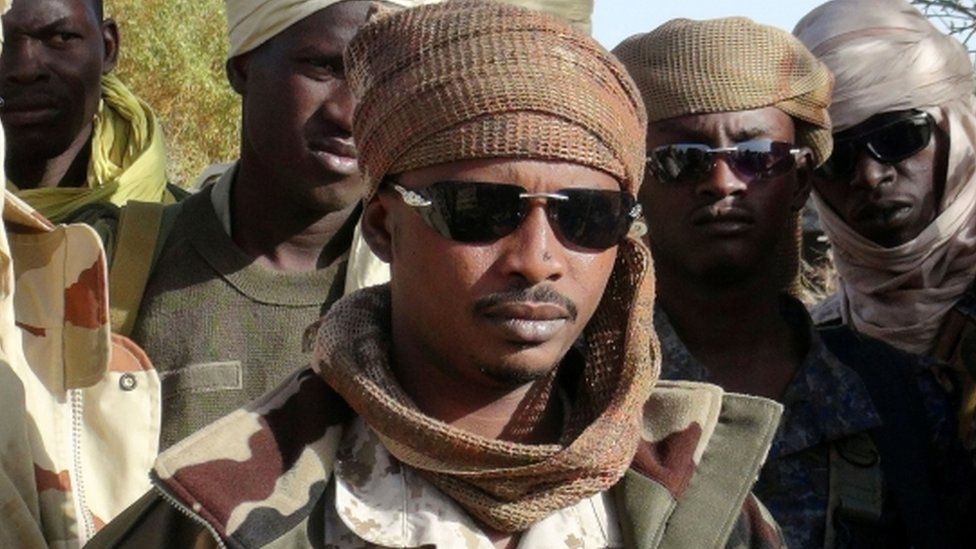
    Chad has adopted resolutions that push back democratic elections by two years and allow interim leader Mahamat Idriss Deby to stay in power and be eligible to run for president in the eventual vote.

    The decisions have dismayed some opposition forces and defy repeated warnings from the African Union, the United States and other foreign powers that the junta must not monopolise power by extending the transition or fielding presidential candidates.

    The military authorities originally promised an 18-month transition to elections when Deby seized power in April 2021 after his father, President Idriss Deby, was killed on the battlefield during a conflict with insurgents.

    Under the new plan, approved on Saturday, the transition that was due to end this October has been extended by two years, meaning elections would take place around October 2024.

    It also allows Deby to remain in power until the vote, although his Transitional Military Council will dissolve and be replaced with a transitional government, appointed by Deby.

    Mali, Burkina Faso and Guinea have also seen coups since 2020, raising fears of a backslide towards military rule in a region that had made democratic progress over the past decade.

    Riven by conflict and drought, Chad is one of the poorest countries in the world and also has some of the highest levels of hunger. Around 2 million people face severe food shortages there this year, according to the World Food Programme.

    Opposition leader Brice Mbaimong Guedmabaye said the resolutions were forced through during ongoing national talks that the junta had promised would be an inclusive forum to negotiate the path back to democracy.

    “There are lobbies that are doing everything to keep the junta in power against the will of the people,” said Guedmabaye, who is president of the Movement of Chadian Patriots for the Republic party.

    The national dialogue was billed as a route to a political consensus between the authorities, the political opposition, civil society representatives, and rebel groups, but many have boycotted, including the most powerful insurgent group, the Front for Change and Concord in Chad (FACT) that threatened to march on the capital last year.

    Some participants in talks are concerned about the likely international backlash that could isolate Chad and hamper economic development of the oil-producing country, where around 42% of the population live below the poverty line, according to the World Bank.

    “We fear sanctions from the African Union and the international community, which will just worsen the suffering of the Chadian people,” said Daouda Elhadj, who is participating in the talks as head of a consumer protection organisation.


    Source: France24

  • Analysis: What is happening in Burkina Faso?

    Burkinabes woke up Friday to heavy military presence on the streets of Ouagadougou.

    Gunfire rang out early in the capital, sparking coup fears. 

    The whereabouts of the country’s leader, Col. Damiba, is still unknown but a statement from the presidency’s social media cited a “crisis within the army”.

    According to local journalist Simon Gongo, soldiers from the elite corps rebelled.

    Simon Gongo, local journalist: “Soldiers from the Cobra unit are the ones who mutinied to demand better living and working conditions. There is talk of unpaid bonuses that are being claimed. But if we look closely at the events that are unfolding, it is similar to what happened last January. First of all, a gunfire that could be heard from the barracks. This time it was the Bambassi camp, which is located in a residential area, near the presidential palace“.

    “And then there was the occupation of the strategic roads, including the axis that leads to the presidency, and then in the city centre, the headquarters of the public broadcaster and some other key sections were also cordoned off”.

    “And this morning, calm prevailed once again, but a precarious calm, since these road sections are still blocked, or controlled, by mutineers, according to our information from government sources, but also from security sources. Talks are currently underway between the officers of this unit to restore calm. But as I speak, we know nothing about what is being discussed”.

    If key roads remained unusually quiet, some citizens vented their anger on Facebook after a statement attributed to Col. Damiba urged them to remain calm. Damiba hasn’t delivered on his promise to quench the jihadist insurgency ravaging the country.

    Simon Gongo, local journalist: “So one could say that there is a bit of weariness. For sure at the level of the fighters because we are talking about special forces and these are the special forces who carry out the operations on the ground. All large-scale operations are conducted by these special forces. We can talk about discontent. Don’t forget that these demonstrations come after the attack on the Djibo convoy last Monday, when the government announced the death of eleven soldiers”.

    The president of the transitional authorities has faced mounting criticism .
    Earlier this month, he took over the position of defence minister after dismissing a brigadier general from the post. Observers claim pressure also mounted in the army because some support detained Colonel Emmanuel Zoungrana over Colonel Damiba.

    Simon Gongo, local journalist: “According to our information, Colonel Emmanuel Zoungrana is still in prison as he was incarcerated for an attempted coup in late 2021. He never got out of prison and the source is very firm. He is still in prison. And the proof is that the demonstrators who are demanding the departure of the president Damiba are also demanding the release of Lieutenant Colonel Emmanuel Zoungrana. So, as we speak, things can change. But then, we are talking about Lieutenant Colonel Emmanuel Zoungrana is still in prison”.

    Islamic extremist violence has killed thousands and displaced at least 2 million. President Roch Marc Christian Kaboré was deposed last January over his inability to stem the insurgency.

    In June, West Africa’s mediator for the country said the Burkinabe authorities only control 60 percent of the territory.

    Source: African News

  • 42 bodies found in mass grave in Libya

    Libyan authorities have discovered 42 unknown bodies in a mass grave in the northern coastal city of Sirte.

    The General Authority for Research and Identification of Missing Persons said in a statement on Sunday that it received a notification from the office of the local prosecutor on a mass grave found in Ibn Khaldoun school in the Jiza al-Bahriya area.

    It said 42 unknown bodies were exhumed over two weeks of work in the school.

    The bodies were taken to a hospital to take samples from the bones and were buried later, the statement said.

    “Samples were taken from the bones for DNA analysis, in coordination with the forensics office,” the same source said.

    The radical jihadists had fiercely defended the city for months, using urban guerrilla tactics, before being defeated by pro-government forces in late 2016.

    The bodies are believed to be belonging to people killed by the Daesh/ISIS terrorist group which seized the city for more than a year from August 2015 to December 2016.

    Discoveries of mass graves are common in war-torn Libya, especially in Tarhuna city, a former stronghold for warlord Khalifa Haftar.

    More recently, two mass graves of seven and eight bodies respectively were discovered in the courtyard of a hospital in Sirte in late August.

    According to Libyan official sources, Haftar’s forces and affiliated militias committed war crimes and acts of genocide in the period between April 2019 and June 2020.


    Source: Africa News

  • The story of the wicked Ga queen who stole her way to power but died a miserable death

    The story of this little-known Ga woman started after the death of the warrior king, King Okaikoi.

    After his death, Dode Akabi, the Princess of Obutu, immediately came into the scene, usurped power and installed her authority over the people of Akra (now Accra), beginning a tenure of ruthless rule by the woman described as “an intelligent and masculine woman.”

    Captured in a book titled, ‘History of the Gold Coast and Asante, Third Edition’ and authored by Carl C. Reindorf, the story of this queen is told.

    According to the narration, immediately Dode Akabi rose to the throne, albeit illegally, she exerted her authority over the people, initiating some of the most unheard-of things among the people, such as face-cut marks.

    “After the death of King Okai, Dode Akabi, an intelligent and masculine woman and Princess of Obutu, took possession of the king’s property, usurped the government, knowing that after her death, the young Prince Okaikoi might aspire to the throne. Dode Akabi ruled both the Akras and Obutus with a rod of iron. She invented the Akra face-cut marks, although some people are of opinion that the first Akra immigrants had such marks on their faces,” portions of the book stated.

    Dode Akabi was also very daring in her commands to her people. Further accounts of her story showed that she once asked for a live tiger or lion to be caught for her – a situation that let to the death of many.

    She also commanded that all old men be killed until the last one standing made her take a more forthright decision.

    “She also commanded the men not to use the abusive expression ‘bulu’ or brute to a wife, on pain of death. Her other injunctions were very foolish and cruel, such as to capture a live tiger or lion for her. Many lives were lost in efforts made to carry out her orders.

    “In giving the order to build her palace, she stipulated that it should not be thatched with grass but with clay. She also commanded the young men in her dominions to do away with all the old and elderly men. This wicked order was executed except in one family where the father’s life was spared.

    “When Dode Akabi was urging her people to build the palace and to use swish strings in thatching it, no one knew how to carry out the order. The old man whose life had been saved advised his sons to ask for a sample of the old swish strings used when the palace of her predecessor was thatched so as to imitate it. When this request was made, she knew at once that one of the old men was alive, and ordered the people to tell her the truth. When she was told, she ordered the old man to be brought to her; and he made such a clear demonstration to her that she abandoned her idea of roofing a grass house without the natural materials. This was the origin of constituting seven elders as councillors to advise kings and chiefs in every town,” it added.

    And like all tales, there was sure to be an end to the brutality of this queen but she never quite saw it coming.

    After one of her usual unbelievably difficult orders, the young men who took out the order saw a small window of opportunity to permanently bring an end to her suppression.

    Knowing too well that she insanely abhorred disobedience, the young men hatched the perfect lie and got her to descend into a well she had asked to be dug for her, and when she had, they put to an end to her.

    “Dode Akabi’s death is said to have happened through an order she gave to sink a well in the hill known as Akabikenke (Akabi’s hill). The people had no proper tools and were compelled to sink a well some hundred feet deep. Their rigid taskmasters were very hard upon them, in fact, like the European taskmasters; and at last, the poor, oppressed and afflicted people conspired the life of the Queen.

    “In order to carry out their plot, it was announced that water was discovered, but a man was at the bottom of the well who forbade them to dig any further. The angry Queen with her women retinue rushed to the spot, arrogantly demanding who the man was who dared to impede her work.

    “‘He is at the bottom of the well,’ was the reply. In a great rage she ordered them to lower her down to see the man who ventured to oppose her will. She was lowered accordingly, and when she had reached the bottom, the people shouted: ‘In future that is your abode!’ In a moment a multitude of stones, sticks and rubbish was thrown into the well to fill it up. All the workmen engaged, as well as those from the town, carried stones and earth and threw them in; and those coming late threw stones in heaps all around the well being quite full.

    “Thus ended the cruel and wicked reign of Dode Akabi, which is still remembered by two proverbs: ‘Twine should be twisted according to the ancient samples’; and ‘Never cut your hair like that of Tete when your head is not the same shape.’ This referred to the queen who was not of the royal blood of Akra and should not have assumed the supreme power,” it added.

    Read even more details in the attached snippets from the book:

    EA/WA

  • South Africa: Preliminary investigation shows penguins killed by bee swarm

    Following the sudden death of 63 African penguins inside the Boulders beach colony near Simonstown, South Africa, veterinarians have discovered the cause to be a freak bee attack.

    The deaths occurred suddenly sometime between Thursday afternoon and Friday morning.

    Officials, expert advisors, and veterinarians from South African National Parks (SANParks), the City of Cape Town, and penguin experts from the Southern African Foundation for the Conservation of Coastal Birds (SANCCOB), started investigating the possible cause of death.

    The dead birds were transported to SANCCOB for post-mortems, and biological samples were sent for disease and toxicology testing.

    No external physical injuries were observed on any of the birds.

    The post-mortems revealed that all the penguins had multiple bee stings, and many dead bees were found at the site where the birds had died.

    Preliminary investigations suggest that the penguins died because of being stung by a swarm of Cape honey bees.

    On Monday, SANCCOB research manager Katta Ludyia said that the attack was in all likliness a “complete freak accident.”

    “We suspect that it is just basically bad luck for the penguins. We don’t expect this to happen more often or that the bees start being a threat to the penguins,” she added.

    A dead penguin was also found on Fish Hoek beach yesterday which the SANCCOB vet has confirmed also had multiple bee stings.

    However, samples are still being tested for other toxicity possibilities and diseases are still being tested to rule out any other potential cause.


    Source: Africa News

  • South Africa: Avian disease detected at Cape Town penguin colony

    African penguins gather to keep warm as others are fed sardines by staff at the South African Foundation for the Conservation of Coastal Birds, Cape Town, Sept 20, 2012.

    Penguin colonies in South Africa are being closely monitored. The H5N1 highly pathogenic avian influenza was detected at the Boulders Penguin Colony Cape Town and South African officials have now raised concerns about the spread of the disease.

    The black and white birds are one of the attractions in Western Cape, South Africa’s most developed tourism region. Veterinarians at the Southern African Foundation for the Conservation of Coastal Birds are on the alert.

    “At the moment we are talking about the Avian influenza which is a disease that affects a lot of birds but we have an outbreak of a more dangerous variant of the disease and that is the H5N1 high pathogenicity strain”, clinical veterinarian David Roberts says.

    “It has been affecting sea birds in South Africa and other countries all over the world for the last year and we have had thousands of birds die. The penguins are not that badly affected but we have had a recent outbreak at the Boulders penguin colony and a few penguins have died there and that’s what we are concerned about”, he adds.

    Environmental authorities said on September 16 that the H5N1 strain was similar to that detected last year among wild seabirds. If the outbreak is smaller, the protocol remains the same: identify, isolate and perfom tests on birds.

    “For the last year we have lost over 20,000 birds, but just recently at the Boulders (Beach) National Park we have only lost 28 penguins”, Roberts details.

    “It is a small outbreak in a community of about 3,000 penguins that live at this colony. Its not terrible there but we are monitoring the situation in case it gets worse.”

    Once sick birds are identified, they are euthanised and cremated in an attempt to reduce the spread of the disease.  Another concern is if the influenza spreads to commercial poultry.

    Europe is facing the largest bird flu outbreak ever. In the Netherlands for example, more than 3,5 million chickens, ducks and other birds had to be culled. A lot of work is being done on a vaccine against the current, highly contagious, variant.


    Source: African News

  • King Charles III to host South African leader in state visit

    King Charles III will welcome South African President Cyril Ramaphosa to the U.K. for three days of high-level talks next month.

    This is to celebrate the first state visit of his reign with the leader of a Commonwealth member with close ties to the royal family.

    Ramaphosa has accepted Charles’s invitation for a state visit from Nov. 22-24, Buckingham Palace said Monday. The South African leader will be accompanied by his wife, Dr. Tshepo Motsepe.

    Charles has visited South Africa on several occasions since 1997. At Nelson Mandela’s funeral in 2013, he said the world would be a “poorer place” without the man who led South Africa’s transition from apartheid to multi-ethnic democracy, adding that Mandela was owed “an enormous debt of gratitude” for his achievements.

    The King and Camilla, the queen consort then the Prince of Wales and the Duchess of Cornwall welcomed former South African President Jacob Zuma to the U.K. at the start of a state visit in 2010.

    Charles’ sons, Princes William and Harry, have also visited South Africa a number of times.


    Source: Africanews

  • Ethiopian Yehualaw is the youngest winner of the London Marathon

    Ethiopian Yalemzerf Yehualaw became the youngest winner of the London Marathon on Sunday recording the third fastest time in the women’s competition’s history.

    The 23-year old beat last year’s winner, Kenyan Joyciline Jepkosgei and fellow Ethiopian Alemu Megertu, second and third, respectively.

    “I’m so happy to win the London Marathon. This is the first time I come. The London people are very shouting, that’s inspiring me. Thank you London Marathon and London people. I’m so happy to win the London Marathon”, said London Marathon champion, Yelamzerf Yehualaw, after the race. 

    The Ethiopian runner appeared to trip on a speed bump with 10 km remaining, banging her head and hurting her hip and knee.

    But she somehow recovered to re-join the leading pack and crossing the line in 2:17.25, the third fastest time at the event.


    Source: Africa news

  • Are military takeovers on the rise in Africa?

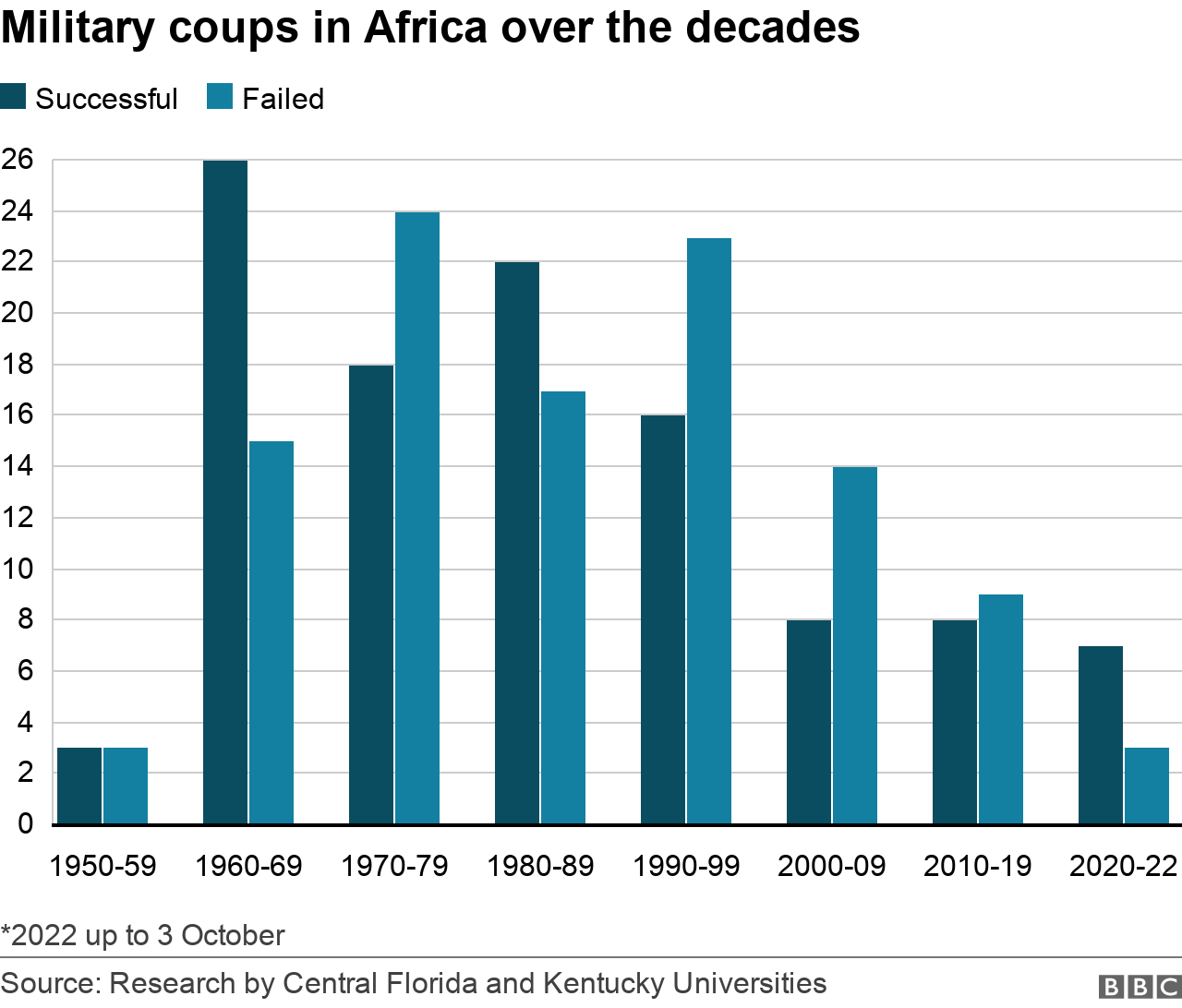
    Military coups were a regular occurrence in Africa in the decades after independence and there is concern they are starting to become more frequent.

    This year has seen two takeovers in Burkina Faso as well as a failed coup attempt in Guinea Bissau. In 2021, Africa witnessed a higher number of coups compared with previous years.

    A senior African Union official, Moussa Faki Mahamat, has expressed concern about “the resurgence of unconstitutional changes of government”.

    When is a coup a coup?

    One definition used is that of an illegal and overt attempt by the military – or other civilian officials – to unseat sitting leaders.

    A study by two US researchers, Jonathan Powell and Clayton Thyne, has identified over 200 such attempts in Africa since the 1950s. About half of these have been successful – defined as lasting more than seven days.

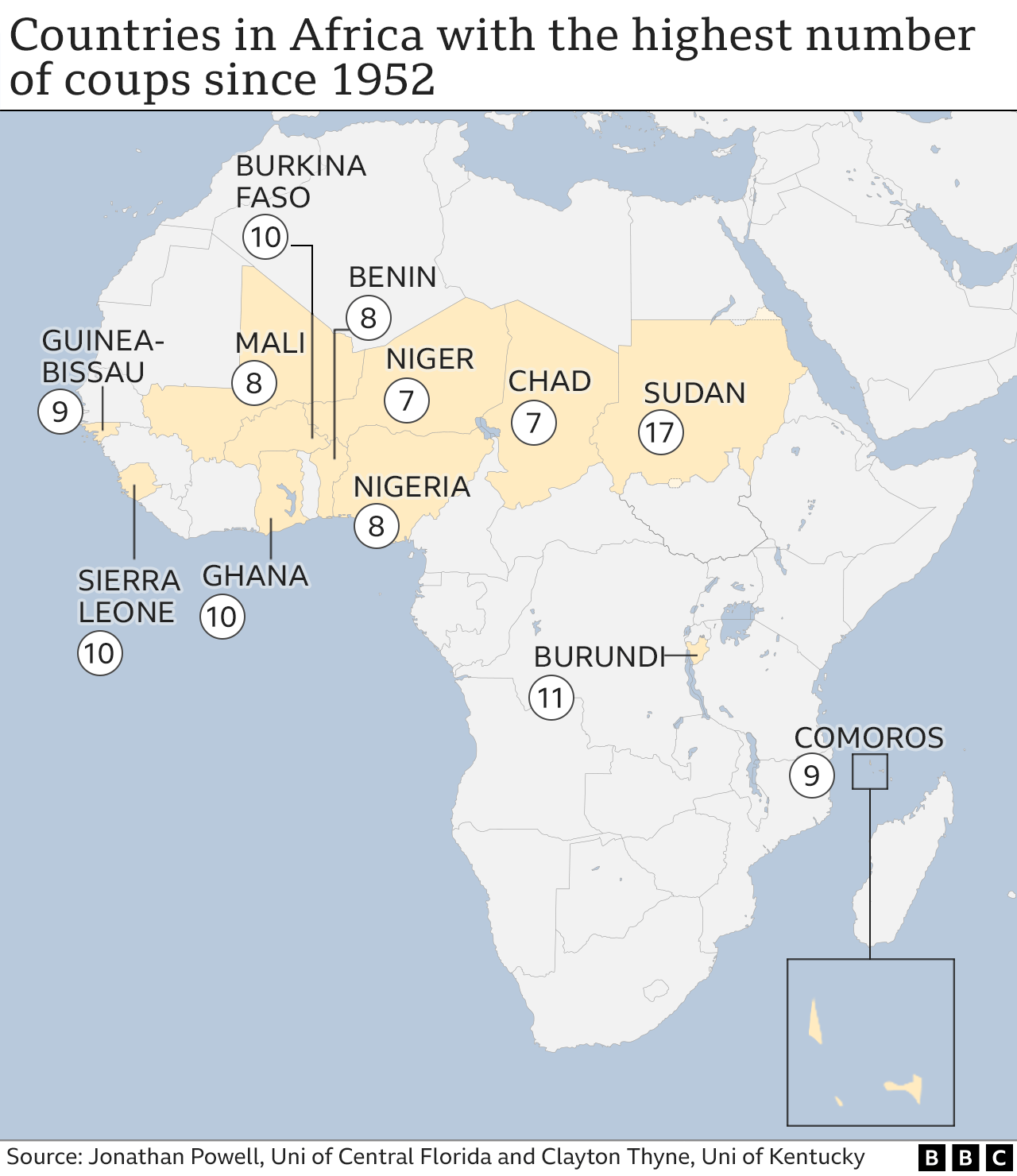
    Burkina Faso, in West Africa, has had the most successful coups, with nine takeovers and only one failed coup.

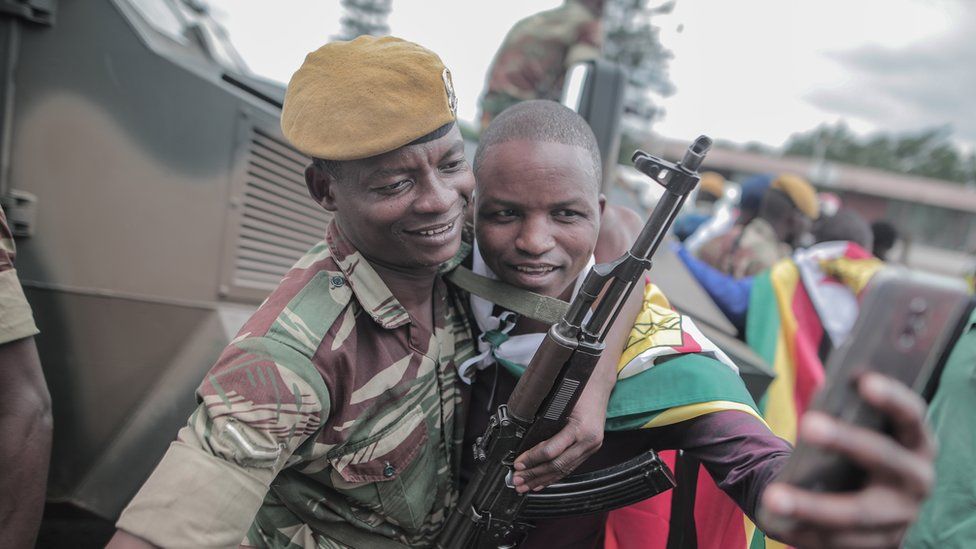
    Zimbabwean soldierImage source, Getty Images
    Image caption, There were celebrations after the Zimbabwe army intervened against President Mugabe in 2017

    Sometimes, those taking part in such an intervention deny it’s a coup.

    In 2017 in Zimbabwe, a military takeover brought Robert Mugabe’s 37-year rule to and end. One of the leaders, Maj Gen Sibusiso Moyo, appeared on television at the time, flatly denying a military takeover.

    In April last year after the death of the Chadian leader, Idriss Déby, the army installed his son as interim president leading a transitional military council. His opponents called it a “dynastic coup”.

    “Coup leaders almost invariably deny their action was a coup in an effort to appear legitimate,” says Jonathan Powell.

    How often are there coups in Africa?


    The overall number of coup attempts in Africa remained remarkably consistent at an average of around four a year in the four decades between 1960 and 2000.

    Jonathan Powell says this is not surprising given the instability African countries experienced in the years after independence.

    Bar chart of Africa coups

    “African countries have had conditions common for coups, like poverty and poor economic performance. When a country has one coup, that’s often a harbinger of more coups.”

    Coups dropped to around two a year in the two decades up to 2019.

    We are only three years into the current decade and while in 2020 only one coup was reported (in Mali), in 2021 there was a noticeably higher than average number – six coups or attempted coups were recorded.

    There were successful coups in Chad, Mali, Guinea and Sudan and failed military takeovers in Niger and Sudan all in that year.

    In September 2021, the UN Secretary-General António Guterres voiced concern that “military coups are back,” and blamed a lack of unity amongst the international community in response to military interventions.

    “Geo-political divisions are undermining international co-operation and… a sense of impunity is taking hold,” he said.

    Judd Devermont from the US-based Center for Strategic and International Studies, believes a “lenient” approach by regional and international bodies “has enabled coup leaders to make minimal concessions while preparing for longer stays in power”.

    Mahamat Idriss Déby ItnoImage source, Reuters
    Image caption, Mahamat Idriss Déby Itno succeeded his father as Chadian leader in April 2021

    Ndubuisi Christian Ani from the University of KwaZulu-Natal says popular uprisings against long-serving dictators have provided an opportunity for the return of coups in Africa.

    “While popular uprisings are legitimate and people-led, success is often determined by the decision taken by the military,” he says.

    Which countries have had the most coups?


    Sudan has had the most coups and attempted takeovers amounting to 17 – six of them successful.

    In 2019, long-serving leader Omar al-Bashir was removed from power following months of protests. Bashir had himself taken over in a military coup in 1989.

    Nigeria had a reputation for military coups in the years following independence with eight between January 1966 and the takeover by Gen Sani Abacha in 1993.

    Map showing African countries with most coups

    However, since 1999 transfers of power in Africa’s most populous nation have been by democratic election.

    Burundi’s history has been marked by eleven separate coups, mostly driven by the tensions between the Hutu and Tutsi communities.

    Sierra Leone experienced three coups between 1967 and 1968, and another one in 1971. Between 1992 and 1997, it experienced five further coup attempts.

    Ghana has also had its share of military coups, with eight in two decades. The first was in 1966, when Kwame Nkrumah was removed from power, and in the following year there was an unsuccessful attempt by junior army officers.

    Overall, Africa has experienced more coups than any other continent. Of the 14 coups recorded globally since 2017, all but one – Myanmar in 2021 – have been in Africa.


    Source: BBC

  • DR Congo climate meeting to make demands on richer nations

    Environment ministers from dozens of countries are due to gather in the Democratic Republic of Congo for talks on tackling climate change.

    The three-day meeting in Kinshasa is part of preparations for a summit in Egypt – Cop 27 – next month.

    The Kinshasa talks are expected to focus on calls for richer governments to do more to help less developed countries combat global warming.

    The Congolese hosts are likely to appeal for funding to help protect their country’s rainforest, which is the second biggest in the world.

    Source: BBC

  • The story of ‘the three wise men’ of Lagos

    Ideally, a plate reading the words ‘welcome to LA’ or whichever place one is driving to is the unofficial welcome address from any city, but in Africa, culture does this welcome differently.

    In West Africa’s Nigeria are three wise men, often referred to as Agba Meta or Aro Meta. They are a statue of three white-cap leaders of Lagos situated in Lagos. The idea to bring to life a visual image of these ancestors was expertly conceived and built by the renowned Bodun Shodeinde, who holds the highest honor in the Eko greeting tradition. The statue is over 12 feet high and was constructed in 1991.

    According to legend, it was built and put on a tall pedestal to greet visitors to the city of Lagos. Three white cap chiefs, clad in white wraps knotted across their shoulders and with clenched right fists are shown in the welcome to Lagos artwork, representing the strong conviction in the superiority of the right hand over the left. This is not a coincidence since the left hand, which is frequently used for unpleasant duties and jobs, is despised in Yoruba culture while the right hand stands for acceptance and respect.

    The person on the right extends his fist forward into the air, the middle figure holds his right fist forward with a tiny downward angle, and the figure on the left pulls his two fists together, touching softly in the air. Through this sculpture, Shodeinde, the artist, represented the highest honor possible in the Eko greeting custom.

    The statue was initially positioned in 1991 by the regime of Colonel Raji Rasaki across from the Ojodu Berger bus stop at the point of entry into Lagos from the Ibadan end of the highway. Even at its inception, controversy surrounded its stance because many people were opposed to it for various factors.

    Some people observed that the white cap chiefs didn’t appear friendly, especially given that they were standing next to the words “This is Lagos, the state of aquatic splendor.” There was another myth that said the frequent accidents at the spot were caused by a mystical connection to the monument.

    Coincidentally, the constant accident cases moved to the region of their new location. Once more, the elders’ adversaries were hunting for a way to eliminate them. The opportunity actually offered itself when the sculptures were once more burned down during the fuel subsidy protests in Nigeria.

    While the mysteries surrounding the movement of the statue continued, the statues were eventually set on fire in the middle of the night by some unidentified individuals in 2004. Unfazed, the state government rebuilt the magnificent piece of art while searching for a new residence for the “elders” next to the Michael Otedola Estate.

    And to this day, irrespective of the issues surrounding its location, it serves as a welcome artifact to persons trooping into the city of life, Lagos.

    In Africa, Nigeria is not the only country with welcoming statues like the Aro meta. Close to it in Ghana, in the country’s central region sits another trio known as ‘the three legends’ and more of that is scattered all over the country and generally the continent.

    Greeting is of cultural importance in Africa and it is therefore not surprising that in Nigeria a whole statue was erected to greet indigenes and tourists who commute in the city of Lagos.


    Source: face2faceafrica

  • Why the popular Chitenge African cloth has multiple names

    The chitenge or kitenge, the popular traditional cloth in the Eastern and Southern parts of Africa, is noted for its varied uses in each geographic location and different names depending on which tribe one comes from.

    Its largest patrons are women who either use chitenge as a scarf to cover their hair or a covering around the waist or chest. As much as the chitenge enjoys patronage by both men and women in some parts of Africa, it is forbidden for men to wear the traditional cloth in Malawi.

    The chitenge is popular among many traditional homes because of the variety of designs and colors it offers to its clientele at a cheaper cost compared to other fabrics.

    Related stories

    There is no chitenge without a meaning. At political rallies, it is relevant for the meanings it conveys. During naming and burial, they carry happy and sorrowful meanings in the inscriptions embossed on them.

    In modern times, the chitenge has witnessed some adaptations among millennials who put fanciful styles on skirts and shirts sewn out of the traditional cloth, as reported by Wilderness Safaris.

    It is one cloth that is versatile, whether one is attending an elite ceremony or seeking to make a personal statement politically or symbolically.

    In the rural settings of the Southern part of Africa, chitenge is the vehicle that takes the everyday person to funerals, religious events and naming ceremonies. It is considered decent and serves every purpose if one understands the language of chitenge.

    One of the languages the chitenge possesses is the comfort it provides babies when it is used to carry babies either at the back or front of a mother. In many traditional settings, the chitenge is the baby court a child is placed in. In traditional settings, the chitenge is designed colorfully and used as a table cloth to decorate sofas and tables in the dining halls.

    In some African countries, the chitenge is used as bath robes by women, by stretch, it’s modified and used as curtains to cover door openings. For average income earners, the traditional cloth provides the comfort and covering of body parts, their hair when doing house chores and cloth for menial work at the workplace.

    Artist Yinka Shonibare observed that even though the traditional cloth originated from Indonesia, it has been co-opted in many parts of Africa because of its cost.

    Either way, its acceptance is widely spread across rural settings in Africa. That’s why it is known by several names in many African countries. In Congo, it is known as Kitenge. In Zambia, it is called Sarong. It is also known as Kanga, nguvu and vemba in other cultures.

    Source: face2faceafrica

  • He quit his economist job to farm in Ghana, now he supplies KFC, exports to Europe

    Felix Kamassah is a Ghanaian farmer and owns the agribusiness company Maphlix Trust which supplies vegetables to brands like KFC and Shoprite and to markets like UK and Dubai.Farming has always been part of Kamassah but he did it on the side while working as an economist in the banking sector in Ghana.

    Kamassah picked up the culture of farming from his aunt who doubled as a nurse and a farmer and imbibed in Kamassah the need to take farming as a lifestyle, according to Howwemadeitinafrica.

    With his wife as a business partner, they first planted cassava and maize and in no time, expanded to include other crops driven by local demands.

    Seeing the early prospect of farming, he quit his regular job in 2013 and established Maphlix Trust.


    Source: Face2faceafrica

  • You probably didn’t know that the world’s youngest grandmother is Nigerian, and she was only 17

    Mum-Zi was just eight years and four months old when she gave birth to a baby girl in 1884.

    From Nigeria, on an island called Akwa Akpa, now known as the city of Calabar, Mum-Zi’s daughter followed her mother’s footsteps, becoming a mother at the age of eight years and eight months.

    Over the years, it has not been uncommon to find young parents out there but what is perhaps unusual is to find young teens – as young as 17 – as grandparents.

    In recent times, most people at that age are looking to complete their education or to graduate from high school. The thought of even becoming a parent is rare, thus, having grandchildren is often out of place.

    But this was not the situation for Mum-Zi and her daughter, as well as, other young girls in the 19th Century.

    According to Lyall Archibald’s 1936 book, The Future of Taboo in These Islands, Mum-Zi was a member of Chief Akkiri’s harem in Akwa Akpa (now Calabar), who would later be the father of her daughter.

    Since the 16th Century, Calabar had been a busy international seaport, shipping out goods such as palm oil.

    Historical accounts state that during the Atlantic slave trade, it became a major port in the transportation of African slaves, with most slave ships being owned by Bristol and Liverpool.

    Some missionaries would later record the challenges of poor water supplies, malaria, and the presence of some tribes who were sometimes not too welcoming to evangelists and other slave traders.

    What was common, however, was the fact that chiefs kept a harem of wives and slaves.

    The harem is basically a female backyard or household largely reserved for princes and lords of this world.

    This private space has traditionally served the purposes of maintaining the modesty, privilege, and protection of women.

    In most parts of Africa and elsewhere, a harem, in terms of royal harems of the past, may house a man’s wives and concubines, as well as, their children, unmarried daughters, female domestic workers, and other unmarried female relatives.

    Mum-Zi was one of the many women and girls who lived in a harem belonging to Chief Akkiri. After giving birth at 8 years and four months, with the chief being the father, her daughter would also become a mother exactly eight years later. She was reportedly impregnated by the same chief who happens to be her father.

    She gave birth at an age slightly older than that of her mother’s, as she was 8 years plus 8 months. Nevertheless, this remains one of the shocking moments in history.

    Ever since the 1700s, a number of cases have been highlighted to show how girls and women across the world suffer just because of their gender.

    Among these forms of gender-based violence is child marriage, which denies children the right to be children and take away from them the opportunities for education and a better life. It also exposes them to risk of violence at the hands of their usually older and powerful husbands.

    A recent report by Girls Not Brides revealed that globally, more than 700 million women alive today were married as children and 17 per cent of them, or 125 million, live in Africa.

    It added that about 39 per cent of girls in sub-Saharan Africa are married before the age of 18 and all African countries face the challenge of child marriage.

    According to the report, Niger has the highest number of child brides, with three out of four girls married before they are 18.

    The Central African Republic follows. There, the legal minimum age for marriage is 18, however, girls can get married at 13 years if it is approved by a court and/or if the girl is pregnant.

    In some cases, earlier marriage is allowed if a parent consents to it. At third place is Chad, which has a rate of 67 per cent.

    Some of the drivers for child marriage in these countries are poverty, upholding social and religious traditions, as well as, conflict, which forces many parents to consent to child marriage as a way of protecting their girls from violence and sexual assault.


    Source: face2faceafrica.com

  • Big Brother Naija Level Up edition: Phyna emerges winner

    Phyna has been announced the winner of this year’s Big Brother Naija (BBNAIJA2022).

    This comes after three months of being housed together with other housemates for a period of three months.

    This year’s edition was dubbed the “Level Up Edition”.

    Phyna goes home with prizes worth N100,000 and will be celebrated in Nigeria for the feat achieved.

    After she was announced the winner of the competition, Phyna in a tweet congratulated her fans for ensuring that she was crowned winner of the competition.

    “Phynation una dey here? your queen is grateful.”

    How Many Housemates are in BBNAIJA

    Fourteen Housemates were contesting for the crown. These housemates were made to live their lives albeit restricted and at the end of the day, one person emerged as the winner of the competition.

    The Six Who Made It to the final

    After three months of being in the Big Brother House, Adekunle, Chichi, Bryan, Phyna, Daniella and Bella were the individuals who made it to the final of the programme.


    Source : Mynewsgh

  • Nigerian anti-narcotics agency, NDLEA discovers 13 million Tramadol pills in Lagos mansion

    The National Drug Law Enforcement Agency raided a home in Lekki, a posh neighbourhood in Lagos, Nigeria,where Tramadol was kept.

    In a statement on Monday, the agency’s spokesman, Femi Babafemi said the home belonged to a drug lord, who has now been arrested and detained.

    According to Babafemi, the agency found 13 million Tramadol pills (225mg) worth millions of naira in the house.

    “Another VGC drug bust! As massive and beautiful as this mansion located in highbrow VGC Lekki Lagos (pictured here) looks, it’s not occupied by humans but used to warehouse over 13 million pills of Tramadol 225mg by another billionaire drug baron now in custody of @ndlea_nigeria. Details coming in a statement shortly,” he said.

    This comes barely two weeks after the agency in collaboration with the United States Drug Enforcement Administration made a record singular cocaine seizure in the country.

    SaharaReporters gathered that operatives of NDLEA and the US DEA busted a major warehouse in a secluded estate in the Ikorodu area of Lagos State, Nigeria, where not less than 1.8 tons (1,855 kilogrammes) of the illicit drug worth N194 billion were packed.

    At least five alleged drug barons including a Jamaican and the warehouse manager were arrested in the operation that lasted two days.

    The arrested suspects during the operation were Soji Jibril, 69, from Ibadan, Oyo State; Emmanuel Chukwu, 65, from Ekwulobia in Anambra State; Wasiu Akinade, 53, from Ibadan, Oyo state; Sunday Oguntelure, 53, from Okitipupa in Ondo State and Kelvin Smith, 42, from Kingston, Jamaica.

    The suspects are said to be members of an international drug syndicate that the agency had been trailing since 2018.


  • Trevor Noah quits ‘The Daily Show,’ says he wants to do more standup

    Trevor Noah is leaving The Daily Show after hosting it for seven years, indicating he wants to dedicate more time to standup comedy.

    The 38-year-old comedian, who moved to the United States in 2011 and was born in Johannesburg, South Africa, had big shoes to fill when he took over in 2015 after the exit of longtime host Jon Stewart.

    He quickly established himself with his own brand, suited for an era where online influence was often greater than that of content on cable television.

    His reign on The Daily Show on Comedy Central required him to delicately cover some crucial moments in American history, such as the Covid-19 pandemic, the Black Lives Matter movement and the 2021 attacks on the US Capitol.

    “I spent two years in my apartment [during Covid], not on the road,” Noah told his studio audience late on Thursday. “Standup was done, and when I got back out there again, I realised that there’s another part of my life that I want to carry on exploring.”

    The Daily Show posted a clip of Noah’s remarks on social media.

    “We have laughed together, we have cried together. But after seven years, I feel like it’s time,” he said.

    Noah ended his remarks by thanking his viewers as his studio audience stood up to applaud him.

    Noah, who roasted US politicians and the media at the White House Correspondents Association dinner in April, did not mention his exact departure date in his remarks on Thursday. It was not known who would succeed him.

    The key to addressing current affairs through a comedic lens lies in a comedian’s intention, Noah said in a 2016 interview, adding that he learned from his mistakes.

    He said of succeeding his legendary predecessor: “I don’t think I would ever have been ready, but that’s when you must do it – you will not be ready.”


    Source; The Guardian


  • Ibrahim Traore: Burkina Faso’s new leader is Africa’s youngest at age 34

    New military ruler of Burkina Faso, Captain Ibrahim Traore, appeared on TV after driving through parts of the capital Ouagadougou with heavily armed guards on Sunday, October 2.

    Traore, who is now leader of Patriotic Movement for Safeguard and Restoration, or MPSR, the group that led the first coup in January was silent about the whereabouts of deposed leader, Lt. Col. Paul-Henri Sandaogo Damiba.

    In the address read by a spokesman whiles he stood to the left, Traore assured the population that the situation in the country was under control, he also asked people to go about their daily activities and stay off looting and vandalism.

    He mentioned specifically that attacks on French government installations needed to be stopped.

    His comments come on the back of violent attacks against the French Embassy in Ouagadougou which photos and videos had gone viral on October 1.

    Reports indicate the French businesses have also not been spared as well as a French Institute in Bobo-Dioulasso and also the French military base – the base, it was alleged, by an army spokesperson was accommodating the ousted leader.

    The French Foreign Affairs Ministry, however, issued a firm condemnation of the violent acts and dismissed the allegation of sheltering the ousted leader at their base neither at any facility.

    ECOWAS and the African Union, AU, have sternly rejected the unconstitutional power grab and called for a return to the roadmap towards a civilian transition by 2024.

    The underlying reasons for the takeover of September 30 was the increasing deterioration of security across the country.

    The same reason was advanced by Damiba in January when he deposed democratically-elected Christian Roch Marc Kabore before the birth of the MPSR.

    Damiba according to the Associated Press gave seven conditions before accepting to resign but has flown to Togo as of October 2.

    Source: Ghanaweb

  • MultiChoice teams up with BetKing to launch SuperPicks for new football season

    Unilever’s Lifebuoy, the world’s number one hygiene soap brand, has launched a creative competition that will see two (2) Chief Education Officers aged between 6-12years appointed to raise awareness on the importance of handwashing among school children.Leveraging the power of peer-to-peer learning, the ‘CEOs’ will be selected from public and private schools in Ghana to help create impact by teaching other children about handwashing and personal hygiene in a series of fun and exciting activities.The campaign dubbed ‘Lifebuoy H for handwashing CEOs’ is part of Lifebuoy’s activities to mark Global Handwashing Day which occurs every year on the 15th of October.

    Global handwashing day is an international handwashing campaign dedicated to motivating and mobilizing people worldwide to improve their handwashing habits as a strategy for disease prevention.

    In 2020, Lifebuoy launched the H for Handwashing campaign to transform the letter H into a symbol for handwashing and to integrate hygiene awareness into the school curriculum. In 2021, Lifebuoy launched its first ever children’s book- an “H for Handwashing” alphabet book – in which children can explore the Alphabet with Azzy the horse. The book is intended to support school curricula all over the world, whenever and wherever children are taught the ABCs.

    This year, Lifebuoy is going a step further by passing on the baton to the next generation who will teach their peers about handwashing, as studies have shown that children are more likely to change their behaviour when influenced by their peers.

    Lifebuoy is encouraging Children from public and private schools in Ghana between the ages of 6-12years to take up this unique and exciting challenge.

    Parents, Guardians and Teachers are also urged to encourage their children and pupils to participate in the competition by following these guidelines:

    • Share a 30- 45 seconds video of your child reciting their campaign manifesto by explaining what hygiene means to them and how they will promote better hygiene in their schools.
    • All entries must include the #GHD2022 #LifebuoyCEOgh #LifebuoyGHD22 #HforHandwashing hashtag and be submitted on Facebook and Instagram only via the brand’s pages @LifebuoyGhana.
    • Entries are open until the 10th of October, 2022.

    The two selected CEOs will get the chance to become part of Lifebuoy’s award-winning ‘H for Handwashing’ movement and receive a certificate from the Unilever Ghana Leadership Team for their participation and commitment to the cause.  As part of celebrations to mark Global Handwashing Day, they will also visit the Unilever headquarters and factories to teach employees the importance of handwashing

    The ‘CEOs’ will commit a minimum of ten hours a year to help spread the message of handwashing with soap to other children, at home and in schools. To enable them perform their roles, they will be trained in the use of Lifebuoy’s decade-old and well-proven  behaviour change material which will equip them to take the message forward.

    Source; Ameyaw Debrah

  • Warrap state health officials record over 600 snakebites with fatalities

    Health authorities in South Sudan’s Warrap state on Tuesday announced that they had recorded more than 600 snakebite cases and three fatalities in Tonj North and Gogrial East counties.

    Deng Awan Deng, the acting director general for health said the statistics are from January to September 2022.

    “The cases of snakebite in all the counties of Warrap state are 621 including three death cases. Twic county has 284 cases and zero death, Gogrial West county has 106 and zero deaths, Gogrial East county has recorded 26 cases of snakebites and one death, Tonj East with 62 cases, Tonj South has 52 cases and lastly Tonj North has recorded 86 cases including two deaths,” he stated.

    The health official says the state has no antivenoms to avoid fatalities despite the high risks of snakebites. He says the number of fatalities could be higher in areas not accessible due to floods.

    “Some death cases might be reported by local authorities and some did not reach to our health facility, the number of death cases might be high,” he said.

    Awan called on the national health ministry and partners to avail antivenom drugs and other medicines for the flood-stricken population.

    Meanwhile, Malek Wol, Tonj North county surveillance officer confirmed that cases of snakebite are on the rise and also appealed for quick intervention.

    “We have so many cases of snakebites here in our county, we have reported 86 cases to headquarters, and in three months’ time that is July, August, and September, we have 23 cases including two deaths,” he said.

    He explained, “In Marial Lou hospital, we have recorded three cases of snakebites in July and nobody has died. In Alabek Payam we have recorded four cases including one death. In Pagakdit PHCU we have six cases including one death, while Pareksika and Kerik PHCUs have seven and three cases respectively.”

    Source: radiotamazuj.org

  • Finland wants to transform how we make clothes


    Petri Alava used to wear pressed suits and leather shoes to work, managing large corporations selling everything from magazines to gardening equipment.

    Now he runs a Finnish start-up where socks are the norm on the office floor, and he proudly sports a round-neck T-shirt spun from recycled clothing fibres, tucked into some baggy shorts.

    His firm, Infinited Fiber, has invested heavily in a technology which can transform textiles that would otherwise be burned or sent to landfills, into a new clothing fibre.

    Called Infinna, the fibre is already being used by global brands including Patagonia, H&M and Inditex, which owns Zara. “It’s a premium quality textile fibre, which looks and feels natural – like cotton,” says Mr Alava, rubbing his own navy blue tee between his fingers. “And it is solving a major waste problem.”

    Around the world, an estimated 92 million tonnes of textiles waste is created each year, according to non-profit Global Fashion Agenda, and this figure is set to rise to more than 134 million tonnes by 2030, if clothing production continues along its current track.

    Infinna fibre is being used by global brands including Patagonia, H&M and InditexImage source, Maddy Savage
    Image caption, Infinna fibre is derived from unwanted clothes and textiles

    To the untrained eye, samples of Infinited Fiber’s recycled fibre resemble lambswool; soft, fluffy and cream coloured. Mr Alava explains that the product is produced through a complex, multi-step process which starts with shredding old textiles and removing synthetic materials and dyes, and ends with a new fibre, regenerated from extracted cellulose.

    This finished fibre can then simply “hop into the traditional production processes” used by High Street brands, replacing cotton and synthetic fibres, to produce everything from shirts and dresses to denim jeans.

    Much of the science involved in making the fibre has been around since the 1980s, says Mr Alava, but rapid technological advancements in the last few years have finally made large-scale production a more realistic possibility.

    In parallel, he believes High Street brands have become more focused on “really honestly looking for changing their material usage”, while millennial and Gen Z consumers are increasingly concerned about shopping sustainably. “They are different animals, different consumers, to people my age,” he laughs.

    Clothes made from Infinna fibreImage source, Maddy Savage
    Image caption, Infinited Fiber says its material can replace cotton and synthetic fibres

    The company has already attracted so much interest in its technology that it recently announced it was investing €400m (£345m; $400m) to build its first commercial-scale factory at a disused paper mill in Lapland.

    The goal is to produce 30,000 tonnes of fibre a year once it’s operating at full capacity in 2025. That is equivalent to the fibre needed for approximately 100 million T-shirts.

    “I think the impact could be quite big, if you think about the whole textile system, what exists currently and how much textile waste that we have,” argues Kirsi Niinimäki, an associate professor in fashion research at Aalto University, a few blocks away from Infinited Fiber’s headquarters.

    “It’s a really good example of actually how we can ‘close the loop’… really begin to move to a circular economy.”

    Presentational grey line
    Presentational grey line

    Infinited Fiber’s growth is tied into a wider vision in Finland, which wants to become Europe’s leading circular economy, with a focus on reusing and saving resources. In 2016, it became the first government in the world to create a national road map designed to help reach its goal.

    Several other Finnish start-ups are looking at ways to produce new textile fibres on a big scale, while also cutting down on harmful emissions and chemicals. These include Spinnova which, from its textiles factory in Jyväskylä, central Finland, transforms cellulose from raw wood pulp into ready-to-spin fibres.

    It has partnered up with Suzano, one of the world’s leading pulp producers, headquartered in Brazil. And, the company says its spinning technologies can even be used to create new fibres from a range of other materials that can be turned into pulp, from wheat straw to leather offcuts.

    Janne Poranen, one of Spinnova's co-foundersImage source, Maddy Savage
    Image caption, Janne Poranen hopes Spinnova will become a household name

    “Of course, the volumes are tiny at the moment, [but] our plan together with Suzano is that in the next 10 years we are going to upscale up to one million tonnes in annual volume,” says Janne Poranen, one of Spinnova’s co-founders.

    He is less specific about how exactly that is going to happen, though, refusing to give any financial projections and admitting that the company has yet to decide which continent its first large-scale production plants outside Finland are likely to be built on.

    Still, Spinnova’s yarn is attracting plenty of global attention and has so far been used by brands including upmarket Finnish clothing label Marimekko, and outdoor wear firms North Face, Bergans and Adidas, which recently used it in a limited edition midlayer hoodie designed for hikers.

    Mr Poranen has big ambitions for Spinnova-woven products, hoping they can gain a reputation for being sustainable and long-lasting, in a similar way to how Gor-Tex became a household name for its waterproof technologies.

    Spinnova fibres are made from cellulose from raw wood pulpImage source, Spinnova
    Image caption, Spinnova fibres are made from cellulose from raw wood pulp

    Elsewhere in Europe, there are a range of other companies developing technologies to create more circular yarns, including Swedish startup Renewcell, and Bright.fiber Textiles, which plans to open its first factory in the Netherlands in 2023.

    But experts say there are a range of challenges facing these new fibre brands as they plot their expansions.

    Ms Niinimäki underlines that the clothing manufacturing sector has, until recently, been slower than many other industries when it comes to embracing sustainability, which could set the tone for a slower transformation than companies like Spinnova and Infinited Fiber hope.

    “It has been so easy to produce the way that we have been producing, and just to move towards more effective industrial manufacturing on an increasingly bigger scale,” she says.

    “There hasn’t been a big pressure to change the already existing system.” However, she is hopeful that, in the European Union at least, new rules aimed at ensuring clothing manufacturers focus on more sustainable and durable products will speed up “a change in mindsets”.

    Another issue is whether clothing brands will be able to pass on the additional costs of their new high-tech production techniques on to consumers, especially at a time when the cost of living is spiralling globally.

    Adidas' latest limited edition hoodie produced with Spinnova fabric costs €160Image source, Spinnova
    Image caption, Adidas makes a hoodie from Spinnova fabric, but it’s not cheap

    Adidas’ latest limited edition hoodie produced with Spinnova fabric costs €160 (£137; $160) to buy online in Finland, at least €40 more than most of its other technical hoodies.

    “Fashion is a complicated area, because even if people are saying that they are environmentally aware, they don’t always act rationally,” says Ms Niinimäki. “There’s also this kind of emotional side when you talk about fashion consumption, and of course, the price is also linked to that.”

    While both Infinited Fiber and Spinnova insist their business plans look holistically at all aspects of production – for example using renewable technologies to power their factories – climate campaigners argue it is still too early to accurately estimate the net effect of these new techniques on carbon emissions.

    “Pulp and other alternative fibres can provide diversity for sourcing textile materials and therefore lessen the burden caused by production of more traditional textile raw materials such as cotton,” says Mai Suominen, a leading forest expert for WWF. “However it depends on the use of energy, all the processes they use and how they use waste materials.”

    Most importantly, she argues, simply slotting more sustainable fibres into the multibillion dollar fashion industry won’t be enough to combat climate change, if we keep making and buying clothes at the current rate.

    Mai Suominen in a Finnish forestImage source, Maddy Savage
    Image caption, Mai Suominen says there needs to be clear targets for reducing resource use

    “There is no sustainable development unless the overall natural resource consumption is radically decreased to a level that fits within planetary boundaries,” she argues.

    But within the Finnish fibres industry there is a sense of boomtown optimism that the increased use of recycled or reimagined fibres could be an important part of the jigsaw in the battle to limit climate change.

    “The fast-fashion companies who have been kind of creating certain parts of the problem are highly interested in new technologies,” says Infinited Fibers chief executive Petri Alva. He believes that if investment continues, the recycled fibres could become mainstream within ten to 15 years.

    Source: BBC

    DISCLAIMER: Independentghana.com will not be liable for any inaccuracies contained in this article. The views expressed in the article are solely those of the author’s, and do not reflect those of The Independent Ghana

  • Burkina Faso gendarmerie graduation ceremony postponed – report

    A graduation ceremony of gendarmerie trainees that was to be held today has been postponed, a local news site NetAfrique reports.

    “The 48th promotion of the national school of non-commissioned officers of the gendarmerie initially scheduled to be held this Friday, 30 September 2022, has been postponed to a later date,” a statement said.

    Officials apologised for the inconvenience saying the decision was based on circumstances “beyond its control”.

    Source: BBC

  • Protests on the streets of Ouagadougou – report

    On Friday, several young people took to the streets of the Burkinabè capital, Ouagadougou, following reports of gunfire in the early hours, the privately-owned Wakat Sera website reported.

    “Youths, claiming to be members of some civil society movements, on Friday 30 September, stormed some of the streets of the capital of Burkina Faso, calling for a ‘massive mobilisation for the total liberation of the national territory’,” the report said.

    It added that the demonstrators said that a “full-blown coup d’etat” had taken place, and demanded the release of Lt-Col Emmanuel Zoungrana, who has been detained since the time of ousted President Roch Kabore’s rule.

    The BBC has not been able to independently confirm that there was a coup attempt but a government official, speaking anonymously, told us that a mutiny had taken place.

    The report also said youths on motorcycles were seen carrying Burkinabè and Russian flags.

    On Thursday, hundreds of people held a protest in the western city of Bobo Dioulasso, to demand the resignation of interim President Lt Col Paul-Henri Damiba.

    The protesters were blaming him for the chaotic management of the security situation in the country – which is facing a jihadist insurgency.

    A mutiny that took place on 23 January was linked to the detention of Lt-Col Zoungrana.

    Source: BBC

  • Zambia ex-president: I’m ready to face the law

    Former Zambia president Edgar Lungu says he is ready to face the law if he stole during his term.

    Mr Lungu is unhappy that he, as well as his former government officials and family members, have been subjects of investigation for crimes allegedly committed when he was president.

    He was particularly displeased that state investigators on Thursday went to a piece of land that he owns to carry out investigations.

    Mr Lungu has since appealed to his successor Hakainde Hichilema to start the process of removing his constitutional immunity from prosecution so that he can clear his name.

    “He who alleges, must prove and we will defend ourselves,” he later told members of parliament and supporters from his Patriotic Front party who visited him.

    “My urge is that may the president institute the lifting of my immunity by going to parliament to lay a case so that he can eventually prove what crimes I committed,” he said.

    Mr Lungu, who last year lost power to Mr Hichilema, has previously denied many allegations of corruption during his time as president.

    Source: BBC