Author: Amanda Cartey

  • Upstream petroleum industry risks losing up to $2bn investment by 2025 – ACEP

    Upstream petroleum industry risks losing up to $2bn investment by 2025 – ACEP

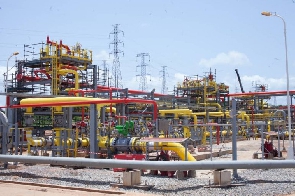
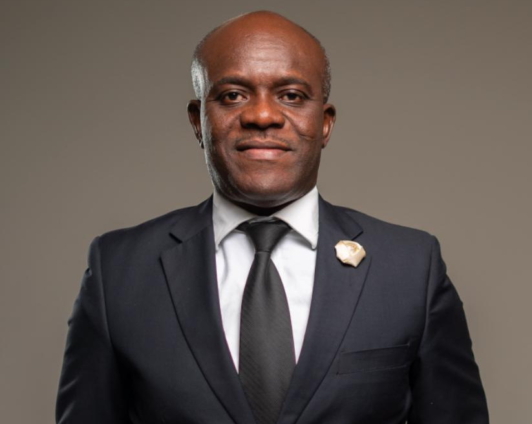
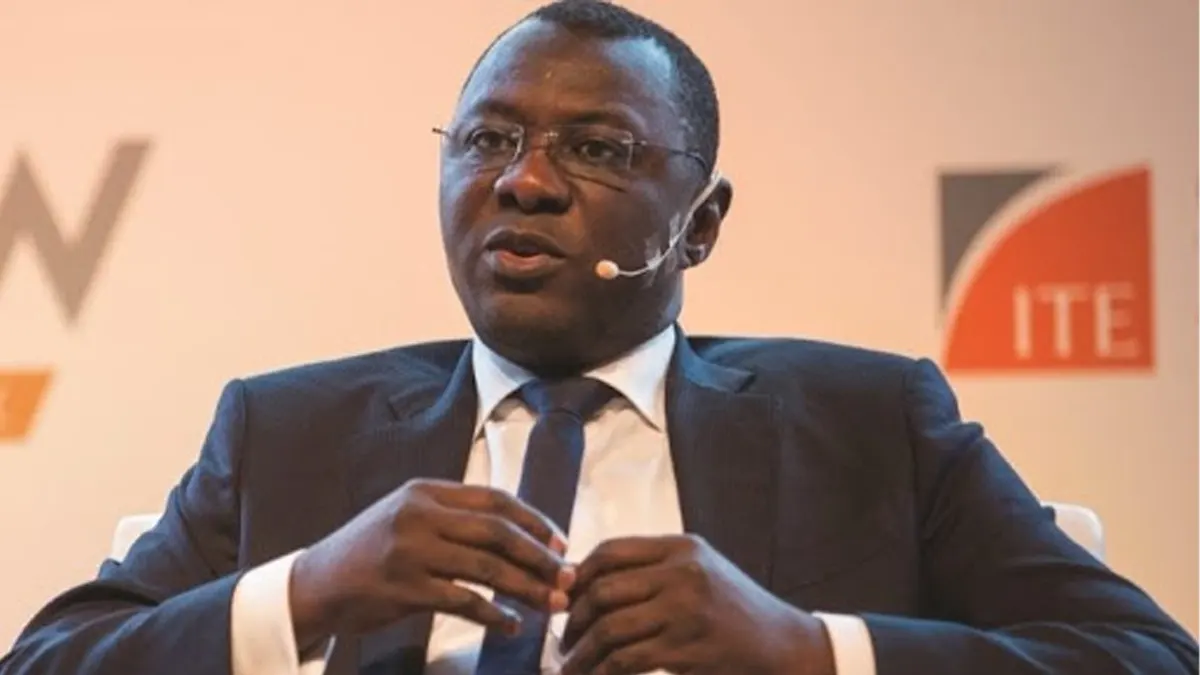
    Executive Director of the Africa Centre for Energy Policy (ACEP), , has cautioned that the domestic upstream petroleum industry could miss out on US$2 billion in investments next year if critical reforms are not implemented soon.

    He expressed concern over the decline in investor confidence in the upstream oil and gas sector, attributing it to years of political interference.

    According to him, prompt action by the next government could potentially attract at least US$2 billion in investments to the sector in 2025.

    “Without swift reforms, this sector risks losing up to US$2billion in potential investments by 2025,” Mr. Boakye said in a statement congratulating President-elect John Mahama.

    Ghana’s oil production has been on the decline, dropping from 71.44 million barrels in 2019 to 48.25 million barrels in 2023, despite a brief increase in the first half of 2024. This means the country’s oil output has fallen by an average of 9.2% every year over the last four years and is 7% lower than the 51.7 million barrels produced in 2022.

    The drop is largely due to unfavorable policies that make oil exploration less attractive to investors.

    Benjamin Boakye, the Executive Director of the Africa Centre for Energy Policy (ACEP), has highlighted several urgent problems in the energy sector that need fixing.

    First, he pointed out inefficiencies within energy institutions, which he said are overstaffed and weighed down by unnecessary political appointments. This has led to wasteful spending and slow operations.

    He also criticized the management of the Electricity Company of Ghana (ECG), saying poor leadership has left the company dependent on the government for funding. Mismanagement, such as improper procurement practices and exchange rate manipulation, has further hurt the company’s finances, affecting payments to the gas sector and discouraging investment in oil and gas production.

    In the petroleum downstream sector, Mr. Boakye revealed that inflated costs are unfairly passed on to the public. He plans to release a report soon exposing inefficiencies in organizations like the Tema Oil Refinery (TOR), the National Petroleum Authority (NPA), and the Bulk Oil Storage and Transportation Company (BOST), while calling for immediate reforms.

    Need for action

    To address the afore-mentioned challenges, Mr. Boakye urged President-elect Mahama to prioritise energy sector reforms from the onset of his administration, recommending a comprehensive audit of the sector’s debt before his swearing-in on January 7.

    He also advocated transparency, efficiency and decisive measures to stabilise the sector.

    “This situation demands a careful, surgical examination to ensure you hit the ground running on January 7,” Mr. Boakye stated.

    He assured that ACEP would help by providing policy suggestions to the government.

    The problems in the energy sector pose serious challenges for the new government. Experts believe that solving these issues could greatly improve Ghana’s economy and energy supply.

    Mr. Mahama is set to take office as Ghana’s President on January 7, 2025. Many are eager to see his plans for the country, especially in the energy sector, as his approach to fixing these problems will be a key test of his ability to rebuild trust and promote lasting economic growth.

  • Cedi gains strength as it trades at GHS15.70 to the dollar

    Cedi gains strength as it trades at GHS15.70 to the dollar

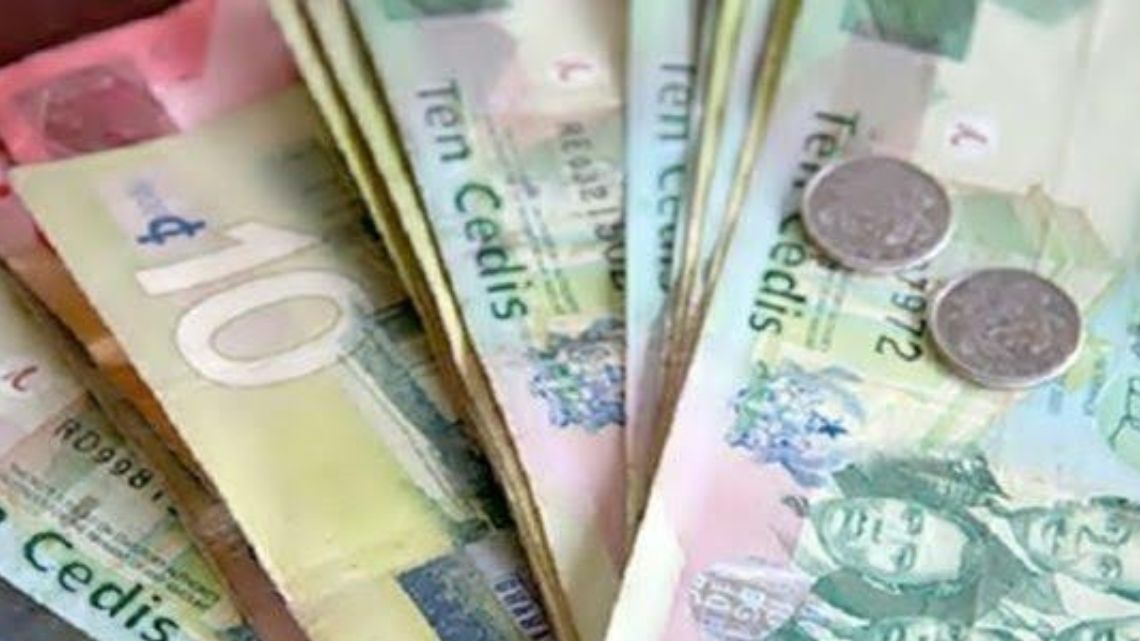
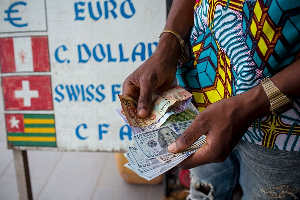
    Ghana’s currency, the cedi, is gaining strength against major foreign currencies like the dollar at some forex bureaus.

    At the end of November, the cedi was selling at GH¢16.40 at certain forex bureaus, compared to highs of GH¢17.00 in previous months.

    The Bank of Ghana credits this improvement to growth in the country’s external sector.

    In its latest update on December 16, 2024, the Central Bank stated that the cedi is being bought at GH¢14.73 and sold at GH¢14.74.

    For the British Pound, the buying rate is GH¢18.60, while the selling rate is GH¢18.62. The Euro is being bought at GH¢15.46 and sold at GH¢15.48.

    Meanwhile, checks by GhanaWeb Business on the same date at 8:30 AM revealed that at some major forex bureaus, the dollar is trading at GH¢15.70, the pound at GH¢19.80, and the Euro at GH¢17.00 in the retail market.

    Although the cedi has made some gains, its ongoing depreciation against major currencies continues to hurt Ghana’s economy.

    To stabilize the cedi, the Bank of Ghana sold over $200 million in recent interventions.

  • WAPCo restores gas supply to Tema following brief interruption

    WAPCo restores gas supply to Tema following brief interruption

    The West African Gas Pipeline Company (WAPCo) has resumed gas delivery to its Tema Regulating and Metering Station (TRMS) after a brief shutdown earlier this week.

    The shutdown was a safety measure following issues that arose during maintenance work on the pipeline between Itoki and Badagry in Nigeria.

    This disruption affected the gas supply to power plants in the Tema area, leading to power outages in parts of Ghana.

    WAPCo expressed gratitude for the understanding and patience of its partners and apologized for any inconvenience caused, assuring the public that it is committed to providing reliable gas services.

  • This term is about making lasting impacts – John Mahama on resetting Ghana

    This term is about making lasting impacts – John Mahama on resetting Ghana

    President-elect John Dramani Mahama has promised that his second term will be focused on leaving a lasting legacy rather than simply proceeding with business as usual.

    He described it as a “legacy term” dedicated to making a significant impact before retiring from politics.

    Mahama shared these thoughts during a courtesy visit from the National Chief Imam, Sheikh Osman Nuhu Sharubutu, on December 12, 2024, in Accra. He stated, “The easy part is over, which is the election. Now the difficult part begins: bringing Ghana back and restoring it to being the Black Star of Africa.”

    He emphasized his commitment, saying, “I’ll give it my best. This is a legacy term for me, and it will be about making a good name for myself before going into political retirement. You can count on me working as hard as I can to move Ghana to the place it should be.”

    Reflecting on the challenges of the election, Mahama admitted that the campaign had taken a toll on him. “After the declaration, I haven’t been feeling too well, but we had to fulfill our constitutional obligations, particularly the formation of the transitional teams,” he said.

    He also expressed his gratitude for the prayers and support from both Christian and Muslim communities, which he believes played a key role in the peaceful election. “We cannot have achieved this victory without your prayers. God has heard our supplications, and we had a peaceful and successful election,” Mahama said, adding that his administration would focus on justice and accountability, particularly for unresolved cases like those from the 2020 Ayawaso West Wuogon elections.

    On governance, Mahama assured that, despite having a strong parliamentary majority, his administration would avoid acting unilaterally. “We have a huge majority, but we’re not going to misuse it. We will consult with the minority and make decisions by consensus rather than by force,” he explained.

    Finally, Mahama urged the youth to focus on contributing to the country’s growth and to refrain from destructive actions. “Let us work together to rebuild Ghana and focus on the long-term development rather than short-term gains,” he said. “This is a legacy term, and I promise to give it my best to restore Ghana to its rightful place as the Black Star of Africa.”

  • I am still in shock! – NPP stalwart over election defeat

    I am still in shock! – NPP stalwart over election defeat

    The Greater Accra Regional Secretary of the New Patriotic Party (NPP), Daniel Parker Odarlai, has expressed his disbelief over the party’s loss in the recent elections.

    In an interview on Asempa FM on Friday, December 13, 2024, he shared that the defeat came as a complete surprise to him. Despite the party’s hard work and solid grassroots backing, he finds it difficult to understand why the results did not favor them.

    “Seriously, I have pondered over the issue. The NPP’s defeat baffles me. I still don’t understand what happened. I want to congratulate all Ghanaians for a peaceful election. In elections, you don’t always win. I know many of our supporters are grieving over the loss. Indeed, no one anticipated this because of the support of the grassroots,” he stated.

    Daniel Parker questioned why the party did not address the concerns raised by voters during the campaign.

    “I remember I told a colleague that the response we were receiving from the electorate in various communities was not encouraging. For instance, I recall when the NPP went to Abossey Okai, and the response was not encouraging at all. I also remember what Kennedy Agyapong said—that the NPP lost the election two years ago,” he noted.

    Highlighting the party’s activities in Greater Accra, he stressed the full participation of all regional executives.

    “During the election, all the regional executives in the Greater Accra Region were involved; they were on top of the work. At a point, I even told Jerry Ahmed to relax because he was overworking. But he was adamant because, according to him, the response on the ground was not encouraging. He didn’t take what he saw lightly, and no wonder he won the Weija-Gbawe seat.

    “For me, it is a big shock, which is unexplainable. The Regional Chairman could even park his car and use a motorbike during the campaign,” he remarked.

    After the party’s electoral loss, several prominent members blamed President Nana Addo Dankwa Akufo-Addo, pointing to his leadership as a contributing factor. The party’s flagbearer, Dr. Mahamudu Bawumia, garnered 41.61% of the votes, while President-elect John Dramani Mahama won with 56.55%.

  • Litigation is expensive, seek council before land purchase – Expert warns

    Litigation is expensive, seek council before land purchase – Expert warns

    Property expert and lawyer Alex K. Osei-Owusu has urged people to consult a lawyer before buying property, especially in real estate, to avoid future legal problems.

    He has worked with real estate developers, insurance companies, and banks to help Ghanaians living abroad invest in property back home.

    He explained that, “Litigation is expensive everywhere in the world. Apart from the financial cost, it also involves emotional strain and wasted time. We always go by the saying: ‘Prevent litigation rather than resolve it.’ Our advice is that, before buying any land or property anywhere in the world, you should speak to a lawyer. Real estate transactions can be complicated due to the significant amounts involved, so it’s always best to get legal advice. A lawyer can guide you, providing a checklist of what to do and avoid, which can prevent or resolve potential litigation.”

    He emphasised that failing to seek legal advice and becoming involved in litigation could prove “much more expensive.”

    Mr. Osei-Owusu emphasized the importance of ensuring all required fees and taxes are paid by everyone involved in property investments to prevent legal issues.

    “Once you comply with these requirements, you won’t need to worry about litigation. And, even if litigation does arise, you’ll be protected,” he added.

    He shared these insights at a dialogue and exhibition in Accra on Friday, December 13. The event sought to educate individuals, groups, firms from the UK, USA, and beyond, as well as local investors, about property investment opportunities.

    Sponsored by Accra-based Nilex Properties, the event was part of the “Ghana-Diaspora Home Purchase Expo 2024.” It brought together officials from the National Fire Service, Environmental Protection Agency (EPA), and tax experts to engage with key stakeholders in Ghana’s real estate and housing sectors.

    This was the inaugural Ghana-Diaspora Home Purchase Expo held in the country.

  • GCAG congratulates Mahama, calls for immediate action on illegal mining

    GCAG congratulates Mahama, calls for immediate action on illegal mining

    The Ghana Coalition Against Galamsey (GCAG) has extended warm congratulations to President-elect John Dramani Mahama following his decisive victory in the 2024 general election.

    The coalition lauded his leadership and commitment to addressing critical national issues, particularly the pervasive problem of illegal mining, known locally as galamsey.

    In a statement signed by GCAG Convenor Kenneth Ashigbey, the group acknowledged Mahama’s proactive stance on environmental conservation, as highlighted in his manifesto and public engagements. The coalition expressed optimism about the President-elect’s promise to prioritize the restoration of Ghana’s degraded forests, rivers, and communities.

    The coalition called on the incoming administration to take immediate steps, including suspending mining activities in forest reserves and river bodies, a move aligned with Mahama’s pledge to ‘RESTORE GHANA’ by reversing the environmental degradation caused by galamsey.

    It also emphasized the importance of holding illegal miners accountable, particularly addressing lawlessness linked to companies like Akonta Mining Ltd. The GCAG further recommended completing the repeal of LI 2462, which they see as a significant barrier to fighting illegal mining.

    The group also encouraged the new government to expand social contract initiatives, including the 120-day pledge to combat galamsey. The GCAG stressed the urgency of swift and decisive emergency measures to comprehensively tackle the crisis of illegal mining in Ghana.

    “The Ghana Coalition Against Galamsey remains optimistic that your leadership will mark a turning point in Ghana’s environmental governance,” the statement read. The coalition reiterated its readiness to partner with Mahama’s administration to achieve a sustainable and healthy environment.

  • Why are you disturbing our timelines with your “old” husband – Agradaa quizzes Empress Gifty

    Why are you disturbing our timelines with your “old” husband – Agradaa quizzes Empress Gifty

    Controversial evangelist Patricia Asiedua, popularly known as ‘Nana Agradaa,’ has once again targeted gospel musician Empress Gifty and her husband, Hopeson Adorye, with a fresh wave of accusations and insults.

    The ongoing feud between Agradaa and Empress Gifty stems from disagreements over Empress and her husband’s recent actions.

    Previously, Agradaa accused Empress Gifty of hypocrisy, claiming she pretends to support John Mahama after years of disrespecting him while aligning with the NPP alongside her husband.

    Empress Gifty dismissed the criticism, labeling social media as a haven for “low lives” to hurl baseless insults at her and her husband. In a video, she mocked her critics, asserting they are beneath her.

    In her latest response, Agradaa turned Empress Gifty’s own words against her, agreeing that social media has become “cheap” but claiming it’s the gospel musician and her husband who are contributing to its decline.

    She also criticized Hopeson Adorye for allegedly claiming he had secured a job at the airport from president-elect John Mahama, even though Mahama has yet to assume office.

    Agradaa accused Adorye of spreading baseless information online, asserting that both he and his wife are using the “cheapness” of social media to their advantage.

    In a fiery series of attacks, Agradaa said, “I woke up this morning only to hear her blabbing her mouth in response to what I said. What is she even saying? That social media is cheap, so everyone can talk about her? Yes, social media is cheap, that’s why you’re able to bring your unkempt hair and hard butt on there.

    She continued, “If social media wasn’t cheap, your old husband, almost 70 and nearing retirement, wouldn’t be online claiming Mahama gave him a job when he hasn’t even been sworn in yet. Shut up! If not for how cheap social media is, do you think people like you would be blabbing all the time? Why do you and your old man husband keep disturbing our timelines?”

    Agradaa’s latest rant has since sparked further tensions online, with both her supporters and Empress Gifty’s fans joining the heated debate.

  • Lil Win’s public apology to Martha Ankomah rejected, case adjourned to Feb 25

    Lil Win’s public apology to Martha Ankomah rejected, case adjourned to Feb 25

    Actress Martha Ankomah has reportedly declined Kumawood actor Kwadwo Nkansah, also known as Lil Win’s, public apology in the GH¢5 million defamation case currently before the High Court.

    According to reports by EIB Network’s Legal Affairs Correspondent, Murtala Inusah, the actress found the apology lacking essential elements of a proper retraction and genuine remorse.

    As discussions between the two parties continue in an effort to settle the matter outside of court, a more acceptable public apology is expected.

    The High Court in Accra has postponed the case to February 25, 2025, for the parties to announce the settlement terms.

    During a private session on December 13, 2024, which lasted nearly three hours, both Martha Ankomah and Lil Win, along with their lawyers, worked on resolving the issue amicably.

    The defamation suit dates back to February 14, 2024, when Martha Ankomah filed a claim against Lil Win for alleged derogatory remarks made about her in a viral video.

    In the video, Lil Win is said to have belittled Martha’s significance in the film industry, sparking her decision to pursue legal action.

    Martha Ankomah is seeking GH¢5 million in damages, along with a prominent retraction and apology for the alleged defamatory statements.

    “Damages in the sum of GH¢5 million for the defamatory statements made by Defendant. Compensatory damages for the damage done to the reputation of Plaintiff.

    “Aggravated damages for the reckless and malicious publication of the defamatory words. An order directing Defendant to publish an apology and a retraction of the said defamatory words with the same prominence,” the Plaintiff seeks from the Court.

    Lil Win and his lawyers have since entered an appearance while the parties are considering an out-court settlement.

  • Young artistes consider my criticism as hatred – Kwaisey Pee

    Young artistes consider my criticism as hatred – Kwaisey Pee

    Highlife artist Akwasi Opoku, popularly known as Kwaisey Pee, has revealed that many younger musicians do not like him.

    He attributes this to his habit of speaking harsh truths when offering advice to them.

    In an interview with Roselyn Felli on Joy Prime’s Changes show, he was asked to offer guidance to emerging musicians.

    Kwaisey Pee explained that people often mistake his straightforward approach for hatred.

    “Anytime I come out to voice out something, they feel like I’m hating on somebody or I don’t like the young ones. They say so many things,” he said.

    Asked whether this has earned him hatred from the younger musicians because he speaks his mind, Kwaisey Pee responded in the affirmative. He recounted how some of the younger artistes rejected his collaboration request.

    That notwithstanding, he said he is not bothered about it because he feels people do not want to be told the truth.

    “A year or two years ago, I wanted to do a collabo with a couple of them and they feel like I’m always speaking against them so why do they do collabo with me? And I’ve realized it’s something that’s within us. The things we Ghanaians do we don’t want to be talked at.”

    He has urged the younger musicians to listen to the older one’s advises to help elevate their career.

    However, he has decided not talk about any artiste in 2025 to avoid more hatred.

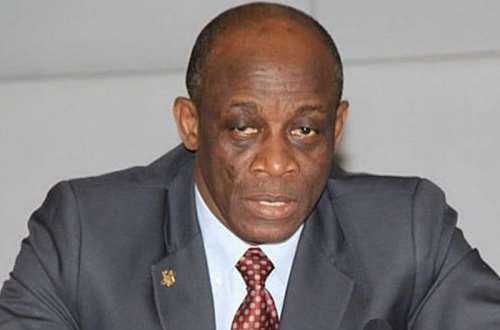
  • Plan to reset Ghana will be a guide to renegotiate IMF programme – Terkper

    Plan to reset Ghana will be a guide to renegotiate IMF programme – Terkper

    Former Minister of Finance Seth Terkper, has disclosed that President-elect John Mahama’s suggestions to renegotiate the International Monetary Fund (IMF) program will focus on resetting the economy to better address the nation’s current challenges.

    “Our plans to re-negotiate have also been influenced by the current state of the economy and how the John Mahama administration wants to fast-track measures to fully stabilize the economy”, he said.

    Mr. Terkper shared this information on PM EXPRESS BUSINESS EDITION, hosted by George Wiafe, on December 12, 2024.

    He explained that the renegotiations will likely focus on the country’s Primary Balance and how it is accounted for.

    Additionally, he mentioned that the government will reassess the nation’s debt and explore “smart borrowing” strategies to manage costly debts and other financial obligations.

    “When you look at the current debt situation and the expected payments from 2025, the incoming NDC government has to explore innovative ways to finance these debts”, he said.

    He stated that the review will also look at some of the key benchmarks under the programme and the fiscal consolidation measures being implemented.
    Background

    President-elect John Mahama during a recent meeting with the United Nations Resident Coordinator Charles Abani revealed that his administration will press ahead to review Ghana’s Programme with the IMF and the World Bank.

    According to the President-elect, the review is to ensure that the programme is aligned with the country’s current needs.

    “This adjustment is crucial and will help put the new government that would be inaugurated next year on the same springboard with our development partners to begin the rebuilding of the economy and the country,” Mr Mahama stated.

    Ghana is currently under a 36-month, $3 billion Extended Credit Facility with the IMF and has also signed several agreements with the World Bank, including a $250 million Ghana Financial Stability Project and another $250 million for the Ghana Energy Sector Recovery Programme.

    Dealing with Investor concerns

    Mr Terkper rejected the notion that the decision to go for a renegotiation could result in some negative investor reaction, a development that could hurt the economy badly.

    “We have done our engagements and are still engaging these investors on their concerns that will be factored in these re-negotiations”, he assured.

    Mr Terkper disclosed that the Mahama team has already engaged development partners on this issue, hence the country will not suffer as a result of the move.

    “This is one of the reasons why we are holding a National Consultative Forum on the Economy and all these concerns, including re-negotiating the IMF programme will be discussed as well”.

    President-elect Mahama has pledged to eliminate several taxes, including the E-levy, COVID Levy, 10 percent betting tax, and the Emissions Levy.

    According to JOYBUSINESS, the COVID-19 levy generates approximately GH₵13.91 million annually, the E-levy raises GH₵8.27 million, and the betting tax brings in around GH₵5.1 million.

    Mr. Terkper assured that the team has put in place strategies to manage potential shocks and minimize their negative effects on the economy.

    “We should not forget that all the taxes are put together. It’s about 5 percent of Ghana’s Gross Domestic Product and we can find alternatives to this. We are planning to make sure that the projects will be self-financing, this other will ensure that the economy will not suffer”, he said.

  • Cedi continues to depreciate at forex, selling at GHS16.40

    Cedi continues to depreciate at forex, selling at GHS16.40

    Ghana’s cedi has seen slight losses on the interbank foreign exchange market.

    However, it continues to strengthen against major currencies like the dollar at various forex bureaus.

    By the end of November, the cedi was selling at at some forex bureaus, down from highs of GH¢17.00 recorded in previous months.

    The Bank of Ghana has credited these gains to improvements in the country’s external sector.

    In its daily update, the Central Bank reported that on December 13, 2024, the cedi was trading at a buying price of GH¢14.72 and a selling price of GH¢14.73, compared to yesterday’s buying price of GH¢14.64 and selling price of GH¢14.68.

    The British Pound is currently being bought at GH¢18.71 and sold at GH¢18.73.

    The Euro has a buying price of GH¢15.47 and a selling price of GH¢15.49.

    According to GhanaWeb Business, as of December 13, 2024, at 10:00 AM, the cedi was trading at GH¢16.05 to the dollar and GH¢19.90 to the pound at major forex bureaus nationwide.

    Meanwhile, the Euro was trading at GH¢17.00 in the retail market.

    Despite the recent gains, the cedi’s depreciation against major currencies remains a significant challenge for Ghana’s economy.

    To stabilize the cedi, the Bank of Ghana has intervened by selling over $200 million in the market.

  • MoF reports robust 6.3% economic growth for Ghana in 2024

    MoF reports robust 6.3% economic growth for Ghana in 2024

    Ghana’s economy has surpassed expectations with a growth rate of 6.3% in 2024, according to the Ministry of Finance (MoF), marking it as one of Africa’s strongest economies despite facing global and local challenges.

    In a statement on December 12, the MoF highlighted the country’s impressive performance during the first nine months of 2024, with an average growth of 6.3% in real GDP.

    Data from the Ghana Statistical Service (GSS) showed that Ghana’s economic growth in the third quarter of 2024 was a significant improvement compared to the 2.6% recorded during the same period in 2023.

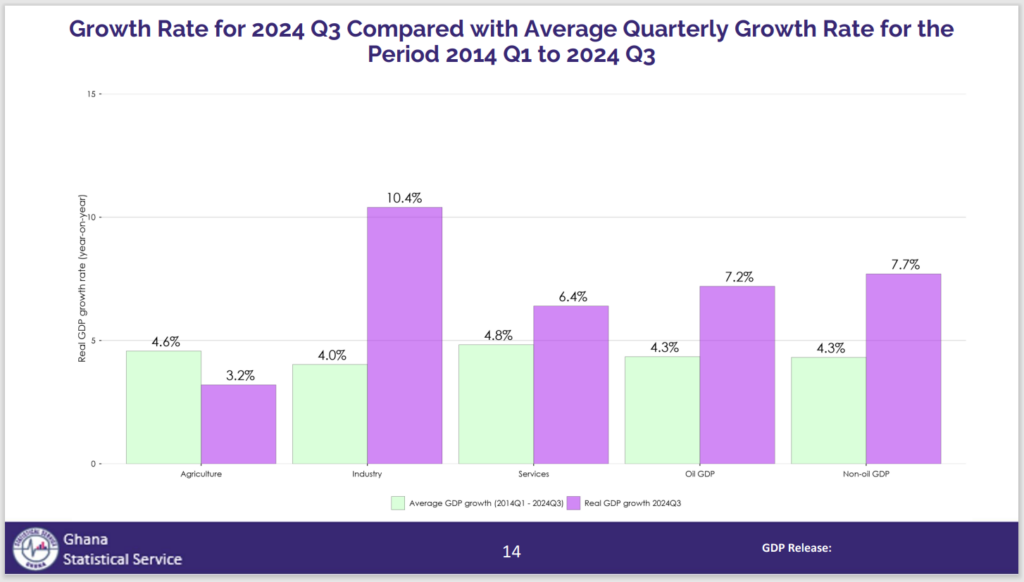
    The industry sector led the growth, achieving an average increase of 8.9%, driven by mining, quarrying, construction, and the oil and gas industries.

    The services sector grew by 5.0%, supported by strong performances in information and communication, financial and insurance services, and hospitality.

    Meanwhile, the agriculture sector recorded a 4.6% growth, with crops and livestock making notable contributions.

    This impressive economic recovery is credited to Ghana’s efforts to manage its finances, restructure debt, and promote inclusive growth, positioning the country for further progress.

    “Ghana’s economy continues to exceed expectations, defying challenges and solidifying its position as one of the most dynamic economies in the Africa region. Data released by the Ghana Statistical Service (GSS) underscores the country’s remarkable economic performance during the third quarter of 2024.”

  • GSE records nearly GHS2bn in trades, market value soars by 165%

    GSE records nearly GHS2bn in trades, market value soars by 165%

    The Ghana Stock Exchange (GSE) saw shares worth nearly GH¢2 billion traded from January to November 2024, a massive jump of 165.44% compared to GH¢752 million during the same period in 2023.

    This surge in activity came with a 71.29% increase in the number of shares traded, reaching 952.72 million shares. As a result, the overall market value rose to GH¢108.4 billion, a significant leap from last year’s GH¢74.2 billion.

    Experts credit this growth to a slowdown in the debt market, the comeback of financial stocks, and attractive share prices, which have made the market more liquid.

    In November alone, the GSE continued to grow, with the Composite Index (GSE-CI) closing at 4,694.37 points, a gain of nearly 50% compared to 29.71% growth in November last year. The Financial Stock Index also made progress, rising by 23.64% during the same period.

    However, trading volumes in November dropped sharply compared to last year, with just 9.35 million shares worth GH¢27.84 million traded – a 92.9% decline in volume and an 83.85% fall in value. Despite this, the market’s year-to-date performance remains robust.

    Top performers for the month included Ecobank Transnational Incorporated Plc with a 45% price increase, and Cal Bank Plc with 31%. Other gainers included Camelot Ghana Plc (17%), Access Bank Ghana Plc (10%), MTN Ghana (10%), and Ecobank Ghana Plc (7%). Companies like Unilever Ghana Plc (3%), GCB Bank Plc (2%), Ghana Oil Company Plc (1%), and TotalEnergies Marketing Ghana Plc (1%) also posted gains.

    On the downside, Enterprise Group Plc lost 1% of its value, while NewGold, the only exchange-traded fund listed, dropped by 12%.

    As the year nears its end, investors and analysts remain optimistic, expecting the stock market to remain an important driver of investment and economic growth.

    Experts predict that the current positive trend will continue into 2025, with better market conditions and recovering corporate earnings pushing the Composite Index to 6,850 points by the end of the year – a projected annual growth of 40-50%.

    The growth is expected to spread across key sectors, including banking, telecommunications, and fast-moving consumer goods (FMCG).

  • Registrar of Companies to remove over 500,000 business names, companies from register

    Registrar of Companies to remove over 500,000 business names, companies from register

    The Office of the Registrar of Companies (ORC) has disclosed that approximately 500,000 business names and 5,000 companies could be removed from its register by December 2024.

    Registrar of Companies, Mrs. Jemima Mamaa Oware, explained that this decision stems from the failure of these entities to submit their annual returns, despite receiving a one-year extension and regular reminders.

    Addressing the media during a stakeholder engagement, Mrs. Oware stated that the delisting initiative seeks to promote compliance and improve the accuracy of the ORC’s business registry.

    She further mentioned plans to introduce digital services in April 2025, aimed at streamlining operations and enhancing efficiency in business registration and related processes.

    “For business names, it’s over 500,000, but for companies, it’s a sample of about 5,000… Those whose names are going to go off are those who we sent information to at the beginning of the year.

    “If by the end of this year, you haven’t complied, that means you are not doing business, and when we take it off, within the next 12 years, you cannot have your name used by anybody until you go to court to have it reinstated,” she said.

    Mrs. Oware urged businesses facing delisting to promptly update their records and submit their annual returns to avoid removal from the register.

    She emphasized that failing to meet the December 2024 deadline under the Companies Act, 2019 (Act 992), would have severe consequences, including restrictions on conducting business with government and private entities.

    Addressing the ORC’s digital transformation, Mrs. Oware announced that a pilot program was currently being conducted using the existing manual system.

    Upon successful completion, the digital rollout will enable businesses to handle registrations, renewals, record updates, fee payments, and annual return filings entirely online.

    The system will also simplify the process of obtaining tax identification numbers for businesses, churches, NGOs, audit firms, and legal practices while improving access through the digital addressing system.

    This digital transition forms part of the ORC’s larger plan to modernize operations and simplify business registration procedures.

    The initiative will integrate the ORC’s platform with systems from the National Identification Authority (NIA), Ghana Revenue Authority (GRA), Ghana Post, ghana.gov, and the Institute of Chartered Accountants Ghana (ICAG).

    This integration aims to reduce manual interventions, enhance operational efficiency, and improve service delivery.

    It will also grant the public easier access to information on registered companies and professional organizations.

    Mrs. Oware added that the digital system would result in more precise accounting and verification, faster service turnaround times, and smoother business transactions nationwide.

  • Don’t abuse your power as the majority in parliament – Richard Ahiagbah cautions NDC

    Don’t abuse your power as the majority in parliament – Richard Ahiagbah cautions NDC

    The NPP’s Director of Communications, Richard Ahiagbah, has called on the National Democratic Congress (NDC) Members of Parliament to exercise their newly secured parliamentary majority with responsibility.

    Acknowledging the NDC’s decisive victory in the 2024 elections, he expressed optimism that their MPs would prioritize actions that benefit both their party and Ghana’s democratic progress.

    “We commend the NDC for their majority in parliament, but we also urge them to learn how to use that majority well, so it does not lead to abuse, which could ultimately work against their interests and the interests of our growing democracy.”

    The NDC, led by John Mahama, achieved a huge victory in the elections, doing well in both the presidential and parliamentary votes. Out of 270 constituencies counted so far, the NDC has won 187 parliamentary seats, while the NPP has 79, and four independent candidates have also been elected.

    Some constituencies, however, are yet to announce their results due to disagreements between the NPP and NDC over the outcomes.

    For Mr Ahiagbah, the NPP plans to reassess its weaknesses and bounce back strongly. “We are going to bounce back, and we will come back stronger”, he said on Joy News AM Show on Thursday, December 12.

  • Kpando Torkor residents rejoice as Ferry returns to service after 3-month break

    Kpando Torkor residents rejoice as Ferry returns to service after 3-month break

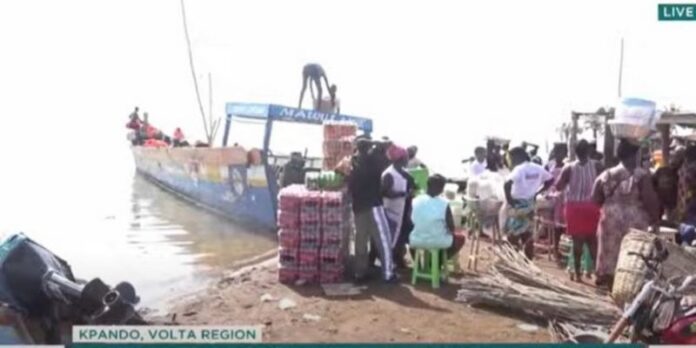
    Residents of Kpando Torkor and nearby areas can now relax as the ferry, which had been out of service for three months, is finally fixed and back in use.

    The ferry, an important way to cross the Volta Lake, had been down, leaving residents to deal with difficult and sometimes dangerous travel conditions. During this time, people had to rely on smaller, overcrowded boats, which were not safe.

    The lack of the ferry also disrupted business, particularly for traders and farmers who rely on it to move their goods to markets across the lake.

    Now that the ferry is running again, locals are relieved and happy to have a safer and more reliable transportation option. However, they are urging the authorities to take steps to avoid future problems.

    Many are calling for a maintenance workshop to be set up at Kpando Torkor, so repairs can be done quickly if the ferry breaks down again.

    The local Assembly member, Joshua Amenyogbe, also stressed the importance of finding a permanent solution to keep the ferry running smoothly.

  • What NAPO said about outcome of 2024 presidential election

    What NAPO said about outcome of 2024 presidential election

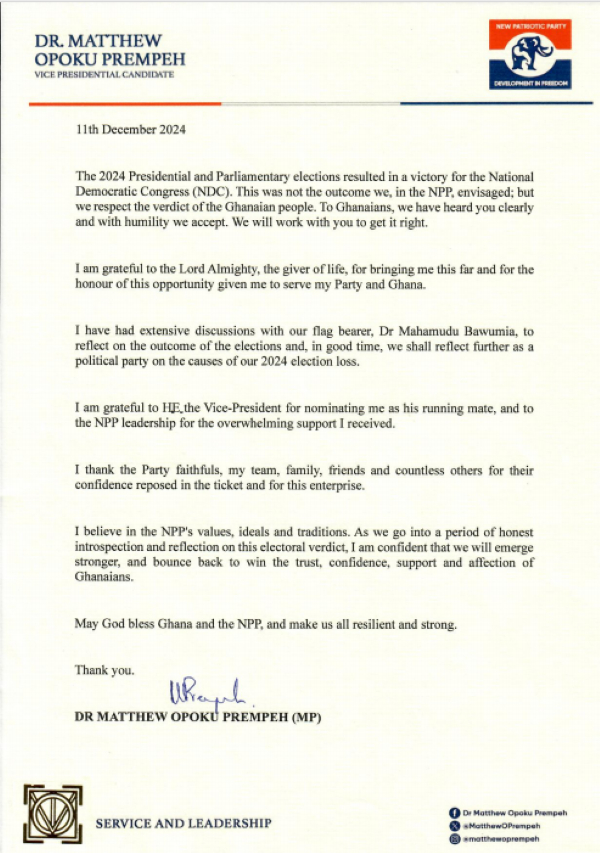
    After the 2024 Presidential and Parliamentary elections, which saw the National Democratic Congress (NDC) emerge victorious, Dr. Matthew Opoku Prempeh (NAPO), the NPP’s vice presidential candidate, shared a letter reflecting on the results.

    In his letter dated December 11, 2024, NAPO acknowledged the decision of Ghanaians and emphasized the importance of the NPP working together with the public to address their concerns.

    “The 2024 presidential and parliamentary elections resulted in a victory for the National Democratic Congress (NDC). This was not the outcome we, in the NPP, envisaged, but we respect the verdict of the Ghanaian people. To Ghanaians, we have heard you clearly, and with humility, we accept. We will work with you to get it right,” the letter stated.

    He expressed gratitude to God for the chance to serve Ghana and thanked Dr. Mahamudu Bawumia, the NPP leadership, and their supporters for their trust and encouragement.

    “I have had extensive discussions with our flag bearer, Dr. Mahamudu Bawumia, to reflect on the outcome of the elections and, in good time, we shall reflect further as a political party on the causes of our 2024 election loss,” the letter added.

    NAPO shared his optimism that the NPP would recover from the loss and earn back the trust and backing of Ghanaians.

    “As we go into a period of honest introspection and reflection on this electoral verdict, I am confident that we will emerge stronger and bounce back to win the trust, confidence, support, and affection of Ghanaians,” the letter read further.

    He ended by praying for blessings on Ghana and the NPP, expressing hope for renewed strength and resilience in the years to come.

    President-elect John Dramani Mahama of the National Democratic Congress (NDC) secured victory with 56.55% of the votes, defeating the New Patriotic Party’s Dr. Mahamudu Bawumia.

    This election also marked a milestone as Professor Jane Naana Opoku-Agyemang is set to become Ghana’s first female Vice President.

  • John Mahama’s Transition Team questions timing of some GHS240m payment by ECG

    John Mahama’s Transition Team questions timing of some GHS240m payment by ECG

    Concerns have been raised by the Spokesperson for President-elect John Dramani Mahama’s Transition Team, Felix Kwakye Ofosu, over a last-minute staff recruitments and financial transactions happening at some government institutions under the outgoing Akufo-Addo administration.

    Addressing the press after the Transition Team’s first session, Kwakye Ofosu pointed out that these activities could pose significant financial challenges for the new government.

    He revealed that during the transition discussions, it came to light that GH₵240 million had been paid to a company that had done business with the Electricity Company of Ghana (ECG). The timing of the payment, so close to the outgoing administration’s departure, has sparked serious concerns, according to a report by graphic.com.gh.

    “There were a few issues that came up that generated some discussions. Amongst them was the worrying issue of last-minute recruitments and payments in some ministries, departments, and agencies,” he is quoted as saying by graphic.com.gh.

    Kwakye Ofosu pointed out that the government’s payment to the entity was unnecessary and urged for the transaction to be halted for thorough review.

    “We have picked up information, and indeed we’ve seen documentation relating to efforts to pay over GH₵240 million to an entity that is supposed to have done some business with the ECG. Now, if it was being paid to IPPs to keep the power on, one perhaps would not have an issue, but it is being paid to an entity whose work in my view is not as critical as IPPs,” he said.

    The Member of Parliament-elect for Abura Asebu-Kwamankese Constituency stressed the need for the incoming government to have a say in financial decisions and payment approvals.

    “Good governance requires that the incoming government is given the opportunity to make these decisions.”

    The transition team also expressed worries about the financial impact of last-minute hiring within multiple ministries, departments, and agencies.

    “The timing of the recruitment would have severe fiscal implications on the incoming government,” Kwakye Ofosu warned, urging for a halt to these actions.

    “We raised strong objections to these maneuvers and requested that they be put on hold. The government side agreed to this, and we will forcefully insist that this is a dangerous precedent,” Kwakye Ofosu stated.

  • Kwame Appiah Kodua wins Fanteakwa-North seat after a re-collation of votes

    Kwame Appiah Kodua wins Fanteakwa-North seat after a re-collation of votes

    The Electoral Commission (EC) has officially declared Kwame Appiah Kodua as the winner of the Fanteakwa-North Constituency parliamentary election in the Eastern Region, following a disputed result.

    A re-collation of the votes was conducted on Thursday, December 12, 2024, at the Tesano Police Training School in Accra. The process showed Appiah Kodua, the Eastern Regional NADMO Coordinator, securing 11,751 votes, ahead of his opponent, Haruna Apaw-Wiredu from the NDC, who received 11,297 votes.

    This re-collation came after a previous declaration by the EC on the results, which initially named Apaw-Wiredu as the winner. The earlier announcement was challenged by the NPP candidate, Appiah Kodua, due to concerns over disputed pink sheets from two polling stations.

    In the first declaration, made at Begoro following the close of polls on Election Day, the Returning Officer, Zacharia Adams, had stated that the NDC candidate had won with 11,138 votes, while Appiah Kodua had received 10,847 votes.

    Appiah Kodua will now replace the outgoing MP, Kwabena Amankwa Asiamah, from the NPP.

  • Passenger mid-air on KLM Accra-bound flight from Amsterdam saved by Ghanaian doctor

    Passenger mid-air on KLM Accra-bound flight from Amsterdam saved by Ghanaian doctor

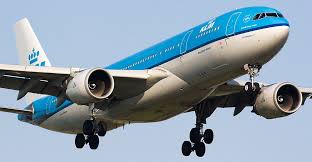
    A Ghanaian doctor, Dr. Joyce Emefa Addo-Klah, became a lifesaver during an emergency aboard KLM Royal Dutch Airlines Flight KL 589 traveling from Amsterdam to Accra on December 11, 2024.

    About four hours into the flight, a passenger suddenly became unwell, leading a flight attendant to urgently call for medical assistance.

    Dr. Addo-Klah quickly stepped in, grabbed her medical bag from the overhead storage, and hurried to attend to the sick passenger.

    Traveling with her husband, who is also a doctor specializing in obstetrics and gynecology, and their son, Dr. Addo-Klah showed incredible readiness and professionalism.

    She quickly checked the passenger’s condition and administered an injection from the airline’s emergency medical kit, helping to stabilize them.

    The unwell passenger was moved to the business class section for closer observation, helping maintain their privacy and ease concerns among the other travelers.

    Dr. Addo-Klah’s calm and confident handling of the situation reassured the passengers, many of whom were initially alarmed by the emergency announcement.

    She worked alongside the cabin crew, explaining every step she took while using the medical supplies, further displaying her skill and leadership.

    The passenger remained stable for the rest of the flight, and the aircraft landed in Accra without any further issues.

    The flight crew expressed heartfelt gratitude to Dr. Addo-Klah, acknowledging her role in preventing what could have been a much worse situation.

    To show their appreciation, KLM Royal Dutch Airlines rewarded her on board and offered her a discounted ticket for her next trip.

  • IMF sets condition to review Ghana’s high debt distress classification

    IMF sets condition to review Ghana’s high debt distress classification

    The International Monetary Fund (IMF) has set conditions that Ghana must meet before they will reconsider or change the country’s classification as being in high debt distress

    In a released Staff Report, the IMF noted that Ghana still has the tag due to the near-term breach of the Debt Sustainability Analysis(DSA) Threshold.

    Thus, Ghana will reach a Moderate Risk of debt distress by 2028, when all the targets have been met.

    “In the baseline, Ghana is at high risk of debt distress due to near-term breaches of the DSA thresholds but is expected to reach moderate risk of debt distress in the medium term with all DSA sustainability targets met by 2028. Ghana’s exceptional financing gap is closed with international reserves reaching 3 months of imports at the end of the program.”

    Ghana is expected to lower its total debt compared to the country’s economy and reduce the amount it spends on paying foreign debts by 2028. This will involve improving how the government collects money and spends it.

    The IMF also wants Ghana to strengthen support systems for its people, make changes to help the country better manage its currency, build a more varied economy, and encourage stronger economic growth.

    The IMF’s announcement comes as the government says it has nearly completed restructuring the country’s debts, with about 90% of the process done.

    A recent report from the Bank of Ghana shows that Ghana’s total debt has slightly reduced due to progress in restructuring foreign debts. 

    The data reveals that Ghana’s debt dropped by more than 46 billion cedis from September to reach 761 billion cedis by the end of October 2024.

  • Ghana’s economy grows from 6.9% to 7.2% in Q3 2024

    Ghana’s economy grows from 6.9% to 7.2% in Q3 2024

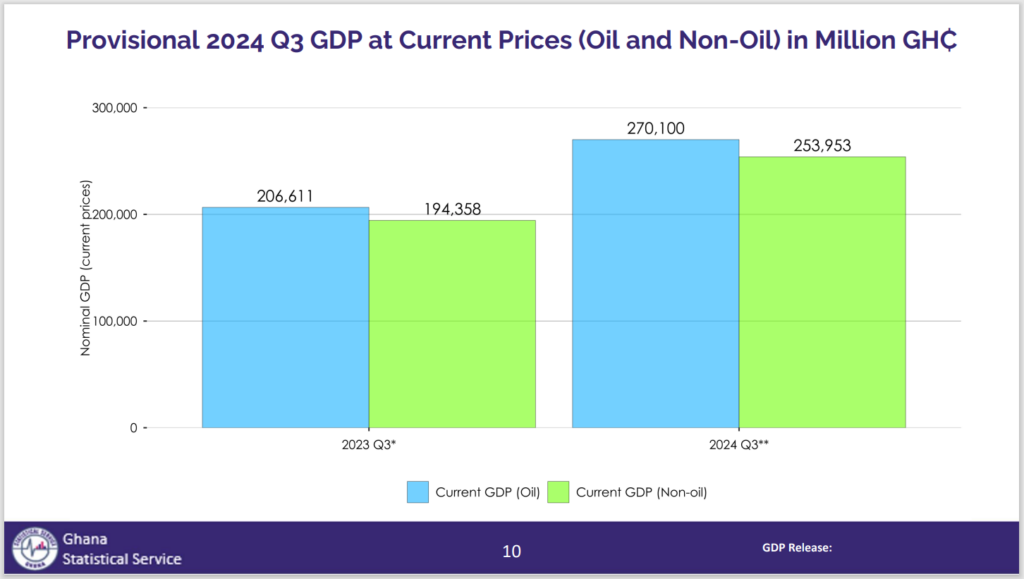
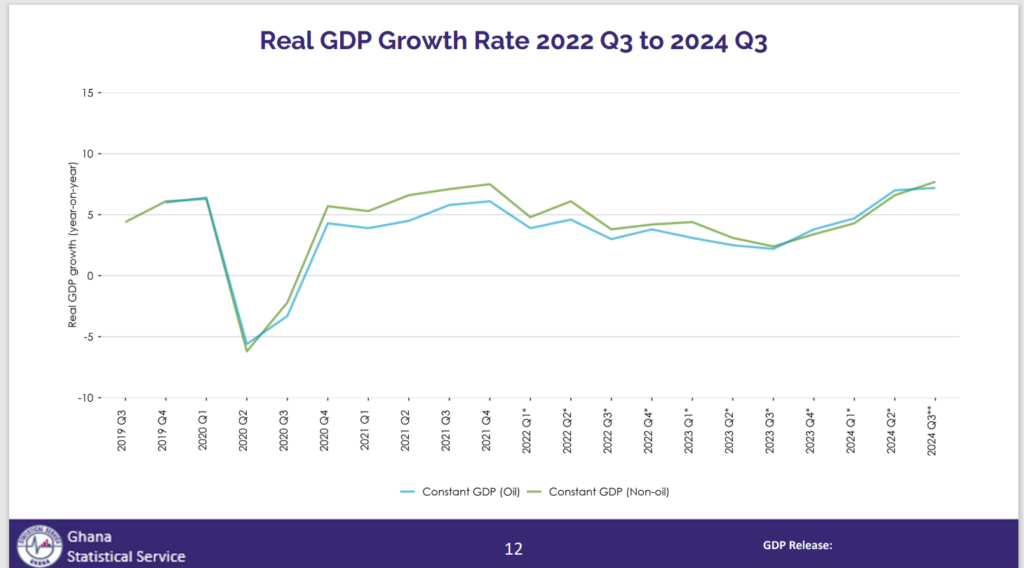
    Provisional data from the Ghana Statistical Service shows that Ghana’s economy expanded by 7.2% in the third quarter of 2024.

    This marks an increase from the 6.9% growth recorded in the second quarter of the same year.

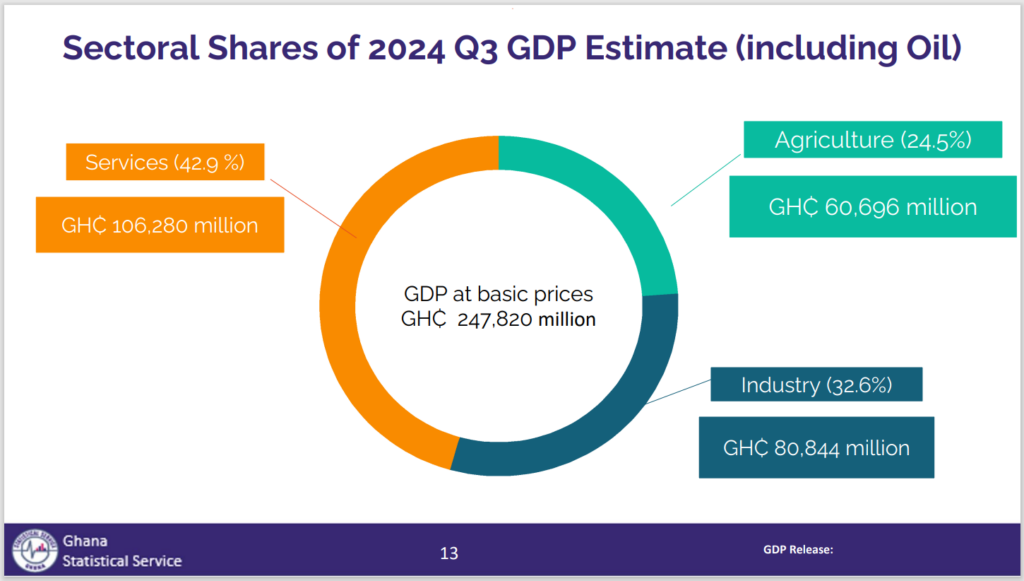
    The Services sector remains the largest contributor to the economy, accounting for 42.9% of the Gross Domestic Product (GDP) at basic prices.

    Industry and Agriculture follow, contributing 32.6% and 24.5% to the GDP, respectively.

    Provisional data from the Ghana Statistical Service indicates that Ghana’s economy expanded by 7.2% in the third quarter of 2024.

    This marks an improvement from the 6.9% growth rate recorded in the second quarter of the year.

    The Services sector remains the dominant contributor to the economy, accounting for 42.9% of the Gross Domestic Product (GDP) at basic prices.

    Industry and Agriculture follow, with growth rates of 32.6% and 24.5%, respectively.

    Crops expanded by 5.9% year-on-year and 1.3% quarter-on-quarter.

    Meanwhile, the fishing sub-sector contracted by -21.7% year-on-year and 6.5% quarter on quarter.

    Mining and quarrying sub- sector also expanded in the Industry sub-sector GDP estimates, while water and sewerage contracted.

    Meanwhile, Information and Communication expanded the most within the services sector with other personal services activities contract in the third quarter of the year.

  • Ghana’s Major General Anita Asmah appointed as UNDOF Force Commander

    Ghana’s Major General Anita Asmah appointed as UNDOF Force Commander

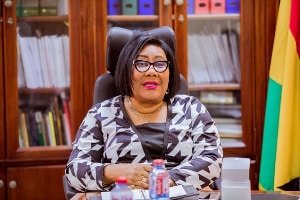
    United Nations Secretary-General António Guterres has announced the appointment of Major General Anita Asmah from Ghana as the new Head of Mission and Force Commander for the United Nations Disengagement Observer Force (UNDOF).

    Major General Asmah takes over from Lieutenant General Nirmal Kumar Thapa of Nepal, who will finish his term in mid-December 2024. 

    The Secretary-General thanked Lieutenant General Thapa for his strong leadership and commitment to United Nations peacekeeping.

    Major General Asmah brings 31 years of experience in leadership and command with the Ghana Armed Forces and in UN peacekeeping missions. 

    Recently, she served as the Director General in the Ghana Armed Forces’ Department of Defence Civilian Establishment. She was also the Deputy Force Commander of UNDOF from 2021 to 2023.

    In addition, Major General Asmah has worked as a Staff Officer with the United Nations Interim Force in Lebanon (UNIFIL) in 2015-2016 and 2012-2013, and as a Military Observer with the United Nations Organization Mission in the Democratic Republic of the Congo (MONUC) in 2003-2004.

    She has held other senior roles in the Ghanaian Armed Forces, including Director of Education, Deputy Military Secretary, and Course Director at the Kofi Annan International Peacekeeping Training Centre.

    Major General Asmah has a Bachelor of Arts and a Bachelor of Law degree from the University of Ghana. She is fluent in both English and French.

  • BoG restores CBG’s FX licence a month after suspension

    BoG restores CBG’s FX licence a month after suspension

    The Bank of Ghana (BoG) has reinstated the foreign currency trading licence of Consolidated Bank Ghana (CBG) as of December 4, 2024.

    With this reinstatement, CBG has fully resumed offering foreign currency services across its branches.

    In November 2024, the BoG suspended CBG’s Foreign Exchange Trading Licence for one month under Section 11(2) of the Foreign Exchange Act, 2006 (Act 723) due to multiple violations of foreign exchange market regulations.

    The BoG indicated that the licence would be restored after the suspension if CBG implemented effective measures to comply strictly with market regulations.

    Following the restoration, CBG announced that customers can now access its full range of foreign exchange services.

    “Over the past weeks, we have worked closely with the regulator, to address all regulatory requirements, resulting in the restoration of our foreign currency trading licence. Customers can now access our comprehensive foreign exchange services, including buying and selling of foreign currencies, at all CBG branches nationwide,” CBG stated.

    Meanwhile, CBG stated that it regrets any inconveniences the suspension may have caused to its valued customers, adding that it deeply appreciates the patience and continued trust of customers.

    “At CBG, we value all our stakeholders and remain committed to providing our cherished customers with simple, secure and differentiated banking experience, while ensuring regulatory compliance,” CBG added.

  • CSOs calls on Mahama to terminate SML, Agyapa Royalties Agreements

    CSOs calls on Mahama to terminate SML, Agyapa Royalties Agreements

    A group of Civil Society Organizations (CSOs) focused on good governance, resource management, and fighting corruption has strongly urged President-elect John Dramani Mahama to cancel the Strategic Mobilization Limited (SML) contract.

    According to the CSOs, the current SML deal has funneled millions of Ghana cedis into private hands without providing the country with enough benefits.

    They believe ending this contract will help rebuild public trust in how government finances are managed and plug a major source of revenue loss.

    The CSOs involved include Third World Network-Africa (TWN-Africa), iWatch Africa, Revenue Mobilization Africa (RMA), the Natural Resource Governance Institute (NRGI), the Ghana Anti-Corruption Coalition (GACC), the Africa Centre for Energy Policy (ACEP), the Institute of Energy Security (IES), the Center for Extractives and Development (CEDA), IMANI Center for Policy and Education, and the HELP Foundation Africa.

    “Your Excellency, the Coalition stands ready to support your administration in implementing reforms that enhance transparency, accountability, and efficiency,” the CSOs wrote in a letter to the President-elect on December 11. To this end, we respectfully present the following recommendations as critical priorities for your new administration:

    “1. Terminate the Strategic Mobilization Limited (SML) Contract. The ongoing SML contract has diverted millions of Ghanaian cedis into private hands without delivering commensurate value to the nation. Terminating this agreement will seal a significant revenue leakage and restore public confidence in financial management practices.”

    According to a report by citinewsroom.com, the CSOs urged the president-elect to abrogate the Agyapa Royalties agreement and reassess the Mineral Income Investment Fund (MIIF) Act.

    “Abolish the Agyapa Royalties Deal and Review the Mineral Income Investment Fund (MIIF) Act. We urge your administration to permanently terminate the Agyapa Royalties Deal, which threatens Ghana’s mineral wealth and has faced widespread public rejection.”

    Additionally, they pushed for changes in the energy sector and urged the president-elect to lessen political meddling in state-owned enterprises (SOEs) that work in this field.

    “Limit political interference in State-Owned Enterprises (SOEs) within the energy sector, especially GNPC and Ghana Gas, to promote leadership stability and operational efficiency.

    “Address persistent challenges in the energy distribution value chain, which have eroded sector performance and profitability.”

  • It is fake! – GRA on claims of vehicle auctioning

    It is fake! – GRA on claims of vehicle auctioning

    The Ghana Revenue Authority (GRA) has strongly denied recent claims that it is involved in selling vehicles at auction.

    In a statement released on December 11, the GRA called the reports “false” and emphasized that it follows proper rules for selling vehicles and goods through its Customs Division.

    The GRA warned the public to be cautious of scams and advised people not to pay any money to unauthorized individuals or groups connected to these false reports.

    Reaffirming its commitment to transparency, the GRA urged the public to rely only on official announcements for accurate information about its activities.

    “The Ghana Revenue Authority (GRA) has sighted a fake media release on a vehicle auction dated December 3, 2024, purportedly issued by the Commissioner-General of the GRA,” the statement clarified.

    The GRA pointed out discrepancies in the fraudulent notice, stating, “The fake media release bears the signature of the former Commissioner-General, Rev. Dr. Ammishaddai Owusu-Amoah, but lists the name of the current Commissioner-General, Madam Julie Essiam.”

    The GRA stated, “We wish to inform the general public that the notice circulating in the public domain is FAKE.”

  • National Peace Council, Chiefs, Civil Society urged to intervene in post-election violence

    National Peace Council, Chiefs, Civil Society urged to intervene in post-election violence

    The New Patriotic Party (NPP) is urging Civil Society Organizations (CSOs) and the National Peace Council to step in and convince President-elect John Mahama to address the actions of some National Democratic Congress (NDC) supporters involved in acts of vandalism following the elections.

    Speaking at a press briefing in Accra on Wednesday, NPP General Secretary Justin Frimpong Kodua raised concerns about the growing cases of violence and unruly behavior by some NDC supporters across the country.

    Mr. Kodua lamented that such incidents tarnish Ghana’s democratic reputation and stressed the need to prevent them from escalating.

    “We are equally calling on the National Peace Council, National House of Chiefs, Christian Council of Ghana, Catholic Bishops Conference, National Chief Imam, organised labor, civil society organisations, the diplomatic community, to as a matter of agency, and for the sake of our cherish and enviable record as a country that has for over 32 years practised multi-party democracy, to come out and condemn the lawlessness from the NDC.

    “And we call on the president-elect Mr. John Dramani Mahama to call his people to order and also allow the Electoral Commission to do his job,” he stated.

    Mr. Kodua also claimed that the homes of NPP MPs and Parliamentary Candidates had been targeted, and some areas had experienced unrest following the NDC’s victory in the general elections.

    He urged the Inspector General of Police (IGP), Dr. George Akuffo Dampare, to step in and restore law and order in the affected communities.

  • Malik Basintale accuses frustrated NPP supporters of looting state agencies

    Malik Basintale accuses frustrated NPP supporters of looting state agencies

    Deputy Communications Officer for the National Democratic Congress (NDC), Malik Basintale, has accused New Patriotic Party (NPP) supporters of being behind the recent outbreaks of violence after the elections.

    Reports of election-related clashes and incidents of state property being vandalized or stolen have raised concerns among the public.

    Speaking to Joy News, Mr. Basintale dismissed claims that NDC supporters were involved, instead attributing the acts of violence and looting to unhappy NPP loyalists.

    “At first, many people thought that they were NDC guys who were storming these offices to cause mayhem. Yesterday [Tuesday], in the Awutu Senya West constituency, our guys had an issue with NPP thugs breaking into the Agenda 111 facility and trying to steal iron rods and other building materials. So, it took our guys to initiate a citizen’s arrest and they handed them over to the police station” he claimed.

    Mr. Basintale went on to emphasize that many of those responsible for the disturbances are NPP members, adding that this group of individuals has a history of causing chaos, dating back to 2017.

    “A lot of people who are seen in town causing havoc are largely members of the New Patriotic Party. They are the same guys they used in 2017 to beat judges and destroy properties and all of that. Many of their grassroots members didn’t get anything, so now it’s time for them to ransack the offices of their superiors and also get something before they finally exit office on January 7,” he asserted.

    Mr. Basintale encouraged the public to stay calm while authorities investigate the incidents, promising that anyone found guilty will face justice.

    The Ghana Police Service has reported the arrest of 106 individuals who are currently under investigation for their involvement in the unrest.

  • Your landmark achievement will provide opportunities for women – Della Sowah to Jane Naana Opoku-Agyemang

    Your landmark achievement will provide opportunities for women – Della Sowah to Jane Naana Opoku-Agyemang

    The Member of Parliament for Kpando, Della Sowah, has congratulated Professor Jane Naana Opoku-Agyemang on her historic election as Ghana’s first female Vice President.

    This milestone, announced by the Electoral Commission on Monday, December 9, 2024, marks a significant moment in Ghana’s political journey.

    In a statement released on Wednesday, December 11, 2024, Della Sowah expressed her belief that Prof. Opoku-Agyemang’s achievement will inspire women in Ghana and across Africa to pursue leadership roles.

    She praised the Vice President-Elect for showing that women can reach the highest levels of leadership and for being a source of motivation to many. Reflecting on her political career, Della Sowah highlighted Prof. Opoku-Agyemang’s service as Minister for Education under President John Mahama in 2013, where she made notable contributions to the education sector.

    Della Sowah, a former Deputy Minister for Gender, Children, and Social Protection, described this election as a huge step towards achieving gender equality in Ghana. She emphasized that it sets a powerful example for women across Africa to aim high despite obstacles.

    She also commended the leadership of the National Democratic Congress (NDC) and former President John Mahama for their faith in Prof. Opoku-Agyemang’s abilities.

    Della Sowah expressed confidence that Ghana’s first female Vice President will create a lasting legacy of transformational leadership and pave the way for future generations of women leaders.

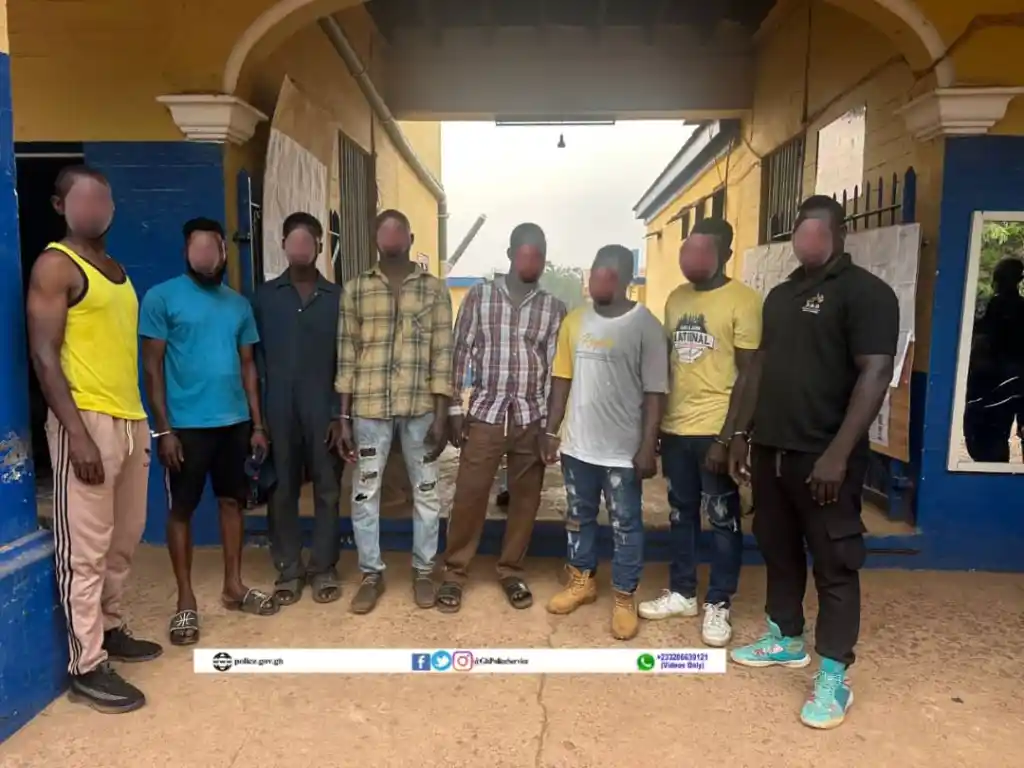
  • Police arrests 4 for stealing Agenda 111 building materials at Awutu Bereku

    Police arrests 4 for stealing Agenda 111 building materials at Awutu Bereku

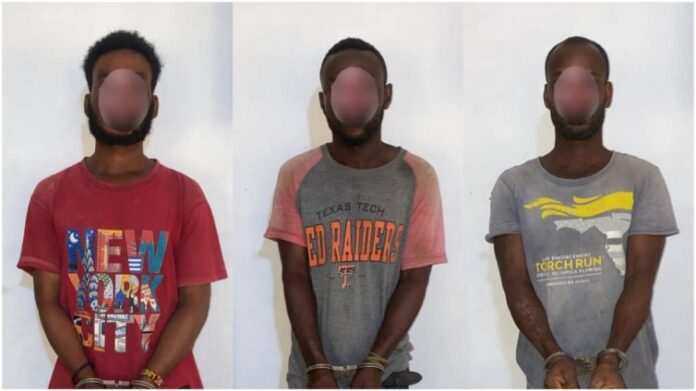
    The Ghana Police Service has taken four individuals into custody for allegedly stealing materials meant for constructing the Agenda 111 Hospital at Awutu Bereku in the Central Region.

    The suspects were apprehended on Tuesday, December 10, 2024, with the assistance of local community members.

    Image

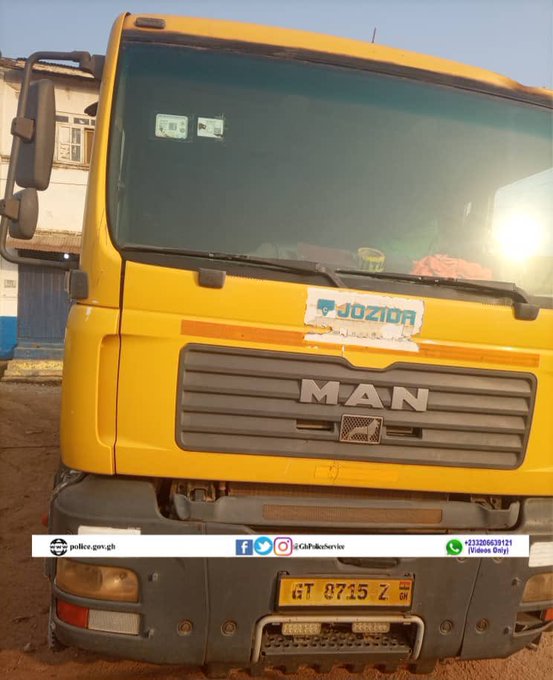
    According to a police statement, the arrest occurred when a Man Diesel truck with registration number GT 8715-Z, driven by one of the suspects, Kwabena Ayamba, was intercepted. The vehicle was loaded with various construction materials.

    Preliminary investigations suggest the suspects were hired by the project contractor to transport the items to Tema. Authorities are working to locate and arrest the contractor for prosecution.

    The suspects are currently in custody, aiding the ongoing investigation. This incident brings the total number of arrests linked to post-election disturbances to 110.

    Image
    Image
  • BBC reports on Ghanaians’ expectation of jobs, tax cuts from Mahama

    BBC reports on Ghanaians’ expectation of jobs, tax cuts from Mahama

    Ghana’s former President John Dramani Mahama will be under enormous pressure to meet the expectations of voters following his landslide victory in Saturday’s election.

    He swept back to power after eight years in opposition, running what political analyst Nansata Yakubu described as a “masterclass” in campaigning.

    He defeated Vice-President Mahamudu Bawumia by 56.6% of votes to 41.6% to notch up the biggest margin of victory by a candidate in 24 years.

    But voter turnout was lower than in the 2020 election, especially in some of the heartlands of Bwaumia’s New Patriotic Party (NPP), suggesting some people there – disillusioned with its performance in government – stayed at home.

    As Mahama’s supporters celebrated his victory, Belinda Amuzu – a teacher in the northern city of Tamale, a stronghold of Mahama – summed up their hopes.

    “I’m expecting the new government to change the economy, so that the hardship will come down. He should also prosecute corrupt officials so that it will be a lesson to others,” she told the BBC.

    “The hardship” has become a common phrase in Ghana since the economy hit rock-bottom in 2022, causing a cost-of-living crisis that shredded Bawumia’s reputation as an “economic whizz-kid” – and led to his defeat at the hands of Mahama.

    Ghanaian economist Prof Godfred Bokpin told the BBC the challenges facing the next government were huge.

    “What Ghana needs right now is credible leadership, lean government and efficiency in public service delivery. Without that, there cannot be a future,” he said.

    Mahama has promised to bring down the size of the cabinet from more than 80 to around 60, but Prof Bokpin argued it should be even smaller while political analyst Dr Kwame Asah-Asante stressed the need for appointments to be on merit rather than loyalty.

    Mahama will be flanked by former Education Minister Naana Jane Opoku-Agyemang, who is set to become Ghana’s first female vice-president when the new government takes office next month.

    Dr Yakubu said her appointment was not one of “tokenism” and she was not someone who could be “manipulated”.

    “We have a fantastic first female vice-president in Prof Naana Jane Opoku-Agyemang,” she told the BBC Focus on Africa podcast.

    Mahama served his first four-year term as president after winning in 2012, but lost his re-election bid in 2016 as Nana Akufo-Addo rose to power with Bawumia as his running-mate.

    Dr Yakubu said Mahama contested the 2016 election on his track record in building roads, schools and hospitals but voters rejected him, as their mantra then was: “We don’t eat infrastructure.”

    But, she said, during the Covid pandemic voters came to appreciate the infrastructure his government had built, especially hospitals.

    This – along with the fact that the economy had plunged into a deep crisis under the current government, forcing it to seek a $3bn (£2.4bn) bailout from the International Monetary Fund (IMF) – led to Mahama being re-elected, Dr Yakubu added.

    She told the BBC that Mahama would now be expected to fulfil his campaign promise to create jobs in order to bring down the unemployment rate of almost 15%, and to ease the cost-of-living crisis by scrapping some taxes – or what Ghanaians call “nuisance taxes”.

    Mahama has promised to make Ghana a “24-hour economy” through the creation of night-time jobs in both the public and private sectors. He said he would give businesses tax incentives to stay open at night and reduce electricity prices for them.

    But his critics have doubts, pointing out that Ghana plunged into its worst electricity crisis during his first term and the power cuts were so bad that Mahama joked at the time that he was known as “Mr Dumsor” – “dum” means “off” and “sor” means “on” in the local Twi language.

    He has pledged to abolish several taxes – including the much-criticised electronic levy on mobile transactions and the one on the carbon emissions produced by petrol or diesel-powered vehicles.

    Prof Bokpin said he doubted the Mahama administration would be able to fulfil its promises.

    “They have not done the cost-benefit analysis. There’s no budgetary space to translate those promises into actuals,” he said.

    But Mahama is confident he will prove his critics wrong, saying he intends to renegotiate the conditions of the IMF loan so money is freed up for “social intervention programmes” in a country where 7.3 million people live in poverty.

    In an interview ahead of the election, Mahama told the BBC the IMF wanted “a certain balance” in government finances.

    “If you’re able to cut expenditure, and you’re able to increase revenue and increase non-tax revenue coming in, you’ll be able to create a balance,” he said.

    Dr Asah-Asante said Mahama’s experience as former president would stand him in good stead to navigate Ghana through choppy waters.

    “Of course, he is likely to encounter difficulties, but he has what it takes to turn things around,” the analyst added.

    Apart from the economy, corruption is one of the biggest issues facing Ghana but not everyone is convinced that Mahama will be able to tackle the scourge.

    Mahama’s previous stint in government – as vice-president and president – was plagued by corruption allegations, although he has consistently denied any wrongdoing.

    In 2020, a UK court had found that aviation giant Airbus had used bribes to secure contracts with Ghana for military planes between 2009 and 2015.

    An investigation was then started in Ghana, but the Office of the Special Prosecutor, in a decision announced just months before the election, concluded there was no evidence that Mahama was involved in any corrupt activities himself.

    The outgoing government has also been dogged by corruption allegations, including over the purchase of ambulance spare parts at a cost of $34.9m and a controversial national cathedral project in which $58m has been spent without any progress in building it.

    Mahama promised his government would tackle corruption, and ensure that officials were prosecuted for wrongdoing.

    “We are thinking about special courts,” he told the BBC.

    Dr Asah-Asante said Mahama should demand financial accountability from the outgoing government during a handover phase so that “whatever has gone wrong, he will be able to right” as soon as his government takes office next month.

    The analyst added that Mahama, who will be inaugurated next month when President Akufo-Addo steps down after his two terms in office, had no choice but to meet the expectations of Ghanaians – or else they would “punish his government the way they have punished the NPP”.

    Mahama succinctly acknowledged this in his victory speech, saying: “Expectations of Ghanaians are very high, and we cannot afford to disappoint them.

    “Our best days are not behind us; our best days are ahead of us. Forward ever – backwards never.”

    Source: BBC

  • Implications of Foreign Direct Investment for the shipping sector in Ghana

    Implications of Foreign Direct Investment for the shipping sector in Ghana

    Foreign Direct Investment (FDI) plays a vital role in boosting the economic prospects of nations, including Ghana.

    However, while FDI contributes significantly to growth, it also presents certain challenges, particularly, in the shipping sector, which is crucial for international trade and economic development. The implications of FDI for the shipping sector in Ghana, especially concerning profit repatriation, can have far-reaching consequences on the local economy.

    The Dynamics of FDI in Ghana’s Shipping Sector

    FDI has been a key driver in the modernisation of Ghana’s shipping and logistics infrastructure, attracting foreign shipping lines and international logistics companies to operate within the country. These investments typically result in the introduction of new technologies, improved operational efficiencies, and better access to global markets. However, a significant challenge arises in the form of repatriations of returns on investment, where foreign investors move back their profits from their businesses in Ghana, including Shipping Lines.

    A significant factor to consider is that capital flight, driven by profit repatriation, can place a severe strain on Ghana’s economy. Shipping Lines operating in Ghana, almost all of which are owned by multinationals, are required to repatriate profits to their parent companies, particularly, if they are listed in foreign markets. While this practice is legally permissible, the cumulative effect of these repatriations can lead to detrimental outcomes for Ghana’s economy.

    Even though shipping companies, especially those with substantial foreign ownership, generate considerable profits from their operations in Ghana, most of these profits are not re-invested in the country but are moved back to the home countries of these investors. This regular outflow of capital exacerbates the economic difficulties Ghana continues to face, particularly, in terms of foreign currency reserves and the stability of the local currency, the cedi.

    Interestingly, these Shipping companies often set the pricing structure for the services they offer such as carriage, handling, and port operations, which can significantly impact the cost of shipping goods to and from Ghana. The substantial control they have on the shipping markets in our part of the world, most often than not, leads to imposition of high and unwarranted prices.

    This means that local businesses, particularly exporters, bear the brunt of rising shipping costs, which impacts negatively on the competitiveness of Ghanaian exports in the global market. Similarly, the increased costs of importing goods due to rising shipping charges put further strain on the local economy and contribute to inflation.

    It can also be argued that foreign dominance in the shipping industry may also mean that Ghana’s local ports and infrastructure are largely shaped by the priorities of international companies. While the infrastructure improvements these companies bring to Ghana are significant, the extent to which they prioritise the local market often leaves much to be desired. For example, the high level of profit repatriation indicates a low appetite for additional investments in the local economy for the long-term development of Ghana’s shipping industry.

    There is the need to distinguish between a few investments in port infrastructure, which involve huge capital outlays such as the construction or upgrading of physical assets like docks, terminals, cranes, or other port facilities and the establishment of commercial presence in Ghana in the areas of shipping agency, which require very little capital investments. Unfortunately, these shipping agents repatriate huge amounts in unwarranted fees and charges in the absence of a strong regulatory framework.

    Lessons from Regional and Global Perspectives

    The challenges faced by Ghana due to FDI profit repatriation are not unique to the country. Several other countries, including Indonesia, Brazil, and Malaysia, have experienced similar financial instability caused by undesirable levels of capital outflows. For example, Indonesia’s 2013 currency crisis was significantly influenced by FDI profit repatriation, which undermined confidence in the economy. Similarly, Brazil’s currency depreciation in 2015-2016 was worsened by large-scale profit repatriation, highlighting the vulnerability of emerging economies to such practices.

    These real-world examples underscore the importance of robust regulatory frameworks that can balance the benefits of FDI with the need to protect the domestic economy from destabilising effects of these enormous capital flows.

    The Role of the Ghana Shippers’ Authority (GSA)

    The Ghana Shippers’ Authority (GSA) plays a pivotal role in regulating the shipping sector and ensuring that the interests of both local businesses and international shipping companies are balanced. Under the new GSA Act, 2024 (Act 1122), the Authority has been given the responsibility to adopt emerging trends in the global shipping and logistics market, thus ensuring a more transparent, predictable and efficient business environment.

    The GSA, in partnership with other regulatory bodies, would promote a transparent and competitive environment in the shipping sector, which may address the challenges posed by FDI in Ghana’s shipping sector. A multi-faceted approach is needed through a strengthened regulatory framework and collaboration among all stakeholders in the shipping value chain.

    Conclusion

    FDI has the potential to transform Ghana’s shipping sector by bringing in capital, technology, and expertise. However, without careful regulation, the practice of profit repatriation can lead to severe economic challenges, including currency depreciation, capital flight, and financial instability.

    The Ghana Shippers’ Authority (GSA) has a vital role in mitigating these risks by ensuring effective oversight of shipping activities and promoting policies that balance the interests of foreign investors with the economic well-being of Ghana. With the right regulatory frameworks and collaboration between stakeholders, Ghana can harness the full potential of FDI in its shipping sector while safeguarding its long-term economic stability.

    Source: GhanaWeb

    DISCLAIMER: Independentghana.com will not be liable for any inaccuracies contained in this article. The views expressed in the article are solely those of the author’s, and do not reflect those of The Independent Ghana

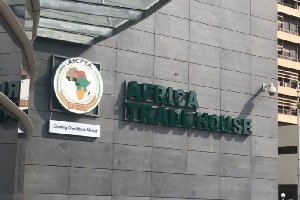
  • Ghana among African nations to Benefit from $150M from AfCFTA to reduce financial risk

    Ghana among African nations to Benefit from $150M from AfCFTA to reduce financial risk

    Ghana and several other African countries are set to benefit from a $150 million fund aimed at reducing financial risks to support the African Continental Free Trade Area (AfCFTA).

    This initiative extends to Senegal, Angola, and Botswana, which are outside the usual coverage of the Trade Development Bank (TDB). Other regions, including East, North, and Southern Africa, will also benefit. The funds will focus on key areas like agriculture, food security, energy, manufacturing, telecommunications, and other services.

    The African Development Bank (AfDB) and the Trade Development Bank made this possible by signing a partnership agreement during the 2024 Africa Investment Forum (AIF) in Rabat, Morocco, on December 6.

    Ahmed Rashad Attout, Director of the AfDB’s Financial Sector Development Department, described the agreement as a partnership to drive meaningful economic transactions.

    He explained that this fund is expected to generate about $1.8 billion in trade financing, helping businesses across Africa, including women-owned enterprises, access the resources they need to thrive.

    “It’s part of our implementation of the Africa Continental Free Trade Area. So, we see this as really the beginning of a much larger and wider relationship. We also expect that we’ll be expanding the range of products that we are able to support under this risk participation agreements,” said Mr Attout.

    Ms Wegoki Mugeni, Chief Operating Officer, East Africa, TDB, explained that the idea was for the two banks to share the financing risks and support, especially private sector companies focused on expanding their operations across Africa.

    She said the risk participation facility would assist key sectors that drove Gross Domestic Product (GDP) to deepen intra-African trade support the development of the continent and uplift the living standards of its people.

    “Going forward, the Bank will ensure that we continue to support financial institutions in low-income countries and expand the fiscal credit available to the private sector as well as other sectors in the region,” she said.

  • Afenyo-Markin cries foul, accuses NDC of destroying pink sheet

    Afenyo-Markin cries foul, accuses NDC of destroying pink sheet

    The Member of Parliament for the Effutu Constituency, Alexander Afenyo-Markin, has alleged that the National Democratic Congress (NDC) is engaged in the destruction of pink sheets detailing results from the just-ended December 7, 2024, general elections.

    Speaking on the aftermath of the elections, which were marred by incidents of violence across the country, Mr. Afenyo-Markin described the alleged actions of the NDC as deeply troubling.

    He expressed concerns over what he termed an atmosphere of lawlessness perpetuated by the party following their victory.

    “It is deeply regrettable that the NDC, after gaining power, would resort to creating an environment of intimidation, threatening parliamentary candidates, party officials, and anyone they view as a so-called threat,” he said.

    The Effutu MP cited specific instances where members of the NDC allegedly destroyed election pink sheets.

    “In Ablekuma North, for instance, the parliamentary candidate, [Madam Owusu-Ekuful], has been under siege. Yesterday, she had a sleepless night as all manner of persons stormed her residence searching for pink sheets,” he claimed.

    Mr. Afenyo-Markin further questioned the motive behind such actions, accusing the NDC of attempting to erase evidence.

    “Why is the NDC so interested in destroying evidence? Why are they determined to capture pink sheets, destroy them, and set them ablaze?” he asked.

    The alleged incidents have raised concerns among stakeholders about the integrity of the election process and the need to address violence and intimidation in Ghana’s electoral landscape.

  • A dollar goes for GHS14.75 at BoG, GHS16.35 at forex

    A dollar goes for GHS14.75 at BoG, GHS16.35 at forex

    Ghana’s cedi is gaining strength against major foreign currencies like the dollar as the year comes to a close.

    At the end of November, the cedi was selling at GH¢16.40 at some forex bureaus, improving from GH¢17.00 recorded in earlier months.

    The Bank of Ghana attributes this improvement to growth in the country’s external sector.

    As of December 11, 2024, the Central Bank reported the cedi trading at GH¢14.74 for buying and GH¢14.75 for selling.

    The British pound is being bought at GH¢18.80 and sold at GH¢18.82, while the euro is trading at GH¢15.49 for buying and GH¢15.51 for selling.

    A GhanaWeb Business check on December 11, 2024, at 10:00 AM showed the cedi trading at GH¢16.35 to the dollar, GH¢20.70 to the pound, and GH¢17.65 to the euro in retail forex bureaus.

    Despite these gains, a weaker cedi against major currencies could worsen Ghana’s economic challenges.

    To slow the cedi’s depreciation, the Bank of Ghana recently injected over $200 million into the market.

  • Business activity resumes in Accra’s CBD after elections

    Business activity resumes in Accra’s CBD after elections

    Business activity in Accra’s Central Business District (CBD) resumed two days after Ghana’s elections.

    Shops that had closed on Saturday, December 7, 2024, Election Day, reopened, and traders were actively conducting their business.

    When the Ghana News Agency (GNA) visited the CBD, traders supporting the winning political party were seen wearing party gear.

    National Democratic Congress (NDC) merchandise, featuring the party’s red, green, black, and white colors, was in high demand.

    Commercial drivers were spotted at various traffic points and bus stops picking up passengers.

    The GNA also noted that there was less traffic on most streets in the CBD.

    Porters were seen carrying goods in pans to different vehicle stations or bus terminals.

    Banks in the CBD had also resumed operations.

    Michael Tabi, a fabric seller at the Makola Market, told the GNA that morning sales were slow but improved in the afternoon.

    Madam Alice Donkor, a tomato vendor, mentioned that she hadn’t made any sales by midday but was hopeful for a profit by the end of the day.

    Abdul Malik, a commercial driver, shared that business was quiet in the morning but picked up later in the day.

  • Tourist influx, IMF support to stabilize cedi by year end – IMF

    Tourist influx, IMF support to stabilize cedi by year end – IMF

    The cedi is expected to remain stable due to an expected increase in foreign currency from tourists, recent funding from the International Monetary Fund (IMF), and the successful conclusion of peaceful elections.

    Over the past month, the cedi has gained value against major international currencies, thanks largely to efforts by the Bank of Ghana (BoG).

    Last week, the cedi held steady against key currencies, with the exchange rate staying at GH¢16.25 to US$1. This stability is partly due to the central bank injecting US$240.4 million into the market to meet demand.

    “The FX market appeared quite balanced last week,” financial analysts at Databank said in a recent note to investors.

    The recent approval of the third review of its loan program by the IMF has boosted confidence in the market. The IMF has released US$360 million immediately, raising the total amount disbursed under the program to US$1.96 billion.

    Experts think this will have a positive effect on the market.

    “We believe the successful third review would bolster investor confidence and help tame speculative demand for FX,” Databank said.

    Along with these developments, the extra foreign currency coming in during the festive season is expected to support the central bank’s efforts to stabilize the market.

    The Ghana Tourism Authority (GTA) and the Ministry of Tourism, Culture, and Arts have predicted that around two million international tourists will visit Ghana in 2024.

    This influx is expected to bring in over US$3 billion in revenue, thanks to the ‘Beyond the Return’ initiative. By mid-2024, tourism officials reported that 600,000 international visitors had already arrived, with another 1.3 million expected in the second half of the year.

    “We envisage the tranche disbursement, coupled with seasonal FX liquidity as we approach the festive seasons, will augment the central bank’s market intervention and help stabilise the local unit,” Databank predicted.

    Adding to the positive economic narrative, the recent peaceful elections have further strengthened market confidence. The resounding victory by President-elect, John Dramani Mahama, and the swift concession by Vice President Dr. Mahamudu Bawumia have driven positive market sentiments.

    “We believe this will continue to boost market confidence and help stabilise the cedi.”

    Some experts are worried about the central bank’s recent actions in the foreign exchange market.

    They’ve noticed that the bank didn’t provide details on its reserves for November 2024 in its latest report, even though it mentioned the cedi’s improvement during that time.

    There are also concerns that the cedi could come under pressure in the first part of 2025 when investors typically take profits.

  • Prices drop for BoG’s Gold Coin as cedi appreciates

    Prices drop for BoG’s Gold Coin as cedi appreciates

    The Bank of Ghana’s newly introduced Gold Coin has seen a decrease in prices as the cedi registers slight gains against the US dollar.

    The coin, available in three denominations—1.00 oz, 0.50 oz, and 0.25 oz—was initially priced at GH¢45,020, GH¢22,409, and GH¢11,188.12 as of November 26, 2024.

    However, by December 5, 2024, these prices had dropped to GH¢41,305, GH¢21,057, and GH¢10,964 respectively.

    This decline is attributed to the cedi’s modest appreciation against the dollar, likely influenced by the successful completion of Ghana’s third IMF review and the subsequent release of a $300 million tranche by the IMF.

    The Central Bank reports that from the end of October to November, the cedi strengthened against the dollar, pound, and euro, with appreciation rates of 6%, 7.6%, and 9.1% respectively.

    The introduction of the gold coins is part of the Central Bank’s domestic gold initiative aimed at mopping up excess liquidity in the market and stabilizing the local currency amid ongoing economic challenges.

    By tying the Ghana Gold Coin to the country’s gold reserves, the Bank of Ghana anticipates boosting investor confidence while shielding the cedi from global currency volatility.

  • USDA records $817m in food imports for Ghana between January – July 2024

    USDA records $817m in food imports for Ghana between January – July 2024

    Ghana’s imports of consumer-oriented food products surged to $817 million between January and July this year, according to the United States Department of Agriculture (USDA).

    This marks an increase of nearly 13 percent, or $104 million, compared to the same timeframe last year.

    The USDA noted that Ghana remains a significant importer of consumer-focused food and agricultural goods, which serve to support local processors and provide nourishment to its population.

    In 2023, the country’s consumer-oriented imports totaled $1.36 billion, with $86 million worth of products coming from the U.S. This figure represented a 3 percent rise from 2022, positioning the U.S. as Ghana’s fourth-largest supplier of such goods.

    Meanwhile, the European Union (EU) and China continue to dominate as the primary competitors to U.S. suppliers. The EU remains Ghana’s top supplier, accounting for 31 percent of the market, followed by China at 25 percent. Key EU exports include poultry, dairy products, and other essential commodities.

    Despite the competition, the USDA reported an impressive 37 percent growth in U.S. food product imports to Ghana, reaching over $65 million compared to $47 million in 2023.

    Like many developing nations, Ghana relies significantly on imported food and consumer goods to meet its needs. For example, 55 percent of the rice consumed in the country is sourced from abroad.

    This reliance stems largely from the production of low-value primary goods with minimal value addition.

    To address this dependency, the government once proposed a trade restriction policy through a legislative instrument targeting 22 key items.

    The aim of the policy was to reduce Ghana’s reliance on imported goods by making locally produced alternatives more price-competitive, thereby encouraging domestic production.

    Items included in the policy list were rice, poultry, offal, cooking oil, fruit juices, noodles, pasta, fish, sugar, and canned tomatoes—all staples in most Ghanaian households.

    However, stakeholders argue that imposing restrictions on these items could drive up prices. Without ensuring high-quality and competitively priced local alternatives, consumers may not be inclined to choose locally made products over imports.

  • Zambia’s court bars ex-President Lungu barred from seeking re-election

    Zambia’s court bars ex-President Lungu barred from seeking re-election

    Zambia’s highest court has prohibited former President Edgar Lungu from seeking re-election in 2026.

    The Constitutional Court determined that the 68-year-old had already completed the two-term limit prescribed by the law.

    Lungu initially assumed office in January 2015 to complete the remaining 20 months of President Michael Sata’s term following Sata’s death in October 2014.

    He contended that this partial term should not be counted as a full one since it was less than five years. However, the court ruled otherwise, overturning earlier decisions that had permitted him to run three years ago when he was defeated by Hakainde Hichilema.

    “Mr Edgar Chagwa Lungu has therefore been twice elected and has twice held office. The [constitution] makes him ineligible to participate in any future elections as a presidential candidate,” the court ruled.

    Last month, the opposition Tonse Alliance selected Edgar Lungu as its presidential candidate for the 2026 election, setting him up to challenge President Hakainde Hichilema.

    The decision to back Lungu followed a move by Zambia’s government a year ago to revoke his retirement benefits and privileges after he re-entered active politics.

    In an attempt to regain public support, Lungu began jogging in public alongside his supporters and other citizens — an activity the police described as “political activism.”

    In October, President Hichilema dismissed three senior judges who had been involved in the contentious ruling that enabled Lungu to contest the 2021 elections, a move that infuriated Lungu’s backers.

    The presidency justified the action, stating that Hichilema was obligated to act on the recommendation of the Judicial Complaints Commission, which had called for the judges’ removal over allegations of misconduct.

    Lungu said he accepted the Constitutional Court’s verdict, which he said did not come as a surprise as it had been steered by “the hands of political manipulation”.

    “It speaks to the erosion of judicial independence, the weakening of our democratic foundations, and the weaponisation of our institutions for short-term gain,” he posted on social media.

    “I am filled not with bitterness but with renewed determination, political hope and faith that democracy, not court politics shall certainly win in 2026 without any doubt.”

    The government welcomed the ruling, which puts an end to what has been a long-running legal battle.

    “This decision provides legal clarity for citizens and safeguards our democracy, allowing us to look forward to free, fair and competitive elections in 2026,” Attorney General Mulilo Kabesha said in a statement.

    Following Sata’s death and Lungu’s first election, the constitution was amended so that the vice-president automatically takes office if a sitting president dies.

  • Akufo-Addo meets Mahama today to begin transition of power

    Akufo-Addo meets Mahama today to begin transition of power

    Director of Communications at the Presidency, Eugene Arhin, has announced that outgoing President Nana Addo Dankwa Akufo-Addo has extended an invitation to President-elect John Dramani Mahama for a meeting to commence the transition process for the handover of power.

    This announcement follows the declaration by the Electoral Commission of John Dramani Mahama as the President-elect of Ghana in the aftermath of the December 7 presidential election.

    President Akufo-Addo personally called the President-elect to congratulate him on his decisive victory.

    A press release signed by Eugene Arhin states that President Akufo-Addo is prepared to begin the transition process immediately.

    “In the spirit of collaboration, the President has invited the President-elect for a meeting on Wednesday, 11th December 2024, at Jubilee House to initiate the transition process. He remains committed to the principles of good governance and a peaceful transition that will further strengthen Ghana’s reputation as a beacon of democracy in Africa,” a part of the statement indicated. 

    In line with the Presidential (Transition) Act, 2012 (Act 845), President-elect John Dramani Mahama is expected to make key appointments within 24 hours of his declaration to ensure a smooth transition of power. 

    The Head of the Staff of the President-elect’s Office and key members overseeing Presidential Affairs, Legal Affairs, Finance, Defence, Foreign Affairs, Interior, Local Government, and National Security will be appointed as part of the transition process. 

    These roles are vital for promoting transparency, ensuring stability, and facilitating effective governance as Mahama moves into his new leadership role.

    Earlier, President Akufo-Addo expressed his unwillingness to hand over power to John Dramani Mahama, emphasizing that he had defeated him twice in previous elections. 

    He further stated that Mahama’s criticisms of his administration’s achievements made him believe, “He will destroy the work that I have done.

    However, his recent statements show a change of mind and his dedication to protecting the country’s democracy and ensuring a smooth handover of power.

  • CODEO recommend intensive voter education to enhance electoral processes

    CODEO recommend intensive voter education to enhance electoral processes

    The Coalition of Domestic Election Observers (CODEO) has shared its findings on Ghana’s December 7, 2024, elections, highlighting that the process was largely smooth.

    In a press statement, CODEO described itself as an independent, non-partisan network comprising civil society organizations, faith-based groups, and professional bodies dedicated to monitoring elections.

    As in previous elections since 2008, CODEO announced its use of the Parallel Vote Tabulation (PVT) method to verify the accuracy of the presidential election results announced by Ghana’s Electoral Commission (EC). This method ensures that the declared results align with the votes cast at polling stations.

    CODEO noted that party agents from the National Democratic Congress (NDC) and the New Patriotic Party (NPP) were present at 99% of polling stations, with agents signing copies of the official poll declarations.

    The coalition also reported that voting and counting procedures adhered to electoral laws and constitutional requirements.

    Looking ahead, CODEO has called on the Electoral Commission, political parties, and stakeholders to evaluate lessons from the 2024 elections to enhance future processes. The coalition further stressed the importance of improving voter education, election logistics, and implementing proactive measures to curb violence throughout the electoral process.

  • Here are names of President-Elect John Dramani Mahama’s Transition Team

    Here are names of President-Elect John Dramani Mahama’s Transition Team

    Ghana’s President-elect, John Dramani Mahama, has listed out his 2024 Transition Team to facilitate the smooth transfer of power from the outgoing government.

    This announcement, made on December 10, 2024, aligns with the provisions of the Presidential (Transition) Act, 2012 (Act 845).

    The team, made up of seasoned experts in fields such as finance, governance, and public administration, will collaborate with officials from the outgoing administration.

    Their objective is to ensure an efficient and orderly transition, promoting stability and continuity in the country’s governance.

    Members of the 2024 Transition Team:

    1. Hon. Julius Debrah – Co-Chairperson
    2. Hon. Johnson Asiedu Nketia – Member
    3. Hon. Fifi Fiavi Kwetey – Member
    4. Dr. Callistus Mahama – Member/Secretary to the Transition Team
    5. Dr. Valerie Sawyer – Member
    6. Prof. Kwamena Ahwoi – Member
    7. Hon. Dr. Cassiel Ato Forson – Member
    8. 8 Hon. Mahama Ayariga – Member
    9. Hon. Goosie Tanoh – Member
    10. 10 Dr. Edward Omane Boamah – Member
  • Police arrests 8 for unlawful entry into Metro Mass Transit workshop at Sunyani

    Police arrests 8 for unlawful entry into Metro Mass Transit workshop at Sunyani

    The Ghana Police Service has apprehended eight individuals for unlawfully entering and threatening staff at the Metro Mass Transit workshop in Sunyani, Bono Region.

    The arrests followed a swift response from the local police rapid response team after receiving a distress call from the workshop.

    With this latest development, the total number of suspects detained for incidents involving attacks, vandalism, and looting has risen to 97.

    Speaking at the National Election Security Task Force Press Centre, the Director of Public Affairs, ACP Grace Ansah-Akrofi, confirmed that the suspects are currently in custody and undergoing investigations.

    ACP Ansah-Akrofi reassured the public of the Police Service’s dedication to maintaining peace and ensuring the safety of all communities.

  • Debt, inflation, energy top key concerns for Mahama gov’t

    Debt, inflation, energy top key concerns for Mahama gov’t

    Following the 2024 general elections, President-elect, John Dramani Mahama, faces a formidable task of steering the country’s economy back to stability amid rising debt, inflation and energy sector challenges, analysts have said.

    With the nation’s debt servicing obligations totaling approximately GH¢30 billion (US$2 billion) over the next four years, Mr. Mahama has pledged to take decisive action to restore fiscal balance and address the pressing concerns.

    This comes as the government remains locked out of capital markets, complicating efforts to refinance its debt. The situation is exacerbated by soaring inflation, which has driven up the prices of essential staples.

    Against this backdrop, Mr. Mahama has vowed to renegotiate Ghana’s deal with the International Monetary Fund (IMF) to secure more favourable terms.

    The IMF programme, designed to stabilise the nation’s finances, has imposed strict conditions on government spending, which many argue have constrained economic growth and social programmes.

    Lean government

    Mr. Mahama has also committed to running a lean government as part of his strategy to restore investor confidence and ensure fiscal prudence.

    This promise aligns with growing calls from economic experts for a reduction in government expenditure to free up resources for critical sectors like health, education, and infrastructure; an approach seen as essential for attracting much-needed foreign and domestic investments.

    Ghana’s exclusion from global capital markets has left the country reliant on domestic revenue mobilsation; heavily focus on Treasury bills and taxes; and concessional loans to finance its budget.

    Energy sector challenges

    One of the most immediate challenges awaiting the incoming administration is resolving Ghana’s US$1.5 billion debt to independent power producers (IPPs).

    Analysts warn that failure to address this could lead to plant shutdowns and a return of the dreaded “Dumsor” power outages that plagued the country a decade ago.

    Mr. Mahama has acknowledged the critical importance of the energy sector to Ghana’s economic recovery.

    He has noted the need for the government to work with the IPPs to find a sustainable solution to the debt crisis while ensuring reliable power supply for businesses and households.

    Business opportunities

    Experts suggest that a comprehensive strategy involving sustainable payment schedules and increased investment in renewable energy could help stabilise the sector.

    Inflation and currency stabilisation

    Tackling inflation and stabilising the cedi will be another key priority for the new administration. The cedi has lost over 60 percent of its value against the dollar in three years, eroding purchasing power and increasing the cost of imports.

    While the Bank of Ghana injected US$800 million into the forex market in November to stabilise the cedi, analysts caution that such interventions are unsustainable in the long-term. They argue that a focus on boosting local production and reducing import dependency will be critical to addressing the structural causes of inflation.

    Mr. Mahama has emphasized the need for strategic reforms, by prioritising policies that stabilise the currency, reduce inflation and create an enabling environment for businesses to thrive.

    Business opportunities

    Building public trust

    Restoring public trust will be a critical test for Mr. Mahama’s administration. Ghanaians have grown increasingly frustrated with rising living costs and economic instability, which have fueled calls for urgent reforms.

    Mr. Mahama has pledged to address these concerns head-on, promising a transparent and people-centered approach to governance.

    As Mr. Mahama prepares to assume office, the challenges ahead are clear: managing debt, resolving energy sector liabilities, stabilising the currency, and rebuilding investor confidence. His ability to deliver on his promises will not only define his presidency but also positively impact Ghana’s economic trajectory for years to come.

    Economic trajectory under Mahama and Akufo-Addo-Bawumia

    Mahama’s tenure between 2012 and 2016 was marked by a mix of challenges and achievements, culminating in his electoral defeat in 2016. The Akufo-Addo administration, with Bawumia as Vice President and head of the Economic Management Team, promised a turnaround based on economic expertise but faced its own hurdles amid global shocks and internal fiscal pressures.

    Inflation and monetary policy

    Under Mahama, inflation steadily rose, with headline inflation increasing from 11.6 percent in 2011 to 15.4 percent by 2016, overshooting the government’s target of 10.1 percent.

    In response, the Bank of Ghana’s Monetary Policy Committee (MPC) raised the Monetary Policy Rate (MPR) by 250 basis points, from 12.5 percent in December 2011 to 15 percent in December 2012. However, persistent inflationary pressures eroded purchasing power, contributing to voter discontent.

    The Akufo-Addo-Bawumia administration saw inflation decline significantly, dropping from 15.4 percent in 2016 to 11.8 percent in 2017, reflecting tighter fiscal and monetary policies. Despite this progress, inflation surged in later years, peaking at 54.1 percent in December 2022 due to the COVID-19 pandemic and the Russia-Ukraine war, before easing to 20.4 percent in August 2024. However inflationary pressures have pick up again rising to 23 percent in November 2024.

    Currency stability

    The Mahama administration struggled with exchange rate volatility, as the Ghanaian cedi depreciated by 17.5 percent against the US dollar in 2012, compared to 4.97 percent in 2011. By 2016, cumulative depreciation stood at 9.6 percent against the US dollar, 5.3 percent against the euro, and 10.0 percent appreciation against the pound sterling. Specifically, the value of the cedi to the US greenback was GH¢4.30 to US$1.

    These fluctuations reflected vulnerabilities in Ghana’s foreign exchange market.

    Under Bawumia’s leadership, the Akufo-Addo administration initially stabilised the currency, aided by improved investor confidence and fiscal consolidation. However, the cedi faced renewed pressures in later years, driven by the weak fundamentals of the economy, exacerbated by external shocks, amid higher levels of public debt levels.

    As of November 5, 2024, the cedi to the dollar rate stood at GH¢ 16.25 to US$1.

    Debt and fiscal management

    Mahama’s government presided over a sharp rise in public debt. Available data suggests that Ghana’s debt-to-GDP ratio had increased from 32 percent at the end of 2008 to 73 percent at the end of 2016. Nominal debt rose from GH¢9.7 billion to GH¢122.3 billion over this period, with interest payments consuming 45 percent of tax revenue in 2016. The fiscal deficit also widened to 8.7 percent of GDP on a cash basis, far exceeding IMF targets.

    The Akufo-Addo-Bawumia government reduced the fiscal deficit from 9.3 percent of GDP in 2016 to 5.9 percent in 2017. However, the debt-to-GDP ratio continued to climb. Per the 2023 annual debt report, at end-December 2023, total central government debt provisionally stood at GH¢608.42 billion (US$52.23 billion), an increase from the GH¢447.78 billion (US$53.82 billion) recorded at end-December 2022, representing an increase of 35.9 percent.

    Exchange rate depreciation alone accounted for 62.5 percent of the increase in the total public debt stock. The debt-to-GDP ratio was 72.3 percent at the end of 2023, marginally down from the 72.9 percent at end-December 2022.

    In 2024, amid the ongoing debt restructuring, the public and publicly guaranteed debt value was reduced by GH¢46.8 billion from GH¢807.79 billion in September 2024 to GH¢761.01 billion in October 2024. The public debt to GDP ratio therefore reduced from 79.2 percent in September 2024 to 74.6 percent in October 2024.

    Domestic Debt Exchange Programme and pensioners

    The government’s Domestic Debt Exchange Programme (DDEP), launched in 2022, required restructuring GH¢137.3 billion worth of domestic bonds. While the programme excluded individual bondholders initially, it still affected numerous institutional investors, including pension funds, leading to public backlash. Many viewed the policy as a failure to safeguard citizens’ financial security, especially for vulnerable groups like pensioners.

    Economic growth

    Ghana’s economic growth under Mahama slowed, with real GDP growth estimated at 3.6 percent in 2016, below the revised target of 4.1 percent. In contrast, the Akufo-Addo-Bawumia administration oversaw a strong recovery, with GDP growth rising to 8.5 percent in 2017, driven by significant improvements in agriculture, industry, and services. Agriculture grew by 8.4 percent in 2017, up from 3.0 percent in 2016, while industry recorded 16.7 percent growth compared to a contraction of 0.5 percent the previous year.

    Global shocks and policy responses

    Both administrations grappled with external shocks that tested their economic strategies. Mahama’s government returned to the IMF in 2015, securing a US$940 million loan amid fiscal pressures. Similarly, the Akufo-Addo administration sought a US$3 billion IMF loan to address the economic fallout of COVID-19 and global supply chain disruptions.

    The Akufo-Addo and Bawumia-led administration faced several controversies that also likely contributed to their defeat in the 2024 elections. These include the following key issues:

    Galamsey (illegal mining)

    The administration’s handling of galamsey (illegal mining) drew widespread criticism. Despite promises to curb this environmentally destructive activity, accusations of complicity and inaction plagued the government. Allegations arose that some government officials directly benefited from galamsey operations, undermining trust in the administration’s commitment to environmental protection.

    E-Levy

    The introduction of the Electronic Transfer Levy (E-Levy) in 2022, intended to address revenue shortfalls, was deeply unpopular. Critics argued it disproportionately affected low-income earners and small businesses, worsening economic hardships. Public outcry over the tax contributed to perceptions of poor governance.

    Business opportunities

    NDC’s Parliamentary strategy and economic focus

    The opposition National Democratic Congress (NDC) capitalised on the government’s economic mismanagement, making it a central theme in their campaign. By emphasizing the rising debt, high inflation and deteriorating public services under the NPP administration, the NDC resonated with voters. Their parliamentary efforts to challenge government policies further highlighted governance failures.

    Scandals and governance concerns

    Several high-profile scandals, including the Agyapa Royalties deal and issues of mismanagement in state enterprises, further eroded public confidence. The administration’s failure to address these scandals effectively, coupled with accusations of corruption and profligacy, left a negative impression on voters.

    These factors collectively undermined the administration’s credibility and contributed to voter disillusionment, ultimately influencing the outcome of the 2024 elections.
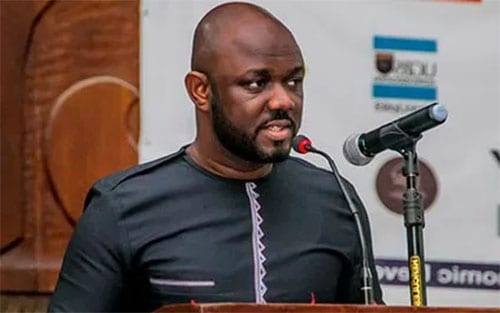
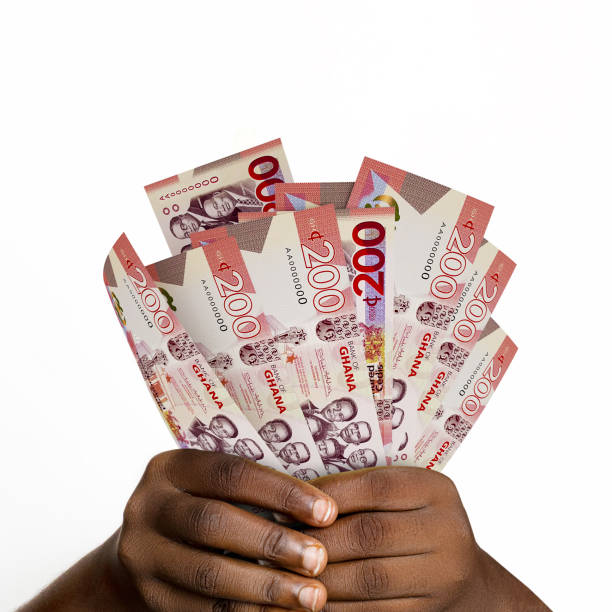
  • 89 arrested in police’s intensified effort to avert post-election violence

    89 arrested in police’s intensified effort to avert post-election violence

    Security forces are now focusing on maintaining peace and order following the recent elections. Extra steps have been taken to ensure safety and prevent any further disturbances.
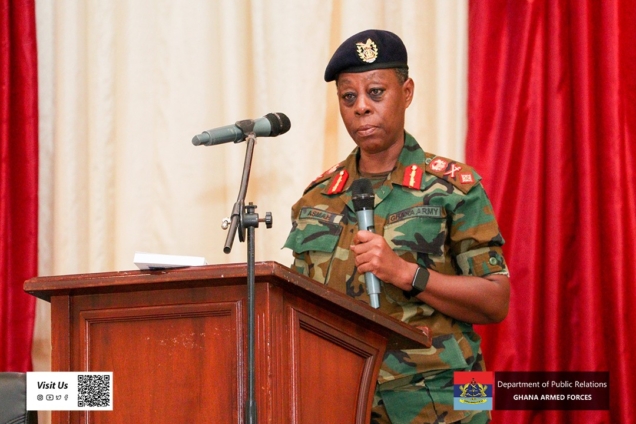
    While there have been a few instances of looting, vandalism, and property damage in some areas, authorities are actively addressing these incidents.

    According to ACP Grace Ansah Akrofi, the Director of Public Affairs, 89 people have been arrested so far for their involvement in various crimes related to these acts. Of these, 40 individuals are directly connected to the vandalism, looting, and destruction of property, and all will face court action.

    ‘We would like to caution the public to desist from such acts of violence since the perpetrators will be arrested and taken through the due process of the law”.

    Some of the measures put in place to ensure safety and security include; “showing visibility through patrols with the other security agencies, conducting intelligence-led operations within communities to fish out perpetrators, providing static security at targeted state facilities, engaging government officials and other stakeholders through reaching out to them, a special investigation team reviewing all videos that have come to our attention to help identify perpetrators and take them through the due process of the law.

      ACP Ansah Akrofi said, ‘We would also like to thank the all Ghanaians for their support throughout the process we urge all stakeholders to remain calm and wish to assure you of safety and security as well as the protection of properties”.

    1. Taptap Send resumes operation after BoG’s one-month suspension

      Taptap Send resumes operation after BoG’s one-month suspension

      Taptap Send, one of the leading money transfer companies, has officially resumed operations in Ghana after a temporary suspension issued by the Bank of Ghana (BoG).

      Darryl Mawutor Abraham, Head of Taptap Send Africa, expressed enthusiasm about the service’s return, stating, “We are excited to resume transfers to Ghana for the thousands of Ghanaians who have come to rely on Taptap Send for their money transfers over the years.” 

      He also extended gratitude to customers for their patience and support during the suspension, adding, “We remain committed to serving the Ghanaian diaspora in full compliance with all applicable regulations.”

      In November, the Bank of Ghana (BoG) issued a one-month suspension of all partnerships between Taptap Send and electronic payment service providers (EPSPs) and commercial banks in Ghana.

      The regulatory action came as a response to Taptap Send’s operation of a cedi-denominated remittance wallet, which BoG states is in violation of section 3(1) of the Foreign Exchange Act, 2006 (Act 723), as well as sections 7(b), 7(d), and 7(e) of the Updated Guidelines for Inward Remittance Services for Payment Service Providers.

      The resumption of the institution’s operation now enables thousands of Ghanaians to send and receive money without delay. Ghana is a key market for the company, which provides money transfer services to over 40 countries globally.

      Taptap Send operates digitally across several regions, including the UK, Europe, the USA, Canada, and the UAE.

      Committed to the United Nations’ Sustainable Development Goal of reducing remittance costs to below 3%, as well as adhering to all relevant regulations while maintaining its operations. 

    2. From Pink Sheets to Digital Platforms: The Future of Election Management in Ghana

      From Pink Sheets to Digital Platforms: The Future of Election Management in Ghana

      Ghana’s 2024 elections have once again demonstrated the country’s strong democratic spirit, with peaceful voting and the active participation of millions. However, delays in announcing official results continue to create anxiety and raise questions about the efficiency of the process. More than 40 hours (as of the time of writing) after polls closed on December 7, the Electoral Commission (EC) had not certified a single regional result out of Ghana’s 16 regions.

      This delay persists despite the transparency shown by the EC, which has included frequent media updates, real-time media access to the national collation centre, and efforts to counter mis/disinformation. While these steps deserve praise, they have not been enough to calm the growing frustration and tension.

      Interestingly, both the ruling New Patriotic Party (NPP) and the opposition National Democratic Congress (NDC) were able to independently collate their results well before the EC’s official announcement. This demonstrates that timely collation and transmission of results are indeed achievable. The question, therefore, is why the EC, with its superior resources and mandate, is unable to match this speed.

      The EC, as of December 2024, employs a dual system to transmit election results. Pink sheets – official documents recording results at polling stations – are transported physically to collation centres, where they are aggregated at the constituency level and then compiled at the regional level before being electronically transmitted through a secure system to the national collation centre at the EC’s headquarters. This dual approach is designed to ensure accuracy and provide a reliable backup for verification.

      Pink Sheets
      While this system is thorough, it is also slow. The physical transportation of pink sheets faces delays due to logistical challenges, chaotic scenes at collation centres, and the actions of some citizens who flood these centres claiming to be vigilant. These gatherings often lead to confusion, delays, and even violence. For example, in the 2020 elections, violence at the Techiman South collation centre tragically resulted in deaths when security forces fired shots to disperse crowds.

      In this election, leadership played a crucial role in maintaining peace. Dr. Mahamudu Bawumia, the NPP candidate and sitting Vice President, conceded defeat just 16 hours after polls closed, congratulating the opposition NDC’s John Dramani Mahama. This quick and gracious concession helped calm tensions and showed political maturity. Without this decisive act of leadership, the atmosphere in the country could have been far more volatile.

      In the current election, the EC has had to repeatedly plead for patience, especially after the concession speech by Dr. Bawumia, as they wait for faxed results from the regions. This outdated method of transmission feels inadequate in a world where secure digital systems can provide instant updates. If political parties can collect, verify, and tabulate results efficiently, then the EC should be able to do so even faster.

      The delays in announcing results are not just an inconvenience; they pose a real threat to Ghana’s stability and democracy. When results take too long, rumours and mis/disinformation fill the void, creating tension and mistrust. Large gatherings at collation centres increase the risk of violence, as seen in the current and past elections.
      The ability of political parties to independently and efficiently collate results proves that the current system’s inefficiencies can be overcome. Modernizing the electoral process would address these challenges by making it faster, more efficient, and safer.

      One of the most effective steps would be digitizing the pink sheets, which are currently transported physically to collation centres. Polling station officials could be equipped with secure devices to scan and upload these sheets directly to a central server. This would allow results to be transmitted instantly while maintaining their accuracy and credibility.

      In addition, a real-time public updates system could be introduced. By creating a secure online platform, the EC could enable citizens to monitor results as they are transmitted from polling stations to regional and national collation centres. This transparency would reduce anxiety and curtail the spread of mis/disinformation while reinforcing public trust in the electoral process.

      Another important step is improving oversight by leveraging digital tools. Party agents and independent observers could have real-time access to the transmitted results, allowing them to verify data and flag discrepancies as they arise. This would enhance accountability and ensure that any issues are addressed promptly.

      The fact that both major parties could tabulate their results within hours demonstrates that the EC can achieve the same speed with better resources. Implementing these changes would not only accelerate the collation and announcement of results but also help prevent the chaotic and sometimes violent scenes that occur at collation centres. By reducing the need for large crowds to gather, the risk of tension and conflict would also be significantly diminished.

      Implementing these changes requires a commitment to training and public education. Electoral officials must be trained to use the new technology effectively, and citizens must be educated on how the updated process works to ensure widespread acceptance and trust.

      By adopting modern systems and prioritizing efficiency without compromising credibility, Ghana can continue to lead the way in democratic excellence. It’s time for the EC to embrace change and ensure that the voice of the people is reflected swiftly, safely, and credibly.

      The writer is a development communication and communication policy expert. He is the Head of Institutional Development, Monitoring, Evaluation, and Learning at the Media Foundation for West Africa.

      Source: Myjoyonline.com

      DISCLAIMER: Independentghana.com will not be liable for any inaccuracies contained in this article. The views expressed in the article are solely those of the author’s, and do not reflect those of The Independent Ghana

    3. Cedi projected to strengthen over peaceful 2024 elections and Mahama’s win

      Cedi projected to strengthen over peaceful 2024 elections and Mahama’s win

      The peaceful conduct of Ghana’s 2024 general elections is projected to benefit the cedi, with many observers expressing optimism about its stability in the coming days.

      Former President John Mahama has been declared the winner of the 2024 general elections, securing 6,328,397 votes, representing 56.55%.

      Dr. Mahamudu Bawumia, the Vice President and NPP presidential candidate, garnered 4,657,304 votes, amounting to 41.61%, in the 2024 general elections.
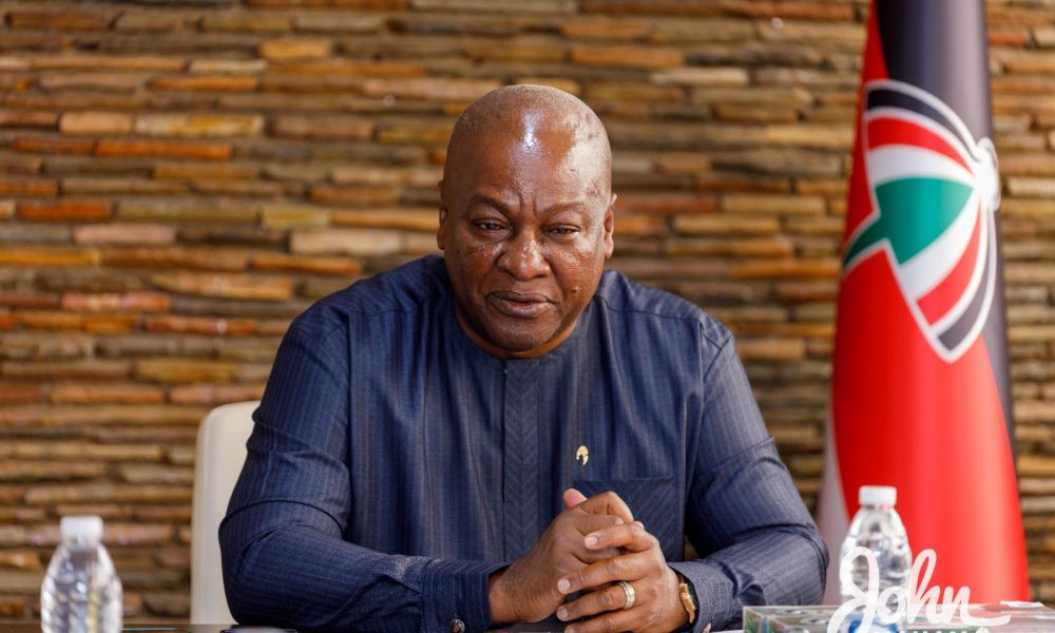
      Ahead of the December 7 elections, the Bank of Ghana assured the public of sufficient dollar buffers to maintain cedi stability despite potential uncertainties.
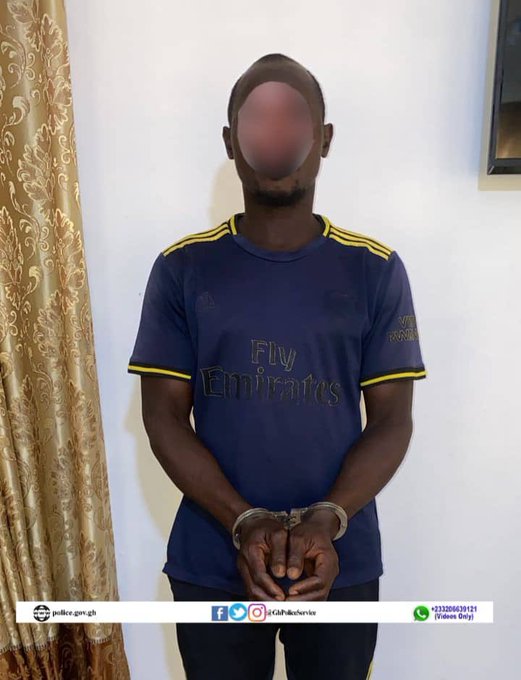
      Market analysts suggest that the peaceful nature of the December 7 elections has mitigated concerns about cedi depreciation, fostering expectations of gains in the near term.

      Ghana’s peaceful election process is viewed as a testament to its matured democracy, bolstering investor confidence and signaling stability to donor partners.

      Dr. Bawumia’s decision to concede defeat has been commended by offshore investors, who see it as a step toward maintaining economic and political stability.

      As of December 10, 2024, forex rates show the dollar trading at GH₵16.20 in some bureaus, while commercial banks are selling it at GH₵14.80.

      The cedi is anticipated to gain strength in the aftermath of the peaceful 2024 elections, with observers highlighting the positive market sentiment.

      Following the elections, forex bureaus recorded the dollar at GH₵16.20, while the British Pound and Euro traded at GH₵20.20 and GH₵17.00, respectively.