Author: Amanda Cartey

  • Notorious robber in Ashaiman ‘Wonder’ arrested by police

    Notorious robber in Ashaiman ‘Wonder’ arrested by police

    A joint intelligence-led operation between the Atadeka Police Patrol Team and the Ashaiman Police Intelligence Directorate has resulted in the arrest of a notorious 25-year-old armed robbery suspect, Seth Tetteh, popularly known as ‘Wonder’.

    He is known to be a ringleader of a robbery syndicate operating across Ashaiman and its environs

    According to a report by Myjoyonline.com, his arrest followed the earlier detention of his two accomplices, who are currently on remand, standing trial at the Ashaiman Circuit Court.

    ‘Wonder’ was detained around 3:00 p.m. near the Ashaiman China Mall area, and authorities believe his arrest will significantly disrupt criminal activities targeting businesses and residents within the municipality.

    The arrest represents a major breakthrough for the Tema Police Command as it intensifies efforts to clamp down on violent crime within the municipality.

    According to police, Wonder is a well-known repeat offender linked to several violent incidents, including residential, street, and industrial robberies.

    Investigators also identified him as the mastermind and leader behind a recent armed robbery at a concrete yard factory.

    In the aftermath of his arrest, the Tema Police Command issued a strong caution to the public about the purchasing of stolen goods, especially electronic devices that criminals often sell at low prices.

    “Police is using this medium to caution receivers of stolen phones, as their arrest has legal consequences for dishonestly receiving.”

    The Command also expressed appreciation to its leadership for the support extended toward ongoing security operations.

    In September, ten people suspected of carrying out armed robberies on rural banks and financial institutions nationwide were taken into custody by the Ghana Police Service.

    A special operation led to the arrest of the group, who had long instilled fear in communities across the Ashanti, Ahafo, Western, Central and Eastern regions.

    Among those detained were the supposed leader, Akwesi Agyei, known as Cobra, together with Ibrahim Alhassan, Samuel Appiah (Akwesi Mugu), Francis Acquah (Preman), David Obuobi (Wasty), Martin Akansina (One Billion), Nana Yaw Frimpong (Mystical), Kojo Atingawo (Borga), Samuel Akwasi Gyan and Stephen Sey.

    Police confirmed that three additional members of the gang died during an exchange of gunfire, while efforts to track down the remaining suspects are underway.

    At a press briefing in Accra on September 24, 2024, Inspector-General of Police Christian Yohuno revealed that the group had operated for more than a year, creating widespread fear among residents and targeted financial institutions.

    He noted that the coordinated operation was the result of six months of intelligence gathering, surveillance and detailed investigations in areas including Ejisu Achiaakrom, Atonsu-Kyirapatre, Obuasi, Kaase and Buoho.

    Officers seized 14 firearms—ranging from AK-47s and pump-action guns to pistols—along with large amounts of ammunition, vehicles, motorbikes, mobile phones and equipment used for the attacks.

    COP Lydia Yaako Donkor, Director-General of the CID, reported that the suspects had been linked to robberies at Adansi Rural Bank (Fomena), Lower Pra Rural Bank (Inchaban), Ecobank (Kenyasi), Ahafo Community Bank (Kukuom), Asokore Rural Bank (Kumasi), and several other locations.

    At Fomena, for example, the attackers climbed over the perimeter wall, restrained the security guards and used an electric cutter to break into the vault before fleeing with cash and weapons. In the Kenyasi incident, they subdued two police officers and took their rifles.

    Investigators identified one of the retrieved rifles as belonging to Corporal Francis Adu Yaw, who died on the Bibiani-Goaso road in November 2024, while two others matched police weapons stolen during the Kenyasi Ecobank robbery.

    COP Donkor indicated that Cobra was apprehended on September 18 at Esereso Adagya, where officers discovered two rifles hidden underwater and a Toyota Noah minibus.

    His arrest paved the way for more breakthroughs, including the capture of David Obuobi (Wasty), in whose possession police found pump-action guns, pistols and ammunition.

    Investigators later picked up another suspect, Stephen Sey, who had a stolen police rifle concealed inside his vehicle.

    She added that some of the arrested individuals have admitted their roles, and both identification parades and items retrieved from them have linked the suspects to the various crimes.

    The police say investigations are still ongoing as they move to apprehend the rest of the syndicate members.

    In 2024, the Ghana Police Service made significant strides in the fight against crime by securing convictions for five armed robbers involved in a string of robberies and carjackings in the Ashanti Region.

    The convicted individuals—Jeffrey Dwomoh, Clifford Opoku, Kwabena Kyei Barfour, Prince Opuni, and Henry Kusi Marfo—were all arrested in 2023.

    Two other suspects, Richard Dogbatsey and William Ansah, were acquitted of the charges related to aiding the robbery.

    Jeffrey Dwomoh and Clifford Opoku received hefty sentences of 120 years each in hard labour after being found guilty of conspiracy and robbery.

    Kwabena Kyei Barfour was sentenced to 105 years in hard labour for dishonestly receiving stolen goods.

    Prince Opuni faced charges for reckless driving and was fined 350 penalty units, which translates to 10 months in hard labour if unpaid. He was also ordered to pay GH¢5,000 for damaging a police vehicle.

    Henry Kusi Marfo was convicted of supplying ammunition for robberies. He was fined 1,050 penalty units or 15 months in hard labour, a fine he has already settled.

    The Police Service has shared the convicts’ photos on Facebook, making it clear that these individuals are now confirmed convicts, not just suspects.
  • “Zipline’s presence in this country is a mistake” – Nabdam MP

    “Zipline’s presence in this country is a mistake” – Nabdam MP

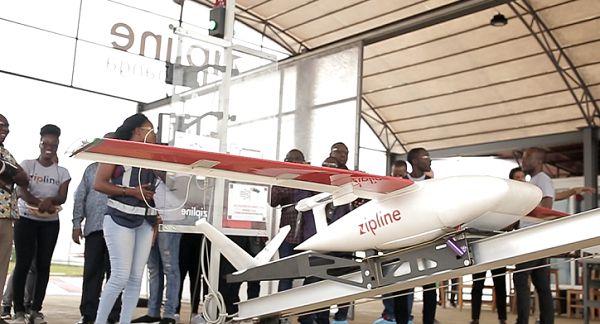
    Chairman of Parliament’s Health Committee, Dr. Mark Kurt Nawaane, has said that the presence of Zipline was a mistake in the first place.

    According to him, Mahamudu Bawumia misdiagnosed the health sector’s real challenges.

    “Zipline’s presence in this country is a mistake,” he said. He emphasized that this is not a political statement but an observation on mismanagement,” he told journalists in Accra.

    Dr. Nawaane stated that the main issue is not transportation of medical supplies. Instead, it is the ongoing shortage of voluntary blood donors nationwide.

    He noted that the funds allocated to Zipline could have been used to equip hospitals with cold rooms, which are vital for preserving blood and other critical medical supplies.

    “If we wanted to establish cold rooms over the past five years, we could have done it,” he noted.

    His comments come at a time when discussions surrounding Zipline’s future are becoming more heated in Ghana, with increasing pressure from lawmakers such as Majority Leader Mahama Ayariga to end the company’s contract.

    They argue that Zipline represents poor use of public resources and does not provide value for the money spent.

    Health Minister Kwabena Mintah Akandoh explained that talks with Zipline are still underway, and no definite decision has been reached about the company’s future.

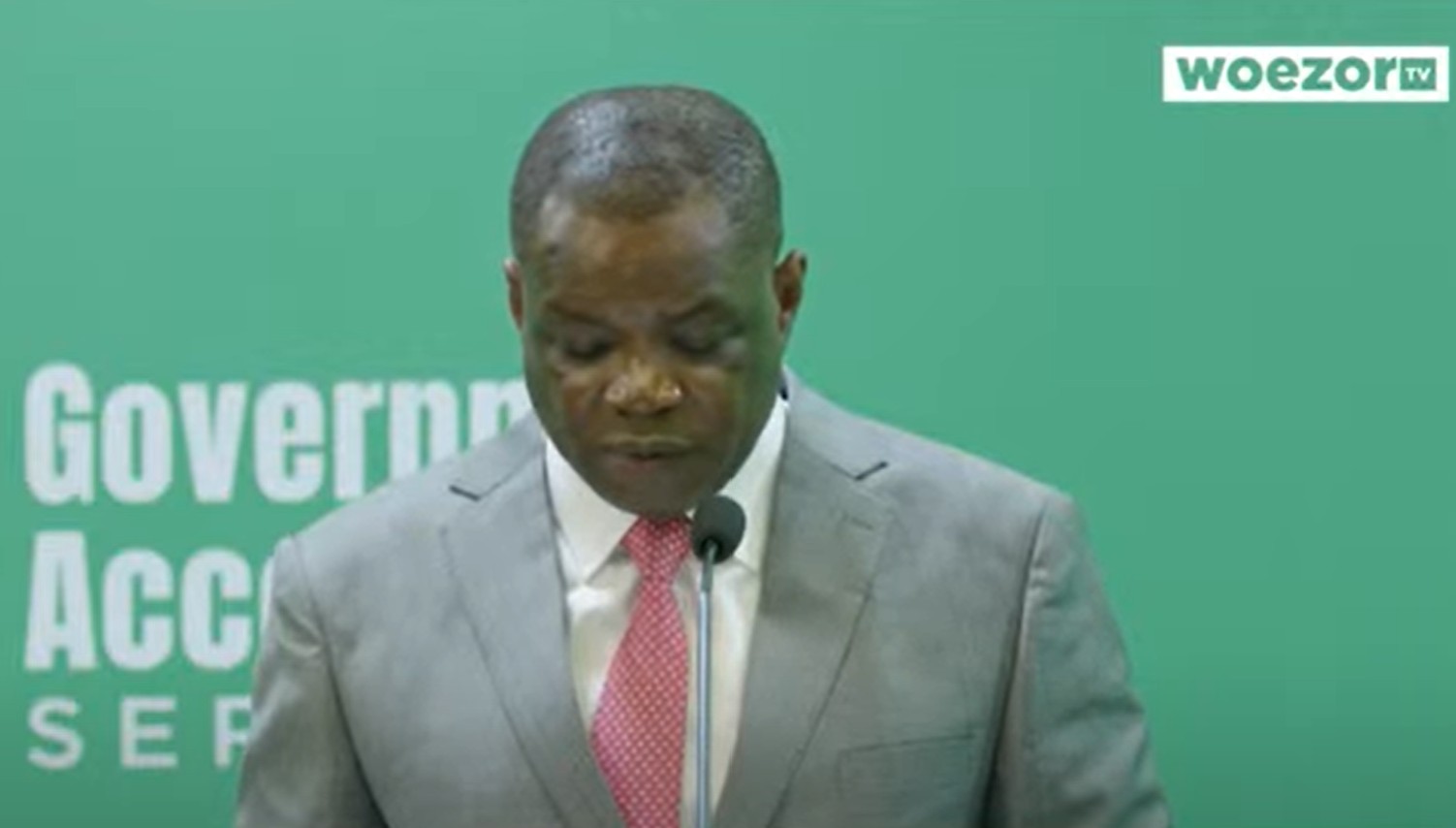
    Speaking at the Government Accountability Series on December 1, he noted that engagements with Zipline are ongoing. “When we get there, you will hear what decision we will take,” he assured.

    Health Minister Kwabena Mintah Akandoh has confirmed that government is required to pay Zipline over $500,000 each month, irrespective of the volume of medical supplies delivered.

    He explained at the Government Accountability Series in Accra on Monday, December 1, 2025, that the 2018 ‘take-or-pay’ sole-sourced contract places colossal financial burden on the government purse.

    “For every month, the government is supposed to pay $88,000 per centre. So with six centres, we are paying a little over $500,000 every month,” he said.

    Under the terms of the contract, which began in 2019, each operational hub attracts a fixed monthly fee and the system prevents any adjustment in expenditure, irrespective of reduced activity levels or shifts toward non-critical deliveries.

    The minister described the agreement as a “sole-sourced contract” that effectively “binds government to continuous payments,” underscoring the lack of fiscal flexibility.

    The Majority Leader in Parliament, Mahama Ayariga, has indicated that the government cannot continue to spend GHS170million annually for the Zipline to be sending blood and other products to health facilities using drones.

    Responding to concerns raised by the Minority Leader, Alexander Afenyo-Markin, over the cancellation of the contract, Mr Ayariga explained that the Ministry of Health should have bought its own drones after all those years the contract had existed.

    “…you cannot continue spending that kind of money that you are paying a service provider, as it is a total waste of money,” he said on the floor of Parliament on Friday, Nov 28, 2025.

    Mr. Afenyo-Markin then urged that the Minister of Health address the matter, particularly the measures being taken to resolve it, “because it is not those of us in the cities that will suffer from this shutdown.”

    “It is those in the rural areas who otherwise would need emergency medical care and if there is blood, there is the need for them to get blood transfusion as quickly as possible,” he said. 

    He recalled that the Zipline contract was signed somewhere in 2021, but such a contract had been a drain on national resources. 

    “Can you imagine every year we are spending GH¢170 million so that they will go and drop blood in some village and then come back?” 

    “Meanwhile, there is a road network leading to almost every town, every community in this country, and there are only a few locations that you would say the roads are not accessible,” Mr Ayariga said.

    The Bawku Central MP argued that the money spent could have been invested in tarring roads to all the regions Zipline served, while the GHS could have obtained drones to make deliveries on its own schedule.

    The Leader asked about the price of drones, stating that some models are sold for $4,000–$5,000, while the costliest drones stay below $10,000–$20,000.

    “By now we would have had drones for every district in this country managed by the Ghana Health Service. 

    “Let us go and do a total calculation of how much money we have wasted on this Zipline contract,” he said.

    On the 6th-year anniversary of commencing operations in Ghana, Zipline, the world’s largest autonomous logistics system,

    has successfully delivered more than 8.4 million medical products in the country, marking a major milestone in the country’s journey toward equitable healthcare access.

    Since its launch in 2019, Zipline has served as a critical infrastructure partner for the Government of Ghana. 

    It has delivered more than 8.4 million medical units – including medications for malaria, HIV, and TB, family planning products, blood products, vitamins, nutritional products, medicines for pregnant women, and more than 17 million vaccine doses – to over 3,000 hospitals, health centers, and CHPS compounds in 14 regions of the country.

    Operating from six hubs, Zipline’s autonomous drones enable real-time delivery of medical products regardless of weather, terrain, or infrastructure challenges – revolutionizing last-mile delivery in the health sector. 

    In 2021, Zipline partnered with Gavi and the UPS Foundation to deliver the COVID-19 vaccine and has since delivered more than 3.4 million doses, including hundreds of thousands of mRNA vaccines.

    Research conducted shows that the company disproportionately serves the most vulnerable populations in Ghana, with rural and hard-to-reach districts receiving 30 percent more COVID-19 vaccines than less remote districts during the COVID-19 pandemic. 

    Zipline is set to scale up its life-saving drone delivery services across Africa following a landmark $150 million pay-for-performance commitment from the U.S. Department of State.

    The initiative will boost the company’s AI and robotics infrastructure and strengthen support for African governments implementing national health logistics systems. Under the expanded programme, more than 10,000 additional health facilities and community drop sites are expected to be added, enabling on-demand delivery of essential medicines to over 130 million people.

    The expansion is also projected to generate more than 800 high-tech jobs on the continent and unlock over $1 billion in annual economic growth.

    According to Zipline, the partnership marks a new phase in global health delivery—one driven by African leadership, advanced technology, and measurable impact.

    Country Director, Daniel Merki, joined Citi FM on November 2022, to discuss how Zipline is working with the Government of Ghana to transform healthcare access,

    According to him, it has made over 800,000 deliveries nationwide to a 56% drop in maternal deaths in Zipline-supported areas.

    “Zipline is more than a service provider; we’re infrastructure in service of the government’s agenda,” he added.


  • What happened to Ghana’s 1 Million coders promise? Seven months on, silence and frustration linger

    What happened to Ghana’s 1 Million coders promise? Seven months on, silence and frustration linger

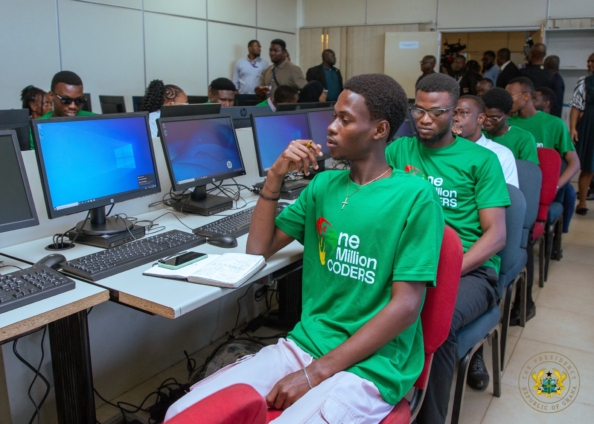
    When the National Democratic Congress (NDC) government took office in January, one of its most talked-about promises was to create one million Ghanaian coders.

    The initiative, spearheaded by the Minister of Communication, Digital Technology, and Innovation, Sam Nartey George, was meant to move toward a knowledge-based economy—one where Ghanaian youth would drive innovation in software, artificial intelligence, and digital entrepreneurship.

    Six months after its grand launch in April, however, the One Million Coders initiative has all but vanished from public view.

    According to multiple sources, the One Million Coders Programme in Ghana was allocated GH¢100 million by the government.

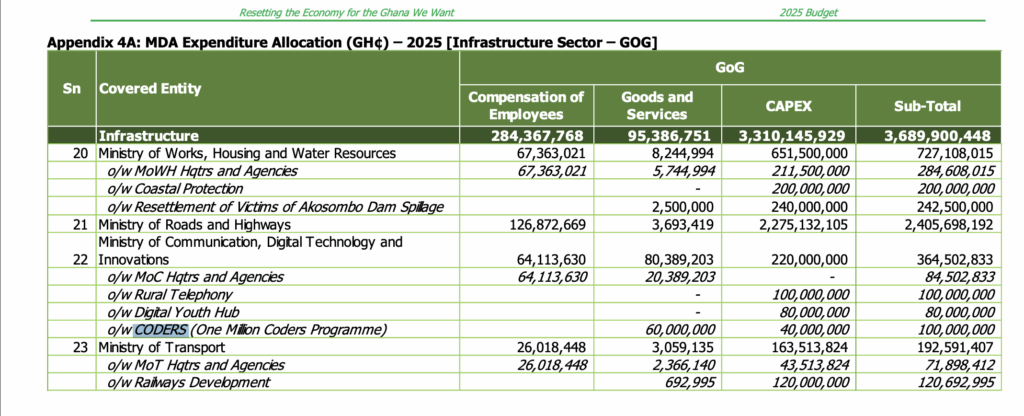
    Additionally, in the 2025 budget statement for the Ministry of Communications, Digital Technology & Innovations, the line-item for “CODERS (One Million Coders Programme)” shows GH¢100 million (split as GH¢60 million + GH¢40 million) under the ministry’s allocation. 

    Screenshot of the split budgetary allocation

    The Big launch that stirred hope

    The initiative was launched with fanfare at the Kofi Annan Centre of Excellence in ICT in Accra, promising free training in coding, AI, cybersecurity, and software development.

    It was to be powered by the online platform 1millioncoders.gov.gh, through which participants would register, take an aptitude test, and begin remote learning before being assigned to in-person training centres nationwide.

    The launch generated excitement across the country.

    Thousands of young people registered online, sharing screenshots of their application confirmations and hopeful tweets about finally getting a chance to learn to code.

    Screenshot of a post made on X after its launch

    Months Later, the Silence Is Deafening

    Today, many of those same young people are asking: What happened to the program?

    On X (formerly Twitter), the hashtag #1MillionCoders has become a growing hub of frustration.


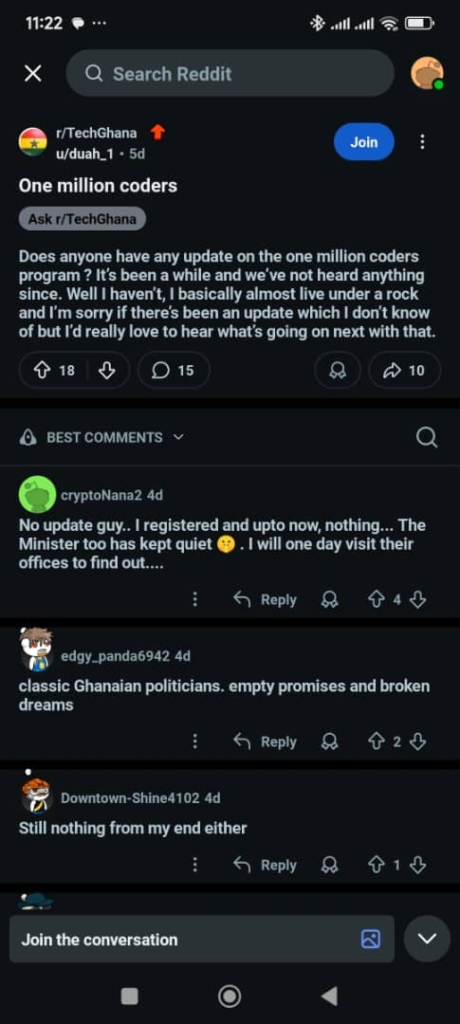
    On Reddit, similar sentiments have surfaced across threads in r/TechGhana with users describing the program as “an empty promise.”

    A screenshot of a Reddit thread

    A Registrant’s Story: From Hope to Disappointment
    One registrant, Jehiel Britstot Houmanou , spoke at length about his experience.

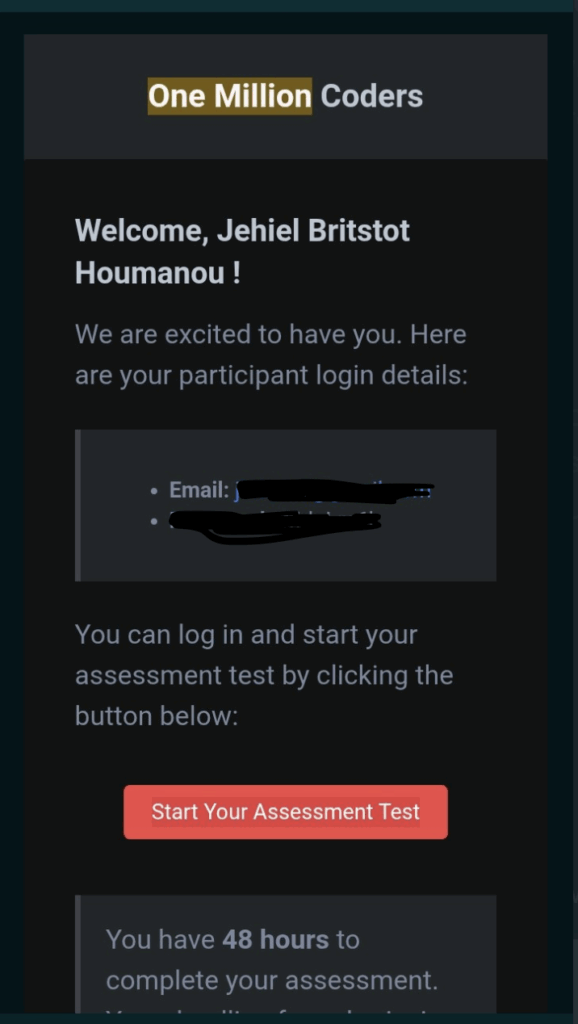
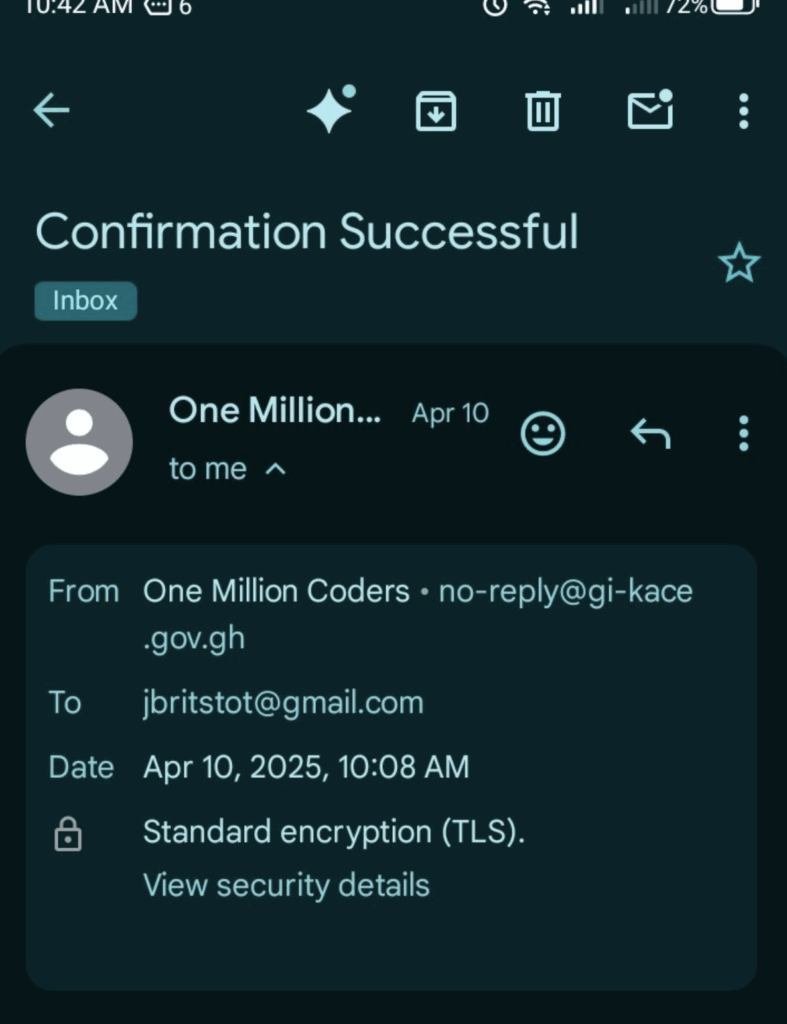
    “After the publicity, a friend told me about it. He had already taken the test, so I tried it too. I registered, received an email with my logins, and took the aptitude test. Later, my coursemates said they had also joined. Everyone was excited because Sam George was engaging the media and President Mahama had even acknowledged the initiative,” he said.

    Screenshot of his assesment details

    He recalls that the Kofi Annan ICT Centre was mentioned as one of the venues for physical sessions.

    “We were told we’d start classes soon after the launch,” he added.

    But months later, nothing followed.

    “Till date, I haven’t received an email to show whether I was accepted or not. None of the people I know who took the test have had any feedback. It’s like the whole thing just disappeared.”

    He had selected the Cybersecurity and Networking Track, hoping to gain practical experience. But with his National Service now underway, he says the window of opportunity is closing.

    OSINT Findings: Technical Snapshot of the One Million Coders Website
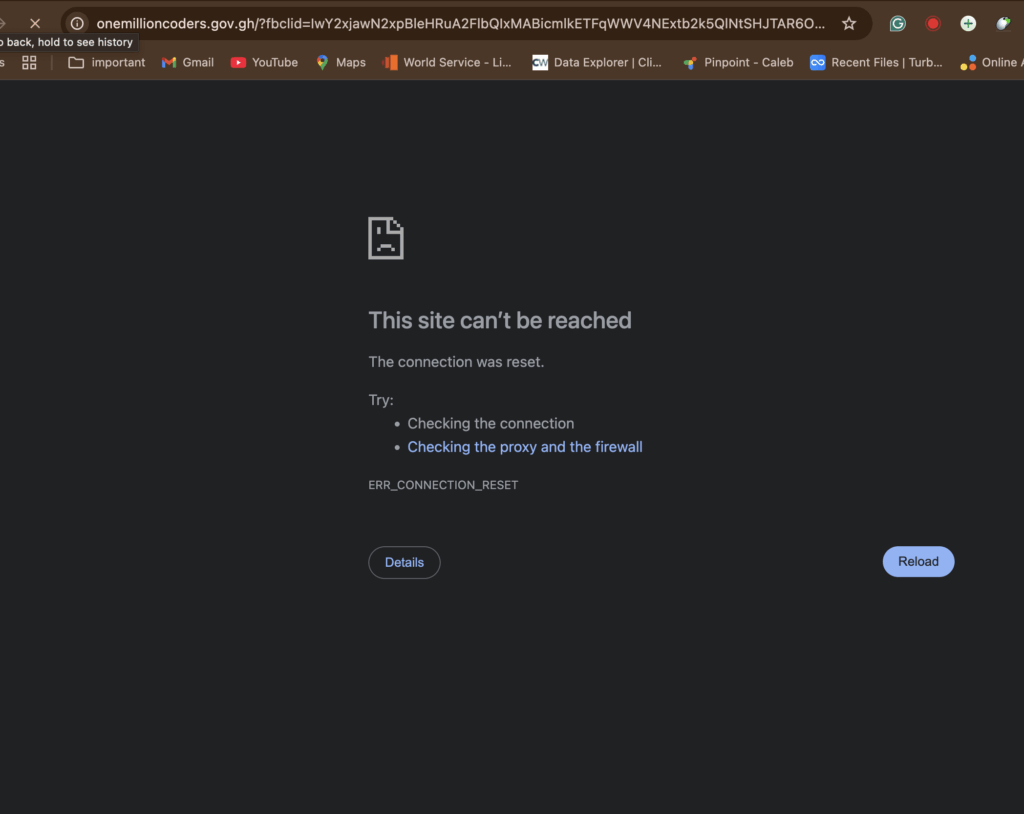
    An open-source intelligence (OSINT) analysis of the One Million Coders website (onemillioncoders.gov.gh) reveals that the platform is largely inactive or misconfigured.

    An SSL Labs assessment conducted on November 4, 2025, returned an error stating, “Assessment failed: Unable to connect to the server.”

    The site’s IP address (104.155.145.213) failed to respond to secure connection requests, with multiple error flags including “No secure protocols supported,” “Failed to obtain certificate,” and “Handshake failure.”

    These findings indicate that the website lacks a valid SSL certificate and is not currently supporting modern encryption protocols such as TLS 1.2 or 1.3.

    Additionally, the report shows possible firewall or server misconfigurations, suggesting that the domain may either be offline or its backend infrastructure has been disabled.

    The presence of an outdated “version 1 certificate” entry hints at an abandoned or unfinished deployment process.

    Overall, these technical lapses confirm that the platform — which was meant to drive the government’s 1 Million Coders initiative — is non-operational as of this assessment, raising further questions about the project’s digital readiness and transparency.

    A screenshot of the resullts after accessing the website

    OSINT Findings: The Digital Trail Behind the “One Million Coders” Website
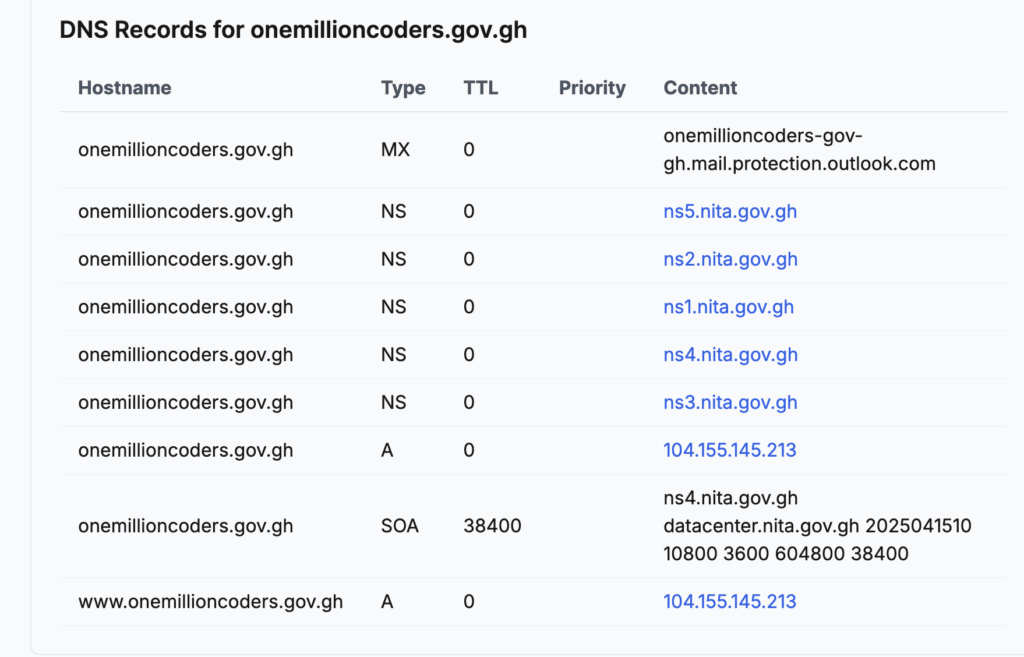
    A DNS lookup shows that the website is hosted under the National Information Technology Agency (NITA) domain infrastructure — specifically pointing to multiple NITA-managed nameservers such as ns1.nita.gov.gh, ns2.nita.gov.gh, and ns5.nita.gov.gh.

    This confirms that the site was officially registered and operated under a government-controlled system, not a private contractor. Its primary IP address, 104.155.145.213, routes through a datacenter also associated with NITA’s infrastructure, indicating the state’s involvement in provisioning the hosting environment.

    However, the SSL report exposes serious configuration and security failures. The site failed to establish a secure connection due to an invalid or outdated SSL certificate, described as a “version 1” type — a protocol so obsolete that modern browsers automatically reject it.

    Additionally, the domain does not support modern encryption standards (TLS 1.3), leaving it vulnerable to data interception.

    The DNS records show that while mail exchange (MX) is configured to use Microsoft Outlook’s protection service (mail.protection.outlook.com), no functioning web service is currently available. This mismatch — where email services remain configured but the website itself is unreachable — often points to a dormant or suspended web project.

    Further evidence comes from the SOA (Start of Authority) record, which references a datacenter timestamp dated April 15, 2025. This entry indicates when the domain’s administrative settings were last updated on NITA’s servers.

    However, despite that relatively recent timestamp, there has been no visible front-end activity or public-facing update since the initiative’s relaunch. This mismatch between backend maintenance and public functionality raises questions about whether the update was merely a routine automated system renewal or part of a genuine effort to restore the site.

    In either case, the absence of a working interface months after the relaunch suggests that the technical infrastructure remains incomplete or deliberately offline, reinforcing suspicions that the One Million Coders platform never fully materialized beyond its initial announcement.

    In plain terms, the One Million Coders domain looks like an empty digital shell — once linked to a legitimate government platform but now left unsecured and inaccessible. For registrants and aspiring coders who were told to rely on this portal for updates and communication, its current state reinforces growing fears that the initiative has quietly stalled.

    Website Status: Evidence of Inactivity

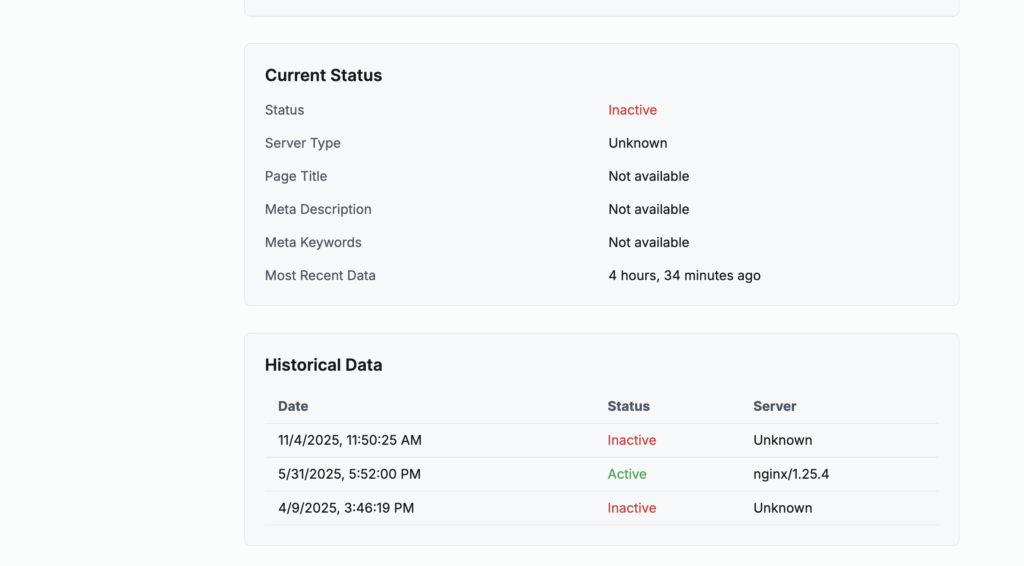
    Further OSINT evidence reinforces that the One Million Coders portal is effectively inactive. A recent scan of the site’s server records shows its current status listed as “Inactive”, with no detectable web server type, page title, meta description, or keywords.

    In other words, the platform has no functional content or accessible interface, a stark contrast to its supposed role as a live digital training hub for thousands of young Ghanaians.

    Historical server data offers a telling timeline of inconsistency. Records show that the website was briefly active on May 31, 2025, operating on an NGINX/1.25.4 server — an open-source web server widely used for hosting interactive platforms. However, both before and after that short window of activity — on April 9, 2025, and again on November 4, 2025 — the site reverted to an inactive state, with no traceable server configuration.

    This pattern suggests either temporary testing or stalled development, rather than a continuous, maintained government program. The site’s repeated shutdowns within months of each other imply that the infrastructure may have been set up only for the initial launch period and then abandoned soon after publicity.

    Source: My Joyonline.com

  • Parliament approves Health Ministry’s GHCS 2.8bn budget allocation

    Parliament approves Health Ministry’s GHCS 2.8bn budget allocation

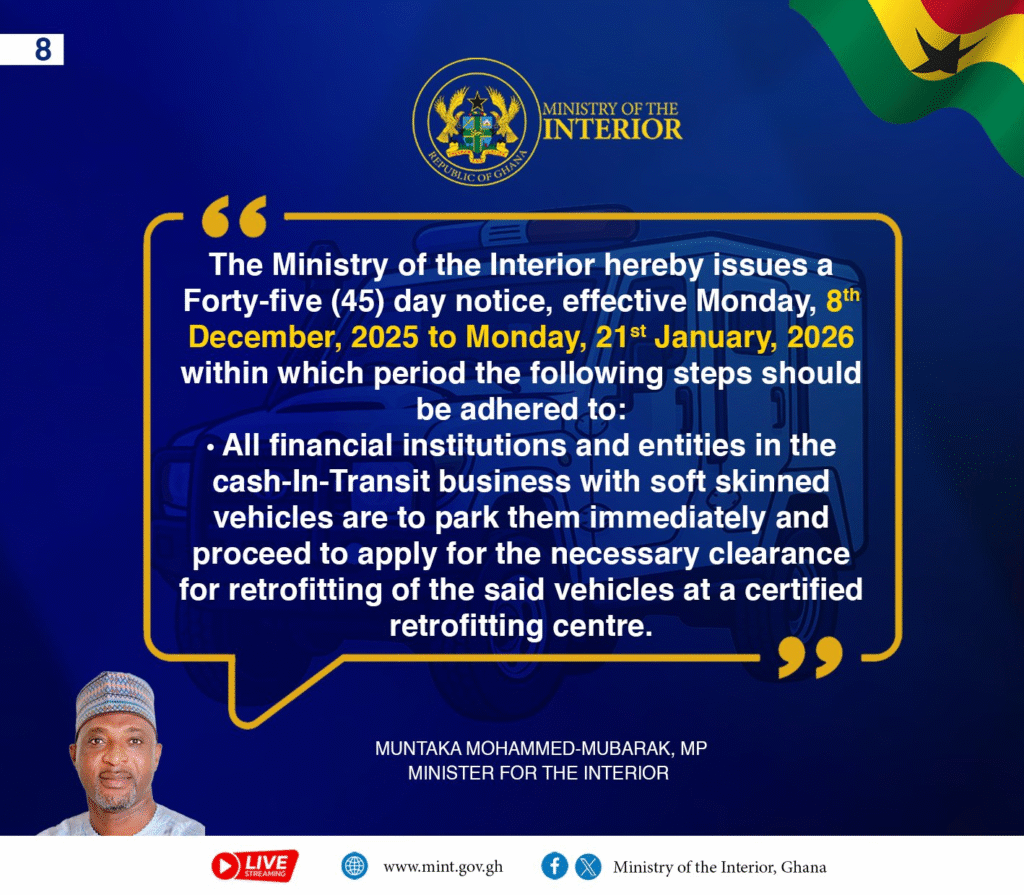
    A forty-five-day ultimatum has been issued to all companies and institutions involved in the cash-in-transit and bullion-van business to adhere to new national guidelines directed by the Ministry of the Interior.

    Interior Minister, Muntaka Mohammed Mubarak, made the announcement at a press briefing on Thursday, December 4, on the Roll Out of Guidelines and standards to regulate the importation, retrofitting, usage, and decommissioning of Armoured Bullion Vehicles.

    “The Ministry of the Interior hereby issues a Forty-five (45) day notice, effective Monday, 8th December, 2025 to Monday, 21st January, 2026 within which period the following steps should be adhered to:

    “Entities operating in the cash-In-Transit/Bullion business are to cease operations henceforth and proceed to register and acquire the needed licenses and certification from the Ministry of the Interior before operations.”

    “All stakeholders should note that, after the 45-day notice period, there shall be nationwide enforcement and full implementation of the Guidelines and Standards including taking legal action and applying sanctions against those who breach the directives,” he said.

    He also asked, entities engaged in the retrofitting of Armoured Bullion Vehicles for the cash-In-Transit/Bullion services are to cease operations henceforth and proceed to register and acquire the needed licenses and certification from the Ministry of the Interior before operations.

    The Ghana Police Service and the Bank of Ghana are therefore expected to strictly enforce these guidelines and standards alongside the Standard Operating Procedures on Armoured Bullion Vehicles (ABVs).

    In 2023, bullion van robberies occurred in broad daylight in the country, particularly in the capital city of Accra.

    It posed significant dangers to public safety and the overall economy of the country.

    Despite the presence of stringent surveillance systems, substantial amounts of money were stolen, and police escorts were shot and killed.

    One police officer who unfortunately died in the Ablekuma Bullion Van Robbery event was promoted from General Lance Corporal to General Corporal posthumously.

    The solemn announcement was made during a pre-burial service held at the St. George Catholic Church in Tesano, Accra, as a heartfelt tribute to the fallen hero, Callistus Amoah.

    General Corporal Callistus Amoah, while on official duty in a bullion van at Ablekuma Fan Milk in Accra, bravely faced armed robbers at a fuel station and tragically succumbed to their gunfire.

    The news of his promotion was met with profound respect, serving as a profound recognition of his unwavering dedication and ultimate sacrifice.

    Expressing deep condolences, the Inspector General of Police, Dr. George Akufo Dampare, conveyed heartfelt sympathy to Callistus Amoah’s family and extended his support to the institutions with which the officer was associated during his honorable service.

    Dr. Dampare further assured the public that relentless efforts would be exerted to bring the perpetrators of this heinous crime to justice.

    “On behalf of my colleagues and the leadership of the Police, I extend my condolences to Amanda, the parents of my brother and the institutions that when my brother was alive was involved in. Since the incident happened, I have been in an unmeasurable pain which I have not been able to quantify and define until I came here today.

    “Calis is a colleague to all of us at the top but to me, he is a brother because the village he comes from is close to a village I have adopted because of the benevolence of an old lady towards me.”

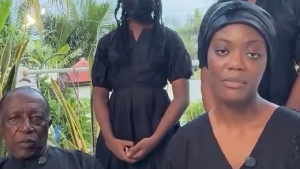
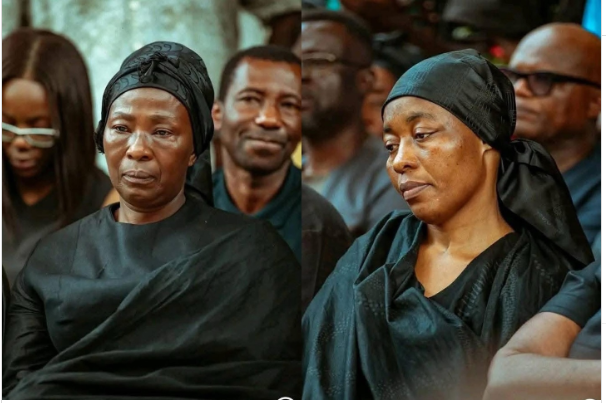
    The wife of the late Callistus Amoah, Amanda Amoah,stood before the mournful assembly and tenderly paid tribute to her beloved husband, portraying him as a remarkably generous soul.

    The gathering resonated with solemnity as friends, family, and colleagues united in remembrance, joining together to pay homage to the cherished memory of a dedicated police officer who selflessly sacrificed his life in the line of duty.

  • My two-year marriage ended in peace – Sabinus announces

    My two-year marriage ended in peace – Sabinus announces

    Popular Nigerian comedian, Chukwuemeka Ejekwu, more popular as Sabinus, has announce that his two-year old marriage to Ciana Chapman has ended.

    Addressing circulating rumors’ about marital issues, including allegations of domestic violence and infidelity, Sabinus said, “I’m not married.

    “My marriage ended peacefully. The mum and I are good. My daughter is okay, and she is doing fine,” he said during a recent TikTok live stream.

    He adds that he is on good terms with his ex-wife and continues to prioritise the well-being of their daughter.

    Controversial Nigerian broadcaster and media personality, Daddy Freeze has opened up about the collapse of his first marriage.

    According to him, he feared criticism from his church and notable figures in his life which made him maintain appearances rather than reveal the failing state of his marriage to the public. 

    In an interview with Chude Jideonwo on the “With Chude Show,” Daddy Freeze noted that he and his wife at the time weren’t even sleeping in the same room anymore, but they attended church services together.

    “The day she packed her load, the first thing that came to my mind was, ‘Ah, my pastor is going to hear about this, ,” Freeze confessed.

    At this point Daddy Freeze said he realized he was staying in the marriage because of the fear of being demoted from his position in church. 

    “I used to introduce my pastor in church. I used to go to MC church events. And I was afraid, can we manage this in such a way that nobody hears? Then I realised that I was the one putting myself in trouble,” he said.

    According to him, by the time his wife finally left, their marriage had been dead for a while.

    “This union was gone,” he admitted. “We were living in a Cool FM house.

    In Ghana, Cynthia Appiah-Kubi of Mentor II fame, known in showbiz as Cee, opened up about her status as a divorcee after several years.

    She emphasized that her decision was not influenced by instructions from God as some gospel musicians claim.

    Cee said she left her marriage because she could not endure it anymore.

    “I was married to a pastor, but I left because of certain issues and circumstances that I could not stand. He is aware of those issues. God did not tell me to leave my husband; I left because I could no longer take certain things,” she said.

    The mentor star revealed that, she had always resisted proposals to marry a man of God.

    Unfortunatley, she ended up with one and it did not last forever.

    Meanwhile, Ghanaian playwright, author, and motivational speaker, Uncle Ebo Whyte, has advised bachelors and bachelorettes not to allow themselves to be forced into marriage to satisfy societal, family, or peer pressure, emphasizing that marriage is not a requirement in life.

    “Marriage is not given to everybody. Not everybody needs to marry. Not everybody will marry. Marriage is not a magic wand. It may not deliver half of what you expect.

    So if you do choose to marry, do so because you’ve found someone with whom you genuinely want to build a life, not because society says you must,” he noted.

    Taking to his social media (Instagram) yesterday, the playwright in a video boldly challenged the longstanding norm, which asserts the need for everyone to marry, citing evolution and the growth surrounding the purpose of marriage.

    “There was a time when everybody needed to marry. That time has changed. There was a time when there was a purpose of marriage. That time has changed. There was a time when we needed to marry. That time has changed. It’s not now,” he said.

    He affirmed his stance, drawing biblical references to the teachings of Apostle Paul, which admonished that “He who marries does well. He who does not marry does even better.”

    In Ghanaian society and beyond, procreation is often emphasised to ‘pressure’ people into marriage, but Uncle Ebo Whyte argues that population control, coupled with family planning, has shifted that cultural expectation.

    “Because now we are saying there are too many people. Let’s control the population, citing his 42-year-old marriage as companionship as well. Then there’s the issue of companionship. I’ve been married for 42 years. Companionship,” he said.

    He also warned against entirely romanticising marriage, saying that it’s a commitment that requires “hard work, patience, humility, and respect,” not just love.

    Uncle Ebo reminded his audience that people can live happy lives without being married and that marital status does not define one’s values.

    “You are complete with or without marriage. Some of the most fulfilled people I know never married, and that’s perfectly okay,” he said.

    Hiplife pioneer, Reggie Rockstone, has advised that dating should be the focus of single who lack the virtue of patience.

    According him, his years of marriage experience has proven to him that marriage requires hard work and a lot of patience to sustain it.

    who are not yet married should not prioritize marriage if they have not developed the attitude of patience.

    “Just continue being in relationships and don’t think of marriage if you’re impatient. It’s a hard work, but it’s easy as well. Love is good and it’s natural to have a partner,”  he said in an interview on Joy Prime on November 19, 2025.

    Addressing the public perception that dating or marrying a celebrity is difficult, Reggie Rockstone explained that celebrities are humans too, experiencing life in different ways just like everyone else.

    “I’m like everybody else. I go through the ups and downs, I’m actually a stubborn man. Marriage is work. If you’re not patient enough, don’t try it,” he said.

  • Progress on Ofankor-Nsawam Road impressive – President Mahama

    Progress on Ofankor-Nsawam Road impressive – President Mahama

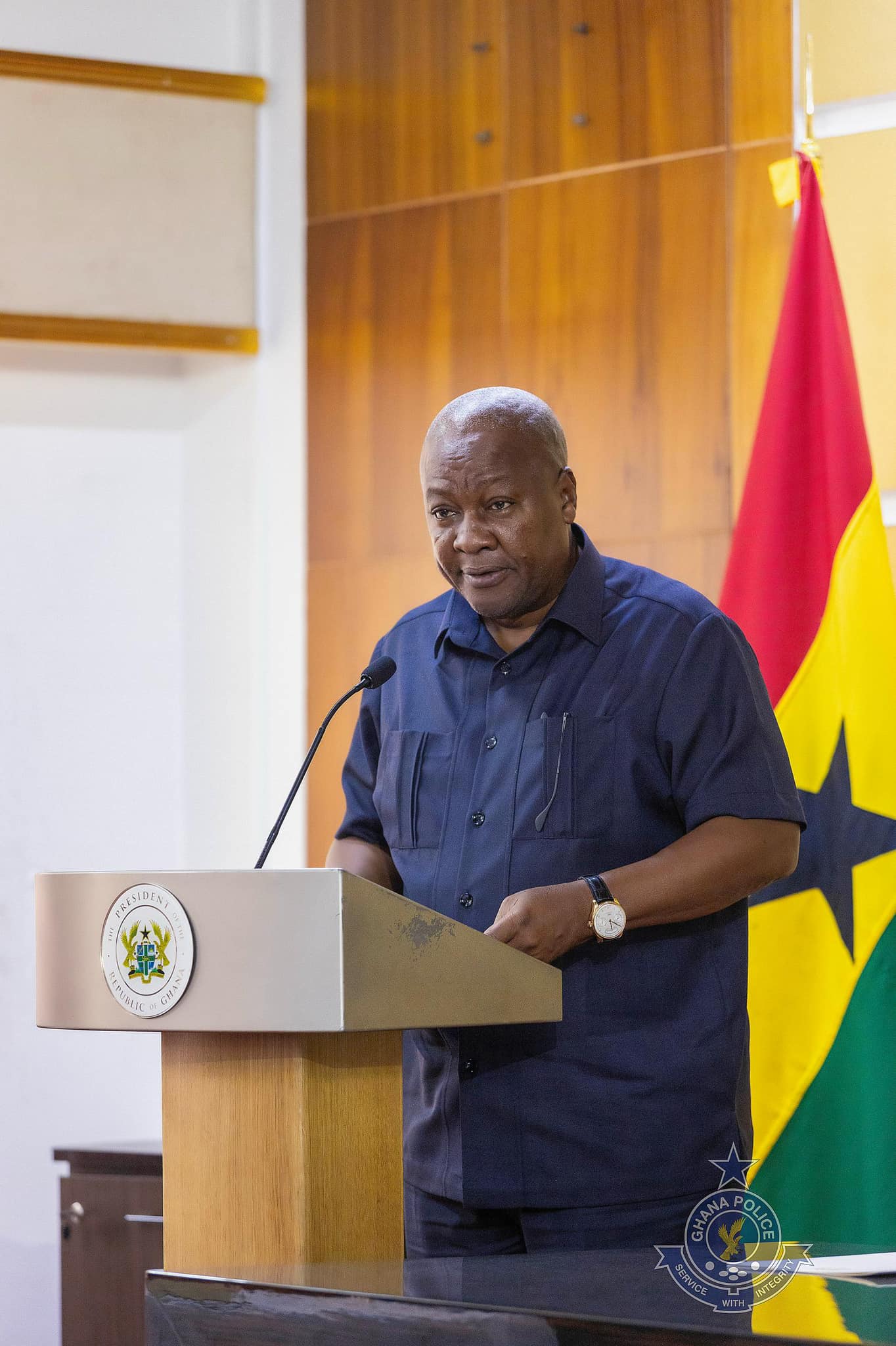
    President John Dramani Mahama has lauded the contractor in charge of work on the Ofankor-Nsawam Road during a site visit on Wednesday, December 3.

    He said, although the contractor initially projected a July 2026 completion date, the current pace suggests an earlier finish, possibly by April. He urged the team to maintain their momentum.

    “I am quite impressed with the progress that has been made. I will urge the contractor to continue to push hard. If you push hard, you will be able to finish this road and hand it over so that we can use it,” he stated.

    The President reflected on the troubling condition of the project during his previous visit, pointing out that progress had halted mainly due to unpaid contractor fees and delays in carrying out demolitions.

    “When we came, we met a road that was moving at a snail’s pace… one major issue was non-payments for work done for a very long time, so I ordered the Roads and Finance Minister to ensure payment was made. More than $70 million was paid to the contractor,” he said.

    Minister for Roads and Highways, Kwame Agbodza, has disclosed during an inspection tour of the project with President John Mahama on Wednesday, September 3, that the contractor tasked with the Ofankor-Nsawam road project received all payments owed him.

    “Your Excellency, when you assumed office, the majority of the road contractors were off-site because they raised certificates to the tune of over GHS30,000m were not paid, so they were not on site. Including the contractor working on this project.

    “You directed that we do whatever we can to make sure they return to the site. Genuinely, people who ply this corridor were going through a lot of difficulties, and you expressed clearly that it wasn’t what we wanted, and you directed that all resources should be mobilized to ensure the contractor is paid to continue the work.

    “Indeed, Mr President, at the time you took office, the contractor raised a certificate of almost $78m before NPP left power, and they did not pay him. So it was surprising that just after you took office, people were expecting that what they couldn’t do over that period, you would do it. Guess what, Mr President, you did it, as of today, every certificate owed to the contractor on this project has been paid entirely. So we don’t owe the contractor any amount on this project,” he added.

    Project Manager for the Pokuase-Nsawam Highway project, Ing. Awuku Asare, while engaging the President, confirmed receiving a recent payment from the government.

    He assured that construction works on the project will be completed in June 2026, as 75% of the work has already been done.

    “With your support and that of the Minister, the contractor has received some funding, and for the past two weeks, we have been working tirelessly. The areas where we had some challenges, where we saw on social media, we are currently almost at the level of asphalt, and then after we will continue all the way to the end,” he noted.

    In response, President John Mahama has directed the contractor to meet the project deadline, stressing that no excuses will be accepted thereafter.

    The project contractor had earlier expressed pessimism about his outfit being able to complete the road project within nine (9) months. According to him, his team is confronted with several challenges that may necessitate a request for an extension of the completion deadline.

    Among the difficulties he highlighted, Ing. Awuku Asare explained that completing the interchange alone would likely take about seven months out of the proposed nine-month duration.

    According to him, by the seventh month, they might not have even “completed the top” of the interchange.

    “Within 2 or 23 weeks, you must be done with the basic maintenance. Yeah, we have up to May 2026 to complete it, and if there are any snags, they will definitely ask for an extension. And I’m telling you one snag—it’s going to take us about 7 months to complete the interchange.

    ‘But now, if the compensation is done and we are going to count another 3 months up to November, it means we are going to start from November. Then November to May is about 7 months; we wouldn’t have completed the top. Then we… so there will be a basis to ask for any extension if it comes like that…,” he noted.

    Another setback that may delay the completion of the project is the legal tussle with affected persons, some of whom have taken the government to court over their eviction, citing delays in compensation.

    “Talking about this compensation, we have to—there are some individuals who have sent us to court. In fact, they wanted to even put an injunction on the construction works. But we just had a letter from the engineer, who is the Highway Authority, that the court didn’t grant. So we can go ahead and do the demolitions and complete them,” he added.

  • Ghana, Abbott pursue stronger ties in advanced disease-testing technologies

    Ghana, Abbott pursue stronger ties in advanced disease-testing technologies

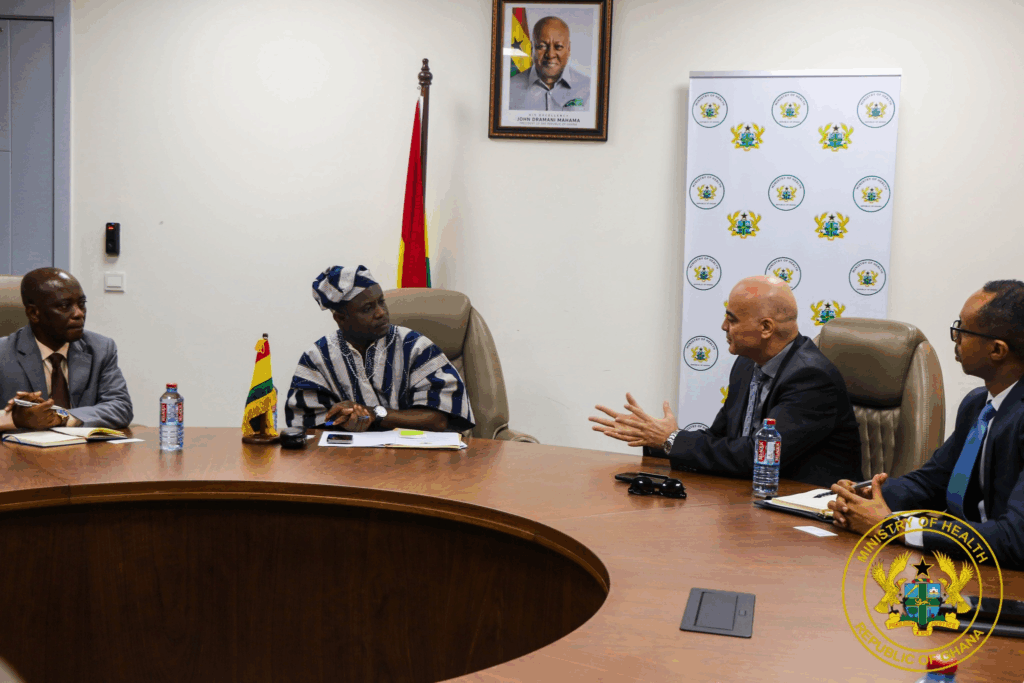
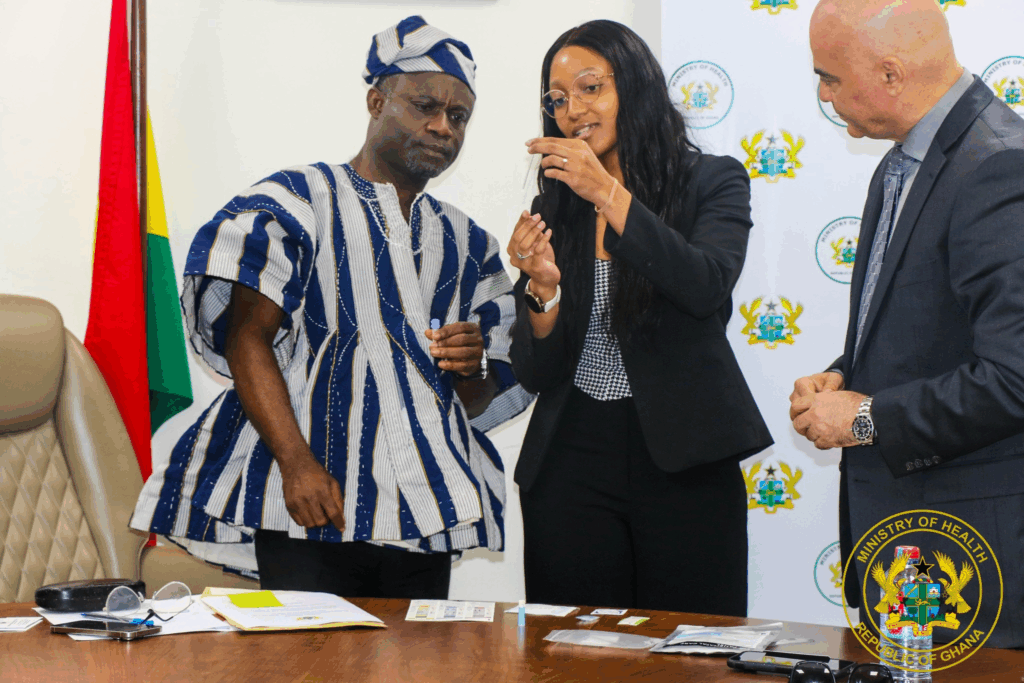
    A top-level team from Abbott, a global leader in diagnostics, medical devices, nutrition and branded generic medicines, has met with Ghana’s Health Minister, Kwabena Mintah Akandoh, to discuss potential partnerships in diagnostic technology.

    During the visit, the delegation, led by the company’s Divisional Vice President for EMEA & Global Accounts, highlighted Abbott’s newest breakthroughs, including its latest worldwide acquisition in cancer diagnostics.

    They also showcased upgraded rapid testing tools, such as a multiplex panel that can screen for HIV, syphilis and hepatitis in one test.

    The team stressed that constant innovation is vital to Africa’s efforts to manage and prevent diseases, adding that Abbott remains committed to working closely with Ghana’s health sector.

    The Health Minister expressed appreciation for the visit and reiterated Ghana’s determination to build a stronger, more self-reliant health system, especially at a time when external funding for key programmes is decreasing.

    He noted the government’s efforts to address funding shortfalls, widen access to treatment and strengthen measures that prevent infections from being passed from mothers to their babies. He also underscored the importance of partnerships that produce tangible results and meaningful benefits.

    The Minister urged Abbott to continue playing a visible and engaged role within Ghana’s health system while strengthening its partnerships with national agencies.

    He emphasised that advancing innovation, ensuring fair access to care and fostering international collaboration are essential to addressing diseases that impact communities worldwide.

    The Ministry of Health, with support from the Clinton Health Access Initiative (CHAI), on Monday, August 11, convened a national stakeholder validation meeting to review and validate the Draft National Sickle Cell Disease (SCD) Screening and Case Management Guidelines.

    The draft guidelines, developed through months of technical consultations with the Sickle Cell Disease Technical Working Group, outline a coordinated, tiered approach to early detection, diagnosis, treatment, and long-term care. This includes newborn screening, genetic counselling, hydroxyurea therapy, management of acute complications, and strong referral and monitoring systems.

    Dr. Ignatius Awinibuno, Director of Allied Health, highlighted the urgent need to strengthen Sickle Cell Disease prevention and care, noting that Ghana records between 15,000 and 20,000 new SCD births annually.

    He emphasized that the guidelines would provide an evidence-based, context-specific, and equitable framework to ensure no patient is left behind. Speaking on behalf of the Director General and the Ghana Health Service, Dr. Franklin Asiedu-Bekoe, Director of the Public Health Division, reaffirmed the Service’s commitment to integrating and prioritizing SCD services in the health services delivery and urged stakeholders to share inputs that will make the guidelines practical and impactful.

    On behalf of the Country Director of CHAI, Ms. Pelumi Okuyemi reiterated the organization’s technical assistance support in developing the guidelines and its commitment to working with the Ministry and GHS to ensure effective and wider SCD care and management.

    Participants engaged in guided review sessions, group work, and plenary discussions to ensure the final guidelines are operationally feasible, globally aligned, and tailored to Ghana’s health system.

    The meeting was chaired by Professor Alex Osei Akoto, Associate Professor at the Department of Child Health, KNUST-SMS, and Head of the Sickle Cell Disease Unit at Komfo Anokye Teaching Hospital (KATH).

    Sickle-cell disease (SCD) is a group of autosomal recessive haemoglobin disorders that results from a gene mutation in the β-subunit of haemoglobin.

    According to the World Health Organisation (WHO), it is a common inherited condition worldwide, affecting 7.74 million people.

    “SCD is highly prevalent in sub-Saharan Africa, and causes a significant disease burden in other historically malaria-endemic regions of Africa, the Middle East, the Caribbean and South Asia. SCD also affects people in many other countries. Women who live with SCD are at higher risk for pregnancy complications,” the WHO adds.

    WHO’s facts about haemoglobin disorders

    It is estimated that each year over 300 000 babies with severe forms of these diseases are born worldwide, the majority in low and middle income countries.

    Approximately 5% of the world’s population are healthy carriers of a gene for sickle-cell disease or thalassaemia. The percentage of people who are carriers of the gene is as high as 25% in some regions.

    These conditions are most prevalent in tropical regions; however population migration has spread these diseases to most countries.

    Thalassaemias are the most common in Asia, the Mediterranean basin, and the Middle East.

    Sickle-cell disease predominates in Africa.

    Prior to the August 11 meeting, the Health Ministry, in collaboration with the Ghana Health Service and with technical support from Deutsche Gesellschaft für Internationale Zusammenarbeit (GIZ) GmbH, convened on August 8, under the AYA Integrated Healthcare Initiative, a high-level stakeholder validation workshop on the revised national guidelines for the prevention and management of cardiovascular diseases (CVDs) in Accra.

    The workshop brought together key stakeholders from across the health sector, including policymakers, clinicians, health sector partners, civil society, and academia, to review and validate the revised 2019 national guidelines. These updated guidelines aim to equip healthcare providers with clear, evidence-based protocols for the prevention, early diagnosis, and effective management of CVDs at all levels of care.

    Delivering the keynote address on behalf of the Hon. Minister for Health, the Deputy Minister, Hon. Prof. Dr. Grace Ayensu-Danquah, underscored the government’s unwavering commitment to tackling non-communicable diseases, especially cardiovascular conditions, which remain the leading cause of death in Ghana.

    “Cardiovascular diseases are a silent epidemic. Our hospitals are increasingly overwhelmed by complications that could have been prevented through early diagnosis and consistent care,” she stated.

    “Under the Mahama administration, we are strengthening primary healthcare and removing financial barriers to chronic care through the Ghana Medical Trust Fund, popularly known as MahamaCare. This flagship initiative will support the poor and vulnerable and invest in innovations that bring care closer to the people,” she added.

    Dr. Ayensu-Danquah further emphasized the need for robust partnerships in confronting the growing NCD burden, stating, “Achieving our national targets for non-communicable diseases requires shared responsibility and strong collaboration across borders and sectors. The AYA Integrated Healthcare Initiative, with support from GIZ, is a testament to the kind of strategic alliance we need to drive real impact.”

    It is expected that the draft guidelines will be validated and the input of stakeholders incorporated into the final document.

    AYA is implemented by GIZ International Services, in close collaboration with the Ministry of Health and the Ghana Health Service, funded by Bayer AG, Sanofi, and the Gates Foundation, and with support from Panorama Global (a US charitable organisation supported by donations from Eli Lilly and Company).

  • All factors that contributed to 2024 election defeat addressed -Justin Kodua

    All factors that contributed to 2024 election defeat addressed -Justin Kodua

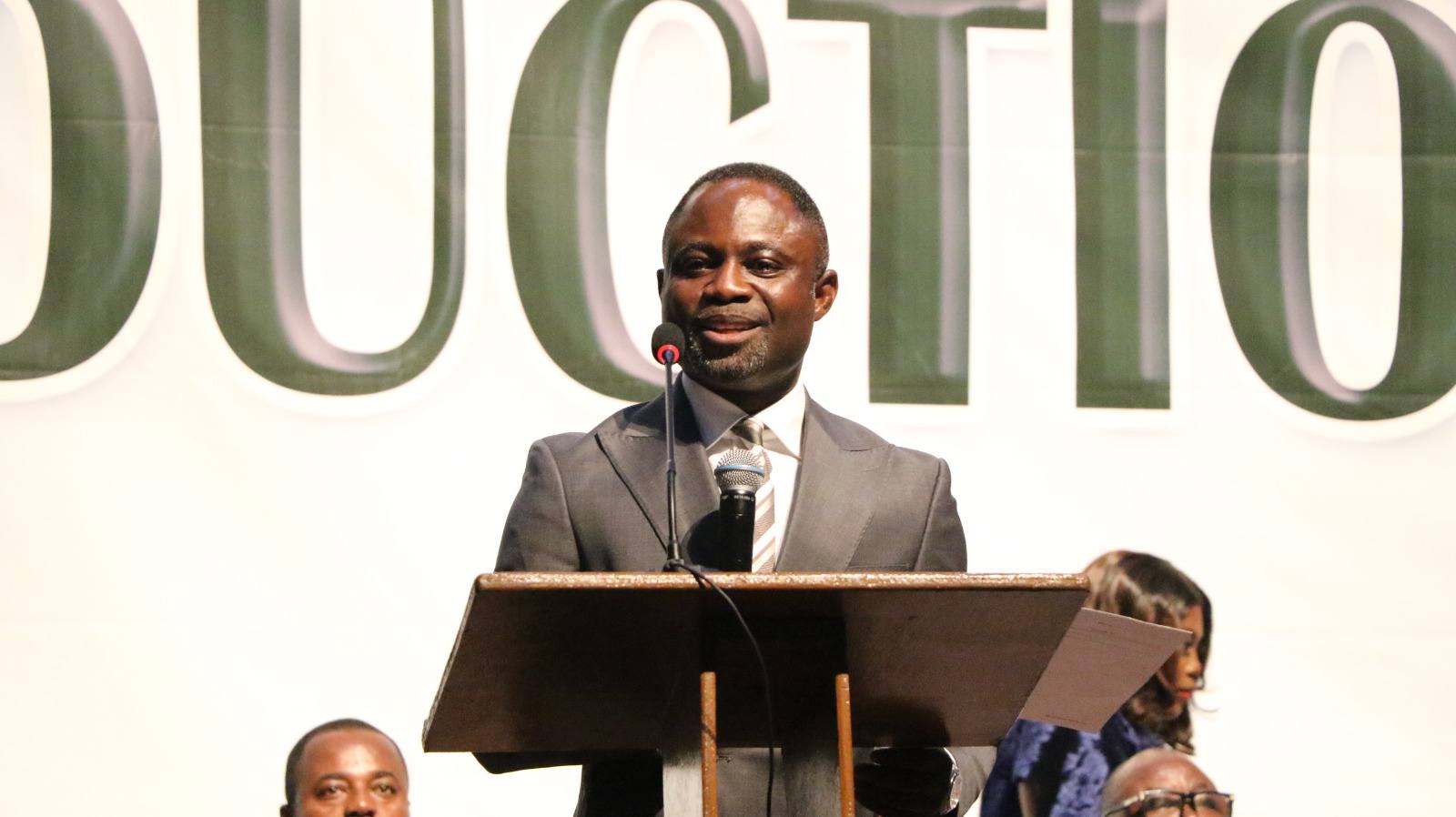
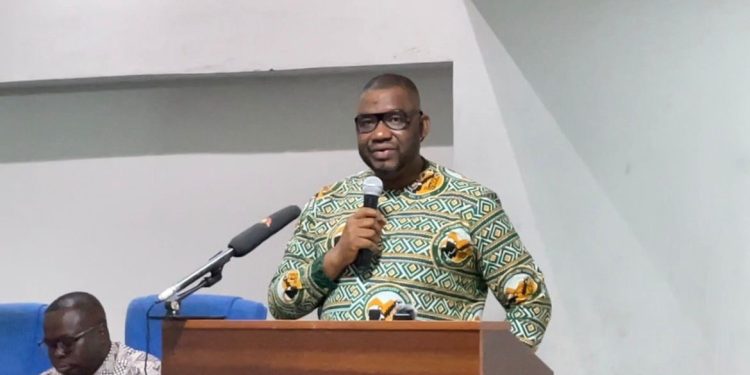
    The New Patriotic Party (NPP’s) General Secretary, Justin Kodua Frimpong has announced that all the factors that contributed the the party’s defeat in the 2024 presidential elections has been duly addressed.

    Mr Kodua made this known at the official launch of its amended constitution 2025 at the party’s headquarters in Asylum Down, Accra.

    “I’m proud to say that many of the issues, which in one way or another, culminated in our loss on 7 December 2024, have been addressed in this amended constitution,” Mr Kodua declared.

    In the wake of the post-election upheaval, the party established a Review Committee, chaired by former Speaker of Parliament Prof. Aaron Mike Oquaye, to tour the country and collect input from members on what led to the loss.

    Once that report was completed, an Amendment Committee headed by lawyer Frank Davies was formed to assess the party’s constitution and recommend updates to fix loopholes and keep it effective for present and future needs.

    Mr. Kodua noted that a major factor behind the 2024 defeat was widespread apathy, especially among some former executives who felt pushed aside.

    “In our current constitution, we have expanded our electoral college to make room for former party executives at the constituency, regional, and national levels, and even former Members of Parliament now have voting rights. All these measures are intended to address apathy and encourage broader participation within the party,” he stated.

    He explained that communication shortcomings during the elections were also cited as a critical area for reform. Many had criticised the party for failing to effectively communicate its achievements and for the lack of coordination among its various communication directorates.

    “One of our shortfalls, even from the forefathers of the UGCC, has always been in handling propaganda and misinformation from our opponents. In this new constitutional amendment, we have painstakingly reviewed how our communication has been managed from the time of the UGCC to the present, to ensure better coordination and to prevent opponents from exploiting misinformation against our party,” Mr Kodua noted.

    The New Patriotic Party on Wednesday, December 3, amended its internal rules in an effort to address the factors that led to the party’s defeat in the 2024 General Elections.

    Speaking at the launch of the amendment, General Secretary Justin Kodua Frimpong urged party members to adhere to the changes, noting that they form part of the party’s strategy to strengthen internal structures and prepare for the upcoming 2028 elections.

    He added, “Many of the issues that culminated in our loss in the 2024 election have been addressed in this amendment.”

    The party further urged all relevant bodies, including Regional and Constituency Executive Committees, to reinstate suspended members in accordance with laid-down rules and guiding principles. “We hereby serve notice that this directive lifts all such suspensions and nullifies any ongoing proceedings against affected members,” the statement added.

    However, the party clarified that this recall does not apply to members who willfully forfeited their membership. In cases where such individuals wish to return, they are required to submit a formal reinstatement request to the party’s secretariat. Upon acceptance, a two-year ban will be imposed, preventing them from contesting in any internal elections.

    Flagbearer aspirant for the New Patriotic Party (NPP), Kennedy Agyapong, has picked the first spot on the party’s just-concluded ballot. The exercise, conducted today, Friday, October 10, was to determine who takes which number on the ballot paper ahead of the presidential election on January 31, 2026.

    So far, Kwabena Agyepong, former Vice President and 2024 Presidential Candidate Dr. Mahamudu Bawumia, former MP for Assin Central Kennedy Ohene Agyapong, former Minister of Education Dr. Yaw Osei Adutwum, and former Minister of Food and Agriculture Dr. Bryan Acheampong have been cleared to campaign.

    Dr. Bryan Acheampong picked the second position, and Dr. Mahamudu Bawumia took the third position. Dr. Yaw Osei Adutwum and Kwabena Agyepong took the fourth and fifth positions, respectively. Former General Secretary of the NPP, Kwabena Agyei Agyepong, officially filed his nomination forms on Tuesday, August 26. Party executives received the nomination forms from former Assin Central MP and presidential hopeful Kennedy Ohene Agyapong on Wednesday, August 27.

    Former Food and Agriculture Minister Bryan Acheampong has also filed his nomination forms. In the meantime, Dr. Mahamudu Bawumia has received strong backing from 268 former Metropolitan, Municipal, and District Chief Executives (MMDCEs), who paid him a visit in June to pledge their support.

    Former Energy Minister and running mate of the NPP’s 2024 presidential candidate, Dr. Matthew Opoku Prempeh, has decided to throw his weight behind Dr. Mahamudu Bawumia ahead of the party’s presidential primaries in 2026.

    In an interview on Asempa FM on August 26, the former minister noted that he remains grateful to the former Vice President, who decided to make him his running mate despite the many individuals who advised him to do otherwise.

    According to Dr. Opoku Prempeh, popularly known as Napo, Dr. Bawumia was engaged countless times by some bigwigs in the party to pick someone else to be his running mate.

    “I am not ungrateful. Look at this big party and upon all the people who were praying for the running mate slot, he ignored all of them and made me his running mate. I know it was a difficult situation, but a lot of people don’t know. Some bigwigs in the party went to Dr. Bawumia to tell him not to make me the running mate but he ignored them. There are some names that if I mentioned, you would be shocked. Some even took him to offices to advise him against me but still he chose me,” he remarked.

    He thus said, “So, I cannot be ungrateful to him… For those who stood in the flagbearership contest, everyone knows Kennedy Agyapong is my friend, but I am still for Bawumia.”

  • I was offered the role of sleeping with a dog, but I rejected it – Nkechi Blessing on first movie role

    I was offered the role of sleeping with a dog, but I rejected it – Nkechi Blessing on first movie role

    Nollywood actress Nkechi Blessing Sunday has revealed that she was once asked to sleep with a dog as her role on a movie set.

    However, the actress said she rejected the role because she was new to the movie industry and did not want to start with such a role.

    “Despite being a newcomer, I was given a script to sleep with a dog. I rejected it because I can’t start off my career like that. Imagine my first ever movie, I am sleeping with a dog. It doesn’t make sense. It is going to be a tag because whatever you start with is what people would associate you with. I didn’t want to be renowned as someone who sleeps with dogs in movies.”

    “So, I rejected that script. But immediately I threw it down, so many girls grabbed it. I’m not sure any of them are in the limelight today,” she stated  in a recent episode of The Honest Bunch podcast.

    Ghanaian actress Beverly Afaglo shared how difficult it was for dark-skinned actors to get roles in the movie industry when she also started her career.

    Speaking in an interview on Joy Learning TV, she revealed that many producers preferred casting light-skinned actors, believing they looked better on screen.

    “Our time, what most of the producers were doing was, you have to be a half-cast. I think Jackie Appiah was the only person because she was a star already so they needed her.

    “Producers thought light-skinned actors looked better on TV. As a result, most of them preferred casting light-skinned individuals,” she said.

    Beverly also described how tough auditions were, as actors had very few chances to impress casting directors.

    “There was talent. It wasn’t about beauty or what you were wearing or anything. Everybody was ready to act. People were acting. We were really daring.

    “People can master lines in one minute because when you get that chance to audition for a role, it was your only chance and the queue behind you was so long that you don’t want to make a mistake. But the casting for producers made it difficult for us to get into the acting field,” she narrated.

    According to her, things only changed when movie storylines required diverse actors, forcing producers to work with dark-skinned talents.

    “It got to a time that they didn’t have a choice but to use us because, at that time, most of the stories that were out were about kingdoms, princesses, girls-girls, those stories. So girls-girls, you will need us. You can’t use just one person; you need everybody. So they knew that they had to work with us,” she explained.

    Nollywood actress Mojisola Adebanjo candidly admitted that her looks and allure have contributed to landing several acting roles.

    During an interview with Potpourri, she revealed that her appearance, along with her facial expressions and fashion sense, has frequently swayed casting choices in her favor throughout her career.

    “Yes, I believe my sex appeal and beauty have contributed to landing roles. I frequently receive compliments on my attractiveness, especially regarding my facial expressions, presentation, dress sense, authenticity, and voice.

    “For instance, in 2021, I was cast for a role because of a photo that showcased a specific look, which resonated with the casting team,” she explained.

    Adebanjo stressed that her versatility is her greatest strength as an actress.

    “I consider versatility to be my greatest strength. Being able to adapt to a variety of roles and genres allows me to showcase my talent and connect with diverse audiences. You can see this in my movie Farida’s Secret and my role in the YouTube series Oga Osas, among other projects.

    “Versatility is essential for bringing depth and authenticity to each character and making a lasting impact. Alongside versatility, a strong work ethic, resilience, and a commitment to refining my craft are vital for success in this industry,” she stated.

    Fondly referred to as Jisola by her friends, Adebanjo also emphasised on the impact of streaming platforms on Nollywood’s reach.

    “Netflix and other streaming platforms have significantly expanded the distribution of Nollywood films. They provide our industry with a global audience, allowing our content to be viewed by people beyond traditional Nigerian and African markets.

    “This exposure not only enhances the international visibility of Nollywood films but also fosters cross-cultural exchange and collaboration,” she added.

    A year ago, Ghanaian actress Nadia Buari shared insights about filming kissing scenes in numerous movie projects.

    During an appearance on TV3’s “The Afternoon Show’ with hosts Godwin Namboh and Anita Akua Akuffo, Buari clarified that these scenes are purely make-believe.

    Buari, who recently posted a trailer of an upcoming movie featuring Majid Michel, explained that the goal for actors is to make the scenes convincing to viewers.

    She emphasized that any perceived romance is merely part of the characters’ storylines, with no genuine emotions involved for the actors themselves.

    She said: “They are not real. It is make-believe. However, we are trying to convince people, so we were really kissing, but it is just that it is real for the characters, not for the actors. There are no feelings involved.”

    Nadia Buari explained that actors must keep their emotions separate from kissing scenes, especially since these scenes are often filmed multiple times with a large crew present on set.

    Despite her extensive experience with such scenes, Buari shared that she doesn’t have a preferred on-screen kissing partner.

    She also acknowledged that, for her, kissing scenes and character portrayal are among the most demanding parts of acting in films.

  • Daddy Lumba’s funeral to be held in Kumasi on Dec 13 – Children announces

    Daddy Lumba’s funeral to be held in Kumasi on Dec 13 – Children announces

    Denise Lady Ama Saah Fosu, the first daughter of the late Highlife legend Daddy Lumba, has confirmed that their father will be buried on December 13 in Kumasi.

    In a video recorded at the musician’s East Legon residence after arriving in Ghana on November 30, 2025 Ama Saah calmly said, “Hello, my name is Denise Lady Ama Saah Fosu, the eldest daughter of the late Charles Fosu, also known as Daddy Lumba. I’m here, representing my entire family today. We’d like to kindly invite you to my father’s funeral which will take place on the 13th December in Kumasi. We wish all well-wishers and mourners to join us to celebrate his life.”

    Evangelist Papa Shee had explained that Daddy Lumba’s funeral will not take place in December due to delays in travel arrangements for some family members abroad.

    “The burial ceremony on December 13 will not come off because the musician’s children have exams on February 26, 2026, and others have expired passports. The autopsy result isn’t out because we are also in court with Transition,” Papa Shee stated.

    In a video shared on November 29, 2025, he appeared appeared on United Showbiz withKofi Owusu, family head of the late Ghanaian Highlife legend to clarify the family’s position on matters surrounding Daddy Lumba’s funeral arrangements.

    He added that the funeral has been scheduled for March 14, 2025, because the family must first meet President John Dramani Mahama over his proposal to grant the late musician a state burial.

    “…We also went to the presidency to inform the President when Lumba passed. He wasn’t around, but we met Julius Debrah, and he even told us that they would like to give Daddy Lumba a state burial. We haven’t even gone back for feedback,” Papa Shee added.

    Contrary to this,,  Abusuapanyin Kofi Owusu also maintained that the initial burial date (December 13), will come off as scheduled, and nobody has the authority to change it.

    According to the Abusuapanyin, Papa Shee is not a family member, and he will sue him if he continues to claim that the burial date has been changed.

    “I am the one who fixed the date, and I am saying that the burial ceremony will be held on December 13, no matter what. Your new date will not come on, no matter what.

    “Are you a family member? Why would you interfere in the affairs of another family when you are not part of it? If we hear you mentioning the 14th, I will take you on,” Kofi Owusu insisted.

    The late Daddy Lumba’s elder sister, Ernestina Fosu has declared that there will be no burial for Daddy Lumba until the actual cause of his death is known.

    After a court appearance, Ernestina told Adum TV that until the truth is known, no amount of court ruling or family decision would compel her to allow the funeral to proceed.

    “The funeral will not be held on December 6. We did not seek an injunction because we are mad. We still don’t know what killed my brother. We cannot allow people to rush with his funeral,” she said.

    However, she has expressed readiness to organize the funeral on the once she receives a clear explanation about what caused Daddy Lumba’s death before then.

    “There will be no problem if we find out about the cause of Daddy Lumba’s death before December 6. But if we don’t find out what killed my brother, I won’t allow my family to bury my brother, Charles,” she said.

    Ernestina Fosu has earlier indicated that she is not prepared to organize Daddy Lumba’s funeral on Dec 6.

    She made this known to the media in the aftermath of a court proceeding at the Kumasi High Court on October 28, 2025.

    “I am not ready for my brother’s funeral on December 6, 2025,” she stated firmly in a video shared on social media.

     Prophet Kumchacha has warned that three members of the late Daddy Lumba’s family may loose their lives if the family fails to bury the late musician peacefully.

    This comes at a time where the two partners of the musician are in court seeking redress on who should be recognized as the legal wife.

    Kumchacha explained that his dreams indicated that anyone who blocks Lumba’s funeral or disrupts harmony among his family members would face harsh consequences, as Lumba’s spirit would return for three people after the burial.

    “I also saw that Daddy Lumba said anyone who refuses to allow his burial to be held peacefully, and for peace to reign in the family, he will come and take three persons with him to the graveyard,” he stated.

    He added that the late musician is seen in handcuffs and weeping in the realms of the spirit.

    Thus, he foresees tragedy unfolding from the spiritual realm, which would manifest in the physical world should the burial go ahead on December 13, 2025.

    “I have had several dreams and as I speak, Daddy Lumba’s spirit is sad. In the spiritual realm, he is in handcuffs and weeping. If they try to bury him on December 13, something tragic will happen spiritually and it will be felt in the physical world as well. They should move the funeral to around the sixth month of next year,” Kumchacha  UTV’s United Showbiz on November 22, 2025.

     The burial date for Daddy Lumba has been changed from 6th December to December 13, 2025.

    According to report, the date extension will provide the family with ample time to know the cause of the musician’s death before his burial.

  • 2face Idibia was arrested in UK over over quarrel with Natasha Osawaru his wife – Ex-Manager reveals

    2face Idibia was arrested in UK over over quarrel with Natasha Osawaru his wife – Ex-Manager reveals

     2face’s former manager, Kaka Igbokwe has confirmed that the singer was arrested in London.

    The arrest according to Koka followed a heated altercation with his pregnant wife, Natasha Osawaru.

    The musician was in London with his new wife for a concert tour on October 2, 2025 as scheduled but he did not show up.

    And the reason for his absence was when Kaka attributed to his arrest in London.

    Kaka, who is the son of the late Nigerian music legend, Christy Essien-Igbokwe, confirmed the incident while making an appearance on Daddy Freeze’s Instagram Live session, yesterday evening.

    According to Kaka, “everything you heard about the couple’s face-off was true.”

    Kaka, a member of the London team who travelled on the same flight, explained how the confrontation unfolded. According to him, Natasha became upset after arriving at the airport because she felt 2Face had ignored her and walked off with fans who escorted him into a shop.

    He added that when the “African Queen” hitmaker realised Natasha was not with him, he quickly returned, only for her to confront him angrily. The exchange drew attention and eventually resulted in his arrest and being placed in handcuffs.

    A video of the incident, shared by blogger Tosin Silverdam on TikTok on December 1, 2025, reignited discussions across social media.

    Earlier this year, ‘2Face’ Idibia revealed that he was separating from his wife, Annie Macaulay, after 13 years of marriage.

    Through a social media post, 2Face shared that they had been living separately for some time and felt it was necessary to let his fans know that divorce proceedings were officially underway.

    In the Instagram post, which quickly gained attention, he pledged to be open and share all relevant details surrounding their split.

    “This thing I have to say is short but also long… Annie Macaulay and I have been separated for a while now and have currently filed for divorce. I will grant a press release soon to share my story—not because it’s anyone’s right to know my personal life, but because I love my people, and I need them to know my innocence or offense. Stay blessed, my people. I love you all.”

    The announcement led to mixed reactions from 2Face’s fans and followers.

    Shortly after, another post surfaced on the same platform, claiming that 2Face’s account had been hacked and the divorce news was false.

    In response, 2Face went live on social media to deny the hacking claim, strongly affirming that he had made the divorce announcement himself and stood by every word.

    The situation became even more controversial when, just days before the announcement, 2Face was seen with an unidentified woman at a club, sparking further rumors about his personal life.

    Meanwhile, Annie has yet to respond to the announcement.

    The couple, who have been together for 24 years and married for 13, share two children.

    It has been reported that Annie Macaulay Idibia went through treatment at a rehabilitation center after her husband’s divorce announcement.

    Nigerian investigative journalist, Stella Dimoko Korkus, shared the news on Monday, January 27, 2025.

    According to sources close to the situation, media personality Toke Makinwa and singer Tiwa Savage are said to be supporting Annie through this tough period.

    In a widely shared post, Stella revealed that Annie is in a very fragile condition.

    “Actress Annie Idibia is in a very bad state and allegedly currently in rehab. Insiders reveal that it is very, very bad, and the two people allegedly taking care of her are singer Tiwa Savage and media personality Toke Makinwa. May God heal her,” she stated.

    Not long after 2Baba announced their divorce, Toke Makinwa pledged to help Annie seek justice, accusing him of causing immense harm through his toxic behavior and ultimately walking away from her.

    Toke Makinwa, showing her solidarity with Annie, criticized 2Baba for abandoning her after everything she had endured during their marriage.

    “This is wrong on all levels, and you should be ashamed of yourself for bringing this here. Bring it on, and if you think she’s alone, let me tell you, you’ll have to fight all of us.

    “I’m not the one for too much talk, but what is wrong is wrong. As a woman, if you sit on the fence with this, if it misses you, it will touch your daughter or any female in your family. No one is innocent, and if you want to bring this to the media knowing what is happening, we will fight for her,” Toke Makinwa wrote on social media.

    Meanwhile, 2Baba has shared another post insisting that he stands by everything he said regarding his divorce.

    This came after some netizens, in disbelief, wondered if his page had been hacked.

    2Baba has confirmed that he said what he meant, with his eyes wide open and all his senses intact.

  • Ghallywood has collapsed because local channels prioritize cheap foreign content – Selassie Ibrahim

    Ghallywood has collapsed because local channels prioritize cheap foreign content – Selassie Ibrahim

    Ghanaian actress and film producer Selassie Ibrahim has apportioned blame on  local television channels for the collapse of Ghallywood.

    Her reason stems from her assertion that, the channels place premium on cheap foreign content over high-quality local productions.

    A situation she said has rendered business model for Ghanaian filmmakers unsustainable.

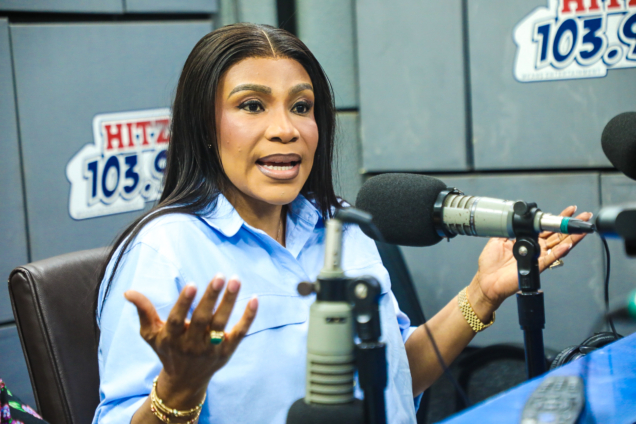
    In an interview on interview on Daybreak Hitz on Hitz FM, she expressed, “Look, the TV channels are not helping us. I’ll say it again. I don’t care what they think. I don’t care what they say. I’ve said it before and they bashed me. But you know what? I will still keep saying it until they help us. You shoot content and send it to TV channels; they look into your eyes and tell you a thousand Ghana cedis [GH₵1,000] when I spent over $20,000 to $30,000.”

    “Yet they go and buy movies that are 10 years old that had made their money out of cinema and everything.”

    “You want us to sell it to you the same? Do you want to collapse [our businesses]? You’ve done it. You see the problem? When people say that, ‘oh, Ghanaian film is dead,’ my heart bleeds, but how many people can you explain to that it started from the TV channels because they killed our industry?”

    Ibrahim also touched on a deeper cultural issue: the perceived Ghanaian bias against local content, which she believes is reinforced by television programming choices.

    “Because when you go to Nigeria, you don’t find them watching any Ghanaian movie. But in Ghana, anything foreign is fine; everything Ghanaian is bad. They will criticise. They will not go and watch. I can’t figure it out. I don’t get it? We don’t know how to celebrate our own… and that is what has killed Ghana movie till today,” she stated.

    Selassie Ibrahim, a key figure in the industry for decades, criticized the lack of support and the low acquisition fees offered to Ghanaian producers, contrasting it sharply with the readily accepted influx of foreign movies.

    Ghana’s film sector, once vibrant in the early 2000s, has experienced a steep drop in output since 2015.

    Industry watchers attribute this downturn to several factors, including low payments for TV rights, the rise of inexpensive satellite stations, and the absence of government policies that require broadcasters to air a set amount of local content—measures that countries like Nigeria and South Africa already enforce.

    Ibrahim argues that reviving the sector largely depends on regulators and TV station owners introducing fairer pricing and adopting programming choices that genuinely support Ghanaian filmmakers.

    Renowned Ghanaian actor Chris Attoh has shed light on his decision to focus more on the Nigerian film industry, citing the vast market audience and numerous collaboration opportunities it offers.

    Attoh explained that his move to the Nigerian film industry was driven by the need for a broader market and a larger audience.While acknowledging the greatness of the Ghanaian film industry, he emphasised the inherent limitations due to its comparatively smaller size.

    “At the time, the necessity was that you had to be in the Nigerian space if you wanted a bigger market or a bigger audience. Ghana was great, but the truth is Ghana is small, and if you are trying to get the attention of players beyond Ghana, not just Nigeria, you have to expand,” Attoh expressed during the interview.

    The actor commended Nigeria’s vibrant film industry, highlighting the continuous production of films and the potential for collaborations. “Nigeria has numbers, Nigeria is making films every single day. I’m always looking forward to where we are collaborating instead of being separated,” he added.

    However, Attoh didn’t shy away from addressing challenges in the Ghanaian movie industry, particularly the lack of mentorship and guidance. He believes this void has contributed to the industry’s current problems.

    “I don’t think it is a matter of not wanting to push ourselves growing up. We didn’t have the right mentors, we did not have the people who brought us up and would take your hands and say this is the way. And it’s become a thing that’s heavy on my heart,” Attoh lamented.

    Underscoring the importance of continuous learning, Chris Attoh shared his personal experience of overcoming challenges in the Nigerian film industry.He emphasised the need for actors to constantly update their skills, rehearse regularly, and expand their knowledge base.

    “It’s like any other industry. It’s growing, it’s updating, and you need to constantly learn. It means every single morning you have to rehearse, it means reading outside your scope, and reading is one thing I keep pushing for, especially to our youth today,” he stated.

    Chris Attoh, known for his roles in global productions like ‘Shuga,’ “Single and Married,” and “Inspector Bediako,” continues to advocate for collaboration and the importance of mentorship in the African film industry.

  • Refund our locked-up investments to us – Mineworkers  “cry out” to govt

    Refund our locked-up investments to us – Mineworkers  “cry out” to govt

    Ghana Mineworkers’ Union of the Trades Union Congress (TUC) is crying out to the Bank of Ghana (BoG) to pay off funds to over 19,000 miners, which got locked up in financial institutions that collapsed during the Bank of Ghana’s 2019 financial sector clean-up.

    The Union says the withheld monies comprise provident fund payments, welfare contributions, individual investments, and severance benefits, leaving several miners in difficult financial situations.

    During its recent National Executive Council meeting, the Union expressed dissatisfaction with the Bank of Ghana, accusing the regulator of failing to adequately protect depositors’ funds.

    General Secretary Abdul-Moomin Gbana maintained that the Central Bank should focus on reimbursing the affected workers without delay and then work to recover the funds from the assets of the collapsed institutions afterward.

    “Over 19,000 miners have their deposits drawn from our provident funds, welfare funds, leave savings, and individual funds, including severance packages, locked up in Bank of Ghana-regulated institutions affected by its financial sector clean-up in 2018/2019.

    “We, therefore, take the uncompromising position that the Bank of Ghana must fully refund our monies to us and recover the funds paid to us from the liquidated assets of its own regulated entities,” Gbana stated.

    The Union also praised the improvements at the Bogoso-Prestea Mine under Heath Goldfields Ltd and appealed to the government to quickly release the pending permits to prevent further setbacks in production and processing..

    “Having successfully gotten the Bogoso-Prestea Mine to operational readiness, we would like to use this opportunity to call on the Government of Ghana, through the Minister of Lands and Natural Resources and the regulatory agencies, especially the Minerals Commission and EPA, to support Heath Goldfields with all the relevant permits/licenses that would enable them to commence production and processing of gold,” the Union added.

    In 2020, the finance minister declared that if the banking industry encountered any fresh difficulties, the government would not hesitate to conduct another clean-up.

    He contends that a nation’s financial system has a direct impact on both its people and its economy.

    Between 2017 and 2019, the Bank of Ghana swept through the financial industry after some banks and financial organizations failed to achieve their minimal capital requirements.

    Finance Minister Ken Ofori-Atta has said the government will not hesitate to step in to tackle any challenge that may rear its head in the banking sector that can lead to an economic downturn again.

    He told TV3’s Etornam Sey in an exclusive interview on Monday, October 26, 2020, that the financial sector is the heartbeat of every economy globally.

    A weak financial sector, he said, will have dire consequences for the economy and its people, a situation that demands that central authorities step in swiftly to address.

    Therefore, he said, the Government of Ghana will act quickly to address any challenges that may emerge in the sector again after the recent clean-up exercise.

    The Bank Ghana with support from the Finance Ministry swept through the financial sector of the economy between the period 2017 and 2019.

    The central bank first started by revising the minimum paid-up capital for existing banks and new entrants from GH¢120 million to GH¢400 million.

    According to the regulator, this was to test the viability of the banks.

    The banks that were unable to meet this new requirement were either merged or collapsed.

    Following this action, some nine local banks, 23 savings & loans companies, 347 microfinance institutions, 39 finance houses and 53 fund management companies closed down during the exercise.

    In total, the government spent GH¢23billion to undertake this exercise

    UniBank, The Sovereign Bank, The Beige Bank, Premium Bank, The Royal Bank, Heritage Bank, Construction Bank, UT Bank, Capital Bank all collapsed.

    Mr Ofori-Atta said “Once you have the problem, you have to solve it because the financial architecture is the (basis) for any development.

    “So whether we like or not we had to do that. Now that we have done that we move ahead.”

    Asked whether if the situation presents itself the government will do it again in the same manner, he answered “You meet problems as a government that is what they elected you for and so you solve it.

    “And then you begin by commissioning this to give people the sense of hope for the future to say this thing can be done, and they have faith in you so lets us go with them.

    “If the engine is not functioning you can’t build on top of that so you had to solve the problem.

    “Is there a way you improve on what you are doing? Of course yes there is always a way to do that but fundamentally was the approach necessary, no question about that.”

  • PUFA applauds Education Ministry for move to ease Charter Requirements

    PUFA applauds Education Ministry for move to ease Charter Requirements

    The Private University Founders Association (PUFA) has commended the Ministry of Education and its sector minister, Haruna Iddrisu, for taking steps to address long-standing concerns raised by private tertiary institutions regarding Ghana’s current regulatory framework.

    In a statement signed by Executive Secretary of PUFA, Martin k. Gyambrah expressed appreciation to the Minister for acknowledging the challenges private universities face under the Education Regulatory Bodies Act, 2020 (Act 1023), and for initiating processes to amend the law.

    According to PUFA, a Cabinet Memorandum is being finalised to make the chartering process optional for private universities.

    “This policy shift directly addresses the long-standing challenges associated with the current chartering framework, which Private Universities have often found restrictive and cumbersome.

    Making charter acquisition optional will provide institutions with greater flexibility to innovate and enhance their contributions to national development,” the statement read.

    The Association also welcomed the Minister’s recognition of the crucial role private universities play in widening access to higher education.

    It highlighted the Ministry’s renewed emphasis on Access, Relevance, and Quality (ARQ), complemented by oversight from the Ghana Tertiary Education Commission (GTEC), as a balanced framework that supports growth while maintaining academic standards.

    PUFA further acknowledged the backing of Parliament’s Select Committee on Education, led by Hon. Peter Nortsu-Kotoe, whose advocacy aligns with the push for optional chartering.

    The Association referenced Mr. Nortsu-Kotoe’s observation that government saves about GH₵50,000 per student enrolled in a private institution—an indication of the significant relief private universities provide to the state.

    Reaffirming its commitment, PUFA stated it remains ready to collaborate with the Ministry of Education, GTEC, Parliament, and other stakeholders to strengthen Ghana’s tertiary education landscape and advance reforms that enhance the sector’s performance.

    Read the full statement below:

  • Delta reintroduces its non-stop Accra–Atlanta service

    Delta reintroduces its non-stop Accra–Atlanta service

    Travellers moving between Ghana and the United States now have a direct flight option following Delta Air Lines’ launch of non-stop Accra–Atlanta services on Monday, December 1, 2025.

    The update was shared by the Minister of Foreign Affairs, Samuel Okudzeto Ablakwa, in a Facebook post on Tuesday, December 2, 2025.

    “I am excited about the reintroduction of Delta Air Lines’ non-stop flight from Accra to Atlanta, which commenced operations yesterday,” the Minister said, calling the move a significant improvement for passenger convenience.

    He also highlighted that Ghana welcomes Air Transat’s groundbreaking decision to introduce a non-stop Accra–Canada route, scheduled to begin on June 17, 2026.

    “These refreshing developments will accelerate our economic diplomacy objectives, boost trade and tourism, and offer value and convenience mainly to Ghanaian travellers,” he added.

    The Air line offers travellers in Ghana a more efficient route to the United States by eliminating layovers and streamlining the travel experience. Operated with the Airbus A330-900neo, the route will provide passengers with a range of seating options, including Delta One Suites, Premium Select, Comfort+, and Main Cabin.

    Passengers on board will enjoy complimentary high-speed Delta Sync Wi-Fi, allowing them to stay connected, stream entertainment, receive travel notifications, and shop online throughout their flight. This feature, available to SkyMiles Members, reflects Delta’s commitment to offering a modern, digitally enhanced flying experience.

    The rollout of this route forms part of the airline’s broader strategy to upgrade its fleet with advanced connectivity tools, including the installation of dual-network systems across newer and regional aircraft.

    Having served the Ghanaian market for more than ten years, Delta considers the Accra–Atlanta route a significant move toward deepening travel and cultural connections between Ghana and the United States.

    Meanwhile, Ghana’s former President Jerry John Rawlings’ legacy has been honoured five years after his death, with one of Nigeria’s indigenous carriers,  United Nigeria Airlines, naming an aircraft after him.

    The aircraft named “J.J. Rawlings” completed its first flight to Accra on Monday, November 10, with several dignitaries, including Ghana’s Ambassador to Nigeria, Baba Jamal; Chief Professor Obiora Okonkwo, Chairman and CEO of United Nigeria Airlines; senior Nigerian aviation officials, and other guests, signifying United Nigeria Airlines’ debut route between Abuja and Accra.

    A brief inaugural ceremony was held at Terminal 3, Gate C8, upon arrival at the Kotoka International Airport (KIA) to unveil the inscription on the aircraft — “J.J. Rawlings… The legend lives on.”

    former Minister and Member of Parliament for Ablekuma South, Fritz Baffour, to unveil the inscription on the aircraft — “J.J. Rawlings… The legend lives on.”  upon arrival at Kotoka International Airport.

    In his address, Chief Professor Obiora Okonkwo, Chairman and CEO of United Nigeria Airlines, extended condolences to the Rawlings family following the recent passing of former First Lady Nana Konadu Agyeman-Rawlings and requested a minute’s silence in her memory.

    He explained that discussions to commemorate the fifth anniversary of President Rawlings’ passing led to the decision to name one of the airline’s aircraft after the former Ghanaian leader, who was also a trained Air Force pilot.

    Professor Okonkwo pledged that United Nigeria Airlines would uphold high standards and contribute meaningfully to aviation development in West Africa.

    “We are committed to delivering quality and reliability in our operations while strengthening the bond between our two nations,” he affirmed.

    Minister for Sports and Recreation, Kofi Adams, expressed appreciation to the airline for honouring the late former President.

    “President Rawlings once said he would rather live in the hearts of men than have his name on monuments or streets. Today, that statement has been manifested through the naming of this aircraft,” Mr. Adams said.

    He added that the gesture demonstrated the enduring influence of President Rawlings across Africa.

    “Because President Rawlings lives in the hearts of men, he has been recognised even beyond his country. When we say the legend lives on, this is a good demonstration of what it means,” he noted.

    Mr. Adams also recalled the late President’s passion for flying, linking it to his commitment to Ghana’s rural electrification programme.

    “When he flew across Ghana at night and saw lights only in Accra and Kumasi, it inspired him to ensure that electricity reached all corners of the country,” he said.

    Representing the Rawlings family, Fritz Baffour conveyed the family’s gratitude to United Nigeria Airlines for the honour, describing it as a lasting tribute.

    “This gesture will stay forever Ghana and Nigeria share strong bonds — and when we come together, no one can stand us,” he remarked.

    Jerry John Rawlings died on November 12, 2020 after burying his mother.

    The late statesman was born in Accra on 22nd June 1947, to a Ghanaian mother from Dzelukope, near Keta, in the Volta Region, and a Scottish father.

    He received his education at Achimota School, where he earned his General Certificate of Education ‘O’ Level in 1966.

    In August 1967, he joined the Ghana Air Force as a Flight Cadet and later proceeded to the Ghana Military Academy and Training School in Teshie, Accra, for officer cadet training.

    By March 1968, he had been transferred to Takoradi in the Western Region to continue his aviation training.

    He graduated in January 1969 as a commissioned Pilot Officer, earning the prestigious “Speed Bird Trophy” for his exceptional flying skills and airmanship.

    In April 1978, he rose to the rank of Flight-Lieutenant, noted for his competence and strong connection with his fellow officers.

    During his time in the Ghana Air Force, he observed a decline in discipline and morale, mirroring the corruption within the then-ruling Supreme Military Council (SMC).

    As he advanced in rank and interacted more with the country’s elite, he became increasingly aware of the deep social inequalities in Ghana, a realization that made the SMC wary of him.

    An avid reader and deep thinker, he often engaged in discussions on political and social change with a close circle of like-minded officers.

    On May 28, 1979, Flight-Lieutenant Rawlings and six others were brought before a General Court Martial in Accra, accused of leading a mutiny of junior officers and soldiers on May 15, 1979. His statement during the trial, which outlined the social injustices that motivated his actions, sparked widespread public sympathy and reaction.

    Meanwhile, in July 2025 this year, Africa World Airlines (AWA) officially launched a new direct flight route between Accra, Ghana and Burkina Faso’s capital Ouagadougou, marking a significant step in its expansion into the Sahel region.

    The inaugural flight was announced at a brief ceremony in Accra, symbolizing AWA’s strategic commitment to enhancing intra-African connectivity and promoting regional trade under the African Continental Free Trade Area (AfCFTA).

    Founder of Africa World Airlines and Agbogbomefia of the Asogli State, Togbe Afede XIV, underscored the airline’s dedication to strengthening integration across the continent.

    “Our safety record is great. Our reliability is great, and that’s the kind of tradition we expect to continue the service we want to offer our friends from Burkina Faso. Hopefully, through them, we’ll link all of the Sahel to the rest of Africa, in line with President John Mahama’s vision of bringing Burkina Faso and Niger back into the fold,” he stated.

    Togbe Afede XIV also acknowledged the concerns of passengers about rising airfares but assured that the airline remains focused on delivering value while prioritizing safety.

    “I know that our passengers are concerned about ticket prices. We all need to understand that aviation is a very difficult business—capital intensive, with very small margins. Passengers demand the best of services, and we strive to provide the best value for money as we work to integrate the continent,” he explained.

  • Submit plea bargain details 3 days ahead of next sitting on December 16 – Court tells Agradaa’s counsel

    Submit plea bargain details 3 days ahead of next sitting on December 16 – Court tells Agradaa’s counsel

    The High Court in Accra has instructed the parties in the case involving Patricia Asieduaa, popularly called Nana Agradaa, and her co-accused to submit the terms of a proposed plea bargain before the next hearing.

    The Court further directed that the agreement must be filed no fewer than three clear days before the adjourned date of December 16, 2025.

    During Tuesday’s proceedings, prosecutors told the Court they were considering seeking a bench warrant for the second accused, but defence lawyers explained that they had not received the hearing notice.

    Counsel for Nana Agradaa informed the Court that negotiations with the Office of the Attorney-General regarding a possible plea agreement were “well advanced” and asked for a brief adjournment.

    The prosecutor added that the complainant, Emmanuel Appiah Fumum, had participated in the discussions and was present in the courtroom.

    The Judge then directed the Registry to ensure that counsel for the second accused is properly served with a hearing notice before the next appearance.

    The case stems from claims that Nana Agradaa, a former fetish priestess now turned evangelist, aired nude images of Pastor Emmanuel Appiah Fumum (widely known as Osofo Biblical) on her television channel and social media pages without his permission.

    Prosecutors say the images were broadcast during a live programme where panelists mocked the complainant, conduct they argue violates the Cybersecurity Act, 2020 (Act 1038), which prohibits sharing intimate images without consent.

    Nana Agradaa, who is already serving a 15-year prison sentence in a separate defrauding-by-false-pretence case, was present in court.

    Her lawyers raised concerns about recent media interviews given by the complainant, in which he allegedly claimed their client had been in poor condition since her imprisonment.

    The presiding judge, however, advised the prosecution to caution the complainant against making such public statements.

    In 2022, she was accused of luring her victims through claims that she possessed spiritual powers to double their money.

    Initially admitting guilt to charges including fraudulent advertising and obtaining money under false pretenses, she spent two weeks in remand before being granted bail of GH₵150,000 with three sureties, one requiring justification.

    She tricked members of the Godsway International Heaven Church into handing over their cash during a night vigil service at her church in Weija, Accra.

    Meanwhile, Ghanaian gospel musician Gifty Oppong Adorye, known in showbiz as Empress Gifty, dragged Evangelist Mama Pat, to court for defaming her.

    In a video targeting Empress Gifty’s husband, Hopeson Adorye, Agradaa extended her attacks to the singer, accusing her of engaging in bestiality and unfaithful activities.

    According to Gifty, other bloggers have leveraged Agradaa’s statement to spread false narratives about her.

    This has affected the “Watch Me” singer and her family, as their children are being ridiculed by friends in school.

    In addition to the negative impact of Agradaa’s conduct, lawyers of Empress Gifty say her trip abroad slated for August has been jeopardized.

    The words used by Agradaa are interpreted to mean the following:

    a) The plaintiff is promiscuous and a prostitute.

    b) The plaintiff is a zoophile who flirts with dogs to earn her money to cater for her husband.

    c) The plaintiff is an adulterous or an unchaste wife who has extramarital affairs with other men, and most of her paramours are pastors.

    d) Pastors who invite the Plaintiff to their programs have sexual intercourse with her in their offices before the Plaintiff mounts the pulpit to sing.

    e) The plaintiff is an imbecile.

    Consequently, Empress Gifty is claiming the sum of twenty million Ghana Cedis for damages for slander.

    She is also seeking a perpetual injunction to prevent the defendant, along with associates, agents, and anyone acting on her behalf, from making further publications of the same or similar defamatory statements.

    Lawyers for former chief priestess turned evangelist, Patricia Asiedua Asiamah (Nana Agradaa), have filed an appeal challenging the 15-year jail sentence handed down by the Circuit Court.

    This information was revealed by the lead counsel, Richard Asare Baffour, on Monday, July 7.

    He added, “We filed the petition of appeal this morning because the judgment delivered by the court is so unreasonable, and the evidence on record does not support it.

    “We have also stated that the trial as a whole is wrong in law, and we are saying that the judge demonstrated manifest bias by harassing and intimidating the accused.

    Nana Agradaa, is going to spend 15 years in prison for charlatanic advertisement and defrauding by false pretence.

    The Circuit Court in Accra delivered its sentence after it confirmed that she is not pregnant.

  • Review constitution to curb influx of petitions against high-profile officials – MP

    Review constitution to curb influx of petitions against high-profile officials – MP

     Member of Parliament (MP) for Berekum West, Dickson Kyere-Duah is advocating a constitutional reform that gives the President authority to review and sift through petitions seeking the removal of high-level officials like the Special Prosecutor.

    The MP made this appeal at a time when the Office of the Special Prosecutor is facing an unusual surge in petitions now totalling 16 calling for the removal of Kissi Agyebeng, a situation that threatens to stall the judicial process.

    Mr. Kyere-Duah, speaking on JoyNews’ AM Show, under the current Office of the Special Prosecutor Act (Act 959) and constitutional provisions, the President has no discretion: once a petition for removal is received, it must be automatically forwarded to the Chief Justice to trigger a mandatory investigation process.

    “But as I said, as we talk of constitutional review, these are some of the things I think we should be looking at: that the President should be given some powers to look at the cases, filter through and decide whether it meets a certain threshold to trigger the processes, but as we speak, the President doesn’t have that power; once it comes in, the processes have to be triggered,” Mr. Kyere-Duah stated.

    He cautioned that although the existing laws are democratic, they expose the system to risks that could politicise the judiciary and unsettle critical state institutions.

    He stressed that the current situation, where 16 petitions are pending against a single officer, demonstrates the systemic danger:

    “Isn’t this the best option if they keep coming in? You know, at a point, the Chief Justice may be inundated with these processes… everyday Chief Justice may be confined to dealing with petitions rather than other equally important responsibilities that this constitution has bestowed on him,” he said.

    The MP stressed that the current developments, while politically tense, do not constitute any violation of the law.

    “So for me, it is important we look at it, but as we speak, no constitutional provision has been breached. This is part of the democracy, and with the current constitution, we have the processes I think are going through, and they should be allowed to go through,” Kyere-Duah expressed.

    Special Prosecutor Kissi Agyebeng has joined the list of government officials whom some individuals have allegedly petitioned President John Dramani Mahama to remove.

    A report by Citi News suggests that private citizens cited various forms of misconduct as grounds for their call for his removal.

    The group has reportedly accused the Special Prosecutor of abusing the powers of his office and demonstrating incompetence. President Mahama is said to have referred the petitions to the Chief Justice, Justice Paul Baffoe-Bonnie for further review.

    Last week, President John Dramani Mahama formally received a petition seeking the removal of the Electoral Commission (EC) Chairperson, Jean Mensa, and her two deputies, Dr. Bossman Eric Asare and Samuel Tettey, over allegations of misconduct.

    Among the 12 counts of stated misbehaviour are allegations of cronyism, abuse of office, and gross incompetence.

    The petition, submitted by a staff member of the Electoral Commission, Joseph Blankson Adumadzie, emphasised that the credibility of Ghana’s electoral system is at stake due to the alleged illegal actions of the officials.

    According to a statement issued on Monday, November 24, by the petitioner, Article 146 of the 1992 Constitution provides the basis for requesting the removal of public officials, particularly those serving in independent constitutional bodies.

    The former Chief Justice, Gertrude Torkornoo, faced a similar challenge and was later replaced by President Mahama after an investigative committee found the allegations levelled against her to be valid.

    The Chief Justice was earlier suspended by President Mahama on Tuesday, April 22, after a prima facie case was established, following separate petitions calling for her removal.

    A series of petitions were filed against Chief Justice Torkornoo, beginning with one from a group known as Shining Stars of Ghana. The group alleged she violated Article 144 of the Constitution by personally recommending judges for promotion to the Supreme Court and further claimed she ruled on a case involving the Speaker of Parliament without granting him a hearing, despite his refusal to respond to the suit.

    Another petition, filed by a police officer who is also a lawyer, accused the Chief Justice of manipulating evidence and abusing her authority, following an incident during a Supreme Court session where he was reportedly reprimanded, arrested, and detained.

    However, court records suggest the lawyer’s conduct during proceedings prompted a unanimous caution from the bench, not just the Chief Justice.

    The third petition, submitted by a private individual, listed 21 alleged misconducts and four claims of incompetence. Among the accusations was the misuse of public funds—specifically, that she spent over GH¢261,000 and $30,000 on a family trip abroad in 2023 and misused an additional GH¢75,580 and $14,000 during another foreign assignment without proper accountability.

    Subsequent reports indicate two more petitions were added, intensifying pressure on the judiciary. Chief Justice Gertrude Torkornoo, in her written response to President Mahama, strongly denied allegations of misconduct and abuse of office brought against her by a senior police officer, describing them as baseless and lacking grounds for her removal from office.

  • You will not go scot-free – Bishop Owusu Ansah tells judge over Daddy Lumba ruling

    You will not go scot-free – Bishop Owusu Ansah tells judge over Daddy Lumba ruling

    Bishop Owusu Ansah has threatened Her Ladyship Dorinda Smith Arthur that she will not go scot-free following a Kumasi High Court ruling on the widowhood rites of late musician Daddy Lumba.

    The ruling on November 28, 2025 allowed Daddy Lumba’s partner, Odo Broni, to perform widowhood rites alongside his legal wife, Akosua Serwaa

    The decision came after Serwaa petitioned the court seeking recognition as the sole surviving legal spouse of the late musician.

    Unsatisfactory to Bishop Owusu Ansah, he sternly stated, “You, the judge, wait. We will come to you with the word of God. I am taking my time. You want to tell us that there is no use in getting married lately. You want to tell us that adultery is not a sin. God will deal with you, and He won’t let you go free.”

    “You, the judge, wait. We will come to you with the word of God. I am taking my time. You want to tell us that there is no use in getting married lately. You want to tell us that adultery is not a sin. God will deal with you, and He won’t let you go free.”

    Her Ladyship Dorinda Smith Arthur, who presided over the case, ruled that both women are permitted to take part in the rites, a decision that has been well-received by supporters of Akosua Serwaa, Lumba’s first wife.

    Odo Broni (Priscilla Ofori Atta) and Akosua Serwaa Fosuh have both been declared by the Kumasi High Court to be the spouses of the late Daddy Lumba.

    This means they can both perform the widowhood rites.

    The landmark ruling, ends months of fierce legal and public debate over who should perform the musician’s widowhood rites, who controls his estate, and who rightfully bears the title of “widow”.

    The court held that Akosua Serwaa failed to submit the original marriage certificates for the alleged civil marriage between Daddy Lumba and the plaintiff. What she presented were only extracts, not certified copies.

    With this decision, the path is now clear for the late music icon’s funeral to proceed.

    Background to the Case

    After the death of Daddy Lumba on 26 July 2025, a bitter dispute erupted between two women who claim to be his rightful spouse.
    Graphic Online

    Akosua Serwaa Fosuh filed a suit on 3 October 2025, asking the court to declare her as the only surviving lawful spouse, a claim based on a civil marriage she said she contracted with the musician in Bornheim, Germany, in 2004.

    She also sought to restrain the head of the musician’s extended family, Kofi Owusu Fosu, and Odo Broni from claiming any right to funeral and widowhood rites.

    The defendants opposed the claim, arguing that under customary practice, Serwaa’s marriage had been dissolved when she allegedly “returned the head drinks” to the family, a traditional act recognising separation, and that Odo Broni, who lived with Daddy Lumba for over 15 years and bore him six children, was the rightful widow.

    What Happened in Court

    On 25 November 2025, the court was presented with the supposed original civil-marriage documents from Germany, including notary-certified translations and associated paperwork, supporting Akosua

    The defence challenged these documents, citing inconsistencies in font styles and notary signatures, arguing the evidence was submitted “at the eleventh hour.”

    The presiding judge, Dorinda Smith Arthur, noted that under Ghanaian family law, simultaneous customary and civil marriages are redundant, as each is independently valid. This observation, made during the hearing, effectively opened the door to recognising multiple marital claims simultaneously.

    With cross-examinations completed, the court reserved judgment. On the verdict day, it ruled that both women are to be recognised as spouses of Daddy Lumba, entitling them to certain marital rights and recognising their status in relation to funeral, estate and widowhood rites.

     Prophet Kumchacha has warned that three members of the late Daddy Lumba’s family may loose their lives if the family fails to bury the late musician peacefully.

    This comes at a time where the two partners of the musician are in court seeking redress on who should be recognized as the legal wife.

    Kumchacha explained that his dreams indicated that anyone who blocks Lumba’s funeral or disrupts harmony among his family members would face harsh consequences, as Lumba’s spirit would return for three people after the burial.

    “I also saw that Daddy Lumba said anyone who refuses to allow his burial to be held peacefully, and for peace to reign in the family, he will come and take three persons with him to the graveyard,” he stated.

    He added that the late musician is seen in handcuffs and weeping in the realms of the spirit.

    Thus, he foresees tragedy unfolding from the spiritual realm, which would manifest in the physical world should the burial go ahead on December 13, 2025.

    “I have had several dreams and as I speak, Daddy Lumba’s spirit is sad. In the spiritual realm, he is in handcuffs and weeping. If they try to bury him on December 13, something tragic will happen spiritually and it will be felt in the physical world as well. They should move the funeral to around the sixth month of next year,” Kumchacha  UTV’s United Showbiz on November 22, 2025.

     The burial date for Daddy Lumba has been changed from 6th December to December 13, 2025.

    According to report, the date extension will provide the family with ample time to know the cause of the musician’s death before his burial.

    The late Daddy Lumba’s elder sister, Ernestina Fosu has declared that there will be no burial for Daddy Lumba until the actual cause of his death is known.

    After a court appearance, Ernestina told Adum TV that until the truth is known, no amount of court ruling or family decision would compel her to allow the funeral to proceed.

    “The funeral will not be held on December 6. We did not seek an injunction because we are mad. We still don’t know what killed my brother. We cannot allow people to rush with his funeral,” she said.

    However, she has expressed readiness to organize the funeral on the scheduled December 6 if she receives a clear explanation about what caused Daddy Lumba’s death before then.

    “There will be no problem if we find out about the cause of Daddy Lumba’s death before December 6. But if we don’t find out what killed my brother, I won’t allow my family to bury my brother, Charles,” she said.

    Ernestina Fosu has earlier indicated that she is not prepared to organize Daddy Lumba’s funeral on Dec 6.

    She made this known to the media in the aftermath of a court proceeding at the Kumasi High Court on October 28, 2025.

    “I am not ready for my brother’s funeral on December 6, 2025,” she stated firmly in a video shared on social media.

    Akosua Serwaa filed an injunction against the late musician’s funeral scheduled for December 6, demanding that she be recognized as the only surviving wife of the musician and not Odo Broni, who is currently claiming that title.

    While the court has yet to rule on the spousal status of Akosua Serwaa and Odo Broni, the Kumasi High Court has dismissed an injunction application that sought to halt the burial and funeral of the late legend.

    The judgment allows the family to go ahead with burial plans as originally arranged.

    Madam Serwaa’s lawyer, William Kusi, insisted that his client was the musician’s only legally recognized wife and that her rights were being ignored in the funeral preparations. He supported his argument with a civil marriage certificate reportedly issued in Germany as evidence of their union.

    In July this year, a statement by the counsel for the Fosu family confirmed that the music veteran passed on July 26, after a short illness.

    He succumbed to the illness at the Bank Hospital in Accra, per reports.

    The statement read: “With profound sorrow and deep grief, the Fosu family announces the passing of Ghana’s beloved musical icon, Charles Kojo Fosu, popularly known as Daddy Lumba, who passed away earlier today, Saturday, July 26, 2025, after a short illness.”

    “Daddy Lumba was more than a musician; he was a cultural icon whose music touched countless lives. His soulful voice provided the soundtrack to our love stories, and his poignant lyrics captured the poetry of our struggles, dreams, and resilience.”

  • My marriage with Empress Gifty collapsed due to poor communication – Prophet Prince Osei

    My marriage with Empress Gifty collapsed due to poor communication – Prophet Prince Osei

    Prophet Prince Osei, former husband of Ghanaian gospel musician Empress Gifty, says he has now come to terms with what he describes as poor communication, a factor he believes contributed to the collapse of their marriage.

    He noted that the absence of proper communication deteriorated their marriage despite several attempts to sustain it.

    “Prayer alone cannot sustain a marriage because there are a lot of factors involved. Also, what I have learned so far about marriage is that good communication is crucial.”

    “Faithfulness alone cannot sustain a marriage. Even if you want to have an affair with your wife, it all boils down to communication,” he said in a video shared on Instagram on December 2, 2025.

    He also recounted how he met his ex-wife when she was still a seamstress.

    “When I met her, she was a designer at Tema Community 1. When I saw her, I knew music would open a lot of opportunities for her because she had a good voice.

    “Her brother introduced her to me. She wasn’t even a church member, but her brother pushed her to my church,” he added.

    Earlier this year, details surfaced online about the divorce between Apostle Solomon Oduro and Counsellor Charlotte Oduro.

    Reports showed that Apostle Oduro initially filed for divorce in April 2024. After his wife responded, he revised his petition and resubmitted it on November 29, 2024.

    In his petition, he stated that their traditional marriage had already been annulled and requested that their ordinance marriage also be officially dissolved.

    A deeper look into the divorce documents reveals the reasons why he believes their marriage cannot be saved.

    Apostle Solomon Oduro has revealed shocking details about his marriage troubles with Counsellor Charlotte Oduro in his divorce petition.

    He claimed that his wife no longer found him attractive, treated him coldly, and left him out of important decisions. He also accused her of disrespect, poor communication, and even turning their children against him.

    According to him, in their 16 years of marriage, they were intimate only 12 times. He also alleged that their children, following their mother’s influence, sometimes locked him out of the house.

    Another issue he raised was that since January 2024, his wife stopped eating meals prepared by their chef. By March, she reportedly told their children to do the same and started cooking her own meals inside the master bedroom.

    He further stated that the situation worsened, leading to emotional and physical abuse, causing him great distress and anxiety.

    “The respondent is abusive both emotionally and physically towards the petitioner. She removed her ring and packed out of their matrimonial home at least twenty times over the slightest provocation,” he alleged.

    He also alleged that their children informed him about her relationships with other men, including her ex.

    He claimed that despite running several businesses, his wife failed to contribute to the household or care for their children.

    Apostle Oduro stated that his wife began her business ventures using proceeds from the naming ceremony for their second child.

    He said she sold items such as oil, communion, clothes and many more at the church and kept the money for herself.

    Despite all these, Apostle Oduro said he purchased a Suzuki 4×4, a Toyota Camry, and later a brand-new Mercedes Benz for his wife.

    However, she later sold the Mercedes Benz and currently owns a Range Rover and a Jetour 4×4.

    He said she also purchased a piece of land in Katapor, near Kwabenya.

    In addition to that, she owns a diaper brand and a wholesale and retail business.

    Apostle Oduro expressed that all these signs indicate that his wife was financially capable of contributing to the home but chose not to.

    In 2024, Kumawood actress Portia Asare opened up about the reasons behind the collapse of her second marriage to Raymond Kwaku Marfo. The actress, who divorced Marfo three years after their 2021 wedding, revealed that their separation was primarily due to her husband’s refusal to provide for her financially after insisting that she quit acting.

    Portia explained that Marfo pressured her to leave her acting career, which she had relied on for her personal expenses.

    “You said you didn’t want me acting any longer, yet you didn’t bother to provide me with any money to start a business. You couldn’t look after me, yet you made me leave my work,” she recounted.However, after quitting, he failed to support her financially or provide the capital needed to start a business. She expressed frustration over the lack of partnership in their marriage, highlighting how her husband neither fulfilled his role as a provider nor allowed her to continue working to sustain herself.

    “I was using the acting to take care of my personal expenses. If I needed about GH₵500 cedis monthly, I could afford it. “That was how I was living till I got married.

    “Now, you come and you couldn’t help me continue that system and you would allow me to add my own money to the little you’re bringing so it works together,” she said.

    Reflecting on her situation, Portia emphasized that many marriages fail because they lack the essential element of mutual support. She shared how difficult it has been to rebuild her life after the end of her second marriage, stressing that a true partnership in marriage should uplift both individuals rather than bring one down.

    “That’s why many marriages don’t last long; the core mandate of marriage is missing from it. You came into the marriage to push me up the ladder, not bring me down.

    “You go into a marriage for two to three years and by the time you leave, you have to build yourself from scratch all over again,” she added.

  • Health sector gets boost with free primary healthcare, expanded NHIS coverage and allowances

    Health sector gets boost with free primary healthcare, expanded NHIS coverage and allowances

    Health Minister Kwabena Mintah Akandoh has outlined broad reforms across the country’s healthcare system, highlighting gains in insurance coverage, upcoming primary healthcare interventions, and expanded workforce deployment.

    The Minister reported a significant turnaround in the National Health Insurance Scheme (NHIS) following key structural reforms.

    He noted that the government’s decision to uncap NHIS funds has restored prompt payments to service providers, rebuilding confidence in the scheme. As a result, subscriber numbers have risen sharply from 18 million to about 20 million within a year indicating renewed public trust in the system.

    He also announced major policy measures scheduled to take effect in 2026 that the government will roll out free primary healthcare supported by a GH¢1.5 billion intervention fund. The initiative will prioritise preventive, promotive, and early-detection services, all integrated under the NHIS.

    To address the growing burden of non-communicable diseases such as cancer, hypertension, and diabetes, he said the Ghana Medical Trust Fund, also known as the Mahama Cares Fund, has been activated with GH¢2.3 billion and has begun supporting patients.

    Mr Akandoh also detailed efforts to strengthen the country’s healthcare workforce.

    He stated that 13,500 nurses have been placed on government payroll this year, while 700 medical doctors are currently being deployed nationwide, with a focus on underserved districts.

    The government has additionally paid GH¢500 million in nursing training allowances arrears, with a further GH¢231 million expected to be released in early December.

    The Minister’s presentation highlighted a health sector undergoing expansive reforms supported by substantial funding.

    However, he acknowledged that these gains are occurring alongside major financial constraints imposed by legacy contracts, including the high fixed costs of the Zipline drone delivery service.

    In August, a 24-hour call centre for handling patient complaints across hospitals in the country was introduced by the Health Minister, Mr. Kwabena Mintah Akandoh.

    The minister made this known at a press briefing in Accra on Thursday, August 21, explaining that the initiative will provide the public with a direct channel to report their displeasure regarding healthcare services. “The best you can do is lodge a complaint. And that brings me to the client service. So this is what we are doing. We have some numbers available where if people feel dissatisfied, you can then call,” he said.

    He assured that complaints to the hotline will be managed fairly, but emphasized that this does not automatically mean all complaints will be considered right. “The fact that you have called to lodge a complaint doesn’t mean that you are right. We will look into the matter and then appropriately deal with it,” he stated.

    He added that hospitals have been instructed to display the hotline numbers boldly at facilities to make them easily accessible to patients nationwide. “We have communicated directly to all the health facilities in the country, to the Director-General and the teaching hospitals, that they must make these suggestion boxes and numbers conspicuously posted at all health facilities. So it is something I am pursuing aggressively,” he said.

    Mr. Akandoh noted that the measure seeks to promote accountability and raise the standard of service delivery in the health sector. Just days earlier, the Health Minister confirmed that the Ridge Hospital incident that saw the assault of health practitioners had led to several arrests by the Ghana Police Service.

    “The law has so far dealt with all those who did something wrong, and we are also investigating as a ministry. Anyone who comes to tell you that no arrest has been made in this matter is probably someone who is not ready to contribute to the resolution of this matter,” the Minister told Asempa FM on August 19, without disclosing the names of the suspects.

    The arrests stemmed from an incident involving a member of the pressure group Democracy Hub, Mr. Ralph Afful Williams, popularly known as “Fellow Ghanaians.” He reportedly stormed the hospital with about eight men, protesting what he described as delays in treating a critically injured patient.

    Hospital management was forced to call in the Ghana Police Service after the situation escalated into the assault of a nurse. Following the incident, several groups and individuals demanded the arrest of Ralph Williams, describing his actions as unlawful.

    In response, the Ghana Registered Nurses and Midwives Association (GRNMA) issued a 48-hour ultimatum to the government to arrest Ralph and his accomplices. The association warned that it would be compelled to “advise itself” if immediate action was not taken.

    According to the GRNMA’s General Secretary, Dr. David Tenkorang Twum, the nurse who was attacked sustained injuries and is currently receiving treatment at the hospital. He described the assault as unacceptable and stressed that health workers cannot operate in an unsafe environment.

    “If anybody can just walk into a facility, like Ridge Hospital, and throw his weight about and beat like a midwife, and you have other party apparatchiks telling them to egg him on, that is unfortunate. We are not happy at all. Our people are traumatized,” he stated.

    He continued, “We are very civilized people. We are professionals. And we are asking the government to arrest the guy immediately and the eight accomplices; we were told there were about 50 guys that day. But those who laid their hands on the lady—there were about eight, including Ralph himself. And therefore, if he’s not arrested within 48 hours, we shall advise ourselves.”

    Dr. Tenkorang also referenced Section 119 of Ghana’s Labour Act, which empowers workers to withdraw their services if their health and safety are at risk.

    “And we are all guided by law. In that, if you read section 119, subsection 1, it is stated that if you are a worker and you think that your safety is not guaranteed, your life and your health are not guaranteed, and you have every right under the law to remove yourself from that danger. And our people have told us this morning, after interacting with them, that they are not safe. They feel that their safety has been breached,” he said.

    The association insists that both Ralph Williams and the eight identified accomplices must be arrested immediately to restore confidence and ensure justice for the victim. Their demand follows the circulation of a viral video showing a violent altercation between some patient relatives and medical staff at the hospital’s emergency department.

    The Minority in Parliament has also intensified calls for Ralph’s arrest. In a statement dated Tuesday, August 19, and signed by the Ranking Member on the Health Committee, Dr. Nana Ayew Afriye, the group condemned the actions of Ralph and his team.

    They described the conduct as “unlawful, reckless, and deeply inconsiderate,” stressing that hospitals are places of care and confidentiality, not “arenas for political theatrics.” The Minority urged the Ghana Police Service to fully investigate the matter and called on the Health Minister to set up a joint parliamentary inquiry to prevent similar occurrences in the future.

    “The sanctity of our health facilities must be preserved at all times,” the statement concluded, urging political actors to refrain from compromising patient care for partisan ends.

    In response, the Ministry of Health has announced measures to beef up security at the Greater Accra Regional Hospital. The Ministry said this will ensure the safety of staff, patients, and the general public, while also addressing any gaps that may have contributed to the reported delay in treatment.

    Reiterating its commitment to protecting healthcare workers, the Ministry confirmed that Health Minister Hon. Kwabena Mintah Akandoh has already visited the facility to receive firsthand information. He assured hospital management and staff of the Ministry’s full support and protection.

    “We call on the public to exercise patience, cooperation, and mutual respect at all times to enable healthcare workers to provide effective and timely care,” the Ministry of Health added in a statement.

  • Zipline deal locks Ghana into $500,000 monthly bill – Health Minister cries out

    Zipline deal locks Ghana into $500,000 monthly bill – Health Minister cries out

    Health Minister Kwabena Mintah Akandoh has confirmed that government is required to pay Zipline over $500,000 each month, irrespective of the volume of medical supplies delivered.

    He explained at the Government Accountability Series in Accra on Monday, December 1, 2025, that the 2018 ‘take-or-pay’ sole-sourced contract places colossal financial burden on the government purse.

    “For every month, the government is supposed to pay $88,000 per centre. So with six centres, we are paying a little over $500,000 every month,” he said.

    Under the terms of the contract, which began in 2019, each operational hub attracts a fixed monthly fee and the system prevents any adjustment in expenditure, irrespective of reduced activity levels or shifts toward non-critical deliveries.

    The minister described the agreement as a “sole-sourced contract” that effectively “binds government to continuous payments,” underscoring the lack of fiscal flexibility.

    The Majority Leader in Parliament, Mahama Ayariga, has indicated that the government cannot continue to spend GHS170million annually for the Zipline to be sending blood and other products to health facilities using drones.

    Responding to concerns raised by the Minority Leader, Alexander Afenyo-Markin, over the cancellation of the contract, Mr Ayariga explained that the Ministry of Health should have bought its own drones after all those years the contract had existed.

    “…you cannot continue spending that kind of money that you are paying a service provider, as it is a total waste of money,” he said on the floor of Parliament on Friday, Nov 28, 2025.

    Mr. Afenyo-Markin then urged that the Minister of Health address the matter, particularly the measures being taken to resolve it, “because it is not those of us in the cities that will suffer from this shutdown.”

    “It is those in the rural areas who otherwise would need emergency medical care and if there is blood, there is the need for them to get blood transfusion as quickly as possible,” he said. 

    He recalled that the Zipline contract was signed somewhere in 2021, but such a contract had been a drain on national resources. 

    “Can you imagine every year we are spending GH¢170 million so that they will go and drop blood in some village and then come back?” 

    “Meanwhile, there is a road network leading to almost every town, every community in this country, and there are only a few locations that you would say the roads are not accessible,” Mr Ayariga said.

    The Bawku Central MP argued that the money spent could have been invested in tarring roads to all the regions Zipline served, while the GHS could have obtained drones to make deliveries on its own schedule.

    The Leader asked about the price of drones, stating that some models are sold for $4,000–$5,000, while the costliest drones stay below $10,000–$20,000.

    “By now we would have had drones for every district in this country managed by the Ghana Health Service. 

    “Let us go and do a total calculation of how much money we have wasted on this Zipline contract,” he said.

    On the 6th-year anniversary of commencing operations in Ghana, Zipline, the world’s largest autonomous logistics system,

    has successfully delivered more than 8.4 million medical products in the country, marking a major milestone in the country’s journey toward equitable healthcare access.

    Since its launch in 2019, Zipline has served as a critical infrastructure partner for the Government of Ghana. 

    It has delivered more than 8.4 million medical units – including medications for malaria, HIV, and TB, family planning products, blood products, vitamins, nutritional products, medicines for pregnant women, and more than 17 million vaccine doses – to over 3,000 hospitals, health centers, and CHPS compounds in 14 regions of the country.

    Operating from six hubs, Zipline’s autonomous drones enable real-time delivery of medical products regardless of weather, terrain, or infrastructure challenges – revolutionizing last-mile delivery in the health sector. 

    In 2021, Zipline partnered with Gavi and the UPS Foundation to deliver the COVID-19 vaccine and has since delivered more than 3.4 million doses, including hundreds of thousands of mRNA vaccines.

    Research conducted shows that the company disproportionately serves the most vulnerable populations in Ghana, with rural and hard-to-reach districts receiving 30 percent more COVID-19 vaccines than less remote districts during the COVID-19 pandemic. 

    Zipline is set to scale up its life-saving drone delivery services across Africa following a landmark $150 million pay-for-performance commitment from the U.S. Department of State.

    The initiative will boost the company’s AI and robotics infrastructure and strengthen support for African governments implementing national health logistics systems. Under the expanded programme, more than 10,000 additional health facilities and community drop sites are expected to be added, enabling on-demand delivery of essential medicines to over 130 million people.

    The expansion is also projected to generate more than 800 high-tech jobs on the continent and unlock over $1 billion in annual economic growth.

    According to Zipline, the partnership marks a new phase in global health delivery—one driven by African leadership, advanced technology, and measurable impact.

    Country Director, Daniel Merki, joined Citi FM on November 2022, to discuss how Zipline is working with the Government of Ghana to transform healthcare access,

    According to him, it has made over 800,000 deliveries nationwide to a 56% drop in maternal deaths in Zipline-supported areas.

    “Zipline is more than a service provider; we’re infrastructure in service of the government’s agenda,” he added.

  • People come to church to find “good girls, boys,” for marriage but vanish after having sex with them – Manuel Bless laments

    People come to church to find “good girls, boys,” for marriage but vanish after having sex with them – Manuel Bless laments

    Ghanaian gospel artiste Manuel Bless has lamented a sickening trend in church lately that lures young people into fornicating.

    According to him, several  young people attend churches in the hopes of meeting a “good boy” or “good girl” instead of for faith.

    Unfortunately, these young people end up sleeping with each other instead of focusing on worshiping God.

    “One of the problems with youth Christian ministry is that a lot of people have started gravitating towards churches because they are looking for spouses. They are looking for a good boy or a good girl.”

    “Most of the time, they meet this one, they sleep with them for a little bit, and they bounce. Then they move on, and they move on. Then they will say the boys or girls in the church are not good,” he said.

    Renowned Ghanaian playwright and motivational speaker Uncle Ebo Whyte shared an unexpected encounter with a female admirer during a church event.

    In an interview with Giovanni Caleb on TV3, Uncle Ebo recounted how he was invited to speak at a church on a women’s fellowship day, where he had a peculiar experience during a photo session with attendees.

    While taking photos, a woman persistently positioned herself behind him, engaging in what he described as “smooching” throughout the session.

    “There’s a church I went to preach in. It was women’s fellowship day and after that, they decided we should do pictures. A woman stood behind me and smooched me all through the photos.

    “I didn’t even look at her. Any group they called, she was always there behind me, she wouldn’t move,” he narrated.Despite her actions, Uncle Ebo remained composed, choosing not to react visibly.

    Reflecting on the incident, Uncle Ebo challenged the typical notion that men dominate sexual encounters, asserting that women, in fact, hold the true power. He emphasized that men often lose more than they gain in such situations, including energy, reputation, and opportunities.

    “When a man sleeps with a woman, he tells his friends, ‘Oh, I finish am.’ But if you know who finished who, you will stop. You will not talk.

    “In any sexual encounter. The winner is not the man. It’s the woman. The man, all you did was you gave your energy, you gave your reputation, you gave opportunities. You gave all kinds of things,” he said.

    Uncle Ebo advised men to maintain their self-respect to avoid the potential consequences of reckless behaviour.

    “When you understand that there’s the need for you to respect yourself, then you understand that this thing can bring you down. It can make you lose your respect and reputation like nothing else. And so be careful.

    “An older friend of mine told me this. When you go to the forest and you find a table laid, walk away because you don’t know why the table is there,” he said.

    Uncle Ebo advised men to maintain their self-respect and be cautious of reckless behavior that could harm their dignity and standing.

    He illustrated this point with advice from an older friend: “When you go to the forest and find a table laid, walk away because you don’t know why the table is there.”

    His disciplined approach to life and his insightful reflections are further explored in the GhanaWeb TV documentary, “The Uncle Ebo Whyte Story: A Legacy of Inspiration & Creativity,” which chronicles his journey from early struggles to becoming a celebrated figure in Ghanaian theater.

    Meanwhile, President John Dramani Mahama has expressed concern over the growing rates of crime and moral decline in Ghana, even though the majority of the population, over 90% professes religious faith.

    He emphasized that the presence of the church plays a vital role in preserving moral values and guiding society, arguing that without its influence, the situation could be significantly worse.

    “There’s an often-heard argument that while more than 90% of Ghanaians profess to be persons of faith, immorality and crime are on the rise. And my answer to such people who make that argument is that the situation would probably have been worse if there was no church.

    “Because consider that there was no church and people could do whatever they wanted. The situation would have been worse. And so the churches are doing their best,” President Mahama told the clergy in Kumasi on Sunday.

    He further emphasized the importance of unity among Christian denominations, cautioning that internal divisions diminish the church’s overall impact and influence.

    “It is essential to emphasise the importance of fostering unity among Christian denominations. A divided church weakens its impact.

    “But a united church can transform society. Let us work together to build a vibrant and influential Christian community that speaks with one voice on issues of national development,” he urged.

    Bishop Bernard Elbernard has shared a profound testimony of faith, sacrifice, and divine destiny, revealing that his wife was once his spiritual daughter and the key financier of his church in its early days.

    According to the clergyman, 19 years ago, he received a divine instruction from the Lord Jesus Christ to leave Takoradi and move to Accra to establish a ministry. Without knowing what lay ahead, he obeyed, setting out with just GH¢4.60 and his mother’s bag.

    “I arrived in Accra with only GH¢4.60, carrying my mother’s bag, and checked into Gloryland Hotel at Odorkor,” he recounted.

    Alone in an unfamiliar city, he remembered a young lady he had met years earlier who had since become his spiritual daughter. Reaching out to her for support, she visited him the next day, and that encounter marked the beginning of a life-changing journey.

    “I took the money she had with her and asked her to withdraw her investment from an institution. She did, and she brought the money to me. I knew then that the Lord had sent her to sustain me in this new chapter,” Bishop Elbernard revealed.

    The woman not only became his first church member, usher, and supporter but also played a crucial role in financing his ministry. Over time, their relationship deepened, and she eventually became his wife.

    “Years later, our relationship blossomed, and I turned my spiritual daughter into my wife,” he said.

    As he marked his wife’s birthday, the bishop took the opportunity to express gratitude for her unwavering belief in him and her commitment to his calling.

    “Today, I express my heartfelt gratitude for her unwavering belief in me and my ministry. Her financial support has been invaluable, and I cherish her as a precious gift from God,” he said.

    Bishop Elbernard’s story has since sparked discussions on faith, divine connections, and the unique ways in which relationships evolve within ministry.

  • Your craft becomes sharper when you grow through pain – Leila on script writing

    Ghanaian filmmaker Leila Djansi has reflected on her journey as a script doctor, stating that personal challenges have strengthened her craft and shaped her approach to storytelling.

    In a Facebook post sighted by The Independent Ghana, she disclosed that her work in the film industry over the past three years has focused largely on script doctoring, which involves reading, editing, rewriting and producing speculative drafts for filmmakers. She noted that the process demands consistency and emotional stamina.

    “And when you remove your ego, apathy, and worry from the work, the characters begin to speak.”

    “When you allow yourself to grow through pain and discipline instead of collapsing under it, your craft becomes sharper and your voice becomes clearer.”

    Leila explained that navigating difficult personal moments while working on multiple scripts has not been easy. However, she described the period as the most rewarding phase of her career, stressing that growth often emerges from uncomfortable seasons.

    According to her, the experience has taught her humility and discipline, especially in an industry where it is easy to critique other people’s work without acknowledging one’s own limitations. She added that the challenges she encountered have sharpened her writing skills and deepened her understanding of character development.

    Leila encouraged creatives to embrace the refining process that comes with their craft, saying it ultimately produces better work and richer stories.

    A couple of months ago, the award-winning filmmaker stressed that filmmakers cannot thrive as both filmmakers and film distributors.

    She encouraged filmmakers to tell employ the services of professional distributors and include the as part of their entire project.

    “In Ghana, filmmakers are forced to play both creator and distributor.That’s unsustainable. Your job is to make the film. Get someone else to sell it. Collaborate. Build distribution networks across West Africa, into the diaspora, and then let streamers become an option, not a lifeline,” she said in a post sighted by MyNewsGh.

    Djansi explained that from the script stage, filmmakers must think about their marketing and distribution strategy, ie, Cinema → TV → SVOD → AVOD/FAST, which ensures the film earns over the years, not just once.”

    The renowned Ghanaian filmmaker sparked debate among industry players, questioning whether they will continue making excuses for the state of Ghana’s film industry or take action to improve it.

    “Good and bad can coexist in anything. But at what point do we stop excusing the bad and start fixing it?” she asked in a Facebook post, calling for a shift from complacency to progress.

    Djansi criticized the industry’s reluctance to embrace constructive criticism, urging filmmakers to compare their work with productions from other African countries such as Nigeria, Zambia, Kenya, and South Africa.

    “Take two of your most recent critically acclaimed films from the previous three years and compare them to two from Nigeria, Zambia, Kenya, and South Africa. Look at them side by side and ask yourself if we are actually gaining any momentum,” she challenged.

    She lamented that since Azali’s Oscar submission in 2018, Ghana’s subsequent entries have not been up to standard.

    “In 2018, we got Azali for the Oscars, and since then, every single submission has been a joke. A literal joke. Some of the films would convince you to burn your Ghana card,” she stated.

    Djansi stressed that the problem is not a lack of talent but an unwillingness to elevate the industry through hard work and innovation.

    Sharing a personal experience, she recalled how a Creative Artists Agency (CAA) agent once critiqued her storytelling approach. Instead of dismissing the feedback, she took it as an opportunity to grow.

    “What he actually said to me was, ‘Go take risks with your storytelling.’ I grew up,” she revealed.

    She urged filmmakers to stop dismissing criticism as hate or jealousy and instead use it as a tool for improvement.

    “Stop enduring mediocrity, please. Instead of these knee-jerk reactions, instead of acting like people just want to hate, forget the who and the how and actually listen. Sit with the criticism. Use it to rise,” Djansi advised.

    With her bold remarks, Djansi hopes to ignite a mindset shift in the Ghanaian film industry, pushing creatives to move beyond excuses and take the necessary steps to compete on the global stage.

    On a seperate matter, Leila asserted that YouTube will soon become a thing of the past due to saturation by filmmakers.

    She further argued that a government-backed film fund would be wasted if movies are only released on YouTube.

    She added that piracy also undermines the platform’s viability for film distribution.

    “Personally, I don’t believe the film fund. I really don’t. I think it is premature because there is no distribution. If you give the film fund how are they gonna [make profit].”

    People think that we are just gonna put it on YouTube. I’m sorry YouTube is gonna collapse very soon. There is so much congestion on YouTube and they are always changing their policies. So if you go in now a I think it is seriously over-saturated. If you over-saturate it, they’re gonna reduce the earning. So how much are you gonna earn if you just put your film on YouTube,” she said.

    Meanwhile, James Gardiner, a leading Ghanaian actor, recently discussed the crucial role social media, particularly YouTube, plays in boosting the Ghanaian film industry.

    In an interview with media figure Doreen Avio, the star of ‘Taste of Sin’ pointed out that many are not fully harnessing the potential of these digital platforms.

    Gardiner emphasized that YouTube remains underutilized, despite its potential for significant impact.

    He noted that individual productions can amass millions of views, potentially translating into considerable earnings.

    “YouTube is a goldmine that’s being overlooked. The fact that just one of our productions can hit around 29 million views indicates that African films are resonating widely,” he said.

    While acknowledging the importance of major streaming services like Netflix, Gardiner stressed the value of concentrating efforts on YouTube.

    He shared insights from his recent experiences in Nigeria, highlighting how Nigerian TV stations swiftly adopt and popularize films from YouTube, further amplifying their reach.

    “Work is thriving in Nigeria, and it’s not just Ghanaian audiences that are engaged. In fact, Nigerian platforms quickly pick up new releases from YouTube, often within 20 to 30 minutes, which boosts viewership numbers,” Gardiner observed.

    Despite the hurdles the Ghanaian film industry faces, Gardiner remains hopeful about its future.

    He believes that with a positive outlook and persistent effort, the industry is poised for continued growth and success.

    Popular Nollywood actress Ruth Kadiri recently shared her insights on why she chose YouTube as the platform to showcase her movies.

    In an interview with BBC Pidgin, she highlighted YouTube’s significance as a major income source for independent filmmakers and content creators, emphasizing its pivotal role in sustaining livelihoods within the industry.

    Kadiri emphasized that YouTube has become indispensable, stating that without it, many individuals, not just filmmakers, would face financial hardships. She underscored the platform’s contribution to feeding people by providing opportunities for filmmakers to monetize their content effectively.

    Reflecting on her journey into YouTube, Kadiri revealed her frustration with the constraints of traditional production processes, which motivated her to seek a space where she could freely express her creativity. She discussed her desire to explore and implement innovative ideas without excessive regulations, noting that YouTube offered the flexibility she craved.

    Despite encountering skepticism and discouragement from others, Kadiri viewed YouTube as a platform for reaching a broader audience and honing her skills. Her decision to venture into YouTube was fueled by a passion for storytelling and a determination to overcome challenges, even if it meant learning from initial setbacks.

    Kadiri’s experience on YouTube has been marked by the production of several films, each contributing to her growth as a filmmaker and entrepreneur. Her journey exemplifies the evolving landscape of film distribution and the opportunities that digital platforms like YouTube offer to aspiring creators.

    The surge and mass production of AI-generated content on YouTube has prompted the video-sharing platform to announce a review and update of its monetisation policy under the YouTube Partner Program (YPP).

    The YouTube Partner Program is how creators earn money from their content.

    In a formal statement shared on July 7 on YouTube’s Support page- a platform where the company shares updates and announcements- it spelt out modifications concerning content and its monetisation policy.

    “We’re updating our guidelines to better identify mass-produced and repetitive content. This update better reflects what inauthentic content looks like today,” parts of the statement read.

    According to the statement, effective July 15, content would now be subjected to strict scrutiny, and those found as repetitive with no intention to educate or entertain would be demonetised.

    “On July 15, 2025, we’re updating our guidelines to better identify mass-produced and repetitive content. This update better reflects what inauthentic content looks like today”, it continued.

    Also, content that has been created with heavy use of AI with little to no human effort would be demonetised.

    “AI-assisted content is acceptable, but only if it includes considerable human input. Content created with little to no human effort may not be eligible for monetisation.”

  • Daddy Lumba’s funeral cannot be held in December because family abroad aren’t ready – Papa Shee

    Daddy Lumba’s funeral cannot be held in December because family abroad aren’t ready – Papa Shee

    Evangelist Papa Shee has explained that Daddy Lumba’s funeral will not take place in December due to delays in travel arrangements for some family members abroad.

    “The burial ceremony on December 13 will not come off because the musician’s children have exams on February 26, 2026, and others have expired passports. The autopsy result isn’t out because we are also in court with Transition,” Papa Shee stated.

    In a video shared on November 29, 2025, he appeared appeared on United Showbiz withKofi Owusu, family head of the late Ghanaian Highlife legend to clarify the family’s position on matters surrounding Daddy Lumba’s funeral arrangements.

    He added that the funeral has been scheduled for March 14, 2025, because the family must first meet President John Dramani Mahama over his proposal to grant the late musician a state burial.

    “…We also went to the presidency to inform the President when Lumba passed. He wasn’t around, but we met Julius Debrah, and he even told us that they would like to give Daddy Lumba a state burial. We haven’t even gone back for feedback,” Papa Shee added.

    Contrary to this,,  Abusuapanyin Kofi Owusu also maintained that the initial burial date (December 13), will come off as scheduled, and nobody has the authority to change it.

    According to the Abusuapanyin, Papa Shee is not a family member, and he will sue him if he continues to claim that the burial date has been changed.

    “I am the one who fixed the date, and I am saying that the burial ceremony will be held on December 13, no matter what. Your new date will not come on, no matter what.

    “Are you a family member? Why would you interfere in the affairs of another family when you are not part of it? If we hear you mentioning the 14th, I will take you on,” Kofi Owusu insisted.

    The late Daddy Lumba’s elder sister, Ernestina Fosu has declared that there will be no burial for Daddy Lumba until the actual cause of his death is known.

    After a court appearance, Ernestina told Adum TV that until the truth is known, no amount of court ruling or family decision would compel her to allow the funeral to proceed.

    “The funeral will not be held on December 6. We did not seek an injunction because we are mad. We still don’t know what killed my brother. We cannot allow people to rush with his funeral,” she said.

    However, she has expressed readiness to organize the funeral on the once she receives a clear explanation about what caused Daddy Lumba’s death before then.

    “There will be no problem if we find out about the cause of Daddy Lumba’s death before December 6. But if we don’t find out what killed my brother, I won’t allow my family to bury my brother, Charles,” she said.

    Ernestina Fosu has earlier indicated that she is not prepared to organize Daddy Lumba’s funeral on Dec 6.

    She made this known to the media in the aftermath of a court proceeding at the Kumasi High Court on October 28, 2025.

    “I am not ready for my brother’s funeral on December 6, 2025,” she stated firmly in a video shared on social media.

     Prophet Kumchacha has warned that three members of the late Daddy Lumba’s family may loose their lives if the family fails to bury the late musician peacefully.

    This comes at a time where the two partners of the musician are in court seeking redress on who should be recognized as the legal wife.

    Kumchacha explained that his dreams indicated that anyone who blocks Lumba’s funeral or disrupts harmony among his family members would face harsh consequences, as Lumba’s spirit would return for three people after the burial.

    “I also saw that Daddy Lumba said anyone who refuses to allow his burial to be held peacefully, and for peace to reign in the family, he will come and take three persons with him to the graveyard,” he stated.

    He added that the late musician is seen in handcuffs and weeping in the realms of the spirit.

    Thus, he foresees tragedy unfolding from the spiritual realm, which would manifest in the physical world should the burial go ahead on December 13, 2025.

    “I have had several dreams and as I speak, Daddy Lumba’s spirit is sad. In the spiritual realm, he is in handcuffs and weeping. If they try to bury him on December 13, something tragic will happen spiritually and it will be felt in the physical world as well. They should move the funeral to around the sixth month of next year,” Kumchacha  UTV’s United Showbiz on November 22, 2025.

     The burial date for Daddy Lumba has been changed from 6th December to December 13, 2025.

    According to report, the date extension will provide the family with ample time to know the cause of the musician’s death before his burial.

  • “I get a lot of talking stage now because I’m single” – Nkechi Blessing

    “I get a lot of talking stage now because I’m single” – Nkechi Blessing

    Nollywood star Nkechi Blessing has revealed she is single, and several men are making the effort to get her attention.

    According to her, she is a stage of her life where  “If you cannot show me that you are able or capable of taking care of me, then I don’t think I need you.”

    Thus, “I get a lot of talking stage now because I’m single. So I’m testing, trying to see who is the right man for me,” she said in a viral video MyNewsGh sighted.

    She narrated how she ended a conversation with a guy who failed to offer a helping hand at a time she had an accident and needed funds to recover from some damage.

    “There is this guy in the UK I was talking to, I had an accident and I told him, I was planning on changing my car tyres, He just said okay sorry just get it sorted, That was the last time he heard from me”

    The actress, who has been on set frequently, added that her career remains her priority. “I dey location. I don’t face every other person reach location. That is how serious I’m taking my job.”

    “There is this guy in the UK I was talking to, I had an accident and I told him, I was planning on changing my car tyres, He just said okay sorry just get it sorted, That was the last time he heard from me,” she stated.

    In Ghana, female artiste Sista Afia has shared why she has not committed to a romantic relationship.

    According to her, she is in love with a man who does not feel the same way about her.

    For this reason, she has been single for the past eight years.

    ”There’s someone I love, but he doesn’t love me. You know how funny this world is? Somebody will want me on a silver platter, will pay for everything to be with you”.

    Sista Afia is hopeful that the man she loves will soon pursue her to take the relationship further.

    ”I mean we’ve been together for a very long time and there are signs I have shown but…I have time for him but he doesn’t have time for me. That is why I say that I love him more than he loves me,” an emotional Sista Afia said.

    In 2024, she stirred curiosity with her ambitious romantic goals, revealing her wish to date a President in a recent interview.

    The ‘Asouden’ singer boldly discussed her unique relationship ambitions, stating her intention to aim for the highest echelon of love after experiencing several heartbreaks.

    Sista Afia openly shared her dream of becoming a First Lady, indicating her willingness to date any President, regardless of their nationality.

    “I don’t have a specific President in mind that I wish to date. Even if it’s the President of Chad, I am open to it,” she asserted, demonstrating her willingness to explore diverse possibilities.

    When faced with potential complications of dating a married President or one with several spouses, Sista Afia took a practical approach.

    She explained that she has no objections to such situations and is willing to accept them, even if it means becoming a fourth wife.

    “All I desire now is to establish a romantic connection and eventually marry a President,” she reiterated, emphasizing her unwavering determination to pursue her romantic aspirations at the highest level of leadership.”

    Meanwhile, in a 2023 post on Facebook, she unequivocally expressed her decision to distance herself from Ghanaian men, giving rise to a flurry of discussions and conjecture.

    The cryptic message left many wondering about the reasons behind her decision and whether she had experienced a broken heart or faced other undisclosed issues.

    On June 6, 2023, Sister Afia took to her official Facebook page to share her sentiment, leaving her followers puzzled and eager for more information.

    The post, which simply read “done with men with Ghana flag,” immediately attracted attention and ignited discussions in her comment section.

    While Sister Afia did not provide any further details about her post, it has led fans and followers to speculate about the potential reasons behind her decision.

    Some suggested that she might have encountered a heartbreaking experience.

    “Masa u go date wrong guy, n he broke ur heart fior n shout up there,” a follower said

    “You know it, Ghana ladies wen u go date wrong guy n broke ur heart then u add all of us up,” another added.

    In an entirely different story, Fella Makafui appears to have embraced the popular notion that success is the best form of post-breakup revenge after her split from Medikal.

    She has not only focused on rebuilding her life but has also achieved remarkable milestones in quick succession, radiating happiness along the way.

    Reflecting on her recent journey, Fella shared, “I’ve finally accomplished things that have always been dear to my heart.”

    Her progress has been evident, as she transformed from merely being known as an actress and former wife to becoming a dynamic businesswoman, successfully reviving ventures that had previously stalled.

    Fans have been amazed by how many of her long-held ideas have finally come to fruition, with some even suggesting that her marriage may have limited her full potential.

    Support from colleagues has poured in as well, with many applauding her ability to reach such heights in a short period — a challenge many who go through divorce often struggle to overcome.

    Let’s take a look at the series of successful feats Fella Makafui has accomplished just months after her divorce

    Sold-out movie premieres across the country

    Following the social media buzz surrounding Fella Makafui’s divorce and her ex-husband Medikal’s public outbursts, her film Resonance became an instant hit, drawing large crowds to five major cinemas across the country.

    The movie’s success extended beyond the cinemas, with sold-out shows even on university campuses in other regions.

    In addition to the film’s success, Fella has landed new endorsement deals, including one with Harmony Diapers, while also renewing her contracts with Skinzone Spa and Farmhouse Productions, the creators of the popular Yolo series.

    After a long break from Yolo, Fella has also been offered a lead role in a new spin-off, Serwaa TV Series, marking her return to the screen in a major way.

    View this post on Instagram A post shared by Biggest Fella (@fellamakafui)

    Certification in cosmetic micropigmentation

    Recently, Fella Makafui took to social media to announce that she has completed her studies in cosmetic micropigmentation in Dubai and has successfully earned her certificate.

    She focused on areas including lips, SPMU, BB glow face rejuvenation, and paramedical cosmetic micropigmentation, among others.

    View this post on Instagram A post shared by Biggest Fella (@fellamakafui)

    Launch of sports wear brand

    Fella Makafui recently launched her sportswear brand, a new extension of her ‘Simply Snatched’ weight loss brand.

    This move aims to revamp the weight loss brand’s image, which suffered a loss of public trust after her ex-husband alleged that she underwent surgery to promote her tummy trim products, causing many customers to withdraw their support.

    View this post on Instagram A post shared by Biggest Fella (@fellamakafui)

    Most coveted movie role in popular Netflix series

    Fella Makafui has been cast in a leading role for the second season of the popular Nigerian Netflix series Anikulapo.

    She celebrated this milestone on her Instagram, disclosing that she will portray the character Abena in Anikulapo, a show that explores life in pre-colonial times.

    View this post on Instagram A post shared by Biggest Fella (@fellamakafui)

    The Chief Executive Officer of the National Film Authority (NFA), Juliet Asante, also shared the news of Fella’s role along with a picture of the actress in action.

    Directed by the renowned Kunle Afolayan and greenlit by Netflix, the movie seeks to position Ghana as an emerging destination for film production under the NFA’s #ShootInGhana agenda.

  • We can’t continue to spend GHS170m annually on Zipline’s contract – Majority on halted Zipline services

    We can’t continue to spend GHS170m annually on Zipline’s contract – Majority on halted Zipline services

    The Majority Leader in Parliament, Mahama Ayariga, has indicated that the government cannot continue to spend GHS170million annually for the Zipline to be sending blood and other products to health facilities using drones.

    Responding to concerns raised by the Minority Leader, Alexander Afenyo-Markin, over the cancellation of the contract, Mr Ayariga explained that the Ministry of Health should have bought its own drones after all those years the contract had existed.

    “…you cannot continue spending that kind of money that you are paying a service provider, as it is a total waste of money,” he said on the floor of Parliament on Friday, Nov 28, 2025.

    Mr. Afenyo-Markin then urged that the Minister of Health address the matter, particularly the measures being taken to resolve it, “because it is not those of us in the cities that will suffer from this shutdown.”

    “It is those in the rural areas who otherwise would need emergency medical care and if there is blood, there is the need for them to get blood transfusion as quickly as possible,” he said. 

    He recalled that the Zipline contract was signed somewhere in 2021, but such a contract had been a drain on national resources. 

    “Can you imagine every year we are spending GH¢170 million so that they will go and drop blood in some village and then come back?” 

    “Meanwhile, there is a road network leading to almost every town, every community in this country, and there are only a few locations that you would say the roads are not accessible,” Mr Ayariga said.

    The Bawku Central MP argued that the money spent could have been invested in tarring roads to all the regions Zipline served, while the GHS could have obtained drones to make deliveries on its own schedule.

    The Leader asked about the price of drones, stating that some models are sold for $4,000–$5,000, while the costliest drones stay below $10,000–$20,000.

    “By now we would have had drones for every district in this country managed by the Ghana Health Service. 

    “Let us go and do a total calculation of how much money we have wasted on this Zipline contract,” he said.

    On the 6th-year anniversary of commencing operations in Ghana, Zipline, the world’s largest autonomous logistics system,

    has successfully delivered more than 8.4 million medical products in the country, marking a major milestone in the country’s journey toward equitable healthcare access.

    Since its launch in 2019, Zipline has served as a critical infrastructure partner for the Government of Ghana. 

    It has delivered more than 8.4 million medical units – including medications for malaria, HIV, and TB, family planning products, blood products, vitamins, nutritional products, medicines for pregnant women, and more than 17 million vaccine doses – to over 3,000 hospitals, health centers, and CHPS compounds in 14 regions of the country.

    Operating from six hubs, Zipline’s autonomous drones enable real-time delivery of medical products regardless of weather, terrain, or infrastructure challenges – revolutionizing last-mile delivery in the health sector. 

    In 2021, Zipline partnered with Gavi and the UPS Foundation to deliver the COVID-19 vaccine and has since delivered more than 3.4 million doses, including hundreds of thousands of mRNA vaccines.

    Research conducted shows that the company disproportionately serves the most vulnerable populations in Ghana, with rural and hard-to-reach districts receiving 30 percent more COVID-19 vaccines than less remote districts during the COVID-19 pandemic. 

    Zipline is set to scale up its life-saving drone delivery services across Africa following a landmark $150 million pay-for-performance commitment from the U.S. Department of State.

    The initiative will boost the company’s AI and robotics infrastructure and strengthen support for African governments implementing national health logistics systems. Under the expanded programme, more than 10,000 additional health facilities and community drop sites are expected to be added, enabling on-demand delivery of essential medicines to over 130 million people.

    The expansion is also projected to generate more than 800 high-tech jobs on the continent and unlock over $1 billion in annual economic growth.

    According to Zipline, the partnership marks a new phase in global health delivery—one driven by African leadership, advanced technology, and measurable impact.

    Country Director, Daniel Merki, joined Citi FM on November 2022, to discuss how Zipline is working with the Government of Ghana to transform healthcare access,

    According to him, it has made over 800,000 deliveries nationwide to a 56% drop in maternal deaths in Zipline-supported areas.

    “Zipline is more than a service provider; we’re infrastructure in service of the government’s agenda,” he added.

  • We’re not asking for mosques, just freedom to pray and fast – NMCG

    We’re not asking for mosques, just freedom to pray and fast – NMCG

    The National Muslim Conference of Ghana (NMCG) has explained that Muslim students in government-assisted mission schools are not demanding the construction of mosques on campus.

    According to him, they simply want the freedom to pray, fast, and avoid being forced to participate in church services.

    Essentially, the NMCG noted that the Christian bodies had already agreed to the 15 April 2024 MoU, which calls for acceptance of diversity, religious non-discrimination, support for students’ religious observance, and recognition of fasting and worship arrangements.

    “It is therefore surprising for leaders who signed a peace-oriented MoU to now defend policies that violate it. It is important to state that Muslims are not asking for a mosque to be built in these mission schools, rather grant them their rights to pray, fast and not force them to attend church activities” a part of the statement read.

     Weeks ago, Office of the Attorney General filed a formal response to a Supreme Court suit where Wesley Girls’ Senior High, one of the top SHSs in Ghana, was accused of discriminatory religious policies.

    The suit was filed on December 24, 2024, by private legal practitioner Shafic Osman under the Supreme Court’s original jurisdiction, invoking Articles 2(1)(b) and 130(1)(a) of the 1992 Constitution.

    It centres on allegations that Muslim students are barred from wearing the hijab, fasting during Ramadan, and observing other Islamic rites, and forced to partake in practices of the Methodist Church, which established the school. He argued that actions the plaintiff says violate constitutional guarantees of freedom of religion.

    In his response, the Attorney General dismissed claims that the school is acting unlawfully, insisting that Wesley Girls’ SHS, founded and operated by the Methodist Church of Ghana, is permitted to enforce rules consistent with its Methodist principles, arguing that the school’s faith-based identity grants it the authority to establish standards on religious conduct within the school environment, even where such standards limit the expression of other religious practices.

    Below are the exact reliefs below:

    A declaration that the 1st Defendant’s policy prohibiting the belief, practice, and observance of Islam by Muslim students on its campus is contrary to and inconsistent with Articles 12, 17(1) and (2), 21(1)(b), (c), (e), and 26 of the 1992 Constitution and international human rights cognisable under Article 33(5) of the Constitution of Ghana, 1992.

    A declaration that the 1st Defendant’s policy compelling and requiring the practice of a compulsory school religion in a public school is contrary to and inconsistent with Articles 21(1)(b), (c), and Article 26.

    A declaration that the 1st Defendant’s policy prohibiting Muslim students from exercising their religious rights is unlawfully discriminatory and a violation of Article 17(2) of the Constitution of Ghana, 1992.

    A declaration that the limitations on Muslim students in the 1st Defendant school undermine the welfare of Muslim students under international human rights of the child cognisable under Article 33(5) of the Constitution of Ghana, 1992.

    A declaration that the 1st Defendant’s policy compelling the practice of Methodism by all students is an establishment of religion in violation of Article 21(1)(c) and Article 56 of the Constitution of Ghana, 1992.

    A declaration that by allowing the 1st Defendant’s policy of compelling the practice of Methodism by all students, the 2nd Defendant has unlawfully allowed the imposition of a common religious programme in violation of Article 56 of the Constitution of Ghana, 1992.

    An order perpetually restraining the 1st and 2nd Defendants, with immediate effect, from further administering the impugned policy in the 1st Defendant school or similar policies in any other school.

    An order directing the 2nd Defendant to enact constitutionally compliant guidelines for the regulation of religious practice and observance for all public schools in Ghana.

    Any other order(s) that this honourable court may deem fit.

    But the Methodist Church of Ghana has also firmly denied claims of religious discrimination at Wesley Girls’ High School (WGHS), stressing that the school’s long-standing traditions are lawful, inclusive, and essential for promoting unity and discipline.

    In a statement released Friday, November 28, the Church responded to reports of the Supreme Court case, Shafic Osman v. The Board of Governors, Attorney-General & Ghana Education Service. While it has not yet received formal notification, the Church said it is actively seeking official records to allow its legal team to respond appropriately.

    The Church insisted that suggestions portraying WGHS as a “public school” engaging in discriminatory practices are baseless. Since its founding in 1836 by Harriet Wrigley, the school has been dedicated to nurturing the “Head, Heart and Hand” of the girl-child, irrespective of race, religion, creed, or background.

    Pointing to nearly 200 years of educating students from diverse faiths—including Muslims, Adventists, Catholics, Jehovah’s Witnesses, Eckists, Buddhists, Hindus, atheists, and agnostics—the Church highlighted that many alumni have made significant contributions to society. It added that this record reflects Methodist teachings, where discrimination has no place in Christian values.

    The Church also clarified that government support offered to faith-based schools in the early 1960s did not alter WGHS’s Methodist character. The school has always openly professed its Christian foundation, represented through its motto, “Live Pure, Speak True, Right Wrong, Follow the King”, and its school hymn, which affirms a commitment to Christian and moral formation.

    Admitted students are expected only to respect the school’s traditions and follow a framework that promotes uniformity, discipline, order, and shared experiences. The Church explained that with enrolment rising and diversity increasing, maintaining a unified structure is essential for all students to live, study, worship, and participate cohesively.

    Recognising students’ constitutional right to practise their faith, the Church stressed that creating separate routines for meals, sleep, worship, or study would encourage segregation and weaken the school’s collective culture.

    The Church cited the Memorandum of Understanding signed on April 15, 2024, by the Conference of Managers of Education Units (COMEU) and facilitated by the National Peace Council. Endorsed by major Christian bodies and Muslim leadership, including the Office of the National Chief Imam and the Ahmadiyya Mission, the MoU provides a framework for harmony in mission schools, which WGHS continues to uphold.

    The Methodist Church also expressed appreciation for public support from the Ghana Catholic Bishops’ Conference, the Christian Council of Ghana, the Anglican Church, and other ecumenical groups that have issued statements in solidarity.

  • Odo Broni and Akosua Serwaa are both spouses of Daddy Lumba – Court declares

    Odo Broni and Akosua Serwaa are both spouses of Daddy Lumba – Court declares

    Odo Broni (Priscilla Ofori Atta) and Akosua Serwaa Fosuh have both been declared by the Kumasi High Court to be the spouses of the late Daddy Lumba.

    This means they can both perform the widowhood rites.

    The landmark ruling, ends months of fierce legal and public debate over who should perform the musician’s widowhood rites, who controls his estate, and who rightfully bears the title of “widow”.

    The court held that Akosua Serwaa failed to submit the original marriage certificates for the alleged civil marriage between Daddy Lumba and the plaintiff. What she presented were only extracts, not certified copies.

    With this decision, the path is now clear for the late music icon’s funeral to proceed.

    Background to the Case

    After the death of Daddy Lumba on 26 July 2025, a bitter dispute erupted between two women who claim to be his rightful spouse.
    Graphic Online

    Akosua Serwaa Fosuh filed a suit on 3 October 2025, asking the court to declare her as the only surviving lawful spouse, a claim based on a civil marriage she said she contracted with the musician in Bornheim, Germany, in 2004.

    She also sought to restrain the head of the musician’s extended family, Kofi Owusu Fosu, and Odo Broni from claiming any right to funeral and widowhood rites.

    The defendants opposed the claim, arguing that under customary practice, Serwaa’s marriage had been dissolved when she allegedly “returned the head drinks” to the family, a traditional act recognising separation, and that Odo Broni, who lived with Daddy Lumba for over 15 years and bore him six children, was the rightful widow.

    What Happened in Court

    On 25 November 2025, the court was presented with the supposed original civil-marriage documents from Germany, including notary-certified translations and associated paperwork, supporting Akosua

    The defence challenged these documents, citing inconsistencies in font styles and notary signatures, arguing the evidence was submitted “at the eleventh hour.”

    The presiding judge, Dorinda Smith Arthur, noted that under Ghanaian family law, simultaneous customary and civil marriages are redundant, as each is independently valid. This observation, made during the hearing, effectively opened the door to recognising multiple marital claims simultaneously.

    With cross-examinations completed, the court reserved judgment. On the verdict day, it ruled that both women are to be recognised as spouses of Daddy Lumba, entitling them to certain marital rights and recognising their status in relation to funeral, estate and widowhood rites.

     Prophet Kumchacha has warned that three members of the late Daddy Lumba’s family may loose their lives if the family fails to bury the late musician peacefully.

    This comes at a time where the two partners of the musician are in court seeking redress on who should be recognized as the legal wife.

    Kumchacha explained that his dreams indicated that anyone who blocks Lumba’s funeral or disrupts harmony among his family members would face harsh consequences, as Lumba’s spirit would return for three people after the burial.

    “I also saw that Daddy Lumba said anyone who refuses to allow his burial to be held peacefully, and for peace to reign in the family, he will come and take three persons with him to the graveyard,” he stated.

    He added that the late musician is seen in handcuffs and weeping in the realms of the spirit.

    Thus, he foresees tragedy unfolding from the spiritual realm, which would manifest in the physical world should the burial go ahead on December 13, 2025.

    “I have had several dreams and as I speak, Daddy Lumba’s spirit is sad. In the spiritual realm, he is in handcuffs and weeping. If they try to bury him on December 13, something tragic will happen spiritually and it will be felt in the physical world as well. They should move the funeral to around the sixth month of next year,” Kumchacha  UTV’s United Showbiz on November 22, 2025.

     The burial date for Daddy Lumba has been changed from 6th December to December 13, 2025.

    According to report, the date extension will provide the family with ample time to know the cause of the musician’s death before his burial.

    The late Daddy Lumba’s elder sister, Ernestina Fosu has declared that there will be no burial for Daddy Lumba until the actual cause of his death is known.

    After a court appearance, Ernestina told Adum TV that until the truth is known, no amount of court ruling or family decision would compel her to allow the funeral to proceed.

    “The funeral will not be held on December 6. We did not seek an injunction because we are mad. We still don’t know what killed my brother. We cannot allow people to rush with his funeral,” she said.

    However, she has expressed readiness to organize the funeral on the scheduled December 6 if she receives a clear explanation about what caused Daddy Lumba’s death before then.

    “There will be no problem if we find out about the cause of Daddy Lumba’s death before December 6. But if we don’t find out what killed my brother, I won’t allow my family to bury my brother, Charles,” she said.

    Ernestina Fosu has earlier indicated that she is not prepared to organize Daddy Lumba’s funeral on Dec 6.

    She made this known to the media in the aftermath of a court proceeding at the Kumasi High Court on October 28, 2025.

    “I am not ready for my brother’s funeral on December 6, 2025,” she stated firmly in a video shared on social media.

    Akosua Serwaa filed an injunction against the late musician’s funeral scheduled for December 6, demanding that she be recognized as the only surviving wife of the musician and not Odo Broni, who is currently claiming that title.

    While the court has yet to rule on the spousal status of Akosua Serwaa and Odo Broni, the Kumasi High Court has dismissed an injunction application that sought to halt the burial and funeral of the late legend.

    The judgment allows the family to go ahead with burial plans as originally arranged.

    Madam Serwaa’s lawyer, William Kusi, insisted that his client was the musician’s only legally recognized wife and that her rights were being ignored in the funeral preparations. He supported his argument with a civil marriage certificate reportedly issued in Germany as evidence of their union.

    In July this year, a statement by the counsel for the Fosu family confirmed that the music veteran passed on July 26, after a short illness.

    He succumbed to the illness at the Bank Hospital in Accra, per reports.

    The statement read: “With profound sorrow and deep grief, the Fosu family announces the passing of Ghana’s beloved musical icon, Charles Kojo Fosu, popularly known as Daddy Lumba, who passed away earlier today, Saturday, July 26, 2025, after a short illness.”

    “Daddy Lumba was more than a musician; he was a cultural icon whose music touched countless lives. His soulful voice provided the soundtrack to our love stories, and his poignant lyrics captured the poetry of our struggles, dreams, and resilience.”

    Daddy Lumba was renowned for his incredible talent as a singer, composer, songwriter, recording artist, and producer.

    With an illustrious career that has spanned over three decades, Daddy Lumba was widely regarded as the greatest and most influential musician in Ghanaian history.

    Many artists in Ghana, including Ofori Amponsah, Sarkodie, Kuami Eugene, Paa Solo of Sibo Brothers, Oheneba Kissi, KiDi, and others, consider him their major inspiration in the music industry.

    Daddy Lumba was born 60 years ago to Mr. Johnson Kwadwo Fosuh and Madam Comfort Gyamfi, also known as Ama Saah, in Nsuta, near Mampong in the Ashanti Region of Ghana. Both of his parents were teachers, and he was the second of three siblings.

    His educational journey began in Nsuta Kyebi, and he completed junior high school at Suame Methodist, Kumasi in 1979. Subsequently, he attended Adu Gyamfi Senior High School in Jamasi, but later transferred to Juaben Senior High School, where he completed his secondary education in 1984.

    Daddy Lumba’s music career took off in the early 80s when he formed the Nkwanta Wesley Singers, gaining fame at the Anokye Krom Cultural Center.

    During his time at Juaben Senior High School, he led the school choir and composed the song “Lumba Lumba,” dedicated to the freedom fighters in South Africa.

    This song’s popularity earned him the nickname “Daddy Lumba”, which later became his stage name. He also formed the Lumba Brothers band during his school days, which included his girlfriend at the time, Theresa.

    After completing school, Daddy Lumba, with the help of his high school sweetheart Theresa Abebrese, traveled to Germany. There, he met Ernest Nana Acheampong, and they formed another Lumba Brothers group, recording their debut album, “Yee Ye Aka Akwantuom,” in 1986. Financial constraints delayed the album’s release until 1989, and eventually, the duo split.

    Daddy Lumba then launched his solo career and released his debut solo album, “Obi Ate Meso Buo,” in 1990. The album received immense popularity and critical acclaim, featuring classics like the title track and “Theresa,” dedicated to his ex-lover. He has since released 33 albums, including notable ones like “Sika Asem,” “Aben Wo Ha,” “Wo Ho Kyere,” “Awosoo,” “Give Peace A Chance,” and “Ahenfo Kyiniye.” His latest project, “Ofon Na Edi Asem Fo,” was released in December 2022, reuniting him with longtime collaborator Kweku Mensah.

    In addition to his own success, Daddy Lumba is renowned for nurturing the careers of budding artists who went on to become legends in their own right.

    Some of these artists include Felix Owusu, for whom he produced the debut album “Vida” in 1992, Afia Ampofowaa, Kwabena Sunkwa, Ofori Amponsah with the “Woho Kyere” album in 1999, Selina Orleans, Akua Serwaa Bonsu, Borax, Ateaa Tina, and many others.

    His contributions to Ghanaian music and the support he provides to upcoming talents have solidified his status as an iconic figure in the country’s music industry.

    With his passion, talent, and dedication to the craft, Daddy Lumba continues to be a role model for aspiring musicians, leaving an indelible mark on the rich musical landscape of Ghana.

  • Okyeame Kwame, Obour spotted at funeral of late Konadu Agyeman-Rawlings

    Okyeame Kwame, Obour spotted at funeral of late Konadu Agyeman-Rawlings

    Award-winning Ghanaian musician Kwame Nsiah-Apau, popularly known as Okyeame Kwame and Bice Osei Kuffour, popularly known as Obour, were spotted at the funeral of late Konadu Agyeman-Rawlings

     Okyeame Kwame arrived at the funeral clad in a black cloth, and was seen making a phone call as he made his way through the gathering.

    Obour on the other hand, was also present, attempting to engage people around him. 

    Alao spotted was Gospel musician Grace Ashley, who shared a tribute highlighting that the late Konadu Agyeman-Rawlings played a pioneering role in the women’s empowerment movement.

    She added that the stateswoman was someone she deeply admired and drew immense inspiration from in navigating life as a woman..

    “Growing up, we were made to feel weak as women because society always recognized men as the strongest. But when I saw how our mother, Konadu Agyeman-Rawlings, lived her life, everything changed. I remember a Benjien Conference where she encouraged women to be bold and assertive, challenging the way we had been relaxed about life and reliant on men.”

    “Over time, we began to see women stepping up and rising to the occasion. So, when it comes to women’s empowerment—the idea that women should boldly pursue their goals—it was our mother who first sparked that movement,” she gladly told The Independent Ghana at the Independence Square where the funeral was held.

    The funeral at Independence Square has become a moment of national reflection, bringing together mourners from all walks of life to honour the legacy of the former First Lady.

    Nana Konadu Agyemang-Rawlings, a notable political figure and champion of women’s rights, passed away on October 23, 2025—an event that has deeply resonated across the country and beyond.

    Her death has inspired tributes from political leaders, civil society organisations, and everyday Ghanaians who valued her decades of service to the nation’s political and social development.

    As the rites progress, more dignitaries and sympathisers are expected to join the gathering to pay their last respects and participate in the national farewell for the late Nana Konadu Agyemang-Rawlings.

    , Nana Konadu Agyemang Rawlings served as the First Lady of Ghana from June 4, 1979, to September 24, 1979, during the presidency of Jerry John Rawlings.

    She held the same position again from December 31, 1981, to January 7, 2001. She earned a Bachelor’s degree in Graphic Design at the University of Science and Technology (now KNUST), after specialising in Textiles. She furthered her education at the London College of Arts, where she obtained a Diploma in Interior Design.

    Nana Konadu Agyemang Rawlings did not stop there; she went on to pursue a Diploma in Advanced Personnel Management from Ghana’s Management Development and Productivity Institute in 1979. At GIMPA, she received a Certificate in Development.

    She later attended Johns Hopkins University in Maryland, USA, where she pursued a Senior Fellow Diploma in Policy Studies. Before her involvement in politics and social activism, she worked with the Ghana Tourist Board and the Union Trading Company (UTC) in Accra, as well as with several other organisations.

    As a formidable advocate for women’s rights and social justice, she founded the 31st December Women’s Movement in 1982. The influential non-governmental movement aimed at promoting women’s education, economic empowerment, and legal reforms.

    Through Nana Konadu Agyemang Rawlings’ efforts, the Intestate Succession Law (PNDCL 111) was enacted to protect the inheritance rights of widows and children.

    In Ghanaian politics, she is recognised as the founder of the National Democratic Party (NDP), through which she ran for president in 2016. She was succeeded by Mohammed Frimpong, who led the party after she stepped down in 2024.

    She parted ways with the National Democratic Congress (NDC) in 2012, following her defeat to the late President John Atta Mills in the party’s 2011 flagbearer race. She was elected as the NDC’s First Vice Chairperson in 2009.

    In 2018, she launched her book titled It Takes a Woman, which captures her journey in politics and advocacy. Scores of Ghanaians have poured in with their tributes following her passing.

    Recently, she was seen at the Forecourt of the Jubilee House to honour the eight public servants who passed away following the helicopter crash that occurred on August 6 at Adansi in the Ashanti Region. She was also spotted during the Dote Yie funeral rites for the late Asantehemaa, Nana Konadu Yiadom III.

    Nana Konadu Agyemang Rawlings got married to the late Jerry John Rawlings in 1977 after they both met at Achimota School. The couple had four children — three daughters and one son. Their children include Zanetor Agyeman-Rawlings, a medical doctor and Member of Parliament for the Klottey Korle Constituency; Kimathi Rawlings; Yaa Asantewaa Rawlings; and Amina Rawlings. Unfortunately, Jerry John Rawlings passed away in November 2020 at the age of 73.

    He was confirmed dead after a short illness at the Korle Bu Teaching Hospital. 

  • She encouraged women to be bold, assertive – Grace Ashley eulogizes late Konadu Agyeman-Rawlings 

    She encouraged women to be bold, assertive – Grace Ashley eulogizes late Konadu Agyeman-Rawlings 

    Gospel musician Grace Ashley’s tribute highlighted that the late Konadu Agyeman-Rawlings played a pioneering role in the women’s empowerment movement.

    She added that the stateswoman was someone she deeply admired and drew immense inspiration from in navigating life as a woman..

    “Growing up, we were made to feel weak as women because society always recognized men as the strongest. But when I saw how our mother, Konadu Agyeman-Rawlings, lived her life, everything changed. I remember a Benjien Conference where she encouraged women to be bold and assertive, challenging the way we had been relaxed about life and reliant on men.”

    “Over time, we began to see women stepping up and rising to the occasion. So, when it comes to women’s empowerment—the idea that women should boldly pursue their goals—it was our mother who first sparked that movement,” she gladly told The Independent Ghana at the Independence Square where the funeral was held.

    A tribute delivered by the children of former First Lady Nana Konadu Agyeman-Rawlings has proven that no matter how far she rose, the late stateswoman remained an actively present mother.

    They fondly recalled her humour, animated storytelling, “occasional blastings,” and her passion for music and dance. According to them, her joy was rooted in the simple pleasures of family and togetherness.

    “For us, your four children, we will set our feet into the footsteps of your gallant place and with divine grace, emulate your dignified dance through life. We love and miss you, Mom; we love and miss you, Dad. So much,” they said at the tail end of the tribute.

    They described her as a tireless patriot, a woman who lived her values with unshakable conviction.

    Her children said she embodied a life of purpose and steadfast devotion to the nation.

    According to them, “yours was the consummate life of a tireless patriot, a woman who loved her country and celebrated it every opportunity she got.”

    They remembered a mother who faced every challenge head-on, believing that no problem was too small or beneath her attention.

    As President of the 31st December Women’s Movement, they said she “ignited a force that transformed the landscape of women’s rights and education that still resonates today.”

    Ghana has lost one of its most remarkable political figures, Nana Konadu Agyeman-Rawlings, whose passing today (Thursday, October 23) brings to an end a defining era in the nation’s political and social landscape.

    Known widely as the Iron Lady of Ghanaian politics, she rose to prominence in the 1980s and 1990s through her bold activism and fearless advocacy. Beyond being a former First Lady, she made history as the first woman to contest for the presidency in Ghana—an achievement that solidified her reputation as a pioneer.

    Her life reflected unwavering dedication to women’s empowerment and a determination to challenge established norms, leaving behind a lasting legacy as one of the most influential female leaders in Ghana’s post-independence history.

    The Longest Serving First Lady

    Nana Konadu Agyeman, born on November 17, 1948, in Cape Coast, Central Region, began her education at Achimota School, where she would later meet her husband, Flt. Lt. Jerry John Rawlings.

    She pursued Art and Textiles at the Kwame Nkrumah University of Science and Technology (KNUST) and furthered her studies abroad, earning a diploma in Interior Design from the London College of Arts in 1975. Her quest for knowledge continued with a diploma in Advanced Personnel Management and a certificate in Development from GIMPA, underscoring her intellectual curiosity and commitment to personal growth.

    Her marriage to Rawlings in 1977 marked the beginning of her deep involvement in Ghana’s political evolution. As First Lady, she served during two significant phases of Ghana’s governance—first in 1979 under the Armed Forces Revolutionary Council (AFRC) and later from 1981 to 2001 under the PNDC and the Fourth Republic.

    Her 20-year tenure as First Lady, the longest in Ghana’s history, provided her with a unique platform to drive social transformation and advocate for national progress.

    The Engine of Women’s Empowerment: 31st DWM

    Nana Konadu Agyeman-Rawlings is widely recognised as the founder and president of the 31st December Women’s Movement (31st DWM), which she established in 1982.

    Far from being a symbolic organisation, the movement became a dynamic grassroots force dedicated to mobilising and empowering women across Ghana, particularly in rural areas, inspired by her conviction that women held the key to breaking the cycle of poverty.

    Its achievements were visible and far-reaching, transforming women’s roles from passive beneficiaries of aid to active participants in the country’s political and economic development.

    Grassroots Mobilisation: It mobilised an estimated two million women across the country, encouraging their participation in community and national decision-making. The Movement established over 870 pre-schools across the regions to free women to engage in economic activities.

    Economic Projects: The 31st DWM supported numerous income-generating activities and small-scale, village-level economic projects, encouraging women to save money for community development.

    Education and Health: It ran extensive functional adult literacy programmes to tackle high illiteracy rates among rural women and implemented public health programmes focusing on nutrition and immunisation.

    Legal and Political Reform: She was instrumental in advocating for legal changes, including the crucial role she played in the adoption of the Intestate Succession Law (PNDCL 111), which drastically improved the inheritance rights of widows and children—a vital shift away from traditional barriers where women often had no rights of inheritance upon the death of their husbands. Furthermore, through her efforts, Ghana became the first nation in the world to approve the United Nations Convention on the Rights of the Child (UNCRC) in 1991.

    Agyeman-Rawlings often framed the movement as an essential political tool: “Before December 31, 1981, they had no power of influence in law or politics… I can see from the self-esteem and near arrogance of the women that now we’ve actually been able to break through this thick wall,” she once noted, highlighting the movement’s mission to empower.

  • “You were a protector, advocate and confidant”- Children’s tribute to  Konadu Agyeman-Rawlings 

    “You were a protector, advocate and confidant”- Children’s tribute to Konadu Agyeman-Rawlings 

    A tribute delivered by the children of former First Lady Nana Konadu Agyeman-Rawlings has proven that no matter how far she rose, the late stateswoman remained an actively present mother.

    They fondly recalled her humour, animated storytelling, “occasional blastings,” and her passion for music and dance. According to them, her joy was rooted in the simple pleasures of family and togetherness.

    “For us, your four children, we will set our feet into the footsteps of your gallant place and with divine grace, emulate your dignified dance through life. We love and miss you, Mom; we love and miss you, Dad. So much,” they said at the tail end of the tribute.

    They described her as a tireless patriot, a woman who lived her values with unshakable conviction.

    Her children said she embodied a life of purpose and steadfast devotion to the nation.

    According to them, “yours was the consummate life of a tireless patriot, a woman who loved her country and celebrated it every opportunity she got.”

    They remembered a mother who faced every challenge head-on, believing that no problem was too small or beneath her attention.

    As President of the 31st December Women’s Movement, they said she “ignited a force that transformed the landscape of women’s rights and education that still resonates today.”

    Ghana has lost one of its most remarkable political figures, Nana Konadu Agyeman-Rawlings, whose passing today (Thursday, October 23) brings to an end a defining era in the nation’s political and social landscape.

    Known widely as the Iron Lady of Ghanaian politics, she rose to prominence in the 1980s and 1990s through her bold activism and fearless advocacy. Beyond being a former First Lady, she made history as the first woman to contest for the presidency in Ghana—an achievement that solidified her reputation as a pioneer.

    Her life reflected unwavering dedication to women’s empowerment and a determination to challenge established norms, leaving behind a lasting legacy as one of the most influential female leaders in Ghana’s post-independence history.

    The Longest Serving First Lady

    Nana Konadu Agyeman, born on November 17, 1948, in Cape Coast, Central Region, began her education at Achimota School, where she would later meet her husband, Flt. Lt. Jerry John Rawlings.

    She pursued Art and Textiles at the Kwame Nkrumah University of Science and Technology (KNUST) and furthered her studies abroad, earning a diploma in Interior Design from the London College of Arts in 1975. Her quest for knowledge continued with a diploma in Advanced Personnel Management and a certificate in Development from GIMPA, underscoring her intellectual curiosity and commitment to personal growth.

    Her marriage to Rawlings in 1977 marked the beginning of her deep involvement in Ghana’s political evolution. As First Lady, she served during two significant phases of Ghana’s governance—first in 1979 under the Armed Forces Revolutionary Council (AFRC) and later from 1981 to 2001 under the PNDC and the Fourth Republic.

    Her 20-year tenure as First Lady, the longest in Ghana’s history, provided her with a unique platform to drive social transformation and advocate for national progress.

    The Engine of Women’s Empowerment: 31st DWM

    Nana Konadu Agyeman-Rawlings is widely recognised as the founder and president of the 31st December Women’s Movement (31st DWM), which she established in 1982.

    Far from being a symbolic organisation, the movement became a dynamic grassroots force dedicated to mobilising and empowering women across Ghana, particularly in rural areas, inspired by her conviction that women held the key to breaking the cycle of poverty.

    Its achievements were visible and far-reaching, transforming women’s roles from passive beneficiaries of aid to active participants in the country’s political and economic development.

    Grassroots Mobilisation: It mobilised an estimated two million women across the country, encouraging their participation in community and national decision-making. The Movement established over 870 pre-schools across the regions to free women to engage in economic activities.

    Economic Projects: The 31st DWM supported numerous income-generating activities and small-scale, village-level economic projects, encouraging women to save money for community development.

    Education and Health: It ran extensive functional adult literacy programmes to tackle high illiteracy rates among rural women and implemented public health programmes focusing on nutrition and immunisation.

    Legal and Political Reform: She was instrumental in advocating for legal changes, including the crucial role she played in the adoption of the Intestate Succession Law (PNDCL 111), which drastically improved the inheritance rights of widows and children—a vital shift away from traditional barriers where women often had no rights of inheritance upon the death of their husbands. Furthermore, through her efforts, Ghana became the first nation in the world to approve the United Nations Convention on the Rights of the Child (UNCRC) in 1991.

    Agyeman-Rawlings often framed the movement as an essential political tool: “Before December 31, 1981, they had no power of influence in law or politics… I can see from the self-esteem and near arrogance of the women that now we’ve actually been able to break through this thick wall,” she once noted, highlighting the movement’s mission to empower.

  • Video: George Opare Addo,  Akandoh arrive at funeral of Nana Konadu Agyeman-Rawlings

    Video: George Opare Addo,  Akandoh arrive at funeral of Nana Konadu Agyeman-Rawlings

    Minister of Youth Development and Empowerment, George Opare Addo and Minister of Health, Kwabena Mintah Akando, have arrived at the Independence Square for the final funeral rites of the late former First Lady, Nana Konadu Agyeman-Rawlings.

    Clad in solemn black, they moved briskly to their seats as the ceremony drew an increasing number of high-profile guests, state officials, and members of the public.

    The funeral at Independence Square has become a moment of national reflection, bringing together mourners from all walks of life to honour the legacy of the former First Lady.

    Nana Konadu Agyemang-Rawlings, a notable political figure and champion of women’s rights, passed away on October 23, 2025—an event that has deeply resonated across the country and beyond.

    Her death has inspired tributes from political leaders, civil society organisations, and everyday Ghanaians who valued her decades of service to the nation’s political and social development.

    As the rites progress, more dignitaries and sympathisers are expected to join the gathering to pay their last respects and participate in the national farewell for the late Nana Konadu Agyemang-Rawlings.

    , Nana Konadu Agyemang Rawlings served as the First Lady of Ghana from June 4, 1979, to September 24, 1979, during the presidency of Jerry John Rawlings.

    She held the same position again from December 31, 1981, to January 7, 2001. She earned a Bachelor’s degree in Graphic Design at the University of Science and Technology (now KNUST), after specialising in Textiles. She furthered her education at the London College of Arts, where she obtained a Diploma in Interior Design.

    Nana Konadu Agyemang Rawlings did not stop there; she went on to pursue a Diploma in Advanced Personnel Management from Ghana’s Management Development and Productivity Institute in 1979. At GIMPA, she received a Certificate in Development.

    She later attended Johns Hopkins University in Maryland, USA, where she pursued a Senior Fellow Diploma in Policy Studies. Before her involvement in politics and social activism, she worked with the Ghana Tourist Board and the Union Trading Company (UTC) in Accra, as well as with several other organisations.

    As a formidable advocate for women’s rights and social justice, she founded the 31st December Women’s Movement in 1982. The influential non-governmental movement aimed at promoting women’s education, economic empowerment, and legal reforms.

    Through Nana Konadu Agyemang Rawlings’ efforts, the Intestate Succession Law (PNDCL 111) was enacted to protect the inheritance rights of widows and children.

    In Ghanaian politics, she is recognised as the founder of the National Democratic Party (NDP), through which she ran for president in 2016. She was succeeded by Mohammed Frimpong, who led the party after she stepped down in 2024.

    She parted ways with the National Democratic Congress (NDC) in 2012, following her defeat to the late President John Atta Mills in the party’s 2011 flagbearer race. She was elected as the NDC’s First Vice Chairperson in 2009.

    In 2018, she launched her book titled It Takes a Woman, which captures her journey in politics and advocacy. Scores of Ghanaians have poured in with their tributes following her passing.

    Recently, she was seen at the Forecourt of the Jubilee House to honour the eight public servants who passed away following the helicopter crash that occurred on August 6 at Adansi in the Ashanti Region. She was also spotted during the Dote Yie funeral rites for the late Asantehemaa, Nana Konadu Yiadom III.

    Nana Konadu Agyemang Rawlings got married to the late Jerry John Rawlings in 1977 after they both met at Achimota School. The couple had four children — three daughters and one son. Their children include Zanetor Agyeman-Rawlings, a medical doctor and Member of Parliament for the Klottey Korle Constituency; Kimathi Rawlings; Yaa Asantewaa Rawlings; and Amina Rawlings. Unfortunately, Jerry John Rawlings passed away in November 2020 at the age of 73.

    He was confirmed dead after a short illness at the Korle Bu Teaching Hospital. 

  • Military officers claim control of Guinea-Bissau amid President Embaló’s arrest

    Military officers claim control of Guinea-Bissau amid President Embaló’s arrest

    Reports from Guinea-Bissau indicate a sudden and dramatic escalation of political tension as a group of military officers claim to have taken control of the country. This development comes amid unconfirmed reports that President Umaro Sissoco Embaló has been arrested following gunfire in the capital, Bissau.

    According to government sources who spoke to the BBC, Embaló was allegedly detained shortly after gunshots were heard in central Bissau on Friday afternoon. Witnesses reported a burst of gunfire around 13:00 GMT, prompting widespread panic as residents scrambled for safety. Although the exact source of the shooting remains unclear, the reports immediately fueled speculation of a coup attempt in the small West African nation.

    The alleged military takeover comes only three days after a controversial presidential election that was already mired in tension. The poll was overshadowed by the disqualification of the main opposition candidate, a move that drew criticism from civil society groups and international observers. The official results had not yet been released, but both Embaló and his closest challenger, Fernando Dias, had publicly claimed victory, raising fears of a constitutional crisis even before Friday’s events.

    Rising Tension After Disputed Election

    Political analysts say the nation’s fragile political climate made it particularly vulnerable to unrest. The disqualification of the major opposition candidate raised questions about transparency in the electoral process. Many voters expressed frustration that their preferred candidate had been blocked from contesting, heightening uncertainty about the credibility of the poll.

    Both major campaigns had spent the days following the vote preparing for what seemed to be inevitable disputes. The electoral commission had announced that it expected to publish the results on Thursday, but the delay created further anxiety, giving room for speculation, misinformation, and rising political tempers.

    Fernando Dias, who represents a coalition of smaller opposition parties, told local reporters earlier in the week that he had “confidence that the people’s voice would prevail,” even as he accused the ruling party of attempting to manipulate the process. Embaló, on the other hand, insisted he had secured a “clear and decisive victory.”

    The absence of official results, combined with these conflicting claims, created fertile ground for unrest.

    Gunfire Sparks Panic in the Capital

    Friday’s gunfire only intensified fears. AFP reported that hundreds of residents fled on foot and in vehicles as shots rang out in the capital’s central districts. Local businesses quickly closed, and some residents sheltered inside schools, shops, and places of worship until the shooting subsided.

    Videos shared on social media — which have not yet been independently verified — showed people running through market areas, shouting warnings about an attempted coup. Security forces were also seen moving through parts of the city, though their allegiance and objectives remain unclear.

    A resident of Bissau told a local radio station that the situation “felt like déjà vu,” referencing the country’s long history of political instability. “We just want peace. We are tired of coups, tired of guns, tired of uncertainty,” she said.

    A Nation with a Troubled Political History

    Guinea-Bissau, with a population of just under two million people, is one of the poorest countries in the world. Since gaining independence from Portugal in 1974, the nation has struggled to maintain long-term political stability. Its modern history has been marked by turbulence, including nine coups or attempted coups since 1980.

    Many of these coups have been linked to political rivalries within the military, economic struggles, and allegations of corruption among national leaders. International partners have repeatedly urged reforms within Guinea-Bissau’s security sector, noting that political interference within the military remains a persistent problem.

    President Embaló, who came to power in 2020, has himself survived two previous attempts to overthrow him, the most recent occurring in December 2023. That attempt, according to the government, was carried out by a group of soldiers who stormed key state institutions before being subdued by loyalist forces. Embaló has often described these repeated attacks as evidence of a “deep-rooted instability” within the country’s political structure.

    International Response Begins to Build

    As news of the latest alleged takeover spread, international organisations began monitoring the situation closely. The Economic Community of West African States (ECOWAS), which has been involved in peacekeeping and election observation in Guinea-Bissau in the past, is expected to issue a statement once more information becomes available.

    ECOWAS has often taken a strong stance against military seizures of power in the region and has imposed sanctions in similar situations, including in Mali, Burkina Faso, and Niger. Diplomats familiar with the region say any response will depend heavily on whether Embaló’s reported arrest can be confirmed and whether the military officers claiming control present a unified front.

    The African Union (AU) has also historically condemned unconstitutional changes of government and may call for a swift restoration of civilian rule if a coup is verified.

    Unanswered Questions and a Nation on Edge

    As of Friday evening, many key details remained unconfirmed. The identity of the military officers claiming power has not been publicly disclosed, and no official statement has been issued by the presidency or the army’s top command.

    The condition and location of President Embaló are also unknown. Government sources who spoke to the BBC provided no further details beyond stating that he had been detained. Officials close to the administration have remained silent, likely due to uncertainty about who currently holds power.

    The streets of Bissau, usually bustling on Friday afternoons, were reported to be largely deserted as residents stayed indoors awaiting updates. Some community leaders urged calm, while religious groups called for prayers and restraint to avoid further violence.

    A Crisis with Regional Implications

    Guinea-Bissau’s instability has long been a concern for West Africa, a region where several governments have collapsed in recent years due to military coups. Analysts warn that recurring instability in the region could undermine economic development, weaken democratic institutions, and disrupt regional trade.

    If the situation in Guinea-Bissau develops into a full military takeover, it may prompt stronger diplomatic interventions from ECOWAS, the AU, and possibly the United Nations.

    For now, the country remains in uncertainty, waiting for clarity on who holds power, what triggered the shooting, and whether the situation will escalate or stabilise in the coming days.

  • Gold aggregation and exports reach over US$5.4 billion in Q3 of 2025 –  GoldBod

    Gold aggregation and exports reach over US$5.4 billion in Q3 of 2025 – GoldBod

    The Ghana Gold Board has made big strides in its work during the third quarter of 2025, especially in collecting and exporting gold, building reserves, and keeping miners in line with the rules.

    It’s latest report shows that small-scale miners handed over 26,153.98 kilograms of gold, valued at roughly US$2.76 billion.

    According to the Chief Executive Officer of the Board, Sammy Gyamfi, “The Ghana Gold Board continued to demonstrate strong institutional performance and sectoral leadership during the third quarter of its operational year (July–September 2025). The period was marked by steady progress in regulatory enforcement, gold aggregation and export, licensing and compliance, and inter-agency collaboration aimed at formalizing Ghana’s gold value chain.” .

    “The GoldBod’s operational and financial performance reflects its growing institutional maturity and alignment with the objectives of the Ghana Gold Board Act, 2025 (Act 1140), which mandates it to regulate, promote, and ensure transparency in the purchase, assay, and export of gold and other precious minerals,” Sammy Gyamfi stated.

    This growth, according to the institution, is a demonstration that more small-scale miners are working officially and under better supervision.

    GoldBod also bought 119.78 kilograms of gold from large mining companies to add to the Bank of Ghana’s reserves, worth about US$11.82 million. This is all part of the government’s plan to strengthen Ghana’s gold reserves and support the economy.

    The Ghana Gold Board (GoldBod) reported strong export numbers for both small-scale and large-scale miners. Small-scale miners exported 25,780.60 kilograms of gold, valued at about US$2.71 billion, while large-scale miners exported 24,911.21 kilograms, worth US$2.43 billion.

    The board said these exports show that mining continues to play an important role in generating revenue and bringing foreign money into the country.

    The report also highlighted progress under the new tiered licensing system, which aims to make operations more organised and ensure compliance.

    During the period, 577 licences were processed, including 432 Tier 2 licences, 123 Tier 1 licences, and 22 self-financed aggregator licences. Two licences were suspended, and several others were revoked for non-compliance, showing GoldBod’s commitment to cleaning up the sector.

    Additionally, two suspensions were recorded, while several licenses were revoked due to non-compliance, reinforcing GoldBod’s commitment to sanitizing the sector.

    A month ago, the Ghana GoldBoard (GoldBod) reported a significant revenue accrued from small-scale gold export between January and October 15.

    The sector earned US$8 billion in foreign exchange within ten months, according to data from the Ghana Gold Board (GoldBod) and the Precious Minerals Marketing Company (PMMC).

    The data reports that small-scale miners exported 81,719.23 kilograms of gold during the period, valued at US$8.06 billion. This marks a sharp increase from US$4.61 billion recorded in 2024 and nearly quadruples the US$2.19 billion achieved in 2023.

    Also, the data showed that gold export increased by 29% between 2024 and 2025, thus from 63,647 kilograms to 81,719 kilograms. When compared to 2023, GoldBod’s earnings have grown more than threefold.

    The data highlighted a consistent upward trend in both gold volume and export value over the three years, reflecting improved regulation, transparency, and compliance within Ghana’s small-scale mining sector.

    The data also showed a robust month-on-month growth in the second quarter of the year, with a revenue of US$1.17 billion recorded in May, US$957.9 million in June, and US$897.6 million in April.

    The country’s official gold buying and distribution authority has linked its significant gains to its partnership with PMMC and strengthened oversight of small-scale gold exports and other related gold-purchasing and regulations. The GoldBod-PMMC collaboration has proved efficient since mid-April 2025, when the former began operations, absorbing the functions of the latter.

    The collaboration has been instrumental in curbing illicit trade and ensuring that proceeds from gold sales are properly repatriated into the Ghanaian economy.

    Meanwhile, GoldBod has been quite instrumental in dealing with leakages in Ghana’s gold trading by regulating the affairs of licensed traders.

    It functions under the oversight and supervision of the Ministry of Finance of the Republic of Ghana.

    GoldBod announced the suspension of the licence of a Tier 2 licensed gold buying company in Tarkwa over breach of several gold laws.

    In a statement dated Wednesday, September 16, the governing body overseeing all gold trading and export activities in Ghana informed the public that the company’s license has been suspended and all its shops closed.

    “The Ghana Gold Board (“GoldBod”) wishes to inform the general public that it has suspended the license and closed all trading shops of NK Benak Enterprise, a licensed gold buyer (Tier 2), with immediate effect,” the statement stated.

    The suspension comes on the heels of the company’s breach of several gold trading laws, leading to the arrest of its CEO, who is currently facing prosecution.

    “This action has been taken on grounds of NK Benak Enterprise’s complicity in several gold-related offences, which have led to the arrest of the sole proprietor, Bernard Nkrumah, and his prosecution before the High Court,” GoldBod added.

    Consequently, Bernak has lost the right to trade with all other licensed gold trading companies. GoldBod emphasised in the statement, highlighting the commitment to ensuring the appropriate enforcement of all gold trading laws to ensure transparency.

    “Notice is hereby given to all licensed traders, miners, and the general public to desist from trading and/or engaging in any form of gold transaction with NK Benak Enterprise forthwith. GoldBod remains committed to enforcing the laws and regulations that govern the gold trading sector in the spirit of accountability and transparency,” it added.


  • Breast milk contains no antibiotics for treating eye conditions, stop using it — Optometrist warns

    Breast milk contains no antibiotics for treating eye conditions, stop using it — Optometrist warns

    A leading optometrist in the Upper West Region, Dr. Zakaria Al-Hassan Baluri, has warned against the use of breastmilk for curing eye sicknesses.

    According to a report by CitiNews, Dr. Zakaria Al-Hassan noted that many children are brought to the clinic with serious eye complications after parents resort to home remedies rooted in long-held traditional beliefs.

    He explained that breast milk contains no component capable of treating any eye condition.

    “But we don’t know any antibiotic in breast milk. Most of what is happening to the children is due to infection, and breast milk has no antibiotics to treat it. So definitely, what are you putting in? You are doing nothing. Rather, it will cause more havoc,” he warned.

    The Optometrist made this known to the media after a tour of it new Bliss Eye Care office building at the Wa Municipality on Monday, November 24, 2025.

    He advised parents to consult qualified eye specialists whenever their children show symptoms like redness, discharge, itching, or vision problems

    “Early recognition and early treatment are key. The eye is delicate, and once damage is done, reversing it is often difficult,” he emphasised.

    Dr. Baluri also stressed the importance of teaching communities about proper eye care, noting that many people still believe eye problems are caused by spiritual forces instead of medical issues that need professional attention.

    With more preventable eye infections occurring, he urged health officials, the media, and local leaders to step up awareness efforts to keep children safe from practices that could harm their eyesight.

    In 2023, President of the Ophthalmologist Society of Ghana, Dr. Dzifa-Bella Ofori-Adjei, cautioned against the use of eye drops as treatment for glaucoma.

    She says eye drop is not a remedy to glaucoma. Rather, they are meant for the medical management of the disease to prevent its progression.

    Speaking on the GTV Breakfast Show, she stated that some patients get discouraged from the daily administration of eye drops without being healed.

    “You put the drops in the eye every single day, and that is the difficulty for people. The drops do not cure the disease. It does not bring back the lost vision. It maintains the vision you have,” she explained.

    Glaucoma is a group of eye diseases that can cause vision loss and blindness by damaging a nerve in the back of your eye called the optic nerve.

    Dr. Ofori-Adjei also stated that Ghana has one of the highest prevalences of glaucoma, adding that a 2015 study showed that blindness in one out of five people is caused by glaucoma.

    She made these statements to mark World Glaucoma Week (March 12–18, 2023). She encouraged Ghanaians to have their eyes checked at the hospital to aid in early detection and slow the progression of glaucoma.

    Her emphasis on health awareness ties into other public conversations about misinformation on the human body.

    UK-based Ghanaian artiste, Stephanie Benson, has debunked the belief that breast-sucking can prevent breast cancer and related diseases. She clarified that the notion, which has circulated in the minds of some Ghanaians, allowing men to suck women’s breasts even if they don’t enjoy it, is not based on scientific evidence.

    Stephanie Benson emphasized that there is no scientific data to support the claim that breast-sucking can prevent cancer, and she finds it nonsensical to entertain such a narrative. This statement came in response to a question about whether breast-sucking by men can prevent breast cancer and whether there is any scientific validation for such a belief.

    During an interview with Okay FM she said,I get very angry when I hear it. I joke all the time on my page. We need to stop it, there are certain things you just don’t mess with. Whoever started that narrative needs to stop it. It’s never true [sucking boobs prevent breast cancer], how can it be? If you say sexual pleasure sucking, how?” she quizzed.

    Stephanie Benson went ahead to urge the general public to disregard such a narrative because it has not been proven scientifically yet.

    “If that is real why do we have radiotherapists? This is ridiculous! It prevents what? I don’t get it. It is the most irresponsible thing for anybody to say. Because some women are allowing the men to suck the breast even if they don’t enjoy it and that’s almost a rape.

    “There are people who want somebody to suck it even if they don’t want to. I don’t understand, it makes no sense to me. So please that narrative should be stopped. It makes no sense scientifically at all,” Stephanie Benson said.

  • Budget for Accra-Kumasi by-pass increases by 100% due to galamsey pits, swampy terrain –  Roads Minister

    Budget for Accra-Kumasi by-pass increases by 100% due to galamsey pits, swampy terrain –  Roads Minister

    Roads Minister Governs Agbodza has revealed that the budget allocated for construction work on the Accra-Kumasi bypass has increased by 100% due to galamsey pits, swampy terrain discovered in the area.

    The revelation comes at a time when the roads Minister was debunking report that President John Dramani Mahama has asked contractors to stop work on the bypass.

    Speaking to Parliament on the matter on Tuesday, November 25, Mr Agbogza indicated, “Mr Speaker, let me put it on record. President Mahama’s government never asked any contractor working on the bypasses on the Accra–Kumasi road to stop work. Indeed, I called all the contractors and encouraged them to continue working.”

    “However, what they told me was that at the time they were asked to go to site, they were not shown details of the alignment, and this was said in the presence of the Finance Minister. They said they flew a drone and showed them the drone image of the alignment. When they got to the site and started working, they saw galamsey pits and swamp areas. So as we speak, Mr Speaker, almost all the contract prices have increased by more than a hundred percent,” Mr Agbodza clarified.

    Parliament on July 30 unanimously endorsed the government’s proposal to divert all royalties that will be received from oil revenues and mineral royalties to support the implementation of the Big Push Programme.

    This came after the government requested Parliament approve committing funds to assist in the construction of certain road projects. Chairman of the Parliament’s Finance Committee, Mr Isaac Adongo, while presenting the report by the Budget and Finance joint committee to the plenary, said, “The Committee has carefully considered the Referral, and it is of the opinion that the request is in the right direction.”

    The Committee also noted that Parliament had already approved the policy and the allocation to the “Big Push” Programme in the 2025 Budget Statement. Granting the request would enable the Government to enter into multi-year contracts to execute the road infrastructure projects under the Programme.

    “The Committee accordingly recommends to the House to approve the Request for the multi-year commitments for the selected road projects under the “Big Push” Programme contained in the Mid-Year Fiscal Policy Review of the 2025 Budget Statement and Economic Policy of the Government of Ghana, in accordance with Section 33 of the Public Financial Management Act, 2016, (Act 921),” Mr Adongo said.

    The initiative aimed at improving road infrastructure across the country is estimated at GHC13.8 billion, and it is expected to be completed by 2028 with support from the country’s own financial resources. According to the 2025 budget, GH¢5.75 billion is owed by the Road Fund, with an allocation of GH¢2.81 billion programmed for road maintenance.

    This represents a 155.5% increase from the 2024 allocation of GH¢1.1 billion, underscoring the government’s emphasis on sustaining Ghana’s road network. The Minister for Roads and Highways, Kwame Governs Agbodza, on Wednesday, July 30, revealed that his ministry has undertaken studies and prepared comprehensive engineering interventions and cost estimates for road projects under the Big Push Programme.

    The Ministry of Finance has since issued commitment authorizations for some twenty-nine (29) road infrastructure projects under the Big Push Programme which include: Upgrading of Akosombo-Gyakiti-Kudikope Road, Road Dualization of Winneba-Mankessim Road, Rehabilitation of Mankessim-Ajumako-Breman Asikuma-Agona Swedru, Construction of nchi-Elubo Road, and Rehabilitation of Atimpoku-Asikuma Junction Road.

    The government has also selected a number of abandoned road projects, for which no dedicated funding was allocated by the previous administration. They include rehabilitation and upgrading of Kasoa-Winneba Road, construction of Suame Interchange and Local Roads, reconstruction of Navrongo-Chuchuliga-Sandema Road, and upgrading of Tumu-Chuchuliga-Navrongo, including construction of a 36m span reinforced concrete bridge over the Kanyibie River and a 24m span reinforced concrete bridge over the Bechelihu river.

    The government will, by the end of July, settle GHC4 billion out of the large debt owed to road contractors. Currently, the government owes road contractors GHC21 billion, according to the Roads Minister. President John Mahama emphasized his government’s commitment to infrastructure development under his administration’s 24-hour economy agenda. On his part, prioritising road construction and the swift resumption of stalled road projects holds the key to promoting economic growth and productivity by ensuring adequate regional connectivity.

    The announcement has been met with excitement and optimism by many stakeholders in the construction sector. The Ghana Institute of Engineers and the Association of Road Contractors have largely welcomed the president’s announcement, but they have called for transparency. They have called on the government to publish clear timelines and payment schedules to ensure that contractors can plan and mobilize resources effectively.

    In March this year, Deputy Minister for Roads and Highways Alhassan Suhuyini acknowledged the significant financial burden facing the government to clear outstanding debts owed to contractors and suppliers. His remarks followed the presentation of the 2025 budget by Finance Minister Dr. Cassiel Ato Forson, who disclosed that the government’s total commitments to contractors stand at a staggering GH¢67.5 billion.

    He emphasized the importance of prioritizing road maintenance, a sector that has suffered due to poor upkeep. “The minister has stressed that a significant portion of these funds will be directed toward road maintenance. This is a smart move because our poor maintenance culture has resulted in roads deteriorating within 8 to 10 years instead of lasting longer,” he explained.

    Mr Suhuyini noted that, in addition to paying off some existing road maintenance debts, the government is looking at a broader infrastructure push. “With GH¢10 to GH¢13 billion allocated under the ‘Big Push’ initiative, several new road projects will commence, while some outstanding debts will also be retired,” he added.

  • My wife is demanding 50% of my properties after I legally completed our 5-year divorce – Edward Boateng

    My wife is demanding 50% of my properties after I legally completed our 5-year divorce – Edward Boateng

    Veteran Gospel musician, Edward Akwasi Boateng, has disclosed that his ex-wife, Genevieve, has dragged him to court demanding 50% of his properties in Kumasi after he legally completed their 5-year divorce process.

    According to Edward, he took step to legally end the marriage because Genevieve had earlier returned the bride price her family received when the customary rite were being performed.

    In the aftermath, Genevive dragged him to court, claiming rights to some properties they purportedly built together while married.

    “She has a house of her own. She was not with me when I built my new house (a house he pointed at in a video), which was funded by well-meaning Ghanaians such as Afia Schwarzenegger, Tracey Boakye, Pastor El Bernard, among others. Even the old house was painted by funds from the names mentioned,” Edward Boateng expressed.

    Genevieve, according to reports added to the lawsuit, that Mr Boateng received a loan during their marriage with her assistance and has allegedly refused to repay it, a claim refuted by the gospel musician.

    It’s not true. I helped her acquire a UK passport but didn’t ask her to refund. I helped her travel abroad. My old house was even built from proceeds from my hit song “Ade Mepe,” Mr Boateng revealed.

    In October, the musician publicly announced plans to legally divorce his wife following the late Daddy Lumba’s and his wives saga.

    In the aftermath of Daddy Lumba’s death months ago, he two wives have been locked in a dispute over who should be acknowledged as his lawfully wedded wife.

    Thus, the “Makoma So Adee” singer was asked by the host to share his opinion on the ongoing entitlement brouhaha.

    The gospel singer, without hesitation, stated, ” As I sat here I caught myself tapping my feet. I cant wait to visit the Kumasi Municipal Assembly (KMA).”

    Host: Why are you going to KMA?

    Edward Akwasi Boateng:I’ll tell you more after the show. Right now, we’re by the roadside. I’ve been deeply enlightened. Ei! With all the toil I’m going through, if I don’t put proper measures in place, someone might one day show up claiming to be my rightful wifen after my death, yet, this same person left me when I needed her the most.

    He had stated a year ago, his ex-wife threatened to divorce him before her family finally returned his ‘Etiri nsa’ (dowry) about five years ago.

    He recounted losing several properties, including 17 cars, and how his former wife refused to let him use hers, leaving him to walk.

    Evangelist Edward also spoke about starving due to his inability to provide housekeeping money. He mentioned that his wife chose to feed outsiders while letting him go hungry.

    Despite efforts by many pastors, including Evangelist Akwasi Awuah and Pastor George Owusu Mensah, to reconcile the marriage, his ex-wife remained adamant.

    Evangelist Edward Akwasi Boateng, who has been single for the past five years, expressed his readiness to remarry. He stated that at age 53, he has prepared himself well for a second marriage.

    In February last year, Evangelist Edward Akwasi Boateng, was seen facing challenging times on the streets of Kumasi, where he was selling pendrives, CDs, and even bread.

    Once prosperous, his current circumstances reflect a stark contrast to his former life of wealth and success.

    The reasons behind his situation were not entirely clear, but reports suggest that his wife played a significant role. It is said that she took control of his assets by having him sign certain documents, leaving him with very little.

    In an interview, Evangelist Boateng opened up about his struggles, including the dissolution of his marriage. He revealed that his wife had threatened divorce multiple times before the marriage ultimately ended.

    Despite efforts by several pastors, including Evangelist Akwasi Awuah, to reconcile them, their interventions were unsuccessful.

    Despite these challenges, Evangelist Boateng maintains a strong faith in God, believing that things will eventually improve.

    His story serves as a reminder of the unpredictability of life’s twists and turns and the importance of resilience in the face of adversity.

    Prophet Bernand El Bernard, the head pastor of Spirit Life Revival Ministry, has delivered a life-changing gift to well-known gospel artiste Edward Akwasi Boateng during a church service on Sunday, February 25, 2024.

    Captured in a video shared by blogger Zhikay Ikejunior, the heart-warming moment unfolded at the Spiritual Revival Ministry in Accra. Prophet Bernand, alongside his congregation, welcomed Boateng and surprised many by unveiling a series of valuable gifts. These included a brand-new car, an all-expense-paid scholarship for Boateng’s children up to university, and a monthly allowance to alleviate his recent financial crisis.

    The touching gesture left Boateng visibly moved and speechless, expressing profound gratitude for the unexpected support extended to him during these challenging times.

    This act of benevolence follows the circulation of a viral video on the internet, showcasing Boateng selling pen drives and CDs at a bus station in Kumasi. The footage shed light on the gospel musician’s financial struggles, triggering an outpouring of empathy and support from the public.

    Boateng’s journey through adversity traces back to the breakdown of his marriage two years ago, during which he endured maltreatment and unfair treatment due to financial strain. The artist was forced to sell nearly 17 vehicles he owned to cope with mounting challenges.

    Despite Boateng’s storied career and successful hits such as “Makoma so Ade,” “Kae asem a waka,” and “mebo wodin,” financial hardships continued to plague him, prompting widespread concern from fans and well-wishers. His recent public appearance selling merchandise served as a poignant reminder of the struggles he faced, igniting a wave of compassion and solidarity from those aware of his predicament.

    Prophet Bernand’s extraordinary act of kindness serves as a beacon of hope and inspiration, reminding us of the transformative power of compassion and generosity in times of need. As Boateng embarks on a new chapter, buoyed by the support of his community and the unwavering kindness of strangers, his story stands as a testament to the resilience of the human spirit and the profound impact of selfless acts of kindness.

  • I can’t reconcile with my ex-wife because she is married – Don Jazzy to Netizen

    I can’t reconcile with my ex-wife because she is married – Don Jazzy to Netizen

    Nigerian producer and music executive, Michael Collins Ajereh, popularly known as Don Jazzy, has responded to an X user urging to reconcile with his ex wife.

    According to him, that is is highly impossible because his ex-wife has moved on.

    The ex user urged: “Make una reconcile again naa,”

    Don Jazzy responded: “She don remarry.”

    Don Jazzy had previously shared how focusing on music cost him a marriage.

    He made this admission during his appearance on the Echo Podcast, aired on September 26. Reflecting on what he believes he almost lost in his pursuit of success, Don Jazzy pointed to marriage.

    He explained that he had always imagined being married by forty, yet at forty-two, he remains unmarried. While he is open to marriage if the opportunity arises, he stressed that it is not something that keeps him up at night.

    “I never thought that I’d be 40-something and not be married when I was growing up. So I’ll say maybe I already lost that one. But don’t mind me. I’m not even interested in this very moment. It’s not like I’m not interested, but it doesn’t bother me like that. If it comes, it comes. If it doesn’t come, I’m totally fine,” he said.

    Famous Nigerian musician Innocent ‘2Face’ Idibia revealed months ago that he is separating from his wife, Annie Macaulay, after 13 years of marriage.

    Through a social media post, 2Face shared that they had been living separately for some time and felt it was necessary to let his fans know that divorce proceedings were officially underway.

    In the Instagram post, which quickly gained attention, he pledged to be open and share all relevant details surrounding their split.

    “This thing I have to say is short but also long… Annie Macaulay and I have been separated for a while now and have currently filed for divorce. I will grant a press release soon to share my story—not because it’s anyone’s right to know my personal life, but because I love my people, and I need them to know my innocence or offense. Stay blessed, my people. I love you all.”

    The announcement led to mixed reactions from 2Face’s fans and followers.

    Shortly after, another post surfaced on the same platform, claiming that 2Face’s account had been hacked and the divorce news was false.

    In response, 2Face went live on social media to deny the hacking claim, strongly affirming that he had made the divorce announcement himself and stood by every word.

    The situation became even more controversial when, just days before the announcement, 2Face was seen with an unidentified woman at a club, sparking further rumors about his personal life.

    Meanwhile, Annie has yet to respond to the announcement.

    The couple, who have been together for 24 years and married for 13, share two children.

    Cee of Mentor fame, born Cynthia Appiah-Kubi, disclosed that her about a decade marriage has ended.

    Speaking during an interview aired on COS TV on July 11, she revealed that she had divorced her husband, who is a pastor, citing personal challenges she could no longer endure as reasons for her separation.

    While the interviewer made attempts to probe further, she declined to give details on the cause of the separation, stating that the issues which were unbearable for her to continue her marriage are “very well known to her husband”

    “I won’t talk about it because of my three children with him”

    “I was married to a pastor, but I left because of certain issues and circumstances that I could not stand. I left because I could no longer take certain things,” she said.

    The revelation of her divorce from her husband comes as a surprise to many, given her positive and exciting comments about the stability and success of her marriage.

    According to her, her decision to seperate from her husband wasn’t divinely ordered or orchestarted as many gospel usicians purport after sepearting fom their husbands often times.

    She said, “God did not tell me to leave my husband; I left because I could no longer take certain things”.

    Speaking on reasons why some gospel musicians mostly prefer marriage to pastors she explained that, many of them believe these pastors would be aligned with their calling hence their preference.

    Counting herself as an exception, she revealed that growing up, she never intended to marry a pastor.

    A couple of months ago, controversial Nigerian broadcaster and media personality, Daddy Freeze, opened up about the collapse of his first marriage.

    According to him, he feared criticism from his church and notable figures in his life which made him maintain appearances rather than reveal the failing state of his marriage to the public. 

    In an interview with Chude Jideonwo on the “With Chude Show,” Daddy Freeze noted that he and his wife at the time weren’t even sleeping in the same room anymore, but they attended church services together.

    “The day she packed her load, the first thing that came to my mind was, ‘Ah, my pastor is going to hear about this, ,” Freeze confessed.

    At this point Daddy Freeze said he realized he was staying in the marriage because of the fear of being demoted from his position in church. 

    “I used to introduce my pastor in church. I used to go to MC church events. And I was afraid, can we manage this in such a way that nobody hears? Then I realised that I was the one putting myself in trouble,” he said.

    According to him, by the time his wife finally left, their marriage had been dead for a while.

    “This union was gone,” he admitted. “We were living in a Cool FM house.

  • My attention is drawn to those who approve of my lifestyle not those who criticize me – Efia Odo to critics

    My attention is drawn to those who approve of my lifestyle not those who criticize me – Efia Odo to critics

    Ghanaian actress and media personality, Efia Odo, has stated that her attention is drawn to those who approve of her lifestyle not those who criticize me

    According to her, she has no intentions of changing negative narratives that already exist in the mind of Ghanaian

    This in an interview on Showbiz 360, Efia Odo explained that;

    “I want Ghanaians to see me for how they want to see me. I’m not going to change anybody’s mind about me.

    “As much as some people don’t agree with the things I do, many people do and my focus is only on those who agree,” she said.

    She mentioned that even those who support her now were once critical, and she hopes that those who misunderstand her today will eventually understand her perspective.

    “Even those who agree, four years ago, they didn’t agree. Those who don’t agree now, they will catch up very soon,” she stated.

    Describing her character, Efia Odo revealed that while she is warm and friendly in public, she naturally enjoys spending time alone.

    “Naturally, I’m a loner. I don’t like being in the midst of people and I don’t really like people. I’m very friendly, when I see you, I will give you all the love and I will go my way,” she added.

    Months ago, Efia Odo fiercely reacted to a comment from one X user questioning why she doesn’t have a child at age 30.

    It is not clear how a comment from @GOKUUL on X [“and you still not ready to give birth yet] made its way to Efia Odo.

    However, she responded by stating confidently that she won’t succumb to any societal pressure that leads to bringing forth an innocent child into a broken home.

    “One thing yall not gone do is pressure me to give birth. I’m not bringing a child into a broken home, neither am I bringing a child into the world cuz society has told me that by 30’s I should’ve given birth.” she wrote on X.

    Efia Odo added that she will be prouder to usher in a child into a stable home at age 40 than to do so at age 30 with a broken home.

    “I’d rather wait till I’m even 40 knowing I’m bringing a child into a loving healthy home built on love and union. Y’all always talking down on born ones but stay pressuring women to give birth cuz you feel their time is up. No one can tell me what to do with my life and when to do it.

    Meanwhile, Marriage counsellor and media personality, Charlotte Oduro, has advised individuals who have suffered humiliation on social media not to retaliate against evil plotters and critics on social media.

    While several inferences can be drawn from her comment, The Independent Ghana cannot confirm the specific event that prompted this advice.

    She explained that Jesus also endured difficult times at the hands of people, yet all he did was to pray for God’s mercy on them.

    Drawing inspiration from this, she encouraged individuals facing similar experiences to remain calm and prayerful.

    “They may have the upper hand today. The same thing happened to Jesus. They thought they had beaten and crucified him… The same people he gave his life to were the same people who mocked him.

    “He endured and kept quiet and went to the cross… Learn this from Jesus. Let the whole world speak against you and tell God to have mercy,” she added.

    Ghanaian circular musician, Jacqueline Acheampong, popularly known as Gyakie, has also stated that she no longer entertains baseless criticisms on social media.

    According to her, she is open to receiving feedback that would contribute to her growth as a musician, however, she’ll pick and choose what comment gets her attention.

    The songbird is of the belief that she cannot please everyone all the time, but for her fans, she will go all out to excite them.

    “I just learn to appreciate what I feel is right because one person will say ‘I don’t like the way your hair is always shorter’, another person will say ‘I don’t like the way your hair is long’. So it’s like what do you want me to do? I am going to do what I feel is right or what I feel my audience is going to enjoy.”

    “Because whatever I put out is what is gathering the people that are in my market. In the beginning, I was really allowing a lot of the bad criticism to get to me but right now I just drop the music and do exactly what I have been brought on earth to do,” she said. 

    Despite her decision, Gyakie says she remains very active on social media but has resolved not to read comments.

    She said, comment sections used to ruin her mood for an entire week, even if she trusts herself not to be perturbed by them.

    Meanwhile, Gyakie has resisted attempts to revisit the ordeal she went through during an attack on her manager during Portugal’s 2023 Afronation festival.

    She told Doreen Avio on Daybreak Hitz on Friday, May 23, she had to juggle her emotions, handle the situation, and maintain a positive energy to perform on stage within the same period.

    She said since it was a terrible experience, she hesitates to talk about it because it opens wounds that have already been healed.

    “I really wish I was able to answer this particular question at the time, because it’s like anytime I have to talk about it, it kind of opens wounds that have already been healed,” she said.

    She added, “What happened, and the fact that I actually had a performance on that day, is not something I would wish on anyone. I had to prepare for the stage, and I had to experience all that happened.”

    Gyakie further entreated industry players to be more cautious of challenges that are inevitable in their day-to-day engagement.

    A video that went viral in July 2023 on social media showed Gyakie’s manager, Electro Mirror, being manhandled by some uniformed security personnel, to the horror of onlookers.

    The video, shared by George Britton, featured George’s panicked voice in the background as he reproached the security officers for their actions.

    Mirror was seen pinned to the floor while about five security men held him in a chokehold as he gasped for air.

    Meanwhile, Gyakie is preparing to release her debut album after previously dropping two EPs. She has already released the first single, titled Sankofa, off the upcoming album After Midnight.

  • Highest Eri appointed as Public Relations Officer for Medikal

    Highest Eri appointed as Public Relations Officer for Medikal

    Ghanaian rapper Medikal has officially appointed social media personality Highest Eri as his new Public Relations Officer (PRO), marking a major move in strengthening his communication team.

    The announcement was made by Medikal on social media, where he introduced her to fans and the entertainment industry.

    In his post, Medikal described Highest Eri as a valuable addition to his brand, saying, “Meet my new PRO, Highest Eri. She will be handling all my communications from now onwards. Let’s work.”

    The decision comes on the back of Eri’s growing influence online, where she has built a strong presence through commentary, promotional content and active engagement with young audiences.

    Her appointment is expected to enhance Medikal’s public image, media relations and digital visibility.

    Industry analysts say this move reflects the new direction many musicians are taking — partnering with digital creators and influencers to increase their reach and keep their brands relatable.

    Highest Eri’s outspoken and confident style is also seen as an asset for managing narratives around the rapper.

    Since the announcement, fans have shared excitement and support across social platforms, with many praising Medikal for giving a young creator the opportunity to step into a major industry role.

    As PRO, Highest Eri will oversee official statements, media coordination, public updates, and promotional activities surrounding Medikal’s upcoming projects and events.

    Her appointment quickly sparked controversy after she exchanged words with Shatta Wale on social media over the role.

    The tension began on November 21, 2025, when Medikal unveiled Erica Nana Akua Appiahimah, popularly known as Highest Eri, as BYK’s official PRO. The rapper noted that her background in radio, TV, and content creation, including work with Hitz FM and Kwadwo Sheldon Studios, made her a suitable fit for the role.

    However, the announcement immediately sparked outrage among Shatta Wale’s fanbase, who accused Eri of previously making negative remarks about the “Ayoo” hitmaker and his followers. Some fans even threatened to boycott Medikal’s December 13 concert in protest.

    Shatta Wale, Highest Eri clash after appointment as PRO for Medikal’s label

    Fed up with the backlash, Highest Eri resigned from the role.

    In response, Wale admitted to influencing her resignation and cautioned Medikal to stay away from his former PRO.

    He also lashed out at Highest Eri for making inappropriate remarks about his fans.

    “He [Medikal] should not try to work with that girl [Highest Eri] again. You sit on Twitter and talk anyhow. You can say you won’t work with Medikal again, but I am the one who spoilt it. The satanic spirituality will spoil it. When you sleep, you’ll even dream about me. Kwadwo Sheldon and Eri, you talk about me anyhow, criticizing my shows. Do you know the people who come to my shows? Then you say their armpits smell. That Eri girl behaves anyhow,” Wale said, as shared by Loyal TV Studios on YouTube.

    Ghanaian rapper Medikal has addressed concerns from fans after his record label, Beyond Kontrol (BYK), announced Ms. Erica Nana Akua Appiahnimah, also known as Highest Eri, as the new Public Relations Officer (PRO).

    Some fans expressed worry on social media, saying the lady had recently made comments about Medikal during a discussion at Kwadwo Sheldon Studios, where she reportedly said she could not marry the artiste because he is “childish.” Others added that she has, on several occasions, made remarks they describe as insults toward both Shatta Wale and Medikal anytime she gets the opportunity, raising further doubts about whether she was the right person to represent the rapper publicly. The concerns intensified after BYK posted the official press release announcing her appointment.

    Medikal later stepped in on Twitter to ease the tension and urged fans to back his new appointment. He wrote:

    “Growth is when you choose collaboration over conflict. I’ve decided to bring Ms. Erica on board as part of my PR team. What’s in the past stays in the past — now we focus on building bigger and better. Let’s welcome her with positive energy.”

    He added that he believes in development and unity within his team, saying: “We move with growth, not grudges. I believe she’ll be a great asset. Let’s support the new journey.” he said 

    Medikal also appealed to fans to trust his choice and give the new PRO a chance to show her abilities. He said:

    “Forgiveness and professionalism go a long way. Despite our past differences, I believe in talent and hard work. To my amazing fans, I hear your concerns, but I also believe in giving people a chance to grow and prove themselves. Love you guys. BYK till the death of me.” he stated

    According to BYK’s official statement, Ms. Appiahnimah holds a Diploma in TV and Radio Presentation from the Multimedia Institute of Ghana.

    Her career includes stints at DL FM, Asaasepa Radio, Hitz FM, Neat FM, Adom TV, and Peace FM, and she currently creates content for Kwadwo Sheldon Studios.

  • Sleeping fan, empty seats: Burna Boy’s Houston Concert video goes viral

    Sleeping fan, empty seats: Burna Boy’s Houston Concert video goes viral

    A video from Burna Boy’s recent U.S. tour has gone viral, drawing mixed reactions from fans and social media users.

    The clip, captured during his November 22 performance at Houston’s Toyota Center, shows a largely empty arena and a woman asleep in her seat while the Grammy-winning artiste performed.

    Although the venue can hold 18,000 people, reports suggest that only about 2,000 tickets were sold, a detail clearly reflected in the footage.

    Fans were scattered throughout the arena, while the sleeping attendee appeared completely unfazed by the loud music and Burna Boy’s high-energy performance.

    The viral moment quickly sparked jokes online, with many recalling a recent incident where Burna Boy asked a grieving fan to leave one of his shows. Some commenters noted that had the woman been seated closer to the stage, she might have received similar treatment.

    The clip has reignited discussions about Burna Boy’s strict approach toward fans, especially as older videos have resurfaced showing him refunding and ejecting attendees he considered discouraging during performances.

    In 2023, Wizkid made history with a spectacular performance at London’s Tottenham Hotspur Stadium on July 29.

    Playing to a sold-out audience of 45,000 fans, he became the first African artist to achieve this milestone, launching the European leg of his “More Love, Less Ego” tour.

    This accomplishment aligns him with icons Beyoncé and The Red Hot Chili Peppers, who also graced the stadium this year.

    Following the show, Wizkid added another accolade, becoming the first African artist to receive the BRIT Billion award for amassing 1 billion music streams in the UK.

    This event signifies Wizkid’s second record-setting feat in the UK; in 2021, he achieved a remarkable three-date sellout at London’s O2 Arena, solidifying his status as the first African artist to achieve such success.

    The Afrobeats genre’s global popularity continues to surge. In 2024, the Grammy Awards will introduce a new category, “Best African Music Performance,” recognizing unique local expressions from across the continent.

    Wizkid’s recent accomplishment aligns with a series of historic moments by Afrobeats stars this year, including Burna Boy, who headlined sold-out stadium shows in both the UK and the US, and an impressive NBA All-Star Game halftime performance featuring Burna Boy, Tems, and Rema.

    The future holds more excitement as Tiwa Savage, often referred to as the “Queen of Afrobeats,” is set to become the first female artist from the genre to headline at the OVO Arena Wembley in the UK on November 26.

    Wizkid has repeatedly demonstrated the global power of Afrobeats, making history with a string of sold-out performances at London’s O2 Arena. In doing so, he reaffirmed his place as one of Africa’s most influential music exports.

    The journey began in 2018 when Wizkid headlined a concert at the venue’s 20,000-seat capacity auditorium for the first time. That night, the crowd responded in full, with fans from around the world turning out in high numbers to celebrate his music.

    In 2019, he returned for his “Starboy Fest.” Tickets went on sale and reportedly sold out within 10 to 20 minutes after release, an early sign of just how massive his fanbase had become outside Africa.

    However, the defining moment came in 2021 under the banner of his “Made in Lagos” tour. Initially, one show at the O2 was announced. Within minutes of ticket sales opening, the show was completely sold out.

    Demand surged even higher. Due to the overwhelming interest, Wizkid and his promoters added two additional concert dates. Astonishingly, tickets for both extra shows also vanished almost immediately, a testament to how far his reach had grown. On social media, he confirmed the sell-outs and thanked his London fans for their enormous support.

    Across those three nights, Wizkid performed before tens of thousands of fans from different corners of the globe. The triple sell-out was not only a personal achievement but also a milestone for Afrobeats, showing that African artists could draw global audiences equal to top international acts.

    Music insiders and critics view this feat as more than just record-setting ticket sales. They see it as a cultural shift. The rapid sell-outs and full arenas prove that music rooted in Africa can command global stages and loyal international audiences. It marks a turning point in how African music is perceived and consumed beyond the continent.

    For Wizkid, the O2 achievements reaffirm his trajectory from a rising star to a global phenomenon. Each concert reinforced why he remains a major force in Afrobeats and why global promoters and venues now consider African artists as headline attractions.

    At the same time, this success opened doors for other African musicians. As fans and industry stakeholders take notice, the path becomes smoother for upcoming acts hoping to achieve similar international breakthroughs.

    While the 2018 show laid the foundation, and the 2019 concert proved demand was real, the 2021 triple sell-out at the O2 Arena cemented Wizkid’s legacy. It showed that his sound and Afrobeats overall deserved global attention.

    As of now, Wizkid stands firmly as a pioneer, one of the first African artists to consistently headline and sell out a major London venue multiple times. His journey remains an inspiration, not just for him but for a growing generation of African musicians aiming to conquer global stages.

    The story of Wizkid and the O2 Arena is more than a record of ticket sales. It is proof that African music has arrived on the world stage and is here to stay.

  • Nollywood actor Odira Nwobu is dead

    Nollywood actor Odira Nwobu is dead

    Nigerian actor, content creator and influencer Odira Nwobu is dead.

    According to his lawyer Chukwujiekwu Chukwudi and the Guild of Nigeria, who spoke to the BBC, the actor who died on Monday, November 25, died in South Africa at the age of forty-three (43).

    The cause of the death is yet to be known but Chukwujiekwu Chukwudi  has revealed  that an ambulance was called to Nwobu’s hotel in the town of Benoni, near Johannesburg, after he was discovered alone in his room “gasping for breath”

    Adding that, Paramedics attempted to keep the actor alive using a defibrillator, but he died at the scene before they could take him to the hospital.

    While his family is yet to comment on the matter, many Nigerians and fans have expressed shock online.

    Odira Nwobu was born in Nigeria’s south-eastern state of Enugu in 1982.

    He was in more than 60 films during his lifetime and was well-known for his comedic persona and babyface.

    He landed his first professional role – in a film called Joseph the Dreamer – straight out of secondary school.

    He told the BBC News Igbo in 2021 that he enjoyed a successful career but often felt boxed into the same kinds of roles that pushed him toward creating online content, where he felt he had more creative freedom.

    On TikTok, Instagram and YouTube, he built a large audience, gathering hundreds of thousands of followers.

    According to Emeka Rollas, president of the Actors’ Guild of Nigeria, Nwobu was in South Africa at the time of his passing with a team of social media influencers promoting a Nigerian-owned real estate company.

    His lawyer was also on the trip, serving as the legal adviser to the Nigerian firm that arranged the visit.

    “[We] were shocked to receive calls from Nigeria to confirm the passing away of the young man, while we were still debating how to break the news to his family,” Mr Chukwudi said.

    Nollywood actor Duro Micheal also died in October this year.

    The news was shared in a social media post by Nigerian film producer Stanley Ontop.

    The deceased is said to have been bedridden for a period of time before his demise.

    Details of the exact cause of his death are not yet known; however, his colleagues have confirmed that he had struggled with his health in recent months.

    “Nollywood actor Duro Michael has kicked the bucket. He died a few days ago after battling a terminal illness. May his soul rest in peace,” Stanley Ontop, in his tribute, stated.

    Months ago, renowned Nollywood actor and distinguished academic, Dr. Columbus Irosanga, sadly passed away.

    Actress Hilda Dokubo announced the news on her Instagram account on Thursday.

    In her heartfelt message, she wrote, “There can’t be a shortage of Angels in heaven that the few here are called home like this na! This one is heavy on Uniport, Rivers State, Nollywood.”

    She continued, “Our uncle Coli @colu_mbusirisoanga has gone to be with the Lord. Ikoli eh dein na mu.”

    Originating from Okrika in Rivers State, Dr. Irosanga became a household name for his compelling performances as chief priests in Nollywood films.

    He is especially remembered for his unforgettable portrayal of “Igbudu” in the 2001 hit film, Isakaba.

    His extraordinary acting skills garnered him numerous prestigious awards, such as Best Actor in a Supporting Role at the Africa Movie Academy Awards (AMAA), Best Actor in a Drama at the City People Entertainment Awards, Most Promising Actor in Nigeria at the Africa Magic Viewers’ Choice Awards (AMVCA), and Best Actor in a Leading Role at the Best of Nollywood Awards.

    Beyond his film career, Dr. Irosanga was a respected senior lecturer in the Department of Theatre Arts at the University of Port Harcourt, where he played a pivotal role in mentoring many budding actors.

    He is survived by his spouse and children, though the circumstances surrounding his death remain undisclosed. His passing represents a profound loss to both the academic and entertainment sectors in Nigeria.

    In 2024, veteran Nollywood actor Emmanuel France passed away at the age of 80, leaving a void in the entertainment world.

    The circumstances surrounding his death were not disclosed at the time.

    The sad news was confirmed by filmmaker Femi Ogedengbe, who honored France’s memory in a heartfelt social media tribute.

    Ogedengbe reflected on the joy of collaborating with him on various projects, including a notable trip to Tanzania in 2006.

    Together, they worked on several films, such as Cross My Sin, She is My Sister, and The Director.

    Born in Ghana, France was widely admired for his gentlemanly nature, humility, and respect for others.

    His infectious warmth and vibrant personality endeared him to both colleagues and fans alike, making him a cherished figure in Nollywood.

    One of his lifelong aspirations was to produce the film Ghana Must Go, a project that remained close to his heart but sadly never materialized.

    Throughout his prolific career in Nollywood, France’s wit, charisma, and immense talent made him a beloved actor.

    His passing represents a great loss to the Nigerian film industry, and he will be sorely missed by all who were fortunate enough to know and work with him.

    France leaves behind a lasting legacy of elegance, professionalism, and invaluable contributions to African cinema.

    Right around the same year, the legendary Joe Zulu Adigwe, a titan of the Nigerian film industry, reportedly bid adieu to this mortal coil, leaving behind a legacy that’ll be remembered as long as there are screens to watch movies on.

    The exact cause of his departure from this world remained a mystery, with his family keeping tight-lipped on the matter. But one thing’s for sure: his absence has left a Zulu-shaped hole in the hearts of fans and fellow actors alike.

    From the silver screen to the small screen, Zulu Adigwe made his mark with his unforgettable performances in countless Nollywood flicks. Whether he was making us laugh, cry, or sit on the edge of our seats, he knew how to command attention and steal the show.

    But it’s not just his acting chops that’ll be sorely missed; it’s the warmth, the charisma, and the sheer presence he brought to every role. The outpouring of love and tributes flooding in from fans and colleagues is a testament to the impact he had on so many lives.

    As we bid farewell to this Nollywood icon, we can’t help but reflect on the other stars who’ve left us too soon. Since the dawn of 2024, the stage lights have dimmed for several other beloved actors, each leaving behind a trail of memories and a profound sense of loss.

    So, let’s take a moment to remember those who’ve taken their final bow, leaving us with nothing but their cinematic legacies to cherish. The list includes the venerable Olofa Ina [Deji Aderemi], the radiant Ethel Ekpe, the vibrant Sisi Quadri, and the ever-comical Mr. Ibu, and most recently, the strong and fierce Junior Pope. Their names may have left the credits, but they’ll forever remain etched in the annals of Nollywood history.

  • I don’t have a problem collaborating with Black Sherif – Cecilia Marfo

    I don’t have a problem collaborating with Black Sherif – Cecilia Marfo

    Ghanaian Gospel singer Cecilia Marfo has expressed interest in collaborating with Ghanaian music sensation Mohammed, Black Sherif.

    She was responding to the question of whether fans should expect a collaboration with him anytime soon, Cecilia responded during an interview on Bryt TV,

    “I don’t have any problem at all. I’ll be glad to meet him. We are all God’s children, and we’re all striving toward heaven. God looks at the heart, so make sure everything you do brings glory to Him. I also enjoy musicians like Daddy Lumba, Black Sherif, and others. I’m not discriminatory,” she said.

    Madam Cecilia further expressed her admiration for the Black Sherif indicating that, God is at work in his life.

    “As for Sherif, it is God who has blessed him, and no one can change that. If you are a musician, don’t be jealous of another person’s grace. If you appreciate someone’s song, praise the God who is working through them. I listen to his music.

    When his “Soma Obi” song first came out, I said God would take him far. His songs are uplifting. I listen to his music more than any other, most of the time. I enjoy highlife, and the moment I discovered him, I followed and liked him,” the gospel musician expressed.

    Meanwhile, has achieved a major milestone by becoming the most exported Ghanaian artiste in the first half of 2025.

    According to Spotify, 13 out of 15 songs on his second album “Iron Boy” were listed among the most exported Ghanaian tracks, occupying 15 of the top 19 positions on the platform’s Global Impact list.

    The album made further waves by becoming the first Ghanaian project to remain in Apple Music’s US Top 50 for two consecutive weeks and debuting at number 7 on Spotify’s Global Album Debut chart.

    Iron Boy has now surpassed 60 million streams on Spotify and climbed to number 10 on Billboard’s US World Albums chart.

    Since the release of his debut album The Villain I Never Was in October 2022, Black Sherif has consistently ranked as the most-streamed Ghanaian artiste on Spotify.

    The album itself achieved respectable success, debuting at #12 on Billboard’s World Albums and scoring a #1 hit in Nigeria with “Kwaku the Traveller”.

    However, “Iron Boy” has far outpaced its predecessor in both streaming volume and global penetration, solidifying Black Sherif as one of the most formidable artistes in the country.

    Black Sherif also revealed that his first recorded song was not welcomed by many while he was still finding his feet in the music industry.

    He says that did not discourage him because he was rather inspired by the mere fact that he had become a musician, regardless.

    During an interview with a US-based media platform, BET, the artist said, “In 2019, that was when I had my voice on a song for the first time, and I brought it to school. A lot of them didn’t like it, but I didn’t care because I finally had something to show someone that I’m a musician. I make music. It was just one song, and I was just so proud of that, and I couldn’t wait to get out of high school.”

    Just as graffiti artists use walls to reflect social or personal realities, Black Sherif said music was his way of dealing with the challenges he faced in his daily life.

    “I’m a big fan of graffiti artists and people who reflect whatever the condition or the atmosphere is. That’s what I wanted my music to be.”

    Black Sherif has since risen to prominence with hits like “First Sermon” and “Kwaku the Traveller,” blending highlife, drill, and hip-hop to tell authentic stories of resilience and identity.

    The 23-year-old is also a nominee for Best International Act at the 2025 BET Awards, competing against Tyla (South Africa), Rema (Nigeria), Any Gabrielly (Brazil), Ayra Starr (Nigeria), Basky (UK), Uncle Waffles (Swaziland), Ezra Collective (UK), Joé Dwèt Filé (France), MC, Luanna (Brazil), and SDM (France) in the category.

    The superstar continued to affirm his place as one of Africa’s most compelling musical voices with a raw, soul-stirring performance of his track ‘ONE’ on the acclaimed COLORS platform.

    Alongside confirmation of new London and Birmingham live dates, where he will headline London’s O2 Shepherd’s Bush Empire on July 4th and 5th and perform at Birmingham’s O2 Institute on July 6th, the new performance is stripped back and emotionally charged.

    Norwegian-Ghanaian musician Britz has listed Black Sherif and 5 other artists as some of the most popular Ghanaian artists currently making waves in Norway.

    Speaking in an interview on Daybreak Hitz with Andy Dosty, Britz noted that Ghanaian music is gaining significant traction among Norwegian audiences, thanks in part to social media platforms like TikTok and increased access to African content.

    “The music is becoming more popular now. I think with TikTok and the easier access people have to get insight into Africa, it’s now becoming more popular. People are now listening to the likes of King Promise, Black Sheriff, KiDi, Kojo Black, Sarkodie and, Stonebwoy,” he said.

  • Galamsey pits, swampy terrain doubles cost of bypass construction – Roads Minister

    Galamsey pits, swampy terrain doubles cost of bypass construction – Roads Minister

    Roads Minister Governs Agbodza has debunked claims that President Dramani Mahama has asked contractors to halt work on the Accra–Kumasi bypass.

    However, the contractors disclosed to him that galamsey activities discovered in the area have led to a hundred percent increase in the initial allocated budget for the road construction.

    Mr Agbodza made this known on Tuesday in Parliament.

    “Mr Speaker, let me put it on record. President Mahama’s government never asked any contractor working on the bypasses on the Accra–Kumasi road to stop work. Indeed, I called all the contractors and encouraged them to continue working.”

    “However, what they told me was that at the time they were asked to go to site, they were not shown details of the alignment, and this was said in the presence of the Finance Minister. They said they flew a drone and showed them the drone image of the alignment. When they got to the site and started working, they saw galamsey pits and swamp areas. So as we speak, Mr Speaker, almost all the contract prices have increased by more than a hundred percent,” Mr Agbodza clarified.

    Parliament on July 30 unanimously endorsed the government’s proposal to divert all royalties that will be received from oil revenues and mineral royalties to support the implementation of the Big Push Programme.

    This came after the government requested Parliament approve committing funds to assist in the construction of certain road projects. Mr Isaac Adongo, the Chairman of the Parliament’s Finance Committee, while presenting the report by the Budget and Finance joint committee to the plenary, said, “the Committee has carefully considered the Referral, and it is of the opinion that the request is in the right direction.”

    The Committee also noted that Parliament had already approved the policy and the allocation to the “Big Push” Programme in the 2025 Budget Statement. Granting the request would enable the Government to enter into multi-year contracts to execute the road infrastructure projects under the Programme.

    “The Committee accordingly recommends to the House to approve the Request for the multi-year commitments for the selected road projects under the “Big Push” Programme contained in the Mid-Year Fiscal Policy Review of the 2025 Budget Statement and Economic Policy of the Government of Ghana, in accordance with Section 33 of the Public Financial Management Act, 2016, (Act 921),” Mr Adongo said.

    The initiative aimed at improving road infrastructure across the country is estimated at GHC13.8 billion, and it is expected to be completed by 2028 with support from the country’s own financial resources. According to the 2025 budget, GH¢5.75 billion is owed by the Road Fund, with an allocation of GH¢2.81 billion programmed for road maintenance.

    This represents a 155.5% increase from the 2024 allocation of GH¢1.1 billion, underscoring the government’s emphasis on sustaining Ghana’s road network. The Minister for Roads and Highways, Kwame Governs Agbodza, on Wednesday, July 30, revealed that his ministry has undertaken studies and prepared comprehensive engineering interventions and cost estimates for road projects under the Big Push Programme.

    The Ministry of Finance has since issued commitment authorizations for some twenty-nine (29) road infrastructure projects under the Big Push Programme which include: Upgrading of Akosombo-Gyakiti-Kudikope Road, Road Dualization of Winneba-Mankessim Road, Rehabilitation of Mankessim-Ajumako-Breman Asikuma-Agona Swedru, Construction of nchi-Elubo Road, and Rehabilitation of Atimpoku-Asikuma Junction Road.

    The government has also selected a number of abandoned road projects, for which no dedicated funding was allocated by the previous administration. They include rehabilitation and upgrading of Kasoa-Winneba Road, construction of Suame Interchange and Local Roads, reconstruction of Navrongo-Chuchuliga-Sandema Road, and upgrading of Tumu-Chuchuliga-Navrongo, including construction of a 36m span reinforced concrete bridge over the Kanyibie River and a 24m span reinforced concrete bridge over the Bechelihu river.

    The government will, by the end of July, settle GHC4 billion out of the large debt owed to road contractors. Currently, the government owes road contractors GHC21 billion, according to the Roads Minister. President John Mahama emphasized his government’s commitment to infrastructure development under his administration’s 24-hour economy agenda. On his part, prioritising road construction and the swift resumption of stalled road projects holds the key to promoting economic growth and productivity by ensuring adequate regional connectivity.

    The announcement has been met with excitement and optimism by many stakeholders in the construction sector. The Ghana Institute of Engineers and the Association of Road Contractors have largely welcomed the president’s announcement, but they have called for transparency. They have called on the government to publish clear timelines and payment schedules to ensure that contractors can plan and mobilize resources effectively.

    In March this year, Deputy Minister for Roads and Highways Alhassan Suhuyini acknowledged the significant financial burden facing the government to clear outstanding debts owed to contractors and suppliers. His remarks followed the presentation of the 2025 budget by Finance Minister Dr. Cassiel Ato Forson, who disclosed that the government’s total commitments to contractors stand at a staggering GH¢67.5 billion.

    He emphasized the importance of prioritizing road maintenance, a sector that has suffered due to poor upkeep. “The minister has stressed that a significant portion of these funds will be directed toward road maintenance. This is a smart move because our poor maintenance culture has resulted in roads deteriorating within 8 to 10 years instead of lasting longer,” he explained.

    Mr Suhuyini noted that, in addition to paying off some existing road maintenance debts, the government is looking at a broader infrastructure push. “With GH¢10 to GH¢13 billion allocated under the ‘Big Push’ initiative, several new road projects will commence, while some outstanding debts will also be retired,” he added.

  • Ghana’s policy rate to ease to 16.5% by 2026 – Fitch predicts

    Ghana’s policy rate to ease to 16.5% by 2026 – Fitch predicts

    Fitch Solutions projects that the Bank of Ghana (BoG) will lower its monetary policy rate to 16.50% by the end of 2026, driven by sustained currency stability and a continued drop in inflation.

    At the 2026 PricewaterhouseCoopers (PwC) Post-Budget Forum in Accra, Mike Kruiniger, an Assistant Director at Fitch Solutions, explained that Ghana’s improving macroeconomic outlook creates room for further monetary easing in the year ahead.

    “Rates have remained elevated, but the Bank of Ghana launched a decisive easing cycle this summer, cutting by 650 basis points so far — the fastest monetary easing cycle globally this year,” he said.

    According to him, inflation’s return to the central bank’s target range, combined with firm foreign exchange inflows and a stable currency, provides the basis for Fitch’s projection that the policy rate will ease to 16.50 percent by the end of 2026.

    Ghana’s relatively stable cedi, easing inflation, and robust agricultural performance have earned the country an upgrade in growth by UK-based financial analytics firm, Fitch Solutions.

    Fitch, in its September 2025 Monthly Outlook report, lifted its economic growth forecast for the country from 4.2% to 4.9%, citing signs of renewed macroeconomic stability driven by easing inflation, a relatively stable cedi, and resilient agricultural performance.

    Highlighting the challenges the economy is still grappling with, such as tight fiscal consolidation, elevated interest rates, and stagnant oil output, the report said Ghana’s economy remains firmly on a recovery path.

    The upgrade follows a strong performance in Ghana’s agricultural sector, which boosted the economy’s growth in the first quarter of the year. Between January and March, Ghana’s Gross Domestic Product (GDP) grew by 5.3%, compared to 4.7% recorded during the same period last year.

    Fitch believes this growth will continue into 2026, predicting the economy will expand by around 5.0%. This improvement is expected to come from lower inflation (prices rising more slowly), possible interest rate cuts, and more government spending as Ghana’s IMF-supported program comes to an end.

    However, new data from the Ghana Statistical Service (GSS) show that growth slowed down a bit in July 2025 to 4.5%, compared to 8.3% at the same time last year. Even so, agriculture remained the strongest part of the economy, growing by 8.0%—much higher than the 2.4% growth seen in July 2024.

    Inflation for September 2025 dropped to 9.4% from 11.5% in August, according to the Ghana Statistical Service (GSS).

    This marks the ninth month in a row of decline since October 2021. GSS attributed the latest development to the slowdown in food price increases. As of June, the country recorded a 13.7% rate—a 4.7 percentage point decline from the 18.4% reported in May.

    Food inflation fell by 6.5 percentage points to 16.3%, down from 22.8% in May, whereas non-food inflation dropped by 3 percentage points to 11.4%.

    The Upper West Region recorded the highest regional inflation of 32.3%, largely due to food inflation and utilities. The Bono Region recorded the lowest, at 8.4%.

    On a regional level, the Upper West Region once again recorded the highest inflation at 24.8%, though this was down from 32.3% in June. This figure is more than twice the national average of 12.1%. In contrast, the Central Region posted the lowest rate at 7.7%.

    Before the release of GSS’s recent data, economic research firm IC Research projected that Ghana’s inflation rate would experience a significant decline, dropping to 16% by the end of June. According to IC Research, the projected improvement was partly driven by the appreciation of the local currency and a reduction in fuel prices, both of which were easing inflationary pressures.

    “The June 2025 Consumer Price Index (CPI) data window recorded a 29.5% month-on-month and 35.3% year-on-year appreciation of the Ghanaian cedi against the US dollar. This exerted downward pressure on prices of imported items, with notable declines in petroleum prices and transport fares. The announced 15.0% reduction in commercial transport fares will continue to restrain transport inflation, with downward spillovers for other items.

    “Additionally, we estimate that the lower transport cost likely eased the month-on-month pressure observed for vegetables and tubers last month, potentially sustaining food disinflation in June 2025. Consequently, we forecast a 240-basis-point decline in the June 2025 annual inflation to 16.0%, with the month-on-month rate at 0.8%,” IC Research added.

  • EPA shuts unlicensed mining shops, seizes excavators in Eastern Region

    EPA shuts unlicensed mining shops, seizes excavators in Eastern Region

    A major enforcement operation has been conducted in Osino Fanteakwa South District,in the Eastern Region by the Environmental Protection Authority (EPA).

    It targeted illegal mining activities and unlicensed businesses during the exercise, where the EPA impounded several excavators and wheel loaders suspected to be linked to unlawful operations

    Both Chinese-owned and locally owned shops dealing in mining equipment and Changfan machine parts without valid permits were shut down. Welding and fabrication centres producing Changfan components were also locked.

    Heavy-duty machines found at illegal mining sites were seized and transported to the EPA regional office for documentation.

    Mr Danso urged individuals and businesses to comply with EPA regulations to protect their operations and safeguard the environment.

    He added that more communities in the Eastern Region are expected to be targeted in the coming days as the enforcement drive continues.

    Days ago, the  National Anti-Illegal Mining Operations Secretariat (NAIMOS) task force seized illegal mining equipment in a major swoop in Obuasi, in the Amansie Central District of the Ashanti Region. Equipment seized during the operation conducted on Monday, November 17, included motorbikes, vehicles, water pumps, and other tools used for illegal mining activities. Makeshift shelters and assorted equipment at the site were also destroyed.

    The taskforce also stormed a concession at Anyankyireml, a site that had been taken over by groups of illegal miners. Although the concession is legally owned by Asante Gold Corporation, it had been occupied by these illegal miners, forcing the rightful owners to flee. However, the intervention of the NAIMOS team drove out the miners and secured the land for its rightful owners.

    Illegal mining continues to pose a major challenge to the country, with several foreign nationals implicated and multiple arrests made. In June, NAIMOS warned criminal groups to vacate galamsey areas.

    The John Dramani Mahama-led government established the National Anti-Illegal Mining Operations Secretariat in July as part of efforts to curb illegal mining activities in the country. Speaking during an update on Wednesday, July 23, the Minister for Lands and Natural Resources, Emmanuel Armah-Kofi Buah, disclosed that the newly established Secretariat would act as the brain of Ghana’s anti-illegal mining operations.

    “To coordinate the efforts of the military, police, and other security agencies, the ministry has established the National Anti-Illegal Mining Operations Secretariat (NAIMOS) as the operational nerve-centre for Ghana’s fight against illegal small-scale mining,” he stated.

    The Secretariat’s responsibility is to collaborate with other key institutions, such as the Ministry of Transport, the Ministry of Finance (GRA–Customs Division), and the Ghana Ports and Harbours Authority, as part of its mandate. This collaboration is expected to ensure that excavators and other earth-moving equipment entering the country are not diverted for illegal mining activities.

    “In collaboration with the Ministry of Transport, the Ministry of Finance (GRA–Customs Division), and the Ports and Harbours Authority, we have initiated a proactive tracking of all imports of excavators and earth-moving equipment from the point of entry,” he added.

    Illegal mining activities continue to pose a major challenge to the country. Several Chinese nationals have been involved in such operations, leading to multiple arrests.

    Meanwhile, President John Dramani Mahama has disclosed that scientific tests are being carried out on new chemicals that could help restore polluted water bodies and rivers affected by illegal mining, popularly known as galamsey. Speaking at a high-level stakeholder engagement on galamsey in Accra on Friday, October 3, with members of Civil Society Organisations (CSOs), President Mahama said, “There are new chemicals that have come that allow you to treat water and take out the toxins and the heavy metals. One of them is called dowtine. The people came, and we sent them there. They took samples, tested. We are waiting for them to bring the results back.”

    He has asked Ghanaians to exercise patience regarding the longstanding battle against illegal mining activities. During a meeting with CSOs, President Mahama said declaring a state of emergency will not end the menace. According to him, government advisors believe the country can overcome galamsey by adopting best practices in small-scale mining, including technologies that help neutralize or remove harmful chemicals from water bodies.

    Additionally, the President pledged to honor the calls of many Ghanaians by declaring a state of emergency when his advisors give him the nod to do so. President Mahama believes that the country can eradicate the long-term problem if it deploys more troops and invests additional resources in the fight. He concluded that the battle seems to be a long one, but his administration is committed to ending it.

    “While we are fighting the menace, I am also saying we should uptake technology in order to protect the environment. So yes, let’s fight the illegal mining but at the same time, let’s bring the new technology that will help us protect our environment.

    “Now with the elephant in the room, state of emergency, yes, I have the power to do it, but the president acts on the advice of the National Security Authority, and as at now, this moment, the National Security Authority believes that we can win the fight against galamsey without declaring a state of emergency. I want to assure you that the day they advise me otherwise, that boss, now we need a state of emergency, I won’t hesitate,” he added.

  • 26-year-old Nigerian murderer suspect nabbed in Akwatia; extradition steps underway

    26-year-old Nigerian murderer suspect nabbed in Akwatia; extradition steps underway

    The Eastern South Regional Police Command has arrested a 26-year Old Nigerian man suspected to have killed a woman and her daughter in Nigerian and run to hide in Ghana to avoid the Nigerian Police from arresting him.

    A statement released on Facebook signed by DSP David Fianko-Okyere said the suspect, Victor Benjamin Fejemirokum, was arrested following the interception of a viral video alleging that he had abducted and killed a woman employed with the Road Safety Corps (FRSC) and her daughter in Abeokuta, Ogu State, Nigeria.

    Thus, the suspect was wanted by the Nigerian Police but he escaped to Ghana and hid with his friends at Akyem Wenchi, a suburb of Akwatia.

    “On receipt of the information that, the suspect was hiding in his friend’s house at Akwatia the Eastern South Regional Police Command quickly deployed an Intelligence-Led Operations to arrest the suspect in his hide out at Akyem Wenchi.”

    “The suspect is currently in Police custody as frantic efforts are underway to hand him over to the Nigerian authorities,” the statement read.

    The Police have therefore entreated the public as a matter of urgency to inform them about any suspicious movement of any person or group of persons in their communities to prevent crime.

    Months ago, investigations into the gruesome murder of a male adult within the Tema Harbour enclave in the Greater Accra Region led to the arrest of two suspects.
    The suspects, Ali Mustapha and Zakaria Mohammed, were detained by police at the Tema Regional Police Command.

    The arrest followed a distress call received by the police on May 30, reporting the discovery of a lifeless male body within the harbour area.

    While investigating the scene, police received further information that a man had been arrested by some members of the public for allegedly carrying a human head.

    The police swiftly proceeded to the second location and rescued the suspect, who was identified as Ali Mustapha.

    He was subsequently taken into custody. Further investigations led to the arrest of a second suspect, Zakaria Mohammed.

    The body of the deceased has been deposited at the Police Hospital morgue for preservation and autopsy.

    Efforts are being made to identify the deceased as investigation continues, Public Affairs Officer, Assistant Superintendent of Police, Dede Dzakpasu stated in a press statement.

    In recent months, the police have undertaken several arrest exercises, including two persons, Atame Elijah and Nasiru Yakubu, who were arrested in connection to a gold robbery incident at the Bomfa Adumasa market, Ashanti South Region. The culprits were nabbed at their hideouts following a collaboration between community members and the police.

    This was made known by the Ashanti South Regional Police Command while speaking to the media on Tuesday, October 21. The police retrieved a bag containing some gold and money from at the hideout. Meanwhile, efforts are underway to arrest the remaining suspect.

    Six individuals sustained injuries following the robbery incident which occurred on Monday, October 20. The armed robbers stormed the community and attacked some gold buyers, firing several gunshots in the process. In the meantime, two of the culprits have been detained by the Konongo Divisional Police Command for further investigation.

    In a separate incident, the police in August announced the retrieval of items used by a gang of armed men during a gold shop robbery at Mpohor in the Western Region.

    Weapons, ammunition, clothing, and other materials were among the exhibits. According to a Facebook post on Tuesday, August 19, the police stated that the retrieved items would aid in the ongoing investigation into the case.
    On Sunday, August 17, one person was arrested in connection with the robbery. The police explained that the retrieval was made possible after officers from the Kuntanase District in the Ashanti Region intercepted a suspicious white Toyota Sienta near the Aputuoagya–Bekwai road.

    Currently, the police are on a manhunt for eight others allegedly involved in the heist. They added that two men who were standing by the vehicle fled upon seeing the approaching patrol team.

    According to the police, a search of the vehicle led to the recovery of an AK-47 assault rifle, a locally manufactured firearm, two AK-47 magazines loaded with 30 rounds of ammunition each, and other materials believed to have been used during the robbery.

    “The Ghana Police Service, in its ongoing investigation into the Mpohor gold shop robbery case, has recovered weapons, ammunition, clothing items and some other exhibits linked to the case. As part of intensified anti-robbery patrols, officers from the Kuntanase District in the Ashanti Region intercepted a suspicious white Toyota Sienta near the Aputuoagya–Bekwai road.

    “Two men who were standing by the vehicle fled into the bush upon seeing the approaching police patrol team. A thorough search of the vehicle uncovered an AK-47 assault rifle, a locally manufactured firearm, two AK-47 magazines loaded with 30 rounds of ammunition each, additional packets of ammunition, cowrie shells, a Huawei smartphone, identity documents, and some clothing items.
    “A careful examination of the recovered exhibits against the CCTV footages of the Mpohor robbery revealed a striking resemblance between the clothing items (hooded tops) and the wellington boots that were used during the robbery. The recovery of these items marks a significant step in the ongoing investigation and manhunt for the suspects,” parts of the statement read.
    The Ghana Police Service assured the public of its commitment to ensuring security, law, and order across the country.”The Police Administration commends the Kuntanase District patrol team for their dedication to duty. The investigation team continues to examine other exhibits and follow possible leads. At the same time, security operations have been intensified across the country to get the perpetrators arrested and brought to justice,” it assured.

    What the law says about robbery and stealingSection 149 of the Criminal Offenses Act states that a person who commits robbery commits a first-degree felony. Per Section 150, “a person who steals a thing commits robbery (a) if in, and for the purpose of stealing the thing, that person uses force or causes harm to any other person, or (b) if that person uses a threat or criminal assault or harm to any other person, with intent to prevent or overcome the resistance of the other person to the stealing of the thing.”

    Section 124 of the Criminal Offenses Act also indicates that a person who steals commits a second-degree felony. Where the court that finds a person guilty of stealing is satisfied that, on not less than two previous occasions, the accused was found guilty of stealing, the court shall order that the whole or a part of the term of imprisonment imposed shall be spent in productive hard labour.

    A person subjected to such an order is disqualified from election to Parliament or a District Assembly within the meaning of the Local Government Act, 1993 (Act 462), for up to five years. Productive hard labour refers to labour in a state farm, state factory, or any other public co-operative or collective enterprise specified by the Minister.

  • Evangelist Josephine Asiamah is Agradaa’s new name in prison – Husband reveals

    Evangelist Josephine Asiamah is Agradaa’s new name in prison – Husband reveals

    Embattled evangelist, publicly known as Patricia Asiamah or Nana Agradaa, now goes by the name Evangelist Josephine Asiamah.

    This was revealed by her husband, her husband, Angel Asiamah while speaking to  the congregation of Heaven’s Way Church during a service on November 22, 2025.

    “My wife told me that over there in prison, her name has been changed, so the name she responds to now is Evangelist Josephine Asiamah, also known as Mama Pat. That is a new name, so it should tell you things are new in her life. Anyone who changes their name takes on a new life.”

    “When I came home that evening, I wondered why she would change her name to Josephine, and I remembered it could be because she is doing the works of Joseph in prison, spreading the word of God and interpreting dreams for inmates,” he said.

    Angel Asiamah had earlier on shared an update of his wife’s state in prison.

    Nana Agradaa is spending 15 years in prison which commenced in July for charlatanic advertisement and defrauding by false pretence.

    According Angel Asiamah, he visited his wife over the week and he can confidently say she is doing perfectly well.

    “I went to see my wife, Mrs Asiamah. This week I went to her and she gave me a bible quote. Based on our chat and how she looked, things are going very well. Do you understand? When I say things are going well, I know what I am saying.”

    He added, “When something is yours, it looks more beautiful to you than everyone else. So as Agradaa is my wife, if I say she’s doing well and living well, then that’s exactly how she is.” he told members of the Heaven Way Champions International Ministry on September 28, 2025.

    Agradaa was officially transferred to the Nsawam Female Prison on Saturday, 5 July, just two days after she was sentenced by Judge Evelyn E. Asamoah at the Accra Circuit Court ‘10’ on Thursday, 3 July 2025.

    The Circuit Court in Accra delivered its sentence after it confirmed that she is not pregnant.

    In 2022, she was accused of luring her victims through claims that she possessed spiritual powers to double their money.

    Initially admitting guilt to charges including fraudulent advertising and obtaining money under false pretenses, she spent two weeks in remand before being granted bail of GH₵150,000 with three sureties, one requiring justification.

    She tricked members of the Godsway International Heaven Church into handing over their cash during a night vigil service at her church in Weija, Accra.

    However, in a statement made after the verdict, Pastor Asiamah claimed that the sentencing was rooted in complaints from church members following an all-night service held three years ago.

    According to him, the allegations of fraud stemmed from the offertory collected during that service.

    Nana Agradaa’s legal team has already described her sentence as “excessive,” noting that the amount in question was only GH¢540.

    They have vowed to file an appeal on Monday, claiming the punishment is more about who Agradaa is than what she is alleged to have done.

    Nana Agradaa is going to spend 15 years in prison for charlatanic advertisement and defrauding by false pretence.

    The Circuit Court in Accra delivered its sentence after it confirmed that she is not pregnant.

    In 2022, she was accused of luring her victims through claims that she possessed spiritual powers to double their money.

    Initially admitting guilt to charges including fraudulent advertising and obtaining money under false pretenses, she spent two weeks in remand before being granted bail of GH₵150,000 with three sureties, one requiring justification.

    She tricked members of the Godsway International Heaven Church into handing over their cash during a night vigil service at her church in Weija, Accra.

    Meanwhile, Ghanaian gospel musician Gifty Oppong Adorye, known in showbiz as Empress Gifty, dragged Evangelist Mama Pat, popularly known as Agradaa, to court for defaming her.

    In a video targeting Empress Gifty’s husband, Hopeson Adorye, Agradaa extended her attacks to the singer, accusing her of engaging in bestiality and unfaithful activities.

    According to Gifty, other bloggers have leveraged Agradaa’s statement to spread false narratives about her.

    This has affected the “Watch Me” singer and her family, as their children are being ridiculed by friends in school.

    In addition to the negative impact of Agradaa’s conduct, lawyers of Empress Gifty say her trip abroad slated for August has been jeopardized.

    The words used by Agradaa are interpreted to mean the following:

    a) The plaintiff is promiscuous and a prostitute.

    b) The plaintiff is a zoophile who flirts with dogs to earn her money to cater for her husband.

    c) The plaintiff is an adulterous or an unchaste wife who has extramarital affairs with other men, and most of her paramours are pastors.

    d) Pastors who invite the Plaintiff to their programs have sexual intercourse with her in their offices before the Plaintiff mounts the pulpit to sing.

    e) The plaintiff is an imbecile.

    Consequently, Empress Gifty is claiming the sum of twenty million Ghana Cedis for damages for slander.

    She is also seeking a perpetual injunction to prevent the defendant, along with associates, agents, and anyone acting on her behalf, from making further publications of the same or similar defamatory statements.

    Meanwhile, Angel Asiamah, husband of the embattled founder of Heaven Way Christian International Ministry, Patricia Asiedua Asiamah, has pleaded with Ghanaians to forgive his wife, who is currently serving a 15-year jail term.

    While addressing the church on Sunday, July 13, 2025, Angel Asiamah knelt before the congregation in a heartfelt plea, declaring, 

    “I plead with you all, God has forgiven her of all sins. Please forgive her, too. I have knelt here before God. I believe wherever she is, the Spirit of God has spoken with her. I plead with all she has offended to forgive her, we appeal to John Dramani Mahama, the First Lady, and the Vice President to forgive her,” he said.

  • My association and studio hours made me drink, smoke everyday – Nasty C

    My association and studio hours made me drink, smoke everyday – Nasty C

    South African Award-winning rapper rapper, Nasty C, has attributed his excessive drinking and smoking habits to his association and hours spent in the studio.

    He had observed that he spent every day of his life with friends and stayed in the studio for long hours.

    “I used to live with my friends and work in a studio. As soon as I wake up, we’re getting up to something. If we are not going outside, we are recording and other stuff. So the substances will be rolling in there,” he said in an interview on Joy Prime on November 24, 2025.

    He described that routine as a big part of his past life, explaining that it made it easy for him to get used to drinking and other habits he no longer engages in today.

    “I’m now free from a lot like physical substances. I won’t say addictions because addiction sounds too strong of a word, it’s rather a habit. I used to smoke and drink alcohol every day and night. I used to be a heavy smoker,” Nasty C shared.

    Talking about how he managed to quit, Nasty C said, “I just stopped. Weed made me paranoid at some point and it made me anxious. I didn’t like that, so I just decided to stop. For alcohol, I felt it was boring. I’ve not really stopped, actually but I don’t take alcohol like I used to,” he noted.

    Just as some people manage to leave behind habits like smoking, others continue to struggle with substance abuse. Here in Ghana, one individual is now heading to rehab in a bid to overcome drug addiction before it completely destroys him.

    Rapper Ayigbe Edem announced that embattled rapper Agbeko has expressed readiness to embark on his rehabilitation journey.

    According to Edem,  he and his team at the Volta Regime Music Group (VRMG) took Agbeko to the facility and have committed to covering all his treatment expenses.

    “It’s with great joy that I share with all well-wishers and family that Agbeko reached out this week and said he was ready to get help. My team at VRMG and I arranged for him to begin rehabilitation at Pantang and pledged to take care of all expenses during his stay,” Edem said.

    A couple of months ago, hiplife musician, Jerry Anaba, popularly known as Okomfour Kwadee, made a comeback, taking a lead role in a street campaign against substance abuse.

    He joined the WillingWay Recovery and Rehabilitation Centre’s street campaign against rising substance abuse as part of the “Red Means Stop” initiative, held on Friday, August 22, in Kumasi.

    The event formed part of their broader “Ghana Against Red” campaign to combat opioid abuse among the youth.

    In a message to the youth, Kwadee recommended physical exercise to boost their energy levels over choosing substance abuse.

    Once a victim of drug abuse, the ‘Ofie Nipa,’ hitsmaker added that, abuse of substances such as opiods, marijuana and red pills only jeopardise ones future with no better outcomes as well.

    “I have devoted myself to joining the Ghana Against Red Abuse campaign by Willing Way Recovery and Rehabilitation to advise the youth because there is no better future in engaging in substance abuse,” he made this heartfelt plea to the youth during an interview with Adom TV on Friday August 21.

    Kwadee later joined Akosua Agyapong perform on stage during the street campaign.

    Earlier this year, Kwadee was in the news again after a disturbing footage of him emerged on social media where he was captured singing but very frail and having lost a significant amount of weight, sparking widespread concern about his health and well-being.

    This came after several stays in and out of rehabs after which he was later confirmed to be receiving treatment at the Willingway Foundation-Ghana Recovery Centre at Ejisu-Asawasi.

    However, reports of rejection surfaced early August after he successfully went through his rehabilitation process.

    It was reported that, Kwadee’s release from the facility has been stalled due to unpaid medical bills amounting to GH¢7,000.

    The facility insists that he is fully recovered and fit to return home, yet his family, led by his mother Madam Cecilia Atootaga, has refused to settle the outstanding bills, effectively leaving him stranded and abandoned.

    What makes the situation even more alarming is that in March 2025, Madam Atootaga, with the support of media personality Ohemaa Woyeje, embarked on a nationwide donation campaign, appearing on platforms such as UTV to solicit funds for Kwadee’s treatment.

    The emotional appeal touched many hearts, resulting in significant financial contributions from Ghanaians who believed they were helping to rescue one of the country’s most gifted musicians.

    Ohemaa Woyeje, who played a leading role in the donation campaign, also comes under scrutiny in this investigative report.

    After the public attention and media buzz around Kwadee’s case faded, she was reported to have taken no visible steps to follow up on the welfare of the musician.

    According to reports from Purefmonlinegh.com, they claimed they could confirm that Ohemaa Woyeje has not been to the facility to visit Kwadee, nor has she shown any interest in how the funds raised were managed.

    Her silence raised serious questions about whether the donation campaign was genuinely intended to support Kwadee’s recovery or was merely a publicity stunt to capitalise on his vulnerable state.

    Officials at the Willingway Foundation-Ghana confirmed to Purefmonlinegh.com that Kwadee’s current stay at the facility is no longer based on medical grounds.

    He has been cleared to leave, but the GH¢7,000 bill remains a barrier to his release, a bill his family refuses to settle, despite the overwhelming public support they once received in his name.

    In a conversation with purefmonlinegh.com, Kwadee expressed frustration and disappointment over his continued confinement.

    “I have done my part. I am ready. All I ask is for the opportunity to go home and work. My music is my life,” he said, his voice filled with emotion.

    https://youtube.com/watch?v=1ygEWXNXIvM%3Frel%3D0%26modestbranding%3D1

    Hiplife musician, Okomfour Kwadee, is showing signs of mental recovery after months of psychiatric care, according to Ghanaian entertainment pundit, Ohemaa Woyeje.

    However, she noted that Kwadee needs a conducive environment to avoid going back to his old deeds.

    “Currently his condition is okay, he looks very fine. But we don’t know the person who sent him to the care home. Like I said he is fine. But you know since he is stable right now he doesn’t have to stay there.

    “His mother even called me to ask me if there is any place he can stay so that he won’t go back to the drugs anymore.

    “His mother is in Accra right now. I spoke to the MUSIGA president and the funds Kwadee received are with him. So we are looking for a place that can accommodate him. A place where people won’t get access to him. And influencing him into doing drugs again,” she added.

    Kwadee, once a dominant figure in Ghanaian music, has battled mental health issues for years, reportedly linked to substance abuse.

    In 2020, former rapper-turned-pastor Lord Kenya took him to a rehabilitation center after a severe breakdown. However, in 2022, his mother revealed that he had been abandoned at the facility, pleading with the public for support.

    Concerns about his well-being resurfaced in 2024 when a video of him looking frail while drinking pito and freestyling among friends circulated online.

    The claims made by Pope Skinny have reignited discussions about Kwadee’s condition, though the musician himself has not publicly responded to the allegations.

    “This is what Okonfo Kwdee told me” I did not know that he was dating Akosua Puni. When I went to cantoment, Okonfuo’s house was at the back and Akosua Puni was in the main house. we were there when Akosua become pregnant. Okomfo felt he was the father. A big woman who lived with his family at Kantoment who was managing an artist. Akosua Puni was dating an ex-president, hence her level was not tallying with Okonfuo.

    “Okomofour told me, skinny, I was in my room when they came for me. They took me to the Titanic beach at dawn. They stripped me naked and took pictures of me. they broke my nails and a part of the hair on my head. My hair and nails were then kept on top of a nightclub somewhere. It was a famous nightclub. Okomofour Kwadee is the one who disclosed this to me. Okomofour Kwadee’s issue is quite similar to the issue of Funny Face,” he added.

    The Ashanti Regional Mental Health Coordinator, Faustina Nuako, said substance abuse among the youth in the Ashanti region is on the rise. “What we have realized is that if drug addicts start gaining mental problems, you will see them preaching instead of their families taking them to the hospital,” she stated.

    The street campaign in the Ashanti region brought together some drug addicts who have been to rehabilitation centers and other health workers to advise the youth. The theme of the 2025 Ghana Against Red Abuse campaign is “Red means stop! Say no to Red.”which often drives them back.

    The Ashanti Regional Mental Health Coordinator, Faustina Nuako, said substance abuse among the youth in the Ashanti region is on the rise. “What we have realized is that if drug addicts start gaining mental problems, you will see them preaching instead of their families taking them to the hospital,” she stated.

    The street campaign in the Ashanti region brought together some drug addicts who have been to rehabilitation centers and other health workers to advise the youth. The theme of the 2025 Ghana Against Red Abuse campaign is “Red means stop! Say no to Red.”

  • Legendary reggae musician Jimmy Cliff is dead

    Legendary reggae musician Jimmy Cliff is dead

    One of the most prominent and beloved proponents of reggae music, Jimmy Cliff, has died at the age of 81.

    Cliff’s wife, Latifa Chambers, announced his death via a statement on Instagram.

    “It’s with profound sadness that I share that my husband, Jimmy Cliff, has crossed over due to a seizure followed by pneumonia. I am thankful for his family, friends, fellow artists and coworkers who have shared his journey with him. To all his fans around the world, please know that your support was his strength throughout his whole career. Jimmy, my darling, may you rest in peace. I will follow your wishes,” she wrote.

    Her message was also signed by their children, Lilty and Aken.

    He was a star since the 1960s, who helped to bring the sound of Jamaica to a global audience through hits such as Wonderful World, Beautiful People and You Can Get It If You Really Want.

    His lead role as a gun-toting rebel in the 1972 crime drama “The Harder They Come” is a cornerstone of Jamaican cinema and was attributed as the movie that brought reggae to America.

    Born James Chambers in 1944, Cliff grew up as the eighth of nine children in abject poverty in the parish of St. James, Jamaica.

    Blessed with a sweet, mellifluous voice, he began singing at his local church at the age of six.

    He was inspired to write his own material when he heard ska pioneer Derrick Morgan on the radio – and asked his woodwork teacher how one might go about composing their own song.

    “He told me, ‘You just write it! So I went ahead and… wrote a song called I Need A Fiancée, another called Sob Sob and I made a guitar out of bamboo to accompany myself,” he told Mojo magazine.

    According to the BBC, by the time Cliff was 14, he’d moved to Kingston and adopted the surname Cliff to express the heights he intended on reaching.

    He recorded a handful of singles before topping the Jamaican charts with his own composition, Hurricane Hattie.

    In 1965, he relocated to London to work with Island Records – later the home of Bob Marley – but the label’s attempts to make his sound palatable to rock audiences were initially unsuccessful.

    He eventually struck gold with the 1969 single Wonderful World, Beautiful People – an upbeat, feelgood anthem; and the more politically-charged Vietnam, which Bob Dylan called “the best protest song ever written”.

    Its lyric tells the story of a young soldier who writes from the war, promising his mother he’ll be home soon; only for her to receive a telegram the next day, informing her of his death.

    Cliff reflected on the song in 1986, telling reggae archivist Roger Steffens: “The essence of my music is struggle. What gives it the icing is the hope of love.”

    The musician became an international star with The Harder They Come, expressly written for the movie of the same name, in which he played Ivan Martin, a young man trying to break into Jamaica’s corrupt music industry.

    “The film opened the door for Jamaica,” Cliff recalled. “It said, ‘This is where this music comes from.’”

    Cliff contributed four songs to the soundtrack, including the gospel hymn Many Rivers To Cross, which reflected his early days as a struggling artist in the UK.

    “I was still in my teens,” he later recalled. “I came full of vigour: I’m going to make it, I’m going to be up there with the Beatles and the Stones.”

    “And it wasn’t really going like that, I was touring clubs, not breaking through. I was struggling, with work, life, my identity. I couldn’t find my place. Frustration fuelled the song.”

    Instead, the film and its soundtrack won him international acclaim. Rolling Stone magazine even named it one of their top 500 albums of all time.

    During the 1980s, he collaborated with the Rolling Stones on their Dirty Work album, and he returned to the US charts in 1993 with his cover of I Can See Clearly Now, from the soundtrack for Cool Runnings, which followed the escapades of Jamaica’s bobsled team.

    His other recordings included the Grammy Award-winning albums Cliff Hanger (1985) and Rebirth (2012), a nostalgic return to form.

    Cliff entered the Rock and Roll Hall of Fame in 2010, calling it “a great thrill and an honour”.

    Inducting him, Fugees star Wyclef Jean said he’d been inspired by Cliff’s success as a young boy growing up in Haiti.

    “When we saw Jimmy Cliff, we saw ourselves,” he said.

    Cliff continued to tour late into his life, playing Glastonbury’s legends slot in 2003; and winning over a new generation of fans at the 2010 Coachella Festival.

    His contributions to Jamaican music and culture were recognised in October 2003 when he was awarded the country’s prestigious Order of Merit.

    But the singer said his connection to fans was more important than any of the other honours bestowed upon him.

    “When someone comes up to me and says, ‘I was a dropout in school and I heard your song You Can Get It If You Really Want, and that song made me go back to school, and now I am a teacher and I use your song with my students’ – that, for me, is a big success,” he told US radio station NPR in 2012.