Author: Phoebe Martekie Doku

  • Torkornoo’s removal entirely justifiable, govt acted without bias – Dafeamekpor

    Torkornoo’s removal entirely justifiable, govt acted without bias – Dafeamekpor

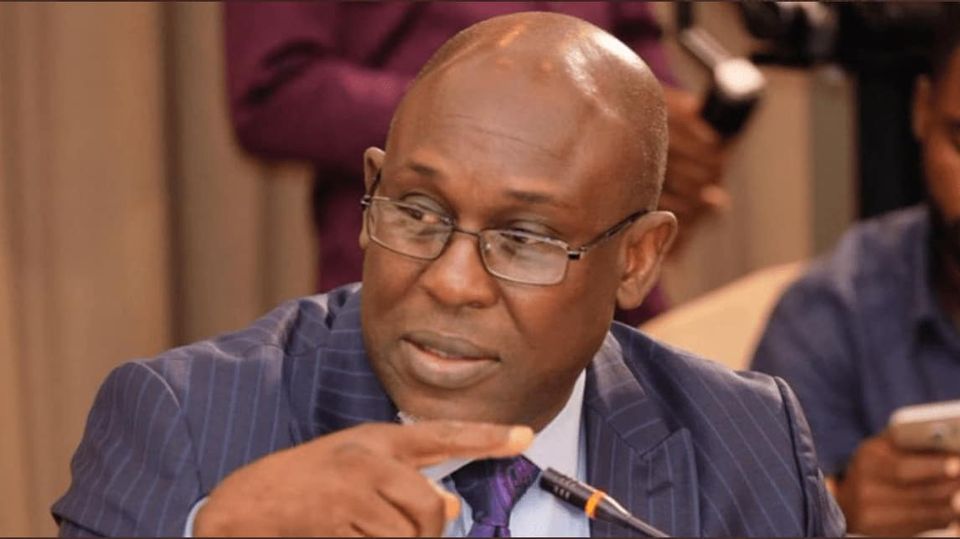
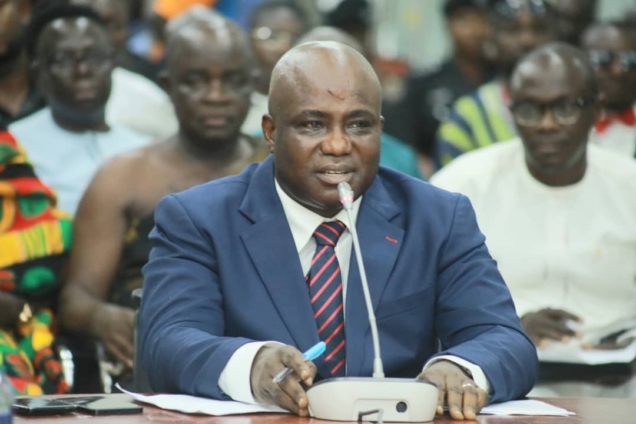
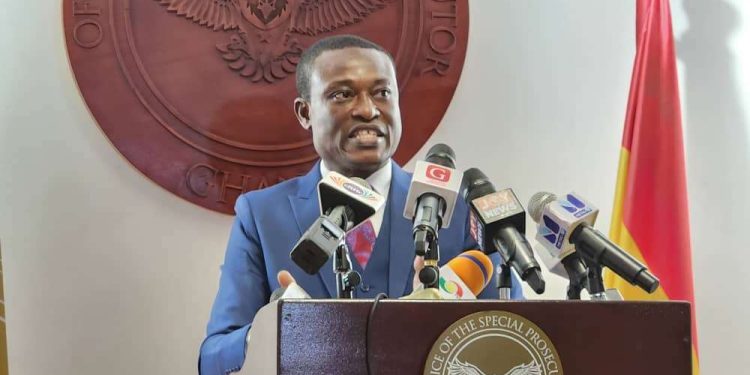
    The Majority Chief Whip, Rockson-Nelson Dafeamekpor, has commended President John Dramani Mahama for relieving Chief Justice (CJ) Gertrude Araba Esaaba Sackey Torkornoo of her duties.

    Speaking to the media on Monday, September 1, the Majority Chief Whip he shot down claims that the National Democratic Congress’ (NDC) government had ulterior motives behind the CJ’s removal.

    According to him, the government acted rightfully in accordance to Ghana’s 1992 Constitution, therefore cannot be accused of any wrongdoing in the Chief Justice’s removal.

    “It’s absolutely incorrect for Hassan Tampuli [Gushegu MP], and some others, to suggest, however whimsical that it is, that the grounds underpining these petitions that went before the Article 146 Committee were whimsical and frivolous. There were no frivolities at all,” he pointed out.

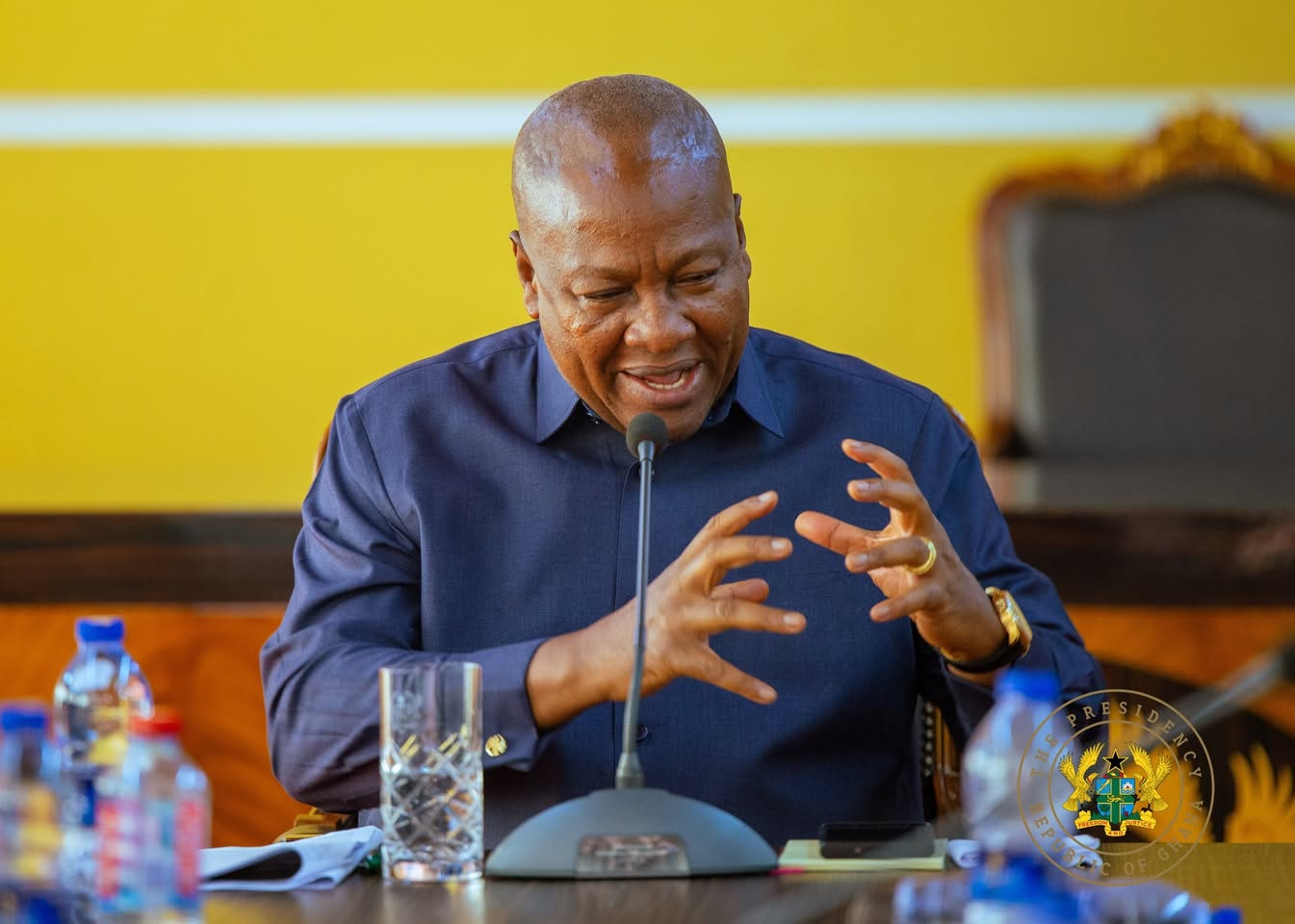
    On Monday, September 1, a press statement issued by the presidency and signed by the Spokesperson to the President, Felix Kwakye Ofosu, indicated that her dismissal is in accordance with Article 146(9) of the 1992 Constitution.


    President Mahama, on Tuesday, April 22, suspended the Chief Justice after a prima facie case was established, following separate petitions calling for her removal.


    However, the new development comes shortly after President John Dramani Mahama officially received recommendations from the committee probing petitions seeking the removal of Chief Justice Gertrude Araba Esaaba Sackey Torkornoo, Monday, September 1.


    According to the statement, the Article 146 Committee of Inquiry found that the grounds of stated misbehaviour under Article 146(1) had been established and recommended her removal from office.


    “President John Dramani Mahama has, in accordance with Article 146(9) of the 1992 Constitution, removed the Chief Justice, Her Ladyship Justice Gertrude Araba Esaaba Sackey Torkonoo, from office with immediate effect.


    “This follows receipt of the report of the Committee constituted under Article 146(6) to inquire into a petition submitted by a Ghanaian citizen, Mr Daniel Ofori. After considering the petition and the evidence, the Committee found that the grounds of stated misbehaviour under Article 146(1) had been established and recommended her removal from office. Under Article 146(9), the President is required to act in accordance with the committee’s recommendation,” parts of the statement read.


    The committee, chaired by Supreme Court Justice Gabriel Scott Pwamang and includes Justice Samuel Kwame Adibu Asiedu, former Auditor-General Daniel Yaw Domelevo, Major Flora Bazwaanura Dalugo of the Ghana Armed Forces, and Professor James Sefah Dzisah of the University of Ghana.


    In July, an application for review regarding an ‘abuse of court processes’ by the embattled Chief Justice, Justice Gertrude Torkornoo, was dismissed by the Human Rights Division of the Accra High Court.


    The court presided over by Justice Amoako on Thursday, July 31, revealed that several claims, such as illegal composition of the committee and wrongful conduct of adversarial proceedings, were already before the Supreme Court.


    Justice Amoako argued that relitigating these issues would result in duplication of litigation and abuse of court processes. As such, such claims were dismissed.

    The judge also dismissed reliefs such as an order of certiorari to quash the committee’s proceedings and nullify its sittings on the basis that the Chief Justice did not receive a fair hearing, on jurisdictional grounds.


    The judicial review application filed on June 9 this year sought nine reliefs, which included a series of declarations that the Article 146 committee set up to probe her removal from office had acted unlawfully.


    She wanted the court to prevent the committee from proceeding with its work without providing her with authenticated copies of the petitions seeking her removal and the subsequent responses.


    The Chief Justice notes that the president’s purported prima facie determination contained no reasons or justification and was entirely devoid of the elements of judicial or quasi-judicial reasoning expected under the Constitution.


    As the proceedings of the Article 146 committee are to be held in-camera in accordance with Article 146(8) of the Constitution, the court noted that it could not inquire into matters raised by the suspended Chief Justice.


    In response, Justice Gertrude Torkornoo proceeded to the ECOWAS Community Court in Abuja, Nigeria, seeking compensation worth $10 million over her suspension from office by His Excellency President John Dramani Mahama.


    This forms part of the 10 reliefs being requested. The Chief Justice’s recent suit follows several unsuccessful cases at the Supreme Court this year after her suspension.

    The suspended Chief Justice wants the court to ensure she continues to enjoy the paraphernalia and entitlements of her office as the Chief Justice of Ghana pending the hearing and determination of the case.


    The measures are: “That the Republic of Ghana suspend the disciplinary/ removal from office as Chief Justice process against the Applicant, pending the hearing and determination of the complaint on the merits.”


    “That Ghana refrains from taking any other measures that may harm the rights claimed by the Applicant and /or aggravate or extend the dispute submitted to the Court, or compromise the implementation of any decision that the Court may render.”


    “Given the urgency of the situation, the Applicant respectfully requests the Court to hold a hearing on this request as soon as possible, and that the President of the Court ask Ghana to act in order to allow any order that the Court may issue on the Request for Assignment of Precautionary Measures to have its appropriate effect.”


    The other reliefs are as follows: “A declaration that the panel instituted by the Respondent (Ghana) to investigate and determine the allegations of misconduct against the Applicant was not constituted to guarantee its independence and impartiality and as such has violated the Applicant’s human right to fair hearing guaranteed by Article 7 of the African Charter on Human and Peoples’ Rights.”


    “A declaration that the purported suspension of the Applicant as the Chief Justice of the Republic of Ghana by the President of the Respondent State on 22 April 2025, constitutes a violation of her human right to fair, equitable, and satisfactory conditions guaranteed by Article 15 of the African Charter on Human and Peoples’ Rights.”


    “A declaration that the purported suspension of the Applicant as the Chief Justice of the Republic of Ghana by the President of the Respondent State on 22 April 2025 has exposed her to public ridicule and odium locally and internationally and the said act constitutes a violation of her human right to dignity guaranteed by Article 5 of the African Charter on Human and Peoples’ Rights.”


    “A declaration that by subjecting the Applicant to an illegal and unfair investigation and trial since April 2025, the Respondent has inflicted injuries on her professional standing and image, thereby ‘exposing her and her family to immeasurable public ridicule.”

    “An order to the Respondent Republic to act immediately to prescribe the rule of procedure to govern the investigation of allegations of misconduct against the Chief Justice of the Republic of Ghana in conformity with the right to fair hearing guaranteed by the Constitution of Ghana and the African Charter on Human and Peoples’ Rights.”


    “An order directing the Respondent to immediately lift the suspension and restore the Applicant to full office until the conclusion of fair constitutional proceedings.”


    “An order restraining the Respondent from continuing with the purported inquiry for the removal of the Applicant as the Chief Justice of the Republic of Ghana in its current form, until it conforms to fair hearing guarantees.”


    “An award of USD 10 million as compensation for moral and reputational damages suffered by the Applicant as a result of her illegal suspension and unfair investigation, and lastly, “Any other relief(s) as the Honourable Court deems just.”


    The suspended Chief Justice wants the court to ensure she continues to enjoy the paraphernalia and entitlements of her office as the Chief Justice of Ghana pending the hearing and determination of the case.


    The applicant has also requested the ECOWAS Court to assign four precautionary measures to the country. Meanwhile, the government’s spokesperson, Felix Kwakye Ofosu, has refuted claims made by Justice Torkornoo, noting that the Chief Justice’s suspension aligns with the constitution.


    On Thursday, August 14, the Bar Council of England and Wales and the Commonwealth Lawyers Association called for the immediate reinstatement of Ghana’s Chief Justice by President John Dramani Mahama and the Executive arm of government.


    “Immediately and without delay, reinstate the Chief Justice of Ghana to her Office. consistent with both the hitherto strong attachment to the rule of law demonstrated by Ghana and also, the constitutional duties incumbent upon them.


    “And afford the Chief justice due and fair process in the investigation and determination of the disciplinary matters brought against her, including but not limited to full and transparent access to that process by her legal representatives,” the group demanded in a joint statement issued on August 14.


    Additionally, the group asked the government for a proper and impartial investigation of the disciplinary charges against her, with her lawyers given full and transparent access to the proceedings.


    Also both groups, demanded the establishment of transparent procedural rules to guide the disciplinary process, including a definite timeframe within which the investigative committee must conclude its work and communicate its decision.


    In response, the Attorney General (A-G), Dr. Dominic Ayine emphasised that his outfit can only intervene after the committee concludes its work and submits a report to President John Dramani Mahama.

    “The suspension will, therefore, remain in effect until the inquiry committee completes its work and submits its report, to which His Excellency, the President will adhere,” he said.

  • Akwatia by-election underway

    Akwatia by-election underway

    More than 50,000 registered constituents in Akwatia, in the Eastern Region, will cast their ballots today, Tuesday, September 2, to select a Member of Parliament (MP) to represent the Constituency in Parliament.


    Today’s polls have become necessary following the sudden passing of the sitting MP, Ernest Yaw Kumi, which occurred on Monday, July 7, 2025. Ernest Yaw Kumi had only served for six months as the MP for the area.


    The National Democratic Congress (NDC) has elected legal practitioner Bernard Bediako Baidoo to contest the election. The New Patriotic Party (NPP) has also selected the Chief Executive of Owuo Mining Company, Solomon Kwame Asumadu, as its parliamentary candidate for the by-election.

    However, David Ankomah, who sought to contest on the ticket of the Action People’s Party (APP) has been disqualified by the Electoral Commission (EC) over failing to submit his tax clearance certificate. In this regard, the disqualified candidate has filed a lawsuit against the Electoral Commission.


    He has therefore challenged the EC at the High Court for excluding him because he failed to submit his tax clearance certificate.


    Ankomah argued that the Commission gave him too short a notice to produce the certificate through the Akwatia District Electoral Officer, which caused his inability to provide the required document.


    Additionally, he maintains that he has completed all necessary processes needed to participate in the race. He has therefore prayed the Court to suspend the by-election until the case is determined.


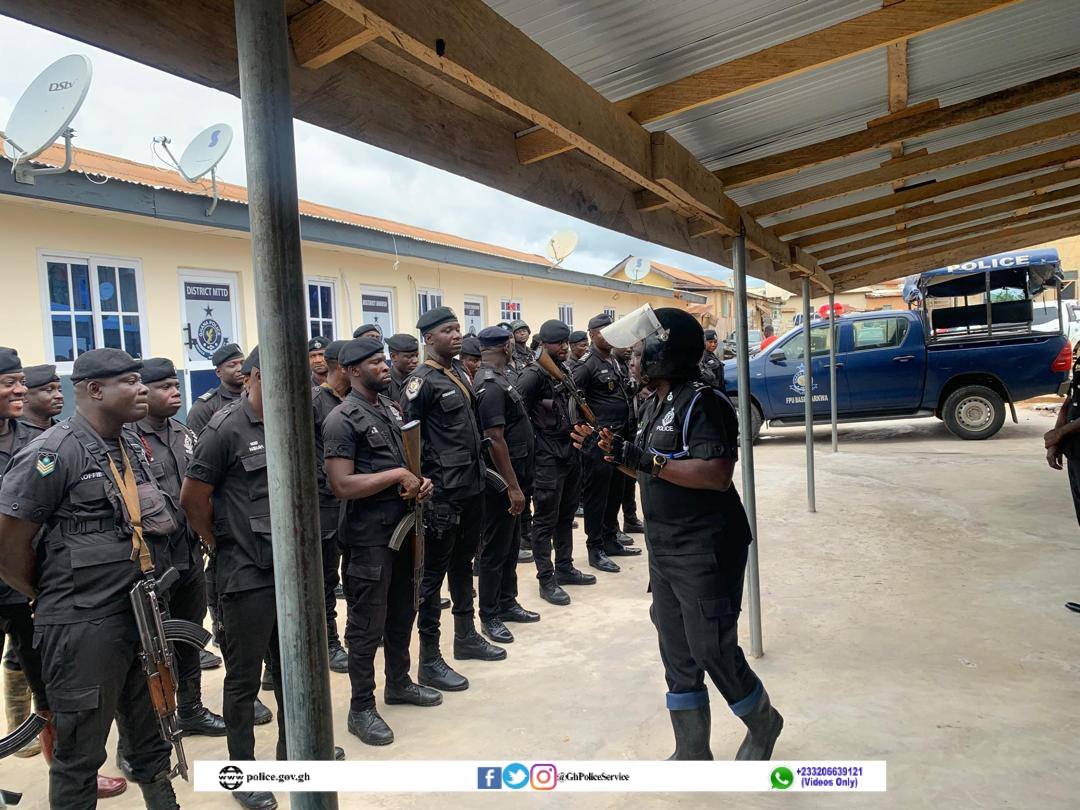
    Meanwhile, over 5,500 police personnel have been deployed to Akwatia to ensure law and order during the by-election. Briefing the media on the Police’s preparation ahead of the by-election on Friday, August 30, the Director-General of Operations, COP Dr. Vance Baba Gariba, noted that to ensure effective coverage, the constituency has been grouped into nine security zones.

    He disclosed that 600 officers have been fully armed to swiftly respond to any disturbances that may occur during the exercise.
    The Director General of Operations has assured that the military will only assist should matters get beyond control.


    “The military will be only on standby.As and when we need them, then we will deploy them, but if we don’t need the military, then we will not request for the deployment of the military. They are only going to be on standby,” COP Gariba stated.


    Former Government Spokesperson on Governance and Security, Dr. Palgrave Boakye-Danquah, has encouraged Akwatia constituents to participate in the by-election without being intimidated by the security presence.


    Engaging with the media on Monday, August 25, he indicated that the security presence is to ensure that the electoral process is not tampered with.


    Meanwhile, the National Democratic Congress (NDC) and the New Patriotic Party (NPP) have allegedly held back from signing a peace pact ahead of the Akwatia by-election.


    This follows claims by the NPP that the NDC’s representatives presented constituency executives instead of national-level executives to sign the agreement.


    NPP National Organizer Henry Nana Boakye told reporters that the NDC had shown reluctance to commit to the peace declaration, accusing the party of deliberately stalling the process.


    Speaking to the media after the failed engagement, a Board member of the Peace Council, Sheikh Armeyaw Shaibu, said, “In the spirit of mutual dialogue and mutual respect, the two parties agreed that we should suspend the meeting”.

    In a series of security operations in Akwatia, the Eastern South Regional Police Command has announced the arrest of ten persons and the confiscation of nine firearms ahead of the upcoming by-election.

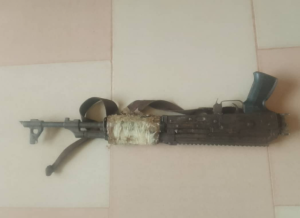
    The seized firearms include eight pump-action shotguns and one locally manufactured single-barrel gun.

    This was announced in a statement shared on the Command’s official Facebook page earlier today. The statement noted that, “These seizures form part of intensified efforts to prevent the unlawful possession and use of weapons during the electoral process.”

    The first suspects were intercepted in a vehicle driven by one Bernard Kumi Ofosu near the St. Dominic Hospital in Akwatia. A search of the vehicle uncovered a Tulpar double-barrel pump-action gun, four AAA live cartridges, and two FTB blanks. Ofosu admitted ownership and presented a valid license. He is currently assisting with investigations while the exhibits undergo verification.

    The statement further revealed that another operation led to the arrest of suspect Joshua Amenuku, from whom 15 live cartridges were retrieved. A subsequent search at his residence uncovered an Adler Tulpar pump-action gun and five additional live cartridges.

    “In a separate operation at the Akwatia Y-Junction snap check, the Police arrested suspect Joshua Amenuku after retrieving 15 live BB cartridges from him. A subsequent search at his residence uncovered one Adler Tulpar pump-action gun and five additional live BB cartridges,” the police added.

    Later that evening, the police intercepted a Toyota Hilux pickup at the Boadua Livingstone snap checkpoint and arrested suspects Enoch Asiedu and Lu Youyan, a Chinese national, after retrieving four live BB cartridges from the vehicle.

    According to the statement, “Preliminary interrogation revealed that the ammunition allegedly belonged to their employer, one Mohammed, identified as the owner of the vehicle. Efforts are underway to trace and arrest suspect Mohammed for interrogation, while the two suspects remain in custody assisting investigations.”

    In another operation on Friday, August 23, police officers on duty at the Boadua Livingstone Junction snap checkpoint arrested suspect Pieterson Joseph after retrieving one Adler Tulpar pump-action gun and 46 AAA and BB cartridges from his vehicle. The suspect admitted ownership of the firearm.

    On the same day, officers on snap-check duty at Staff Village Boadua intercepted a Toyota Tundra pickup with registration number WR 5535-13 traveling from Asamankese towards Boadua.

    A search conducted on the vehicle revealed three pump-action guns, including one Pardus pump-action, one Huglu Atroe pump-action, and one other pump-action gun.

    Suspect Stephen Nkansah claimed ownership of two of the firearms and stated that the third belonged to his chief. Nkansah has since been arrested and detained for investigation.

    Following these successful operations, the police assured the public and all stakeholders that they will intensify efforts to ensure the integrity of the elections as well as maintain peace and security in the region ahead of the polls.

    The Inspector General of Police (IGP), Mr. Christian Tetteh Yohuno, has assured that his outfit will remain vigilant to avert any form of misconduct or electoral violence during the Akwatia by-election.

    Engaging the media, the IGP stated that his officers are fully prepared. “We want to assure Ghanaians that the police are ready to handle any type of thing that may come in Akwatia. We are ready with the men. We have the men who can handle this situation, and then our eyes are red for Akwatia, and nobody, nobody should think of coming to cause trouble,” he said.

    The IGP also cautioned political parties participating in the by-election against mobilising supporters to disrupt the electoral process.

    “No political party should mobilise men to come and foment trouble, and nobody should have in mind the intention of snatching a ballot box. We have prepared our men adequately to handle this situation, and that, I informed the political parties as I met them yesterday [Tuesday],” he said.

  • Inquiry Committee rules petition alleging misbehavior by Chief Justice Gertrude Torkonoo valid

    Inquiry Committee rules petition alleging misbehavior by Chief Justice Gertrude Torkonoo valid

    The five-member committee, Article 146 Committee of Inquiry tasked to probe petitions seeking the removal of Chief Justice Gertrude Araba Esaaba Sackey Torkornoo, has concluded its investigations.

    The committee has described the first petition submitted by a Ghanaian citizen, Daniel Ofori, which called for the Chief Justice’s removal as valid. 

    Daniel Ofori’s petition was filed under Article 146 of the 1992 Constitution, which outlines the process for removing a Chief Justice on grounds such as “stated misbehaviour” and “incompetence.

    “I, the undersigned, respectfully petition Your Excellency for the removal of the Honourable Chief Justice of the Republic of Ghana, Her Ladyship Gertrude Sackey Torkonoo CJ on grounds of “stated misbehaviour” and “incompetence” under Article 146 (1) of the 1992 Constitution of the Republic of Ghana.


    “ I state below twenty-one (21) specific allegations of misbehaviour of the Honourable Chief Justice and four (4) allegations of incompetence, all of which relate to the Honourable Chief Justice’s discharge of her administrative roles and functions as head of the Judiciary, responsible for its supervision and administration,” part of his petition read.

    However, a press statement issued by the presidency and signed by the Spokesperson to the President, Felix Kwakye Ofosu on Monday, September 1, indicated that the committee found that the grounds of stated misbehaviour under Article 146(1) had been established.

    “This follows receipt of the report of the Committee constituted under Article 146(6) to inquire into a petition submitted by a Ghanaian citizen, Mr Daniel Ofori. After considering the petition and the evidence, the Committee found that the grounds of stated misbehaviour under Article 146(1) had been established and recommended her removal from office,” part of the statement read. 

    The committee further recommended that the Chief Justice be removed from office. The President upon the recommendations received from the committee today, Monday, September 1 relieved the suspended Chief Justice Getrude Tokornoo of her duties with immediate effect.

    The Chief Justice was earlier suspended by President Mahama on Tuesday, April 22, after a prima facie case was established, following separate petitions calling for her removal. 

    A series of petitions filed against Chief Justice Torkornoo, beginning with one from a group known as Shining Stars of Ghana.

    The group alleges she violated Article 144 of the Constitution by personally recommending judges for promotion to the Supreme Court, and further claims she ruled on a case involving the Speaker of Parliament without granting him a hearing, despite his refusal to respond to the suit.

    A series of petitions filed against Chief Justice Torkornoo, beginning with one from a group known as Shining Stars of Ghana. The group alleges she violated Article 144 of the Constitution by personally recommending judges for promotion to the Supreme Court, and further claims she ruled on a case involving the Speaker of Parliament without granting him a hearing, despite his refusal to respond to the suit.

    The group alleges she violated Article 144 of the Constitution by personally recommending judges for promotion to the Supreme Court, and further claims she ruled on a case involving the Speaker of Parliament without granting him a hearing, despite his refusal to respond to the suit.


    Another petition from a police officer who is also a lawyer accuses the Chief Justice of manipulating evidence and abusing her authority, following an incident during a Supreme Court session where he was reportedly reprimanded, arrested, and detained.

    However, court records suggest the lawyer’s conduct during proceedings prompted a unanimous caution from the bench, not just the Chief Justice.


    A third petition, submitted by a private individual, lists 21 alleged misconducts and four claims of incompetence. Among the accusations is the misuse of public funds—specifically, that she spent over GH¢261,000 and $30,000 on a family trip abroad in 2023 and misused an additional GH¢75,580 and $14,000 during another foreign assignment without proper accountability.


    Subsequent reports indicate two more petitions have been added to the list, intensifying pressure on the judiciary.


    Chief Justice Gertrude Torkornoo, in her written response to President Mahama, strongly denied allegations of misconduct and abuse of office brought against her by a senior police officer, describing them as baseless and lacking grounds for her removal from office.

    In July, an application for review regarding an ‘abuse of court processes’ by the embattled Chief Justice, Justice Gertrude Torkornoo, was dismissed by the Human Rights Division of the Accra High Court.

    The court presided over by Justice Amoako on Thursday, July 31, revealed that several claims, such as illegal composition of the committee and wrongful conduct of adversarial proceedings, were already before the Supreme Court.


    Justice Amoako argued that relitigating these issues would result in duplication of litigation and abuse of court processes. As such, such claims were dismissed.


    The judge also dismissed reliefs such as an order of certiorari to quash the committee’s proceedings and nullify its sittings on the basis that the Chief Justice did not receive a fair hearing, on jurisdictional grounds.


    The judicial review application filed on June 9 this year sought nine reliefs, which included a series of declarations that the Article 146 committee set up to probe her removal from office had acted unlawfully.


    She wanted the court to prevent the committee from proceeding with its work without providing her with authenticated copies of the petitions seeking her removal and the subsequent responses.

    The Chief Justice notes that the president’s purported prima facie determination contained no reasons or justification and was entirely devoid of the elements of judicial or quasi-judicial reasoning expected under the Constitution.


    As the proceedings of the Article 146 committee are to be held in-camera in accordance with Article 146(8) of the Constitution, the court noted that it could not inquire into matters raised by the suspended Chief Justice.


    In response, Justice Gertrude Torkornoo proceeded to the ECOWAS Community Court in Abuja, Nigeria, seeking compensation worth $10 million over her suspension from office by His Excellency President John Dramani Mahama.


    This forms part of 10 reliefs being requested. The Chief Justice’s recent suit follows several unsuccessful cases at the Supreme Court this year after her suspension.


    The suspended Chief Justice wants the court to ensure she continues to enjoy the paraphernalia and entitlements of her office as the Chief Justice of Ghana pending the hearing and determination of the case.


    The measures are;
    “That the Republic of Ghana suspend the disciplinary/ removal from office as Chief Justice process against the Applicant, pending the hearing and determination of the complaint on the merits.”


    “That Ghana refrains from taking any other measures that may harm the rights claimed by the Applicant and /or aggravate or extend the dispute submitted to the Court, or compromise the implementation of any decision that the Court may render.”


    “Given the urgency of the situation, the Applicant respectfully requests the Court to hold a hearing on this request as soon as possible, and that the President of the Court ask Ghana to act in order to allow any order that the Court may issue on the Request for Assignment of Precautionary Measures to have its appropriate effect.”


    The other reliefs are as follows;


    “A declaration that the panel instituted by the Respondent (Ghana) to investigate and determine the allegations of misconduct against the Applicant was not constituted to guarantee its independence and impartiality and as such has violated the Applicant’s human right to fair hearing guaranteed by Article 7 of the African Charter on Human and Peoples’ Rights.”


    “A declaration that the purported suspension of the Applicant as the Chief Justice of the Republic of Ghana by the President of the Respondent State on 22 April 2025, constitutes a violation of her human right to fair equitable and satisfactory conditions guaranteed by Article 15 of the African Charter on Human and Peoples’ Rights.”


    “A declaration that the purported suspension of the Applicant as the Chief Justice of the Republic of Ghana by the President of the Respondent State on 22 April 2025 has exposed her to public ridicule and odium locally and internationally and the said act constitutes a violation of her human right to dignity guaranteed by Article 5 of the African Charter on Human and Peoples’ Rights.”


    “A declaration that by subjecting the Applicant to an illegal and unfair investigation and trial since April 2025, the Respondent has inflicted injuries on her professional standing and image, thereby ‘exposing her and her family to immeasurable public ridicule.”


    “An order to the Respondent Republic to act immediately to prescribe the rule of procedure to govern the investigation of allegations of misconduct against the Chief Justice of the Republic of Ghana in conformity with the right to fair hearing guaranteed by the Constitution of Ghana and the African Charter on Human and Peoples’ Rights.”


    “An order directing the Respondent to immediately lift the suspension and restore the Applicant to full office until the conclusion of fair constitutional proceedings.”


    “An order restraining the Respondent from continuing with the purported inquiry for the removal of the Applicant as the Chief Justice of the Republic of Ghana in its current form, until it conforms to fair hearing guarantees.”


    “An award of USD 10 million as compensation for moral and reputational damages suffered by the Applicant as a result of her illegal suspension and unfair investigation, and lastly, “Any other relief(s) as the Honourable Court deems just.”


    The suspended Chief Justice wants the court to ensure she continues to enjoy the paraphernalia and entitlements of her office as the Chief Justice of Ghana pending the hearing and determination of the case. The applicant has also requested the ECOWAS Court to assign four precautionary measures to the country.Meanwhile, the government’s spokesperson, Felix Kwakye Ofosu, has refuted claims made by Justice Torkornoo, noting that the Chief Justice’s suspension aligns with the constitution.


    On Thursday, August 14, the Bar Council of England and Wales and the Commonwealth Lawyers Association called for the immediate reinstatement of Ghana’s Chief Justice by President John Dramani Mahama and the Executive arm of government.


    “Immediately and without delay, reinstate the Chief Justice of Ghana to her Office. consistent with both the hitherto strong attachment to the rule of law demonstrated by Ghana and also, the constitutional duties incumbent upon them.


    “And afford the Chief justice due and fair process in the investigation and determination of the disciplinary matters brought against her, including but not limited to full and transparent access to that process by her legal representatives,” the group demanded in a joint statement issued on August 14.


    Additionally, the group asked the government for a proper and impartial investigation of the disciplinary charges against her, with her lawyers given full and transparent access to the proceedings.


    Also both groups demanded the establishment of transparent procedural rules to guide the disciplinary process, including a definite timeframe within which the investigative committee must conclude its work and communicate its decision.


    However, Attorney General Dr. Dominic Ayine has emphasised that his outfit can only intervene after the committee concludes its work and submits a report to President John Dramani Mahama.
    “The suspension will, therefore, remain in effect until the inquiry committee completes its work and submits its report, to which His Excellency, the President will adhere,” he said.
  • President Mahama removes Chief Justice Gertrude Tokornoo from office

    President Mahama removes Chief Justice Gertrude Tokornoo from office

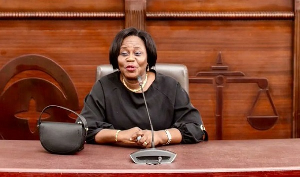
    President John Dramani Mahama has relieved the embattled Chief Justice Gertrude Tokornoo of her duties with immediate effect.

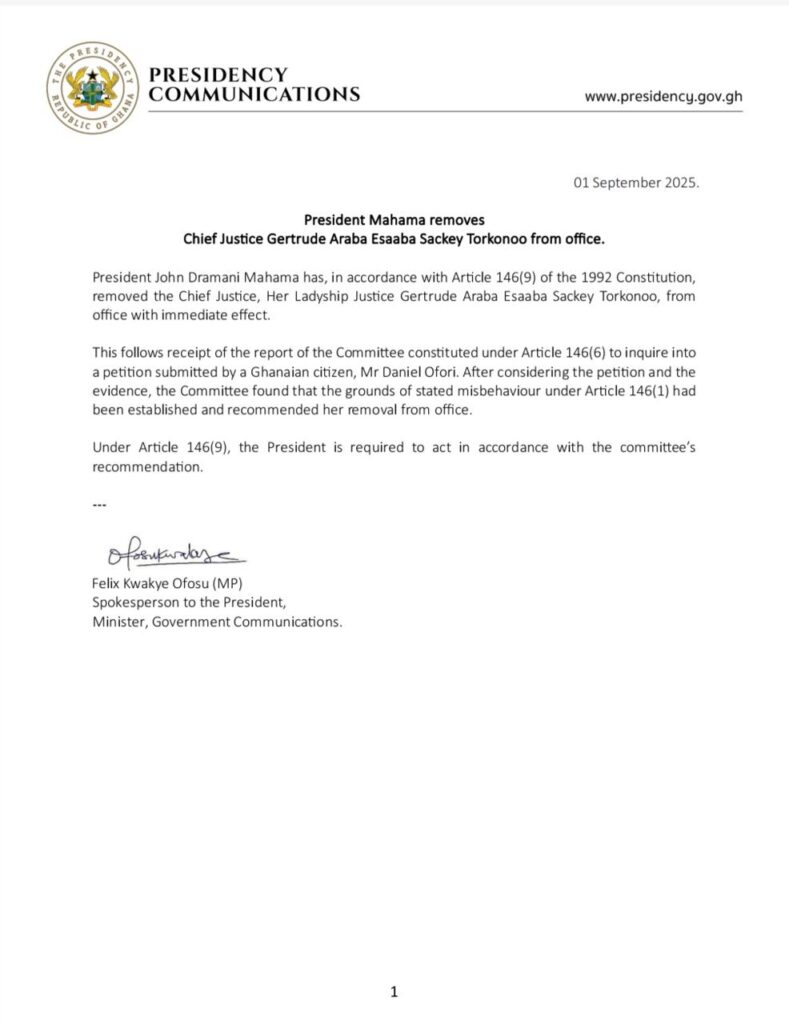
    A press statement issued by the presidency and signed by the Spokesperson to the President, Felix Kwakye Ofosu, indicated that her dismissal is in accordance with Article 146(9) of the 1992 Constitution. 

    President Mahama, on Tuesday, April 22, suspended the Chief Justice after a prima facie case was established, following separate petitions calling for her removal. 

    However, the new development comes shortly after President John Dramani Mahama officially received recommendations from the committee probing petitions seeking the removal of Chief Justice Gertrude Araba Esaaba Sackey Torkornoo, today, Monday, September 1.


    The presidency justified its decision to dismiss the Chief Justice, citing findings from the Article 146 Committee of Inquiry.

    According to the statement, the Committee found that the grounds of stated misbehavior under Article 146(1) had been established and recommended her removal from office.

    “President John Dramani Mahama has, in accordance with Article 146(9) of the 1992 Constitution, removed the Chief Justice, Her Ladyship Justice Gertrude Araba Esaaba Sackey Torkonoo, from office with immediate effect.

    “This follows receipt of the report of the Committee constituted under Article 146(6) to inquire into a petition submitted by a Ghanaian citizen, Mr Daniel Ofori. After considering the petition and the evidence, the Committee found that the grounds of stated misbehaviour under Article 146(1) had been established and recommended her removal from office.

    “Under Article 146(9), the President is required to act in accordance with the committee’s recommendation,” parts of the statement read.

    The committee chaired by Supreme Court Justice Gabriel Scott Pwamang and includes Justice Samuel Kwame Adibu Asiedu, former Auditor-General Daniel Yaw Domelevo, Major Flora Bazwaanura Dalugo of the Ghana Armed Forces, and Professor James Sefah Dzisah of the University of Ghana.

    In July, an application for review regarding an ‘abuse of court processes’ by the embattled Chief Justice, Justice Gertrude Torkornoo, was dismissed by the Human Rights Division of the Accra High Court.

    The court presided over by Justice Amoako on Thursday, July 31, revealed that several claims, such as illegal composition of the committee and wrongful conduct of adversarial proceedings, were already before the Supreme Court.


    Justice Amoako argued that relitigating these issues would result in duplication of litigation and abuse of court processes. As such, such claims were dismissed.


    The judge also dismissed reliefs such as an order of certiorari to quash the committee’s proceedings and nullify its sittings on the basis that the Chief Justice did not receive a fair hearing, on jurisdictional grounds.


    The judicial review application filed on June 9 this year sought nine reliefs, which included a series of declarations that the Article 146 committee set up to probe her removal from office had acted unlawfully.


    She wanted the court to prevent the committee from proceeding with its work without providing her with authenticated copies of the petitions seeking her removal and the subsequent responses.

    The Chief Justice notes that the president’s purported prima facie determination contained no reasons or justification and was entirely devoid of the elements of judicial or quasi-judicial reasoning expected under the Constitution.


    As the proceedings of the Article 146 committee are to be held in-camera in accordance with Article 146(8) of the Constitution, the court noted that it could not inquire into matters raised by the suspended Chief Justice.


    In response, Justice Gertrude Torkornoo proceeded to the ECOWAS Community Court in Abuja, Nigeria, seeking compensation worth $10 million over her suspension from office by His Excellency President John Dramani Mahama.


    This forms part of the 10 reliefs being requested. The Chief Justice’s recent suit follows several unsuccessful cases at the Supreme Court this year after her suspension.


    The suspended Chief Justice wants the court to ensure she continues to enjoy the paraphernalia and entitlements of her office as the Chief Justice of Ghana pending the hearing and determination of the case.


    The measures are;
    “That the Republic of Ghana suspend the disciplinary/ removal from office as Chief Justice process against the Applicant, pending the hearing and determination of the complaint on the merits.”


    “That Ghana refrains from taking any other measures that may harm the rights claimed by the Applicant and /or aggravate or extend the dispute submitted to the Court, or compromise the implementation of any decision that the Court may render.”


    “Given the urgency of the situation, the Applicant respectfully requests the Court to hold a hearing on this request as soon as possible, and that the President of the Court ask Ghana to act in order to allow any order that the Court may issue on the Request for Assignment of Precautionary Measures to have its appropriate effect.”


    The other reliefs are as follows;
    “A declaration that the panel instituted by the Respondent (Ghana) to investigate and determine the allegations of misconduct against the Applicant was not constituted to guarantee its independence and impartiality and as such has violated the Applicant’s human right to fair hearing guaranteed by Article 7 of the African Charter on Human and Peoples’ Rights.”


    “A declaration that the purported suspension of the Applicant as the Chief Justice of the Republic of Ghana by the President of the Respondent State on 22 April 2025, constitutes a violation of her human right to fair equitable and satisfactory conditions guaranteed by Article 15 of the African Charter on Human and Peoples’ Rights.”


    “A declaration that the purported suspension of the Applicant as the Chief Justice of the Republic of Ghana by the President of the Respondent State on 22 April 2025 has exposed her to public ridicule and odium locally and internationally and the said act constitutes a violation of her human right to dignity guaranteed by Article 5 of the African Charter on Human and Peoples’ Rights.”


    “A declaration that by subjecting the Applicant to an illegal and unfair investigation and trial since April 2025, the Respondent has inflicted injuries on her professional standing and image, thereby ‘exposing her and her family to immeasurable public ridicule.”


    “An order to the Respondent Republic to act immediately to prescribe the rule of procedure to govern the investigation of allegations of misconduct against the Chief Justice of the Republic of Ghana in conformity with the right to fair hearing guaranteed by the Constitution of Ghana and the African Charter on Human and Peoples’ Rights.”


    “An order directing the Respondent to immediately lift the suspension and restore the Applicant to full office until the conclusion of fair constitutional proceedings.”


    “An order restraining the Respondent from continuing with the purported inquiry for the removal of the Applicant as the Chief Justice of the Republic of Ghana in its current form, until it conforms to fair hearing guarantees.”


    “An award of USD 10 million as compensation for moral and reputational damages suffered by the Applicant as a result of her illegal suspension and unfair investigation, and lastly, “Any other relief(s) as the Honourable Court deems just.”


    The suspended Chief Justice wants the court to ensure she continues to enjoy the paraphernalia and entitlements of her office as the Chief Justice of Ghana pending the hearing and determination of the case.

    The applicant has also requested the ECOWAS Court to assign four precautionary measures to the country.Meanwhile, the government’s spokesperson, Felix Kwakye Ofosu, has refuted claims made by Justice Torkornoo, noting that the Chief Justice’s suspension aligns with the constitution.


    On Thursday, August 14, the Bar Council of England and Wales and the Commonwealth Lawyers Association called for the immediate reinstatement of Ghana’s Chief Justice by President John Dramani Mahama and the Executive arm of government.


    “Immediately and without delay, reinstate the Chief Justice of Ghana to her Office. consistent with both the hitherto strong attachment to the rule of law demonstrated by Ghana and also, the constitutional duties incumbent upon them.


    “And afford the Chief justice due and fair process in the investigation and determination of the disciplinary matters brought against her, including but not limited to full and transparent access to that process by her legal representatives,” the group demanded in a joint statement issued on August 14.


    Additionally, the group asked the government for a proper and impartial investigation of the disciplinary charges against her, with her lawyers given full and transparent access to the proceedings.


    Also both groups, demanded the establishment of transparent procedural rules to guide the disciplinary process, including a definite timeframe within which the investigative committee must conclude its work and communicate its decision.


    In response, the Attorney General (A-G), Dr. Dominic Ayine emphasised that his outfit can only intervene after the committee concludes its work and submits a report to President John Dramani Mahama.
    “The suspension will, therefore, remain in effect until the inquiry committee completes its work and submits its report, to which His Excellency, the President will adhere,” he said.
  • Report on first petition against suspended Chief Justice submitted to President Mahama

    Report on first petition against suspended Chief Justice submitted to President Mahama

    President John Dramani Mahama has officially received recommendations from the committee probing petitions seeking the removal of Chief Justice Gertrude Araba Esaaba Sackey Torkornoo.

    The five-member committee Article 146 Committee of Inquiry was tasked by President John Dramani Mahama to investigate petitions calling for her removal. Consequently, the Chief Justice, Justice Gertrude Torkornoo was suspended by President Mahama on Tuesday, April 22 following the establishment of a prima facie case based on separate petitions calling for her removal.


    The committee chaired by Supreme Court Justice Gabriel Scott Pwamang and includes Justice Samuel Kwame Adibu Asiedu, former Auditor-General Daniel Yaw Domelevo, Major Flora Bazwaanura Dalugo of the Ghana Armed Forces, and Professor James Sefah Dzisah of the University of Ghana.

    In July, an application for review regarding an ‘abuse of court processes’ by the embattled Chief Justice, Justice Gertrude Torkornoo, was dismissed by the Human Rights Division of the Accra High Court.The court presided over by Justice Amoako on Thursday, July 31, revealed that several claims, such as illegal composition of the committee and wrongful conduct of adversarial proceedings, were already before the Supreme Court.

    Justice Amoako argued that relitigating these issues would result in duplication of litigation and abuse of court processes. As such, such claims were dismissed.

    The judge also dismissed reliefs such as an order of certiorari to quash the committee’s proceedings and nullify its sittings on the basis that the Chief Justice did not receive a fair hearing, on jurisdictional grounds.

    The judicial review application filed on June 9 this year sought nine reliefs, which included a series of declarations that the Article 146 committee set up to probe her removal from office had acted unlawfully.

    She wanted the court to prevent the committee from proceeding with its work without providing her with authenticated copies of the petitions seeking her removal and the subsequent responses.

    The Chief Justice notes that the president’s purported prima facie determination contained no reasons or justification and was entirely devoid of the elements of judicial or quasi-judicial reasoning expected under the Constitution.

    As the proceedings of the Article 146 committee are to be held in-camera in accordance with Article 146(8) of the Constitution, the court noted that it could not inquire into matters raised by the suspended Chief Justice.

    In response, Justice Gertrude Torkornoo proceeded to the ECOWAS Community Court in Abuja, Nigeria seeking compensation worth $10 million over her suspension from office by His Excellency President John Dramani Mahama.

    This forms part of 10 reliefs being requested. The Chief Justice’s recent suit follows several unsuccessful cases at the Supreme Court this year after her suspension.

    The suspended Chief Justice wants the court to ensure she continues to enjoy the paraphernalia and entitlements of her office as the Chief Justice of Ghana pending the hearing and determination of the case.

    The measures are;

    “That the Republic of Ghana suspend the disciplinary/ removal from office as Chief Justice process against the Applicant, pending the hearing and determination of the complaint on the merits.”

    “That Ghana refrains from taking any other measures that may harm the rights claimed by the Applicant and /or aggravate or extend the dispute submitted to the Court, or compromise the implementation of any decision that the Court may render.”

    “Given the urgency of the situation, the Applicant respectfully requests the Court to hold a hearing on this request as soon as possible, and that the President of the Court ask Ghana to act in order to allow any order that the Court may issue on the Request for Assignment of Precautionary Measures to have its appropriate effect.”

    The other reliefs are as follows;

    “A declaration that the panel instituted by the Respondent (Ghana) to investigate and determine the allegations of misconduct against the Applicant was not constituted to guarantee its independence and impartiality and as such has violated the Applicant’s human right to fair hearing guaranteed by Article 7 of the African Charter on Human and Peoples’ Rights.”

    “A declaration that the purported suspension of the Applicant as the Chief Justice of the Republic of Ghana by the President of the Respondent State on 22 April 2025, constitutes a violation of her human right to fair equitable and satisfactory conditions guaranteed by Article 15 of the African Charter on Human and Peoples’ Rights.”

    “A declaration that the purported suspension of the Applicant as the Chief Justice of the Republic of Ghana by the President of the Respondent State on 22 April 2025 has exposed her to public ridicule and odium locally and internationally and the said act constitutes a violation of her human right to dignity guaranteed by Article 5 of the African Charter on Human and Peoples’ Rights.”

    “A declaration that by subjecting the Applicant to an illegal and unfair investigation and trial since April 2025, the Respondent has inflicted injuries on her professional standing and image, thereby ‘exposing her and her family to immeasurable public ridicule.”

    “An order to the Respondent Republic to act immediately to prescribe the rule of procedure to govern the investigation of allegations of misconduct against the Chief Justice of the Republic of Ghana in conformity with the right to fair hearing guaranteed by the Constitution of Ghana and the African Charter on Human and Peoples’ Rights.”

    “An order directing the Respondent to immediately lift the suspension and restore the Applicant to full office until the conclusion of fair constitutional proceedings.”

    “An order restraining the Respondent from continuing with the purported inquiry for the removal of the Applicant as the Chief Justice of the Republic of Ghana in its current form, until it conforms to fair hearing guarantees.”

    “An award of USD 10 million as compensation for moral and reputational damages suffered by the Applicant as a result of her illegal suspension and unfair investigation, and lastly, “Any other relief(s) as the Honourable Court deems just.”

    The suspended Chief Justice wants the court to ensure she continues to enjoy the paraphernalia and entitlements of her office as the Chief Justice of Ghana pending the hearing and determination of the case. The applicant has also requested the ECOWAS Court to assign four precautionary measures to the country.Meanwhile, the government’s spokesperson, Felix Kwakye Ofosu, has refuted claims made by Justice Torkornoo, noting that the Chief Justice’s suspension aligns with the constitution.

    On Thursday, August 14, the Bar Council of England and Wales and the Commonwealth Lawyers Association called for the immediate reinstatement of Ghana’s Chief Justice by President John Dramani Mahama and the Executive arm of government.

    “Immediately and without delay, reinstate the Chief Justice of Ghana to her Office. consistent with both the hitherto strong attachment to the rule of law demonstrated by Ghana and also, the constitutional duties incumbent upon them.

    “And afford the Chief justice due and fair process in the investigation and determination of the disciplinary matters brought against her, including but not limited to) full and transparent access to that process by her legal representatives,” the group demanded in a joint statement issued on August 14.

    Additionally, the group asked the government for a proper and impartial investigation of the disciplinary charges against her, with her lawyers given full and transparent access to the proceedings.

    Also both groups, demanded the establishment of transparent procedural rules to guide the disciplinary process, including a definite timeframe within which the investigative committee must conclude its work and communicate its decision.

    However, Attorney General Dr. Dominic Ayine has emphasised that his outfit can only intervene after the committee concludes its work and submits a report to President John Dramani Mahama.

    “The suspension will, therefore, remain in effect until the inquiry committee completes its work and submits its report, to which His Excellency, the President, will adhere,” he said.

  • Placement portal opened for 2025 JHS graduates to review school choices and biodata

    Placement portal opened for 2025 JHS graduates to review school choices and biodata

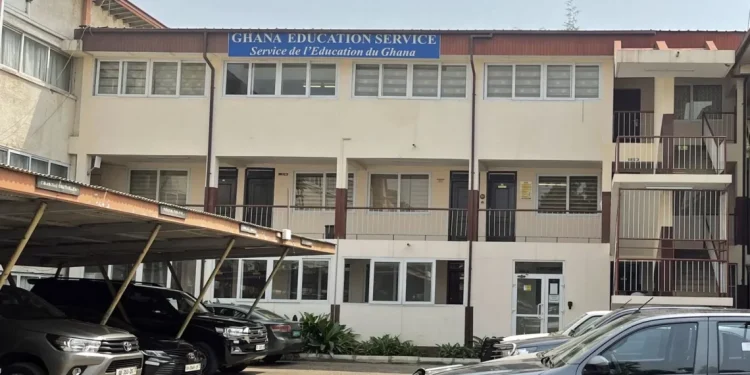
    The Ghana Education Service (GES) has opened the school placement portal, today, Monday, September 1, for individuals who participated in this year’s Basic Education Certificate Examination (BECE) to verify their school choices, biodata, and other relevant information ahead of the final placement.

    The deadline for this fact-checking exercise which has begun on the www.csses.gov.gh will conclude on Monday, September 8.

    At a media briefing on Wednesday, August 27, GES Director-General, Professor Ernest Kofi Davis noted “This process is expected to take no more than three weeks. From September 1 to September 8, the portal will be open for candidates to review their school choices, biodata, and other relevant information”.

    After placement, students are expected to report to their schools and start classes between October 18 and October 20 to begin the 2025/2026 academic year.SHS 3 students will reopen on October 11, 2025, and remain in school until February 27, 2026, covering 18 weeks.

    They will return on March 13, 2026, for a 14-week session ending June 21, 2026, ahead of the West African Senior School Certificate Examination (WASSCE) scheduled for April 20 to June 20, 2026.SHS 1 and 2 students will start their first session on October 18, 2025, and break on February 27, 2026, after 17 weeks.

    They will resume on May 4, 2026, for a 16-week session ending August 21, 2026, marking the close of the academic year. The Transitional Calendar refers to a temporary academic schedule designed to bridge the gap between the old double-track system and the new single-track system.

    On that calendar, first-year students will also report on October 18, 2025, and stay until January 30, 2026, before proceeding on a short break.

    Their second term will then begin on March 16 and run until June 12, 2026, with additional breaks, including some four weeks of off-site learning to help manage overcrowding in school facilities.

    Second-year students in transitional schools will reopen on January 5, 2026, and vacate on May 18, 2026, with five weeks of online learning. They will then resume from the vacation later in September for the final stretch of the academic year.

    Final-year students in transitional schools will begin on October 27, 2025, for a 14-week session before the Christmas break and resume in February for an 18-week preparation period before they sit for their West African Senior School Certificate Examination (WASSCE).

    GES also highlighted some significant breaks in the new timetable. The Christmas break will begin on December 20, 2025, and end on January 4, 2026.

    Vacation for SHS 3 students is slated for February 27 to March 1, 2026, while SHS 1 and 2 students will break from August 21 to August 23, 2026. GES has also proposed September 11, 2026, as the start date for the 2026/2027 academic year.

    In an unrelated development, sixty (60) private schools have been included under the Free Senior High School (SHS) policy. Junior High School (JHS) graduates will be admitted into these private schools, which fall under Category E in the school selection process. These schools will be accepting applications starting from the 2025/2026 academic year.

    The new development aligns with the government’s efforts to ease congestion in public SHSs as well as promote quality education across the country.In a press release issued on Sunday, July 20, by the Ghana National Council of Private Schools (GNACOPS) and signed by its National Executive Director, Oberto Nana Kwasi Gyetuah, the council described the initiative as a historic and progressive move.

    “This progressive move marks a significant milestone in Ghana’s educational transformation journey. It underscores the Government’s commitment to inclusive, collaborative education delivery and reaffirms the important role of private schools in advancing national development goals,” part of the release read.

    The council further called on other private schools that are yet to be listed to remain patient, prepared, and compliant with regulatory standards. In May, Deputy Minister of Education Dr. Clement Apaak announced that the inclusion forms part of a broader plan to scale up capacity and gradually end the double-track system.

    “As part of our campaign promise, we have been working diligently to bring on board private senior high schools in the delivery of the Free SHS programme. Meetings have been held, engagements have been done, and we are very certain that with the diligence we expect from our side…” he noted.

    The double-track system was introduced in 2018 by the erstwhile government to accommodate the surge in student enrollment due to the Free SHS policy, addressing overcrowding in public schools. Under this system, students were divided into two groups—Green Track and Gold Track—attending school in shifts, with one track in session while the other was on break.

    The anticipated extension of the Free SHS policy, according to the Education Minister, Haruna Iddrisu, is a fulfillment of the government’s manifesto promise, adding that it is a step to ensure eligible students gain admission without delays.

    “We believe strongly that in fulfilling this manifesto campaign promise, this is going to serve as an artery in helping us bring an end to the double-track system,” the deputy minister said.

    According to him, the Education Ministry has received encouraging feedback from private schools, many of which have expressed readiness to meet the standards and requirements of the Free SHS framework.“… and the eagerness of the private schools to participate, the private schools will deliver in their participation,” he assured.

    He added that this collaboration would not only help expand capacity but also ensure a more equitable distribution of educational opportunities across the country.

  • Central Region lost 22 lives to abandoned galamey pits – NADMO

    Central Region lost 22 lives to abandoned galamey pits – NADMO

    Abandoned illegal mining (galamsey) pits in the Central Region have claimed more than twenty-two (22) lives between January and August this year.

    During a media briefing after a Regional Security Council meeting, the Central Regional Director of the National Disaster Management Organisation (NADMO), Kwesi Dawood, indicated that the deceased persons lost their lives after drowning in these pits.

    The Central Regional Director of the National Disaster Management Organisation described the situation as alarming and called for a collective effort to end illegal mining in the country.

    Meanwhile, a task force has been launched in response to galamsey activities in the region. Their areas of operation include: Assin North, Assin Central, Upper Denkyira East and West, Twifo Ati-Morkwa, Twifo Hemang Lower Denkyira, and the Komenda-Edina-Eguafo-Abrem Municipality, which comprises security agencies, NADMO, Metropolitan, Municipal and District Assemblies, the Environmental Protection Agency, the Minerals Commission, miners, and the media.

    In the coming days, the degraded galamsey sites are expected to be converted into productive agricultural land and tree plantations.

    The project, which is spearheaded by the Regional Minister, Mr. Ekow Payin Okyere Eduamoah, aims to generate revenue to support Ghana’s economy.

    “This initiative includes implementing our ‘Tree for Life’ reforestation policy, aimed at cultivating cash crops such as cocoa, palm and rubber on rehabilitated sites,” he explained.


    In collaboration with the Ministry of Transport and the Ministry of Finance, under the GRA Customs Division and the Ports and Harbours Authority, the Lands Ministry has initiated proactive tracking of all excavator imports and other heavy equipment from the point of entry.


    The Lands Minister, Emmanuel Armah-Kofi Buah, revealed that the government is developing a centralized digital platform named the Ghana Mine Repository Tracking Software, which has already been deployed at the Minerals Commission and is at an advanced stage to support this initiative.


    “The platform will serve as the single point of integration for all agencies, including Customs, DVLA, Ministry of Transport, Minerals Commission, and National Security,” the minister said.


    The platform will also provide authorized institutions with real-time permit history, equipment location, and operational compliance. A pilot project involving over 191 excavators is currently being tracked in a dedicated control room at the Minerals Commission.


    “I believe we are going to that point where every excavator in this country is actually regulated,” he said.

    The government is undertaking these initiatives in accordance with L.I. 2404, which prescribes the mandatory registration of all earth-moving and mining equipment used in mining operations.


    As part of efforts to clamp down on illegal mining activities, the government has also rolled out an official order requiring all machinery used in mining operations to be registered with the Driver and Vehicle Licensing Authority (DVLA) by August 1.


    A statement issued by the Ministry of the Interior on Tuesday, July 15, indicated that the state will confiscate unregistered mining equipment after the deadline.


    “The Government, as part of efforts to reform the mining sector in the country, requires that all machinery used in mining activities must be registered with the Driver and Vehicle Licensing Authority (DVLA) by 1st August 2025. Equipment that remains unregistered after this deadline will be confiscated by the State,” the Ministry stated on its website.


    The Ghana Police Service and the DVLA have been empowered to strictly enforce the new rule from August 2.

    “The Ghana Police Service and DVLA have been directed to enforce this directive from 2nd August 2025 onward rigorously. The general public, especially those who use mining machinery, is advised to take note and comply with the directive,” it added.


    The Ministry reiterated its resolve to maintain national peace through effective internal security and law enforcement.

    Meanwhile, a similar directive had been issued months earlier, requiring excavator owners and operators to register their machines with the DVLA within two weeks or risk losing them to the state.


    The Chief Executive Officer (CEO) of the DVLA, Julius Neequaye Kotey, issued the directive in Accra, warning that effective June 1, any excavator not registered with the DVLA would be confiscated.
    Speaking at a press briefing, Mr. Kotey announced that the Ghana Police Service and the DVLA’s operational team commenced a nationwide enforcement after the deadline, arresting and impounding excavators being used at mining sites or for commercial purposes without proper documentation.
    “This exercise will help identify every excavator that enters the country and trace how it is being used. The goal is to ensure we can monitor and hold people accountable,” Mr. Kotey said.
    The directive was in line with Section 38 of the Road Traffic Act, 2004 (Act 683), which mandates the registration of all motor vehicles and trailers, including farm and heavy-duty equipment.
    Despite the law, the DVLA found many unregistered excavators operating in mining areas, some of which were used in illegal activities.
    Mr. Kotey emphasized that the DVLA, with its 34 offices nationwide, could register all excavators and farm machinery within two weeks and was ready to strictly enforce the directive.
    “Excavators in the hands of illegal miners have worsened the destruction of our environment. This is why we must act,” Mr. Kotey said.
    To further control the situation, the DVLA, in collaboration with key agencies such as the Minerals Commission, National Security, the Ghana Ports and Harbours Authority (GPHA), and the Customs Division of the Ghana Revenue Authority (GRA), commenced tagging all newly imported excavators.
    In addition to tagging new imports, the Minerals Commission was tasked to lead a team to tag all excavators already in the country. Legal small-scale mining sites have also been geo-fenced, with their site coordinates integrated into the Ghana Mine Repository and Tracking Software for improved oversight.
    Three months ago, Lands and Natural Resources Minister Emmanuel Armah-Kofi Buah announced the rollout of a system to monitor excavator imports and usage, involving port tagging and digital tracking in partnership with several state agencies.
    According to the sector minister, excavators are the third most valuable item imported into the country, worth GHC 6.2 billion.
    Crackdown on illegal mining activities
    In April, a total of 47 individuals were arrested for engaging in illegal mining activities along the Tano River and within the Aboi, Subri, and Nimiri forests in the Western Region.
    This followed a special four-day intelligence-led operation that commenced on April 17 within the Samreboi enclave.According to the Ghana Police Service, the suspects included 39 Ghanaians and 8 Chinese nationals.
    The Police indicated that a significant amount of equipment and materials believed to have been used for the mining operations were retrieved. These included seventeen excavators, one bulldozer, four motorbikes, two Toyota Hilux vehicles, one Rav4 vehicle, four pump-action guns, one single-barrel gun, fifty-four live BB cartridges, and eight pumping machines.
    Prosecution began for the arrested suspects. Forty-one of them were arraigned, with 29 remanded into police custody to reappear before the court on April 30. Twelve others were also remanded to return to court on May 2. The remaining seven were put before the court on April 23.
    Two coordinated operations conducted on Friday, June 20, at Nikanika and Adeade in the Central Region led to the arrest of three suspects and the seizure of several pieces of mining equipment.
    The operations were executed by the Ghana Police Service through its Special Anti-Galamsey Task Force.At Nikanika, the task force found no operators but retrieved a single-barrel shotgun loaded with a cartridge and three water-pumping machines.
    The team later extended its operation to Adeade, where three suspects—Prosper Quansah, Chrispin Nartey, and Owusu Gambra—were arrested with an excavator on a lowbed trailer.
    One SANY excavator, four unregistered Haojin motorbikes, and one lowbed vehicle with registration number GN 2136-24 were seized from the scene. All exhibits were secured in police custody.Some twelve accused persons standing trial for engaging in illegal mining activities at Tumetu, near Princess Town in the Ahanta West Municipality of the Western Region, have been remanded into prison custody.
    While ten of the accused persons were arrested at a palm plantation, two others were arrested at the Elluabo Chavene Ghana Rubber Estate Limited (GREL) plantation.
    This followed a coordinated police intelligence-led operation within the Ahanta West Municipality. The accused persons are Lord Yankey, Caleb Adu Kwaw, Stephen Agyei, Ebenezer Barnes, Mathew Somagevi, Paa Grant, Bashiru Kaviru, Joseph Borney, Aminu Issah, Kofi Sogah, Albert Normah, and Robert Mensah.
    Four water-pumping machines, one tricycle with registration number M-20-WR 1045, and two motorbikes were retrieved from the sites, according to the police. All twelve accused persons admitted to the offense during police interrogations.
    They were subsequently put before the Takoradi Harbour Area Circuit Court ‘A’ and were remanded into prison custody at Sekondi. They reappeared before the court on Tuesday, July 8.
    Additionally, fifteen individuals are in police custody for engaging in illegal mining activities at Manso Adubia. They were arrested following a special intelligence-led operation at Watreso and Preacher Krom. The suspects include Tahiru Ibrahim (24), Shaibu Idrissu (23), Boateng Emmanuel (27), Jamon Kwaku Samuel (21), Yaro Patrick (29), Kofi Boakye (21), Gubong Mathew (45), Fatawu Zackari Seidu (26), Abdul Malik Seidu (22), Dauda Tahiru (23), Sampson Grace (21), Boolangkpuo Freda (24), Arima Hagar (26), Kwarteng Vasco (30), and Kwame Adutwum (24).
    Two excavator control boards, two automatic pump-action guns, two Musler 12 firearms, 59 BB cartridges, three AA cartridges, one water-pumping machine, two power generators, one vulcanizing machine, and one Apsonic motorbike were seized from the site.

  • 907 small-scale miners to regularize their licenses today or risk revocation

    907 small-scale miners to regularize their licenses today or risk revocation

    Holders of small-scale mining licenses risk permanent revocation should they fail to submit proof of legitimacy to the Lands and Natural Resources Ministry by 5 p.m. today, September 1.


    This information was contained in a press release issued by the Ministry’s License Review Committee on Thursday, August 28. The caution follows a recent auditing exercise on existing small-scale mining licenses conducted by the Ministry’s special committee.


    The rigorous exercise revealed that nine hundred and seven (907) out of one thousand, two hundred and seventy-eight (1,278) licenses reviewed by the Review Committee were fraught with irregularities, with three hundred and sixteen (316) meeting the required standards.

    The committee revoked the remaining fifty-five (55) licenses.
    The Ministry of Lands and Natural Resources noted: “Additionally, 907 out of 1,278 licenses are now under review for possible revocation due to irregularities identified by the Small-Scale Mining Review Committee.”


    According to the statement, the new deadline is to allow affected small-scale miners to provide additional evidence to support the legitimacy of their licenses. The Lands Ministry has also directed the Minerals Commission to submit reasons that led to lapses in the licensing process.


    “The Honourable Minister constituted a 3-Member Committee to receive petitions from affected license holders, if any, and/or to allow them to provide further and better particulars in support of their claim to the licenses.


    “Similarly, the Minerals Commission is expected to submit any explanations for lapses identified in the processing of the licences to the Committee.

    Affected license holders are therefore reminded to submit any documentation to prove the legitimacy of their small-scale mining licences to the Ministry on or before 17:00 hrs., 1 September 2025. Failure to do so will result in the revocation of their licence by the Honourable Minister,” portions of the statement stressed.


    In March this year, the Minister for Lands and Natural Resources, Emmanuel Armah-Kofi Buah, announced the revocation of all small-scale mining licenses granted after December 7, 2024, due to procedural lapses in their issuance. The Ministry, however, granted time for affected miners to rectify the anomalies in their licenses.


    The announcement followed recommendations from key regulatory institutions, including the Environmental Protection Agency (EPA), the Forestry Commission, and the Water Resources Commission.

    Authorities say the decision aligns with the government’s broader crackdown on illegal mining, popularly known as galamsey, which has caused widespread environmental degradation.


    “Now, we are going full steam ahead to revoke all licenses based on the findings. Even all licenses—it’s mostly licenses that were issued from December 7—that are hereby revoked, whether you have EPA licenses or not, because the finding is very clear.

    “Those licenses from December 7 were rushed. Review processes were not followed; the right things were not done. It must be noted that 55 small-scale mining licences, issued during the transitional period, were revoked at the beginning of the year,” he noted.


    However, the Ghana National Association of Small-Scale Miners (GNASSM) called for an extension of the initial deadline following an engagement with the Minister for Lands and Natural Resources in Accra on Wednesday, July 30.

    In response, the Minister postponed the deadline to the close of August to give small-scale miners the opportunity to regularize their licenses.


    To sanitize the mining sector and combat the menace of illegal mining, the Ministry is also expected to enforce compliance with mining laws and regulations.

    In collaboration with the Ministry of Transport and the Ministry of Finance, under the GRA Customs Division and the Ports and Harbours Authority, the Lands Ministry has initiated proactive tracking of all excavator imports and other heavy equipment from the point of entry.


    The Lands Minister revealed that the government is developing a centralized digital platform named the Ghana Mine Repository Tracking Software, which has already been deployed at the Minerals Commission and is at an advanced stage to support this initiative.

    “The platform will serve as the single point of integration for all agencies, including Customs, DVLA, Ministry of Transport, Minerals Commission, and National Security,” the minister said.


    The platform will also provide authorized institutions with real-time permit history, equipment location, and operational compliance. A pilot project involving over 191 excavators is currently being tracked in a dedicated control room at the Minerals Commission.

    “I believe we are going to that point where every excavator in this country is actually regulated,” he said.
    The government is undertaking these initiatives in accordance with L.I. 2404, which prescribes the mandatory registration of all earth-moving and mining equipment used in mining operations.


    As part of efforts to clamp down on illegal mining activities, the government has also rolled out an official order requiring all machinery used in mining operations to be registered with the Driver and Vehicle Licensing Authority (DVLA) by August 1.


    A statement issued by the Ministry of the Interior on Tuesday, July 15, indicated that the state will confiscate unregistered mining equipment after the deadline.

    “The Government, as part of efforts to reform the mining sector in the country, requires that all machinery used in mining activities must be registered with the Driver and Vehicle Licensing Authority (DVLA) by 1st August 2025. Equipment that remains unregistered after this deadline will be confiscated by the State,” the Ministry stated on its website.


    The Ghana Police Service and the DVLA have been empowered to strictly enforce the new rule from August 2. “The Ghana Police Service and DVLA have been directed to enforce this directive from 2nd August 2025 onward rigorously. The general public, especially those who use mining machinery, is advised to take note and comply with the directive,” it added.


    The Ministry reiterated its resolve to maintain national peace through effective internal security and law enforcement. Meanwhile, a similar directive had been issued months earlier, requiring excavator owners and operators to register their machines with the DVLA within two weeks or risk losing them to the state.


    The Chief Executive Officer (CEO) of the DVLA, Julius Neequaye Kotey, issued the directive in Accra, warning that effective June 1, any excavator not registered with the DVLA would be confiscated.

    Speaking at a press briefing, Mr. Kotey announced that the Ghana Police Service and the DVLA’s operational team commenced a nationwide enforcement after the deadline, arresting and impounding excavators being used at mining sites or for commercial purposes without proper documentation.


    “This exercise will help identify every excavator that enters the country and trace how it is being used. The goal is to ensure we can monitor and hold people accountable,” Mr. Kotey said.


    The directive was in line with Section 38 of the Road Traffic Act, 2004 (Act 683), which mandates the registration of all motor vehicles and trailers, including farm and heavy-duty equipment.

    Despite the law, the DVLA found many unregistered excavators operating in mining areas, some of which were used in illegal activities.


    Mr. Kotey emphasized that the DVLA, with its 34 offices nationwide, could register all excavators and farm machinery within two weeks and was ready to strictly enforce the directive.

    “Excavators in the hands of illegal miners have worsened the destruction of our environment. This is why we must act,” Mr. Kotey said.


    To further control the situation, the DVLA, in collaboration with key agencies such as the Minerals Commission, National Security, the Ghana Ports and Harbours Authority (GPHA), and the Customs Division of the Ghana Revenue Authority (GRA), commenced tagging all newly imported excavators.


    In addition to tagging new imports, the Minerals Commission was tasked to lead a team to tag all excavators already in the country. Legal small-scale mining sites have also been geo-fenced, with their site coordinates integrated into the Ghana Mine Repository and Tracking Software for improved oversight.


    Three months ago, Lands and Natural Resources Minister Emmanuel Armah-Kofi Buah announced the rollout of a system to monitor excavator imports and usage, involving port tagging and digital tracking in partnership with several state agencies.

    According to the sector minister, excavators are the third most valuable item imported into the country, worth GHC 6.2 billion.


    Crackdown on illegal mining activities


    In April, a total of 47 individuals were arrested for engaging in illegal mining activities along the Tano River and within the Aboi, Subri, and Nimiri forests in the Western Region.

    This followed a special four-day intelligence-led operation that commenced on April 17 within the Samreboi enclave.
    According to the Ghana Police Service, the suspects included 39 Ghanaians and 8 Chinese nationals.

    The Police indicated that a significant amount of equipment and materials believed to have been used for the mining operations were retrieved. These included seventeen excavators, one bulldozer, four motorbikes, two Toyota Hilux vehicles, one Rav4 vehicle, four pump-action guns, one single-barrel gun, fifty-four live BB cartridges, and eight pumping machines.


    Prosecution began for the arrested suspects. Forty-one of them were arraigned, with 29 remanded into police custody to reappear before the court on April 30. Twelve others were also remanded to return to court on May 2. The remaining seven were put before the court on April 23.


    Two coordinated operations conducted on Friday, June 20, at Nikanika and Adeade in the Central Region led to the arrest of three suspects and the seizure of several pieces of mining equipment.

    The operations were executed by the Ghana Police Service through its Special Anti-Galamsey Task Force.
    At Nikanika, the task force found no operators but retrieved a single-barrel shotgun loaded with a cartridge and three water-pumping machines.

    The team later extended its operation to Adeade, where three suspects—Prosper Quansah, Chrispin Nartey, and Owusu Gambra—were arrested with an excavator on a lowbed trailer.


    One SANY excavator, four unregistered Haojin motorbikes, and one lowbed vehicle with registration number GN 2136-24 were seized from the scene. All exhibits were secured in police custody.
    Some twelve accused persons standing trial for engaging in illegal mining activities at Tumetu, near Princess Town in the Ahanta West Municipality of the Western Region, have been remanded into prison custody.

    While ten of the accused persons were arrested at a palm plantation, two others were arrested at the Elluabo Chavene Ghana Rubber Estate Limited (GREL) plantation.


    This followed a coordinated police intelligence-led operation within the Ahanta West Municipality. The accused persons are Lord Yankey, Caleb Adu Kwaw, Stephen Agyei, Ebenezer Barnes, Mathew Somagevi, Paa Grant, Bashiru Kaviru, Joseph Borney, Aminu Issah, Kofi Sogah, Albert Normah, and Robert Mensah.


    Four water-pumping machines, one tricycle with registration number M-20-WR 1045, and two motorbikes were retrieved from the sites, according to the police. All twelve accused persons admitted to the offense during police interrogations.

    They were subsequently put before the Takoradi Harbour Area Circuit Court ‘A’ and were remanded into prison custody at Sekondi. They reappeared before the court on Tuesday, July 8.


    Additionally, fifteen individuals are in police custody for engaging in illegal mining activities at Manso Adubia. They were arrested following a special intelligence-led operation at Watreso and Preacher Krom. The suspects include Tahiru Ibrahim (24), Shaibu Idrissu (23), Boateng Emmanuel (27), Jamon Kwaku Samuel (21), Yaro Patrick (29), Kofi Boakye (21), Gubong Mathew (45), Fatawu Zackari Seidu (26), Abdul Malik Seidu (22), Dauda Tahiru (23), Sampson Grace (21), Boolangkpuo Freda (24), Arima Hagar (26), Kwarteng Vasco (30), and Kwame Adutwum (24).


    Two excavator control boards, two automatic pump-action guns, two Musler 12 firearms, 59 BB cartridges, three AA cartridges, one water-pumping machine, two power generators, one vulcanizing machine, and one Apsonic motorbike were seized from the site.

  • Nursing trainee admission fees slashed, students to pay 50%

    Nursing trainee admission fees slashed, students to pay 50%

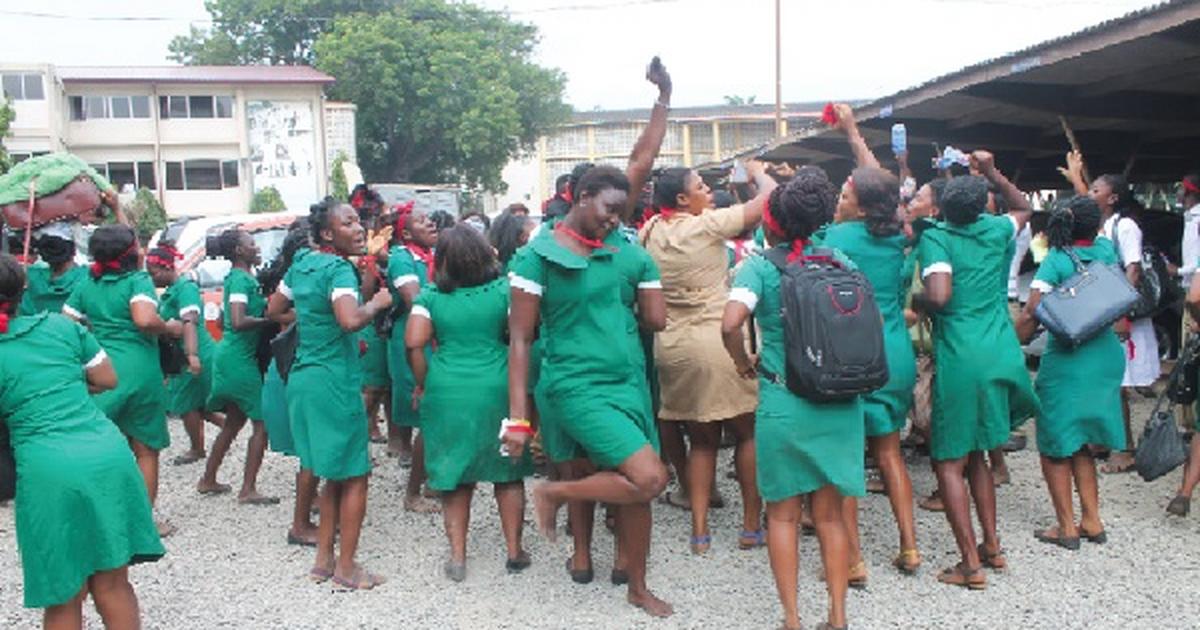
    First-year students enrolling in Nursing and Allied Health Training Institutions for the 2025/2026 academic year will enjoy a 50% reduction in admission fees.

    The new development fulfills President John Dramani Mahama’s promise to make education accessible to all groups of Ghanaian citizens under the “No-Fee-Stress” policy.

    This information was made known by the Ministry of Health in a Facebook post on Sunday, August 31.

    “The Ministry of Health wishes to inform the general public and all stakeholders that, effective the 2025/2026 academic year, school fees for Nursing and Allied Health Training students have been reduced by 50%.

    “This intervention has been made possible through the introduction of Government’s flagship ‘“’No-Fee-Stress” Policy for tertiary students across the country. By this initiative, the Government has absorbed about half of the approved fees for all first-year students enrolled in Nursing and Allied Health Training Institutions,” parts of the release read.


    All institutions have been directed by the Ministry to strictly adhere to the approved fees and items as communicated by the Ministry.

    The ‘No Fees Stress’ policy was launched on Friday, July 4, at Koforidua in the Eastern Region.

    According to President John Dramani Mahama at the launch, fifteen thousand (15,000) of Ghanaian students have so far received the alerts for payment.

    He further stated that, “Out of this, 34,500 have been validated and are awaiting payment. And out of that number, as at July 3, 15,000 students had received the alerts for payment.”

    “This policy is not about welfare. It is about fairness. It is about restoring dignity to the Ghanaian student. It is about affirming that the right to education is not a privilege for the wealthy, but a shared national inheritance”.

    The “No-Fee Stress” initiative was a major campaign promise by then-presidential candidate John Dramani Mahama, who pledged to absorb academic fees for all Level 100 students within the first 120 days of his administration.


    To support the rollout of the “No-Fee Stress” policy, GH¢499.8 million has been allocated under the 2025 national budget, which was presented to Parliament by Finance Minister Dr. Cassiel Ato Forson on Tuesday, March 11.


    The Ministry of Education has made accessible a registration portal to help first-year students at public tertiary institutions in Ghana apply for financial assistance under the government’s new No-Fees-Stress Policy.


    Launching the portal on Monday, April 29, Education Minister Hon. Haruna Iddrisu described the policy as a bold and strategic move by the government to improve access to tertiary education and invest in the country’s future workforce.


    The Students Loan Trust Fund (SLTF) explained that the new system will make it easier for eligible students to register, submit their details, and be assessed for financial support.


    A total of 35,608 tertiary students across 130 public and private institutions nationwide have received financial support from the Students Loan Trust Fund (SLTF) for the 2024/2025 academic year.


    The SLTF, conversely, has reiterated its resolve to release funds on time to allow students to gain admission into their preferred tertiary institutions without financial hindrance.


    Education Minister Haruna Iddrisu has announced that the Ghana Education Trust Fund’s (GETFUND) allocation to the Students Loan Trust Fund (SLTF) will be doubled in 2026.


    “Next year, the GETFUND will double its allocation to the Students Loan Trust from 70 million to 150 million to support students who may want to access it further,” the minister said.

    In July this year, the government disbursed an amount of GHS 462 million to settle training allowances owed to 120,000 nursing students nationwide.

    The six-month payment is part of the government’s wider effort to assist students in Nursing Training Colleges financially.

    A statement released by the Ministry of Health on Thursday, July 17, indicated that the new development aligns with President John Dramani Mahama’s campaign promise in 2024.

    “The Ministry views this development as a significant step in improving the welfare of nursing trainees and sustaining the motivation of future health professionals. It further aligns with ongoing efforts to strengthen the health sector by ensuring that critical human resources receive the needed support throughout their training,” parts of the statement read.

    The Ministry extended its appreciation to President Mahama for facilitating the timely release and distribution of the funds.

    It pledged to strengthen its collaboration with nursing schools to uphold the quality of healthcare education countrywide.

    “The Ministry extends its appreciation to the president of the Republic of Ghana, His Excellency John Dramani Mahama for fulfilling his promise to the nurses, as well as all other stakeholders involved in facilitating the timely release and distribution of the funds.”

    In 2024, President Mahama encouraged trainee nurses to prioritize securing stable employment over relying on allowances. He highlighted the need for sustainable job opportunities in Ghana’s healthcare sector.

    Speaking to trainee nurses on Saturday, Mahama acknowledged their financial difficulties but emphasized that long-term job security is more beneficial than temporary financial support.

    He assured them that his administration would focus on job creation within the healthcare industry, ensuring stable and rewarding careers for nurses and other health professionals.

    “We know the problems with trainee nurses and that is why when we were in government, we said we were going to substitute your allowance with the students’ loan because we wanted to create more employment for you. What is important for you is not the allowance it is to get a job when you finish school,” he stated.

    Adding that “But somebody came and said he will pay the allowances. Unfortunately, it was 419…Come and pay the nurses you owe them almost 30 months of arrears. Some of them have left school without receiving their allowances and some of them are going to leave school again without receiving their allowances.

    “…I make you a commitment when I come to the hospitals, we were building that have been abandoned by this government we will continue them.

    “When I come to the agenda 111 hospitals, they are building I will continue and finish them so that we can create more space to be able to absorb all of you when you finish school. This election is between Ghana and NPP.”

  • Ablekuma North violence: The eight got off too lightly – Kofi Bentil reacts to court’s ruling

    Ablekuma North violence: The eight got off too lightly – Kofi Bentil reacts to court’s ruling

    IMANI Africa’s Vice President, Kofi Bentil, has called for stricter punishment for the eight individuals who have been convicted by the Accra Circuit Court for their involvement in the Ablekuma North electoral violence.


    Speaking to the media on Saturday, August 30, he described his proposal as one that will discourage others from participating in chaos during elections. According to him, violence during elections in Ghana has become a norm; therefore, there must be collective efforts and stringent decisions to find a lasting solution to the menace.


    “We need to treat political violence differently. It shouldn’t be a misdemeanor but aggravated assault. The fines imposed on the convicted eight are not deterrent enough,”he added.

    On Friday, August 29, Mohammed Abubakari, Tijani Mahmudu, Prince Dzakpasu, Anas Mohammed, Mohammed Hamda, Darko Otibu Samuel, Musah Muntari, and Ali Saeed (alias Bomba) were convicted by the Accra High Court.

    His Honour Isaac Addo ordered each culprit to pay a fine of 500 penalty units (GH¢6,000) or, in default, serve 24 months in prison.

    They were charged with conspiracy to commit assault and three counts of assault, contrary to Sections 23(1) and 84 of the Criminal Offences Act, 1960 (Act 29).

    They all pleaded guilty to the charges, a decision that fast-tracked the legal case.

    Prior to their arrest and conviction, the police expressed their commitment to holding accountable anyone found culpable of violence, intimidation, or electoral misconduct. They encouraged the public to share credible information via emergency lines 18555 or 191.

    The Electoral Commission (EC) on Friday, July 11, held a rerun election in 19 polling stations of the Ablekuma North to provide its constituents a representative after the 2024 parliamentary elections.

    Ewurabena Aubynn polled 34,090 votes to beat the New Patriotic Party’s (NPP) Akua Afriyie, who secured 33,881 votes.

    Ablekuma North remained the only constituency in Ghana without a sitting MP, due to unresolved disagreements over the outcome of the parliamentary vote after the 2024 polls.

    On December 10, 2024, three days after the national polls, the EC declared Ewurabena Aubynn of the NDC the winner of the Ablekuma North parliamentary seat, defeating the New Patriotic Party’s (NPP) Nana Akua Owusu Afriyieh.

    However, the EC later revoked the announcement, revealing that results from 62 of the 281 polling stations had not been included in the initial collation.

    Efforts to restart the collation in January 2025 were disrupted by multiple challenges.

    These included interruptions due to the submission of unverified pink sheets and a violent intrusion at the collation centre that heightened security concerns.

    The Electoral Commission (EC), after extensive deliberations, in July noted that it will hold the rerun election because the 19 scanned polling station results used for the collation, though approved by agents of both political parties, were not verified by the presiding officers responsible for those polling stations.

    The EC arrived at this decision after it met with the representatives of the National Democratic Congress (NDC) and New Patriotic Party (NPP) on Tuesday, July 1.

    Violence mars Ablekuma North rerun election

    At the Odorkor Methodist 1 polling station in the Ablekuma North constituency, some individuals engaged in a fisticuff with the police personnel. Also, a JoyNews journalist was slapped by an unknown individual.

    Former Minister of Fisheries and Aquaculture Development and Member of Parliament for Ewutu Senya East Constituency, Hawa Koomson, was also assaulted by a group of men. A journalist with GH One Television, Banahene Agyekum, was also slapped by a police officer.

    The Ghana Police Service has interdicted one of its officers who was caught on camera slapping a journalist with GH One Television, Banahene Agyekum, during the rerun election at Ablekuma North.

    In line with internal disciplinary procedures, he has been referred to the Police Professional Standards Bureau (PPSB) for investigation.

    The officer concerned has been withdrawn from the ongoing election duty at Ablekuma North.

    The police have assured the public that a thorough investigation will be conducted into the matter and further updates will be communicated.

    It is unknown what exactly transpired between the reporter and a group of police officers that led to him being slapped.

    The police officer’s action has been condemned by all, including the mayor of Accra, Michael Kpakpo Allotey, who witnessed the unfortunate incident.

    Deputy Minister for Government Communications, Shamima Muslim, in reaction to the said incident, commended the police for its swift action to reprimand its officer for such unlawful acts and condemned the recent attacks against civilians and journalists during the Ablekuma North election rerun.

    “What we are happy about is the swift action that the Ghana Police itself has taken in interdicting the officer in question,” she said.

    “It is completely unwarranted. Government itself takes a very serious stance, especially on security agencies meting out unwarranted attacks to civilians under any circumstances,” she added.

    President of the Ghana Journalist Association (GJA) Albert  Kwabena  Dwumfuor also condemned the attack on journalists. Due to the chaos that erupted, Inspector General of Police Christian Tetteh Yohuno visited some polling stations in the constituency.

    The Minority in Parliament has also condemned the violence that took place during the just-ended Ablekuma North rerun election, accusing members of the ruling National Democratic Congress (NDC) of instigating violent activities.

    In a statement signed by Minority Leader Alexander Afenyo-Markin, the caucus said:

    “The most disturbing aspect of today’s violence is not just the brutality itself, but the deliberate endorsement and celebration of these attacks by senior government officials. For example, Dr.

    Hanna Louisa Bissiw, National Women’s Organiser of the NDC and CEO of the Minerals Development Fund, provided perhaps the most damaging response with her statement that “violence begets violence” and her suggestion that the brutal attacks were somehow justified.”

    “Even more shocking is the Facebook post by Malik Basintale, Acting Chief Executive Officer of the Youth Employment Agency (YEA) and Deputy National Communications Officer of the NDC,

    who apparently celebrated the man who attacked Hon. Mavis Hawa Koomson with the disturbing declaration, “From today, I name him the Flying Python. He shall be in charge of the 5k Airforce!” This grotesque celebration of violence against a former Member of Parliament represents a new low in Ghana’s political discourse,” the statement added.

    The Minority has registered its displeasure with the operation of the Ghana Police Service at the polling stations.

    “The Ghana Police Service’s response raises serious questions about their preparedness and commitment to protecting our electoral process. Security personnel were overwhelmed by the perpetrators, failing to prevent these attacks on political figures, party agents, and journalists. More concerning are allegations surrounding Chief Superintendent Lumor Frederick Senanu and his potential role in facilitating these disruptions.”

    The caucus stressed the need for increased protection for voters, electoral officers, journalists, and candidates. It also called on the international community, civil society, and media to monitor developments closely.

  • The role of women in the success of AfCFTA: opportunities and challenges 

    The role of women in the success of AfCFTA: opportunities and challenges 

    The African Continental Free Trade Area (AfCFTA) represents a transformative opportunity for economic growth and development across the continent.

    By creating a single market for goods and services, AfCFTA aims to boost intra-African trade, enhance industrialization, and create employment opportunities.  

    Women, who constitute a significant proportion of Africa’s workforce, play a critical role in the success of this agreement. Moreso, the Protocol to the Agreement establishing the African Continental Free Trade Area on Women and Youth in Trade [“Protocol”] is a welcome effort to help alleviate endemic challenges faced by women and the youth.

    This paper will highlight the contributions of women to African trade, the challenges they encountered, the in roads made by the Protocol, and how the protocol can be properly implemented to ensure the active involvement of women in Africa’s economic transformation. 

    Women as Key Drivers of Trade and Economic Growth 

    Women have historically been at the forefront of trade in Africa, particularly in the informal sector. According to the United Nations Economic Commission for Africa (UNECA), women account for approximately 70% of informal cross-border traders on the continent.

    These traders are vital to the supply chains that sustain local economies, providing goods and services to both urban and rural areas. Additionally, women-led small and medium-sized enterprises (SMEs) contribute significantly to job creation and economic resilience.

    The International Trade Centre (ITC) estimates that women-owned businesses account for over 30% of registered SMEs in Africa. With AfCFTA’s potential to expand markets and remove trade barriers, women entrepreneurs can access new opportunities to scale their businesses and compete on a continental level. 

    Demographic and Socioeconomic Context 

    Africa has experienced a sustained population boom for decades, with its current population estimated at approximately 1.5 billion in 2024.

    Projections indicate that this figure will rise by an additional 950 million, reaching 2.5 billion by 2050.

    Women comprise nearly half of this population and, on average, have a higher life expectancy than men, living approximately four years longer.3 In fact between 2000 and 2019, the region’s healthy life expectancy for women increased from 46.62 to 57.09 years, marking an improvement of approximately 10.5 years.  

    This demographic trend clearly shows the critical role and potential of women in Africa’s socioeconomic transformation. 

    Challenges Women Face in Africa 

    Despite their contributions and the important position of women, women traders and entrepreneurs encounter several structural and systemic barriers that limit their participation in cross-border trade.  

    First, there is a limited access to Finance by women on the continent. Access to capital remains a major obstacle for women in trade. Women entrepreneurs face a $42 billion financing gap compared to men. Many female entrepreneurs struggle to secure loans due to lack of collateral, restrictive lending policies, and gender biases in financial institutions.

    This financial exclusion prevents them from expanding their businesses and taking advantage of new markets under AfCFTA. 

    Second, there are several Informal Trade and Legal Barriers which affect women. A large proportion of women engage in informal trade, which exposes them to harassment, bribery, and inconsistent regulatory frameworks at border crossings.

     Reports, for instance, in Democratic Republic of Congo reveal that about 38% of women traders are abused by border officials.5 Without formal registration, they cannot benefit from trade agreements or access essential business support services. 

    Third, there is inadequate Market Information and education which hinders their trade. Many women traders lack access to critical market information, such as pricing, demand trends, and trade regulations.

    This challenge may be because of the unavailability of information in the local languages spoken by the women. For instance, research in Burundi shows that many women do not understand the differences in the taxes and duties owed by them, and this ignorance sometimes results in fines, penalties, which invariably lead to an increase in the prices of goods.  

    Fourth, are socio-cultural constraints. Gender norms and traditional roles continue to limit women’s mobility and decision-making power in trade. In many African societies, women face restrictions on property ownership, education, and business leadership, affecting their ability to fully engage in AfCFTA’s opportunities. 

    Last, Poor Infrastructure and Trade Logistics are part of the challenges women face. Limited access to transportation, storage facilities, and digital trade platforms pose a significant barrier to women traders. Poor infrastructure increases transaction costs and reduces the competitiveness of women-led businesses in the AfCFTA framework. 

    How is the Protocol on Women and Youth in Trade seeking to empower women 

    The Protocol on Women and Youth in Trade is a good step by the AfCFTA to address the challenges women. Predominantly the Protocol provides for the following-  

    1. Elimination of Non-Tariff barriers affecting women- Non-tariff barriers (NTBs) are trade restrictions that restrict trade but are not in the form of direct taxes or tariffs. These barriers can make it more difficult or expensive for foreign goods and services to enter a market,  

    The Protocol at article 6 seeks to eliminate these non-tariff barriers by requesting of state parties to progressively eliminate the non-tariff barriers which affect women and youth in trade.  

    1. Inclusive Socio-economic development- The protocol in its bid to facilitate an inclusive socio-economic development allows for member states to undertake where appropriate to promote and facilitate the empowerment and the effective integration of Women in Trade, to amend or repeal legislation; identify, and progressively eliminate discriminatory practices against Women in Trade, to promote quality education and information awareness programmes on trade, to enhance the productive capacity of Women in Trade, to strengthen and support associations of Women responsible for coordinating and advocating trade issues, to collect and share information on best practices relating to the inclusion of Women, and to take such other measures aimed at eliminating prejudices against and promote equality for Women and.  
    1. Access to Finance for Women- Also, the protocol makes provision for access to finance for women by allowing state parties to implement in accordance with their national legislation, measures in collaboration with financial service providers that facilitate access to affordable financial instrument services, and guarantees that are adapted to trading activities by women. Moreover, the state party is obligated to establish and/or strengthen business development services to train Women in financial literacy and services and to facilitate access to relevant knowledge and information on financial products and services, and make it available to Women. 

    4. Other Provisions- The Protocol further provides for the development of capacity; participation in formal trading activities by women; protection against harassment, such that state parties are given the obligation to establish mechanisms to address issues of harassment of women.

    It also provides for digital trade and for measures to support business association and business clusters of Women and women led micro, small and medium-sized enterprises.20 

    Conclusion 

    The success of AfCFTA is closely linked to the active participation of women in Africa’s trade ecosystem. The member state cannot be left out. The Protocol places an arduous task on the member states to ensure the creation and implementation of national laws which gives effect to the solutions of the challenges faced by women.  

    The member state is thus called to duty to enforce the rights of women traders for the success of AfCFTA. When the challenges such as access to finance, market information, legal protection, and digital inclusion by member states are addressed, AfCFTA can unlock the full potential of women in trade. A gender-inclusive approach to trade policies will not only empower women but also contribute to sustainable development and economic prosperity across Africa. 

    Authors: Kweku Attakora Dwomoh & Kelvin Hansen 

    Kweku Attakora Dwomoh is an international trade lawyer and practitioner, and a law lecturer with Ashesi University. 

    Kelvin George Hansen is a financial consultant at Prudential Life Insurance Ghana. He also holds an undergraduate degree in Bsc. Computer Science and Executive MBA in Finance from the University of Ghana. 

  • Mpox detected in Nkwanta North for the first time

    Mpox detected in Nkwanta North for the first time

    The viral disease, monkeypox (Mpox) , has been recorded for the first time at Nkwanta North District in Oti Region. The disclosure comes at a time the country is witnessing a surge in the disease in some parts of the country.

    During a press briefing, the District Health Director for Nkwanta North, Eric Kojo Agboka, stated that the confirmation follows a Ghanaian traveler started exhibiting the disease’s symptoms after visiting the Accra Konkomba market.

    According to the District Health Director for Nkwanta North, a thorough assessment and testing on the victim revealed he had contracted the disease.

    The total number of confirmed Mpox cases in the country now surges to 425 cases. On August 20, 15 new cases were recorded making the number at the time 424. Currently, there’s no patient on admission.
    As of August 14, four hundred and nine (409) total cases were confirmed after thirty-seven (37) new cases were recorded.


    According to previous reports, twenty-six (26) new cases of infection were confirmed on August 11, increasing the total to 372, compared to 346 cases reported on August 7. However, the national death toll remains at one.

    In the meantime, the country can breathe a sigh of relief following as 33,600 vaccines have been secured by the Health Ministry to strengthen Ghana’s fight against the monkeypox (Mpox) virus.


    “This is another milestone in safeguarding the health and well being of our citizens,” the ministry said in a Facebook post.


    Months ago, the Ministry of Health received a significant boost in its fight against the ongoing Mpox outbreak following the donation of essential medical supplies and public health materials from the World Health Organization (WHO).


    During a brief ceremony held at the Ministry, the WHO Regional Director for Africa, Professor Mohamed Yakub Janabi, reaffirmed the organization’s commitment to supporting Ghana’s public health response and acknowledged the country’s commendable leadership in managing the outbreak.


    The donation, valued at USD 36,700, includes personal protective equipment (PPE) for frontline health workers, 780 GeneXpert cartridges to improve diagnostic capacity, and 9,000 risk communication posters along with 40 pull-up banners to support community sensitization efforts.


    The PPE will help enhance infection prevention and control, while the GeneXpert cartridges are expected to facilitate rapid and accurate testing, particularly at decentralized levels. The risk communication materials are aimed at promoting public awareness and behavioural change.


    The Minister for Health, Honourable Kwabena Mintah Akandoh, who received the items on behalf of the government, thanked the WHO for its continued support. He indicated that Ghana is keen to adopt vaccines as part of its response strategy and called on the WHO to expedite assistance in that regard.


    He also encouraged the public to maintain good hygiene practices and to seek prompt medical attention if they experience symptoms such as fever, cough, headache, or skin rashes.

    He noted that the Ministry remains committed to strengthening public health systems and working closely with partners to contain the outbreak and protect the health of all Ghanaians.

    Health officials explained that the Mpox disease primarily spreads through direct contact with an infected individual. Common signs include fever, skin rashes, and swollen lymph nodes.

    The Ghana Health Service is urging the public to avoid close interactions with symptomatic persons, maintain regular handwashing with soap and water, refrain from frequently touching the face, and use masks when caring for patients.


    The Service added that it is closely monitoring the outbreak, conducting contact tracing, and strengthening public education with the support of regional health directorates.


    Following the detection of twenty (20) new infections as of Wednesday, July 30, the Ghana Health Service (GHS) on Monday, July 27, reported the unfortunate demise of one of the individuals who had contracted the disease.

    Since Ghana recorded its first Mpox case in June 2022, with five cases, this is the first time any of the infected persons has succumbed to the disease. In its regular updates, the Ghana Health Service noted that as of July 22, twenty-three (23) new cases were recorded, pushing the total confirmed cases to 257 at the time.

    Ghana’s confirmed Mpox cases rose to 234 following the detection of sixteen (16) new cases as of July 18.

    The number of cases stood at 218 after twenty-one (21) new infections were detected as of July 14. The Ghana Health Service reported 197 confirmed cases following the detection of eleven (11) new infections as of July 11.

    The Service, while revealing this information, described the trend as a gradual yet manageable increase and called for sustained public vigilance.


    The country has seen a slight uptick in infections. Health officials, however, maintain that the overall situation remains under control. Although many cases are mild, early medical care is crucial to avoid complications.


    In light of the growing Mpox cases, the GHS is boosting nationwide information campaigns to ensure citizens remain aware and cautious. Preventive actions such as avoiding direct contact with sick individuals, practicing proper hygiene, and promptly seeking care when symptoms show are being emphasized.

    Officials stress the importance of swift case detection and notification, with field teams and community health workers diligently monitoring developments. The public is being encouraged to stay watchful, adhere to health precautions, and contribute to collective efforts to stop the virus from spreading.


    The government is engaging international organizations for assistance in procuring vaccines to help curb the rising number of cases being reported. The World Health Organization (WHO) Ghana has provided laboratory PCR reagents to enhance the country’s diagnostic capacity. The donation was officially handed over to the Ghana Health Service (GHS) at the National Public Health Reference Laboratory.


    Receiving the supplies on behalf of the GHS, Acting Deputy Director General Dr. Caroline Reindorf Amissah expressed gratitude for WHO’s ongoing logistical and technical support. “We promise from our end to do our bit, collaborate, go out there, and look for the cases to make sure that this is really brought under control,” she stated.


    WHO Country Representative Dr. Fiona Braka emphasized that the organization hopes the reagents will enable rapid diagnosis and prompt public health responses. The supplies are capable of testing 3,400 suspected Mpox samples, and additional kits provided will allow clade determination for 625 confirmed positive cases.


    Global Data
    The monkeypox virus was first discovered in Denmark in 1958 in monkeys kept for research, according to the World Health Organization (WHO). A nine-month-old boy from the Democratic Republic of Congo in 1970 was the first person to contract the virus.


    According to the World Health Organization, following the eradication of smallpox in 1980 and the end of smallpox vaccination worldwide, Mpox steadily emerged in central, east, and west Africa.


    “Since then, mpox has been reported sporadically in central and east Africa (clade I) and west Africa (clade II). In 2003, an outbreak in the United States of America was linked to imported wild animals (clade II).


    Since 2005, thousands of cases have been reported in the Democratic Republic of the Congo every year. In 2017, mpox re-emerged in Nigeria and continues to spread between people across the country and in travellers to other destinations,” the WHO reports.


    In May 2022, an outbreak of Mpox appeared suddenly and rapidly spread across Europe, the Americas, and then all six WHO regions. Since 2022, there has also been an upsurge in Mpox cases and deaths in the Democratic Republic of the Congo.

    In some areas of the country, a new offshoot of clade I, called clade Ib, has been spreading person-to-person. As of mid-2024, the clade has also been reported in other countries.


    Over 120 countries have reported Mpox between January 2022 and August 2024, with over 100,000 laboratory-confirmed cases and more than 220 deaths among confirmed cases.


    Following the meeting of the International Health Regulations (2005) Emergency Committee regarding the upsurge of Mpox in 2024, held on June 5, 2025, the World Health Organization stated that “Over the past 12 months, the majority of mpox cases have continued to be reported from the African continent, largely driven by outbreaks of MPXV clade Ib in East African countries, including the DRC, where clade Ia is co-circulating.

    Sierra Leone, however, is experiencing a rapidly evolving outbreak, which based on available genomic sequencing results, appears to be driven by MPXV clade IIb.”


    “Outside of the African region, there continues to be a steady report of monthly cases (between about 500 – 1000 monthly), from all regions, mostly reflecting ongoing circulation of MPXV clade IIb among men who have sex with men (MSM),” the WHO added.


    WHO Director-General Dr. Tedros Adhanom Ghebreyesus has declared Mpox a Public Health Emergency of International Concern (PHEIC) twice. The first was in May 2022, and the second time was in August 2024.


    The World Health Organization continues to work with member states and partners to prevent and respond to outbreaks of Mpox. This includes coordinating research on vaccines and treatments, strengthening country health systems, and working to facilitate equitable access to vaccines, therapeutics, diagnostics, and other tools.

    The Ministry of Health has successfully secured 33,600 vaccines to strengthen Ghana’s fight against the monkeypox (Mpox) virus.
    “This is another milestone in safeguarding the health and wellbeing of our citizens,” the ministry said in a Facebook post.


    Months ago, the Ministry of Health received a significant boost in its fight against the ongoing Mpox outbreak following the donation of essential medical supplies and public health materials from the World Health Organization (WHO).


    During a brief ceremony held at the Ministry, the WHO Regional Director for Africa, Professor Mohamed Yakub Janabi, reaffirmed the organization’s commitment to supporting Ghana’s public health response and acknowledged the country’s commendable leadership in managing the outbreak.


    The donation, valued at USD 36,700, includes personal protective equipment (PPE) for frontline health workers, 780 GeneXpert cartridges to improve diagnostic capacity, and 9,000 risk communication posters along with 40 pull-up banners to support community sensitization efforts.


    The PPE will help enhance infection prevention and control, while the GeneXpert cartridges are expected to facilitate rapid and accurate testing, particularly at decentralized levels. The risk communication materials are aimed at promoting public awareness and behavioural change.


    The Minister for Health, Honourable Kwabena Mintah Akandoh, who received the items on behalf of the government, thanked the WHO for its continued support. He indicated that Ghana is keen to adopt vaccines as part of its response strategy and called on the WHO to expedite assistance in that regard.


    He also encouraged the public to maintain good hygiene practices and to seek prompt medical attention if they experience symptoms such as fever, cough, headache, or skin rashes. He noted that the Ministry remains committed to strengthening public health systems and working closely with partners to contain the outbreak and protect the health of all Ghanaians.

    Health officials explained that the Mpox disease primarily spreads through direct contact with an infected individual. Common signs include fever, skin rashes, and swollen lymph nodes.

    The Ghana Health Service is urging the public to avoid close interactions with symptomatic persons, maintain regular handwashing with soap and water, refrain from frequently touching the face, and use masks when caring for patients.


    The Service added that it is closely monitoring the outbreak, conducting contact tracing, and strengthening public education with the support of regional health directorates.


    Following the detection of twenty (20) new infections as of Wednesday, July 30, the Ghana Health Service (GHS) on Monday, July 27, reported the unfortunate demise of one of the individuals who had contracted the disease.

    Since Ghana recorded its first Mpox case in June 2022, with five cases, this is the first time any of the infected persons has succumbed to the disease.


    In its regular updates, the Ghana Health Service noted that as of July 22, twenty-three (23) new cases were recorded, pushing the total confirmed cases to 257 at the time.

    Ghana’s confirmed Mpox cases rose to 234 following the detection of sixteen (16) new cases as of July 18. The number of cases stood at 218 after twenty-one (21) new infections were detected as of July 14.

    The Ghana Health Service reported 197 confirmed cases following the detection of eleven (11) new infections as of July 11. The Service, while revealing this information, described the trend as a gradual yet manageable increase and called for sustained public vigilance.


    The country has seen a slight uptick in infections. Health officials, however, maintain that the overall situation remains under control. Although many cases are mild, early medical care is crucial to avoid complications.


    In light of the growing Mpox cases, the GHS is boosting nationwide information campaigns to ensure citizens remain aware and cautious. Preventive actions such as avoiding direct contact with sick individuals, practicing proper hygiene, and promptly seeking care when symptoms show are being emphasized.

    Officials stress the importance of swift case detection and notification, with field teams and community health workers diligently monitoring developments.

    The public is being encouraged to stay watchful, adhere to health precautions, and contribute to collective efforts to stop the virus from spreading.


    The government is engaging international organizations for assistance in procuring vaccines to help curb the rising number of cases being reported.

    The World Health Organization (WHO) Ghana has provided laboratory PCR reagents to enhance the country’s diagnostic capacity. The donation was officially handed over to the Ghana Health Service (GHS) at the National Public Health Reference Laboratory.


    Receiving the supplies on behalf of the GHS, Acting Deputy Director General Dr. Caroline Reindorf Amissah expressed gratitude for WHO’s ongoing logistical and technical support. “We promise from our end to do our bit, collaborate, go out there, and look for the cases to make sure that this is really brought under control,” she stated.


    WHO Country Representative Dr. Fiona Braka emphasized that the organization hopes the reagents will enable rapid diagnosis and prompt public health responses.

    The supplies are capable of testing 3,400 suspected Mpox samples, and additional kits provided will allow clade determination for 625 confirmed positive cases.


    Global Data


    The monkeypox virus was first discovered in Denmark in 1958 in monkeys kept for research, according to the World Health Organization (WHO). A nine-month-old boy from the Democratic Republic of Congo in 1970 was the first person to have contracted the virus.


    According to the World Health Organization, following the eradication of smallpox in 1980 and the end of smallpox vaccination worldwide, Mpox steadily emerged in central, east, and west Africa.


    “Since then, mpox has been reported sporadically in central and east Africa (clade I) and west Africa (clade II). In 2003, an outbreak in the United States of America was linked to imported wild animals (clade II).


    Since 2005, thousands of cases have been reported in the Democratic Republic of the Congo every year. In 2017, mpox re-emerged in Nigeria and continues to spread between people across the country and in travellers to other destinations,” the WHO reports.


    In May 2022, an outbreak of Mpox appeared suddenly and rapidly spread across Europe, the Americas, and then all six WHO regions. Since 2022, there has also been an upsurge in Mpox cases and deaths in the Democratic Republic of the Congo.

    In some areas of the country, a new offshoot of clade I, called clade Ib, has been spreading person-to-person. As of mid-2024, the clade has also been reported in other countries.


    Over 120 countries have reported Mpox between January 2022 and August 2024, with over 100,000 laboratory-confirmed cases and more than 220 deaths among confirmed cases.


    Following the meeting of the International Health Regulations (2005) Emergency Committee regarding the upsurge of Mpox in 2024, held on June 5, 2025, the World Health Organization stated that “Over the past 12 months, the majority of mpox cases have continued to be reported from the African continent, largely driven by outbreaks of MPXV clade Ib in East African countries, including the DRC, where clade Ia is co-circulating.

    Sierra Leone, however, is experiencing a rapidly evolving outbreak, which based on available genomic sequencing results, appears to be driven by MPXV clade IIb.”


    “Outside of the African region, there continues to be a steady report of monthly cases (between about 500 – 1000 monthly), from all regions, mostly reflecting ongoing circulation of MPXV clade IIb among men who have sex with men (MSM),” the WHO added.


    WHO Director-General Dr. Tedros Adhanom Ghebreyesus has declared Mpox a Public Health Emergency of International Concern (PHEIC) twice. The first was in May 2022, and the second time was in August 2024.


    The World Health Organization continues to work with member states and partners to prevent and respond to outbreaks of Mpox.

    This includes coordinating research on vaccines and treatments, strengthening country health systems, and working to facilitate equitable access to vaccines, therapeutics, diagnostics, and other tools.

  • Several houses at Darkuman Kokompe destroyed by fire

    Several houses at Darkuman Kokompe destroyed by fire

    Several houses at Darkuman Kokompe in Accra have been destroyed following a fire incident in the early hours of Sunday, August 31.

    Reports indicate that the victims were unable to salvage their belongings as they awaited emergency response. The cause of the fire is not yet known.

    Earlier this month, a fire incident destroyed a Benz cargo truck transporting over 2,500 bags of rice from Côte d’Ivoire to Kumasi on the Adugyama-Bechem highway, near the Star Oil Filling Station, on Monday, August 25.

    A popular pub and food joint at Nogora Junction, near the Ho Technical University, was reduced to ashes following a fire outbreak on Wednesday, August 13.

    On August 4, a fire incident destroyed the first floor of the Accra Tourist Information Centre located at Cantonments. According to the Ghana National Fire Service, the fire destroyed the contents on the first floor.

    However, the ground floor and about 8 offices, including the East Wing section of the ground floor, were successfully salvaged from the fire’s ruins.

    The first fire engine from the Ghana National Fire Service (GNFS) Headquarters arrived on the scene at 0104 hours to a fully developed stage fire, which was spreading rapidly in all directions, aided by strong winds.

    Five additional fire appliances from the Flagstaff House, Circle, Accra City, Ministries Fire Stations, and the Rapid Intervention Vehicle (RIV) from Headquarters were swiftly mobilized to support firefighting operations.

    Although the blaze was brought under control at 0332 hours, rigorous firefighting efforts continued to fully suppress the flames and prevent further spread to adjoining properties at 0635 hours.

    No injuries were recorded during the fire incident. The Service has launched an investigation into the cause of the fire.

    An inferno destroyed several makeshift wooden and metal structures used for both commercial and residential purposes at Madina Washing Bay near Redco Flat on Sunday evening, August 3.

    The blaze destroyed utility poles, traders’ wares, personal belongings, and an unspecified number of structures worth several thousand cedis, according to the Ghana National Fire Service (GNFS). In a Facebook post, the Fire Service noted that while battling the inferno, one of its firefighters sustained a minor leg injury.

    The Ghana National Fire Service noted that it received the distress call at 12:36 hours and responded swiftly, with the first crew from Madina Fire Station arriving within 4 minutes at 12:40 hours to confront the fully developed fire.

    Also, four (4) fire engines from Legon, Abelempke, and GNFS Headquarters joined the operation to contain the blaze. According to the GNFS, thanks to the timely and coordinated efforts, the fire was confined at 13:42 hours and fully brought under control at 13:54 hours.

    Overhaul operations continued until 20:50 hours, with firefighters salvaging multiple adjoining structures and their contents. Investigation into the cause of the fire is currently underway, according to the Ghana National Fire Service.

    Last month, a fire outbreak occurred at Madina Ritz Junction. It was earlier reported that a 2-month-old baby died as a result of the fire incident. However, GNFS, in a Facebook post on July 17, said that after engaging with some victims, particularly women, they confirmed that no lives were lost.

    “A verification team was dispatched to the scene this morning, and after engaging affected residents, particularly the women, and a Unit Committee Member of the area, the Service can confirm that no lives were lost.”

    The Fire Service has thus entreated the public and media outlets to “disregard any reports suggesting otherwise, as they are inaccurate and misleading,” adding that it remains firmly committed to public safety, emergency responsiveness, and transparent communication.”

    The fire began after a gas explosion in one of the shops and quickly spread to adjacent containers, consuming everything in its path.

    The incident, which involved multiple wooden structures used for both residential and commercial purposes, was fully contained through the swift and professional response of firefighters from the Madina, Legon, and Abelemkpe Fire Stations.

    An investigation by the Service was launched to ascertain the cause of the fire, which destroyed several properties. It has yet to be reported what caused the fire.

    In April this year, a raging fire ripped through the Madina Redco Flats area, reducing more than 150 structures to ashes and claiming the life of a young Nigerian woman.

    The inferno, which began around 11:15 p.m., rapidly spread across 140 wooden kiosks and 20 metal containers that served as homes and business outlets. Though firefighters from the Madina Fire Station arrived on the scene within two minutes, the blaze had already intensified.

    One fatality was recorded—a Nigerian woman affectionately known in the area as Beauty. Believed to be in her early twenties, she was trapped in her room and could not escape. Her charred remains were retrieved and handed over to the Madina Police for preservation and further investigation.

    Last year, about 50 stalls got burnt to ashes after the Madina Market in Accra caught fire. Deputy Director of Operations at the Ghana National Fire Service, D.O.1. Kofi Forson, who engaged the media, recounted the challenges the firefighters faced in quenching the flame.

    “It was not easy for us, and there was a lack of access to where the fire was spreading, and because it happened in the night, the shops were closed, and we had to break through, and that made it tedious,” he said.

    The Ghana National Fire Service (GNFS) has provided statistics on fire outbreaks so far this year. There has been a slight increase in fire cases nationwide in the first half of 2025.

    A comparison of data from January to June last year and that of this year’s first six months indicates that Ghana recorded 3,595 fire cases.

    According to the Ghana National Fire Service, that is about 19 more cases than the 3,576 cases recorded during the same time in 2024, a sharp increase in cases representing a 0.53% rise.The monthly breakdown of fire cases reported this year is as follows: January (964), February (678), March (619), April (483), May (457), and June (394).

    The Greater Accra Region recorded the highest number of fire incidents, with 628 cases, followed by the Ashanti Region with 581 cases and the Central Region with 408. The North East Region reported the lowest number of incidents—just 10.

    During an interview on Tuesday, July 8, the Head of Public Relations at the Ghana National Fire Service (GNFS), Desmond Ackah, revealed that due to their improved and swift response to fire cases, they have been able to save over GHC203 million worth of property in the last two quarters of 2025.

    Below are the top causes of fire incidents, according to the Ghana National Fire Service. Electrical faults can result from illegal connections, poor wiring, and overloading of circuits.

    Improper use of electrical appliances, such as overused extension cords and unattended devices.Unattended cooking, especially with gas, electric, or coal-based stoves.

    Careless use of naked flames like candles, mosquito coils, lighters, and matches.Gas leakages and poor handling of LPG cylinders. Bush and vegetation burning, particularly during the dry season. Vehicle fires are due to poor maintenance and road accidents.

    Unsafe welding and other hot-work practices. Deliberate acts of arson. Meanwhile, GNFS has reported a significant improvement in the fight against prank calls.

    The Service recorded a dramatic 34.77% reduction in prank calls, having recorded about 364,020 prank calls in the first half of 2024, as against 237,470 in 2025.

    The Service attributed the reduction in prank calls to consistent public education campaigns and increased awareness of the legal consequences of misusing emergency lines.

  • Qatar announces $1.5bn investment to aid agricultural production in Ghana

    Qatar announces $1.5bn investment to aid agricultural production in Ghana

    Qatar has expressed interest in a deal with the Government of Ghana to support agricultural production. Addressing the media on Friday, August 29, the Minister for Food and Agriculture, Eric Opoku, revealed that Qatar plans to commit $1.5 billion to the agricultural sector by November.

    As part of the agreement, Qatar is expected to obtain and irrigate Ghanaian farmlands and assign them to local farmers for crop cultivation. The produce will then be purchased by Qatar and exported to feed its population.

    According to the Agriculture Minister, the project aligns with President John Dramani Mahama’s Reset Agenda, which seeks to reduce the unemployment rate in the country. He noted that over two thousand five hundred (2,500) Ghanaians are expected to be employed and gain technical skills once the project is launched.

    “$1.5 billion is going into food production. You know Qatar does not have the land to produce the food to feed its population. Now what they want to do with us is that they will make the funds available, they will secure land, irrigate the land, allocate the land to the farmers to produce the food and then they will buy the food and export to Qatar.

    “Under that arrangement agriculture will be agribusiness. It will be a money-making venture and everybody will be interested in doing that. In fact, we are done with them and the assurance is that their German technical people will be in the country to start with the implementation right from November to December.

    “In fact we are done with them, the assurance is that their German technical people will be in the country to start with the implementation right from November, December. So we are hopeful that as soon as that is put in place, we will create direct jobs of over 2,500 and it will contribute significantly to the development of our economy because it is going to reduce the importation of fertilizer into this country,” he noted.

    Ghana has recorded a decline in its poverty rate from 26.4 percent in 2023 to 25.9 percent in 2024, according to the International Monetary Fund (IMF). The IMF reported that the Ghanaian population living in extreme poverty is measured at the international poverty line of $2.15 per day.

    The improved growth recorded last year, particularly in services and agriculture, together with continued efforts to expand the country’s social protection programmes, contributed to the drop in poverty. This included the four highly targeted initiatives covered by programme conditionality: the Livelihood Empowerment Against Poverty (LEAP), the Ghana School Feeding Programme (GSFP), the Capitation Grant, and the National Health Insurance Scheme (NHIS).

    The Fund, in its 4th Review Under the Economic Credit Facility Arrangement with Ghana, stated that government is redoubling efforts to expand social spending and shorten delays in releasing budgeted funds to beneficiaries.

    According to the IMF, going forward, “staying the course of macroeconomic policy adjustment and reforms is essential to fully and durably restore macroeconomic stability and debt sustainability, while fostering a sustainable increase in economic growth and poverty reduction.”

    In April, President Mahama launched the ‘Feed Ghana Programme’ as a key component of his plan to strengthen Ghana’s economy through farming. At the launch in Techiman on Saturday, April 12, the President emphasized that making farming central to Ghana’s progress can only be achieved through stringent agricultural policies.

    “Mr. Chairman, the time has come for bold and decisive actions. We must no longer treat agriculture as an afterthought. Agriculture must be placed at the center of our national economic transformation,” he stated.

    He explained that the Feed Ghana Programme is only the beginning of a broader plan called the Agriculture for Economic Transformation Agenda (AETA). This initiative seeks to modernize farming, create jobs, reduce food prices, and ensure consistent food security.

    President Mahama added that the programme would serve as the main framework guiding all agricultural projects and initiatives. He said it focuses on boosting food production, encouraging modern farming methods, improving farm infrastructure, and developing agro-industrial areas nationwide. According to him, the Feed Ghana Programme demonstrates his government’s seriousness about prioritizing farming and investing in it.

    “It represents a bold commitment to put our resources where our ambitions lie,” he concluded.

    Earlier in August, Ghanaian entrepreneur and investor Richard Nii Amarh Quaye launched the RNAQ Food Bank initiative, the flagship project of the RNAQ Foundation. The initiative is aimed at combating food insecurity and empowering vulnerable communities across Ghana.

    According to the foundation, the RNAQ Food Bank will partner with local food vendors to establish accessible food distribution hubs across the country. During the launch event on Friday, August 1, at the La Palm Royal Beach Hotel, the founder, Richard Nii Amarh Quaye, shared a heartfelt reflection on the inspiration behind the project in his keynote address.

    “I stand before you as a man who remembers what it feels like to be hungry, not just for food, but for hope, for dignity, and for change. Today, we launched the RNAQ Food Bank. But this is not just about food. This is about justice. It’s about dignity. It’s about telling every Ghanaian… that you also matter.”

    He further mentioned that the initiative would begin with five food bank locations in Greater Accra — Korle-Gonno, Kasoa, Ashaiman, Odorkor, and Madina — with plans to expand nationwide.

    “These food banks will open every single day, and through them, thousands of people will be fed daily. This is not charity. This is nation-building. This is how we create the Ghana we’ve all been dreaming of, one plate at a time,” he added.

    This vision has earned Richard Nii Amarh Quaye applause and strong support from the government. Chief Executive Officer of the National Youth Authority (NYA), Osman Abdulai Ayariga, commended the initiative, describing it as a much-needed response to the growing food challenges facing young people and children.

    “This food bank offers relief and hope. It is not just charity; it is impactful, and it will touch generations. In Ghana alone, 3.6 million students, about 11.7% of our population, struggle with access to sufficient food, with risk levels exceeding 30% in many northern districts,” Mr. Ayariga said.

  • Ghana’s additional $1m payment reduces University of Memphis scholarship arrears from $3.6m to $1.35m

    Ghana’s additional $1m payment reduces University of Memphis scholarship arrears from $3.6m to $1.35m

    The government of Ghana’s debt owed to the University of Memphis (UofM) in the United States (US) has been reduced from $3.6 million to $1.35 million following a recent $1 million payment.

    This development comes as a relief to Ghanaian students studying at the University of Memphis. However, the University has given the government until October 15 to settle the remaining debt, or else Ghanaian students risk being evicted. This disclosure was made by Memphis-based media outlet ABC24 Memphis on Wednesday, August 27.

    Ghanaian awardees in Memphis, most of whom are pursuing science, engineering, and business-related courses, face the threat of eviction from University housing and possibly deportation should the government miss the deadline.

    In July, the government made a payment of $1.4 million to the school. Speaking to the media, the Registrar of the Ghana Scholarships Secretariat, Alex Kwaku Asafo-Agyei, on Wednesday, July 30, reiterated the government’s commitment to settling the outstanding debt owed to the University of Memphis to safeguard the education of Ghanaian students.

    “We are on course with the issues regarding the Ghanaian students at the University of Memphis. Ghanaian students will not be deported; I give you that assurance. Because the audit is ongoing, we are not paying all,” he said.

    The funds were released swiftly after the University of Memphis declared its intention to revoke the scholarships of Ghanaian students should the government of Ghana miss an August 9 deadline. The affected students appealed for urgent support from the government to avoid returning home and abandoning their studies. The leader of the Ghanaian student cohort, Fredrick Badu-Asamoah, expressed deep frustration over the situation.

    “This situation is heartbreaking. We’re not here on personal funds—we’re here representing the Republic of Ghana. We’ve written to the Ministry of Foreign Affairs, the Ghana Embassy in Washington, and the Ghana Scholarships Secretariat, and efforts to reach the Presidency proved futile, and we’ve received no decisive intervention,” he said.

    President of the University of Memphis, Dr Bill Hardgrave, attributed Ghana’s delay in clearing outstanding debts to the change of government. The University also launched an appeal for donations through the Gary Shorb International Student Support Fund.

    In response to the scholarship crisis, the Minister of Youth Development and Empowerment, George Opare Addo, revealed that the debt owed in terms of scholarships affects several schools across the world.

    He said that an audit is underway to investigate the circumstances surrounding the scholarship debt crisis. “There is a debt of fees that we have across the world. And so my registrar now has to go around the world and negotiate with schools, and that is what we’ve been undertaking in the last four, five months. I keep sending him—go here, go there—because you keep getting threats all over the world: ‘We are going to sack your students,’” he said during an appearance on Joy News’ PM Express on Tuesday, July 23.

    The previous New Patriotic Party (NPP) government left a startling GH¢700 million in unpaid scholarship debt, according to the Minister. He described the current situation as a “bad, bad, bad mess” that threatens the future of Ghanaian students abroad and the country’s international reputation.

    “The current bill that I have is over GH¢700 million in debt that we have to find money to pay,” he said. Given the current state of the economy and the ballooning debt crisis, the Minister was asked whether the government had enough to pay—or was even willing to pay—the GH¢700 million.

    In an empathetic response, he said, “It involves Ghanaian students; it involves lives. It involves our citizens. And so we must find the money to pay.” While admitting that Ghana currently does not have this money in cash, he said negotiations are ongoing. He also commended the Chief of Staff for his input during negotiations on the terms of the debt.

    “The Chief of Staff has been very helpful. With the Finance Minister and the Chief of Staff, we are working closely to offset the debt… So yes, we will pay, but we have to negotiate.”

    Some schools, Mr Opare said, have shown a positive response, understanding that the debt was inherited from the previous government. “They know that we are a new government that has come in. We inherited these problems, and so we are aligning and fixing them gradually.”

    He also responded to reports of students receiving threats of eviction from their schools. “You can’t blame this government for the mess we inherited. And most of these things have been outstanding for a year or two,” he continued.

    Mr Opare revealed that a meeting had been held with a group of students in London, and sadly, some of the affected students have decided to forfeit their stipends in exchange for a further stay abroad to continue their education or seek a job.

    “They had the option of choosing between being paid their stipends and returning to Ghana or letting it go to stay. If I pay your fees, you must come back and help. So, do you want to stay? If you are going to stay there, I’m not going to pay your stipend, because you have already finished school. And so, a lot of them said, ‘Okay, let the stipends go.’”

    “A lot of the students have opted out. We held a meeting with some of them in London and gave them some options.” Although he declined to disclose the options discussed, he revealed that a major issue lies with stipends owed to students who have already graduated.

    “Somebody might have finished school for two years, and the government still owes him or her stipends, but per the law, once you finish, you must come back home. And a lot of them want to remain there,” he revealed.

    He emphasised that a continued stay abroad after graduation without returning violates the terms of the scholarship. Ghanaian students studying abroad on government scholarships have, over the years, faced similar threats over unpaid debts. In late 2024, some Ghanaian students at the University of Birmingham in the UK were warned of deportation following the revocation of their student visas.

    This was a result of their failure to settle tuition fees. News of their impending deportation was contained in a statement from UK Visas and Immigration. According to the letter, which was sent to the affected students, they were given the option to leave voluntarily or face legal consequences, including possible detention and prosecution.

    “You still have permission until 09 November 2024, and the current conditions of your stay will continue to apply until then. Please ensure that you comply with these conditions.

    “You now have until 09 November 2024 to either leave the United Kingdom (UK) or make another application to stay here. You do not have a right of appeal or administrative review against the decision to cancel your permission.

    “If you leave or are already outside the Common Travel Area (the UK, the Channel Islands, the Isle of Man, and the Republic of Ireland) before 9 November 2024, your permission will end immediately, and you will have to make a new application to re-enter the UK,” the letter added.

    Even in schools in Russia and Algeria, Ghanaian students continue to wallow in debt due to unpaid fees by the government of Ghana. They have lived in foreign lands for nearly a year without stipends, while book and health allowances have not been paid for two academic years.

  • C/R: Kia truck ploughs into crowd at Agona Asafo; 5 critically injured

    C/R: Kia truck ploughs into crowd at Agona Asafo; 5 critically injured

    A Kia truck loaded with coconuts ran into a crowd at Agona Asafo in the Agona East District of Ghana’s Central Region, leaving five individuals critically injured with thirteen others sustaining injuries. The victims were reportedly on the streets participating in a float as part of the community’s annual ‘football gala’ when the unfortunate occurred.

    This information was disclosed by the Assemblyman for the Agona Asafo Electoral Area while speaking to meading on Saturday, August 30. 

    “The Kia, heavily loaded with coconuts, failed to stop despite seeing the large crowd and ran into the people celebrating on the street,” he said.

    Meanwhile, the victims are at the receiving Agona Swedru Government Hospital. 

    On Saturday, August 16, a fatal road accident at Asuboi, near Suhum, on the Kumasi–Accra Highway, claimed at least five lives and left seventeen others with severe injuries.

    The tragic incident occurred when a Sprinter bus, with registration number GW-5535-24, suffered a tyre burst, causing the driver to lose control and veer off the road.

    According to eyewitnesses, the victims died on the spot. About 30 minutes later, emergency services arrived and transported the injured to the Suhum Government Hospital for treatment. Fatal accidents have become rampant across the country; just last week, one in the Krachi East Municipality of the Oti Region claimed four lives, including that of a one-year-old girl.

    An accident at Bechem in the Bono Region claimed two lives, including a church leader of the Seventh-day Adventist (SDA) Church.

    The crash, which occurred on Sunday, August 10, left several others, including children, with injuries. Reports indicate that the victims, who were near Aburaso, were returning from a camp meeting in Kumasi.

    The bus carrying them reportedly suffered a tyre fracture that led to a burst, causing the vehicle to somersault.

    On Monday, July 28, another tragic road accident on the Atwedie stretch of the Kumasi–Accra Highway resulted in the deaths of sixteen members of the Saviour Church of Ghana.

    An accident at Asamankese in the Eastern Region on Wednesday, August 6, claimed one life. Officials are yet to confirm any further casualties. The incident occurred after a tipper truck veered off the road and crashed into shops near the Dukes Filling Station.

    According to sources, several individuals sustained injuries. Reports suggest the truck was overspeeding when it veered off the road. “It happened so fast—one moment the road was clear, the next, the truck was crashing into everything in its path,” an eyewitness recounted.

    Emergency services reportedly rushed to the scene to rescue trapped victims and provide medical assistance. Police say investigations have commenced into the cause of the crash, with the tipper truck driver assisting in the process. Local officials have also pledged support for the victims.

    The deceased in the Atwedie crash were said to be returning from the church’s annual programme in the Eastern Region. Their deaths were confirmed after their bus collided with an oncoming fuel tanker. On Thursday, July 31, all sixteen victims were buried in a single large grave in Obogu by the community and church leadership.

    Ghana has recorded a surge in road traffic fatalities. In the first half of 2025, the National Road Safety Authority (NRSA) reported 1,504 deaths, compared to 1,237 fatalities in the same period in 2024, representing a 21.58 percent increase.

    According to provisional data released by the NRSA in collaboration with the Police Motor Traffic and Transport Department (MTTD), a total of 7,289 road crashes were recorded between January and June this year.

    The data shows that 12,354 vehicles were involved in these crashes, with 8,300 individuals sustaining injuries. In addition, 1,301 pedestrians were knocked down nationwide.

    The NRSA further indicated that, on average, eight lives are lost daily due to road crashes. Each day, about forty crashes are recorded, forty-six individuals sustain injuries, and sixty-nine vehicles and motorcycles are involved in accidents.

    To address the surge, the NRSA has called for stricter enforcement of traffic regulations and enhanced public education.

    The Road Traffic Act, 2004, enacted to consolidate and revise the Road Traffic Ordinance of 1952, provides comprehensive regulations on road traffic and road use to enhance safety. Under the Act:

    A person who drives dangerously commits an offence and is liable on summary conviction:(a) where no bodily injury, or only minor injury, occurs, to a fine between one hundred and two hundred penalty units, or to imprisonment not exceeding nine months, or both;(b) where aggravated bodily injury occurs, to a fine between two hundred and five hundred penalty units, or imprisonment of not less than twelve months and not more than two years, or both;(c) where death occurs, to imprisonment for not less than three years;(d) where damage to state property occurs, to a fine of not less than one hundred penalty units and compensation for the damage caused, as determined by the Court.

    The Court may, upon conviction:(a) order compensation to an injured person or their estate, or(b) withdraw the offender’s licence for a period of not less than three years and not more than five years.

    The Act also stipulates that a person who drives without due care and attention, or without reasonable consideration for other road users, commits an offence and is liable on conviction to a fine not exceeding two thousand penalty units, or imprisonment not exceeding five years, or both.

    Additionally, anyone who, without lawful authority or reasonable excuse:(a) causes anything to obstruct a road,(b) interferes with a motor vehicle, trailer, or cycle, or(c) tampers with traffic equipment in a way that would be obviously dangerous to a reasonable person,commits an offence and is liable on conviction to a fine not exceeding two hundred and fifty penalty units, or imprisonment not exceeding twelve months, or both.

  • Ghana will establish a consulate in Singapore by 2026 – President Mahama

    Ghana will establish a consulate in Singapore by 2026 – President Mahama

    Ghana and Singapore have made significant strides in fostering diplomatic and economic partnerships, with His Excellency President John Dramani Mahama announcing new initiatives to kindle the relationship.

    During an official State visit to Singapore, President Mahama disclosed the government’s plans of establishing a Consulate in Singapore next year. The initiative is to ensure Ghanaians in the area have access to essential consular services, such as applying for visa, passports and others within their reach as well as boost Ghana and Singapore relations.

    In a post on the X platform on Friday, August 29 , the Foreign Affairs Minister, Samuel Okudzeto Ablakwa wrote, “ President Mahama announced that Ghana is set to establish a Consulate in Singapore by 2026”.


    Singapore has already opened Enterprise Singapore in Accra to oversee its West African investment portfolio. President Mahama’s three-day visit to Singapore focused on strengthening investment ties and engaging with Singaporean leaders and business magnates.


    However, the President of Singapore, Tharman Shanmugaratnam, sees President Mahama’s intention to establish a consulate in the country as one that will go a long way in strengthening the existing relationship between the two countries and securing a brighter future for the Ghanaian youth.

    “President Mahama is a man on a mission. He is determined to see his country and its young population succeed.” Our two modern founding fathers who instructively were great friends and were noted for their frequent exchange of letters — Kwame Nkrumah and Lee Kuan Yew, will be exceedingly ecstatic with the rekindling of high-level impactful Ghana-Singapore relations,” he added.


    Other matters discussed aligned with major investment partnerships integral to President Mahama’s Reset Agenda, leading to the securing of US$1billion worth of investment deals.

    Meanwhile, a multinational food and agribusiness company that operates in over 60 countries which is headquartered in Singapore, OLAM plans US$200million for establishing new projects in Ghana.

    Shangri-la has pledged to construct a US$300million green ultra-modern iconic 5-Star Hotel with a grand mall for local and international brands and a convention centre in Ghana. This is to place Ghana as the leading conference destination in West African.


    Singapore has partnered with Ghana to establish a 10,000-capacity student hostel for the University of Ghana. The two countries have collaborated to launch a common payment platform to boost trade and international commerce between Africa and Asia. Singapore has expressed willingness to establish a model Accra Institute of Technology in Ghana.


    An MoU for regular high-level political consultations has been reached between the two countries. In discussions on the Bilateral Investment Treaty (BIT), both countries have agreed to finalize negotiations. Also concerning the Operation Recover All Loot (ORAL) agenda, Singapore has declared intentions to train and build capacity for Ghanaian forensic investigators.


    Under a special public service reset initiative, the first cohort of 18 Chief Directors from Ghana’s Ministries will travel to Singapore in September 2025 for a leadership and capacity-building bootcamp.


    The value of goods and services exchanged between Ghana and Singapore stood at over US$215 million in 2024. President Mahama has noted that this achievement has greatly influenced Ghana’s trade outlook for 2025.


    According to him, Ghana and Singapore are now targeting billion-dollar trade growth, reflecting stronger bilateral ties and deeper cooperation between the two nations.


    “Ghana-Singapore trade has also grown, reaching over US$215 million in 2024,” he told the gathering of government leaders and business executives. “Africa-Singapore trade rose by about 50 per cent between 2020 and 2024 to nearly US$14 billion, with West Africa accounting for more than half of that.”

    He added that the development reflects Africa’s growing potential to drive sustainable economic growth and attract significant global investment.


    “I speak today as an African leader and as President of Ghana. Our message is simple: Africa is investable, and Ghana is your reliable gateway to the continent. The continent is the world’s most dynamic emerging market. We are 1.4 billion people today—young, fast-urbanising, digitally connected—and by 2030, Africa’s cities will host more than 700 million consumers.”

    Meanwhile, the total value of all commodities bought and sold on Ghana’s Commodity Exchange (GCX) in 2024 amounted to GHS 24.23 million. A report by the Bank of Ghana’s (BoG) 2024 Financial Stability Review attributed the gains to strong demand for maize and soybean contracts, which boosted overall market performance.


    “The Ghana Commodity Exchange (GCX) experienced remarkable growth, reinforcing its role in agricultural trade and market efficiency. Trading volume surged by 107.4 per cent to 5,161.03 metric tonnes in 2024. The total trade value soared by 114.8 per cent, from GH₵11.29 million in 2023 to GH₵24.23 million.


    This growth was driven by several factors, including increased market participation, the strategic use of commodity aggregation funds, a faster settlement cycle (T+1, a day after the transaction date), improved warehouse infrastructure, and enhanced trader confidence.


    Additionally, settlement values grew by 113.3 per cent to GH₵23.31 million, reflecting enhanced liquidity and improved transactional efficiency,” the report stated.


    In 2023, the Ghana Commodity Exchange recorded a substantial decline in trading activity, with total trade value falling to GH₵11.3 million from GH₵20.7 million in 2022, representing a 45 per cent decrease. Economic and environmental challenges facing Ghana’s agricultural market were instrumental in this decline.


    GCX’s traded commodities include maize, soybeans, sorghum, sesame, rice, and cashews. In 2024, major commodities such as maize, sesame, rice, and soybeans were actively traded compared to 2023.


    The number of contracts executed on the GCX surged by 122.03 per cent to 4,898 contracts compared to 2023, boosting trading activity and market confidence.

    “The excellent growth in 2024 culminated in a six-year Compound Annual Growth Rate (CAGR) of approximately 14 per cent. The Exchange, for the period, traded three commodities relative to two commodities in 2023. The 2024 performance reinforces GCX’s role in driving price discovery, improving market accessibility, and promoting inclusion in Ghana’s commodities sector,” the report noted.


  • SHS placement is based on multiple factors, not just aggregate and raw scores – Education Ministry

    SHS placement is based on multiple factors, not just aggregate and raw scores – Education Ministry

    Deputy Education Minister, Dr Clement Apaak, has emphasized that multiple factors influence how students are assigned to specific Senior High Schools (SHSs).

    According to an official statement signed and issued by the Deputy Education Minister on Saturday August 30, the Ministry noted that the Computerised School Selection and Placement System (CSSPS) used in designating SHS graduates to various schools considers the aggregate and raw scores of students, the availability of vacancies in schools, and the popularity of specific programmes.


    The statement added that the Ministry does not demand or accept rewards from parents or guardians to guarantee that students are placed in schools of their choice as speculated.

    “The Ministry confirms that this information is not only false but also maliciously misleading. The placement is based on a combination of factors, including aggregate and raw scores, availability of vacancies in the various schools and programmes of study. Limited vacancies and high competition can affect placement. The Ministry unequivocally states that no form of payment or inducement is required or solicited from parents, guardians, or their representatives for the purpose of securing placement.


    “All interactions with the Ministry and Ghana Education Service (GES) officials are expected to adhere to the highest standards of integrity and transparency. The public is advised to be cautious and report any cases of extortion or bribery attempts related to student placements. Stakeholders are encouraged to report miscreants to the nearest police station,” parts of the statement read.

    The Ministry’s clarification is a rebuttal to recent claims that the Ministry solely depends on a rigid score system to place students in Senior High Schools. Meanwhile, the Ministry has described the claims as misleading and inaccurate.


    The 2025 school placement exercise will officially commence on September 17, as announced by the Ghana Education Service (GES).

    At a media briefing on Wednesday, August 27, GES Director-General, Professor Ernest Kofi Davis, indicated that before final placement is completed, prospective Senior High School (SHS) students will be allowed to double-check and correct their information via www.csses.gov.gh to avoid errors.


    He explained that the exercise will run from September 1 to September 8.
    “In order to reduce the errors associated with school placement, candidates will have the opportunity to review the entries they have made; gender, school code, programme code, online on www.csses.gov.gh.

    “This will be supported by an explainer video to guide parents. This exercise is expected on the 1st September and ends on 8th September. The Actual placement exercise will commence on the 17th of September. Students are expected to report to campus and begin their studies between 18th to 20th October,” he stated.


    After placement, students are expected to report to their schools and start classes between October 18 and October 20 to begin the 2025/2026 academic year.SHS 3 students will reopen on October 11, 2025, and remain in school until February 27, 2026, covering 18 weeks.


    They will return on March 13, 2026, for a 14-week session ending June 21, 2026, ahead of the West African Senior School Certificate Examination (WASSCE) scheduled for April 20 to June 20, 2026.

    SHS 1 and 2 students will start their first session on October 18, 2025, and break on February 27, 2026, after 17 weeks. They will resume on May 4, 2026, for a 16-week session ending August 21, 2026, marking the close of the academic year.

    The Transitional Calendar refers to a temporary academic schedule designed to bridge the gap between the old double-track system and the new single-track system. On that calendar, first-year students will also report on October 18, 2025, and stay until January 30, 2026, before proceeding on a short break.


    Their second term will then begin on March 16 and run until June 12, 2026, with additional breaks, including some four weeks of off-site learning to help manage overcrowding in school facilities.

    Second-year students in transitional schools will reopen on January 5, 2026, and vacate on May 18, 2026, with five weeks of online learning.
    They will then resume from the vacation later in September for the final stretch of the academic year.

    Final-year students in transitional schools will begin on October 27, 2025, for a 14-week session before the Christmas break and resume in February for an 18-week preparation period before they sit for their West African Senior School Certificate Examination (WASSCE).

    GES also highlighted some significant breaks in the new timetable. The Christmas break will begin on December 20, 2025, and end on January 4, 2026. Vacation for SHS 3 students is slated for February 27 to March 1, 2026, while SHS 1 and 2 students will break from August 21 to August 23, 2026.


    GES has also proposed September 11, 2026, as the start date for the 2026/2027 academic year.In an unrelated development, sixty (60) private schools have been included under the Free Senior High School (SHS) policy. Junior High School (JHS) graduates will be admitted into these private schools, which fall under Category E in the school selection process.

    These schools will be accepting applications starting from the 2025/2026 academic year. The new development aligns with the government’s efforts to ease congestion in public SHSs as well as promote quality education across the country.


    In a press release issued on Sunday, July 20, by the Ghana National Council of Private Schools (GNACOPS) and signed by its National Executive Director, Oberto Nana Kwasi Gyetuah, the council described the initiative as a historic and progressive move.


    “This progressive move marks a significant milestone in Ghana’s educational transformation journey. It underscores the Government’s commitment to inclusive, collaborative education delivery and reaffirms the important role of private schools in advancing national development goals,” part of the release read.


    The council further called on other private schools that are yet to be listed to remain patient, prepared, and compliant with regulatory standards. In May, Deputy Minister of Education Dr. Clement Apaak announced that the inclusion forms part of a broader plan to scale up capacity and gradually end the double-track system.


    “As part of our campaign promise, we have been working diligently to bring on board private senior high schools in the delivery of the Free SHS programme. Meetings have been held, engagements have been done, and we are very certain that with the diligence we expect from our side…” he noted.


    The double-track system was introduced in 2018 by the erstwhile government to accommodate the surge in student enrollment due to the Free SHS policy, addressing overcrowding in public schools.

    Under this system, students were divided into two groups: Green Track and Gold Track, attending school in shifts, with one track in session while the other was on break.


    The anticipated extension of the Free SHS policy, according to the Education Minister, Haruna Iddrisu, is a fulfillment of the government’s manifesto promise, adding that it is a step to ensure eligible students gain admission without delays.


    “We believe strongly that in fulfilling this manifesto campaign promise, this is going to serve as an artery in helping us bring an end to the double-track system,” the deputy minister said.


    According to him, the Education Ministry has received encouraging feedback from private schools, many of which have expressed readiness to meet the standards and requirements of the Free SHS framework.“… and the eagerness of the private schools to participate, the private schools will deliver in their participation,” he assured.

    He added that this collaboration would not only help expand capacity but also ensure a more equitable distribution of educational opportunities across the country.

  • 5,500 police personnel deployed to Akwatia ahead of by-election

    5,500 police personnel deployed to Akwatia ahead of by-election

    5,500 police personnel have been deployed to Akwatia, Eastern Region, for the upcoming by-election slated for Tuesday, September 2.


    Briefing the media on the Police’s preparation ahead of the by-election on Friday, August 30, the Director-General of Operations, COP Dr. Vance Baba Gariba, noted that to ensure effective coverage, the constituency has been grouped into nine security zones.


    He disclosed that 600 officers have been fully armed to swiftly respond to any disturbances that may occur during the exercise.

    Meanwhile, the Director General of Operations has assured that the military will only assist should matters get beyond control.

    “The military will be only on standby. As and when we need them, then we will deploy them, but if we don’t need the military, then we will not request for the deployment of the military. They are only going to be on standby,” COP Gariba stated.

    The election has become a necessity following the tragic passing of the Member of Parliament for the area, Ernest Yaw Kumi, who had only served for six months.


    In a series of security operations in Akwatia, the Eastern South Regional Police Command has announced the arrest of ten persons and the confiscation of nine firearms ahead of the upcoming by-election.


    The firearms include eight pump-action shotguns and one locally manufactured single-barreled gun. This was announced in a statement shared on their official Facebook page earlier today.

    They revealed that “These seizures form part of intensified efforts to prevent the unlawful possession and use of weapons during the electoral process”.


    The first suspects were intercepted in a vehicle being driven by one Bernard Kumi Ofosu near the St. Dominic Hospital in Akwatia.


    Following a search of the vehicle, they found a Tulpar double-barrel pump-action gun, four AAA live cartridges, and two FTB blanks.
    Ofosu admitted ownership and presented a valid license.

    He is currently assisting with investigations while the exhibits undergo verification. Also, the statement continued that another operation led to the discovery of 15 live cartridges from another suspect, Joshua Amenuku. A later search at his residence led to the discovery of a gun and more live cartridges.


    “In a separate operation at the Akwatia Y-Junction snap check, the Police arrested suspect Joshua Amenuku after retrieving 15 live BB cartridges from him. A subsequent search at his residence uncovered one ADLER TULPA pump-action gun and five additional live BB cartridges” the police added.


    They also revealed that “later that evening, Police intercepted a Toyota Hilux pick-up at the Boadua Livingstone snap check point and arrested suspects Enoch Asiedu, and Lu Youyan, a Chinese national, after four live BB cartridges were retrieved from the vehicle.


    “Preliminary interrogation revealed that the ammunition allegedly belonged to their employer, one Mohammed, identified as the owner of the vehicle. Efforts are underway to trace and arrest suspect Mohammed for interrogation, while the two suspects remain in custody assisting investigations,” the statement said.


    The police continued that “Four live BB cartridges were retrieved from the vehicle. Preliminary checks linked the ammunition to their employer, identified as Mohammed, owner of the vehicle. Police are pursuing him for questioning while the two suspects remain in custody.


    In another operation on Friday, August 23, “Police officers on duty at the Boadua Livingstone Junction snap check point again arrested suspect Pieterson Joseph, after retrieving one (1) ADLER TULPAR pump-action gun and 46 AAA and BB cartridges from his vehicle. The suspect admitted ownership of the firearm”.


    On the same day, the police “officers on snap-check duty at Staff Village Boadua, intercepted a Toyota Tundra pick-up with registration no WR 5535-13 from the Asamankese direction towards Boadua. A

    search conducted in the Tundra pick up revealed the three pump-action guns, including (1) Pardus pump-action gun, one (1) Hulglu Atroe pump-action and one (1) other pump-action gun. Suspect Stephen Nkansah claimed ownership of two of the pump-action guns and stated that the third pump-action gun belongs to his chief.

    Meanwhile, suspect Stephen Nkansah has been arrested and detained for investigation.

    Following such successful operations, the Police assured the public and all other stakeholders that they would intensify operations to ensure the integrity of the elections, as well as maintain peace and security in the region ahead of the elections.


    Meanwhile, the Inspector General of Police (IGP), Mr. Christian Tetteh Yohuno, has noted that his outfit will stay alert and avert any form of misconduct and electoral violence during the Akwatia by-election.


    Engaging the media, the IGP noted that his officers are up to the task.

    “We want to assure Ghanaians that the police is ready to handle any type of thing that may come in Akwatia. We are ready with the men. We have the men who can handle this situation and then our eyes are red for Akwatia and nobody, nobody should think of coming to cause trouble,” he said.

    IGP Christian Tetteh Yohuno cautioned the political parties participating in the by-election against marching men to the polling stations to distrupt the electoral process.


    “No political party should mobilise men to come and foment trouble, and nobody should have in mind the intention of snatching a ballot box. We have prepared our men adequately to handle this situation, and that, I informed the political parties as I met them yesterday [Tuesday],” he explained.


    He noted that individuals who attempt to cause any form of violence during the Akwatia by-election will be quickly whisked away by police personnel to face the full rigors of the law.


    According to the police, a mobile prison will be set up to detain suspects. The IGP made this information known to the media during the final day of a five-day intensive training at the High Risk Operations Training Centre (HROT-C) at Akyeremanteng in the Eastern Region.


    “There is no fear for Akwatia, this will be one of the best and peaceful elections because we are fully prepared. If you come quietly to vote, we will receive you quietly, if you have any intention of causing trouble, we will not allow you to go free, we will change your location. We will house you in different forms, before your trouble goes far.”


    “Under no circumstances will someone come to the polling station to create a problem, and we will allow the person to go free,” the IGP said.
    The training included tactical drills such as rappelling, precision shooting, handcuffing, vehicle stop and search, crowd control, and human rights considerations. Over 5,000 police personnel are expected to be deployed to Akwatia for the by-election.


  • Osei Assibey received GHS8.2m as a volunteer while at post as NSA D-G – Report

    Osei Assibey received GHS8.2m as a volunteer while at post as NSA D-G – Report

    A report by a non-profit investigative body, The Fourth Estate, has alleged that the former Director-General (D-G) of the National Service Authority (NSA), Osei Assibey Antwi, was listed as a volunteer within the NSA while at post.

    According to the report by the former Director-General of the NSA was enlisted with the  2022/2023 service year batch, which is a year after assuming the D-G position.

    Osei Assibey Antwi was assigned an EZWICH card with the number 1177042059 and posted to the Greater Accra region as a volunteer.

     However, The Fourth Estate has reported that an Auditor-General’s investigation traced the former Director-General, listed as an NSA volunteer, to his company Kumawu Farms in the Ashanti Region where he was paid GH¢516,000 every month for 16 months, amounting to GH¢8,256,000 in total.

    This revelation aligns with an earlier statement by the Attorney-General and Minister of Justice, Dr Dominic Ayine, while providing an update on the investigations by Operation Recover All Loot (ORAL) into financial irregularities within the Authority on Friday, June 13. 

    “In the 2022/2023 service year, a total of eight million, two hundred and fifty-six thousand Ghana Cedis (GH¢8,256,000.00) was deposited into EZWICH account number 1177042059, which is registered in the name of suspect Osei Assibey. Investigations showed that he personally received these funds,” Dr Ayine said.

    The alleged  irregularities at the Service are being probed by the Office of the Special Prosecutor (OSP). In July, Dr. Dominic Ayine,  revealed that eight individuals, including three former officers of the National Service Authority (NSA), have admitted to their involvement in the misappropriation of funds at the National Service Scheme (NSS).

    Providing an update on the case as part of the Government Accountability Series on Monday, July 28, Dr. Ayine disclosed that eight individuals want to plead guilty in exchange for lighter punishment in this regard.

    He explained that the office intended to file formal charges last week; however, it has been postponed following new revelations regarding the ongoing case.

    The new evidence, he noted, is tied to a Bank of Ghana account linked to former NSA Director-General, Mr. Osei Assibey, suggesting potential embezzlement involving public funds.

    According to him, a total of GH¢189 million was deposited into the account of Mr. Osei Assibey; however, GH¢80 million can not be accounted for.

    Furthermore, nearly GH¢2 million was allegedly withdrawn using two cheques that carried Mr. Assibey’s name and account information.

    The A-G has stated that the office has reached out to the Bank of Ghana, the Ministry of Finance, and the Controller and Accountant-General’s Department for further information and documentation.The National Service Authority scandal case was due to be filed last week. 

    “However, we stumbled upon evidence of malfeasance involving an account at the Bank of Ghana.Out of the GH¢189 million transferred, GH¢80 million cannot be traced. Two cheques linked to the former Director-General were used to withdraw just under GH¢2 million,” Dr. Ayine stated.

    He added that some of the accused have shown readiness to provide testimony against their fellow accused, with several vendors and service providers also reportedly willing to support the prosecution as witnesses.

    Earlier this year, a non-profit investigative body, The Fourth Estate, released a report into the payroll records from 2017 to 2023 and the 2024 National Service Year.

    The finding revealed serious irregularities within the NSA, uncovering how a 72-year-old Kenyan, Kwame Donkor, was wrongly listed as a beneficiary. Mr Donkor was enlisted on the payroll with a photo and not an official ID card, which is unusual.

    However, the photo belonged to Emmanuel Mutio, a Human Resource Manager at a private IT company in Kenya. The 72-year-old Kenyan had his name appear on the payroll 226 times as a registered beneficiary.

    The Fourth Estate initially uncovered the issue in November 2024, but the NSA obtained a court order preventing them from publishing the findings. After the court lifted the injunction, the report was finally released. In response, President John Dramani Mahama ordered a probe into the matter.

    The NIB, upon the President’s directive, interrogated the former Deputy Director of the National Service Authority (NSA), Gifty Oware-Mensah, and Kwaku Ohene Djan, who is also a former Deputy Executive Director of the National Service Authority.

    The payroll fraud reportedly cost Ghana GHȼ50 million monthly. In May, the Authority interdicted two of its officials in the Brim North District, Eastern Region.

    During a press briefing on Monday, March 24, the AG provided an update on the progress of the investigations, revealing significant findings, particularly regarding financial irregularities within the National Service Scheme.

    He disclosed that investigators had gathered substantial evidence pointing to corruption and financial mismanagement within the scheme.

    “I can confirm that investigation will conclude in the National Service and Sky Train scandals by the middle of April for prosecutions to proceed,” he said during a briefing.

    Dr. Ayine further indicated that authorities had traced suspicious financial transactions involving senior officials.

    “In the National Service scandal, eight suspects have been interrogated, and a good number of them have started ‘singing’ literally. We will give you details of their songs at the appropriate time,” he stated.

    Also in June, the office of the A-G revealed that a whopping GHC548,333,542.65 was lost to the criminal enterprise perpetrated by executives, directors, and staff at NSA.

    Providing a breakdown during a press briefing today, June 13, the A-G stated that “In the 2022/2023 service year, 350,926,977.12 was lost to the state. For the 2023/2024 service year, 32,881,157.07 was lost to the republic.”

    He further added, “The criminal enterprise that resulted in the loss of this colossal loss of sum of money involved the creation of ghost names in the NSA payroll system by some directors and staff, which was subsequently exploited to misappropriate state funds for their gain.”

    Former Deputy Executive Director of the National Service Authority (NSA), Gifty Oware-Mensah, has been named as one of the suspects who will be charged and prosecuted.

    In May, two NSA officials in the Brim North District, Eastern Region, were interdicted by the Authority. An official release by the NSA on Wednesday, May 14, found the culprits guilty of their involvement in a “well-orchestrated act of systemic fraud” within the area.

    The NSA explained that the culprits falsified records to approve and process monthly allowances for 78 personnel: at least 29 in the 2024/2025 service year and 49 in the 2023/2024 service year. The Authority has noted that the suspension of the district manager and the MIS manager remains in effect pending the outcome of investigations.

    “The Management of the National Service Authority (NSA), through a collaboration with a whistleblower, has uncovered a well-orchestrated act of systemic fraud involving the District Manager and the MIS Manager in the Birim North District of the Eastern Region.

    “During a meeting convened this morning, both individuals were presented with substantial evidence of their misconduct. In further discussions the two officers admitted to their direct involvement in the fraudulent activity. As a result, the Management of the Authority has interdicted the two officers, pending further investigations,” parts of the release read.

    The Attorney-General has pledged to uphold justice by ensuring that all individuals involved are held accountable and made to answer before the law.

  • Support Fund for helicopter crash victims’ children receives over GHS3.5m and $20,000 in donation

    Support Fund for helicopter crash victims’ children receives over GHS3.5m and $20,000 in donation

    The Support Fund established for the children of the eight individuals who lost their lives on Wednesday, August 6, following a helicopter crash at Adansi Akrofuom in the Ashanti Region has accrued a total of GH₵3,576,600 and US$20,000.

    This was contained in a statement issued on Friday, 29 August 2025, by Dr Valerie Sawyerr, Senior Presidential Advisor on Governmental Affairs and Coordinator of the Fund. According to the presidency, 14 individuals and organisations have made donations to the Fund between August 19 and August 28.


    The donors include Ghana Airport Ltd, Kennedy Hedoe, Peter Adongo, Mensah Michael, Appaul Wiredu Lateef, Samuel Hodalor, Dauda Iddi, ARB Apex Bank PLC, STL Foundation, Olam Agric, Fidelity Bank Ghana, ADB Bank, GLICO General Insurance, and the National Insurance Commission.
    The Fund was officially launched by President John Dramani Mahama while speaking at the State funeral organized for the victims at Black Star Square on Friday, August 15.

    On Tuesday, August 27, families of six out of the eight deceased persons received GHC 2 million in donations from Ghana’s leading insurance company, GLICO General Insurance.


    The beneficiaries include the families of the Acting Deputy National Security Coordinator in charge of Human Security, Alhaji Muniru Limuna Mohammed; Vice Chairman of the National Democratic Congress, Samuel Sarpong; Deputy Director-General of NADMO, Samuel Aboagye; Wing Commander Peter Baafemi Analaa; Flight Lieutenant Manaen Twum Ampadu; and Flight Sergeant Mensah Ernest Addo.


    The families of the two ministers—Minister for Defence, Dr. Edward Kofi Omane Boamah, and Minister for Environment, Science, Technology, and Innovation, Dr. Ibrahim Murtala Mohammed—have also received benefits under the personal accident cover, as both were insured with the company.
    Speaking during the presentation, Andrew Achampong-Kyei, Managing Director of GLICO, urged the families of the deceased to take advantage of insurance packages as a safeguard against unforeseen circumstances.


    “I’ll encourage you all that it’s important we protect our lives. Having insurance should be part of our social fabric, so we safeguard our lives and investments,” he said.


    The Group Chief Executive Officer, Edward Forkuo Kyei, expressed sympathy to the grieving families while assuring them of the company’s support during these difficult times.


    “You are not standing alone; we are with you. It is for this reason we express our deepest condolences,” he noted.


    Meanwhile, President Mahama has expressed his gratitude to Stanbic Bank Ghana for donating GHS 500,000 to the Fund, as well as to companies including Procus GH Limited, GB Foods Ghana, Sunda FM Manufacturing Ltd, Sage Distribution Ltd, Quantum Oil Terminals, Quantum LPG Logistics Ltd, Newgas Cylinder Ltd, and Quantum Terminals PLC for their contributions.


    During the August 15 state burial, the President also announced posthumous promotions for three Ghana Air Force officers who perished in the crash. Squadron Leader Peter Analaa, Flying Officer Tsum Ampadu, and Sergeant Ernest Addo were all elevated to their next ranks as a tribute to their professionalism, sacrifice, and dedication.

    Their new ranks are Wing Commander Peter Baafemi Analaa, Flight Lieutenant Manaen Twum Ampadu, and Flight Sergeant Mensah Ernest Addo.


    On Friday, the government organized a State funeral to lay to rest six out of the eight victims of the Adansi helicopter crash. Dr. Ibrahim Murtala Mohammed and Alhaji Muniru Limuna Mohammed, however, had been buried earlier on Sunday, August 10.


    Janazah prayers were held at the Forecourt of the State House in Accra before their burial at the Military Cemetery in Tse Addo. At the State burial, tributes were read by the bereaved families, who reflected on the love, peace, and joy they had shared with the deceased.


    President Mahama, in his tribute, eulogized each of the victims, highlighting their contributions and outstanding qualities. “Each of these men had a story. Each had a family they cherished, a vision they pursued, and a heart that beat with love for Ghana,” the President said.


    The solemn and emotional ceremony brought together families, friends, mourners, and representatives of international organizations. Following the interfaith service at Black Star Square, the gathering proceeded to the Military Cemetery in Tse Addo, Greater Accra Region, where the burials took place.


    President Mahama, Vice President Professor Jane Naana Opoku-Agyemang, the families of the deceased, the Ghana Armed Forces, government officials, members of the National Democratic Congress (NDC), and other dignitaries took turns to lay wreaths in memory of the victims of the tragic incident.


    Investigations into the Z-9 helicopter crash have officially begun following the establishment of an investigative Board, as announced by the Ministry of Defence.


    The Board is chaired by the National Security Coordinator, with members drawn from the Ghana Air Force and the Aircraft Accident and Incident Investigation and Prevention Bureau of the Ghana Civil Aviation Authority (GCAA).


    This was contained in a press statement issued by the Acting Defence Minister, Ato Forson. “The Ministry of Defence hereby informs the public that the Investigation Board established to inquire into the recent Z-9 helicopter crash has formally commenced its work,” parts of the statement read.


    According to the Ministry, “the United States of America is providing advice and assistance to the board through visiting investigators from the U.S. Air Force.”


    Additionally, other relevant experts and institutions are expected to be consulted by the Board to aid in the investigations. President John Mahama had earlier disclosed that the flight data and cockpit voice recorders of the Z-9 Air Force helicopter had been retrieved.

    He made this announcement during his national address on Thursday, August 7, a day after the incident. In the United States, the authority responsible for investigating aircraft accidents is the National Transportation Safety Board (NTSB).

    The NTSB is an independent federal agency mandated by Congress to investigate every civil aviation accident in the U.S. as well as significant incidents in other modes of transportation, including railroad, transit, highway, marine, pipeline, and commercial space.


    Since its establishment in 1967, the NTSB has investigated more than 153,000 aviation accidents and thousands of surface transportation events. Its mission is to determine probable causes, examine safety issues, and develop recommendations to prevent similar accidents in the future.


    To date, the Board has issued more than 15,500 safety recommendations to over 2,470 recipients, with an implementation rate of 82 percent for the more than 12,700 recommendations that have been closed. In Ghana, the Aircraft Accident and Incident Investigation and Prevention Bureau (AIB) is responsible for investigating plane crashes.


    On July 6, 2020, former President Nana Akufo-Addo granted executive approval for the laying before Parliament of the Aircraft Accident Investigation and Prevention Bureau Bill, 2020.

    The bill sought to establish an autonomous Bureau to conduct investigations into aircraft accidents and incidents in line with International Civil Aviation Organization (ICAO) Standards and Recommended Practices (SARPs).According to the AIB, Article 26 of the Chicago Convention requires every state in which an aviation accident occurs to investigate the event.


    Furthermore, ICAO Annex 13 stipulates that such investigations must be conducted professionally, independently, and without bias.The investigatory body must therefore not only have a legal mandate but also be well-structured, adequately resourced, and autonomous in its operations and findings.


    In 2019, when ICAO conducted a Validation Mission to assess Ghana’s level of Effective Implementation (EI) of its SARPs, the country obtained an impressive EI score of 89.89 percent.

    Those wishing to contribute to the Support Fund have been directed to make donations through Stanbic Bank Ghana Limited (Stanbic Heights Branch, Accra) using the following accounts: US Dollar (USD) Account – 9040013628534 and Ghana Cedi (GHS) Account – 9040013628372. According to the Coordinator, cheques and bank drafts should be made payable to CHILDREN SUPPORT FUND 6825.

  • 28% of university students abusing cough syrup – Youth Minister Opare Addo

    28% of university students abusing cough syrup – Youth Minister Opare Addo

    Shocking revelations have emerged over the abuse of drugs, specifically opioids, on university and college campuses.

    Opioids are pain relievers; while they help with pain, opioids can also cause an euphoric high which makes users addicted.

    In a recent interview, Minister for Youth Development and Empowerment, George Opare Addo, revealed that a survey conducted on tertiary students discovered that about 28 out of every 100 university or college students abuse codeine and cough syrup.

    On Thursday, August 28, he indicated that 12 in every 100 tertiary students are involved in cocaine abuse. The Minister for Youth Development and Empowerment further reported that 11% of the participants admitted to overusing heroin.

    “Codeine and cough syrups stand at 28%. And then you will be amazed to know that 12% of our university and tertiary students are abusing cocaine and 11% heroin,” he added.

    According to him, more than half of the respondents have admitted to consuming marijuana-infused products. In July, Minister for Health, Hon. Kwabena Mintah Akandoh, declared Opioid abuse a national emergency.

    During the induction of a new cohort of pharmacists who join the Pharmacy Council of Ghana, the inductees were charged to aid the government’s efforts in combating the opioid crisis, particularly the misuse of tramadol.


    Hon. Akandoh reminded the new pharmacists of their motto, “Amicus Humanis Generis” Friends of the Human Race, urging them to uphold it with compassion, ethics, and excellence.


    The ceremony, held under the theme “The Future is Now: Young Pharmacists at the Forefront of Preventing Opioid Misuse in Ghana”, highlighted both the promise and responsibility that lie ahead for the nation’s newest healthcare professionals.

    Hon. Akandoh described the event as a “special day” marking the beginning of a crucial professional journey. “You have reached this milestone through dedication, hard work, and perseverance,” he said.

    The Minister emphasised the critical and evolving role of pharmacists in Ghana’s healthcare landscape, describing them as “frontline healthcare providers, educators, patient advocates, and guardians of public health.”


    He noted that pharmacists’ work has a direct impact on health outcomes and the well-being of the public. The Minister highlighted how pharmacists are central to the government’s broader health agenda, including the MahamaCares and Free Primary Health Care initiatives.


    These programs, he said, rely on pharmacists to deliver accessible, quality healthcare and manage chronic diseases at the community level.


    The Ministry of Health has extended its heartfelt congratulations to all newly inducted pharmacists and commends the Pharmacy Council for its unwavering commitment to excellence in healthcare delivery.

    In April, the Ministry of Health destroyed a significant consignment of illicit opioid-containing drugs that had entered Ghana under questionable circumstances.


    The consignment, which consisted of 128 boxes of Tafrodol, 92 boxes of Timaking Tapertado, and 10 boxes of Rahol Tapentadol, totaling 230 boxes, posed serious risks to public health, particularly due to the potential for widespread misuse and addiction among the youth.


    The destruction of the drugs took place at Vigour-DW Enterprise, a waste management company based in Ashaiman, and was supervised by key regulatory and legal authorities.
    The operation was carried out in strict compliance with a court order. In a rare and highly symbolic gesture, the Ministry chose to publicly incinerate the drugs, sending a strong message to those involved in the illegal drug trade.


    Minister for Health, Hon. Kwabena Mintah Akandoh, emphasized that this action was only the beginning in the fight against illicit drug trafficking.


    “We will not stop here. After the safe disposal of this consignment, we will further investigate the clearing agent and the importer, and hand them over to the Attorney General for prosecution,” he stated firmly.

    A BBC Africa Eye investigation uncovered that Aveo Pharmaceuticals, based in Mumbai, has been producing unlicensed, highly addictive opioids that are illegally exported to West Africa.

    These drugs, packaged to resemble legitimate medications, contain a dangerous combination of tapentadol, a powerful opioid, and carisoprodol, a muscle relaxant banned in Europe due to its addictive properties.

    This combination, which is not licensed for medical use anywhere in the world, can cause severe side effects, including respiratory distress, seizures, and fatal overdoses. Despite these risks, the drugs have gained popularity as cheap, readily available street substances in Ghana, Nigeria, and Côte d’Ivoire.

    The Pharmaceutical Society of Ghana (PSGH) has condemned the illegal importation of dangerous opioids and called for a thorough investigation into the matter.

    The Society has urged multiple agencies—including the FDA, the Pharmacy Council, the Ghana Revenue Authority (GRA) Customs Division, the Criminal Investigation Department (CID) of the Ghana Police Service, the Narcotics Control Authority, and the National Intelligence Bureau—to probe the issue and hold those responsible accountable.

    “If any local pharmaceutical company is found to have breached regulatory protocols, appropriate sanctions should be enforced to maintain the integrity of the pharmaceutical supply chain in Ghana,” PSGH stated in a press release issued on February 24.

    Ghana’s Food and Drugs Authority (FDA) has revoked the Good Manufacturing Practices (GMP) certification of Aveo Pharmaceuticals, an Indian pharmaceutical company, after investigations linked it to the illegal distribution of opioid-based medications in West Africa.

    As part of the crackdown, the FDA has also directed Samos Pharma, a Ghana-based importer, to terminate all business relations with Aveo Pharmaceuticals and Westfin International. Additionally, the registration of six products from Masters Pharmaceutical Limited, which intended to use Aveo as a contract manufacturer, has been suspended.

    https://www.facebook.com/watch/?v=789129517192578

  • Bagre Dam spillage has claimed no life – NADMO

    Bagre Dam spillage has claimed no life – NADMO

    No death has been recorded following the release of water from the Bagre Dam in Burkina Faso, the National Disaster Management Organisation (NADMO) has clarified.

    A statement issued by the organisation dismissed reports that the spillage caused the death of 55-year-old Baba Takora from the Yama community. According to the reports, the farmer lost his life after drowning during the release of water from the dam.

    However, NADMO emphasised that the farmer actually died on Tuesday, August 26, after drowning in a small river that flows into the White Volta while attempting to fetch water for labourers working on his maize farm.

    “Contrary to media reports, his death was not caused by flooding from the Bagre Dam spillage. At the time of the incident, the dam’s discharges had not yet reached Ghanaian rivers. On the day of the incident, the dam’s discharge stood at 47.34 cubic metres per second—too low to influence water levels in local rivers. Any rises observed around that period were due to rainfall, not the dam spillage,” the statement added.

    The Water Resources Commission had earlier announced that water from the Bagré Dam, a multipurpose facility on the White Volta located near Bagré Village in Burkina Faso, would be spilled from Wednesday, August 27, following updates on water levels from SONABEL, the electricity-producing company in Burkina Faso.

    “The current water level of the Bagré Dam as of Friday, August 22, 2025 is 233.98 metres and the filling rate of the dam is 86.38%,” the Commission revealed in a statement.

    However, in a follow-up announcement, the Commission explained that the schedule was changed due to a sudden rise in the dam’s water level, which reached a filling capacity of 90.24 percent, with a recorded level of 234.27 metres as of August 23, 2025. Hence spillage began on Monday, August 25.

    Communities along the White Volta River and adjoining areas were advised to take the necessary precautions and adhere to safety guidelines issued by local assemblies and relevant agencies.

    A total of 95,823 residents have already evacuated from their communities due to the Bagre Dam water spillage. Speaking to JoyNews during an interview on Monday, August 25. Sakibu Buhari noted, “They have moved already, about 95,823 people along those communities have packed their things and moved.”

    “They saw what happened to them last year, so that is why I say that education has gone down well,” he added. On the issue of relief items, Buhari explained that special packages prepared for victims were yet to be received.

    “This morning, we were expecting the things from Accra to come to the Northern Region so we move there together. When we get there, we will be able to see how best we can put our hands to support them. He, however, cautioned residents against ignoring evacuation orders. “If you refuse to move, anything that happens will be of your own consequences,” he warned.

    Water spillages in Ghana

    In May last year, Ghana Water Limited (GWL) warned residents of Weija and surrounding communities of a looming “disaster” if they failed to evacuate. The company began a controlled spillage of excess water from the Weija Dam and, to avert any crisis, advised residents in likely affected areas to relocate immediately.

    A statement issued on Friday, May 23, explained that water levels at the dam had reached 45 feet, just two feet below its maximum operating level, due to the onset of the rainy season. “To safeguard the structural integrity of the dam and avert any potential disaster, minimal spillage has begun,” the statement said.

    “The Management of GWL is, by this release, sounding a word of caution to inhabitants downstream to evacuate the area to forestall any eventuality.” Communities affected by the spillage included Tetegu, Oblogo, Pambros Salt, Lower McCarthy Hill, Lower Weija, Bojo Beach, Adakope, and surrounding areas.

    GWL directed all residents in the flagged zones to move to higher ground and strictly adhere to safety instructions issued by NADMO and other relevant agencies.

    The key directives included immediate evacuation to higher ground, avoiding low-lying areas, and staying away from flooded roads and bridges to prevent accidents. NADMO further advised residents to secure valuables and disconnect electrical appliances.

    Additionally, GWL urged the Ga West Municipal Assembly to desilt the estuary and clear refuse along the river course to ensure free flow of water into the sea and minimise flooding risks.

    “We kindly request that all affected residents remain cooperative and adhere to any safety instructions issued by the Municipal Assembly to ensure their safety and prevent any untoward incidents,” the statement added.

    The company stressed that public cooperation was crucial to avoid a repeat of past flood disasters caused by dam overflows. Several previous spillages had resulted in the flooding of homes and destruction of property.

    One of the major flood disasters linked to dam spillage occurred at the Akosombo Dam in 2023. That flood, which began in mid-September and lasted for over six weeks, displaced approximately 38,624 residents and destroyed properties, schools, health centres, and farmlands in communities such as North, Central, and South Tongu, Ada, and Kpong.

    Nearly 1,247 homes, 94 schools, and 17 health facilities were destroyed, while agricultural losses were estimated at $78 million. The then government allocated GH¢220 million as support for victims.

    However, it later emerged that the funds never reached those affected. Both the victims and the Member of Parliament for North Tongu, Samuel Okudzeto Ablakwa, threatened to take legal action against the government.

    The committee tasked with investigating the 2023 Akosombo Dam spillage concluded its work with a report that highlighted how poor preparedness and weak communication by the Volta River Authority (VRA), NADMO, and local authorities worsened the disaster’s impact.

    The five-member committee, inaugurated by President John Dramani Mahama, spent two months investigating the causes and response to the spillage and submitted its 110-page report to the Minister for Energy and Green Transition, John Abdulai Jinapor, on May 7.

    While acknowledging that the spillage was necessary to protect the dam’s structural integrity, the committee strongly criticised the inadequate emergency response that followed.

    It noted that although the VRA’s Emergency Preparedness Plan (EPP) had been shared with stakeholders and simulated in selected communities, political divisions among District Chief Executives (DCEs), Metropolitan Chief Executives (MCEs), and Members of Parliament (MPs) hindered effective communication and disrupted the implementation of relief efforts.

    Central to the committee’s findings was the failure of coordination among key agencies. Moreover, the government’s overall response revealed worrying gaps.

    “While there were efforts to provide immediate assistance, gaps in communication, resource allocation, and community engagement were identified,” the committee reported. It added that “operational challenges, such as a lack of local disaster preparedness plans and inadequate evacuation resources, hampered the emergency response process.”

    Other challenges included failed resettlement attempts, cultural resistance, and poor consultation. “The people lament that their opinions were not sought in selecting the sites for the resettlement, and therefore, have refused to relocate and are requesting that the resettlement project be halted as the objective is not served,” the report stated.

    The committee further noted widespread grievances from communities both upstream and downstream about inadequate compensation. “The affected people in these communities have not been adequately compensated for the devastating impact the floods had on their properties and source of livelihoods,” it noted.

    To avert future disasters, the committee recommended urgent reforms, including stronger stakeholder coordination, better community engagement, and stricter land use regulations.

    The incumbent government, under the leadership of President John Dramani Mahama, has since pledged to compensate the affected individuals.

  • Rapid Response Team deployed to Oti region to fight surge in Typhoid cases – GHS

    Rapid Response Team deployed to Oti region to fight surge in Typhoid cases – GHS


    Ghana Health Service (GHS) has deployed the National Case Management Rapid Response Team to the Oti Region in response to the surge in typhoid fever cases. The deployment follows a collaboration with the Oti Regional Coordinating Council (RCC) under the leadership of the Ministry of Health.

    This information was contained in a press release issued by the Health Ministry and signed by the Acting Deputy Director-General, Dr. Caroline Reindorf Amissah, on Thursday, August 28.  “The Service, with support from the Ministry, has deployed the National Case Management Rapid Response Team to support the regional team to ascertain the situation,” the statement read.

    The task force is expected to play a role similar to that of the former town council, whose personnel in the past conducted house-to-house inspections to monitor hygiene standards in homes and communities. 

    These officers ensured compliance with sanitation bylaws, issuing fines or warnings for poor conditions, among other responsibilities. However, this practice gradually lost popularity in the late 1990s and early 2000s following changes in the local governance structure. Eventually, resource constraints and a lack of personnel to sustain regular inspections led to its phase-out. Authorities in the Oti Region now intend to revive this system.

    The region has recorded 10,233 cases of typhoid fever in the first half of 2025. The affected districts include Biakoye, Krachi East, Krachi West, and Krachi Nchumuru. According to Environmental Health Officer Cynthia Sekyere, two out of every twenty people in the region are currently suffering from typhoid fever.

     “Just in the first and second quarters of typhoid, we have recorded 10,233 cases of typhoid, which is quite troubling. Deducing from the report of the Ghana Health Service, out of every 20 people selected in the Oti Region, 2 of them have typhoid,” she noted.

    Speaking to the media, Oti Regional Director of Health Services, Dr. Bismarck Owusu, attributed the alarming rise in cases to poor sanitation practices such as open defecation, indiscriminate waste disposal, and contaminated water sources. He emphasized that sanitation is not merely an environmental concern but a health emergency requiring urgent action. He commended the formation of the task force, describing it as a “timely intervention” and a “game-changer” in reducing the burden of outbreaks in the region.

    Dr. Owusu further called on traditional leaders, assembly members, and youth groups to support the enforcement of sanitation bylaws and champion behavioural change.

    Municipal Chief Executive for Krachi West and Dean of MMDCEs in the Oti Region, Prosper Addo, also expressed concern about the outbreak’s impact on vulnerable groups. He pledged that municipal and district assemblies would roll out targeted initiatives to curb the spread while stressing the need for active community participation.

     “The outbreak is hitting vulnerable populations the hardest. Community involvement is essential in promoting hygiene practices and supporting efforts to curb this public health challenge. We can only win this fight if communities themselves adopt good sanitation and hygiene practices,” Addo urged.

    Typhoid statistics in Oti Region in the last few years

    The 2025 typhoid cases represent the highest figures recorded since 2020. Over the last five years, the Oti Region has witnessed a troubling upward trend in typhoid cases, with occasional declines.

    In 2020, the region recorded 1,853 confirmed cases of typhoid fever. However, in 2021, the situation escalated sharply, with cases rising to 5,807—an increase of 3,954 cases, representing a staggering 213.4% surge compared to the previous year. This spike was largely attributed to deteriorating sanitation conditions and improved diagnostic capacity across health facilities.

    The trend continued into 2022, with 6,242 cases, an increase of 435 over the 2021 figure, representing a 7.49% rise. In 2023, however, some improvement was recorded following the dramatic rise in earlier years, particularly in 2021.

    Data from January to June 2023 showed a decline, with 4,935 cases reported in the first half of the year. This represented a reduction of 1,307 cases compared to the total for 2022, amounting to a 20.94% drop.

    Yet, after this decline, late 2024 saw another troubling escalation in typhoid cases across the region. While exact figures for that period were not publicly detailed, reports described the situation in Dambai, the regional capital, as “bad” and “scary,” with the disease spreading rapidly and claiming lives, including those of a traditional chief and a former Municipal Chief Executive (MCE).

    What is typhoid?

    Typhoid fever is a life-threatening bacterial infection caused by Salmonella enterica serovar Typhi, commonly referred to as Salmonella Typhi.

    The disease is primarily transmitted through the ingestion of food or water contaminated with the faeces or urine of infected individuals. It is especially prevalent in areas with poor sanitation, unsafe drinking water, and inadequate hygiene practices—conditions particularly common in communities with limited financial, medical, or infrastructural resources.

    Symptoms of typhoid typically appear within one to three weeks after exposure. These include high fever, persistent headache, and general fatigue. Patients may also experience gastrointestinal symptoms such as constipation or diarrhoea. In some cases, rose-coloured spots may appear on the chest, and the spleen and liver may become enlarged as the infection progresses.

    In severe cases, where the disease is left untreated or poorly treated, complications may occur, potentially leading to death. Even after apparent recovery, approximately 2 to 5 percent of individuals become chronic carriers of the bacteria. These carriers continue to shed Salmonella Typhi in their stool or urine, posing a risk of transmission to others and contributing to the persistence of the disease in affected communities.

  • Ghana to begin supplying licensed timber to EU from October 8

    Ghana to begin supplying licensed timber to EU from October 8

    Minister for Lands and Natural Resources, Hon. Emmanuel Armah-Kofi Buah, has announced a major breakthrough in Ghana’s timber industry, as the sector has successfully met the European Union’s stringent legal and environmental standards.

    According to the Minister, effective October 8, Ghana’s Forest Law Enforcement, Governance, and Trade (FLEGT) licensed timber will officially be rolled out in the European market.

    Speaking during the 13th Session of the Joint Monitoring and Review Mechanism between the Government of Ghana and the European Union (EU) on Wednesday, August 27, the Minister stated that the development recognizes Ghana as the first country in Africa and the second in the world to fully meet and implement the FLEGT licensing system.

    “This accomplishment positions Ghana as the first African nation and the second globally, after Indonesia, to implement this globally recognized licensing scheme,” he added.

    The Minister explained that his outfit has been working to ensure the country’s timber meets all the required standards for export.

    “The Minister detailed Ghana’s extensive efforts, which included revising forestry laws, investing in advanced wood-tracking systems, training industry stakeholders, and engaging local communities. These measures ensure all timber exported from Ghana meets the highest standards of legality and traceability,” he disclosed.

    He further urged the Forestry Commission to focus on President John Mahama’s “Tree for Life” Reforestation Initiative to help restore degraded lands and significantly expand commercial tree plantations. Mr. Armah-Kofi Buah expressed profound gratitude to the joint technical teams, civil society organizations, and the UK’s Foreign, Commonwealth & Development Office (FCDO) for their invaluable support.

    On his part, the EU Ambassador to Ghana, H.E. Irchad Razaaly, lauded the initiative, describing it as part of “a long chain of commitment, responsibility, and political support from both Ghana and the EU.” He added that the development grants Ghanaian timber the opportunity to access the EU market of 450 million people, thereby providing a significant financial advantage.

    “By guaranteeing legality and sustainability, Ghanaian timber will enjoy unfettered access to the EU market of 450 million people.” Back in April, the Lands Minister pledged to further strengthen Ghana’s collaboration with the European Union (EU), with a particular focus on sustainable forest management.

    During a courtesy visit by the EU Ambassador to Ghana, H.E. Irchad Razaaly, on April 25, the Minister announced that Ghana was preparing to issue its first-ever Forest Law Enforcement, Governance and Trade (FLEGT) License by June 30. Achieving this, he noted, would make Ghana the first in Africa and the second globally to reach this benchmark.

    Highlighting the strong trade relations between Ghana and the EU, Mr. Buah described the Union as a vital economic partner, contributing approximately 14% of Ghana’s trade in 2022. Reflecting on Ghana’s progress under the Voluntary Partnership Agreement (VPA), signed into law in 2009, the Minister emphasized that the country has made remarkable strides in enhancing forest governance.

    “All is set for the issuance of Ghana’s first FLEGT License. The only outstanding task is the ratification of a second batch of Timber Utilization Contracts (TUCs), which we expect Parliament to address after the Easter break,” he stated.

    A report by the Forestry Commission reveals that Ghana earned a total of €18,150,625.09 from the export of 38,657.644 m³ of timber and wood products from January to February 2025.

    This marks a decrease of 3.60% in value and a decrease of 5.04% in volume compared to the same period in 2024, when exports generated €18,829,352.66 from 40,708.956 m³. The overall average unit price also saw a slight increase of 1.51% from €463/m³ in January-February 2024 to €470/m³ in the same.

    Ghana’s timber and wood product exports for February 2025 generated a value of €8,414,292.48 from a volume of 18,064.021 m³, representing a 8.38% decrease in value and an 8.95% decrease in volume compared to February 2024, which amounted to €9,184,284.18 from a volume of 19,840.694 m³.

    In the first half of 2024, according to data from the Forestry Commission, Ghana’s timber and wood products sector generated €60,583,834.31 from the export of 133,125.827 cubic meters of wood. This represents a 14.11% decrease in value and a 14.35% drop in volume compared to the €70,534,416.61 earned from 155,421.875 cubic meters exported over the same period in 2023.

    According to the recent report, primary wood products—comprising Billet, Boules (Air Dried), Kindling, and Lumber (Air dried)—accrued €10,844,942.76 (59.75%) from 27,816.718 m³ (71.96%) of the total export of wood products in January-February 2025.

    The figures indicate an increase of 5.80% in value and an increase of 8.16% in volume, respectively, as compared to the primary wood products export figures in January-February 2024 of 25,718.824 m³ (63.18%) valued at €10,250,892.23 (54.44%).

    “Secondary Wood Products comprising Boules (Kiln Dried), Briquettes, Curls Veneer, Lumber (kiln dried), plywood, Plywood (Overland), Rotary Veneer, Sliced Veneer, and Sliced Veneer (Overland) formed the bulk of the country’s wood export, which generated €6,624,817.34 (36.50%) from a volume of 10,141.474 m³ (26.23%) in January-February 2025.”

    “The figures indicate a decrease of 14.29% in value and a decrease of 28.12% in volume, respectively, as compared to the secondary wood products export figures in January-February 2024 of 14,109.001 m³ (34.66%) valued at €7,728,990.10 (41.05%),” the report added.

    Tertiary Wood Products which include Processed L/Mouldings contributed €680,864.99 (3.75%) from a volume of 699.452 m³ (1.81%) to the total wood products export in January-February 2025.

    “Moreover, the figures indicate a decrease of 19.85% in value and a decrease of 20.62% in volume, respectively, as compared to the tertiary wood products export figures in January-February 2024 of 881.131 m³ (2.16%) valued at €849,470.32 (4.51%),” the report revealed.

    The major markets of Ghana’s wood products exports per the Forestry Commission’s report are as follows:

    Exports to Asia and Far East:

    Ghana’s top trade destinations from January to February 2025, brought in €10,783,082.30 (59.41%) from a volume of 27,060.845m³ (70.00%). This represents increases of 11.57% in value and 9.93% in volume as compared to the same period in 2024, which was €9,664,546.44 (51.33%) earned from 24,616.978 m³ (60.47%).

    Exports to Europe:

    This destination is the second-largest market by value. The country gained €3,568,720.50(19.66%)from 5,225.132m³ (13.52%) from January-February 2025 which reflects an 8.47% decrease in value and a 20.74% decrease in volume as compared to the same period in 2024, which was €3,898,980.47 (20.71%), which was obtained from 6,592.336 m³ (16.19%).

    Exports to America:

    Wood products exported to the American market amounted to €1,645,421.53 (9.07%) from 1,857.517 m³ (4.81%) from January to February 2025, making it the third-largest destination by value. This represents a decrease of 24.40% in value and a decrease of 34.12% in volume as compared to the same period in 2024, where €2,176,613.89 (11.56%) was earned from 2,819.355 m³ (6.93%).

    Exports to Africa:

    Wood products exported included Plywood (Overland), Sliced Veneer, Rotary Veneer, lumber (kiln-dried), Lumber (Air Dried), Plywood, and Sliced Veneer (Overland), which generated €1,422,147.60 (7.84%) from an exported volume of 3,199.543 m³ (8.28%) from January to February 2025.

    This marks a decline of 29.52% in value and 30.72% in volume as compared to the same period in 2024, when €2,017,893.24 (10.72%) was earned from 4,618.163m³ (11.34%). Major destinations included Egypt, Morocco, and South Africa, with the ECOWAS sub-region contributing €994,026.02 (69.90%) from 2,438.200m³ (76.20%) of the total African wood products exported from January to February 2025 as compared to €1,398,648.68 (69.31%) obtained from 3,479.700 m³ (75.35%) of the same.

    Exports to The Middle East:

    The Middle East accounted for €731,253.17 (4.03%) from a volume of 1,314.607 m³ (3.40%) from January to February 2025, making it the fifth-largest destination by value. This reflects a 31.74% decrease in value and a 36.25% decrease in volume compared to the same period in 2024, where €1,071,318.62 (5.69%) was earned from 2,062.124 m³ (5.07%).

    https://www.facebook.com/share/p/1CM4LBuz53

  • Ridge Hospital probe not compromised – Health Ministry

    Ridge Hospital probe not compromised – Health Ministry

    The Ministry of Health has stated that the committee, which investigated the alleged assault of a nurse at the Greater Accra Regional Hospital, popularly known as Ridge Hospital, presented a thorough and unbiased report.

    Speaking to the media the Public Relations Officer (PRO), Tony Goodmann, all necessary personalities were involved in the process of investigations as such belittling their efforts would be unfair and misleading.


    “That is not correct. We engaged everyone, including the doctor who assessed the nurse. He is a specialist, and the committee’s work cannot be undermined. This was a comprehensive exercise. Our priority is not pointing fingers but finding ways to strengthen the system,” he stated.

    The Ridge Assault Investigative Committee handed over its report to Health Minister Kwabena Mintah Akandoh regarding the assault incident involving a rotational nurse, Rejoice Tsotso Bortei, that occurred on 17th August at the Emergency Department of the Greater Accra Regional Hospital (GARH) on Wednesday, August 27.

    While submitting its findings to the Minister of Health, Kwabena Mintah Akandoh, on Wednesday, August 27, the Chairman of the Committee, Dr. Lawrence Ofori-Boadu, disclosed that there is no medical evidence indicating that the nurse suffered a dislocation on her shoulder, nor does she have a fracture in her left wrist.

    A group of men, including a member of the pressure group Democracy Hub, Mr. Ralph Afful Williams, allegedly stormed the Ridge facility, demanding immediate treatment for an injured finger while medical staff were attending to critically ill patients, including one with an open fracture.

    Hospital management was forced to call in the Ghana Police Service after the situation escalated into the alleged assault of a nurse. Following the incident, several groups and individuals have demanded the arrest of Ralph Williams, describing his actions as unlawful.

    Meanwhile, the nurse at Greater Accra Regional Hospital who was allegedly attacked, Rejoice Tsotsoo Bortei, has dragged her alleged abuser, activist Ralph Saint Williams, to court for physical assault and defamation.

    The plaintiff is seeking GH¢5 million in damages for battery and GH¢2 million for defamation, arguing that the defendant’s words have “cast the Plaintiff as a liar, a non-trustworthy person, and a crook”.

    When staff requested he obtain a hospital card, the defendant reportedly became aggressive and began recording patients and staff without consent. The plaintiff indicates that despite providing him with initial first aid, the defendant later returned with a group of men and physically assaulted her.

    “The Defendant, without provocation, struck the Plaintiff’s left hand with a clenched fist and a metallic cellphone,” the writ states.Following the incident, the defandant during a live video accused Rejoice of being a liar.

    “Liar, Wo se wo nsam abu. Duab0 bebam. You say you have suffered an injured hand and a dislocated shoulder. This is cooked up to cover the nonsense going on at the hospital,” he said.

    Additional reliefs sought include a court order for a full public apology and retraction, a perpetual injunction against further defamatory publications, a restraining order preventing the defendant from coming within 50 meters of the plaintiff, and legal costs.

    The defendant has eight days to enter an appearance upon being served with the writ, or risk a default judgment.

    Just days earlier, the Health Minister confirmed that the Ridge Hospital incident that saw the assault of health practitioners had led to several arrests by the Ghana Police Service.

    “The law has so far dealt with all those who did something wrong, and we are also investigating as a ministry. Anyone who comes to tell you that no arrest has been made in this matter is probably someone who is not ready to contribute to the resolution of this matter,” the Minister told Asempa FM on August 19, without disclosing the names of the suspects.

    In response, the Ghana Registered Nurses and Midwives Association (GRNMA) issued a 48-hour ultimatum to the government to arrest Ralph and his accomplices. The association warned that it would be compelled to “advise itself” if immediate action was not taken.

    According to the GRNMA’s General Secretary, Dr. David Tenkorang Twum, the nurse who was attacked sustained injuries and is currently receiving treatment at the hospital. He described the assault as unacceptable and stressed that health workers cannot operate in an unsafe environment.

    “If anybody can just walk into a facility, like Ridge Hospital, and throw his weight about and beat like a midwife, and you have other party apparatchiks telling them to egg him on, that is unfortunate. We are not happy at all. Our people are traumatized,” he stated.

    He continued, “We are very civilized people. We are professionals. And we are asking the government to arrest the guy immediately and the eight accomplices; we were told there were about 50 guys that day. But those who laid their hands on the lady—there were about eight, including Ralph himself. And therefore, if he’s not arrested within 48 hours, we shall advise ourselves.”

    Dr. Tenkorang also referenced Section 119 of Ghana’s Labour Act, which empowers workers to withdraw their services if their health and safety are at risk.

    “And we are all guided by law. In that, if you read section 119, subsection 1, it is stated that if you are a worker and you think that your safety is not guaranteed, your life and your health are not guaranteed, and you have every right under the law to remove yourself from that danger. And our people have told us this morning, after interacting with them, that they are not safe. They feel that their safety has been breached,” he said.
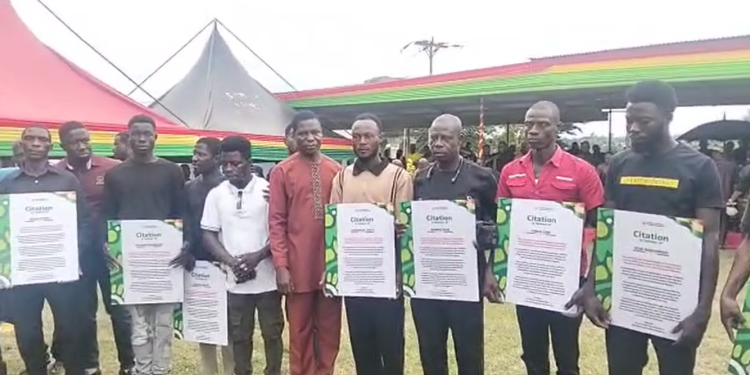
    The association insists that both Ralph Williams and the eight identified accomplices must be arrested immediately to restore confidence and ensure justice for the victim. Their demand follows the circulation of a viral video showing a violent altercation between some patient relatives and medical staff at the hospital’s emergency department.

    The Minority in Parliament has also intensified calls for Ralph’s arrest. In a statement dated Tuesday, August 19, and signed by the Ranking Member on the Health Committee, Dr. Nana Ayew Afriye, the group condemned the actions of Ralph and his team.

    They described the conduct as “unlawful, reckless, and deeply inconsiderate,” stressing that hospitals are places of care and confidentiality, not “arenas for political theatrics.” The Minority urged the Ghana Police Service to fully investigate the matter and called on the Health Minister to set up a joint parliamentary inquiry to prevent similar occurrences in the future.

    “The sanctity of our health facilities must be preserved at all times,” the statement concluded, urging political actors to refrain from compromising patient care for partisan ends.

    In response, the Ministry of Health has announced measures to beef up security at the Greater Accra Regional Hospital. The Ministry said this will ensure the safety of staff, patients, and the general public, while also addressing any gaps that may have contributed to the reported delay in treatment.

    Reiterating its commitment to protecting healthcare workers, the Ministry confirmed that Health Minister Hon. Kwabena Mintah Akandoh has already visited the facility to receive firsthand information. He assured hospital management and staff of the Ministry’s full support and protection.

    “We call on the public to exercise patience, cooperation, and mutual respect at all times to enable healthcare workers to provide effective and timely care,” the Ministry of Health added in a statement.

    Meanwhile, a 24-hour call centre for handling patient complaints across hospitals in the country has been introduced by the Health Minister, Mr. Kwabena Mintah Akandoh.

    The minister made this known at a press briefing in Accra on Thursday, August 21, explaining that the initiative will provide the public with a direct channel to report their displeasure regarding healthcare services.

    “The best you can do is lodge a complaint. And that brings me to the client service. So this is what we are doing. We have some numbers available where if people feel dissatisfied, you can then call,” he said.
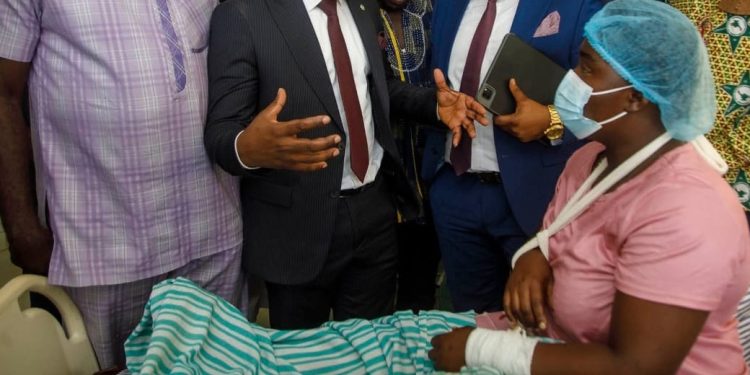
    He assured that complaints to the hotline will be managed fairly, but emphasized that this does not automatically mean all complaints will be considered right.

    “The fact that you have called to lodge a complaint doesn’t mean that you are right. We will look into the matter and then appropriately deal with it,” he stated.

    He added that hospitals have been instructed to display the hotline numbers boldly at facilities to make them easily accessible to patients nationwide.

    “We have communicated directly to all the health facilities in the country, to the Director-General and the teaching hospitals, that they must make these suggestion boxes and numbers conspicuously posted at all health facilities. So it is something I am pursuing aggressively,” he said.
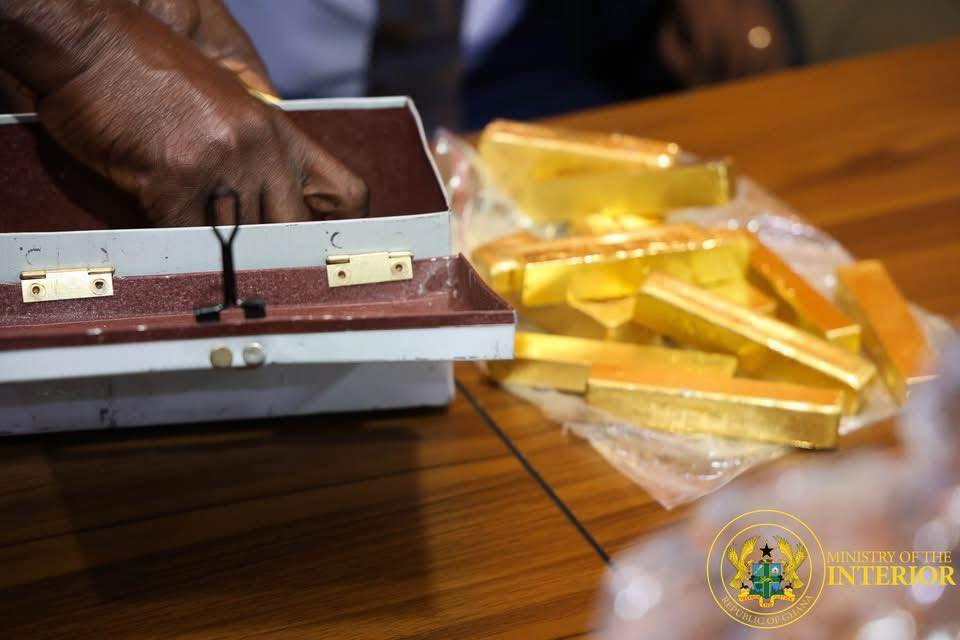
    Mr. Akandoh noted that the measure seeks to promote accountability and raise the standard of service delivery in the health sector.

  • Ghana’s reliance on corn imports projected to grow by 67% in 2025/26

    Ghana’s reliance on corn imports projected to grow by 67% in 2025/26

    Ghana is projected to significantly increase corn imports in 2025/2026 compared to the previous year, despite anticipated improvements in local harvests.


    According to the U.S. Department of Agriculture’s Grain and Feed Annual 2025 Report, the increased importation is intended to prevent shortages and help keep prices affordable for consumers.


    The report revealed that the country is expected to import 500,000 metric tonnes of corn during the 2025/2026 marketing year, representing a 67 percent increase over the 2024/2025 estimate. It also noted that Ghanaian farmers are likely to harvest more corn during the same period due to favourable weather conditions.


    “Post forecasts Ghana’s MY 2025/2026 (July-June) corn production at 3.3 MMT, up 26 percent from the MY 2024/2025 estimate of 2.6 MMT. The increase is due to a foreseen expansion in area harvested and a more favorable weather outlook.


    Caution flags are raised, however, by the Ghana Meteorological Agency (GMET) forecasting normal-to-below-normal rainfall and possibly longer dry spells for the country in 2025, possibly impacting the MY 2024/2025 lean seasons (i.e., April-July for southern Ghana and May-August in northern Ghana).


    “This season’s potential for a poor harvest is now driving corn prices up, as well as influencing farmers’ planting decisions to prioritize corn production. MY 2025/2026 corn imports are seen at 500,000 MT, up 67 percent from the MY 2024/2025 estimate. This is attributed to the Mahama administration’s resolve to continue with the previous government’s decision to suspend corn import restrictions to help supplement domestic supply and stabilize prices,” parts of the report read.


    In 2024, major commodities such as maize, sesame, rice, and soybeans recorded increased trading activity compared to 2023. Maize transaction volumes rose sharply from 2,311.78 metric tonnes in 2023 to 4,604.38 metric tonnes in 2024, representing a 99.2 percent increase. This growth was attributed to rising demand, improved access to markets, and favourable pricing conditions.


    “Trading volumes for major commodities recovered strongly partly due to increased demand and favourable pricing. Maize trading volumes grew by 99.2 per cent to 4,604.38 metric tonnes in 2024 from 2,311.78 metric tonnes in 2023, driven by increased demand, improved market access, and favourable pricing,” the report added.


    In terms of pricing, maize rose by 34.2 percent in 2024, selling at GH₵4,396.00 compared to GH₵3,276.50 in 2023. Soybean prices experienced an even sharper surge, climbing by 107.1 percent to GH₵8,311.00 per metric tonne from GH₵4,012.50. Meanwhile, sorghum, sesame, and rice prices remained unchanged during the same period.


    “During the period, commodities exhibited varying price trends compared to 2023. Maize prices increased by 34.2 per cent to GH₵4,396.00 from GH₵3,276.50. Soybean prices experienced the sharpest rise, surging by 107.1 per cent to GH₵8,311.00 per metric tonne from GH₵4,012.50 due to increased export demand and rising input costs. Sorghum, sesame, and rice prices remained unchanged, pointing towards stable supply and demand dynamics in those segments of the market,” the report explained.


    Operations at Ghana’s Commodity Exchange (GCX) warehouses also expanded in 2023, supported by enhanced storage capacity and stricter adherence to regulatory standards. The number of warehouses increased from eight to nine in the same year.


    These facilities are strategically located across Ghana’s key agricultural hubs, including the Ashanti, Bono, Northern, Upper East, and Upper West regions.


    “Warehouse operations expanded, reflecting improvements in storage capacity and regulatory compliance. The number of warehouses increased from 8 to 9, indicating investment in storage infrastructure aimed at enhancing market accessibility. This expansion underscores GCX’s commitment to boosting storage and trading activities to address liquidity challenges.


    “Likewise, total warehouse capacity grew by 9.1 per cent to 6,000 metric tonnes, supporting business growth, operational efficiency, and market demand. These developments signal a strengthened warehousing sector, improved storage efficiency, and regulatory compliance,” the report highlighted.


    The review also revealed that investment firms managing funds on behalf of individuals and institutions recorded strong growth in 2024, with the total value of assets under management (AUM) estimated at GH₵71.97 billion. This represented a nearly one-third increase (31 percent) from GH₵55.05 billion in 2023.


    “The Funds Management sector witnessed robust growth. Underpinned by a strong performance in several key segments, total AUM on a MTM basis reached GH₵71.97 billion by the end of the year, an impressive 31 per cent year-on-year growth from GH₵55.05 billion at the end of 2023,” the report stated.


    The Bank of Ghana attributed the significant growth to the strong performance of key financial segments, with pension funds playing the largest role in increasing total investments.

    Pension funds accounted for about 72 percent of AUM, equating to GH₵51.96 billion. This figure reflects a 32 percent year-on-year increase, underscoring their continued dominance in the investment market.
    Out of the total funds managed by investment firms, pension funds accounted for approximately GH₵51.96 billion.

    “A major contributor to this expansion was the pension fund segment, which continued to dominate the market. Pension funds accounted for 72.0 per cent of the total AUM, amounting to GH₵51.96 billion, based on marked-to-market values and adjusted data from custodians.


    This represents a 32.0 percent year-on-year increase, highlighting the resilience and sustained growth of pension investments in the current economic climate. Collective Investment Schemes (CIS) also demonstrated a notable turnaround from the 1 per cent year-on-year decline in 2023, rebounding by 25.0 per cent year-on-year, to reach marked-to-market values of GH₵6.58 billion for the year under review,” it added.


    Discretionary funds also recorded an expansion of 24 percent compared to the previous year, reaching GH₵12.08 billion in assets. The Real Estate Investment Trusts (REITs) segment, described as a new market category, posted a total market value of GH₵545.56 million in 2024.

    Private funds closed the year at GH₵802.94 million under management, representing a 5.9 percent increase compared to 2023.


    “Discretionary funds managed by fund managers similarly expanded by 24.0 per cent year-on-year to settle at GH₵12.08 billion. The Real Estate Investment Trusts (REITs) segment (new market segment) ended the year with a marked-to-market value of GH₵545.56 million, while Private funds experienced a gain of 5.9 per cent to end the year with AUM on a marked-to-market basis of GH₵802.94 million,” it added.


    The total value of assets managed in the investment industry, measured on a Held-to-Maturity (HTM) basis, also recorded significant growth of 26.9 percent, reaching GH₵85.62 billion.

    This, according to the report, highlights the industry’s resilience and ability to attract investors despite macroeconomic challenges such as inflation, currency depreciation, and sluggish growth.


    “The AUM on Held-to-Maturity (HTM) basis expanded by 26.9 per cent to GH₵85.62 billion in 2024. Based on adjusted data from custodians, the pensions sector posted an HTM AUM of GH₵62.47 billion, discretionary and non-discretionary funds of GH₵13.83 billion, CIS of GH₵7.97 billion, REITs of GH₵0.55 billion, and Private Funds of GH₵0.80 billion.


    “This broader growth on both the marked-to-market and HTM basis underscores the industry’s capacity to attract and retain capital, even when faced with macroeconomic headwinds,” the report observed.


    Collective Investment Schemes also benefited from increased subscriptions, which the report described as a sign of renewed investor confidence and a recovering market environment.


    “The CIS industry experienced some recovery, with subscriptions rising sharply, signalling renewed investor confidence and improved market conditions. This contrasts with 2023, when both subscriptions and redemptions reached their lowest levels, reflecting a period of subdued market activity.


    Redemption payouts increased in 2024 after a sharp decline in the previous year, suggesting that improved liquidity facilitated greater investor payouts. The redemption percentage of Net Asset Value (NAV), which was at its lowest in 2023, also saw a modest increase in 2024, though it remained below historical levels,” it added.


  • GES to begin 2025 school placement exercise on September 17

    GES to begin 2025 school placement exercise on September 17

    The 2025 school placement exercise will officially commence on September 17, as announced by the Ghana Education Service (GES).

    At a media briefing on Wednesday, August 27, GES Director-General, Professor Ernest Kofi Davis, indicated that before final placement is completed, prospective Senior High School (SHS) students will be allowed to double-check and correct their information via www.csses.gov.gh to avoid errors.

    He explained that the exercise will run from September 1 to September 8.

    “In order to reduce the errors associated with school placement, candidates will have the opportunity to review the entries they have made; gender, school code, programme code, online on www.csses.gov.gh.
    “This will be supported by an explainer video to guide parents. This exercise is expected on the 1st September and ends on 8th September. The Actual placement exercise will commence on the 17th of September. Students are expected to report to campus and begin their studies between 18th to 20th October,” he stated.

    After placement, students are expected to report to their schools and start classes between October 18 and October 20 to begin the 2025/2026 academic year.
    SHS 3 students will reopen on October 11, 2025, and remain in school until February 27, 2026, covering 18 weeks. They will return on March 13, 2026, for a 14-week session ending June 21, 2026, ahead of the West African Senior School Certificate Examination (WASSCE) scheduled for April 20 to June 20, 2026.
    SHS 1 and 2 students will start their first session on October 18, 2025, and break on February 27, 2026, after 17 weeks. They will resume on May 4, 2026, for a 16-week session ending August 21, 2026, marking the close of the academic year.
    Transitional CalendarThe Transitional Calendar refers to a temporary academic schedule designed to bridge the gap between the old double-track system and the new single-track system.
    On that calendar, first-year students will also report on October 18, 2025, and stay until January 30, 2026, before proceeding on a short break. Their second term will then begin on March 16 and run until June 12, 2026, with additional breaks, including some four weeks of off-site learning to help manage overcrowding in school facilities.
    Second-year students in transitional schools will reopen on January 5, 2026, and vacate on May 18, 2026, with five weeks of online learning. They will then resume from the vacation later in September for the final stretch of the academic year.
    Final-year students in transitional schools will begin on October 27, 2025, for a 14-week session before the Christmas break and resume in February for an 18-week preparation period before they sit for their West African Senior School Certificate Examination (WASSCE).
    GES also highlighted some significant breaks in the new timetable. The Christmas break will begin on December 20, 2025, and end on January 4, 2026. Vacation for SHS 3 students is slated for February 27 to March 1, 2026, while SHS 1 and 2 students will break from August 21 to August 23, 2026. GES has also proposed September 11, 2026, as the start date for the 2026/2027 academic year.
    In an unrelated development, sixty (60) private schools have been included under the Free Senior High School (SHS) policy. Junior High School (JHS) graduates will be admitted into these private schools, which fall under Category E in the school selection process. These schools will be accepting applications starting from the 2025/2026 academic year.
    The new development aligns with the government’s efforts to ease congestion in public SHSs as well as promote quality education across the country.
    In a press release issued on Sunday, July 20, by the Ghana National Council of Private Schools (GNACOPS) and signed by its National Executive Director, Oberto Nana Kwasi Gyetuah, the council described the initiative as a historic and progressive move.
    “This progressive move marks a significant milestone in Ghana’s educational transformation journey. It underscores the Government’s commitment to inclusive, collaborative education delivery and reaffirms the important role of private schools in advancing national development goals,” part of the release read.
    The council further called on other private schools that are yet to be listed to remain patient, prepared, and compliant with regulatory standards.
    In May, Deputy Minister of Education Dr. Clement Apaak announced that the inclusion forms part of a broader plan to scale up capacity and gradually end the double-track system.
    “As part of our campaign promise, we have been working diligently to bring on board private senior high schools in the delivery of the Free SHS programme. Meetings have been held, engagements have been done, and we are very certain that with the diligence we expect from our side…” he noted.
    The double-track system was introduced in 2018 by the erstwhile government to accommodate the surge in student enrollment due to the Free SHS policy, addressing overcrowding in public schools. Under this system, students were divided into two groups—Green Track and Gold Track—attending school in shifts, with one track in session while the other was on break.
    The anticipated extension of the Free SHS policy, according to the Education Minister, Haruna Iddrisu, is a fulfillment of the government’s manifesto promise, adding that it is a step to ensure eligible students gain admission without delays.
    “We believe strongly that in fulfilling this manifesto campaign promise, this is going to serve as an artery in helping us bring an end to the double-track system,” the deputy minister said.

    According to him, the Education Ministry has received encouraging feedback from private schools, many of which have expressed readiness to meet the standards and requirements of the Free SHS framework.
    “… and the eagerness of the private schools to participate, the private schools will deliver in their participation,” he assured.
    He added that this collaboration would not only help expand capacity but also ensure a more equitable distribution of educational opportunities across the country.

  • President Mahama to present GHS100k to persons who retrieved bodies of  helicopter crash victims

    President Mahama to present GHS100k to persons who retrieved bodies of helicopter crash victims

    Thirteen residents of Sikaman-Brofoyedu who assisted in recovering the bodies of eight victims from the tragic military helicopter crash on Wednesday, August 6 will receive GHS100k from President John Dramani Mahama.


    The Traditional Council in Adansi on the other hand will also receive GHS20,000 to cover expenses for purifying the area, as customs demands. Additionally, Asiedu Nketiah announced the government’s plans of securing for all the 13 individuals.

    This information was revealed by the National Chairman of the National Democratic Congress (NDC), Johnson Asiedu Nketiah on Wednesday, August 27. Johnson Asiedu Nketiah made this disclosure during a visit the community.

    “President has asked me to represent him and thank the residents who helped us recover the bodies of our eight men. We have a plaque for all of you in honour of what you did.

    “The president is also giving you GHS100,000 for what you did for the country. For the rites left to be done, the president is also giving the chiefs GHS20,000. Whatever will be left behind let your DCEs and party chairmen know so we clear those.”

    On Friday, August 15, 2025, the government organized a State funeral to lay to rest six out of the eight victims of the Adansi helicopter crash.

    The deceased included Dr. Edward Kofi Omane Boamah, Minister for Defence; Minister for Environment, Science, Technology and Innovation, Dr. Ibrahim Murtala Mohammed; Acting Deputy National Security Coordinator in charge of Human Security, Alhaji Muniru Limuna Mohammed; Vice Chairman of the National Democratic Congress, Samuel Sarpong; and Deputy Director-General of NADMO, Samuel Aboagye.

    Others included Squadron Leader Peter Analaa of the Ghana Air Force, Flying Officer Tsum Ampadu of the Ghana Air Force, and Sergeant Ernest Addo of the Ghana Air Force.

    Dr. Ibrahim Murtala Mohammed and Alhaji Muniru Limuna Mohammed, however, had been laid to rest earlier, on Sunday, August 10. Janazah prayers were held at the Forecourt of the State House in Accra before they were buried at the Military Cemetery in Tse Addo.

    At the State burial, tributes were read by the bereaved families, who expressed the love, peace, and joy they shared while living with the deceased. President John Mahama, in his tribute, eulogized each of the victims, highlighting their contributions and outstanding qualities. “Each of these men had a story. Each had a family they cherished, a vision they pursued, and a heart that beat with love for Ghana,” the President said.

    The solemn and heartwarming ceremony brought together families, friends, and mourners, as well as representatives of international organizations from far and near. After the interfaith service at the Black Star Square, the gathering proceeded to the Military Cemetery in Tse Addo, Greater Accra Region, where the burial took place.

    Taking turns, President Mahama, Vice President Professor Jane Naana Opoku-Agyemang, the families of the deceased, the Ghana Armed Forces, government officials, members of the National Democratic Congress (NDC), and other dignitaries laid wreaths in memory of the victims of the tragic incident.

    Investigations into the Z-9 helicopter crash have officially begun following the establishment of an investigative Board, as announced by the Ministry of Defence.

    The Board is chaired by the National Security Coordinator, with members drawn from the Ghana Air Force and the Aircraft Accident and Incident Investigation and Prevention Bureau of the Ghana Civil Aviation Authority (GCAA).

    This was contained in a press statement issued by the Acting Defence Minister, Ato Forson. “The Ministry of Defence hereby informs the public that the Investigation Board established to inquire into the recent Z-9 helicopter crash has formally commenced its work,” parts of the statement read.

    According to the Ministry, “the United States of America is providing advice and assistance to the board through visiting investigators from the U.S. Air Force.”

    Additionally, other relevant experts and institutions are expected to be consulted by the Board to aid in the investigations. President John Mahama had earlier disclosed that the flight data and cockpit voice recorders of the Z-9 Air Force helicopter had been retrieved. He made this announcement during his national address on Thursday, August 7, a day after the incident.

    In the United States, the authority responsible for investigating aircraft accidents is the National Transportation Safety Board (NTSB). The NTSB is an independent federal agency mandated by Congress to investigate every civil aviation accident in the U.S. as well as significant incidents in other modes of transportation, including railroad, transit, highway, marine, pipeline, and commercial space.

    Since its establishment in 1967, the NTSB has investigated more than 153,000 aviation accidents and thousands of surface transportation events. Its mission is to determine probable causes, examine safety issues, and develop recommendations to prevent similar accidents in the future.

    To date, the Board has issued more than 15,500 safety recommendations to over 2,470 recipients, with an implementation rate of 82 percent for the more than 12,700 recommendations that have been closed.

    In Ghana, the Aircraft Accident and Incident Investigation and Prevention Bureau (AIB) is responsible for investigating plane crashes. On July 6, 2020, former President Nana Akufo-Addo granted executive approval for the laying before Parliament of the Aircraft Accident Investigation and Prevention Bureau Bill, 2020.

    The bill sought to establish an autonomous Bureau to conduct investigations into aircraft accidents and incidents in line with International Civil Aviation Organization (ICAO) Standards and Recommended Practices (SARPs).

    According to the AIB, Article 26 of the Chicago Convention requires every state in which an aviation accident occurs to investigate the event. Furthermore, ICAO Annex 13 stipulates that such investigations must be conducted professionally, independently, and without bias.

    The investigatory body must therefore not only have a legal mandate but also be well-structured, adequately resourced, and autonomous in its operations and findings. In 2019, when ICAO conducted a Validation Mission to assess Ghana’s level of Effective Implementation (EI) of its SARPs, the country obtained an impressive EI score of 89.89 percent.

    Meanwhile, the Support Fund established for the children of the eight individuals who lost their lives on Wednesday, August 6, following a helicopter crash at Adansi Akrofuom in the Ashanti Region has received an additional GHS500k.

    As of Tuesday, August 19, the Fund had accrued a total of GHS 2,315,000.00 following collective donations by corporate organizations and individuals. The recent donation was received from Fidelity Bank Ghana on Friday, August 22.

    The Fund was officially launched by President John Dramani Mahama while speaking at the State funeral organized for the victims at Black Star Square on Friday, August 15.

    On Tuesday, August 27, families of six out of the eight deceased persons received GHC 2 million in donations from Ghana’s leading insurance company, GLICO General Insurance.

    The beneficiaries include the families of the Acting Deputy National Security Coordinator in charge of Human Security, Alhaji Muniru Limuna Mohammed; Vice Chairman of the National Democratic Congress, Samuel Sarpong; Deputy Director-General of NADMO, Samuel Aboagye; Wing Commander Peter Baafemi Analaa; Flight Lieutenant Manaen Twum Ampadu; and Flight Sergeant Mensah Ernest Addo.

    The families of the two ministers—Minister for Defence, Dr. Edward Kofi Omane Boamah, and Minister for Environment, Science, Technology, and Innovation, Dr. Ibrahim Murtala Mohammed—have also received benefits under the personal accident cover, as both were insured with the company.

    Speaking during the presentation, Andrew Achampong-Kyei, Managing Director of GLICO, urged the families of the deceased to take advantage of insurance packages as a safeguard against unforeseen circumstances.

    “I’ll encourage you all that it’s important we protect our lives. Having insurance should be part of our social fabric, so we safeguard our lives and investments,” he said.

    The Group Chief Executive Officer, Edward Forkuo Kyei, expressed sympathy to the grieving families while assuring them of the company’s support during these difficult times.

    “You are not standing alone; we are with you. It is for this reason we express our deepest condolences,” he noted.
    Those wishing to contribute to the Support Fund have been directed to make donations through Stanbic Bank Ghana Limited (Stanbic Heights Branch, Accra) using the following accounts: US Dollar (USD) Account – 9040013628534 and Ghana Cedi (GHS) Account – 9040013628372.

    According to the Coordinator, cheques and bank drafts should be made payable to CHILDREN SUPPORT FUND 6825. She emphasized that the names of individuals making payments will be published weekly.

  • Ridge Hospital nurse did not suffer shoulder dislocation – Probe Committee

    Ridge Hospital nurse did not suffer shoulder dislocation – Probe Committee

    The Minister of Health’s committee, probing the assault at Ridge Hospital, has vindicated a member of the pressure group Democracy Hub, Mr. Ralph Afful Williams, over allegations of assaulting a rotational nurse, Rejoice Tsotso Bortei, at the facility.

    While submitting its findings to the Minister of Health, Kwabena Mintah Akandoh, on Wednesday, August 27, the Chairman of the Committee, Dr. Lawrence Ofori-Boadu, disclosed that there is no medical evidence indicating that the nurse suffered a dislocation on her shoulder, nor does she have a fracture in her left wrist.

    Dr. Lawrence Ofori-Boadu has, however, recommended that the nurse receive psychological support and bed rest.

    “Rejoice Tsotso Bortei, who is a rotation nurse, reported her injury to the hospital a day after the incident on the 18th of August and was further treated. There was no evidence of fracture on her left wrist or dislocation of her right shoulder joint as documented by the medical records.

    “She has, however, been treated and given pain relief, recommended for bed rest, and received psychological support care,” the committee stated.

    On August 20, a group of men, including a member of the pressure group Democracy Hub, Mr. Ralph Afful Williams, allegedly stormed the Ridge facility, demanding immediate treatment for an injured finger while medical staff were attending to critically ill patients, including one with an open fracture.

    Hospital management was forced to call in the Ghana Police Service after the situation escalated into the alleged assault of a nurse. Following the incident, several groups and individuals have demanded the arrest of Ralph Williams, describing his actions as unlawful.

    Meanwhile, the nurse at Greater Accra Regional Hospital who was allegedly attacked, Rejoice Tsotsoo Bortei, has dragged her alleged abuser, activist Ralph Saint Williams, to court for physical assault and defamation.

    The plaintiff is seeking GH¢5 million in damages for battery and GH¢2 million for defamation, arguing that the defendant’s words have “cast the Plaintiff as a liar, a non-trustworthy person, and a crook”.

    When staff requested he obtain a hospital card, the defendant reportedly became aggressive and began recording patients and staff without consent. The plaintiff indicates that despite providing him with initial first aid, the defendant later returned with a group of men and physically assaulted her.

    “The Defendant, without provocation, struck the Plaintiff’s left hand with a clenched fist and a metallic cellphone,” the writ states.
    Following the incident, the defandant during a live video accused Rejoice of being a liar.

    “Liar, Wo se wo nsam abu. Duab0 bebam. You say you have suffered an injured hand and a dislocated shoulder. This is cooked up to cover the nonsense going on at the hospital,” he said.

    Additional reliefs sought include a court order for a full public apology and retraction, a perpetual injunction against further defamatory publications, a restraining order preventing the defendant from coming within 50 meters of the plaintiff, and legal costs.

    The defendant has eight days to enter an appearance upon being served with the writ, or risk a default judgment.

    Just days earlier, the Health Minister confirmed that the Ridge Hospital incident that saw the assault of health practitioners had led to several arrests by the Ghana Police Service.

    “The law has so far dealt with all those who did something wrong, and we are also investigating as a ministry. Anyone who comes to tell you that no arrest has been made in this matter is probably someone who is not ready to contribute to the resolution of this matter,” the Minister told Asempa FM on August 19, without disclosing the names of the suspects.

    In response, the Ghana Registered Nurses and Midwives Association (GRNMA) issued a 48-hour ultimatum to the government to arrest Ralph and his accomplices. The association warned that it would be compelled to “advise itself” if immediate action was not taken.

    According to the GRNMA’s General Secretary, Dr. David Tenkorang Twum, the nurse who was attacked sustained injuries and is currently receiving treatment at the hospital. He described the assault as unacceptable and stressed that health workers cannot operate in an unsafe environment.

    “If anybody can just walk into a facility, like Ridge Hospital, and throw his weight about and beat like a midwife, and you have other party apparatchiks telling them to egg him on, that is unfortunate. We are not happy at all. Our people are traumatized,” he stated.

    He continued, “We are very civilized people. We are professionals. And we are asking the government to arrest the guy immediately and the eight accomplices; we were told there were about 50 guys that day. But those who laid their hands on the lady—there were about eight, including Ralph himself. And therefore, if he’s not arrested within 48 hours, we shall advise ourselves.”

    Dr. Tenkorang also referenced Section 119 of Ghana’s Labour Act, which empowers workers to withdraw their services if their health and safety are at risk.

    “And we are all guided by law. In that, if you read section 119, subsection 1, it is stated that if you are a worker and you think that your safety is not guaranteed, your life and your health are not guaranteed, and you have every right under the law to remove yourself from that danger. And our people have told us this morning, after interacting with them, that they are not safe. They feel that their safety has been breached,” he said.

    The association insists that both Ralph Williams and the eight identified accomplices must be arrested immediately to restore confidence and ensure justice for the victim. Their demand follows the circulation of a viral video showing a violent altercation between some patient relatives and medical staff at the hospital’s emergency department.

    The Minority in Parliament has also intensified calls for Ralph’s arrest. In a statement dated Tuesday, August 19, and signed by the Ranking Member on the Health Committee, Dr. Nana Ayew Afriye, the group condemned the actions of Ralph and his team.

    They described the conduct as “unlawful, reckless, and deeply inconsiderate,” stressing that hospitals are places of care and confidentiality, not “arenas for political theatrics.” The Minority urged the Ghana Police Service to fully investigate the matter and called on the Health Minister to set up a joint parliamentary inquiry to prevent similar occurrences in the future.

    “The sanctity of our health facilities must be preserved at all times,” the statement concluded, urging political actors to refrain from compromising patient care for partisan ends.

    In response, the Ministry of Health has announced measures to beef up security at the Greater Accra Regional Hospital. The Ministry said this will ensure the safety of staff, patients, and the general public, while also addressing any gaps that may have contributed to the reported delay in treatment.

    Reiterating its commitment to protecting healthcare workers, the Ministry confirmed that Health Minister Hon. Kwabena Mintah Akandoh has already visited the facility to receive firsthand information. He assured hospital management and staff of the Ministry’s full support and protection.

    “We call on the public to exercise patience, cooperation, and mutual respect at all times to enable healthcare workers to provide effective and timely care,” the Ministry of Health added in a statement.

    Meanwhile, a 24-hour call centre for handling patient complaints across hospitals in the country has been introduced by the Health Minister, Mr. Kwabena Mintah Akandoh.

    The minister made this known at a press briefing in Accra on Thursday, August 21, explaining that the initiative will provide the public with a direct channel to report their displeasure regarding healthcare services.

    “The best you can do is lodge a complaint. And that brings me to the client service. So this is what we are doing. We have some numbers available where if people feel dissatisfied, you can then call,” he said.

    He assured that complaints to the hotline will be managed fairly, but emphasized that this does not automatically mean all complaints will be considered right.

    “The fact that you have called to lodge a complaint doesn’t mean that you are right. We will look into the matter and then appropriately deal with it,” he stated.

    He added that hospitals have been instructed to display the hotline numbers boldly at facilities to make them easily accessible to patients nationwide.

    “We have communicated directly to all the health facilities in the country, to the Director-General and the teaching hospitals, that they must make these suggestion boxes and numbers conspicuously posted at all health facilities. So it is something I am pursuing aggressively,” he said.

    Mr. Akandoh noted that the measure seeks to promote accountability and raise the standard of service delivery in the health sector.

  • Typhoid outbreak in Oti Region has claimed no life – Health Director

    Typhoid outbreak in Oti Region has claimed no life – Health Director

    No deaths have been reported following the recent typhoid outbreak in the Oti region, the Oti Regional Director of Health Services, Dr. Kofi Amo-Kodieh has clarified.

    Speaking to the media on Wednesday, August 27, the Oti Regional Director of Health Services noted the Service is yet to receive an official confirmation over the death claims.

    He further called on the public to desist from spreading misinformation and to have trust in the Service to find a lasting solution to the outbreak.

    According to him, the Service has implemented measures to manage the outbreak.

    “So far, we have no record of anyone dying from this outbreak. Our health education campaigns have helped people seek care on time, which is crucial in managing typhoid.

    “As a medical professional, when someone dies, I rely on the official medical cause of death. I have not received any information confirming that anyone has died from this outbreak.

    He added: “People may assume a death is caused by typhoid, but the only way to know the exact cause is through a medical certificate of cause of death. Until that is confirmed, we cannot say for certain.”


    The clarification is a response to claims that a traditional leader and a former Municipal Chief Executive (MCE) of Dambai lost their lives to the disease. The Oti Region has recorded 10,233 cases of typhoid in the first half of 2025.

    Environmental Health Officer Cynthia Sekyere revealed that two out of every twenty people selected in Oti suffer from typhoid fever.

    “Just in the first and second quarters of typhoid, we have recorded 10,233 cases of typhoid, which is quite troubling. Deducing from the report of the Ghana Health Service, out of every 20 people selected in the Oti Region, 2 of them have typhoid,” she noted.

    She continued that as part of the measures to deal with this alarming surge, health authorities are set to roll out a task force to enforce strict community sanitation.

    She associated the task force’s role with that of what was previously called the town council, where personnel of the local government task force used to conduct house-to-house inspections to monitor hygiene standards in homes and surroundings. They ensured compliance with sanitation bylaws, issuing fines or warnings for poor conditions, among other responsibilities.

    However, the practice of the town council gradually became unpopular in the late 1990s and early 2000s, following changes in the local governance structure. Consequently, resource constraints and a lack of personnel to sustain regular inspections eventually phased it out. The Oti Region now intends to revive it.

    In addition, Oti Regional Director of Health Services, Dr. Bismarck Owusu, has attributed the spike in typhoid cases to poor sanitation practices such as open defecation, indiscriminate waste disposal, and contaminated water sources. He stressed that sanitation is not just an environmental problem but a health emergency requiring swift action.

    He commended the formation of the task force, describing it as a “timely intervention” and a “game-changer” in reducing the region’s outbreak burden. He also called on traditional leaders, assembly members, and youth groups to support the enforcement of sanitation bylaws and help drive behavioural change.

    Municipal Chief Executive for Krachi West and Dean of MMDCEs in the Oti Region, Prosper Addo, also expressed concern about the impact of the outbreak on vulnerable groups. He pledged that municipal and district assemblies would roll out initiatives to curb the spread while stressing the need for residents’ active participation.

    “The outbreak is hitting vulnerable populations the hardest. Community involvement is essential in promoting hygiene practices and supporting efforts to curb this public health challenge. We can only win this fight if communities themselves adopt good sanitation and hygiene practices,” Addo urged.

    Typhoid statistics in Oti in the last few years: progress or worsening cases

    The 2025 typhoid cases represent the highest since 2020. Since then, the Oti Region has recorded a disturbing rise in typhoid cases, with occasional declines between 2020 and 2025.

    In 2020, the region recorded 1,853 confirmed cases of typhoid fever. However, in 2021, the situation escalated sharply, with cases surging to 5,807—an increase of 3,954 cases, representing a staggering 213.4% rise compared to the previous year. This spike was largely attributed to deteriorating sanitation conditions and improved diagnostic capacity across health facilities.

    The upward trend continued into 2022, with 6,242 cases, an increase of 435 over 2021, representing a 7.49% rise. In 2023, the numbers showed some improvement after the huge rise in previous years, particularly in 2021.

    Data from January to June showed a slight decline with 4,935 cases reported in the first half of the year. This represented a decrease of 1,307 cases from the full-year total of 2022, amounting to a 20.94% drop.

    Following that decline, late 2024 saw a troubling escalation in typhoid cases in the Oti Region, though exact figures for the period were not publicly broken down.

    However, reports from early 2025 described the situation in Dambai, the regional capital, as “bad” and “scary,” with the disease spreading rapidly and claiming lives, including those of a traditional chief and a former Municipal Chief Executive (MCE).

    What is typhoid

    Typhoid fever is a life-threatening bacterial infection caused by Salmonella enterica serovar Typhi, commonly referred to as Salmonella Typhi. The disease is primarily transmitted through the ingestion of food or water contaminated with faeces or urine from infected individuals. It is mostly prevalent in areas with poor sanitary conditions, unsafe drinking water, and inadequate hygiene practices—conditions especially common in areas with limited financial, medical, or infrastructural resources.

    Symptoms of typhoid typically appear between one and three weeks after exposure. These include a high fever, persistent headache, and general fatigue.

    Patients may also experience gastrointestinal symptoms such as constipation or diarrhoea. In some cases, rose-coloured spots may appear on the chest, and the spleen and liver can become enlarged as the infection progresses.

    In severe cases, where the disease is left untreated or poorly treated, complications may occur, which can lead to death. Even after apparent recovery, approximately 2 to 5 per cent of individuals become chronic carriers of the bacteria.

    These carriers continue to shed Salmonella Typhi in their stool or urine, posing a risk of transmission to others and contributing to the persistence of the disease in affected communities.

  • Sell gold legally, earn GHS832 more per pound – GoldBod tells miners

    Sell gold legally, earn GHS832 more per pound – GoldBod tells miners

    Miners operating under valid mining license have been offered a special temporary bonus scheme from the Ghana Gold Board (GoldBod) in efforts to support the industry as well as combating gold smuggling.

    The licensed miners will enjoy an additional GH¢832 per pound of gold sold through the Ghana Gold Board. This information was contained in a statement issued by the GoldBod on Wednesday, August 27.

    “This novelty is in response to legitimate complaints from licensed miners about the significant reduction in the local price of gold in the last few months due to the continuous appreciation of the Ghana cedi.

    “The special bonus will ensure that licensed miners who have contributed immensely to the country’s increased gold output and foreign exchange earnings do not indirectly suffer as a result of the significant appreciation of the Ghana cedi that they have helped the country achieve,” the statement read.


    According to GoldBod, the recent development has been made possible as a result of the continuous appreciation of the Ghana cedi. 

     On July 7, a task force was inaugurated with a special mandate with specific powers as police officers to wage war against smuggling and all forms of illegal gold trading activities in the country.

    According to the Acting Chief Executive Officer of the Goldbod, Sammy Gyamfi, this will save the government from any leakages in revenue mobilisation in the sector, helping to generate and invest revenue for economic development.

    “(This will) help the state combat and defeat the phenomenon of gold smuggling, the canker of illegal gold trading, and price disruptions that deprive the state of the needed revenue, profit, and the needed forex for our economy and the development of our country,” he announced.


    He thus cautioned traders to secure the appropriate licence to engage in any form of gold trading in the country, saying, “But for those who are hell bent on trading illegally without the licenses, we are serving notice that we are coming after you”.

    Earlier, the GoldBod CEO on June 5 also warned that persons who trade without licenses would be prosecuted, adding that his outfit takes no bribes before the said licenses are issued.

    During a meeting with the Chamber of Licensed Gold Buyers, Mr Gyamfi stated that “I don’t take or demand bribes before I issue a licence.”

    The acting CEO noted that the process for registering has been made seamless and is devoid of corruption. “We have removed the human interface element, and so there is no corruption, bribery, inducements, or favouritism. It is a very transparent and competitive process, and once you qualify, you get the license,” he added.

    Lauding his outfit’s results-oriented reforms and initiatives since his takeover as CEO, Sammy Gyamfi, during a media engagement, revealed that GoldBod has exceeded the $5 billion mark in gold export value for the first half of 2025, surpassing the $4.6 billion recorded for the entire year of 2024.

    He expressed optimism that GoldBod would hit the 60-tonne export mark by the end of July 2025, driven by stronger compliance, improved oversight, and the streamlined licensing regime under the Ghana Gold Board Act, 2025 (Act 1140).

    “In the whole of 2024, gold exports stood at 66 tons with an export value of $4.6 billion. We have done only six months, and yet we have crossed the $4.6 billion. We have gone beyond $5 billion, and in terms of volumes, we have done 50 tons and over, and we are optimistic that by the end of next month, we will have hit 60 tons,” he said.

    The Ghana Gold Board (GoldBod) is the sole authority with exclusive right to buy, sell, weigh, grade, assay, value and export gold and other precious minerals in Ghana. The Ghana Gold Board functions under the oversight and supervision of the Ministry of Finance of the Republic of Ghana.

    History of GoldBod

    The Ghana Gold Board (GoldBod) is a body corporate established by an Act of Parliament (ACT 1140) in the year 2025 to oversee, regulate and undertake the buying, selling, assaying, refining, exporting and other related activities in respect of Gold and other Precious Minerals in Ghana.

    The GoldBod per section 78 of ACT 1140, took over the rights, obligations, assets, liabilities and workforce of the Precious Minerals Marketing Company (PMMC) Limited, which is an offshoot of the Ghana Diamond Marketing Board.

    In 1963, the Ghana Diamond Marketing Board was established and charged with the responsibility of purchasing and marketing Ghana’s diamonds.

    In 1965, by a Legislative Instrument (LI) 401, the Ghana Diamond Marketing Board was incorporated as a State-Owned Enterprise (SOE).

    Upon the promulgation of the diamonds decree (NRCD 32) in 1972, LI 916 was enacted to change the company’s name to Diamond Marketing Corporation.

    In 1989, PNDC Law 219 was enacted to yet again change the Company’s name to the Precious Minerals Marketing Corporation with enhanced functions to grade, assay, value gold, diamonds and other precious minerals of the country.

    In the year 2000, the Corporation was converted by the Statutory Corporations Conversion to Companies Act (ACT 461) to a Limited Liability Company to operate under the Ghana Companies Code Act, (ACT 179) 1963, as Precious Minerals Marketing Company (PMMC) Limited with the same functions.

    In the year 2016, the PMMC was appointed the national assayer by the government of Ghana.

    To strengthen industry regulation and optimize national benefits, the Ghana GoldBod was established on 2 April, 2025 by the government of Ghana to restructure and streamline the precious mineral trading sector of Ghana.

    The GoldBod initiative is a product of extensive stakeholder consultations and aims at maximizing foreign exchange inflows, gold reserve accumulation and value addition for sustainable growth and transformation.

  • Support Fund for helicopter crash victims’ children receives additional GHS500k

    Support Fund for helicopter crash victims’ children receives additional GHS500k

    The Support Fund established for the children of the eight individuals who lost their lives on Wednesday, August 6, following a helicopter crash at Adansi Akrofuom in the Ashanti Region has received an additional GHS500k.

    As of Tuesday, August 19, the Fund had accrued a total of GHS 2,315,000.00 following collective donations by corporate organizations and individuals. The recent donation was received from Fidelity Bank Ghana on Friday, August 22.

    The Fund was officially launched by President John Dramani Mahama while speaking at the State funeral organized for the victims at Black Star Square on Friday, August 15.

    On Tuesday, August 27, families of six out of the eight deceased persons received GHC 2 million in donations from Ghana’s leading insurance company, GLICO General Insurance.


    The beneficiaries include the families of the Acting Deputy National Security Coordinator in charge of Human Security, Alhaji Muniru Limuna Mohammed; Vice Chairman of the National Democratic Congress, Samuel Sarpong; Deputy Director-General of NADMO, Samuel Aboagye; Wing Commander Peter Baafemi Analaa; Flight Lieutenant Manaen Twum Ampadu; and Flight Sergeant Mensah Ernest Addo.


    The families of the two ministers—Minister for Defence, Dr. Edward Kofi Omane Boamah, and Minister for Environment, Science, Technology, and Innovation, Dr. Ibrahim Murtala Mohammed—have also received benefits under the personal accident cover, as both were insured with the company.


    Speaking during the presentation, Andrew Achampong-Kyei, Managing Director of GLICO, urged the families of the deceased to take advantage of insurance packages as a safeguard against unforeseen circumstances.

    “I’ll encourage you all that it’s important we protect our lives. Having insurance should be part of our social fabric, so we safeguard our lives and investments,” he said.


    The Group Chief Executive Officer, Edward Forkuo Kyei, expressed sympathy to the grieving families while assuring them of the company’s support during these difficult times.

    “You are not standing alone; we are with you. It is for this reason we express our deepest condolences,” he noted.

    Meanwhile, President Mahama has expressed his gratitude to Stanbic Bank Ghana for donating GHS 500,000 to the Fund, as well as to companies including Procus GH Limited, GB Foods Ghana, Sunda FM Manufacturing Ltd, Sage Distribution Ltd, Quantum Oil Terminals, Quantum LPG Logistics Ltd, Newgas Cylinder Ltd, and Quantum Terminals PLC for their contributions.


    During the August 15 state burial, the President also announced posthumous promotions for three Ghana Air Force officers who perished in the crash. Squadron Leader Peter Analaa, Flying Officer Tsum Ampadu, and Sergeant Ernest Addo were all elevated to their next ranks as a tribute to their professionalism, sacrifice, and dedication.

    Their new ranks are Wing Commander Peter Baafemi Analaa, Flight Lieutenant Manaen Twum Ampadu, and Flight Sergeant Mensah Ernest Addo.


    On Friday, the government organized a State funeral to lay to rest six out of the eight victims of the Adansi helicopter crash. Dr. Ibrahim Murtala Mohammed and Alhaji Muniru Limuna Mohammed, however, had been buried earlier on Sunday, August 10.

    Janazah prayers were held at the Forecourt of the State House in Accra before their burial at the Military Cemetery in Tse Addo. At the State burial, tributes were read by the bereaved families, who reflected on the love, peace, and joy they had shared with the deceased.

    President Mahama, in his tribute, eulogized each of the victims, highlighting their contributions and outstanding qualities. “Each of these men had a story. Each had a family they cherished, a vision they pursued, and a heart that beat with love for Ghana,” the President said.


    The solemn and emotional ceremony brought together families, friends, mourners, and representatives of international organizations. Following the interfaith service at Black Star Square, the gathering proceeded to the Military Cemetery in Tse Addo, Greater Accra Region, where the burials took place.

    President Mahama, Vice President Professor Jane Naana Opoku-Agyemang, the families of the deceased, the Ghana Armed Forces, government officials, members of the National Democratic Congress (NDC), and other dignitaries took turns to lay wreaths in memory of the victims of the tragic incident.


    Investigations into the Z-9 helicopter crash have officially begun following the establishment of an investigative Board, as announced by the Ministry of Defence.


    The Board is chaired by the National Security Coordinator, with members drawn from the Ghana Air Force and the Aircraft Accident and Incident Investigation and Prevention Bureau of the Ghana Civil Aviation Authority (GCAA).

    This was contained in a press statement issued by the Acting Defence Minister, Ato Forson. “The Ministry of Defence hereby informs the public that the Investigation Board established to inquire into the recent Z-9 helicopter crash has formally commenced its work,” parts of the statement read.


    According to the Ministry, “the United States of America is providing advice and assistance to the board through visiting investigators from the U.S. Air Force.”

    Additionally, other relevant experts and institutions are expected to be consulted by the Board to aid in the investigations. President John Mahama had earlier disclosed that the flight data and cockpit voice recorders of the Z-9 Air Force helicopter had been retrieved. He made this announcement during his national address on Thursday, August 7, a day after the incident.


    In the United States, the authority responsible for investigating aircraft accidents is the National Transportation Safety Board (NTSB). The NTSB is an independent federal agency mandated by Congress to investigate every civil aviation accident in the U.S. as well as significant incidents in other modes of transportation, including railroad, transit, highway, marine, pipeline, and commercial space.
    Since its establishment in 1967, the NTSB has investigated more than 153,000 aviation accidents and thousands of surface transportation events. Its mission is to determine probable causes, examine safety issues, and develop recommendations to prevent similar accidents in the future. To date, the Board has issued more than 15,500 safety recommendations to over 2,470 recipients, with an implementation rate of 82 percent for the more than 12,700 recommendations that have been closed.
    In Ghana, the Aircraft Accident and Incident Investigation and Prevention Bureau (AIB) is responsible for investigating plane crashes. On July 6, 2020, former President Nana Akufo-Addo granted executive approval for the laying before Parliament of the Aircraft Accident Investigation and Prevention Bureau Bill, 2020. The bill sought to establish an autonomous Bureau to conduct investigations into aircraft accidents and incidents in line with International Civil Aviation Organization (ICAO) Standards and Recommended Practices (SARPs).
    According to the AIB, Article 26 of the Chicago Convention requires every state in which an aviation accident occurs to investigate the event. Furthermore, ICAO Annex 13 stipulates that such investigations must be conducted professionally, independently, and without bias.
    The investigatory body must therefore not only have a legal mandate but also be well-structured, adequately resourced, and autonomous in its operations and findings. In 2019, when ICAO conducted a Validation Mission to assess Ghana’s level of Effective Implementation (EI) of its SARPs, the country obtained an impressive EI score of 89.89 percent.
    Those wishing to contribute to the Support Fund have been directed to make donations through Stanbic Bank Ghana Limited (Stanbic Heights Branch, Accra) using the following accounts: US Dollar (USD) Account – 9040013628534 and Ghana Cedi (GHS) Account – 9040013628372. According to the Coordinator, cheques and bank drafts should be made payable to CHILDREN SUPPORT FUND 6825. She emphasized that the names of individuals making payments will be published weekly.

  • Teacher trainees to write GTLE in October under revised format

    Teacher trainees to write GTLE in October under revised format

    Level 400 teacher trainees due for the 2025 Ghana Teacher Licensure Examination (GTLE) will officially begin their exams from Monday, October 13, to Wednesday, October 15, as announced by the Teacher Trainees’ Association of Ghana (TTAG).

    According to a statement issued by the TTAG’s National Secretariat, individuals who plan to retake the exams will sit for theirs from Monday, October 27, to Tuesday, October 28, 2025. However, the Secretariat emphasized that the date announced for resit candidates is tentative and subject to change.

    Both categories of candidates are expected to pay GH¢450.00 as examination fees and an index fee of GH¢50.00 to be able to participate in the upcoming exam. This new arrangement follows consultations with the National Teaching Council (NTC) and the Ministry of Education (MoE).

    “The National Secretariat of the Teacher Trainees’ Association of Ghana (TTAG) wishes to inform all Level 400 students and candidates due for the Ghana Teacher Licensure Examination (GTLE), as well as resitters, of the confirmed dates and revised modalities for the conduct of the examination.
    “Following consultations with the National Teaching Council (NTC) and the Ministry of Education (MOE), it has been resolved that the GTLE will be conducted under a new mode aimed at enhancing efficiency, credibility, and alignment with contemporary standards of teacher education.
    “The schedules are as follows: Level 400 (First-time candidates): Monday, 13th – Wednesday, 15th October 2025, resitters: Monday, 27th – Tuesday, 28th October 2025 (tentative). Examination Fee: GH¢ 450.00 and Indexing Fee: GH¢ 50.00,” parts of the release read.

    Additionally, the statement noted that the National Teaching Council will, in the coming days, provide detailed information regarding the exam. Candidates will also undergo a series of orientations to familiarize themselves with the procedures and requirements.

    “The NTC will, in due course, release full guidelines on registration, structure, and procedures. In addition, NTC shall engage candidates in a series of Zoom meetings organized through the respective TTAG administrative Sectors to provide direct orientation and clarity on the new arrangements,” it stated.

    The Association further urged candidates to follow its official social media handles for updates.
    “All affected candidates are advised to take note of these directives, prepare adequately, and follow official updates keenly. TTAG remains committed to collaborating with NTC and MoE to safeguard the interests of all Teacher Trainees nationwide,” it added.

    The GTLE was officially introduced in September 2018 by the National Teaching Council (NTC). The Council is mandated by the Education Regulatory Bodies Act, 2020 (Act 1023) to conduct these exams as part of its licensing process. Candidates who fail the GTLE are not recognized as professional teachers in Ghana. Over the years, however, many candidates have expressed displeasure with the exam due to the high failure rate.

    According to statistics released by the NTC, 47.4% of candidates, totaling 9,556 teachers, failed the examination in 2023. Out of the 20,181 candidates who participated, only 52.6% successfully met the licensure standards. The detailed breakdown indicated that 10,625 teachers passed the exam, while 892 candidates, representing 4.4%, did not pass in any of the subjects.

    Further analysis revealed that 2,641 candidates (13.1%) passed in only one subject, while 6,023 candidates (29.8%) succeeded in two subjects.

    As a result, Deputy Education Minister Dr. Clement Abas Apaak expressed support for President Mahama’s decision to review the nationwide teacher licensure examination.

    On the other hand, former Deputy Minister of Education, Dr. John Ntim Fordjour, strongly opposed former President John Mahama’s proposal, describing him as a major threat to Ghana’s progress for suggesting such a review.

    In response, Dr. Clement Apaak dismissed Dr. Fordjour’s comments, arguing that he and the former NPP government either failed to grasp the public’s concerns or were disconnected from reality.

    According to the Member of Parliament for Builsa South, various stakeholders in Ghana’s education sector are in favor of discontinuing the teacher licensure examination.


    “JM is not opposed to examining teachers as a basis of certifying them as professionals. However, like teacher trainees and stakeholders in teacher training, JM is opposed to the current arrangement towards certification. His reasonable alternative is to make the examination towards professional certification a final-year compulsory course to be written alongside other final-year courses.”

    “In JM’s variant, when a teacher trainee passes all final year courses, including the course tailored to certify a trainee as a professional teacher, the trainee is given a licence. If the trainee passes all courses but fails the certification course, he/she doesn’t get a licence and would have to re-register the course and write it in his/her college as is the case with final year compulsory courses,” he added.

    In May this year, the President of the Teacher Trainees’ Association of Ghana (TTAG), Soale Razak, praised the government’s decision to review the teacher licensure examination in its current form.

  • Families of August 6 helicopter crash victims receive GHC2m donation and insurance package

    Families of August 6 helicopter crash victims receive GHC2m donation and insurance package

    Families of six out of the eight individuals who lost their lives in the helicopter crash at Adansi Akrofuom in the Ashanti Region on Wednesday, August 6, have received GHC 2 million in donations from Ghana’s leading insurance company, GLICO General Insurance.

    The beneficiaries include the families of Acting Deputy National Security Coordinator in charge of Human Security, Alhaji Muniru Limuna Mohammed; Vice Chairman of the National Democratic Congress, Samuel Sarpong; Deputy Director-General of NADMO, Samuel Aboagye; Wing Commander Peter Baafemi Analaa; Flight Lieutenant Manaen Twum Ampadu; and Flight Sergeant Mensah Ernest Addo.

    The families of the two ministers—Minister for Defence, Dr. Edward Kofi Omane Boamah, and Minister for Environment, Science, Technology, and Innovation, Dr. Ibrahim Murtala Mohammed—have also received benefits under the personal accident cover, as both were insured with the company.

    Speaking during the presentation, Managing Director of GLICO, Andrew Achampong-Kyei, urged the families of the deceased to take advantage of insurance packages as a safeguard against unforeseen circumstances. “I’ll encourage you all that it’s important we protect our lives. Having insurance should be part of our social fabric, so we safeguard our lives and investments,” he said.

    The Group Chief Executive Officer, Edward Forkuo Kyei, expressed sympathy to the grieving families while assuring them of the company’s support during these difficult times. “You are not standing alone; we are with you. It is for this reason we express our deepest condolences,” he noted.

    Meanwhile, the government has established a Support Fund for the children of the deceased. As of Tuesday, August 19, the Fund had accrued GHS 2,315,000.00, according to Governmental Affairs and Fund Coordinator, Dr. Valerie Sawyerr. She disclosed that the amount came from collective donations by corporate organizations and individuals.

    Those wishing to contribute have been directed to make donations through Stanbic Bank Ghana Limited (Stanbic Heights Branch, Accra) using the following accounts: US Dollar (USD) Account – 9040013628534 and Ghana Cedi (GHS) Account – 9040013628372. According to the Coordinator, cheques and bank drafts should be made payable to CHILDREN SUPPORT FUND 6825. She emphasized that the names of individuals making payments will be published weekly.

    The Fund was officially launched by President John Dramani Mahama while speaking at the State funeral organized for the victims at Black Star Square on Friday, August 15.

    President Mahama expressed his gratitude to Stanbic Bank Ghana for donating GHS 500,000 to the Fund, as well as to companies including Procus GH Limited, GB Foods Ghana, Sunda FM Manufacturing Ltd, Sage Distribution Ltd, Quantum Oil Terminals, Quantum LPG Logistics Ltd, Newgas Cylinder Ltd, and Quantum Terminals PLC for their contributions.

    During the August 15 state burial, the President also announced posthumous promotions for three Ghana Air Force officers who perished in the crash. Squadron Leader Peter Analaa, Flying Officer Tsum Ampadu, and Sergeant Ernest Addo were all elevated to their next ranks as a tribute to their professionalism, sacrifice, and dedication. Their new ranks are Wing Commander Peter Baafemi Analaa, Flight Lieutenant Manaen Twum Ampadu, and Flight Sergeant Mensah Ernest Addo.

    On Friday, the government organized a State funeral to lay to rest six out of the eight victims of the Adansi helicopter crash. Dr. Ibrahim Murtala Mohammed and Alhaji Muniru Limuna Mohammed, however, had been buried earlier on Sunday, August 10. Janazah prayers were held at the Forecourt of the State House in Accra before their burial at the Military Cemetery in Tse Addo.

    At the State burial, tributes were read by the bereaved families, who reflected on the love, peace, and joy they had shared with the deceased. President Mahama, in his tribute, eulogized each of the victims, highlighting their contributions and outstanding qualities. “Each of these men had a story. Each had a family they cherished, a vision they pursued, and a heart that beat with love for Ghana,” the President said.

    The solemn and emotional ceremony brought together families, friends, mourners, and representatives of international organizations. Following the interfaith service at Black Star Square, the gathering proceeded to the Military Cemetery in Tse Addo, Greater Accra Region, where the burials took place. President Mahama, Vice President Professor Jane Naana Opoku-Agyemang, the families of the deceased, the Ghana Armed Forces, government officials, members of the National Democratic Congress (NDC), and other dignitaries took turns to lay wreaths in memory of the victims of the tragic incident.

    Investigations into the Z-9 helicopter crash have officially begun following the establishment of an investigative Board, as announced by the Ministry of Defence.

    The Board is chaired by the National Security Coordinator, with members drawn from the Ghana Air Force and the Aircraft Accident and Incident Investigation and Prevention Bureau of the Ghana Civil Aviation Authority (GCAA). This was contained in a press statement issued by the Acting Defence Minister, Ato Forson. “The Ministry of Defence hereby informs the public that the Investigation Board established to inquire into the recent Z-9 helicopter crash has formally commenced its work,” parts of the statement read.

    According to the Ministry, “the United States of America is providing advice and assistance to the board through visiting investigators from the U.S. Air Force.” Additionally, other relevant experts and institutions are expected to be called upon by the Board to aid the investigations.

    President John Mahama earlier disclosed that the flight data and cockpit voice recorders of the Z-9 Air Force helicopter had been retrieved. He made this announcement during his national address on Thursday, August 7, a day after the incident.

    In the United States, the authority responsible for investigating aircraft accidents is the National Transportation Safety Board (NTSB). The NTSB is an independent federal agency mandated by Congress to investigate every civil aviation accident in the U.S. as well as significant incidents in other modes of transportation, including railroad, transit, highway, marine, pipeline, and commercial space.

    Since its establishment in 1967, the NTSB has investigated more than 153,000 aviation accidents and thousands of surface transportation events. Its mission is to determine probable causes, examine safety issues, and develop recommendations to prevent similar accidents in the future. To date, the Board has issued more than 15,500 safety recommendations to over 2,470 recipients, with an implementation rate of 82 percent for the more than 12,700 recommendations that have been closed.

    In Ghana, the Aircraft Accident and Incident Investigation and Prevention Bureau (AIB) is responsible for investigating plane crashes. On July 6, 2020, former President Nana Akufo-Addo granted executive approval for the laying before Parliament of the Aircraft Accident Investigation and Prevention Bureau Bill, 2020. The bill sought to establish an autonomous Bureau to conduct investigations into aircraft accidents and incidents in line with International Civil Aviation Organization (ICAO) Standards and Recommended Practices (SARPs).

    According to the AIB, Article 26 of the Chicago Convention requires every state in which an aviation accident occurs to investigate the event. Furthermore, ICAO Annex 13 stipulates that such investigations must be conducted professionally, independently, and without bias.

    The investigatory body must therefore not only have a legal mandate but also be well-structured, adequately resourced, and autonomous in its operations and findings. In 2019, when ICAO conducted a Validation Mission to assess Ghana’s level of Effective Implementation (EI) of its SARPs, the country obtained an impressive EI score of 89.89 percent.

  • Ghana’s trade with Singapore crossed $215m in 2024

    Ghana’s trade with Singapore crossed $215m in 2024

    The value of goods and services exchanged between Ghana and Singapore stood at over US$215 million in 2024, His Excellency President John Dramani Mahama has revealed.

    Speaking at a gathering of government leaders and business executives in Singapore on Tuesday, August 26, President Mahama noted that this achievement has greatly influenced Ghana’s trade outlook for 2025.

    According to him, Ghana and Singapore are now targeting billion-dollar trade growth, reflecting stronger bilateral ties and deeper cooperation between the two nations.

    “Ghana-Singapore trade has also grown, reaching over US$215 million in 2024,” he told the gathering of government leaders and business executives. “Africa-Singapore trade rose by about 50 per cent between 2020 and 2024 to nearly US$14 billion, with West Africa accounting for more than half of that.”

    He added that the development reflects Africa’s growing potential to drive sustainable economic growth and attract significant global investment.

    “I speak today as an African leader and as President of Ghana. Our message is simple: Africa is investable, and Ghana is your reliable gateway to the continent. The continent is the world’s most dynamic emerging market. We are 1.4 billion people today—young, fast-urbanising, digitally connected—and by 2030, Africa’s cities will host more than 700 million consumers.”

    Meanwhile, the total value of all commodities bought and sold on Ghana’s Commodity Exchange (GCX) in 2024 amounted to GHS 24.23 million. A report by the Bank of Ghana’s (BoG) 2024 Financial Stability Review attributed the gains to strong demand for maize and soybean contracts, which boosted overall market performance.

    “The Ghana Commodity Exchange (GCX) experienced remarkable growth, reinforcing its role in agricultural trade and market efficiency. Trading volume surged by 107.4 per cent to 5,161.03 metric tonnes in 2024. The total trade value soared by 114.8 per cent, from GH₵11.29 million in 2023 to GH₵24.23 million.

    This growth was driven by several factors, including increased market participation, the strategic use of commodity aggregation funds, a faster settlement cycle (T+1, a day after the transaction date), improved warehouse infrastructure, and enhanced trader confidence.

    Additionally, settlement values grew by 113.3 per cent to GH₵23.31 million, reflecting enhanced liquidity and improved transactional efficiency,” the report stated.

    In 2023, the Ghana Commodity Exchange recorded a substantial decline in trading activity, with total trade value falling to GH₵11.3 million from GH₵20.7 million in 2022, representing a 45 per cent decrease. Economic and environmental challenges facing Ghana’s agricultural market were instrumental in this decline.

    GCX’s traded commodities include maize, soybeans, sorghum, sesame, rice, and cashews. In 2024, major commodities such as maize, sesame, rice, and soybeans were actively traded compared to 2023.

    The number of contracts executed on the GCX surged by 122.03 per cent to 4,898 contracts compared to 2023, boosting trading activity and market confidence.“The excellent growth in 2024 culminated in a six-year Compound Annual Growth Rate (CAGR) of approximately 14 per cent. The Exchange, for the period, traded three commodities relative to two commodities in 2023. The 2024 performance reinforces GCX’s role in driving price discovery, improving market accessibility, and promoting inclusion in Ghana’s commodities sector,” the report noted.

    Maize transaction volumes in 2023 stood at 2,311.78 metric tonnes and rose by 99.2 per cent to 4,604.38 metric tonnes in 2024, driven by increased demand, access to the market, and favourable pricing.

    “Trading volumes for major commodities recovered strongly partly due to increased demand and favourable pricing. Maize trading volumes grew by 99.2 per cent to 4,604.38 metric tonnes in 2024 from 2,311.78 metric tonnes in 2023, driven by increased demand, improved market access, and favourable pricing,” it added.

    In 2024, maize prices increased by 34.2 per cent, selling at GH₵4,396.00 compared to GH₵3,276.50 in 2023. Soybean prices surged by 107.1 per cent to GH₵8,311.00 per metric tonne from GH₵4,012.50, while sorghum, sesame, and rice prices remained unchanged during the same period.

    “During the period, commodities exhibited varying price trends compared to 2023. Maize prices increased by 34.2 per cent to GH₵4,396.00 from GH₵3,276.50. Soybean prices experienced the sharpest rise, surging by 107.1 per cent to GH₵8,311.00 per metric tonne from GH₵4,012.50 due to increased export demand and rising input costs. Sorghum, sesame, and rice prices remained unchanged, pointing towards stable supply and demand dynamics in those segments of the market,” the report explained.

    Operations at GCX warehouses also expanded in 2023, supported by enhanced storage capacity and stricter adherence to regulatory standards. The number of warehouses increased from eight to nine in the same year. These warehouses are strategically distributed across Ghana’s key agricultural hubs, including the Ashanti, Bono, Northern, Upper East, and Upper West regions.

    “Warehouse operations expanded, reflecting improvements in storage capacity and regulatory compliance. The number of warehouses increased from 8 to 9, indicating investment in storage infrastructure aimed at enhancing market accessibility. This expansion underscores GCX’s commitment to boosting storage and trading activities to address liquidity challenges.

    Likewise, total warehouse capacity grew by 9.1 per cent to 6,000 metric tonnes, supporting business growth, operational efficiency, and market demand. These developments signal a strengthened warehousing sector, improved storage efficiency, and regulatory compliance,” the report highlighted.

    The review further revealed that investment firms managing funds on behalf of individuals and institutions recorded strong growth in 2024, with the total value of assets under management (AUM) estimated at GH₵71.97 billion. Funds under management increased by nearly a third (31 per cent), rising from GH₵55.05 billion in 2023.

    “The Funds Management sector witnessed robust growth. Underpinned by a strong performance in several key segments, total AUM on a MTM basis reached GH₵71.97 billion by the end of the year, an impressive 31 per cent year-on-year growth from GH₵55.05 billion at the end of 2023,” the report stated.

    The Bank of Ghana attributed the significant gains to the strong performance of key segments within the financial sector. It revealed that pension funds played the biggest role in increasing the total value of investments, as they continue to dominate the market. Out of the total funds being managed by investment firms, pension funds accounted for about 72 per cent, equalling GH₵51.96 billion.

    The report noted that this figure represents a 32 per cent year-on-year increase, reflecting a rise in overall investment activity. It also highlighted that Collective Investment Schemes (CIS), such as mutual funds and unit trusts, bounced back strongly in 2024, growing by 25 per cent to reach a marked-to-market value of GH₵6.58 billion compared to a 1 per cent decline in 2023.

    “A major contributor to this expansion was the pension fund segment, which continued to dominate the market. Pension funds accounted for 72.0 per cent of the total AUM, amounting to GH₵51.96 billion, based on marked-to-market values and adjusted data from custodians. This represents a 32.0 percent year-on-year increase, highlighting the resilience and sustained growth of pension investments in the current economic climate.

    Collective Investment Schemes (CIS) also demonstrated a notable turnaround from the 1 per cent year-on-year decline in 2023, rebounding by 25.0 per cent year-on-year, to reach marked-to-market values of GH₵6.58 billion for the year under review,” it added.

    Discretionary funds also expanded by 24 per cent compared to the previous year, reaching GH₵12.08 billion in assets. The Real Estate Investment Trusts (REITs) segment, described as a new market entrant, recorded a total market value of GH₵545.56 million in 2024. Private funds ended the year at GH₵802.94 million under management, representing a 5.9 per cent increase compared to 2023.

    “Discretionary funds managed by fund managers similarly expanded by 24.0 per cent year-on-year to settle at GH₵12.08 billion. The Real Estate Investment Trusts (REITs) segment (new market segment) ended the year with a marked-to-market value of GH₵545.56 million, while Private funds experienced a gain of 5.9 per cent to end the year with AUM on a marked-to-market basis of GH₵802.94 million,” it added.

    The total value of assets managed in the investment industry, measured on a Held-to-Maturity (HTM) basis, also increased by 26.9 per cent, reaching GH₵85.62 billion. The report emphasised that this result highlights the industry’s ability to attract investors despite economic challenges such as inflation, currency depreciation, and slow growth.

    “The AUM on Held-to-Maturity (HTM) basis expanded by 26.9 per cent to GH₵85.62 billion in 2024. Based on adjusted data from custodians, the pensions sector posted an HTM AUM of GH₵62.47 billion, discretionary and non-discretionary funds of GH₵13.83 billion, CIS of GH₵7.97 billion, REITs of GH₵0.55 billion, and Private Funds of GH₵0.80 billion. This broader growth on both the marked-to-market and HTM basis underscores the industry’s capacity to attract and retain capital, even when faced with macroeconomic headwinds,” the report observed.

    Collective Investment Schemes also experienced a boost driven by increased subscriptions, with the report noting that the outcome reflects renewed investor confidence and signs of market recovery.

    “The CIS industry experienced some recovery, with subscriptions rising sharply, signalling renewed investor confidence and improved market conditions. This contrasts with 2023, when both subscriptions and redemptions reached their lowest levels, reflecting a period of subdued market activity.

    “Redemption payouts increased in 2024 after a sharp decline in the previous year, suggesting that improved liquidity facilitated greater investor payouts. The redemption percentage of Net Asset Value (NAV), which was at its lowest in 2023, also saw a modest increase in 2024, though it remained below historical levels,” it added.

  • Akwatia by-election: EC dragged to court over disqualification of APP candidate

    Akwatia by-election: EC dragged to court over disqualification of APP candidate

    A lawsuit has been filed against the Electoral Commission (EC) over the disqualification of a parliamentary aspirant for the upcoming Akwatia by-election, David Ankomah, who sought to contest on the ticket of the Action People’s Party (APP).

    The disqualified aspirant has challenged the EC at the High Court for excluding him on the grounds that he failed to submit his tax clearance certificate.

    Ankomah argued that the Commission gave him too short a notice to produce the certificate through the Akwatia District Electoral Officer, which caused his inability to provide the required document.

    Additionally, he maintains that he has completed all necessary processes needed to participate in the race. He has therefore prayed the Court to suspend the by-election until the case is determined.

    The Akwatia by-election is scheduled for Tuesday, September 2. The election has become necessary following the tragic passing of the Member of Parliament for the constituency, Ernest Yaw Kumi, who had served for only six months.

    In a series of security operations in Akwatia, the Eastern South Regional Police Command has announced the arrest of ten persons and the confiscation of nine firearms ahead of the upcoming by-election.

    The seized firearms include eight pump-action shotguns and one locally manufactured single-barrel gun.

    This was announced in a statement shared on the Command’s official Facebook page earlier today. The statement noted that, “These seizures form part of intensified efforts to prevent the unlawful possession and use of weapons during the electoral process.”

    The first suspects were intercepted in a vehicle driven by one Bernard Kumi Ofosu near the St. Dominic Hospital in Akwatia. A search of the vehicle uncovered a Tulpar double-barrel pump-action gun, four AAA live cartridges, and two FTB blanks. Ofosu admitted ownership and presented a valid license. He is currently assisting with investigations while the exhibits undergo verification.

    The statement further revealed that another operation led to the arrest of suspect Joshua Amenuku, from whom 15 live cartridges were retrieved. A subsequent search at his residence uncovered an Adler Tulpar pump-action gun and five additional live cartridges.

    “In a separate operation at the Akwatia Y-Junction snap check, the Police arrested suspect Joshua Amenuku after retrieving 15 live BB cartridges from him. A subsequent search at his residence uncovered one Adler Tulpar pump-action gun and five additional live BB cartridges,” the police added.

    Later that evening, the police intercepted a Toyota Hilux pickup at the Boadua Livingstone snap checkpoint and arrested suspects Enoch Asiedu and Lu Youyan, a Chinese national, after retrieving four live BB cartridges from the vehicle.

    According to the statement, “Preliminary interrogation revealed that the ammunition allegedly belonged to their employer, one Mohammed, identified as the owner of the vehicle. Efforts are underway to trace and arrest suspect Mohammed for interrogation, while the two suspects remain in custody assisting investigations.”

    In another operation on Friday, August 23, police officers on duty at the Boadua Livingstone Junction snap checkpoint arrested suspect Pieterson Joseph after retrieving one Adler Tulpar pump-action gun and 46 AAA and BB cartridges from his vehicle. The suspect admitted ownership of the firearm.

    On the same day, officers on snap-check duty at Staff Village Boadua intercepted a Toyota Tundra pickup with registration number WR 5535-13 traveling from Asamankese towards Boadua.

    A search conducted on the vehicle revealed three pump-action guns, including one Pardus pump-action, one Huglu Atroe pump-action, and one other pump-action gun.

    Suspect Stephen Nkansah claimed ownership of two of the firearms and stated that the third belonged to his chief. Nkansah has since been arrested and detained for investigation.

    Following these successful operations, the police assured the public and all stakeholders that they will intensify efforts to ensure the integrity of the elections as well as maintain peace and security in the region ahead of the polls.

    Meanwhile, the Inspector General of Police (IGP), Mr. Christian Tetteh Yohuno, has assured that his outfit will remain vigilant to avert any form of misconduct or electoral violence during the Akwatia by-election.

    Engaging the media, the IGP stated that his officers are fully prepared. “We want to assure Ghanaians that the police are ready to handle any type of thing that may come in Akwatia. We are ready with the men. We have the men who can handle this situation, and then our eyes are red for Akwatia, and nobody, nobody should think of coming to cause trouble,” he said.

    The IGP also cautioned political parties participating in the by-election against mobilising supporters to disrupt the electoral process.

    “No political party should mobilise men to come and foment trouble, and nobody should have in mind the intention of snatching a ballot box. We have prepared our men adequately to handle this situation, and that, I informed the political parties as I met them yesterday [Tuesday],” he explained.

    The police have further warned that individuals who attempt to cause any form of violence during the by-election will be swiftly apprehended and made to face the full rigour of the law.

    According to the police, a mobile prison will be set up to detain suspects. The IGP revealed this to the media during the final day of a five-day intensive training at the High-Risk Operations Training Centre (HROT-C) at Akyeremanteng in the Eastern Region.

    “There is no fear for Akwatia; this will be one of the best and most peaceful elections because we are fully prepared. If you come quietly to vote, we will receive you quietly; if you have any intention of causing trouble, we will not allow you to go free, and we will change your location. We will house you in different forms before your trouble goes far. Under no circumstances will someone come to the polling station to create a problem, and we will allow the person to go free,” the IGP said.

    The training covered tactical drills such as rappelling, precision shooting, handcuffing, vehicle stop-and-search procedures, crowd control, and human rights considerations. Over 5,000 police personnel are expected to be deployed to Akwatia for the by-election.

    On August 12, 2025, the IGP and his team held a meeting with the Electoral Commission (EC) to discuss the broader roadmap for the polls. The discussions focused on coordination between the Police and the EC to ensure smooth operations before, during, and after the election. The EC also outlined its operational roadmap for the conduct of the by-election.

    Similarly, on August 13, 2025, the Police engaged the Institute of Democratic Governance (IDEG) at the National Police Headquarters. At the meeting, IDEG highlighted concerns related to electoral security, transparency, and the role of stakeholders in sustaining public confidence in the process.

  • Akwatia by-election: Anyone found with weapons will be arrested, prosecuted – Small Arms Commission warns

    Akwatia by-election: Anyone found with weapons will be arrested, prosecuted – Small Arms Commission warns

    Political actors, party leaders, and the public have been warned against possessing any form of weapon during the upcoming Akwatia by-election, as according to the National Commission on Small Arms and Light Weapons (NACSA).


    The National Commission on Small Arms and Light Weapons, in a statement on Sunday, August 24, emphasized that persons found with firearms, improvised weapons, tasers, pepper spray, knives, and machetes shall be arrested and prosecuted.

    “Anyone found with any form of weapon will be promptly arrested and prosecuted,” the statement read.

    The Akwatia by-election is slated for Tuesday, September 2. The election has become a necessity following the tragic passing of the Member of Parliament for the area, Ernest Yaw Kumi, who had only served for six months.

    In a series of security operations in Akwatia, the Eastern South Regional Police Command has announced the arrest of ten persons, confiscating nine firearms ahead of the upcoming by-election.

    The firearms include eight pump-action shotguns and one locally manufactured single-barreled gun.

    This was announced in a statement shared on their official Facebook page earlier today. They revealed that “These seizures form part of intensified efforts to prevent the unlawful possession and use of weapons during the electoral process”.

    The first suspects were intercepted in a vehicle being driven by one Bernard Kumi Ofosu near the St. Dominic Hospital in Akwatia.

    Following a search, of the vehicle, they found a Tulpar double-barrel pump-action gun, four AAA live cartridges, and two FTB blanks.

    Ofosu admitted ownership and presented a valid license. He is currently assisting with investigations while the exhibits undergo verification.

    Article image 1

    Also, the statement continued that another operation led to the discovery of 15 live cartridges from another suspect, Joshua Amenuku. A latter search at his residence led to the discovery of a gun and more live catridges.

    Article image 2

    “In a separate operation at the Akwatia Y-Junction snap check, the Police arrested suspect Joshua Amenuku after retrieving 15 live BB cartridges from him. A subsequent search at his residence uncovered one ADLER TULPA pump-action gun and five additional live BB cartridges” the police added.

    They also revealed that “later that evening, Police intercepted a Toyota Hilux pick-up at the Boadua Livingstone snap check point and arrested suspects Enoch Asiedu, and Lu Youyan, a Chinese national, after four live BB cartridges were retrieved from the vehicle.

    “Preliminary interrogation revealed that the ammunition allegedly belonged to their employer, one Mohammed, identified as the owner of the vehicle. Efforts are underway to trace and arrest suspect Mohammed for interrogation, while the two suspects remain in custody assisting investigations,” the statement said.

    Article image 3

    The police continued that “Four live BB cartridges were retrieved from the vehicle. Preliminary checks linked the ammunition to their employer, identified as Mohammed, owner of the vehicle. Police are pursuing him for questioning while the two suspects remain in custody.

    Article image 4

    In another operation on Friday, August 23, “Police officers on duty at the Boadua Livingstone Junction snap check point again arrested suspect Pieterson Joseph, after retrieving one (1) ADLER TULPAR pump-action gun and 46 AAA and BB cartridges from his vehicle. The suspect admitted ownership of the firearm”.

    On the same day, the police “officers on snap-check duty at Staff Village Boadua, intercepted a Toyota Tundra pick-up with registration no WR 5535-13 from the Asamankese direction towards Boadua. A search conducted in the Tundra pick up revealed the three pump-action guns, including (1) Pardus pump-action gun, one (1) Hulglu Atroe pump-action and one (1) other pump-action gun. Suspect Stephen Nkansah claimed ownership of two of the pump-action guns and stated that the third pump-action gun belongs to his chief. Meanwhile, suspect Stephen Nkansah has been arrested and detained for investigation”.

    Article image 5

    Following such successful operations, the Police assured the public and all other stakeholders that, it will intensify operations to ensure the sanity of the elections as well as maintain peace and security in the region ahead of the elections.

    Meanwhile, the Inspector General of Police (IGP), Mr. Christian Tetteh Yohuno, has noted that his outfit will stay alert and avert any form of misconduct and electoral violence during the Akwatia by-election slated for Tuesday, September 2.

    Engaging the media, the IGP noted that his officers are up to the task.

    “We want to assure Ghanaians that the police is ready to handle any type of thing that may come in Akwatia. We are ready with the men. We have the men who can handle this situation and then our eyes are red for Akwatia and nobody, nobody should think of coming to cause trouble,” he said.

    IGP Christian Tetteh Yohuno cautioned the political parties participating in the by-election against marching men to the polling stations to distrupt the electoral process.

    “No political party should mobilise men to come and foment trouble, and nobody should have in mind the intention of snatching a ballot box. We have prepared our men adequately to handle this situation, and that, I informed the political parties as I met them yesterday [Tuesday],” he explained.

    has noted that individuals who attempt to cause any form of violence during the Akwatia by-election will be quickly whisked away by police personnel to face the full rigor of the law.

    According to the police, a mobile prison will be set up to detain suspects. The IGP made this information known to the media during the final day of a five-day intensive training at the High Risk Operations Training Centre (HROT-C) at Akyeremanteng in the Eastern Region.

    “There is no fear for Akwatia, this will be one of the best and peaceful elections because we are fully prepared. If you come quietly to vote, we will receive you quietly, if you have any intention of causing trouble, we will not allow you to go free, we will change your location. We will house you in different forms, before your trouble goes far.”

    “Under no circumstances will someone come to the polling station to create a problem, and we will allow the person to go free,” the IGP said.

    The training included tactical drills such as rappelling, precision shooting, handcuffing, vehicle stop and search, crowd control, and human rights considerations. Over 5,000 police personnel are expected to be deployed to Akwatia for the by-election.

    On 12th August 2025, the IGP and his team held a meeting with the Electoral Commission (EC) to discuss the broader roadmap for the polls. The discussions centered on coordination between the Police and the EC to ensure smooth operations before, during, and after the election. The EC also outlined its operational roadmap for the conduct of the by-election.

    Similarly, on 13th August 2025, the Police engaged the Institute of Democratic Governance (IDEG) at the National Police Headquarters. At the meeting, IDEG highlighted concerns related to electoral security, transparency, and the role of stakeholders in sustaining public confidence in the process.

  • Investigation Board begins probe into August 6 helicopter crash

    Investigation Board begins probe into August 6 helicopter crash

    Investigations into the Z-9 helicopter crash have officially begun, following the establishment of an investigative Board, as announced by the Ministry of Defence.

    The Board is chaired by the National Security Coordinator, with membership drawn from the Ghana Air Force and the Aircraft Accident and Incident Investigation and Prevention Bureau of the Ghana Civil Aviation Authority (GCAA).

    This was contained in a press statement issued by the Acting Defence Minister, Ato Forson.

    “The Ministry of Defence hereby informs the public that the Investigation Board established to inquire into the recent Z-9 helicopter crash has formally commenced its work,” parts of the statement read.

    According to the Ministry, “the United States of America is providing advice and assistance to the board through visiting investigators from the U.S. Air Force”.

    Additionally, other relevant experts and institutions are expected to be called by the Board to aid with investigations.

    On Friday, August 15, 2025, the government organized a State funeral to lay to rest six out of the eight victims of the Adansi helicopter crash.

    The deceased included Dr. Edward Kofi Omane Boamah, Minister for Defence; Minister for Environment, Science, Technology and Innovation, Dr. Ibrahim Murtala Mohammed; Acting Deputy National Security Coordinator in charge of Human Security, Alhaji Muniru Limuna Mohammed; Vice Chairman of the National Democratic Congress, Samuel Sarpong; and Deputy Director-General of NADMO, Samuel Aboagye.

    Others included Squadron Leader Peter Analaa of the Ghana Air Force, Flying Officer Tsum Ampadu of the Ghana Air Force, and Sergeant Ernest Addo of the Ghana Air Force.

    Dr. Ibrahim Murtala Mohammed and Alhaji Muniru Limuna Mohammed, however, had been laid to rest earlier, on Sunday, August 10. Janazah prayers were held at the Forecourt of the State House in Accra before they were buried at the Military Cemetery in Tse Addo.

    At the State burial, tributes were read by the bereaved families, who expressed the love, peace, and joy they shared while living with the deceased. President John Mahama, in his tribute, eulogized each of the victims, highlighting their contributions and outstanding qualities. “Each of these men had a story. Each had a family they cherished, a vision they pursued, and a heart that beat with love for Ghana,” the President said.

    The solemn and heartwarming ceremony brought together families, friends, and mourners, as well as representatives of international organizations from far and near. After the interfaith service at the Black Star Square, the gathering proceeded to the Military Cemetery in Tse Addo, Greater Accra Region, where the burial took place. Taking turns, President Mahama, Vice President Professor Jane Naana Opoku-Agyemang, the families of the deceased, the Ghana Armed Forces, government officials, members of the National Democratic Congress (NDC), and other dignitaries laid wreaths in memory of the victims of the tragic incident.

    Meanwhile, the Minister for Foreign Affairs, Samuel Okudzeto Ablakwa, has revealed that authorities in the United States of America have expressed readiness to assist the government of Ghana in investigating the Z9 Air Force helicopter crash of August 6, which claimed eight lives, including Ministers of State.

    Speaking to the media on August 14, the Foreign Minister noted that the request was made following an order by His Excellency President John Dramani Mahama. “I can confirm to you that on the instruction of His Excellency President John Dramani Mahama, we have formally requested the Americans to come in and assist. We all know that they have considerable expertise when it comes to these matters, and so the indication we have received from the Americans is that they are very much willing to assist.”

    The Minister further stated, “We are expecting the arrival of American experts soon to help us with the investigations.”

    Emphasizing the need for independent expertise, Mr. Okudzeto Ablakwa explained that this was necessary to “ensure that the outcome of the investigations will be acceptable to all, so that there will also be confidence in the process.” He added, “It is important that this process is done in a very thorough manner, in a manner that will be at par with best practice, the international gold standard. That is what President Mahama wants us to achieve. So I can assure you that our note has long been issued.”

    President John Mahama had earlier revealed that the flight data and cockpit voice recorders of the Z9 Air Force helicopter had been retrieved. He made this announcement during his national address on Thursday, August 7, a day after the incident.

    The Ghana Armed Forces has already begun investigations into the crash, Deputy Minister for Defence Brogya Genfi disclosed on August 13. However, Minister Ablakwa did not specify the exact U.S. institution that had been contacted for assistance.

    In the United States, the main authority responsible for investigating aircraft accidents is the National Transportation Safety Board (NTSB). The NTSB is an independent federal agency mandated by Congress to investigate every civil aviation accident in the U.S. and significant events in other modes of transportation—railroad, transit, highway, marine, pipeline, and commercial space.

    Since its establishment in 1967, the NTSB has investigated more than 153,000 aviation accidents and thousands of surface transportation events. Its mission is to determine probable causes, examine safety issues, and develop recommendations to prevent similar accidents in the future. To date, the Board has issued more than 15,500 safety recommendations to over 2,470 recipients, with an implementation rate of 82 percent for the more than 12,700 recommendations that have been closed.

    In Ghana, the Aircraft Accident and Incident Investigation and Prevention Bureau (AIB) is responsible for investigating plane crashes.

    On July 6, 2020, former President Nana Akufo-Addo granted executive approval for the laying before Parliament of the Aircraft Accident Investigation and Prevention Bureau Bill, 2020. The bill sought to establish an autonomous Bureau to conduct investigations into aircraft accidents and incidents in line with International Civil Aviation Organization (ICAO) Standards and Recommended Practices (SARPs).

    According to the AIB, Article 26 of the Chicago Convention requires every state in which an aviation accident occurs to investigate the event. Furthermore, ICAO Annex 13 stipulates that such investigations must be conducted professionally, independently, and without bias.

    The investigatory body, therefore, must not only have a legal mandate but also be well-structured, adequately resourced, and autonomous in its operations and findings. In 2019, when ICAO conducted a Validation Mission to assess Ghana’s level of Effective Implementation (EI) of its SARPs, Ghana obtained an impressive EI score of 89.89 percent.

  • Kennedy Agyapong to submit nomination forms for NPP primaries on Wednesday

    Kennedy Agyapong to submit nomination forms for NPP primaries on Wednesday

    Executives of the New Patriotic Party (NPP) are expected to receive the nomination forms from former Assin Central MP and presidential hopeful, Kennedy Ohene Agyapong, for the party’s 2026 presidential primaries on Wednesday, August 27, 2025.

    This was disclosed by the Nhyiaeso MP and a key member of Kennedy Agyapong’s campaign team, Stephen Amoah, on Monday, August 25.


    According to him, Kennedy Agyapong will lead the team to meet the executives at the party’s headquarters in Accra.

    Several prominent party figures have already publicly signalled their intent to contest, including Dr. Yaw Osei Adutwum (former Education Minister and Member of Parliament for Bosomtwe), Bryan Acheampong (Member of Parliament for Abetifi), and former party General Secretary Kwabena Agyepong.

    The NPP on Tuesday, July 29, opened nominations for its 2028 flagbearer position. Aspirants will pay a whopping amount of GHC100,000 for nomination forms and GHC500,000 as filing fee.

    “Any member of the party wishing to apply for nomination as the party’s presidential candidate will obtain the nomination forms after paying a non-refundable Nomination Fee of One Hundred Thousand Cedis (GHc100,000) in Banker’s Draft in favour of the NEW PATRIOTIC PARTY HEADQUARTERS, ACCRA.

    “The filing fee for the presidential nomination is five hundred thousand Ghana Cedis (GHc500,000) to be paid in banker’s draft in favour of the NEW PATRIOTIC PARTY NATIONAL HEADQUARTERS, ACCRA,” a part of the party’s statement signed by General Secretary Justin Frimpong Kodua, read.

    Nomination forms may be obtained from the Office of the General Secretary at the Party Headquarters, Asylum Down, from now to August 28. An aspiring presidential candidate shall be required to pay a development fee as determined by the National Council.

    This comes after the opposition party officially released its presidential primaries timetable on Friday, July 25, following a National Executive Committee (NEC) meeting held at the Alisa Hotel in Accra. The statement informed interested candidates to pick up their forms by Tuesday. It also noted that by August 28, all forms should have been submitted, as the party is expected to move into the vetting mode by September, approximately a month after they close the flagbearer nomination.

    “Nominations will be opened on July 29, 2025, for all persons interested in contesting for the flagbearer to pick their forms. Vetting will be conducted from September 15 to 22, and the election to choose our flagbearer will be held on January 31, 2026.”

    The National Executive Committee has urged both candidates and supporters to uphold the tenets of the party to uphold peace and harmony. “All aspirants and their supporters are reminded to uphold the values of the party and refrain from divisive conduct during the campaign period.”

    Dr. Mahamudu Bawumia, former vice president and the NPP’s flagbearer in the 2024 election, is widely considered the frontrunner, followed by the former Assin North Member of Parliament and Kennedy Agyapong, a former contender for the flagbearer primaries.

    The former vice president has already declared his intention to run again. His popularity among the party’s grassroots is strong, and recent endorsements have added momentum to his campaign.

    The earlier-than-usual opening of nominations for the flagbearer position, according to the party, forms part of their restructuring and strategic measures taken to ensure transparency and discipline in the selection process, as well as give ample time to the flagbearer to engage members, stakeholders, and other members of the international community to set the required tone for the 2028 elections.

    The nominations’ opening comes about six months ahead of the party’s presidential primaries, scheduled for January 31, 2026. Ahead of the 2016 general elections, the NPP opened nominations in March 2014 and held flagbearer elections on October 18, 2024, marking 25 months ahead of the elections.

    However, in 2025, they have declared nomination openings in July and a primary set for January 2026, which is about 35 months ahead of the presidential elections. According to the party’s constitution, it is required that at least six months’ notice be given ahead of the primaries.

    The NPP’s presidential race is expected to be an intense one this time around. Kennedy Agyapong’s position as the strongest contender for Dr. Bawumia has been complemented by a recent survey conducted by Sanity Africa, a Pan-African civil society organisation, between April and June 2025, which showed Kennedy Agyapong leading with 51.4% delegate support, ahead of Dr. Mahamudu Bawumia, who had 42.2%.

    Ahead of the flagbearership race, Ken Agyapong has received prophecies about his victory. Ahead of last two years’ presidential primaries, the four candidates—Dr. Bawumia, Kennedy Agyapong, former Food and Agricutlure Minister Dr. Owusu Akoto Afriyie, and former Member of Parliament for Mampong Francis Addai-Nimoh, who vied for the flagbearer position, signed an agreement stating that following the primaries, “candidates will accept election primary results, promote peace and cohesion.”

    In the NPP’s previous presidential primaries in November 2023, Dr. Bawumia secured 61.47% of the total votes from nearly 200,000 NPP delegates, emerging as the victor, while Ken Agyapong secured about 37.41%. Dr Bawumia held a meeting with his closest contender at his residence in Accra.

    After being announced as the NPP’s 2024 presidential candidate, Kennedy Agyapong threw his support for Dr Bawumia. “So, party members we should put everything behind us, and let’s unite this party…, I believe we can break the eight, and that’s what I’ve been preaching,” Kennedy Agyapong said.

    Dr Bawumia lost the 2024 presidential election. John Dramani Mahama, who ran on the ticket of the National Democratic Congress (NDC), bagged 6,328,397 valid votes, representing 56.55%, and Dr. Mahamudu Bawumia secured 4,657,304 votes, representing 41.61%.

    Meanwhile, ahead of the pending flagbearership race, Dr Mahamudu Bawumia has received backing from 268 former Metropolitan, Municipal, and District Chief Executives (MMDCEs), who visited him in June to pledge their support.

    “Following extensive consultations with all aspirants, and after a thorough assessment of their vision, competence, and commitment to the NPP’s progress, we are convinced beyond any doubt that Dr. Bawumia is the best candidate to lead the NPP to victory in 2028,” the MMDCEs said in their statement after the engagement.

    “Our endorsement is not merely symbolic; it is a strategic and operational commitment. With 95% of us having previously served as constituency and regional executives—some for over 16 years—we possess an intimate understanding of the NPP’s structures, dynamics, and electoral needs. We will deploy this experience to ensure Dr. Bawumia’s message resonates in every corner of Ghana,” they added.

    Also, Dr Mahamudu Bawumia on June 19 received 60 Members of Parliament from the New Patriotic Party (NPP), who announced their endorsement of his bid for the party’s flagbearership position. The delegation ended up having an in-camera meeting with the 2024 flagbearer.

    The delegation included former Finance Minister Mohammed Amin Adam; Member of Parliament for Ofoase Ayirebi Kojo Oppong-Nkrumah; Member of Parliament for Akuapem North Sammi Awuku; Techiman South legislator Martin Adjei-Mensah Korsah; Habib Iddrisu, the Member of Parliament for Tolon; Member of Parliament for Assin South, Reverend John Ntim Fordjour, and Nana Adjei Baffour Awuah, the Member of Parliament for Manhyia South.

  • A/R: Cargo truck catches fire on Adugyama-Bechem highway

    A/R: Cargo truck catches fire on Adugyama-Bechem highway

    A fire incident has destroyed a Benz cargo truck transporting over 2,500 bags of rice from Côte d’Ivoire to Kumasi on the Adugyama-Bechem highway, near the Star Oil Filling Station, on Monday, August 25.

    This was revealed on Facebook by the Ghana National Fire Service (GNFS) on Monday, August 25.

    According to the Ghana National Fire Service, it immediately arrived at the scene at 5:40 am after receiving an emergency call at 4:53 am from the Tepa Fire Station.

    However, the crew managed to bring the fire under control by 6:40 am, preventing further destruction.

    https://web.facebook.com/share/p/1B42nR2iL4

    “A Benz Cargo Truck with registration number GT-1350-U, carrying over 2500 bags of rice from Cote d’Ivoire to Kumasi, was involved in a fire incident on the Adugyama-Bechem highway near Star Oil Filling Station at Adugyama.

    The Tepa Fire Station received a distress call at 0453hrs and dispatched a crew of five led by ADOII Heneampong Williams.
    The crew arrived at the scene at 0540hrs and quickly tackled the fire, bringing it under control at 0640hrs and finally extinguishing it at 0813hrs.

    “Despite the driver’s mate sustaining a minor injury, the firefighters managed to salvage over 600 bags of rice.
    The truck sustained major damage; the cause of the fire is under investigation. The crew returned to base at 1110hrs after successfully containing the situation,” parts of the post read.

    The team arrived at the scene .

    Last month, a popular pub and food joint at Nogora Junction, near the Ho Technical University, was reduced to ashes following a fire outbreak on Wednesday, August 13.

    On August 4, a fire incident destroyed the first floor of the Accra Tourist Information Centre located at Cantonments. According to the Ghana National Fire Service, the fire destroyed the contents on the first floor.

    Article image 1

    However, the ground floor and about 8 offices, including the East Wing section of the ground floor, were successfully salvaged from the fire’s ruins.

    The first fire engine from the Ghana National Fire Service National Headquarters arrived on the scene at 0104 hours to a fully developed stage fire, which was spreading rapidly in all directions, aided by strong winds.

    Five additional fire appliances from the Flagstaff House, Circle, Accra City, Ministries Fire Stations, and the Rapid Intervention Vehicle (RIV) from Headquarters were swiftly mobilized to support firefighting operations.

    Although the blaze was brought under control at 0332 hours, rigorous firefighting efforts continued to fully suppress the flames and prevent further spread to adjoining properties at 0635 hours.

    No injuries were recorded during the fire incident. The Service has launched an investigation into the cause of the fire.

    Article image 2

    An inferno destroyed several makeshift wooden and metal structures used for both commercial and residential purposes at Madina Washing Bay near Redco Flat on Sunday evening, August 3.

    The blaze destroyed utility poles, traders’ wares, personal belongings, and an unspecified number of structures worth several thousand cedis, according to the Ghana National Fire Service (GNFS). In a Facebook post, the Fire Service noted that while battling the inferno, one of its firefighters sustained a minor leg injury.

    The Ghana National Fire Service noted that it received the distress call at 12:36 hours and responded swiftly, with the first crew from Madina Fire Station arriving within 4 minutes at 12:40 hours to confront the fully developed fire.

    Also, four (4) fire engines from Legon, Abelempke, and GNFS Headquarters joined the operation to contain the blaze. According to the GNFS, thanks to the timely and coordinated efforts, the fire was confined at 13:42 hours and fully brought under control at 13:54 hours.

    Overhaul operations continued until 20:50 hours, with firefighters salvaging multiple adjoining structures and their contents. Investigation into the cause of the fire is currently underway, according to the Ghana National Fire Service.

    Last month, a fire outbreak occurred at Madina Ritz Junction. It was earlier reported that a 2-month-old baby died as a result of the fire incident. However, GNFS, in a Facebook post on July 17, said that after engaging with some victims, particularly women, they confirmed that no lives were lost.

    “A verification team was dispatched to the scene this morning, and after engaging affected residents, particularly the women, and a Unit Committee Member of the area, the Service can confirm that no lives were lost.”

    The Fire Service has thus entreated the public and media outlets to “disregard any reports suggesting otherwise, as they are inaccurate and misleading,” adding that it remains firmly committed to public safety, emergency responsiveness, and transparent communication.”

    The fire began after a gas explosion in one of the shops and quickly spread to adjacent containers, consuming everything in its path.

    The incident, which involved multiple wooden structures used for both residential and commercial purposes, was fully contained through the swift and professional response of firefighters from the Madina, Legon, and Abelemkpe Fire Stations.

    An investigation by the Service was launched to ascertain the cause of the fire, which destroyed several properties. It has yet to be reported what caused the fire.

    In April this year, a raging fire ripped through the Madina Redco Flats area, reducing more than 150 structures to ashes and claiming the life of a young Nigerian woman.

    The inferno, which began around 11:15 p.m., rapidly spread across 140 wooden kiosks and 20 metal containers that served as homes and business outlets. Though firefighters from the Madina Fire Station arrived on the scene within two minutes, the blaze had already intensified.

    One fatality was recorded—a Nigerian woman affectionately known in the area as Beauty. Believed to be in her early twenties, she was trapped in her room and could not escape. Her charred remains were retrieved and handed over to the Madina Police for preservation and further investigation.

    Last year, about 50 stalls got burnt to ashes after the Madina Market in Accra caught fire. Deputy Director of Operations at the Ghana National Fire Service, D.O.1. Kofi Forson, who engaged the media, recounted the challenges the firefighters faced in quenching the flame.

    “It was not easy for us, and there was a lack of access to where the fire was spreading, and because it happened in the night, the shops were closed, and we had to break through, and that made it tedious,” he said.

    The Ghana National Fire Service (GNFS) has provided statistics on fire outbreaks so far this year. There has been a slight increase in fire cases nationwide in the first half of 2025.

    A comparison of data from January to June last year and that of this year’s first six months indicates that Ghana recorded 3,595 fire cases.

    According to the Ghana National Fire Service, that is about 19 more cases than the 3,576 cases recorded during the same time in 2024, a sharp increase in cases representing a 0.53% rise.The monthly breakdown of fire cases reported this year is as follows: January (964), February (678), March (619), April (483), May (457), and June (394).

    The Greater Accra Region recorded the highest number of fire incidents, with 628 cases, followed by the Ashanti Region with 581 cases and the Central Region with 408. The North East Region reported the lowest number of incidents—just 10.

    During an interview on Tuesday, July 8, the Head of Public Relations at the Ghana National Fire Service (GNFS), Desmond Ackah, revealed that due to their improved and swift response to fire cases, they have been able to save over GHC203 million worth of property in the last two quarters of 2025.

    Below are the top causes of fire incidents, according to the Ghana National Fire Service. Electrical faults can result from illegal connections, poor wiring, and overloading of circuits.

    Improper use of electrical appliances, such as overused extension cords and unattended devices.Unattended cooking, especially with gas, electric, or coal-based stoves.

    Careless use of naked flames like candles, mosquito coils, lighters, and matches.Gas leakages and poor handling of LPG cylinders. Bush and vegetation burning, particularly during the dry season. Vehicle fires are due to poor maintenance and road accidents.

    Unsafe welding and other hot-work practices. Deliberate acts of arson. Meanwhile, GNFS has reported a significant improvement in the fight against prank calls.

    The Service recorded a dramatic 34.77% reduction in prank calls, having recorded about 364,020 prank calls in the first half of 2024, as against 237,470 in 2025.

    The Service attributed the reduction in prank calls to consistent public education campaigns and increased awareness of the legal consequences of misusing emergency lines.

  • Police won’t interfere in Akwatia by-election: Palgrave to constituents

    Police won’t interfere in Akwatia by-election: Palgrave to constituents

    Former Government Spokesperson on Governance and Security, Dr. Palgrave Boakye-Danquah, has encouraged Akwatia constituents to participate in the upcoming by-election without being intimidated by the security presence.

    Engaging with the media on Monday, August 25, he indicated that the security presence is to ensure that the electoral process is not tampered with.

    “I want to appeal to the people of Akwatia that the presence of the security and the Electoral Commission is to ensure that the election is incident-free and peaceful because of the history of past incidents in Akwatia. No one should be afraid to come out and vote. Do not be intimidated at all,” he emphasised.

    Following the disturbance and violence that erupted during the Ablekuma North by-elections, police have beefed up efforts to prevent a similar occurrence at Akwatia.

    The Akwatia by-election is slated for Tuesday, September 2. The election has become a necessity following the tragic passing of the Member of Parliament for the area, Ernest Yaw Kumi, who had only served for six months.

    In a series of security operations in Akwatia, the Eastern South Regional Police Command has announced the arrest of ten persons, confiscating nine firearms ahead of the upcoming by-election.

    The firearms include eight pump-action shotguns and one locally manufactured single-barreled gun.

    This was announced in a statement shared on their official Facebook page earlier today. They revealed that “These seizures form part of intensified efforts to prevent the unlawful possession and use of weapons during the electoral process”.

    The first suspects were intercepted in a vehicle being driven by one Bernard Kumi Ofosu near the St. Dominic Hospital in Akwatia.

    Following a search, of the vehicle, they found a Tulpar double-barrel pump-action gun, four AAA live cartridges, and two FTB blanks.

    Ofosu admitted ownership and presented a valid license. He is currently assisting with investigations while the exhibits undergo verification.

    Article image 1

    Also, the statement continued that another operation led to the discovery of 15 live cartridges from another suspect, Joshua Amenuku. A latter search at his residence led to the discovery of a gun and more live catridges.

    Article image 2

    “In a separate operation at the Akwatia Y-Junction snap check, the Police arrested suspect Joshua Amenuku after retrieving 15 live BB cartridges from him. A subsequent search at his residence uncovered one ADLER TULPA pump-action gun and five additional live BB cartridges” the police added.

    They also revealed that “later that evening, Police intercepted a Toyota Hilux pick-up at the Boadua Livingstone snap check point and arrested suspects Enoch Asiedu, and Lu Youyan, a Chinese national, after four live BB cartridges were retrieved from the vehicle.

    “Preliminary interrogation revealed that the ammunition allegedly belonged to their employer, one Mohammed, identified as the owner of the vehicle. Efforts are underway to trace and arrest suspect Mohammed for interrogation, while the two suspects remain in custody assisting investigations,” the statement said.

    Article image 3

    The police continued that “Four live BB cartridges were retrieved from the vehicle. Preliminary checks linked the ammunition to their employer, identified as Mohammed, owner of the vehicle. Police are pursuing him for questioning while the two suspects remain in custody.

    Article image 4

    In another operation on Friday, August 23, “Police officers on duty at the Boadua Livingstone Junction snap check point again arrested suspect Pieterson Joseph, after retrieving one (1) ADLER TULPAR pump-action gun and 46 AAA and BB cartridges from his vehicle. The suspect admitted ownership of the firearm”.

    On the same day, the police “officers on snap-check duty at Staff Village Boadua, intercepted a Toyota Tundra pick-up with registration no WR 5535-13 from the Asamankese direction towards Boadua. A search conducted in the Tundra pick up revealed the three pump-action guns, including (1) Pardus pump-action gun, one (1) Hulglu Atroe pump-action and one (1) other pump-action gun. Suspect Stephen Nkansah claimed ownership of two of the pump-action guns and stated that the third pump-action gun belongs to his chief. Meanwhile, suspect Stephen Nkansah has been arrested and detained for investigation”.

    Article image 5

    Following such successful operations, the Police assured the public and all other stakeholders that, it will intensify operations to ensure the sanity of the elections as well as maintain peace and security in the region ahead of the elections.

    Meanwhile, the Inspector General of Police (IGP), Mr. Christian Tetteh Yohuno, has noted that his outfit will stay alert and avert any form of misconduct and electoral violence during the Akwatia by-election slated for Tuesday, September 2.

    Engaging the media, the IGP noted that his officers are up to the task.

    “We want to assure Ghanaians that the police is ready to handle any type of thing that may come in Akwatia. We are ready with the men. We have the men who can handle this situation and then our eyes are red for Akwatia and nobody, nobody should think of coming to cause trouble,” he said.

    IGP Christian Tetteh Yohuno cautioned the political parties participating in the by-election against marching men to the polling stations to distrupt the electoral process.

    “No political party should mobilise men to come and foment trouble, and nobody should have in mind the intention of snatching a ballot box. We have prepared our men adequately to handle this situation, and that, I informed the political parties as I met them yesterday [Tuesday],” he explained.

    has noted that individuals who attempt to cause any form of violence during the Akwatia by-election will be quickly whisked away by police personnel to face the full rigor of the law.

    According to the police, a mobile prison will be set up to detain suspects. The IGP made this information known to the media during the final day of a five-day intensive training at the High Risk Operations Training Centre (HROT-C) at Akyeremanteng in the Eastern Region.

    “There is no fear for Akwatia, this will be one of the best and peaceful elections because we are fully prepared. If you come quietly to vote, we will receive you quietly, if you have any intention of causing trouble, we will not allow you to go free, we will change your location. We will house you in different forms, before your trouble goes far.”

    “Under no circumstances will someone come to the polling station to create a problem, and we will allow the person to go free,” the IGP said.

    The training included tactical drills such as rappelling, precision shooting, handcuffing, vehicle stop and search, crowd control, and human rights considerations. Over 5,000 police personnel are expected to be deployed to Akwatia for the by-election.

    On 12th August 2025, the IGP and his team held a meeting with the Electoral Commission (EC) to discuss the broader roadmap for the polls. The discussions centered on coordination between the Police and the EC to ensure smooth operations before, during, and after the election. The EC also outlined its operational roadmap for the conduct of the by-election.

    Similarly, on 13th August 2025, the Police engaged the Institute of Democratic Governance (IDEG) at the National Police Headquarters. At the meeting, IDEG highlighted concerns related to electoral security, transparency, and the role of stakeholders in sustaining public confidence in the process.

  • Ridge Hospital assault report to be presented to Health Ministry today

    Ridge Hospital assault report to be presented to Health Ministry today

    The Ministry of Health will today, Monday, August 25, receive the report on the alleged assault on health workers at the Greater Accra Regional Hospital (Ridge).

    The Head of Communications at the Ministry, Tony Goodman, revealed this while speaking on The Big Issue on Saturday, August 23.

    “We have spoken to those around, including the nurse who was in charge, and we have come to some conclusions. I am sure by Monday, that will be given to the Minister,” Mr. Goodman said.

    On August 20, a group of men, including a member of the pressure group Democracy Hub, Mr. Ralph Afful Williams, allegedly stormed the Ridge facility, demanding immediate treatment for an injured finger while medical staff were attending to critically ill patients, including one with an open fracture.

    Hospital management was forced to call in the Ghana Police Service after the situation escalated into the assault of a nurse. Following the incident, several groups and individuals have demanded the arrest of Ralph Williams, describing his actions as unlawful.

    Meanwhile, the nurse at Greater Accra Regional Hospital who was attacked, Rejoice Tsotsoo Bortei, has dragged her alleged abuser, activist Ralph Saint Williams, to court for physical assault and defamation.

    The plaintiff is seeking GH¢5 million in damages for battery and GH¢2 million for defamation, arguing that the defendant’s words have “cast the Plaintiff as a liar, a non-trustworthy person, and a crook”.

    When staff requested he obtain a hospital card, the defendant reportedly became aggressive and began recording patients and staff without consent. The plaintiff indicates that despite providing him with initial first aid, the defendant later returned with a group of men and physically assaulted her.

    “The Defendant, without provocation, struck the Plaintiff’s left hand with a clenched fist and a metallic cellphone,” the writ states.

    Following the incident, the defandant during a live video accused Rejoice of being a liar.

    “Liar, Wo se wo nsam abu. Duab0 bebam. You say you have suffered an injured hand and a dislocated shoulder. This is cooked up to cover the nonsense going on at the hospital,” he said.

    Additional reliefs sought include a court order for a full public apology and retraction, a perpetual injunction against further defamatory publications, a restraining order preventing the defendant from coming within 50 meters of the plaintiff, and legal costs.

    The defendant has eight days to enter an appearance upon being served with the writ, or risk a default judgment.

    Just days earlier, the Health Minister confirmed that the Ridge Hospital incident that saw the assault of health practitioners had led to several arrests by the Ghana Police Service.

    “The law has so far dealt with all those who did something wrong, and we are also investigating as a ministry. Anyone who comes to tell you that no arrest has been made in this matter is probably someone who is not ready to contribute to the resolution of this matter,” the Minister told Asempa FM on August 19, without disclosing the names of the suspects.

    The arrests stemmed from an incident involving a member of the pressure group Democracy Hub, Mr. Ralph Afful Williams, popularly known as “Fellow Ghanaians.” He reportedly stormed the hospital with about eight men, protesting what he described as delays in treating a critically injured patient on August 17.

    Hospital management was forced to call in the Ghana Police Service after the situation escalated into the assault of a nurse. Following the incident, several groups and individuals demanded the arrest of Ralph Williams, describing his actions as unlawful.

    In response, the Ghana Registered Nurses and Midwives Association (GRNMA) issued a 48-hour ultimatum to the government to arrest Ralph and his accomplices. The association warned that it would be compelled to “advise itself” if immediate action was not taken.

    According to the GRNMA’s General Secretary, Dr. David Tenkorang Twum, the nurse who was attacked sustained injuries and is currently receiving treatment at the hospital. He described the assault as unacceptable and stressed that health workers cannot operate in an unsafe environment.

    “If anybody can just walk into a facility, like Ridge Hospital, and throw his weight about and beat like a midwife, and you have other party apparatchiks telling them to egg him on, that is unfortunate. We are not happy at all. Our people are traumatized,” he stated.

    He continued, “We are very civilized people. We are professionals. And we are asking the government to arrest the guy immediately and the eight accomplices; we were told there were about 50 guys that day. But those who laid their hands on the lady—there were about eight, including Ralph himself. And therefore, if he’s not arrested within 48 hours, we shall advise ourselves.”

    Dr. Tenkorang also referenced Section 119 of Ghana’s Labour Act, which empowers workers to withdraw their services if their health and safety are at risk.

    “And we are all guided by law. In that, if you read section 119, subsection 1, it is stated that if you are a worker and you think that your safety is not guaranteed, your life and your health are not guaranteed, and you have every right under the law to remove yourself from that danger. And our people have told us this morning, after interacting with them, that they are not safe. They feel that their safety has been breached,” he said.

    The association insists that both Ralph Williams and the eight identified accomplices must be arrested immediately to restore confidence and ensure justice for the victim. Their demand follows the circulation of a viral video showing a violent altercation between some patient relatives and medical staff at the hospital’s emergency department.

    The Minority in Parliament has also intensified calls for Ralph’s arrest. In a statement dated Tuesday, August 19, and signed by the Ranking Member on the Health Committee, Dr. Nana Ayew Afriye, the group condemned the actions of Ralph and his team.

    They described the conduct as “unlawful, reckless, and deeply inconsiderate,” stressing that hospitals are places of care and confidentiality, not “arenas for political theatrics.” The Minority urged the Ghana Police Service to fully investigate the matter and called on the Health Minister to set up a joint parliamentary inquiry to prevent similar occurrences in the future.

    “The sanctity of our health facilities must be preserved at all times,” the statement concluded, urging political actors to refrain from compromising patient care for partisan ends.

    In response, the Ministry of Health has announced measures to beef up security at the Greater Accra Regional Hospital. The Ministry said this will ensure the safety of staff, patients, and the general public, while also addressing any gaps that may have contributed to the reported delay in treatment.

    Reiterating its commitment to protecting healthcare workers, the Ministry confirmed that Health Minister Hon. Kwabena Mintah Akandoh has already visited the facility to receive firsthand information. He assured hospital management and staff of the Ministry’s full support and protection.

    “We call on the public to exercise patience, cooperation, and mutual respect at all times to enable healthcare workers to provide effective and timely care,” the Ministry of Health added in a statement.

    Meanwhile, a 24-hour call centre for handling patient complaints across hospitals in the country has been introduced by the Health Minister, Mr. Kwabena Mintah Akandoh.

    The minister made this known at a press briefing in Accra on Thursday, August 21, explaining that the initiative will provide the public with a direct channel to report their displeasure regarding healthcare services. “The best you can do is lodge a complaint. And that brings me to the client service. So this is what we are doing. We have some numbers available where if people feel dissatisfied, you can then call,” he said.

    He assured that complaints to the hotline will be managed fairly, but emphasized that this does not automatically mean all complaints will be considered right. “The fact that you have called to lodge a complaint doesn’t mean that you are right. We will look into the matter and then appropriately deal with it,” he stated.

    He added that hospitals have been instructed to display the hotline numbers boldly at facilities to make them easily accessible to patients nationwide. “We have communicated directly to all the health facilities in the country, to the Director-General and the teaching hospitals, that they must make these suggestion boxes and numbers conspicuously posted at all health facilities. So it is something I am pursuing aggressively,” he said.

    Mr. Akandoh noted that the measure seeks to promote accountability and raise the standard of service delivery in the health sector.

  • Ghana Commodity Exchange ended 2024 with GHS 24.3m in trades 

    Ghana Commodity Exchange ended 2024 with GHS 24.3m in trades 

    The total value of all commodities bought and sold on Ghana’s Commodity Exchange (GCX) in 2024 amounted to GHS24.23 million, according to the Bank of Ghana’s (BoG) 2024 Financial Stability Review. The report attributed the gains to strong demand for maize and soybean contracts, which boosted overall market performance.

    “The Ghana Commodity Exchange (GCX) experienced remarkable growth, reinforcing its role in agricultural trade and market efficiency. Trading volume surged by 107.4 per cent to 5,161.03 metric tonnes in 2024. The total trade value soared by 114.8 per cent, from GH₵11.29 million in 2023 to GH₵24.23 million.

    This growth was driven by several factors, including increased market participation, the strategic use of commodity aggregation funds, a faster settlement cycle (T+1, a day after the transaction date), improved warehouse infrastructure, and enhanced trader confidence.

    Additionally, settlement values grew by 113.3 per cent to GH₵23.31 million, reflecting enhanced liquidity and improved transactional efficiency,” the report stated.

    In 2023, the Ghana Commodity Exchange recorded a substantial decline in trading activity, with total trade value falling to GH₵11.3 million from GH₵20.7 million in 2022, representing a 45 per cent decrease. Factors such as economic and environmental challenges facing Ghana’s agricultural market were instrumental in this decline.

    GCX’s traded commodities include maize, soybeans, sorghum, sesame, rice, and cashews. In 2024, major commodities such as maize, sesame, rice, and soybeans were actively traded compared to 2023.

    The number of contracts executed on the GCX surged by 122.03 per cent to 4,898 contracts compared to 2023, boosting trading activity and market confidence.

    “The excellent growth in 2024 culminated in a six-year Compound Annual Growth Rate (CAGR) of approximately 14 per cent. The Exchange, for the period, traded three commodities relative to two commodities in 2023. The 2024 performance reinforces GCX’s role in driving price discovery, improving market accessibility, and promoting inclusion in Ghana’s commodities sector,” the report noted.

    Maize transaction volumes in 2023 stood at 2,311.78 metric tonnes and rose by 99.2 per cent to 4,604.38 metric tonnes in 2024, driven by increased demand, access to the market, and favourable pricing.

    “Trading volumes for major commodities recovered strongly partly due to increased demand and favourable pricing. Maize trading volumes grew by 99.2 per cent to 4,604.38 metric tonnes in 2024 from 2,311.78 metric tonnes in 2023, driven by increased demand, improved market access, and favourable pricing,” it added.

    In 2024, maize prices increased by 34.2 per cent, selling at GH₵4,396.00 compared to GH₵3,276.50 in 2023. Soybean prices surged by 107.1 per cent to GH₵8,311.00 per metric tonne from GH₵4,012.50, while sorghum, sesame, and rice prices remained unchanged during the same period.

    “During the period, commodities exhibited varying price trends compared to 2023. Maize prices increased by 34.2 per cent to GH₵4,396.00 from GH₵3,276.50. Soybean prices experienced the sharpest rise, surging by 107.1 per cent to GH₵8,311.00 per metric tonne from GH₵4,012.50 due to increased export demand and rising input costs. Sorghum, sesame, and rice prices remained unchanged, pointing towards stable supply and demand dynamics in those segments of the market,” the report explained.

    Operations at GCX warehouses also expanded in 2023, driven by enhanced storage capacity and stricter adherence to regulatory standards. The number of warehouses increased from eight to nine in the same year.

    These warehouses are strategically distributed across Ghana’s key agricultural hubs, including the Ashanti, Bono, Northern, Upper East, and Upper West regions.

    “Warehouse operations expanded, reflecting improvements in storage capacity and regulatory compliance. The number of warehouses increased from 8 to 9, indicating investment in storage infrastructure aimed at enhancing market accessibility. This expansion underscores GCX’s commitment to boosting storage and trading activities to address liquidity challenges.

    Likewise, total warehouse capacity grew by 9.1 per cent to 6,000 metric tonnes, supporting business growth, operational efficiency, and market demand. These developments signal a strengthened warehousing sector, improved storage efficiency, and regulatory compliance,” the report highlighted.

    The review further revealed that investment firms managing funds on behalf of individuals and institutions recorded strong growth in 2024, with the total value of assets under management (AUM) estimated at GH₵71.97 billion.

    Funds under management increased by nearly a third (31 per cent), rising from GH₵55.05 billion in 2023.

    “The Funds Management sector witnessed robust growth. Underpinned by a strong performance in several key segments, total AUM on a MTM basis reached GH₵71.97 billion by the end of the year, an impressive 31 per cent year-on-year growth from GH₵55.05 billion at the end of 2023,” the report stated.

    The Bank of Ghana attributed the significant gains to the strong performance of key segments within the financial sector. It revealed that pension funds played the biggest role in increasing the total value of investments, as they continue to dominate the market. Out of the total funds being managed by investment firms, pension funds accounted for about 72 per cent, equalling GH₵51.96 billion.

    The report noted that this figure represents a 32 per cent year-on-year increase, reflecting a rise in overall investment activity. It also highlighted that Collective Investment Schemes (CIS), such as mutual funds and unit trusts, bounced back strongly in 2024, growing by 25 per cent to reach a marked-to-market value of GH₵6.58 billion compared to a 1 per cent decline in 2023.

    “A major contributor to this expansion was the pension fund segment, which continued to dominate the market. Pension funds accounted for 72.0 per cent of the total AUM, amounting to GH₵51.96 billion, based on marked-to-market values and adjusted data from custodians. This represents a 32.0 percent year-on-year increase, highlighting the resilience and sustained growth of pension investments in the current economic climate.

    Collective Investment Schemes (CIS) also demonstrated a notable turnaround from the 1 per cent year-on-year decline in 2023, rebounding by 25.0 per cent year-on-year, to reach marked-to-market values of GH₵6.58 billion for the year under review,” it added.

    Discretionary funds also expanded by 24 per cent compared to the previous year, reaching GH₵12.08 billion in assets. The Real Estate Investment Trusts (REITs) segment, described as a new market segment, recorded a total market value of GH₵545.56 million in 2024. Private funds ended the year at GH₵802.94 million under management, representing a 5.9 per cent increase compared to 2023.

    “Discretionary funds managed by fund managers similarly expanded by 24.0 per cent year-on-year to settle at GH₵12.08 billion. The Real Estate Investment Trusts (REITs) segment (new market segment) ended the year with a marked-to-market value of GH₵545.56 million, while Private funds experienced a gain of 5.9 per cent to end the year with AUM on a marked-to-market basis of GH₵802.94 million,” it added.

    The total value of assets managed in the investment industry, measured on a Held-to-Maturity (HTM) basis, also increased by 26.9 per cent, reaching GH₵85.62 billion. The report emphasised that this result highlights the industry’s capacity to attract investors despite economic challenges such as inflation, currency depreciation, and slow growth.

    “The AUM on Held-to-Maturity (HTM) basis expanded by 26.9 per cent to GH₵85.62 billion in 2024. Based on adjusted data from custodians, the pensions sector posted an HTM AUM of GH₵62.47 billion, discretionary and non-discretionary funds of GH₵13.83 billion, CIS of GH₵7.97 billion, REITs of GH₵0.55 billion, and Private Funds of GH₵0.80 billion. This broader growth on both the marked-to-market and HTM basis underscores the industry’s capacity to attract and retain capital, even when faced with macroeconomic headwinds,” the report observed.

    Collective Investment Schemes also experienced a boost driven by increased subscriptions, with the report noting that the outcome reflects renewed investor confidence and signs of market recovery.

    “The CIS industry experienced some recovery, with subscriptions rising sharply, signalling renewed investor confidence and improved market conditions. This contrasts with 2023, when both subscriptions and redemptions reached their lowest levels, reflecting a period of subdued market activity. Redemption payouts increased in 2024 after a sharp decline in the previous year, suggesting that improved liquidity facilitated greater investor payouts. The redemption percentage of Net Asset Value (NAV), which was at its lowest in 2023, also saw a modest increase in 2024, though it remained below historical levels,” it added.

  • GHS2.3m raised for helicopter crash victims’ children as of August 19

    GHS2.3m raised for helicopter crash victims’ children as of August 19

    The Support Fund established for the children of the eight individuals who lost their lives on Wednesday, August 6, following a helicopter crash at Adansi Akrofuom in the Ashanti Region has accrued a total of GHS 2,315,000.00 as of Tuesday, August 19.

    The amount represents collective donations from corporate organizations and individuals. This information was disclosed by the Governmental Affairs and Coordinator of the Fund, Dr. Valerie Sawyerr.

    Persons who wish to make donations to the Fund have been urged to do so through Stanbic Bank Ghana Limited (Stanbic Heights Branch, Accra) using the following accounts: US Dollar (USD) Account – 9040013628534 and Ghana Cedi (GHS) Account – 9040013628372.

    According to the Fund Coordinator, cheques and bank drafts should be made in the name CHILDREN SUPPORT FUND 6825. She emphasized that the names of individuals who make payments into the Fund will be published weekly.

    The establishment of the Fund was officially launched by President John Dramani Mahama while speaking at the State funeral organized for the victims at the Black Star Square on Friday, August 15.

    President Mahama also expressed his gratitude to Stanbic Bank Ghana for donating GHS 500,000 to the Fund, as well as to companies including Procus GH Limited, GB Foods Ghana, Sunda FM Manufacturing Ltd, Sage Distribution Ltd, Quantum Oil Terminals, Quantum LPG Logistics Ltd, Newgas Cylinder Ltd, and Quantum Terminals PLC for their generous contributions.

    In addition, the President announced the posthumous promotions of three Ghana Air Force officers who perished in the crash. Squadron Leader Peter Analaa, Flying Officer Tsum Ampadu, and Sergeant Ernest Addo were all promoted to their next ranks as a tribute to their professionalism, sacrifice, and dedication.

    Their new ranks are Wing Commander Peter Baafemi Analaa, Flight Lieutenant Manaen Twum Ampadu, and Flight Sergeant Mensah Ernest Addo.

    On Friday, August 15, 2025, the government organized a State funeral to lay to rest six out of the eight victims of the Adansi helicopter crash.

    The deceased included Dr. Edward Kofi Omane Boamah, Minister for Defence; Minister for Environment, Science, Technology and Innovation, Dr. Ibrahim Murtala Mohammed; Acting Deputy National Security Coordinator in charge of Human Security, Alhaji Muniru Limuna Mohammed; Vice Chairman of the National Democratic Congress, Samuel Sarpong; and Deputy Director-General of NADMO, Samuel Aboagye.

    Others included Squadron Leader Peter Analaa of the Ghana Air Force, Flying Officer Tsum Ampadu of the Ghana Air Force, and Sergeant Ernest Addo of the Ghana Air Force.

    Dr. Ibrahim Murtala Mohammed and Alhaji Muniru Limuna Mohammed, however, had been laid to rest earlier, on Sunday, August 10. Janazah prayers were held at the Forecourt of the State House in Accra before they were buried at the Military Cemetery in Tse Addo.

    At the State burial, tributes were read by the bereaved families, who expressed the love, peace, and joy they shared while living with the deceased. President John Mahama, in his tribute, eulogized each of the victims, highlighting their contributions and outstanding qualities. “Each of these men had a story. Each had a family they cherished, a vision they pursued, and a heart that beat with love for Ghana,” the President said.

    The solemn and heartwarming ceremony brought together families, friends, and mourners, as well as representatives of international organizations from far and near. After the interfaith service at the Black Star Square, the gathering proceeded to the Military Cemetery in Tse Addo, Greater Accra Region, where the burial took place. Taking turns, President Mahama, Vice President Professor Jane Naana Opoku-Agyemang, the families of the deceased, the Ghana Armed Forces, government officials, members of the National Democratic Congress (NDC), and other dignitaries laid wreaths in memory of the victims of the tragic incident.

    Meanwhile, the Minister for Foreign Affairs, Samuel Okudzeto Ablakwa, has revealed that authorities in the United States of America have expressed readiness to assist the government of Ghana in investigating the Z9 Air Force helicopter crash of August 6, which claimed eight lives, including Ministers of State.

    Speaking to the media on August 14, the Foreign Minister noted that the request was made following an order by His Excellency President John Dramani Mahama. “I can confirm to you that on the instruction of His Excellency President John Dramani Mahama, we have formally requested the Americans to come in and assist. We all know that they have considerable expertise when it comes to these matters, and so the indication we have received from the Americans is that they are very much willing to assist.”

    The Minister further stated, “We are expecting the arrival of American experts soon to help us with the investigations.”

    Emphasizing the need for independent expertise, Mr. Okudzeto Ablakwa explained that this was necessary to “ensure that the outcome of the investigations will be acceptable to all, so that there will also be confidence in the process.” He added, “It is important that this process is done in a very thorough manner, in a manner that will be at par with best practice, the international gold standard. That is what President Mahama wants us to achieve. So I can assure you that our note has long been issued.”

    President John Mahama had earlier revealed that the flight data and cockpit voice recorders of the Z9 Air Force helicopter had been retrieved. He made this announcement during his national address on Thursday, August 7, a day after the incident.

    The Ghana Armed Forces has already begun investigations into the crash, Deputy Minister for Defence Brogya Genfi disclosed on August 13. However, Minister Ablakwa did not specify the exact U.S. institution that had been contacted for assistance.

    In the United States, the main authority responsible for investigating aircraft accidents is the National Transportation Safety Board (NTSB). The NTSB is an independent federal agency mandated by Congress to investigate every civil aviation accident in the U.S. and significant events in other modes of transportation—railroad, transit, highway, marine, pipeline, and commercial space.

    Since its establishment in 1967, the NTSB has investigated more than 153,000 aviation accidents and thousands of surface transportation events. Its mission is to determine probable causes, examine safety issues, and develop recommendations to prevent similar accidents in the future. To date, the Board has issued more than 15,500 safety recommendations to over 2,470 recipients, with an implementation rate of 82 percent for the more than 12,700 recommendations that have been closed.

    In Ghana, the Aircraft Accident and Incident Investigation and Prevention Bureau (AIB) is responsible for investigating plane crashes.

    On July 6, 2020, former President Nana Akufo-Addo granted executive approval for the laying before Parliament of the Aircraft Accident Investigation and Prevention Bureau Bill, 2020. The bill sought to establish an autonomous Bureau to conduct investigations into aircraft accidents and incidents in line with International Civil Aviation Organization (ICAO) Standards and Recommended Practices (SARPs).

    According to the AIB, Article 26 of the Chicago Convention requires every state in which an aviation accident occurs to investigate the event. Furthermore, ICAO Annex 13 stipulates that such investigations must be conducted professionally, independently, and without bias.

    The investigatory body, therefore, must not only have a legal mandate but also be well-structured, adequately resourced, and autonomous in its operations and findings. In 2019, when ICAO conducted a Validation Mission to assess Ghana’s level of Effective Implementation (EI) of its SARPs, Ghana obtained an impressive EI score of 89.89 percent.

  • Mpohor gold shop heist: Police retrieve weapons, manhunt 8 suspects after arresting one

    Mpohor gold shop heist: Police retrieve weapons, manhunt 8 suspects after arresting one

    The Ghana Police Service has announced the retrieval of items used by a gang of armed men during a gold shop robbery at Mpohor in the Western Region over the weekend.


    Weapons, ammunition, clothing, and other materials were among the exhibits. According to a Facebook post on Tuesday, August 19, the police stated that the retrieved items would aid in the ongoing investigation into the case.

    On Sunday, August 17, one person was arrested in connection with the robbery. The police explained that the retrieval was made possible after officers from the Kuntanase District in the Ashanti Region intercepted a suspicious white Toyota Sienta near the Aputuoagya–Bekwai road.


    Currently, the police are on a manhunt for eight others allegedly involved in the heist. They added that two men who were standing by the vehicle fled upon seeing the approaching patrol team.


    According to the police, a search of the vehicle led to the recovery of an AK-47 assault rifle, a locally manufactured firearm, two AK-47 magazines loaded with 30 rounds of ammunition each, and other materials believed to have been used during the robbery.


    “The Ghana Police Service, in its ongoing investigation into the Mpohor gold shop robbery case, has recovered weapons, ammunition, clothing items and some other exhibits linked to the case. As part of intensified anti-robbery patrols, officers from the Kuntanase District in the Ashanti Region intercepted a suspicious white Toyota Sienta near the Aputuoagya–Bekwai road.


    “Two men who were standing by the vehicle fled into the bush upon seeing the approaching police patrol team. A thorough search of the vehicle uncovered an AK-47 assault rifle, a locally manufactured firearm, two AK-47 magazines loaded with 30 rounds of ammunition each, additional packets of ammunition, cowrie shells, a Huawei smartphone, identity documents, and some clothing items.


    “A careful examination of the recovered exhibits against the CCTV footages of the Mpohor robbery revealed a striking resemblance between the clothing items (hooded tops) and the wellington boots that were used during the robbery. The recovery of these items marks a significant step in the ongoing investigation and manhunt for the suspects,” parts of the statement read.


    The Ghana Police Service assured the public of its commitment to ensuring security, law, and order across the country.


    “The Police Administration commends the Kuntanase District patrol team for their dedication to duty. The investigation team continues to examine other exhibits and follow possible leads while security operations have been intensified across the country to get the perpetrators arrested and brought to justice,” it assured.


    In recent years, the Police Service has made significant progress in tackling robberies and prosecuting offenders. For instance, on July 30, a shootout between suspected armed robbers and police officers at Atebubu in the Bono East Region led to the death of two suspects.


    According to the Ghana Police Service, the patrol team encountered a robbery attack on commuters along the Atebubu Highway. The suspects opened fire on the officers upon sighting them. Those struck during the exchange were rushed to a hospital but were pronounced dead on arrival, while others escaped into nearby bushes.

    A search of the scene led to the retrieval of a shotgun loaded with two live cartridges, four spent cartridges, and a machete. Intensive efforts are still underway to apprehend the fugitives, police confirmed.


    On July 15, an intelligence-led operation by the Police Intelligence Directorate (PID) foiled a robbery attempt by five armed men targeting a foreign national at Cantonments. Police received credible intelligence that the men were lodging at a hotel in Labadi. While en route in a Toyota Yaris vehicle, the suspects opened fire on a police team after detecting surveillance. An officer sustained gunshot wounds, and in the ensuing shootout, two suspects died after being rushed to the Ghana Police Hospital.


    The injured officer, who suffered gunshot wounds to his arm and legs, has been hospitalized and is responding to treatment. Police retrieved two pump-action guns loaded with ammunition, live cartridges, three mobile phones, talismans, and other items from the scene.


    What the law says about robbery and stealing


    Section 149 of the Criminal Offences Act states that a person who commits robbery commits a first-degree felony. Per Section 150, “a person who steals a thing commits robbery (a) if in, and for the purpose of stealing the thing, that person uses force or causes harm to any other person, or (b) if that person uses a threat or criminal assault or harm to any other person, with intent to prevent or overcome the resistance of the other person to the stealing of the thing.”


    Section 124 of the Criminal Offences Act also indicates that a person who steals commits a second-degree felony. Where the court that finds a person guilty of stealing is satisfied that, on not less than two previous occasions, the accused was found guilty of stealing, the court shall order that the whole or a part of the term of imprisonment imposed shall be spent in productive hard labour.


    A person subjected to such an order is disqualified from election to Parliament or a District Assembly within the meaning of the Local Government Act, 1993 (Act 462), for up to five years. Productive hard labour refers to labour in a state farm, state factory, or any other public co-operative or collective enterprise specified by the Minister.


    Police efforts in combating robbery
    In July, the Police secured a conviction in a four-year-old armed robbery case that occurred in Atonsu, Kuwait, Kumasi. The Kumasi Circuit Court sentenced two individuals to 15 years imprisonment for their role in the violent incident. The convicts, Abass Kasim (26) and Daniel Morro, alias “China” (25), were part of a gang of five that attacked a resident in Atonsu Kuwait on July 31, 2021, around 2:30 a.m.


    The gang, wielding a pistol and cutlasses, shot the victim in the abdomen, inflicted multiple cutlass wounds, and robbed him of valuables including an iPhone 11 worth GHS 5,500, a Samsung phone worth GHS 500, two Apple Watches valued at GHS 3,000, two ladies’ handbags, jewelry, $600, and an unspecified amount of Ghana cedis.
    Following investigations, Abass Kasim was arrested on August 12, 2021. During interrogation, he confessed and led police to arrest Daniel Morro. A pistol used in the attack was later retrieved.


    On August 19, 2021, the suspects were arraigned before Kumasi Circuit Court 4 and remanded into custody after pleading not guilty. They reappeared on Wednesday, July 9, 2025, when they were convicted and sentenced to 15 years imprisonment each on charges including conspiracy to commit robbery, robbery, unlawful entry, abetment of crime, and possession of firearms without authority.

    The sentences are to run concurrently. They have since been transferred to the Central Prisons in Kumasi. Meanwhile, three accomplices remain at large.


    The police also reported another success after an armed robber, Paul Avortide, was sentenced to 19 years with hard labour for robbery. The 25-year-old, on May 21 at about 4:00 a.m., attacked a pregnant Nigerian woman, Ogechi Chidiebere, at Tsikpota near New Housing, Ho.

    Armed with a machete, he robbed her of GHS 3,000 and a Tecno Spark 30c phone valued at GHS 2,500 as she made her way to antenatal care.
    On June 19, police arrested Harmony Nbonu at Ho Main Market with the stolen phone.

    He confessed that Avortide had sold it to him for GHS 850. A coordinated operation led to Avortide’s arrest at Matse, a suburb of Ho, as he attempted to flee.


    After investigations, Avortide was charged with robbery under Section 149 of the Criminal Offences Act, while Nbonu was charged with Dishonestly Receiving under Section 146. They were arraigned before Ho Circuit Court on Tuesday, July 1. Avortide pleaded guilty and was sentenced to 19 years in prison, while Nbonu was acquitted and discharged.


    Meanwhile, three individuals suspected in a robbery at Nyanikrom near Shama Junction on Wednesday, July 9, were apprehended. They are Francis Mensah, alias Francis Kwaw (34), Ebenezer Cofie (32), and Samuel Bentum (35). The Western Regional Police Command arrested them following targeted surveillance based on credible intelligence.


    Police revealed that the suspects, armed with insider information, planned to rob company officials returning from a bank in Takoradi with salary funds. On the said day, the suspects ambushed the company vehicle near Unique School Junction at Nyanikrom.

    They broke the vehicle’s window and made away with the cash. A swift police response led to the arrest of three suspects and the recovery of GHS 149,500.


    The suspects are currently in custody assisting with investigations. However, the company’s driver, Maxwell Kofi Yeboah, alleged to have conspired with them, is at large and being pursued. “The Western Regional Police Command assures the public that efforts are ongoing to apprehend the remaining suspect and bring all perpetrators to justice,” the police said.


    Despite these successes, the Police Service continues to suffer casualties in its fight against armed robbery. Several officers have lost their lives while on duty, though the exact number remains unclear.
    One such incident occurred in September 2024, when an officer was ambushed and killed by armed robbers at Kwame Peprakrom in the Central Region. In response, the government introduced a GHS 50,000 insurance scheme for officers who lose their lives while on duty.

    https://web.facebook.com/share/p/1SN95p7wNL


  • Half-Yearly Report 2025: OSP details progress in fight against corruption

    Half-Yearly Report 2025: OSP details progress in fight against corruption

    The Office of the Special Prosecutor (OSP) has released a fifty-page report covering investigations and prosecutions carried out between January 1 and July 31 this year.

    The OSP’s Seventh Half-yearly Report is pursuant to Section 3(3) of the Office of the Special Prosecutor Act, 2017 (Act 959). The document also outlines key developments in the Office’s operations.

    According to the OSP, despite resistance from powerful interests, it stayed focused on executing its mandate during this period. As such, the Office successfully progressed significant corruption-related investigations to the stage of court proceedings, while also initiating new inquiries into suspected acts of corruption. 

    “Then again, the Office, as one of three implementing partners of the new National Ethics and Anti-Corruption Strategy and Implementing Plan, is fashioning and moulding anti-corruption structures that would stand the test of time. The task ahead remains formidable. Much more so is our resolve to perform.

    “This reporting period was characterised by intensification of the Office’s prosecutorial mandate. We advanced high-profile investigations to court and initiated bold inquiries into suspected corruption, often in the face of deep-seated resistance from entrenched interests.

    “Notwithstanding these expected challenges, the Office remains resolute and guided by the rule of law, fairness, firmness, evidence-based action, and the interest of the public. We recognise that the fight against corruption cannot be waged and won only through punitive action and incarceration,” parts of the report read.

    The legislative framework of the Office of the Special Prosecutor mandates the Authority to crack down on corruption, recover assets, and confiscate illicit property.

    “Indeed, the legislative set-up of the Office leans heavily on corruption-prevention and asset recovery and disgorgement of tainted property. Consequently, we proceed on sustainable anti-corruption outcomes by pairing enforcement with robust prevention and asset recovery, especially founded on our unique plea bargaining regime.

    In this spirit, the Office scaled up its preventive mandate through active engagement with public institutions, private sector actors, civil society- and secured convictions and asset recovery through impactful plea bargaining. We also reckon that the nation’s anti-corruption legal framework requires re-imagination, modernisation and retooling to address the immense scale and complexity of modern corruption in the context of our social, economic and political constructs.

    “On this score, the Office has proposed the inclusion of a new chapter in the Constitution dedicated to the fight against corruption through definitive constitutional expression by the institution of proposed concrete measures to effectively and comprehensively suppress and repress corruption in public life as well as in the private sector chief among which include lifestyle audit non-conviction-based asset recovery, enhanced asset declaration and verification regime, and reverse onus presumption of corruption as the foundation of both anti-corruption criminal proceedings and civil asset recovery proceedings,” parts of the report added.

    The Office is also leading the charge in respect of the passage of a comprehensive Corrupt Practices Act and Conduct of Public Officers Act.

    Currently, sixty-seven(67) cases are being handled by the Office, all of which are undergoing comprehensive review.

    The corruption cases being investigated by OSP include: Minerals Income Investment Fund, Ghana Airports Company Limited, Ghana Education Service, National Commission on Culture, Ghana Revenue Authority/Tata Consulting Services, National Service Authority, Ministry of Health/Service Ghana Auto Group Limited, National Cathedral.

    The others are: Tema oil refinery and Tema Energy and Processing Limited and the Electricity Company of Ghana Limited, State lands, Stool lands, and other Vested lands, Illegal Mining, National Sports Authority, Customs Division of Ghana Revenue Authority, Bank of Ghana and Estate of Kwadwo Owusu-Afriyie, alias Sir John.

    Check out OSP’s report below:

    It further hinted that “There were seven (7) convictions and one (1) acquittal in respect of the cases pending before the criminal courts during the period under review. The Office has filed an appeal in respect of the case in which the accused was acquitted.

    Additionally, one hundred and fifty-two (152) cases are at the preliminary investigation stage, with the OSP assuring that details will be made public once they progress to the next stage.

    The Office is also seized with one hundred and fifty-two (152) other cases at the preliminary investigation stage. These may be publicised if the Special Prosecutor determines that they are within the mandate of the Office and that they should be moved past the preliminary investigation stage.

    This is a policy intended to protect the privacy of individuals and the business operations of institutions and companies, and to avoid unnecessary stigmatisation.

  • Computer lab at Accra High School gutted by fire

    Computer lab at Accra High School gutted by fire

    A computer laboratory at Accra High School was brought down by fire on Sunday, August 17. Although a few computers and tablets were recovered, the fire reportedly destroyed some electronic equipment.

    Meanwhile, school authorities assured that they have begun investigations into the cause of the fire.

    Last week a popular pub and food joint at Nogora Junction, close to the Ho Technical University, was brought down to ashes, following a fire outbreak on Wednesday, August 13.

    On August 4, a fire incident destroyed the first floor of the Accra Tourist Information Centre located at Cantonments. According to the Ghana National Fire Service, the fire destroyed the contents on the first floor.

    However, the ground floor and about 8 offices, including the East Wing section of the ground floor, were successfully salvaged from the fire’s ruins.

    The first fire engine from the Ghana National Fire Service National Headquarters arrived on the scene at 0104 hours to a fully developed stage fire, which was spreading rapidly in all directions, aided by strong winds.

    Five additional fire appliances from the Flagstaff House, Circle, Accra City, Ministries Fire Stations, and the Rapid Intervention Vehicle (RIV) from Headquarters were swiftly mobilized to support firefighting operations.

    Although the blaze was brought under control at 0332 hours, rigorous firefighting efforts continued to fully suppress the flames and prevent further spread to adjoining properties at 0635 hours.

    No injuries were recorded during the fire incident. The Service has launched an investigation into the cause of the fire.

    An inferno destroyed several makeshift wooden and metal structures used for both commercial and residential purposes at Madina Washing Bay near Redco Flat on Sunday evening, August 3.

    The blaze destroyed utility poles, traders’ wares, personal belongings, and an unspecified number of structures worth several thousand cedis, according to the Ghana National Fire Service (GNFS). In a Facebook post, the Fire Service noted that while battling the inferno, one of its firefighters sustained a minor leg injury.

    The Ghana National Fire Service noted that it received the distress call at 12:36 hours and responded swiftly, with the first crew from Madina Fire Station arriving within 4 minutes at 12:40 hours to confront the fully developed fire.

    Also, four (4) fire engines from Legon, Abelempke, and GNFS Headquarters joined the operation to contain the blaze. According to the GNFS, thanks to the timely and coordinated efforts, the fire was confined at 13:42 hours and fully brought under control at 13:54 hours.

    Overhaul operations continued until 20:50 hours, with firefighters salvaging multiple adjoining structures and their contents. Investigation into the cause of the fire is currently underway, according to the Ghana National Fire Service.

    Last month, a fire outbreak occurred at Madina Ritz Junction. It was earlier reported that a 2-month-old baby died as a result of the fire incident. However, GNFS, in a Facebook post on July 17, said that after engaging with some victims, particularly women, they confirmed that no lives were lost.

    “A verification team was dispatched to the scene this morning, and after engaging affected residents, particularly the women, and a Unit Committee Member of the area, the Service can confirm that no lives were lost.”

    The Fire Service has thus entreated the public and media outlets to “disregard any reports suggesting otherwise, as they are inaccurate and misleading,” adding that it remains firmly committed to public safety, emergency responsiveness, and transparent communication.”

    The fire began after a gas explosion in one of the shops and quickly spread to adjacent containers, consuming everything in its path.The incident, which involved multiple wooden structures used for both residential and commercial purposes, was fully contained through the swift and professional response of firefighters from the Madina, Legon, and Abelemkpe Fire Stations.An investigation by the Service was launched to ascertain the cause of the fire, which destroyed several properties. It is yet to be reported the cause of the fire.In April this year, a raging fire ripped through the Madina Redco Flats area, reducing more than 150 structures to ashes and claiming the life of a young Nigerian woman. The inferno, which began around 11:15 p.m., rapidly spread across 140 wooden kiosks and 20 metal containers that served as homes and business outlets.Though firefighters from the Madina Fire Station arrived on the scene within two minutes, the blaze had already intensified. One fatality was recorded—a Nigerian woman affectionately known in the area as Beauty. Believed to be in her early twenties, she was trapped in her room and could not escape. Her charred remains were retrieved and handed over to the Madina Police for preservation and further investigation.Last year, about 50 stalls got burnt to ashes after the Madina Market in Accra caught fire. Deputy Director of Operations at the Ghana National Fire Service, D.O.1. Kofi Forson, who engaged the media, recounted the challenges the firefighters faced in quenching the flame.“It was not easy for us and there was a lack of access to where the fire was spreading and because it happened in the night, the shops were closed and we had to break through and that made it tedious,” he said.The Ghana National Fire Service (GNFS) has provided statistics on fire outbreaks so far this year. There has been a slight increase in fire cases nationwide in the first half of 2025.A comparison of data from January to June last year and that of this year’s first six months indicates that Ghana recorded 3,595 fire cases.According to the Ghana National Fire Service, that is about 19 more cases than the 3,576 cases recorded during the same time in 2024, a sharp increase in cases representing a 0.53% rise.The monthly breakdown of fire cases reported this year is as follows: January (964), February (678), March (619), April (483), May (457), and June (394).The Greater Accra Region recorded the highest number of fire incidents, with 628 cases, followed by the Ashanti Region with 581 cases and the Central Region with 408. The North East Region reported the lowest number of incidents—just 10.During an interview on Tuesday, July 8, the Head of Public Relations at the Ghana National Fire Service (GNFS), Desmond Ackah, revealed that due to their improved and swift response to fire cases, they have been able to save over GHC203 million worth of property in the last two quarters of 2025.Below are the top causes of fire incidents, according to the Ghana National Fire Service. Electrical faults can result from illegal connections, poor wiring, and overloading of circuits. Improper use of electrical appliances, such as overused extension cords and unattended devices.Unattended cooking, especially with gas, electric, or coal-based stoves. Careless use of naked flames like candles, mosquito coils, lighters, and matches.Gas leakages and poor handling of LPG cylinders. Bush and vegetation burning, particularly during the dry season. Vehicle fires are due to poor maintenance and road accidents. Unsafe welding and other hot-work practices. Deliberate acts of arson.Meanwhile, GNFS has reported a significant improvement in the fight against prank calls. The Service recorded a dramatic 34.77% reduction in prank calls, having recorded about 364,020 prank calls in the first half of 2024, as against 237,470 in 2025.The Service attributed the reduction in prank calls to consistent public education campaigns and increased awareness of the legal consequences of misusing emergency lines.

  • GES opens applications for teachers, officers seeking higher ranks

    GES opens applications for teachers, officers seeking higher ranks

    Qualified teachers and officers can now apply for promotion to higher ranks within the service, as announced by the Ghana Education Service (GES). The ranks for which applications have been opened include Deputy Director, Assistant Director I, Assistant Director II, and Principal Superintendent.

    Applicants who meet the eligibility requirements are encouraged to submit their applications before the deadline on Friday, September 5, 2025. Application forms can be obtained from the Ghana Education Service’s website or by scanning the QR code provided online.

    Applicants have been advised to attach a clear and legible passport-sized photograph in JPEG, JPG, or PNG format, along with their last promotion, appointment, or upgrading letter, and their highest academic certificate when applying for promotion.

    The GES has emphasized that, except for the passport-sized photograph, all other documents must be in PDF format. This was contained in a press statement issued by the Ghana Education Service.

    “An applicant should upload the following documents: passport-size photograph (in jpeg, jpg, or png format), last promotion or appointment or upgrading letter, highest academic certificate used for applying for the promotion. All documents uploaded MUST be in PDF (except the passport picture) and should be clear and legible. Application window opens from Monday, 18th August to Friday, 5th September 2025. SCAN TO APPLY,” parts of the statement read.

    In detailing the eligibility criteria, the Service indicated that applicants for the Deputy Director rank must have held the position of Assistant Director I in or before 2020 and must have remained active in the service. Applicants for Assistant Director I must have been promoted to the rank of Assistant Director II in or before 2020 and remained continuously at post. Similarly, applicants for Assistant Director II should have been promoted to the rank of Principal Superintendent in or before 2020 and must have been consistently at post since then. For the Principal Superintendent rank, applicants must have attained the position of Senior Superintendent I in 2020 or earlier.

    “Deputy Director: An applicant should have been promoted to the rank of Assistant Director I in or before 2020 and should have been continuously at post since date (except for the periods of approved leave of absence).

    “Assistant Director I: An applicant should have been promoted to the rank of Assistant Director II in or before 2020 and should have been continuously at post since date (except for the periods of approved leave of absence).

    “Assistant Director II: An applicant should have been promoted to the rank of Principal Superintendent in or before 2020 and should have been continuously at post since date (except for the periods of approved leave of absence).

    Principal Superintendent: An applicant should have been promoted to the rank of Senior Superintendent I on or before 2020 and should have been continuously at post since that date (except for the periods of approved leave of absence). An applicant who has obtained an approved undergraduate degree will be automatically placed on this rank,” the statement added.

    Additionally, applicants who wish to apply with Master’s or Doctorate degrees must ensure their certificates are in courses recognized by the GES.

    “For the avoidance of doubt, applicants who wish to rely on Master’s/Doctorate degrees to join the interviews out of turn should note the following:Master’s/PhD programme should be on the approved GES course of study.”

    Additionally, applicants who wish to apply with Master’s/Doctorate degrees must ensure their certificates are in courses recognized by the GES and should have been acquired before their most recent promotion.

    “The Master’s/PhD certificate should not have been obtained before the previous promotion. Applicants who wish to use the Master’s/PhD certificate for ADI, ADII, and Deputy Director promotion should have obtained their certificate in or before 2022,” it concluded.

    Meanwhile, the Service continues to grapple with unresolved issues concerning newly trained teachers. On Monday, June 23, over 100 aggrieved teachers picketed at the GES headquarters in Accra, demanding the payment of several months of unpaid salaries.

    The intended peaceful protest turned chaotic, prompting police intervention. However, the teachers refused to disperse. The group’s spokesperson, Eric Darfuor, explained to the media that their decision to protest stemmed from unmet assurances by the GES that their outstanding salaries would be paid by the end of July.

    “The PRO said there has been an official communiqué from GES, so we have suspended our picketing for now, and we are hoping to receive our salaries by the end of July. The PRO said they are at the final stage of resolving our issue, so very soon we will receive our salary.

    “So we are waiting and waiting for the very soon, by the end of July, so when the time is due, and we do not hear anything from them, we will come back again stronger.”

    Defiant, the protesting teachers have vowed to intensify their actions. “We’ll be here overnight so that by morning, we can go to the Finance Ministry and then proceed to Parliament,” one protest leader said.

    “When MPs arrive, we’ll let them know what the government is putting us through. All we ask is for our staff IDs and the money owed to us.”

    In response, the Ghana Education Service (GES) has stated that it is working to resolve months of unpaid salaries and other concerns raised by newly posted teachers. This was revealed in a press release issued by the GES Public Relations Officer, Daniel Fenyi, on Tuesday, June 24. According to the Service, it has formally requested an extension of the expired financial clearance from the Ministry of Finance to enable the payment of outstanding salaries and the issuance of staff IDs.

    Out of the 12,807 graduates recruited from the Colleges of Education last year, about 2,113 are yet to receive their salaries due to the expiration of financial clearance. The Service has attributed this situation to inconsistencies in the affected teachers’ Ghana Card details, SSNIT numbers, and cases of self-reposting.

    Additionally, the GES disclosed that it has set up a technical committee to resolve the anomalies. In the meantime, the Service has called for calm, assuring teachers of its commitment to addressing the matter.

    “The present GES Management, upon assuming office, immediately undertook a nationwide staff validation exercise from 7th-14th March 2025 to confirm the genuinely recruited teachers and clean up recruitment anomalies.

    “It is important to note that significant progress has already been made. The Service assures all affected staff that every effort is being made to rectify the situation and ensure that all genuinely recruited teachers receive their due remuneration,” parts of the statement read.

    In a related development, the Office of the Special Prosecutor (OSP) has disclosed that it is investigating suspected corruption and corruption-related offences linked to the large-scale sale of appointment letters to prospective teachers and the laundering of proceeds from the unlawful enterprise.

  • Mpox cases in Ashanti Region climb to 24

    Mpox cases in Ashanti Region climb to 24

    Twelve districts (12)across the Ashanti Region have recorded twenty-four (24) cases of Mpox, with Kumasi reporting the highest number of infections.

    This information was revealed by the Ashanti Regional Health Directorate, Dr Fred Adomako-Boateng, while speaking to the media on Monday, 18 August.

    According to him, the Kumasi Metropolitan area accounts for six cases, marking twenty-five percent 25% of the regional figure.

    He added, “The case fatality rate for most of the average of Mpox is normally around 11%. But if you look at the current outbreak that we are dealing with in the country and the period we are talking about, we are looking at 1/409, which will give a percentage of 0.24. You can’t say 0.24 person dying, but it means that it’s really not fatal as compared to the other cases that we know.”

    “For example, in the Ashanti Region, we initially for a long time didn’t even record a case. Currently, the total number of cases that we have recorded in the region is 24, which is almost about 5% of the total cases that we are talking about. You look at the districts that have been affected, we are talking about 12 districts, which is about 27% of the 43 districts in the region. Currently, the leading district, as it’s implied, is Kumasi, having about six cases, which is about 25% of the cases that we have.”

    The total number of confirmed Mpox cases in the country has surged to four hundred and nine (409) after thirty-seven (37) new cases.
    This update reflects the situation as of August 14, with two patients currently on admission.

    According to previous reports, twenty-six (26) new cases of infection were confirmed on August 11, increasing the total to 372, compared to 346 cases reported on August 7. However, the national death toll remains at one.

    Health officials explained that the Mpox disease primarily spreads through direct contact with an infected individual. Common signs include fever, skin rashes, and swollen lymph nodes. The Ghana Health Service is urging the public to avoid close interactions with symptomatic persons, maintain regular handwashing with soap and water, refrain from frequently touching the face, and use masks when caring for patients.

    The Service added that it is closely monitoring the outbreak, conducting contact tracing, and strengthening public education with the support of regional health directorates.

    Earlier this month, the Ministry of Health received a significant boost in its fight against the ongoing Mpox outbreak following the donation of essential medical supplies and public health materials from the World Health Organization (WHO).

    During a brief ceremony held at the Ministry, the WHO Regional Director for Africa, Professor Mohamed Yakub Janabi, reaffirmed the organization’s commitment to supporting Ghana’s public health response and acknowledged the country’s commendable leadership in managing the outbreak.

    The donation, valued at USD 36,700, includes personal protective equipment (PPE) for frontline health workers, 780 GeneXpert cartridges to improve diagnostic capacity, and 9,000 risk communication posters along with 40 pull-up banners to support community sensitization efforts.

    The PPE will help enhance infection prevention and control, while the GeneXpert cartridges are expected to facilitate rapid and accurate testing, particularly at decentralized levels. The risk communication materials are aimed at promoting public awareness and behavioural change.

    The Minister for Health, Honourable Kwabena Mintah Akandoh, who received the items on behalf of the government, thanked the WHO for its continued support. He indicated that Ghana is keen to adopt vaccines as part of its response strategy and called on the WHO to expedite assistance in that regard.

    He also encouraged the public to maintain good hygiene practices and to seek prompt medical attention if they experience symptoms such as fever, cough, headache, or skin rashes.

    He noted that the Ministry remains committed to strengthening public health systems and working closely with partners to contain the outbreak and protect the health of all Ghanaians.

    Following the detection of twenty (20) new infections as of Wednesday, July 30, the Ghana Health Service (GHS) on Monday, July 27, reported the unfortunate demise of one of the individuals who had contracted the disease.

    Since Ghana recorded its first Mpox case in June 2022, with five cases, this is the first time any of the infected persons has succumbed to the disease.

    In its regular updates, the Ghana Health Service noted that as of July 22, twenty-three (23) new cases were recorded, pushing the total confirmed cases to 257 at the time. Ghana’s confirmed Mpox cases rose to 234 following the detection of sixteen (16) new cases as of July 18. The number of cases stood at 218 after twenty-one (21) new infections were detected as of July 14.

    The Ghana Health Service reported 197 confirmed cases following the detection of eleven (11) new infections as of July 11. The Service, while revealing this information, described the trend as a gradual yet manageable increase and called for sustained public vigilance.

    The country has seen a slight uptick in infections. Health officials, however, maintain that the overall situation remains under control. Although many cases are mild, early medical care is crucial to avoid complications.

    In light of the growing Mpox cases, the GHS is boosting nationwide information campaigns to ensure citizens remain aware and cautious. Preventive actions such as avoiding direct contact with sick individuals, practicing proper hygiene, and promptly seeking care when symptoms show are being emphasized.

    Officials stress the importance of swift case detection and notification, with field teams and community health workers diligently monitoring developments. The public is being encouraged to stay watchful, adhere to health precautions, and contribute to collective efforts to stop the virus from spreading.

    The government is engaging international organizations for assistance in procuring vaccines to help curb the rising number of cases being reported.

    The World Health Organization (WHO) Ghana has provided laboratory PCR reagents to enhance the country’s diagnostic capacity. The donation was officially handed over to the Ghana Health Service (GHS) at the National Public Health Reference Laboratory.

    Receiving the supplies on behalf of the GHS, Acting Deputy Director General Dr. Caroline Reindorf Amissah expressed gratitude for WHO’s ongoing logistical and technical support.

    “We promise from our end to do our bit, collaborate, go out there, and look for the cases to make sure that this is really brought under control,” she stated.

    WHO Country Representative Dr. Fiona Braka emphasized that the organization hopes the reagents will enable rapid diagnosis and prompt public health responses.

    The supplies are capable of testing 3,400 suspected Mpox samples, and additional kits provided will allow clade determination for 625 confirmed positive cases.

    Global Data
    The monkeypox virus was first discovered in Denmark in 1958 in monkeys kept for research, according to the World Health Organization (WHO). A nine-month-old boy from the Democratic Republic of Congo in 1970 was the first person to have contracted the virus.

    According to the World Health Organization, following the eradication of smallpox in 1980 and the end of smallpox vaccination worldwide, Mpox steadily emerged in central, east, and west Africa.

    “Since then, mpox has been reported sporadically in central and east Africa (clade I) and west Africa (clade II). In 2003, an outbreak in the United States of America was linked to imported wild animals (clade II).

    Since 2005, thousands of cases have been reported in the Democratic Republic of the Congo every year. In 2017, mpox re-emerged in Nigeria and continues to spread between people across the country and in travellers to other destinations,” the WHO reports.

    In May 2022, an outbreak of Mpox appeared suddenly and rapidly spread across Europe, the Americas, and then all six WHO regions. Since 2022, there has also been an upsurge in Mpox cases and deaths in the Democratic Republic of the Congo.

    In some areas of the country, a new offshoot of clade I, called clade Ib, has been spreading person-to-person. As of mid-2024, the clade has also been reported in other countries.

    Over 120 countries have reported Mpox between January 2022 and August 2024, with over 100,000 laboratory-confirmed cases and more than 220 deaths among confirmed cases.

    Following the meeting of the International Health Regulations (2005) Emergency Committee regarding the upsurge of Mpox in 2024, held on June 5, 2025, the World Health Organization stated that “Over the past 12 months, the majority of mpox cases have continued to be reported from the African continent, largely driven by outbreaks of MPXV clade Ib in East African countries, including the DRC, where clade Ia is co-circulating. Sierra Leone, however, is experiencing a rapidly evolving outbreak, which based on available genomic sequencing results, appears to be driven by MPXV clade IIb.”

    “Outside of the African region, there continues to be a steady report of monthly cases (between about 500 – 1000 monthly), from all regions, mostly reflecting ongoing circulation of MPXV clade IIb among men who have sex with men (MSM),” the WHO added.

    WHO Director-General Dr. Tedros Adhanom Ghebreyesus has declared Mpox a Public Health Emergency of International Concern (PHEIC) twice. The first was in May 2022, and the second time was in August 2024.

    The World Health Organization continues to work with member states and partners to prevent and respond to outbreaks of Mpox. This includes coordinating research on vaccines and treatments, strengthening country health systems, and working to facilitate equitable access to vaccines, therapeutics, diagnostics, and other tools.