Author: Phoebe Martekie Doku

  • President Mahama swears in five envoys

    President Mahama swears in five envoys

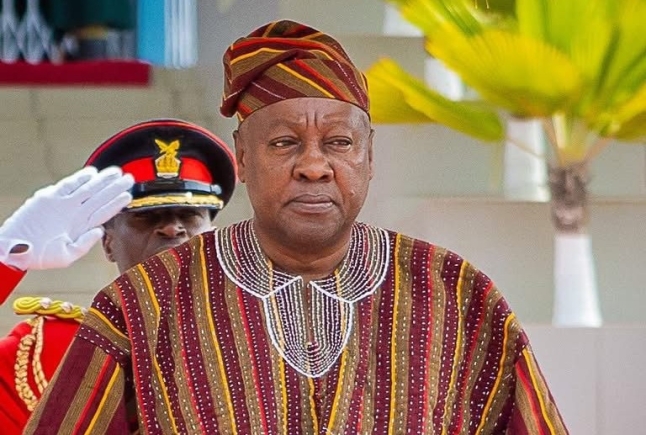
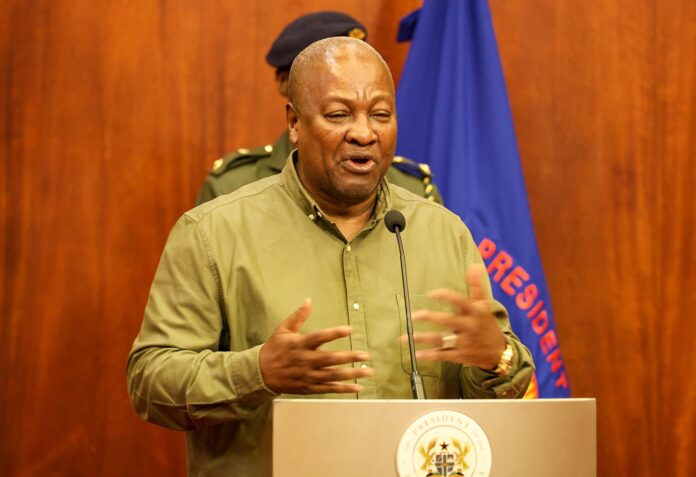
    Five new ambassadors have been sworn in by President John Dramani Mahama today, Monday, February 9, to represent Ghana abroad. During the swearing-in ceremony, the new ambassadors were charged by President Mahama to prioritise economic diplomacy as part of efforts to attract foreign investment.

    “As heads of mission you are required to reflect this national reset agenda by moving from passive representaion to purposeful engagement from routine reporting to proactive problem solving and from presence to impact. Your mission plans must be firmly aligned with Ghana’s development prorities,” he urged.

    The ⁠recently sworn-in include: Ambassador to the Kingdom of Saudi Arabia, Alhaji Said Saleh Sinare, Ambassador to the Republic of Mali,  Lt. Col. Al Hajj Umar Sanda Ahmed, Mr Kofi Attor Ambassador to the Republic of Cuba, Mr Emmanuel Opeku Ambassador-in-Situ,  and High Commissioner to the Republic of Malta, Mrs. Regina Appiah-Sam. 

    On Thursday, September 4, 2025, fifteen (15) of appointees Ghana’s appointed envoys were sworn-in. They are: Benjamin A. Quashie will oversee the operations of Ghana’s diplomatic mission in the Republic of South Africa, while Kojo Bonsu takes charge of the People’s Republic of China. Kulsoume Sinare Baffoe will head affairs in the Kingdom of Spain.

    Hammed Rashid Tunde Ali will the United Arab Emirates, Hon. Captain George Kofi Nfojoh in the Togolese Republic, and Grace El Mahmoud Marabe in Dubai, United Arab Emirates. Prof. Ohene Adjei will head the mission in the Federal Republic of Germany, Abdul Nasiru-Deen in the Republic of Turkey.

    Theresah Adjei-Mensah in the Czech Republic, and Prof. Kwasi Obiri-Danso in India. Dora Francisca Edu-Buandoh, Ph.D., will serve in Canada, Dr. Margaret Miewien Chebere in Denmark, Labik Joseph Yaani in Equatorial Guinea, Nii Amasah Namoale in the Federative Republic of Brazil, and Dr. Felix Kumah Godwin Anebo in the Republic of Senegal.

    .The twenty-three individuals are expected to promote Ghana’s foreign policy and protect the welfare of Ghanaians overseas. Speaking at the induction ceremony for the 15 distinguished individuals, President Mahama noted that their “appointment is a mark of the confidence reposed in you and a recognition of your years of dedicated service, sterling achievement, and exemplary contributions both in the public and private sectors”.

    He urged the envoys to uphold transparency in carrying out their duties. Additionally, the President disclosed that taxpayers would no longer bear the cost of expensive properties rented by diplomatic missions abroad.

    According to him, the country cannot bear the cost of more than $15 million every year on renting properties for diplomatic missions.

    He called the practice wasteful and one that can no longer be tolerated under the ruling National Democratic Congress’ (NDC) Reset Agenda.

    The President added that the Cabinet has given the nod to the government’s new initiative, Strategic Transition from Rental to Developing (STRIDE).

    The STRIDE policy is to reduce unnecessary losses the country absorbs on renting properties abroad for its diplomatic missions, hence, ensuring Ghana’s foreign missions are accommodated in state-owned properties.

    “From my latest briefing, a transaction advisor has been appointed, standard developments are being prepared, and funding mechanisms are already being negotiated.This shift will ensure that our missions abroad are housed in proper homes owned by the republic, reducing wasteful expenditure while safeguarding Ghana’s dignity on the international stage.

    “Ghana cannot continue spending more than $15 million every year on renting properties abroad for our diplomatic use. This is not a judicious use of taxpayers’ resources, and the Reset Agenda is an immediate reversal of this trend,” he stated.

    On Monday, September 1, Ghana’s historic five hundred (500) Key Performance Indicators (KPI) for heads of missions was launched by President John Dramani Mahama.

    The initiative is to provide heads of mission with a clear framework for assessing their work and supporting the President’s Reset Vision for the country.

    Delivering his keynote address, President Mahama stated that Ghana’s mission had advanced into paths of economic engagement, facilitating trade, attracting investment, and promoting innovation.

    Thus, he charged the heads of missions to promote investments in Ghana’s priority sectors, industrialization, renewable energy, digital services, agro-processing, infrastructure and tourism.

    “I charge you to expand our export markets, especially for value-added goods such as processed food, shea butter, textiles, crafts, and digital services. I charge you to move the life of our diaspora not only as remittance of money, but also as investors, innovators, and partners in Ghana’s development,” he said.

    The 500 KPIs cover areas such as securing scholarships and promoting exchange programmes with foreign institutions to build human capacity as well as increasing tourist arrivals by a least 10 per cent each year to create jobs and strengthen foreign reserves.

    They also require strict compliance with financial and procurement rules, enhancing national security through stronger intelligence sharing and partnerships with foreign agencies, navigating Permanent Joint Commissions for Cooperation (PJCC) with major partners, and shifting from renting office spaces to building permanent infrastructure to cut down rent costs.

    He stressed that the performance of the heads of missions will be judged not by ceremonial protocols, but by the level of investment, trade, and opportunities they can attract for the country.

    President Mahama explained that the Government’s Reset Agenda also focuses on governance, particularly restoring public trust through transparency and accountability.

    He added that as Ghana’s envoys abroad, the heads of mission are expected to reflect these principles, managing the nation’s missions with integrity, efficiency, and professionalism.

    “Our citizens abroad must experience fairness and respect, for our diplomacy’s credibility is inseparable from the credibility of our governments,” he added.

  • Galamsey: Farmers in Wa West receive seized water pumping machines from govt

    Galamsey: Farmers in Wa West receive seized water pumping machines from govt

    The government has handed over 50 water pumping machines seized during illegal mining operations to farmers in Siiru in the Wa West District of the Upper West Region to support irrigation activities. The donation, made by the Ministry of Lands and Natural Resources, is aimed at helping farmers boost irrigation and improve agricultural production in the area.

    Minister for Food and Agriculture (MoFA), Mr Eric Opoku in 2025 announced that farmers in nine regions will each receive 100 water-pumping machines seized from galamsey sites to support the implementation of the government’s Feed Ghana Programme.

    He made this known while presenting the machines at the Agricultural Engineering Service Directorate Office at Amrahia in Accra last week.

    According to him, nine hundred (900) machines were seized by a task force in the fight against galamsey and will be handed to farmers in Upper East, Upper West, North East, Savannah, Northern, Greater Accra, Volta, Oti, and Bono East for agricultural use following a court order.

    “We wanted to avoid a situation where these machines, after being distributed, end up at galamsey sites again. That is why we deliberately chose regions without active illegal mining operations,” Mr. Opoku explained.

    Mr. Opoku stated that the equipment had undergone inspection by the Ministry of Food and Agriculture’s technical personnel, who found them in safe condition for use on farms.

    Speaking on behalf of the beneficiary regions, the Northern Regional Minister, John Ali Adolf, assured that the machines would be used for their intended purposes and would never be returned to any galamsey site. He added that, as regional ministers, they would periodically monitor the use of the machines.

    “We wouldn’t want anyone, for any reason, to ever attempt galamsey activities in our regions. These machines will be used to help farmers on their farms so that they can water crops across the seasons, especially during the dry season,” he explained.

    Mr. Adolf expressed gratitude to President John Dramani Mahama for his dedication to the fight against galamsey in the country.

    Government’s efforts to clamp down on illegal mining activities

    The government has rolled out an official order requiring all machinery used in mining operations to be registered with the Driver and Vehicle Licensing Authority (DVLA) by August 1. A statement issued by the Ministry of the Interior on Tuesday, July 15, states that the state will confiscate unregistered mining equipment after the deadline.

    “The Government, as part of efforts to reform the mining sector in the country, requires that all machinery used in mining activities must be registered with the Driver and Vehicle Licensing Authority (DVLA) by 1st August 2025. Equipment that remains unregistered after this deadline will be confiscated by the State,” the Ministry stated on its website.

    Mr. Mubarak empowered the Ghana Police Service and DVLA to begin strict enforcement of the new rule from August 2. “The Ghana Police Service and DVLA have been directed to enforce this directive from 2nd August 2025 onward rigorously. The general public, especially those who use mining machinery, are advised to take note and comply with the directive,” he wrote.

    The Ministry reiterated its resolve to maintain national peace through effective internal security and law enforcement. Meanwhile, a similar directive was issued months ago, asking excavator owners and operators to register their machines with the DVLA within two weeks or risk losing them to the state as the government intensifies efforts to clamp down on illegal mining activities.

    The Chief Executive Officer (CEO) of the DVLA, Julius Neequaye Kotey, issued the directive in Accra, warning that effective June 1, any excavator not registered with the DVLA would be confiscated. Speaking at a press briefing, Mr. Kotey announced that the Ghana Police Service and the DVLA’s operational team had commenced nationwide enforcement after the deadline, arresting and impounding excavators being used at mining sites or for commercial purposes without proper documentation.

    “This exercise will help identify every excavator that enters the country and trace how it is being used. The goal is to ensure we can monitor and hold people accountable,” Mr. Kotey said.

    The directive aligns with Section 38 of the Road Traffic Act, 2004 (Act 683), which mandates the registration of all motor vehicles and trailers, including farm and heavy-duty equipment. Despite the law, the DVLA found many unregistered excavators operating in mining areas, some of which had been used in illegal activities.

    Mr. Kotey emphasized that the DVLA, with its 34 offices nationwide, could register all excavators and farm machinery within two weeks and was ready to strictly enforce the directive. “Excavators in the hands of illegal miners have worsened the destruction of our environment. This is why we must act,” Mr. Kotey said.

    To further control the situation, the DVLA, in collaboration with key agencies like the Minerals Commission, National Security, the Ghana Ports and Harbours Authority (GPHA), and the Customs Division of the Ghana Revenue Authority (GRA), commenced tagging all newly imported excavators.

    In addition to tagging new imports, the Minerals Commission was tasked with leading a team to tag all excavators already in the country. Legal small-scale mining sites have also been geo-fenced, with their site coordinates integrated into the Ghana Mine Repository and Tracking software for better oversight.

    The move is part of broader government efforts to combat illegal mining. Three months ago, Lands and Natural Resources Minister Emmanuel Armah-Kofi Buah announced the rollout of a system to monitor excavator imports and usage, involving port tagging and digital tracking in partnership with several state agencies. According to the sector minister, the third most valuable item imported into the country is excavators, worth GHC6.2 billion.

    Crackdown on illegal mining activities

    In April, a total of 47 individuals were arrested for engaging in illegal mining activities along the Tano River and within the Aboi, Subri, and Nimiri forests in the Western Region. This followed a special four-day intelligence-led operation that commenced on April 17 within the Samreboi enclave.

    According to the Ghana Police Service, the suspects included 39 Ghanaians and 8 Chinese nationals. The Police indicated that a significant amount of equipment and materials believed to have been used for the mining operations were retrieved, including seventeen excavators, one bulldozer, four motorbikes, two Toyota Hilux vehicles, one Rav4 vehicle, four pump-action guns, one single-barrel gun, fifty-four live BB cartridges, and eight pumping machines.

    Prosecution began for the arrested suspects. On Tuesday, 41 of them were arraigned, with 29 remanded into police custody to reappear before the court on April 30, 2025. Twelve others were also remanded to return to court on May 2, 2025. The remaining seven were put before the court on April 23, 2025.

    Two coordinated operations conducted on Friday, June 20, at Nikanika and Adeade in the Central Region led to the arrest of three suspects and the seizure of several pieces of mining equipment. The operations were executed by the Ghana Police Service through its Special Anti-Galamsey Task Force.

    The task force proceeded to a mining site at Nikanika. Although no operators were found at the scene, the team retrieved one single-barrel shotgun loaded with a cartridge and three water-pumping machines. The task force extended its operation to Adeade, where three suspects—Prosper Quansah, Chrispin Nartey, and Owusu Gambra—were arrested with an excavator on a lowbed trailer.

    One SANY excavator, four unregistered Haojin motorbikes, and one lowbed vehicle with registration number GN 2136-24 were seized from the scene. All exhibits were secured in police custody.

    Some 12 accused persons standing trial for engaging in illegal mining activities at Tumetu near Princess Town in the Ahanta West Municipality of the Western Region were remanded into prison custody. While 10 of the accused persons were arrested at a palm plantation, two were arrested at the Elluabo Chavene Ghana Rubber Estate Limited (GREL) plantation.

    This was due to a coordinated police intelligence-led operation within the Ahanta West Municipality. The accused persons are Lord Yankey, Caleb Adu Kwaw, Stephen Agyei, Ebenezer Barnes, Mathew Somagevi, Paa Grant, Bashiru Kaviru, Joseph Borney, Aminu Issah, Kofi Sogah, Albert Normah, and Robert Mensah. Four water-pumping machines, one tricycle with registration number M-20-WR 1045, and two motorbikes were retrieved from the sites, according to the police.

    All twelve accused persons admitted to the offence during police interrogations. They were subsequently put before the Takoradi Harbour Area Circuit Court ‘A’ and remanded into prison custody at Sekondi, reappearing before the court on Tuesday, July 8.

    Additionally, fifteen individuals are in police custody for engaging in illegal mining activities at Manso Adubia. They were arrested following a special intelligence-led operation at Watreso and Preacher Krom.

    The suspects include Tahiru Ibrahim (24), Shaibu Idrissu (23), Boateng Emmanuel (27), Jamon Kwaku Samuel (21), Yaro Patrick (29), Kofi Boakye (21), Gubong Mathew (45), Fatawu Zackari Seidu (26), Abdul Malik Seidu (22), Dauda Tahiru (23), Sampson Grace (21), Boolangkpuo Freda (24), Arima Hagar (26), Kwarteng Vasco (30), and Kwame Adutwum (24).

    Two excavator control boards, two automatic pump-action guns, two Musler 12 firearms, 59 BB cartridges, three AA cartridges, one water-pumping machine, two power generators, one vulcanizing machine, and one Apsonic motorbike were seized from the site.

  • Caterers receive school feeding grant for 2025/2026 academic year

    Caterers receive school feeding grant for 2025/2026 academic year

    Caterers under the Ghana School Feeding Programme (GSFP) across all 16 regions have received the government’s feeding grant for the 2025/2026 academic year. This information was contained in a press statement issued by the GSFP and signed by Mr Siiba Alfa, Director of Public Relations. 

    The statement indicated that the fund was disbursed according to the number of days caterers cooked for the beneficiary pupils during the term.
    Beneficiaries of GSFP include public basic school pupils, with a focus on those in kindergarten and primary schools across all 261 districts in Ghana, to support children from low-income, food-insecure, and underserved communities across all 261 districts in Ghana.

    In 2025, the Ghana School Feeding Programme (GSFP) announced the immediate cancellation of contracts for all caterers working under the programme nationwide.

    In an official statement issued on May 2, the GSFP directed that no existing caterer should prepare or serve meals for the third term of the 2024/2025 academic year.

    “Please be informed that contracts of all caterers of the Ghana School Feeding Programme (GSFP) nationwide have been terminated with immediate effect. Accordingly, no existing caterer on the programme should cook for the third term of the 2024/2025 academic year,” the statement cautioned.

    The Secretariat assured affected caterers that outstanding payments for services rendered during the second term would be settled.

    “All outstanding arrears for the second term of the 2024/2025 academic year will be paid in due course,” it said.

    The caterers, obviously distraught by the news, appealed, calling on President John Dramani Mahama to intervene and overturn the directive that abruptly ends their contracts, describing the decision as a breach of trust and a blow to their livelihoods.

    Speaking during an interview on Channel One Newsroom on Friday, May 2, the Association’s President, Nana Otu Sakyi-Amo, voiced strong disapproval of the directive, noting that it has left many caterers facing severe financial strain with only a few days to the reopening of schools.

    “We are still pleading with the president, we are all crying to the president to cancel this immediate termination of our contract,” she appealed. “We know that we have a contract up to August, and this is sudden news to us.”

    She revealed that most caterers had already stocked up on food items in anticipation of the upcoming school term, set to begin on Tuesday, and were shocked by the sudden notice.

    “We have bought our foodstuff, and school is reopening next week on Tuesday. We have prepared ourselves… We just heard they have cancelled our contracts just like that,” she said with concern.

    However, Minister for Gender, Children and Social Protection, Dr. Agnes Naa Momo Lartey, in a few days after the caterers’ appeal, announced that caterers who pre-financed food items in anticipation of the new school term will not be compensated for their losses.

    Speaking in an interview on Channel One TV on Thursday, May 8, Dr. Lartey sympathised with the caterers but maintained that the government would not reimburse them for food bought without official instruction to begin cooking.

    “I sympathise with the situation. There’s no room for compensation, but for the period that they have cooked, they will be paid,” she said.

    She clarified that the decision was reached jointly and was not a unilateral government move but one guided by World Bank requirements.

    “We are not doing this alone; we are doing it with the World Bank. There are some criteria and conditions to meet, and we didn’t want to be harsh on the caterers. In all honesty, most of them know they don’t have valid contracts,” she said.

    She pointed out that after the last general elections, a directive from the then-program coordinator allowed caterers to keep cooking temporarily. This directive, issued during a transitional phase, caused some confusion.

    “We are supposed to move to a digital recruitment system with the support of the World Bank, but because of the academic calendar, we could not implement it as swiftly as we would have liked. That’s why we are asking for time to transition smoothly; it doesn’t mean we should maintain the current system without reform.”

    The caterers went ahead to seek intervention from traditional and religious leaders, including the Asantehene, Otumfuo Osei Tutu II, and the National Chief Imam, Sheikh Osmanu Nuhu Sharubutu.

    Deputy PRO of the National School Feeding Caterers Association, Madam Margaret Larbi, revealed that the group has begun reaching out to influential figures across the country to help present their case.

    “Our President said we have petitions to be sent. We’re trying to get in touch with Otumfuo Osei Tutu II, the Asantehene, to intervene,” she disclosed.

    She further indicated that other respected voices, such as the Chief Imam, would also be approached to help mediate on behalf of the distressed caterers.

    “So, we’re trying to get him to go and plead on our behalf. We’re trying to go to the Chief Imam. Tomorrow [Friday, May 9], we have a lot to do to send some petitions to other influential individuals in the country to be able to speak on our behalf,” she stated.
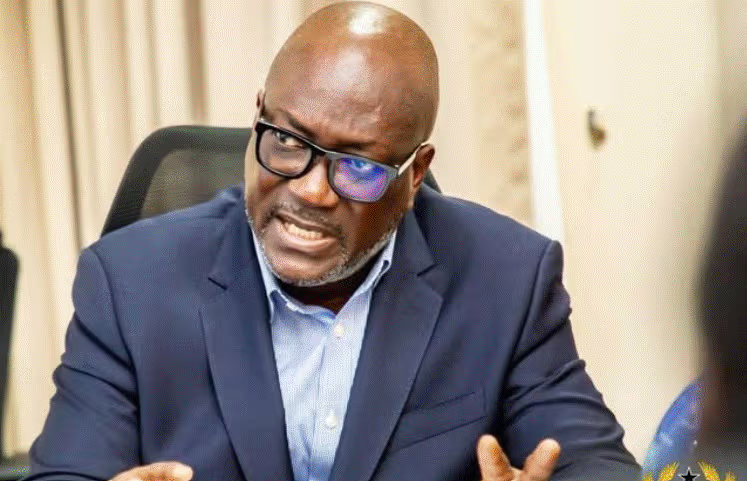
    However, the Gender Minister, in reaction, explained that the cancellation was not to punish caterers but aimed at sanitising the programme.

    Meanwhile the government announced an increase in meal fees from GHS 1.50 to GHS 2.00 as part of its reset agenda in 2025.

    This marked a significant milestone as the last upward adjustment in meal price was in 2021 under the erstwhile Akufo-Addo-led administration, when the amount was raised from GH¢1.00 to GH¢1.20 per child per day. It was later raised to a cedi and fifty pesewas some months before 2025.

    During a School Feeding Programme, stakeholder training session held in Tamale, Northern Region, on Friday, August 22, the National Coordinator of the Ghana School Feeding Programme, Hajia Fati Forgor, highlighted the government’s commitment to the programme, citing that arrears owed to caterers under the erstwhile government have been settled by the current government.

    “Just a week or two ago, you heard that we had paid caterers who provided a service for the second term during the previous administration. (sic) During their time, it used to be GHS 1.50 per pupil. Today, they have also benefited from the reset of the school feeding program in Ghana by taking GHS 2 per pupil,” she said

    She continued that efforts are underway to swiftly pay caterers who provided service in the last few days.

    “As I speak to you, those of you who actually provided the service, data is being collated for us to see how quickly and fast we can pay caterers as quickly as possible, she added.

    Hajia forgot to also send a passionate appeal to all parties and stakeholders to end internal conflicts and negative portrayals of the initiative, warning that such actions are discouraging potential partners from supporting the programme.

    “Those of us who are fighting our colleagues, our own who have been assigned to their district, I want to plead with you. I’m begging you. Let’s stop giving the wrong signal to the general public.

    The program is not being funded by the government alone. We have partners who will always come out to support the school feeding program. But since we assumed office, we have been unable to get that because of the way we are portraying the whole situation on the ground. It is not helping us,” she noted.

    She sent a word of caution to all caterers to duly exert their duties or risk losing their contracts, highlighting an end to some behaviours, such as caterers’ failure to cook meals consistently, ghost cooking cases where caterers forged reports, claiming to have served meals when no cooking took place, as well as the cooking of highly malnutritious meals which often contained little to no proteins such as meat or fish or even vegetables. According to her, the days of improper supervision over their duties and lack of accountability for their services are over. Every caterer will be held accountable for their service. No cooking, no payment.

    “If there’s anybody in here who thinks that it’s just a matter of getting the contract, but then you can do whatever you like with the program, then sorry, you have gotten the wrong opportunity because we will not tolerate that. Please, if you know you did not provide the service, do not expect any payment”, she affirmed.

    The increase in meal price per child in the school feeding programme affirms the government’s commitment to enhancing the livelihoods of citizens and also to the broader good of the education framework in the country.

    ince the current administration assumed office, the project has seen an increase in reach by 200000 pupils, with a thirty-three percent increase in budget allocation as well. Before 2025, the programme was serving an estimated 4 million pupils with a budget of GHS 1.344 billion.

    However, this year, GSFP has increased its beneficiaries to 4 million pupils f

    As of 2025, the GSFP serves approximately 4.2 million children daily, marking a significant increase from the 4 million beneficiaries recorded in 2024. This growth of 200,000 new pupils within a single year reflects the government’s commitment to expanding the programme’s reach and ensuring that more vulnerable children have access to daily meals at school.

    Also, the Capitation Grant, which supports school operational expenses, has seen a substantial increase under this government. The grant rose by 73.2%, from GH¢84 million to GH¢145.5 million, nearly twice the allocation of the previous one, further enhancing the overall environment in which these children learn.

  • No delegate was induced – Baba Jamal responds to bribery allegations

    No delegate was induced – Baba Jamal responds to bribery allegations

    Mohammed Baba Jamal Ahmed, the National Democratic Congress (NDC) parliamentary candidate for Ayawaso East, has emphasised that he didn’t induce delegates during the NDC primary held on Saturday, February 7.

    In a press release, Baba Jamal said he is willing to cooperate with the party’s investigations into the matter.

    He added, “I wish to state categorically that I, Baba Jamal Mohammed Ahmed, have not engaged in any vote buying or election malpractices and I pledge to avail myself to assist the party in its investigation into the subject matter anytime”.

    Meanwhile, the Minority in Parliament is calling for a rerun of the election following the allegations.


    On Saturday, February 7, the Presidency announced a recall of Ghana’s High Commissioner to Nigeria, Baba Jamal, over voter inducement during the just-ended Ayawaso East primaries.


    In a statement titled “President recalls Ghana’s High Commissioner to Nigeria and shared by Spokesperson to the President, Felix Kwakye Ofosu, dated February 7, it noted that

    “President John Dramani Mahama has directed the immediate recall of Mohammed Baba Jamal Ahmed (Baba Jamal) from his position as Ghana’s High Commissioner to the Federal Republic of Nigeria. The decision follows allegations of voter inducement during today’s National Democratic Congress (NDC) primaries in the Ayawaso East Constituency, in which Mr Baba Jamal, a candidate, participated.”


    The President stressed that reports of vote-buying were made against several candidates seeking to win the Ayawaso seats, but Baba Jamal stood out because he was the only person who was a serving public officer at the time, making his case a peculiar one.


    “In his directive to the Minister for Foreign Affairs recalling Mr Baba Jamal as High Commissioner, the President noted that while allegations of vote-buying were made against multiple candidates who contested the primaries, Baba Jamal was the only serving public officer among them.”


    Consequently, to protect the integrity of public office and to avoid any public suspicion of misconduct or violation of the Government’s Code of Conduct for Political Appointees, the President,


    “Without prejudice to the ongoing internal party processes, and strictly in view of the standards of conduct expected of public officers, the President considers it necessary to act decisively to preserve the integrity of public office and to avoid any perception of impropriety or conflict with the Government’s Code of Conduct for Political Appointees.”


    The statement continued that, “the recall takes effect immediately, and the Minister for Foreign Affairs has been directed to take the necessary administrative and diplomatic steps to give effect to this directive.”


    Meanwhile, Baba Jamal won the party’s internal primary held ahead of the by-election scheduled for March 3.


    After the close of polls, the provisional results showed that Baba Jamal pulled 431 of the total votes cast, followed by the widow (Hajia Amina Adam) of the late Ayawaso MP, Naser Toure, who also won 399 votes. Mr Mohammed Ramne, the Ayawaso East NDC Constituency Chairman, placed third with 88 votes.


    Dr Yakubu Azindow obtained 45 votes, while Mr Najib Mohammed Sani recorded one vote.


    Ahead of the elections, a survey conducted by the research and data analytics company Global InfoAnalytics predicted that 58% of members of the ruling NDC support the widow of the late Mahama Naser Toure, former Member of Parliament (MP) for Ayawaso East Constituency.

    This was announced by the Executive Director of the research company, Mussa Dankwah, in Accra on Thursday, February 5.
    According to the poll, the widow, Hajia Amina Adam, is the frontrunner among the others in the ongoing Ayawaso East Parliamentary Primary.


    The polling data show that 66% of party members disagree with the claim that she should be barred from contesting. The numbers suggest that narratives questioning her eligibility are failing to gain traction within the party.


    The poll also revealed that the public’s empathy towards her may boost her campaign and influence her chances of winning. About 43% of general voters indicated they would support Hajia Amina Adam because of the way she has been treated during the contest, while 15% of delegates cited the same factor as influencing their vote.


    The analysis basically presents Hajia Adam as securing roughly 54% of the total votes, while Mohammed Baba Jamal, Ghana’s High Commissioner to Nigeria and her main rival, could reach a maximum of 38%.


    He noted a 3.2% margin of error in the prediction, which still preserves her lead.


    “We asked NDC members in our polls whether it was wrong for Hajia to contest, and 66% of NDC voters disagreed. This means they do not think she should be prevented from contesting. When we asked the delegates, 58% of them also disagreed.


    “So both the delegates and the party faithful disagree with that call, which suggests that some people are pushing a narrative that is not selling, yet they keep promoting it,” he said.
    Meanwhile, the filing closed with the wife of the late MP being the last to pick up the forms.

    He said, “At the close of nominations today, six persons picked nomination forms to contest the upcoming primaries. The wife of the late MP was the last person to pick nominations today. It is going to be a very interesting contest.”


    Explaining her decision in a statement issued on Thursday, January 22, Hajia Adam indicated that she is heeding calls from constituents, party grassroots members, and traditional elders, adding that these individuals want her to carry on the work of her late husband.


    “There has been a clarion call from many quarters in my constituency and beyond for me to step into the shoes of my late husband. After deep reflection and consultations, particularly with elders and grassroots members, I have accepted the call to serve my people,” she stated.


    According to her, after reflecting on the calls, she has decided to heed them, emphasising, “I want to assure them that I will not disappoint them.”

  • 24-Hour Economy Authority Bill gets parliamentary approval

    24-Hour Economy Authority Bill gets parliamentary approval

    The 24-Hour Economy Authority Bill, 2025, proposed by the administration of President John Dramani Mahama, has received parliamentary approval. The House gave the nod after extensive deliberations and debate between the Majority and Minority caucuses on Friday, February 6.

    During the debate, members of the Minority caucus cautioned that if not carefully implemented, the policy could pose security challenges and cause inconvenience to Ghanaians.

    In response, the Majority caucus argued that the government has put in place adequate regulatory measures to ensure the smooth and effective implementation of the policy.

    The Association of Ghana Industries (AGI) adds to the majority who are pessimistic about the success of the government’s 24-hour economy policy.

    AGI has pointed to the increases in utility tariffs. Speaking to Citi News, Greater Accra Regional Chairman of AGI, Tsonam Akpeloo, said businesses that will participate in the programme will run at a loss as they will consume much electricity.

    According to him, “If you’re talking about a 24-hour economy, you’re asking industry to work beyond the usual eight hours and continue through the night. That means higher electricity consumption. The cost of power will increase—possibly doubling what we’ve previously paid.”

    “A 2.5% increase under normal production is one thing, but with extended hours, the actual cost impact will be far greater,” he added.

    About the 24-hour economy

    The government’s 24-hour economy policy, a key promise during President John Mahama’s campaign in 2024, was launched today, Wednesday, July 2, 2025.

    The policy’s objective is to enhance economic productivity by encouraging businesses to operate continuously, creating more job opportunities, boosting revenue generation, and improving service delivery.

    Sectors such as manufacturing, transportation, retail, healthcare, hospitality, and financial services stand to benefit significantly from this model.

    Presenting the policy to the Speaker of Parliament, Kingsford Sumana Alban Bagbin, last year, July, Mr Goosie Tanoh, the Presidential Advisor on the 24-hour economy policy, mentioned the move is to officially inform ‘the people’s representatives’ about the government’s readiness to roll out the programme.

    On some details on the policy, Mr Goosie Tanoh said the programme is expanded into three anchors: “production transformation, supply chain and market efficiency, and human capital development.” The three anchors, according to him, are supported by eight sub-programmes.

    “Roll 24 – which is the agricultural component, Make 24 – which is the manufacturing component, Connect 24 – the supply chain component, Aspire 24 – which is the mindset change, the resetting of the Ghanaian and Ghanaian bureaucracy with a strong and powerful attitude to work and productivity,” he explained.

    According to him, the government was set to include strong digital technology training in the TVET curriculum to train and equip an employable workforce with the requisite skills for employment opportunities.

    Another component, dubbed ‘Show Ghana,’ is also set to focus on an intentional effort and approach by the government to give visibility to Ghana’s rich cultural heritage to the rest of the world, to attract more tourists and increase revenue generation through tourism.

    Speaker Alban Bagbin, in response, mentioned that the team’s arrival had been anticipated and his outfit would call on them for any clarity when the need be, urging the legislation to back the programme.

    Earlier, President John Dramani Mahama stated that the 24-Hour Economy Policy is a long-term goal that will keep the country productive on a 24/7 basis, alongside stabilising the economy through the creation of more jobs.

    According to him, the final draft of the policy has undergone review by him, and he is confident it will realise its objectives.

    Meanwhile, Speaker of Parliament, Alban Bagbin, noted that the Parliamentary Service will begin operating under the 24-hour economy policy.

    This initiative, according to the Speaker, will enhance national productivity and address unemployment. He made this known during the presentation of the 24-hour economy policy document.

    He bemoaned the lack of time to tackle the numerous tasks in Parliament and expressed optimism in addressing this issue with the 24-hour economy policy.

    “This means they are going to work more hours; they will be reporting at 8:00 a.m. and may be going home at 10:00 p.m. or sometimes 11:00 p.m., particularly those in the official division of the House.

    This will allow more people to work here and will help reduce unemployment. I can assure you that the load of work here is unimaginable,” Bagbin stated.

  • You have until April 6 to stop operating around Baba Yara Stadium – KMA to traders

    You have until April 6 to stop operating around Baba Yara Stadium – KMA to traders

    The Kumasi Metropolitan Assembly (KMA) has extended the eviction deadline for businesses operating around the Baba Yara Sports Stadium to Monday, April 6.

    The affected businesses mostly container shops, makeshift garages, food joints, and provision stores were originally expected to vacate the premises on Thursday, February 5.


    The extension follows an appeal by the Ashanti Regional Minister, Dr. Frank Amakomhene, who requested additional time to allow traders to secure alternative locations for their businesses.


    Meanwhile, Henrietta Afia Konadu Aboagye, Public Relations Officer for KMA, has warned that traders who flout the directive will face strict enforcement. “We are not retreating on our stand that the unauthorized structures should not be there. They should move from there,” she emphasised.


    Garages, food vendors, and provision shops are among the many informal businesses operating near the Baba Yara Sports Stadium in Kumasi. The eviction exercise in the area is part of the government’s efforts to improve urban mobility and ease congestion in the city.


    On Saturday, January 4, 2026, traders operating along the Asokwa Interchange–Ahodwo Roundabout stretch in the Ashanti Region were ordered by Kumasi Mayor Richard Ofori-Agyemang Boadi to vacate the premises.


    During a site visit, the Kumasi Mayor urged all affected traders to comply with the instructions or face strict sanctions.


    “The contractor has started work, and we anticipate accelerated progress because we have given a limited timeline for completion. We do not expect any impediments, which is why we are asking them to move,” the Mayor stated.


    The directive has become necessary to pave the way for the dualisation of the Ahodwo–Asokwa Interchange section of the Southern Bypass, a crucial road linking Kumasi to key parts of the Region.


    The project is expected to ease traffic congestion, boost productivity, and enhance economic activities across the Ashanti Region. Last week, Parliament approved the government’s partnership with a private company to build, operate, and maintain the Accra–Kumasi Expressway.


    The approval formalises the concession agreement collaboration between the Ministry of Roads and Highways and Accra–Kumasi Expressway Limited, which aims at maintaining the expressway.


    The approval will pave the way for improvements to the existing road, which is plagued by potholes, uneven surfaces, and inadequate lighting, creating significant safety risks for drivers and commuters.


    The expressway project is Government of Ghana (GoG)-funded through the Ghana Infrastructure Fund (GIF). Meanwhile, Roads Minister Kwame Governs Agbodza has revealed that the budget allocated for construction work on the Accra–Kumasi bypass has increased by 100% due to galamsey pits and swampy terrain discovered in the area.


    The revelation comes as the Roads Minister was debunking reports that President John Dramani Mahama had asked contractors to stop work on the bypass. Speaking to Parliament on the matter on Tuesday, November 25, Mr. Agbodza stated, “Mr Speaker, let me put it on record.


    President Mahama’s government never asked any contractor working on the bypasses on the Accra–Kumasi road to stop work. Indeed, I called all the contractors and encouraged them to continue working.”


    He added, “However, what they told me was that at the time they were asked to go to site, they were not shown details of the alignment, and this was said in the presence of the Finance Minister. They said they flew a drone and showed them the drone image of the alignment. When they got to the site and started working, they saw galamsey pits and swamp areas. So as we speak, Mr Speaker, almost all the contract prices have increased by more than a hundred percent.”


    On July 30, Parliament unanimously endorsed the government’s proposal to divert all royalties from oil revenues and mineral royalties to support the implementation of the Big Push Programme. This followed a government request for Parliament’s approval to commit funds to assist in the construction of certain road projects.


    Chairman of Parliament’s Finance Committee, Mr. Isaac Adongo, while presenting the report by the Budget and Finance joint committee to the plenary, said, “The Committee has carefully considered the Referral, and it is of the opinion that the request is in the right direction.”


    He added that Parliament had already approved the policy and allocation to the “Big Push” Programme in the 2025 Budget Statement. Granting the request would enable the government to enter into multi-year contracts to execute the road infrastructure projects under the programme.


    “The Committee accordingly recommends to the House to approve the Request for the multi-year commitments for the selected road projects under the ‘Big Push’ Programme contained in the Mid-Year Fiscal Policy Review of the 2025 Budget Statement and Economic Policy of the Government of Ghana, in accordance with Section 33 of the Public Financial Management Act, 2016 (Act 921),” Mr. Adongo said.


    The initiative, aimed at improving road infrastructure across the country, is estimated at GHC13.8 billion and is expected to be completed by 2028 using the country’s own financial resources.


    According to the 2025 budget, GH¢5.75 billion is owed by the Road Fund, with GH¢2.81 billion programmed for road maintenance. This represents a 155.5% increase from the 2024 allocation of GH¢1.1 billion, underscoring the government’s emphasis on sustaining Ghana’s road network.


    The Minister for Roads and Highways, Kwame Governs Agbodza, on Wednesday, July 30, revealed that his ministry has undertaken studies and prepared comprehensive engineering interventions and cost estimates for road projects under the Big Push Programme.


    The Ministry of Finance has since issued commitment authorizations for twenty-nine road infrastructure projects under the programme, including the upgrading of Akosombo–Gyakiti–Kudikope Road, dualisation of Winneba–Mankessim Road, rehabilitation of Mankessim–Ajumako–Breman Asikuma–Agona Swedru Road, construction of Enchi–Elubo Road, and rehabilitation of Atimpoku–Asikuma Junction Road.


    The government has also selected a number of abandoned road projects for which no dedicated funding was allocated by the previous administration.


    These include rehabilitation and upgrading of Kasoa–Winneba Road, construction of Suame Interchange and local roads, reconstruction of Navrongo–Chuchuliga–Sandema Road, and upgrading of Tumu–Chuchuliga–Navrongo, including construction of a 36m span reinforced concrete bridge over the Kanyibie River, and a 24m span reinforced concrete bridge over the Bechelihu River.


    By the end of July, the government plans to settle GHC4 billion of the large debt owed to road contractors. Currently, the government owes road contractors GHC21 billion, according to the Roads Minister.


    President John Mahama emphasized his government’s commitment to infrastructure development under his administration’s 24-hour economy agenda. Prioritizing road construction and the swift resumption of stalled projects is seen as key to promoting economic growth and productivity by ensuring adequate regional connectivity.


    The announcement has been met with excitement and optimism by many stakeholders in the construction sector. The Ghana Institute of Engineers and the Association of Road Contractors have largely welcomed the president’s announcement but have called for transparency.


    They urged the government to publish clear timelines and payment schedules to enable contractors to plan and mobilize resources effectively.


    In March, Deputy Minister for Roads and Highways, Alhassan Suhuyini, acknowledged the significant financial burden facing the government to clear outstanding debts owed to contractors and suppliers.


    His remarks followed the presentation of the 2025 budget by Finance Minister Dr. Cassiel Ato Forson, who disclosed that the government’s total commitments to contractors stand at GH¢67.5 billion.


    Mr. Suhuyini emphasized the importance of prioritizing road maintenance, a sector that has suffered due to poor upkeep. “The minister has stressed that a significant portion of these funds will be directed toward road maintenance. This is a smart move because our poor maintenance culture has resulted in roads deteriorating within 8 to 10 years instead of lasting longer.”


    He added, “In addition to paying off some existing road maintenance debts, the government is looking at a broader infrastructure push. With GH¢10 to GH¢13 billion allocated under the ‘Big Push’ initiative, several new road projects will commence, while some outstanding debts will also be retired.”


    The directive is part of plans to dualise the Ahodwo–Asokwa Interchange section of the Southern Bypass, a crucial road linking Kumasi to key parts of the Ashanti Region.


    The narrow stretch has long caused traffic congestion, particularly during peak hours, and government intervention seeks to improve traffic flow.


    The Mayor of Kumasi, Richard Ofori-Agyeman Boadi, has vowed to unleash strict measures on traders who persist in selling along pavements in Adum. Addressing a press conference on Monday, April 14, the Mayor warned that he would deploy a “democratic military style” to deal with those who refuse to vacate the area with their wares.


    He has given the ‘defiant’ traders a two-week ultimatum to adhere to the directives and cooperate with the decongestion exercise led by the Kumasi Metropolitan Assembly (KMA).


    “I have my own democratic military style, which I will be implementing. When we say leave this space and you don’t leave this space, and I get there, and you’re not lucky and my boys are with me, there and then, we will beat you,” the Mayor declared.


    According to the mayor, previous attempts to address the issue—such as seizing goods and arresting offenders—have proven ineffective, as traders continue to return to unauthorized areas, worsening congestion in the city’s central business district.
    Highlighting the impact on Kumasi’s identity, the Mayor stressed that the lawlessness displayed by traders blocking pavements is tarnishing the city’s reputation as the “Garden City of West Africa.”


    “In the middle of Adum, if I’m alone, you will be lucky, but if I’m with my ten boys, in their pick-up with their whips, trust me, we will beat you,” he stated. “If you don’t want to experience that kind of situation, do what is right and lawful.”


    Describing the move as a civic obligation and an act of respect toward the Asante Kingdom, Mr. Boadi added, “This is Otumfuo’s city. We must preserve its beauty and order.”


    On Wednesday, April 16, the Kumasi Metropolitan Assembly (KMA)implemented the exercise with force, and traders were urged to relocate to designated areas to avoid potential clashes.


    Reacting to the mayor’s directive, the traders expressed their dissatisfaction with the planned decongestion exercise, stating that their presence along the pavements is not by choice but rather a result of their current circumstances.


    They explained that a recent fire outbreak in the area had displaced many of them, forcing them to operate in unapproved spaces as a means of survival. The traders are therefore appealing to the Mayor for more time to relocate, preferably to the yet-to-be-completed Central Market.


    “We’re on the streets because we have no place to go. Give us some time — we are the ones who voted for you. Provide us with a proper space; we are not animals to be whipped,” they said.


    The blaze, which broke out in the early hours of Friday, March 21, wreaked havoc on numerous shops and assets, leaving many traders to assess the extent of their damages.


    If you want, I can also condense this entire article into a clean, well-structured news story that maintains all your quotes and details but is much easier to read. This would make it more suitable for publication.

  • Ghana to build foreign reserves beyond $20bn by 2029 – President Mahama

    Ghana to build foreign reserves beyond $20bn by 2029 – President Mahama

    Ghana’s foreign reserves are expected to surpass $20 billion by 2029, according to President John Dramani Mahama. Addressing an audience in Zambia, the President noted,“By 2029, Ghana would have built foreign reserves beyond $20 billion, providing security, stability, and a platform for sustainable growth”.

    The Bank of Ghana (BoG) projected last year that Ghana’s foreign assets would surpass $13 billion by the end of 2025, based on mid-December data. The central bank emphasized that achieving this milestone would boost investor and donor confidence in the country’s economy.

    For sometime now, Ghana’s forex reserves have seen a significant increase under the Mahama-led administration.

    Between December 2024 to October 2025, the country’s reserve has seen a 33.63% increase, marking $ 3.02 billion in value. As of October 2025, the country’s reserves have hit $12billion.

    Speaking at the launch of the 60th anniversary of the Ghana Cedi in Accra on Tuesday, October 28, which was held at the Accra International Conference Centre (AICC), Governor of the Bank of Ghana (BoG) Dr Asiama, lauded the government for its tough, difficult, but well-coordinated policy measures, which have produced the required fiscal results.

    He noted that Ghana has made a decisive economic turnaround, which has been reflected in our forex reserves, boosting investor confidence and cushioning the local currency against the shocks of the market.

    Dr Asiama further highlighted that coordinated and difficult policy measures have yielded tangible results for the country

    “Under the leadership of His Excellency John Dramani Mahama, and Her Excellency the Vice President, and through coordinated, difficult but necessary policy actions, I am happy to say that Ghana has turned a decisive corner, and indeed the evidence is compelling. Our gross international reserves are currently around $12 billion, which is providing a robust cushion against external volatility and restoring our investor confidence”, he stated.

    The BoG Governor also cited key indicators of the country’s improved economic position. He noted that headline inflation, which has been a major concern in recent years, stood at 9.4 percent as of September 2025, with expectations that it will fall even further by the end of the year.

    “Headline inflation now at 9.4% as of September 2025, and we expect it to end the year even further lower”, he continued, adding that the cedi, which was ranked as one of the worst-performing currencies in 2022 under the Akufo-Addo-led administration, has seen significant appreciation by 37% under the current government, serving as evidence of the positive impact of the fiscal policies implemented.

    The national currency, the cedi, Dr Asiama said, has also strengthened significantly, appreciating by 37 percent as of October 17.

    “The cedi has appreciated by 37% as of October 17, and according to the World Bank, it is the best-performing currency in sub-Saharan Africa for the first eight months of 2025. As of November 2022, the Cedi depreciated by over 50% becoming the World’s worst-performing currency in the world according to a Bloomberg report. Headline inflation spiralled to 54.1% and food inflation soared to an alarming 59.7% year-on-year in December 2022, distorting household budgets, shrinking incomes, and feeding public anxiety.

    “These were not just numbers; they were lived experiences. They meant rising transport fares, shrinking working capital, unaffordable school meals, and sleepless nights for small business owners and salary earners alike. But they were not the end of our story,” he added.

    Dr Asiamah also announced a year-long programme of nationwide activities designed to educate, engage, and celebrate the Cedi’s history, resilience, and role in Ghana’s economic journey.

    He said, “As we officially launch the Cedi@60 anniversary, allow me to share a preview of what lies ahead. This celebration will not be confined to this hall. Over the next 12 months, we will embark on a nationwide and inclusive programme of activities, including:

    “Currency exhibitions that tell the story of our monetary journey, from pounds to pesewas, from coins to QR codes, public lectures and school tours to engage students, professionals, and communities on the importance of monetary sovereignty. Diaspora engagements, highlighting the role of remittances and international trust in supporting the Cedi’s strength. And special publications and legacy projects to ensure this milestone leaves a lasting educational footprint,” he continued.

    Also, at the same event, Ghana’s Finance Minister and acting Defence Minister, Cassiel Ato Forson, urged business and consumers to end the widespread practice of quoting prices in dollars, highlighting that it undermines the cedi’s role as legal tender.

    Dr Forson declared, “The U.S. dollar isn’t our currency, let’s stop it now.” He charged all to help maintain the sanctity of the cedi, noting that it is a collective responsibility, urging citizens to “preserve it with dignity and protect it jealously.”

    Meanwhile, not only has the country’s forex reserves seen a significant increase, but also its revenue in gold trading (small scale).

    Ghana GoldBoard (GoldBod) in mid-October reported a significant revenue accrued from small-scale gold export between January and October 15.

    The sector earned US$8 billion in foreign exchange within ten months, according to data from the Ghana Gold Board (GoldBod) and the Precious Minerals Marketing Company (PMMC).

    The data also reported that small-scale miners exported 81,719.23 kilograms of gold during the period, valued at US$8.06 billion. This marks a sharp increase from US$4.61 billion recorded in 2024 and nearly quadruples the US$2.19 billion achieved in 2023.

    Also, the data shows that gold export increased by 29% between 2024 and 2025, thus from 63,647 kilograms to 81,719 kilograms. When compared to 2023, GoldBod’s earnings have grown more than threefold.

    The data highlights a consistent upward trend in both gold volume and export value over the three years, reflecting improved regulation, transparency, and compliance within Ghana’s small-scale mining sector.

    The data also showed a robust month-on-month growth in the second quarter of the year, with a revenue of US$1.17 billion recorded in May, US$957.9 million in June, and US$897.6 million in April.

    The country’s official gold buying and distribution authority has linked its significant gains to its partnership with PMMC and strengthened oversight of small-scale gold exports and other related gold-purchasing and regulations. The GoldBod-PMMC collaboration has proved efficient since mid-April 2025, when the former began operations, absorbing the functions of the latter.

    The collaboration has been instrumental in curbing illicit trade and ensuring that proceeds from gold sales are properly repatriated into the Ghanaian economy.

    Meanwhile, GoldBod has been quite instrumental in dealing with leakages in Ghana’s gold trading by regulating the affairs of licensed traders.

  • COCOBOD begins disbursing funds to LBCs to settle cocoa farmers’ outstanding arrears

    COCOBOD begins disbursing funds to LBCs to settle cocoa farmers’ outstanding arrears

    Ghanaian cocoa farmers who sold and delivered their cocoa beans without receiving payment are set to receive relief in the coming days following the Ghana Cocoa Board’s decision to commence payments to Licensed Buying Companies to clear outstanding arrears.


    This update follows several calls by cocoa farmers demanding payment for months of prolonged arrears from the government. On the floor of Parliament on Thursday, February 5, the Minority caucus raised concerns about the sustainability of the cocoa sector if the demands of cocoa farmers are not addressed.

    Although LBCs have paid over GH¢620 million to cocoa farmers, a significant amount remains. Speaking to the media, Head of Corporate Communications at COCOBOD, Jerome Kwaku Sam “In November, we paid over GH¢6 billion, in December more than GH¢5 billion, and in January another GH¢6 billion.


    “This month alone, we have paid over GH¢620 million, and we are continuing to pay the LBCs so they can clear outstanding payments to farmers”.


    The President of the Ghana National Association of Cocoa Farmers (GNACOF), Stevenson Anane Boateng, has lamented the government’s hesitation to pay them for the cocoa sold out to them.


    He said, the situation has rendered a number of cocoa farmers broke since November last year and are calling for intervention
    “The government is buying our cocoa but has refused to pay us. Since November, we have not been paid. They accept the cocoa, but they don’t pay us,” he lamented during an interview on Frontline on Rainbow Radio 87.5FM.


    When asked what might have caused the delay, he responded: “We don’t know. We are not part of the government, so please, you need to ask them why they have refused to pay cocoa farmers. This is troubling, and we want the government to address our concerns.”


    Meanwhile, the Ghana National Cocoa Farmers Association (GNACOFA) has cautioned the government that failure to introduce a pension scheme, improve health insurance, and ensure access to quality healthcare will leave farmers with no option but to take action themselves.


    GNACOFA has made a formal call for swift reforms aimed at improving the welfare and security of cocoa farmers across the country, noting that they currently do not have sufficient social protection.


    The Association urged the government to put in place a pension scheme for cocoa farmers, broaden and enhance their health insurance benefits, and guarantee access to quality healthcare services.


    Anane Boateng called on the government to respond without delay, warning that inaction would force farmers to mobilise for a nationwide protest to push their demands.


    Meanwhile, in August 2025 Finance Minister, Dr. Ato Forson announced at a press conference after a meeting with the Producer Price Review Committee that Cocoa farmers in the country will soon receive free fertiliser and other inputs from the government starting from the 2025/2026 crop season.


    According to Mr Forson, the government’s decision to reintroduce free fertilisers is aimed at supporting farmers to increase production.


    “In preparation for the new season, COCOBOD has made available jute sacks and related logistics for the smooth take-off of the 2025/2026 crop Season. Ladies and Gentlemen, and to the cocoa farmer, I am pleased to announce that President John Mahama’s administration has reintroduced the free cocoa fertiliser programme as an additional support to the Ghanaian cocoa farmer, beginning the 2025/2026 crop year.”


    Dr. Forson added that every single farmer will benefit from this initiative.


    “Beginning this crop year, President Mahama’s administration will supply free cocoa fertilisers (both liquid and granular), free insecticides, free spraying machines, free fungicides, and free flower inducers to farmers.”


    Farmers were therefore cautioned against smuggling. “Government strongly advises cocoa farmers to apply these inputs solely for the purpose of improving cocoa yield and their income. Please do not smuggle them,” he said.


    Minister for Foreign Affairs, Honourable Samuel Okudzeto Ablakwa, and the Ambassador of the Kingdom of Morocco, Her Excellency Imane Ouaadil, on July 28, handed over two thousand (2,000) tons of fertilizer, equivalent to 40,000 bags of fertilizer, to the Ministry of Food and Agriculture.


    According to the Foreign Ministry, the fertilizer was donated to the West African country by the Kingdom of Morocco during the official visit of Mr Okudzeto Ablakwa to Morocco last month as part of the two countries’ commitment to sustainable agriculture to enhance food security.


    Deputy Minister for Food and Agriculture, John Setor Dumelo, received the donated fertilizers on behalf of the Minister for Food and Agriculture, Eric Opoku. He expressed gratitude to the Moroccan government for the donation. He assured that farmers will receive the fertilizers to aid crop production.


    “Yesterday, 40,000 bags of fertilizer was donated to Ghana by the Kingdom of Morocco through the Ministry of Foreign Affairs. On behalf of my boss Hon Eric Opoku, I want to say a big thank you to Hon Ablakwa and Her Excellency Ouaadil for this kind gesture. We at the Ministry of Agriculture will ensure the fertilizers get straight to the deserving farmers as soon as possible,” he wrote in a post on the X platform on July 29.


    Agricultural stakeholders have long raised concerns over Ghana not having a single chemical fertiliser plant.


    According to the Institute for Fiscal Studies, this gap is affecting crop yields and weakening the sector’s overall contribution to the economy, with agriculture’s share of GDP falling from 26.9% in 2010 to 22.7% in 2023.

  • Former NEIP CEO appeared before NIB voluntarily, he wasn’t arrested – Lawyers

    Former NEIP CEO appeared before NIB voluntarily, he wasn’t arrested – Lawyers

    The former Chief Executive Officer (CEO) of the National Entrepreneurship and Innovation Programme (NEIP), Kofi Ofosu Nkansah, voluntarily appeared before the National Investigation Bureau (NIB), his lawyers have clarified.


    Their clarification follows the CEO of Ghana Digital Centre Limited, Dzifa Gunu’s Facebook post, which alleged that the NIB nabbed Mr Nkansah for failing to honour its earlier invitation to support his claims that the Scholarship Secretariat was selling government-funded overseas scholarship slots. 

    In response, President John Dramani Mahama ordered his arrest to ensure that due process was followed and the law took its full course. A letter from the presidency noted “The Bureau has also been directed to submit its findings to the President for consideration and any appropriate action that may arise.”

    The former CEO is said to have made such an allegation during a recent interview. His allegations have raised concerns about transparency and fairness in the award of government-sponsored educational opportunities.

    Allegations of bribery and corruption in Ghana’s scholarship awards are not new. The current claims by the former NEIP CEO have reignited scrutiny, but similar narratives have surfaced in the past, including petitions and investigations into the Scholarship Secretariat.

    The cases of purchased scholarships in Ghana is a long-standing issue.In September last year, a group called Positive Transparency and Accountability Movement-Ghana (PTAAM-GH) petitioned the OSP to begin investigating alleged corruption at the Ghana Scholarship Secretariat, which the anti-corruption institution launched the probe.

    The petitioners claimed that scholarships were being awarded based on political connections, favouritism, and payments, rather than merit.

    This probe followed earlier complaints dating back to 2024.

    Meanwhile, in July last year, Ghanaian students on the Ghana government scholarship were reported to be in distress following various threats of eviction, revocation of visas, and potential deportation over unpaid tuition and other fees.

    Earlier that month, it emerged that Ghanaian students in Memphis faced a housing eviction deadline of August 9, 2025, if they failed to pay a $3.6 million scholarship debt owed by Ghana’s Scholarship Secretariat.

    The eviction threat was formally communicated to students in a circular dated July 14, 2025.

    President of Memphis, Dr. Bill Hardgrave, during an interview on Action News 5’s Better on Wednesday, July 16, publicly validated the situation and the current condition of Ghanaian students facing eviction due to unpaid scholarship funds.

    “The students are sponsored by the government of (sic) Ghana, which has not paid the students’ tuition for some time. I think there was a regime change in Ghana, and that affected the budget, but we’re hopeful that gets corrected because we’d love to keep those students on campus,” he confirmed.

    In reaction to this, the Minister of Youth Development and Empowerment, George Opare Addo, during an appearance on Joy News’ PM Express on Tuesday, July 23, revealed that the debt owed in terms of scholarship is owed to several schools across the world and not just one or two.

    He said that an audit is underway to investigate the circumstances surrounding the scholarship debt crisis; however, the acting Registrar of the Ghana Scholarship Secretariat, Alex Kwaku Asafo-Agyei, has been on trips in the past few months to countries where students face threats of eviction, among other repercussions of the government’s failure to settle their fees.

    This, he revealed, is to negotiate and to help mitigate the pressure coming from these authorities on the affected students.

    “There is a debt of fees that we have across the world. And so my registrar now has to go around the world and negotiate with schools, and that is what we’ve been undertaking in the last four, five months. I keep sending him, go here, go there, because you keep getting threats all over the world: ‘We are going to sack your students.’”

    The former government left a startling GHC 700 million in unpaid scholarship debt, according to the Minister. He described the current situation as a “bad, bad, bad mess” that threatens the future of Ghanaian students abroad and the country’s international reputation.

    “The current bill that I have is over ¢700 million in debt that we have to find money to pay,” he said.

    Given the current state of our economy and the ballooning debt crisis, the Minister was asked whether the government had enough to pay, or was even willing to pay,the GH¢700 million.

    In an empathetic response, he said, “It involves Ghanaian students; it involves lives. It involves our citizens. And so we must find the money to pay.”

    While admitting that Ghana currently doesn’t have this money in cash, he said negotiations are ongoing. He also commended the Chief of Staff for his input while they negotiated the terms of the debt.

    “The Chief of Staff has been very helpful. With the Finance Minister and the Chief of Staff, we are working closely to offset the debt… So yes, we will pay, but we have to negotiate.”

    Some schools, Mr. Opare said, have shown a positive response, understanding that the debt was inherited from the erstwhile government.

    “They know that we are a new government that has come in. We inherited these problems, and so we are aligning and fixing them gradually.”

    He also responded to reports of students receiving threats of eviction from their schools.

    “You can’t blame this government for the mess we inherited. And most of these things have been outstanding for a year or two,” he continued.

  • Burials at Osu Cemetery suspended until further notice

    Burials at Osu Cemetery suspended until further notice

    Burials at the Osu Cemetery have been placed on hold until further notice following a directive from the Korle Klottey Municipal Assembly (KoKMA).

    The order was issued in response to reports of illegal exhumations, desecration of human remains, and the unauthorised sale of burial plots.


    Municipal Chief Executive, Alfred Ato Allotey-Gaisie, gave the announcement through a statement on Thursday, 5 February. The Municipal Chief Executive explained that the order will ensure that Ghana’s cultural values and respect for the dead are maintained.


    “The Korle Klottey Municipal Assembly condemns these acts in the strongest terms. Such conduct is not only criminal but also deeply offensive to our moral conscience, cultural values, and reverence for the dead,” Mr Allotey-Gaisie stated.

    In a related development, a mass burial was conducted for about three hundred and twenty (320) unclaimed bodies deposited at the Korle-Bu Teaching Hospital morgue in January.


    The Management of the Korle-Bu Teaching Hospital gave a notice before the exercise. The exercise was intended to reduce severe congestion at the facility. Consequently, management urged relatives who have abandoned the bodies of their loved ones to report to the hospital ahead of the exercise.


    “The Management of Korle Bu Teaching Hospital (KBTH) wishes to inform the general public that the Hospital Mortuary is currently congested and has reached full capacity. As a result, Management will conduct a mass burial of all unclaimed, unknown, and unidentified bodies at the mortuary. Relatives, next of kin, or any persons with interest in any of the bodies are requested to contact the Management of KBTH within twenty-one (21) days of this notice, on or before 18th January 2026, to make the necessary arrangements).


    “Records indicate that about 320 unclaimed bodies are expected to be included. All bodies remaining unclaimed after the deadline will be buried in accordance with approved procedures and relevant regulations,” the statement explained.


    In August, management of the Ghana Police Hospital conducted a mass burial for 300 unclaimed bodies deposited at the hospital’s morgue. In a statement signed by Public Affairs Officer, C/Inspr. Faustina Afia Nunekpeku, the hospital noted that the unidentified and unclaimed bodies were made up of paupers, unknown former patients, abandoned dead bodies, and accident and crime victims.


    “This solemn task is part of our ongoing efforts to ensure that the deceased are laid to rest with dignity in line with public health guidelines,” a part of the statement issued read.


    The hospital noted that the occurrence of such unclaimed bodies was a reminder of the importance of proper identification. It entreated the general public to be vigilant in safeguarding personal details, especially when travelling or engaging in daily activities.


    In light of this, the Ghana Police Hospital issued a number of preventive measures to avoid falling into the category of unknown deceased persons. These include carrying identification at all times. The hospital noted that regardless of age or location, individuals must have their national identification or that of any recognised organisation on them to help the police or others easily identify them whenever they are involved in any crisis.


    Members of the general public have also been entreated to share emergency contact information with close family and friends.
    “These contacts can be used to reach out in case of a medical emergency or any unforeseen incident. For those who live alone, we advise keeping a list of emergency contacts in easily accessible places,” the statement noted.


    Additionally, the hospital urged the public to stay abreast of legal and safety requirements in the country. The hospital stated that there is the need to “always keep updated on local guidelines regarding health, safety and public transport, particularly in rural or less-patrolled areas where emergency services may be delayed.”


    Furthermore, the Ghana Police Hospital advocated for families and friends to make a collective effort to “maintain regular communication and keep records of loved ones’ whereabouts, particularly the elderly, minors and individuals with mental health challenges who may be more vulnerable to disappearing without trace.”


    “…we believe that this serves as a reminder to all of us about the importance of securing our identification and taking necessary precautions for our safety. We urge the general public to adhere to these messages to ensure their safety and prevent such unfortunate incident,” it added.


    Management of the Ghana Police Hospital expressed sadness over its pending action; however, it emphasised the necessity of the mass burial. Members of the general public have been informed to contact the pathology department of the police hospital for identification of persons who might not have been seen for some time.


    “This is to avert a situation whereby such bodies are added to those earmarked for mass burial,” the hospital explained.


    In the first quarter of 2025, the Police Hospital undertook a mass burial of some 200 unclaimed and unidentified bodies. In a video, the Service explained that the exercise was part of efforts to decongest the hospital and ensure proper maintenance of its storage unit.

    The deadline for the identification and collection of bodies was February 28, 2025. As such, members of the public were urged to check with the Police Hospital Pathology Department to identify and claim any missing or deceased relatives.


    In February this year, the facility carried out a mass burial for some seven unclaimed bodies at the Very Important Personality (VIP) mortuary at Bogoso in the Western Region. These bodies had been deposited for about 20 months.

    The remains included victims of vehicular accidents, persons who had succumbed to crime-related injuries, and abandoned remains. The burial was held despite numerous efforts by the Police at Bogoso to identify the next of kin of the deceased.


    The Ghana Police Hospital is not the only health facility to have carried out mass burials in recent times, as many health institutions have bemoaned the number of bodies left unclaimed by families.


    In April this year, the Greater Accra Regional Hospital undertook a mass burial for some 69 identified bodies that were yet to be claimed. These bodies had remained in the mortuary for over nine months. A three-week ultimatum was issued for the bodies to be claimed.

    After the deadline elapsed, a mass burial was carried out in collaboration with the Accra Metropolitan Assembly and its environmental unit to decongest the mortuary and maintain public health standards.


    In 2024, the Tema General Hospital in the Greater Accra Region held a mass burial for three unclaimed bodies that had been deposited at the hospital’s morgue for over a year.


    The mortuary provides secure storage for deceased individuals until they are claimed by families or transferred for further procedures. It also ensures proper identification of bodies, maintains detailed records, and facilitates autopsies and post-mortem examinations in coordination with medical staff and relevant authorities.

    Additionally, it manages the release of bodies to families or funeral services, ensuring that all legal and procedural requirements are met, while offering guidance and support to grieving families.


    Meanwhile, mortuary workers have, in the past and in recent times, bemoaned poor working conditions and delays in the payment of salaries. A year ago, the Mortuary Workers Association of Ghana threatened to embark on strike action over the lack of adequate protective equipment, salary arrears dating back to 2020, and unpaid COVID-19 bonuses. The association withdrew its services in November.


    In May this year, the association initiated negotiations with the incumbent government to address its challenges. In June, it engaged the Fair Wages and Salaries Commission (FWSC) over the concerns of the workers. Reports indicate that the meeting, which involved representatives from the Ministry of Health, the Ministry of Finance, and teaching hospitals, ended on a positive note.


    It is reported that the Chief Executive of the Fair Wages and Salaries Commission, Dr George Smith-Graham, assured the association of his commitment to collaborating with relevant authorities to address their concerns.

  • My NDC opponent and I are brothers, but we have not spoken for 5 years – Matthew Nyindam

    My NDC opponent and I are brothers, but we have not spoken for 5 years – Matthew Nyindam

    The Member of Parliament (MP) for Kpandai, Matthew Nyindam, has disclosed that his relationship with his opponent, Daniel Nsala Wakpal, has remained strictly professional over the past five years, though he holds no grudges against him. 

    During an exclusive interview on JoyNews’ AM Show, Mr Nyindam explained that their formal relationship is due to his opponent’s aggressive nature.

    According to him, they have maintained a professional distance due to their opposing party affiliations, although they both hail from the Kpandai area.

    “The kind of politics he does and has brought to Kpandai is different. He’s given everybody a hell in Kpandai. Not me alone. Even within the NDC, he has caused a lot of problems. The NDC parliamentary candidate, have you had a conversation with him? No. For five years now, I’ve never spoken to him. Throughout the campaign and throughout this battle, I’ve not said a word to him. We are all coming from Kpandai. We are brothers. That’s how I see him but we don’t have that kind of friendship. His chairman, his secretary, and other party executives, we are good,” he added.

    Matthew Nyindam and Daniel Nsala Wakpal, who is affiliated with the National Democratic Congress (NDC), contested for the 2024 Kpandai Parliamentary seat in 2024. Matthew Nyindam was declared the winner after the contest but Daniel Nsala Wakpal submitted a petition to the Tamale High Court challenging the results of the 2024 parliamentary election in the constituency months after the election.

    According to him, the Kpandai parliamentary election was marred by irregularities in the voting and collation processes. He argued that Pink Sheets from many polling stations were not accurate or consistent.

    He stated: “The parliamentary election held in the Kpandai constituency on 7th December 2024 was not conducted in compliance with Regulations 39 of the Public Elections Regulations, 2020 (CI 127) and the principles laid down by Regulations 39, and that the said non-compliance affected the results of the elections.

    “The declaration and publication of the parliamentary election results held in the Kpandai constituency on 7th December 2024 were not made in compliance with Regulations 43 of the Public Elections Regulations, 2020 (C.I 127) and the principles laid down by Regulations 43, and that the said non-compliance affected the entire results of the parliamentary elections in the Kpandai constituency.”

    However, Mathew Nyindam argued that “The Parliamentary Election Petition filed by the 1st Interested Party on 25th January 2025, in respect of the Parliamentary Election held at the Kpandai Constituency on 7th December 2024, was invalid and could not have properly invoked the jurisdiction of the High Court, Commercial Division, Tamale.”

    In response to the petition, the Tamale High Court declared the Kpandai parliamentary election conducted in 2024 invalid on Monday, November 24. As a result, His Lordship Emmanuel Brew Plange directed the Electoral Commission (EC) to conduct a new poll in the constituency within 30 days.

    But, the Supreme Court on Tuesday, December 16, ordered that the parliamentary rerun election in the area, which was scheduled for Tuesday, December 30, be suspended until further notice. Defending its decision, the Supreme Court noted the High Court’s ruling was contrary to the law that guides how parliamentary election petitions should be handled.

    Despite the High Court directing a re-run of the election, Matthew Nyindam insisted that he and his team did not engage in any wrongdoing and are prepared to face the re-run.

    Speaking to the media on Tuesday, December 9, he noted, “I am so fine because I am not troubled. We’ve not cheated in this particular election. What I’ve realised is that there is a government that is so strong, and whatever they want to do, they will want to do it. They don’t care whether you are right or you are wrong.”

    The legal team of New Patriotic Party (NPP) parliamentary candidate Matthew Nyindam was also directed by the Supreme Court to follow due process in serving the National Democratic Congress (NDC) candidate, Daniel Nsala Wakpal.

  • Cedi and inflation improving on paper, not in real life – Minority

    Cedi and inflation improving on paper, not in real life – Minority

    A member of the Minority in Parliament, Bosome-Freho, Nana Asafo-Adjei Ayeh, has argued that the recent improvements in Ghana’s key economic indicators, such as the appreciation of the Cedi, the decline in inflation and others, have not translated into better living conditions for Ghanaians.

    Addressing the media on Wednesday, February 4, the Member of Parliament  (MP) for Bosome-Freho, Nana Asafo-Adjei Ayeh, indicated that all these economic indicators are only visible on paper.

    “The only thing the NDC has done well is their records on paper. They have been very tactical with everything on paper. I won’t even be surprised if inflation goes to zero because everything looks good on paper.

    “The cedi is depreciating on paper, inflation is going down on paper, and interest rates are reducing on paper. But the reality on the ground is different. They can celebrate the inflation rate on paper, but as far as we are concerned, the inflation that is affecting our pockets and daily lives is far worse than it was in 2023,” he said.

    His comment is a reaction to the recent drop in Ghana’s inflation rate for January 2026. Ghana recorded its 13th consecutive decline in inflation, with the rate easing from 5.4% in December to 3.8% in January 2026, according to the latest data from the Ghana Statistical Service (GSS).

    The Statistical Service has attributed the development to a slower rise in the prices of essential food items, largely due to improved availability. Ghana ended 2025 with an inflation rate of 5.4 per cent, a 0.9 percentage decline from 6.3 per cent recorded in November 2025.


    The downward trend of inflation has been attributed to easing food prices. Food inflation fell to 4.9 per cent in December, down from 6.6 per cent in November, as price increases for several key food items slowed.


    Also, food inflation was been attributed as a major driver in the falling inflation rate, providing some relief to households after months of heightened cost-of-living pressures.


    Charcoal and staple foods such as plantains and bread have been identified as major contributors to the country’s cost-of-living pressures, which pushed up the November 2025 inflation rate.
    According to the last Consumer Price Index breakdown, other factors that affect inflation are basic household goods and utility-related expenses.


    The breakdown highlighted charcoal as the number one inflation driver after its year-on-year contribution increased to 9.2%. The second-largest contributor, smoked herrings, recorded a 7.6% increase in inflation. Unripe plantain, placed third, recorded 6.8%, making it the third biggest contributor to food inflation in November.


    The inflation rate for November 2025 saw a decrease from the 8.0% recorded in October to 6.3% in the same period, according to the Ghana Statistical Service (GSS). This marks the eleventh month in a row since October 2021.


    Addressing the media on Wednesday, December 3, the Government Statistician, Dr. Alhassan Iddrisu, mentioned that broad-based improvements in both food and non-food inflation, supported by stabilising market conditions, significantly caused the decline.


    In October, the GSS announced an 8.0% inflation rate, down from 9.4% recorded in September. The 1.4 percentage point drop from the previous month marks the lowest level since June 2021, sustaining ten consecutive months of consistent decline.


    It also indicates a sharp improvement from the 23.8% recorded in December 2024. Addressing the media in Accra, Government Statistician, Dr. Iddrisu Alhassan, attributed the continuous drop in inflation to the stringent fiscal measures adopted in efforts to stabilise Ghana’s economy.


    “For the first time since June 2021, Ghana has achieved single-digit inflation. This means that the rate at which prices of goods and services are increasing has slowed significantly. We’ve seen improvements across food, transport, and housing categories — key indicators of household welfare,” Dr. Alhassan noted.


    Last month, a report by the Bank of Ghana (BoG) indicated that the government spent less than budgeted between January and July. According to the Bank of Ghana’s September 2025 Monetary Policy Report, the government spent GH¢131.1 billion, which is below the planned amount of GH¢152.6 billion.


    Thus, government spending accounted for 9.4% of GDP, falling short of the target of 10.9%. The report noted that government spending was 14.1% below target but 9.3% higher than during the same period the previous year.

    The BoG attributed the gains to tighter fiscal discipline and improved expenditure control.


    It further stated that, except for compensation of employees, all major spending categories came in below target. Salaries and wages for public sector workers recorded GH¢44.9 billion from the projected amount, while spending on infrastructure and development projects stood at GH¢10 billion, much lower than expected.


    Ghana’s economy is expected to experience significant growth in 2026. Presenting the 2026 Budget Statement and Economic Policy on Thursday, November 11, the Finance Minister, Cassiel Ato Forson, projected a 4.8% increase in the country’s Gross Domestic Product (GDP) for 2026.


    He also forecasted that inflation would drop to 8% by the end of the year. “Right honourable Speaker, for the year 2026, we will achieve the following at a minimum: real GDP growth of at least 4.8%, driven by continued expansion in infrastructure, service sectors, and agriculture as well. … Mr. Speaker, at least 4.9%, and end the inflation for next year will be at least 8% ± 2,” he added.


    The Minister noted that the projected growth would be driven by continued development in infrastructure, the services sector, and agriculture. Ghana recorded a 6.3% Gross Domestic Product (GDP) in the second quarter of 2025.


    The IMF projects a decrease in global inflation while predicting slower economic growth in 2025 for the U.S. and other regions. The total value of all commodities bought and sold on Ghana’s Commodity Exchange (GCX) in 2024 amounted to GHS24.23 million, according to the Bank of Ghana’s (BoG) 2024 Financial Stability Review.


    The report attributed the gains to strong demand for maize and soybean contracts, which boosted overall market performance. “The Ghana Commodity Exchange (GCX) experienced remarkable growth, reinforcing its role in agricultural trade and market efficiency. Trading volume surged by 107.4 per cent to 5,161.03 metric tonnes in 2024. The total trade value soared by 114.8 per cent, from GH₵11.29 million in 2023 to GH₵24.23 million.


    This growth was driven by several factors, including increased market participation, the strategic use of commodity aggregation funds, a faster settlement cycle (T+1, a day after the transaction date), improved warehouse infrastructure, and enhanced trader confidence.

    Additionally, settlement values grew by 113.3 per cent to GH₵23.31 million, reflecting enhanced liquidity and improved transactional efficiency,” the report stated.

  • 320 hectares of land reclaimed from illegal miners in Ashanti Region – Lands Minister

    320 hectares of land reclaimed from illegal miners in Ashanti Region – Lands Minister


    320 hectares of degraded land at Manso Nyankomanse in the Ashanti Region have been reclaimed as part of the government’s efforts to crack down on illegal mining activities, also known as galamsey.

    Speaking to the media, the Minister for Lands and Natural Resources, Emmanuel Armah-Kofi Buah, explained that 240 hectares were retrieved at Nyankomanse (Site One) and 80 hectares at Asare (Site Two).


    According to him, these reclaimed lands will help restore ecological balance, improve land productivity, and contribute to the long-term socio-economic development of the affected communities.


    In January this year, the minister noted that when he assumed office, enforcement officers of the Forestry Commission were poorly equipped and demoralised, making it difficult for them to effectively protect forest reserves.

    He explained that the situation required urgent intervention to strengthen their capacity and morale.

    “We are also working with the Forestry Commission. One of the things we met when we came was that the Forestry Commission law enforcement forestry guards were completely on their knees. And so we had to retool them. We had to start motivating them and give them the tools they need,” he told Vice President, Professor Jane Naana Opoku-Agyemang during her visit to the Ministry on Tuesday, January 27.

    Mr Buah noted that these measures are beginning to show results, particularly in areas previously classified as high-risk zones. He expressed satisfaction with the progress made so far, indicating that several forest reserves have been recovered.

    “I am happy that we are making a lot of progress. And I can tell you that the nine forest reserves have been reclaimed from the red zones and they are now in the save zone,” the minister added.

    Meanwhile, the Minister has disclosed that the Blue Water Guard initiative is yielding positive results. 

    The Minister noted that the presence of guards is intimidating illegal miners, especially those in the water and river bodies in communities, resulting in a decline in their operations.

    Illegal mining continues to pose a major challenge to the country, with several foreign nationals implicated and multiple arrests made. Meanwhile, scientific tests are underway on new chemicals that could help restore polluted water bodies and rivers affected by galamsey.

    Speaking at a stakeholder engagement in Accra on October 3, the President said: “There are new chemicals that have come that allow you to treat water and take out the toxins and the heavy metals. One of them is called dowtine. The people came, and we sent them there. They took samples and tested. We are waiting for them to bring the results back.”

    President Mahama urged patience in the long-running battle against galamsey, noting that declaring a state of emergency alone will not end the menace.

    He said government advisors believe the country can overcome galamsey by adopting best practices in small-scale mining and technologies that neutralise or remove harmful chemicals from water bodies. He also pledged to act on calls for a state of emergency if his advisors recommend it.

    “While we are fighting the menace, I am also saying we should uptake technology in order to protect the environment. So yes, let’s fight the illegal mining but at the same time, let’s bring the new technology that will help us protect our environment.

    “Now with the elephant in the room, state of emergency, yes, I have the power to do it, but the president acts on the advice of the National Security Authority, and as at now, this moment, the National Security Authority believes that we can win the fight against galamsey without declaring a state of emergency. I want to assure you that the day they advise me otherwise, that boss, now we need a state of emergency, I won’t hesitate,” he added.

    Despite renewed efforts, the canker continues to wreak havoc. The newly established National Anti-Illegal Mining Operations Secretariat (NAIMOS) task force narrowly escaped death in a mob assault at Hwidiem in the Ahafo Region on Saturday, November 1, during an operation that resulted in several arrests, including a Burkinabe national.

    Locals were seen in a viral video confronting the NAIMOS team and demanding the release of those arrested. NAIMOS spokesperson Paa Kwesi Schandorf described the attack as “extremely and profoundly disappointing,” saying the officials “survived clearly by the mercy of God. If you look at how they were charged, the rest of the team could have lost their lives.”

    The Member of Parliament for Asutifi North, Ebenezer Kwaku Addo, was, however, accused of inciting the mob against the NAIMOS team.

    NAIMOS has been active across the country, including raids in the Offin Shelterbelt Forest Reserve (Ashanti Region), Apemkro and Anwiafutu, and Ataso, where the team seized two excavators and destroyed water pumps and other illicit mining tools.

    In the Western Region, an intelligence-led operation on October 5, 2025, saw NAIMOS demolish a notorious illegal mining base at Aboso — known as ‘Gunway’ — dismantling makeshift structures used as hideouts and drug dens and confiscating mining equipment and quantities of hard drugs, including seven parcels of Indian hemp.

    In June, NAIMOS warned criminal groups to vacate galamsey areas. Weeks ago, the Commanding Officer of NAIMOS, Colonel Dominic Buah, signalled an imminent and aggressive crackdown on illegal miners.

    “I would like to send this warning to illegal miners, their assignees and financiers that they are the first or prime enemies of the state, and they will be dealt with as such. There will be no room for them to escape or to hide. NAIMOS will smoke them out very soon. There’s no resting place for them,” he said at a stakeholder engagement at the Jubilee House on October 3, 2025.

  • Customers’ GHS2bn arrears hampering our operations – GWL

    Customers’ GHS2bn arrears hampering our operations – GWL

    Ghana Water Limited (GWL) has expressed concern over its inability to operate effectively due to GH¢2 billion in arrears owed by consumers. Managing Director Adam Mutawakilu disclosed during the inauguration of the Revenue Enhancement Teams on Wednesday, February 4.


    According to Mutawakilu, these arrears are largely the result of illegal connections, meter bypassing, billing errors, and outright water theft by certain customers. He also revealed that of the 220 million gallons of water produced nationwide daily, only 106 million gallons are accounted for.

    The Managing Director further explained that nearly a third of the unaccounted-for water is being lost due to technical issues, including aged pipes and problems within the transmission and distribution network.


    “Our assessment over the period indicates that about 32% of the non-revenue water relates to technical losses due to aged pipes and transmission and distribution lines. About 78%, however, results from illegal connections, meter bypassing, billing anomalies, and outright water theft,” the company stated.

    Between August and December 2025, Ghana lost over GH¢5 million to illegal water connections. The GWL uncovered an alarming water theft, particularly in urban cities like Accra, which consumes the most of the water produced by the nation’s water supply company, following an intense operation.

    ling water by connecting illegally to the water system, and some businesses that were being charged as domestic entities instead of commercial users.


    Also, some consumers have installed bypasses, i.e., setups or pipes that avoid the water meter, resulting in significant revenue losses for the utility company.


    According to the Managing Director, GWL has so far recovered a little over GH¢1.3 million from the illegal connections identified between August and December. He added that the company’s legal department has begun processes to prosecute offenders, warning that culprits will be taken to court to deter future violations.


    “…and we have recovered a little over GH¢1.3 million. The legal department is pursuing the cases in court,” he added.
    In an intensified effort, the MD noted that GWL has engaged the National Security to triple the task force team, from 3-12 to expedite the detection and clamping down on the theft
    “With the work of the three taskforce teams, non-revenue water dropped from 52 per cent in January to 49.4 % by November. That is encouraging, so we have engaged National Security to expand the teams to 12.


    In a related development, late last year, GWL in the Eastern Region arranged for 15 defaulting customers to appear in court in a few days.

    This formed part of the company’s large-scale legal campaign to recover more than GHC32 million owed by long-term defaulters. The debt, the nation’s water supply insists, undermines the effectiveness of their operations and improves water service delivery.


    Ing. Paul C. Akpanya, Regional Chief Manager of Ghana Water Ltd. (Eastern Region), made this statement on Tuesday, December 9, in Koforidua, Eastern Region, during the launch of GWCL’s large-scale legal campaign to recover over GHC32 million owed by long-term defaulters.


    According to him, the 15 defaulters fell under Phase One of the campaign, with more rigorous and lawful measures expected to be adopted in the coming days to retrieve the debts.


    “We will go the extra mile within the remit of the law to recover every arrear owed the company. This is essential for sustaining our operations and improving service delivery to the public,” he said.


    GWL’s legal team said more names will be added as the campaign intensifies, targeting customers who have ignored repeated reminders, accumulated long-term arrears, or continued to refuse payment even after disconnection.


    The action also covers individuals and businesses that have opted to rely on alternative water sources, such as boreholes and wells, without settling their outstanding bills.


    The first batch of cases filed includes a mix of commercial and residential customers:
    Jilcom (Suhum Roundabout Shell Station), Petroleum & Construction Ltd., Constance Baafi, Ebenezer Larbi Opare, Yomboi EA Adu, Dora James Okyere, KAMA Group of Companies (Regional Director of Health), Paulina Donkor, Richard Boadu, Felicia Okyere Darko, F. A. Mpare, Taylor Posiah & Oduro, Patrick Ernest Obeng, Kwame.


    This is not the first time Ghana Water Company Limited (GWCL) has threatened or taken legal action against defaulters. The company has a history of warning customers and even announcing plans to prosecute defaulters as far back as 2023 and 2024, before the current campaign this December 2025.


    In April 2023, GWCL issued a public warning that it will prosecute defaulting consumers who fail to settle their debts. The company stated that outstanding arrears were undermining its operations and that legal action was inevitable if payments were not made.


    Fast forward exactly a year later, 2024, the water supplier issued another warning announcing that it would publish the names of defaulting customers by the end of May 2024 if they failed to pay. Officials stressed that if this measure failed, they would not hesitate to initiate legal proceedings against debtors.


    Meanwhile, GWCL’s naming approach is similar to that of BoG’s in dealing with loan defaulters.


    The Bank of Ghana (BoG) announced a ‘name and shame’ approach to promote responsible borrowing among wilful loan defaulters in a new directive. The financial institution announced this in a formal directive issued to all regulated financial institutions on August 14.


    In the new directive, the Bank of Ghana instructed all regulated financial institutions to publish the names of individuals who deliberately refuse to repay loans (wilful loan defaulters), despite having the means, twice a year in national newspapers and on their websites.


    “All banks and other regulated lenders will be required to publish the names of such defaulters twice a year, on June 30 and December 31, in at least two national newspapers and on their official websites, using a format provided by the BoG.”


    These measures form part of BoG’s latest regulatory actions to curb rising non-performing loans (NPLs) and reduce risks to the profitability, liquidity, and solvency of the banking sector. The central bank has already notified all regulated financial institutions of the directives and published explanatory notes for the public.


    Also, not only will the names of the defaulters be published, but they will also be barred from getting any loans from any accredited financial institution for up to about half a decade.


    “People in Ghana who deliberately refuse to repay loans… could soon be banned from borrowing from any licensed bank or financial institution for up to five years.” Borrowers who default on more than two occasions will face a five-year credit ban.
    “Borrowers listed as wilful defaulters on two or more occasions within ten years will face a mandatory five-year ban, or longer if the calculated prohibition period exceeds that duration,” it added.

    The restrictions also target directors of companies found to have engaged in fund diversion, misrepresentation, falsified accounts, or fraudulent transactions.


    “Directors of companies that are wilful defaulters, where RFIs have identified siphoning/diversion of funds, misrepresentation, falsification of accounts, and fraudulent transactions with the directors’ consent or connivance, shall also be deemed wilful defaulters and prohibited from accessing credit for the same period as the defaulting company,” it said.

  • Tamale Airport to undergo name change – NDC’s Hamza Suhuyini

    Tamale Airport to undergo name change – NDC’s Hamza Suhuyini

    Tamale International Airport, which was named Yakubu Tali International Airport by the previous New Patriotic Party (NPP), could be subject to a review of its name. This information was made public by a member of the National Democratic Congress (NDC) communications team, Hamza Suhuyini, on Wednesday, February 4.

    According to him, the airport’s current name honours a single individual rather than representing the broader northern community, adding that the NDC proposed Gbewaa International Airport.

    He noted that the proposed name reflects the shared heritage of people from the Northern, North East, and Upper East Regions. “The NPP named the Tamale airport after one of its foundational members, Yakubu Tali, who is a sub-chief of the Ya Naa. We argued then that if the renaming was truly to honour the people of the North, it would have been better to name it Gbewaa International Airport, because people from the Northern, North East, and Upper East Regions all identify with Gbewaa as a common ancestor. They ignored our proposal and went ahead to name it Yakubu Tali International Airport. That particular name is also under review, so you can be rest assured,” he added.

    This update comes after Majority Leader Haruna Iddrisu recently announced the government’s plan to rename Kotoka International Airport to Accra International Airport, pending parliamentary approval. Majority Leader Mahama Ayariga revealed the decision while speaking to journalists ahead of the first sitting of the Second Session of the 9th Parliament on Tuesday, February 3, 2026.


    He explained that the airport was originally called Accra International Airport, but its name was later changed.


    “It is not fair to the people of Accra that they gave out their land for the construction of an airport that was named after them, and the one who received the land changed it and named it with his name. To honour the people who gave the land, the government is going back to using it,” he added.


    A bill to formalise the change will be introduced in Parliament by the Transport Minister.


    “Government intends to rename Kotoka International Airport to Accra International Airport,” the Majority Leader said, noting that the bill would be presented in line with established procedures.


    In February last year, the Democracy Hub, in partnership with the Convention People’s Party (CPP), took legal action at the Supreme Court to push for a change in the name of Ghana’s international airport, Kotoka.


    They asserted that associating the facility with Emmanuel Kwasi Kotoka goes against the country’s democratic values, as he was instrumental in the 1966 government takeover.


    “For 59 years, Ghana has lived with the contradiction of denouncing coups while honouring one of the architects of the first military overthrow of an elected government,” the group stated.


    The CPP and advocacy group Democracy Hub contended that the continued use of Kotoka’s name for the country’s main airport represents an official approval of military takeovers. They argue that renaming the facility would reinforce Ghana’s dedication to democratic governance.


    “It is time for Ghana to make a clear statement that it stands against unconstitutional rule, not just in rhetoric but in practice,” the statement added.


    This court case, initiated with the support of legal professionals from Merton & Everett LLP, follows in-depth historical and legal examinations.
    Democracy Hub appealed to civic organizations, youth movements, and champions of democracy to endorse the lawsuit, describing it as “more than a legal battle—this is about confronting our history.”


    Lieutenant General Emmanuel Kwasi Kotoka (26 September 1926 – 17 April 1967) played a key role in the National Liberation Council, the military administration that ousted Dr. Kwame Nkrumah’s government through a coup on 24 February 1966.


    Prominent among those calling for the airport’s name to be changed back is Samia Yaba Christina Nkrumah, daughter of Ghana’s first President, Osagyefo Dr Kwame Nkrumah. She has repeatedly suggested that the facility should return to its original name, Accra International Airport.


    The airport originally served as a military base for the British Royal Air Force during World War II before being handed over to civilian authorities. In 1956, under President Kwame Nkrumah, a project was launched to convert the site into a passenger terminal.


    The project was completed in 1958, transforming the former military installation into a civilian airport capable of handling about 500,000 passengers a year. It was initially called Accra International Airport.


    However, in 1969, the airport was renamed Kotoka International Airport in honor of Lieutenant General Emmanuel Kwasi Kotoka (1926–1967), a member of the National Liberation Council who was killed during a failed coup attempt at what is now the airport’s forecourt.

  • Inflation falls for 13th consecutive month, hits 3.8% in January

    Inflation falls for 13th consecutive month, hits 3.8% in January


    Ghana recorded its 13th consecutive decline in inflation, with the rate easing from 5.4% in December to 3.8% in January 2026, according to the latest data from the Ghana Statistical Service (GSS).


    The Statistical Service attributed the development to a slower rise in the prices of essential food items, largely due to improved availability. Ghana ended the year with an inflation rate of 5.4 per cent, a 0.9 percentage decline from 6.3 per cent recorded in November 2025.


    The downward trend of inflation has been attributed to easing food prices. Food inflation fell to 4.9 per cent in December, down from 6.6 per cent in November, as price increases for several key food items slowed.


    Also, food inflation was been attributed as a major driver in the falling inflation rate, providing some relief to households after months of heightened cost-of-living pressures.


    Charcoal and staple foods such as plantains and bread have been identified as major contributors to the country’s cost-of-living pressures, which pushed up the November 2025 inflation rate.
    According to the last Consumer Price Index breakdown, other factors that affect inflation are basic household goods and utility-related expenses.


    The breakdown highlighted charcoal as the number one inflation driver after its year-on-year contribution increased to 9.2%. The second-largest contributor, smoked herrings, recorded a 7.6% increase in inflation. Unripe plantain, placed third, recorded 6.8%, making it the third biggest contributor to food inflation in November.


    The inflation rate for November 2025 saw a decrease from the 8.0% recorded in October to 6.3% in the same period, according to the Ghana Statistical Service (GSS). This marks the eleventh month in a row since October 2021.


    Addressing the media on Wednesday, December 3, the Government Statistician, Dr. Alhassan Iddrisu, mentioned that broad-based improvements in both food and non-food inflation, supported by stabilising market conditions, significantly caused the decline.


    In October, the GSS announced an 8.0% inflation rate, down from 9.4% recorded in September. The 1.4 percentage point drop from the previous month marks the lowest level since June 2021, sustaining ten consecutive months of consistent decline.


    It also indicates a sharp improvement from the 23.8% recorded in December 2024. Addressing the media in Accra, Government Statistician, Dr. Iddrisu Alhassan, attributed the continuous drop in inflation to the stringent fiscal measures adopted in efforts to stabilise Ghana’s economy.


    “For the first time since June 2021, Ghana has achieved single-digit inflation. This means that the rate at which prices of goods and services are increasing has slowed significantly. We’ve seen improvements across food, transport, and housing categories — key indicators of household welfare,” Dr. Alhassan noted.


    Last month, a report by the Bank of Ghana (BoG) indicated that the government spent less than budgeted between January and July. According to the Bank of Ghana’s September 2025 Monetary Policy Report, the government spent GH¢131.1 billion, which is below the planned amount of GH¢152.6 billion.


    Thus, government spending accounted for 9.4% of GDP, falling short of the target of 10.9%. The report noted that government spending was 14.1% below target but 9.3% higher than during the same period the previous year.

    The BoG attributed the gains to tighter fiscal discipline and improved expenditure control.


    It further stated that, except for compensation of employees, all major spending categories came in below target. Salaries and wages for public sector workers recorded GH¢44.9 billion from the projected amount, while spending on infrastructure and development projects stood at GH¢10 billion, much lower than expected.


    Ghana’s economy is expected to experience significant growth in 2026. Presenting the 2026 Budget Statement and Economic Policy on Thursday, November 11, the Finance Minister, Cassiel Ato Forson, projected a 4.8% increase in the country’s Gross Domestic Product (GDP) for 2026.


    He also forecasted that inflation would drop to 8% by the end of the year. “Right honourable Speaker, for the year 2026, we will achieve the following at a minimum: real GDP growth of at least 4.8%, driven by continued expansion in infrastructure, service sectors, and agriculture as well. … Mr. Speaker, at least 4.9%, and end the inflation for next year will be at least 8% ± 2,” he added.


    The Minister noted that the projected growth would be driven by continued development in infrastructure, the services sector, and agriculture. Ghana recorded a 6.3% Gross Domestic Product (GDP) in the second quarter of 2025.


    The IMF projects a decrease in global inflation while predicting slower economic growth in 2025 for the U.S. and other regions. The total value of all commodities bought and sold on Ghana’s Commodity Exchange (GCX) in 2024 amounted to GHS24.23 million, according to the Bank of Ghana’s (BoG) 2024 Financial Stability Review.


    The report attributed the gains to strong demand for maize and soybean contracts, which boosted overall market performance. “The Ghana Commodity Exchange (GCX) experienced remarkable growth, reinforcing its role in agricultural trade and market efficiency. Trading volume surged by 107.4 per cent to 5,161.03 metric tonnes in 2024. The total trade value soared by 114.8 per cent, from GH₵11.29 million in 2023 to GH₵24.23 million.


    This growth was driven by several factors, including increased market participation, the strategic use of commodity aggregation funds, a faster settlement cycle (T+1, a day after the transaction date), improved warehouse infrastructure, and enhanced trader confidence.

    Additionally, settlement values grew by 113.3 per cent to GH₵23.31 million, reflecting enhanced liquidity and improved transactional efficiency,” the report stated.

  • Blue Water Guard initiative is achieving results against galamsey – Lands Minister

    Blue Water Guard initiative is achieving results against galamsey – Lands Minister

    The Blue Water Guard initiative, introduced by the government as part of efforts to fight illegal mining locally known as galamsey, is yielding positive results, according to the Minister for Lands and Natural Resources, Emmanuel Armah Kofi Buah.


    Speaking to the media, the Minister noted that the presence of guards is intimidating illegal miners, especially those in the water and river bodies in communities, resulting in a decline in their operations.

    Illegal mining continues to pose a major challenge to the country, with several foreign nationals implicated and multiple arrests made. Meanwhile, scientific tests are underway on new chemicals that could help restore polluted water bodies and rivers affected by galamsey.


    Speaking at a stakeholder engagement in Accra on October 3, the President said: “There are new chemicals that have come that allow you to treat water and take out the toxins and the heavy metals. One of them is called dowtine. The people came, and we sent them there. They took samples and tested. We are waiting for them to bring the results back.”


    President Mahama urged patience in the long-running battle against galamsey, noting that declaring a state of emergency alone will not end the menace.


    He said government advisors believe the country can overcome galamsey by adopting best practices in small-scale mining and technologies that neutralise or remove harmful chemicals from water bodies. He also pledged to act on calls for a state of emergency if his advisors recommend it.


    “While we are fighting the menace, I am also saying we should uptake technology in order to protect the environment. So yes, let’s fight the illegal mining but at the same time, let’s bring the new technology that will help us protect our environment.


    “Now with the elephant in the room, state of emergency, yes, I have the power to do it, but the president acts on the advice of the National Security Authority, and as at now, this moment, the National Security Authority believes that we can win the fight against galamsey without declaring a state of emergency. I want to assure you that the day they advise me otherwise, that boss, now we need a state of emergency, I won’t hesitate,” he added.


    Despite renewed efforts, the canker continues to wreak havoc. The newly established National Anti-Illegal Mining Operations Secretariat (NAIMOS) task force narrowly escaped death in a mob assault at Hwidiem in the Ahafo Region on Saturday, November 1, during an operation that resulted in several arrests, including a Burkinabe national.


    Locals were seen in a viral video confronting the NAIMOS team and demanding the release of those arrested. NAIMOS spokesperson Paa Kwesi Schandorf described the attack as “extremely and profoundly disappointing,” saying the officials “survived clearly by the mercy of God. If you look at how they were charged, the rest of the team could have lost their lives.”


    The Member of Parliament for Asutifi North, Ebenezer Kwaku Addo, was, however, accused of inciting the mob against the NAIMOS team.


    NAIMOS has been active across the country, including raids in the Offin Shelterbelt Forest Reserve (Ashanti Region), Apemkro and Anwiafutu, and Ataso, where the team seized two excavators and destroyed water pumps and other illicit mining tools.


    In the Western Region, an intelligence-led operation on October 5, 2025, saw NAIMOS demolish a notorious illegal mining base at Aboso — known as ‘Gunway’ — dismantling makeshift structures used as hideouts and drug dens and confiscating mining equipment and quantities of hard drugs, including seven parcels of Indian hemp.


    In June, NAIMOS warned criminal groups to vacate galamsey areas. Weeks ago, the Commanding Officer of NAIMOS, Colonel Dominic Buah, signalled an imminent and aggressive crackdown on illegal miners.


    “I would like to send this warning to illegal miners, their assignees and financiers that they are the first or prime enemies of the state, and they will be dealt with as such. There will be no room for them to escape or to hide. NAIMOS will smoke them out very soon. There’s no resting place for them,” he said at a stakeholder engagement at the Jubilee House on October 3, 2025.

  • 2k public workers to have salaries paid after audit – CAGD

    2k public workers to have salaries paid after audit – CAGD

    Over two thousand five hundred and sixty-three (2,563) government employees whose salaries were suspended over failure to participate in the nationwide headcount exercise conducted by the Ghana Audit Service in 2025 will have their salaries restored after verification. 

    The audit exercise was conducted across various Ministries, Departments, and Agencies.

    The Controller and Accountant-General, Kwasi Agyei disclosed this while speaking to the media on Monday, February 2, 2026.He gave assurance that salaries would be paid promptly after the Auditor-General completes all required processes to clear the affected individuals.

    “The Auditor-General conducted a headcount exercise last year and, just last month, wrote to us indicating that about 6,000 officers had not participated in the exercise and therefore should not be paid.

    “However, after our internal analysis, we realised that only about 2,000 officers were affected, as issues relating to the others had already been resolved,” he said.

    He added: “As a result, we suspended salary payments for those affected and have written to their respective institutions to inform the staff to avail themselves to the Ghana Audit Service for verification. Once the Auditor-General completes the process and formally notifies us, we will reactivate their payments.”

    Meanwhile, all public sector workers under the Single Spine Salary Structure (SSSS) is expected to have their salaries increased by nine percent.

    As part of the government’s review, the national daily minimum wage will also be increased from GH₵19.97 to GH₵21.77, effective January 1 to December 31, 2026.

    The review follows several deliberations by the National Tripartite Committee (NTC), which comprises representatives from the government, employers, and labour unions.

    It was made official on Sunday, November 9, after the government, represented by the Fair Wages and Salaries Commission (FWSC) and the Ministry of Finance (MoF), and Organised Labour, signed the agreement.

    During the signing ceremony, Finance Minister Dr. Ato Forson pledged the government’s commitment to upholding its side of the agreement while commending the efforts of Organised Labour.

    “The country has gone through difficult times with high inflation and interest rates, but today both indicators have declined. The government is working to further reduce inflation from the current 8 percent to ease the burden on Ghanaians,” he said.

    In July this year, Dr. Cassiel Ato Forson indicated that wages and salaries exceeded the budget by GH¢1.3 billion for the first six months of the year.

    Per the 2025 budget statement, compensation of employees, comprising wages and salaries, pensions, gratuities, and social security, has been programmed at GH¢76.2 billion for the entire year.

    Presenting the 2025 Mid-Year Budget in Parliament on Thursday, July 24, the Finance Minister revealed that the government has experienced some significant pressures on the compensation budget for the first half of 2025, mainly emanating from wages and salaries.

    The wage pressures, the minister said, were largely driven by last-minute recruitments undertaken by the previous government in the last quarter of 2024, especially in the education, health, and security sectors faced significant pressures on the compensation budget in the first half of 2025, mainly due to“In addition, ad-hoc reviews of conditions of service undertaken in previous years have distorted the Single Spine Pay Policy and further burdened the public wage bill,” the sector minister added.In 2024, compensation of employees amounted to GH¢67,189 million (5.7% of GDP), above the target of GH¢63,683 million (6.2% of GDP) by 5.5 percent.

    Wages and salaries constituted 89.8 percent of the total compensation and amounted to GH¢60,352 million (5.1% of GDP), 5.9 percent above the target of GH¢57,005 million (5.6% of GDP), per the 2025 budget statement.In February this year, Chief of Staff Julius Debrah issued a directive annulling all public service appointments and recruitments made after December 7, 2024 accounted for 89.8 percent.

    A letter was circulated to heads of government institutions, instructing them to comply with the directive and submit a report by February 17, 2025, detailing the actions taken in response.

    “Consistent with Government pronouncement in relation to near end of tenure appointments and recruitments, I wish to bring to your attention that all appointments and recruitments made in the Public Services of Ghana after 7th December, 2024 are not in compliance with established good governance practices and principles.”

    “Accordingly, all Heads of Government Institutions are hereby requested to take the necessary steps to annul any such appointments or recruitments and submit a comprehensive report on the actions taken to this Office by 17th February 2025.

    “Prior to the swearing-in of President-elect John Mahama, concerns were raised over last-minute appointments and financial transactions by the outgoing administration.The previous government defended these actions, stating, “these recruitment processes and payments have received the relevant statutory approvals and have not been proven to be illegal. It was decided that any specific allegation of illegality about any particular payment or recruitment should be brought to the attention of the Transition Team for a decision to be made.”

    Minority Leader Alexander Afenyo-Markin urged President Mahama to reconsider and overturn the cancellation of these appointments.

    In response, the Minister of State responsible for Government Communications and a spokesperson for President John Dramani Mahama, Felix Kwakye Ofosu, defended the administration’s move to invalidate appointments made after December 7, citing procedural flaws in the recruitment process.

    Speaking to the media in Accra on Wednesday, February 19, Kwakye Ofosu said, “Let me also put it on record that this action has been taken not because of a perception or a belief that they were NPP. It is because we know that the recruitment processes were attended by irregularities.”

    He pointed out cases where some individuals were issued retroactive appointment letters to falsely suggest they had been hired well before the elections, while others secured positions without going through interviews or even formally applying.Kwakye Ofosu stressed that such irregularities could not be overlooked and reaffirmed the government’s commitment to launching a fresh recruitment exercise that would be open to all qualified Ghanaians, regardless of their political backgrounds.“In due course, government will do recruitment and it will be open to all Ghanaians irrespective of political colouration.

    Indeed, your party identity will not be required. You will not be asked to show whether you’re NPP or NDC when that comes, but we will do it in a regular manner,” he explained.

    He also guaranteed that individuals whose appointments had been nullified would still have the chance to apply again and participate in a fair recruitment process.

    “So even those who have had their employment revoked will still have the opportunity to reapply and go through due process,” Kwakye Ofosu added.

    In his delivery to Parliament on Thursday, the Finance Minister revealed that more than 14,000 workers on the government’s payroll are unidentifiable and unverifiable by the Ghana Audit Service.

    The minister noted that as part of the government’s fiscal consolidation strategy, the government has taken measures to sanitize public sector payroll and rid it of ghost names.

    The government engaged the Ghana Audit Service to undertake a nationwide payroll audit across all 16 regions of the country. The Finance Minister revealed that the Ghana Audit Service has completed 91% of the payroll audit.

    The Service has identified 53,311 separated staff—these are staff who are either retired, resigned, terminated, on leave without pay, or deceased, and yet remain on government payroll.

    According to the sector minister, the Audit Services expects to recover GH¢150.4 million of unearned salaries from the separated staff over the 2023 and 2024 period.

    “Mr. Speaker, going forward, we will enforce the monthly payroll validation process and strictly apply sanctions to all who validate “ghosts” for payment of salaries. Rt. Hon. Speaker, let me use this opportunity to strongly caution those who validate “ghosts” across the public service that they will be personally liable for the loss of public funds,” Dr Cassiel Ato Forson said.

    He assured that the Ministry of Finance will continue to monitor the payroll and put in place measures to prevent “ghost names” on the payroll.By the end of August, the Ghana Audit Service, in partnership with EY and PWC, will complete the audit of arrears and payables as of the end of 2024.

    The Audit Service was tasked to audit and validate GH¢68.7 billion of arrears. The sector minister noted that about 87 percent of the audit has been completed.

    The preliminary results show that a total of GH¢28.3 billion has been validated for payment. Also, an amount of GH¢3.6 billion has been rejected because of errors, duplications, and non-compliance with PFM and procurement rules.

    An amount of GH¢562.6 million is without adequate supporting documents, and GH¢27.3 billion is pending validation.Dr Cassiel Ato Forson stated that “once finalized, we will update the House on the findings and outcomes.”

    In his delivery, Dr Cassiel Ato Forson noted that it has come to the attention of the Ministry of Finance that several contractors implementing some of these 55 stalled projects have drawn down on the loans with no work done to match the amounts drawn down.

    Again, some contractors have submitted additional costs in excess of what Parliament approved. In light of this, the Ministry of Finance has commissioned a forensic audit into these projects. “Mr. Speaker, we will apprise the House when this audit is completed,” the sector minister assured.

  • Fire destroys Pong Tamale girls’ dormitory

    Fire destroys Pong Tamale girls’ dormitory

    A fire outbreak on Monday evening, February 2, partially destroyed the girls’ dormitory at Pong Tamale Senior High School in northern Ghana.

    According to reports, the fire originated from the washrooms and later spread through other parts, triggering panic among students.

    Firefighters from the Ghana National Fire Service (GNFS) worked tirelessly to bring the fire under control. Pong Tamale Senior High School has become the latest second-cycle institution in northern Ghana to record a fire outbreak.

    A fire broke out at Tolon Senior High School in the Northern Region on Monday, February 2, destroying parts of a dormitory. Nearly 900 female students were displaced following a fire at Tolon Senior High School in the region.

    The recurring of fire incidents have raised concerns, Ghana recorded over 3,595 fire incidents nationwide in the first half of 2025, with regional breakdowns showing hundreds of cases across the Greater Accra, Ashanti, and Central Regions.


    Barely a week into the New Year, some Kasoa residents had their stalls completely burnt after a fire ravaged stalls in a major outbreak at the Kasoa New Market on Sunday, January 4, 2026.


    According to the Ghana National Fire Service (GNFS), a distress call was received around 4:50 p.m., after which the Kasoa Fire Station swiftly reached the scene, only to find the fire at a very advanced stage.


    The fire was spreading so rapidly that fire tenders had to immediately call for reinforcement from Weija, Anyaa, Dansoman, Industrial Area, Flagstaff House, Madina, and Swedru fire stations.

    After about two hours of firefighting, the tenders managed to extinguish the flames at 6:52 p.m., brought the fire under control at 7:52 p.m., and fully extinguished it by 10:00 p.m.


    Although several metallic shops and wooden stalls were destroyed—along with food items such as maize, beans, shea butter, spices, and other merchandise—the swift response by firefighters prevented the blaze from consuming the entire market.


    Fire control officers explained that, despite the losses incurred, several stalls were salvaged. Among the challenges listed by the GNFS during the operation were poor accessibility within the market, long distances to reliable water sources, and interference from members of the public at various points during the operation.


    This fire marks the second major outbreak at the market in the last two years.


    Fire tenders from Kasoa and Swedru have been left on standby to prevent any possible re-ignition, while investigations into the cause of the fire are ongoing.


    A fire incident at Abuakwa Manhyia in the Atwima Nwabiagya South Municipality of the Ashanti Region claimed the lives of a three-month-old baby and six others.


    The fire outbreak, which occurred at about 12:30 a.m. on Monday, December 22, swept through an apartment. This information was disclosed by the Assembly Member for Abuakwa Manhyia, Evans Opoku. Meanwhile, the cause of the incident is yet to be established. Ghana has recorded several fire incidents from January to November this year.


    Recently, a fire outbreak at Tsito–Awudome Gborkorpe in the Volta Region destroyed a two-bedroom self-contained apartment. No casualties were reported from the incident, which occurred on Monday, December 8.


    Several students at Kedjebi-Asato Senior High School (SHS) in the Oti Region were left unconscious after a fire gutted one of the boys’ dormitories on Tuesday morning, December 2.


    The students passed out from exhaustion as a result of smoke inhalation during the fire. Unfortunately, all their belongings were destroyed. Meanwhile, the Ghana National Fire Service (GNFS) successfully brought the blaze under control.


    Last month, a four-bedroom apartment at Aboabo Number 2 in the Asokore Mampong Municipality of the Ashanti Region was razed by fire on Wednesday, November 27.


    A young man in the community who attempted to help extinguish the fire was electrocuted in the process. Speaking to the media, the Assembly Member for the area, Haruna Abdul Rashid, disclosed that the victim received treatment at the hospital.

  • Parliament resumes sitting today

    Parliament resumes sitting today

    The Second Session of the Ninth Parliament of the Fourth Republic has begun today, Tuesday, February 3, 2026. In view of this, Parliament is expected to deliberate on illegal mining, as well as the Human Sexual Rights and Family Values Bill, commonly referred to as the Anti-LGBT Bill, and many others within this period.

    Parliament has over 600 outstanding bills from 2025 awaiting consideration. The First Session in December 2025 for the festive season. The Third Meeting of the First Session of the Ninth Parliament kicked off on Tuesday, October 21, 2025.

    One of the key agenda items during the Third Meeting of the First Session of the Ninth Parliament was deliberations on the 2026 Budget Statement and Economic Policy. Bills, including environmental and governance legislation, as well as committee reports on finance, infrastructure, and national policy, were also debated.


    Member of Parliament-elect for Akwatia, and Professor Alidu Seidu, MP-elect for Tamale Central, were also sworn in. Parliament was initially scheduled to resume sitting on October 14; however, the Speaker of Parliament, Alban Sumana Kingsford Bagbin, announced an indefinite suspension of Parliament through an official statement issued on October 6.


    The statement cited “circumstances beyond control” without elaboration, sparking speculation among MPs and the public. The statement continued that the turnaround of events was in accordance with Order 58 of the Standing Orders of Parliament. Order 58 of the Standing Orders of Ghana’s Parliament empowers the Speaker to issue a formal notice of a parliamentary meeting. The exact wording is:


    “The Speaker shall give notice of a Meeting of Parliament by causing a notice to be published in the Gazette and in such other manner as the Speaker may determine.”


    Parliament, from May to August last, convened a total of 43 sittings; during this period, the legislative body passed several key bills, endorsed certain proposals, and debated several matters of national importance.

    On 24th July 2025, Parliament wrapped up its debate on the Mid-Year Review Budget Statement and Economic Policy of the Government of Ghana for the 2025 financial year, which was presented by Finance Minister Dr Cassiel Ato Forson.

    In the course of the debate, the Deputy Majority Leader and Member of Parliament (MP) for Cape Coast South, George Kweku Ricketts-Hagan, acknowledged the government’s efforts while describing the budget’s content as commendable.

    According to him, Ghana now fully controls its gold resources. This, he described as a major and transformative achievement for the country.

    In his submission on the floor of the House, Minority Leader Alexander Afenyo-Markin contested the government’s celebratory claims regarding the performance of the local currency.

    He added that “2022 was a storm for the cedi, but I dare argue, despite all of this, the NPP government stabilized the cedi in 2023.”

    Also from the Minority side, Hon. Michael Kwesi Aidoo, Member of Parliament for Oforikrom, criticized the incumbent government for failing to address the real concerns of Ghanaians despite its claims of restoring the value of the cedi.

    He stressed, “Whenever you say anything about the issues of the economy, our colleagues will refer you to the dollar, that the dollar has reduced. Mr. Speaker, as I speak to you today, it has not reflected in our pockets.” To him, the Mid-Year Budget Review had nothing new except repetition of words.

    Also from the Minority Caucus, Member of Parliament for Takoradi, Kwabena Okyere Darko-Mensah, pushed back against the government’s assertion that its homegrown policies are fueling economic growth.

    He argued that the previous New Patriotic Party (NPP) administration’s policies have driven growth in agriculture and fisheries, hence boosting Gross Domestic Product (GDP).

    On Thursday, July 24, Finance Minister Dr. Cassiel Ato Forson delivered to Parliament the 2025 Mid-Year Budget Review. This was in accordance with Section 28 of the Public Financial Management Act, 2016 (Act 921), to inform the country on its economic performance and fiscal strategy halfway through the year.

    In his delivery, the sector minister noted that in less than 200 days the incumbent government has brought back clarity, certainty, stability, and purpose to the country’s economic policy direction.

    Dr. Cassiel Ato Forson revealed that in the first six months of the year, the government’s expenditure stood at GH¢109.7 billion, equivalent to 7.8% of the GDP.

    He noted that the current expenditure was 14.3% below the programmed amount of GH¢128.0 billion, equivalent to 9.1% of GDP. According to the sector minister, this reflects the government’s strong expenditure control.

    During the presentation of the 2025 budget statement, the minister noted that total expenditures (commitment) for 2025 have been programmed at GH¢270.9 billion, down from GH¢279.2 billion in 2024.

    Primary expenditure on a commitment basis (expenditures net of interest payments) is projected at GH¢206.8 billion in 2025 (14.8% of GDP), presenting a significant decline from 19.8% of GDP in 2024 and lower than the 2023 level of 15.6% of GDP.

    Providing a breakdown of the total expenditure in six months, the minister said that primary expenditure, or non-interest expenditures on a commitment basis, amounted to GH¢84.3 billion, or 6.0% of GDP.

    This is an improvement of about GH¢13.3 billion over the target of GH¢97.5 billion, which is 7.0% of GDP. The Finance Minister noted that although Ghana is relying on the domestic market for financing, “We have borrowed less than we planned, signifying strong expenditure control and fiscal discipline.”

    Presently, the government is revising both revenue and expenditure projections to reflect the impact of the additional revenue from the Energy Sector Levies (Amendment) Act, 2025 (Act 1141).

    Total expenditure on a commitment basis has been revised downward to GH¢269.5 billion from the original budget projection of GH¢270.9 billion. However, primary expenditure has been revised upwards to GH¢209.6 billion from the original budget projection of GH¢206.8 billion.

    Total revenue and grants have been revised upwards from the 2025 budget target of GH¢227.1 billion to GH¢229.9 billion, or from 16.2% of GDP to 16.4% of GDP, representing a nominal increase of 1.3%.

    “The additional revenue of GH¢2.9 billion will come from the increase in revenues from the amendment to the Energy Sector Levies Act,” the minister added.

    Interest payments have been revised downwards by GH¢4.3 billion, from the original budget projection of GH¢64.1 billion to GH¢59.9 billion.

    Domestic interest, on the other hand, has been revised downward by GH¢5.1 billion, mainly on account of gains from the reduction in the treasury bill rates as a result of the implementation of our prudent debt management policies.

    However, external interest payments have been revised upward by GH¢795 million to make additional provision for debt service due on post-cut-off date disbursements made by our bilateral creditors since 2023.

    Energy sector payments have also been revised upwards by GH¢2.9 billion to provision for fuel purchases for power generation.

    In June, Parliament gave the nod to reinstating July 1 as a statutory public holiday following the amendment to the Public Holidays and Commemorative Days (Amendment) Bill, 2025, which amends Act 601.

    The amended Act grants an additional holiday for the Muslim community, Shaqq Day, a statutory public holiday to be observed the day after Eid-ul-Fitr. In the same vein, August 4 has been removed from the list of public holidays as Founders’ Day, and instead, September 21 will now be observed as Founders’ Day.

    In the same period, Parliament vetted and approved seven (7) justices of the Supreme Court nominated by President John Dramani Mahama.

    Parliament, before its recent recess, passed the following bills: the Fisheries and Aquaculture Bill 2025, the University for Development Studies Bill 2025, the Ghana Medical Trust Fund Bill 2025, also known as MahamaCares, and the Social Protection Bill 2025.

    The House approved the first two bills on July 19. Minister for Fisheries and Aquaculture Hon. Emelia Arthur was present in Parliament for the approval of the Fisheries and Aquaculture Bill 2025.

    The sector minister revealed to the House that the bill has been revised to reflect Ghana’s commitment to the Blue Economy agenda by harnessing marine and aquatic resources sustainably to support economic growth, social inclusion, food security, and environmental protection.

    Chairman of the Parliamentary Select Committee on Food, Agriculture, and Cocoa Affairs, Hon. Jasaw Seidu Godfred, while presenting the committee’s report, noted that the sustainable management, utilization, and exploitation of the fisheries and aquaculture resources require the existence of a robust legal framework that governs fishing activities, regulates resource extraction, and ensures compliance with international and national environmental standards.

    He indicated that the fisheries and aquaculture sectors contribute significantly to national development in areas such as job and wealth creation, poverty reduction, gross domestic product contribution, and foreign exchange.

  • Volta Region: Two arrested for drug trafficking

    Volta Region: Two arrested for drug trafficking

    Two persons, Etornam Vumadzi and Emmanuel Komlagah, have been arrested by the Volta North Regional Police Command for allegedly trafficking substances suspected to be narcotic drugs.

    Police retrieved a total of 18 sacks, each containing 36 yellow oval parcels, bringing the total to 648 parcels of suspected narcotic substances.

    The suspects were arrested on Friday, January 30, while transporting the suspected drugs from Godenu towards Togo in a Toyota minibus with registration number GT-6592-19. A police statement issued on Saturday, January 31, said the arrest was made during an intelligence-led operation.

    The statement further disclosed that an individual identified only as Joseph attempted to compromise the operation by offering a bribe of GH¢150,000, which was rejected by the police officers. It added that the officers also turned down an upfront bribe of GH¢32,000 allegedly offered by the suspects.

    On Thursday, January 29, a 50-year-old commercial driver, Atampugri Akanyani, was nabbed by the police after 714 slabs of suspected Indian hemp were found in his possession.

    The slabs which were hidden in nine nylon sacks were discovered during a routine snap check by police officers at the Asanso checkpoint along the Bekwai–Aputogya road on Tuesday, January 26, 2026.

    Atampugri Akanyani disclosed that an unknown individual at the Kejetia Lorry Terminal in Kumasi handed over the suspected Indian hemp to him for delivery, at a fee of six hundred Ghana cedis, to another unidentified person in Obuasi.

    Meanwhile, Atampugri Akanyani has since been arraigned before the court. Last year, 600 fertiliser sacks of Indian hemp, weighing a total of 47,530kg and valued at about GH¢4.2 billion, were destroyed by the Volta Regional Police Command.

    The destruction exercise, which occurred on Monday, November 17, was carried out pursuant to an order from the Ho Circuit Court. This information was contained in a statement issued on Thursday, November 20, and signed by Chief Inspector Francis Kwaru Gomado, Head of the Public Affairs Unit of the Volta Region.

    Parts of the statement read, “the six hundred sacks contained a total of forty-seven thousand, five hundred and thirty kilograms (47,530kg) with an estimated face value of about 4.2 billion Ghana cedis.”

    In August 2025, the Central East Regional Police Command arrested two suspects in possession of 519 compressed parcels of dried leaves suspected to be Indian Hemp.

    The suspects, identified as Eric Nkyeke, 30, and Francis Klu, 28, were held in police custody. The Toyota Hilux pick-up with registration number GS 6849-21 was impounded at Nyanyano in the Gomoa East District.

    This was revealed in a statement issued by the Nyanyano District police command. In June, the police nabbed two suspects for having in their possession 84 parcels of substances suspected to be Indian hemp.

    The police team, through an intelligence-led operation on June 15, intercepted an Opel Astra vehicle with registration number GT 6430-13 driven by suspect John Dzeble, together with suspect Adzobi Mesiwotso on board.

    A search conducted on the vehicle revealed 86 compressed parcels of substances suspected to be Indian hemp, discreetly concealed in the inner compartments of the car, including the engine, doors, and boot.

    In addition to the compressed parcels, the officers retrieved a portable measuring scale machine and a roll of masking tape, also concealed, believed to have been used in the packaging of the substancesThe suspects, along with the exhibits, are currently in Police custody, assisting with investigations.

    The Oti Regional Police Command has commended the swift and professional action of the personnel involved in the arrest and reaffirmed its commitment to curbing drug trafficking and related criminal activities.

    The arrest comes after a recent incident where the police captured one Christopher Partey for unlawful possession of 40 parcels of a substance suspected to be narcotic drugs.

    The National Highway Patrol Unit of the Ghana Police Service arrested on Wednesday, June 11.

    The team intercepted a Ford Transit bus with registration number AS 524-16 near the outskirts of Ayikuma township while on routine patrol along the Accra–Somanya corridor.

    A search of the vehicle revealed 40 tightly wrapped parcels concealed in a fertilizer sack in the vehicle’s boot. Upon interrogation, Christopher Partey, a passenger on board, admitted ownership of the items.

    The exhibits retrieved have been handed over to the Drug Law Enforcement Unit at the Police Headquarters for further investigation.

    The suspect is currently in police custody, assisting investigations, and will be put before the court. In April, a total of 189 Cadets were officially inducted into service to support Ghana’s ongoing efforts to combat narcotic drug trafficking and related crimes.

    The induction, held at the Eastern Naval Command, marked a significant collaboration between the Leadership Training School (LTS) and the Narcotics Control Commission (NACOC).

    The event, which featured the ceremonial swearing of an oath of allegiance, signified the commitment of the new recruits to serve the nation with dedication and uphold the values of integrity and national security.

    The training, led by the Commanding Officer of LTS, is designed to build the capacity of cadets by focusing on the fundamentals of narcotics law and enforcement.

    The course places particular emphasis on confidence-building, professional discipline, and a thorough understanding of legal procedures necessary for their roles in narcotics control.

    As part of the induction, NACOC leadership underscored the importance of adherence to institutional rules and the responsible handling of classified information.

    The Commission reiterated its mission to disrupt the narcotics trade and act as a stabilizing force in communities vulnerable to the influence of drug-related activities.

    NACOC reaffirmed its commitment to making Ghana an unattractive hub for drug trafficking, prioritizing public safety and the protection of the nation’s borders.

    Calls have also been made for increased government support to enhance the Commission’s operational capacity, including the recruitment of additional personnel and the provision of improved financial and logistical resources.

    The new cadets are expected to play a key role in reinforcing the Commission’s enforcement operations across the country.

  • 132 fire incidents were recorded across Ashanti Region in January – GNFS

    132 fire incidents were recorded across Ashanti Region in January – GNFS

    A total of 132 fire incidents were recorded in Ashanti Region were recorded between January 1 and 31, 2026, marking a decrease from the 187 cases reported during the same period in 2025, the Ghana National Fire Service (GNFS) has disclosed.

    Addressing the media on Monday, February 2, the Ashanti Regional Fire Command PRO, DO III Peter Addai, noted that about 45 cases of the fire outbreaks were prevented.


    He added, “We have been able to reduce fire incidence by about 45 cases, which is really impressive. The damage one fire can cause is serious, so the command’s success in reducing the number of incidents is significant”.


    Ghana recorded over 3,595 fire incidents nationwide in the first half of 2025, with regional breakdowns showing hundreds of cases across the Greater Accra, Ashanti, and Central Regions.


    Barely a week into the New Year, some Kasoa residents had their stalls completely burnt after a fire ravaged stalls in a major outbreak at the Kasoa New Market on Sunday, January 4, 2026.


    According to the Ghana National Fire Service (GNFS), a distress call was received around 4:50 p.m., after which the Kasoa Fire Station swiftly reached the scene, only to find the fire at a very advanced stage.


    The fire was spreading so rapidly that fire tenders had to immediately call for reinforcement from Weija, Anyaa, Dansoman, Industrial Area, Flagstaff House, Madina, and Swedru fire stations.
    After about two hours of firefighting, the tenders managed to extinguish the flames at 6:52 p.m., brought the fire under control at 7:52 p.m., and fully extinguished it by 10:00 p.m.


    Although several metallic shops and wooden stalls were destroyed—along with food items such as maize, beans, shea butter, spices, and other merchandise—the swift response by firefighters prevented the blaze from consuming the entire market.


    Fire control officers explained that, despite the losses incurred, several stalls were salvaged. Among the challenges listed by the GNFS during the operation were poor accessibility within the market, long distances to reliable water sources, and interference from members of the public at various points during the operation.

    This fire marks the second major outbreak at the market in the last two years.


    Fire tenders from Kasoa and Swedru have been left on standby to prevent any possible re-ignition, while investigations into the cause of the fire are ongoing.


    A fire incident at Abuakwa Manhyia in the Atwima Nwabiagya South Municipality of the Ashanti Region claimed the lives of a three-month-old baby and six others.


    The fire outbreak, which occurred at about 12:30 a.m. on Monday, December 22, swept through an apartment. This information was disclosed by the Assembly Member for Abuakwa Manhyia, Evans Opoku. Meanwhile, the cause of the incident is yet to be established. Ghana has recorded several fire incidents from January to November this year.


    Recently, a fire outbreak at Tsito–Awudome Gborkorpe in the Volta Region destroyed a two-bedroom self-contained apartment. No casualties were reported from the incident, which occurred on Monday, December 8.


    Several students at Kedjebi-Asato Senior High School (SHS) in the Oti Region were left unconscious after a fire gutted one of the boys’ dormitories on Tuesday morning, December 2.


    The students passed out from exhaustion as a result of smoke inhalation during the fire. Unfortunately, all their belongings were destroyed. Meanwhile, the Ghana National Fire Service (GNFS) successfully brought the blaze under control.


    Last month, a four-bedroom apartment at Aboabo Number 2 in the Asokore Mampong Municipality of the Ashanti Region was razed by fire on Wednesday, November 27.


    A young man in the community who attempted to help extinguish the fire was electrocuted in the process. Speaking to the media, the Assembly Member for the area, Haruna Abdul Rashid, disclosed that the victim received treatment at the hospital.

  • Five suspects arrested for armed robbery in Nkaseim

    Five suspects arrested for armed robbery in Nkaseim

    Five persons have been arrested for their alleged involvement in a robbery attack that occurred on December 2 last year at Nkaseim in the Ahafo Region.

    The armed suspects invaded the Goaso–Tepa road and simultaneously attacked the Nkaseim Police Station, the Adwumapa Cocoa Buying Company, the Kobby Gold Buying Company, and the Asutifi Rural Bank area in Nkaseim, stealing their belongings. Stolen belongings of the victims include two AK47 rifles, unspecified amounts of cash, and other valuables.


    In a Facebook post on Sunday, February 1, the police disclosed that the armed robbers also shot one victim during the attack, causing injuries.

    They include 45-year-old Mahamadu Sagio, 28-year-old Shaibu Issah Jallo, 25-year-old Bukari Sulley, also known as Tailor, a commercial tricycle rider, 35-year-old Mutar Kofi, and 40-year-old Abdul Suleman. Meanwhile, three other suspects, identified as Dauda, Mohammed Ali, and Hoyeefi, are on the run.


    On Thursday, January 29, seven individuals were arrested over a highway robbery incident that took place last year on the Tamale–Buipe highway, during which a member of the Council of State was assaulted.


    The suspects, identified as Rashida Yussif, Aaron Abaana, Wilson Abasong, Muntaru Iddrisu, Aminu Zibrilla, Innusa Sumaila and Haruna Safianu, were arrested on January 11, 2026, after weeks of sustained investigations.


    Addressing the media at the Police Headquarters in Accra, the Director-General of the Criminal Investigations Department (CID), COP Lydia Yaako Donkor, disclosed that inquiries into the case are still ongoing.


    She recounted that the incident occurred on July 21, 2025, when the victim was travelling on the Tamale–Buipe highway and was attacked by six armed men who fled with several personal items, including mobile phones, cash, wristwatches, reading glasses, laptops and other valuables.


    “The arrests form part of intelligence-led operations aimed at dismantling highway robbery networks across the country,” COP Donkor said.


    She also revealed that a separate police operation led to the arrest of five suspects linked to another robbery incident at Nkasei in the Ahafo Region.


    According to her, the suspects — Muta Kofi, Mahamadu Sajoe, alias Salifu, Shaibu Issah, Abdul Suleman and Bukari Sule, alias Taylor — were picked up on different dates following investigations into a robbery that occurred on December 2, 2025.


    She explained that the suspects, together with other accomplices, allegedly mounted a blockade on the Goaso–Tepa road while armed and launched attacks on unsuspecting motorists.


    COP Donkor added that investigations into both robbery cases are still underway as police efforts continue to recover stolen property and track down additional suspects.


    She further appealed to the public to stay alert, place a premium on personal safety when travelling, and refrain from sharing sensitive information with strangers, as police intensify nationwide operations to combat criminal activity.

    Last year, the government intensified security efforts along the Walewale-Bolgatanga Highway by deploying military personnel and drones to curb rising attacks on passenger buses.

    Minister for the Interior, Mr. Muntaka Mohammed-Mubarak, made this known in Parliament on Tuesday, March 18, 2025, while responding to concerns raised by the Member of Parliament for Walewale regarding escalating robberies and vehicle burnings in the North East Region.

    According to Mr. Muntaka Mubarak, although Walewale has seen a steady decline in armed robbery cases—from 30 incidents in 2022 to 18 in 2024—the attacks targeting passenger buses remain a pressing concern.

    He linked the recent surge in highway violence to the ongoing Bawku chieftaincy conflict, explaining that the unrest was spilling over into surrounding areas and contributing to insecurity along the route.

    To address the situation, the government imposed a curfew on Walewale and its environs on February 15, 2025, while also reinforcing security operations in the area.

    In addition to the military deployment, extra police officers have been dispatched from Tamale to support the Walewale District Command. The government has also increased logistical support, including the provision of more patrol vehicles.

    Furthermore, three police bases have been established in Walewale, Janga, and Gombiliga, each manned by 30 officers to enhance security patrols. To protect traders, police escorts have been introduced for market women traveling to and from Walewale’s markets.

    Despite these interventions, Mr. Muntaka Mubarak acknowledged that no arrests were made in connection with this year’s robbery incidents. He noted that tracking suspects had been challenging due to the widespread use of motorbikes in the area but remained optimistic about the impact of the new surveillance measures.

    “I will continue engaging the police, and with drone surveillance now in place, I believe we will see improvements. But as of now, I have no information on arrests,” he said.

    Authorities remain hopeful that these enhanced security measures will restore safety along the highway and deter further attacks.

    The Ghana Police Service announced its readiness to face any criminal network and criminal activities with rigour after the boost that comes with the government handing over forty armoured vehicles.

    President Mahama handed over the vehicles yesterday, Thursday, December 4, in a handing-over ceremony held at the Ghana Police Headquarters in Accra, and in response to this, the IGP, Christian Tetteh Yohunu, in an acceptance speech, sent a word of caution to all who seek to disrupt national security and peace that his outfit will relentlessly pursue and apprehend anyone involved in criminal activities.

    “Let me use this opportunity to send a strong word of caution to persons who have decided to threaten the security of this country: we are coming for you. You can run all you want and hide wherever you wish, but we will surely get you,” taunting the police service’s achievements so far under his leadership.

    “We have made several breakthroughs. In addition to numerous robbery attempts that have been foiled through sustained intelligence operations, we have successfully arrested suspects who operated under the illusion that they could get away with crime. These include the suspect behind the rural bank robberies, the robbery of the Radiance Filling Station, the robbery at Enfasatia, attacks on mobile vendors, the Wire and Bullet serial murders, vehicle theft syndicates, and perpetrators behind fake online food-delivery platforms,” he mentioned.

  • NPP flagbearer race: Kennedy Agyapong lost because he failed to challenge the results – Hohoe MP

    NPP flagbearer race: Kennedy Agyapong lost because he failed to challenge the results – Hohoe MP

    The Member of Parliament (MP) for Hohoe, Thomas Worlanyo Tsekpo, has noted that the former MP for Assin Central, Kennedy Agyapong, lost in the New Patriotic Party’s (NPP) presidential primary because he failed to challenge the outcome of the election.


    Speaking to the media on Sunday, February 1, Mr. Tsekpo indicated that Kennedy Agyapong is pretending to be happy with the outcome of the results but “bitter” inside. “We have seen in the body language that the man is bitter, Kennedy Agyapong is bitter.Instead of lobbying NEC to adopt a bottom-up approach, you agreed to the top-down approach. The very day he agreed, I told myself he would never win, and that is why he is bitter. He allowed the process to go through, and he is now facing the music,” he added.


    He emphasised that the outcome of the election had been compromised before the start of the process, adding “The NPP’s primary was rigged from day one. You don’t rig an election at the polling station; the rigging happens in the process that leads to the election itself”.

    But the New Patriotic Party is yet to respond to the MP’s allegations.

    On Saturday, January 31, more than 211,000 delegates took part in the polls which were conducted at 333 voting centres spanning all 275 constituencies nationwide.


    Out of the total valid votes cast, Dr. Bawumia secured 110,643 votes (56.48%), followed by Kennedy Agyapong with 46,554 votes (23.76%), Bryan Acheampong earned 36,303 votes (18.53%), Dr. Yaw Osei Adutwum and Ing. Kwabena Agyepong trailed with 1,999 votes (1.02%) and 402 votes (0.21%) respectively.


    Throughout the process, heightened security arrangements were put in place, while party officials closely monitored proceedings to guarantee orderliness.


    However, before the official announcement, Kennedy Agyapong noted that conceded defeat. A week before the election, the Executive Director of Global InfoAnalytics, Mussa Dankwah, predicted that the former Vice President, Dr. Mahamudu Bawumia, would win 14 out of the 16 regions.


    Speaking to the media on Wednesday, January 28, he noted that Dr. Bawumia would sweep massive votes in the party’s stronghold, the Ashanti Region.


    He added, “Yes, [Bawumia will win in 14 regions out of 16 regions].“All the areas we have looked at are pointing in one direction, and that direction is that Bawumia will win this Saturday’s election one-touch.


    According to him, “Based on our model, his lowest score will be 54 percent, which is the 57 percent we are giving him minus the three percent margin of error, or he could get up to 60 percent”.

    The Executive Director of Global InfoAnalytics emphasised that the data is consistent across all regions. “I am very confident in Bawumia’s numbers because they are more stable in terms of variability. There is no noise in the data,” he added.


    Last year, the National Tracking Poll by Global InfoAnalytics disclosed that 56 per cent of voters and 72 per cent of committed NPP delegates want former Vice President Dr Mahamudu Bawumia as their flagbearer for the 2028 general elections.


    According to the poll, 28 per cent of voters are rooting for former Assin Central MP Kennedy Agyapong, with 6 per cent each for Dr Bryan Acheampong and Dr Yaw Osei-Adutwum, and 4 per cent supporting Kwabena Agyapong.


    Among NPP delegates, 19 per cent want Kennedy Agyapong, while Dr Bryan Acheampong records 4 per cent, Dr Osei-Adutwum 3 per cent, and Kwabena Agyapong 1 per cent.


    The poll was conducted between December 1 and December 21 across all 16 regions of the country. Methods used include web-based, telephone, and face-to-face interviews.


    In October 2025, the Pan-African civil society organisation Sanity Africa, which predicted the victory of Bernard Baidoo of the National Democratic Congress (NDC) in the tightly contested Akwatia by-election, released its Phase Two survey on the NPP presidential primaries.


    According to the organisation’s survey, there has been a shift in the landscape as the party gears up towards the January 2026 primaries.

    The abridged October report suggests that Kennedy Ohene Agyapong, popularly known as Ken, has strengthened his lead among NPP delegates, commanding 53.1% of voting intentions, representing a 1.7 percentage-point increase from the Phase One survey conducted in July.


    Dr Mahamudu Bawumia (DMB) trails with 39.0%, indicating a 3.2-point drop. Behind them are Dr Bryan Acheampong at 5.0% (up 1.9 points), Dr Yaw Osei-Adutwum at 2.0% (down 1.0 point), and Ing. Kwabena A. Agyepong at 0.9% (rising from 0.3%).


    The survey, carried out between July and October 2025, sampled 15,000 delegates from an estimated 218,000 in the expanded voter album across all 276 constituencies.

    It boasts a 99% confidence level with a ±5% margin of error. At the regional level, Ken Agyapong sits atop as the leading candidate in 10 out of Ghana’s 16 regions, including strongholds such as Ashanti (54.8%), Central (69.0%), and Eastern (54.8%).


    His biggest contender, Dr Bawumia, on the other hand, still holds lead in the northern sector, with an advantage in the remaining six regions. He leads in the North East (70.0%) and Upper West (60.2%). Competitive races are unfolding in Bono East, Savannah, and Upper East, where margins remain slim.


    Notable shifts include Dr Bawumia widening his lead in the North East Region from 51.6% to 70.0%, while Ken strengthened his position in Volta (50.8%) and Bono (53.0%).


    Dr Bryan Acheampong registered significant gains in his home region of Eastern, rising to 21.7%. Sanity Africa noted that these shifts reflect evolving delegate sentiments influenced by campaign strategies and regional dynamics.


    The organisation emphasised that while Ken Agyapong currently has the upper hand, the contest remains fluid. Endorsements, messaging, and campaign strategies, it said, are expected to play critical roles in shaping the outcome.


    With Phase Three of the survey scheduled for release in January 2026, Sanity Africa concluded that Ken may be the one to beat, but the race is far from over.


    However, the Global InfoAnalytics tracking poll named Dr Mahamudu Bawumia as the people’s preferred candidate to lead the NPP into the 2028 general election, ahead of his closest contender, Kennedy Ohene Agyapong.


    The poll suggests that 57% of voters prefer Dr Bawumia as the party’s presidential candidate, while 29% picked Kennedy Ohene Agyapong.


    The other contenders—former Minister of Education Dr Yaw Osei-Adutwum (6%), Minister of Food and Agriculture Dr Bryan Acheampong (5%), and former NPP General Secretary Kwabena Agyapong (3%)—trailed behind.


    In the critical swing regions of Greater Accra, Central, and Western, Dr Bawumia also led decisively with 57%, followed by Kennedy Agyapong at 32%. Dr Adutwum and Dr Acheampong each secured 4%, while Kwabena Agyapong obtained 3%.


    The survey further indicated that in a potential runoff between Dr Bawumia and Kennedy Agyapong, Dr Bawumia would extend his lead with 62% against Agyapong’s 38%.

  • Let’s throw our support behind Dr Bawumia – Ken Agyapong urges supporters

    A former aspirant for the New Patriotic Party’s (NPP) 2026 flagbearership race, Kennedy Agyapong has called on his supporters to rally behind the flagbearer-elect, Dr Mahamudu Bawumia despite the outcome of the results.

    Addressing party members on Saturday, January 31, Kennedy Agyapong noted that he is content with the outcome and pleaded with supporters to accept defeat.

    According to him, the party needs everyone to ensure the party’s victory in the 2028 elections.

    “I stand before you to pledge my support and also to accept the results declared by the EC. The delegates have spoken, and I want to plead with my supporters that they should stay calm and respect the results and help all of us to work together to win the 2028 elections,” he said.

    The call comes after the Dr Bawumia was crowned the flagbearer-elect for the 2028 presidential election at the party headquarters in Accra.

    On Saturday, more than 211,000 delegates took part in the polls which were conducted at 333 voting centres spanning all 275 constituencies nationwide.

    Out of the total valid votes cast, Dr. Bawumia secured 110,643 votes (56.48%), followed by Kennedy Agyapong with 46,554 votes (23.76%), Bryan Acheampong earned 36,303 (18.53%), Dr. Yaw Osei Adutwum and Ing. Kwabena Agyepong trailed with 1,999 votes (1.02%) and 402 votes (0.21%) respectively.

    Throughout the process, heightened security arrangements were put in place, while party officials closely monitored proceedings to guarantee orderliness.

    However, before the official announcement, Kennedy Agyapong noted that conceded defeat. A week before the election, Executive Director of Global InfoAnalytics, Mussa Dankwah predicted that the former Vice President, Dr. Mahamudu Bawumia, will win 14 out of the 16 regions.

    Speaking to the media on Wednesday, January 28, he noted that Dr. Bawumia would sweep massive votes in the party’s stronghold, the Ashanti Region.

    He added, “Yes, [Bawumia will win in 14 regions out of 16 regions].“All the areas we have looked at are pointing in one direction, and that direction is that Bawumia will win this Saturday’s election one-touch.

    According to him, “Based on our model, his lowest score will be 54 percent, which is the 57 percent we are giving him minus the three percent margin of error, or he could get up to 60 percent”.The Executive Director of Global InfoAnalytics emphasised that the data is consistent across all regions. “I am very confident in Bawumia’s numbers because they are more stable in terms of variability. There is no noise in the data,” he added.

    Last year, the National Tracking Poll by Global InfoAnalytics disclosed that 56 per cent of voters and 72 per cent of committed NPP delegates want former Vice President Dr Mahamudu Bawumia as their flagbearer for the 2028 general elections.

    According to the poll, 28 per cent of voters are rooting for former Assin Central MP Kennedy Agyapong, with 6 per cent each for Dr Bryan Acheampong and Dr Yaw Osei-Adutwum, and 4 per cent supporting Kwabena Agyapong.

    Among NPP delegates, 19 per cent want Kennedy Agyapong, while Dr Bryan Acheampong records 4 per cent, Dr Osei-Adutwum 3 per cent, and Kwabena Agyapong 1 per cent.

    The poll was conducted between December 1 and December 21 across all 16 regions of the country. Methods used include a combination of web-based, telephone, and face-to-face interviews.

    In October 2025, the Pan-African civil society organisation Sanity Africa, which predicted the victory of Bernard Baidoo of the National Democratic Congress (NDC) in the tightly contested Akwatia by-election, released its Phase Two survey on the NPP presidential primaries.

    According to the organisation’s survey, there has been a shift in the landscape as the party gears up towards the January 2026 primaries.

    The abridged October report suggests that Kennedy Ohene Agyapong, popularly known as Ken, has strengthened his lead among NPP delegates, commanding 53.1% of voting intentions, representing a 1.7 percentage-point increase from the Phase One survey conducted in July.

    Dr Mahamudu Bawumia (DMB) trails with 39.0%, indicating a 3.2-point drop. Behind them are Dr Bryan Acheampong at 5.0% (up 1.9 points), Dr Yaw Osei-Adutwum at 2.0% (down 1.0 point), and Ing. Kwabena A. Agyepong at 0.9% (rising from 0.3%).

    The survey, carried out between July and October 2025, sampled 15,000 delegates from an estimated 218,000 in the expanded voter album across all 276 constituencies.

    It boasts a 99% confidence level with a ±5% margin of error. At the regional level, Ken Agyapong sits atop as the leading candidate in 10 out of Ghana’s 16 regions, including strongholds such as Ashanti (54.8%), Central (69.0%), and Eastern (54.8%).

    His biggest contender, Dr Bawumia, on the other hand, still holds his lead in the northern sector, with an advantage in the remaining six regions. He leads in the North East (70.0%) and Upper West (60.2%). Competitive races are unfolding in Bono East, Savannah, and Upper East, where margins remain slim.

    Notable shifts include Dr Bawumia widening his lead in the North East Region from 51.6% to 70.0%, while Ken strengthened his position in Volta (50.8%) and Bono (53.0%).

    Dr Bryan Acheampong registered significant gains in his home region of Eastern, rising to 21.7%. Sanity Africa noted that these shifts reflect evolving delegate sentiments influenced by campaign strategies and regional dynamics.

    The organisation emphasised that while Ken Agyapong currently has the upper hand, the contest remains fluid. Endorsements, messaging, and campaign strategies, it said, are expected to play critical roles in shaping the outcome.

    With Phase Three of the survey scheduled for release in January 2026, Sanity Africa concluded that Ken may be the one to beat, but the race is far from over.

    However, the Global InfoAnalytics tracking poll named Dr Mahamudu Bawumia as the people’s preferred candidate to lead the NPP into the 2028 general election, ahead of his closest contender, Kennedy Ohene Agyapong.

    The poll suggests that 57% of voters prefer Dr Bawumia as the party’s presidential candidate, while 29% picked Kennedy Ohene Agyapong.

    The other contenders—former Minister of Education Dr Yaw Osei-Adutwum (6%), Minister of Food and Agriculture Dr Bryan Acheampong (5%), and former NPP General Secretary Kwabena Agyapong (3%)—trailed behind.

    In the critical swing regions of Greater Accra, Central, and Western, Dr Bawumia also led decisively with 57%, followed by Kennedy Agyapong at 32%. Dr Adutwum and Dr Acheampong each secured 4%, while Kwabena Agyapong obtained 3%.

    The survey further indicated that in a potential runoff between Dr Bawumia and Kennedy Agyapong, Dr Bawumia would extend his lead with 62% against Agyapong’s 38%.

  • Divided we fall, together we stand – Bawumia tells NPP

    Divided we fall, together we stand – Bawumia tells NPP


    The New Patriotic Party’s (NPP) flagbearer- elect Dr Mahamudu Bawumia has called on party members to uphold peace and unite for victory in the 2028 general elections.

    Dr Bawumia urged party members to stand in harmony despite the outcome of the party’s internal election that occurred on Saturday, January 31.

    He made the call on Saturday, January 31, after he was officially declared the NPP flagbearer.

    On Saturday, more than 211,000 delegates took part in the polls which were conducted at 333 voting centres spanning all 275 constituencies nationwide.

    Out of the total valid votes cast, Dr. Bawumia secured 110,643 votes (56.48%), followed by Kennedy Agyapong with 46,554 votes (23.76%), Bryan Acheampong earned 36,303 (18.53%), Dr. Yaw Osei Adutwum and Ing. Kwabena Agyepong trailed with 1,999 votes (1.02%) and 402 votes (0.21%) respectively.

    Throughout the process, heightened security arrangements were put in place, while party officials closely monitored proceedings to guarantee orderliness.

    Prior to the election, the Executive Director of Global InfoAnalytics, Mussa Dankwah predicted the Former Vice President, Dr. Mahamudu Bawumia, to win 14 out of the 16 regions.

    Speaking to the media on Wednesday, January 28, he noted that Dr. Bawumia would sweep massive votes in the party’s stronghold, the Ashanti Region.

    He added, “Yes, [Bawumia will win in 14 regions out of 16 regions].“All the areas we have looked at are pointing in one direction, and that direction is that Bawumia will win this Saturday’s election one-touch.

    According to him, “Based on our model, his lowest score will be 54 percent, which is the 57 percent we are giving him minus the three percent margin of error, or he could get up to 60 percent”.The Executive Director of Global InfoAnalytics emphasised that the data is consistent across all regions. “I am very confident in Bawumia’s numbers because they are more stable in terms of variability. There is no noise in the data,” he added.

    Last year, the National Tracking Poll by Global InfoAnalytics disclosed that 56 per cent of voters and 72 per cent of committed NPP delegates want former Vice President Dr Mahamudu Bawumia as their flagbearer for the 2028 general elections.

    According to the poll, 28 per cent of voters are rooting for former Assin Central MP Kennedy Agyapong, with 6 per cent each for Dr Bryan Acheampong and Dr Yaw Osei-Adutwum, and 4 per cent supporting Kwabena Agyapong.

    Among NPP delegates, 19 per cent want Kennedy Agyapong, while Dr Bryan Acheampong records 4 per cent, Dr Osei-Adutwum 3 per cent, and Kwabena Agyapong 1 per cent.

    The poll was conducted between December 1 and December 21 across all 16 regions of the country. Methods used include a combination of web-based, telephone, and face-to-face interviews.

    In October 2025, the Pan-African civil society organisation Sanity Africa, which predicted the victory of Bernard Baidoo of the National Democratic Congress (NDC) in the tightly contested Akwatia by-election, released its Phase Two survey on the NPP presidential primaries.

    According to the organisation’s survey, there has been a shift in the landscape as the party gears up towards the January 2026 primaries.

    The abridged October report suggests that Kennedy Ohene Agyapong, popularly known as Ken, has strengthened his lead among NPP delegates, commanding 53.1% of voting intentions, representing a 1.7 percentage-point increase from the Phase One survey conducted in July.

    Dr Mahamudu Bawumia (DMB) trails with 39.0%, indicating a 3.2-point drop. Behind them are Dr Bryan Acheampong at 5.0% (up 1.9 points), Dr Yaw Osei-Adutwum at 2.0% (down 1.0 point), and Ing. Kwabena A. Agyepong at 0.9% (rising from 0.3%).

    The survey, carried out between July and October 2025, sampled 15,000 delegates from an estimated 218,000 in the expanded voter album across all 276 constituencies.

    It boasts a 99% confidence level with a ±5% margin of error. At the regional level, Ken Agyapong sits atop as the leading candidate in 10 out of Ghana’s 16 regions, including strongholds such as Ashanti (54.8%), Central (69.0%), and Eastern (54.8%).

    His biggest contender, Dr Bawumia, on the other hand, still holds his lead in the northern sector, with an advantage in the remaining six regions. He leads in the North East (70.0%) and Upper West (60.2%). Competitive races are unfolding in Bono East, Savannah, and Upper East, where margins remain slim.

    Notable shifts include Dr Bawumia widening his lead in the North East Region from 51.6% to 70.0%, while Ken strengthened his position in Volta (50.8%) and Bono (53.0%).

    Dr Bryan Acheampong registered significant gains in his home region of Eastern, rising to 21.7%. Sanity Africa noted that these shifts reflect evolving delegate sentiments influenced by campaign strategies and regional dynamics.

    The organisation emphasised that while Ken Agyapong currently has the upper hand, the contest remains fluid. Endorsements, messaging, and campaign strategies, it said, are expected to play critical roles in shaping the outcome.

    With Phase Three of the survey scheduled for release in January 2026, Sanity Africa concluded that Ken may be the one to beat, but the race is far from over.

    However, the Global InfoAnalytics tracking poll named Dr Mahamudu Bawumia as the people’s preferred candidate to lead the NPP into the 2028 general election, ahead of his closest contender, Kennedy Ohene Agyapong.

    The poll suggests that 57% of voters prefer Dr Bawumia as the party’s presidential candidate, while 29% picked Kennedy Ohene Agyapong.

    The other contenders—former Minister of Education Dr Yaw Osei-Adutwum (6%), Minister of Food and Agriculture Dr Bryan Acheampong (5%), and former NPP General Secretary Kwabena Agyapong (3%)—trailed behind.

    In the critical swing regions of Greater Accra, Central, and Western, Dr Bawumia also led decisively with 57%, followed by Kennedy Agyapong at 32%. Dr Adutwum and Dr Acheampong each secured 4%, while Kwabena Agyapong obtained 3%.

    The survey further indicated that in a potential runoff between Dr Bawumia and Kennedy Agyapong, Dr Bawumia would extend his lead with 62% against Agyapong’s 38%.

  • Dr Bawumia wins 2026 NPP Presidential Primaries with over 56% of votes

    Dr Bawumia wins 2026 NPP Presidential Primaries with over 56% of votes

    The former Vice President, Dr Mahamudu Bawumia has been declared the winner of the just-ended New Patriotic Party’s (NPP) presidential election, securing 57% of the votes.

    Out of the total valid votes cast, Dr. Bawumia secured 110,643 votes (56.48%), followed by Kennedy Agyapong with 46,554 votes (23.76%), Bryan Acheampong earned 36,303 (18.53%), Dr. Yaw Osei Adutwum and Ing. Kwabena Agyepong trailed with 1,999 votes (1.02%) and 402 votes (0.21%) respectively.

    More than 211,000 delegates took part in the polls which were conducted at 333 voting centres spanning all 275 constituencies nationwide.

    Throughout the process, heightened security arrangements were put in place, while party officials closely monitored proceedings to guarantee orderliness.

    Across several constituencies, the sorting and compilation of votes are currently in progress, and preliminary results have started filtering in from parts of the country. Party leaders have assured stakeholders of openness and fairness as the process moves forward.

    Prior to the election, the Executive Director of Global InfoAnalytics, Mussa Dankwah predicted the Former Vice President, Dr. Mahamudu Bawumia, to win 14 out of the 16 regions.

    Speaking to the media on Wednesday, January 28, he noted that Dr. Bawumia would sweep massive votes in the party’s stronghold, the Ashanti Region.

    He added, “Yes, [Bawumia will win in 14 regions out of 16 regions].“All the areas we have looked at are pointing in one direction, and that direction is that Bawumia will win this Saturday’s election one-touch.

    According to him, “Based on our model, his lowest score will be 54 percent, which is the 57 percent we are giving him minus the three percent margin of error, or he could get up to 60 percent”.The Executive Director of Global InfoAnalytics emphasised that the data is consistent across all regions. “I am very confident in Bawumia’s numbers because they are more stable in terms of variability. There is no noise in the data,” he added.

    Last year, the National Tracking Poll by Global InfoAnalytics disclosed that 56 per cent of voters and 72 per cent of committed NPP delegates want former Vice President Dr Mahamudu Bawumia as their flagbearer for the 2028 general elections.

    According to the poll, 28 per cent of voters are rooting for former Assin Central MP Kennedy Agyapong, with 6 per cent each for Dr Bryan Acheampong and Dr Yaw Osei-Adutwum, and 4 per cent supporting Kwabena Agyapong.

    Among NPP delegates, 19 per cent want Kennedy Agyapong, while Dr Bryan Acheampong records 4 per cent, Dr Osei-Adutwum 3 per cent, and Kwabena Agyapong 1 per cent.

    The poll was conducted between December 1 and December 21 across all 16 regions of the country. Methods used include a combination of web-based, telephone, and face-to-face interviews.

    In October 2025, the Pan-African civil society organisation Sanity Africa, which predicted the victory of Bernard Baidoo of the National Democratic Congress (NDC) in the tightly contested Akwatia by-election, released its Phase Two survey on the NPP presidential primaries.

    According to the organisation’s survey, there has been a shift in the landscape as the party gears up towards the January 2026 primaries.

    The abridged October report suggests that Kennedy Ohene Agyapong, popularly known as Ken, has strengthened his lead among NPP delegates, commanding 53.1% of voting intentions, representing a 1.7 percentage-point increase from the Phase One survey conducted in July.

    Dr Mahamudu Bawumia (DMB) trails with 39.0%, indicating a 3.2-point drop. Behind them are Dr Bryan Acheampong at 5.0% (up 1.9 points), Dr Yaw Osei-Adutwum at 2.0% (down 1.0 point), and Ing. Kwabena A. Agyepong at 0.9% (rising from 0.3%).

    The survey, carried out between July and October 2025, sampled 15,000 delegates from an estimated 218,000 in the expanded voter album across all 276 constituencies.

    It boasts a 99% confidence level with a ±5% margin of error. At the regional level, Ken Agyapong sits atop as the leading candidate in 10 out of Ghana’s 16 regions, including strongholds such as Ashanti (54.8%), Central (69.0%), and Eastern (54.8%).

    His biggest contender, Dr Bawumia, on the other hand, still holds his lead in the northern sector, with an advantage in the remaining six regions. He leads in the North East (70.0%) and Upper West (60.2%). Competitive races are unfolding in Bono East, Savannah, and Upper East, where margins remain slim.

    Notable shifts include Dr Bawumia widening his lead in the North East Region from 51.6% to 70.0%, while Ken strengthened his position in Volta (50.8%) and Bono (53.0%).

    Dr Bryan Acheampong registered significant gains in his home region of Eastern, rising to 21.7%. Sanity Africa noted that these shifts reflect evolving delegate sentiments influenced by campaign strategies and regional dynamics.

    The organisation emphasised that while Ken Agyapong currently has the upper hand, the contest remains fluid. Endorsements, messaging, and campaign strategies, it said, are expected to play critical roles in shaping the outcome.

    With Phase Three of the survey scheduled for release in January 2026, Sanity Africa concluded that Ken may be the one to beat, but the race is far from over.

    However, the Global InfoAnalytics tracking poll named Dr Mahamudu Bawumia as the people’s preferred candidate to lead the NPP into the 2028 general election, ahead of his closest contender, Kennedy Ohene Agyapong.

    The poll suggests that 57% of voters prefer Dr Bawumia as the party’s presidential candidate, while 29% picked Kennedy Ohene Agyapong.

    The other contenders—former Minister of Education Dr Yaw Osei-Adutwum (6%), Minister of Food and Agriculture Dr Bryan Acheampong (5%), and former NPP General Secretary Kwabena Agyapong (3%)—trailed behind.

    In the critical swing regions of Greater Accra, Central, and Western, Dr Bawumia also led decisively with 57%, followed by Kennedy Agyapong at 32%. Dr Adutwum and Dr Acheampong each secured 4%, while Kwabena Agyapong obtained 3%.

    The survey further indicated that in a potential runoff between Dr Bawumia and Kennedy Agyapong, Dr Bawumia would extend his lead with 62% against Agyapong’s 38%.

  • Provisional results: Bawumia wins NPP flagbearer election

    Provisional results: Bawumia wins NPP flagbearer election

    Provisional results coming in show Dr Mahamudu Bawumia securing majority of votes cast by delegates in the just-ended New Patriotic Party’s (NPP) presidential race.

    More than 211,000 delegates took part in the polls which were conducted at 333 voting centres spanning all 275 constituencies nationwide.

    Throughout the process, heightened security arrangements were put in place, while party officials closely monitored proceedings to guarantee orderliness.

    Across several constituencies, the sorting and compilation of votes are currently in progress, and preliminary results have started filtering in from parts of the country. Party leaders have assured stakeholders of openness and fairness as the process moves forward.

    Below are the results so far received

    NPP Headquarters

    Kennedy Agyapong – 160

    Dr Bryan Acheampong – 3

    Dr Mahamudu Bawumia – 308

    Dr Yaw Adutwum – 2

    Kwabena Agyepong – 7

    Assin Central

    Kennedy Agyapong – 495

    Dr Bryan Acheampong – 4

    Dr Mahamudu Bawumia – 28

    Dr Yaw Adutwum – 1

    Kwabena Agyepong – 1

    Bimbilla

    Kennedy Agyapong – 61

    Dr Bryan Acheampong – 118

    Dr Mahamudu Bawumia –

    Dr Yaw Adutwum –

    Kwabena Agyepong –

    Adansi Asokwa

    Kennedy Agyapong – 114

    Dr Bryan Acheampong – 70

    Dr Mahamudu Bawumia – 306

    Dr Yaw Adutwum – 2

    Kwabena Agyepong – 2

    Yabaga/Kubori

    Kennedy Agyapong – 0

    Dr Bryan Acheampong – 0

    Dr Mahamudu Bawumia – 379

    Dr Yaw Adutwum – 0

    Kwabena Agyepong – 0

    Effiduase Asokore

    Kennedy Agyapong – 26

    Dr Bryan Acheampong – 114

    Dr Mahamudu Bawumia – 456

    Dr Yaw Adutwum – 2

    Kwabena Agyepong – 0

    Sekondi

    Kennedy Agyapong – 81

    Dr Bryan Acheampong – 39

    Dr Mahamudu Bawumia – 392

    Dr Yaw Adutwum – 0

    Kwabena Agyepong – 0

    Okere

    Kennedy Agyapong – 164

    Dr Bryan Acheampong – 169

    Dr Mahamudu Bawumia – 162

    Dr Yaw Adutwum – 2

    Kwabena Agyepong – 0

    Bole Bamboi

    Kennedy Agyapong – 142

    Dr Bryan Acheampong – 71

    Dr Mahamudu Bawumia – 375

    Dr Yaw Adutwum – 8

    Kwabena Agyepong – 4

    Ho Central

    Kennedy Agyapong – 142

    Dr Bryan Acheampong – 233

    Dr Mahamudu Bawumia – 227

    Dr Yaw Adutwum – 8

    Kwabena Agyepong – 0

    Akim Swedru

    Kennedy Agyapong – 45

    Dr Bryan Acheampong – 66

    Dr Mahamudu Bawumia – 177

    Dr Yaw Adutwum – 2

    Kwabena Agyepong – 0

    Klottey Korley

    Kennedy Agyapong – 125

    Dr Bryan Acheampong – 60

    Dr Mahamudu Bawumia – 366

    Dr Yaw Adutwum – 3

    Kwabena Agyepong – 2

    Nkawkaw

    Kennedy Agyapong – 129

    Dr Bryan Acheampong – 312

    Dr Mahamudu Bawumia – 368

    Dr Yaw Adutwum – 3

    Kwabena Agyepong – 0

  • 2026 flagbearer race: Ken Agyapong concedes defeat

    2026 flagbearer race: Ken Agyapong concedes defeat

    Former Member of Parliament (MP) for the Assin Central constituency, Kennedy Agyapong has conceded in the New Patriotic Party’s (NPP) 2026 presidential election.

    Speaking to delegates, Kennedy Agyapong noted “I know most of you are dejected. You have to keep your spirit up, because once we have life, we have everything. So don’t be dejected”.

    Kennedy Agyapong is amongst the candidates who contested in the NPP’s internal elections conducted today, Saturday, January 31.

    The election was conducted to select a candidate to represent the party in the 2028 general elections.

    More than 300 polling centres nationwide were set up for the presidential primaries with over 211,000 delegates participating in the expected to vote.

    Speaking to the media,  Member of Parliament (MP) for the area, Dr Stephen Amoah has expressed shock over the development. According to Stephen Amoah, he expected Mr Agyapong to earn a comfortable victory, due to the investments made by his campaign team.

    “It’s very surprising because I thought Kennedy was going to win by 60%,” Dr Amoah said.

    The lawmaker said the strong presence and intensive campaign activities of the Ken Campaign in the area had created expectations of a different result, adding that the outcome fell short of what many people on the ground had predicted.

    Meanwhile, the Executive Director of Global InfoAnalytics, Mussa Dankwah has predicted Former Vice President, Dr. Mahamudu Bawumia, to win 14 out of the 16 regions.

    Speaking to the media on Wednesday, January 28, he noted that Dr. Bawumia would sweep massive votes in the party’s stronghold, the Ashanti Region.

    He added, “Yes, [Bawumia will win in 14 regions out of 16 regions].“All the areas we have looked at are pointing in one direction, and that direction is that Bawumia will win this Saturday’s election one-touch.

    According to him, “Based on our model, his lowest score will be 54 percent, which is the 57 percent we are giving him minus the three percent margin of error, or he could get up to 60 percent”.The Executive Director of Global InfoAnalytics emphasised that the data is consistent across all regions. “I am very confident in Bawumia’s numbers because they are more stable in terms of variability. There is no noise in the data,” he added.

    Last year, the National Tracking Poll by Global InfoAnalytics disclosed that 56 per cent of voters and 72 per cent of committed NPP delegates want former Vice President Dr Mahamudu Bawumia as their flagbearer for the 2028 general elections.

    According to the poll, 28 per cent of voters are rooting for former Assin Central MP Kennedy Agyapong, with 6 per cent each for Dr Bryan Acheampong and Dr Yaw Osei-Adutwum, and 4 per cent supporting Kwabena Agyapong.

    Among NPP delegates, 19 per cent want Kennedy Agyapong, while Dr Bryan Acheampong records 4 per cent, Dr Osei-Adutwum 3 per cent, and Kwabena Agyapong 1 per cent.

    The poll was conducted between December 1 and December 21 across all 16 regions of the country. Methods used include a combination of web-based, telephone, and face-to-face interviews.

    In October 2025, the Pan-African civil society organisation Sanity Africa, which predicted the victory of Bernard Baidoo of the National Democratic Congress (NDC) in the tightly contested Akwatia by-election, released its Phase Two survey on the NPP presidential primaries.

    According to the organisation’s survey, there has been a shift in the landscape as the party gears up towards the January 2026 primaries.

    The abridged October report suggests that Kennedy Ohene Agyapong, popularly known as Ken, has strengthened his lead among NPP delegates, commanding 53.1% of voting intentions, representing a 1.7 percentage-point increase from the Phase One survey conducted in July.

    Dr Mahamudu Bawumia (DMB) trails with 39.0%, indicating a 3.2-point drop. Behind them are Dr Bryan Acheampong at 5.0% (up 1.9 points), Dr Yaw Osei-Adutwum at 2.0% (down 1.0 point), and Ing. Kwabena A. Agyepong at 0.9% (rising from 0.3%).

    The survey, carried out between July and October 2025, sampled 15,000 delegates from an estimated 218,000 in the expanded voter album across all 276 constituencies.

    It boasts a 99% confidence level with a ±5% margin of error. At the regional level, Ken Agyapong sits atop as the leading candidate in 10 out of Ghana’s 16 regions, including strongholds such as Ashanti (54.8%), Central (69.0%), and Eastern (54.8%).

    His biggest contender, Dr Bawumia, on the other hand, still holds his lead in the northern sector, with an advantage in the remaining six regions. He leads in the North East (70.0%) and Upper West (60.2%). Competitive races are unfolding in Bono East, Savannah, and Upper East, where margins remain slim.

    Notable shifts include Dr Bawumia widening his lead in the North East Region from 51.6% to 70.0%, while Ken strengthened his position in Volta (50.8%) and Bono (53.0%).

    Dr Bryan Acheampong registered significant gains in his home region of Eastern, rising to 21.7%. Sanity Africa noted that these shifts reflect evolving delegate sentiments influenced by campaign strategies and regional dynamics.

    The organisation emphasised that while Ken Agyapong currently has the upper hand, the contest remains fluid. Endorsements, messaging, and campaign strategies, it said, are expected to play critical roles in shaping the outcome.

    With Phase Three of the survey scheduled for release in January 2026, Sanity Africa concluded that Ken may be the one to beat, but the race is far from over.

    However, the Global InfoAnalytics tracking poll named Dr Mahamudu Bawumia as the people’s preferred candidate to lead the NPP into the 2028 general election, ahead of his closest contender, Kennedy Ohene Agyapong.

    The poll suggests that 57% of voters prefer Dr Bawumia as the party’s presidential candidate, while 29% picked Kennedy Ohene Agyapong.

    The other contenders—former Minister of Education Dr Yaw Osei-Adutwum (6%), Minister of Food and Agriculture Dr Bryan Acheampong (5%), and former NPP General Secretary Kwabena Agyapong (3%)—trailed behind.

    In the critical swing regions of Greater Accra, Central, and Western, Dr Bawumia also led decisively with 57%, followed by Kennedy Agyapong at 32%. Dr Adutwum and Dr Acheampong each secured 4%, while Kwabena Agyapong obtained 3%.

    The survey further indicated that in a potential runoff between Dr Bawumia and Kennedy Agyapong, Dr Bawumia would extend his lead with 62% against Agyapong’s 38%.

  • 2026 NPP Flagbearer race: Dr Bawumia leads Ken Agyapong in Nyhiaeso constituency

    2026 NPP Flagbearer race: Dr Bawumia leads Ken Agyapong in Nyhiaeso constituency

    Former Vice President Dr. Mahamudu Bawumia has led the former Member of Parliament for Assin Central, Kennedy Agyapong, in the number of votes cast by delegates in Nhyiaeso during the just-ended New Patriotic Party (NPP) presidential primary. 

    The NPP’s internal election conducted is to select a candidate to represent the party in the 2028 general elections . As such, party supporters and observers have been spotted at designated polling centers awaiting the outcome of the tightly contested primaries.

    More than 300 polling centres nationwide were set up for the presidential primaries with over 211,000 delegates participating in the expected to vote.

    Speaking to the media,  Member of Parliament (MP) for the area, Dr Stephen Amoah has expressed shock over the development. According to Stephen Amoah, he expected Mr Agyapong to earn a comfortable victory, due to the investments made by his campaign team.

    “It’s very surprising because I thought Kennedy was going to win by 60%,” Dr Amoah said.

    The lawmaker said the strong presence and intensive campaign activities of the Ken Campaign in the area had created expectations of a different result, adding that the outcome fell short of what many people on the ground had predicted.

    Meanwhile, the Executive Director of Global InfoAnalytics, Mussa Dankwah has predicted Former Vice President, Dr. Mahamudu Bawumia, to win 14 out of the 16 regions.

    Speaking to the media on Wednesday, January 28, he noted that Dr. Bawumia would sweep massive votes in the party’s stronghold, the Ashanti Region.

    He added, “Yes, [Bawumia will win in 14 regions out of 16 regions].“All the areas we have looked at are pointing in one direction, and that direction is that Bawumia will win this Saturday’s election one-touch.

    According to him, “Based on our model, his lowest score will be 54 percent, which is the 57 percent we are giving him minus the three percent margin of error, or he could get up to 60 percent”.The Executive Director of Global InfoAnalytics emphasised that the data is consistent across all regions. “I am very confident in Bawumia’s numbers because they are more stable in terms of variability. There is no noise in the data,” he added.

    Last year, the National Tracking Poll by Global InfoAnalytics disclosed that 56 per cent of voters and 72 per cent of committed NPP delegates want former Vice President Dr Mahamudu Bawumia as their flagbearer for the 2028 general elections.

    According to the poll, 28 per cent of voters are rooting for former Assin Central MP Kennedy Agyapong, with 6 per cent each for Dr Bryan Acheampong and Dr Yaw Osei-Adutwum, and 4 per cent supporting Kwabena Agyapong.

    Among NPP delegates, 19 per cent want Kennedy Agyapong, while Dr Bryan Acheampong records 4 per cent, Dr Osei-Adutwum 3 per cent, and Kwabena Agyapong 1 per cent.

    The poll was conducted between December 1 and December 21 across all 16 regions of the country. Methods used include a combination of web-based, telephone, and face-to-face interviews.

    In October 2025, the Pan-African civil society organisation Sanity Africa, which predicted the victory of Bernard Baidoo of the National Democratic Congress (NDC) in the tightly contested Akwatia by-election, released its Phase Two survey on the NPP presidential primaries.

    According to the organisation’s survey, there has been a shift in the landscape as the party gears up towards the January 2026 primaries.

    The abridged October report suggests that Kennedy Ohene Agyapong, popularly known as Ken, has strengthened his lead among NPP delegates, commanding 53.1% of voting intentions, representing a 1.7 percentage-point increase from the Phase One survey conducted in July.

    Dr Mahamudu Bawumia (DMB) trails with 39.0%, indicating a 3.2-point drop. Behind them are Dr Bryan Acheampong at 5.0% (up 1.9 points), Dr Yaw Osei-Adutwum at 2.0% (down 1.0 point), and Ing. Kwabena A. Agyepong at 0.9% (rising from 0.3%).

    The survey, carried out between July and October 2025, sampled 15,000 delegates from an estimated 218,000 in the expanded voter album across all 276 constituencies.

    It boasts a 99% confidence level with a ±5% margin of error. At the regional level, Ken Agyapong sits atop as the leading candidate in 10 out of Ghana’s 16 regions, including strongholds such as Ashanti (54.8%), Central (69.0%), and Eastern (54.8%).

    His biggest contender, Dr Bawumia, on the other hand, still holds his lead in the northern sector, with an advantage in the remaining six regions. He leads in the North East (70.0%) and Upper West (60.2%). Competitive races are unfolding in Bono East, Savannah, and Upper East, where margins remain slim.

    Notable shifts include Dr Bawumia widening his lead in the North East Region from 51.6% to 70.0%, while Ken strengthened his position in Volta (50.8%) and Bono (53.0%).

    Dr Bryan Acheampong registered significant gains in his home region of Eastern, rising to 21.7%. Sanity Africa noted that these shifts reflect evolving delegate sentiments influenced by campaign strategies and regional dynamics.

    The organisation emphasised that while Ken Agyapong currently has the upper hand, the contest remains fluid. Endorsements, messaging, and campaign strategies, it said, are expected to play critical roles in shaping the outcome.

    With Phase Three of the survey scheduled for release in January 2026, Sanity Africa concluded that Ken may be the one to beat, but the race is far from over.

    However, the Global InfoAnalytics tracking poll named Dr Mahamudu Bawumia as the people’s preferred candidate to lead the NPP into the 2028 general election, ahead of his closest contender, Kennedy Ohene Agyapong.

    The poll suggests that 57% of voters prefer Dr Bawumia as the party’s presidential candidate, while 29% picked Kennedy Ohene Agyapong.

    The other contenders—former Minister of Education Dr Yaw Osei-Adutwum (6%), Minister of Food and Agriculture Dr Bryan Acheampong (5%), and former NPP General Secretary Kwabena Agyapong (3%)—trailed behind.

    In the critical swing regions of Greater Accra, Central, and Western, Dr Bawumia also led decisively with 57%, followed by Kennedy Agyapong at 32%. Dr Adutwum and Dr Acheampong each secured 4%, while Kwabena Agyapong obtained 3%.

    The survey further indicated that in a potential runoff between Dr Bawumia and Kennedy Agyapong, Dr Bawumia would extend his lead with 62% against Agyapong’s 38%.

  • NPP flagbearer race ends; sorting and counting begin

    NPP flagbearer race ends; sorting and counting begin

    The New Patriotic Party’s (NPP) internal election conducted to select a candidate to represent the party in the 2028 general elections has ended with sorting and counting of ballots underway.

    As such, party supporters and observers have been spotted at designated polling centers awaiting the outcome of the tightly contested primaries.

    More than 300 polling centres nationwide were set up for the presidential primaries with over 211,000 delegates participating in the expected to vote.

    Former Vice-President Dr Mahamudu Bawumia, former Minister for Food and Agriculture Dr Bryan Acheampong, former Minister of Education Dr Yaw Osei Adutwum, former NPP General Secretary Kwabena Agyei Agyepong, and businessman Kennedy Ohene Agyapong were the contenders for the race.

    The primaries is attracting significant interest from both longstanding members and new contenders seeking to lead the NPP into the next electoral cycle.

    Meanwhile, the Executive Director of Global InfoAnalytics, Mussa Dankwah has predicted Former Vice President, Dr. Mahamudu Bawumia, to win 14 out of the 16 regions.

    Speaking to the media on Wednesday, January 28, he noted that Dr. Bawumia would sweep massive votes in the party’s stronghold, the Ashanti Region.

    He added, “Yes, [Bawumia will win in 14 regions out of 16 regions].“All the areas we have looked at are pointing in one direction, and that direction is that Bawumia will win this Saturday’s election one-touch.

    According to him, “Based on our model, his lowest score will be 54 percent, which is the 57 percent we are giving him minus the three percent margin of error, or he could get up to 60 percent”.The Executive Director of Global InfoAnalytics emphasised that the data is consistent across all regions. “I am very confident in Bawumia’s numbers because they are more stable in terms of variability. There is no noise in the data,” he added.

    Last year, the National Tracking Poll by Global InfoAnalytics disclosed that 56 per cent of voters and 72 per cent of committed NPP delegates want former Vice President Dr Mahamudu Bawumia as their flagbearer for the 2028 general elections.

    According to the poll, 28 per cent of voters are rooting for former Assin Central MP Kennedy Agyapong, with 6 per cent each for Dr Bryan Acheampong and Dr Yaw Osei-Adutwum, and 4 per cent supporting Kwabena Agyapong.

    Among NPP delegates, 19 per cent want Kennedy Agyapong, while Dr Bryan Acheampong records 4 per cent, Dr Osei-Adutwum 3 per cent, and Kwabena Agyapong 1 per cent.

    The poll was conducted between December 1 and December 21 across all 16 regions of the country. Methods used include a combination of web-based, telephone, and face-to-face interviews.

    In October 2025, the Pan-African civil society organisation Sanity Africa, which predicted the victory of Bernard Baidoo of the National Democratic Congress (NDC) in the tightly contested Akwatia by-election, released its Phase Two survey on the NPP presidential primaries.

    According to the organisation’s survey, there has been a shift in the landscape as the party gears up towards the January 2026 primaries.

    The abridged October report suggests that Kennedy Ohene Agyapong, popularly known as Ken, has strengthened his lead among NPP delegates, commanding 53.1% of voting intentions, representing a 1.7 percentage-point increase from the Phase One survey conducted in July.

    Dr Mahamudu Bawumia (DMB) trails with 39.0%, indicating a 3.2-point drop. Behind them are Dr Bryan Acheampong at 5.0% (up 1.9 points), Dr Yaw Osei-Adutwum at 2.0% (down 1.0 point), and Ing. Kwabena A. Agyepong at 0.9% (rising from 0.3%).

    The survey, carried out between July and October 2025, sampled 15,000 delegates from an estimated 218,000 in the expanded voter album across all 276 constituencies.

    It boasts a 99% confidence level with a ±5% margin of error. At the regional level, Ken Agyapong sits atop as the leading candidate in 10 out of Ghana’s 16 regions, including strongholds such as Ashanti (54.8%), Central (69.0%), and Eastern (54.8%).

    His biggest contender, Dr Bawumia, on the other hand, still holds his lead in the northern sector, with an advantage in the remaining six regions. He leads in the North East (70.0%) and Upper West (60.2%). Competitive races are unfolding in Bono East, Savannah, and Upper East, where margins remain slim.

    Notable shifts include Dr Bawumia widening his lead in the North East Region from 51.6% to 70.0%, while Ken strengthened his position in Volta (50.8%) and Bono (53.0%).

    Dr Bryan Acheampong registered significant gains in his home region of Eastern, rising to 21.7%. Sanity Africa noted that these shifts reflect evolving delegate sentiments influenced by campaign strategies and regional dynamics.

    The organisation emphasised that while Ken Agyapong currently has the upper hand, the contest remains fluid. Endorsements, messaging, and campaign strategies, it said, are expected to play critical roles in shaping the outcome.

    With Phase Three of the survey scheduled for release in January 2026, Sanity Africa concluded that Ken may be the one to beat, but the race is far from over.

    However, the Global InfoAnalytics tracking poll named Dr Mahamudu Bawumia as the people’s preferred candidate to lead the NPP into the 2028 general election, ahead of his closest contender, Kennedy Ohene Agyapong.

    The poll suggests that 57% of voters prefer Dr Bawumia as the party’s presidential candidate, while 29% picked Kennedy Ohene Agyapong.

    The other contenders—former Minister of Education Dr Yaw Osei-Adutwum (6%), Minister of Food and Agriculture Dr Bryan Acheampong (5%), and former NPP General Secretary Kwabena Agyapong (3%)—trailed behind.

    In the critical swing regions of Greater Accra, Central, and Western, Dr Bawumia also led decisively with 57%, followed by Kennedy Agyapong at 32%. Dr Adutwum and Dr Acheampong each secured 4%, while Kwabena Agyapong obtained 3%.

    The survey further indicated that in a potential runoff between Dr Bawumia and Kennedy Agyapong, Dr Bawumia would extend his lead with 62% against Agyapong’s 38%.

  • Salaries of more than 2k government workers suspended

    Salaries of more than 2k government workers suspended

    Two thousand five hundred and sixty-three (2,563)government employees have had their salaries suspended over failure to participate in the nationwide headcount exercise conducted by the Ghana Audit Service in 2025 across various Ministries, Departments, and Agencies.

    The suspension of their salaries follows the recommendation of the Auditor-General (A-G). This was contained in a statement signed by Cephas Neosoo, Head of Public Relations for the CAGD on Friday, January 30, 2026.

    The statement directed affected individuals to complete necessary clearance processes to ensure they receive their salaries.

    Meanwhile, all public sector workers under the Single Spine Salary Structure (SSSS) is expected to have their salaries increased by nine percent.

    As part of the government’s review, the national daily minimum wage will also be increased from GH₵19.97 to GH₵21.77, effective January 1 to December 31, 2026.

    The review follows several deliberations by the National Tripartite Committee (NTC), which comprises representatives from the government, employers, and labour unions.

    It was made official on Sunday, November 9, after the government, represented by the Fair Wages and Salaries Commission (FWSC) and the Ministry of Finance (MoF), and Organised Labour, signed the agreement.

    During the signing ceremony, Finance Minister Dr. Ato Forson pledged the government’s commitment to upholding its side of the agreement while commending the efforts of Organised Labour.

    “The country has gone through difficult times with high inflation and interest rates, but today both indicators have declined. The government is working to further reduce inflation from the current 8 percent to ease the burden on Ghanaians,” he said.

    In July this year, Dr. Cassiel Ato Forson indicated that wages and salaries exceeded the budget by GH¢1.3 billion for the first six months of the year.

    Per the 2025 budget statement, compensation of employees, comprising wages and salaries, pensions, gratuities, and social security, has been programmed at GH¢76.2 billion for the entire year.

    Presenting the 2025 Mid-Year Budget in Parliament on Thursday, July 24, the Finance Minister revealed that the government has experienced some significant pressures on the compensation budget for the first half of 2025, mainly emanating from wages and salaries.

    The wage pressures, the minister said, were largely driven by last-minute recruitments undertaken by the previous government in the last quarter of 2024, especially in the education, health, and security sectors faced significant pressures on the compensation budget in the first half of 2025, mainly due to“In addition, ad-hoc reviews of conditions of service undertaken in previous years have distorted the Single Spine Pay Policy and further burdened the public wage bill,” the sector minister added.In 2024, compensation of employees amounted to GH¢67,189 million (5.7% of GDP), above the target of GH¢63,683 million (6.2% of GDP) by 5.5 percent.

    Wages and salaries constituted 89.8 percent of the total compensation and amounted to GH¢60,352 million (5.1% of GDP), 5.9 percent above the target of GH¢57,005 million (5.6% of GDP), per the 2025 budget statement.In February this year, Chief of Staff Julius Debrah issued a directive annulling all public service appointments and recruitments made after December 7, 2024 accounted for 89.8 percent.

    A letter was circulated to heads of government institutions, instructing them to comply with the directive and submit a report by February 17, 2025, detailing the actions taken in response.

    “Consistent with Government pronouncement in relation to near end of tenure appointments and recruitments, I wish to bring to your attention that all appointments and recruitments made in the Public Services of Ghana after 7th December, 2024 are not in compliance with established good governance practices and principles.”

    “Accordingly, all Heads of Government Institutions are hereby requested to take the necessary steps to annul any such appointments or recruitments and submit a comprehensive report on the actions taken to this Office by 17th February 2025.

    “Prior to the swearing-in of President-elect John Mahama, concerns were raised over last-minute appointments and financial transactions by the outgoing administration.The previous government defended these actions, stating, “these recruitment processes and payments have received the relevant statutory approvals and have not been proven to be illegal. It was decided that any specific allegation of illegality about any particular payment or recruitment should be brought to the attention of the Transition Team for a decision to be made.”

    Minority Leader Alexander Afenyo-Markin urged President Mahama to reconsider and overturn the cancellation of these appointments.

    In response, the Minister of State responsible for Government Communications and a spokesperson for President John Dramani Mahama, Felix Kwakye Ofosu, defended the administration’s move to invalidate appointments made after December 7, citing procedural flaws in the recruitment process.

    Speaking to the media in Accra on Wednesday, February 19, Kwakye Ofosu said, “Let me also put it on record that this action has been taken not because of a perception or a belief that they were NPP. It is because we know that the recruitment processes were attended by irregularities.”

    He pointed out cases where some individuals were issued retroactive appointment letters to falsely suggest they had been hired well before the elections, while others secured positions without going through interviews or even formally applying.Kwakye Ofosu stressed that such irregularities could not be overlooked and reaffirmed the government’s commitment to launching a fresh recruitment exercise that would be open to all qualified Ghanaians, regardless of their political backgrounds.“In due course, government will do recruitment and it will be open to all Ghanaians irrespective of political colouration.

    Indeed, your party identity will not be required. You will not be asked to show whether you’re NPP or NDC when that comes, but we will do it in a regular manner,” he explained.

    He also guaranteed that individuals whose appointments had been nullified would still have the chance to apply again and participate in a fair recruitment process.

    “So even those who have had their employment revoked will still have the opportunity to reapply and go through due process,” Kwakye Ofosu added.

    In his delivery to Parliament on Thursday, the Finance Minister revealed that more than 14,000 workers on the government’s payroll are unidentifiable and unverifiable by the Ghana Audit Service.

    The minister noted that as part of the government’s fiscal consolidation strategy, the government has taken measures to sanitize public sector payroll and rid it of ghost names.

    The government engaged the Ghana Audit Service to undertake a nationwide payroll audit across all 16 regions of the country. The Finance Minister revealed that the Ghana Audit Service has completed 91% of the payroll audit.

    The Service has identified 53,311 separated staff—these are staff who are either retired, resigned, terminated, on leave without pay, or deceased, and yet remain on government payroll.

    According to the sector minister, the Audit Services expects to recover GH¢150.4 million of unearned salaries from the separated staff over the 2023 and 2024 period.

    “Mr. Speaker, going forward, we will enforce the monthly payroll validation process and strictly apply sanctions to all who validate “ghosts” for payment of salaries. Rt. Hon. Speaker, let me use this opportunity to strongly caution those who validate “ghosts” across the public service that they will be personally liable for the loss of public funds,” Dr Cassiel Ato Forson said.

    He assured that the Ministry of Finance will continue to monitor the payroll and put in place measures to prevent “ghost names” on the payroll.By the end of August, the Ghana Audit Service, in partnership with EY and PWC, will complete the audit of arrears and payables as of the end of 2024.

    The Audit Service was tasked to audit and validate GH¢68.7 billion of arrears. The sector minister noted that about 87 percent of the audit has been completed.

    The preliminary results show that a total of GH¢28.3 billion has been validated for payment. Also, an amount of GH¢3.6 billion has been rejected because of errors, duplications, and non-compliance with PFM and procurement rules.

    An amount of GH¢562.6 million is without adequate supporting documents, and GH¢27.3 billion is pending validation.Dr Cassiel Ato Forson stated that “once finalized, we will update the House on the findings and outcomes.”

    In his delivery, Dr Cassiel Ato Forson noted that it has come to the attention of the Ministry of Finance that several contractors implementing some of these 55 stalled projects have drawn down on the loans with no work done to match the amounts drawn down.

    Again, some contractors have submitted additional costs in excess of what Parliament approved. In light of this, the Ministry of Finance has commissioned a forensic audit into these projects. “Mr. Speaker, we will apprise the House when this audit is completed,” the sector minister assured.

  • PLAYBACK: NPP delegates cast ballots today for 2028 flagbearer

    PLAYBACK: NPP delegates cast ballots today for 2028 flagbearer

    Delegates of New Patriotic Party (NPP) cast their ballots today, Saturday, January 31, 2026 to select a candidate to represent the party in the 2028 general elections.

    More than 300 polling centres nationwide were set up for the presidential primaries with over 211,000 delegates expected to vote.

    Persons who vied for the flagbearership position include; former Vice-President Dr Mahamudu Bawumia, former Minister for Food and Agriculture Dr Bryan Acheampong, former Minister of Education Dr Yaw Osei Adutwum, former NPP General Secretary Kwabena Agyei Agyepong, and businessman Kennedy Ohene Agyapong.

    The primaries is anticipated to attract significant interest from both longstanding members and new contenders seeking to lead the NPP into the next electoral cycle.

    https://www.youtube.com/live/l66odF_Kvtk?si=7e2kteiWM9e5YUpq

    Meanwhile, the Executive Director of Global InfoAnalytics, Mussa Dankwah has predicted Former Vice President, Dr. Mahamudu Bawumia, to win 14 out of the 16 regions.

    Speaking to the media on Wednesday, January 28, he noted that Dr. Bawumia would sweep massive votes in the party’s stronghold, the Ashanti Region.

    He added, “Yes, [Bawumia will win in 14 regions out of 16 regions].“All the areas we have looked at are pointing in one direction, and that direction is that Bawumia will win this Saturday’s election one-touch.

    According to him, “Based on our model, his lowest score will be 54 percent, which is the 57 percent we are giving him minus the three percent margin of error, or he could get up to 60 percent”.The Executive Director of Global InfoAnalytics emphasised that the data is consistent across all regions. “I am very confident in Bawumia’s numbers because they are more stable in terms of variability. There is no noise in the data,” he added.

    Last year, the National Tracking Poll by Global InfoAnalytics disclosed that 56 per cent of voters and 72 per cent of committed NPP delegates want former Vice President Dr Mahamudu Bawumia as their flagbearer for the 2028 general elections.

    According to the poll, 28 per cent of voters are rooting for former Assin Central MP Kennedy Agyapong, with 6 per cent each for Dr Bryan Acheampong and Dr Yaw Osei-Adutwum, and 4 per cent supporting Kwabena Agyapong.

    Among NPP delegates, 19 per cent want Kennedy Agyapong, while Dr Bryan Acheampong records 4 per cent, Dr Osei-Adutwum 3 per cent, and Kwabena Agyapong 1 per cent.

    The poll was conducted between December 1 and December 21 across all 16 regions of the country. Methods used include a combination of web-based, telephone, and face-to-face interviews.

    In October 2025, the Pan-African civil society organisation Sanity Africa, which predicted the victory of Bernard Baidoo of the National Democratic Congress (NDC) in the tightly contested Akwatia by-election, released its Phase Two survey on the NPP presidential primaries.

    According to the organisation’s survey, there has been a shift in the landscape as the party gears up towards the January 2026 primaries.

    The abridged October report suggests that Kennedy Ohene Agyapong, popularly known as Ken, has strengthened his lead among NPP delegates, commanding 53.1% of voting intentions, representing a 1.7 percentage-point increase from the Phase One survey conducted in July.

    Dr Mahamudu Bawumia (DMB) trails with 39.0%, indicating a 3.2-point drop. Behind them are Dr Bryan Acheampong at 5.0% (up 1.9 points), Dr Yaw Osei-Adutwum at 2.0% (down 1.0 point), and Ing. Kwabena A. Agyepong at 0.9% (rising from 0.3%).

    The survey, carried out between July and October 2025, sampled 15,000 delegates from an estimated 218,000 in the expanded voter album across all 276 constituencies.

    It boasts a 99% confidence level with a ±5% margin of error. At the regional level, Ken Agyapong sits atop as the leading candidate in 10 out of Ghana’s 16 regions, including strongholds such as Ashanti (54.8%), Central (69.0%), and Eastern (54.8%).

    His biggest contender, Dr Bawumia, on the other hand, still holds his lead in the northern sector, with an advantage in the remaining six regions. He leads in the North East (70.0%) and Upper West (60.2%). Competitive races are unfolding in Bono East, Savannah, and Upper East, where margins remain slim.

    Notable shifts include Dr Bawumia widening his lead in the North East Region from 51.6% to 70.0%, while Ken strengthened his position in Volta (50.8%) and Bono (53.0%).

    Dr Bryan Acheampong registered significant gains in his home region of Eastern, rising to 21.7%. Sanity Africa noted that these shifts reflect evolving delegate sentiments influenced by campaign strategies and regional dynamics.

    The organisation emphasised that while Ken Agyapong currently has the upper hand, the contest remains fluid. Endorsements, messaging, and campaign strategies, it said, are expected to play critical roles in shaping the outcome.

    With Phase Three of the survey scheduled for release in January 2026, Sanity Africa concluded that Ken may be the one to beat, but the race is far from over.

    However, the Global InfoAnalytics tracking poll named Dr Mahamudu Bawumia as the people’s preferred candidate to lead the NPP into the 2028 general election, ahead of his closest contender, Kennedy Ohene Agyapong.

    The poll suggests that 57% of voters prefer Dr Bawumia as the party’s presidential candidate, while 29% picked Kennedy Ohene Agyapong.

    The other contenders—former Minister of Education Dr Yaw Osei-Adutwum (6%), Minister of Food and Agriculture Dr Bryan Acheampong (5%), and former NPP General Secretary Kwabena Agyapong (3%)—trailed behind.

    In the critical swing regions of Greater Accra, Central, and Western, Dr Bawumia also led decisively with 57%, followed by Kennedy Agyapong at 32%. Dr Adutwum and Dr Acheampong each secured 4%, while Kwabena Agyapong obtained 3%.

    The survey further indicated that in a potential runoff between Dr Bawumia and Kennedy Agyapong, Dr Bawumia would extend his lead with 62% against Agyapong’s 38%.

  • Govt’s efforts against galamsey are paying off – President Mahama

    Govt’s efforts against galamsey are paying off – President Mahama

    President John Dramani Mahama has indicated that the government’s interventions are gradually producing lasting solutions in the battle against illegal mining, known as galamsey.

    The president disclosed while speaking at the Ghana Military Academy Graduation on Friday, January 30, 2026. According to him, “Our natural resources are a sacred trust, yet illegal mining has caused severe damage to our rivers, forests, and farmlands.

    In response, my government established NAIMOS and implemented a comprehensive strategy centred on strict enforcement, public education, alternative livelihoods, technology, and institutional coordination. These measures are producing results”.


    He added that “to further intensify the fight against this menace, it will continue to be confronted head-on without fear or favour, but it requires national unity. It is a moral, civic and generational duty, and I call on all Ghanaians to stand together to protect our land,” he said.


    “Forests and river bodies are pronounced security zones, permanent military bases have been established, and offenders have been arrested and are being prosecuted. Rivers such as the Ankobra and Offin are gradually recovering”.


    Illegal mining continues to pose a major challenge to the country, with several foreign nationals implicated and multiple arrests made. Meanwhile, scientific tests are underway on new chemicals that could help restore polluted water bodies and rivers affected by galamsey.


    Speaking at a stakeholder engagement in Accra on October 3, the President said: “There are new chemicals that have come that allow you to treat water and take out the toxins and the heavy metals. One of them is called dowtine. The people came, and we sent them there. They took samples, tested. We are waiting for them to bring the results back.”


    President Mahama urged patience in the long-running battle against galamsey, noting that declaring a state of emergency alone will not end the menace.


    He said government advisors believe the country can overcome galamsey by adopting best practices in small-scale mining and technologies that neutralise or remove harmful chemicals from water bodies. He also pledged to act on calls for a state of emergency if his advisors recommend it.


    “While we are fighting the menace, I am also saying we should uptake technology in order to protect the environment. So yes, let’s fight the illegal mining but at the same time, let’s bring the new technology that will help us protect our environment.

    “Now with the elephant in the room, state of emergency, yes, I have the power to do it, but the president acts on the advice of the National Security Authority, and as at now, this moment, the National Security Authority believes that we can win the fight against galamsey without declaring a state of emergency. I want to assure you that the day they advise me otherwise, that boss, now we need a state of emergency, I won’t hesitate,” he added.


    Despite renewed efforts, the canker continues to wreak havoc. The newly established National Anti-Illegal Mining Operations Secretariat (NAIMOS) task force narrowly escaped death in a mob assault at Hwidiem in the Ahafo Region on Saturday, November 1, during an operation that resulted in several arrests, including a Burkinabe national.

    Locals were seen in a viral video confronting the NAIMOS team and demanding the release of those arrested. NAIMOS spokesperson Paa Kwesi Schandorf described the attack as “extremely and profoundly disappointing,” saying the officials “survived clearly by the mercy of God. If you look at how they were charged, the rest of the team could have lost their lives.”


    The Member of Parliament for Asutifi North, Ebenezer Kwaku Addo, was, however, accused of inciting the mob against the NAIMOS team.


    NAIMOS has been active across the country, including raids in the Offin Shelterbelt Forest Reserve (Ashanti Region), Apemkro and Anwiafutu, and Ataso, where the team seized two excavators and destroyed water pumps and other illicit mining tools.

    In the Western Region, an intelligence-led operation on October 5, 2025, saw NAIMOS demolish a notorious illegal mining base at Aboso — known as ‘Gunway’ — dismantling makeshift structures used as hideouts and drug dens and confiscating mining equipment and quantities of hard drugs, including seven parcels of Indian hemp.


    In June, NAIMOS warned criminal groups to vacate galamsey areas. Weeks ago, the Commanding Officer of NAIMOS, Colonel Dominic Buah, signalled an imminent and aggressive crackdown on illegal miners.

    “I would like to send this warning to illegal miners, their assignees and financiers that they are the first or prime enemies of the state, and they will be dealt with as such. There will be no room for them to escape or to hide. NAIMOS will smoke them out very soon. There’s no resting place for them,” he said at a stakeholder engagement at the Jubilee House on October 3, 2025.

  • No candidate can save NPP in 2028 – Berekum West MP

    No candidate can save NPP in 2028 – Berekum West MP

    The Member of Parliament for Berekum West on the National Democratic Congress (NDC) ticket, Dickson Kyere-Duah, has indicated that whoever wins the New Patriotic Party’s (NPP) upcoming flagbearer race will not change the party’s fate in the 2028 general elections.

    According to him, the NPP must lower its expectations in the 2028 elections as the party has lost public confidence and support. He emphasised that despite massive efforts, the party will not be able to secure victory in the 2028 elections.


    “Whoever the NPP is going to present to us is going to face a humiliating defeat in 2028, no doubt about that. I’ve said it over and over. Let me repeat that—whoever it is, if the NDC continues along the path we’ve charted in the last 12 months, it doesn’t matter,” he stated.


    The remarks come ahead of the NPP’s flagbearer race scheduled for Saturday, January 31.

    The primaries is anticipated to attract significant interest from both longstanding members and new contenders seeking to lead the NPP into the next electoral cycle.


    Meanwhile, the Executive Director of Global InfoAnalytics, Mussa Dankwah has predicted Former Vice President, Dr. Mahamudu Bawumia, to win 14 out of the 16 regions.,

    Speaking to the media on Wednesday, January 28, he noted that Dr. Bawumia would sweep massive votes in the party’s stronghold, the Ashanti Region.


    He added, “Yes, [Bawumia will win in 14 regions out of 16 regions].“All the areas we have looked at are pointing in one direction, and that direction is that Bawumia will win this Saturday’s election one-touch.


    According to him, “Based on our model, his lowest score will be 54 percent, which is the 57 percent we are giving him minus the three percent margin of error, or he could get up to 60 percent”.
    The Executive Director of Global InfoAnalytics emphasised that the data is consistent across all regions. “I am very confident in Bawumia’s numbers because they are more stable in terms of variability. There is no noise in the data,” he added.


    Last year, the National Tracking Poll by Global InfoAnalytics disclosed that 56 per cent of voters and 72 per cent of committed NPP delegates want former Vice President Dr Mahamudu Bawumia as their flagbearer for the 2028 general elections.


    According to the poll, 28 per cent of voters are rooting for former Assin Central MP Kennedy Agyapong, with 6 per cent each for Dr Bryan Acheampong and Dr Yaw Osei-Adutwum, and 4 per cent supporting Kwabena Agyapong.


    Among NPP delegates, 19 per cent want Kennedy Agyapong, while Dr Bryan Acheampong records 4 per cent, Dr Osei-Adutwum 3 per cent, and Kwabena Agyapong 1 per cent.


    The poll was conducted between December 1 and December 21 across all 16 regions of the country. Methods used include a combination of web-based, telephone, and face-to-face interviews.


    In October 2025, the Pan-African civil society organisation Sanity Africa, which predicted the victory of Bernard Baidoo of the National Democratic Congress (NDC) in the tightly contested Akwatia by-election, released its Phase Two survey on the NPP presidential primaries.


    According to the organisation’s survey, there has been a shift in the landscape as the party gears up towards the January 2026 primaries.


    The abridged October report suggests that Kennedy Ohene Agyapong, popularly known as Ken, has strengthened his lead among NPP delegates, commanding 53.1% of voting intentions, representing a 1.7 percentage-point increase from the Phase One survey conducted in July.

    Dr Mahamudu Bawumia (DMB) trails with 39.0%, indicating a 3.2-point drop. Behind them are Dr Bryan Acheampong at 5.0% (up 1.9 points), Dr Yaw Osei-Adutwum at 2.0% (down 1.0 point), and Ing. Kwabena A. Agyepong at 0.9% (rising from 0.3%).


    The survey, carried out between July and October 2025, sampled 15,000 delegates from an estimated 218,000 in the expanded voter album across all 276 constituencies.


    It boasts a 99% confidence level with a ±5% margin of error. At the regional level, Ken Agyapong sits atop as the leading candidate in 10 out of Ghana’s 16 regions, including strongholds such as Ashanti (54.8%), Central (69.0%), and Eastern (54.8%).


    His biggest contender, Dr Bawumia, on the other hand, still holds his lead in the northern sector, with an advantage in the remaining six regions. He leads in the North East (70.0%) and Upper West (60.2%). Competitive races are unfolding in Bono East, Savannah, and Upper East, where margins remain slim.


    Notable shifts include Dr Bawumia widening his lead in the North East Region from 51.6% to 70.0%, while Ken strengthened his position in Volta (50.8%) and Bono (53.0%).


    Dr Bryan Acheampong registered significant gains in his home region of Eastern, rising to 21.7%. Sanity Africa noted that these shifts reflect evolving delegate sentiments influenced by campaign strategies and regional dynamics.


    The organisation emphasised that while Ken Agyapong currently has the upper hand, the contest remains fluid. Endorsements, messaging, and campaign strategies, it said, are expected to play critical roles in shaping the outcome.


    With Phase Three of the survey scheduled for release in January 2026, Sanity Africa concluded that Ken may be the one to beat, but the race is far from over.


    However, the Global InfoAnalytics tracking poll named Dr Mahamudu Bawumia as the people’s preferred candidate to lead the NPP into the 2028 general election, ahead of his closest contender, Kennedy Ohene Agyapong.


    The poll suggests that 57% of voters prefer Dr Bawumia as the party’s presidential candidate, while 29% picked Kennedy Ohene Agyapong.


    The other contenders—former Minister of Education Dr Yaw Osei-Adutwum (6%), Minister of Food and Agriculture Dr Bryan Acheampong (5%), and former NPP General Secretary Kwabena Agyapong (3%)—trailed behind.


    In the critical swing regions of Greater Accra, Central, and Western, Dr Bawumia also led decisively with 57%, followed by Kennedy Agyapong at 32%. Dr Adutwum and Dr Acheampong each secured 4%, while Kwabena Agyapong obtained 3%.


    The survey further indicated that in a potential runoff between Dr Bawumia and Kennedy Agyapong, Dr Bawumia would extend his lead with 62% against Agyapong’s 38%.

  • GTEC boss must resign for universities to thrive – UTAG-UDS

    GTEC boss must resign for universities to thrive – UTAG-UDS

    Calls to remove the Director-General of the Ghana Tertiary Education Commission (GTEC), Professor Ahmed Jinapor Abdulai, have intensified, with the University of Development Studies (UDS) branch of the University Teachers Association of Ghana (UTAG) joining the fray.

    In an engagement with the media on Thursday, January 29, Dr. Kamaldeen Yussif indicated that although Professor Jinapor has made some positive contributions, there are still issues elsewhere. According to him, the Director-General of GTEC has consistently ignored calls to address these concerns. 

    “Our argument wasn’t that he has not done anything good. He’s sanitised the academic landscape, and he’s fast-tracked accreditation processes. However, there are a number of issues that we’ve consistently engaged with him to change so that we will work together amicably, but the director and the deputy have insisted over and over again to work beyond what is established for them,” Dr. Yussif said.

    Last month, the UG branch of UTAG threatened to embark on an industrial action or petition the office of the Chief of Staff if Prof. Ahmed Jinapor Abdulai, and his Deputy, Prof. Augustine Ocloo, do not resign preemptively by January 31, 2026.

    The lecturers’ union made this demand in a strongly worded 4-page document dated January 19, signed by its president and secretary, Dr Jerry Joe Harrison and Dr Godfred B. Hagan, respectively, accused the GTEC bosses of ignoring deep problems in universities, overstepping its legal authority, weakening university governance, and making harmful policy decisions.

    “UTAG-UG calls on the DG, Prof. Ahmed Jinapor Abdulai, DDG, Prof. Augustine Ocloo, to resign honourably by 31st of January 2026. Failure to do so will result in (a) a petition to the Chief-of-Staff for their removal (b) industrial action if necessary”, parts of the statement noted.

    According to them, while the tertiary regulator is mandated to seek the interest of tertiary schools in Ghana, it has rather shifted its focus to what the association described as “tangential and sometimes frivolous actions,” including pursuing individuals with alleged fake degrees, while ignoring systemic challenges affecting public tertiary education in Ghana.

    It went on to question GTEC’s legal mandate, particularly its involvement in the removal of the Vice-Chancellor of the University of Cape Coast, Prof. Johnson Nyarko Boampong. According to UG-UTAG, the conduct of the public tertiary education regulator has severely affected the quality of education in Ghana.

    Consequently, it went on to school GTEC on its mandate, noting that, “GTEC appears to have lost its way and is now being used to settle scores. Instead of promoting good governance in public tertiary education institutions, it engages in actions that undermine it. For instance, under what legal mandate did GTEC remove the former Vice-Chancellor of the University of Cape Coast, Prof. Johnson Nyarko Boampong? If GTEC claims regulatory authority, which specific provision in Act 1023 empowers such an Intervention?

    “There is clear confusion at GTEC’s leadership level regarding its advisory versus regulatory roles. Under the advisory role, GTEC is enjoined to “recommend standards and norms on governance, financing, academic programmes, staff costs, accommodation and time utilisation, for the approval of the Minister”.

    It went on to state that its reiteration of GETC’s mandate is not to undermine the authority of Governing Councils of public tertiary education institutions, but it has become necessary because under the leadership of the two Professors,

    “Governing Councils of all the public tertiary universities, established by law, have effectively been rendered useless and powerless. Vice-Chancellors have been reduced to toothless bulldogs, nonentities and persona non grata on their various campuses. Decisions legally taken by Governing Councils of public tertiary institutions are reversed by GTEC without a clear legal basis. How is GTEC able to overturn the decisions of institutions whose Councils it sits on, and under what legal authority?”

    UTAG raised critical questions regarding GTEC’s performance, asking: “What is the expected student-to-teacher ratio in our institutions, and what is the current ratio? What infrastructure requirements does GTEC prescribe, and how do current facilities measure up? What mechanisms are in place to ensure these standards are met?”

    UTAG further pointed out that the government’s refusal to approve staff recruitment over the past three years has increased lecturers’ workloads, negatively impacted staff well-being, and reduced teaching quality. At the same time, bureaucratic adherence to procurement laws continues to hamper teaching and research, yet UTAG alleges that GTEC has failed to act as a strong advocate for public tertiary education.

    UG-UTAG slams GTEC over university’s fee hike and how it was handled

    UG-UTAG also slammed GTEC for overreacting, failing to verify facts, abusing its authority, leading to a heavy embarrassment of the university unnecessarily over how it handled media reports on an ‘alleged’ 25% hike in school fees .

    It noted, “ For instance, when SRC and GRASAG levies were increased at the University of Ghana following due process, simply acting on a false media report, Prof. Ahmed Jinapor Abdulai,as DG of GTEC, wrote to the University of Ghana and leaked to the media, requesting that UG rescinds the 25% increment in school fees, threatening serious regulatory sanctions if such a decision was not reversed and refunds given to students by a certain date. This turned out to be a hoax as no such increment had been occasioned. He could have ascertained the veracity or otherwise of such a report through a phone call to the management of University of Ghana before misleading the public.”

    On their part, “These recurring mishaps are not accidental – they represent a pattern of incompetent administration that undermines (a) academic freedom enshrined and protected in the 1992 constitution; (b) institutional autonomy essential to drive the national development agenda and (c) the vision and principles UTAG defended when opposing the now infamous Public Universities Bill. If these actions go unchecked, the consequences for Ghana’s tertiary education system will be dire.”

    To address these concerns and prevent future occurrence, the lecturers Union have demanded an “Immediate enactment of a Legislative Instrument (LI) that will guide the implementation of Act 1023 to forestall future abuse of power by leadership of GTEC.”

  • AfDB injects $12.8m into govt’s Big Push programme

    AfDB injects $12.8m into govt’s Big Push programme

    The President John Dramani Mahama’s flagship program, Big Push has received a financial support from the African Development Bank (AfDB). This information was made public following an agreement signed between the Bank and the Minister for Finance, Dr Cassiel Ato Forson on Thursday, January 29.

    The US$12.83 million grant will support detailed feasibility studies, including full designs, costings, and environmental and social impact assessments.

    Last year, the government allocated GH¢30.8 billion to its flagship Big Push road construction initiative in the 2026 national budget. President John Dramani Mahama revealed this while cutting the sod for the Wa Big Push Project on Tuesday, November 11.

    The allocation is more than double the funding for the same program this year, which was GH¢13.8 billion. According to President Mahama, the recent allocation is aimed at reviving stalled projects, specifically in the northern transport corridors, as well as developing new road networks.

    “This initiative is a cornerstone of our long-term national development agenda,” he declared, emphasising that the success of the Big Push depends on quality work, fiscal discipline, and public accountability.

    “To our contractors and engineers, let me be clear: the day of poor construction, inflated claims, and abandoned projects is over. Ghana deserves better. You must deliver quality on schedule and within budget, and the Ghanaian taxpayer must see value in every kilometre of road we construct,” President Mahama said.

    Meanwhile, the Minister for Roads and Highways, Kwame Governs Agbodza, has projected a two-year timeline for the completion of all current and upcoming road projects under the government’s “Big Push” initiative.

    In an interview with the media on Friday, July 31, Mr. Agbodza stated that the days when road projects were abandoned midway are over, as the government is committed to completing all ongoing and future works within the stipulated timeframe.According to him, all “Big Push” projects will begin by the end of August, excluding the Dambai Bridge, which will commence once its structural work has been finalised.

    “The average Ghanaian has come to accept something that is completely unacceptable, because they see road projects start around their backyard, and no one can tell them when it will be completed. We want to reset. ‘Reset’ means we need to change that narrative. All the projects have been deliberately structured to span two years, 24 months, and we will not go beyond that,” he said.

    “Sometimes, a contractor is awarded 100 kilometres of road. People forget that constructing 100 kilometres is not a small undertaking. There may be people who are more interested in how much it costs — they focus on the money involved. So contractors take the job, and for seven or eight years, they do nothing. We want to avoid that,” he added.

    Parliament on July 30 unanimously endorsed the government’s proposal to divert all royalties received from oil revenues and mineral royalties to support the implementation of the Big Push Programme.

    This comes after the government requested Parliament to approve committing funds to assist in the construction of certain road projects.

    Mr. Isaac Adongo, the Chairman of the Parliament’s Finance Committee, while presenting the report by the Budget and Finance joint committee to the plenary, said, “The Committee has carefully considered the Referral, and it is of the opinion that the request is in the right direction.”

    The Committee also noted that Parliament had already approved the policy and the allocation to the “Big Push” Programme in the 2025 Budget Statement. Granting the request would enable the government to enter into multi-year contracts to execute the road infrastructure projects under the programme.

    “The Committee accordingly recommends to the House to approve the Request for the multi-year commitments for the selected road projects under the ‘Big Push’ Programme contained in the Mid-Year Fiscal Policy Review of the 2025 Budget Statement and Economic Policy of the Government of Ghana, in accordance with Section 33 of the Public Financial Management Act, 2016 (Act 921),” Mr. Adongo said.

    The initiative, aimed at improving road infrastructure across the country, is estimated at GH¢13.8 billion, and it is expected to be completed by 2028 with support from the country’s own financial resources. According to the 2025 budget, GH¢5.75 billion is owed by the Road Fund, with an allocation of GH¢2.81 billion programmed for road maintenance.

    This represents a 155.5% increase from the 2024 allocation of GH¢1.1 billion, underscoring the government’s emphasis on sustaining Ghana’s road network.

    The Minister for Roads and Highways, Kwame Governs Agbodza, on Wednesday, July 30, revealed that his ministry has undertaken studies and prepared comprehensive engineering interventions and cost estimates for road projects under the Big Push Programme.

    The Ministry of Finance has since issued commitment authorisations for some twenty-nine (29) road infrastructure projects under the Big Push Programme, which include: Upgrading of Akosombo-Gyakiti-Kudikope Road, Dualization of Winneba-Mankessim Road, Rehabilitation of Mankessim-Ajumako-Breman Asikuma-Agona Swedru, Construction of Enchi-Elubo Road, and Rehabilitation of Atimpoku-Asikuma Junction Road.

    The government has also selected a number of abandoned road projects for which no dedicated funding was allocated by the previous administration.

    These include rehabilitation and upgrading of Kasoa-Winneba Road, construction of Suame Interchange and local roads, reconstruction of Navrongo-Chuchuliga-Sandema Road, and upgrading of Tumu-Chuchuliga-Navrongo, including construction of a 36m-span reinforced concrete bridge over the Kanyibie River and a 24m-span reinforced concrete bridge over the Bechelihu River.

    The government will, by the end of July, settle GH¢4 billion out of the large debt owed to road contractors. Currently, the government owes road contractors GH¢21 billion, according to the Roads Minister. President John Mahama emphasized his government’s commitment to infrastructure development under his administration’s 24-hour economy agenda.

    He noted that prioritising road construction and the swift resumption of stalled road projects is key to promoting economic growth and productivity by ensuring adequate regional connectivity.

    The announcement has been met with excitement and optimism by many stakeholders in the construction sector. The Ghana Institute of Engineers and the Association of Road Contractors have largely welcomed the president’s announcement, but they have called for transparency.

    They have urged the government to publish clear timelines and payment schedules to ensure that contractors can plan and mobilise resources effectively.

    In March this year, Deputy Minister for Roads and Highways, Alhassan Suhuyini, acknowledged the significant financial burden facing the government to clear outstanding debts owed to contractors and suppliers.

    His remarks followed the presentation of the 2025 budget by Finance Minister Dr. Cassiel Ato Forson, who disclosed that the government’s total commitments to contractors stand at a staggering GH¢67.5 billion.

    He emphasized the importance of prioritising road maintenance, a sector that has suffered due to poor upkeep. “The minister has stressed that a significant portion of these funds will be directed toward road maintenance. This is a smart move because our poor maintenance culture has resulted in roads deteriorating within 8 to 10 years instead of lasting longer,” he explained.

    Mr. Suhuyini noted that, in addition to paying off some existing road maintenance debts, the government is looking at a broader infrastructure push. “With GH¢10 to GH¢13 billion allocated under the ‘Big Push’ initiative, several new road projects will commence, while some outstanding debts will also be retired,” he added.

  • Kpandai rerun ruling: Supreme Court judges upheld rule of law – Nyindam

    Kpandai rerun ruling: Supreme Court judges upheld rule of law – Nyindam

    Member of Parliament (MP) for Kpandai, Matthew Nyindam, has expressed satisfaction over the Supreme Court’s ruling that annulled the parliamentary election results for the area.


    Addressing the media on Wednesday, he noted that the recent ruling upholds the principles of justice and due process. “The 4–1 decision I saw clearly tells me that the law is the law. And the Supreme Court judges have held the integrity of this country to the very highest,” he stated.


    He added that, “Yes, I am from the opposition. Yes, I don’t have powers behind me. But they looked into my face, they looked into the case, and realised that this young man had a case,” he said.

    According to him, “They never decided to give it to the ruling government. That is integrity. That is sincerity”.

    On Wednesday, January 28, the Supreme Court, by a 4–1 majority decision, quashed the judgment of the Tamale High Court that annulled the parliamentary election results in the Kpandai Constituency.


    Defending its decision, the Supreme Court noted the High Court’s ruling was contrary to the law that guides how parliamentary election petitions should be handled.


    On Tuesday, December 16, the Supreme Court ordered that the parliamentary rerun election in the area, which was scheduled for Tuesday, December 30, be suspended until further notice.


    The Supreme Court’s verdict came after the Tamale High Court declared the Kpandai parliamentary election conducted in 2024 invalid on Monday, November 24.

    As a result, His Lordship Emmanuel Brew Plange directed the Electoral Commission (EC) to conduct a new poll in the constituency within 30 days.


    But addressing the media on Tuesday, December 9, Minority Chief Whip Frank Annoh-Dompreh noted, “Mr Speaker, there is a letter that was sent into the House to declare the Kpandai seat vacant. That letter is out of place, unfortunate, and goes against the rule of law. We strongly submit that the letter must be withdrawn by Parliament. We in the Minority will not agree to the writing of this letter”.


    However, the candidate at the centre of the Kpandai election challenge, Matthew Nyindam, has disclosed that the 2024 parliamentary election in the area was conducted in a free and fair manner.


    Despite the High Court directing a re-run of the election, Matthew Nyindam insisted that he and his team did not engage in any wrongdoing and are prepared to face the re-run.

    Speaking to the media on Tuesday, December 9, he noted, “I am so fine because I am not troubled. We’ve not cheated in this particular election. What I’ve realised is that there is a government that is so strong, and whatever they want to do, they will want to do it. They don’t care whether you are right or you are wrong.”


    The legal team of New Patriotic Party (NPP) parliamentary candidate Matthew Nyindam was also directed by the Supreme Court to follow due process in serving the National Democratic Congress (NDC) candidate, Daniel Nsala Wakpal.

    Last year, the Member of Parliament (MP) for the Kpandai constituency, Mathew Nyindam, filed an application challenging the recent High Court ruling on the 2024 parliamentary elections in the area.


    The former Member of Parliament and NDC parliamentary candidate for Kpandai, Daniel Nsala Wakpal, submitted a petition to the Tamale High Court challenging the results of the 2024 parliamentary election in the constituency.


    According to the petitioner, the Kpandai parliamentary election was marred by irregularities in the voting and collation processes. He argued that Pink Sheets from many polling stations were not accurate or consistent.


    He stated: “The parliamentary election held in the Kpandai constituency on 7th December 2024 was not conducted in compliance with Regulations 39 of the Public Elections Regulations, 2020 (CI 127) and the principles laid down by Regulations 39, and that the said non-compliance affected the results of the elections.


    “The declaration and publication of the parliamentary election results held in the Kpandai constituency on 7th December 2024 were not made in compliance with Regulations 43 of the Public Elections Regulations, 2020 (C.I 127) and the principles laid down by Regulations 43, and that the said non-compliance affected the entire results of the parliamentary elections in the Kpandai constituency.”


    However, Mathew Nyindam has argued that “The Parliamentary Election Petition filed by the 1st Interested Party on 25th January 2025, in respect of the Parliamentary Election held at the Kpandai Constituency on 7th December 2024, was invalid and could not have properly invoked the jurisdiction of the High Court, Commercial Division, Tamale.”


    According to a new poll conducted by Global InfoAnalytics last year, fifty percent (50%) of constituents declared their support for the New Patriotic Party (NPP) candidate, Mathew Nyindam, ahead of the Kpandai rerun.


    The poll showed that the National Democratic Congress (NDC) candidate, Daniel Nsala Wakpal, secured 46% of the vote against the embattled Member of Parliament (MP) for Kpandai.


    Regarding performance ratings, 32% of voters described Mathew Nyindam’s performance as very good or good, while 3% rated him as excellent.


    Additionally, 36% rated his performance as average, and 29% considered it poor or very poor. The poll further projected that independent candidate Donkor Eric Nipani would receive 1% of the vote, while 3% of respondents remain undecided, down from an initial 28%.

  • GoldBod to clamp down on unlicensed jeweler, gold operations from Feb 2

    GoldBod to clamp down on unlicensed jeweler, gold operations from Feb 2

    Unlicensed jewellery manufacturers, gold fabricators and gold refineries operating in the country have until Monday, February 2 to regularize their operations.

    According to a press statement issued by Ghana Gold Board (GoldBod) on Wednesday, January 28, emphasised that “Engaging in these activities without a valid GoldBod licence constitutes an offence and punishable under Act 1140.”

    The statement further added that “in light of the above, a team of GoldBod inspectors would be deployed from Monday, February 2, 2026 to ensure that only duly persons engage in jewellery manufacturing, gold fabrication and gold refining businesses in Ghana”. 

    Last year, GoldBod directed all existing jewellery manufacturers, fabricators and gold refineries to regularise their operations by 31st December, 2025.

    “On October 22, 2025, the GoldBod issued a press statement which indicated that all existing jewellery manufacturers, fabricators and gold refineries were required to regularize their operations latest by 31st December 2025.”

    As of Wednesday, January 28, about nine of the unlicensed companies have complied with the instructions of the GoldBod. These include Sourcechain Enterprise, Shepaj Limited Company, Koshuuz Enterprise, M.J. Jewellery Limited Company, Mahmoud’s Jewellery Limited, Agyaba Jewellery, and Gold Casting. The others are Goldlovers GH Limited, Wappahs Jewellery, Mahalaxmi Ghana Limited, and Sahara Jewellery Limited Company.

    The Ghana Gold Board (GoldBod) is the sole authority with exclusive right to buy, sell, weigh, grade, assay, value, and export gold and other precious minerals in Ghana.

    The Ghana Gold Board functions under the oversight and supervision of the Ministry of Finance of the Republic of Ghana. It is a body corporate established by an Act of Parliament (ACT 1140) in the year 2025 to oversee, regulate, and undertake the buying, selling, assaying, refining, exporting, and other related activities in respect of Gold and other Precious Minerals in Ghana.

    The GoldBod, per section 78 of ACT 1140, took over the rights, obligations, assets, liabilities, and workforce of the Precious Minerals Marketing Company (PMMC) Limited, which is an offshoot of the Ghana Diamond Marketing Board.

    In 1963, the Ghana Diamond Marketing Board was established and charged with the responsibility of purchasing and marketing Ghana’s diamonds. In 1965, by a Legislative Instrument (LI) 401, the Ghana Diamond Marketing Board was incorporated as a State-Owned Enterprise (SOE).

    Upon the promulgation of the diamonds decree (NRCD 32) in 1972, LI 916 was enacted to change the company’s name to Diamond Marketing Corporation.

    In 1989, PNDC Law 219 was enacted to yet again change the Company’s name to the Precious Minerals Marketing Corporation with enhanced functions to grade, assay, value gold, diamonds and other precious minerals of the country.

    In the year 2000, the Corporation was converted by the Statutory Corporations Conversion to Companies Act (ACT 461) to a Limited Liability Company to operate under the Ghana Companies Code Act (ACT 179) 1963, as Precious Minerals Marketing Company (PMMC) Limited, with the same functions. In the year 2016, the PMMC was appointed the national assayer by the government of Ghana.

    To strengthen industry regulation and optimise national benefits, the Ghana GoldBod was established on 2 April 2025 by the government of Ghana to restructure and streamline the precious mineral trading sector of Ghana.

    The GoldBod initiative is a product of extensive stakeholder consultations and aims at maximising foreign exchange inflows, gold reserve accumulation and value addition for sustainable growth and transformation.

    On July 7, a task force was inaugurated with a special mandate with specific powers as police officers to wage war against smuggling and all forms of illegal gold trading activities in the country.

    According to the Chief Executive Officer (CEO) of Goldbod, Sammy Gyamfi, this will save the government from any leakages in revenue mobilisation in the sector, helping to generate and invest revenue for economic development.

    “(This will) help the state combat and defeat the phenomenon of gold smuggling, the canker of illegal gold trading, and price disruptions that deprive the state of the needed revenue, profit, and the needed forex for our economy and the development of our country.

    He thus cautioned traders to secure the appropriate licence to engage in any form of gold trading in the country, saying, “But for those who are hell bent on trading illegally without the licenses, we are serving notice that we are coming after you,” he announced.

    Earlier, the GoldBod CEO on June 5 also warned that persons who trade without licenses would be prosecuted, adding that his outfit takes no bribes before the said licenses are issued. During a meeting with the Chamber of Licensed Gold Buyers, Mr Gyamfi stated that “I don’t take or demand bribes before I issue a license.”

    The acting CEO noted that the process for registering has been made seamless and is devoid of corruption. “We have removed the human interface element, and so there is no corruption, bribery, inducements, or favouritism. It is a very transparent and competitive process, and once you qualify, you get the license,” he added.

    Lauding his outfit’s results-oriented reforms and initiatives since his takeover as CEO, Sammy Gyamfi, during a media engagement, revealed that GoldBod has exceeded the $5 billion mark in gold export value for the first half of 2025, surpassing the $4.6 billion recorded for the entire year of 2024.

    He expressed optimism that GoldBod would hit the 60-tonne export mark by the end of July 2025, driven by stronger compliance, improved oversight, and the streamlined licensing regime under the Ghana Gold Board Act, 2025 (Act 1140).

    “In the whole of 2024, gold exports stood at 66 tons with an export value of $4.6 billion. We have done only six months, and yet we have crossed the $4.6 billion. We have gone beyond $5 billion, and in terms of volumes, we have done 50 tons and over, and we are optimistic that by the end of next month, we will have hit 60 tons,” he said.

  • Police intercept suspected drug shipment, arrest driver

    Police intercept suspected drug shipment, arrest driver

    A 50-year-old commercial driver, Atampugri Akanyani, has been nabbed by the police after 714 slabs of suspected Indian hemp were found in his possession.

    The slabs which were hidden in nine nylon sacks were discovered during a routine snap check by police officers at the Asanso checkpoint along the Bekwai–Aputogya road on Tuesday, January 26, 2026.

    Atampugri Akanyani disclosed that an unknown individual at the Kejetia Lorry Terminal in Kumasi handed over the suspected Indian hemp to him for delivery, at a fee of six hundred Ghana cedis, to another unidentified person in Obuasi.

    Meanwhile, Atampugri Akanyani has since been arraigned before the court. Last year, 600 fertiliser sacks of Indian hemp, weighing a total of 47,530kg and valued at about GH¢4.2 billion, were destroyed by the Volta Regional Police Command.

    The destruction exercise, which occurred on Monday, November 17, was carried out pursuant to an order from the Ho Circuit Court. This information was contained in a statement issued on Thursday, November 20, and signed by Chief Inspector Francis Kwaru Gomado, Head of the Public Affairs Unit of the Volta Region.


    Parts of the statement read, “the six hundred sacks contained a total of forty-seven thousand, five hundred and thirty kilograms (47,530kg) with an estimated face value of about 4.2 billion Ghana cedis.”


    In August 2025, the Central East Regional Police Command arrested two suspects in possession of 519 compressed parcels of dried leaves suspected to be Indian Hemp.


    The suspects, identified as Eric Nkyeke, 30, and Francis Klu, 28, were held in police custody. The Toyota Hilux pick-up with registration number GS 6849-21 was impounded at Nyanyano in the Gomoa East District.


    This was revealed in a statement issued by the Nyanyano District police command. In June, the police nabbed two suspects for having in their possession 84 parcels of substances suspected to be Indian hemp.


    The police team, through an intelligence-led operation on June 15, intercepted an Opel Astra vehicle with registration number GT 6430-13 driven by suspect John Dzeble, together with suspect Adzobi Mesiwotso on board.

    A search conducted on the vehicle revealed 86 compressed parcels of substances suspected to be Indian hemp, discreetly concealed in the inner compartments of the car, including the engine, doors, and boot.


    In addition to the compressed parcels, the officers retrieved a portable measuring scale machine and a roll of masking tape, also concealed, believed to have been used in the packaging of the substancesThe suspects, along with the exhibits, are currently in Police custody, assisting with investigations.


    The Oti Regional Police Command has commended the swift and professional action of the personnel involved in the arrest and reaffirmed its commitment to curbing drug trafficking and related criminal activities.


    The arrest comes after a recent incident where the police captured one Christopher Partey for unlawful possession of 40 parcels of a substance suspected to be narcotic drugs.


    The National Highway Patrol Unit of the Ghana Police Service arrested on Wednesday, June 11.


    The team intercepted a Ford Transit bus with registration number AS 524-16 near the outskirts of Ayikuma township while on routine patrol along the Accra–Somanya corridor.


    A search of the vehicle revealed 40 tightly wrapped parcels concealed in a fertilizer sack in the vehicle’s boot. Upon interrogation, Christopher Partey, a passenger on board, admitted ownership of the items.


    The exhibits retrieved have been handed over to the Drug Law Enforcement Unit at the Police Headquarters for further investigation.

    The suspect is currently in police custody, assisting investigations, and will be put before the court. In April, a total of 189 Cadets were officially inducted into service to support Ghana’s ongoing efforts to combat narcotic drug trafficking and related crimes.


    The induction, held at the Eastern Naval Command, marked a significant collaboration between the Leadership Training School (LTS) and the Narcotics Control Commission (NACOC).


    The event, which featured the ceremonial swearing of an oath of allegiance, signified the commitment of the new recruits to serve the nation with dedication and uphold the values of integrity and national security.


    The training, led by the Commanding Officer of LTS, is designed to build the capacity of cadets by focusing on the fundamentals of narcotics law and enforcement.


    The course places particular emphasis on confidence-building, professional discipline, and a thorough understanding of legal procedures necessary for their roles in narcotics control.


    As part of the induction, NACOC leadership underscored the importance of adherence to institutional rules and the responsible handling of classified information.


    The Commission reiterated its mission to disrupt the narcotics trade and act as a stabilizing force in communities vulnerable to the influence of drug-related activities.


    NACOC reaffirmed its commitment to making Ghana an unattractive hub for drug trafficking, prioritizing public safety and the protection of the nation’s borders.


    Calls have also been made for increased government support to enhance the Commission’s operational capacity, including the recruitment of additional personnel and the provision of improved financial and logistical resources.


    The new cadets are expected to play a key role in reinforcing the Commission’s enforcement operations across the country.

  • Bawumia to sweep 14 regions in NPP flagbearer race – Global InfoAnalytics

    Bawumia to sweep 14 regions in NPP flagbearer race – Global InfoAnalytics

    Former Vice President, Dr. Mahamudu Bawumia, is expected to win 14 out of the 16 regions in the New Patriotic Party’s (NPP) presidential primaries scheduled for Saturday, January 31, according to the Executive Director of Global InfoAnalytics, Mussa Dankwah.

    Speaking to the media on Wednesday, January 28, he noted that Dr. Bawumia would sweep massive votes in the party’s stronghold, the Ashanti Region.


    He added, “Yes, [Bawumia will win in 14 regions out of 16 regions].“All the areas we have looked at are pointing in one direction, and that direction is that Bawumia will win this Saturday’s election one-touch.


    According to him, “Based on our model, his lowest score will be 54 percent, which is the 57 percent we are giving him minus the three percent margin of error, or he could get up to 60 percent”.


    The Executive Director of Global InfoAnalytics emphasised that the data is consistent across all regions. “I am very confident in Bawumia’s numbers because they are more stable in terms of variability. There is no noise in the data,” he added.


    Last year, the National Tracking Poll by Global InfoAnalytics disclosed that 56 per cent of voters and 72 per cent of committed NPP delegates want former Vice President Dr Mahamudu Bawumia as their flagbearer for the 2028 general elections.


    According to the poll, 28 per cent of voters are rooting for former Assin Central MP Kennedy Agyapong, with 6 per cent each for Dr Bryan Acheampong and Dr Yaw Osei-Adutwum, and 4 per cent supporting Kwabena Agyapong.


    Among NPP delegates, 19 per cent want Kennedy Agyapong, while Dr Bryan Acheampong records 4 per cent, Dr Osei-Adutwum 3 per cent, and Kwabena Agyapong 1 per cent.


    The poll was conducted between December 1 and December 21 across all 16 regions of the country. Methods used include a combination of web-based, telephone, and face-to-face interviews.


    In October 2025, the Pan-African civil society organisation Sanity Africa, which predicted the victory of Bernard Baidoo of the National Democratic Congress (NDC) in the tightly contested Akwatia by-election, released its Phase Two survey on the NPP presidential primaries.


    According to the organisation’s survey, there has been a shift in the landscape as the party gears up towards the January 2026 primaries.


    The abridged October report suggests that Kennedy Ohene Agyapong, popularly known as Ken, has strengthened his lead among NPP delegates, commanding 53.1% of voting intentions, representing a 1.7 percentage-point increase from the Phase One survey conducted in July.


    Dr Mahamudu Bawumia (DMB) trails with 39.0%, indicating a 3.2-point drop. Behind them are Dr Bryan Acheampong at 5.0% (up 1.9 points), Dr Yaw Osei-Adutwum at 2.0% (down 1.0 point), and Ing. Kwabena A. Agyepong at 0.9% (rising from 0.3%).


    The survey, carried out between July and October 2025, sampled 15,000 delegates from an estimated 218,000 in the expanded voter album across all 276 constituencies.


    It boasts a 99% confidence level with a ±5% margin of error. At the regional level, Ken Agyapong sits atop as the leading candidate in 10 out of Ghana’s 16 regions, including strongholds such as Ashanti (54.8%), Central (69.0%), and Eastern (54.8%).


    His biggest contender, Dr Bawumia, on the other hand, still holds his lead in the northern sector, with an advantage in the remaining six regions. He leads in the North East (70.0%) and Upper West (60.2%). Competitive races are unfolding in Bono East, Savannah, and Upper East, where margins remain slim.


    Notable shifts include Dr Bawumia widening his lead in the North East Region from 51.6% to 70.0%, while Ken strengthened his position in Volta (50.8%) and Bono (53.0%).


    Dr Bryan Acheampong registered significant gains in his home region of Eastern, rising to 21.7%. Sanity Africa noted that these shifts reflect evolving delegate sentiments influenced by campaign strategies and regional dynamics.


    The organisation emphasised that while Ken Agyapong currently has the upper hand, the contest remains fluid. Endorsements, messaging, and campaign strategies, it said, are expected to play critical roles in shaping the outcome.


    With Phase Three of the survey scheduled for release in January 2026, Sanity Africa concluded that Ken may be the one to beat, but the race is far from over.


    However, the Global InfoAnalytics tracking poll named Dr Mahamudu Bawumia as the people’s preferred candidate to lead the NPP into the 2028 general election, ahead of his closest contender, Kennedy Ohene Agyapong.


    The poll suggests that 57% of voters prefer Dr Bawumia as the party’s presidential candidate, while 29% picked Kennedy Ohene Agyapong.


    The other contenders—former Minister of Education Dr Yaw Osei-Adutwum (6%), Minister of Food and Agriculture Dr Bryan Acheampong (5%), and former NPP General Secretary Kwabena Agyapong (3%)—trailed behind.


    In the critical swing regions of Greater Accra, Central, and Western, Dr Bawumia also led decisively with 57%, followed by Kennedy Agyapong at 32%. Dr Adutwum and Dr Acheampong each secured 4%, while Kwabena Agyapong obtained 3%.


    The survey further indicated that in a potential runoff between Dr Bawumia and Kennedy Agyapong, Dr Bawumia would extend his lead with 62% against Agyapong’s 38%.

  • Supreme Court rules against A-G in Adu Boahen trial review bid

    Supreme Court rules against A-G in Adu Boahen trial review bid

    An application by the Deputy Attorney-General (A-G), Dr Justice Srem-Sai, seeking a review of a key aspect of its earlier ruling in the criminal trial involving former National Signals Bureau Director-General, Kwabena Adu Boahen, and his wife has been thrown out by the Supreme Court .


    The request by the Deputy Attorney-General seeks to ensure the Supreme Court reinstates a key aspect of the Practice Direction on Further Disclosures.

    The Practice Direction on Further Disclosures mandates the prosecution to disclose materials that are in its possession and “relevant” to the case.


    However, the Supreme Court revised this to require the prosecution to disclose materials that are in its possession and connected to the case.


    The adjustment by the Supreme Court followed an application by Adu Boahen and his wife, who had formally asked the Court to stop the High Court judge handling their criminal trial from continuing with the case.

    But counsel for Mr Adu Boahen, Samuel Atta Akyea, has argued that the Deputy Attorney-General’s reasons for the review lack merit and fail to meet the exceptional circumstances required for the Supreme Court to exercise its review jurisdiction.


    Last year, prosecution against the third accused person, Mildred Donkor, in the ongoing GHS49 million theft case involving former National Signals Bureau boss, Kwabena Adu-Boahene, and his wife, Angela Adjei-Boateng, was discontinued by the Attorney-General (A-G), Dr. Dominic Ayine.


    Ms. Donkor was formally discharged under Section 59 of the Criminal and Other Offenses (Procedure) Act, 1960 (Act 30) after she declared her willingness to testify for the state in the ongoing trial.


    Kwabena Adu-Boahene is the first accused, while his wife and their company, Advantage Solutions Limited, are the second and fourth accused respectively.


    Adu Boahen was arrested in March this year at the Kotoka International Airport (KIA) after allegedly attempting to elude authorities using multiple passports.


    Attorney-General Dominic Ayine formally charged Mr. Adu Boahene and his wife, Angela Adjei Boateng, with corruption offences to the tune of GHS49 million on Wednesday, April 30, 2025.


    According to the writ filed at the High Court on April 30, Mr. Adu-Boahene, who was responsible for overseeing critical national security infrastructure, including contracts with foreign companies, signed a deal with an Israeli company, ISC Holdings Limited, to purchase cyber defence software for $7 million.


    In total, Adu-Boahene is alleged to have transferred approximately GHS49 million (approximately $7 million) from the NSB’s funds into his personal accounts, falsely justifying these transactions as payments for the cyber defense systems, together with his accomplice.


    “Further investigations have revealed that no cybersecurity system of the description in the January 30, 2020, contract was ever received by the Bureau of National Communication or by its successor agency, the National Signals Bureau, or by the Government of Ghana,” court documents indicated.


    Adu-Boahene’s wife, Angela Adjei Boateng, is one of three directors of Advantage Solutions Limited, the sole shareholder of BNC Communications Bureau Limited. Mildred Donkor is a former bank relationship officer for Adu-Boahene, his wife, and BNC Communications Bureau Limited.


    The A-G, during a media address in March, detailed that on February 6, 2020, Adu Boahene authorized the transfer of GHC27.1 million from the National BNC’s account at Fidelity Bank to a private BNC account at UMB.


    The stated purpose of this transaction was to facilitate the acquisition of cyber defense system software from ISC Holdings in Israel for $7 million.


    Further scrutiny of the bank records showed that Mr. Adu Boahene instructed the private BNC to transfer GHC9,537,520, equivalent to $1,750,000 at the time, to ISC Holdings.

    However, the Attorney-General revealed that “Mr. Adu Boahene fraudulently attached a copy of the government of Ghana ISC contract as well as an invoice, which he held as an invoice issued by ISC Holdings.”


    In addition to the initial transaction, two further payments amounting to GHC21 million were transferred from the National BNC Director’s account at Fidelity Bank to the same private BNC account at UMB on March 18 and March 30, 2020. These payments were recorded as funding for the cyber defense system.


    However, upon closer examination, it was discovered that although a total of GHC49 million had been moved into the private BNC account—an amount equivalent to $7 million at the prevailing exchange rate—only a fraction of the money had been paid to ISC Holdings, raising concerns about the whereabouts of the remaining funds.


    According to court documents, it is alleged that Adu-Boahene, his wife, and Mildred “ran an elaborate criminal enterprise using A4 (Advantage Solutions Limited) as a holding company through which the stolen funds were funneled and laundered for their own benefit.”


    The documents added that as the holding company for several subsidiary companies, including the private BNC, A4 received a substantial portion of the stolen funds, which its shareholders and directors then invested in the business activities of the subsidiaries, including investments in treasury bills, real estate, the manufacturing of fertilizers, and the rental of luxury cars to VIP customers.


    In July, the former Director-General of the National Signals Bureau (NSB), Mr. Adu Boahene, along with three co-defendants, including his wife, made their formal court appearance on the 18th day after the High Court in Accra, presided over by Justice John Nyante Nyadu, set July 18 as the date for the trial following a pre-trial hearing on July 3.


    The pre-trial was held for the court to address a motion filed by the defendants’ legal team requesting access to national security accounts dating back to 1992.


    However, their request was dismissed due to inadequate justification by the presiding judge. During proceedings, the defence lawyer, Samuel Atta Akyea, raised concerns about missing evidence, specifically claiming that 83 pages of bank statements had not been disclosed to the defence.


    In response, Deputy Attorney-General Justice Srem Sai objected to allegations that the Attorney-General’s office had lost evidence in the ongoing criminal case involving former NSB Director-General, Kwabena Adu-Boahene.


    These claims emerged after the defence team reiterated during a Case Management Conference on June 26 that the bank statements provided by the prosecution were incomplete and that essential pages were missing.


    They suggested that these omissions might contain exculpatory evidence and accused the Attorney-General’s office of “cherry-picking” documents to support its case while withholding material that could potentially clear the accused.


    The Attorney-General’s office, in a statement shared on its official X page on August 28, stated that it is still in possession of all rightful evidence against the accused. Justice Srem Sai added that all necessary documents needed to prove the charges have been filed.


    The documents include contracts, bank records, property ownership documents, INTERPOL reports, and witness testimonies.


    “The Attorney-General’s office has not lost any evidence regarding the ongoing Republic v Adu-Boahene criminal trial. As of June 18, we had filed all the documents which we intend to rely on to prove the charges against the 4 Accused Persons in the case.


    “The documents include contracts of sale, bank wire transfer records, bank account statements, company registration documents, property ownership records and purchase receipts, INTERPOL stolen vehicle records, investigative caution statements and charge statements of each Accused Person, records of asset non-declaration, a flow chart of money movements through a complex web of bank accounts, and testimonies of our 3 witnesses,” he noted.


    According to him, Adu-Boahen’s legal team is wrong and misguided to believe that the government has lost evidence in the case against their client. He added that “there is no cherry picking as all accused persons have been duly served.”


    “Further, court-certified copies of each of these documents have been duly served on each of the Accused Persons. So, it is not even realistic that the documents could be lost to jeopardise the prosecution of the case.”


    On the current status of the case, the Deputy A-G revealed that before the court went on recess, three prosecution witnesses had already testified, proving that the case is still on track and not disrupted by any lack of evidence.


    “…Before the start of the legal vacation on July 31, the first of our 3 prosecution witnesses had completed testifying and had been cross-examined by the lawyers of 3 of the 4 Accused Persons,” he said, adding that, “The trial will resume in earnest in mid-October when the courts return from the legal vacation.”

  • Supreme Court throws out High Court ruling blocking Kpandai Poll

    Supreme Court throws out High Court ruling blocking Kpandai Poll

    The judgment of the Tamale High Court that annulled the parliamentary election results in the Kpandai Constituency has been quashed by the Supreme Court by a 4–1 majority decision on Wednesday, January 28.


    Defending its decision, the Supreme Court noted the High Court’s ruling was contrary to the law that guides how parliamentary election petitions should be handled.

    On Tuesday, December 16, the Supreme Court ordered that the parliamentary rerun election in the area, which was scheduled for Tuesday, December 30, be suspended until further notice.

    The Supreme Court’s verdict came after the Tamale High Court declared the Kpandai parliamentary election conducted in 2024 invalid on Monday, November 24. As a result, His Lordship Emmanuel Brew Plange directed the Electoral Commission (EC) to conduct a new poll in the constituency within 30 days.

    But addressing the media on Tuesday, December 9, Minority Chief Whip Frank Annoh-Dompreh noted, “Mr Speaker, there is a letter that was sent into the House to declare the Kpandai seat vacant. That letter is out of place, unfortunate, and goes against the rule of law. We strongly submit that the letter must be withdrawn by Parliament. We in the Minority will not agree to the writing of this letter”.

    However, the candidate at the centre of the Kpandai election challenge, Matthew Nyindam, has disclosed that the 2024 parliamentary election in the area was conducted in a free and fair manner.

    Despite the High Court directing a re-run of the election, Matthew Nyindam insisted that he and his team did not engage in any wrongdoing and are prepared to face the re-run.

    Speaking to the media on Tuesday, December 9, he noted, “I am so fine because I am not troubled. We’ve not cheated in this particular election. What I’ve realised is that there is a government that is so strong, and whatever they want to do, they will want to do it. They don’t care whether you are right or you are wrong.”


    The legal team of New Patriotic Party (NPP) parliamentary candidate Matthew Nyindam was also directed by the Supreme Court to follow due process in serving the National Democratic Congress (NDC) candidate, Daniel Nsala Wakpal.


    Last year, the Member of Parliament (MP) for the Kpandai constituency, Mathew Nyindam, filed an application challenging the recent High Court ruling on the 2024 parliamentary elections in the area.


    The former Member of Parliament and NDC parliamentary candidate for Kpandai, Daniel Nsala Wakpal, submitted a petition to the Tamale High Court challenging the results of the 2024 parliamentary election in the constituency.


    According to the petitioner, the Kpandai parliamentary election was marred by irregularities in the voting and collation processes. He argued that Pink Sheets from many polling stations were not accurate or consistent.


    He stated: “The parliamentary election held in the Kpandai constituency on 7th December 2024 was not conducted in compliance with Regulations 39 of the Public Elections Regulations, 2020 (CI 127) and the principles laid down by Regulations 39, and that the said non-compliance affected the results of the elections.


    “The declaration and publication of the parliamentary election results held in the Kpandai constituency on 7th December 2024 were not made in compliance with Regulations 43 of the Public Elections Regulations, 2020 (C.I 127) and the principles laid down by Regulations 43, and that the said non-compliance affected the entire results of the parliamentary elections in the Kpandai constituency.”


    However, Mathew Nyindam has argued that “The Parliamentary Election Petition filed by the 1st Interested Party on 25th January 2025, in respect of the Parliamentary Election held at the Kpandai Constituency on 7th December 2024, was invalid and could not have properly invoked the jurisdiction of the High Court, Commercial Division, Tamale.”


    According to a new poll conducted by Global InfoAnalytics last year, fifty percent (50%) of constituents declared their support for the New Patriotic Party (NPP) candidate, Mathew Nyindam, ahead of the Kpandai rerun.

    The poll showed that the National Democratic Congress (NDC) candidate, Daniel Nsala Wakpal, secured 46% of the vote against the embattled Member of Parliament (MP) for Kpandai.

    Regarding performance ratings, 32% of voters described Mathew Nyindam’s performance as very good or good, while 3% rated him as excellent.

    Additionally, 36% rated his performance as average, and 29% considered it poor or very poor. The poll further projected that independent candidate Donkor Eric Nipani would receive 1% of the vote, while 3% of respondents remain undecided, down from an initial 28%.

  • Cedi depreciates by 4% against major trading currencies

    Cedi depreciates by 4% against major trading currencies

    Ghana’s cedi has recorded a 4% depreciation against major trading currencies, according to data from the Bank of Ghana’s January 2026 Summary of Economic and Financial Data.

    The cedi is now trading at GH¢10.88 to the US dollar on the interbank market, compared with GH¢10.45 at the end of December 2025.

    The cedi is trading at GH¢14.77 to the pound and GH¢12.80 to the euro, representing losses of 4.9% and 4.1% respectively.


    Meanwhile, Data from the International Monetary Fund (IMF) analysed across more than 20 major economies on the continent has disclosed that Ghana’s cedi emerged as Africa’s best-performing currency in 2025.


    According to the report, the cedi strengthened by more than 40% against the US dollar in 2025, ranking it as the top-performing currency in Africa compared to over 20 other currencies.


    Ghana’s forex reserves have seen a significant increase under the Mahama-led administration, the Bank of Ghana has announced.


    Between December 2024 to October 2025, the country’s reserve has seen a 33.63% increase, marking $ 3.02 billion in value. As of October 2025, the country’s reserves have hit $12billion.


    Speaking at the launch of the 60th anniversary of the Ghana Cedi in Accra on Tuesday, October 28, which was held at the Accra International Conference Centre (AICC), Governor of the Bank of Ghana (BoG) Dr Asiama, lauded the government for its tough, difficult, but well-coordinated policy measures, which have produced the required fiscal results.


    He noted that Ghana has made a decisive economic turnaround, which has been reflected in our forex reserves, boosting investor confidence and cushioning the local currency against the shocks of the market.


    Speaking at the launch of the 60th anniversary of the Ghana Cedi in Accra on Tuesday, October 28, Dr Asiama highlighted that coordinated and difficult policy measures have yielded tangible results for the country.


    “Under the leadership of His Excellency John Dramani Mahama, and Her Excellency the Vice President, and through coordinated, difficult but necessary policy actions, I am happy to say that Ghana has turned a decisive corner, and indeed the evidence is compelling. Our gross international reserves are currently around $12 billion, which is providing a robust cushion against external volatility and restoring our investor confidence”, he stated.


    The BoG Governor also cited key indicators of the country’s improved economic position. He noted that headline inflation, which has been a major concern in recent years, stood at 9.4 percent as of September 2025, with expectations that it will fall even further by the end of the year.


    “Headline inflation now at 9.4% as of September 2025, and we expect it to end the year even further lower”, he continued, adding that the cedi, which was ranked as one of the worst-performing currencies in 2022 under the Akufo-Addo-led administration, has seen significant appreciation by 37% under the current government, serving as evidence of the positive impact of the fiscal policies implemented.


    The national currency, the cedi, Dr Asiama said, has also strengthened significantly, appreciating by 37 percent as of October 17.


    “The cedi has appreciated by 37% as of October 17, and according to the World Bank, it is the best-performing currency in sub-Saharan Africa for the first eight months of 2025. As of November 2022, the Cedi depreciated by over 50% becoming the World’s worst-performing currency in the world according to a Bloomberg report. Headline inflation spiralled to 54.1% and food inflation soared to an alarming 59.7% year-on-year in December 2022, distorting household budgets, shrinking incomes, and feeding public anxiety.


    “These were not just numbers; they were lived experiences. They meant rising transport fares, shrinking working capital, unaffordable school meals, and sleepless nights for small business owners and salary earners alike. But they were not the end of our story,” he added.


    Dr Asiamah also announced a year-long programme of nationwide activities designed to educate, engage, and celebrate the Cedi’s history, resilience, and role in Ghana’s economic journey.


    He said, “As we officially launch the Cedi@60 anniversary, allow me to share a preview of what lies ahead. This celebration will not be confined to this hall. Over the next 12 months, we will embark on a nationwide and inclusive programme of activities, including:

    “Currency exhibitions that tell the story of our monetary journey, from pounds to pesewas, from coins to QR codes, public lectures and school tours to engage students, professionals, and communities on the importance of monetary sovereignty.
    Diaspora engagements, highlighting the role of remittances and international trust in supporting the Cedi’s strength. And special publications and legacy projects to ensure this milestone leaves a lasting educational footprint”.


    Also, at the same event, Ghana’s Finance Minister and acting Defence Minister, Cassiel Ato Forson, urged business and consumers to end the widespread practice of quoting prices in dollars, highlighting that it undermines the cedi’s role as legal tender.


    Dr Forson declared, “The U.S. dollar isn’t our currency, let’s stop it now.” He charged all to help maintain the sanctity of the cedi, noting that it is a collective responsibility, urging citizens to “preserve it with dignity and protect it jealously.”


    Meanwhile, not only has the country’s forex reserves seen a significant increase, but also its revenue in gold trading (small scale).


    Ghana GoldBoard (GoldBod) in mid-October reported a significant revenue accrued from small-scale gold export between January and October 15.


    The sector earned US$8 billion in foreign exchange within ten months, according to data from the Ghana Gold Board (GoldBod) and the Precious Minerals Marketing Company (PMMC).


    The data also reported that small-scale miners exported 81,719.23 kilograms of gold during the period, valued at US$8.06 billion. This marks a sharp increase from US$4.61 billion recorded in 2024 and nearly quadruples the US$2.19 billion achieved in 2023.


    Also, the data shows that gold export increased by 29% between 2024 and 2025, thus from 63,647 kilograms to 81,719 kilograms. When compared to 2023, GoldBod’s earnings have grown more than threefold.


    The data highlights a consistent upward trend in both gold volume and export value over the three years, reflecting improved regulation, transparency, and compliance within Ghana’s small-scale mining sector.


    The data also showed a robust month-on-month growth in the second quarter of the year, with a revenue of US$1.17 billion recorded in May, US$957.9 million in June, and US$897.6 million in April.


    The country’s official gold buying and distribution authority has linked its significant gains to its partnership with PMMC and strengthened oversight of small-scale gold exports and other related gold-purchasing and regulations.


    The GoldBod-PMMC collaboration has proved efficient since mid-April 2025, when the former began operations, absorbing the functions of the latter.


    The collaboration has been instrumental in curbing illicit trade and ensuring that proceeds from gold sales are properly repatriated into the Ghanaian economy.


    Meanwhile, GoldBod has been quite instrumental in dealing with leakages in Ghana’s gold trading by regulating the affairs of licensed traders.

  • NPP decides on Baba Ali to contest for Ayawaso East by-election

    NPP decides on Baba Ali to contest for Ayawaso East by-election

    An individual affiliated with the New Patriotic Party (NPP), Baba Ali will represent the party in the upcoming Ayawaso East by-election on March 3.

    The NPP announced through its Greater Accra Regional Chairman of the party, Divine Agorhom on the Monday, January 26.

    Defending the party’s choice of candidate, during a media engagement, Divine Agorhom disclosed that Baba Ali exudes the necessary requisite for the election.

    “We want somebody who has the party experience, who will work within the party, somebody who is known within the party and somebody who has the humility and the ability to knock doors, go to everybody and work such that we will be able to help him within this small period of time and get the constituency to accept him,” he said.

    He added that, “The gentleman we settled on appears to have ticked all these boxes, and for that, we think that we are good to go. We have decided to settle on the constituency secretary in the person of Baba Ali”.

    Meanwhile, the party’s constituency chairman, Mohammed Ramme; Hajia Amina Adam, wife of the late Member of Parliament; Ghana’s High Commissioner to Nigeria, Baba Jamal; and Dr Yakubu Azindow have picked nomination forms to contest the NDC’s parliamentary primary in Ayawaso East.

    Why a by-election in Ayawaso East

    The Ayawaso by-election comes after the demise of the Member of Parliament, Mahama Naser Toure, who passed away after a short illness on January 4, leaving the parliamentary seat vacant.

    Subsequently, Parliament declared the seat vacant, prompting the Electoral Commission (EC) to set a parliamentary by-election for Tuesday, March 3, 2026, to fill the vacancy in accordance with the Constitution.

    Late MP’s widow on seat contest

    Explaining her decision in a statement issued on Thursday, January 22, Hajia Adam indicated that she is heeding calls from constituents, party grassroots members, and traditional elders, adding that these individuals want her to carry on the work of her late husband.

    “There has been a clarion call from many quarters in my constituency and beyond for me to step into the shoes of my late husband. After deep reflection and consultations, particularly with elders and grassroots members, I have accepted the call to serve my people,” she stated.

    According to her, after reflecting on the calls, she has decided to heed them, emphasising, “I want to assure them that I will not disappoint them.”

    In a related development, a total of 211,849 delegates are expected to vote at 333 polling centres across 276 constituencies nationwide on Saturday, January 31, during the NPP’s flagbearership race.

    The Chairperson of the NPP Presidential Elections Committee, Mr Joseph Osei-Owusu, disclosed this in an interview with the media.

    He said the party has completed all preparations for the polls, including the final voters’ register, security arrangements, designation of voting centres, and the election rules.

    “It is going to market the candidate enough, particularly in terms of building contacts with the international community, the business community, and stakeholders across the globe,” he noted.

    The primaries are anticipated to attract significant interest from both longstanding members and new contenders seeking to lead the NPP into the next electoral cycle.

    Party officials also noted that nomination guidelines, timelines for campaign activities, and the code of conduct for aspirants will be released in the coming weeks, with the National Executive Committee (NEC) promising party members a transparent and credible process that upholds the democratic values of the NPP.

    Also speaking in an interview with Channel One TV on Tuesday, June 17, the Deputy General Secretary of the New Patriotic Party (NPP), Haruna Mohammed, explained that the seemingly early date slated for the party’s primaries is intentional.

    He noted that it is meant to give the chosen flagbearer a head start in policy communication and to foster stronger connections with both the international community and the business sector.

    He believes this will reposition the party as a credible and prepared alternative ahead of the 2028 general elections. Also, given the NPP’s current minority status in Parliament, with only 88 seats, he believes an early start will help intensify external engagements.

    However, the latest National Tracking Poll by Global InfoAnalytics has disclosed that 56 per cent of voters and 72 per cent of committed NPP delegates want former Vice President Dr Mahamudu Bawumia as their flagbearer for the 2028 general elections.

    According to the poll, 28 per cent of voters are rooting for former Assin Central MP Kennedy Agyapong, with 6 per cent each for Dr Bryan Acheampong and Dr Yaw Osei-Adutwum, and 4 per cent supporting Kwabena Agyapong.

    Among NPP delegates, 19 per cent want Kennedy Agyapong, while Dr Bryan Acheampong records 4 per cent, Dr Osei-Adutwum 3 per cent, and Kwabena Agyapong 1 per cent.

    The poll was conducted between December 1 and December 21 across all 16 regions of the country. Methods used include a combination of web-based, telephone, and face-to-face interviews.

    In October 2025, the Pan-African civil society organisation Sanity Africa, which predicted the victory of Bernard Baidoo of the National Democratic Congress (NDC) in the tightly contested Akwatia by-election, released its Phase Two survey on the NPP presidential primaries.

    According to the organisation’s survey, there has been a shift in the landscape as the party gears up towards the January 2026 primaries.

    The abridged October report suggests that Kennedy Ohene Agyapong, popularly known as Ken, has strengthened his lead among NPP delegates, commanding 53.1% of voting intentions, representing a 1.7 percentage-point increase from the Phase One survey conducted in July.

    Dr Mahamudu Bawumia (DMB) trails with 39.0%, indicating a 3.2-point drop. Behind them are Dr Bryan Acheampong at 5.0% (up 1.9 points), Dr Yaw Osei-Adutwum at 2.0% (down 1.0 point), and Ing. Kwabena A. Agyepong at 0.9% (rising from 0.3%).

    The survey, carried out between July and October 2025, sampled 15,000 delegates from an estimated 218,000 in the expanded voter album across all 276 constituencies.

    It boasts a 99% confidence level with a ±5% margin of error. At the regional level, Ken Agyapong sits atop as the leading candidate in 10 out of Ghana’s 16 regions, including strongholds such as Ashanti (54.8%), Central (69.0%), and Eastern (54.8%).

    His biggest contender, Dr Bawumia, on the other hand, still holds his lead in the northern sector, with an advantage in the remaining six regions. He leads in the North East (70.0%) and Upper West (60.2%). Competitive races are unfolding in Bono East, Savannah, and Upper East, where margins remain slim.

    Notable shifts include Dr Bawumia widening his lead in the North East Region from 51.6% to 70.0%, while Ken strengthened his position in Volta (50.8%) and Bono (53.0%).

    Dr Bryan Acheampong registered significant gains in his home region of Eastern, rising to 21.7%. Sanity Africa noted that these shifts reflect evolving delegate sentiments influenced by campaign strategies and regional dynamics.

    The organisation emphasised that while Ken Agyapong currently has the upper hand, the contest remains fluid. Endorsements, messaging, and campaign strategies, it said, are expected to play critical roles in shaping the outcome.

    With Phase Three of the survey scheduled for release in January 2026, Sanity Africa concluded that Ken may be the one to beat, but the race is far from over.

    However, the Global InfoAnalytics tracking poll named Dr Mahamudu Bawumia as the people’s preferred candidate to lead the NPP into the 2028 general election, ahead of his closest contender, Kennedy Ohene Agyapong.

    The poll suggests that 57% of voters prefer Dr Bawumia as the party’s presidential candidate, while 29% picked Kennedy Ohene Agyapong.

    The other contenders—former Minister of Education Dr Yaw Osei-Adutwum (6%), Minister of Food and Agriculture Dr Bryan Acheampong (5%), and former NPP General Secretary Kwabena Agyapong (3%)—trailed behind.

    In the critical swing regions of Greater Accra, Central, and Western, Dr Bawumia also leads decisively with 57%, followed by Kennedy Agyapong at 32%. Dr Adutwum and Dr Acheampong each secured 4%, while Kwabena Agyapong obtained 3%.

    The survey further indicates that in a potential runoff between Dr Bawumia and Kennedy Agyapong, Dr Bawumia would extend his lead with 62% against Agyapong’s 38%.

  • C/R: One killed, several others sustain injuries after violent clash in Winneba

    C/R: One killed, several others sustain injuries after violent clash in Winneba

    A violent clash between two youth factions in Sankor, Winneba, in the Central Region has resulted in the death of an individual.

    Several others have also sustained injuries following the incident which occurred on Sunday, January 25. A video making rounds on social media shows the culprits inflicting machete wounds on themselves.

    The Winneba Divisional Police Commander, ACP Ibrahim Opoku made this known while engaging the media.

    However, the Divisional Police Commander is yet to make known what instigated the clash. Violent clashes in Ghana are mostly fueled by tribalism and chieftancy disputes.

    These actions have led to the loss of many lives and properties. The Upper East Region has since experienced consistent clashes until the intervention of the Asante hene Otumfuo Osei Tutu II.

    Bawku, which had remained relatively peaceful for a period, saw conflict erupt once more in late 2024. The resurgence of violence was largely sparked by the return of Alhaji Seidu Abagre, a Mamprusi chief who had been enskinned in 2022, only to be exiled later when his enskinment was ruled illegal.

    His return to Bawku followed the withdrawal of an arrest warrant against him by a Kumasi High Court in October 2024, reigniting tensions between the Kusasi and Mamprusi communities. The renewed violence has resulted in deadly confrontations, including attacks on both civilians and security forces.

    Otumfuo Osei Tutu II’s involvement in the peace process was met with widespread approval.

    The Mamprusi-installed rival chief, Alhaji Seidu Abagre, from Bawku following Otumfuo’s recommendation. The Asantehene Osei Tutu II initiated mediation talks last year to find lasting solutions to conflicts in the area.

    According to a statement released by the Interior Ministry, Alhaji Seidu Abagre was removed on December 24.

    “This afternoon, personnel of the Ghana Armed Forces (GAF) removed Alhaji Seidu Abagre from Bawku, pursuant to the recommendations of the Otumfuo Asantehene Osei Tutu II mediation report regarding the Bawku affair,” the statement read.

    The Ministry assured the public that “Alhaji Seidu Abagre was safe in the care of the security agencies.”

    During the engagement with the groups, Otumfuo Osei Tutu II, urged the factions involved in the Bawku chieftaincy dispute to cease power struggles and work towards lasting peace.

    He made the call on Monday, December 1, at the Manhyia Palace Jubilee Hall in Kumasi while speaking to representatives of the Mamprugu and Kusasi.

    “Whatever the outcome of the mediation, you will still have to live together as brothers and sisters,” he added.

    But, the overlord of the Mamprugu Traditional Area, the Nayiri, Naa Bohugu Mahami Abdulai Sheriga, has described a chieftaincy mediation report presented by the Asantehene, Otumfuo Osei Tutu II, as a “procedurally flawed” and “unilaterally imposed” document.

    According to a statement dated Wednesday, December 17, and issued by the Mamprugu Traditional Council, the content of the document is contrary to the discussions held during the mediation.

    The statement further contended that such actions by Otumfuo contradict the fundamental purpose of mediation. It added that, “I must state clearly and without reservation that the so-called report and recommendations do not reflect my engagements with Otumfuo, nor those of my duly constituted mediation team.”

    “To say that I feel betrayed, disappointed, and deeply hurt would be a grave understatement,” he wrote, alleging that the report was “replete with factual inaccuracies” and displayed a “manifest imbalance” favouring one side’s narrative while omitting Mamprugu’s case.

    Meanwhile, President John Dramani Mahama has stepped in to ensure a lasting solution to the long-standing dispute between the Kusasis and the Mamprusis in Bawku.

    As part of these efforts, the Minister of Finance has been directed by President John Dramani Mahama to create a one-billion Ghana cedi (GH¢1bn) fund for the restoration of peace, rebuilding damaged infrastructure, and reviving economic activities in Bawku.

    The rebuilding of damaged infrastructure will target roads, health facilities, schools, dams, and irrigation systems to support all-year-round farming.

    The fund will be distributed and used gradually over three years, starting in 2026 and ending in 2028. This disclosure was contained in a statement issued by the Presidency on Wednesday, December 17.

    According to the government, the new development also aims to restore Bawku to its former status as a major economic and trading centre in northern Ghana.

  • Kwabena Agyepong fed up with Ken Agyapong 

    Kwabena Agyepong fed up with Ken Agyapong 

    Preidential hopeful for the New Patriotic Party (NPP) party, Kwabena Agyei Agyapong, has expressed dissatisfaction over actions by fellow aspirant Kennedy Agyapong.

    Addressing the media, he noted that the consistent criticism comments being passed by Kennedy Agyapong against the party and the then Akufo-Addo government must be checked to prevent further damage. 

    He noted that Kennedy Agyapong and family benefited most from the Akufo-Addo government as compared to other individuals associated with the NPP party. According to him, Kennedy Agyapong has taken power into his own hands, going so far as to disrespect other aspirants, yet the party’s appropriate executives have failed to take action against him. 

    “Telling delegates that certain individuals do not belong is disrespectful and shows a lack of regard for other aspirants. Such remarks coming from an aspirant are inappropriate, yet no sanctions have been imposed. Kennedy Agyapong’s constant criticism of the then Akufo-Addo government is unfair, especially considering that he and his family benefited from that same administration. Rather than showing appreciation to former President Nana Akufo-Addo, he appears to be working to turn the party’s base against the government,” he added.

    Kwabena Agyei Agyapong’s remarks come a few days to the New Patriotic Party’s internal primaries. A total of 211,849 delegates are expected to vote at 333 polling centres across 276 constituencies nationwide on Saturday, January 31, during the New Patriotic Party’s (NPP) internal elections. The primaries will attract significant interest from both longstanding members and new contenders seeking to lead the NPP into the next electoral cycle.

    Speaking in an interview with Channel One TV on Tuesday, June 17, the Deputy General Secretary of the New Patriotic Party (NPP), Haruna Mohammed, explained that the seemingly early date slated for the party’s primaries is intentional.

    He noted that it is meant to give the chosen flagbearer a head start in policy communication and to foster stronger connections with both the international community and the business sector.

    He believes this will reposition the party as a credible and prepared alternative ahead of the 2028 general elections. Also, given the NPP’s current minority status in Parliament, with only 88 seats, he believes an early start will help intensify external engagements.

    However, the latest National Tracking Poll by Global InfoAnalytics has disclosed that 56 per cent of voters and 72 per cent of committed NPP delegates want former Vice President Dr Mahamudu Bawumia as their flagbearer for the 2028 general elections.

    According to the poll, 28 per cent of voters are rooting for former Assin Central MP Kennedy Agyapong, with 6 per cent each for Dr Bryan Acheampong and Dr Yaw Osei-Adutwum, and 4 per cent supporting Kwabena Agyapong.

    Among NPP delegates, 19 per cent want Kennedy Agyapong, while Dr Bryan Acheampong records 4 per cent, Dr Osei-Adutwum 3 per cent, and Kwabena Agyapong 1 per cent.

    The poll was conducted between December 1 and December 21 across all 16 regions of the country. Methods used include a combination of web-based, telephone, and face-to-face interviews.

    In October 2025, the Pan-African civil society organisation Sanity Africa, which predicted the victory of Bernard Baidoo of the National Democratic Congress (NDC) in the tightly contested Akwatia by-election, released its Phase Two survey on the NPP presidential primaries.

    According to the organisation’s survey, there has been a shift in the landscape as the party gears up towards the January 2026 primaries.

    The abridged October report suggests that Kennedy Ohene Agyapong, popularly known as Ken, has strengthened his lead among NPP delegates, commanding 53.1% of voting intentions, representing a 1.7 percentage-point increase from the Phase One survey conducted in July.

    Dr Mahamudu Bawumia (DMB) trails with 39.0%, indicating a 3.2-point drop. Behind them are Dr Bryan Acheampong at 5.0% (up 1.9 points), Dr Yaw Osei-Adutwum at 2.0% (down 1.0 point), and Ing. Kwabena A. Agyepong at 0.9% (rising from 0.3%).

    The survey, carried out between July and October 2025, sampled 15,000 delegates from an estimated 218,000 in the expanded voter album across all 276 constituencies.

    It boasts a 99% confidence level with a ±5% margin of error. At the regional level, Ken Agyapong sits atop as the leading candidate in 10 out of Ghana’s 16 regions, including strongholds such as Ashanti (54.8%), Central (69.0%), and Eastern (54.8%).

    His biggest contender, Dr Bawumia, on the other hand, still holds his lead in the northern sector, with an advantage in the remaining six regions. He leads in the North East (70.0%) and Upper West (60.2%). Competitive races are unfolding in Bono East, Savannah, and Upper East, where margins remain slim.

    Notable shifts include Dr Bawumia widening his lead in the North East Region from 51.6% to 70.0%, while Ken strengthened his position in Volta (50.8%) and Bono (53.0%).

    Dr Bryan Acheampong registered significant gains in his home region of Eastern, rising to 21.7%. Sanity Africa noted that these shifts reflect evolving delegate sentiments influenced by campaign strategies and regional dynamics.

    The organisation emphasised that while Ken Agyapong currently has the upper hand, the contest remains fluid. Endorsements, messaging, and campaign strategies, it said, are expected to play critical roles in shaping the outcome.

    With Phase Three of the survey scheduled for release in January 2026, Sanity Africa concluded that Ken may be the one to beat, but the race is far from over.

    However, the Global InfoAnalytics tracking poll named Dr Mahamudu Bawumia as the people’s preferred candidate to lead the NPP into the 2028 general election, ahead of his closest contender, Kennedy Ohene Agyapong.

    The poll suggests that 57% of voters prefer Dr Bawumia as the party’s presidential candidate, while 29% picked Kennedy Ohene Agyapong.

    The other contenders—former Minister of Education Dr Yaw Osei-Adutwum (6%), Minister of Food and Agriculture Dr Bryan Acheampong (5%), and former NPP General Secretary Kwabena Agyapong (3%)—trailed behind.

    In the critical swing regions of Greater Accra, Central, and Western, Dr Bawumia also leads decisively with 57%, followed by Kennedy Agyapong at 32%. Dr Adutwum and Dr Acheampong each secured 4%, while Kwabena Agyapong obtained 3%.

    The survey further indicates that in a potential runoff between Dr Bawumia and Kennedy Agyapong, Dr Bawumia would extend his lead with 62% against Agyapong’s 38%.

  • We didn’t expect it this fast – President Mahama on Ghana’s “economic turnaround”

    We didn’t expect it this fast – President Mahama on Ghana’s “economic turnaround”

    President John Dramani Mahama has lauded his administration for what he described as a rapid and unexpected recovery of the Ghanaian economy.

    Speaking to congregants at the First Sky Group’s Thanksgiving Service in the Northern Region on Sunday, January 25, he noted that he had anticipated it would take about two years for Ghana’s economy to stabilise, but the turnaround has happened much faster than expected.


    According to him, his government inherited an extremely difficult crisis which seemed impossible to overcome. However, he said the intervention of God has played a significant role in the country’s recovery.

    He emphasised that the swift turnaround has left the International Monetary Fund (IMF) and the World Bank surprised by the pace of Ghana’s economic recovery.


    “I have done this job before, and the crisis we faced was extremely difficult. In my own estimation, I thought it would take about two years to see an economic turnaround. But this is how far God has brought us.


    “We are all surprised and shocked at the speed of the recovery. Whenever I meet IMF and World Bank officials, they are amazed at what has happened in Ghana. Today, Ghana has become something of a poster child for the IMF and the World Bank.

    Bringing inflation down from 23.8 per cent to 5.4 per cent within a year, and seeing the cedi appreciate by 37 per cent in the same period, can only be attributed to the grace of God,” the President added.

    In a New Year message to the nation, President Mahama noted that Ghana has begun its recovery under the “Reset Ghana” agenda, and he was confident that the economy, which he inherited and which was on its knees, is now stabilising, jobs are being created, infrastructure is improving, and governance is being strengthened.


    Consequently, he called for unity and collective effort for national development in 2026. Ahead of his calls, he listed six key highlights of his one-year governance as president. He stated:


    “We have accomplished a lot together in the past twelve months. Through prudent management and difficult but necessary reforms, we have reduced inflation from distressing levels of 23% and above by the end of 2024, and we are hopeful of ending 2025 with inflation in the single digits, just above 5%. We have achieved relative currency stability and are on track to be ranked among the world’s best-performing currencies in 2025. We are accelerating economic growth and creating more opportunities for our young people.


    We have restored business confidence and have seen a significant increase in both domestic and foreign direct investment. We have restored Ghana’s credibility with international partners, completed the renegotiation of our debt obligations on terms that protect our sovereignty while ensuring sustainability. We are beginning the process of exiting the IMF programme with dignity, not as supplicants, but as partners.”


    On the targets for 2026, President Mahama added that, “We shall accelerate and expand, assuring Ghanaians that,


    “In 2026… every child deserves a world-class education. We will continue digitalising our schools and ensure every classroom has the tools for 21st-century learning. We shall operationalise Universal Health Coverage through the Free Primary Health Care Programme, ensuring that no Ghanaian is denied care due to inability to pay. Through the Ghana Medical Trust Fund, we will stretch a hand of support to our people suffering from non-communicable diseases. We shall make Ghana food self-sufficient and transform agriculture from subsistence to a thriving commercial enterprise through mechanisation, value addition, and market access.


    We are working to achieve a 30% share of renewable energy in our national energy mix, reducing costs and protecting the environment. We shall deliver social housing units through public-private partnerships. We shall intensify the fight against corruption with no sacred cows. Every cedi belongs to the people and must be accounted for. We will implement the recommendations of the Constitution Review Committee to make our 1992 Constitution an even greater guide for the consolidation of our democracy.”


    To attain these goals, he called for national unity and collective effort to consolidate these gains in 2026, positioning Ghana for sustained growth, social protection, and renewed global leadership.


    In a related development, flagbearer aspirant of the New Patriotic Party (NPP) and former Vice President of Ghana, Dr Mahamudu Bawumia, congratulated President John Dramani Mahama for his first year in office since his takeover following the December 2024 elections.


    The former vice president sent the congratulatory message in a New Year message shared on January 1, 2026, through his official social media platforms (Facebook and X/Twitter).

    He highlighted several national issues, including the need to uphold the country’s democracy, and called on President Mahama to deliver on his promise to the Ghanaian youth, particularly with regard to employment and his flagship programme, the 24-hour economy.


    According to him, the mandate the president has earned was given to him by the good people of Ghana to promote livelihoods and ensure safety and growth, hence the need for President Mahama to guard it jealously and deliver to the utmost satisfaction of the people.


    He said, “A lot has happened since 7th December 2024, and I know many of us continue to reflect on it every day. I congratulate President John Dramani Mahama on his first year in office, and I sincerely wish him well in the discharge of his mandate. The Ghanaian people have bestowed a sacred trust on him, and he cannot afford to fail them. I therefore urge him to continue to guard the peace, stability, and unity of our nation jealously. Ghana has always stood out as a beacon in a region that has seen too much turmoil and instability.”


    He went on to address the plight of some citizens over the last year, describing it as a challenging one for many, particularly for youth and parents. Consequently, he urged President Mahama to fulfil his promise of providing jobs to the youth populace through the 24-hour economy.


    The NDC government’s proposed “24-Hour Economy” is designed to expand economic activity beyond the traditional 8 a.m.–5 p.m. workday to create millions of jobs and improve wages. It is aimed at transforming Ghana’s labour market by creating 1.7 million employment opportunities and improving wages.


    The former vice president noted, “A new year gives us a pause, a moment to reflect on where we are coming from, the choices we have made, and the future we still hope to build together with quiet thought and renewed resolve. I know that for many Ghanaians, the past year has not been easy. Parents have worried about providing for their families, and unemployed young people have wondered when the 24-hour economy will provide the promised jobs.”


    According to him, the president is expected to deliver on his promise and promote stability and growth, as he inherited a strong economy from the erstwhile government, of which he was a major part.


    “The foundation President Mahama inherited was solid in many ways. It is imperative that we build on it and not let it slip. I say this because this matters more now than ever,” he added.


    A major highlight in the presidential aspirant’s message was his concern about the country’s ranking in terms of peace.
    Referring to the way the dismissal of former Chief Justice Gertrude Torkonoo was handled, Dr Bawumia stated that Ghana, which has maintained a reputation as a beacon of democracy and peace, has now fallen six places in the 2025 Global Peace Index—a drop he described as “gaping cracks.”


    “You may have heard about the results of the 2025 Global Peace Index. Ghana has dropped six places to 61st in the world, and from fourth to seventh in sub-Saharan Africa. These results point to growing security worries and pockets of unrest in the country. One of Ghana’s greatest strengths since the inception of the Fourth Republic has been the independence and credibility of our democratic institutions. The world looks at us and says, ‘This is how democracy should work.’ But in the course of the year, we have seen gaping cracks appearing.”

  • Getting a new Ghana Card costs GHS30, replacement now GHS200 – NIA

    Getting a new Ghana Card costs GHS30, replacement now GHS200 – NIA

    The National Identification Authority (NIA) has announced an adjustment in its service charges, effective February 2, 2026. A new Ghana Card for first-time adults below 25 years will now cost GH¢30, while card replacement has been pegged at GH¢200 at NIA District Offices.

    On the other hand, first-time applicants under 25 years will pay no fee. Meanwhile, card transfer services will now attract a fee of GH¢75. First-time registration for foreigners have been set at the cedi equivalent of $120, while annual card renewal will cost $78.

    This information was contained in a statement issued on Monday, January 26 by the Authority.


    “The fees have been reviewed to support the efficient delivery of services and the long-term maintenance of the national identity infrastructure,” the NIA said.


    The revised charges has become successful following parliamentary approval of amendments under the Fees and Charges (Miscellaneous Provisions) Regulations. This marks the first fee review since 2023.


    Last year, the NIA announced that it was set to upgrade the Ghana Card into an electronic wallet, allowing holders to use it not only as a national ID but also for digital financial transactions.


    Executive Secretary of the NIA, Yayra Korku Deku shared the news with Joy News’ James Avedzi, where he intimated that the initiative will help the authority generate revenue to support its activities. He is optimistic this will optimise the operations of the authority.


    “What it means is that you can put money on your Ghana card and use it to do transactions. That is to pay for anything that you do. And we are hoping that that one will generate a huge sum of money for us,” she stated.


    Adding that the e-wallet initiative will be a significant move that will reshape the NIA’s operations while boosting electronic money transfers in Ghana.


    He noted that several financial institutions are eager to partner with the NIA to ensure the initiative succeeds. As of May this year, a total number of 648,862 Ghana cards printed by the National Identification Authority (NIA) were yet to be collected by their respective holders.


    The NIA made this known on its Facebook platform when it released recent data on the national identification registration exercise as of May 9.


    Per the data, a total of 18,713,474 individuals have been enrolled onto the National Identification System. So far, some 18,197,477 Ghana cards have been printed, whereas 17,548,615 cards have been issued.


    The NIA urged individuals who have yet to claim their Ghana Cards to do so. “Still Haven’t Collected Your Ghana Card? Thousands of cards are ready and waiting! Check. Collect. Be Identified. Visit your nearest NIA District Office today, we’re Open and Operational!” the NIA stated.


    Last month, the Ghana Revenue Authority responded to claims that it had been disconnected from the National Identification Authority (NIA)’s Identity Verification System (IVS).


    The NIA disconnected GRA from its Identity Verification Service (IVS) platform on Tuesday, August 5, 2025 due to the GRA’s failure to settle a GH₵376 million debt.


    In a statement released on August 5, 2025, the GRA clarified that the current administration seemed to have inherited a legacy debt due to some services rendered to the GRA by the NIA prior to 2025.


    However, “from the GRA’s present assessment, there were no regulatory and governance approvals for the transaction that created the purported debt. GRA’s principles of transparency, compliance and governance protocols do not permit enforcement of transactions that do not meet regulatory requirements, particularly as demanded by the reset vision of the President and the Government,” the statement read.


    BoG makes Ghana Card sole identity document for banking, digital transactions nationwide


    The Bank of Ghana (BoG) has issued a revised Supervisory Guidance Note on the use of the Ghana Card in banking and digital financial transactions across the country.

    In a 19-page document shared on January 8, the central bank announced the Ghana Card as the primary and, in most cases, sole form of identification for financial transactions nationwide.


    The new directives replace the June 2022 guidance, which introduced the Ghana Card as the primary ID for financial transactions.

    The October/November 2025 revision, however, makes the Ghana Card mandatory and exclusive, requiring biometric verification through the National Identification Authority (NIA) database and removing alternative identification options. The 2025 directive takes immediate effect, fully replacing the 2022 framework.


    BoG noted that, “This Guidance Note provides clarity to Bank of Ghana Notice Number BG/GOV/SEC/2025/36, issued 13th November 2025, and aims to ensure compliance with Know Your Customer (KYC) and Customer Due Diligence (CDD) requirements. This revised Supervisory Guidance Note on the use of the Ghana Card for Accountable Institutions, October 2025, comes into effect from the date of issue and replaces the Supervisory Guidance Note on the use of the Ghana Card for Accountable Institutions, June 2022.”


    Under the new directive, Accountable Institutions (AIs) are required to use only the Ghana Card to identify and verify all customers, including Ghanaian citizens living in Ghana and abroad, permanent residents, and ECOWAS nationals who are residents during onboarding. Foreign directors, shareholders, and non-residents who are signatories to accounts must also be verified using the Ghana Card.


    Institutions are required to verify customers biometrically using features embedded in the card and to update records directly from the NIA database.

    Any discrepancies in customer information must be handled carefully: primary data, such as name, date of birth, and nationality, must be corrected at the NIA, while secondary data, including phone numbers and addresses, may be updated through institutional procedures.

  • Ghana Cedi emerges Africa’s leading currency in 2025 – IMF

    Ghana Cedi emerges Africa’s leading currency in 2025 – IMF

    Data from the International Monetary Fund (IMF) analysed across more than 20 major economies on the continent has disclosed that Ghana’s cedi emerged as Africa’s best-performing currency in 2025.

    According to the report, the cedi strengthened by more than 40% against the US dollar in 2025, ranking it as the top-performing currency in Africa compared to over 20 other currencies.

    Ghana’s forex reserves have seen a significant increase under the Mahama-led administration, the Bank of Ghana has announced.

    Between December 2024 to October 2025, the country’s reserve has seen a 33.63% increase, marking $ 3.02 billion in value. As of October 2025, the country’s reserves have hit $12billion.

    Speaking at the launch of the 60th anniversary of the Ghana Cedi in Accra on Tuesday, October 28, which was held at the Accra International Conference Centre (AICC), Governor of the Bank of Ghana (BoG) Dr Asiama, lauded the government for its tough, difficult, but well-coordinated policy measures, which have produced the required fiscal results.

    He noted that Ghana has made a decisive economic turnaround, which has been reflected in our forex reserves, boosting investor confidence and cushioning the local currency against the shocks of the market.

    Speaking at the launch of the 60th anniversary of the Ghana Cedi in Accra on Tuesday, October 28, Dr Asiama highlighted that coordinated and difficult policy measures have yielded tangible results for the country

    “Under the leadership of His Excellency John Dramani Mahama, and Her Excellency the Vice President, and through coordinated, difficult but necessary policy actions, I am happy to say that Ghana has turned a decisive corner, and indeed the evidence is compelling. Our gross international reserves are currently around $12 billion, which is providing a robust cushion against external volatility and restoring our investor confidence”, he stated.

    The BoG Governor also cited key indicators of the country’s improved economic position. He noted that headline inflation, which has been a major concern in recent years, stood at 9.4 percent as of September 2025, with expectations that it will fall even further by the end of the year.

    “Headline inflation now at 9.4% as of September 2025, and we expect it to end the year even further lower”, he continued, adding that the cedi, which was ranked as one of the worst-performing currencies in 2022 under the Akufo-Addo-led administration, has seen significant appreciation by 37% under the current government, serving as evidence of the positive impact of the fiscal policies implemented.

    The national currency, the cedi, Dr Asiama said, has also strengthened significantly, appreciating by 37 percent as of October 17.

    “The cedi has appreciated by 37% as of October 17, and according to the World Bank, it is the best-performing currency in sub-Saharan Africa for the first eight months of 2025. As of November 2022, the Cedi depreciated by over 50% becoming the World’s worst-performing currency in the world according to a Bloomberg report. Headline inflation spiralled to 54.1% and food inflation soared to an alarming 59.7% year-on-year in December 2022, distorting household budgets, shrinking incomes, and feeding public anxiety.

    “These were not just numbers; they were lived experiences. They meant rising transport fares, shrinking working capital, unaffordable school meals, and sleepless nights for small business owners and salary earners alike. But they were not the end of our story,” he added.

    Dr Asiamah also announced a year-long programme of nationwide activities designed to educate, engage, and celebrate the Cedi’s history, resilience, and role in Ghana’s economic journey.

    He said, “As we officially launch the Cedi@60 anniversary, allow me to share a preview of what lies ahead. This celebration will not be confined to this hall. Over the next 12 months, we will embark on a nationwide and inclusive programme of activities, including:

    “Currency exhibitions that tell the story of our monetary journey, from pounds to pesewas, from coins to QR codes, public lectures and school tours to engage students, professionals, and communities on the importance of monetary sovereignty.

    Diaspora engagements, highlighting the role of remittances and international trust in supporting the Cedi’s strength. And special publications and legacy projects to ensure this milestone leaves a lasting educational footprint,” he continued.

    Also, at the same event, Ghana’s Finance Minister and acting Defence Minister, Cassiel Ato Forson, urged business and consumers to end the widespread practice of quoting prices in dollars, highlighting that it undermines the cedi’s role as legal tender.

    Dr Forson declared, “The U.S. dollar isn’t our currency, let’s stop it now.” He charged all to help maintain the sanctity of the cedi, noting that it is a collective responsibility, urging citizens to “preserve it with dignity and protect it jealously.”

    Meanwhile, not only has the country’s forex reserves seen a significant increase, but also its revenue in gold trading (small scale).

    Ghana GoldBoard (GoldBod) in mid-October reported a significant revenue accrued from small-scale gold export between January and October 15.

    The sector earned US$8 billion in foreign exchange within ten months, according to data from the Ghana Gold Board (GoldBod) and the Precious Minerals Marketing Company (PMMC).

    The data also reported that small-scale miners exported 81,719.23 kilograms of gold during the period, valued at US$8.06 billion. This marks a sharp increase from US$4.61 billion recorded in 2024 and nearly quadruples the US$2.19 billion achieved in 2023.

    Also, the data shows that gold export increased by 29% between 2024 and 2025, thus from 63,647 kilograms to 81,719 kilograms. When compared to 2023, GoldBod’s earnings have grown more than threefold.

    The data highlights a consistent upward trend in both gold volume and export value over the three years, reflecting improved regulation, transparency, and compliance within Ghana’s small-scale mining sector.

    The data also showed a robust month-on-month growth in the second quarter of the year, with a revenue of US$1.17 billion recorded in May, US$957.9 million in June, and US$897.6 million in April.

    The country’s official gold buying and distribution authority has linked its significant gains to its partnership with PMMC and strengthened oversight of small-scale gold exports and other related gold-purchasing and regulations.

    The GoldBod-PMMC collaboration has proved efficient since mid-April 2025, when the former began operations, absorbing the functions of the latter.

    The collaboration has been instrumental in curbing illicit trade and ensuring that proceeds from gold sales are properly repatriated into the Ghanaian economy.

    Meanwhile, GoldBod has been quite instrumental in dealing with leakages in Ghana’s gold trading by regulating the affairs of licensed traders.