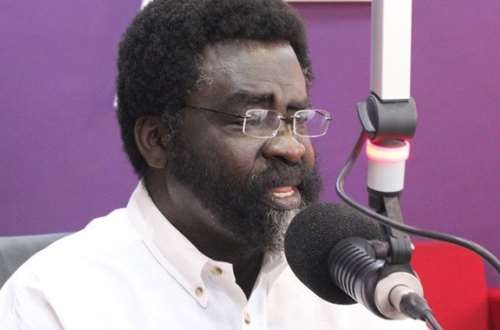
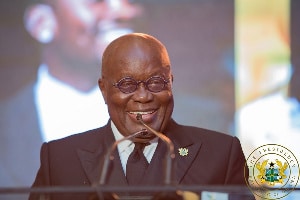
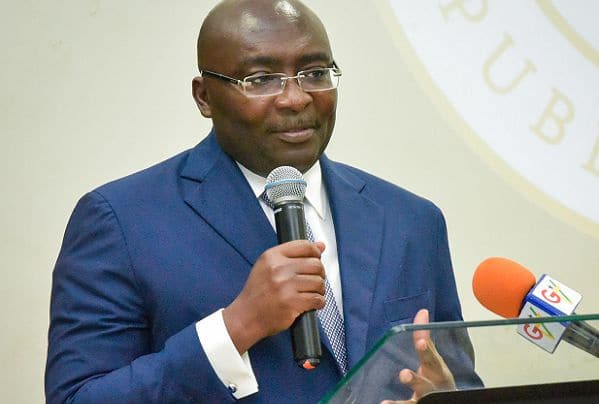
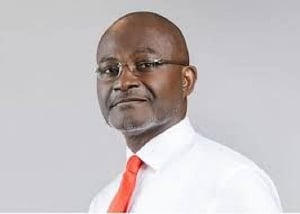
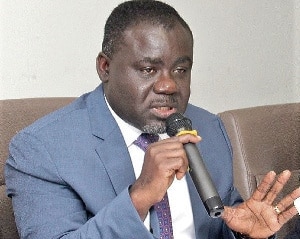
Dr. Amoako Baah, a prominent member of the ruling New Patriotic Party and a political analyst, has said that President Akufo-Addo is the reason why the party’s presidential and parliamentary primaries haven’t been scheduled yet.
Speaking to Selorm Adonoo on Eyewitness News, Dr. Amoako Baah said there “is a contention between the president and the party [with regard to the date for the primaries]. The president wants to hold the primaries in February next year which he said, his 2024 budget would have been passed by then. The MPs on the hand, also want the primaries held in August 2023, to give them enough room to do whatever it is that they have to do to keep the party in good sharp.”
He described it as absolutely absurd to have president Akufo-Addo to be deciding the timelines for the party.
“It doesn’t make sense and the party should not tolerate it, the party does not belong to the president and the party cannot go according to his timetable.”
Dr. Amoako Baah also alleged that the president has threatened to mastermind the defeat of some of the NPP MPs.
“Were you not there or have you not read when the Subin MP [Eugene Boakye Antwi] said the president threatened to mastermind his defeat, how can an outgoing president hold the whole country to ransom?”
Two different meetings held by the National Council of the NPP to set a date for the primaries ended inconclusively.
Pressure is mounting on the NPP to announce a date for its two most important internal elections on its calendar.
A bloc within the party made up of some MPs is pushing for an early Congress whilst others want the party to abide by the provisions of its constitution.
Per the NPP’s constitution, the party is supposed to elect its flagbearer 12 months to an election when in power and two years when in opposition.
The company’s production and free cash flow generation should be aided by investment in Ghana, which will cut net debt and strengthen Tullow’s balance sheet.
More than $100 million of the total will go toward infrastructure.
Tullow stated in an update to investors that the planned expenditure figure represents an increase of US$50 million compared to 2022 after deferrals from 2022, increased equity in Ghana for the entire year, and ongoing infrastructure investment in Jubilee South East, which will account for about 40% of the Ghana capital spend in 2023.
“Capital investment in 2023, particularly in Ghana, is expected to support production growth through to 2025 and free cash flow generation of US$700-800million at US$80/bbl for the two years 2024 and 2025 based on 2P reserves only; which will further reduce net debt and strengthen Tullow’s balance sheet,” the update read in part.
Tullow mentioned that the additional equity in the Jubilee and TEN Fields acquired through the pre-emption transaction in Ghana for US$126million had already been paid back by 31 December 2022.
In 2023, Tullow expects Jubilee oil production to average approximately 95 thousand Barrels of Oil Per Day (kbopd) (about 37 kbopd net), with a total of up to six new wells expected to come online starting from middle of the year. Gross oil production from the Jubilee Field is expected to exceed 100 kbopd once all these wells have been brought online.
“The focus on operational excellence in production, drilling and major project delivery in recent years has yielded appreciable value and will continue to be an area of leverage for Tullow,” the company highlighted.
Production from the Jubilee Field averaged 83.6 kbopd (31.9 kbopd net) in 2022. A good operational efficiency of circa 97 percent was achieved, and production was supported by four new wells (one producer and three water injectors) brought online in early 2022.
Tullow said that two wells were drilled in the Jubilee South East area in the second half of 2022, and a third well is currently being drilled. “First oil from the Jubilee South East project will be a significant milestone, bringing previously undeveloped reserves to production.
“The transition of operatorship to Tullow on the Jubilee FPSO took place in July 2022 and represented a major step in becoming a leading low-cost deep-water operator, realising improvements in safety, reliability and cost. Following the transition, FPSO uptime averaged about 99 percent in the second half of 2022 compared to 95 percent in the first half,” the company said.
TEN Field
In the case of the Tweneboa, Enyenra, Ntomme (TEN) Field, Tullow expects to focus on sustaining the strong operational uptime and improving gas-handling on the FPSO this year.
“Thisis will be implemented during a planned maintenance shutdown scheduled for the year’s third quarter. Increased gas handling capacity will also significantly reduce flaring and increase gas injection to support oil production,” it said.
“The longer-term plan is to monetise the significant remaining TEN resources through infill drilling particularly on Ntomme, phased development of new areas near existing infrastructure, development of the significant gas resources and drilling of prospective resources,” it added.
Tullow expects to submit a plan of development to the government of Ghana later this year.
In 2023, TEN production is expected to average about 20 kbopd (11 kbopd net), including the planned two-week maintenance shutdown. A water injection well (En16) that was brought online in December 2022 is expected to provide pressure support for production from Enyenra in 2023.
However, Tullow indicated that there are no new wells planned to be added in TEN for 2023.
Production from the TEN Field averaged 23.6 kbopd (12.5 kbopd net) in 2022. A good operational efficiency of c.98 percent was achieved with overall production at the lower end of guidance.
The year 2022 has undoubtedly been one of the toughest years economically for Ghana, with many of the country’s economic indicators hitting unprecedented lows.
So basically, the solution to Ghana’s problems was reducing the country’s demand for foreign exchange. But the use of monetary policies by the Bank of Ghana to attain this objective did not work as the cedi continued to depreciate throughout the year.
But not every Ghanaian accepted the Gold-for-Oil policy, with some saying that it is a way the government wants to reintroduce its rejected Agyapa Royalties deal, which sought to collateralise Ghana’s mineral resources.
The article takes a look at what this “Gold for Oil” policy is and why some experts are against it.
The Gold-for-Oil policy
Vice President Mahamudu Bawumia in November 2022 first announced the government’s plan to undertake the Gold-for-Oil initiative. The deal hinged on buying oil products with Ghana’s gold instead of the US dollar.
Dr. Bawumia explained on Facebook that using gold to buy oil would help Ghana’s dwindling foreign reserves while also reducing demand for US dollars from oil importers.
“It will fundamentally change our balance of payments and significantly reduce the persistent depreciation of our currency,” the vice president wrote.
Under the policy, the government believes that using gold to purchase oil products would also bring stability to the exchange rate market and ensure domestic oil operators do not solely depend on foreign exchange to import products.
The government, through the Bank of Ghana (BoG), is expected to purchase gold from mining firms in Ghana. The BoG will then use the gold through 3rd parties to purchase the oil on behalf of bulk oil distributors in the country and thus eliminating the use of foreign currencies by these oil distributors to import their products.
The move is expected to save the nation $400 million which is required by bulk oil distributors to import oil products into the country every month.
Concerns raised on the feasibility of the policy:
Some experts in the oil and gas sector, including the former Deputy Minister for Energy, John Abdulai Jinapor, have raised issues about the feasibility of the policy.
In a Facebook post sighted by GhanaWeb, Jinapor described the government’s Gold-for-Oil policy as nothing less than a farce.
The former deputy energy minister, who is the current Member of Parliament for Yapei Kusawgu, said that the policy, just like the government’s Sinohydro deal, will eventually end up on the nation’s accounting debt.
The current deputy energy minister, Andrew Egyapa Mercer, who is reported to have said that the first consignment of oil the government brought into Ghana under the Gold-for-Oil policy was not paid for with gold as expected, has also raised concerns about the feasibility of the policy.
Egyapa Mercer is reported to have said that the government could not exchange gold for oil because the company it dealt with initially could not exchange gold for oil.
“The policy actually started with an intent to do strict barter for gold and petroleum products, but it became apparent that any of the international oil trading companies that do not have a commodity wing to deal with gold on their behalf will be excluded from the policy.
“We developed the policy such that we were operating two streams; one was direct barter and the second was monetising the gold so we can pay for IOTs that were not other commodity focused but solely petroleum products,” he is quoted as having said on Citi News.
Issues of transparency:
Another concern some experts in the oil and gas sector have raised is the issue of transparency.
Even though Vice President Mahama Mahamudu Bawumia has said that delivery of the first 40,000 batch of oil under the Gold-for-Oil policy shows that it will work, the exact quantum of gold used in the transaction has not been disclosed by the Bank of Ghana.
The Executive Secretary of the Chamber of Petroleum Consumers Ghana (COPEC), Duncan Amoah, has asked the government to be open about the real details of the Gold-for-Oil policy.
According to him, the government must be clear on whether it is using public funds to purchase the fuel or not.
“I think after this revelation, the ministry of energy, ministry of finance, Bank of Ghana, the government itself should come clean and tell Ghanaians that, look we are going to use your public funds to now go into the realm or arena of forex trading… We do think that whatever details or the nitty-gritty of the gold-for-oil policy should be communicated so that we all depart from this gold-for-oil mantra and deal with the reality of the issue,” he was quoted by citinewsroom.com.
Legitimacy of the policy:
The co-chair of the Ghana Extractive Industry Transparency Initiative (GhEITI), Dr Steve Manteaw, has raised issues about the legitimacy of the Gold-for-Oil policy.
According to him, since the government is directly involved in the policy, it should have gotten parliamentary approval before implementing it.
“… we will be trading with a third party, rumours also say that the first tranche of the 40,000 (tonnes) is a Russian company that brought the money, which means that, there’s going to be an agreement between the company and the nation.
“And such an agreement is an international transaction and per the Constitution’s Article 181, such deals need parliamentary approval.
“Also, the person who will be supplying the petroleum product to Ghana will go through some level of agreement and such trading agreement needs parliamentary approval,” he said in an interview on Neat FM monitored by GhanaWeb.
Alex Mould, a former Chief Executive Officer (CEO) of the Ghana National Petroleum Corporation (GNPC), has also raised similar concerns.
Issues of criminality:
Issues of criminality have also been raised regarding the implementation of the policy.
Dr Steve Manteaw questioned the source of the money the government will be using to implement the policy.
According to him, the God-for-Oil policy was not stated in the 2023 budget, therefore, questions must be raised as to how the Bank of Ghana intends to come up with the money to purchase the gold it will be used for the policy.
“I don’t know if parliament is sleeping or what, because parliament needs to invite those leading the process to interrogate them in parliament so that if there are any policy documents, they can take and investigate properly into the deal because we’re tired of corruption activities in this country,” he said.
Numerous individuals who served in a variety of roles under numerous regimes have been completely forgotten as a result of the subpar work they did while in office.
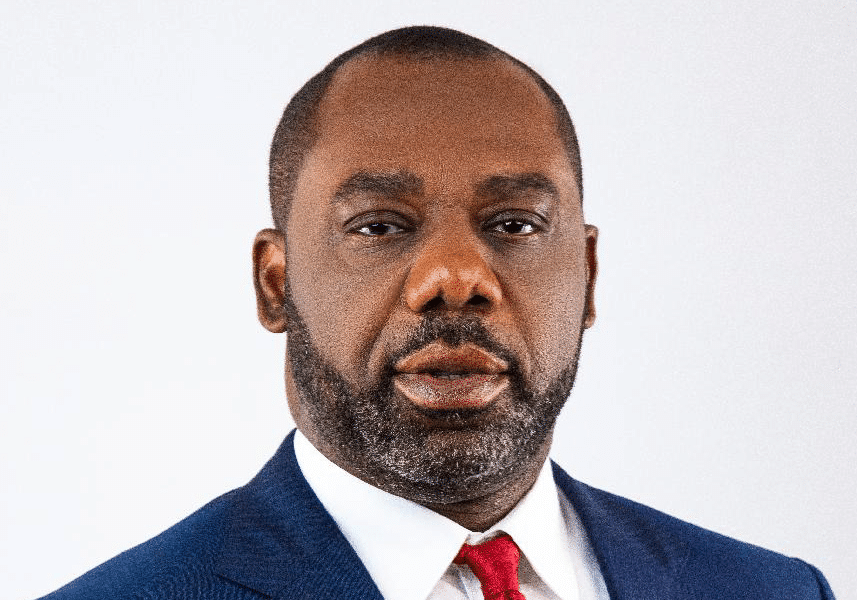
Dr. Matthew Opoku Prempeh, the Energy Minister of Ghana, cannot be unfairly judged by history because of the impact he has had as the person in charge of the vital energy sector of the nation and because he has been able to address the majority of the industry’s early challenges.
The fearsome face of the energy sector made him to devise various strategies with team members of the various agencies under the ministry and set out to work and the results are what Ghanaians are enjoying today.
Dr. Prempeh, who is the Member of Parliament for Manhyia South, in the Ashanti Region, chalked incredible feat in his first year (2021) as the commander-in-charge of the sector and added more feathers in his cup by working extremely hard to achieve the best of results in 2022.
In 2022, the power sector witnessed massive projects that fed into the minister’s agenda of keeping the lights on in every corner of the country.
The power situation from Kumasi in the Ashanti Region to Bolgatanga in the Upper East Region has become best with the commissioning of 330 Kilovolt (KV) transmission line project at Anwomaso. Kumasi and the northern parts of the country now have stable power.
In June 2022, the Volta-Achimota-Mallam lines were improved and upgraded with the commissioning of 161Kv line that has helped to stabilize the power situation in the southern sector of the country.
In that same month in 2022, the Kasoa substation, which is the second largest Bulk Supply Point (BSP) with a productive capacity of 435 Measuring Apparent Power (MVA) was commissioned, resulting in significant power improvement in the reliability of power supply to Kasoa and its environs in the Central Region.
The Ellen Moran Primary Substation located at Kanda in Accra with productive capacity of 78MVA and the Legon Primary Substation with productive capacity of 52MVA, located at the University of Ghana Medical Centre (UGMC), were completed and commissioned in 2022.
With the development and promotion of solar power very dear to the heart of the minister, the Kaleo/Lawra Solar Project, with productive capacity of 19 Mega Watts (MW), was completed and commissioned in August 2022 to add to government’s policy to increase the share of renewables in the national generation mix.
The power sector also witnessed the execution of Power Purchasing Agreements (PPAs) with some existing Volta River Authority (VRA) customers, including Newmont Ghana Limited.
The Energy Transition Framework was given an impetus in 2022, as it was being developed to provide the path to achieving net zero emission by 2070, while ensuring economic growth and utilization of Ghana’s natural resources. The Framework was launched by President Akufo-Addo at the Climate Change Conference-COP27 in Egypt.
With Dr. Prempeh’s aggressive and well-tailored programmes, Ghana’s electricity access has increased from 87.03% in 2021 to 88.54% as at the end of 2022.
Improved Cook Stoves Program saw the distribution of some 92, 552 units of Improved Charcoal Cook Stoves in 2022. The program has led to efficient energy utilization and reduced dependence on wood fuels.
Downstream petroleum activities were seriously attended to by Dr. Prempeh and his team in 2022 with the minister leading the charge for Cabinet to lift the ban on the construction of Liquefied Petroleum Gas (LPG) refilling plants.
The National LPG Promotion Programme (NLPGPP) was properly handled leading to US$17 million in funding support from the World Bank for the implementation of Phase 1 of the NLPGPP.
In addition to that initial 40,000 pieces of cook stoves and related accessories for distribution under the National LPG Promotion Programme (NLPGPP) were procured.
Stakeholder engagements with the Association of LPG Marketing Companies (LPGMCs), Ghana Alliance for Clean Cooking (GHACCO), Ministries of Health, Education, Transport, among others were part of the energy ministry’s preoccupation in 2022.
Dr. Prempeh was focused on the NLPGPP and ensured that an Operation Manual developed for the full implementation of the NLPGPP was developed as well as having the national launch of the programme.
To make the NLPGPP successful, there were reconnaissance activities in 19 Metropolitans, Municipals, and Districts (MMDAs) across Ashanti, Eastern, Western and Northern regions conducted, while 6,000 single burner LPG Cook Stoves and related accessories distributed at Obuasi, Kodie and Fomena.
LPG Behavioural Change and Public Awareness Strategy developed and Nationwide LPG Sensitization Campaign was launched in 2022 by the energy ministry with Steering Committee to provide direction and supervision for the implementation of programmes under the LPG4D instituted with Kintampo Health Research Centre as an Independent Verification Agency for the NLPGPP.
Dr. Prempeh saw the exclusivity agreement between Petroleum Hub Development Corporation (PHDC) and Touchstone Capital Partners (TCP)/UIC Energy Ghana Limited (UIC) for the implementation of Phase 1 of the Petroleum Hub project facilitation in 2022 with the overall importance of the hub as his interest.
There was improved sustainability of the Price Stabilization and Recovery Account with total annual under-recovery payments of GHS153,753,694.94 and GHS240,655,682.57 from the Ministry of Finance for supplied RFO and premix fuel respectively facilitated.
A subsidy capping level for Residual Fuel Oil was introduced and the subsidy was gradually reduced to zero whiles financing the automation of premix fuel distribution to mitigate malfeasances facilitated.
The level of subsidy on premix fuel was also capped at 50% to ensure accumulated under-recoveries due to suppliers of products can be paid to avert the current supply disruption was also on the agenda of Dr. Prempeh in 2022.
Upstream Petroleum activities were well coordinated under the supervision of Dr. Prempeh, as Eni was granted conditional approval to jointly appraise the Akoma-1X and the Eban-1X discoveries in the Cape Three Points Block 4 contract area.
An additional discovery (Aprokuma-1X) has been made in the same contract area and merits appraisal and if these discoveries are proven to be commercial, the country’s reserves will be increased leading to increased oil and gas production and thus revenues. Also, jointly appraising and eventually developing the Akoma and Eban discoveries will reduce petroleum costs as the same infrastructure will be used to produce the two discoveries.
In 2022, there was the establishment of the Institution of Welding was established in the country to train indigenes in welding and fabrication and equip them with international certification for the global oil and gas industry. This enhances indigenes’ chances of employment in the global oil and gas industry.
There is no doubt that the Ministry of Energy in 2022 made giant strides under the competent leadership of Dr, Prempeh, as all sectors were fully attended to.
Apple sales decreased at the end of 2022 as consumers made less purchases due to the pressure of the rising cost of living.
In the three months leading up to December, sales at the industry giant for the iPhone decreased by 5% from the corresponding time in 2021.
The fall was worse than anticipated and the largest since 2019.
The announcement of the update coincided with widespread warnings from businesses of a sudden slowdown in the economy, particularly in the computer industry, which experienced a boom during the pandemic.
Apple boss Tim Cook said the firm was navigating a “challenging environment”.
“As the world continues to face unprecedented circumstances … we know Apple is not immune to it,” he said on a conference call with investors.
Apple said the sales declines occurred throughout the world and hit most of its products.
Sales of its popular iPhones were down more than eight per cent, and sales of Mac computers dropped 29 per cent.
The declines hit the firm’s profits, which fell 13 per cent to $30bn (£24bn).
Paolo Pescatore, analyst at PP Foresight, said the firm, like many electronics makers, is struggling to make the case that users should upgrade given “what is perceived to be incremental improvements on previous models”.
“More so when everyone is tightening their belts,” he added.
Globally the number of smartphones shipped sank 12 per cent last year, according to market analysis firm Canalys.
Apple executives said they expected their services business, which includes Apple Pay and Apple News, to continue to drive growth, noting that there are now more than 2 billion active Apple devices around the world.
“When we look at the behaviour of our installed base, we think it’s very promising,” said chief financial officer Luca Maestri, while warning investors that the firm was expecting sales to continue to decline in the months ahead.
Other big tech companies also said they were feeling pressure in updates to investors.
Amazon, which has been struggling to re-ignite its e-commerce business, said sales at its online stores dropped 2% in the final three months of 2022, compared with a year earlier.
Overall, Amazon’s sales in the three month period rose nine per cent to $149.2bn (£121bn), lifted by stronger growth in its cloud computing business.
But its profits dropped sharply, falling to near zero from $14.3bn (£11bn) a year ago, a change that chief financial officer Brian Olsavsky warned investors was likely to continue in coming months.
At Alphabet, parent company of Google and YouTube, sales were up just one per cent in the three months to December, compared with 2021, as firms cut back on advertising – the company’s main source of revenue – in the face of economic uncertainty.
The AGI also objected to beverage manufacturers being classified as Commercial Bottled Water and Drinks, a new category of water consumers.
Last August, the category was established with a tariff of 316 percent increment, which was eventually reduced to 172 percent last month. Companies that now fall under the new category formerly belonged to the industry class, which increased by 48 percent in the most recent evaluation.
However, with the implementation of the new utility tariffs announced by the Public Utilities Regulatory Commission (PURC) for the first quarter of this year having taken effect on February 1, the AGI said this significant increment is a retrogressive decision with dire consequences for the industry and utilities.
“With the foregoing, AGI is calling on the PURC to maintain its beverage sector companies in their industry category which has seen a 48 percent increment in water tariff. We believe industries are high-revenue customers for Ghana Water Company and deserve equity in the water pricing we see.
“We urge the government to help stem the tide of our macro-economic instability, which is a major trigger for some of the changes in tariffs levels and price hikes,” its president, Seth Twum-Akwaboah, said during a press conference in Accra.
The AGI is an umbrella body of leading domestic manufacturers, and buttressing its call for a fair review said the principle of equity was largely missing in the major tariff review conducted in August last year for water – when a particular customer category was asked to bear a 316 percent increment in a single tariff review.
“The AGI wishes to reiterate that a tariff increment of 316 percent and subsequently 172 percent for its beverage sector under Industry will have dire consequences for Industry and the Ghana Water Company.
“Our Utilities risk losing revenue if this trend ends up collapsing the companies. We think it is unfair for the PURC to demand a significant share of the revenue from the Industry, whose cost of service is cheaper. We urge the PURC to make public the real cost of service for each consumer category to engender transparency and fairness,” Twum-Akwaboah said during a press conference in Accra.
On the reclassification of beverage producers, he said: “We do not think the creation of a new consumer category addresses the challenges in our water distribution system. Such an astronomical tariff increment in a single revision is retrogressive and shows no empathy for Ghana’s ailing Industrial sector. We all need to wake up to the looming collapse of our local industries, which hold the key to job creation and our economic recovery”.
Extra burden
Twum-Akwaboah explained that industries are already under pressure from an unstable business environment and were hoping to see signs of recovery this year.
He, therefore, lamented that the plight of local producers could be further worsened by the utility tariff increment; as well as inflation at 54.1 percent, VAT at 21.9 percent, rising fuel prices and threats of excise duty increments.
All these developments, he bemoaned, pose a serious threat to employment prospects and the survival of businesses. “Again, we have noticed a 48 percent increment in water tariffs for industry effective this February, which is a significant deviation from the 8 percent average increment as announced,” he added.
Indeed, within a period of fewer than six months, electricity tariffs have also shot up significantly on two occasions – 26.6 percent in September 2022 and 29.9 percent for this quarter, totalling a whopping 56.5 percent.
A special police team comprising investigation, intelligence, and operational officers has been deployed to beef up security in the town and surrounding communities.
Pure Fm’s morning show host and sportscaster is Nana Amoako.
According to Nana Amoako, who described his experience to GhanaWeb, he was at the studio on Wednesday afternoon choosing the sports commentary when his producer informed him that two men were looking for him.
“They beat me mercilessly to the point where I could not move, so I pretended as if I was dead. So after some time, they realized that I was dead and they left me,” he added.
According to him, the unknown men took one of his phones away. “I heard one of one of them asking the other, have you taken that phone?” he added.
He noted that these people were after his life because of some critical questions he is been asking on radio that might not be in their favour.
He visited the hospital to receive treatment and subsequently reported the assault to the Tarkwa District police command.
If he is not the party’s official flagbearer, the NPP will struggle to win the 2024 presidential elections, he claims.
“We have two years to significantly impact the growth of society. I believe Ghanaians will give us another chance if we are successful.
“But you know with, me we will break the 8… without Ken Agyapong well it will be tough,” he said during a Good Evening Ghana interview monitored by GhanaWeb on Tuesday, January 31, 2023.
The MP for Assin Central is expected to face stiff competition from the likes of the former Minister of Trade and Industry, Alan Kyerematen Vice President Dr. Mahamudu Bawumia, the former Food and Agriculture Minister, Dr. Owusu Afriyie Akoto and ex- Mampong MP Francis Addai-Nimoh for the flagbearership position of the NPP.
Using its most recent offer to individual bondholders as justification, the government pushed up the deadline for voluntarily participating in the DDEP from January 31, 2023, to February 14, 2023.
Additionally, all retirees (including those retiring in 2023) will be offered instruments with a maximum maturity of 5 years instead of 15 years and a 15% coupon rate.
Reacting to this in an interview on Neat FM monitored by GhanaWeb on Wednesday, lawyer Kpebu said that the individual bondholders will not accept the new deal by the government because it makes them worse off.
He refuted assertions that the government has no money to pay bondholders, saying that the increase in the government’s expenditures in the 2023 budget shows that the government has money.
“We are not happy with the new offer, and we are not going to accept it. If we accept the new deal, it will make us worse off.
“A government that says it does not have money is spending 40 percent more than it spent last year in some sectors and 20 percent more in other sectors. How can a government that says it has no money be spending more? It doesn’t make sense,” he said in Twi.
“The government must reduce its expenditure; it must suspend some projects for at least one year. We live on the interest of our bonds, the government cannot tell us it does not have money to pay us while it is constructing new projects,” the lawyer added.
A Social Interest Advocate, George Opoku Amponsah, wants the government to halt the planned grand celebration of the 66th Independence Anniversary to cut down the country’s expenditure amidst economic challenges.
In a petition to the Presidency, Mr Amponsah entreated President Akufo-Addo to make use of his famous “fellow Ghanaian series” to address the nation on the 6th of March as the nation prepares for the 66th edition instead.
He estimated that the country would be able to save over GHC2 million should the “fellow Ghanaian series” be adopted.
In his projection, he assumed that the 216 MMDAs across the country were each using GHC10, 000 to carry out the upcoming 6th march celebration, which would lead to a total of GHC 2,160,000.00.
Also, the petitioner noted that should 16 regions spend GHC20, 000, can amount of GHC 320 000.00 would have to come from state coffers to cover the cost.
Citing the economic crisis Ghana is facing, he implored the government to show concern about the worsening economic conditions in the country by acting considerately and appropriately.
“I am confident that the Presidency would see reason in my petition and consider same so that we can utilise our state resources prudently since what we are seeing now is a semblance of an economic crisis which does not warrant profligate spending on just a 2-hour march,” Mr. Opoku Amponsah stated.
This year’s Independence Anniversary will be held in the Volta Region.
Already, some works are being done on the Ho Sports Stadium which would host the ceremony. This comes at a time when the government is engaging local investors in order to restructure its debt.
Her wedding fliers and pre-video advertisements touted a unique royal wedding that would take place at Ahodwo’s opulent and pricey Greenwood Events Center.
The alleged overseas fiancé was in his seventies. A week prior to the wedding, Wilson Dass traveled to Ghana with his family to finally see his sweetheart in person after several months of virtual courtship.
It is, however, unclear why and how the groom Dass; his parents Mr. Bura Dass and Mrs. Dhanti Dass and the rest of the Indian family; bolted the night before the wedding, without a word to the Ghanaian family.
Kasapafmonline.com gathers that the lady’s family only got wind that the wealthy Indian family had returned to India few hours to the wedding which had seen a huge digital and physical publicity awaiting a huge crowd of youth from Shelly’s community.
“Look, I had ironed a jacket and a kente just for this wedding. Several boys were coming but I had to put it on hold. I had to put off my phone because I was overwhelmed with calls asking whether what they had heard was true,” a source told reporter Ivan Heathcote – Fumador.
“We hear this man is a very wealthy man. He sent over 200 thousand cedis for this wedding alone so the preparation was huge. The lady was actually boasting in the community that she is going to hold the biggest-ever wedding in town, another person close to the heartbroken lady explained.
Other sources in the community indicate that the boast was hyped to spite other rival female slay queen groups in the area and to further mock the lady’s x-boyfriend whom she had a child with.
The confusion has led to a series of speculations with some purporting the lady did not show affection and warmth in the presence of Dass whenever they appeared in public in the short time the two met physically.
For now, the lady; her father who is a popular footballer and her mother Gifty Boadu remain indoors, perhaps nursing their wounds and planning how to put themselves together to face the heartbreak and embarrassment caused them by the estranged boyfriend.
He clarified that the government’s propaganda on the situation is untrue.
The veiled implication that there may be difficulties with tradability is one thing I wish to refute. I’m not a member of it. Neither does our technical committee. It is a subjective matter. But for leaders to publicly state this is a complete fabrication. If you invest in the new bond, you won’t ever lose any money.
This was his response to an earlier statement issued by the Finance Ministry that “upon a successful DDEP there will be very few of the ‘old bonds’ in circulation, and likely limit its tradability.”
The government in its revised terms explained that even though individual bondholders are exempted from the programme, it is still voluntary to participate in the programme.
The deadline for the programme has thus been extended for the fourth time to February 7, 2023, with revised terms as follows:
a. An affirmation that all individual bondholders are free not to participate;
b. However, upon a successful DDEP there will be very few of the ‘old bonds’ in circulation, and likely limit its tradability;
c. In this regard, the Government is pleased to make available the following alternative offer to encourage all individual bondholders to participate in the Exchange:
i. All individual bondholders who are below the age of 59 years will be offered instruments with a maximum maturity of 5 years, instead of 12 years, and a 10% coupon rate;
ii. All retirees (including those retiring in 2023) will be offered instruments with a maximum maturity of 5 years, instead of 12 years, and a 15% coupon rate.
“These developments have necessitated the final extension of the deadline from January 31, 2023, to Tuesday, February 7, 2023, and a new settlement date of Tuesday, February 14, 2023, that will be confirmed via the new Exchange Memorandum,” the Finance Ministry added.
Meanwhile, a revised and final Exchange Memorandum will be released by Thursday, February 2, 2023.
The increase, which will be applied to all pensioners on the SSNIT pension payroll as of December 31, 2022, will take effect in January 2023 and was announced by SSNIT Director-General Dr. John Ofori Tenkorang.
After a meeting with the Director-General, the Association expressed its “excitement” on the increase in pensions while urging the government to put its constituents’ wellbeing first.
The Association’s General Secretary, Stephen Boakye said: “If you are given a huge amount today and tomorrow we do not get anything, how will pensions remain sustainable for generations to come?”
He added that SSNIT is committed to being “very prudent” in managing the pension fund; and that the decision to increase pensions was made in consultation with the National Pensions Regulatory Authority (NPRA), in line with Section 80 of the National Pensions Act 2008 (Act 766).
The increase in pensions will be applied as a fixed rate of 19 percent, with an additional redistributed flat amount of GH¢73.58. According to SSNIT, this redistribution is a mechanism applied to the indexation rate to cushion low-earning pensioners in conformity with the solidarity principle of social security. As a result, the effective increase in pensions will range from 19.05 percent for the highest-earning pensioner to 43.53% for the lowest-earning pensioner.
In addition to increasing monthly pensions, SSNIT has also increased the maximum insurable earnings for 2023 to GH¢42,000 from GH¢ 35,000. This increase was made in consultation with the NPRA in accordance with Section 63 (3) of the National Pensions Act 2008 (Act 766). The minimum insurable earnings have also been increased from GH¢365.33 to GH¢ 401.76, following the raise in National Daily Minimum Wage.
Dr. Tenkorang also addressed concerns about sustainability of the pension fund. He acknowledged that while the 25 percent increase in pensions is significant, it is important to also consider the fund’s long-term sustainability.
He also highlighted the redistribution mechanism applied to the indexation rate. He explained that this redistribution results in some pensioners receiving an increase of more than 25 percent, with the highest increase being 43.53 percent for the lowest-earning pensioner.
Ghana has a potential annual soybean producing area of roughly 250,000 hectares, or about 700,000 metric tons, with only about 125,000 hectares actually being cultivated.
The total soybean processing and export shortfall for the nation is 228,000 metric tons, and processed soy meal imports, which accounted for around 200,000 metric tons of grain equivalent, left the market with an unmet need.
The Deputy Food and Agriculture Minister in charge of Crops, addressing a stakeholder meeting on the theme: “Soyabean – A strategic crop for poverty reduction and enhanced food security in Northern Ghana,” said, the main bottleneck was the lack of capacity for medium and smallholder farmers to increase their annual soyabean production with an additional 200,000 metric tonnes.
He said the supply gap provided an opportunity for job creation, poverty reduction and food security in the country, especially in the northern savannas, which produced about 90 per cent of the country’s soyabean and were among the deprived regions of Ghana.
The meeting was part of strategies under the Sustainable Soyabean Production in Northern Ghana (SSPiNG Project) being implemented in 16 districts in the five Northern Regions of Ghana by the International Institute of Tropical Agriculture (IITA), YARA Ghana, Wageningen University, the Netherlands and Felleskjopet Rogaland Agder, Norway, with support from the Ministry of Food and Agriculture, Ghana.
SSPiNG is a four-year project with funding from the Norwegian Agency for Development Cooperation (NORAD).
The project envisions “to materialise the multiple potential benefits of soyabean to smallholder farmers and other value chain actors engaged in the food and feed sectors in Ghana.’’ It is aligned with the Government’s programme, “Investing for Food and Jobs’’.
The primary beneficiary of the project includes 100,000 smallholder farmers (SHFs) who, by year four of the project, will generate a total gross income of $60 million per year with 50 per cent currently on average growing 0.4 hectares of soyabean annually in the 16 districts of Northern Ghana.
With over 300 extension officers and 500 farmer associations and building on existing structures, the project also facilitates Public-Private Partnerships (PPP) around market access, inputs information, mechanisation, finance services, and capacity development demands.
The Deputy Food and Agriculture Minister said the production of soyabean production in Ghana had increased steadily from 113,000 metric tonnes in 2009 to a little over 200,000 metric tonnes in 2020, while demand was more than about 300,000 metric tonnes.
Despite the high production, he said, the processing industry was still confronted with several challenges, including insufficient materials for processing, limited access to credit, and insufficient equipment.
To address the low soyabean yields under smallholder farming conditions, Mr Tufero said, there was the need to facilitate the soya value chain such that smallholder farmers would be linked to input and output markets, finance, equipment, and information through larger commercial farmers and aggregators who had the capacity and incentives to invest in smallholder production.
“These linkages will build the capacity of smallholder farmers to increase the efficiency of their farm businesses with improved production and post-harvest handling practices with an emphasis on processing to meet the ever-increasing demands of the value chain,” he said.
Professor Samuel Adjei-Nsiah, Project Coordinator, in a presentation, said the project was conceptualised around the lack of communication and coordination among soyabean value chain actors in terms of organisation, information management and decision-making tools to ensure that demand for input-output markets and services were efficiently matched with supply.
In an interview with the Ghana News Agency, Prof. Adjei-Nsiah said the challenges with soyabean production was attributable to the lack of policy and strategy on the value chain.
He said: “All the policies that in the value chain currently are ad-hoc policies. For instance, Ghana produces non-GMO soya which creates a niche market for global soyabean and because of this, there is an influx of foreigners to buy soya for export. Some producers are of the view that, the situation is depriving them of their livelihood.”
The Project Coordinator said, there was a need for a comprehensive data on the production of soyabeans in Ghana, and a strategic policy document to guide the industry, explaining that “we need to know the local and export demand, capacity among others to before restrictions are” put on exports.”
According to recent information issued by the Bank of Ghana (BoG) on Monday January 30, 2023, Ghana’s total public debt stock increased dramatically to GH575.7 billion at the end of November 2022.
According to the Central Bank’s most recent debt statistics, Ghana’s debt to Gross Domestic Product (GDP) ratio has increased from 75.9% in September 2022 to 93.5% today.
Also, the country’s debt stock increased by GH¢108.3 billion between September and November 2021.
Commenting on the figures on Starr Today with Joshua Nana Kwame, the economist indicated that the depreciation effect on the cedi can largely be blamed for the surging debt.
“If you look at the dynamics the reality is that since June we haven’t borrowed as a nation. So the surge you are seeing is actually the Exim loan of $750 million and then exchange rate effect or depreciating effect. The external debt, domestic debts even if the external was slightly higher the difference wasn’t much. It was more than 51 percent to about 49 percent between external and domestic.
He added that the debt-to-GDP ratio will definitely cross the 100% mark.
“As the way the IMF is looking at it, we are looking at debts of SOEs, public guarantee debts such as the Sino-hydro, ESLA, COCOBOD and many others will all be added now. These are total government obligations and if you incorporate all of that we are above 110 percent to GDP.”
The Minister pointed out that supporting the growth of mining communities is essential to maintaining the country’s mining businesses’ ethical activities.
The Minerals Development Fund (MDF), created by the Minerals Development Fund Act, 2016, Act 912, is mandated to provide financial resources for mining communities and associated issues.
Given that the Fund was set up, among others, to promote the welfare of the indigenes of mining communities, he contended that the commitment to provide alternative livelihoods, social infrastructure and other interventions across mining areas will continue.
While noting the ongoing work of MDF in the mining areas, he acknowledged this will help mining communities to become direct beneficiaries of the country country’s mining industry.
The minister’s visit also offered MDF a chance to present its action plan for 2023, which Mr. Jinapor later described as ambitious and achievable through concerted and collaborative efforts between the agency and the ministry.
The action plan, according to the minister, contains projects in the areas of health, education, alternative livelihood empowerment and general infrastructure.
“The action plan is such that they are going to roll-out a lot more projects in the mining communities. It is absolutely important that we carry indigenous mining communities with us, because without them we will not have the needed stability to construct the mining industry we so wish for,” he said.
The Administrator of MDF, Dr. Norris Hammah, said his outfit is grateful to the ministry for the support it has been receiving and is willing to team-up with ministry to achieve its set objectives for the 2023 calendar year and beyond.
He mentioned that the MDF is mandated by law to provide financial assistance in various ways to mining communities, and will ensure that the fund executes its mandate to the satisfaction of residents in all mining communities.
The Public Utilities Regulatory Commission (PURC) last month announced new energy and water rates that will take effect on January 1. According to the report, these rates are too high and may make it harder for businesses to operate.
Clement Osei-Amoako, president of the GNCCI, stated in Accra following a meeting with the PURC that “businesses that are into production are collapsing, and others are also relocating their operations out of the country; our concern is that the price spike is so great that we cannot handle it.”
The new tariffs took effect February 1, 2023. End-user electricity tariff has gone up up by 29.96 percent while water increased by 8.3 percent.
“As a chamber we will not wait for all our businesses to collapse before we come back and demand that the tariffs are reduced,” he added.
He explained that the chamber had bought into the government’s decision on import substitution and was subsequently taking steps to boost production and that the tariff decision is a major setback.
“With this increase in tariff, if we are not careful, we will defeat that purpose of import substitution because the cost of production is very high in a manner that businesses cannot break-even anymore and so we need to borrow to survive,” he lamented.
Too little too late
Reacting to GNCCI’s appeal, Executive Secretary of PURC, Dr. Ishmael Ackah, stated that the new tariffs had already been gazetted since January 16, this year and for that reason could not be reviewed.
“The decision on the tariff has been gazetted and so for now nothing can be done on the part of PURC. However, there will be other quarterly adjustments and so we will establish the protocols for engagement,” he noted.
He explained that the new tariffs was supposed to be announced November last year to take effect on December 1, 2022 but was put back because of unfavorable exchange rate at the time.
With the exchange rate being the major driver for the quarterly adjustment, he said the rate for December had risen above 40 percent: “So, we delayed and came out on January 15, this year with an upward review of electricity and water tariffs for the first quarter of 2023.
Meanwhile, following the meeting, the Executive Secretary revealed that the two bodies agreed to regular engagements before future tariffs decisions.
After spending several years in the banking industry, Mr. Okine entered the bamboo industry to produce items like toothpicks and other things from bamboo.
Read the entire article as it appeared on www.ghanaweb.com on September 2, 2020.
In his early thirties, Kenneth worked with a blue-chip investment banking firm in Ghana and had opportunities to travel around the world.
That is a great career path that persons with knowledge in banking will not be glad to trade for anything.
But after years of such great opportunities, he was headhunted. Not by another bank, but by his side hustle.
Leaving the security of such a job, to start a company from scratch is hard, but that is exactly what Kenneth did.
His inspiration to become an entrepreneur was born out of a challenge thrown to him while in graduate school in the UK.
He told GhanaWeb that “I was in class and there was this Asian boy who led a presentation. People in the class started mocking his delivery and I joined. He turned to look at me and said, you don’t need to join them in laughing at me. You are from Africa and what do you produce?”
That question got Kenneth thinking even years after graduate school and he challenged himself to entrepreneurship.
He was clueless as to what exactly wanted to do. However, he felt bamboo crafting was just it after realising that Ghana could boast of having abundant bamboo yet imported basic items such as toothpicks.
Knowing the potential of the bamboo industry in Ghana, the ex-banker decided to get crafty with his hands.
In 2016, Kenneth Okine founded the CEO of Pamplo Ghana to produce artefacts from bamboo for the local market.
A switch in career path would normally require some sort of retraining, but not for Kenneth who learned on the job.
He started production from his backyard and gradually moved to a production site which employs some able hands.
In the maiden edition of BizTech, GhanaWeb sits with Kenneth Okine to find out why he quit his high-paying finance job to focus on his side hustle; making products with bamboo.
While just one of those two stories is accurate, did you also know that a blacksmith was the man credited with creating Ghana’s renowned cocoa-producing expertise up to this point?
The real life of Tetteh Quarshie is that of a blacksmith who gave Ghana its most lucrative cash crop.
The 1879 story that has been told without number has somehow also missed the very fine and interesting detail that Ghana’s Tetteh Quarshie was not even the greatest farmer the country has ever had.
This historical correction was shared with GhanaWeb’s Wonder Ami Hagan when she visited the Tetteh Quarshie’s Cocoa Farm at Mampong Akuapem, in the Easter Region, in 2020.
Now, this is the true story.
Tetteh Quarshie was in Fernando Po on a missionary journey, and on his return, just like all others on such pilgrimages, there was the need for him to pass through a checkpoint.
This was to allow for all such travelers to be checked to ensure that, while on return from their respective countries at the time, they were not carrying any foreign items.
Tetteh Quarshie may not have known the effect the decision he was making at the time would have on his home country, Ghana, but he made a smart move.
Being a blacksmith, he kept all his working tools in a toolbox. This box was the last place anyone would have checked for any foreign items or goods, and so that was exactly where he kept them.
But all he could keep in there were six cocoa pods; a plant he had discovered in that country on the west coast of Africa.
It became a well-cooked plan, and over the six-week journey Tetteh Quarshie undertook on the sea in 1879, to the coast of the Gold Coast, his pods remained intact.
In the words of Thomas Awuku, who has been working at the Tetteh Quarshie Farm for years, a job handed down to him by his father, who also took over the management of the farm from Tetteh Quarshie:
“That’s the history we also learnt about him, but when I got to this stage, I realised they were telling us a lot of lies about Tetteh Quarshie. Tetteh Quarshie didn’t swallow cocoa beans before he brought them to Ghana because in the 1870s travelling was difficult. There were no aeroplanes for travelling so we travel by the sea – either with ship or canoe. Tetteh Quarshie went with the ship, and it took him six weeks from Ghana to Fernando Po, which is currently known as Equatorial Guinea.
“Assuming he swallowed the cocoa beans and for six weeks on the ship, are they trying to tell us that the whole six weeks on the sea, he couldn’t visit the washroom? And if he did, it means everything went back straight into the sea so we never got back the beans and returned back to Ghana,” he told GhanaWeb’s Wonder Ami Hagan on People and Places.
Explaining further the story, Thomas said that even on his return to the Gold Coast, Tetteh Quarshie made an unsuccessful attempt at planting the first seed in Accra, as the soil type – mostly sandy and clayey, did not allow the crop to grow.
It was only when another missionary work came and took him to Mampong Akuapem that he found good soil.
He alleged that since the government had the interests of Ghanaian workers at heart, measures had been put in place to protect them from the effects of the worldwide pandemic’s shocks on other countries’ economies.
Read the entire article, which was first published on May 2, 2022 by www.ghanaweb.com.
Accusations that President Nana Addo Dankwa Akufo-administration Addo’s is indifferent to the condition of Ghanaian workers have been refuted.
According to him, his government has the Ghanaian worker at heart hence measures were put in place to cushion workers following the emergence of the COVID-19 pandemic which impacted many livelihoods.
“It is important to put on record, at the outset, that when COVID-19 struck, and public sector workers in some countries were either relieved of their jobs or getting reduced salaries, my government continued to pay workers without any reductions, and we ensured that no public sector worker lost his or her job or getting reduced salaries.
“It cannot, therefore, be said that my government does not care about the plight of the Ghanaian worker,” he added.
President Akufo-Addo however admitted to the current living and economic conditions in the country and their impact on the Ghanaian worker and gave the assurance his government is committed to addressing the challenges.
“I will be the first to admit that conditions of service, in the wider public service, need improvement. However, these should be done within the budgetary constraints to ensure that we do not put excessive pressure on our public finances,” the president said.
He continued, “I have also acknowledged on several occasions that we are in difficult times, and the government has not thrown its hands in despair and it is not looking for an easy way out. On the contrary, we are working hard to address the current situation and those that relate to improving the quality of life for all Ghanaians.”
The largest wireless provider in Africa, MTN Group Ltd., as well as Tullow Oil Plc and Gold Fields Ltd., have all received notices that they owe past taxes. The businesses all refute the assertions made by the government. The majority of Ghana’s income must now go toward paying off an estimated 576 billion cedis ($48 billion) in governmental debt.
“Ghana is clearly facing fiscal and economic challenges at the moment,” Gold Fields spokesman Sven Lunsche said in an emailed response to questions. “We are hopeful that the government will not resort to unreasonable fiscal measures that will further imperil the challenges facing the corporate sector.”
Gold Fields is in talks with the country’s tax authority to try and resolve the demand for 2018 to 2020. MTN, which has been ordered to pay $776 million, has until Friday to reach an agreement with the Ghanaian authorities.
Kosmos Energy, headquartered in Dallas, said the authorities claimed the company underpaid certain taxes and other contractual fiscal obligations. The claim is without merit and Kosmos will “vigorously dispute” it if required. Both Gold Fields and Kosmos declined to give financial details.
A spokeswoman for the Ghana Revenue Authority declined to comment when contacted by phone.
Announcing the decision in a statement to B&FT, the Registrar of Companies, Jemima Mamaa Oware, said the development leaves the names open to be used by anyone interested in them – and is in line with Section 5A (2) of the Registration of Business Names Act, 1962 (Act 151) on Annual Renewals which states that: “Without prejudice to any other liability prescribed by this Act, a registration which is not renewed in accordance with this section shall lapse and the Registrar may remove from the Register the Business Name of the person whose registration has lapsed after the expiration of the period prescribed for the renewal”.
“Therefore, to avoid such Business Names falling into the public domain, and for anyone of interest to use it after it has been struck off the Business Name Register, all Business Name Owners are entreated to renew their Business Names before the end of April 2023,” she said.
Meanwhile, the OCR is expected – for the very first time from June 1, 2023 – to commence full implementation of section 126(7) of the Companies Act, 2019(Act992) which states that: “Where a company defaults in complying with the filing of annual returns and financial statements, the company and every officer of the company that is in default is liable to pay to the Registrar an administrative penalty of twenty-five penalty units for each day during which the default continues”.
A penalty unit is established by the Fines (Penalty Units) Act 2000 (Act 572), and the current monetary value per penalty unit is GH¢12.
“This means that effective June 1, 2023, an administrative charge of GH¢300 will be charged for each day the default continues against the Company and every officer of the Company until section 126 (7) is complied with,” Mrs. Oware stated.
President Akufo-Addo launched the ORC last year after a 15-year wait, with hopes that the Office would take charge of the administration and registration of companies in the country.
The vacuum created by absence of an ORC contributed to the weak system of supervision for companies in the country; therefore, its setting up is expected to bring dynamism to the business environment.
On January 31, 2023, during an interview that GhanaWeb was watching on Good Evening Ghana, Agyapong stated that he would never take part in any endeavors that would make him wealthy at the expense of the citizens of Ghana.
He continued by recounting how he turned down a $3 million bribe from an Indian businessman who was trying to enlist his assistance in obtaining a government project.
“I met an Indian last week and he said there is a project that he thinks I can influence. The actual cost of the project is ($)26 million.
“The guy comes to say that he can do it for $9 (million) and of course as a businessman, he has to make a profit with whoever introduced him, $3 (million), making $12 (million). Then he said to me, I’m going to give you $3 million so I will add it to the $12 (million) to make $15 million and I said no to him.
“I said Ghana first, I don’t want the $3 million if you know you can do the job for $12 million so be it. The young men that come from America with their tickets and everything whatever you want to give to them it is okay but me I will not take any money,” he narrated.
“The Indian man, who was there with his young engineer son, said wow, I have goose pimples. I have worked in Africa for 22 years and I have never seen an African reject $3 million like you did,” he said.
The Ghana Private Road Transport Union (GPRTU) has hinted at a potential increase in transportation costs as a result of the country’s rising cost of gasoline and replacement parts.
The GPRTU claims that since the cost of spare parts and lubricants has not decreased, an increase in transportation costs is necessary.
Abbas Ibrahim Moro, senior industrial relations officer for the GPRTU, said in an interview with Starr News that they keep an eye on market trends before making announcements.
“Currently spare parts have not been reduced, they have been increased. Some items we use in running transport have never been reduced, it has increased. We will compare some of the items that we have identified. Then with the new increased prices we can talk on any increment and any percentage that we want to ride on.
“Spare parts dealers came out and said they’ve reduced their prices and we challenged them of which they’ve not been able to publish what has been reduced. We have even identified some of the items like tyres, its prices have gone up. When we even said they haven’t reduced it, now it has gone up again,” Mr. Moro explained.
He continued: “For now, we don’t have to mention anything. It is expected to come, but it hasn’t come so let’s wait until tomorrow and see. The new fuel price will come. We will make research into some of these things and identify the actual percentage we are to come up with. Let the prices come because nobody is prepared to trade at a loss”.
A litre of gasoline is currently being sold by one of the market leaders, GOIL, for GH15.25 as opposed to GH13.60 previously. In contrast, diesel is now selling for $15.90 a litre, up from $15.52 previously.
Later today, new fuel rates are anticipated to be announced by other OMCs.
The President of the Republic, Akufo-Addo, has commissioned a three hundred (300)-bed capacity young soldiers’ block at the 37 Military Hospital.
Commissioning the Block on Wednesday, 1st February 2023, President Akufo-Addo stated that the 37 Military Hospital, usually, finds itself with a lot of young soldiers posted to the Unit to commence their basic training in medical care.
Over the years, he explained that “the number has been increasing with nowhere to house these young soldiers, as they have to be on the hospital premises to learn their trade.”
According to the President, it is for this reason that then Director General of Health Services, Brigadier General Ralph Ametepe, conceived and started this project in 2016.
“With the use of internally generated funds, the project stood at fifty percent (50%) complete in 2018. Running out of funds in 2018 meant that the project stalled. It is good to note that successive Directors at the Hospital continued the project, albeit at a slow pace, until the project was revived in 2021 by the current Chief of Defence Staff,” he said.
The President continued, “I am told that the Chief of Defence Staff, in 2021, made an appeal to the Jospong Group of Companies to assist with the completion of this block, a request which was duly heard and answered. Jospong Group of Companies agreed to complete the project as a Corporate Social Responsibility at no cost to the Ghana Armed Forces. Jospong, well done, ayekoo!!”
Whilst assuring the officers, men and women of the Armed Forces of Government’s commitment to their welfare and well-being, he noted that since in assumption of office in 2017, his Government rolled out a number of measures to help deal with these challenges facing the Armed Forces.
These include phases one and two of the Barracks Regeneration Project and the Military Housing Projects, which I launched in 2017 and 2021, respectively. Government is also striving to complete stalled SSNIT and Ministry of Defence projects commenced in 2016 to add to the accommodation stock. These, together with ongoing accommodation projects, he explained, will provide some three thousand (3,000) accommodation units for the Ghana Armed Forces soon, and it will be the largest provision of accommodation units for the Armed Forces.
“We will continue to stay true to the pledges we made in our 2016 and 2020 manifestoes, which brought into and retained my party, the New Patriotic Party, and I, in office. Government will continue to construct much-needed accommodation infrastructure to enable the 37 Military Hospital and the Ghana Armed Forces perform its role as required by the Ghanaian people,” the President said.
Later in the day, President Akufo-Addo also commissioned a new administration block for the Chief of Defence Staff, at Burma Camp, and also handed over a UN Level IV Field Hospital to the Ghana Armed Forces.
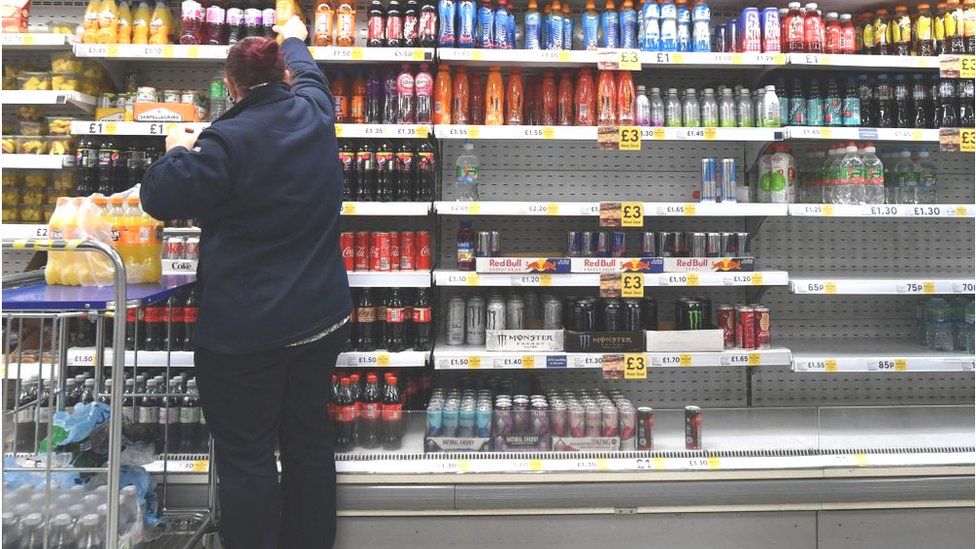
A new tier of 1,800 lower paid shift leader positions will take over running its shop floors.
Tesco also announced it will close its counters and hot delis, with staff offered alternative jobs elsewhere.
Britain’s largest supermarket said the axing of its counter and delis from 26 February were due to lack of demand from customers. It is also closing eight pharmacies, moving overnight roles to daytime in 12 stores and reducing hours within some post offices.
Similar changes have already happened at Tesco’s smaller stores, but the grocer is now implementing them at its larger superstores and Tesco Extra shops.
Daniel Adams, national officer of the Usdaw union, which represents Tesco workers, said the announcement would be “especially difficult” for staff in the midst of the rising cost of living.
“We will be doing all we can to support members throughout the process with a view to protecting jobs and, where this is not possible, securing the best possible deal for those affected,” he said.
Jason Tarry, Tesco’s UK and Ireland boss, said the decisions were “difficult”, but added they were “necessary to ensure we remain focused on delivering value for our customers wherever we can, as well as ensuring our store offer reflects what our customers value the most”.
“Our priority is to support those colleagues impacted and help find alternative roles within our business from the vacancies and newly created roles we have available,” he said.
Alongside the planned team manager cuts, a further 350 jobs are at risk in a series of other changes at the company.
It is also cutting some jobs at its head office as well as closing its Maintenance National Operating Centre in Milton Keynes.
Tesco said it was now entering a consultation period with the Usdaw union on the proposals and pointed out that it currently has about 2,000 vacancies across the business.
Bigger supermarkets are having to become more efficient and make savings as they face competition from discounters Aldi and Lidl.
Last week, Asda, Britain’s third largest grocer, said it planned to remove 211 night shift managers and change the hours of 4,137 workers.
It followed similar changes to night time working at Sainsbury’s and Tesco.
Three years on since the UK left the European Union (EU), a Midlands business owner has described the move as a “complete disaster”.
Nic Laurens, who runs an abrasives supply firm in Shropshire, moved 90% of his company to the Republic of Ireland in order to remain in the EU.
Higher costs and piles of paperwork to export goods left customers with four-week waits for orders, he said.
The government has previously said trade with the EU was “rebounding”.
It said recent data showed “trade to both EU and non-EU countries is above pre-Covid levels”.
However, Mr Laurens, a former Conservative councillor, said Brexit had left his firm facing filling out 24 forms to export goods into the EU.
“Brexit has [caused] barriers to trade and additional costs that you have to pass on to the consumer,” he told the BBC.
“We’ve had to completely rethink our business model.
“The UK hasn’t grown, it has stagnated, but the Irish side of the business has gone from strength to strength.”
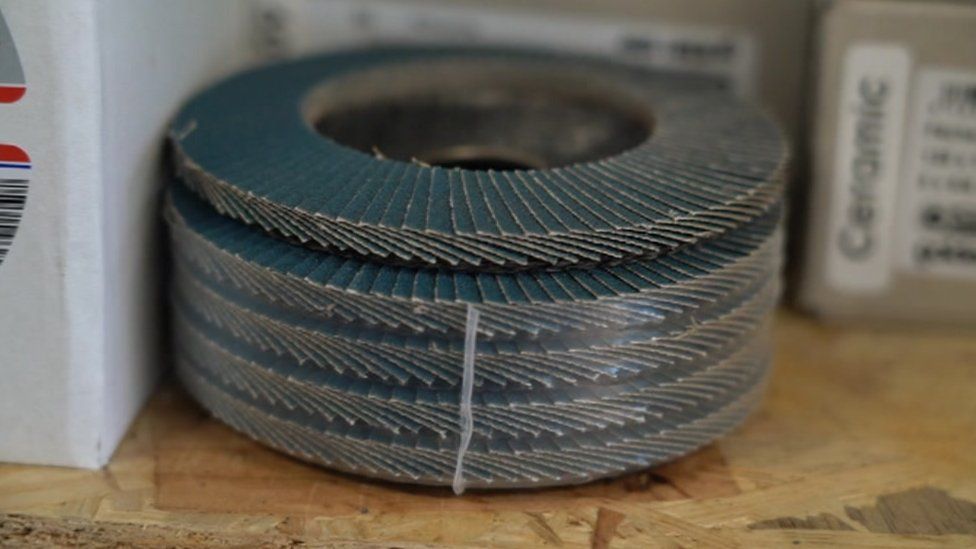
Image caption, Mr Laurens’ company supplies abrasive tool parts
All of the products at his company, Severn Diamond Tools and Abrasives, are manufactured abroad.
“We never ship anything from the UK to Ireland anymore. The last time we did, it took four weeks for a parcel to arrive to the customer. Before Brexit it used to take three days,” Mr Laurens said.
“As a business, we have no plans to invest in the UK market because of the uncertainty around the government.”
Nationally, when the British Chambers of Commerce surveyed 500 firms, more than half of them said they were still grappling with the rules for trading within the Union.
The red tape may have deterred some small exporters altogether. A study of customs classifications shows the variety of goods British businesses export has diminished.
Leaving the EU also meant changes to the rules on the free movement of labour and the introduction of a points-based immigration system that has prompted complaints from some unlikely quarters.
Image caption, Ms Husein-Miya says recruitment in the hospitality took a hit after Brexit
Shamim Husein-Miya, the business director of Five Rivers Restaurant, has said the Walsall firm has had to adapt the way it recruits staff. “As a business, we looked at overseas recruitment for many years before Brexit, but now it has been more challenging.”
However, as many around the country struggle to cope with the rising cost-of-living, the restaurateur said it had boosted staffing levels, with many people now seeking second jobs and other means of income.
The International Monetary Fund (IMF) has predicted the UK economy will shrink and perform worse than other advanced economies, including Russia, as the cost of living continues to hit households.
The IMF forecasts the UK economy will contract by 0.6% in 2023, rather than grow slightly as previously predicted.
However, the IMF also said it thought the UK was now “on the right track”.
The UK government has previously said Brexit “opens new opportunities for UK businesses”.
Speaking in December, it said: “Despite difficult global economic headwinds, UK-EU trade is rebounding, with recent data showing that UK trade to both EU and non-EU countries is above pre-Covid levels,” adding exporters had been provided with “practical support” with post-Brexit trading arrangements.
“We’ve also removed 400 trade barriers across 70 countries in the past two years, removed tariffs on £30bn worth of goods and cut £1bn business costs arising from current retained EU law,” a spokesperson added.
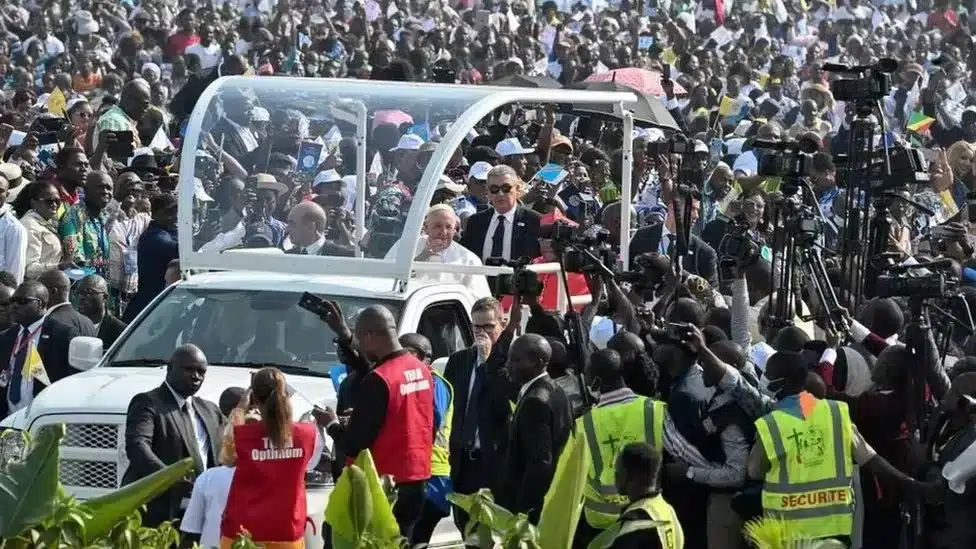
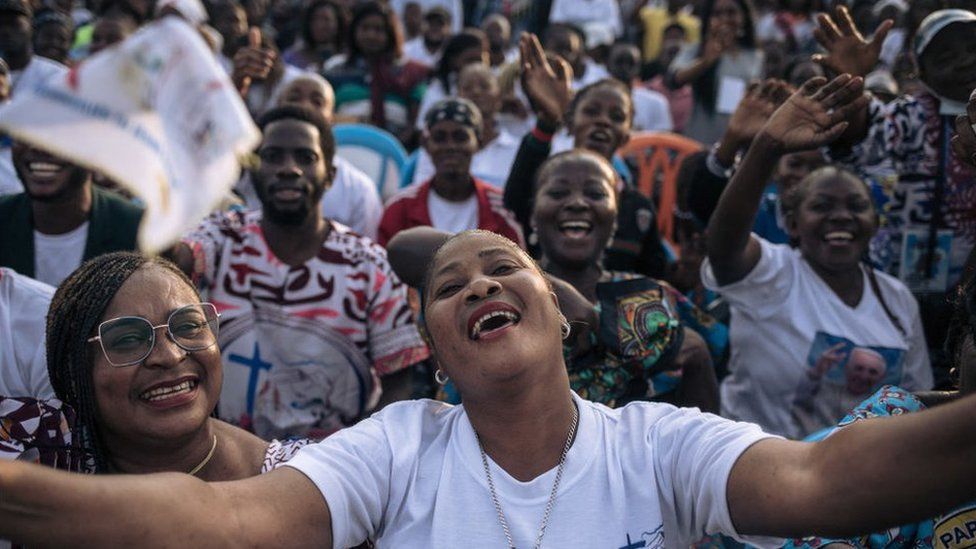
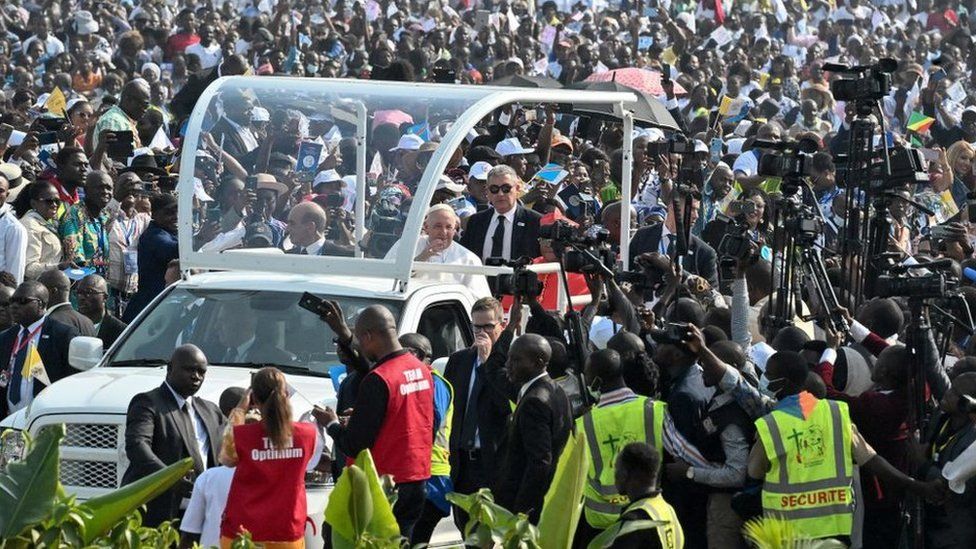
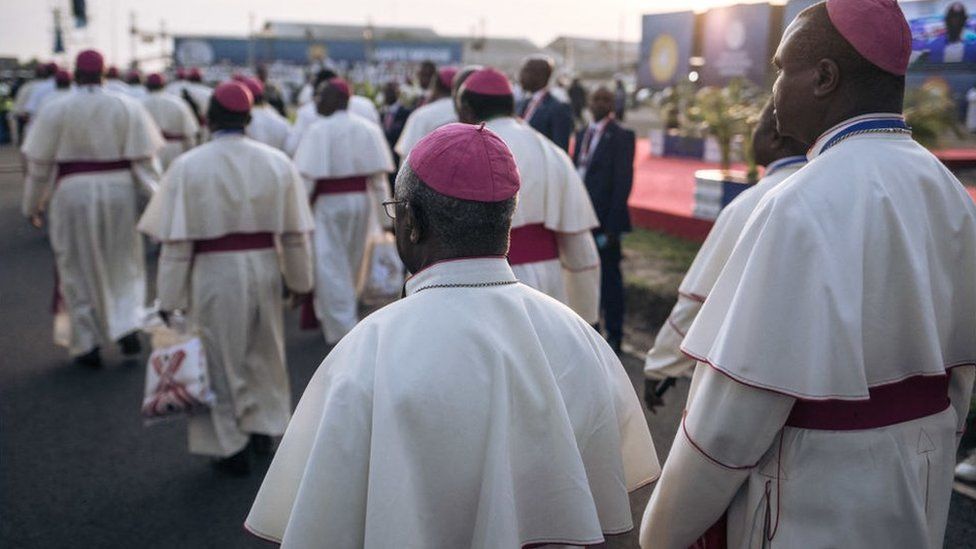
Huge crowds started to gather in Kinshasa well before dawn, including scores of schoolgirls dressed in white who danced along the Pope’s route.
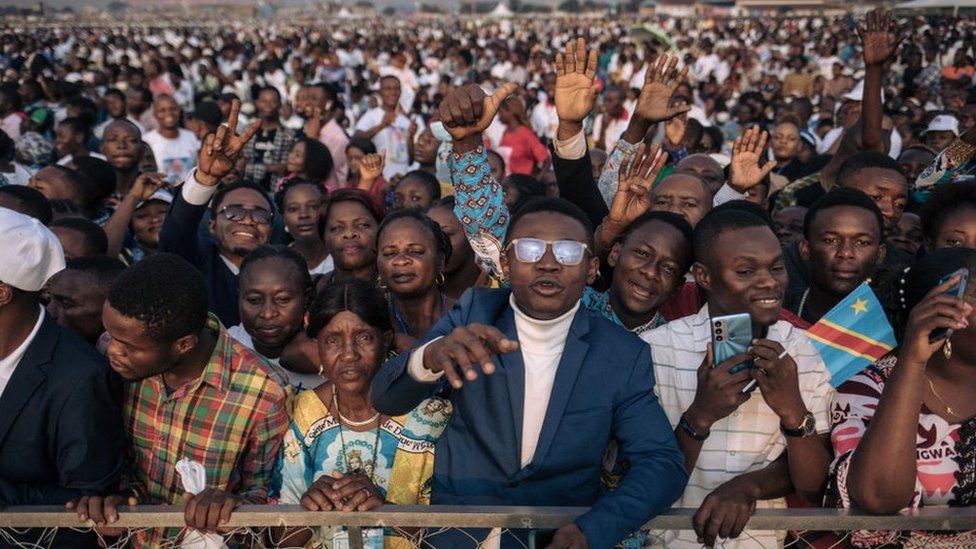
A public holiday was declared, so as many people as possible could attend.
Around half of DR Congo’s population is Catholic – the largest Catholic community in Africa.
It is more than 37 years since a pope had visited the mineral-rich but conflict-ridden country.
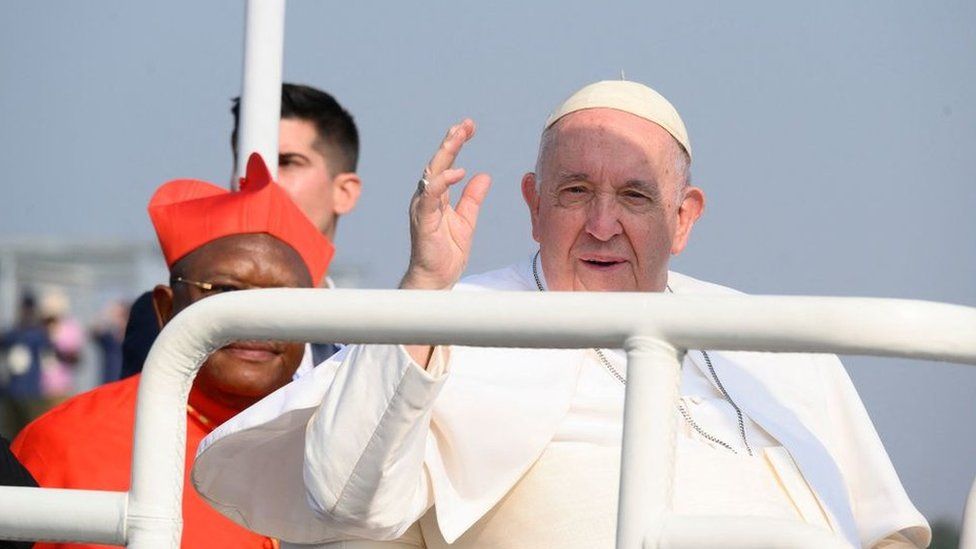
Image caption, Africa is considered the future of Catholicism, but some say it should have more representationImage caption, Many people gathered in the early hours of the morning to see the Pope
There had been some murmurings that the Pope has not been as critical of DR Congo’s political leadership as some had hoped, but the Mass at N’dole airport was a joyful event, and the pontiff did have a strong message of peace for those engaging in conflict in the country.
On the second of his six-day visit to Africa, he said warring sides should forgive one another and grant their opponents a “great amnesty of the heart”.
He went on to espouse the benefits of cleansing one’s heart of “anger and remorse, of every trace of resentment and hostility”.
Image caption, It has been nearly four decades since a pope visited DR CongoImage caption, There were jubilant scenes in Kinshasa as the Pope delivered a message on forgiveness
Wednesday’s Mass was tipped to be one of Pope Francis’ largest-ever Masses, second only to one held in the Philippines in 2015, according to Christopher Lamb, the Rome correspondent of the Catholic magazine The Tablet.
In an interview with the BBC’s Newsday radio programme, he said Catholicism was growing in Africa: “This is the future of the church and the growth of the Catholic Church in Africa really is so important to the future of Catholicism.”
On Tuesday, the Pope met President Félix Tshisekedi and delivered a speech condemning historical exploitation of Africa’s resources, which he described as “economic colonialism”.
He also addressed DR Congo’s plight, as minerals have played a key role in more than three decades of armed conflict there: “Hands off the Democratic Republic of the Congo! Hands off Africa! Stop choking Africa, it is not a mine to be stripped or a terrain to be plundered.”
However, a planned visit to the eastern city of Goma has been cancelled for security reasons. The eastern part of DR Congo is facing escalating violence as security services fight against armed militia groups.
According to the United Nations, some six million people have been forced to flee their homes in DR Congo.
That is one of the largest populations of displaced people in the world, alongside places like Afghanistan, Yemen, Syria and Ukraine.
Most of the displaced are in the eastern provinces of South Kivu, North Kivu and Ituri.
Image caption, The Pope’s welcome to DR Congo has been described as vibrant
Which? said consumers should be alert to caffeine levels.
“Our research shows you may be consuming significantly more, or less, caffeine than you bargained for,” said its nutritionist Shefalee Loth.
“Most of the time this shouldn’t be an issue but if you drink a lot of coffee or need to limit your caffeine intake you might want to consider what you’re ordering and where from.”
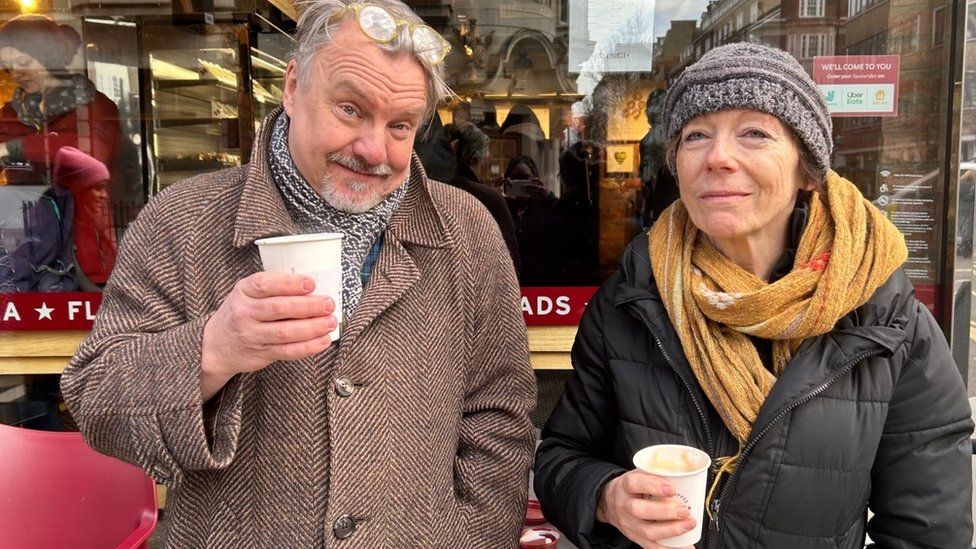
Image caption, Simon and Sarah
Simon, 64, told the BBC he normally preferred small, independent coffee shops but did sometimes go to Costa and Pret.
“I’m not really strongly affected by caffeine, I can drink coffee in the evening and it doesn’t really affect me that much,” he said.
Guppy Bahtoye, 37, from Wolverhampton told the BBC: “I like my coffee – in fact, I travel that extra bit just go to Costa because I like the way they make their lattes.
“I was a bit surprised by this survey – by the extent of the variation of caffeine content. I had a latte once from McDonalds that gave me this huge caffeine kick…and then I crashed. I had to take a nap afterwards.”
McDonald’s declined to comment.
Caffeine is a natural stimulant that can make you more alert. However, some people are sensitive to it or need to avoid it for health reasons, such as being pregnant.
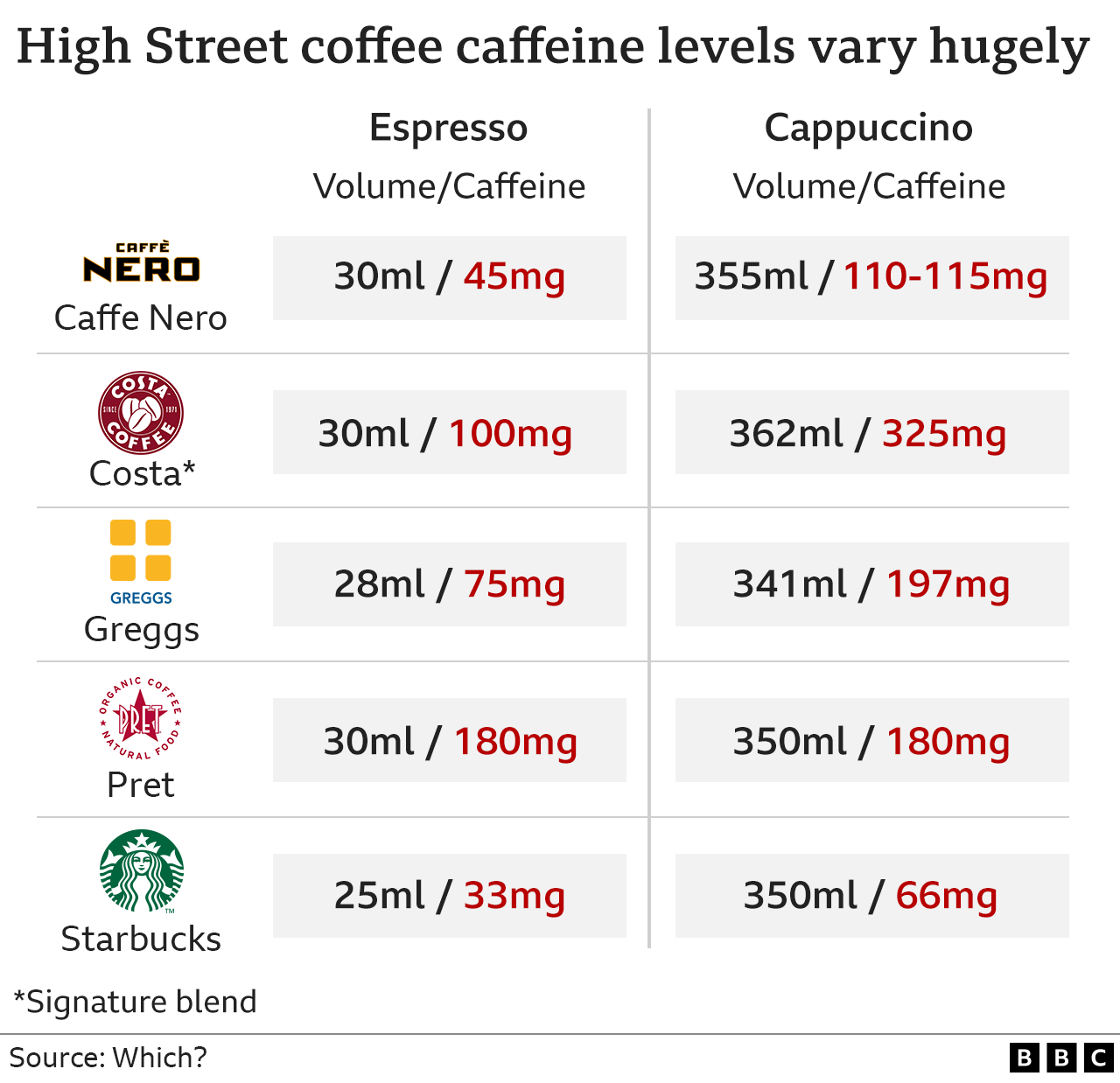
Which? measured the caffeine levels in drinks like cappuccino and espresso at Caffè Nero, Costa, Greggs, Pret a Manger and Starbucks, and found big differences.
For example, Costa’s cappuccino was strongest, with caffeine equivalent to four cups of tea, while Starbucks’ contained the least at 66mg – less than a single cup of tea.
One factor that can impact caffeine content of drinks is the type of coffee bean. Of the two main types used, Arabica beans contain around half the caffeine of Robusta beans, and there are also variations in taste between the two.
Costa Coffee said the amount of caffeine in its drinks varied depending on size of a drink and the type of coffee used.
“We would encourage customers to be aware of the caffeine content in their favourite Costa coffee to ensure it is right for their dietary requirements or lifestyle choice,” a spokeswoman said.
Pret declined to comment, while the BBC has contacted Caffè Nero, Greggs and Starbucks for comment.
The party says it wants ministers to “come clean” about the impact of keeping the “unfair” status ahead of the Budget on 15 March.
It says scrapping non-dom rules would bring in £3.2bn a year to spend on schools and the NHS.
But a Treasury minister said advice to ministers should remain confidential.
Responding to Labour’s call, Financial Secretary to the Treasury Victoria Atkins added that ministers need to be able to receive “free and frank advice” from officials.
She added the government keeps all taxes under review, and would only announce changes during Budgets.
It announced the policy last year, saying it would replace the rule with a shorter-term scheme for temporary residents.
In November, Chancellor Jeremy Hunt said he had asked officials at the Treasury to “look into” how much scrapping the policy would raise, following claims from Labour.
On Tuesday, Labour used a motion in Parliament to call for the government to publish the findings before 28 February, two weeks before the spring Budget.
However, MPs voted 305 to 229 to reject the motion.
During the Commons debate, shadow Treasury minister James Murray said non-dom status was an “indefensible 200-year-old tax loophole”, and getting rid of it was a “no brainer”.
He added: “Labour believes that if a person makes Britain their home they should pay their taxes here. That patriotic point should be accepted on all sides of the political divide.”
The SNP supported Labour’s proposals, with the party’s economic spokesman Stewart Hosie saying abolishing non-dom status was about “tax fairness”.
But Ms Atkins said: “In developing policy, ministers must be able to have, if you like, a safe space to be advised by officials.
“That process should not play out in public, especially given the issues that Treasury ministers deal with are often highly market sensitive.”
Last year it emerged that now-Prime Minister Rishi Sunak’s wife Akshata Murty had non-dom status.
Ms Murty said she did not want the issue to be a “distraction” for her husband, who was chancellor at the time.
The move comes as Washington moves towards a total ban on the sale of US technology to the Chinese telecom equipment giant, the paper said.
“Working closely with our interagency export controls partners at the Departments of Energy, Defense and State, we continually assess our policies and regulations and communicate regularly with external stakeholders,” a US Commerce Department spokesperson told the BBC.
“We do not comment on conversations with or deliberations about specific companies,” they added.
Huawei declined to comment on the reports.
The Biden Administration has continued to tighten restrictions on Huawei as political tensions between Washington and Beijing increased over Taiwan, where most of the world’s computer chips are made.
In October, US Under Secretary of Commerce for Industry and Security Alan Estevez said “the threat environment is always changing.”
“We are appropriately doing everything in our power to protect our national security and prevent sensitive technologies with military applications from being acquired by the People’s Republic of China’s military, intelligence, and security services,” he added.
For several years the Shenzhen-based Huawei has faced US export restrictions on items for high-speed fifth generation (5G) telecoms equipment and artificial intelligence technology.
In 2019, during the presidency of Donald Trump, US officials added the company to a so-called “entity list.”
It means that US companies need to obtain a licence from the government to export or transfer some technologies, especially over concerns that they will be used by the Chinese military.
However, in that time licences have been granted to some US companies, including Intel and Qualcomm, to supply Huawei with technology that was not related to 5G.
The price for wholesale electricity is set by a bidding process, with each generating company saying what it would be willing to accept to produce a unit of power.
When it’s windy and sunny enough to meet demand for electricity through renewables, the wholesale cost drops to close to zero.
But when it’s not, the wholesale cost is set at the level that all providers will accept – which is the highest bid.
In the past, gas powered generation was among the cheapest ways of producing electricity.
But the cost has soared recently as economies have recovered from the pandemic and Russia’s invasion of Ukraine disrupted supplies.
Charging an average price for wholesale electricity would have made the bill in the two years from 2021-22 £7.2bn lower, the Carbon Tracker Initiative said.
According to BBC calculations that’s about £250 per household.
Due to the current system, firms that make renewable energy have been paid much more for their power than it costs them to generate.
For this reason the government introduced a temporary 45% tax in January on what it calls “extraordinary returns” from low-carbon electricity generators in the UK.
Lower bills
Jonathan Sims, an energy analyst who wrote the CTI report, said the findings showed how the global gas market over the last two years had skewed British power prices.
He said these prices did not reflect the different technology the UK now uses to generate electricity.
The CTI’s report takes into account the need for sources of power that can be fired up immediately such as gas-fired, or provide near constant output such as nuclear, whereas wind power for example is weather-dependent.
The analysis also suggested Europe’s most gas power-dependent countries, the UK and Italy, had consistently paid the highest prices for electricity during the recent period of gas price volatility.
The business department said it was consulting on changes that “would stop volatile gas prices setting the price of electricity produced by much cheaper renewables”.
It also said its windfall tax on renewables generators would “help fund energy bill support for households and businesses”.
PayPal’s announcement follows tens of thousands of layoffs by technology giants in the last month alone.
This year, Google’s parent company Alphabet, Amazon and Microsoft have announced major job cuts.
“We must continue to change as our world, our customers, and our competitive landscape evolve,” PayPal’s chief executive Dan Schulman said in a statement.
Also on Tuesday, Snap – the parent company of social media platform Snapchat – warned that revenue for the three months to the end of March could fall by as much as 10%.
After the announcement Snap’s shares fell by almost 15% in extended trade in New York.
At the start of this year, Amazon announced it planned to cut more than 18,000 jobs because of “the uncertain economy” and rapid hiring during the pandemic.
Also this month, Alphabet said it would shed 12,000 jobs, while Microsoft said up to 10,000 employees would lose their jobs.
Last week, Swedish music-streaming giant Spotify said it would cut 6% of its about 10,000 employees, citing a need to improve efficiency.
In another sign of the technology industry slowdown US computer chip maker Advanced Micro Devices (AMD) on Tuesday reported a 98% fall in net income for the last three months of 2022.
The company also said it expects revenue to drop by as much 10% in the current quarter.
However, the figures were better than many investors had expected and AMD’s shares rose after the announcement.
In Asia on Wednesday, the world’s second-biggest memory chip maker SK Hynix posted its largest quarterly loss on record.
The South Korean company reported a worse-than-expected 1.7tn won ($1.4bn; £1.1bn) loss for the last three months of 2022, as sales fell by 38%.
The firm pointed to falling computer chip prices and joined rival technology giants as it warned that it expects an industry-wide downturn to worsen in the coming months, before recovering later in the year.
It came after rival Samsung Electronics on Tuesday reported its lowest quarterly profit in eight years.
The total was more than double 2021’s figure, and is likely to renew pressure on the industry after some countries, including the UK, imposed special taxes on the profits last year.
Exxon has criticised such measures as counter-productive.
Last month, it sued the European Union over the new windfall tax.
Exxon has also has spoken out against similar proposals in the US, where President Joe Biden has sought to focus blame for last year’s high motor fuel costs on companies failing to spend their profits to boost supply.
“The latest earnings reports make clear that oil companies have everything they need, including record profits and thousands of unused but approved permits, to increase production, but they’re instead choosing to plough those profits into padding the pockets of executives and shareholders,” said White House spokesman Abdullah Hasan.
In an interview with broadcaster CNBC, Exxon boss Darren Woods said the White House needed to “get its facts straight”, noting that the firm had continued to spend money on oil and gas projects despite pressure from investors and others to shift investments to renewable energy.
He told investors on Tuesday that the profits were a vindication of the firm’s strategy.
“Of course, our results clearly benefited from a favourable market but, to take full advantage of the undersupplied market, our work began years ago,” Mr Woods said in a conference call with investors. “We leaned in when others leaned out, bucking conventional wisdom.”
Exxon’s shares sank sharply in 2020, when demand for oil tumbled, leading the firm to report its first loss in decades.
But the price of the shares has soared since 2021, especially since oil prices jumped when the war in Ukraine disrupted energy supplies last year.
The firm said it had been working hard to reduce costs, and profits would have been even higher without the windfall taxes in Europe.
The company said it took a hit of $1.3bn in the final months of 2022, mainly from extra European taxes.
It also reported a $3.4bn charge for the year stemming from the expropriation of its investments in Russia.
Exxon said it increased investment by about 38% last year. In some key areas, such as Guyana and the Permian Basin, production was up more than 30%, offsetting output lost due to divestments and the change in Russia, the company said.
Overall oil production increased about 3% in 2022, to 2,354 thousands of barrels per day from 2,289 thousands of barrels per day in 2021.
Economic Secretary to the Treasury Andrew Griffith said the government remained “steadfast in our commitment to grow the economy and enable technological change and innovation – and this includes crypto-asset technology”.
“But we must also protect consumers who are embracing this new technology – ensuring robust, transparent and fair standards,” he added.
Even when the crypto market was booming, in 2021, calls for regulation were loud.
After the chaos of 2022, the calls for order are now deafening.
Hundreds of billions of pounds were wiped from the crypto landscape and companies and people went bankrupt thanks to scandal after scandal.
The UK’s plan to finally put concrete proposals in place will be welcomed by consumer investors hit in their pockets.
But I expect the consultation to be fiery, with many different groups wading into the debate about how to tame the wild beast of Bitcoin and other digital coins.
Part of the original appeal of cryptocurrency was its independence of traditional financial networks.
Moves to allow establishment control will infuriate a core group of true believers.
But with the right form of regulation, others will argue, the industry could truly blossom.
Last year, Rishi Sunak, then Chancellor, said he wanted to make the UK “a global hub for crypto-asset technology”.
But since then, the industry worldwide has been buffeted by a series of crises – most recently, the collapse of the FTX exchange, which prosecutors have described as “one of the biggest financial frauds in US history”.
The value of crypto assets has also fallen sharply, with Bitcoin now worth less than half of its highest price of more than $67,000.
‘Wild West’
The so-called crypto winter has raised questions about whether the industry can ever be effectively regulated.
Conservative MP Harriett Baldwin, who chairs the Treasury Committee, told BBC News it had heard evidence of “truly Wild West behaviour” but also recognised there was “valuable technological innovation happening that could benefit the UK economy”.
“We are paying close attention to these plans and to the regulators’ plans, because we would not want our constituents to think cryptocurrencies are any less risky if they are regulated,” she said.
Jason Guthrie, European head of digital assets at the financial firm, Wisdom Tree, said the sector had a bright future. The “devil would be in the detail”, he told BBC News, but he “absolutely welcomed” regulators looking at cryptocurrency – and the right regulation would be in the interests of the industry as well as customers.
“Having a solid a regulatory framework, having enforcement capabilities, is really important for consumer confidence,” Mr Guthrie said.
“The sooner we have details around concrete proposals, the easier it is to plan for and build towards.”
‘Open for business’
Jeremy Barnett, a barrister and honorary professor of algorithmic regulation, at University College London, said the UK had much to gain, as entrepreneurs were currently choosing to set up elsewhere.
“If you don’t have a proper regime, you drive people off shore,” he said.
“I want to see people who have cryptocurrency services and products encouraged to open for business in the UK.
“We should be in this space – but it does need to be regulated and policed.”
The government’s consultation on its proposals will close on 30 April, with any responses then considered by ministers.
Once any legislation is put to Parliament, it will be the job of the regulator, the Financial Conduct Authority, to draw up the detailed rules the sector will have to follow.
House prices in the UK fell for the fifth month in a row in January, according to Nationwide Building Society.
The price of the average property last month was £258,297, down by 0.6% on December.
Annual house price growth slowed to 1.1%, down from 2.8% in December.
The country’s biggest building society said it would be “hard for the market to regain much momentum in the near term.”
Robert Gardner, chief economist at Nationwide, said “economic headwinds are set to remain strong, with real earnings likely to fall further and the labour market widely projected to weaken as the economy shrinks”.
He added that the affordability of mortgages would “remain challenging” in the short term due to higher interest rates, while saving for a deposit was “proving a struggle for many given the rising cost of living”.
Mortgage approvals fall
On Tuesday, the Bank of England reported lenders had approved fewer mortgages than expected in December, about 35,000 compared with more than 46,000 in November.
That is the lowest number since January 2009, excluding the pandemic lockdowns.
Andrew Harvey, senior economist at Nationwide, told BBC Radio 4’s Today programme: “The decline [in approvals] wasn’t unexpected, given we have seen a big slowdown in mortgage applications following the mini-budget.”
However, he said there were signs mortgage rates were slowly starting to improve.
These latest figures suggest mortgages are less affordable in all regions compared with 2021, with the cost of servicing the typical mortgage as a share of take-home pay at or above the long-run average.
London and the south of England face the biggest “affordability pressures”, with Scotland and the North remaining the most affordable regions, but mortgage payments there as a share of take-home pay are still at their highest level for more than a decade.
Image caption, The capsule went missing after being transported from a mine near Newman in Western Australia
An urgent search is under way in Western Australia after a tiny capsule containing a radioactive substance went missing.
The casing contains a small quantity of radioactive Caesium-137, which could cause serious illness if touched.
It was lost between the town of Newman and the city of Perth in mid-January – a distance of roughly 1,400km (870 miles).
The public has been warned to stay away from the capsule if they see it.
It was being transported on a truck between a mine site north of Newman in the Pilbara region and the north-eastern parts of Perth between 10-16 January when it was mislaid. Caesium-137 is a substance commonly used in mining operations.
The Department of Fire and Emergency Services (DFES) has said the capsule cannot be weaponised but could cause radiation burns and have other longer-term risks like cancer.
The object emits a “reasonable” amount of radiation, Dr Andrew Robertson, the state’s chief health officer and Radiological Council chair, said.
“Our concern is that someone will pick it up, not knowing what it is,” he said. “They may think it is something interesting and keep it, or keep it in their room, keep it in their car, or give it to someone.”
Image caption, The missing capsule is tiny but said to contain a “reasonable” amount of radiation
DFES has released an illustration of the object, which measures 6mm by 8mm.
The sites where the transportation began and ended have been searched and efforts are under way to figure out the exact route and stops that were made to narrow down the field of search.
Anyone who sees the object is asked to call the DFES and to seek urgent medical assistance if they think they have come into contact with it.
A. HIGHLIGHTS OF MOF MEETING WITH IBF ON FRI. 27th JAN, 2023.
1. The Minister of Finance (FM) welcomed the IBF recommendations from the report and indicated that it was something Ghana needs to consider.
2. The finance minister iterated the position that the DDE is voluntary for individuals.
The government will honour its obligations to individuals who opt to retain their original bonds.
Thus, there will be no punitive action against individuals who opt to retain the bonds.
3. The MoF has no responsibility for happenings on the secondary market. For this matter, the FM cannot assure market liquidity for the old bonds.
He believes the benchmark bonds will be more tradable as more of those will be in circulation.
4. The FM understands the unique position of individuals and collective investment schemes – as enumerated by the IBF leadership – for which reason he is considering presenting a revised DDE offer on Monday, 30th January 2022 for individuals to consider participating if they desire.
It will remain purely optional and voluntary.
B. THE IBF POSITION
1. We welcome the Minister’s affirmation of the rights of individual bondholders to have the benefits of their current investment fully honoured without discrimination or punitive actions against non-DDE individual investors.
This, in effect, presents individuals with a self-exemption option which bears no negative implications as far as government’s payment obligations are concerned.
2. The original bonds retain more economic value and provides stronger enforcement rights than the DDE bonds.
They are also well suited for the investment plans and life goals set by individuals at the time of their investments.
In our estimation, this makes the original bonds superior and will be more tradable and liquid. We anticipate increased trading between individuals and pension funds who continue to pursue higher and realistic returns.
3. The IBF remains willing and able to assist government further consider the proposed fiscal adjustments and recommendations captured in the joint technical committee report.
The report estimates savings or fiscal space in excess of GHS83bn to assist government reduce its DDE indebtedness of GHS138bn.
4. The IBF as at the publication of this release has not received the MoF’s revised proposal for our consideration, evaluation and advice to members.
5. Individuals, as responsible citizens, have subjected themselves to all the new tax regimes aimed at boosting government revenue without complain.
This is a massive contribution to government’s economic turnaround strategy.
C. RECOMMENDATION TO INDIVIDUALS AND COLLECTIVE INVESTMENT SCHEMES
1. If you intend to optimise your investments, maintain your superior original/old bonds.
Hence, do not sign up to the DDE.
2. Do not harbour any form of fear of being punished for rejecting the DDE.
The law is in your favour and the Minister of Finance has been categorical in affirming your right by stating that he will honour obligations under the old bonds and will not undertake any action to punish individuals who reject the DDE.
3. If you feel compelled to support the DDE programme for other reasons, please, do not hesitate to sign on to the DDE.
4. To support the turnaround of the economy, we encourage all not to lose confidence in Ghana’s financial system.
The continuous investments and savings of everyone is required to spur the growth of our economy.
5. We urge every citizen to file their taxes and honestly pay up all obligations due.
We all owe it to Mother Ghana to make things work.
We are grateful to the Finance Minister and the Government for the cooperation extended us during this process.
He said that the incident took place after the construction company left the location.
Dr. Baizie explained what happened when the NDC left power on GHOne TV: “A lot of political interference went place. As a result, security measures were not even taken to protect the supplies and equipment that were on-site.
“So as we speak, my understanding is that a lot of materials and equipment have been stolen from the site. It is estimated that the value is over US$7million. I think the Minister of Works and Housing should be in the position to tell us why security was not provided at the site when they knew that they were supposed to provide security,” he added.
Read the full story originally published on May 1, 2021 by Kasapaonline.
According to him, the theft took place when the construction company abandoned the site and left behind some of its materials and equipment, a move that allowed people to take whatever they wanted.
“When NDC left power, what happened was that a lot of political interference took place. As a result of that even protecting the materials and the equipment that was on-site with security was not done.
“So as we speak, my understanding is that a lot of materials and equipment have been stolen from the site. It is estimated that the value is over US$7million. I think the Minister of Works and Housing should be in the position to tell us why security was not provided at the site when they knew that they were supposed to provide security,” Kaminta Baizie told Francis Abban host of the ‘State of Affairs’ show on GHONE TV.
Meanwhile, Minister for Works and Housing Francis Asenso-Boakye says about US$32million is needed to complete the Saglemi Housing project.
He however says his ministry is taking all necessary measures to get the facility completed for use.
“The original output target of the Saglemi project of 5,000 units at a total cost of US$200 million as stipulated in the financing agreement presented to, and approved by Parliament had surreptitiously, and drastically, reduced to 1,502, of which 1,389 units had been completed without a commensurate reduction in the overall loan financing. Currently, an amount of approximately, US$197 million representing 98 percent has been expended on 1,502 units as against the planned 5,000 units,” the Minister said at a press conference in Accra Tuesday.
“Although the financing of the project had largely been exhausted, an initial technical audit by the Ministry revealed the lack of primary infrastructure to the Saglemi project site thus limiting the utility of the development. The key primary infrastructure still outstanding include water supply and electricity.”
“The Ministry tasked the Ghana Institution of Surveyors to conduct a cost and technical audit of the contract executed by the contractors in the context of the variety of agreements and commitments made by the parties to the project. Upon completion of the audit, the Ghana Institution of Surveyors estimated that an approximate amount of US$32 million would be needed to complete the project”, he added.
Hon. Asenso Boakye disclosed that “as recent as 18th March 2021, I have personally visited the project site and have acknowledged the urgent need to complete the project, notwithstanding the complexities the project presents. Several ideas and scenarios, including dedicating a section of the housing units to the Armed Forces of Ghana, have been mooted and are being analyzed. A cursory inspection of the current state of development belies the fundamental challenge of the absence of the primary infrastructure the site suffers, for which reason a further investment is required. As the country faces the ravages of the COVID-19 pandemic, public finances are severely constrained, the Ministry acknowledges that completing the development is not an easy or straightforward task.
“These facts are not information exclusive to the Ministry and could easily be found in the public domain due to the extensive news coverage the issue has garnered over the past four years. For this reason, the Ministry finds this video to be a grandstanding gesture laden with diabolical intent, to say the least.”
This was revealed in a statement released by the company in Accra.
ECG said in the statement that it had listed every unit usage and the anticipated cost in a “Reckoner” that makes it crystal obvious how the tariff is applied and billed.
The Reckoner will be displayed at all districts and customer service centres nationwide to guide customers on their electricity purchases.
The company said it has established customer help desks in all our districts and customer service centres to assist and explain to customers as well as reconcile any challenge that they may face.
While assuring customers and stakeholders of its commitment to ensuring a smooth implementation of the new tariff, ECG advised customers to conserve energy and spend less on electricity.
He contends that while providing excellent customer service to travelers is still a top concern for the airline business, it is essential that they feel secure and at ease while using their facilities or flying.
Speaking at the 4th Aviation Ghana Stakeholders Meeting in 2023, Mr. Ofori Asiamah emphasized that the government will, on the other hand, provide an atmosphere that will allow indigenous carriers to prosper.
“Customers Service delivery is very important in the airline industry and I want to entreat all the airlines to provide safe, reliable and comfortable flight to their passengers. They should always remember that the passenger comes first,” he said.
“Government on its part will continue to create enabling environment to grow the domestic airlines across the nation,” he added.
The Bank of Ghana’s latest survey is consistent with the Ghana Purchasing Managers Index conducted during the same period, which improved to 47.0 percent in December 2022 from 44.9 percent the previous month.
Per the January 2023 summary of economic and financial data, the latest business confidence survey – conducted in December 2022 – shows that the optimism of businesses turned positive and logged at 75.7 percent from a baseline level of 100 percent, following a 5th consecutive decline in business confidence surveys. Notwithstanding, the current survey remains lower compared to the same period of 2021 at 98.4 percent.
The central bank has observed that business sentiments turned positive due to the achievement of short-term targets and optimism about companies’ and industry prospects – during the last confidence survey in December 2022.
“Business sentiments also turned positive due to the achievement of short-term targets and optimism about company and industry prospects, following the local currency rebounding during the month. The survey findings were broadly aligned with observed trends in Ghana’s Purchasing Managers Index, which improved to 47.0 percent in December 2022 from 44.9 percent in the previous month,” the Bank of Ghana Governor, Dr. Ernest Addison, said at a press briefing following the 110th Monetary Policy Committee (MPC) meeting.
Meanwhile, the latest confidence survey conducted by the Bank in December 2022 pointed to some marginal improvement in sentiments. Consumer confidence improved on the back of recent reductions in ex-pump petroleum prices and transportation fares.
A final agreement with the IMF following the staff-level agreement (SLA) is contingent on the Domestic Debt Exchange Programme and external debt restructuring, which when concluded and the necessary financial commitment is obtained will allow the SLA’s presentation to the IMF Board.
Confidence would further be boosted by a final agreement with the IMF following the SLA, which is contingent on the Domestic Debt Exchange Programme and external debt restructuring.
The IMF final agreement, when reached, will help restore fiscal and debt sustainability and bring down inflation as well as help stabilise the currency.
Economic activity
According to the Bank, domestic growth conditions softened in 2022; and are projected to moderate and remain below potential over the near-term, based on the elevated inflation levels.
Inflation remained elevated in 2022, driven by both demand pressures and supply shocks. The two price readings since the last MPC meeting showed a significant jump in headline inflation, to 54.1 percent in December 2022 from 50.3 percent in November and 40.4 percent in October 2022.
The updated Composite Index of Economic Activity (CIEA) showed a continued dip in economic activity, despite the slight improvement in consumer and business sentiments from the latest surveys. In nominal terms credit to the private sector rose sharply, but was moderated in real terms by price pressures.
Further into the fourth quarter, the Bank’s high frequency indicators recorded a moderation in economic activity, as the real CIEA contracted by 6.2 percent in November 2022 compared with a growth of 10.2 percent in the same period of 2021. The major items that weighed down the index during the period were port activity, cement sales, imports and industrial consumption of electricity.
Similarly, economic activity – as tracked by Ghana Statistical Services (GSS) – for the first three quarters of 2022 was within projections, albeit at a moderated pace than a year earlier; expanding at an annual rate of 3.6 percent during the first three quarters of 2022 relative to 4.8 percent during the corresponding period in 2021.
Globally, the economic outlook remains uncertain owing to broad-based and elevated inflation, policy tightening, worsening financing conditions and lingering spill-over effects from geopolitical tensions. These headwinds are likely to persist through the first half of 2023, driving down confidence and weakening real household disposable incomes in advanced and emerging market economies.
For emerging and developing economies, growth momentum is projected to remain firm, supported by the relaxation of lockdown restrictions in China and still-high commodity prices. Though showing signs of cooling, inflation levels remain elevated; and central banks, especially in advanced economies, have signalled the need to maintain a tight monetary policy stance to contain inflationary pressures, albeit at a measured pace.
Archie Hesse, CEO of the Ghana Interbank Payment and Settlement Systems (GhIPSS), and John Awuah, CEO of the Ghana Association of Banks (GAB), have refuted the idea that the two are rivals, arguing that cooperation rather than competition is the key to seizing opportunities that benefit both parties.
“Fintechs cannot be effective alone or by working in silos. Instead of heated competition with other stakeholders, there is a need to forge partnerships that achieve universal access to financial services. A collaborative approach will also benefit fintechs, banks, EMIs and, most importantly, the underserved,” Mr. Hesse stated.
The impact of this progress, he added, is visible in the increased levels of financial inclusion and related economic empowerment. For instance, in the recently published Global Findex Report by the World Bank, Ghana’s inclusion rate stood at 68 percent as at December 2021… increasing by 10 percent since 2017.
“This growth trajectory is predicated on technological gains in the financial services sector, created by a resilient digital ecosystem that is innovative, inclusive and anchored by a visionary and responsive regulatory environment,” he stated.
This, he added, can further be enhanced by a collaborative effort targetting unserved and underserved segments of the population.
He said that fintech firms play a key role in the financial services sector, and that passage of the Payment Systems and Services Act 2019 (Act 987) and establishment of the Fintech and Innovation Office by Bank of Ghana seek to, among other things, structure the ecosystem to allow them play an even more import part in the economy as well as enhance collaboration.
For Mr. Awuah, evolving customer needs and the ever-changing face of the financial services sector requires much greater collaboration between banks and fintechs. Through partnership, he said, the two can develop sustainable financial solutions and unlock new frontiers for growth.
Mr. Awuah, who also spoke at the same event, said it is high time banks and fintechs saw each as partners. He added that much more still needs to be done to enhance the regulatory and policy frameworks, so as to improve competitiveness and efficiency in the national financial system.
Over-regulation killing growth of fintechs
Meanwhile, progress in promoting financial inclusion and digitisation could be undermined by excessive regulation of the financial technology space, according to industry players.
While reasonable regulation is key to healthy competition, growth and development, players are of the view that too much of it can be counterproductive: by stifling innovation and serving as a barrier for new entrants.
“Regulations are still tight, and I would call on regulators to soften the regulations and allow fintechs to grow. The only way we can get more fintechs, more financial companies and new ideas coming through, is to reduce the threshold for regulation,” Growth Africa Director for Taptap Send, Darryl Koku Mawutor Abraham, told the B&FT on the awards’ sidelines in Accra.
“If we fail to do this, what happens normally is that people run away because regulation becomes a barrier to entry. So, it means that they [fintech firms] cannot innovate and bring up new ideas,” stated Mr. Mawutor, who described the current regulatory regime as “one of the toughest barriers” to entry in the fintech ecosystem.
Similarly, Country Manager of DPO Pay, Frank Awelle – whose company was adjudged the Fintech Discovery of the Year, lamented that extreme regulation, if not checked, could hinder the burgeoning fintech space.
“Our challenges really have to do with regulations, and that’s why we need the Ghana Fintech Association to come in and see how they can sanitise the space for us,” he said
He, therefore, urged regulators to soften requirements for fintechs to allow for greater innovations and competition.
According to Norvan reports, the economist stated that the current high-interest rates on treasury bills show that the government is desperate to borrow more to fund its “profligate lifestyle”.
“I would advise that investors should be extremely cautious in investing in T-Bills as the government is likely to include it in the domestic debt exchange programme, although the Finance Minister says it won’t. And also, the rates on the T-Bills have gone crazy, they are not sustainable.
“Investing in T-Bills is investing in a government that is desperate, the government should be reining in expenditure and not be borrowing more. Let’s not help fund their profligate nature and fiscal indiscipline,” he was quoted by norvanreports.com.
He intimated that Treasury bills have become the government’s main source of borrowing.
“Government is now borrowing strictly for consumption and not for anything productive that can pay for debts by itself. And by the way, T-Bills are supposed to be used to solve short-term financing challenges and not a main source of financing. The government must learn to live within its means.
“The interest rates on T-Bills are unsustainable and with the way things are going, it will crash as it has done before,” he stated.
Former Ghana Ambassador to India, Sam Pee Yalley has questioned the rationale behind President Nana Akufo-Addo’s obsession with building a National Cathedral at a time of economic austerity.
Speaking on Dwaboase on TV XYZ, the National President of the NDC Professionals Forum (PRO-FORUM) wondered which benefit the citizens stand to gain from the construction of a facility which President Akufo-Addo has said is a fulfillment of a promise he personally made to God before becoming the country’s leader.
In his estimation, the project is not a priority at a time economic hardship is being battled by almost every house hold with the government relying on the International Monetary Fund’s (IMF) support to balance the country’s finances.
“President Akufo-Addo is a bad leader; He is a bad driver who has led the country to a low level…And with all these economic challenges, he is focused on building a cathedral,” he lamented.
Sam Pee Yalley, a veteran legal practitioner chastised the managers of the economy and admonished the president to focus on tackling the economic mess his cousin, Ken Ofori-Atta, the Minister for Finance, has created in the country.
“In this present age when Nigeria is implementing agricultural policies to feed its people; Rwanda is developing science…Ghana under this president we are going back to Biblical times, some 2,000 years back to look for Bible quotations when others are going to the scientific world,” Pee Yalley criticised.
To him, Akufo-Addo and his cohorts are stealing from Ghanaians in the name of the project.
“Why go into a contingency vault to build a cathedral?” he quizzed.
About 339 million cedis has been withdrawn from the country’s Consolidated Fund to finance the cathedral which has over the months irked most Ghanaians due to the opaque nature of the project’s funding.
Controversies
Apart from questions of accountability which have been repeatedly raised by the Minority in Parliament, there have also been concerns about the relevance of the project as the country cannot sustain its debts coupled with high inflation.
The questions led to two eminent clergymen and members of the Board of Trustees of the controversial National Cathedral project calling for its immediate suspension.
The two – Archbishop Duncan Williams and Reverend Eastwood Anaba asked for a financial audit to be undertaken before the project could continue.
Earlier in 2022, Bishop Dag Heward-Mills, the founder and leader of the Lighthouse Chapel International resigned secretly from the Board of Trustees of the project.
In the letter sighted by Citi News, Bishop Heward-Mills expressed disappointment at the leadership of the National Cathedral for ignoring concerns he raised in several letters he wrote to them with the recent one being in June 2022 through the Ghana Charismatic Bishops’ Conference.
Part of it reads, “I feel that the treatment of the issues I have raised in my several letters has been unfortunate. My letters have been ignored in the past; not attended to for years, and at best addressed flippantly.”
“You may recall I have spoken passionately and written extensively about the costs, the design, the location, the fundraising, the mobilization of the churches, and the role of the trustees. These, if heeded, would have made our project more achievable. Generally speaking, my inputs, my opinions, and my letters have been trivialized and set aside.”
According to the Chief Executive, this is evident in the creation of over seventeen thousand (17,000) jobs in the last four months by the Youth Employment Agency through its Community Heath Worker Programme CHWS, Prisons Office Assistants, Community Protection Assistants, the YEA Jobcentre and partnerships with the private sector.
This represented the total five thousand and four hundred (5,400), who were concurrently passing out at the various Police Training Schools in the country.
In his speech, the CEO averred that Akufo-Addo’s government aligns with Ghanaians and agrees that we are not in normal times and charged YEA and other Agencies to refocus creating employment and improving conditions of service for employees. According to him the Agency has already created over 17,000 jobs since his assumption as CEO and is poised to create thousands of more jobs before the close of 2023.
Apart from rolling out the traditional modules, allowances of Beneficiaries have now been increased to 500 cedis. There is also a deepened partnership with the diplomatic community and private sector to create more private sector led jobs.
Mr Agyepong also told the gathering that, YEAs new agenda also creates a platform for people in the technical and Artisan sector with an oncoming partnership with NEIP, NVTI, GEA etc.
To the Beneficiaries under the Community Protection Assistants CPAs module, the CEO advised them not to compromise on their professional integrity in the course of discharging their duties in the communities.
He added that the Agency would not hesitate to endorse sanctions to weed out any CPA personnel by the GPS for infractions in the rules of their engagement.
Mr Kofi Agyepong explained that such caution was against the background of assurance by the GPS to sign a Memorandum of Understanding (M.O.U) with the Agency to give consideration and priority to CPA personnel in future recruitment into the mainstream service.
He explained that the Agency had taken the necessary steps to clear all outstanding arrears owed beneficiaries to disburse their minds of engaging in malfeasance.
He assured that the NPP government under the leadership of His Excellency President Nana Addo Dankwa Akufo-Addo had made strenuous efforts in spite of the economic turbulence to release funds timeously to meet the monthly stipends of the Beneficiaries.
The passing out ceremony was concurrently held in Pwalugu Police Training School led by the Deputy CEO in charge of Operations, Alhaji Ibrahim Bashiru, in Accra by Director Technical Service Chris Arthur, Eatern Region by rhe Regional Director Jerry Adu Poku.
Over the next two weeks, the price of gasoline, diesel, and liquefied petroleum gas is expected to rise by 7 to 13 percent, according to the Institute for Energy Security (IES).
Petrol prices are anticipated to be adjusted by Oil Marketing Companies to sell for about GH15 per liter, while diesel sells for about GH17 per liter.
“On the basis of the rising international fuel prices as observed on the global S&P Platts platform, linked with the local currency’s value decline against the greenback, the Institute for Energy Security (IES) estimates a 7% to 13% jump in the prices of Gasoline [petrol], Gasoil [diesel], and LPG over the next two weeks ending February 14, 2023,” the IES said in a statement.
“The rise in domestic fuel prices would be occasioned in spite of government’s receipt of approximately 41,000 metric tonnes of Gasoil under its “Gold for Oil” programme, and that consumers must be prepared to buy for instance, a litre of Gasoline [petrol] for roughly GH¢15 in the coming days”, it added.
Meanwhile, government has taken delivery and begun to sell petroleum products under its ‘Gold for Oil’ policy.
The Ghana Customer Service Index (GCSI) released its fifth press release on January 26, 2023, at the British Council, and Ms. MacCarthy made this statement in an exclusive interview with Prince Benjamin of Class News.
“I suggested this year that businesses examine the inside-out method as one of my recommendations.
Simply put, that proves that you are effectively serving your internal clientele.”
The board chair of the West African Association of Customer Service Professionals (WAACSP) illustrated her point by citing the COVID-19 pandemic and how it impacted customer experience negatively.
“There were a lot of people [internal customers; workers] who suffered burnout,” she recalled. “There were a lot of people who suffered emotionally and that actually went on to affect the experience that they gave the [external] customer.”
“The idea is for organisations to start looking at the people they have employed as human capital,” she said, arguing that: “Anything you see as capital, you want to nurture and develop but the minute you start seeing it as human resource, it [becomes] something that needs to be consumed or used.”
“So develop and nurture, instead of use and consume,” she emphasised.
The GSCI, a yearly survey and analytic publication of customer service performance, launched in 2018, is the brainchild of Yvonne Ohui MacCarthy.
E-Commerce was revealed as the sector with the best customer service delivery (85.01%) for the year 2022. Ghana as a whole scored a C+ (69.37%) on the customer service front.