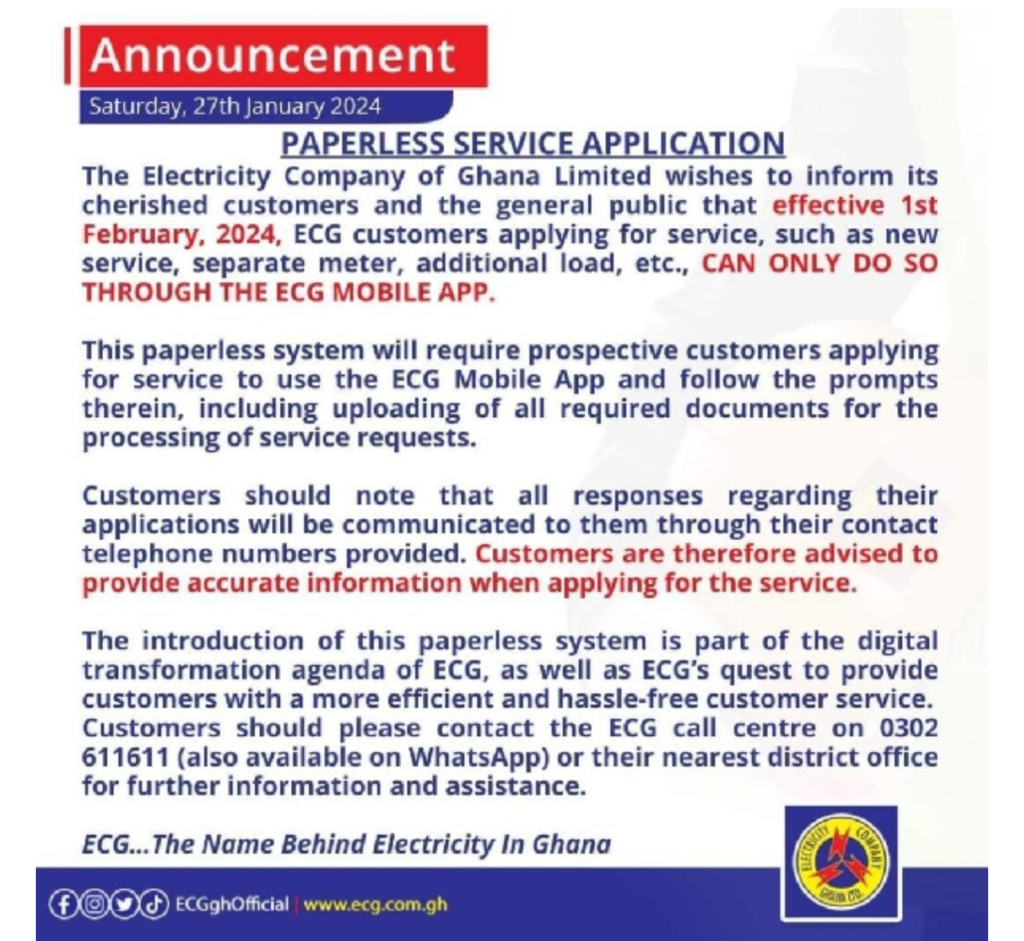
The Electricity Company of Ghana Limited (ECG) has announced a digital transition for services such as new connections, separate meters, and additional loads.
Starting February 1, 2024, these services will be exclusively accessible through the ECG Mobile App.
This strategic move aligns with ECG’s digital transformation agenda, aimed at improving customer service efficiency.
ECG underscores the importance of providing precise and active contact details during the application process, as all communication will be conducted through the provided telephone numbers.
“Customers should note that all responses regarding their applications will be communicated to them through their contact telephone numbers provided.”
“Customers are therefore advised to provide accurate information when applying for the service.”
Starting on February 1, 2024, the Electricity Company of Ghana (ECG) has introduced a new system for customers applying for various services, such as new service, separate metre, and additional load.
According to a statement released by the ECG, all service applications must now be submitted exclusively through the ECG Mobile App.
The transition to a paperless system means that prospective customers need to utilise the ECG Mobile App, follow the prompts, and upload the necessary documents for the processing of service requests.
Communication regarding the status of customer requests will be conveyed through the provided contact telephone numbers.
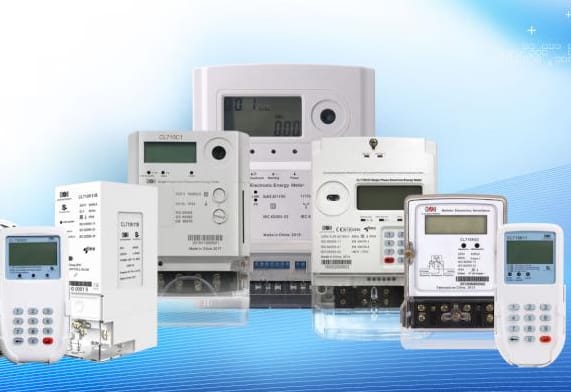
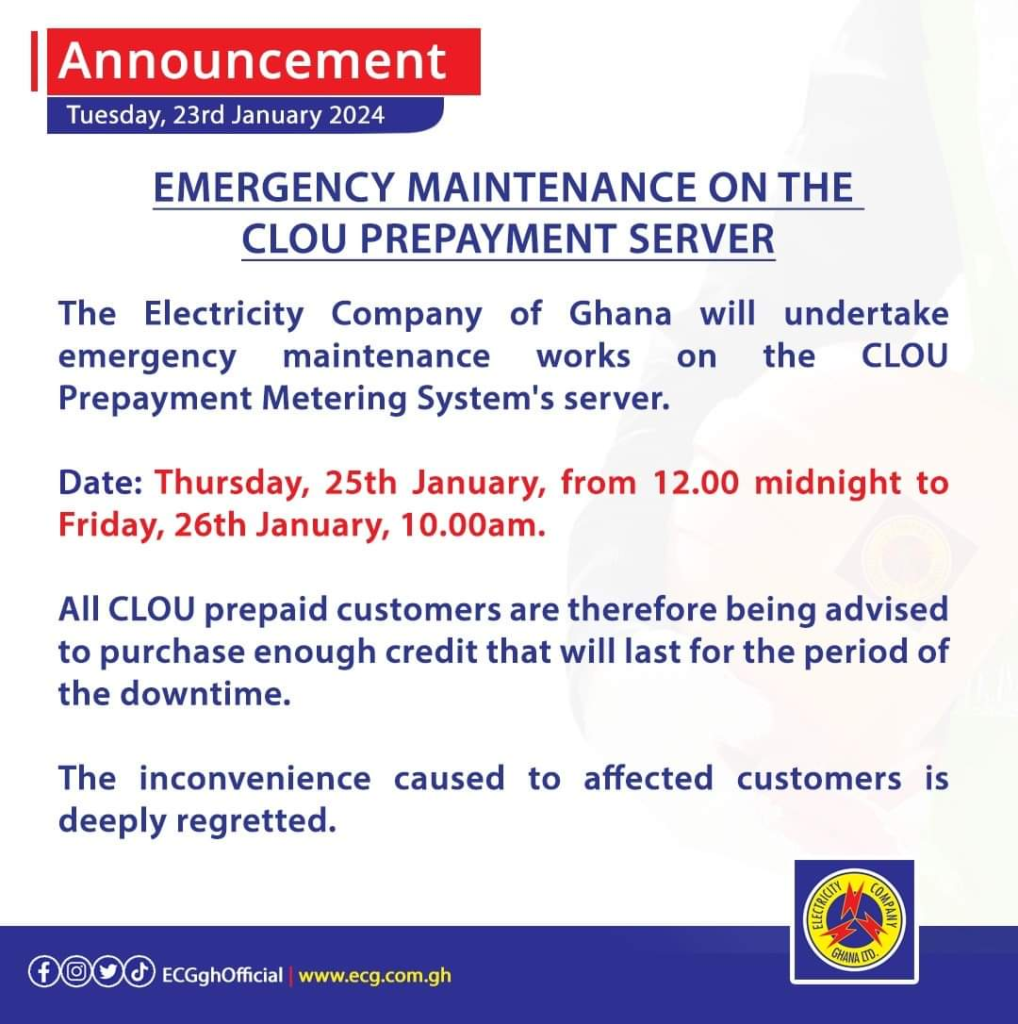
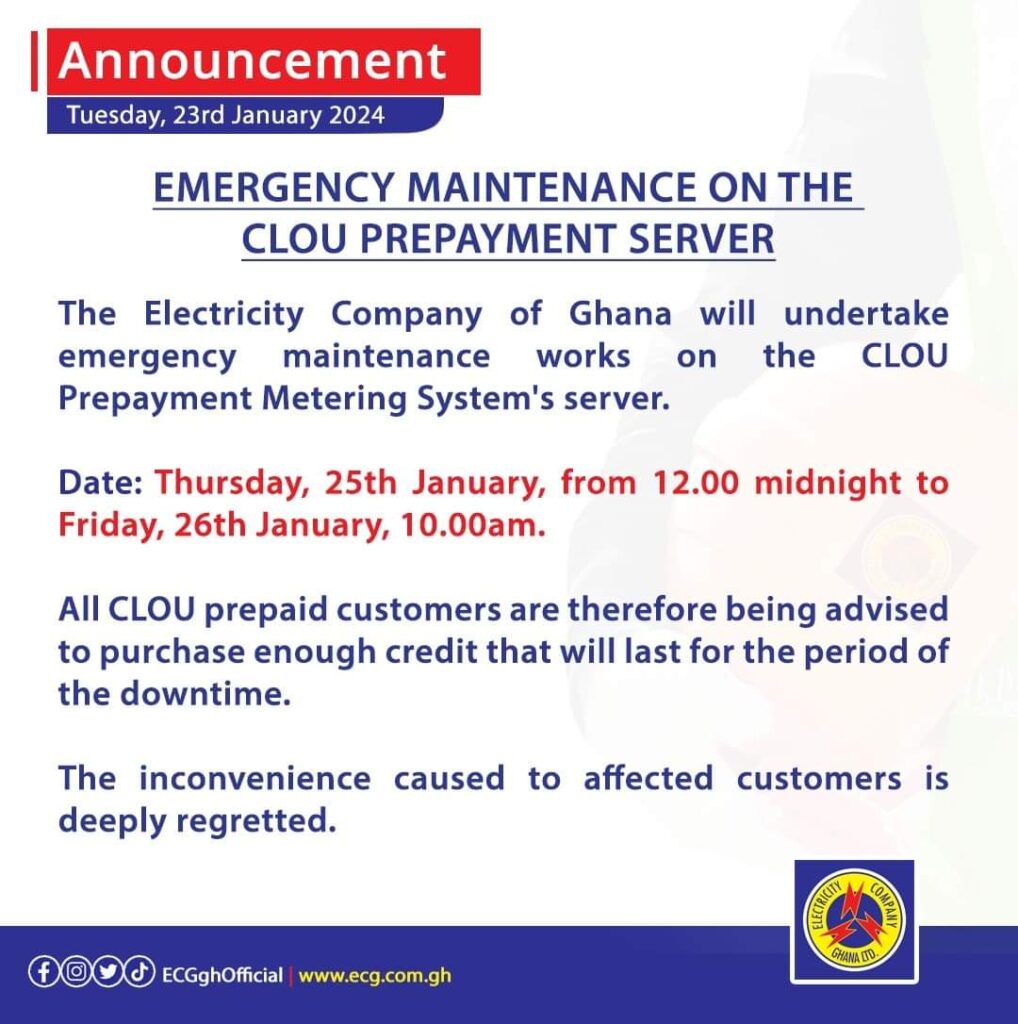
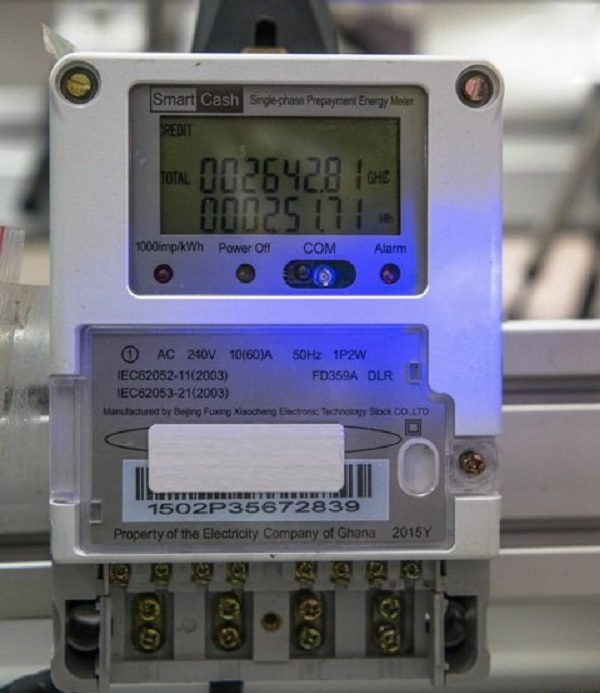
The Electricity Company of Ghana (ECG) has called on customers utilizing the CLOU prepayment Metering System’s server to purchase sufficient credit to cover the period from January 25 to 26. The announcement comes as part of the ECG’s plans to undertake emergency maintenance works on the CLOU Prepayment Metering System’s server.
A notice to customers, as cited by 3news.com, stated, “The Electricity Company of Ghana will undertake emergency maintenance works on the CLOU Prepayment Metering System’s server…All CLOU prepaid customers are therefore being advised to purchase enough credit that will last for the period of the downtime.”
The ECG expressed regret for any inconvenience caused to affected customers during the maintenance period.
The move has been prompted by the need for repair works on the CLOU system, and the ECG is proactively advising prepaid customers to ensure they have adequate credit to avoid any disruption in their electricity supply.
The announcement comes amidst customer complaints across various parts of the country regarding erratic power supply, impacting business operations. While government officials have consistently denied the return of ‘Dumsor,’ the intermittent power situation continues to be a concern for consumers.
The ECG’s proactive approach to communicate and advise customers on the impending maintenance works reflects the utility company’s commitment to transparency and customer satisfaction. As the scheduled maintenance takes place, customers are encouraged to comply with the advisory to minimize any inconvenience during the specified period.
The ECG’s initiative to address potential disruptions through planned maintenance aligns with efforts to maintain the reliability and efficiency of the power distribution system, ultimately contributing to a stable electricity supply for consumers across the region.
An independent presidential aspirant and former Minister of Trade and Industry, Alan Kwadwo Kyerematen, has criticized the government’s introduction of an additional Value Added Tax (VAT) on electricity users who exceed the lifeline threshold.
In a statement on the social media platform X, the founder of the Movement For Change expressed disapproval, arguing that given the current challenges faced by Ghanaians, imposing new taxes was untimely and added further burden to the citizens.
“In the kind of economic situation we find ourselves, every government policy, plan or decision, has to have the objective of achieving the following; reduce the cost of living, reduce the cost of doing business, reduce exchange rate, and create sustainable jobs for the youth” the former minister said.
Mr. Kyerematen emphasized that levying VAT on electricity would not contribute to any positive outcomes; instead, it would exacerbate the difficulties faced by the average Ghanaian.
The former Trade and Industry Minister noted that his Great Transformational Plan (GTP), “as a trusted roadmap, would guide us to achieve the above objectives and more.”
Various groups and individuals, including the Trades Union Congress (TUC), have strongly condemned the imposition of VAT on electricity. The TUC, through its General Secretary, Dr. Yaw Baah, issued a seven-day ultimatum to the government, demanding the withdrawal of the tax.
Dr. Baah underscored the detrimental impact of this decision on the livelihoods of ordinary Ghanaians, especially pensioners and those with low incomes.
During a press conference on Tuesday, January 23, he emphasized that the impoverished population in the country cannot afford to bear the additional tax burden. Dr. Baah called on the government and its agencies to promptly reverse the implementation of the proposed tax.
“It’s always the poor people in this country, including pensioners, who bear the brunt. And we should not allow that to continue. Organised Labour, we have come together and our message to the government is very simple, we cannot pay VAT on electricity.
“We will not pay it today or tomorrow. Organised Labour is demanding the immediate withdrawal of the letter, and another directive from the Finance Minister to Ghana Grid Company (GRIDCo), ECG to stop the implementation of the VAT on electricity. We are giving the government, up to January 31, 2024, to withdraw the letter,” Dr Yaw Baah said.
He emphasised that they would take the necessary action if the Finance Minister does not instruct GRIDCo and ECG to retract the letter.
“If by that time the Minister of Finance fails to give directive to GRIDCO and ECG, we will advise ourselves,” he said.
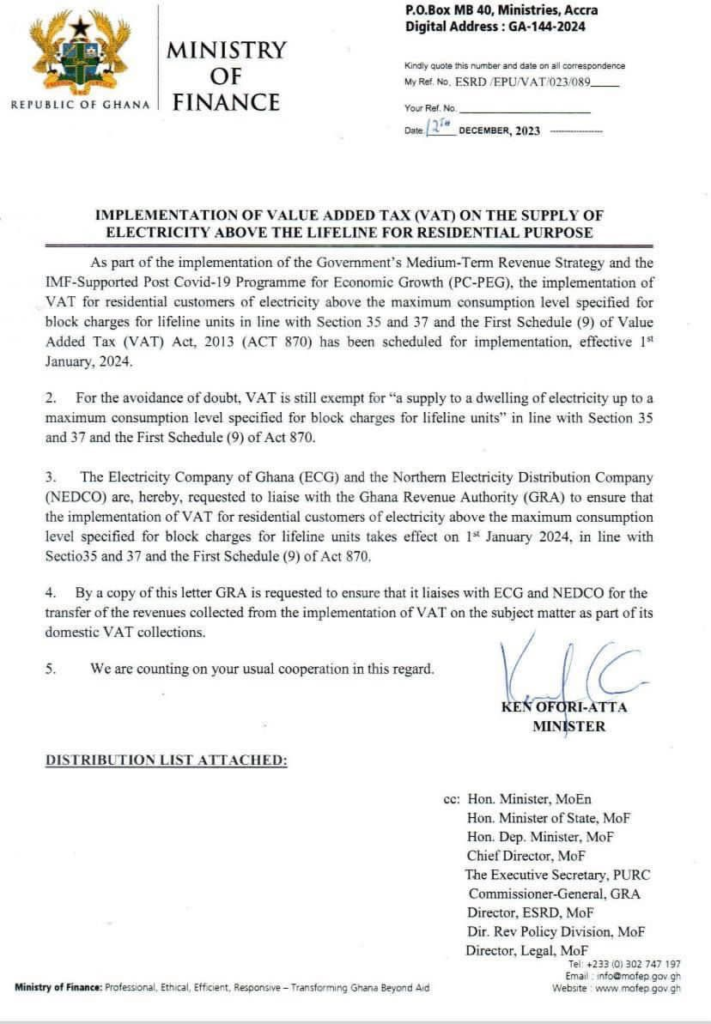
In a letter dated January 1, Finance Minister Ken Ofori-Atta directed the Electricity Company of Ghana (ECG) and the Northern Electricity Distribution Company (NEDCO) to implement a 15 percent VAT on electricity consumption. The objective behind this move is to generate revenue for the government’s COVID-19 recovery program.
The government has provided a rationale for the imposition of the VAT, citing it as a crucial component of their strategy to generate additional funds for the COVID-19 recovery initiative. Deputy Energy Minister Agyapa Mercer, in a media interview on Monday, January 15, acknowledged the difficulty of the decision but emphasized its necessity in settling debts owed to independent power producers.
“Obviously, if you look at the scope of the tax and what it is intended to do—raise revenue to meet some obligations of the government in the energy sector—it will interest you to know that, as we speak, as of July 2023, the amount of money that we owe to the IPPs alone is in the region of GH¢1.7 billion.
Electricity Company of Ghana (ECG) has advised all CLOU customers to ensure they have sufficient credit, as the company plans to conduct emergency maintenance on the CLOU Prepayment Metering System’s server.
The maintenance is scheduled to take place from midnight on Thursday, January 25, to 10:00 a.m. on Friday, January 26, 2024.
Customers using remotes to operate their prepaid metres are considered CLOU customers.
ECG issued this notice on Tuesday, January 24, emphasising the importance of purchasing enough credit to cover their power needs during the maintenance period.
Areas such as Korle-Bu District, Ablekuma District, Nsawam District, Amasaman District, Bortianor District, Tema North and South Districts, Ashaiman District, Krobo District, Nungua District, Afienya District, Koforidua District and Kibi District are expected to be affected during the operation.
The statement added that “The inconvenience caused to affected customers is deeply regretted”.
Electricity Company of Ghana (ECG) has clarified that the Value Added Tax (VAT) on residential electricity consumption above the lifeline category has not been implemented. In a statement dated January 22, 2024, the company urged all stakeholders to adhere to the previous payment model.
The proposed VAT on electricity consumption is intended to address debts owed to independent power producers, according to the government.
In the aftermath of disagreements surrounding the government’s decision to impose a new Value Added Tax (VAT) on electricity consumers beyond the lifeline threshold, the Electricity Company of Ghana (ECG), the implementing agency, has expressed reservations about the legislation enforcing the tax.
Despite being directed to implement the tax from January 2024, both ECG and the Northern Electricity Distribution Company (NEDCO) have yet to enforce it.
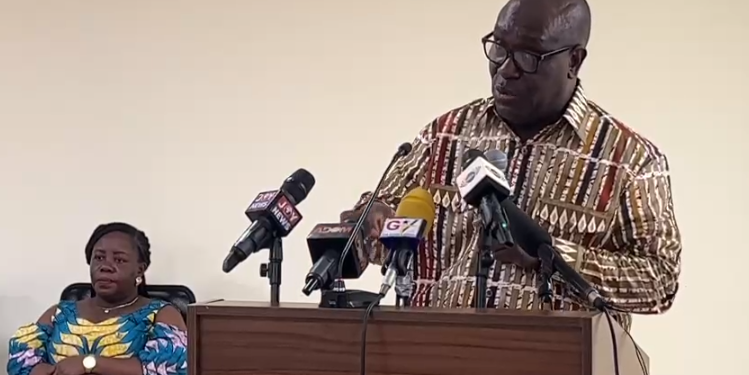
Speaking on Joy News, the Managing Director of ECG, Samuel Dubik Masubir Mahama, revealed that ECG has not implemented the tax due to concerns about the legal provision dating back to 2013.
Mahama sought a legal opinion from ECG’s lawyers in January 2023, highlighting issues with the provision in the law. He emphasized that proactive measures are being taken to address the gaps and find a resolution.
The ECG MD views the government’s directive to implement the tax as an opportunity for further stakeholder engagement on the policy. Despite acknowledging it as a directive, Mahama emphasized the need for conversations and stakeholder engagement, particularly when faced with bottlenecks.
“I asked for a legal opinion from the lawyers for ECG, to find out if within the law, this provision is right and in its implementation what it will mean. So let’s not take it for granted that even the company ECG or the government itself is not taking proactive measures to close this gap and find a way out of it.
He mentioned ongoing discussions with the Energy and Finance Ministers to review the law and determine the necessary actions. Mahama expressed support for the Trades Union Congress (TUC) and suggested that if the law needs reconsideration, it should be a national consensus.
“Conversations are far advanced. If this thing would have been charged this year, then by 1st January it would have been charged. Clearly, where we are now, we are finding whether even the law that was passed, what are the restrictions on the law…if it can be passed. We are finding a lot of interpretations.
“If this law has to go back to parliament for it to be looked at and reconsidered then yes, so be it. It should be a national consensus, so we need to applaud the TUC [Trades Union Congress] for what they are doing and also be clear that, if the thing is not being implemented and the last paragraph said, transfer the revenues collected from the implementation of the VAT on the subject matter as a domestic VAT collection, there are processes that need to be outlined.”
“It’s a technical difficulty; it’s a nightmare. How do you go about this?” he quizzed.
“First of all, one of the biggest challenges that will come up is this; are we charging the VAT on residential customers? If yes, are they on pre-paid meters? Yes. So, are you charging per the money or the consumption? Because with pre-paid the consumption will be known at the end of the day, so I will only know your consumption after you have consumed. So, if I charge you the VAT when you are about to pay that will not be fair if I am charging on consumption.
Mahama highlighted potential challenges in implementing the VAT on pre-paid electricity consumers, citing technical difficulties and the need for thorough stakeholder engagement to ensure fairness.
Various groups and individuals, including the TUC, have condemned the VAT on electricity, giving the government a seven-day ultimatum to withdraw the tax. Finance Minister Ken Ofori-Atta instructed ECG and NEDCO to implement the VAT as part of the government’s COVID-19 recovery program.
The government justifies the 15 percent VAT on electricity consumption as a measure to generate additional revenue for the COVID-19 recovery program.
Deputy Energy Minister Agyapa Mercer emphasized the necessity of the tax to settle debts owed to independent power producers, amounting to GH¢1.7 billion as of July 2023.
The Electricity Company of Ghana (ECG) has scheduled emergency maintenance works on the CLOU Prepayment Metering System’s server for Thursday, January 25 and Friday January 26, 2024.
As part of this maintenance, the system will undergo essential updates and enhancements to ensure optimal performance.
In light of these scheduled activities, the company advises customers to proactively purchase an adequate amount of credit to sustain their electricity consumption during the anticipated downtime.
This proactive measure is recommended to minimize any inconvenience that may arise due to the temporary unavailability of certain services associated with the CLOU Prepayment Metering System.
The company acknowledges the potential inconvenience to affected customers and expresses regret for any disruptions that may occur during the maintenance period.
Trades Union Congress (TUC) has issued a seven-day ultimatum to the government, demanding the withdrawal of the imposition of Value Added Tax (VAT) on electricity consumption above the lifeline.
In a letter dated January 1, Finance Minister Ken Ofori-Atta instructed the Electricity Company of Ghana (ECG) and the Northern Electricity Distribution Company (NEDCO) to implement the VAT as part of efforts to generate revenue for the COVID-19 recovery program.
However, the TUC, led by Secretary General Dr. Yaw Baah, strongly opposes this decision, highlighting its adverse effects on the lives of ordinary Ghanaians, particularly pensioners and low-income earners.
At a press conference on Tuesday, Dr Baah said “It’s always the poor people in this country, including pensioners, who bear the brunt. And we should not allow that to continue. Organised Labour, we have come together and our message to the government is very simple, we cannot pay VAT on electricity.
“We will not pay it today or tomorrow. Organised Labour is demanding the immediate withdrawal of the letter, and another directive from the Finance Minister to Ghana Grid Company (GRIDCo), ECG to stop the implementation of the VAT on electricity. We are giving the government, up to January 31, 2024, to withdraw the letter,” Dr Yaw Baah said.
He stated that they will advise themselves if the finance minister fails to directGRIDCo, and ECG to withdraw the letter.
“If by that time the minister of finance fails to give directive to GRIDCO and ECG we will advise ourselves,” he said.
The Electricity Company of Ghana (ECG) has clarified that it has not yet enforced the Value-Added Tax (VAT) on residential electricity consumption exceeding lifeline units.
Despite a directive from Finance Minister Ken Ofori Atta on December 12, 2023, instructing ECG and Northern Electricity Distribution Company (NEDCO) to collaborate with the Ghana Revenue Authority (GRA) for VAT implementation, the company states that the order is not currently in effect.
Originally slated to commence on January 1, 2024, the implementation aligns with Sections 35 and 37, as well as the First Schedule (9) of the Value Added Tax (VAT) Act, 2013 (ACT 870).
In a notice issued on Monday, ECG stated, “The Value Added Tax (VAT) on residential electricity consumption above the lifeline category has not been implemented. All stakeholders should please take note.”
Despite consumer opposition, citing potential cost hikes and economic repercussions, the Ministry of Finance defends the measure, asserting its alignment with the government’s medium-term strategy and the IMF-Supported Post-COVID-19 Programme.
The Electricity Company of Ghana (ECG) has addressed concerns regarding recent power outages, dismissing the notion that it signifies a return of the past ‘dumsor’ era.
In a notice on Sunday, the ECG emphasized, “While there is NO DUMSOR, we are still working to enhance the stability of the power supply.”
The company attributed the recent disruptions to local faults and encouraged affected customers to contact their call centers for assistance.
The notice stated, “We have noticed the concerns about intermittent power supply in some areas. We understand the impact this has, and we are actively addressing all issues. While there is NO DUMSOR, we are still working to enhance the stability of the power supply,” it said in a notice on Sunday.
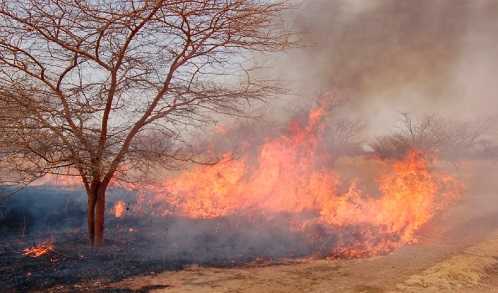
Earlier, ECG had attributed the issue to bush fires causing damage to electricity poles and distribution lines, warning of potential legal action against those responsible.
“If you are experiencing any power disruptions, it is a local fault, please reach out to our call centre on +233 30 261 1611 or send us a DM. Your feedback helps us address specific cases and ensures a more personalised response,” it said in a notice.
The public was urged to take precautions when burning bushes to prevent damage to properties.
However, skepticism has arisen, with some customers on social media accusing the company of covering up for the government.
One customer expressed frustration, stating, “The lies and deceitfulness are too much!” Others highlighted perceived political bias, stating, “This would have been dumsor under an NDC government, but since it’s NPP, it’s intermittent power supply.”
Residents from various areas shared their experiences of inconsistent power supply, raising doubts about the company’s justifications and calling for transparency in communication.
“I was doing my laundry this afternoon and the light just went off. ECG needs to be truthful to us as tax-paying citizens of this country. The lies and deceitfulness are too much!” one customer stated.
“This would have been a dumsor under NDC government but since it’s NPP it’s intermittent power supply in some areas. Wow! .The word ‘Dumsor’ doesn’t exist in NPP era.People are afraid to loose their jobs. Ah well,the good people of this will be the best judges,” another added.
“Come to Twifo Praso, you may think it’s the Headquarters of Dumsor. Even when Black Stars were about to start the match on Thursday, it went off and came back immediately after the match. They switch off the lights anyhow here.”
“My area some part have light some too don’t have and in the compound we are in some have light others too don’t have 3 days now no light why,” queried another.
Vice President, Dr. Mahamudu Bawumia has revealed the Electricity Company of Ghana (ECG)’s plans to combat power theft by implementing Artificial Intelligence (AI) and Remote Sensors across its systems.
Speaking at the launch of the ‘ECG Power’ mobile application, Vice President Bawumia emphasized the challenges ECG faces in collecting payments and preventing power theft.
He stated that the use of AI would be a significant game-changer, and the pilot system is underway, with promising results.
“The issue of solving the collection problem at ECG is a major part of solving the energy issue in Ghana. I think this app also enhances collection, but I am aware- because I have been talking to the Board Chairman and the MD– that they are thinking about applying technology, artificial intelligence and remote sensors in the collection process.
“I know that they are piloting the system now, and by the grace of God if all goes well, we will have implemented a new system, starting this year, whereby nobody will be able to steal electricity in Ghana again. “It is a major thing that the ECG is likely to implement this year, using artificial intelligence and remote sensing. They are piloting it right now, and the results look quite good. Once we solve that problem, the issue of losses from people doing ‘kuluulu’ connections of electricity will be a thing of the past,”Dr Bawumia said.
The ‘ECG Power’ app, designed in-house, aims to facilitate payments and services for ECG’s customer base, expected to increase as smart meters replace old ones.
Users can download the app from the Google Play Store or Apple App Store, while non-smartphone users can access the service by dialing *226#. Vice President Bawumia commended ECG for employing technology to address critical functions and enhance revenue mobilization.
He emphasized the government’s commitment to using digital technology for a comprehensive transformation of Ghana’s economy.
Ghanaians, especially rural residents, have been cautioned against igniting fires in the bush, particularly during the dry season.
The caution was issued by authorities of the Electricity Company of Ghana (ECG) who emphasize the potentially devastating consequences of these fires, warning that they have the potential to escalate into disasters.
Additionally, the ECG authorities indicated that these fire incidents affect their operations since they often destroy poles that help in providing electricity to communities.
This, according to the power distribution company, results in unstable power supply, and increasing the cost of maintenance.
During a media engagement in Ho, the General Manager of ECG in the Volta/Oti Regions, Christina Jatoe- Kaleo explained that the unfortunate incident has cost ECG and the state huge sums of money.
She indicated that ten electricity poles were burnt between December 2023 and 10th January 2024 in her jurisdiction, which would cost her outfit about GHS 70,000 to replace the affected poles.
“Some of the communities that do not have power, or they have but people have extended to new sites and they are requesting for us to extend services to them. These poles that should have been used to extend services to them have to be used to replace what have been destroyed by the bushfires”, she lamented.
She mentioned that ECG has implemented certain measures to reduce the impact of bushfires. These measures include clearing trees along ECG transmission lines, establishing fire belts around the poles, and using fire-retardant paint. Additionally, in areas prone to fires, ECG is replacing wooden poles with metallic ones.
She also entreated community members to be watchdogs and ensure the protection of the installations of ECG and also act as ambassadors to preach against bushfires.
Ghanaians, especially rural residents, have been cautioned against igniting fires in the bush, particularly during the dry season.
The caution was issued by authorities of the Electricity Company of Ghana (ECG) who emphasize the potentially devastating consequences of these fires, warning that they have the potential to escalate into disasters.
Additionally, the ECG authorities indicated that these fire incidents affect their operations since they often destroy poles that help in providing electricity to communities.
This, according to the power distribution company, results in unstable power supply, and increasing the cost of maintenance.
During a media engagement in Ho, the General Manager of ECG in the Volta/Oti Regions, Christina Jatoe- Kaleo explained that the unfortunate incident has cost ECG and the state huge sums of money.
She indicated that ten electricity poles were burnt between December 2023 and 10th January 2024 in her jurisdiction, which would cost her outfit about GHS 70,000 to replace the affected poles.
“Some of the communities that do not have power, or they have but people have extended to new sites and they are requesting for us to extend services to them. These poles that should have been used to extend services to them have to be used to replace what have been destroyed by the bushfires”, she lamented.
She mentioned that ECG has implemented certain measures to reduce the impact of bushfires. These measures include clearing trees along ECG transmission lines, establishing fire belts around the poles, and using fire-retardant paint. Additionally, in areas prone to fires, ECG is replacing wooden poles with metallic ones.
She also entreated community members to be watchdogs and ensure the protection of the installations of ECG and also act as ambassadors to preach against bushfires.
The agitated youth, who previously staged a protest at the office and residence of the District Chief Executive for Kadjebi, Wilson Agbanyo, over the death of two youngsters, have vandalized the Ghana Cocoa Board (COCOBOD) office at Papase in the Oti Region.
The ECG meters supplying power to the facility, along with other lighting installations, have been vandalised.
The cause of the attack is unclear, but it is believed to be linked to recent protests and disturbances in the area related to the death of the two youngsters from Yadzo.
The Ministry of National Security has refuted allegations of intentionally targeting and causing the deaths of two individuals in the Akan Constituency within the Oti Region.
This response comes in the wake of the tragic incident in the Yadzo community of the Oti Region on Monday, where two footballers reportedly lost their lives while being pursued by National Security Operatives.
The pursuit allegedly occurred as the individuals were attempting to transport cocoa beans to Togo.
In a statement issued on December 27, the National Security Ministry explained that “the incident leading to the death of the two persons was purely accidental and not borne out of a targeted operation.”
Meanwhile, military personnel have been deployed to the district to ensure law and order following the destruction of ECG meters.
The Regional Manageress for Volta and Oti at the Electricity Company of Ghana (ECG), Christina Jatoe-Kaleo, has unveiled plans for a substantial investment of over GH¢9 million Ghana Cedis in infrastructure and logistics in the Volta and Oti regions.
This strategic investment aims to enhance service delivery in the regions by the year 2024.
Speaking to reporters, Jatoe-Kaleo outlined that the allocated funds would be dedicated to repairing essential electrical infrastructure and enhancing logistical systems, with the primary objective of improving overall service delivery.
She characterized 2023 as a year of innovation for the company.
Highlighting the company’s commitment to ensuring a reliable power supply, Jatoe-Kaleo cited initiatives such as the ECG power app and Operation Fix Bill, Pay the Bill.
In 2023, the company undertook projects amounting to GH¢3.2 million Ghana Cedis, including transformer injections, upgrades, and extending power lines to areas without electricity.
Jatoe-Kaleo acknowledged a revenue loss of GH¢2.2 million Ghana Cedis due to the spillage of excess water from the Akosombo Dam, affecting the bulk supply point at Sogakope and disrupting power supply to affected communities.
According to Jatoe-Kaleo, the infusion of funds aligns with ECG’s vision to address key areas for improvement, ensuring a more robust and reliable power supply.
She emphasized that the Volta region is fortunate to benefit from a special project, with contracts signed for major projects in Sogakofe, Kadjebi, and Akatsi.
The projects involve contractors setting up substations and switching stations, with payment to be made after completion and handover to ECG.
“So for the Volta region alone this year we have been able to complete a number of projects and in totality this has caused the company about GH¢3.2 million Ghana cedis. Next year we intend to do more and the project that we have earmarked for next year will be at least GH¢9 million Ghana cedis”, She said.
“Volta region should I say is lucky or fortunate to be selected as one of the regions to benefit from a special project where some contracts have been signed with contractors who will come in with their own resources and capital, set up some sub stations and switching stations. They will complete it, hand over to us and we will pay them later. And for the Volta region we have four major projects in Sogakofe, Kadjebi and Akatsi”, she added.
The Electricity Company of Ghana (ECG) plans to allocate at least GH₵ 9 million for projects in the Volta and Oti Regions in 2024. The projects will include the upgrade of pole-mounted transformers and the replacement of damaged poles.
These initiatives aim to enhance service delivery in the regions. Christina Jatoe-Kaleo, the General Manager of ECG in the Volta Region, shared information about these projects as part of the company’s efforts to improve its infrastructure and overall power distribution services.
“Some contracts have been signed with contractors who will come in with their resources and capitals, set up some substations and switching stations. They will complete, hand over to us and we will pay them later,” she explained.
She added that the supply of locally produced meters would be extended to her jurisdiction to ensure “faulty meters are replaced, improve new service and separate meter connections”.
One significant innovation was the implementation of a cashless system to address challenges associated with the prepaid system, particularly the long queues at vending centers. The cashless system aimed to streamline the process of purchasing electricity credit for prepaid meters.
However, she cautioned the public about potential scams and impersonation, emphasizing that individuals posing as ECG representatives might take advantage of the cashless system to sell new service meters fraudulently.
“We don’t do that, that is fraud. You will go, use your MoMo account, and pay. We don’t ask customers to pay money [into an individual account] which will be transferred to ECG later. So please help us inform our customers,” she charged the media.
Madam Jatoe-Kaleo advised customers who would be contacted by these fraudsters to alert ECG through the Power App, “and they would be handed over to the security services to track them down.”
She said the year under review saw ECG spending GH₵ 5.5 million on the maintenance of its networks and stations, which included replacing burnt, rotten, and broken poles, clearing bushes under the poles and upgrading some transformers.
The General Manager of the Electricity Company of Ghana (ECG) in the Volta Region, provided additional information on the company’s investments and projects in the Volta and Oti Regions. She mentioned that an amount of GH₵3.2 million was allocated to projects, including the extension and upgrading of feeders in the mentioned regions.
In her appeal to stakeholders, Jatoe-Kaleo emphasized the importance of protecting ECG properties against theft and vandalism. Incidents of people attempting to steal copper components from transformers and other acts of property damage pose challenges for the efficient functioning of the power distribution infrastructure.
“The effect of this is that the outages will be prolonged because it will take some time for us to go and get this material to come and replace them. I don’t know how much they sell it, but the cost of replacing it is so expensive”, she lamented.
She recounted the adverse effects of bushfires on ECG’s networks, where poles are burnt resulting in power outages and loss of revenue.
“The community, the assemblymen, and all stakeholders let us all come together because it costs so much to buy a pole, for instance, the 9-meter pole is about GH₵ 4,000, not to talk about the labor you will hire to dig the hole, erect the pole, draw the lines and you will pay the contractor.
“So, before you finish replacing one pole, at least you are hitting GH₵ 5,000. When it comes to the 11-meter [pole] for the high tension, that is close to GH₵ 6,000 for a single pole, minus the cost of replacing it. So, our plea is that you help us so that our people will stop burning [bushes]. If you cannot stop at all, let us minimize or be careful when we are burning. Let us take notice of the electricity poles”, she appealed.
This year, the Public Utilities Regulatory Commission (PURC) fielded 4,519 complaints against the Electricity Company of Ghana (ECG) and Ghana Water Limited (GWL) in the Eastern Region.
These grievances spanned a spectrum of issues, including intermittent power outages, overbilling, delays in obtaining new services, and meter-related concerns. Impressively, the PURC resolved 99.53% of these complaints amicably, with only seven outstanding cases.
As a result of the PURC’s intervention, GWL successfully recovered outstanding debts of GHS 420,340.64 from six customers, while ECG reclaimed GHS 184,120.00 from three customers.
Additionally, billing adjustments in favor of consumers amounted to GHS 657,742.13 for 16 GWL customers and GHS 35,039.31 for six ECG customers.
Jude Aduamuah-Addo, the Eastern Regional Director of the PURC, shared these outcomes during an end-of-year celebration organized by the Commission in Koforidua.
He emphasized the PURC’s commitment to stakeholder engagement, having conducted 99 public interactions, reaching approximately 22,000 people at schools, religious gatherings, and community durbars across the region.
Aduamuah-Addo underscored the need for a balanced approach, protecting both consumer rights and utility providers’ interests. He acknowledged the operational challenges faced by ECG and GWL, such as tampering with high-rated equipment.
Looking ahead to 2024, the PURC envisions a year of “Strategic Impact” to build upon the gains of 2023. A call was made for the public to escalate complaints to the PURC for swift and amicable resolution.
ECG Eastern Region General Manager, Mrs. Sariel Adobea Etwire, expressed the utility’s appreciation for the cooperative working relationship with the PURC, describing it as highly beneficial to their operational activities.
Mr. Asomani Nyarko, GWL Eastern Regional Chief Manager, urged prompt bill payments to avoid service disconnection, noting an increased reconnection fee from GHS 4 to GHS 50 and consideration of an additional GHS 50 to discourage bill accumulation.
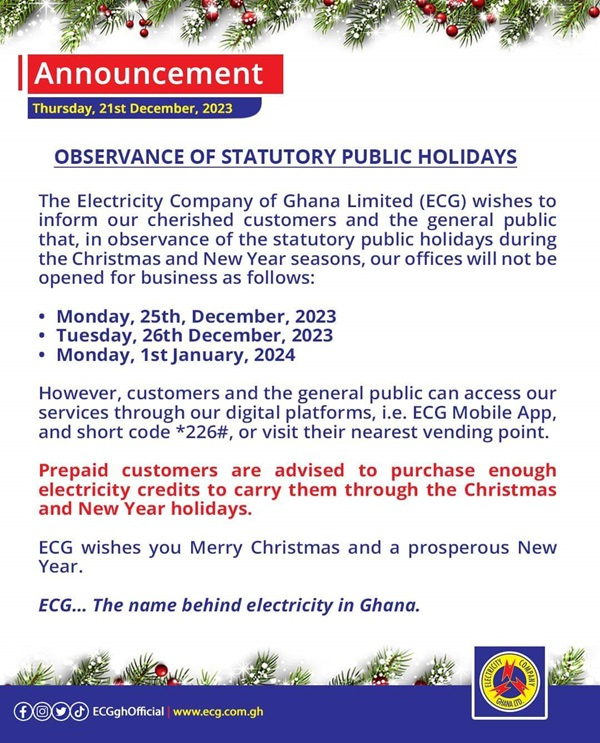
The Electricity Company of Ghana (ECG) has disclosed that its offices will remain closed on Monday, December 25, 2023, Tuesday, December 26, 2023, and Monday, January 1, 2024, in line with the Christmas and New Year holidays.
In light of this, the ECG has advised customers to ensure they have an ample supply of electricity credits to sustain them through the festive season, emphasizing that credit purchases may be unavailable at its offices during the specified period.
While the physical offices will be closed, the ECG reassured customers that they can still access services through digital platforms, including the ECG mobile app, website, and the ECG call centre.
The ECG further urged customers to use electricity responsibly and report any faults or emergencies through the provided toll-free numbers.
Wishing everyone a Merry Christmas and a Happy New Year, the ECG encourages its customers to make preparations to avoid any inconveniences during the holiday closure.
As Afua Asantewaa gears up to potentially set a new Guinness World Record for the longest continuous singing marathon, she has made a request to the Electricity Company of Ghana (ECG) to ensure uninterrupted power supply during the event.
Scheduled to perform incessantly from the 24th to the 27th of December at Akwaaba Village, Asantewaa voiced her appeal during her second media briefing at Akwaaba Park. The briefing was attended by notable figures including Akwesi Agyeman, CEO of Ghana Tourism Authority; Agnes Adu, CEO of Ghana Trade Fair; and music producer Kwesi Ernest.
A video posted by ZionFelix on Instagram captured the singer mentioning that her team has arranged for backup power solutions.
Nevertheless, she has sought ECG’s support in maintaining a stable power supply to facilitate her record-breaking attempt without any disruptions.
“Preparations are far advanced and we are making standbys, generators, and plants available. I am even told there is something called UPS but please ECG, like during this period, please spare me. Let’s pile it up for the second week in January. So, I am pleading, ECG, from the 23rd all the way to the end of December because we do not know when we are stopping this. We could get carried away. Please hold the power for us. I am pleading with ECG,” she said.
The CEO of Ghana Tourism Authority has urged the Ghanaian community to unite in support of Afua Asantewaa’s endeavor to break the Guinness World Record for the longest singing marathon. Asantewaa aims to surpass the current record held by Indian singer Sunil Waghmare, who set the milestone in 2012 with a remarkable 105-hour singing marathon.
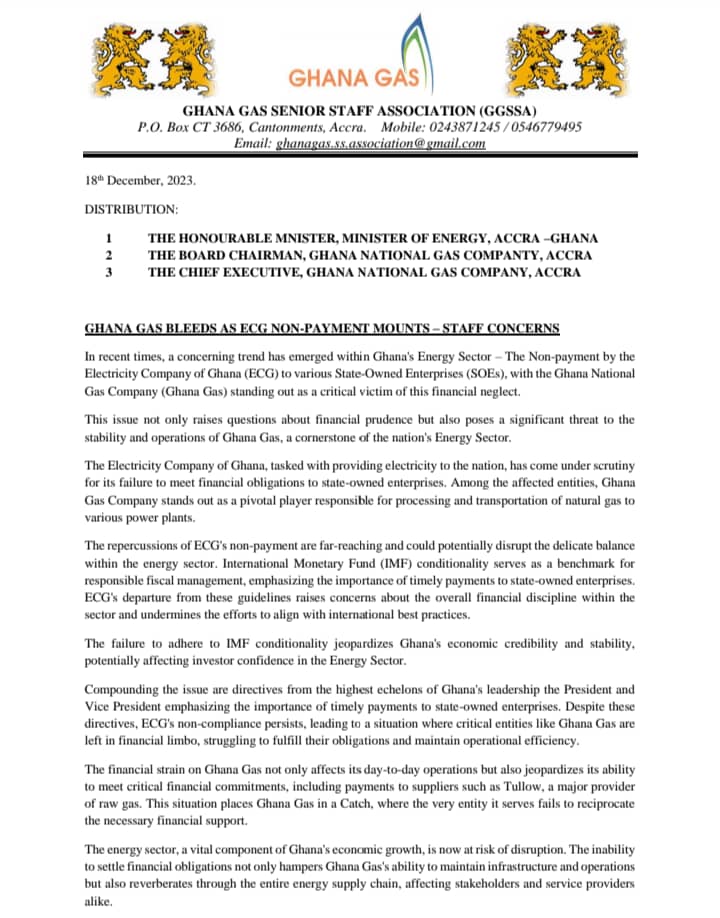
The Ghana Gas Senior Staff Association (GGSSA) has expressed concerns about the overdue debt owed to Ghana Gas by the Electricity Company of Ghana (ECG).
The association has urged the government to take immediate action to settle the outstanding payment, emphasizing that the delay poses a significant threat to the stability and operations of Ghana Gas, a crucial component of the nation’s energy sector.
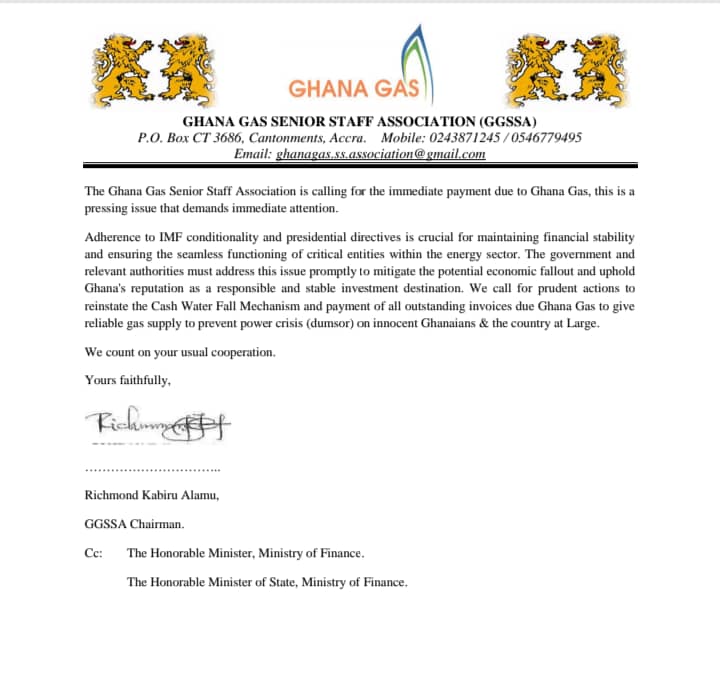
The GGSSA highlighted the importance of immediate debt settlement and adherence to International Monetary Fund (IMF) conditionalities to ensure the sustainability of key players in the energy sector.
“In recent times, a concerning trend has emerged within Ghana’s Energy Sector is the non-payment by the ECG to various State-Owned Enterprises (SOEs), with the Ghana National Gas Company (Ghana Gas) standing out as a critical victim of this financial neglect. This issue not only raises questions about financial prudence but also poses a significant threat to the stability and operations of Ghana Gas, a cornerstone of the nation’s Energy Sector.”
“The GGSSA is calling for the immediate payment due to Ghana Gas, this is a pressing issue that demands immediate attention. Adherence to IMF conditionality and presidential directives is crucial for maintaining financial stability and ensuring the seamless functioning of critical entities within the energy sector.”
“We call for prudent actions to reinstate the Cash Water Fall Mechanism and payment of all outstanding invoices due Ghana Gas to give reliable gas supply to prevent power crisis (dumsor) on innocent Ghanaians & the country at Large,” it added.
Cybercrime inflicted a $6 trillion cost on the world in 2021, and it is projected to surpass $10 trillion in annual damages by 2025, as reported by the World Economic Forum.
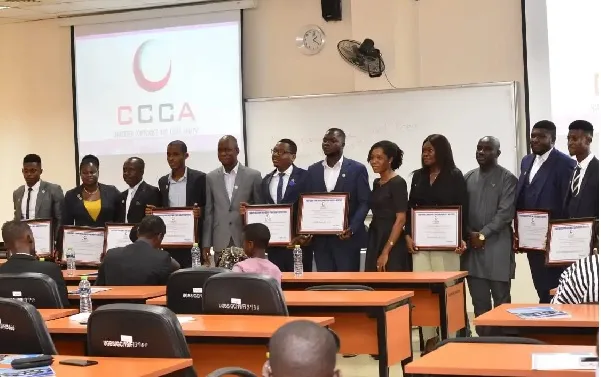
A lecturer at the Department of Management Sciences and School of Business at the University of Education, Winneba, Dr. Vera Akafo Ayitey, shared these insights during the Chartered Compliance and Cyber Analyst (CCCA) Institute’s graduation ceremony at the University of Ghana Business School Graduate Campus in Legon.
Speaking on “Organisational Culture and Fraud Prevention,” Dr. Ayitey emphasized the increasing frequency of cyberattacks, underscoring the critical need for attention to curb this trend.
She highlighted the significance of fostering a cyber-secure culture within organizations at both the management and employee levels.
“In Ghana we can talk about data breaches at ECG and the University of Ghana where peoples’ scholastic financial results were all over the place online. So the question is what happened? Was it systemic failure or human error? she queried.
“There are things that we do privately or things that are confidential which should not come out but through cybercrime, sometimes we hear of such confidential issues. Someone somewhere may be keeping tabs on what we are doing. So issues of confidentiality can be breached,” she said.
Addressing specific instances in Ghana, such as data breaches at ECG and the University of Ghana, where confidential information was exposed online, Dr. Ayitey raised questions about systemic failures or human errors leading to such incidents.
She stressed the leadership role in ensuring organizational resilience to cyberattacks by adhering to cybersecurity protocols and implementing strategies to promote a cybersecurity culture.
Financial losses, damage to reputation, and operational disruptions were cited as consequences of cybercrime, underscoring the need for organizations to prioritize cybersecurity.
Dr. Ayitey also mentioned the broader impact on stakeholders and regulatory scrutiny following cyberattacks.
She emphasized that the fight against cybercrime extends beyond the IT department to include people, processes, and culture, urging collaboration with the IT department to build resilient organizational cultures.
At the graduation ceremony, certificates were awarded to four students who successfully completed the 14 requisite papers.
The awardees included Lance Corporal Apoore Jude Azur of the Ghana Armed Forces Command and Staff College, Mark Gyan of the Bank of Ghana, Sydney Kwakye also of the Bank of Ghana, and Oppong Daniel, formerly of Legacy Capital.
Dr. Theophilus Kwadjo Odjer-Bio, Director at the CCCA Institute, chaired the event and conferred the awards on the graduands.
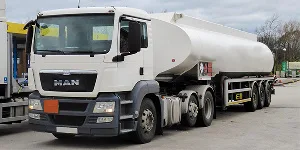
The Electricity Company of Ghana reveals the identification of the staffer linked to the alleged fuel siphoning from boom truck GV 2474-14.
The implicated individual is disclosed to be a driver stationed at the regional office in Cape Coast.
Despite this revelation, the power distribution company initiates investigations in adherence to its disciplinary procedure, as stated in a press release.
“The Management of ECG’s attention has been drawn to a TV3 publication of a viral video showing the siphoning of fuel from an ECG boom truck. The staff involved in the alleged siphoning of fuel from the ECG boom truck, with registration number GV 2474-14, has been identified as a driver stationed at the regional office of ECG in Cape Coast.”
“A full-scale investigation has commenced in line with our disciplinary procedure,” it added.
ECG urged Ghanaians to report employee misconduct in order to guarantee improved service delivery throughout the nation.
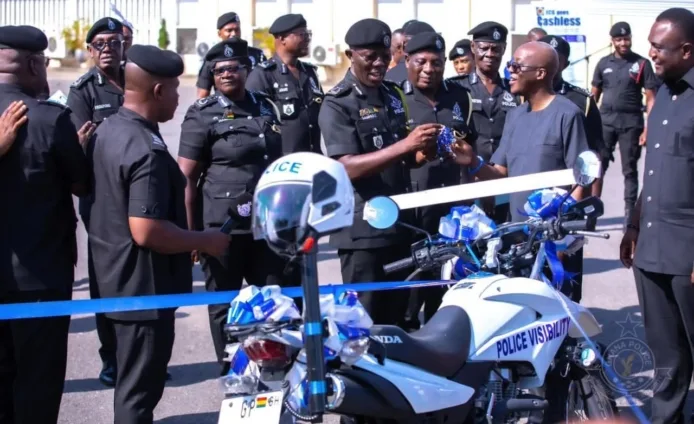
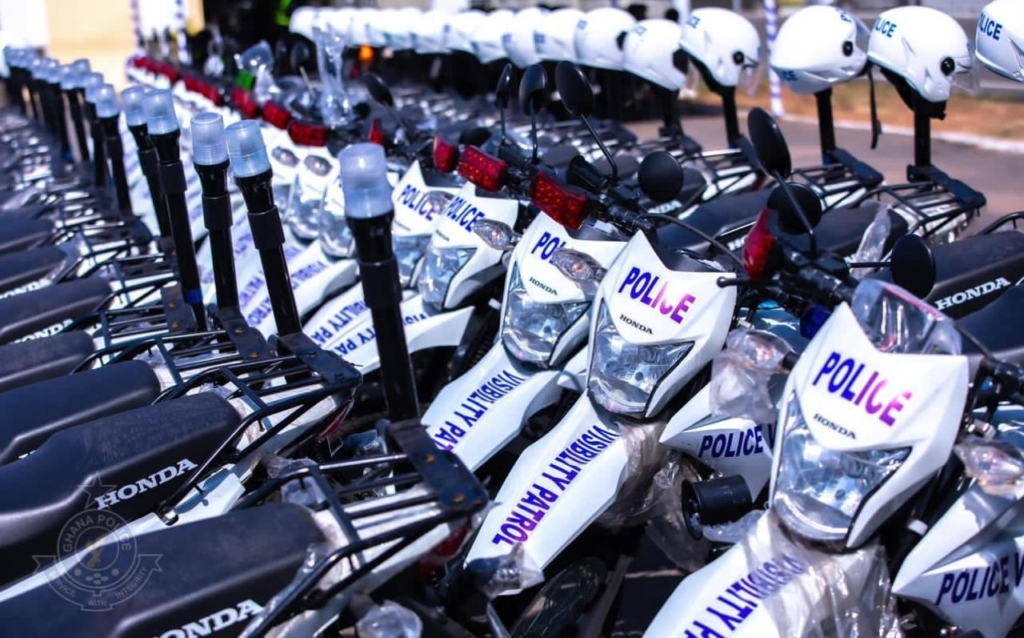
Former Minister for Power, Dr. Kwabena Donkor, has advocated for a thorough investigation into the Electricity Company of Ghana’s (ECG) procurement of 200 motorbikes for the Police Service.
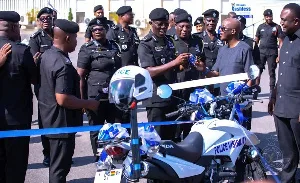
On December 11, 2023, the ECG made a donation of 200 motorbikes to the Police Service in a bid to enhance the operational capacity of the law enforcement agency.
The Board Chairman of ECG, Mr. Keli Gadzekpo, who spearheaded the donation, also pledged an additional 800 motorbikes to be delivered in subsequent batches.
Expressing his concerns in an interview, Dr. Kwabena Donkor criticized the management of ECG for the motorbike purchase, citing the substantial indebtedness of the company.
He urged the management of state entities, particularly those facing financial challenges, to take responsibility for their commercial viability.
Dr. Donkor emphasized, “It is high time that managements of state entities especially commercial state entities take responsibility for their commerciality. If Ghana Ports and Harbours Authority had done the donation, I would have had no qualms about it because they are profitable. But for a loss-making entity that is throwing the future and security of this country into danger because of their indebtedness to go donating 200 motorbikes is the height of irresponsibility.”
Calling for action, Dr. Donkor called on the Ministers for Energy and Public Enterprises to hold the ECG management accountable. He expressed the need for an investigation into the donation, asserting that it may not be in the national interest and could potentially be driven by procurement motives.
In his disappointment, Dr. Donkor, a former Minister of Power and member of the Energy Committee of Parliament, stated, “I am extremely disappointed as a former Minister of Power, as a member of the Energy Committee of Parliament, and representing the good people of Ghana in this House.”
Former Minister of Power, Dr. Kwabena Donkor, has strongly criticised the Electricity Company of Ghana (ECG) for donating 200 motorbikes to the Ghana Police Service.
On Monday, December 11, 2023, ECG donated these bikes to the Ghana Police Service as part of ECG’s initiative to enhance police operations nationwide.
Pru East MP and Member of the Mines and Energy Committee of Parliament, Dr. Kwabena Donkor, condemned the gesture, deeming it highly irresponsible on the part of ECG given the company’s indebtedness to Independent Power Producers.
On his part, ECG ‘has no business’ taking on the government’s responsibility of providing logistics to the power producers.
“I read with shock on Tuesday that the Electricity Company of Ghana had donated 200 motorbikes to the Ghana Police Service. Ordinarily, any such donation would have attracted my approval.
“But with this particular one, ECG has no business taking over the responsibility of the state to provide logistics for the Ghana Police. ECG is in debt for billions of cedis,” he fumed.
He went on to lambast ECG over its indebtedness to Independent Power Producers (IPPs) and urged the Ministers of Energy and State Enterprises to investigate the “irresponsible” act of ECG for appropriate action.
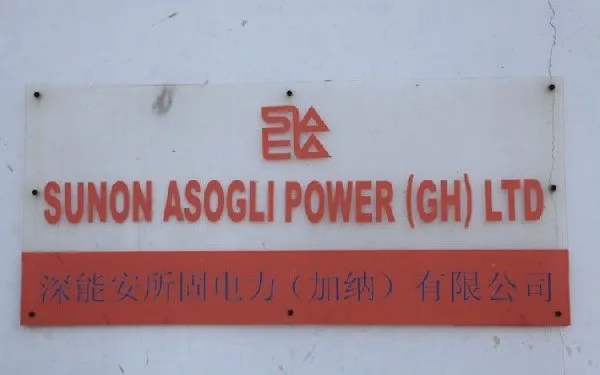
“Indeed, 2 weeks ago, the Minister of Finance had to intervene to stop Sonon Asorgli from shutting down because of ECG’s indebtedness to IPPs.
For an entity that cannot pay its indebtedness, they have no business buying motors for the Ghana Police.
“ I call on the Ministers of Energy and State Enterprises to call the ECG management to book.”
ECG, the country’s main power utility, buys electricity from various generation companies, including Independent Power Producers (IPPs), and distributes it to consumers.
However, the ECG has been unable to pay for the full amount of power it purchases from the IPPs, resulting in a huge debt of about $1.4 billion as of last month.
Meanwhile,in July this year, Independent Power Producers threatened a power cut to the national grid if the government did not pay at least 30% of the outstanding debt—a move that was expected to cause a major national crisis or even re-introduce the country to ‘dumsor’ but for the intervention of the finance minister.
This debt has affected the operations and sustainability of the IPPs, who control 50% of the country’s generation mix
They have also rejected any proposal to restructure the debt, saying that they need to repay their lenders and suppliers
The government and the ECG have been trying to address the debt issue and prevent power cuts by implementing various measures such as the Cash Waterfall Mechanism, the Energy Sector Recovery Programme, and the Energy Sector Levy Act.
Franklin Cudjoe, the president and founder of IMANI Africa, has criticized the Electricity Company of Ghana (ECG) for its recent donation of 200 motorbikes to the Ghana Police Service.
Cudjoe, in a post on X dated December 13, 2023, pointed out that despite being indebted to independent power producers, the ECG is engaging in donations.
He argued that the funds used for purchasing the motorbikes could have been better utilized to provide additional streetlights, contributing to crime prevention efforts.
“When your debtor goes spraying cash like an Arabian prince at a naming ceremony… But on a serious note, crime would have been reduced drastically &society benefited more if part of such funds were channelled to providing adequate streetlights in crime prone areas & our motorway,” he wrote.
The Electricity Company of Ghana (ECG) faced significant scrutiny recently when Sunon Asogli Power Limited, an independent power producer, declined an offer to restructure the arrears owed by the ECG.
In response, Sunon Asogli Power threatened to shut down operations, raising concerns about a potential return to the days of intermittent power supply, commonly known as ‘dumsor.’
Under pressure, the ECG responded by making a partial payment of $30 million towards its $60 million debt to Sunon Asogli, committing to settle the remaining arrears within a two-week timeframe.
About ECG’s donation to the Ghana Police:
The Electricity Company of Ghana (ECG) has made a generous donation of 200 motorbikes to the Ghana Police Service. The police received these motorbikes on Monday, December 11, 2023, with the aim of bolstering their operations nationwide.
Leading the ECG management in this philanthropic gesture, Board Chairman Keli Gadzekpo expressed the company’s commitment to supporting the police. He announced plans to donate additional vehicles to further enhance police services and efficiency, with a pledge of an extra 800 motorbikes to be delivered in batches.
The Inspector-General of Police, Dr. George Akuffo Dampare, who accepted the donation on behalf of the police, conveyed his gratitude to the ECG management for their generous contribution.
On Monday, December 11, the Ghana Police Service received a donation of 200 motorbikes from the Electricity Company of Ghana (ECG), aimed at enhancing the security agency’s operations nationwide.
The event, held at the National Police headquarters, was attended by members of the Police Management Board and ECG staff.
Board Chairman of ECG, Keli Gadzekpo, led the company’s management in making the donation and pledged an additional 800 motorbikes to be delivered in batches.
The Inspector General of Police, Dr. George Akuffo Dampare, expressed gratitude for the generous donation.
The Accra West region of the Electricity Company of Ghana Ltd. (ECG) has successfully recovered a total of one million, two hundred and seventy-seven thousand kilowatt-hours (kWh) of electric energy from 1,390 customers involved in various forms of illegal activities.
The billed energy amounts to Two million, Three Hundred and Fifteen Thousand, Four Hundred and Twenty-Three Ghana cedis (GH¢2,315,423.00).
These customers were identified during the Company’s ongoing operation ‘Fix the Bill and Pay the Bill,’ launched recently.
The operation, which commenced on Monday, November 6, 2023, and is expected to conclude on December 11, is simultaneously taking place across all of ECG’s operational areas.
The initiative aims to capture consumption readings for all postpaid customers, ensuring accurate billing, fostering customer confidence in the billing process, and promoting timely payment of bills.
In the Accra West region, which has a total customer population of 636,437, there are 59,416 postpaid customers.
The General Manager for ECG Accra West region, Mr. Emmanuel Akinie, highlighted the positive outcomes of the ongoing exercise, noting that the Company is also utilizing this opportunity to audit the integrity of all installed meters and recover debts owed to it.
“Our field staff are actively auditing the integrity of every meter they encounter in the field. We have so far uncovered instances where certain customers have been involved in illegal activities, stealing power and thereby depriving the Company of revenue from the services we are providing,” he said.
He continued by saying that the teams had found other clients whose meters were broken and they were not paying for the electricity they used.
The identified clients were referred to the closest ECG office, where procedures were started to recover the lost income and normalize their association with the company, he said.
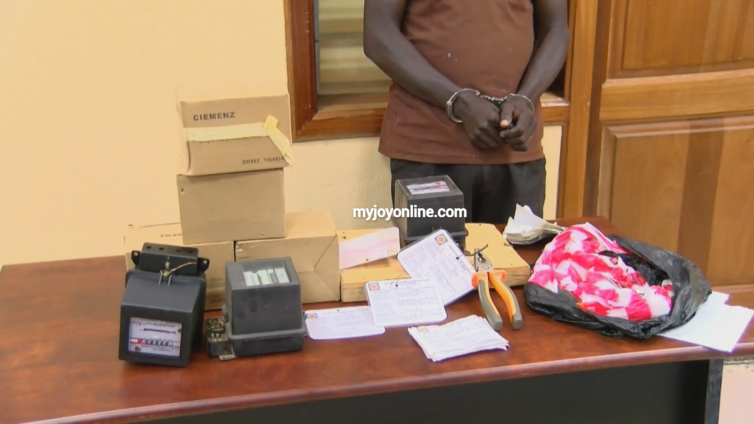
Mr. Akinie expressed regret over recent reports of meters being stolen in certain areas and stated that the company was in communication with law enforcement to stop the trend.
“We have reports of some syndicates who are stealing installed meters from customer premises. Together with the police and other agencies, we are on the hunt for such persons and we will do all within our power to bring them to book,” he said.
There are eight district offices in the west of Accra. The districts in question are Nsawam, Korlebu, Kaneshie, Achimota, Amasaman, Bortianor, Dansoman, and Ablekuma.
According to Samuel Dubik Mahama, the Managing Director of ECG, the payment was completed on Thursday, December 7, following a meeting between the two bodies.
“Sunon Asogli has received $30 million from the government of Ghana and the conversations are far advanced for a second tranche of another $30 million to be paid to them and as it stands now, Sunon Asogli has always been an integral part of our growth.
“They are one of the first IPPs and they have always treated Ghana fairly when it comes to how they have structured their PPAs, they are very good partners that we intend to grow with so we have even come up with a new way to renegotiate our outstanding PPA to make it much more efficient and cheaper for the good people of Ghana,” he said.
This payment is part of the effort to address the financial obligations to power producers, with the remaining $30 million scheduled to be paid as a second tranche.
The power producer had halted its operations on Monday, December 4, citing the government’s delay in fulfilling its financial commitments to power plants as the primary reason. However, it decided to temporarily suspend its shutdown for a week after receiving assurance from the government regarding the settlement of the outstanding debt.
The shutdown was initiated due to concerns raised by Sunon Asogli Power about the substantial impact of accumulating unpaid bills on its operational capacity, deeming it unsustainable to continue without addressing the financial challenges.
Sunon Asogli only suspended its decision following the Minister of Finance and Minister of State’s assurance and wrote in an acknowledgement note that “Kindly confirm our understanding that we shall be paid an interim sum of $60 million in two tranches. The first tranche $30 million to be paid this week and the second tranche in the week of 11th December 2023.”
The management of the Electricity Company of Ghana (ECG) is scheduled to engage in discussions with independent power producer Sunon Asogli Power (Ghana) Limited on December 8 to negotiate payment plans for a $60 million debt owed to the power producer.
The power producer had halted its operations on Monday, December 4, citing the government’s delay in fulfilling its financial commitments to power plants as the primary reason. However, it decided to temporarily suspend its shutdown for a week after receiving assurance from the government regarding the settlement of the outstanding debt.
The shutdown was initiated due to concerns raised by Sunon Asogli Power about the substantial impact of accumulating unpaid bills on its operational capacity, deeming it unsustainable to continue without addressing the financial challenges.
Sunon Asogli only suspended its decision following the Minister of Finance and Minister of State’s assurance and wrote in an acknowledgement note that “Kindly confirm our understanding that we shall be paid an interim sum of $60 million in two tranches. The first tranche $30 million to be paid this week and the second tranche in the week of 11th December 2023.”
The meeting scheduled for today will primarily address the mechanisms for settling the government’s outstanding debt. Independent Power Producers (IPPs) have consistently raised concerns about the government’s overdue payments, a longstanding issue with no significant resolution despite various attempts, including threats to suspend operations.
As of July 2023, reports indicated that the government’s debt to IPPs had reached approximately $1.6 billion. The IPPs have expressed dissatisfaction with the recent 1.52 percent reduction in electricity tariffs announced by the Public Utilities Regulatory Commission (PURC), deeming it unacceptable.
IPPs argue that this tariff reduction will adversely impact the Electricity Company of Ghana’s (ECG) efforts to restructure its debt. Dr. Elikplim Apetorgbor, the President of the IPPs, has emphasized that ECG will face challenges in meeting its financial obligations if the tariff reduction is implemented.
A member of the Mines and Energy Committee of Parliament, Edward Bawa, has criticized the lack of transparency from the ElectricityCompany of Ghana regarding the country’s power challenges.
He contends that instead of addressing the company’s shortcomings, the government has chosen to politicize the issue.
Bawa asserts that the ECG’s claims of localized power cuts throughout the year are false and that Ghana is facing a power generation deficiency that requires urgent attention.
“From the beginning of this year, mark my words and I am saying it on authority, up to Monday at 8:55, the total amount of the power that we had at available capacity was 3,407, the demand peak is 3,561 megawatts so it means that since the beginning of the year all the light off we have been seeing, you call ECG and they tell you that it is a localized problem. It is not true; we have a deficiency in our generation,” he was quoted by myjoyonline.com.
In addition, he said that rather than acting as though there was no issue, the business ought to have provided Ghanaians with a schedule to follow.
“So, if GridCo was transparent if the government was transparent, they should have given us a schedule. So that I know that in my area, if I am going to have light off, then I prepare for it.
“For the fact that for many years they have been singing this propaganda that they have not kept the lights off, so they are unable to deal with it,” he said.
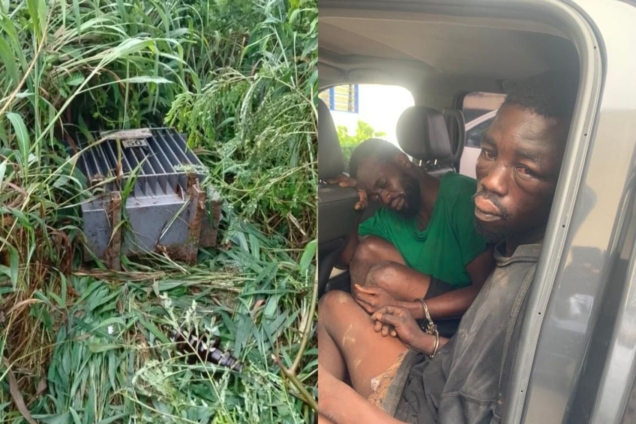
Two of the three individuals arrested by the Volta Regional Police Command for their involvement in an attempt to steal a transformer in Adaklu Tsrefe on October 5 have been sentenced by the Ho Circuit Court.
The two convicts, Sitsofe Agbodza (26 years) and Deladem Kodzo Tsrakasu (29 years), received five-year prison terms each after pleading guilty to theft and an attempt to destroy public property.
The third suspect, Abdul Wahab Seydou, a 20-year-old plumber, had his sentencing postponed for the next three weeks.
The circuit court judge ordered a social inquiry to be conducted on him, with the report to be submitted to the court within the specified time.
According to Benjamin Obeng Antwi, the Volta Regional PRO for the ECG, the judge based his decision on Mr. Wahab’s age (below 21 years) and the fact that he was a first-time offender, which warranted the need for a social inquiry report.
The three suspects were initially apprehended by Adaklu Tsrefe residents and subsequently handed over to the Volta Regional Police Command on October 5 for their involvement in vandalizing an ECG transformer and stealing valuable components from it.
“As a company, we are committed to providing quality, reliable and safe electricity services for our customers but the activities of these individuals prevent us from delivering our core mandate. Once the transformer is stolen, power supply will be curtailed to customers and this will affect businesses, schools and even hospitals so we humbly appeal to the general public to assist us curb this menace,” he said.
“The transformer is the most expensive component in our network and the value for the damaged transformer at Adaklu Tsrefe by these suspects is 104,000 Cedis minus labor and other expenses which affects our operations as well as our financial health. This new transformer could have been sent to communities without power supply or even extend power to other areas”, he added.
The General Manager of ECG in the Volta Region, Christina Jatoe-Kaleo, has called upon the public to remain vigilant and assist in safeguarding ECG installations in their communities, residences, and towns.
“Lately people are even stealing the earth wires at our substations and service cables of our customers which normally result in outages so let’s all come together to fight this menace. If you see anyone suspicious working at any ECG substation or facility, kindly report to the nearest police station or ECG via 0302611611, the ECG PowerApp or any of our social media handles @ecgghofficial,” she said.
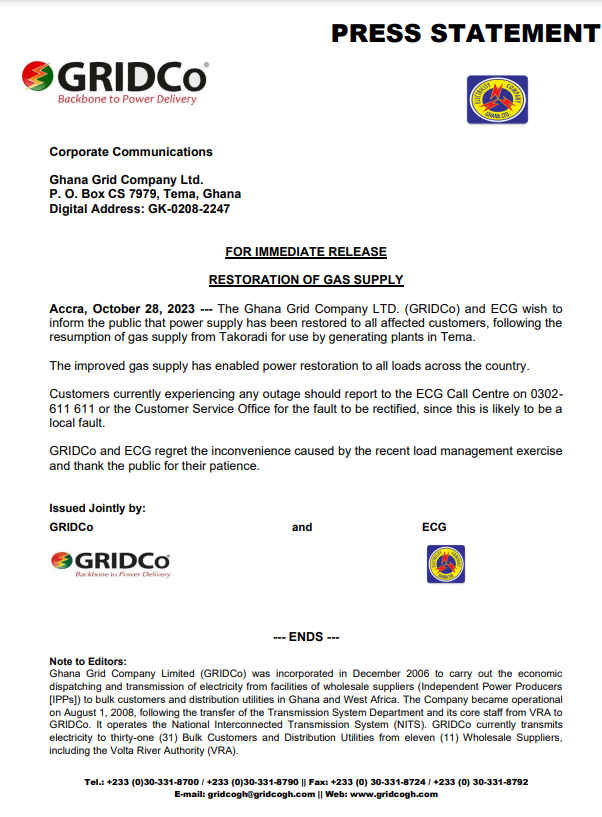
The Ghana Grid Company LTD (GRIDCo) and the Electricity Company of Ghana (ECG) have jointly announced the successful resolution of the recent intermittent power outages that affected the nation.
This positive outcome has been achieved through the reinstatement of gas supply to the power generating plants in Tema, sourced from Takoradi, as indicated in their official press release.
“The improved gas supply has enabled power restoration to all loads across the country,” parts of the statement read.
Last week, major parts of Accra experienced intermittent power outage and GRIDCo in a statement noted that the challenges with supply of gas was responsible for the blackouts.
Meanwhile, the companies have emphasized that customers who continue to experience power disruptions may be dealing with localized issues or faults and are encouraged to promptly inform their local ECG office for the necessary repairs.
“GRIDCo and ECG regret the inconvenience caused by the recent load management exercise and thank the public for their patience,” the statement added.
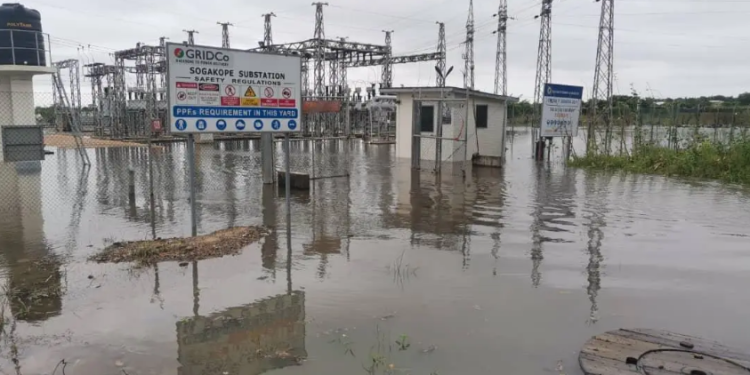
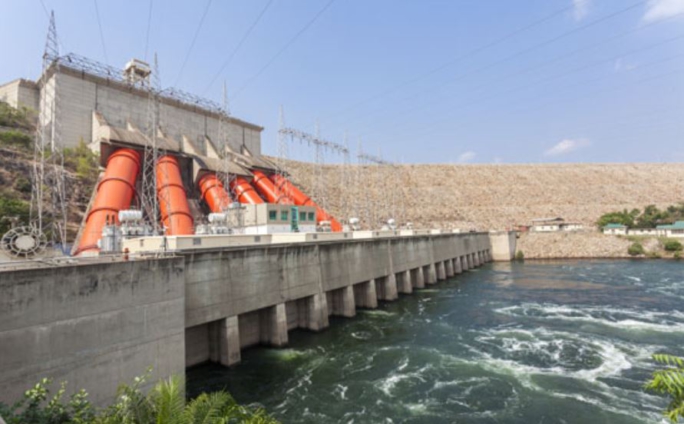
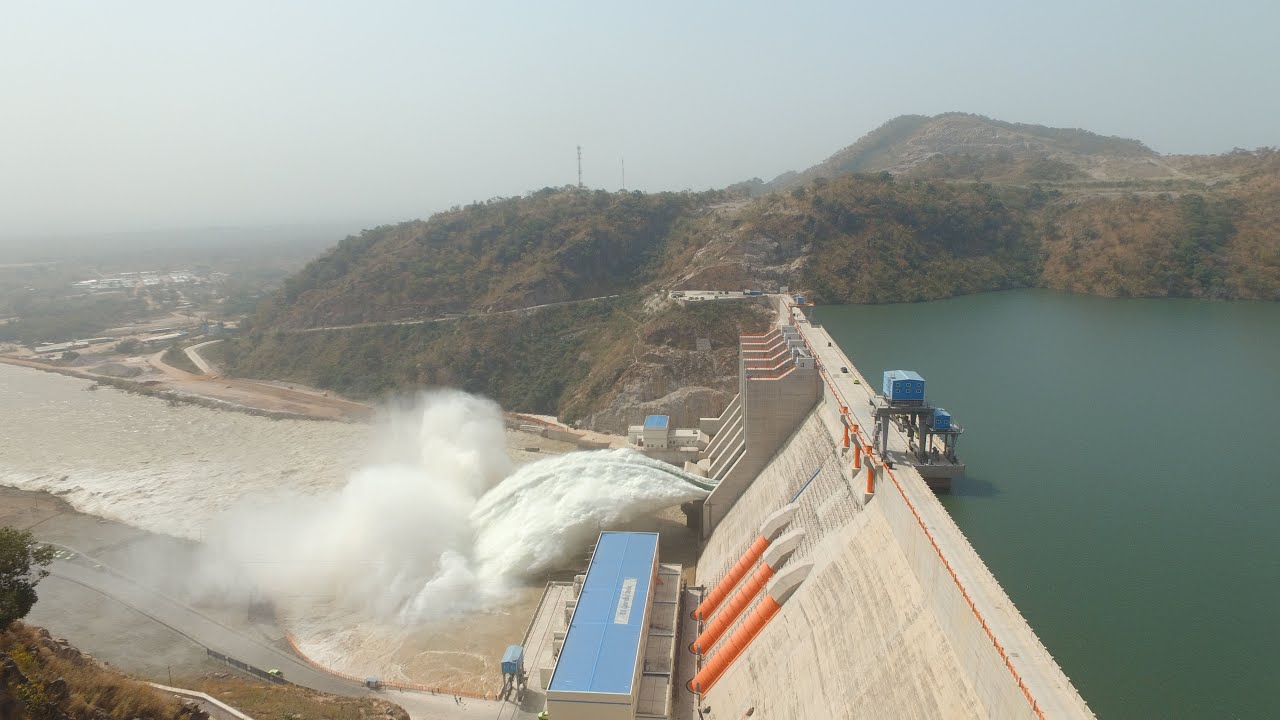
The Electricity Company of Ghana (ECG) has announced that the restoration of power from the Sogakope Bulk Supply Point (BSP) may face significant delays due to flooding in the area caused by the spillage of the Akosombo Dam.
The company had initially shut down the Bulk Supply Point to protect the station, which resulted in power disruptions in several areas, including Sogakope, Anloga, Keta, Akatsi South, Abor, and North Tongu districts.
To mitigate the impact, electricity power has been supplied to Adidome and its surrounding areas from Juapong, while the remaining towns receive power from the Aflao Bulk Supply Point (BSP).
According to Mr. Benjamin Obeng Antwi, the Volta Regional Public Relations Officer of ECG, the Sogakope BSP remains closed, as the company anticipates that it will not be operational for several months. The ECG is working on a long-term solution to ensure continued power supply in the event that the situation lasts for six months or more. He also emphasized the importance of customer safety and noted that the company has improved its network to address the situation.
The situation in the affected areas has improved with communities supplied with electricity power from the Aflao Bulk Supply Point, as per Mr. Benjamin Obeng Antwi, the Volta Regional Public Relations Officer of ECG.
However, the Ghana Water Company Limited (GWCL) is facing challenges with electricity power, affecting its ability to maintain water supply to flood-affected areas. Mr. Francis Lamptey, the Regional Chief Manager of GWCL, explained that water was being rationed to these areas based on the availability of power supply. In response to the situation, GWCL is setting up parallel distribution lines to serve flood victims from Aflao.
The headworks at Agordome are currently supplying 5,500 cubic meters out of 7,570 cubic meters, resulting in a shortfall of 2,070 cubic meters (equivalent to 455,620 gallons). Mr. Lamptey outlined a rationing or water management program for various communities in a weekly rotation, depending on the availability of electricity. He also mentioned that the area around the headworks is experiencing flooding, and they hope to mitigate the rise at some point.
Electricity Company of Ghana (ECG) has informed the public that the restoration of power from the Sogakope Bulk Supply Point (BSP) may face significant delays, mainly due to the extensive flooding caused by the spillage of the Akosombo Dam.
To ensure the safety of the station, the company had to shut down the Bulk Supply Point, which, unfortunately, led to power disruptions in several areas, including Sogakope, Anloga, Keta, Akatsi South, Abor, and North Tongu districts.
However, electricity is still being supplied to Adidome and its vicinity from Juapong, with the remaining areas receiving power from the Aflao Bulk Supply Point (BSP).
Benjamin Obeng Antwi, the Volta Regional Public Relations Officer of ECG, explained that the Sogakope BSP remains closed because the company foresees that it may not be operational for the next several months.
ECG is currently focusing on a long-term solution to ensure a continuous power supply to its customers, especially if the situation persists for six months or longer.
Antwi also emphasised that the company has enhanced its network and urged customers to prioritise safety.
Meanwhile, Ghana Water Company Limited (GWCL) is grappling with power supply issues that are affecting its ability to maintain water supply to the flood-affected regions.
Francis Lamptey, the Regional Chief Manager of GWCL, disclosed that they are rationing water to the affected areas based on the availability of electricity.
In addition, GWCL is installing parallel distribution lines from Aflao to serve the flood victims.
Lamptey further mentioned that the headworks at Agordome is currently supplying 5,500 cubic metres out of the usual 7,570 cubic meters, resulting in a shortfall of 2,070 cubic metres, equivalent to 455,620 gallons.
He outlined the rationing and water management program for various communities in a weekly rotation, contingent on electricity availability.
The Electricity Company of Ghana (ECG) has declared that power supply from the Sogakope Bulk Supply Point (BSP) might experience extended delays due to flooding after the Akosombo Dam spillage.
The Company’s decision to shut down the point has resulted in power disruptions in multiple districts.
ECG has redirected electricity supply to some areas from alternate sources. Benjamin Obeng Antwi, Volta Regional Public Relations Officer of ECG, has explained the necessity of a long-term solution to cope with a possible extended disruption of six or more months.
Meanwhile, the Ghana Water Company Limited (GWCL) is also grappling with power-related challenges in providing water to flood-affected regions.
Water rationing is in place depending on power availability. GWCL is setting up parallel distribution lines from Aflao to serve flood victims.
The headworks at Agordome currently provides 5,500 cubic meters out of 7,570 cubic meters, with a deficit of 2,070 cubic meters, equivalent to 455,620 gallons.
Rationing and water management schedules have been implemented for various communities.
Supplies are contingent on power availability, and the area near the headworks is experiencing flooding concerns.
In an effort to combat the sale and use of unapproved meters in the country, Dr. Ishmael Ackah, the Executive Secretary of the Public Utilities Regulatory Commission (PURC), has urged the Electricity Company of Ghana (ECG) to ensure that meters, an essential commodity, are readily available to customers.
He pointed out that some Ghanaians resort to illegal connections for electricity and water services because they believe that ECG and the Ghana Water Company Limited are unresponsive to their requests for meters or assistance when they encounter issues.
During an interview with Joy News, Mr. Ackah stated, “When it comes to illegal activities, some individuals even resort to illegal water connections.
Such actions are in violation of the criminal code as they amount to theft. However, we also encourage the ECG and Ghana Water to make meters accessible to consumers, as this is a common challenge raised by consumers.
They should expedite the process of connecting consumers.”
Regarding water treatment, the PURC Executive Secretary highlighted that the cost of production has increased significantly due to the use of polymer in the water treatment process.
He mentioned that polymer is four times more expensive than the alum previously used by the Ghana Water Company Limited (GWCL).
“Ghana water was using alumbut now they have moved to use polymer, but it is four times more expensive than alum. It means the cost of production has gone up and it will cost four times more to treat water. And this is all because of the Galamsey. In some areas, we have to treat muddy waters to make it clean for consumers,” Mr Ackah said.
The Electricity Company of Ghana reportedly incurred a revenue loss of GH¢2.8 billion, primarily as a result of unauthorized power connections made by certain individuals in the country.
The Electricity Company of Ghana (ECG) has successfully restored power to Adidome and its neighboring areas by sourcing electricity from Juapong communities.
This action was taken due to the consequences of the Akosombo Dam spillage.
However, six communities, including Mafi Tsrawla, remain unconnected due to heavy rainfall, which caused extensive damage to buildings and electricity poles.
ECG’s Volta Regional Public Relations Officer, Mr. Benjamin Obeng Antwi, explained that the team is assessing the damage and will restore power to the affected areas once the evaluation is complete.
Mr. Antwi mentioned that ECG continues to supply electricity to the remaining towns from the Aflao Bulk Supply Point (BSP). He also noted that ECG is anticipating increased activity in the affected areas over the weekend and is in communication with GRIDCO to enhance capacity, which has been assured.
Despite some issues of low voltage during peak hours, the voltage profile has returned to normal, allowing fuel stations, hospitals, car washes, and other heavy equipment facilities to operate efficiently.
Mr. Antwi urged customers to adhere to necessary safety protocols before using their electrical appliances. He also pointed out that the water level at the Sogakope Bulk Supply Point is rising. Consequently, the company temporarily shut down its station in Sogakope to safeguard it from flooding, which occurred due to the dam spillage. Power has been restored in most affected areas, except for Sogakope.
Yesterday, I visited several communities impacted by the tragic Akosombo dam spillage. Sadly, nearly 40,000 people across 23 communities have been affected by this disaster. My heart goes out in solidarity with all the families and individuals distressed by this unfortunate… pic.twitter.com/W1IiS1WQpQ
This action, as announced in a release on Wednesday, was primarily due to safety concerns arising from the flooding of the Sogakope Bulk Supply Point, which was caused by the spillage from the Akosombo Dam.
🇬🇭🚨The Akosombo Dam spillage by VRA is wreaking havoc downstream, 🌊submerging homes and farms in Sogakpoe and nearby communities. Reports paint a dire picture of disaster as it surges relentlessly from Battor, Mepe Adidome, Tefle, and Sogakope, down to Anlo.
The affected areas encompass Sogakope, Akatsi, Adidome, Anloga, Abor, Keta, and the surrounding regions.
The statement further indicated that a team of engineers from both the Ghana Grid Company Limited (GRIDCo) and ECG is on standby, ready to restore power supply to the affected areas as soon as the floodwaters recede.
The inconvenience caused by this shutdown is deeply regretted,” it added.
Residents downstream of the Akosombo Dam and those living near the riverbanks, are advised to evacuate the area as the spillage flow rate has reportedly increased to 5,700 cubic meters per second, nearly three times the amount that caused significant damage downstream. Fish farms… pic.twitter.com/EbvQdpSSo3
Some customers of the Electricity Company of Ghana (ECG) in Accra have expressed their frustration and anger over the challenges they face in purchasing electricity for their prepaid meters.
They claim that they have been debited without receiving credits, or that their meters have malfunctioned, leaving them in darkness for days.
The ECG issued a statement on October 9th 2023, acknowledging that there was a technical problem with the NURI KAMSTRUP prepayment system, which affected some of its customers. The statement assured the affected customers that the ECG team was working hard to fix the issue and restore normal service provision. The statement also apologised for the inconvenience caused by the glitch.
However, some customers who spoke to The Independent Ghana said that the statement was not enough and that they wanted a swift and permanent solution to the problem. They also demanded compensation for the losses they incurred due to the power outage.
One of the customers, Emmanuel Karlu, said that he bought ECG credits from the ECG office on Dome Kwabenya road on Friday, October 6, 2023, but when he returned home, he found out that his electricity supply had not been restored. He said that he got an error message on his meter when he inserted his card. He said that he went back to the ECG office several times, but he did not get any satisfactory assistance. He said that he had lost perishable food items in his refrigerator due to the lack of power.
Another customer, Doris Konadu, said that she purchased ECG credits online last week and received a confirmation message, but she had been sleeping in darkness ever since. She said that she followed up with the ECG office, but she was told that her meter was old and needed to be replaced. She said that she felt cheated and neglected by the ECG.
Some customers also took to social media platforms such as Twitter to vent their frustration and dissatisfaction with the ECG service. They complained that the ECG mobile app was not working and that the ECG vendors were also saying that the network was down. They wondered why everything in Ghana was so bad and called for accountability and transparency from the ECG management.
The ECG has not yet given any further explanation or update on the situation or how long it will take to resolve it.
Some customers of the Electricity Company Ghana (ECG) in Accra have been left stranded after facing challenges in topping up their prepaid meters.
Reports obtained by The Independent Ghana confirm system glitches at ECG, making it challenging for customers to successfully top up their accounts.
A consumer, Emmanuel Karlu, in an interview shared his experience, recounting how he procured ECG credits from the ECG office located on Dome Kwabenya road on Friday, October 6, 2023, only to discover upon returning home that his electricity supply had not been restored.
“I came here on Friday to purchase credit for my prepaid meter but unfortunately when I went back home to slot the card in my meter but I still didn’t have light, the feedback I got was card error. So I returned on the same day, upon getting there I was told they had closed so the following morning I was there, I was given someone’s number to call for assistance,” he added.
Mr. Karlu further explained that he visited the ECG office the following day, where officials assured him that they were addressing the issue and assured of a swift resolution.
However, to his dismay, he returned to the ECG office on Monday, October 9, 2023, as the problem had not been rectified.
Expressing the losses incurred during this three-day period, he lamented the spoilage of perishable food items in his refrigerator.
“I called the person; he was at my place but said he couldn’t ascertain what was really wrong with my meter. From Friday to today I haven’t had light, everything in my fridge have gone bad. I am here again on Monday morning and the guy I met in there said I should go and that an expert will help me fix the problem at home. I don’t really understand what is going on with the system,” he stated.
Additionally, another woman with a similar predicament, Doris Konadu, who was present at the office, disclosed that she had purchased ECG credits the previous week, receiving a confirmation message, yet she had been enduring power outages since then.
” I purchased credits online for lights last week which I never received, I followed up but I was told it was because my meter is old. Although I was given a confirmation message, I have been sleeping in dark ever since,” she added.
Meanwhile the ECG is yet to shed light on the circumstances surrounding the reported challenges with prepaid meters and the difficulties faced by its customers in Accra.
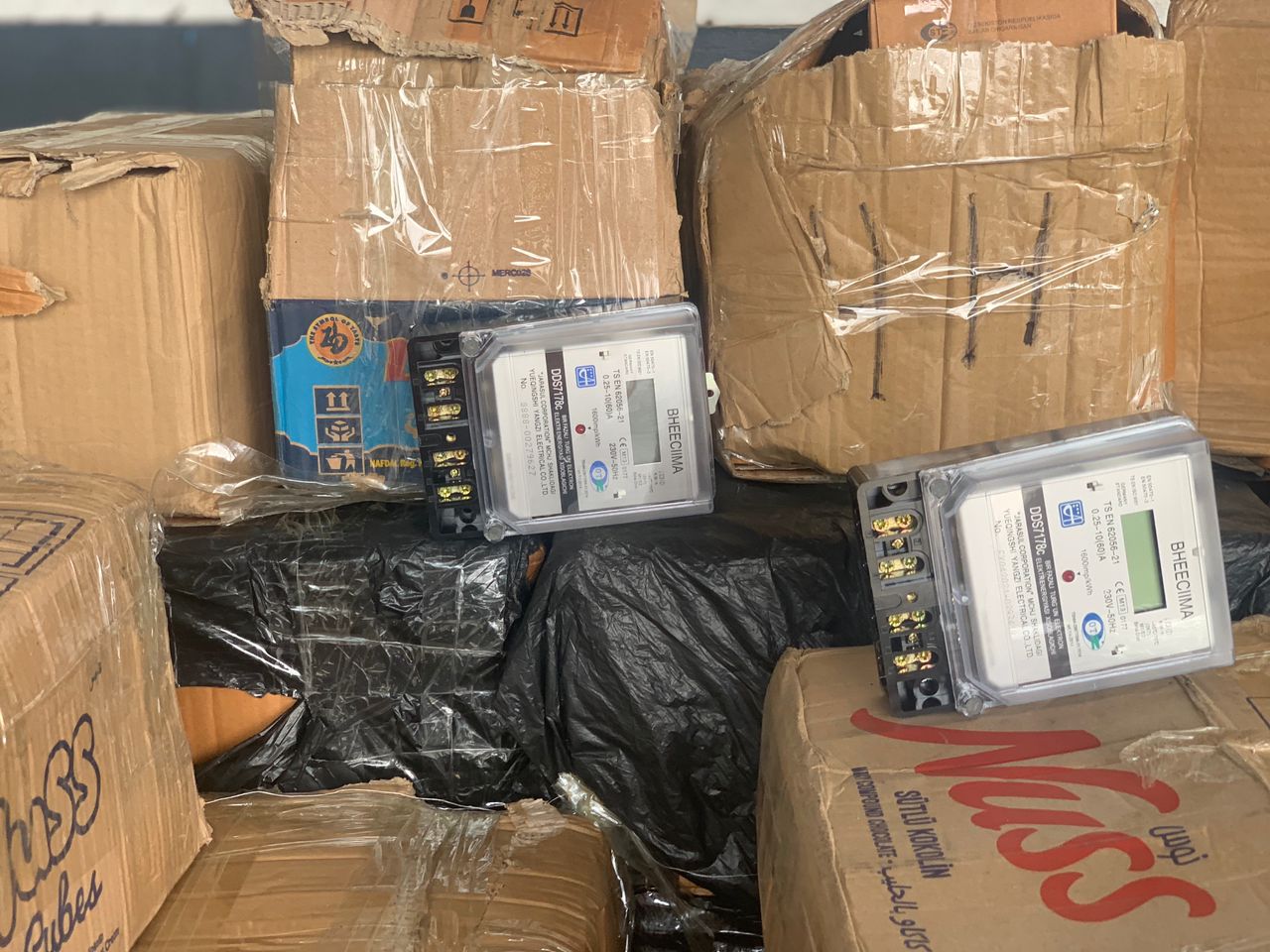
A JoyNews exposé has unveiled a cartel comprising individuals who work for the Electricity Company of Ghana (ECG) and security personnel engaged in the fabrication of documents to illicitly sell unapproved meters to potential consumers.
The group inflates prices. A meter, which costs a little over GH¢800, is being sold for as much as GH¢2,500.
In this exposé, conducted by JoyNews’ Kwetey Nartey, it was revealed how the actions of these individuals enable certain power consumers to enjoy electricity without ECG’s knowledge in various parts of the country.
This revelation follows concerns raised by Samuel Dubik, the Managing Director of ECG, who highlighted that illegal power connections result in power consumers losing GH¢2.8 billion.
Due to a convoluted process and a shortage of meters, fraudulent practices and syndicates have emerged. These groups are primarily composed of intermediaries, some corrupt ECG employees, contractors hired by the power distributor, and even private security guards stationed at ECG offices.
Their illicit activities have resulted in the widespread proliferation of counterfeit meters throughout the country.
Kofi Danso, the Ashanti Regional Revenue Protection Manager, acknowledges that the use of fake meters has become a major challenge that they are tirelessly working to combat.
A recent initiative aimed at registering and linking meters to the ECG database in the Kwabenya district uncovered a staggering 15,000 users who were consuming electricity without contributing any payment to the state. This revelation has left the Managing Director of ECG, Samuel Dubik Mahama, deeply concerned.
While ECG’s losses are estimated at GH¢2.8 billion due to illegal power connections, the culprits behind this detrimental activity have managed to remain largely anonymous.
In an effort to shed light on the issue, the investigative team from JoyNews visited ECG offices in three regions to assess the extent of this problem.
During a visit to the Accra East Regional Office and the sub-transmission office near Makola, Kwetey Nartey encountered Abraham, an ECG employee working in the meter department. He disclosed that a meter, typically priced at GH¢800, would cost me GH¢2,000.
Abraham also showed documents he had processed for another customer and was willing to transfer them to him, provided he paid the specified amount.
IG: What was the price you quoted for the meter you are trading?
Abraham: It will cost you GH¢2,000.
IG: Is it possible to reduce the amount being charged?
Abraham: No
IG: In what form should the transaction take? I will pay GH¢1,500, and pay the balance when the meter is fixed.
Abraham: That shouldn’t be a challenge.
Abraham advised that if he followed the established process, he would have to wait for almost a year to get the meter.
He, however, promised that he could assist get a meter if one paid just a little more than the statutory fees to him.
He boasts of helping many individuals struggling to secure such meters at ECG offices. In Abraham’s confession, three prospective customers will soon be beneficiaries of these meters he is working on after they paid GH¢2,000.
Abraham: These meters belong to other prospective consumers. There are challenges with the network connection, that problem has been persisting for some time now. If I don’t fix it before I hand over the meter to the customer, they will struggle with purchasing power. I will give you an official receipt, I don’t like swindling people I deal with.
Abraham is not the sole individual involved in the meter supply business. At the Kwabenya office of the ECG, there is another individual identified as Jerry who operates within this trade.
This is the exact district where the ECG identified over 15,000 customers who were using power illegally. Jerry promised he would help acquire a meter. He asked the investigator to pay GH¢2500.
After part payment was made to Jerry, he delved a bit deeper into how he gets meters for people like me who are in dire need of a meter but are unable to wait for months before they would be assigned one.
Jerry: I have explained the challenges with the system already.
IG: I would be glad if you reduced the cost being charged.
Jerry: When I deal with anyone I encounter, I want to deal with them in a mutually beneficial way. Securing a meter in recent times, is quite difficult. I will make sure I get you a functional meter.
IG: I would appreciate it if you would reduce the amount being charged to me. At least take GH¢200 off it. When will I get the meter?
Jerry: Give me two weeks, and come for it.
Jerry and his accomplices transfer the transaction details of another prospective customer to those offering to pay more for meters.
Jerry: I need more money to facilitate the process.
IG: How much would you need?
Jerry: Make an additional GHc500 cedis on the initial money you have given.
IG: I will provide the balance payment when I come for it.
Jerry: That wouldn’t be helpful. I need to fast-track it.
IG: Would I get the receipts for the transaction?
Jerry: No, it would be in someone’s name.
At the Achimota ECG office, I came across this ECG contractor he gave his name as Sammy. He blamed the difficulty in acquiring meters on the shortages in the system. He also charges at least GH¢2,500 to provide separate meters.
Sammy: There is a colleague who has a single phase meter, but, he is charging GH¢2,500.
IG: I was informed the amount usually charged is GH¢1,500.
Sammy: The meters are scarce. Who is your brother? Is he an electrician?
IG: Yes.
Sammy: He requested three sets of meters and payments have been made already. The only challenge is, we haven’t received supplies yet. With regard to the meter I am making reference to, the individual will fix it for you in no time.
The meter he is transferring to your home belongs to someone. Acquiring a meter through the right process takes quite some time, if only you are willing to wait, you can explore that option.
IG: If I want to use the right process to acquire the meter, how much am I likely to spend? Sammy: You will pay at least GH¢1,500.
IG: How long will it take for me to get such a meter?
Sammy: I wouldn’t be able to say, you can only count on hope because it doesn’t take much effort to process the documents requesting for a meter.
IG: Why are we facing this challenge with meter shortage?
Sammy: We have an inefficient head leading ECG. How can a 33-year-old young man lead the ECG and run it efficiently?
In the Eastern regional capital of Koforidua. This middle-aged man gave his name as Seth at the ECG office there. He charges GH¢1,500 for the unauthorized meter.
He claims GH¢1,200 of the money goes into processing and documentation and the remaining GH¢300 pay persons he described as his superiors who facilitate the acquisition.
Seth: I need to pay some monies to the boss at the helm of affairs to facilitate the speedy release of the meter for you. I prefer working diligently and being rewarded afterwards.
IG: I would want to know how much it will cost in entirety to secure a meter.
Seth: What work do you do?
IG: I am a teacher at one of the private schools.
Seth: Make a budget for GH¢1,500.
The suspects in this trading of fake meters stretch beyond the staff of ECG and the Energy Commission. At the ECG Ashanti SBU headquarters, the chief security officer who gave his name as George is in charge of the cartel there.
He said acquiring a meter can be a difficult task if one attempts to follow due process. He tells me he can secure a separate meter for me at a fee of GH¢2,000. This money, he claims, is paid to officials of ECG to facilitate the process.
George: How early do you need the meter?
IG: Would a month be an adequate time to get it?
George: It is not possible for me to get you a meter in a month.
IG: Would six months be enough time?
George: That should work perfectly for me.
IG: How much will it cost me then?
George: You will pay GH¢2,000.
IG: I will be glad if you can reduce the price for me.
George: That wouldn’t be possible. I don’t want to run into trouble for taking monies that cannot sufficiently do the work.
IG: How should the payment be affected?
George: Pay it in full.
After learning of the faces behind the fake meter trade and their mode of operation, I have returned to the Accra East Regional Office and sub-transmission office.
I paid the full amount requested by Abraham. He dispatched one of his team members, Simon Atanga, to fix a meter at the pseudo location I provided them. Within hours, I had a separate meter that was powering the electrical gadgets in this makeshift room.
IG: When should I expect a bill to be paid for the power I will use?
Simon: The meter reader will be here to take the readings.
IG: When exactly should I expect to see him?
Simon: Two months’ time.
I enquired from Simon while he was fixing the meter, when should I expect a bill to be brought for me to pay. He said two months, the meter readers will be right here to take the details.
The day the meter reader was supposed to show up was June 15th. However, close monitoring revealed that no meter reader was assigned to conduct this business. I removed the meter after three months of free electricity.
Meanwhile, the Managing Director of ECG, Samuel Dubik, has expressed his disappointment in the actions of his staff members but pledged to thoroughly investigate the matter. He assured that those found responsible would face appropriate sanctions.
Additionally, this investigation received partial support from the Ghana Integrity Initiative.
Several communities in the Tarkwa township, including Nzemaline, Prisons, and Cyanide, are currently without electricity due to a malfunctioning transformer at the Cyanide junction.
This blackout has persisted for the past four days.
According to the Tarkwa District Manager of the Electricity Company of Ghana (ECG), Ing. Odame Thompson, “someone made an attempt to extract oil from the transformer and in the process damaged the fins of the transformer, making the oil leak. It is the oil that cools the transformer’s temperature.”
This, he said, has damaged the 500 KVA transformer.
He noted that his team would go to Takoradi and Tema in search of a transformer to serve the affected communities.
“If we don’t get the same size, it means that we would have to embark on load rationing for the affected communities until we are able to repair the damaged one”, he added.
Engineer Odame Thompson issued a warning to nearby communities, advising them not to transfer electrical load to any customers residing in the affected areas.
He said “If you don’t know and you call any electrician to transfer load to any affected person, I will not spare you. If I see anything like that, nobody should come to me, because I will take drastic action against such people”.
Two individuals, Baba Kasim, 32, and Alu Cudjoe, 62, have been arrested on charges of stealing a 3-kilometer stretch of conductors from the Electricity Company (ECG), valued at approximately GH¢103,000 in Benson, Western Region.
The Western Regional Public Relations Officer (PRO) of the ECG, Benjamin Quarcoo, expressed how this theft of conductors hinders and escalates the costs of extending ECG services in the Benso community. He cautioned that severe consequences await those involved in such acts.
The Assemblyman for Benso Electoral Area shared with the media how the community members apprehended the suspects, expressing their disappointment with the theft as it further delays already unreliable power supply to the community.
The Western Regional Public Relations Officer urged the public to collaborate with the ECG in identifying and addressing such disruptions to power supply.
A carpenter engaged in the illicit sale of counterfeit electricity meters within Adentan, Accra, has been arrested by the Electricity Company of Ghana (ECG).
The suspect, identified as a carpenter, has admitted his involvement in an underground trade that circulated around 40 fraudulent electricity meters, each priced at GHc900.
The operation, conducted by the Accra East Region of ECG, was prompted by extensive intelligence collected over several months, concentrating primarily on the Adentan New Site locality.
According to the accused carpenter, he sourced these spurious meters from a local assembly member in his vicinity, who allegedly provided him with the meters for sale. He revealed that he procured these counterfeit meters for GHc800 each and sold them at GHc900, thereby profiting from each transaction.
Paul Assibi Abariga, the ECG’s General Manager overseeing Legal and Prosecution, announced that the suspect is scheduled to appear in court on September 29. The ECG continues its efforts to identify and apprehend any potential accomplices connected to this illicit operation.
The alleged meter peddler divulged further information, disclosing that he had been involved in the unauthorized sale of these counterfeit meters for over seven months, during which he managed to distribute approximately 40 of them.
This operation signifies a significant achievement in the ongoing campaign against fraudulent activities within the electricity sector, ensuring consumers receive authentic and dependable meters while holding wrongdoers accountable for their actions.
The outstanding debt owed by the Electricity Company of Ghana (ECG) to the Bui Power Authority (BPA) has experienced a significant surge, escalating from $612 million to $658 million, as revealed by the Chief Executive Officer of the power generation company, Samuel Kofi Ahiave Dzamesi.
He emphasized that this mounting debt is a consequence of BPA continuously supplying electricity to ECG without receiving timely payments.
Mr. Dzamesi, during an appearance on GhanaWeb TV’s BizTech program hosted by Ernestina Serwaa Asante, acknowledged that the primary challenges faced by BPA include the lack of consistent cash flow and delays in receiving payments for the power supplied to clients.
“The greatest problem of this company is that we generate and yet, we’re not paid for what we generate. Yeah, it’s an issue and I need to talk about it. It’s like you generate 100 units and you are paid 20 units. So what happens to the 80 units? So, if the efficiency of receivables is there, I think that we can do so much. So many times our job, though is suppose to generate more power, our job is also supposed to go and chase money, and if the money doesn’t come, that’s a very serious issue.
…So we pray that the more money we get, the more projects we undertake, and Ghana will be better for all of this,” the Bui Power Authority CEO told host of BizTech, Ernestina Serwaa Asante.
When asked about the $612 million debt owed BPA by ECG, Mr Dzamesi said, “It has gone up. Now, it is $658 million because we always generating and the more we generate, they’re supposed to pay us but if, as I said, if you generate 100 units, you are paid 20 units. So the man who’s supposed to pay you 100 units is paying only 20 units, of course every month, you’ll still be having more debts to pay. So as I speak is now around $658 million.”
However, he pointed out that a committee called the Cash Waterfall Committee had been established to investigate the amount due to BPA and to create “a financial plan” for ECG to pay off its debt.
Mr. Dzamesi pointed out that in order to help BPA pay off its growing debt, the committee has mandated that the ECG make a sizeable payment to BPA at least once every week.
The decision, according to the CEO of Bui, was commendable since it would enable the company to invest and pay employee salaries.
“Recently there was a meeting. There is this Cash Waterfall Committee. Recently there was a meeting and at that meeting, it was resolved that ECG must be able to pay as some amount of money at least every week or every two weeks, and then the Ministry of Finance is supposed to top up so that at least every month we will be able to pay salaries and have enough to pay for our investments and this new arrangement started just to the first of August, so we’re praying that it will continue like that,” Mr Dzamesi said on BizTech.
He added that, “I’m beginning to see some positive signs and I know our minister is working very hard to ensure get more funds.”
In April of this year, there were reports indicating that ECG had accrued a debt of over $612 million to the managers of the Bui Generating Station.
Expressing his frustration with ECG’s inability to settle the outstanding amount, Mr. Dzamesi highlighted that nearly 99 percent of the power generated by the 404 Megawatts (MW) dam, located in the Banda District of the Bono Region, is sold to ECG.
This ongoing issue poses a significant challenge to the operations of the power station.
At the Dabala Junction checkpoint in the Volta Region, the Customs Division of the Ghana Revenue Authority (GRA) has seized more than 700 counterfeit electrical meters.
Customs officers, conducting a thorough inspection of an Aflao-bound bus destined for Accra on Sunday, discovered the fake meters concealed in the luggage compartment and confiscated them.
None of the passengers on board the bus claimed ownership of the counterfeit meters, prompting the Customs officials to take possession of the consignment.
Ms. Christina Jatoe-Kaleo, the Volta Regional Manager of the Electricity Company of Ghana (ECG), confirmed this development to the Ghana News Agency. She stated that only the ECG, NEDCO, and the Ministry of Energy were authorized to import meters, making it illegal for individuals to engage in such business.
The company is cracking down on these counterfeit meters, as they have been installed without the knowledge of the ECG, she added.
“This nation-wrecking activity is taking a negative toll on the commercial and technical operations of the Company,” Ms Jatoe-Kaleo said.
“It is illegal to import meters into the country and acquire meters from other sources apart from ECG. We will take all necessary legal actions against individuals who are trying to infiltrate our network with these fake meters, including those who aid them by selling or buying those meters.”
She revealed that those meters were substandard and could cause fire outbreaks, saying: “Our meters are tested and calibrated to meet the required standards of our country, but these foreign meters are not calibrated so customers using them are likely to incur higher electricity bills than our standard meters.”
“Using such unauthorized meters poses several dangers to the user, other ECG customers and the company.”
According to Ms. Jatoe-Kaleo, one of these risks could overload and harm transformers, resulting in outages and financial losses.
She urged clients to stay away from buying those meters and interacting with other parties in favor of going to the ECG offices for any needed services.
“With the introduction of the Loss Reduction Programme and Flat rate policy, we have many options to service our customers anytime they apply for meters, so kindly visit the nearest ECG office and apply to ensure you are served instead of engaging in the illegal act of purchasing from illegal sources,” she said.
In order for the ECG to collect enough income to support the power supply chain, Ms. Jatoe-Kaleo urged the public to help the Company win the battle against fraudulent meter dealers by reporting any individuals involved in it.
“Users of these foreign meters consume electricity illegally without paying and this is not fair to customers who pay their bills. Such individuals usually complain they are not receiving bills, and this is because their meters were obtained and installed illegally…”.
“We would like to commend the GRA and Customs Division together with other security agencies like the military, national
security and Ghana Police Service for supporting the company in the fight against illegal meters,” Ms Jatoe-Kaleo said,
She advised clients to download the ECG PowerApp or use the shortcode *226# to settle all unpaid balances so that the business could continue to provide reliable power.
The Customs Division of the Ghana Revenue Authority (GRA) has seized over 700 shipments of counterfeit electrical meters at the Dabala Junction checkpoint situated in the Volta Region.
Customs officers stationed at the checkpoint made a comprehensive examination of an Aflao-bound bus heading towards Accra on Sunday. During the inspection, they discovered the counterfeit meters concealed within the luggage compartment and proceeded to seize them.
No passenger on board the vehicle owned up to the fake meters, which compelled the customs officials to seize the consignment.
The Volta Regional Manager of the Electricity Company of Ghana (ECG), Christina Jatoe-Kaleo, who confirmed the development to the Ghana News Agency, said only the ECG, NEDCO and the Ministry of Energy have been mandated to import meters, hence it was illegal for individuals to venture into such business.
The Company was clamping down on such fake meters since those substandard meters were installed on the blindside of the ECG, she said.
“This nation-wrecking activity is taking a negative toll on the commercial and technical operations of the Company,” Madam Jatoe-Kaleo said.
“It is illegal to import meters into the country and acquire meters from other sources apart from ECG. We will take all necessary legal actions against individuals who are trying to infiltrate our network with these fake meters, including those who aid them by selling or buying those meters.”
She revealed that those meters were substandard and could cause fire outbreaks, saying: “Our meters are tested and calibrated to meet the required standards of our country, but these foreign meters are not calibrated so customers using them are likely to incur higher electricity bills than our standard meters.”
“Using such unauthorised meters poses several dangers to the user, other ECG customers and the company.”
Madam Jatoe-Kaleo explained that such meters could cause overloading and damage to transformers, leading to outages and technical losses.
She advised customers to avoid purchasing those meters and dealing with third parties but to visit the ECG offices for any service required.
“With the introduction of the Loss Reduction Programme and flat rate policy, we have many options to service our customers anytime they apply for meters, so kindly visit the nearest ECG office and apply to ensure you are served instead of engaging in the illegal act of purchasing from illegal sources,” she said.
Madam Jatoe-Kaleo called on the public to assist the Company in winning the war against dealers in fake meters by reporting any individual engaged in that to enable the ECG to generate enough revenue to sustain the electricity supply chain.
“Users of these foreign meters consume electricity illegally without paying and this is not fair to customers who pay their bills. Such individuals usually complain they are not receiving bills, and this is because their meters were obtained and installed illegally…”.
“We would like to commend the GRA and Customs Division together with other security agencies like the military, national security and Ghana Police Service for supporting the company in the fight against the use of illegal meters,” Madam Jatoe-Kaleo said.
She urged customers to download the ECG PowerApp or use the shortcode *226# to pay all their outstanding bills to enable the company to supply stable power.
Vodafone Ghana Mobile Financial Services Limited, known as Vodafone Cash, has introduced a convenient way for prepaid customers to make payments for ECG (Electricity Company of Ghana) services.
Starting from Thursday, August 17, 2023, Vodafone Cash customers who have smart meters can easily purchase prepaid electricity by using the *110# USSD code.
The process is straightforward and user-friendly. Customers only need to dial *110#, then select option 4 (Make Payments), followed by option 1 (Pay Bill).
Afterward, they can choose option 3 (Utilities), then select option 2 for ECG payments, and simply follow the provided prompts.
Additionally, customers have the flexibility to register up to two meters, allowing them to select their preferred meter for payment. They can input the desired amount and confirm the transaction with a personal PIN.
While this service is currently accessible via *110#, Vodafone Ghana has plans to extend this payment feature to its MyVodafoneApp (MVA), further enhancing the convenience of electricity payments across multiple platforms.
“This initiative represents our commitment to leverage technology to make everyday transactions seamless for our customers and we are delighted to offer this convenience to all Vodafone Cash customers,” said Philip Amoateng, Director for Vodafone Cash.
The Electricity Company of Ghana (ECG) has clarified that utilizing the ECG PowerApp for transactions will not result in additional charges.
According to Mr. Benjamin Obeng Antwi, the Volta Regional Public Relations Officer (PRO), customers will not be subject to mobile money transaction fees or the E-Levy when making payments for services through this digital platform.
Mr. Antwi conveyed this information during a stakeholder engagement session that included members of the Akatsi North District Assembly, heads of security agencies, and various departments.
Earlier on May 11, 2023, the power distributor announced its transition to a cashless system, an enhancement to the ECG PowerApp aimed at enhancing convenience for customers and streamlining operations.
As part of their endeavor to facilitate easy navigation of the app and encourage more customers to adopt digital transactions, the power distributor launched an educational campaign in the Volta Region.
The objective was to equip the public, especially assembly members, with knowledge to act as advocates for the power distribution company. These ambassadors would then educate residents within their respective electoral areas about ECG’s operations.
This educational campaign involved activities such as radio programs, interactions with institutions like the Bank of Ghana, GCB Bank, NPA, NCA, Volta Serene Hotel, and various tertiary institutions.
Mr. Antwi highlighted that the ECG PowerApp serves multiple purposes, allowing customers to pay bills, access billing statements, view payment history, and facilitating smart prepaid meter customers in the Volta Region to purchase prepaid credits and review their usage history.
Furthermore, he underscored that employing the ECG PowerApp or the provided short code, *226#, for transactions does not incur mobile money charges or E-Levy fees. He encouraged customers to readily embrace this cashless system for their transactions.
“After downloading the app, once you key in your meter or account number, your details will pop up and once you are certain those details are yours, click on the correct button to save your meter and follow the prompts”, he said.
Mr. Antwi called on the general public to assist the company root out people consuming power illegally and ensure they pay for electricity consumed.
“Some users of electricity in our communities are not paying bills in the ECG system as a result of obtaining meters through illegal sources or faulty meters, so let’s try and report these people or else we will be paying for power consumed whiles they consume for free,” he said.
He further advised the assembly members to ensure customers not paying for electricity consumed or not receiving bills since the installation of the meter visit the nearest ECG Office with their Ghana Card, digital address, meter number, and a picture of their meter to regularize their supply.
A member of the communications team of the governing New Patriotic Party (NPP), Lawrence Kwesi Botchway Jnr, has lauded the remarkable leadership and lasting impact of the former Minister of Education and current Minister of Energy, Dr. Matthew Opoku Prempeh, on national development.
He particularly highlighted Dr. Opoku Prempeh’s pivotal role in preventing an electricity crisis in the country.
In an interview, Botchway described Dr. Opoku Prempeh as the “architect of Ghana’s energy success,” commending his accomplishments in propelling the nation towards a more sustainable economy through effective management of the energy sector.
He further lauded the minister’s dedication and effectiveness in maintaining continuous power supply, even during the challenges of the COVID-19 pandemic.
“We must laud the Minister’s dedication and effectiveness in keeping the lights on and the nation running. NAPO’s timely and effective response showcased his mastery of the energy landscape, ensuring uninterrupted power supply till now and even during the challenging COVID-19 epoch. Unlike the past era of ‘dumsor’, Ghana experienced stability and reliability in its power infrastructure, a testament to Dr. Opoku Prempeh’s strategic leadership in the energy sector,” he stated.
Botchway also emphasized the transformative impact of the Free Senior High School (SHS) policy, which was championed by Dr. Opoku Prempeh and President Akufo-Addo.
He cited significant statistics, showcasing the substantial increase in student enrollment from 6,000 in 2016 to 1.2 million today.
Botchway attributed this growth to visionary leadership and not just political maneuvering, highlighting President Akufo-Addo’s role in making education accessible to all students, regardless of their background.
Botchway concluded by praising President Akufo-Addo’s legacy, which he sees as a gift to Ghana’s future generations.
He emphasized that the Free SHS policy has dismantled financial barriers, allowing both privileged and disadvantaged students to access quality education.