Tag: ECG

  • Provide ‘dumsor’ timetable to aid delivery of healthcare service – GMA to ECG

    Provide ‘dumsor’ timetable to aid delivery of healthcare service – GMA to ECG

    Pressure is mounting on the Electricity Company of Ghana (ECG) to release a load-shedding timetable, with the Ghana Medical Association (GMA) adding its voice to the calls.

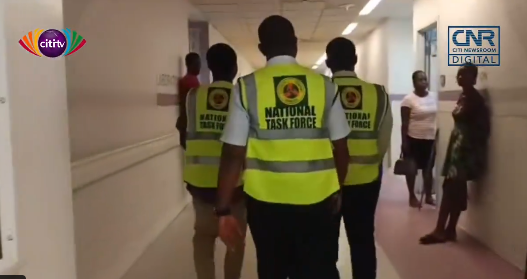
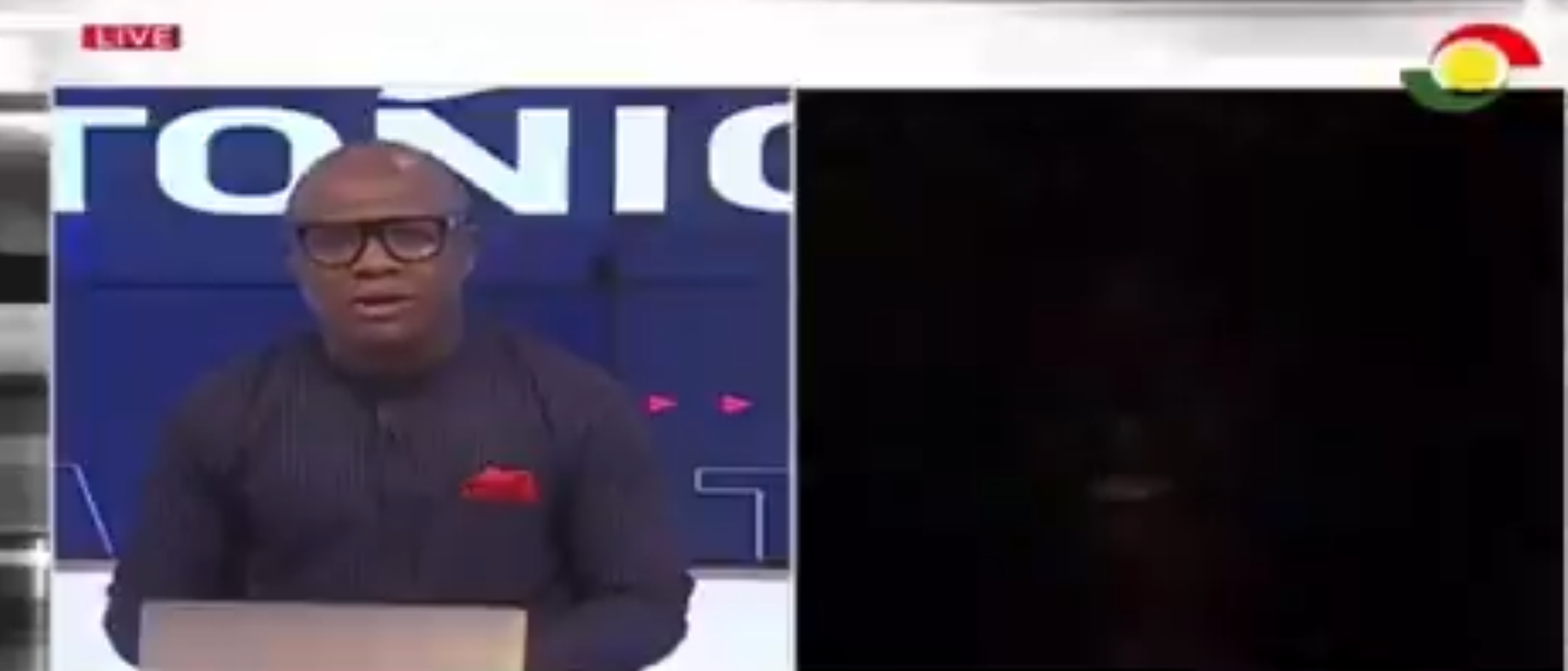
    The move comes after a video went viral on social media, in which a woman claimed that her three-day-old baby, who was in an incubator at the Tema General Hospital, died following erratic power outages. However, the hospital has denied that the power outage was linked to the baby’s death.

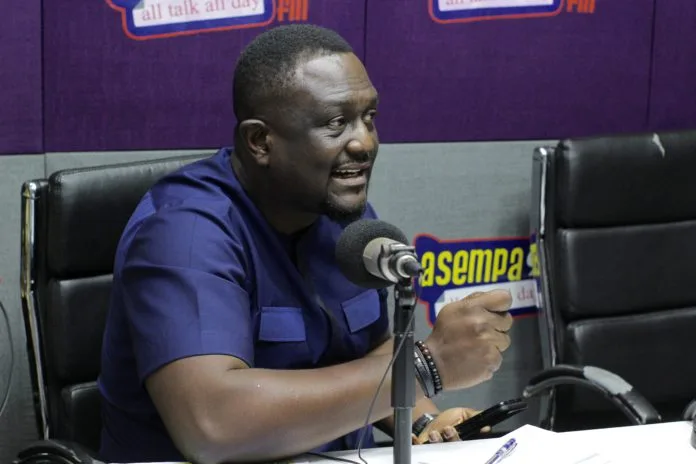
    According to the Acting General Secretary of the GMA, Dr. Richard Selormey, the erratic power outages not only affect hospital administration but also impact treatment and all aspects of operations.

    Dr. Selormey emphasized on Joy FM’s News Night on March 28, that the entire healthcare sector relies heavily on stable electricity. Therefore, when there are unexpected power cuts, it can lead to serious consequences.

    “And so, across the country, most of the hospitals the government has rolled out, what is called the links and electronic management system. And so power outages disrupt all these processes because, for example, patients need to be verified, those with NHIS and other private insurance need to be verified on the system before they start the journey through the hospital.

    “When these systems are off, it disrupts this because they cannot be verified or it takes much, much longer to get this done for them to begin to procure services within the facility. Beyond this are those patients who may be on the theatre table who may be undergoing dialysis, and various forms of treatment that require power to power machines and equipment that serve these patients.

    “And so it is very important that we put the issue into context. It’s not about when only somebody dies, but people may even suffer irreparable damage just because the power has been broken. I’m sure you read the Tema General Hospital statement where they said it took two hours to solve the problem,” he said.

    Dr. Selormey highlighted the challenges faced by health facilities, including the need to rely on torch lights during surgeries due to power outages, which poses a significant issue.

    He emphasized that the Ghana Medical Association (GMA) is not concerned about the name given to the current power outages but rather about their timing and impact.

    Furthermore, Dr. Selormey noted that the effects of the erratic power outages extend beyond patient care to the financial burden of running generators using fuel, especially with the current escalation in fuel prices.

    He explained that these additional costs would strain hospital budgets, underscoring the importance of having a load-shedding timetable. Such a timetable would allow hospitals to reschedule procedures and plan their budgets accordingly.

  • 630 overloaded transformers not responsible for power disruptions – PUWC

    630 overloaded transformers not responsible for power disruptions – PUWC

    The Public Utility Workers Union of TUC-Ghana (PUWC) has refuted claims made by the Electricity Company of Ghana (ECG) regarding the role of faulty distribution transformers in the ongoing power outages.

    In contrast to ECG’s assertions, the union argues that the power distribution company has an adequate supply of distribution transformers within its network. Therefore, they assert that the malfunctioning transformers cannot solely be blamed for the intermittent power outages, commonly known as dumsor.

    Recently, ECG attributed the current power supply challenges to technical issues from the power transmission company, GRIDCo. Additionally, ECG highlighted that approximately 630 transformers are overloaded, exacerbating the power outages.

    However, the Public Utility Workers Union of TUC released a statement emphasizing that ECG’s network encompasses 33,000 distribution transformers. Consequently, they argue that the impact of the 630 faulty transformers should be relatively insignificant in the overall context of the power distribution system.

    “The replacement and upgrade of such transformers have been routine operations for ECG, but it has never sparked public agitation like the current national outcry over load shedding,” part of the statement read.

    The group has urged energy sector regulators to promptly address the challenges faced by the power distribution company to prevent any potential escalation of the situation.

  • Take all health facilities out of your ‘dumsor’ list – Minority tells govt

    Take all health facilities out of your ‘dumsor’ list – Minority tells govt

    Minority in Parliament is calling for health facilities to be spared from the ongoing unannounced and unscheduled electricity load shedding conducted by the Electricity Company of Ghana (ECG). Additionally, they are pushing for an audit to assess the capacity and dependability of backup power systems in hospitals.

    “The Ministry of Energy, in collaboration with relevant agencies, must, without delay, exempt all health facilities nationwide from the current unannounced and unscheduled electricity load shedding and power outages.”

    “The Ministry of Health working in tandem with the Ghana Health Service should audit all alternate power supply systems within health facilities to determine their capacity and reliability in handling electricity disruptions and procurement of emergency power supply systems should be done if current systems are inadequate,” the caucus stated in a release issued by Kwabena Mintah Akandoh, Ranking Member on the Parliamentary Select Committee on Health and MP for Juaboso on Thursday.

    The Minority expressed concern over reports that the power outages have led to increased morbidity and mortality among patients, particularly those relying on public health facilities.

    “Amid these happenings, the government has refused to heed wise counsel from suffering Ghanaians and businesses to publish a load shedding timetable to enable them to plan their lives. This situation has obviously begun to take a toll on critical healthcare facilities across the country,” it added.

    The caucus strongly argued that during a period of purported surplus capacity, the government’s decision to impose a load-shedding program is deeply unjustified. There is simply no acceptable reason for disrupting electricity supply, particularly to vital health facilities.

    “We therefore demand swift action from relevant authorities to address these critical issues and safeguard the delivery of vital health services to Ghanaians,” it added.

  • ECG officers assess distribution transformers amid ‘dumsor’

    ECG officers assess distribution transformers amid ‘dumsor’

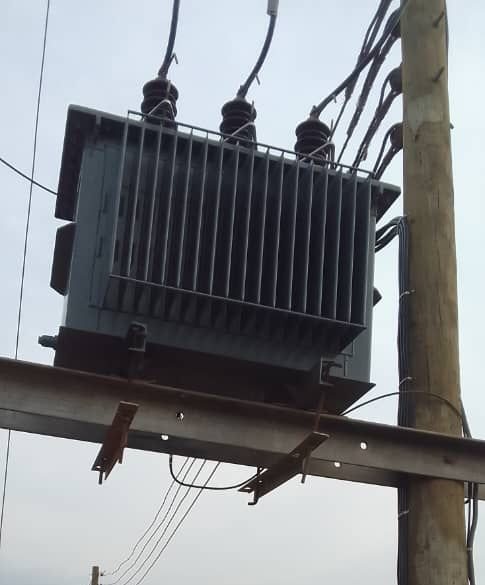
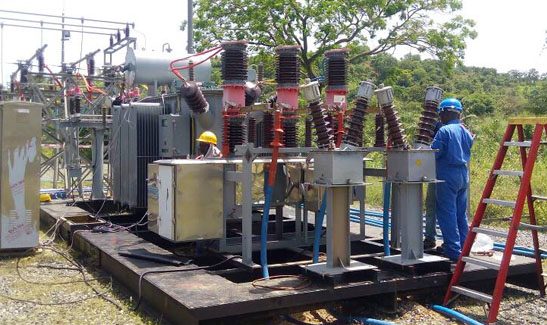
    The Electricity Company of Ghana (ECG) has initiated an exercise to inspect various power transformers nationwide, aiming to identify and rectify faults to ensure uninterrupted power supply.

    These integrity checks on transformers are crucial for identifying those operating at full capacity and in need of upgrades, which will help maintain a steady power supply.

    The upgrades to transformers operating at full capacity are expected to play a significant role in ensuring a reliable power supply.

    The ECG has begun upgrading transformers in areas where high demand has led to full capacity. As part of this effort, 630 faulty transformers have been identified in various communities across the country.

    These checks are crucial in identifying faults that may be contributing to recent power outages. Benjamin Antwi, the ECG PRO for Ashanti West, explained that the inspections target both ground-mounted and poll-mounted transformers to identify overloads for replacement.

    “When our team visits the transformer they will check the integrity of the transformer to see if the fuses are intact. this will help us know the actual load on a transformer and identify those reaching its capacity for us to put measures in place to upgrade them” he said.

    Mr. Antwi indicated that upon identifying faulty transformers, the exercise will contribute to efforts to sustain power.

    “Once we identify a transformer getting to its full capacity we will replace them by bringing a bigger transformer. once we can load the transformer to a much bigger capacity, we can accommodate any load that is coming on board that will help us keep the lights on” he indicated.

    Benjamin Antwi admonished customers to desist from tempering with the distribution transformers but rather channel their concerns to the ECG for redress.

  • Dumsor to affect over 25 areas in Accra – ECG

    Dumsor to affect over 25 areas in Accra – ECG


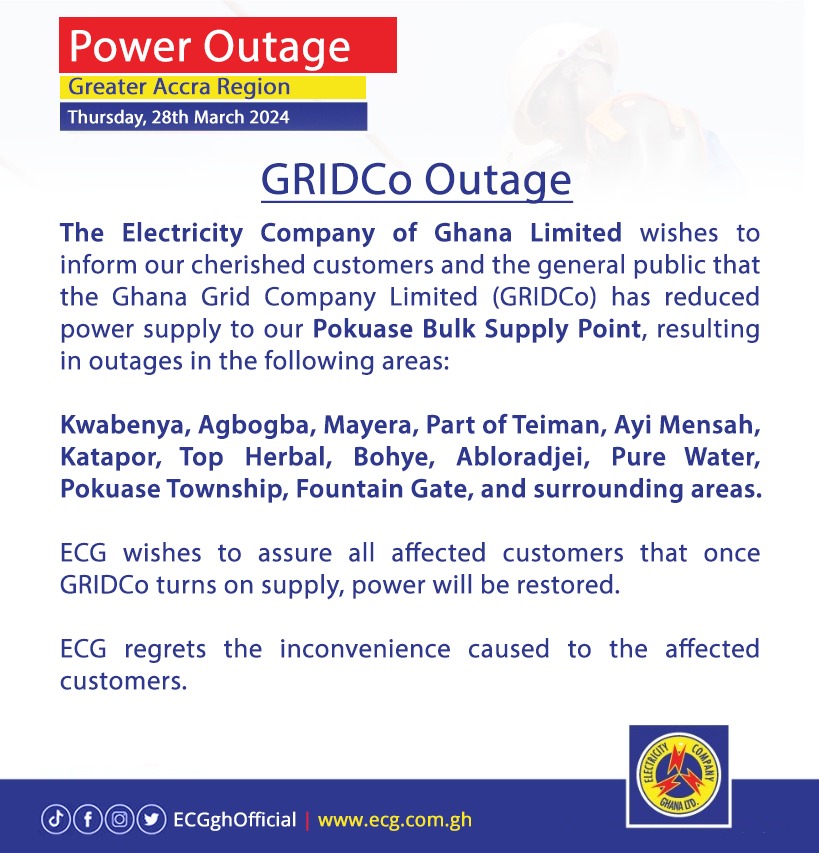
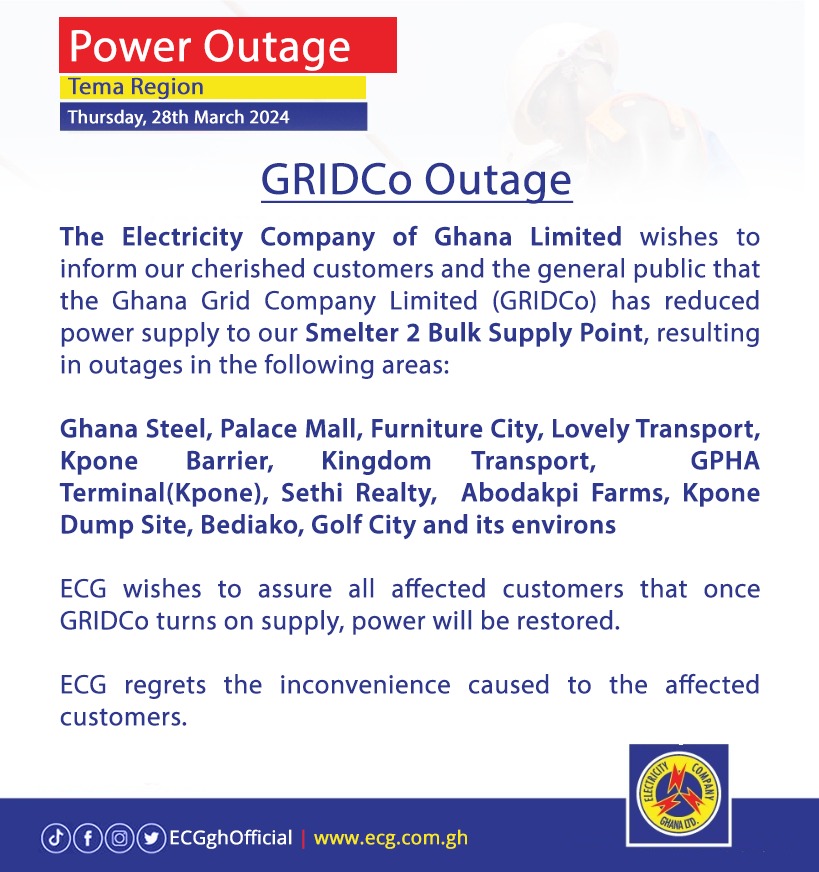
    The Electricity Company of Ghana (ECG) has announced power outages affecting over 25 areas communities in the Accra East and West regions.

    Among the affected areas are Ghana Steel, Palace Mall, Furniture Citi, Lovely Transport, Kpone Barrier, Kingdom Transport, GPHA Terminal (Kpone), Sethi Realty, Abodakpi Farms, and Kpone Dump Site.

    Additionally, areas such as Bediako, Golf City, and surrounding regions, including Kwabenya, Agbogba, Maryera, part of Teiman, Ayi Mensah, Katapor, Top Herbal, Bohye, Abloradjei, Pure Water, Pokuase Township, Fountain Gate, are experiencing power disruptions.

    In a statement issued on Thursday, ECG apologized to its customers in both regions, attributing the outages to a shortfall in power supply by the Ghana Grid Company Limited (GRIDCo) to their Pokuase Bulk Supply Point and the Smelter 2 Bulk Supply Point.

    The timeline for restoring power to these areas remains unclear, causing dissatisfaction among many ECG customers who seek a timetable for planning.

    The absence of a clear timetable has sparked anger among Ghanaians, especially after Minister for Energy, Dr. Mathew Opoku Prempeh, stated that there’s no ‘dumsor’ (power outages) and hence no need for a timetable.

    Despite the worsening situation, neither GRIDCo nor ECG has provided explanations to the public, a move criticized by many stakeholders.

    According to a compilation by Citi News, the number of affected areas or communities in the past week in these two regions exceeds a hundred.

  • PURC makes public its orders to ECG

    PURC makes public its orders to ECG

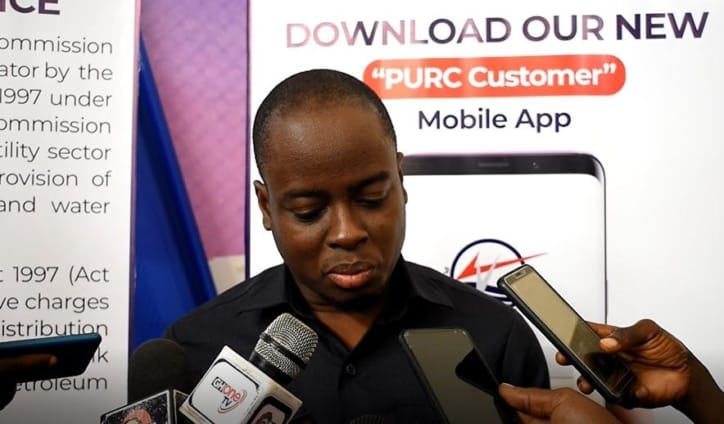
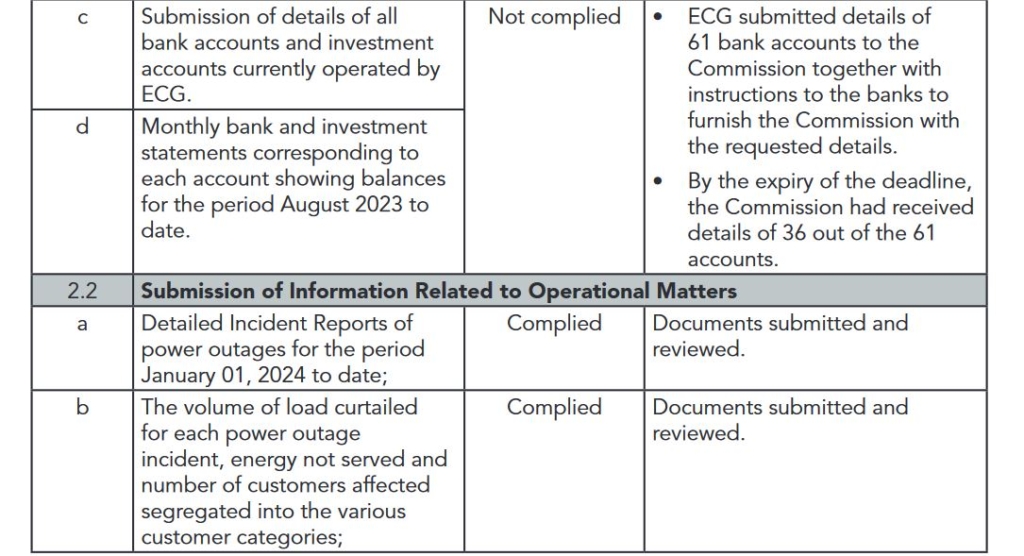
    Public Utilities Regulatory Commission (PURC) has provided an update on the progress of directives issued to the Electricity Company of Ghana (ECG) on March 19, 2024.

    According to the PURC, three out of the five tasks assigned to the power distribution company have been completed.

    Earlier, the Commission had mandated ECG to submit a comprehensive report on various aspects of its operations, including tariff revenue allocation and regulatory audit data, by April 2, 2024.

    Additionally, ECG was instructed to distribute funds from the Cash Waterfall Mechanism (CWM) by March 25, 2024.

    These directives were issued under Sections 3 and 24 of the Public Utilities Regulatory Commission Act, 1997 (Act 538), in response to concerns raised by the PURC regarding declining service quality and increased power outages across ECG service areas since January 1, 2024.

    However, in a press release dated March 26, PURC disclosed that ECG has yet to fulfill its obligation of making payments to energy sector players along the electricity value chain.

    The statement further stressed that “PURC shall validate all payments made along the electricity value chain for an approval month and publish it on the PURC website not later than the second week of the following month.”

    But this validation can only be done when payments to the energy sector players have been completed.

  • Deputy Energy Minister, Herbert Krapa, appointed ECG Board Chair

    Deputy Energy Minister, Herbert Krapa, appointed ECG Board Chair

    President Akufo-Addo has appointed Herbert Krapa, the Deputy Minister of Energy, as the new Board Chair of the Electricity Company of Ghana (ECG), following the resignation of Keli Gadzekpo on Tuesday, March 26, 2027, citing personal reasons.

    Mr Krapa is expected to lead the ECG Board in addressing the recent power supply disruptions in the country.

    The ECG has faced intense pressure and scrutiny from customers and businesses in recent weeks, demanding a load-shedding timetable as power outages increase.

    In response, the Public Utilities Regulatory Commission (PURC) has directed ECG to submit and publish a comprehensive load-shedding timetable by April 2, 2024.

    However, the Ministry of Energy has denied claims that Ghana is currently experiencing a power crisis, also known as ‘dumsor.’

  • Keli Gadzekpo steps down as ECG board chair amid power crisis

    Keli Gadzekpo steps down as ECG board chair amid power crisis

    The Chair of the Board at the Electricity Company of Ghana (ECG), Keli Gadzekpo, has submitted his resignation.

    Effective immediately, Gadzekpo’s departure is attributed to personal reasons.

    Appointed to the Board in 2017 by then Energy Minister Boakye Agyarko, Gadzekpo played a crucial role in ensuring energy sufficiency.

    A seasoned entrepreneur, he has played pivotal roles in various companies, notably the Databank Group of Companies, encompassing Databank Asset Management Services and Databank Epack Investment Fund Ltd.

    With over two decades of experience in investment banking, Gadzekpo currently serves as the Chair of the Board for Enterprise Group.

    Additionally, he heads the Databank Foundation, the corporate social responsibility arm of the Databank Group.

    Educated at Achimota School, Gadzekpo holds a BSc in Accounting from Brigham Young University and is a CPA from the USA.

    He furthered his education as a Mason Fellow at the John F. Kennedy School of Government, Harvard University, earning a master’s degree in Public Administration.

    While citing personal reasons in his resignation letter, reports suggest that his departure coincides with recent erratic power supply in the country, prompting calls for the ECG to release a load shedding management schedule.

  • You are wishing evil for the country – NAPO tells ECG critics demanding load-shedding timetable

    You are wishing evil for the country – NAPO tells ECG critics demanding load-shedding timetable

    Energy Minister, Dr. Matthew Opoku Prempeh, has addressed the recent power supply disruptions across Ghana.

    In his message to Ghanaians who have called for a load-shedding timetable due to the erratic power supply, he noted that such people are wishing doom for the country.

    According to him, there is no need for a timetable especially when the Electricity Company of Ghana (ECG) has said otherwise.

    “Let those who want the timetable bring it. What do you mean? I don’t know of any timetable because the ECG has said it is not necessary. Why would someone just wish evil for the country?” he asked.

    In recent weeks, various areas have experienced interruptions in electricity supply, leading to dissatisfaction among citizens with the Electricity Company of Ghana (ECG).

    The ECG has refused to describe the power outage as “dumsor”. It has attributed the outage to maintenance issues.

    But the Public Utilities Regulatory Commission (PURC) among other directives, has ordered the Electricity Company of Ghana (ECG) to submit a comprehensive load management timetable by April 2, in response to recent power supply disruptions.

  • We are quick to always crucify ECG; let them tell their side of the story – Ex-Minister on ECG’s 1.9bn dollars loss

    We are quick to always crucify ECG; let them tell their side of the story – Ex-Minister on ECG’s 1.9bn dollars loss

    Former Deputy Attorney-General and Minister for Justice, Joseph Dindiok Kpemka, has called for commendation of the Electricity Company of Ghana (ECG) and its Managing Director, Samuel Dubik Masubir Mahama, for their diligent efforts in maintaining favourable power supply to the public amid alleged reports of their huge loss .

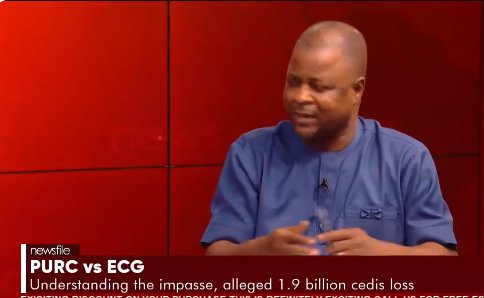
    His comments come on the heels of recent debates over financial management by the power supply company after news of the company’s incurred loss of 19 billion US dollars.

    In a discussion with JoyNews Newsfile host on a segment of the show, the former Attorney-General condemned the negative news reports about the ECG’s defects while commending the company’s managing director for what he describes as his bravery and courage.

    The ECG embarked on a revenue mobilisation exercise that saw several private and government agencies, such as Parliament House, which owed the company, taken off the national grid.

    “I am very worried that the youngman is doing some very wonderful things there , ECG and yet we aren’t talking about those positive strides that he is making, but yet singling out out what we call defects and taking him on, etc.

    Look at the recent things he did. going to Parliament and others, very courageous to let the money come out so that we’d be able to keep our commitments to see the power on. All those things we aren’t commenting on, his level of courage.

    Commending this move, he recommended that ECG begiven an opportunity to explain and ‘defend’ the reports flying around before a verdict is given. ECG should be given an opportunity to vindicate itself, he added.

    “ECG has been collected without being given any hearing at all.We haven’t listened to them to hear their side of the story and all the reports we get we use as a basis to hang them.

    Know that these reports are interim reports and ECG will provide answers and so it will be the case that at the end those faults that are alleged to have been found will be perfectly answered.

    Let’s give them the opportunity to explain themselves and I think ECG is doing a wonderful job. Samuel is doing a good job, trying to ensue that our lights are on in the midst of difficulty we should criticise them yeah they aren’t beyond criticism but at the same time we should acknowledge them” , he noted.

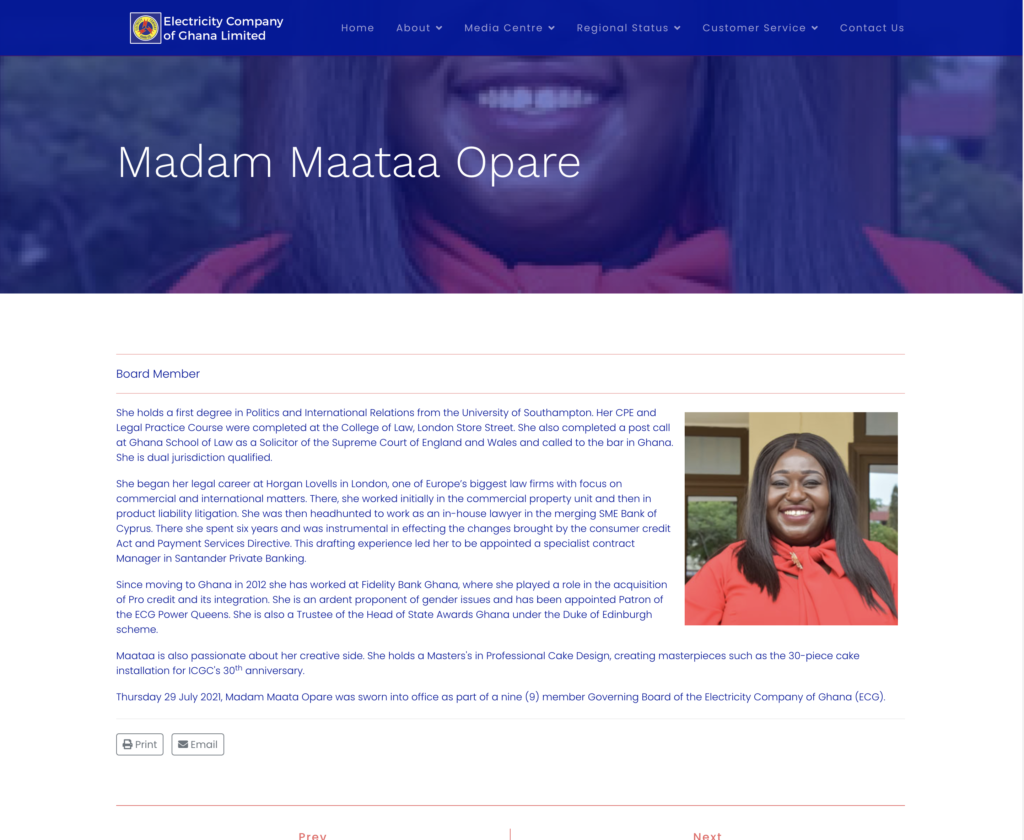
  • Meet Chief of Staff’s daughter, Maataa Opare, who is a top banker and a member of the ECG Board

    Meet Chief of Staff’s daughter, Maataa Opare, who is a top banker and a member of the ECG Board

    While many recognize Akosua Frema Osei Opare as Ghana’s first female Chief of Staff and a prominent figure in the current New Patriotic Congress administration, her private life remains shrouded in mystery.

    Little is known about her family, marriage, or children. Today, we shine a spotlight on Maataa Opare, her daughter, who has carved out a significant niche for herself away from the public eye.

    Maataa Opare, a seasoned banking professional and member of the Electricity Company of Ghana (ECG) Board, has quietly operated within the corridors of power, evading any semblance of controversy.

    She boasts an impressive resume in finance and law, standing tall as a formidable force in her domain, as she also currently serves as the Group Head of Legal and Company Secretary at Fidelity Bank Limited in Accra.

    Her career in the legal domain of the financial sector spans over sixteen years, including a stint in property litigation and product liability at Hogan Lovells in the UK.

    She is a solicitor of the Supreme Court of England and Wales and has been called to the Bar in Ghana, making her dual jurisdiction qualified.

    Since her move to Ghana in 2012, Maataa has been instrumental at Fidelity Bank Limited, where she has played pivotal roles, including the acquisition of ProCredit Savings and Loans and its subsequent integration.

    Her expertise is not limited to the banking sector; in July 2021, she was sworn in as part of the nine-member governing board of ECG.

    She also dedicates her time as Patron of the ECG Power Queens and as a Trustee of the Head of State Awards Ghana, which is part of the Duke of Edinburgh’s Award scheme.

    In addition to her professional accomplishments, Maataa Opare holds a Masters in Professional Cake Design and is known for her creative flair, having crafted a 30-piece cake installation for the International Central Gospel Church’s (ICGC) 30th-anniversary celebrations.

    Her multifaceted talents and contributions make her a remarkable figure in Ghana’s landscape of influential women.

  • Bright Simons fingers Chief of Staff’s alleged relative in “sweetened” ECG-Fidelity FX deal saga

    Bright Simons fingers Chief of Staff’s alleged relative in “sweetened” ECG-Fidelity FX deal saga

    Bright Simons, the Vice President of IMANI Africa, has made a startling revelation in his quest to expose the alleged exchange rate deals being offered to Fidelity Bank by the Electricity Company of Ghana (ECG).

    According to Mr Simons, Ghanaians are suffering from erratic power supply due to such decisions taken by the ECG, which tantamounts to “financial mismanagement.”

    In a recent article, Mr Simons, who has been dragged to court by the bank, highlighted a conflict of interest that could be the cause of the alleged deals being offered to Fidelity Bank.

    Maataa Opare, Fidelity’s Group Head of Legal and Company Secretary, could be the bridge that has fostered these reported deals. According to Mr Simons, Maataa Opare is also a member of the board of directors of ECG.

    He believes Maataa Opare is in a position where she can eat her cake and have it since she will be able to put forward proposals for the bank and have these proposals approved with her support while on the Board.

    “Ms. Opare has extensive oversight over Fidelity Bank’s compliance with regulations, policies, ethics, and laws.

    “It seems to us that this represents a major entanglement between her fiduciary responsibilities at ECG to ensure that the organisation is procuring competitively, demanding high performance from vendors and bankers, and ensuring strict standards and compliance in all business relationships, on the one hand, and her role at Fidelity to negotiate the most favourable contracts and commercial arrangements. It is not possible to see how this conflict is manageable on an ongoing basis. Ms. Opare will be drafting contracts at Fidelity to extract maximum commercial advantage from ECG on Monday, and then on Tuesday, she will go to ECG and approve them?”

    He further mentioned that Maataa Opare initiatives at the ECG are making headway due to her alleged association with the Chief of Staff, Frema Opare.

    This image has an empty alt attribute; its file name is ECG_Fidelity_Maataa_Frema_FemPower_Power_Ladies.png
    Ms. Maataa Opare, the CEO of ECG, & the Chief of Staff at the Presidency of Ghana

    “On top of all this, Ms. Opare is believed to be politically exposed. Our sources say that she is a “close associate or relative” of Ms. Frema Opare, the all-powerful Chief of Staff of the Ghanaian Presidency.

    “Since coming to ECG, Ms. Opare has used her close relations with the Chief of Staff to secure her patronage for her initiatives at ECG such as the ECG Power Ladies and fempower corporate activity.

    “What we have now then is a powerful, politically exposed, business executive at Fidelity strategically positioned on the board of ECG, an organisation that has become noted for flouting regulatory directives and thwarting government policy,” he wrote.

    Mr Simons is certain Fidelity Bank and ECG are engaged in a shady deal since the two institutions have “extensive commercial and financial dealings.”

    He revealed that when ECG was asked by the Cabinet of Ghana to consolidate its bank accounts, it chose Fidelity Bank as the primary custodian of this new single account. 

    “Fidelity thus became ECG’s principal banker, with Fidelity bank account number 1070006628289 becoming the primary treasury node,” he added.

    Presently, an audit conducted by PricewaterhouseCoopers (PwC) on the Electricity Company of Ghana (ECG) has revealed significant discrepancies in its adherence to the Cash Waterfall Mechanism (CWM) established by the Public Utilities Regulatory Commission (PURC).

    The audit, according to The Hearld, found that there were substantial disparities between the reported collections and the actual disbursements by ECG, amounting to approximately GHS3.5 billion over ECG’s CWM allocation from July 2022 to September 2023.

    These findings are contrary to the requirements of the Cash Waterfall Mechanism for month-on-month analysis, as reported by The Herald.

    Additionally, the audit highlighted a net difference of GHS1.9 billion between the total collections declared on the CWM-approved schedules and the inflows consolidated from the bank account statements reviewed.

  • “In your own interest,” appear here within 48 hours – ECG goes after Fantasy Dome over illegal metre connection

    “In your own interest,” appear here within 48 hours – ECG goes after Fantasy Dome over illegal metre connection

    Electricity Company of Ghana (ECG) has accused the operators of the popular event venue, Fantasy Dome, of illegally connecting to the power grid.

    According to the ECG, Fantasy Dome has been bypassing its metre and unlawfully tapping into the public electricity network.

    In a notice dated Wednesday, March 20, 2024, the ECG instructed the owners of Fantasy Dome to correct their power connection within 48 hours of receiving the notice.

    The notice warned that failure to comply could lead to the ECG pursuing legal action against Fantasy Dome as it deems fit.

    “You are requested, in your own interest, to report within 48 hours from the date of this notice to (CSD) REVENUE PROTECTION NATIONAL TASKFORCE at the ECG PROJECT OFFICE BEHIND THE VIP TRANSPORT YARD (CIRCLE), preferably between the hours of 8.00 AM and 5.00 PM, to regularise your power service connection.

    You may bring along any relevant ECG document. ECG reserves the right to institute criminal proceedings against you at its own convenience.”

    During the weekend, the demolition of Fantasy Dome stirred up controversy.

    According to Leslie Quaynor, the CEO of Fantasy Dome, in an interview with Sammy Flex, the demolition was carried out by the Ghana Trade Fair Company with the help of some National Security operatives.

  • ‘Irresponsible’ ECG spent misappropriated cash on fuel – PURC

    ‘Irresponsible’ ECG spent misappropriated cash on fuel – PURC

    The Public Utilities Regulatory Commission (PURC) has criticized the Electricity Company of Ghana (ECG) for its decision to use funds from the cash waterfall mechanism to purchase fuel for power generation.

    This decision has reportedly left the Volta River Authority (VRA) and the Ghana Grid Company (GRIDCo) cash-strapped between November 2023 and January 2024, negatively impacting their operational capacity.

    PURC has given ECG a one-week ultimatum to respond to a set of demands and warned that it may impose sanctions if the demands are not met.

    Alhaji Jabaru Abubakar, the Director of Regional Operations and Consumer Services at the Commission, emphasized that the ECG must adhere to regulatory guidelines and cannot operate on its own terms. He dismissed speculation of a turf war between the PURC and ECG, stating that the PURC is simply fulfilling its role as a regulator.

    Energy analyst Kwame Jantuah suggested the need for a mediation body to resolve the differences between the two entities.

    Meanwhile, the Mines and Energy Committee in Parliament has summoned the Energy Minister and the managing director of ECG to address the recent public dispute. Committee Chairman Samuel Atta Akyea stated that they view the matter as important and aim to understand the root cause of the disagreement between the regulator and the distributor.

  • Special needs school cut off national grid since February due to GHS66k unpaid bill to ECG

    Special needs school cut off national grid since February due to GHS66k unpaid bill to ECG

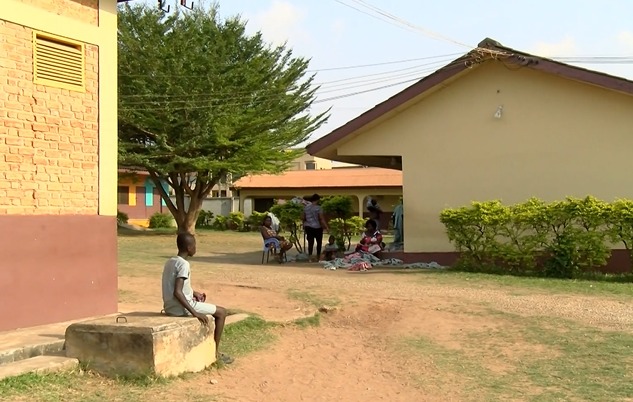
    As part of its efforts to collect outstanding debts, the Electricity Company of Ghana (ECG) has disconnected power to the Garden City Special School located in Asokore Mampong, Ashanti Region.

    The school has reportedly been without electricity since February 14, 2024, owing to an unpaid debt of GH₵66,000 to the utility company.

    In an interview with JoyNews, the headmistress of the school, Dr. Roselyn Frimpong Agyapong, revealed that despite appeals to the Municipal Director of Education and the Asokore Mampong Municipal Chief Executive, efforts to persuade ECG to restore power to the school have been unsuccessful.

    Expressing concern over the situation, Dr. Agyapong emphasized the need for greater attention to be given to the education of children with disabilities in Ghana, highlighting their often neglected status.

    Furthermore, aside from the electricity challenge, the boys’ dormitory at the school has collapsed, forcing learners to sleep in classrooms, exposed to the elements.

    Garden City Special School serves as a vital government facility catering to learners with special educational needs, covering regions such as Ashanti, parts of Eastern, Western, and Northern.

    With approximately 192 learners, the school operates on full government subsidies and does not charge any fees to students.

    Dr. Agyapong urged the government to urgently address the needs of special schools across the country, including the Garden City Special School, expressing frustration over the current situation.

    “The government needs to pay more attention to children with disabilities in Ghana, especially their education. These children are often neglected in everything, and that is not right,” she added.

  • ECG overpaid non-CWM beneficiaries – Audit report

    ECG overpaid non-CWM beneficiaries – Audit report

    An audit conducted by PricewaterhouseCoopers (PwC) on the Electricity Company of Ghana (ECG) has revealed significant discrepancies in its adherence to the Cash Waterfall Mechanism (CWM) established by the Public Utilities Regulatory Commission (PURC).

    The Cash Waterfall Mechanism Validation Report for November 2023 Payment echoed concerns about the handling of cash collection and distribution by ECG management.

    The audit, according to The Hearld, found that there were substantial disparities between the reported collections and the actual disbursements by ECG, amounting to approximately GHS3.5 billion over ECG’s CWM allocation from July 2022 to September 2023.

    These findings are contrary to the requirements of the Cash Waterfall Mechanism for month-on-month analysis, as reported by The Herald.

    The audit findings revealed that ECG disbursed funds to non-CWM beneficiaries in amounts that exceeded its allocated amounts as per the CWM guidelines. This deviation from the intended distribution mechanism outlined by PURC is significant.

    “Disbursement to CWM beneficiaries from other ECG operational accounts post-MoF directive of June 21, 2023, effective July 1, 2023. The Ministry of Finance (MoF) issued a directive on June 21, 2023, effective July 1, 2023, that ECG should operate a single account from which all collections and payments will be made. In this regard, ECG designated Fidelity Bank Account Number 1070006628289 as the single collections account.

    “From our validation procedures performed, we noted that some payments totaling GHS 684 million to CWM beneficiaries for the period from July 2023 to September 2023 were made from other ECG operational accounts, escrow accounts, and margin accounts. Payments through these other accounts were not in line with the MoF directive issued.

    “We have raised this with ECG and requested the bank statements for these operational accounts, escrow accounts, and margin accounts to validate these payments to the CWM beneficiaries. We have yet to receive them.”

    Additionally, the audit highlighted a net difference of GHS1.9 billion between the total collections declared on the CWM-approved schedules and the inflows consolidated from the bank account statements reviewed.

    The audit team noted consistent differences between the collections and corresponding allocations made by ECG, compared to what was actually paid out. According to the CWM reports, this discrepancy was primarily due to overpayments/underpayments to beneficiaries, particularly those classified under Tier 2 (Level B).

    “The total collections per the CWM were lower than the total collections per the two bank statements. We have raised this with ECG and requested explanations and supporting evidence for these disparities. As of the date of this report, ECG management has yet to revert with these explanations and supporting evidence.”

    “The list of documents reviewed as part of the validation exercise includes the following: CWM payments (from 2022 to 2023); ECG GCB Bank Statement for account number 1011130011277 for the period from July 2022 to September 2023; Fidelity Bank Statement for account number 1070006628289 for the period from January 2023 to September 2023;

    “Cheque registers for payments to CWM beneficiaries for the period from July 2022 to September 2023; bank transfer advice to various banks for payments to various CWM beneficiaries for the period from July 2022 to September 2023.

    “Based on the data made available to us, we adopted the following approach to the exercise: Cash collections: We obtained the bank statements of the GCB collections account (1011130011277) and the Fidelity single collections account (1070006628289) and analysed all collections received in the account (credit transactions in the bank statement) on a monthly basis for the period from July 2022 to September 2023.

    “We then compared the total monthly collections analysed from the bank statements to the amounts reported in the CWM, highlighting the differences noted for each month.

    “We obtained the bank statements of the GCB collections account (1011130011277) and Fidelity single collections account (1070006628289) and analysed all disbursements in the account (debit transactions in the bank statement) on a monthly basis for the period from July 2022 to September 2023. We then identified all disbursements on a month-by-month basis made to CWM beneficiaries by obtaining and analysing the cheque register and bank transfer advice from ECG. For those payments made through the Fidelity and GCB accounts, we agreed these amounts to the bank statements.

    “We then excluded the total CWM payments from the total disbursements to ascertain the non-CWM disbursements made by ECG and compared these amounts to ECG’s CWM allocation. Differences between Total Collections declared on CWM and the total collections consolidated from the bank statements of the GCB main account and the Fidelity Single Collections account. On a monthly basis, ECG is required to report their total collections for the month for input into the CWM, which would then be distributed amongst the CWM beneficiaries.

    “To assess the amounts reported by ECG, we obtained and analysed all collections received in the GCB collections account (account number 1011130011277) for the period from July 2022 to September 2023 and the Fidelity Bank Single Collections Account (account number 1070006628289) for the period from January 2023 to September 2023).

    “From our analysis performed on the bank statements received, we noted a net difference of GHS1.9 billion between the total collections declared on the CWM approved schedules and the inflows consolidated from the bank account statements shared.
    This comes as PURC continues to accuse ECG and its management of refusing to comply “with the guidelines of the new CWM as directed by the President, Nana Akufo-Addo, in August 2023.

    “This defeats the principle of fair and equitable allocation of revenue to sector players under Level B as approved by the CWM Standing Committee in line with the revised CWM guidelines. The Commission wishes to state that ECG should co-operate and allow the CWM to function as directed by the President. Additionally, MoF should also take the necessary steps to honour its obligation by paying for the shortfalls.”

    In the audit report, PricewaterhouseCoopers expressed frustrations, citing a lack of cooperation from ECG management during the audit process. The report noted that the state company often refused to provide requested information, particularly documents, and did not respond to queries regarding identified infractions.

    Conducted at the request of the Ministry of Finance, the audit recommends the strengthening of the current CWM and enhancing ECG’s compliance with its directives. Proposed measures include process improvements in billing and invoicing, as well as the implementation of technology-enabled platforms to enhance transparency and accountability.

    The audit report stated, “We have identified and described in detail our recommendations for strengthening the current CWM and the inputs from ECG going forward.” It added, “It is imperative that ECG and other stakeholders work collaboratively to implement these recommendations and uphold the integrity of the CWM.”

    This includes: Establishing billing and invoicing process improvements at ECG; Key considerations for the CWM disbursement process; Key considerations for the management of non-tariff revenue by ECG; Medium-term redevelopment of the CWM onto a technology-enabled platform to strengthen the fundamental objectives of the mechanism; Key considerations for cybersecurity and data protection measures at ECG (including implementation of a disaster recovery plan or framework, integration of cyber defence mechanisms and processes at ECG, and considerations for managing third-party solutions and collaborations).

    It suggested engaging with the Ministry of Energy, PURC, and other relevant stakeholders to establish the critical process of retrieving the required data/information to complete our tasks. This will also establish the foundation for the relevant processes and information requirements going forward for the quarterly reviews.

    “We also look forward to discussing our recommendations as PURC, ESRP, and the other stakeholders plan to work with ECG to implement them to help restore confidence and promote a transparent and strengthened CWM.”

    As part of achieving financial sustainability in Ghana’s energy utilities and value chain, the Government of Ghana (GoG) initiated the Energy Sector Recovery Program (ESRP) in May 2019. The ESRP is a comprehensive recovery program that sets out a roadmap of policies and actions required for financial recovery in the energy sector.

    In April 2020, the Electricity Sector Revenue Protection (ESRP) implemented the Cash Waterfall Mechanism (CWM) to ensure transparent, fair, and timely payment of all revenues billed and collected by the Electricity Company of Ghana (ECG) on behalf of the entire electricity generation value chain.

    The CWM, along with the Natural Gas Clearinghouse (NGC) mechanisms, was established to promote fairness and transparency in the disbursement of energy revenues and the equitable allocation of tariff revenue collected by ECG to all parties in the energy value chain.

    This validation exercise aims to verify electricity sales in terms of kilowatt-hours (kWh) and the amount billed and collected by ECG over a specified period. It seeks to confirm whether these sales, billings, and collections align with the requirements and outcomes of the Cash Waterfall Mechanism and its related payments. The assessment will also validate the cycle of power delivered, corresponding billing, and collection, as well as the full transfer of these collected funds from regional collection accounts into the Single Collections account.

    Issues related to ECG’s revenues/collections and the broader energy sector debt have contributed to Ghana’s economic challenges. Therefore, this engagement is crucial in identifying and addressing these challenges to strengthen the power sector value chain.

    Amongst other things, it demanded some detailed revenue assurance and validation, an understanding of the key sources of revenue for ECG, i.e., tariff and non-tariff, and their detailed composition /breakdown; a review of revenue/cash collections from the district level and how this flows to the Head Office from the customers’ billings.

    It also recommended stakeholder engagement and buy-in to align with key stakeholders (IPPs, ECG, PURC, MoEn, GoG) on the reconciliation/validation exercise’s outcome and key actions required.

    The CWM report does not state clearly why this happened, and the PURC notes that the CWM Standing Committee indicated how this defeats the purpose of the CWM.

    “We generally agree with this position, as the guidelines for the CWM are quite clear.

    It will be important to understand, from ECG’s perspective, why there is a continuous lack of cooperation in following the guidelines, which is raising many questions about its use of its collections.”

    It was also identified that ECG used an unprotected Microsoft Excel spreadsheet (Data Integrity and Model Security).

    “We observed that most of the submitted CWM models did not have protected cells to limit users’ ability to interfere with allocation formulas either intentionally or by error.”

    It was advised that PURC will need to reconsider using Microsoft Excel-based spreadsheets for the CWM going forward. The integrity of the data entered into the spreadsheet must be safeguarded to promote transparency and efficient management of the mechanism.

    Key cells must be locked with control access features and enhanced access log features programmed into the spreadsheet to track any attempted changes to the inputs in the model.

    “As suggested in our recommendation, PURC, together with ESRP, should consider a shared platform approach to enhance oversight and accountability from ECG, beneficiaries, and the key stakeholders of Ghana’s value chain to promote confidence in the CWM and its ability to meet its objectives.”

    “Currently, ECG is required to submit the CWM to PURC for review and validation. As mentioned earlier, the allocations and subsequent disbursements often do not completely follow the requirements of the guidelines. It will be useful for PURC to take advantage of technology-enabled solutions to facilitate a system that provides real-time data, independent validation, and a stronger reconciliation system to support a more efficient monitoring and evaluation process in the CWM declaration process.

    On validation of payments to CWM beneficiaries, the report said that “from our review of payments made to CWM beneficiaries, we noted that some payments were made through ECG’s operational accounts, margin accounts, and escrow accounts (ADB, Consolidated Bank, Fidelity Bank, GCB, Access Bank, Zenith Bank, Bank of Africa, First Atlantic Bank, GT Bank, Omni BSIC, Republic Bank, Ecobank, ABSA, Stanbic Bank, Societe Generale, CAL Bank, and Universal Merchant Bank). As of the date of this report, the bank statements for these accounts have not been made available to us to validate these payments. As such, the validation of these payments could not be performed.

  • ECG accused of understating generated funds

    ECG accused of understating generated funds

    An audit conducted by PricewaterhouseCoopers (PwC) on the Electricity Company of Ghana (ECG) has revealed significant discrepancies in its adherence to the Cash Waterfall Mechanism (CWM) established by the Public Utilities Regulatory Commission (PURC).

    The audit, according to The Hearld, found that there were substantial disparities between the reported collections and the actual disbursements by ECG, amounting to approximately GHS3.5 billion over ECG’s CWM allocation from July 2022 to September 2023.

    These findings are contrary to the requirements of the Cash Waterfall Mechanism for month-on-month analysis, as reported by The Herald.

    Additionally, the audit highlighted a net difference of GHS1.9 billion between the total collections declared on the CWM-approved schedules and the inflows consolidated from the bank account statements reviewed.

    This comes as PURC continues to accuse ECG and its management of refusing to comply “with the guidelines of the new CWM as directed by the President, Nana Akufo-Addo, in August 2023.

    “This defeats the principle of fair and equitable allocation of revenue to sector players under Level B as approved by the CWM Standing Committee in line with the revised CWM guidelines. The Commission wishes to state that ECG should co-operate and allow the CWM to function as directed by the President. Additionally, MoF should also take the necessary steps to honour its obligation by paying for the shortfalls.”

    The Cash Waterfall Mechanism Validation Report for November 2023 Payment echoed similar concerns about the handling of cash collection and distribution by ECG management.

    In the audit report, PricewaterhouseCoopers expressed frustrations, citing a lack of cooperation from ECG management during the audit process. The report noted that the state company often refused to provide requested information, particularly documents, and did not respond to queries regarding identified infractions.

    However, the PricewaterhouseCoopers audit said, “From our analysis of the disbursements made from the GCB collections account and the Fidelity Single Collections account, we noted that for all the months, with the exception of February 2023, the disbursements made by ECG to non-CWM beneficiaries were in excess of its allocated amounts per the CWM.”

    The audit findings revealed that ECG disbursed funds to non-CWM beneficiaries in amounts that exceeded its allocated amounts as per the CWM guidelines. This deviation from the intended distribution mechanism outlined by PURC is significant.

    The audit team noted consistent differences between the collections and corresponding allocations made by ECG, compared to what was actually paid out. According to the CWM reports, this discrepancy was primarily due to overpayments/underpayments to beneficiaries, particularly those classified under Tier 2 (Level B).

    Conducted at the request of the Ministry of Finance, the audit recommends the strengthening of the current CWM and enhancing ECG’s compliance with its directives. Proposed measures include process improvements in billing and invoicing, as well as the implementation of technology-enabled platforms to enhance transparency and accountability.

    The audit report stated, “We have identified and described in detail our recommendations for strengthening the current CWM and the inputs from ECG going forward.” It added, “It is imperative that ECG and other stakeholders work collaboratively to implement these recommendations and uphold the integrity of the CWM.”

    This includes: Establishing billing and invoicing process improvements at ECG; Key considerations for the CWM disbursement process; Key considerations for the management of non-tariff revenue by ECG; Medium-term redevelopment of the CWM onto a technology-enabled platform to strengthen the fundamental objectives of the mechanism; Key considerations for cybersecurity and data protection measures at ECG (including implementation of a disaster recovery plan or framework, integration of cyber defence mechanisms and processes at ECG, and considerations for managing third-party solutions and collaborations).

    It suggested engaging with the Ministry of Energy, PURC, and other relevant stakeholders to establish the critical process of retrieving the required data/information to complete our tasks. This will also establish the foundation for the relevant processes and information requirements going forward for the quarterly reviews.

    “We also look forward to discussing our recommendations as PURC, ESRP, and the other stakeholders plan to work with ECG to implement them to help restore confidence and promote a transparent and strengthened CWM.”

    “The total collections per the CWM were lower than the total collections per the two bank statements. We have raised this with ECG and requested explanations and supporting evidence for these disparities. As of the date of this report, ECG management has yet to revert with these explanations and supporting evidence.”

    “Disbursement to CWM beneficiaries from other ECG operational accounts post-MoF directive of June 21, 2023, effective July 1, 2023. The Ministry of Finance (MoF) issued a directive on June 21, 2023, effective July 1, 2023, that ECG should operate a single account from which all collections and payments will be made. In this regard, ECG designated Fidelity Bank Account Number 1070006628289 as the single collections account.

    “From our validation procedures performed, we noted that some payments totaling GHS 684 million to CWM beneficiaries for the period from July 2023 to September 2023 were made from other ECG operational accounts, escrow accounts, and margin accounts. Payments through these other accounts were not in line with the MoF directive issued.

    “We have raised this with ECG and requested the bank statements for these operational accounts, escrow accounts, and margin accounts to validate these payments to the CWM beneficiaries. We have yet to receive them.

    As part of achieving financial sustainability in Ghana’s energy utilities and value chain, the Government of Ghana (GoG) initiated the Energy Sector Recovery Program (ESRP) in May 2019. The ESRP is a comprehensive recovery program that sets out a roadmap of policies and actions required for financial recovery in the energy sector.

    In April 2020, the Electricity Sector Revenue Protection (ESRP) implemented the Cash Waterfall Mechanism (CWM) to ensure transparent, fair, and timely payment of all revenues billed and collected by the Electricity Company of Ghana (ECG) on behalf of the entire electricity generation value chain.

    The CWM, along with the Natural Gas Clearinghouse (NGC) mechanisms, was established to promote fairness and transparency in the disbursement of energy revenues and the equitable allocation of tariff revenue collected by ECG to all parties in the energy value chain.

    This validation exercise aims to verify electricity sales in terms of kilowatt-hours (kWh) and the amount billed and collected by ECG over a specified period. It seeks to confirm whether these sales, billings, and collections align with the requirements and outcomes of the Cash Waterfall Mechanism and its related payments. The assessment will also validate the cycle of power delivered, corresponding billing, and collection, as well as the full transfer of these collected funds from regional collection accounts into the Single Collections account.

    Issues related to ECG’s revenues/collections and the broader energy sector debt have contributed to Ghana’s economic challenges. Therefore, this engagement is crucial in identifying and addressing these challenges to strengthen the power sector value chain.

    Amongst other things, it demanded some detailed revenue assurance and validation, an understanding of the key sources of revenue for ECG, i.e., tariff and non-tariff, and their detailed composition /breakdown; a review of revenue/cash collections from the district level and how this flows to the Head Office from the customers’ billings.

    It also recommended stakeholder engagement and buy-in to align with key stakeholders (IPPs, ECG, PURC, MoEn, GoG) on the reconciliation/validation exercise’s outcome and key actions required.

    The CWM report does not state clearly why this happened, and the PURC notes that the CWM Standing Committee indicated how this defeats the purpose of the CWM.

    “We generally agree with this position, as the guidelines for the CWM are quite clear.

    It will be important to understand, from ECG’s perspective, why there is a continuous lack of cooperation in following the guidelines, which is raising many questions about its use of its collections.”

    It was also identified that ECG used an unprotected Microsoft Excel spreadsheet (Data Integrity and Model Security).

    “We observed that most of the submitted CWM models did not have protected cells to limit users’ ability to interfere with allocation formulas either intentionally or by error.”

    It was advised that PURC will need to reconsider using Microsoft Excel-based spreadsheets for the CWM going forward. The integrity of the data entered into the spreadsheet must be safeguarded to promote transparency and efficient management of the mechanism.

    Key cells must be locked with control access features and enhanced access log features programmed into the spreadsheet to track any attempted changes to the inputs in the model.

    “As suggested in our recommendation, PURC, together with ESRP, should consider a shared platform approach to enhance oversight and accountability from ECG, beneficiaries, and the key stakeholders of Ghana’s value chain to promote confidence in the CWM and its ability to meet its objectives.”

    “Currently, ECG is required to submit the CWM to PURC for review and validation. As mentioned earlier, the allocations and subsequent disbursements often do not completely follow the requirements of the guidelines. It will be useful for PURC to take advantage of technology-enabled solutions to facilitate a system that provides real-time data, independent validation, and a stronger reconciliation system to support a more efficient monitoring and evaluation process in the CWM declaration process.

    On validation of payments to CWM beneficiaries, the report said that “from our review of payments made to CWM beneficiaries, we noted that some payments were made through ECG’s operational accounts, margin accounts, and escrow accounts (ADB, Consolidated Bank, Fidelity Bank, GCB, Access Bank, Zenith Bank, Bank of Africa, First Atlantic Bank, GT Bank, Omni BSIC, Republic Bank, Ecobank, ABSA, Stanbic Bank, Societe Generale, CAL Bank, and Universal Merchant Bank). As of the date of this report, the bank statements for these accounts have not been made available to us to validate these payments. As such, the validation of these payments could not be performed.

    “The list of documents reviewed as part of the validation exercise includes the following: CWM payments (from 2022 to 2023); ECG GCB Bank Statement for account number 1011130011277 for the period from July 2022 to September 2023; Fidelity Bank Statement for account number 1070006628289 for the period from January 2023 to September 2023;

    “Cheque registers for payments to CWM beneficiaries for the period from July 2022 to September 2023; bank transfer advice to various banks for payments to various CWM beneficiaries for the period from July 2022 to September 2023.

    “Based on the data made available to us, we adopted the following approach to the exercise: Cash collections: We obtained the bank statements of the GCB collections account (1011130011277) and the Fidelity single collections account (1070006628289) and analysed all collections received in the account (credit transactions in the bank statement) on a monthly basis for the period from July 2022 to September 2023.

    “We then compared the total monthly collections analysed from the bank statements to the amounts reported in the CWM, highlighting the differences noted for each month.

    “We obtained the bank statements of the GCB collections account (1011130011277) and Fidelity single collections account (1070006628289) and analysed all disbursements in the account (debit transactions in the bank statement) on a monthly basis for the period from July 2022 to September 2023. We then identified all disbursements on a month-by-month basis made to CWM beneficiaries by obtaining and analysing the cheque register and bank transfer advice from ECG. For those payments made through the Fidelity and GCB accounts, we agreed these amounts to the bank statements.

    “We then excluded the total CWM payments from the total disbursements to ascertain the non-CWM disbursements made by ECG and compared these amounts to ECG’s CWM allocation. Differences between Total Collections declared on CWM and the total collections consolidated from the bank statements of the GCB main account and the Fidelity Single Collections account. On a monthly basis, ECG is required to report their total collections for the month for input into the CWM, which would then be distributed amongst the CWM beneficiaries.

    “To assess the amounts reported by ECG, we obtained and analysed all collections received in the GCB collections account (account number 1011130011277) for the period from July 2022 to September 2023 and the Fidelity Bank Single Collections Account (account number 1070006628289) for the period from January 2023 to September 2023).

    “From our analysis performed on the bank statements received, we noted a net difference of GHS1.9 billion between the total collections declared on the CWM approved schedules and the inflows consolidated from the bank account statements shared.
  • ECG defied Finance Ministry’s directive on CWM payment worth GHC684M – Audit report

    ECG defied Finance Ministry’s directive on CWM payment worth GHC684M – Audit report

    An audit conducted by PricewaterhouseCoopers (PwC) on the Electricity Company of Ghana (ECG) has revealed significant discrepancies in its adherence to the Cash Waterfall Mechanism (CWM) established by the Public Utilities Regulatory Commission (PURC).

    The Cash Waterfall Mechanism Validation Report for November 2023 Payment echoed concerns about the handling of cash collection and distribution by ECG management.

    The audit, according to The Hearld, found that there were substantial disparities between the reported collections and the actual disbursements by ECG, amounting to approximately GHS3.5 billion over ECG’s CWM allocation from July 2022 to September 2023.

    These findings are contrary to the requirements of the Cash Waterfall Mechanism for month-on-month analysis, as reported by The Herald.

    The audit findings revealed that ECG disbursed funds to non-CWM beneficiaries in amounts that exceeded its allocated amounts as per the CWM guidelines. This deviation from the intended distribution mechanism outlined by PURC is significant.

    “Disbursement to CWM beneficiaries from other ECG operational accounts post-MoF directive of June 21, 2023, effective July 1, 2023. The Ministry of Finance (MoF) issued a directive on June 21, 2023, effective July 1, 2023, that ECG should operate a single account from which all collections and payments will be made. In this regard, ECG designated Fidelity Bank Account Number 1070006628289 as the single collections account.

    “From our validation procedures performed, we noted that some payments totaling GHS 684 million to CWM beneficiaries for the period from July 2023 to September 2023 were made from other ECG operational accounts, escrow accounts, and margin accounts. Payments through these other accounts were not in line with the MoF directive issued.

    “We have raised this with ECG and requested the bank statements for these operational accounts, escrow accounts, and margin accounts to validate these payments to the CWM beneficiaries. We have yet to receive them.”

    Additionally, the audit highlighted a net difference of GHS1.9 billion between the total collections declared on the CWM-approved schedules and the inflows consolidated from the bank account statements reviewed.

    The audit team noted consistent differences between the collections and corresponding allocations made by ECG, compared to what was actually paid out. According to the CWM reports, this discrepancy was primarily due to overpayments/underpayments to beneficiaries, particularly those classified under Tier 2 (Level B).

    “The total collections per the CWM were lower than the total collections per the two bank statements. We have raised this with ECG and requested explanations and supporting evidence for these disparities. As of the date of this report, ECG management has yet to revert with these explanations and supporting evidence.”

    “The list of documents reviewed as part of the validation exercise includes the following: CWM payments (from 2022 to 2023); ECG GCB Bank Statement for account number 1011130011277 for the period from July 2022 to September 2023; Fidelity Bank Statement for account number 1070006628289 for the period from January 2023 to September 2023;

    “Cheque registers for payments to CWM beneficiaries for the period from July 2022 to September 2023; bank transfer advice to various banks for payments to various CWM beneficiaries for the period from July 2022 to September 2023.

    “Based on the data made available to us, we adopted the following approach to the exercise: Cash collections: We obtained the bank statements of the GCB collections account (1011130011277) and the Fidelity single collections account (1070006628289) and analysed all collections received in the account (credit transactions in the bank statement) on a monthly basis for the period from July 2022 to September 2023.

    “We then compared the total monthly collections analysed from the bank statements to the amounts reported in the CWM, highlighting the differences noted for each month.

    “We obtained the bank statements of the GCB collections account (1011130011277) and Fidelity single collections account (1070006628289) and analysed all disbursements in the account (debit transactions in the bank statement) on a monthly basis for the period from July 2022 to September 2023. We then identified all disbursements on a month-by-month basis made to CWM beneficiaries by obtaining and analysing the cheque register and bank transfer advice from ECG. For those payments made through the Fidelity and GCB accounts, we agreed these amounts to the bank statements.

    “We then excluded the total CWM payments from the total disbursements to ascertain the non-CWM disbursements made by ECG and compared these amounts to ECG’s CWM allocation. Differences between Total Collections declared on CWM and the total collections consolidated from the bank statements of the GCB main account and the Fidelity Single Collections account. On a monthly basis, ECG is required to report their total collections for the month for input into the CWM, which would then be distributed amongst the CWM beneficiaries.

    “To assess the amounts reported by ECG, we obtained and analysed all collections received in the GCB collections account (account number 1011130011277) for the period from July 2022 to September 2023 and the Fidelity Bank Single Collections Account (account number 1070006628289) for the period from January 2023 to September 2023).

    “From our analysis performed on the bank statements received, we noted a net difference of GHS1.9 billion between the total collections declared on the CWM approved schedules and the inflows consolidated from the bank account statements shared.
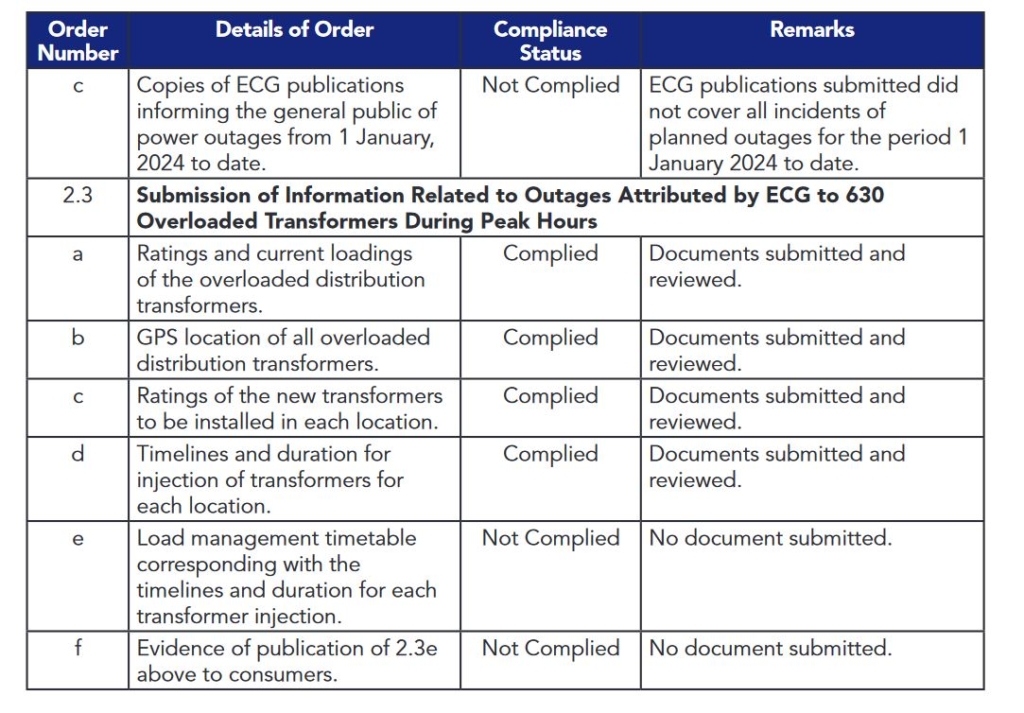
    This comes as PURC continues to accuse ECG and its management of refusing to comply “with the guidelines of the new CWM as directed by the President, Nana Akufo-Addo, in August 2023.

    “This defeats the principle of fair and equitable allocation of revenue to sector players under Level B as approved by the CWM Standing Committee in line with the revised CWM guidelines. The Commission wishes to state that ECG should co-operate and allow the CWM to function as directed by the President. Additionally, MoF should also take the necessary steps to honour its obligation by paying for the shortfalls.”

    In the audit report, PricewaterhouseCoopers expressed frustrations, citing a lack of cooperation from ECG management during the audit process. The report noted that the state company often refused to provide requested information, particularly documents, and did not respond to queries regarding identified infractions.

    Conducted at the request of the Ministry of Finance, the audit recommends the strengthening of the current CWM and enhancing ECG’s compliance with its directives. Proposed measures include process improvements in billing and invoicing, as well as the implementation of technology-enabled platforms to enhance transparency and accountability.

    The audit report stated, “We have identified and described in detail our recommendations for strengthening the current CWM and the inputs from ECG going forward.” It added, “It is imperative that ECG and other stakeholders work collaboratively to implement these recommendations and uphold the integrity of the CWM.”

    This includes: Establishing billing and invoicing process improvements at ECG; Key considerations for the CWM disbursement process; Key considerations for the management of non-tariff revenue by ECG; Medium-term redevelopment of the CWM onto a technology-enabled platform to strengthen the fundamental objectives of the mechanism; Key considerations for cybersecurity and data protection measures at ECG (including implementation of a disaster recovery plan or framework, integration of cyber defence mechanisms and processes at ECG, and considerations for managing third-party solutions and collaborations).

    It suggested engaging with the Ministry of Energy, PURC, and other relevant stakeholders to establish the critical process of retrieving the required data/information to complete our tasks. This will also establish the foundation for the relevant processes and information requirements going forward for the quarterly reviews.

    “We also look forward to discussing our recommendations as PURC, ESRP, and the other stakeholders plan to work with ECG to implement them to help restore confidence and promote a transparent and strengthened CWM.”

    As part of achieving financial sustainability in Ghana’s energy utilities and value chain, the Government of Ghana (GoG) initiated the Energy Sector Recovery Program (ESRP) in May 2019. The ESRP is a comprehensive recovery program that sets out a roadmap of policies and actions required for financial recovery in the energy sector.

    In April 2020, the Electricity Sector Revenue Protection (ESRP) implemented the Cash Waterfall Mechanism (CWM) to ensure transparent, fair, and timely payment of all revenues billed and collected by the Electricity Company of Ghana (ECG) on behalf of the entire electricity generation value chain.

    The CWM, along with the Natural Gas Clearinghouse (NGC) mechanisms, was established to promote fairness and transparency in the disbursement of energy revenues and the equitable allocation of tariff revenue collected by ECG to all parties in the energy value chain.

    This validation exercise aims to verify electricity sales in terms of kilowatt-hours (kWh) and the amount billed and collected by ECG over a specified period. It seeks to confirm whether these sales, billings, and collections align with the requirements and outcomes of the Cash Waterfall Mechanism and its related payments. The assessment will also validate the cycle of power delivered, corresponding billing, and collection, as well as the full transfer of these collected funds from regional collection accounts into the Single Collections account.

    Issues related to ECG’s revenues/collections and the broader energy sector debt have contributed to Ghana’s economic challenges. Therefore, this engagement is crucial in identifying and addressing these challenges to strengthen the power sector value chain.

    Amongst other things, it demanded some detailed revenue assurance and validation, an understanding of the key sources of revenue for ECG, i.e., tariff and non-tariff, and their detailed composition /breakdown; a review of revenue/cash collections from the district level and how this flows to the Head Office from the customers’ billings.

    It also recommended stakeholder engagement and buy-in to align with key stakeholders (IPPs, ECG, PURC, MoEn, GoG) on the reconciliation/validation exercise’s outcome and key actions required.

    The CWM report does not state clearly why this happened, and the PURC notes that the CWM Standing Committee indicated how this defeats the purpose of the CWM.

    “We generally agree with this position, as the guidelines for the CWM are quite clear.

    It will be important to understand, from ECG’s perspective, why there is a continuous lack of cooperation in following the guidelines, which is raising many questions about its use of its collections.”

    It was also identified that ECG used an unprotected Microsoft Excel spreadsheet (Data Integrity and Model Security).

    “We observed that most of the submitted CWM models did not have protected cells to limit users’ ability to interfere with allocation formulas either intentionally or by error.”

    It was advised that PURC will need to reconsider using Microsoft Excel-based spreadsheets for the CWM going forward. The integrity of the data entered into the spreadsheet must be safeguarded to promote transparency and efficient management of the mechanism.

    Key cells must be locked with control access features and enhanced access log features programmed into the spreadsheet to track any attempted changes to the inputs in the model.

    “As suggested in our recommendation, PURC, together with ESRP, should consider a shared platform approach to enhance oversight and accountability from ECG, beneficiaries, and the key stakeholders of Ghana’s value chain to promote confidence in the CWM and its ability to meet its objectives.”

    “Currently, ECG is required to submit the CWM to PURC for review and validation. As mentioned earlier, the allocations and subsequent disbursements often do not completely follow the requirements of the guidelines. It will be useful for PURC to take advantage of technology-enabled solutions to facilitate a system that provides real-time data, independent validation, and a stronger reconciliation system to support a more efficient monitoring and evaluation process in the CWM declaration process.

    On validation of payments to CWM beneficiaries, the report said that “from our review of payments made to CWM beneficiaries, we noted that some payments were made through ECG’s operational accounts, margin accounts, and escrow accounts (ADB, Consolidated Bank, Fidelity Bank, GCB, Access Bank, Zenith Bank, Bank of Africa, First Atlantic Bank, GT Bank, Omni BSIC, Republic Bank, Ecobank, ABSA, Stanbic Bank, Societe Generale, CAL Bank, and Universal Merchant Bank). As of the date of this report, the bank statements for these accounts have not been made available to us to validate these payments. As such, the validation of these payments could not be performed.
  • PURC directs ECG to furnish it with all data and bank statements for auditing

    PURC directs ECG to furnish it with all data and bank statements for auditing

    The Public Utilities Regulatory Commission (PURC) has demanded that the Electricity Company of Ghana (ECG) provide it all the requested data, allow access to its bank statements for auditing.

    Vice president of IMANI-Africa, Bright Simons, made this known when he shared portions of the PURC’s statement on the matter on his platform on X.

    In early March this year, Bright Simons, provided documents that indicate that the Electricity Company of Ghana withheld information from Pricewaterhouse Coopers (PWC) tasked with validating ECG’s revenue accounts.

    “PWC, the auditors tasked by govt of Ghana to check if the under-pressure state electricity utility, ECG, is handling its finances properly is struggling to get data from ECG. Its ledger of monies paid out by ECG in Sept 2023 doesn’t even list the big private power producers,” he wrote in a post on X.

    Per the document shared, PWC admitted that it reached out to the ECG for its customer billing and collections, and the bank statements for the Single Collection Account but failed to receive them.

    The December 8, 2023, press statement released by PWC indicated that they were informed on November 30, 2023, by the General Manager for Financial Planning and Revenue Assurance that the Managing Director of ECG had instructed that they attend a meeting on December 7, 2023, at 10 am at ECG so that the data that they had requested, including the customer billing and collections, and the bank statements for the Single Collection Account for the period of their review, would be provided to them.

    On December 7, 2023, PWC met the Managing Director of ECG as requested, however, “he stated during the meeting that ECG is unable to provide customer billing and collection data to a third party as this will contravene the Data Protection Act, 2012 (Act 843).”

    “As such, we were not provided with any data or information at the meeting and to date we do not have any customer billing and collection data, nor do we have any of ECG’s bank statements for the Single Collection Account for any of the periods to be covered by our review,” the statement added.

    The lack of this data and information, PWC said presented a significant limitation to the conduct of our work and without it they will be unable to perform any meaningful analysis towards the overall objectives of the assignment.

    Accordingly, they requested an urgent meeting with the Chief Director at the Ministry of Energy, Mrs Asamoah, at her earliest convenience to discuss the next steps for the engagement.

  • Ashanti Region: Hoodlums steal bolts and nuts from ECG tension towers

    Ashanti Region: Hoodlums steal bolts and nuts from ECG tension towers

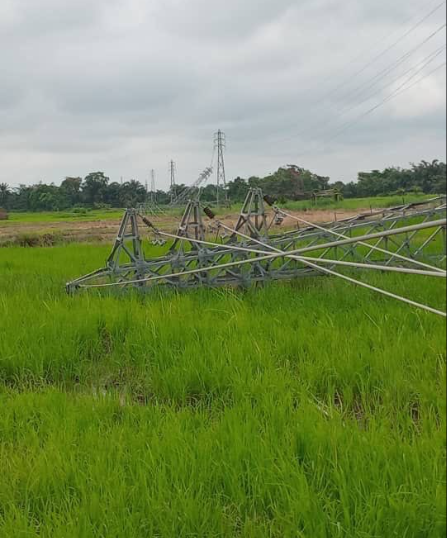
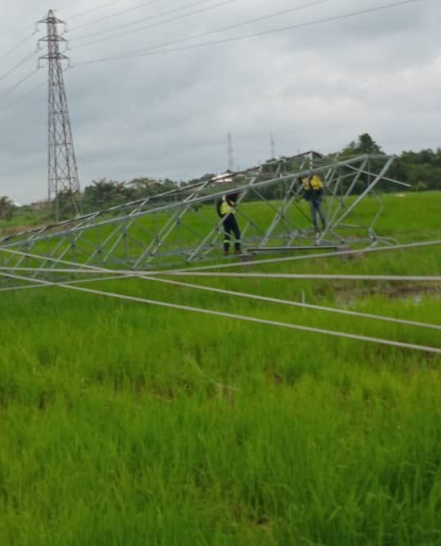
    Unknown individuals have tampered with high-tension towers, causing at least eight of them to collapse and disrupt power supply in the affected areas.

    Several communities in the Ashanti Region are facing power outages following an act of vandalism targeting the Electricity Company of Ghana (ECG).

    The affected high-tension line, which runs from Anwomaso BSP to Akyawkrom Substation in Ejisu, has impacted communities such as Bekwai, Awiankwanta, Kumawu, Antoakrom, Manso Nkwanta, Jacobu Samfo-Aduam, Ejisu, Onwe, Besease, Asotwe, Abankro, Baworo, and surrounding regions.

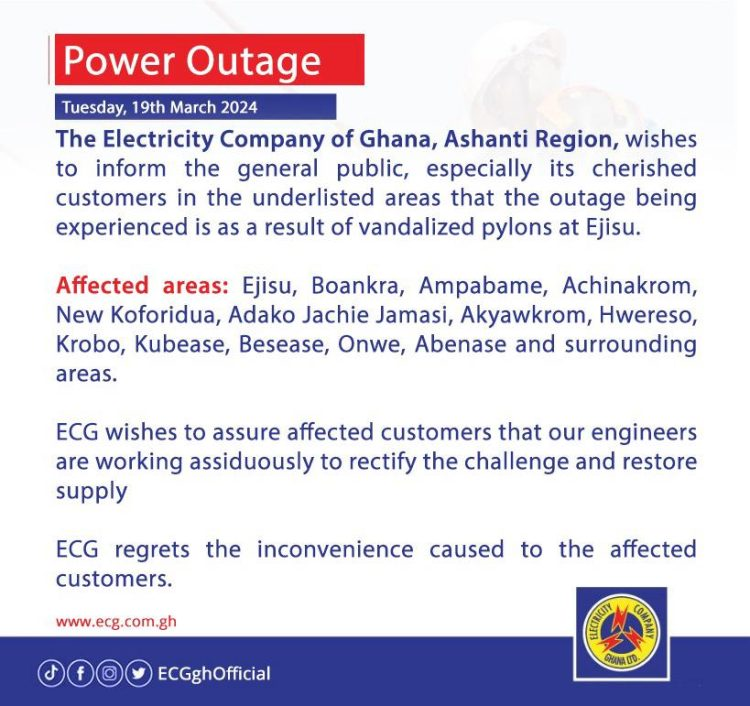
    In a statement on Tuesday, March 19, 2024, ECG assured affected customers that their engineers are working diligently to resolve the issue and restore power supply.

    The company extended sincere apologies for any inconvenience caused to its valued customers and reiterated its commitment to promptly addressing the situation.

  • Bekwai, Ejisu, others in darkness after hoodlums destroy ECG tension towers

    Bekwai, Ejisu, others in darkness after hoodlums destroy ECG tension towers

    Several communities in the Ashanti Region are experiencing power outages due to an act of vandalism targeting the Electricity Company of Ghana (ECG).

    Unknown individuals tampered with high-tension towers, causing at least eight of them to collapse and disrupt power supply in the affected areas.

    The affected high-tension line, which runs from Anwomaso BSP to Akyawkrom Substation in Ejisu, has affected communities such as Bekwai, Awiankwanta, Kumawu, Antoakrom, Manso Nkwanta, Jacobu Samfo-Aduam, Ejisu, Onwe, Besease, Asotwe, Abankro, Baworo, and surrounding areas.

    In a statement on Tuesday, March 19, 2024, ECG assured affected customers that their engineers are working diligently to resolve the issue and restore power supply.

    The company extended sincere apologies for the inconvenience caused to its valued customers and emphasized its commitment to promptly resolving the situation.

  • “We await service” – Bright Simons readies to fight Fidelity Bank in court over ‘shady’ ECG FX deal

    “We await service” – Bright Simons readies to fight Fidelity Bank in court over ‘shady’ ECG FX deal

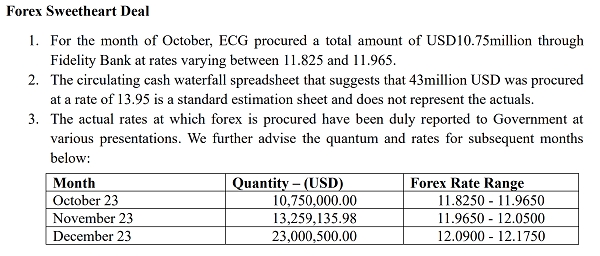
    Bright Simons, the Vice President of IMANI Africa, has expressed his readiness provide evidence in court over his allegation that the Electricity Company of Ghana (ECG), is “dishing out” approximately GHC80 million to Fidelity Bank in sweetheart exchange rate deals.

    It is reported by Executive Director for Africa Centre for Energy Policy (ACEP), Ben Boakye, that the bank has dragged Mr Simons to court.

    According to Mr Simons, Ghanaians are suffering from erratic power supply due to such decisions taken by the ECG, which tantamounts to “financial mismanagement.”

    “Yes, we await service. The dumsor that the people experience recurrently stems from financial mismanagement. We will probe anything that allows that to happen. Including ECG FX deals. The courts support sound public policy & public interest. For the people till we die,” he wrote.

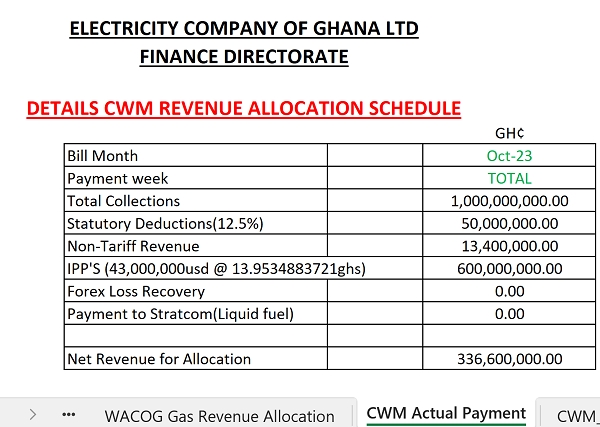
    Mr Simons made the allegation after Executive Director for Africa Centre for Energy Policy (ACEP), Ben Boakye highlighted that ECG was buying the US dollar at a rate of GHC13.95, despite the market rate being lower, resulting in exchange losses of over GHC80 million in one month for buying $43 million.

    According to Mr Simons, ECG needs to urgently explain why it is engaging in such exchange rate deals, as it raises questions about the utility’s understanding of the true value of the Ghanaian Cedi compared to the rest of the market.

    The exchange rate in October 2023 was less than GHC11.5 to the dollar for commercial banks, but ECG was allegedly buying the dollar at a significantly higher rate, leading to substantial exchange losses.

  • Electricity is a privilege comment taken out of context – ECG boss

    Electricity is a privilege comment taken out of context – ECG boss

    The Electricity Company of Ghana (ECG) has clarified the context of a video circulating on social media depicting its Managing Director, Samuel Dubik Mahama, as insensitive to customer difficulties.

    In a statement released on Saturday, the power-distributing company explained that the video is an excerpt from an interview conducted over a year and a half ago.

    The interview took place during the ECG and Manya Krobo dispute, during which ECG staff were reportedly assaulted for requesting payment of bills from customers.

    “We deeply regret the misunderstanding created by the resurfacing of this extract, which has been grossly taken out of context,” portions of the statement read.

    The company emphasized that it empathizes with its customers’ challenges and assured the public that the video “does not reflect the values and commitment of our MD and ECG.”

    Additionally, ECG stated that it is working closely with key industry stakeholders to address the issues and implement sustainable solutions.

  • Anomalies detected in electricity revenue disbursement system – PwC

    Anomalies detected in electricity revenue disbursement system – PwC

    A recent audit conducted by PricewaterhouseCoopers (PwC) on the Cash Waterfall Mechanism (CWM), a system devised for distributing electricity revenue payments, has revealed discrepancies between reported collections and actual disbursements.

    The CWM was established to ensure transparency and timeliness in payments across the electricity value chain.

    However, the audit findings indicate consistent differences between the declared collections and the corresponding allocations made by the Electricity Company of Ghana (ECG) when compared to the actual payments.

    These inconsistencies undermine the core objective of the CWM, which is to ensure predictability and fairness in payment processes.

    Additionally, the audit uncovered instances where payments were made from accounts outside the designated single collections account, contrary to a directive issued by the Ministry of Finance.

    Furthermore, disbursements to non-CWM beneficiaries exceeded the allocated amount designated for ECG.

    To enhance the effectiveness of the CWM, the auditors recommend improvements in billing, invoicing, and disbursement procedures, as well as better management of non-tariff revenue by ECG.

    They also suggest transitioning the CWM to a technology-driven platform and implementing robust cybersecurity measures.

    Moving forward, steps will be taken to retrieve missing data and engage stakeholders in discussions regarding the recommendations, with the ultimate goal of establishing a more transparent and efficient CWM system.

  • We are negotiating with ECG on unpaid debt – Health Ministry

    We are negotiating with ECG on unpaid debt – Health Ministry

    The Ministry of Health has noted it has commenced negotiations with the Electricity Company of Ghana (ECG) over the outstanding monies owed by 91 hospitals.

    Cumulatively, these health institutions owe GH¢261 million to the power distribution company, prompting urgent efforts to address the situation.

    According to the ECG, it will disconnect power to these health facilities in less 72 hours should the debt not be paid.

    Public Relations Officer for the Health Ministry, Isaac Offei Baah, noted that the government is working to ensure that these hospitals have access to electricity to meet the healthcare needs of citizens.

    “We owe the Electricity Company of Ghana. We serve the Electricity Company of Ghana. The Electricity Company of Ghana demands their money, that we should pay them for them to avoid this connection. We sit down at a table. We are negotiating. We would be able to meet ECG and solve this problem with them.”

    “So we go to a negotiating table. Now, there is going to be another form of reconciliation to look at the total debt owed, whether it is feasible or we have some miscarriage in there. But then, whichever way, and granted that this is the total amount that we owe the Electricity Company of Ghana, we are going to negotiate with them,” he said.

  • ECG picking on hospitals when others owe more – GMA over power disconnection

    ECG picking on hospitals when others owe more – GMA over power disconnection

    General Secretary of the Ghana Medical Association (GMA), Dr Richard Selormey, has accused Electricity Company of Ghana (ECG) of being biased in retrieving money owed to it by various institutions.

    The ECG on Wednesday, March 13, issued a notice to 91 hospitals in various parts of the country threatening to disconnect them from the national grid should they fail to settle their debt within 72 hours.

    Among the notable hospitals facing potential disconnection are the Korle Bu Teaching Hospital, the 37 Military Hospital, Ridge Hospital in the Greater Accra region, Komfo Anokye and Manhyia Government Hospitals in the Ashanti region, Ho Teaching Hospital in the Volta region, and Kyebi Government Hospital in the Eastern region.

    He noted that the debt owed by the health institutions amounts to just 4.5% of ECG’s total debt, however, ECG has left other agencies to pursue those in the health sector.

    He therefore requested that the Electricity Company of Ghana (ECG) go ahead with its threat to take 91 hospitals off the national grid over outstanding bills.

    According to Dr Selormey that is the only step the power provider can take since its 72-hour ultimatum for payment of GH¢261 million is unrealistic.

    “Why do you want to suck from the healthcare when bigger chunks are waiting?” the General Secretary quizzed.

    “ECG needs to be realistic, the health facilities cannot pay the debt within the three-day ultimatum they have been given, and if they are actually going to disconnect, then they would have to disconnect all the facilities and we will all sit and watch what the government does,” he said on JoyNews.

    He also noted that the average Ghanaian in need of healthcare will bear the brunt should the hospitals be unable to operate efficiently due to the absence of electricity.

    Dr Selormey warned that if ECG proceeds with disconnections at these health facilities, it would have significant repercussions for patient care.

    Dr Selormey, thus called on ECG to engage in further discussions with all stakeholders, urging the company to reconsider its ultimatum.

    “The 72 hours, I think it is unreasonable and won’t be adhered to by anybody,” he said on Wednesday.

  • We can’t pay GHC261m in 72 hours, if you like disconnect our power!  – GMA ‘dares’ ECG

    We can’t pay GHC261m in 72 hours, if you like disconnect our power! – GMA ‘dares’ ECG

    General Secretary of the Ghana Medical Association (GMA), Dr Richard Selormey, has requested that the Electricity Company of Ghana (ECG) go ahead with its threat to take 91 hospitals off the national grid over outstanding bills.

    According to Dr Selormey, that is the only step the power provider can take since its 72-hour ultimatum for payment of GH¢261 million is unrealistic.

    He also criticised the ECG for being selective in its pursuit to get institutions indebted to the company to pay what they owe. He noted that the debt owed by the health institutions amounts to just 4.5% of ECG’s total debt.

    “Why do you want to suck from the healthcare when bigger chunks are waiting?” the General Secretary quizzed.

    “ECG needs to be realistic, the health facilities cannot pay the debt within the three-day ultimatum they have been given, and if they are actually going to disconnect, then they would have to disconnect all the facilities and we will all sit and watch what the government does,” he said on JoyNews.

    He also noted that the average Ghanaian in need of healthcare will bear the brunt should the hospitals be unable to operate efficiently due to the absence of electricity.

    Dr Selormey warned that if ECG proceeds with disconnections at these health facilities, it would have significant repercussions for patient care.

    Dr Selormey, thus called on ECG to engage in further discussions with all stakeholders, urging the company to reconsider its ultimatum.

    “The 72 hours, I think it is unreasonable and won’t be adhered to by anybody,” he said on Wednesday.

    The ECG on Wednesday March 13, issued a notice to 91 hospitals in various parts of the country threatening to disconnect them from the national grid should they fail to settle their debt within 72 hours.

    Among the notable hospitals facing potential disconnection are the Korle Bu Teaching Hospital, the 37 Military Hospital, Ridge Hospital in the Greater Accra region, Komfo Anokye and Manhyia Government Hospitals in the Ashanti region, Ho Teaching Hospital in the Volta region, and Kyebi Government Hospital in the Eastern region.

  • Video: ‘Dumsor’ manifests on live TV during interview

    Video: ‘Dumsor’ manifests on live TV during interview

    Viewers of TV3 were treated to an unexpected spectacle during a live interview when a power outage occurred, leaving the guest, Editor at Kotoko Express Jerome Otchere, in the dark.

    The incident unfolded as Jerome Otchere was engaged in a discussion on the television program. Suddenly, the lights in his vicinity went off, plunging him into darkness mid-conversation.

    The host of the show, Ghana Tonight, Alfred Akrofi ocansey, was visibly taken aback by the sudden turn of events, reacting with surprise, he exclaimed, “Wow Jerome, your lights are off? Hello, okay, hmm. Jerome Otchere’s light just went off.”

    The unexpected interruption, reminiscent of the recurring power outages, locally referred to as ‘dumsor,’ has sparked a mix of reactions among some social media users, with many expressing amusement at the timing of the incident.

    Watch video below:

  • “ECG takes money from Ghanaians but fail to pay IPPs” – John Jinapor

    “ECG takes money from Ghanaians but fail to pay IPPs” – John Jinapor

    The Ranking Member of Parliament’s Energy Committee, John Jinapor, has claimed that the Electricity Company of Ghana (ECG) fails to allocate funds collected from Ghanaian consumers to Independent Power Producers (IPPs).

    According to him, ECG is burdened with a significant debt totaling $1.5 billion.

    Mr Jinapor attributed this substantial debt to ECG’s failure to fulfill financial obligations to Independent Power Producers (IPPs) and its inability to settle bills for purchased electricity in full.

    Furthermore, Mr Jinapor criticized ECG for what he perceives as extravagant spending on items such as cables, malfunctioning meters, and unnecessary contracts.

    Referring to a report from the Public Utilities Regulatory Commission (PURC) that he reviewed, Mr Jinapor highlighted instances where ECG allegedly mishandled funds, diverting substantial amounts away from debt repayment towards other expenses.

    During a media interview, Jinapor urged ECG to provide transparent explanations for recent power outages experienced by Ghanaians.

    “ECG owes $1.5 billion, when they take the money from Ghanaians, they fail to pay the IPPs and use the funds to do whatever they want with it and they fail to pay the full price of the power they purchase and PURC has brought a report that when ECG comes in possession of a substantial amount of money they refuse to pay the debt they owe, they spend the money recklessly, and this is an official report from the PURC.

    “Some of the things they buy, they don’t even need it, and now they want to be buying fuel, which is not even their core duty, all these are a reason the finances aren’t adding up,” he said.

  • ECG’s debt to IPPs surges to $1.5bn – John Jinapor

    ECG’s debt to IPPs surges to $1.5bn – John Jinapor


    The Energy Committee’s Ranking Member in Parliament, John Jinapor, has revealed that the Electricity Company of Ghana (ECG) is burdened with a significant debt totaling $1.5 billion.

    Jinapor attributed this substantial debt to ECG’s failure to fulfill financial obligations to Independent Power Producers (IPPs) and its inability to settle bills for purchased electricity in full.

    Furthermore, Jinapor criticized ECG for what he perceives as extravagant spending on items such as cables, malfunctioning meters, and unnecessary contracts.

    Referring to a report from the Public Utilities Regulatory Commission (PURC) that he reviewed, Jinapor highlighted instances where ECG allegedly mishandled funds, diverting substantial amounts away from debt repayment towards other expenses.

    During a media interview, Jinapor urged ECG to provide transparent explanations for recent power outages experienced by Ghanaians.

    “ECG owes $1.5 billion, when they take the money from Ghanaians, they fail to pay the IPPs and use the funds to do whatever they want with it and they fail to pay the full price of the power they purchase and PURC has brought a report that when ECG comes in possession of a substantial amount of money they refuse to pay the debt they owe, they spend the money recklessly, and this is an official report from the PURC.

    “Some of the things they buy, they don’t even need it, and now they want to be buying fuel, which is not even their core duty, all these are a reason the finances aren’t adding up,” he said.

  • ECG owes IPPs $1.5 billion – John Jinapor claims

    ECG owes IPPs $1.5 billion – John Jinapor claims

    Ranking Member of the Energy Committee of Parliament, John Jinapor, has revealed that the Electricity Company of Ghana (ECG) is facing a substantial debt of $1.5 billion.

    This debt, according to Mr. Jinapor, is largely a result of ECG’s failure to meet its financial obligations to Independent Power Producers (IPPs) and its inability to fully pay for purchased electricity.

    In a media interview, Mr. Jinapor called on ECG to provide transparent explanations for the recent power outages experienced by Ghanaians.

    “ECG owes $1.5 billion, when they take the money from Ghanaians, they fail to pay the IPPs and use the funds to do whatever they want with it and they fail to pay the full price of the power they purchase and PURC has brought a report that when ECG comes in possession of a substantial amount of money they refuse to pay the debt they owe, they spend the money recklessly, and this is an official report from the PURC.

    “Some of the things they buy, they don’t even need it, and now they want to be buying fuel, which is not even their core duty, all these are a reason the finances aren’t adding up,” he said.

    Mr. Jinapor also criticized ECG for what he perceives as wasteful spending, citing examples such as excessive spending on cables, malfunctioning meters, and what he deems unnecessary contracts.

    Referring to a report from the Public Utilities Regulatory Commission (PURC), Mr. Jinapor highlighted instances where he alleges ECG mismanaged funds, diverting significant amounts away from debt repayment to other expenditures.

  • We can’t give a timetable because what you’re experiencing is not dumsor – ECG over recent power outages

    We can’t give a timetable because what you’re experiencing is not dumsor – ECG over recent power outages

    The Electricity Company of Ghana (ECG) has stated that despite recent power disruptions, there is no need for implementing a load-shedding timetable.

    Laila Abubakar, the External Communications Manager at ECG, clarified that the current power supply challenges in the country do not warrant the introduction of a load-shedding schedule.

    Abubakar emphasized that various factors may contribute to the recent power outages, but the traditional ‘dumsor’ phenomenon has not returned.

    “The thing is, we just want people to be aware that when your power goes off, it is not always a matter of load shedding. There are several issues and there are some of them that fall before the doorsteps of ECG. We are doing as much as possible to solve the ones that we can.

    “There aren’t any issues with shedding load. The load shed, I think is what people understand by ‘Dumsor’. But usually, when someone asks me if, there is Dumsor, I ask them what do you understand and what do you think ‘Dumsor’ means. Unfortunately, there wouldn’t be a timetable.”

  • Blown fuses in transformers might cause peak period blackouts – ECG

    Blown fuses in transformers might cause peak period blackouts – ECG

    The Electricity Company of Ghana (ECG) has attributed the intermittent power outages, commonly referred to as ‘dumsor,’ occurring between 7 p.m and 11 p.m., to blown fuses in transformers.

    According to a statement released by ECG, 630 distribution transformers in various communities across their operational areas have been identified as operating at full capacity due to heightened demand.

    The statement explains, “This situation may result in blown fuses and broken conductors causing outages, especially during the peak load period (7 p.m.–11 p.m.) in the affected areas.

    “However, we wish to assure our customers that transformer upgrading and new projects are ongoing to relieve these transformers to ensure a more reliable power supply.

    Customers residing in the listed communities/localities are urged to promptly report any localized outages or voltage fluctuations to the ECG call center at 0302-611611 (also available on WhatsApp).

    “Customers within the underlisted communities/localities are therefore advised to report any localised outage or voltage fluctuations to the ECG call center on 0302-611611 (also available on WhatsApp) or reach us on our social media handles via ECGghOfficial (Facebook, Twitter, and Instagram) for prompt rectification,” it added.

    Additionally, they can contact ECG via their social media handles at ECGghOfficial (Facebook, Twitter, and Instagram) for swift resolution, as indicated in segments of the statement.

  • ECG set to disconnect electricity supply to 91 hospitals over unpaid bills

    ECG set to disconnect electricity supply to 91 hospitals over unpaid bills


    The National Taskforce of the Electricity Company of Ghana (ECG) is ready to disconnect electricity supply to 91 hospitals nationwide due to unpaid bills.

    These medical facilities collectively owe GH₵261 million to the power distributor.

    According to information from ECG obtained by Citi News, these hospitals will be disconnected within 48 hours of receiving a “demand notice.”

    Notable hospitals facing potential disconnection include Korle Bu Teaching Hospital, 37 Military Hospital, Ridge Hospital in the Greater Accra region, Komfo Anokye and Manhyia Government Hospitals in the Ashanti region, Ho Teaching Hospital in the Volta region, and Kibi Government Hospital in the Eastern region.

    This action is part of ECG’s efforts to recover outstanding debts and improve operational efficiency. Below is a summary of the hospitals at risk of disconnection due to unpaid bills:

    Volta Region:

    Total: GH¢15,163,879

    Notable hospitals: Kpeve Government Hospital, Ho Municipal Hospital, Ho Teaching Hospital, Hohoe Municipal Hospital, Keta Municipal Hospital, Ketu South Hospital, Sogakope District Hospital, Worawora Government Hospital

    Accra East Region:

    Total: GH¢66,643,680.32

    Notable hospitals: 37 Military Hospital, Police Hospital, Dodowa District Hospital, Pantang Hospital, Lekma Hospital, La General Hospital, University of Ghana Hospital, Achimota Hospital, Kwabenya Hospital

    Tema Region:

    Total: GH¢8,227,299.48

    Notable hospitals: Community 22 Polyclinic, Akuse Government Hospital, Battor Hospital, General Hospital, Kpone Health Center, Ministry of Health, Municipal Health, Polyclinic Nungua, Sege Polyclinic, Somanya District Hospital, Urban Health

    Accra West Region:

    Total: GH¢55,782,569.71

    Notable hospitals: Bortianor Polyclinic, Korle Bu Teaching Hospital, Nsawam Hospital, Oduman Polyclinic, Ridge Regional Hospital

    Central Region:

    Total: GH¢21,313,839.75

    Notable hospitals: Ankaful Psychiatric Hospital, Cape Coast Municipal Hospital, Central Regional Hospital, District Hospital, Trauma Hospital Winneba, Twifo Praso New Hospital, Winneba Government Hospital

    Eastern Region:

    Total: GH¢21,031,322

    Notable hospitals: Abirim District Hospital, Government Hospital, Asamankese Hospital, Begoro Government Hospital, Kibi Government Hospital, Government Hospital, Koforidua SDA Hospital, Kwahu Government Hospital, St. Dominic Hospital

    Ashanti Region:

    Total: GH¢50,045,753.72

    Notable hospitals: Agogo Hospital, Konongo Government Hospital, Kumawu District Hospital, Mamhya Government Hospital, Mampong Maternity Hospital, Bekwai District Hospital, Government Hospital, Fomena Government Hospital, Obuasi Government Hospital, Atonsu Government Hospital, Bibiani Government Hospital, Komfo Anokye Teaching Hospital, SDA Hospital Kwadaso, St. Patrick Hospital Offinso, Suntreso Government Hospital

    Western Region:

    Total: GH¢22,312,253

    Notable hospitals: Bogoso Hospital, Takoradi Hospital, Tarkwa Government Hospital, Tarkwa Hospital Apinto, Wassa Dunkwa Hospital, Government Hospital, Nsuaem Hospital, Kwasimintim Hospital, Essikado Government Hospital, Elubo Hospital, Akwantombra Hospital

    These hospitals collectively owe a substantial amount to ECG, and if not settled, they will face disconnection from the national grid.

  • ECG to cut power supply to 91 hospitals over GHS261m debt

    ECG to cut power supply to 91 hospitals over GHS261m debt

    The Taskforce of Electricity Company of Ghana (ECG) is poised to sever connections with 91 hospitals across the country due to unpaid debts totaling GHc261 million.

    Following a “demand notice,” these health facilities, including prominent ones like Korle Bu Teaching Hospital and 37 Military Hospital, are expected to face power cuts within 48 hours.

    This action is part of the ECG’s broader initiative to recover outstanding funds from customers, aimed at fortifying its operational capabilities.

    Noteworthy institutions like Accra Academy, Parliament, and the Accra Sports Stadium have recently encountered similar disconnection scenarios.

    The following is a breakdown of the number of hospitals anticipated to undergo disconnection by the ECG.

    Volta region Total GHc15, 163,879

    Kpeve Government Hospital GHc750, 147.70
    Ho Municipal Hospital GHc 1,247,730
    Ho Teaching Hospital (3 meters) GHc5,808,989
    Hohoe Municipal Hospital GHc2,472, 043
    Keta Municipal Hospital GHc410, 983
    Ketu South Hospital GHc1, 706,390
    Sogakope District Hospital GHc1, 437,822
    Worawora Government Hospital GHc1, 329,767

    Accra East Region Total GHc66, 643,680.32

    37 Military Hospital GHc33, 477,392.71
    Police Hospital GHc6, 109,568
    Dodowa District Hospital GHc 3,629,966
    Pantang Hospital GHc5, 342,310
    Lekma Hospital GHc2, 602,464
    La General Hospital GHc642,954
    University of Ghana Hospital GHc2, 249,767
    Achimota Hospital GHc2, 502,589
    Kwabenya Hospital GHc10, 086,666

    Tema Region Total GHc8, 227,299.48

    Community 22 Polyclinic GHc720, 245
    Akuse Govt Hspt GHc1, 723,768
    Battor Hspt GHc1, 837,613
    General Hspt GHc242, 078
    Kpone Health Center GHc379, 520
    Ministry of Health GHc378, 864
    Municipal Health GHc112, 375
    Poly Clinic Nungua GHc414, 589
    Sege Polyclinic GHc393, 680
    Somanya District Hspt GHc1, 352,341
    Urban Health GHc672, 222

    Accra West Region Total GHc55, 782,569.71

    Bortianor Polyclinic GHc442, 468
    Korle Bu Teaching Hspt GHc10, 216,075
    Nsawam Hspt GHc2, 814,584
    Oduman Polyclinic GHc713, 520
    Ridge Regional Hspt GHc41, 595,921

    Central Region Total GHc21, 313,839.75

    Ankaful Psychiatric GHc2, 225,745
    Cape Coast Municipal Hspt GHc2, 351,591
    Central Regional Hspt (Two meters) GHc7,048,927
    District Hospital GHc 1,592,822
    Trauma Hospital Winneba GHc1, 418,389
    Twifo Praso New Hspt GHc (Two meters) GHc5,826,432
    Winneba Govt Hspt GHc849, 929

    Eastern Region Total GHc21, 031,322

    Abirim Dist Hspt GHc1, 266,455
    Government Hspt GHc2, 204,650
    Asamankese Hspt GHc1, 202,252
    Begoro Govt Hspt GHc987, 753
    Ministry of Health GHc1, 289,724
    Kibi Govt Hspt (Two meters) GHc2,947,367
    Government Hspt GHc6, 941,454
    Koforidua SDA Hspt GHc314, 752
    Kwahu Govt Hspt GHc1, 879,985
    St. Dominic Hspt GHc1, 996,924

    Ashanti Region Total GHc50, 045,753.72

    Agogo Hspt GHc3, 290,722
    Konongo Govt Hspt GHc2, 066,549
    Kumawu Dist Hspt GHc217, 879
    Mamhya Govt Hspt (Two meters) GHc2,026,944
    Mampong Maternity Hspt GHc299, 775
    Bekwai Dist Hspt GHc2, 721,858
    Government Hspt GHc1, 908,530
    Fomena Govt Hspt GHc300, 360
    Obuasi Govt Hspt GHc1, 022,440
    Atonsu Govt Hspt GHc2, 860,326
    Bibiani Govt Hspt GHc1, 279,540
    Komfo Anokye Teaching Hspt GHc (Two meters) GHc27,265,226
    SDA Hspt Kwadaso GHc506, 361
    St. Patrick Hspt Offinso GHc2, 248,319
    Suntreso Govt Hspt GHc2, 030,915

    Western Region Total GHc22, 312,253

    Bogoso Hospital (Two meters) GHc497,828
    Takoradi Hspt (Two meters) GHc3,509,295
    Tarkwa Govt Hspt (Three meters) GHc9,499,254
    Tarkwa Hspt Apinto GHc2, 391,983
    Wassa Dunkwa Hspt (Two meters) GHc294,996
    Government Hspt (Two meters) GHc1,708,108
    Nsuaem Hospital GHc169, 220
    Kwasimintim Hospital GHc1, 547,022
    Essikado Govt Hspt GHc780,780
    Elubo Hspt (Two meters) GHc271,993
    Akwantombra Hspt GHc184, 219

  • ECG alerts public on possible power outages from 7pm to 11 pm

    ECG alerts public on possible power outages from 7pm to 11 pm


    The Electricity Company of Ghana (ECG) has issued a notice regarding potential power outages in certain areas of the country.

    These outages are anticipated during the peak load period from 7 pm to 11 pm.

    According to the power distribution company, the heightened demand has resulted in blown fuses and damaged conductors in approximately 630 transformers nationwide.

    The company clarified in a statement dated March 12 that it is installing new facilities and renovating some of these ones in order to guarantee a more reliable supply of electricity.

    Speaking to JoyNews, ECG Managing Director Samuel Dubik explained, “I know the engineering team puts out these notices, if my customers are saying they didn’t get them, I’m sorry.”

    The power outages are already being referred to by some Ghanaians as the “dumsor,” or return of the power crisis.

    But Mr Dubik insists on Joy FM’s Newsite that “there is no dumsor.”

    “But everybody wants to stay with the fact that there is dumsor. If there is dumsor that means there is a generational gap, or a generational problem.”

  • 130 unauthorized connections discovered in Ashaiman within 3 days – ECG

    130 unauthorized connections discovered in Ashaiman within 3 days – ECG


    The Ashaiman District branch of the Electricity Company of Ghana (ECG) has revealed a startling find: a total of 130 illegal connections within its operational area over the course of three days.

    This discovery came to light during a revenue mobilization initiative launched by the district on Monday, March 4, 2024. Ing. Kissi Ohenebeng, the District Manager, addressed the media on Friday, March 8, 2024, providing updates on the project’s progress.

    He reported that among the 130 illegal connections identified, summons were issued to the respective customers, who began appearing at the office on Tuesday to address the issues. Ing.

    Ohenebeng noted that during the three-day project, his team, with assistance from staff members from eight other districts and the regional office of the Tema Region, visited over 5000 customers.

    In response to inquiries about potential prosecution for those found with illegal connections, Ing. Ohenebeng acknowledged that defaulting customers could face legal consequences.

    He emphasized that illegal connections constituted theft and therefore constituted a criminal offense. He cautioned customers against such actions, highlighting the possible repercussions.

    The Ashaiman District falls under the ECG Tema Region, which includes Tema North, Tema South, Afienya, Prampram, Ada, Nungua, and JuapongKrobo Districts. Staff members from across the region were deployed to support this special revenue mobilization effort in the Ashaiman District.

  • Only 4 out of 9 IPPs have been paid by ECG – Bright Simons

    Only 4 out of 9 IPPs have been paid by ECG – Bright Simons

    Vice president for Imani Africa, Bright Simons has claimed that only four out of nine Independent Power Producers (IPPs) have received money from Electricity Company of Ghana (ECG).

    According to him, the IPPs were paid less than $9.5 million in January 2024, despite the initial amount of $43 million dollars.

    Taking to the X platform  Bright Simons indicated “I always tell folks that the secret to policy analysis in Ghana is to watch what folks in power do, not listen to what they say. They said ECG pays $43m to private power producers monthly, no? Turns out in Jan, they paid only 4 out of the 9 IPPs. And it was less than $9.5M”.


    In 2023, government announced that it had reached an agreement with IPPs to address Ghana’s indebtedness threatening the energy sector.

    In an interview with the media, the Minister of State for the Finance Ministry, Dr. Mohammed Amin Adam indicated that the $43 million dollars was to solely address power generated and utilized by the government.

     He revealed that the energy distributors have accepted to receive “some monthly payments of about $43 million in every month”.

    “We have negotiated with them [IPPs] and we’ve agreed to some monthly payments and in every month, about $43 million shared amongst them for energy supply [energy consumed] because you know that they have excess capacity and so we have negotiated with them to pay for energy consumed which means we are currently not paying for the excess that we do not consume,” he said.

    He emphasised that the IPPs have so far been paid twice ever since the agreement was reached.

    According to him, since the agreement was reached, the IPPs have been settled twice.

    “In July, we paid $43 million. ECG has just paid for August $43 million, two, three days ago and that is going to continue. We want to be current.

    “Also , because under our IMF programme we have to be current with our payments, we are not supposed to rebuild arrears and so that is satisfactory to the IPPS and that was why they came out with the statement to call off their threats,” he explained.

    Background

    On May 28, Independent Power Producers (IPPs) and distributors issued a threat to disconnect power supply to the national grid by the end of June 2023 if the government did not settle its outstanding debt.

    These IPPs collectively control more than 65% of the available thermal generation capacity in the country.

    Despite numerous appeals from various stakeholders urging the IPPs to reconsider their decision, they remained steadfast, insisting on a 30% payment of the debt owed before resuming power supply.

    However, a significant development occurred on June 30, as the IPPs released a statement announcing the suspension of their planned power plant shutdown. This decision followed what they described as productive discussions with the Electricity Company of Ghana (ECG).

    Previously, the Chamber had instructed its members to cease operations from July 1 to July 8 if the government did not fulfill the condition of paying 30% of the $1.73 billion owed to the IPPs.

  • ECG is to blame for Ghana’s power sector challenges – Former Energy Minister

    ECG is to blame for Ghana’s power sector challenges – Former Energy Minister

    Former Energy Minister under the John Mahama administration, Emmanuel Armah Kofi-Buah, has criticized the Electricity Company of Ghana (ECG) for being a significant contributor to the country’s power sector challenges.

    Speaking on JoyNews’ PM Express on Monday, March 4, the Ellembele MP specifically mentioned ECG as the weakest link in the energy sector value chain, which includes production, transmission, and distribution.

    In recent times, parts of Ghana have experienced unstable power supply, although ECG, the national power distributor, has stated that it is not implementing any load shedding requiring a timetable.

    However, many power consumers believe that the country is experiencing a return to the severe power outages known as “dumsor” experienced in previous years.

    ECG has attributed the intermittent power outages to major maintenance issues, overload on transformers, and localized underground cable faults, among other factors.

    Responding to a question about the power situation in the country on PM Express, the former Energy Minister under John Mahama, Armah Kofi-Buah, said, “ECG is the weakest link in the value chain. It’s the biggest headache in the energy sector and it’s a fact.”

    If you recall, what causes dumsor [power outages] is not always one thing. It could be a generational shortfall, the issue of fuel and financial challenges in getting some of these things done. As we speak, the reason we don’t have a generational shortfall and say that we don’t have dumsor [power outages] in terms of the generational shortfall, is that the MD of ECG rushes to buy heavy fuel oil for AKSA. The only reason why AKSA is operating is that ECG bought AKSA heavy fuel oil to operate. Sometimes amid a crisis we rush, and there are bigger issues that are confronting us” he argued.

    During the show, Mr. Samuel Dubik Mahama, the Managing Director of the Electricity Company of Ghana (ECG), attributed the recent power cuts to maintenance issues. He clarified that the company only distributes the electricity that is made available to them.

    “What we are experiencing now is caused by a lot of overload. A lot of transformers have a lot of customers on them more than what we have prescribed. Apart from underground cable faults within some localities, some of the power plants also undergo maintenance.”

    He assured that the recent challenges causing the outages have been resolved.

  • ECG ‘dishing out’ GHC80m to Fidelity Bank in exchange rate deals – Bright Simons alleges

    ECG ‘dishing out’ GHC80m to Fidelity Bank in exchange rate deals – Bright Simons alleges

    Bright Simons, the Vice President of IMANI Africa, has alleged that the Electricity Company of Ghana (ECG), the government-controlled electricity utility, is “dishing out” approximately GHC80 million to Fidelity Bank in sweetheart exchange rate deals.

    This revelation comes after Executive Director for Africa Centre for Energy Policy (ACEP), Ben Boakye highlighted that ECG was buying the US dollar at a rate of GHC13.95, despite the market rate being lower, resulting in exchange losses of over GHC80 million in one month for buying $43 million.

    According to Mr Simons, ECG needs to urgently explain why it is engaging in such exchange rate deals, as it raises questions about the utility’s understanding of the true value of the Ghanaian Cedi compared to the rest of the market.

    The exchange rate in October 2023 was less than GHC11.5 to the dollar for commercial banks, but ECG was allegedly buying the dollar at a significantly higher rate, leading to substantial exchange losses.

    If these allegations are true, they could have significant implications for ECG’s financial health and raise concerns about its financial management practices.

  • We are not operating at optimal level due to lack of funds – ECG

    We are not operating at optimal level due to lack of funds – ECG

    Managing Director (MD) of the Electricity Company of Ghana (ECG), Samuel Dubik Mahama, has acknowledged the operational challenges faced by the company due to inadequate funds.

    Recent power outages in parts of Accra and other regions have been attributed by Mr. Mahama to maintenance issues rather than fuel-related problems. He assured that the company is diligently working to resolve these challenges and restore power to affected areas.

    During an interview on Eyewitness News on Citi FM, Mr. Mahama expressed concern about the payment rate by electricity consumers, mentioning that ECG mostly has to actively pursue consumers to pay their bills.

    “It’s true. ECG is not operating at this top level because we are not getting the requisite funds, especially from our customers.

    “The rate at which we are expecting customers to be honest enough to pay for the electricity they consume it is not it’s not what we get. We have to always go out there and put the requisite manpower that we’re doing something else towards collecting,” he said.

  • Recent ‘dumsor’ is not fuel-related but maintenance-related – ECG boss reveals

    Recent ‘dumsor’ is not fuel-related but maintenance-related – ECG boss reveals

    The recent power outages in parts of Accra and other regions have been attributed to maintenance issues rather than fuel-related problems by the Managing Director of the Electricity Company of Ghana (ECG), Samuel Dubik Mahama.

    Several communities have experienced unpredictable power supply for several weeks without prior notice from ECG.

    Speaking on Starr FM on Thursday, February 29, 2024, Mr. Mahama assured that ECG is working diligently to resolve the challenges and restore power to affected areas.

    He emphasized that the ongoing issues are primarily associated with major maintenance concerns rather than fuel shortages.

    “We are having major maintenance issues, the issue we are having now has nothing to do with fuel. You are relying on a power plant that is to give you about 360 megawatts then around 4 pm the gas emergency safety valve has a problem. What do you do? It is a machine.

    “The machine failed us and we kept on saying that it’s a machine issue that we were trying to fix,” Mr. Mahama stated.

    Recognizing the impact of the machinery failure on the power supply, he expressed regret over the lack of timely communication with the public.

    He continued: “I must apologize to Ghanaians, when it started we should actually have the confidence to have a chat with everybody and put out a statement.”

  • We are sorry for not communicating challenges with power supply earlier – ECG to public

    We are sorry for not communicating challenges with power supply earlier – ECG to public

    Managing Director of the Electricity Company of Ghana (ECG), Samuel Dubik Mahama expressed regret over the lack of timely communication with the public with regards to the recent power outages in parts of Accra and other regions.

    “I must apologize to Ghanaians, when it started we should actually have the confidence to have a chat with everybody and put out a statement,” he said while speaking on Starr FM on Thursday, February 29,

    The power outages deemed by many as “dumsor” have been attributed to maintenance issues rather than fuel-related problems.

    Several communities have experienced unpredictable power supply for several weeks without prior notice from ECG.

    Mr. Mahama assured that ECG is working diligently to resolve the challenges and restore power to affected areas.

    He emphasized that the ongoing issues are primarily associated with major maintenance concerns rather than fuel shortages.

    “We are having major maintenance issues, the issue we are having now has nothing to do with fuel. You are relying on a power plant that is to give you about 360 megawatts then around 4 pm the gas emergency safety valve has a problem. What do you do? It is a machine.

    “The machine failed us and we kept on saying that it’s a machine issue that we were trying to fix,” Mr. Mahama stated.

  • ECG Managing Director attributes power outages to maintenance issues

    ECG Managing Director attributes power outages to maintenance issues

    The recent power outages experienced in parts of Accra and other regions in Ghana have been attributed to maintenance issues by the Managing Director of the Electricity Company of Ghana (ECG), Samuel Dubik Mahama.

    Communities across various regions have endured erratic power supply for several weeks without prior notice from ECG, leading to frustration among residents.

    Addressing the issue on Starr Chat with Bola Ray on Thursday, February 29, 2024, Mr Mahama clarified that the power outages were not due to fuel shortages but rather maintenance challenges faced by ECG.

    “We are having major maintenance issues, the issue we are having now has nothing to do with fuel. You are relying on a power plant that is to give you about 360 megawatts then around 4 pm the gas emergency safety valve has a problem. What do you do? It is a machine,” Mr. Mahama explained.

    He further expressed regret over the lack of communication from ECG regarding the ongoing maintenance issues, acknowledging that the company should have provided timely updates to the public.

    “I must apologize to Ghanaians, when it started we should actually have the confidence to have a chat with everybody and actually put out a statement,” Mr. Mahama stated.

    The assurance from the Managing Director comes as a relief to many affected residents, who have been grappling with the inconvenience caused by the power outages.

    ECG has assured that efforts are underway to resolve the maintenance challenges and restore stable power supply to affected areas as soon as possible.

  • Parliament settles part of GHC23m debt; reconnected to national grid

    Parliament settles part of GHC23m debt; reconnected to national grid

    Parliament has been reconnected to the national grid after the Electricity Company of Ghana (ECG) task force disconnected the Legislature due to the House’s GH₵23 million debt owed to the distribution company.

    The chamber of Parliament was plunged into darkness, along with MPs’ offices, resulting in staff and members being stuck in elevators. Prompt intervention by fire service officers was required to rescue those trapped in the elevators.

    Parliament has since settled more than GH₵10 million of the debt and has been reconnected.

    The power outage occurred while legislators were debating President Akufo-Addo’s recent State of the Nation Address (SONA).

    Outgoing Deputy Minister for Finance, Abena Osei-Asare, was on the floor defending the President’s address when the power went off, triggering chants of “Dumsor, dumsor!” from the Minority side of the house.

    This incident comes amid complaints from many Ghanaians about erratic power supply.

  • ECG Managing Director reveals parliament paid substantial amount to restore power

    ECG Managing Director reveals parliament paid substantial amount to restore power

    Managing Director of the Electricity Company of Ghana (ECG), Samuel Dubik Mahama, has disclosed that Ghana’s Parliament made a significant payment to have electricity restored after a power outage interrupted proceedings during a debate on President Akufo-Addo’s State of the Nation Address.

    The debate was halted abruptly when Member of Parliament for North Tongu, Samuel Okudzeto Ablakwa, was on his feet responding to the outgoing Deputy Minister for Finance, Abena Osei-Asare. The chamber was plunged into darkness, bringing the debate to a standstill.

    Speaking on Starr Chat with Bola Ray, Samuel Dubik Mahama explained that his office was engaged in a routine revenue collection exercise at Parliament when the outage occurred. He revealed that Parliament had made a substantial payment, covering more than half of their outstanding debt, to have the power restored.

    “They gave us money, they paid a substantial amount more than half. I see this as something very beautiful, something that we should all look at as a success. It goes to tell the average citizen that nobody is above it. If the Presidency has paid, Parliament has paid then why is everybody down giving excuses,” Mr. Mahama stated.

    However, despite the payment, it was revealed that the disconnection exercise undertaken by ECG officials was due to an outstanding debt of over GH¢23 million. This indicates that Parliament’s payment was a significant step towards resolving the issue and ensuring uninterrupted power supply.

    The revelation by the ECG Managing Director sheds light on the proactive steps taken by Parliament to address outstanding debts and ensure essential services like electricity are maintained. It also underscores the importance of timely payments in sustaining critical infrastructure and services for the smooth functioning of government institutions.

    As the debate on President Akufo-Addo’s State of the Nation Address resumes, the incident serves as a reminder of the need for responsible financial management and adherence to payment obligations to prevent disruptions in essential services.

  • Dumsor in parliament: Parliament was working, ECG was also working – ECG MD replies

    Dumsor in parliament: Parliament was working, ECG was also working – ECG MD replies

    On Thursday, Ghanaian radio presenter Nathan Kwabena Adisi, popularly known as Bola Ray, conducted an interview with Samuel Dubik Mahama, the Managing Director of the Electricity Company of Ghana (ECG), on Starr FM.

    The focus of the discussion was the recent disconnection of power supply to Parliament during the House’s deliberations on the 2024 State of the Nation Address, which was presented by President Akufo-Addo on February 29th.

    The host, Bola Ray asked Mr Mahama, “Why did you do that, Parliament was in session. They were debating the State of the Nation Address and you got your men out there to disconnect the arm of government. Why so?”

    Mr Mahama replied with a question. He said, “Parliament was working. What was ECG doing?”

    Quickly, Bola Ray responded “ECG was working.” The host was definitely ready for Mr Mahama’s dismissive response.

    He said, “Okay, next question”, implying that Parliament’s work is not more important than that of the ECG.

    Meanwhile, the Deputy Clerk of Corporate and Financial Management Services Division in Parliament, Ebenezer Ahumah Djietror, has refuted claims that Parliament is indebted to the tune of GH¢23 million to the Electricity Company of Ghana (ECG).

    On Thursday, February 29, 2024, there was a power outage in Parliament House and Job 600, the office complex for Members of Parliament, attributed to the purported GH¢23 million debt, as part of the ongoing “Operation Zero Balance” initiative by the ECG.

    In an interview with Citi News, Mr. Ahumah Djietror clarified that Parliament does not owe the stated amount, asserting that the house has been making payments. He acknowledged occasional discrepancies, citing failures in the ECG’s system to accurately record the payments.

    According to him, Parliament made a GH¢13 million payment on Tuesday, February 27, 2024, reducing the outstanding debt to approximately GH¢12 million.

    He emphasized that they possess records of all payments made as evidence.

    He said, “As far as we are concerned, we’ve made payment, all the payment we have made, some have not reflected in their system, that’s what I’m saying, some do not reflect in their system. We have a breakdown, so we showed it to the Deputy Managing Director, we are just coming from his office. I said they should reconcile the account. We are going to get the bank to extract all the payments we’ve made in terms of the dates. I’m not sure how it’s captured, so there’s a gap in terms of the reconciliation as to what is the outstanding bill.”

    Mr. Ahumah Djietror expressed the situation in Parliament as unfortunate and assured that efforts are underway to reconcile the accounts and settle the outstanding balance.

  • Bola Ray queries ECG for disconnecting Parliament but he gets a witty reply

    Bola Ray queries ECG for disconnecting Parliament but he gets a witty reply

    Ghanaian radio presenter, Nathan Kwabena Adisi also known as Bola Ray, on Thursday interviewed the Managing Director of the Electricity Company of Ghana (ECG), Samuel Dubik Mahama on Starr FM.

    The subject for discussion was the disconnection of power supply to Parliament when the House was deliberating on the 2024 State of the Nation Address presented by President Akufo-Addo on February 29.

    The host, Bola Ray asked Mr Mahama, “Why did you do that, Parliament was in session. They were debating the State of the Nation Address and you got your men out there to disconnect the arm of government. Why so?”

    Mr Mahama replied with a question. He said, “Parliament was working. What was ECG doing?”

    Quickly, Bola Ray responded “ECG was working.” The host was definitely ready for Mr Mahama’s dismissive response.

    He said, “Okay, next question”, implying that Parliament’s work is not more important than that of the ECG.

    Meanwhile, the Deputy Clerk of Corporate and Financial Management Services Division in Parliament, Ebenezer Ahumah Djietror, has refuted claims that Parliament is indebted to the tune of GH¢23 million to the Electricity Company of Ghana (ECG).

    On Thursday, February 29, 2024, there was a power outage in Parliament House and Job 600, the office complex for Members of Parliament, attributed to the purported GH¢23 million debt, as part of the ongoing “Operation Zero Balance” initiative by the ECG.

    In an interview with Citi News, Mr. Ahumah Djietror clarified that Parliament does not owe the stated amount, asserting that the house has been making payments. He acknowledged occasional discrepancies, citing failures in the ECG’s system to accurately record the payments.

    According to him, Parliament made a GH¢13 million payment on Tuesday, February 27, 2024, reducing the outstanding debt to approximately GH¢12 million.

    He emphasized that they possess records of all payments made as evidence.

    He said, “As far as we are concerned, we’ve made payment, all the payment we have made, some have not reflected in their system, that’s what I’m saying, some do not reflect in their system. We have a breakdown, so we showed it to the Deputy Managing Director, we are just coming from his office. I said they should reconcile the account. We are going to get the bank to extract all the payments we’ve made in terms of the dates. I’m not sure how it’s captured, so there’s a gap in terms of the reconciliation as to what is the outstanding bill.”

    Mr. Ahumah Djietror expressed the situation in Parliament as unfortunate and assured that efforts are underway to reconcile the accounts and settle the outstanding balance.

  • I’ll lead a protest against ECG, GRIDCO – Ashanti Regional Minister over dumsor

    I’ll lead a protest against ECG, GRIDCO – Ashanti Regional Minister over dumsor

    The Ashanti Regional Minister, Simon Osei Mensah, is contemplating leading demonstrations against the Electricity Company of Ghana (ECG) and Ghana Grid Company (GRIDCo) due to the ongoing erratic power supply in the region.

    Osei Mensah expressed frustration over the recurring power outages without clear explanations and revealed his intention to meet the Ministry of Energy for answers.

    In an interview with Angel FM, he warned that if the responses are unsatisfactory, he will organize demonstrations against the two companies, emphasizing his commitment to ensuring the people of his region have consistent electricity.

    “The word of caution I’m sounding to the ECG and GRIDCO is that if I don’t get a satisfactory explanation after listening to the Ministry of Energy with their response, I’ll demonstrate against them,” he threatened.

    “I’m saying this, and everybody should put on record, I’ll be the first government appointee, the first regional minister to lead a demonstration in this region if they are not able to give a reasonable explanation”, Osei Mensah told Kwame Tanko in his interview.

    “I’ll lead a demonstration in the region, and when the time comes, nobody should come and stop me,” he added.

    Despite being a part of the government, Mr Osei Mensah emphasized his readiness to lead protests if the power supply issue persists in the Ashanti Region while other regions remain unaffected.

    The threat comes amid concerns over frequent power outages in Greater Kumasi, sparking discussions about the return of “dumsor.”

    Residents have called for a timetable from ECG. If the minister proceeds with the demonstrations, he would become the first government appointee to lead a protest against his own administration.

  • We don’t owe ECG – Parliament after ‘dumsor’ report

    We don’t owe ECG – Parliament after ‘dumsor’ report

    The Deputy Clerk of Corporate and Financial Management Services Division in Parliament, Ebenezer Ahumah Djietror, has refuted claims that Parliament is indebted to the tune of GH¢23 million to the Electricity Company of Ghana (ECG).

    On Thursday, February 29, 2024, there was a power outage in Parliament House and Job 600, the office complex for Members of Parliament, attributed to the purported GH¢23 million debt, as part of the ongoing “Operation Zero Balance” initiative by the ECG.

    In an interview with Citi News, Mr. Ahumah Djietror clarified that Parliament does not owe the stated amount, asserting that the house has been making payments. He acknowledged occasional discrepancies, citing failures in the ECG’s system to accurately record the payments.

    According to him, Parliament made a GH¢13 million payment on Tuesday, February 27, 2024, reducing the outstanding debt to approximately GH¢12 million.

    He emphasized that they possess records of all payments made as evidence.

    He said, “As far as we are concerned, we’ve made payment, all the payment we have made, some have not reflected in their system, that’s what I’m saying, some do not reflect in their system. We have a breakdown, so we showed it to the Deputy Managing Director, we are just coming from his office. I said they should reconcile the account. We are going to get the bank to extract all the payments we’ve made in terms of the dates. I’m not sure how it’s captured, so there’s a gap in terms of the reconciliation as to what is the outstanding bill.”

    Mr. Ahumah Djietror expressed the situation in Parliament as unfortunate and assured that efforts are underway to reconcile the accounts and settle the outstanding balance.