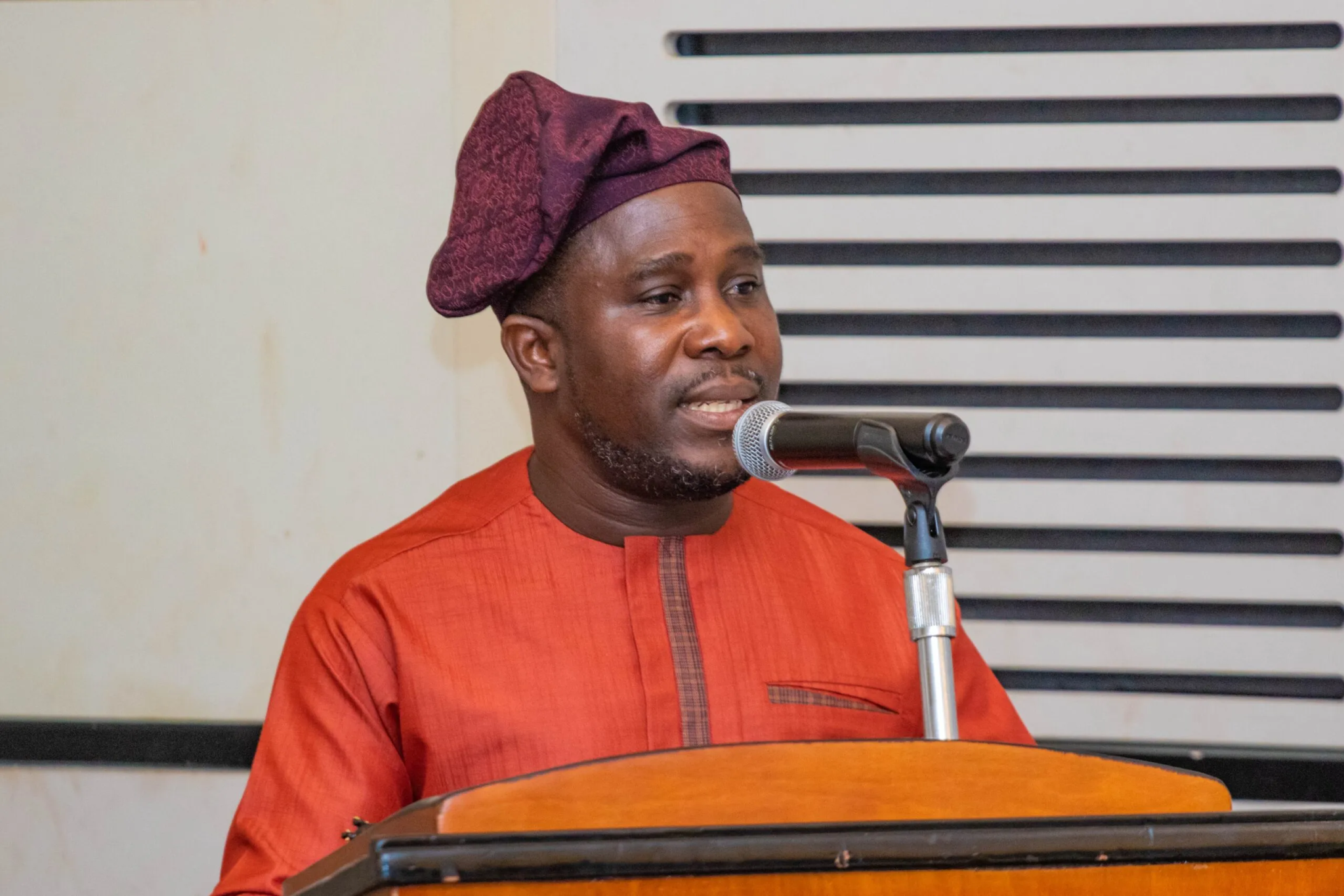
The Board Chairman of the Electricity Company of Ghana (ECG), Alexander Afenyo-Markin, has rejected the recent demands for the board’s dissolution, calling them unwarranted and misguided.
The Africa Centre for Energy Policy (ACEP), which has been at the forefront of these calls, cites claims of mismanagement and growing financial losses within the company which has increased from GH¢295 million in 2017 to GH¢9.7 billion by 2022.
In response to these calls during the appointment of David Asamoah as the acting Managing Director, ECG Board Chairman Alexander Afenyo-Markin emphasized that what is necessary for the efficient operation of the company is stakeholder engagement, rather than board dismissal.
“I think that is a misplaced position. However, I accept the fact that we must place our shoulders to the wheel for reforms. I mean, from outside and coming in. I think that ECG can be very efficient if we subject ourselves to reforms. And reform would involve engaging all stakeholders internally and communicating these to the external stakeholders.
“So it is an all-inclusive matter and I don’t want this blame game approach that we are blaming the public and the public is also blaming us,” the board chair indicated.
News came in during the late hours of September 25, 2024 that the Managing Director of the Electricity Company of Ghana (ECG), Samuel Dubik Mahama, resigned from his position.
The now former ECG boss is said to have resigned in a letter to the Board Chairman of the Electricity Company of Ghana, providing no official reason for the resignation.
There had not been any prior information to his resignation as people close to the matter have been tight-lipped about it.
This has come as a surprise to many as Mahama has only been in office for the past two years.
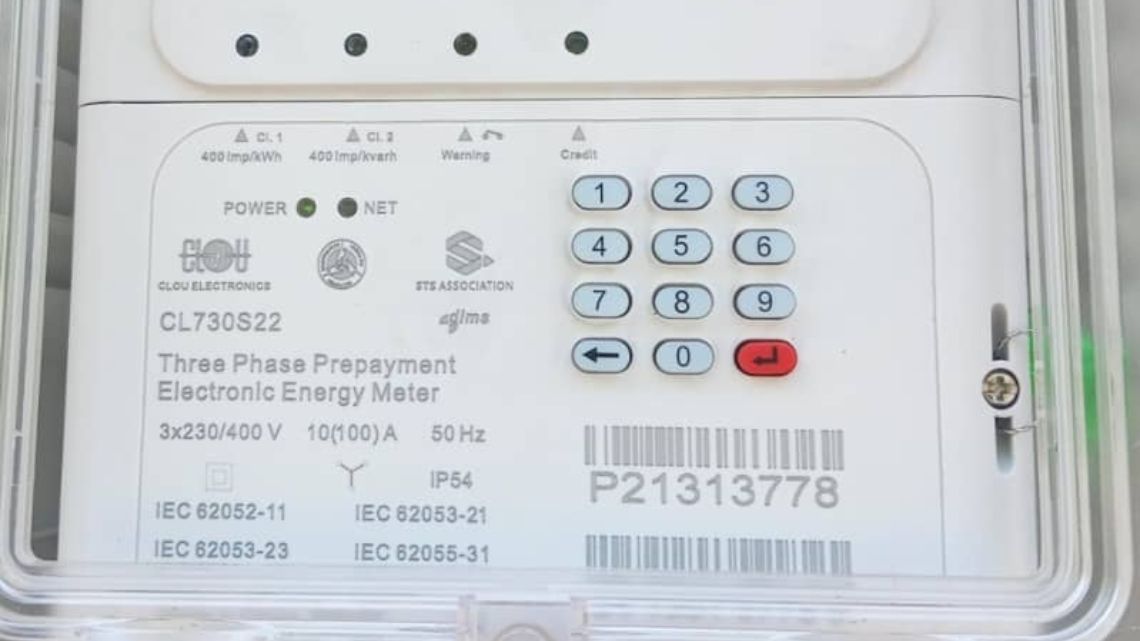
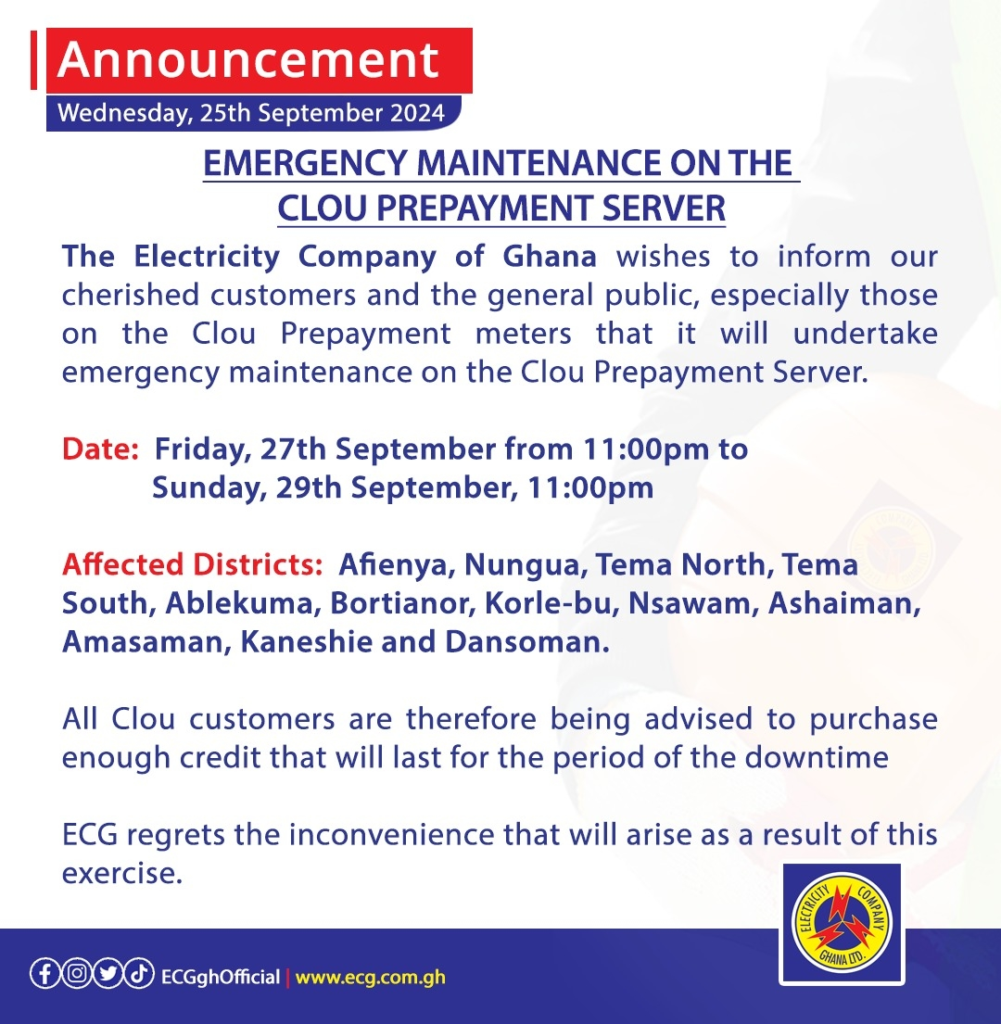
The Electricity Company of Ghana (ECG) has announced a planned emergency maintenance exercise on the Clou Prepayment Server, which will affect customers using Clou Prepayment meters.
This maintenance is scheduled to begin on Friday, 27th September 2024, at 11:00 pm and is expected to be completed by Sunday, 29th September 2024, at 11:00 pm.
During this period, customers in several districts within the Greater Accra Region, including Afenya, Nungua, Tema North, Tema South, Ablekuma, Bortianor, Korle-Bu, Nsawam, Ashaiman, Amasaman, Kaneshie, and Dansoman, will experience a downtime in their prepayment systems.
ECG has urged affected customers to purchase sufficient credits ahead of the maintenance to cover their electricity needs during the exercise.
The ECG regrets any inconvenience caused by this essential maintenance work and assures the public of a swift and smooth restoration of services once the maintenance is completed.
For further updates and inquiries, customers can stay connected through ECG’s official social media platforms and website.
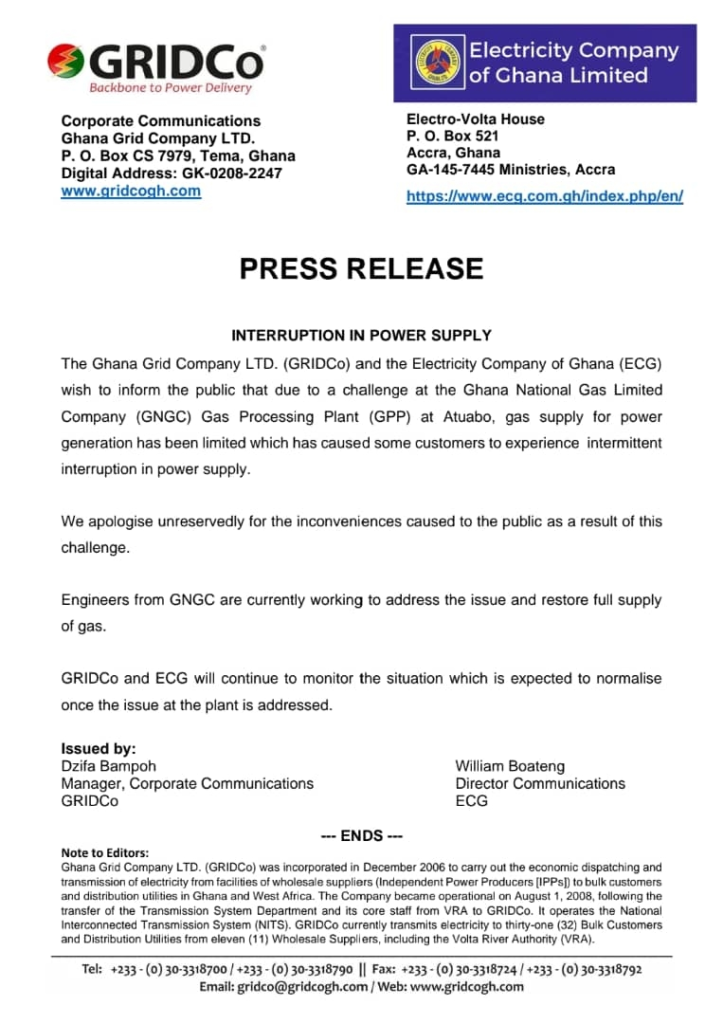
The Ghana Grid Company Ltd. (GRIDCo) and the Electricity Company of Ghana (ECG) have attributed the recent power outages experienced by some customers to a challenge at the Ghana National Gas Company (GNGC) Gas Processing Plant (GPP) located in Atuabo.
A pipeline runs from the gas processing plant near Atuabo to the Takoradi Thermal Power Station, in Aboadze, in Western Region. The Takoradi Thermal Power Station which started operation in 1997 was initiated by the Volta River Authority to complement the existing Hydro Plant at Akosombo and Kpong.
In a joint press release, both companies informed the public that the challenge has limited the gas supply for power generation, causing intermittent power supply to certain areas.
Engineers from GNGC are actively working to address the technical difficulties at the processing plant and are making efforts to restore the full supply of gas as soon as possible.
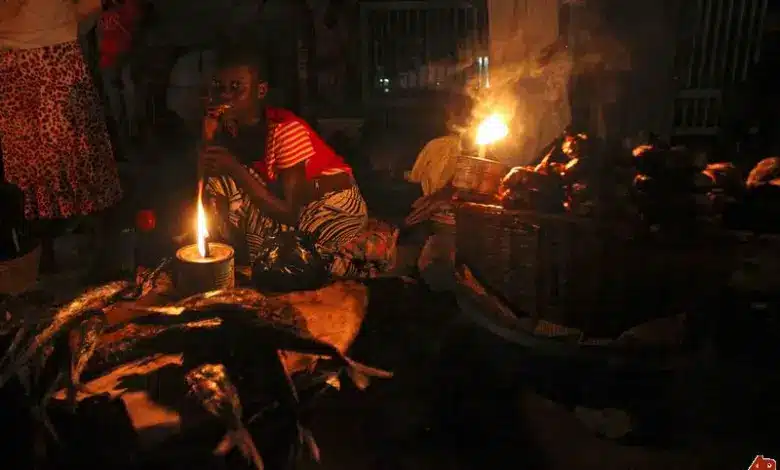
This week, several parts of the Greater Accra Region such as Dome, and Adenta have recorded intermittent power outages that lasted for several hours.
GRIDCo and ECG have extended an apology for the inconvenience this disruption has caused, emphasizing their commitment to resolving the issue.
The public is encouraged to remain patient as work continues to restore uninterrupted electricity supply.
In a related event, the Minority in Parliament has raised concerns over a reported load shedding, being downplayed by GRIDCo due to dubious contracts signed by the government through the Ghana Gas Company.
Ranking Member on the Energy Committee of Parliament, John Jinapor, alleges that there is pressure on the Ghana Gas Company from the Presidency to sign an $800 million contract with the Phoenix Park Gas Processors Consortium under questionable circumstances, without parliamentary approval.
The Minority caucus reveals that a power deficit of over 500 megawatts was recorded on Tuesday, September 24, negatively impacting customers.
Managing Director of the Electricity Company of Ghana (ECG), Samuel Dubik Mahama, has stepped down from his role.
Mahama reportedly submitted his resignation in a letter to the Board Chairman of ECG, without offering an official explanation for his decision.
His departure came without prior notice, as those familiar with the situation have remained tight-lipped.
The resignation has surprised many, given that Mahama had only been in the position for two years.
Appointed by President Nana Addo Dankwa Akufo-Addo, Mahama assumed office on May 16, 2022.
He had previously served as a non-executive director at ECG and brought with him extensive experience from both the private and public sectors.
Mahama’s professional background includes roles as a non-executive director at GIHOC Distilleries, country representative for Gulfsouth Forest Products, and partner at Dubik & Associates and Wilkins Engineering, among others.
In addition, he is a legal practitioner and an alumnus of the University of Ghana.
The Public Utilities Regulatory Commission (PURC) has dismissed media reports claiming that the Electricity Company of Ghana (ECG) is on the verge of bankruptcy, describing these claims as misreported.
According to PURC, the reports inaccurately attributed the warning of ECG’s financial collapse to the Commission’s Executive Secretary, Dr. Ishmael Ackah. In a statement signed by its commissioners, PURC clarified that it had not issued any such warning regarding ECG’s bankruptcy.
The Commission emphasized that the reports circulating in the media on September 18, suggesting that ECG was in financial crisis, were incorrect and misrepresented. The misreported claims originated from several media outlets, which alleged that PURC had expressed concerns over ECG’s dire financial state.
However, PURC explained that the concerns about ECG’s finances were first raised in a letter sent by ECG’s management to the presidency and the Minister of Energy. The Commission urged the public to seek accurate information and not to rely on misleading reports.
“The ECG in a letter to the Honourable Minister of Finance, referenced MD/MOF/V.10/018 and dated 26th August 2024, with the subject: ‘Request for Buffer Period for Cash Build-Up,’ expressed serious concerns regarding their current financial situation and warned that ‘this situation, if not addressed promptly, could lead to severe financial instability and potential bankruptcy for ECG.’”
“The media publications wrongly created the impression that the Commission on its own originated the issue of bankruptcy without an initial appeal from ECG.”
Executive Director of the Institute for Energy Security (IES), Nana Amoasi VII,suggests revisiting the old agreement between the Electricity Company of Ghana (ECG) and Power Distribution Services (PDS) following the Public Utilities Regulatory Commission’s (PURC) concerns about ECG’s financial instability.
The previous concession deal between ECG and PDS was terminated after a forensic audit revealed issues with the Payment Security for the transaction.
Nana Amoasi advocates for reviewing the agreement with modifications to minimise risks and find a sustainable solution to ECG’s current challenges.
“All possible forms of private sector participation can be considered but we must revisit the situation again because things have worsened since we introduced the PDS-ECG arrangements.
So we should re-access and make sure that we take the right risk assessments and get a fair solution to that,” he said during an interview on Ghana Tonight.
Nana Amoasi VII believes that revisiting the concession between the Electricity Company of Ghana (ECG) and Power Distribution Services (PDS) could address ECG’s current financial challenges.
He stresses that private sector involvement is crucial for securing necessary funding. Although the initial PDS arrangement introduced billing and management expectations, it was dissolved due to questionable dealings.
His comments come after a Public Utilities Regulatory Commission (PURC) report highlighted ECG’s severe financial crisis, with revenue plunging below 42% of required funds, raising concerns about bankruptcy across the energy sector.
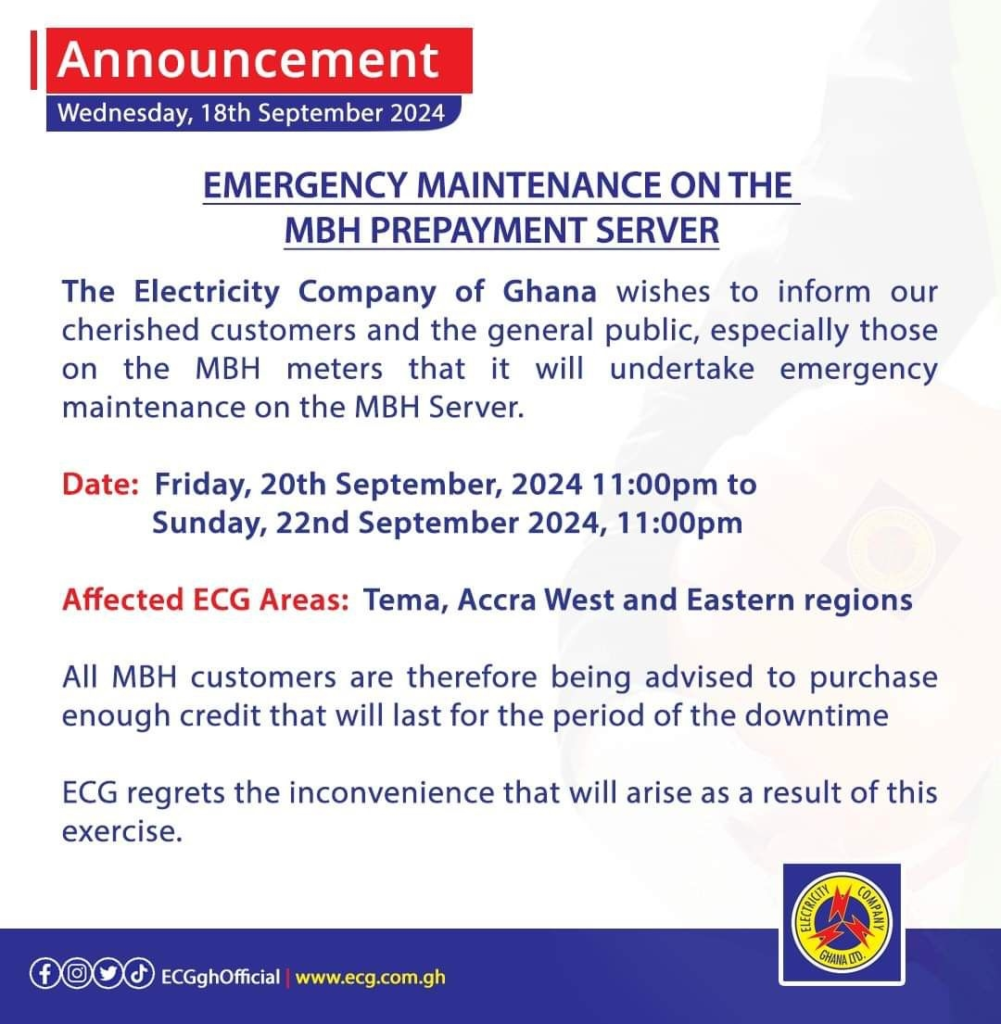
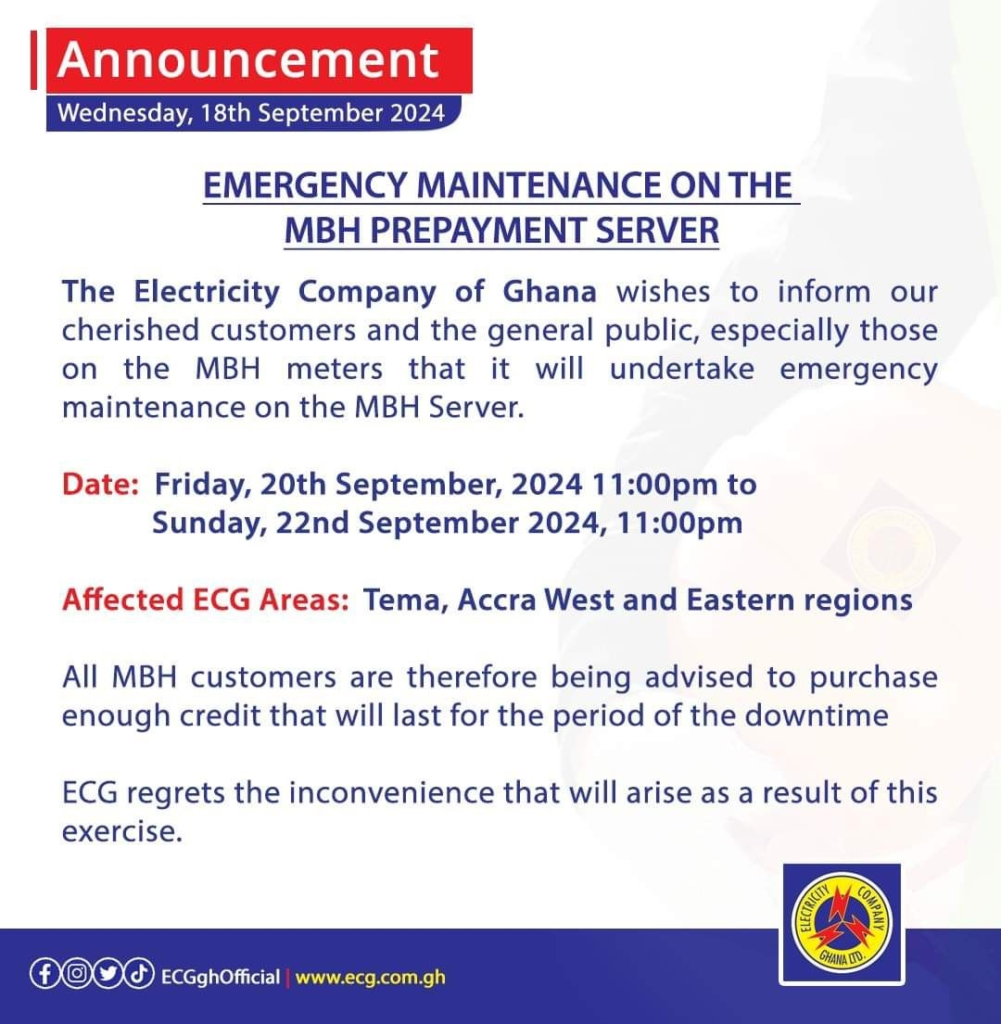
The Electricity Company of Ghana’s (ECG) maintenance exercise on its MBH meters begins today.
The maintenance will run for three days, from 11:00 pm tonight, through to 11:00 pm on Sunday, September 22, 2024.
This operation will affect customers using the MBH meters in Tema, Accra West, and parts of the Eastern Region. ECG explained that the maintenance is necessary to ensure the smooth operation of the MBH meter system and to enhance overall service delivery.
In its statement, ECG advised affected customers to plan ahead by purchasing sufficient electricity credits before the maintenance period.
“All MBH customers are therefore being advised to purchase enough credit that will last for the period of the downtime,” ECG urged.
The company expressed its apologies for any inconvenience caused and emphasized that the planned works are essential for improving the reliability of the electricity supply.
ECG also encouraged customers to stay informed and make necessary arrangements to avoid disruptions. For further assistance or information, customers are advised to contact ECG’s customer service hotlines or visit the nearest ECG office.
The Africa Centre for Energy Policy (ACEP) is calling for the removal of the management of the Electricity Company of Ghana (ECG) due to alleged mismanagement.
According to ACEP, revenue losses have surged significantly, rising from GH¢295 million in 2017 to GH¢9.7 billion by 2022.
During a press conference on Thursday, September 19, ACEP’s Policy Lead on Petroleum and Conventional Energy, Kodzo Yaotse, urged the dismissal of ECG’s management, citing their poor performance in revenue mobilisation.
“The growing fiscal burden imposed on the economy by ECG’s poor performance has become a ticking time bomb that can undermine the progress made after the domestic and international debt restructuring to keep Ghana solvent.
“With the level of debt accumulation and the intervention required of the state, it is just a matter of time before Ghana is plunged into another debt crisis. With IPP debt mounting and gas suppliers and transporters demanding payments, the pressure on the government to sacrifice social investment is high.”
Mr. Yaotse also called for an end to what he described as the wasteful use of state resources, stating that such inefficiency cannot be allowed to continue.
“The political lethargy to enable ECG to deliver value to the people of Ghana continues to hurt Ghana’s budget and, by extension, development efforts. The Energy Sector Recovery Programme (ESRP) estimates that realised power sector shortfalls between 2019 and 2023 were about US$8.25 billion.
“This is a sheer waste of public resources that cannot persist. In light of the above.”
Africa Centre for Energy Policy (ACEP) is calling for the removal of theElectricity Company of Ghana’s (ECG) management, citing poor leadership and alleged mismanagement.
ACEP highlights that revenue losses have surged dramatically, rising from GH¢295 million in 2017 to a staggering GH¢9.7 billion in 2022.
During a press conference on Thursday, September 19, ACEP’s Policy Lead on Petroleum and Conventional Energy, Kodzo Yaotse, urged for the dismissal of ECG’s management due to their failure to effectively improve revenue collection.
“The growing fiscal burden imposed on the economy by ECG’s poor performance has become a ticking time bomb that can undermine the progress made after the domestic and international debt restructuring to keep Ghana solvent.
“With the level of debt accumulation and the intervention required of the state, it is just a matter of time before Ghana is plunged into another debt crisis.
With IPP debt mounting and gas suppliers and transporters demanding payments, the pressure on the government to sacrifice social investment is high.”
Mr. Yaotse also called for an end to what he said is a wasteful use of state resources, which he said cannot be allowed to persist.
“The political lethargy to enableECG to delivervalue to the people of Ghana continues to hurt Ghana’s budget and, by extension, development efforts.
The Energy Sector Recovery Programme (ESRP) estimates that realised power sector shortfalls between 2019 and 2023 were about US$8.25 billion.
“This is a sheer waste of public resources that cannot persist. In light of the above.”
The Electricity Company of Ghana (ECG) has expressed disappointment with the recent report by the Public Utilities Regulatory Commission (PURC) concerning its operations, particularly as they relate to the Cash Waterfall Mechanism (CWM).
In a statement issued on Thursday, ECG argued that the PURC report misrepresents several key aspects of its operations. The company specifically took issue with how its fuel costs, a vital component for maintaining operations, were labeled as a “variance” in the report.
ECG highlighted that it has made considerable progress under its current leadership, including the independent procurement of fuel, which should be acknowledged rather than framed negatively.
The ECG further pointed out that the report overlooks forex losses and the delays in payments to Independent Power Producers (IPPs), portraying an incomplete picture of the company’s operational challenges.
A major point of contention is the PURC’s labeling of ECG’s fuel costs as a “variance.” The ECG maintains that fuel procurement is essential to its operations and has been managed effectively under its current management. In the past, the company faced difficulties in securing fuel, but recent strides have allowed ECG to procure fuel independently—an achievement the company believes should be celebrated, not dismissed as a negative variance.
“Unlike previous years, ECG has taken strides to ensure its ability to procure fuel independently, a significant achievement that should be acknowledged rather than downplayed,” the statement said.
Forex Losses and Payment Delays to IPPs
The ECG also raised concerns about the report’s treatment of payments to Independent Power Producers (IPPs). According to the company, delays in payments were mainly to settle outstanding amounts from previous months, a standard practice in account management. The company stressed that it had complied with payments to Tier 2 beneficiaries, including the PURC itself, throughout the period under review.
Additionally, the ECG emphasized that the report overlooks the impact of foreign exchange losses on its ability to meet financial obligations. Discrepancies between the PURC’s exchange rate and the market or Bank of Ghana (BoG) rates have led to significant forex losses when making payments to IPPs and WAPCo. In July 2024, for example, ECG paid WAPCo US$3 million, which amounted to GHS48 million. However, the PURC recorded this as GHS43 million, failing to account for forex fluctuations.
Call for Constructive Leadership and Accurate Reporting
ECG’s statement urged the PURC to adopt a more constructive approach in its assessments, one that reflects the progress being made within the energy sector. The company emphasized that mischaracterizing fuel procurement and downplaying improvements in operations could mislead the public and detract from the advancements made under the current leadership.
“By framing necessary costs like fuel procurement as variances, the PURC risks confusing the public and detracting from the real improvements made by ECG and other players in the sector,” the company noted.
ECG called for greater collaboration and transparency, stressing the need for accurate reporting that would foster progress in the energy sector as Ghana moves toward future challenges, including forex fluctuations and fuel procurement issues.
In conclusion, ECG urged the PURC, under the leadership of Dr. Ishmael Ackah, to focus on clarity, constructive leadership, and the recognition of genuine progress in Ghana’s energy sector.
The Electricity Company of Ghana (ECG) has advised customers using MBH meters in certain regions to purchase enough credit ahead of a planned three-day maintenance exercise.
The maintenance, scheduled to begin on Friday, September 20, 2024, at 11:00 pm, will end on Sunday, September 22, 2024, at 11:00 pm.
The affected areas include Tema, Accra West, and parts of the Eastern Region. The emergency maintenance will involve works on the MBH server, which may result in service interruptions for users in these regions.
In a statement, ECG urged all MBH meter customers to ensure they purchase sufficient credit before the server downtime. “All MBH customers are therefore being advised to purchase enough credit that will last for the period of the downtime,” the company said.
The ECG apologized for any inconvenience the maintenance may cause but emphasized that the exercise is necessary to enhance the functionality of the MBH meter system.
Customers are encouraged to contact ECG customer service hotlines for further assistance or inquiries during the maintenance period.
The Electricity Company of Ghana (ECG) has announced that it will carry out emergency maintenance on the MBH meters starting this Friday, September 20, 2024. The scheduled works will run from 11:00 pm on Friday through to 11:00 pm on Sunday, September 22, 2024.
The maintenance will affect customers using the MBH meters in Tema, Accra West, and parts of the Eastern Region. According to ECG, the exercise is necessary to ensure the smooth functioning of the MBH meter system and improve service delivery to customers.
In a statement, ECG urged affected customers to prepare for the server downtime by purchasing enough electricity credits in advance.
“All MBH customers are therefore being advised to purchase enough credit that will last for the period of the downtime,” the statement read.
ECG also expressed regret for any inconvenience the planned maintenance may cause, assuring customers that the works are critical for improving service reliability.
The company further advised its cherished customers and the general public to remain informed during this period and make necessary arrangements to avoid disruptions in electricity supply.
For further information or assistance, ECG urged customers to contact its customer service hotlines or visit nearby ECG offices.
The Public Utilities Regulatory Commission (PURC) has issued a warning that the Electricity Company of Ghana (ECG) is at risk of bankruptcy due to severe financial difficulties.
In a letter addressed to the Presidency, the Energy and Finance Ministers, and other key stakeholders, PURC’s Executive Secretary, Dr. Ismael Ackah, outlined the financial crisis, which is also impacting the operations of the Volta River Authority (VRA), Ghana Grid Company (GRIDCo), and the Bui Power Authority.
According to Dr. Ackah, the ongoing challenges have caused delays in salary payments and difficulties in meeting administrative costs, emphasizing the need for immediate action to avoid further decline.
Despite initiatives aimed at improving cash collection through digital and metering programmes, as well as significant tariff increases of over 75% since September 2022, ECG’s financial instability persists.
Financial Crisis at ECG
PURC’s letter reveals that ECG’s revenues for June and July 2024 stood at GHS 884.2 million and GHS 857 million, respectively—insufficient to cover the monthly $47 million Tier A plus WAPCo’s bill under the Cash Waterfall Mechanism. The situation worsened in August 2024, with revenues dropping below GHS 800 million, representing only about 42% of the expected revenue needed to pay sector players.
A report from PURC on ECG’s compliance with the Cash Waterfall Mechanism also highlighted an approximately GHS 860 million shortfall in payments to independent power producers, further exacerbating the crisis. This shortfall has left Tier B companies—including Ghana Gas, VRA, GRIDCo, ECG, Bui, and regulators—struggling to meet staff salaries and administrative costs.
Dr. Ackah stressed that the issues facing ECG require more than tariff adjustments, calling for deeper introspection and structural reforms.
Comparative Solutions from the Sub-Region
PURC’s letter also points to successful interventions from neighboring countries facing similar challenges:
Kenya Power and Lighting Company: Listed approximately 50% of its equity on the stock exchange, raising non-tariff funding for critical investments.
Tanzania Electric Supply Company Limited (TANESCO): The Tanzanian government converted a government on-lend loan of 2.4 trillion Tanzanian shillings into equity. Since 2022, TANESCO has consistently declared profits, reducing both technical and non-technical losses to around 9% as of June 2024.
Uganda’s Umeme Concession: Involved the private sector in metering, billing, and collection services, achieving a collection rate of 98.7%.
Recommendations for Structural Reforms
PURC suggests that similar innovative measures could help stabilize ECG, but any intervention should include stringent performance indicators, such as:
Drastic reductions in technical and commercial losses;
A reassessment of power purchase agreements and exchange rate regimes to reduce the burden on consumers;
Independent economic and technical audits to evaluate ECG’s true financial and technical position.
Fuel payments are also affecting ECG’s financial sustainability. PURC has recommended that the Ministry of Energy, in collaboration with ECG, the State Interests and Governance Authority (SIGA), the Ministry of Finance, the Ministry of Public Enterprises, and other key stakeholders, undertake a comprehensive review of the root causes of ECG’s financial difficulties. The objective of this exercise would be to transform ECG and protect the broader energy sector.
PURC also calls for greater transparency from ECG on critical issues, including revenue collection versus Cash Waterfall Mechanism (CWM) declarations, major contracts, monthly commitments, commercial and technical losses, and non-core activities that are impeding the company’s financial sustainability.
Finally, PURC emphasized that privatization should be considered as a viable option to ensure ECG’s long-term financial stability and safeguard the energy sector in Ghana.
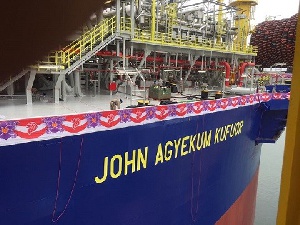
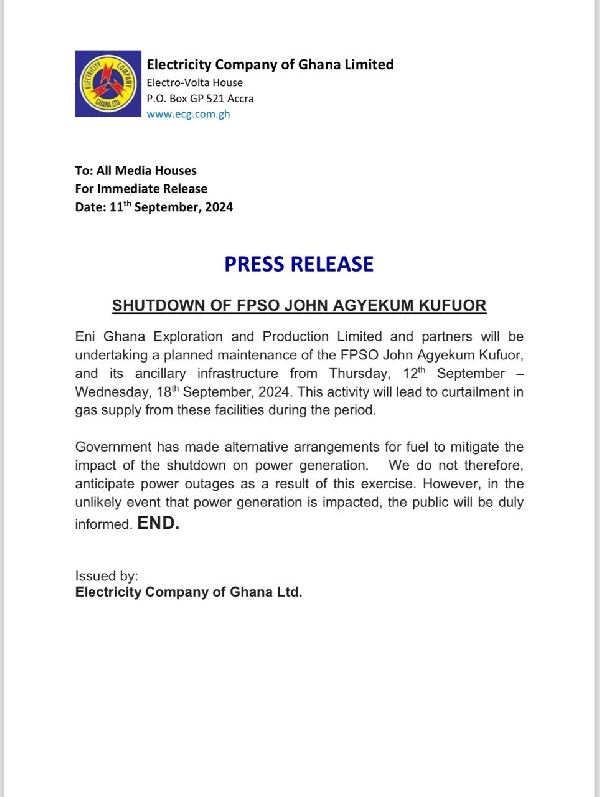
The Electricity Company of Ghana (ECG) has guaranteed that the closure of FPSO John Agyekum Kufour will not lead to power outages.
The shutdown is planned from September 12 to 18 for maintenance purposes.
ECG has assured that alternative fuel arrangements are in place to reduce any potential impact on power generation.
However, the company also noted that should there be any effect on power supply, the public will be notified immediately.
“Eni Ghana Exploration and Production Limited and partners will be undertaking a planned maintenance of the FPSO John Agyekum Kufuor, and its ancillary infrastructure from Thursday, 12th September Wednesday, 18th September, 2024. This activity will lead to curtailment in gas supply from these facilities during the period.
“Government has made alternative arrangements for fuel to mitigate the impact of the shutdown on power generation. We do not therefore, anticipate power outages as a result of this exercise. However, in the unlikely event that power generation is impacted, the public will be duly informed,” a press statement from the ECG said.
He expressed frustration over the practice of individuals relying on political figures to intercede on their behalf, describing it as inappropriate.
Mahama also lamented the tendency of some to politicize electricity matters because of their connections with influential leaders.
“I will appeal that we don’t politicise power. You go and take your money, then they try to call big politicians to intervene; let us not politicise power,” he is quoted as saying by 3news.com.
Meanwhile, speaking on how digitalisation has made their services easier and more convenient for Ghanaians, he noted that customers can now receive a new meter within just 7 days.
He,therefore, warned Ghanaians not to fall victim to middlemen who charge large amounts of money for their services.
“The online application for matter is effective, you can use *226 to apply. With the loss reduction programme, it should take you a minimum of one week to acquire the metre after payment. This is for a new service connection, you build a new house and need a meter, you will get it in seven days.
“We know that there are goroboys in the system and so we have started our premium service. If you need a meter immediately don’t pay to any goroboy.
“Under PURC single face, you pay GHC 1200 to ECG, you pay this online. The 3-phase metre is GHC 2300. I will urge the public to use the app or go to the ECG offices and pay what the PURC has approved. Let us use the right channels,” he added.
The Institute for Energy Security (IES) has called on the government to reconsider a contentious draft bill that seeks significant reforms in the nation’s power sector, citing huge risk factors.
The proposed bill includes plans to merge the Volta River Authority (VRA) with the Bui Power Authority, consolidate the Electricity Company of Ghana (ECG) with the Northern Electricity Distribution Company (NEDCo), and establish a new, independent Thermal Power Authority.
Staff groups from the VRA have expressed strong objections to these restructuring plans, contending that they could adversely affect the power sector and diminish the VRA’s operational efficiency.
In a statement released on Sunday, September 8, 2024, and signed by its Executive Director, Nana Amoasi VII, the IES outlined the potential dangers associated with the proposed changes.
“While the proposed merger and restructuring of Ghana’s power sector may have its proponents, we believe that the risks far outweigh the benefits in its current form,” the statement noted.
It stressed the need to strengthen the current institutions rather than dismantling them.
“The focus should be on stabilising and strengthening the existing institutions such as the VRA, Bui Power Authority, ECG, and NEDCo, rather than dismantling them,” the statement added.
The IES therefore urged the government to reconsider the draft bill and explore alternative solutions that will protect Ghana’s energy security, affordability, and long-term sustainability.
The Electricity Company of Ghana (ECG) has expressed regret for any disruptions caused by its current initiative to replace outdated meters with smart meters.
The company has acknowledged encountering some difficulties during the transition and is asking for Ghanaians’ patience as it strives to improve efficiency in power distribution.
Miss Mary Opong Eshun, the Public Relations Officer for Accra East ECG, issued the apology during an interview on the Ghana Yensom morning show, hosted by Otafrigya Kayire Kwesi Apea-Apreku and Odehyeeba Kofi Essuman, on Accra 100.5 FM on Wednesday, September 4, 2024.
Ms. Eshun explained that this initiative is focused on removing meters that have surpassed their ten-year lifespan and are no longer functioning effectively.
“Some of these expired meters have become inefficient over the years, necessitating their replacement,” she explained.
She reassured customers that the rollout of smart meters is aimed at improving electricity management rather than exploiting them.
She detailed that when ECG staff replace old meters with new smart meters, they document all relevant information. Existing credit is transferred to the new meter, and any outstanding balances are also carried over.
Ms. Eshun noted that the smart meters can be controlled remotely via the ECG app, which should help decrease the long wait times commonly experienced at vending locations.
She also advised customers to inspect their property’s earthing and wiring if they find that their credit depletes faster than usual on the new meters.
“Some properties have outdated wiring systems or damaged earthing, which can lead to faster credit consumption,” she noted.
Ms Eshun called on customers to report any challenges they encountered as a result of the exercise for prompt resolution.
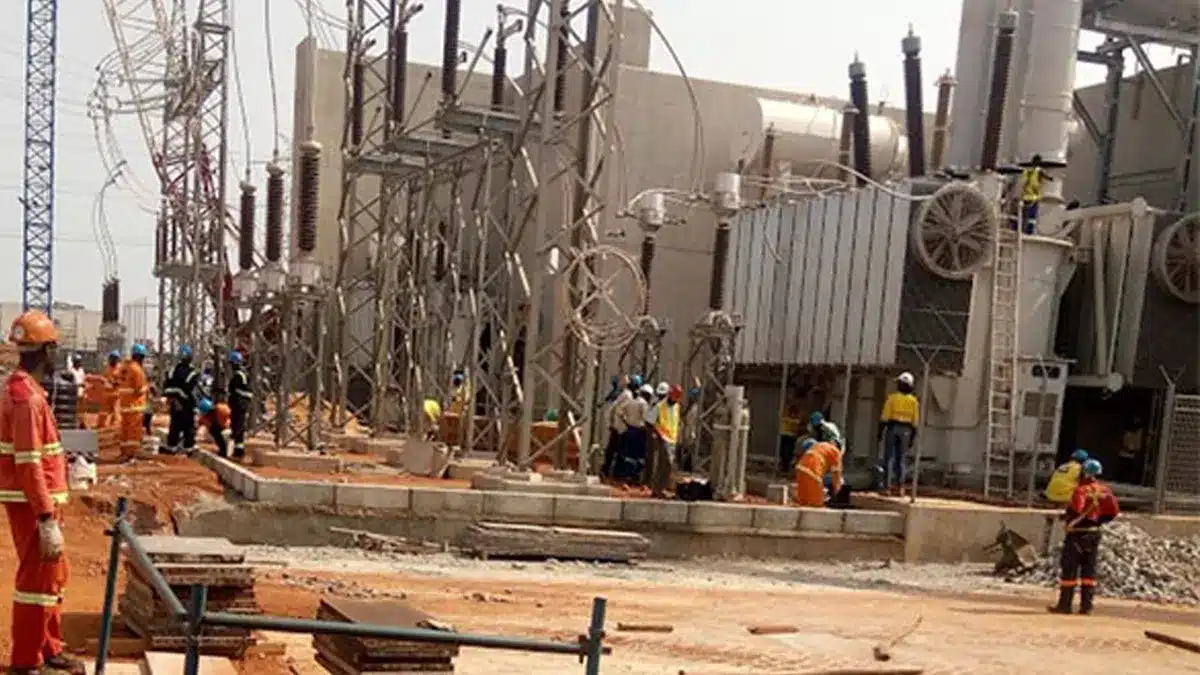
The Ministry of Energy officially handed over a cutting-edge Supervisory Control and Data Acquisition (SCADA) Centre to the Eastern Regional Office of the Electricity Company of Ghana Limited (ECG) on Wednesday.
This GH¢6.3 million facility is set to greatly enhance the operational efficiency of the ECG in the region. The SCADA Centre will facilitate improved fault detection, streamline switching processes, and expedite fault resolution, which are crucial for ensuring a reliable power supply.
In a speech delivered by the Director of Power, Mr. Solomon Adjetey, on behalf of the Minister of State at the Ministry of Energy, Herbert Krapah, the government reaffirmed its commitment to enhancing power reliability nationwide.
According to Mr. Krapah, the project, which began in 2020, is part of a larger initiative that also includes similar developments in ECG’s Western and Tema operational areas. He highlighted that the completion and handover of the SCADA project’s first phase in the Eastern Region represent a significant milestone and encouraged ECG to leverage the new facility to reduce power outages.
John Gemegah, ECG’s General Manager of Supervisory Systems, shared that four primary substations in Koforidua, Mpraeso, Nkawkaw, and Akim Oda have already been integrated into the SCADA system.
He noted that the Eastern Region is currently leading in system reliability and expressed confidence that the new SCADA Centre would further enhance their performance.
Sariel Adobea Etwire, ECG’s General Manager for the Eastern Region, provided additional insights into the region’s power infrastructure, noting that the Eastern Region has 66 distribution and express feeders, along with nine primary substations. She expressed optimism that the new SCADA Centre would elevate power reliability in the region to new levels.
Mrs. Etwire also extended her gratitude to the government and the Ministry of Energy for their support. She assured the public of ECG’s commitment to maintaining a stable power supply and urged customers to pay their bills promptly so the company can continue to improve its services.
The project contractor, Prince John Abakah, expressed his appreciation to the Ministry and ECG staff for their cooperation throughout the project’s implementation.
The event was attended by key officials, including ECG’s General Manager of Sub-Transmission, Francis Atsyatsya; Eastern Regional Engineer, Mr. Emmanuel Appoe, and other managers and staff from both the Head Office and the Eastern Region.
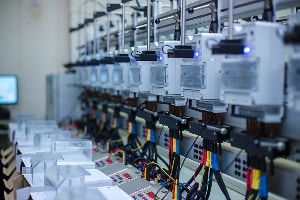
Electricity Company of Ghana (ECG)has launched a project to upgrade outdated electricity meters in the Accra East region to modern Smart MMS-compliant prepaid meters.
Scheduled from September 2 to September 30, 2024, the initiative targets key districts like Makola, Teshie, and Adentan, aiming to replace 250,000 meters.
This move, driven by a directive from the Public Utilities and Regulatory Commission (PURC), seeks to improve service delivery and address revenue losses of over GH¢893 million caused by faulty meters not accurately recording electricity consumption.
“These are meters that have run their due course. They were not working accurately and needed to be replaced. Once the replacement was completed, we expect the situation to stabilise, thereby improving the company’s revenue fortunes,” he is quoted by myjoyonline.com.
William Boateng has highlighted the urgent need to replace outdated meters with new Smart MMS-compliant prepaid meters.
He explained that the old meters were failing to provide accurate readings, which was impacting the company’s revenue and overall stability.
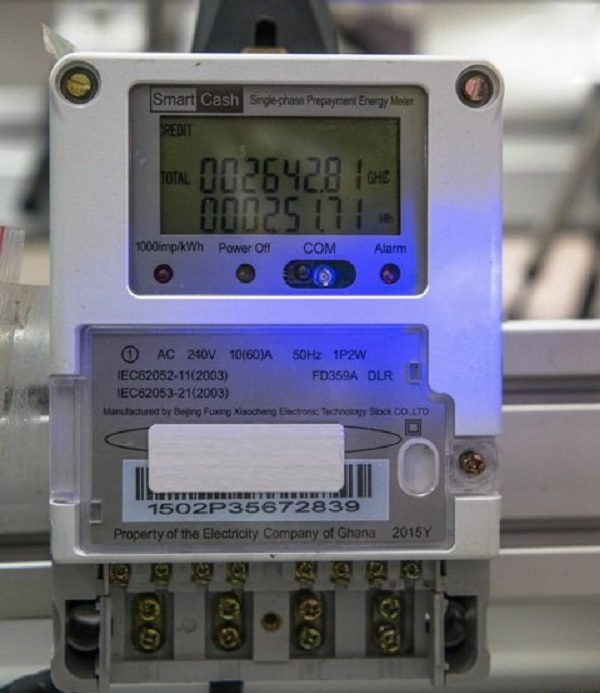
The new prepaid meters are designed to enhance reliability and efficiency. They come with advanced features that allow customers to top up their credits remotely via the ECG Power App or by dialing the short code (*226#).
This upgrade aims to make it easier and more flexible for users to manage their electricity usage.
This meter replacement initiative is part of the ECG’s Loss Reduction Project (LRP), which is focused on minimizing technical and commercial losses while boosting operational efficiency.
ECG has assured customers that any remaining credit on their old meters will be seamlessly transferred to their new smart meters.
Additionally, the replacement process will be conducted at no cost to the customers, and Boateng warned against paying anyone for the meter swap.
Boateng expressed optimism that this upgrade will enhance ECG’s financial performance, despite the current revenue challenges.
The Electricity Company of Ghana (ECG) has announced that it will replace old meters with Smart MMS-compliant prepaid meters across Greater Accra and Eastern Region.
The exercise is scheduled to take place from 2nd to 30th September covering key operational districts; Makola, Teshie, Legon, Roman Ridge, Kwabenya, Mampong, Dodowa, and Adentan.
The 250,000 prepaid meters will provide convenience and flexibility to customers as they will be able to top up their credits using the ECG Power App or through a short code (*226#), in managing electricity consumption. The upgrade is part of the ECG’s Loss Reduction Project (LRP), aimed at minimizing technical and commercial losses while enhancing overall operational efficiency.
Speaking to the media on Monday, August 26, the ECG’s Director of Communications, William Boateng, explained that the initiative to replace outdated meters is a response to significant shortfalls in revenue collection by the company.
Mr Boateng attributed the company’s loss to the failure of malfunctioning of old meters to communicate correctly with the company’s servers.
He indicated that the incoming operation is a directive by the Public Utilities and Regulatory Commission (PURC), to enhance service delivery, address the ongoing challenges associated with obsolete meters and others.
He mentioned that the revenue shortfall, experienced during July and August 2024, resulted from difficulties in accurately recording customer consumption due to outdated metering systems. The ECG’s Director of Communications as customers start repaying their overdue amounts in installments. “These are meters that have run their due course. They were not working accurately and needed to be replaced. Once the replacement was completed, we expect the situation to stabilise, thereby improving the company’s revenue fortunes,” Mr Boateng stated.
The Minister of State at the Ministry of Energy, Herbert Krapa, has called on the management of the Electricity Company of Ghana (ECG) to take strict action against inefficient staff whose conduct undermines the company’s efforts to deliver quality and timely services to customers.
“Heads must roll when we find that persistently some people are just making it difficult for us [ECG] to provide quality, affordable, and efficient service to our customers and the Ghanaian people,” the Minister emphasized.
He added that staff members who go the extra mile to deliver excellent service must also be rewarded to encourage others to follow suit.
Mr. Krapa made these remarks during a visit to the ECG Customer Service Office in Accra East, where he sought to address the growing frustrations of customers.
His visit was part of a broader initiative to help improve service delivery. Accompanying him were Deputy Minister Collins Adomako-Mensah, Chief Director Wilhelmina Asamoah, Director of Power Solomon Adjettey, and Director of PPBME Isaac Nsarko Biney.
During the briefing, it emerged that ECG management was baffled by the activities of so-called ‘goro boys’ who manage to access customer information through the ECG’s online meter application process and use it to deceive unsuspecting applicants.
As part of his visit, Mr. Krapa and his deputy randomly tested the ECG complaint center by placing a call, which was handled professionally.
The Minister praised the operator’s response, remarking that “the gentleman deserves a pay rise,” and reiterated the need for recognizing and rewarding good performance while sanctioning inefficiency.
Mr. Krapa, who previously served as Deputy Minister of Energy and Board Chairman of ECG, noted that the public’s trust in the service provider was “fast dissipating.” He stressed that ECG must address customer complaints more promptly, stating, “customers cannot accept ECG taking forever or too long in resolving their complaints and challenges.”
To regain the trust of the Ghanaian people, the Minister advised ECG to focus on efficiency and timely resolution of issues. He also encouraged the company to better utilize both traditional and modern media, including town hall meetings and the Information Services Department, to engage with customers who may not be active on social media. This, he noted, would help curb the reliance on goro boys for services.
On the persistent issue of meters, which he referred to as “the elephant in the room,” Mr. Krapa acknowledged the frustration of customers who are willing to pay for meters that are supposed to be free. He urged ECG to expedite efforts to clear the backlog of over one million meters due to new connections, faulty meters, and aging equipment.
The Minister also called for the simplification of the meter acquisition process to eliminate duplication and make the process more accessible to customers, ensuring a smoother and more efficient service experience.
CEO of the Independent Power Generators in Ghana, Dr. Elikplim Kwabla Apetorgbor, has denied government claims that an agreement has been reached with Independent Power Producers (IPPs) regarding payment terms amidst ongoing debt restructuring talks.
The IPGG stated that no such agreement has been finalized, contrary to recent statements by the Minister of State at the Ministry of Energy, Herbert Krapa, and Minister of Finance, Dr. Mohammed Amin Adam.
In a statement signed by Dr. Elikplim Kwabla Apetorgbor, the claims made by the ministers were labeled as ‘inaccurate,’ with the IPGG asserting that negotiations are still ongoing and no agreement has been concluded.
“While negotiations have not been concluded, it is crucial to ensure accuracy in the information disseminated to the public,” the statement read.
“Misleading statements about the status of the negotiations have significant repercussions, including pressures and demands from our principals. It also risks jeopardizing our credibility and business relationships with key stakeholders,” it added.
The IPGG CEO called on the Minister of Finance and the Minister of State at the Ministry of Energy to hold off on making any additional public remarks about the issue until a conclusive agreement is finalized and all stakeholders have been adequately informed.
“We remain committed to finding a sustainable solution to the debt owed to IPPs, and once an agreement has been finalized, we will ensure that the public is duly informed,” the IPGG statement noted.
Under the terms of Ghana’s IMF program, the government must restructure the debt owed to Independent Power Producers, who are vital to the nation’s energy and power supply chain.
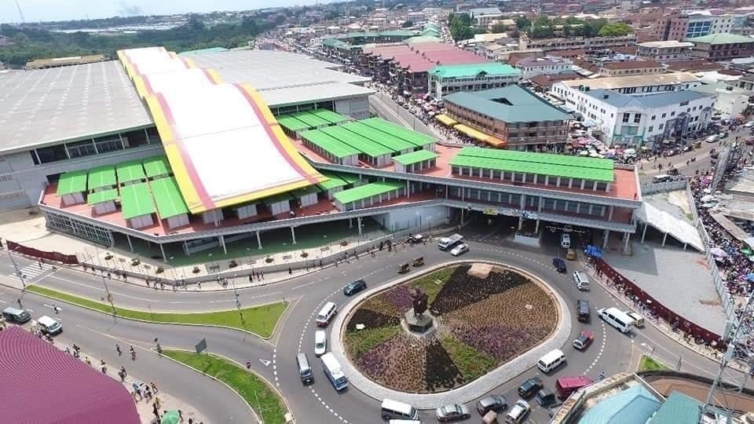
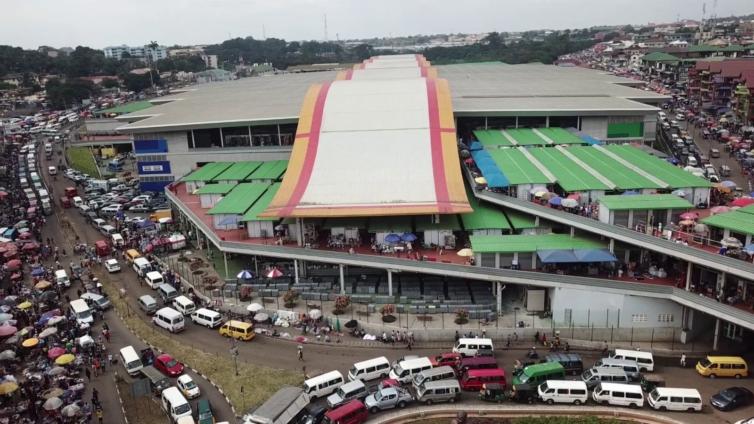
The Kejetia Market in Kumasi has been given a September 16, 2024 deadline to clear its outstanding debt of over GHC7 million owed to the Electricity Company of Ghana (ECG).
This comes after the market management negotiated a repayment plan with ECG following a three-day blackout due to their failure to adhere to the initial payment schedule.
According to Benjamin Obeng Antwi, Public Relations Officer for ECG-Ashanti West, the repayment plan has now been revised, and the market is expected to follow through with consistent payments over the coming weeks. Speaking in an interview with David Akuetteh on Luv FM, Antwi detailed the schedule.
“By August 30, they are to pay GHC200,000, followed by GHC273,000 by September 6. On September 10, we expect another payment, which includes their legacy debt. The plan covers both May and June bills in addition to the debt. They are to complete payments by September 16, excluding the July bill,” Antwi explained.
Efforts to install separate meters for each shop at the market have faced obstacles. Antwi noted that despite a stakeholder meeting held a year or two ago, which aimed to facilitate the separation of individual shops from the bulk meter, the project has stalled.
“We conducted engineering checks and advised them to disconnect the generator from the main meter to avoid complications when it’s switched on. We gave them the necessary advice and awaited feedback, but none came, which caused the delay,” Antwi added.
Earlier this year, the Kejetia Market management acquired over 1,000 single meters to allow individual shops to measure their own electricity consumption. However, a large number of meters remain unsold as traders have been hesitant to make purchases.
Edmond Kofi Duffuor, Managing Director of Kumasi City Markets, attributed the slow uptake to the traders’ financial struggles. “The traders are finding the cost of the meters too high and are already burdened by their unpaid bills. If they can settle their debts, hopefully, everyone will be able to get their meters,” he said.
With the repayment plan in place, the market’s management is under pressure to meet the agreed deadlines to restore full power and avoid further disruptions.
The government has successfully restructured the legacy debt owed toIndependent Power Producers (IPPs), addressing a critical issue that had threatened their operations.
This strategic move is intended to promote sustainability in the energy sector and ensure stability in electricity supply.
Herbert Krapa, the Minister of State at the Energy Ministry, highlighted that the renegotiation of these debts places Ghana on a path toward success.
During a visit to the Accra West Regional office of the Electricity Company of Ghana (ECG), Krapa emphasized the need for the power distributor to restore public trust by promptly resolving customer complaints related to meter acquisition and other concerns.
Meanwhile, ECG Managing Director Samuel Dubik Mahama refuted allegations that the new smart meters being introduced under the Loss Reduction Programme (LRP) are designed to overcharge customers.
Despite widespread complaints about the consumption rates of these meters, Mahama reassured the public that the smart meters are intended to enhance accuracy and efficiency,not to exploit consumers.
Kumasi City Market has resumed normal operations after the Electricity Company of Ghana (ECG) restored power following a two-day disconnection.
The blackout occurred due to the market’s failure to pay off outstanding arrears exceeding GH₵7 million.
Power was restored after a significant portion of the debt was settled and a proposal was submitted to clear the remaining balance.
This isn’t the first time the market has experienced power cuts due to payment issues.
Reuben Amey, secretary of the Kejetia Central Market Traders Union, urged traders to pay their bills to help management settle the arrears.
The facility’s operations manager confirmed that a payment plan had been submitted to ECG and appealed for trader cooperation to prevent future disconnections.
Meanwhile, Nana Akwasi Prempeh, president of the Federation of Kumasi Traders, has called for the removal of the individual responsible for installing meters, citing their incompetence.
The Kejetia market in Kumasi has been without electricity for three days due to an unpaid debt of seven million cedis to the Electricity Company of Ghana (ECG).
Reports indicate that this power cut followed the market’s failure to adhere to a debt repayment schedule.
According to ECG, the disconnection was a result of the management’s inability to comply with the agreed repayment terms.
However, traders at the market argue that they have consistently paid their electricity bills to Kumasi City Markets Limited and are not accountable for the debt.
Earlier in April, the market faced a similar disconnection over a GH¢9.7 million debt. Power was restored after a new repayment plan was put in place.
Despite this, the ECG claims the market has failed to meet its financial commitments, leading to the current situation.
Frustrated traders insist they are not responsible for the debt and demand transparency about its origins.
“We are not owing. If we were, you would have seen people crowded at where we pay the bills. We don’t owe any ECG debts. They should let us know where the debts are coming from,” one trader said.
Managing Director of Kumasi City Markets, Edmond Kofi Duffuor, confirmed ongoing efforts to resolve the debt.
“Last June, we owed 4.9 million cedis from the original 7.2 million cedis. Between June and now, we’ve paid 3.1 million cedis from the bill that was presented to us, so it was only left with 2.0 million cedis. We’ve arranged with them that we will be paying 100,000 cedis every day,” he explained.
Despite these efforts, traders are calling for a leadership change at the market, expressing dissatisfaction with the current management.
Electricity Company of Ghana (ECG) has cut off power to the Kumasi City Market, also known as the New Kejetia Market, due to unpaid arrears exceeding GH¢7 million.
Despite a prior agreement to settle the debt, ECG states that the market has not adhered to the payment plan, prompting the disconnection.
This is not the first time the market has faced a power outage for unpaid bills; a similar situation occurred in April 2024, when electricity was restored after the management committed to clearing the debt.
While the market’s management, headed by Managing Director Edmond Kofi Duffuor, asserts that they have been making efforts to pay, ECG remains dissatisfied with the progress, leading to the latest disconnection.
“From a total of 9.7 million Ghana cedis as of June, we have paid about 1.7 million Ghana cedis…So why should we be in darkness, when we are committed? I’m not paying any other service provider any money.
No other person is receiving money from Kejetia Market apart from ECG.
He added, “Buying diesel is so expensive, we are now depending on a generator.”
The traders are calling on the Local Government Ministry to intervene and address the electricity supply issue to ensure the market’s smooth operation.
Currently, the market is relying on generators, which management deems unsustainable.
The Electricity Company of Ghana (ECG) has attributed the recent over-billing issues in Ketu South to expired meters and the impact of recent tariff increases.
This explanation follows a recent protest by residents of the Ketu South Municipality in the Volta Region, who took to the streets to express their anger and frustration over what they consider to be unfair billing practices by the ECG.
The residents claim that these billing issues have caused significant emotional and financial strain.
“On Wednesday, my constituents were on the street demonstrating in Ketu South because of the hikes in cost of electricity now. I think the installation of the new system that you are using must have a problem because a small house with a fan and a television and phone can get a bill of 1000gh or almost 2000gh. Those things are happening,” she stressed.
Similar allegations of over-billing have been raised by ECG customers in other regions across the country.
During a session before the Public Accounts Committee on Monday, the Member of Parliament for Ketu South, Abla Dzifa Gomashie, called for immediate action, highlighting the severity of the situation.
“What we are realizing now is that most people don’t know that meters do expire. Meters don’t have a long life span, so they do expire. This is something that is not the fault of the customer.
“So this is something that we have to go out there and educate everybody very well,” he explained.
Mr. Mahama added that, “let’s also not forget that the PURC has increased tariff over the period to a total of almost 75%, so it is a conversation that has to be looked at in a holistic form”.
The Electricity Company of Ghana (ECG) has attributed incidents of over-billing in Ketu South to expired meters and recent tariff hikes.
The clarification comes days after residents of Ketu South Municipality in the Volta Region hit the street to voice their outrage and frustration over what they describe as unacceptable billing practices by the Electricity Company of Ghana (ECG).
These practices, they claim, have caused significant psychological distress and financial burdens.
Already, there are widespread allegations of over-billing made by some customers of ECG in some other parts of the country.
Touching on this when the Electricity Company of Ghana appeared before the Public Accounts Committee on Monday, the Member of Parliament for Ketu South, Abla Dzifa Gomashie said something must be done.
“On Wednesday, my constituents were on the street demonstrating in Ketu South because of the hikes in cost of electricity now. I think the installation of the new system that you are using must have a problem because a small house with a fan and a television and phone can get a bill of 1000gh or almost 2000gh. Those things are happening,” she stressed.
In response to the concerns, ECG Managing Director Samuel Dubik Mahama stated that the issue may be due to expired meters.
“What we are realizing now is that most people don’t know that meters do expire. Meters don’t have a long life span, so they do expire. This is something that is not the fault of the customer.
“So this is something that we have to go out there and educate everybody very well,” he explained.
Mr. Mahama added that, “let’s also not forget that the PURC has increased tariff over the period to a total of almost 75%, so it is a conversation that has to be looked at in a holistic form”.
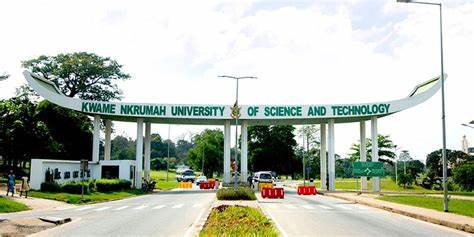
The Kwame Nkrumah University of Science and Technology (KNUST) is taking action to recover a debt of GH₵1.2 million owed by the Electricity Company of Ghana (ECG), the Social Security and National Insurance Trust (SSNIT), and three other organizations.
The debt arises from unpaid rent for office spaces and private hostel operations over several years, according to the Auditor-General.
During her appearance before the Public Accounts Committee, KNUST Vice-Chancellor, Professor Rita Akosua Dickson, disclosed that only one of the debtors has made a partial payment of GH₵25,000, leaving the majority of the debt unpaid.
“With the Electricity Company of Ghana, we’ve arranged a barter trade settlement plan. We owe ECG a significant amount, so we’ve proposed that they offset the debt by deducting the amount they owe us. We’ve already communicated this plan to ECG,” Professor Dickson explained.
She added that other entities, like UBA, have settled their debts in full, including the premiums they owed.
However, Professor Dickson acknowledged the challenges KNUST has faced in recovering these outstanding debts, despite sending multiple demand notices and following up with the entities involved.
In a related issue, the Public Accounts Committee also expressed concern over Akenten Appiah-Menka University of Skills Training and Entrepreneurial Development (AAMUSTED) for procuring medical supplies from two unlicensed entities. The Auditor-General’s report indicated that the university purchased GH₵414,000 worth of drugs from these unregistered suppliers in 2022.
“This is a serious violation. Selling drugs requires a license, and purchasing from unlicensed suppliers is risky. It is essential to ensure that all entities involved in procurement have the proper certifications from regulatory bodies like the FDA and the Pharmacy Council,” the Committee warned.
The Committee advised AAMUSTED to prioritize obtaining necessary certifications in future procurements, especially when it concerns health-related items, to ensure compliance and protect public safety.
The Assembly member for Denu in the Ketu South Municipality, Israel Bossman, has warned that residents might soon be forced to abandon using electricity altogether if the Electricity Company of Ghana (ECG) does not address ongoing issues with its billing system.
Recently, the residents took to the streets in protest against what they describe as exorbitant monthly tariffs, accusing the ECG‘s billing system in the Denu District of charging them far more than their actual electricity consumption.
They are calling for an immediate review to ensure that charges are fair and accurately reflect usage.
In an interview with Citi News, Israel Bossman stressed the urgency of the situation, describing it as a form of extortion that must be stopped without delay.
“With immediate effect, ECG must cease disconnecting customers or consumers of the power and fix the poor nature of the billing system and also audit some meters in the enclave,” he demanded.
He went on to highlight the financial burden the current situation is placing on residents. “I understand that people now take loans to pay light bills, and this is not pleasant. And so trust me, a time is coming when nobody would want to use light anymore because we can’t be paying that amount of money. It is not possible. I mean something is wrong somewhere,” he added.
On the other hand, Eunice Tweneboah-Kodua, the Public Relations Officer for the ECG in the Volta Region, assured that the concerns of the residents have been addressed. “All the things that they asked us to do, management was able to do it for them,” she stated.
She further explained that despite resolving the issues, there were still reports of planned demonstrations. “The regional police command made us aware that the people are saying that they are still bent on going on a demonstration against us. And we asked about the issues, and the issues were the same things that they raised for us to work on.”
Tweneboah-Kodua emphasized that ECG remains committed to resolving any outstanding concerns. “Whatever thing that they want, we are still looking into it,” she assured.
Police have detained four individuals, comprising three Ghanaians and a Chinese national, for their roles in tampering with and installing meters from the Electricity Company of Ghana (ECG).
Wisdom Sewlorm, an agent assigned to install ECG meters, saw his employee, Ernest Afatsawu, manipulate the meters and sell them to a Chinese plastic manufacturing company for GH₵1200.
Rulian Shan, the manager of the Chinese company, and his sales manager, Ali Yakubu, were apprehended on Friday, August 2.
Both Ernest and Wisdom are currently under investigation following their summons.
The ECG estimates that the financial loss due to this incident amounts to over GH₵77,000 from July to August.
Paul Abariga, Director of Investigation, Prosecution, and Security, revealed that the four suspects are scheduled to appear in court on Wednesday. Additionally, the contract with the implicated ECG contractor will be terminated.
Abariga stated, “There are meters that are being installed in many parts of our operational area and there have been some investigations reported to this directorate that some of the meters that are being installed are tempered with before they are installed so we undertook investigations, and we’ve come to realise that the intel that we’ve gathered, and the reports given to us are certainly true.
“Based on that we got for instance these four people arrested on four. They had a meter that was supposed to be residential and they were using it in a factory to manufacture plastic bowls at Oblogo near Weija.”
“So we want to put all the four together. By the end of the day we would have finished with our investigations on them so that we put them before court tomorrow”.
The Auditor-General’s report has revealed that the Electricity Company of Ghana (ECG) experienced significant financial losses totalling over GHC6 billion in the first nine months of 2023.
These losses encompass system, technical, commercial, and collection losses, highlighting the pressing need for reforms within the company.
According to the Energy Ministry’s report cited by the Auditor-General, ECG faced collection losses amounting to GHC2.05 billion from January to September 2023. This figure represents an improvement compared to the GHC2.45 billion recorded for the entire year of 2022.
System losses for ECG soared to GHC4.04 billion by September 2023, a substantial increase from the GHC2.6 billion reported in 2022. Breaking these losses down, technical losses were GHC1.3 billion, which is a decrease from the previous year’s GHC2.8 billion. However, commercial losses escalated to GHC2.8 billion, up from GHC1.9 billion in 2022.
The Auditor-General’s office has recommended several measures to address these issues. These include strict compliance with the Public Procurement Act (PPA), improved contract management and enforcement, enhanced monitoring of prepayment meters, recovery of detected fraud, and prosecuting customers involved in power theft to serve as a deterrent.
In response, ECG management stated they are “implementing a new monitoring regime whereby meter readers will visit both post-paid and prepayment meters.” However, they cited staff inadequacy as a challenge for effective field monitoring.
The report also uncovered that between 2016 and 2021, ECG entered into 50 contracts totaling US$145 million for the procurement of 862,750 meters, bypassing the mandated competitive bidding procedures and opting for restrictive tendering methods without adequate justification. The audit indicated that ECG did not explore the possibility of obtaining meters of the same specifications at lower prices from other manufacturers.
“ECG did not take steps to explore the possibility of getting meters of the same specifications at lower prices from manufacturers other than the ones in their database,” the report states, highlighting a lack of value for money considerations.
The issue of non-compliance with the Public Procurement Act is particularly concerning. ECG’s stance, as noted in the report, suggests they believe they should not adhere to the PPA requirements since they operate as a limited liability company without government subvention.
“ECG is of the opinion that it should not adhere to the PPA requirement as it is a limited liability company that does not depend on government subvention to finance its operations,” the report states. This position was reinforced by a letter dated February 12, 2014, in which ECG sought the Energy Minister’s legal opinion on PPA adherence.
Despite seeking exemption from the Ministry of Finance and Economic Planning in July 2020, ECG proceeded with non-compliant procurement practices without official approval. The report notes: “In the absence of exemption from the Minister of Finance and Economic Planning, we expected that ECG would be guided by commercial procurement practices in Section 15 (2) of the Public Procurement Act to procure meters.”
The audit uncovered staggering losses from faulty readings, meter bypassing, and power theft. In just four regions over a five-year period, ECG detected GHC54 million (US$4.5 million) in losses, recovering only 39.3 percent of this amount. Commercial losses averaged 30 percent, well above the 21 percent target, due to insufficient monitoring.
“ECG recovered GHC21,260,166 representing 39.3 percent of the GHC53,988,463 total amount detected from fraud activities and faulty readings,” the report states.
Contract management issues further exacerbated the situation. The audit found that “ECG failed to comply with conditions of contract to terminate a contract with a manufacturer in the process of procuring the meters,” even when suppliers failed to deliver on time.
The report cited instances of customers resorting to illegal connections after waiting over a year for meter installations. One frustrated customer at the Legon District Office stated: “If I don’t get the meter today, I will be forced to connect directly to the mains until such time ECG supplies me with a meter.”
The Auditor-General’s report has revealed that the Electricity Company of Ghana Ltd. (ECG) entered into 50 contracts totalling US$145 million for the procurement of 862,750 metres between 2016 and 2021, failing to comply with the Public Procurement Act (PPA).
The audit of meter management practices indicated that ECG avoided the mandated competitive bidding procedures, choosing restrictive tendering methods without adequate justification.
“ECG did not take steps to explore the possibility of getting metres of the same specifications at lower prices from manufacturers other than the ones in their database,” the report states, highlighting a lack of value for money considerations.
Non-compliance
Notably, ECG’s stance on PPA compliance is particularly concerning. The report said: “ECG is of the opinion that it should not adhere to the PPA requirement as it is a limited liability company that does not depend on government subvention to finance its operations”.
This position was evidenced by a letter dated February 12, 2014, in which ECG sought the Energy Minister’s legal opinion on PPA adherence.
Despite seeking exemption from the Ministry of Finance and Economic Planning in July 2020, ECG proceeded with non-compliant procurement practices without receiving official approval.
The report notes: “In the absence of exemption from the Minister of Finance and Economic Planning, we expected that ECG would be guided by commercial procurement practices in Section 15 (2) of the Public Procurement Act to procure meters”.
The audit uncovered staggering losses from faulty readings, metre bypassing and power theft. In just four regions over a five-year period, ECG detected GH¢54million (US$4.5million) in losses. Alarmingly, only 39.3 percent of this amount was recovered. Commercial losses averaged 30 percent, well above the 21 percent target, due to insufficient monitoring.
The report states: “ECG recovered GH¢21,260,166 representing 39.3 percent of the GH¢53,988,463 total amount detected from fraud activities and faulty readings.”
Contract management issues further exacerbated the situation. The audit found that “ECG failed to comply with conditions of contract to terminate a contract with a manufacturer in the process of procuring the meters”, even when suppliers failed to deliver on time.
The report cited examples of customers resorting to illegal connections after waiting over a year for meter installations. One customer at the Legon District Office stated: “”If I don’t get the metre today, I will be forced to connect directly to the mains until such time ECG supplies me with a meter”.
Operational Losses
In the first nine months of 2023, the Energy Ministry reported that theElectricity Company of Ghana (ECG) experienced collection losses amounting to GH¢2.05 billion.
This figure is an improvement compared to the GH¢2.45 billion in losses recorded for the entire year of 2022.
For system losses, ECG reported GH¢4.04 billion by September 2023, a significant increase from the GH¢2.6 billion reported in 2022.
Technical losses were GH¢1.3 billion as of September 2023, down from GH¢2.8 billion the previous year. However, commercial losses rose to GH¢2.8 billion, up from GH¢1.9 billion in 2022.
The Auditor-General’s office has recommended several measures to address these issues, including strict compliance with the Public Procurement Act, better contract management and enforcement, enhanced monitoring of prepayment meters, recovery of detected fraud, and prosecuting customers involved in power theft to serve as a deterrent.
In response, ECG management stated theyare “implementing a new monitoring regime whereby metre readers will visit both post-paid and prepayment metres.”
However, they cited staff inadequacy as a challenge for field monitoring.
Electricity Company of Ghana (ECG) has issued a warning to the public in the Ashanti Region about the illegal sale and distribution of counterfeit meters.
The ECG is concerned about the proliferation of these fake meters in their service areas and has vowed to crack down on this illegal activity.
This announcement follows the seizure of substandard meters at the Dabala Checkpoint and Tech Junction during inspections of buses travelling to Kumasi from Aflao.
Investigations revealed that these metres originated in Togo.
Mr. Maxwell Dapaah, the ECG Ashanti-West General Manager, cautioned against the private installation of electric meters without ECG’s authorisation, emphasising the importance of adhering to proper procedures.
He stressed that these unauthorised metres would not be recorded in ECG’s system, complicating billing and other commercial processes.
Mr. Dapaah expressed concern over how this practice adversely affects the company’s commercial and technical operations.
“It is illegal to import metres into the country and also acquire metres from other sources apart from ECG.
We will take all necessary legal action against individuals who are trying to infiltrate our network with these fake metres, including those who aid them by selling or buying those metres.”
Mr Dapaah also revealed that metres installed by individual customers do not meet ECG’s metre specifications.
“These meters are not tested and calibrated by ECG to meet the requirements stated by regulatory agencies such as the Energy Commission and the Ghana Standards Authority.
“Thereby posing danger such as fire outbreak, overloading and damage to transformers, resulting in prolonged outages and increased technical losses to the company,” he said.
He advised customers to avoid purchasing fake metres or dealing with unauthorised third parties when they need meters, and instead, to contact ECG directly for genuine meters.
“With the introduction of the Loss Reduction Programme (LRP) and Flat rate policy, we have many options to service our customers anytime they apply for meters.
So kindly visit the nearestECG office and apply toensure you are served instead of engaging in the illegal act of purchasing from illegal sources,” he advised.
Mr Dapaah appealed to the general public to support the company in its efforts to combat the proliferation of fake meters, which would enable ECG to generate sufficient revenue to maintain a stable electricity supply chain.
“Users of these foreign meters are not in the ECG database so they consume electricity illegally without paying and this is not fair to customers who pay their bills.
Such individuals usually complain that they are not receiving bills and this is because their meters were obtained and installed illegally without following the process of acquiring meters. We want everyone consuming electricity to prioritise the payment of bills since it is patriotic to pay for electricity consumed,” he added.
“Some customers even distribute electricity to other customers illegally with these fake meters and substandard networks that pose danger to life and property.”
Mr Dapaah urged customers to download the ECG PowerApp or utilise the shortcode *226# to settle all outstanding bills, enabling the company to ensure a stable and reliable power supply.
The Koforidua Multipurpose Youth Resource Center has had its electricity cut off by the Electricity Company of Ghana due to a significant unpaid debt.
GhOne TV reports that the center owes GH¢30,000, a debt that has remained unsettled for an extended period.
ECG officials decided to disconnect the power after repeated failures by the center’s management to address the outstanding balance.
Since its inauguration by President Nana Addo Dankwa Akufo-Addo in 2023, the facility has been the venue for various significant events, including sports activities.
“ECG has cut power to the Koforidua Multipurpose Youth Resource Center due to GH¢30,000+ outstanding debt,” GhOne TV shared on X.
The 67th Independence Day parade took place at the Koforidua Resource Centre, drawing national attention to the Eastern Region.
The management of the centre has yet to comment on the actions taken by the Electricity Company of Ghana (ECG) and their plans to promptly restore electricity to the facility.
Concerns have been raised about the neglected condition of several sports complexes across the country.
In response, the Ministry of Youth and Sports has pledged to tackle these issues diligently.
The Ghana Revenue Authority (GRA) has revealed that ten state institutions, including the Ghana Airports Company Limited (GACL) and the Electricity Company of Ghana (ECG), owe more than GH₵1 billion in taxes.
This information emerged during a session with the public accounts committee on Monday, July 29, where GRA officials highlighted the financial obligations of these entities.
Despite some institutions showing signs of potential payment, concerns were raised about financially struggling entities like the Tema Oil Refinery (TOR).
A GRA representative noted, “GACL and Graphic Corporation currently are having cash flow challenges. They’ve indicated to us that we need to give them a moratorium to be able to come back to us. So, for them, they are prepared to pay. Once their cash flow improves.”
Abena Osei Asare, the Minister of State at the Finance Ministry, addressed the issue of companies unlikely to settle their tax debts, stating, “Mr Chairman we have done this before. We brought it to parliament; we went through a process [and] brought some to parliament for parliament to write it off. If it becomes necessary after all avenues to collect these monies have failed, we will go through that process and then come to parliament for permission to do that.”
Reports have indicated that ten state institutions, such as the Electricity Company of Ghana (ECG) and the Ghana Airports Company Limited (GACL), owe the Ghana Revenue Authority (GRA) over GH¢1 billion in unpaid taxes.
Government revenue officials stated that some of these viable institutions have pledged to settle their tax debts.
This information emerged when GRA officials testified before the Public Accounts Committee on Monday, July 29, 2024.
“GACL and Graphic Corporation currently have cash flow challenges. They have informed us that we need to grant them a moratorium to allow them to repay us. Therefore, they are willing to settle their dues once their cash flow situation improves,” the GRA official is quoted as saying by citinewsroom.com.
During the meeting, Minister of State at the Finance Ministry, Abena Osei-Asare, stated, “Mr. Chairman, we have done this before. We presented it to parliament, went through a process, and some were written off by parliament. If it becomes necessary after exhausting all efforts to collect these funds, we will follow that process and seek permission from parliament.”
The Public Accounts Committee voiced concerns about non-operational state entities such as the Tema Oil Refinery (TOR) and urged measures to restore their viability and prevent additional financial losses.
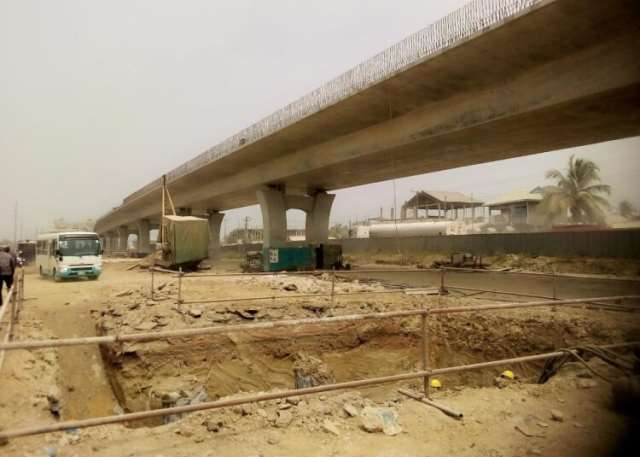
Ing. Abdulai Mahama, Senior Project Manager, has addressed the reasons behind the delay in the Ofankor-Nsawam road project, which began in September 2022.
Originally scheduled for completion within 24 months, the project is currently around 60% finished.
In an interview on Adom TV’s ‘The Big Agenda’ with Abena Opokua Ahwenee, Mr. Mahama discussed the unforeseen challenges impacting the timeline.
He highlighted that the project faced delays due to the need to dismantle a shrine along the route.
“My sister, during construction, we encountered a shrine. We consulted the locals and were told the gods had travelled, which delayed us for three and a half months. We had to pay for two cattle and provide money before we were allowed to continue work,” Mr Mahama explained.
Local consultations revealed that the deities associated with the shrine were away, resulting in a three-and-a-half-month delay.
The project team had to compensate with two cattle and additional funds before resuming work.
Furthermore, issues with local land settlements and the repositioning of high-tension wires from ECG and GRIDCO have also contributed to the delay.
Mr. Mahama assured that despite these setbacks, the road’s design is robust, with a 20-year lifespan planned, while the drainage systems are built to endure for 50 years.
The Electricity Company of Ghana (ECG) faced a staggering loss of GH¢10.21 billion in 2022, a sharp increase from the GH¢1.91 billion loss recorded in 2021.
This represents an over 433 percent surge in losses for 2022, primarily driven by exchange rate losses due to the depreciation of the cedi and rising costs of power distribution.
At the same time, many consumers across the country reported sporadic power outages, leading to extended periods of darkness and disruptions in their daily routines.
These financial losses were detailed in the most recent Auditor General’s Report covering public boards, corporations, and statutory institutions for 2023.
During the review period, ECG’s revenue rose by 24.1 percent to GH¢15.03 billion in 2022, up from GH¢12.10 billion in 2021, due to increased internal funds and government grants.
These grants were payments made by the government to energy-producing companies on behalf of ECG.
Total expenditures surged by 80 percent to GH¢25.23 billion in 2022 from GH¢14.02 billion in 2021, primarily due to increased direct costs and foreign exchange losses.
The rise in direct costs was mainly due to higher costs of power purchases and transmission expenses.
Non-current assets saw a 45.6 percent increase to GH¢32.71 billion in 2022 from GH¢22.46 billion in 2021, attributed to asset revaluations and new acquisitions of property, plant, and equipment.
Current assets also grew by 23.1 percent to GH¢10.14 billion in 2022 from GH¢8.24 billion in 2021, driven by an increase in trade and other receivables.
The company’s liabilities rose by 66.3 percent to GH¢29.43 billion in 2022 from GH¢17.69 billion in 2021, mainly due to higher trade and other payables. Non-current liabilities increased by 16.4 percent to GH¢6.37 billion in 2022 from GH¢5.47 billion in 2021.
The report noted a decline in the current ratio to 0.3:1 in 2022 from 0.5:1 in 2021, indicating ongoing challenges in meeting short-term financial obligations.
An Auditor-General (A-G) report has uncovered that the Electricity Company of Ghana (ECG) overspent by over $145 million on meter procurement, breaching the Public Procurement Act.
The report further noted that ECG failed to fully recover an excess amount of GH¢53.9 million detected through monitoring and did not pursue legal action against customers involved in electricity theft, which could have acted as a deterrent.
The audit, carried out from August to December 2022, covered the period from 2016 to 2021 at various ECG sites, including the headquarters, Metering and Technical Services (MTS) Division, the Materials and Depot in the Greater Accra Region, as well as four selected regional and nine district offices.
“ECG signed 50 contracts to procure 862,750 meters and their accessories, amounting to USD 145,010,153.92 over the audit period without adhering to the requirements of the Public Procurement Act.”
“During our audit period, ECG was unable to recover all the GH¢53,988,463.31 that it detected through monitoring and failed to prosecute customers engaged in power theft to serve as a deterrent to others,” the report stated.
In a letter sent to the Speaker on June 2, 2023, the A-G, Johnson Akuamoah Asiedu, recommended that ECG ensure all procurement activities comply with the Public Procurement Act to guarantee value for money.
An Auditor-General (A-G) report has disclosed that the Electricity Company of Ghana (ECG) overspent by more than $145 million on meter procurement, in violation of the Public Procurement Act.
The report also highlighted ECG’s failure to fully recover an excess of GH¢53.9 million identified through monitoring, and its neglect to pursue legal action against customers involved in electricity theft, which could have deterred similar offenses.
Conducted from August to December 2022, the audit covered the period from 2016 to 2021 across multiple ECG sites including headquarters, Metering and Technical Services (MTS) Division, Materials and Depot in Greater Accra, as well as selected regional and district offices.
“ECG signed 50 contracts to procure 862,750 meters and their accessories, amounting to USD 145,010,153.92 over the audit period without adhering to the requirements of the Public Procurement Act.”
“During our audit period, ECG was unable to recover all the GH¢53,988,463.31 that it detected through monitoring and failed to prosecute customers engaged in power theft to serve as a deterrent to others,” the report stated.
In a letter dated June 2, 2023, addressed to the Speaker, A-G Johnson Akuamoah Asiedu recommended that ECG ensure all procurement activities comply with the Public Procurement Act to ensure optimal value for money.
Auditor-General’s (A-G) report has revealed that theElectricity Company of Ghana’s (ECG)procurement of meters, amounting to over $145 million, breached the Public Procurement Act.
The report further disclosed that ECG failed to fully recover an excess of GH¢53.9 million identified through monitoring. Additionally, ECG did not pursue legal action against customers involved in electricity theft, which could have served as a deterrent to others.
The audit, conducted from August to December 2022, reviewed the period from 2016 to 2021. It covered various ECG locations, including the headquarters, Metering and Technical Services (MTS) Division, the Materials and Depot in the Greater Accra Region, as well as four selected regional offices and nine district offices.
“ECG signed 50 contracts to procure 862,750 meters and its accessories amounting to USD145,010,153.92 over the audit period without adhering to the requirement of the Public Procurement Act.”
“During our audit period, ECH was unable to recover all the GHC 53,988,463.31 that it detected through monitoring, and failed to prosecute customers who were engaged in power theft to serve as a deterrent to others,” the report stated.
In a letter dated June 2, 2023, addressed to the Speaker, Auditor-General Johnson Akuamoah Asiedu advised that ECG strictly adheres to the Public Procurement Act in all its procurement processes to ensure optimal value for money.
Educators and pupils at Osu Home Junior High School (JHS) were left helpless after the Electricity Company of Ghana (ECG) cut off the school’s electricity supply on Tuesday, July 9, 2024.
Sources indicated that the power disconnection, which left the school in utter darkness and discomfort, was due to unpaid debts owed by the school to ECG for electrical services.
The power interruption occurred while students were taking their Information, Communication, and Technology (I.C.T.) exam on the second day of the ongoing Basic Education Certificate Examination (BECE).
This predicament led school administrators to urgently appeal for a swift resolution.
To avoid drawing political and media scrutiny, supervisors and some school officials sought the assistance of a private electrician who illicitly reconnected the power, thus creating a suitable environment for the students.
The Electricity Company of Ghana has yet to officially reinstate power at the school, and there is a significant chance that the final-year students will have to take their core mathematics exam on Wednesday in the dark if the problem is not promptly addressed.
Rodney Nkrumah Boateng the Press Secretary to Dr. Matthew Opoku Prempeh (NAPO), has defended his boss’ reputation following criticism over his casual response to inquiries about the ‘Dumsor’ timetable.
NAPO faced severe backlash months ago for suggesting that those seeking a load-shedding schedule should create their own during peak power outages.
In an interview on The Point of View with Bernard Avle on Channel One TV, Rodney Nkrumah Boateng argued that NAPO’s suitability as a potential running mate for Dr. Bawumia should not be judged solely on a single media interaction. He stressed that NAPO’s qualifications and capabilities go beyond that incident.
While acknowledging the inconvenience of power cuts, Nkrumah Boateng assured that measures are being implemented to resolve the ‘Dumsor’ issue and ensure stable electricity supply.
He highlighted that the current power challenges are less severe and frequent compared to those during the Mahama administration, underscoring progress in addressing the issue.
“Clearly, what pertained recently cannot by any stretch of the imagination be compared to what happened in 2014 or 2015 there about. But again. The important thing is, it is what it is, and what is being done about it and it is what the timelines are and how to ensure that power is brought back.
“Nobody enjoys power cuts, what happened happened, and those discussions have been had. And even before those discussions, people have said whatever they have to say.
“You cannot define him by just one single interview and one sentence that he said, that is blatantly pretty unfair…the important thing is that, well, fortunately now we are way past all that, and we’re looking forward to what lies ahead, and then we take it from there,” he maintained.
Nkrumah Boateng emphasized that evaluating NAPO based solely on one interview and a single statement is unfair, noting that discussions have moved beyond past criticisms. He expressed optimism about future prospects and moving forward positively.
The Electricity Company of Ghana (ECG) has successfully recovered GH¢11.44 million in outstanding payments from primarily business customers in the country during the first half of this year.
Additionally, 17 customers of both ECG and the Ghana Water Company Limited (GWCL) have collectively received GH¢552,972 through bill adjustments for the same period.
These recoveries were facilitated by the Greater Accra Region office of the Public Utilities Regulatory Commission (PURC), following complaints filed by both utility providers and customers.
According to Gifty Bruce-Nelson, the Greater Accra Regional Manager of PURC, consumers and utility providers can file complaints under the Public Utility Regulatory Commission (Consumer Service) Regulation, 2020.
She highlighted that out of 804 complaints received during the period, 738 (91.7%) were resolved.
ECG accounted for 695 complaints (86%), while GWCL had 109 complaints (14%).
Bruce-Nelson explained that many complaints involved damaged appliances, requiring detailed investigations to determine responsibility.
She emphasized the commission’s role in conducting thorough investigations and community monitoring to ensure accurate utility services across the Greater Accra Region.
One ofElectricity Company of Ghana’s (ECG)transformer has been stolen by unidentified individuals in Bunso, located in the Fanteakwa South District of the Eastern Region.
The 100kVA transformer, worth GH¢71,000, was taken last week from its site near the Bunso Police barrier, adjacent to the police station.
Situated on the grounds of the CSIR-Plant Genetic Resources Research Institute, the transformer was in close proximity to both the Bunso Police Station and the Fire Service command.
According to a Citinewsroom.com report, the transformer is believed to have been stolen while security personnel were on duty.
This audacious theft has resulted in over a week of power outages, affecting not only the institutions mentioned but also the nearby households.
Officials at the Eastern Regional Office of ECG, who are deeply concerned about the frequent attacks on their infrastructure, are working diligently to replace the stolen transformer.
ECG management has called on security agencies to enhance their vigilance and take proactive measures to apprehend those responsible for these crimes, which significantly threaten the region’s power stability.
Unknown individuals have stolen a transformer belonging to the Electricity Company of Ghana (ECG) in Bunso, located in the Fanteakwa South District of the Eastern Region.
The 100kVA transformer, valued at GH¢71,000, was taken last week from its position at the Bunso Police barrier, near the police station.
The transformer was situated on the land of the CSIR-Plant Genetic Resources Research Institute, just a short distance from both the Bunso Police Station and the Fire Service command.
The theft is suspected to have occurred while personnel were on duty, highlighting the brazen nature of the crime.
This incident has led to prolonged power outages affecting these institutions and households in the surrounding area for over a week.
Sources at the Eastern Regional Office of the ECG, who are deeply concerned about the frequent attacks on their installations, are working diligently to replace the stolen transformer. The replacement will incur an additional 20 percent cost.
ECG management has called on security agencies to enhance their vigilance and proactively clamp down on the criminal elements whose activities are posing a significant threat to the stability of power supply in the region.
The Minister of Energy, Dr. Matthew Opoku Prempeh, has clarified that the recent power outages across the country are not due to load-shedding by the Electricity Company of Ghana (ECG).
Over the past few months, various regions have been experiencing intermittent power disruptions, affecting businesses and households alike.
Addressing inquiries in Parliament, Dr. Matthew Opoku Prempeh provided several reasons for the unstable power supply.
“The question was asked over two months ago…No, ECG is not undertaking load-shedding as at the time the question was asked. Consumers were experiencing outages due to a number of factors. That included localised outages due to overload online and transformers.
“There are certain areas in this country where all of a sudden, the number of residents and businesses have accumulated, parts of East Legon which was purely residential area have now become a business district, increasing power consumption.
“Thereby hampering the existing lines there, so the transformers and lines had to be updated. Outages to the average capacity of overloaded lines and transformers.
“At the time the questionnaire put the question, CenPower had an emergency which meant a complete shutdown, losing immediately 40 megawatts. That also contributed and the plant maintenance on Amandi power was also ongoing at the same time.
“The emergency outages sometimes requested by GRIDCo have also contributed, so there were myriads of factors that had unfortunately happened, that is causing the power outages in different times. The reason ECG said they were not load-shedding is because most of the incidents were not planned and so they couldn’t have come out with a pre-programme to say they were loading” the Energy Minister explained.
For months, many parts of the country have faced intermittent power outages, causing inconvenience to businesses and households.
Responding to questions in Parliament, Dr. Opoku Prempeh explained that the outages were due to various factors, including localised issues with overloaded online transformers.
He highlighted the transformation of certain areas, like parts of East Legon, from purely residential to commercial districts, leading to increased power consumption and strain on existing infrastructure.
Additionally, he mentioned emergency situations such as the shutdown of the CenPower plant, resulting in a loss of 40 megawatts, and ongoing maintenance at the Amandi power plant.
Dr. Opoku Prempeh emphasized that these factors, along with emergency outages requested by GRIDCo, contributed to the power outages.
He stated that ECG could not have implemented a pre-programmed load shedding schedule due to the unplanned nature of the incidents.
The Minister’s clarification comes amidst public concern and speculation about the causes of the recent power outages. He assured that the government and relevant agencies are working to address the issues and improve the reliability of the country’s power supply.