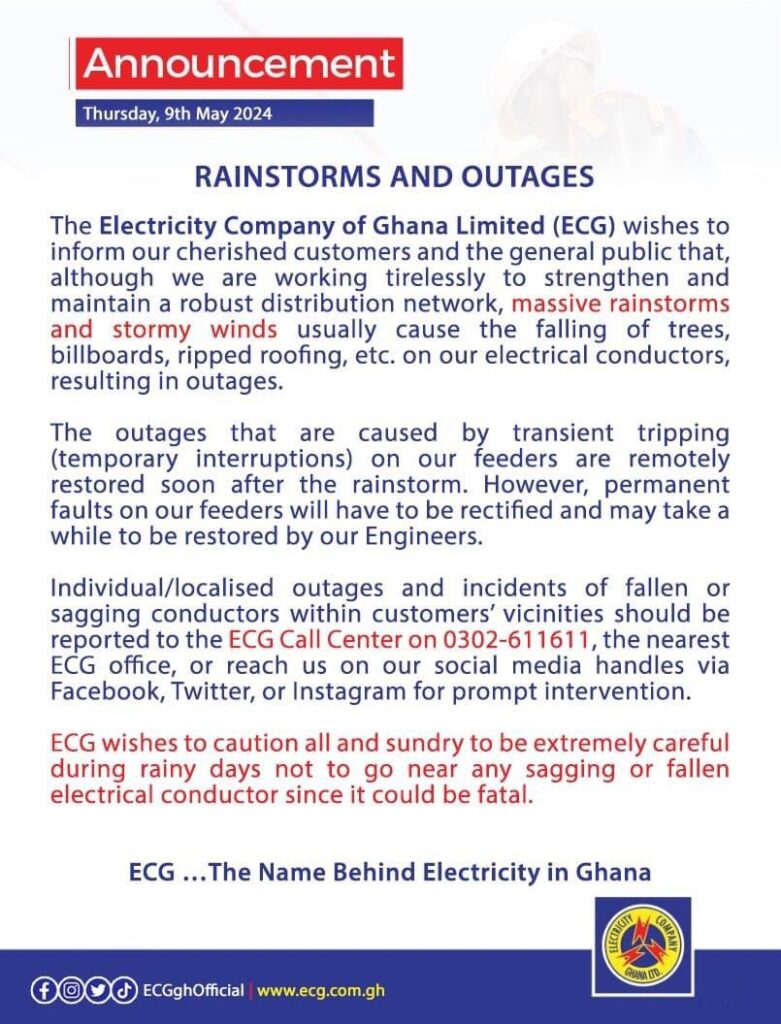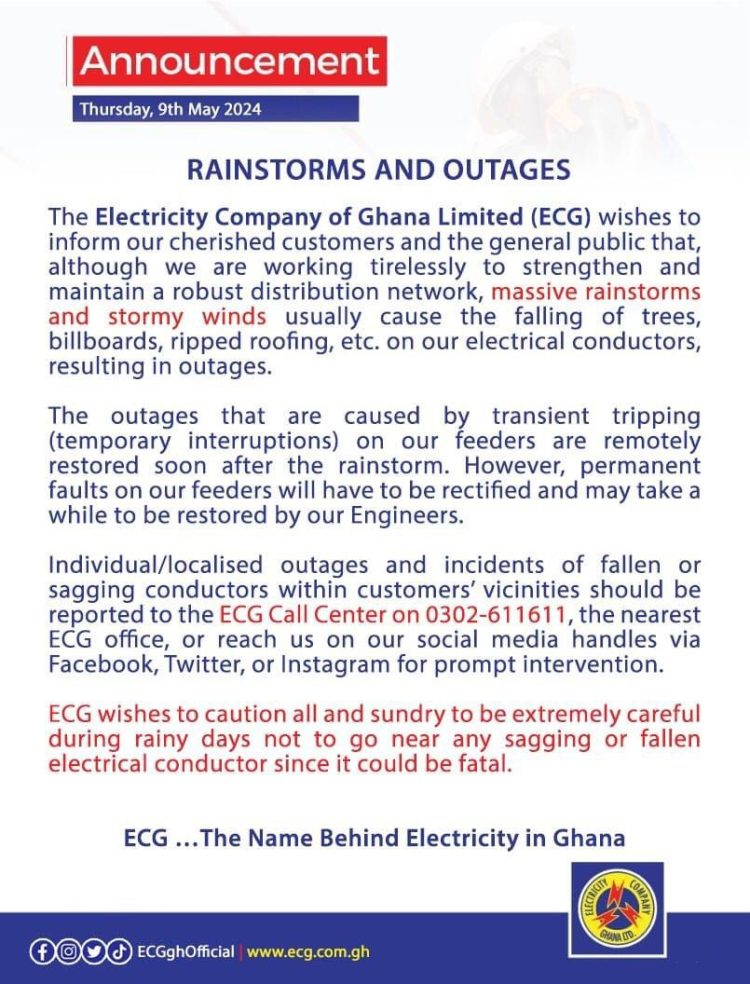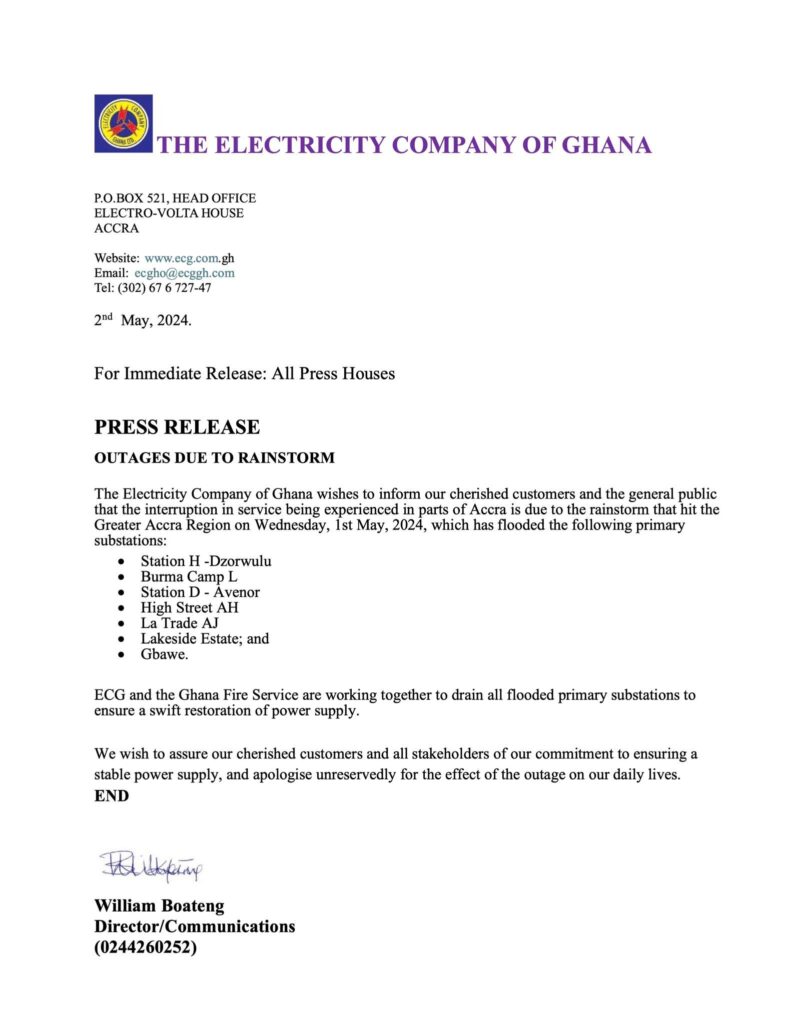
The Electricity Company of Ghana (ECG)has issued a statement regarding the power outages experienced in parts of Accra yesterday, attributing them to the rainstorm that struck the Greater Accra Region on Wednesday, May 1st, 2024.
In the press statement released today, the ECG explained that several primary substations were flooded as a result of the heavy rainfall, leading to interruptions in power supply. The affected substations include Station H in Dzorwulu, Burma Camp L, Station D in Avenor, High Street AH, La Trade AJ, Lakeside Estate, and Gbawe.
ECG, in collaboration with the Ghana Fire Service, is actively working to drain the flooded substations to expedite the restoration of power supply to the affected areas.
“We wish to assure our cherished customers and all stakeholders of our commitment to ensuring a stable power supply, and apologize unreservedly for the effect of the outage on our daily lives,” said William Boateng, Director of Communications at ECG.
The power outages caused inconvenience to residents and businesses, highlighting the vulnerability of Ghana’s electricity infrastructure to adverse weather conditions.
As efforts continue to restore power, residents are urged to exercise patience while ECG works to address the aftermath of the rainstorm and flooding.
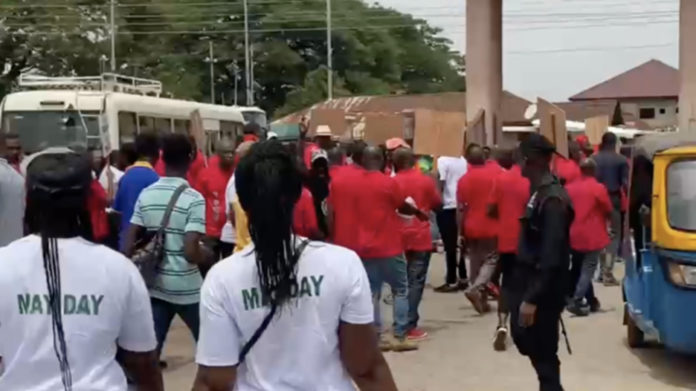
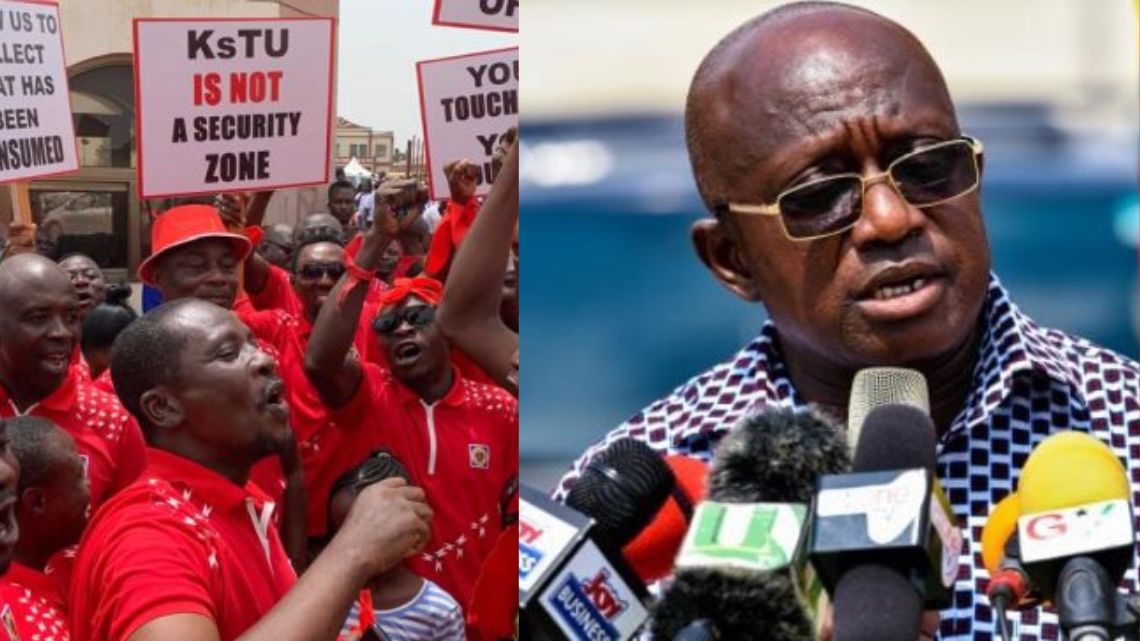
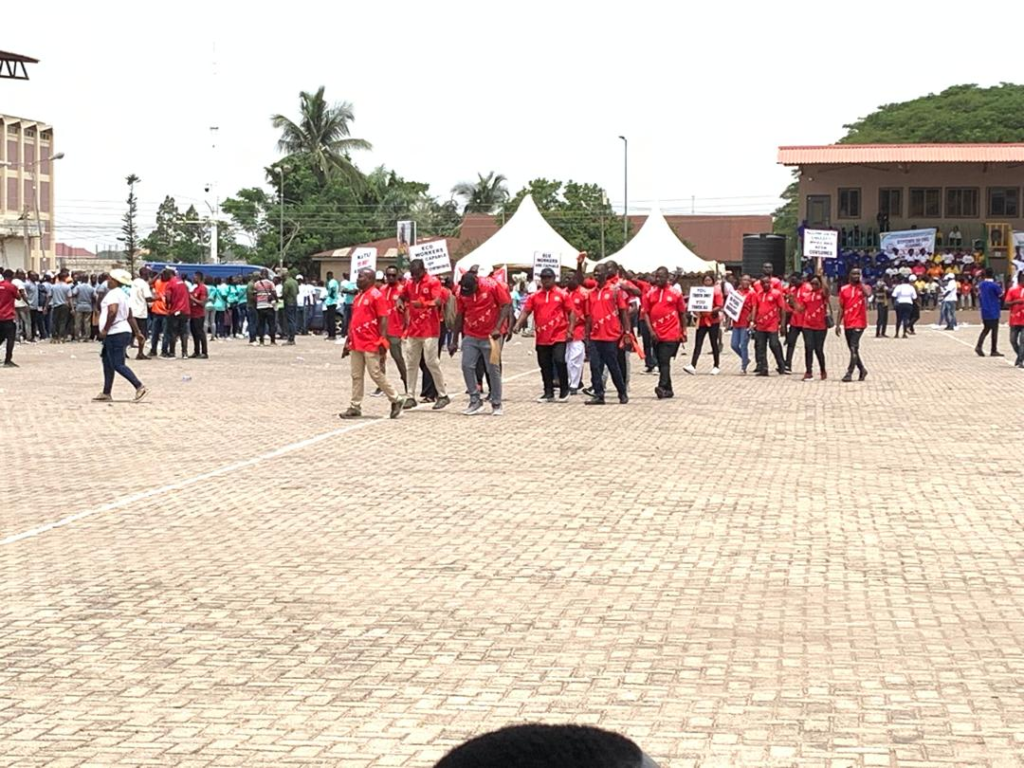
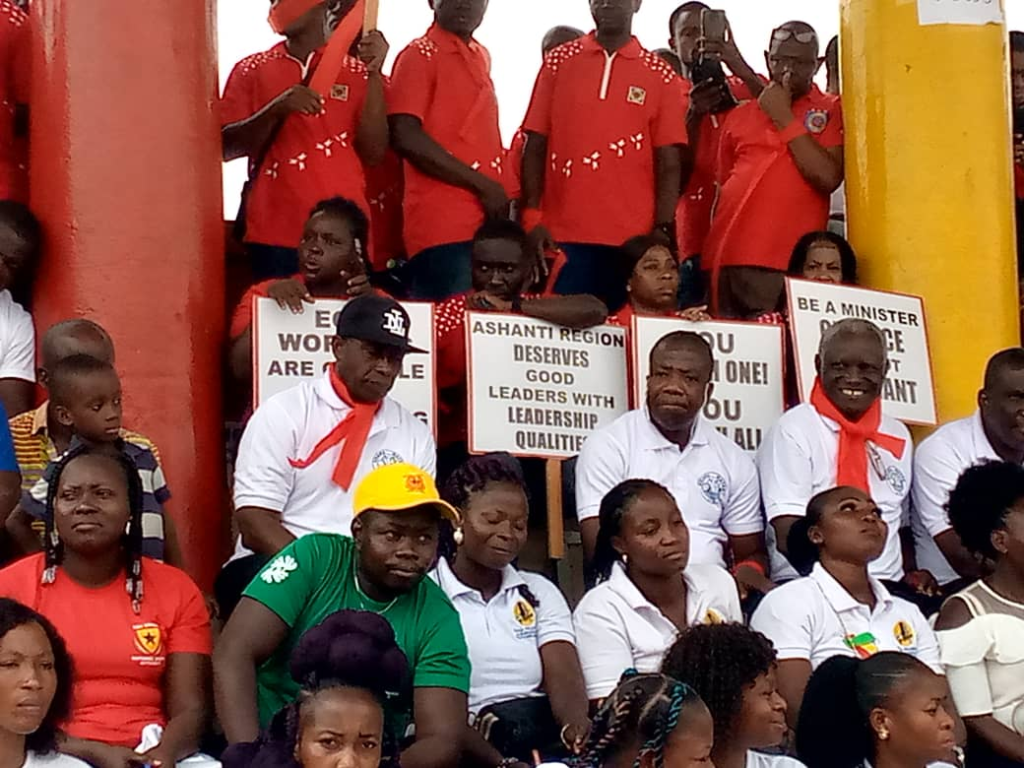
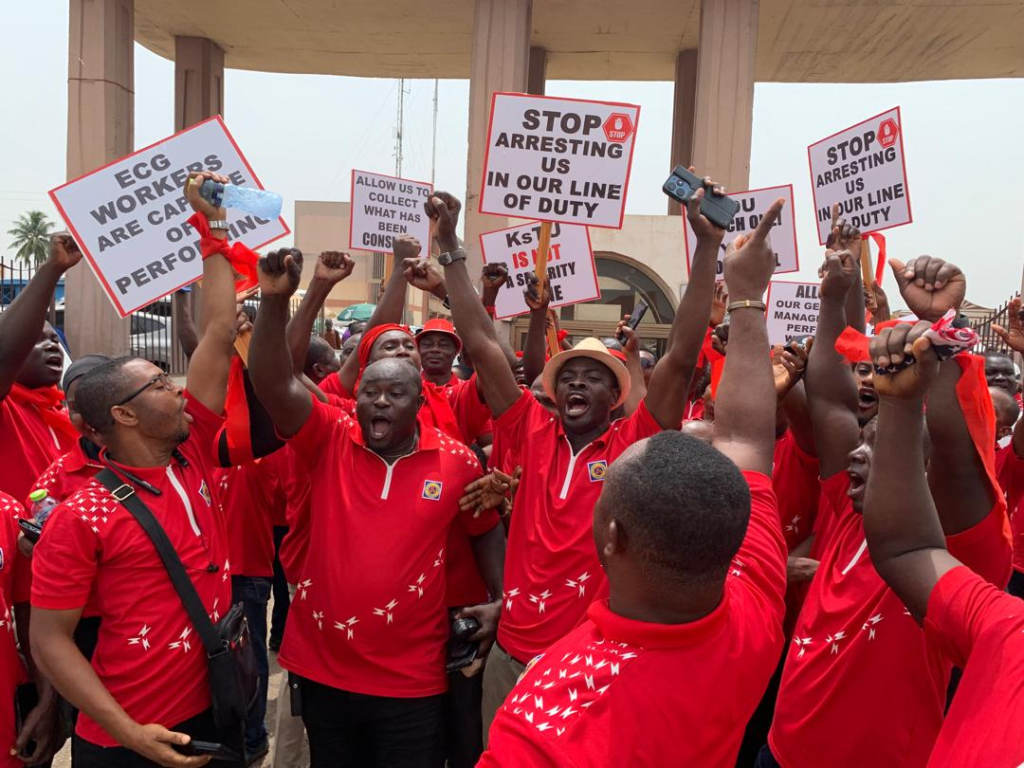
Staff of Electricity Company of Ghana (ECG)have staged a walkout as the Ashanti Regional Minister, Simon Osei-Mensah, was about to deliver his speech at the May Day Parade in Kumasi.
Clad in red attire, the ECG employees held placards with messages urging the Regional Minister to refrain from interfering in their operations.
This action was prompted by the Minister’s recent directive to arrest the Ashanti East Manager of the company, Ing. Wiafe Asomani, after the ECG National Taskforce disconnected the Kumasi Technical University due to outstanding debts.
Following the Minister’s refusal to apologize, the workers took further action to demand redress. Despite their efforts, the Minister remained unapologetic.
The leadership of the ECG Workers’ Union, spearheading the protest at the May Day event, maintained their stance that Mr. Osei-Mensah must apologize and withdraw the police case against their Manager.
In an interview with Citi News, Yussif Osman the Chairman of ECG Senior Staff Union, Ashanti East, said, “We already have an issue with him, he has done something the workers front are not happy with, initially the workers front decided that we don’t appear at all.
“But since this is our programme we came. Since the minister has decided not to fulfil whatever we have asked him to do, we don’t even want to listen to him.
So this is just a peaceful protest that we’re not going to participate or listen to whatever he will say. We’re standing outside when he’s done with his speech we will go back.”
Host of the Kokrokoomorning show,Kwame Sefa Kayi, has encouraged Ashanti Regional Minister Simon Osei-Mensah to pursue a peaceful resolution to his ongoing disagreement with officials of the Electricity Company of Ghana (ECG) in the region.
The Peace FM presenter proposes that rather than adopting a confrontational approach, the minister should extend a cordial apology to the employees of the power supply company to resolve the matter amicably.
“But Minister, what would happen if you apologized to them? Not everything should be handled confrontationally. My friend, Mr. Osei-Mensah, this feud with ECG is not beneficial.
Minister, you, of all people, should just call them and acknowledge them as your people… After that, offer them a meal, and that should conclude the matter,” he commented on the Monday, April 29, 2024, broadcast of his show.
Employees of the Electricity Company of Ghana have been urging the Ashanti Regional Minister to apologize for his role in the arrest of their Ashanti East Manager, Mark Wiafe Asomani.
However, Mr. Osei-Mensah has rejected these demands, maintaining that his actions were justified.
“Do I need to apologize for carrying out my security duties? I want to clarify that I requested the police to summon Ing. Mark Asomani Wiafe on security grounds due to the events in the electricity sector in the region and the possibility of a task force from outside disconnecting power without adequate notification.
It’s ironic that they claim not to be under my jurisdiction, hence I cannot direct their actions, yet they wish to instruct me on how to fulfill my security obligations as stipulated in the Securities and Intelligence Act of 2020, Act 10(30),” the minister explained to journalists during a press briefing last week.
The Ashanti Regional Minister sanctioned the arrest of Mr. Wiafe following ECG’s decision to disconnect power to Kumasi Technical University over outstanding debts.
The minister argues thatECG’s actions constituted a challenge to his authority.
Sources close to the Electricity Corporation of Ghana (ECG), according to Asaasenews, have confirmed that the seven weeks of load-shedding that have affected the entire country are gradually coming to an end.
Sunday, April 28, 2024, the report said, marked a significant improvement in power generation, making it the best weekend since the load-shedding began.
As a result of these improvements, no part of the nation experienced load management on Sunday, the report added.
However, this claim has been contested by some citizens living at Frafraha, John Tei, who say they experienced power outages on the said day.
Meanwhile, the New Patriotic Party’s (NPP) flagbearer, Dr. Mahamudu Bawumia, has reassured that the ongoing power supply issues, known as ‘dumsor‘, will soon be resolved.
He made this statement during his campaign tour of the Eastern Region while speaking to the Clergy and Imams in Akropong on Monday, April 29.
Dr. Bawumia expressed confidence in the government’s efforts to address the issue, which has led to criticism of the Electricity Company of Ghana (ECG) by businesses, groups, and individuals.
“I know there are challenges and I don’t want to paper over economic challenges. We are going to work on them. Currently, we have issues with power but I say that from the information I have received from the minister for energy, those power challenges will very soon, and I mean very soon be a thing of the past,” the vice president said.
The Ghana Union of Traders Association has joined the voices calling on ECG for a load-shedding timetable to guide their operations.
Despite this, ECG has maintained that the current challenge does not necessitate a load-shedding timetable.
The Electricity Company of Ghana (ECG) has reportedly declared that no part of the country experienced load shedding on Sunday, April 29, 2024, signaling a significant improvement in power generation nationwide.
As per information obtained by asaaseradio.com from an internal source at ECG, the 7-week long load shedding program, reminiscent of the dumsor era, is nearing its conclusion.
The source revealed that the absence of load shedding on Sunday indicates an imminent end to the dumsor period, describing it as the best weekend of power supply since the commencement of load shedding.
Additionally, the source affirmed that there are no plans for load shedding in the foreseeable future.
These developments echo the assurances given by Herbert Krapa, Chairman of the Board of ECG, who stated in a Facebook post on Wednesday, April 24, 2024, that the government has implemented effective measures to resolve the current power crisis and ensure uninterrupted power supply for consumers.
“As I said earlier today at Kaleo, at the Commissioning of VRA’s 15MW Solar Plant, the Government has put in place immediate measures to ensure the return of uninterrupted supply of power to consumers. I can, therefore, state that the unfortunate power challenges Ghanaians are facing should be over in the next few days.
“We are fully confident that the measures being put in place should resolve the service interruptions. We empathise with all consumers and apologise unreservedly for the effects of the outages on our daily lives. Please bear with us. We are fixing it and we are nearly there,” Herbert Krapa’s post read
For the past few weeks, power consumers across the country have been dealing with power outages.
In light of these challenges, a portion of the Ghanaian public is asking the Ministry of Energy to publish an official timetable to keep consumers updated on power availability.
Unconfirmed reports have it that the Managing Director of the Electricity Company of Ghana (ECG) Samuel Dubik Mahama’s position hangs in the balance due to some forces from the Africa Centre for Energy Policy.
Finance Minister-designate, Mohammed Amin Adam, Railway Minister, Peter Amewu, Executive Secretary of the Public Utilities Regulatory Commission, Ishmeal Ackah, Benjamin Boakye, Executive Director of the Africa Centre for Energy Policy (ACEP) have been accused of plotting to ensure Mr Mahama loses his job.
In a tweet, an X user wrote, “Mafia CSOs! They topple certain govt officials to create jobs for themselves. Finance Minister Amin Anta, Railway Minister Peter Amewu, PURC Executive Sec. Ishmeal Ackah, were all directors at ACEP n are workn with the current DG Ben to oust ECG Boss! Mafia!!!.”
Mafia CSOs! They topple certain govt officials to create jobs for themselves. Finance Minister Amin Anta, Railway minister Peter Amewu, PURC Executive Sec. Ishmeal Ackah, were all directors at ACEP n are workn with the current DG Ben to oust ECG Boss! Mafia!!!
The X user, however, failed to reveal the reason these personalities would be working to have Mr Mahama ousted.
Recently, ACEP criticized the power distribution company for its failure to provide a load-shedding timetable amidst the escalating power outages, commonly known as ‘dumsor.’
According to the user, the individuals said to be after the ECG boss’ job were at one time directors of ACEP.
Peter Amewu is a co-founder of Africa Centre for Energy Policy (ACEP), where he worked as the director of policy and research, and provided policy advice to support a variety of government and private sector projects.
Prior to his role as the Deputy Minister for Energy, Dr Amin Adam was the Founder and Executive Director of the Africa Centre for Energy Policy (ACEP).
Dr. Ishmael Ackah was head of Policy Unit at the Africa Centre for Energy Policy (ACEP), prior to his role as Executive Secretary at Public Utilities Regulatory Commission (PURC).
The Engineering Council of Ghana has expressed disappointment with Ashanti Regional Minister Simon Osei-Mensah’s refusal to apologize to the Electricity Company of Ghana (ECG) Workers’ Union for the arrest of one of their Managers.
Mr. Osei-Mensah firmly rejected the Workers’ Union’s request for an apology regarding the arrest of ECG’s Ashanti Region East Manager, Ing. Mark Wiafe Asomani.
The Minister defended his decision, citing security concerns that prompted him to instruct the police to summon Ing. Asomani.
In a Citi News interview, the registrar of the Engineering Council, Engineer Isaac Bedu, described the Regional Minister’s actions as unfortunate and disclosed that the council would try to engage both parties on the issue.
“It is unfortunate for him to interfere in the work of staff who are genuinely performing their duties and then when you are asked to apologise, you say you will not apologise.
“We don’t want this to be like a precedent where anybody can just interfere in the work of professionals when they are doing their work. We may engage further and we urge the workers to exercise restraint and go about their normal duties.”
He alleges that the recent bill from the Electricity Company of Ghana (ECG) was fraudulent, as it purportedly did not accurately reflect the reading on the meter.
Speaking at a press conference in Kumasi on April 25, he said “the actual reading on the meter as of yesterday was 23,498 units. The bill that they submitted which definitely the meter would have been read far earlier is 25,355 units a whopping difference of more than 1,900 units.”
“I am asking ECG to withdraw, retract and apologise to me else I will do the needful to redeem my reputation,” Mr Osei-Mensah said.
Following a disagreement between the electricity distribution company and the Minister, a staff member of the company has threatened to disconnect the Minister’s residence if the debt remains unpaid.
This incident stems from a dispute that arose when a Regional manager of the Electricity Company of Ghana (ECG) was arrested at the Minister’s behest for disconnecting electricity to the Kumasi Technical University.
Mr. Osei Mensah asserts that the recent bill was fabricated to tarnish his reputation. Despite irregular billing from the company to his private property, he affirms that he consistently pays his bills on time.
As such he said, “I am also telling ECG to withdraw the fraudulent bill they have sent to me and bring the actual bill because I am responsible and I honour my obligation.”
“They didn’t come to tell me to go and pay. On 2nd April, I paid GH₵1,600 because I know always it is less than even GH₵1,500. Most often less than GH₵1,000 because nobody stays there so it’s only light that I use except on a few occasions when I decide to visit my hometown.”
Background
This tension between the workers of the ECG and Mr Osei-Mensah comes after the Ashanti Regional Minister reported the Ashanti East General Manager, Ing. Michael Wiafe, to the police for refusing to reconnect power supply to the Kumasi Technical University after cutting supply to the school for owing GH₵600,000.00.
In a press statement issued on Tuesday, April 16, PUWU stated that the university had been served with a notice demanding payment of their debt and outlining the consequences of not negotiating for payment.
The statement further revealed that the University’s Vice Chancellor, Professor Dumor, engaged Ing. Wiafe to negotiate payment terms since they could not afford the 75 percent upfront payment required for re-connection.
The Ashanti Regional Minister, Simon Osei-Mensah, has refused to apologize for the apprehension of the Ashanti Regional Manager of the Electricity Company of Ghana (ECG).
He justified his actions by asserting that he had instructed the Police to detain Mark Wiafe Asomani, the ECG’s Ashanti East Manager, due to security concerns.
During a press briefing in Kumasi on Thursday, the Minister disclosed the existence of agreements between the ECG and the Kumasi Technical University to settle the University’s outstanding debts.
Mr. Osei-Mensah assured journalists that he was simply fulfilling his duties and had not engaged in any misconduct.
“Do I have to apologise for doing my security work? What I want to tell you is that I asked the police to invite Ing Mark Asomani Wiafe on security grounds because of the happenings in the electricity sector in the region and the fact that a task force can always come from outside to disconnect without the proper information.
“What is ironic is that they tell me that they are not under me and for that matter, I cannot tell them what to do but they want to tell me how to execute my security responsibilities as enshrined in the Securities and Intelligence Act of 2020, Act 10(30).”
The Minister also rejected allegations that certain ECG managers are part of the Regional Security Council (REGSEC).
The Ashanti Regional Minister, Simon Osei-Mensah, has remained steadfast in his position despite calls from the Electricity Company of Ghana (ECG) Workers’ Union for an apology over the arrest of their manager, Mark Wiafe Asomani.
Defending his actions, the minister clarified that he instructed the police to arrest the Ashanti East Manager of the ECG for security reasons.
Addressing the matter at a press conference in Kumasi, he emphasized that his actions were within the scope of his responsibilities and did not contravene any laws.
“Do I have to apologise for doing my security work? What I want to tell you is that I asked the police to invite Ing Mark Asomani Wiafe on security grounds because of the happenings in the electricity sector in the region and the fact that a taskforce can always come from outside to disconnect without the proper information.
“What is ironic is that they tell me that they are not under me and for that matter, I cannot tell them what to do but they want to tell me how to execute my security responsibilities as enshrined in the Securities and Intelligence Act of 2020, Act 10(30),” citinewsroom.com quoted the minister as having said.
He also criticized the ECG for disregarding warnings from the security council to ensure uninterrupted power supply at the residences of the president and vice president during their visits to the Ashanti Region.
Additionally, the minister refuted claims suggesting that certain ECG managers are members of the Regional Security Council (REGSEC), underscoring the importance of adhering to security responsibilities as mandated by law.
He further highlighted existing agreements between the ECG and the Kumasi Technical University aimed at resolving the university’s outstanding debts.
Nine communities around Shama and Daboase have been without power since Tuesday, April 23, following the destruction of three pylons by a heavy rainstorm.
The affected areas include Inch Aban, Shama, Nyankrom, Komfueku, Dwomo, Daboase, Beposo, Sekyere Krobo, Anlo Beach, and surrounding communities.
Sekondi District Manager of ECG, Engineer Martin Djan, made this statement during an inspection of restoration works at Essipon.
He appealed to customers in the affected communities and assured them that power would be restored within 24 hours, as engineers were working tirelessly to resolve the issue.
“Yesterday we had a severe challenge that had to do with the breaking down of three of our out pylons on the Ketan BSP stretch up to Inchaban sub-station because of heavy downpour. We have more of our communities down at the moment without power…Currently, we are doing our maximum best to restore power, so what I have done is to contract three of my best contractors who are currently on site.
“We have planned that within 24 hours we should be able to bring back the power so that our customers can enjoy power”, he said.
The Ashanti Region branch of the Electricity Company of Ghana (ECG) is awaiting an apology from the Regional Minister.
Simon Osei Mensah, the Regional Minister, ordered the arrest of Michael Wiafe, the area’s General Manager, following a disconnection exercise at Kumasi Technical University.
Despite demands from the power distribution company for an apology for the perceived abuse of power, the Regional Minister has not issued one.
Bismark Adomah, National Vice Chairman of the Senior Staff Association for ECG, stated that the Minister’s failure to apologize and withdraw the case against Mr. Wiafe has led them to start hoisting red flags at their premises.
“Yes, we are requesting for apology from the minister and go ahead and withdraw the case from the police station from the police station.”
Mr. Adomah mentioned that after a meeting with the National Executive Council (NEC) on Monday, they initiated the display of red flags in all ECG offices nationwide.
He noted that the NEC also resolved that all four general managers in the region would abstain from attending any meetings convened by the Regional Minister.
Mr. Adomah reassured that despite the disagreement between the Minister and the ECG, service delivery to consumers would remain unaffected, as all employees are diligently fulfilling their respective duties.
“We are all at our offices working. Everybody is working. Those who are to go outside are outside working. Those at the offices are at the offices working and we are wearing our red, hoisting our red flag throughout our offices,” he said.
Furthermore, employees of ECG in the Ashanti Region have issued a cautionary message to the Regional Minister, Simon Osei-Mensah, urging prompt settlement of his overdue electricity charges.
Should the Minister disregard this warning, the workers have stated their intention to disconnect his private residences from the national power grid.
The Electricity Company of Ghana (ECG) in the Ashanti Region has stated that it has not yet received an apology from Regional Minister Simon Osei Mensah for his actions toward the area’s General Manager, Michael Wiafe.
Following a disconnection exercise at Kumasi Technical University, the Ashanti Regional Minister ordered the arrest of Mr. Wiafe. Despite demands from the power distribution company for an apology for the abuse of power, their requests have been ignored.
National Vice Chairman of the Senior Staff Association for ECG, Bismark Adomah, stated on Joy FM’s Midday News on April 24 that the Minister’s failure to apologize for the abuse of power and his refusal to withdraw the case against Mr. Wiafe has led them to start hoisting red flags on their premises.
Mr. Adomah explained that following a meeting with the National Executive Council (NEC) on Monday, they have initiated the hoisting of red flags in all ECG offices nationwide.
“Yes, we are requesting for apology from the minister and go ahead and withdraw the case from the police station from the police station.”
Additionally, all four general managers in the region have decided to boycott any meetings called by the Regional Minister.
Despite the conflict between the Minister and the ECG, Mr. Adomah assured that it would not affect service delivery to consumers, as all workers are diligently performing their duties.
Furthermore, workers of the ECG in the Ashanti Region have issued a warning to Regional Minister Simon Osei-Mensah, demanding immediate payment of his outstanding electricity bills. They have threatened to disconnect the Minister’s private residences from the national grid if he fails to comply with the warning.
“We are all at our offices working. Everybody is working. Those who are to go outside are outside working. Those at the offices are at the offices working and we are wearing our red, hoisting our red flag throughout our offices,” he said.
The Chief Executive Officer (CEO) of the Consumer Protection Agency, Kofi Kapito, has come to the defense of the Electricity Company of Ghana (ECG) regarding its failure to release a load-shedding timetable during the ongoing power outages in the country.
Mr. Kapito attributed ECG’s inability to provide a load-shedding timetable to financial constraints, stating that the current energy crisis is exacerbated by financial issues rather than solely generation capacity limitations.
In an interview with Citi FM on Tuesday, April 23, Kapito emphasized that addressing the financial challenge would eliminate the necessity for a load-shedding timetable.
He urged patience from Ghanaians and others demanding such a timetable while efforts are made to resolve the financial challenges.
The CEO of the Consumer Protection Agency reiterated that once the financial issues are addressed, the need for a load-shedding timetable would cease to exist.
He called for cooperation and patience from all stakeholders in stabilizing the energy situation in the country.
Mr Kapito highlighted the complexity of the situation, emphasizing that ECG’s ability to provide a timetable is contingent upon the availability of funds for paying Independent Power Producers (IPPs) or purchasing fuel for power plants.
“As we all know it is not like before when we used to build some transformers which we knew is going to take us some months and so we have to do some proper plan and then bring out a timetable.”
“Unfortunately, because it is financial, it is difficult for ECG to say that they will bring a timetable simply because people are calling for it. If they bring the timetable and money becomes available, thus, they are able to pay the IPPs or they have to buy the necessary fuel for power plants, then what happens to the timetable? That I think is the challenge the ECG is facing.”
“ECG is in the business to sell you power. When ECG gets the electricity, they have no need apart from selling it to the consumer or anybody who needs it. So, when people sometimes behave as if ECG has the power and they are doing something or intentionally not distributing it, I find it a little difficult,” he said.
He stressed that ECG’s primary function is to sell power, and any perception that the company is intentionally withholding electricity is misguided.
Meanwhile, Senior Presidential Advisor Yaw Osafo-Maafo clarified that only the Energy Minister, Dr. Matthew Opoku-Prempeh, has the authority to authorize the publication of a load-shedding timetable.
Osafo-Maafo explained that this decision depends on the volume of power being generated and what ECG can distribute.
Workers of the Electricity Company of Ghana (ECG) have issued a caution to the Ashanti Regional Minister, Simon Osei-Mensah, regarding possible outstanding electricity bills at his private residences.
They have warned that failure to settle these bills could result in disconnection from the national grid.
This warning follows a series of protests by ECG workers in response to the Minister’s order for the arrest of one of their managers.
The Minister’s actions have caused discontent among ECG workers, particularly after he ordered the arrest of the company’s Ashanti East Manager, Mark Wiafe Asomani, following the disconnection of power to the Kumasi Technical University due to unpaid bills.
Despite demands for an apology from the Workers’ Union of the ECG, the Minister has not issued one, even after the given ultimatum expired on Tuesday.
In protest, ECG workers have started wearing red bands at their offices nationwide, though they have ensured that customer service remains unaffected.
The Union leadership has expressed their readiness to escalate the protest if the Minister does not take appropriate action, emphasizing that his actions are unacceptable and he must be held accountable.
A worker told Citi News on Wednesday “If the regional minister owes any bill in his private house we are going there. This week we will get to his house if he owes a pesewa, we will disconnect him then the police must come and arrest all of us.
“If he arrests any regional boss all of us will be at the prison yard. So, they should expand the prison yard all of us are coming. We are expecting him to apologise…We know all his houses …We are going there…He should prepare to pay his money, or we will disconnect him.”
Another worker said “The action of the minister is more of a security concern than our General Manager’s meeting at the REGSEC. The reason is that the actions can lead to other customers emulating what he did and we think that he should just apologise unreservedly to ECG then we move on. We have a series of actions to take. This is the first step That is why we said that if he is not apologizing someone should tell him to do so.”
Dr. Gideon Boako who is the spokesperson for Vice President, Dr. Mahamudu Bawumia, has called on the Electricity Company of Ghana (ECG) to urgently address the ongoing power outages in the country.
Speaking on Peace FM he emphasised the critical importance of reliable electricity supply in the 21st century.
Dr. Boako expressed deep concern over the persistent power cuts, locally known as “dumsor,” highlighting the significant impact they have on the daily lives of Ghanaians.
He stressed that in today’s modern society, virtually everyone relies on electricity for various essential activities, and any interruption in power supply poses serious challenges.
The economic advisor underscored the importance of uninterrupted electricity for businesses, households, and essential services, urging the ECG to take immediate action to restore stable power supply across the nation.
“Let there be light, there must be light, it’s very worrying, in this 21st century virtually everyone depends on light. If the light is taken for a second it becomes a problem. Not everyone can resort to a generator,” he stated.
He called on the ECG to prioritize addressing the root causes of the power challenges and implementing effective solutions to prevent future disruptions.
Dr. Boako also urged the company to enhance transparency and communication with the public regarding the status of power supply and any planned maintenance activities.
Executive Director of the Institute for Energy Security (IES), Nana Amoasi VII, has emphasized that the privatization of the Electricity Company of Ghana (ECG) is long overdue.
Amidst frequent power outages, there have been increasing calls for the privatization of ECG.
In an interview on Eyewitness News on Citi FM, Nana Amoasi VII revealed that a previous attempt to privatize ECG was unsuccessful.
He highlighted that ECG loses more than 30% of the power it receives from the Ghana Grid Company (GRIDCo), with these losses ultimately borne by consumers.
Nana Amoasi VII also pointed out other issues in the power sector that need to be addressed.
Nana Amoasi VII suggested that the private sector, with its access to the capital market and its competency and efficiency, could provide a solution.
He stressed the importance of the country deciding on the type of privatization it seeks and strategizing accordingly to achieve its goals.
“It is long overdue. Long overdue, and I think that we attempted one form, and we frustrated our own initiative. Today, ECG through technical and commercial reading, is losing more than 30% of the power they inherit from GRIDCo the transmitter and that is a loss.
“Some of these losses will be factored into the tariffs that we pay and that means that we will be paying for somebody’s inefficiency, you and I to some extent. The next is that we don’t have a robust distribution grid, we don’t have a strong distribution grid. It must be invested into. The next is that we are struggling to collect the bills, raise the needed revenue at the end of the value chain and pay the other players within the chain.”
“These are issues that must be addressed. We are struggling today as a power sector because of our 1.5 billion debts impacting negatively on fuel supply and also on unplanned maintenance. Where are we going to get this investment into ECG when we know that already the sector is debt-ridden?
“The private sector has access to the capital market, the private sector comes in with some form of competence and efficiency because they are more profit-oriented and driven and therefore, they will produce or put forward all the technology and innovation necessary to run efficiently and effectively the ECG.
Chief Executive Officer of Independent Power Generators Ghana, Dr. Elikplim Kwabla Apetorgbor, has expressed concerns regarding the privatization of the Electricity Company of Ghana (ECG), suggesting that it could jeopardize accessibility and affordability.
He elaborated that private ownership of ECG might result in unstable power supply, thereby disrupting business operations.
In a statement obtained by the media , Mr. Apetorgbor remarked, “Privatisation may risk the accessibility, affordability, and stability of electricity services, crucial for national development.”
His remarks follow Asantehene Otumfuo Osei Tutu II’s call for the government to consider privatizing selected public entities such as the Electricity Company of Ghana and Volta River Authority, aiming to spur industrial growth and attract investment in Ghana.
Speaking at the inauguration of a 430-kilometer natural gas pipeline by Genser Energy, Otumfuo Osei Tutu II advocated for private sector management of these firms, citing greater efficiency and effectiveness.
In response, Mr. Apetorgbor cautioned against the privatization of enterprises, noting that it often prioritizes profit maximization over public service.
He expressed concern that privatized companies might concentrate on affluent areas while neglecting rural and low-income communities, potentially resulting in tariff hikes that disproportionately affect consumers with limited purchasing power.
Consequently, he urged the government to concentrate on strengthening and retaining the Electricity Company of Ghana, emphasizing the importance of accountability, equitable access, and strategic governance control over this national asset.
The Engineering Council of Ghana has expressed serious concerns regarding the arrest of the General Manager of the Ashanti East Office of the Electricity Company of Ghana (ECG), Ing. Michael Wiafe.
Ing. Wiafe was arrested on April 10, 2024, after overseeing an operation to disconnect the power supply to Kumasi Technical University due to non-payment.
This action was reportedly disapproved by the Regional Minister, Simon Osei-Mensah, leading to his directive for the arrest.
In a statement issued by the council, the Council emphasized that Ing. Wiafe was simply performing his routine duties related to power distribution and the recovery of payments.
“The Engineering Council is troubled by the fact that an engineering practitioner, who was carrying out his regular duties of ensuring power distribution and recovery of payments, has to face such a harrowing experience.”
“Such a development not only serves as a disincentive to other engineering practitioners but could, potentially, interfere with the work of other professionals in their respective organisations,” part of the statement read.
The Engineering Council has urged for an immediate and comprehensive investigation to ascertain the circumstances surrounding the arrest and to prevent any future unwarranted interference in the professional duties of engineers.
“The Engineering Council is calling for an immediate investigation into the matter. It is necessary to take all the required steps to prevent any similar unwarranted interference in the diligent discharge of duty by professionals.
“The council is urging all engineering practitioners across the country restraint while appropriate state agencies deal with the matter,” it added.
Despite the incessant power outages disrupting homes and businesses across Ghana, former Member of Parliament for Ayensuano, Samuel Ayeh-Paye, maintains that the country is not in the throes of the dreaded‘dumsor’ era, marked by severe power crises.
Ayeh-Paye’s assertion comes amidst widespread calls from affected sectors for the government to issue a load-shedding timetable to manage the erratic power supply situation.
Echoing Energy Minister Matthew Opoku Prempeh’s stance from last month, Ayeh-Paye denies the existence of ‘dumsor’ and challenges advocates of load-shedding to provide their own timetables.
According to Ayeh-Paye, Ghana currently possesses sufficient installed capacity to meet power demand, but technical challenges are hindering the full utilisation of that capacity.
“We are having some power outages and according to the power agencies, they are saying that there is no ‘dumsor’ but technical challenges. ‘Dumsor’ happens when you don’t have enough power to produce or supply the exact peak demand that we need,” he explained.
“As we speak, our peak production is around 3,600 megawatts, and what we get is a little below that and we have a shortfall, and what they [the power agencies] are saying is that the shortfall is not as a result of not having an installed capacity. The calculation is having about 5,000 plus installed capacity.”
Ayeh-Paye further dismissed suggestions that the outages are due to financial constraints in procuring fuel for power plants or paying independent power producers.
He stated, “What the [Energy] Ministry is telling us is that the issue is not about us not having money to buy fuel, the issue is about some of the plants being under maintenance and repairs and the ECG is also telling us that they have challenges with their transformers.”
Despite the assurances, the intermittent disruptions have sparked concerns among businesses and residents who experienced the crippling ‘dumsor’ crisis between 2012 and 2016.
Many online users have taken to social media to express their frustration and demand urgent action from the government regarding the ongoing power outages (dumsor) plaguing the country.
The prolonged and unpredictable power cuts, commonly referred to as ‘dumsor,’ have persisted for several months, prompting widespread concern among citizens.
Despite assurances from the government, communicated through the Electricity Company of Ghana (ECG), that the issues causing the power cuts have been resolved, many areas continue to experience disruptions in power supply.
The ECG’s statement on March 29, 2024, insisted that any power outages were due to localised faults rather than a widespread return of ‘dumsor.’
However, the situation has not improved for many affected individuals and communities since the issuance of the ECG’s statement.
In recent online discussions, numerous users have shared their experiences of the adverse effects of the power cuts, particularly concerning the discomfort and challenges faced, especially by young children, during hot nights without electricity.
Umaru Sanda Amadu, a multimedia journalist at Citi FM and Citi TV, for instance, tweeted, “I can hear people’s children crying from nearby homes. Mine are sweating but not crying yet. They’re sweating because the power is off again, and the government officials we pay to fix it can’t be bothered! Sad State. #Dumsor is here, but they don’t care.”
Another user, @niilexis, described how some of his neighbours had to eventually turn on their cars to allow their newborns to enjoy some air-conditioning.
“Two neighbours had to put their cars on so their newly-born babies could escape the heat and have some relief to sleep. It’s 2024; this shouldn’t be how we live our lives,” he tweeted.
A young lady who said she nearly lost her job because of this situation wrote, “I nearly cried yesterday. Light off from 7am to 6pm, came back for only 15mins. Yes 15mins, and off again till this morning. All gadgets went off, missed meetings, no calls. Nearly lost my job.”
Gary Al-Smith of the Multimedia Group had this to say:
“Heartbreaking to see dumsor back with this kind of vengeance. For those of us with little kids, it’s a chastening experience that should not be suffered.”
A mother, @OyooQuartey, shared a photo of how she cared for her daughter in the heat, with the caption:
“This was us two nights ago in this dumsor.I made a cold compress to cool her down in the intolerable heat. 1am to 2am before I slept in the couch by the open window. I almost wept with exhaustion. Isn’t there any protest coming up?”
Amidst widespread frustration and calls for transparency from the government regarding the recent unexplained power disruptions across Ghana, a statement from theElectricity Company of Ghana (ECG), issued on March 29, 2024, has resurfaced online.
In the statement, ECG clarified that the current power fluctuations are not indicative of a resurgence of “dumsor,” the term commonly used to describe erratic power supply in the country.
Instead, the ECG asserted that Ghana is experiencing a “stable national power supply” or a stable national grid.
Furthermore, the statement attributed any ongoing power outages post-dated March 29, 2024, to localised faults rather than systemic issues.
ECG also provided contact details for customers experiencing power-related challenges to seek assistance.
Despite these assurances, many individuals continue to grapple with the inconvenience of unannounced power interruptions, particularly during the evenings. Concerns have been raised, especially regarding the impact on children’s sleep patterns due to the disruptions.
For instance, Umaru Sanda Amadu, a multimedia journalist at Citi FM and Citi TV, tweeted, “I can hear people’s children crying from nearby homes. Mine are sweating but not crying yet. They’re sweating because the power is off again, and the government officials we pay to fix it can’t be bothered! Sad State. #Dumsor is here,but they don’t care.”
Another user, @niilexis, described how some of his neighbours had to eventually turn on their cars to allow their newborns to enjoy some air-conditioning.
“Two neighbours had to put their cars on so their newly-born babies could escape the heat and have some relief to sleep. It’s 2024, this shouldn’t be how we live our lives,” he tweeted.
A young lady who said she nearly lost her job because of this situation wrote, “I nearly cried yesterday. Light off from 7am to 6 p.m. and came back for only 15 minutes. Yes, 15 minutes, and off again till this morning. All gadgets went off, missed meetings, no calls. I nearly lost my job.”
Gary Al-Smith of the Multimedia Group, had this to say:
“Heartbreaking to see Dumsor back with this kind of vengeance. For those of us with little kids, it’s a chastening experience that should not be suffered.”
Energy expert and member of the NPP’s 2024 manifesto energy committee, Kwadwo Nsafoah Poku, has disclosed that the Electricity Company of Ghana (ECG) has established agreements with independent power producers (IPPs) to supply power to its customers.
Consequently, he supports ECG’s stance against Ghana Grid Company Limited (GRIDCo) regarding the publication of a load-management schedule.
GRIDCo, in a statement dated March 28, notified the sector minister, Matthew Opoku Prempeh, about ECG’s non-compliance with a load-management schedule issued by the systems manager.
“ECG had their own power purchase agreement within which they operate and they have arranged and signed off in agreement with these independent power producers (IPPs). If at any point in time these IPPs are generating far in excess of what you need for your concessionary area, then somebody calls you to tell you that you need maybe 2000 megawatts for your concessionary area.
The power purchase agreement you have signed with the IPPs are producing 3000, but you, that you only need 2000 of the 2000 that you signed agreement, manage load of let’s say 200 megawatts.
“ECG is saying that why should I manage the load because my contractual obligation is being met and I should be able to get power for my customers,” he explained on The Key Points on Saturday, April 20.
Calls for dumsor timetable Responding to concerns about ECG’s failure to release a load-shedding timetable despite the persistent erratic power supply, the NPP communicator asserted thatECG does not merely publish a load-shedding timetable.
He noted that a lot goes into the drawing of a load-management schedule. Mr. Nsafoah cited the ECG’s statement, which noted that the Ghana Grid Company Limited (GRIDCo) gives ECG limited timelines in notifying it of generation shortfalls to their bulk supply points (BSPs), which results in dumsor.
He also dismissed the concerns that the power challenges in the country are largely due to a lack of money to purchase fuel.
Anti-corruption advocate Vitus Azeem has called on the government to prioritize the recovery of embezzled state funds over the imprisonment of convicted individuals.
His statement follows the sentencing of former MASLOC CEO Sedina Tamakloe-Attionu to 10 years in prison with hard labor for various acts of embezzlement.
Additionally, formerMASLOC COO Daniel Axim received a five-year prison term with hard labor after being found guilty on 78 counts related to financial misconduct.
Azeem contends that the primary focus should be on retrieving the misappropriated funds rather than solely punishing the perpetrators.
He emphasized that if individuals are found culpable for causing financial losses to the state, the foremost action should be the restitution of the stolen funds.
“As for sending the person to jail, it should be a second factor. That is penalising the person for the crime. The state should be interested in getting the money back either in cash or properties acquired by the person in the years.”
“So for me, the priority should be recovering the money. Retrieving the money that has been illegally taken and then of course the person has committed a crime by illegally taking the money, you can now go ahead and jail the person,” he said.
According to Mr. Azeem, the investigation involving Sedina Tamakloe-Attionu and Daniel Axim should be a starting point because there are a lot of people involved in it.
“The investigation should go beyond these two personalities. There are people who collaborated, there are people who connived. There are people who condoned in thiswhole exercise and they should bebrought to book.”
Lawyers representing the board members of the Electricity Company of Ghana (ECG) have contested the GH₵5.8 million fine imposed by the Public Utilities Regulatory Commission (PURC) for failing to provide a consistent load-management schedule.
The Public Utilities Regulatory Commission (PURC) has issued a six-week ultimatum to the Board Members of the Electricity Company of Ghana (ECG) to pay a fine of GHC5,868,000.
The Board members of the Electricity Company of Ghana (ECG), who served from January 1st to March 18th, 2024, are required to pay the regulatory charge for overseeing power outages without notifying consumers during this period.
The Public Utilities Regulatory Commission (PURC) issued this directive in a letter to ECG on Monday, April 15.
In a letter to the PURC dated April 17, 2024, the lawyers argue that the PURC exceeded its authority by targeting the board members. They assert that the Commission’s legal mandate allows it to impose fines on the company (ECG) as a public utility, not on individual board members.
They further argue that board members, who are not directly involved in day-to-day operations, cannot be held personally responsible for the company’s actions.
While the PURC justified the fine by citing the board’s responsibility for strategic direction and ensuring quality service, the lawyers counter that only “principal officers” directly involved in day-to-day management can be held personally liable under the Public Utilities Regulatory Commission Act.
“It is patently clear that under the said provision, the Commission can only impose a regulatory charge on a public utility. The Commission does not have the power/authority to purport to impose any regulatory charge on officers of the public utility. The Commission in purporting to impose the said regulatory charges on the Board Members of ECG clearly exceeded their jurisdiction as it is not within their powers/authority to do so.
“It must also be stated that the Electricity Company of Ghana Limited as a corporate body has a legal personality that is distinct from its Board Members. This is the very foundation of Company Law. The officers of the company cannot be held liable for the acts of the company.
“Lifting the veil of incorporation to go after the officers of the company can only be done in exceptional cases and can only done by a court of competent jurisdiction. The Commission’s lack of jurisdiction, power and/or authority to lift the veil of incorporation in the instant matter to purport to impose regulatory charges personally on the Board Members of ECG is strengthened by the provisions of Sections 38 & 42 of The Public Utilities Regulatory Commission Act, Act 538,1997,” a part of the letter read.
The lawyers also raised concerns about due process, claiming that the board members were not given an opportunity to be heard before the fine was imposed, which they argue violates the principles of natural justice.
The board members, through their legal representatives, reject the fine and its implications, maintaining that the PURC acted unlawfully and without proper authority.
“The Commission’s basis for holding the Board Members personally liable is because “These Board Members were at all material times responsible for providing strategic direction to ensure the provision of safe, adequate, efficient, reasonable and non-discriminatory service to consumers”
“As stated above, under Section 38 of Act 538 a default on the part of a public utility in the payment of a penalty may lead to the personal liability of a principal officer of the public utility. Under Section 49 of Act 538 a principal officer means the person responsible for the day-to-day administration of the affairs of the public utility.
“Board members of ECG are not responsible for the day-to-day administration of ECG and, therefore, are not principal officers within the intendment of Act 538 to be able to be held liable for a default on the part of the public utility ECG.
“The Commission’s Order imposing regulatory charges on the members of the Boards is unlawful, null and void as same is without jurisdiction. By this Order, the Commission has unlawfully clothed itself with the powers of the High Court, and imposed a sentence on the Board Members, without having been given the opportunity to be heard which amounts to a breach of the rules of natural justice. Our clients, therefore, reject the contents of the regulatory order relative to any personal liability on their part.”
Staff of the Electricity Company of Ghana (ECG) in the Ashanti Region have raised concerns about what they see as unwarranted interference in their operations by the regional minister, Simon Osei-Mensah.
The controversy arose following the arrest of ECG’s General Manager, Michael Wiafe, prompted by a complaint from the minister.
The dispute stemmed from Kumasi Technical University (KsTU) being disconnected from the national grid due to an alleged GH¢1.2 million outstanding debt.
Minister Osei-Mensah asserted that he had instructed ECG to notify him before disconnecting power to public universities.
Feeling this protocol was disregarded in the case of KsTU, he filed a complaint, resulting in the General Manager’s detention.
In response, ECG staff, represented by the Senior and Junior Staff Unions, issued a statement rejecting the minister’s authority over their activities.
They clarified that ECG does not report to him nor does it take directives from him on revenue mobilization and collection.
The staff demanded an apology from Minister Osei-Mensah to the General Manager and ECG as a whole.
They also called for the withdrawal of the case against Mr Wiafe from the police station by Tuesday, April 23, 2024.
Failure to meet these demands would result in a protest by ECG staff in the Ashanti Region. They pledged to hoist red flags and wear red attire on Wednesday, April 24, 2024, to demonstrate their dissatisfaction.
“We the Senior Staff Union and the Junior Staff Union of the four (4) Regions of Ashanti are registering our displeasure about the actions of the Ashanti Regional Minister, Hon. Simon Osei Mensah over the way he spoke to the General Manager/Ashanti East, Ing. Mark Wiafe Asumani over the disconnection of Power Supply to the Kumasi Technical University.
“His report to be the Zongo Police Station, the subsequent arrest of the General Manager, and he (GM) being granted a self-recognizance bail.
“…We want the Regional Minister to know that ECG does not report to him and does not take instructions from him on all of its activities including Revenue Mobilization/Collection,” part of the press statement said.
The staff urged the public to disregard the minister’s actions and ensure timely payment of electricity bills to maintain uninterrupted power supply.
Energy expert, Kwame Jantuah has asserted that the primary obstacle hindering the effective performance of the Ghana Grid Company Limited (GRIDCo), the Electricity Company of Ghana (ECG), and the Volta River Authority (VRA) is political interference.
He argued that political appointees within these institutions should step aside to allow technical experts to carry out their duties effectively.
Mr Jantuah’s comments come in response to Asantehene Otumfuo Osei Tutu II’s call to diversify GRIDCo, ECG, and VRA. Otumfuo Osei Tutu II believes that privatizing these entities will enhance their efficiency.
During the commissioning of a 430-kilometer natural gas pipeline by Genser Energy in Kumasi on April 17, Otumfuo Osei Tutu II emphasized the importance of government involving the private sector in establishing and managing companies.
“VRA and others are all government establishments, let’s give it out and diversify them into the private sector and get more money there and get the right people to do it. GRIDCo and others let’s give them the money and get the qualified people, diverse government from it and let them work. Electricity Company is in a situation where we don’t know, but that also must be diversified and given to the private sector.
“Why are we still holding on when we don’t have the money? We’re not able to collect all the taxes we want, we’re going to IMF and all those for money. We’re hanging onto industries we cannot maintain and run.”
He added “It’s about time we face reality and decide on what government should be doing and what the private sector should be doing. This is a testimony of the private sector, and they were able to attract investors.”
He urged the government to privatize VRA and other state-owned enterprises to attract more investment and create employment opportunities.
Mr Jantuah, speaking on the Ghana Tonight show on TV3, questioned the feasibility of entrusting these critical sectors to the private sector. He raised concerns about whether banks could raise the necessary funds and highlighted potential issues such as capital flight.
Furthermore, Jantuah underscored the importance of having technical experts manage technical institutions to ensure continuity and effectiveness, advocating for a reduction in political interference.
He pointed out that the politicization of institutions such as the Public Utilities Regulatory Commission (PURC), ECG, and GRIDCo is detrimental to their operations.
“Does the private sector have the wherewithal to do this? Even if you go to the banks, can banks raise the money? I remember when we discovered oil we tried to syndicate banks to raise money for exploration, were we able to do it? Let us be honest, I respect Otumfuo highly, he is my relative and I respect him but can we do it? Can we trust the privatise sector? Isn’t it capital flight?
“PDS, when they came, what happened? The internationals that come to Ghana to work, do they not change the money into their currencies and take it away,? Isn’t it our local forex that they change the money away?
“We have to be sure that we have streamlined our laws, you need technical people to run technical institutions so that when the government changes those technical people are still there this issue about the president nominating everybody, that is where you get the politics in there. This PURC, ECG GRDICO thing, it is politics.”
Asantehene Otumfuo Osei Tutu II has urged the Akufo-Addo government to address the economic realities by implementing policies that stimulate industrial growth, create jobs, and attract more investment.
In addition to prioritizing policies, the Asantehene suggested privatizing public enterprises like the Volta River Authority (VRA) and the Ghana Grid Company (GRIDCo) by involving the private sector.
He stressed that private sector involvement would bring in crucial financial investments and fresh ideas, competencies, and resources needed for the sustainability of these enterprises.
The Asantehene warned that without such reforms, both the government and the Ghanaian people would miss out on the benefits of these state-owned enterprises.
He made these remarks during the commissioning of a 430-kilometre natural gas pipeline by Genser Energy on Wednesday, April 17.
“It’s about time that the government realises that it’s not going to work for the government to be involved in setting up companies without involving the private sector. It doesn’t work. The government should confront policies and involve the private sector and you can attract more investors into the country which will create more employment.
“VRA and others are all government establishments, let’s give it out and diversify them into the private sector and get more money there and get the right people to do it. GRIDCo and others let’s give them the money and get the qualified people, diverse government from it and let them work. Electricity Company is in a situation where we don’t know, but that also must be diversified and given to the private sector.
“Why are we still holding on when we don’t have the money? We’re not able to collect all the taxes we want, we’re going to IMF and all those for money. We’re hanging onto industries we cannot maintain and run.
“It’s about time we face reality and decide on what government should be doing and what the private sector should be doing. This is a testimony of the private sector, and they were able to attract investors,” he said.
The government views the inauguration of the pipeline as a significant advancement in strengthening the nation’s power sector, increasing its capacity, and improving its reliability.
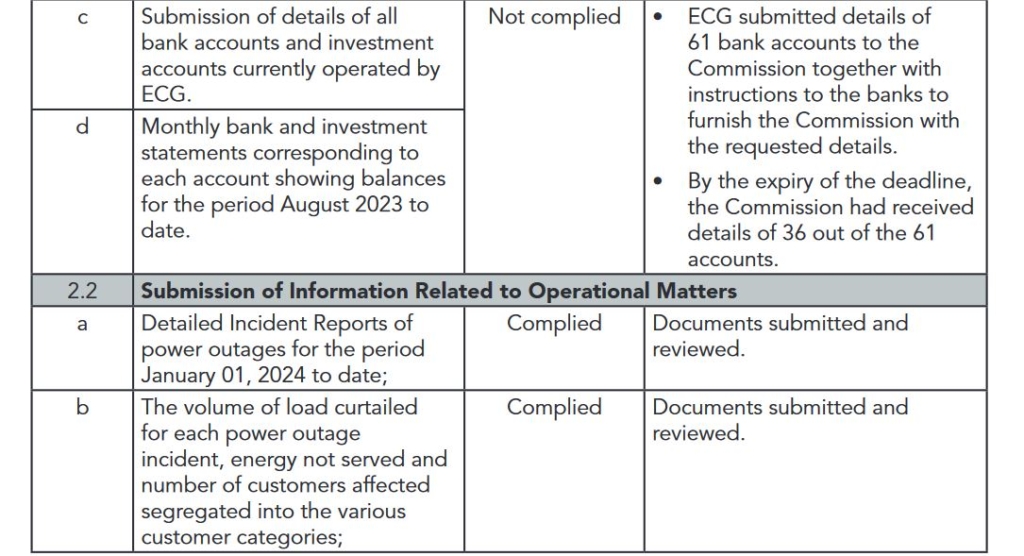
A report by the media indicated that the Public Utilities Regulatory Commission (PURC) has penalized the Electricity Company of Ghana (ECG) with a fine of GH¢36,000 for failing to provide all bank and investment account information to the Commission.
Despite repeated requests with deadlines of March 25, March 27, and April 2, 2024, the information provided by ECG was deemed incomplete, resulting in the imposition of the penalty.
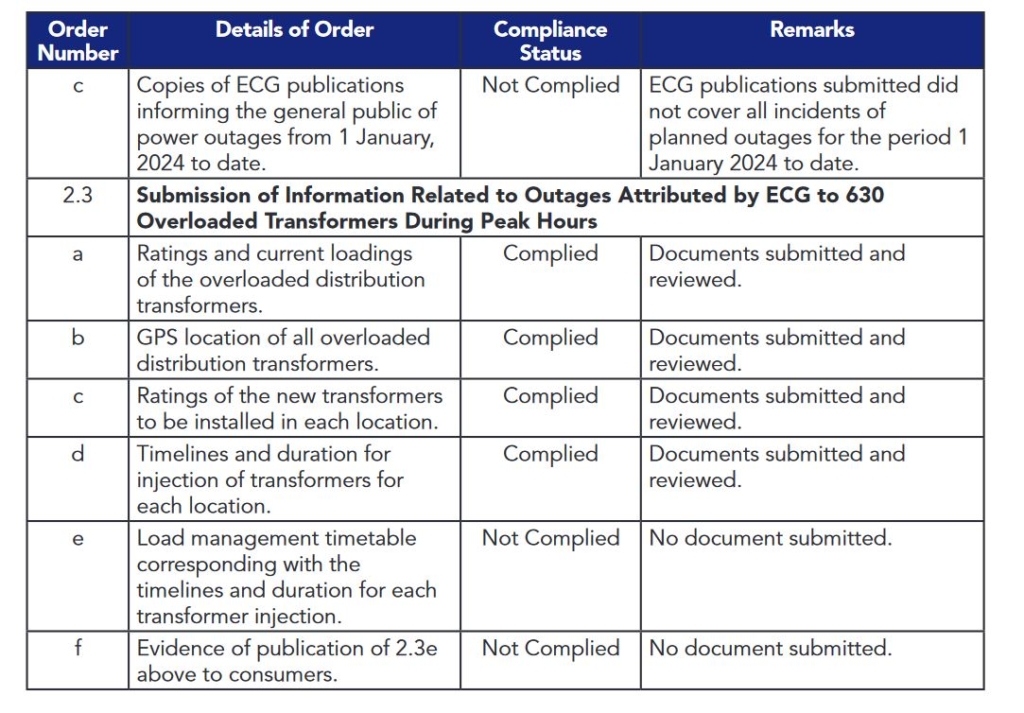
Additionally, ECG has been fined a significant amount of GH¢5,868,000.00 for its failure to comply with the 3-day statutory notice requirement for planned outages.
The responsibility for paying this fine has been shifted to the board members who served from January 1 to March 18, 2024.
They are required to pay the fine into a dedicated fuel account jointly controlled by the Ministry of Energy and the Ministry of Finance by May 30, 2024.
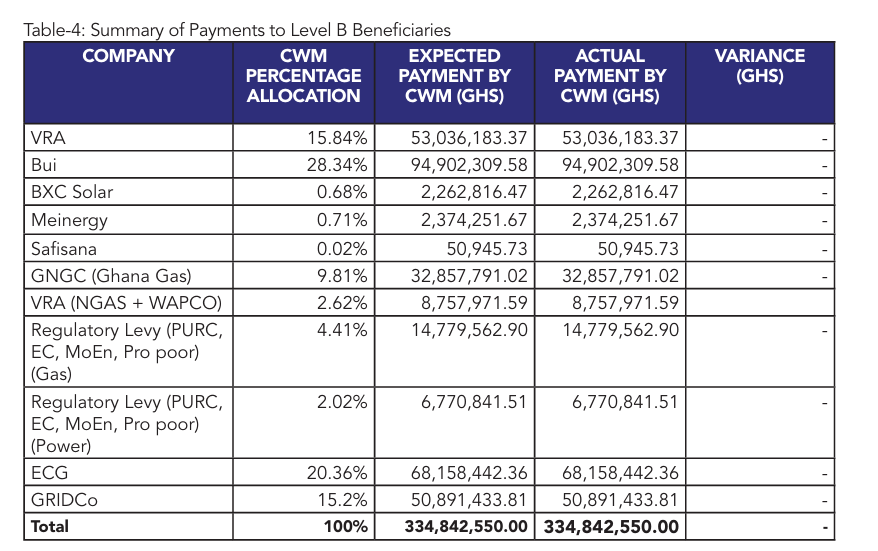
Furthermore, ECG has been directed to settle its outstanding obligations under the Cash Waterfall Mechanism, totaling GH¢446,283,706.29, to Category B beneficiaries by April 30, 2024.
Failure to make this payment will result in consequences for both the board members and management, as per the report.
The Public Utilities Regulatory Commission (PURC) has issued a six-week ultimatum to the Board Members of the Electricity Company of Ghana (ECG) to pay a fine of GHC5,868,000.
The Board members of the Electricity Company of Ghana (ECG), who served from January 1st to March 18th, 2024, are required to pay the regulatory charge for overseeing power outages without notifying consumers during this period.
The board, including ECG MD Samuel Mahama Dubik and eight others, will be affected by this fine. Former board chairman Keli Gadzekpo, who resigned three weeks ago, will also be subject to the fine, along with Majority Chief Whip Frank Annor Dompreh and five other individuals.
However, current Deputy Energy Minister Herbert Krapah, who chairs the board, will not be affected as his tenure falls outside the period covered by the regulatory orders.
The Public Utilities Regulatory Commission (PURC) issued this directive in a letter to ECG on Monday, April 15.
“The Board Members of ECG in office between 1 January to 18 March 2024 shall pay the regulatory charge of Five Million, Eight Hundred and Sixty-Eight Thousand Ghana Cedis (GHS5,868,000.00) into a dedicated fuel account under the joint control of the Ministry of Energy and the Ministry of Finance on or before 30th May, 2024,” the regulatory body ordered.
The PURC had previously requested information from ECG regarding tariff revenue allocation under the Cash Waterfall Mechanism (CWM), regulatory audit data, operational information, and other relevant data, with deadlines of March 25, March 27, and April 2, 2024.
It said, “The Commission established from its analysis of data submitted by ECG that there were 4142 outages to consumers within ECG’s operational areas between January and March 2024. Out of this number, 165 representing 3.98% of the total outages were ECG-planned outages.
“Further analysis showed that of the 165 ECG planned outages, 40 were supported by public notices, while there were no notices for the remaining 125 outages. Further, 38 of the 40 notices did not comply with the requisite three-day statutory notice prescribed under Regulation 39 of L.I. 2413. This indicates that in 163 instances of planned outages, ECG did not comply with the law”.
Initially imposed on ECG, the fine was reassigned to the company’s board members by the PURC, citing concerns about the impact on ECG’s service delivery and the nature of its business.
“The Commission has determined that having regard to the nature of ECG’s ownership and business, the imposition of the penalty of Five Million, Eight Hundred and Sixty-Eight Thousand Ghana Cedis (GHS 5,868,000.00) on ECG would be counter-productive, as payment from ECG’s revenue would have a rebounding adverse effect on quality of service and consumers who pay tariffs to the company.
“For that reason, in the interest of justice and to protect the interests of consumers, the Commission shall hold the Board Members of ECG who were in office from 1 January to 18 March 2024 liable for the payment of the Five Million, Eight Hundred and Sixty-Eight Thousand Ghana Cedis (GHS 5,868,000.00).”
The Commission noted that these board members were consistently responsible for providing strategic direction to ensure the provision of safe, adequate, efficient, reasonable, and non-discriminatory service to consumers.
Additionally, the regulator has fined ECG GHS36,000 for its failure to submit all of its current bank and investment accounts to the Commission.
“The details of ECG’s bank accounts submitted were incomplete, contrary to the Order. 3.3 Submission of Information Related to Operational Matters.”
“The Commission hereby imposes an initial regulatory charge of 3,000 penalty units on ECG in accordance with Regulation 45 of LI 2413, amounting to Thirty-six Thousand Ghana Cedis (GHS36, 000).”
It said “ECG shall pay the initial regulatory charge of GHS36, 000 to the Commission on or before 22 April 2024.
On the time-frame for compliance, the PURC added that after the payment, “for every working day that the requested details remain outstanding, ECG shall pay an additional regulatory charge of 3,000 penalty units, calculated daily until the date of compliance.”
Additionally, apart from fulfilling its existing obligations under the Cash Waterfall Mechanism, the PURC instructed ECG to remit the sum of GHS446,283,706.29 to Category B beneficiaries under the CWM.
“The amount represents actual revenue collected by ECG, declared by ECG to the CWM, and approved by the CWM Standing Committee for payment from August 2023 to February 2024, but which remains unpaid.”
The Commission specified that ECG must pay the amount of GHS446,283,706.29 on or before April 30, 2024. Failure to comply by the specified date will result in the board members and management of ECG being held accountable.
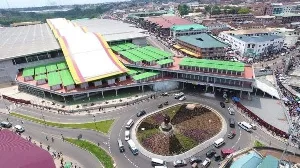
This disconnection, which happened about a week ago, has forced the market to rely on an alternative power plant for its energy needs.
Traders and customers have expressed the negative impact of the power outage on the market’s operations. One trader said, “Power has been disconnected to this facility, and the market is slow because people are not here to buy anything. We were here on Saturday and Friday and couldn’t make any sales. When the lights come on for some time, it goes off again because we rely on the generator set. It has been difficult for us.”
A customer also highlighted concerns about safety and comfort, stating, “The situation is making us scared because when the lights are off, some criminal elements will take advantage, and the heat is also unbearable.”
“The structure of the market any time the light goes off takes about 30–50 minutes, people who enter into the market to buy our things complain. Some feel the place is too dark, some feel the place isn’t secure, others also feel that they cannot get the right things, and they cannot identify the exact commodity that they want to buy. So they don’t feel comfortable entering our market to buy something. In the long run, it affects us the traders.”
He further mentioned that the market’s management has been forced to use a power plant as an alternative source, but this solution is costlier and comes with technical challenges, making the power supply unsustainable.
“Currently, the management engaged the leadership of the traders’ union that we cannot let the market be in darkness, so we had to rely on the plant. But it is also coming at a higher cost. Every six hours, we have to use four and a half barrels of diesel.”
The Board members of the Electricity Company of Ghana (ECG), who served from January 1st to March 18th, 2024, are required to pay a regulatory charge totalling GHS5,868,000.00 for overseeing power outages without notifying consumers during this period.
The board, including ECG MD Samuel Mahama Dubik and eight others, will be affected by this fine. Former board chairman Keli Gadzekpo, who resigned three weeks ago, will also be subject to the fine, along with Majority Chief Whip Frank Annor Dompreh and five other individuals.
However, current Deputy Energy Minister Herbert Krapah, who chairs the board, will not be affected as his tenure falls outside the period covered by the regulatory orders.
The Public Utilities Regulatory Commission (PURC) issued this directive in a letter to ECG on Monday, April 15. The PURC had previously requested information from ECG regarding tariff revenue allocation under the Cash Waterfall Mechanism (CWM), regulatory audit data, operational information, and other relevant data, with deadlines of March 25, March 27, and April 2, 2024.
It said, “The Commission established from its analysis of data submitted by ECG that there were 4142 outages to consumers within ECG’s operational areas between January and March 2024. Out of this number, 165 representing 3.98% of the total outages were ECG-planned outages.
“Further analysis showed that of the 165 ECG planned outages, 40 were supported by public notices, while there were no notices for the remaining 125 outages. Further, 38 of the 40 notices did not comply with the requisite three-day statutory notice prescribed under Regulation 39 of L.I. 2413. This indicates that in 163 instances of planned outages, ECG did not comply with the law”.
The specified amount is to be deposited into a dedicated fuel account jointly controlled by the Ministry of Energy and the Ministry of Finance by May 30, 2024.
Initially imposed on ECG, the fine was reassigned to the company’s board members by the PURC, citing concerns about the impact on ECG’s service delivery and the nature of its business.
“For failure to comply with the 3-day statutory notice on notification and publication of planned outages required under Regulation 39 of L.I. 2413, the Commission in accordance with Regulation 45 of L.I. 2413, also imposed a regulatory charge of 3,000 penalty units on ECG for each of the 163 breaches, amounting to Five Million, Eight Hundred and Sixty-Eight Thousand Ghana Cedis (GHS 5,868,000.00).”
“The Commission has determined that having regard to the nature of ECG’s ownership and business, the imposition of the penalty of Five Million, Eight Hundred and Sixty-Eight Thousand Ghana Cedis (GHS 5,868,000.00) on ECG would be counter-productive, as payment from ECG’s revenue would have a rebounding adverse effect on quality of service and consumers who pay tariffs to the company.
“For that reason, in the interest of justice and to protect the interests of consumers, the Commission shall hold the Board Members of ECG who were in office from 1 January to 18 March 2024 liable for the payment of the Five Million, Eight Hundred and Sixty-Eight Thousand Ghana Cedis (GHS 5,868,000.00).”
The Commission noted that these board members were consistently responsible for providing strategic direction to ensure the provision of safe, adequate, efficient, reasonable, and non-discriminatory service to consumers.
Additionally, the regulator has fined ECG GHS36,000 for its failure to submit all of its current bank and investment accounts to the Commission.
“The details of ECG’s bank accounts submitted were incomplete, contrary to the Order. 3.3 Submission of Information Related to Operational Matters.”
“The Commission hereby imposes an initial regulatory charge of 3,000 penalty units on ECG in accordance with Regulation 45 of LI 2413, amounting to Thirty-six Thousand Ghana Cedis (GHS36, 000).”
It said “ECG shall pay the initial regulatory charge of GHS36, 000 to the Commission on or before 22 April 2024.
On the time-frame for compliance, the PURC added that after the payment, “for every working day that the requested details remain outstanding, ECG shall pay an additional regulatory charge of 3,000 penalty units, calculated daily until the date of compliance.”
Additionally, apart from fulfilling its existing obligations under the Cash Waterfall Mechanism, the PURC instructed ECG to remit the sum of GHS446,283,706.29 to Category B beneficiaries under the CWM.
“The amount represents actual revenue collected by ECG, declared by ECG to the CWM, and approved by the CWM Standing Committee for payment from August 2023 to February 2024, but which remains unpaid.”
The Commission specified that ECG must pay the amount of GHS446,283,706.29 on or before April 30, 2024. Failure to comply by the specified date will result in the board members and management of ECG being held accountable.
The Public Utilities Regulatory Commission (PURC) has imposed a fine of GHS36,000 on the Electricity Company of Ghana (ECG) for its failure to submit all current bank and investment accounts to the Commission.
Despite three requests from the PURC with deadlines of March 25, March 27, and April 2, 2024, the ECG did not comply.
The requested information includes details on tariff revenue allocation under the Cash Waterfall Mechanism (CWM), regulatory audit data, operational information, and other relevant data.
But in a letter submitted to the ECG on Monday, April 15, the PURC said it found that “details of ECG’s bank accounts submitted were incomplete, contrary to the Order. 3.3 Submission of Information Related to Operational Matters.”
“The Commission hereby imposes an initial regulatory charge of 3,000 penalty units on ECG in accordance with Regulation 45 of LI 2413, amounting to Thirty-six Thousand Ghana Cedis (GHS36, 000).”
The letter said “ECG shall pay the initial regulatory charge of GHS36, 000 to the Commission on or before 22 April 2024.
On the time-frame for compliance, the PURC added that after the payment, “for every working day that the requested details remain outstanding, ECG shall pay an additional regulatory charge of 3,000 penalty units, calculated daily until the date of compliance.”
Due to the Electricity Company of Ghana’s (ECG) failure to comply with the 3-day statutory notice requirement for notification and publication of planned outages, as stipulated under Regulation 39 of L.I. 2413, the Public Utilities Regulatory Commission (PURC) has imposed a regulatory charge.
Pursuant to Regulation 45 of L.I. 2413, the Commission has fined ECG 3,000 penalty units for each of the 163 breaches, totaling Five Million, Eight Hundred and Sixty-Eight Thousand Ghana Cedis (GHS 5,868,000.00).
Recognizing the potential impact of this fine on ECG’s ability to maintain service quality for consumers, the Commission has decided to hold the board members of the company, including ECG MD Samuel Dubik Mahama, accountable for the payment of the fine.
The Commission however stated that, due to nature of ECG’s business, paying that amount will affect the quality of service to consumers. It thus passed on the fine to the board members of the company which include the ECG MD, Samuel Dubik Mahama.
“The Commission has determined that having regard to the nature of ECG’s ownership and business, the imposition of the penalty of Five Million, Eight Hundred and Sixty-Eight Thousand Ghana Cedis (GHS 5,868,000.00) on ECG would be counter-productive, as payment from ECG’s revenue would have a rebounding adverse effect on quality of service and consumers who pay tariffs to the company.
“For that reason, in the interest of justice and to protect the interests of consumers, the Commission shall hold the Board Members of ECG who were in office from 1 January to 18 March 2024 liable for the payment of the Five Million, Eight Hundred and Sixty-Eight Thousand Ghana Cedis (GHS 5,868,000.00).”
The Commission stated that these board members were consistently responsible for providing strategic direction to ensure the provision of safe, adequate, efficient, reasonable, and non-discriminatory service to consumers.
The board members of ECG in office from 1 January to 18th March 2024 “shall pay the regulatory charge of Five Million, Eight Hundred and Sixty-Eight Thousand Ghana Cedis (GHS5, 868,000.00) into a dedicated fuel account under the joint control of the Ministry of Energy and the Ministry of Finance on or before 30th May 2024.”
“The amount represents actual revenue collected by ECG, declared by ECG to the CWM, and approved by the CWM Standing Committee for payment from August 2023 to February 2024, but which remains unpaid.”
The Commission specified that ECG must pay the amount of GHS446,283,706.29 on or before April 30, 2024. Failure to comply by the specified date will result in the board members and management of ECG being held accountable.
A Research and Policy Analyst at the Institute for Energy Security (IES), Xatse Derick Emmanuel, has highlighted that historical data indicates former President John Dramani Mahama contributed more to Ghana’s national electricity supply than President Akufo-Addo.
During Mahama’s tenure, Mr Emmanuel noted, access to electricity surged by over 17 percent, soaring from 60.5 percent in 2008 to 83.24 percent in 2016.
This indicates an annual increase of nearly 3 percent under Mahama’s governance.
Conversely, Emmanuel pointed out that the Akufo-Addo administration managed to augment access to electricity by less than 6 percent, ascending from 83.24 percent in 2016 to 88.84 percent by February 2024. This signifies an annual increase of less than 1 percent.
“When Nana Addo took over from 2017, access to national electricity rose from 83.24% (2016) to 88.84 as at February 2024. Meaning they have added 5.61% in 7 years making 0.8% increase per year.
“Meanwhile, under JM, the NDC took it from 60.5% in 2008 to 83.24% in 2016, an average of 2.8% annual increase by the NDC,” he wrote in a statement.
He added, “Realistically, if we grow at an average 0.8% by Nana Addo, Ghana will achieve universal access to electricity in 14 years (2038).”
Meanwhile, Ghana has recently grappled with intermittent power outages, colloquially termed ‘dumsor’. Nonetheless, the Electricity Company of Ghana has rebutted these assertions.
The Electricity Company of Ghana (ECG) has swiftly responded to allegations made by the Ghana Grid Company (GRIDCo) regarding ECG’s alleged non-compliance with load management instructions.
In a letter dated March 28, 2024, GRIDCo expressed concerns about ECG’s lack of adherence to load management directives from GRIDCo’s System Control Centre (SCC), suggesting that ECG’s actions could jeopardize the country’s power generation.
ECG, while emphasizing its commitment to working with GRIDCo and maintaining operational cohesion within the electricity value chain, expressed shock and concern over the allegations. According to ECG, GRIDCo’s portrayal of the situation lacks context and fails to acknowledge the operational challenges faced by ECG.
As outlined in ECG’s response, the main issue is about the timing and adequacy of load management requests received from GRIDCo. While ECG acknowledges receiving directives to drop loads at specific Bulk Supply Points (BSPs), it highlights discrepancies in the timing of these requests and their impact on operational planning.
ECG stressed the importance of GRIDCo providing advance notice of load management requests to enable effective planning and execution without unduly impacting customers.
“We however wish to reiterate our request that the Notice to our System Operators for load management should be received before 3:00pm for peak load and 4am for off-peak load management or to be received 24 hours ahead in each case, as what is happening now is no longer an emergency operation but seemingly a routine daily activity,” the letter signed by ECG’s Chief Executive, Ing. Ebenezer Kofi Essienyi said.
ECG provided detailed statistics on load management requests received from GRIDCo between January and March 2024.
They demonstrated instances where requests were received shortly before peak or off-peak periods, limiting ECG’s ability to plan and inform customers adequately.
“It is a fact that GRIDCo routinely directs ECG’s System Operators to drop load at some of our Bulk Supply Points (BSPs), but the issue has been the inadequacy between the time these requests are received and the time these requests must be effected to sustain the integrity of the power system and also for ECG to inform its customers.
“It is worthy to note that, between January and March 2024, sixty-four (64No.) requests were received from GRIDCo for load management. Out of this, forty (40No.) were for peak periods (18:00 – 24:00 hrs) and twenty-four (24No.) for off-peak (06:00 – 18:00 hrs) load management. “Out of the forty (40no.) peak load requests, thirty-five (35No.) (88%) of them were received within an hour to the peak period. There were only five (5No) (12%) instances where ECG received the request within 2-3 hours of the peak period. “Out of the Twenty-Four (24No.) off-peak load requests, three (3No) (13%) of them were received within 30 minutes to the off-peak period while the remaining Twenty-One (21 No.) (87%) instances were received far into the off-peak period,” the power distributor said.
ECG also highlighted specific incidents in March 2024 where operational challenges within its network led to a lower compliance rate with GRIDCo’s load management directives.
The power distributor reiterated its commitment to collaborate with GRIDCo and other stakeholders to ensure transmission system stability.
Electricity Company of Ghana (ECG)has once again emphasised that there are no ongoing power outages, commonly referred to as “dumsor,” in the country, dismissing circulating reports.
Despite calls for a load-shedding timetable, both ECG and the Minister of Energy, Dr. Matthew Opoku Prempeh, maintain that the power distributor is not implementing load-shedding.
Following a meeting with the Mines and Energy Committee of Parliament, ECG’s managing director, Samuel Dubik Mahama, assured journalists that the transformer challenges have been resolved.
Mahama reassured the public that ECG is making every effort to ensure a stable electricity supply, underscoring that load shedding is not currently being practiced.
“The assurance is that we are doing our best. The lights are going to stay on. Most of the transformers that we spoke about and the intensification exercises are almost done.
So we should just stay positive. There willbe a proper statementas to the way forward. We are currently not shedding load. So we are not shedding load,” he said.
Honorary Vice President at IMANI Africa, Bright Simons, has urged Fidelity Bank and the Electricity Company of Ghana (ECG), to desist from what he terms as a coordinated public relations campaign to discredit him.
Fidelity Bank has dragged Bright Simons, the Vice President of IMANI Africa, to court over his allegation that the Electricity Company of Ghana (ECG), the government-controlled electricity utility, is “dishing out” approximately GHC80 million to the financial institution in sweetheart exchange rate deals.
In a rejoinder, media consultants for Bright Simons noted that if it was the intention of Fidelity to engage in a public debate with our client, the ethical and professional thing to do would have been to withdraw their pending libel lawsuit against him so that all sides can speak freely and robustly about the issues in the press.
“Promoting one-sided commentary in the press is not the professional and ethical approach in this circumstance.
“Our client has been careful and diligent in his public commentary till date to avoid prejudicing the case, but the ongoing attempt to foist a one-sided perspective compels us to respond to specific factual mischaracterizations,” a portion of the rejoinder read.
The media consultants argued that the context in which their client publicly questioned ECG about its foreign exchange (FX) dealings is key to appreciating the situation.
“ECG had been reported by auditors appointed by its regulators, the PURC, to be hiding information and refusing to cooperate with them to unravel its financial dealings. The organisation had furthermore been charged with procurement irregularities by the Auditor General.”
There're some "Ghana things" I will never understand. You say someone has tarnished your corporate reputation, so you've sued for libel. The matter will be heard in court. What is the point of blasting the writ all over & pushing 1 side in the media? 🤔https://t.co/UFABgl5nTp
Re: Fidelity lawsuit against Bright Simons – Dumsor will not be solved by PR
We serve as media consultants for Bright Simons, a honorary Vice President at IMANI Africa and a frequent collaborator of ACEP, both think tanks, in which capacity we issue this public statement.
We have observed with dismay what appears to be a coordinated public relations campaign to discredit our client by Fidelity Bank Ghana Limited (“Fidelity”) and the Electricity Corporation of Ghana (“ECG”).
If it was the intention of Fidelity to engage in a public debate with our client, the ethical and professional thing to do would have been to withdraw their pending libel lawsuit against him so that all sides can speak freely and robustly about the issues in the press. Promoting one-sided commentary in the press is not the professional and ethical approach in this circumstance.
Our client has been careful and diligent in his public commentary till date to avoid prejudicing the case, but the ongoing attempt to foist a one-sided perspective compels us to respond to specific factual mischaracterisations.
The context in which our client publicly questioned ECG about its foreign exchange (FX) dealings is key to appreciating the situation. ECG had been reported by auditors appointed by its regulators, the PURC, to be hiding information and refusing to cooperate with them to unravel its financial dealings. The organisation had furthermore been charged with procurement irregularities by the Auditor General.
These developments, and the recurrent energy crises that keep engulfing the nation, a situation that many analysts believe can be partly attributed to challenges at ECG, prompted civil society activists and energy analysts at IMANI and ACEP to keep a steady spotlight on ECG, examine its finances, and monitor its procurement activities. It was during this work that ECG’s submissions to the Cash Waterfall Committee came to light showing that the organisation priced each dollar procured for a certain transaction at ~GHS13.95.
We have noted ECG’s misrepresentation of facts in its recent statement, a portion of which we reproduce below.
The suggestion that the “circulating cash waterfall spreadsheet” (“spreadsheet”) contains an “estimation” rather than the “actuals” implies that our client was either not diligent or attempted to misinform the public. This characterisation is totally false and misleading.
1. The Excel Workbook from which the information was found is an official document of the Cash Waterfall Mechanism Committee.
2. The spreadsheet in question was prepared from information supplied by the Finance Directorate of ECG.
3. The spreadsheet contains multiple entries. The spreadsheet is titled CWM Actual Payment (emphasis on “actual”). For transparency, we reproduce the relevant section of the document below.
4. It is clearly indicated in the highlighted page that ECG’s unit procurement cost for 600 million GHS was ~GHS13.953/$1.
5. The billing month is indicated clearly as October 2023.
7. Fidelity is the acknowledged single account operator of ECG and has been the main FX broker for ECG at various times.
8. Nothing in the spreadsheet suggests that the figures and other entries are merely hypothetical. On the contrary, the document was in use as late as February 2024 as part of reconciliation exercises relating to past payments already made by ECG.
Our client did not pluck these numbers from the air. He did not concoct them. As an analyst he was entitled to draw fair and analytically sound conclusions from official, public, documents, which he did.
Whilst ECG and Fidelity have made various claims about what happened, their claims clearly contradict the official CWM records. Only a deep forensic audit by a reputable team of auditors can effectively resolve these contradictions.
What is before the court however is a libel lawsuit that alleges that our client knowingly made false and misleading claims to tarnish the reputation of Fidelity. Lawyers of our client intend to contest this allegation vigorously.
Our client has explained his motive for questioning whether the ECG – Fidelity transactions were arm’s length or tainted by insider dealing, as hinted in his post on X (formerly known as Twitter). Further expatiation is strictly a matter for trial.
For the sake of completeness, we are providing a link to our client’s article detailing this conflict of interest, which is highly germane to his motive for questioning the financial soundness of ECG – Fidelity transactions.
Our client disclosed that a close relative/associate of the Chief of Staff of Ghana’s President serves as the Head of Legal at Fidelity Bank. In that role, she negotiates and/or clears some legal transactions involving the two corporate entities on both ends. This “politically exposed person” undertakes activities at ECG, including corporate initiatives, that go beyond her board remit. ECG’s statements on this affair therefore lack candour and evade the issues of insider dealing.
In deference to the court, we hope that Fidelity Bank and ECG shall not provide our client with occasion to publicly defend his professional integrity in this manner again while this suit is still pending.
Given the serious public interest dimension of this case, it is our hope that all parties will cooperate in good faith to ensure a smooth and civil trial. In the meantime, we urge all editors to give this statement the same level of prominence being given to the circulating ECG and Fidelity documents.
Ghanaian media personality, Ameyaw Debrah, has taken to social media to express his dismay over an excessively high electricity bill he received from Electricity Company of Ghana (ECG).
The bill amounted to a staggering GH¢8,777 for just a month’s usage, leaving Debrah and numerous Ghanaians incredulous.
Mr Debrah didn’t mince words in conveying his frustration.
He shared a screenshot of the bill on his social media platform, prompting reactions from fellow netizens.
In the caption accompanying the screenshot, he directly addressed President Akufo-Addo, urging him to intervene and instruct ECG to disconnect his electricity if clarity regarding the bill’s calculation wasn’t provided.
“Dear@NAkufoAddo please tell ECG to come and disconnect my electricity . I will not pay this bill if I don’t understand how @ECGghOfficial derived it,”he wrote.
In response to Debrah’s post, many Ghanaians echoed his sentiments, lamenting the escalating cost of living, particularly concerning electricity bills.
Numerous individuals shared their own encounters with ECG, underscoring the widespread concern over the issue.
The Independent Power Generators Ghana (IPGG) has praised President Akufo-Addo for his directive to the Volta River Authority to cease the exportation of electricity to neighboring nations such as Togo and Burkina Faso.
While acknowledging that this suspension may not entirely resolve the current energy crisis, the group emphasized that it will certainly offer some relief and stability within the domestic market.
Samuel Atta Akyea, Chairman of the Energy Committee of Parliament, disclosed on Tuesday, April 2, 2024, that President Akufo-Addo has instructed the Volta River Authority (VRA) to reduce electricity exports to neighboring countries due to the ongoing intermittent power outages, commonly known as ‘dumsor’.
In a statement issued by Dr. Elikplim Kwabla Apetorgbor, CEO of IPGG, the group expressed satisfaction with the president’s decision.
“We are pleased that H.E. the President, as reported by the Chairman of Parliament’s Committee on Energy, Hon. Samuel Atta Akyea, who also serves as the MP for Abuakwa South, has directed the VRA to suspend electricity exports to our neighbors.
“We are gladdened that H.E. President is reported by the Chairman of Parliament’s Committee on Energy, Hon. Samuel Atta Akyea, who doubles as the MP for Abuakwa South, as having ordered the VRA to suspend electricity export to our neighbours.
“This action will go a long way in providing some respite and stability to the domestic market by increasing supply, even though it may not solve the power supply challenge entirely. It is thus important and appropriate to commend H.E. the president of the republic for prioritising the domestic market which I the right thinking to do at this critical moment,” the statement added.
The Institute for Energy Security (IES) has called on the Ghana Grid Company Limited (GRIDCo) to be transparent in communicating the current status of the power sector.
They are also urging GRIDCo to provide the Electricity Company of Ghana (ECG) with a clear estimate of the power supply that can be guaranteed within a specific period.
“Such an information is vital for the ECG to plan its load response with a timetable,” the IES added in a statement signed and issued by its Executive Director, Nana Amoasi VII on April 1.
The IES emphasized that ECG should concentrate on managing its load based on the power supply from GRIDCo and efficiently collecting revenue to ensure full cost recovery.
“The Public Utility and Regulatory Commission (PURC) must look beyond the ECG to audit the upstream segment of the power sub-sector, particularly the GRIDCo, and export sales by the Volta River Authority (VRA),” it added.
A self-acclaimed data hub on X (formerly Twitter) @Datanomics has alleged that the government of Ghana has collateralized GHC24bn worth of the Energy Sector Levy Act (ESLA) for a GHC6bn upfront loan.
The ESLA is a levy imposed on consumers in Ghana to help fund various initiatives and projects in the energy sector, including debt repayment, infrastructure development, and subsidies for fuel and electricity.
This claim was made on March 30, 2024, in response to a TV3 report stating that the government instructed the Electricity Company of Ghana (ECG) to generate one billion Ghana Cedis monthly to compensate energy sector stakeholders.
As per the tweet, the Electricity Company of Ghana (ECG) is facing a significant burden because the proceeds from the ESLA levy have reportedly been used as collateral for an upfront loan by the current government.
ESLA accrues Gh¢3.5bn annually. From its 2015 introduction, the Akufo-Addo/Bawumia gov’t has raked in Gh¢24bn.
Gov’t orders ECG to raise Gh¢1bn monthly to pay industry players. This comes after they’ve mortgaged ESLA for $1bn (Gh¢6bn) upfront loan.
ESLA generates a substantial annual sum of Gh¢3.5 billion, which theoretically should be adequate to address various financial challenges coupled with its consequences , including the ongoing nationwide power outages (dumsor) being experienced.
The tweet reads, “ESLA accrues Gh¢3.5bn annually. From its 2015 introduction, the Akufo-Addo/Bawumia gov’t has raked in Gh¢24bn. Gov’t orders ECG to raise Gh¢1bn monthly to pay industry players.
This comes after they’ve mortgaged ESLA for a $1bn (Gh¢6bn) upfront loan. This dumsor is unforgivable!!”
A legislator representing the Abuakwa South constituency Samuel Atta Akyea, has expressed concerns that the Electricity Company of Ghana (ECG) could face collapse if it fully complies with the Cash Waterfall Mechanism (CWM).
The Cash Waterfall Mechanism is a government policy dictating how ECG manages its financial affairs. Atta Akyea highlighted that despite ECG’s efforts to increase revenue, the company has experienced a recent shortfall in revenue.
Therefore, if the CWM prioritizes other energy companies over ECG, it could severely impact ECG’s operations and hinder its efficiency.
Speaking on JoyNews’ Newsfile on Saturday, March 30, Atta Akyea warned, “If we are not careful and we comply fully with the Cash Waterfall Mechanism, ECG will comatose because it doesn’t generate enough money to be operational”.
He added, “You wouldn’t want to have a policy which is so stringent that ECG with all the challenges complying fully with the Cash Waterfall Mechanism will run aground and then have double trouble.”
Despite these concerns, Atta Akyea supported the Public Utilities Regulatory Commission’s (PURC) decision to require ECG to provide a comprehensive report of its operations to the energy regulatory body.
“If we are not careful and we comply fully with the Cash Waterfall Mechanism, ECG will comatose because it doesn’t generate enough money to be operational,” he said on JoyNews’ Newsfile on Saturday, March 30.
He added, “The regulator is actually a creator of law. If you pay regard to Act 538, there is nothing that PURC is doing which is untoward,” he said.
Electricity Company of Ghana (ECG) has inaugurated 15 new transformer installations in the Ashanti West Region as part of its ongoing efforts to enhance power supply for customers in the area.
This initiative follows the identification of 630 transformers nationwide, with 46 located specifically in the Ashanti West Region, that were nearing their full capacity.
To ensure improved power distribution, ECG has been conducting thorough inspections of transformers both during the day and at night to assess their condition and monitor load levels.
The newly commissioned transformers, along with upgrades to existing lines and transformers operating at full capacity, are situated in various towns across districts including Ahinsan, Abuakwa, Bibiani, Suame, and Offinso.
Specific locations benefiting from these installations include Wood Village Estate, Foase, Twedie Foase, Dompoase Salvation School, Bokankye, Kwamekrom, Achiase Market, New Aduampong, Consor Junction, Odumase Fungy, and Saint International School at Barekese.
According to Mr. Maxwell Dapaah, the Regional General Manager for ECG in Ashanti West, the company’s objective is to ensure the provision of reliable, high-quality, and safe electricity services to facilitate Ghana’s socio-economic development.
He emphasised that completing this project was essential to address issues such as low voltage and localised outages that were occurring due to transformers operating at full capacity.
“Every transformer has a capacity of electricity (load) it can carry so if the capacity is 200 KVA, the electricity should not exceed that capacity. Once we identified transformers reaching full capacity, we upgraded from 200 KVA to 315KVA and in some locations, a 500 KVA transformer was commissioned to take care of the increasing demand.”
The General Manager highlighted that the project brings several advantages, including a reduction in system losses, enhanced reliability, and a more stable power supply in the area.
These improvements aim to increase customer satisfaction and operational efficiency, allowing the company to better meet the growing demand for electricity in the region.
The Regional Engineer of Ashanti West Region emphasised the significance of completing the project, stating that it represents a positive step towards providing reliable and high-quality power supply.
This, in turn, supports the attraction and sustainability of businesses in the region while ensuring that all customers receive satisfactory service from ECG.
Ing. Osei Amoako also announced that the company is also embarking on other projects in the region to enhance service delivery and provide convenience for customers. “We are constructing a substation at Agogo. We are also upgrading other transformers and distribution lines that we have identified to be reaching full capacity to augment power supply in the region.”
Ing. Osei Amoako cautioned the public to desist from unlawful entry into the network of ECG and urged customers to report people who interfere with the ECG network to the police or the nearest ECG Office as part of efforts to help protect ECG installations like poles, transformers, metres, and pylons.
“Customers experiencing outages within their premises should kindly contact our contact centre on 0302611611, report to the nearest ECG office, lodge a complaint on the ECG PowerApp or reach us on our social media handles @ECGghOfficial,” he said.
He encouraged customers to refrain from engaging in illegal connections and to ensure timely payment of their bills. This, he emphasised, would enable ECG to enhance its service delivery by completing ongoing projects and initiating new ones for the benefit of its customers.
Mr. Dapaah also advised customers to utilize the newly introduced cashless payment system offered by ECG. He suggested that they pay their bills through this system before ECG officials visit their premises, facilitating smoother transactions and ensuring efficient service provision.
“We urge our customers to pay their bills by downloading the ECG PowerApp from the Google Play Store or AppStore or through the shortcode *226# before our revenue officers visit their premises since this system enables customers to transact business with ECG anywhere or anytime. Customers can also pay at any bank.”
Customers who intend to visit theECG office for any transactions are advised to preload the necessary funds onto their mobile money wallets beforehand. This is because the ECG office no longer accepts cash payments.
ECG argues that this adjustment is necessary to manage the increasing debt within the country’s energy sector.
The power distributor has appealed to the Public Utilities Regulatory Commission (PURC) to incorporate a line item for forex losses in the total revenue requirement it approves.
ECG cites forex losses as a substantial financial challenge that needs to be addressed, according to 3News.com.
“Forex losses have become material financial losses to ECG. The position of ECG is that the issue of forex losses has not been consistently addressed by the PURC, by including it in tariffs approved by the Commission for ECG. It is the view of ECG that, a permanent solution to resolving the issue of forex losses is implemented in the form of introduction of a line item for forex losses in the total revenue requirement approved for ECG by the Commission,” the Managing Director of the Electricity Company of Ghana, Mr Samuel Dubik Mahama wrote in a letter addressed to the Executive Secretary of the PURC dated March 27, 2024.
He said, “This way, the issue of debt accumulation in the sector especially from ECG’s end, would be eliminated.”
The letter was a response to a directive from the PURC instructing it to allocate all tariff revenues as prescribed and allocated under the Cash Waterfall Mechanism (CWM) to ensure the financial stability of the sector.
Loan Repayment for Bui Power Authority and Ghana National Gas Company Limited
To recall, loans were contracted by Bui Power Authority and Ghana National Gas Company Limited to address pressing financial challenges both companies were facing. By an agreement between ECG and the two Institutions, these loans were novated to ECG for payment of both Principal and Interest as and when due.
The total amount contracted by the two Institutions is GHS250 million (Bui Power Authority GHS150million and Ghana Gas Ghana Limited GHS100million respectively.
Mr Mahama further explained that, “In executing the terms of the loan agreement, ECG has since been making payments as and when due, which fact can be verified from the beneficiaries. It is therefore prudent to address the issue of the repayment of the loan as part of the CWM payments so as to avoid placing ECG in a precarious financial position, failure to address these issues is very much likely to result in accumulation of debt, since ECG has no other source of revenue generation to pay both the principal and the interest.”
ECG is demanding an increase in tariffs to cater for forex losses suffered by the entity. This the power distributor argues can help deal with the burgeoning debt in the country’s energy sector.
ECG further indicated that it could not make a timetable available as its operations… pic.twitter.com/qtVqe3n6uu
The Electricity Company of Ghana (ECG) has declared that the national power grid is now stable, marking an end to the persistent outages across the country.
In a statement released on March 29, 2024, the power distribution company stated that any power supply disruptions experienced by customers are due to localized faults.
It urged affected customers to report such incidents to its dedicated contact center for prompt resolution and restoration of power supply.
While apologizing for any inconveniences caused, the ECG extended warm wishes to its customers for a fruitful Easter celebration.
Recent weeks have seen heightened pressure and scrutiny on the ECG from both customers and businesses, demanding the issuance of a load-shedding timetable as power outages escalate.
In response, the Public Utilities Regulatory Commission (PURC) has mandated the ECG to furnish and publicize a comprehensive load-shedding timetable by April 2, 2024.
However, the Ministry of Energy, representing the government, has refuted claims of a power crisis, commonly referred to as ‘dumsor’, currently plaguing the nation.
The Public Utilities Regulatory Commission (PURC) has noted that the Electricity Company of Ghana (ECG) has not complied with its directive to publish a load-shedding timetable that corresponds with the timelines and duration for each transformer injection.
According to the regulator, there is no evidence of the load management timetable being made public.
As a result, the Commission stated that it is in the process of finalizing regulatory action regarding this issue.
There has been increasing pressure on the state power distributor to release the timetable, especially in light of the erratic power supply (Dumsor) being experienced in various parts of the country.
The Electricity Company of Ghana (ECG) has declared that the national power grid is now stable, marking an end to the persistent outages across the country.
In a statement released on March 29, 2024, the power distribution company stated that any power supply disruptions experienced by customers are due to localized faults.
It urged affected customers to report such incidents to its dedicated contact center for prompt resolution and restoration of power supply.
While apologizing for any inconveniences caused, the ECG extended warm wishes to its customers for a fruitful Easter celebration.
Recent weeks have seen heightened pressure and scrutiny on the ECG from both customers and businesses, demanding the issuance of a load-shedding timetable as power outages escalate.
In response, the Public Utilities Regulatory Commission (PURC) has mandated the ECG to furnish and publicize a comprehensive load-shedding timetable by April 2, 2024.
However, the Ministry of Energy, representing the government, has refuted claims of a power crisis, commonly referred to as ‘dumsor’, currently plaguing the nation.
The Electricity Company of Ghana (ECG) has revealed that it issued more than 100 notifications of power outages during the initial quarter of 2024.
The majority of these notifications were aimed at facilitating maintenance activities on its transmission equipment, as stated by the power distributor.
This disclosure came in response to a query dated March 18 from the Public Utilities Regulatory Commission (PURC) requesting ECG to provide “copies of ECG publications informing the general public of power outages from 1 January 2024 to date.”
Numerous regions across the country have been encountering frequent power interruptions, leading to calls from the public for a load-shedding timetable to aid in planning daily activities.
However, ECG management has reiterated that no schedule will be provided, attributing the interruptions to technical issues.
Furthermore, in its directive dated March 18, the PURC instructed ECG to release a load management schedule by April 2, 2024.
In a press release issued on Easter Friday, the power distributor attributed recent power outages in certain areas to localized faults.
ECG urged its customers to report such faults for prompt action.
“The Electricity Company of Ghana wishes to inform our cherished customers and the general public that we have a stable national power supply (stable national grid).”
“Any customer who is currently experiencing power outage is due to a localised fault.”
Earlier, the Electricity Company of Ghana (ECG) disclosed that it had issued over 100 power outage notifications in the first two and a half months of this year, mostly due to maintenance activities.
This disclosure was in response to an inquiry from the Public Utilities Regulatory Commission (PURC) regarding the ECG’s power outage records for the current year.
Of the three inquiries posed to the power distributor, this response was the only one due by March 27th. Key among the PURC’s requests to the ECG was the provision of a schedule for load shedding.
The Electricity Company of Ghana (ECG) reported issuing over 100 power outage notifications in the first two and a half months of this year, mostly due to maintenance activities.
Out of three inquiries posed to the power distributor, this response was the only one due by March 27th. One of PURC’s requests was for a schedule of load shedding.
PURC’s assessment found that the ECG did not adhere to two of eight directives, notably failing to release a load-shedding timetable. PURC has informed the commissioners of ECG’s failure, leaving them to decide on potential sanctions.
The Ghana Energy Commission’s 2024 forecast predicts a reliable capacity of 4,756 MW to meet the estimated system peak demand of 3,788 MW. However, due to planned maintenance and fuel supply, the available capacity might decrease by 356 MW.
On Thursday, March 28, 2024, ECG issued a power outage notice labeled as a ‘GRIDCo outage,’ affecting 69 areas in Tema.
In Tema area 1, which includes residential zones, 32 areas experienced the outage, including Afienya, Christian International School, Prampram, and Dawhenya.
Tema area 2, primarily industrial, also faced the outage, affecting 37 locations such as Japan Motors, Unilever, GPHA Terminal 1&2, Tema Oil Refinery Pumping station, Dangote Cement, and Cocobod Warehouse.