The sum is in lieu of back taxes for a five-year period from 2014 to 2018, according to records seen by GhanaWeb Business.
The overdue tax amount as well as fines and interest costs are included, according to the MTN Group’s statement on Friday (January 13).
TheGhana Revenue Authority issued MTN Ghana with the bill after auditing it for the years 2014 to 2018 and inferring that the company under declared its revenue by about 30% during the period, MTN said in a statement.
The telco stressed, however, that all previous taxes had been duly honoured and that it disputes the “accuracy and basis” of the assessment.
“MTN Ghana believes that the taxes due have been paid during the period under assessment and has resolved to defend MTN Ghana’s position on the Assessment,” the company said.
The MTN Group has a presence in 19 countries in Africa and the Middle East.
This replaces the fourth edition of the procurement list, which the Commission released in the first half of 2022.
Martin Kwaku Ayisi, the chief executive of the Minerals Commission, claims that the Minerals and Mining (Local Content and Local Participation) Regulations, 2020 (L.I. 2431) went into effect on December 22, 2020.
The purpose of the regulations among others is to promote job creation using local expertise, goods and services in the mining industry and their retention in the country.
The law is also to achieve the minimum in-country spend for goods and services and create mining and mineral related industries that will sustain economic development.
For instance, all mining companies are expected to ensure that at least sixty percent (60%) of financial services including revenue from the sale of minerals go to the local Banks.
He disclosed that receipts from the sale of minerals is over US$ five billion, a figure which is likely to go up significantly as new mines come on stream and added the existing ones to expand their operations, the local banks such as CBG, National Investment Bank, Ghana Commercial Bank and Agricultural Development Bank are likely to benefit greatly.
“The same applies to insurance services which also require a minimum of 60% of all insurance and reinsurance placements be made with Insurance companies exclusively owned by Ghanaians”, he said.
Mr. Ayisi in a statement said the increase in the items on the list comes at the time when receipts from mineral revenues and investments hovers around US$10 billion. For instance, there are four huge new projects with investment of about US$ 1.7 billion. The new projects are the US$ 850 million Ahafo North gold mine project by Newmont Ghana Gold Limited, US$ 500 million gold project currently under construction by Cardinal Namdini Mining limited in the Talensi District of the Upper East Region, the US$ 200 million gold mine to be constructed in the Upper West Region and the US$ 125 million lithium project at Ewoyaa in the Central Region.
Additionally, Mr. Ayisi stated that some mines are undertaking expansion and redevelopment. The undergoing expansion include the Ahafo South mine of Newmont which now covers the Subika underground. Golden Star Resources is spending about a billion dollars to expand the Wassa underground mine.
The mines being redevelop are the Anglogold Ashanti Obuasi mine where a billion dollars has been expended and the Bibiani mine of Mensin Gold Ghana Limited which started production in the last quarter of 2022. The redevelopment of the Bibiani mine is over US$200 million.
It is the expectation of the Minerals Commission that these investments will support the growth of the economy and boost local participation under the new procurement list.
According to him, the programme is currently facing resistance due to the lack of proper stakeholder engagements prior to its announcement.
He stated that countries that have succeeded in employing the programme to solve their debt issues engaged properly.
“I think the matter is one that we should be interested in as legislators and learning from where it has happened before, it is obvious that this is the first time an African country is going through domestic debt restructuring, but it has happened in the last three years in two different countries, Jamaica and Greece.
“So we can learn from best practices. What surprises me most is that the Jamaican example has been touted as the best because of the engagements it went through before the final decision was made,” he said according to myjoyonline.com reports
“Ghana had an option to learn from best practices where proper engagement was done but today in Ghana’s case, we are complaining of lack of engagement.
“So I think the time has come for us to call on the Finance Minister to immediately suspend Debt Exchange Programme and engage further. I think Ghana will need a proper stakeholder engagement on this matter,” Ato Forson remarked.
Meanwhile, the individual bondholders have petitioned the president to ensure their exclusion from the programme.
According to them, no consultation was made with them before the government announced their inclusion in the programme on December 24, 2022.
The President received Dr. Afriyie Akoto’s letter of resignation on Tuesday, January 10, 2023, at Jubilee House in Accra.
President Akufo-Addo praised Dr. Akoto for his contribution to the government and the country, according to a statement released by the communications director at the Presidency, Mr. Eugene Arhin. He also expressed his best wishes for his future undertakings.
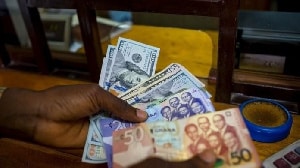
As compared to yesterday’s trading of a buying price of 9.0252 and a selling price of 9.0342. At a forex bureau in Accra, the dollar is being bought at a rate of 12.20 and sold at a rate of 12.90.
Against the Pound Sterling, the Cedi is trading at a buying price of 10.9974 and a selling price of 11.0102 as compared to yesterday’s trading of a buying price of 10.9611 and a selling price of 10.9739.
The Euro is trading at a buying price of 9.7659 and a selling price of 9.7755 as compared to yesterday’s trading of a buying price of 9.7181 and a selling price of 9.7286.
At a forex bureau in Accra, Euro is being bought at a rate of 12.20 and sold at a rate of 13.30.
At a forex bureau in Accra, South African Rand is being bought at a rate of 0.60 and sold at a rate of 1.00.
The Nigerian Naira is trading at a buying price of 50.9237 and a selling price of 51.0133 as compared to yesterday’s trading at a buying price of 51.0061 and a selling price of 51.0903.
At a forex bureau in Accra, Nigerian Naira is being bought at a rate of 13.00 Naira for every 1 Cedi and sold at a rate of 18.00.
She emphasized how the Bank of Ghana removes a failing institution from the system.
It’s crucial that the media guides the public conversation in a neutral and knowledgeable way.
Headlines like “Bank of Ghana has collapsed companies” are ones we’ve heard far too frequently. Bank of Ghana never lets anything go under. No. We supervise, we license, and when an institution fails, we remove it from the system in a way that doesn’t have an impact on the system, she said.
Read the full story originally published on October 13, 2020 by GhanaWeb
Second Deputy Governor of the Bank of Ghana (BoG), Elsie Addo Awadzi, has asked the media to use the right terminologies in their reports on the sector to send the right messages to the public.
Speaking at a media sensitization workshop organised by the BoG and associations representing Specialised Deposit-taking Institutions (SDIs), the 2nd Deputy BoG Governor said some headlines distort the salient point in an event within the sector.
“It is important that the media leads the public discourse in a dispassionate and expert manner…We have heard too often, headlines such as ‘Bank of Ghana has collapsed companies’. Bank of Ghana never collapses anything. No. We licence, we supervise and then when an institution has failed, we take it out of the system in a manner that does not affect the system.
“So do not say ‘Bank of Ghana has collapsed anything’. Bank of Ghana does not collapse anything. These institutions are run and governed by their shareholders, who put their Board of Directors and a team of management. So, they collapsed the companies. We don’t collapse the companies. It is important for the media to understand that,” she stressed.
The media sensitisation event brought together key players in the sector and presented a rare opportunity for the SDI associations to better explain their operations to the media.
It also enabled the media to ask appropriate questions of the key players in the sector and provide feedback to SDIs as to what the public thinks of their service.
Elsie Addo Awadzi said it is important that the media grows to become a key partner that understands the financial sector and the regulatory framework within which the financial sector operates.
“[The financial sector] is very different from other types of businesses and it is important that the media, when they engage in discussions related to the financial sector, they do so with an understanding of regulatory environment as well as the policy environment within which the financial sector operates,” she admonished.
IBHAG issues a warning, saying that disobeying it will result in its members mounting their strongest opposition to date.
In addition, the association urges all individual bondholders, whether or not they are IBHAG members, to resist the urge to agree to voluntarily exchange their current bonds for the new ones that the government has floated, despite the Minister of Finance’s subliminal threats.
According to IBHAG, most of its members are pensioners, traders, teachers, public servants, and individuals who have lost their jobs due to the unfavorable policies of the government.
Some are unemployed. Members have been able to make some savings from their sweat and toil, and have invested from as little as GH¢500 in bonds, only for government to rob them of their hard-earned savings – both interest and principal – using such an unconscionable debt restructuring process, which targets the individual.
“We cannot be made to suffer for the recklessness and greed that characterized Ghana’s excessive borrowing, which largely is the reason why we are where we are. Government appointees at the Ministry of Finance cannot make millions of dollars as transaction (borrowing) advisors and go and enjoy with their family and friends, whilst we are denied of the means to purchase our medications and pay for health care. Our inclusion means we cannot pay our children’s school fees, pay for our rent and many other critical essentials. All these hardships are being thrown at us just to protect the greed of those appointees”, a pensioner who is a member of the association said.
Furthermore, IBHAG maintains that the Akufo-Addo led-government continues to overspend by maintaining bloated government machinery made up of party boys and girls with outrageous pecks. Whilst they continue to enjoy, the individual bondholder is being robbed by the government of his or her hard-earned savings in broad daylight, whilst the pecks of the party boys and girls are protected.
The IBHAG calls on parliament, the Council of State, professional associations, religious bodies, Civil Society Organisations, the media and all well-meaning groups and individuals to join the advocacy against the looting of individual investments that the government has planned.
Meanwhile, we urge all members as well as new ones to remain calm – even as they refuse to sign onto the voluntary exchange of bonds – as IBHAG continues to seek audience with government on these vexed issues.
When the President assured the nation on December 5, 2022 that there would be no haircuts on investments, the bondholders pointed him to a petition that they had submitted.
The President advised that all reports of haircuts be discounted and disregarded. The government later declared that a restructuring is necessary due to the scale of its indebtedness.
However, the individual bondholders claimed that before the government announced their inclusion in the program on December 24, 2022, there had been no prior agreements with them.
They said: “But today, our coupons face absolute haircuts and when we discount your proposed benchmark bonds at the coupon rates of the original bonds, we are losing effectively 50% of our investments. When discounted at current T-bill rates, we are losing 71% of our investments, and at prevailing inflation, we face an 88.2% loss.”
This they noted was a complete deviation from what was promised by the government.
The bondholders in their petition want the government to exclude all individual bondholders of all types of government bonds from the domestic debt exchange programme.
They explained that individual bondholders are not a critical factor in the success of the programme.
“In our estimation, the direct individual bondholding and holdings through collective investment schemes stand at about GHS15.5bn, representing about 11% of the eligible bonds and the capitalized interest. With your set target of 80% of eligible bonds, Individual Bondholders are not a critical success factor to the viability of the DDE programme as you envisage, yet the impact of their inclusion has incalculable consequences. Please exclude us and save 1.3mn livelihoods and dependents from shackled penury,” they said.
The forum led by Senyo Hosi and David Tetteh pleaded with the President to ensure that it is “not said ever that during your tenure, your policies impoverished citizens whose primary duty to country was service and love through hard work and taxes. Your DDE as proposed for Individual Bondholders takes away our liberty to self-sustain, mocks hard work, and robs us of legally acquired property. None of these reflect the tenets of good governance.”
Using a credit card to buy goods online is safer than using a debit card. This is because any fraudulent transaction made using your debit card sees money withdrawn from your bank account but most credit cards come with fraud protection.
Make sure the shop site is secure
If you’re shopping online, you can protect yourself further by only shopping on sites with HTTPS as a URL prefix and a padlock icon to the left or the right of the URL. The ‘S’ in HTTPS stands for ‘Secure’. This signifies that communications between your browser and the website concerned are encrypted.
Update your operating system
Make sure your machine is running the latest version of your operating system and install system updates immediately. Updating your operating system ensures your machine has the latest software to protect itself.
Update your anti-virus software
An out-of-date virus checker is only marginally better than none at all. Hundreds of thousands of new variants of malicious software appear each year in addition to new strains, so the set of malware your virus checker knew about when you first installed it can get out of date very quickly.
Use complex passwords for each account
A recent article by NordPass reported that ‘password’ and variations of ‘123456789’ still rank among the most commonly used. Using capital letters, lower-case letters, numbers and special characters – such as an asterix or a question mark – make passwords much harder for hackers to crack.
Use a password manager
You probably have more accounts than you can remember; so, consider using a reputable password manager such as LastPass. Then use two-factor authentication – such as Google’s 2-Step Verification – to protect your online accounts.
Watch out for Flash
Adobe Flash, a tool used to create online games and animations, is one of the most common ways PCs get infected with malware. Think about disabling it. Adobe isn’t recommending the use of Flash anymore because of security concerns. Check your system.
Avoid putting PII on social media
PII is personally identifiable information, and hackers use this to help them crack passwords and work their way into your confidence for scams. Consider setting your social media profiles so that only friends can see what you put online.
The NPA explained the licences were revoked “for noncompliance with the rules and regulations of the Authority on the acquisition and maintenance of their licences”.
However, the authority has cautioned the public against transacting with the blacklisted OMCs.
It also noted that it will bear no liability for any loss or damage that may be suffered by any person who chooses to engage with the affected OMCs in whatever capacity.
The president addressed the difficulties facing the economy while speaking at a gathering with some African-American Harvard Business School students at the Jubilee House. “We’ve had difficulty in the previous few years trying to reorient our economy to thrive again.”
He stated: “Some basic statistics that you are all aware of have set us behind, including the global food crisis, the energy sector catastrophe, and many others, from which Ghana has yet to emerge.”
Giving an update on the IMF talks, Mr Akufo-Addo said: “We are going through the processes with the International Monetary Fund right now and hopefully, by the middle of this month or February, a full-blown IMF programme will be put in place which will help us repair our public finances which took a big hit from external forces.”
In December 2022, the IMF and the Ghanaian authorities reached a staff-level agreement on economic policies and reforms to be supported by a new three-year arrangement under the Extended Credit Facility (ECF) of about US$3 billion.
To support the objective of restoring public debt sustainability, the government of Ghana has launched a comprehensive debt operation.
In addition to a frontloaded fiscal consolidation and measures to reduce inflation and rebuild external buffers, the programme envisages wide-ranging reforms to address structural weaknesses and enhance resilience to shocks.
An IMF team led by Mr Stéphane Roudet, Mission Chief for Ghana, visited Accra from December 1 – 13, 2022, to discuss with the Ghanaian authorities IMF support for their policy and reform plans.
At the end of the mission, Mr Roudet issued the following statement:
“I am pleased to announce that the IMF team reached a staff-level agreement with the Ghanaian authorities on a three-year program supported by an arrangement under the Extended Credit Facility (ECF) in the amount of SDR 2.242 billion or about US$3 billion. The economic program aims to restore macroeconomic stability and debt sustainability while laying the foundation for stronger and more inclusive growth. The staff-level agreement is subject to IMF Management and Executive Board approval and receipt of the necessary financing assurances by Ghana’s partners and creditors.
“The Ghanaian authorities have committed to a wide-ranging economic reform program, which builds on the government’s Post-COVID-19 Programme for Economic Growth (PC-PEG) and tackles the deep challenges facing the country.
“Key reforms aim to ensure the sustainability of public finances while protecting the vulnerable. The fiscal strategy relies on frontloaded measures to increase domestic resource mobilisation and streamline expenditure. In addition, the authorities have committed to strengthening social safety nets, including reinforcing the existing targeted cash-transfer program for vulnerable households and improving the coverage and efficiency of social spending.
“Structural reforms will be introduced to underpin the fiscal strategy and ensure a durable consolidation. These include developing a medium-term plan to generate additional revenue and advancing reforms to bolster tax compliance. This will help create space for growth-enhancing measures and social spending. Efforts will also be made to strengthen public expenditure commitment controls, improve fiscal transparency (including the reporting and monitoring of arrears), improve the management of public enterprises, and tackle structural challenges in the energy and cocoa sectors. The authorities are also committed to further bolstering governance and accountability.
“To support the objective of restoring public debt sustainability, the authorities have announced a comprehensive debt restructuring. Sufficient assurances and progress on this front will be needed before the proposed Fund-supported program can be presented to the IMF Executive Board for approval.
“Reducing inflation, enhancing resilience to external shocks, and improving market confidence are also important program priorities. Accordingly, the Bank of Ghana will continue to strengthen its monetary policy framework and promote exchange rate flexibility to rebuild external buffers. As part of the authorities’ debt strategy, a domestic debt exchange has been launched. The authorities are committed to taking the necessary mitigation measures to ensure financial sector stability is preserved.
“IMF staff held meetings with Vice President Bawumia, Finance Minister Ofori-Atta, and Bank of Ghana Governor Addison, and their teams, as well as representatives from various government agencies. The IMF team has also continued to engage with other stakeholders. Staff would like to express their gratitude to the Ghanaian authorities, Parliament’s Finance Committee and all the private sector, trade union, and civil society representatives for their open and constructive engagement over the past few months.”
“In recent times, we have been witnessing significant difficulties in the management of the national economy,” President Akufo-Addo said during his speech. “This is largely due to the impact of the COVID-19 pandemic on the global economy, which has been exacerbated by the effects of the Russian invasion of Ukraine.”
Read the full story originally published on September 13, 2022 by www.ghanaweb.com.
Ghanaians have been reassured by President Nana Nana Addo Dankwa Akufo-Addo that their country’s economy will recover despite the devastating impacts of the worldwide pandemic, the coronavirus, and the Russia-Ukraine war.
He said though the economy has in recent times been fraught with several challenges, he is optimistic the challenges will soon come to an end.
“The basic commitment to resolving these challenges, within the framework of due process and democratic institutions, must remain unshaken. And, I am confident that, God-willing, we will overcome these challenges,” he stated.
On July 1, 2022, government decided to engage the International Monetary Fund for a financial bailout amidst the economic challenges.
Subsequently, a team from the IMF arrived in the country from July 6 to July 13, 2022, to engage Ghanaian authorities for a possible economic support programme
The IMF programme, government said is aimed at restoring macroeconomic stability and safeguarding debt sustainability among many others.
Meanwhile, Ghana is targeting an amount of $3 billion over three years from the IMF once an agreement on a programme is reached.
The new amount requested as a loan is double the government’s initial target of $1.5 billion.
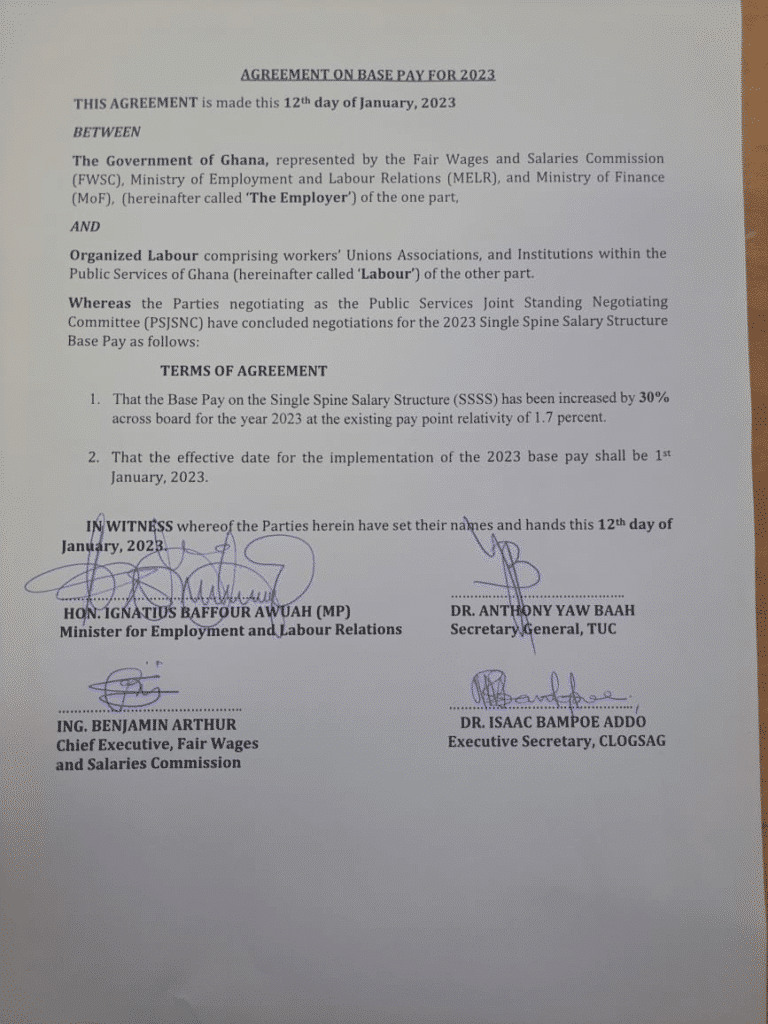
After numerous discussions and talks between the government and employees in the public sector, an agreement was reached.
Even though that was not what labor first requested, they did agree to a 30% increase in the Single Spine Base Pay for public sector employees beginning with the 2023 Fiscal Year.
However, Ofori-Atta said due to the current economic issues, this will have a significant impact on the economy even though it will settle all labour unrest in the year.
Per the agreement the 2022 Cost of Living Allowance (COLA) of 15 per cent on the base pay will be discounted.
The salary increment will however take effect from January 1, 2023, according to Minister of Employment and Labour Relations Ignatius Baffour-Awuah.
Mr Ignatius Baffour Awuah, Minister of Employment and Labour Relations, directed the Controller and Accountant General to effect the changes starting from the January 2023 payroll.
The deadline for voluntary participation in the Debt Exchange Program had been moved up by the government from December 30, 2022, to January 16, 2023. The Exchange is a program for renegotiating government debt. It should be mentioned that the government has experienced a severe economic crisis marked by elevated interest rates, skyrocketing inflation, a record-breaking devaluation of the cedi, and numerous downgrades of the economy’s credit rating.
This programme was introduced with the expectation that it would significantly reduce the burden of interest payments on the Ghanaian government and save approximately US$1.2 billion in interest between 2023 and 2028, or 7% to 8% of the country’s GDP.
If the debt exchange is successful, the government of Ghana will gain significant fiscal space, while local bondholders will suffer significant losses on their investment in government domestic bonds and notes.
• Offering accrued and unpaid interest on Eligible Bonds, and a cash tender fee payment to holders of Eligible Bonds maturing in 2023;
• Increasing the New Bonds offered by adding eight new instruments to the composition of the New Bonds, for a total of 12 New Bonds, one maturing each year starting January 2027 and ending January 2038;
• Modifying the Exchange Consideration Ratios for each New Bond. The Exchange Consideration Ratio applicable to Eligible Bonds maturing in 2023 will be different from other Eligible Bonds;
• Setting a non-binding target minimum level of overall participation of 80% of the aggregate principal amount outstanding of Eligible Bonds; and
• Expanding the type of investors that can participate in the Exchange to now include Individual Investors.
Impact on Individual Investors
The investing community, the most average Ghanaian, has raised concerns upon hearing this news of restructuring debts owed them by Government. Many people have imitated that this news will worsen their living conditions because they use these coupon payments to pay for expenses such as daily living cost, rent, school fees and a host of others.
Again, a good number of investors in government bonds are pensioners who have invested their pension payouts as a way to receive a periodic stream of income whilst on retirement. Others who require their investment for any profitable project will be impacted as well, as they will be unable to do so at this time.
Holders of bonds maturing in 2023 will receive coupons starting from 2027 to 2033, while those with bonds maturing in 2024 will receive coupons starting from 2027 to 2038.
Imagine a 62-year-old pensioner who owns a Government of Ghana (GOG) bond and will receive its full principal in 12 years. My question is, what happens to this pensioner if he or she dies before the 12-year period is up? This is the reality for many Ghanaians who have purchased GOG bonds. Many of these bondholders will suffer from depression and die prematurely as a result of this situation.
Impact on businesses
Companies that purchased bonds to fund future business expansion with principal payments will be unable to do so from now (2023) until 2027 because they will not be paid (except coupon payments) according to the terms of their bond. As a result, businesses will miss out on much-needed capital injections to help them expand.
This is likely to have an impact on productivity and, to a greater extent, lead to staff layoffs, because if a company is unable to meet its economic obligations or perform at its usual optimal level, the easiest way out is layoffs.
Impact on financial institutions
The financial sector, which includes stakeholders such as local banks, would be greatly impacted by the implementation of this domestic debt exchange, owing to excessive exposure to government-issued bonds. Bank capital reserves would be severely depleted, resulting in liquidity shortages and, in the long run, financial instability in the economy.
The depreciation of their restructured assets, such as government bonds, may cause the asset side of banks’ balance sheets to suffer a direct hit. On the liability side, banks may face deposit withdrawals and the interruption of interbank credit lines. These issues may jeopardize their ability to mobilize resources.
Way forward
The government needs to be more transparent about the bondholders’ choices if they choose not to accept the DDE. As it stands, the exchange document is not clear on what happens if a bondholder refuses the exchange.
The government should also give bondholders an opportunity to discuss and bargain the offered terms since, in my opinion, doing so will result in a fair resolution moving forward.
Also, government needs to assume more burden in resolving the current economic situation. The just-passed budget still has line items that can be shelved for now to create fiscal space to either continue paying investors their coupons and principals, or reduce the impact of the exchange program with favourable terms.
Additionally, I advise the government to immediately halt the Domestic Debt Exchange Programme and promote greater stakeholder involvement.
The group, which serves as an umbrella organization for private investors in the nation, claimed that the start of the debt restructuring project robs investors’ money of their freedom and then steals their property legally.
The DDE initiative does not reflect the principles of good governance on the side of the Akufo-Addo-led administration, according to a statement released and signed by the group’s convener Senyo Hosi.
“We (IBF) hereby humbly petition your office to reconsider your position in the DDE information memoranda of 24th December 2022 and as a matter of urgency grant the following:
1. The exclusion of Individual Bondholders from the DDE.
2. The exclusion of individual investors’ holdings in Collective Investment Schemes affected by the DDE.
3. The exclusion of individual investors’ holdings in the ESLA Bonds in the DDE.
4. The exclusion of individual investors’ holdings in the Daakye Bonds in the DDE.
5. The commencement of discussions and/or negotiations with our membership to discuss the above.
The IBF further noted that since the commencement of considerations and discussions on government’s debt restructuring in the second half of 2022, Individual Bondholders have not been engaged in the process.
“This is at variance with the contractual principles of good faith, fairness and best practices,” the statement stressed.
“The social impact of the DDE as currently presented for individuals is the harshest on any investor category and catastrophic to the livelihoods of the about 1.3 million direct and indirect bondholders and their dependents. Unlike other investor categories likely to benefit from the Financial Stability Fund, Individual Bondholders have no support to fall back on,” it added.
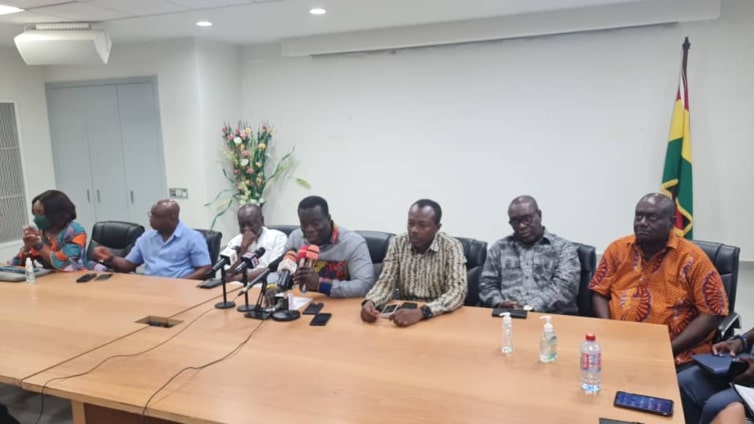
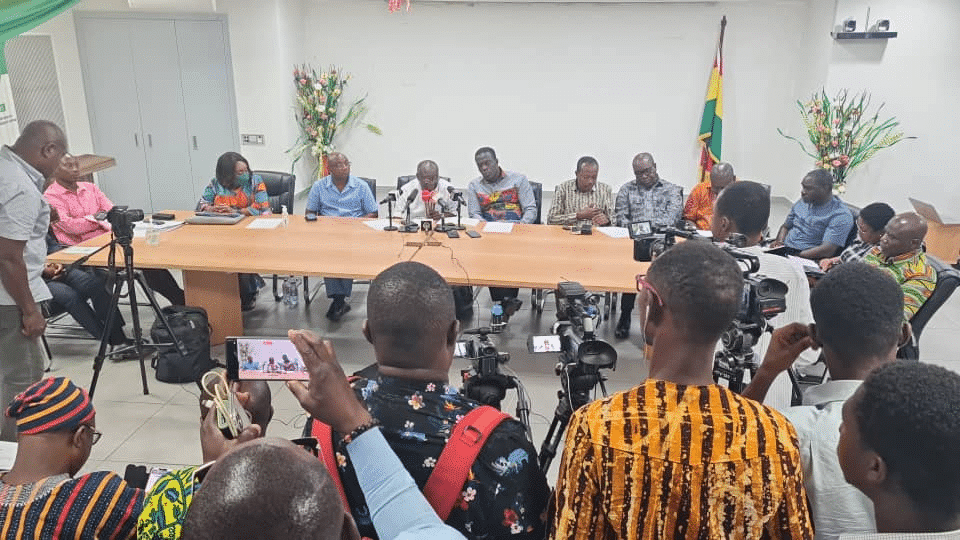
“The base pay has been increased by 30% for the 2023 financial year…As I said this brings to an end the 2022 COLA of 15% of base pay salary,” Employment Minister, Ignatius Baffour-Awuah announced shortly after the decision was taken.
Organized Labor initially requested a 60% percent increase and held firm to that demand despite numerous interactions with the government during the base wage discussions.
The public sector employees chose to lower their initial 60% demand to 58% after rejecting the government’s initial 18% offer.
Organized Labor did, however, agree to a 30% rise in the base wage after their meeting with the administration on Thursday, which also included Finance Minister Ken Ofori-Atta, who had skipped all previous meetings.
Dr. Yaw Baah, the General Secretary of the Trades Union Congress (TUC), thanked the government for this fresh step.
“The Leadership of organized Labour would like to express our sincere thanks to government for granting 30% increase in base pay for 2023 for public sector workers. We are happy that it has ended peacefully today.
“The 30% even though it is not what we want, it will create that opportunity for us to speak one language to work together.”
Executive Secretary of Civil and Local Government Staff Association, Ghana (CLOGSAG), Dr. Isaac Bampoe-Addo told the government delegation that, “we want to assure government that we will collaborate with them and come up with ideas to improve the revenue generation. We know the next time we meet for base pay negotiations, it will be a better story.”
The Finance Minister at the meeting noted that the increment will put a strain on the country’s finances.
“As I mentioned this will take a toll on the budget, but we are confident that we would enhance productivity and the commitment that we both have given to each other to make sure that there is peace in this country as we look at pension and labour issues.”
By this decision, the government said the 15% Cost of Living Allowance (COLA) for public sector workers has ceased.
While interacting with some students from Harvard University in the United States at the Jubilee House on Wednesday, the president said “as we speak and hopefully by the end of this month or latest by the middle of February, a full-blown IMF agreement will be put in place.”
President Akufo-Addo believes that the economic assistance will help “rebuild the confidence of outsiders in our economy and our own self-confidence in the manner in which the economy can proceed.”
The government has reached a Staff-Level Agreement with the IMF team, however, it is yet to be presented to the Fund’s Management and Executive Board for approval.
IMF’s Mission for Ghana, Stéphane Roudet, has revealed that government must first prove that “the programme is fully financed” and the “fiscal consolidation path, comprehensive debt restructuring that the authorities have launched will be sufficient to reestablish debt sustainability” before the Staff-Level Agreement can be presented.
Until then, Ghana would be unable to access the $3billion in its new three-year arrangement under the Extended Credit Facility (ECF) with the Fund.
He remains optimistic at a time when his government is yet to implement one of its debt restructuring measures, Debt Domestic Exchange. Debt restructuring is one of the conditions Ghana is supposed to meet before it receives support from the IMF.
There has been serious pushback from bondholders, who insist they will not sign on to the Debt Domestic Exchange programme.
Convener of the individual bondholder’s forum, Senyo Hosi has described the programme as suppressive and has urged individual bondholders to reject the offer.
“Anybody who’s been contacted by your bank, write back to your bank saying you will not accept it. Anybody who has his money in any of the funds, whether it is the data bank, M fund, or a balance fund, etc do not accept it. It does not augur well for your good or that sort of economy, you are under no compulsion to accept it,” he said.
The deadline for the invitation to the programme is Monday, January 16, 2023.
Source: The Independent Ghana| Andy Ogbarmey-Tettey
From January 1, 2024, to December 31, 2026, about 95 million USD of the entire sum will go toward HIV preventive and control measures, 18 million USD for tuberculosis, and 120 million USD for tuberculosis.
To access the funds, Ghana is requested to submit applications that captures the opinions, concerns, and suggestions on HI, . TB and malaria from a wider section of the populace.
He was speaking at the launch of the CCM country dialogue, which will take place in all 16 regions across the country as part of preparations towards the development of a funding request to access the funds.
He said the Global Fund had asked Ghana to develop a funding request through inclusive and transparent country dialogue with a broad range of stakeholders, including key and vulnerable populations.
Mr Hackman said due to high co-infection of TB and HIV, Ghana was required to submit TB/HIV as a joint funding request.
Mr Ernest Amoabeng Orstin, Vice Chairman of CCM, who spoke on behalf of the Health Minister, who is the Chair for the CCM, expressed concern about the resurgence of HIV in the country in the last few years.
He stressed the need for all to get involved to ensure a reduction in new infections in the three diseases, and end stigma and discrimination against persons living with the diseases.
Dr Francis Kasolo, World Health Organization Ghana Representative, in a speech read on his behalf, said an inclusive and transparent country dialogue with a broad range of stakeholders, including key and vulnerable populations was essential in ensuring effective programming and utilisation of investments towards the attainment of TB, HIV and Malaria-free Ghana by 2030.
“The dialogue when properly done shall produce a technically sound funding application, which is people centered and helps to accelerate national progress towards the elimination of the three diseases,” he said.
He urged the CCM to exhibit a high sense of nationalism and respect for differing opinions throughout the country dialogue process.
Ghana needs to find and place on treatment over 100,000 additional Persons Living with HIV to reach epidemic control.
“We need to find the missing TB cases and accelerate efforts towards malarial elimination,” he said.
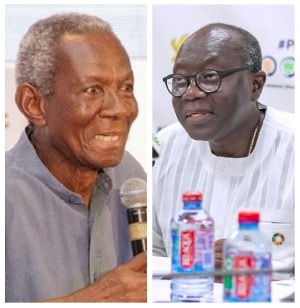
Akufo- Addo’s administration is allegedly in charge of overseeing the current economic difficulties without likely finding a way to address them, according to renowned economist Kwame Pianim.
He wants the Finance Minister [Ken Ofori-Atta], in particular, to apologize for the poor economic management since he thinks it is to blame for Ghana’s situation.
Kwame Pianim claimed in an interview with Accra-based TV3 that Ofori- Atta’s carelessness and irresponsibility put the nation in trouble; as a result, the country is planning to restructure its debt in order to secure a bailout from the IMF.
“…I would have been proud as a Ghanaian to contribute to the debt restructuring exercise but I will not contribute one pesewa for Ken Ofori-Atta leading this, he led us into the gutter…” he stressed.
“He should have said I apologise, this is the result of economic mismanagement. I apologise to Ghanaian people, look there are pensioners who have put their resources into government bonds, you’re asking them, I’m not going to pay, look at the exchange programme and think about it carefully when you are talking to your colleagues. Ken is saying, I’m not going to pay any interest on this for these years whiles I’m Minister of Finance and while President is still President but afterwards then you’re going to take a look at it.”
The renowned economist added that should the president continue to keep Ofori-Atta in charge of the economy, his administration will simply go down.
“The IMF, three billion that they’re going to give is, I want them to frontload it, so that I chop it before I go, is that genuine? Are you serious that this is genuine? If the President wants Ken Ofori-Atta to continue there, this government will go down with Ken Ofori-Atta”.
Touching on the appointment of Ofori-Atta as the caretaker minister of Trade and Industry, Kwame Pianim opined that the move was wrong on the part of the president.
“The first time Ken Ofori-Atta started, he said he was going to transform this economy from the Guggisberg economy to a new economy. He did not even understand what the Guggisberg economy was,” Pianim said.
He continued, “In the Guggisberg economy, he had a plan for cocoa, distribute cocoa, built roads into the villages, where there was timber he built the roads, then he built railways, he built the ports, he built Achimota school, built Legon infrastructure, by the time we got independence we had plenty of reserves.
“So, Ken Ofori-Atta if the monies he borrowed, if he was running a Guggisberg economy, we could have seen that cash flow coming out from the monies he was borrowing so that we can be able to repay. All the time he was borrowing recklessly. At the back of his mind was that he was not going to pay,” he bemoaned.
The purpose of indexation is to give retirees back the purchasing power they lost the prior year. Therefore, an inflation-adjusted index is used to examine pensions that are already being paid.
As a result, it is anticipated that SSNIT will soon announce the revised pension indexation rate for 2023 after consulting with the National Pensions Regulatory Authority (NPRA).
How is the Pension Indexation Provision Applied by SSNIT?
Pension indexation (as provided in section 80 of Act 766), as a means of restoring the purchasing power lost by pensioners in the previous year, is largely dependent on the price inflation index.
The overall indexation rate is based on the analysis of several variables which include in particular the projected increase in the cost of benefits for a given rate, and the resulting impact of the proposed indexation rate on the fund (fund ratios).
Given the Agreed ‘Overall Indexation Rate’, the ‘Fixed Rate’, which is equivalent to the Annual Average Price Inflation Rate of the previous year, and the ‘Flat Amount’ are determined.
EXPECTED INDEXATION RATE OF 2023
Likely Fixed Rate of Increase
As required by the Social Security Act, the Trust awards a fixed rate of increase for each pensioner based on average price inflation. In 2021, the consumer price inflation averaged 9.68% and therefore pensions were increased by a fixed rate of 9.68% in January 2022. In 2022, global economic challenges have eroded the purchasing power of pensioners due to rising prices of goods and services as measured by inflation.
The consumer price inflation averaged 29.40%. If SSNIT sticks to the provisions and practice (spanning from 1992), each pensioner on the pension payroll as at 31st December 2022 could see a commensurate monthly increase rate of 29%.
This level of indexation (29% fixed rate) could however expose the scheme to serious financial sustainability challenges (high inflationary risk). The Trust may apply a scheme sustainability adjustment factor (SSAF) in this year’s indexation.
The scheme sustainability adjustment factor essentially ensures that the awarded Fixed Rate of increment is lower than the actual average inflation rate of the previous year.
It is there expected that SSNIT might increase pensions by a fixed rate ranging between 20% to 25% in January 2023.
In 2023, and from a policy perspective, if pensions would be increased at a rate lower than the annual average price inflation (29%), it is expected that the Trust will clearly explain or communicate the reasons for changes in the basis of indexation to stakeholders, especially contributors and pensioners.
The minimum pension amount must be reviewed upward in 2023
Both the Social Security Law, 1991, (PNDCL 247) and the National Pension Act, 2008, Act 766 have provided for the payment of minimum pension to poor pensioners (poverty relief).
To practically sustain the economic welfare of pensioners, the minimum pension, which has stayed at GH¢300.00 for four successive years (2019, 2020, 2021, and 2022) needs to be reviewed significantly upward in 2023.
Note that the minimum pension of GH¢300.00 represents 30 dollars (using the current exchange rate) per month. This pension amount represents 50% of the value of the national poverty line.
Trend analysis shows that the minimum pension had consistently increased each year since 2000, and in some cases doubled (2013 and 2014). For the period 2016 to 2021, the minimum pension grew by only 9% whilst the minimum salary of active contributors increased by 47.75% within the period.
If the level of benefits provided by social protection systems is insufficient in terms of minimum living standards, or are not deliberately designed to protect the poor, and to minimize the social and economic inequalities between the rich and the poor the effort to reduce old age poverty will be jeopardized.
Following the implementation of the 1% levy on electronic transfers starting on Wednesday, January 11, 2022, the Ghana Revenue Authority (GRA) has guaranteed that it will repay all mobile money users who have been overcharged.
In the beginning, the Electronic Transfers Levy (E-Levy) was 1.5% on electronic transfers that were above the daily threshold of GHS100.00.
In April 2022, after the levy’s adoption, telecommunications firms recorded a loss of almost 300,000 mobile money subscribers, according to a Citi Newsroom article.
The levy was however reviewed and approved by parliament upon submission of the 2023 Budget by the Finance Minister, Ken Ofori-Atta and with a new rate of 1% instead of 1.5% decided on. The new rate took effect from Wednesday.
Speaking to Citi News, a Member of theE-Levy Technical Committee GRA, Opoku Afriyie Asante said they have put adequate measures in place to deal with the challenges of the revised levy.
“I would like to assure the general public that the Commissioner General is doing all that he can and if there are any system glitches the GRA would be available to reimburse if you are wrongfully deducted,” Afriyie Asante noted.
The authority is therefore calling on all mobile money customers and users of other electronic payment platforms to remain calm because all overcharged fees will be duly refunded.
He estimates that the 4,700 domestically built cars have expanded Ghana’s auto market to 9.7% of total sales.
He declared that this was admirable and a positive move.
He added that Ghana produces high-quality newly manufactured cars.
Announcing this at the inauguration of Ghana Automotive Industry Development Centre in Accra on Thursday, January 12, 2023, Mr Oppong Preprah said, “Our brand new vehicles locally assembled in Ghana is giving us a high quality standard of products and also a value for money…Looking at an account of this auto industry since 2019, 2020, to date, we have seen a total assembly of vehicles of 4,700 which is amounted to about 9.7 of our new car capacity, new car market in Ghana…”
“This is really a great start and we believe that this is going to continue whiles we have the implementation fully implemented..Some of our OEMs have already reached countries like Ivory Coast and Senegal as an export. this tells us we are going forward in the right direction,” he added.
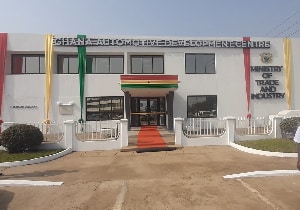
The Ghana Automotive Industry Development Centre was inaugurated by the outgoing Minister of Trade and Industry.
He stated this at the center’s inauguration on January 12, 2023, and claimed that the government’s action aims to turn Ghana into the region’s center of the automobile industry in West Africa.
He continued by saying that the newly opened Ghana Automotive Development Centre would act as the sector’s secretariat.
“Ghana is serious about becoming the manufacturing hub for auto at least in West Africa and that is why government has invested an amount of about US$8 million to acquire this facility to ensure that under one roof, the ecosystem to support this industry is present and provided,” Alan Kyerematen said.
“So this building is going to be the secretariat for the auto industry development council,” he added.
Speaking in the same vein, the President of the Automotive Assemblers Association of Ghana, Jeffery Oppong Preprah said about 4,700 vehicles have been assembled so far in Ghana.
The vehicles, he said, are of high quality, and buyers would have value for their monies after purchasing the locally assembled vehicles in the country.
Government invests US$8m into construction of Ghana Automative Development Centre – Alan Kyerematen
The Ministry claims that this is done to make up for the maturities being extended after it launched the debt exchange program.
The government announced 12 new bonds—instead of four—with a revised coupon rate structure are included in the Amended Exchange in an Amendments to the Invitation to Exchange sent to bondholders.
“Given that holders of Eligible 2023 Bonds are being asked to extend the maturities of what are now effectively short-term instruments, investors will receive a cash tender fee of 2% of the outstanding amount of such 2023 Bonds tendered and accepted, to compensate for the maturity extension,” it explained in the Amendments to the Invitation to Exchange.
“Investors indicated a preference for having more numerous bonds with standard bullet bonds, instead of fewer, larger, and more liquid bonds (the previous structure), which has been reflected in the amended exchange. In the same spirit, the amended coupon structure for the new bonds has been designed to mimic a yield curve with a standard shape,” the statement said.
The government announced on December 24, 2022, that individual bondholders who were initially exempt from the debt exchange programme were now included.
That meant that only Treasury bills are exempt from the programme.
Meanwhile, the individual bondholders have rejected the government’s decision.
The majority leader and Minister for Parliamentary Affairs, Osei Kyei-Mensah-Bonsu, has said that his caucus will be holding a final meeting to determine the next set of actions on their demand for the removal of Finance Minister Ken Ofori-Atta.
Speaking in an Oyerepa TV interview monitored by GhanaWeb, the majority said that the New Patriotic Party (NPP) Members of Parliament would engage the President, Nana Addo Dankwa Akufo-Addo, after the meeting.
“The decision for Ofori-Atta’s removal was a caucus decision… As a leader, I will be talking to the MPs on an individual basis, and we will put together their reservations.
“We still must have a caucus meeting (upon return) after which we will meet the president. And I believe that the right thing will be done,” he said in Twi.
The leadership of the NPP signed an agreement with the Members of Parliament of the party, which obligated them to be present for the reading of the 2023 budget by Finance Minister Ken Ofori-Atta.
A meeting between the lawmakers and leaders of the New Patriotic Party (NPP) was held on November 23, at which some agreements were reached.
The main points are that Finance Minister, Ken Ofori-Atta, will be supported in presenting the budget and seeing through its appropriation, as well as allowed to see through the current phase of negotiations with the International Monetary Fund (IMF).
The meeting was held on the back of a renewed call by some 98 NPP MPs, who threatened to boycott the budget presentation if Ofori-Atta presented it.
Meanwhile, Ofori-Atta has also been made caretaker minister for the Ministry of Trade and Industry after Alan Kyerematen’s resignation.
He asserts that the inflation rate may be slower during the first two months of the year before picking up steam in March.
We could be headed for a high in March 2023 if inflation continues to climb considerably more slowly than expected, at least in January and February of 2023. Myjoyonline.com quotes him as saying, “But things are still really fluid right now.
He hinted that Ghana’s inability to obtain an IMF bailout and the depreciation of the cedi could cause the economy to face new difficulties.
“We saw from March [2023], April [2023] last year, the rate of inflation was easing but then the depreciation [of the cedi] pressures set in. It appears if we could not achieve an IMF programme as soon as possible, the agitations could reemerge soon and that might mean more currency pressures,” he added.
The 54.1% is an increase from the 50.3% recorded the previous month – November.
The consumer price index, according to Ghana Statistical Service measures changes in the price of a fixed basket of goods and services purchased by households.
It further said the assumption is that the basket is purchased each month, hence as the price changes each month, the total price of the basket will also change.
In a press release sighted by GhanaWeb, it said, “year-on-year inflation rate for December 2022 was 54.1%. This means that in the month of December 2022 the general price level was 54.1% higher than in December 2021. Month-on-month inflation between November and December 2022 was 3.8%.”
Food inflation shot up from 55.3% to 59.7% whiles non-food inflation also rose to 49.9%.
Five divisions recorded inflation rates higher than the national average.
They were Housing, Water, Electricity, Gas, and Other Fuels (82.34%); Furnishings, Household Equipment (71.52%); Transport (71.42%); Personal Care, Social Protection, and Miscellaneous Goods and Services (60.94%) and Food and Non-Alcoholic Beverages (59.71%).
Individual bondholders continue to oppose being included in the government’s proposed Domestic Debt Exchange Programme (DDEP), claiming, among other things, that it is punitive and as such places them at an unfair disadvantage compared to institutional companies.
The Individual Bondholders’ Forum (IBF), a voluntary group of individual bondholders, has raised concerns about the programme; claiming it irreversibly takes away the wealth and livelihoods of its members.
The group also accused government of showing total disregard for their contractual rights, as well as making no effort to structure reasonable consultation or dialogue with them.
“This is only possible because of the absence of effective representation and the perceived ease of oppressing a dispersed section of investors into submission,” it stated in a statement – calling the situation “deeply troubling and wholly untenable”.
It is of the view that the medium- to long-term prospects and outlook of the domestic investment culture in the country will suffer badly if the DDEP initiative is allowed.
Consequently, the IBF has taken immediate steps in response to the DDEP, as it urges direct bondholders to reject and refrain from complying with the mandatory deadline.
The Group also encouraged indirect bondholders – such as investors in mutual funds, cash trusts and balanced funds – to inform their fund managers to reject the DDEP.
“The Domestic Debt Exchange Programme has been met with criticism and concern from various stakeholders in Ghana. This new development highlights the need for government and all stakeholders to engage in open and transparent dialogue in order to find a solution that will be beneficial for all. The Ghanaian economy is an important driver of the regional economy, hence any negative development in the country will have an impact on the region as well,” IBF added.
Pensioners
In a similar vein, another group – Pensioner Bondholders Forum – has petitioned government to exempt all pensioners holding sovereign Bonds from the DDEP; similarly to what was done for Pension Funds being regulated by the National Pensions Regulatory Authority.
The Forum, with a membership of over 200 pensioners and counting, strongly believes that the basis for exemption granted to pension funds holds good for exemption of the investments by pensioners in government bonds from the DDEP.
The basis for exemption of Pension Funds was to ensure that pension incomes to would-be retirees are not impaired for them to become a burden on others when on retirement.
The Convener of the Pensioner Bondholders Forum, Dr. Adu Antwi – a former Director-General of the Securities and Exchange Commission (SEC) – passionately appealed for government to exclude all pensioner government bondholders from the DDEP, as the programme’s impact on pensioners who are bondholders will be very severe.
“We have no regular source of income to support us in terms of our feeding, buying regular medications, paying medical bills and meeting other critical expenses. Most of us have made investments in Government of Ghana securities with the expectation that the coupons will supplement the meagre pensions we receive through the Tier One Pensions Scheme under the Social Security and National Insurance Trust (SSNIT),” he explained.
Highlighting the reason for opting to invest in government bonds, the Convener added: “These government bonds are considered everywhere as gilt-edged and the safest securities to invest in; and as pensioners we had the greater motivation to invest in these securities for both safety and liquidity considerations.
“Our monthly pensions from SSNIT have been eroded by inflation – to the extent that these coupons have become our core income while waiting for payment of the principal amount upon maturity,” he added.
Government’s initial announcement of invitation to the DDEP on December 5, 2022 affected only institutional bondholders. However, this was later extended to individual bondholders in the final week of last month. The deadline is 4:00 pm (GMT) on January 16, 2023.
Given the Amended and Restated Exchange Memorandum terms of the DDEP is an extension of 15 years, the Convener noted that most of the pensioner – who are equally vulnerable in society – will not live long enough to receive their investments in these government securities.
According to a report by Oxfam, the transparency was based on how the previous administration approached the fund by consulting with civil society organizations (CSOs).
He added that as an actor in the CSO sector, he agreed with Oxfam: “I also find that the current IMF process is the opposite: with zero govt interest in openness & engagement.”
Mahama government goes to IMF
In 2015, Ghana’s economy was in trouble, hobbled by widening current account and budget deficits, rampant inflation, and a depreciating currency. Credit dried up as interest rates rose and banks’ bad loans piled up.
At the root of Ghana’s woes was out-of-control government spending, largely to pay salaries of an overgrown civil service.
The program
In early 2015, Ghana turned to the IMF for a $918 million loan to help stabilize the economy. IMF advisors, working with the Ghanaian government, developed a three-part program:
Extract from IMF report: Box 2: Ghana
Of all the case studies, Ghana represented the most successful example of meaningful engagement between CSOs and the IMF. This success was due to several factors which collectively amplified the power of Ghanaian civil society with respect to the IMF.
These included: the formation of a joint coalition of over 11 CSOs in 2014, known as the Civil Society Platform on the IMF Programme – now the Economic Governance Platform (EGP); structured preparation and capacity building among the coalition prior to and during IMF engagement; the support of Global North actors such as Oxfam in accessing IMF decision makers and political stakeholders at headquarters level; detailed research and published analysis of the issues up for discussion;*# and public-facing awareness and advocacy campaigns which included experts and stakeholders from different sectors.
These combined factors meant the coalition’s goals and concerns could not be ignored.
The Civil Society Platform on the IMF Programme [the Platform’) was principally responsible for ensuring the success of civil society negotiations with the IMF.
He claimed that the difficulties facing Ghanaians would be addressed by these capable individuals managing the country’s economic affairs.
“The future looks promising and the personnel in charge of managing the economy is quite skilled. This budget, in my opinion, puts us on an unstoppable path toward independence from the government and individual enterprise. Generations of job searchers and job creators have passed, “Declared Ken Ofori-Atta.
Read the entire article initially released by GhanaWeb on December 6, 2021
Government committed to addressing Ghanaians’ challenges, Ofori-Atta
2022 budget sets the country on the path of irreversible transformation
Ghana recovering from the impact of COVID-19
Finance Minister, Ken Ofori-Atta, has quashed claims that the local economy is in shambles.
According to him, the Ghanaian economy is being managed by a team of competent people.
Speaking at a press conference Monday, December 6, 2021, the finance minister stated that the Akufo-Addo-led government is committed to addressing the problems of Ghanaians amidst the economic challenges.
Ken Ofori-Atta noted that the acceptance of the reviewed 2022 budget will set the country on a transformational path.
He said, “Government is very committed to addressing the challenges we face as a nation in sustaining our recovery from the impact of the pandemic within our fiscal consolidation and debt sustainability.”
“We have a very competent team managing the economy and the prospects are bright. I believe this budget sets us on the path of irreversible transformation from dependence on the state to individual enterprise. From generation of job seekers to generation of job creators,” he stated.
The budget presentation is in accordance with Article 179 of the 1992 Constitution and section 21 of the Public Financial Management Act, 2016 (Act 921).
On Wednesday, January 11, 2023, during trading hours, the Egyptian pound dropped more than 13% versus the US dollar as the central bank changed to a more flexible exchange rate in accordance with a financial support package from the International Monetary Fund (IMF).
According to Reuters, the Egyptian pound hits a new low of 32.14 to the dollar from about 27.60 at the opening of trade on Wednesday, with Refinitiv data showing the currency has fallen by a cumulative 51 percent against the dollar since March 2022.
The decline of the pound has prompted speculation as to how far the currency might fall. While some analysts hope that a weaker pound will attract foreign investment and encourage Egyptians working abroad to send more of their money back home, the reality is grimmer, as many are also concerned about the negative impact that the devaluation of the pound may have on the economy and the net worth of Egyptian businessmen, as well as their ability to attract foreign investments.
According to a recent report by Forbes, the Sawiris family, known as Egypt’s wealthiest family and the wealthiest family in the Arab world, saw their net worth drop by $800 million in 2022.
The combined wealth of the Sawiris family, which includes the fortunes of three Egyptian billionaires — Naguib, Samih, and Nassef Sawiris — fell by $800 million over the course of the year to $11.2 billion as a result of economic struggles faced by Egypt, including shortages of foreign currencies and a decline in the value of the local currency.
The Sawiris family was not the only African billionaire family to see a significant drop in net worth in 2022, as many, with the exception of the Egyptian billionaire Mansour family, saw a similar drop in net worth.
Ahmed Ezz, whose steel company Ezz Steel is listed on the Egyptian Exchange, is also one of Egypt’s richest men, whose equity investments saw a significant decline in market value in 2022 due solely to the depreciation of the Egyptian pound, and with the local currency’s recent decline to a new low, his net worth is expected to follow the downward trajectory.
The country reached an agreement with the IMF for a $3 billion financial support package in October, in which it agreed to shift to a “durably flexible” exchange rate. The rebound of the pound to about 29.60 to the dollar offered some relief, but the overall trend of devaluation continues to cause uncertainty and concern among those impacted by it.
The devaluation of the pound is a major concern for Egyptian billionaires and leading businessmen in the country, as it affects their net worth and the value of their assets. It’s also an indication of the broader economic struggles that Egypt is facing.
This replaces the fourth edition of the procurement list, which the Commission released in the first half of 2022.
According to Mr. Martin Kwaku Ayisi, Chief Executive Officer of the Minerals Commission, the Minerals and Mining (Local Content and Local Participation) Regulations, 2020(L.I. 2431) went into effect on December 22, 2020.
Pursuant to Regulation 7 of L.I. 2431, the Commission is required to publish a local procurement list which stipulates the goods and services with Ghanaian content which are to be procured in the country. Regulation 7(3) of L.I. 2431 further states that the Commission shall review the procurement list annually.
For instance, all mining companies are expected to ensure that at least sixty percent (60%) of financial services including revenue from the sale of minerals go to the local Banks. He indicated that the receipts from the sale of minerals is over US$ five (5) billion dollars a figure which is likely to go up significantly as new mines come on stream and the existing ones are expand their operations, the local banks such as CBG, National Investment Bank, Ghana Commercial Bank and Agricultural Development Bank are likely to benefit greatly.
The same applies to insurance services which also require a minimum of 60% of all insurance and reinsurance placements be made with Insurance companies exclusively owned by Ghanaians.
Mr. Ayisi, in a statement said the increase in the items on the list comes at the time when receipts from mineral revenues and investments hovers around US$ 10 Billion. For instance, there are four huge new projects with investment of about US$ 1.7 billion.
The new projects are the US$ 850 million Ahafo North gold mine project by Newmont Ghana Gold Limited, US$ 500 million gold project currently under construction by Cardinal Namdini Mining limited in the Talensi District of the Upper East Region, the US$ 200 million gold mine to be constructed in the Upper West Region and the US$ 125 million lithium project at Ewoyaa in the Central Region.
Additionally, Mr. Ayisi stated that some mines are undertaking expansion and redevelopment. The undergoing expansion include the Ahafo South mine of Newmont which now covers the Subika underground. Golden Star Resources is spending about a billion dollars to expand the Wassa underground mine.
The mines being redevelop are the Anglogold Ashanti Obuasi mine where a billion dollars has been expended and the the Bibiani mine of Mensin Gold Ghana Limited which started production in the last quarter of 2022. The redevelopment of the Bibiani mine is over US$200 million dollars
It is the expectation of the Minerals Commission that these investments will support the growth of the economy and boost local participation under the new procurement list.
Participating holders of the 2023 bonds will receive a 2% cash fee, the Finance Ministry has said.
This is to compensate for the maturity extension.
It said the investors will only get new bonds maturing between 2027 and 2033.
“Given that holders of Eligible 2023 Bonds are being asked to extend the maturities of what are now effectively short-term instruments, investors will receive a cash tender fee of 2% of the outstanding amount of such 2023 Bonds tendered and accepted, to compensate for the maturity extension”, it explained In the Amendments to the Invitation to Exchange.
It emphasised that the government has decided to proceed with paying interest accrued up to January 24, 2023 to all Eligible Holders participating in the exchange, in a capitalised form. This means that the accrued interest will be added to the notional amount of the new bonds.
The Invitation to Exchange also stressed that there are 12 new bonds in the Amended Exchange, instead of four, with a new coupon rate structure.
“Investors indicated a preference for having more numerous bonds with standard bullet bonds, instead of fewer, larger and more liquid bonds (the previous structure), which has been reflected in the amended exchange. In the same spirit, the amended coupon structure for the new bonds has been designed to mimic a yield curve with a standard shape”.
Meanwhile, treasury bills remain still excluded from the domestic debt operations.
The increment was decided after deliberate engagement with the National Pensions Regulatory Authority in accordance with Section 63 (3) of the National Pensions Act 2008, according to a statement released by the Trust and seen by GhanaWeb Business (Act 766).
According to SSNIT, the minimum insurable earning for 2023 has also been raised from Ghanaian currency (GH365.33) to Ghanaian cedi (GH401.76), in line with the increase in the National Daily Minimum Wage that was announced in 2022.
The warning appeared in the January 2023 Global Economic Prospects report from the World Bank.
The research stated that “large current account deficits are anticipated to keep currencies under pressure in a number of countries, adding to inflation and external vulnerabilities (Gambia, Ghana)”.
The World Bank also stressed the implementation of policies targeted at boosting exports to narrow the current account deficit, while controlling excessive importation.
It noted that the implementation of these measures and policies must check rising inflationary pressures which could peak in the coming months thereby negatively impacting the local currency.
Meanwhile, the cedi has begun to experience some marginal depreciation against the US dollar since the start of 2023.
The currency is selling for around GH¢12.45 to $1 on the forex market while going for GH¢9.00 on the Bank of Ghana interbank forex market.
As of January 12, 2023, the British Pound is selling at GH¢14.70 on the forex retail market while the Euro is going for GH¢12.80 on the forex retail market.
He further accused politicians of hoarding dollars, leading to the depreciation of the cedi.
Speaking at the maiden edition of the McDan Business Forum, Kofi Amoabeng said “Ghana exchange rate regime is a pathetic one. The so-called politicians are the ones hoarding the dollars, but it’s seen out there as if they are not the cause of all this. Corruption is part of our problem and we need to work on it”.
“One thing that causes big demand for dollars is corruption. All the money they are making and stealing are not in cedis but in dollars…They must change dollars. So they hide it under their beds and when they get the opportunity they put it outside”, myjoyonline quoted him to have said.
It would be recalled that on October 20, 2022, Bloomberg reported that the cedi had diminished in value by 9.6%.
The news portal said it makes the total loss of the cedi in 2022 almost 52%, the highest recorded in 22 years.
The free fall of the cedi now places the currency at the 148th position of worst-performing currencies in the world.
“The currency depreciated as much as 9.6% on Thursday, heading for its biggest decline in 22 years. That took losses in 2022 to nearly 52%, the worst performance among 148 currencies tracked by Bloomberg,” the news portal reported.
During the same period, a committee was formed to hold talks with domestic bond investors on debt management strategy and how to negotiate the deal with the International Monetary Fund (IMF).
Businessmen and economist, Dr Kofi Amoah, has urged persons and institutions who have been affected by the government’s debt exchange programme to fight the injustice and raw deal that has been handed them.
According to Dr Amoah, it is unconscionable that one of the supposed safest investments – government instruments- can go so horribly wrong that a debt exchange programme has to be instituted.
In a tweet shared on his personal and verified page this week, Dr Amoah said the consequence of the exchange programme is far-reaching and damning. “Ghanaians must not sit and accept financial injustice from their govt. Everywhere in the world, investing in govt financial instruments is considered the safest investment with the assured payback of investors’ funds.”
Explaining further when contacted by GhanaWeb, the former president of the GFA Normalization Committee said there is a danger of eroding the savings culture of many Ghanaians due to this debt exchange programme.
“Ghana cannot become an outlier in this globally recognized comfort zone unless we want to be counted among the failed and misgoverned countries of the world. There are far-reaching negative consequences for such behaviour.
Govt must choose paying its debt to haemorrhaging individual bondholders over spending billions on some ill-conceived, unsustainable projects calculated to win some legacy points for politicians and their political parties.”
He urged right-thinking Ghanaians to join those affected by this policy to fight against this policy which he says would be detrimental to many people and households. “When they come for me in the day and you say nothing because it’s not you, they may come for you in the thick of night and no one can see or come to your aid”.
The Habit of Robbing Individuals’ Hard-earned Money to Finance Over-bloated, corruption-laden projects Must be Halted
Support Lawyer Kpebu in assisting people get their money taken with force by govt
Govt debts are supposed to be the safest everywhere???????? https://t.co/VLh1JMm9fS
— CitizenKofi (@amoah_citizen) January 10, 2023
Debt Exchange
On December 5, 2022, the Government of Ghana launched Ghana’s Domestic Debt Exchange programme, an invitation for the voluntary exchange of approximately GHS137 billion of the domestic notes and bonds of the Republic, including E.S.L.A. and Daakye bonds, for a package of New Bonds to be issued by the Republic.
In a statement released after the announcement of the debt exchange, the finance minister, Ken Ofori Atta explained why the policy has become imperative.
“The objective is to reduce the excessive burden created by our debt on our economy and reach the debt sustainability targets defined by the IMF staff for the period through 2028 and beyond. In particular, to restore debt sustainability, we plan to reduce our total public debt-to-GDP ratio to 55% in present value terms.”
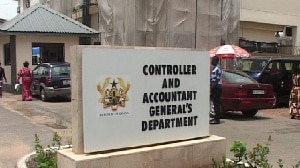
According to the Concerned Staff of the CAGD, they will advise themselves if the 2021 and 2022 honorarium are not paid.
In a petition to the CAGD Directors and MoF, dated Tuesday, 10 January 2022, the concerned staff noted that: “Having been denied our 2021 honorarium for the first time in the history of CAGD, we the concerned staff of CAGD wish to unequivocally state that any attempts by the Management of CAGD and the Ministry of Finance (MoF) to once again deny our hardworking staff of this age-old ‘solace’ would not be tolerated.”
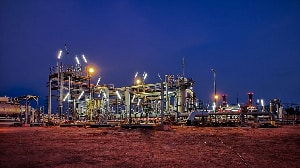
The shutdown is to allow for the replacement of some critical valves at the Takoradi station.
This is aimed at securing the safety and integrity of the station.
According to management, during the 10-day shutdown period, there will be no gas transportation from the Takoradi facility to customers in the Tema power enclave.
In a statement, WAPCO said: “We will, however, continue to deliver gas from Nigeria to Tema based on volumes agreed between the customer and the shipper.”
It indicated that: “This shutdown is supported by the Ministry of Energy (MoE) and coordinated with Ghana Grid Company Ltd (GRIDCo), the Volta River Authority (VRA), the Ghana National Petroleum Corporation (GNPC), Electricity Company of Ghana (ECG) and other key stakeholders to minimise the impact of the shutdown on communities that rely on power generated from cleaner and more efficient gas transported through the West African Gas Pipeline (WAGP).”
WAPCo apologised to its “customers in Tema for the inconvenience that may be caused by the planned shutdown.”
“We will work collaboratively with our contractors to ensure that the shutdown activities are safely executed and within the timeline stated herein,” WAPCo assured.
The statement added: “Gas supply would be immediately restored after completion of the maintenance works and commissioning of the Takoradi facility.”
Alan Kyerematen, the outgoing Minister of Trade and Industry addressed Ghanaians on Tuesday, January 10, 2023.
Alan Kyerematen, among other things announced his intentions to contest the flagbearer slot of the New Patriotic Party.
Below is his full speech
NATIONAL BROADCAST BY HON. ALAN KYEREMATEN, OUTGOING MINISTER FOR TRADE & INDUSTRY
FELLOW COUNTRYMEN & WOMEN
FRIENDS OF GHANA
Let me start first by wishing you all a happy, healthy, productive and a prosperous New Year.
Secondly, I wish to express formally, my profound gratitude to His Excellency the President for the opportunity given me to serve the good people of Ghana in his Administration over the last six years, and for graciously accepting my resignation as Cabinet Minister responsible for Trade and Industry, with effect from 16th of January 2023.
Thirdly, I wish to use this platform to formally announce my decision to contest the flagbearership of the New Patriotic Party when the Party officially opens nominations for that purpose.
His Excellency the President, Nana Addo Dankwa Akufo-Addo has been a good friend of mine and will always remain so based on our shared commitment to the ideals and principles that inspired the founding fathers of our great Party, the New Patriotic Party (NPP). We have competed in the past but have always worked togetherthereafter.
The President has laid a strong foundation for the socioeconomic development of our country, although I believe there are things that could have been done differently. My vision is to build a superstructure on this foundation that will bring prosperity to our nation.
The pre-COVID-19 performance of our economy, the flagship programmes including the Free SHS, the One District One Factory (1D1F) Initiative, the Planting for Food and Jobs programme, the Agenda 111 project and the COVID-19Response initiatives, are all testimonies of the strong leadershipthat the President has provided over the last six years.
In spite of all of the above however, it is an undeniable fact that the combined effect of the COVID-19 Pandemic and the Russia-Ukraine war has stampeded our country into a crisis of unprecedent proportions, with its negative impacts on the economy, on businesses, and on our social lives.
I have no doubt that the anticipated International Monetary Fund (IMF) Support Package will restore confidence in our economy, and bring it back to the pre-COVID levels.
Fellow Countrymen and Women
This is the seventeenth time that we have gone to the IMF over the last 57 years. We promised never to go back but we have gone back. One of the lessons that we have learnt from the recent developments is that Ghana’s economy is still fragile, vulnerable and susceptible to both external and domestic shocks.
This primarily is as a result of the fact that our economy is highly dependent on the export of commodities with little or no value addition.Indeed, the 5.1% projected GDP growth for the Ghanaian economy for 2023 is based on the anticipated increase in commodity prices.
To avoid going back to the IMF, we need a new Plan. A Plan that will lead us to a more self-reliant and resilient economy. That Plan must move Ghana fromStability and Growth to Transformation.
Fellow Countrymen and Women
If by the will of God and through your goodwill, I am voted first, as the flagbearer of the NPP and subsequently as President of the Republic in the next general elections, I will become the transformational leader of our time, who will build on the foundations laid by successive leaders of our nation over the last sixty-five (65) years.
To achieve this strategic goalof transforming our dear country to become the shining star of the new Africa, I will as President, launch and lead the execution of the Great Transformational Plan (GTP) of Ghanawhich will span the period 2025 to 2030.
The Post-COVID Economic Recovery Programme(P-CERP)currently being implemented with the anticipated support from the IMFfrom 2023 to 2025, will be a transitional economic programme leading to the roll out of thisGreat Transformational Plan.
Fellow Countrymen and Women
Before I proceed to provide a brief insight into the key elements of the Great Transformational Plan, seven critical considerationswould need to be taken into accountto guarantee the success of the Plan.
The primacy of the Private Sector in our national development agenda. The Private Sector, both domestic and foreign, formal and informal has to be at the centre of our transformational agenda. The Government’s focus must be to facilitate the process of making our private sector competitive, by creating an enabling environment for businesses. Attitude to work and enforcement of discipline. We as a people should appreciate the need for discipline in all spheres of our national lives and change our attitude to work. Whether you are working for the Private sector or for Government, as a worker, you are not doing a favour to your employer.It is your duty to ensure that you earn your living from the efforts of your labour. Corruption and petty theft or thievery, particularly from the public purse,deny our country the benefit of utilizing its tax revenue and other resources for the development of our country. The arrogance of power has been a major obstruction to progress in our country. People in positions of authority must understand that leadership is an opportunity to serve the people, and not to lord over them. In servant leadership, humility is an asset and not a weakness. Passion for excellence.As a country we must celebrate competence and excellence and not mediocrity. As a people, we must focus more on getting things done than talking. Ghana is gradually becoming a NATO country – “No Action Talk Only”. We need to remember that theuse of time is a zero-sum game. What Ghana needs now are solutions and actions not debates. And last but not the least, our politics in Ghana is too divisive. This keeps out some of our best talents in offering themselves for political appointments. Yes, we pride ourselves as being the bastion of democracy in Africa, but that does not mean that we should allow partisan politics to destroy our collective interests. These seven critical considerations outlined above,will provide what I will describe as the ‘soft power’for the effective implementation of our Great Transformational Plan.
Fellow Countrymen and Women,
Let me now provide a brief synopsis of the Great Transformational Plan (GTP). The GTP will be anchored on the following key pillars:
A Strong Macroeconomic Environment: The success of the GTP will depend primarily on strong macroeconomic fundamentals, which will include among other things, a stable currency, low inflation, sustainable debt levels, revenue optimization and tight expenditure control to guarantee fiscal balance, low competitive interest rates, strong external reserves backed by high levels of liquidity to support the financial sector. To a large extent, the IMF support programme when fully executed, will create the appropriate conditions that will underpin the Great Transformational Plan.
A New Agricultural Revolution (NAR) for Ghana: The NAR will be based on five critical elements. Introducing Technology and Innovation into Agriculture, through Research & Development (R&D) in Agronomy, Mechanization, Irrigation, and Plantation Management. This will build on the foundation laid by the Planting for Food and Jobs and Planting for Export and Rural Development (PERD) Programmes. Our farmers cannot be competitive without technology and innovation. The establishment of Licensed Food Distribution and Marketing companies by the Private Sector throughout the country at the district level, to be supported by the Government. These companies will constitute a vital link between farmers and Market Queens in the urban and peri-urban areas.
It will be complemented by the introduction of a digitalized food distribution and marketing online platform which will connect producers to buyers and consumers. The strengthening of the Ghana Commodity Exchange as the marketplace for all actors in the Agricultural value chain. Deepening the current regime for lending and financing for the agricultural sector. Enhancing the de-regulation of the Cocoa sector by deepeningprivate sector participation in the buying and marketing (including export) of Cocoa. Mass Citizens participation in Agriculture by introducing an ‘Operation Own a Farm’programme for the Ghanaian citizenry in general. Industrial Transformation: This will build on the successes of Government’s Ten Point Industrial Transformation Programme including the One District One Factory (1D1F) initiative;the establishment of Strategic Anchor Industries to diversify the economy beyond Cocoa and Golde.g the Automobile assembly, Garment and Textiles, Pharmaceuticals and the Petrochemical industry;enhancing the growth and development of Small and Medium Enterprises;establishment of Industrial Parks and Special Economic Zones; and supporting Domestic Retail Trade and Distribution. Accelerated Infrastructure Development:Promoting Private sector financing for public infrastructure such as Roads, Railways, Ports and Harbours, Water Supply Systems, Public Housing etc, which will reduce Government’s exposure to the financing of such infrastructure projects.
Digital Mainstreaming: Digitalization will be mainstreamed in all Government and Public sector activities, building on the current work led by the Ministry of Communication and Digitalization. Energy Security and Diversification: Greater emphasis to be placed on developing renewable sources of energy, by fast-tracking the execution of Government’s energy transition strategy, including but not limited to nuclear and hydrogen energy. Decarbonization and Climate Resilience: Scaling up Government’s current efforts at reducing Ghana’s carbon footprints and facilitating access to the carbon trading markets, as well as establishing mechanisms to strengthen the country’s preparedness against the negative effects of climate change.
National Security and Defence Optimization: Deploying resources to strengthen National Security and Defence Mechanisms and Infrastructure, to deal substantively with emerging security threats and challenges, particularly in the Sahalian region. Downsizing Government: The architecture of Government will be overhauled by consolidating some existing Ministries, Departments and Agencies.This will mean running a lean Government structure that will ensure operational efficiency and effectiveness in the delivery of Government services. Strategic Engagement with the International Community: Ghana’s diplomatic and economic relations with the International Community under the GTP will be predicated on the principle of ‘positive neutrality’, based on the strategic interests of Ghana, as well as our shared commitments for the preservation of peace around the world and respect for humanity. I will in the next several months provide further details of this Great Transformational Plan in the new ‘Alan K Prime Time Talk Show’to be introduced. I will also seek inputs from the people of Ghana as I go round in the regions and districts on my campaign tours.
Fellow Countrymen and Women
The execution of the GTP will require our collective efforts, irrespective of political orientation, ethnicity or religion. It will lead to a new dawn of Restoration, Rebuilding and Reward.
The future of our country is bright. I want you fellow countrymen and women,to make me your next President when the time comes, and you will see a significant difference in your lives.
Fellow Countrymen and Women,
I want you to invest in your own future by supporting my campaign. I will therefore be launching a mass“Ketewabiaransua” Campaign and “Adopt a Constituency Initiative”, which will afford Ghanaians from all walks of life the opportunity to be part of my campaign.
For all those who will have the honour and privilege of being Delegates to select the Flagbearer of our great Party, the NPP, please remember, Alan Kyerematen is your Candidate to win power for you in 2024.
Together We shall break the Eight!
As we do say in our local Ghanaian dialects:
#Akyeanaemmui(symbolizing Hope) #Mu sadaqa da yo; sabodaanfaani go be! (Let’s Sacrifice for the future) #Èkpè deka metunahò(r) o! (a symbol of unity and collective effort) #Mòfiaamòbaayenii! (we shall all enjoy) God bless our homeland Ghana and make our nation great and strong!!
In a year when government and theInternational Monetary Fund (IMF) are expressing differing sentiments about Ghana’s economic prospects following a difficult 2022, it is obvious that 2023 is going to be full of uncertainties.
While government is bullish that the US$3billion bailout programme it agreed with the IMF at staff level last December can restore much-needed stability following a disastrous 2022, when inflation reached over 50 percent, the Bretton Woods institution on the other hand is predicting a difficult year ahead. Come what may, the economy’s various sectors will be impacted to varied degrees depending on both internal and external factors.
The Business and Financial Times (B&FT) takes a dive into the economy’s various sectors and offers brief outlooks as to what to expect in 2023. Enjoy the read.
The Q3 2022 GDP marked a slowdown from the 6.5 percent growth rate seen in the same period of 2021 – the lowest in eight quarters during the COVID-19 pandemic and since 2020 Q3 when GDP logged at -3.3 percent.
Through 2023, the reduced growth will come on the back of rising price pressures and monetary-tightening weighing on private consumption and investment, and as government spending declines. Government is anticipated to resume rigorous fiscal consolidation while continuing its attempts to rationalise expenditures.
Additionally, it is anticipated that the central bank’s hawkish monetary policy stance, which it has adopted to stabilise the cedi and control inflation and expectations, will have a negative impact on the expansion of private-sector lending.
During 2022, the central bank cumulatively increased the benchmark policy rate by 1250 basis points to 27 percent – the highest rate in almost two decades. Inflation currently sits at 50.3 percent, thus 5.1 times outside the upper limit of the central bank’s medium-term inflation target band, and continues to adversely impact economic activity and consumer behaviour.
The central bank has noted that it may remain hawkish at least through Q1-2023 until inflation shows signs of moderation, and the implementation of other available monetary tools to control money supply and rein-in inflation take effect.
The tighter monetary policy stance of various central banks around the globe, and global recession risks, could also potentially weigh on Ghana’s economy. The central bank expects inflation to peak in Q1-2023, then decline to around 25 percent by the end of 2023.
Effectively, the Q4-2022 growth outturn is expected within the band of 1.7 percent to 2.5 percent year-on-year, given the factors at end-2022.
Debt restructuring
Due to the country’s high risk of debt distress and urgent need for IMF assistance, it is anticipated that the US$3billion deal will be approved by the Fund’s executive board by mid-2023 after a staff-level agreement was approved in December 2022. However, a successful debt restructuring is still essential.
Financial sector to remain under immense pressure in 2023
The financial sector is set to come under scrutiny as the country navigates economic uncertainty, with banks and the broader securities industry set to come under sustained scrutiny.
The Bank of Ghana’s Monetary Policy Report shows that despite a robust performance in the first 10 months of 2022, when the value of the industry’s assets accelerated to GH¢249.9billion, cracks had begun to appear in the once-resilient sector.
Currently, banks are rebalancing their portfolios and cutting back on new advances due to increasing pressure and a decline in Capital Adequacy Ratio amid concerns over Non-Performing Loans. This trend is expected to continue.
The Domestic Debt Exchange Programme will also put additional pressure on this segment, since commercial and rural banks as well as institutional investors hold about 60 percent of the nation’s domestic debt.
Deposits, which remain a major component of banks’ funding mix, are anticipated to take a hit as customers hold onto cash due to increasing lack of confidence. However, the likelihood of a run on banks remains very unlikely.
Despite the industry’s NPL ratio declining from 16.4 percent in October 2021 to 14 percent in October 2022, the nominal stock of NPLs increased to GH¢11.3billion in October 2022 from GH¢8.4billion in October 2021. Analysts remain concerned that tighter economic conditions will only raise the stock further.
However, to further alleviate thissituation, the Bank of Ghana has granted relief measures such as reducing the Cash Reserve Requirement ratio and access to a GH¢15billion Financial Stability Fund (FSF). Although analysts have already expressed concern about the source of funding for the FSF, particularly as none of the development partners which have been touted to contribute to it has yet to make any commitment.
On the stock market front, where a loss of 12.38 percent was recorded in 2022 compared to more than 43 percent gain in 2021, limited activity is expected this fiscal year – while financial and technology stocks are anticipated to be bright spots.
Unlike technology stocks, however, financial stocks are expected to experience some level of pressure from uncertainty in the wider industry. The consensus among industry experts is that, irrespective of the direct economic losses the financial sector might experience in the medium term, the loss of investor confidence will pose the biggest challenge this year and beyond.
Tricky year ahead for mining
Locally, the mining industry is undergoing a number of reforms – including the domestic gold purchasing programme and ‘gold for oil’ barter policy.
While the policies are envisioned to build on the country’s gold reserves, compel miners to retain at least 20 percent of their revenue in local currency, ease pressure on the cedi and ultimately help to restore economic stability, the Ghana Chamber of Mines says compelling its members to retain a high percentage in cedi could have negative repercussions for the industry, due to its wobbly nature.
Other challenges like the ongoing redundancies of mine workers and illegal mining remain a threat to the sector’s future. Gold output for 2022 is projected at 3 million ounces, up from 2.7 million in 2021.
Energy sector faces daunting future
The energy sector – comprising petroleum upstream and downstream and power (electricity), ideally should be at the centre of what is seen as a ‘year of bouncing back’ from the shackles of 2022. However, the sector faces mounting challenges ranging from dwindling production volumes, high cost of fuel and lack of liquidity in the power sector, among others.
In the upstream sector, the first three quarters of 2022 saw windfall revenue of US$1.6billion, US$550.5million more than 2021, due to high international prices but against a lower output. Should this price surge trend continue in 2023, industry watchers expect that the impact of dwindling production volumes will not be felt.
However, given that demand and supply uncertainties remain a concern owing to the Russia-Ukraine conflict, the COVID pandemic and expected global economic recession, a fall in international oil prices could spell doom for government.
This could be exacerbated by the falling production volumes, with Ghana having failed to add to its three producing fields – Jubilee, TEN and Sankofa – since 2018. The situation, compounded by government’s reluctance to incentivise exploration according to the Ghana Upstream Petroleum Chamber, does not portend well for the upstream industry.
Similar to the upstream industry, the downstream faces price volatility challenges which could make or undo government’s efforts to restore microeconomic stability.
Crude prices on the international market are expected to remain stable in the first quarter of 2023, which should be welcoming news for local consumers; but going into the rest of the year, China’s easing of economic restrictions and the EU’s sanctions on Russia may drive prices up. The expected contraction in the global economy, which is likely to drive down demand, may also bring about lower prices.
Meanwhile, the defining moment for the power sub-sector rests on whether government can settle its indebtedness to independent power producers, which currently stands at over US$1billion.
The quarterly review of utility tariffs – where a substantial hike in tariffs is expected in the coming weeks on the back of rising inflation, currency depreciation and high fuel prices – could further increase the burden on consumers. Equally important to the power sub-sector’s future will be how the Electricity Company of Ghana can effectively collect revenue to pay for the power it buys from power producing companies.
Agriculture
Although government spending on the agricultural sector in 2023 has increased marginally to 1.95 percent above the previous year’s figure of 1.86 percent, many industry players believe more funding is needed.
Ghana is a signatory to the Comprehensive African Agricultural Development Programme of 2003 (Malabo Declaration), in which member-countries were expected to increase agricultural investment to 10 percent of annual budgets to culminate into, at least, six percent growth in the sector annually; but the country has failed to do so since then.
Though it is unlikely that government will prioritise financing in the agricultural sector, it is still necessary that spending in the sector increases from the current 1.86 percent. This will ensure the necessary measures are put in place to ensure food security going forward.
Meanwhile, the Managing Director for GIRSAL, Kwesi Korboe, indicated last year that 2022 witnessed willingness on the part of banks to lend to agribusiness – cutting across the value chain.
“We have also done a lot of work in the area of policy and issued more guarantees this year. We have seen an upward trajectory of growth in terms of the value of guarantees we are issuing and number of agribusinesses we are supporting. We also have an agreement with the Development Bank of Ghana that we think will be beneficial to the sector,” he said.
But to increase gains in the sector, it is necessary that much attention be paid to policy decisions so as to ensure efficiency in the sector, attract investors for the value chain and encourage import substitution.
It is also important, as suggested by some experts, that various stakeholders must be deliberate in organising training for directors of banks and other financial institutions who are key policymakers, so as to gain more interest and raise awareness. It is high time the agricultural sector received the necessary attention to make it more attractive as calls for youth to venture into it increase.
Tourism holds a positive view
With key tourism initiatives including the ‘Beyond the Return’ agenda, Ghana continues to enjoy a high level of goodwill in its quest to become a tourism hub in the sub-region and the continent as a whole.
As the country becomes a major destination for African-Americans in the diaspora, Ghana’s heritage and historical tourism credentials are unmatched on the continent – and this trend is expected to continue into the long-term.
For 2023, total global tourist spend is projected to exceed US$1.4trillion, according to Euromonitor International’s index. This means the country must be strategic in order to attract a chunk of this expenditure.
Last year, there was an estimated one million visitors into the country (international arrivals). Official figures from the Ghana Tourism Authority (GTA) indicate that there were some 645,047 visitors from January to September 2022.
With key projects, including the anticipated completion of the Kwame Nkrumah Mausoleum by March this year and starting the construction of amphitheatres across the country, the Tourism Ministry is surely rallying all available resources to increase diaspora visitor numbers into the country.
According to the ministry, an amount GH¢350million has been allocated to modernise tourist attraction sites and embark on product development, as part of a broader plan to enhance the sector’s fortunes.
The sector’s modernisation will continue this year, according to the ministry, while it is further projected that government will continue allocainge more resources into the sector.
Consequently, the Tourism Development Fund (TDF) is targetting some GH¢19.6million in revenue for 2023 against the GH¢15.9million collected in 2022. The Fund is key in the country’s tourism promotion.
There is also a significant potential to expand upon Ghana’s niche tourism segments, with some of West Africa’s largest national parks, diverse wildlife and UNESCO World Heritage sites spread across the country.
Ghana, just like Kenya and South Africa which are known for their successful wildlife tourism industries, has the potential to expand its ecotourism resources through the development of wildlife and natural sites: including Mole National Park, Kakum National Park, the Ankasa Conservation Area, the Shai Hills Resource Reserve and the Wli waterfalls – the highest falls in West Africa.
In addition, Ghana has a vast array of wildlife, with 773 recorded species of birds, the Bobiri Forest and Butterfly Sanctuary, the Boabeng-Fiema Monkey Sanctuary and several national parks that are home to elephants and other large animals. The potential for ecotourism, as well as wildlife and wellness tourism resorts, is substantial given the large area of Ghana’s natural reserves and its expansive coastline.
Could 2023 be the year to finally unlock the country’s tourism potential?
ICT, digital economy in focus
With government’s strategic digitalisation agenda positioning the country as a fertile ground for data science research and development, the Ghanaian digital economy is expected to provide unique opportunities to accelerate economic growth and connect citizens to services and jobs.
The development is also expected to create the right tools and environment necessary to develop Artificial Intelligence (AI) solutions for the country’s agriculture, health, education and financial sectors this year – a move expected to help in the restoration of macroeconomic stability.
And for the ICT sector or the digital economy to play a critical role in solving the country’s uncertain macroeconomic outlook in 2033, there’s a need for an effective digital transformation agenda.
The Ministry of Communications and Digitalisation has already started stakeholder engagement efforts on the draft economy policy for inputs to ensure inclusiveness and comprehensiveness.
With telecom services as the main driver of the country’s ICT for Accelerated Development (ICT4AD) policy – unlocking economic pathways by leveraging the mobile phone as a tool for connectivity, information services and digital financial services over the last decade – the country’s ICT sector and digital economy are expected to see massive advancement.
Areas such as the local tech entrepreneurial ecosystem, related skills development, digital government platforms and the explosion of data and other emerging technologies – such as artificial intelligence, advanced data analytics, IoT, blockchain metaverse and quantum computing – are all expected to leverage on these advancements.
The sector will also experience some activities in the development XR in Ghana and Africa, which is an emerging umbrella-term for all the immersive technologies similar to augmented reality (AR), virtual reality (VR) and mixed reality (MR).
Last but not least, the ICT sector will be rigorously regulated this year. Laws governing the sector are expected to see greater enforcement by the National Information Technology (NITA). This is to ensure that the ICT ecosystem is governed by globally acceptable standards and professionals with the requisite certification and capacity to man the systems being deployed to put the sector at the forefront of the country’s economic development and transformation.
Free SHS survival could determine sustainability
Funding for the Free Senior High School (SHS) policy over the past six years has been a combination of government of Ghana’s tax revenue streams and the Annual Budget Funding Amount (ABFA); or simply put, oil revenue.
These funding sources for the policy have received much criticism from industry players, who maintain that the current funding module is unsustainable as it is primarily taking away a huge chunk of the sector’s allocation at the expense of investment into critical infrastructure.
For instance, data from the Public Interest and Accountability Committee (PIAC) show that from an oil revenue allocation of 38.7 percent in 2021 to 40.5 percent in 2022, Free SHS is being funded solely from oil revenue in 2023. This complete shift from what has been practiced for the past six years seems to be a sign of what to expect for the next three years under the pending IMF programme.
The ABFA, which is the amount of oil revenue that goes into the national budget, has four priority areas – of which the education sector is one. If all funding allocations to the education sector for the next three years are channelled into the funding of Free SHS, then other sectors of education such as basic education infrastructure, construction of new Junior High Schools (JHSs) in remote areas for primary schools without JHS, and textbooks for the new curriculum could all suffer a setback this year and beyond.
The return of government to the International Monetary Fund (IMF) is expected to further tighten its spending ability and limit allocations to the education sector far below the international benchmark of at least 15 to 20 percent of projected expenditure, by about eight percent.
Notwithstanding, the World Bank is currently reviewing governments’ flagship programmes including the Free SHS initiative. The expectation is that this will better inform government on the way forward regarding the initiative’s implementation and sustainability.
Implications
Due to the overconcentration of government spending on the Free SHS, other levels of the education sector are feeling the pinch.
For example, three years after the commencement of a new curriculum for basic schools, under 30 percent of textbooks have been released to schools – covering only three subjects: English, Science and Creative Arts. This leaves the remaining subjects to the discretion of schools’ heads and teachers.
These limited textbooks were procured with Ghana Education Trust Fund (GETFund) inflows, raising questions over the cap placed on the Fund by the Finance Ministry.
With this complete shift from what has been the practice for the past 6 years, if the Free SHS is able to survive on the ABFA without significantly impacting the ability of other critical projects and programmes, it is tempting to conclude that the policy can then survive at least for the next three years under IMF stewardship.
SMEs must innovate to stay afloat
Small and Medium Enterprises (SMEs) and startups undoubtedly have a major role to play in the country’s economic recovery journey. Contributing about 60 percent to the country’s Gross Domestic Product (GDP) and accounting for 90 percent of all businesses, SMEs also provide around 80 percent of the total employment in Ghana.
The space was not spared the challenging times of 2022 but has witnessed quite a number of funding opportunities from financial institutions, the Ghana Enterprises Agency (GEA) and non-governmental organisations; and also embraced events geared toward strengthening their activities to ensure business sustainability.
However, SMEs must rethink and reassess their operations and consider cutting back or outsourcing to manage their cost of production, especially since all indicators are pointing to increases in their cost of production this year. Instructively, the key concern for the industry this year is how it can successfully navigate the ongoing economic crisis so as to ensure growth and sustainability.
Parliament
The first meeting of the Third Session of the 8th Parliament of the Fourth Republic is expected to commence this month, after the House adjourned “sine die” (without any appointed date for resumption) in December last year.
Upon resumption, President Nana Addo Dankwa Akuffo-Addo is expected to present the State of the Nation Address to the House. As is usual with the practice of the House, bills are expected to be presented. The House will also work on some bills, if there are any at the committee level; and some other instruments at various stages of consideration may be presented as well.
The First Meeting will also see the Speaker of Parliament admitting Papers, Petitions and Motions for debate, as well as questions for sector ministers to answer.
This year, the two major parties – the ruling New Patriotic Party (NPP) and National Democratic Congress (NDC) – are gearing-up for their internal elections. This will likely present a challenge to certain aspects of parliamentary business, as incumbent members may abandon their legislative duties to focus on retaining their tickets.
Absenteeism has been a topic for discussion, and a major challenge to business. Successive Speakers have attempted to deal with the situation in their own way. The current Speaker Alban Bagbin’s position is no different on the matter of absenteeism, particularly for MPs who double as ministers.
The Eighth Parliament is in its third year and so much has happened already, including the E-levy brawl and the eventful night of inauguration for the 8th Parliament. With the current economic crisis faced by the country, the current IMF deal and the cedi’s performance against the dollar, this meeting promises to be an interesting one with various economic uncertainties.
According to them, their regular source of income has already been impacted by inflation thereby putting more financial constraints on pensioners who often rely on pension funds to pay their medical bills, regular medications and critical expenses.
“Most of us have made these investments with the expectation that the coupons will supplement the meagre pensions we receive through Tier One Pensions under the Social Security and National Insurance Trust (SSNIT),” the group stressed.
“We have greater motivation to invest in these securities for both safety and liquidity considerations. Our coupons have become our core income while waiting for the payment of the principal amount upon maturity,” the lead convener added.
They added that given the Amended and Restated Exchange Memorandum terms of the DDEP which extends to 15 years, many pensioners who are equally vulnerable in society, will not live enough to receive our investment in these government securities.
The group has therefore petitioned the Minister of Finance and the Presidency and also appealed to government to exempt pensioners who hold government bonds from the Domestic Debt Exchange Programme.
Since 40% of their total assets for the third quarter of the previous year were invested in government of Ghana securities, GIA submitted the request in December 2022.
“According to data from NIC, insurance companies deposited approximately GH1.5 billion in deposits with regulated banks and money market mutual funds,” the group’s president, Mr. Seth Kobla Akwasi, told reporters during a press conference on Friday, 9 December 2022.
Since 40% of our investments are directly exposed to government of Ghana securities, the debt exchange will further compound the investment base of the insurance industry, he said. “Considering the fact that these banks and fund management companies have also invested in the government of Ghana securities, our situation will only get worse,” he said.
“In the absence of the foregoing, the insurance and reinsurance companies will be happy to cede all our claims to the financial stabilisation fund.”
Prior to the GIA, other unions and groups had all kicked against the government’s debt exchange programme.
< The Ghana Securities Industry Association (GSIA), for instance, said it cannot accept the programme announced by Finance Minister Ken Ofori-Atta in the 2023 budget. < In a statement issued on Wednesday, 7 December 2022, GSIA said: “We, at the GSIA understand the difficult crossroads at which our nation currently finds itself and the difficult choices that need to be made to set us on the path to debt sustainability. However, we are unable to accept the bond exchange program announced by the Minister of Finance in its present form”.
“It is our intention to engage the MoF on our concerns and reservations. We, therefore, urge the investing public to continue to have confidence in us as we pursue this process. In this vein, we entreat clients of our member firms to allow us to engage and then communicate the outcomes to enable them take the best decision on their investments.”
Responding to the GIA’s request, Mr Ofori-Atta said: “Based on your letter and the feedback from you and other industry associations, the government, working with its advisors, has made significant enhancements to the terms of the exchange instruments to address key concerns raised about accrued interest and zero coupons for 2023”.
“The government has also improved the commercial terms of the exchange instruments; which details were announced on 24 December 2022”.
“In this regard, the government encourages a positive response from the industry to enable us to complete the exercise in the interest of the broader economy”, the minister’s letter said, adding that in an earlier meeting with the GIA, “you made it very clear, the peculiar nature of your industry and therefore the forbearance required; an exemption, however, is not an option”.
Recently, Mr Ofori-Atta said Treasury Bills have been exempted from the government’s debt restructuring programme.
Also, individual bondholders will not experience a haircut. < The government recently had a staff-level agreement with the International Monetary Fund for a $3-billion credit facility programme, thus, necessitating the debt restructuring exercise. < “Under the programme, domestic bondholders will be asked to exchange their instruments for new ones”, Mr Ofori-Atta announced Sunday evening (4 December 2022), adding: “Existing domestic bonds as of 1st December 2022 will be exchanged for a set of four new bonds maturing in 2027, 2029, 2032 and 2037”.
Also, “the annual coupon on all of these new bonds will be set at 0% in 2023, 5% in 2024 and 10% from 2025 until maturity. Coupon payments will be semi-annual”.
Read Mr Ofori-Atta’s full address below:
Good Evening Ghanaians,
In the Budget Statement presented to Parliament on November 24th, I announced that government will undertake a debt operation programme.
The broad contours of the Debt Sustainability Analysis has been concluded and I am here this evening to provide some details on Ghana’s Domestic Debt Exchange which will be launched tomorrow.
External debt restructuring parameters will be presented in due course.
Under the Programme, domestic bondholders will be asked to exchange their instruments for new ones.
Existing domestic bonds as of 1st December 2022 will be exchanged for a set of four new bonds maturing in 2027, 2029, 2032 and 2037.
The annual coupon on all of these new bonds will be set at 0% in 2023, 5% in 2024 and 10% from 2025 until maturity.
Coupon payments will be semi-annual.
Our commitment to Ghanaians and the investor community, in line with negotiations with the IMF, is to restore macroeconomic stability in the shortest possible time and enable investors to realize the benefits of this Debt Exchange.
The Government of Ghana has been working hard to minimise the impact of the domestic debt exchange on investors holding government bonds, particularly small investors, individuals, and other vulnerable groups.
In line with this:
Treasury Bills are completely exempted and all holders will be paid the full value of their investments on maturity. There will be NO haircut on the principal of bonds. Individual holders of bonds will not be affected.
The government recognises that our financial institutions hold a substantial proportion of these bonds.
As such, the potential impact of this exchange on the financial sector has been assessed by their respective regulators.
Working together, these regulators have put in place appropriate measures and safeguards to minimise the potential impact on the financial sector and to ensure that financial stability is preserved.
Specifically:
The Bank of Ghana, the Securities & Exchange Commission, the National Insurance Commission, and the National Pensions Regulatory Authority will ensure that the impact of the debt operation on your financial institution is minimized, using all regulatory tools available to them.
A Financial Stability Fund (FSF) is being established by Government with the help of development partners to provide liquidity support to banks, pension funds, insurance companies, fund managers, and collective investment schemes to ensure that they are able to meet their obligations to their clients as they fall due.
These are difficult times and we count on the support of all Ghanaians and the investor community to make the exercise successful.
We are confident that these measures will contribute to restoring macroeconomic stability.
With your understanding and support and that of the entire investor community, we shall overcome our current difficulties, and with the help of God, put our economy back on the path of renewed and robust growth.
On January 11, 2023, Dr. Asante stated during the State of the Agencies Report at the Ministry of Information, “Our source of gas are from the basin, the Tano basin over there.
“The basin over there with all those colors is where all of our domestic gas comes from.”
“But we’re hoping that in the not very distant future, we may be able to find some oil and gas onshore in the Voltaian basin.
“But for now our gas, domestic gas, is all coming from offshore. We also do have some gas coming from Nigeria through the West African Gas pipeline so those are the key sources of our gas today as we know it,” the National Gas Company CEO stated.
Any additional negative incident, such as higher-than-expected inflation, abrupt increases in interest rates to curb it, a revival of the COVID-19 pandemic, or growing geopolitical tensions, might send the world economy into recession given the precarious economic conditions. Two worldwide recessions occurring within the same decade would be a first in more than 80 years.
The global economy is projected to grow by 1.7% in 2023 and 2.7% in 2024. The sharp downturn in growth is expected to be widespread, with forecasts in 2023 revised down for 95% of advanced economies and nearly 70% of emerging market and developing economies.
Over the next two years, per-capita income growth in emerging market and developing economies is projected to average 2.8%—a full percentage point lower than the 2010-2019 average. In Sub-Saharan Africa—which accounts for about 60% of the world’s extreme poor—growth in per capita income over 2023-24 is expected to average just 1.2%, a rate that could cause poverty rates to rise, not fall.
“The crisis facing development is intensifying as the global growth outlook deteriorates,” said World Bank Group President David Malpass. “Emerging and developing countries are facing a multi-year period of slow growth driven by heavy debt burdens and weak investment as global capital is absorbed by advanced economies faced with extremely high government debt levels and rising interest rates. Weakness in growth and business investment will compound the already-devastating reversals in education, health, poverty, and infrastructure and the increasing demands from climate change.”
Growth in advanced economies is projected to slow from 2.5% in 2022 to 0.5% in 2023. Over the past two decades, slowdowns of this scale have foreshadowed a global recession. In the United States, growth is forecast to fall to 0.5% in 2023—1.9 percentage points below previous forecasts and the weakest performance outside of official recessions since 1970. In 2023, euro-area growth is expected at zero percent—a downward revision of 1.9 percentage points. In China, growth is projected at 4.3% in 2023—0.9 percentage point below previous forecasts.
Excluding China, growth in emerging market and developing economies is expected to decelerate from 3.8% in 2022 to 2.7% in 2023, reflecting significantly weaker external demand compounded by high inflation, currency depreciation, tighter financing conditions, and other domestic headwinds.
By the end of 2024, GDP levels in emerging and developing economies will be roughly 6% below levels expected before the pandemic. Although global inflation is expected to moderate, it will remain above pre-pandemic levels.
The report offers the first comprehensive assessment of the medium-term outlook for investment growth in emerging market and developing economies. Over the 2022-2024 period, gross investment in these economies is likely to grow by about 3.5% on average—less than half the rate that prevailed in the previous two decades. The report lays out a menu of options for policy makers to accelerate investment growth.
“Subdued investment is a serious concern because it is associated with weak productivity and trade and dampens overall economic prospects. Without strong and sustained investment growth, it is simply impossible to make meaningful progress in achieving broader development and climate-related goals,” said Ayhan Kose, Director of the World Bank’s Prospects Group. “National policies to boost investment growth need to be tailored to country circumstances but they always start with establishing sound fiscal and monetary policy frameworks and undertaking comprehensive reforms in the investment climate.”
The report also sheds light on the dilemma of 37 small states—countries with a population of 1.5 million or less. These states suffered a sharper COVID-19 recession and a much weaker rebound than other economies, partly because of prolonged disruptions to tourism.
In 2020, economic output in small states fell by more than 11%— seven times the decline in other emerging and developing economies. The report finds that small states often experience disaster-related losses that average roughly 5% of GDP per year. This creates severe obstacles to economic development.
Policymakers in small states can improve long-term growth prospects by bolstering resilience to climate change, fostering effective economic diversification, and improving government efficiency.
The report calls upon the global community to assist small states by maintaining the flow of official assistance to support climate-change adaptation and help restore debt sustainability.
Even though the private sector in Ghana was still in contraction by the end of 2022, there were indications that the downturn was abating over the most recent survey period.
Along with a strong improvement in business mood, inflationary pressures also started to ease in December as the value of the dollar started to rise.
For the eleventh consecutive month in December, the S&P Global Ghana Purchasing Managers’ IndexTM (PMI®) dipped below the 50.0 no-change threshold, indicating a steady deterioration in the health of the private sector. With a value of 47.0, the most recent indication of business conditions showed a significant fall, but it was up from 44.9 in November and suggested the least extreme downturn since July 2022.
Signs of the downturn losing pace were evident with regard to both business activity and new orders in December. Output was down for the twelfth month running, albeit to the least extent since August. Meanwhile, firms posted a tenth successive fall in new orders. In both cases, reductions were linked to the impact of price pressures on demand – with deteriorating economic conditions and financial difficulties at customers also mentioned. That said, there were some signs of conditions improving at end of the year.
Similarly, the pace of output price inflation was also much weaker; coming down from the survey record posted in the previous survey period, but remaining above the series average.
With living costs remaining elevated, firms looked to help employees by raising pay, leading to a further solid increase; softer falls in output and new orders;
And a sharp slowdown in inflation of purchase costs and output prices.
Latest data signalled a stabilisation of employment as some companies looked to maintain capacity. That said, falling workloads and cost considerations led other firms to lower staffing levels further. Meanwhile, backlogs of work were again down markedly.
A combination of falling workloads and still high prices led companies to scale back both their purchasing activity and inventory holdings in the year’s final month. That said, in line with the picture for demand and activity, both input buying and stocks of purchases decreased to lesser extents than was the case in November.
Weak demand for inputs meant a continued lack of capacity pressure for suppliers, enabling them to shorten delivery times for the seventeenth consecutive month. The improvement in vendor performance was however slightly less pronounced than that seen in November.
The aforementioned cedi appreciation against the US dollar boosted confidence among companies in December. Optimism rose sharply over the month and to reach the highest since April 2022. Moreover, confidence was above average since the series began nine years ago. More than 75% of respondents expressed a positive outlook for output over the course of 2023, against just 4% that were pessimistic.
Andrew Harker, Economics Director at S&P Global Market Intelligence, said: “Although business conditions remained challenging for companies in Ghana at the end of 2022, there were some tentative signs that the worst of the current downturn may have passed. A staff-level agreement with the IMF has helped the currency to appreciate, in turn softening inflation and providing some respite for firms in their efforts to secure new business. Hopes are now that these improvements can continue into 2023. S&P Global Market Intelligence is currently forecasting a rise in GDP of 3.5% in 2023, down from 4.6% in 2022”.
On January 10, 2023, he stated this to the country in a broadcast speech.
He made it official at the speech that he intended to seek the New Patriotic Party’s (NPP) candidacy for president. He also described the “GTP,” or Ghana Transformation Plan, a set of transformational initiatives he intended to implement if elected.
Mr. Kyeremanten stated that Ghana has been to the International Monetary Fund, IMF for seventeen times though the current government promised not to go back to the IMF again. He explained that the recent development for which Ghana has gone back to the IMF is due to the fact that Ghana’s economy is fragile and vulnerable to both external and domestic shocks.
He added that the vulnerability of the country’s economy is because we are so dependent on the exportation of commodities with no or little value added.
“This is the seventeenth time that we have gone to the IMF over the last 57 years. We promised never to go back but we have gone back. One of the lessons that we have learnt from the recent developments is that Ghana’s economy is still fragile, vulnerable and susceptible to both external and domestic shocks. This primarily is as a result of the fact that our economy is highly dependent on the export of commodities with little or no value addition,” he said.
He also added that the president has built a very strong foundation for the socioeconomic development of Ghana, which will help his vision to build a superstructure that will bring prosperity to the country.
However, Dr. Afriyie Akoto claimed he had no clue when the price of kenkey might decrease.
A kenkey ball that cost GH 1 in 2021 was now marketed for GH 3.
Read the full story originally published on August 11, 2022 by www.ghanaweb.com
Food and Agriculture Minister, Dr. Afriyie Akoto has stated he has no idea when kenkey prices will drop.
A ball of kenkey which was sold at GH¢1 last year is currently being sold at GH¢3.
Food was among the major factors that caused a 31.7% inflation for the month of July.
However, in an interview on TV3, when the agric minister was asked when the price of kenkey would see some reductions, he threw his hands in the air saying “Price of kenkey? I cannot tell. Why can I? The maize will be cheap when the factors that have brought about the increase go away.”
He added prices will begin to drop when fuel prices also reduce.
“I’m talking about the external influence on these prices. When the price of petrol goes down from $101 per barrel to $20 per barrel.
According to him, the Planting for Food and jobs among other interventions by the agriculture sector is yielding positive results.
He said “people wrongfully say there is a food shortage, there is no food shortage in Ghana. If you look at all the sectors, the agric sector stands out as the sector which is doing well.”
The new tax plan, he said, won’t determine Ghana’s future, but it will give Ghana independence.
He said, “It is not that we are hanging our whole future on E-Levy but we know that E-Levy is even expanding more,” during a town hall gathering in Tamale.
Read the complete article as it appeared on ClassFM on February 22, 2022.
Ghana’s future is independent of the proposed tax on electronic transactions, according to Finance Minister Ken Ofori-Atta.
“It is not that we are hanging our whole future on E-Levy but we know that E-Levy is even growing more,” the Finance Minister said while speaking at the government’s town hall meeting on Thursday, 10 February 2022 in the Northern Regional capital, Tamale.
The Minister also questioned those opposed to the levy.
Mr Ofori-Atta said: “Should we just let it go? Do you just not want to participate in the reconstruction of our country? Is that what it is about? Or is it because you’re another party, you don’t want this to happen?”
He indicated that, although Tamale is not one of the New Patriotic Party’s (NPP) stronghold, it does not mean the government will not invest in its development.
“I don’t know the last time we won seats in Tamale. I think Mustapha Ali won it twice or something, but it does not mean we are not going to put resources in Tamale or the Northern Region, that does not mean that”, Mr Ofori-Atta.
The town hall meeting is the third being held by the government to sensitize citizens on the E-levy.
It is expected that the feedback received from the town hall meetings will help the government in its implementation of the levy.
He claims that certain prominent public officials and civil servants are unable to pay a $30,000 property off over the course of a ten-year mortgage.
“How can we promote the business if we don’t have a government that is willing to support local building materials?
We need to figure out a way to construct sturdy homes here affordably, according to Mr. Amegayibor.
Read the full story originally published on April 11, 2022 by www.ghanaweb.com.
Executive Secretary of Ghana Real Estate Development Association (GREDA), Samuel Amegayibor, has asked his sector players to find solutions on how to build strong houses at affordable rates in the country.
According to him, some senior public and civil servants cannot afford a $30,000 house over a ten years mortgage period.
He said unless these individuals have other sources of income before they can purchase the $30,000 house.
Mr Amegayibor also entreated government to force local contractors to make use of local building materials for their projects.
“A profiling of people who buy houses will show that even senior public and civil servants cannot afford a thirty thousand dollars ($30,000) house over a ten years mortgage period unless they have other streams of income,” he stated.
He however asked government to put measures in place to reduce the cost of building materials.
Mr Amegayibor noted that the prices of cement and iron rods have gone up by 27%.
This, he said, has made construction more expensive in Ghana.