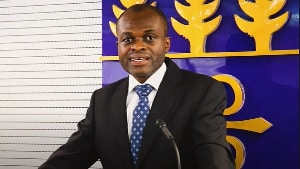
The organisation claims that because it will have an impact on their way of life, the government’s decision to include them in the programme is unlawful.
The newly combined Individual Bondholders Association and Individual Bondholders Forum stated that the government must take action to exempt them from the scheme based on their calculations.
“For us it is simple, all the numbers show that the government has to just exempt individual bondholders, and that the deal is withdrawn. The offer that you are asking us to take just withdraw it. There is enough money in the budget, more than enough, and all that the government has to do is cut down on expenditure.
Mr. Kpebu further explained that with just Ghc500 one can have a bond and some of the members have holdings of 10,000, 20,000, 30,000 Ghana cedis which he said is very small.
“But they plan their lives with the aim that this month this bond will mature, I will get 500ghc here and next month I will get 1,000ghc. Like they say, Accra stay by plan. Those are investments that people survive on, they are not luxury, they are not just saving for the sake of savings,” he added.
The government has extended the deadline for the Debt Exchange Programme to Tuesday, January 31, to enable it to build consensus for the programme.
This is the third time the government has extended the deadline for the bondholders to voluntarily exchange their bonds for new ones.
The court was adjourned today (Tuesday, January 17) to allow the accused’s and sureties’ attorneys to certify a document that they possess about the accused but that the court disputes because it was not notarized.
How does this serve a legal purpose, wondered the court, presided over by Justice Afia Serwah Asare-Botwe, in evaluating the document’s legal impact.
The court said the document in its current form does not work for it to be part of a record as to whether the recognizance has been forfeited.
Justice Asare-Botwe, now a Justice of the Court of Appeal after listening to the parties adjourned the case to January 24 for the lawyers to authenticate the document.
According to EIB Network’s Legal Affairs Correspondent, Murtala Inusah, Mrs Tamakloe Ationu has been absent from court for the last two legal year since 2021.
The two sureties who executed the GHc5M bail conditions for former CEO of Microfinance and Small Loans Centre (MASLOC) were first ordered to produce the accused on December 22, 2022.
The Financial and Economic Division of the Accra High Court presided over by Justice Afia Serwah Asare-Botwe, now elevated to the Court of Appeal who held that the former MASLOC boss has “absconded,” extended the period to January 17.
But in court on Tuesday, January 17, the parties were given a week more period.
At the last court sitting on December 22, Lawyer for the first surety Lawyer Beatrice Annan-Fio, for Gavivina Tamakloe said “We have exhausted every effort within our means but we have not been able to produce the first accused person.”
She, therefore, prayed the court to allow them more time to be able to produce the accused who is said to have undergone some medical procedure.
Lawyer Dr Abdul Basit Bamba and Lawyer Agbesi Dzakpasu, counsel for Alex Mould and Accused respectively added their voices for more time.
Justice Afia Serwah Asare-Botwe, who was one of 15 newly sworn-in Justices of the Court of Appeal by the President, said “I will give you time.”
While making a biblical allusion she said the Bible calls for fulfilment of righteousness and that “I can only give you time after the Christmas.”
The newly promoted Justice of the Court of Appeal said “You have until the holidays are over to produce the accused or provide a compelling evidence why you need more time to produce accused.”
Daniel Axim, the second accused person was present in court.
Forfeiture of sureties
The accused person has for the past year (October 2021) failed to appear in court for the trial to progress after she was given permission by the court to travel out of the country for a medical examination.
Ruling on an application for forfeiture of recognisance of sureties filed by the Attorney General’s department, Justice Afia Serwah Asare Botwe said, it is clear that the accused is no longer reasonably missing the trial for medical reasons.
The court said the sureties have since stopped bringing any medical letters to the court on the accused person.
Justice Asare-Botwe said the accused person had breached the terms of her bond and a liability accrues on the sureties.
Justice Afia Asare-Botwe, said, Forfeiture of bail bond becomes effective the moment the accused person jumps bail and the surety is unable to produce him or her.
The court said, it has drawn the conclusion that Mrs Attionu Tamakloe who is standing trial with one another has absconded as she has not shown up at the time she was supposed to.
The court also said, “the authorities have also made it clear that, if this happens you should give the sureties time to produce the accused person.”
Consequently, the court said, “I have given the sureties on or before 22 December, 2022, to produce the accused person.”
Trial in absentia
The court is expected to consider the application for trial in absentia if the accused failed to show up.
Arguments
Moving the application for Forfeiture of recognizance of the sureties, Stella Ohene Appiah, a Principal State Attorney argues that the Ex MASLOC Boss having failed to return for the trial after being given leave to travel simply means that she has abandoned.
The lawyer for Gavivina said the application for the release of the passport to the accused person was not sent to him and he had no idea.
He added that the State did not oppose the application so he cannot be held responsible for her absence and that, the State has all the apparatuses to ensure the accused attends court.
The lawyer for Alex Mould, Dr Abdul Aziz Bamba argued that the State should take action to extradite the accused to come down and face trial.
He added that he is informed the accused is unwell and is seeking medical assistance in the States.
He argued that the Supreme Court has ruled that the court cannot commit a surety to prison and that, the execution of bail bond is a contract and one cannot put one in prison for failing to fulfil a contract.
Background
Sedina Attionu is on trial with Daniel Axim, a former Operations Manager of MASLOC, on 78 counts of wilfully causing financial loss to the State, stealing, and contravention of the public procurement act, among other charges.
The two have denied any wrongdoing and have pleaded not guilty to all the charges.
The prosecution has accused Mrs Attionu of engaging in some illegalities leading to the alleged stealing and financial loss.
For instance, it has accused Mrs Attionu of embezzling GH¢500,000 that was paid by a company which benefitted from MASLOC support in 2014.
It is also the case of the prosecution that in 2013 following a fire disaster at the Kantamanto Market, then-President John Mahama directed MASLOC to provide assistance of GH¢1.46 million to victims of the disaster but Mrs Attionu embezzled part of the money.
Ato Forson has also reiterated his call for the embattled minister to be removed and the economy handed to a more competent driver to steer the economic ship to a safe destination.
What Ato Forson said
“Every reckless driver is referred to as ‘driver banza’ in my local parlance … if you are in a car with such a driver, people get angry and demand that he descends so that another person takes control of the car and drive it to safety.
“Where we have gotten to, the finance minister is a reckless driver, he has taken this country to a point of no return, he has driven this country into a ditch.
Ofori-Atta had a challenging 2022 with the Minority Caucus demanding his resignation over the economic downturn.
Internally, a group of 80 plus New Patriotic Party (NPP) MPs publicly demanded his resignation over a similar demand, standing down after a presidential intervention.
A deal for him to present the 2023 budget and see out appropriation as well as to complete initial engagement with the IMF has elapsed, with the Majority Caucus hinting that they would soon approach the president to redeem a promise to act on Ofori-Atta.
Background
Ghana had a torrid 2022 amid an economic crisis that forced the government to seek an International Monetary Fund (IMF) facility at a time when the cedi was rapidly depreciating, inflation was galloping, and the government was faced with multiple downgrades by rating agencies.
The government has repeatedly blamed the crisis partly on the aftershocks of the COVID pandemic and the ongoing Russia-Ukraine war.
It has promised to turn around the economic fortunes of the country after sealing a staff-level agreement with the IMF late last year, with hopes that funds from the US$3 billion facility will be released early this year.
The government is hamstrung by hurdles as it attempts to secure a deal with its Domestic Debt Exchange programme.
Organized labour successfully fought off plans to include pensions in the DDE; now individual bondholders are also rejecting plans to include them.
Treasury bills were left out of the debt swap program, which is thought to be the cause of the oversubscription.
On January 13, 2022, the government’s most recent auction raised more money than its goal of GH1,125 million.
The findings revealed that GH1.72 billion was accepted from the 91-day, 182-day, and 364-day bills, exceeding the stated target by GH588 million.
Out of the GH198.49 offered for the 182-day bill, everything was accepted at an interest rate of 35.83%, yielding GH1,478.84 at a 35.46% rate of interest.
For the 364-day T-bill, the government secured ¢43.34 million but accepted ¢36.08 million of the bids tendered. The interest rate for the instrument was however 35.91%.
Things got a bit heated between the Majority Chief Whip, Frank Annoh-Dompreh and broadcaster Johnnie Hughes during a social media debate over the censure motion against Ken Ofori-Atta and the ongoing Domestic Debt Exchange Programme.
Annoh-Dompreh who is the Member of Parliament for Nsawam Adoagyiri had earlier sent a caution to the Finance Ministry to review its decision to include individual bondholders in the DDEP.
“The Finance Minister (Ministry) must as a matter of urgency review ASAP its decision and resolution on individual bondholders. I don’t agree with them and I think it’s unfair and untenable!” he tweeted.
His tweet courted the attention of Johnnie Hughes who reminded the lawmaker that the situation could have been avoided if the majority caucus participated in the voting on the recommendations by the committee that probed the censure motion against Ken Ofori-Atta late last year.
“But Chief Whip @FAnnohDompreh, you and your colleagues had the chance to save us all through a simple secret ballot in Parliament after that Appiah-Kubi led presser asking for the head of KOA. What happened? Did you fail the people? Who whipped who in line?” he quizzed.
But Annoh-Dompreh exhorted Johnnie Hughes’ mind to the fact that his post is only relative to the issue of the individual bondholders and not nothing more.
“I am concerned about a specific matter!.. Don’t get it wrong!”, he tweeted in reply.
Johnnie Hughes maintained his course of reasoning and posed another question to Annoh-Dompreh “please did you fail the people? Who whipped who in line?”.
At this point Annoh-Dompreh gave a response considered harsh by the journalist.
“I am not ready for your ‘street’ politics!.. We have a matter to deal with! Seek to understand who I am and stop this! I am not interested in your arguments. As far as I am concerned, Ken has erred this time, and it must be corrected,” he retorted.
It created some banter that went on for some time until the two men called a truce.
Annoh-Dompreh has not hidden his aversion to the decision by the Ministry of Finance to include individual bondholders in the DDEP.
He believes that there could be dire repercussions on the middle class and the financial sector if the plans outlined by the finance ministry are adopted.
Meanwhile, the Ministry of Finance has extended the deadline for the DDEP with a promise to engage extensively with stakeholders.
This would be the third extension since the programme was launched on December 5, 2022.
In a tweet sighted by GhanaWeb Business, the Ministry of Finance noted that the extension was due to pending further stakeholder engagements with institutional and individual investors who were recently invited to join the debt exchange programme.
“Building consensus is key to a successful economic recovery for Ghana,” a tweet from the Finance Minister’s office said.
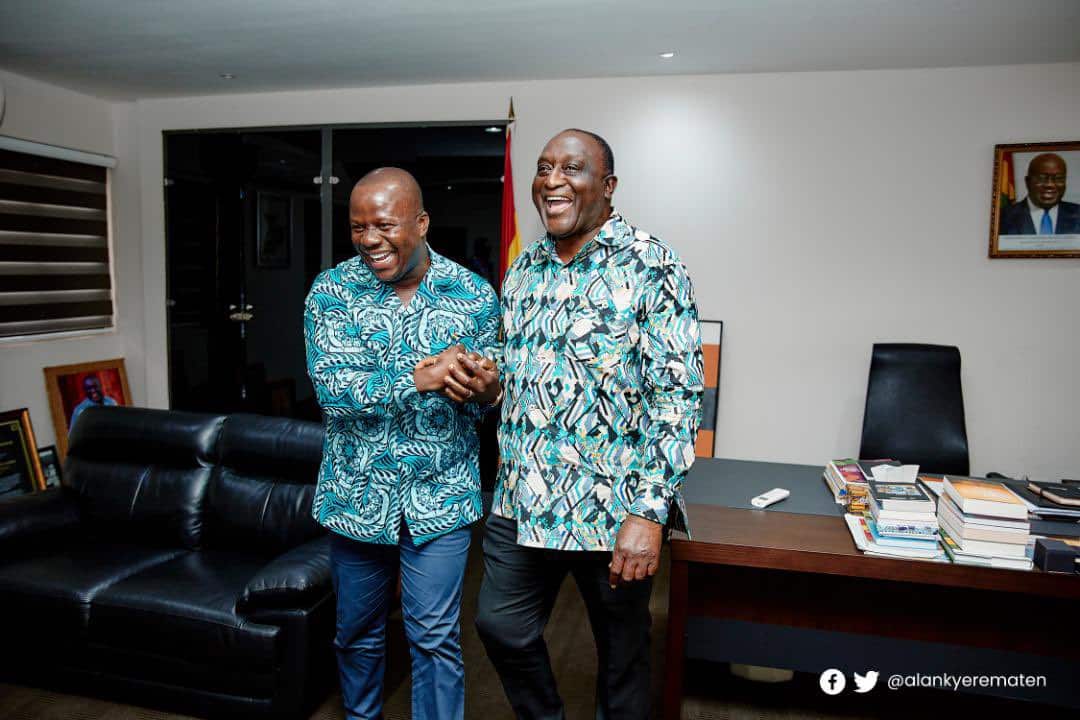
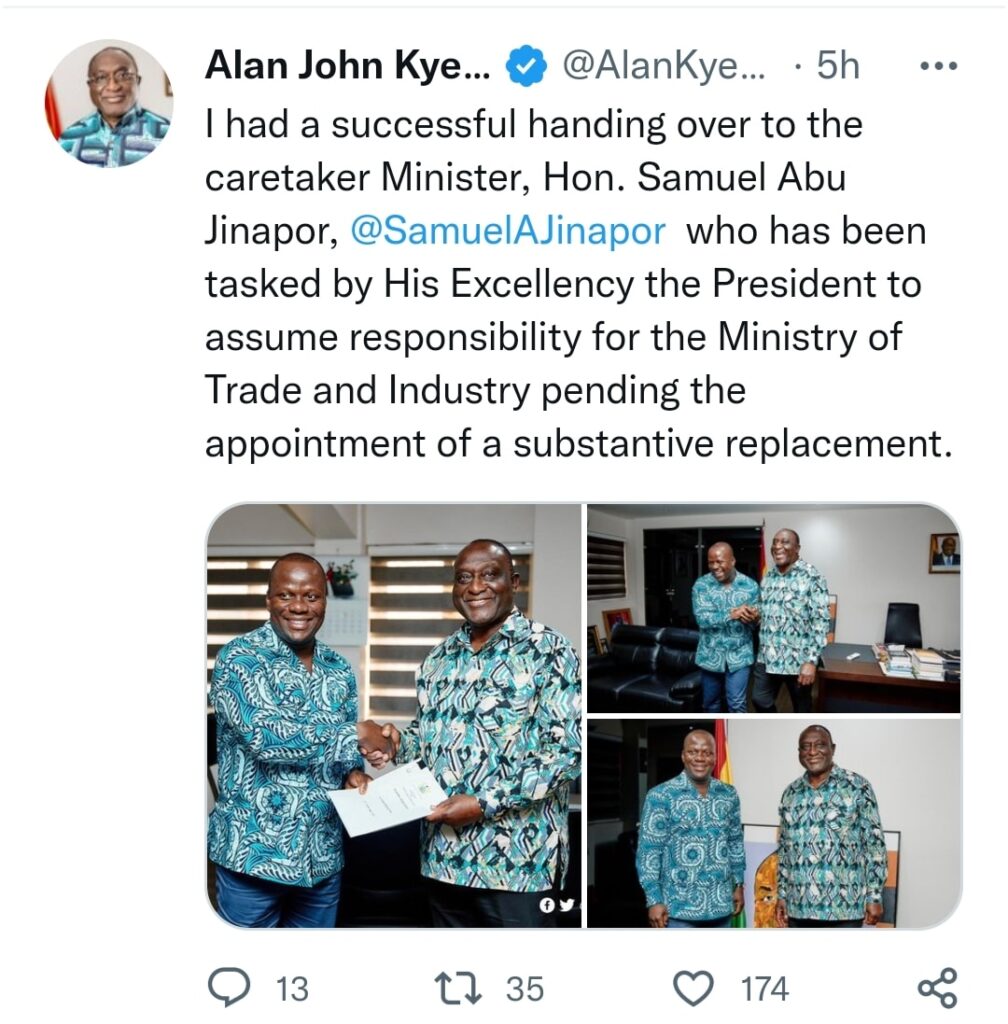
Lands and Natural Resources Minister, Samuel Abu Jinapor, on Monday officially took over the Trade and Industry from Mr Alan Kyerematen.
The former Trade Minister, Mr Kyerematen was supposed to hand over to Finance Minister Ken Ofori-Atta per a statement from the Presidency dated January 6.
But Mr Kyerematen rather handed over to Mr Jinapor, whom he says, has been tasked by President Akufo-Addo to take over matters at the Ministry.
It is unknown why the swap in caretaker Minister but it is believed that government wants Mr Ofori-Atta to have his focus on the management of the economy deemed to be in crisis.
Mr Kyerematen tendered his resignation letter to President Akufo-Addo on January 5, in order to pursue his presidential ambition come 2024.
The projection is according to the Institute of Energy Security (IES) which explained that the potential increase in the price of petroleum products, is attributed to soaring prices on the international oil market and the recent depreciation of the cedi against major trading currencies.
“Following the 8.69% rise in the price of gasoline [petrol] and 2.19% in the price of LPG [Liquefied Petroleum Gas], together with the 9.89% depreciation of the local currency against the US dollar, the Institute for Energy Security (IES) projects a rise in price for products at the various pumps”.
In the wake of this, the IES projected that the price of petrol will sell at GH¢13.50 per litre while diesel will sell around GH¢15.00 per litre.
The IES, however, added that the LPG will sell around GH¢11.00.
On percentage terms, prices are set to rise between 5% and 9% in the next half of January 2023, pushing a litre of gasoline [petrol] to roughly GH¢13.50, Gasoil [diesel] to GH¢15.00, and a Kilogram of LPG to GH¢11.00,” the IES noted.
Meanwhile, in the first pricing-window of January 2023 and around the festive period last year, consumers of petroleum products witnessed a reduction in prices at various pumps across the country.
The marginal reduction during the period was due do fall in prices on the international market and marginal gains made by the local currency against the US dollar.
Despite domestic economic commitments, he claims that Parliament was not given the fine details of the debt swap program, which is a component of the proposed debt restructuring plan by the International Monetary Fund (IMF).
“There were meetings before the budget came to be consummated and later on presented by the Finance Minister. So we had broad discussions, but the details were not known to us at the time, but some consultations went on as to where exactly we were as a nation. But I am not too sure that this matter came up for discussion maybe the broad strokes were mentioned but not the details,” Kyei-Mensah-Bonsu said speaking on Accra-based Citi FM.
As part of efforts to secure an IMF bailout and address the country’s unsustainable debt situation, government launched the DDEP inviting bondholders to voluntarily exchange approximately GH¢137 billion domestic notes and bonds of the Republic including ESLA and Daakye for a package of new bonds.
Since the program’s debut on December 5, 2022, there have been three extensions.
The Ministry of Finance explained that the delay was necessary owing to ongoing stakeholder discussions with institutional and individual investors who have recently been asked to participate in the debt exchange program in a tweet seen by GhanaWeb Business.
As part of efforts to secure an IMF bailout and address the country’s unsustainable debt situation, government launched the DDEP inviting bondholders to voluntarily exchange approximately GH¢137 billion domestic notes and bonds of the Republic including ESLA and Daakye for a package of new bonds.
In the wake of this, various groups of bondholders in the financial sector have called on their members to reject government’s Domestic Debt Exchange Programme due to a lack of broader consultations and negotiations.
A petition to keep them out of the program and secure their pensions was addressed to the finance minister, according to the forum, which was run by Dr. Adu A. Antwi, but all attempts to get in touch with him have been futile.
He claims that the ministry is coming together to express their discontent with being included in the debt exchange program.
He noted that the pensioners still maintain their stance on their exclusion from the programme despite the deadline of January 16, 2023.
Meanwhile, the deadline has been extended by the governemnt to January 31, 2023 for broader stakeholder consensus to be made.
On January 16, 2023, the finance minister announced, “Building consensus is key to a successful economic recovery for Ghana. Pending further stakeholder engagement with institutional and individual investors recently invited to join the debt exchange programme, the government is extending the DDE expiration to Jan 31, 2023.”
The government announced the inclusion of individual bondholders in the debt exchange programme. But the bondholders have noted that this will not be in their best interest and may lead to a depletion of their investments.
Pensioner Bondholders to converge at Ministry of Finance on January 23
He has made hints that the NPP will soon respond to a seven-point list by NDC lawmaker Cassiel Ato Forson that blames the economic crisis on the government’s acts and inactions.
Ahiagbah justifies his assertions.
He claims that the NDC has refused to be up front with Ghanaians about its analysis of the causes of the nation’s current economic slump.
He is concerned that the party continues to deny the role that global factors play in the current challenges.
His views were contained in a tweet dated January 16, 2023. It read as follows:
“Will the NDC ever be honest with Ghanaians? Their continuous denial of the global factors impacting Ghana confirms why Ghanaians say the NDC is incompetent. A fuller response will be given soon to Hon. Ato Forson’s twisted reasons.”
Who Ahiagbah was responding to:
The NPP communications head was referring to a social media post over the weekend by former deputy minister of finance Cassiel Ato Forson, who outlined seven causes for the current economic challenges.
In his post, Ato Forson listed how the bloated size of government, especially within the executive and state-owned enterprises, had contributed to depleting government revenue and thereby threatened to tank the economy.
Background
Ghana had a torrid 2022 amid an economic crisis that forced the government to seek an International Monetary Fund (IMF) facility at a time when the cedi was rapidly depreciating, inflation was galloping, and the government was faced with multiple downgrades by rating agencies.
The government has repeatedly blamed the crisis partly on the aftershocks of the COVID pandemic and the ongoing Russia-Ukraine war.
It has promised to turn around the economic fortunes of the country after sealing a staff-level agreement with the IMF late last year, with hopes that funds from the US$3 billion facility will be released early this year.
The government is hamstrung by hurdles as it attempts to secure a deal with its Domestic Debt Exchange programme.
Organized labour successfully fought off plans to include pensions in the DDE; now individual bondholders are also rejecting plans to include them.
He claimed that the action will worsen the already weak economy.
Bright Simons said, “Persons all heated up about how the economic crisis will now compel upper middle class folks to join the political fight for more accountability,” in a tweet that GhanaWeb Business was able to catch. I’m sorry to bust your bubble, but it will only encourage them to seek out additional foreign investment opportunities, which will worsen Ghana’s economic [issues].
His comment comes after Majority Leader in Parliament, Osei Kyei-Mensah-Bonsu, urged government to engage in further dialogue on the implementation of its domestic debt exchange programme.
According to the majority leader, the programme requires more engagement as it has the potential of wiping away the country’s middle class.
Government of Ghana is seeking to revive the economy through a $3 billion International Monetary Fund loan.
As part of its efforts to meet the conditions required for the loan, government has announced a domestic debt exchange programme aimed at varying the terms of existing government bonds.
Meanwhile, goverment has extended the deadline for the expiration of the debt exchange programme to January 31, 2023.
But the Minority in Parliament has asked government to as a matter of urgency suspend the debt exchange programme.
Before a choice is made to join the program, the Association contends that requests from its members must first be satisfied.
GAB noted that the prolonged uncertainty caused by the debt restructuring operation will probably have an effect on the banking sector in a letter it sent to managing directors and chief executive officers of commercial banks.
“From the uncertainty surrounding the programme, GAB recommends that all banks must stay away from any further movement on the exchange until our demands have been met. However, in the event that a bank may have to move forward to exchange, the MD/CEO must inform the CEO of GAB directly of the decision”.
As part of efforts to secure an IMF bailout and address the country’s unsustainable debt situation, government launched the Domestic Debt Exchange Programme inviting bondholders to voluntarily exchange approximately GH¢137 billion domestic notes and bonds of the Republic including ESLA and Daakye for a package of new bonds.
In the wake of this, various groups of bondholders in the financial sector have called on their members to reject government’s Domestic Debt Exchange Programme due to a lack of broader consultations and negotiations.
She claims that the domestic debt swap program, which the government plans to implement by the end of January this year, is how the government is collecting money from bondholders and investors.
According to Joyce Bawah Mogtari, countless Ghanaians lost their employment and money as a result of the banking sector cleansing.
She stated, “Fellow Ghanaians lost money and jobs in the Banking Sector Clean Up Exercise, and now they are snatching people’s livelihoods from them, disguised as a Domestic Debt Exchange Scheme,” in a tweet that was seen by GhanaWeb Biz.
“So annoying. So now it’s the fault of Ghanaians for expecting that leadership does what it was elected to do? You mess up the economy and scuttle people’s hard-earned investments and turn round to suggest the victims of your recklessness are not being patriotic enough?” Joyce Bawah Mogtari added.
As part of its efforts to meet the conditions required for the loan, government has announced a domestic debt exchange programme aimed at varying the terms of existing government bonds.
Meanwhile, goverment has extended the deadline for the expiration of the debt exchange programme to January 31, 2023.
While making submissions on Joy News’ Newsfile programme last Saturday, he submitted that the Mahama government had two homegrown solutions to the economic crunch at the time.
He is concerned that the current government announced the July 1 IMF plan without a homegrown programme stressing that the IMF does not draw a programme for any applicant except to support them through an in-house plan.
“In 2014, when the government made the announcement on April 6, there was a document on hand. Drawing from the Senchi Consensus. There was also the Ghana Growth and Shared Development Agenda II of 2014 to 2017.
“So, before the president (John Mahama) then made the announcement, there was a homegrown programme, so it made it a bit easier engaging the fund because we had a programme because the Fund doesn’t develop a programme for any country, that is why it is called a Ghana government programme supported by the IMF,” he stressed.
He also averred that the IMF programme alone is not enough to solve the current crisis because the country is in an unsustainable debt situation.
President Akufo-Addo ordered Finance Minister, Ken Ofori-Atta via a July 1 statement to present an economic rescue programme to the IMF.
A team from the Fund led by Carlo Sdralevich has since visited Ghana between July 6 – 13, meeting with relevant stakeholders.
The deadline for the government’s domestic debt exchange programme has been extended to January 31.
This has been done to increase stakeholder involvement in the policy proposal.
In a tweet posted on Monday, the Office of the Finance Minister noted that the deadline had been extended until the end of the month in order to give the government more time to build consensus for the program’s successful execution.
“Building consensus is key to a successful economic recovery for Ghana.
“Pending further stakeholder engagement with institutional and individual investors, recently invited to join the debt exchange programme, government is extending the expiration of the DDE to Jan 31, 2023”, the tweet said.
Building consensus is key to a successful economic recovery for Ghana. Pending further stakeholder engagement with institutional and individual investors, recently invited to join the debt exchange programme, government is extending the expiration of the DDE to Jan 31, 2023.
— Office of the Finance Minister-Ghana (@oofmghana) January 16, 2023
Member of Parliament for North Tongu Constituency, Samuel Okudzeto Ablakwa, says he will report one of the members of the Board of Trustees of the National Cathedral Secretariat to the Commission on Human Rights and Administrative Justice (CHRAJ) .
Mr Okudzeto Ablakwa has presented evidence, accusing the Secretary of the Board of Trustees of the Secretariat, Rev Victor Kusi Boateng, of registering a company in a different name to transact business with the Secretariat.
Passports made available by the lawmaker showed the name, Kwabena Adu Gyamfi, who is registered as one of the three directors of JNS Talent Centre Limited. That firm was cited byNational Democratic Congress (NDC) MP for receiving about GH¢2.6 million from the Secretariat for “no work done”.
According to the Ranking Member of the Foreign Affairs Committee of Parliament, Rev Kusi Boateng is the same Kwabena Adu Gyamfi despite differences in age, TINs, professions and addresses on the passports.
“From unassailable and irreproachable documents in my possession, Rev. Victor Kusi-Boateng AKA Kwabena Adu Gyamfi uses multiple passports and multiple identification cards with different names and different dates of birth as his special modus operandi,” the MP wrote on Monday, January 16.
He later added: “These explosive findings make the conflict of interest charge in the GHS2.6million scandalous payment by the National Cathedral of Ghana to the shady JNS Talent Centre Limited even more blatant, direct, offensive and absolutely embarrassing.”
The lawmaker says he will proceed to CHRAJ on Monday at 1:00pm for the corruption-investigating body to invoke “its mandate under Article 218 of the 1992 Constitution to investigate the odious conflict of interest”.
He has also served notice to file an urgent question when Parliament resumes for the Minister for Foreign Affairs and Regional Integration, Shirley Ayorkor Botchwey, to inform Ghanaians why Rev. Victor Kusi-Boateng qualified for a diplomatic passport and the nature of due diligence, if any, her ministry may have carried out.
He said he will also file an urgent question for the Finance Minister, Ken Ofori-Atta, on exactly what work JNS did to warrant the GH¢3.5 million transfer and why that transaction did not find expression in his GH¢339 million cathedral withdrawals as presented to the Vote of Censure Committee.
In a recent interview with Joynews, Dr. Nyaho Nyaho-Tamakloe questioned Kennedy Agyapong’s suitability and commitment to serve as the NPP’s flagbearer.
He asserts that while individuals like Vice President Dr. Mahamudu Bawumia have a reputation for standing up for the party, the Assin Central MP does “I said what! What is Nyaho Tamakloe trying to say? In 2016 alone Kennedy Agypong and Kutin bought almost a hundred pickups. He paid a debt of $3 million for the NPP and that was even in the 90s,” Obiri Boahen said. “Tell me which of the 275 constituencies in Ghana have not felt the impact of Kennedy Agyapong? I am with Bawumia,
I am campaigning for Bawumia but it doesn’t mean I should sit aloof if someone says something about Bawumia’s competitor and I have details about it,” he added. Mr Obiri Boahen noted that contrary to his claims, it is rather Dr Nyaho-Tamakloe who has no track record of commitment to the party. “Recently did Kennedy Agyapong not donate nine thousand bags of rice? Has Nyaho Tamakloe donated even a cup of rice before?” he questioned. Describing Dr Nyaho-Tamakloe as disgraced, the former deputy communications director said Dr Nyaho-Tamakloe has no basis to issue such criticism since he is no longer a member of the NPP. “On what basis? Nyaho Tamakloe just like Wereko Brobbey has been dismissed. If Kennedy Agyapong is contesting he needs the vote of NPP persons so where do you come in? “Some journalists keep referring to him as a founding member. At what point in time? If he is, we have dismissed him from NPP so please they should stop that,” he stated. The NPP later this year is expected to elect a flagbearer. Already,
Kennedy Agyapong, former NPP General Secretary Kwabena Agyapong and former Energy Minister Boakye Agyarko have all announced their intent to contest as the party’s flagbearer. Last week two ministers in the current government resigned ahead of the NPP’s flagbearer elections. Former Trade and Industry Minister, John Alan Kwadwo Kyerematen announced his intent to contest after resigning while former Minister for Agriculture, Dr Afriyie Akoto is yet to make an official announcement after resigning. However, Vice President Bawumia who is yet to officially announce his bid is deemed one of the lead contenders in the race to elect a flagbearer of the NPP.
The platform brings together Heads of State, Ministers and energy decision-makers among its membership and states-in-accession, as well as, multilateral organizations, global stakeholders and private sector players.
Ghana will use this opportunity to seek strategic private-sector partnership pursuant to efforts at scaling up the penetration of renewable energy in its generation mix by 2030.
Ghana’s energy security in the overarching context of fully optimizing energy resources at its disposal remains the top most priority of Dr. Matthew Opoku Prempeh and therefore using every opportunity, locally and internationally to deepen the frontiers of these efforts.
The three-day programme is on the theme: “Positioning the African Market for Sustainable Economic Development through the African Continental Free Trade Area (AfCFTA).”
Mr Wamkele Mene, Secretary General AfCFTA, would deliver the keynote address for this year’s Programme, which is under the auspices of the School of Continuing and Distance Education (SCDE), College of Education, University of Ghana. Dr Simon-Peter Kafui Aheto, Director, 74th ANYSC/ Senior Lecturer, Department of Distance Education, SCDE, University of Ghana, who disclosed in an interview with the Ghana News Agency (GNA) in Accra, said the Programme would consist of the Main School and Conference, and a Youth School.
“We are expecting about 400 participants for the main School and Conference from civil society, government agencies, private sector, informal sector, academia and people from all walks of life,” Dr Aheto said.
“For the Youth School, we will be expecting a minimum of 350 participants from around the country.”
Touching on expected outcomes of the Programme, Dr Aheto said one of the major outcomes of the Annual New Year School and Conference was the release of a communiqué at the end of the event.
He said the previous communiqués had shaped policies and provoked discussions of the themes within the public space. He reiterated that adequate opportunities would be created to ensure non-partisan discourse on the theme and widely disseminate policy briefs both locally and internationally.
He noted that this year’s Programme would contribute to the continent’s quest in advancing trade and industry to build a robust African economy that could sustainably contribute to growth in member countries He said the Annual New Year School and Conference had existed over the last 74 years; adding that “in the course of the year, we shall be cutting sod for the Annual New Year School and Conference Multipurpose Digital Youth Village Complex on campus, a hub for youth training and development in Ghana and on the continent.”
“Again, this year’s ANYSC coincides with the 75th Anniversary celebration of the premier University of Ghana, the institution that is affectionately called, Legon.”
Dr Aheto told the GNA that the 74th ANYSC was creating a platform for every Ghanaian, and every African to have a better understanding and involvement of the whole concept of the AfCFTA, an intra-continental trade space to promote. Since its inception in 1948, the Annual New Year School and Conference has been the flagship programme of the University and attracts people from all walks of life to deliberate on topical issues of national and international interests. It opens at the beginning of every new year.
At the end of every school and conference, a communiqué is issued, which captures the recommendations of participants and discussants. The recommendations usually inform policy decisions and directions in the country.
The move, which prompted a 4% fall in Tesla’s shares in pre-market trading, came after CEO Elon Musk warned that the prospect of recession and higher interest rates meant it could lower prices to sustain volume growth at the expense of profit. Shares are down 65% since the start of 2022.
The lower pricing across Tesla’s major markets marks a reversal from the strategy the automaker had pursued through much of 2021 and 2022 when orders for new vehicles exceeded supply. Musk acknowledged last year that prices had become “embarrassingly high” and could hurt demand.
The US price cuts, announced late Thursday on its global top-sellers the Model 3 sedan and Model Y crossover SUV, were between 6% and 20%, Reuters calculations showed.
The basic version of its Model Y now costs $52,990, down from $65,990 previously.
That is before an up to $7,500 federal tax credit that took effect for many electric vehicle models at the start of January.
Tesla also cut prices for its Model X luxury crossover SUV and Model S sedan in the United States.
In Germany, it cut prices on the Model 3 and the Model Y by between about 1% and almost 17% depending on the configuration. It also cut prices in Austria, Switzerland and France.
For a US buyer of the long-range Model Y, the new Tesla price combined with the US subsidy amounts to a discount of 31%. In addition, the Tesla move broadened the vehicles in its line-up eligible for the Biden administration tax credit.
Before the price cut, the five-seat version of the Model Y had been ineligible for that credit, a designation Musk called “messed up”. After the price cut, the long-range version of the Model Y will qualify.
The cuts may make EV cars affordable to people who may have been previously priced out of the market.
In France, customers buying the Model 3 for €44,990 ($48,773) will now get a further price reduction through a government subsidy of €5,000. The threshold for the EV subsidy is €47,000.
“This should really boost 2023 (Tesla) volumes,” Gary Black, a Tesla investor who has remained bullish on the company and its prospects through the recent, sharp share price decline, said in a tweet. “It’s the right move.”
Still shares in US pre-market trading were lower, as investors worried the move might erode margins, particularly as competition intensifies.
“Tesla is an outlier because it’s still got eye watering valuations when it comes to the number of cars that it actually sells. But ultimately there are all the other providers that sell a hell of a lot more cars overall,” said Michael Hewson, chief market analyst at CMC Markets UK.
Some users on Tesla fan forums online also complained the price cuts disadvantaged those who had recently bought their vehicle, leaving them with a lower second-hand value.
“Just reducing 10,000 euros like that – definitely makes you feel that you just paid far too much,” one user wrote on a ‘Tesla Drivers and Friends’ forum.
In China, where Tesla cut prices last week by 6% to 13.5%, owners protested at delivery centres, calling for compensation.
Before the cuts, Tesla inventory in the United States, as tracked by models its website shows as immediately available, had been trending higher. Prices on used Tesla models had also been dropping, increasing pressure to adjust new-car prices.
For 2021, the United States and China combined had accounted for about 75% of Tesla sales, although it has been growing sales in Europe, where its Berlin plant has been ramping up output.
Tesla cut prices in China and other Asian markets last week in its first major move since appointing its lead executive for China and Asia, Tom Zhu, to oversee U.S. output and sales.
Analysts had said the Chinese price cuts would boost demand and increase pressure on its rivals there, including BYD (BYDDF), to follow suit in what could become a price war in the largest single market for electric vehicles.
Tesla’s Model 3 was the best-selling electric vehicle in Germany last month, followed by the Model Y, beating Volkswagen’s all-electric ID.4. Volkswagen recently raised the price of its entry-level ID.3, putting it at parity with the now-discounted Model 3.
Tesla missed Wall Street estimates for fourth quarter deliveries. Full year growth in deliveries was 40% – also short of Musk’s own forecast of 50%.
The University of Michigan’s closely watched consumer sentiment index rose to 64.6 in the preliminary January survey, according to data released Friday. It’s the highest reading since January 2022 and up 8.2% from December’s 59.7 reading — but it’s still 3.9% below where it was 12 months earlier.
Economists were anticipating the index to measure just 60.5, according to consensus estimates on Refinitiv.
Some of the biggest boosts in optimism came from consumers’ feelings on the current state of the economy: That index jumped 15.5% from the end of December to 68.6.
“Consumers expect their incomes to be strong,” she said, adding that they also expect the labor market to weaken this year.
The survey also showed consumers’ inflation expectations for this year and five years out were 4% and 3%, respectively. The year-ahead inflation expectations reading is at its lowest since April 2021.
Inflation expectations are crucial data points for the Federal Reserve. If consumers believe prices will remain high, that could factor in to increased wage demands, which could cause businesses to raise prices.
The Fed is especially keyed in on the long-term expectations, which has bounced around the 3% range for 17 of the past 18 months, Hsu said.
“I do think consumers are still waiting to see sustained improvements [in inflation] and that uncertainty over global factors like China and Ukraine do not worsen.”
And while inflation has cooled in recent months, the typical household spent $371 more on good and services in December than a year ago, according to Moody’s Analytics.
The good news is that the cost-of-living shock appears to be easing and paychecks are starting to catch up.
At the inflation peak last June, the typical family spent an additional $502 per month compared with the year before, according to Moody’s.
So where is sticker shock hurting the most?
Families are spending an estimated $82.60 more per month on shelter and $72.01 more on food, Moody’s said.
Other items that are costing families more per month include utilities (up $47.33), health care ($17.97 higher), entertainment ($15.27) and alcoholic beverages ($2.67), according to Moody’s.
The bright spot is gasoline, where the typical family saved $1.55 per month compared with the year before.
Some of the pain from inflation is being mitigated by a significant shift in recent months: Wages are finally growing at a faster pace than inflation.
And, at the same time, the pace of inflation has clearly slowed. Consumer prices increased by 6.5% year-over-year in December, the slowest pace since October 2021.
“Meaningful progress in the US economy’s fight against elevated inflation was made in the closing months of the year,” Matt Colyar, an economist at Moody’s Analytics, said in a report on Thursday.
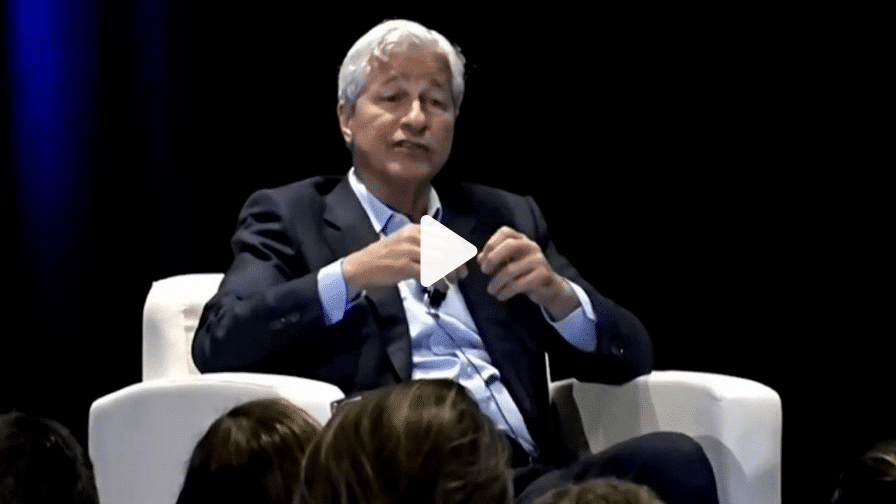
“Right now it’s kind of sunny, things are doing fine. Everyone thinks the Fed can handle this,” Dimon said at a Bernstein conference. “That hurricane is right out there down the road coming our way.”
“We just don’t know if it’s a minor one or Superstorm Sandy. You better brace yourself,” Dimon said, adding that JPMorgan Chase (JPM) is preparing for a “non-benign environment” and “bad outcomes.”
But the Fed is in a bind. Dimon said the central bank must raise rates because of surging housing prices and other inflation pressures. He stressed that he still thinks the US banking system is in “great shape” and can withstand these challenges.
Dimon also said that JPMorgan Chase is going to do all it can to attract talent to stay on top of the financial world. The CEO said the bank will be “religious” about paying well to keep its best workers.
Dimon’s more cautious outlook comes just a few days after he sounded a little more upbeat about what’s next for the markets and the economy.
Speaking at an analyst meeting at the end of May, Dimon said that there were “big storm clouds” on the horizon for the economy but expressed hope that they may “dissipate.”
“If it was a hurricane, I would tell you that,” Dimon said at the analyst meeting, adding that current conditions also aren’t like the “tsunami” that banks faced in 2007 and 2008 when the mortgage market was melting down and several large financial institutions collapsed.
Dimon may not be predicting a tsunami just yet. But a hurricane is bad enough, and certainly more damaging than a regular storm. Dimon said he is also worried about the conflict in Ukraine and the impact it will have on oil prices, predicting on Wednesday that it’s in the cards for crude prices to eventually spike as high as $150 to $175 a barrel.
“Wars go bad. They go south. They have unintended consequences,” he said, adding that this conflict will continue to roil the commodity markets around the world, impacting the prices of oil, gas and wheat.
The fifth edition of the list, according to Martin Ayisi, the commission’s chief executive officer, was released at a time when investments and mineral revenue receipts totaled $10 billion, which he revealed to the Daily Graphic yesterday.
while mining companies produced about four million ounces of gold at a value of about $7 billion last year and were on course to deliver same this year, investments to expand mines and start new ones reached about $4 billion.
Mr Ayisi said since mining companies spent three times more on goods (inputs) and services than what they paid in taxes and royalties, the increase in the items on the list would boost the local economy through local content and participation in the mining industry.
He explained that the 50 items on the list were items that the commission’s research had established were the most regularly procured by the mines over the years.
While they had been mostly imported in the past, he said, local companies had built capacity and expertise to be able to deliver or supply them, hence the passage of the Minerals and Mining (Local Content and Local Participation) Regulations, 2020 (L.I. 2431), which came into force on December 22, 2020 to help support local companies to secure contracts in the mining industry.
For instance, contract mining, service operation, as well as the supply of fuel to the mines, were all reserved for local companies, while others, such as underground mining services, had percentages that should be given to Ghanaian companies, he said.
He said while Ghanaian companies grew capacity in the area, the percentage of work or contracts they should execute would also be increased.
Mr Ayisi explained that the more mining companies invested in their operations, the more inputs and services they would procure, and that would stimulate local participation and growth, especially as the merchandise exports were bigger than the taxes and royalties the companies paid to the state.
Background
The implementation of the new procurement list of 50 items, effective January 1, this year, replaces the fourth edition the commission published early last year.
Its purpose, among other things, is to promote job creation using local expertise, goods and services in the mining industry and their retention in the country.
The law is also to achieve the minimum in-country spend for goods and services and create mining and mineral related industries that will sustain economic development.
Pursuant to Regulation 7 of L.I. 2431, the commission is required to publish a local procurement list, which stipulates the goods and services with Ghanaian content which are to be procured in the country, while Regulation 7(3) of L.I. 2431 further enjoins the commission to review the procurement list annually.
Receipts, investments in mines
Throwing light on investments in the mining sector, Mr Ayisi cited four new projects, with investment of about $1.7 billion.
“The new projects are the $850 million Ahafo North gold mine project by Newmont Ghana Gold Limited; the $500 million gold project currently under construction by Cardinal Namdini Mining Limited in the Talensi District in the Upper East Region; the $200 million gold mine to be constructed in the Upper West Region and the $125 million lithium project at Ewoyaa in the Central Region,” he said.
He added that some mines were undertaking expansion and redevelopment.
The CEO further explained that the Ahafo South mine of Newmont had been expanded to include the Subika underground, while Golden Star Wassa was spending about $1 billion to expand the Wassa underground mine.
The mines being redeveloped were the AngloGold Ashanti Obuasi Mine, where $1 billion had been expended, and Mensin Gold Ghana Limited’s Bibiani Mine, which started production in the last quarter of last year, he said.
“It is the expectation of the Minerals Commission that these investments will support the growth of the economy and boost local participation under the new procurement list,” Mr Ayisi said.
Furthermore, the market value of new bonds can potentially be higher than the value of the Old Bonds. Accordingly, to permit individual investors to benefit from these potential advantages of the new bonds and to address their concerns, the government has amended the Invitation to Exchange to allow individual legal holders of record of Eligible Bonds to participate in the exchange.
Question. What if I only hold a small amount of eligible bonds?
Ans: Offers to exchange any of the Eligible Bonds may be submitted in a minimum principal amount of GH¢1.00 and integral multiples of GH¢1.00 in excess thereof, in order to allow every holder to participate to the exchange, given the expected higher value of the new bonds compared to the old bonds after the exchange. Any new bonds to be issued to any eligible holder in the invitation to exchange will be in a minimum principal amount of GH¢1.00 and integral multiples of GH¢1.00 thereof.
Question. How can an individual legal holder of record of Eligible Bonds participate in the amended Invitation to Exchange?
Ans: Individual investors, as all Eligible Holders which are not Central Security Deposit (CSD) direct participants can participate in the Invitation to
Exchange by sending an exchange instruction to their respective CSD Direct Participant (the Depositary Participant), in the form and via the channels agreed between them. In particular, they can use any of the following avenues to participate in the Invitation to Exchange:
• Send an Offer or Exchange Instruction to the CSD Direct Participant (the Depositary Participant) via email (within the email cover),
OR
• Send an Offer or Exchange Instruction to the CSD Direct Participant (the Depositary Participant) via an internal communication platform they use (if any), OR Download an Exchange Form from the website of the CSD (www.csd.com.gh/dde), also included as Appendix 3 in the Exchange Memorandum, complete and send it to the CSD Direct Participant (the Depositary Participant) via email or via any internal communication platform they use (if any), OR
• Obtain a hardcopy version of the Exchange Form from such holder’s bank, broker or custodian (the CSD Direct Participant/ the Depositary Participant), complete it and send it back to the CSD Direct Participant (the Depository Participant) via email, via any internal communication platform, or physically to the CSD Direct Participant’s branch. CSD Direct Participants are required to make copies of the Exchange Forms at all their branches nationwide, OR
• Send an instruction in the format, or via any other standard mean of communication available, accepted by the CSD Direct Participant (the Depositary Participant).
Question. Why are the holders of the 2023 bonds receiving an additional fee?
Ans: The 2023 eligible bonds represent one third of the total bonds eligible to participate in the exchange. As such, a large number of Eligible Holders hold 2023 bonds and would therefore benefit from this fee.
• In addition, the 2023 eligible bonds were scheduled to mature during this year, similarly to T-bills which are excluded from the exchange. Given that the holders of these bonds are being asked to extend the maturities of what are now effectively short- term instruments, the Government believes it is fair to grant them an additional fee to compensate for the maturity extension.
Question. What is happening with the Pension Funds?
Ans: Negotiations on the specific terms of an agreement with the pension funds are continuing and will be made public once an agreement on the details is reached.
Question. Why has the coupon rate structure of the new bonds changed after 2025?
Ans: The amended coupon structure for the new bonds has been designed to ensure a pricing that is closer to the face value for all new bonds on the secondary markets once the yield curve would have recovered a standard shape, thus addressing a concern raised by certain banks.
Question. Why are there 12 new bonds in the amended exchange instead of 4 new bonds in the initial exchange?
Ans: There was a tradeoff between fewer and larger bonds (the previous structure) with more liquidity bond or more numerous bonds with bullet structures and lower amounts. Eligible Holders indicated a preference for the latter which has been reflected in the amended exchange.
Question. What is the treatment of accrued interest in the amended exchange?
Ans: Eligible Holders indicated that they had already accounted for the receipt of accrued interest on the Old Bonds in their 2022 financial accounts and the tendering of the Old Bonds would require adjusted accounting treatment.
In order to address these concerns, the Government has decided to proceed with paying accrued interest up to 24 January 2023 to all Eligible Holders participating in the Invitation to Exchange, in a capitalized form.
Question. What happens if I do not participate in the domestic debt exchange?
Ans: The government invites each eligible holder to voluntarily tender their holdings. The success of this operation is critical to restoring macro-economic stability. The government is confident that all Ghanaians concerned will fully contribute to the collective efforts required to resolve the current crisis and put the economy back on a solid footing. Where the participation to the domestic debt exchange too low, the perennity of the Government’s efforts to resolve the current crisis and the expected international financial support would be jeopardised, thus putting amendment to further strains on the Government’s capacity to honor its commitments and repay its debt non-participating eligible holders will keep holding their old bonds, but at a deteriorated value. Indeed, the market value of new bonds is expected to be higher than the value of the Old Bonds for several reasons:
• Secondary market liquidity for Old Bonds will be limited, hence affecting market prices.
• On the contrary, the regulators have adopted a series of measure aiming to enhance the liquidity of the new bonds and supporting their market prices (access to repurchase window, access to the newly set up Financial Stability Fund, 0-risk weighting of the new bonds compared to 100% risk-weighting forthe Old Bonds).
The $8 million office complex was built to house offices for supporting policy, financing vehicles, facilitating investments and customs, training and skill development, and testing and certifying vehicles.
Additionally, it features a showroom where vehicles made in the area can be seen.
At the event, a 19-member council, composed of stakeholders from both the private and public sector, was also commissioned with members drawn from both public and private sector entities.
Some private sector organisations with representatives on the council included the Ghana Automobile Dealers Association, the African Association of Automobile Manufacturers, Ghana National Association of Garages and the Vehicle and Asset Dealers Union of Ghana.
State institutions such as the Ghana International Trade Corporation (GITC), Ghana Export Promotion Authority (GEPA), Ghana Standards Authority (GSA), Customs Division of the Ghana Revenue Authority (GRA), Ghana Investment Promotion Centre (GIPC) as well as the ministries of Trade and Industry, Transport, Finance Employment and Labour and Environment, Science, Technology and Innovation (MESTI), are all part of the council.
The council was inaugurated as a requirement under the Ghana Automotive Development Policy, with the mandate to develop an effective economic consultation structure to effectively address any issues related to automotive assembly activities and to provide input into any policy review exercise.
The council is further required to promote the harmonious and integrated development and growth of vehicle assembly, automotive components manufacturing and their related trading activities in Ghana and externally, in collaboration with the key stakeholders in the industry.
Also, the council will make recommendations to government on the implementation of the Ghana Automotive Development Programme, including but not limited to the incentive and regulatory framework, access to industrial infrastructure, vehicle financing, training, technology upgrading, supplier development, as well as standards and safety.
Strategic sector
Mr Kyerematen said the automotive assembly and component manufacturing industry was universally recognised as a key strategic sector for stimulating economic growth and transformation, aside being “a powerful driver of employment, foreign investment, innovation and technology transfer”.
“The forward and backward linkages within the industry trigger an integration with other industrial sectors that lead to economic growth, creation of sustainable jobs and enhancing value addition to local resources,” he said.
He said it was on that score that the Ministry of Trade and Industry commenced the design of the Ghana Automotive Development Policy in 2018 aimed at making Ghana the automobile manufacturing hub in the sub-region as part of the government’s implementation of industrial transformation agenda.
Mr Kyerematen said the implementation of the automotive policy had strategically positioned Ghana as an emerging hub in West Africa.
“Ghana is on the path of becoming the vehicle manufacturing hub within the sub-region through the implementation of the Ghana Automotive Development Policy which has led to the attraction of six of the top ten leading original equipment manufacturers of the world to invest in Ghana.
The out-going minister said the government was currently working on a comprehensive auto-financing scheme that would ensure that “the ordinary Ghanaian” was able to afford a vehicle.
Mr Kyerematen added that as part of the government’s efforts to develop an integrated automotive value chain, the Trade Ministry had drafted the Ghana Automotive Component Manufacturing Policy to provide incentives and a regulatory regime to attract component manufacturers into Ghana’s automotive industry while taking advantage of the existing resource.
“I believe that with the indigenous expertise operating from Suame Magazine in Kumasi, Kokompe in Accra and other artisanal hubs in Tamale, Takoradi, Koforidua and other parts of the country, Ghanaians will enjoy the significant benefits an integrated auto industry offers,” he said.
The Association’s general secretary, Stephen Boakye, who made the disclosure, said that some employees are forgetting to pay contributions for their staff, a horrible scenario.
After the Trust announced a 25% rise in pensions, he was speaking to reporters at Accra’s SSNIT Pension House.
He also advised Ghanaian workers to take a keen interest in the payment of their contributions so they don’t retire without pension benefits.
”There are several companies that have regused to contribute so0f their workers. We have decided to visit these companies and ensure that they pay the contributions. Retiring without a pension is a threat to the well-being of an individual. As an individual, you should be concerned about your retirement. Make provision for that so you would be a burden on others,” he said.
According to a press release from the ORC dated November 14, 2022, the increase is in accordance with the Fees and Charges (Miscellaneous Provisions) Act, 2022 Act 1080, which was passed by Parliament.
“From the 1st of June, 2023, the ORC would, for the very first time be fully implementing section 126(7) of the Companies Act, 2019 (Act 992)”, the statement said.
Read full statement below
PRESS RELEASE CHANGE IN FEES AND CHARGES
The Office of the Registrar of Companies (ORC) informs all Company Officials, Business Owners and the general public that there have been changes in the Fees and Charges on all transactions, including the Incorporation and Registration of Businesses, Amendments and the filing of Annual Returns effective 1st January, 2023. This is in accordance with the Fees and Charges (Miscellaneous Provisions) Act, 2022 Act 1080 as passed by Parliament and earlier indicated in our Press Release dated 14th November, 2022.
The changes in Fees and Charges would apply to the registration and amendment of Business Names, Subsidiary Business Names, Partnerships, External Companies, Professional Bodies as well as the Incorporation of Companies Limited/ Unlimited by Shares and Companies Limited by Guarantee. Please visit www.orc.gov.gh/www.rgd.gov.gh or our Front Offices in Accra and The Regional Offices for further details on these new Fees.
From the 1st of June, 2023, the ORC would, for the very first time be fully implementing section 126(7) of the Companies Act, 2019 (Act 992) which states that ‘where a Company defaults in complying with the filing of Annual Returns and Financial Statements, the Company and every officer of the company that is in default is liable to pay to the Registrar an Administrative Penalty of Twenty-Five penalty units for each day during which the default continues’.
A penalty unit is established by the Fines (Penalty Units) Act 2000 (Act 572) and the current monetary value per penalty unit is GHC12.00. This means that effective 1st June, 2023, an administrative charge of GHc300.00 would be charged for each day the default continues against the Company and EVERY OFFICER of the Company until section 126 (7) is complied with.
The full implementation of the Companies Act, 2019 Act 992 by this section is being proposed now by Management and the Board to ensure Companies take the compliance of this requirement in the Act more seriously than they have done previously. Company Secretaries and Auditors should therefore kickstart the processes in getting these mandatory documents ready and on time to avoid paying this very punitive Administrative Penalty and sanction and push their Companies into a state of inactivity.
The ORC from June 2023 is also going to fully enforce the penalty for failure to comply with the statutory provision on Annual Renewal of Partnerships registration.
The Incorporated Private Partnerships Act,1962 (Act 152) section 8 (1) states that: ‘‘Once in every year, the Partners of a Partnership SHALL deliver to the Registrar for registration a Statement in the Prescribed Form renewing the registration. Section 9(1), in the event of default in complying with sections 4,5,7 or 8 of Act 152, (a) Every Partner SHALL be liable to a fine not exceeding five (5) pounds for each day during which the default continues; The cost of five (5) British Pounds in Ghana Cedis per the current Bank of Ghana Foreign Exchange rate is Ghc60.00.
Partnerships, especially Auditing Firms on the Register, are to note accordingly and put their Books in order to renew the Partnership Registration and avoid paying this punitive penalty.
Additionally, the ORC is going to enforce section 5A (2) of the Registration of Business Names Act, 1962 (Act 151) on Annual Renewals. This states that “without prejudice to any other liability prescribed by this Act, a registration which is not renewed in accordance with this section shall LAPSE and the Registrar may remove from the Register the Business Name of the person whose Registration has lapsed after the expiration of the period prescribed for the renewal”.
From this year, failure to renew a Business Name (Sole Proprietorship)/Subsidiary Business Name for a period of 3 months after the year has ended would lead to the Lapse of the Business Name/Subsidiary Business Name. To avoid such Business Names falling into the public domain and for anyone of interest to use it after it has been struck off the Business Names Register, Business Name owners can electronically renew their Businesses by dialing the Unstructured Supplementary Service Data (USSD) Code *222# and follow the prompt to make payment with their Mobile Money wallet on the Ghana.Gov payment platform.
The ORC would also be introducing expedited/express services this year. This is to ensure that patrons of the services get their documents within forty-eight (48) hours. The expedited/express services would be available at the Head Office in Accra and some Regional Offices when it commences after the first half of this year.
All Company Secretaries who are yet to comply with the directives issued by the ORC on the Name Changes in the Companies Act, 2019 (Act 992) are to submit a Special Resolution for a change of their Company Name by adding the appropriate ‘suffix’ to the end of their Company Name. Companies who have not as yet adopted a Registered Constitution reflecting the changed name in place of their Company’s Regulations are also being reminded to do so by the end of June, 2023.
The ORC wishes to remind its cherished clients that payments on transactions are ONLY to be made at its in-house Fidelity Bank or any other Fidelity Bank Branch. The Office of the Registrar of Companies (ORC) does not operate a Mobile Money Account or authorize same on its behalf. Under no circumstance should ORC clients transfer money to any Mobile Money Number in the name of the Office, Staff or a Lawyer. Please be vigilant against fraudsters calling Company officials and Business Owners to make transfers to certain mobile numbers. We urge the General Public to ignore such calls or messages and cross check its validity with us through our official numbers.
The refinery, which is situated in Lagos’ Lekki Free Zone, can initially process 540,000 barrels of Nigerian crude oil per day before raising that capacity to 650,000 barrels per day.
By 2026, Dangote and the Nigerian government hope to boost the downstream sector of the economy and turn the nation into a net exporter of petrochemicals and refined petroleum products.
The complex will also produce 4 million metric tonnes of jet fuel per day, 65 million litres of premium motor spirits (petrol), 15 million litres of diesel, and 3 billion standard cubic feet of gas.
According to the Organization of Petroleum Exporting Countries, the Dangote Refinery will account for more than half of Africa’s medium-term refining additions.
With Africa’s medium-term distillation additions estimated at 1.2 million barrels per day, the refinery, with a capacity of 650, 000 barrels per day, is the largest of all the refinery additions expected across Africa in the medium term, according to OPEC.
The Dangote refinery was initially scheduled to be commissioned in 2022, but it has been hampered by a variety of factors, including a lack of access to foreign currency, an ailing economy, and the COVID-19 pandemic, which disrupted supply chains and caused delays in refinery equipment.
The commencement of operations at the refinery is a major milestone for both Nigeria and the African continent. It will not only supply much-needed refined petroleum products for domestic consumption, but it also has the potential to create a significant export market, with Dangote at the helm.
The Chief Executive Officer (CEO) of the McDan Group of Companies, Daniel McKorley, has bemoaned the country’s weak local content law – saying it needs to be reviewed to protect indigenous Ghanaian businesses, especially as the nation pursues economic recovery.
He stated that a stronger legal framework would not only safeguard and assist local businesses but also give them leverage to contest government contracts given to foreign businesses when local businesses have the capability to perform them.
“We have had very weak local content laws and local content spirit. We have to strengthen the local content base…we have to go the Nigerian way to fight and strengthen our local content. There should come a time when the government gives a contract to a foreign company when one of us – that is, a Ghanaian business can do it – and we all rise up and say ‘no, this is wrong’. If we do that, the politicians will start listening to us,” he explained.
Recounting the economic turbulence of 2022, McKorley said business leaders must invest in the local economy and collaborate with the public and private sectors.
He further urged Ghanaian businesses in the private sector to improve packaging and quality to meet market standards and called on fellow businessmen to support the government with ideas and resources.
“Businessmen in the country must be solution-oriented so that we support the government. I believe in the quest to be big in business, we have to extend our hands to support the system. I believe it is about time we supported the government with our resources and ideas,” he said.
The former Association of Ghana Industries (AGI) president, Dr James Asare-Adjei, sharing his thoughts as a participant was also of the view that the prevailing shocks provide an opportunity to boost local production and reduce importation. “What we need as a country is to boost local production and support Ghanaian indigenous businesses in manufacturing,” he stated.
He said that one key area where significant strides have been made in the past three to five years is in local rice production. He indicated that over the period, rice production in the country has moved from a mere 50,000 tonnes to over 400,000 metric tonnes. He added that if local producers are supported they can bridge the import gap, as the current demand is over 1.2 million metric tonnes.
He added that the economy’s recovery will also rely on the government supporting commercial agriculture, and by extension industrialists who are willing to invest in the sector. “The private sector must also partner with the government so we look at what has been done right and how it can be sustained,” he said.
The inaugural New Year Business Forum brought together about 50 business leaders from various industries in Ghana to discuss the lessons learned in 2022 and the strategies for a successful 2023.
The US-licensed gold buying company had previously been implicated in a $1.3 million gold controversy.
The CEO said that the Ghanaian police had hindered their efforts to obtain justice and had thus painted a negative picture of Ghana to outside investors.
Read the full story originally published on June 13, 2017 by Starrfm
James Barbieri, whose company is at the center of a $1.3 million gold scandal, said he has lost confidence in the police service as they are being denied justice in the case.
Speaking to Starr Business after a media briefing Tuesday, Mr. Barbieri alleged the police are involved in a cover-up, increasing his fear to expand investment in the West African country.
In March this year five policemen, including the East Legon District Police Commander, DSP Emmanuel Basintale were arrested in connection with a number of alleged fraudulent gold deals running into several millions of Ghana cedis.
DSP Basintale, who is currently on interdiction, is alleged to have led a group of officers to defraud Green Global Resources Company Limited under the pretext of selling 13 gold bars to the company.
Mr. Barbieri stressed “it really appears everybody was knowledgeable and nobody wants to address this situation. Right now we are out of significant amount of money and we don’t have confidence that this is a safe environment to operate.”
For him, the police has adopted a lukewarm approach because most of its high ranking officials are involved in the scam.
“In this situation, a lot of senior police officials and some other junior ranking officials, some including BNI officers, were allegedly protecting the scammers.
“Unfortunately the country of Ghana is the real loser here because your security services are apparently corrupt and cheat potential investors and drive this potential investor away by protecting the scammers and these police corrupt officials.”
“It must be stated categorically that, the 13 boxes of gold that was confiscated have still not been returned to Green Global Resources Ltd. and we believe it is in the possession of the Police Service. We are therefore calling on the President of the Republic of Ghana, Nana Addo Dankwa Akufo-Addo; Mr. David Asante Apeatu, Inspector General of Police and Mr. Bright Oduro, Director-General of the CID, to act on the information provided above to act upon to retrieve our money or the bars of gold are given to us,” Barbieri opined.
He claims that Alan Kyerematen is a successful businessman who recognises the value of creating jobs in his industry.
He listed Alan Kyerematen’s accomplishments under President Nana Addo Dankwa Akufo-Addo as the creation of One District One Factory, the Ghana Automotive Development Center, and the presidential special initiative.
Speaking on TV3’s Key Points programme on Saturday, January 14, 2023, the former lawmaker said, “Alan is the man for jobs.”
“He is a businessman who understands business and creating jobs. Who doesn’t remember the Presidential Special Initiative (PSI), he makes it happen, automobile, 1D1F, he makes it happen,” he stated.
On January 5, 2023, Alan Kyerematen resigned as the Minister of Trade and Industry.
Meanwhile, President Nana Addo Dankwa Akufo-Addo has appointed the Minister of Lands and Natural Resources, Samuel Abu Jinapor as the caretaker minister of the Ministry of Trade and Industry.
Verify that the operating system on your computer or other device is running the most recent version.
The Ghana Internet Safety Foundation, headed by its Founder and Chief Executive Officer, Emmanuel Adinkrah9 practical recommendations for online safety, has provided some top helpful recommendations for remaining secure online and avoiding hackers, among other cyber criminals, as we approach the first days of the New Year 2023.
Here are some tips for staying safe with technology:
Do not distribute your naked photos.
Don’t share any nude images with your spouse if you’re not certain that you can trust them.
The Internet is forever and there are real-life consequences for the things you share online.
Even on Snapchat, where photos disappear in 24 hours, there is no guarantee someone won’t screenshot your pic or take a picture using someone else’s phone.
Shop more securely
Using a credit card to buy goods online is safer than using a debit card. This is because any fraudulent transaction made using your debit card sees money withdrawn from your bank account but most credit cards come with fraud protection.
Make sure the shop site is secure
If you’re shopping online, you can protect yourself further by only shopping on sites with HTTPS as a URL prefix and a padlock icon to the left or the right of the URL. The ‘S’ in HTTPS stands for ‘Secure’. This signifies that communications between your browser and the website concerned are encrypted.
Update your operating system
Make sure your machine is running the latest version of your operating system and install system updates immediately. Updating your operating system ensures your machine has the latest software to protect itself.
Update your anti-virus software
An out-of-date virus checker is only marginally better than none at all. Hundreds of thousands of new variants of malicious software appear each year in addition to new strains, so the set of malware your virus checker knew about when you first installed it can get out of date very quickly.
Use complex passwords for each account
A recent article by NordPass reported that ‘password’ and variations of ‘123456789’ still rank among the most commonly used. Using capital letters, lower-case letters, numbers and special characters – such as an asterix or a question mark – make passwords much harder for hackers to crack.
Use a password manager
You probably have more accounts than you can remember; so, consider using a reputable password manager such as LastPass. Then use two-factor authentication – such as Google’s 2-Step Verification – to protect your online accounts.
Watch out for Flash
Adobe Flash, a tool used to create online games and animations, is one of the most common ways PCs get infected with malware. Think about disabling it. Adobe isn’t recommending the use of Flash anymore because of security concerns. Check your system.
He said this at the Ghana Bar conference in Accra.
While delivering his speech, President Akufo-Addo said, “in recent times, we have been witnessing significant difficulties in the management of the national economy, largely as a result of the impact of the COVID-19 pandemic on the global economy, which has been exacerbated by the effects of the Russian invasion of Ukraine.”
Read the full story originally published on September 13, 2022 by www.ghanaweb.com.
He said though the economy has in recent times been fraught with several challenges, he is optimistic the challenges will soon come to an end.
Speaking at the Ghana Bar conference in Accra on Monday, September 12, 2022, President Nana Addo Dankwa Akufo-Addo said, “in recent times, we have been witnessing significant difficulties in the management of the national economy, largely as a result of the impact of the COVID-19 pandemic on the global economy, which has been exacerbated by the effects of the Russian invasion of Ukraine.”
“The basic commitment to resolving these challenges, within the framework of due process and democratic institutions, must remain unshaken. And, I am confident that, God-willing, we will overcome these challenges,” he stated.
On July 1, 2022, government decided to engage the International Monetary Fund for a financial bailout amidst the economic challenges.
Subsequently, a team from the IMF arrived in the country from July 6 to July 13, 2022, to engage Ghanaian authorities for a possible economic support programme
The IMF programme, government said is aimed at restoring macroeconomic stability and safeguarding debt sustainability among many others.
Meanwhile, Ghana is targeting an amount of $3 billion over three years from the IMF once an agreement on a programme is reached.
The new amount requested as a loan is double the government’s initial target of $1.5 billion.
The Ministry of Lands and Natural Resources has said concerns about the intended government initiative to purchase oil with gold from the country will be resolved as the country readies to receive the first consignment of oil under the policy in a week.
Some of the issues raised concerned local content development, fiscal regime stability; and mine security in the era of galamsey, and taxes among others. On the back of these, he recognised that the Chamber is a key partner in the mining industry – with which government will continue to engage.
Also, it emerged that Ghana Armed Forces (GAF) have acquired some high-tech military aircraft that can help boost surveillance in the mining sector. The aircraft, currently being kept in Takoradi, are also expected to be deployed soon to the mining areas as part of efforts to promote responsible mining in the country.
Furthermore, during the meeting Minister for Lands and Natural Resources Samuel Abu Jinapor noted that the Chamber of Mines remains key to attaining the vision of making Ghana a mining hub of Africa. He emphasised the need for deliberate engagement between the ministry and the Chamber to make this vision realisable.
The Chamber, he said, needs to take a leading role in regulation of the mining industry; assuring of the ministry’s readiness to consider proposals and assistance from the Chamber and all other stakeholders.
“As partners, we have to find a proper platform for engagements; and I believe that is the spirit with which we’ve been working for the past two years. We must see ourselves as partners. For us to be able to derive the needed benefits from the sector, we must continue to see each other as partners. As partners, it is important that we have these kinds of constructive engagements,” the minister said.
The President of the Ghana Chamber of Mines, Joshua Mortoti, after the meeting restated the Chamber’s commitment to support government in realising its vision for the sector. However, he observed that the ‘health of the industry’ remains paramount – and that it is key nothing is done to comprise it. The Chamber, he said, is willing to engage further on the gold for oil policy so as to have a deeper understanding.
The government had extended the deadline for voluntary participation in the Debt Exchange Programme from December 30, 2022, to January 16, 2023. The Exchange is a government-led debt restructuring policy. It should be noted that the government has been hit by a massive economic downturn characterized by high-interest rates, soaring inflation, record-breaking cedi depreciation, and multiple credit downgrades of the economy.
This programme was introduced with the expectation that it would significantly reduce the burden of interest payments on the Ghanaian government and save approximately US$1.2 billion in interest between 2023 and 2028, or 7% to 8% of the country’s GDP.
The Government announced the following modifications to the Invitation to Exchange, which are set forth;
• Offering accrued and unpaid interest on Eligible Bonds, and a cash tender fee payment to holders of Eligible Bonds maturing in 2023;
• Increasing the New Bonds offered by adding eight new instruments to the composition of the New Bonds, for a total of 12 New Bonds, one maturing each year starting January 2027 and ending January 2038;
• Modifying the Exchange Consideration Ratios for each New Bond. The Exchange Consideration Ratio applicable to Eligible Bonds maturing in 2023 will be different from other Eligible Bonds;
• Setting a non-binding target minimum level of overall participation of 80% of the aggregate principal amount outstanding of Eligible Bonds; and
• Expanding the type of investors that can participate in the Exchange to now include Individual Investors.
Impact on Individual Investors
The investing community, the most average Ghanaian, has raised concerns upon hearing this news of restructuring debts owed them by Government. Many people have imitated that this news will worsen their living conditions because they use these coupon payments to pay for expenses such as daily living cost, rent, school fees and a host of others.
Again, a good number of investors in government bonds are pensioners who have invested their pension payouts as a way to receive a periodic stream of income whilst on retirement. Others who require their investment for any profitable project will be impacted as well, as they will be unable to do so at this time.
Holders of bonds maturing in 2023 will receive coupons starting from 2027 to 2033, while those with bonds maturing in 2024 will receive coupons starting from 2027 to 2038.
Imagine a 62-year-old pensioner who owns a Government of Ghana (GOG) bond and will receive its full principal in 12 years. My question is, what happens to this pensioner if he or she dies before the 12-year period is up? This is the reality for many Ghanaians who have purchased GOG bonds. Many of these bondholders will suffer from depression and die prematurely as a result of this situation.
Impact on businesses
Companies that purchased bonds to fund future business expansion with principal payments will be unable to do so from now (2023) until 2027 because they will not be paid (except coupon payments) according to the terms of their bond. As a result, businesses will miss out on much-needed capital injections to help them expand.
This is likely to have an impact on productivity and, to a greater extent, lead to staff layoffs, because if a company is unable to meet its economic obligations or perform at its usual optimal level, the easiest way out is layoffs.
Impact on financial institutions
The financial sector, which includes stakeholders such as local banks, would be greatly impacted by the implementation of this domestic debt exchange, owing to excessive exposure to government-issued bonds. Bank capital reserves would be severely depleted, resulting in liquidity shortages and, in the long run, financial instability in the economy.
The depreciation of their restructured assets, such as government bonds, may cause the asset side of banks’ balance sheets to suffer a direct hit. On the liability side, banks may face deposit withdrawals and the interruption of interbank credit lines. These issues may jeopardize their ability to mobilize resources.
Way forward
The government needs to be more transparent about the bondholders’ choices if they choose not to accept the DDE. As it stands, the exchange document is not clear on what happens if a bondholder refuses the exchange.
The government should also give bondholders an opportunity to discuss and bargain the offered terms since, in my opinion, doing so will result in a fair resolution moving forward.
Also, government needs to assume more burden in resolving the current economic situation. The just-passed budget still has line items that can be shelved for now to create fiscal space to either continue paying investors their coupons and principals, or reduce the impact of the exchange program with favourable terms.
Additionally, I advise the government to immediately halt the Domestic Debt Exchange Programme and promote greater stakeholder involvement.
The group which is a representative body for individual investors in the country have described the commencement of the debt restructuring initiative as one that takes away the liberty of investors’ funds and subsequently robs them legally of their acquired property.
“The inclusion of Individual Bondholders in the proposed domestic debt exchange (“DDE”) programme announced on the 24th of December 2022 has been extremely unsettling and catastrophic for our membership and all others affected,” it noted.
“We (IBF) hereby humbly petition your office to reconsider your position in the DDE information memoranda of 24th December 2022 and as a matter of urgency grant the following:
1. The exclusion of Individual Bondholders from the DDE.
2. The exclusion of individual investors’ holdings in Collective Investment Schemes affected by the DDE.
3. The exclusion of individual investors’ holdings in the ESLA Bonds in the DDE.
4. The exclusion of individual investors’ holdings in the Daakye Bonds in the DDE.
5. The commencement of discussions and/or negotiations with our membership to discuss the above.
The IBF further noted that since the commencement of considerations and discussions on government’s debt restructuring in the second half of 2022, Individual Bondholders have not been engaged in the process.
“This is at variance with the contractual principles of good faith, fairness and best practices,” the statement stressed.
“The social impact of the DDE as currently presented for individuals is the harshest on any investor category and catastrophic to the livelihoods of the about 1.3 million direct and indirect bondholders and their dependents. Unlike other investor categories likely to benefit from the Financial Stability Fund, Individual Bondholders have no support to fall back on,” it added.
After numerous discussions and talks between the government and employees in the public sector, an agreement was reached.
Even though it was not the original desire of labour, they nonetheless agreed to a 30 percent increase in the Single Spine Base Pay for employees of the public sector for the 2023 Fiscal Year.
Per the agreement, the 2022 Cost of Living Allowance (COLA) of 15 per cent on the base pay will be discounted.
The salary increment will however take effect from January 1, 2023, according to Minister of Employment and Labour Relations Ignatius Baffour-Awuah.
Mr Ignatius Baffour Awuah, Minister of Employment and Labour Relations, directed the Controller and Accountant General to effect the changes starting from the January 2023 payroll.
The president claims that the agreement will help the economy recover and strengthen the nation’s public finances while also helping to “rebuild both the confidence of foreigners in our economy and our own self-confidence in the manner in which economy may develop.”
During a meeting at the Jubilee House with some Harvard University students from the United States, the president stated, “We are going through that process with them (the IMF) right now, as we speak, and hopefully by the end of this month or at the very least by the middle of February, a full-blown IMF agreement will be put in place.”
The government of Ghana at the latter part of 2022 reached a staff-level agreement with officials of the IMF for a $3 billion loan facility.
According to the president, the government is committed to achieving the requirements of the staff-level agreement in order to attain an agreement by the IMF board.
“We will succeed in implementing the various considerations of the staff-level agreement that will enable us to have a full IMF agreement,” the president is quoted in a report by Myjoyonline.com as having said.
The government of Ghana announced a Debt Exchange Programme after its staff-level agreement with the IMF.
However, there have been concerns about the success of the IMF agreement as the Debt Exchange Programme has received widespread rejection by government bondholders.
“Anybody who’s been contacted by your bank, write, back to your bank saying you will not accept it. Anybody who has his money in any of the funds, whether it is the data bank, M fund, or a balance fund, etc do not accept it. It does not augur well for your good or that sort of economy, you are under no compulsion to accept it,” Convener of the Individual Bondholder’s Forum, Senyo Hosi recently said in the media.
The Debt Exchange Programme forms a part of the requirements on the government for an IMF board approval.
The government of Ghana is hoping to receive the loan to salvage the country’s severely challenged economy.
The licences were cancelled, according to the NPA, “for noncompliance with the rules and regulations of the Authority on the acquisition and maintenance of their licences.”
Parts of the statement stated, “The General Public is hereby informed that engaging with the impacted OMCs is at their own risk.”
It also noted that it will bear no liability for any loss or damage that may be suffered by any person who chooses to engage with the affected OMCs in whatever capacity.
IBHAG issues a warning, saying that disobeying it will result in its members mounting their strongest opposition to date.
In addition, the association urges all individual bondholders, whether or not they are IBHAG members, to resist the urge to agree to voluntarily exchange their current bonds for the new ones that the government has floated, despite the Minister of Finance’s subliminal threats.
Some are unemployed. Members have been able to make some savings from their sweat and toil, and have invested from as little as GH¢500 in bonds, only for government to rob them of their hard-earned savings – both interest and principal – using such an unconscionable debt restructuring process, which targets the individual.
The association wonders what considerations went into the earlier exemption of individual bond holders from the local debt restructuring, only to replace the pension funds with them, after labour had threatened a strike action.
“We cannot be made to suffer for the recklessness and greed that characterized Ghana’s excessive borrowing, which largely is the reason why we are where we are. Government appointees at the Ministry of Finance cannot make millions of dollars as transaction (borrowing) advisors and go and enjoy with their family and friends, whilst we are denied of the means to purchase our medications and pay for health care. Our inclusion means we cannot pay our children’s school fees, pay for our rent and many other critical essentials. All these hardships are being thrown at us just to protect the greed of those appointees”, a pensioner who is a member of the association said.
Furthermore, IBHAG maintains that the Akufo-Addo led-government continues to overspend by maintaining bloated government machinery made up of party boys and girls with outrageous pecks. Whilst they continue to enjoy, the individual bondholder is being robbed by the government of his or her hard-earned savings in broad daylight, whilst the pecks of the party boys and girls are protected.
The IBHAG calls on parliament, the Council of State, professional associations, religious bodies, Civil Society Organisations, the media and all well-meaning groups and individuals to join the advocacy against the looting of individual investments that the government has planned.
Meanwhile, we urge all members as well as new ones to remain calm – even as they refuse to sign onto the voluntary exchange of bonds – as IBHAG continues to seek audience with government on these vexed issues.
According to him, whether they will be successful or not is not the case of anyone outside the court to determine.
He also added that discouraging affected bondholders may lead to more unrest than there already is.
“A contract has certain principles for it to be able to become a contract. But no contract can be enforced if it’s illegal. What if you went to court and a judge declared that, that very clause you’re talking about is void for illegality as an example, notwithstanding that you entered into it. I’m not saying that, that is what will happen.
“The point I’m making is there’s a public policy principle I want us to avoid; that public policy principle is the situation where anybody, it doesn’t matter who will deny the individual the ability to go to court and seek redress even if he will lose. Give them that chance. Don’t prevent people from going,” myjoyonline.com quoted him.
“So it becomes a constitutional issue as to whether you will go to the supreme court for interpretation or whatever, that’s another matter. I want to emphasise that no lawyer will ever tell anybody that don’t go to court. I’m not advising anybody to go to court either.”
He added that denying people the opportunity to seek legal redress is also a danger to the economy.
“I’m more concerned about the first approach many people take, ‘don’t go to court, you will lose etc,’ because it makes people frustrated and the opposite of ‘don’t go to court, you will lose’ is very dangerous for the society. I think we should avoid that…let them go and leave the judges to decide,” he said.
Lawyer Dorte made the statements on the back of the government’s decision to include individual bondholders in the debt exchange programme.
The Finance Ministry has cautioned individual bondholders who refuse to take the Amended and Restated Exchange Memorandum under the debt exchange programme that they will find it difficult to obtain a judgement against the government.
The assistance would also assist in educating farmers on the best agronomic methods that would help maximise yields, making the industry profitable as farmers would then be able to supply the needs of the market and populous.
In order to fulfil the increased demand, Dr. Etwire, an agricultural economist, indicated that investments in seed production will aid researchers in creating new seed varieties that are robust to changing climates.
These were contained in a recommendation from a research conducted by a team of research scientists at the Institute on the potentials of groundnut production and challenges confronting the sector.
All other seed companies and seed growers interested in groundnut production partnered the project.
“Having done the baseline survey, we rolled-out the project by exposing farmers to some new varieties that were introduced by SARI with better potentials compared to local seeds. They include SARI nut1, SARI nut2 and Nkatia SARI. We also established demonstration plots for farmers to compare their traditional varieties versus the SARI varieties. This was to enable the farmers make comparisons and judge for themselves by using the yield levels,” Dr. Etwire said.
“We also realised that none of the farmers were producing with the SARI varieties, and most of them were producing with a traditional variety called ‘Chinese’; but when we did the end line survey in November 2022, we realised that most farmers have already started producing with the SARI varieties – which is resulting in very high yields,” he added.
Dr. Etwire further added that: “Beyond the demonstrations, we also invited farmers from nearby communities to pay visits to the trial fields and observe the results for themselves. So, the difference was very clear in terms of yield levels and adoptions have been very impressive”.
He stressed the need for investment into the seed sector to help develop more quality seed varieties for farmers to grow in order to increase yields and meet the market demand. He also reiterated the institute’s commitment to do more research and also provide capacity training for the farmers, seed-growers among others, to enhance best agronomic practices for the country.
The Fair Wages Commission gave the hint after government reached an agreement with labour for a 30% increase in base pay of public sector workers for 2023.
“I’m not too sure they can be able to do it, let me be very frontal that way. They are not ready for it, and saying it and not doing it creates more problems. So the Minister for Employment and Labour Relations shouldn’t have said it. All they have to do is to work at it. I appreciate the dynamics of it because the law enjoins us to do as a nation and as people who occupy these offices. If they do it, I will clap for them from here to my hometown, but I wonder if they can do it, particularly 2023,” he said.
“There’s nothing, there’s no structure in place for them to do it. So to talk about matching productivity with pay, they don’t have the structure in place. They have not trained anybody. All the Head of Departments know very little about it, and how are they going to do it. It is doable if you are ready for it. I can tell you I believe in it and I have been speaking about it for many years. Even private companies they cannot even do it, how much more government,” the labour expert added.
“So we can learn from best practices. What surprises me most is that the Jamaican example has been touted as the best because of the engagements it went through before the final decision was made,” he said according to myjoyonline.com reports According to him, if the current resistance to the programme continues, it may not be beneficial to the government in its quest to seek aid from the International Monetary Fund. “Ghana had an option to learn from best practices where proper engagement was done but today in Ghana’s case, we are complaining of lack of engagement. “So I think the time has come for us to call on the Finance Minister to immediately suspend Debt Exchange Programme and engage further. I think Ghana will need a proper stakeholder engagement on this matter,” Ato Forson remarked. Meanwhile, the individual bondholders have petitioned the president to ensure their exclusion from the programme. According to them, no consultation was made with them before the government announced their inclusion in the programme on December 24, 2022.
Ken Ofori-Atta, the current finance minister, will be replaced by Abu Jinapor. Alan Kyerematen resigned a few days ago, and Ken Ofori-Atta was given control of the trades ministry.
The appointment of Abu Jinapor as interim trade minister will begin on Monday, January 16, 2023, according to a statement made by Eugene Arhin, director of communication for the president’s office.
President Akufo-Addo, on January 6, 2023, directed Ofori-Atta to serve as the caretaker Minister of Trade and Industry.
The appointment was made after the president accepted the resignation of Trade and Industry Minister, Alan Kyerematen after reports emerged, he tendered his resignation on Thursday 5, 2023.
Although there are no clear reasons for Alan Kyerematen’s resignation, it is believed that he did so on the basis of contesting in the flagbearership race of the New Patriotic Party (NPP) ahead of the 2024 general elections.
President Akufo-Addo was heavily criticized for appointing Ofori-Atta as caretaker minister for Ministry of Trade and Industry because many Ghanaians including members of the ruling New Patriotic Party have been calling for the removal of Ofori-Atta as finance minister.
Read the statement issued by the presidency below:
Over the years, there have been news that government’s payroll was filled with some ghost names and these ghost workers were paid monthly without working for it.
Though some measures were put in place to sanitize the system, government’s payroll, according to the Accountant General’s Department was still full.
Also, persons who were not given their allowances due to administrative errors will be rewarded accordingly.
In an interview with TV3, he said, “We want to collaborate with the respective state institutions to ensure that if you are a ghost worker then, you will have to belong to the cemetery of a payroll, not on the payroll itself. We will confine you to where dead people are kept.”
Meanwhile, on January 12, 2023, Organised Labour and government agreed on a 30 percent increment of the Single Spine Base Pay for the 2023 financial year.
The Controller and Accountant General was directed to effect this increment from the January 2023 payroll.
More than 10,000 bondholders have joined a campaign to oppose the contentious debt exchange.
The petitioners have pleaded with parliament to intervene and protect the 1.3 million individual bondholders in Ghana who were taken advantage of during the domestic debt exchange programme.
The petition states in part: “We are unaware of any direct or indirect parliamentary permissions that the DDE managers have received to make choices about financial arrangements that were once covered by legally enforceable contracts. If that were the case, your office would have referred to the concepts of a fair and impartial hearing for all parties, in this example, the assignee of the DDE programme and the Individual Bondholders, to support their claims. It should be noted that other governments that have ever dealt with creditors in a domestic debt exchange scheme have used this as their fundamental strategy. Due to their really representative nature, parliaments will not only take into account the general national interest, no matter how tenuous, but also ensure that citizens are protected from the executive’s arbitrary actions.
“The Parliament of Ghana may have been liberal when it comes to approving expansionary national budgets even in the face of austerity. However, we are also aware that it does not take kindly to being sidestepped by the executive especially when it senses evasion of accountability. Sirs, let it not be said ever that during your leadership, you looked on when your constituents whose primary duty to country was service and love through hard work and taxes were impoverished by executive fiat. Your constituents should never ever be afraid of their representatives. Save them.
“Finally, we wish to state that within our group are persons who possess technical and policy skills and are willing to assist government explore viable options without catastrophically impairing the interest of Individual Bondholders.”
Patrick Seidu, the Northern Development Authority’s Deputy Chief Executive Officer (CEO), has been fired.
He was fired On Tuesday, March 21, 2023.
President Akufo-Addo revoked Mr. Seidu’s appointment.
Frema Osei-Opare, the chief of staff, requested that Mr. Seidu “completely give over your duties and any official property in your control to the Chief Executive Officer of the Northern Development Authority before your leave” in a letter.
“We congratulate you for your services and we wish you the best in your future endeavours,” Ms. Osei-Opare added.