Clothes hangers have now become tools for abortion by some young girls.
Per reports, the hangers are used in some senior high schools, particularly by the ladies for flogging their junior colleagues and also for abortion.
A post on social media detailing how such a dangerous act is carried out says the ladies will put the hanger in fire to become very hot and then insert it into their vagina.
It is perceived that the hot metal will kill the developing foetus and subsequently come out in a form of blood.
The dangerous thing is that this method of abortion mostly has serious side effects. Sometimes the metal damages their womb, cause severe infections and others also die due to excessive bleeding.
Read the full narration below; This hanger is used for flögging and abortion. In boarding schools, it’s called “GO TO HELL”
This hanger is used to brutalize junior students whether they do good or bâd. The pain alone is out of this world.
When they want to use it for ABORTION, they use a lighter or go to the kitchen to sterilize it with fire.
This hanger will be twisted in such a way that it’s straightened and the hook is on the tip then they pass it through f!re making sure it’s hot and red.
They insert in the vâginâ and twist, sometimes they twist and pull out the fôetus and k!ll it. when the hanger is removed, they will sit on a bucket till the flow subsides. Junior students will be asked to clean up the mess.
If the bleeding is too much, all the junior students will be forced to give out their pads.
This happens mostly in boarding schools, even in our university days. I used to hear about it. I never lived in the hostel, those in the hostel whom they saw as most righteous beings were busy using hanger to k!ll their babies.
Some of them d!e due to excessive bleeding. While some dâmâge their womb which will cause their womb to be removed.
Later, they will tell us to forget the past. I’m sorry, I won’t let any bloød relative of mine end up with someone like you.
Parents, please always be on the look out for your teenage girls. Boarding school has ru!ned most of them.
At an estimated price of US$1,929.02 per ounce on January 19, 2023, this could generate about US$ 771.6 million. The recent growth in Asante’s gold output is encouraging for the company’s future, especially given its emphasis on exploration and growing its mining operations.
With an average monthly production rise of 20.7 percent from its Bibiani and Chirano gold mines in Ghana compared to the prior two months, Asante stated in an update to investors a considerable increase in gold production for the months of November and December 2022.
It also said the Walsh Pit, at its Bibiani Mine, continues to outperform relative to initial planned gold production. Exploration success in this area has increased planned production from the Walsh Pit to more than 100,000 ounces from 20,000 ounces – with further exploration work underway, while it continues to ramp up production at both mines. This, the company said, puts it in line to achieve the 400,000 ounces target with further exploration work underway.
In November and December 2022, gold production on a combined basis for Bibiani and Chirano totalled 47,954 ounces – a monthly average of 23,977 ounces, up 20.7 percent from the previous 39,731 ounces or a monthly average of 19,866 ounces for September and October 2022. The November and December gold production monthly average was up 34.4 percent from the monthly average of 17,834 ounces of gold from August to October 2022, Asante’s third fiscal quarter.
This, Asante said, represents a significant achievement; as it has only recently transitioned from an early-stage exploration company to a mid-tier gold producer.
Dave Anthony, President and Chief Executive Officer of Asante Gold Corporation, stated that the significant production gains in November and December are a positive sign for the company’s future.
He said: “The significant production gains in November and December bode well for the achievement of our 400,000 ounce target from Bibiani and Chirano for the fiscal year ending January 31, 2024. Over the past five months, we have made payments totalling US$ 83.6 million toward closing our Bibiani acquisition and repaying our gold forward sale agreement. Looking forward, we continue to capture the benefits of owning these two nearby operating mi400,000-ouncenes – which incorporate a district-scale land package with significant exploration potential”.
Asante expects to release its production results for the period November 2022 to January 2023 and the full fourth fiscal quarter in March 2023
It also anticipates that Bibiani will ramp up on track with approximately 230,000 tonnes of ore processed in November and December, roughly 18 percent above plan. It stated that Chirano is achieving target production levels with about 285,000 tonnes of ore processed in December, up 7.5 percent from about 265,000 tonnes in November 2022.
Asante’s Bibiani gold mine and Chirano gold mine are both operating at full capacity, with the Bibiani process plant and mine facilities running on a 24-hour-per-day basis. The company reported that 230,000 tonnes of ore were treated in November and December, which was 18 percent ahead of the ramp-up schedule. Asante plans to increase throughput to 250,000 tonnes of ore per month by the end of March 2023.
The company also reported that preliminary gold production in December was 12,171 ounces, with 86.3 percent recovery from 1.70 grammes per tonne (g/t) average gold grade feeding the mill. As the mine development continues into Q3-2023, the process plant feed grade is planned to be approximately 3g/t.
It also completed a dedicated power supply line in December, which will support initiatives to improve operating results going forward.
Asante’s near-mine exploration programme is also continuing, and the company is working to extend the Bibiani Open Pit life of the mine from 8.3 years. Exploration continues to focus on four targets: Aheman, Elizabeth, Grasshopper and South Russel.
Total drilling completed in calendar year 2022 exceeded 24,000 metres – slightly ahead of the plan, which was 23,900 metres. The Company plans to continue its near-mine development exploration programme in calendar years 2023 and 2024, with planned drilling of 30,000 metres per year.
As compared to Saturday’s trading of a buying price of 10.3509 and a selling price of 10.3613. At a forex bureau in Accra, the dollar is being bought at a rate of 12.40 and sold at a rate of 13.10.
Against the Pound Sterling, the Cedi is trading at a buying price of 12.7904 and a selling price of 12.8053 as compared to Saturday’s trading of a buying price of 12.7958 and a selling price of 12.8096.
The Euro is trading at a buying price of 11.1970 and a selling price of 11.2081 as compared to Saturday’s trading of a buying price of 11.1959 and a selling price of 11.2070.
At a forex bureau in Accra, Euro is being bought at a rate of 12.70 and sold at a rate of 13.70.
The South African Rand is trading at a buying price of 0.6019 and a selling price of 0.6024 as compared to Saturday’s trading of a buying price of 0.5996 and a selling price of 0.6002.
At a forex bureau in Accra, South African Rand is being bought at a rate of 0.50 and sold at a rate of 1.10.
The Nigerian Naira is trading at a buying price of 44.4191 and a selling price of 44.5360 as compared to Saturday’s trading at a buying price of 44.4424 and a selling price of 44.5390.
At a forex bureau in Accra, Nigerian Naira is being bought at a rate of 14.00 Naira for every 1 Cedi and sold at a rate of 19.00.
Our forex bureau rates are provided by Afriswap Bureau De Change in Osu, Accra.
A recent boost in the value of his well-diversified portfolio has helped the South African millionaire, who acquired $125 million in fortune in 2022, get off to a solid start this year, as seen by the $200 million increase in his net worth in just 21 days.
According to data from the Bloomberg Billionaires Index, Oppenheimer has seen his net worth soar from $8.03 billion at the start of the year to $8.23 billion at the time of drafting this report.
The boost in Oppenheimer’s net worth can be attributed to the outstanding performance of his private equity investments, which he manages through Stockdale Street in London and Tana Africa Capital in Johannesburg.
These investments span across Africa, Asia, the United States, and Europe, and have proven to be a sound strategy for the billionaire, allowing him to capitalize on market fluctuations and generate substantial wealth gains.
Oppenheimer has been holding these private equity investments since 2012, when he sold his family’s 40-percent stake in De Beers, the world’s largest diamond producer, to mining conglomerate Anglo-American.
Along with his investments in Stockdale and Tana Africa Capital, a private equity joint venture that he established with Singapore-based investment fund Temasek Holdings.
Oppenheimer also holds investments in 4Di Capital, a South African-focused venture capital firm and Integrated Diagnostics Holdings, a consumer healthcare company with subsidiaries in several countries.
He also entreated them to work at becoming honest people since those virtues are greater than the material pleasures they chase after, a report by graphic.com.gh said.
“Therefore, you must focus on things that matter to the people and not the desire to attain money, expensive cars and massive houses with money cash from dubious sources,” he said.
Togbe Afede XIV also said that it is important for young people to know that earning a university degree is good, but without being hardworking and innovative, it would not be enough to sustain their lives.
He also urged them to eschew greed, stressing that this has become one of the things that has been inhibiting the development of Ghana as a country.
He advised them to make sacrifices and do away with laziness if they want to be able to completely eradicate the mindset of poverty.
“Poverty is created in bed, and you cannot sleep as if you are competing with the dead and expect success to come your way,” he added.
A total of 826 people from the Schools of Allied Sciences, Basic and Biomedical Sciences, Medicine, Nursing and Midwifery, Pharmacy and Fred N. Binka School of Public Health, received certificates on completing their various degree courses.
A recently released Auditor General’s report said the amount spent by government was GH¢10 billion out of the GH¢21,844,189,185.24 mobilised by the State to combat the pandemic.
The report noted that only GH¢11,750,683,059.11 was spent by government to tackle the virus while the remaining amount, according to its records went toward supporting the budget.
“Out of GH¢21,844,189,185.24 mobilised, ¢11,750,683,059.11 was spent on Covid-19 activities and the rest on budget support. On Covid-19 activities, we noted that GH¢8,658,496,124.96 was spent in 2020, GH¢3,084,311,725.45 in 2021, and GH¢7,875,208.70 in 2022 to mitigate the impact of coronavirus (Covid-19) pandemic in Ghana,” portions of the report read.
Meanwhile, the A-G report also uncovered that the Government of Ghana paid during the period of March 2020 and June 2022 paid an amount of $80 million for the purchase of COVID-19 vaccines.
However, the vaccines have since not been delivered to the country.
Out of the objective of GH2415 million, the government succeeded in GH1930 million, according to the results of the most recent Bank of Ghana auction on January 20, 2023.
The 91-day bills, 182-day bills, and 364-day bills produced the biggest amounts of money, totaling GH 1,581.49 million, GH 292.43 million, and GH 56.82 million, respectively.
Interest rates have remained high at 35.8%, nearly the same rate as for last week’s auction, despite the steep fall that can be linked to uncertainty caused by controversies surrounding the debt swap scheme.
Last week’s auction saw an oversubscription of 52% of the target.
The government noted that treasury bills were exempt from the programme, an assurance many attributed the confidence in the securities market to.
Meanwhile, the finance minister after meeting individual bondholders assured that treasury bills will not be affected by the debt exchange programme.
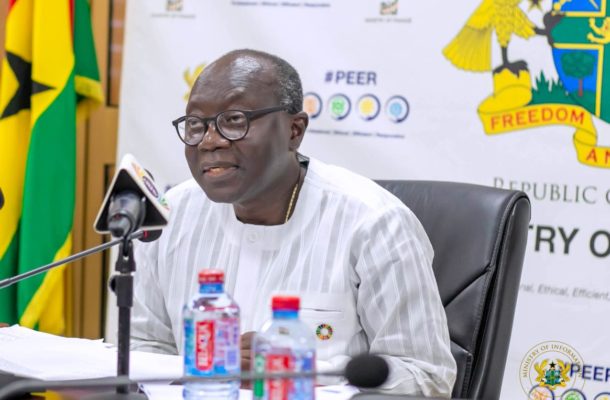
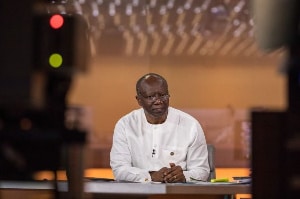
“We can’t afford to touch it. Let me assure you, Treasury bills will forever remain sacrosanct. Treasury bills are exempted completely. We have done the sustainability analysis. We are not including treasury bills. That is how government funds its operations,” he said.
According to him, the administration overspent using COVID-19 funding. Consequently, Ghana’s fiscal deficit will soar in 2020.
He was addressing concerns on the Auditor General’s report on the government’s use of COVID funds.
Prof. Bokpin gave several explanations for the scathing audit findings, including “lack of value for money, COVID vaccines that were paid for but not provided, and some COVID-related inflows that were instead channeled into general budget support, among others.
“Why was that so, because COVID also happened in the year of elections, so government was abusing public finance in the name of COVID-19,” he stressed.
“So, the current crisis we have here, you can also trace it to the election-related excesses of 2020 that government blamed on COVID,” he stressed.
Auditor-General’s report on COVID-19 spending
The Auditor-General released a report on government’s expenditure during the COVID-19 pandemic covering the period between March 2020 to June 2022.
The special audit report has been prepared under Section 16 of the Audit Service Act, 2000 (Act 584) for submission to Parliament.
It detailed the various expenditure made by Ministries, Departments, and Agencies during the aforementioned period.
The report noted that records on COVID-19 funds at the Ministry of Finance, Controller and Accountant-General and Ministry of Health indicated that, the Ministry of Finance mobilised a total amount of GH¢19,112,318,205.12 in 2020 to mitigate the impact of the COVID-19 pandemic.
The records showed that an amount of GH¢1,978,551,137.46 was mobilised in 2021 and GH¢753,319,842.66 (up to June 2022) to finance the Coronavirus Alleviation Programme and the implementation of the Ghana COVID-19 Emergency Preparedness and Response Plan.
In all, a total amount of GH¢21,844,189,185.24 was mobilised to mitigate the impact of COVID-19 pandemic in Ghana.
One of the best things you can do for yourself to turn your money situation around is to review the budget that you had for the past month and see where things went wrong. Taking a closer look at your spending will show you all the bad money habits that you need to start doing away with in order to turn things around for your account.
2. Unlink your Mobile Money from your bank account
3. Switch to a group Netflix/Spotify/Apple Music plan
If you’re going solo on any of your streaming subscriptions then you probably deserve the broke-ness that’s following you. Most of the streaming services that you use have family plans that you can get with your friends and split the bill for. It’s an easy way to cut back on some of the money that you’re leaking.
4. Start thinking of thoughtful Valentine’s gifts
Everyone knows that valentine’s day is one of the more expensive periods at the beginning of the year. If you’re all coupled up, there’s still a chance for you to save your bank account from taking a bloody combination to the face. Just start thinking of the most thoughtful gifts you can get your person. That way you can deliver on the thought that counts and leave your coins in your account.
He said this after the government formed an FX committee to look into the performance of the cedi.
He said, “The committee is made up of some very competent people, but they are too busy,” adding, “The Minister of Trade should be busy getting down with business to set the trade protocols. The Minister of Agriculture should be busy modernizing agriculture.
“I cannot see them contributing to anything”, he foretold, insisting: “Let’s dissolve it,” he added.
Read the full story originally published on January 22, 2020, by laudbusiness
In his opinion, a stable currency is not necessarily good for an economy, a comment that dismisses claims that the cedi’s poor performance against the dollar shows a weak economy.
Touching on the Forex Committee formed by the Ministry of Finance to investigate circumstances leading to the fall of the cedi against the major trading currencies, in an interview with Accra-based Citi FM on the station’s Eyewitness News programme on Monday, 20 January 2019, he said the formation was needles and should be dissolved.
“The committee is made up of some very competent people”, he observed, “but they are too busy”, he noted, explaining: “The Minister of Agriculture should be busy transforming agriculture, the Minister of Trade should be busy sitting down with industry to decide the trade protocols.”
“I cannot see them contributing to anything”, he foretold, insisting: “Let’s dissolve it”.
“A forty-member committee, are we serious?” the stalwart of the governing New Patriotic Party (NPP) wondered.
“In the fourth year of this administration? We don’t need ideas, we’ve had ideas – aviation hub, we’ve had it; financial services during Kufuor’s time, we discussed it, Barclays was involved”, Mr Pianim recalled, stressing that what the government needs to do in the last year of its four-year term is “action, action, action”.
“If I see this committee, it seems like a public relations stunt; we are not interested in a public relations stunt. These people [committee members] are too busy. This 40-member committee, look at them, they are busy people. They are managing banks, managing ministries; what time do they have? This committee, if it’s a public relations stunt, that’s fine; if it’s eye service, that’s fine; but I cannot see them contributing to anything.
“Dissolve it. We don’t need it. What is it for? They are going to meet; we spend the little money we don’t have making tea for them. What are they going to do?” He asked.
He further stated: “We, in Ghana, are beginning to talk as if a stable cedi is a litmus [test] for sound economic management. We should get away from that nonsense. … A stable currency is not necessarily good. You need it to be flexible and that’s why we had a fixed exchange rate, it took President Rawlings a long time to move us from a market-determined economy to a reasonably market-oriented economy to change … We have the floating exchange, fixed exchange, and then now we have a managed float, so, I do not understand why anybody thinks you have a cure for exchange rate development – the movement in the exchange rate”.
However, Duncan Amoah, COPEC’s executive director, wants the commodity’s distribution to be accelerated in order to let prices fall and protect customers.
“The data related to this gold-for-oil arrangement is particularly important. According to Citinewsroom.com, “We should entirely stop the politicians from intervening in fuel or trade if it doesn’t solve the situation with the rising fuel prices and the weakening cedi.”
“Because that will not be the situation Ghanaians are clamouring for. The numbers they will put up for the coming week will determine whether we are able to stimulate the market downwards or we are able to sustain prices where they are. Or there are some benefits to be derived as a people. If there are no benefits, then it will be difficult to go to the Bank of Ghana (BoG) to ask for money to trade in oil, we will be burnt on all sides,” Duncan Amoah added.
Meanwhile, the price of petroleum products has increased in the second pricing window of January which took effect on Saturday 21, 2023.
The development has since been attributed to the recent depreciation of the cedi against major trading currencies despite witnessing some appreciation during the festive period in 2022.
To mitigate the situation, government has taken delivery of the first consignment for its ‘Gold-for-Oil’ policy for about 41,000 million metric tons of petroleum products.
The petroleum products are expected to be discharged and sold by state-owned enterprise BOST to Bulk Oil Distributing Companies (BDCs) across the country.
Dr. Bawumia on Facebook earlier explained that the usage of gold to purchase oil would also address Ghana’s dwindling foreign reserves as well as reduce demand for US dollars by oil importers.
Under the policy, government believes that using gold to purchase oil products would also bring stability to the exchange rate market and ensure domestic oil operators do not solely depend on foreign exchange to import products.
Member of Parliament (MP) for Bortianor-Ngleshie- Amanfro, Sylvester Tetteh, has stated the continuous stay of Ken Ofori-Atta as Finance Minister will undermine the financial sector.
The lawmaker demanded that the president terminate the appointment of the finance minister to restore some confidence in the financial sector.
He further argued that Ghanaians have already lost faith in the minister and therefore his involvement in the negotiations of the Domestic Debt Exchange and the IMF bailout raises serious doubts.
In an interview with Okay FM, Sylvester Tetteh added that the 80 members of the majority caucus who have called for the resignation of the minister still stand by their statements and are waiting for the president to revoke the minister’s appointment.
“We members of parliament, our call is that Ken Ofori-Atta must give way, and we’ve given our reasons why he must give way and the reasons are still tenable.
“There are two things involved, is either the president will terminate his appointment because he gave him that position or he himself will resign because of how bad the economy is.
“We’ve realized that the overall confidence in the financial architecture of this country is all about Ken Ofori-Atta. we’ve tried several times but still, he is at the post.
“So, for us, the worse thing is that we will boycott his business in government… But our position hasn’t changed and Ken must go, we believe that it will inspire some confidence in the economy and the new leadership will bring new ideas.
In November, some NPP parliamentarians demanded that Mr Ofori-Atta be sacked as Finance Minister.
The MPs, numbering about 80, held a press conference to impress on the President to relieve his cousin of the responsibility of managing the national purse or risk losing their support for government business going forward.
The minister was then referred to a committee of the parliament for a vote of censure. Contrarily, the vote of censure failed to remove the sector minister because the majority left the chamber during the voting and according to the constitution, the destiny of the minister must be decided by two-thirds of the house.
The Member of Parliament for North Tongu, Samuel Okudzeto Ablakwa, has recalled a moment he describes as a “never-before-time” in parliament when the government completely forgot an entire budget for a region in its yearly budget.
He explained that this was in November of 2019 when the Minister of Finance, Ken Ofori-Atta, came to present the 2020 Budget Statement and Economic Policy to the House.
Recalling this on Friday, January 20, 2023, edition of Good Morning Ghana on Metro TV, the MP said that it took his scrutiny of the statement to be able to identify the major omission.
“You remember when the Year of Roads budget was presented? I quickly went through the budget and discovered that the Volta Region had been left out – November 2019, for the 2020 Year of roads,- and then we drew attention,” he said.
Samuel Okudzeto Ablakwa went on to say that the minister, in order to express gratitude to the Minority, had to return to parliament the next day just to present a budget for the Volta Region.
He added that the Minister of Finance, Ken Ofori-Atta, was also grateful to them because he knew that their discovery had saved them from an unintended consequence.
“So, the next day – it was the first time it had happened in the history of Ghana’s parliament, the finance minister came back to the House and presented a budget, listing projects for the Volta Region, and even commended us for discovering that; that it was an oversight; it was a major slip, and if we hadn’t discovered it, and 2020 had come, and Voltarians found out later on, the consequences would have been dire,” he added.
Kwabena Marfo, a broadcast journalist with Despite Media group has censured Minister of Finance, Ken Ofori-Atta over the decision to include pensioners in the Domestic Debt Exchange Programme (DDEP).
Kwabena Marfo says the move by the finance ministry smacks of heartlessness and insensitivity on the part of finance minister, Ken Ofori-Atta.
He wonders if Ken Ofori-Atta exhorted his mind to the plight of the pensioners and the possible effect of the move on them before rolling out the programme.
“He is heartless and insensitive to the plight of the people. Only someone who doesn’t care and has concern for people will do what Ken Ofori-Atta is doing. Most of the people you see holding the bible are hypocrites.
“If you want to sin and go scott free, just take up the Bible. These are some of the reasons people don’t go to church. If Ken Ofori-Atta was in my church, I wouldn’t step there. I won’t even attend his church. I have never seen a heartless human being like that. How do you go after the monies of pensioners. These little monies from the pensioners and you want to touch it.
“Has he thought about the people who could die as a result? Has he thought about the people who will not able to afford medications? How can you take the country ransom and behave like we are slaves. We shall see in 2024,” he fumed.
The decision to include pensioners in the DDEP has courted controversy with concerns over how the over-60-year-olds will survive.
Peter Kojo Nyansepe, a 77-year-old sick retiree is dreading the program as he believes it could drive him to his grave.
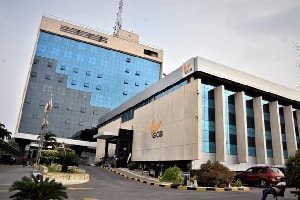
He told Joy News that he will picket at a branch of the GCB to retrieve his monies.
“I gave the money to the Ghana Commercial Bank so they’ll give me the money before I come. I’m going to stay there.
“If they say the money is not there, I’m going to stay there. I’m going to stay there until they carry me wherever they want to carry me because I cannot walk myself so they’ll carry me.
“Wherever they want to carry me they have to carry me and go. That’s the only thing I can do. I cannot fight them also”, he said.
Meanwhile the Pensioner Bondholder Forum called off its earlier threat to picket at premise of Ministry of Finance last week.
The decision follows invitations for extensive talks with the ministry over the DDEP.
Founder and Leader of Heaven’s Gate Ministries, Prophet Nicholas Osei popularly known as Kumchacha has lamented the impact of economic hardship on Ghanaians and is advocating for the sale of the nation to its former colonial masters.
Speaking in an interview on Onua FM monitored by GhanaWeb, the man of God asserted that Ghanaians are suffering as a result of the NPP-led government’s poor leadership.
He continued by saying that in his perspective, it would be preferable for the country to be run by colonial overlords rather than having black folks mismanage the nation.
“Masa things are hard, and how the system has become, if possible, let’s sell the country and share the proceedings. Since we gain our independence. If the whites were still ruling us, I’m sure by now we would have developed.
“Looking at South Africa and how the whites have developed their country, is so sad. How can a country that gain independence more than 60 years ago still keep borrowing? Just look, we have cocoa, oil, timber, gold, diamond and everything but still, we’re struggling. Which country is this,” he fumed.
Meanwhile, Ken Ofori-Atta, Ghana’s finance minister rendered an apology to Ghanaians for economic difficulties on November 18, 2022, when he appeared before the Parliamentary ad hoc Committee hearing the Motion of Censure against him.
He acknowledged that the economy is facing difficulties and the people of Ghana are enduring hardships.
He said he sees and feels the terrible impact of the challenges and would continue to work hard to resolve them to help mitigate the hardships for the citizens.
“Today, I acknowledge our economy is facing difficulties and the people of Ghana are enduring hardships.
“As the person, President Akufo-Addo has put in charge of the economy, I feel the pain personally, professionally, and in my soul. I see and feel the terrible impact of the rising prices of goods and services on the lives and livelihoods of ordinary Ghanaians,” he told the Committee.
He added that he has taken note of the plight of businesses in the country as they struggle to stay in business.
“I feel the stress of running a business. But, it is the strength and perseverance of the Ghanaian people that inspire me and my colleagues in government every morning, to press on,” Ofori-Atta said.
The minister added that “is what gives me the strength to press on to find solutions and relief for Ghanaians to the myriad of problems that our country and the rest of the world are facing, especially, since March 2020.”
It will be better if we sell the nation and share the money among ourselves. – Prophet Kumchacha on Efie Ne Fie with the 3 Wisemen#OnuaNews #OnuaFM pic.twitter.com/T5ofTYGNIG— Onua FM (@onua951fm) January 20, 2023
Databank, a company partly owned by the Minister of Finance, Ken Ofori-Atta has reportedly bagged GH₵159million from government for its Transaction Advisory services on government bond issuance since 2017.
The claim is being made by the Member of Parliament for South Dayi, Rockson-Nelson Dafeamekpor who said his calculations were based on a document supplied to the committee that probed the Vote of Censure motion against Ken Ofori-Atta last month.
In a tabular representation of the figures, Dafeamekpor alleged that government paid GH ₵85 million to Databank in 2021. The lowest figure was 2019 where GH₵11.83million was paid to Databank.
The document, posted on social media, was captioned: “This is how much Ken Ofori Atta and his company have made from the borrowings he’s made so far for this Govt….very staggering amount of money in fees. How much taxes has he paid on these huge fees earned from the borrowings?”
One of the grounds for the censure motion against Ken Ofori-Atta was claim of conflict of interest over the involvement of Databank in Government of Ghana’s Capital Market transactions.
His counsel at the time, Gabby Asare Otchere-Darko defended that the Commission of Human Right and Administrative Justice (CHRAJ) and not Parliament was clothed with the power to investigate issues of conflict of interest.
After rounds of legal banter between Gabby Otchere-Darko and Dr Dominic Ayine who was the co-chair of the committee, conflict of interest was struck out as one of the grounds for the investigations.
One of Ofori-Atta’s deputies, John Ampontuah Kumah asked critics of the Finance Minister to seek interpretation at the Supreme Court over the matter.
“Those who are so pained by the current situation should go to court, the Supreme Court or the High Court. So that we can all be guided because, as far as I am concerned, these two public officers have acted within the law. Even at their vetting, they’ve disclosed this; every information has been put out there. All of a sudden, it is turning out to be another unheard of situation,” he said.
The New Patriotic Party (NPP) has couched the mantra ‘Breaking the 8’ to signify their intent to win the 2024 polls and to break the 8-year power rotation cycle between them and the National Democratic Congress (NDC) since 1992.
According to Ofori-Atta the conduct of upcoming parliamentary and presidential primaries will have a significant impact on whether or not the party can win the next elections.
He was speaking in an address after a recent visit to the NPP headquarters in Accra as part of efforts to bridge the gap between the party and government.
“The Minister for Finance thanked the party leadership for the warm reception and commended them… Hon. Ofori-Atta concluded his remarks by urging the party leadership to put in place adequate guidelines to ensure a smooth conduct of its parliamentary and presidential primaries as that is critical to the Party’s quest to win a-third consecutive general elections (break the eight),” a January 13 statement issued by the NPP said.
The party will in the coming months elect parliamentary candidates across the country as well as a presidential flagbearer to take over from president Nana Addo Dankwa Akufo-Addo whose final term expires in January 2025.
The minister endured a challenging 2022 with a failing economy that triggered calls for his sacking from the opposition and members of civil society as well as a group of NPP lawmakers.
Ofori-Atta also came under sustained attacks after government opted to go to the International Monetary Fund (IMF) at a time the cedi was suffering massive depreciation, inflation was galloping and the economy was suffering downgrades from rating agencies.
As compared to yesterday’s trading of a buying price of 10.3510 and a selling price of 10.3614. At a forex bureau in Accra, the dollar is being bought at a rate of 12.45 and sold at a rate of 13.05.
Against the Pound Sterling, the Cedi is trading at a buying price of 12.7958 and a selling price of 12.8096 as compared to yesterday’s trading of a buying price of 12.8373 and a selling price of 12.8523.
The Euro is trading at a buying price of 11.1959 and a selling price of 11.2070 as compared to yesterday’s trading of a buying price of 11.2352 and a selling price of 11.2473.
At a forex bureau in Accra, Euro is being bought at a rate of 12.60 and sold at a rate of 13.60.
The South African Rand is trading at a buying price of 0.5996 and a selling price of 0.6002 as compared to yesterday’s trading of a buying price of 0.6119 and a selling price of 0.6124.
At a forex bureau in Accra, South African Rand is being bought at a rate of 0.50 and sold at a rate of 1.10.
The Nigerian Naira is trading at a buying price of 44.4424 and a selling price of 44.5390 as compared to yesterday’s trading at a buying price of 44.5086 and a selling price of 44.5434.
At a forex bureau in Accra, Nigerian Naira is being bought at a rate of 13.50 Naira for every 1 Cedi and sold at a rate of 18.50.
Nearly 18 years later, the Ministry of Health reports that it has not yet been able to recoup a loan of GH3 million issued to 202 healthcare providers and organizations.
This was covered in the 2020 Auditor-Report, General’s which the Parliament’s Public Accounts Committee is now evaluating.
Appearing before the Committee in Accra last Wednesday January 18, Financial Controller at the Ministry Daniel Azubila noted that it has been very difficult recovering the loans – adding that out of the total amount owed by the defaulters, his outfit has been able to retrieve just GH¢765,284.74.
He further indicated that most of the beneficiary institutions have cited lack of funds as reason for the non-payment.
“A category of these beneficiaries are deceased, another group is on retirement, and a majority of beneficiaries are still at post with the ministry.
Recounting the manner in which the loans were awarded, he admitted that the ministry did not act accordingly – a situation which might have resulted in beneficiaries’ failure to repay.
“The best approach was to route repayment from their salaries through the Controller and Accountant-General’s Department. But given the circumstances and the objective to motivate health workers, at that particular time the majority of them, if we were to use the Controller and Accountant-General system, would not have qualified to be given that motivation.
“Most of them had already taken loans that reduced their eligibility to qualify on those grounds. Because of this, the deductions were not routed through the Controller and Accountant-General’s Department. They were asked to repay through their banks,” he said.
Chairman of the Public Accounts Committee and Member of Parliament for Ketu North Constituency, James Klutse Avedzi, recommended the ministry to write-off the loans owed by institutions, since those institutions are meant to use government funds in the repayment.
“We (government) have been buying vehicles for the institutions, and with this one it is the same government money that they will use to pay; so, in a way, it is going to rob Peter to pay Peter,” he remarked.
The Minister of Health, Kwaku Agyemang-Manu – who was also present before the Committee, was quick to accept the Chairman’s recommendation, adding that insistence on the repayment by these institutions may pose challenges to the health sector.
“If you ask them to pay, it is the same IGF that they are generating that they are going to use, which may impact on care delivery and several other challenges. If we are not very careful, some will use their drug accounts and they will not have medicines in the hospitals and clinics. So your recommendation to write-off is most appropriate, and we also recommend the same,” Mr. Agyemang-Manu said.
He also urged the Committee to extend the recommendation to some groups of beneficiaries, including the aged – who may not be able to repay.
“As you try to recover the funds you encounter some elderly specialists, doctors who have served for years; they are on retirement – they are not earning salary. The vehicles are old, some have parked them… then you ask them to come and make payment? Clearly, they cannot pay with their pension money. Some are dead and gone; and the little monies they left for their wives, is that what you are going to collect?
“It is a big challenge. We didn’t structure the recoveries very well, and it’s like we burned our fingers,” he admitted.
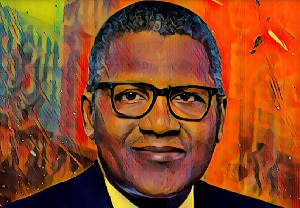
The 650,00-barrel-per-day refinery is slated to be commissioned before the end of the first quarter of 2023, and could give a shot in the arm to Dangote’s fortune.
According to insiders at the Dangote Group who spoke to Billionaires.Africa on the condition of anonymity, the Nigerian billionaire plans to list Dangote Refinery and Petrochemical Ltd. by the first quarter of 2024 at a market capitalization of anywhere between $20 and $25 billion.
Dangote became the first African in modern history to lay claim to a $20-billion fortune in 2013, nearly 10 years ago, when the market capitalization of his cement business crossed the $20-billion market cap mark.
According to figures tracked by the Bloomberg Billionaire Index, Dangote, who is presently worth $19.1 billion, ranks as the world’s 82nd richest man. The billionaire derives the bulk of his net worth from his 86-percent stake in publicly traded Dangote Cement, as well as from other holdings in salt and sugar manufacturing companies, among other assets.
With a net addition of at least $18 billion expected from the $19-billion integrated petrochemical refinery complex minority-owned by the Nigerian National Petroleum Company (NNPC), Dangote is expected to see his wealth increase from $19 billion to well over $30 billion.
Dangote is the founder and chairman of the Dangote Group, a leading manufacturing conglomerate on the African continent’s sugar, salt, oil, fertilizer, and packaged food production.
What you should know about Aliko Dangote’s oil refinery
The Dangote Petrochemical Complex is made up of the Dangote Oil Refinery and the Dangote Petrochemical Plant. The Dangote Petroleum Refinery is located in Ibeju-Lekki, Lagos, to the southeast of the Lekki Free Trade Zone (FTZ) on a land area of about 2,635 hectares (six times the size of Victoria Island).
In August 2021, the Nigerian government approved the sum of $2.76 billion for the state-owned petroleum company, the NNPC, to acquire a 20-percent minority equity stake in the Dangote Refinery.
The state-of-the-art facility will not only enhance the refining capacity of Nigeria but also strengthen the country’s position as a major player in the global oil and petrochemical industry.
The official commissioning date of the refinery has not been announced yet. However, the group has announced that operations at the refinery are expected to commence this year.
According to the Organization of Petroleum Exporting Countries, the Dangote Oil Refinery will account for more than half of Africa’s medium-term refining additions, which are estimated at 1.2 million barrels per day; the refinery, with a capacity of 650, 000 barrels per day, is the largest of all the refinery additions expected across Africa in the medium term, according to OPEC.
The $19-billion project is a strategic move by Dangote and the Nigerian government to strengthen the country’s downstream industry and become a net exporter of refined petroleum products and petrochemicals by 2026.
The anticipated launch of the refinery is poised to not only fulfill Nigeria’s entire demand for refined products, but also generate a surplus for export, thereby establishing a market worth $11 billion annually for Nigerian petroleum products.
The complex will also produce 4 million metric tonnes of jet fuel per day, 65 million liters of premium motor spirits (petrol), 15 million liters of diesel, and 3 billion standard cubic feet of gas.
The sick bondholder told JoyNews that he depends on the bond returns and that if he doesn’t get anything at the end of the month, he won’t have anything to live on.
He claims that because he is concerned about how he will pay for his meds and other daily expenses, the uncertainties surrounding the Domestic Debt Exchange Program fill him with fear and anxiety.
“I gave the money to the Ghana Commercial Bank so they’ll give me the money before I come. I’m going to stay there.
“If they say the money is not there, I’m going to stay there. I’m going to stay there until they carry me wherever they want to carry me because I cannot walk myself so they’ll carry me.
“Wherever they want to carry me they have to carry me and go. That’s the only thing I can do. I cannot fight them also”, he said.
Peter Kojo Nyansepe is one of many retirees watching on with anxiety as the Ministry of Finance rolls out the DDEP.
As part of conditionalities to achieve the IMF bailout, the government has recommended that all benefit due bondholders in 2023 not be paid.
Per the arrangement, the payment of the benefits will resume in 2024 at the rate of 5%.
This arrangement has been widely criticized with critics saying that the government is worsening the situation of the already burdened Ghanaians.
The Paris Club members are ready to take the first step toward forming a creditor committee, an official of the club told Reuters.
Ghana last week requested a restructuring of debt it owes to other governments, becoming the fourth country after Chad, Ethiopia and Zambia to do so under a G20 Common Framework.
The programme, which was launched in 2020, was supposed to streamline the process of coordinating among creditor governments the restructuring of low-income countries’ debts after the pandemic.
However, progress has proven glacial for the first cases, a situation Western countries say is in part due to a lack of restructuring experience by China, a non-Paris Club G20 creditor that has become a major lender in recent years.
“There is a commitment by the leaders to form the creditor committee, so it’s a question of time. We know that all the G20 members are committed to undertake the debt treatment under the Common Framework,” the Paris Club official told journalists.
The official requested they not be named to speak freely about the restructuring situation.
Forming a creditor committee took a couple of months for previous cases, however, the official said the Paris Club members were all ready to do so for Ghana and hoped it could be done in a month.
The official said Ghana’s case was less complex than Zambia, whose case the official said was progressing after struggling since it became the first African country to default after the pandemic.
“We think that the process will become smoother and smoother on the basis of the previous cases,” the official said, adding that Ghana’s authorities had sought assurances its case would be dealt with in a “timely manner”.
This comes after the government on January 16, 2023, issued a third delay for the deadline as part of efforts to reach an understanding with those impacted bondholders who have openly stated their discontent with the DDEP.
“No, I don’t think so. I’m confident that we’ll get there. You know we have done the staff level agreement as you know, we met with the Paris Club membership and we have given them till end of February for us to go through what we call the common framework or some version of it but that will be facilitated, and then we expect them to go to board in Washington in March,” Ofori-Atta explained.
He continued, “So really, we don’t have that type of time, because as you know, usually the first quarter is when we would have gone to the international capital market for our usual Eurobond issuance”.
“Now that market is not there for us this year, maybe even next year, an agreement in the fund programme is what one is using to be able to give the necessary comfort that is required,” the Finance Minister stressed.
Ken Ofori-Atta further said any further delays to the DDEP could pose a serious risk to the ailing Ghanaian economy which continues to suffer various setbacks.
The leadership of the Christian Council of Ghana (CCC) has called for prayers for Finance Minister Ken Ofori-Atta to gain God’s wisdom and direction regarding the Domestic Debt Exchange programme.
A statement issued by the Council on Thursday, January 19 asking the Finance Minister to suspend the debt exchange programme for further engagement, said “The leadership of the Christian Council of Ghana will continue to pray for the managers of our economy, especially the finance minister, for God’s wisdom and direction in this matter, and we urge all churches to do same.
“We strongly believe that God will see us through this difficult situation. Let us keep our hopes alive.”
The Council further stated that it has examined the concerns of the Individual Bondholders Association of Ghana (IBHAG), the Pensioner Bondholders Forum, church members and the general public and has identified lapses in the debt restructuring programme, a major one being lack of consultation with affected individuals and institutions.
“With the current economic hardships in the country and the agitations among the general public, it is in the nation’s interest for the Finance Ministry to suspend the 31 st January deadline given to individuals to sign on to the program and rather propose a road map for dialogue to make the process participatory such that the outcome would be acceptable to all.
“The Council believes that thorough engagements with stakeholders would help the government to appreciate the concerns of the Ghanaian people and put measures in place to address some of the challenges of the programme.
“The CCG also wants to encourage the media to be diligent with reportage on the debt restructuring program and ensure that they speak to professionals on the matter to avoid false information that would further heighten the already situation of fear and panic in the country,” a statement issued by the Council on Thursday, January 19 said.
It added “The leadership of the Christian Council of Ghana will continue to pray for the managers of our economy, especially the finance minister, for God’s wisdom and direction in this matter, and we urge all churches to do same. We strongly believe that God will see us through this difficult situation. Let us keep our hopes alive.”
Member of Parliament for the Nhyiaeso Constituency, Dr. Stephen Amoah, in June 20, 2022 noted that government was working assiduously to address the rising cost of living in the country.
He called on stakeholders to help government deal with the issue.
Read the full story originally published on June 20, 2022 by www.ghanaweb.com.
Member of Parliament for the Nhyiaeso Constituency, Dr. Stephen Amoah, has stated that in his opinion, government is working to address the current rising cost of living in the country.
He also added that these issues should not be tackled politically.
Speaking on JoyNews’ Newsfile, the legislator intimated that Ghana’s problems have compounded for almost 40 years thus government alone cannot solve them.
“The problem we’re having today, any honest person will tell you, it’s not today’s issue. It’s been with us [for] years. So, I’m preaching to every stakeholder who has what it takes to come on board and let us all make sure [to help]. Sometimes we get it wrong and right, [but]we’re all helping.”
“At present, it’s on the government, and I don’t think the government is sleeping. The fact is, [we] have 40-year-old problems”, he said.
Dr Amoah added, “If we sat there and our population size has grown from Nkrumah’s time from about 5 million to about 31 million; if you have a situation where just close to 7% [of people] directly in the formal sector pay taxes, and we’re having negative effective tax wage, and these problems have been compounded for years, the government alone [cannot solve them]”.
On the side of government’s spending, the MP believes more could be done.
“There are basic issues we need to check such as our discretionary spending and as government; we should be able to now go down. Even though the government said we’ve cut down by 20%, well accepted. But we can do more”, he added.
The latest data from the Ghana Statistical Service showed that Ghana’s inflation hit 27.6% in May 2022. This resulted in a hike in the prices of goods and services.
Ghanaians are lamenting the high cost of living in the country since their incomes have remained unchanged.
He remarked that in order to have a strong economy, greater policies will be necessary.
Read the full story originally published on December 20, 2022 by www.ghanaweb.com.
2023 has been predicted by Ghana’s Finance Minister, Ken Ofori-Atta, to be the year when the country’s economy recovers.
In order to create a better economy, he claims that tougher policies will be necessary.
On December 19, 2022, he stated that “2023 must be our “comeback” year” in an update on the economy. A year in which we established more solid foundations that would enable us to improve our nation in a lasting, inclusive, and transformative manner.
The minister called on Ghana’s Parliament to fast-track the passing of the Appropriations Bill for the 2023 fiscal year.
“We also urge Parliament to support in particular new revenue measures outlined in the 2023 budget which aim to improve revenue mobilization. We cannot afford to repeat the mistakes of 2022”, he disclosed after giving an update on the economy,” he added.
The finance minister also announced that the government, after consultations with stakeholders, has extended the date for enrollment in the debt exchange program to December 30, 2022.
“Above all, I urge us all to maintain an unshakeable sense of optimism about Ghana in the days and years ahead. Indeed, “the LORD is the Lifter of our heads” (Psalm 3:4), as we all witness a new confidence in our currency and the prospects of the certainty of an IMF Board approval of our Staff Level Agreement,” Ofori-Atta concluded.
Government to extend expiration date for domestic debt exchange to December 30 – Ofori-Atta
The letter, which was published on the sidelines of the World Economic Forum in Davos, Switzerland, by the Patriotic Millionaires in the US and UK, Tax me Now, Oxfam, and Millionaires for Humanity, urges governments to “tax us, the rich, and tax us now.”
According to a comprehensive analysis conducted by the Fight Inequality Alliance, Institute for Policy Studies, Oxfam, and the Patriotic Millionaires, a progressive wealth tax starting at just 2 percent for millionaires and rising to 5 percent for billionaires could generate a staggering $2.52 trillion annually.
As the super-rich signatories of this report join the growing global movement calling for greater taxation of the wealthiest members of society, it is clear that record COVID-19 wealth gains at the top of society have only further exacerbated income inequality.
The ten richest men alone have more than doubled their fortunes to a staggering $1.5 trillion dollars, and the world’s 2,660 billionaires now have wealth equivalent to the size of the entire Chinese economy.
Morris Pearl, former managing director at Blackrock and chairperson of the Patriotic Millionaires, has pointed out that there is no defending a system that endlessly inflates the wealth of the world’s richest people while condemning billions to easily preventable poverty, and that we need deep, systemic change, starting with taxing the rich.
Gemma McGough, British entrepreneur and founder of the Patriotic Millionaires UK, has echoed this sentiment, stating that tax systems the world over have unfairness built-in and that it is time for the wrongs of an unequal world to be righted by taxing the rich.
Oxfam revealed earlier this week that three of Nigeria’s richest men are worth more than 83 million Nigerians. The firm also revealed that the four richest families, previously identified as the Bhimji Depar Shah and Jaswinder Singh Bedi families, as well as the Uhuru family and the family of late Kenyan tycoon Naushad Merali, have a combined wealth of $2.8 billion, which is more than the bottom 40% of Kenya’s poorest 22 million people.
The Finance Minister, Ken Ofori-Atta has announced that government is planning to re-profile Ghana’s debt with the G20 developing countries rather than seek an outright cancelation.
The Paris Club members have already agreed to form a creditor committee to discuss debt restructuring and a possible debt cancelation for Ghana.
Government has come under some criticisms over its request to the Paris Club of International Creditors for debt cancelation.
Some analysts have argued that the request could encourage government to engage in reckless borrowing if it is granted.
Speaking on PM Express Business Edition, with George Wiafe, Mr. Ofori-Atta disagreed stating that the Paris Club members are always open for debt re-profiling.
“Paris Club is not necessarily debt cancellation but re-profilling of the debt. Basically, we are now talking about the float to look at the interest rate and the maturity period so that we can ensure that it does not exert any undue influence on us”.
He explained that the issue about debt relief and debt cancellation is a second item that government would have to confront with relevant stakeholders.
Providing some more information, he pointed out that government is dealing with a twin challenge where it is engaging domestic creditors as well as international creditors.
“We have the debt domestic programme. The plan is to reduce our interest burdens and move towards 25%. You have your Paris Club and other countries programme which helps smoothen out the needs for payment”, he said.
Mr. Ofori-Atta added that it is important to work at attaining a sustainable debt reduction – both domestic and external – to propel the country towards economic expansion.
“A combination of all of that leads us to the target so that’s what we are talking about. 55% debt to GDP and 18% debt service to revenue”, he stressed.
As part of his official visit, he addressed MOFA personnel and farmers in the Eastern Region. He informed them that the government was reducing production costs to help customers despite external issues beyond its control.
“We are pushing farmers to transition to organic fertilizers generated locally to lessen fertilizer scarcity on food production and asked the far west to move swiftly to compost.”
Dr. Afriyie Akoto said the government was looking at ways to force banks to lend to farmers to enhance productivity.
This was to address farmers’ incapacity to get loans from banks, he said, adding that attempts to the banks had proven useless over the years and the banks preferred to lend to entrepreneurs over farmers.
Mr Henry Crentsil, Eastern Regional Director of MOFA, said that despite fertilizer scarcity and high production costs, planting for food and employment and other initiatives indicate strong yields.
He claimed farmers’ adoption of better seeds has skyrocketed, especially in maize, signalling an oversupply of food and seasonal price spikes.
The Minister toured private commercial farms, including the Legacy Crop Improvement Center (LCIC), a seed production centre in Otareso, Akuapem North District, and examined its warehouse with a coding room.
He said his tour of the Regions revealed that the nation was well supplied with food, and the facts given by the regional directorates of Agricultural reinforced the idea that Ghana has a healthy, strong agriculture sector inspired by Planting for Food and Jobs.
This rate indicates that between December 2021 and December 2022 (year-on-year), the PPI increased by 52.2 percent, representing a 25.9 percentage point decrease in producer inflation relative to the rate recorded in November 2022 (78.1 percent).
In a statement, the Ghana Statistical Service said the month-on-month change in the PPI between November and December 2022 was negative 13.3 percent.
The producer price inflation in the construction sector decreased to 65.7 percent in December 2022 from 94.3 percent in November 2022.
In the Services sector, the rate decreased from 12.6 percent in November 2022 to 10.0 percent in December 2022.
Mining and quarrying at 73.4 percent, manufacturing 64.2 percent, transport, and storage; 63.6 percent recorded rates above the national average, while information and communication activity recorded the lowest rate of 2.7 percent in December 2022.
According to the farmers, the inability of the factory to purchase the thousands of tons of sugarcane ready for harvest was a disincentive to their hard work and contractual agreement.
Consequently, the Association had apologized to distillers for refusing to sell their produce to them some months ago, as it anticipated to sell them to the factory, and appealing to all sugarcane distillers across the country to come over to buy their produce.
“We sold our sugarcane to the factory, but now they are no longer buying from us, and we want to engage you to sustain our livelihoods.”
The farmers questioned the inability of the factory to function after the visit by President Nana Addo Dankwa Akufo-Addo in September 2022 and declared: “we want the management and Board of the factory to know we will not sell our sugarcane to them again for disappointing us.”
The debt exchange program is voluntary, according to the Minister. No bondholder is required to accept the terms of the scheme, he said.
He was speaking to members of the press and bondholders who had met with him to discuss the issue. He stated that the administration aims for an 80 percent program participation rate.
“It is a voluntary programme and the expectation is that we have an 80 percent participation and so, that should be factual for everybody,” Mr Ofori-Atta said.
The debt exchange programme seeks to encourage bondholders to voluntarily exchange GH¢137 billion domestic notes and bonds of the Republic including ESLA and Daakye for a package of new bonds.
The energy research group argued that the degree of increase in end-user electricity bills, as published this week by the regulator, was influenced by the PURC’s projection that hydro will make up 26.11 percent of the power generation mix.
In its projection, which is contrary to the PURC’s, water elevations for Bui and Akosombo generating stations (GS) have improved and are capable of producing close to 38 percent of power in 2023. This, the IES, believes should have considerably lowered the rate consumers have been asked to pay, effective February.
“Although the IES has anticipated that the average electricity end-user tariff (GH₵/kWh) covering residential, non-residential and special load tariff electricity consumers will see an increase within the year, the expected increase in tariff was anticipated to be marginal should more of hydro-electric power be produced from the generation mix,” IES said in a statement to the B&FT.
While agreeing to the other variables – cedi depreciation, inflation rates and the Weighted Average Cost of Gas (WACoG) – as factors which informed the end-user tariff increment of 29.96 percent for electricity to all consumer groups, it however disagreed with the generation mix factor that has been pegged at 26.11 percent for hydro and 73.89 percent for thermal.
“The IES is concerned in particular about the assumption used in establishing the new electricity tariffs beginning February 1, 2023. On the four key variables, the IES believe the rates for cedi/dollar exchange rate and inflation rates reflect market conditions.
“The IES however considers the assumption used by the PURC for the electricity generation mix of 26.11 percent hydro and 73.89 percent thermal as baseless. That assumption amounts to giving priority to thermal power generation over hydro, given that water elevations for Bui and Akosombo generating stations (GS) have improved and are capable of producing close to 38 percent of power in 2023, in IES’ estimation,” a portion of the statement read.
Explaining why it believes PURC has been very modest in its estimation of hydro power generation for the period, it said data from Akosombo and Bui indicate elevations at the beginning of 2023 compared to previous years are in a better positions to produce more electricity than the thermals.
For instance, it said with a year-start Akosombo water level elevation of 83.10 metres (272.66 feet), it is estimated that total energy production from Akosombo GS could fall between 7,500 and 8,000 gigawatt hours (GWh) for 2023, with the Kpong GS producing roughly 990 GWh of electric energy over the period.
“The Institute agrees with the expectation that the bulk of capacity generation for 2023 will come from thermal sources if natural gas supply is sustained and planned plant maintenance schedules are strictly adhered to. However, with improved water-head levels, hydro-power generation is estimated to produce close to 38 percent of 2023 capacity, should hydro-electric have dispatch priority over thermal in the generation mix.”
Also, Bui GS’ year-start elevation of 178.99 metres above sea level (masl) is enough to possibly produce an estimated 1,056 GWh of electricity in 2023, IES said.
“IES, therefore, calls on the PURC to reconsider the energy mix assumption used in the tariff adjustment (to reflect improved water-head levels), as that has an impact on the Weighted Average Cost of Gas – which has been reviewed to US$6.0952/MMBtu from US$5.9060MMBtu.
This, the IES believes, will bring down the 29.96 percent tariff increase for all electricity consumer groups, thus introducing some relief to the already burdened citizens in the face of the current economic crisis.
A little over 40% of the funds were distributed to women-owned businesses as part of the Ghana Economic Transformation Project (GETP). The goal of the World Bank-funded project is to encourage private investment and strengthen growth in the economy’s non-resource-based sectors.
Commenting on the disbursements’ impact during the SME High Growth Programme launch, Chief Executive Officer-GEA, Kosi Yankey Ayeh said: “Overall, the scheme has chalked up an over-90 percent satisfaction rate based on an online survey conducted in March 2022. This is because the application process is transparent and fast”.
And this has impacted greatly on gross sales – with 66 percent of beneficiaries indicating that the average value of gross sales increased by approximately 4 percent, according to Mrs. Yankey Ayeh. “Grant disbursement started in August 2021, hence 2020 is considered an appropriate base year. A gross sale value of GH¢104,805 was recorded in 2021, representing an about-52 percent increase compared to the 2020 baseline,” she said.
Meanwhile, a new SME High Growth programme was launched by the GEA to deepen the sector’s participation in the country’s recovery efforts – and also provide the training and capacity building necessary for SMEs’ operational efficiency, which will boost their competitiveness and scale-up their operations for further job creation.
With a grant support of US$20million earmarked for the programme’s implementation – targetting high-growth SMEs in the agribusiness/agro-processing, construction, education, food and beverage, healthcare and/or pharmaceutical industries, ICT, manufacturing, textiles and garments, among others – the initiative is expected to transition these enterprises into the next stage of growth; thereby improving their ability to increase sales and exports.
Expected programme results and impact
In a short presentation at the nationwide programme launch, Mrs. Yankey Ayeh said the initiative and its grant support will help about 2,000 SMEs become investment-ready, capable of attracting both local and foreign capital into their business; increase sales; and more importantly, build their capacities to export and “culminate in job creation and job sustainability”.
She said the beneficiary SMEs will be given technical assistance by KPMG on business management capabilities, productivity-enhancing improvements and utilisation of the soft skills acquired – leading to a generally improved business operating culture among Ghanaian SMEs, thereby enhancing competition and growth.
“The new SME High Growth Programme is designed to build on and consolidate the successes achieved so far. And in this regard, we intend providing SMEs with all the relevant tools needed in business development, including digital marketing tools necessary to enable them take advantage of the African Continental Free Trade Area.
“This makes the programme-design very relevant to the vision of Nana Addo Dankwa Akufo-Addo for SMEs through the GEA – that is, to optimise their potentials so as to enable them contribute meaningfully in growth and development of the national economy and poverty reduction,” Mrs. Yankey Ayeh said.
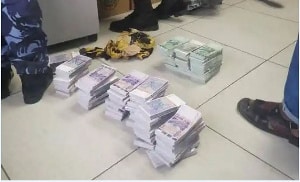
A genuine 843,000 CFA and 110,500 Naira were also found in the aforementioned briefcase, according to the Acting Commissioner of Customs, Seidu Iddrisu Iddisah.
When describing the event to the B&FT in Accra yesterday, Commissioner Iddisah stated that two of the perpetrators were stopped on a motorbike by customs officers on an illegal route intended only for locals of that area of Aflao.
He disclosed that the main suspect who was in possession of the luggage is a Nigerian citizen. “He is a 57-year-old man and his name is Arimo Timothy Adigbo, with a Nigerian passport in his possession,” the Customs chief noted.
The incident occurred on Tuesday, January 17, 2023, at Aflao, and according to the Customs Division, the case has been handed over to the Customs investigation department for further interrogation. “Upon receiving the news, I ordered that the suspect be brought to Accra to enable us to carry out a detailed investigation into the matter,” Iddisah disclosed.
“The understanding is that the suspects were arrested in Ghana’s territory and not in Togolese territory. The crime was carried out in Ghana, and that informed our decision to pursue the case at the Customs headquarters. If we have to contact Nigerian Customs during the investigation, we will do that. We have that collaboration in place,” he said.
But for the arrest, Commissioner Iddisah said, the culprit would have changed the monies into dollars and Naira and gone back to his country, leaving behind fake currencies circulating in both Ghana and Togo.
This, he said, may not only lead to losing foreign exchange but has other criminal implications as well. “The first law in breach is lack of declaring of goods per the laws of Customs, and the fact that the suspect was plying an unapproved route with such contents in the briefcase are all criminal,” Commissioner Iddisah emphasised.
The CCG in a January 19, 2023 statement signed by Rt. Rev. Prof. J.O.Y Mante said it had arrived at that position after keenly following public debates and talking to some affected parties.
Their call for engagement, the statement noted, was because they had “identified lapses in the debt restructuring programme, a major one being lack of consultation with affected individuals and institutions.”
The statement continued: “With the current economic hardships in the country and the agitations among the general public, it is in the nation’s interest for the Finance Ministry to suspend the 31st January deadline given to individuals to sign on to the program and rather propose a road map for dialogue to make the process participatory such that the outcome would be acceptable to all.”
The government has failed to secure a debt restructuring deal with domestic lenders, postponing a deadline for the DDE thrice, the latest deadline being January 31, 2023.
The government has repeatedly blamed the crisis partly on the aftershocks of the COVID pandemic and the ongoing Russia-Ukraine war but has promised to turn around the economic fortunes of the country after sealing a Staff-Level Agreement with the IMF late last year, with hopes that funds from the US$3 billion facility will be released early this year.
The government is hamstrung by hurdles as it attempts to secure a debt restructuring programme at home. Processes are underway to restructure external debts too, Finance Minister Ken Ofori-Atta disclosed to Accra-based Joy FM on January 18.
Organized labour successfully fought off plans to include pensions in the DDE; now individual bondholders are also rejecting plans to include them with talks ongoing on a mutually acceptable way forward.
The average performance of the local currency has been one of the finest in previous years, he claimed, despite the cedi being under pressure.
“External factors have been the main cause of the cedi’s pressure, as we have witnessed. The average performance of the dollar has actually been among the greatest in recent years, notwithstanding the high volatility seen this year, according to Ken Ofori-Atta.
View the complete article written by dailyguideafrica originally on July 19, 2018
The cedi hit a record low in May and June this year touching GHC4.8250 to the dollar.
Presenting the mid-year budget review before parliament on Thursday, 19 July 2018, Ofori-Atta said the depreciation of the cedi in the first six months of 2018 has been the best since 2012.
He said: “We have seen the cedi come under pressure primarily due to external pressures. In fact, aside from the strong volatility recorded this year, the average performance of the dollar has been one of the best in recent years.
“A further interrogation of data from the Bank of Ghana showed that the depreciation of the first-half, six months of 2018, has been the best since 2012. It is instructive to note that from January 2018 to June 2018, the depreciation of the Ghana cedi against the dollar was 2.4% as against 17.2% in 2012, 3.6% in 2016, 3.7% in 2017.
“If this is anything to go by, it means that the 2018 performance of the Ghana cedi is likely to be better than even the 4.9% we experienced in 2017 which was an all-time low compared to the four years of the Mahama administration.”
This comes after a number of bondholder groups publicly stated their disapproval of the scheme and their desire to be left out of it.
After a crucial discussion with the Individual Bondholders Forum and other pertinent organisations, Minister of Finance Ken Ofori-Atta told journalists that the committee will start meeting on January 19, 2023.
He explained that the engagement will entail the investigation and possibility of finding fiscal space in the 2023 budget to allow for the exemption of certain categories of bondholders in the debt restructuring exercise.
“The Committee will be meeting tomorrow because we do not want to miss the deadline… It is urgent, it is important, and we must signal to the country that we can resolve the issues and work within our limitations but ensure that we all come out ahead somewhat,” Ken Ofori-Atta told journalists.
“Some are more vulnerable than others, therefore, some will contribute more than others, but we will find a way to get a formula that protects the most vulnerable, and ensure that we end up being able to secure an agreement with the Fund in a way which will have an orderly adjustment to our macros and fiscals so that we can build a stronger country,” he added.
Prior to this, Ken Ofori-Atta has hinted at the exemption of pensioners from the DDEP as part of efforts to protect the elderly in society who are already saddled with critical health expenses and reliance on coupon payments.
“As in any society, as I say, our key issue is that a society that does not protect the elderly is not the type of society we want,” he said in opening remarks prior to the closed-door session.”
The debt exchange programme has come under intense resistance as government is being forced to extend the deadline for the invitation to sign on to the programme by bondholders.
However, the resistance has led to the extension of the deadline to January 31, 2023.
The FDA reminded media outlets, social media influencers, and celebrities that “endorse products” that it is illegal to advertise any food as a preventative or cure for a disease, condition, or abnormal physical state under Section 100 of Act 851.
It also added that drug advertisements for the treatment, prevention or cure of diseases such as “sexually transmitted diseases, cancer, hypertension, sexual impotence etc are prohibited under law.”
As we begin a new year, the FDA wishes to assure the general public of its continuous commitment to safeguard public health and safety.
To this end, the Authority hereby reminds manufacturers, importers, exporters and the public that it is an offence under the Public Health Act, 2012, Act 851, to manufacture, prepare,import, export, distribute, sell, supply or exhibit for sale any of FDA’s regulated products namely-food, drugs, cosmetics, medical devices and household chemicals which have not been duly registered with the Authority.
Media houses as well as social media influencers and celebrities who endorse products are to note that it is an offence under Section 100 of Act 851 to advertise any food as a preventive or cure for a disease, disorder, or an abnormal physical state. Furthermore, drug advertisements for the treatment, prevention or cure of diseases listed in the Fifth Schedule of Act 851 such as sexually transmitted diseases, cancer, hypertension, sexual impotence etc are prohibited under law.
Media presenters are to note that Live Presenter Mentions intended to advertise or promote any FDA regulated products are not allowed.
It is also to be noted that all approved advertisements are valid for one year and must be renewed thereafter.
Pursuant to Section 129 of Act 851, persons who contravene the above provisions are liable to “a summary conviction and/or a fine of not less than 7500 penalty units and not more than fifteen thousand penalty units or to a term of imprisonment of not less than fifteen years and not more than twenty-five years or both”.
The Authority encourages the public to continue to take advantage of the Progressive Licensing Scheme to expand the scope and reach locally manufactured products.
We also urge the public to return any unused and expired medicines to designated pharmacies as part of the Take Back Unwanted Medicines project aimed at protecting public health and safety.
Thank you for reporting any unscrupulous activities that compromise public health and safety.
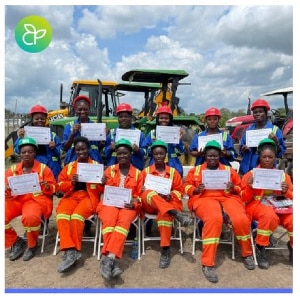
Reorganizing the fully funded women in agriculture mechanization training program is Agro Kings Ltd., a significant Ghanaian agricultural company, in collaboration with The Deutsche Gesellschaft für Internationale Zusammenarbeit GmbH (GIZ) through the Sustainable Employment through Agribusiness (AgriBiz) and Ministry of Trade and Industry (MOTI).
All 12 participants who attended the training programme received internship offers in diverse sectors with two of these trainees who have been employed and promoted to serve as the Mechanisation Lead and Farm Administrative Lead at Agro Kings Farms respectively.
The programme will run for four weeks at Agro Kings Farm with a mandatory three-month internship after the intensive training. It will aim to bridge the skills gaps among youth, especially women.
The African Centre for Economic Transformation cited a study that showed that Ghana’s 46.7% female workforce has skills gaps as a possible barrier to employment in the future world of work in Ghana. Also, the rapid increase in unemployment rates further buttresses the need for support for more young ladies in agriculture.
This second edition will include adequate soft skills training which will enable the young women to build a holistic, value-driven, and successful career in Agriculture. The course will cover topics including health and safety management in agricultural machinery (tractor and heavy-duty machines) operations, drone piloting and basic Excel, record keeping, task management, and budgeting.
Trainees at the end of the training are expected to acquire the necessary knowledge and practical skills to manage, operate and maintain tractors and their related equipment.
To be eligible, applicants must be women between the ages of 18 and 35 who possess basic literacy and numeracy skills. Participants must demonstrate a desire for agriculture and must be willing to work on the farm. Interested applicants must register by 22nd January 2023 by contacting Agro Kings Limited at 0. Participants recruited are expected to report on 4th February 2023 for training to begin on 4th March 2023.
The cost of power will increase by 29.96% as of February 1, 2023.
However, in an interview with Starr News, Nana Amoasi, Executive Director of IES, adamantly asserts that the increment might have been lower if PURC’s predictions for the composition of the energy generation mix had been accurate.
We can force PURC to reevaluate its assumption between now and then in order to correct them. Consumers won’t be required to pay the predetermined 29% or 30% if they make the correction.
He pleaded with African academics and decision-makers to intensify measures that would foster prosperity and growth and make Africa wealthy and resilient.
Read the entire article as it appeared on ClassFM on July 31, 2018.
Wednesday, President Nana Addo Dankwa Akufo-Addo urged African scholars and decision-makers to intensify initiatives that would lessen the Continent’s reliance on foreign aid.
In order to achieve prosperity and progress and make Africa prosperous and robust, they should follow a road of self-respect and take concrete actions.
“The time to pursue a path of prosperity and self-respect for the African Continent is now,” he said at the opening of the 22nd Academy of African Business and Development (AABD) Conference, at the University of Professional Studies, Accra.
The six-day conference, on the theme: “Sustainable Development Beyond Aid: The Focus for Africa,” is being attended by researchers, business practitioners, consultants, community leaders, and policy makers.
The AABD annual conferences aim at facilitating multidisciplinary research by stimulating collaborations between Africa based researchers and professionals and their counterparts around the world, by broadening and deepening global understanding of various issues relevant to Africa’s business and development, as well as advancing solutions to some of her challenges.
Africa must chart the path of self-dependence and her countries must engage with each other competitively through trade and investments and cooperate for enhanced regional and global peace and security, he said.
The Continent ought to move more towards the efficient and effective mobilisation and use of resources to grow out of the dependence on aid rather than a rejection of aid, he stressed.
“We seem to have missed out on many opportunities to make Africa the continent she deserves to be, rich and resilient. But it is not too late to right the wrongs, it is time to catch them now.”
“It is time to create the future we want for our continent, and it is time to start building that future inspired by the imperative to transform our economy from raw material producing and exporting economies to value adding industrial economies.”
The President, thus, urged the conference to ensure its deliberations helped Africa’s quest to get to the point beyond aid.
The proceedings of the meeting, he implored, should contain actionable proposals for consideration.
He urged participants to also focus attention on the IMF’s unprecedented Special Drawing Rights reallocation, for which Africa shared some 30 billion dollars, much less than 100 billion dollars promised in the 2019 Paris Summit, intended to provide additional financial resources to address the vast surging inequities the pandemic has revealed.
President Akufo-Addo asked the conference to articulate policies that would help strengthen African financial institutions like the African Development Bank, AfriExim Bank, and the Africa Finance Corporation, to enable them to take over greater responsibility for the financing of Africa’s development.
They should advocate debt cancellation for African countries to provide a sound foundation for the continent’s future progress.
The President asked the meeting to propose measures to help significantly increase Africa’s capacity for domestic revenue mobilisation to finance its development potential, create opportunities for the Continent’s vibrant and dynamic youth, and develop and deliver improved livelihoods for the people.
They should re-evaluate the role of foreign credit rating agencies, which acted as gatekeepers to global capital markets and their modus operandi, including the fixing of the so-called Africa risk premium.
Additionally, participants must examine the measures available to Africa to check the illicit outflow of capital from the Continent, which is currently estimated around 100 billion dollars per year.
The conference should also place the development of Africa at the centre of the preoccupations of the African diaspora, President Akufo-Addo said.
The conference is expected to deliberate on issues relating to over 14 thematic areas: Accounting, Finance, and Investment; International Aid, Economic Policies and Strategies; Entrepreneurship, Small Business and the Informal Sector Exporting, Internationalisation and Foreign Direct Investment; Information and Communication Technology, Digital Transformation; and COVID-19 and Business in Africa.
The Minister committed to this when he and Secretary John Kerry of the UK served as co-chairs of the Forest and Climate Leaders’ Partnership (FCLP) on January 18, 2023, in Davos, Switzerland, in conjunction with the World Economic Forum.
Together with Secretary John Kerry, the Lands Minister held two separate meetings with Brazil and the Democratic Republic of Congo (DRC), to find ways of working together to achieve the ambitious objective of the FCLP to halt and reverse forest loss and land degradation by 2030, whilst delivering sustainable development and promoting an inclusive rural transformation.
He also noted that achieving this high ambition of the FCLP, requires that the teams work closely with these major forest countries.
Already, together with Indonesia, Brazil, and DRC the Minister said they have formed the Indonesia-Brazil-Congo (IBC) rainforest alliance, to protect their forests, adding that together, these three countries control over fifty percent (50%) of global tropical forests, and are crucial to global efforts at halting deforestation.
Abu Jinapor made a clarion call for all efforts to be marshaled to fight climate change saying” the climate crisis is reaching a tipping point, and requires an all-hands-on-deck approach to come to grips with this crisis.”
The delegation from Brazil was led by the Minister for Environment and Climate Change, Marina Silva and the DRC delegation was led by the Vice Prime Minister and Minister for Environment, Hon. Eve Bazaiba Masudi.
The Amazon Rainforest is said to be the largest tropical rainforest in the world, and some sixty percent (60%) of this tropical rainforest is found in the territories of Brazil. The Congo Basin is the second largest rainforest in the world, and about sixty percent (60%) of this is found in DRC’s territory.
The government says it is optimistic of achieving 80 percent of the bond debt swap under the Domestic Debt Exchange Programme by January 31, 2023.
An 80 per cent participation by individual bond holders, according to the Finance Minister, Ken Ofori-Atta would help the government to get into the perimeters of 55 percent debt to Gross Domestic Product (GDP), essential to achieve an IMF deal.
The government is seeking a US$3billion IMF bailout to balance its books as its debts have over swallowed its income.
Speaking to the media after a meeting with individual bond holders on Wednesday evening, (Jan 18), Mr Ofori-Atta said, “this is a voluntary exercise and we made some changes to extend it to January 31st to give us time to incorporate all ideas that has come up. We anticipate 80 per cent participation to ensure that we are within the parameters.”
IMF Bailout under threat
Government is racing against time to conclude a US$3 billion facility that is hoped to stabilise the economy which is currently choked with debts, with total debt currently at GH¢467 billion as of December 2022.
Analysts have warned that if the deadline for all creditors to sign up the government’s DDE programme was not met, it would have dire consequences on the economy. Individual bond holders have rejected government’s overtures to be roped onto the DDE programme and have threatened legal action which could put the whole programme into jeopardy.
Already, the currency speculators are beginning to gain a head-start with regard to the country’s cedi. It has shown signs of picking up the pace again with regard to depreciation. At the turn of the year, the cedi was trading at GH¢7.9 to US$1. However, as of yesterday, it had reached over GH¢9 to the US$1 tumbling almost 20 per cent since December.
This evening, the government reached an agreement with individual bondholders to have a technical team to review its petition on the Domestic Debt Exchange Programme (DDEP).
At a closed door meeting with the leadership of the Individual Bondholders Forum, the Minister of Finance, Ken Ofori-Atta said the government was opened to discussing alternative means of making the DDEP successful.
Leaders of the Majority are seething in anger over the continuous disrespect shown towards them by the Finance Minister who without recourse to current happenings in the legislature, refused to consult them before rolling out the domestic debt exchange program while they receive the backlash.
Majority Leader and Minister of Parliamentary Affairs, Hon. Osei Kyei-Mensah-Bonsu who is against the program, is warning of the possibility of wiping out the middle class and want the Minister to hasten slowly.
“What we [are] talking about is that many of these bondholders also belong to the middle class and that’s where the major worry is. If we are wiping away the middle class, that could be dangerous, so we need to have some further dialogue on this.
“Government thinks that this is the best way forward, however, even if it is, we need to engage, reflect and then move on and that will encourage some people who have some doubt to better appreciate where we are.”
“Nothing can substitute for discussions, round table discussions and engagements wherever we find ourselves in. I think it’s important that we go back to the drawing table to have engagements with the major stakeholders…All of us are in it. And if we don’t manage it well, we’ve gone through this before, way back some 25, 30 years ago and repositioning was a major, major difficulty.
“Today many people are coming on board and if this thing should happen, how do we build confidence and trust and reconstruct a new savings culture?”
Majority Chief Whip and lawmaker for Nsawam-Adoagyiri, Frank Annoh-Dompreh is also warning of dire consequences if the Finance Minister continues to be impervious to advise and tread on that slippery slope.
In a tweet, the Majority Chip Whip described the decision by Ken Ofori-Atta as “unfair” and “untenable” adding that he disagrees with the inclusion of individual bondholders in the debt exchange programme.
Meanwhile, Some individual bondholders that have mobilized themselves in opposition to the Domestic Debt Exchange (DDE) programme proposed by Government has hinted of a demonstration, dubbed ‘Occupy Jubilee House’.
The members who are in excess of 101, 100 have kicked against the programme in its entirety even though they are open to discussion with Government on the way forward.
Desperate to meet the requirements for an International Monetary Fund (IMF) bailout which entails the country having a sustainable debt profile, Government led by Finance Minister Ken Ofori-Atta has proposed a debt restructuring programme. This will alter the contracts the Government entered in to with bondholders in terms of the interest and maturity of their bonds. Holders of domestic bonds are resolute that they do not want their bonds touched.
To drum home their demands, they have proposed a demonstration. Even though they have made their point clear in the media and through their record-breaking mobilization, they intend taking their protest a notch higher.
The IES claims that, notwithstanding its belief that the rates for the Cedi/Dollar exchange rate and inflation rates represent market conditions, it finds the PURC’s premise that the energy generating mix should be comprised of 26.11% hydro-thermal and 73.89% thermal to be unfounded.
The IES in a statement said the assumption amounts to given priority to thermal power generation over hydro, given that water elevations for Bui and Akosombo generating stations (GS) have improved waterhead levels, and capable of producing over 35% of power in 2023, in its estimation.
It said data from Akosombo and Bui indicate elevations at the beginning of 2023 compared to previous are in a better position to produce more electricity than the thermals.
“Bui’s water elevation is expected to help produce more megawatts to support voltage on the grid, and help reduce transmission losses if dispatched conservatively throughout the year,” the statement noted.
The Institute agreed with the expectation that bulk of the capacity generation for 2023 would come from thermal sources if natural gas supply is sustained, and planned plant maintenance schedules is strictly adhered to. However, with improved water-head levels, it said hydropower generation is estimated to produce close to 38% of 2023 capacity, should hydro-electric have dispatch priority over thermal in the generation mix.
The statement explained that “With a year-start Akosombo water level elevation of 83.10 metre (272.66 feet), it is estimated that total energy production from Akosombo GS could fall between 7,500 gigawatt-hour and 8,000 gigawatt-hour (GWh) for 2023, with the Kpong GS producing roughly 990 GWh of electric energy over the period.
“Also, Bui GS’ year-start elevation of 178.99 metres above sea level (masl) is enough to possibly produce an estimated 1,056 GWh of electricity in 2023.”
Although the IES has anticipated that the average electricity end-user tariff (GH₵/kWh) covering residential, non-residential and special load tariff electricity consumers would see an increase within the year, it said the expected increase in tariff was anticipated to be marginal should more of hydro-electric power be produce from the generation mix.
The IES is, therefore, calling on the PURC to reconsider the energy mix assumption used in the tariff adjustment (to reflect improved water-head levels) as that has an impact on the Weighted Average Cost of Gas, which has been reviewed to $6.0952/MMBtu from $5.9060MMBtu.
This, the IES believe will bring some relief to already burdened citizens, and in the face of the current economic crisis.
He claims that foreigners have increasingly controlled the economy over the years, with Ghanaians merely contributing minimally.
Speaking at the 2023 Annual New Year School and Conference at the University of Ghana, Legon, Dr Daniel McKorley said, “Ghanaian businessmen, don’t control any sector of this country, rather, we contribute, in fact, all sectors in Ghana are controlled by foreigners.”
“Banking is controlled by Nigerians and South Africans, retail is controlled by Lebanese and Indians, manufacturing is controlled by Indians and Lebanese, telecoms sector is controlled by British and South Africans, oil and gas, mining, trading, you name it, they are controlled by foreigners,” Dr McKorley pointed out.
He also called for the participation of Ghanaian businesses to participate in key sectors of the economy.
“We must know this, small businesses don’t build nations, big businesses do. When the big businesses lead the way, they build small businesses around and push growth and become the true engine of growth,” he stressed.
The 2023 Annual New Year School and Conference is ‘Positioning the African market for sustainable economic development through African Continental Free Trade Area (AfCFTA)’.
The organisation claims that because it will have an impact on their way of life, the government’s decision to include them in the programme is unlawful.
The newly combined Individual Bondholders Association and Individual Bondholders Forum stated that the government must take action to exempt them from the scheme based on their calculations.
“For us it is simple, all the numbers show that the government has to just exempt individual bondholders, and that the deal is withdrawn. The offer that you are asking us to take just withdraw it. There is enough money in the budget, more than enough, and all that the government has to do is cut down on expenditure.
Mr. Kpebu further explained that with just Ghc500 one can have a bond and some of the members have holdings of 10,000, 20,000, 30,000 Ghana cedis which he said is very small.
“But they plan their lives with the aim that this month this bond will mature, I will get 500ghc here and next month I will get 1,000ghc. Like they say, Accra stay by plan. Those are investments that people survive on, they are not luxury, they are not just saving for the sake of savings,” he added.
The government has extended the deadline for the Debt Exchange Programme to Tuesday, January 31, to enable it to build consensus for the programme.
This is the third time the government has extended the deadline for the bondholders to voluntarily exchange their bonds for new ones.
The court was adjourned today (Tuesday, January 17) to allow the accused’s and sureties’ attorneys to certify a document that they possess about the accused but that the court disputes because it was not notarized.
How does this serve a legal purpose, wondered the court, presided over by Justice Afia Serwah Asare-Botwe, in evaluating the document’s legal impact.
The court said the document in its current form does not work for it to be part of a record as to whether the recognizance has been forfeited.
Justice Asare-Botwe, now a Justice of the Court of Appeal after listening to the parties adjourned the case to January 24 for the lawyers to authenticate the document.
According to EIB Network’s Legal Affairs Correspondent, Murtala Inusah, Mrs Tamakloe Ationu has been absent from court for the last two legal year since 2021.
The two sureties who executed the GHc5M bail conditions for former CEO of Microfinance and Small Loans Centre (MASLOC) were first ordered to produce the accused on December 22, 2022.
The Financial and Economic Division of the Accra High Court presided over by Justice Afia Serwah Asare-Botwe, now elevated to the Court of Appeal who held that the former MASLOC boss has “absconded,” extended the period to January 17.
But in court on Tuesday, January 17, the parties were given a week more period.
At the last court sitting on December 22, Lawyer for the first surety Lawyer Beatrice Annan-Fio, for Gavivina Tamakloe said “We have exhausted every effort within our means but we have not been able to produce the first accused person.”
She, therefore, prayed the court to allow them more time to be able to produce the accused who is said to have undergone some medical procedure.
Lawyer Dr Abdul Basit Bamba and Lawyer Agbesi Dzakpasu, counsel for Alex Mould and Accused respectively added their voices for more time.
Justice Afia Serwah Asare-Botwe, who was one of 15 newly sworn-in Justices of the Court of Appeal by the President, said “I will give you time.”
While making a biblical allusion she said the Bible calls for fulfilment of righteousness and that “I can only give you time after the Christmas.”
The newly promoted Justice of the Court of Appeal said “You have until the holidays are over to produce the accused or provide a compelling evidence why you need more time to produce accused.”
Daniel Axim, the second accused person was present in court.
Forfeiture of sureties
The accused person has for the past year (October 2021) failed to appear in court for the trial to progress after she was given permission by the court to travel out of the country for a medical examination.
Ruling on an application for forfeiture of recognisance of sureties filed by the Attorney General’s department, Justice Afia Serwah Asare Botwe said, it is clear that the accused is no longer reasonably missing the trial for medical reasons.
The court said the sureties have since stopped bringing any medical letters to the court on the accused person.
Justice Asare-Botwe said the accused person had breached the terms of her bond and a liability accrues on the sureties.
Justice Afia Asare-Botwe, said, Forfeiture of bail bond becomes effective the moment the accused person jumps bail and the surety is unable to produce him or her.
The court said, it has drawn the conclusion that Mrs Attionu Tamakloe who is standing trial with one another has absconded as she has not shown up at the time she was supposed to.
The court also said, “the authorities have also made it clear that, if this happens you should give the sureties time to produce the accused person.”
Consequently, the court said, “I have given the sureties on or before 22 December, 2022, to produce the accused person.”
Trial in absentia
The court is expected to consider the application for trial in absentia if the accused failed to show up.
Arguments
Moving the application for Forfeiture of recognizance of the sureties, Stella Ohene Appiah, a Principal State Attorney argues that the Ex MASLOC Boss having failed to return for the trial after being given leave to travel simply means that she has abandoned.
The lawyer for Gavivina said the application for the release of the passport to the accused person was not sent to him and he had no idea.
He added that the State did not oppose the application so he cannot be held responsible for her absence and that, the State has all the apparatuses to ensure the accused attends court.
The lawyer for Alex Mould, Dr Abdul Aziz Bamba argued that the State should take action to extradite the accused to come down and face trial.
He added that he is informed the accused is unwell and is seeking medical assistance in the States.
He argued that the Supreme Court has ruled that the court cannot commit a surety to prison and that, the execution of bail bond is a contract and one cannot put one in prison for failing to fulfil a contract.
Background
Sedina Attionu is on trial with Daniel Axim, a former Operations Manager of MASLOC, on 78 counts of wilfully causing financial loss to the State, stealing, and contravention of the public procurement act, among other charges.
The two have denied any wrongdoing and have pleaded not guilty to all the charges.
The prosecution has accused Mrs Attionu of engaging in some illegalities leading to the alleged stealing and financial loss.
For instance, it has accused Mrs Attionu of embezzling GH¢500,000 that was paid by a company which benefitted from MASLOC support in 2014.
It is also the case of the prosecution that in 2013 following a fire disaster at the Kantamanto Market, then-President John Mahama directed MASLOC to provide assistance of GH¢1.46 million to victims of the disaster but Mrs Attionu embezzled part of the money.
Ato Forson has also reiterated his call for the embattled minister to be removed and the economy handed to a more competent driver to steer the economic ship to a safe destination.
What Ato Forson said
“Every reckless driver is referred to as ‘driver banza’ in my local parlance … if you are in a car with such a driver, people get angry and demand that he descends so that another person takes control of the car and drive it to safety.
“Where we have gotten to, the finance minister is a reckless driver, he has taken this country to a point of no return, he has driven this country into a ditch.
Ofori-Atta had a challenging 2022 with the Minority Caucus demanding his resignation over the economic downturn.
Internally, a group of 80 plus New Patriotic Party (NPP) MPs publicly demanded his resignation over a similar demand, standing down after a presidential intervention.
A deal for him to present the 2023 budget and see out appropriation as well as to complete initial engagement with the IMF has elapsed, with the Majority Caucus hinting that they would soon approach the president to redeem a promise to act on Ofori-Atta.
Background
Ghana had a torrid 2022 amid an economic crisis that forced the government to seek an International Monetary Fund (IMF) facility at a time when the cedi was rapidly depreciating, inflation was galloping, and the government was faced with multiple downgrades by rating agencies.
The government has repeatedly blamed the crisis partly on the aftershocks of the COVID pandemic and the ongoing Russia-Ukraine war.
It has promised to turn around the economic fortunes of the country after sealing a staff-level agreement with the IMF late last year, with hopes that funds from the US$3 billion facility will be released early this year.
The government is hamstrung by hurdles as it attempts to secure a deal with its Domestic Debt Exchange programme.
Organized labour successfully fought off plans to include pensions in the DDE; now individual bondholders are also rejecting plans to include them.