The MSME space, it lamented, is constrained by lack of finance, access to appropriate technology, lack of technical and managerial skills, weak institutional capacity and limited access to international markets, as well as lacking laws and regulations. These challenges, GEA noted, continue to impede development of the sector and affect the quality and sustainability of jobs.
The sector is said to also contribute about 70 percent of gross domestic product (GDP), and one would expect it would be given the much-needed support to become robust and continue contributing significantly to the country’s socioeconomic development.
“To achieve rapid economic development, the MSME sector cannot be sidelined. Rather, it should be made robust to support economic growth and development. if our MSMEs become more robust, they will contribute more to job creation and poverty reduction, and this will enhance government revenue generation streams,” she said.
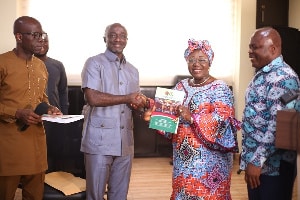
She made these comments on behalf of GEA’s Chief Executive Officer, Kosi Yankey-Ayeh, during the launch of Africa Street MBA – an initiative by Done By US (DBU), a consultancy.
Africa Street MBA Programme Chairperson and founder of Done By US, King Adawu Wellington, explained the Africa Street MBA is an entrepreneurial platform that aims to provide integrated business support for start-ups and small businesses – through capacity building, mentorship, business development services and funding for young entrepreneurs with innovative ideas or early-stage ventures.
He emphasised that for the next three years, the programme will impart young people with world-class business knowledge based on top Master of Business Administration (MBA) curricula and entrepreneurial course content.
“Africa Street MBA has been designed to bridge the business-knowledge gap and help young people from poor backgrounds, and young people with low education, to also have an opportunity to build a world-class enterprise.
“This will reduce the start-up failure rate in Africa by providing platforms for entrepreneurs to access business education, technical and business advisory services, funding and markets. We believe in empowering the youth, through entrepreneurship, to be agents of change in reducing the unemployment rate of Africa and beyond,” he said.
Overall, the Africa Street MBA is expected to impact some 10,000 young people annually. It will be carried out using a fixed-term 12-week start-up accelerator, and a mentorship programme that includes mentorship and educational components based on the MBA curriculum.
The Chairperson added that the accelerator programme will end with a public pitch event that provides seed funding in the form of a grant for ultimate pitch winners, and potential investments for accelerated businesses.
The initiative is implemented in partnership with the KGL Foundation.
She said, “building for renting has become a booming business, especially in our major cities Accra and Kumasi.”
Read the full story originally published on November 26, 2021 by ClassFM.
The rent paid to landlords in Ghana must be taxed, civil society group Danquah Institute has proposed.
The Executive Director of DI, Dr Antoinette Tsiboe-Darko, told journalists at a press conference that the government must put in place to make sure landlords and landladies who rent out rooms and houses “pay tax on the rent received”.
She said “building for renting has become a booming business, especially in our major cities Accra and Kumasi” and “millions of Ghana cedis continue to exchange hands” in that sector.
“Unfortunately, owners of the houses go to tenants to collect rent directly without paying anything to the government”, she bemoaned.
“In other words, owners of rooms or houses will have to register with these agencies while those who need rooms will then go there to make payments for their choice. We are hopeful that through this initiative, rent payment could be taxed”, she added.
According to the association, the Energy Commission, at one time, admitted that some new items imported into the country are substandard and, thus, wants to regulate these items through the Ghana Standard Authority (GSA), which has also admitted that 80 to 90 per cent of second-hand items meet standards in a meeting with the Ghana Union of Traders Association (GUTA).
At the said meeting, GSA raised concerns about how to regulate the items that are imported into the country and not a total ban on such items, the association explained.
“So why is the commission not regulating second-hand items but bent on banning them from entering the country”? the association queried.
Mr Daniel Asare, Chairperson of CSHDA made this call at a press conference held in Accra to address some of the claims by the Energy Commission on the activities of second-hand dealers.
“We want the whole country to understand that items brought into this country for sale go through rigorous checks before being exported from Europe.”
He said the association is well informed that the sale of second-hand items cut across the world even in some of the advanced countries.
“So why are these countries also not banning the sale of such items,” he asked adding that “Europe is on record to have imported the largest number of second- hands items in the year 2022.”
He appealed to the government to come to the aid of dealers considering the huge number of people who are engaged in this as well as their direct beneficiaries
It’s an important step toward the potential restructuring being classified as a credit event, which would result in a payout on credit-default swaps associated with the country’s bonds.
According to a statement from the Credit Derivatives Determinations Committee, the statements Ghana’s Finance Ministry made on December 19 to announce a suspension of debt servicing on its eurobonds, commercial term loans, and the majority of its bilateral debt, meet the definition of a “potential repudiation/moratorium.”
It doesn’t yet constitute a so-called credit event, because the nation hadn’t missed payments on its bonds when the panel was asked to evaluate the situation.
Ghana is in the process of negotiating a restructuring plan for its local and external debt. Alongside a moratorium on its eurobond payments, the country is also seeking a deal for its local-currency debt, while it’s negotiating an agreement with international creditors under the Group of 20 Common Framework. A restructuring is needed to unlock an International Monetary Fund bailout.
The Credit Derivatives Determinations Committee is made up of a panel of banks and asset managers who regulate the credit derivative swap market.
Haruna Iddrisu, the immediate-past Minority leader in Parliament has accused President Akufo-Addo and finance minister, Ken Ofori-Atta of engaging in illegality with the review of the terms of payment for bondholders.
According to him, Ken Ofori-Atta is acting unilaterally on the decisions and that he is not clothed with the power to undertake such actions.
Speaking on Metro TV, Haruna Iddrisu said that the Finance Minister should have first sought approval from Parliament before varying the terms of government’s agreement with bondholders.
He bemoaned that the conduct of Ken Ofori-Atta, which he reckons has the backing of President Akufo-Addo, is not just illegal but also grave disrespect to Parliament.
He warned that the house of representatives will not watch for such flippancy to thrive and that there will be consequences.
When asked if a future NDC government will prosecute Ken Ofori-Atta and all concerned for what he contends to be breaches, Haruna Iddrisu failed to state a categorical answer but warned that there will be consequences.
“Ken Ofori-Atta is now varying the terms as an individual and as Minister of Finance. My argument is that he doesn’t have the power and authority to do that. I should think that he has to come back to Parliament. He is engaged in varying the terms and conditions of a loan.
”When Parliament approves a loan, it probably provided for tenure, monetarium, interest and principal shall be paid within a certain period. Now you are saying you are issuing 12 bonds and that 2023 no coupon and now for banks 5%. Now you say 2027 to 2038, you are varying the terms and conditions of an agreement that the Parliament of Ghana has approved.
”He came to Parliament to say give me a mandate to borrow 3 billion dollars. The Public Sector Borrowing of these Treasury Bills must all now come to Parliament. We’ve given him too much latitude and he is now walking around as if every authority is vested in him as Minister of Finance.
”He can run riot on President Akufo-Addo because he doesn’t have the will and wit to reshuffle him but he cannot do that to the republic. Take individual bond, it is a contract between you and your bank. The sacredness of contract is being hampered and destroyed by Ken Ofori-Atta with this his ‘take it or leave it’ attitude. You can’t tell people that. The money is not your money,” he said.
Meanwhile the government has reached some agreement with banks over the Domestic Debt Exchange programme.
The new terms includes “an agreement to pay 5% coupon for 2023 and a single coupon rate for each of the twelve (12) new bonds resulting in an effective coupon rate of 9%, clarity on the operational framework and terms of access to the Ghana Financial Stability Fund (GFSF) and the removal or amendment of all clauses in the Exchange Memorandum that empowers the Republic to, at its sole discretion, vary the terms of the Exchange.”
He claimed that this is a component of efforts to lower the nation’s greenhouse gas emissions.
When he stood before the Appointments Committee of Parliament on February 23, 2021, Kwaku Ofori Asiamah made this clear.
Read the entire article as it appeared in its original form on February 26, 2021 on dailymailgh.
The Minister-designate for the Ministry of Transport, Kwaku Ofori Asiamah, has revealed that Ghana is aiming at introducing electric buses into its public transport system as part of measures to reduce its greenhouse gas emissions.
Ghana, he said, is being futuristic in this endeavour and with the assistance of technology, will achieve its aim.
Appearing before the Appointments Committee of Parliament on Tuesday, February 23, 2021, for public hearing on issues relating to the portfolio he has been designated to by the President of the land, Asiamah said the initiative has long been on the drawing board of the country, revealing that it was started by the previous National Democratic Congress-led government.
Seeing how beneficial it would be for the West African nation, he said government has had some discussions with the Green Climate Fund (GCF) with the Ministry of Finance also having some discussions with the country’s development partners to solicit their support in the development and implementation of a legal framework for the electric buses.
“Mr. Chairman, it will interest you to know that Europe has come out with a directive on this issue that by 2030 they will get away with all these diesel and petrol cars off their streets. The Americans are also saying same by 2045. The British people are saying that they are gearing towards zero emissions. So, we don’t need to stay and fold our arms. We’ve gone far with it and we’ve gone to Green Climate Fund – we’ve had some discussions with them, the Ministry of Finance has also had some discussions with our development partners to implement the legal framework for these electric buses and also to go the way of electric buses”, he noted.
The Green Climate Fund (GCF) was adopted by 194 governments as a financial mechanism of the United Nations Framework Convention on Climate Change at the end of 2011. Its goal is to limit or reduce greenhouse gas emissions in developing countries and help adapt vulnerable societies to the already-felt impacts of climate change. It aims to make an ambitious contribution to attaining the mitigation and adaptation goals of the international community with the goal of keeping the temperature increase of the planet below 2 degrees Celsius.
The Fund gives recipient countries access to funding through accredited national and sub-national implementing entities, including NGOs, government ministries, national development banks, and other domestic or regional organizations that can meet the Fund’s standards.
According to Ghana’s Fourth National Greenhouse Gas Inventory Report, the country’s total greenhouse gas emissions, including Forestry and Other Land Use, was estimated to be 42.2 million tonnes (Mt) CO2-equivalent (CO2e). This was 7.1% more than the 2012 total emissions and notably 66.4% above 1990 levels.
Mobile combustion emissions summed up to 7.2 MtCO2e in 2016. It was singularly responsible for 48% of the total energy emissions and 17% of the overall national emissions. The 2016 transportation emissions increased by 7% relative to the levels reported in 2012.
According to the report, within the transportation category, road transport was the largest emission source due to growing vehicle ownership and the associated traffic congestion in the cities.
With the statistics showing a worrying trend in the transport sector, Hon. Asiamah said the best option to address the situation was to unleash electric buses into the country’s public transport system.
“Mr. Chairman, we’ve gone far with our development partners and I am hoping that once done with the legal framework, we will go to the implementation framework by bringing or unleashing the electric buses into our system. We need to make sure that we go with technology other than that we will be left behind and we will not have anybody to come to our aid”, he said.
He explained the move by Ghana forms part of measures as a signatory to the Paris Agreement, to ensure that better climates standards are met.
The comments of the Transport Minister-designate were in response to a question posed by the Member of Parliament (MP) for Bawku Central who sought to find out from him what he will be doing to assist the Ministry of Environment to check environmental pollution resulting from public transport.
In the group’s view, it’s high time government officials parked their fuel-guzzlong SUVs for low-cost alternative means of transport.
The group, in a statement issued on Monday, October 24, 2022, said each minister and deputy minister has two vehicles – one V8 and one saloon car.
“At the current rate, one land cruiser is not less than $100,000, that is more than GHC1 million.
“Currently, there are 86 ministers, meaning the total value of what they drive around is not less than GHC139 million,” the statement listed.
“In addition, these cars have big engines that consume so much fuel. This fuel is given to all the ministers for free,” the statement added.
Economic Fighters calculates: “Daily, these 86 V8s will consume not less than GHC1 million worth of fuel.”
The pressure group is worried that it is a reckless and incompetent practice to keep these vehicles at the expense of the public purse.
“At this critical juncture, the best decision would be to sell all the V8 cars. This will not only get us money from the sales but will save us fuel,” it reasons.
“This is what the Economic Fighters League would have done. #thealternativeiscoming,” the statement ended.
Note: The numbers in the graphs may not add up to 100 per cent because figures have been rounded up/down. The survey also highlighted significant regional divergence in growth expectations within a general pattern of weakened expectations relative to the last survey.
The situation in Europe and the US is now stark, with 100 per cent of chief economists expecting weak or very weak growth this year in the former and 91 per cent expecting weak or very weak growth in the latter. This marks a significant deterioration in recent months: at the time of the last survey, the corresponding figures were 86 per cent for Europe and 64 per cent for the US.
In the US, the pace and extent of monetary tightening will exert a significant drag on economic activity this year.
The survey results for the 2023 outlook in China are polarized, with almost half of respondents now expecting weak or very weak growth in China, with the other half expecting moderate or even strong growth.
Recent moves to unwind the country’s highly restrictive zero-COVID policy are expected to deliver a boost to growth. However, it remains to be seen how disruptive the policy shift will be, particularly in terms of the health impacts of COVID-19’s expected rapid spread through the population. A number of additional factors are likely to weigh on China’s growth in 2023, such as weak consumer confidence, missing the 5 per cent growth target for 2022 and continued strain in financial markets and the real-estate sector.
In MENA, two-thirds of respondents(70 per cent) expect moderate or strong growth in 2023. While this overall proportion has slightly dipped since the September edition, expectations of strong growth have increased from 12 per cent to 15 per cent. Energy exporters in the region continue to benefit from tight commodity markets, but oil prices have fallen by almost 25 per cent since June 2022 and these countries will be vulnerable to the impacts of any slowdown in global growth in 2023.
In the East Asia and Pacific region, 37 per cent of chief economists expect weak growth in 2023, and 63 per cent expect moderate or strong growth, similar to September.
However, that broad pattern masks a shift in expectations from strong to moderate growth since the last survey.
During that period, the region has seen negative terms-of-trade developments, as well as policy tightening moves that placed increased pressure on households and businesses.
Challenging global financial conditions are also weighing on the economic outlook for Latin America and the Caribbean, and for Sub-Saharan Africa. For both regions, 68 per cent of respondents expect weak growth in 2023.
This is a slight improvement for Sub-Saharan African but points to a worsening of conditions for Latin America and the Caribbean.
Inflation moderates, but slowly Inflation over the last year was stubbornly high and broad-based, but a number of modestly encouraging data releases in the final quarter of 2022 provide some room for optimism over the medium-term inflation outlook in 2023.
A range of factors have contributed to a slight easing of the rate of inflation, including rapid and synchronized monetary tightening, stabilization of supply conditions and commodity prices, and an easing of demand pressures.
The latest IMF forecast is that global inflation will dip to 6.5 per cent this year from 8.8 per cent in 2022.
Outlook
For Europe, this is likely to reflect the deepening impact of the ongoing war in Ukraine as well as the effects of sharp Increases in interest rates. The combination of high energy prices, elevated borrowing costs and sluggish demand has even led to instances of industrial capacity being left idle. With about half of the EU steel plants at a standstill as of November 2022 and fertilizer production capacity reduced by70 per cent, the European industrial sector is facing a challenging year ahead.
Some economies in the region, including Bangladesh and India, may benefit from global trends such as a diversification of manufacturing supply chains away from
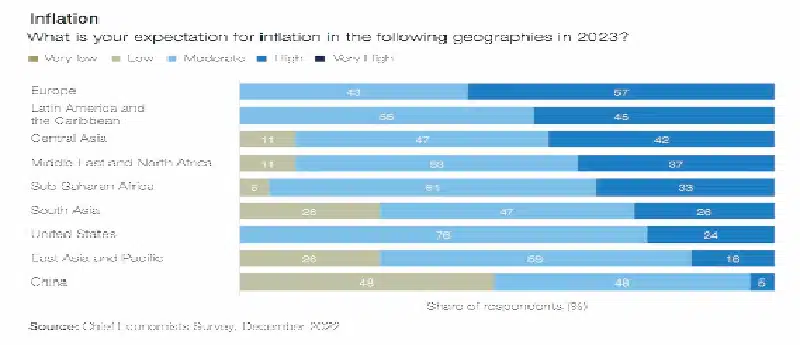
Although no regions are slated for very high inflation, expectations of high inflation range from 57 per centof respondents for Europe to just 5 per centof respondents for China.
The direction of changes in responses since the last edition differs from region to region. For example, the proportion of respondents expecting high inflation in Europe has increased from 47 per cent to 57 per cent since September, while for the US, it has declined sharply from 43 per cent to 24 per cent.
The expectation is for moderate inflation throughout 2023 in several regions: SubSaharan Africa (61 per cent), East Asia and Pacific (58 per cent), MENA region (53 per cent) and South Asia (47 per cent).
By contrast, in Latin America and the Caribbean and Central Asia, relatively high shares of respondents expect high inflation (45 per cent and 42 per cent, respectively).
This is likely to reflect a combination of supply chain disruptions from the war in Ukraine as well as the continuing impact of spikes in food and fuel prices during 2022.
China is an outlier in the other direction, with almost half of respondents (48 per cent) expecting low inflation (up from 28 per cent in September). As noted above, however, the short-term outlook for the Chinese economy is clouded by uncertainty surrounding the speed of the country’s removal of pandemic restrictions.
If a full re-opening leads to a sharp recovery in economic activity, it would be likely to push Chinese prices significantly higher than previously seemed likely, as well as adding new impetus to global inflationary pressures.
Policy-makers face trade-offs
The global backdrop of weak growth and persistently high (albeit moderating) inflation presents policy-makers with challenges of historic proportions at the start of 2023.
Chief among these will be the need to bring inflation much closer to the 2 per cent target without choking off growth, but the challenges run deeper.
Accumulated societal strains from the last years as well as climate mitigation and adaptation present pressing investment needs in numerous countries.
In the immediate term, central banks are the key economic decision-makers. Following a year of sharp and coordinated tightening, the chief economists surveyed expect the monetary policy stance to remain constant in most of the world this year.
In Europe and the US, a majority of respondents (59 per cent and 55 per cent, respectively) expect further tightening in 2023. The Federal Reserve and the European Central Bank have both indicated that such additional tightening is on the way, but it is notable that the two banks’ most recent rate increases in December were smaller, at 50 basis points, than previous 75 basis point hikes in the current tightening cycle.
Nonetheless, a quarter of respondents expect looser monetary policy in the US and Europe by the end of 2023.
The value proposition offers a declaration of purpose or a statement that establishes a company’s brand by explaining to customers what the company stands for, how it functions, and why it merits their patronage.
A successful value proposition consists of a few basic yet crucial components. These include distinction, measurable value, and significance.
Relevancy
People buy a product or seek a service because they want to either solve a problem or improve a situation. It is, therefore, the duty of the business owner to explain how your product solves customers’ problems or improves their situation. For instance, in the Graphic Business newspaper, we have created a new simple column that defines and explains simple business and economic concepts to our readers. It is true that one can easily google to find the meaning but while reading that paper, readers get the opportunity at once.
Particularly, for tertiary business students and small businesses, some of the topical words or concepts used during the week that they heard but could not understand, its defined and explained. Again, the paper has been able to add new elements such as Side Bars, Inforgrapgs, among other things, to give some extra information or illustrate a situation in a graphical manner. “Never underestimate small things. It is the small things in life which count; it is the inconsequential leak which empties the biggest reservoir.” – Charles Comiskey.
Quantified value
Every customer buys a service or product because they want some very specific value. For instance, the business owner must be in the position to explain what is in the service or product the customer cannot see but will want to buy. This means that the business must at all cost be able to deliver specific benefits.
JJCOBS is a poultry farm in Gomoa. The company is focused on selling eggs. This is not a new business because there are many more in this competition. But JJCOBS, with a tagline– “Our chickens lay eggs” has more customers because it is focused on ensuring that the eggs are bigger than competition but sells at the same price. It is highly nutritious because of what the birds are fed with. Displayed in the malls, supermarkets and even with the hawkers on the streets, they have more market simply because their eggs are bigger at the same price compared to competition. Again, the shells are strong compared to competition and cooks faster. This means, one is able to save a little more on time and fuel used in cooking. All these values are quantifiable and once communicated and experienced, the market accepts it and even with word of mouth, you can sell. Create value for the customer but let him be able to quantify the value.
Differentiation
If there is nothing new under the sun, then as a business owner, it must be made clear that the service or product you offer is either already on the market or will soon be out because yours is out there. This is why the business owner must be able to tell the ideal customers why they should buy from you and not from the competition. Something must make your product distinct and it could be based on the following strategies:
Emotional Response- This relies on providing an emotional salience that is tied to a product or service. Usually, brands that develop an emotional connection with their customers are often better positioned than those that provide a superior value.
Innovation – This can be expressed through physical characteristics of the products or the way in which a product or services is delivered. In short, this differentiation solves an unmet need in a unique and novel fashion.
Brand presentation – How a brand presents itself to the market can be a differentiator. In this case, brands that employ a consistent character or mascot can be easily remembered and stand out in the crowd.
Unique experience – This can be manifest in several ways such as a brand’s physical retail presence, exceptional customer service, ease of use of their website, the novel environment that they create, or, simply, the experience of unboxing a product.
Pricing – When handled properly, this can also be an effective approach to differentiation. On one end of the spectrum, a company can strive to be positioned as the ‘low price leader’ offering customers outstanding value.
Conclusion
In today’s hyper-competitive business environment, consumers are inundated by advertising and faced with a plethora of product and service choices. This is making it tough for brands to stand out. But to grow and be successful, it is imperative that business owners try to distinguish their products or service in this crowded marketplace.
When finished, this should result in annual savings for the business of $5.5 to $7 million.
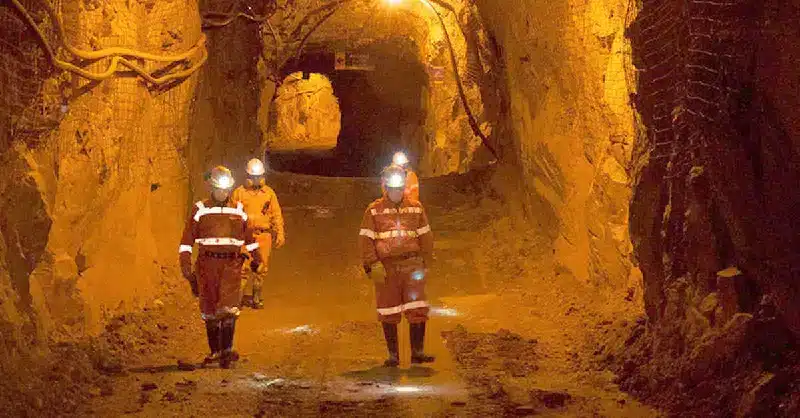
The company stated in a press statement that one of their main initiatives was the construction of an access road to connect the process units, which are located roughly 15 kilometers apart.
This road, it said, would support shared services activities and would be developed further to become a mine haul road, so that ore could be treated where most appropriate.
“As previously disclosed, opportunities to reduce costs and improve our operations have been estimated to present savings of up to approximately $5.5 to $7 million per year,” it stated.
“Implementation of actions to capture these opportunities has been started, including coordinated supply of principal consumable materials to the mine with identified commonality. To date, more than $1.5 million in annual cost reductions have been captured”.
Increase in gold production
The company in the release, also stated that it was on course to meet its 400,000 ounces’ gold production target after recording a 20.7 per cent increase in average monthly gold production for November and December 2022, as compared with the prior two months.
The increases were recorded from its Bibiani and Chirano Gold Mines, all located in Ghana.
In November and December, gold production on a combined basis for Bibiani and Chirano totalled 47,954 ounces for a monthly average of 23,977 ounces, up 20.7 per cent from previous 39,731 ounces or a monthly average of 19,866 ounces for September and October.
The November and December gold production monthly average was up 34.4 per cent from the monthly average of 17,834 ounces’ gold from August to October, 2022, Asante’s third fiscal quarter.
This is good news for the country as it will go a long way to boost gold production figures this year.
With the country currently implementing a gold for oil initiative which would see it exchange its gold for oil on the international market, a boost in gold production would help make this initiative successful.
No lost time from injuries
The company also noted that it continued its record of no lost time from injuries, consolidated preliminary gold production of 23,760 and 24,180 ounces respectively for November and December; and completed final US$30 million deferred payment, completing the Bibiani acquisition.
It also completed US$54 million in the first and second tranche payments on the company’s gold forward sale agreement in October 2022 and January 2023 through the delivery of 16,249.60 and 14,113.51 ounces of gold, respectively.
The CEO of Asante Gold Corporation, Dave Anthony, in the release stated that “over the past 12 months, Asante has been transformed from an early-stage exploration company to a mid-tier gold producer.
“The significant production gains in November and December bode well for the achievement of our 400,000-ounce target from Bibiani and Chirano for the fiscal year ending January 31, 2024. Over the past five months, we have made payments totalling US$83.6 million towards closing our Bibiani acquisition and repaying our gold forward sale agreement”.
Looking forward, he said the company would continue to capture the benefits of owning these two nearby operating mines which incorporate a district scale land package with significant exploration potential.
He said value creation initiatives were proceeding across its business as it looked to make Asante one of the top mining companies in Africa.
This is a part of the efforts to uphold and advance shippers’ interests.
The engagement was completed last Wednesday while the PIC was in the Terminal.
It followed a number of alleged procedure violations by shippers and transporters at the Terminal.
The breaches reported included the use of rickety vehicles for picking up containers, overstaying of trucks after scanning and delays in shipping line notification for export-tagged containers.
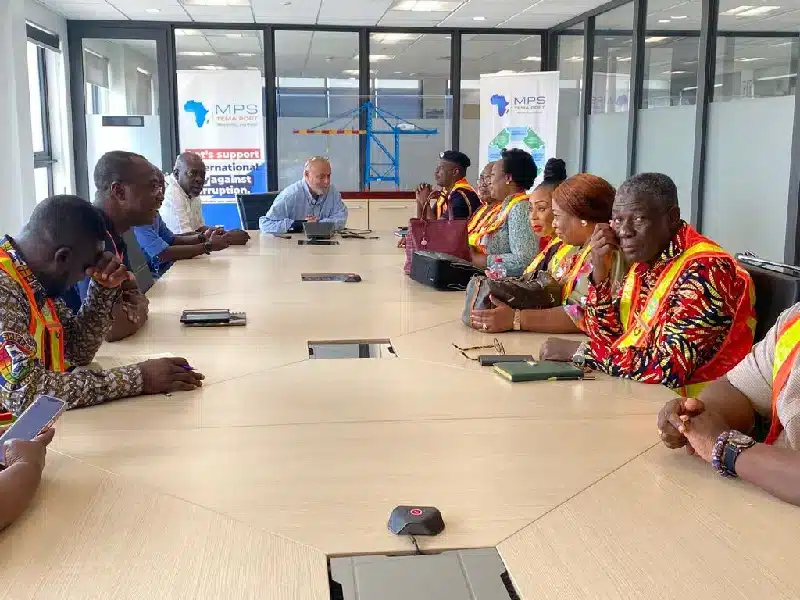
The Committee, led by the Board Chairperson of the GSA, Stella Wilson, and the Commissioner of the Customs Division of the GRA, Alhaji Seidu Iddrisu Iddisah, had fruitful discussions on the reports received on the state of the services at the Terminal with the Chief Executive Officer (CEO) of MPS, Mr Mohammed Samara.
Ms Wilson spoke on areas of collaboration between the GSA and the MPS to ensure effective resolution of the challenges.
She said, “Our aim is to have a better understanding of the technicalities involved in your operations to enable us to assist shippers with their complaints.
The CEO of MPS said management was working to ensure that their services were made mutually beneficial to all stakeholders.
To that end, the terminal had leveraged advanced technologies such as the Truck Appointment System (TAS) to enhance the operations at the port.
He further said the adaptation of the TAS had led to a reduction in the time required for the clearing of goods, putting Ghana on her way to becoming a hub for trade in West Africa.
The committee was led on a tour of some areas of the terminal, including the Standard Operating Procedure office, the Export Scanners Terminal, Drivers Help Desk, Quayside, the Import Scanners Building and the Holding Area to give them a first-hand experience of how activities are conducted at the Terminal.
The Chamber supports the government’s efforts to raise domestic revenue, but it would like the Ghana Revenue Authority to take a more business-friendly approach when putting its revenue mobilization plans into practice.
“This is crucial to avoid scaring away current investors because some of the actions may negatively affect their capitalization. The country’s economic resurgence depends on the ease of doing business, he said.
Mr Madjie who made the call in his new year welcome message, said his outfit was hopeful for a successful year although the chamber was not oblivious of the country’s current economic situation with a projected Gross Domestic Product (GPD) growth rate of 2.9 per cent.
He said the chamber has charted such a course before, and was assertive that its members have the resilience to weather the storm.
Mr Madjie added that the pushback to the government’s GH₵137.3 billion debt restructuring program by affected parties, was causing some economic uncertainties.
“The Chamber has also noticed the reversal of the benchmark value on imports. As much as we appreciate the effort, we want to urge the authorities to follow the principles of “transaction value” and the other procedures of valuation provided under the WTO’s Customs Valuation Agreement. We believe this will provide some predictability and help minimise the cost of importation.
“The Chamber will continue with our efforts in advocating for a business-friendly environment,” he assured.
However, he claimed that if the African Continental Free Trade Area agreement is not completely operationalized, this potential cannot be taken advantage of.
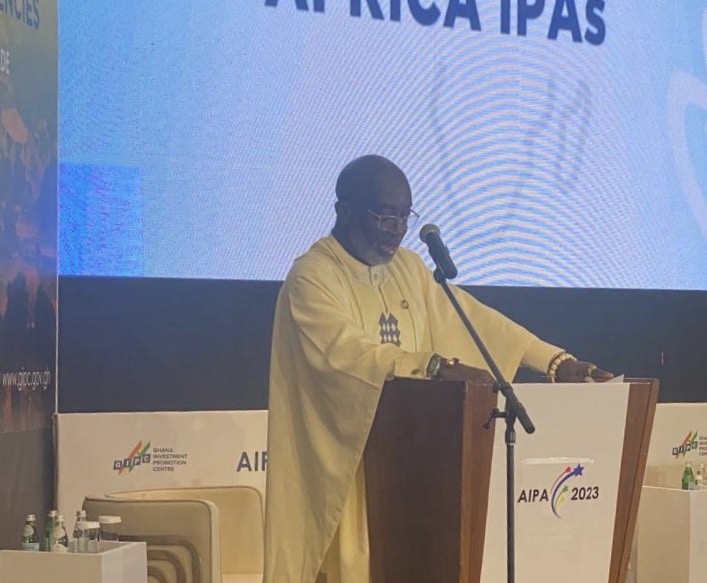
At the first Annual Assembly of Africa Investment Promotion Agencies, Mr. Grant gave a speech.
Nevertheless, a number of business associations and groups are criticizing the revenue collection agency’s strategy, claiming that, despite agreeing with GRA’s goal of collecting money owed to the state, the strategy is counterproductive and needs to be revised.
Simon Madjie, the executive secretary of the American Chamber of Commerce (AmCham) Ghana, has urged the GRA to choose a method of revenue mobilization that is favourable to business in order to safeguard the operations of companies in the country.
“This is imperative in order not to scare away existing investors, as some of the actions can adversely impact their capitalisation.
Maintaining the ease of doing business is vital to the country’s economic recovery,” he said.
Mr Madjie, who made the call in his Facebook post, said his outfit was hopeful of a successful year although the chamber was not oblivious of the country’s current economic situation with a projected gross domestic product (GPD) growth rate of 2.9 per cent.
He said the chamber had charted such course before and was assertive that its members had the resilience to weather the storm.
Mr Madjie added that the pushback to the government’s GH¢137.3 billion debt restructuring programme by affected parties was causing some economic uncertainties.
However, AmCham remained confident that further dialogue would result in all issues being resolved amicably for the country to begin the process of recovery.
“The chamber has also noticed the reversal of the benchmark value on imports.
As much as we appreciate the effort, we want to urge the authorities to follow the principles of “transaction value” and the other procedures of valuation provided under the WTO’s Customs Valuation Agreement.
“We believe this will provide some predictability and help minimise the cost of importation.
“The chamber will continue with our efforts in advocating for a business-friendly environment,” he assured.
This is done in order to guarantee adherence to pertinent Public Financial Management standards while also delivering prompt pandemic responses.
Following the Auditor General’s recommendations in its report on the Government’s COVID-19 Expenditure for the period of March 2020 to June 2022, the Emergency Expenditure Management Guideline is being created.
The ministry in a press release said it would continue to apply its best efforts to enforce and enhance expenditure management and accountability to ensure proper utilization of tax revenue to the full benefit of citizens, using established budgetary and accountability systems.
“The audit report confirms total resources mobilized for the COVID-19 response over the period March 2020 to June 2022 at GH¢21,844,189,185.24. As indicated in the report, the funds mobilized were to address the following two key interventions; finance direct COVID-19 intervention expenditures; and support the funding gap in the budget which was occasioned by the pandemic.
“Hence, as reported on page 11, paragraph 31 of the report, the 53.8 per cent and 46.2 per cent spent on direct COVID-19 interventions and for general budget support respectively were consistent with the mandate approved by Parliament,” the release highlighted.
It further noted that the ministry coordinated the mobilization and disbursement of funds for the COVID-19 responses by Government in accordance with the Public Financial Management Act, to ensure timely release of funds to save lives, livelihoods, and property.
“The Ministry welcomes the Auditor General’s report and wishes to assure the public that, steps are being taken to address all issues.
Some of the interventions being pursued include meetings to engage with the implementing Agencies to evaluate actions taken to implement the audit recommendations in the audit report.
He claims that the administration has not demonstrated a commitment to finishing these projects by the declared deadline.
Mr. Akandoh claimed that the nation’s economic decline was a result of money being poured into both ongoing and abandoned projects.
In an interview with journalists, Mr Mintah Akandoh said, “all what the government does is to go around pushing money on starting new projects to score political points. It has not even shown commitment to completing the project.”
During a visit to the proposed site for the construction of a hospital for the Adeiso community in the Upper West Akyim District of the Eastern Region, he said works were yet to be commenced on some projects under government’s Agenda 111 project.
Meanwhile, it would be recalled that the Presidential Advisor on Health, Dr. Anthony Nsiah, in August last year said overnment will terminate the contract of contractors who fail to complete the Agenda 111 project within the stipulated time.
Speaking in an interview, Dr Anthony Nsiah noted that government has provided at least 10% of the resources needed for contractors to commence work.
This, he said, will help these contractors to work very fast to meet their deadlines.
“We (government) will not shy away from cancelling or terminating any contract which is not going very well,” he said.
“This is a project where we have at least given at least 10 percent mobilization to all the contractors who have started work and I believe they should start mobilizations to get enough materials and work very fast,” he added.
Agenda 111 project falls under government’s plan to build 111 districts and regional hospitals across the country.
An amount of $100 million was set aside for the commencement funding for the project.
Ghanaian-American-based musician cum socialite, Achipalago has said that since arriving in Ghana over three weeks ago, he has spent more than 70,000 cedis.
Speaking with blogger Sammy Kay, the socialite lamented the country’s difficulties, noting that he occasionally gets to exchange his dollars for cedis worth nothing.
“The country is in serious crisis because once you change money, it’s gone. When you change the dollar, and go out, before you come home, you would have spent about GHC5000 and over.
“I have been in Ghana for close to three weeks. Also, it’s not every day you get to spend GHC5000, there are days when you will spend GHC3000 or GHC2000, and I have spent more than GHC70,000, converting GHC70,000 to dollars,” he said.
Achipalago joins a long list of netizens who have criticized the country’s high cost of living since protests were conducted last year, and calls for the resignation of Ken Ofori-Atta, the Minister of Finance, were on the rise.
Though the ruling party has pledged to mend the economy even after the deal with the International Monetary Fund is signed, many Ghanaians are yet to see any significant changes in the economy as the new year has begun.
He contends that in order to ensure the program is sustainable and does not undermine advancements made in the financial sector, the government must reevaluate the plan and engage fully.
The former finance minister, who is running for flagbearer of the National Democratic Congress, expressed worry about the participation of shareholders in the DDEP during an interview with Accra-based JoyNews.
“You cannot deal with my caretaker when I have not been consulted. At the end of the day, it will fall on me the shareholder, so there is the need for them to be part of the broad consultations to express their views.” “If you don’t manage the domestic debt exchange programme properly, the financial sector will be weakened in such a way that it won’t be able to perform the role that it is supposed to perform” he explained.
Dr Duffuor however charged Ghanaians to treat the matter with all seriousness and speak up to protect the country from the dire consequences the debt exchange programme will bring in the near future.
He explained that government’s decision to include insurance claims might cause problems for financial institutions since they would have to look elsewhere for monies to pay their clients.
He said the bond of GH¢1.7 billion was very huge for example and the premiums they collect are now in the government bonds.
Dr Duffuor further expressed concern about the already dwindling confidence in government instruments and cautioned that if the debt exchange programme in its current state was not reviewed, there will be no motivation to buy treasury bills in the near future.
The minister commended the Authority for achieving more than its revenue target for 2022 by over GH¢3 billion.
Ofori-Atta thus noted that the GRA would have to do more to close the revenue gap and ensure that leakages are reduced.
“I think they did well and we will expect more of such. They surprised us last year by giving more than the target and I think it’s a good trajectory. But the concern is how to raise the ratio so that more can be mobilized,” he was quoted by myjoyonline.com
He noted that even though the prices are lower than the ex-pump prices, the impact will not be felt since it is just about 20% of the country’s market neds.
“The product was cleared from the ports today and I know that BOST has started selling. This is just 20% of our market needs from the numbers I have seen the prices are better than what is at the ex-pump prices right now.
“Because this is just 20 percent of our needs, it will not make that much impact as it would if we were to be doing 100 percent of our diesel needs,” he was quoted by myjoyonline.com.
The report showed that equipped Isolation Centres that are not in use are valued at GH¢29,173,260, projects that were to be completed in 6 months and had not been completed after 30 months were valued at GH¢158,072,331 whiles projects that have been abandoned cost GH¢15,000,000.
“During our verification and inspection of projects in November 2022, we noted that three treatment, isolation, and holding centers completed at a total cost of GH¢29,173,259.90 was yet to be put to use,” parts of the report read.
The delayed projects were attributed to funding constraints and general economic challenges which contractors complain of having a negative effect on their operations.
However, a delay in the completion of the project could increase the contract price due to fluctuations which would adversely impact the achievement of project objectives.
The report also noted that the COVID-19 management team put in place measures in strengthening containment, isolation, and treatment including leasing, renting and refurbishing designated facilities and centres to contain and treat infected cases on time.
However, it was observed that Makro Structures Limited was awarded a contract on 11 May 2020 for the design, construction, and equipment of Nalerigu treatment and holding centre in North East Region, at a cost of GH¢15,000,000 out of which an advance mobilisation of GH¢4,500,000 constituting 30 percent of the contract had been paid from GoG sources. The construction was to be completed in October 2022.
“We noted that the contractor, upon commencing construction in October 2021 undertook civil works up to 10 percent and abandoned the site in December 2021, three months after possessing the site,” the report noted.
Mr Bernard Oduro Takyi gave this advice in an interview on the mid-day news on Accra 100.5 FM on Tuesday, January 24, 2023.
According to him, this is the best deal ever offered by the government since the announcement of the implementation of the Domestic Debt Exchange (DDE) programme.
This agreement, according to a statement jointly signed by the two parties, “encompasses final improvements to the terms of the DDEP.”
It includes “an agreement to pay a 5% coupon for 2023 and a single coupon rate for each of the 12 new bonds resulting in an effective coupon rate of 9%, clarity on the operational framework and terms of access to the Ghana Financial Stability Fund (GFSF) and the removal or amendment of all clauses in the Exchange Memorandum that empowers the Republic to, at its sole discretion, vary the terms of the Exchange.”
According to him, this deal with the Association of Banks is the best deal possible under the current economic situation.
This is better than the earlier zero coupons announced by the government, he stressed
He argued that a five percent coupon is the best deal for the bondholders and further commended the government for reviewing its stance on the payment of zero coupons.
He quickly warned the individual bondholders to take their principal and coupon, and henceforth shy away from all government bonds.
“Make no mistake by further rolling over the principal in government bonds because investment in bonds is not lucrative like it used to be. Bonds under this government are nothing to write home about for bondholders to roll over,” Mr Oduro Takyi cautioned.
He said it is only a “madman” who will reinvest in government bonds after this melee.
He contends that ECG’s organization’s monopoly renders it ineffective.
He promoted the idea of individual meters and argued against ECG’s insistence on using a bulk meter to serve more than 7000 consumers.
The NPP’s Director of Communications registered his displeasure in a tweet dated January 24, 2023, in reaction to astronomical electricity bills emanating from the Kejetia market in the Ashanti Region.
The tweet reads: ‘’I stand with Kejetia traders. The monopoly of ECG makes it inefficient.
“Traders at the Kumasi City Mall and other malls have their separate meters.
“It does not make business sense for ECG to insist on servicing 7000 customers with one bulk meter.”
More traders at the Kumasi Kejetia Market in the Kumasi Metropolis of the Ashanti Region are contemplating closing their shops due to high electricity bills.
Already a number of them have closed their shops in the market space because of high electricity bills.
Some of the traders say they cannot continue to pay such exorbitant bills and for that reason, they have no option but to close their shops.
A trader told Class 91.3 FM’s Elisha Adarkwah that he paid as much as GH¢977 to settle an electricity bill for September 2022 and has no option but to lock the shops and leave the market if things do not change any time soon.
The traders noted that things will get out of hand as the electricity tariffs have been adjusted upwards by the Public Utility Regulatory Commission (PURC).
According to them, they have fought on several occasions for separate meters but the Management and the Board of the market have refused to grant them their wish.
They have, therefore, called on President Nana Addo Dankwa Akufo-Addo to intervene.
According to them, the president must help prevail on the management of the market to give them separate meters else their businesses will collapse.
The Chairman of the Federation of Kumasi Traders, Nana Akwasi Prempeh, has also called on the management of the market to do the needful by allowing traders to manage their electricity bills by granting them separate meters.
In contrast to claims made by some NPP members, including some of the party’s lawmakers, Dr. Assibey-Yeboah claims that the president will not fire Ofori-Atta because he does not believe that he (Ofori-Atta) has failed.
The ex-NPP MP said, “Ofori-Atta is also not going to quit since the policies he enacted were on behalf of the president and decisions of the cabinet,” in an interview with Adom TV that GhanaWeb caught on Tuesday.
“… He (Ofori-Atta) is not going anywhere. He is not going to resign; why should he resign? The guy is doing an excellent job, according to the president.
“The finance minister represents the president. The other time I held one of the MPs saying that they told Ofori-Atta to reduce the E-Levy to 1.5 percent but he did not listen so he should be sacked. The budget is the president’s budget and the cabinet met to determine the E-levy rate. Is this a basis for Ofori-Atta to resign or be sacked,” he said in Twi.
Dr. Assibey-Yeboah, a former chairman of Parliament’s Finance Committee, also stated that he has information indicating that the position of Minister of State in Charge of Finance, which became vacant following the firing of Charles Adu Boahene, will be filled within the week.
He asserts that in order to reduce violations, Board members, management, chairpersons, and heads of the Specified Entities must familiarize themselves with and put into practice the recommendations made in the Auditor-report. General’s
Joseph Cudjoe made a few brief statements during the State Interest and Governance Authority’s presentation of the 2021 Infractions Audit Joint Report, where he urged high levels of commitment from the Specified Entities and other stakeholders.
“One framework that has come up in our discussions is to make recommendations to the Minister of Finance to use withholder methods for budget releases as a punitive measure for non-compliance in this regard. It is non-financial in nature and it is easy to withhold Specified Entities with these sanctions,” the minister added.
Joseph Cudjoe added that he believes the move would come in handy to tackle the issue of non-compliance which has long been endemic among Specified Entities.
Director-General, State Interest and Governance Authority (SIGA), Edward Boateng, revealed this at a joint Committee media briefing by both SIGA and the Auditor-General upon directives from the president to look into causes of infractions by most SOEs in the 2021 Auditor-General’s report.
“Upon completing the report, we noted that most SOEs are plagued with the above infractions including liquidity challenges,” he noted.
SIGA maintained that the magnitude and impact of the infractions by these SOEs remains a source of grave concern, as most of the issues negate the fundamentals of corporate governance.
Mr. Boateng disclosed the readiness of SIGA to work with governing bodies of specified entities to develop asset revaluation policies, and subsequently implement them to meet best accounting practices.
Chief of Staff, Akosua Frema Osei-Opare – who received the committee’s report on behalf of President Akufo-Addo, said the document is a testament of government’s resolve to fight and weed-out wrongdoings in every sector of the economy.
She said government remains committed to finding lasting solutions to the problem of non-compliance with best financial reporting requirements.
“Government expects all SOEs to prioritise the preparation of their respective management and audited accounts in a timely manner, and collaborate with SIGA and the Auditor General to urgently clear all backlogs of unaudited accounts by end of year 2023,” Frema Osei-Opare directed.
She tasked SOEs to prepare management responses to audit queries and red flags raised by auditors, and also keep updated asset register and land title registrations at all times.
“I am confident that with effective collaboration, the implementation of these recommendations will see the public sector assume its envisioned role as the bedrock of Ghana’s economy and surpassing the envisaged target of contributing 30 percent of the country’s GDP,” she expressed.
Minister of Public Enterprises, Joseph Cudjoe, instructed all board members and stakeholders to take the report’s findings seriously.
The Deputy Auditor-General, Godfred Addison, tasked leadership of SOEs to work in collaboration with auditors and stop regarding them as opposition.
The report was necessitated by findings and performance of SOEs in the 2021 Auditor-General’s report. Total irregularities in the country’s public sector, according to the 2021 Auditor-General’s report, amounted to GH¢17billion. But SIGA maintained that most of these infractions were not necessarily linked to financial corruption; rather, infringements of regulations and corporate governance procedures.
The NDC through its General Secretary Fifi Fiavi Kwetey wrote to the Speaker of Parliament, Alban Bagbin, to announce replacement of three members, the Minority Leader, the deputy Minority Leader and the Minority Chief Whip.
According to Asiedu Nketiah, the changes feed into the larger party reorganization plan that has seen the election of local level to national officers over the last year.
Asiedu Nketiah said in an interview with Joy News (January 24) that the fact that the economy will be a major battleground ahead of the 2024 elections, meant that the NDC needed to field their best in economics and finance as leader.
Currently, two major issues the government is facing is the Domestic Debt Exchange programme, which the Haruna Iddrisu-led Minority had asked to be suspended pending broader consultations.
Why Ato Forson in place of Haruna
On the specific reason why the NDC picked Cassiel Ato Forson (Ajumako Enyan Essiam MP) to replace Haruna Iddrisu (Tamale South MP) as leader of the Minority Caucus, he responded:
“We know for instance that going into election 2024, the economy is going to be the major battleground and so many of the debates and other discussions will focus on the economy.
“So, you better put your best man in the economy forward and that is what we’ve done,” he stressed stating that it was not for the party to consult before ringing the changes.
Other changes and retentions
Other changes included, Kofi Armah Buah, MP for Ellembele, who is the new deputy Minority Chief Whip.
While Kwame Governs Agbodza, MP for Adaklu, will replace Asawase MP Muntaka Mohammed as the Chief Whip.
Ahmed Ibrahim, MP for Banda, has been maintained as the First deputy Minority Chief Whip, while Comfort Doyoe Cudjoe-Ghansah, MP for Ada, is also retained as second deputy Minority Chief Whip.
The CSOs – Peasant Farmers Association of Ghana (PFAG), Chamber of Agribusiness Ghana (CAG), CropLife Ghana and the National Seed Trade Association of Ghana (NASTAG) – said the hold-up could deny millions of Ghanaians access to cheaper food. It also has dire consequences for a sector they said is already fragile due to global price increases in agricultural machinery and inputs.
President Nana Akufo-Addo on September 12, 2020 assented to the Tax Exemption Act 2022, Act 1083, which is meant to regulate the application of tax exemptions and create an exemption regime for goods imported into the country.
But the CSOs have explained that the two-week delay in approval since the application was made is already having negative consequences for importers and the sector.
They therefore warned that the situation, if not addressed immediately, could further worsen the food security situation in the country going forward.
The organisations are of the view that the Ministry of Finance’s decision to have agricultural commodities be considered as general goods and giving discretion to a sector minister is dangerous, and as such augur problems for the country’s food security agenda.
“Unfortunately, agricultural goods and equipment are not included on the list of items exempted from import duties. This decision by government to specifically exclude agro products from the list is shocking, and contradicts government’s policy of transforming the economy through agriculture,” Executive Director of PFAG, Dr. Charles Nyaaba, told the B&FT at a presser in Accra.
The delay
“While we still await a decision from the Finance Ministry to grant the request, our clients and service providers have their goods currently locked up at the ports due to exorbitant import taxes,” the CSOs said.
For instance, one service provider that has livestock vaccines valued at GH¢420,000 in import fees was asked to pay GH¢330,000 as taxes since the products were no longer exempted. The company, according to Dr. Nyaaba, has halted the clearing process and asked for an extension, hoping that the Finance Minister will soon grant the exemption.
Data obtained by the B&FT from the Agro Input Dealers Association of Ghana indicate that current clearance-cost for a 20-foot container of agro inputs is valued at GH¢90,000 – against the previous charge of GH¢15,000 when exemptions were in place.
Consequences
Importers of agrochemicals and inputs have said they will have no option other than to slap the tax margins on cost of agrochemicals and inputs should government refuse to grant their request. Slapping the tax margins on products is expected to further worsen the cost of food situation on the consumer, as farmers are also ready to increase cost of food.
“The major fear is that we may not have enough agrochemicals for the 2023 planting season due to the exorbitant taxes. There are several importers who are unwilling to bring the required inputs due to this development, and farmers are already experiencing limited access to such inputs in one way or another. This is not good for production this year,” Anthony Morrison, CAG’s CEO, has disclosed.
Recommendations
The CSOs recommended that the finance ministry, as a matter of urgency, speed up processes and grant the exemptions as captured by the application letter from MoFA. They added that any further delay may aggravate the international prices of agro goods.
They also recommended that parliament should have a second look at the Exemptions Act, and take steps to amend it to specifically include agro inputs, goods and machinery.
With the important goal of providing Ghanaian customers with an exceptional shopping experience, the platform will offer quality products from top brands from around the world, including those not readily available in the country, and a hassle-free shopping process. Wingimall is here to stay!
Powered by iParama – a payment solutions platform that gives Africans ease of access to global inventory – Wingimall’s vision is to become the leading e-commerce platform in Ghana, and eventually, take over the entire African continent.
The platform also makes it easy for customers to make purchases by accepting payments from all mobile money wallets in addition to Visa cards and of course ensures a fast delivery process.
Orders are delivered in less than 7 days!
With its abundance of choices and quick delivery, Wingimall is the premier e-commerce platform for customers looking for unique and high-quality products. Experience an exceptional online shopping experience by visiting
Ghana spends 36 percent on the richest 20 percent of students, compared to 12 percent for the 20 percent of students who are the lowest. Senior High School (SHS) students receive three times as much funding as elementary school students.
According to the civil society organisation, the practice of short-changing the basic for the second cycle at the pre-tertiary level of education started in 2015 when Ghana cancelled free exercise books in basic schools and re-introduced same in SHS in 2017, following the introduction of FSHS policy.
Fast forward, SHS students are already enjoying free exercise books, notebooks, calculators, physical education (PE) kits, school uniforms, and school cloth, which are all good. But these provisions not available in basic schools.
On the flip side, primary schools still do not have all textbooks four years into the introduction of the new curriculum. Also, less than 15 percent of the basic school Capitation Grant (CG) required for this academic year was allocated. This is because the free basic education budget was cut by 40 percent, even as education’s share of the national budget declined to a two-decade low of 12.9 percent due to Ghana’s debt crisis.
“It is great to have tablets for all SHS students as students can access digital content to enhance their learning experience. Eduwatch advocated for this after Wi-Fi was provided in all SHS across the country. The issue is never whether or not the promise of a tablet for 1.3 million SHS students is possible, but its implications on equitable financing of pre-tertiary education in an austerity.
He reiterated that contrary to the government’s promises of providing textbooks, less than 30 percent were supplied last year due to financial issues after four years of a new curriculum. He further stated that in such a period of austerity, the government must first find money to provide all needed textbooks and capitation grants for basic schools; and then purchase the tablets when the economic situation improves.
According to UNICEF’s January 2023 report on education financing, Ghana is among other countries that cannot transform its education without improving on equitable spending.
This is because the country is not spending its education resources equitably across sub-sectors and income categories. Therefore, the one-student, one-tablet initiative is great but must be well-timed until the austerity pressures on the sector’s resources ease.
A pilot in about 20 SHSs from urban, peri-urban (with Internet), and rural SHS without Internet should be a great start this year. The lessons from both off and online usage should be useful in enriching a future roll-out, the Eduwatch suggested.
It said institutionalisation of professional supply chain practices can effectively cut down production cost, especially as the government seeks to industrialise the economy and grow local productivity.
President of the institute, Richard Obeng Okrah, disclosed this during a CISCM dinner in Accra, and added that when effectively implemented, proper supply chain or procurement management can substantially reduce cost.
“Over the past couple of years, we have reviewed the national budgets and put it in perspective of supply chain management and have advised the government on how proactively they can implement those economic policies to gain value.
“Supply chain management is an integral part of most businesses, and is essential to company success and customer satisfaction. It helps to reduce the overall operating cost by ensuring efficiency in purchasing, production, and decrease fixed assets,” he said.
In the manufacturing sector, for instance, he said the entire production process from the establishment of plants to goods production entails procurement, and the utilisation of professionals in that process is the surest bet to eliminating waste, reducing procurement irregularities, and maximising efficiency.
To strengthen professional practices, he called for the enactment of norms and protocols to regulate the development of local content, with the ultimate goal of creating value for indigenous entities.
Group Chief Executive Officer, McDan Group of Companies, Daniel Mckorley, who was guest of honour, reiterated that institutionalisation of supply chain practices can be a game-changer for businesses in their quest to cut down cost and increase profit.
“Supply chain professionals design and operate all of the supply chains in a business entity and society, and manage from transportation, warehousing, inventory, packaging and logistic information. Societies with a highly developed supply chain infrastructure can exchange many goods and services between businesses and consumers quickly and at a low cost,” he said.
Mr. Mckorley added that ISCM is critical for ensuring human survival as humans depend on the supply chain for the delivery of necessities, such as food, water and medical supplies.
Meanwhile, to increase awareness of the profession, the CISM launched three new initiatives; namely: the CISCM Recognition Night, which seeks to identify and appreciate individuals and organisations that contribute to local content development; the CISCM Communications Platform – monthly newsletter, supply chain magazine, and weekly newsflash; and outdooring of the International Federation of Purchasing and Supply Management (IFPSM) African Championship – to be hosted by CISCM.
The Chamber’s concerns come on the back of the government announcing that the policy is set to kick start.
Ghana has taken delivery of its first cargo under the gold for oil policy. The delivery is to test the framework if everything that has been put in place will work.
Vice President, Dr. Mahamudu Bawumia has assured Ghanaians that the gold for oil policy will make fuel cheaper in the country.
“So that if the policy is preventing members from sourcing for funds from outside and export then basically they are going to be priced out. Because the policy states that everybody should be held to pay their money,” he said.
“I don’t have evidence that can support that but the idea was that we were even saying that, why don’t you let us sell a portion of what you buy to the PMMC as how the large-scale mines are doing? So that we continue with the export of the remaining 70% of the whole to our principals who actually finance our operations. We have a lot of refining capacity which is very hungry because as of now we don’t even have gold that we can feed those refineries in the country,” Mr. Krampah narrated.
According to him, they have presented a petition to Vice President Mahamudu Bawumia in which they have stated so many points why the policy will not be helpful.
He also suggested that the government should allow licensed gold exporters to keep a portion of what they buy from small-scale miners to the PMMC in connection to the gold for oil policy.
“We are also saying that if you go along with the policy right now, there will be a lot of gaps in the supply chain. Because as I said PMMC doesn’t have structures in all 13 regions. Currently only in Kumasi where they have set up an office and information from Kumasi says there is not even one personnel in the office as of now. They also said they operate from the Diamond House in Accra here so these are some of our concerns. We think that smugglers will take advantage of the system and then cash in and buy the gold that PMMC is not able to buy.”
According to Samuel Okudzeto Ablakwa, a member of parliament for North Tongu, the administration has been dishonest about the exact amount projected to pay for the construction of the national monument.
On January 24, the North Tongu politician questioned the accuracy of the $400 million estimate made by the government and Board of Trustees members while speaking on Citi TV in Accra.
“We were told by the Finance Minister [Ken Ofori-Atta] that the project will cost $100 million, then the figure rose to $150 million. The Chairman, Opoku Onyinah later mentioned $200 million but now based on fresh documents, I have realized the project is going to cost the Ghanaian taxpayer about $1 billion,” he is quoted by citinewsroom.com.
He further disclosed that the estimated $400 million does not include the cost of relocation of the Judges’ bungalows, $50 million for the relocation of the Judicial Training Institute and the $10 million needed to relocate the passport office.
He added that other complexes have been demolished to allow for the construction of the project while others are yet to be relocated.
By his estimation, Samuel Okudzeto Ablakwa believes that the total cost of all these amounts, which will entail modifications to the project could increase the cost from $400 million to over $1 billion.
In his presentation of the 2023 Budget Statement and Economic Policy on the floor of parliament, Minister for Finance Ken Ofori-Atta said the state’s new posture is born out from acknowledgement of the fiscal adjustments that are required to revive and eventually transform the economy.
“My pledge to this House is that there will be fiscal discipline; that every pesewa we ask the Ghanaian people and businesses operating in Ghana to contribute will be spent well,” he stated, while repeating calls for “broad-based sacrifices”.
Mr. Ofori-Atta disclosed that government seeks to achieve its targets under the broad framework of the Post COVID-19 Programme for Economic Growth (PC-PEG) – which is anchored on domestic revenue mobilisation; the streamlining and rationalisation of expenditures; boosting local productive capacity; and promoting and diversifying exports.
Others are comprehensive protection of the poor and vulnerable; expansion of digital and climate-responsive physical infrastructure; and implementation of structural and public sector reforms.
Additionally, the E-levy, which was reviewed by the middle of the year to GH¢611million – 8 percent of its initial GH¢6.9billion – will see its headline rate go down from 1.5 percent to 1 percent with the daily threshold of GH¢100 also taken off, coupled with the introduction of an additional income tax bracket of 35 percent.
He also promised that implementation of the Unified Property Rate Platform will be expedited in the upcoming fiscal year.
This comes as Total Revenue and Grants for the period is projected at GH¢143.96billion – 18 of Gross Domestic Product (GDP); and a rise in total expenditure (including clearance of arrears) to GH¢205.43billion – 25.6 percent of GDP.
A breakdown of the projected expenditure items shows that compensation of employees is projected at GH¢45billion (5.6% of GDP); interest payment is projected at GH¢52.6billion (6.6 percent of GDP), with capital expenditure (capex) trailing at GH¢27.7billion (3.5% of GDP).
“Other expenditures, mainly comprising Energy Sector Levies (ESL) transfers and energy sector payment shortfalls, are estimated at GH¢26.7 billion,” the finance minister stated, even as the budget deficit for the period is pegged at 7. 7 percent of GDP (GH¢61.5billion).
Reducing cost
While the minister did not explicitly indicate how much has been realised on the estimated GH¢3.5billion saving from the expenditure cuts introduced this year, he disclosed that government will continue with the 30 percent cut in salaries of political office holders.
Additional measures include a reduction in imports for public sector institutions by as much as 50 percent, with local substitutes to be preferred – even as the minister announced that 296 factories are at various stages of implementation under the One District-One Factory (1D1F) initiative.
“Out of these 126 are currently operational, 143 are under construction and 27 are pipeline projects,” he noted.
There will also be a cut in fuel allocations to political appointees and heads of MDAs, MMDAs and SOEs by 50 percent; a ban on the use of V8s/V6s or equivalents except for cross-country travel; with state-owned vehicles to be registered with green Government Vehicle (GV) number plates beginning January 2023.
Similarly, there will be a limit on budgetary allocations for the purchase of new vehicles, with purchases restricted to locally-assembled vehicles.
“There will be a freeze on new tax waivers for foreign companies and a review of tax exemptions for the free zone, mining, oil and gas companies,” the minister noted.
Other measures include a limit to travel, salary and hiring freezes, as well as a suspension of establishing new government agencies and acquiring promotional stationery.
Mr. Ofori-Atta added: “All non-critical projects must be suspended for the 2023 Financial Year”.
As compared to yesterday’s trading of a buying price of 10.3948 and a selling price of 10.4052. At a forex bureau in Accra, the dollar is being bought at a rate of 12.30 and sold at a rate of 12.90.
Against the Pound Sterling, the Cedi is trading at a buying price of 12.8042 and a selling price of 12.8181 as compared to yesterday’s trading of a buying price of 12.8490 and a selling price of 12.8629.
At a forex bureau in Accra, the pound sterling is being bought at a rate of 15.00 and sold at a rate of 16.00.
At a forex bureau in Accra, Euro is being bought at a rate of 12.60 and sold at a rate of 13.70.
The South African Rand is trading at a buying price of 0.6037 and a selling price of 0.6041 as compared to yesterday’s trading of a buying price of 0.6046 and a selling price of 0.6051.
At a forex bureau in Accra, South African Rand is being bought at a rate of 0.50 and sold at a rate of 1.10.
The Nigerian Naira is trading at a buying price of 44.2979 and a selling price of 44.3479 as compared to yesterday’s trading at a buying price of 44.3048 and a selling price of 44.3548.
At a forex bureau in Accra, Nigerian Naira is being bought at a rate of 14.50 Naira for every 1 Cedi and sold at a rate of 19.50.
Our forex bureau rates are provided by Afriswap Bureau De Change in Osu, Accra.
Dr. John Kwakye, the Institute’s Director of Research, asserts that given their financial weakness, which would be impacted by the debt restructuring effort, the move is essential.
On January 24, 2023, Dr. Kwakye told media at a discussion held in Accra that contributions from rural banks are largely for the underprivileged and that their inclusion in the DDEP would rob them of their hard-earned money.
Touching on the three-year moratorium on repayment of principal under the DDEP, Dr Kwakye described the move as regressive and therefore wants government to rather implement a new coupon of 8-12% over the new maturity period.
“They need to adopt a new coupon regime of 8-12 percent over the new maturity period and also consider abolishing the 3-year moratorium on the repayment of principal to save individuals and banks”, he added.
He, however, advised that for any debt restructuring to be successful, it must safeguard the stability and integrity of the financial system.
He added that it must also be designed to prevent capital flight and increase in the cost of borrowing among others.
“There must be proper stress-test exercise at the institution-by-institution level to study the impact of different DDE proposals on financial sector viability and stability and it must not impair government ability to fund itself on an on-going basis,” Dr. Kwakye outlined.
He stated that these monies belong to American taxpayers and expect to see dividends anytime such monies were given out to Ghana.
USAID in 2013 and 2014, provided about $45 million to support three main areas of Ghana’s economy which included helping to preserve offshore fisheries along Ghana’s coastal areas, equipping smallholder farmers (single-headed households), especially women up north to increase their yield; and support commercial farmers.
Read the full story originally published on March 25, 2015 by Business Day
USAID Mission Director for Ghana, James A. Bever says Ghanaians should not see financial aid from America as a give-away but treat it with the same radicalism and rigour as the rest of state spending.
USAID has over the last two years, provided about $45 million to support three main areas of Ghana’s economy which include helping to preserve offshore fisheries along Ghana’s coastal areas, which has seen a steady decline recently; equipping smallholder farmers (single-headed households), especially women up north to increase their yield; and supporting commercial farmers.
Mr Bever, who is ending his two-year tour of duty in Ghana, said the investments made by his outfit during his term of office are beginning to yield positive results. Feed the Future project is one of the interventions, which aims to spur sustainable and broadly shared economic growth in the northern regions of Ghana. The project has helped smallholder farmers, especially women, to improve production with an initial number 30 farmers growing to 35,000. He was optimistic that the beneficiaries would grow to 100,000.
“In most cases, the farmers had quadrupled the production of their yearly produce, in mostly grains like rice, soya, and maize,” he said.
He added that “It is a sustainable model and we are extremely excited about it. I think Ghana is in the path to an agricultural revolution that really can turn the northern part of the country to a bread basket and reduce imports.”
On the energy crisis, the outgoing USAID Country Director said the short-term measure that government has adopted to address the country’s power crisis by procuring power barges from Turkey would be expensive.
According to him, government would have to commit a lot of funds to the project in order to assure the private operators of the power barges that they would be paid for their services in future.
“The options that your government has identified in trying to get some power barges mounted, which are basically mobile power generation equipment, is a short-term solution but it is going to be expensive and the country is going to have to come up with the funds to assure the suppliers that they are going to get paid because it is a private deal. The equipment runs on fossil fuel and it is going to cost you something,” Mr. Bever stated.
The government had earlier announced that the two power barges would generate about 450 megawatts (MW) to help stabilize the situation. The power barges are expected in the country by the end of April 2015.
He disclosed that apart from the procurement of the power barges, it would be difficult for government to come up with other short-term solutions without the resuscitation of the thermal plants in Takoradi.
“The good news is the world oil prices have dropped in half so those refined products that are used to power those barges should be more affordable than it would have otherwise. But in the short-term, there is no other solution, the faster they can get the power plant operating again in Takoradi and adjust it to be able to burn oil, gas the better. To an extent Ghana can persuade Nigeria to honour its commitments in the West African Pipeline accord, that too would help the country,” he said.
He however urged government to work hard to improve power generation capacity, which would take a few years but would address the country’s power crisis in the long term.
“On a scale of 1-10, where ten is the highest it would be very difficult for them to go above two. They can’t go beyond two. it would be very difficult. I won’t say zero or one because they have done something,” he said.
Read the full story originally published on November 25, 2022 by www.ghanaweb.com.
Ekwow Spio-Garbrah, a former Trade Minister, has stated that 30% is President Nana Addo Dankwa Akufo-Addo’s best score when it comes to how he has managed the economy and how he has dealt with the corruption fight.
“On a scale of 1-10, where ten is the highest it would be very difficult for them to go above two. They can’t go beyond two. it would be very difficult. I won’t say zero or one because they have done something.
“But it can’t go beyond two or three, unfortunately, just because of this year. Maybe, last year or before COVID-19 they were 4, 5, 6 at different times,” Dr. Spio-Garbrah said.
“But the last few months especially, with the depreciation of the cedi, they are now in the 1, 2, 3 range,” he added.
According to Spio-Garbrah, the Akufo-Addo-led government has ‘failed’ with the corruption fight, especially against galamsey which has caused the distraction of water bodies across the country.
“I don’t want to make it zero but you are the journalist who has shown Ghanaians numerous videos, films, and debates about our water bodies – just to give one area of general concern,” he observed.
Dr. Ekwow Spio-Garbrah also took a swipe at the Vice President Dr. Mahamudu Bawumia questioning his economic abilities to rescue Ghanaians from the present predicament.
“They painted him [Dr. Bawumia] as the wonder kid of the NPP who can perform all kinds of magic. Lock inflation up and give it to the IGP. Locks interest rates and gives it to the IGP. He locks things up and gives them to the IGP. But when they are looking for the key they can’t find it,” he stressed.
According to him, even though 70% of the country’s economy is made up of the informal sector, the tax burden has been shifted to formal sector workers.
Mr Quansah said the formal sector workers pay 16 times more in taxes.
Read the full story originally published on May 25, 2020 by www.ghanaweb.com.
He noted that even though 70% of the country’s economy is made up of the informal sector, the tax burden has been shifted to formal sector workers.
Speaking during a public lecture by the Institute of Chartered Accountants Ghana, he said, “If you do a comparative analysis and you compare it to the other statistics that are made available out there, a lot of work ought to be done in roping in the informal sector. For 2021 for example, the amount of taxes that were paid as pay as you earn (PAYE) compared to the informal sector was 16 times higher.”
He laments that “so, on average, when you pick somebody in the formal sector, that person pays 16 times more than someone in the informal sector.”
The tax expert noted that even though government had announced plans to rope in the informal sector the ratio is still very high..
Speaking on the theme: ‘Roping in the informal sector in Ghana’s tax net’, Quansah said the country’s current tax regime is too complicated reason government is finding it difficult to rope in the informal sector.
“They are saying they don’t have a good relationship with our tax administration; they complaining that there is difficulty in calculating and filing and paying their taxes. You are asking the guy in Makola Market to do an initial assessment, do a revision, withhold tax, and pay it. He won’t even mind you because he doesn’t even understand all that,” he pointed out.
He noted that it is time the GRA enforces tax laws in the country. “If you do a count of the tax laws that are administered by the Ghana Revenue Authority (GRA), you will get more than 27 laws.
“Should we continue in this stead, what is the whole idea of having the value added tax (VAT) and the allied levies of health, education and COVID-19?”
“What did we really seek to achieve by doing that? All these add to the complications.
“All these add to why the informal sector is unable to come into the tax net, according to a report by the International Federation of Accountants (IFAC),” he stated.
The airline will make the service available on more than 700 Viasat-equipped aircraft by the end of this year, 2023.
The airline has already set a date of February 1, 2023, to start providing all passengers on board the majority of domestic mainline flights with quick, free Wi-Fi in collaboration with T-Mobile.
Thus, the airline becomes the first significant American airline to offer the service as a key component of its passenger experience.
“Connectivity is a daily necessity at work, at home, and everywhere in between. Your flight with Delta should be no different.
“Our vision has long been to deliver an experience at 30,000 feet that feels similar to what our customers have available on the ground,”the Delta Chief Executive Officer (CEO) Ed Bastian said at the CES 2023 in Las Vegas.
Mr Bastian said the airline had long used technology as a tool to further its mission of connecting people and to redefine consumer expectations.
“Delta is working with engineers from Viasat — the satellite internet service provider behind the airline’s connectivity revolution.
He said from development to implementation, the scale of the airline’s global operation required a Delta-led team of engineers,developers, designers, product leaders and technicians working tirelessly to build, install and deploy an ecosystem of technologies fit to unlock the future of travel.
“The teams have applied a rigorous approach to testing, learning and scaling best-in-class in-flight connectivity,with an eye toward rolling out the new system on more routes at an unprecedented scale by the end of 2024.
“We did not just want free Wi-Fi to offer base-levelservice – we wanted it to be transformative forthe entire onboard experience.
“It is imperative all customers onboard can enjoy their favourite content just astheywould at home,and we’ve put this system through meticulous tests to make that possible,” Mr Bastian said.
Stay connected
Speaking on behalf of T-Mobile,the CEO of the company, Mike Sievert,said “at T-Mobile, we believe staying connected while travelling should be an easy,seamless experience”.
He added, all T-Mobile customers already got free in-flight Wi-Fi and “now, we’re partnering with Delta to bring that experience to all customers regardless of their wireless provider so that anyone flying Delta can enjoy online access from takeoff to touchdown”.
Delta announced more exciting plansfor Delta Sync Exclusives hub.
The hub is a new SkyMiles-unlocked mobile platform aimed at elevating the inflight connectivity experience with exclusive offers, access and entertainmentfrom beloved brandsthat are mainstays of everyday life.
The company intends to launch the Delta Sync Exclusives hub later this spring
The State Interest and Governance Authority (SIGA) has identified some infractions which have culminated in various financial mishaps as captured in the 2021 Auditor General’s report on Ministries Departments and Agencies.
According to the Director General of SIGA, Ambassador Edward Boateng, there has been a lack of effective supervision, monitoring and evaluation on the part of CEOs, Heads of Finance and others.
“A lot of the CEOs do not pay attention to the Auditor General when they assume office,” he noted. “The second finding from our report showed that in a haste to achieve certain goals within Specified Entities, there is a lack of due process on the part of persons within the organisation. Also, we realised there was misapplication and misappropriation of funds in certain instances,” Ambassador Edward Boateng said in his findings of the report.
The SIGA Director-General added that some defaulters have since been cited in its 2021 Audit Infractions Joint Report for the appropriate sanctions to be taken against them.
“There is also the issue of Risk Management which has been identified in the report and this must be brought to the attention of government to ensure that persons put in key positions must understand the results of their actions and inactions,” he added.
He further pointed out the lack of collaboration between auditors and Specified Entities.
“We realised that some of these CEOs did not take seriously their exit interviews prior to assuming office and this is something that has been key to the infractions captured in the 2021 Auditor General report,” Ambassador Boateng stressed.
The SIGA boss said many institutions have also been saddled with a lack of financial support which forces them to operate on tight conditions while taking certain decisions which later result in these infractions.
Touching on some recommendations captured in SIGA’s 2021 Audit Infractions Joint Report, Ambassador Boateng charged the Heads of Specified Entities to have adequate training on their various Acts governing Specified Entities.
He noted that training on the Public Financial Management Act 216, Act 921 and its regulations as well as the Public Procurement Act must be compulsory for Heads of Specified Entities.
The SIGA Director General in his concluding remarks charged the Boards and Chairpersons of the Specified Entities to undertake a thorough implementation of the audit findings.
“What we realised was that a lot of the issues captured in the 2021 Audit Report date back to many years and more and the challenge is if these issues are not resolved, they will keep recurring in subsequent reports which in turn makes the government look bad.”
“We need to effect the report’s recommendations to achieve the President’s vision of Specified Entities contributing significantly to Ghana’s GDP,” he concluded.
Receiving the report on behalf of the President, the Chief of Staff, Akosua Frema Osei-Opare, reiterated the President’s unwavering support for the SOE sector.
She noted that Akufo-Addo’s “strong belief in public enterprises is rooted in his vision of putting Ghana in charge of her own destiny by transitioning the country’s economy to a prosperous and self-sustaining one.”
He regretted that the administration had not adequately explained the debt exchange scheme to the populace in order for them to fully comprehend, value, and embrace the dynamics and complexities involved as well as the advantages that the country stands to earn.
“Whether we like it or not it is necessary we do this to get the IMF deal pass or else the nation’s economy will head towards a dangerous path which would be difficult to repair,” Mr Ofori-Adjei stated.
“The nation’s economy is now in a state of dilemma, and we cannot afford to reject the debt exchange programme. But the problem is that the government is not communicating well to the citizens on the debt exchange programme,” he stated.
Currently, Mr Ofori-Adjei said the nation’s external capital market had closed, and the “best option for Ghana now is to go for the IMF deal and debt exchange has become part of the IMF conditionalities.”
“If the debt exchange goes through the government can reduce about US14 million from its total debt which would provide the government space to go to the capital market again to get the IMF support”.
“As we speak now the nation has a total deficit of export cover of over GHC1.5 billion dollars, an indication that currently the nation is in a shortfall in its reserve for international trade, so we need the debt exchange programme to go through the IMF conditionalities”, he stated.
Mr Ofori-Adjei therefore called on everybody to rally behind the government to go through the debt exchange programme, saying “debt and exchange or restructuring has not been easy for any country. Any moment a country takes such a decision, then that country’s economic situation is in a mess.”
“Many people are resisting the debt exchange programme because the government has not communicated well for the people to clearly understand the financial situation of the country,” he stated.
Mr Ofori-Adjei also called on the government to reduce its ministerial portfolios, and cut down its presidential staffers to save the nation’s financial coffers.
“In fact, we need the debt exchange programme at all costs to put the nation on the right path to her economic transformation,” he added.
Dr. George Akuffo Dampare, the Inspector General of the Ghana Police Service, announced that the Service is now setting up specific teams to deal with Internet fraud. He claimed that crooks in e-commerce and impersonators on social media platforms will no longer have a field day.
“There are several levels to it; there is a policing component, there is also the individual persons’ security component, and also the community component. From the policing side, we have taken some pragmatic steps in recent times and started setting up a team to holistically look at some of these things.
The IGP said this when he appeared before the Public Accounts Committee (PAC) of parliament to answer questions in relation to the 2020 Auditor-General Report on the Interior Ministry, under which the Police Service falls.
His comments were in response to a question from a member of the PAC and MP for Buem Constituency, Kofi Adams.
The MP, expressing worry about rising numbers in Internet-related fraud – particularly people impersonating MPs on social media, said: “There is this continuous increase in scams of various forms, especially people impersonating MPs. These persons operate with mobile phone numbers that unsuspecting victims call on and make payments, and these criminals go and cash-out these monies. So, it is possible for them to be traced and arrested. We do not hear much of some of these things. What is the Police Service doing to help us deal with this canker?”
In his response, Dr. Dampare said: “For the first time in the history of this country, you are going to hear a whole bunch of things about people who have been duped across the Internet space and how we are dealing with them.
“There are couple of instances where people have been swindled through e-commerce market platforms; and as we speak, about 18 people have been identified – and out of the 18, seven have been arrested.
“What we have to do going forward,” he added, “is to pick on all the other cases we have and see what we can do to make sure that, at the end of the day, we send the strongest signal to these people.”
Although he acknowledged the recent SIM card registration will go a long way to help police administration deal with the situation, he added that the country’s inadequate addressing system poses a challenge with regard to how quickly police can swoop on suspects.
“The challenge used to be the case when we had an environment where people could just walk into any service provider and get a number registered. Fortunately with the registration exercise, for all numbers which are unregistered there is difficulty for those people to continue.
“This has helped us in terms of defining the space and how easily you can access these people and have them arrested; but the tail-end of it is also our addressing systems and how to even locate the house of a person you been been able to identify. For instance, in other jurisdictions you always know where somebody lives; and instantly all you have to do is just know the address, know the contact number and walk to the house and pick up the person. And if we have that environment, we can assure that we the police – and by extension other security agencies -will make this country zero-crime rated,” he further explained.
The IGP went on by cautioning the general public to be more security-conscious in their dealings. He also urged communities to cooperate with the police to fight these social vices. “The final bit is to do with our personal security – our own individual security and the security that comes from the way we handle our personal selves, the way we communicate even on the phone.”
As compared to yesterday’s trading of a buying price of 10.3507 and a selling price of 10.3611. At a forex bureau in Accra, the dollar is being bought at a rate of 12.40 and sold at a rate of 13.00.
Against the Pound Sterling, the Cedi is trading at a buying price of 12.8490 and a selling price of 12.8629 as compared to yesterday’s trading of a buying price of 12.7904 and a selling price of 12.8053.
The Euro is trading at a buying price of 11.2938 and a selling price of 11.3051 as compared to yesterday’s trading of a buying price of 11.1970 and a selling price of 11.2081.
At a forex bureau in Accra, Euro is being bought at a rate of 12.70 and sold at a rate of 13.70.
The South African Rand is trading at a buying price of 0.6046 and a selling price of 0.6051 as compared to yesterday’s trading of a buying price of 0.6019 and a selling price of 0.6024.
At a forex bureau in Accra, South African Rand is being bought at a rate of 0.50 and sold at a rate of 1.10.
The Nigerian Naira is trading at a buying price of 44.3048 and a selling price of 44.3548 as compared to yesterday’s trading at a buying price of 44.4191 and a selling price of 44.5360.
At a forex bureau in Accra, Nigerian Naira is being bought at a rate of 14.00 Naira for every 1 Cedi and sold at a rate of 19.00.
He bases his claim on the Domestic Debt Exchange Programme’s inclusion of specific bondholders.
He claimed that the government’s choice to include individual bondholders in the scheme was an attempt to deprive them of their lifetime investments and bankrupt them.
He said “We urge the government to stay focused on its responsibility to protect its citizens and for that matter absolutely exempt individual bondholders, including individuals who hold eligible bonds under the DDE through Collective Investment schemes from its DDE programme. We maintain that cutting government expenditure and optimizing revenue is the sure winner for Ghana in these difficult times.”
In a statement on January 24, 2023, Senyo Hosi, commended the government for reaching an agreement with the government.
The amendment includes an agreement to pay a 5% coupon rate for each of the twelve new bonds, resulting in an effective coupon rate of 9%.
It also added “the removal or amendment of all clauses in the Exchange Memorandum that empower the Republic to at its sole discretion, vary the terms of the exchange.”
The individual bondholders stated that “with the banks onboarding the Domestic Debt Exchange Programme, the government is set to reach its 80% target.”
“The development reaffirms the need for government to exclude individual Bondholders, including individuals and Collective Investment Schemes (CIS), who account for less than 11% of the eligible bonds. Unlike the banks and other institutions who are set to benefit from various regulatory incentives, Individual Bondholders have no fallback nor incentives and will be condemned to shackled penury,” parts of the statement read.
With the addition of a 5 percent coupon for 2023 and a single coupon rate for each of the 12 new bonds, this agreement enhances the DDEP, resulting in an effective coupon rate of 9 percent.
The agreement further clarifies the terms of access to the Ghana Financial Stability Fund (GFSF) and the operational framework, and it deletes or modifies provisions in the Exchange Memorandum that allow the state to alter the Exchange’s terms at its own discretion.
“We are pleased to have reached this agreement with the government of Ghana. It is a significant milestone toward addressing our economic challenges and will help restore macro-economic stability and accelerate Ghana’s economic growth,” Chief Executive of GAB, John Awuah, indicated in a joint statement on the matter.
The GAB notes that participation of its member-banks in the DDEP, per the new terms, is subject to each individual bank’s internal governance and approval processes – but in any case, not later than January 30, 2023.
“This is a major step forward in our efforts to conclude the DDEP in time with all other stakeholders. We are committed to working closely with the GAB and other stakeholders to ensure the success of this programme,” the Ministry of Finance stated.
In December 2022, the Ghanaian government offered bondholders an opportunity to exchange about GH¢137.3billion worth of domestic bonds for a package of 12 new bonds with maturities ranging from 2027 to 2038, and coupon rates ranging from 0 percent to 10.65 percent. The exchange was voluntary and bondholders had until January 2023 to participate.
Impact of DDEP on banks
Unsurprisingly, a study analysing the impact of Ghana’s debt exchange on the financial and real sectors of the economy indicates that the banking sector will suffer the most losses, at just under 60 percent.
The report also emphasised that sovereign debt restructuring weakens domestic investors’ balance sheets, causing a contraction of credit and a fall in output. This is particularly concerning as the larger the exposure to domestic debt, the stronger the negative impact on the economy.
Sovereign debt restructuring is expected to weaken domestic investor’s balance sheets causing a contraction of credit and a fall in output due to the larger exposure to domestic debt. With overall NPV estimated losses of 58 percent, banking sector losses amounted to GH¢67.88billion – a major factor for determining the banks’ capital needs.
The debt exchange programme has raised concerns among analysts and economists about potential long-term effects on the economy. It is feared that the high losses for local bondholders could lead to a reduction in investment, which in turn would negatively impact economic growth and development.
Bondholders claim that under the new arrangement, banks will be cushioned to a certain extent by the government, in contrast to private bondholders who will not have any incentives to fall back on, according to a statement signed by their convener, Senyo Hosi.
They added that the inclusion or exclusion of certain bondholders from the DDEP has no bearing on the program’s success rate.
The amendment includes an agreement to pay a 5% coupon rate for each of the twelve new bonds, resulting in an effective coupon rate of 9%.
It also added “the removal or amendment of all clauses in the Exchange Memorandum that empower the Republic to at its sole discretion, vary the terms of the exchange.”
The individual bondholders stated that “with the banks onboarding the Domestic Debt Exchange Programme, the government is set to reach its 80% target.”
“The development reaffirms the need for government to exclude individual Bondholders, including individuals and Collective Investment Schemes (CIS), who account for less than 11% of the eligible bonds. Unlike the banks and other institutions who are set to benefit from various regulatory incentives, Individual Bondholders have no fallback nor incentives and will be condemned to shackled penury,” parts of the statement read.
According to the African Development Bank Group’s recently released study for the region, Africa’s Macroeconomic Performance and Outlook, this is higher than predicted global averages of 2.7% and 3.2%.
Despite confronting considerable challenges brought on by global socio-economic shocks, the report’s extensive regional growth analysis demonstrates that all five of the continent’s regions are resilient and have a stable prognosis for the medium term. It also called for strong monetary and fiscal measures supported by structural policy to address possible concerns.
The Macroeconomic Performance and Outlook report will be released in the first and third quarters of each year. It complements the bank’s existing annual African Economic Outlook report, which focuses on key emerging policy themes relevant to the continent’s development.
The report shows that estimated average growth of real GDP in Africa slowed to 3.8% in 2022, from 4.8% in 2021 amid significant challenges following the Covid-19 shock and Russia’s invasion of Ukraine. Despite the economic slowdown, 53 of Africa’s 54 countries posted positive growth. All the five regions of the continent remain resilient with a steady outlook for the medium term.
However, the report sends a cautionary note on the outlook following current global and regional risks. These risks including soaring food and energy prices, tightening global financial conditions, and the associated increase in domestic debt service costs. Climate change—with its damaging impact on domestic food supply and the potential risk of policy reversal in countries holding elections in 2023—pose equally challenging threats.
The report advocates bold policy actions at national, regional, and global scales to help African economies mitigate the compounding risks.
In remarks during the launch, African Development Bank Group President, Dr Akinwumi Adesina said the release of the new report came at a time when African economies, faced with significant headwinds, were proving their resilience.
“With 54 countries at different stages of growth, different economic structures, and diverse resource endowments, the pass-through effects of global shocks always differ by region and by country. Slowing global demand, tighter financial conditions, and disrupted supply chains, therefore, had differentiated impacts on African economies,” he said. “Despite the confluence of multiple shocks, growth across all five African regions was positive in 2022—and the outlook for 2023–24 is projected to be stable.”
Niale Kaba, Minister of Planning and Development of Côte d’Ivoire, said: “The release of this report by our bank, the African Development Bank Group, at this time of the year is an excellent opportunity for Africa and its global partners. We need these regular updates to assess our countries’ macroeconomic performance and prospects. This reliable information will help decision-making and risk management for potential investors in Africa.”
Africa’s pre-Covid-19 top five performing economies are projected to grow by more than 5.5% on average in 2023-2024 and to reclaim their position among the world’s 10 fastest-growing economies. These countries are Rwanda (7.9%), Côte d’Ivoire (7.1%), Benin (6.4%), Ethiopia (6.0%), and Tanzania (5.6%).
Other African countries are projected to grow by more than 5.5% in the 2023-24 period. They are the Democratic Republic of Congo (6.8%), The Gambia (6.4%), Mozambique (6.5%), Niger (9.6%), Senegal (9.4%), and Togo (6.3%).
At the launch, economist Jeffrey Sachs, Director of the Center for Sustainable Development at Columbia University commended the report which he said showed that African economies are growing and growing consistently.
Sachs, who is also United Nations Secretary-General Antonio Guterres’ Advocate for Sustainable Development Goals, said: “Africa can and will rise to growth of 7 per cent or more per year consistently in the coming decades. What we’ll see, building on the resiliency we see in this report, is a real acceleration of Africa’s sustainable development so that Africa will be the fast-growing part of the world economy. Africa is the place to invest.”
Bold policy actions to help African economies mitigate the compounding risks
The report advocates robust measures to address the risk. These include a mix of monetary, fiscal, and structural policies including:
Timely and aggressive monetary policy tightening in countries with acute inflation, and cautious policy tightening in countries where inflationary pressures are low.
Coordination with fiscal policy will further strengthen the levers to ease inflationary pressures.
Enhancing resilience by boosting intra-Africa trade, especially in manufacturing products to cushion economies from volatile commodity prices.
Accelerating structural reforms to build tax administration capacity and investments in digitalisation and e-governance to enhance transparency, reduce illicit financial flows, and scale up domestic resource mobilisation.
Improving institutional governance and enacting policies that can leverage the private sector financing, especially in climate-proof and pandemic-proof greenfield projects—and mobilizing Africa’s resources for inclusive and sustainable development.
Taking decisive action to reduce structural budget deficits and the accumulation of public debt in countries facing a high risk of debt distress or already in debt distress.
Overview of economic outlook across regions
Despite the confluence of multiple shocks, growth across all five African regions was positive in 2022 and the outlook for 2023–24 is projected to be stable.
Central Africa –Bolstered by favourable commodity prices, growth is estimated to have been the continent’s fastest at 4.7%, up from 3.6% in 2021.
Southern Africa –Growth decelerated the most, to about 2.5% in 2022 from 4.3% in 2021. This slowdown reflects subdued growth in South Africa, as higher interest rates, weak domestic demand, and persistent power outages weighed on the economy.
West Africa –Growth is estimated to have slowed to 3.6% in 2022 from 4.4% in 2021. This reflects decelerations in Côte d’Ivoire and Nigeria, the region’s two largest economies. Nigeria’s growth in 2023—though hit by Covid-19, insecurity, and weak oil production despite higher international oil prices—could benefit from ongoing efforts to restore security in the restive oil-producing region.
North Africa –Growth is estimated to have declined by 1.1 percentage points to 4.3% in 2022 from 5.4% in 2021 because of sharp contraction in Libya and the drought in Morocco. Growth is projected to stabilize at 4.3% in 2023, supported by an expected strong rebound in the two countries and sustained growth elsewhere in the region.
East Africa –Growth is estimated to have moderated to 4.2% in 2022 from 5.1% in 2021. However, it is projected to recover to the pre-pandemic average above 5.0% in 2023 and 2024. While the production structure in East Africa is relatively diversified, countries in the region are largely net importers of commodities. They thus bear the brunt of high international prices in addition to recurrent climate shocks and insecurity, particularly in the Horn of Africa.
In his presentation, African Development Bank Acting Chief Economist and Vice President Kevin Urama observed that Africa is still a favourite destination for investments in human capital, infrastructure, private sector development, and natural capital.
Urama said: “Africa has a significant role to play in driving inclusive growth and sustainable development globally. There are many smart investment opportunities in key sectors: agriculture, energy markets, minerals, health infrastructure and pharmaceutical industries, light manufacturing, transport and logistics, digital economy and more. The continent remains a treasure trove for smart investors globally.”
He asserts that the implementation of new taxes in the 2023 budget will make Ghanaians’ situation worse.
Read the entire article as it appeared on www.ghanaweb.com on November 24, 2022.
Cassiel Ato Forson, the spokeswoman for the minority in parliament, has issued a warning that the 2023 budget will make Ghanaians’ situation even worse.
He asserts that the implementation of the 2.5% rise in the value-added tax will result in a further increase in the price of products and services.
“The things he outlined there are nothing but empty. What we can see is that the government is shifting the adjustment programme to the ordinary Ghanaian where the taxpayer will be made to pay more,” he said.
Government has announced an increment in Value Added Tax (VAT) by 2.5 percent for consumers of goods and services.
The move, according to government is expected to improve their domestic revenue measures while seeking to reach an IMF deal to restore macroeconomic stability.
“Mr. Speaker, we will undertake the following actions, initiatives, and interventions under the seven-point agenda. To aggressively mobilize domestic revenue, we will among others: Increase the VAT rate by 2.5 percent to directly support our roads and digitalization agenda; Fast-track the implementation of the Unified Property Rate Platform programme in 2023; and Review the E-Levy Act and more specifically, reduce the headline rate from 1.5% to one percent (1%) of the transaction value as well as the removal of the daily threshold,” he said.
The Minister of Finance, Ken Ofori-Atta, made this known in parliament when he delivered the 2023 budget before lawmakers on Thursday, November 24, 2022.