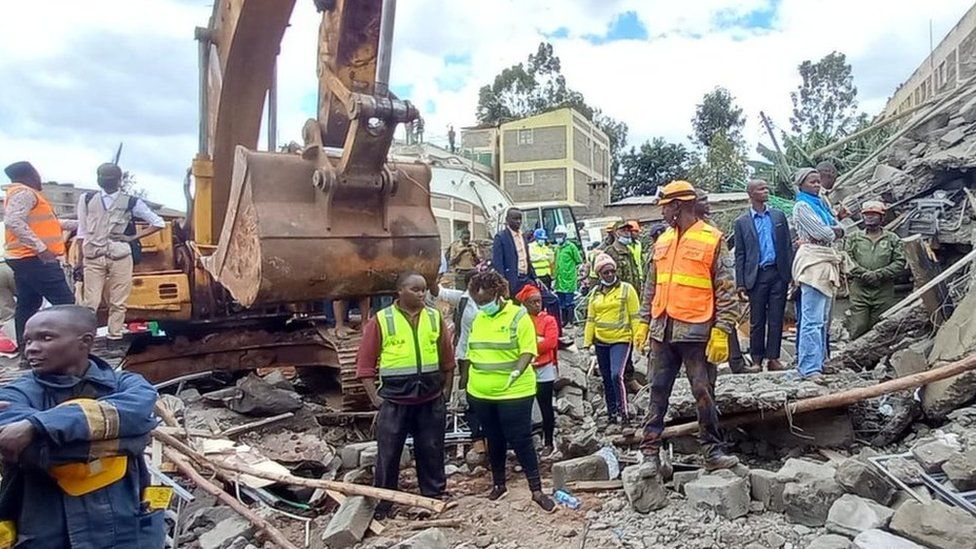
Four policemen in Kenya who have been accused of a spate of murders, abductions and torture will be arraigned today in the capital, Nairobi.
They are said to be part of an elite squad that was disbanded by President William Ruto for reportedly executing extrajudicial killings and disappearances of suspects over several years.
Two Indian nationals who went missing in July and whose remains were discovered last week in a forest in central Kenya, are among their alleged latest victims.
The members of the now disbanded Special Services Unit face multiple charges including murder, abuse of office and conspiracy to commit felonies.
The unit was disbanded after the president received a police report on the disappearance of the two Indian nationals.
Zulfiqar Ahmad Khan and Mohamed Zaid Sami Kidwai were in Kenya to help the electoral campaign of Mr Ruto, but they went missing together with their local driver Nicodemus Mwania soon after being picked up by police in Nairobi.
Human Rights groups say their independent investigations have linked the squad and other police units to the death of more than 600 people over the past four years.
Some of the bodies were later recovered in rivers in western and northern Kenya.
A coalition of international and local NGOs is now calling on the government to prosecute the rogue officers, and to compensate the victims of police excesses.
It’s always heaving with people on the lookout for a bargain, Western brand names which are recycled and sold at a fraction of their original cost and traders appear to have an infinite amount of sacks full of second hand clothes.
This market is a source of commerce, feeding into the local economy and it enables people like John Mwangi to earn an income.
“This trade is what enables me to take care of my daily needs. I do not have skills in any other trade. If it stops I would be stranded with nowhere to go,” says Mwangi.
Recycling fashion helps to cut down the mountains of waste the world produces each year, but the sheer volume of poor quality second hand textiles arriving here is creating another waste problem, according some groups.
What the traders in Gikomba Market can’t sell gets burned or dumped onto waste heaps like this one.
Here, the poorest like Damaris Wanjiru hope to clothe their families and perhaps make a little money to feed their children.
The mother of four says: “We usually search for second hand clothes in the rubbish after which we sort them out. We then pick the ones that are of the best quality and then we wash them. We take some of the clothes to our children and we also wear some. We also have people who come to buy the clothes from us. We make money from our sales and wear the leftovers.”
The United Nations Environment Programme (UNEP) has been critical of the textile industry for the impact its production has on the environment.
It says the clothes industry is responsible for eight percent of global greenhouse gas emissions which contribute to climate change, while at the same time $460 billion worth of usable clothes are thrown away each year.
Janet Chemitei from the environmental group Greenpeace argues wealthier countries are using countries like Kenya as waste disposal grounds for rubbish they can’t recycle themselves.
She says: “The fabrics that they use to produce these clothes are synthetic fibers and this synthetic fibers are produced from fossil fuels which is also harming the environment in the long run and also the people who make these clothes and us who wear them so we really want brands to be accountable and to stop producing fast fashion.”
In a report called”Poisoned Gifts”, Greenpeace argues the second hand clothes are little more than textile waste and the imports threaten locally made products and textile industries.
It says 30 to 40 percent of the imports, which is about 74,000 tonnes, ends up being dumped.
According to Greenpeace it’s been difficult for sub-Saharan countries to ban second hand clothes from the US because they’ve struck preferential trade deals with America in what was called the African Growth and Opportunities Act.
According to a report posted by the Council on Foreign Relations think tank, the deal has worked in America’s favour because the African nations import more from the US than they export.
Organisations like UNEP are encouraging the growth of new industries which can create new uses for textile waste in Kenya.
One of them is Africa Collect Textiles, collects used textiles for recycling.
The Nairobi-based organisation Kenya alone imports more than 200 million kilograms of used textiles each year.
The company’s co-founder Alex Musembi agrees with Greenpeace’s findings: “According to the report that I have read, 20 to 30 percent of the waste that comes from the Global North is pure trash so that is the problem that we are talking about. The textile waste, waste problem.”
Africa Collect Textiles upcycles textile waste into rugs, pencil bags and other products which it exports to Switzerland, Germany and the Netherlands.
The start-up has an income of 50,000 euros annually and 16 full time employees.
The company has established 35 drop off points where people can leave clothes they no longer have a use for, but it only collects cotton.
Musembi argues the world should demand more accountability from global fashion brands.
“I am talking about Nike, the like of Adidas and Tommy Hilfiger, the likes of H&M, the likes of Shein etc, they should come up and set up what we call the EPR fund, that is the Extended Producer Responsibility, and for every Euro they sell in terms of profitability, it has to be channeled back to companies like Africa Collect Textiles who are trying to solve their mess here in the country,” says Musembi.
But even with extra support, there is more textile waste in rivers like this than Africa Collect Textiles can ever hope to recycle.
At Shamas Auto Parts, a spare part shop in Nairobi, Kenya, business is slow these days.
The impact of a strong US dollar is felt. It contributes to making other countries’ imports more expensive and more local currency is needed to convert into dollars.
This is compounding financial distres at a time when the Kenyan shilling is down 6% this year.
“Sometimes you find that there is an increase of about 10-25% in the cost of a spare part within a period of maybe six to twelve months, which people are not expecting”, Michael Gachie, purchasing manager with Shamas Auto Parts says.
“For us, right now we are in wholesale and retail of parts and you find that most of the customersare complaining a lot”, the manager concludes.
Continued losses
According to the benchmark ICE U.S. Dollar Index, the dollar is up 18% this year against a basket of key currencies.
“We are continuing to lose. I used to take my children for holidays. They cannot enjoy those holidays anymore because of the weakening shilling. We don’t have enough cash flows to put it about in the house”, Albert Chege says.
the cost of fuel and imported spare parts is soaring so much that some people are choosing to ditch their cars and take public transportation.
To combat US inflation running at its fastest rate in 40 years, the Federal Reserve has raised its benchmark short-term interest rate five times this year with worldwide consequences.
Kenya’s central bank also raised its benchmark interest rate by the biggest margin in more than seven years last September.
The currency of East Africa’s largest economy has been sliding to record lows against the dollar. As of October 18, 1 U.S dollar sold 121.1706 Shillings when on August 2nd, it sold 119.0118 Shillings.
Authorities in Kenya plan to exhume the body of a British tourist who died at the home of a controversial cult leader two years ago.
Luftunisa Kwandwalla was buried at a Mombasa cemetery in August 2020after reportedly dying of natural causes.
She arrived in Kenya as a tourist in August 2019 but her return to the UK was delayed due to lockdowns imposed in Kenya and Britain during the Covid pandemic.
Her family says she then joined a controversial cult in Mombasa.
The family alleges the 44-year-old was murdered and her body buried quickly to hide evidence.
Last week it obtained court orders for the exhumation to allow for a post-mortem examination to ascertain the cause of death.
The family told the BBC that the autopsy would be the first step in bringing closure to her death.
No one has been arrested in connection with the death and policerecords show that there are currently no active investigations.
Ahmed Ogwell Ouma, the acting head of the African Centres for Disease Control (CDC), has returned to Kenya after allegedly being mistreated by immigration officials at Frankfurt Airport in Germany over the weekend.
He said the immigration officials “imagine I want to stay back illegally”.
Dr Ogwell was due to attend the World Health Summit in the German capital, Berlin, which began on Sunday and finishes on Tuesday.
Following the incident, he said his “attendance was in doubt” despite having a visa and an invitation to the summit.
On Monday he tweeted: “I’m safely back in Africa home to the most resilient human beings I know.”
He also shared some lessons:
“A visa often means little when you are carrying an African passport – regular or diplomatic”
“Don’t reduce your dignity to fit someone else’s prejudices – you’ll be feeding a wolf that will one day devour you”
“Very many decent people are mistreated every day and don’t have the microphone to let the world know – I empathize with ALL of you”
“Home is best – Mama Afrika remains my refuge (and 1.5 billion others!) so I must take care of her. And so should you.”
Frankfurt airport apologised for the Saturday incident.
“As an international airport, we welcome all passengers and do not tolerate any form of discrimination or racism.We would like to have more information about this incident,” it tweeted after Dr Ogwell had shared his ordeal at the airport.
Kenyan PresidentWilliam Ruto has disbanded an elite police unit accused of extrajudicial executions in the country in recent years.
The president, who took office in September, stated that the decision was part of attempts to modernise the country’s security forces.
He told a church congregation on Sunday:
Quote Message: I am the one who ordered that the Special Service Unit that was conducting extrajudicial killings be disbanded. We have a plan on how to secure this country so that we avoid the shame of Kenyans killed [elsewhere and bodies dumped] in Yala River and others. We are going to change this country for the better.”
I am the one who ordered that the Special Service Unit that was conducting extrajudicial killings be disbanded. We have a plan on how to secure this country so that we avoid the shame of Kenyans killed [elsewhere and bodies dumped] in Yala River and others. We are going to change this country for the better.”
Kenya’s Daily Nation newspaper said, “an investigation report on the disappearance of two Indian nationals and their local taxi driver precipitated the disbandment” of the unit.
The two Indians arrived in Kenya in April to join Mr Ruto’s campaign team ahead of the August general election but went missing three months later with their Kenyan taxi driver, the paper said.
In January, it emerged that at least 19 unclaimed bodies had been retrieved over the past two years from the Yala river in different stages of decomposition.
There is no evidence that the security forces had anything to do with any of the Yala bodies.
But human rights organisations have documented many cases of killings directly attributed to police officers.
The Kenyan authorities will disconnect about 12.5 million Sim cards this weekend as the registration window draws to a close.
Kenyans who have not verified their Sim card details will see services suspended from Sunday. They will not be able to make or receive calls, send or receive messages or even access mobile internet services.
In April, the Communications Authority of Kenya extended the deadline for verification by six months.
By Thursday, only 53 million subscribers had verified their registration data. Of these, 38 million were Safaricom subscribers, the largest telecoms company in the country. Airtel and Telkom Kenya saw 13.4 million and 1.8 million subscribers, respectively, verify their details two days to the deadline.
Sim card owners can update their registration details by presenting their national identity card to a merchant, or register through online portals set up by the service providers.
The verification drive is aimed at weeding out Sim cardsthat have been fraudulently registered and reduce cases of theft and insecurity in the country.
“We don’t want criminals to have a field day out there,” Liston Kirui, from the Communications Authority of Kenya said on Friday.
Kenya’s law society has condemned the country’s public prosecutor for withdrawing corruption cases against high-profile individuals, including a cabinet nominee.
Law Society of Kenya (LSK) President Eric Theuri on Thursday called on the Director of Public Prosecution (DPP) Noordin Haji to publicly reveal the reasons behind the successive withdrawal of high-profile cases.
“We are… alarmed by the recent decisions by the DPP as they point to either two disturbing scenarios; that the prosecutions were mounted for the ulterior purpose whose end has been achieved or overtaken by events, or that the DPP has withdrawn the cases to aid an ulterior motive,” Mr Theuri said.
The LSK has threatened to pursue legal action against Mr Haji “so as to avert the abuse of the prosecutorial powers donated to Mr Haji by Kenyans through the constitution”.
Opposition legislators have also questioned why the withdrawal of cases came a few days before the commencement of the vetting of cabinet nominees by parliament next week.
On Wednesday, the prosecutor said he was dropping a $157,000 (£140,000) corruption case against the nominated minister for public service, Aisha Jumwa. Another $3.3m corruption case against a former managing director of state utility firm Kenya Power was also dropped.
Kenya’s law society has condemned the country’s public prosecutor for withdrawing corruption cases against high-profile individuals, including a cabinet nominee.
Law Society of Kenya (LSK) President Eric Theuri on Thursday called on the Director of Public Prosecution (DPP) Noordin Haji to publicly reveal the reasons behind the successive withdrawal of high-profile cases.
“We are… alarmed by the recent decisions by the DPP as they point to either two disturbing scenarios; that the prosecutions were mounted for the ulterior purpose whose end has been achieved or overtaken by events, or that the DPP has withdrawn the cases to aid an ulterior motive,” Mr Theuri said.
The LSK has threatened to pursue legal action against Mr Haji “so as to avert the abuse of the prosecutorial powers donated to Mr Haji by Kenyans through the constitution”.
Opposition legislators have also questioned why the withdrawal of cases came a few days before the commencement of the vetting of cabinet nominees by parliament next week.
On Wednesday, the prosecutor said he was dropping a $157,000 (£140,000) corruption case against the nominated minister for public service, Aisha Jumwa. Another $3.3m corruption case against a former managing director of state utility firm Kenya Power was also dropped.
Kenya on Thursday denied it had defaulted on interest repayments on a loan advanced by China for the construction of a railway line from the port city of Mombasa that opened in 2017.
The $5 billion project, financed 90 percent by China, replaced the so-called “Lunatic Express” — a line built more than a century ago by colonial power Britain which was notorious for lengthy delays and breakdowns.
Kenya’s Business Daily reported that the government failed to repay interest on the loan in the financial year ended June, attracting a fine of 1.312 billion Kenyan shillings ($10.8 million).
But Treasury Cabinet Secretary Ukur Yatani rejected the report as “misinformation”, saying the financial position of the East African economic powerhouse was “sound and robust”.
Currently snaking from Mombasa via the capital Nairobi to the Rift Valley town of Naivasha, it is planned to eventually link Uganda, Rwanda, South Sudan, Burundi and Ethiopia.
The railway was to be managed by the Chinese contractor for five years before being handed over to the Kenyan government.
But it has posted losses, with analysts worrying the trend could continue after newly elected President William Ruto last month reversed a policy that made it mandatory for cargo to use the railway.
China is Kenya’s second-largest lender after the World Bank and has funded a number of costly infrastructure projects that have raised concerns about Nairobi taking on more debt than it can afford.
The country’s public debt load in June stood at 8.6 trillion shillings ($71.1 billion), an 11.5 percent rise from a year earlier, according to government figures.
Loan interest repayments have however shot up in recent months as the value of the shilling rapidly loses ground against international currencies, trading at 121 to the dollar on Thursday.
Yatani said there was no cause for alarm as the country frequently undergoes independent sovereign rating reviews which are published widely.
“At no time has Kenya been flagged as a country defaulting on its external debt obligations,” he added.
Ugandan General Muhoozi Kainerugaba has apologised to Kenya’s President William Ruto over tweeted threats about invading the neighbouring country and capturing its capital in two weeks.
Gen Kainerugaba’s tweets drew angry reactions from Kenyans and prompted his father, President Yoweri Museveni, to apologise to Kenya.
In his Thursday evening apology, the general said he had never had any problem with President Ruto.
He added: “If I made a mistake anywhere,I ask him to forgive me as his young brother.”
I have never had any problem with Afande Ruto. If I made a mistake anywhere, I ask him to forgive me as his young brother. Godbless East Africa! pic.twitter.com/5LuzVabLKz
Mr Museveni – who has been in power since 1986 – has long been suspected of grooming his 48-year-old son to succeed him when he eventually steps down, an allegation he has always denied.
Uganda’s president’s son, General Muhoozi Kainerugaba has apologised to Kenya’s President William Ruto over tweeted threats about invading the neighbouring country and capturing its capital in two weeks.
Gen Kainerugaba’s tweets drew angry reactions from Kenyans and prompted his father, President Yoweri Museveni, to apologise to Kenya.
In his Thursday evening apology, the general said he had never had any problem with President Ruto.
He added: “If I made a mistake anywhere, I ask him to forgive me as his young brother.”
I have never had any problem with Afande Ruto. If I made a mistake anywhere, I ask him to forgive me as his young brother. Godbless East Africa! pic.twitter.com/5LuzVabLKz
Mr Museveni – who has been in power since 1986 – has long been suspected of grooming his 48-year-old son to succeed him when he eventually steps down, an allegation he has always denied.
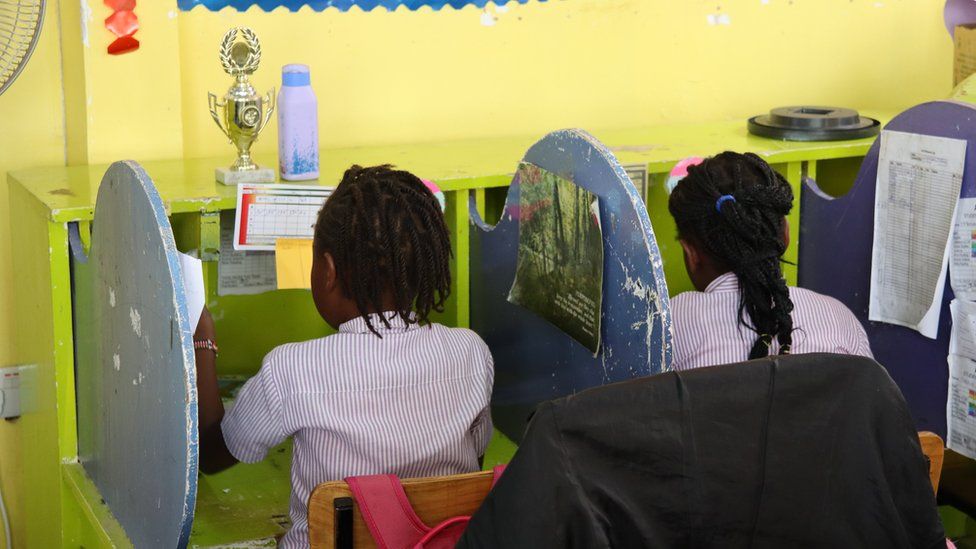
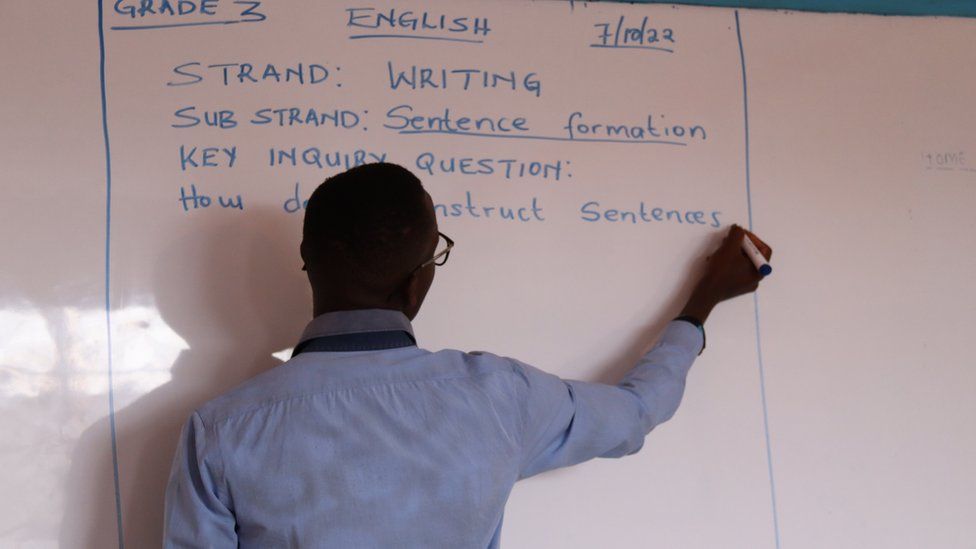
A viral video clip showing two primary school children slaughtering a chicken in Kenya has caused uproar and some hilarity about the country’s new curriculum, which has more of a focus on practical skills.
During the outdoor lesson for 11 year olds on how to kill and cook a chicken, one boy is seen pinning down the fowl as another holds a knife nervously to its neck.
Some curious classmates watch as the teacher, who is filming the episode with his mobile phone, congratulates the boy for cutting off the head and then instructs another, who holding the body, to put it in a nearby cauldron of boiling water.
But as the child lets go over the pot, the headless chicken flaps its wings and escapes.
The 19-second clip ends with the teacher’s laughter and the hapless and headless chicken still running around as screaming children scamper after it.
When a chicken’s head is chopped off it can run around for several minutes as for a short period its spinal cord circuits still have residual oxygen.
It is unlikely to be something this grade-six class will forget.
The video sparked an outcry on social media with many people concerned about the safety of the children, although hardly anybody raised the issue of the chicken’s suffering, asin rural Kenya, the sight of chickens being slaughtered is a common one.
Since they started primary school, they have been the guinea pigs for a new curriculum, and have experienced many different practical projects over the last few years – from making scarecrows to selling goods at markets.
Supporters of the Competency Based Curriculum (CBC) see them more as pioneers, saying it is an improvement on the old theory- and exam-based system as it better prepares them for life and to find jobs in the 21st Century.
They also argue that as there is continuous assessment it will reduce cheating in exams, which has been a massive problem for the government.
About 1.25 million grade-six pupils are soon to sit exams as part of the Kenya Leaving School Certificate that determines their entrance to secondary school.
For the first time, the exam will only contribute 40% to their final marks as their assessment scores since grade one will make up the rest.
‘Feasting at parents’ expense’
But some parents are unhappy at the expense of the new curriculum as schools expect them to contribute material and money for items – like chickens – needed for the practicals.
A home science teacher at Kangundo Primary School in eastern Kenya says that those from less well-off households are sometimes forced to watch others do their practicals.
“My grade-five pupils, for example, were sewing a handkerchief for their project and some could not afford to buy the fabric, so we ended up using the few that were bought by some pupils,” Jemimah Gitari told the BBC.
She feels some colleagues take advantage too – asking pupils to bring in meat, but she says this was not in fact compulsory for the stewing project.
“My school is in a village where some families cannot even afford a meal due to the rising cost of food so I couldn’t ask them for meat,” she said.
Following the chicken practical – done by grade-six pupils nationwide in September – photos were shared on social media which appeared to show teachers eating chicken in a staffroom.
An MP from western Kenya, Didmus Barasa, accused them of feasting on food paid for by parents who could ill afford it.
“Now there are no hens in homesteads,” he said in remarks which angered the teachers’ union.
The heated chicken debate even reached the ears of Kenya’s newly elected President William Ruto, who has since set up a 49-member task force to evaluate the new curriculum, which was a pet project of his predecessor, Uhuru Kenyatta.
It has until the end of the year to make recommendations about whether the CBC rollout should continue for the grade-six students going into their first year of secondary school, which starts in January.
“The books and curriculum designs are ready but we are holding on to get advice before we can distribute them,” Prof Charles Ong’ondo, who heads The Kenya Institute of Curriculum Development, told the BBC.
Some parents do not mind the practical side of the curriculum, but say it lacks balance as book work suffers.
“My daughter, who is in grade four, is doing 12 subjects and each of them has a project. They spent most of their time last term doing projects and so most classwork was not covered,” Rozina Kisilu, a mother of two who lives in the capital, Nairobi, told the BBC.
The focus on practicals makes it harder for teachers to finish the syllabus in time, adds Ms Gitari – pointing to the two-week interruption to the last term because of the general election.
In fact the last two academic years have been unusual, with four instead of three terms – to make up for time lost during the Covid pandemic.
Others argue it will just take time for teachers to get to grips with the new curriculum.
This also came in for criticism recently when several videos trended showing pupils in rural areas lying on the ground pretending to swim as they had no access to a swimming pool.
But Nairobi teacher Marion Muthoni says the physical activity project gave teachers two options: pupils could either swim or skip using a rope depending on their facilities.
“Some of my colleagues are just exaggerating things. The things I’ve seen on social media are quite different from the guidelines we have. With time, teachers will realise not everything needs to be practical,” Ms Muthoni told BBC.
Image caption, Teachers say they need more time time to implement the new curriculum
Indeed the recommendation of the Kenya National Union of Teachers (KNUT) after a two-year pilot was that the CBC should not be introduced across the board until teachers were properly trained.
Some educationists recommend that a pilot should allow for a complete education cycle before a full rollout is considered so that adjustments can be made.
Sophia Mbevi, the director of a private school in Nairobi, agrees, saying that while the CBC had the best intentions, it was too hurriedly implemented.
Her school offers an alternative curriculum – which under Kenya law is allowed for private institutions as long as it is approved by the education department.
Some parents who can afford it are opting for private schools with established curriculums, like the one Ms Mbevi heads, as they do not want their children’s future to be an experiment.
“There are far-reaching implications to overhauling an education system. A lot needs to be done to expand resources and train teachers before a full rollout,” Ms Mbevi told the BBC.
“I just hope we can stop politicising education and do the right thing to ensure good quality education for the children.”
The fate of the CBC now rests with the task force, which has six months in total to give its full evaluation.
Ms Mbevi suggests that one solution would be for the government to invest in community learning centres where “learners could be assisted to complete their projects, especially in households where the parents themselves are school drop-outs”.
And to further ease the burden on parents and address the social divide, Ms Muthoni says the government should provide some of the materials needed for projects.
As to whether this should include live chickens, she suggested that schools should rear their own.
The Central Organisation of Trade Unions (Cotu) has urged the Kenyan governmentto ban employment agencies in the country from sending migrant workers to Saudi Arabia.
Their request comes after a viral video appeared to show a Kenyan woman breastfeeding dogs in the Gulf country.
The authenticity of the video is yet to be verified.
But speaking to reporters on Sunday, Cotu Secretary-General Francis Atwoli said the woman, who had left a two-month-old baby in Kenya, was compelled by her employer to breastfeed the puppies.
“I want to appeal to the administration to go the way the first government under former President Mwai Kibaki did. He banned all employment agencies in Kenya,” Mr Atwoli said.
COTU boss Atwoli speaks after Kenyan records herself while “breastfeeding dogs in Saudi Arabia”, wants employment agencies banned in Kenya. #NTVatOnepic.twitter.com/r9sgcVvH7i
The union leader asked President William Ruto to stop the “indirect slavery” of Kenyan migrants and negotiate for their welfare with the gulf countries.
High unemployment rates in Kenya has prompted young people to migrate to gulf countries in search of jobs as domestic workers and labourers.
Many migrants have reported mistreatment in the Middle East and most recently in Myanmar, Laos and Cambodia.
The government of Kenyahas been urged by the Central Organization of Trade Unions (Cotu) to ban employment agencies that transport migrant workers to Saudi Arabia.
This is in response to a viral video that purported to show a Kenyan woman breastfeeding dogs in the Gulf country.
The BBC has not verified the authenticity of the video.
But speaking to reporters on Sunday, Cotu Secretary-General Francis Atwoli said the woman, who had left a two-month-old baby in Kenya, was compelled by her employer to breastfeed the puppies.
COTU boss Atwoli speaks after Kenyan records herself while “breastfeeding dogs in Saudi Arabia”, wants employment agencies banned in Kenya. #NTVatOnepic.twitter.com/r9sgcVvH7i
“I want to appeal to the administration to go the way the first government under former President Mwai Kibaki did. He banned all employment agencies in Kenya,” Mr Atwoli said.
The union leader asked President William Ruto to stop the “indirect slavery” of Kenyan migrants and negotiate for their welfare with the gulf countries.
High unemployment rates in Kenya has prompted young people to migrateto gulf countries in search of jobs as domestic workers and labourers.
Many migrants have reported mistreatment in the Middle East and most recently in Myanmar, Laos, and Cambodia.
British actress Michaela Coelhas taken her American Vogue cover to the streets of Accra.
Coel, who has been cast in Marvel’s blockbuster Black Panther: Wakanda Forever is Vogue’s November cover star – and she chose to have the photo shoot in her ancestral home, Ghana, alongside her father, Derek Kwesi Coel, and grandmother Jemima Andam.
She was photographed by Senegalese-Italian model Malick Bodian.
“They asked me where I’d like to shoot it and I thought to myself ‘shoot for the stars aim for the moon’, and I said ‘Ghana’, and they were like ‘sure’.”
Speaking to Vogue about a previous visit to Ghana in 2018, Coel said: “I’d been to Africa before – Kenya and Uganda – but when I came here, I was really seeing people who looked like me.”
“I remember looking at all the kids playing, and it hit me, like, Wow, this could’ve been me and I think I would have really enjoyed that,” she continued.
“Yes, there are a lot of sad things, poverty, unemployment, struggle. There’s also a lot of peace and friendliness. There’s a lack of anxiety.”
In her Vogue interview, Coel also spoke about her upcoming rolein Black Panther where her character falls in love with her warrior colleague, played by Florence Kasumba.
“That sold me on the role, the fact that my character’s queer,” Coel said. “I thought: I like that, I want to show that to Ghana.”
Coel was born and raised in East London after her parents emigrated from Ghana. She is most famous for writing, directing, and starring in the comedy-drama series I May Destroy You.
Kenyans have received an apology from President Yoweri Museveni after reading tweets from his son Muhoozi Kainerugaba that regularly threatened to invade Uganda’s neighbouring country in East Africa.
In a series of tweets on Monday and Tuesday, Kainerugaba posted provocative messages, including proposing the unification of Kenya and Uganda.
“It wouldn’t take us, my army and me, 2 weeks to capture Nairobi,” Kainerugaba wrote, referring to Kenya’s capital.
“Union is a MUST! No honorable men can allow these artificial, colonial borders anymore. If our generation has men, then these borders must fall!.”
Presidential apology
President Museveni apologized for his son’s comments, saying it was wrong for public officers to meddle in the affairs of other nations.
“I ask our Kenyan brothers and sisters to forgive us for tweets sent by General Muhoozi, formerCommander of Land Forces here, regarding the election matters in that great country,” Museveni wrote in a statement released Wednesday on his official website.
His comments drew angry reactions from Kenyans on social media and Kainerugaba, who is widely regarded as the de facto head of the military and his father’s chosen successor, was on Tuesday removed as commander of Uganda’s land forces. It was unclear whether the change was made following his controversial tweets.
He was later promoted from lieutenant general to the rank of a full general and will remain a senior presidential adviser for special operations, a Ugandan Ministry of Defence statement announced.
Despite his apology, Museveni justified Kainerugaba’s promotion, saying his son had only erred in his comments and not in his service.
“Why, then, promote him to full General after these comments? This is because this mistake is one aspect where he has acted negatively as a public officer,” the Ugandan leader said.
“There are, however, many other positive contributions the General has made and can still make,” he added while describing Kainerugaba as “a passionate Pan-Africanist.”
An outspoken general
Kainerugaba is outspoken on social media and has frequently traded barbs with opposition figures and weighed into politics, despite his military role barring him from doing so.
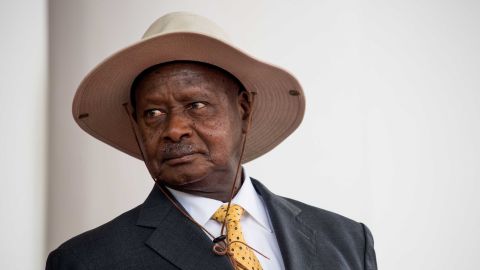
Uganda’s President Yoweri Museveni pictured in 2018. SUMY SADRUNI/AFP/Getty Images
Kainerugaba also asked his more than 600,000 Twitter followers how many cows should be offered as a bride price for Giorgia Meloni, the right-wing politician expected to be named Italy’s prime minister this month.
“I would give her 100 Nkore cows immediately! For being fearless and true!!,” he wrote.
Ugandan LGBTQ organization calls government shutdown of its operations a ‘clear witch-hunt’
Kainerugaba later said the comments were made in jest. While an aide to Francesco Lollobrigida, told reporters Kainerugaba’s offer was not a serious topic.
Ugandan analysts and opposition leaders havelong accused the 78-year-old Museveni of grooming his son to take over from him, but Museveni, who has been in power for 36 years, has repeatedly denied doing so.
The Kenyan government’sdecision to reverse a ban on the import and cultivation of genetically modified organisms was “hasty,” activists and agricultural lobby groups denounced Thursday, calling for the prohibition to be “reinstated.”
The government of new President William Ruto on Monday allowed the import and cultivation of GMOs, banned since 2012, to address the country’s severe drought.
“The hasty decision to lift the ban on GMO imports into the country was taken without public debate,” according to a statement signed Thursday by a dozen organizations, including Greenpeace Africa.
“Food security is not only about the quantity but also the quality of food,” according to the organizations’ statement, which called for “the ban to be restored.”
Kenyahad banned the cultivation of GMOs in 2012, in part to protect small farms, which account for the majority of farms in the country.
The country, the economic engine of East Africa, had been criticized after taking this decision, including by the United States, a major producer of GMOs.
In a statement issued on Monday, Kenyan authorities said they wanted to “significantly redefine agriculture in Kenya” and announced the authorization of “crops that are resistant to pests and diseases”.
The authorities claimed to have relied on advice from the World Health Organization and the FAO before making their decision.
But for activists and agricultural pressure groups, this decision “will open the market to American farmers who receive large subsidies”, which may weaken small Kenyan producers.
William Ruto, one of the country’s richest men, was elected in a close election last August and has promised to tackle inflation, which includes fuel, food, seed and fertilizer.
Within a week of taking office in September, the head of state had halved the price of fertilizer.
A former minister of agriculture, Mr. Ruto has promised to revitalize the sector, a pillar of the economy that accounts for 20% of GDP.
Kenya, the economic engine of East Africa, is suffering from a drought of unprecedented intensity in 40 years, and hunger is affecting at least 4 million people out of a population of more than 50 million. According to authorities, the drought is affecting 23 of the country’s 47 counties.
Four consecutive poor rainy seasons have created the driest conditions since the early 1980s.
Kenyan President William Ruto met with Ethiopian Prime Minister Abiy Ahmed on Thursday to discuss bilateral cooperation and deepen the economic and strategic ties between the two countries on regional issues.
This is President Ruto’s first visit to Ethiopia after being elected.
It is to be recalled that Prime Minister Abiy Ahmed had taken part in the inauguration ceremony of President William Ruto in Nairobi on September 13/2022.
Ethiopia and Kenya are countries that have long-standing friendship and cooperation based on mutual benefit.
The visit also comes amid the ongoing war between Ethiopian troops and the Tigray People Liberation Front (TPLF).
Talks about the ongoing Tigray conflict are expected to take centre stage in the meeting between the two leaders.
Earlier on, President Ruto had affirmed that his administration would play an active role in spearheading the peace talks between the region.
Already, the African Union has organized high-level talks in South Africa on the protracted conflict, with Kenya’s former President Uhuru Kenyatta set to be part of the mediators.
A report by the World Intellectual Property Organization (WIPO) has evaluated innovation levels across 130 economies to determine the most innovative markets in the world in 2022.
The 2022 Global Innovation Index (GII) measured each economy’s innovative capacity and output by focusing on a long list of criteria such as human capital, institutions, technology and creative output, as well as market and business sophistication, among others. The GII ranking is based on performance across seven pillars:
Which are the most innovative economies in 2022?
Switzerland is the most innovative economy in the world in 2022 – for the 12th year in a row – followed by the United States, Sweden, the United Kingdom and the Netherlands. China is nearing the top 10 while Türkiye and India enter the top 40 for the first time, according to the GII 2022.
Mauritius ranks first in Africa in Global Innovation Index 2022
Port Louis, Capital of Mauritius
According to the report, Mauritius emerged the most innovative African country, and climbing seven places to 45th on the Global Innovation Index (GII). Unlike most African countries, the report said Mauritius has a high human development score. Its economy has grown robustly in the last half a century, especially on financial services, tourism and information technology.
Top 10 innovation economies by region
This year, sixteen out of the 25 economies from Sub-Saharan Africa covered this year improved their ranking. Botswana took the biggest leap forward, reaching 86th position, and in so doing overtaking Kenya (88th) among the top 3 for the region. Other notable improvers within the region are Mauritius (45th), Ghana (95th), Namibia (96th) and Senegal (99th). South Africa remains unchanged in 61st place – and continuing to fail to improve consistently over time.
Here are the top 10 most-innovative countries in Africa, according to the 2022 Global Innovation Index
An increase in interest rates in global markets has made emerging market assets less attractive, with investors coy to lend to the Kenyan government, exposing the new administration to a funding headache.
For the fourth consecutive week in September, Treasury Bills in Kenya performed poorly, with a record low performance rate of 38.8% in the last auction of 30 September 2022.
This saw Central Bankof Kenya (CBK) receive bids totalling just KSh9.3bn, compared to an advertised amount of KSh24bn.
Since the beginning of this financial year in July, the 91-day Treasury Bill interest rates have increased on average by 0.704% to reach 8.47% at the end September.
The 182-day and 364-day Treasury Bill rates bear a similar upward trend.
A grueling two-year drought inKenyahas wiped out 2% of the world’s rarest zebra species and increased elephant deaths as well, as the climate crisis takes its toll on the east African nation’s wildlife.
Animal carcasses rotting on the ground – including giraffes and livestock – have become a common sight in northern Kenya, where unprecedented dry spells are chipping away at already depleted food and water resources.
The Grevy Zebra, the world’s rarest of the zebra species, has been the worst hit species by the drought.
Founder and Executive Director of the Grevy’s Zebra Trust, Belinda Low Mackey, told CNN that the species’ mortality rate would only rise if no significant rain falls on the region.
“If the approaching rainy season fails, Grevy’s zebra face a very serious threat of starvation,” she said. “Since June, we have lost 58 Grevy’s zebra and mortality cases are rising as the drought intensifies.”
Even the most drought-resistant animals are impacted. One is the camel, which is known to survive lengthy periods without water.
“Camels are a valuable resource for many people in this region,” Suze van Meegen, an Emergency Response Manager for the Norwegian Refugee Council in East Africa, told CNN. “The deserts of Kenya … are now littered with their carcasses.”
Kenya is on the brink of its fifth failed rainy season and its metrological department forecasts “drier-than-average conditions” for the rest of the year.
Conservationists are worried that many more endangered species will die.
“If the next rains fail … we could expect to see a substantial spike in elephant mortality,” says Frank Pope, who heads Kenya-based conservation charity Save the Elephants.
“We are seeing herds splintered into the smallest units … as they try to eke out a living,” he said. “Calves are being abandoned, and elderly elephants are dying. Without rain, others will soon follow.”
As the dry spell persists, other endangered wildlife is fast going extinct.
The drought is also worsening poaching for bushmeat, which has risen among pastoralist communities in the north as the drought impacts other sources of income.
Mackey says Grevy’s zebras are now being poached at grazing reserves.
“The drought has led to increased poaching of Grevy’s zebra due to large numbers of livestock converging on grazing reserves,” Mackey said. “This has led to inter-ethnic conflict (sometimes animals get caught in crossfire) and poaching, as herders resort to living off wildlife.”
Human-wildlife conflict has also fueled the killing of dozens of elephants that are forced to come in close contact with humans as they chase shrinking sources of food and water, said Pope of Save the Elephants.
“Last year, we lost half as many elephants to conflict with people as we did to poaching at the height of the ivory crisis 10 years ago,” he tells CNN.
Nearly 400 elephants were lost to poaching 10 years ago, the highest in Kenya since 2005, according to a 2012 report by the country’s wildlife service.
While government action against ivory trade has quelled ivory poaching in Kenya, poaching for bushmeat has persisted due to the drought and soaring food prices.
Since October 2020, four consecutive rainy seasons have failed in parts of Kenya and the Greater Horn of Africa. The UN says this is region’s worst drought in 40 years.
More than four million Kenyans are “food insecure” due to the drought and over 3 million can’t get enough water to drink.
The Grevy’s Zebra Trust says it is helping endangered species survive the drought through supplementary feeding.
“We have one dedicated feeding team in each of the three national reserves (Samburu, Buffalo Springs and Shaba). On average we are using 1,500 bales (of supplementary hay) per week,” Mackey said, adding that other species such as oryx and buffalo were also benefiting.
However, interventions for elephants at a scale that could make an appreciable difference are difficult, says Pope.
“Providing new water sources can be counter-productive, for instance, causing local desertification,” he said. “Save the Elephants concentrates on helping local people protect themselves from conflict (with stray elephants) and helps respond to incidents when conflict does occur.”
Pope also worries that when the rains finally come, there might be less grass due to overgrazing by livestock.
“A bigger concern is the overgrazing that is starting to turn the fragile landscape to desert. When the rains do come there will be less grass, even as the pressure on the landscape increases.”
In a world transformed by technology African universities have a vital role to play in ensuring that young people develop the skills required to remain relevant and employable in an increasingly automated world and to contribute to progress on the continent.
Africa’s youth population is rapidly growing and expected to double to over 830 million by 2050.The continent is the youngest on the planet. Of its nearly 420 million youth aged 15-35, one-third are unemployed, another third is vulnerably employed, and only one in six is in wage employment. Failure to invest in and support the continent’s youth will have a profound impact on the global economy, as half of the new entrants into the global workforce over the next decade will come from sub-Saharan Africa.
The International Monetary Fund (IMF) has warned that neglecting Africa now will result in critical labour shortages globally. There are opportunities for African countries to benefit from the changes the fourth industrial revolution (4IR) is bringing, but without the skill sets in place, the continent will fall behind.
The new requirement for African universities is to be able to track skills demands and respond quickly to make sure that graduates are ready to add real value to businesses worldwide, and to think entrepreneurially, critically, creatively, and analytically. At present, they are not being adequately prepared to enter employment.
This has triggered a renewed focus on higher education. Graduates with limited skills require further training to meet modern workplace needs. Universities also need to produce job creators as well as job seekers. They need to cultivate innovation and entrepreneurship as exploratory solutions to youth employability.
Beyond providing a platform for learning, research and knowledge creation, universities can be catalysts for change and drivers of economic growth by developing young people who can contribute to the growth of new and existing companies. Universities can also encourage and support the creation of new ideas, innovations, and commercialisation. They have a vital role to play in researching the ecosystems that support innovation and entrepreneurship.
One way to respond to the critical shortage of skills is to encourage the development of collaborative partnerships between universities in Africa and abroad, to adopt global best practices when it comes to content, programmes and processes and strengthening research capacity.
An example of a successful initiative is the British Council’s Innovation for African Universities (IAU) programme, launched in 2021. The IAU supports the development of skilled youth who are equipped for the new world of work. The objective is to develop young Africans who can start innovative businesses, generate jobs, build wealth and take advantage of growth opportunities.
The IAU aims to strengthen the capacity of African universities to participate and provide meaningful contributions as key players within the entrepreneurship ecosystem, and to foster a culture of innovation among students.
Universities can give graduates the knowledge and skills to contribute to the growth of new economic initiatives. They can also encourage and support the creation of new ideas, innovations, and commercialisation.
The IAU programme facilitates the development of practical skills required to build industries, companies, products and services and is being developed through partnerships between African and UK universities. Together, they are building institutional capacity for engagement in entrepreneurship and innovation ecosystems in South Africa, Kenya, Ghana and Nigeria – where 24 projects have been chosen that will grow universities’ capabilities for developing a culture of entrepreneurship and giving graduates the skills they need to build sustainable industries, companies and services.
A learning and collaboration platform, the IAU brings together African and UK universities to engage, interact and learn from one another, and develop mutually beneficial partnerships that strengthen higher education systems in both regions. The programme’s objectives are already being actualised and many positive outcomes are being achieved.
De Montfort University in the UK is working with the Pan African University Life and Earth Sciences Institute and Africa’s largest innovation hub Co-Creation Hub to create ecosystems that re-use and recycle plastic into new products, reducing the need for landfill and creating new businesses. Academics at the three institutions take creative ideas and test them in the real world.
In Ghana the IAU has brought together Accra Technical University, University of Huddersfield, Achievers Ghana Education, and the University of Bolton to drive social enterprise innovation. The aim is to develop a toolkit for higher education institutions in Ghana to help them embed social enterprise within the curriculum, across the whole university.
Transforming Climate Innovation Ecosystems through Inclusive Transdisciplinarity (TransCIIT), a project comprising five partners: Jaramogi Oginga Odinga University of Science and Technology (JOOUST), Kenya Climate Innovation Center (KCIC), and African Centre for Technology Studies (ACTS), along with the University of Johannesburg and University of Sussex. The partnership is developing an integrated research ecosystem emphasising the greening of the economy, skills, and building back better (post-COVID) agendas.
The Carbon Literacy for Youth Employability project includes the Durban University of Technology in South Africa, Sheffield Hallam University in the UK, as well as Innovate Durban, Kisii University in Kenya, and Ladoke Akintola University of Technology in Nigeria.
With stronger peer-to-peer connections and sharing best practices and knowledge between higher education institutions, the programme aims to enhance students’ employability and support economic development across Kenya and Sub-Saharan Africa now and into the future.
The university of the Witwatersrand’s Wits Entrepreneurship Clinic (WEC) in Johannesburg was created to address the alarming youth unemployment rate in South Africa. The Clinic is a partnership between the University of the Witwatersrand School of Business, the University of Edinburgh in the UK, the Wits Tshimologong Digital Innovation Precinct, and the African Circular Economy Network (ACEN). The clinic is training graduate and postgraduate students to become consultants, providing them with a skill set that they can add to their CVs and use as a stronger basis to seek employment. The clinic also helps graduates through the acceleration of businesses started by student entrepreneurs.
These types of partnerships are fostering institutional capacity for higher education engagement in entrepreneurship and innovation particularly because the solutions are being developed locally in the selected African countries. The overarching objective is to strengthen the capacity of universities and increase their capability to participate and provide meaningful contributions as key players within the much-needed entrepreneurship ecosystem.
Increased investment in higher education is needed to develop a pipeline of skilled youth on the continent. Private sector companies need to reassess their social investment and sustainability plans and provide greater investments in higher education to help build the talent and skills of young men and women as an engine to power sustainable economic transformation.
As the IAU prepares for the next cycle of programmes to be launched, we are calling on technology players and universities to come on board as partners and help accelerate the development of graduates who are as work ready as possible.
DISCLAIMER: Brand Voice is a paid program. Articles appearing in this section have been commercially supported.
Kenyahas authorised the cultivation and importation of genetically modified crops and animal feeds, ending a decade-long ban that had been imposed due to health fears.
It comes as the country is experiencing a devastating drought. The worst drought in 40 years has left millions facing hunger.
President William Ruto’s government has turned to genetically modified crops as a way of helping boost yields.
It says the country needs seeds that are resistant to drought, pests and diseases.
A decade ago the production and import of GM crops was banned due to concerns over possible health risks.
It was clearly an unpopular decision with America, which is home to major producers of genetically engineered seeds.
In July, Joe Biden’s administration announced a new partnership with Kenya which included a commitment to boost trade in the agriculture sector.
Despite the prospect of better yields some are wary that farmers could become too reliant on rules laid down by foreign, private companies.
Kenya haslifted a restriction that had been in place for ten years due to health concerns, allowing the cultivation and importing of genetically modified crops and animal feeds.
It comes after a catastrophic drought grips the nation. Millions are going hungry as a result of the worst drought in 40 years.
President William Ruto’s government has turned to genetically modified crops as a way of helping boost yields.
It says the country needs seeds that are resistant to drought, pests, and diseases.
A decade ago the production and import of GM crops were banned due to concerns over possible health risks.
It was clearly an unpopular decision in America, which is home to major producers of genetically engineered seeds.
In July, Joe Biden’s administration announced a new partnership with Kenya which included a commitment to boost trade in the agriculture sector.
Despite the prospect of better yields, some are wary that farmers could become too reliant on rules laid down by foreign, private companies.
No, it is not a parody account – the son of Uganda’s long-serving presidentdid just tweet about his disappointment that Kenya’s former President, Uhuru Kenyatta, did not run for an unconstitutional third term in the recent elections, and joked (?) about invading Kenya
Lt Gen Muhoozi Kainerugaba also tweeted that he is not interested in the constitution or rule of law. “For us there is only the Revolution and you will soon learn about it,” he said cryptically.
My only problem with my beloved big brother is that he didn’t stand for a third term. We would have won easily! pic.twitter.com/6fmsJSXkii
Some say that Lt Gen Kainerugaba, who is known for his sometimes outspoken tweets, is being groomed to replace his father, Yoweri Museveni, as Uganda’s president.
It wouldn’t take us, my army and me, 2 weeks to capture Nairobi.
Since that time, Kenya has changed president three times and some Kenyans were left baffled by what Lt Gen Kainerugaba had to say. They also wondered whether everything was okay with him.
But the Ugandan then upped the ante and said his army could capture the Kenyan capital in two weeks.
Haha! I love my Kenyan relatives. Constitution? Rule of law? You must be joking! For us there is only the Revolution and you will soon learn about it!
In a workshop in the Kenyan capital, Nairobi, a group of artisans are turning discarded and dirty flip flops into beautiful artwork.
They are part of the team at Ocean Sole, a social enterprise whose mission is to clean polluted beaches and provide careers to people in high-impact communities.
Flip flops are worn around the world, and millions are produced annually. But a large amount of the synthetic rubber sandals are also discarded each year, many of which end up in the ocean.
Ocean pollution
In the 1990s, marine conservationist, Julie Church, was shocked by the amount of flip flops she found washed up on a beach in Kenya. Inspired by the toys children were making out of them, she encouraged their mothers to collect, wash, and cut them into colourful products to sell at local markets.
Ocean Sole was launched in 1999 and today positively impacts over a 1,000 Kenyans through the collection of flip-flops and direct employment, providing a steady income to nearly 100 people.
After collection on the beaches, they are first washed and put out to dry thoroughly in the workshop, before being used by the artists.
Different production processes
Joe Mwakiremba, the sales manager at Ocean Sole, says there are two types of sculpture.
‘The smallest are all flip flop. The bigger sculptures are made from another material called polyurethane. So we cover the insides of the big sculptures using this material, and then pad around with flip flops,’ he said.
This method gives the biggest sculptures have a contour or a patchy look versus the stripey look of the smaller pieces.
‘Ninety per cent of our production is for export; We normally sell to zoos, aquariums, museums, and gift shops all over the world. We also partner with organizations that want to make or commission a life-size sculpture, like an elephant or giraffe for example, that they want to put in their lobbies or atriums,’ he says.
Expansion plans
The organisation is planning to export the idea to other countries that have a ‘flip flop problem’ over the next five years, says Mwakiremba. Ocean Sole has already received numerous inquiries from countries such as Indonesia, India and Brazil, who have asked them to go there and set up workshops.
The initiative currently upscales 579,000 kilogrammes of flip flops annually into beautiful works of art, both large and small, that portray an important message about the state of the world’s oceans.
And in the process, the work is both creating jobs and helping save the planet. It also contributes 10 to 15 per cent of its revenue to beach clean-ups, vocational and educational programmes, and conservation efforts.
‘We use our social enterprise to pay bonuses to employees, invest in a welfare programme that allows a zero return in funds to all employees to help facilitate payments for educating their children, buying land and other means,’ said Mwakiremba.
Sadly, there is little chance that Ocean Sole’s artisans will run out of raw material any time soon, as long as the world continues its flip flop habit.
The death and funeral of Britain’s Queen Elizabeth II have rightly provided many occasions for exploring the often ignored, brutal history of British colonialism – the story of the country’s murderous subjugation and plunder of populations across the world and the royal family’s role in it.
It was gratifying to see so many people refuse to be railroaded into mourning the passing of perhaps the most visible symbol of that history. However, I couldn’t help but notice a significant divide.
While their subjects seemed keen to highlight past British crimes, the present-day rulers of former UK colonies were less enthusiastic. In fact, almost unanimously, they joined in memorializing Elizabeth II, flying flags at half mast, extolling her virtues as a symbol of dedication to duty, and even flying to London by the dozen to attend the funeral.
It is interesting that amid all the exhumations of the past, there was so little discussion on how that history is playing out in the present. Here’s the truth: Even as we condemn the British and European exploitation of what they considered their colonial possessions, many of us continue to live our lives surrounded by reminders of their time here, decades after “independence”.
A week before the queen’s death, Kenya’s Supreme Court had begun hearing challenges to the declared result of the August 9 presidential election, which had delivered victory to William Ruto. The robes and wigs that the lawyers and judges bedecked themselves in as well as the archaic manner of address – My Lords and My Ladies – are all traditions borrowed from Mother England.
For many former colonies, political independence did not really mean decolonisation. As a political scientist and anthropologist Partha Chatterjee put it in an interview published in Nermeen Shaikh’s book, The Present as History: Critical Perspectives on Global Power, “many of the postcolonial state forms … replicated quite consciously the forms of the modern state in the West”.
Of course, there have been exceptions such as Thomas Sankara in Burkina Faso who understood decolonization as a revolutionary, experimental process centred on the intellectual liberation of ordinary people, who would be responsible for their own empowerment.
Still, scholars like Mahmood Mamdani have argued that post-independence leaders, especially in Africa, focused on deracialisation – undoing white domination through Africanisation and nationalisation – rather than decolonisation. “Everywhere, decolonisation began with deracialisation,” he once noted.
Sadly, once local elites secured for themselves the privileges, resources, and opportunities formerly reserved for white people, they never sought deeper decolonisation. Deracialisation without decolonisation in turn left so-called independent national governments vulnerable to influence and pressure from foreign interests because their umbilical cords to colonial-era systems and practices had never been snapped.
In fact, many liberators did end up like the pigs in George Orwell’s Animal Farm – retaining or recreating the very same colonial structures they had once railed against. In Kenya, for example, as related by former Attorney General Githu Muigai in a 1992 paper, the attempt to impose a liberal constitution on the authoritarian colonial administrative structure at independence failed, with the former adapting to the latter rather than the other way around.
More recently, Ruto and his former boss and predecessor as president, Uhuru Kenyatta, have since 2013 been tasked with imposing a new constitution, promulgated in 2010, on the existing authoritarian colonial state, but to a large extent have backtracked on that.
In a throwback to what his father, the first post-independence president, Jomo Kenyatta, did to the new constitution at the time of independence, Uhuru in his second and final term even attempted to introduce amendments meant to weaken constraints on corruption. These amendments, eventually blocked by the country’s top court, focused on enabling power-sharing governing arrangements by multiplying the number of available state positions – president, deputy presidents, prime minister, deputy prime ministers, and the official leader of the opposition – that could be distributed among partners. Of course, this would have revived the associated opportunities to loot the exchequer that had existed prior to 2010.
The evidence is therefore clear: Even this latest generation of rulers, which has inherited colonial states relatively intact, sees former European masters as its political kin.
The passing of Elizabeth II provides an opportunity to do much more than debate the past. It should also provoke a long overdue self-examination that acknowledges our own role in preserving the colonial heritage we inherited from Europe, and rebooting the project of decolonisation that was aborted at independence.
The idea behind such a conversation is not to recreate the pre-colonial past. As Chatterjee noted, it is a dialogue “about whether a different modernity is possible”. It is a debate that would benefit even Western nations that seem to have trouble defining themselves outside frameworks created by imperialism that had placed them at the top of the pile.
Of course, we wouldn’t be starting from scratch. Many thinkers and writers working outside Western frameworks, from Frantz Fanon to Ngugi wa Thiong’o, have laid the groundwork for the monumental project of cleaning up the political, social, economic, and cultural mess left behind bythe likes of Elizabeth II.
However, to do this, we must not only remember the past, but must also confront its presence in the present. And that means dealing with our own post-independence failure to birth “a different modernity”.
DISCLAIMER: Independentghana.com will not be liable for any inaccuracies contained in this article. The views expressed in the article are solely those of the author’s, and do not reflect those of The Independent Ghana
Kenya’s wildlife agency is looking for an elephant that got loose over the weekend and damaged a portion of a private home on the outskirts of the capital Nairobi.
On Sunday night, the Kenya Wildlife Service (KWS) said a lone elephant had been reported on Friday night at a home in Kerarapon, about 30km (18 miles) from the city centre.
The KWS said its security officers conducted a “thorough search” in response but they did not find the elephant, which is said to have damaged the access gate of the residence where it had strayed into.
The wildlife service suspects that the animalmay have moved into a nearby forest, and says that it’s still patrolling the affected area.
On Friday, 30th September, 2022, a lone elephant was reported in a Private residence in Kerarapon area at around 23.20 hours.
KWS security personnel responded immediately.
On arrival, they conducted a thorough search, however, the Elephant could not be found. pic.twitter.com/bdFIYtr183
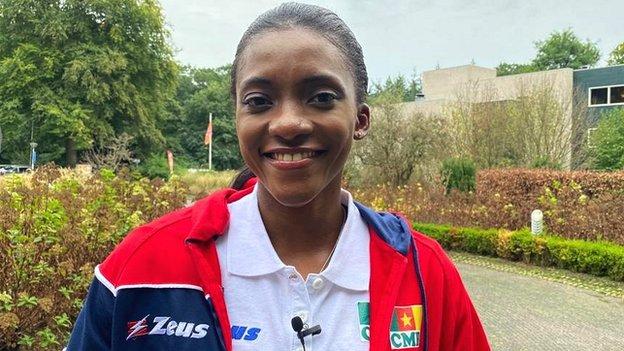
It will be a “huge dream,” according to top scorer Sharon “Chumba” Chepchumba, if Kenya becomes the first African team to advance to the second round of the Women’s World Volleyball Championship.
Chepchumba was overjoyed when her team increased their prospects by defeating Cameroon 3-0 on Tuesday in Arnhem.
Victory in one of their final two group games should be enough to secure history for the Kenyans.
“That will be a big dream for some of us, so we have to push harder to qualify, which would be a dream come true,” she told BBC Sport Africa.
Kenya faces Italy, one of the favorites and the current Volleyball Nations League champions, on Thursday before meeting Puerto Rico, a match the East Africans are targeting, on Saturday.
The team’s victory against Cameroon, with whom Kenya has swapped continental titles over the years, leaves coach Luizomar de Moura’s side fourth in their six-team pool, with the top four making the quarter-finals.
“I believe in my teammates and the effort they showed [against Cameroon] was magical,” Chepchumba said after the game.
“I’m really proud of my teammates because what we discussed and agreed is what they delivered.”
Kenya and Cameroon are fierce African rivals – having swapped continental titles over many years – with Chepchumba saying the win meant even more because it came against the team that beat them in the last three African championships’ finals.
“I don’t like it when Cameroon is beating us, so I just had to put up my efforts and make sure we won and get the respects,” she said.
“We’ve been training hard for this, so I didn’t want to lose this match because it will determine so many things in my life and my teammates’ lives.”
Kenya’s victory was vindication for Brazil’s De Moura, who has returned to take charge as part of a project backed by volleyball’s world governing body, the FIVB.
“It also gives Kenya the chance to move ahead in the FIVB rankings. In the African championships, Cameroon beat Kenya and passed us in the rankings so this victory shows we can be the greatest in Africa and compete at a high level.”
Cameroonian regret
Emelda Piatta Zissi still believes that Cameroon can turn their fortunes around
For Cameroon, Tuesday night’s defeat was bitterly disappointing given they are the higher-ranked team and had hoped to give themselves a chance of taking the next step on the global stage.
“It’s always hard to lose a match, especially when you know you are able to win it – so it’s really hard to take,” Cameroon’s Emelda Piatta Zissi told the BBC.
“I think we lost concentration and [made] a lot of errors. This was one of the matches we were trying to focus on to win and we lost it.”
Cameroon also has two matches remaining, against Puerto Rico and Belgium, with Piatta saying the team will need to return to a positive mindset.
“It’s not over – we need to forget about this match and think about the next one. As a team, we always win together and lose together so we will be trying to fix what happened and correct it for the next game.”
The body language at the end made it clear which team will take more confidence into their next outing – as Kenya danced on the court in celebration, while Cameroon traipsed off looking deflated.
Before the pandemic, several sub-Saharan African economies saw record-breaking growth.
For instance, over the past 20 years, Ethiopia and Rwanda have experienced among of the fastest growth rates in the world, with annual growth rates averaging over 7.5%.
Due to a lack of income data at the sub-national level, it is less evident if the benefits of economic expansion have been distributed fairly throughout regions within nations.
We used satellite-recorded images of the earth’s evening lights as a stand-in for economic activity to gauge the extent to which sub-Saharan Africa’s excellent growth performance expanded across sub-national regions. The information demonstrates that, at least up to 2010, African nations made great strides toward reducing regional income inequality (differences in output per capita across regions of a country).
When compared to other regions of the world, where inequality either increased or convergence was slower, this stands out sharply.
Taking a closer look at the factors that affect regional inequality, we found that progress was largely due to improvements in basic infrastructure, which helped lagging regions converge faster to national levels. Night lights per capita increased several-fold in the poorest regions, with the biggest gains in oil exporters and frontier markets such as Ghana and Kenya.
However, not all lagging regions saw improvement. Fragile and conflict-affected states made little-to-no progress in reducing regional inequality. And even in countries that experienced decades of growth, progress stalled after 2010, with regional inequalities having likely widened post-pandemic.
Access to clean water, electricity and cellphone services, for example, is two to four times lower in lagging regions compared to leading ones, in part because public expenditure per capita is so much lower. Similarly, the share of residents who have completed primary and secondary education is two to three times lower in lagging regions.
In countries where access to public services is generally low and distribution very unequal, the gap is even larger. In Burkina Faso, for instance, access to electricity is nearly 20 times higher in leading regions.
Key drivers
What are the key drivers that helped reduce regional inequality in the past few decades? We find that there are four major factors that supported this improvement:
• Macroeconomic stability: Inequality tends to increase in countries with high, persistent inflation by eroding the purchasing power of consumers, reducing government spending in real terms and disincentivising private investment.
• Trade openness: Easier access to global markets supports convergence by increasing the value of a country’s resources such as raw materials, which are more abundantly available in lagging regions. It also brings more workers into urban centres, which could in turn lead to a decline in income per capita of more urbanised regions if infrastructure development and the overall increase in economic activity in city centres are unable to keep up.
• Strong institutions and political stability: Weak institutions impede the capacity of governments to provide services and civil wars destroy public infrastructure, raising the likelihood that regions are left behind.
• Well-targeted investments: We used mineral discoveries as a proxy for analysing the impact of investments on regional inequality and found that progress depended on the location. Investments that occur outside of the capital cities are the most likely to have impact by creating jobs and promoting economic activity in lagging regions.
Way forward
What can policy makers do to address these inequalities? Sub-Saharan Africa countries would need to pursue a broad-based policy framework anchored around three main pillars:
• Well-designed redistributive fiscal policy with a clear investment strategy to assist underserved regions,
• Macroeconomic stability to foster inclusive growth, and
• Building institutions to ensure political stability and equitable public service delivery.
Governments also need to invest in building local administrative capacity to collect and analyse data. Only 12 sub-Saharan African countries publish their public budget allocations at the sub-national level. Having this data more readily available would provide a more accurate picture of disparities across regions, helping policy makers better target policies.
Kenya’s President William Ruto on Tuesday appointed his cabinet ministers and advisers who include 10 women and elected politicians.
The president had promised 50% appointments to women but out of the 22 ministers, only seven were women but he further appointed two more women as advisers and a female secretary to the cabinet.
The appointments are being seen as rewarding his loyalists who campaigned for him across the country.
Politicians have made a grand comeback to the cabinet after the previous administration, in which he was a deputy president, had introduced technocrats to the executive.
There was a debate during election campaigns whether ministers should be involved in politics as some of the technocrats openly campaigned for veteran politician Raila Odinga – who was being backed by then President Uhuru Kenyatta.
By-elections will have to be held in areas where the senators and MPs have been named in the new cabinet.
Kenya’s Daily Nation newspaper described President Ruto’s new cabinet as a “heavily political”, while the Standard newspaper website said the cabinet was “heavily populated by politicians rewarded for loyalty”.
While visiting Kenya to attend President Ruto’s inauguration a few days ago, Vice President Dr. Mahamudu Bawumia spoke about current global economic challenges and how Ghana is coping.
Speaking with Kenyan media, Dr. Bawumia also highlighted the benefits of the African Continental Free Trade Area (AfCFTA) of which Ghana is the secretariat and how it will play a large part in Africa’s continued economic growth.
“It is important that Africa trades by itself… we are very passionate about it. There are a lot of opportunities and potential to realise’ he mentioned to The Standard.
When asked about the current economic situation facing Ghana specifically with high levels of inflation, Bawumia emphasised it is a problem affecting all global economies following the global pandemic and Russia’s invasion of Ukraine.
“We are trying to deal with the issue in this context of very squeezed and tight budgets. On the monetary side, the Central Bank is trying to contain inflation through a number of interest rate increases. Ultimately, you deal with this crisis by expanding your production. If it is a food crisis, then we need to increase food production” he told KTN News in an interview.
To further lessen the burden on families in Ghana in terms of increasing living costs, Dr. Bawumia said government continues to offer free secondary school education to citizens and is exploring other ways in which it can help all Ghanaians cope with the global crisis.
“For the government, central to Ghana’s recovery is a bottom-up economic model that includes all Ghanaians from all over the country, from all backgrounds. The NPP’s ongoing digitisation agenda is an example of this strategy that is helping all Ghanaians move forward and not be left behind,” Dr Bawumia said.
The Vice President, during his time at the Bank of Ghana, helped to reduce inflation from 40 percent to just 10 percent and is now drawing on his decades of experience to help Ghana move forward and recover.
Kenya’s new President William Ruto has chaired his first cabinet meeting attended by some ministers who openly opposed his presidential bid.
The Tuesday meeting at State House, Nairobi, was attended by all outgoing ministers.
It came as the new administration grapples with drought and security situations in the northern parts of the country.
President Ruto is expected to name his new cabinet in the coming days and had promised during the election campaigns a 50:50 gender representation among ministers.
The president’s office has tweeted pictures of the meeting:
Some Kenyans are criticising plans by First Lady Rachel Ruto to host monthly prayer meetings at the official presidential residence in Nairobi.
On Sunday, dozens of church leaders met and prayed at State House.
The first couple are evangelical Christians and President William Ruto has attributed his faith as having played a key role in his election victory.
Mrs Ruto told the religious leaders that they would always be welcome at State House.
“The doors of State House are open and know that you have Mama Rachel here that will always open the doors for you when the president is busy,” she said.
Local newspaper the Daily Nation shared a clip of the first lady’s remarks:
But some Kenyans say the regular prayer meetings should not happen as Kenya is a secular state and no religion should be given preference.
“If a Muslim president did what the Christians are doing in State House right now, there would be countrywide protests. We are a secular state; no religion comes before any another,” a Kenyan said on Twitter
“The involvement of the church in this current government will be interesting to watch for the next five years in Kenya,” another Twitter user said.
Others have a positive view. “We all need prayers and so does every institution. What’s wrong with offering prayers in the State House?” this Kenyan asks.
At least 11 people, including eight police officers and a local chief, were killed on Saturday by cattle rustlers they were chasing in drought-stricken northern Kenya, Kenyan police said Sunday.
Cattle rustling or disputes over water sources or grazing land are common in the pastoral areas of northern Kenya, which border Ethiopia and South Sudan.
The Kenyan police denounced on Twitter a “criminal and cowardly ambush by cattle rustlers against the public and police officers” in Turkana County, which it said left 11 people dead: 8 police officers, 2 civilians and a local chief.
The police officers killed were in pursuit of members of the Pokot ethnic group who had attacked a village and fled with cattle.
The authorities announced that additional reinforcements would be sent to the area.
In November 2012, 42 police officers were killed in an unprecedented ambush in the north, in the Baragoi region.
In August 2019, also in the north, at least 12 people were killed by cattle rustlers suspected to be Ethiopians of Borana ethnicity.
Kenya, the economic powerhouse of East Africa, is experiencing a drought of unprecedented severity for 40 years, with hunger affecting at least 4 million of its more than 50 million people.
Four consecutive seasons of insufficient rainfall have created the driest conditions since the early 1980s.
Rivers and wells have dried up, pastures have turned to dust, causing the death of more than 1.5 million livestock in Kenya alone.
The National Meteorological Organization has warned of a possible increase in “human and human-wildlife conflicts”.
-Hunt for cattle rustlers-
Kenya has launched an operation to arrest cattle rustlers who killed 11 people in an ambush on Saturday.
Kenya’s police say the operation aims to arrest the perpetrators, recover the stolen animals and firearms and return normalcy to the area.
It urged people to offer information that may lead to the arrest of the gang and recovery of the stolen animals.
“I am now going to move on to the agenda of making sure that we have government-to-government relationships that will progressively now begin the journey to bring the prices of fuel down,” President Ruto said.
He added: “All options are available to us as a country.”
Kenya is facing a deepening economic crisis, sending the price of food and fuel soaring.
Despite rising fuel prices Mr Ruto defended his decision last week to scrap some fuel subsidies.
He said they were unsustainable and prone to abuse.
Several countries have refused to engage with Moscow since the invasion of Ukraine but Mr Ruto said he’s considering all available options.
Three people have died and scores injured after a six-storey building collapsed in Kiambu, central Kenya.
Rescue efforts are under way and emergency workers have managed to pull a child from the rubble.
Several others have also been rescued but “sadly, some are feared to have succumbed to their injuries”, Kiambu county Governor Kimani Wamatangi said.
Building collapses in Kenya have in the past been blamed on poor structural design or sloppy construction.
The cause of this collapse is unclear but the building was under construction when it came down.
Eyewitnesses said it fell on to an adjacent building. It is not known how many people are still under the debris.
The child who was rescued is now being treated in hospital, national broadcaster KBC reports.
Rescue and search efforts undergoing at Kirigiti collapsed six-storeyed building. Several people have already been pulled out of the rubble, and rushed to the hospital. Sadly, some are feared to have succumbed to their injuries. pic.twitter.com/CMbwncbCLE
Soldiers, workers from the Kenya Red Cross and National Youth Service personnel as well as local volunteers are all at the scene in Kiambu town, which is about 20km (12 miles) north of the capital, Nairobi.
Photos from the site show a mechanical digger and rescue workers trying to find survivors.
A five-storey building in Kiambu, central Kenya, under construction has collapsed.
Emergency workers have managed to rescue a child who had been trapped in the rubble. It is not known how many people are still under the debris.
Several others have also been pulled out alive after a six-storey building came down, Kiambu county Governor Kimani Wamatangi said.
“Sadly, some are feared to have succumbed to their injuries,” he added.
The cause of the collapse is not clear but it is reported that the building was under construction.
Eyewitnesses have said it fell on to an adjacent building as it came down.
Photos from the scene show a mechanical digger and rescue workers trying to find survivors.
Five-storey building under construction in Kirigiti, Kiambu County, collapses; authorities say three people rescued, more trapped under the rubble. pic.twitter.com/T4SKuSBC1w
Clashes over livestock and water are common in the area, which is also facing a worsening climate.
In a statement, Jeremiah Lomorukai, the Governor of Turkana, said security forces in the region needed better support from the government to end cattle rustling.
Amateur clips are being shared on social media showing people taking bales of maize flour off a lorry that overturned on a major highway in Kenya’s capital, Nairobi.
The crowd of looters include motorists, motorbike taxi operators and pedestrians.
The cause of the accident is unclear and there were no police officers on sight, according to the footage.
A local journalist is among those who has tweeted footage from the scene:
The prices of basic food commodities like maize flour and wheat flour, potatoes, vegetables and fruits have been rising in the country – attributed to a combination of external and domestic factors.
Last week the government scrapped a subsidy on petrol which has increased the retail price to an all-time high.
A Kenyancooking oil company that has had its product temporarily suspended by Kenya’s Bureau of Standards (Kebs) over quality concerns has told the BBC that their product is safe.
“The concern is on the amount of iron in the products. We have done our independent testing and our products are above the Kebs requirement,” Rajul Malde, Director of Pwani Oil Products said.
“We have shared our test results with Kebs and we expect a response this afternoon,” Mr Malde continued.
Kenya’s standards regulator has suspended the sale of 10 cooking oil products over health and quality concerns.
In a letter to the retail shops and supermarkets, the Kenya Bureau of Standards (Kebs) said the brands failed routine quality tests.
It ordered that the brands be withdrawn from shelves immediately.
The standards body however clarified that the directive was not a ban, but a temporary suspension until the manufacturers meet specified quality requirements.
In the letter to the Retail Traders Association of Kenya, a body comprising supermarkets and large-scale retailers, Kebs says the listed products should undergo fresh verification before they can be released back to the market.
The 10 brands listed are manufactured by Bidco Africa, Pwani Oil Products, Kapa Oil Refineries and Menengai Oil Refineries – the four largest edible oil companies in Kenya.
The BBC has reached out to two of the companies but they are yet to respond to the allegations.
Industry sources say Kebs and the oil manufacturers are meeting on Friday to iron out the issues.
Amateur clips are being shared on social media showing people taking bales of maize flour off a lorry that overturned on a major highway in Kenya’s capital, Nairobi.
The crowd of looters include motorists, motorbike taxi operators and pedestrians.
The cause of the accident is unclear and there were no police officers on sight, according to the footage.
A local journalist is among those who has tweeted footage from the scene:
The prices of basic food commodities like maize flour and wheat flour, potatoes, vegetables and fruits have been rising in the country – attributed to a combination of external and domestic factors.
Last week the government scrapped a subsidy on petrol which has increased the retail price to an all-time high.
Kenyan authorities say 22 citizens have been rescued from human trafficking rings in Laos in south-east Asia.
They say a Ugandan and a Burundian national were also rescued in a joint operation by the International Organization for Migration and the governments of Kenya and Laos.
This comes weeks after another group of Kenyans was rescued from human traffickers in Myanmar.
The government says it has received distress calls from Kenyans in several south-east Asian countries who have become stranded after falling for job scams.
Some are promised jobs in factories but then get trapped in prostitution or cybercrime rings.
Ten cooking oil products have been suspended by Kenya’s standards regulator over health and quality concerns.
In a letter to the retail shops and supermarkets, the Kenya Bureau of Standards (Kebs) said the brands failed routine quality tests.
It ordered that the brands be withdrawn from shelves immediately.
The standards body however clarified that the directive was not a ban, but a temporary suspension until the manufacturers meet specified quality requirements.
In the letter to the Retail Traders Association of Kenya, a body comprising supermarkets and large-scale retailers, Kebs says the listed products should undergo fresh verification before they can be released back to the market.
The 10 brands listed are manufactured by Bidco Africa, Pwani Oil Products, Kapa Oil Refineries and Menengai Oil Refineries – the four largest edible oil companies in Kenya.
The BBC has reached out to two of the companies but they are yet to respond to the allegations.
Industry sources say Kebs and the oil manufacturers are meeting on Friday to iron out the issues.
22 people, according to Kenyan authorities, have been freed from Laos’ human trafficking rings in Southeast Asia.
They say a Ugandan and a Burundian national were also rescued in a joint operation by the International Organization for Migration and the governments of Kenya and Laos.
This comes weeks after another group of Kenyans was rescued from human traffickers in Myanmar.
The government says it has received distress calls from Kenyans in several southeast Asian countries who have become stranded after falling for job scams.
Some are promised jobs in factories but then get trapped in prostitution or cybercrime rings.
A viral video on social media is showing people taking bales of maize flour off a lorry that overturned on a major highway in Kenya‘s capital, Nairobi.
The crowd of looters include motorists, motorbike taxi operators and pedestrians.
The cause of the accident is unclear and there were no police officers on sight, according to the footage.
A local journalist is among those who has tweeted footage from the scene:
The prices of basic food commodities like maize flour and wheat flour, potatoes, vegetables and fruits have been rising in the country – attributed to a combination of external and domestic factors.
Last week the government scrapped a subsidy on petrolwhich has increased the retail price to an all-time high.
A former Facebook contentmoderator is suing the parent company of the American social networking giant, Meta, for alleged unfavourable working conditions, and a Kenyan court is scheduled to hear arguments in the case.
Samasource Kenya EPZ, also known as Sama, is a local outsourcing company that has been the target of a petition alleging that its employees who moderate Facebook content are subjected to unfavorable working conditions, including low pay, insufficient mental health support, and invasions of privacy and dignity.
The court will determine if Meta can be tried in Kenya since the 12 petitioners were working for a third-party firm that it had outsourced for moderation services.
Meta made an application in June seeking to have the case thrown out arguing that the court had no jurisdiction to determine it – since the company is not based in Kenya.
Daniel Motaung’ is seeking financial compensation on behalf of current and former employees.
He also wants Meta and Sama to provide mental health support for moderators who spend hours reviewing graphic content.
The suit also seeks to compel third-party contractors to have the same benefits as Meta employees.
Meta has denied wrongdoing saying it takes seriously its responsibility to people who review content for the firm.
According to court papers, Sama hosts the largest content moderation location in Africa with more than 200 staff.
In 2020, Facebook agreed to pay $52m (£46m) to content moderators based in the US after they filed a class-action lawsuit for being exposed repeatedly to graphic content such as beheadings, child and sexual abuse, terrorism, and animal cruelty.
Update: This case has been adjourned until 25 October
Seven more bodies have been retrieved from River Yala in western Kenya near the spot where a dozen others were discovered over the past two years.
According to a police report seen by officials at Yala sub-county mortuary, the unclaimed bodies were retrieved from the river in the last two months.
The bodies have not been identified and are pending autopsy.
Mortuary officials say three bodies were retrieved by divers in September and the other four were discovered by residents along the river.
The latest discovery increases the tally of bodies retrieved from the river to more than 30 since January.
Human rights activists say residents in the area are living in fear over the discovery of unidentified bodies from the river.
Police are yet to comment on the matter.
Details of forensic investigations conducted early this year seeking to uncover who was responsible and the motive behind the killings are yet to be made public.
There has been a concern over incidents of bodies being dumped in Kenyan rivers.
A year ago, 11 bodies were discovered in a river in the north-eastern county of Garissa.