Kenya made a request for inclusion in the 2023 Africa Cup of Nations to the Confederation of African Football on Monday.
After Fifa suspended the Kenya Football Federation (FKF) in February of last year, accusing the government of interfering in sport when it dissolved the national governing body, Kenya was barred from the competition.
The Kenyan government decided to reestablish the FKF, which had been disbanded due to allegations of corruption, and Fifa concurred to lift the suspension in November of last year.
Ababu Namwamba, Kenya’s minister of sports, said to a group from Fifa and CAF that his country was not interested in managing football directly, only in making sure it was done so professionally.
“Football has its own infrastructure to manage the affairs of football,” he said at a joint press briefing with the visiting football officials.
“This government only wants proper laws, accountability, good governance and transparency from those who lead football in order to attract sponsors.”
According to reports, the minister said Kenya wanted to take part in the 2023 Africa Cup, with a qualifier between Kenya and Cameroon pencilled in for March.
“We have made it very clear to both CAF and Fifa that Kenyan football is at rock bottom. I believe Fifa and CAF will be considerate in Kenya’s peculiar situation,” Namwamba said.
“It was a special circumstance that led to the suspension of (national team) Harambee Stars from the qualifiers,” he added.
Before the suspension, Kenya had been drawn in Group C of the qualifiers which kicked off in August last year, alongside Burundi, Cameroon and Namibia.
CAF legal counsel Nadim Magdy, who was part of the delegation, said the continent’s football governing body would meet “soon” to discuss Kenya’s request.
Edwin Chiloba, a young fashion designer and LGBTQ activist, was found dead in a metal box by the side of the road not far from the town of Eldoret, and police in Kenya are now looking into his death.
According to a police spokesperson quoted in the Star newspaper, there is no indication as to why the victim was killed.
However, rights organisations are connecting it to his sexuality in Kenya, where gay sex is illegal.
According to one organisation, more than half of LGBTQ Kenyans have experienced assault.
“Words cannot even explain how we as a community are feeling right now. Another soul lost due to hate. You will be missed,” rights organisation galck+ posted on Twitter.
“Edwin’s death reminds us that queer bodies continue to be under attack all over the country,” the National Gay and Lesbian Human Rights Commission wrote on Instagram.
Tributes on social media describe Chiloba as “an amazing human” and an “iconic fashion designer”.
Last month Chiloba wrote on Instagram that he was “going to fight for all marginalised people”, saying that he himself had been marginalised.
He “spread love wherever he went, was bold about his existence as a queer man and encouraged many others to do the same,” Chris Makena, an activist and friend of Chiloba, told the BBC.
The 24-year-old had moved to Eldoret from the capital, Nairobi, in 2019 to study fashion and was beginning to make a name for himself in design, another friend said.
His body was discovered on Wednesday.
A witness is quoted as saying that someone in a vehicle without a number plate was seen leaving a metal box at the side of the road.
It was reported to the police, who went to open the box to find the corpse.
“We don’t know for now why he was killed that way. Experts are handling the matter,” police spokesperson Resila Onyango is quoted as saying.
Gay sex in Kenya is punishable by up to 14 years in prison. Though it is rarely enforced, members of the country’s LGBTQ community routinely face discrimination and stigma, and efforts to decriminalise gay sex have been thwarted.
Last year, the killing of non-binary lesbian Sheila Lumumba led to a social media campaign to get #JusticeForSheila.
There were similar campaigns in 2021 following the murders of trans-woman activist Erica Chandra and LGBTQ activist Joash Mosoti.
Edwin Chiloba was an amazing human. He was bold, passionate, his energy was immaculate. He embodied fashion. Someone murdered him cruelly, put his body in a box & dumped his body.
Edwin we speak your name. May yr blood not spill for nothing. Stop killing queer people. pic.twitter.com/aSgwyTSqnM
Kenya’sPresident William Ruto has denied the existence of the “Office of the First Daughter,” a title under which his daughter Charlene has held several high-profile events and meetings.
In Kenyan law, no such office exists.
On Wednesday, President Ruto denied the existence of such an office, according to BBC News.
“Leave my daughter Charlene alone, you know these are kids, they’re just being children, you know very well that there is no such office…. she is just being the daughter of William Ruto and sometimes she doesn’t know the divide between the president and the father,” Mr Ruto told journalists at State House, Nairobi.
The activities of the president’s daughter had prompted questions over whether she was spending taxpayers’ money.
In December 2022, she denied that taxpayers’ money was being spent by the so-called office.
Charlene has faced a backlash on Twitter for laying claim to such an office. The criticism was heightened when she introduced her delegation to Tanzania as members of staff at the Office of the First Daughter.
In a press statement issued in December 2022, Charlene said she referred to the entity handling her diary as Office of the First Daughter in a private capacity, adding that it is neither constitutional nor funded by the public.
“The Office of the First Daughter is a private entity. It is neither a constitutional office nor is it being funded by Kenyan taxpayers. It runs to purely facilitate the activities and any programs by Ms. Charlene Ruto,” she said.
“The Office of the First Daughter has at all times acted in good faith to ensure that theKenyan youth have a voice and get access to opportunities to enable sustainable livelihoods.”
“Through its independent structure and facilitators, the office has engaged various players across Kenya and beyond in line with some of its objectives of championing youth-based agendas and climate change advocacy,” Charlene added.
Kenyan shop assistant, Winnie Wanjiru Mwaura, signed up to work as an electoral agent for William Ruto during the voting on August 9 and was ecstatic when he was elected president.
But barely 100 days after the rags-to-riches businessman took office on September 13, the 21-year-old wants nothing to do with him.
“Life has only become worse under him,” the first-time voter told AFP.
Ruto came to power casting himself as a champion for the downtrodden, vowing to create jobs and tackle a cost-of-living crisis that has left many Kenyans struggling to put food on the table.
“If we take care of the bottom, we take care of everybody,” the 56-year-old leader once told a campaign meeting, outlining his plan for a “bottom-up” economic transformation.
Since then, the notoriously ambitious politician has been on a publicity overdrive, travelling across the East African nation and beyond, while touting Kenya’s economic potential in speeches.
As far as voters like Mwaura are concerned however, Ruto has done far too little to improve the lot of ordinary Kenyans in a country where about a third of the population lives in poverty.
‘Not very strategic’
Ruto had promised to restructure the economy by slashing government debt, bringing down prices of essential commodities, and creating a “hustler fund” to offer personal loans to any Kenyan with a cellphone and a mobile money account.
But his first act after assuming office was to slash food and fuel subsidies introduced by his predecessor Uhuru Kenyatta.
While Ruto argued that the interventions had “not borne any fruit”, their removal was a request from the International Monetary Fund, a major lender to the East African economic powerhouse.
Experts called it a rash decision.
“The move to remove the fuel subsidy was not very strategic as it has led to a slower economy, rising inflation and higher interest rates,” Ken Gichinga, chief economist at business analytics firm Mentoria Economics, told AFP.
The Central Bank of Kenya raised interest rates by a cumulative 1.75 percent in 2022, the most in seven years, while inflation soared to a five-year high of 9.6 percent in October.
Even Ruto’s pet project, the 50-billion-shilling ($408-million) “hustler fund”, has sparked controversy, with some accusing him of reneging on promises to make the credit scheme interest-free.
The fund, launched last month, will offer personal loans of up to 50 000 Kenyan shillings, with interest charged at eight percent a year — lower than the rate of inflation.
Borrowers have already complained of difficulty in getting loans higher than 1,000 Kenyan shillings approved, despite the fund’s stated objective of boosting financial access for the country’s poorest citizens.
“They inflated the prices of goods, then give you a 500-shilling loan which can only buy two packets of maize flour,” Michael Wafula, a 35-year-old mechanic, told AFP.
For shop attendants like Mwaura, who earns just 700 Kenyan shillings a day, the fund will do little to change her fortunes.
Still, she borrowed 1 000 Kenyan shillings to pay for a trip to the hair salon.
“I used the loan to get my hair braided,” she said. “What else can one do with a 1 000-shilling loan?”
‘The ship is floating’
Ruto – who will mark his one hundredth day in the job on Thursday – also failed to deliver on his campaign pledge to achieve gender parity in his cabinet, naming just seven women to his 22-member team.
Meanwhile critics have accused his administration of engaging in political vendettas.
Earlier this month, four election commission officials who had cast doubt on the poll results that brought him to power, were suspended by the government.
“They are not behaving like they are in power; they are still fighting wars that you would expect to be fought during an election,” political analyst Herman Manyora told AFP.
Despite a “disappointing” start however, Manyora, who supported Ruto’s opponent Raila Odinga during the polls, said it was too early to dismiss the president and his team.
“We would give them five out of 10 because the ship is floating,” he said, adding that he was cautiously hopeful.
For Ruto’s hustler voter base however, the verdict is already a foregone conclusion.
“Ruto has a sweet tongue but I haven’t seen anything from the new administration,” said a car washer, who gave her first name as Jane.
Kenya’s only ice hockey team must overcome many obstacles to get back on the ice and back into competition after COVID.
Benjamin Mburu is the captain and assistant coach of Kenya’s Ice Lions, the only ice hockey team in East and Central Africa, which had competed internationally until the COVID pandemic hit. The team was grounded and the only ice rink in the country closed – but this did not deter him.
In Kenya Ice Lions, filmmaker Moses Obuye follows Benjamin as he rallies the skaters and finds innovative ways to keep their skills and finances alive, showing a rarely seen side of Kenyan sporting life.
Moses Obuye is an experienced short film director from Kenya. His work with CNN won an Emmy and Headliner award and he has made several short films for Al Jazeera as well as other global news channels.
In a recent lawsuit, Facebook is charged of contributing to political upheaval on the continent and is being held accountable by requesting more than $2 billion in reparation funds as well as significant improvements to the service’s content moderation procedures on the continent.
It is the most recent case in which the platform has been linked to racial violence in developing countries.
As a result of the company’s use of hate and violence in conflict-torn Ethiopia, Facebook has violated more than ten articles of Kenyan law, according to the class-action lawsuit filed in Nairobi, Kenya, where Facebook established a significant content moderation hub in 2019.
Additionally, it claims that in comparison to the United States, the firm does not invest enough resources in content monitoring on the continent.
Abrham Meareg, an Ethiopian scholar who is looking for political asylum in the US, is one of the lawsuit’s plaintiffs. He claims that last year, amid Ethiopia’s ongoing civil war, his father was murdered by extremists as a result of incitement that circulated on Facebook.
Meareg Amare Abrha, Meareg’s father, was a well-known chemistry professor and Tigrayan ethnicity. According to an affidavit Meareg submitted in the case, he was killed on November. 3, 2021, after a gang of individuals on motorbikes followed him from the university and shot him twice in front of his house. After extremists eventually took over the family house, Meareg’s mother escaped to Addis Ababa, the nation’s capital.
“My father didn’t get any chance to convince people that he was innocent,” Meareg said in an interview, from his home near Minneapolis, where he is now living. “He didn’t get the choice to clarify the hate speech and disinformation. They just shot him and killed him in a brutal way.”
The case follows criticism of Facebook usage during war in areas like Myanmar and India. The website received harsh criticism for allowing hate speech and incitement to violence to flourish on its platform in Myanmar, where state violence againstthe nation’s Muslim Rohingya minority has raged for years.
Kenyans have are expressed shock online at the apparent existence of an office of the first daughter connected to the second-born child of President William Ruto.
Charlene Ruto is seen addressing a crowd in a video that has gone viral online while speaking at a summit in Tanzania. She introduces her “team from Kenya,” which includes her adviser and another person who serves as the “head of trade and investments at the office of the first daughter.”
The audience seems to applaud and laugh aloud in response.
“I don’t get what is funny,” Ms Ruto responds as she attempts to continue with the introductions.
Kenyan law does not provide for an office of the first daughter and there has not been any public announcement of the introduction of such an office.
Kenyans online have been criticising what some see as a misuse of taxpayers’ money.
“Charlene Ruto introducing her team from the office of the first daughter who are paid with taxpayers money despite being an illegal office,” a Kenyan on Twitter says.
Another asks how the office was established and shares the video:
Social embed from twitter
When and how was the office of the first daughter established? What is it’s mandate? How are the staff paid? Under which budget? https://t.co/WiVvnfvgYE
Ms Ruto has been regularly meeting leaders across the country and attending international forums meeting foreign dignitaries since her father became president.
She has been among the most trending topics online on Wednesday.
She has sparked online debates in the past amid her many political engagements – and has been nicknamed Quickmart Ivanka on Twitter, a mockery of her similarities with Ivanka Trump, the daughter of former US president Donald Trump.
On Monday, December 12, 2022, Kenyacommemorated 59 years of freedom from British colonial authority.
Kenya’s fifth president, William Ruto, paid homage to those who helped free Kenya from British colonialism nearly six decades ago as heroic defenders of the country’s “sovereignty”.
Speaking in Nairobi, Ruto said independence had brought many achievements and much progress to the country.
“The sixth decade of our independence, we can proudly cite many achievements and impressive progress made through our own consistent efforts as evidence that our freedom struggle was neither an empty political adventure nor a reactionary born of idle resentment,” he said.
“We gather as a nation to commune with our forefathers who were long suffering innocent victims of imperial plunder and colonial oppression, yet also heroic defenders of inalienable sovereignty and valiant fighters of our freedom,” he added.
Ruto said Kenya was consistent in peacekeeping missions to ensure security and stability in Africa.
“We are proud of Kenya’s consistent record of leadership to advance the cause of peace, cohesion , security and stability in our region. Under various regional and continental frameworks and with the support of international partners, we are deploying our position as a regional anchor state for the benefit of our neighbours and region,” Ruto said.
Kenya intends to bid to co-host the 2027 Africa Cup of Nations alongside other countries in East Africa.
The Kenyan government has sanctioned the plan, with the ultimate aim of qualifying for the men’s World Cup for the first time in 2030.
The Harambee Stars have played at the Nations Cup just twice since 1993, and were barred from qualifiers for the 2023 finals because the country was serving a ban from global football.
That sanction, imposed by world governing body FIFA, was lifted last month.
However, Kenya would need to invest in stadia and infrastructure to be able to host the tournament.
Cameroon used six venues to host the delayed 2021 edition earlier this year, while Kenya has just one stadium approved for international games by the Confederation of African Football (Caf).
That is the Nyayo National Stadium, which is in the capital Nairobi.
The Nyayo National Stadium in the Kenyan capital Nairobi is likely to be involved in a bid to host the Africa Cup of Nations
A statement from the Kenyan government said its cabinet had “sanctioned the revitalisation of football as a key cog of our nation’s social fabric” in a bid “to revive the prospects of Kenyan football”.
“This national effort will encompass the rebuilding of the national men’s team and women’s team,” the statement added.
“Cabinet noted that the joint bid would deploy the power of sports in furthering regional integration.”
Potential co-hosts alongside Kenya for the 24-team tournament would be neighbouring Uganda and Tanzania, but neither have commented on the statement by the Kenyan government.
Botswana and Namibia have already announced a joint bid for the 2027 edition of the Nations Cup.
Meanwhile, Caf’s process to choose a new host for the 2025 finals is still ongoing, with a deadline on 16 December for finalised bids – including documents, proposed host cities and government guarantees – to reach its Cairo headquarters.
The finals were initially awarded to Guinea, but the West African country was stripped of hosting rights at the start of October because of a lack of suitably advanced infrastructure and facilities.
Guinea had nearly a decade to prepare for the finals, having originally been named as host of the 2023 Nations Cup in 2014, but were then asked to host in 2025 instead.
Last month Ivory Coast’s government signed a formal hosting agreement with Caf for the 2023 nations Cup, which will actually take place in early 2024.
Kenya’s health ministry is set to launch a two-week measles vaccination campaign targeting 1.2 million children aged nine months to five years.
This comes after an outbreak in seven counties in which 90% of children under the age of five did not receive the two-dose vaccine.
Due to the movement of people from one location to another in search of food and water, health workers have found it difficult to administer this life-saving vaccine to children.
The ministry has not disclosed how many cases and deaths have been reported, but is urging parents and guardians to ensure their children get vaccinated to contain the outbreak.
Measles is a highly contagious disease characterised by a high fever and a rash. The vaccination coverage has steadily declined globally since the beginning of the Covid-19 pandemic.
Kenya intends to abolish boarding schools for students in grades one through nine (roughly 14-15 years old) beginning next year.
Belio Kipsang, Principal Secretary for Education, told a conference of head teachers that parents would have to take their children to day schools.
He stated that the government had decided to allow children to be cared for by their parents or guardians. Children from nomadic pastoralist communities, on the other hand, will be exempt from the rules.
According to him, Kenya has about 28% of its primary school children in boarding facilities, which is relatively high when compared to other countries.
He said it was the responsibility of parents to take care of their children, as first educators, saying “we can’t outsource parenting to teachers”.
“We need to start socialising ourselves that we need to be with our children, and the only way we shall be with these children is for them to be in a day school environment,” he said.
Mobile Money penetration that has taken centre-stage in most African countries to facilitate trade and commerce, and creating more convenience is facing some challenges that need governmental intervention.
“Although Ghana has made great strides in opening up access to financial services through its financial inclusion policy adaptation programme, a sizeable percentage of the population still lacks either access or the ability to take advantage of what is offered.”
As a result, the Ghana International Trade and Finance Conference (GITFiC) has suggested to African governments, businesses, and individuals interested in adopting mobile payment systems, to find ways of encouraging consumers to accept mobile payment as a payment option.
That, they said they could do by adjusting their mode of payment from cash or cards to paying through mobile phones.
These recommendations, which formed part of a research carried out by GITFiC in Ghana and Kenya, indicated that consumers placed much emphasis on security as an essential factor in the acceptance of new technologies by consumers.
The study, which was led by Mr Gerald Ekow Woode, said due to that perception, businesses and all other agents involved in its implementation ensure adequate security measures to win consumer trust in the system and increase the chances of adoption and use of mobile payment systems as a payment method.
“Additionally, governments, businesses, and organisations should encourage the acceptance and use of the m-payment system to complement existing payment methods and augment consumers’ payment behaviour. Moreover, managers and marketers must recognize the implication of cultural values on intention toward M-payment system adoption.”
The research said the growing digital divide between the rural (or remote) and urban households in most developing countries was a greater concern for industry, successive governments, and policymakers.
“The lack of digital literacy causes such digital divide, which inhibits technological advancements, including the adoption and use of mobile payment systems and associated services by a wider segment of the population.
“With that in mind, industry, in collaboration with the policymakers and regulators, should adopt a pronged strategy. Industry should improve the digital literacy of the less privileged segment of society to promote inclusive development and the wider and more frequent use of mobile payment systems.”
The blueprint for e-payments is an initiative of the Smart Africa Alliance that aims to drive forward continental trade and digital commerce by unlocking the major challenges faced in making intracontinental cross-border e-payments.
Intra-African trade, in general, and e-commerce, specifically, is on the rise and it is expected to deliver immense benefits to African livelihoods and the overall economy.
Payment is evolving in Africa, not only through mobile payment platforms, but also through regional integration efforts in real-time gross settlement frameworks, which aim to drive down costs, allow payments in local currencies, and reduce transaction processing time.
Rising upon this context, Cocid-19 has further accelerated the need for innovative ways of deploying cross-border retail payments.
Ghana and Kenya have made significant contributions to the expected $15 trillion to $20 trillion in worldwide mobile financial services transactions in 2020.
Kenya and Ghana account for a large portion of the FinTech industry in Africa thanks to their relatively developed mobile payments industries.
But both nations had to overcome significant obstacles over the years to become the best in Africa for FinTech, avoiding a variety of legislative and network bottlenecks that posed a danger to innovations in their infancy.
According to the study, the payment system in Ghana had significantly advanced recently and was still developing to meet the demands of the nation as it develops.
In Ghana, Mobile Money (MM) is steadily replacing cash as the primary method of payment for the unbanked and underserved.
The fast expansion of mobile phone use, particularly in rural areas, is a contributing factor to Ghana’s quick development in MM usage.
Recent advancements in phone functionality, chip and mobile network technology, and improvements in Point-Of-Sale (POS) infrastructure are the foundation for the continental expansion of MM among the unbanked and underserved.
Ghana’s rise in mobile payments has been made feasible by the payment system’s inherent capabilities as well as developing trends that offer chances for increased digital growth.
To support the transition to a “cash-lite” economy, the nation has specifically developed essential foundational financial market and payments infrastructure, such as an Automated Clearing House (ACH), Real-Time Gross Settlement System (RTGS), Electronic Funds Transfer (EFT), GIFMIS system, Central Securities Depository with a trading platform, and ATM interoperability within the periods of 2012 – 2020. An interoperable switch that enables payments between financial institutions and mobile money accounts was recently established by the government (2021).
Mobile money is by far the most popular method of digital payment, both in terms of volume (981.6 million transactions in 2017) and value (GH155.8 billion).
In reality, mobile money transactions made up 90% of the 1% of digital payments by volumes that were made in 2016 as reported by the Diagnostic Report.
In terms of value, they made up more than 77 percent of the 37 percent of transactions at that time that were started by digital instruments.
However, it should be highlighted that most mobile money transactions involve domestic remittance transfers and airtime top-ups.
According to the statement, with the inception of the paradigm shift to a cashless economy in most of the developed economies, there was a need for any given nation to adopt automation of its payment systems.
In Kenya, it has been noted to increase convenience and reduce social ills such as corruption which decreases frictions in the economy.
The study said compared to its neighbours, Kenya had high financial service availability, which had been primarily ascribed to the acceptance of mobile payments there.
“M-Pesa is well known for its high penetration rate, which has not yet been effectively copied elsewhere. With a significant percentage of unbanked people, strong mobile penetration, the usage of USSD, the ease and comfort of the service offering, minimal KYC requirements, and, of course, Safaricom’s stranglehold on the market, Kenya looks to have become the spot for the big boom of mobile payments.”
It said Kenya served as the model for mobile payments. BAB reports that M-Pesa had 260,000 operational retail locations, over 136,000 agents, and 27 million registered users in 2017 alone.
Before 2015, more people had bank accounts than mobile money accounts, however, this ratio has since altered, with mobile money accounts outnumbering bank accounts by more than 30%.
“By 2016, 97 percent of adult Kenyans had a mobile money account, and nearly seven out of 10 had an account with a formal financial institution (bank and/or microfinance account).”
It is clear from banking and commerce as well as from the majority of mobile devices on the market that customer behavior is shifting away from traditional payment methods and toward more sophisticated online payment systems.
It said the use of mobile payment systems will increase to surpass or replace cash and other cashless payment options, as it is obvious that mobile devices had become an unavoidable part of almost everyone’s life and the opportunities this technology enables for online and offline payment regarding convenience and security.
Kenyan President William Ruto has suspended four electoral commissioners who refused to endorse the results of the last presidential election, which delivered his win.
Mr Ruto on Friday announced a tribunal headed by a judge would investigate the four officials for serious violation of the law, gross misconduct and incompetence, which could see them ultimately sacked from their posts.
But opposition leader Raila Odinga has condemned Mr Ruto’s move as the government’s plan to rig the elections in 2027.
“The four are being forced out because Ruto and his administration wants a clean slate at the IEBC [Kenya’s electoral commission] and fill it with its stooges and henchmen for the 2027 elections. [Mr Ruto] wants to wants to rig the 2027 elections in 2022,” Mr Odinga said.
Mr Ruto’s announcement of the tribunal follows a recommendation by the national assembly to suspend the commissionersover their conduct during the August elections.
Mr Ruto was declared the winner after narrowly beating his rival, Mr Odinga, with 50.5% of the vote.
But four out of seven commissioners, including the vice-chairperson, said the tally was flawed and the result “opaque”.
School authorities in Kenya have indicated that due to a lack of resources and teachers, students in junior secondary schools, which will be implemented in Kenya’s new curriculum the following year, will attend current primary schools.
It came as more than 1.2 million candidate students in grade six (11-12 years) concluded their final assessment tests unsure of how they would transition to secondary school alongside studentsgraduating in the older curriculum (13-14 years).
The transition appears to face several huddles, including the lack of classroom infrastructure and a shortage of teachers to adequately cover all the students who are supposed to join secondary school.
JUNIOR SECONDARY TO BE DOMICILED IN PRIMARY SCHOOLS
Junior secondary schools will be domiciled in primary schools, an interim report by the Presidential Working Party on Education Reform shows. pic.twitter.com/G5D9cPL5QW
In an announcement on Thursday, a task force on the implementation of the new curriculum recommended that the students in the newer curriculum would study in existing primary schools and share some of the facilities in neighbouring secondary schools.
The education ministry is expected to build additional classrooms and a laboratory in each of the primary schools within the next one year.
The government is also set to recruit an additional 30,000 teachers by January next year to bridge the teacher shortage.
In Nairobi, the capital of Kenya, churches and mosques have been encouraged to be “considerate” and lower excessive noise levels on their property.
In a tweet, Nairobi Governor Johnson Sakaja said he will be having a discussion with religious leaders on regulating noise levels.
The city recently banned nightclubs from operating in residential areas following complaints from residents about noise and many people have called for a similar ban on worship places – known for having loud music systems.
Mr Sakaja said: “Even with the nightclubs; we didn’t start by shutting them down. We spoke to them over time, they agreed to comply but some ignored. Then we took action.”
Earlier on Thursday, the governor said he will not close down places of worship but will instead initiate dialogue.
Nairobi has a large number of evangelical churches where loud music is common during worship and overnight vigils.
Kenya avoided becoming a sporting pariah as World Athletics president welcomed its government’s pledge of a financial package to combat doping in what he called “a long journey” to build trust.
“The Kenyan federation and government feel this (doping) has been a disfiguring period in what should have been a Herculean period for Kenyan athletics,” Sebastian Coe said after a World Athletics Council meeting in Rome.
“But I’m really delighted because all the stakeholders that matter, both domestically and internationally, are now aligned to do everything we can to resolve this issue.”
Following talks with Kenya’s new Sports Minister Ababu Namwamba, Coe said: “We made some real progress.”
The Kenyan government pledged $25 million (24.20 million euros) over five years to help finance more anti-doping personnel, increase testing and investigation, bolster education programmes and also “deeper dive into entourages”.
The Athletics Integrity Unit (AIU) will “work closely with Kenyan government to try and resolve this as quickly as it possibly can”.
The east African track and field giants have 55 athletes listed on the AIU’s global list of ineligible persons, last updated on November 21. A further eight are listed as being provisionally suspended.
The doping problem, however, is not new. The athletics powerhouse has been in the top category on the WADA watch list since February 2016, alongside only Bahrain, Belarus, Ethiopia, Morocco, Nigeria and Ukraine.
In a further announcement, Coe confirmed that the 2024 World Relays, which will act as a qualifier for the Paris Olympics, will be held in Nassau, Bahamas, it was announced Wednesday.
The allocation of the sixth edition of the World Relays came in the wake of last month’s announcement that the Chinese city of Guangzhou had opted not to host them “due to the ongoing pandemic conditions”.
Nassau hosted the three opening World Relays editions, in 2014, 2015 and 2017, before they moved to Yokohama, Japan, in 2019 and Chorzow in Poland last year.
The trailer for Harry and Meghan’s new documentary series has been released.
The one-minute preview, released by Netflix, features previously unseen black and white photographs of the couple set to music.
They are heard being asked “Why did you want to make this documentary?” to which Harry replies: “No one sees what’s happening behind closed doors.”
He adds: “I had to do everything I could to protect my family” before Meghan is seen wiping away tears.
The trailer ends with Meghan saying: “When the stakes are this high, doesn’t it make more sense to hear our story from us?”
Images of William and Kate with Harry and Meghan at the Commonwealth Day service in 2020, the Sussexes’ final public appearance as senior working royals, feature among the images.
There are also joyful pictures of the couple kissing while Meghan sits on a kitchen counter, as newlyweds dancing at their wedding, cuddling in a photobooth, and Meghan cradling her baby bump.
But the duchess is also pictured in sadder moments, wiping away tears and sitting with her hands covering her face.
Image: Meghan and Harry. Pic: Netflix
Netflix describes the documentary, titled Harry & Meghan, as a “global event” and says it is “coming soon” – reports say it will land on 8 December.
It says the show “explores the clandestine days of their early courtship and the challenges that led to them feeling forced to step back from their full-time roles in the institution”.
It features commentary from friends, family and royal historians.
It adds: “The series does more than illuminate one couple’s love story, it paints a picture of our world and how we treat each other.”
Harry and Meghan signed lucrative deals – thought to be worth well over £100m- with Netflix and Spotify after quitting the monarchy and moving to the US.
LGBT refugees in one of Kenya’s biggest camps for displaced people are asking to be relocated because of what they have described as an increase in discrimination and harassment by other refugees in the camp because of their sexual orientation.
One of the refugees, who asked not to be identified due to fears of further backlash, told the BBC “we do not feel safe at the camp any more”.
Kakuma is run by the United Nations Refugee Agency (UNHCR) and is one of the biggest refugee camps in Kenya, hosting hundreds of thousands of internally displaced people, as well as those from neighbouring countries.
Last week there were protests by LGBT groups in the camp, who complained about harassment and abuse towards them, which led to the temporary arrest of 18 people, scuffles, and the use of tear gas.
All of those detained were released the next day after UNHCR officials negotiated their release.
“We are fed up, Kakuma is no longer safe for us as members of the LGBTQI community. We are threatened. We have made complaints to the UNHCR and no action has been taken,” said the refugee.
They allege that the discrimination and harassment has made it close to impossible to access social services like education and events held at the camp because they are not allowed to mingle with the rest of the community.
A UNHCR spokesperson told the BBC that the body has been working with the LGBT community at the camp to guarantee their safety and security by increasing police patrol where they live and work, with community volunteers to help integrate them and increase awareness about protection of their rights and equality.
“The UNHCR remains committed to working towards ensuring the protection of, and finding durable solutions for, all refugees regardless of their culture, nationality, sexual orientation, gender identity, religion, or any other factor,” said UNHCR spokesperson Charity Nzomo.
“We are committed to ensuring that all refugees and asylum seekers residing in Kenya, including those with an LGBTIQ+ profile, are provided with the best possible protection and assistance on a fair and equal basis,” Ms Nzomo continued.
One beneficiary is 33-year-old former criminal Elijah Wambua.
Before joining the league, Wambua terrorised Nairobi residents with violent robberies.
But after losing some of his friends in the violence – Wambua decided to turn over a new leaf.
“Football is everything to me, and if it were not for football, I would be dead or in jail,” says Wambua, whose nickname is ‘Gaucho’, after famous Brazilian forward, Ronaldinho.
“I use football for living. It has made me to be a useful person in my community, a useful person in my area,” he adds.
Now, Wambua mentors young people in the community, moving them away from a life of crime and instead honing their football skills with hopes of a better future.
The league was founded in 2019 by Eric Juma, who’s also known as ‘Totti’, a name he was given for playing in a similar style to Italian forward Francesco Totti.
“Inter Base League is a league which we play in. We normally call it an amateur league, played within a slum settlement. Basically, the league was introduced to end things to do with crime and drugs in our society,” says the 32-year-old, who also works as a mechanic.
Juma was inspired to start the league after his childhood friend was killed while taking part in a carjacking.
On that fateful day, Juma and his friend were meant to meet for a football match.
The fear of losing more friends to crime inspired him to start the league.
“A lot of people are being killed in our society and football was the only uniting factor which could unite us as one family. We normally say that football unites and that is the only language we use to end crime in our society,” says Juma.
Juma hopes the league might one day have two men’s divisions, also a children’s and women’s division.
The league has many fans who come to support the teams that consist of around 1,000 young people.
While each team ideally has 16 players, some have 50.
As a show of support, some fans make small donations, while players pay for their own team jersey.
Players are forbidden from playing while under the influence of drugs.
The term “base” is popular slang among Kibera youth, meaning “hangout spot.”
This inspired Juma to bring young people from different hang-out spots to form teams.
Many players have since left a life of crime and drugs.
A ban preventing Kenya from taking part in international soccer activities has been lifted after nine months.
Soccer governing body FIFA notified the Football Kenya Federation (FKF) on Monday (28 November), the decision was made following the reinstatement of the federation’s executive committee by Kenya’s new sports minister.
The ban took effect on Feb. 24 after the sports ministry disbanded the FKF over alleged misappropriation of funds and appointed a caretaker committee.
The FIFA letter stated that “upon the lifting of the suspension, a FIFA-CAF mission will be deployed to Nairobi in order to define the next steps for the FKF and also meet with the newly appointed Cabinet Secretary for Sports.”
Barefooted, wearing all white gear with a black belt. This is not quite how you expect to see a Foreign Ministerdressed overseas.
But that was how Alfred Mutua, Kenya’s top diplomat was captured when he visited the Taekwondo Headquarters in South Korea.
Mutua was in Soeul together with President William Ruto, over the weekend, as the two nations aim at deepening diplomatic and cultural ties.
He posted a video in which the all-dressed up Taekwondo minister is seen fending off jabs and kicks from an opponent while he also attacks intermittently.
He captioned the video: “CULTURAL DIPLOMACY with a bit of TAE KWONDO. As part of our visit to Seoul Korea, my counterpart, Foreign Minister Dr. Park Jim, organized for me to visit the World Headquarters of Tae Kwondo (Kikkuwon) where Grandmaster Lee made me an honorary 6th Dan Black Belt.”
“In my late teens & early 20’s I practiced Tae Kwondo before picking up Temple Kungfu. I need to get back to the sport. I’m getting rusty.
“As they say, like father like son, I am proud of the fact that my 1st born son, 2 weeks ago, qualified as a black belt holder in Tae Kwondo,” Mutua wrote in a tweet accompanied by photos.
Kenya’s police watchdog, the Independent Police Oversight Authority (IPOA), says it has obtained a summons against Corporal Ahmed Rashidfor extrajudicial killing in broad daylight in Eastleigh suburb in the capital Nairobi in March 2017.
He gained notoriety after phone footage showed him gunning down two men in 2017.
Corporal Rashid is known to have used social media platforms to warn individuals he claimed had broken the law.
The decision to charge him follows months of investigations by the IPOA. Corporal Rashid was believed to be among a group of police officers known as the Pangani Six who drew both praise and condemnation from Kenyans for how they handled criminal gangs in the city.
The move to charge him comes weeks after thegovernmentannounced the disbandment of an elite squad accused of killings, torture, extortion and abductions of dozens of Kenyans.
Eleven officers from the unit are facing multiple charges in court, including over the disappearance of two Indian nationals and their driver in July.
Police have announced that murder charges would be brought against owner of the five-story building, which was under construction when it fell last week on the outskirts of Nairobi, the capital of Kenya.
The building collapsed on a neighbouring home and killed a couple.
Police say the owner of the building was arrested on Monday at the city’s main airport while attempting to flee the country.
She will answer to the offences of criminal negligence and murder, police said.
Four county government officials from the planning department will also face similar charges
The owner of another building that collapsed on Monday morning after tenants had been evacuated will be charged for the offence of constructing a building without requisite approvals.
Kenyan Catholic Archbishop Anthony Muheria has requested an apology from the country’s trade minister over commentshe made last week regarding concern about the use of genetically modified crops – or GMOs – in the country.
Debate around GMO use has been heating up after the government lifted a 10-year ban on their use in the face of a crippling drought and food shortage.
Last week, in a bid to persuade Kenyans to accept the crops, Trade Secretary Moses Kuria told Kenyans: “We have so many things that can kill us in the country. Being in this country, you are a candidate for death. And because so many things compete for death, there is nothing wrong with adding GMOs to that list.”
Archbishop Muheria said he found the comments “distasteful and disrespectful” and urged leaders not to “take Kenyans for granted” or “trivialise serious matters like food security”.
Winnie Odinga, daughter of opposition leader Raila Odinga and East Africa Legislative Assembly (EALA) member, told Kenyan radio station, Spice FM: “GMO is not something that is right for us right now.”
Debates around GMO use in the country have been building following the government’s recent reversal of a 10-year ban on the crops. A survey conducted by a non-governmental organisation, Route to Food Initiative, last year showed that 57% of Kenyans do not welcome GMOs, who will now have to be persuaded.
The government say the lifting of the GMO ban was prompted by the real need to ensure food security as Kenya is currently facing a severe water shortage caused by four failed consecutive rainy seasons, amid one of the harshest droughts the East African region has seen in four decades. This means crops are not able to grow, prompting warnings of potential famine.
The Chinese may yet be involved in more business in Kenya’s infrastructure rebuilding, even as Western countries jostle for the ear of the new administration under President William Ruto.
This week, Roads, Transport and Public Works Cabinet Secretary Kipchumba Murkomen hosted China’s ambassador to Kenya Zhou Pingjian with whom they discussed continuation of infrastructure projects. Some observers say this indicated Beijing was still keen on using Kenya as a launch pad into the hinterlands of Africa, a long-held ambition under the Belt and Road Initiative.
“We consider China a close friend and a great partner owing to their active involvement in the transformation of Kenya’s infrastructure landscape over the past 20 years resulting in cheaper, faster and a more efficient movement of people and goods between cities and towns,” Murkomen said Tuesday.
Focus on infrastructure
They discussed projects in the aviation sector, Mr Murkomen said, “including expansion of airports starting with the Jomo KenyattaInternational Airport (JKIA). We look forward to continued collaboration in infrastructure development and attracting more investment into the sector.”
The meeting was significant, coming just days after he released what he called contract details of the controversial Standard Gauge Railway, the Chinese built and is, to date, Kenya’s biggest infrastructure project ever built. It is also one of those projects blamed for raising debt.
On Tuesday, Nairobi insisted it was not abandoning China yet. In fact, Mr Murkomen had signalled last month, he would consider re-negotiating the airport projects, some of which had been cancelled by the former administration.
“If approved, my priority will be to relook at the Greenfield terminal tender which was cancelled in 2016 after the contractor had been paid Ksh4.2 billion ($34 million),” Mr Murkomen told legislators at a vetting session last month.
Case out of court
“I will use my legal background and other available resources to take this case out of court, renegotiate the contract and possibly rebuild the Greenfield terminal.”
In 2014, Anhui Civil Engineering Group and China Aero Technology Engineering International Corporation were awarded a Ksh56 billion ($460 million) contract to build a terminal expected to handle 20 million passengers a year. It was cancelled in 2016.
But the Chinese firm slapped Kenya Airports Authority with a Ksh17.6 billion ($14 million) bill for breach of contract in a case now under arbitration.
At the JKIA, China Jiangxi International Economic and Technical Cooperation last month finished refurbishing terminal 1B and C with newer screening facilities. Other projects include the Nairobi Expressway, Kipevu Oil Terminal, Likoni Floating Bridge and a series of roads.
“The closed loop system of project implementation means that Kenya doesn’t have to go through different partners for design, financing and construction of infrastructure projects,” Dr Cavince Adhere, a Kenyan academic and analyst on Sino-Africa relations told The EastAfrican, explaining the advantage of Chinese funding, over debt complaints.
“China doesn’t send money to partner governments. It ring-fences the resources to ensure they are only spent in project implementation. Because of this, you barely hear money or resources from China meant for construction of roads, ports or dams stolen,” he stated.
Focus more on technology
The Chinese, however, say their investments in Africa will change to focus more on technology, even though he downplayed fears Kenya was looking away from Beijing.
“We have [a] new resolution in sharing technological advances with our African friends. “How we implement projects depends on the specific approvals [by the host country],” Mr Zhou said at a briefing on plans of the Chinese Communist Party in the next five years.
According to him, the SGR will not just be a figure of infrastructure, but a point of learning by others such as Uganda where the line is expected to reach in future on railway technology and logistics, while having operations of the railway fully run by locals after training.
Beijing, he argued, was advising all its enterprises on the continent to adopt digital diffusion through partnership with local universities while also engaging in corporate social responsibility.
China, nonetheless, is fighting back criticism of debt trap, arguing multilateral lenders, in fact, have tougher conditions and have loaned more to African countries than Beijing according to a press bulletin last week by the China Ministry of Foreign Affairs.
China has been part of Kenyan airports upgrade from the time of President Mwai Kibaki. China Overseas Engineering Company in 2008 during the Grand Coalition government.
With urbanisation, Kenya’s capitalpopulation has grown rapidly, doubling over the last 20 years. In 2019, nearly 4.5 million people lived in Nairobi.
This population density means that buildings have been built very close to each other. For this supermarket manager, it’s a problem.
“The building is quite big and we have to use the electricity throughout the day because we can not manage to do anything here without the lights. So when the power is out, we opt to turn on the generator because that is the immediate alternative that we have and we can’t use the solar panels because the building here is much congested,” says Samuel Mburu.
Over-population has led to the creation of many new satellite neighbourhoods that sprawl around the capital with very little planning or regulation. The density of buildings means natural light struggles to reach residents — who have to turn on the lights most of the day.
“Here where I live, there is a problem with light, even if you open the window it does not let the light in because of the congestion. There is a problem when it rains because we don’t collect rainwater, we use borehole water and there is a problem with sewage,” says Angela Mutuku, a Nairobi resident.
Rainwater is left to run down the streets, causing floods and overwhelming sewage systems. One of the solutions being considered is to build satellite cities from scratch, with the environment in mind.
One such project already under construction is Konza Technopolis.
Just 64 kilometres (40 miles) south of Nairobithe upcoming smart city is supported by the Kenyan government with architectural designs that factor in rainwater collection and utilisation, as well as use of solar power.
According to the developers, affordable residential homes, universities and student accommodation will be built in the new city as well as commercial buildings, technology hubs, offices, hotels and entertainment centres.
The city will occupy 5,000 acres and will be developed in four phases. Phase one – covering 400 acres – is estimated to create 12,960 residential units housing about 30,000 residents.
Developers say the housing project will cater for both ends of the market through provision of affordable housing units, although the majority will be targeted towards professional middle-income families.
For sustainability, construction materials used in the city must be green with low embodied energy. The technopolis has set aside green spaces and adopts green building practices geared at reducing greenhouse gas emissions within the city and ensuring a clean environment, sustainable use of water, clean, efficient and renewable energy, clean sanitation and waste management.
Announced in 2008, the city was expected to be completed by 2019. According to promotional material still available on its website it was set to contribute $1.3 billion to Kenya’s GDP by 2020.
Running behind schedule, the developers of the project are not losing hope, and are going all in on eco-friendly features.
This building features double-glazed windows, solar panels, smart lighting, sensored toilet flushes and rainwater collection.
“For ensuring that water is consumed adequately, we ensure that the buildings are designed with sensors in the flushing of toilets and also in the washing of hands. For this, we also encourage water harvesting especially during rainy seasons we have storage tanks under there so that you can pump them up and they can be used for flushing of toilets,” explains Beryl Omollo, environmental and sustainability officer, Konza Technopolis.
The developers are fully aware of the environmental cost of building these offices and encourage to source as many materials as possible locally.
“In construction, there is so much material that are produced in terms of waste, I can give you an example, there is a lot of timber that is used for shuttering for use for construction of scaffold. Our approach to ensure that is sustainable, we have multiple use of a simple resource such as timber. So that rather than using it for a single use, it is reused for a different application as mentioned. In doing so, you find that we do not have to go and cut additional trees for different applications of timber used in construction. Other waste that is generated at Konza is segregated primarily for recycling,” says Antony Sang, engineer and chief manager of construction operations, Konza Technopolis.
Real estate contributes up to 30 percent of global greenhouse gas emissions according to the United Nations Environmental Programme.
“We look at the building through its entire life cycle from the design, construction, to the use of the building and the demolition,” says Nickson Otieno, architect and environmental design consultant, Niko Green.
“All those phases of the development of the built environment have an impact on the environment. So we are looking at the impacts serrated to extraction of materials, manufacturing, transporting these materials and putting them up in the building. They contribute to environmental degradation if not properly managed and we use a lot of energy to be able to extract, process materials and use them in the building. And depending on which type of energy is used that energy used in the processing of materials and construction contributes significantly to climate change.”
The Kenyan government allocated $73,840,680 this financial year (2022) towards the development of Konza city. The project also received a $6 million grant from South Korea in March to help fund the Kenya Advanced Institute of Science and Technology (KAIST) planned for the site.
Neighbourhoods like Konza which are planned from the outset to allow for energy efficiency, space and quality of life are very rare, but the Kenya government says it wants to build more.
Kenya’s Priscilla Sitienei, who was thought to be the world’s oldest school pupil has died peacefully at home at the age of 100.
“Gogo”, which means grandmother in the local Kalenjin language, was what Ms Sitienei was affectionately known as by many.
Her grandson Sammy Chepsiror, told Kenya’s The Standard newspaper: “She died peacefully in the presence of some family members. We are thankful for the 100 years of her life. She made all of us proud.”
Ms Sitienei’s story became the inspiration for the French film Gogo Priscilla which lead to a meeting with France’s First Lady, Brigette Macron.
In a tribute on Twitter, one of the film’s co-writers said Ms Sitienei’s “message on girls’ education remains”.
Priscilla Sitienei dite Gogo nous a quitté à 100 ans. J’avais écrit avec Pascal Plisson GOGO, film qu’elle enchantait de sa grâce. Au Kenya, choquée que ses petites-filles n’aillent pas à l’école, elle s’y inscrit. Pour l’exemple. Son message sur l’éducation des filles demeure❤️ pic.twitter.com/BOTANoPAbE
Ms Sitienei began attending Vision Preparatory School with her great-great grandchildren after she decided at age 90 to return to primary education, having worked for several decades as a traditional midwife.
She wasn’t able to attend school as a child but when the Kenyan government began subsidising primary school fees in 2003, it allowed her and other senior citizens, another chance.
She told the BBC back in 2015 that she wanted to inspire older children who were not attending school to go back saying: “They tell me they are too old,” she says, “I tell them, ‘Well I am at school and so should you.
A second tragedy in three days. In the outskirts of Kenya’s capital, a multi-story building under construction collapsed on a neighboring home, killing at least two people on Thursday (Nov 17), authorities said.
Housing is in high demand and unscrupulous developers often bypass regulations.
Construction authorities have warned of unsafe buildings. Fredrick Kamau’s parents didn’t make it alive.
“Mum and Dad were inside the house when the building started collapsing, then collapsed on them. When the ambulance came to rescue them they found them already dead and the construction was not fully completed.”
Three other people have been rescued alive from the family home that was next to the collapsed building located in the Ruaka suburb.
“This is not the first story or rather instance. In the course of this one week we have had two buildings that have collapsed. We have lost innocent lives”, resident Willy Kamau lamented.
Last month we had a woman and her children that were buried; innocent they were also same case. They were not in the building, but a building near their house collapsed and the mother and the children just died like that. So we are asking this is the work of the county government it is not even the national government. The approvals, the drawings and everything is the work of the county government.”
After building collapses in Kenya in 2015, the presidency ordered an audit to see if the country’s buildings were up to code. The National Construction Authority found that 58% of the buildings in Nairobi were unfit for habitation.
Rescue workers in Kenyaare trying to reach members of a family believed to be trapped after a six-storey building under construction fell on to their home at dawn on Thursday.
The building came down in the Ruaka area of Kiambu county, which neighbours the capital, Nairobi, according to St John Ambulance Kenya.
RUAKA COLLAPSED BUILDING UPDATE.
6 storey building under construction collapsed at around 5am.
A neighboring private home affected with a family who were sleeping at the time it collapsed believed to be trapped. Rescue team trying carefully to reach the family members alive. pic.twitter.com/hygKJdUcYS
Many Kenyans have been eager to hear President Ruto’s position since a governing party lawmaker floated the idea last week.
Kenyan President William Ruto has urged legislators not to remove presidential terms limits from the country’s constitution, dismissing comments by a legislator that there should be no such limits on a capable leader.
He said this on Wednesday during a meeting with lawmakers of the governing United Democratic Alliance, during which he urged them to focus on laws that could improve the lives of Kenyans.
Many Kenyans have been eager to hear Ruto’s position since Salah Yakub, a UDA legislator made comments about tenure extension for the president last week.
Saib had promised to sponsor a bill to that effect, saying the constitutionally permitted two five-year terms are limiting for governance.
Opposition members said the lawmaker was testing the waters for the new president, who succeeded former President Uhuru Kenyatta after winning in the August polls and was inaugurated in September.
On Wednesday, Ruto asked the legislators to stop “pushing for selfish and self-serving legislation like changing the Constitution to remove term limits,” according to local media outlets.
The governing party’s chairperson, Johnstone Muthama, denied there was a plan to amend the Constitution in favour of Ruto after heavy criticism from the opposition parties.
Since the former British colony became independent in 1963, its democracy has evolved. For several years it was a de facto one-party stateand then was officially a one-party state from 1982 until 1992, when multiparty democracy was adopted.
Term limits on the presidency are widely considered sacrosanct, contributing to the view of Kenya as a beacon of stability in the East African region. A number of countries in the region have abolished presidential term limits, allowing leaders to stay in power for long periods.
A residential building under construction collapsed on Tuesday in Kenya’s capital, Nairobi.
Construction workers are feared trapped under the rubble and rescue operations have begun.
According to witnesses, some people who were injured during the collapse are being treated in a nearby hospital.
“It was at 2 p.m. when we noticed that the building’s pillars had begun to crumble. We then started screaming to alert the people who were inside the building to escape. Some of them managed to escape while others did not”, said witness John Muli.
In 2015, eight buildings collapsed in Kenya killing 15 people.
An audit by the National Construction Authority found that 58% of the buildings in Nairobi were unfit for living.
Another witness, Isaiah Maina, added that “the structure is just poor. Looking at the columns, looking at the materials, they are not as they are supposed to be.”
Building collapses are common in Nairobi, where housing is in high demand and unscrupulous developers often bypass regulations.
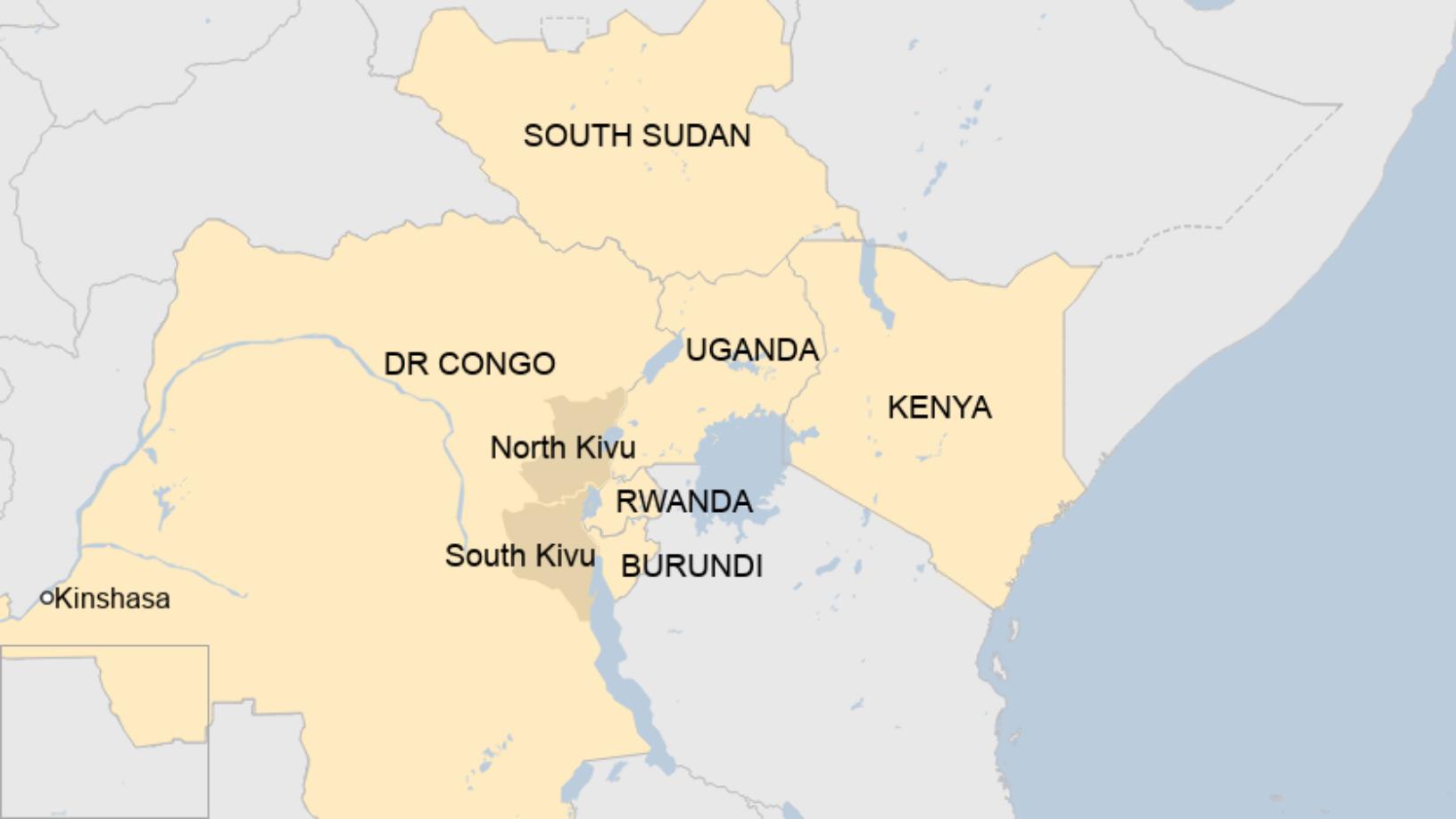
The announcement came as Congolese troopsclashed once more with the M23 in the volatile east, north of Goma.
East African leaders announced peace talks on Sunday in an effort to stabilise the eastern Democratic Republic of the Congo (DRC), where M23 rebels clashed with troops just north of Goma over the weekend.
The seven-nation East African Community (EAC) announced a “peace dialogue” on eastern DRC on November 21 in Nairobi, Kenya.
Officials said the announcement came as Congolese troops clashed again with the M23 north of the volatile region’s main city Goma.
Al Jazeera’s Malcolm Webb reporting from the region, said Congolese government forces, repelled M23’s attack on the town of Cuba with more than a day of heavy fighting before pushing them.
“The Congolese army North Congress army, says that they’re fighting soldiers from Rwanda and Uganda. The rebel group is widely understood to be a proxy of Rwanda, although Rwanda denies it. And so, people have fled…to try and get away from the fighting.”
“Meanwhile, community leaders on the other side of the frontline have told us that about 60,000 people are stuck behind the front line in the territory held by the M23 rebel group and that they want a humanitarian corridor to be created so they can leave that area before the fighting gets closer to them,” Webb said.
M23 rebels have recently surged across the DRC’s North Kivu province, winning a string of victories against the army and capturing swaths of territory.
On Saturday, the group accused the Congolese army of retaliating with “barbarian bombings” – killing 15 civilians, including two children. Al Jazeera was unable to independently confirm the death toll.
The latest violence comes one day after Kenyan troops were deployed to eastern DRC, as part of a peacekeeping operation from the EAC bloc.
A mostly Congolese Tutsi group, the M23 first leapt to prominence in 2012 when it briefly captured Goma before being driven out and going underground.
The group re-emerged in late 2021, taking up arms again on claims that the DRC had failed to honour a promise to integrate them into the army, among other grievances.
The M23’s resurgence has cratered relations between the DRC and its smaller neighbour Rwanda, which Kinshasa accuses of backing the militia.
Despite official denials from Kigali, an unpublished report for the United Nations seen by AFP in August pointed to Rwandan involvement with the M23.
Kinshasa expelled Rwanda’s ambassador at the end of last month, as the M23 captured more territory, while also recalling its envoy from Kigali.
The ratcheting tensions have spurred a bout of diplomatic efforts to resolve the crisis.
Angolan President Joao Lourenco met Congolese President Felix Tshisekedi in Kinshasa on Saturday, for example, after visiting Rwanda the previous day.
On Sunday, Kenya’s ex-President Uhuru Kenyatta, the EAC’s mediator for the situation, was also due in Kinshasa for talks.
The EAC on Sunday said it would hold talks aimed at bringing peace to eastern DRC in Nairobi this month. But it did not specify stakeholders in the talks nor how long they were scheduled to last.
The announcement comes just days after Kenyan troops began to arrive in Goma over the weekend as part of a regional peacekeeping force established by the EAC in April.
Kenya’s Parliament approved the deployment of about 900 soldiers for an initial period of six months. While the force will be under Kenyan command, its total size and scope remain unclear.
In August, Burundi also sent troops to join the regional force in DRC.
Earlier this month, the UN peacekeeping mission in the DRChas withdrawn troops from the eastern military base of Rumangabo, ceding ground in the battle against the M23.
Kenya’s parliament has approved the deployment of nearly 1,000 troops for a new regional force in eastern Congo amid questions about the $37 million cost for the first six months of the mission.
A parliament committee report says the money will be spent on equipment, allowances, and operations for the more than 900 troops joining the East African Community Regional Force that will support Congolese forces against armed groups.
Opposition lawmakers questioned why Kenya is spending so much money on the regional mission while the country faces its own security issues. Kenya also faces rising inflation and high public debt.
Kenyan President William Ruto last week called the mission “necessary and urgent” for regional security. Violence by armed groups in eastern Congo has led to a diplomatic crisis between Congo and neighboring Rwanda, which accuse each other of backing certain groups.
The Kenyan forces will be based in Goma, eastern Congo’s largest city. The regional force, agreed upon by heads of state in June and led by a Kenyan commander, also has two battalions from Uganda, two from Burundi, and one from South Sudan.
There is a possibility that international financing may be secured for the mission, the committee report said.
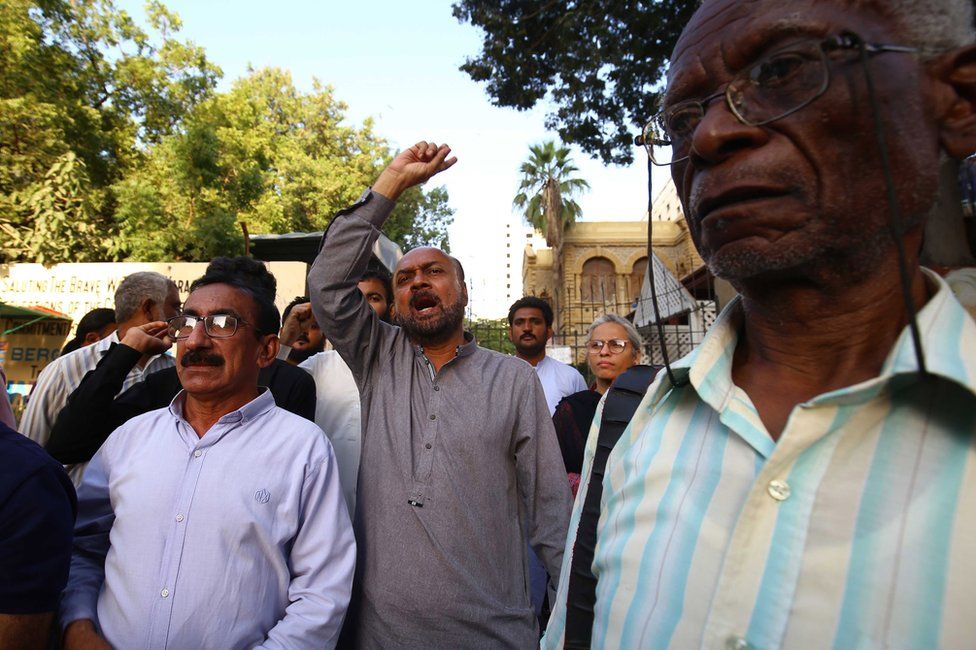
A Pakistani journalist killed by police in Kenya last month was the victim of a “targeted killing,” according to a senior member of Pakistan’s government, who did not provide any evidence to back up his claim.
On October 23, television journalist Arshad Sharif, a vocal critic of the Pakistani military, was killed in a police shooting near Nairobi, Kenya.
Interior Minister Rana Sanaullah told reporters an initial assessment by a two-member fact finding team that traveled to Kenya on behalf of the Pakistani government was “that Arshad Sharif was killed in a case of targeted killing.” More evidence was needed “to confirm all this,” he said.
Sanaullah’s comments appear to contradict earlier accounts from Kenyan authorities that Sharif was shot dead by police responding to reports of a stolen vehicle in a case of mistaken identity.
The Pakistani interior ministeralso accused Kenyan police of “not cooperating” with the fact-finding team, saying “important data” about the case had not been handed over by Kenyan authorities. A formal request to obtain the information had been lodged, he added.
Kenyan police told CNN they were unaware Pakistani officials had made any allegations about non-cooperation. “We haven’t received any such complaints, which if any, will have to be made formally,” police spokesperson Isohi Shioso said.
Shioso said the case is being handled by police watchdog the Independent Policing Oversight Authority. CNN has reached out to the watchdog for comment.
Sharif fled Pakistan in August after sedition charges were leveled against him for allegedly criticizing state institutions and “abetting mutiny” within the military.
Those allegations followed Sharif’s interview with opposition politician Shahbaz Gill, a close ally of Imran Khan, the ousted former Prime Minister who was shot last week in murky circumstances during a protest rally in Pakistan’s Punjab province.
Following the interview, Pakistani police also charged Gill with sedition, claiming he had made “anti-state comments.”
Sharif’s television news channel ARY initially claimed it was “being hounded by the present regime,” but later cut its ties with the journalist after it was taken off air for about a month by Pakistani media regulators.
Earlier, a close friend of Sharif told CNN the journalist had to “flee Pakistan in August to save his life.” He had initially gone to Dubai but was forced to flee again due to “harassment by Pakistani officials,” the associate said.
The associate said Sharif then went to Kenya and had only been in the East African country for a few weeks before hisdeath.
Dairy import data from the Ghana National Association of Cattle Farmers (GNACAF) indicate that the country imports in excess of US$400million dairy products annually, as demand for fresh milk and other dairy products rise.
Despite this increasing demand, the local dairy industry is stagnating; thereby creating a deficit that can only be offset by importation.
Whereas special breeds have been grown and nurtured in Kenya, Nigeria, South Africa and the west to give a maximum 30 litres and minimum 15 litres of fresh milk per cow each day, the situation is different in Ghana according to the GNACAF.
The president of GNACAF, Imam Hanafi Sonde, confirmed to B&FT that just about eight out of every 100 milk-cows in Ghana are able to give 3 litres of fresh milk per day; a phenomenon that he said demands more investment into domestic production to lessen the country’s reliance on foreign dairy imports.
The need to focus on milk
“The reason for low milk production is due to focus on meat, though the quest for fresh milk is rising incessantly. To increase milk output, the country must put emphasis on special breeds through insemination; and the introduction of technology for milk extraction,” Imam Sonde said.
The demand for milk has been increasing incomes of cattle owners more rapidly than meat in recent times, as Imam Sonde said milk has become a growing alternative source of income for farmers.
An estimated US$90million worth of dairy products were imported in 2017, according to the Ministry of Food and Agriculture; but the amount, Mr. Imam Sonde said, has reached a staggering US$400million in just four years, by 2021.
New Zealand, Brazil, Belgium and regional neighbours – key among them being Nigeria, remain the country’s top trading partners for dairy products. But the GNACAF said other countries are venturing in, since Ghana is experiencing an increase in dairy product consumption as diets continue to change, coupled with a growing population that is more urbanised.
Historically, limited access to cold storage and transportation has limited Ghana to the consumption of ultra-high-temperature pasteurised products.
Although these products have a long shelf-life, improved infrastructure is causing a push for fresher dairy and a bigger local dairy industry.
In 2018, MoFA released a statement that the country would start to import cattle from the United States to help build the domestic dairy industry. The imported cattle were supposed to be special milk breeds for insemination and to grow the local industry here.
But Imam Sonde said the animals are yet to be imported since the announcement was made, adding: “Maximum attention has not been given to the industry, as the sector continue to face biting challenges”.
In Ghana, cattle farmers rely heavily on natural grazing – which is not ideal for milk production, especially in the dry season when there are no pastures. The Association maintains that special improved imported breeds for insemination are the solution to increase production and close the escalating import gap.
On the national level, the Amrahia Dairy Farm – which is designed as capacity building centre for local cattle farmers to boost dairy production for industrialisation – is defunct.
But the GNACAF said it is currently scouting for investors to collaborate on insemination for special breeds which can increase milk output and enable local farmers to concentrate on milk production. The value chain includes breeders, shepherds, traders, transporters, butchers, veterinary products and the hospitality industry, among several others.
More than 100,000 people have fled their homes and dozens been killed after fighting reignited between Congolese soldiers and the M23 rebel group, in one of the world’s longest and deadliest conflicts.
Now, Kenyan forces are joining the battle to support the Congolese military, in a bid to bring peace to the mineral-rich country which is being fought over by numerous different armed groups.
What is the fighting about?
Conflict in the Democratic Republic of Congo erupted three decades ago and has left more than six million dead and forced 4.5 million from their homes.
In the past year, violence has increased once more as security forces battle against more than 100 armed groups in the east of the country, despite the presence of a large United Nations peacekeeping operation.
Both the M23 and the Congolese army have accused each other of starting the clashes leading to the current crisis.
The intensity of the escalation has been such that President Félix Tshisekedi issued a call to arms on Thursday. He urged the country’s youth to “organise themselves into vigilance groups” to support the army.
The affects of the conflict are not restricted to DR Congo, but are also souring diplomatic relations between Rwanda and DR Congo, which accuses its neighbour of backing the M23 rebels and even expelled the Rwandan ambassador last week. Rwanda denies the claims.
The M23, which was formed a decade ago, claims to defend the interests of ethnic Tutsis living in DR Congo against Hutu militias.
Rwanda’s President Paul Kagame came to power at the head of a rebel Tutsi army fighting Hutu extremists who slaughtered hundreds of thousands of ethnic Tutsis during the 1994 genocide. Many of those responsible then fled to DR Congo after Mr Kagame’s forces took over in Rwanda, taking the conflict across the border with them.
In an attempt to ease the latest crisis, leaders of the East Africa Community (EAC) agreed to send a force to quell the fighting in eastern DR Congo, just months after that country joined the regional grouping.
How many troops will go to DR Congo?
There is no specific figure on the number of troops that will be deployed. What we know so far is that only four countries – Kenya, Uganda, South Sudan, and Burundi – are sending their soldiers.
One thousand Kenyan troops will join their Burundi counterparts who arrived in DR Congo in early August for the joint mission against the rebels. It is not clear if Tanzania will deploy troops.
Military officials have declined to reveal the numbers of soldiers involved, citing security and strategic reasons.
Burundian soldiers are currently based at Luberezi near Bukavu in South Kivu. The Kenyan contingent will be stationed near Goma in North Kivu and will command the East African Community Regional Force.
Rwanda is also a member of the EAC but it has been agreed it should not contribute to the regional force.
What difference will the East African force make?
M23 rebels have seized several towns in eastern DR Congo and have gained further ground in recent weeks but they are not the only group the East African force will be fighting in the three most troubled provinces – North Kivu, South Kivu and Ituri.
The different contingents will each have distinct missions. Kenyan soldiers will focus on rebels in the North Kivu area where some of their counterparts are already embedded in the UN force.
Ugandan troops will pursue the Allied Democratic Forces who are linked to the Islamic State in North Kivu and Ituri, and have staged attacks in Uganda.
Burundian troops will concentrate in South Kivu, where they will battle the Tabara milita. South Sudanese forces will fight remnants of the Lord Resistance’s Army.
How is the East African force different to the UN mission?
The role of the East Africa regional force is clearly defined as targeting armed groups.
The UN has had a peacekeeping mission in DR Congo since 2000 and was previously limited to protecting civilians and supporting operations of the Congolese army.
However, the UN later approved the creation of a combat force with the mandate of carrying out targeted offensive operations to pacify armed groups in the region.
Image source, Getty Images
Image caption, People have been fleeing fighting and heading to the border area
The intervention brigade is comprised of troops from South Africa, Tanzania, and Malawi.
Many Congolese are strongly critical of the UN mission, known as Monusco, accusing its 13,000 troops of failing to protect them against the rebels. Earlier this year, there were deadly protests against the UN and these have resumed in recent days as the M23 has advanced.
Security analysts says the East African force and Monusco will need to coordinate closely if they are to be effective.
What interests does Kenya have in DR Congo?
Kenya has been instrumental in trying to broker a permanent peace deal between DR Congo and the rebels.
In July, former Kenyan President Uhuru Kenyatta – who played a key role in DR Congo joining the EAC in March – was appointed to facilitate peace talks and oversee the implementation of a peace deal the two sides had agreed in Nairobi.
Defence and security analysts say DR Congo has been lobbying Mr Kenyatta’s successor, William Ruto, on the peace initiative and deployment of the regional force.
As East Africa’s most advanced economy, Kenya has been keen to advance its business ties across the region through trade and investment.
Why is eastern DR Congo so unstable?
Eastern DR Congo is endowed with extraordinary natural wealth. Minerals have played a key role in more than three decades of armed conflict there.
Numerous rebel groups have funded their occupation of the region through exploiting minerals such as tin, tungsten, tantalum and gold.
President Tshisekedi says that Rwanda wants to destabilise the region because it wants to appropriate its minerals, but Rwanda has denied any role in DR Congo’s unrest.
However, it did twice send its troops into its much larger neighbour in the 1990s – saying it was trying to to halt attacks by Hutu militias based there.
This led to a conflict which ultimately drew in the armies from seven African states.
A report by a UN panel of experts in 2002 revealed that criminals linked to the security forces of Uganda, Rwanda, Zimbabwe and DR Congo had all benefited from exploiting that country’s minerals.
East Africa is experiencing its worst drought in 40 years, and Kenyan wildlife is suffering as well.Drought killed 205 elephants and numerous other wildlife in Kenya between February and October, according to tourism minister Peninah Malonza, as much of East Africa experiences its worst drought in 40 years.
Although sporadic rain has begun in the region, Kenya’s meteorological department predicts below-average rainfall for much of the country in the coming months, raising concerns that the threat to Kenya’s wildlife is not over.
“The drought has caused mortality of wildlife … because of the depletion of food resources as well as water shortages,” Malonza, the cabinet secretary for the Ministry of Tourism, Wildlife and Heritage, told a news conference.
Fourteen species have been affected by the drought, she said.
In addition to the dead elephants, 512 wildebeest, 381 common zebra, 12 giraffes, and 51 buffalo have also succumbed to the drought over the same period – some in the national parks that are a major tourist draw for the country.
There have also been 49 deaths of the rare and endangered Grevy’s zebra.
In September, conservation group Grevy’s Zebra Trust said that 40 Grevy’s had died in just a three-month period because of the drought, representing nearly 2 percent of the species’ population.
The figures released on Friday are likely far from comprehensive, the ministry warned in a report, saying carnivores could have devoured some carcasses.
“Thus, there is a possibility of higher mortality,” the report said.
News of the toll on wildlife in Kenya, where tourism contributes about 10 percent of economic output and employs over 2 million people, comes just days before the start of the UN climate conference, COP27.
Egypt, the conference host, has made the issue of “loss and damage”, compensation for losses from climate-related disasters, a focus of the talks. The issue has never been part of the UN talks’ formal agenda, despite being debated for years, as wealthy countries have resisted creating a funding mechanism that could suggest liability for historic climate damages.
The areas most affected by the drought are to the north and south of Kenya, home to the bulk of Kenya’s elephant population.
Last month, the charity Save the Elephants said one famed calf, well-known for being a twin, a rarity for elephants, died during the drought.
The ministryrecommended providing vulnerable wildlife groups with water, salt licks, and food and to increase monitoring and data collection.
Drought-stricken Kenya has donated a planeload of relief supplies to neighbouring Somalia.
The donation has been met with an uproar on social media as more than a quarter of Kenyans living in arid and semi-arid areas are facing high levels of food insecurity, according to UN data.
The consignment included assorted food items and various assorted drugs, according to a statement by Kenya’s military.
The Kenyan Government has today delivered a planeload of emergency relief aid to the government of Somalia following the devastating bombings undertaken by Al Shabaab militia in Central Mogadishu. https://t.co/1mdoTEhZVYpic.twitter.com/yTxkkWDn2A
It said the relief aid was in response to last week’s bombings in Somalia’s capital, Mogadishu, that left 120 people dead.
“We feel the pain that our brothers and sisters in Somalia are feeling and we are grateful to President William Ruto for this initiative which will help alleviate the suffering of our neighbours,” said Colonel Victor Kang’ethe.
President Ruto has dispatched over 900 military personnel to combat armed groups in eastern DRC.Kenyan President William Ruto has announced that his country will send over 900 military personnel to the Democratic Republic of the Congo (DRC) to join a new regional force tasked with attempting to defuse deadly tensions fueled by armed groups.
Ruto on Wednesday called the mission “necessary and urgent” for regional security and said he and the DRC’s president had agreed on how Kenyan forces would work with Congolese and other forces on disarming rebels and peacekeeping in the country’s troubled east.
The Kenyan forces will be based in Goma, eastern DRC’s largest city. The East African Community regional force, agreed upon by heads of state in June and led by a Kenyan commander, also has two battalions from Uganda, two from Burundi, and one from South Sudan.
Nairobi made its troop commitment a day after angry crowds set fire to United Nations vehicles in Goma as frustrations mount over the advance of M23 rebels and the deteriorating security situation in the eastern DRC.
Protesters have set fire to UN vehicles in eastern Democratic Republic of the Congo, after unconfirmed rumours spread about the UN’s MONUSCO force allegedly transporting rebel soldiers ⤵️ pic.twitter.com/6fYWxBhVZN
Violence by armed groups has led to a diplomatic crisis between the DRC and neighboring Rwanda. The DRC has accused Rwanda of supporting the rebels, which Rwanda denies. Meanwhile, it has accused the DRC of backing another rebel group hostile to Rwanda.
In October, Kinshasa expelled Rwanda’s ambassador to the DRC.
The UN vehicles were targeted in Goma over false rumors that the peacekeepingmission known as MONUSCO had transported rebels, adding to the dissatisfaction many people in eastern DRC have towards the troops.
“Because of these rebels, we have fled our homes in Rugari, Kibumba,” protester Kasereka Munyafura said, standing next to a truck on fire. “That is why we are angry, and we have just burnt the vehicles of MONUSCO because it makes us suffer.”
Earlier on Tuesday, the UN peacekeeping mission had announced a “strategic and tactical withdrawal” from embattled Rumangabo. The M23 rebels have been trying to advance on the town, where a military base is located.
The M23 rose to prominence more than a decade ago when its fighters seized Goma, which sits along the border with Rwanda. After a peace deal, many of the M23′s fighters were integrated into the national military.
The group took up arms again in November last year, saying the government had failed to live up to its promises. Over the weekend, the rebels doubled the territory they hold, seizing control of two major towns.
Kenya is deploying the first contingent of a regional peacekeeping force to eastern Democratic Republic of Congo.
President William Ruto will on Wednesday morning preside over a flagging-off ceremony in Nairobi for the Kenya Defence Forces (KDF) battalion joining the regional forces.
The Kenyan troops, who will be in DR Congo as part of the East African Community (EAC) force, will help the Congolese army’s efforts to quell the violence in the region.
Some Kenyan troops have already been installing logistical support systems in DR Congo since September in readiness for the planned operations against the rebels.
The EAC agreed on a troop deployment deal to combat rebels early this year.
The Kenyan contingent’s first mission will be to help recapture the border city of Bunagana that was seized by the M23 rebels in June.
DR Congo has consistently accused Rwanda of supporting the M23 group. Kigali has always denied those accusations.
The UN Security Councilhas voted for the resumption of negotiations between parties to the disputed Western Sahara.
The Thursday resolution called for the parties to resume negotiations “in good faith with a view to achieving a just, lasting and mutually acceptable political solution” for Western Sahara.
Thirteen countries in the 15-member council voted in favour of the resolution, with Kenya and Russia abstaining.
Western Sahara, a former Spanish colony, is disputed by the Algerian-backed Polisario Front and Morocco.
Morocco controls around 80% of Western Sahara and the rest is held by the Polisario movement – which fought with Morocco for years after Spanish forces withdrew in 1975.
The 16-year-long insurgency ended with a UN-brokered truce in 1991 and the promise of a referendum on independence which has yet to take place.
A fire outbreak has consumed hectares of bushland in Kenya’s Mount Longonot, which is a popular destination for hikers in the Rift Valley region.
The Kenya Wildlife Service (KWS) says in a statement that it put out the fire that began on Thursday.
KWS refuted rumours circulating on social media that there had been a volcanic eruption, and said it wanted to “assure that the park is safe to all visitors”.
The mountain, which is a dormant volcano, has been one of the most talked about topics on Twitter, with some users claiming they experienced earth tremors as a result of the supposed eruption.
The cause of the fire on the mountain has not yet been established.
Last year, a similar outbreak of fire reduced a portion of vegetation in the park to ashes.
Two Indian tourists and their local driver disappeared in the Kenyan capital, Nairobi, on a July night.
More than two months after the incident, nine policemen have been arrested in connection with the case, which India says it is “closely watching”. The BBC pieces together the mystery and highlights the many unanswered questions.
In one of his last social media posts before he disappeared, Zulfiqar Ahmad Khan shared a video of a roaring lion in Kenya’s Maasai Mara game reserve where he had been holidaying.
“Magical mornings in Maasai Mara. Just imagine when the first encounter you have is with Simba. Breakfast anyone?” he wrote in a typically cheerful post.
The 48-year-old Indian media marketing professional had last worked as the chief operating officer of Balaji Telefilms, a Mumbai-based TV company.
Mr Khan’s LinkedIn profile described him as a “results-driven, people-focussed business leader” with more than 19 years of experience in broadcast and digital media companies; and a “high energy, performance-driven coach, mentor and manager”.
His friends described him as a “keen sportsman, a foodie, an avid traveller and explorer” and a cricket lover.
After quitting his job in June, Mr Khan had travelled in Kenya for a month. His Facebook and Instagram feeds were filled with pictures and videos of his time in the country: breakfasts in Nairobi, afternoons in game parks.
IMAGE SOURCE,FACEBOOK
Image caption, Mr Khan and Mr Kidwai (rear) in Nairobi two days before they disappeared
Four days before he disappeared, he called up friends and sounded excited about exploring Kenya.
One of them was Rajiv Dubey, a Delhi-based marketing professional, who had known him for 24 years. “He sounded very happy. He had spoken to some of his friends just days earlier and talked about wildlife at length and advised them to visit this ‘lovely’ place,” Mr Dubey said.
Mr Khan told friends he would return home on 24 July and that he also wanted to come back to Kenya to witness the annual “Great Migration” – when more than a million wildebeest and herd animals migrate to the rolling grasslands of Maasai Mara.
On the night of 22 July, Mr Khan vanished, along with another Indian man and a Kenyan driver.
The second Indian was Mohammad Zaid Sami Kidwai, 36, who had also come to Nairobi on a tourist visa. Information about Mr Kidwai, who hailed from the northern Indian city of Lucknow and lived in Dubai, remains sketchy.
Media reports in Kenya described him as an “information and communication technology expert” who led a “private life”.
In a letter to the Indian High Commission in Nairobi in July, his wife Ambreen Kidwai said her husband had been visiting Kenya since February for tourism.
Image caption, At least nine Kenyan policemen have been arrested in connection with the case
She described Mr Khan as her husband’s friend, and said both of them had stepped out of the Nairobi hotel they were staying in and headed to a bar at 22:45 on 22 July.
Mrs Kidwai said she had “texted” her husband close to midnight asking when he would return. He texted back saying he would leave the bar in “15 minutes”.
She nodded off soon after and when she woke up at 03:00, she found that her husband had not returned, Mrs Kidwai said.
She called her husband’s – and the driver’s – phone, but both seemed to be switched off. She checked with “mutual friends” in Nairobi, but the two men were not with any of them.
Next day, Mrs Kidwai went to the police and reported her missing husband and Mr Khan. She also went to the bar and sought the CCTV footage – it showed the two Indians leaving the place close to one in the morning and getting into a Toyota sedan. She also identified an abandoned car that the police had found as the one in which her husband and Mr Khan were travelling.
Back in Mumbai, Mr Khan’s friends were worrying about him.
They said there was “complete silence” after 21 July – no social media updates, no phone calls – and “what worried the friends the most – our WhatsApp [messages] weren’t showing as received”.
IMAGE SOURCE,GETTY IMAGES
Image caption, The police suspect that the men were killed and dumped in Aberdare national park
With the police in Kenya appearing to be making no headway and after waiting for 70 days, friends launched a petition seeking Prime Minister Narendra Modi’s help in finding Mr Khan – it has been signed by more than 10,000 people so far.
“Zulfi just doesn’t visit a country or a place – but spends weeks exploring the area, soaking himself into its history and culture,” his friends wrote in the petition.
His trip to Kenya, they said, was “the explorer in Zulfi wanting to experience a new country… and then Zulfi just disappeared. Without a trace. No contact with family and friends”.
What happened to the men
Quoting officials, the local media reported that the two Indians were in Kenya to help the election campaign of William Ruto, a charismatic 55-year-old politician who was sworn in as the country’s fifth president in September, following a narrow win.
The Indians went missing together with their local driver Nicodemus Mwania soon after being picked up by police in Nairobi, reports said.
Nearly three months later, Kenyan police claimed to have made headway: nine policemen have been arrested since 21 October in connection with what they believe is an incident of kidnapping and murder of the three men.
IMAGE SOURCE,AFP
Image caption, President Ruto recently disbanded an elite police squad blamed for extrajudicial killings and disappearances
The policemen were part of an elite squad called Special Services Unit that was disbanded by President Ruto last week for allegedly carrying out extrajudicial killings and disappearances of suspects over several years, according to Kenya’s Internal Affairs Unit, which investigates complaints against policemen.
Human rights groups say their independent investigations have linked the squad and other police units to the death of more than 600 people over the past four years. Some of the bodies were later recovered in rivers in western and northern Kenya.
The suspects in the case of the missing Indians include a chief inspector of police, a corporal and police drivers. “They have not been charged yet for us to officially deny the allegations,” Danstan Omari, the suspects’ lawyer, said.
“But my clients feel this is a political witch-hunt and malicious. They are being targeted because of politics,” Mr Omari said.
According to an affidavit filed by the police in the court on Monday, the taxi carrying the Indians was forcibly stopped by a group of men travelling in a Subaru vehicle on a Nairobi road. The Indians and their driver were then abducted and driven in another vehicle to the Aberdare forest, some 150km (93 miles) from the city, where they were allegedly killed and “their bodies were dumped”.
The affidavit talks about at least four suspects, including one man who had planned a similar abduction of three other people in Nairobi.
IMAGE SOURCE,AFP
Image caption, Kenyan activists have been protesting against extrajudicial killings by police
A search in the forest last week yielded nothing apart from a few “clothes and other items”, which would be sent for DNA examinations, the police told the court. A local newspaper reported that “bones and belts” were also found at the spot, but this could not be verified independently.
The police said the kidnapping of the Indians and their driver was a “multi-agency operation between the Directorate of Criminal Investigation (DCI) and other security agencies”.
The two Indians were in Kenya for “business and commercial purposes,” according to the police.
A twist in the tale
But the family and friends of Mr Khan strongly deny that he was in Kenya for business. Mrs Kidwai also said in her letter that her husband was there as a tourist.
“Zulfi never told me or his friends about any job he was doing for the election campaign there. He would always call me up if he was doing something new,” Mr Dubey said.
But Dennis Itumbi, a consultant who ran the digital campaign for President Ruto, said the two Indians had “indeed assisted” in the social media campaign.
Image caption, Dennis Itumbi, who led the digital campaign for President Ruto, said the two Indians had helped in the campaign
“I met both of them a number of times in Nairobi. I knew where they used to stay. I was on a Telegram group with them. They were not employed by the campaign, but they gave us some ideas, some of which we used,” Mr Itumbi told me on the phone from Nairobi.
Ahmednassir Abdullah, the lawyer for the Indian families, told me: “They were helping one of the presidential candidates in some small [social] media. I think they were experts on how to make short videos of political rallies. I think both of them did something small, very peripheral [to the campaign].”
The unanswered questions
The police say they need to carry out “further investigations and gather more confirmatory evidence” to link the suspects to the disappearance of the three men.
Clearly there are many unanswered questions.
Did the two Indians know each other from before? Did they work for the Kenyan presidential election campaign and get caught up in political feuds? Why were they allegedly kidnapped? Whose remains have the police found?
East and central Africa’s largest telecoms firm Safaricom has switched on 5G services in five cities in Kenya, including the capital, Nairobi.
People who can afford it – and the costs are high – could experience data speeds 10 times faster than a 4G connection. For example, if conditions are right, then a whole movie could be downloaded in 10 seconds.
The opening up of 5G is expected to boost the country’s digital economy – e-commerce and the ICT sector in general – which is enjoying a boom in growth.
But to take advantage of it at the moment, customers will either have to buy a 5G router costing around $250 (£210) or invest in a 5G-ready handset. Both options also come with higher data costs.
South Africa, Nigeria, Botswana and Zimbabwe are some of the countries on the continent to have already rolled out 5G.
However, the take-up of 4G is still low in Africa – accounting for just about a quarter of total connections compared to a global average of 60%, according to research by the Global System for Mobile Communications Association.
When Susan Wamaitha started feeling sick a year ago, she thought it was the side effects of a contraceptive pill she had started taking a few months earlier – but it turned out that she was eight weeks pregnant.
The 32 year old is now a mother of three children. Unbeknown to her, the pill that she began using in June 2021 was banned in Kenya.
Its street name in Kenya is “Sofia” but it is manufactured in China and all the details about the product on the packaging are only written in Chinese.
A translation of the first line says it contains “Levonorgestrel Fast Estradiol Tablets”. The pill is a “long-acting oral contraceptive”, according to the second line. Then there is information about the manufacturer on the third: “Zizhu Pharmaceutical Co Ltd”.
The sale of the pill was prohibited by Kenya’s authorities 10 years ago because of high levels of levonorgestrel – more than 40 times the recommended levels.
Levonorgestrel is a hormonal medication used in a number of birth control methods.
The health ministry did not share the full lab results about its findings, but said children conceived after the pill failed were found to have developed early puberty.
Headaches and nausea
“I did not know it was banned. Many of my friends were using it and had no side effects,” Ms Wamaitha told the BBC.
Like many other Kenyan women, she was attracted to the pill by its affordability and the convenience of taking it only once a month.
Image source, PPBImage caption, The pills are often imported illegally from neighbouring countries
Women tend to buy the Sofia tablet each month – most suppliers will not sell it in bulk. Each pill costs between 300 Kenyan shillings ($2.50; £2.20) and 400 Kenyan shillings.
Other family planning methods available in the country include the daily contraceptive pill. A month’s supply costs about $1.70 from government hospitals but their stock is not always guaranteed so women then have to buy it from pharmacies for considerably more.
This makes the hormonal implant that lasts three months, offered at state clinics at a cost of around $5, and various intrauterine devices, like coils, that last several years and cost up to $9, more common alternatives.
Condoms are offered for free in public offices and toilets but sometimes run out, though they can be bought in shops.
“Because I had a non-hormonal copper T-shaped coil that was giving me back pains, I decided to remove it and use the pill,” Ms Wamaitha told the BBC.
She was also impressed that her friends who recommended Sofia had not gained any weight – a key consideration for her as she says she struggles with keeping the pounds off.
However, right from the beginning she did not feel great on it – though she thought it would just take time for her body to get used to the new medication as she had to take two pills initially followed by one a month.
“I started having headaches and nausea. The first month I missed my period,” Ms Wamaitha said.
But she did not worry as she had her period the following month. It was only when it skipped again in the third month that she began to get concerned.
Her husband then started researching the contraceptive pill and that is when he found out it had been banned.
“We started panicking about using a banned pill and when I realised I was pregnant I was worried about the effects it may have on my baby,” she said.
They now have a healthy three-month-old girl, but the couple are upset by the lack of information and possible implications for their daughter as she grows up.
‘One size does not fit all’
Only 50% of women in sub-Saharan Africa in need of modern contraceptive methods have access to them, according to the World Health Organization (WHO).
Josephine Kibaru
A woman is likely to trust a neighbour and friend more than a healthcare worker who has been posted at the dispensary”
In Kenya, contraception tends to be discussed in hushed tones – mostly because of cultural and religious beliefs in what is a patriarchal society.
Some men do not allow their wives to use contraceptives while some religious sects are against it. The Kavonokya Sect in eastern Kenya, for example, rejects all modern medicine as it believes the Bible only recommends prayer as an intervention.
For population and development expert Dr Josephine Kibaru, a grassroots approach would be best to gain acceptance for modern family planning methods.
“We need community health volunteers to be more empowered with information because a woman is likely to trust a neighbour and friend more than a healthcare worker who has been posted at the dispensary,” Dr Kibaru told the BBC.
She says there is a chasm of ignorance about the birth control methods available, along with many myths and misconceptions that need to be dispelled.
A combination of both is probably what is required as gynaecologist Brigid Monda says women should consult healthcare providers to be able to find a family planning method that works for them.
“One size does not fit all,” she told the BBC.
Yet some women have also been forced to mix different contraceptive methods because of a lack of consistent supply at dispensaries located in rural areas.
Sofia remains easily available despite its ban. The fact that women do not know it is banned is down to poor public health messaging, according to Dr Kibaru.
“Using the media alone is not enough. Intentional public messaging at grassroots level is important to ensure the masses understand well why a drug has been banned,” she says.
Sold to trusted customers
Pharmacists do know it is banned – another warning was issued by the health ministry last month – yet they still sell the pill because of demand.
It is not on display, but sold under the counter to trusted customers who come in to buy it each month.
The BBC visited several pharmacies in the capital, Nairobi, to make inquiries about Sofia – most said the drug was not for sale.
One seller – who spoke on condition of anonymity – explained that it was available, just not on display, and pharmacies were able to buy it from suppliers who brought it in from neighbouring countries.
Earlier this month, a Pharmacy and Poisons Board (PPB) official told Kenya’s Standard newspaper a shipment had been intercepted at the Ugandan border.
Ms Wamaitha says she actually bought her pills from a friend who gets them in bulk from one of these suppliers.
She says this friend and others knew the pill was banned when they recommended it to her.
Her pregnancy has not persuaded them to stop using it – nor do any of the complaints on the various Facebook groups for Kenyan mothers.
On at least three of these forums there have been discussions about Sofia, where several women taking it said they had fallen pregnant.
This has convinced Ms Wamaitha to keep on urging her friends and other women to consider a different form of birth control.
“I just know that the mention of that Sofia pill makes me get chills on my body. I don’t know what family planning method I will use to prevent a fourth pregnancy, but I’m done, done with that pill.”
When Susan Wamaitha started feeling sick a year ago, she thought it was the side effects of a contraceptive pill she had started taking a few months earlier – but it turned out that she was eight weeks pregnant.
The 32-year-old is now a mother of three children. Unbeknown to her, the pill that she began using in June 2021 was banned in Kenya.
Its street name in Kenya is “Sofia” but it is manufactured in China and all the details about the product on the packaging are only written in Chinese.
A translation of the first line says it contains “Levonorgestrel Fast Estradiol Tablets“. The pill is a “long-acting oral contraceptive”, according to the second line. Then there is information about the manufacturer on the third: “Zizhu Pharmaceutical Co Ltd”.
The sale of the pill was prohibited by Kenya’s authorities 10 years ago because of high levels of levonorgestrel – more than 40 times the recommended levels.
Levonorgestrel is a hormonal medication used in a number of birth control methods.
The health ministry did not share the full lab results about its findings but said children conceived after the pill failed were found to have developed early puberty.
Headaches and nausea
“I did not know it was banned. Many of my friends were using it and had no side effects,” Ms Wamaitha told the BBC.
Like many other Kenyan women, she was attracted to the pill by its affordability and the convenience of taking it only once a month.
Women tend to buy the Sofia tablet each month – most suppliers will not sell it in bulk. Each pill costs between 300 Kenyan shillings ($2.50; £2.20) and 400 Kenyan shillings.
Other family planning methods available in the country include the daily contraceptive pill. A month’s supply costs about $1.70 from government hospitals but their stock is not always guaranteed so women then have to buy it from pharmacies for considerably more.
This makes the hormonal implant that lasts three months, offered at state clinics at a cost of around $5, and various intrauterine devices, like coils, that last several years and cost up to $9, more common alternatives.
Condoms are offered for free in public offices and toilets but sometimes run out, though they can be bought in shops.
“Because I had a non-hormonal copper T-shaped coil that was giving me back pains, I decided to remove it and use the pill,” Ms Wamaitha told the BBC.
She was also impressed that her friends who recommended Sofia had not gained any weight – a key consideration for her as she says she struggles with keeping the pounds off.
However, right from the beginning she did not feel great on it – though she thought it would just take time for her body to get used to the new medication as she had to take two pills initially followed by one a month.
“I started having headaches and nausea. The first month I missed my period,” Ms Wamaitha said.
But she did not worry as she had her period the following month. It was only when it skipped again in the third month that she began to get concerned.
Her husband then started researching the contraceptive pill and that is when he found out it had been banned.
“We started panicking about using a banned pill and when I realised I was pregnant I was worried about the effects it may have on my baby,” she said.
They now have a healthy three-month-old girl, but the couple are upset by the lack of information and possible implications for their daughter as she grows up.
‘One size does not fit all’
Only 50% of women in sub-Saharan Africa in need of modern contraceptive methods have access to them, according to the World Health Organization (WHO).
Josephine Kibaru
A woman is likely to trust a neighbour and friend more than a healthcare worker who has been posted at the dispensary”
In Kenya, contraception tends to be discussed in hushed tones – mostly because of cultural and religious beliefs in what is a patriarchal society.
Some men do not allow their wives to use contraceptives while some religious sects are against it. The Kavonokya Sect in eastern Kenya, for example, rejects all modern medicine as it believes the Bible only recommends prayer as an intervention.
For population and development expert Dr Josephine Kibaru, a grassroots approach would be best to gain acceptance for modern family planning methods.
“We need community health volunteers to be more empowered with information because a woman is likely to trust a neighbour and friend more than a healthcare worker who has been posted at the dispensary,” Dr Kibaru told the BBC.
She says there is a chasm of ignorance about the birth control methods available, along with many myths and misconceptions that need to be dispelled.
A combination of both is probably what is required as gynaecologist Brigid Monda says women should consult healthcare providers to be able to find a family planning method that works for them.
“One size does not fit all,” she told the BBC.
Yet some women have also been forced to mix different contraceptive methods because of a lack of consistent supply at dispensaries located in rural areas.
Sofia remains easily available despite its ban. The fact that women do not know it is banned is down to poor public health messaging, according to Dr Kibaru.
“Using the media alone is not enough. Intentional public messaging at grassroots level is important to ensure the masses understand well why a drug has been banned,” she says.
Sold to trusted customers
Pharmacists do know it is banned – another warning was issued by the health ministry last month – yet they still sell the pill because of demand.
It is not on display but sold under the counter to trusted customers who come in to buy it each month.
The BBC visited several pharmacies in the capital, Nairobi, to make inquiries about Sofia – most said the drug was not for sale.
One seller – who spoke on condition of anonymity – explained that it was available, just not on display, and pharmacies were able to buy it from suppliers who brought it in from neighbouring countries.
Earlier this month, a Pharmacy and Poisons Board (PPB) official told Kenya’s Standard newspaper a shipment had been intercepted at the Ugandan border.
Ms Wamaitha says she actually bought her pills from a friend who gets them in bulk from one of these suppliers.
She says this friend and others knew the pill was banned when they recommended it to her.
Her pregnancy has not persuaded them to stop using it – nor do any of the complaints on the various Facebook groups for Kenyan mothers.
On at least three of these forums there have been discussions about Sofia, where several women taking it said they had fallen pregnant.
This has convinced Ms Wamaitha to keep on urging her friends and other women to consider a different form of birth control.
“I just know that the mention of that Sofia pill makes me get chills on my body. I don’t know what family planning method I will use to prevent a fourth pregnancy, but I’m done, done with that pill.”
Kenya’s new 22-member cabinet will be sworn in on Thursday, a day after parliament approved them.
President William Ruto has kept one minister from his predecessor’s cabinet as a national security adviser and established the position of prime cabinet secretary.
The former head of the central bank, Njuguna Ndung’u, will be the new treasury secretary, while former parliament speaker, Justin Muturi, will be the new attorney general.
Despite promising 50% of cabinet appointments to women, Mr Ruto nominated only seven women to the 22 ministerial positions, with two women as presidential advisers and one woman as cabinet secretary.
The new cabinet’s immediate focus will be to reduce the cost of living and the food crisis caused by failed rains.
On Tuesday, the president said that he will need at least a year in order to reduce the price of maize flour – the country’s staple food.
Police in Kenya will on Wednesday exhume the body of a British tourist who died two years ago to establish details about her death.
Ms Luftunisa Kwandwalla, 44, from Leicester in the UK died in August 2020 at the house of a controversial cult leader in Kenya’s coastal city of Mombasa.
Her initial cause of death was listed as cardiac arrest, but her family claims she was murdered and her body buried quickly to conceal evidence.
Earlier this month, a Kenyan court granted the family orders to have an autopsy done to see if she was killed.
The body will be exhumed on Wednesday afternoon in the presence of some of her family members and an autopsy carried out later in the day.
Ms Kwandwalla arrived in Kenya from the UK in August 2019 to visit members of her husband’s family. She was due to return to the UK several months later, but a coronavirus lockdown prevented her from going back home in Leicester.
It is during that time that her family says she unknowingly joined a controversial cult in the coastal city.
The family claims that she was later murdered at the home of a reclusive Muslim preacher accused of running a secret sect.
The new British prime-minister, Rishi Sunak, the first British-Asian to reach the UK’s premiership has sent shockwaves throughout the world.
The origins of the new British prime-minister, Rishi Sunak, can be traced back to Kenya where his grandparents settled after immigrating to the Continent from India.
After Kenya’s independence in 1963, many opted to leave migrating to the UK.
Members of Kenya’s Asian community reacted with joy to the news, an achievement that coincided with the celebrations of Diwali.
“In 1963 Kenya got independence, then there were many Asians staying in the Eastleigh area, they were not well to do so they were given a choice whether to become Kenyan citizens or go to Britain, using British passport, so most of them opted, there was great migration, exodus as we call it, to Britain.
So many of them struggled from very humble beginnings and then came up and now they are quite wealthy and well to do, and they are also highly educated and doing good jobs and also participated in the politics and so on. Even there they have built temples like this one in England.
Then the second wave was from Uganda in 1972 when Amin (Idi Amin, Ed.) told the Asians to leave”, explained Bhalendu Bhatt, professor in chemistry, biochemistry and biotechnology at the University of Nairobi.
On Monday Rishi Sunak won the race to lead the Conservative Party making him the first British PM of Asian descent.
Many Asians see Sunak’s achievement with pride.
“Myself and all of us Asians are very proud that one of us has made it to the top job in UK.
As you tell me, I do not know but you tell me that he has been elected the prime minister of UK so we are very happy that we are all represented. Similarly not only UK if you remember the USA, the vice president is also from India, from South India, Kamala Harris.
So even in Canada there quite a few MPs (Members of Parliament) and so on of Asian origin, so wherever they have gone, even in politics they are coming up. So we are very pleased about that”, said the professor.
At 42 years old, Rishi Sunak is the youngest British leader in more than 200 years.
He had previously been in the UK and Dubai before travelling to Kenya. It is not known exactly what he was doing in the East African country.
Journalists in the Pakistani city of Karachi held a street protest over his killing on Monday.
IMAGE SOURCE,EPA Image caption, Journalists protested in Karachi
Kenya’s police watchdog – the Independent Police Oversight Authority (Ipoa) – said it had sent its rapid response team to the site of Sunday evening’s shooting in Kajiado county near the capital, Nairobi.
The team will be investigating the “alleged police killing of a Pakistani national”, Ipoa chairperson Ann Makori told journalists.
A police statement said it regretted the “unfortunate incident”.
Officers had set up the roadblock as they were looking for a stolen car. “[The] deceased’s motor vehicle came upon the police barrier which they drove through. It is then that they were shot at,” the statement added.
Pakistan’s Prime Minister Shehbaz Sharif (no relation) tweeted that he was “deeply saddened by the shocking news of journalist Arshad Sharif’s tragic death”.
He later said that he had spoken to Kenya’s President William Ruto requesting a “fair and transparent investigation… He promised all-out help including fast-tracking the process of return of the body to Pakistan.”
Pakistan’s Information Minister Marriyum Aurangzeb warned people against speculating about the circumstances surrounding the death.
In a brief message on Twitter, Sharif’s wife Javeria Siddique said she had lost a “friend, husband and my favourite journalist”.
Calling for a “proper judicial investigation”, former Prime Minister Khan said he was “shocked” at what he described as a “murder”, adding that he “paid the ultimate price for speaking the truth”.
Mr Khan was removed from power in April after losing a vote of no confidence. Sharif, who had backed Mr Khan, then started complaining that the country’s Federal Investigation Agency was harassing him and he left the country.