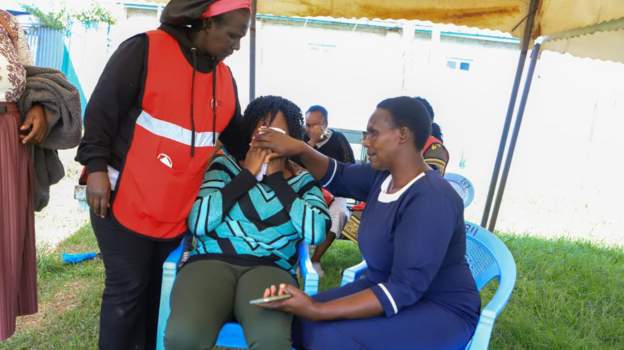
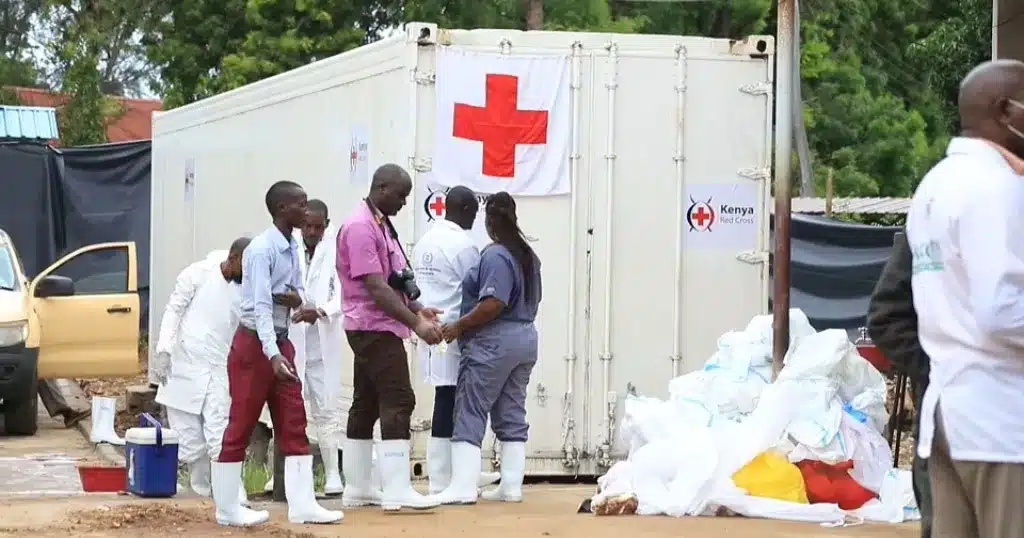
Several of the victims from the fatal road accident in Kenya on Friday remain unidentified, with some bodies being severely damaged.
County authorities have indicated that they are awaiting the assistance of a pathologist from the national government to aid in the identification process.
The accident occurred near the town of Kericho when a lorry transporting a shipping container lost control at the Londiani junction, resulting in the deaths of at least 50 people.
So far, 41 bodies have been identified and released to their respective families. The lorry collided with multiple vehicles at the busy junction before coming to rest in a ditch.
In response to the incident, Transport Minister Kipchumba Murkomen has ordered the relocation of markets situated alongside the road at the accident site.
He also stated that speed limits in the area would be reassessed, and measures such as speed bumps, road signs, and speed cameras would be implemented.
Additionally, the area will be designated as a high-risk section to facilitate stricter enforcement of traffic laws.
These actions have been prompted by criticisms that the government has not done enough to address the issue of road accidents.
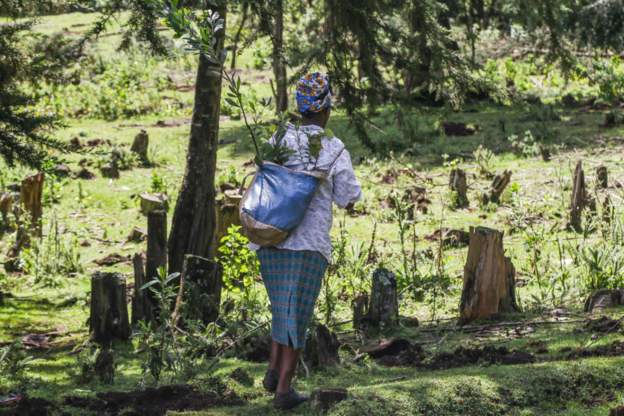
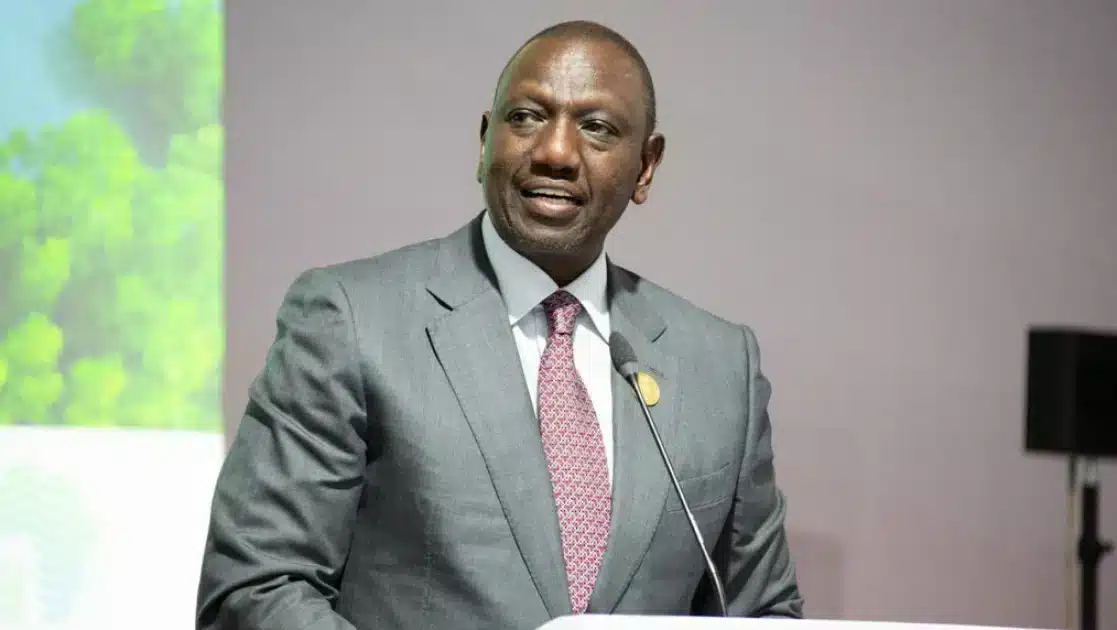
President of Kenya, William Ruto has decided to lift the six-year ban on logging that was imposed.
The president expressed that this decision was long overdue, while he emphasized on the importance of job creation and economic growth in sectors reliant on forest products.
The initial ban was implemented in 2018 due to concerns surrounding the environmental impact and contribution to climate change caused by logging activities.
However, during a speech in Molo, in the Rift Valley region, President Ruto defended the lifting of the ban, referring to the previous moratorium on logging as a misguided approach.
“Trees are decaying in the forest while people are struggling to get timber. Do you see the foolishness?” he asked.
According to him, in the recent budget, the government had implemented taxes on the importation of timber and furniture to promote local production by the Kenyan people.
The ban on logging has had adverse effects on certain regions, as many individuals relied on logging as their means of livelihood.
The decision to lift the ban aligns with the government’s ongoing initiative to plant 15 billion trees within a decade in order to enhance the country’s tree cover.
Three Kenyans have been accused with trying to transport ants into China and France for export.
The three, a man and his wife and a postal company employee are accused of trying to export the ant species Messor Cephalotes without clearance from Kenya Wildlife Service.
They denied the charges and were freed on bail.
It was not clear for what reason the ants, which were said to be worth 300,000 shillings ($2,135; £1,677) were being sold.
A prosecutor urged the court to expedite the case as the lives of the ants that were produced in court were at stake.
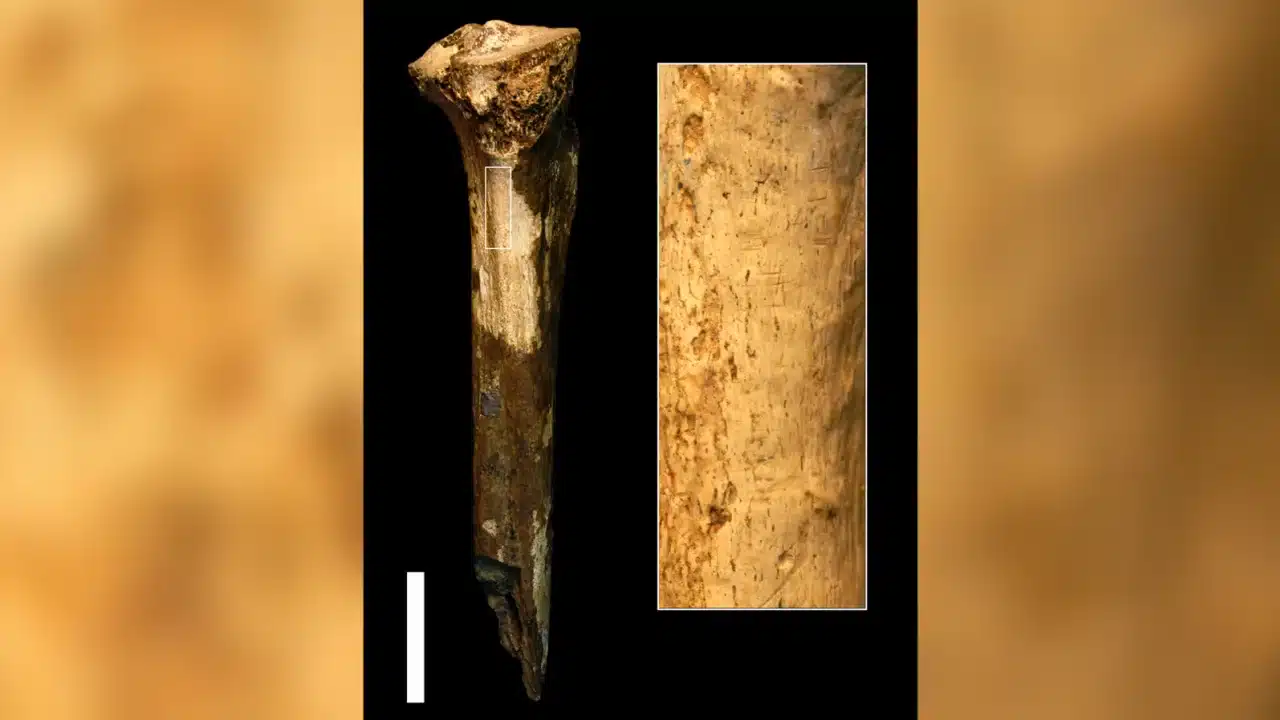
A new study suggests that early human ancestors killed and maybe ate one another 1.45 million years ago based on nine cut marks found on a fossilised shin bone.
Briana Pobiner, a paleoanthropologist at the National Museum of Natural History in Washington, DC, discovered the fossilised tibia in the collection of the Nairobi National Museum of the National Museums of Kenya.
Pobiner discovered cuts that appeared to have been created by stone tools while examining the collection in search of bite marks from extinct creatures that may have preyed on early hominins.
“These cut marks look very similar to what I’ve seen on animal fossils that were being processed for consumption,” Pobiner said in a news release.
“It seems most likely that the meat from this leg was eaten and that it was eaten for nutrition as opposed to for a ritual.”
Study coauthor Michael Pante, a paleoanthropologist at Colorado State University, created 3D models based on molds of marks on the bone. He compared the shape of the cuts with an existing database of 898 individual tooth, butchery and trample marks created during controlled experiments.
Pobiner had not told him she thought the cut marks were made by stone tools, but his analysis came to the same conclusion.
The cut marks are all oriented in the same direction, making it possible that a hand wielding a stone tool could have made the marks one after another without changing grip.
It’s not clear what species of ancient hominin the shin bone belonged to — because a leg bone doesn’t offer as much taxonomic information as a cranium or jawbone. The fossilized tibia was initially identified as Australopithecus boisei and then in 1990 as Homo erectus.
The emergence of sophisticated stone tools is linked with the emergence of the Homo genus that includes our own species, Homo sapiens, but more recent research has suggested that other ancient hominins may have used stone tools even earlier.
By themselves, the cuts do not definitively prove that the ancient human relative who inflicted the damage also made a meal out of the leg, but Pobiner said it was possible. The marks are located where a calf muscle would have been attached to the bone — a good place to cut if the aim was to remove flesh.
“The information we have tells us that hominins were likely eating other hominins at least 1.45 million years ago,” Pobiner said.
“There are numerous other examples of species from the human evolutionary tree consuming each other for nutrition, but this fossil suggests that our species’ relatives were eating each other to survive further into the past than we recognized.”
Silvia Bello, a researcher in human origins at London’s Natural History Museum, said that cannibalism might have been more common in the past than previously thought, noting that evidence for the behavior had also been found at archaeological sites associated with Neanderthals and early modern humans.
For example, Neanderthals living 100,000 years ago in what’s now France practiced cannibalism, perhaps because a warmer climate made food harder to come by.
The latest study, published Monday in the journal Scientific Reports, is “significant because this new find suggests that cannibalism might have been practiced, at least occasionally, a long way back in our ancestral history,” said Bello, who was not involved in the research.
Her colleague Chris Stringer, research leader in human origins at London’s Natural History Museum, said the shin bone was probably not the oldest known example of human relatives butchering one another. He said cut marks were reported on the cheek bone of ahominin fossil found in Sterkfontein, South Africa, in 2000 that could be about 2 million years old. Pobiner, however, said the source of the cut marks in that case was disputed.
“This new evidence looks quite convincing and adds to the evidence for cannibalism in very early, as well as the considerable evidence from later, humans,” said Stringer.
Armed attackers raided two villages in southeast Kenya, killing five residents in the process, according to the police.
The police source said the attack on Sunday took place in the Lamu County villages of Juhudi and Salama, which border Somalia.
The attackers also burned houses and destroyed property.
A 60-year-old man was bound with a rope and “his throat slit, his house was burnt with all belongings”, police said. Three others were killed in a similar manner while a fifth victim was shot.
Resident Hassan Abdul said that “women were locked in the houses and the men ordered out, where they were tied with ropes and butchered”.
A secondary school student was among the five people killed, Abdul said, adding that “all those killed were slashed and some of them had been beheaded”.
Another local resident, Ismail Hussein, said that the fighters stole food supplies before leaving, firing their arms into the air.
Police described the incident as a “terrorist attack”, a phrase they typically use to refer to incursions by Somalia’s al-Shabab group.
Lamu is near Kenya’s border with Somalia and fighters from al-Shabab frequently carry out attacks in the area in a bid to push Kenya to withdraw troops from Somalia, where they are part of an international peacekeeping force defending the central government.
Kenya first sent troops into Somalia in 2011 to combat the al-Qaeda-affiliated group and is now a major contributor of troops to an African Union (AU) military operation against the group.
But it has suffered a string of retaliatory assaults, including a bloody siege at the Westgate mall in Nairobi in 2013 that claimed 67 lives and an attack on Garissa University in 2015 that killed 148 people.
In Somalia itself, al-Shabab has continued to wage deadly attacks despite a major offensive launched last August by pro-government forces, backed by the AU Transition Mission in Somalia (ATMIS).
ATMIS, which has 22,000 troops, has been assisting Somalia’s federal government in its war against al-Shabab since 2022 when it replaced the AU Mission in Somalia (AMISOM).
Last week, four people were killed in northeast Kenya, with police saying al-Shabab was responsible. The incident took place when a vehicle was escorting a convoy of buses between the towns of Banisa and Mandera. Another security team from Banisa was attacked when it responded, police said.
On June 14, eight Kenyan police officers were killed when their vehicle was destroyed by an improvised explosive device in a suspected attack by al-Shabab, police said.
In the last two weeks, attacks linked to al-Shabab have killed another 10 people, according to police reports.
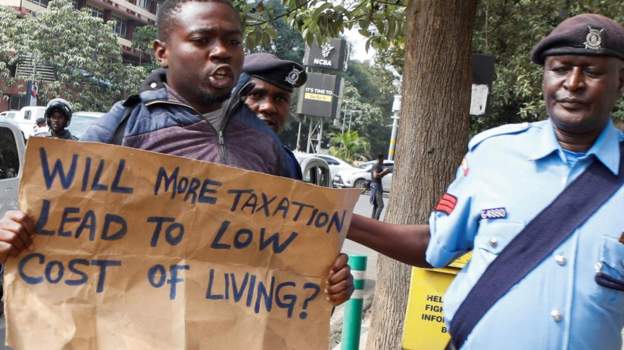
First financial bill passed by Kenya’s administration, signed into law by President William Ruto, aims to increase revenue by hiking taxes on a variety of commodities.
One of the most controversial changes approved by parliament last week was the doubling of value-added tax to be charged on fuel – it’s rising from 8% to 16%.
Employees will also hand over 1.5% of their gross pay for a housing levy that will go into a fund that will then pay to build homes for low-income people.
President Ruto, who was elected last year, has said that the government needs more money in order to be able to pay off the debts racked up under the presidency of his predecessor, Uhuru Kenyatta.
But the opposition have said they would call for protests if the tax rises came into effect.
The President of Kenya stated on Thursday that he had come to the Paris climate summit “not to ask for help” from the wealthy nations, but rather to see that developing nations could “take part in the solution” if the global financial system was changed.
“The current financial architecture is unfair, punitive and inequitable”, said William Ruto.
“The countries of the South pay up to eight times more interest than developed countries because they are considered risky”, said the Kenyan president, who wants to attract private investment rather than development aid.
“We are tired of this narrative” that portrays Africans as “victims of climate change”, “looking for favors” and “lamenting”, explains Mr. Ruto: “We are not asking for help, we want to be part of the solution”.
In order to provide equal access to resources, Kenya’s President William Ruto has requested that the World Bank and the International Monetary Fund (IMF) relax their strict loan requirements for African nations.
“Africa does not want anything for free. But we need a new financial model where power is not in the hands of the few,” said Mr Ruto.
Mr Ruto, who spoke when he met with Franch President Emmanuel Macron, IMF chief Kristalina Georgieva, and World Bank Group president Ajay Banga in Paris on Thursday, urged world leaders attending the New Global Financial Pact Summit to support his call.
Mr Ruto’s administration received $600m (£470m) from the IMF in the autumn and winter of 2022.
It also got $993m from the World Bank in May to help the government fund the budget.
Most African countries struggle with foreign debts due to ballooning inflation and increased borrowing.
The threat against a media outlet over its coverage of a scam involving cooking oil has been supported by Kenyan President William Ruto’s trade minister.
Moses Kuria had warned government departments not to advertise with the Nation Media Group (NMG) after the report which alleged that certain private firms were allowed by his ministry to import cooking oil tax-free.
The report noted that the specific exemption under Kenyan law could only be made for emergency relief goods – with the entire deal potentially leading to the loss of more than $100m (£78m).
On Twitter, Mr Kuria also called journalists working at NMG “whores”.
His comments caused outrage in the media sector, even earning him a rebuke from the industry regulator.
Mr Kuria vowed never to apologise for his remarks, accusing the media of being biased.
By Wednesday, a high court had issued an order barring Mr Kuria from uttering any demeaning or insulting words against journalists, pending a case filed by a human rights activist that the minister’s outburst made him unsuitable to serve as a public officer.
But President Ruto said that people should be allowed to call out the media: “We must also defend the rights of those who hold the media to account when the media goes rogue.
“We must defend the rights of people like Moses Kuria to speak their mind the same way we are defending the media to say all the things they want including the wrong ones.”
In Kenya, Members of Parliament (MPs) have approved a measure to double the value-added tax (VAT) on fuel from 8% to 16%. This decision is expected to contribute to the increasing cost of living in the country.
During the parliamentary session on Wednesday, MPs from the ruling party coalition voted in favor of the proposal, with 184 supporting the inclusion of the clause in the new finance bill. On the other hand, 88 lawmakers opposed the measure.
The government’s objective in implementing this tax hike is to generate approximately 50 billion Kenyan shillings ($356 million; £279 million) in additional revenue, citing the necessity to address the mounting national debt.
But the leader of the opposition MPs in parliament said it was punitive, terming the decision to push ahead with the fuel tax clause as “the saddest day in the history of this country”.
This week, Kenya’s parliament has been combing through clauses within the unpopular finance bill and considering and voting on amendments.
Besides the fuel tax, some of the controversial proposals include a housing fund levy to be paid by all salaried workers and an increase in taxes for social media influencers.
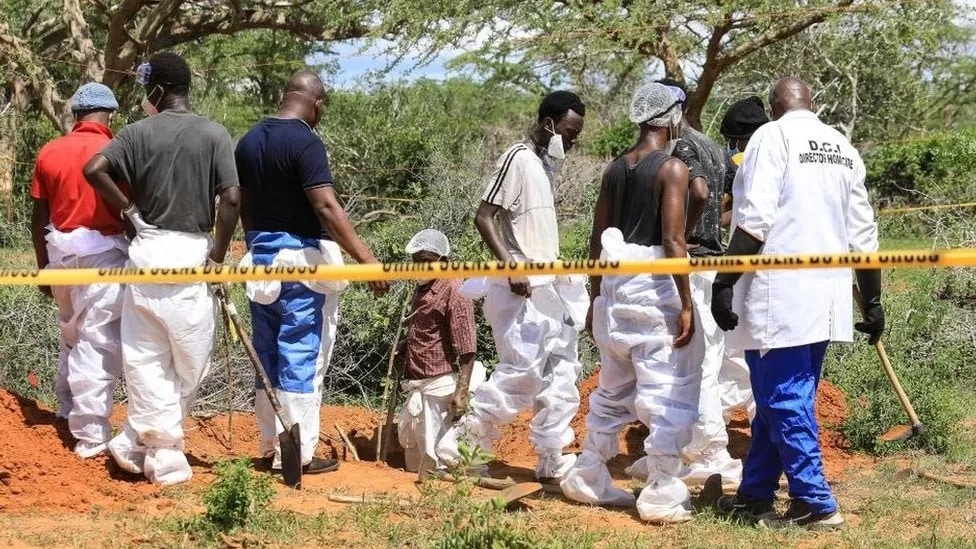
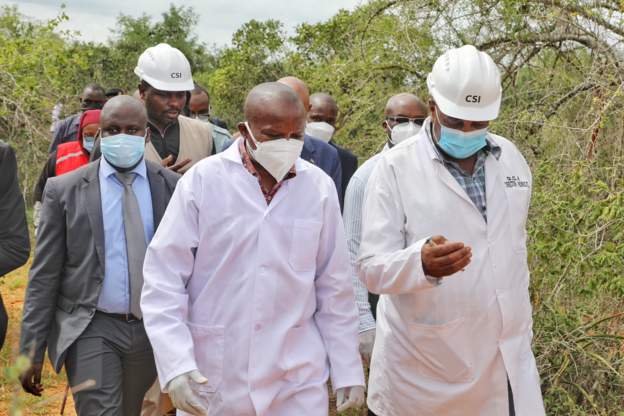
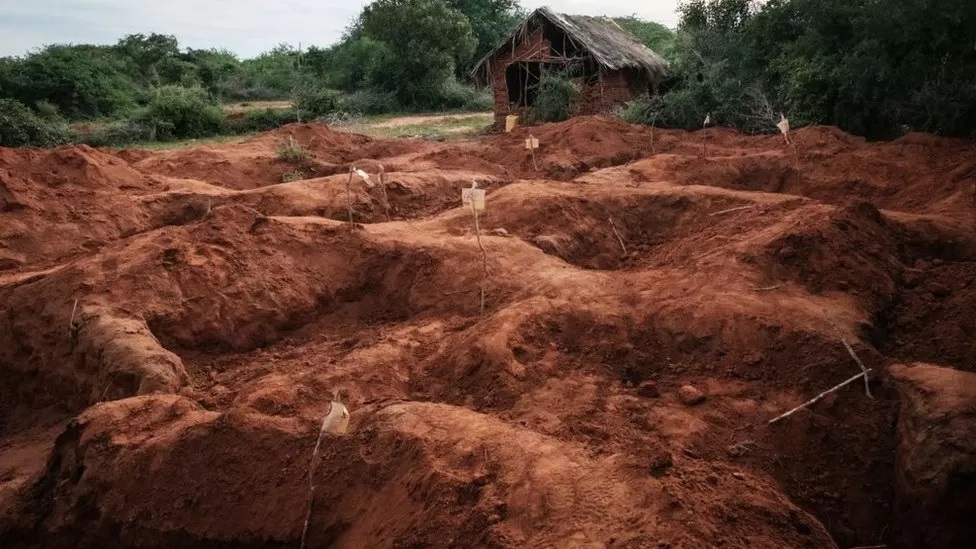
The Shakahola forest’s crimson soil is still revealing its dreadful truths. Two hours’ drive from Malindi, a popular tourist destination on Kenya‘s coast, forensic teams enter a crime scene that was discovered in mid-March by turning off the tarmac road and into a dense patch of thorny bush.
The investigation into what may turn out to be one of the deadliest mass suicides in recent memory has brought CNN to this location.
According to detectives, the cult community was divided into eight distinct communities with biblical names like Galilee and Bethlehem. The ground is disturbed by shallow graves at numerous sites. The graves were mostly unmarked.
Already, more than 300 sets of bodies have been recovered. But Kenyan interior ministry officials say that scores of mass graves remain.
The cult was preparing for the end of the world under the instruction of their its powerful pastor, say investigators.
Followers believed that starvation was their ticket to their salvation
The revelation of mass graves has dominated headlines and shaken the collective psyche in a country where faith and religion are central.
Many find it difficult to comprehend the dark path that Pastor Paul Nthenge Mackenzie allegedly took his followers along.
But the trajectory it is all too familiar for cult specialists and psychologists. They contend that the “Shakahola Massacre,” as it has been dubbed, bears all the hallmarks of destructive cults past and present.
“The pastor called me. He called me and said, ‘my daughter, you are being left behind. When the ark is closed, you will be too late,’” says Agnes, as her children play on a reed mat in her yard in Malindi.
Like many former cult members, she was unwilling to share her full name.
Agnes, now 26, joined Mackenzie’s church when she was still in high school along with other members of her family.
In Kenya, there is an old joke that if you lose your job, start a church or a charity. And sometime in the early 2000s, Mackenzie abandoned his job as a taxi driver and launched the Good News International Ministry.
Mackenzie became known for his fiery sermons. He drew a significant following, says an assistant pastor who worked with him for years until they had a falling out.
He did not wish to be named as he said he is a witness in the investigation.
“In the beginning, the church was good, there were no issues. The sermons were normal, but from 2010 his ‘end time’ messages began. It happened step by step,” he says.
The assistant pastor says Mackenzie told his followers to pull their children out of school, discard their national IDs, avoid hospitals, and start preparing for the end of the world. Investigators say they have corroborated those details.
He drew in flight attendants and social workers; paramilitary police and professionals from all across Kenya.
At a recent hearing Mackenzie denied all knowledge of the horrors that witnesses, inspectors, and survivors believe happened in the Shakahola forest.
“I can tell nothing about that. Because I have been in custody for two months. So, I don’t know what is going outside there. Have you been there?” he asked CNN.
When asked about the accusations that followers of his group had starved their children following his instructions, Mackenzie said he had “never seen anybody starving.”
The pastor and his closest followers have been in custody since the mass graves were discovered, although they are yet to be charged as prosecutors continue to ask the court to extend the custody period to allow further investigation.
To understand the Shakahola cult, the focus must be on Mackenzie, says Rick Ross, a leading American cult expert who has studied destructive cults for decades.
“It’s not the group; it’s the leader. The more power they have, the more it becomes intoxicating,” he says.
Ross says that from Charles Manson and David Koresh to Ugandan cult leader Joseph Kibwetere, the desire is to control.
“My feeling is Mackenzie was the same. He was a man that no matter how much control and power he had over his followers, it was never enough,” says Ross.
Mackenzie exerted that control using his pulpit – and his charismatic oratory both in his church in Malindi and online.
“Look what will befall all nations of this world. Anger, frustration, and many things, and many disasters will make human beings cry without help. That is what will cover the world,” he prophesied to his followers in early 2020 in a nearly three-hours harangue.
Mackenzie’s prophecies had an impact. He persuaded Agnes and many like her to leave school.
Agnes says she shaved her head and entered a church-arranged marriage.
“Some of his preaching turned into reality. He said that diseases would come and then the Coronavirus came,” she says.
Last year, she moved her whole family to the forest.
While cult leaders are central to their cults, they still need to amass a following.
Dr. Geoffrey Wango, a professor of psychology at Nairobi University, says that, paradoxically, destructive cults give people hope.
“The psychology of it is simple. The cult leader offers hope and promise and seeks easy targets,” he says.
In the case of Mackenzie, he says, the hope is one of salvation and to turn your back on the stresses of daily survival.
While the draw of cults is universal, Wango believes that you can’t separate the central position of religion in Kenya.
Religion permeates right through the highest echelons of government. Kenya’s President Ruto became the country’s first evangelical president last year and built a place of worship in the presidential compound.
Ruto condemned the grim discovery at Shakahola in the strongest terms, saying “we must as a nation continue to be on the lookout for those who abuse even the religious sector,” adding that Mackenzie belongs in jail.
Poverty is also a significant factor in driving people to more extreme preachers, Wango said.
“People are looking for a way out of their poverty, a way out of their desperation. And here is a religion that offers them a way out,” he says.
Of course, there are extensive examples of the wealthy joining cults. The recent Nxivm cult in the US drew in the rich and powerful.
But Ross, who helped expose Nxivm, says cults exploit individual vulnerabilities.
“It could be anyone, but if someone is going through a difficult time in their life, or you lose your job, or do badly in school, or struggling financially, you are feeling unfulfilled, then a group like this comes along and it can be very alluring,” he says.
Once inside a cult, both agree that isolation – physical and mental – is a critical factor that helps drive the horrors of doomsday cults.
By 2018, Kenyan authorities started cracking down on Mackenzie. They arrested and detained him for his anti-government stance – but never prosecuted him.
“That is when he said that God had told him to close his church and that he was no longer a pastor,” says his former assistant pastor.
Mackenzie would soon start his forest scheme. Agnes says he charged them around $80 for a patch of land.
“There were more than a thousand people living in the forest,” she says.
The assistant pastor believes it was around 300 families.
Many people had no idea where their loved ones had disappeared to.
When Francis Wanje got wind earlier this year that his daughter and her family were inside the Shakahola forest with other cult members, his first reaction was that it had to be wrong.
“I could not even believe it. I was told something bad was happening in the forest. But I couldn’t understand how she could be there,” he says.
Wanje’s daughter and son-in-law both had decent jobs.
He knew that they were attending Mackenzie’s church. But when they moved to the forest, they told him they were relocating to a different part of Kenya.
“The social isolation is critical and has striking similarities with other destructive cults,” says Ross.
It’s in the forest that investigators say Mackenzie’s cult took on its final form.
In a court affidavit obtained by CNN, inspectors wrote that Mackenzie told his followers sometime early this year that the end of the world was imminent and that they should start fasting.
“He stated that fasting would start with the children until the last child died then followed by the youth, then women and lastly men and that he would be the last to die and ascend to heaven,” the affidavit reads.
Kenya’s state pathologist says many of the remains found show signs of extreme starvation, some were smothered, and a few showed blunt force trauma. There were scores of children amongst the dead.
After Wanje received his disturbing call he organized a private rescue mission to the forest where he says they found his oldest grandchild.
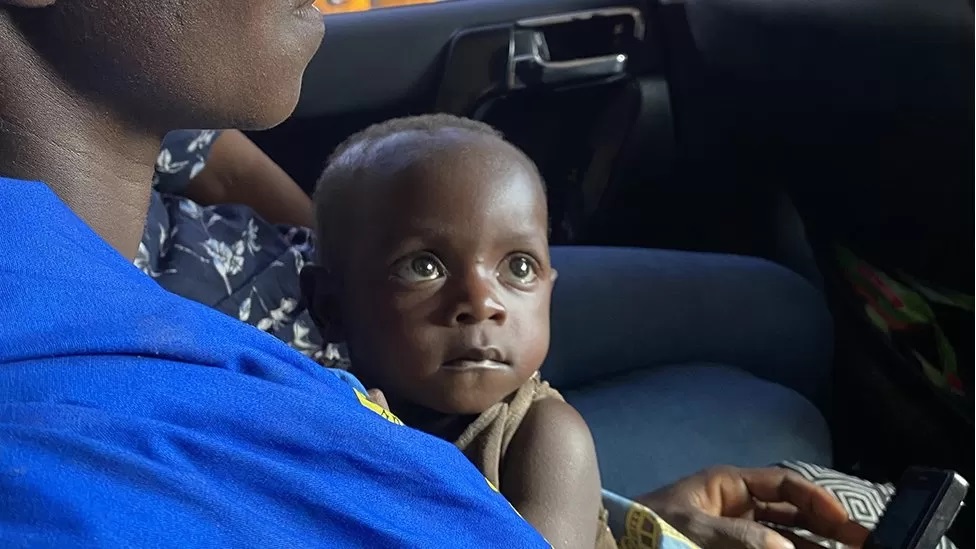
He was deeply malnourished – his two siblings were already dead.
Wanje says they were suffocated by their parents.
“It’s so painful, I could not even explain it because it’s something that I didn’t even think of in my life,” he says.
“And I wonder how my child, my daughter, could change to be such an animal to kill her own children just because she wanted to go see Jesus.”
Village elders in a nearby forest say they notified the authorities that starving children were escaping the forest from as early as late last year.
The president and other senior leaders have apologized to Kenyans for the slow response and made promises to regulate religious sects.
“Without a doubt, I can say definitively, had the police responded sooner, then lives would have been saved. I feel as a country we have failed these Kenyans,” says Khalid Hussein, the director of Haki Africa, a group that helped expose the cult.
Agnes says that as time went on, the life in the cult became more extreme.
“Each month there were meetings where he told us what Jesus had said. It was heartbreaking,” she says.
Agnes says she escaped the forest in September last year when she was told she couldn’t get help from another woman to deliver her third child. Mackenzie’s spell was broken.
But the aftershocks of the Shakahola massacre could be long-lasting. Police pulled scores of followers from the forest – many of whom didn’t want to be rescued.
Even those who were dying.
“When they got to the hospital some gave false names and others refused to be treated, they didn’t want to be helped, they didn’t want to miss out,” says Dr. David Man’ong’o, medical superintendent of the Malindi subcounty hospital.
Eventually, they had to hand them back to police.
The rescued followers, many of them either witnesses or still under suspicion, are being kept in a nearby rescue center where therapists are trying to break their emotional and psychological ties to Mackenzie.
Last week, the Director of Public Prosecutions said that 65 people rescued from the forest were charged with attempted suicide for refusing to eat.
Rick Ross says it could be a months-long process to “deprogram” cult members.
For loved ones of those who survived, it will also be a painful road. Wanje says he will get his grandson back in a few weeks.
“He went through hell. He went through hell. When he was rescued, he told them that if you had come maybe a bit later, he would have already gone to see Jesus because his grave was already there,” he says.
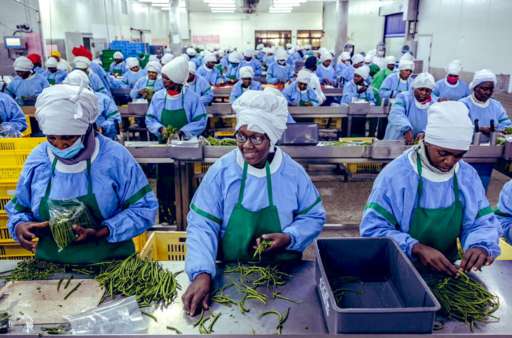
Kenya and the European Union have recently entered into a trade agreement that, upon ratification, will provide Kenya with tariff-free access to the EU market.
This significant development is expected to result in more affordable Kenyan goods for European consumers, potentially leading to an increase in exports and the generation of additional employment opportunities within Kenya.
The deal is expected to enhance Kenya’s economic development, with President William Ruto saying it “will stimulate Kenya’s manufacturing and export of finished, value-added products out of Kenya”.
Kenya’s Trade Minister, Moses Kuria, expressed great pride as he signed the EU-Kenya Economic Partnership Agreement (EPA) alongside EU Trade Commissioner Valdis Dombrovskis.
Highlights of the Kenya – EU Economic Partnership Agreement signed today: ◉ Kenyan exports to enjoy duty and quota free market access to EU ◉ The EPA secures a market for Kenyan farmers & boosts their income potential ◉ It expands and guarantees continued flower exports to EU pic.twitter.com/VCnAEC3TLm
This momentous occasion marks a significant milestone for the country. The European Union stands as one of Kenya’s largest markets, accounting for approximately one-fifth of its total exports, primarily consisting of agricultural products like vegetables, cut flowers, tea, and coffee.
In addition to gaining tariff-free access to the EU market, Kenya has committed to gradually reducing barriers for EU products.
An EU statement noted that this was a balanced agreement, as it considers “Kenya’s development needs by allowing it a longer period to gradually open its market”.
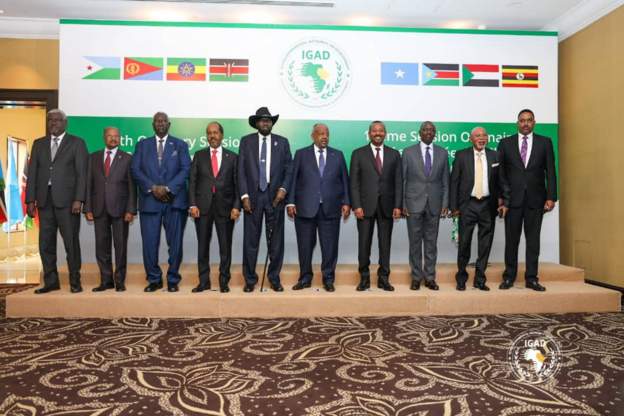
Eritrea has re-joined the Intergovernmental Authority on Development (Igad), the regional organization for East Africa after 16 years of absence.
Information Minister Yemane Meskel tweeted on Monday that Eritrea “resumed its activity” and took its seat at the ongoing Igad summit in neighbouring Djibouti.
The regional grouping’s executive secretary, Workneh Gebeyehu, said he was “delighted to welcome Eritrea’s Foreign Minister Osman Saleh” as he joined the meeting.
Eritrea suspended its membership of the body in 2007 in protest against Ethiopia’s military intervention in Somalia and alleged manipulation of the organisation by external forces.
Igad is made up of Djibouti, Eritrea, Ethiopia, Kenya, Somalia, South Sudan, Sudan and Uganda.
Sixty-five survivors of a Kenyan Christian cult are currently facing charges of attempted suicide for their refusal to consume meals provided to them at the rescue center where they were taken.
During the court proceedings on Monday, the prosecution sought to have the survivors detained in prison, allowing for mental and medical evaluations as the rescue center could no longer accommodate them. A decision regarding this application is expected later this week.
In Kenya, it is considered a criminal offense to take one’s own life, a law originally established by British colonizers. However, in England, these laws were abolished over 60 years ago.
Advocates in Kenya are now fighting to bring an end to such legislation within their country as well.
The 65 survivors are reported to be followers of Pastor Paul Mackenzie, the alleged leader of the cult. It is believed that Pastor Mackenzie persuaded his congregants to engage in a fast leading to their deaths, with the belief that it would enable their ascension to heaven.
Thus far, authorities have discovered over 280 bodies in shallow graves within the extensive Shakahola forest near the coast, where the pastor operated. On Monday, an additional ten bodies were exhumed.
Autopsy reports have indicated that most of the victims, including children, perished from starvation, while others were subjected to strangulation, physical assault, or suffocation.
Kenya’s interior minister has announced that the Shakahola forest, where more than 250 members of a Christian cult perished, will be turned into a national memorial.
Kithure Kindiki said once the recovery of the bodies buried in the 800-acre forest was complete, the place will be turned into “a place of remembrance” so that people don’t forget what happened there.
He said the government had enough evidence to prosecute the leader of the cult and the main suspect, Pastor Paul Mackenzie, for genocide after he allegedly convinced his followers to fast to death in order to go to heaven.
Most of the victims, including children, died of starvation but some were strangled, beaten, or suffocated, according to autopsy reports.
The minister spoke on Tuesday at the start of the third phase of exhumation, when nine more bodies were recovered.
Since the operation started in April, 251 bodies have been recovered. Ninety-five people have been rescued from the forest and 35 suspects arrested.
Mr Kindiki said investigations had shown that the cult’s activities extended beyond the Shakahola forest and that investigations had extended to the larger 37,000-acre Chakama ranch in the area.
He said security roads were being constructed to provide access to the expansive area as search and rescue operations and investigations continued.
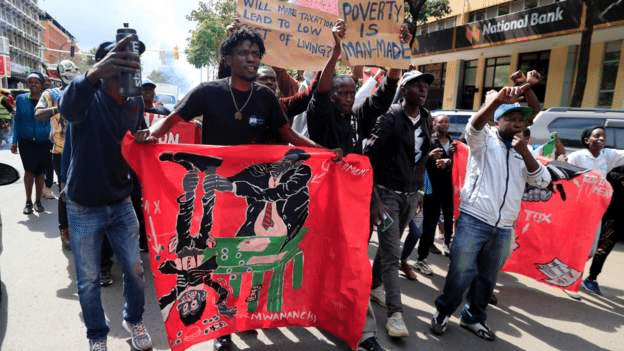
Kenyan protestors demonstrating in the nation’s capital against a number of the government’s proposed fuel tax increases have been dispersed by an open fire with tear gas.
One of the key contested measures in the unpopular finance bill is a new 3% housing fund levy for all salaried workers and to increase value added tax on fuel to 16%.
The bill also calls for taxes on beauty products, crypto-currencies and earnings by social media influencers. They are among the measures that have been opposed by many Kenyans.
The dozens of protesters had sought to gather at a park in the centre of Nairobi before marching to parliament to urge MPs to reject the tax proposals.
Local media reported that some of the protesters were arrested.
Legislators are set to debate the bill on Thursday, amid warnings issued by President William Ruto and his deputy Rigathi Gachagua against those opposed to the proposals.
Many Kenyans have been calling on MPs to reject the new tax proposals
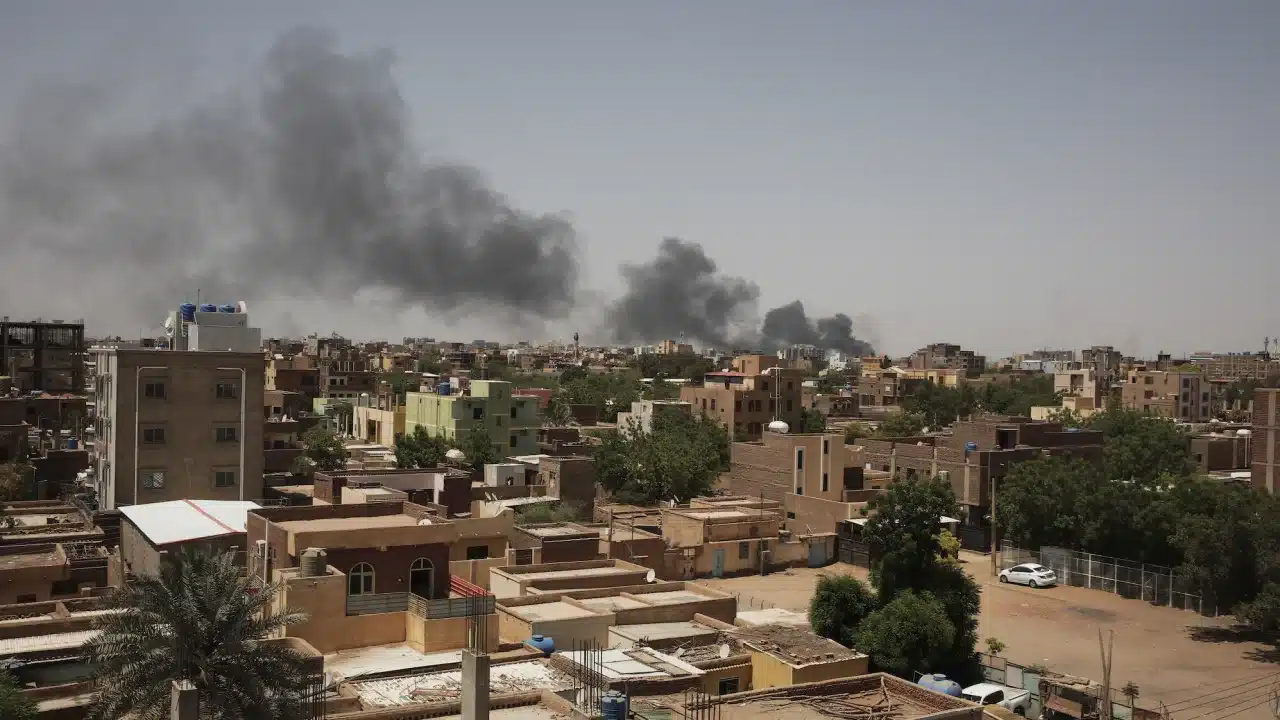
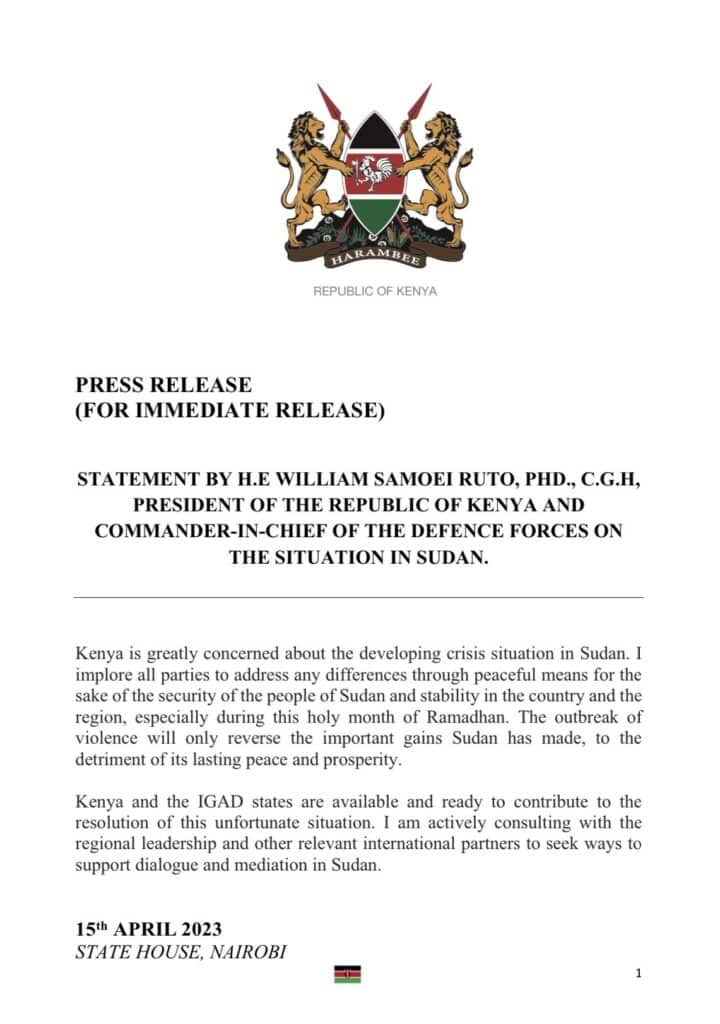
The diplomatic mission of Kenya in the Sudanese capital Khartoum, has been closed as clashes intensify between the rival military forces.
The foreign ministry said the mission had remained open to support the evacuation of Kenyan citizens, but was now closed as it had come under threat from the fighting.
Nairobi has been supporting African initiatives to end the conflict between the Sudanese army and the paramilitary Rapid Support Forces.
Human Rights Watch (HRW) has urged Kenyan authorities to conduct an urgent investigation into police brutality after criticizing them for failing to take action in the recent killings of demonstrators.
In March and April riot police were deployed to suppress protests called by the opposition’s Raila Odinga in Nairobi, Kisumu, Migori and Homa Bay.
He has not accepted William Ruto’s election victory last year.
HRW and Amnesty International say excessive force was used, leading to the deaths of at least 12 people.
The police said some protesters were violent or were looting.
The rights groups said most victims were bystanders. They accused the police of firing live bullets in residential areas and inside classrooms.
Kenya has denied reports that it was hacked by the Chinese after a Reuters report said that the attacks targeted Kenyan government departments for three years.
In a statement released on Thursday evening by Interior Principle Secretary Raymond Omollo, the government said the allegations presented in the article were not subjected to authoritative proof of existence by the relevant persons from both the Kenyan and the Chinese governments.
“In the absence of the above, the alleged motive behind the said attacks cannot be subsequently established beyond doubt,” said Omollo.
The report claimed that the hacks went on for three years targeting eight of Kenya’s ministries and government departments including the office of the president and the National Intelligence Service (NIS).
It then linked the attacks to Kenya’s debts with China claiming that they sought to gain information on debt owed to Beijing as a strategic link in the Belt and Road Initiative – President Xi Jinping’s plan for a global infrastructure network.
The report further claimed that further compromises may occur as the requirement for understanding upcoming repayment strategies becomes needed citing a July 2021 research report written by a defence contractor.
However, Omollo termed the report as a deliberate attempt at stoking panic and mistrust.
“The article should be viewed as sponsored propaganda. The wide circulation and the alacrity for its attribution by other foreign media with well-known inclinations further hint at a choreographed and concerted attack against Kenya’s sovereignty,” added Omollo.
Yesterday, the Chinese Embassy in Nairobi also disproved the claims made by the report terming them an attempt to sow discord between Nairobi and Beijing.
“The said false report is groundless, far-fetched and sheer nonsense. Hacking is a common threat to all countries and China is also a victim of cyber-attack. China consistently and firmly opposes and combats cyber-attacks and cyber theft in all forms. Tracing the source of cyber-attacks is a complex technical issue,” the statement from the embassy read in part.
Omollo further questioned why China would opt to hack systems that it installed for the government.
“The bulk of the critical networking infrastructure deployed by the government of Kenya is sourced from the People’s Republic of China. It is reasonable, therefore, to contemplate that if the country of origin desired to infiltrate the same systems it has helped install, it would unlikely engage third-party hackers,” he added.
He also said that just like in many other countries across the globe, Kenya’s cybersecurity infrastructure is formative, and this portends inherent high-risk exposure to cyber threats noting that the government will continuously strengthen the security and resilience of all its Critical Information Infrastructure Systems (CIIS) through requisite laws and regulations and investments in stronger cyber security systems.
Amnesty International and a Nairobi-based gay rights organization, has indicated in a joint report that LGBTQ refugees and asylum seekers in Kenya face serious human rights violations, including rape.
The report released on Friday said hundreds of gay people, who are among more than 200,000 refugees and asylum seekers in north-western Kakuma camp, experience “extreme discrimination and violence”.
“Perpetrators of violence and intimidation targeting LGBTI individuals can commit their crimes with almost total impunity, enabled by the lack of adequate responses from the police,” Amnesty and the National Gay and Lesbian Human Rights Commission (NGLHRC) said in a statement.
Researchers interviewed 41 people between 2018 and February 2023 who described facing “hate crimes, violence, including rape, and other serious human rights abuses”.
Most of the refugees and asylum seekers interviewed reported having suffered assaults, threats and intimidation in Kakuma camp, most of them more than once, because of their sexual orientation.
Based on the findings, Amnesty International and NGLHRC said that the Kakuma refugee camp complex was not safe for LGBTQ asylum seekers and refugees.
The rights organisations urged the Kenyan government to uphold the rights to life, protection against inhuman treatment and freedom from non-discrimination of everyone, including LGBTQ people.
Salema Masha speaks softly, but her slender frame is animated by an inner strength that saved the lives of her five children.
One day in March she walked them out of a remote wilderness where followers of a Kenyan televangelist were starving themselves to death in the belief that they could meet Jesus faster.
Among the horrific stories emerging from the Christian doomsday cult in the East African country, Salema’s stands out.
More than 200 bodies have been recovered so far from mass graves in the vast Shakahola forest on the southern coast of Kenya, and more are being dug up every day. Survivors are still being found hiding under trees and bushes in the 800-acre territory.
Self-proclaimed pastor Paul Mackenzie opened the Good News International Church in 2003. He repeatedly attracted police attention with his claims that children should not go to school, and that medical treatments should be rejected.
In 2019 he shut down the church and invited his followers to move with him to Shakahola, a place he called a new “Holy Land”.
Salema’s husband was among those who heeded the call.
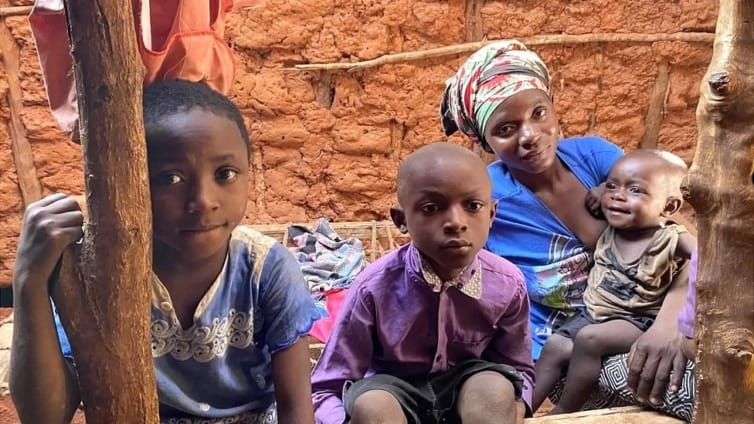
As she tells her story, she breastfeeds one-year-old Esther, who was born in the forest. Her eldest, a boy named Amani, is eight.
The mass suicide started in January. Salema says she followed instructions to begin fasting so that she could “get to heaven”.
Mackenzie had been telling his followers for some time that the world was coming to an end. Initially he offered the forest as a sanctuary from the approaching apocalypse. But in a grisly twist it became a last stand to get to heaven before the “End of Days”.
After seven days of fasting, Salema says she heard a voice from God telling her this wasn’t his will and that she still had work to do in the world, so she stopped.
People around her were dying though – at one point she attended a funeral of eight children. It was called going to “sleep”.
But they said: “If my children won’t die, I should stop attending other peoples’ funerals,” she tells me.
Survivors say children were supposed to be the first to go, according to a macabre order drawn up by Mackenzie. Then the unmarried, the women, the men, and last of all, church leaders.
“When the child cries or asks for food or water, we were told to take a cane and beat them so that they could go and eat in heaven,” Salema explains. “So I thought about it and I said I cannot go on with this situation, I can’t eat while my child is starving. I told myself, if I feel this bad when I fast, how about my child?”
Self-proclaimed pastor Paul Mackenzie said children should not go to school and medical treatment should be rejected
A BBC analysis of Mackenzie’s sermons on video do not show him directly ordering people to stop eating. However, according to Salema, he was explicit in weekly gatherings on Saturdays.
“At first, the pastor dug… water wells [in the forest] and told us to wait for Jesus and we waited. But then, suddenly, he told us we should fast and go to heaven,” she says.
When they questioned the order, as Salema did, they were told that if they delayed their deaths, heaven would be full: “The gate would be closed.”
Much of Mackenzie’s preaching focused on a new Kenyan national identity card that will include personal data encoded in an electronic chip – the “sign of the beast” he called it, to be avoided at all cost.
The cost was very high, and Salema discovered that her husband, one of Mackenzie’s deputies, was involved in managing it. A friend told her that when he went to work, he was actually going to bury the dead.
One day in March he put his foot down, forcing the family to fast. Four days later he left for work and Salema saw her chance. She grabbed the children and left.
“My children fasted for four days without food and water, and they were crying,” she says. “So, when I saw they were so weak, I gave them water and I told myself I couldn’t allow my children to die.”
The children were guided by the steely will of their mother and protected by her status as the wife of a Mackenzie aide.
More than 200 bodies have so far been exhumed from mass graves in the Shakahola forest
Salema says she was challenged by other cult members but not stopped, and when she reached the main road after walking for several kilometres, got a lift from “a good Samaritan” to a safe place.
But other runaways were stopped. A group of male enforcers bearing machetes chased, beat, and dragged them back to the forest, in accounts told by survivors and former cult members.
Mackenzie surrendered to the authorities on 15 April. He denies ordering his followers to starve themselves. But the search and rescue operation found many dead children buried in his compound.
Police told local reporters they had learned from aides who had been detained that this was meant to be a way for Mackenzie to identify with Jesus’ command to “let the little children come unto me,” says journalist Marion Kithi.
Police also said that before Mackenzie left, he ordered his deputies to continue enforcing the mass starvation and burying those who died, according to Kithi.
Survivors say children were supposed to be the first to die, according to a macabre order drawn up by Mackenzie
It is the surviving children who’ve provided a lot of the information about what happened, says Victor Kaudo, a human rights activist from Haki Africa who first tipped off the police that young boys were dying in Shakahola.
Some of the adults refuse treatment even after they’ve been rescued. And there is suspicion that members of the cult are continuing to exert influence beyond the forest, quietly telling survivors to refuse food and medicine.
Kaudo says two people his group rescued and regarded as victims were actually “part of this militia that Mackenzie had,” and needed to be separated from the others.
Former cult member Titus Katana says he knows most of Mackenzie’s aides and the majority have been arrested. But this week a body was discovered lying in the forest, not buried beneath it. That makes him suspect some of the enforcers are still “supervising the process of people to fast”.
Salema says Mackenzie’s deputies came looking for her a week after she left and advised her to return, but did not threaten her.
But she knows others were not treated as kindly.
A woman came to her, asking for help to escape the cult with her children and find the money for transport back to their home village. Salema promised she would do so.
The woman went back to the forest to get her children and was never heard from again.
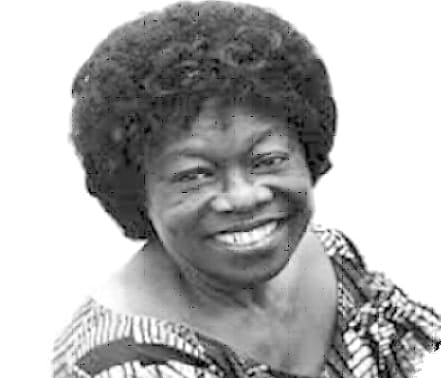
She achieved everything that there was to achieve and more. It is her work with the Volta Lake that is my abiding memory.
In paying my last respects to Dr Letitia Obeng, Ghana’s first female PhD holder in Science, I have gone back to her seminal autobiography, A Silent Heritage, and selected some passages from the book on different subjects to show what a thoroughly dynamic and forward-looking woman she has been.
Here she is, describing the home she lived in as a child in Afidwase:
The roof was of corrugated iron sheets.
All “respectable” houses were roofed with corrugated iron sheets.
The iron sheets had been introduced, (no doubt as part of a foreign export drive during colonial days) as an alternative to the African grass-thatch roof which was considered “primitive”.
The promotion had been vigorous, in spite of the fact that, in the climate of the country, the grass thatch roofs made rooms cool.
Granted, the corrugated iron sheets made rainwater harvesting feasible but they also heated rooms up and, with the rains, they soon became rusty, leaving roofs disgustingly ugly.
As I have travelled around the world, I have seen cottages and houses in several places including Europe, roofed with grass and they are highly rated.
I have seen attractive homes and hotels in Kenya, Lesotho, Burundi, as well as in Britain, France and other places, with safe, protective grass thatched roofs.
They were neither rusty nor disgustingly ugly.
Who knows what effective and pleasing roofing may have evolved from our kind of roofing if we had not been brainwashed into accepting that the grass-thatch roof was primitive?
And could the colonial masters not have organized the making of roofing tiles? We had the raw material and abundant labour.
But then, that might have caused the business of the foreign exporters and importers of the corrugated iron sheets to collapse!
Here she describes her Ntama Campaign.
I might add for the sake of the young people that back in those days, if you were an “educated” woman, you were not to be seen in cloth, “ntama”, you had to wear European dress:
I was still fired with nationalism and I continued to use ntama as my standard attire.
I remember we went in a group one evening to a popular night club in Kumasi.
At the entrance, although I had bought a ticket, the doorman would not let me in because I was wearing ntama.
The others in the group had European attire and they were let in.
George and I were left standing outside.
Just as my fury began to build up, the Proprietor happened to be visiting the club and when he saw what was happening, he apologized and invited us in.
I was the only one inside wearing ntama.
Thereafter, others wearing the traditional attire were also allowed in the club.
That strengthened my resolve to make the ntama acceptable and I started designing and sewing my kabas to look so attractive and different that at social functions, I stood out in my ntama.
The more conservative among the campus wives did not approve of me being in ntama at serious functions.
In fact one of them said to George, “Why does your fiancé continue to disgrace herself by wearing cloth all the time as if she does not know how to wear a dress.”
I decided to organize an Ntama Fashion Show to demonstrate how to be proud of wearing ntama for various occasions.
I had no problem with finding willing models from the Women’s Hall where I was Warden and had friends among the students.
I designed the ntama styles and sewed a variety of nicely fitted kaba for many occasions: sleeveless kaba with a little collar as a secretary’s outfit, a smart one with little straps, for early evening social events, an off-the-shoulder, strapless “will-power” for formal evenings, and others with overlapping peplum, short and long flared out sleeves.
All of them were designed to fit and show the curves of my lovely models.
The show took place in the College Assembly Hall and it was well applauded.
I followed the show-up with articles in a daily newspaper about how to sew and wear zip-fitted kabas and feel good in them.
Of course, I was only addressing a minority of literate women.
It was not the done thing to be a “cloth lady” at formal functions and there certainly were those ladies who, at that time, wouldn’t be caught dead in ntama in public!
Here she is on the subject of food:
Mama was an excellent cook.
Her local traditional dishes were really great.
Using vegetables, she would make a variety of soups and stews.
Then, there were all the dishes from ripe plantain and sweet potato and maize and yams that I hardly hear spoken about these days.
Obrodokono was a popular dish made from ripe plantain and ground, roasted maize.
The mixture, suitably seasoned with peppers and ginger and blended with a little palm oil was wrapped in green plantain leaves and steamed in a pot.
Then there were the rich and tasty soups, there was always a variety of them: palm soup, groundnut soup, garden egg soup and even plain soup – and they were all delicious.
There would be in the soups, a variety of meats including venison and smoked freshwater fish.
Papa was a hunter and quite often he would return from night hunting with large game.
Palm oil-based dishes were made with finely chopped spinach, garden eggs or different kinds of beans.
They were eaten with yam, plantain, cocoyam, cassava, cooked powdered maize and sometimes but rarely, rice.
l am glad that as a people, we in Ghana, even now, have a large stock of recipes and different ways of making delicious dishes from the same ingredients.
It is no exaggeration to say that there are enough varieties of local dishes for one to eat for many days without repeating a recipe.
Meal times when I was young were always great.
As I grew up, I used to hear quite a lot about how Africans do not eat “balanced diets”.
Thinking back, in my home, at any rate, I think the meals were reasonably balanced.
And here she is, reporting on her first trip to China in 1975 on a favourite subject, always the scientist, ever the pragmatist:
The safe management of human waste was strictly observed.
Traditionally, human waste had been used as manure on the farms.
The Chinese had devised a special three-chamber latrine which rendered parasite eggs infertile by the time the waste was scooped out to be used as manure.
They could also produce biogas from the latrine.
When we visited a house to inspect one of the latrines, there was a plastic hose through which biogas was being evacuated.
We followed the hose and it led us to a kitchen where the biogas was fed into a stove and used to boil water to make tea for us!
I was so impressed by this direct, no-nonsense utilization of human waste that I passionately rendered an account of it to my sister when I returned home.
Imagine my surprise when, instead of catching my excitement and showing the enthusiastic interest that I expected, her face went funny, as she asked, “And you drank the tea?” I got a similar reaction from other people, not only in Ghana, but also elsewhere, whenever I told my story.
Fare thee well, Dr Letitia Obeng, you were special, we haven’t got anyone like you.
A self-proclaimed preacher who recently said he wanted to meet President William Ruto to deliver a prophetic message has been arrested by Police in western Kenya.
Joseph Chenge of Jerusalem Mowar Church was arrested on Wednesday evening alongside 11 members of his church in Ruri village, Homa Bay county.
Homa Bay criminal investigations officer Abed Kavoo said they were holding Mr Chenge in suspicion of promoting questionable religious teachings.
Mr Kavoo said preliminary investigations had revealed that the cleric was detaining sick people at his church in the guise of praying for them. Five patients were rescued from the preacher’s church, local media reported.
Police said Chenge’s church operations were illegal, as it was not registered. The preacher and the arrested members of his church are due to appear in court on Thursday.
On Sunday, Mr Chenge told journalists that something unfortunate may happen to the country if he failed to meet President Ruto within 21 days.
The arrest of the preacher comes amid a crackdown on suspicious churches in Kenya, following the death of more than 200 in a doomsday cult in coastal Kilifi county.
The head of Kenya’s standards authority and 26 other government employees have been suspended in connection with the market release of 1,000 tonnes of expired sugar.
A statement by the head of public service, Felix Koskei, said 20,000 bags of sugar imported into the country in 2018 and condemned by the regulator had been “irregularly diverted and unprocedurally released”.
The Kenya Bureau of Standards had then declared the sugar as unfit for human consumption and was set for destruction through conversion to industrial ethanol.
The conversion was to be undertaken jointly by regulatory agencies.
They were required to source for a distiller through an open and competitive tendering process and pay all the necessary taxes and fees.
“It is manifest that some officers in the relevant agencies abdicated their responsibilities, at the risk of public harm,” Mr Koskei said.
The suspension comes at a time when Kenyans have been hit by one of the biggest rise in prices of sugar in years amid shortage.
The Athletics Integrity Unit (AIU) has provisionally suspended Rhonex Kipruto, a Kenyan athlete who holds a world record, due to an alleged doping violation.
Kipruto achieved the remarkable feat of breaking the 10k road race world record in Valencia in 2020.
Additionally, he earned a bronze medal at the 2019 World Championships for his outstanding performance in the 10,000m race.
The suspension imposed on Kipruto is pending a hearing, which will determine his ultimate fate and the consequences of the alleged doping violation.
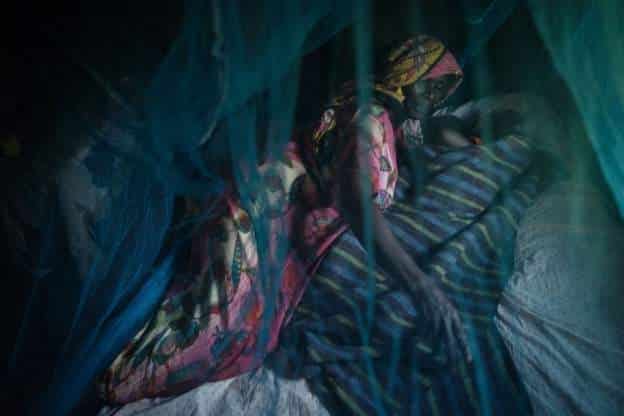
A corruption scandal has led Kenyan President William Ruto to fire a principal secretary in charge of public health and dissolve the whole board of a medical supply company.
The scam involves a bungled tender involving the supply of donor-funded treated bed nets meant to protect against malaria-causing mosquitoes worth $27m (£21.5m).
The Global Fund had tasked the Kenya Medical Supplies Authority (Kemsa) to procure more than 10 million nets to be distributed to low-income households in about half of the counties in the country that are malaria-endemic.
But Global Fund cancelled the tender – accusing Kemsa of irregularities by allegedly favouring one company whose documents were not in order, and unfairly locking out others.
In 2020, Kemsa was again in the spotlight over claims of misappropriation of millions of dollars intended to buy personal protective equipment and other essential health facilities at the height of the Covid pandemic.
Authorities have been searching for survivors and digging up shallow graves spread around the forest throughout this week while hundreds of people are still listed as missing.
Paul Mackenzie, leader of the Good News International Church, was accused of ordering his followers to starve their children and themselves to death so they could go to heaven before the end of the world, which he predicted to be on April 15.
The taxi driver-turned-preacher was denied bail on Wednesday by a Kenyan court.
Onyancha said one more suspect had also been arrested, bringing the total number of those detained over the deaths to 26.
On Friday, 29 bodies were unearthed, including those of 12 children which were found in one grave.
Kenyan President William Ruto appointed a commission of inquiry into the deaths of more than 100 people believed to have starved themselves to death, while a court ordered that the cult leader remain in prison.
The commission of inquiry will examine whether administrative or intelligence lapses contributed to the deaths.
Presidential spokesman Hussein Mohamed said Ruto had also appointed a task force to review regulations governing religious organisations.
Mackenzie has not commented publicly on the accusations against him nor has he been required to enter a plea to any criminal charge. His lawyer George Kariuki told the press on Tuesday that his client could face “possible terrorism charges”.
Mackenzie appeared in court in the port city of Mombasa on Friday, where prosecutors asked a judge to hold him for an additional 90 days as their investigation continued.
The judge said he would deliver a ruling next Wednesday on the prosecution’s request and ordered that Mackenzie remain in custody until then.
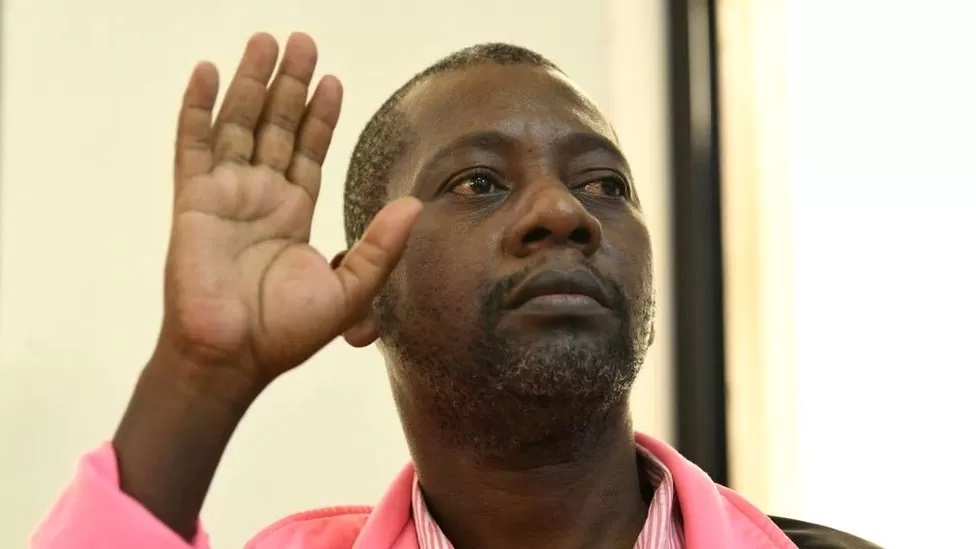
Mackenzie, who was wearing a black and pink jacket and holding his two-year-old daughter during the hearing, told journalists at the court that he and some of his supporters were being refused food in prison.
Prosecutors denied this and his lawyer had told the press on Tuesday that his client was eating.
At the Kip Keino Classic, an international competition conducted in Nairobi on Saturday, Kenyan runner Ferdinand Omanyala easily won the 100-meter race.
Although he failed to top his African record, he beat off rivals in a time of 9.84 seconds, the best in the world this season.
“I’m happy that I got a very good race and the time is nice because it’s a world lead, so we’re just hoping that we break it down as we go on through the season,” he said.
“The main aim is to win the World Championships in Budapest this year and the Diamond League trophy back in Oregon, where I did not have a good competition there.”
He said his target for the season is to cut his African record of 9.77 seconds, set at the same event in 2021, to under 9.70.
US Olympic and world 200m silver medallist, Kenny Bednarek, was second in 9.98 and world 100m silver medallist Marvin Bracy-Williams was third in 10.03.
Meanwhile, US star sprinter, Sha’Carri Richardson, took an easy win in the 200 metres signalling her return to form.
Already the fastest woman in the world this year in the 100m, the American obliterated the field to win in a new meet time of 22.07 seconds.
“I’m glad to hear from you guys (the media, ed) and from the fans that I’m a fan favourite because I wasn’t treated like that coming into this meet. So I’m just grateful that I had a good race nevertheless of the circumstances,” she said.
But it was local sensation Omanyala, who thrilled the home crowd. He has remained unbeaten this season.
In order to address the root causes of the region’s instability, the UK struck a deal with Kenya, Ethiopia, and Somalia.
Speaking to the BBC, UK Security Minister Tom Tugendhat said the agreement – worth some $12.5m (£9.9m) – will support the three countries to come up with policies in their fight against terrorism.
This is the first time high-level officials from Ethiopia, Kenya and Somalia have accepted international support to address a common problem along their borders.
These borderlands are usually isolated and insecure, which makes it difficult for countries to monitor threats.
Mr Tugendhat believes that al-Shabab militants conduct terror activities in these areas because there is no governing authority.
The militants have carried out a series of attacks within the region in recent months and the group remains a threat.
The funding from the UK is also aimed at empowering local communities to effectively report suspected terror-related incidents.
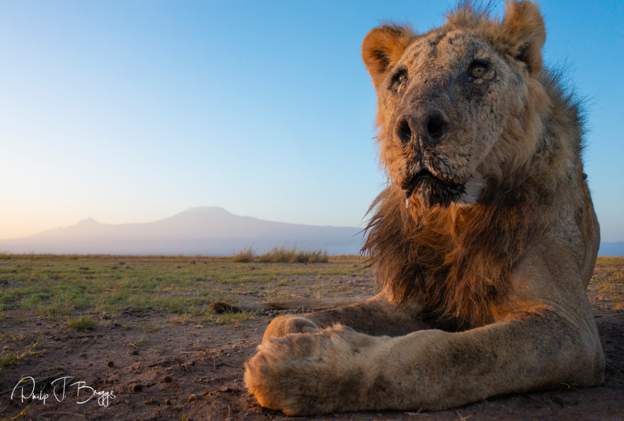
One of Kenya’s oldest lions has died at age 19 according to reports.
The male lion, named Loonkiito, was speared by local herders in Olkelunyiet village on Wednesday night after preying on livestock. The village borders Amboseli National Park – on the outskirts of the capital, Nairobi.
Kenya Wildlife Service (KWS) spokesperson Paul Jinaro told the BBC that the lion was old and frail and wandered into the village from the park in search of food.
Mr Jinaro could not confirm if it was the oldest lion in the country but noted it was “very old”.
Lion Guardians, a conservation organisation, said Loonkiito was the oldest male lion in its ecosystem and possibly in Africa.
“He was a symbol of resilience and coexistence,” the organisation said in a statement.
Paula Kahumbu, a wildlife conservationist and chief executive officer of WildlifeDirect, said she was pained by the killing of the lion and called for measures to protect wildlife in the country.
“This is the breaking point for human-wildlife conflict and we need to do more as a country to preserve lions, which are facing extinction,” Ms Kahumbu told the BBC.
The government, lawmakers, giant corporations, and startups in Japan are keen to invest in Africa.
As a delegation from the African Development Bank Group led by President Dr Akinwumi Adesina visited Japan to showcase the enormous investment opportunities on the continent, the Prime Minister of Japan Fumio Kishida, was leading his country’s charge with a tour of four countries, namely Egypt, Ghana, Kenya, and Mozambique.
In Japan, Dr Adesina accompanied by three Vice Presidents, Dr Kevin Kariuki, Dr Beth Dunford and Solomon Quaynor, and Executive Director Takaaki Nomoto, held a series of meetings with senior government officials including the Minister for Finance Shunichi Suzuki, Vice Minister for Finance Masato Kanda and the Director General in the Ministry of Finance Atshushi Mimura.
They met with the top leadership of global mega brands including Mitsui & Co Ltd., Sumitomo Corporation, Mitsubishi Corporation and Toyota Tsusho, as well as Japan’s leading business community, the Keizai Doyukai, that brings together more than 1000 business executives.
The result of this high-level engagement could see Japan’s net Foreign Direct Investment to Africa rebounding to pre-Covid19 levels when it amounted to $10 billion compared to $6 billion in 2021.
In this write up we take a look at what the companies are looking for and a keynote message delivered by Bank President Dr Adesina. MITSUI & CO LTD
One of the largest investors in Africa, Mitsui & co Ltd, announced plans to resume the construction of the multibillion-dollar Mozambique LNG project which was stopped in 2021 following an insurgent attack on the facility in the country’s northern region of Cabo Delgado.
A combined deployment of the Mozambican army, troops from Rwanda and members of the South African Development Community (SADC) has since brought the situation under control.
“The security situation has been significantly improved. We want to restart construction work in summer,” announced Koji Asanuma, General Manager, Mozambique Project Dept(link is external).
He said preparatory work was continuing and they will soon be contacting lenders to kickstart construction.
The African Development Bank has invested $400 million in the project.
Mitsui & Co Ltd has five 5 offices in Africa: Ghana, Kenya, Morocco, Mozambique and South Africa.
In addition to Mozambique’s LNG project, the company has also invested in Mozambique’s Nacala Rail and Transport project and Egypt’s Refining Company. It’s involved in renewable energy projects in Morocco, South Africa, Kenya, Nigeria, and Uganda. TOYOTA TSHUSHO:
Toyota Tshusho Corporation is one of the front-runners among Japanese companies doing business in Africa. It is present in all 54 countries with businesses covering automobile, pharmaceutical, beverages and energy. Across the continent it employs about 22,000 people.
The Executive Vice President of Toyota Tsusho Corporation Toshimitsu Imai said the company is looking for more projects for wind power in North Africa, solar energy in West Africa and Geothermal in East Africa. Globally it is aiming to generate 10 GW.
The company is keen to discuss with the Bank the possibility of investing in Green Hydrogen. It’s carrying out studies in South Africa, Kenya and Egypt. “We will come to the Bank to discuss financing,” said Imai.
In terms of local manufacturing of lithium-ion batteries used in electric vehicles, Imai saw possibilities in South Africa which has a huge automobile industry or DRC which has some of the world’s largest deposits of minerals needed for lithium-ion batteries.
The Toyota Tshusho Executive Vice President also expressed interest in the Africa Pharmaceutical Technology Foundation, an Africa-led and Africa-centered initiative that will significantly enhance the continent’s access to the technologies that underpin the manufacture of medicines, vaccines, and other pharmaceutical products. MITSUBISHI CORPORATION
AfDB President’s visit to Tokyo: Meeting with Mitsubishi Corporation
The company is present in 11 countries in Africa: Algeria, Cote d’Ivoire, Egypt, Ethiopia, Kenya, Morocco, Nigeria, Senegal, South Africa. Tanzania and Tunisia. Since entering the African market in 1954, Mitsubishi Corporation has spread its investment wings mineral and metal resources, automotive & mobility, natural gas, food industry and power solutions.
During a meeting with Dr Adesina, it was clear Mitsubishi Corporation is hungry for more. It’s Senior Vice President Tetsuya Shinohara, said the company had limited activities on the continent.
“Africa is a tough region,” he said, “We are figuring out areas to invest in, in the future. We are asking for suggestions about the way to follow.”
The Deputy General Manager for Global Strategy and Coordination Department Jun Fujino said there are stereotypes about doing business in Africa because of political instability, unpredictability of regulatory frameworks and that the consumer market may take too long to develop. SUMITOMO CORPORATION
AfDB President’s visit to Tokyo: Bilateral Meeting with Sumitomo
Another large Japanese general trading house, Sumitomo Corporation with investments in mineral resources, energy, chemical & electronics, real estate, media & digital, transportation & construction system is eager to expand its business on the continent.
“We want to grow together,” Masayuki Hyodo, President and CEO, Sumitomo Corporation said as discussions with the Bank delegation begun, adding, “We have started new business in Egypt, and we want to expand further.”
And the response was commensurate. “You are in the right place,” Dr Adesina told Mr Hyodo, “You are with the right partner. On infrastructure, we are trying to expand in green infrastructure in terms of roads, water and digital. We are trying to mobilize $10 billion to invest in green infrastructure.”
Sumitomo has offices in Algeria, Ethiopia, Ghana, Kenya, Madagascar, Morocco, Mozambique, Tanzania and South Africa. ROUNDTABLE DISCUSSIONS
AfDB President’s visit to Tokyo: Roundtable with the Private Sector
During the visit, the Bank delegation held roundtable discussions with about ten Japanese companies and Venture Capital funds operating in Africa. The discussion focused on new technologies related to energy and decarbonization such as next-generation solar power, hydrogen/ammonia, and storage batteries. They also discussed how Japanese technology and innovation can contribute to solving social issues in Africa. The roundtable featured a presentation by the Bank’s Vice President for Power, Energy, Climate Change and Green Growth, Dr Kevin Kariuki.
The second session featured Japanese entrepreneurs and investors with interest in the agriculture sector.
They were joined by venture capital companies to highlight the significant role startups play in the development in Africa. The session had presentations from two Bank vice presidents – VP for Agriculture, Social and Human Development Dr Beth Dunford, and Private Sector, Infrastructure and Industrialization VP, Solomon Quaynor.
The roundtable discussions culminated in a keynote address by Dr Adesina. The roundtable discussions were organized by Keizai Doyukai and the United Nations Development Fund. Keizai Doyukai, a private, non-profit and nonpartisan organization that brings together nearly 1,400 top executives of some 1,000 corporations.
Participating firms included:
Toshiba Energy Systems & Solutions Corporation: has invested in generation of thermal and hydropower projects across 10 countries.
Hitachi Energy: another global technology leader with significant investments in generation of renewable power including hydrogen. It has a presence in more than 20 countries with main hubs in Cairo and Johannesburg.
Kawasaki Heavy Industries Ltd: a manufacturer of motorcycles, aerospace and defense equipment, robots, gas turbines and other industrial products.
Tsubame BHB: is a startup company involved in the production of green ammonia fertilizer for small-scale farmers in Africa.
AfDB President’s visit to Tokyo: Visit of Tsubame BHB
NEC Corporation: began operating in Africa in 1963 delivering technologies behind establishing national ID and biometric authentication systems in South Africa, laying telecommunication infrastructure such as the 6,200-km-submarine cable between Angola and Brazil.
Kepple Africa Ventures: launched in Africa in 2018. It is the largest Japanese Venture Capital fund based in Nigeria and Kenya. It led 15 Japanese companies such as Mitsubishi UFJ Financial Group, Toyota Tsusho Corporation and Yamaha to make direct investment into African startups.
Degas Limited: is a startup company based in Japan and Ghana where it is providing agricultural inputs, knowledge and digitalization support to 3,000 farmers.
Uncovered Fund: established in 2019 in Tokyo, has invested in 26 African startup companies particularly those that provide financial services essential for daily life and economic activities, sales promotion of retail stores, logistics in distribution and supply and urban transportation. It’s based in Egypt, Nigeria, Kenya and South Africa.
AfDB President’s visit to Tokyo: Bilateral Meeting with AAIC
The Asia-Africa Investment & Consulting (AAIC): aims to invest in fast-growing companies within the healthcare sector in Africa. Among other activities, it is investing and managing agribusiness in Rwanda via the Rwanda Nuts Company.
Sasakawa Africa Association activities go back 36 years when it was established by Japanese Philanthropist Ryoichi Sasakawa, Nobel Laureate Dr Norman Borlaug and former US President Jimmy Carter.
AfDB President’s visit to Tokyo:Bilateral Meeting Sasakawa Africa
The association focuses on agriculture and especially smallholder farmer development in 12 countries across sub-Saharan Africa. President Makoto Kitanaka spoke about the association’s increasing use of technology in the delivery of its services. Dr Adesina meets with University of Tokyo
The University of Tokyo is investing in startups, with more than 400 already up its sleeves. Wassha, one of the startups associated with the University of Tokyo has developed an electrical power service business to reach people in rural Tanzania who do not have access to electricity. Beneficiaries rent LED lanterns which are offered on a Pay As You Go system.
AfDB President’s visit to Tokyo: Bilateral Meeting with President of the University of Tokyo
The University of Tokyo President Dr Teruo Fujii and Dr Adesina discussed ways their two institutions could collaborate including the possibility of establishing a joint Japan Africa Entrepreneurship program. This would bring together venture capital funds, establish joint businesses and establish a staff exchange program between the University of Tokyo and selected universities in Africa.
The two leaders also spoke about the possibility of collaboration between the University’s School of Pharmacology and the Rwanda-based African Pharmaceutical Technology Foundation
The Bank delegation also held meetings with Japanese Bank of International Cooperation(link is external) and Japanese International Cooperation Agency(link is external) which signed a $350 million funding agreement with the Bank to support Africa’s private sector.
Before his departure Dr Adesina met with diplomatic representatives of more than 30 countries in Africa. He shared with them the achievements the Bank had made over the past seven years and the urgent need to attract more foreign direct investments to Africa.
AfDB President’s visit to Tokyo: Reception for African Development Bank, African Diplomatic Corps (ADC)
Following the five-day roadshow to showcase Africa’s enormous investment opportunities, the message was clear: The door and the road to Africa for Japanese investors is wide open!
Police have summoned a controversial Kenyan preacher as the government tightens down on what it terms renegade churches and radical religious leaders.
On Tuesday, Eliud Wekesa, famously known as “Jesus of Tongaren” and the leader of the New Jerusalem sect, was summoned for interrogation over his questionable religious beliefs.
He has convinced his church members to believe that he is Jesus. Mr. Wekesa has 12 disciples named after biblical Jacob’s descendants.
On Wednesday, he is scheduled to appear before police in the western county of Bungoma.
According to local media, the preacher claims he has done nothing wrong to deserve his detention and that he only shares the gospel.
This comes as investigators on Tuesday exhumed 21 more bodies in the coastal Kilifi county, bringing the total of those known to have died in the doomsday cult to 133.
Pastor Paul Mackenzie, the leader of the Good News International Church based in Kilifi, is awaiting trial, amid accusations of ordering his followers to starve themselves to death.
Hundreds of others have been reported missing.
President William Ruto has formed a commission of inquiry to probe the now-called Shakahola cult deaths in Kilifi county.
Police in the neighbouring Kwale county on Monday rescued 200 people, including 50 children, from a forest in a suspected case of religious kidnapping.
Two pastors based in coastal Kenya have appeared in court over the deaths at least 110 of their congregants, many of whom are believed to have starved to death.
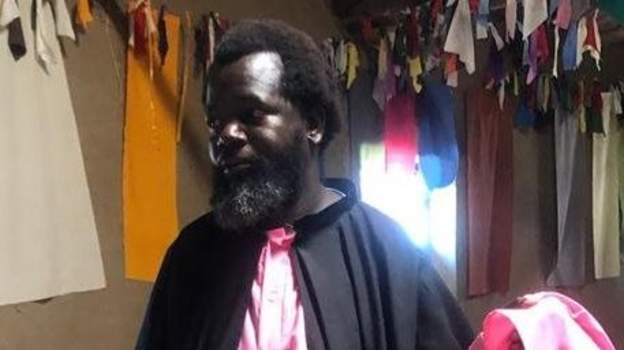
Self-proclaimed pastor Paul Nthenge Mackenzie, who set up the Good News International Church in 2003 and is accused of inciting followers to starve to death “to meet Jesus”, appeared in the dock in Malindi.
He will face terrorism charges over the deaths of more than 100 people found buried in what has been dubbed the “Shakahola forest massacre,” prosecutors said.
In solidarity with victims of a Kenyan cult leader, ex-member digs for their remains https://t.co/QMyOY2MAmW
The small courtroom was packed with relatives of victims as Mackenzie, dressed in a pink and black jacket and brown trousers, was brought in by about half a dozen police officers along with eight other defendants.
After a brief hearing, the case was moved to the high court in Kenya’s second-largest city of Mombasa, where the suspects will face terrorism charges, prosecutor Vivian Kambaga told AFP.
Kenya’s opposition leader Raila Odinga has proceeded to demand countrywide protests on Tuesday over the high cost of living, claiming the government’s inability and lack of good faith in having the negotiations to address its primary issues. Transfer Talk: United, Spurs, and Toon ready for Mad Tuesday.Ransfer conflict
Odinga together with member top leadership in the Azimio coalition have pledged to resume weekly protests despite the recent move by the government to hold bipartisan talks in parliament to address its main issues that include a reform towards the electoral body and opening of the election servers to ascertain vote validity.
The former premier Raila Odinga on Monday also cautioned the president against gagging the opposition during protests further accusing the police of being partisan when they exercise their rights through demos.
The government on the other hand warned the opposition against the Tuesday demos with President Ruto asking Azimio Coalition to avoid violence and destruction of property, urging the Raila-led team to embrace bipartisan talks in parliament.
President Ruto also reminded the opposition that it was his duty as the head of government to protect the rights and property of all Kenyans warning that he will not allow protests in the city centre.
Odinga has accused Ruto of stealing last year’s election and of failing to control surging cost of living that is hitting Kenyans hard.
They have been struggling to make ends meet in the face of high prices for basic goods and a plunging local currency. A record drought has left millions hungry.
A seasoned member of Kenya’s opposition, Raila Odinga, drove a cavalcade of vehicles through Nairobi’s streets on Friday, shortly after his arrival from Dubai.
In a festive atmosphere, the large crowd of supporters followed his convoy through the streets of the city as it made its way to a rally in the district of Kibera.
It was the second gathering of his coalition Azimio la Umoja-One Kenya party since Odinga and President William Ruto agreed to bipartisan talks to iron out their differences.
Odinga has accused Ruto of stealing last year’s election and of failing to control surging cost of living that is hitting Kenyans hard.
They have been struggling to make ends meet in the face of high prices for basic goods and a plunging local currency. A record drought has left millions hungry.
Friday’s rally comes before mass action was set to resume in Nairobi on Tuesday, three weeks after the party called off weekly demonstrations against Ruto while the two men held discussions.
Kenya’s 882 miles of coastline along the Indian Ocean are frequently disregarded in favor of the country’s vast natural reserves, which are famous for being home to all “Big Five” mammals. It’s a place where people go to “chill out,” but not to observe and connect with the wild and unique ecosystem, says Kenyan filmmaker, photographer and conservationist Jahawi Bertolli.
Bertolli is determined to change this outlook and believes that visual storytelling is one way to do it. “No one was telling stories about the ocean here (in Kenya),” he says.
So far, his work has focused mainly on the Lamu Archipelago along Kenya’s northern coast, where his wife Elke Bertolli, also a photographer and filmmaker, grew up. Lamu is a hidden gem, he says, and filming has led to new discoveries. “There’s not much scientific work that’s happened up here so a lot of what we’re finding is new,” he adds. “We’re finding these incredible reefs. We’re finding incredible biodiversity.”
But this rich biodiversity is increasingly under threat. Bertolli says that harmful fishing practices, such as drag netting, coupled with habitat degradation due, in part, to coastal development, pollution and an increasing human population have caused a reduction in fish populations.
Not only is this bad for the ecosystem, but for local fishers too. Lamu is home to one of the oldest Swahili settlements in East Africa, a community who have depended on the ocean since the 12th century. Traditionally these fishers respected the balance with nature, says Bertolli. They stopped fishing when they had enough for what was needed, they only fished in certain seasons, and they left the coral reef alone, understanding it to be a home for fish, where they needed space and time to reproduce and grow. “There’s a lot of cultural knowledge, which is actually conservation knowledge. It’s just packaged differently,” Bertolli explains.
In 2020, Bertolli made a short film about Lamu’s sea life and the conservation traditions of the local fishers. He called it “Bahari Yetu” – “Our Ocean” in Swahili – and began showing it the local community. The screenings were a gamechanger, he says: “When you bring back that imagery, all of a sudden people are like, ‘Oh my God. Wow, this is ours … this is our heritage, these are our reefs, this is what’s happening underwater in our ocean.’”
A viewing of “Bahari Yetu” was also put on for local beach management units and members from the county government and fisheries department. Bertolli also screened another film he had made a few years earlier on locally managed marine areas in Africa. The next time the group met, all members voted unanimously to begin setting up a marine protected area around Lamu’s Kinyika island, a craggy rock that acts as a nursing ground for seafaring birds and hosts a bustling coral reef system.
For Bertolli and the people of the Lamu Archipelago, this has been a significant first step to ensuring the preservation of an essential ecosystem. While it’s only the beginning and a management plan still needs to be established, Bertolli believes it has also been a testament to the power of visual storytelling. “Because it was their film, told in their language, filmed here – it became an incredibly powerful tool to inspire the community to come together to try and start actually conserving these areas,” he says.
It’s now becoming clearer how a Kenyan woman left her lucrative job in Qatar and returned to her home country of Kenya to join Pastor Mackenzie’s cult.
Judith Ajenta Charles is thought to have only recently joined the cult, a few weeks after her nine-year-old son passed away there.
She contacted her friend days before joining the sect, and after they met, she left her with a necklace bearing her dead son’s name
Shakahole, Kilifi – It is now emerging that an air hostess who had a high-flying job in Doha, Qatar, is one of the people who sold everything and quit her career to join Pastor Mackenzie’s Kilifi cult.
Beatrice Ajenta Charles joined the church a few weeks ago, and her close friend Anna detailed how the woman quit her job and followed her parents to join the church for fasting, leading to tens of people’s deaths.
A report by Ghetto Radio indicated that the woman met her friend days before she went to Shakahole village for starvation premised on the promise to see Jesus as Mackenzie told his followers.
On April 4, 2023, an uneasy-looking Betty briefly met her close best friend Anna and left her with a necklace bearing her son Jason’s photo.
“See First” under the “Following” tab to see YEN.com.gh News on your News Feed!
“She never took that necklace off, no matter what. It was always on her neck. I called her back to let her know she had left it behind, but she asked me to keep it,” Anna said.
That would be the last time that Anna would see her friend Betty as her efforts to find out her whereabouts would be fruitless in the days that followed.
Betty’s sister Constance
Betty’s parents are believed to be senior members of Mackenzie’s church, and it is alleged they had Betty’s nine-year-old son Jason also starve to death. He died in March 2023.
Betty’s sister Constance Chao also quit her military job to join the cult, and her husband does not know if she is alive or dead.
“My wife too left her military job after her sister quit hers, and they left,” Abbas, Chao’s husband, who has been at the exhumation site hoping to find her and Betty alive, told the Standard.
Ghanaian pastor telling church members to pay $1000 for blessings gets completely ignored
Meanwhile, YEN.com.gh published earlier that a pastor had recently sparked massive conversations online after calling on a church congregation to offer their money up for blessings.
A video had him asking for $100, $500, GH₵2,000, and GH₵1,000, to which no one got up to give Many social media users took to the comments section to applaud the member for not giving out their money.
The assets of suspected Rwandan genocide perpetrator Félicien Kabuga in Kenya have not been released by a court.
According to local media, the Kenya anti-corruption court denied Mr. Kabuga’s son Nshimyumuremyi Donatien’s request to provide his elderly mother access to rent from the property in the nation’s capital, Nairobi.
The court upheld decisions of a lower court from 15 years prior.
The 2008 lawsuit aimed to seize Mr. Kabuga’s property and use the earnings to pay genocidal victims and their families. Mr. Kabuga was wanted at the time.
In her court-filed submissions, Mrs. Kabuga stated that there was no evidence to support Kenyan government claims that the contested property was obtained with proceeds of crime.
She also claimed that there was no proof that Mr Kabuga used the rent collected from the house to evade arrest.
Mr Kabuga, one of the key suspects of the 1994 Rwandan genocide, was arrested in France in 2020 after evading capture for about 26 years.
He has been charged with several counts of genocide and crimes against humanity.
A 40-day fast that was ostensibly intended to meet Jesus has led to the killing of nearly 90 church members of Kenyan pastor Paul Makenzi’s Good News International Church.
The search team in Kenya have been able to save 34 people and more searches are still being conducted.
Interior Minister Kithure Kindiki who visited the area said that the security team will expand the scope of the rescue mission to save as many lives as possible.
“The entire 800-acre (320-hectare) parcel of land that is part of the Shakahola ranch is hereby declared a disturbed area and an operation zone,” the minister is quoted to have said.
He added that the latest development has called for the need to crack the whip on religious bodies who are engaged in radicalism in the name of doing the work of God.
“We have cast the net wider to another religious organization here in Kilifi. We have opened a formal inquiry on this religious group and we are getting crucial leads that perhaps what was being done by Makenzi is the tip of the iceberg.”
The Kenya Red Cross Society’s latest finding reveals that no fewer than 213 members of the Good News International Church are missing.
The leader of the church, Paul Makenzi is accused of luring his followers to a ranch near the town of Malindi and telling them to fast to death in order to meet Jesus. He buries congregants who die during the process in shallow graves spread across his land.
However, his activities recently came to light and he was arrested after police raided the property earlier this month, He remains in police custody as investigations continue.
It is reported that the rescue teams digging at the ranch in question have been finding decomposed bodies buried in mass and single graves marked with a cross.
Interestingly, those members of the church who are believed to be living in mudwalled houses inside the ranch have been fleeing to avoid being rescued while mostly those who can’t walk or talk have been rescued so far, africanews.com reports.
On Monday night, an aircraft carrying the first group of Kenyans fleeing Sudan touched down at Nairobi’s airport.
The scores of evacuees boarded a Kenya Air Force aircraft, where they were met by Aden Duale, the defense secretary.
The foreign ministry reported on Monday that three evacuation programs were in operation, meaning that more evacuations are now taking place.
As fighting rages on in Sudan, a steady stream of military planes from Europe, the Middle East, Africa, and Asia flew into Khartoum all day Sunday and Monday to remove foreign nationals who were evading enemy fire at the tense front lines of the city.
A flight carrying 39 evacuees from chaos-torn Sudan lands in Nairobi as part of evacuation efforts. “The first successful evacuation flight that has delivered 39 evacuees of which 19 are Kenyans, 19 of Somalian nationality and one evacuee is from the Kingdom of Saudi Arabia,” Kenya’s Cabinet Secretary Ministry of Defence Aden Duale told reporters.
“There was a lot of shooting and a lot of bombing going for almost 24 hours,” one evacuee tells AFP after disembarking the aircraft.
Scramble to evacuate
Saudi Arabia led the first reported successful evacuations on Saturday. A boat from Sudan carrying nearly 200 people from 14 countries reached the Saudi coastal city of Jeddah late Monday, the Saudi foreign ministry said.
So far, 356 people have been evacuated to the kingdom from Sudan — 101 Saudis and 255 foreigners from more than 20 countries, the official Saudi Press Agency reported.
Egypt’s military last week evacuated 177 soldiers, and on Sunday the foreign ministry said 436 citizens had left by land. More than 10,000 Egyptians are thought to live in Sudan.
Over 200 Moroccans were taken to Port Sudan in convoys organised by their embassy, Rabat said Monday, adding that they would be flown home from there.
Both Algeria and Tunisia have announced rescue operations.
Jordan — whose military airports have been used for some rescue flights — said Saturday it had begun the evacuation of around 300 citizens with Saudi and UAE cooperation, while 52 Lebanese and 105 Libyans had also left on a Saudi naval vessel.
Two elected MPs are to marry in what is believed to be a first for Kenya’s Parliament.
Eric wa Mumbi, MP for Mathira, and Betty Maina, the Murang’a Woman Representative, are currently living together informally but have decided to formalize their relationship.
Cupid’s arrow is said to have struck the couple during the grueling campaigns for the General Election in August 2022.
The wedding will take place soon, and the two politicians are preparing for a “bride price” negotiation.
The Deputy President is set to lead the men’s delegation while another MP will play host on behalf of Ms Maina’s delegation..
Mr. Wa Mumbi met Ms. Maina in 2021 and was smitten, saying: “I discovered that she had everything I wanted in a wife.”
Ms. Maina also had two children from a previous marriage, which ended in divorce. Despite this, she remains friends with her ex-husband, saying she would always be there to defend and support him.
Mr. Wa Mumbi has had a tougher time. He married in 2015 and they were blessed with two sons.
However, tragedy struck when her body was recovered from a dam.Her death was mysterious and complex, and Mr. Wa Mumbi was questioned during the investigation, which eventually fizzled out.
The couple’s relationship is all the more impressive given the setbacks they have both experienced in previous relationships.
However, a former MP said that both politicians have “raw courage as they pursue their goals with ruthless tenacity.” He added that their common drive and focus make them a “classic case of focus and inspiration.”
According to President William Ruto, the country has “managed to put together a programme that has taken us away from looking for USD500 million every month to buy our fuel needs, which was slowly snowballing into a crisis.”
Analysing the fact that Kenya would save USD500 million monthly, Mr Gabby Octhere-Darko quizzed “Are we seeing a new and sustainable global paradigm of de-dollarisation?”
Kenya expects to see an appreciation of the shilling as pressure on the dollar declines.
The dollar has in recent months come under severe scrutiny in its position as the main medium of global trade, Brazilian president Lula da Silva recently questioned the ‘might’ of the dollar asking why countries cannot trade in their own currencies.
In the case of Ghana, the exchange rate was a huge issue through last year, along with galloping inflation and high cost of living; the government admitted an economic downturn which pushed it to seek a US$3 billion bailout with the International Monetary Fund (IMF).
The dollar exchange rate in the country of East Africa would soon plunge, according to the president of Kenya, William Ruto, who cited a variety of economic measures.
Key among them is that his country is currently buying their fuel needs in the local Kenyan Shillings from some suppliers.
In a video circulating on social media platforms, Ruto is heard praising members of his economic advisory team who: “managed to put together a programme that has taken us away from looking for USD500 million every month to buy our fuel needs, which was slowly snowballing into a crisis.
“Today, as a country we can buy fuel in Kenyan Shillings, something that many people never thought it will be possible… from this month of April, all our fuel marketers, they will be able to buy our fuel products in Kenyan shillings,” he revealed at an event.
He continued that the new arrangement will, “remove pressure on our dollars. In fact, in the next few months, we will see the exchange rate coming down in a very phenomenal way,” he stressed.
“Are we seeing a new and sustainable global paradigm of de-dollarisation?” Gabby posted in a tweet dated April 16.
The dollar has in recent months come under severe scrutiny in its position as the main medium of global trade, Brazilian president Lula da Silva recently questioned the ‘might’ of the dollar asking why countries cannot trade in their own currencies.
Despite having the highest capital finance in Africa for e-mobility start-ups, Kenya lags behind its neighboring countries in terms of electric vehicle adoption with only 350 EVs on its roads.
Tanzania takes the lead in e-mobility, with at least 5,000 electric vehicles, despite having just 11 e-mobility businesses and a total funding raised of just over $1 million.
Tanzania’s large market and relatively low level of competition make it attractive to e-mobility companies.
Kenya currently has an estimated 350 electric vehicles on its roads despite the fact that there are about 40 Kenyan e-mobility start-ups that have so far attracted $52 million in capital finance, the highest amount in Africa, as per the African E-Mobility Alliance (AFEMA).
In contrast, Tanzania now has at least 5,000 electric vehicles but just 11 e-mobility businesses, with a total funding raised to date of just over $1 million.
In terms of e-mobility, Rwanda has roughly 900 EVs on the road, while Uganda, which has nine startups that have raised $5 million, is far ahead of Kenya.
Kenya is usually regarded as a continental leader in technology and innovation, particularly in the East African sub-continent, however, the country falls far behind its neighbors in terms of electric mobility, as seen above, while Tanzania clearly takes the lead in this futuristic economic solution. This is partly due to the fact that the EV sector in Kenya is primarily run by the private sector, while the EV sectors in Tanzania, Rwanda, and Uganda, are largely fueled by government intervention.
Fortunately, the Kenyan government has been reaching agreements, making concessions, and offering incentives to speed up the adoption of electric vehicles. The country wants at least 104,000 electric vehicles, or 5% of all vehicles on its roads by 2025 to cut greenhouse gas emissions and boost the effectiveness of road transportation.
Additionally, the AFEMA report notes that Tanzania’s large market and relatively low level of competition make it attractive to e-mobility companies. However, several obstacles are preventing widespread adoption, including high import taxes, unclear government policy, a lack of funding, a shortage of technicians, poor access to the electricity grid, and a lack of consumer education.
According to estimates, 1 in 250 cars worldwide is electric, giving them a market share of about 2.2%.
The International Energy Agency (IEA) reports that while countries work to decarbonize road transport, which is responsible for 16% of global emissions, sales of EVs worldwide more than doubled in 2021 from the previous year to a new record of 6.6 million, up from just 120,000 sold in 2012.
According to a recent Business Insider Africa study, Tanzania is on track to overtake Kenya as East Africa’s second-largest economy. This article highlighted that Tanzania’s desire for more foreign direct investments, a favorable business climate, and intra-continental trade are the drivers behind Tanzania’s quick development.
In response, President Ruto who is concerned about the happenings have urged the parties to “address any differences through peaceful means.”
According to him, the security of the people and the stability in Sudan cannot be jeopardized.
The recent incident comes after several days of tense relations between the army and the RSF, which stoked concerns of a potential conflict.
The divisions between the two parties became apparent on Thursday when the military alleged that the most recent RSF actions were unplanned and unlawful.
Police in Kenya are looking into the deaths of four people who may have been starved to death at the order of a controversial cult leader.
Pastor Makenzie Nthenge is alleged to have told his followers in the coastal area of Kilifi to starve themselves in the hope of getting to heaven quickly.
Following a tip-off, police found 15 seriously ill people on Thursday, but only 11 made it to hospital alive.
Police are also looking into reports of a mass grave in a nearby forest.
Last month Mr Nthenge was charged in connection with the deaths of two children whose parents had joined his Good News International Church.
He pleaded not guilty and was released on bail. The current whereabouts of the pastor are not clear.
The identities of those who died on Thursday have not yet been established.
Some of the survivors, including a teenager, are currently in a critical condition having become so emaciated.
A security source told Kenya’s Nation Media group that those rescued from their homes were extremely unwell: “We found them in a very bad state, others fainted on the way to hospital.”
Police said they began their search for followers of the Good News International Church after receiving intelligence that “ignorant citizens” were “starving to death in pretext to meet Jesus after being brainwashed by a suspect”.
They were also warned about “a mass shallow grave of victims of that brainwashing totalling to 31 bodies in an unidentified place at Shakahola Forest”, the police statement said.
Kenya is a religious country and this is not the first time people have been lured into joining dangerous, unregulated churches or cults.
There will be a slight delay in the launch of Kenya’s first operational earth observation satellite.
Satellite Taifa-1 was supposed take off from California USA on Friday (Apr. 14) but exploration technology company Space X, cancelled the exercise nearly 28 seconds into flight.
The launch is scheduled on Saturday (Apr. 15).
Friday’s cancellation marked the third failed attempt to launch the satellite. The bad weather which caused the delay hasn’t deter engineers on site. They took the the news philosophically.
“Ingenieurs, what’s happening with the weather, what type of weather is this? […] We’re sorry, it’s a very delicate process and a lot of money has been invested on different pilots so it’s not good to risk it.”
Taifa-1’s payload is an optical camera capable of imaging in five multispectral bands with a ground sampling distance (GSD) of 32 metres and the panchromatic band with a GSD of 16 metres.
According to the Kenya Space Agency, Taifa-1 is the first of what is intended to be a constellation of small earth observation satellites that will form the Taifa-1 mission.
In Kenya’s coastal Kilifi county, four individuals have been discovered dead on Thursday and a dozen more sent to the hospital after being rescued while anticipating the end of the world.
The victims who are believed to be members of Pastor Paul Mackenzie’s Good News International Church say they had been told to fast to avoid “apocalyptic damnation”, the police said.
The authorities said they rescued 11 people – six of them were emaciated and in critical condition.
Police said they will resume a search for more members of the group on Friday morning following reports that others were still in the forest.
The police also found a mass shallow grave at Shakahola Forest in Langobaya, Malindi.
”The police were unable to conduct any further activity at the mass grave because of the hostile residents in the forest believed to be the suspect’s followers” part of the report read.
In Kenya’s coastal Kilifi county, four individuals were discovered dead on Thursday and around a dozen more were sent to the hospital after being rescued while anticipating the end of the world. According to police, the gang had been hiding out in a forest for many days after being instructed by a local preacher to fast while “waiting to meet Jesus.”
The authorities said they rescued 11 people – six of them were emaciated and in critical condition.
Police said they will resume a search for more members of the group on Friday morning following reports that others were still in the forest.
Police are reported to have found a fresh in the forest which will be investigated on Friday.
The worshippers belong to Good News International Church led by a local pastor who has been on police radar for allegedly urging his followers to starve to death in order to reach heaven faster.
The pastor is currently out on police bail after he was charged last month over the death of two children whose parents are among his followers.