Tag: South Africa

  • The scandal engulfing South Africa’s president

    South African President Cyril Ramaphosa facing calls to step down over claims that he tried to cover up the theft of millions of dollars in U.S. currency that was hidden inside furniture at his game farm.

    The allegations made by the former head of South Africa’s intelligence agency also include that the suspects in the robbery two years ago were tracked down and kidnapped by Ramaphosa’s presidential protection unit, interrogated on his property, and bribed to keep quiet about the existence of the cash, and nothing was reported to the police.

    The accusations badly undermine Ramaphosa’s reputation as a leader dedicated to fighting corruption.

    The scandal, dubbed “farmgate” by the South African press, threatens to end Ramaphosa’s presidency and destabilize Africa’s most developed economy.

    -the cash-

    Former State Security Agency director Arthur Fraser walked into a Johannesburg police station on June 1 and laid a criminal complaint against Ramaphosa over the theft of what Fraser says was more than $4 million in cash that was concealed on the ranch.

    Fraser also claimed that the suspects in the robbery were kidnapped and bribed to stay silent, and Ramaphosa hid the incident from the police and tax authorities.

    Fraser said he submitted “supporting evidence” to the police that included photographs, video footage and bank account details. He said the robbery happened in February 2020.

    -the spy boss-

    The fact that it was Fraser who made the allegations against Ramaphosa suggests they are politically motivated. Fraser is a well-known loyalist to former President Jacob Zuma and a faction of the ANC that wants Ramaphosa out. Zuma, Ramaphosa’s predecessor, was forced to resign as president in 2018 and is now on trial for corruption.

    That trial is seen as an indicator of Ramaphosa’s commitment to confront corruption at the highest level.

    Fraser was also in the news headlines last year when, as head of the department of corrections, he granted Zuma medical parole from prison against the recommendation of a parole board which advised that Zuma should not be released early after he was convicted of contempt of court. Fraser was South Africa’s spy boss under Zuma from 2016 to 2018.

    -the president-

    The allegations have forced the 69-year-old Ramaphosa to fight for his political life. He has admitted the robbery did happen at his Phala Phala ranch in the northern province of Limpopo but said it was reported to the head of his protection unit, which falls under the South African Police Services. He said the money came from the sale of game animals at the farm and he was “not involved in any criminal conduct.”

    Those answers have been seen as woefully inadequate, though. Ramaphosa has refused to say how much money was involved, why it was stashed at his ranch, and if the foreign currency was declared to authorities. He sidestepped a plethora of questions over the scandal at a 90-minute press conference at Parliament last week, where he cut an exhausted, under-pressure figure. He said he wouldn’t comment before a police investigation.

    “I’d like the due process to unfold in this matter,” Ramaphosa said.

    -the fallout-

    Ramaphosa was shouted down in Parliament on two consecutive days last week by lawmakers from the Economic Freedom Fighters, the second biggest opposition party. The EFF has since upped its criticism by demanding Ramaphosa resign over the scandal.

    Two other opposition parties applied this week for Parliament to put Ramaphosa on “sabbatical leave” and start a parliamentary investigation. That was rejected by the speaker of Parliament.

    No criminal charges against Ramaphosa have been announced by the police, although a unit that deals with serious and high-profile crimes is investigating Fraser’s allegations.

    Source: Africanews


  • South Africa and UAE in talks over Gupta brothers’ future

    High-level talks have begun between the governments of South Africa and the United Arab Emirates to bring two brothers from the wealthy Gupta family to justice.

    Atul and Rajesh Gupta were recently arrested in the Gulf state.

    They are accused in South Africa of profiting from their close links with former President Jacob Zuma and exerting unfair influence.

    All three deny any wrongdoing.

    The wealthy Indian-born brothers, who are accused of fraud and money laundering, are expected to apply for bail in the next few days.

    Rajesh and Atul, along with their brother Ajay Gupta – who has not been arrested – fled South Africa in 2018, around the same time former President Jacob Zuma was forced to resign following a string of corruption allegations against him.

    The Guptas have been accused of using their association with Mr Zuma to cash in on huge government contracts by paying bribes.

    The United States placed the Guptas on a sanctions list in 2019, after they were accused of being members of a significant corruption network.

    South Africa successfully negotiated an extradition treaty with the United Arab Emirates last year, but it could take years before the accused are successfully extradited to face justice in South Africa.

    Source: BBC

  • ‘We are friends to African nations’ – French ambassador to South African protesters

    The French ambassador to South Africa, Aurelien Lechevallier, has stressed that his country has friendly relations with African countries.

    He made the comments during a brief appearance on Wednesday, May 25, to receive a petition demanding that France leaves Africa.

    “We are friends to African nations,” he told protesters from South Africa’s leftist Economic Freedom Fighters, EFF, party.

    The EFF picketed at the French Embassy on the day the African Union marked the AU Day.

    Some placards the protesters bore had inscriptions like “West Africa is not a colony of the French” and “France must pay reparations for its colonial crimes”.

    “You killed a lot of people in Africa. Why are you so scared today?” EFF leader Julius Malema said stressing that he was speaking to “French white supremacists.”

    A tweet announcing the protest read: “The EFF will picket at the French Embassy on Africa Day, to demand the withdrawal of France from the continent.”

    The EFF has periodically slammed France for its stranglehold over former colonies in West and Central Africa.

    French President Emmanuel Macron has made a number of visits to countries across the continent during his first term in office.

    Anti-France sentiment has been growing across parts of West Africa with the most recent being in Mali.

    Over in Central Africa, protesters were arrested in Chad and an opposition protest in Gabon was banned by government.

    Source: www.ghanaweb.com

  • SA pupils die in suspected energy drink poisoning

    South African police have opened a murder case against a father for the death of three of his sons aged six, 13 and 16 after they consumed an energy drink that he allegedly gave them.

    Two of the siblings died at school and the third died on the way to hospital.

    A fourth child who consumed the drink is said to be in a critical condition at a local hospital. A fifth brother did not consume the energy drink and is fine.

    “We have a case of murder that has been opened with three counts and a case of attempted murder,” police spokesperson Brig Brenda Muridili said.

    The father is reportedly under guard in hospital after allegedly trying to poison himself.

    In a statement, the education department in Gauteng province expressed sadness over the deaths of the three siblings at Ratanda Primary and Khanya Lesedi Secondary Schools.

    County education official Panyaza Lesufi termed it “a deliberate act” when asked whether the deaths were as a result of contamination or poisoning.

    “It looks like it was a deliberate act because the information at our disposal is that the father also attempted to commit suicide. It’s an indication that indeed this thing was planned,” he told local TV station eNCA.

    “We also got unconfirmed reports that the mother is also hospitalised, but this is information that we need to verify.”

    The official said they would be visiting the schools and family on Friday.

    A psycho-social support unit has been sent to offer counselling to the bereaved family and the school community.

    Source: BBC

  • Hundreds evacuated in SA amid renewed flooding

    Hundreds of residents have been evacuated in South Africa’s KwaZulu-Natal province amid a high alert over renewed flooding.

    The province experienced deadly floods last month.

    Heavy rains have been pounding this weekend and the local administration is on high alert to prevent any loss of life.

    Local mayor Mxolisi Kaunda says no comprehensive report has been shared on the impact of the latest heavy rains but residents have reported destruction of infrastructure, News24 website reports.

    A level 10 warning – the highest and most severe level – issued by the weather service remains in place.

    Most of those affected by the April flooding have never recovered, according to local media.

    Houses were swept and roads destroyed during the April floods.

    KwaZulu-Natal floods: The South African family who lost nine children

    South Africa’s KwaZulu-Natal province is still reeling from the country’s worst floods in 60 years, which killed about 435 people last month. Mass funerals are taking place, although many families are still unable to bury their loved ones because their bodies were swept away by the raging torrents, as the BBC Pumza Fihlani reports.

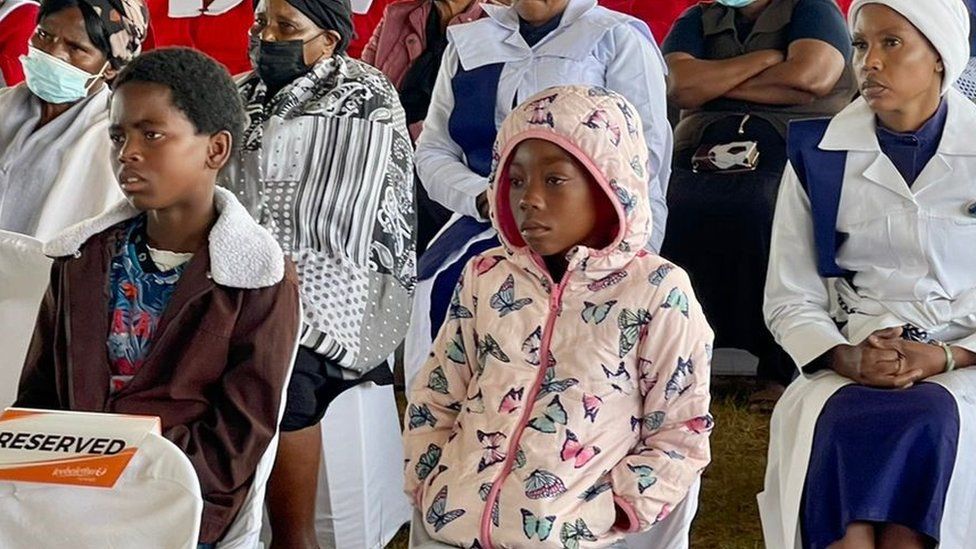
    Inside a white tent on a hillside just outside Pietermaritzburg, hundreds of people sit with their heads bowed before six coffins. A sombre church hymn pierces through the heavy silence.

    The unimaginable happened to the Mdlalose family. Slindile Mdalose, 43, and nine children aged between two and 10 years were killed in the floods that devastated KwaZulu-Natal in the most deadly natural disaster in the country’s history.

    They were sleeping when the violent water washed through, flattening their home. It has been three weeks and some of the bodies are yet to be recovered

    “To tell you the truth we are mad, we are numb. We can’t use our heads. This is too much to even comprehend,” the children’s uncle, Thokozani Mdlalose tells the BBC.

    He is wearing tinted glasses to conceal his pain but his cracking voice and quivering lip betray his struggle to keep his composure.

    “When you have to split your grief, you think of this one, you think of that [one]. It’s too much. It’s hard losing one person. It’s worse losing two. Ten is something else,” he says.

    Mourners at funeral
    Image caption, Family and friends have been mourning the death of 435 people in the floods

    The mass funeral of Slindile Mdalose and her five children – Uyanda, Lubanzi, Ziyanda, Asanele, Lulama – took place on a cool morning. She was also the aunt of four more children, who are still missing.

    “Knowing that we haven’t found them, that they might be decomposing somewhere out there – words can’t describe what is inside me right now. I can’t even gather my thoughts,” Mr Mdlalose says.

    He adds that the nine children were playful and full of laughter, and brought joy to the whole family.

    Their aunt, Nonkululeko Mdlalose, says when she last spoke to her sister on the phone just hours before they died, she could tell that her sister was afraid.

    It was raining heavily, unlike anything either of them had ever seen before. Still, they did not expect that it would lead to disaster, Nonkululeko Mdlalose says.

    “I’ve never felt this kind of pain. I thought I was a strong person but I realise that I’m not, that we will need help, I realise we will need counselling. This is too much for anyone to bear,” she adds.

    They are not the only ones grieving. The floods killed 435 people, and dozens of victims are still missing, leaving their families in unbearable limbo.

    Less than 200 have been buried so far, and at least 59 bodies remain unclaimed in mortuaries.

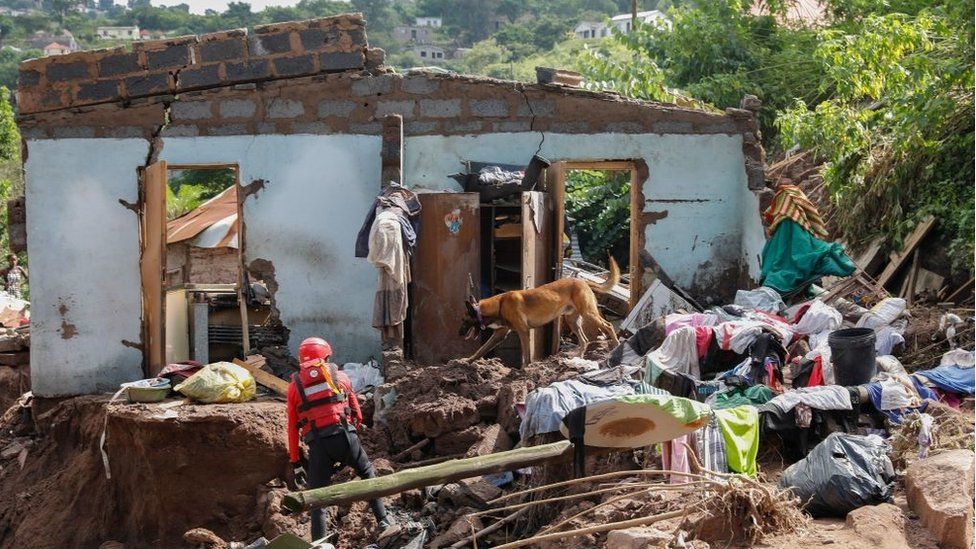
    A member South African Police Services (SAPS) Search and Rescue Unit guide their sniffer dog during search efforts to locate ten people who are unaccounted for from area of KwaNdengezi township outside Durban on April 15, 2022 after their homes were swept away following the devastating rains and floodingIMAGE SOURCE, GETTY IMAGES
    Image caption, Sniffer dogs have been used to find bodies buried under rubble

    Icebolethu Funeral Services, one of the biggest funeral homes in KwaZulu-Natal, has so far buried more than 70 victims.

    One of its managing executives, Mthokozisi Bhengu, says corpses are not in a good state because they had been submerged in water, and they need to be buried quickly to avoid their condition worsening.

    “Families have cultural practices they would like to follow, like burying everyone in a family at the same time but we’ve had to persuade those whose loved ones are still missing that whilst they’re still searching for the others, let us continue and bury the ones in the morgues and preserve their dignity,” he adds.

    In the case of unclaimed bodies, funeral parlours say, there is no consensus yet on what to do with them.

    One option being considered by officials is to extract their DNA and store the information, so that family members, if they ever come looking for their loved ones, can be taken to their graves – something that will hopefully give them some closure.

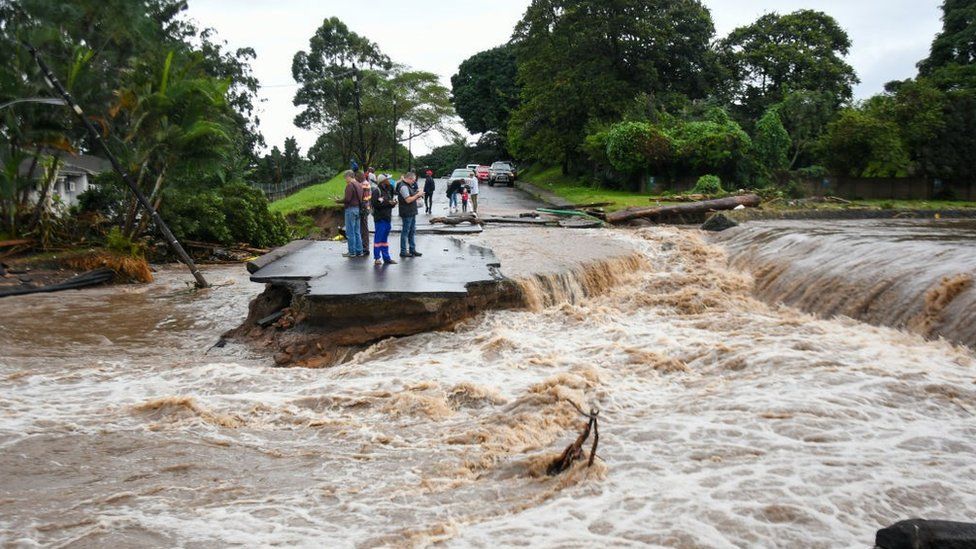
    Part of Caversham road in Pinetown has been washed away on April 12, 2022 in Durban, South AfricaIMAGE SOURCE, GETTY IMAGES
    Image caption, The government declared the floods a national disaster

    The government and private donors have offered help to cover funeral costs but the claims process is said to be bureaucratic and slow, leading to further delays with burials.

    The head of the South African Funeral Parlour Association, Nomfudo Mcoyi, says the delays could have been avoided.

    “In future, the government should bring in industry experts from the beginning in a crisis. Let us tell you how best to do this,” she says.

    Ms Mcoyi adds that the delays are causing more trauma and stress for families.

    “We could have done it [the burials] easily without bodies decaying,” she says.

    Back at the funeral on a hill, KwaZulu-Natal premier Sihle Zikalala said the government was working to help all those in need.

    On rebuilding homes for families such as the Mdlaloses, he said the government was working on identifying suitable land to house new settlements for the displaced. Thousands of people have been left homeless and are living in shelters across the province.

    “The task of rebuilding KwaZulu-Natal cannot be achieved by our caring government alone. It requires that we entrench the new spirit of solidarity and patriotism that we have seen in our province,” he told the crowd.

    President Cyril Ramaphosa has acknowledged that more funds are needed than the initial $68m (£55m) set aside to rebuild KwaZulu-Natal and all that’s been lost.

    It’s a long road ahead for many people here – from those who’ve lost family to those who lost their homes or livelihoods. As the true picture of the devastation caused by the floods emerges, many will need all the help they can get.

    Source: BBC

  • Durban floods: South Africa floods kill more than 300

    The death toll in the South African province of KwaZulu-Natal has reached more than 300, after devastating floods wreaked havoc in the area.

    A state of disaster has been declared in the area, after some areas saw months worth of rain fall in one day.

    Officials have called it “one of the worst weather storms in the history of our country”.

    Mudslides have trapped people under buildings, with more floods expected.

    There are reports that the rescue effort is being hampered by poor visibility as a helicopter continues to bring people back to safety.

    On Tuesday the BBC witnessed one such search operation for a 10-year-old girl who was part of a family of four swept away on a flooded bridge.

    Community volunteers waded into the muddy river, taking turns to hack away at the branches using machetes and removing debris and rubbish that had washed downstream.

    Jomba Phiri, who lives in the region’s main city, Durban, said his house had been swept away in the floods.

    “I don’t know where we’re going to sleep now,” he told Reuters news agency.

    Parts of the crucial N3 highway which connects Durban to South Africa’s economic heartland of Gauteng province have been blocked.

    President Cyril Ramaphosa has visited the area and pledged to help.

    “Even though your hearts are in pain, we’re here for you,” the Reuters news agency quotes him as saying.

    He also described the disaster as a “force of nature”, which some have disagreed with. They blame poor drainage and badly built houses in low-lying areas for the high death toll.

    The KwaZulu-Natal province says it needs more funds to fix the extensive damage
    There are still several people missing, trapped under debris and rubble

    Durban Mayor Mxolisi Kaunda denied that poor drainage was to blame, saying the scale of the flood was unexpected.

    Scenes of destruction are still evident throughout the area. Some of the roads to the port of Durban, one of the busiest in Africa, are impassable after the swollen river washed mud and debris onto the roads.

    Operations at the port have now been suspended. A shipping container warehouse near a busy highway was severely flooded, and hundreds of containers were washed away.

    In an industrial area called the Bluff, which forms part of the port, the BBC witnessed cars overturned on the road, or crushed by debris. Companies are using water pumps to drain the water from their premises.

    There is also a hunt for crocodiles that were washed away during the floods, although most have since been found.

    Crocodile Creek Farm, about 40km (25 miles) north of Durban in Tongaat, says 12 crocodiles were swept away after torrential rain hit the area.

    Ron Naidoo, a community pastor in the town of Tongaat, told the BBC he had been kept awake through the night by the rising floodwaters and had seen police drag a car out of the river with a body inside.

    “It was traumatic because it is the first time that we have seen the river rise so high here,” he continued.

    There are mounds of debris strewn across affected areas

    The KwaZulu-Natal provincial government estimates that billions of rand worth of damage has been caused to properties and infrastructure, describing the heavy rains as unleashing “untold havoc” in a statement on Facebook.

    Electricity and water treatment plants have been “flooded out”, the Durban mayor told the BBC.

    Communications have also been disrupted with two major networks reporting that more than 900 of their cell phone towers are down.

    Declaring the flood-stricken area a disaster zone will “enable the province to apply for emergency funding” from the National Treasury and assist with necessary reconstruction work, authorities say.

    There are also reports of looting in Durban, which the local government has condemned: “We will not allow what is a tragic development in our province to be taken advantage of,” it said.

    The government is calling on people to stay safe by avoiding flooded roads and bridges and to evacuate to higher ground if they live in low-lying areas.

    The stormy weather comes as scientists warned that climate change is fuelling heavier rainfall than usual in southern Africa.

    At the start of the year, the region was hit by three cyclones and two tropical storms in six weeks, which primarily affected Madagascar, Mozambique and Malawi and inflicted widescale damage with 230 reported deaths according to the World Weather Attribution (WWA).

    There have been incidents of looting in Durban

    Source: bbc.com 
  • South Africa President reportedly tests positive for COVID-19 days after Ghana visit

    South African President, Cyril Ramaphosa was in Ghana from 3rd to 5th December 2021, for a State Visit.

    His two-day stay in the West African nation was at the invitation of His Excellency, Nana Addo Dankwa Akufo-Addo.

    The State Visit to Ghana was directed towards enhancing bilateral relations premised on mutual respect, commitment to democracy, good governance, rules-based multilateralism underpinned by the rule of law, respect for human rights and fundamental freedoms.

    However, barely one week after leaving Ghana, it has emerged that Mr. Ramaphosa has tested positive for COVID-19.

    He is currently receiving treatment for mild symptoms after testing positive on Sunday, December 12, 2021, the office of the Presidency said in a statement.

    He is self-isolation in Cape Town, the statement disclosed.

    Mr. Ramaphosa has immediately delegated all responsibilities to Deputy President, David Mabuza for the next week.

    The presidency statement said he “started feeling unwell after leaving the State Memorial Service in honour of former Deputy President FW de Klerk in Cape Town earlier today,”

    He is, however “in good spirits” and is being monitored by the South African Military Health Service of the South African National Defence Force.

    The statement added, “President Ramaphosa says his own infection serves as a caution to all people in the country to be vaccinated and remain vigilant against exposure. Vaccination remains the best protection against severe illness and hospitalization.”

    Source: ghanaguardian.com

  • Video replays show South Africa defender dragging Ghana’s Amartey with both hands

    Close video replays have shown that South African defender Rushine de Reuck dragged Ghana’s Daniel Amartey with BOTH HANDS which resulted in the referee awarding a penalty kick to the Black Stars in their decisive 2022 World Cup qualifier on Sunday.

    The evidence which has now been closely watched suggests that the Bafana Bafana player clearly fouled the Leicester City defender leading to the Senegalese match official pointing to the spot kick which sealed the victory for the Black Stars.

    The video from several replay angles show that referee Maguette Ndiaye had, just before the penalty decision, warned Reuck of his earlier infringement before the corner kick. The Senegalese referee was closely watching the two players from just two metres just before the corner kick and clearly saw the South African pulling Amartey down.

    Initial video of the incident was inconclusive which led to the South African Football Association (SAFA) claiming that hey had been robbed during the game at the Cape Coast Stadium which ended 1-0 after Andre Ayew expertly converted the kick.

    SAFA raised concerns over the legitimacy of both the decision and the display of the officiating team from Senegal, headed up by referee Maguette Ndiaye.

    But it is now clear that the penalty was awarded after Ghana’s Leicester City midfielder Daniel Amartey went down following the heavy pulling down from defender Rushine de Reuck, who was booked for his challenge.

    Bafana Bafana needed a draw to reach the third and final round of African qualifying for the 2022 World Cup, but Ghana won with a controversial penalty.

    The Black Stars’ narrow win enabled them to reach the African World Cup play-offs by the narrowest of margins, ousting South Africa at the top of the group on goals scored.

    South Africa is well aware that the capacity for matches to be replayed does exist before have been shouting ‘foul play’ but with video evidence now showing that the player pulled Amartey down he could not coil back into their shells.

    Source: ghanasoccernet.com

  • 2022 World Cup qualifiers: How every Ghanaian player performed against South Africa

    Ghana captain Andre Ayew scored on his 100th cap for the Black Stars to send Ghana through to the final phase of the 2022 World Cup qualifiers.

    The South Africans arrived in Cape Coast leading the Black Stars three points and needing a draw to seal progressing but a resolute performance from the Stars saw the team grind out a 1-0 victory to steal the only slot available in group G.

    With several players stepping up and playing above themselves, below is how GHANAsoccernet.com rated every Ghanaian player.

    Wollacott Joseph – 7

    The Swindon keeper was very composed in post today. He commanded the defence well and did well to handle few aerial balls into his box.

    Andy Yiadom – 6

    The Reading Right back had his best game in Ghana shirts. He contributed little offensively, he was great in defence especially in the dying minute when his timely block stopped a South African player from having a shot at goal.

    Baba Rahman – 7

    The experienced left-back did put in a good shift at the back. Even when he looked exhausted he played above him to win crucial tackles.

    Daniel Amartey – 8

    The central defender won the all-important penalty which was converted by Andre Ayew. He was a monster at the back.

    Alexander Djiku – 7

    The giant defender answered all questions thrown at him. He was brave, effective and timely.

    Baba Iddrisu – 6

    He was the quietest of the two defensive midfielders but did his job well on the night

    Wakaso Mubarak – 7

    As expected, Wakaso is made for this kind of game and he did what was expected of him. He played his heart out like his life depended on the 3 points.

    Kudus Mohammed n/a He was subbed off injured after 12 minutes.

    Andre Ayew – 7

    The Captain led by example and scored the all-important penalty in a tension-packed game.

    Jordan Ayew – 7

    Jordan did everything right tonight except scoring. His runs and hold-on play helped the team when the South Africans poured more men forward,

    Kamaldeen Sulemana – 7

    He had a quiet first half but was in full force in the 2nd half taking on opposition players for fun. He needs to be more efficient though.

    Kofi Kyereh – 6

    His well-taken corner kick led to the penalty which fetched the Blackstars the all-important win. He missed a sitter when the game was 0-0.

    Source: ghanasoccernet.com

  • Oscar Pistorius parole process to start in South Africa

    South African Paralympic athlete Oscar Pistorius, in prison for murdering his girlfriend Reeva Steenkamp, may soon meet her parents as part of the process leading to parole being considered, officials say.

    He is eligible for possible release after having served half his sentence.

    But he first has to take part in what is called “restorative justice”.

    Pistorius shot Steenkamp dead in 2013 saying he mistook her for a burglar at his home in the capital, Pretoria.

    The 34-year-old fired four times through a locked toilet door.

    In 2014, at the conclusion of a trial that was followed around the world, he was given a five-year term for manslaughter. But Pistorius was found guilty of murder on appeal in 2015 and the sentence was later increased to 13 years and five months.

    In a statement, South Africa’s department of correctional services said it was talking to the Steenkamp family about a possible meeting.

    Outlining what needs to happen before parole is considered, the statement says that offenders must “acknowledge and take responsibility for their actions”.

    As part of the restorative justice process, there has to be “an opportunity for parties to reconcile or an apology”.

    The Steenkamps’ lawyer, Tania Koen, told national broadcaster SABC that they “would like to participate in the victim-offender dialogue”.

    “June [Steenkamp, Reeva’s mother] has always said that she has forgiven Oscar, however that doesn’t mean that he mustn’t pay for what he has done… Barry [Steenkamp, Reeva’s father] battles with that a bit, but that is something he will have to voice at the appropriate time,” Ms Koen added.

    “The wound, even though so much time has passed, is still very raw.”

    Being eligible for parole is not the same as being entitled to it and so it is not a forgone conclusion that he will be released, the lawyer said. The authorities will also have to consider a number of reports written by prison officials as well as other professionals.

    There had also been some confusion over when the parole process could begin.

    It was widely believed that it would not be until March 2023, but the Steenkamps were “very shocked and quite taken aback” that he was already eligible, Ms Koen said.

    The BBC’s Pumza Fihlani in Johannesburg says that if granted parole, Pistorius would serve the remainder of his sentence at home and need to report to prison officials regularly.

    Prior to the murder, Pistorius had become well known as a Paralympic gold medallist. In 2012, he made history by becoming the first amputee sprinter to compete at the Olympics running on prosthetic “blades”.

    His legs were amputated below the knee when he was 11 months old because he was born without fibula bones.

    line

    Rise and fall of Oscar Pistorius

    • August 2012: Competes in London Olympics and Paralympics, where he won a gold medal
    • February 2013: Shoots dead his girlfriend Reeva Steenkamp
    • March 2014: Trial begins
    • September 2014: Judge finds Pistorius guilty of culpable homicide
    • October 2014: Begins five-year sentence
    • October 2015: Transferred to house arrest
    • December 2015: Appeal court changes verdict to murder
    • July 2016: Sentenced to six years in jail for murder
    • November 2017: Sentence more than doubled to 13 years, five months

    Source: bbc.com

  • South Africa delighted over absence of England-based players in Ghana squad for AFCON qualifier


    South Africa are thanking their stars over the unavailability of the England-based players in the Ghana squad for the 2021 Africa Cup of Nations qualifiers.

    The Black Stars will be without Andre Ayew and his brother Jordan Ayew and Arsenal star Thomas Partey.

    Due to the COVID-19 restrictions in the United Kingdom, the trio can only play for Ghana against Sao Tome and Principe on Sunday.

    The Ayew brothers and Partey will require a mandatory 10-day quarantine on their return to UK if they travelled to South Africa for the match.

    The Bafana Bafana will host the Black Stars at the FNB Stadium in Johannesburg on Thursday in a matchday five fixture.

    Ghana are topping the standings in Group C with goals difference advantage over South Africa who are also on 9 points.

    Sudan are lying 3rd on the log with 6 points whilst Sao Tome and Principe languish bottom with no single victory from four matches.

    Source: Ghana Soccernet

  • Black Stars depart Ghana for South Africa

    The Black Stars will depart Accra for Johannesburg today March 23, 2021, for their Africa Cup of Nations qualifier against South Africa.

    Twenty players are currently in camp in Accra while six others are expected to arrive from Europe this evening.

    Baba Abdul Rahman, Mohammed Kudus, Osman Bukari, Nicholas Opoku, Emmanuel Lomotey, and Kwasi Okyere Wriedt will join the rest of the squad in Ghana before they leave the country.

    Orlando Pirates goalkeeper Richard Ofori will also join his colleagues in Johannesburg when they land in South Africa.

    Captain Andre Ayew, forward Jordan Ayew, and midfielder Thomas Teye Partey who will not be part of the contingent to South Africa will join the squad later for the final game against Sao Tome and Principe.

    Ghana will play South Africa on Thursday, March 25 in Johannesburg, before hosting Sao Tome and Principe in Accra on March 29.

    The Black Stars sit at the top of Group C with 9 points after four games and a win in their remaining two games will see them in the 2022 Africa Cup of Nations in Cameroon.

    Below is the full squad:

    Goalkeepers: Richard Ofori (Orlando Pirates South Africa), Razak Abalora (Asante Kotoko – Ghana), Eric Ofori Antwi (Medeama SC – Ghana), Danlad Ibrahim (Asante Kotoko- Ghana).

    Full Backs: Baba Abdul Rahman (PAOK Greece), Benson Annan (MLK Zilina Slovakia), Philemon Baffuor (Dreams FC Ghana), Imoro Ibrahim (Asante Kotoko).

    Central Defenders: Nicholas Opoku (Amiens SC France), Ganiyu Ismael (Asante Kotoko Ghana), Joseph Adjei (Legon Cities), Yussif Mubarik (Asante Kotoko).

    Central Midfield: Kudus Mohammed (Ajax Amsterdam Holland), Mubarak Wakaso (Jiangsu Suning F.C – China), Afriyie Acquah (Yeni Malatyaspor – Turkey), Emmanuel Lomotey (Amiens SC – France), Gladson Awako (Great Olympics -Ghana), Justice Blay (Medeama SC – Ghana), Kwame Afriyie Poku (Colchester United England).

    Left Attacking Midfield: Osman Bukari (Gent Belgium), Joseph Esso (Dreams FC- Ghana).

    Attackers: Emmanuel Boateng (Dalian Professional- China), Emmanuel Gyasi (Spezia Italy), Kwame Opoku (Asante Kotoko Ghana), John Antwi (Pyramids FC Egypt), Kwasi Okyere Wriedt (Willem II Holland), Caleb Ekuban (Trabzonspor Turkey).

    Source: Ghana Guardian

  • South Africa’s powerful Zulu nation appoints Queen as interim leader

    South Africa’s powerful Zulu nation has a new ruler — for now, according to local media outlets.

    eNCA quoted palace sources as confirming that Queen Mantfombi MaDlamini Zulu has been named as interim successor in the late King Goodwill Zwelithini’s will.

    This is until the queen decides who will take over as Zulu monarch, the report added.

    The sister of King Mswati the third, Queen MaDlamini married King Zwelithini in 1973.

    The King was buried – in Zulu tradition ‘planted’ – on Thursday, March 18 after a colourful ceremony. The burial was a nighttime and men-only event according to Zulu tradition.

    Source: www.ghanaweb.com

  • Scientists see new evidence South African variant binds more readily to human cells

    Scientists have new biological evidence that the so-called South African coronavirus variant binds more readily and strongly to human cells, making it more infectious, top local epidemiologist Salim Abdool Karim said on Monday.

    He was speaking at a presentation of research into the variant, known as 501Y.V2, by a team of scientists. The variant was identified by South African genomics experts late last year.

    It drove local COVID-19 infections to a new daily peak above 21,000 cases earlier this month.

    British scientists and politicians have expressed concern that vaccines currently being deployed or in development could be less effective against the South African variant. It has more than 20 mutations including several in the spike protein the virus uses to infect human cells.

    But Abdool Karim said there was as yet no answer to that question, although scientists around the world were working on it.

    South African experts have said that since vaccines induce a broad immune response it is unlikely that the mutations in the spike protein would completely negate the effect.

    Source: reuters.com

  • Maxwell Konadu on radar of South African PSL side – Report

    Asante Kotoko Head Coach Maxwell Konadu has appeared on the radar of ambitious South African PSL side TS Galaxy FC, FMIG can exclusively reveal.

    The Rockets are on the lookout for recruitments that bolster their technical department as they make their debut in the South African Premier Soccer League.

    TS Galaxy FC have identified the astute gaffer as the main man to drive forward their ambitions from the dugout and are keen to engage his services.

    FMIG sources reveal that a formal approach is expected to be made during the next few days with talks expected to travel into the festive period.

    Should an agreement be reached, Maxwell Konadu is expected to cut short his stay at Asante Kotoko and make the move to South Africa.

    Konadu, a former Black Stars assistant Coach has a running contract with Asante Kotoko and is currently steering their CAF Champions League and Ghana Premier League dream steadily on the pitch.

    However, his deal with the Porcupine Warriors per FMIG checks runs out at the end of the current campaign.

    TS Galaxy FC who are keen on securing his services are willing to offer him a long term deal.

    TS Galaxy FC, established in 2015 is owned by Tim Sukazi and is based in Kameelrivier near Siyabuswa (Mpumalanga), South Africa.

    Until 2018, the club had been playing in the third tier level of the South Africa Football pyramid.

    In 2019, they made history by qualifying to the CAF Confederation Cup after they giant-killed Kaizer Chiefs to win the Nedbank Cup (their inaugural trophy).

    Source: footballmadeinghana.com

  • Huge jump in South Africa’s economy

    South Africa’s grew by 13.5% between July and September this year, the country’s statistics agency has just reported.

    This growth comes after a 17% contraction in the second quarter of the year, which has been put down to measures imposed to contain the spread of coronavirus.

    That was the fourth quarterly contraction in a row.

    Today’s figures show that the economy is bouncing back and if this rate was repeated through the year it would amount to a 66.1% increase.

    But South Africa’s economy was still 6% smaller in September 2020 than it was 12 months earlier.

    Source: bbc.com

  • South Africa school cleared of racism allegations

    The education department of South Africa’s Western Cape province has cleared Brackenfell High School of racism allegations made against its administration.

    The row centred on a graduation party to which it was alleged that only white people were invited.

    A provincial official, Debbie Schäfer, said the party had not been organised by the school but was a private event which had a 100-guest limit because of Covid-19 regulations.

    The allegation caused an uproar online and the Economic Freedom Fighters party, held demonstrations outside the school in Cape Town.

    But Brackenfell High distanced itself from the party and rejected accusations that it discriminated against black students.

    Source: bbc.com

  • South Africa fears a resurgence of coronavirus as localised outbreaks drive infections

    The emergence of new outbreaks in several parts of South Africa has raised fears of a resurgence of the coronavirus, which could be encouraged by the expected gatherings during the festive season.

    Authorities in the African country officially most affected by Covid-19 have been struggling to control the number of outbreaks since an increase was reported in November in the neighboring Eastern and Western (Southern) Cape provinces.

    Nationally, the daily number of new cases has surpassed 3,000, a 50% jump from an average of 2,000 earlier in November.

    More than half of this increase came from infections in the Eastern Cape and about 25% from the Western Cape Province.

    “The small outbreaks we are seeing right now are temporary. Something must be done,” Health Minister Zweli Mkhize said last week.

    The rate of coronavirus transmission in South Africa had dropped sharply after peaking in July, with fewer than three cases detected daily per 100,000 people between late August and early November.

    But the lull was short-lived, and authorities are now trying to combat a possible resurgence of the epidemic.

    “We are not in the second wave but in these two provinces (…) we are in full resurgence,” commented the government adviser in charge of the fight against the coronavirus, Salim Abdool Karim.

    If these new epidemic outbreaks are not contained, it is “only a matter of time” for the whole country to be affected, he warned.

    In the Eastern Cape’s largest city, Port Elizabeth, hospitals are already struggling with the rebound of the epidemic, although local authorities say the situation is under control.

    ‘Chronic shortages’

    Still reeling from the shock of the first wave, the health services requested assistance from the NGO Médecins Sans Frontières (MSF) in three public facilities.

    “The hospitals are really overwhelmed with a large number of patients, some even say more than in July,” said an MSF official for the province, Dr. Colin Pfaff.

    “The facilities are understaffed,” he added, criticizing “chronic shortages” and citing contamination among medical staff.

    Private facilities are also affected.

    “Our hospitals in the Eastern Cape are incredibly full at the moment,” Richard Friedland, head of South Africa’s largest private medical network, Netcare, told AFP last week.

    “We still have the capacity to treat new cases” with the installation of additional beds, he assured nevertheless.

    While the provincial government assures that hospitals are neither “full” nor “overwhelmed”, the South African Physicians Association accused the Department of Health this week of not providing adequate support to “overwhelmed” staff.

    South Africa has recorded 792,000 cases, including more than 21,600 deaths, for a population of nearly 58 million people.

    President Cyril Ramaphosa has ruled out a new lockdown at this stage.

    The stringent infections which came into effect at the end of March have seriously affected the economy of the most industrialized country on the continent, causing 2.2 million people to lose their jobs.

    The pressure to prevent a second wave is heightened by the prospect of the festive season when millions of people will travel to all the provinces to celebrate Christmas with their loved ones.

    Hopes also rest on the prospect of a vaccine.

    “The evidence that an effective coronavirus vaccine is possible brings hope,” President Ramaphosa commented recently.

    South Africa is currently conducting three clinical trials, and experts are hoping for first vaccinations in mid-2021.

    “Ideally, we would like to vaccinate 70-80% of the population, but this is not going to happen quickly,” warned Shabir Madhi, who is leading two of the three vaccine candidate trials, citing logistical and cultural challenges.

    But even 30-40% of the adult population “would help us a lot,” he added.

    Source: africanews.com

  • Ex-South Africa midfielder Anele Ngcongca killed in car crash

    Former South Africa midfielder Anele Ngongca has been killed in a crash.

    The 33-year-old, who played for Bafana Bafana at the 2010 World Cup, died at the scene of the accident as he was driving between Johannesburg and Durban in South Africa.

    Ngcongca was travelling to Durban to meet up with his new AmaZulu team-mates, who he was joining on loan from Mamelodi Sundowns.

    He had helped Sundowns win a third straight Premier Soccer League title last season.

    The two clubs released a joint statement confirming the death and paying tribute to Ngcongca.

    “AmaZulu and Mamelodi Sundowns FC extend their deepest condolences to the Ngcongca family, former clubs, teammates, supporters and the broader football fraternity as well as everyone who was touched by the life of this exceptional football ambassador,” the announcement read.

    His career included nine years with Belgian club Genk for whom he made more than 200 appearances, his final season was spent on loan in France with Troyes.

    At international level as well as playing at the World Cup he was part of the Bafana Bafana squad for both the 2013 and 2015 Africa Cup of Nations finals.

    Source: BBC

  • Zuma before commission probing corruption claims

    Former South African president Jacob Zuma on Monday appeared before a state commission investigating serious allegations of corruption during his tenure as head of state between 2009 and 2018.

    It was the first time Zuma had appeared before the judicial inquiry since he abandoned his testimony at the hearing more than a year ago.

    The commission has no powers to prosecute, however other law enforcement agencies may follow up on information revealed at the commission and pursue criminal cases against those implicated.

    Zuma was forced to step down from his position as president in 2018 by his African National Congress party amid allegations of fraud and corruption.

    On Monday he launched an application for the chairman of the commission, Deputy Chief Justice Raymond Zondo, to recuse himself from the inquiry, claiming Zondo was biased against him because they used to be close friends.

    Responding during Monday’s proceedings, Zonda admitted to having a “cordial relationship” with Zuma, but said the claim they were friends was “not accurate”.

    Source: africanews.com

  • Meet the Ghanaian innovator helping South Africa to apply for the fourth industrial revolution technology

    The Famous Fiber Optics inventor Dr Thomas Owusu Mensah is helping South Africa apply the Fourth Industrial Revolution Technology to enhance all areas of its Economy. These include Power Generation and Distribution, Agriculture and Food Security, Water Management, Mining and Minerals, Aerospace and Defense, Transportation, Tourism, Culture and Music, Finance and Banking, National Security, Advanced Manufacturing, and Government Administration.

    Dr Thomas Mensah, a World Icon in Technology was appointed to the 4 IR Board by the Premier of Gauten, HE. David Makhura, who met him in New York and invited him to tour all the Innovation Centers in South Africa, which he has successfully done and added value.

    Dr Mensah Participated in the Fourth Industrial Revolution Board Deliberation virtually from Ghana, on Tuesday, 28 October, 2020, where he promoted Advanced Drone Technology in Agriculture, and to support COVID-19 Testing. He also suggested the use of 4 IR in Transportation across South Africa to support the Intercontinental Free Trade Agenda.

    The President of South Africa, His Excellency Cyrill Ramaphosa, who is Chairman of the Africa Union has made as his key objective -the creation of two million jobs in South Africa through this Fourth Industrial Revolution effort and is on his way to realizing this objective.

    South Africa has become a Global Leader in the 4 IR being the first country on the African Continent to totally embrace it and apply it to all sectors of its Economy.

    Dr Thomas Mensah is the author of 5 Books on Innovation including the International Textbook- Nanotechnology Commercialization and Fiber Optics Engineering. He is a Fellow of the National Academy of Inventors, USA and has served on the MIT Visiting Committee, Advisory Board in the United States.

    Source: Charles Ntiamoah-Mensah, Contributor

  • Infrastructure development set to help turn around economy – South African President

    Infrastructure development projects were set to play an important role in turning around South Africa’s stagnant economy, President Cyril Ramaphosa said on Tuesday at the opening of a hotel and conference centre in Johannesburg east.

    He said the government planned to focus on new infrastructure developments, a move which would be critical in job creation.

    “Our economy has been plunged into turmoil, people have lost their jobs and many promising investments have been put on hold or shelved,” he said. “Fast-tracking infrastructure projects-both public and private-is critical if we are to get the wheels of economic activity turning again.”

    He said while the economy had suffered due to the pandemic, he was optimistic of growth. “It is vital that we do so to recover the jobs that have been lost during the pandemic and create new ones,” he said, adding that as much as the country needed foreign investment, local investors should take a lead.

    President Ramaphosa earlier unveiled a nine-meter statue of OR Tambo in Kempton Park, where he mentioned that both events would attract tourists to the country.

    “I do not doubt that having now opened your doors, you will soon be attracting business travellers, domestic travellers and residents of the city,” he said.

    Source: GNA

  • 444 candidates to contest in South African by-elections

    A total of 444 candidates from 40 political parties will contest the by-elections in 95 wards on November 11, said the Electoral Commission of South Africa (IEC) on Tuesday when giving an update about the local government by-elections.

    “A total of 444 candidates, including 19 independent candidates, were certified as contestants for the by-elections by the Electoral Commission yesterday. Of the candidates, 305 (69 percent) are male and 139 (31 percent) are female,” said IEC spokesperson, Kate Bapela.

    She said that voters, election staff, and all those entering the voting station will be required to wear a mask at all times. Bapela, therefore, encouraged voters to bring their own pens to mark their ballot papers, although pens will be provided and sanitized after each use.

    “The by-elections will be held under strict new COVID-19 protocols aimed at ensuring the safety of voters, election staff, party agents, observers and other stakeholders. These include implementing strict social distancing practices outside and inside voting stations along with the use of hand sanitisers as voters enter and exit the voting station,” she said.

    The by-elections are held about a year before the local government elections to fill vacant posts resulting from death, resignation, expulsion and other reasons. They were postponed from March because of the COVID-19.

    Source: GNA

  • Mozambique ‘unaware of South Africa border wall plan’

    The Mozambican authorities say they have not yet received official information from South Africa on a reported plan to construct a wall on their common border.

    Foreign Affairs Minister Verónica Macamo said over the weekend that she had only seen the reports on media.

    The land border between the two countries measures approximately 490 kilometres (304 miles) long.

    Ms Macamo said the Mozambican authorities would discuss the matter with their South African counterparts once an official communication was made.

    Source: bbc.com

  • Former SA president to testify in court over corruption allegations

    Former South African president, Jacob Zuma, was ordered on Friday by a judicial panel to testify next month over allegations of state corruption during his nine years in office.

    The badgered politician is obligated to appear in court before a commission — chaired by deputy chief justice Raymond Zondo and set up in 2018 to hear testimony from ministers, ex-ministers, government officials and business executives on alleged corruption under Zuma’s rule and despite his plea that the judge was biased against him.

    Zuma, who came into power in 2009, was forced to resign in February 2018 over graft scandals linked to a prominent Indian business family, the Guptas, who won lucrative contracts with state companies and were allegedly even able to choose cabinet ministers.

    According to the commission’s advocate Paul Pretorius, Zuma has been directly and indirectly implicated Zuma by at least 34 witnesses thus far.

    “It is important for Mr Zuma to appear before the commission as most of the corruption alleged took place when he was the country’s president,” Pretorius said.

    Zuma has repeatedly refused to testify to the commission, most recently last month when he claimed he was too ill.

    The subpoena came just weeks after the scandal-tainted former president hit out at the commission chairman, requesting that he recuse himself as he was partisan.

    Source: africanews.com

  • White South African farmers stage angry protest over rural violence

    The Union Building lawns in Pretoria, South Africa were covered by several hundred mainly white farmers — some carrying flags and crosses, in angry protest on Saturday of the perceived lack of government response to the assaults and murders on farms in the rural parts of the country.

    The event organiser, Kallie Roux, shared a few words, “President Ramaphosa must stand up and firstly acknowledge that there are farm murders in South Africa, and he mustn’t say to the world that this doesn’t happen, because it happens. And after he admits this I want him to condemn it. He must strongly condemn it because then we will get somewhere because if the government doesn’t stand up we must stand up ourselves.”

    A 21-year-old white farmer, Brendin Horner, was found hanging from a pole on October 2 near Paul Roux, South Africa — his corpse showing visible evidence of torture. Consequently, around 3,000 angry white farmers stage demonstrations all over the country on the same the two murder suspects appeared in court in Senekal, on October 6.

    Barend Pienaar, a white farmer present at the October 10 protest is furious, “They (murderers) take pangas, they take spades, they take bottles, they take anything they can get their hands on and then they kill us like that. Just like that. We are not animals. We are a proud people. Don’t push us too far.”

    Post-apartheid racial tensions originating from agricultural land distribution disparities between white and black farmers have been a longstanding national issue in South Africa.

    There was a farmland distribution objective in 1994 i.e. 30% of white-owned farmland to the disenfranchised black farmers as a way to equilibrate the deep racial inequality lingering from the Apartheid regime. However, national statistics show that in 2017 the white minority — which makes up 9% of the country, still held 72% of the agricultural land.

    Hence in 2018, South African President Cyril Ramaphosa communicated his intention to amend the constitution to accelerate the uncompensated expropriation of arable land and its redistribution to the country’s black and disadvantaged population.

    An unpopular decision amongst white farmers that saw already-existing tensions rise.

    https://twitter.com/twatterbaas/status/1313387047995015169

    Source: africanews.com

  • South Africa opens borders to African countries, limits others

    South Africa will reopen its borders to all African countries from Thursday while barring tourists from around 50 nations with high coronavirus infection rates, the government said on Wednesday.

    The continent’s most industrialised economy shuttered its borders at the start of a strict nationwide lockdown on March 27 to limit the spread of the virus.

    Restrictions on movement and business have been gradually eased since June, but borders stayed sealed to avoid importing the virus from abroad.

    Foreign Minister Naledi Pandor said the country would “gradually” open borders, but that restrictions were in place for around 50 countries categorised as high risk include Britain, the US, India, Russia and France.

    “Only business travellers with scarce and critical skills, diplomats, investors and professional sports people coming for events from the high-risk countries will be permitted into the country,” she said.

    Meanwhile, “travellers from all African countries are allowed,” Pandor added.

    The country will reopen some land borders and its three main airports in Cape Town, Durban and Johannesburg.

    All travellers will be required to present a negative coronavirus test taken less than 72 hours prior to departure.

    They will be screened upon arrival and asked to install a coronavirus tracing app on their mobile phone.

    The travel restrictions will be reviewed every two weeks.

    South Africa has been particularly hard-hit by the coronavirus pandemic, with 672,572 infections and 16,667 deaths recorded to date, around half the total number of cases detected on the continent.

    The countries with restrictions have a greater number of infections and deaths compared with South Africa, Pandor said.

    Source: africanews.com

  • About 500 pupils quarantined in South Africa

    About 500 pupils have been put into quarantine after a coronavirus outbreak at a school in South Africa’s Eastern Cape province.

    A total of 98 pupils tested positive at the secondary school in the town of Burgersdorp, and officials say they fear the virus may have spread more widely into the community.

    The authorities say the outbreak started when two students who had tested positive failed to inform the school, and blame a lack of mask wearing and social distancing.

    Source: bbc.com

  • SA lawyer suspended for calling judge stupid

    A lawyer in South Africa has been suspended for calling a judge “stupid”, according to the Times Live new site.

    Rembuluwani Gadabeni is said to have made the comment earlier this month and later refused to back down, IOL reports, saying he told his legal peers “I am not repentant or regretful”.

    Times Live says the Legal Practice Council (LPC) investigated Mr Gadabeni, leading to a high court in Polokwane temporarily revoking his licence while a disciplinary inquiry takes place.

    “It seems that such conduct is becoming endemic,” LPC chairwoman Kathleen Matolo-Dlepu is quoted as saying, in reference to another lawyer in Johannesburg who was filmed swearing in court.

    “The unbecoming behaviour by both legal practitioners shows a total disregard of our judicial system and complete lack of respect for the presiding officer and the judiciary.”

    Source: BBC

  • Mozambique seizes chicken imports from South Africa

    The customs authorities in Mozambique have seized just more than 300 boxes of smuggled chicken on the Ressano Garcia border with neighbouring South Africa.

    The boxes were hidden in a container. They had entered the country without paying the custom duties, according to an official.

    Maputo provincial director of customs Leonel Vasco said the importers had violated other rules apart from not paying taxes.

    Mozambique was to lose $4,173(£3,200) in tax charges.

    The country imports food from South Africa and importers have often tried to escape paying customs duties.

    Source: bbc.com

  • Trump vows response on any ‘plot to kill diplomat in SA’

    The US President Donald Trump has vowed a response that will be “1,000 times greater in magnitude,” to any attack by Iran.

    This is after reports that Iran was plotting to kill the US ambassador to South Africa, Lana Marks.

    “Any attack by Iran, in any form, against the United States will be met with an attack on Iran that will be 1,000 times greater in magnitude!” Mr Trump tweeted on Monday.

    Iran’s Foreign Ministry spokesman Saeed Khatibzadeh has dismissed the report on the planned assassination that was first reported by Politico.

    It reported that Iran was planning to assassinate the US ambassador, a long-time friend of President Trump, in retaliation for the assassination of General Qasem Soleimani in January.

    Gen Soleimani was killed in a US drone strike on an airport in Baghdad in January.

    Source: bbc.com

  • South Africa halts deal with world’s biggest train maker

    South Africa’s rail freight company Transnet has suspended business dealings with the Chinese train manufacturer CRRC, over contract disputes, but it may have to reverse that ban to get its locomotives repaired.

    Transnet is taking legal action against the Chinese company to enforce payment on penalties levied against the company for cost overruns in a contract to supply hundreds of locomotives.

    CRRC, which is the world’s biggest train manufacturer, owes at least $3bn (£2.3bn), because of problems over a contract shared by four companies, to supply 1,064 locomotives to Transnet.

    The South African Treasury discovered the tender was mired in irregularities and spiralling costs, so it enforced penalties in the contract.

    Transnet suspended business with the company, but as the majority of its fleet, which is built by the Chinese firm, requires maintenance, the ban will have to be lifted.

    Transnet’s locomotives will need to be reliable, as the company expects to increase rail freight operations, especially transporting commodities produced by the mining industry for export, as South Africa recovers from recession.

    The American manufacturer GE has paid its fines and delivered 233 locomotives to Transnet, while Bombardier of Canada has cooperated with South Africa’s investigation into allegations of corruption.

    Source: bbc.com

  • SA COVID-19 funds audit ‘frightening’

    A scathing report into the use of South Africa’s Covid-19 relief fund has revealed overpricing and potential fraud, the auditor general says.

    Kimi Makwetu says the audit uncovered “frightening findings”.

    In some cases personal protective equipment (PPE) was bought for five times more than the price the national treasury had advised.

    The report also has flagged up 30,000 relief grants which “require further investigation”.

    Mr Makwetu has been tracking the spending of 500 billion rand ($26bn; £19bn) which is equivalent to 10% of the country’s gross domestic product.

    “A lot of the effort that we put into this on the detection side of things has revealed a number of frightening findings that require to be followed up very quickly so that there is no significant passage of time before the required actions are implemented,” he said at a press conference on Wednesday.

    The allocated funds were meant to assist vulnerable households with food parcels, unemployment grants, support small business, farmers and to also procure personal protective equipment.

    Source: bbc.com

  • South Africa leader to face probe over campaign funding

    South Africa’s governing party officials have said President Cyril Ramaphosa will appear before an integrity commission to answer questions about a controversial campaign donation.

    But Jessie Duarte, a senior member of the African National Congress, did not specify when Mr Ramaphosa would present himself before the party panel.

    In a report, South Africa’s anti-corruption watchdog alleged that Mr Ramaphosa had misled parliament about money he received in 2017, worth more than $36,000 (£27,000).

    Mr Ramaphosa maintains it was a donation towards his campaign for the ANC leadership.

    As President, Mr Ramaphosa has staked his reputation on cleaning up South African politics since he replaced Jacob Zuma.

    Source: bbc.com

  • South Africa police arrested for killing teen

    Two South African police officers have been arrested over the deadly shooting of a 16-year-old boy, which had sparked violent street protests.

    The family of Nathaniel Julius, who had Down’s syndrome, said he had gone out to buy biscuits when he was shot dead in Johannesburg’s Eldorado Park suburb.

    The officers will be charged with murder and “possibly defeating the ends of justice”, said the police watchdog.

    The family said Julius was shot after not answering officers’ questions.

    However, they added, this was because of his disability.

    The police initially said Julius had been caught up in a shootout between officers and local gangsters.

    The Independent Police Investigative Directorate (Ipid) said it had decided to arrest the officers after “careful consideration of the evidence at hand”.

    After Julius’ death on Wednesday night, hundreds of local residents took to the streets to protest on Thursday, leading to violent clashes with police.

    Police used rubber bullets and stun grenades to disperse the stone-throwing protesters who had blockaded streets with burning barricades.

    The clashes led President Cyril Ramaphosa to appeal for calm.

    South Africa’s police are often accused of using excessive force – security forces have been accused of killing at least 10 people this year while enforcing a lockdown imposed to halt the spread of coronavirus.

    “There is no evidence of any provocation and it’s difficult to understand why live ammunition could be used in a community such as this,” Archbishop Malusi Mpumlwana, head of the South African Council of Churches, told local media outside the Julius household.

    “We can’t say Black Lives Matter in the United States if we don’t say it in South Africa,” he said.

    Source: bbc.com

  • ‘World’s oldest man’ dies aged 116 in South Africa

    A South African who was thought to be the oldest man in the world has died at the age of 116.

    Fredie Blom’s identity documents showed he was born in Eastern Cape province in May 1904, although that was never verified by Guinness World Records.

    When he was teenager, his entire family was wiped out by the 1918 Spanish flu pandemic. He went on to survive two world wars and apartheid.

    Mr Blom told the BBC in 2018 that there was no special secret to his longevity.

    “There’s only one thing – it’s the man above [God]. He’s got all the power. I have nothing. I can drop over any time but He holds me,” he said.

    Mr Blom spent most of his life as a labourer – first on a farm and then in the construction industry – and only retired when he was in his 80s.

    Although he gave up drinking many years ago, he was a regular smoker.

    However, a coronavirus-related lockdown imposed by the South African government reportedly meant he was unable to buy tobacco to roll his own cigarettes on his 116th birthday.

    Mr Blom’s family said he died of natural causes in Cape Town on Saturday.

    “Two weeks ago oupa [grandfather] was still chopping wood,” family spokesman Andre Naidoo told AFP news agency. “He was a strong man, full of pride.”

    But within days Mr Blom shrank “from a big man to a small person”, he added.

    Mr Naidoo said the family did not believe his death was related to Covid-19.

    Source: bbc.com

  • Long queues at liquor stores in South Africa as coronavirus restrictions are eased

    South Africa eased its Covid-19 restrictions to level two on Tuesday, allowing the resumption of sale of alcohol and cigarettes.

    Under the new regulations, sale of alcohol is permitted from Monday to Thursday between 09:00 to 17:00 local time.

    Queues have been witnessed outside liquor stores in major cities.

    People are also allowed to travel between provinces. Visits to family and friends are permitted but in small groups.

    Parks and beaches have reopened for outdoor activity and sporting events allowed to resume but without spectators.

    Wearing of face masks in public remains mandatory,

    The opposition Economic Freedom Fighters (EFF) party has opposed easing of restrictions, warning it could lead to further loss of life, according to media reports.

    South Africa is the hardest hit country on continent by the coronavirus pandemic and has so far confirmed more than 580,000 cases.

    The Eye Witness News website has tweeted a video clip of residents in the commercial hub of Johannesburg queuing outside liquor stores:

    Source: bbc.com

  • Coronavirus: South Africa crime rate plummets during lockdown

    Crime in South Africa dropped by up to 40% during the first three months of its lockdown, official figures show.

    The police minister said most types of crimes went down between April and June – including sexual assault and arson.

    He added that a controversial alcohol ban during the Coronavirus lockdown had helped, but that attacks on liquor stores had increased in the pandemic.

    South Africa has among the world’s highest crime rates. It has recorded over half the COVID-19 cases in Africa.

    More than 500,000 infections and 11,000 deaths have been reported in the country – although BBC Africa Editor Mary Harper says this may be because of its reliable testing rates.

    Police Minister Bheki Cele told reporters on Friday that the figures “paint a never-seen-before ‘rosy’ picture of a peaceful South Africa experiencing a “crime holiday”.

    “These statistics show major decreases in all crime categories compared to the same comparative period last year,” he said. “A 40.4% decrease in the number of rape cases were reported during the three months.”

    Contact and property-related crimes – including arson and malicious damage – went down by 29%.

    The ban on alcohol and cigarettes in lockdown South Africa has been controversial.

    The country implemented a ban on alcohol sales between 27 March and 1 June. The ban was reimposed on 12 July, and remains in place.

    In April, at the start of the lockdown, Mr Cele warned that his officers would “destroy the infrastructure where the liquor is sold”.

    The police minister has been accused of encouraging a heavy-handed approach towards people caught drinking – including the alleged beating to death of a man in his own garden.

    Bar and restaurant owners have also protested against the ban, saying it will destroy their businesses.

    Last month, the South African Police Service released the country’s overall crime stats for the year 2019/2020.

    Overall in the last year, carjacking, robberies of non-residential properties and murders all increased from the previous year.

    Sexual offences, driving under the influence of drugs and alcohol, and possession of illegal firearms were also up.

    Source: bbc.com

  • Africa surpasses 1 million Covid-19 cases, more than half in South Africa

    The number of COVID-19 cases in Africa has risen to over one million, with more than half registered in South Africa, according to an AFP count late Thursday.

    The continent’s worst-hit nation has registered 538,184 infections, including over 8,000 new cases on Thursday, and 9,604 deaths.

    Egypt has recorded around 95,000 COVID-19 cases while the figure in Nigeria is 45,000.

    South Africa’s infection figures are the fifth-highest after the US, Brazil, India and Russia.

    Nevertheless the African continent remains one of the least affected, according to the official figures, with only Oceania registering fewer COVID-19 cases.

    But the official numbers are likely to be a fraction of the real extent of the virus’ spread throughout Africa where a number of countries have failing healthcare systems and limited screening capacities.

    Worldwide there have been some 19 million recorded coronavirus cases resulting in over 709,000 deaths.

    Source: france24.com

  • Shoprite to pull out of Nigeria

    South Africa retail giant, Shoprite has announced the commencement of a formal process to discontinue its operation in Nigeria.

    Shoprite Holdings Limited made the announcement on Monday in its operational and voluntary trading update for the year ended on June 28, 2020.

    The multi-national retail group, which announced a 6.4 per cent increase (R156.9billion) in total sales of merchandise for the outgoing year despite the challenges posed by the COVID-19 pandemic, announced that it took the decision to discontinue its Nigeria operation “following approaches from various potential investors, and in line with our re-evaluation of the group’s operating model in Nigeria.”

    “The Board has decided to initiate a formal process to consider the potential sale of all, or a majority stake, in Retail Supermarkets Nigeria Limited, a subsidiary of Shoprite International Limited. As such, Retail Supermarkets Nigeria Limited may be classified as a discontinued operation when Shoprite reports its results for the year. Any further updates will be provided to the market at the appropriate time,” the report stated.

    While the company’s total sales of merchandise may be on the rise, it is struggling outside South Africa. According to the report, the non-South Africa supermarket operation of the company, excluding Nigeria, contributed a paltry 11.6 per cent to the group sales. Its non-South Africa sales also declined by 1.4 per cent in the year under review. The company blamed this decline on the lockdown announced in several African countries due to the coronavirus pandemic.

    “Second half constant currency sales growth of 6.3% was significantly impacted by lockdown regulations across the 14 African countries in which we trade. Lockdown restrictions pertaining to store closures; social distancing; transport restrictions; the movement of people; trading hours; workforce limitations and trade in alcohol impacted various regions to differing degrees at different times.”

    Shoprite opened its first store in Nigeria in December 2005 and now has a total of 26 stores across eight states in the country including Federal Capital Territory, Abuja. The company also claim to have employed more than 2,000 people in Nigeria, of which 99 per cent of them are Nigerians.

    Shoprite also claimed to have built more relationships with over 300 Nigeria suppliers, small businesses and farmers.

    Source: allafrica.com

  • Former SA Home Affairs minister’s wife Norma Gigaba in legal battle over arrest

    Norma Gigaba, the wife of former home affairs minister Malusi Gigaba, has been charged with crimen injuria and damage to property and will approach the High Court to challenge her arrest, The Citizen writes.

    Gigaba was arrested on Friday, 31 July over alleged damage done to a Mercedes Benz driven by her husband. She spent one night in holding cells before being released on Saturday, 1 August.

    Gigaba appeared in the Hatfield Magistrate’s Court. Her legal representation included Dali Mpofu, SC, and Tembeka Ngcukaitobi, SC, well-renowned senior advocates. The matter was subsequently transferred to the regional court due to the value of the car exceeding R100,000 (U.S.$6,9000). It was then agreed that the case would be postponed to 14 September, according to Dali Mpofu.

    Victor Nkwashu, who also represented Gigaba, informed journalists that the civil litigation against Gigaba’s arrest would include a challenge against the Hawks police unit’s involvement.

    Speaking to News24, Hawks national spokesperson Brigadier Hangwani Mulaudzi had the following to to say over whether Norma Gigaba’s arrest was linked to a death threat made against her husband earlier this year: “There was an element of threat to his life in the nature of the offence; we had to get involved and deal with it. We have done what we had to do. That case now will be referred to the SAPS (SA Police Service) detective for further investigation.”

    Source: allafrica.com

  • Coronavirus: South Africa virus cases pass half million mark

    More than half million Coronavirus have been confirmed in South Africa, according to the country’s health minister.

    Zwelini Mkhize announced 10,107 new cases on Saturday, bringing the tally to 503,290, along with 8,153 deaths.

    South Africa is the hardest-hit country on the continent and accounts for half of all reported infections in Africa.

    It also has the fifth-highest number of cases in the world after the US, Brazil, Russia and India.

    Researchers have said the true number of deaths in the country may be far higher.

    South African health authorities have said the rate of infection is increasing rapidly, with cases currently concentrated around the capital, Pretoria.

    More than a third of all infections have been reported in Gauteng – South Africa’s financial hub, and a province that has quickly become the epicentre of the national outbreak.

    Infections are not expected to peak for another month.

    South Africa imposed a strict lockdown in April and May that slowed the spread of the Coronavirus.

    It began a gradual reopening in June but restrictions – including a ban on alcohol sales – were reintroduced last month as infection rates began to rise again. A state of emergency is also in force until 15 August.

    The influx of patients has put an incredible strain on South Africa’s hospitals, and a BBC investigation found an array of systematic failures that had exhausted healthcare professionals and brought the health service near to collapse.

    President Cyril Ramaphosa said last month that 28,000 hospital beds had been made available for COVID-19 patients but the country still faced a “serious” shortage of doctors and nurses.

    Last week the World Health Organization warned that South Africa’s experience was a likely a precursor to what would happen across the rest of the continent.

    Source: bbc.com

  • South Africa jailbreak: Malmesbury prison inmates rearrested

    All 68 inmates who escaped from a jail in South Africa‘s Western Cape on Friday have been rearrested, the government says.

    Prison officials were praised for “restoring stability” following a two-day manhunt.

    The break-out happened after inmates at Malmesbury Prison “overpowered” staff during an exercise session.

    They then locked three officers in a cell before freeing other prisoners and escaping over a roof, authorities said.

    Previous reports said they had escaped while being transferred to court for trial.

    South Africa’s prison body had originally said 69 inmates escaped, but the department of justice on Sunday said they were 68 in total.

    According to local news site EWN, the reason for this confusion was that one inmate presumed to have escaped had in fact “moved to a different cell during the chaos and never left the facility”.

    Part of the escape was caught on camera by a member of the public who was sitting in his car.

    How did it happen?
    Only 20 prison officers were on duty to supervise the facility’s 451 inmates, said a statement from the South African Correctional Service on Friday.

    “The escapees overpowered officials, took the keys and locked three officials in a cell and opened other cells before escaping through the main entrance and over the roof,” it added.

    Nine prison officers “sustained minor injuries and bruises” during the incident.

    South Africa’s Justice Minister Ronald Lamola has since thanked people in the local community for giving “critical information” that led to the arrests.

    He was quoted by local news site News24 as saying the escapees would be punished for their actions.

    Source: bbc.com

  • SA closes public schools as coronavirus cases rise

    State schools in South Africa will close for four weeks from Monday as part of measures to combat a surge in the number of coronavirus cases.

    President Cyril Ramaphosa said it was important to ensure that schools did not become sites of transmission at a time when coronavirus cases in South Africa are rising at one of the fastest rates in the world.

    Older students in primary and secondary schools returned to schools on 6 July.

    “Taking into account the views of the various stakeholders and expert bodies, cabinet has decided that all public schools should take a break for the next four weeks,” President Ramaphosa said.

    He said the current academic year will be extended beyond the end of 2020 as a result of the disruptions caused by the pandemic.

    “We have taken a deliberately cautious approach to keep schools closed during a period when the country is expected to experience its greatest increase in infections,” he said.

    The president also announced a $30bn (£24bn) package to fund health services and help those in greatest need.

    Source: BBC

  • South Africa’s transport Dept extends validity of expired licences

    If you are worried about your driving licence that has expired during the lockdown, don’t stress, as you have until next year to renew it.

    Transport Minister Fikile Mbalula has publicized the gazette announcing amended directions on the validity period of licences, which was published on Wednesday, 22 July.

    “All learner’s licences, driving licence cards, temporary driving licences and professional driving permits, which expired from 26 March up to 31 August 2020, are extended to 31 January 2021,” the gazette reads.

    In addition, all motor vehicle discs, temporary permits and roadworthy certificates, which expired between 26 March 2020 and 31 May 2020 are deemed valid until 31 August 2020.

    Furthermore, motor trade number licences, which expired between 26 March 2020 and 31 May 2020, will also be given a grace period ending on 30 November 2020.

    Source: allafrica.com

  • Bio-hazard warning over stolen Covid-19 samples in SA

    Police in South Africa are investigating the hijacking of a lorry that was carrying Covid-19 samples in the city of Port Elizabeth.

    The lorry was hijacked while parked outside a clinic on Monday and abandoned shortly after, public broadcaster SABC reports

    The samples are reported to be missing. They were contained in cooler boxes filled with ice.

    Health authorities have warned the hijackers and the public not to touch the samples because they are potentially highly infectious, the News24 website reports

    quoting an official from the National Health Laboratory Services in Eastern Cape province.

    Health officials are investigating the number of samples stolen before determining how many people to retest, the website adds.

    Some 2.5 million coronavirus tests have been conducted in South Africa.

    The country has the nighest number of confirmed cases on the continent.

    Source: bbc.com

  • Hundreds of Mozambican miners return to South Africa

    A group of 300 Mozambican miners have returned to South Africa to resume their jobs.

    Most of the mine workers had been forced to return to their country because of coronavirus restrictions.

    This is the second group of Mozambican miners to be called back to South African mines in less than 10 days.

    The first one, of more than 200 miners from AngloGold Ashanti, returned to South Africa a week ago, but are in quarantine for 14 days to ensure that they are free of Covid-19.

    Juca Bata, the spokesman for Mozambique’s National Migration Service said all miners were tested for Covid-19 before departure and will also be tested on the South African side.

    About 12,000 Mozambican miners, mostly from the southern provinces of the country, work in South African mines.

    South Africa shut down mines across the country in March as the government announced a nationwide lockdown. The restrictions have since been eased.

    Source: bbc.com

  • Thieves in South Africa steal whiskey after alcohol ban

    Two days after South Africa reinstated a ban on alcohol to curb the spread of coronavirus, thieves have broken into a liquor store in Cape Town.

    “They basically emptied the whiskies out,” Mark Kallend, shop owner of Liquor Bothasig, told News24 about the incident early on Tuesday morning.

    “They ripped the safety gate off with their vehicle… they tied a rope around it and yanked it off. They then threw a boulder through the window,” he said.

    Bottles of wine and brandy were left untouched, he added.

    Mr Kallend said the incident showed how desperate people were.

    In a speech on Sunday President Cyril Ramaphosa said the alcohol ban – the second this year – would take the pressure off the health system.

    More than 40% of the 40,000 trauma cases recorded in the country in a week are alcohol-related – something the health system cannot afford right now.

    When it comes to coronavirus, South Africa is the hardest-hit country in Africa with more than 275,000 cases.

    Deaths resulting from Covid-19 have also risen to more than 4,000, and government projections estimate this could increase to 50,000 by the end of the year.

    Source: bbc.com

  • Five killed in attack on South African church, hostages freed

    Five people were killed in an attack on a church west of Johannesburg in the early hours of Saturday, South African police said, with some of the attackers taking hostages who were later freed.

    Police arrested around 40 people and seized 40 firearms, including rifles, shotguns and handguns, related to the attack on the International Pentecost Holiness Church in Zuurbekom, police spokesman Vishnu Naidoo told the eNCA television station.

    Police earlier posted pictures of some of the confiscated weapons on Twitter, saying they were dealing with a “hostage situation and shooting”.

    One potential motive for the attack is a power struggle at the church between rival factions, local media reported.

    “(E)verything was in complete disarray, so we have arrested all those that we reasonably believe are suspects, we are busy interviewing and interrogating them to establish exactly what the motive was,” Naidoo told eNCA.

    Source: af.reuters.com

  • South African opposition wants lockdown reinstated

    South Africa’s Economic Freedom Fighters party has called for a return to the strict level-five lockdown in the country as coronavirus cases rise.

    The party says the only way to prevent further spread is for people to stay home and the government reinstates all lockdown restrictions that were in place before easing started.

    “No amount of social distancing, wearing masks, sanitisation will help reduce the rise in infections and death. The only strategy that will help us is staying at home.”

    The party in a statement said the country’s health care system will not be able to cope with the rising number of infections.

    South Africa’s cases of coronavirus rose to 151,209 on Tuesday with the deaths at 2,657.

    Health Minister Zweli Mkhize on Tuesday said “things are getting tough” as cases increase.

    South Africa has been enforcing a phased easing of restrictions and has reopened schools with cases now being reported among learners and teachers.

    Source: bbc.com