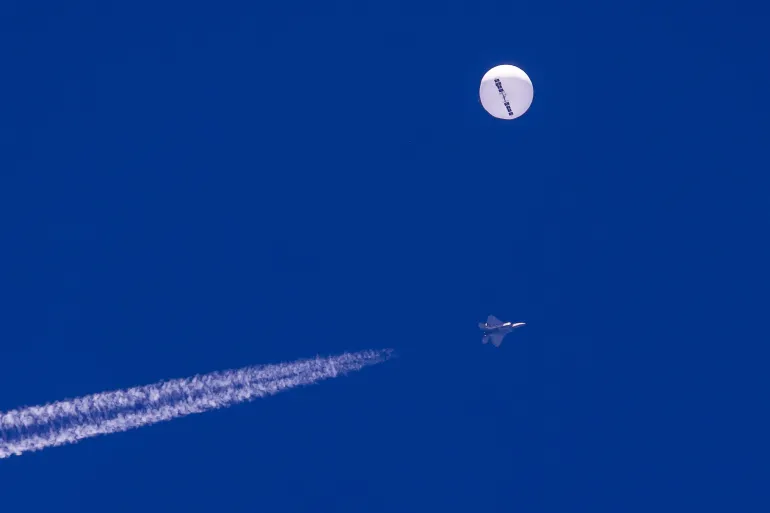
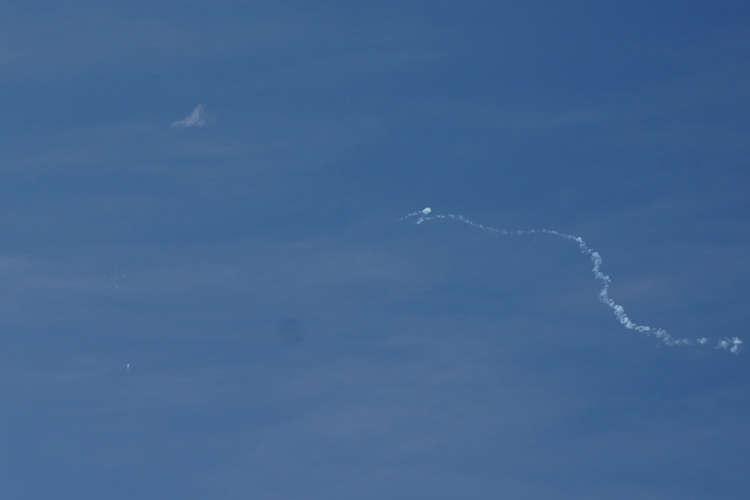
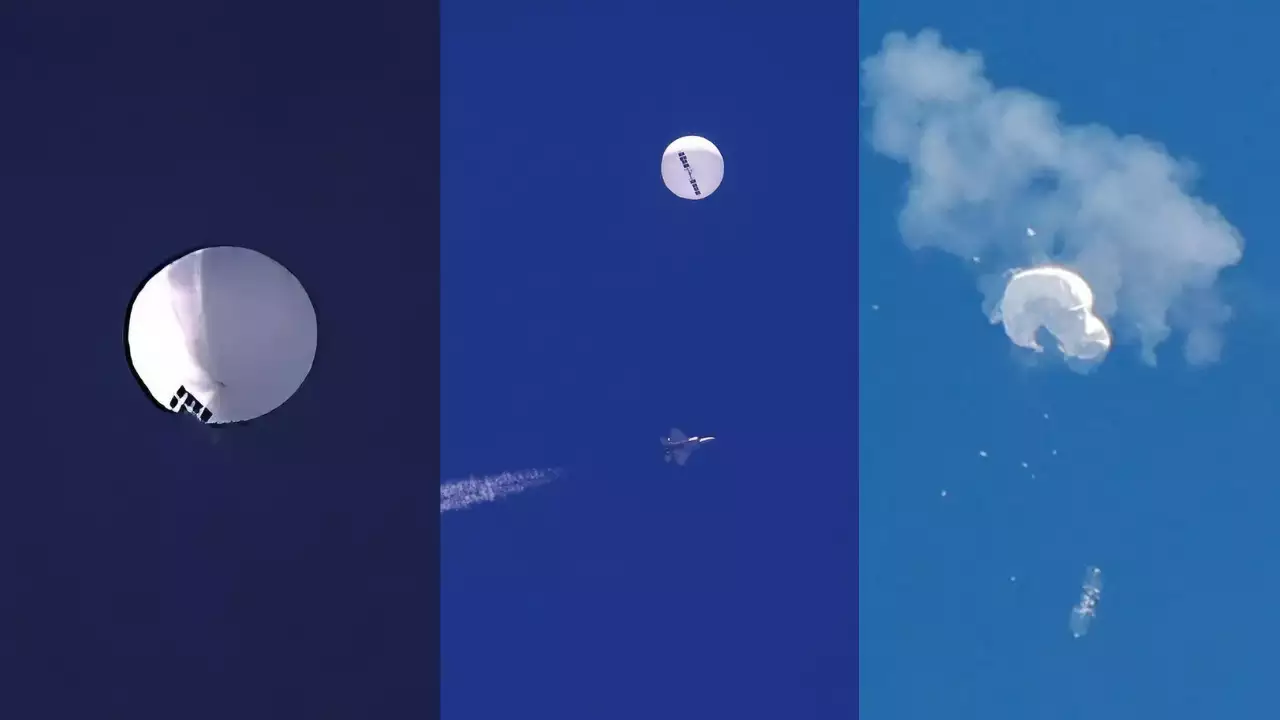
According to spokesman John Kirby, the objects “may be tied to commercial or research entities and therefore benign.”
The three downed aircraft’s wreckage has not yet been found or recovered by US or Canadian authorities.
Beijing previously charged the US with having “a trigger-happy overreaction.”
China has denied that one of its balloons, which was destroyed by a US fighter jet earlier this month off South Carolina, was being used for espionage, saying it was merely a weather-monitoring airship that had blown off course.
At Tuesday’s daily news conference, Mr Kirby said it will be difficult to determine the purpose or origin of the three other objects that were destroyed over Alaska, Canada, and Michigan until the debris is found and analysed.
“We haven’t seen any indication or anything that points specifically to the idea that these three objects were part of the PRC’s [People’s Republic of China] spying programme,” the White House National Security Council told reporters, “or that they were definitively involved in external intelligence collection efforts.”
A “leading explanation” being considered by US intelligence, he added, was that “these could be balloons that were simply tied to commercial or research entities and therefore benign”.
But he noted that no company, organisation, or government had yet laid claim to the objects.
In the most recent strike – over Lake Huron – the first Sidewinder missile fired by a US F-16 warplane missed its target, the top US general has confirmed.
“First shot missed.” “Second shot hit,” said Chairman of the Joint Chiefs of Staff Mark Milley during a visit to Brussels on Tuesday.
“We go to great lengths to make sure that the airspace is clear and the backdrop is clear up to the max effective range of the missile. And in this case, the missiles land, or the missile landed, harmlessly in the water of Lake Huron.”
A spokesman for China’s Ministry of Foreign Affairs, meanwhile, criticised the American response.
“Many in the US have been asking, ‘what good can such costly action possibly bring to the US and its taxpayers?’” said Wang Wenbin on Tuesday.
Watch: ‘What’s going on?’ The mind-boggling balloon mystery in 61 seconds
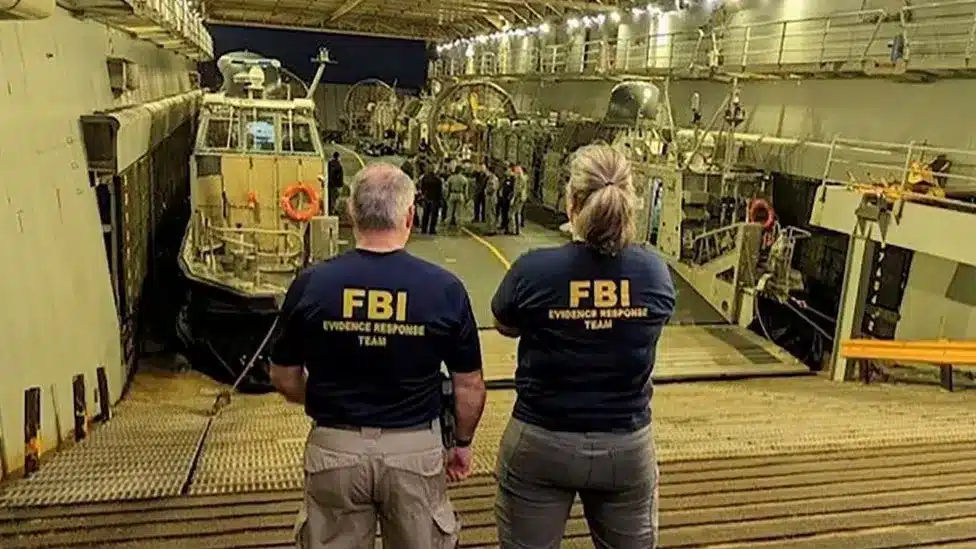
Sensors from the alleged Chinese spy balloon shot down over the US on 4 February were recovered from the Atlantic Ocean on Monday, and are being analysed by the FBI.
Search crews found “significant debris from the site, including all of the priority sensor and electronics pieces identified” off the coast of South Carolina, said US Northern Command.
The Chinese balloon was being tracked by US intelligence since its lift-off from a base on Hainan Island on the south coast of China earlier this month, US media report.
Shortly after take-off the balloon drifted towards the US islands of Guam and Hawaii before moving north towards Alaska, American officials told CBS News, the BBC’s partner.
The unnamed officials say that its path indicates that it could have been blown off course by weather, but that it was back under the Chinese control again by the time it reached the continental US.
The entire US Senate received a classified briefing on Tuesday about the matter from military leaders.
Senate Majority Leader Chuck Schumer said the chamber would launch an inquiry into why the aircraft were not detected earlier.
“It’s a good question,” Mr Schumer told reporters. “We need to answer it.”
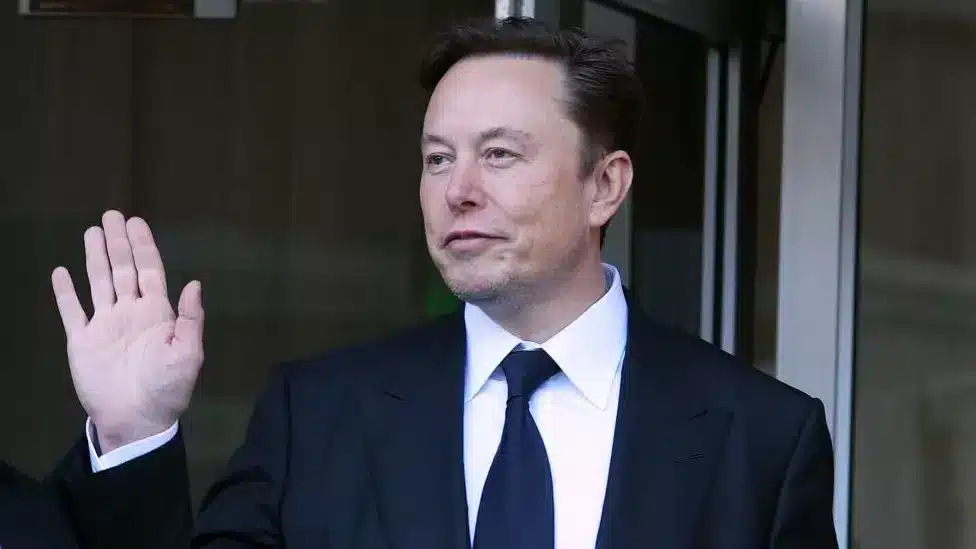
Elon Musk, the CEO of Tesla, claims to have donated approximately $1.95 billion (£1.6 billion) worth of company shares to charity last year.
In a filing with US regulators, the donation of 11.6 million shares was referred to as “a bona fide gift.”
The donation’s recipient or recipients were not identified in the filing.
Also on Wednesday, Mr. Musk stated that it would be “good time” to find a replacement for him as Twitter’s CEO towards the end of the year.
The document submitted to the US Securities and Exchange Commission states that the donation was made between August and December of last year.
A BBC request for comment has received no immediate response from Tesla.
It is not the first time Mr. Musk has given Tesla stock to charity. He donated around $5.74 billion worth of shares in 2021, according to a regulatory filing.
He also said on Twitter that year, that he planned to donate $20m to schools in Cameron County and $10m to the Brownsville city in Texas, US for “downtown revitalization”.
Mr Musk has also hinted that he plans to find his successor as chief executive of Twitter by the end of 2023.
“I’m guessing probably towards the end of this year would be good timing to find someone else to run the company, because I think it should be in a stable position around, you know, at the end of this year,” he said.
“I think I need to stabilise the organisation and just make sure it’s in a financially healthy place and that the product roadmap is clearly laid out,” he said on a video link at the World Government Summit in Dubai.
The multibillionaire businessman bought the social media platform last year for $44 billion. He has since said the company was close to bankruptcy.
However, he has been criticised by some Tesla investors for spending too much of his time focussing on trying to turn around Twitter.
In November, addressing the G20 Summit in Bali, Indonesia, Mr Musk said he is working too much as he juggles his responsibilities as Twitter, Tesla, and his rocket company SpaceX.
“My workload has recently increased quite a lot,” Mr Musk said. “I have too much work on my plate, that is for sure,” he added.
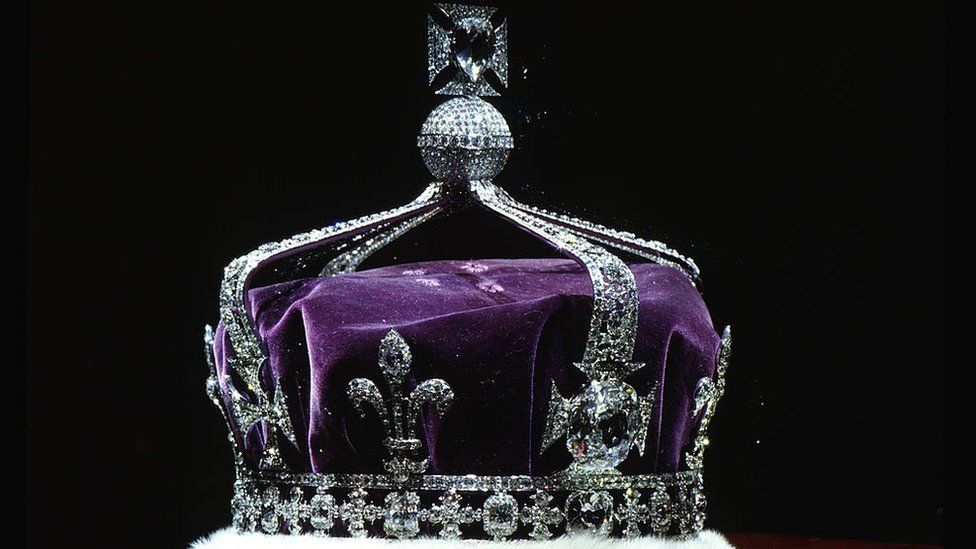
Buckingham Palace has revealed that the contentious Koh-i-Noor diamond won’t be displayed during the coronation.
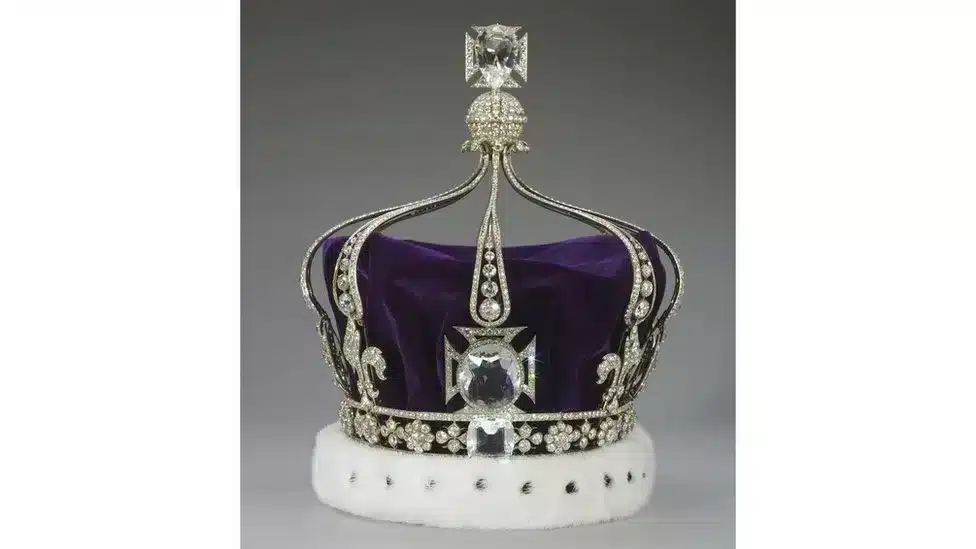
Instead, Queen Mary’s Crown, which has been removed from the Tower of London and resized for the May 6 coronation, will be used to crown Camilla, the Queen Consort.
An existing crown will allegedly be “recycled” for a coronation for the first time in “recent history.”
There will also be diamonds added from Queen Elizabeth II’s jewellery.
After testing positive for COVID this week, Camilla, who will be crowned alongside the King at Westminster Abbey, was forced to postpone her public appearances.
Image caption,The Koh-i-Noor diamond, used in the Queen Mother’s crown, won’t be used for Camilla’s coronation
Ownership of the Koh-i-Noor, one of the largest cut diamonds in the world, has been disputed, and there were concerns about a diplomatic row with India if it had been used.
India has made several claims to be the rightful owner of the diamond, which was used in the coronation of the Queen Mother.
Instead, Buckingham Palace says Camilla will be crowned with Queen Mary’s crown – and claims its re-use is in the “interests of sustainability and efficiency”.
In a tribute to the late Queen Elizabeth II, the crown will be reset using diamonds from her personal jewellery collection, using diamonds known as Cullinan III, IV and V.
These diamonds were worn by the late Queen in brooches and were taken from the Cullinan diamond, discovered in South Africa.
What we know about the Coronation long weekend so far:
Saturday 6 May: Coronation service in Westminster Abbey; coronation carriage procession; Buckingham Palace balcony appearance
Sunday 7 May: Concert and lightshow at Windsor Castle; Coronation Big Lunch street parties
Monday 8 May: Extra bank holiday; Big Help Out encouraging people to get involved in local volunteering
Although it is far from being the largest or most flawless diamond in the world, the Koh-i-Noor’s storied history has marked it out as perhaps the most controversial.
Competing theories and myths about the origins of the stone stretch over many years but historians agree it was taken from India by Nader Shah, an Iranian ruler, in 1739.
Through plunder and conquest it changed hands several times before being signed over to a British governor-general in 1849 following the annexation of the Punjab.
The circumstances in which it was signed over to the East India Company, which had conquered vast swathes of the Indian subcontinent, by a defeated boy king, are disputed.
It was reputedly a “gift” but Anita Anand, a BBC journalist who has co-authored a book on the Koh-i-Noor, said: “I don’t know of many ‘gifts’ that are handed over at the point of a bayonet”.
Residents of the Ejisu Municipality have urged theGhana Health Service (GHS) to consider the possibility of outlawing nurses’ use of mobile phones when on duty.
They claim that by doing this, nurses will be more attentive while on duty and will also be able to save the lives of patients who require urgent care and attention.
The residents made the appeal during the annual health performance review meeting held at Ejisu by the Municipal directorate of the GHS.
They cited numerous instances of on-duty nurses using their phones to play games while critically ill patients were left unattended.
The residents claimed that the attitude had resulted in the loss of many lives in the area and was preventing many people from accessing healthcare in the municipality’s government hospitals.
Responding to the accusations and the appeal by the residents, Mrs. Josephine Ahorsu, the Municipal Director of Health Services, condemned the behaviour of those nurses and said it was unethical for a nurse to use a mobile phone while attending to a patient.
She assured the residents that the health directorate would work on their request to instill discipline among health workers in the area.
Mrs Ahorsu urged all health personnel in the municipality to take the accusations by the residents seriously and work as professionals, who understood the ethics of their work to regain the confidence of the people they served.
The purpose of the annual review meeting, she said, was to offer stakeholders the opportunity to evaluate the activities of health facilities and personnel in the municipality to help develop strategies to improve services to the public.
10,000 mobile homes that were used as accommodations during the 2022 World Cup are being sent by Qatar to earthquake-affected regions in Turkey and Syria.
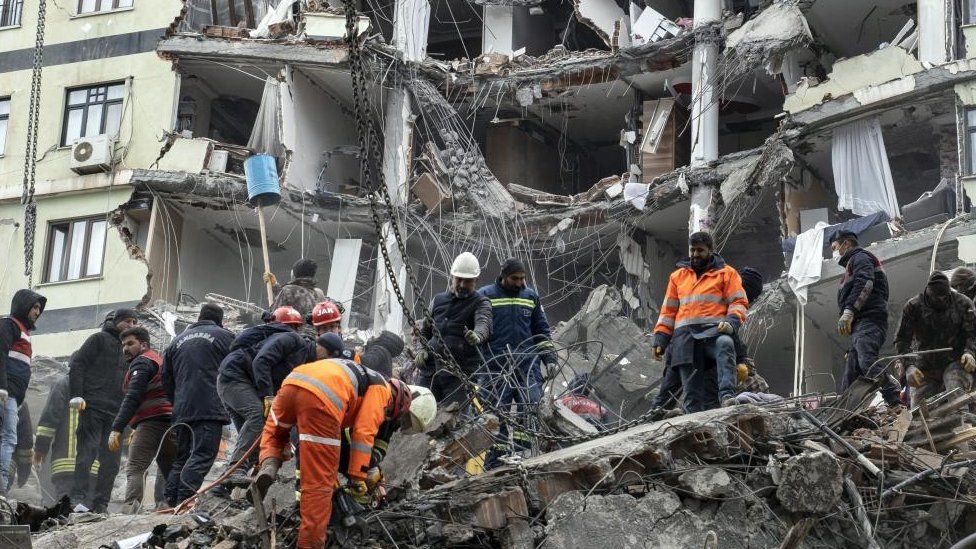
Two earthquakes that shook the two nations a week ago are thought to have killed close to 40,000 people.
Aid organisations have warned that the number of homeless people could be much higher in Syria, where more than a million people have been rendered homeless.
Rescue efforts in the two nations are starting to slow down.
The Qatari Fund for Development, a government body responsible for international development and foreign aid, tweeted a video of the first batch of accommodations being sent to affected areas.
A Qatari official said: “The plans of the 2022 World Cup always intended for such temporary accommodations to be donated.
“However, in view of the urgent needs in Turkey and Syria, we have taken the decision to ship our cabins and caravans to the region, providing much needed and immediate support to the people of Turkey and Syria.”
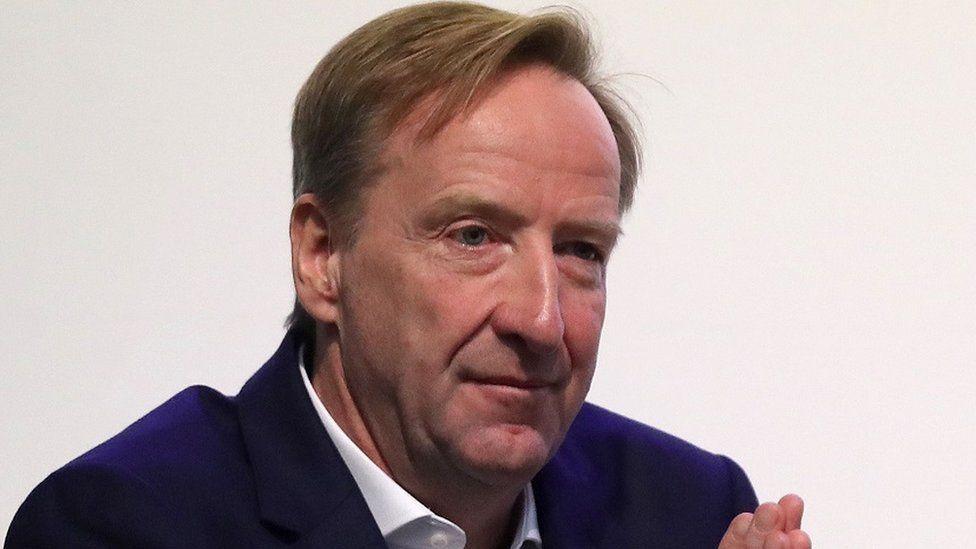
Western nations are “under the full press of Chinese espionage,” according to Sir Alex Younger, who oversaw the UK Intelligence Service from 2014 to 2020.
In the past week, the US military has shot down four objects, including a balloon believed to be a Chinese spy.
According to Sir Alex, the UK must impose restrictions on the nations it will tolerate because they “behave in an unacceptable way.”
A Chinese spy balloon was shot down by the US military on February 4 after flying over important military locations in North America. The object, according to China, was a weather balloon that went astray.
Since then, the three other “unidentified objects” have been downed across North America.
Speaking on BBC Radio 4’s Today programme, Sir Alex said “this balloon scenario demonstrates there is no trust” between China and western nations.
“This is a gross and really visibly transgression of the sovereignty of many nations.”
The UK must recognise “we’re in a competition” with China, Sir Alex said.
He said: “We need to wake up to this.”
“We need to double down on the strengths that we possess to face this systemic competition that’s going on.”
Prime Minister Rishi Sunak has said the government will do “whatever it takes” to keep the UK safe from spy balloons.
On Monday, the prime minister said a “quick reaction alert force” of RAF Typhoon jets was on standby 24/7 to police UK airspace.
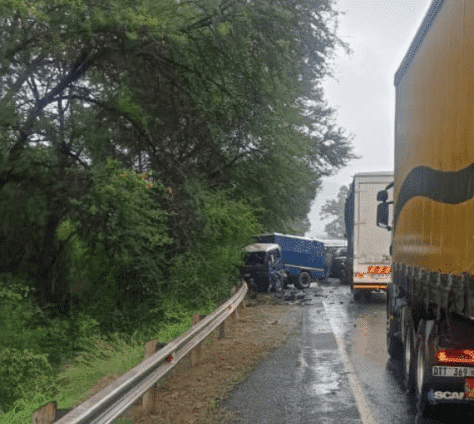
Twenty people have been killed and 61 others injured after a bus and a cash-in-transit armoured van collided in South Africa’s Limpopo province,
On Monday night, around 20:00, local media reported that a bus had fallen off a bridge and into a river below, landing on its side.
Apparently, being trapped inside the bus caused the majority of the victims to pass away.
There is currently an investigation into the accident’s cause.
There have been heavy rains in the area. Emergency services were still on the scene on Tuesday morning, with heavy downpours delaying their work.
TRAFFIC UPDATE🚨 Tuesday, 14 February 2023
20 people were tragically killed and 61 injured in an accident, where a cash-in-transit van lost control and collided head-on with an oncoming bus, yesterday on road N1- 29 Mashovhela, towards Musina in Vhembe District.🕯🙏 pic.twitter.com/I1j1Z4MjtQ
— Limpopo Department of Transport & Community Safety (@TransportLimCom) February 14, 2023
The Marburg virus, a highly contagious illness belonging to the same virus family as Ebola, has been reported as having made its first appearance inEquatorial Guinea, according to the country’s authorities on Monday.
In the country’s western Kie Ntem province, the viral hemorrhagic fever is thought to have killed nine people.
One sample that was gathered and sent to the Institut Pasteur in Dakar, Senegal, underwent additional testing, and the results were positive.
According to the World Health Organization, 16 people are currently being held in isolation as suspected contact cases. A team of experts from the health organisation has been sent to the area to assist the medical personnel.
Last week, the country’s Health Minister, Mitoha Ondo’o Ayekaba, said preliminary investigations linked the deaths to people who attended a funeral ceremony.
Movement has been restricted around two villages, where most cases have been reported. Contact tracing is currently ongoing.
This is the first outbreak recorded in the country and the third in West Africa. Ghana confirmed one case last year and Guinea the previous year.
The virus is transmitted to people from fruit bats and spreads between humans through the transmission of bodily fluids.
Although there are no vaccines or treatments, those diagnosed are advised to drink plenty of water as doctors treat a patient’s specific symptoms.
Previous outbreaks and sporadic cases of Marburg in Africa have been reported in Angola, the Democratic Republic of the Congo, Kenya, South Africa, and Uganda.
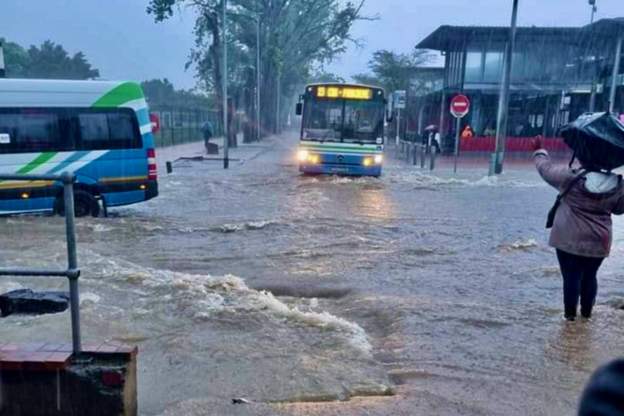
After seven of its nine provinces were submerged by flooding brought on by heavy rains,South Africa declared a national disaster on Monday. Farmers also suffered losses, and roads and bridges were destroyed.
The national weather service expects the heavy rains to continue, according to a White House statement.
According to the statement, the government “declared a national state of disaster to enable an intensive, coordinated response to the impact of floods,” but no details regarding casualties were provided.
It claimed that the La Nia global weather phenomenon, which happens in the Pacific Ocean, was to blame for the intense rains.
“These conditions demand the provision of temporary shelters, food, and blankets to homeless families and individuals and the large-scale, costly rehabilitation of infrastructure,” the statement added.
Prior to joint naval exercises with South Africa and China, a Russian military frigate made a port call in Cape Town’s harbour on Monday.
The Admiral Gorshkov battleship was pictured in the harbour in a tweet from the Russian consulate in Cape Town.
The drills will take place in Richards Bay and the port city of Durban for ten days starting on February 17th.
Cape Town hosts #Russian frigate “Admiral Gorshkov”. The battleship arrived in the Mother City on its way to Durban where it will take part in joint 🇿🇦-🇨🇳-🇷🇺 naval drills scheduled for February 17-27. pic.twitter.com/RrByExX9H8
There has been some criticism that the exercise is not appropriate, given that it coincides with the first anniversary ofRussia’s invasion of Ukraine.
But the defence ministry has defended the planned drills, saying that South Africa has in the past hosted similar exercises with France, the US and countries from the Western Nato military alliance.
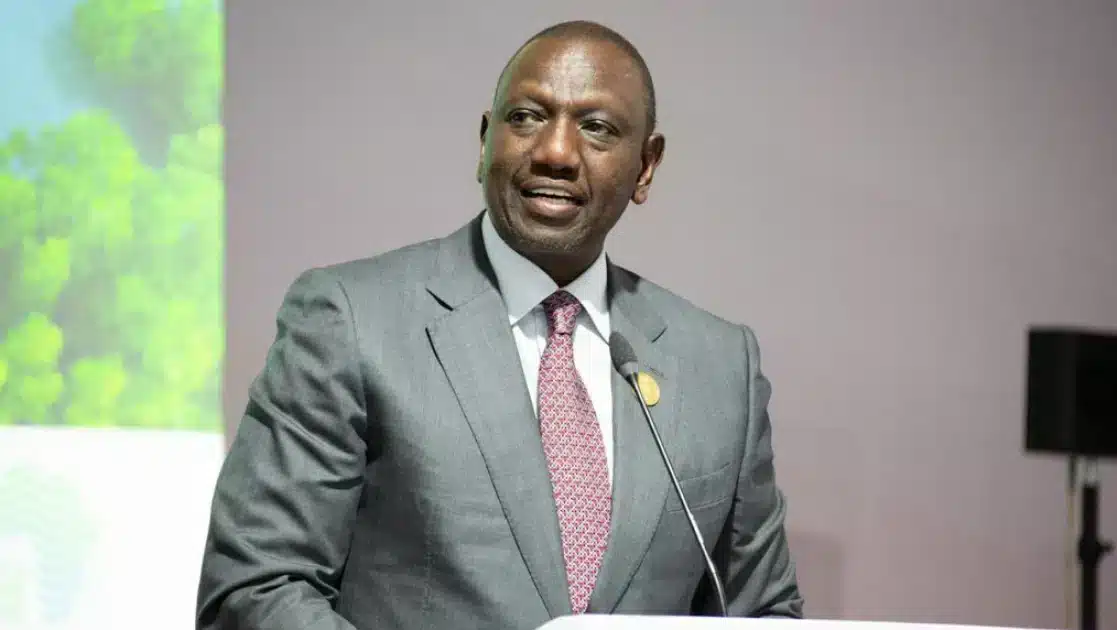
A security operation against armed bandits in the northern Rift Valley region, who have recently killed dozens of people, has been ordered by Kenya’s President William Ruto.
According to the government announcement, the troops will begin supporting the police on Wednesday.
H.E. Dr William Ruto, the president of the Republic of Kenya and Commander in Chief of the Kenya Defence Forces, has today ordered for joint security operations in the North Rift. https://t.co/z3I2WMAbPrpic.twitter.com/20A0bjLSDv
It came as the interior minister declared parts of six counties in the region as “disturbed and dangerous”, issuing a 30-day dusk to dawn curfew starting from Tuesday.
“The government has determined the security situation currently prevailing in the northern Rift Valley Region as a national emergency. Accordingly, painful and decisive measures must be taken effectively immediately,” Prof Kindiki Kithure said in a statement.
It ordered all people holding illegal guns and ammunition to hand them over to the authorities in three days or “meet the full force of the law”.
More than 100 civilians and 16 police officers have been killed by bandits in the past six months, according to the interior ministry.
The use of 16 books from a well-known children’s book series in Tanzanian schools has been prohibited due to the books’ purported support of LGBTQ rights.
Adolf Mkenda, the education minister, claimed that the books put children’s education in danger.
According to the authorities, schools that use the books will face legal and disciplinary action, including having their registration revoked.
The banned books in the series include:
Diary of a Wimpy Kid: Rodrick Rules
Diary of a Wimpy Kid: The Last Straw,
Diary of a Wimpy Kid: The Ugly Truth
Diary of a Wimpy Kid: Cabin Fever.
Diary of a Wimpy Kid: The Third Wheel
Diary of a Wimpy Kid: Hard Luck
Diary of a Wimpy Kid: The Long Haul
Diary of a Wimpy Kid: Old School
Diary of a Wimpy Kid: Double Down
Diary of a Wimpy Kid: The Gateway.
“This is the first list, after we checked and verified that these books violate traditions and customs. The content in them are not good for the upbringing of Tanzanians. The review is ongoing,” said Prof Mkenda.
He urged parents to regularly check their children’s bags to ensure they are not using the books.
UN Secretary-General Antonio Guterres has welcomed al-Assad’s decision to open the two crossing points of Bab al-Salam and Al Ra’ee to allow for the delivery of humanitarian aid from Turkey to rebel-held parts of northwest Syria.
“As the toll of the February 6 earthquake continues to mount, delivering food, health, nutrition, protection, shelter, winter supplies, and other life-saving supplies to all the millions of people affected is of the utmost urgency,” Guterres said in a statement.
“Opening these crossing points, along with facilitating humanitarian access, accelerating visa approvals, and easing travel between hubs, will allow more aid to go in faster,” he added.
Currently, the UN has only been allowed to deliver aid to the northwest Idlib area through a single crossing at Bab al-Hawa, at Syrian allyRussia’s insistence.
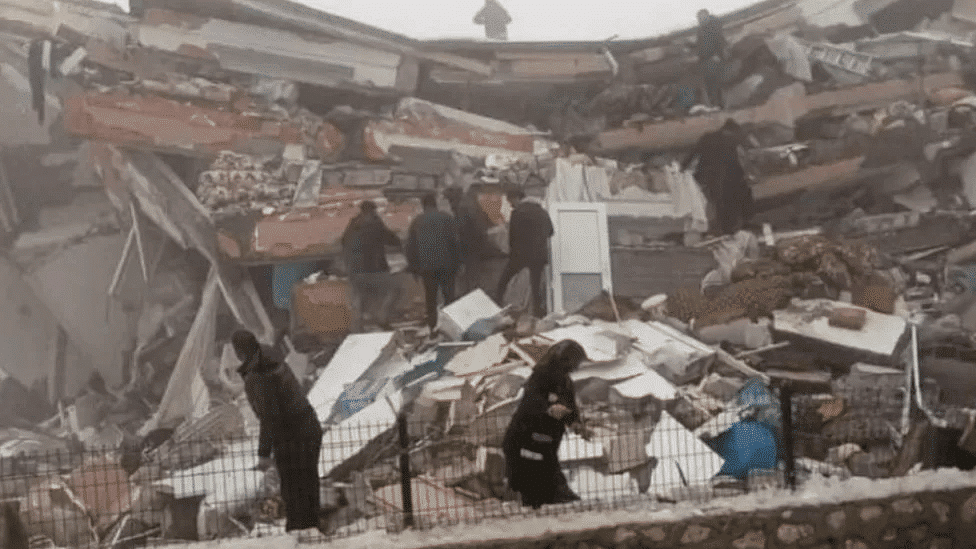
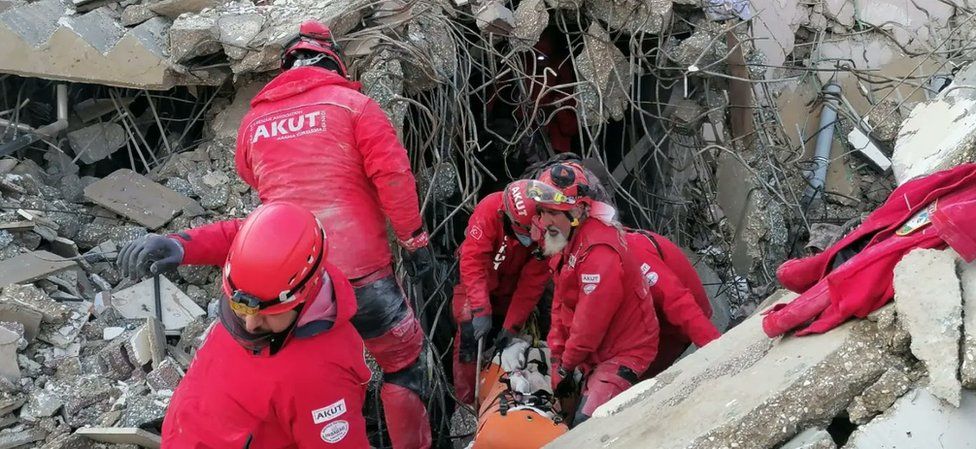
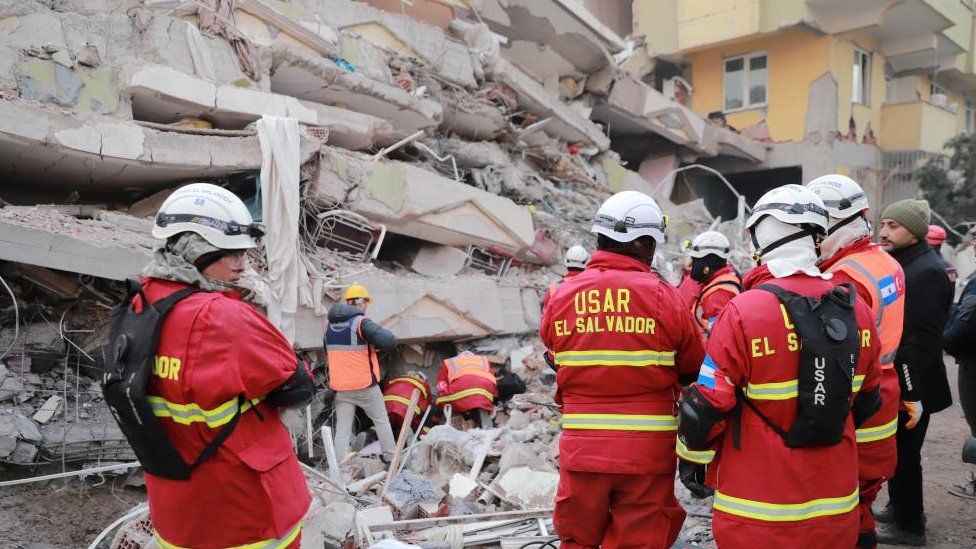
Experts say that given the amount of time that has passed and the severity of the building collapses, the window for rescues has nearly closed as the desperate searches for earthquake survivors in Turkey and Syria enter their final hours.
According to Eduardo Reinoso Angulo, a professor at the National Autonomous University of Mexico’s Institute of Engineering, the chances of discovering survivors are “very, very small now.”
The odds weren’t great to begin with, according to David Alexander, a professor of emergency planning and management at University College London.
He claimed that many of the structures were constructed so poorly that they crumbled into tiny fragments, leaving very few spaces big enough for people to survive.
“If a frame building of some kind goes over, generally speaking we do find open spaces in a heap of rubble where we can tunnel in,“ Alexander said. “Looking at some of these photographs from Turkey and from Syria, there just aren’t the spaces.”
Winter conditions have also reduced the window for survival.
In the cold, the body shivers to keep warm, but that burns a lot of calories, meaning that people who are also deprived of food will die more quickly, said Dr Stephanie Lareau, a professor of emergency medicine atVirginia Tech in the United States.
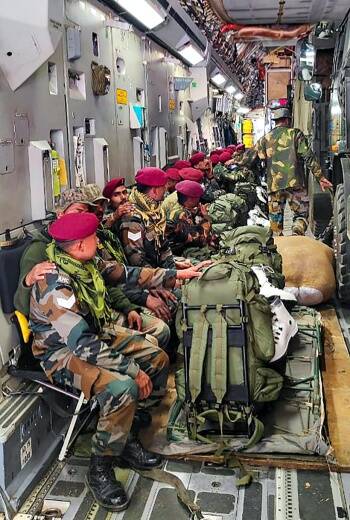
Russian’s defence ministry says, 60 units of specialised military gear and more than300 Russian troops are assisting Syria in its response to the earthquakes last week.
“Servicemen of the Russian group of forces continue to carry out activities to clear rubble and eliminate the consequences of earthquakes,” the defence ministry said in a statement on the Telegram messaging app, referring to Russian forces stationed in Syria.
“More than 300 servicemen and 60 units of military and special equipment have been involved in the work.”
Food packages and disinfectants as well as other essentials had also been delivered to humanitarian aid points in the northwestern city of Aleppo, the ministry added.
Jens Stoltenberg of NATO says Ukraine was using ammunition more quickly than NATO members could produce it.
Moscow and Kiev both report significant fighting around Bakhmut in the meantime.
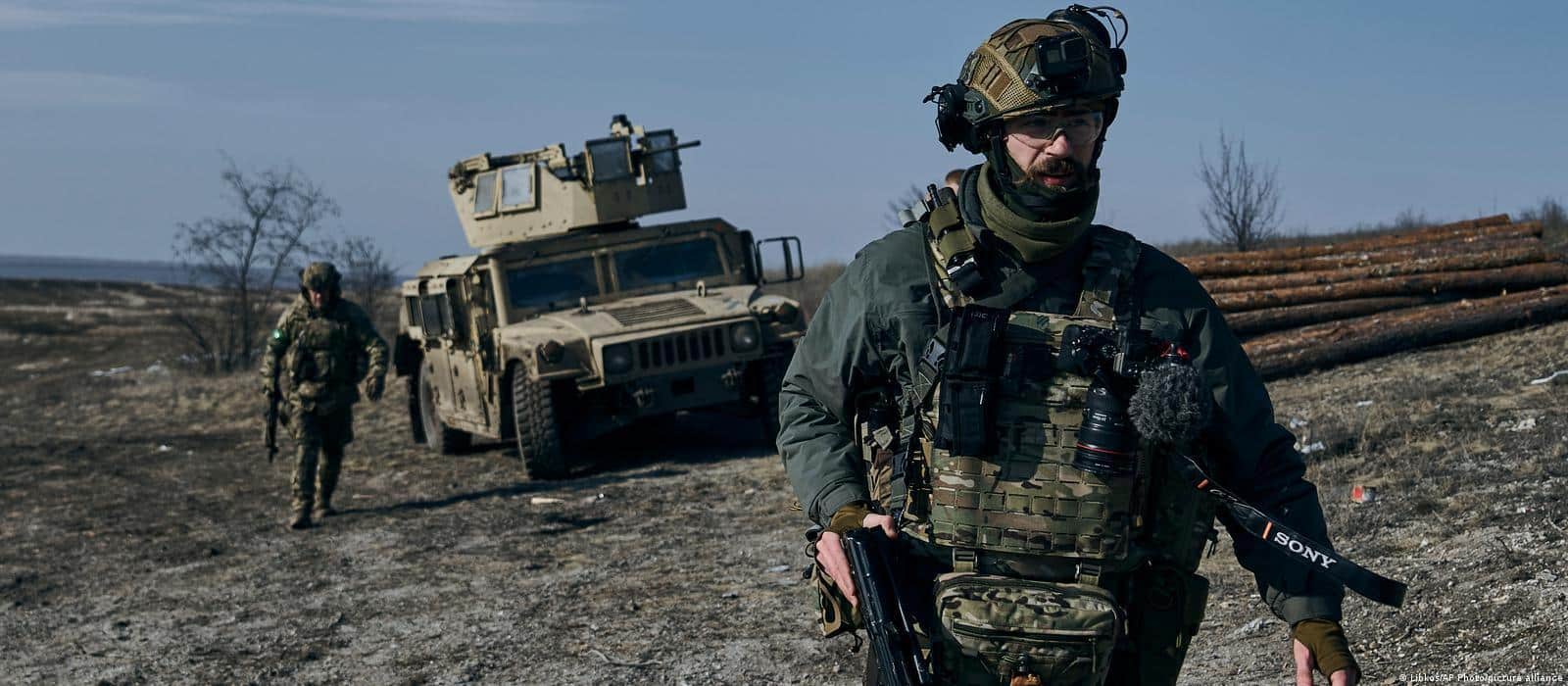
As the transatlantic military alliance’s ammunition supply has been rapidly depleted in the conflict in Ukraine, Jens Stoltenberg, secretary general of NATO, announced to reporters on Monday that the organisation would be raising its targets for ammunition stockpiles.
“The war in Ukraine is consuming an enormous amount of ammunition,” Stoltenberg said. “The current rate of Ukraine’s ammunition expenditure is many times higher than our current production rates. This puts our defense industries under strain. (…) So we need to ramp up new production and invest in our production capacities.”
Stoltenberg also said NATO members would “step up and sustain” support for Ukraine, saying: “NATO stands with Ukraine for as long as it takes.”
Ammunition resupply has been a concern for Ukrainian and Russian forces alike for months.
DW’s correspondent in Kyiv, Nick Connolly, said he had spoken with Ukrainian commanders who said they were having to make “very tough choices” about ammunition usage.
“I’ve met commanders of howitzers, of artillery pieces, who’ve told me that they don’t know how long they can keep on doing their job, if they will be forced to withdraw and move away from positions and wait for more artillery,” Connolly said. “This is a very real problem.”
“Right now, you’re seeing Ukraine and its allies scrambling around the world, looking as far afield as Pakistan and South Korea for artillery munitions,” Connolly said. “We’ve had reports of Pakistani-made Soviet-caliber munitions heading this way, [and] of US troops being asked to send munitions that they had stockpiled in South Korea to Europe for Ukraine.”
Among other things, he said he expected the possible supply of NATO aircraft to Ukraine to be a topic of discussion when the alliance’s defense ministers assemble on Tuesday. Kyiv has been calling for western-built combat aircraft on and off since the conflict began, and with renewed intensity since the most recent agreement on sending battle tanks was approved just a few weeks ago.
The issue is also liable to be raised at this week’s Munich Security Conference. The MSC’s chairman Christoph Heusgen, formerly Chancellor Angela Merkel’s foreign and security policy advisor, told DW ahead of the event that in his opinion it might be wise for politicians to ask for military advice on the matter.
“Instead of putting red lines, I think we have to see what is needed,” Heusgen said. “When you talk to military experts, they say that when you fight a war like this, you need a combination of several weapons. (…) I think this should be a military decision.”
Asked about a possible Russian offensive in Ukraine, NATO’s Stoltenberg said it had already begun.
“We see no sign whatsoever that [Russian] President [Vladimir] Putin is preparing for peace,” he said. “We see how they are sending more troops, more weapons, more capabilities.”
Settlements in the Palestinian territories are illegal under international law and have been condemned by the UN.
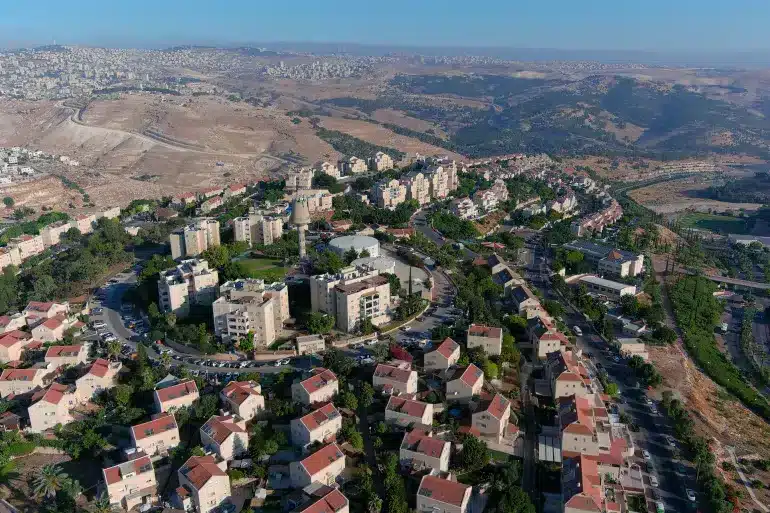
Israel’s far-right cabinet has approved the legalisation of nine illegal settler outposts in the occupied West Bank, drawing condemnation from the Palestinian Authority (PA), which called the move an “open war” against its people.
More housing units are likely to be built in separate, existing illegal settlements, a statement from Prime Minister Benjamin Netanyahu’s office said on Sunday.
“The nine communities had existed for many years; some have existed for decades,” the statement added. They were built without authorisation from the Israeli government.
More than half a million Israelis live in more than 200 settlements built on Palestinian land considered illegal under international laws. Palestinians say the settlement expansion threatens the viability of the future Palestinian state as part of the two-state solution.
The Palestinian foreign ministry said in a statement on Sunday that the latest decision crossed “all red lines” and undermined the revival of “the peace process”.
The United States, which provides billions of dollars in military aid to Israel, has yet to comment, but last month its ambassador said the country opposes the authorisation of Israeli outposts. Biden administration has aired views against settlements.
The United Nations has condemned illegal settlements in the occupied Palestinian territories in multiple resolutions and votes.
‘Palestinians will continue to resist’
Political analyst Mohammad Oweis told Al Jazeera that the government of Netanyahu, who was elected in November to form a hardline right-wing coalition, was stepping up its claim on Palestinian land.
“This is an escalation, this will increase the level of violence against the property of the Palestinians,” Oweis said.
“The Palestinians will continue to resist with whatever they have in order to protect their lives and their property.”
The Israeli prime minister’s office said the decision was taken in retaliation for two recent attacks in Jerusalem that killed 10 Israelis. Three Israelis, including two children, were killed in an attack on Friday in Ramot, a Jewish settlement neighbourhood in occupied East Jerusalem.
“In response to the murderous terrorist attacks in Jerusalem, the security cabinet decided unanimously to authorise nine communities in Judea and Samaria,” Netanyahu’s office said in a statement, using the Israeli name for the West Bank, which it occupied in 1967 along with East Jerusalem.
The announcement comes amid escalating Israeli-Palestinian violence, with at least 46 Palestinians killed by Israeli forces this year. Nine Israelis and one Ukrainian have been killed in Palestinian attacks in the past six weeks.
Netanyahu said earlier on Sunday during a meeting of his government he wanted to “strengthen settlements” and announced that his government wanted to submit legislation to Knesset, the Israeli parliament, this week to revoke the Israeli nationality of “terrorists”.
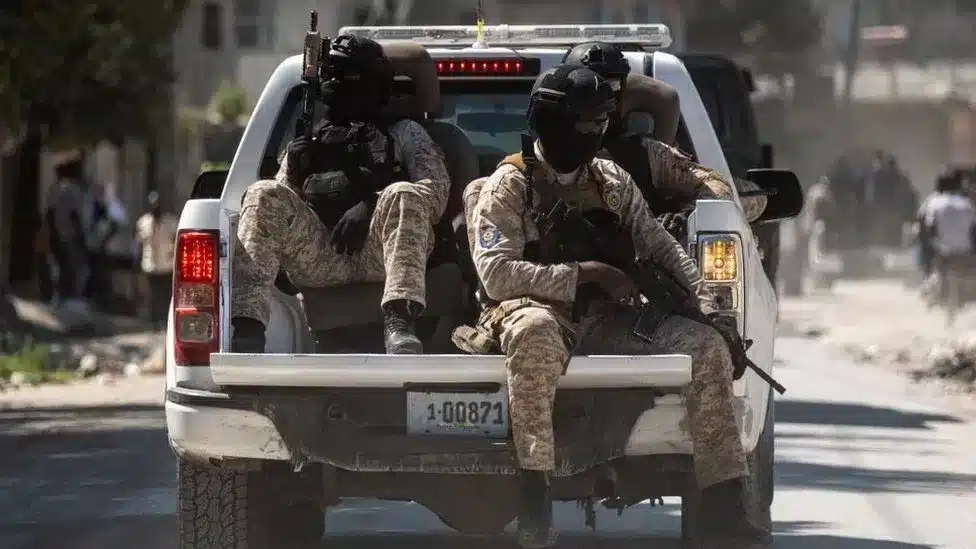
Three worshippers have been abducted by gang members in Port-au-Prince, the country’s capital, as they were leaving a church after attending Sunday Mass.
According to local media, the kidnappers are demanding a hefty ransom.
In Haiti, kidnappings for ransom have increased dramatically in recent years, and places of worship and the clergy are increasingly being targeted.
The situation has been called “a living nightmare” by the UN High Commissioner for Human Rights.
Witnesses reported that on Sunday morning local time, gang members kidnapped a couple and another person who regularly attend services at the First Baptist Church in the city’s centre.
Their kidnapping came just five days after a priest was seized on his way to his missionary community, located 27 kilometres (17 miles) north of the capital.
Father Antoine Macaire Christian Noah, who is from Cameroon, had been working as a parish priest in the mountainous village of Casale, north of the capital, for a year before he was snatched.
The Claretian Missionaries, the religious congregation he belongs to, said it had been contacted by the gang with a ransom demand.
In 2022, there were more than 1,200 reported kidnappings in Haiti, double that of the previous year.
But kidnapping is not the only crime that has been on the rise in Haiti.
A new UN report released last week highlights how gang violence has sharply increased in Brooklyn, a neighbourhood on the outskirts of Port-au-Prince.
UN High Commissioners for Human Rights Volker Türk described the findings as “horrifying”.
“It paints a picture of how people are being harassed and terrorised by criminal gangs for months without the state being able to stop it,” Mr Türk said.
Haiti was plunged into lawlessness following the assassination of President Jovenel Moïse in July 2021.
The country has been led by Prime Minister Ariel Henry since then, but he has failed to rein in the gangs which now control an estimated 60% of the capital.
Mr Henry has repeatedly called for the deployment of an international force to help police in their fight against the criminal gangs.
So far, no country has offered to lead such a force, but Mr Henry says it is key to providing security so that long-postponed elections can be held.
The rapid response from Washington to Beijing’s accusation widens the dispute that started last week after the US military allegedly shot down what it believes to be aChinese spy balloon.
More than ten times in the previous year, China has accused the US of illegally using high-altitude balloons to fly over its territory. Each time, the US government has responded with a denial.
Days prior to the allegation on Monday, the US shot down a suspected Chinese spy balloon that had travelled from Alaska to South Carolina, igniting a fresh crisis in relations between the two largest economies in the world. Beijing has maintained that the object was a weather craft that had veered off course.
“It is also common for US balloons to illegally enter the airspace of other countries,” Chinese foreign ministry spokesperson Wang Wenbin said at a news briefing.
“Since last year, US high-altitude balloons have illegally flown over China’s airspace more than 10 times without the approval of Chinese authorities,” Wang said without giving details about how they had been dealt with or whether they had government or military links.
The US should “first reflect on itself and change course, rather than smear and instigate a confrontation”, Wang said.
The White House swiftly denied China’s assertions.
“Not true. Not doing it. Just absolutely not true,” national security spokesman John Kirby said in an interview with MSNBC. “We are not flying balloons over China.”
After the downing of the alleged Chinese airship last week, US Secretary of State Antony Blinken cancelled a visit to Beijing that many had hoped would put the brakes on the sharp decline in relations over Taiwan, trade, human rights and Chinese claims in the disputed South China Sea.
The US has since placed economic restrictions on six Chinese entities it said are linked to China’s aerospace programmes.
US Deputy Secretary of Commerce Don Graves has said his department “will not hesitate to continue to use” such restrictions and other regulatory and enforcement tools “to protect US national security and sovereignty”.
The US House of Representatives also voted unanimously to condemn China for a “brazen violation” ofUS sovereignty and efforts to “deceive the international community through false claims about its intelligence collection campaigns”.
Separately on Monday, the Philippines accused a Chinese coastguard ship of targeting a Philippine coastguard vessel with a military-grade laser and temporarily blinding some of its crew in the South China Sea. Manila called the incident a “blatant” violation of the Philippines’ sovereign rights.
Wang said a Philippine coastguard vessel had trespassed into Chinese waters without permission on February 6 and that Chinese coastguard vessels responded “professionally and with restraint”. China claims virtually all of the South China Sea and has been steadily building up its maritime forces and island outposts in the strategic waterway.
“China and the Philippines are maintaining communication through diplomatic channels in this regard,” Wang said.
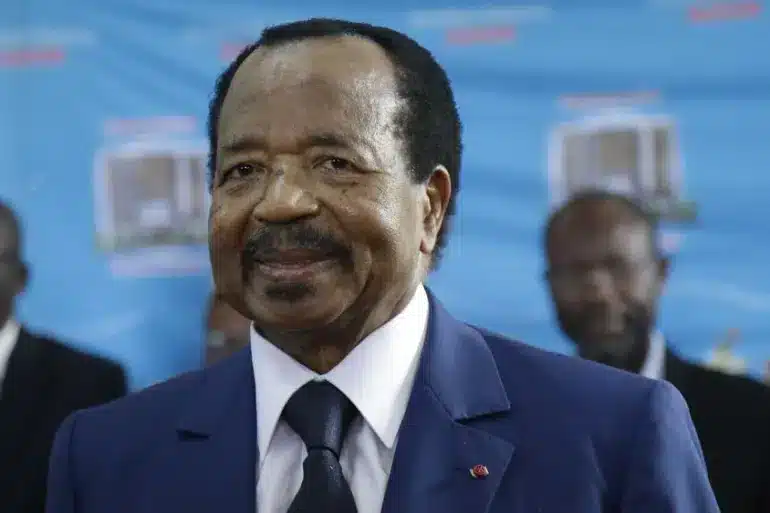
Since taking office in 1982, President Biya has served Cameroon for seven terms. According to many, a change is necessary.
When Paul Biya, the newly elected president of Cameroon, visited the United States in 1984, Edith Kah Walla was at the forefront of a group of students eagerly anticipating the stability, democracy, and end to corruption the young leader would bring.
Biya turns 90 on Monday and is now the oldest leader in the world. Kah Walla, one of Biya’s opponents in the 2011 presidential election, will not be present when he cuts a large cake as he usually does on his birthday.
Her support for Biya evaporated over the years as economic progress stalled, dissenting voices were silenced, and the oil-producing country of 27 million people became split by a separatist uprising that has killed thousands, amid growing Boko Haram attacks in the north.
At 90, Biya should spend his days playing with his grandchildren, she said.
“We live in a violent, brutal dictatorship. Over the past 40 years it has gotten more and more violent and brutal,” said Kah Walla, now a civil society activist. “These 40 years are a huge setback for Cameroon.”
A government spokesperson did not respond to calls requesting comment.
Four decades of Biya
Biya has repeatedly defended his record in the past and says the government has made strides to return peace to the minority English-speaking regions where separatists are trying to form their own state.
He touts his Vision 2035 plan as a blueprint to boost development over the next 12 years.
After studying in Paris, he returned to Cameroon in 1962 as a top civil servant and quickly rose to become the prime minister in 1975. He was hand-picked as successor after the country’s first post-independence President Ahmadou Ahidjdo decided to resign suddenly in November 1982.
In Africa, only President Teodoro Obiang of Equatorial Guinea has ruled longer.
Millions still support Biya, although international observers have raised doubts about the fairness of elections that he routinely wins with ease. He spends long stretches in comfortable European hotels with his wife Chantal, frustrating many at home who believe the country’s crises require closer attention.
In 2020, he was not seen in public for weeks, prompting speculation that he had died of COVID-19.
Biya has ruled with openness and tolerance, said former minister Elvis Ngolle Ngolle. Old age, he said, has its advantages.
“The more you add up the age, the wiser you become – the more experienced, tolerant, logical you become,” Ngolle said.
‘I can’t celebrate’
Popular journalist and whistleblower Paul Chouta disagrees. Chouta, an outspoken critic of Biya, has been repeatedly beaten and tortured in recent years. He lives in fear: just the sound of his floorboards creaking sends him into a panic.
On March 9 last year, unknown assailants bundled him into the back of a car and drove him to an isolated spot near Yaounde airport. They beat him with stones and batons and left him for dead, he said.
Chouta is one of several reporters who have been beaten or killed. Two journalists were killed in the last month, prompting condemnation from the United Nations.
“If he [Biya] loves Cameroonians, let him fix things and go. The woes are deep,” Chouta told Reuters news agency.
It is not only well-known reporters who are wary.
Kouam Yves, a motorcycle taxi driver, last week stood at a newspaper stand discussing the news headlines with colleagues. He struggles to make a living and is critical of Biya and what he describes as rampant corruption. But he paused as he spoke, worried about who might be listening.
The alleged instigator of a violent election denial movement, the ex-president of Brazil, tells a Florida audience that he plans to soon return home.
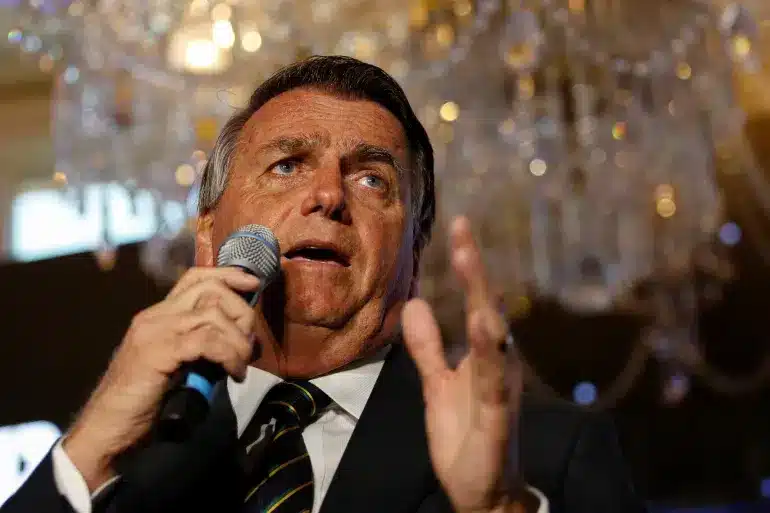
Jair Bolsonaro, a former president of Brazil, announced on Saturday that he would be going back to his country “in the coming weeks” after spending more than a month there.
Before the current president, Luiz Inacio Lula da Silva, took office on January 1, Bolsonaro took a flight to Florida. He then applied for a six-month tourist visa to extend his stay in the US.
“There is no place like home… We know Brazil is a fantastic country,” Bolsonaro told a gathering of Brazilians in Boca Raton, a video posted online by broadcaster CNN showed.
“I also want to return to Brazil. I intend to return to Brazil in the coming weeks.”
A swift return to Brazil could pose risks for Bolsonaro, who is accused of instigating a violent election denial movement in his home country.
Brazil’s Supreme Court has agreed to open an investigation into Bolsonaro for allegedly encouraging anti-democratic protests that ended in the storming of government buildings by his supporters in Brasilia.
His plans to return were put into question after his lawyer told the Reuters news agency last month the former president would like to “enjoy being a tourist in the United States for a few months before deciding what his next step will be”.
Still, a US official with knowledge of the situation toldReuters this week officials believe Bolsonaro will return to Brazil after the carnival festival, which ends on February 22.
In nine days, US fighter jets have shot down four flying objects. Here is what we currently know.
Concerns about North American security and strained relations with China have increased as a result of the shooting down of a large Chinese balloon off the US coast and the subsequent shooting down of three smaller objects over Canada, Alaska, and Lake Huron on the US-Canada border.
Here is what we know so far:
What were the four objects?
Late last month, a giant Chinese balloon – termed a “spycraft” by US officials – drifted for days through US skies before being shot down on February 4 by an F-22 jet off the South Carolina coast.
China insisted the balloon was conducting weather research and had gone astray.
The Pentagon said it had a gondola the size of three buses and was equipped with multiple antennas, and had solar panels large enough to power several intelligence-gathering sensors.
It also appeared to be able to steer itself, using winds and possibly a propulsion mechanism, officials said.
On February 10, US fighter jets downed another object off northern Alaska. It was much smaller than the previously shot-down balloon and lacked any system of propulsion or control, officials said.
On February 11, a US F-22 jet shot down a “high-altitude airborne object” over Canada’s far northwest Yukon territory, saying it posed a threat to the civilian flight. Canada described it as cylindrical and about the size of a Volkswagen Beetle car.
On February 12, President Joe Biden ordered US warplanes to down yet another unidentified object over Lake Huron. The object was described as an octagonal structure with strings hanging off it. It posed a hazard to civil aviation as it flew at about 20,000 feet (6,000 metres), officials said.
The Pentagon said none of the four objects appeared armed or posed any threat of attack.
Officials would not comment on the origin or function of the three objects that came after the Chinese balloon.
What has been recovered?
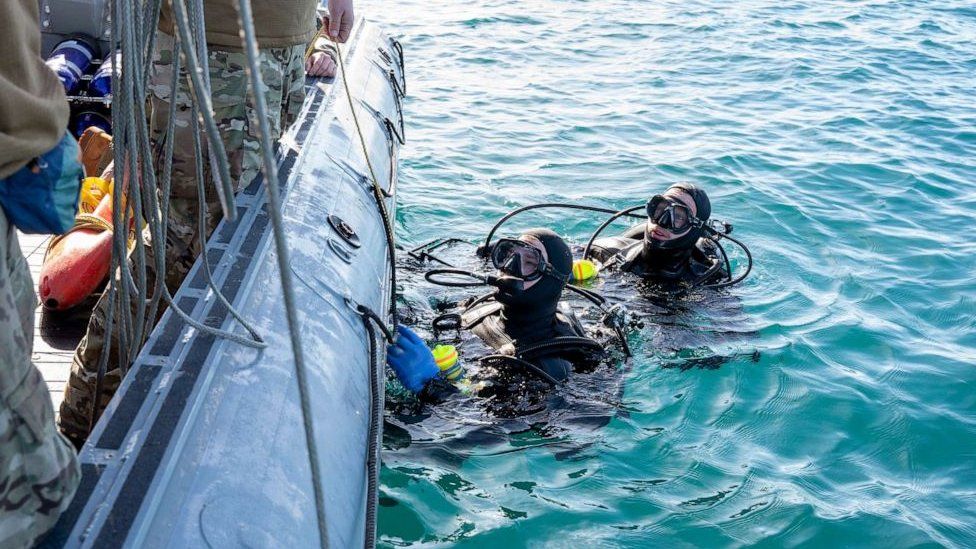
Military teams working from planes, boats and minisubs are scouring the shallow waters off South Carolina for debris from the balloon, with military images showing the recovery of a large piece.
Operations to recover the second object continue on sea ice near Deadhorse, Alaska. Recovery teams are searching for debris from the third object in the Yukon, while US and Canadian teams were preparing an operation to recover the fourth object’s debris.
Heino Klinck, former US deputy assistant secretary of defence for East Asia from 2019 to 2021, said there is concern about the lack of information about the flying objects over North America.
“It’s rather odd, frankly, that in a span of three days that the US air force shot down three objects in the air, and our government has yet to tell us anything about if there is a continuous threat or the origins of the aircraft,” Klinck told Al Jazeera.
What was the objects’ purpose?
US officials say the Chinese balloon, which flew over sensitive US nuclear missile sites, had surveillance equipment that could intercept telecommunications.
They said such balloons skirted US territory at least four times in the past six years, but none had flown deep into US territory.
The balloons were part of a “fleet” operated by China that has conducted surveillance on some 40 countries over five continents, US officials said.
Why so many objects now?
On Sunday, Melissa Dalton, assistant defence secretary for homeland defence, said after the Chinese balloon was detected, US air defence made adjustments to radar systems to be able to detect smaller and slower-moving objects in the atmosphere.
Analysts said normally, US and Canadian intelligence constantly receive huge amounts of raw data and generally screened some out to focus on the threat of incoming missiles, not slow-moving objects like balloons.
Beijing denounced the first balloon’s downing, saying it “seriously violated international practice”. It reserved the right “to use necessary means to deal with similar situations”.
Dalton said on Sunday that after Beijing rejected US overtures for several days, US officials have had “contacts” with China over the balloon.
The celebrated performer died in a hospital in Karachi, where he was on life support.
Zia Mohyeddin, one of Pakistan’s greatest figures in arts and culture, has passed away. He was 91.
The legendary actor, orator, author and broadcaster died on Monday morning in a hospital in Karachi where he was on life support.
In a career spanning more than six decades in various disciplines, theatre remained Mohyeddin’s lifetime passion. As the founding chair and later president emeritus of Pakistan’s premier National Academy of Performing Arts (NAPA), he mentored some of the country’s biggest acting talents.
Distinguished Zia Mohyeddin-Pakistan’s iconic talent, Intl star is no more with us. Had the privilege of working with him.Truly an inspiration in hosting. He was a great host,actor, director, producer & voice over artist. May ALLAH bless his soul & give sabr to Azra Bhabi. Ameen pic.twitter.com/cxe7ZHvb4o
Born in 1931 in Faisalabad city in Pakistan’s eastern province of Punjab, Mohyeddin studied theatre at London’s Royal Academy of Dramatic Arts (RADA), one of the world’s foremost acting schools.
Among a few Pakistanis to have performed in theatre and films outside the country, Mohyeddin delivered some of his most memorable performances in the Hollywood epic Lawrence of Arabia (1962), Behold the Pale Horse (1964) and Bombay Talkie (1970).
He also starred in British director Jamil Dehlavi’s Immaculate Conception (1994) and the critically acclaimed mini-series, The Jewel in the Crown (1984).
Mohyeddin, centre, with actors Virginia McKenna, left and Dame Sybil Thorndike during the filming of BBC TV drama, A Passage to India, in Tunbridge Wells, England [File: Reg Speller/Fox Photos/Getty Images]
He authored two books: memoir A Carrot is a Carrot (2008), and The God of My Idolatry, a collection of essays published in 2016.
Mohyeddin was a recipient of two of Pakistan’s top civilian awards: the Sitara-i-Imtiaz in 2003 and the Hilal-i-Imtiaz in 2012.
In a condolence message, Prime Minister Shehbaz Sharif said: “Zia Mohyeddin introduced a new style of hosting in Pakistan and his acting internationally brought laurels to the country. As president of the NAPA, he performed a great role in training the next generations of actors.
“It is sad that a man with such beautiful qualities has left us.”
Popular Pakistani actor Fawad Khan, a NAPA graduate who was associated with Mohyeddin for more than a decade, told Al Jazeera the thespian’s death felt like he has lost his own father.
“I don’t have enough words to express my word and sorrow at his passing. He helped me at every stage. His life was all about theatre, the all-encompassing passion he had for it. It kept him alive,” Khan said.
The actor said Mohyeddin was famous for his wit and one-liners, yet the seriousness he brought while working at NAPA will be his lasting legacy.
“Some years ago, he was rehearing with us on stage when he suddenly fainted during a recitation. We all got worried but thankfully, he recovered soon. The incident never appeared to have scared him,” he said.
“He may not have known you and you might have never spoken to him, but he had a shared love for theatre, and knew, within the NAPA grounds, that the art was being passed on and hence preserved. He of course lives on through his work, his students, and successors, and hopefully, a continuously thriving theatre industry in Pakistan,” the Karachi-based critic told Al Jazeera.
As New Zealand’s largest city prepare for its second major storm in as many weeks, flights have been cancelled and schools closed.
Auckland residents are hunkering down at home as they prepare for Cyclone Gabrielle’s expected heavy rain, flooding, and gale-force winds.
Due to the suspension of flights, cancellation of train service, and closure of most libraries and schools, residents of the city and its environs were advised to stay at home except for absolutely necessary trips.
Approximately 250 kilometres (155 miles) northwest of New Zealand, Gabrielle is expected to approach the east coast within the next 24 hours.
“We expect the impacts of Cyclone Gabrielle to get, unfortunately, worse before they get better,” said Rachel Kelleher, deputy controller of Auckland Emergency Management, on Monday.
“It’s not the time to be complacent,” she added.
New Zealand Prime Minister Chris Hipkins on Monday announced a NZ$11.5 million ($7.25 million) package to support community groups such as food banks and to groups impacted by the floods.
The cyclone comes two weeks after a record-breaking storm swamped Auckland and killed four people.
States of emergency were in place in Auckland and at least five other regions.
The approaching storm has already brought down trees and damaged roofs, with power cut to 46,000 homes. Mobile phone services were also reported to be patchy in some areas.
Air New Zealand has cancelled 509 flights and said flights will resume on Tuesday when the weather is expected to improve.
Meteorologist Georgina Griffiths said overnight that Auckland and Great Barrier Island could see heavy rain and winds.
“I think parts of Auckland that have not yet seen challenging wind conditions are expected to see gales overnight,” she said.
“Storm surge is still coming and might peak with the high tide at 2am for eastern parts of Auckland.”
It’s the most ideal way to exact revenge on your crappy ex.
This Valentine’s Day, an Ohio animal shelter is offering to write your ex’s name in a litterbox – and let its adoptable cats go to town.
The Animal Friends Humane Society in Hamilton, Ohio, is offering the unique tribute for just $5. It has already received 480 donations, according to an email sent to CNN.
“Don’t spend thisValentine’s Day down in the dumps!” the shelter wrote on Facebook on Tuesday. “Instead cheer yourself up while making a difference for animals in need!”
On its website, the shelter said that it would accept donations for the fundraiser until Feb. 12th. It’s accepting donations over Venmo and in person.
And on Valentine’s Day, the shelter will post a video showing the litterbox in all its glory, according to its Facebook post.
The shelter currently has around 22 cats available for adoption, according to its website.
The promotion is one of a variety of anti-Valentine’s Day campaigns launched in advance of the romantic holiday. If a litterbox isn’t your style, you can also name a cockroach after your ex at the San Antonio Zoo – and watch it be fed it to an animal.
US Senator Chuck Schumer stated that a proposal to outlaw TikTok in the US “should be looked at.”
“We do know there’s Chinese ownership of the company that owns TikTok. And there are some people in the Commerce Committee that are looking into that right now,” Schumer, the Senate majority leader, told George Stephanopoulos of ABC News in a Sunday interview. “We’ll see where they come out.”
US lawmakers Marco Rubio, a Republican senator from Florida, and Angus King, an independent from Maine, said Friday they had reintroduced new legislation that aims to ban TikTok from operating in the United States unless it cuts ties with its current owner.
TikTok is owned by ByteDance, one of the most valuable private companies in China.
US officials have raised concerns that China could use its laws to pressure TikTok or ByteDance to hand over US user data that could be used for intelligence or disinformation purposes.
Those worries have prompted the US government to ban TikTok from official devices, and more than half of US states have taken similar measures, according to a CNN analysis.
TikTok has previously pushed back on the claims, saying it doesn’t share information with the Chinese government, and that a US-based security team decides who can access US user data from China.
The company did not immediately respond to a new request for comment on Monday morning Asia time.
TikTok’s Singaporean CEO, Shou Zi Chew, is slated to testify before Congress in March, on topics including TikTok’s privacy and data security practices, its impact on young users and its “relationship to the Chinese Communist Party,” according to a House committee statement.
“We hope that by sharing details of our comprehensive plans with the full Committee, Congress can take a more deliberative approach to the issues at hand,” the TikTok spokesperson.
A day after 222 prisoners were released, Blinken calls for dialogue during the infrequent high-level encounter between the two nations.
In a rare high-level conversation between the two nations,US Secretary of State Antony Blinken spoke with his Nicaraguan counterpart, Foreign Minister Denis Moncada.
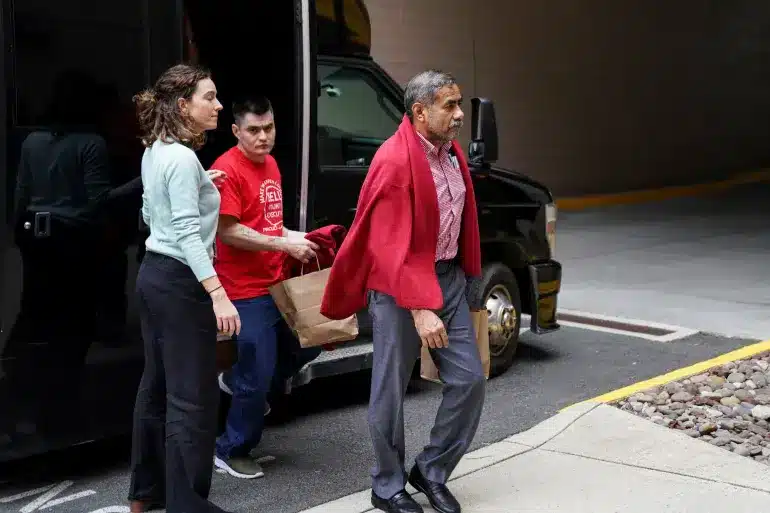
The call was made on Friday, one day after Managua freed 222 political prisoners who had been detained during crackdowns following the country’s 2018-starting anti-government protests. Most of those detainees were given permission to visit America.
The move has been seen as an attempt by President Daniel Ortega to begin to repair ties with the US. Relations have severely deteriorated in recent years as regional and Western powers have increasingly decried Ortega’s action and Washington has imposed a slew of sanctions.
In a brief statement released after Friday’s call, US State Department spokesperson Ned Price said Blinken and Moncada discussed the prisoners as well as “the importance of constructive dialogue”.
Price had previously said that weeks of negotiations had preceded the prisoners’ release, although Ortega has denied extensive talks preceded the release.
Washington has said nothing was promised to Ortega in return for releasing the prisoners.
US officials have said all of those released travelled to the US except for two of the prisoners who chose to stay in Nicaragua.
One of those prisoners who chose to stay, Catholic bishop Rolando Alvarez, was sentenced to 26 years in prison on Friday, stripped of his citizenship and fined.
US officials said they would allow the former prisoners to stay in the country for at least two years and would provide medical and legal support. Spain later said it would offer citizenship to the released.
A court official in Nicaragua’s capital Managua, meanwhile, had said the prisoners were “deported” and called them “traitors to the homeland”.
Speaking during a news conference on Friday, opposition leader Juan Sebastian Chamorro, who was among those released, said Ortega had freed the prisoners after “political pressure” had grown.
“I think (Ortega) wanted to basically send the opposition outside of the country into exile,” he said.
A former revolutionary, Ortega served as president of Nicaragua from 1979 to 1990.
He returned to the presidency in 2007, and has been increasingly accused of rights abuses and seeking to consolidate power, including quashing presidential term limits and seizing control of all branches of the government.
Following the mass arrest of opposition figures, Ortega easily won a fourth term in November 2021.
Turnout for the runoff stood at 72.2 percent, marginally higher than in the first round of voting.
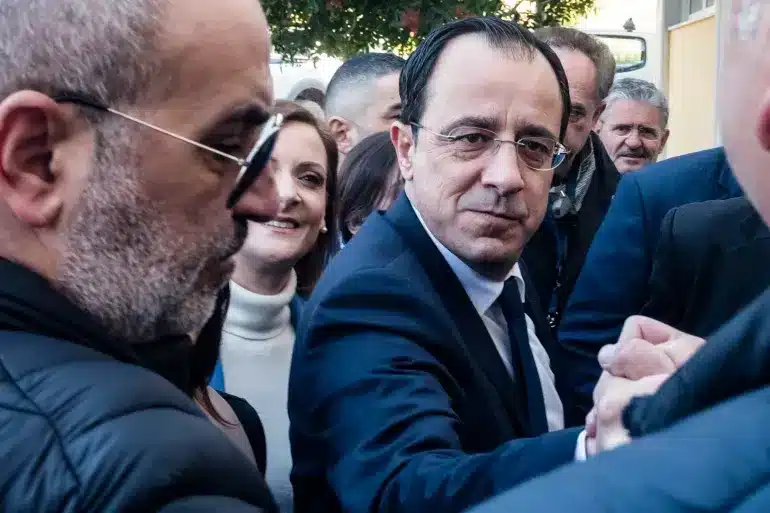
Cyprus voters have elected the former Foreign Minister Nikos Christodoulides as the next president of the small European Union member state, with his rival conceding defeat and congratulating him.
Christodoulides, 49, defeated fellow diplomat Andreas Mavroyiannis with 51.9 percent of the vote compared to 48.1 percent on the divided Mediterranean island on Sunday.
Mavroyiannis, 66, told reporters: “Tonight a journey has ended, a great journey that I shared with thousands of people. I regret that we couldn’t achieve the change that Cyprus needed.”
Christodoulides, who defected from the conservative ruling DISY party to run as an independent, scored 32 percent a week ago against 29.6 percent for Mavroyiannis, who also ran as an independent backed by the communist AKEL party.
Widely tapped as the election favourite during the campaign, Christodoulides is seen as likely to take a hard line on moribund United Nations-backed talks on ending the island’s decades-old division.
Former top diplomat Christodoulides earlier voiced confidence about a win when he told reporters: “The Cypriot people know and understand what is at stake … I have complete confidence in their judgement.”
Supporters greet presidential candidate Andreas Mavroyiannis after he cast his vote during runoff elections outside a polling station in Nicosia, Cyprus [Christina Assi/AFP]
Rising prices
Voter turnout was 72.4 percent with more than 405,000 citizens casting a ballot, a fraction higher than in the first round.
Top concerns for many voters are the cost of living crisis, irregular immigration, and the island’s almost half-century of division between the Greek-speaking south and a Turkish-occupied breakaway statelet in the north that is recognised only by Ankara.
But many disaffected voters simply looked for “the least worse candidate – a characteristic in most elections, but more so in this one”, said Andreas Theophanous of the Cyprus Center for European and International Affairs.
Cyprus has been divided since 1974, when Turkish forces occupied its northern third in response to a Greek-sponsored coup, but voters appeared split over whether the division was a priority in the election.
Retiree Dora Petsa, 75, said she expects the new president “to settle the Cypriot question”.
But Louis Loizides, 51, said the country has “too many internal problems” from the economy to immigration, having taken in large numbers of asylum seekers, including many who cross the UN-patrolled Green Line.
‘Rich even richer’
The ruling DISY had been knocked out of the presidential race for the first time in its history, and the conservative party’s decision to back neither candidate threw the runoff wide open.
Pre-poll favourite Christodoulides last week squeezed out DISY leader Averof Neofytou, 61, who came third with 26.11 percent in the first round, despite the incumbent’s endorsement.
Mavroyiannis surprised observers by beating Neofytou and closing the gap with Christodoulides last week.
The new government will be under pressure to root out corruption and address higher energy bills, labour disputes and the struggling economy.
Vasso Pelekanou, a 47-year-old woman, said the new president should help the middle class, which she believes was abandoned by the last government.
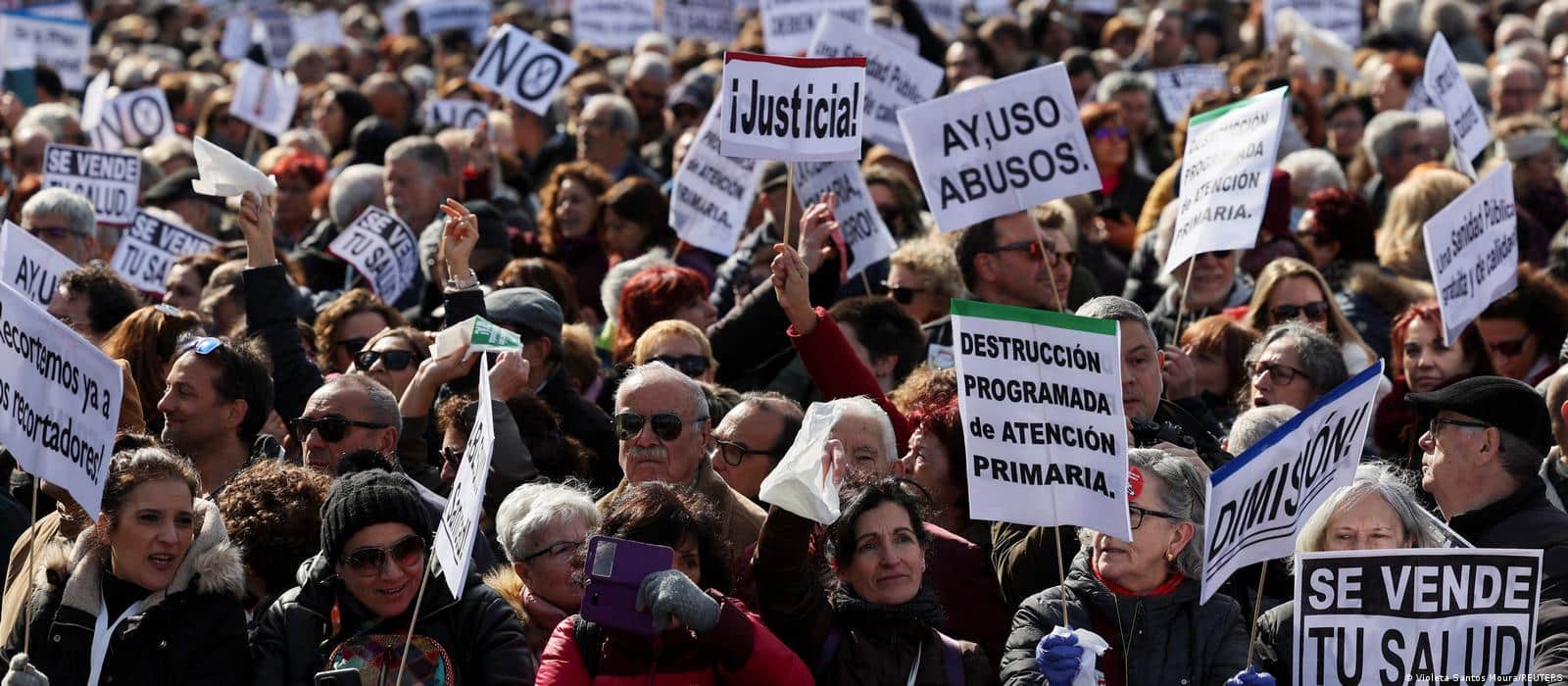
Numerous thousands of people thronged Madrid’s streets to express their opposition to what they perceive as a conservative regional government effort to dismantle public healthcare.
The right-wing regional government is allegedly attempting to destroy the public health system in the Spanish capital, according to health workers and their supporters who gathered in central Madrid on Sunday.
The government reported that more than 250,000 people participated in the demonstration, but organisers estimated a turnout of close to a million.
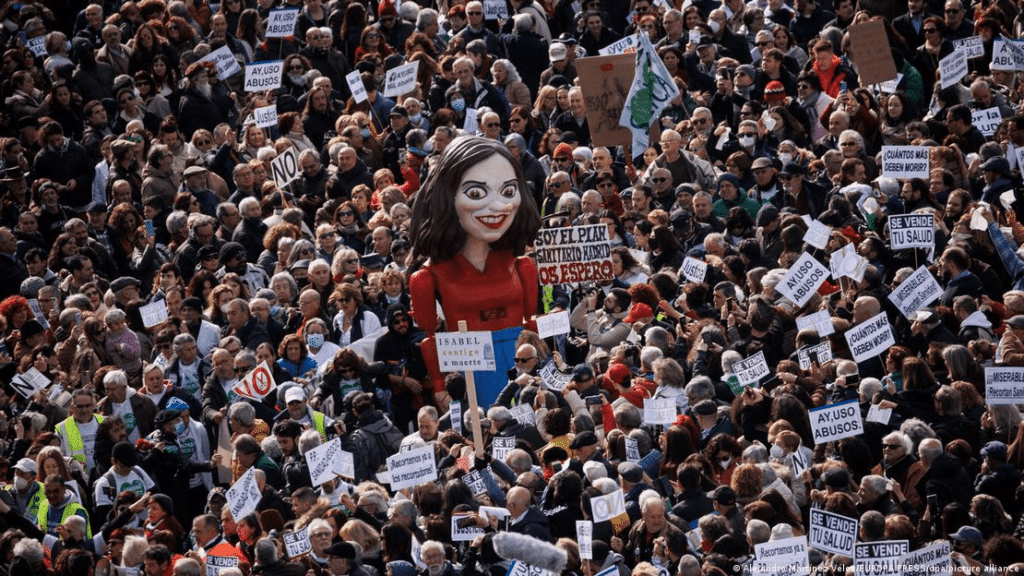
Demonstrators crowded the Plaza Cibeles area of the city centre while yelling and waving flags. Many of them carried homemade signs that read things like “A human right is the right to good health. Protect the medical system.”
One demonstrator sported a huge model of Isabel Diaz Ayuso, the right-wing leader of the Madrid regional government, witha Pinocchio-like nose attached.
One protester held up a giant caricature of Madrid regional head Isabel Diaz AyusoImage: Alejandro Martínez Vélez/EUROPA PRESS/dpa/picture alliance
“In Spain, the public health system used to be very good,” Madrid resident Ana Santamaria told the AFP news agency. “But in recent years, it has really deteriorated, particularly since the pandemic.”
Waiting lists, overworked doctors
Unions and left-wing parties complain about long patient waiting lists and a shortage of staff in health centers, forcing patients to overwhelm hospital emergency departments. Many government critics believe the conservatives are dismantling the system.
“The situation is dramatic… We can’t take proper care of the patients,” nurse Maite Lopez told AFP.
Diaz Ayuso’s opponents say her administration spends the least amount per capita on primary health care of any Spanish region even though it has the highest per capita income.
For every €2 spent on health care in Madrid, one ends up in the private sector, according to protest organisers.
Madrid leader blames upcoming election for protests
Ayuso denies the accusation and wrote on Twitter on Sunday: “We all believe in public health.”
She alleges the protests are motivated by the political interests of left-wing rivals ahead of May regional elections across most of Spain.
Spain has a hybrid healthcare system but the public sector is larger than the private one and is considered a basic pillar of the state.
The governments of the regional autonomous communities are responsible for a large part of the health budget as part of the country’s devolved political system.
The protest movement against health-care cuts has gathered strength through regular protests in recent months.
Some doctors and pediatricians have been striking on and off since November, with the Amyts doctors’ union in Madrid seeking better working conditions and pay.
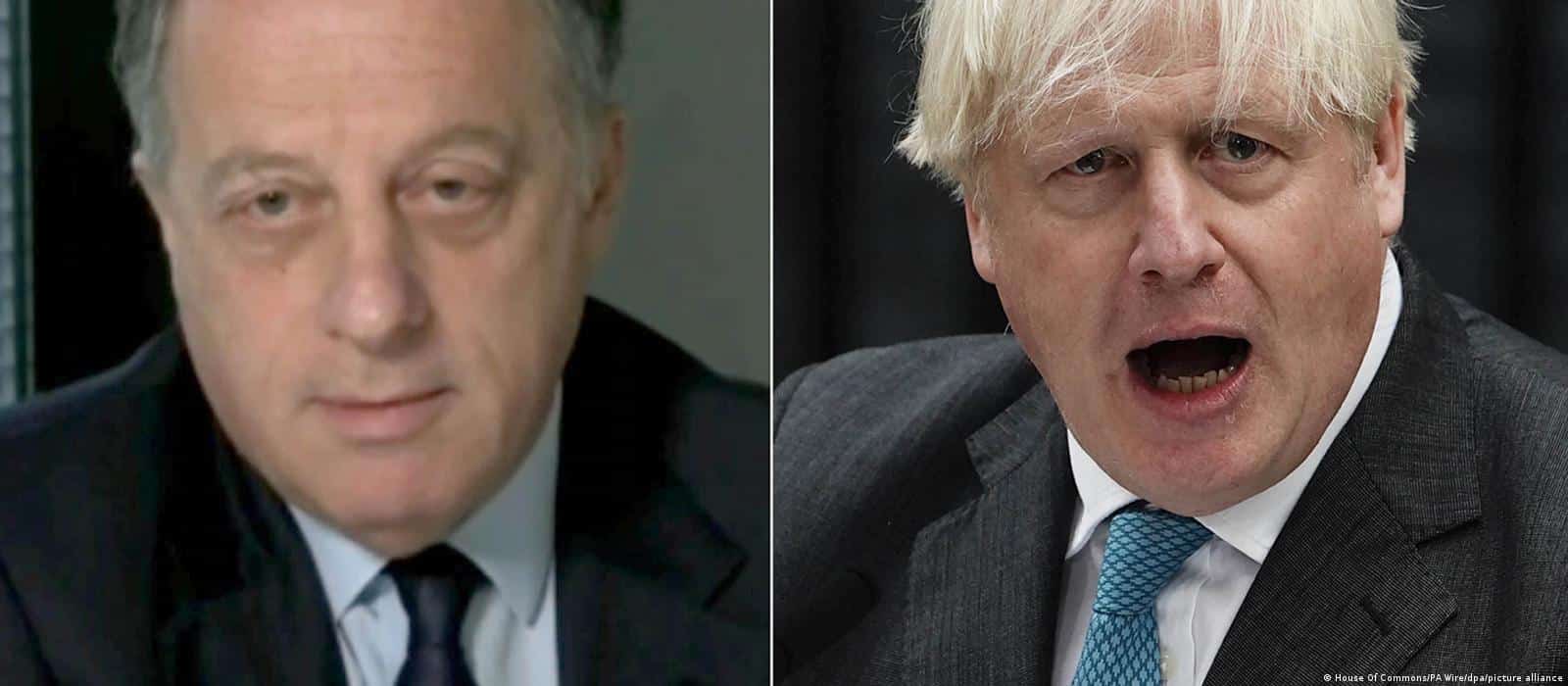
After learning that Richard Sharp had made “significant errors of judgement” in assisting former primeminister Boris Johnson in obtaining a loan for almost $1 million, the opposition Labour Party demanded his resignation.
After it was determined that he had violated ethical standards regarding the Boris Johnson loan scandal, the chairman of the BBC, the country’s major public broadcaster, came under pressure to resign on Sunday.
The failure of Richard Sharp to disclose that he had acted as a go-between to help the former UK prime minister obtain an 800,000 pound loan resulted in “significant errors of judgement,” according to a committee of UK lawmakers.
Sharp was appointed to lead the BBC shortly after the loan was arranged.
The cross-party Digital, Culture, Media, and Sport Committee said Sharp’s actions “constitute a breach of the standards expected of individuals” applying for prominent public appointments.
“The public appointment process can only work effectively if everyone is open and transparent, yet Richard Sharp chose not to tell either the appointment panel or our committee about his involvement in the facilitation of a loan to Boris Johnson,” said the committee’s acting chair, Damian Green.
The chair of the BBC is appointed based on the recommendation of the government of the day.
Parliamentary committee kept in the dark
Green added that the lack of transparency meant “we were not in the full possession of the facts when we were required to rule on his suitability for the role of BBC chair.”
Without formally calling for his resignation, the committee said Sharp should “consider the impact his omissions will have”on trust in the public broadcaster.
Sharp, a former Goldman Sachs banker, has admitted that he introduced Sam Blyth, an old friend who wanted to help Johnson, to a government official in late 2020. He said his involvement went no further.
Blyth, who is a distant cousin of Johnson, went on to make the loan to the former prime minister, UK media reported.
Sharp appeared before the committee on Tuesday and reiterated that he was not involved in making a loan or in arranging a guarantee or any financing.
He said after seeking an introduction for Blyth, he had agreed with a senior government official to have nothing more to do with the matter to avoid any conflict of interest.
“Mr. Sharp appreciates that there was information that the committee felt that it should have been made aware of in his pre-appointment hearing,” a spokesperson for Sharp said. “He regrets this and apologizes.”
Sharp also apologized again to the broadcaster’s staff for the distraction caused to the BBC.
Opposition says Sharp’s position ‘untenable’
Lisa Nandy, a shadow minister from the opposition Labour Party said Sharp’s position was “increasingly untenable.”
“I think it’s difficult to see how Richard Sharp could possibly stay in the position that he’s in, given the far-reaching implications for the reputation of the BBC and the implications for trust in journalism,” she told Sky News.
Andrew Mitchell, a minister from the ruling Conservative government said it was up to the broadcaster to decide Sharp’s future.
“I think Damian Green is a very senior member of the House of Commons and what he and his committee says matters,” Mitchell told the BBC.
“But I think, as I say, this is really something which the public appointments commissioner must look at and we must wait for his judgment. And above all, of course, it’s a matter for the judgment of the BBC.”
Britain’s public appointments watchdog is also reviewing Sharp’s appointment.
The chair is responsible for maintaining the independence of the BBC. He also appoints the director general and acts as the corporation’s most senior representative to parliament and the government.
Sharp was named as the preferred candidate for the job in January 2021.
Last week, the incident took place close to the Spratly Islands. It is the most recent escalation in the conflict in the South China Sea betweenChina and the Philippines.
In the disputed South China Sea, the Philippine Coast Guard claimed on Monday that the Chinese coast guard had fired a “military-grade laser light” at one of its ships.
The incident, according to Manila, temporarily rendered some of the ship’s crew members blind.
Officials reported that the incident happened on February 6 in the Spratly Islands, about 12 miles (20 kilometres) from Second Thomas Shoal.
Philippine troops are stationed on Second Thomas Shoal inside the BRP Sierra Madre, a derelict navy ship that has been grounded into the reef to assert Manila’s territorial claims.
“The deliberate blocking of Philippine government ships to deliver food and supplies to our military personnel on board the BRP Sierra Madre is a blatant disregard for, and a clear violation of, Philippine sovereign rights in this part of the West Philippine Sea,” said the Philippine Coast Guard, using the country’s official terminology for the stretch of waters close to its western coast.
What happened?
The Philippine Coast Guard said its patrol boat was supporting a “rotation and resupply mission” when a Chinese coast guard vessel shone a green laser at the bridge of the Philippine ship.
“The Philippine coast guard will continue to exercise due diligence in protecting the country’s territorial integrity against foreign aggression,” Philippines Admiral Artemio Abu said.
China has not yet commented on the claims.
It is not clear if the resupply mission was completed.
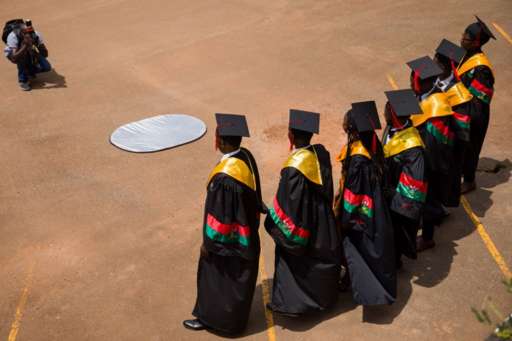
The graduation square has a camera ban in place, but no explanation has been given for it. Alcohol, cigarettes, canned food, and bottled beverages are also not allowed at the ceremony.
“A detailed list of prohibited items has been inserted in the graduation invitation package that is presented to the graduands and invited guests,” the head of ceremonies committee, Prof Patrick Mangeni, said.
A total of 13,221 students are scheduled to graduate, with each allowed to invite only two guests.
First Lady Janet Museveni, who is also the minister of basic education, is expected to attend theceremony on Monday.
A news source, VOD, according to Prime Minister Hun Sen, defamed him and his son. He has been in power for one of the longest periods in history.
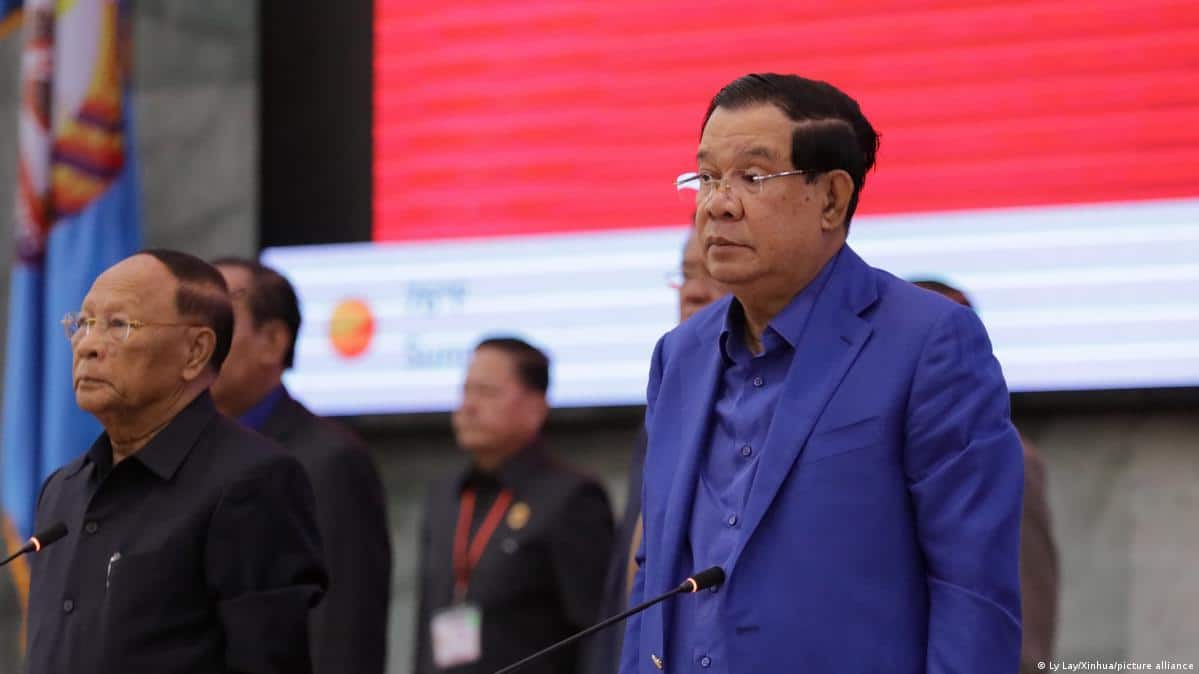
One of the last few local independent news sources was shut down on Sunday by Cambodian Prime Minister Hun Sen.
He alleged that The Voice of Democracy (VOD)had slandered him and his son on purpose in a piece about the nation’s relief efforts for Turkey’s earthquake victims.
Beginning at 10 a.m. local time (0300 UTC) on Monday, VOD will no longer be granted a licence to publish or broadcast, the prime minister announced on Facebook.
Hun Sen offended by VOD
In an article published Wednesday, VOD quoted government spokesperson Phay Siphan as saying that Hun Sen’s son — Hun Manet — had signed the $100,000 (€ 93,750) aid agreement on behalf of the prime minister.
Hun Manet is the joint chief of staff and deputy commander for the country’s armed forces. He has been nominated by the ruling party to succeed his father in future elections.
By signing such an agreement, Hun Manet appeared to have overstepped the bounds of his position.
The prime minister initially gave VOD 72 hours to verify the facts with the Ministry of Information and demanded a public apology.
VOD sent a letter to Hun Sen’s Cabinet saying it was sorry for any confusion it may have caused and explained that the organization had only quoted a government spokesperson.
Hun Sen said the response was unacceptable and, on Sunday, ordered the ministry to revoke VOD’s license.
“Commentators tried to attack me and my son Hun Manet,” Hun Sen said, adding that the VOD story hurt the “dignity and reputation” of the Cambodian government.
He ordered the police to “keep order” but not seize property, and asked the staff of VOD to “find new jobs at other places.”
There was no immediate comment from Phay Siphan on the incident.
A longstanding crackdown on media and dissent
Hun Sen is one of the world’s longest-serving dictators. Many of his political rivals have been jailed and exiled, and multiple critical media outlets have been shut.
In 2017, The Cambodia Daily — which had a reputation for breaking news on tough issues — was shut down just months ahead of the last general election in 2018.
The tents are so close to the border wall between Syria and Turkey, they are almost touching it.
Those living here on the Syrian side may have been displaced by the country’s more than decade-old civil war. But they could also be survivors of the earthquake. Catastrophes overlap in Syria.
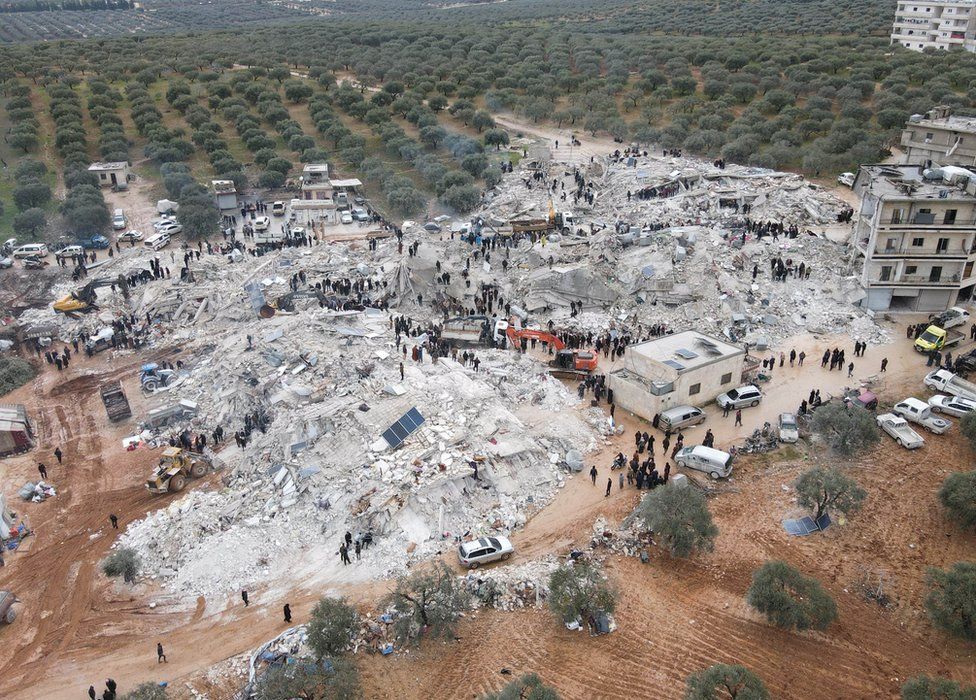
The earthquake, untroubled by international borders, has brought havoc to both countries. But the international relief effort has been thwarted by checkpoints. In southern Turkey, thousands of rescue workers with heavy lifting gear, paramedics and sniffer dogs have jammed the streets, and are still working to find survivors. In this part of opposition-held north-west Syria, none of this is going on.
I had just crossed the border from four days in the city of Antakya, Turkey, where the aid response is a cacophony – ambulance sirens blare all night long, dozens of earth movers roar and rip apart concrete 24 hours a day. Among the olive groves in the village of Bsania, in Syria’s Idlib province, there’s mostly silence.
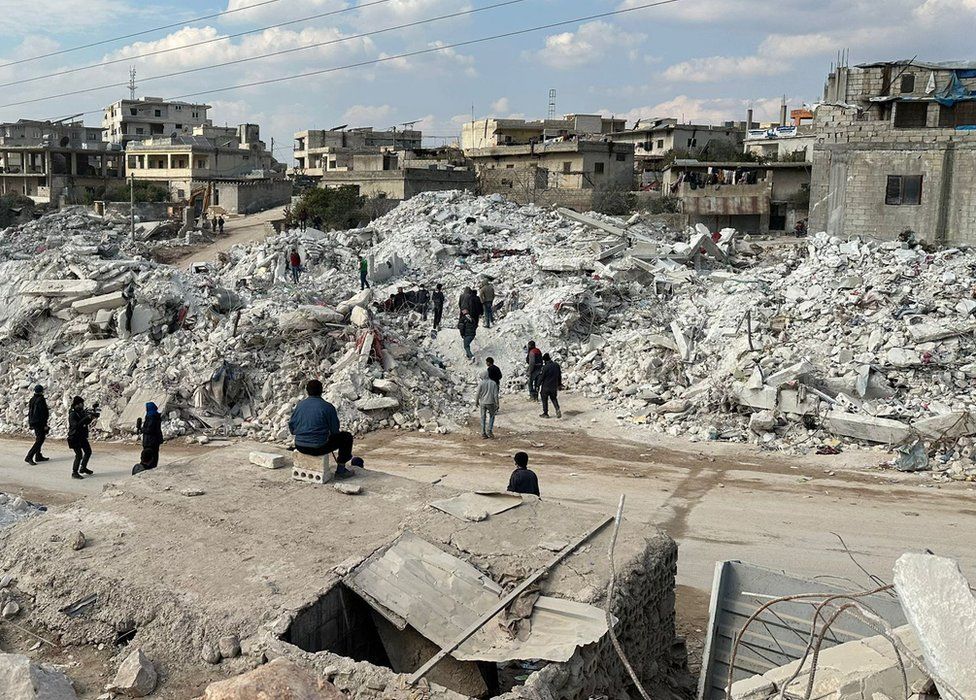
The homes in this border area were newly built. Now more than 100 have gone, turned to aggregate and a ghostly white dust which gusts across the farmland. As I climb over the chalky remains of the village, I spot a gap in the ruin. Inside, a pink-tiled bathroom sits perfectly preserved.
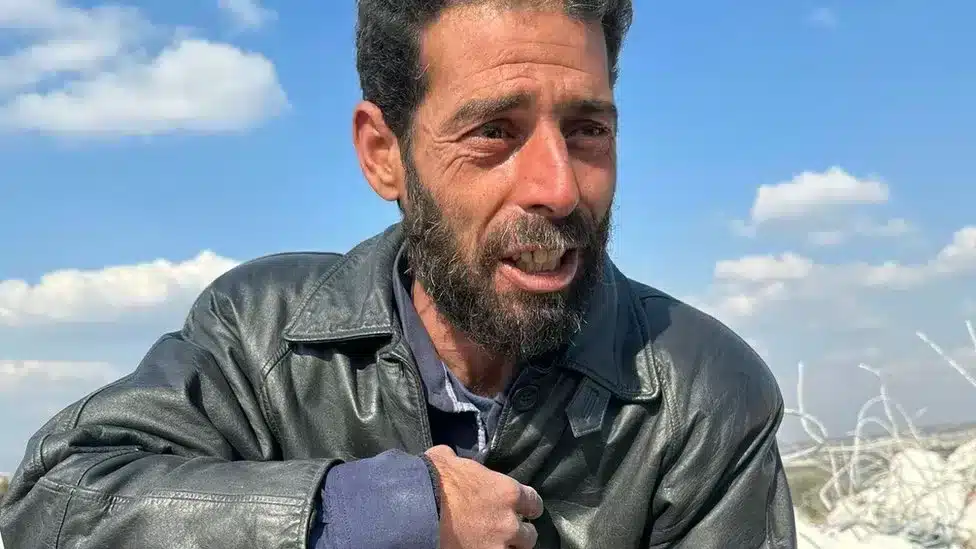
The earthquake swallowed Abu Ala’s home, and claimed the lives of two of his children.
Image caption,The town of Bsania was a small but thriving community
“The bedroom is there, that’s my house,” he says, pointing to pile of rubble. “My wife, daughter and I were sleeping here – Wala’, the 15-year-old girl, was at the edge of the room towards the balcony. A bulldozer was able to find her, [so] I took her and buried her.”
In the dark, he and his wife clung to olive trees as aftershocks rocked the hillside.
The Syrian Civil Defence Force – also known as the White Helmets – which operates in opposition-held areas, did what they could with pickaxes and crowbars. The rescuers, who receive funding from the British government, lack modern rescue equipment.
Abu Ala’ breaks down when he describes the search for his missing 13-year-old son, Ala’. “We kept digging until evening the next day. May God give strength to those men. They went through hell to dig my boy up.”
A deeply religious man, he is now bereft. “What am I going to do?” he asks. “There are no tents, no aid, nothing. We’ve received nothing but God’s mercy until now. And I’m here left to roam the streets.”
As we leave, he asks me if I have a tent. But we have nothing to give him.
I meet up with the White Helmets, expecting to find them looking for survivors. But it is too late. Ismail al Abdullah, is weary from effort, and what he describes as the world’s disregard for the Syrian people. He says the international community has blood on its hands.
“We stopped looking for survivors after more than 120 hours passed,” he says. “We tried our best to save our people, but we couldn’t. No-one listened to us.
“From the first hour we called for urgent action, for urgent help. No-one responded. They were just saying, ‘We are with you’, nothing else. We said, we need equipment. No-one responded.”
Image caption,In the town of Harem, children have been removing rubble
Apart from a few Spanish doctors, no international aid teams have reached this part of Syria. It is an enclave of resistance from Bashar al-Assad’s rule. Under Turkish protection, it is controlled by Hayat Tahrir al-Sham (HTS), an Islamist group that was once affiliated to al-Qaeda. The group has cut those links, but almost all governments have no relations with them. For our entire time in Syria, armed men, who didn’t want to be filmed, accompanied us and stood at a distance.
More than a decade into Syria’s stalled civil war, the 1.7m people who live in this area continue to oppose President Assad’s rule. They live in makeshift camps and newly built shelters. Most have been displaced more than once, so life here was already very hard before the earthquake.
The international help that reaches this part of Syria is tiny. Many of the earthquake victims were taken to the Bab al-Hawa hospital, which is supported by the Syrian American Medical Society. They treated 350 patients in the immediate aftermath, general surgeon Dr Farouk al Omar tells me, all with only one ultrasound.
When I ask him about international aid, he shakes his head, and laughs. “We cannot talk more about this topic. We spoke about that a lot. And nothing happened. Even in a normal situation, we don’t have enough medical staff. And just imagine what it’s like in this catastrophe after earthquake,” he says.
At the end of the corridor, a tiny baby lies in an incubator. Mohammad Ghayyath Rajab’s skull is bruised and bandaged, and his small chest rises and falls thanks to a respirator. Doctors can’t be sure, but they think he’s around three months old. Both of his parents were killed in the earthquake, and a neighbour found him crying alone in the dark in the rubble of his home.
In the town of Harem, Fadel Ghadab lost his aunt and cousin.
“How is it possible that the UN has sent a mere 14 trucks worth of aid?” he asks. “We’ve received nothing here. People are in the streets.”
More aid has made it into Syria, but not much and it is too little, too late.
In the absence of international rescue teams in Harem, children remove rubble. A man and two boys use a car-jack to prize apart the collapsed remains of a building, carefully salvaging animal feed onto a blanket. Life isn’t cheaper in Syria, but it is more precarious.
The day is ending and I have to leave. I cross the border back into Turkey and soon get stuck in a traffic jam or ambulances, construction equipment – the gridlock of a national and international aid response.
My phone pings with a message from a Turkish rescuer telling me his team found a woman alive after 132 hours buried under her home. Behind me in Syria, as darkness falls, there is only silence.
On Sunday, the number of fatalities from the significant earthquake that struck Turkey and Syria reached 33,000. (February 12). The United Nations (UN) has warned that the final number could double. Since the 7.8-magnitude earthquake that shook the region on Monday, 29,605 people have died in Turkey, while 3,574 people have died in Syria, according to officials and medical personnel.
The confirmed total now stands at 33,179.
The UN expressed its disappointment on Sunday over the failure to deliver urgently required aid to Syria’s war-torn regions.
UN relief chief Martin Griffiths said that much more was required for the millions of people whose homes had been destroyed, despite the fact that a convoy carrying supplies for northwest Syria had arrived via Turkey.
“We have so far failed the people in northwest Syria.” They rightly feel abandoned. Looking for international help that hasn’t arrived,” Griffiths said on Twitter.
At the #Türkiye–#Syria border today. We have so far failed the people in north-west Syria. They rightly feel abandoned. Looking for international help that hasn’t arrived. My duty and our obligation is to correct this failure as fast as we can. That’s my focus now.
In Syria, years of conflict have all but destroyed the healthcare system. Supplies have been slow to arrive in Syria.
The UN convoy of ten trucks crossed into northwest Syria via the Bab al-Hawa border crossing, according to an AFP correspondent, carrying shelter kits including plastic sheeting, ropes and screws and nails, as well as blankets, mattresses and carpets.
In a joint operation by the North American neighbours, a US fighter jet shot down an unidentified cylindrical object over Canada.
After a week-long saga over a rumoured Chinese spy balloon, North America appeared to be on high alert. The shootdown on Saturday was the second such action in as many days.
The shootdown was first reported by Canadian Prime Minister Justin Trudeau, who also promised that his country’s forces would recover and examine the aircraft’s wreckage.
Canadian defence minister Anita Anand declined to speculate on the origin of the object, which she said was small and cylindrical in shape. She stopped short of describing it as a balloon but said it was smaller than the Chinese balloon shot down off South Carolina’s coast a week ago, but similar in appearance.
She said it was flying at 12,100 metres (40,000 feet) and posed a risk to civilian air traffic when it was shot down at 3:41 EST (20:41 GMT).
“There is no reason to believe that the impact of the object in Canadian territory is of any public concern,” Anand told a news conference.
The Pentagon said the North American Aerospace Defense Command (NORAD) detected the object over Alaska late on Friday evening. US fighter jets from Joint Base Elmendorf-Richardson, Alaska, monitored the object as it crossed over into Canadian airspace, where Canadian CF-18 and CP-140 aircraft joined the formation.
“A US F-22 shot down the object in Canadian territory using an AIM 9X missile following close coordination between US and Canadian authorities,” Pentagon spokesperson Brigadier General Patrick Ryder said in a statement
US President Joe Biden authorised the country’s military to work with Canada to take down the high-altitude craft after a call between Biden and Trudeau, the Pentagon said. The White House said Biden and Trudeau agreed to continue close coordination to “defend our airspace”.
“The leaders discussed the importance of recovering the object in order to determine more details on its purpose or origin,” the White House said in a statement.
Shortly after the 3:41 pm (2041 GMT) downing of the object, aviation authorities also shut down part of the airspace over the northwest US state of Montana after detecting what they called a “radar anomaly,” the US Northern Command said.
In a sign of jitters over possible intrusions, Northern Command said US fighter jets took to the skies but “did not identify any object to correlate to the radar hits”. Skies were then reopened to commercial air traffic.
Suspected Chinese spy balloon
A day earlier, Biden ordered another shootdown of an unidentified flying object near Deadhorse, Alaska. The US military on Saturday remained tight-lipped about what, if anything, it had learned as recovery efforts were under way on the Alaskan sea ice.
The Pentagon on Friday offered only a few details, including that the object was the size of a small car, it was flying at about 12,100 metres and could not manoeuvre and appeared to be unmanned. US officials have been trying to learn about the object since it was first spotted on Thursday.
“We have no further details at this time about the object, including its capabilities, purpose or origin,” Northern Command said on Saturday.
It noted difficult arctic weather conditions, including wind chill, snow and limited daylight that could hinder search and recovery efforts.
“Personnel will adjust recovery operations to maintain safety,” Northern Command said.
On February 4, a US F-22 fighter jet brought down what the US government called a Chinese surveillance balloon off the coast of South Carolina, following its week-long journey across the US and portions of Canada. China’s government has said it was a civilian research vessel.
Some US legislators criticised Biden for not shooting down the Chinese balloon sooner. The US military had recommended waiting until it was over the ocean out of fear of injuries from falling debris.
US personnel have been scouring the ocean to recover debris and the undercarriage of electronic gadgetry since the shootdown of the 60-meter-high (200-foot-tall) Chinese suspected surveillance balloon.
The Pentagon has said a significant amount of the balloon had already been recovered or located, suggesting US officials may soon have more information about any Chinese espionage capabilities onboard the vessel.
Sea conditions on February 10 “permitted dive and underwater unmanned vehicle (UUV) activities and the retrieval of additional debris from the sea floor,” Northern Command said.
“The public may see US Navy vessels moving to and from the site as they conduct offload and resupply activities.”
In retaliation for an alleged Chinese spy balloon that crossed US airspace, the US blacklisted six Chinese entities it claimed were connected to Beijing’s aerospace programmes.
The action is likely to intensify the diplomatic dispute between the US and China, which already worsened as a result of the surveillance balloon that the US ultimately shot down last weekend. Beijing has maintained that the balloon was a weather craft that had veered off course, while the US claimed it was equipped to detect and gather intelligence signals.
The US Bureau of Industry and Security claimed on Friday that the six Chinese companies were being pursued for “their
“The PLA is utilizing High Altitude Balloons (HAB) for intelligence and reconnaissance activities,” it said.
The US Deputy Secretary of Commerce Don Graves said on Twitter his department “will not hesitate to continue to use” such restrictions and other regulatory and enforcement tools “to protect US national security and sovereignty”.
The Commerce Department will not hesitate to continue to use the Entity List and our other regulatory and enforcement tools to protect U.S. national security and sovereignty.
The six entities are Beijing Nanjiang Aerospace Technology Co, China Electronics Technology Group Corporation 48th Research Institute, Dongguan Lingkong Remote Sensing Technology Co, Eagles Men Aviation Science and Technology Group Co, Guangzhou Tian-Hai-Xiang Aviation Technology Co, and Shanxi Eagles Men Aviation Science and Technology Group Co.
The blacklisting will make it more difficult for the five companies and one research institute to obtain US technology exports.
Also on Friday, a US military fighter jet shot down an unknown object flying off the remote northern coast of Alaska on orders from President Joe Biden.
The object was downed because it reportedly posed a threat to the safety of civilian flights rather than any knowledge it was engaged in surveillance.
White House national security spokesperson John Kirby told reporters the “high-altitude object” was flying at 12,000 metres (40,000 ft) over Alaska, posing a threat to civilian aviation.
“We don’t know who owns this object,” Kirby said during a news conference, adding that it was significantly smaller than the Chinese balloon that flew over the country last week.
“We’re calling this an object because that’s the best description we have right now,” he said. “We don’t have any information that would confirm a stated purpose for this object.”
Former Ben Ali confidant Eltaief and two other key political activists have been detained.
According to attorneys, the Tunisian police have detained two important political activists as well as powerful businessman Kamel Eltaief, who was once a confidant of former President Zine El Abidine Ben Ali.
Eltaief, 68, was detained on Saturday at his home in Tunis, the capital, according to his lawyer Nizar Ayed, who did not provide any additional information.
Eltaief was viewed by many Tunisians as a representation of past corruption in the North African country, particularly by Ennahdha party supporters who were fierce opponents of President Kais Saied.
The influential power broker was involved in the 1987 coup that forced former President Habib Bourguiba from power on medical grounds, and was long considered a crony of Bourguiba’s successor Ben Ali. Eltaief fell out of grace with Ben Ali in 1992 after a feud with his wife Leila Trabelsi.
After the fall of Ben Ali in 2011, the businessman moved closer to the opposition. In 2012, he was investigated for “conspiracy against state security”, but no charges were brought against him and the case was closed in 2014.
Police also arrested Abdelhamid Jelassi, a former senior leader of the Ennahdha, as well as political activist Khayam Turki.
Seven police officers on Saturday evening searched Jelassi’s home and confiscated his mobile phone before arresting him, the party said without providing further details. According to Tunisian media, Jelassi was arrested on “suspicion of a plot against state security”.
Ennahdha, the biggest party in the opposition, said the arrest of Turki was aimed at intimidating the president’s opponents.
The Salvation Front, the main opposition coalition against Saied, condemned his arrest, saying police had questioned him several times for meeting opposition figures at his home.
Turki’s lawyer Abdelaziz Essid, who said his client was not known to be wanted by the authorities, said he was arrested in an early morning police raid.
“He was taken to an unknown destination,” said Essid, adding Turki had not been “facing any legal proceedings” to justify his arrest. No further details were immediately available.
Rights groups have voiced increasing concern over the lack of political freedoms in Tunisia since Saied’s seizure of most powers in 2021 and his moves to assume ultimate authority over the judiciary. Since Saied’s takeover, Tunisia has seen a spike in the arrest and prosecution of politicians, journalists and others.
His opponents have accused him of authoritarianism in the birthplace of the 2011 Arab Spring uprisings.
The large oil companies, including ExxonMobil and Norway’s Equinor, as well as UK-based BP and Shell, have been announcing astounding profit numbers.
They are all profiting from the rise in oil and gas prices as a result of the invasion of Ukraine.
People around the world struggle to pay their energy bills and fill up their cars while these businesses make huge profits, which has prompted calls for higher taxes on these businesses.
What is their method of income generation, and should the government intervene to put a stop to it?
Why has the oil price soared?
Oil and gas are traded around the world, and if supplies are short and demand high, sellers can charge more, and the price goes up.
Before the Ukraine war, Russia was the world’s largest exporter of oil and natural gas.
A lot of the money that people paid to buy that oil and gas went to the Russian government – those exports made up 45% of the Russian government budget in 2021.
After the invasion, Western countries, including the UK and EU, tried to stop (or at least massively reduce) their energy imports from Russia, to avoid funding the Russian military and supporting a hostile regime.
Countries that didn’t want to buy from Russia had to pay much higher prices for oil produced elsewhere.
As economies recovered from the COVID-19 lockdowns and began to function normally, oil prices had already been rising.
The day after the Russian invasion, the oil price went above $100 a barrel, and peaked at over $127 in March, before coming back down to around $85. Gas prices also soared after the invasion.
Oil and natural gas are crucial to almost every aspect of modern life. Oil is used to make petrol and diesel, and natural gas is used for heating and cooking.
They’re also used in agriculture, electricity generation, and other industrial processes which make everything from fertilizer to plastics.
So a sustained rise in oil and gas prices pushes up the cost of many other things we buy, driving the cost of living crisis that has gripped the UK – and other countries – in recent months.
Why do soaring prices mean more profits?
Oil companies make money by locating oil and gas reserves buried in rocks under the earth’s surface, and drilling down to release them.
The costs don’t vary that much as the price goes up or down, but the money they make from selling it does.
So when oil prices soared after the invasion of Ukraine, the money these companies made from selling oil and gas massively increased as well.
How much profit did Shell and BP make last year?
On Tuesday, BP reported record annual profits of $27.7 billion (£23 billion) for 2022 as it scaled back plans to reduce the amount of oil and gas it produces by 2030. Those profits were double the previous year’s figure.
In February, Shell reported its highest profits in 115 years. Profits will reach $39.9 billion (£32.2 billion) in 2022, more than doubling the previous year’s total.
The profits they make don’t all disappear – lots of ordinary people own shares in BP, Shell, and other global oil companies. This may be via their pension funds, and they may not even be aware of it.
Some of the extra profits are paid to shareholders through higher dividends, and buying back shares (which increases the share price).
But as long as the billions roll in while customers struggle to pay their bills, the calls for higher taxes will continue.
How much tax do oil and gas producers pay?
Big oil companies made their record profits even after paying billions to governments around the world.
BP and Shell are in a complicated position because they are headquartered in the UK but produce a relatively small amount of oil and gas in UK waters. They make most of their profits from activities around the world.
Shell paid $134m (£110m) tax on its UK operations in 2022, out of a worldwide tax bill of $13bn.
BP paid $2.2bn (£1.8bn) in taxes on its UK operations, out of a global tax bill of $15bn.
How are oil firms taxed in the UK?
Oil companies already pay a tax on their profits from oil and gas production in the UK of 40% – which is higher than taxes on other companies.
But they can reduce that tax bill by deducting the cost of shutting down old oil rigs, or offsetting future investments and losses from earlier years.
In some years, BP and Shell have paid no tax on UK operations, and received payments from the UK government instead.
After the invasion of Ukraine, the government faced calls to introduce an extra “windfall tax” on energy company profits to help pay for soaring energy bills.
This was introduced in May 2022, and increased from 25% to 35% in November. It is now expected to raise around £40bn extra from all the companies operating in UK waters between 2022 and 2028.
However, the windfall tax only applies to the profits on UK oil and gas production, which only account for a small share of some firms’ profits.
And firms can deduct more than 90% of the cost of new exploration and production from their windfall tax bills, significantly reducing what they have to pay.
The windfall tax accounted for all of Shell’s UK tax bill and $700 million (£538 million) of BP’s.
They face calls to pay even more tax
Politicians, environmentalists, trade unions and poverty campaigners have attacked oil companies’ record profits, and argued for higher windfall taxes.
They say high prices are the result of something beyond the oil firm’s control – war, and that it’s not fair that oil companies are profiting from people’s suffering.
Some say higher windfall taxes are a good way for governments to raise money because they’re easy to collect and hard to avoid.
Even the former boss of Shell himself, Ben van Beurden, wondered if it was inevitable that governments would need to tax energy producers more to protect the poorest in society.
But oil firms argue that a higher windfall tax would make them less willing to invest in producing in the UK, and that they would search for oil elsewhere where taxes are lower.
Harbour Energy, which produces more oil and gas in the UK than anyone else, is cutting jobs and reconsidering its UK investments because of the windfall tax.
If the UK government decided totax BP and Shell on their globalprofits more heavily, they could potentially move their headquarters out of the country – escaping the new tax, and depriving the UK of much of the revenues they currently pay.
Image caption,A BP oil rig in North sea
Oil companies have to operate in a world where the price of oil can go down as well as up, with little warning. Money made in the good years helps to balance out years when oil prices are low.
Many oil companies lost billions from Russian investments last year – BP wrote off $24bn of investments in the Russian oil company Rosneft, for example.
They also have to invest billions to find new reserves of oil to keep supplies running until the world switches over to renewable sources of power.
Energy companies have a big role to play in that switch-over, too. BP and Shell invest some of the billions they make from oil and gas into renewable power such as solar and wind farms, and charging stations for electric cars.
BP boss Bernard Looney said the British company was “helping provide the energy the world needs” while investing the transition to green energy.
Shell chief executive Wael Sawan said that these are “incredibly difficult times – we are seeing inflation rampant around the world” but that Shell was playing its part by investing in renewable technologies. Its chief financial officer Sinead Gorman added that Shell had paid $13bn in taxes globally in 2022.
However, BP scaled back its plans to cut its carbon emissions this year because demand for oil and gas is so strong.
Does the energy cap reduce oil company profits?
The energy price cap was introduced in 2019 to stop companies from overcharging people who didn’t shop around for cheaper deals. It targets energy suppliers, and doesn’t affect the profits of oil and gas producers.
A teenage girl who was critically hurt passed away in a Warrington park.
At 15:13 GMT on Saturday, officers were called to Culcheth Linear Park in response to reports of a girl who had suffered serious injuries.
Despite calling for emergency services, she was pronounced dead on the spot. Her heirs have been notified.
Despite the fact that the investigating officers are aware of the online rumours, Cheshire Constabulary Det Ch Insp Adam Waller urged people not to speculate.
He said: “We are following numerous lines of enquiry to establish what led to the victim’s death, and local residents will see an increased presence of police officers in the area while we investigate this incident.
“At this stage, we do not believe there is a wider threat to anyone else; however, if you have concerns, please do speak to a local officer.”
An area has been cordoned off close to where she was found, but formal identification has yet to take place.
Charlotte Nichols, Labour MP for Warrington North, said she had spoken to the police borough commander and urged anyone who was nearby at the time or who has CCTV or dashcam footage or information that might help the investigation to contact police.
“I urge anyone with any information, no matter how small, to get in touch,” Det Ch Insp Waller said.
Andrzej Duda, the president of Poland, said sending F-16 aircraft would be a “very serious decision” that was “not easy to take” in an exclusive interview with Laura Kuenssberg on Sunday.
Since Russia’s invasion, Poland has been one of Ukraine’s loudest supporters.
It was one of several nations that announced plans to send more tanks, ammunition, and equipment to the front lines last month.
President Duda’s comments come despite him and President Zelensky having spoken this week, at the end of the Ukrainian leader’s surprise headline-grabbing European tour. In London, President Zelensky used his speech in Parliament to call for the means to help fight Russia in the air:
“I appeal to you and the world with the simple, and yet most important words – combat aircraft for Ukraine, wings for freedom.”
Ukraine’s leader repeated that call in Paris and Brussels, in a rare departure from his country, under the tightest of security. He made headlines right around the world.
In Warsaw, President Duda told me sending F-16 jets would pose a “serious problem” because, with fewer than 50 of the aircraft in the Polish air force, “we have not enough… and we would need many more of them.”
He also stressed that combat aircraft, like the F-16s, have a “very serious need for maintenance” so it’s “not enough just to send a few planes”.
Image caption,President Duda with Laura Kuenssberg in Warsaw
With Poland being a Nato member, said Mr Duda, any decision to provide fighter jets had to be a “joint decision” – rather than one for any single country to take.
There are also nerves about whether providing planes would pull Nato directly into the conflict—and even into war against Russia itself. At the start of the Russian invasion in 2022, Duda said sending jets would “open a military intervention in the Ukrainian conflict.” But in direct response to Ukraine’s request for planes this week, the Polish leader’s comments are significant.
As Ukraine’s neighbour, President Duda has been one of the most ardent supporters of President Zelensky and has contributed vast amounts of military aid, becoming the main supplier of heavy weaponry, including infantry fighting vehicles and artillery, drones, and ammunition.
Duda was also at the forefront of pushing other allies to promise to provide tanks in recent weeks.
Image caption,President Zelensky (l) met Mr Duda in Poland on Friday at the end of his surprise European tour
After notable reluctance from Germany, and a fraught debate across Europe about the risks of escalating the conflict, Leopard tanks will arrive in Ukraine, along with Challengers from the UK and Abrams from the US.
Poland has also provided homes to millions of Ukrainian refugees.
President Duda is adamant that “weaponry has to be delivered to Ukraine all the time… it needs armaments.” But it is clear he doesn’t think sending combat aircraft in large numbers is likely from Poland or any other ally, at least in the short term.
Yes, Prime Minister Rishi Sunak said “nothing was off the table” while he savoured his photo opportunity with President Zelensky in front of a tank this week – jeans tucked into unlaced boots and tieless, alongside the Ukrainian leader in his familiar army sweatshirt and combat trousers.
But before too long, Defence Secretary Ben Wallace was making plain that would mean training for pilots and other support first. No UK jets will take off for Ukraine any time soon.
Image caption,Polish F-16 fighter jets taking part in a Nato exercise, 12 October 2022
All week, British politicians have been falling over themselves to associate with the biggest political celebrity in the world right now, President Zelenksy, sharing their blurry phone snaps of his historic Westminster Hall speech and giving interviews about how moving it was to be there.
In Paris, French President Emmanuel Macron greeted him like a film star in front of the Elysee Palace. EU leaders then frantically tweeted pictures of their own “grip and grin” moments with the Ukrainian leader later.
There is staunch support for President Zelensky without doubt. It’s not just shown in flowery language and promises of commitment but, as President Duda explains, with guns, tanks and drones, plus support for refugees, rather than selfies with MPs. Western allies emphasise how countries have come together in a way that will have disappointed and frustrated Vladimir Putin.
Leaders, like Poland’s president, underline the threat they feel to their own countries. Talking to him in Warsaw about the conflict is a world away from conversations in Westminster, with the Russian border at Kaliningrad only about 200 miles away.
The dilemma over jets is another example of the fraught calculations our leaders face. What is practically possible in terms of supporting Ukraine? And what is politically and diplomatically viable, without provoking a wider war?
Poland and other countries’ firm backing does not mean the West, or even Ukraine’s closest allies, will or can say “yes” to his every request. One senior diplomatic source suggests President Zelensky is, of course, well aware of this.
His headline-grabbing journey this week was not just about the jets, and it doesn’t look like it will soon result in “wings for freedom.” But as we approach the anniversary of Russia’s invasion, his careful choreography and powerful imagery on his European tour will have reminded not just Western politicians but also their publics of what is at stake.
Despite some miraculous rescues, the number of fatalities from the earthquake in Turkey and Syria has surpassed 28,000, and the prospect of finding many more survivors is dwindling.
Search efforts were suspended on Saturday due to clashes between unnamed groups, according to German rescuers and the Austrian army.
According to one rescuer, security is predicted to deteriorate as food supplies get low.
The president of Turkey declared that he would use his emergency powers to punish lawbreakers.
An Austrian army spokesperson said early on Saturday that clashes between unidentified groups in the Hatay province had left dozens of personnel from the Austrian Forces Disaster Relief Unit seeking shelter in a base camp with other international organisations.
“There is increasing aggression between factions in Turkey,” Lieutenant Colonel Pierre Kugelweis said in a statement. “The chances of saving a life bears no reasonable relation to the safety risk.”
Hours after Austria paused its rescue efforts, the country’s ministry of defence said that the Turkish army had stepped in to offer protection, allowing the rescue operations to resume.
The German branch of the search and rescue group ISAR and Germany’s Federal Agency for Technical Relief (TSW) also suspended operations, citing security concerns.
“There are more and more reports of clashes between different factions, shots have also been fired,” said ISAR spokesperson Stefan Heine.
Steven Bayer, operations manager of Isar, said he expected security to worsen as food, water, and hope become more scarce.
“We are watching the security situation very closely as it develops,” he said.
The Vice President of Turkey, Fuat Oktay announced on Saturday the death toll in Turkey has risen to 24,617.
While Turkey’s President, Recep Tayyip Erdogan, hasn’t commented on the reported unrest in Hatay, he did reiterate on Saturday that the government would take action against those involved in crimes in the region.
“We’ve declared a state of emergency,” Mr Erdogan said during a visit to the disaster zone today. “It means that, from now on, the people who are involved in looting or kidnapping should know that the state’s firm hand is on their backs.”
State media reported on Saturday that 48 people had been arrested for looting, according to AFP. Turkish state media reported several guns were seized, along with cash, jewellery and bank cards.
A 26-year-old man searching for a work colleague in a collapsed building in Antakya told Reuters: “People were smashing the windows and fences of shops and cars.”
Turkish police have also reportedly detained 12 people over collapsed buildings in the provinces of Gaziantep and Sanliurfa. They included contractors, according to the DHA news agency.
There are also expected to be more arrests after Mr Oktay told reporters late Saturday that prosecutors issued 113 arrest warrants over the buildings.
At least 6,000 buildings collapsed in Turkey, raising questions about if the large-scale tragedy could have been avoided and whether President Recep Tayyip Erdogan’s government could have done more to save lives.
With elections looming, the president’s future is on the line after spending 20 years in power and his pleas for national unity going unheeded.
Mr Erdogan has admitted shortcomings in the response, but he appeared to blame fate on a visit to one disaster zone: “Such things have always happened. It’s part of destiny’s plan.”
Miraculous rescues after 100 hours under rubble
Among those rescued on Saturday were a family of five pulled from the rubble in Turkey’s Gaziantep province.
AP news agency reported the parents, two daughters and son were brought to safety after five days under their collapsed home, to cries of “God is great”.
The same outlet reported that a seven-year-old girl was pulled from the debris in the province of Hatay after almost 132 hours under the rubble.
The BBC has also published footage of the remarkable rescue of two sisters in Antakya, southern Turkey, from Wednesday.
Watch: Rescuers use specialist cameras to free Irem And Merve from the rubble of their building in Antakya
The quake was described as the “worst event in 100 years in this region” by the United Nations aid chief, who was in the Turkish province of Kahramanmaras on Saturday.
“I think it’s the worst natural disaster that I’ve ever seen and it’s also the most extraordinary international response,” Martin Griffiths told the BBC’s Lyse Doucet in Turkey.
“We have more than a hundred countries who have sent people here so there’s been incredible response but there’s a need for it,” he added.
Mr Griffiths has called for regional politics to be put aside in the face of the disaster – and there are some signs that this is happening.
And there are reports that the Syrian government has agreed to let UN aid into areas controlled by opposition groups, with whom they have been engaged in a bitter civil war since 2011.
The death toll in Syria from the earthquake now stands at more than 3,500, according to AFP, but new figures have not been published since Friday.
There has been criticism that the international effort to send aid to Syria has not been fast enough.
Ismail al Abdullah of the Syrian Civil Defence Force, or White Helmets, which operates in rebel-held areas, told the BBC’s Quentin Sommerville that the organisation had stopped searching for survivors.
The international community has “blood on its hands,” he said. “We needed rescue equipment that never came.”
Sivanka Dhanapala, the Syria representative of the UN High Commissioner for Refugees (UNHCR), told AlJazeera that as many 5.3 million Syrians may be homeless following the quake.
“That is a huge number, and it comes from a population that is already experiencing mass displacement,” he said.
Marc Tarabella and Andrea Cozzolino are in custody. It is related to an inquiry into allegations of bribery and corruption involving the Gulf nation of Qatar and several members of the European Parliament.
In relation to the “Qatargate” corruption scandal that shook the European Parliament in December, authorities detained two EU lawmakers on Friday.
Marc Tarabella, a member of the European Parliament, was questioned by Belgian prosecutors on Friday afternoon. Police had previously carried out “several raids” at his Anthisnes residence, the town hall, and a bank safe deposit box.
On behalf of Belgian prosecutors, Italian finance police detained Andrea Cozzolino on Friday at a clinic in Naples.
The two Members of the European Parliament are accused of accepting bribes, a charge they both deny.
European Parliament waives suspects’ immunity
The arrests come after the European Parliament voted to waive the immunity of Tarabella and Cozzolino last week.
Before the vote, a parliamentary report compiled on Tarabella alleged that he “may have been involved in acts of corruption connected with the interference by one or more states aimed at influencing debates and decisions taken by the European Parliament.”
Both men have also been expelled from the center-left Socialists and Democrats group.
Italian member of the European Parliamentt Andrea Cozzolino was arrested at a clinic in Naples
What is the ‘Qatargate’ corruption scandal?
In December 2022, police raided a number of homes, offices and hotels in Brussels and Italy and found roughly €1.5 million ($1.6 million) in cash.
Four people were charged with corruption, money laundering and membership in a criminal organization after the arrests: Greek then-Parliamentary Vice President Eva Kaili; her partner, Italian Francesco Giorgi; Italian former European Parliament legislator Pier Antonio Panzeri; and Niccolo Figa-Talamanca, the former head of an NGO.
In January, Panzeri struck a deal with prosecutors to share information in exchange for a lighter sentence.
Belgian media reported that he admitted to giving Tarabella “between €120,000 and €140,000 ($128,000 and $150,000)” for handling matters linked to Qatar.
Tarabella’s lawyer confirmed that the member of the European Parliament had visited Qatar twice.
The attorney however added that he had been fully transparent about trips to construction sites and work camps, and was focused on addressing human rights issues and freedom of expression.
The official King Charles III coronation logo has been unveiled by Buckingham Palace for use in street celebrations, social media, and souvenirs.
Sir Jony Ive, a well-known designer of cutting-edge Apple products like the iPhone, created it.
In this more conventional picture, flowers are arranged to resemble the St. Edward’s crown that was worn during the coronation.
According to Sir Jony, the floral pattern highlights the “optimism of spring” and embodies the King’s love of the natural world.
Image caption,King Charles and logo designer Sir Jony Ive
“The design was inspired by King Charles’s love of the planet, nature, and his deep concern for the natural world,” said the former Apple design guru, who is more usually associated with sleek tech designs of equipment such as iMacs and iPods.
The logo, to be used for events over the coronation long weekend in May, features a rose, thistle, daffodil and shamrock – emblems from across the United Kingdom.
It’s in contrast to the very stark design of the new King Charles stamps revealed this week, which has no crown or decoration.
The logo, also available in a Welsh-language version, is the latest detail to be revealed from the planned celebrations to mark the coronation, which will be held at Westminster Abbey on 6 May.
The day will include a carriage procession and traditional appearances on the Buckingham Palace balcony, although it is still not known who will be attending – with no confirmation yet whether the Duke and Duchess of Sussex will be there.
On Sunday 7 May there will be a music concert and light show at Windsor Castle, and this week a public ballot opened for the 10,000 free tickets on offer for the event.
There will be an extra bank holiday on Monday 8 May, with events highlighting the work of volunteers.
Following violent protests sparked by a split within the nation’s Orthodox Church, the Internet watchdog NetBlocks reported that access to social media platforms has been restricted in Ethiopia.
When three church officials last month professed themselves archbishops and established their own governing body, protests broke out in the Oromia region. While some protesters resisted it, others were in favour of it.
According to network data that NetBlocks had gathered, access to Facebook, Messenger, TikTok, and Telegram has been severely constrained.
⚠️ Confirmed: Network metrics show that social media and messaging platforms Facebook, Messenger, TikTok and Telegram have been restricted in #Ethiopia amid anti-government protests over a split in the Ethiopian Orthodox Tewhado Church #EOTC
The tweet came hours after the church said at least 30 people have been killed in the protests since February 4.
The church’s statement called for demonstrations on Sunday against the new governing body as it accused the Ethiopian government of “meddling” in the church’s internal affairs after Prime Minister Abiy Ahmed asked his ministers to stay out of the dispute.
The Ethiopian state has traditionally maintained close ties to theOrthodox Church, to which more than 40 percent of the population belongs.
Government spokesperson Legesse Tulu did not immediately respond to requests for comment on Friday. The government said in a statement on Thursday that the upcoming protest was banned to prevent violence.
Ethiopian authorities have previously shut down or restricted access to the internet during periods of political unrest, including in response to protests in 2020 that followed the killing of a popular singer from Oromia.
Internet and phone communications were also shut down in the northern region of Tigray for most of a two-year war that ended in a ceasefire in November.
The Orthodox Church insisted Sunday’s protest would go ahead and said the government’s ban constituted “a declaration to destroy the church once and for all”.
Oromia, home to Ethiopia’s largest ethnic group, the Oromo, has experienced violent conflict for many years, part of wider unrest in Ethiopia, a multiethnic country where power has long been contested between federal and regional authorities.
New Zealand is getting ready for a severe storm that could hit areas of the country that have already suffered from deadly flooding.
From Saturday night, Cyclone Gabrielle is anticipated to make landfall on the nation’s North Island, possibly bringing with it strong winds and additional heavy rain.
In case they become stranded at home, residents have been advised to make sure they have enough supplies to last three days.
The storm strikes just a few weeks after Auckland was flooded by torrential rain.
There, tens of thousands of sandbags have been distributed due to worries that the weakened infrastructure and soggy ground have made homes more susceptible to flooding.
Evacuation shelters have been set up once again, and Air New Zealand, the national carrier, has cancelled several domestic flights ahead of the cyclone’s arrival.
Photographs and videos posted on social media showed long queues at supermarkets and bare shelves as people prepared for more severe weather.
Local media have reported that New Zealand’s most northern region, Northland, has already begun to experience high winds.
Cyclone Gabrielle has been downgraded from a category three storm to a category two, meaning less destructive winds are now expected.
However, forecasters have warned that they could still be strong enough to damage trees and power lines and that enough rain could fall to cause further flooding and landslides in the coming days.
The Coromandel Peninsula and the Tairāwhiti/Gisborne region, which were also affected by the recent torrential rain, have been placed under the most serious weather alert.
Residents in flood-prone areas have been told to prepare to evacuate.
“There’s a degree of nervousness and anxiety around this coming event,” the Thames-Coromandel district’s mayor, Len Salt, told the Stuff news website.
“Coromandel people are pretty resilient, but the fact we’ve been in this mode dealing with storm events from the beginning of January…people are tired.”
Meanwhile, the Australian Bureau of Meteorology has said that conditions on the remote territory of Norfolk Island have begun to deteriorate because of Cyclone Gabrielle.
The island, which lies north of New Zealand, has also been placed under a red alert. Residents have been warned to stay indoors and to find the strongest part of their homes under which to take shelter.
Only three cyclones have come within a 50km (31 mile) range of the island in the past 30-40 years.
Toronto’s mayor abruptly resigned after admitting to having a relationship with a former employee.
Shortly after the Toronto Star reported that he had an affair with the 31-year-old woman, whom he did not name, John Tory made his announcement.
According to him, the relationship began during the COVID-19 pandemic and was “ended this year by consent of both parties.”
The relationship was described by the 68-year-old as “a serious error in judgement.”
In a statement, Mr. Tory said: “I am deeply sorry and I sincerely apologise to the residents of Toronto and to everyone else who was harmed as a result of my actions.”
“Most of all, I apologise to my wife, Barb, and to my family, whom I’ve let down more than anyone else,” he added.
Mr Tory said he would work with city employees and deputy mayor Jennifer McKelvie to ensure an orderly transition to a new administration.
He added: “I deeply regret having to step away from a job that I love in a city that I love even more.”
“I believe, in my heart, that it is best to fully commit myself to the work that is required to repair these most important (family) relationships as well.”
He took office in December 2014, having beaten Doug Ford and Olivia Chow in the election.
After being caught up in the Turkey earthquake, a heartbroken family travelling from theUK for a funeral found themselves in the midst of a catastrophe.
After her father passed away on Tuesday, January 31, Eylem Yildiz and three relatives travelled to Besni for the ceremony on Wednesday.
Busra Yildiz, the daughter who resides in Cardiff, remained in the UK to take care of her sisters.
The mother, aunt, uncle, and 1-year-old cousin of Busra were scheduled to arrive last week.
But bad weather meant their journey home was delayed.
When two earthquakes struck on Monday, the apartment block they were staying in was reduced to rubble.
Eylem has yet to be found, while Busra’s grandmother, Saadet Onder, and three other family members from Turkey are also missing.
Her aunt Emine Onder-Nizan, her uncle Engin Onder-Nizan and her cousin Mete Onder-Nizan, who all travelled from the UK, have been found.
Image caption, Busra’s boyfriend Sam Thomas dubbed the disaster “carnage”
The death toll from the disaster is now approaching 24,000.
The carnage unfolded when a 7.8-magnitude earthquake struck near Gaziantep, and was followed by multiple aftershocks.
One, almost as large as the first, measured 7.5 magnitudes.
Busra, who was born in Besni and brought up in Swindon, travelled to Turkey on Monday to help.
The magnitude of the earthquake was classified as “major” on the official magnitude scale Mr Thomas, from Bridgend, said: “On Tuesday, there were signs of life; they think they heard their grandmother because there were noises coming from the building.
“They were able to speak to the aunt on Wednesday. Then everything went quiet.
The 24-year-old said signs of life had been detected with heat-sensitive cameras.
A lack of machinery meant people were digging through rubble by hand.
He called the situation “complete carnage.”
Image caption, Sam Thomas describes his girlfriend Busra as “so brave”
Mr Thomas, a web designer, said: “It’s just heartbreaking to know they can hear people in there.
“This week, Busra witnessed childhood friends and family being dragged out dead.
“She has seen dead children. I cannot imagine what she is feeling like.”
The UK’s Disasters Emergency Committee’s raised £32.9 million on its first day, including $5 million matched by the UK government, for Turkey and Syria.
Busra, 24, has been sleeping in a “fabricated pod”. Her boyfriend said: “She is so strong, I don’t know how she does it.”
He praised his girlfriend for being “so brave”.
“I am praying they are all alive and hoping they will all come out,” Mr Thomas said.
“I really want my loved ones out of that building.
“I believe in my heart of hearts they are going to be found and they are going to be okay.
“They are all religious people and strong women. It is breaking my heart they are being put through this.”
Brazil and Switzerland have called for the UN Security Council to meet next week to discuss its response to the situation in Syria, which was also affected.
Mr Thomas said he was feeling “pretty horrendous”, and he is being supported by friends and family.
“This has been the worst five days of my life, it feels like one big day,” he said.
“It’s not my blood family, and I can’t imagine what it would be like to have my mom trapped there in a building.”
The most devastating earthquake to strike Turkey since 1939 has sparked lot of controversy over whether such a serious tragedy could have been prevented and whetherPresident Erdogan’sadministration could have done more to save lives.
After 20 years in power, he is facing elections, and despite his repeated calls for national unity, no one has listened.
Recep Tayyip Erdogan acknowledged that the response fell short, but he seemed to put the blame for fate on a trip to one disaster area: “Such occurrences have always been common. It’s part of the plan of destiny.”
Turkey has earthquake building regulations that date back more than 80 years and is located on two fault lines. But the two earthquakes on Monday were much more powerful than anything recorded since 1939. The initial quake’s registered magnitude 7.8 at 04:17, followed by another of 7.5 dozens of miles away.
Delayed search and rescue
It required a massive rescue operation spread across 10 of Turkey’s 81 provinces.
But it took time for the response to build and some villages could not be reached for days. More than 30,000 people from the professional and voluntary sector eventually arrived, along with teams from many other countries.
More than 6,000 buildings collapsed and workers from Turkey’s Afad disaster authority were themselves caught up in the earthquakes.
Those initial hours were critical but roads were damaged and search and rescue teams struggled to get through until day two or day three.
Turkey has more experience of earthquakes than almost any other country but the founder of the main volunteer rescue group believes this time, politics got in the way.
After the last major earthquake in August 1999, it was the armed forces who led the operation, but the Erdogan government has sought to curb their power in Turkish society.
Image caption,Volunteers from the Akut foundation have joined the government’s main disaster agency in searching for survivors
“All over the world, the most organised and logistically powerful organisations are the armed forces; they have enormous means in their hands,” said the head of Akut foundation, Nasuh Mahruki. “So you have to use this in a disaster.”
The potential rescue effort was now far bigger than in 1999, Mr Mahruki said, but with the military left out of the planning it had to wait for an order from the government: “This created a delay in the start of rescue and search operations.”
President Erdogan has accepted that search efforts were not as fast as the government wanted, despite Turkey having the “largest search and rescue team in the world right now”.
‘I warned them’
For years, Turks have been warned of the potential of a big earthquake, but few expected it to be along the East Anatolian fault, which stretches across south-eastern Turkey, because most of the larger tremors have hit the fault in the north.
When a quake in January 2020 hit Elazig, north-east of Monday’s disaster zone, geological engineer Prof Naci Gorur of Istanbul Technical University realised the risk. He even predicted a later quake north of Adiyaman and the city of Kahramanmaras.
“I warned the local governments, governors, and the central government. I said: ‘Please take action to make your cities ready for an earthquake.’ As we cannot stop them, we have to diminish the damage created by them.”
One of Turkey’s foremost earthquake engineering specialists, Prof Mustafa Erdik, believes the dramatic loss of life was down to building codes not being followed, and he blames ignorance and ineptitude in the building industry.
“We allow for damage but not this type of damage – with floors being piled on top of each other like pancakes,” he told the BBC. “That should have been prevented and that creates the kind of casualties we have seen.”
Image caption,An international rescue team looks at the concrete floors of a collapsed building in Kahramanmaras
Under Turkish regulations updated in 2018, high-quality concrete has to be reinforced with ribbed, steel bars. Vertical columns and horizontal beams have to be able to absorb the impact of tremors.
“There should be adhesion between the concrete and steel bars, and there should also be adequate transfer reinforcement in the columns,” explained Prof. Erdik.
Had all the regulations been followed, the columns would have survived intact and the damage would have been confined to the beams, he believes. Instead the columns gave way and the floors collapsed on top of each other, causing heavy casualties.
The justice minister has said anyone found to have been negligent or at fault will be brought to justice.
Quake tax mystery
Critics such as opposition CHP party leader Kemal Kilicdaroglu argue that after 20 years in power, President Erdogan’s government has not “prepared the country for the earthquakes.”
One big question is what happened to the large sums collected through the two “earthquake solidarity taxes” created after the 1999 quake. The funds were meant to make buildings resistant to earthquakes.
One of the taxes, paid to this day by mobile phone operators and radio and TV, has brought some 88bn lira (£3.8bn; $4.6bn) into state coffers. It was even raised to 10% two years ago. But the government has never fully explained where the money has been spent.
Urban planners have complained that rules have not been observed in earthquake zones and highlighted a 2018 government amnesty that meant violations of the building code could be swept away with a fine and left some six million buildings unchanged.
The fines brought in billions of Turkish lira in taxes and fees. But when a residential building in Istanbul collapsed in 2019, killing 21 people, the head of the chamber of civil engineers said the amnesty would turn Turkish cities into graveyards.
More than 100,000 applications were made for an amnesty in the 10 cities currently affected, according to Pelin Pinar Giritlioglu of Istanbul University, who says there was a high intensity of illegal construction in the area.
“The amnesty played an important role in the collapse of the buildings in the latest earthquake,” she told the BBC.
Image caption,Cities in 10 provinces with a population of more than 13 million were affected by Monday’s quakes
“We cannot go anywhere by blaming each other and we should seek solutions,” says Prof Erdik, who believes the problem goes beyond politics and lies in a system that allows engineers to go straight into practice after university with little experience.
Prof Gorur calls for the creation of “earthquake-resistant urban settlements” but for that there will have to be a shift in thinking, nowhere more so than in Turkey’s most populous city.
“We have been warning about a possible Istanbul earthquake for 23 years. So the policymakers of Istanbul should come together and make policies to make people, the infrastructure, the buildings and the neighbourhoods resistant to an earthquake.”
Polarised politics
President Erdogan has called for unity and solidarity, denouncing critics of the disaster response as dishonourable.
“I cannot stomach people conducting negative campaigns for political interest,” he told reporters in Hatay, near the earthquake’s epicentre.
Many of the towns and cities in the affected areas are run by his ruling party, the AKP.
But after 20 years in power, first as prime minister and then as an increasingly authoritarian, elected president, he leads a highly polarised country.
“We have come to this point because of his politics,” said Mr Kilicdaroglu.
Campaigning for elections expected in May has not yet begun, but he leads one of six opposition parties poised to announce a unified candidate in a bid to bring down the president.
Mr Erdogan’s hopes of unifying the country ahead of those elections are likely to fall on deaf ears.
He has become increasingly intolerant of criticism, and many of his opponents are in jail or have fled abroad. Whenan attempted coup against the president in 2016 resulted in bloodshed, he reacted by arresting tens of thousands of Turks and dismissing civil servants.
The economy has been in freefall, with a 57% inflation rate leading to a sky-high cost of living.
Among the government’s first actions in response to the earthquake was temporarily blocking Twitter, which was being used in Turkey to help rescuers locate survivors. The government said it was being used to spread disinformation and police detained a political scientist for posting criticism of the emergency response.
Turkish journalist Deniz Yucel, who spent a year in jail in pre-trial detention, wrote from exile in Germany that the aftermath of the 1999 Turkish earthquake helped propel Mr Erdogan to power.
This latest disaster would play a part in the next vote too, he said, but it was not yet clear how.
After 32 years, Somalia’s embassy in the UK reopened in a ceremony featuring ambassador Abdulkadir Ahmed Kheyr, Olympic champion Mo Farah, and Somali-Canadian model Sabrina Dhowre.
The embassy in London is expected to provide consular services to the nearly 500,000-strong diaspora community in the UK who are eligible for Somali citizenship, and other services including travel documentation and marriage certificates.
It will also host cultural and other informative events.
Ambassador Kheyr said that reopening the embassy was a positive step in strengthening UK-Somali relations.
The Somali embassy in London was officially closed in 1991 following the collapse of the central government. However, diplomatic relations have strengthened in recent years.
Britain reopened its embassy in Mogadishu in 2013 after a 22-year absence.