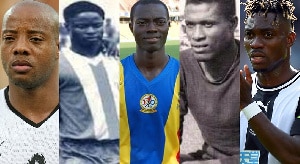
The most recent persons to pay a visit to the family of the late Christian Atsu are former Black Stars players Kwadwo Asamoah, Stephen Appiah, Derek Boateng, and Jerry Akaminko.
On February 22, 2023, during their visit, Kwadwo Asamoah, Stephen Appiah, Derek Boateng, and Jerry Akaminko gave gifts to the family of the deceased Ghanaian international.
The players also took turns signing the book of condolences opened at the family home in Accra for Christian Atsu.
Fiifi Tackie, a representative for the Ayew family, was with the ex-players.
The ex-players also made donations and commiserated with the family during their visit.
Christian Atsu’s body arrived in Ghana in the late hours of Sunday after it was recovered from the rubble following an earthquake in Turkey on February 6.
The 31-year-old got trapped in his destroyed apartment for over a week before he was found dead.
The family is yet to announce plans for the burial and funeral of the winger, who was crowned best player at the2015 AFCON.
Former Black Stars captainStephen Appiah is the most recent football celebrity to sign the book of condolences for the late Christian Atsu.
On February 22, 2023, Stephen Appiah paid a condolence call to Christian Atsu’s family and paid a visit to their home.
Following visits by Asamoah Gyan, Haminu Dramani, Baffour Gyan, Sulley Muntari, and Emmanuel Agyemang-Badu, Appiah paid the house in Ashaley Botwe, Accra, a day earlier.
In a previous interview with Dan Kwaku Yeboah TV, Stephen Appiah described how he met Atsu’s in the Black Stars camp.
Appiah also spoke about Christian Atsu’s best performance while wearing the national team uniform.
“During that period, he was on the left and one Agyepong guy was on the right, and the way he troubled the opponents, Partey scored three goals in that game.”
“I think that match made me appreciate him more. Before that match we did a team meeting and everyone expected me to speak but I refused because I was tensed,” he said.
“So later I met him on the corridor and I called him into my room for a discussion. I told him the match would depend on three players which includes him.
“After the match, the Congo coach came to me and asked who the player on the right wings was and I told him he is our Ghana Messi,” Appiah added.
Christian Atsu’s body was recovered from the rubble of a building he had been trapped in for over 12 days on Sunday, February 18, 2023.
Atsu, thus, became one of the over 40,000 lives that were consumed by the earthquake that hit parts of Turkey and Syria on February 6, 2023.
Following the arrival of the body on Sunday, February 19, the family has disclosed that a one-week ceremony for the late footballer will be held on March 4, 2023.
31-year-old Christian Atsu left behind a wife and three children who are all based in the United Kingdom.
Romelu Lukaku’s goal on Saturday helped Inter Milan defeat Udinese at the San Siro for the first time in 635 days.
The Belgian forward hasn’t been at his best since joining the Nerazzurri on loan from Chelsea in the summer of last year, but he’s been much sharper lately.
Although he scored from the penalty spot in the 3-1 victory, it may have given the powerhouse the confidence boost it needs to get back on track as Inter looks to close the gap on unstoppable leaders Napoli.
We highlight West London’s misunderstood man ahead of tonight’s Champions League matchup with Porto.
Comeback trail
Lukaku has dealt with a number of issues since his arrival back in Milan, but injuries have been his biggest hindrance in 2022-23.
In the current campaign, the 29-year-old has missed 92 days and 18 matches in all competitions thanks to a combination of hamstring, arm and knee issues.
And although he has struggled with niggles in the past, the 104-cap international has not been absent for as long as this before in his career — and it has had a profound impact on his form.
Saturday was only his second Serie A goal of the season, with his first coming on the opening weekend back in August.
Inter boss Simone Inzaghi said a few weeks ago that he is expecting a fully fit Lukaku back for their Champions League tie with Porto and it looks as though he may get his wish.
The ex-Premier League star has featured in seven of Inter’s last eight league matches and is starting to show signs of a return to his best.
Fighting for his place
Inter’s squad is full to the brim of incredible talent and Lukaku’s return does not guarantee him a spot in the starting XI.
Inzaghi has preferred to set up in a 3-5-2 for most of the season and, although the seasoned finisher is a big miss when unavailable, there were options waiting in the wings to replace him.
Both Edin Dzeko and Lautaro Martinez have done a stellar job in Lukaku’s absence, netting 20 times between them in Serie A, while the likes of Henrikh Mkhitaryan and Hakan Calhanoglu have also been popping up with goals.
During his best season, Chelsea’s £97million man grabbed 24 goals and 10 assists in the Italian first division, yet scored only eight times in the Premier League during the 2021-22 campaign.
He would do well to displace either Dzeko or Martinez permanently in the coming weeks, though his best form would give him a fighting chance.
Lukaku’s ability to score in a variety of ways gives him the edge over his 36-year-old team-mate Dzeko, who is giving Olivier Giroud a run for his money as the best Serie A player over 35 this year.
Desperate to stay
Lukaku left Stamford Bridge with a sour taste in his mouth, publicly stating his desire to return to Supercoppa Italiana winners Inter last summer.
The San Siro is where he has enjoyed the best spell of his career and despite being a valued member of the Premier League 100 club, his style of play is more suited to Italian football.
However, his situation remains one of the most complicated in Europe’s top five leagues.
As Chelsea paid such a handsome fee to bring Lukaku back to his former club only 18 months ago, they will unquestionably want to recoup some of that fortune — especially after their own excessive spending in January.
With a contract at Stamford Bridge that runs until 2026, Lukaku needs to resolve his future quickly ahead to avoid a potential recall.
The late Christian Atsu will be honoured by having his newly built grass pitch named after him, according to Abdul-Hayye Yartey, the owner of Cheetah FC.
Christian Atsu spent some of his youth career with Cheetah before moving to Portugal to play for FC Porto in the Portuguese top division.
In an interview, Yartey disclosed that he had intended to surprise the player by renaming the field in honour of Atsu, but the former Cheetah player’s passing prevented the plan from coming to fruition.
“I saw how happy he was (when Cheetah unveiled their Astroturf), and he actually granted me an interview when we were commissioning the Astroturf pitch.” I was hoping to surprise him with the grass pitch. Like, call him to come and say, “Hey, Christan, I’ve made a grass pitch and am going to name it after you.” “It’s quite unfortunate he couldn’t wait for that time, but still, we will name the pitch after him,” he said.
Atsu joined Cheetah FC from Gomoa Feyenoord before his departure to Europe in 2009.
During the off-season, he used to come to Cheetah to donate boots and other items to the club.
Cheetah, who have been focusing on academy football, are currently in Ghana’s third-tier league as they hope to progress to the topflight in a few years.
Christian Atsu was once hailed as a huge prospect who would go on to become a world-class athlete and one of Ghana’s greatest-ever football products, but he was unable to have the illustrious career that many had hoped for.
In his 12-year professional career, he represented ten different clubs in Europe, but only three trophies were awarded to him.
He made his Black Stars debut in June 2012 at the age of 20, and most Ghanaians were amazed by his left foot.
Atsu delighted the Baba Yara Stadium crowd with some quick dribbles before capping the evening with his first goal in a 7-0 victory. As soon as he made his debut, he was given the moniker “Ghana Messi.”
He had a high ceiling but never reached his full potential, which could have seen him play for top clubs and win more titles.
Atsu only played for notable teams but not many potential trophy-winning teams.
Christian Atsu joined FC Porto’s youth team in 2011 after playing for Ghana’s Cheetah Academy. He later got promoted and lasted for two seasons before landing his breakthrough move to Chelsea in 2013.
He signed a five-year contract with Chelsea but spent almost the entire time on loan at other clubs. He was loaned to Vitesse, Malaga, Bournemouth, Everton, and Newcastle United.
Newcastle secured the Ghanaian on a permanent deal in 2017 for £6.2 million from Chelsea. He spent four years at the club before joining Al-Raed as a free agent in 2021 and then to Hatayspor in 2022.
Throughout his club football career, he only won titles with Porto and Newcastle United.
In his international career, he scored 10 goals in 60 appearances. He came close to ending Ghana’s long trophy drought in 2015. Atsu was the Black Stars’ standout performer at the 2015 AFCON, where Ghana finished second runners-up.
Prior to their Europa League trip to Manchester United, Barcelona doesn’t need any extra motivation, according to Xavi, who thinks the chance to win atOld Trafford suffices.
After a thrilling 2-2 draw at Camp Nou last week, the two will face off in their knockout round play-off matchup’s second leg.
Xavi, who played for Barcelona and helped them defeat United in the Champions League final in both the 20
After a thrilling 2-2 draw at Camp Nou last week, the two will face off in the second leg of their knockout round play-off match.
The Barcelona team defeated United in the Champions League final in both the 20 and 21
In making the trip to England and Old Trafford specifically, Xavi believes it will be more than enough to inspire his players, regardless of the first-leg result.
“I have very good memories of the games I played in England, simply because it is so special to play there,” he told the Times. “It is the cradle of football.”
“The stadiums, the fans who do not stop cheering, everything has a very special flavour that is not seen anywhere else in the world.”
“So imagine, it is such a pleasure for me to go back to Old Trafford, one of the best stadiums and [one of the] biggest teams in the world.
“We are a brave team that likes to attack and always win. [This game] will not be an exception. It’s like a big Champions League game.
“For the fans, it’s a massively interesting match. For the players, [it is] one of those matches that everyone wants to play at least once in their life.”
Avram Grant, a former Black Stars coach, described how he begged the Israeli rescue team to find Christian Atsu among the rubble.
Avram Grant admitted that he became upset when he learned that a Ghanaian player was trapped in the Turkish earthquake.
He claimed that as soon as he learned that one of his former players, Chrisitan Atsu, was entombed in the debris, his anxiety intensified.
The former Chelsea manager claimed that he quickly alerted the Israeli search and rescue team sent to Turkey to help fetch Christian Atsu after getting in touch with Atsu’s manager as a result.
“I heard the news when it happened on day 1.” I think after the earthquake they said it was a player from Ghana, so I checked and people told me that it was Christian Atsu.
“I spoke to his agent, and we tried to find a way to help his rescue. The rescue team was from my country, so I sent them to check,” Avram Grant told George Addo Jnr.
Israel sent a delegation of more than 160 members of the Israel Defense Forces which included paramedics and Fire and Rescue Service officials, to Turkey to rescue people who had been trapped in the rubble.
The 68-year-old manager stated that he had a big sigh of relief following reports that Christian Atsu had been found, which turned out to be false.
“The news that maybe he was okay and they found him was not true, as you know, but we were so happy to hear it, and then day by day it became worse and worse until we found out,” Avram Grant said.
Grant disclosed that it was hard to deal with the news of Christian Atsu being found dead in the earthquake.
“It’s one of the saddest days that I had in my life you know. To hear that about Christian, 31 years old. Fantastic person — a good man — this is difficult. Difficult for me to speak about him now, he’s part of the past. It was really a shock, a big shock for me” he said.
Officers of the Israel Defense Forces who stepped in to provide assistance to Turkey were able to rescue 19 civilians from the rubble in Turkey.
Christian Atsu’s body was found 12 days after the earthquake occurred in Turkey on February 6, 2023. He was one of 40,642 people who lost their lives in the earthquake in Turkey.
Christian Atsu worked with Avram Grant in the Black Stars and was named to his squad for the 2015 AFCON, where hewon Player of the Tournament.
Before the start of the 2021/22 season, the Cameroonian forward signed a two-year contract with the Ghana Premier League team from Fortuna du Mfou.
Mbella established himself as a fan favourite after amassing 21 goals in his first season with the Porcupine Warriors.
His goals helped the team win the Premier League in 2021/22 under Prosper Nartey Ogum.
“I made a choice to leave Asante Kotoko after helping them win the league title and I do not regret any decision to leave the team,” he told Ghanasportspage.com.
“I’m a professional player and I stay focused to attain my goals in life. Currently, my focus is on Al Masry and to help the team win glories” he added.
The Cameroonian forward following his explosive performance in the Ghana Premier League joined Al Masry in the Egyptian League on a permanent deal worth $400,000.
Darwin Nunez and Mohamed Salah gave the Reds an electrifying start to the last-16 match with two quickfire goals, giving Los Blancos a lot of trouble early on.
But a brilliant performance from Vinicius Junior launched a powerful Real Madrid comeback.
All the records Real Madrid broke during Tuesday’s eventual 5-2 victory are examined at GOAL.
First visiting European team to score five at Anfield
Actually, Real Madrid became the first visiting club to put four goals past Liverpool at Anfield when Karim Benzema’s shot was deflected in off Joe Gomez, and then they added another for good measure with Benzema rounding Alisson and shooting into an open net.
It was also the second time this campaign that the Reds conceded at least four times in the Champions League after doing so against Napoli on September 7.
Benzema first to score six in European career vs Reds
With his brace at Anfield on Tuesday night, Benzema has now scored more goals against Liverpool in European Cup and Champions League history than any other player (6). He entered play level with Didier Drogba for the record.
Meanwhile, with his pair of strikes earlier in the game, team-mate Vinicius Junior is now in second place in that category (5).
Vinicius Junior youngest since Cruyff to score twice as Anfield visitor in Europe
Vinicius Junior broke Liverpool hearts last year with his winner in the Champions League final, and he hurt the Reds again in the first leg on Tuesday.
At 22 years old, he became the youngest player since Johan Cruyff to score at least twice as a visitor in a European match at Anfield.
Benzema equals Messi for consecutive UCLs scored in
The French forward was injured for much of the group stage, but after breaking through with his first goals of the European season, he has now netted in 18 consecutive Champions League campaigns.
That’s level with Lionel Messi for the all-time record.
Real Madrid first to turn two-goal deficit into three-goal UCL win
Carlo Ancelotti’s men, revered for their ability to stage dramatic comebacks, became the first team to win a Champions League match by three goals after trailing by at least two. The record applies to both home and away fixtures.
Their five goals came between the 21st and 67th minutes – a remarkable average of a goal every nine minutes.
Vinicius Junior second-youngest Madrid player to score in three straight UCL games
He added two goals on Tuesday after also scoring against Celtic and RB Leipzig, with his streak of three Champions League games in a row the best in Real Madrid history after Raul.
Folarin Balogun is currently on loan fromArsenal, and according to Reims president Jean-Pierre Caillot, it will be “impossible” to sign him to a permanent contract after his standout campaign.
With 15 goals in 23 appearances, 21-year-old Balogun is tied with Lille’s Jonathan David and Paris Saint-Kylian Germain’s Mbappe for the league’s most goals.
Although the young striker only scored three goals in 18 games while on loan at Championship team Middlesbrough this past season, Caillot told France Bleu that the club had been keeping an eye on Balogun for years.
“We almost signed him for the club a few years ago when he was unsure whether he would have his first professional contract at Arsenal,” he said. “We clung to it, we continued to be in contact with him [and] today he is here.
“Everyone discovers Folarin Balogun, who was an illustrious unknown for the supporters a year ago, just like Hugo Ekitike, just like Boulaye Dia. It’s all the strength of the recruitment cell to always have a new player to take on.”
When asked about the chances of keeping Balogun in Reims, Caillot was realistic, although hopeful of maybe one more season on loan in an environment where he is clearly thriving.
Rodgers won’t ‘beg’ Maddison to sign new contract
“I think [signing him permanently] is impossible,” he said. “The rules of the game are clear. These are boys that, when they join us, know that they’re here to improve and that it’s a step for them.
“So even if I’m not deciding for him, either Folarin will return to his club to have his chance, he’s loaned out, or he’s transferred to a very big club. He is a player who should go even higher.
“Obviously we’ll ask him if he feels good here, and at his club, but I think that now, he will need to take a step up.
“We are already working on life after Balogun, the day when he will leave our club. But if he and the club are open to another year at Reims, we’ll do everything to make it happen.”
Reims sit 10th on the table with a league-leading 13 draws in 23 matches.
Children from theBecky’s Foundation orphanage shed tears as they discussed the passing of their benefactor, Christian Atsu.
Atsu adopted the children through his ambassadorial position at Arms Around the Child, parented them, enrolled them in school, and occasionally gave them things and the support they needed.
The dejected kids could not control their tears as they talked about the unceasing support they received from Atsu, according to a report by GHOne.
One of the boys told the reporter that Atsu was their father, brother, and uncle and that he had given them hope; however, at the moment, they have lost all hope.
“Christian Atsu is like a father, an uncle, and a brother. In fact, he is our everything. He was our number one supporter, doing countless things. He was the one giving us hope. Getting us better education and a lot of support “But as I speak to you today, we are hopeless, and our heads are in our hands.”
One girl, full of tears and shaky voice, recounted the fun moments they had with Atsu, adding that she misses the former Newcastle United man.
“Every time he comes here, they organise a party for us.” Sometimes he sends us to Shoprite to enjoy ourselves. He said he is going to play football. I miss him so much.”
He not only supported kids but also offered a handout to people who are convicted and fined for petty crimes.
Christian Atsu together with The Crime Check Foundation in Ghana paid fines for petty criminals which resulted in incarceration and helped reintegrate the ex-convict into society.
He paid the fines of 130 petty offenders and championed the non-custodial sentencing bill.
Christian Atsu passed in Turkey after his body was recovered on February 18, 2023, lifeless following an earthquake in Hatay, on February 6, 2023.
The family of late football star Christian Atsu met with representatives from the Ghana Football Association (GFA) and the Sports Ministry to discuss the funeral rites for theBlack Stars player who died in the Turkey-Syria earthquake on February 6, 2023.
On Saturday, March 4, 2023, Atsu’s death will be observed for a week at his Accra-area home of origin. After lengthy discussions between the family, GFA, and Sports Ministry, the choice was made.
The GFA and the sports ministry representatives joined Evans Bobie, the deputy minister of sports, in sending condolences to Atsu’s family.
The 31-year-old footballer’s remains were taken to Ghana on February 19, 2023, from Turkey, where he died in a 7.8-magnitude earthquake that caused devastation and casualties.
Atsu’s lifeless body was recovered from the wreckage in Turkey after an 11-story building collapsed on him and others.
The late footballer had a successful career both with the national team and at club level. He played for several clubs, including Chelsea, FC Porto, Everton, and Newcastle United.
The football community, including the GFA and the Sports Ministry, have expressed their condolences to Atsu’s family and loved ones and have promised to support them in any way possible duringthis difficult time.
In memory of the late Christian Atsu, the Ghana Football Association is considering retiring the number 7 jersey from the Black Stars.
Following the devastating earthquake that struck the Turkish city of Hatay on February 6, 2023, Atsu passed away.
On February 18, 2023, the dead body of Atsu was discovered among the debris of his destroyed apartment.
Linford Boadu, who also serves as the Chairman of the Eastern Regional Football Association (RFA), hinted that the Ghana FA intended to retire the number 7 jersey in memory of Atsu in an interview with Koforidua-based Bryt FM.
“It’s a sad situation. I wasn’t expecting Atsu to be staying in that big apartment like that, I was expecting him to be staying in a single apartment but I think there wasn’t stability after joining the club in Turkey”
“It was difficult to believe anybody can survive after that 45 seconds earthquake but we were hoping to find Atsu alive until news broke he has been found dead. He served the nation wholeheartedly, and at the short ceremony in receiving the body of Atsu, the vice President, Dr Bawumia disclosed government will be involved in giving him a befitting burial. That is a big plus, to me, Atsu deserves a befitting burial looking at how he served the nation.
“The Executive council of the FA is thinking about of a lot of things; some thinks the number 7 jersey must be retired in honour of Atsu but there should be a meeting to decide.”
Atsu had been trapped under rubble for over 11 days before his passing, with the earthquake claiming the lives of over 45,000 people.
During his career, Atsu played 65 matches for Ghana, scoring nine goals. Two of his most famous goals came in the 2014 World Cup qualifier against Egypt and in the 2015 Africa Cup of Nations quarterfinal clash against Guinea, where he scored an absolutely breathtaking goal.
He admits that he hasn’t spoken to the Blues’ top executives in a while.
Callum Hudson-Odoi discusses his status and future with Chelsea, the Premier League team he plays for, and Bayer Leverkusen, the team he is on loan from.
“I haven’t spoken to them much lately. I’m not there, so seeing all these players leave, there is nothing I can say or do,” he said.
“At the end of the day, I’m focused on the club here and trying to help as much as possible here. Whatever happens in the future, I don’t know. All I can do is focus on what’s going on here,” he added.
Callum Hudson-Odoi also stated that he is enjoying his newfound playing time in Germany.
“I wanted to come here and have minutes in my legs and make the most of football.” I think that’s what happened. Now I focus more on increasing numbers with more assists and creating more chances for the team. I’m definitely excited about the future,”
York ended a streak of five straight league losses, but they were forced to settle for a 1-1 tie with Boreham Wood at home.
York took the lead late in the first half thanks to a goal from Adam Crookes, but Boreham Wood quickly equalised through a goal from George Broadbent just before halftime.
When Will Evans’ shot in the 12th minute hit a post, the visitors came the closest to taking the lead, but they fell behind when they failed to block a long throw from York’s Mark Ellis, and Crookes tapped the ball in.
After York goalkeeper Ethan Ross saved Tyrone Marsh’s shot, Wood quickly countered, and Broadbent successfully finished after the ball rebounded into his path.
Danny Newton spurned a chance to snatch all three points for the visitors when through on goal in stoppage time, but he fired wide as Wood drew their fourth consecutive game.
Albion Rovers defeated Elgin 3-0 at home thanks to a second-half hat trick from Charlie Reilly, improving their chances of staying in Scottish League Two.
After a scoreless first half, Reilly scored twice, the second from the penalty spot, and Ayrton Sonkur added Albion’s third goal with a header.
Prior to the break, Max Wright’s header for Albion went over the crossbar, and Reilly’s goal from inside the box shortly after the restart gave them the lead.
After Elgin midfielder Evan Towler’s foul on Joe Bevan, Reilly doubled Albion’s lead from the spot, and Sonkur added a third goal with a header in the 64th minute.
Albion increased its lead over the bottom-dwelling Bonnyrigg Rose to four points, while Elgin only managed one league victory in 2023.
Desiree Ellis, the head coach of South Africa’s women’s national team, has responded to the passing ofGhanaian winger Christian Atsu.
She said that it is obvious that Ghana has lost a soldier who was loved by many people in her eulogy for the dead Black Stars forward.
“Our hearts go out to the families as well as to Ghana and Atsu’s family.” That’s the worst thing that you want to hear after so much time, but we pray for the families and pray that God gives them strength.
“And to Ghana, you have lost a soldier but know that he was loved by many,” the South Africa women’s national team coach said.
Christian Atsu passed away at the age of 31 after he was caught up in the wreckage of the Turkey earthquake.
Since he was confirmed dead on Saturday, people from around the world have extended their condolences to Ghana and the late player’s family.
Only 14 minutes into Tuesday’s thrilling first leg of the round of 16 match, Darwin Nunez’s exquisite flick and Mohamed Salah’s goal after a mistake by Thibaut Courtois gave the Reds a two-goal lead.
That turned out to be a false dawn as the champions came roaring back in a repeat of last year’s final. Vinicius pulled one back with a beautiful finish before Alisson made a costly error that allowed him to score twice in an exciting first half.
Eder Militao headed Madrid in front early in the second half before Benzema’s double gave Carlo Ancelotti’s ruthless side a commanding advantage to take back to the Spanish capital for the second leg on March 15.
Nunez produced a moment of magic in the fourth minute to put the hosts in front, meeting Salah’s whipped ball with an audacious right-foot flick that flashed past Courtois.
Chelsea fans saying I’m the problem are wrong. – Potter
Courtois endured a nightmare 10 minutes later, controlling a back pass onto his chest before the ball bounced off his knee to present Salah with a simple chance to double Liverpool’s lead.
Madrid looked like they did not know what had hit them, but Vinicius halved the deficit in the 21st minute by showing excellent close control in the box before bending a sumptuous right-foot finish into the bottom corner.
The winger was celebrating in front of The Kop again nine minutes before the break after Alisson’s terrible attempted pass struck his Brazil team-mate and looped into the net.
Madrid lost David Alaba to injury during a pulsating first half which they would have ended with a lead had Andy Robertson not shown great awareness to deny Rodrygo a tap-in.
Los Blancos were in front two minutes into the second half, though, when an unmarked Militao capitalised on terrible defending to head in the influential Luka Modric’s free-kick.
An evening that had started well then took another turn for the worse for Liverpool, with Benzema’s shot striking Joe Gomez and giving a wrong-footed Alisson no chance.
Liverpool were opened up again after 67 minutes, Modric and Vinicius combining before Benzema sat Alisson down and demonstrated great composure to finish with his left foot.
What does it mean? Masterful Madrid stun fragile Reds
Liverpool could hardly have had a better start, but they were taught at harsh lesson by the newly crowned Club World Cup winners and paid the price for being so vulnerable at the back.
Los Blancos beat Jurgen Klopp’s side 1-0 in the 2022 Champions League final at Parc des Princes and blew them away as Liverpool became the first team in the history of the competition to lose by a three-goal margin after being 2-0 up.
Liverpool had never conceded four goals at home in Europe, let alone five, and are in great danger of missing out on Champions League football next season given they are eighth in the Premier League.
He and Benzema both took their goal tallies for the season to 18 and must be rubbing their hands together at the prospect of facing the Reds again after tearing them apart on Merseyside with Modric pulling the strings behind them.
Salah’s record strike in vain
Salah became Liverpool’s record goalscorer in Europe with 42 when he was on target early on.
He will be in no mood to celebrate breaking Steven Gerrard’s record after 14-time European champions Madrid rocked the Reds in devastating fashion.
Key Opta Facts
– Liverpool conceded five goals in a European game at Anfield for the first time, while it was just third time this century they shipped five or more goals in a home game in all competitions, also doing so in January 2007 (6-3 defeat to Arsenal) and October 2019 (5-5 draw with Arsenal).
– Real Madrid are the first team in Champions League history to come from two goals down and win by a three-goal margin.
– This was only the fourth time a Jurgen Klopp side conceded five or goals in a home game in all competitions, after Mainz in 2006 (6-1 v Werder Bremen in the Bundesliga), Borussia Dortmund in 2009 (5-1 v Bayern Munich in the Bundesliga) and Liverpool in 2019 (5-5 v Arsenal).
– Darwin Nunez’s opener (three minutes 10 seconds) was Liverpool’s earliest ever Champions League goal at Anfield.
What’s next?
Klopp’s side travel to Crystal Palace for aPremier League encounter on Saturday, when Los Blancos face Atletico Madrid at home in a LaLiga derby.
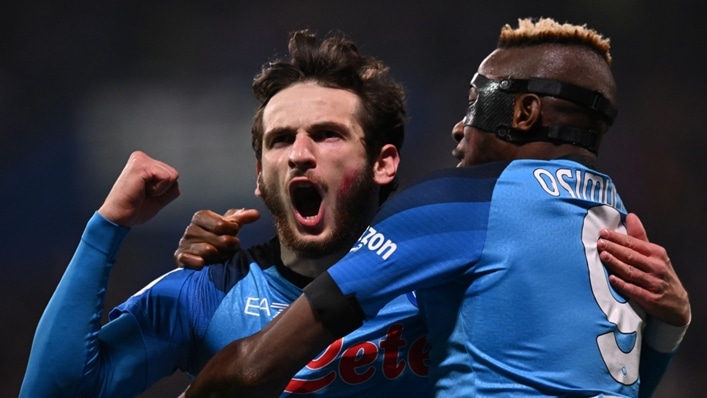
The Georgian star cost around £9 million to join the Serie A frontrunners last summer, but he has been a revelation, dismantling defences both domestically and internationally.
Kvaratskhelia claims he loves living in Naples, but with teams like Real Madrid, Paris Saint-Germain, Liverpool, and Manchester City all rumoured to be interested, a summer transfer is very likely.
We examine “Kvaradona” as Napoli gets ready to face Eintracht Frankfurt in the first leg of their Champions League round of 16 matchup this evening.
Humble beginnings
Kvaratskhelia’s native Georgia does not exactly have a rich football history.
Manchester City fans of a bygone era will fondly remember Georgi Kinkladze, while the nation’s all-time top scorer Shota Arveladze was a regular at Rangers and recently had an ill-fated spell in charge of Championship side Hull.
At an elite level, defender Kakha Kaladze won Champions League titles with AC Milan in 2003 and 2007 — yet there is good reason to think Kvaratskhelia will surpass even his achievements in due course.
Wind the clock back 12 months from now and even the most committed football purist could be forgiven for not having the Rubin Kazan starlet on their radar.
He netted only twice in 19 Russian Premier League matches in 2021-22, before Russia’s conflict with Ukraine led to his contract being suspended.
He headed home to Dinamo Batumi, where eight goals in 11 games prompted Napoli to cough up a modest sum to bring him to Italy.
Securing that agreement ahead of the likes of Juventus and Roma has proved to be a masterstroke.
Few could have anticipated how quickly Napoli’s No77 would make his mark on top-level football, with his unpredictable and direct playing style proving a nightmare for opposition defences to contain.
Already, he has racked up 12 goals and 12 assists across 24 Serie A and Champions League matches this term, meaning the 19-cap international is operating at an average of one direct goal involvement per game.
That puts him in elite company indeed.
His club team-mate Victor Osimhen, Manchester City sensation Erling Haaland, Barcelona’s Robert Lewandowski and the Paris Saint-Germain trio of Kylian Mbappe, Lionel Messi and Neymar are the only others to do so in 2022-23 from Europe’s top leagues.
It is little wonder there is so much speculation around a possible transfer.
Attracting interest
Kvaratskhelia’s agent went public last week regarding speculation over his client’s future — though he stopped short of saying a move was on the cards.
Mamuka Jugeli told press in Italy: “There is a lot of interest from other clubs. Kvara, however, is only thinking about winning the Scudetto and Napoli’s matches in the Champions League.
“He told me that in terms of football in Italy, he sees himself only in Naples. He will never play for any other Italian club, apart from Napoli. He feels at home in Naples.”
That statement should at least reassure Partenopei supporters that their talisman will not be jumping ship to Juve, just as former star Gonzalo Higuain did back in 2016.
Whether or not that rules out a transfer to one of Europe’s other giants, however, remains to be seen.
Finding a fit
Khvicha Kvaratskhelia is prone to shooting on sight for Napoli
Kvaratskhelia’s style certainly appears suited to some sides better than others.
While no club would turn their nose up at his league-leading assists tally or penchant for a jaw-dropping strike, the 22-year-old does not always make the correct decision.
Frequent moments of magic are also accompanied by errors. For example, to reach his impressive tally of 47 completed take-ons in Serie A this term, he has had to fail on 81 occasions.
His passing accuracy currently sits under 80%, while only 29 of his 75 shots this season have hit the target.
Teams such as Manchester City and Bayern Munich, who prefer to carefully craft their attacks through high possession and patient build-up, would potentially find the Georgian’s unpredictability problematic.
Made for Madrid
Perhaps somewhere like Real Madrid, where the game’s biggest mavericks have been given a platform to strut their stuff for many decades, could be ideal for Kvaratskhelia.
What is more, the man himself declared his love for Los Blancos in an interview during his time with Rubin Kazan that only surfaced recently.
“With my brothers, we were always watching their games and cheering them on.”
While Premier League giants will be hoping the youngster has had a change of heart, those comments suggest the LaLiga giants will be in pole position when a bidding war commences.
Right now, the dynamic attacker is trying to achieve his Champions League dream in Naples — and he may just do exactly that.
Major earthquakes, like the 7.8-magnitude quake that struck Turkey and Syria on Monday, have well-established causes. Despite this, they are still difficult to predict.
Although science and technology have advanced, it is still essentially impossible to predict exactly when and where earthquakes will occur.
“Earthquake prediction has always been kind of a holy grail,” said Wendy Bohon, an earthquake geologist who works as a communications strategist at NASA’s Goddard Space Flight Center in Maryland. “If we could tell people exactly when an earthquake was going to happen, we could take steps to mitigate against it. But Earth is a very complicated system.”
Part of the challenge is that the very nature of earthquakes makes them unpredictable events. When one does occur, it happens quickly.
“An earthquake is not like a slow-moving train that eventually picks up speed. It’s a sudden, accelerated event,” said Ben van der Pluijm, a professor of geology at the University of Michigan.
Earthquakes also tend to strike with little to no warning. Though scientists have investigated potential precursor events — everything from shifts in subsurface sounds to potential increases in a region’s seismic activity to changes in animal behavior — they have so far been unable to pinpoint any consistent signals that shaking is imminent.
The lack of any clear pattern makes it difficult to create reliable forecasts akin to weather reports.
Additionally, the processes that underpin earthquakes — the mashing and colliding of tectonic plates and the energy that builds up as a result — tend to play out over long periods of time. Scientists can, for instance, gauge that an earthquake will likely strike an area some time in the next 200 years, which may be specific on geologic timescales. On human time scales? Not so much.
“We have an incredibly good idea of where we expect earthquakes, and even the sizes that we can expect for large earthquakes in these areas, but that does not help us to narrow that down to a human timescale,” van der Pluijm said.
Still, there are ways to prepare. The USGS has developed an early-warning system called ShakeAlert that detects when a significant earthquake has occurred in California, Oregon and Washington and then issues radio, television and cellular alerts saying that strong shaking is imminent. In most cases, the alerts offer only a few seconds of warning, but that time can be extremely valuable, said van der Pluijm.
“Twenty seconds sounds very short, but it’s enough time for you to find a place under a desk to take cover,” he said. “It’s not a prediction, but ShakeAlert is a huge step forward because it can minimize the inevitable impact.”
One of the most important ways to prepare for an earthquake is to be aware of the risks, Bohon said. For policymakers, this means ensuring that critical infrastructure is protected in earthquake-prone areas.
“What we need to do is to make sure we understand what can happen and build to withstand that,” she said. “We have to make sure people know what to do. We have to make sure that our cities are able to be resilient in the face of those hazards so that we don’t just survive the earthquake, we can survive in the aftermath.”
President Putin attributes the war he started a year ago to theWest and Ukraine.
Vladimir Putin, the president of Russia, gave a speech on the state of the nation in the nation’s capital, Moscow, in which he discussed the invasion of Ukraine that he had authorised a year earlier.
The following are key points from his speech to members of both houses of parliament, military leaders, and soldiers on Tuesday:
‘Russia is suspending its participation’ in the New START treaty
“I am forced to announce today that Russia is suspending its participation in the strategic offensive arms treaty.”
The New START treaty was signed in Prague in 2010. It came into force the following year and was extended in 2021 for five more years after United States President Joe Biden took office.
It caps the number of strategic nuclear warheads that the United States and Russia can deploy, and the deployment of land and submarine-based missiles and bombers to deliver them.
Russia has the largest stockpile of nuclear weapons in the world, with close to 6,000 warheads, according to experts. Together, Russia and the United States hold about 90 percent of the world’s nuclear warheads – enough to destroy the planet many times over.
‘A watershed moment for our country’
“I am making this address at a time which we all know is a difficult, watershed moment for our country, a time of cardinal, irreversible changes around the world, the most important historic events that will shape the future of our country and our people, when each of us bears a colossal responsibility.”
Western nations trying to ‘distract people’s attention’
“They just tried to use these principles of democracy and freedom to defend their totalitarian values and they tried to distract people’s attention from corruption scandals … from economic-social problems.”
‘Responsibility is on West and Ukrainian elite’
“The responsibility is on the West and the Ukrainian elite and government, which does not serve the national interest, but [rather serves the interest] of third countries [which] use Ukraine as a military base to fight Russia.
“The more they send weapons to Ukraine, the more we will have the responsibility of the security situation at the Russian border. This is a natural response.”
‘We don’t fight the Ukrainian people’
“We don’t fight with the Ukrainian people. They became hostages of the Kyiv regime that occupied Ukraine both economically and politically. Over years, they were doing everything to bring this degradation … They are using their people, it’s sad but true.”
Donbas subjected to ‘undisguised hatred’
“Step by step, carefully and consistently, we will resolve the tasks facing us. Since 2014, the (people of the) Donbas had been fighting, defending their right to live on their own land, to speak their native language.
“They fought and did not give up in the conditions of blockade and constant shelling, undisguised hatred on the part of the Kyiv regime. They believed and expected that Russia would come to their rescue.
“Meanwhile, we did our best to solve this problem by peaceful means. We patiently tried to negotiate a peaceful way out of this most difficult conflict, but a completely different scenario was being prepared behind our backs.”
‘Reviving enterprises and jobs’ in occupied Ukrainian lands
“We have already begun and will continue to build up a large-scale programme for the socioeconomic recovery and development of these new subjects of the federation (territory annexed from Ukraine). We are talking about reviving enterprises and jobs in the ports of the Sea of Azov, which has again become an inland sea of Russia, and building new modern roads, as we did in Crimea.”
‘I understand how unbearably hard it is’ for families of killed soldiers
“We all understand, I understand how unbearably hard it is now for the wives, sons, daughters of fallen soldiers, their parents, who raised worthy defenders of the Fatherland.”
‘Child abuse all the way up to paedophilia … advertised as the norm’ in the West
“They distort historical facts and constantly attack our culture, the Russian Orthodox Church, and other traditional religions of our country,” Putin said of Western nations supporting Ukraine.
“Look at what they do with their own peoples: the destruction of the family, cultural and national identity, perversion and the abuse of children are declared the norm. And priests are forced to bless same-sex marriages.
“As it became known, the Anglican Church plans to consider the idea of a gender-neutral God … Millions of people in the West understand they are being led to a real spiritual catastrophe.”
“Look at what they do to their own people: the destruction of families, of cultural and national identities and the perversion that is child abuse all the way up to paedophilia, are advertised as the norm … and priests are forced to bless same-sex marriages.”
Karius will make his Newcastle debut against Manchester United at Wembley on Sunday thanks to an unlikely chain of events.
Nick Pope, the team’s starting keeper, was dismissed against Liverpool last weekend, and Martin Dubravka, who spent the first half of the season on loan at Man United, is currently cup-tied. He won’t receive a medal unless his teammates from Newcastle do.
The fourth- and fifth-choice goalies, Karius and Mark Gillespie, will be in the spotlight because Karl Darlow, who began Newcastle’s cup campaign in goal, was also permitted to go on loan.
It is Newcastle’s first major cup final since the 1999 FA Cup final, a loss to Man United, but Karius has rather more recent and similarly painful memories of such an occasion.
He was at fault for two goals as Liverpool lost the 2018 Champions League final to Real Madrid, despite having suffered a concussion. He never played for Liverpool again.
But Newcastle head coach Howe said of that match: “I’ve never really discussed that at any length with him [Karius].
“We’ve all got stuff that’s happened in our careers and our histories that you learn from, and I think he’s no different in that respect.”
Eddie Howe on having a positive mindset:
"I believe we can win any game against any team, home or away, if we're absolutely at our best and I think we've proved that this season. We believe the power is in our hands and it's up to us to perform at our best levels." pic.twitter.com/wzIM9Vmptk
“Since day one since he’s come here – he started where he hadn’t had a lot of work before joining us – he’s trained with our goalkeeper coaches in a really, really good way.
“His general performances in training have improved as he’s spent more time with us, and I think he’s in a good place and he’s ready to play.”
Asked how talks had gone with Karius since his sudden promotion, Howe added: “Those conversations are the type of conversations I have with him on a regular basis.
“How is he? How does he feel his training’s going? Are we giving him everything he needs to be the best that he can be?
“He’s a very likeable, laidback character. I’ve got no doubts on his confidence levels. He seems very relaxed and excited – as Mark is – about what lies ahead.”
“I think we have to be very positive about our situation, about the game,” he said. “Yes, it’s a blow to lose Nick, but we still believe in the team and the group that we have.”
Jurgen Klopp’s team is currently sitting in eighth place in the Premier League and has been eliminated from both domestic cups.
With Real Madrid, whom they haven’t defeated in their last six European meetings, including two agonising final losses in 2018 and 2022, they now face a daunting two-legged Champions League knockout match.
Although returning defender Virgil van Dijk suggested the Reds had turned a corner after Saturday’s impressive 2-0 win at Newcastle, expectations are appropriately muted ahead of tonight’s match at Anfield.
We put the influential Dutchman under the microscope ahead of his latest battle with Los Blancos.
Liverpool legend
Alongside the attacking brilliance of Mohamed Salah, Virgil van Dijk has been one of the leading figures of the Klopp era.
Almost immediately after arriving from Southampton for £75million in 2018, his domineering presence in the Reds’ backline transformed an already exciting side into a well-oiled machine.
With his crisp passing range, immense composure, and natural leadership, Van Dijk was the final piece of the jigsaw that helped Liverpool enjoy their most trophy-laden period for many decades.
He has won it all on Merseyside. Premier League, Champions League, Super Cup, and Club World Cup medals are all in his trophy cabinet, while he has also lifted both domestic cups.
If he was to leave this summer, the Netherlands international would already be assured iconic status at Liverpool — though the 31-year-old appears to have no intention of exiting Anfield.
Virgil van Dijk tasted Champions League glory with Liverpool in 2019
Injury woes
However, injuries have undoubtedly hampered Van Dijk’s influence in recent years.
Having started 94 straight Premier League games for the Reds in a stunning run between February 2018 and October 2020, the Dutch colossus sustained a catastrophic knee injury against Merseyside rivals Everton.
Challenging for a ball with England stopper Jordan Pickford, the resulting ACL rupture would sideline Van Dijk for the remainder of 2020-21.
He impressively returned to play 51 times in all competitions last term as the Reds agonisingly missed out on the Premier League title by a point, while also losing the Champions League final to Real Madrid.
Having missed seven games across all competitions, Van Dijk made a timely return to action on Saturday as the Reds overcame high-flying Newcastle at St James’ Park.
The 2-0 success keeps Liverpool within reach of a top-four spot and the influential defender was quick to point out how crucial the victory could be in kick-starting a frustrating campaign.
Van Dijk said: “We’ve had results in the season where we have felt like this is the time to kick on. But this feels a little bit different.
“Coming away from the big win against Everton, it was important to keep going and find a way to win. There is a reason why we are the only team to win here.
“It feels very good [to be back from injury]. Being healthy is the most important thing in the world.
“It was a tough six weeks but I’m back, hopefully I will do everything in my power to recover and be ready for the Champions League game, it is massive for us.”
Waning influence
Former Liverpool midfielder Danny Murphy has been one of several pundits to suggest Van Dijk has been a different player since his ACL injury.
Murphy, 45, told talkSPORT earlier this season: “He’s not up to his level. Before his injury, he was arguably looking like one of the best centre-halves we’ve ever seen.
“The injury, which is a huge one and he’s come back from, although he’s not had problems in missing games, I think psychologically he’s not in the same place.”
While there may be some credence to Murphy’s observation, the Reds undoubtedly remain a stronger team for their No4’s presence on the field.
As well as his defensive nous, Van Dijk still ranks inside the Premier League’s top 10 centre-backs this term for touches, completed passes and aerial duels per 90 minutes.
He is crucial to the Reds’ build-up play — while 18 shots and two goals show him to be a serious attacking threat in his own right.
Virgil van Dijk offers far more to Liverpool than an average centre-half
Silencing critics
Liverpool’s issues have been widespread this season but with Van Dijk back in the heart of their defence, business could be about to pick up.
Of the 24 games he has completed 90 minutes in this season in all competitions, the Meresysiders have won on 15 occasions, drawing four and losing five times.
Conversely, the 10 games he has not featured or completed have resulted in only two wins, three draws and five defeats.
Regardless of whether his very best days are behind him or not, Van Dijk is key to revivinga wretched Reds campaign.
Former Real Madrid forward and honorary club president, Amancio Amaro, passed away at the age of 83.
Amancio, a right-sided attacker, joined Madrid from Deportivo de La Coruna in 1962 and played 471 times for Los Blancos, tallying 155 goals.
Amancio, who finished third in the 1964 Ballon d’Or voting, played a significant role in Spain’s victory as European champions in addition to winning nine league championships and one European Cup with Madrid.
Amancio helped Emilio Butragueno and other players grow after he retired by coaching Madrid’s Castilla team to the second-tier championship in 1984. After Paco Gento passed away last year, Amancio was named honorary club president.
A club statement read: “Real Madrid CF, its president and its board of directors deeply regret the death of Amancio Amaro, honorary president of Real Madrid and one of the great legends of our club and of world football.
“Together with Paco Gento, Amancio led Real Madrid after five consecutive European Cups, and represents the values that have forged the history of our club.
“Amancio Amaro has passed away at the age of 83. He will be remembered by all Madridistas and by all football fans as one of the great legends of this sport.
Christopher Anamalia, of the representatives of St Thomas Aquinas at theNational Science and Maths Quiz for the year 2017, has been employed as an electrical engineer by the world-renowned Apple. This came right after he completed his master’s degree at the Arizona State University when he graduated from Ashesi University on full scholarship in Ghana.
In a short documentary that was done by Ashesi University on Christopher’s story, his mother could not hide her joy when she recounted all the stages of her son’s journey.
Ghanaians have celebrated the NSMQ star’s employment at Apple.
@Kwasi_1234 mentioned: Charley if u have the money tak ur child to a better school n u will surely reap one day by the grace of God…
@aaron_owusu_T indicated: This guy !!!!! Gave me chills in 2017 , brilliant stuff from this lad. @iamdreamchaserr said: I am a graduate of UNIVERSITY OF CAPE COAST. But I have so much respect for Ashesi, University of The Future Charley
Gary Neville thinks Arsenal has regained momentum in the title race as a result ofManchester City’s shoddy finishing and weak defence.
Pep Guardiola’s Premier League champions dropped two crucial points at Nottingham Forest three days after defeating the Gunners 3-1 at the Emirates last Wednesday, when they could only manage a 1-1 draw.
In the meantime, Mikel Arteta’s team recovered from that crushing defeat at home with a thrilling 4-2 victory at Aston Villa, propelling them back to the top of the standings.
And 48-year-old Neville, a legend of Manchester United, thinks the North Londoners will win the trophy in May.
Speaking on The Gary Neville Podcast, he said: “We’ve got an intriguing title race. Arsenal needed a good weekend. They’ve conceded 10 goals in the last six games.
“They need to stop conceding goals. One of the traits of a run-in is that if you’re conceding goals and teams feel they have a chance, it’s very difficult to win a league. They just need to watch that.
“They can go five points clear again if they win their game in hand. Thomas Partey not playing is a miss but they just need to think about getting back to clean sheets in this next period.
“But for City, they’re still giving Arsenal a big chance because they’re not playing at their best. They’re sloppy in front of goal and they still look vulnerable themselves at the back.
Gary Neville, pictured with fellow Sky Sports pundits Micah Richards and Roy Keane, is worried for Pep Guardiola’s men
“There is such a long way to go and it will twist back and forward.
“I watched the highlights of the City game against Forest and they missed chance after chance and were sloppy in front of goal.”
Neville has also questioned Guardiola’s decision to deploy playmaker Bernardo Silva as a makeshift defender.
He added: “I still can’t get my head around Silva in a left-back position.
“I think you’ll concede goals there potentially if that continues to happen and Guardiola is taking a risk if he has him there.
“When they went ahead against Arsenal and started to look comfortable was when they went to a proper back four.”
One aspect of life that has been accepted by all is the certainty of death. Every human accepts and acknowledges that, just as they were born, they will die.
The mystery of not knowing when or how one will pass away makes it sickening and shocking to loved ones, even though it is common knowledge that everyone will leave this world eventually.
Over the years, Ghana has lost some outstanding footballers, but there are a select few whose passing has caused the nation to mourn.
Here are five players whose death shocked Ghanaians
Shamo Quaye
Hearts of Oak legend, Shamo Quaye mystifyingly passed away On November 30, 1997, while playing football.
He participated in a fun match in Tema after his return for holidays from Sweden after the 1906/97 season.
In the course of the game, Quaye was hit in the face by a ball and immediately fell down unconsciously. He died two days after he was rushed to the hospital.
Shamo Quaye died at age 26. He was the fan favourite during his time at Hearts of Oak.
He had two spells at Hearts of Oak, played for Suadi Arabian side Al Qadsiah FC, and Swedish side Umea FC.
Manuel Junior Agogo
Junior Manuel Agogo passed away in London on August 22, 2019, at age 40 after battling an illness.
Agogo played for the Black Stars between 2006 and 2009. He became a household name after his performance at the 2008 Africa Cup of Nations hosted in Ghana.
Robert Mensah is regarded as the greatest-ever Ghanaian goalkeeper. He passed away after being stabbed with a broken bottle at a bar in 1971.
He played for Ebusua Dwarfs, Sekondi Independence Club, Asante Kotoko, and Tema Textiles Printing.
He led Kotoko to their first now CAF Champions League title in 1970.
Christian Atsu
Christian Atsu passed away in February 2023 after his body was pulled out of his destroyed apartment in Turkey following a 7.7 magnitude earthquake in Turkey.
He was initially declared missing after the tragic incident on February 6 but was eventually found dead on February 18.
The deceased winger, who made 60 appearances for Ghana, scored 10 goals in his 11-year international career.
His last appearance came in 2019 when he played in the 2019 African Cup of Nations.
Christian Atsu is the only Ghanaian to have won the best player and best goal at AFCON, a feat he achieved in 2015.
Uriah Asante
The former Accra Hearts of Oak player is the second Ghanaian footballer to have died after collapsing on the football pitch or in training.
He was reported to have collapsed in training with his club, Etoile du Sahel in Tunisia, and died from a reported cardiac arrest.
John Paintsil, a former defender for the Black Stars, has urged the managers of the Black Galaxies to expand their search for players for the local national team.
He pointed out that the overabundance of players, particularly in the Premier League, was not advantageous and recommended that the Division One League and Division Two League, the second- and third-tier divisions, be included in the search for players.
Paintsil gave Ghana’s poor showing at the recent African Nations Championship (CHAN), which was played in Algeria last month, a lower grade than Coach Annor Walker’s team’s lack of quality players. Ghana was eliminated in the quarterfinals, which Paintsil attributed to bad luck rather than the team’s performance being subpar.
He told Graphic Sports in an interview last Saturday that it was wrong for the Black Galaxies players to be scouted mainly from the premiership when there are very talented players also in the lower tier side who could be given the chance to play for the national team.
“It shouldn’t be; for me, the Black Galaxies should have given the opportunity to the third division, second division, and first division players so that the Black Stars would be given to the premiership players in order to have a fair balance,” he advised.
He admitted that the players who were selected were the best quality we had on the local scene, but their inability to perform wasn’t because they were bad; rather, they all had a bad tournament.
“The players the coach took to the tournament are not bad at all, nobody can question that but like I said they didn’t have their day but he went with a great squad,” he said.
Paintsil, who played the role of a summariser for the TV commentary, was reluctant to finger any official or player for Ghana’s failure at the CHAN, insisting that sometimes a team can have the best of players at a tournament but could still crash out early.
According to him, the late withdrawal of Morocco from the tournament also impacted negatively on Ghana because the presence of the North African side could have motivated the Black Galaxies to play their hearts out against players who performed well at the 2022 FIFA World Cup.
“So for them to go there and play just two matches in the group or one match to qualify to the next stage, even the players themselves may think that they didn’t work hard enough to get there, and psychologically, it may affect their performance,” he said.
The first four league games of 2023 saw Liverpool go winless, earning Klopp the harshest criticism of his time as manager at Anfield thus far. However, back-to-back victories have lifted the spirits in Merseyside.
Last week, Gakpo scored his first goal for Liverpool in a 2-0 victory over Everton, and on Saturday, he added another goal in a 2-0 triumph over Newcastle, another team competing for a spot in the top four.
Before Real Madrid and Liverpool’s first leg of the Champions League quarterfinals on Tuesday, Gakpo made the case that Liverpool’s mini-revival may have occurred at the ideal time.
“I think it’s difficult to put your finger on something that has really changed, but everyone knows when you’re not winning the games, it’s difficult,” Gakpo said.
“I think the games we won, we played better than in the games before, and the result is maybe the outcome of the greater intensity we had in those games.”
“As a newcomer, I sense that the group is really good, we come together and stay together in difficult moments. It was difficult to try to stay positive and keep helping each other, it has helped us go on to better things.
“When it’s difficult, a real team shows up. This is one of those times. We really stuck together and stayed positive and tried to help each other in the difficult moments.
“Just in time, we started winning games again, and now we have a big opportunity to show we are back on track.”
Despite spending the majority of his time with former club PSV stationed on the left flank,Gakpo has largely been used as a central striker since his arrival at Liverpool.
However, the Netherlands international feels comfortable playing either role, adding: “I played the last three years on the left side, but at the World Cup under Louis van Gaal I already played in the centre.
“I already tried to adapt to that, and when I came here the coach said it was possible for me to play on the left or in the centre, so I’ll try to adapt quickly to that position and improve.”
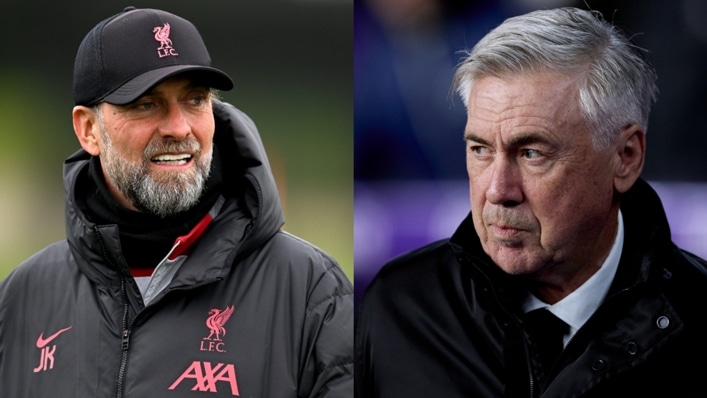
Tuesday’s Champions League round of 16 match between Liverpool and Real Madrid will be the latest encounter between Jurgen Klopp and Carlo Ancelotti.
Their individual histories could have been very dissimilar.
In October 2015, after Everton and Liverpool drew 1-1 at Goodison Park, Thierry Henry reached across and put his hand on a perplexed Jamie Carragher’s knee in the Sky Sports studio as it was announced that Brendan Rodgers had been fired as the manager of the Reds.
In a matter of minutes, the front-runner Klopp was being discussed as the candidate most likely to take the club back to the pinnacle of European and English football.
The second favourite had been Ancelotti, out of work at the time following his exit from his first spell at Madrid, and Carragher argued that while the Italian had the more impressive CV, Klopp was the more suitable choice for the Anfield hotseat after his success at Borussia Dortmund.
“I think with either of those coming to Liverpool, the supporters would be ecstatic,” he said at the time. “If it were me, I would go for Klopp ahead of Ancelotti.” I think he’s got more to prove. Ancelotti is a great manager, of course, but he’s gone to clubs where you would expect to win trophies.
“Getting Liverpool back into the top four is now a difficult task.” Forget talking about the title. And I think it needs someone with that energy and drive to get Liverpool back to where it wants to be, and I think Jurgen Klopp’s that man.”
Of course, Carragher proved to be right about Klopp.
It will never be known what would have happened had Ancelotti been hired instead, but he has gone on to enjoy success at other clubs since, with spells at Bayern Munich, Napoli and Everton before heading back to the Santiago Bernabeu in December 2021.
The two have faced off numerous times in opposing dugouts, with the upcoming two-legged Champions League tie set to be their 12th and 13th meetings.
It is interesting how frequently Klopp and Ancelotti have come up against one another, especially considering the Italian’s 18-month spell at Everton was the only time they have managed in the same league.
They clashed on four occasions in Merseyside derbies – coincidentally after that had been the fixture that led to their names being linked with the Liverpool job back in 2015 – with two draws at Goodison Park in the Premier League and a 1-0 Liverpool win in an FA Cup third round game at Anfield.
The most notable encounter also came at Anfield in February 2021, with no fans in due to COVID-19 restrictions, where Ancelotti masterminded Everton’s first win at the home of their neighbours since the turn of the century.
Their other seven meetings have come in the Champions League, Klopp coming up against Ancelotti for the first time during his penultimate season at Borussia Dortmund as they took on Madrid in the last eight, losing 3-0 in the Spanish capital before a spirited but unsuccessful 2-0 reverse back in Dortmund.
Two goals from Marco Reus in the first half had given the German side hope of a comeback, but Ancelotti’s men put up the defences and managed to see the game out, a tactic that the Los Blancos head coach has used to good effect against Klopp on numerous occasions since.
He also frustrated Klopp in their first meeting as Liverpool and Napoli bosses respectively, with the Serie A side winning 1-0 at home in the 2018-19 group stage, restricting the Reds to just four shots – none on which were on target – as Lorenzo Insigne struck a late winner.
A Mohamed Salah goal in the reverse fixture was enough to send Liverpool through to the knockout stage with a 1-0 win at Anfield at Napoli’s expense, with the Reds going on to lift the trophy in Madrid that season.
The two teams were drawn together again in the group stage the following year, with Napoli again defeating Liverpool in Naples, 2-0 this time, while they played out a 1-1 draw back on Merseyside.
Klopp and Ancelotti would not meet again in the Champions League until after their brief Merseyside derby rivalry, somewhat appropriately in the final as Liverpool faced Madrid in Paris last season.
While the game was heavily distracted by the chaos outside prior to kick-off that an independent investigation has since claimed was the fault of UEFA and the French authorities, on the pitch it had a feel of Klopp’s previous struggles with Ancelotti.
Liverpool dominated large parts of the contest, but Madrid were largely able to contain them, though goalkeeper Thibaut Courtois still had to put in an outstanding performance to keep a clean sheet.
Ancelotti suggested after the 1-0 win thanks to a Vinicius Junior goal that Klopp’s team were “more decipherable” than others he had faced, but ahead of their next clash, the German coach lavished praise on his opposite number.
“Carlo is the most relaxed manager I ever met in my life,” Klopp said at his pre-match press conference. “One of the best people you can meet, fantastic person, a humble person, super smart and nice, and obviously his man management is at a completely different level to all of us, and I respect that a lot and admire it a lot.”
Ancelotti reciprocated at his press conference, saying: “I have a good relationship with Klopp. We stayed for a year and a half in Liverpool during the pandemic, and we used to text each other and exchange gifts. He’s a really lovely person.”
There is clear mutual respect there, strengthened by the duo’s personal achievements as well as how difficult they both find games against one another.
Klopp’s teams have only managed to find the net seven times against Ancelotti’s in 11 games, despite having 153 shots, suggesting the former Milan, Chelsea and Paris Saint-Germain boss knows how to restrict them to low-quality chances.
Ancelotti has relied on his team’s defensive solidity more often than not, and boasts the superior record with five wins to three defeats and three draws, but he has never been able to beat a Klopp team in an away game when fans have been in attendance, with a noisy Anfield on Tuesday a near certainty.
He surely takes slightly more pleasure in besting Liverpool than he does most other foes following one of his most painful defeats as a coach when his Milan side was beaten on penalties in the iconic 2005 Champions League final in Istanbul, despite leading 3-0 at half-time.
This season’s final will also be in the Turkish capital, but at least one of Liverpool or Ancelotti will not be there this time.
Klopp v Ancelotti. Germany v Italy. Beard v eyebrow. It is one of the great modern coaching rivalries, and round 12 should be another fascinating contest.
Christian Atsu, who was trapped in the earthquake that struck Turkey on February 6, 2023, died at the age of 31. His body was discovered 12 days later.
Christian Atsu carried out a variety of charitable deeds up until his passing. A few prisoners’ release was funded by the former FC Porto player. He also contributed to a few orphanages and helped pay for many people’s medical expenses and school tuition.
Stephen Appiah, a former Newcastle player, paid tribute to the late Ghanaian international, saying he would be missed for his charitable work and for giving hope to the less fortunate.
Appiah said, “Aside from football, we know the love and charity work Atsu has been doing.”
“I think at this moment most of the guys on the street, I mean the hawkers on the street, all had their hope in Atsu, and now he has taken all the hope away,” he told Dan Kwaku Yeboah in an interview.
“We know there is a big funeral coming, and we will all support you with all we have,” he added.
Graham Potter is under pressure as Chelsea’s manager after a stretch of just two victories in his previous 14 Premier League games. However, why hasn’t he been fired?
James Ward-Prowse’s kick on Saturday was all it took to prevent Chelsea from winning for a fifth straight game, adding to the pressure on Potter as a very difficult stretch continues. After a frenetic January shopping spree, the former Brighton manager took over for Thomas Tuchel in September of last year. However, since taking over, Chelsea has not improved under his leadership.
Naturally, his struggle has resulted in many calling for his dismissal, but a new report from The Telegraph has outlined exactly why Chelsea are yet to sack Potter.
The report claims that Chelsea co-owners Todd Boehly and Behdad Eghbali are not yet convinced he is the problem and instead have a list of reasons why they shouldn’t sack him. Injuries behind the scenes are one reason, as is his poker face in the public eye; Potter is described as being “intense” around the Cobham training ground, and the owners have no fears over his mentality, but are instead happy they have a coach who will not throw players under the bus in front of the media.
Point three claims the owners recognise that Potter took a risk in joining the club from Brighton mid-season, something they believe not many top coaches and managers are always willing to do. They also understand he left a very safe environment at Brighton and put his reputation on the line in doing so, and they believe he needs a considerable amount of time to work with new players and develop a relationship with sporting directors Paul Winstanley and Laurence Stewart in order to create sustainable success, similar to Pep Guardiola and Txiki Begiristain at Manchester City.
A severe loss of form sees Chelsea languishing in 10th in the Premier League, behind the likes of Liverpool, Fulham and Potter’s former club Brighton. They also find themselves 11 points behind fourth-placed Newcastle, and are at serious risk of not qualifying for the Champions League next season.
The Blues travel across London to the Tottenham Hotspur Stadium on Sunday in a bid to kickstart their season once again, but will also have one eye on theirChampions League last-16 tie on March 7, where they must turn around a first-leg defeat against Borussia Dortmund.
The German has previously led top European clubs Borussia Dortmund, Paris Saint-Germain and the Blues, whom he took to the 2020-21 Champions League title.
The 49-year-old has reportedly turned down two Premier League offers despite being linked to numerous open positions in recent months.
TOP STORY – PSG WILLING TO ADMIT TUCHEL ERROR
According to the Evening Standard, PSG are fed up with head coach Christophe Galtier and are ready to re-appoint Thomas Tuchel.
The club sacked Tuchel in December 2020 after two and a half years in charge with the best win percentage in Ligue 1 history.
But PSG are reportedly willing to admit their mistake in letting him go as they try to convince Tuchel to return following their recent run of three straight defeats, which was ended by Sunday’s 4-3 win over Lille.
The report claims Tuchel would need assurances from the club, but it is the type of role he has been waiting for, joining a top side competing for major trophies.
ROUND-UP
– According to Football Insider, Tottenham is keeping an eye on Real Madrid winger Marco Asensio. Spurs will need to compete with Arsenal and Manchester Unitedfor the 27-year-old, who is out of contract at the end of this season.
Arsenal, Chelsea, and Manchester United are all circling for Borussia Monchengladbach’sMarcus Thuram, according to Talksport. The Athletic claims Thuram will leave Gladbach in the off-season as a free agent, with Bayern Munichalso interested.
Relevo reports Bayern are weighing up a move for Real Madrid midfielder Dani Ceballos, with head coach Julian Nagelsmann an admirer, although no contact has been made yet.
ESPN claims Manchester United and teenage sensation Alejandro Garnachohave agreed in principle to a new five-year contract, warding off interest.
Manchester United will need to fork out €80 million (£71 million) to land Tammy Abraham from Roma, according to Calciomercatoweb.
According to Calciomercatoweb, Juventus will make a move for Real Madrid winger Brahim Diaz after this season. Diaz is currently on loan at Milan, but the Rossoneri will not trigger their option to buy him.
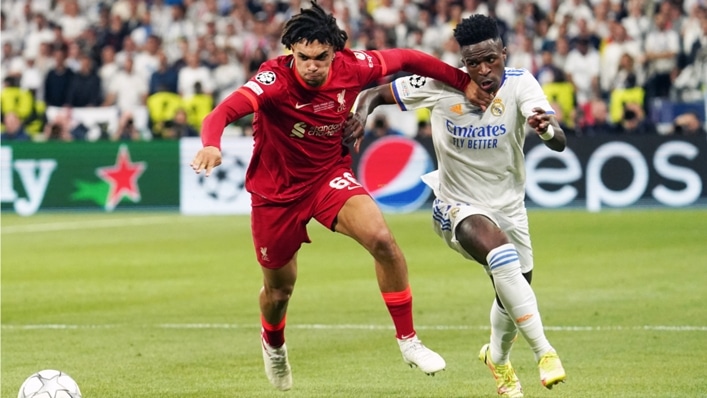
Real Madrid will go to Anfield on Tuesday to rematch the 2022Champions League championship with the goal of inflicting more damage on Liverpool in the round of 16.
Madrid won the coveted trophy in Paris last May, but despite Liverpool’s struggles in the Premier League this year, their recent European performance would indicate that they should present a stiff challenge for a team that has had Madrid’s number in recent years.
While Napoli, the lopsided Serie A leaders, roll into town, reigning Europa League champions Eintracht Frankfurt will try to keep up their impressive European form.
This season, Napoli has faced off against everyone, establishing itself as a major force in Europe and dominating Serie A.
Courtesy of Stats Perform: here are some of the key statistics and facts to be aware of ahead of the ties.
The Spanish giants lifted the top prize in European club football for a 14th time after defeating Liverpool 1-0, leaving the English side winless in their past six meetings between the clubs.
That is the longest winless streak Liverpool have suffered against any team in their Champions League history, with five losses and one draw dating back to 2009.
However, England has not been a happy hunting ground for Madrid in recent years, with only one victory – against Chelsea in 2022 – from their past seven away fixtures in the country (D2 L4).
Also in the hosts’ favour is their terrific European form this season, having rattled off five consecutive wins in the competition since losing their opener against Napoli.
A key for the Reds will be figuring out how to stop Vinicius Junior, who has directly contributed to seven goals – scoring five and producing two assists – in his past eight Champions League fixtures.
Liverpool forward Mohamed Salah could join Chelsea legend Didier Drogba as Africa’s all-time leading scorer in the competition with one more goal, which would be his 44th.
Napoli will be dreaming of their first Champions League and Serie A double as they hit the road for their first leg against Frankfurt.
They will face a German side who have excelled in European competition under head coach Oliver Glasner, with only two losses from 19 matches (W10 D7), including a triumph in last season’s Europa League final against Rangers.
Frankfurt have won their past four meetings with Italian sides since a loss to Palermo back in 2006, while Napoli have just two wins from their 12 away dates in Germany (D5 L5).
But Napoli have been a different beast this campaign, leading all teams with 20 group stage goals. They are averaging 3.3 goals per game in the competition under Luciano Spalletti.
Breakout star Khvicha Kvaratskhelia is at the centre of Napoli’s success, joining Dries Mertens (2017-18 season) as the only players in the history of the club to record multiple games with a goal and an assist in the same Champions League campaign. He has the potential to write his own history, as no Napoli player has done it three times.
Meanwhile, Frankfurt have a pair of in-form goalscorers. Daichi Kamada has scored in each of his side’s past three Champions League matches this season, while Randal Kolo Muani has found the back of the net in their past two.
Christian Atsu’s partner, Marie-Claire Rupio, has talked about how she is feeling after losing her husband.
The widow responds to those asking about her well-being in a voice recording shared by Accra-based Peace FM.
She admits her struggles with trying to gather herself, saying she misses her husband and is doing everything she can to be a strong mother for her children.
“Hey everyone, a lot of you are asking if I am okay now; I am not, but I am trying. I am trying to be strong. I have three kids, they need me. I don’t want to talk, eat, sleep, or do anything else. I just want to be there with him. But life goes on, even though it hurts. It hurts right here so much but I am trying and I will be strong for my kids. “I miss him so much,” she said in a tearful voice.
The mortal remains of the Ghana international who perished in the devastating earthquake in Turkey arrived home, to a solemn welcome.
The body was received by his family, a government delegation led by Vice President Mahamudu Bawumia, and a delegation from the Ghana Football Association (GFA).
Also present were members of the clergy, Ghana’s Ambassador to Turkey, Francisca Ashietey-Odunton, members of the Ghana Supporters Union, other members of government, and members of the football fraternity, among others.
In the midst of the mourning for late Ghana winger Christian Atsu, former Black Stars defender John Paintsil has blasted the GFA administration.
The Ghana FA, along with many others who were connected to the player, released a statement to express their condolences after the player’s body was found beneath the rubble of the Turkey earthquake on Saturday.
“You snubbed him and kicked him out of your Black Stars at age 31. Atsu has been struggling to get a permanent stay in a club since the snub.
“We all know the value and respect your club gives you when you play for your nation.”
“Don’t pretend you loved him because you don’t at all,” John Paintsil told Original FM in an interview.
Meanwhile, the remains of Christian Atsu have arrived in Ghana from Turkey. His family is set to make the necessary arrangements for his burial.
The late Christian Atsu, who tragically perished in the earthquake that struck Turkey and Syria, is being remembered byNewcastle United supporters.
As an ambassador for the charity Arms Around the Child, Atsu, who had previously played for the Magpies and Chelsea, was working on a project to construct a new school in his native Ghana.
At a charged St James’ Park, Newcastle remembered Atsu by observing a moment of silence prior to their match against Liverpool.
In honour of Atsu, the fan organisation Talk of Tyneside has launched a charitable project to complete the school project. They are requesting support from fans for the fundraiser, which has raised more than £600 so far.
Talk of Tyneside expressed their desire to give supporters a way to show appreciation for Atsu’s service to the club and his work with the charity.
The group stated that Atsu was a well-loved figure on Tyneside, and raising funds for the charity felt like the perfect way to honour his memory.
“Following his passing, we were hoping to find a way to give supporters a way to show appreciation for his service to the club, and raising money for a fantastic charity that he worked with feels like the perfect way to do so.”
Ellie Milner, also from Arms Around the Child, spoke about Atsu’s charity work and how they are determined to keep his legacy alive by raising funds to finish the school buildings in Senya Beraku and support the children he loved so much.
Ellie Milner from Arms Around The Child added: “Christian touched the lives of so many with his charity work, we are determined to keep his legacy alive by raising funds to finish the school buildings in Senya Beraku – and support the children he loved so much.”
Former Newcastle United striker Alan Shearer says , Thomas Partey is a key player in the Premier League title match between Arsenal and Manchester City.
After Arsenal’s victory over Aston Villa and Manchester City’s draw with Nottingham Forest on Saturday, Shearer made the remark on the BBC’s Match of the Day.
If Arsenal can get Partey back from injury, Shearer believes they have a good chance to defeat the defending champions this season.
Partey, one of the top defensive midfielders in the league, has been crucial for Arsenal this season. However, the player who makes £200,000 per week is currently injured and was not present for Arsenal’s victory over Villa.
Shearer believes that if Arsenal can keep their main players injury-free and get Partey back soon, they will have a good chance of winning the title.
“I know Partey is out injured at the minute. If Arsenal can get him back and have a little bit of luck between now and the end of the season, keeping their main big hitters free from injury, I think they will do it. Yeah.”
He has scored two goals in 18 Premier League appearances for the Gunners so far this season.
Arsenal is currently at the top of the Premier League table with 54 points from 23 matches, two points ahead of Manchester City, who have 52 points from 24 games.
The two-time champions of the Ghana Premier League played in the matchday 18 games on Sunday at the Accra Sports Stadium.
The Dormaa-based team left the capital with all three points thanks to a brace from Isaac Mintah.
Aduana Stars have increased their lead on the league log as a result of the victory.
Speaking to StarTimes after the game, Fabin applauded the performance of his players stating they listened to the instructions he gave and added this is their best game of the season. He said;
“The boys did well. I told you if they play to the things that we’ve rehearsed at training. It will be difficult for Hearts of Oak to beat us and they played to the instructions so things worked for us.
“I think this is our best performance so far this season,” the former Asante Kotoko coach added.
Through social media comments and boos during halftime, fans expressed their opinions.
One of the players who has drawn the most criticism is Marc Cucurella, who has struggled to find his form despite reuniting with Graham Potter, the manager who helped make him famous during their time together at Brighton & Hove Albion.
After sharing some positive news, the Spanish left-back took the much-needed precaution of locking his Instagram comments section.
Cucurella announces wife’s third pregnancy
The 24-year-old is a father of two and announced he is expecting a third child with his wife, Claudia Rodriguez, according to his post on Instagram. The Barcelona academy graduate limited the comments section on the photo sharing platform to avoid unnecessary comments from angry fans.
Fans slammed Cucurella’s lewd training
Sports Brief also reported on Chelsea fans berating Cucurella for improper gym techniques following a post on social media.
The incident in question happened at the gym of James Ralph, a personal trainer who also works with Reece James and Trevoh Chalobah. The defender tied a weight around his waist and swung it like a pendulum, but fans were displeased he found things funny despite his form.
Cucurella steps up personal improvement The defender is yet to settle down in London since his £63 million move from Brighton in the summer and at some point, lost his place to makeshift left-back and academy graduate, Lewis Hall.
Cucurella has since dedicated more time to his personal training.As reported by Sports Brief, he worked on ball control skills by attempting to control the ball shot at him from a dispensing machine. He controlled all the balls leading to applause from his trainer but ended it by showing off his playful side, controlling the ball with his backside.
Christian Atsu‘s last moments with his team, Hatayspor, were happy and exciting. The Ghanaian international, who tragically died following the earthquake in Turkey and Syria, scored the team’s final goal.
Ghanaian winger Christian Atsu was spotted having fun with his Hatayspor teammates before the earthquake in Turkey.
Ghana winger Christian Atsu was spotted having fun with his Hatayspor teammates before the earthquake in Turkey. Credit: @addojunr Source: Twitter
In a video shared on social media, Atsu is seen having fun with his teammates as they hyped him up, following his sensational free kick against Kasimpasa. The ever-smiling player is also seen practicing a dance move with one of his teammates while the others chant his name.
A few hours after the players left camp for their various destinations, a 7.8 magnitude earthquake hit the Hatay region in Turkey and the northern part of Syria, leaving over 40,000 people dead. Atsu was initially reported to be trapped under rubble but after 12 days of searching and many prayers of hope, he was found dead.
The 31-year-old’s passing has left the footballing world in shock, with many sending in their tributes as the club arranged with Turkish authorities for his body to be transported to Ghana for burial. Atsu enjoyed a stellar career in Europe, playing for FC Porto, Chelsea, Newcastle United, Bournemouth and Everton before a brief time in Saudi Arabia.
The government, family, friends and former footballers were all at the Kotoko International Airport to receive the body ahead of the final rites. Many were unable to hold back tears and wails of anguish, as the late footballer’s body was transported off a Turkish Airlines aircraft. Danilo pays tribute to Atsu Juventus and Brazilian defender, Danilo paid Atsu emotional tribute, after the Ghanaian passed away following theTurkey-Syria earthquake.
The two players were teammates at Portuguese giants, FC Porto, breaking into the senior team in the same year. Atsu was killed after being trapped under rubble, following the disaster which claimed the lives of over 40,000 people.
When Ghana faced Lesotho in 2012, Kwasi Appiah gave Christian Atsu his Black Stars debut at the age of 20.
Atsu scored during Ghana’s 7-0 victory over the opposition at the Baba Yara Sports Stadium.
Disgusted Kwesi Appiah praised Atsu for keeping his word after the player passed away.
“It’s really, really sad that Atsu is no more. May his soul rest in peace, and my condolences go to the family as well as all of us Ghanaians. When he heard that there had been an earthquake in Turkey, we were all praying that he would be found, but God knows best. When you give him a role on the field, he will do his best to make you, the coach, proud… I used to tell my players to go onto the field and show that they deserved to be on the team. Atsu is one of the players who did not appear in front of me. On the pitch, he was humble and always laughing. The old and new players used to play with him every time. Apart from that, in his social life, we all knew how he helped the less privileged. “That is all I can say about Atsu,” he told Oman FM.
A high-magnitude earthquake struck in Hatay, Turkey on February 6, 2023, which led to Atsu being trapped in his destroyed apartment for over a week.
His body was discovered lifeless on February 18 and was added to the death toll of over 40,000 after the earthquake.
The deceased winger, who made 60 appearances for Ghana, scored 10 goals in his 11-year international career.
His last appearance came in 2019 when he played in the 2019 African Cup of Nations.
Concerns have been raised about the potential effects on Paris Saint-Germain, which was taken over by Qatar Sports Investments (QSI) more than ten years ago, after it was revealed that a consortium led by a Qatari banker is in the running to buy Manchester United.
For just 70 million euros ($74.7m at the current exchange rate), QSI, a division of the sovereign wealth fund of the Gulf state of Qatar, acquired control of the French club in 2011.
PSG is now used by Qatar to project soft power because, while still the dominant club in France, they are also a major player on the European stage and a household name thanks to QSI’s ownership.
More than 1.5 billion euros have been splashed on transfers over the last dozen years, including the two biggest fees in the history of the game for Neymar and Kylian Mbappe in 2017, although all that money has not yet delivered Champions League glory in which Qatar could bask.
But now the tiny, gas-rich state is aiming even higher with its sights set on United, the most successful club in the history of the most powerful league in the world, with commercial and broadcasting income far greater than what can be generated in the French top flight.
The bid, led by the chairman of the Qatar Islamic Bank (QIB), Sheikh Jassim Bin Hamad Al Thani, is believed to be worth between four and six billion euros, according to several sources.
“This means nothing has been done without the approval of the emir, Sheikh Tamim bin Hamad Al-Thani.”
However, there is no suggestion of the Qataris abandoning PSG in the short or medium term. New strategy? If the Qatari bid for Manchester United succeeds, “the plans for PSG would not change at all. The two clubs would be totally separate on the field and off it. The QIB is totally separate from QSI,” a source close to PSG’s owners insisted to AFP.
Last December, PSG president Nasser al-Khelaifi also shut down any suggestion of a possible withdrawal when he said in an interview with the Financial Times “we have a long-term project here”.
At the same time, Khelaifi admitted the French champions had been in discussions with several investors about potentially selling a 15 percent stake. “Qatar is capable of persisting with the two clubs. That doesn’t mean that it is finished with PSG. It is above all a demonstration of Qatar’s power that it is able to show an interest in a club like Manchester United,” Raphael Le Magoariec, who specialises in the Gulf and sport at Tours University in France, told AFP.
“It is unlikely that they would withdraw from Paris because that would be seen as a failure.” Nevertheless the dispute with Paris city council over PSG’s attempts to buy their Parc des Princes stadium from the local authority has left a bitter taste with the club’s owners. Qatar, according to Le Magoariec, “has invested a lot and thinks that its generosity is not being respected”.
Despite that, the ties between France and Qatar, which possesses stakes in numerous French multinational corporations, make it unlikely the country will divert its capital away from a club like PSG.
“Paris is the type of platform which givesQatar standing in the world,” says Le Magoariec. Yet it is possible a slight change in strategy at PSG is taking place, given the club is being closely watched by UEFA to ensure they fall in line with the Financial Fair Play (FFP) rules of European football’s governing body.
The club made huge losses last season of 370 million euros and has an enormous wage bill, weighed down by the salaries of superstars Mbappe, Lionel Messi and Neymar. “There is maybe less investment.
They have already tightened their belts because of FFP constraints,” said Guegan. “But they are going to open up to foreign investors, and depending on the identity of these investors we will see if the club continues to be an asset in Qatar’s strategy of visibility or if they move on to a different stage.”
Antoine Griezmann says Atletico Madrid fans’ ongoing demonstrations against the club’s owners have made it more challenging for the team to play at home. Some Rojiblancos fans frequently chant and whistle in opposition to the club’s ownership, particularly Miguel Angel Gil Marin and his family, and they have demanded that the CEO leave the organisation.
According to Football Espana, Griezmann has now requested that the fans end their protest because it is harming the team.
“Ultimately, it’s about streaks, and I hope I can score more goals, but it’s true that it’s more difficult here because of the fans.
“I hope they can fix it as soon as possible because we need them. With them, no doubt we can go much further.” Atletico Madrid moved within two points of Real Sociedad in third and maintained a four-point gap over Real Betis in fifth in their bid forChampions League qualification.
Griezmann strike earns Atletico win Meanwhile, Griezmann scored a brilliant late goal to claim a battling 1-0 win against Athletic Bilbao at the Wanda Metropolitano on February 19, Sportstar reports.
It was only their fifth home victory in a difficult season that saw them eliminated from the UCL in the group stage and the Copa del Rey in the quarter-finals.
Coach Galtier sends strong message to players ahead of second leg clash against Bayern Griezmann’s goal was his 14th in 30 games against Bilbao, the most the French forward has scored against any team in his professional career. Griezmann praised by France coach Sports Brief also reported on Griezmann being one of France’s most important players, since making his debut for Les Bleus in February 2014.
The Atletico Madrid forward has come in handy in several positions for France, including leading striker, attacking midfielder, winger, and central midfielder. Griezmann currently occupies the midfield with Aurelien Tchouameni and Adrien Rabiot, in absence of the injured Paul Pogba and Ngolo Kanté
After dominating European football for nearly two decades, Cristiano Ronaldo and Lionel Messi have both been referred to as the greatest players of their generation by their supporters.
The two have amassed numerous team and individual championships throughout their careers, making them the most Ballon d’Or winners with five and seven, respectively.
The argument over which of the two is superior has been raging for more than ten years.
Beckham is the most recent player to weigh in on which of the two superstars is superior.
In an earlier interview with ESPN Argentine, via Tribuna, the Manchester United legend admitted that the Argentine was in a class of his own: “It has to be Messi,” Beckham said. I love Leo for many different reasons. I love him because he’s a great father. I love him because he’s a great personality, a character. He’s a great person. “But I think what everybody loves about him is the way he plays the game.
He plays the game with passion. He plays the game just free the way he plays. “And I think this past World Cup again. I think the way he played for his team, for his country, and to win that World Cup was an incredible moment for him. And I love watching players like him.”
Meanwhile, Chelsea legend, Joe Cole has picked Lionel Messi ahead of Cristiano Ronaldo as the greatest player in the history of football, Daily Post reports.
Joe Cole insists that neither Al-Nassr forward Cristiano Ronaldo nor the late Diego Maradona can be compared to the Argentine World Cup star.
Messi’s victory with Argentina at the 2022 World Cup, according to the former England international, has put the debate between the Paris Saint-Germain superstar and Ronaldo to rest. Fernando Torres settles GOAT debate Earlier, Sports Brief reported the football world continues to be divided on who’s the greatest of all time between Lionel Messi and Cristiano Ronaldo.
The decades-long debate continues to rage on, with former and current footballers weighing in with thoughts on who’s better between both superstars. Former Liverpool and Chelsea forward Fernando Torres picked Messi ahead of Ronaldo, thereby staking his claim on the debate on which of the superstars is superior.
The France international’s contract expires at the end of June, and Gladbach sporting director Roland Virkus made it clear Sunday that Gladbach stand to lose him.
Thuram has reportedly drawn interest from a number of elite clubs in Europe, with Inter reportedly leading the charge alongside Chelsea and Gladbach’s Bundesliga rivals Bayern Munich.
Only five players in Germany’s top division have more goal involvements than the 25-year-old, who has 11 goals and three assists so far this season.
Virkus appeared to acknowledge in his interview with Sport1 that Gladbach’s attempts to keep the talented Lilian Thuram’s son were likely to fail.
He said: “With Marcus Thuram we stretched. We have to accept that when there are even bigger clubs where Marcus might go.”
Virkus added: “The fact that players will leave us for free is not a positive situation, and I can’t sugarcoat it.”
Gladbach sit eighth in the Bundesliga after Thuram scored in a 3-2 victory over10-man Bayern on Saturday.
Manchester City needs a striker, and claims that Erling Haaland only scores “easy” goals are “a lie,” according to his teammate Ederson.
Since joining City from Borussia Dortmund last year, Haaland has scored 32 goals in 31 appearances across all competitions, which is more than any other player from one of the top five leagues in Europe.
In the Premier League, he has scored 26 goals, but the 22-year-old has recently come under fire as City struggles to overtake Arsenal and Manchester United in the race for the championship.
Former Liverpool defender Jamie Carragher said Haaland “might have picked the wrong club,” while Arsenal great Thierry Henry speculated that Tottenham’s Harry Kane might have been a better fit for City.
However, Ederson believes Haaland is well-suited to City’s style, though he acknowledges Pep Guardiola’s men have had to adapt to his characteristics.
“When he arrived, we said he was going to score a lot—and that’s been happening.” “He is a brilliant goalscorer; he always looks to score and help the team,” Ederson told UEFA.com.
“He is the striker we needed because, in comparison to Gabriel [Jesus], they are different players.” Gabi likes to come in from out wide; he is stronger and more versatile. Haaland plays more centrally, looking to get into the box, he is a target in the area.
“That has been the major difference. When you get into the final third you have someone who will always be in the area.
“Many people say most of the goals he scores are easy—but that is a lie.” It’s his positioning—that’s his best ability. He doesn’t score easy goals, he positions himself very well.
City return to Champions League action when they visit RB Leipzig for the first leg of their last-16 tie on Wednesday, and with Haaland netting 28 times in 23 appearances in the competition throughout his career, the club hope his finishing ability will help deliver their first European crown.
Ederson is in no doubt as to the importance of continental success to City, saying: “That’s our main objective, the main objective of the club.
“We’ve been trying [to win it] and will carry on trying. We haven’t won it yet, we reached the final [in 2021], and a few semi-finals, and we didn’t come out of it with a good result.
“But I think this year, we’re more than capable of getting to the final and challenging for the title.
“Now this title is what the club needs, it’s what we athletes need and it’s what Guardiola needs here at the club, too. This year, we’re going to try. We’re going after it.”
The Partenopei are getting ready for Tuesday’s first-leg match against Eintracht Frankfurt.
Napoli has never advanced past that point, but this year they have never appeared more capable.
In addition to dominating their Champions League group, Luciano Spalletti’s team is currently 15 points clear at the top of Serie A.
Napoli won five of their six European matches before the World Cup break, thrashing Liverpool 4-1 and Ajax 6-1 along the way.
The competition will ramp up now, but Costacurta, who was a five-time European champion with Milan, does not see any team better than Napoli.
“I don’t want this to pass as nonsense, but in terms of approach and attitude, Napoli are the strongest in Europe,” he told Il Mattino.
“Obviously there are the others, and we know perfectly well that a competition like the Champions League is capable of drawing out of the players those motivations that maybe don’t exist in the league. But I’m sure about one thing.
“At the moment, Napoli are stronger than Manchester City and all the others.”
Costacurta added: “The strongest teams in Europe have not yet given great shows of strength in their leagues.
“He’s an incredible player and I don’t know where he came from,” the former defender said. “Where the hell was he up until six months ago?”
Napoli’s dominance in Italy has been aided by difficult seasons for many of their rivals, but Costacurta suggested Inter’s Serie A form showed they are “distracted” by the Champions League.
“For Napoli, I dream of a spectacular final with PSG, because in this way you enter a different dimension of history,” he said.
“But I admit that I would also like a good all-Italian final also, because if we want to be honest, I’m the only one who played a semi-final and a final against another Italian team in the Champions League.”
Toni Kroos and Aurlien Tchouameni, two crucial midfielders for Real Madrid, won’t be travelling to Liverpool with the team, but Karim Benzema has been called up.
The Ballon d’Or winner from the previous year, Karim Benzema, missed Saturday’s victory over Osasuna due to an injury hit campaign.
The 35-year-old, who has 14 goals this season, returned to training before Tuesday’s Champions League match at Anfield, and as a result, he has been added to Carlo Ancelotti’s travelling party.
Madrid won’t be able to use Kroos or Tchouameni, though.
The two injured players did not participate in the game against Osasuna and were not on Madrid’s roster, which was announced on Monday.
Ancelotti will be hoping Kroos and Tchouameni return to fitness in time to face city rivals Atletico Madrid on Saturday in LaLiga, with a Copa del Rey Classico against Barcelona following on March 2.
Madrid beat Liverpool 1-0 in last season’s Champions League final, a match that was overshadowed by policing issues outside of the Stade de France.
Vinicius Junior scored the only goal as Thibaut Courtois turned in a fine display to help Madrid claim a 14th European crown.
Tatum, a forward for the Boston Celtics, broke Anthony Davis’s previous mark of 52 points, earning him the title of most valuable player (MVP).
After hurting his right little finger, opposition captain LeBron James was forced to sit out the second half.
“It means the world,” Tatum, now a four-time All-Star, said of his record.
“You think of all the legends and great players that have played this game.
“In all honesty, records are made to be broken.” “I’ll hold it as long as I can, but I’m certain somebody will come along in a couple years and try to break it.”
Tatum’s Celtics team-mate Jaylen Brown led Team LeBron with 35 points and a game-high 14 rebounds, while James exited on 13 points after hitting his finger against the rim while trying to block a shot.
Los Angeles Lakers star James now shares the All-Star selections record of 19 with Kareem Abdul-Jabbar, but defeat in Salt Lake City on Sunday was his first of six All-Star games as captain.
Winning captain Giannis Antetokounmpo scored the first points of the night with a dunk after 15 seconds before sitting out the rest of the game after spraining his right wrist in the Milwaukee Bucks’ final regular-season game.
With Team Giannis leading 158-141 at the end of the third quarter, a target score for victory of 182 was set, which was 24 points higher than the winning side’s score at that stage, an addition representing Kobe Bryant’s shirt number during much of his career with the Los Angeles Lakers.
And it was Damian Lillard of the Portland Trail Blazers who drained the decisive three-pointer to secure the victory.


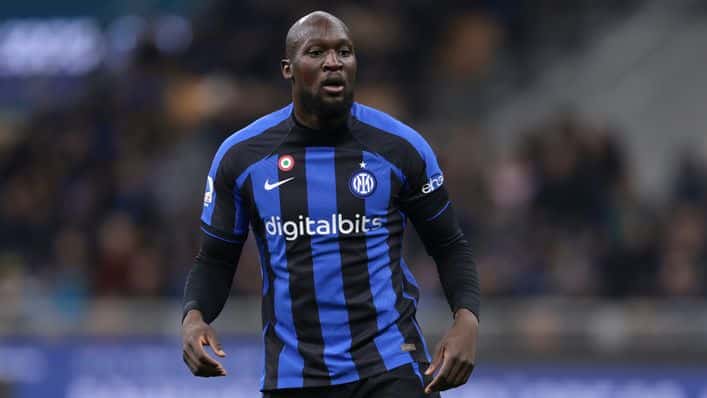

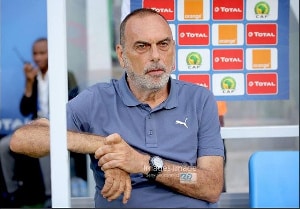


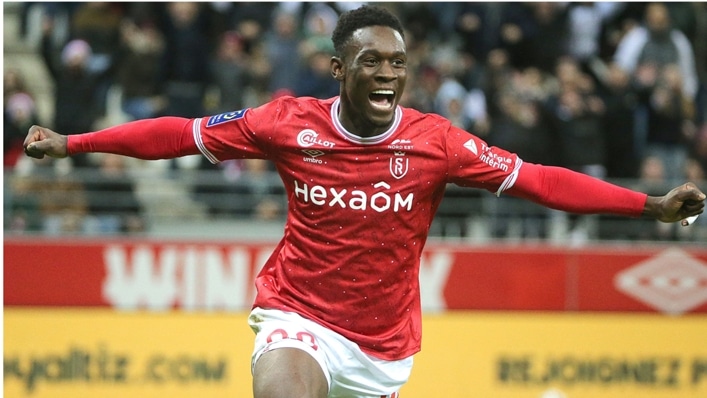

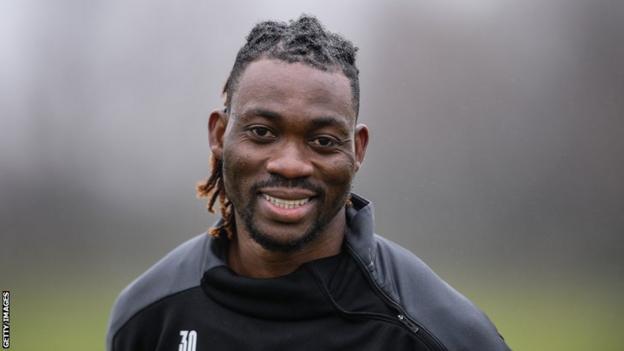



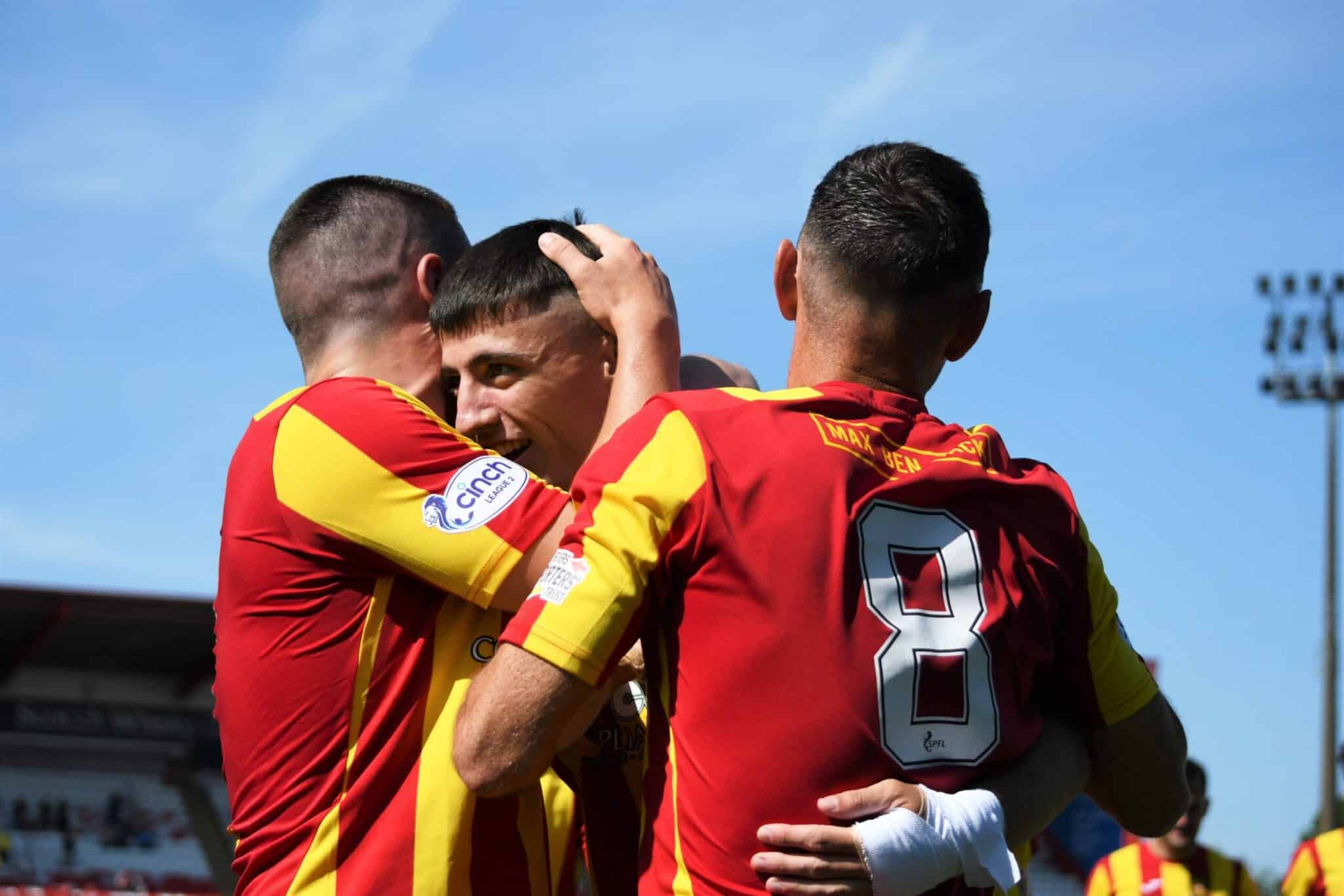


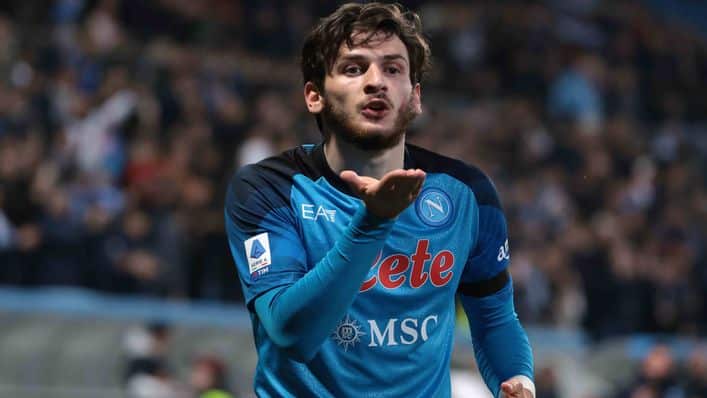
&w=707&quality=100)


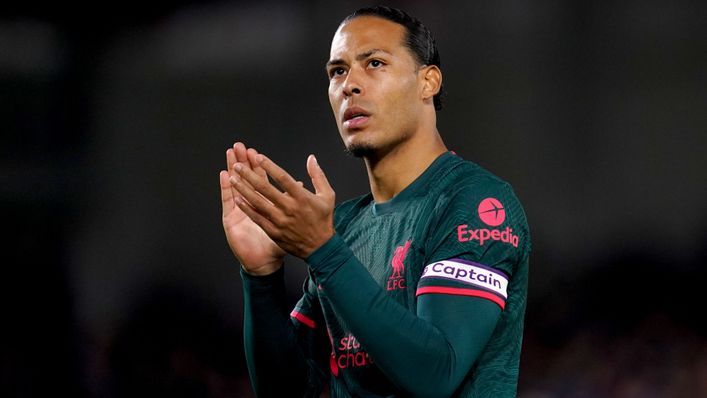
&w=707&quality=100)
&w=707&quality=100)


&w=707&quality=100)