The White House has mandated the first-ever full disclosure of thousands of documents pertaining to the assassination of US President John F. Kennedy.
More than 97% of the records in the collection are now accessible to the public, according to the White House, with the online publication of about 13,173 files.
The papers aren’t expected to reveal anything incredibly shocking, but historians hope to learn more about the alleged assassin.
On November 22, 1963, while visiting Dallas, Texas, Kennedy was shot.
By October 2017, the government was required by a 1992 law to make all assassination-related records available.
On Thursday, President Joe Biden issued an executive order authorising the latest disclosure.
But he said some files would be kept under wraps until June 2023 to protect against possible “identifiable harm”.
The US National Archives said that 515 documents would remain withheld in full, and another 2,545 documents would be partly withheld.
A 1964 US inquiry, the Warren Commission, found that Kennedy was killed by Lee Harvey Oswald, a US citizen who had previously lived in the Soviet Union, and that he acted alone. He was killed in the basement of the Dallas police headquarters two days after his arrest.
JFK’s death spawned decades of conspiracy theories, but on Thursday the CIA said the US spy agency had “never engaged” Oswald, and did not withhold information about him from US investigators.
Long-time JFK academics and theorists have hoped the latest release would reveal more information about Oswald’s activities in Mexico City, where he met a Soviet KGB officer in October 1963.
In its latest statement, the CIA said that all information held by the agency relating to his trip to Mexico City had previously been released, adding: “There is no new information on this topic in the 2022 release.”
But researchers with the Mary Ferrell Foundation, a non-profit that sued to the government to release the files, said the CIA was withholding information about Oswald’s time in Mexico.
The foundation said some CIA records were never submitted to the archives and therefore were not part of the batch just released.
One newly revealed document shows the president of Mexico helped the US place a wiretap on the Soviet embassy in Mexico without the knowledge of other officials in the Mexican government.
This nugget of information was hidden by redactions in a previously released version of the file, reports the BBC’s US partner CBS News.
The White House said the release of the files would provide the public with greater understanding of the investigation into the assassination.
President Biden wrote in his order that “agencies have undertaken a comprehensive effort to review the full set of almost 16,000 records that had previously been released in redacted form and determined that more than 70 percent of those records may now be released in full”.
The Trump administration released thousands of pages over the course of his presidency, but withheld others on the basis of national security, despite the 1992 law forcing the release of all the information by 2017.
In October 2021, Mr Biden released around 1,500 documents, but said he was keeping the others sealed.
Philip Shenon, a former New York Times reporter and author of A Cruel and Shocking Act: The Secret History of the Kennedy Assassination, says the new files could shed light on whether the government may have known of Oswald’s intentions.
“I suspect there may be information in these documents to suggest that other people knew before the Kennedy assassination that this man Lee Harvey Oswald was a danger and that he may have talked openly about his intention to kill the president,” he tells BBC News.
“And the question has always been did the agencies of government, the CIA and FBI, have some sense that this manwas a danger to President Kennedy, and if they had acted on that information could they have saved the president?”
Mercenaries from the Russian company Wagner have reportedly been invited into neighbouring Burkina Faso, according to Ghana’s President Nana Akufo-Addo.
He described the development as distressing while speaking with US Secretary of State Antony Blinken about it.
This occurs at a time when Ghana and other coastal nations in West Africa are growing more concerned about the spread of jihadist violence from the Sahel.
Russian mercenaries, according to President Akufo-Addo, were on Ghana’s northern border.
He said he understood that the Wagner group had been offered a mine in southern Burkina Faso as a form of payment for services – presumably fighting Islamist militants.
In a video of the meeting with the US secretary of state, Mr Akufo-Addo describes the development as particularly worrying seeing as Ghana strongly condemned Russia’s invasion of Ukraine.
He spoke of the dangerous proliferation of coups in West Africa adding that there were enemies of democracy working hard in the region.
Jacob Zuma, the former president of South Africa, says he has filed a private lawsuit against Cyril Ramaphosa, his successor.
The Jacob Zuma Foundation made the announcement on Thursday night, stating that President Ramaphosa had been charged with “serious crimes” in a Johannesburg court.
“President Cyril Ramaphosa has been charged in a private prosecution with the criminal offence of being accessory after the fact in the crimes committed by among others Advocate Downer namely, breaching the provisions of the [National Prosecuting Authority] NPA Act,” the foundation said in a statement.
In a joint statement, the UK and France pledged to “destroy” the business model of people-smuggling gangs.
Home Secretary Suella Braverman and her French counterpart Gérald Darmanin said the tragedy highlighted the need to jointly prevent the crossings.
“Our hearts go out to all those affected by this tragic event,” they said.
The Maritime and Coastguard Agency said some searches had taken place overnight with vessels in the area asked to post lookouts and report sightings to the Dover Coastguard.
Footage from Wednesday’s rescue showed the inflatable boat filling with water as some dressed only in T-shirts and thin lifejackets screamed for help.
The video – shared by the owner of the fishing trawler, Ben Squire – showed the crew of the fishing boat pulling people up out of the water and the boat with ropes.
Those rescued from the dinghy said they had each paid £5,000 to cross the channel, the BBC has been told.
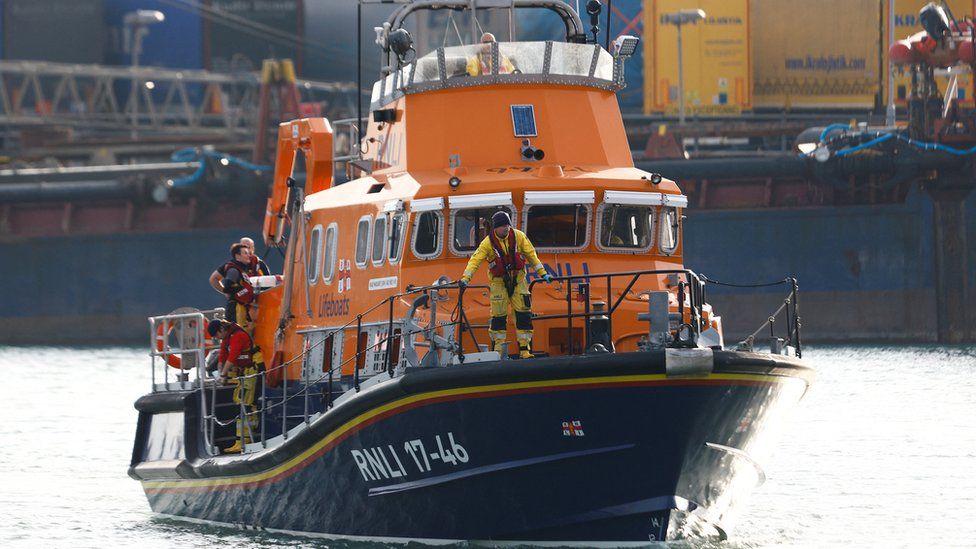
IMAGE SOURCE,REUTERS Image caption, Rescue workers stand on board an RNLI lifeboat as a search and rescue operation is launched in the English Channel
After hauling people to safety, Mr Squire said the crew gave them hot showers and their own clothes, and fed them to help warm them up.
Charles Blyth, the safety officer at the company which owns the trawler, said it was “sheer coincidence” it was in the right place for the rescue.
“As soon as the individuals on that dinghy saw [our] fishing vessel, many of them started to jump off and swim,” he told BBC Radio 4’s Today programme.
He said crew members onboard had been trained in emergency care for people going overboard.
Lifeboat crews that arrived at the scene 10 minutes after the fishing trawler encountered a “horrific” and “distressing situation”, the RNLI’s head of lifeboats said on Thursday.
Simon Ling thanked the “invaluable” actions of the fishing vessel, saying crew members had saved “countless lives”.
Temperatures at the time had dropped below 1C and were likely to have been colder out at sea.
A French organisation, Utopia 56, which helps migrants in Calais, said it was contacted at 01:53 GMT – with a voice message and a location – by a boat in distress in the Channel.
Nikolai Posner from the organisation said the voice message stated there were people in the water and families on board.
“It was clearly an emergency, he was calling for help,” he told PA News, adding that they could hear “babies screaming” in the background.
The organisation, however, has said it was not possible to verify whether the distress call was definitely from the boat in question.
On Wednesday, Prime Minister Rishi Sunak expressed his sorrow at the “tragic loss of human life”.
In November 2021, at least 27 migrants died after a dinghy sank while heading to the UK from France.
Some 460 people made the journey from France to Kent in small boats between Friday and Sunday, the BBC’s Simon Jones said.
Nearly 45,000 people have made the journey this year so far.
It’s not clear where the children that were rescued have been taken, but Kent County Councilworks with the Home Office and police in the safeguarding of vulnerable children.
Goma, the capital of the Democratic Republic of the Congo‘s North Kivu province, has been declared to be experiencing a cholera outbreak.
The majority of the cases, according to North Kivu’s governor, Lt. Gen. Constant Ndima, have been reported in transitory camps housing internally displaced people affected by the ongoing war.
“A lot of patients who are suffering from diarrhoea, loss of fluids and some of them are vomiting.” Lt Ndima told journalists on Wednesday evening.
The governor says more than 600 cases and four deaths have been reported. However, non–governmental organisations offering support to the victims say the numbers are higher than official figures.
Those living in the camps have complained about the lack of food, shelter, latrines, and showers – optimal conditions for cholera to spread.
Cholera is usually caught by eating or drinking contaminated food or water and is closely linked to poor sanitation. The disease often causes acute diarrhoea and can kill within hours, if untreated.
Since the end of October, tens of thousands of people fleeing fighting with the M23 group have joined those already settled for months in sites for displaced people in Nyiragongo territory, a few kilometres north of Goma.
Without proper sanitation and access to clean safe water, cases could rise.
In October this year, the World Health Organizationsuspended the two-dose cholera vaccine in favour of a single one, due to a supply shortage. This type of protection is however limited.
The conviction of an activist who attempted to organise a vigil in Tiananmen Square last year has been overturned by Hong Kong‘s highest court because police misconduct was discovered.
Attorney Chow Hang-tung, who was imprisoned in January, will continue to be held in custody as she is charged with two additional offences under the city’s national security law.
But on Wednesday, she was successful in appealing her “unauthorised assembly” conviction.
The police’s decision to forbid the vigil was ruled invalid by a judge.
Since 2020, Tiananmen vigils have been prohibited by Hong Kong authorities, who have cited COVID restrictions as the cause.
The city used to be one of the only sites on Chinese territory where authorities allowed tributes.
Ms Chow was arrested in June 2021 for “inciting” the public to take part in that year’s vigil. She had led the Hong Kong Alliance, a group which had organised the annual demonstrations and that year she posted articles on social media and on news sites urging Hong Kongers to turn out or light a candle in tribute.
At her trial in January this year, she was jailed for encouraging the assembly in breach of Covid laws.
Magistrate Amy Chan said she had been “self righteous” in “completely disregarding the law to think that the freedom of assembly was more important than public health”.
However a High Court judge on Wednesday found police had not properly explored the options for how the demonstration could have gone ahead in a Covid-safe manner.
Judge Judianna Barnes said police “did not seriously consider” other health measures, thus ignoring a requirement in the law that public meetings should not be banned if they can be safely facilitated.
The ruling could have legal implications for other Hong Kongers jailed for taking part in Tiananmen vigils. They include the pro-democracy tycoon Jimmy Lai, who was sentenced to 13 months for the alleged offence a year ago. Mr Lai was jailed for nearly six years on fraud charges earlier this month and faces the prospect of life behind bars due to a separate trial on national security charges, which is due to begin next September.
Ms Chow and other human rights advocates have long argued that Covid restrictions were just an excuse for Hong Kong authorities to ban commemorations of the Tiananmen protests – a heavily censored and highly sensitive topic in mainland China.
In previous years thousands of people gathered to remember the victims of the crackdown on 4 June 1989, when the Chinese military attacked pro-democracy protesters camped in Beijing’s Tiananmen Square, killing an unknown number of civilians.
However China has asserted its rule over Hong Kong since major protests in 2019 protesting against Beijing’s influence and the rolling back of civil rights in the city.
Since then public commemoration of the Tiananmen protestshas been targeted by the authorities. Last year monuments marking the event were removed from university campuses and a museum was also shut down.
In a second day of Russian attacks on central Kherson, which Ukraine recaptured last month, two people have died, according to Ukrainian officials.
According to the regional governor, the city as a whole was left without power due to heavy shelling on vital infrastructure in the port area.
One of Moscow’s biggest setbacks since the invasion in February was the Russian army’s withdrawal from Kherson.
Power facilities in Ukrainian cities have been the target for weeks.
Due to the below-freezing winter temperatures, millions of Ukrainians are without heat or electricity.
Shells reportedly landed 100m (328ft) from the main administration building in Kherson city, officials said, a day after the building itself was badly damaged. A 32-year-old paramedic and a 70-year-old man were killed in the attack which hit a medical aid point, Ukrainian media said.
Explosions also went off in Ukraine’s second biggest city Kharkiv. Mayor Igor Terekhov said Russia was shelling infrastructure facilities and appealed to residents to stay in shelters if possible.
UN human rights commissioner Volker Turk warned that Russia’s attacks were exposing millions of Ukrainians to “extreme hardship” and further attacks on power facilities could “lead to a further serious deterioration in the humanitarian situation and spark more displacement”.
Meanwhile, Russian-backed proxies said Ukrainian forces had launched their “most massive strike” on the centre of occupied Donetsk since 2014, when the separatists triggered a conflict by seizing parts of the Donbas region.
Russian-appointed official Alexei Kulemzin said 40 rockets were fired, killing one person and leaving nine more wounded.
Details of the attack could not be confirmed, but Mr Kulemzin posted pictures of damaged buildings in the city.
In his speech to the UN Human Rights Council in Geneva, Volker Turk said the war had left 18 million people in need of humanitarian aid. He gave details of summary executions of civilians by the Russian military between February and April, including the infamous murders in the town of Bucha outside Kyiv.
Ukrainian President Volodymyr Zelensky appealed to EU leaders on Thursday to help defeat “Russia’s energy terror”, by maintaining Ukraine’s energy supply with around 2bn cubic metres of gas and electricity worth about €800m (£697m; $851m) worth of electricity.
In the past six months he said Ukraine had achieved tangible victories and had begun building an air shield for Ukraine. The capital Kyiv was also targeted by 13 drones on Wednesday, the president said, but the military had been able to repel it.
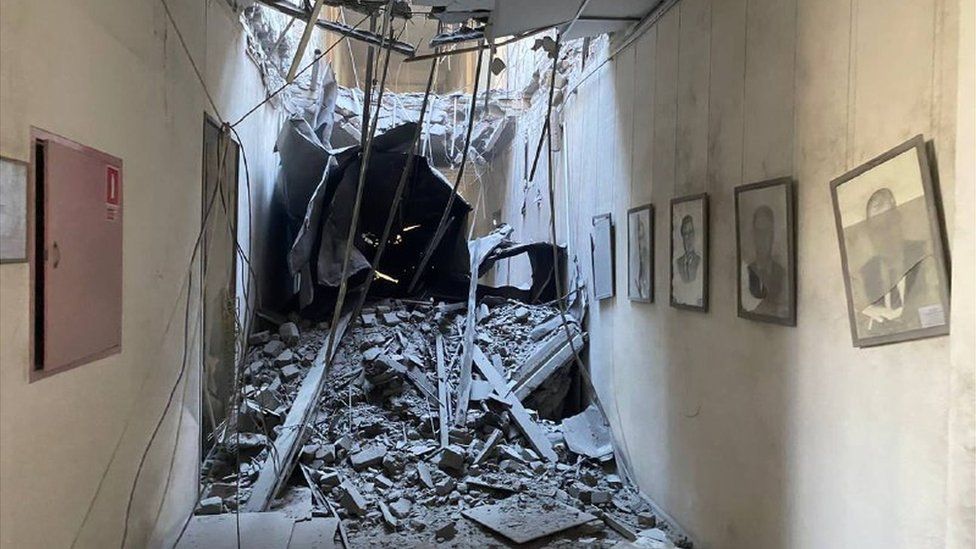
IMAGE SOURCE,KHERSON OVA Image caption, This was the scene inside the Kherson administration building after Wednesday’s attack
In response to the US requestto free government critic Paul Rusesabagina, Rwandan President Paul Kagame stated that nobody would “bully us” regarding domestic matters in his country.
When discussing African issues outside of the US-Africa Summit in Washington, Mr. Kagame was asked if the US’s support of Mr. Rusesabagina through Antony Blinken was “helping or hurting” his case.
Mr. Kagame claimed that because “this person is a celebrity,” “somebody in America” wanted the case to be “nullified.”
On terrorism-related charges, Mr. Rusesabagina and 20 other defendants were found guilty last year.
“If we let him free, how about these other 20 who pointed him as even being their leader?” President Kagame asked.
“We have made it clear, there isn’t anybody going to come from anywhere to bully us into something to do with our lives – you can maybe make an invasion and overrun the country,” he added sarcastically.
Mr Rusesabagina, 68, was depicted as a hero in a Hollywood movie on the Rwandan genocide.
He was sentenced to 25 years in jail after being tricked into boarding a private jet from Dubai to Rwanda’s capital Kigali, thinking he was heading to Bujumbura in Burundi.
Mr Rusesabagina’s family has called the trial a sham, saying he was taken to Rwanda, from exile, by force.
The US has stated that Mr Rusesabagina is being “wrongfully detained” in Rwanda
Although he denies the accusations, a Sharia court in the northern Nigerian state of Kano has sentenced a well-known Islamic cleric to death by hanging after finding him guilty of blasphemy against the Prophet Muhammad and incitement in some of his sermons.
Authorities have been holding Sheikh Abduljabar Nasir Kabara since July of last year after accusing him of spreading falsehoods about the Prophet.
Nigerians are closely following the trial. Twelve states in northern Nigeria, including Kano, practise Sharia alongside the nation’s secular law.
The 52-year-old scholar is from the Qadiriyya sect. He has a sizeable number of followers mainly in Kano state.
His father was the leader of the sect in West Africa until his death in 1996.
Sheikh Abduljabar has the right to appeal against the judgement.
Death sentences in Nigeria are rarely carried out. Instead, convicted people are usually kept in prisons indefinitely.
A bitter debate over a stalled prisoner exchange agreement between Tehran and Brussels has been sparked by Iran’s 28-year prison sentence for a Belgian aid worker.
Belgian ministers informed the distressed family of 41-year-old Olivier Vandecasteele about the verdict late on Tuesday after speaking with Iran’s justice minister.
“At the end of November we learned he would be sentenced in Iran to a prison term of 28 years for a series of fabricated crimes,” justice minister Vincent Van Quickenborne told parliament.
Vandecasteele was arrested in February and is reportedly being held in Tehran’s notorious Evin prison, in conditions Van Quickenborne described as “inhumane”.
Belgium insists he is innocent, effectively held as a hostage in Tehran’s efforts to force Belgium to release an Iranian agent convicted of terrorism.
Otage belge en Iran : la Cour constitutionnelle suspend la possibilité d’échanger Olivier Vandecasteele contre un détenu iranien en Belgique – https://t.co/FGUsWh4eM6https://t.co/mVB9jspBE9
The justice minister told the Belgian parliament’s justice committee, “Mr. Vandecasteele’s arrest is a direct consequence of the condemnation of the [Iranian] diplomat by our country.
“Since the arrest of this person … the threat emanating from Iran has greatly increased,” he added.
News of Vandecasteele’s sentence, which has not been publicly confirmed by Iranian authorities, has revived debate in Belgium over a prisoner exchange treaty with Iran.
In the past, Prime Minister Alexander De Croo’s government has described this as the only option for a transfer.
The treaty was signed with Iran earlier this year and, while not tailored explicitly for Vandecasteele, the justice minister confirmed that he would have been eligible for exchange.
But last week, Belgium’s constitutional court suspended the implementation of treaty pending a final ruling on its legality within the next three months.
“If there’s no solution he could stay in prison until 2050. He’ll be almost 70,” he said, urging Belgium to find a way to revive the prisoner exchange treaty.
No details on the charges against Vandecasteele have been given by the Iranian authorities.
Meanwhile, some Belgian opposition MPs and foreign policy experts have warned that the prisoner exchange treaty would only increase the threat posed by rogue regimes seeking to kidnap Belgian citizens as collateral.
However, the Belgian government has no other option on how to free the aid worker.
PA news agency has reported that, former Wimbledon champion Boris Beckerwas just let out of jail and will now be removed from the UK.
In order to avoid paying his debts when he declared bankruptcy, he concealed £2.5 million in assets and loans, serving just eight months of a two-and-a-half-year sentence.
The German has been residing in the UK since 2012, but he is now in danger of being expelled.
Given that Becker received a sentence of 12 months or more and is not believed to be a British citizen, he is believed to be eligible for automatic deportation.
The 55-year-old spoke about the turmoil of the case in a clip released this week for an Apple TV+ documentary.
Showing him before the sentencing in April, he says: “I’ve hit my (rock) bottom, I don’t know what to make of it.
“I (will) face (my sentence), I’m not going to hide or run away. (I will) accept whatever sentence I’m going to get.
“It’s Wednesday afternoon and (on) Friday I know the rest of my life.”
His fall from grace is documented in the two-part programme that also looks at Becker’s turbulent personal life and his tennis career, which included three Wimbledon titles.
Becker’s family as well as players past and present such as Novak Djokovic and John McEnroe, also appear.
The action, which was a “difficult decision,” has led to picket lines being set up and Christmas Day-style service beingimplemented in many hospitals, but nurses say they are not enjoying it. The action, which was a “difficult decision,” has picket lines set up and Christmas Day-style service implemented in many hospitals, but nurses say they are not enjoying it.
In England, Wales, and Northern Ireland, tens of thousands of nurses have walked out in protest for the first time in a century.
The attempt to secure above-inflation pay increases has moved forward as a result of the failure of negotiations to avert it.
Thousands of NHS appointments and operations have been cancelled, and picket lines are set up at numerous hospitals. The health system is currently operating like a bank holiday-style service in many areas.
The Royal College of Nursing (RCN) has said it will still staff chemotherapy, emergency cancer services, dialysis, critical care units, neonatal and paediatric intensive care.
Some areas of mental health and learning disability and autism services are also exempt from the strike, while trusts have been told they can request staffing for specific clinical needs.
When it comes to adult A&E and urgent care, nurses will work Christmas Day-style rotas.
Saffron Cordery, interim chief executive of NHS Providers, said agency NHS trusts were “pulling out all the stops” to lessen the impact on patients.
She said: “But it’s inevitable that some operations or appointments will have to be rescheduled, and trusts are pulling out all the stops to minimise disruption.
The head of the WorldHealth Organization, Tedros Adhanom Ghebreyesus, stated that Eritrean troops in Ethiopia’s northern Tigray region “murdered” his uncle.
Tedros revealed he was about to postpone the event after learning that his uncle had been “murdered by the Eritrean army” during a press conference with the UN correspondents association on Wednesday.
Tedros said: “I spoke to my mother and she was really devastated, because he was the youngest from their family and he was almost the same age as me, a young uncle.”
The WHO chief added that his uncle “was not alone. In the village, when they killed him in his home, from the same village more than 50 people were killed. Just arbitrary.
“I hope the peace agreement will hold and this madness would stop,” he said.
Last weekend, I found out that my uncle was murdered by #Eritrean army in his own house. It is another painful loss for my family due to the ongoing violence in #Tigray, Ethiopia. Peace is all the people and families need.
Ethiopia’s government and Tigrayan rebels signed a ceasefire deal on 2 November, after two years of fighting that has brought widespread human misery.
The conflict has caused an untold number of deaths, forced more than two million people from their homes and drove hundreds of thousands to the brink of famine.
But the ceasefire makes no mention of the presence on Ethiopian soil or any possible withdrawal of Eritrean troops, who have backed Ethiopian Prime Minister Abiy Ahmed’s forces and been accused of atrocities.
Tedros hails from Tigray, and the former Ethiopian health and foreign minister has repeatedly called for peace and for unfettered aid access to the region.
At a press conference on 2 December, Tedros raised concerns for areas still under the control of troops from neighbouring Eritrea.
Sky News’ additional investigation revealed that users were given recommendations for eating disorder content via TikTok’s suggested search feature.
According to research on TikTok’s video recommendation algorithm, it immediately recommends eating disorders and self-harm content to some new teen accounts.
One account showed suicide content within 2.6 minutes, and another suggested eating disorder content within 8 minutes, according to research from the Centre for Countering Digital Hate (CCDH).
Sky News conducted additional research and discovered that, despite not specifically searching for harmful content, TikTok’s suggested searches function was recommending harmful eating disorder content.
The UK’s eating disorder charity, BEAT, has said the findings are “extremely alarming” and has called on TikTokto take “urgent action to protect vulnerable users.”
Content warning: this article contains references to eating disorders and self-harm
TikTok’s For You Page offers a stream of videos that are suggested to the user according to the type of content they engage with on the app.
The social media company says recommendations are based on a number of factors, including video likes, follows, shares and device settings like language preference.
But some have raised concerns about the way this algorithm behaves when it comes to recommending harmful content.
The CCDH set up two new accounts based in the UK, US, Canada and Australia. For each, a traditionally female username was given and the age was set to 13.
Each country’s second account also included the phrase “loseweight” in its username, which separate research has shown to be a trait exhibited by accounts belonging to vulnerable users.
Researchers at CCDH analysed video content shown to each new account’s For You Page over a period of 30 minutes, only interacting with videos related to body image and mental health.
It found that the standard teen users were served videos related to mental health and body image every 39 seconds.
Not all of the content recommended at this rate was harmful, and the study did not differentiate between positive content and negative content.
However, it found that all users were served eating disorder content and suicide content, sometimes very quickly.
CCDH’s research also found that the vulnerable accounts were shown this kind of content three times as much as the standard accounts were, and those accounts were shown more extreme content than standard accounts.
It follows CCDH’s findings that TikTok is host to a community of eating disorder content that has amassed over 13.2 billion views across 56 different hashtags.
Some 59.9 million of those views were on hashtags that contained a high concentration of pro-eating disorder videos.
However, TikTok says that the activity and resulting experience captured in the study “does not reflect behaviour or genuine viewing experiences of real people.”
Image:Eating disorder content is banned on TikTok and it says it regularly removes content that violates it terms and conditions. Pic: REUTERS/Dado Ruvic/File Photo
Kelly Macarthur began suffering from an eating disorder at the age of 14. She’s now recovered from her illness, but as a content creator on TikTok, she has concerns about the impact that some of its content could have on people who are suffering.
“When I was unwell, I thought social media was a really healthy place to be where I could vent about my problems. But in reality, it was full of pro-anorexia material giving you different tips and triggers,” she told Sky News.
“I’m seeing the same thing happen to young people on TikTok.”
Further investigation from Sky News also found harmful eating disorder content being suggested by TikTok in other areas of the app, despite not explicitly searching for it.
Sky News conducted its own research into TikTok’s recommendation algorithm using several different accounts. But instead of analysing the For You Page, we searched for non-harmful terms like “weight loss” and “diet” in TikTok’s search bar.
A search for the term “diet” on one account brought up another suggestion “pr0 a4a”.
That is code for “pro ana” which relates to pro-anorexia content.
TikTok’s community guidelines ban eating disorder related content onits platform and this includes prohibiting searches for terms that are explicitly associated with it.
But users will often make subtle edits to terminology that mean they can continue posting about certain issues without being spotted by TikTok’s moderators.
While the term “pro ana” is banned on TikTok, variations of it still appear.
Sky News also found that eating disorder content can be accessed easily through TikTok’s user search function, despite not explicitly searching for it.
A search for the term “weight loss” returns at least one account that appears to be an eating disorder account in its top 10 results.
Sky News reported this to TikTok and it has since been removed.
“It’s alarming that TikTok’s algorithm is actively pushing users towards damaging videos which can have a devastating impact on vulnerable people.” said Tom Quinn, director of external affairs at BEAT.
“TikTok and other social media platforms must urgently take action to protect vulnerable users from harmful content.”
Responding to the findings, a spokesperson for TikTok said: “We regularly consult with health experts, remove violations of our policies, and provide access to supportive resources for anyone in need.
“We’re mindful that triggering content is unique to each individual and remain focusedon fostering a safe and comfortable space for everyone, including people who choose to share their recovery journeys or educate others on these important topics.”
In Montpellier, a southern French city, a 14-year-old boy was run over and killed shortly after France defeated Morocco in theWorld Cup semi-final.
After the match, according to the authorities, he was hit by a car and later died in the hospital.
Images shared on social media showed a car covered in a French tricolour, which was later seized by onlookers.
The driver then accelerated into two teenagers, seemingly in a panic.
The 14-year-old was struck and suffered a cardiac arrest as the driver turned around and sped away.
“Immense sadness that a sporting event should end in total tragedy,” said local MP Nathalie Oziol, who expressed her sympathy with the boy’s family.
The local prefect in the southern Hérault area said the car was later found abandoned not far from the scene of the accident, and police have begun searching for the driver.
#FRAMAR d’un côté les supporters marocains de l’autre les supporters français. Tirs de mortiers à plein régime pic.twitter.com/H3HI4xJFP5
The incident happened in Montpellier’s north-western district of La Paillade, around half an hour after the final whistle in Qatar, where France beat Morocco 2-0.
Tensions between France and Morocco supporters briefly spilled over in the centre of the city as flares were lit and police responded with tear gas. France has a large Moroccan community of some 1.5 million people.
Celebrations in cities across France were largely peaceful,although police used tear gas to halt trouble involving far-right youths in the centre of Lyon.
Ten thousand police were deployed across the country and a reported 167 arrests were reported nationally.
In light of the conflict in the Ukraine and China’s challenges, Brussels is the spot for the leaders of Southeast Asian nations.
In Southeast Asia, the EU has pledged to invest billions of dollars as leaders sought to strengthen ties at a summit in the face of the conflict in the Ukraine and challenges from China.
In Brussels on Wednesday, the European Union and the Association of Southeast Asian Nations (ASEAN) held their first formal summit.
“There might be many, many miles that divide us, but there are much more values that unite us,” European Commission President Ursula von der Leyen told the gathered leaders.
But different opinions about Russia’s war in Ukraine and concerns about tensions with China over a key shipping route for global trade loomed over the meeting.
The EU has been on a diplomatic push to galvanise a global front against Moscow as its invasion has sent economic and political shock waves around the world.
ASEAN’s 10 nations – nine of which were represented, after Myanmar’s military leadership was not invited – have been divided in their response to the Kremlin’s war on Ukraine.
Singapore has gone along with the West on Russia, while Vietnam and Laos, which have close military ties to Moscow, have remained more neutral.
Along with Thailand, they abstained from a United Nations vote in October condemning Russia’s attempted annexation of regions of Ukraine seized since February.
Final declaration
The diverging views led to intense wrangling over a final declaration from the summit as the EU pushed for stronger language to condemn Moscow.
A draught of the final statement said “most members” decried Russia’s war, but conceded there were also “other views and different assessments”.
While Europe pressed for a tougher response to Russia, another global giant figured prominently at the summit.
Chinese claims over the South China Sea have set it against some neighbours and sparked fears in Europe over trade flows through the key global thoroughfare.
But China remains the biggest trade partner for ASEAN and many in the region are wary of distancing themselves from their giant neighbour.
The EU is eager to pitch itself as a reliable partner for southeast Asia’s dynamic economies amid the growing rivalry between Beijing and Washington.
The EU and ASEAN are each other’s third-largest trading partner and Europe sees the region as a key source of raw materials and wants to increase access to its booming markets.
Europe’s vulnerabilities
EU nations are pushing to diversify key supply chains away from China as the war in Ukraine has highlighted Europe’s vulnerabilities.
Von der Leyen offered an investment package over the next five years worth 10 billion euros ($10.6bn) under the EU’s Global Gateway strategy designed as a counterweight to China’s largesse.
“There is a battle of offers today in the geopolitical arena, not only a battle of narrative,” said EU foreign policy chief Josep Borrell. “We have to offer more.”
Heads of state pose for a family picture at the EU-ASEAN summit [John Thys/AFP]
ASEAN and the EU suspended their push for a joint trade deal more than 10 years ago, but the bloc’s top officials said they hoped to relaunch efforts for a broad agreement.
So far, deals with Vietnam and Singapore are in place, and the EU is looking now to make progress with ASEAN’s largest economy Indonesia and to resume talks with Malaysia, the Philippines and Thailand.
One issue that risked clouding discussions was a new law in Indonesia criminalising sex outside marriage that has sparked fears for foreign visitors to the country.
Indonesia’s President Joko Widodo insisted though that the EU-ASEAN relationship needed to be based more on “equality”.
“There must be no imposition of views,” he said. “There must not be one who dictates over the other and thinks that my standard is better than yours.”
When we went to Toys Galore in Edinburgh, the owner, Donald Nairn, told us that the current state of business is the toughest he has ever encountered.
“If you’d asked me in 2019 what the next few years would be like I could not have possibly imagined in my wildest dreams it would have been as challenging as it has been,” he said.
That’s because toys have gone up in price due to rises in production and global shipping costs as well as the pound being weaker, he explains.
But he says there’s a limit to how much he can put up prices for his customers.
“There have been some products where we have simply decided not to sell it anymore because we think the price has gone up so much that it’s no longer sellable,” he said.
And he’s noticed his customers are being a lot more cautious in their spending.
“Most people are struggling because they’ve seen all the costs go up – interest, fuel, food and yet their wages just haven’t kept up so everything’s squeezed.
“Although they will still buy a toy for a birthday or Christmas present they will buy a smaller toy or there might not be a trip to a toy shop on a Saturday.
“I think people try to do their best to make Christmas as normal as possible but undoubtedly people will be cutting back a bit.”
Netflix has released another look-ahead clip, this time containing snippets of interviews with Meghan, her friend Lucy Fraser, and attorney Jenny Afia – and they are not holding back. This comes ahead of the final three episodes of Harry & Meghan airing on the streaming service.
The palace is charged with “feeding” stories about the duchess to the media in order to prevent the publication of other, “less favourable,” stories, according to a new trailer for the final episodes of Harry and Meghan’s Netflix documentary series.
The streaming service has released another look-ahead clip, this time featuring snippets of interviews with Meghan, her friend Lucy Fraser, and attorney Jenny Afia, ahead of the final three episodes of Harry & Meghan airing on Thursday morning.
Ms Afia, a partner at the media law firm Schillings, is first to be featured, speaking as footage of Buckingham Palace is shown.
“There was a real kind of war against Meghan and I’ve certainly seen evidence that there was negative briefing from the palace against Harry and Meghan to suit other people’s agendas,” she says.
The trailer moves on to Ms Fraser, who says: “Meg became this scapegoat for the palace, and so they would feed stories on her whether they were true or not, to avoid other less favourable stories being printed.”
“You would just see it play out,” Meghan then says herself. “Like, a story about someone in the family would pop up for a minute and they go, ‘gotta make that go away’.
“But there is real estate on a website home page, there is real estate there on a newspaper front cover, and something has to be filled in there about someone royal.”
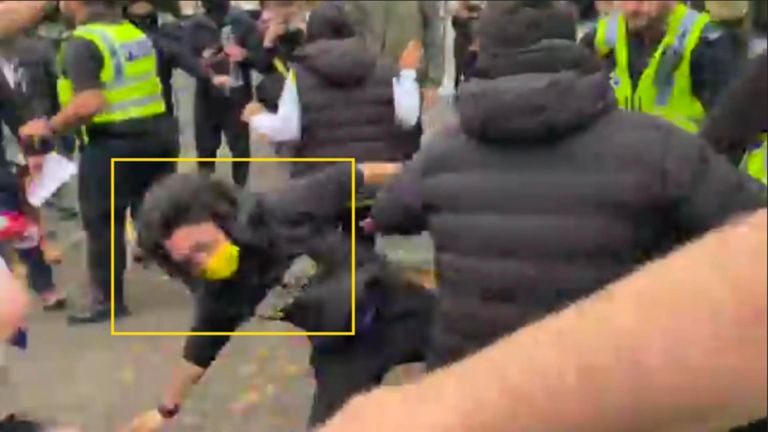
During a peaceful protest about Hong Kong, which he fled last year, Bob Chan was dragged into the grounds of the Chinese consulatein Manchester. He was pulled by his hair and suffered severe bruising on his face and body.
A general consul and five other Chinese government employees who were involved in assaulting a Hong Kong protester inside its Manchester consulate have been “removed” by the Chinese government.
Foreign Secretary James Cleverly stated that his department had given the Chinese government a deadline of December 14 to lift the diplomatic immunity of six of its officials so that they could be questioned by British police.
He said: “In response to our request, the Chinese government have now removed from the UK those officials, including the consul general himself.
“This demonstrates that our adherence to the rule of law, the seriousness with which we take these incidents, has had an effect, and we will continue on the world stage and domestically to abide by the rule of law, and we expect others to do likewise.”
He said the consul general has already returned to China, as have some of the officials while the rest will do shortly. The consul general’s wife remains in the UK.
Hong Kong pro-democracy protester Bob Chan, who fled Hong Kong last March, was demonstrating peacefully outside the consulate in October when he was pulled into the groundsand beaten up by staff.
Zheng Xiyuan, the consul general who has been removed, was pictured pulling Mr Chan’s hair before yanking him inside the consulate.
Mr Chan told Sky News he thought he was going to die and was left with injuries to his body and face from being kicked and punched before a British police officer pulled him out of the gates.
But Mr Cleverly said on Wednesday: “When China behaves in a way that we fundamentally disagree with, we raise it directly with China.
“I did so earlier on this year when I had a meeting with [Chinese foreign minister] Wang Yi highlighting our objection to Chinese behaviour in Xinjiang with the Uyghur Muslim minority, their failure to abide by the commitments made over Hong Kong, and indeed the sanctioning of my parliamentary colleagues here in the UK.
“We also did so in response to this incident,and it is right that the Chinese government have now removed these officials from the UK.”
Luke de Pulford, executive director of the Inter-Parliamentary Alliance on China, said: “The foreign secretary should be congratulated for taking this action.
“It’s just a shame it took so long when the footage of the assault was so clear for all to see from day one. We should not be so fearful of holding China to account for its abuses in the future. Hong Kong-ers seeking refuge in the UK will sleep a little easier tonight.”
‘Outrageous’ response to videos where Mr Chan was dragged and hit
Greater Manchester Police have been investigating the alleged assault and in November said they had identified a number of offences during what they described as a “complex inquiry”.
Diplomatic staff at foreign embassies usually have immunity from arrest and prosecution, especially if an incident happens in their consulates or embassies.
But senior MPs, including Tory Iain Duncan Smith, who is sanctioned by China, said the British government’s response was “outrageous” after Mr Cleverly said he had spoken to China’s charge d’affaires, Yang Xiaoguang over the incident.
He and other MPs from across the Commons called for ministers to expel the diplomats identified in videos dragging and hitting Mr Chan, and also pulling his hair.
Consul general Mr Zheng told Sky News he did not beat anybody up but when asked if he pulled Mr Chan into the consulate by his hair, he said: “He (Bob Chan) was abusing my country, my leader, I think it’s my duty.
“I think it’s an emergency situation – that guy threatened my colleague’s life, and we tried to control the situation. I wanted to separate him from my colleagues – that’s a very critical point.”
Asked why the peaceful demonstration turned violent, Mr Zheng claimed it was because of the “rude banners” that had been put on display.
In a letter sent to Greater Manchester Police, he stated the banners featured a “volume of deeply offensive imagery and slogans”, including a picture of the Chinese president Xi Jinping with a noose around his neck.
On any given night at the Century Restaurant, an Indian eatery in Doha, customers may find themselves drawn into a discussion about football with a waiter named Abbas Koori.
The buzzing eatery where the 46-year-old Indian waiter works is a place for people on the move. The no-frills establishment serves Keralan cuisine, along with a few Chinese and Middle Eastern dishes. It caters to a diverse group of foreigners in the bustling neighbourhood of Najma, which is filled with furniture, hardware, scrap, and meat businesses.
Koori is a familiar face at the restaurant and is known by regulars to be a football aficionado.
These days, with the World Cup in full swing in Qatar, Koori has more opportunities than usual to discuss his favourite topic.
“I speak to every African and European I meet at the restaurant. I ask them where they come from,” said Koori, who has met fans from Ghana, England, Nigeria, Morocco and other countries.
“Then I ask about a player in their national team. Most people start to speak.”
One recent evening, a group of Moroccans came to the restaurant, and while serving them Koori started listing the names of past and present players from their national team. “Hakim Ziyech, Achraf Hakimi, Marouane Chamakh, Noussair Mazraoui, Mustapha Hadji … They were delighted when they heard those names and called me akhi [brother],” he recounted.
Other times, the friendly yet straight-faced Koori strikes up a conversation by asking, “Have you watched yesterday’s game?”
In mid-November, some Chelsea fans who were in Qatar for the World Cup asked to take a selfie with Koori after he introduced himself as a Premier League fan.
“No one ignored or avoided me for talking football,” he said.
Memorising players’ names
The moustachioed waiter dons a hairnet and the restaurant’s brown polo shirt with red trim during his 12-hour shift from noon to midnight.
He prefers serving groups as he has more occasions to return to their table and extend the conversation, which he peppers with historical anecdotes, analysis of team formation, occasional updates about players’ fitness and football folklore including rags-to-riches stories. While doing this, he occasionally glances at the cash register to see whether the manager is watching him and if he needs to hurry back to work.
At night after his shift, he watches matches or replays and memorises the names of players. “If I don’t get enough time, I rifle through the highlights on YouTube,” said Koori.
NS Nissar, an Indian sportswriter covering the World Cup 2022 for Madhyamam, a Malayalam language newspaper from the Indian state of Kerala, first encountered Koori just before the World Cup started when he went to the restaurant for tea. He suggested that Koori may know the names of thousands of players from the past three decades.
“I instantly noticed his memory. We all know Claudio Caniggia played for Argentina in the 1990s, but Koori tracked the players’ entire trajectory through clubs. He can recall every player of [all] World Cup teams since the 1990s,” recounted Nissar, who described Koori’s memory as “encyclopaedic”.
“I have seen people knowledgeable about Brazil, Argentina or Italy, but this man knows a lot about Morocco, Cameroon or Senegal,” he said.
Sometimes, Koori will spontaneously mention the nicknames of players who were likened to the Brazilian legend Pele: “Pele of the desert – Saudi Arabia’s Majed Abdullah; White Pele – Zico of Brazil.” At other times he shares trivia like how “Ballon d’Or winner George Weah went on to become Liberia’s president.”
He might tell you how AC Milan, who dominated the Italian league, fell from grace as they focused “too much on defence” or lament that the days of “individuals single-handedly carrying a team to win” have passed.
Koori never leaves a patron who he thinks follows the game, says Jaseem Mohamed, a sales engineer who occasionally drops by the restaurant for a quick bite during the week. “He always hovers around the table, looking to open a chat,” he said. “I encourage it when I have time.”
Koori poses with a regular customer from Ghana with whom he discusses football [Firoz Hassan/Al Jazeera]
‘The reason I love football’
Koori was born in 1976 – the youngest of six children – to a gunny bag merchant and a homemaker in Kerala’s Malappuram, a football-mad town in a country where cricket is often the more popular sport.
Koori didn’t play the game much in his childhood, but a 1990 World Cup match that he watched with about 30 others from his village sparked his lifelong love of the sport. Sitting in his neighbour’s courtyard as a 14-year-old in front of a “black and white Keltron brand TV”, he witnessed a historic match where Cameroon defeated Argentina.
“Argentina was a good team, but the powerful Cameroonians tackled every Argentine player, including Diego Maradona, Caniggia, and Jorge Burruchaga,” he explained.
Although Argentina lost that game, Maradona enthralled a teenage Koori. “He was the reason I love football. Maradona’s passing, dribbling, and arrival to the pitch carrying a ball on his head … he had that flare for the dramatic,” he added.
After finishing high school, Koori worked in an auto garage and then in sand mining. Throughout, he read about football in the sports pages of newspapers. Koori, whose first language is Malayalam, taught himself to read English using Sportstar, an English-language Indian sports magazine.
“It was easy because I was familiar with the sports terms or had watched the game,” he said, adding that he doesn’t read about any other subjects in English.
Meanwhile, following the Premier League made him a Manchester United fan, while he also became an admirer of the Brazilian national team and some African players, especially ones from Cameroon and Nigeria.
“I love African footballers because of their dexterity,” Koori said, using the Malayalam word meyvazhakkam, which means flexibility, “and their dancing skills on the pitch in celebration.”
After he married, Koori moved to Saudi Arabia in search of better job prospects like thousands of others from his home district who have migrated to Gulf countries for work. He lived there from 2005 to 2008, working in a supermarket and a shawarma outlet in Khamis Mushait, a city some 900km (560 miles) from the capital Riyadh.
Then, after returning home, he worked again in sand mining before coming to Qatar in 2017.
The Qatar World Cup
Koori says the men in his family including his three brothers are also football fans. “My mother doesn’t watch. But my wife does,” he said.
Years of watching major European leagues have given him the knowledge to analyse the national teams playing in this World Cup.
“Watching Álisson Becker play for Liverpool, Ederson for Manchester City, Antony and Casemiro for Manchester United, Richarlison for Tottenham Hotspur, Martinelli and Gabriel Jesus for Arsenal, Neymar Junior and Marquinhos for PSG, Thiago Silva for Chelsea, I know the value of Brazil,” he reflected at the start of the tournament.
On Friday, his favourite team Brazil lost to Croatia. He now predicts a final between Argentina and France. “Croatia is not a good team,” he said matter-of-factly.
When the tournament began, Koori was sad to not be able to afford a ticket, which would cost a fifth of his monthly salary. But in late November, a regular customer gave him a ticket to watch Argentina face Poland, fulfilling Koori’s dream of attending a World Cup match. On his way to the game in the metro and in the stadium, he took selfies to record the experience.
He doesn’t know his benefactor’s name or where he works. “I didn’t ask,” said Koori. “I know he’s from Mangalore, in the Karnataka state of India, and he loves me for my football love.”
Koori’s wife and three children, who he misses and can only see once a year, also share his enthusiasm for the sport.
He would like someday to work in a football-related job in a club or association. As for his current job, he likes it “50-50”. But he appreciates that it has allowed him to share his love of the beautiful game with strangers. “I’m sure I motivated people to love football,” he said.
DISCLAIMER: Independentghana.com will not be liable for any inaccuracies contained in this article. The views expressed in the article are solely those of the author’s, and do not reflect those of The Independent Ghana
The UK may have been blanketed in snow this week, but the image on the Prince and Princess of Wales’ official Christmas card suggests otherwise.
The photo, which was shared on the royal couple’s official social media accounts, shows them on a sunny family walk with their three bare-legged children: Prince George, 9, Princess Charlotte, 7, and Prince Louis, 4.
Kensington Palace, the couple’s official home, tweeted the photo on Tuesday with a Christmas tree emoji and the message: “Sharing a new family photo for this year’s Christmas card!”
Dressed in jeans and sneakers, the royal couple are pictured walking alonga parkland path, hand-in-hand with their children.
The casually color-coordinated image sees Prince George, who is second in line to the throne, dressed in a blue polo short and navy shorts, alongside Princess Charlotte in a short denim jumpsuit and Prince Louis in denim shorts and a striped, short-sleeved shirt.
Shot earlier this year in Norfolk, eastern England by award-winning photographer Matt Porteous, the Waleses’ image was released less than 48 hours before the final three episodes of Prince Harry and the Duchess of Sussex’s docuseries hit the streaming service.
Earlier this week, King Charles III issued the first official Christmas card of his reign.
Chosen by the King and Camilla, Queen Consort, the photo was taken by Sam Hussein at the Braemar Games in Scotland on September 3, five days before Queen Elizabeth II died and when Charles was still the Prince of Wales.
It features the couple looking at each other, with the King in profile wearing a beige suit and striped tie and Camilla in a green hat and jacket.
In a recent lawsuit, Facebook is charged of contributing to political upheaval on the continent and is being held accountable by requesting more than $2 billion in reparation funds as well as significant improvements to the service’s content moderation procedures on the continent.
It is the most recent case in which the platform has been linked to racial violence in developing countries.
As a result of the company’s use of hate and violence in conflict-torn Ethiopia, Facebook has violated more than ten articles of Kenyan law, according to the class-action lawsuit filed in Nairobi, Kenya, where Facebook established a significant content moderation hub in 2019.
Additionally, it claims that in comparison to the United States, the firm does not invest enough resources in content monitoring on the continent.
Abrham Meareg, an Ethiopian scholar who is looking for political asylum in the US, is one of the lawsuit’s plaintiffs. He claims that last year, amid Ethiopia’s ongoing civil war, his father was murdered by extremists as a result of incitement that circulated on Facebook.
Meareg Amare Abrha, Meareg’s father, was a well-known chemistry professor and Tigrayan ethnicity. According to an affidavit Meareg submitted in the case, he was killed on November. 3, 2021, after a gang of individuals on motorbikes followed him from the university and shot him twice in front of his house. After extremists eventually took over the family house, Meareg’s mother escaped to Addis Ababa, the nation’s capital.
“My father didn’t get any chance to convince people that he was innocent,” Meareg said in an interview, from his home near Minneapolis, where he is now living. “He didn’t get the choice to clarify the hate speech and disinformation. They just shot him and killed him in a brutal way.”
The case follows criticism of Facebook usage during war in areas like Myanmar and India. The website received harsh criticism for allowing hate speech and incitement to violence to flourish on its platform in Myanmar, where state violence againstthe nation’s Muslim Rohingya minority has raged for years.
U.S. President Joe Biden has established an advisory board on African diaspora engagement in the country by executive order.
The council would be made up of 12 people who “represent the diversity of the African diaspora from African American and African immigrant communities,” according to a White House statement released on Tuesday.
Members will include well-known figures from business, government, sports, and the arts. The remaining council members will be drawn from academia, social work, and religious organisations.
According to the statement, advisory council members would serve two-year terms withoutpay or reimbursement. According to the decree, political preferences won’t be taken into account when choosing council members.
As one of its top priorities, the council will aim to “strengthen cultural, social, political, and economic linkages between African communities, the worldwide African diaspora, and the United States” among other things. The United States State Department will set up the council in 180 days.
Secretary of State Anthony Blinken emphasised the significant contribution of the African diaspora in the United States during his remarks at the African and Diaspora Young Leaders Forum, which was held alongside the second-ever U.S.-Africa Leaders Summit early on Tuesday.
Anthony Blinken
“The importance of the diaspora – to the past, to the present, to the future – of both African nations and the United States is why this is one of the very first events of the Africa Leaders’ Summit,” he said.
“Earlier this year, in South Africa, I had an opportunity to set out the administration’s new strategy for sub-Saharan Africa. It’s a strategy rooted in one key word – partnership – and in recognition that we can’t solve any of our shared priorities unless we work together,” he added.
Blinken also discussed the contributions that renowned African immigrants have made to American culture, such as comedian Trevor Noah, who was born in South Africa.
“The United States continues to be enriched immeasurably by the African diaspora: from the piercing comedy of Trevor Noah, who we will miss on “The Daily Show” – to the Alté of Tems, – to the speed-skating of Maame Biney.”
An unprecedented wave of Covid cases in China has sparked panic buying of fever medicines, pain killers, and even home remedies such as canned peaches, leading to shortages online and in stores.
Authorities said Wednesday they had detected 2,249 symptomatic Covid-19 cases nationally through nucleic acid testing, 20% of which were detected in the capital Beijing. CNN reporting from the city indicates the case count in the Chinese capital could be much higher than recorded.
Demand for fever and cold medicines, such as Tylenol and Advil, is surging nationally as people rush to stockpile drugs amid fears they may contract the virus.
Canned yellow peaches, considered a particularly nutritious delicacy in many parts of China, have been snapped up by people looking for ways to fight Covid. The product is currently sold out on many online shops.
Its sudden surge in popularity prompted Dalian Leasun Food, one of the country’s largest canned food manufacturers, to clarify in a Weibo post that canned yellow peaches don’t have any medicinal effect.
“Canned yellow peaches ≠ medicines!” the company said in the post published Friday. “There is enough supply, so there is no need to panic. There is no rush to buy.”
The People’s Daily, the mouthpiece of the Communist Party, also tried to set the record straight. It published a long Weibo post on Sunday urging the public not to stockpile the peaches, calling them “useless in alleviating symptoms of illness.”
Authorities also pleaded with the public not to stockpile medical supplies. On Monday, the Beijing city government warned residents that it was facing “great pressure” to meet demand for drug and medical services because of panic buying and an influx of patients at clinics.
It urged the public not to hoard drugs or call emergency services if they have no symptoms.
Stock frenzy
The rising demand and shortage of supply of Covid remedies have fueled bets on drugmakers.
Shares of Hong Kong-listed Xinhua Pharmaceutical, China’s largest manufacturer of ibuprofen, have gained 60% in the past five days. The stock has so far jumped by 147% in the first two weeks of this month.
“Our company’s production lines are operating at full capacity, and we are working overtime to produce urgently needed medicines, such as ibuprofen tablets,” Xinhua Pharmaceutical said Monday.
Ibuprofen is an anti-inflammatory drug used to treat pain and fever. It is also known as Advil, Brufen, or Fenbid.
The drug shortage has spread from mainland China to Hong Kong, a special administrative region which has a separate system of local government. On Sunday, the city’s health chief urged the public to refrain from panic buying cold medicines they do not need and urged residents “not to overact.”
In some Hong Kong drugstores, fever drugs such as Panadol, the local brand name for Tylenol, have sold out. Most of the buyers were sending the medicines to their families and friends in the mainland, sales representatives told CNN.
Shares of Shenzhen-listed Guizhou Bailing Group Pharmaceuticals, known for making cough syrup, have gained 21% this week and risen 51% so far this month. Yiling Pharmaceutical, the sole producer of Lianhua Qingwen, a traditional Chinese medicine recommended by the government for treating Covid, has also jumped more than 30% in the past month.
Even providers of funeral services and burial plots have gotten a huge boost. Shares in Hong Kong-traded Fu Shou Yuan International, China’s largest burial service company, have soared more than 50% since last month.
There is “strong pent-up demand for burial plots” in 2023, analysts from Citi Group said in a recent research report, adding that they’ve noticed increasing investor interest in the sector.
They cited the existence of hundreds of thousands of cremated remains, which are being temporarily stored in government facilities awaiting burial. Lockdowns across much of the country have halted funeral services, they said.
Living a regular life and all babbling in Newtown, Connecticut, unprepared for the devastation that would unfold and consume the rest of their lives.
Mark Barden was an accomplished professional musician. Nicole Hockley had just moved to Newtown from the United Kingdom, where she had worked in corporate marketing.
An isolated and violence-obsessed 20-year-old with unrestricted access to firearms shot his way into Sandy Hook Elementary School on the morning of December 14, 2012, after killing his mother. He shot and killed 20 first-graders and six adults in 10 minutes before taking his own life.
The lives of Daniel Barden, 7, and Dylan Hockley, 6, were among those cut painfully short that day. But in the long decade since, their spirit and memory have lived on in their parents’ devoted advocacy for safer communities.
A month after the shooting, Mark Barden, Nicole Hockley and other parents who lost children that day launched Sandy Hook Promise, an organization dedicated to protecting children from gun violence.
“I didn’t know what the change would be, but we would be part of it,” Hockley recently told CNN’s Alisyn Camerota for the CNN Special Report “Sandy Hook: Forever Remembered” airing on the 10-year anniversary of the tragedy.
The Sandy Hook Promise group first set its sights on gun reform. Along with other families, they sought bans on AR-15 assault-style weapons and high-capacity magazines, both of which were legally purchased by the shooter’s mother and used in the Sandy Hook attack.
“There were a lot of guns that our shooter could have chosen,” Hockley said in February 2016. “He chose the AR-15 because he was aware of how many shots it could get out … (and) that it would serve his objective of killing as many people as possible in the shortest time possible.”
Barden, Hockley and other Sandy Hook families founda sympathetic partner in John McKinney, their state senator and the highest-ranking Republican in Connecticut politics at the time.
“My immediate thoughts in terms of my role in the aftermath was, ‘I need to do, and I will do, anything humanly possible to help these families,’” McKinney said. “[I] met with all of the other Republicans in our caucus, and I was very honest with them. I said, ‘I’m going to go negotiate and work with the Democrats.’”
After months of meetings with victims’ families, town halls in the Newtown community and consultations with experts, McKinney and his colleagues unveiled their proposed legislation on April 1, 2013.
When then-Governor Dannel Malloy signed the bipartisan bill three days later, Connecticut had enacted some of the most sweeping gun legislation in the country. The new law expanded the state’s assault weapons ban and banned the sale of high-capacity ammunition; required a state-issued permit to purchase any rifle, shotgun or ammunition; and created the country’s first registry of individuals convicted of an offense with a deadly weapon.
Since 2013, Connecticut is the most populous state without a mass shooting of four or more fatalities, according to a CNN analysis of the Gun Violence Archive.
A defeat paves the way for success
The Sandy Hook Promise parents set their sights on Washington, DC, to see if their home state’s success could be replicated on the federal level.
“We approached the Connecticut legislature with love and logic, and they listened,” Hockley said in a 2013 speech introducing President Barack Obama. “I believe that with that same approach of love and logic, Congress will be persuaded to act.”
In April 2013, National Rifle Association-endorsed senators Joe Manchin, D-W.Va., and Pat Toomey, R-Penn., proposed a joint recommendation that would have required criminal background checks on people purchasing firearms at gun shows and online. The policy, known as universal background checks, was supported by more than 80% of Americans, according to a Pew Research poll taken at that time, giving the newly minted leaders of the gun reform movement reason for hope.
“I just thought, ‘OK,this is pretty simple. This is basic. This is what everybody wants. Let’s just get that done,’” Mark Barden said.
Most Republican senators and five Democrats saw things differently, however, and the bill fell six votes short of the threshold needed to break a filibuster.
The bill’s failure struck the families as a disappointment and a betrayal: Barden and Hockley both say multiple senators claimed to stand with them, then voted against the bill. But the two advocates found lessons in defeat and vowed that day to double down on gun violence prevention.
“We’ve always known this will be a long road, and we don’t have the luxury of turning back,” Barden said in the White House Rose Garden. “We will keep moving forward and build public support for common sense solutions in the areas of mental health, school safety, and gun safety.”
Barden and Hockley returned to Connecticut with a deeper passion for their work.
“If that were to have passed, I think there would have been maybe a sentiment of like, ‘OK, we’re done. We’ve got that fixed,’” Barden said. Recalling the words of fellow gun control advocate Sarah Brady, “‘Sometimes you need a good defeat.’ It kind of mobilizes people, catalyzes people. They know what’s going on. It did for me.”
After studying other mass shootings and gun violence, they developed expansive programming to avert tragedies before they begin. That work has produced Know the Signs, a range of programs that train students and educators to identify, report and respond to behaviors that suggest someone might harm themselves or others.
“100% of school shooters give off warning signs before they carry that out,” Barden said. “What if that person giving off those warning signs were surrounded by people who understood how to look for those warning signs, and then had the training and the tools to actually do something?”
That straightforward premise has yielded profound success. Sandy Hook Promise says it has presented Know the Signs to more than 23,000 schools and 18 million people. The training programs have helped districts and students avert threats of violence in West Virginia, California, Massachusetts and other states — not to mention nearly 2,700 students in need of intervention that the organization has connected with crisis counselors.
A press release from Netflix on Tuesday, the documentary about Prince Harry and Meghan, Duchess of Sussex, received 81.55 million hours of viewing in its first week. The duration of that documentary’s premiere week on the streaming service was the longest ever.
In 85 nations, the show made the Top 10 TV list and peaked at No. 1 in the UK. One billion people watched the Addams Family drama “Wednesday,” which was one of the most watched Netflix series that week.
On Thursday, part two of “Harry and Meghan” with three additional episodes focusing on their choice to leave the Royal Family will be available on Netflix.
In a trailer for the second part of the documentary, Prince Harry tells viewers, “they were happy to lie to protect my brother,” while his wife says “I wasn’t being thrown to the wolves, I was being fed to the wolves.”
Prince Harry discusses “institutional gaslighting” in a new trailer for part two of their highly anticipated Netflix docuseries, which will have three episodes and will be available Thursday.
In the clip, released Monday, the Duke of Sussex discusses stepping back from royal duties and ponders what might have happened to the couple “had we not got out when we did.”
“Our security was being pulled. Everyone in the world knew where we were,” Meghan says.
In the first three episodes of the docuseries, which have already aired, the couple shared intimate details of their courtship, took aim at the “unconscious bias” inside the royal family, and criticized the media attention they’d been subjected to — particularly from Britain’s tabloid press.
In a Netflix web posting introducing the trailer for the second installment of the series, the company said, “Theirs is one of the most high-profile love stories in history, and even the most plugged-in fans and followers of their story have never heard it told like this before.”
Mark Harper advises unions to “think again” about their industrial action after the RMT’s most recent poll revealed that nearly 40% of respondents would accept the offer on the table.
According to Transport Secretary Mark Harper, the trend is shifting among rail unions in regards to the pay proposals that are being considered.
Yesterday, 64% of RMT members rejected Network Rail’s most recent offer, with general secretary Mick Lynch describing it as “substandard.”
The agreement would have increased pay by 5% and 4% over the course of two years, but it would also have resulted in thousands of job losses, a 50% reduction in scheduled maintenance tasks, and a 30% increase in unsocial hours.
However, Mr Harper said it had more support than previous offers on the table, urging the union to “look at it again, call off the strikes and accept what is a reasonable pay offer”.
Rail workers have staged another walkout today in the first of a raft of strike days in this month, covering 13, 14 and 16 and 17 December.
More strikes are also planned from 6pm on Christmas Eve to 5.59am on 27 December.
Speaking to Sky News, Mr Harper said the government has “got to be fair to the taxpayer”, adding: “There isn’t a bottomless pit of money to go into the rail industry.”
He insisted the offer made to workers was “very fair and reasonable”, and pointed to the fact bosses of the TSSA union – which represents station staff – had already recommended it to their members.
“Even with the RMT’s very strong recommendation to their members to not accept the offer to turn it down, to reject it out of hand, we still saw nearly 40% of RMT members wanting to accept it,” said the transport secretary.
“So I think the tide is turning on opinion about whether these offers are reasonable or not, and therefore I hope the union will look at it again, call off the strikes and accept what is a reasonable pay offer.”
But Mr Lynch said the offer included too many of the union’s “red lines”, including taking guards off trains and closing ticket offices.
“I can see a way through where we can get some improvements in the proposals,” he told Sky News. “We can come to terms with what they are calling their ‘modernisation agenda’.
“[But] if you’re looking for a compromise, you don’t put things into a package that you know your counterpart can never accept as a red line and as a principle.
“We don’t do that to the employers. We don’t demand things that they can never give us. We only request the things that are capable of being delivered.
“So it’s the imposition of the government that has caused a non-development of a deal and a non-development of a set of proposals that we can all work with.”
‘Campaign of disruption’
Mr Harper appeared to reject accusations that he had added in caveats to the deal on terms and conditions, meaning members would have to accept having no staff on driverless trains – something the RMT is strongly against.
“I don’t want these strikes to take place at all,” he added. “They’re bad for passengers. They’re bad for businesses.”
However, Mr Lynch stuck by his allegation, calling it a “campaign of disruption” by senior ministers.
“The government intervened with a set of proposals that they know cannot be acceptable because they want these strikes to go ahead,” he added.
“They are making enemies of working people. They make enemies of trade unions and they’re making enemies of the public.
Labour’s Andrew Gwynne told Sky News it was “incumbent on the transport secretary to sit down and negotiate a deal”, and accused him of refusing to do just that.
“Ultimately the public will now be worried about whether their Christmas arrangements are in turmoil,” he added.
“The government’s really got to get a grip of this and that starts by sitting down, negotiating, meeting and coming up with some kind of compromise that both sides can live with.”
Mr Gwynne also accused ministers of “letting” the nurses strikes go ahead later this month by refusing to negotiate over pay.
Health secretary Steve Barclay met the general secretary of the Royal College of Nursing, Pat Cullen, last night, with the RCN hoping he would move on a pay offer to avert the two days of industrial action on the cards.
But speaking to Sky News afterwards, Ms Cullen revealed he “was true to its word” and “would not talk to me about pay”, accusing him of “belligerence”.
Mr Harper defended the move when pressed on it this morning, saying: “We’ve got for the health service an independent pay review body that’s made a series of recommendations for people who work in the health service, including nurses who we value.
“So we’ve accepted all of their recommendations in full. The 19% pay rise that the nurses are asking for isn’t affordable. I don’t think it’s reasonable. And it would take money away from frontline health.”
But Labour’s Mr Gwynne said: “We’re not saying that we can afford what the unions are asking for, but a negotiation is just that. You sit down, you listen to the issues, you listen to the concerns on both sides. You come up with common areas to agree and ultimately come out with a deal.
“The government’s not doing that. We would do that. We would sit down with the employers’ representatives and we would ensure that we averted these strikes.
“We didn’t have a single strike on the NHS under the last Labour government. There’s no reason why there should be one under this Conservative government.”
‘Where were you in 22?’
The RMT’s Mr Lynch had his own advice for Labour when it came to striking workers, however, after the party’s leader Sir Keir Starmer banned frontbenchers from joining them on the picket lines.
“There will be a lot of working class people who are asking when the election comes, where were you in 22? What were you doing to support working class people in their struggles?
The general secretary of the RMT says Labour frontbenchers may wish to consider supporting striking workers if they want votes at the next election.
“If they want our votes in an election, they might want to come and stand next to us when we’re struggling with austerity, when we’re struggling with low pay and people who are in work are having to use foodbanks and living in housing and substandard conditions because of what this government is doing to us.
“If [Sir Keir] wants to be a leader of the working class, he’s got to show he identifies with the working class.”
On Tuesday, President Joe Bidensigned historic new federal protections for same-sex and interracial couples into law, closing a personal and societal evolution on a topic that has seen increasing acceptance over the past ten years.
Before tens of thousands of invited guests on the South Lawn, Biden signed the Respect for Marriage Act in a ceremony the White House claimed captured the significance of the time.
“Marriage is a simple proposition. Who do you love? And will you be loyal to that person you love?” the president asked from the South Lawn. “It’s not more complicated than that.”
Biden said the law he was about to sign recognizes that “everyone should have the right to answer those questions for themselves without the government interference,” and secures the federal “protections that come with marriage.”
“For most of our nation’s history, we denied interracial couples and same sex couples from these protections,” Biden said. “It failed to treat them with equal dignity and respect. And now, this law requires an interracial marriage and same-sex marriage must be recognized as legal in every state in the nation.”
The new law officially voids the Defense of Marriage Act, which defined marriage as between a man and a woman. It mandates that states honor the validity of out-of-state marriage licenses, including same-sex and interracial unions.
As a senator, Biden voted for the Defense of Marriage Act in 1996. The bill signing Tuesday amounted to the culmination of his transformation on the issue. The bill passed in the House with 39 Republicans joining Democrats in support, after getting through the Senate with 12 Republican senators.
Such a bill had seemed improbable for many in Washington not that long ago,even as public opinion on same-sex marriage has continued to shift over the years: 68% of Americans supported same-sex marriage in 2021, up 14 percentage points from 2014, according to surveys from the nonprofit, nonpartisan Public Religious Research Institute.
But the public rallying and push to pass federal protections for same-sex and interracial marriage intensified this year after the Supreme Court overturned Roe v. Wade, sparking fresh fears that the nation’s highest court would also reconsider other existing rights around marriage equality.
The day the Supreme Court’s landmark ruling was issued in June, Biden warned that Justice Clarence Thomas “explicitly called to reconsider the right of marriage equality, the right of couples to make their choices on contraception. This is an extreme and dangerous path the Court is now taking us on.”
He would go on to give similar warnings on the campaign trail leading up to the midterms: “We want to make it clear: It’s not just about Roe and choice. It’s about – it’s about marriage – same-sex marriage. It’s about contraception. It’s about a whole range of things that are on the docket,” he said at a Democratic National Committee reception in August.
For Biden, Tuesday’s event bookended a moment a decade ago that helped spark a national political transformation on the issue. When he was serving a vice president, Biden shocked the country with an unexpected declaration delivered in an interview on NBC’s “Meet the Press”: He came out in public support of same-sex marriage for the first time.
“I am absolutely comfortable with the fact that men marrying men, women marrying women, and heterosexual men and women marrying another are entitled to the same exact rights, all the civil rights, all the civil liberties,” Biden said when asked whether he was comfortable with same-sex marriage.
Those words – which Biden insisted in subsequent years were unplanned – marked a stunning personal evolution for the longtime creature of Washington, who as senator had voted to block federal recognition of same-sex marriages and previously insisted that marriage should only take place between a man and a woman.
The interview would also turn out to be a watershed moment in modern American politics, prompting then-President Barack Obama to stake out the same position several days later and giving permission to other national leaders to also follow suit.
“That single interview was a transformative moment in Biden’s development as a politician. In the Senate, as a presidential candidate and as vice president, he always had been very cautious around LGBT issues, afraid of taking any position that opponents could use to portray him as a left-winger,” Sasha Issenberg, author of “The Engagement: America’s Quarter-Century Struggle Over Same-Sex Marriage,” told CNN. “But the reception to what he said on ‘Meet the Press’ was universal praise within his party, especially from LGBT advocates and donors who had previously been skeptical of him.”
Basking in the hero-treatment from liberal activists, Biden would go on to aggressively associate himself with LGBT causes in the years to come, and has in particularly been “unusually bold” when it comes to transgender rights, Issenberg said.
Among the guests invited to the bill signing at the White House Tuesday were prominent members of the LGBTQ community and activists.
They included Judy Kasen-Windsor, widow of gay rights activist Edie Windsor; Matthew Haynes, co-owner of Club Q, the LGBTQ club in Colorado Springs where a gunman last month killed five people in a mass shooting; Club Q shooting survivors James Slaugh and Michael Anderson; and a number of plaintiffs from cases that culminated in the landmark civil rights case Obergefell vs. Hodges, in which the Supreme Court ruled in 2015 that same-sex couples can marry nationwide.
Philanthropist and Democratic donor David Bohnett, who has been an outspoken gay- and transgender-rights activist and longtime supporter of Biden, told CNN that Tuesday’s bill signing could not come at a more crucial moment.
“[Biden] has demonstrated his support for decades for lesbian and gay civil rights, and Tuesday’s signing into law is a reaffirmation of that during this time when rights are under assault,” Bohnett said. “I think we’re here in response to the hateful and discriminatory actions and tactics by so many in the right-wing and so many that want to dismantle the rights that we fought so hard for for a long time.”
The cause of the fatal blast in St Helier has still not been confirmed, and while police have stopped searching for survivors, they say the work to uncover bodies “will take weeks, not days”.
Eight people are now confirmed to have died following an explosion at a block of flats in Jersey, police have said.
In a statement, Robin Smith, Jersey Chief of Police, said one resident remained unaccounted for following the blast at the Haut du Mont site on Pier Road, St Helier, on Saturday.
It read: “The number of islanders confirmed to have died in the blast is now eight. We estimate that there is still one resident that is unaccounted for.
“As has been our process throughout, the families have been made aware of this announcement before the public and media and are being supported by our specially trained family liaison officers.
“I am sure islanders will continue to join me in giving our thoughts to those victims, their families, and friends, in what has been a tragic incident for our island and our community.”
On Tuesday, police confirmed the number of people killed in the incident had risen from five to seven, and named two final missing people as Ken and Jane Ralph, aged 72 and 71 respectively.
Image:Ken and Jane Ralph
Prior to that, officials named seven other missing people as Peter Bowler, 72, Raymond Brown, 71, Romeu and Louise De Almeida, 67 and 64, Derek and Sylvia Ellis, 61 and 73, and Billy Marsden, 63.
Emergency services have been conducting searches of the blast site in St Helier since Saturday, and confirmed earlier this week that they were no longer looking for survivors.
Search for bodies continues
Police have said the search for bodies “will take weeks, not days” and described the scene on Pier Road as one of “utter devastation”.
The cause of the explosion has still not been confirmed, with Jersey’s chief fire officer Paul Brown previously saying there were “many different potential causes” and it was too early to speculate.
However, the chief executive of Island Energy, which supplies gas to the Channel Islands, said the flats affected were not connected to the gas network.
Government has said, a migrant boat that was having trouble crossing the English Channel in the early morning hours lost at least three passengers.
43 people had reportedly been saved, with more than 30 of them being pulled from the water, according to a source close to the situation, BBC’s Nick Eardley reported.
In frigid waters between Kent and France, a sizable search and rescue operation was started.
The home secretary expressed her “heartfelt thoughts” to all parties involved.
“I am aware of a distressing incident in the Channel this morning and I am being kept constantly updated while agencies respond and urgently establish the full facts,” Home Secretary Suella Braverman added.
The BBC’s political correspondent Nick Eardley said the number of deaths could rise further.
The boat is likely to have been carrying migrants risking the crossing from France, a day after Prime Minister Rishi Sunak announced new measures to “stop the boats”.
It is understood the small boat got into trouble at about 03:00 GMT off the coast of Dungeness, 30 miles west of Dover.
The UK coastguard, the French Navy and an air ambulance were all sent to help with the rescue operation.
A fishing boat in the area and coastguard helicopters from Lydd and Lee on Solent were also involved.
South East Coast Ambulance Service said it was called following reports of the incident, and sent crews to Dover, in Kent, to help with the follow-up operation.
Overnight on Tuesday, temperatures dropped to 1C, with it likely to have been colder out at sea. A yellow weather warning for ice was in place across Kent at the time.
Dover MP Natalie Elphicke said she was “very saddened” to hear of the tragedy, and her thoughts and prayers were with all of those involved.
This latest search and rescue follows a fatal incident in November 2021, when at least 27 migrants died after a dinghy sank while heading to the UK from France.
The BBC’s Simon Jones said 460 people made the journey from France to Kent in small boats between Friday and Sunday.
Nearly 45,000 people have made journey this year so far.
Holding war criminals accountable in Ethiopia is the only way to guarantee lasting peace in the country.
In early November, the international community welcomed almost unanimously the peace agreement between the government of Ethiopia and the Tigray People’s Liberation Front (TPLF) signed in Pretoria. But while the deal is a positive step, a statement of intent to silence the guns, some hard questions remain.
In particular, the issue of accountability for the litany of war crimes and crimes against humanity committed in Tigray remains largely unaddressed. Since the start of the conflict in November 2020, over 500,000 have died in the fighting or from famine and lack of health care. More than 5 million have been put under siege and deliberately starved; tens of thousands have been sexually assaulted; and well over 2 million have been displaced due to fighting and ethnic cleansing.
Yet, the peace deal does little for the victims of the violence who want justice. Its provisions on accountability for criminal atrocities are too loosely formulated. The agreement mentions that the Ethiopian government will adopt “a comprehensive national transitional justice policy aimed at accountability, ascertaining the truth, redress for victims, reconciliation, and healing, consistent with the Constitution [of Ethiopia] and the African Union Transitional Justice Policy Framework”.
This statement is too general and open to interpretation and gives enough space to the Ethiopian government to dodge responsibility and never really initiate a transitional justice process that will hold war criminals accountable.
There have already been early signs that there is no political will to seek accountability. One just has to look at the struggle of the International Commission of Human Rights Experts on Ethiopia (ICHREE), which was tasked with investigating atrocity crimes in the war in Tigray. The commission has been undermined systematically from the very start.
When ICHREE was created, the Ethiopian government sought to prevent it from getting funding. It failed, but the budget allocated to the commission was still not enough to ensure it functions properly.
When ICHREE started work, it reported suffering from “time and staffing constraints”, as six positions within its secretariate were cut. Worse still, it did not have the full cooperation of the local authorities and was denied access to sites of alleged atrocities in Ethiopia. It even complained that its requests to other UN entities for “documents and materials of interest [were] largely deflected, or responded to after an inordinate delay”.
The Joint Investigation Team (JIT), comprised of members of the Ethiopian Human Rights Commission and the Office of the UN High Commissioner for Human Rights (OHCHR), was also slow to share its internal database, the ICHREE reported.
The commission has faced all these attempts to undermine its work despite the fact that it is investigating alleged crimes by all sides of the conflict and not just the government’s forces and their allies. And its report released in September reflects that.
It states that “the Commission has reasonable grounds to believe that members of the [Ethiopian National Defence Forces] committed the following war crimes: violence to life and person, in particular murder; outrages on human dignity, in particular humiliating or degrading treatment; intentionally directing attacks against the civilian population and civilian objects; pillage; rape; sexual slavery; sexual violence; and intentionally using starvation of civilians as a method of warfare. The Commission has reasonable grounds to believe that Tigrayan forces committed the same war crimes, with the exception of sexual slavery and starvation of civilians as a method of warfare, regardless of the scale of violations.”
The report further states that the Ethiopian army and its allies have “committed widespread acts of rape and sexual violence against Tigrayan women and girls. In some instances, the attackers expressed an intent to render the victims infertile and used dehumanising language that suggested an intent to destroy the Tigrayan ethnicity. Tigrayan Forces have also committed acts of rape and sexual violence, albeit on a smaller scale.”
At a September meeting of the UN Human Rights Council, representatives of the commission concluded: “the horrific and dehumanising acts of violence committed during the conflict…seem to go beyond mere intent to kill and, instead, reflect a desire to destroy.”
In light of these findings, it is not surprising that the Ethiopian government is afraid of the ICHREE inquiry and that is why it will not and cannot lead an accountability process for war atrocity crimes using the Ethiopian legal system.
However, the accountability process is being undermined not only by Addis Ababa, but also by regional players. The three African members of the UN Security Council – Kenya, Gabon and Ghana (also known as the A3) – have consistently blocked Security Council action on the conflict in Tigray.
Yet, it is not in their interest or in the interest of the African Union to do so. Justice and accountability are directly tied to peace in Ethiopia and hence stability in the region. That is why, the A3 and the African Union need to support this investigation.
There are a number of steps that need to be taken to guarantee a fair accountability process in Ethiopia.
First, the ICREE should be supported with all the necessary funding and mandate extensions to carry out its work of investigating and documenting atrocities in Ethiopia. The Ethiopian government has to be pressured into giving access to sites of interest and cooperating with the investigation.
Second, the International Criminal Court should be involved in the accountability process. Ethiopia is not a state party to the Rome Statute, but the UN Security Council could and should refer the case to the ICC. Russia and China could block this move, as they have done in the past with resolutions the Ethiopian government has opposed.
If this happens, there is still a way to get ICC involved – if the authorities in Addis Ababa accept its jurisdiction under Article 12(3) of the Rome Statute. That of course would only happen under major international pressure.
Third, the African Union could spearhead the accountability process by setting up a hybrid tribunal in another African country. It did that for the prosecution of former Chadian President Hissène Habré, who stood trial in Senegal in 2015. This would ensure adherence to international fair trial standards and deflect pressure to maintain impunity for war criminals.
Accountability and justice are powerful tools to prevent the repetition of atrocities and conflicts in the future. Properly investigating atrocities and then starting an accountability process is the only way to guarantee lasting peace in Ethiopia. The Pretoria peace deal will not hold long without these steps.
Already, there are signs that peace is being undermined. Abductions and killings of Tigrayan civilians continue and violence in other parts of the country has not come to a halt. A successful transitional justice process in Tigray would not only solidify peace but also pave the wave for such processes in other parts of the country that have been in conflict and seen mass killings, such as Oromia.
Victims of the war in Tigray and elsewhere in Ethiopia have already suffered immensely. They must not be robbed of their rights to justice and redress.
DISCLAIMER: Independentghana.com will not be liable for any inaccuracies contained in this article. The views expressed in the article are solely those of the author’s, and do not reflect those of The Independent Ghana
On Tuesday, the New Zealand Parliamentapproved an iconic anti-smoking law that forbids the sale of tobacco to anyone born on or after January 1, 2009.
The government is pushing to make the nation “smoke free” by 2025, and the ban is part of that effort. Its goal is to stop the next generation from taking up smoking.
By the end of 2023, the new law will reduce the number of retailers with tobacco sales licences from 6,000 to 600.
The new law carries fines of up to NZ$150,000 (roughly $96,000) for violations.
“Thousands of people will live longer, healthier lives and the health system will be $5 billion better off from not needing to treat the illnesses caused by smoking, such as numerous types of cancer, heart attacks, strokes, amputations,” Associate Health Minister Ayesha Verrall said in a statement.
Smoking rates in New Zealand – already among the world’s lowest – are falling, having decreased from 9.4% to 8% in the past 12 months, according to Verrall.
Verrall said the legislation would help close the life expectancy gap between Maori and non-Maori citizens, which can be as high as 25% for women.
The legislation – the Smokefree Environments and Regulated Products (Smoked Tobacco) Amendment Bill – will also reduce the amount of nicotine allowed in tobacco products, aiming to make them less addictive.
According to the Ministry of Health, New Zealand’s smoking rate is now the lowest since records began, with 56,000 smokers quitting in the past year.
However, vaping – which the new legislation does not cover – remains popular among young New Zealanders. Official data shows8.3% of adults are now vaping daily, up from 6.2% in the past year.
According to Tehran’s prosecutor general, 80 “rioters” received sentences between two and five years, while 160 received sentences of two years or less, according to the Mizan news agency.
Without giving further details, Ali Alqasimehr added that another 70 people had been fined.
It occurs a day after authorities hanged a second man who was found guilty of inciting riots.
The judiciary announced on Monday morning that Majidreza Rahnavard, 23, had been executed in public in the north-eastern city of Mashhad.
A Revolutionary Court convicted him less than two weeks ago of the charge of “enmity against God” after finding he had stabbed to death two members of the paramilitary Basij Resistance Force.
Amnesty International said he was subjected to a sham trial and that the judiciary was “a tool of repression sending individuals to the gallows to spread fear and exacting revenge on protesters daring to stand up to the status quo”.
Iran has been engulfed by protests against the country’s clerical establishment for almost three months.
They erupted following the death in custody of Mahsa Amini, a 22-year-old woman who was detained by morality police in Tehran on 13 September for allegedly wearing her hijab, or headscarf, “improperly”.
Authorities have portrayed the protests as foreign-backed “riots” and responded with lethal force.
So far, at least 490 protesters, including 68 children and 62 security personnel have been killed during the unrest, according to the Human Rights Activists’ News Agency (HRANA).
It has also reported the arrest of more than 18,200 people in connection with the protests, of whom 3,780 have been identified.
Authorities have not revealed how many have been arrested nationwide.
However, judiciary officials announced in early November that 1,024 people had been charged in connection with the protests in Tehran. They said the suspects were accused of “acts of sabotage”, including “assaulting or martyring security guards” and “setting fire to public property”.
Last Thursday, authorities in Tehran executed a 23-year-old man convicted of “enmity against God” following what activists said was a grossly unfair trial. Mohsen Shekari was accused of stabbing and wounding a Basij member and blocking a street in the capital in September.
After Majidreza Rahnavard was hanged on Monday, Amnesty International said it had identified at least 20 other people at risk of execution.
According to the group, 11 individuals have been sentenced to death, three have undergone trials on capital charges and are either at risk of being sentenced to death or may have already been sentenced, and six may be awaiting or undergoing trial on capital charges.
The final category includes 26-year-old professional footballer Amir Reza Nasr Azadani, who a judiciary official in Isfahan province said on Sunday had been charged with “baghi”, or “armed revolt”.
Mr Nasr Azadani is accused of killing three security personnel in the city of Isfahan during protests on 16 November.
On Monday night, the global football players’ union FIFPRO said it was “shocked and sickened” that he was facing a possible death sentence “after campaigning for women’s rights and basic freedom in his country”.
FIFPRO is shocked and sickened by reports that professional footballer Amir Nasr-Azadani faces execution in Iran after campaigning for women’s rights and basic freedom in his country.
We stand in solidarity with Amir and call for the immediate removal of his punishment. pic.twitter.com/vPuylCS2ph
Despite allegations of misconduct and a breach ofthe oath of office against the president, the majority of parliament resolved against opening impeachment proceedings against him.In response to a report that claimed President Cyril Ramaphosa kept unreported foreign currency at his farm in 2020, the South African parliament voted against initiating impeachment proceedings against him.
On Tuesday, the lawmakers rejected the motion to impeach Ramaphosa 214 to 148. Ramaphosa was largely supported by the majority-holding African National Congress (ANC), which prevented the motion from obtaining the two-thirds majority required to move forward with impeachment.
However, four ANC lawmakers demonstrated their disapproval of Ramaphosa by voting in favour of impeachment, and a few more chose to abstain from the vote.
The crucial vote came after a damning parliamentary report alleged that Ramaphosa illegally hid at least $580,000 in cash in a sofa at his Phala Phala game ranch. It said he did not report the theft of the money to the police in order to avoid questions over how he got the foreign currency and why he had not declared it to authorities.
The report has brought Ramaphosa’s opponents – opposition parties and even rivals within his ANC party – to call for him to step down.
The parliamentary vote comes in a week where Ramaphosa will also be fighting for his political life as he seeks to be re-elected the leader of the ANC at its national conference starting in Johannesburg on Friday.
The conference will also elect members of the party’s National Executive Committee, which is the party’s highest decision-making body.
Ramaphosa must be re-elected as the ANC leader in order to standfor re-election to a second term as South Africa’s president in 2024.
Eva Kaili, a Greek MEP, has denied involvement in a World Cup host country Qatar-related bribery scandal at the European Parliament.
After discovering €1.5 million (£1.3 million) in two homes and a suitcase, Belgian investigators charged four suspects, including her.
By a vote of 625 to 1, MEPs decided to remove Ms. Kaili from her position as one of its 14 vice presidents.
Roberta Metsola, the speaker of the parliament, has mentioned “difficult days for European democracy.”
“[Eva Kaili] declares her innocence and that she has nothing to do with bribery from Qatar,” her lawyer, Michalis Dimitrakopoulos, told Greek TV on Tuesday.
There was uncontested evidence, he added in a later statement, that “every move, contact and statement made by Eva Kaili regarding Qatar was made in execution and application of the official policy of the European Union”.
Prosecutors carried out a string of searches over several days and said cash worth about €600,000 had been found at the home of one suspect, €150,000 at the flat of an MEP and €750,000 in a suitcase in a Brussels hotel room.
Belgian police released a photo on Tuesday showing piles of notes in €200, €50, €20 and €10 denominations.
IMAGE SOURCE,BELGIAN POLICE Image caption, Belgian police published a photo of the cash they had found
Sources said the €150,000 was found at Ms Kaili’s flat. Asked if that was true, her lawyer said: “I have no idea if any money was found or how much was found.”
The suspects arrested by Belgian police have been charged with “participation in a criminal organisation, money-laundering and corruption”, prosecutors said on Sunday. They will appear before a pre-trial court on Wednesday.
The allegations have cast a shadow over the role of lobby groups at the European Parliament. A recommendation to allow visa-free travel to the EU for Qataris was set to be voted on by MEPs this week, but has now been shelved.
Searches have taken place in Italy as well as in Brussels. Since Friday, the IT resources of 10 parliamentary employees have been “frozen” to prevent the disappearance of data necessary for the investigation.
Parliament, sitting in Strasbourg, voted overwhelmingly on Tuesday to strip Ms Kaili of her role as vice-president. The door to her office in the parliament building was sealed with a notice saying “access forbidden”.
She has also been suspended from the parliament’s Socialists and Democrats Group and expelled from the Greek centre-left Pasok party.
Greek authorities have frozen assets belonging to her, her husband and immediate family members.
The activities of a property company set up about two weeks ago by the MEP and her partner in Athens have also been frozen.
IMAGE SOURCE,REUTERS Image caption, Parliament President Roberta Metsola said there would be no impunity or “sweeping under the carpet”
Six people were detained on Friday as part of the investigation into allegations that Qatar bribed EU officials to win influence. Two were later released.
The three others accused are all Italian citizens. Ms Kaili’s partner, Francesco Giorgi, who is a parliamentary assistant, is among those reportedly charged.
Former MEP Pier Antonio Panzeri, who now runs human rights group Fight Impunity, is also among the four, sources say. His wife and daughter were also reportedly arrested. Mr Giorgi had formerly worked for him as a parliamentary assistant.
The other suspect, according to Italian news agency Ansa, is Niccolò Figa-Talamanca. He runs lobby group No Peace Without Justice, which is housed in the same building in Rue Ducale in Brussels’ European quarter.
The head of the general secretary of the International Trade Union Confederation, Luca Visentini, was questioned and later released. He said later he had been able to answer all questions put to him.
BBC Brussels correspondent Jessica Parker says details released by Belgian authorities in the last few days left many people’s jaws on the floor in EU circles.
MEPs who spoke to our correspondent said they were shocked by both the scale and blatancy of the accusations.
Ms Metsola said ahead of the vote to strip Ms Kaili of her leading role at the Parliament that “European democracy is under attack and our free and democratic societies are under attack”. She and the Parliament would do everything they could to fight corruption, she added on Tuesday: “There will be no impunity, there will be no sweeping under the carpet.”
Watchdogs and MEPs said the bribery investigation could represent one of the biggest corruption scandals in the parliament’s history.
Prosecutors said they suspected a Gulf state had been influencing economic and political decisions of the parliament for several months, especially by targeting aides.
Although reports widely named the state as Qatar, the Qatari government said any claims of misconduct were “gravely misinformed”.
Ms Kaili’s responsibilities as vice-president included the Middle East.
EP/Reuters
The World Cup in Qatar is proof, actually, of how sports diplomacy can achieve a historical transformation of a country with reforms that inspired the Arab world.
Last month, while other colleagues drew attention Qatar’s human rights violations, she gave an effusive speech to the parliament praising Qatar for hosting the World Cup and for its role as a “frontrunner in labour rights”.
Addressing a debate in the Parliament on Tuesday, EU Home Affairs Commissioner Ylva Johansson said there was an initial presumption of innocence but this was now a serious criminal investigation: “To anyone accepting payoffs kickbacks, bribes, I say shame on you… for violating the trust of the people of Europe.”
Green MEP Daniel Freund, who heads a cross-party anti-corruption group, told the BBC that the parliament had “reasonably good lobby transparency rules” but that third countries like Qatar were excluded from them: “So I think these third countries should go on the lobby register.”
The European Parliament is the EU’s only directly elected institution. Some 705 members of parliament, elected by voters in the 27 nations which make up the EU, meet to scrutinise proposed legislation and vote through European law.
MEPs generally enjoy immunity from prosecution, but not in caseswhere “a member is found in the act of committing an offence”, the parliament says.
The long-held belief that female snakes lacked a clitoris has been disproved by the discovery that they do in fact possess one.
The first accurate anatomical descriptions of the female snake genitalia were published in research on Wednesday.
Hemipenes, the penises of snakes, have been researched for many years. Some of them have spikes embedded, and they are forked.
However, researchers claimed that the female sex organ had been “overlooked in comparison”.
It wasn’t so much that it was difficult to find as that researchers weren’t really looking for it.
“There was a combination of female genitalia being taboo, scientists not being able to find it, and people accepting the mislabelling of intersex snakes,” said Megan Folwell, a doctoral candidate and lead researcher.
Her co-authored paper published in the Proceedings of the Royal Society B Journal this week locates the clitoris in a female snake’s tail.
Snakes have two individual clitorises – hemiclitores – separated by tissue and hidden on the underside of the tail. The double-walled organ is composed of nerves, collagen and red blood cells consistent with erectile tissue, researchers said.
Ms Folwell said she started looking for it because the literature she had read about snake’s female sexual organs – that they didn’t have them or had been bred out through evolution – “just didn’t quite sit right with me,” she said.
“I know it [the clitoris] is in a lot of animals and it doesn’t make sense that it wouldn’t be in all snakes,” she said.
“I just had to have a look, to see if this structure was there or if it’s just been missed,” she said.
She started on a death adder and found the clitoris – a structure in the shape of a heart – pretty immediately, near the snake’s scent glands which are used in attracting mating partners.
“There was this double structure that was quite prominent in the female, that was quite different to that of the surrounding tissue – and there was no implication of the [penis] structures I’ve seen before.”
Her team then checked this in a variety of snakes – dissecting a total of nine species including the carpet python, puff adder and cantil viper. The hemiclitores varied in size but were distinct.
Re-writing snake sex
The finding now allows for new theories about snake sex – which could involve female stimulation and pleasure.
Until now, scientists believed snake sex was “mostly about coercion and the male snake forcing the mating,” says Ms Folwell.
This was because male snakes were typically quite physically aggressive during mating while the female was more “placid”.
“But now with the finding of the clitoris we can start looking more towards seduction and stimulation as another form of the female being more willing and likely to populate with the male,” she said.
It also casts a new light on hypothesised snake foreplay. Male snakes will often wrap around their partner’s tail – where the clitoris is located – and pulse.
“There’s a lot of behaviour potentially signalling they might be there to stimulate the female.”
Ms Folwell said there had been a positive reception to the finding in the snake science world – “a bit of shock that it’s been missed for so long, but also surprise because it makes sense that it exists”.
She noted that in some snake species, the clitoris is fragile and particularly small – less than a millimetre.
There had also been a prevailing belief that female snakes had a smaller version of the male hemipene, as is the case in monitor lizards. As such, in some studies of intersex snakes, scientists had mislabelled a hemipenes as a hemiclitores.
One of the other researchers on the project, Associate Prof Kate Sanders at the University of Adelaide, said the discovery wouldn’t have happened if not for Ms Folwell’s “fresh perspective”.
FTX founder of failed cryptocurrency exchange Sam Bankman-Fried, founder has been refused bail by a judge in the Bahamas.
On Tuesday, US authorities accused Mr. Bankman-Fried of committing “one of the largest financial frauds in US history.”
According to Security and Exchange Commission (SEC) Chair Gary Gensler, the former FTX CEO constructed a “house of cards on a foundation of deception.”
According to Mr. Bankman-Fried, he will fight extradition to the US.
He was kept on remand at a jail until February 8 after Bahamas Chief Magistrate JoyAnn Ferguson-Pratt rejected the petition for his release on bail due to a “great” risk of flight.
He was arrested in the Bahamas on Monday.
Last month, FTX filed for bankruptcy in the US, leaving many users unable to withdraw their funds. According to a court filing, FTX owed its 50 largest creditors almost $3.1bn (£2.5bn).
Among the most serious allegations against Mr Bankman-Fried is that he used billions of dollars of customer funds to prop up his investment trading company, Alameda.
It is unclear how much people who have funds in the exchange will get back at the end of bankruptcy proceedings – though many experts have warned it may be a small fraction of what they deposited.
Mr Bankman-Fried faces eight criminal charges in the US, including wire fraud, money laundering and conspiracy to defraud. He also faces civil charges including misleading investors who put more than $1bn into the company.
Officials have also accused him of violating campaign finance laws.
At a news conference on Tuesday, Damian Williams, the US Attorney for the Southern District of New York, described the fraud Mr Bankman-Fried is accused of as among the largest in US history.
Besides accusing Mr Bankman-Fried of defrauding lenders, investors and customers, Mr Williams alleged he had used “tens of millions” in ill-gotten gains for illegal campaign contributions to Democrats and Republicans alike.
“All this dirty money was used in service of Bankman-Fried’s desire to buy bipartisan influence and impact the direction of public policy in Washington,” Mr Williams said.
In previous media interviews, the crypto tycoon has admitted to mistakes, but denied intent to defraud his customers.
Mr Bankman-Fried also denied allegations he must have been aware that FTX’s affiliated trading company, Alameda Research, was using FTX customer funds.
He was once viewed as a young version of legendary US investor Warren Buffett. As recently as late October, he had a net worth estimated at more than $15bn (£12.1bn).
Meanwhile, the firm’s new chief executive, John Ray, told a US congressional committee that FTX’s collapse appeared to be the result of it being controlled by a small group of “grossly inexperienced, non-sophisticated individuals”.
He said he had seen “an utter lack of record-keeping – no internal controls whatsoever”.
The FTX exchange allowed customers to trade normal money for cryptocurrencies such as Bitcoin.
Cryptocurrencies are not currencies in the traditional sense, but are stored online and act more like investment vehicles or securities – often with a high degree of volatility.
Their anonymity means they have been favoured for criminal activities such as drug dealing and ransomware attacks, but their supporters say there is huge potential for innovation – and independence from governments.
British Prime Minister Rishi Sunak, legislation will be introduced to prevent people from staying in the UK “illegally.”
As he revealed new measures to reduce the number of individuals travelling to the UK in small boats across the English Channel, British Prime Minister Rishi Sunak promised to process the backlog of asylum requests.
Sunak also announced on Tuesday that he intended to introduce new legislation early next year to ensure people who arrive through ostensibly illegal means cannot remain in the country. Sunak has come under increasing pressure to reduce the growing number of people arriving by small boats.
“If you enter the UK illegally you should not be able to remain here,” Sunak told parliament. “Instead, you will be detained and swiftly returned either to your home country or to a safe country where your asylum claim will be considered.”
The number of migrants and refugees arriving in England across the Channel has more than doubled in the last two years, with government figures showing Albanians account for the highest number of those arriving by this route.
Sunak announced a new five-point strategy for dealing with illegal immigration,including plans to fast track the return of Albanian asylum seekers, and clear the initial backlog of almost 150,000 asylum cases by the end of next year by doubling the number of caseworkers.
Migrants and refugees arriving on small boats have become a major political issue for the Conservative government, particularly in working-class areas in north and central England, where they are blamed for making it harder to find work and stretching public services.
Sunak said a new unit would be created to tackle crossings and that in the future, asylum seekers would be housed in disused holiday parks, former student accommodation and surplus military sites rather than hotels.
UK Home Secretary Suella Braverman recently called the wave of arrivals an “invasion” and described many of them as “criminals”, leading to an angry response from Albanian Prime Minister Edi Rama.
Concerns over the level of immigration were a driving force in the vote for Brexit in a 2016 referendum, with supporters calling for the UK to “take back control” of its borders.
Sunak said the public are “right to be angry” and said the current system was unfair to those with a genuine case for asylum.
“It is not cruel or unkind to want to break the stranglehold of criminal gangs who trade in human misery,” he said. “Enough is enough.”
The announcement was strongly welcomed by most Conservative members of parliament, who fear they will face defeat at the next election if the government fails to resolve the issue.
Opposition Labour leader Keir Starmer saidthe last time the government changed the immigration system they made it worse, while some charities said the problem would continue until the government allowed asylum claims outside the UK.
Sunak’s remarks drew criticism from the UN refugee agency, which said in a statement the plans would “undermine the global refugee system at large” and violate international refugee law.
Sunak’s approach “would close down access to asylum in the UK for all but a few,” the UNHCR’s assistant high commissioner for protection, Gillian Triggs, said. “This would likely result in refugees having no means to establish their status and place them at risk of forced return to unsafe countries, in breach of the Refugee Convention.”
Analysts believe, Ukraine’s Patriot air defence capability would be “significant” in defending civilians and critical infrastructure from attacks.
Following an urgent request from Kiev for more powerful weapons to shoot down Russian missiles and drones that have severely damaged the nation’s electric grid and left millions without heat in the bitterly cold winter, the United States is finalising plans to send its sophisticated Patriot air defence system to Ukraine.
According to US government officials quoted by the news agencies Reuters and Associated Press, Washington could make a decision regarding the Patriot as soon as Thursday.
Wednesday morning’s early testing of Ukraine’s air defence systems came after Mayor Vitali Klitschko announced that emergency services had been sent to the Shevchenkivskyi district following explosions.
“Details later,” he added on his Telegram channel.
Ukrainian President Volodymyr Zelenskyy pressed Western leaders as recently as Monday to provide more advanced weapons to his country. The Patriot would be the most advanced surface-to-air missile system the West has provided to Ukraine.
Gaining Patriot air defence capability would be “very, very significant” for Kyiv, said Alexander Vindman, a retired Army lieutenant colonel and onetime leader of Ukraine policy at the White House.
“These are going to be quite capable of dealing with a lot of different challenges the Ukrainians have, especially if the Russians bring in short-range ballistic missiles.”
Russia has continued with air raids on Ukraine, which have destroyed vital infrastructure necessary to provide power, heating and water [Dimitar Dilkoff/AFP]
The Pentagon declined to comment and there was no immediate comment from Ukrainian officials.
Former Russian President Dmitry Medvedev has warned NATO against equipping Kyiv with Patriot missile defences, and it is likely the Kremlin will view the move as an escalation.
Russia invaded Ukraine on February 24 and is now embroiled in a grinding war in the industrialised Donbas region in Ukraine’s east.
Getting through winter
The US has given Ukraine $19.3bn in military assistance since the invasion, which is Europe’s biggest conflict since World War Two.
As a result of Russia’s relentless barrage, the US and its allies have been delivering more air defences to Kyiv, everything from Soviet-era systems to more modern, Western ones.
Millions of civilians are living with cuts to electricity, heating and water as temperatures plummet.
In Paris, about 70 countries and institutions pledged just over 1 billion euros ($1.06 billion) to help maintain Ukraine’s water, food, energy, health and transport in the face of Russia’s attacks, French Foreign Minister Catherine Colonna said.
In his nightly video address, Zelenskyy hailed the pledges as good news.
“Every day, we are gaining new strength for Ukraine to get us through this winter,” he said.
In an address to New Zealand’s parliament on Wednesday, he also called for more assistance to deal with the mines and unexploded ordnance created by the conflict.
“As of now, 174,000 square kilometres (67,000 square miles) of Ukrainian territory are contaminated with mines and unexploded ordnance,” Zelenskyy told legislators.
That is an area roughly the size of Cambodia, Syria or Uruguay.
Zelenskyy urged New Zealand, whose military has extensive experience in mine clearing, to help lead the clean-up effort.
“There is no real peace for any child who can die from a hidden Russian antipersonnel mine,” he said.
Training needed
White House and Pentagon leaders have argued consistently that providing Ukraine with additional air defences is a priority, and Patriot missiles have been under consideration for some time. Officials said that as the winter closed in and the Russian bombardment of civilian infrastructure escalated, that consideration took on increased priority.
One of the US officials told the Reuters news agency that Ukrainian forces would probably be trained in Germany before the Patriot equipment was delivered. Vindman said the training could take several months.
The administration’s potential approval of a Patriot battery was first reported by CNN.
According to officials, the US plan would be to send one Patriot battery. A truck-mounted Patriot battery includes up to eight launchers, each of which can hold four missiles.
The entire system, which includes a phased array radar, a control station, computers and generators, typically requires about 90 soldiers to operate and maintain. However, only three soldiers are needed to actually fire it, according to the US Army.
The worst floods in years have left more than 120 people dead in Kinshasa, the capital of the Democratic Republic of the Congo,according to the authorities.
While heavy rains persisted for hours and several homes collapsed, major roads in the city centre were flooded.
Many of the fatalities occurred in landslide-prone hillside areas.
Three days have been set aside for national mourning, according to the government.
The death toll, which was first estimated to be at least 55, jumped to more than 120 by Tuesday evening.
Entire neighbourhoods were flooded with muddy water, and houses and roads ripped apart by sinkholes, including the N1 highway that connects the capital to the country’s main port of Matadi.
“We’ve never seen a flood here on this scale,” said Blanchard Mvubu, who lives in one of the worst affected areas.
“I was asleep and I could feel water in the house. It’s a disaster – we’ve lost all our possessions in the house, nothing could be saved.”
Prime Minister Jean-Michel Sama Lukonde led a government delegation through parts of Kinshasa to assess the damage on Tuesday.
He said officials were still searching for more bodies.
Earlier on Tuesday, the president of the Democratic Republic of Congo joined the United States in blaming climate change for the major flooding.
“The DRC is under pressure but unfortunately it’s not sufficiently heard or supported,” President Félix Tshisekedi told Secretary of State Antony Blinken as they met at a US-Africa summit in Washington.
The flooding was an example of “what we have been deploring for some time,” he said, adding that those countries which were responsible for pollution should do more to help those which are suffering.
His spokesperson said the president might cut short his trip to the US because of the disaster.
Kinshasa is located on the River Congoand has seen a huge population influx in recent years, with 15 million people now living there.
Many dwellings are shanty houses built on flood-prone slopes, and the city suffers from inadequate drainage and sewerage.
In November 2019, about 40 people in Kinshasa died in floods and landslides.
President of Ghana Nana Akufo-Addohas stated that in order for African nations to gain respect internationally and alter negative perceptions of the continent, they must wean themselves off of “begging” the West.
“If we stop being beggars and spend African money inside the continent, Africa will not need to ask for respect from anyone, we will get the respect we deserve. If we make it prosperous as it should be, respect will follow,” Mr Akufo-Addo said.
He made the remarks during the opening of the US-Africa Leaders’ Summit in Washington DC.
Mr Akufo-Addo urged greater solidarity among Africans to address shared aspirations.
“Africans are more resilient outside the continent than inside. We must bear in mind that to the outside world, [there’s] nothing like Nigeria, Ghana or Kenya, we are simply Africans. Our destiny as people depends on each other,” he said.
The president said that the continent had skills and manpower but needed concerted political will to make “Africa work”.
Mr Akufo-Addo’s remarks came on the day that the International Monetary Fund agreed to give Ghana a $3bn (£2.4bn) loan to alleviate an unprecedented economic downturn in the West African country.
Dozens of African leaders are in Washington to discuss cooperation with the US amid growing Chinese and Russian influence on the continent.
Heavy rainfall on Monday night led to floods in the Democratic Republic of Congocapital, Kinshasa, that destroyed many homes and cut off one of the main roads to the the city.
The damage left a third of the city with no water and electricity, according to authorities. Most of the dead were in hillside areas which suffered landslides
Kinshasa has about 15 million inhabitants and is one of the most densely populated capitals in Africa.
Prime Minister Sama Lukonde visited the affected neighbourhoods on Tuesday together with the city’s Governor Gentiny Ngobila.
The governor said the provincial government will pay all the funeral expenses for the deceased.
Police in the northern Nigerian state of Bauchi say they are investigating a grisly attack on a 12-year-old boy who was found with one of his eyes gouged out.
The Koranic school pupil was lured by two strangers on motorbike to the outskirts of Kafin-Madaki town, according to a police statement, where his attacker “forcefully plucked” out his right eye and “abandoned him in his pool of blood”.
The victim later managed to walk back towards the town where he was spotted, rescued and rushed to a hospital. The suspects are currently at large, say police.
It’s not yet clear why the boy was targeted but in recent years there have reports of human body parts being removed for use in witchcraft.
Earlier this year, also in Bauchi state, another teenager was attacked and both his eyes were gouged out.
Kenyans have are expressed shock online at the apparent existence of an office of the first daughter connected to the second-born child of President William Ruto.
Charlene Ruto is seen addressing a crowd in a video that has gone viral online while speaking at a summit in Tanzania. She introduces her “team from Kenya,” which includes her adviser and another person who serves as the “head of trade and investments at the office of the first daughter.”
The audience seems to applaud and laugh aloud in response.
“I don’t get what is funny,” Ms Ruto responds as she attempts to continue with the introductions.
Kenyan law does not provide for an office of the first daughter and there has not been any public announcement of the introduction of such an office.
Kenyans online have been criticising what some see as a misuse of taxpayers’ money.
“Charlene Ruto introducing her team from the office of the first daughter who are paid with taxpayers money despite being an illegal office,” a Kenyan on Twitter says.
Another asks how the office was established and shares the video:
Social embed from twitter
When and how was the office of the first daughter established? What is it’s mandate? How are the staff paid? Under which budget? https://t.co/WiVvnfvgYE
Ms Ruto has been regularly meeting leaders across the country and attending international forums meeting foreign dignitaries since her father became president.
She has been among the most trending topics online on Wednesday.
She has sparked online debates in the past amid her many political engagements – and has been nicknamed Quickmart Ivanka on Twitter, a mockery of her similarities with Ivanka Trump, the daughter of former US president Donald Trump.
Mayor Kyiv says, explosions were heard early on Wednesday in Kyiv, the capital of Ukraine.
Blasts reportedly shook the Shevchenkivskyi district in the city’s centre, and emergency services were called in, according to Vitali Klitschko.
Oleksiy Kuleba, the governor of Kiev, claims that air defence systems are in operation.
A short time after the air raid siren sounded, BBC reporters heard loud explosions. Since October, Russia has repeatedly used missiles and drones to attack Ukraine’s energy infrastructure.
Serhiy Popko, the head of the military administration for Kyiv, claimed that early on Wednesday, Ukrainian forces had shot down 13 Shahed drones made in Iran.
The body also said a drone fragment had hit two administrative buildings in the city centre. But a spokesperson for the city emergency services told Ukrainian media that no victims had been reported in the strike.
Ukraine has accused Iran of supplying Russia with “kamikaze” drones used in deadly attacks on 17 October, which Tehran initially denied.
Iran later admitted sending Moscow a limited number of drones “many months” before the war.
In response, Ukraine’s President Volodymyr Zelensky said this was a lie and that many more Iranian drones were being used.
Kyiv governor Kuleba said: “The air defence system is operating. It’s important now to stay in shelters and safe places. Russia is continuing its energy terror against our country. But we are getting stronger daily.”
Russia has been targeting Ukraine’s energy grid in recent months in a bid to demoralise its population.
Global leaders have said the strikes civilians infrastructure amount to a war crime, but last week Russian President Vladimir Putin defended the attacks and said they were in response to blast on the Russian bridgeto annexed Crimea on 8 October.
After a significant decline in the value of his shares in the electric vehicle manufacturer Tesla this year, Elon Musk is no longer the richest man in the world.
According to Forbes and Bloomberg, Bernard Arnault, the head of luxury goods company LVMH, has surpassed Elon Musk for the top spot. Mr. Musk previously held that position.
Mr. Musk is Tesla’s CEO and the company’s largest shareholder, with a reported 14% stake.
In October, he finished a $44 billion takeover of the social media site Twitter.
Forbes estimates that Mr. Musk is now worth about $178 billion (£152 billion).
In contrast, Bernard Arnault is worth $188 billion.
Mr Musk’s Twitter deal was only completed after months of legal wrangling, and some have cited the distraction of the takeover as one of the factors behind Tesla’s share price fall.
After building a stake in Twitter at the start of the year, Mr Musk made his $44bn offer in April, although many considered this offer to be too high.
In July, he pulled out of the deal, citing concerns over the number of fake accounts on the platform.
Eventually Twitter executives took legal action to hold Mr Musk to his offer.
Dan Ives from investment firm Wedbush Securities said the “circus” surrounding the Twitter deal has weighed on Tesla’s share price.
“Musk has gone from a superhero to Tesla’s stock, to a villain in the eyes of the Street, as the overhang grows with each tweet,” he told the BBC.
“The Twitter circus show has hurt the Musk brand andit’s a major overhang on Tesla’s stock. Musk is Tesla and Tesla is Musk.”
Mr Musk sold billions of dollars worth of Tesla shares to help fund his purchase, which helped to push the shares down.
Investors have also been concerned that demand for the company’s electric cars may slow, as the economy weakens, higher borrowing costs discourage buyers and other companies boost their electric vehicle offerings.
Tesla has also been hit by recalls, as well as government probes of crashes and its autopilot feature.
Balkan nation’s candidacy for EU membershipgets support from bloc’s member states.
Bosnia has been given candidate status to join the EU by member states, beginning a protracted process to become a member.
The European Union’s willingness to consider letting in more of its eastern neighbours has been at a standstill for years, but Russia’s war on Ukraine has given it new life.
The EU is worried that if countries hoping to join the bloc are denied entry, other powers, like Russia or China, may expand their influence into the Balkans.
During a meeting in Brussels on Tuesday, European affairs ministers from the 27 member states gave the green light to Bosnia becoming a candidate after the European Commission, the bloc’s executive arm, in October recommended they launch the membership process.
The step is expected to be signed off formally by EU leaders at a summit in Brussels on Thursday.
Czech Minister for European Affairs Mikulas Bek, whose country holds the bloc’s rotating presidency, said member states were “sending a strong message of its commitment to EU enlargement”.
‘Chance for progress’
Bisera Turkovic, Bosnia’s foreign minister, said becoming an EU candidate will help the country access new funds and investments.
“Economically, investors from around the world will see in Bosnia … a clear positive side and chance for progress,” she said.
The move comes despite long-standing concerns over the political situation in Bosnia, a country of three million people burdened with ethnic divisions since its devastating war three decades ago.
It remains partitioned between a Serb entity and a Muslim-Croat federation connected by a weak central government.
It has an administrative system created by the 1995 Dayton Peace Agreement that succeeded in ending the conflict in the 1990s but largely failed in providing a framework for the country’s political development.
EU Enlargement Commissioner Oliver Varhelyi said in October that Bosnia needs reforms on issues that include the judiciary, battling corruption, and constitutional and electoral changes.
Bosnian politicians say it is high time the country be granted candidate status.
“It is time for the people of Bosnia and Herzegovina to receive a positive message from the European Union,” Denis Becirovic, the Bosnian member of the country’s tripartite presidency, said last week. “But of course, that will only be the beginning of the real work.”
A stand-off has seen Bosnia’s Serb entity, the Republika Srpska, block state institutions and cause “virtual paralysis” in the reform process, the EU has said.
There are also concerns over calls by Serb leaders for closer ties with Russia, and the entity’s nationalist President Milorad Dodik has vowed to stall the push towards the EU if it means more centralisation of power in Bosnia.
Others in the queue
Bosnia will join seven other nations with candidate status: Turkey, North Macedonia, Montenegro, Serbia, Albania, Moldova and Ukraine.
The process to join the European Union can take many years as candidates implement reforms that have to be rigorously evaluated by Brussels.
It can also grind to a halt, which is the case with Turkey’s bid.
Ukraine and Moldova were the most recent countries to be made candidates when they were given the status in June, four months after Russia unleashed its war on Kyiv.
Kosovo has announced its intention to apply for membership before the end of the year.
The Jamaat-e-Islami partyis backing the opposition’s demonstrations calling for Prime Minister Sheikh Hasina to step down.
Days after declaring that Jamaat-e-Islami (Bangladesh Islamic Assembly), the country’s largest Muslim party, would support protests led by the opposition calling for Prime Minister Sheikh Hasina to resign, the party’s leader was detained.
“Shafiqur Rahman was arrested from his residence at around 1 am on 13th December [19:00 GMT, December 12],” a statement from the party’s acting secretary general, Maulana ATM Masum, said on Tuesday.
“We are vehemently condemning and protesting his arrest,” Masum said, calling the authorities for his immediate and unconditional release.
For years, Jamaat, the country’s third-largest political party, which has been banned from contesting elections since 2012, was a major ally of the main opposition Bangladesh Nationalist Party (BNP) and their coalition ruled the country between 2001-2006.
But after Hasina came to power in 2009, Jamaat’s entire leadership was arrested and tried for war crimes dating back to the country’s 1971 independence war against Pakistan.
Five of its top leaders were hanged between 2013 and 2016 after they were found guilty by a war crimes court. Hundreds of party activists were shot dead and tens of thousands were detained after they staged violent protests against the executions.
The party called the trials politically motivated and part of a wider vendetta against its leaders.
“Ill efforts are going on to destroy the leadership of Jamaat-e-Islami,” read the Jamaat statement. “On one hand, they are talking of democracy and election, while on the other they are oppressing … the opposition leaders and activists. Practically, they do not believe in democracy.”
Police last month also arrested Rahman’s son, Rafat Sadik Saifullah, on extremism chargesand remanded him in custody under the country’s harsh “anti-terrorism” laws.
Supporters of Bangladesh Nationalist Party rally in capital Dhaka [File: Mahmud Hossain Opu/AP]
Rahman’s arrest came amid a continuing crackdown by the government since Saturday when tens of thousands of BNP leaders and supporters led a rally protesting against soaring fuel prices and cost of living in the country.
The opposition has been demanding Hasina step down and let a caretaker government hold free and fair elections as the South Asian garment manufacturing hub battled an emerging economic crisis.
The BNP has also demanded the release of Begum Khaleda Zia, the 76-year-old party head and two-time prime minister who has been in jail since being convicted on two counts of corruption in 2018.
The government’s crackdown has seen more than 2,000 BNP politicians and supporters – including the party’s de facto chief and general secretary, Mirza Fakhrul Islam Alamgir – arrested on charges of inciting violence during the rally, in which at least one person was killed and dozens, including several police officers, injured.
Jamaat and several left-leaning and centrist parties have supported the BNP’s demands. They also announced they would hold joint protests with the BNP in the coming days.
Hasina, in power since 2009, has had two national elections stained by opposition boycotts and alleged electoral malpractices under her watch.
Her government’s heavy-handed approaches to suppress political opposition and dissenters have also attracted severe criticism from human rights activists and independent observers.
Western governments along with the United Nations have expressed concerns over the political climate in Bangladesh, one of the fastest-growing economies in Asia.
The Western embassies and the UN issued a joint statement last week,calling for Bangladesh to allow free expression, peaceful assembly and fair elections.
16-year-old boy’s shooting last week has been the cause of days of unrest in Thessaloniki, Athens and other parts of Greece.
A teenage boy from Greece’s Roma community who was shot in the head during a police chase over an allegedly unpaid petrol station bill has died, according to members of the Roma community and the hospital that was treating him.
The 16-year-old had been hospitalised for more than a week in the northern city of Thessaloniki after he was shot in the early hours of December 5 by a police officer on a motorcycle.
Police were pursuing the boy after he allegedly filled up his pickup truck at a gas station and then left without paying the 20 euros ($21) bill.
The shooting led to days of often violent protests in Thessaloniki, Athens and other parts of Greece by members of the Roma community, despite pleas by community officials and some members of the boy’s family to maintain calm.
“Everyone here is crying. It is unjust for a child to leave like this,” said Antonis Tasios, secretary of the Roma community where the boy lived, confirming his death on Tuesday. “We have great pain.”
The hospital treating the boy, who has not been formally identified, said he was hospitalised in critical condition in the intensive care unit after undergoing emergency surgery, but that despite all efforts by medical staff, he died on Tuesday morning.
Racist motives
The Roma community has denounced the shooting as having racist motives.
Several Roma men were injured or fatally shot in recent years while allegedly seeking to evade arrest for breaches of the law.
Members of the Roma community in Greece have long faced discrimination, and many live on the margins of society.
The 34-year-old police officer accused of firing the shot has been suspended and under house arrest since Friday pending a court decision on whether to remand him into custody before trial in a felony count of attempted manslaughter with possible intent and a misdemeanour count of illegally firing his weapon.
Police have said the teenager tried to ram the police motorcycles involved in the chase with his pick-up truck.
The officer said during an initial court appearance last week that he had fired his weapon because he feared for the lives of his colleagues.
Citizens’ Protection Minister Takis Theodorikakos, who has jurisdiction over Greek police, tweeted his “deep sorrow for the death of the 16-year-old boy” and extended his condolences to the teenager’s family.
“I repeat that this case is being investigated by the judicial system, which is the only one competent to assess the facts and judge responsibilities,” the minister wrote. “Let us all respect that.”
To combat climate change, EU members have agreed to impose a carbon dioxide emissions tariff on imports of polluting goods.
The member states of the European Union have decided to implement a system that will impose a tariff on imports of goods that cause pollution, including iron, steel, cement, fertilisers, aluminium, and electricity.
The Carbon Border Adjustment Mechanism (CBAM), a first-of-its-kind programme aimed at assisting European industries in their decarbonization, will cover industrial imports from the 27 member states of the regional bloc, prioritising the most polluting goods.
“CBAM will be a crucial pillar of European climate policies,” said Mohammed Chahim, a member of the European Parliament from the Netherlands, in a statement released by the parliament.
“It is one of the only mechanisms we have to incentivise our trading partners to decarbonise their manufacturing industry,” he said.
Chahim added that it would allow the EU to “apply the ‘polluter pays’ principle to our industry”.
The goal of the policy is that European companies are not undercut by cheaper goods produced in countries with weaker environmental rules.
The deal includes imported hydrogen which was initially not proposed by the EU, but the politicians pushed for in the negotiations.
Some details on the law, including its start date, will be determined later this week in related negotiations on a reform of the EU carbon market.
The test period for the agreement will begin in October 2023, during which importing companies will have to report their carbon emission obligations.
Compliant with WTO rules
“The new bill will be the first of its kind,” the European Parliament said in a statement, adding that it was designed to comply with World Trade Organization rules in order to push back on accusations of protectionism.
“This mechanism promotes the import of goods by non-EU businesses into the EU which fulfil the high climate standards applicable in the 27 EU member states,” said Jozef Sikela, the Czech Republic’s minister of industry and trade.
“This will ensure a balanced treatment of such imports and is designed to encourage our partners in the world to join the EU’s climate efforts.”
Currently, the EU gives domestic industry free CO2 permits to shield them from foreign competition, but plans to phase out those free permits when the carbon border tariff is phased in, to comply with WTO rules.
How quickly that phase-in happens will be decided in the carbon market talks.
The tariff is part of a package of EU policies designed to help the world avoid disastrous climate changeby cutting EU emissions 55 percent by 2030 from 1990 levels.