The tension was palpable on the pitch and in the stands. Morocco’s fans chanted seer or “go ahead” in Arabic, and let out a massive cheer as their team scored.
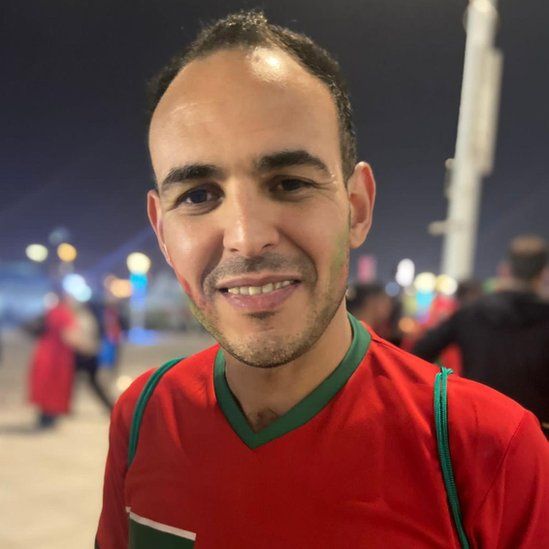
“This is a night that I’m going to tell my children and grandchildren about,” Soufiane Megrini told me.
“Morocco made us proud. We’re proud of our team and our coach.”
Image caption, Soufiane Megrini said he was proud of his team
Soufiane told me how touched he felt at the massive Arab support for his team.
He said despite finding the Moroccan dialect difficult, some spectators from other Arab countries had wanted to take part in the chants, asking how to say the words.
“They were standing next to us… they were singing Moroccan songs,” he said.
Flags tell an important part of the Moroccan World Cup story. As I write this, the skyscraper outside my window is radiating red with a green star in the middle. But there were others alongside Morocco’s red and green: Fans carried Saudi Arabian, Iraqi, Egyptian, Palestinian, Qatari and Jordanian flags.
Thousands of fans have travelled from across the Arab world to be here in Doha. Many have told us they’ve changed their tickets every time Morocco won. Some may have to change them again to witness another historic match for their team.
Zineb Aklikm and her husband Aziz Benyahya travelled to Doha from Morocco the day before the game. They left their two-month-old baby back home.
“As a mother, I feel guilty,” Zineb said, “but I’ll tell him about tonight.
“I don’t think we actually realise what just happened. We were witnessing history.”
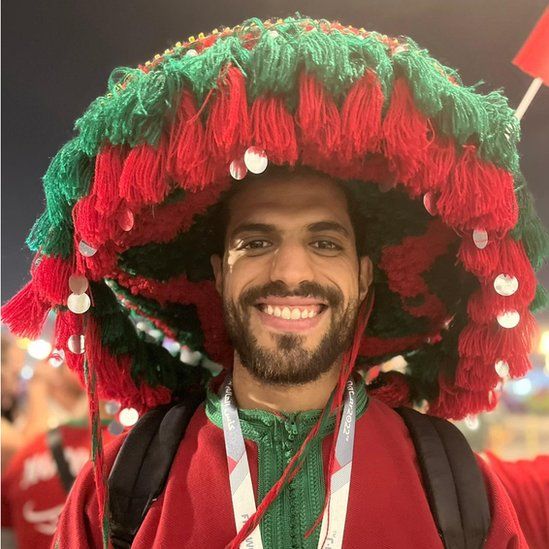
Image caption, Mohammed Rizki said Morocco was here to win, not just to take part
Mohammed Rizki was beaming, the fringes of his traditional Moroccan hat moving as he spoke animatedly.
“I can’t really describe it,” he said.
“It’s a mix of feelings. We’re so happy about the win and excited for what’s coming.”
This is a mammoth sporting moment for Morocco. It’s the best performance in this team’s history, but it goes well beyond football. This is a much-needed moment of collective joy and pride for a whole region and a continent.
More crucially, this is a moment that has shifted the way Arab and African teams are viewed not just in the eyes of European and South American squads, but in the eyes of their own crowds.
One of the most shared videos after the game, apart from Morocco’s team celebrating, is the one of Cristiano Ronaldo crying – as Portugal exited the tournament.
One spectator told me that this is a moment of “confidence” – to stand head to head with the giants of this game and be real contenders and a formidable force.
“What we want now is the cup,” Mohammed Rizki said.
He added: “We’re not here just to be in the competition. We’re here to win.”
The number of UKexporters has decreased by 15%, which means the government will fall short of its goal of negotiating post-Brexit trade agreements.
By the end of this year, the Conservatives will have agreements covering 80% of UK trade, as pledged during the 2019 election.
Recent data indicates that it will only be 63%.
A government source claimed that while a trade agreement with the US had been essential to achieving the goal, the Biden administration was not giving it a top priority.
The government also set a target this year to agree to a free trade deal with India by Diwali, on 12 November, which was missed.
Deals have been signed with the EU and 71 countries including Australia, New Zealand and Japan.
The Japanese deal was criticised earlier this year after government figures showed exports in UK goods and services had fallen to that country in the past year.
Former Environment Secretary George Eustice also criticised the Australia deal, arguing it was “not actually a very good deal for the UK”.
A Department for International Trade source said: “We’ve set our sights high but recognise to meet this ambition we need a deal with the US, and it is clear the Biden Administration are not prioritising negotiating trade deals with other countries.
“We’re ready to progress talks when the US are, and in the meantimeare working hard to secure trade wins for British firms such as removing barriers to American markets worth millions of dollars, resolving disputes like the steel and whisky tariff issues, and pursuing agreements with individual US states.”
Separately, HM Revenue and Customs data shows the number of UK firms classed as exporters fell from 149,443 in 2020 to 126,812 in 2021.
‘Ceased all trade with Germany’
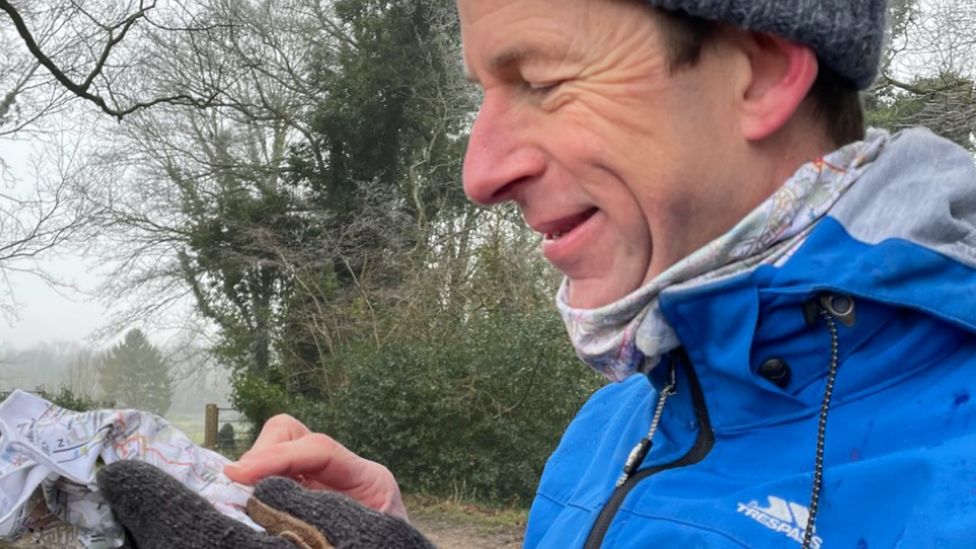
IMAGE SOURCE, DAVID OVERTON
David Overton runs SplashMaps, which produces fabric maps including OS and Michelin maps that are waterproof.
They sell to consumers, but also to the military.
Mr Overton said they have always sold to other countries – predominantly the US, but also to Europe.
Their third biggest export destination was Germany, but Mr Overton says the company has ceased all trade with Germany now because of changes since Brexit, resulting in a 2-5% drop in turnover.
He told the BBC he noticed all his exports to Germany were being “bounced back” to the UK.
He realised this was due to an EU directive on plastics and waste in packaging, which Germany requires exporters to sign up for through a register called LUCID.
“We didn’t know there was a registration process,” he said.
“I think what the government could really do is pay for the expertise to get these messages out.”
Exporters fell in every nation and region of the UK, but the decline was steepest in the South East of England (23%) and the North West of England (15%), with the lowest decline being in Northern Ireland (4%), the figures show.
Northern Ireland is the only part of the UK that has remained in the EU’s single market, which was agreed to prevent a hard border on the island of Ireland but has led to checks on some goods travelling from Great Britain to Northern Ireland.
Tina McKenzie, of the Federation of Small Businesses, said firms were seeing a “sustained suppression of exports” since the UK’s trade deal with the EU came into force.
Labour’s shadow international trade secretary Nick Thomas-Symonds said the data highlighted a “worrying future trend” and showed the government had “failed to provide the support necessary for exporters”.
He said Labour would remove barriers to trade with the EU, but ruled out seeking to re-join the single market or customs union – or return to freedom of movement.
Instead, the party would seek a veterinary agreement to reduce barriers to agricultural exports, and “sort out” the Northern Ireland protocol that has increased checks between Great Britain and Northern Ireland, he told the BBC.
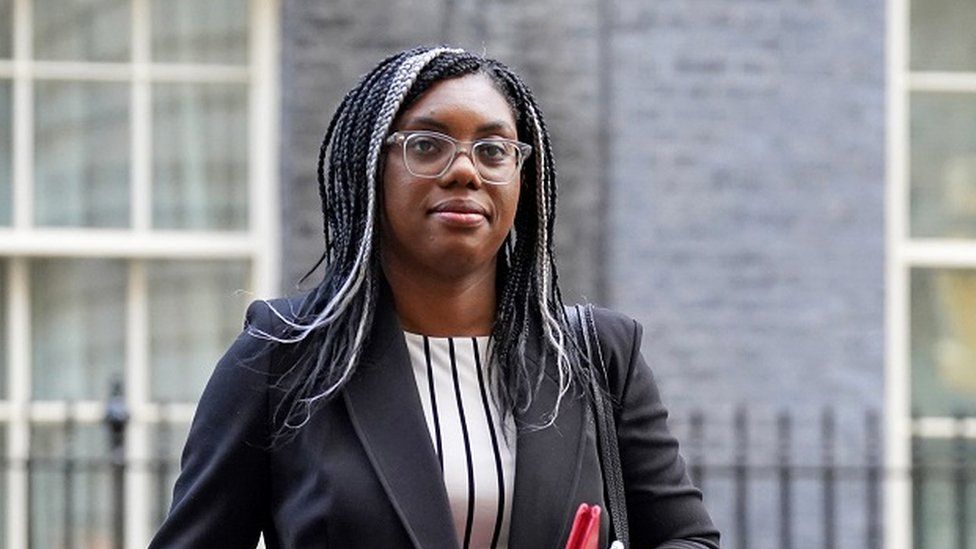
IMAGE SOURCE, STEFAN ROUSSEAU Image caption, Kemi Badenoch says the full impact of Brexit has yet to be seen
Labour would also seek mutual recognition of professional qualifications to allow more service industries to trade with the EU, seek “equivalent” data protection rules to enable digital services to compete, and find “flexible labour mobility arrangements” for musicians and artists seeking short-term visas to tour in the EU.
On Wednesday, International Trade Secretary Kemi Badenoch said the UK “should be doing better” on trade, but was recovering from global factors such as Covid and the war in Ukraine.
She told a Commons committee the UK had fully left the EU only at the beginning of 2020, and that “the full impact of what we’re going to see post-Brexit and all of the free trade agreements is yet to be seen”.
Ms Badenoch’s department said exports were “bouncing back” after the pandemic and had reached £748bn in the last 12 months, an increase of £132bn.
The co-winner of this year’s Nobel Peace Prize from Russia claims that the Kremlin told him to decline the honor.
Memorial’s director, Yan Rachinsky, said that he was instructed not to receive the award because the two other co-winners—a Ukrainian human rights organization and a jailed Belarusian rights advocate—were thought to be “inappropriate.”
One of the first civil rights organizations in Russia, Memorial, was shut down by the Kremlin a year ago.
We reached out to the Russian Foreign Ministry for comment.
In an exclusive interview with the BBC’s HARDtalk programme, Mr Rachinsky said his organisation had been advised to decline the award, but “naturally, we took no notice of this advice”.
Despite threats to his safety, Mr Rachinsky said the work of Memorial remained essential.
“In today’s Russia, no one’s personal safety can be guaranteed,” he said. “Yes, many have been killed. But we know what impunity of the state leads to… We need to get out of this pit somehow.”
Memorial had been documenting historical Soviet repression.
Its first chairman – Arseny Roginsky – was sent to Soviet labour camps for the so-called “anti-communist” study of history.
Announcing the prize winners, the Nobel Committee said that the Memorial was founded on the idea that “confronting past crimes is essential in preventing new ones”.
Mr Rachinsky called the committee’s decision to award the prize to recipients in three different countries “remarkable”.
He said it was proof “that civil society is not divided by national borders, that it is a single body working to solve common problems”.
IMAGE SOURCE, REUTERS Image caption, Ukrainian Oleksandra Matviichuk refused to be interviewed alongside one of her co-winners, Russian Yan Rachinsky
But the decision to include a Russian recipient has been controversial.
The woman who runs Ukraine’s Center for Civil Liberties – another of the prize-winners – refused to be interviewed alongside Mr Rachinsky. The BBC spoke to them separately in Oslo.
When asked why she wanted to do the interview separately, Oleksandra Matviichuk told HARDtalk: “Now we are in a war and we want to make the voice of Ukrainian human rights defenders tangible.
“So I am sure that regardless that we are doing separate interviews, we transmit and deliver the same messages.”
The Center for Civil Liberties was recognized for its work promoting democracy in Ukraine and investigating alleged Russian war crimes in the country.
Despite refusing to speak beside her co-winner, Ms Matviichuk praised Mr Rachinsky’s work and described Memorial as “our partner”.
Memorial had helped the Ukrainian group for years, she said, adding she had “huge respect for all [her] Russian human rights colleagues” who work in difficult conditions.
She also warned that without proper accounting for Russian crimes, peace would not come to Eastern Europe.
Ms Matviichuk called for a new international tribunal to hold President Vladimir Putin and other Russians accountable for their actions in Ukraine, describing that the current system is insufficient.
“The question is, who will provide justice for hundreds of thousands of victims of war crimes?” she asked.
She also accused Russia of using the war as a tool to achieve its geopolitical aims – and committing war crimes in order to win the conflict.
The third Nobel winner, Belarusian human rights defender Ales Bialiatski, has been in prison without trial in his home country since July last year.
He is the founder of the country’s Viasna (Spring) Human Rights Centre, which was set up in 1996 in response to a brutal crackdown on street protests by Belarus’s authoritarian leader Alexander Lukashenko.
Hi-de-Hi! star Ruth Madoc had been forced to quit a panto role in Torquay earlier this week following a fall, and died while in hospital after undergoing surgery
Hi-de-Hi! actress, Ruth Madoc, passed away at the age of 79, her agent revealed in a statement.
She played the role of Gladys Pugh in the 1980s vacation camp sitcom Hi-de-Hi, she was scheduled to star in the Christmas pantomime Aladdin in Torquay, but she had to cancel earlier this week due to an injury sustained in a fall.
Phil Belfield of talent agency Belfield & Ward Ltd described her as “one of a kind and a unique talent loved by many”.
He said: “It is with much sadness that we have to announce the death of our dear and much-loved client Ruth Madoc.
“Ruth passed away on the afternoon of Friday 9 December while in hospital following surgery for a fall she had earlier in the week, which had led her to have to withdraw from panto in Torquay.
“From film work such as Fiddler On The Roof and Under Milk Wood with Richard Burton and her iconic TV performance as Gladys Pugh in Hi De Hi! and more recently in Little Britain and on stage with Calendar Girls (the play and the musical), plus recent acclaim in short films Skinny Fat and Cardiff, she was truly a national treasure and was looking forward to getting back on the road in 2023 with The Best Exotic Marigold Hotel.
“A real legend of the British entertainment scene, she was one of a kind and a unique talent loved by many. She is gone far too soon. Our hearts are broken!
“Thoughts are with her daughter Lowri, her son Rhys and all of her family.”
One of the first stars to pay tribute was Blackadder actor Sir Tony Robinson, who had performed with her in 2009.
Robinson wrote on Twitter: “So sad to hear my lovely friend Ruth Madoc has passed. She was not only funny and highly intelligent, but she was also smart, kind, a loyal trade unionist, and wore her heart on the left. She’ll be much missed.”
Madoc had a lead role in the long-running BBC comedy Hi-de-Hi!, for which she was BAFTA-nominated. Set in the late 50s in the fictional holiday camp Maplins, the show ran for nine series, and 58 episodes, from 1980 to 1988.
Tragic to hear the news of Ruth Madoc – she was a brilliant talent. One of those people you were always thrilled to see pop up on TV.
Her partnership with (the equally glorious) Simon Cadell in Hi-De-Hi was the stuff of absolute sitcom and television gold.
Her character, Gladys, was the chief yellow coat, famed for her camp tannoy announcements preceded by three signature notes played on a mini xylophone, followed by the title phrase, Hi-de-Hi!
Her recurring storyline centered around her unrequited love for camp entertainment manager Jeffrey Fairbrother, played by Simon Cadell. She later played the role in a touring stage version of the show.
Calling her “a very lovely person” and “wonderfully gifted actress,” broadcaster Gyles Brandreth wrote on Twitter: “I was lucky enough to get to know her through my best friend from school, Simon Cadell.
“In Hi-De-Hi they were irresistible. RIP Ruth Madoc & thanks for the memories. Goodbye campers!”
Madoc had been due to play the empress in the pantomime Aladdin at the Princess Theatre in Torquay, alongside EastEnders actor Ricky Norwood and X Factor star Jay Edwards, but she had to withdraw from the role after suffering a fall.
The theatre tweeted on Thursday: “Following an accident earlier this week, after medical assessment, regretfully Ruth Madoc is no longer able to appear in this year’s pantomime of Aladdin at the Princess Theatre in Torquay.”
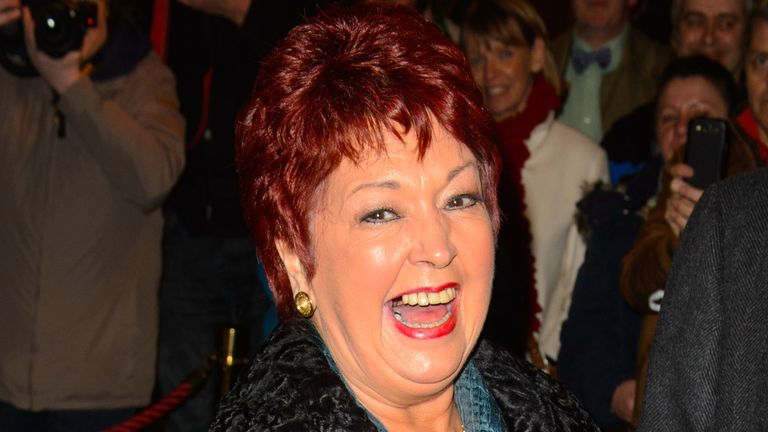
Image:Madoc arriving at the press night for the Full Monty in 2014
A panto veteran, she appeared in over 30, playing roles including principle boy in Dick Whittington, the bad fairy in sleeping beauty, and the fairy godmother in Cinderella in Mansfield.
A star of the stage and screen she had starred in an array of roles in theatre and musicals around the world, including Fiddler On The Roof, Gypsy, and Annie during her career.
In 2018, she performed in the ladies’ version of The Real Full Monty alongside stars including Coleen Nolan, Victoria Derbyshire, and Michelle Heaton, raising awareness about breast cancer.
A year later, she broke her hip in a fall while rehearsing for her role in Calendar Girls, but confounded doctors with her speedy recovery.
Born in April 1943 in Norwich, Madoc was brought up in Llansamlet near Swansea, largely by her grandparents.
She went on to train at the Royal Academy of Dramatic Art (RADA) and got the break-out role-playing Fruma Sarah in the film version of the musical Fiddler On The Roof in 1971.
Aside from Hi-de-Hi!, other highlights of her career include Mrs Dai Bread Two in the 1972 comedy film Under Milk Wood and later the role of the mother of Daffyd Thomas, played by Matt Lucas, in the second series of Little Britain.
In 1984 she was presented with the big red book when she was the subject of a This Is Your Life episode.
Swansea University awarded her an honorary degree in 2006, and she is also a fellow of the Royal Welsh College of Music and Drama.
She married twice, first to Welsh actor Philip Madoc, with whom she had her two children. Married for 20 years, and they divorced in 1981. Her second husband, John Jackson, died last year.
She had been due to join stars including Belinda Lang, Paul Nicholas, and Tessa Peake-Jones in a UK theatre tour of The Best Exotic Marigold Hotel, about a group of British retirees in India, in January 2023.
A groundbreaking new kind of therapy has successfully treated a teenage girl’s untreatable cancer for the first time.
For Alyssa’s leukemia, every previous treatment had failed.
In order to create a new live medication, physicians at Great Ormond Street Hospital performed a feat of biological engineering known as “base editing.”
Alyssa is still being watched in case cancer recurs even though it is no longer evident six months later.
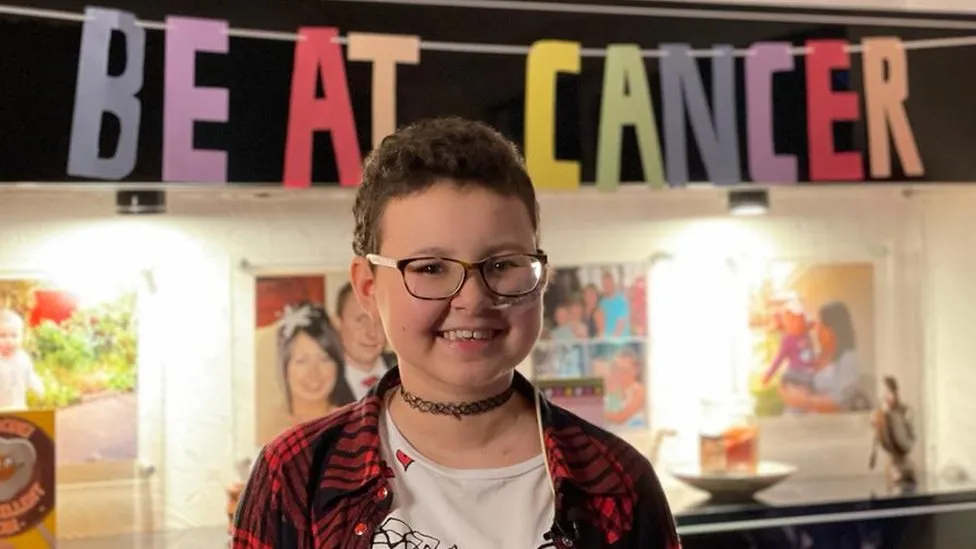
Alyssa, who is 13 and from Leicester, was diagnosed with T-cell acute lymphoblastic leukemia in May last year.
T-cells are supposed to be the body’s guardians – seeking out and destroying threats – but for Alyssa, they had become the danger and were growing out of control.
Her cancer was aggressive. Chemotherapy, and then a bone-marrow transplant, were unable to rid it from her body.
Without experimental medicine, the only option left would have been merely to make Alyssa as comfortable as possible.
“Eventually I would have passed away,” said Alyssa. Her mum, Kiona, said this time last year she had been dreading Christmas, “thinking this is our last with her”. And then she “just cried” through her daughter’s 13th birthday in January.
IMAGE SOURCE, FAMILY PHOTO Image caption, Alyssa before chemotherapy
IMAGE SOURCE, FAMILY PHOTO Image caption, Alyssa decided to donate her hair when she found out she would lose it anyway
What happened next would have been unthinkable just a few years ago and has been made possible by incredible advances in genetics.
The team at Great Ormond Street used a technology called base editing, which was invented only six years ago.
Bases are the language of life. The four types of base– adenine (A), cytosine (C), guanine (G), and thymine (T) – are the building blocks of our genetic code. Just as letters in the alphabet spell out words that carry meaning, the billions of bases in our DNA spell out the instruction manual for our body.
Base editing allows scientists to zoom into a precise part of the genetic code and then alter the molecular structure of just one base, converting it into another and changing the genetic instructions.
The large team of doctors and scientists used this tool to engineer a new type of T-cell that was capable of hunting down and killing Alyssa’s cancerous T-cells.
They started with healthy T-cells that came from a donor and set about modifying them.
The first base edit disabled the T-cells targeting mechanism so they would not assault Alyssa’s body
The second removed a chemical marking, called CD7, which is on all T-cells
The third edit was an invisibility cloak that prevented the cells from being killed by a chemotherapy drug
The final stage of genetic modification instructed the T-cells to go hunting for anything with the CD7 marking on it so that it would destroy every T-cell in her body – including the cancerous ones. That’s why this marking has to be removed from the therapy – otherwise, it would just destroy itself.
If the therapy works, Alyssa’s immune system – including T-cells – will be rebuilt with the second bone-marrow transplant.
When the idea was explained to the family, mum Kiona was left thinking: “You can do that?” It was Alyssa’s decision to be the first to take the experimental therapy – which contained millions of the modified cells – in May this year.
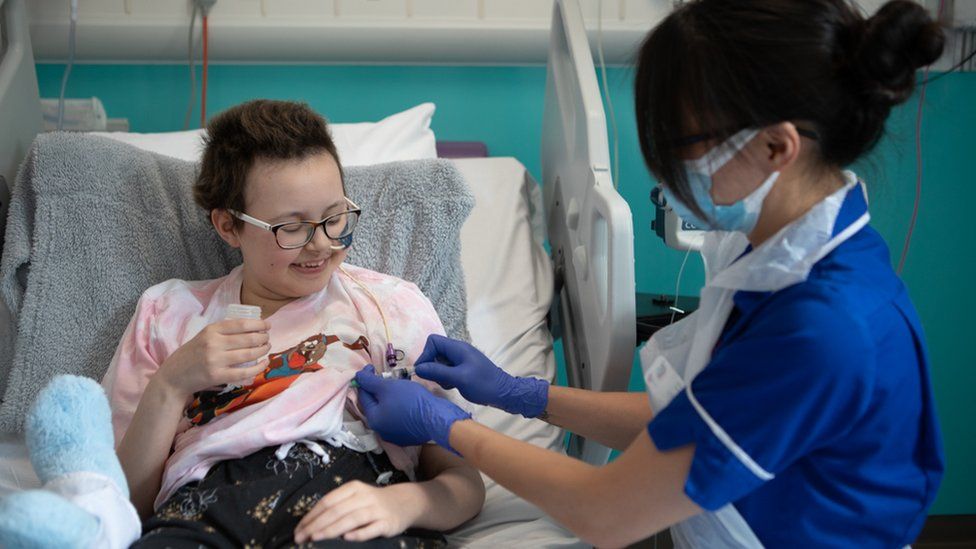
IMAGE SOURCE, GREAT ORMOND STREET HOSPITAL Image caption, Jan Chu, a senior research nurse at Great Ormond Street, gives Alyssa the therapy in May 2022.
“She’s the first patient to be treated with this technology,” said Prof Waseem Qasim, from UCL and Great Ormond Street.
He said this genetic manipulation was a “very fast-moving area of science” with “enormous potential” across a range of diseases.
Alyssa was left vulnerable to infection, as the designer cells attacked both the cancerous T-cells in her body and those that protect her from disease.
After a month, Alyssa was in remission and was given a second bone-marrow transplant to regrow her immune system.
Alyssa spent 16 weeks in the hospital andcouldn’t see her brother, who was still going to school, in case he brought germs in.
There were worries after the three-month check-up found signs of cancer again. But her two most recent investigations have been clear.
“You just learn to appreciate every little thing. I’m just so grateful that I’m here now,” said Alyssa.
“It’s crazy. It’s just amazing I’ve been able to have this opportunity, I’m very thankful for it and it’s going to help other children, as well, in the future.”
She’s eyeing-up Christmas, being a bridesmaid at her auntie’s wedding, getting back on her bike, going back to school, and “just doing normal people stuff”.
The family hopes cancer will never return but are already grateful for the time it has bought them.
“To have this extra year, this last three months when she’s been home, has been a gift in itself,” said Kiona.
Dad James said: “I find it quite hard to talk about how proud we are. When you see what she’s gone through and the vitality of life she’s brought to every situation, it’s outstanding.”
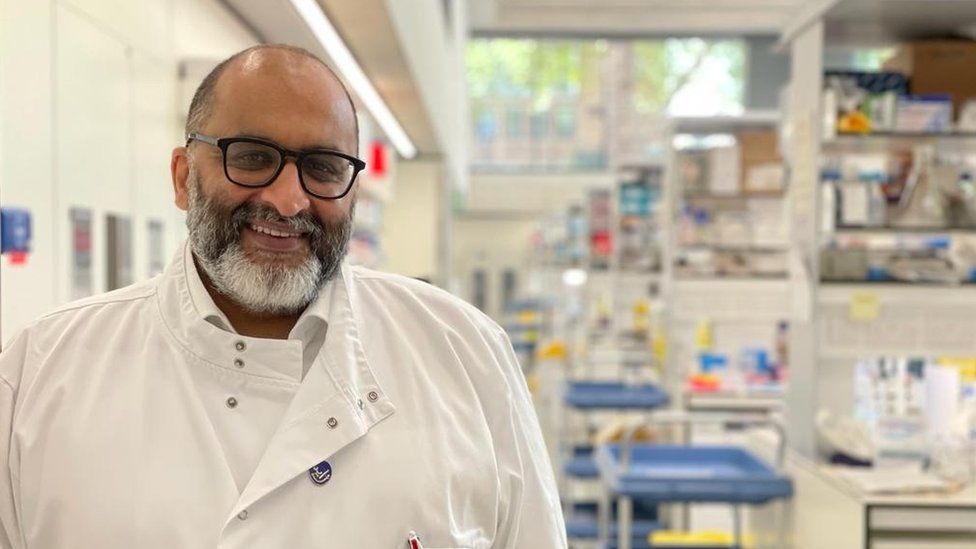
Image caption, Prof Waseem Qasim was part of the team that developed the base-editing therapy
Most children with leukaemia respond to the main treatments, but it is thought that up to a dozen a year could benefit from this therapy.
Dr Robert Chiesa, from the bone-marrow transplant department at Great Ormond Street Hospital, said: “It is extremely exciting. Obviously, this is a new field in medicine and it’s fascinating that we can redirect the immune system to fight cancer.”
The technology, though, only scratches the surface of what base editing could achieve.
Dr David Liu, one of the inventors of base editing at the Broad Institute, told me it was “a bit surreal” that people were being treated just six years after the technology was invented.
In Alyssa’s therapy, each of the base edits involved breaking a section of genetic code so it no longer worked. But there are more nuanced applications where instead of switching an instruction off you can fix a defective one. Sickle-cell anaemia, for example, is caused by just one base change that could be corrected.
So there are already trials of base editing underway in sickle-cell disease, as well as high cholesterol that runs in families and the blood disorder beta-thalassemia.
Dr Liu said the “therapeutic applications of base editing are just beginning” and it was “humbling to be part of this era of therapeutic human gene editing”, as science was now taking “key steps towards taking control of our genomes”.
A social media footage shows a group of guys storming the dentist’s home in the state of Telengana. Others may be seen damaging her family’s property and an automobile.In the southern Indian state of Telengana, a mob of at least 40 men broke into the home of a 24-year-old woman and abducted her.
The woman, a dentist, was abducted from the house in broad daylight Friday. A video making the rounds on social media shows at least 30 men forcibly entering the house, only to drag a man out. They then proceed to beat him with sticks and rods while others vandalized the house and a car.
A video on social media shows dozens of men barging into the dentist’s house in the state of Telengana. Others can be seen vandalizing a car and her family’s property.
A mob of at least 40 men forced their way into the home of a 24-year-old woman and kidnapped her in the southern state of Telengana, India.
The woman, a dentist, was abducted from the house in broad daylight Friday. A video making the rounds on social media shows at least 30 men forcibly entering the house, only to drag a man out. They then proceed to beat him with sticks and rods while others vandalized the house and a car.
#WATCH | Ranga Reddy, Telangana | A 24-yr-old woman was kidnapped from her house in Adibatla y’day. Her parents alleged that around 100 youths barged into their house, forcibly took their daughter Vaishali away & vandalised the house. Police say, case registered & probe underway. pic.twitter.com/s1lKdJzd2B
Vaishali, a resident of the Ranga Reddy district near Hyderabad, was safely rescued after an hourslong operation carried out by the state police, according to a report by New Delhi Television (NDTV).
The police have arrested 18 men and registered the case while they continue to look for others involved.
The incident comes on the heels of a gruesome murder case in the Indian capital where a man killed his live-in partner, chopped her up into pieces, and disposed of her corpse in a forest over weeks.
The woman’s parents speak out
The woman’s parents allege that over 100 men entered the house, roughly half of which attacked Vaishali. “About 50 people went to the first floor and forcibly took away the girl,” the mother of the kidnapping victim said, according to the local news agency Press Trust of India.
The family named Naveen Reddy, a man who owns a tea store opposite the victm’s house, as the accused who led the mob into the house. Local police told NDTV that the two had previously met on a badminton court and were in a relationship.
However, the woman rejected his proposal to marry. Reddy then harassed her on social media platforms which led her to file a police complaint alleging stalking. Reddy remains at large.
What does the case mean for India?
Sudheer Babu, an additional commissioner at the Rachokonda Commissionerate, told Asian News International, “We have registered cases under section 307 and other sections of IPC (Indian Penal Code) related to threatening,”
Section 307 refers to attempted murder, a non-bailable crime.
Cases like these highlight the severity of gender-based violence Indian women face on a regular basis.
One in every three Indian women has experienced mental, physical, or sexual violence, according to research in the Journal of Epidemiology and Community Health. Only one in ten of these women report these cases to the police.
The latest round of the National Family Health Survey 5 further revealed that 32 percent of women who have been married between the ages of 18 to 49 have experienced abuse by their spouses.
White House has reported that Russia and Iran are forming a full-fledged defense alliance to support Russia in its conflict with Ukraine.
John Kirby, a spokesman for the White House National Security Council, claimed that Russia is once more looking to Iran to replenish the Russian military with drones and surface-to-surface missiles.
“Russia is offering Iran an unprecedented level of military and technical support that is transforming their relationship into a fully-fledged defence partnership,” Mr Kirby said.
“I think it’s important for us to be clear this partnership poses a threat not just to Ukraine, but to Iran’s neighbours in the region.”
Concerns about new weapon sales to Russia come after Iran sold hundreds of attack drones to Russian over the summer.
The Biden administration recently unveiled sanctions against Iranian firms and entities involved in the transfer of Iranian drones to Russia for use in Putin’s ongoing invasion of Ukraine.
In October, the White House accused Tehran of sending Iranian troops to Crimea to support Russian drone attacks on Ukraine’s power stations and other key infrastructure,
The White House and British government said the relatively small number of Iranian personnel deployed to Crimea, a part of Ukraine unilaterally annexed by Russia in contravention of international law in 2014, were there to assist Russian troops in launching Iranian-made drones against Ukraine.
“Supports flowing both ways,” said Mr Kirby.
“Russia is seeking to collaborate with Iranon areas like weapons development and trade. As part of this collaboration, we are concerned that Russia intends to provide Iran with advanced military components.”
In response to what it called “egregious” human rights violations, Australia has declared that it will impose targeted sanctions on Russia and Iran.
In a statement, foreign minister Penny Wong said sanctions would be placed on 13 people and two organizations, including the Basij Resistance Force and Iran’s morality police, as well as six Iranians who took part in the suppression of the protests that began after Mahsa Amini, 22, died in custody in September.
Human rights sanctions would also be placed on seven Russians involved in what the foreign minister claimed was an attempt to kill former opposition leader Alexei Navalny, according to Ms. Wong’s statement.
In an opinion piece for the Sydney Morning Herald, Ms Wong said Seyed Sadegh Hosseini, whom she described as a senior commander of Iran’s Islamic Revolutionary Guard Corps, is one of those who will be sanctioned.
He was being listed for his alleged role in the “indiscriminate use of violence against protesters”.
“The Iranian regime’s flagrant and widespread disregard for the human rights of its own people has appalled Australians, and the perpetrators must be held accountable,” Ms Wong wrote in the newspaper on Saturday.
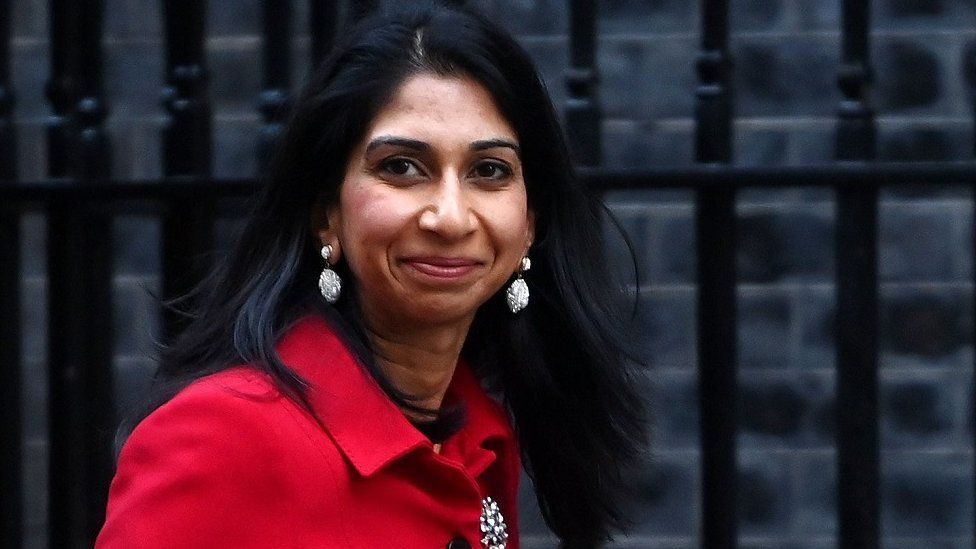
The independent government adviser on violence against women has declared she will not stay on as Suella Braverman’s assistant.
Nimco Ali declared on live radio that when it comes to women’s rights and ethnic minorities, she and the home secretary were on “totally different planets.”
When her buddy Boris Johnson was prime minister, Ms. Ali was appointed.
Ms. Ali’s contract was set to expire before Christmas, according to a source close to the home secretary.
They added: “The home secretary is determined to make our streets and homes safer for women and girls.
“She will continue to focus on this policy and the rights of women and girls to live safely in our country.”
The Home Office said they had not received any formal resignation and were therefore not commenting.
Ms Ali was being interviewed on Times Radio when she said she would not “feel comfortable in serving under Suella”.
“Suella and I are on completely different planets when it comes to the rights of women and girls and also the way that we talk about ethnic minorities,” she said.
Ms Ali said Ms Braverman had different approaches to “people like me who are from a refugee background”.
She also questioned if the home secretary shared her “feminist ideals”.
When pressed on whether she would remain as an adviser, she said “ultimately no, I’m not going to continue”.
The move comes hours after the home secretary agreed to back a bill criminalising street harassment.
Ms Ali had a major role in preparing the groundwork for the bill and led a consultation into making street harassment a specific crime while serving under former home secretary Priti Patel.
Ms Ali was appointed to her role by Ms Patel in October 2020.
IMAGE SOURCE,EPA Image caption, Labour says Ms Ali’s decision is “damning for Suella Braverman”
The BBC understands there has been no decision about appointing someone else to the role of Independent Adviser on Tackling Violence Against Women and Girls.
Labour’s shadow home secretary Yvette Cooper called Ms Ali’s decision “damning for Suella Braverman”.
Ms Cooper said: “Those around her clearly don’t think she’s capable of doing the job.
“It shows how weak Rishi Sunak was to appoint her. More chaos at the heart of this Tory government.”
An ally of Ms Braverman indicated she had not met Ms Ali in her three months as home secretary.
Dresden police have announced that the hostage crisis is over, and that they have two unhurt people in their custody.
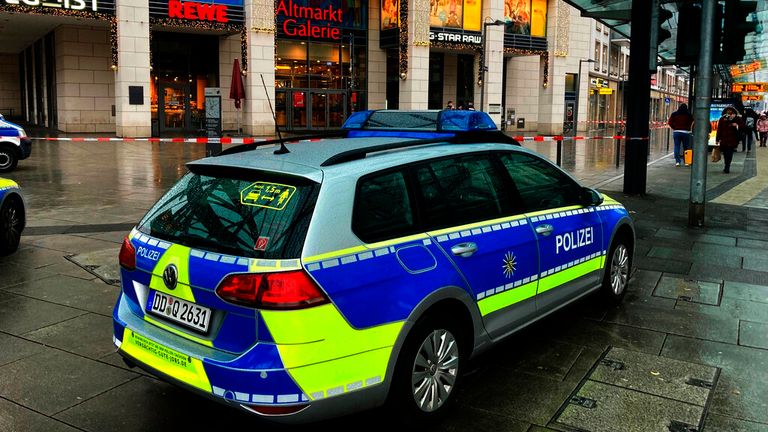
Due to a possible hostage situation, police in Dresden, eastern Germany, have evacuated a shopping center and the surrounding region.
A statement on the police’s website read: “The Dresden Police Department is currently carrying out an operation in downtown Dresden. The background is the suspicion of a hostage situation.”
German newspaper Bild reported that an armed man had killed a woman, then stormed a local radio station and fired shots before fleeing into a shopping mall where he took several hostages.
On its website, Radio Dresden said that earlier a man that an armed man had entered the Ammonhof office building, where the radio station is located, around 8.30am local time (07.30 GMT) and that shots had been fired.
🚨 Polizeieinsatz in #Dresden🚨
Aktuell kommt es im Bereich der #AltmarktGalerie zu einem Polizeieinsatz, nach einer Geiselnahme.
Police are yet to confirm these details but urged citizens to avoid the city centre. The famous Striezelmarkt Christmas market will also remain closed for the time being.
Police have confirmed that they are in contact with the perpetrator. Radio Dresden writes that the suspect is in a room in Altmarktgalerie, a shopping centre in Dresden, after fleeing from the scene in the direction of the old town,
The Radio’s website says that the hostage-taking is in connection with the death of a 62-year-old woman in an apartment building in Prohlis, Dresden.
“Emergency services found a lifeless 62-year-old woman in an apartment building in Prohlis. An emergency doctor who was called could only determine her death,” the website reads.
“According to the police, the suspect is the woman’s 40-year-old German son.
“The Dresden police department is currently conducting an operation to suspect a hostage-taking in Dresden’s Altmarktgalerie, which is obviously related to the homicide.”
In a statement posted to Twitter, police confirmed the hostage situation is over, with two apparently unharmed individuals in their care.
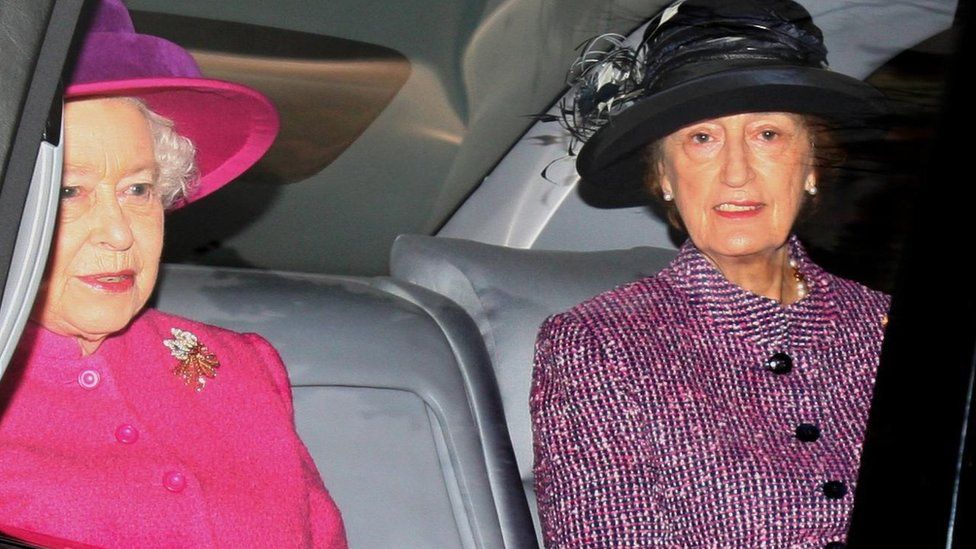
A charity run by a black womanwho was frequently questioned about her origins at a royal event has temporarily halted operations out of concern for safety.
The founder of Sistah Space, Ngozi Fulani, brought the organization to light when she claimed that Lady Susan Hussey “interrogated” her at Buckingham Palace last month.
Because of safety, it asserts to have “ceased many” of its operations.
Following her outspokenness, Ms. Fulani reported she experienced online bullying.
Lady Hussey – Prince William’s godmother and the late Queen’s lady-in-waiting – has since left her honorary role within the Royal Household.
In a statement on its Instagram page, domestic violence charity Sistah Space said: “Thank you for the continued support and messages.
“Unfortunately recent events meant that we were forced to temporarily cease many of our operations to ensure the safety of our service users and our team.
IMAGE SOURCE,PA MEDIA Image caption, Lady Susan Hussey was a key and trusted figure in the British royal household for decades
Ms Fulani said earlier this week that she, her family, and her team had been put under “immense pressure” and received “horrific abuse” on social media.
The BBC has contacted Sistah Space for further comment.
Lady Hussey was the late Queen’s lady-in-waiting and was seen as a key and trusted figure in the Royal Household for decades.
Part of her latest role involved helping to host events at Buckingham Palace – which is how she met Ms Fulani.
Ms Fulani had been at the Palace representing the London-based charity – which supports women of African and Caribbean heritage who have faced domestic and sexual abuse.
After the event, Ms Fulani described on Twitter how Lady Hussey had moved her hair aside to see her name badge and had then challenged her to explain where she was from.
The conversation, as recounted by Ms Fulani, consisted of Lady Hussey pushing her about her background and nationality.
The BBC understands Lady Hussey remains willing to make a personal apology should it be welcomed.
In a statement, Buckingham Palace previously said “unacceptable and deeply regrettable comments” had been made and all staff were “being reminded of the diversity and inclusivity policies which they are required to uphold at all times”.
On Saturday morning, gunmen enforcing a purported five-day sit-at-home order in Enugu State attacked and burned a police patrol vehicle in the New Market area.
No lives were lost, according to a police source who verified the incident to SaharaReporters, but he gave no other information.
It was learned that the over ten hoodlums assaulted the New Market area around 6 am, probably to close down the market, but ran into several police officers on the ground and attacked them.
They were reported to have engaged the policemen deployed to the market in a gun duel and eventually succeeded in setting ablaze their patrol vehicle.
Some early morning traders told Sahara Reporters that the shooting forced traders who had arrived in the market for their daily business to scamper for safety, leaving their goods behind.
“Shortly, I saw a police patrol vehicle coming, and immediately, they engaged them in the shootout. I left my goods and ran to safety. After the shooting stopped I came out and saw they had set ablaze the police patrol vehicle in front of the Colliery hospital,” Ezeh said.
No casualty has been reported at the time of this report just as the police are yet to make a statement on the incident.
Efforts to speak with the state police public relations officer DSP Daniel Ndukwe were unsuccessful as he could not answer his calls.
SaharaReporters had reported on Friday that residents of Enugu State shunned the five-day sit-at-home, Simon Ekpa, the self-proclaimed disciple of the detained leader of the Indigenous People of Biafra, Mazi Nnamdi Kanu declared in the South East region.
The early morning attack in the Enugu metropolismay have been a deliberate effort to scare the people and force them to obey the sit-at-home order.
Harry and Meghan’s own videos stand out the most in Netflix’s documentary, says Sky’s, Rhiannon Mills. Because as it paranoia that made them film themselves at a traumatic time, or the knowledge that they would later have some monetary value?
The anticipation was high, and the start of the first episode delivered the drama.
It includes videos filmed by the couple, Harry and Meghan wanting to give us a front-row seat into how they were really feeling in those frantic weeks at the start of 2020 when they announced they’d had enough.
Harry is on a crusade as he explains: “I feel as though being part of this family, it’s my duty to uncover this exploitation and bribery which happens within our media.
“This has always been so much bigger than us. No one knows the full truth. We know the full truth. The institution knows the full truth and the media know the full truth because they’ve been in on it.
“And I think anyone else in my situation would have done exactly the same thing.”
A traumatised man now unleashed
We’ve heard him say a lot of this before, but he does speak at greater length than previously.
It feels like you’re watching a man who has clearly been heavily traumatised by what happened to him, now unleashed, and using this as some kind of cathartic experience to get it all out once and for all.
After the racism claims that blew things up around the Oprah interview, it was always going to be fascinating to see if we heard any more on that from the couple.
The furthest they go in these episodes is to talk about how the UK press allegedly made an issue of Meghan’s race, with her mother Doria speaking for the first time about the struggles her daughter faced.
‘The race element’
That section in episode two also features one of the more difficult claims against the Royal Family.
Harry suggests it was brushed over by his relatives, and they were expected to just get on with it.
“What people need to understand is as far as a lot of the family were concerned everything she (Meghan) was being put through, they had been put through as well, so it was almost like a rite of passage,” he says.
“Some of the members of the family were like, ‘my wife had to go through that, so why should your girlfriend be treated any differently, why should you get special treatment, why should she be protected?’.
“And I said, ‘the difference here is the race element’.”
‘Weary’ royals will likely keep their head down
The suggestion that the Royal Family was not taking seriously racist abuse leveled at Meghan is not a good look.
But this is not like the Oprah interview. There is no new evidence – there aren’t any particularly damning new claims.
For a family who I’m told are generally “weary” and feel “sadness” more than anything about all this, I suspect they will keep their heads down and not feel the need to react.
Harry and Meghan’s videos ‘feel peculiar’
It is the couple’s own videos that stand out the most and feel peculiar.
Harry explains that a friend suggested they should personally document what happened to them.
Yes, we may all now record our lives to a degree through photos and videos.
But was it paranoia that made them film themselves at this traumatic time, or the knowledge that the videos would later, down the line, have some monetary value? Which they have, both for the couple and for Netflix.
DISCLAIMER: Independentghana.com will not be liable for any inaccuracies contained in this article. The views expressed in the article are solely those of the author’s and do not reflect those of The Independent Ghana
After a significant explosion at a Jersey apartment building, one person is dead, and “about a dozen” are still missing.
Following the explosion at Haut du Monton Pier Road in St. Helier, two “walking wounded” have been transported to a hospital by police on the Channel island.
According to police, relatives are being notified.
The fire has been put out, according to the police, but the area around the incident is sealed off and emergency personnel is still “carrying out considerable work.”
The States of Jersey Police received reports of a “huge explosion” at around 4 am on Saturday, according to Robin Smith, the force’s commanding officer.
Robin Smith, chief officer at States of Jersey Police,said the force received reports of a “large explosion” at around 4 am on Saturday.
He said one person had died and two people, whom he described as “walking wounded”, were taken to the hospital.
Mr Smith said: “There are of course a number of other people that are unaccounted for and therefore a search and rescue operation has commenced.”
He said Jersey Fire and Rescue Service were liaising with Hampshire Fire and Rescue to help with the search.
Mr Smith added between 20 and 30 people evacuated from the areahad been taken to St Helier Town Hall.
Lai received five years and nine months term as well as a 2 million Hong Kong dollars (£209,535) fine.
The 75-year-old recently served time for taking part in a banned vigil last year for victims of China’s 1989 Tiananmen Square massacre.
A separate trial involving Lai on national security charges had been due to begin on 1 December but was postponed at the request of Hong Kong leader John Lee Ka-Chiu. If convicted, he faces up to life imprisonment.
China has enforced its wide-ranging national security law on the city of Hong Kong, making it easier to prosecute protesters.
The law has led to the arrests of many prominent democracy activists.
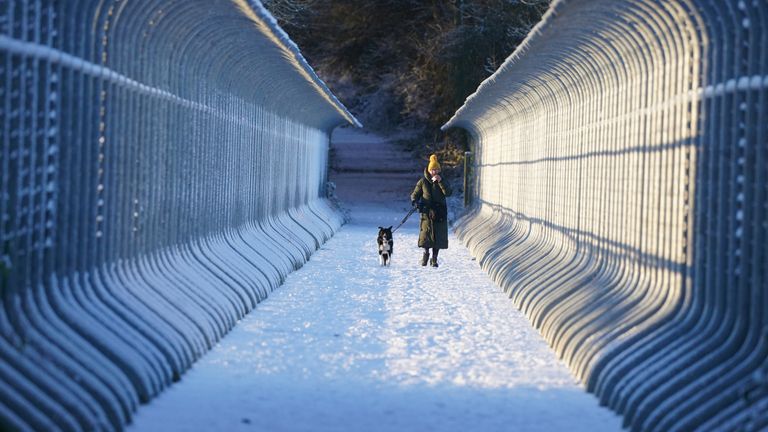
As freezing fog, sleet, and snow hamper travel across the UK, passengers have been encouraged to contact their airline for the most recent flight information.
Due to the amount of snowfall, Manchester Airport has closed both runways.
A tweet read as follows: “We’ve blocked both runways temporarily due to the significant snowfall. Health and safety will always come first, and business will pick back up as soon as possible.”
Numerous flights are impacted, therefore passengers are urged to contact their airline for the latest recent travel information.
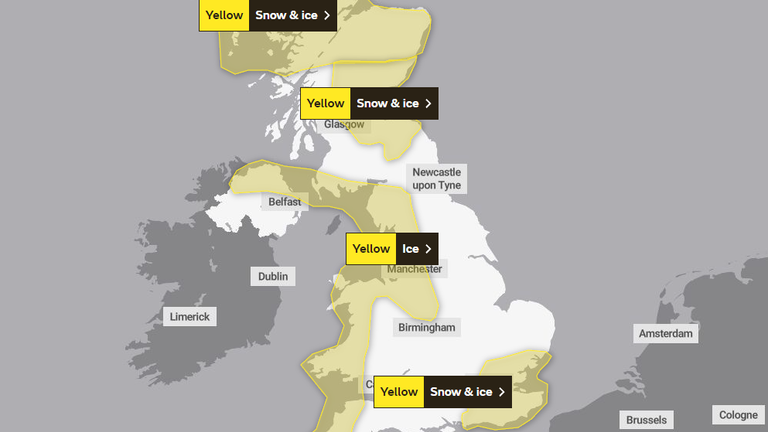
It comes as the Met Office warned freezing fog, sleet and snow could bring travel disruption to parts of the UK during the coming days.
Southeast England has been covered by a yellow weather warning for snow and ice on Sunday and Monday.
The western coast of England, Wales, and the north of Northern Ireland have warnings for ice on Saturday and Sunday.
Scotland, apart from the southwest, has a yellow warning for snowand ice covering Saturday and Sunday.
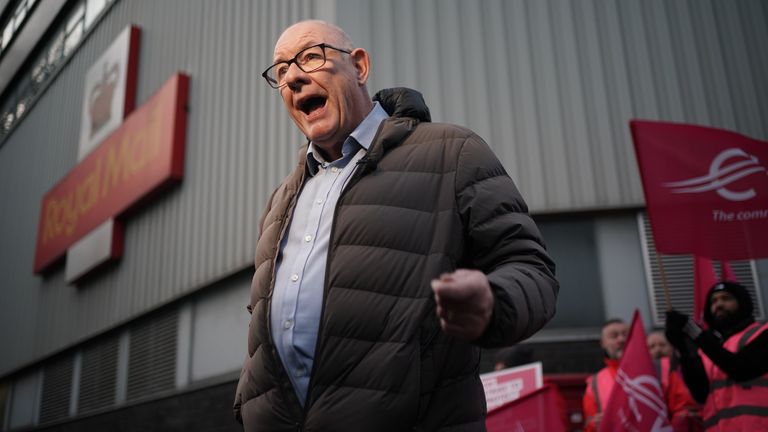
A postal workerwho is taking part in the strike action today discusses the complaints that front-line Royal Mail employees have and asserts that the firm will comply with their demands after the main Christmas season.
He said that the 115,000 frontline employees were fighting for the company’s very survival.
Workers are on strike today, and more walkouts are expected on December 11, 14, 15, 23, and 24.
In exchange for a greater salary raise, the firm is pursuing a modernization program that includes voluntary Sunday work. According to their union, the CWU, this would transform Royal Mail into a “gig economy-style parcel courier, dependent on casual labor.”
Royal Mail has argued it is crucial to help it better compete as it places a greater focus on the lucrative parcel delivery sphere at a time when the company is losing £1m a day.
Derek, who is a union member but not a rep, explained that while part of the fight was for better pay, he and his colleagues were walking out to protect the company’s values from a future that would mean a worse deal for the public and staff alike.
He said Royal Mail was attempting to weaken its commitments to letter delivery and make its contracted workers go further, through increased flexibility, to line the pockets of shareholders.
Dave Ward, general secretary of the Communication Workers Union, told Sky News that even if they were offered a 50% pay rise they would not accept it if the same terms and conditions were attached.
Image: The company has accused CWU leader Dave Ward of spreading unfounded claims about Royal Mail’s modernization plans
The main gripes, Derek said, covered Sunday working and later start times for deliveries.
“The pay deal is something we wanted but 2% (with more in return for accepting new working practices) was a joke,” he said.
“The vision is to start deliveries later and finish later but if you don’t complete by your time allocated, we don’t know where we stand as the goalposts keep changing. It becomes a conduct issue.
“They’ve got us by the b****.
“We are cutting off (finishing rounds before completion) on a regular basis because we’re not getting paid any extra to clear backlogs.”
CWU’s Dave Ward on what postal union will accept over pay deal
Derek blamed staff shortages, saying agency workers had been brought in to help.
“We’re on £12 an hour. Agency is getting £15-20,” he said.
“The night shifts for Christmas are another issue. The backlog is phenomenal. Packages are being prioritized when the company insists that is not the case.
Royal Mail boss: Union leaders are ‘trying to destroy Xmas’
“It’s the terms and conditions that are the paramount issue in this dispute. They’re trying to fix something that doesn’t need it.
“Once Christmas is over, they’ll do whatever they want and impose these changes.
“Compulsory working Sundays – I didn’t sign up for that. They say it’s voluntary but I’m having to do that now.
“Sickness is going through the roof.”
He added that Royal Mail was deducting wages by £117 per day for strike days.
“I only earn £75 per day but they’ve taken off allowances including for the loss of leaflet drops,” he claimed.
“Royal Mail said: “We are not docking extra days’ pay – if people work, are on annual leave, off sick or on a rest day, then they are paid as normal; if people take part in strike action, then they are not paid for the period that they are on strike.”
Royal Mail reacted to the growing cost of the strikes in October by launching a consultation on job cuts that could see around 10,000 roles cut by the end of August 2023. It later revealed half-year financial losses of £219m.
The company made, what it called, a “best and final” offer to end the dispute in late November.
However, its “extensive improvements” were rejected by the CWU.
A Royal Mail spokesperson said of Derek’s comments: “Dave Ward, general secretary of the Communication Workers Union, has made several false statements about job losses designed to mislead and create fear and uncertainty amongst our employees.
“As recently 28 November, we wrote Mr Ward to correct his false allegations that Royal Mail is planning to ‘sack’ thousands of workers and wants to become ‘another courier company.
“This is simply not true. We have already announced that reductions in 10,000 full-time equivalent roles – which have become necessary as a result of industrial action, the need for better productivity, and lower parcel volumes following the pandemic – will be achieved through natural attrition, reducing temporary workers and a generous voluntary redundancy scheme which has been oversubscribed.
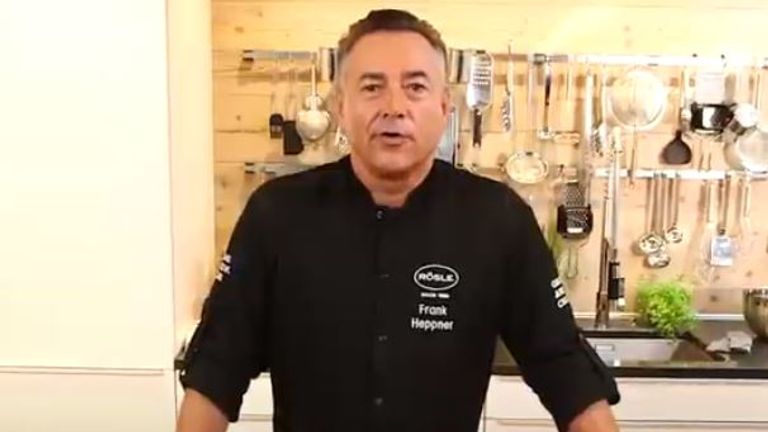
The local press reports that a celebrity chef is one of the individuals detained in connection with an alleged plot by a far-right terrorist organization to topple the German government.
According to reports, 62-year-old Frank Heppner, the father of Real Madrid star David Alaba’s girlfriend, was detained in Kitzbuhel, an Austrian ski resort where he owns a restaurant.
The largest-ever nationwide police operation against right-wing extremism was sparked by the unsuccessful Reichsburger coup attempt, also known as the Reich Citizens movement.
Image: German celebrity chef Frank Heppner. Pic: YouTube
The raids took place in 11 of the country’s 16 states last week, with 3,000 armed police storming up to 100 properties across Baden-Wuerttemberg, Bavaria, Berlin, Hesse, Lower Saxony, and Thuringia, as well as in Kitzbuhel and the Italian city of Perugia.
The plotters allegedly wanted to install Heinrich XIII Prince Reuss, a 71-year-old businessman, as the head of a new government. He was among those arrested.
Heppner’s role, should the alleged coup have been successful, would have been to “take over the canteens of the new German Reich” and supply their troops, according to Austria’s Die Presse.
A specialist in Euro-Asian cuisine, Heppner has previously worked in five-star hotels all over the world.
Image:David Alaba and Shalimar Heppner at FC Bayern Munich Christmas party in 2018
His daughter, Shalimar Heppner, 28, has a son with Real Madrid’s Alaba. Sky News has contacted him for comment.
Twenty-three suspected members and supporters of the group have been arrested according to German authorities.
Prosecutors said 22 German citizens, and one Russian woman were detained during the raids. They said the extradition of two other people detained in Italy and Austria.
The Reichsburger movement brings together several far-right groups whose aim is to get rid of the current government and replace it with their own.
According to the authorities, members of the Reichsburger group have been preparing to “carry out actions based on their ideology” since November 2021.
Following the raids, German interior minister Nancy Faese said the raids showed the country “fighting back against the enemies of democracy”.
The case has put a spotlight once more on the far-right Alternative for Germany party. A female judge – identified by prosecutors as Birgit M-W – who is understood to have links with the party was also detained during the raids.
Known by its German acronym AfD, the party has increasingly come under scrutiny by German security services due to its ties with extremists.
An oath of fealty to the monarch is no longer required of legislators in the Canadian province of Quebec, thanks to a new law.
Three parliamentarians refused to take the oath of allegiance after King Charles III’s coronation, which led to the introduction of the measure.
The federal parliament of Canada overwhelmingly rejected cutting ties with the Crown in October.
In Canada, Quebec is the province that favors constitutional monarchy abolition the most.
The bill was introduced on Tuesday by Premier Francois Legault.
In October, after the province had an election,14 politicians refused to swear the oath. After being told they could not sit in the legislature without doing so, 11 of them backed down.
But three hold-outs did not, and have been barred from the National Assembly since late November, waiting for Mr Legault to bring forward the bill. It was fast-tracked once all parties in the legislature agreed to waive consultation.
In Quebec, members of the legislature had to swear two oaths, to both the people of Quebec and the Crown, and the latter has long been controversial.
The new provincial law amends the Canadian Constitution Act of 1867, to add a section exempting Quebec from the Oath of Allegiance to the King. That allegiance has been a requirement for all members of provincial legislatures across Canada.
“It is, I think, a relic from the past,” Gabriel Nadeau-Dubois, a co-spokesperson for the Quebec solidaire party, said in early December about the oath to King Charles.
“I think there is strong support in Quebec to modernize our institutions, to make sure that the representatives of the people are not forced in 2022 to swear an oath to a foreign king.”
Constitutional scholar Philippe Lagasse told the BBC in an email that Quebec did not have the authority to amend the constitution by an act of legislation alone.
He said a change like this would either need the support of seven provinces that had, on aggregate, more than 50% of the population of Canada, or the federal parliament would have to agree with Quebec to allow the change in Quebec alone.
Prime Minister Justin Trudeau could challenge this new law in court, or a private citizen could be given standing by the court to bring forth a challenge.
In Canada, the monarch – now King Charles – is the head of state. The monarchy serves a mainly symbolic role, with the power to govern entrusted to the Canadian government.
Opinion polls suggest Canada as a whole remains divided on the monarchy. In an Ipsos survey conducted following the death of Queen Elizabeth II, half of the Canadian respondents – around 54% – said their country should sever its ties with the Crown.
That sentiment is strongest in Quebec, where 79% agreed.
While covering the World Cup in Qatar, a well-known football journalist from the United States passed away.
As extra time in the Friday night match between Argentina and the Netherlands began, Grant Wahl, 48, passed out.
Although it hasn’t been officially confirmed, initial reports indicate he may have suffered a heart attack.
When Mr. Wahl attempted to enter a stadium last month while wearing a rainbow-colored shirt in support of LGBT rights, Qatari authorities temporarily held him.
In a statement, the US Soccer Federation said it was “heartbroken” by the news.
“Fans of soccer and journalism of the highest quality knew we could always count on Grant to deliver insightful and entertaining stories about our game, and its major protagonists,” it said.
In a tweet, Mr Wahl’s wife, Céline Gounder, said she was in “complete shock”, adding that she was “so thankful” for the support she had received from friends.
Mr Wahl celebrated his 48th birthday on Thursday with friends in Qatar, a day before he collapsed. He wrote on his website on Monday that he had been unwell in the last 10 days and was on a course of antibiotics for suspected bronchitis.
“My body finally broke down on me,” he wrote. “What had been a cold over the last 10 days turned into something more severe on the night of the USA-Netherlands game, and I could feel my upper chest take on a new level of pressure and discomfort.
“I didn’t have Covid (I test regularly here), but I went into the medical clinic and the main media center today, and they said I probably have bronchitis.”
FIFA President Gianni Infantino said Mr Wahl’s love for football was “immense”, adding that his reporting would be “missed by all who follow the global game”.
Tributes have poured in from several UK journalists. Piers Morgan described Mr Wahl as a “brilliant journalist”, while the Times’ Henry Winter said he was a “fine man” and “giant of the press box”.
BBC Sport’s Dan Roan tweeted: “Grant Wahl was a renowned and hugely respected journalist and the flood of tributes is a testament to the esteem in which he was held.”
Major League Soccer commissioner Don Garber tweeted:“We are shocked, saddened, and heartbroken over the tragic passing of Grant Wahl. He was a kind and caring person whose passion for soccer and dedication to journalism were immeasurable.”
US tennis icon Billie Jean King also paid tribute to Mr Wahl, describing him as an “advocate for the LGBTQ community and a prominent voice for women’s soccer”.
A spokesperson for the Qatari body responsible for planning the World Cup, the Supreme Committee for Delivery & Legacy, said: “We are deeply saddened by the death of the US journalist Grant Wahl.
“Grant was known for his enormous love of football and was in Qatar to cover his eighth Fifa World Cup.
“He fell ill in the Lusail Stadium media tribune, during last night’s quarter-final match between Argentina v Netherlands. He received immediate emergency medical treatment on site, which continued as he was transferred by ambulance to Hamad General Hospital.
“We are in touch with the US Embassy and relevant local authorities to ensure the process of repatriating the body is in accordance with the family’s wishes.”
Earlier this week, Mr Wahl was presented with an award by Brazilian football legend Ronaldo for reporting on eight consecutive World Cups – his first was in the US in 1994.
In order to make up for his involvement in George Floyd’s murder, a formerMinneapolis police officer who knelt on Mr. Floyd’s back received a three-and-a-half year prison term.
In October, J Alexander Kueng entered a guilty plea to a state charge of second-degree manslaughter aiding and abetting.
In the 46-year-arrest, old’s which was seen on camera by onlookers, he was one of four officers involved.
Mr Floyd was killed by police in May 2020 while lying prone and handcuffed.
His death sparked global outrage and a wave of demonstrations against racial injustice and police use of force.
Kueng will serve his new sentence for state charges concurrently with a previous federal sentence for violating Mr Floyd’s civil rights.
In April 2021, former police officer Derek Chauvin was convicted on state murder and manslaughter charges for kneeling on Mr Floyd’s neck for more than nine minutes and sentenced to 22-and-a-half years in jail. He is serving that sentence concurrently with a 20-year sentence on federal civil rights charges, for which he pleaded guilty in December 2021.
In February, Kueng, along with two other responding officers, Thomas Lane and Tou Thao, were also found guilty on federal civil rights charges. The officers were charged with showing “deliberate indifference to [Mr Floyd’s] serious medical needs” during the attempted arrest.
Video footage of the arrest shows Kueng and Lane assisting Chauvin by helping to hold Mr Floyd down. Thao, meanwhile, kept concerned bystanders away. Chauvin was a field training officer to both Lane and Kueng.
As well as Chauvin, the other officers involved were given sentences of varying lengths for the federal charges:
J Alexander Kueng was given a 36-month sentence for failing to intervene
Tou Thao was sentenced to 42-months in prison. The state case against him is still pending.
Thomas Lane is serving a two-and-a-half year sentence concurrently with a three-year state sentence for second-degree manslaughter.
Speaking in court ahead of the sentencing, prosecutor Matthew Frank said that Kueng “was not simply a bystander in what happened that day”, but instead played an “active part”.
While Kueng declined to address the court directly, his defence attorney, Thomas Plunkett, argued that city and police officials had “failed” Mr Floyd, Kueng and the community alike.
Attorneys representing George Floyd’s family said that the sentencing represented “yet another piece of justice for the Floyd family”.
“While the family faces yet another holiday season without George, we hope that moments like these continue to bring them a measure of peace, knowing thatGeorge’s death was not in vain,” they added.
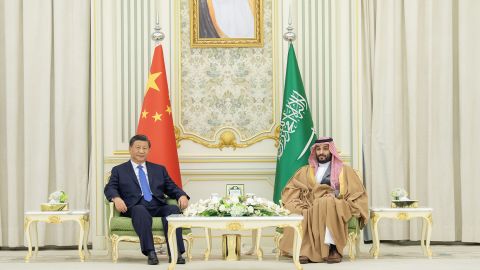
Saudi Crown Prince Mohammed bin Salman welcomed Chinese President Xi Jinpingwith a glamorous reception in Riyadh on Thursday, as the two countries make preparations for a series of summits that will mark an “epoch-making milestone” in Chinese-Arab relations.
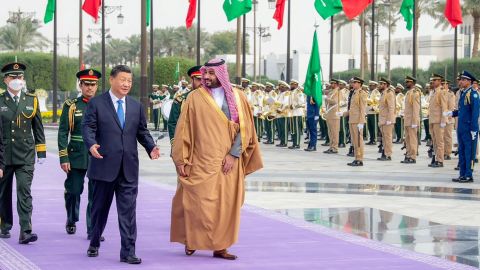
Saudi state television broadcast a grand ceremony in which bin Salman, the kingdom’s de facto ruler known as MBS, received the Chinese leader at Al-Yamamah Palace. The premises were adorned with Chinese and Saudi Arabian flags, and members of the Saudi Royal Guard lined up with swords and played music.
In contrast to US President Joe Biden’s visit to Saudi Arabia earlier this year, the two leaders smiled warmly and posed for photos.
Shortly afterwards, China and Saudi Arabia signed a comprehensive strategic partnership agreement that includes a number of deals and memoranda of understanding, including on hydrogen energy, on coordination between the kingdom’s Vision 2030 and China’s Belt and Road Initiative, and with regards to direct investment, reported the official Saudi Press Agency (SPA), without providing details.
Xi landed in the capital Riyadh on Wednesday, where he was received by Saudi Prince Faisal bin Bandar bin Abdulaziz, Governor of Riyadh Region, and Prince Faisal bin Farhan bin Abdullah, Minister of Foreign Affairs. Saudi military jets accompanied the Chinese president’s aircraft, a purple carpet was rolled out upon his arrival and canons were fired.
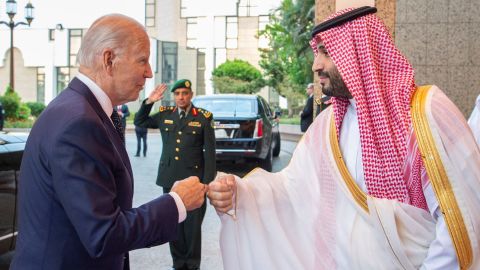
US President Joe Biden’s welcome is widely perceived to have been less glamorous. The American president was received in July by the governor of Mecca and the Saudi ambassador to the US in the Red Sea port city of Jeddah. Biden met MBS in Jeddah, where they exchanged a fist-bump that made global headlines and defined what ultimately became a frigid visit.
The official welcoming ceremony for the Chinese president at the Palace of Yamamah in Riyadh on Thursday. Royal Court of Saudi Arabia/Anadolu Agency/Getty Images
Bin Salman welcomes the Chinese leader to Riyadh. Saudi Press Agency/Reuters
Saudi and Chinese state media have this week been keen to promote the close ties shared by their governments. Saudi state TV replayed clips of past meetings between Chinese and Saudi officials, narrating the two countries’ warm relationship, which they say spans more than eight decades.
In a signed article published Thursday in the Saudi newspaper Al Riyadh, Xi said that his visit to the kingdom this week “will usher in a new era in China’s relations with the Arab world, with Arab states of the Gulf and with Saudi Arabia.”
“The Arab world is an important member of the developing world and a key force for upholding international fairness and justice,” Xi wrote, adding that “the Arab people value independence, oppose external interference, stand up to power politics and high-handedness, and always seek to make progress.”
Saudi Crown Prince Mohammed bin Salman fist bumps US President Joe Biden upon his arrival at Al Salman Palace, in Jeddah in July. Bandar Algaloud/Courtesy of Saudi Royal Court/Handout/Reuters
In the article titled “Carrying Forward Our Millenia-old Friendship and Jointly Creating a Better Future,” Xi said that China and Arab states will “continue to hold high the banner of non-interference in internal affairs, firmly support each other in safeguarding sovereignty and territorial integrity, and jointly uphold international fairness and justice,” in a nod to US diplomacy, whose ties with the Saudis have crumbled over OPEC’s decision to slash crude oil supply.
Saudi Arabia’s energy minister also stressed that Saudi-Chinese relations are “witnessing a qualitative leap” and that the kingdom “will remain China’s credible and reliable partner” with regards to oil, SPA reported.
The Chinese foreign ministry said Wednesday that the China-Arab States Summit “will be an epoch-making milestone in the history of China-Arab relations,” and that “President Xi’s state visit to Saudi Arabia will elevate the China-Saudi Arabia comprehensive strategic partnership to a new height.”
On Wednesday, Saudi and Chinese companies signed 34 investment deals covering several sectors, reported SPA, including in the fields of green energy, information technology, cloud services, transportation, logistics, medical industries, housing and construction.
No monetary value was announced for the deals, but SPA previously reported that the two countries are expected to sign deals worth more than $29 billion during this week’s visit.
Xi’s visit to Saudi Arabia comes amid frayed ties between the two countries and Washington, which harbors a number of grievances towards the two states over oil production, human rights and other issues.
While China and Saudi Arabia’s friendship has blossomed over the decades, they seem to have become closer as both find themselves in precarious positions in regard to the US.
The White House said it was “not a surprise” that Xi is traveling around the world and to the Middle East. “We’re mindful of the influence that China is trying to grow around the world,” said John Kirby, the strategic communications coordinator at the US National Security Council.
After hosting seven matches in two weeks at Qatar 2022, Stadium 974 – the World Cup’s first temporary stadium and the country’s “beacon of sustainability” is set to be pulled down.
Named after Qatar’s international dialling code and the number of shipping containers used in its construction, Stadium 974 was one of seven grounds built for the tournament, while an eighth was extensively redeveloped.
The infrastructure of Stadium 974 can be repurposed for another World Cup or major sporting tournament with similar size or several smaller facilities.
The 44,089-capacity Stadium 974 which sits on Doha’s stunning waterfront presents an array of multicoloured shipping containers and linked steel frames that can be seen from outside the stadium. It contains toilet facilities, tea kiosks and food stands.
Qatar’s intent derives from its pledge to deliver the first carbon-neutral World Cup. Apart from the seven new stadiums, Qatar has a new airport, metro system, roads and about 100 new hotels. Many have thrown flacks at the government over concerns about the mistreatment of thousands of migrant workers who built the infrastructure.
Because it was the only stadium built for the World Cup without air conditioning, it hosted only evening matches, culminating in Brazil’s last-16 victory over South Korea on December 5.
Deploying shipping containers and recycled steel helped reduce waste generated and construction time compared to the other new venues.
The designers Fenwick Iribarren Architects and the Qatari government said they aimed to avoid building a “white elephant”. It wasn’t meant to be a facility rarely used after a tournament, as has proven the case following the three previous World Cups in Russia, Brazil and South Africa.
A report into Stadium 974 commissioned by FIFA and delivered by emission reduction experts pointed out that reusing existing dismountable structures could be widely replicated. It allows stadiums to be assembled in more central and “easily accessible” locations, thereby reducing “intra-city fan travel” during competitions.
There are indications that the dismantled Qatar stadium will be shipped to Uruguay, where it could host the 2030 World Cup.
Suella Braverman, the home secretary, has urged people to reconsider travelling during the Christmas seasonas Border Force employees join a number of other groups in discussing industrial action over pay and conditions.
The home secretary has advised people to “think carefully” before booking a trip over the Christmas holiday after Border Force employees became the latest to announce they would go on strike.
Suella Braverman warned of “undeniable, serious disruption for the many thousands who have holiday plans” and urged people to reconsider travelling during the holiday season.
“I really want to urge people who have got plans to travel abroad to think carefully about their plans because they may well be impacted,” she said.
“Ultimately, I’m not willing to compromise on security at the border – that’s the number one priority.
“So that may well have an adverse impact on convenience for people, frankly, whether it’s the time that they may have to wait for flights or departures.
“They may well be delayed on arrivals and various travel plans.
“Ultimately, security at the border is my number one non-negotiable priority.”
Border Force strikes will take place between 23-26 December, and from 28 to 31 December, impacting Birmingham, Cardiff, Gatwick, Glasgow, Heathrow and Manchester airports, as well as the Port of Newhaven.
Manchester Airport has warned some cancellations are likely, while long queues at immigration are expected.
Downing Street has said anyone due to fly over the Christmas period should check with their airline for the latest information “because sadly there will be disruption”.
A spokesperson added that they were “not aware of any plans” to reduce border checks, saying: “Public safety is paramount.”
The Border Force walkouts join a raft of strikes that are set to hit festive travel, with industrial action organised by train, bus and road workers in the run up to Christmas and throughout the holiday season.
Ministers ‘have torpedoed’ strike talks
The warning from the home secretary comes as the boss of the rail union accused the government of “sabotaging” negotiations aimed at stopping the disruption.
Mick Lynch, the general secretary of the RMT, told Sky News that ministers have “torpedoed” talks between train operating companies and workers taking industrial action over pay and conditions.
Image: RMT general secretary, Mick Lynch
Mr Lynch said that after months of negotiations, rail companies had put together a document and a set of pay scales they wanted the RMT to consider “and we would have done that”.
“But at the last moment, including last night around about six o’clock, the government decided that they would not allow the railway companies to make that offer and instead instructed them to prepare for the strike,” he said.
“In fact, they sabotaged and sunk the negotiations just as they were reaching the point of conclusion,” he said.
He accused Transport Secretary Mark Harper of “obstructing talks” and also pointed the finger at Business Secretary Grant Shapps, as well as the Treasury.
“I meet with the most senior people on the railway and I’m on the phone to them constantly. They are telling me they’ve got a document ready to go.
“They’ve shown it to me and they’ve shown it to my negotiators and the government has stopped them putting that document forward.”
Mr Lynch said “somebody” in government has put driver-only operation back on the table and into the documents when “they know we can never accept that as a principle”.
Mr Harper was asked about this during an appearance in front of the Transport Select Committee on Wednesday and did not explicitly deny that this is what happened.
It means a series of rail strikes are set to go ahead on the 13, 14, 16 and 17 December, and from 6pm on Christmas Eve to 6am on 27 December, as well as on 3, 4, 6 and 7 January
Christmas strikes ‘really disappointing’
The picket lines are not limited to transport, with teachers, nurses and ambulance workers among others from the public sector taking action over pay and conditions.
The government has been criticised for failing to stop the strikes, with union bosses accusing ministers of stonewalling requests for meaningful pay talks.
Gillian Keegan, the education secretary, told Sky News that the strikes were “disappointing” but giving in to the union’s demands would cost the taxpayer £28bn and “you can’t spend your way out of inflation”.
She said “we do expect there will be disruption and delays” but 2,000 soldiers would be drafted in to help with Border Force roles and “we should be extremely grateful to them”.
With only one day left in December when there are no strikes – the 12th – it was put to the cabinet minister that general strikes bring down governments, as seen in the 1970s.
Ms Keegan said: “Well, I mean, that has happened in history for sure.”
However, she insisted the government was taking a “sensible and balanced” approach by not interfering in the pay negotiations, saying the disputes were between “unions and the paymasters”.
Government ‘failing to get a grip’
Unions are demanding pay rises above or in line with inflation as the UK is gripped by a recession and the cost of living rises.
Labour’s shadow chief secretary to the Treasury, Pat McFadden told Sky News the government is “failing to get a grip” on the strikes, adding: “Even when we don’t have strikes, public services are not working properly, I can scarcely think of a public service in this country that works better after 12 years of Conservative government than what before they came into office.
“That is a damning indictment of their period of stewardship.”
Prime Minister Rishi Sunak has promised “tough” new laws to limit the impact of strike action, and has not ruled out banning strikes in the emergency services.
Government ‘working at speed’ on strike legislation
Downing Street said the government is “working at speed” to bring in new legislation, though a spokesman on Thursday stressed that nothing has been confirmed.
Any new measures will put them on a collision course with unions, who say the mooted proposals are anti-worker.
Sharon Graham, general secretary of the Unite union, told the PM on Wednesday “we are ready industrially and financially” to challenge any new measures.
In a joint letter to Chancellor Jeremy Hunt, union heads accused ministers of “ignoring the main issue on the table” that is causing the strikes – public sector pay.
Highlighting “huge” pay cuts public sector workers have suffered, the union leaders warned: “With CPI inflation over 11% and RPI inflation above 14%, frontline workers are facing another massive real-terms hit to their wages.
“Nurses, ambulance staff, teachers and millions of other key workers have already seen their living standards decimated with over a decade of pay cuts and wage freezes.
“Nurses today are earning £5,000 a year less in real terms than they were in 2010 and hospitals and schools are having to set up food banks for staff. This cannot go on.”
The Second Niger Bridge will only be accessible to drivers from December15, 2022, to January 15, 2023, according to the Nigerian government.
This information was provided by Babatunde Fashola (SAN), minister of works and housing, during a Thursday press conference in Abuja.
The minister believes that the move is being made by the Nigerian government to relieve pressure on the bridge, which is currently being used for Christmas celebrations.
He asserted that although the bridge’s building was complete, there was still work to be done to connect it to the main road.
Fashola said, “We have completed work on the bridge, so if you go there now you can walk from one end of the bridge to the other or drive from one end of the bridge to the other but the connecting road that links that bridge to the main highway, is what we want to finish.
“What delayed us is rain and the stop work orders on Mondays in that part of the country.
“The President approved that since the bridge is finished that we should create a access road so that during Christmas you can begin to experience what it would feel like plying the bridge.
“It would be open for traffic going from the West to the East from the 15th December, 2022 to 15th January 2023.
“Let me be clear again: we haven’t finished construction work but we would open it for people to use to relive the pressure from the one bridge, it wouldn’t be available for heavy duty trucks, it would only be small vehicles for now until we finish our work.
“On the 15th January we would reverse that movement for those coming from the east to the west. We have told all the contractors that they shouldn’t open anymore sections for construction i.e. there shouldn’t be any barrier on the roads this season.”
In anticipation of the February 25, 2023 presidential elections, Chatham House, a significant policy institute and think-tank forum, has invited Peter Obi of the Labour Party (LP) to speak about his ideas for Nigerians.
Obi, a former governor of Anambra State, is anticipated to attend the event in London, United Kingdom, on January 16, 2023. This gathering and its associated products are just one of many that focus on the 2023 elections in Nigeria.
On December 5, 2022, Bola Tinubu, an All Progressives Congress (APC) rival of Obi’s, gave a speech at Chatham House in London where he discussed some of his ideas for crucial areas like technology, education, the military, and the economy.
Bola Ahmed Tinubu
As part of the event, which drew harsh criticism, Tinubu also assigned some of his loyalists, including governors and MPs now in office, to respond to questions from attendees.
Obi, Tinubu and Atiku Abubakar of the Peoples Democratic Party (PDP) are the leading candidates in the 2023 presidential race.
One woman is running for president of Nigeria out of the 18 candidates, but experts says she has no chance of winning, and neither do the other 13 contestants.
According to the majority of analysts, only four candidates; Bola Tinubu of the All Progressives Congress (APC), Atiku Abubakar of the main opposition People’s Democratic Party (PDP), Peter Obi of the Labour Party (LP), and Rabiu Musa Kwankwaso of the New Nigeria People’s Party (NNPP), have a chance of winning or influencing the outcome of the presidential election in February 2019.
Peter Obi is the youngest of the four at 61 years old, despite the call for leaders from a younger age. They are all familiar with one another and with Nigerian politics.
The Independent Corrupt Practicesand Other Related Offences Commission (ICPC) has released well-known Nigerian musician Daniel Oladapo, also known as D’Banj.
D’banj’s lawyer, Pelumi Olajengbesi announced the development on Friday, adding that the musician was released on self-recognition. The ICPC released Dbanj on grounds that he may be summoned later for further investigations.
Olajengbesi said the ICPC didn’t trace any evidence of fraudulent activity to D’banj. That claim could however not be independently verified at this time.
“Nothing incriminating was found on him. He was released on self-recognition. Right now, we expect the ICPC to give a letter of clearance to Dbanj because, as we have always said, he is innocent of the charges brought against him,” the lawyer explained.
Investigations show that two Nigerian banks have submitted detailed financial statements to the anti-graft agency in relation to the matter.
In an operation off the coast of Sierra Leone, a Brazilian vesselcarrying more than 4.6 tonnes of cocaine worth over $157.4 million was seized.
According to Europol, the ship was seized by a French Navy helicopter carrier on November 30, 2022, about 400 miles off the coast of Sierra Leone.
The NCA, US Drug Enforcement Agency, and Brazilian Federal Police collaborated to uncover and battle criminal networks involved in cocaine trafficking between Brazil, Africa, and Europe. This collaboration resulted in the operation.
According to EUROPOL, the 21-metre-long Brazilian ship where the drugs were found was sailing toward Europe when it was intercepted.
“An investigation is underway to identify the criminal groups involved on either side of the Atlantic Ocean,” Europol said in a statement.
The National Crime Agency reported that the crew, who were all citizens of Brazil, were detained and the cocaine was destroyed. Drug smugglers and sellers have recently traveled often along Sierra Leone’s coast.
At Freetown’s Queen Elizabeth II Port in July of this year, the Sierra Leone Police allegedly found a 40-foot container with cocaine inside. According to reports, the container was sent from the UK to Sierra Leone.
When a ship using the flag of Sierra Leonewas stopped in Guinean waters carrying almost three tons of cocaine, authorities there held the ship. Recently, many ships were stopped in the waters off Sierra Leone for engaging in unlawful activities.
In a statement, Vodacom of South Africareported that DRC authorities had closed the offices and seized the local branch’s accounts as a result of a tax dispute.
In a statement dated Dec. 8, Vodacom stated: “On December 6 and 7, 2022, agents of the General Directorate of Taxes (DGI) presented themselves at our technical, commercial, and administrative offices and proceeded with the installation of seals.”
According to the statement, the disagreement relates to a tax audit that the DGI conducted for the years 2016 through 2019 that resulted in a $243 million adjustment in July 2021. The amount was subsequently reduced.
Vodacom claimed last month that it had challenged the ruling and appealed it, but the DGI had already begun taking action to forcibly
CEO of VodacomShameel Joosub
It was impossible to immediately reach Congolese authorities for comment. All of Congo’s phone providers have been at odds with the country’s attempts to collect additional taxes without enabling them to raise consumer pricing.
In March, the government enacted a new levy that assesses fees for each megabyte of data, text message, and phone call.
The tax took the place of another levy that had been eliminated a month earlier following protests from the public and a legislative inquiry into the use of the money.
According to Vodacom, steps had been taken to assure the community of it’s services , and every available legal option was being used.
As James Cleverly approved the most sanctions the UKhas ever combined in one package, Foreign Secretary James Cleverly stated that the UK has a responsibility to “promote free and open societies.”
New sanctions have been imposed by the UK on 30 people and organisations that it deemed to be “corrupt political figures, human rights violators, and perpetrators of conflict-related sexual violence.”
People involved in the mobilisation of troops to rape civilians and the torturing of prisoners are included in the sanctions.
The number of individuals sanctioned from 11 nations—including Russia, Iran, Myanmar, and South Sudan—is the highest number the UK has ever gathered in a single package.
In order to commemorate International Anti-Corruption Day and Global Human Rights Day, the government claimed that the sanctions were planned with international partners.
approved the most sanctions the UK has ever combined in one package, James Cleverly stated that the UK has a responsibility to “promote free and open societies.”
New sanctions have been imposed by the UK on 30 people and organisations that it deemed to be “corrupt political figures, human rights violators, and perpetrators of conflict-related sexual violence.”
People involved in the mobilisation of troops to rape civilians and the torturing of prisoners are included in the sanctions.
The number of individuals sanctioned from 11 nations—including Russia, Iran, Myanmar, and South Sudan—is the highest number the UK has ever gathered in a single package.
In order to commemorate International Anti-Corruption Day and Global Human Rights Day, the government claimed that the sanctions were planned with international partners.
“It is our duty to promote free and open societies around the world,” Foreign Secretary James Cleverly said.
As part of the package, eight individuals involved in serious human rights abuses and violations have been designated under the Global Human Rights regime, which allows the UK to stop them from entering the country, channelling money through UK banks or profiting from the British economy.
Geographical sanctions have been placed on Iran and Russia, while five “corrupt actors” from Serbia, Moldova and Kosovo have been placed on the list.
The UK has now sanctioned more than 1,200 individuals in Russia, including members of the military. Russian President Vladimir Putin and his foreign minister Sergey Lavrov were sanctioned in February when Russia invaded Ukraine.
All sanctioned individuals will have their assets frozen and a travel ban imposed, while entities are subject to asset freeze.
Image:More than 1,200 Russians have now been sanctioned by the UK, including Vladimir Putin
Those included in the latest wave of sanctions are:
• Ten Iranian officials connected to Iran’s judicial and prison systems, including former directors of Evin Prison where Nazanin Zaghari-Ratcliffe was held, and those responsible for handing out death penalties to protesters
• Russian Colonel Ibatullin, commander of the 90th Tank Division, who has been on the front line of the Ukraine invasion
• Two county commissioners in South Sudan who mobilised troops to rape civilians during conflicts earlier this year
• Mali’s Katiba Macina group, also known as the Macina Liberation Front, who are known for sexual violence, including forced marriages
• Divisions of the Myanmar armed forces for sexual violence and Myanmar’s office of the chief of military and security affairs following reports of torture, rape and sexual violence
• Muslim cleric Mian Abdul Haq for forced conversions and marriages of girls and women from religious minorities in Pakistan
• Uganda’s former inspector general of police, general Kale Kayihura, for overseeing human rights violations, including torture
• The mayor and deputy mayor of Matagalpa in Nicaragua for promoting and supporting grievous human rights violations
• Russian federal security service member in Crimea, Andrey Tishenin, and Artur Shambazov, a senior detective in Crimea, for torturing Ukrainian activist Oleksandr Kostenko in 2015
• Russian Federation major of justice Valentin Oparin and Oleg Tkachenko, head of public prosecutions in Rostov forobstructing complaints of torture and using torture to extract testimony.
Haiti’s UN humanitarian coordinator has revealed that , cholera has already claimed the lives of 283 people in the Caribbean country and more than 14,000 suspected cases have been reported. Due to the insecurity, about 155,000 people have been internally displaced.
As nearly 20,000 people in Port-au-Prince experience “catastrophic famine-like conditions” due to a cholera outbreak, gangs who control nearly 60% of the city’s population are tearing apart society, a senior UN official has warned.
Ulrika Richardson, the nation’s UN humanitarian coordinator, said at a news conference that the gangs are using “terrifying levels” of sexual violence “as a weapon” to control populations, instil fear, and punish them.
The fight for territory has “a human cost” and what people are facing on an everyday basis is “enormous”, she added, warning that if the issue is not addressed now, it will be “very difficult in terms of social cohesion and reconciliation”.
She said all but 1,000 of the 20,000 Haitians facing starvation are in the capital, Port-au-Prince, mainly in the Cite Soleil slum controlled by the gangs.
Image: A woman with her daughter who is stricken with cholera at a clinic in Port-au-Prince. Pic: AP
This comes as the cholera outbreak in the Caribbean nation “continues to be a worry”.
The illness has caused at least 283 deaths so far and close to 12,000 people have been treated in hospital since 2 October.
There are more than 14,000 suspected cases throughout the country, and infections have been confirmed in eight of Haiti’s 10 regions.
An emergency appeal aimed at raising more than $145m (£118m) to contain the spread of cholera in the nation was launched in November. Around $23.5m (£19.2m) has been donated so far, said Ms Richardson.
Image:Rose Delpe cries as people are displaced by gang war violence in Haiti
‘Massive displacement’
Political instability has simmered since the unsolved assassination last year of President Jovenal Moise, who had faced protests calling for his resignation over corruption charges.
Insecurity in the country has led to the “massive” internal displacement of 155,000 people fleeing their homes – a 77% increase since August.
Many are the “most vulnerable”, such as women and families, who are in temporary sites or being hosted in communities.
Image: Ulrika Richardson
Ms Richardson said they are working with institutions to figure out how to address the issue since those hosting the displaced have “meagre” resources.
School closures have affected around four million children, many of whom have not received proper education since the start of the COVID-19 pandemic, according to the humanitarian chief.
In a more positive development, more than half of schools have now opened, said Ms Richardson. Although, there is “disparity” in that most of them are in the south.
“We have logistical challenges, you can imagine, and the security challenge, but we are able to be present and we are able to help people,” she said.
“We are obviously focusing on the most vulnerable, but we also try not to lose focus on the real structural root causes.
“So, we have corruption, we have impunity, we have governance, and all of that needs to really be at the centre also of our thinking as we go forward.”
Liz Truss resigned after just 44 days as a result of the Tory MP’s mini-budget statement,which caused one of the most turbulent economic periods in modern history.
Former chancellor Kwasi Kwarteng has accepted that he and Liz Truss “blew it” by instituting extensive economic reforms and “got carried away.”
The Conservative MP called their low-tax, small-state plans “very exciting” and said he fully supported them, but he also acknowledged that the way they were carried out was their downfall.
The markets crashed after Mr. Kwarteng announced his “mini” budget just 17 days after Ms. Truss appointed him chancellor, forcing him to resign before Ms. Truss was also forced to resign.
“It was very exciting, you felt you were part of a project,” he told the FT Weekend Magazine.
As soon as she became PM, Ms Truss said she did not want any opinion polling as she felt politicians were obsessed with “optics”.
Despite advisers warning her and Mr Kwarteng that their plans would be seen as a “budget for the rich”, they were ignored.
Mr Kwarteng added: “People got carried away, myself included. There was no tactical subtlety whatsoever.”
He still believes the goal was correct but admitted: “Where we fell woefully short was to have a tactical plan.”
As the economic turmoil continued, despite the government U-turning on some of the recently announced policies, Mr Kwarteng went to IMF meetings in Washington as he did not want to cause more panic by not attending.
But he was called back early after, he and his allies believe, Cabinet Secretary Simon Case managed to persuade Ms Truss she had to reverse some of the measures to avoid economic ruin.
When Ms Truss told him he could no longer be chancellor on 14 October, he says he told her: “I know, I’ve seen it on Twitter.”
Mr Kwarteng said he warned her he was a “firebreak” and getting rid of him would “make her weaker, not stronger”.
“She said she was doing this to save her premiership,” he told the FT.
Last month, Mr Kwarteng said he and Ms Truss are still “friends”.
The massive fire in Khimki, which is close to the Russian capital of Moscow, destroyed the entire shopping centre.
One of the biggest shopping malls in Moscow was completely destroyed by a massive fire that claimed at least one life.
According to authorities, the fire broke out in the Mega shopping centre in Khimki, northwest of the Russian capital, and covered an area of about 7,000 square metres.
Firefighters’ attempts to put out the flames were hampered because the fire caused part of the building to collapse.
It broke out before the centre opened to customers.
Russia’s Investigative Committee, which probes major crimes, said it was looking into the cause of the fire.
Officials initially said arson may have been involved.
But, authorities later said the blaze appeared to have been sparked by welding that apparently violated safety regulations, with a probe launched.
The shopping centre used to house a number of Western shops, including IKEA, before the chains pulled out of Russia in the wake of the Ukraine conflict.
The frigid weather will last until the following week. While this is going on, weather experts are predicting that snow could fall in the South East of Englandon Sunday night and into Monday morning.
Parts of southern England could experience snowfall in the coming days as forecasters warn that the Arctic blast will last into next week and cause temperatures to drop as low as -15C.
A yellow snow and ice warning has been issued by the Met Office for London and the South East from 9 a.m. on Sunday to 9 a.m. on Monday, stating that two to five centimetres of snow, and even up to 10 cm in some areas, may fall during that time.
“Snow may push in across parts of east and southeast England, leading to a risk of travel disruption especially on Monday morning,” it said.
Image:Met Office warnings for Sunday
Spokesman Grahame Madge said: “The outlook for the UK remains cold at least for the next seven days, with the potential for this to continue even longer.”
Temperatures dropped as low as -9C (15F) in Benson, South Oxfordshire, overnight, and Sky News weather producer Joanna Robinson said -15C could possibly be reached in Scotland where there is snowfall and clear skies over the coming week.
The Met Office had already issued several yellow weather warnings for snow and ice which are in place for parts of Scotland, Northern Ireland, Wales and South West England.
In addition, the UK Health Security Agency has issued a level three cold weather alert covering England until Monday – and says vulnerable people should heat their homes to at least 18C, wear extra layers of clothing, and eat hot food to protect themselves.
As parts of the UK are hit by freezing conditions, those on the lowest incomes in England and Wales will receive a £25 cold weather payment.
The winter payments are triggered for eligible households where the average temperature has been or is forecast to be 0C or below over a period of seven consecutive days.
Robinson said further wintry showers into next week will bring icy stretches, with conditions reaching well below freezing.
Image:Consett, County Durham, on Friday
She said: “The Arctic air is across us now, bringing wintry hazards that could last for most of next week, but there will be plenty of sunshine.
“Like recently, temperatures will widely drop below freezing at night, reaching -4C to -8C under clear skies, and -10C is likely in some prone cold spots.
“And it’s staying cold in the day, with temperatures generally 2C to 4C, but freezing in some places.
“Disruptive freezing fog is looking increasingly likely over the weekend, especially in the south.”
Image:Castleside Viaduct in Durham on Friday
Image:A van in the snow in Castleside, Durham
The Met Office has extended a yellow weather warning for snow and ice in northern Scotland until 12pm on Sunday.
It warned some disruption is likely due to icy surfaces in coastal and northern England and parts of Wales and Northern Ireland where yellow warnings for ice have been issued for Friday.
The icy conditions in coastal England and parts of Northern Ireland and Wales are expected to continue into Saturday.
The forecaster’s meteorologist Alex Deakin said earlier this week there was a potential for “significant” snow in parts of England and Wales in a predicted weather model for next week, which shows a low pressure system heading towards the UK.
He added: “The weather patterns don’t shift too much by the time we get to Monday, we’ve still got the cold air in place, cold weather fronts around, some freezing fog and some ice as well.”
The government is considering tough new laws amid the winter’s strikes, according to Rishi Sunak.
The legislation, which unions claim is anti-worker, is anticipated to include a ban on strikes from all blue light services and minimum service levels for public services.
Mr Sunak said: “I’m not going to get into details now, we’re looking at all options.
“But what I can say is my priority is to always be reasonable – and that’s what we’re going to continue to do – but also to make sure we protect lives and minimise the disruption to people’s lives.”
He added: “We’re looking at everything right now at pace but my priority is going to be to protect lives and to minimise the disruption on people’s lives.
“So the government is trying its best to act reasonably, that’s why we’ve accepted in full the recommendations of independent bodies who make recommendations to the Government about pay settlements in the public sector, and often those pay settlements have been higher than what many people in the private sector are receiving, but the government accepted them in full to be reasonable, to be fair.
“But it’s right now that we also look to minimise the disruption on people’s lives and that’s why we’re looking at tough new laws.”
Although the bond market has recently experienced a modest uptick, distressed debt in emerging markets continues to be a serious weakness in the world economy that is gearing up for a downturn.
$215 billion in debt due in the next two years must be refinanced by governments of developing nations.
But many are no longer able to borrow.
Asset managers like Allianz SE, BlackRock Inc. ,and Fidelity Investments are amongthose with the greatest exposure to distressed debt.
“We expect the borrowing conditions for emerging markets to stay difficult and rates to remain high,” said Guillermo Osses, head of emerging-market debt strategies at hedge fund manager Man GLG, which has run the best performing EM fund this year.
“Around 15 countries have sovereign bonds trading at distressed levels, and there is no option for them to refinance the current level of debts at these rates. They will have to either go to the IMF, devalue their currencies or restructure the debt.”
Along with dozens of other developing countries,Ghana benefited from a debt-relief initiative run by the IMF and World Bank in the early 2000s, which wiped about $4 billion off its debt stock by 2006. That shift from mostly concessional funding before 2007 to largely commercial borrowing afterwards was transformational for Ghana, says Bright Simons, an analyst at the Accra-based think tank Imani Centre for Policy and Education.
“This new source of funding was completely different from what we’d experienced in the past — this money was going directly to the budget like a steroid injection straight into
the bloodstream,” said Simons.
The cathedral “is the perfect example of the spending spree: Ghana behaving like a fabulously
rich sultanate in the Gulf rather than a developing country just attaining frontier market status.” Erasing the ‘stigma of default’ Ghana spent years pitching itself as a business-friendly country that offered political stability, and a place for foreign investors to make outsized returns that they would easily be able to repatriate.
Foreign Direct Investment soared to nearly $4 billion in 2019, regularly outstripping neighboring
Nigeria, which has an economy over five times larger.
But, as Simons notes, Ghana’s FDI-stock-to-GDP ratio of nearly 80% — compared with a continental average of around 25% — makes it “highly vulnerable to global shifts in sentiment.”
Those shifts have caused domestic problems for President Nana Akufo-Addo. Store closures and street protests over the cost-of-living crisis have sprung up around the country.
And the majority of his own ruling party has called for the resignation of Ken Ofori-Atta, the finance minister, who faces a censure motion from parliament over his management of the economy, including spending on the cathedral.
The beginning of commercial oil production in 2010 helped shape Ghana’s economic ascent, but stresses in the system have become more apparent. Crude production figures have never matched government projections — it sits at under 200,000 barrels per day, less than half of earlier predictions — and investment in the sector has slowed in recent years.
Along with the impact of the pandemic and the Ukraine war on the economy the government and opposition largely blame each other’s overspending for the crisis that the country finds itself in. Some current ministers point to a slew of lucrative take- or-pay power contracts awarded by the previous government between 2013 and 2015.
Designed to solve a short-term electricity crisis, the deals resulted in private producers setting up plants that can supply 4,600 megawatts, nearly double national peak demand of 2,700 megawatts — leaving the country paying $500 million a year for power it does not use and cannot store.
Debt owed to fuel suppliers and the power companies could reach $12.5 billion by 2023.
From January next year, young people in France will have free access to condoms in an effort to stop the spread of STDs (STIs).
At a Thursday event for young people’s health, the French president made the new health initiative official.
Young people would be able to pick them up from pharmacies, according to Emmanuel Macron,who called the initiative a “small revolution in contraception.”
The national STI rate in France increased by 30% in 2020 and 2021.
The new measure comes alongside other health initiatives targeting the spread of STIs and improving access to contraception.
In 2018 the French government started reimbursing the costs of condoms to individuals, if purchased in a pharmacy with a prescription from a doctor or midwife.
Earlier this year the government made contraception free for all women up to 26 years old – a move that affected three million women. Contraception had previously been free for women and girls 18 or younger.
Mr Macron added in a tweet that Thursday’s announcement comes alongside other health measures. They include free emergency contraception for all women in pharmacies, and free STI screenings without a prescription, except HIV, to those under the age of 26.
Over the holiday season, Border Force employees who check passports at the UK’s borderswill be on strike in support of their demand for higher pay.
Prior to the Christmas holiday, when Border Force employees will be on strike, troops have been training at Heathrow and Gatwick airports to perform passport checks.
Armed forces personnel arrived at London’s two main airports earlier this week, the Ministry of Defence confirmed to Sky News.
After rejecting a 2% pay increase offer from the government, Border Force officers will strike at airports from December 23–26 and 28–31, according to a statement released by the PCS union on Wednesday.
Additionally, they will walk out at the ports of Newhaven, Birmingham, Cardiff, Glasgow, and Manchester.
About 75% of passport control staff are PCS members, meaning the majority of staff checking passports will be going on strike.
The Cabinet Officer this week said up to 600 military personnel and 700 civil servants were being trained to support a range of services – including Border Force at airports and ports – in the event of strike action.
The Home Office has warned the strikes are likely to lead to longer queues at passport control at one of the busiest times of the year for airports.
Airports have advised travellers to check the status of their flights before travelling.
“We all owe them an enormous debt of gratitude,” he said.
He added that his priority is to “protect lives and to minimise the disruption on people’s lives” but insisted the government will always “try and act fairly and reasonably” with public sector pay.
“What I’m not going to do is ask ordinary families up and down the country to pay an extra £1,000 a year to meet the pay demands of the union bosses. That wouldn’t be right and it wouldn’t be fair,” he said.
The use of troops to cover striking workers has proved contentious, with senior military figures saying they should not be made to give up Christmas.
Armed forces personnel are banned by law from striking themselves and most soldiers are already paid less than those going on strike, while their pay scales have not kept up with inflation.
A senior defence source told the Telegraph the government is now reaching for the Armed Forces “every time there is any difficulty, whether it’s floods, strikes…as opposed to it being the last resort”.
Ex-Army captain and Tory MP Tobias Ellwood, chair of the Defence Committee, said it would place a “huge burden” on the military.
How will strikes affect businesses?
Earlier this week, the government confirmed military personnel, civil servants and volunteers are being trained to support a range of services as several industries will be hit by strike action this December.
On Sunday, Conservative Party Chairman Nadhim Zahawi told Sky News the government had yet to decide on whether to deploy armed forces personnel but said it was considering having them work on UK borders.
Industries also going on strike during the Christmas period are: rail workers, bus staff, roads staff, baggage handlers, Royal Mail employees, nurses, driving examiners, civil servants, ambulance staff and teachers.
Scotland Yard describes the situation as “deeply worrying” and acknowledges the fret it will bring to the public and other members of the UK’s largest force. It also notes that the officer was suspended right away.
Two counts of rape have been brought against an officer with the Metropolitan Police.
After being detained on suspicion of rape on September 5th, PC Rupert Edwards was released on bail and placed on administrative leave.
On Thursday, he was taken into custody once more on rape suspicion.
The 29-year-old has since been accused of two counts of rape and will make his court appearance later today while still being held in custody.
The 29-year-old has since been charged with two counts of rape and is due to appear in custody at Westminster Magistrates’ Court later today.
Commander Jon Savell, in charge of the Met’s professionalism command, said: “This news is deeply worrying and I recognise the concern it will cause the public and other police officers.
“We took immediate action to suspend PC Edwards from duty when he was first arrested in September.
“Legal proceedings are now active and it is important that I do not comment while that process takes place.”
The charges relate to two women aged in their 20s and 30s, who are being supported by specially trained officers.
The offences are alleged to have occurred in Lambeth, south London, on 26 August, and in Surrey on 5 September, while the officer was off-duty.
The WNBA star, who was serving nine years, in Russia for was transported by air to San Antonio, Texas.
After being released in a prisoner swap with convicted Russian arms dealer Viktor Bout, also known as the “Merchant of Death,” US basketball star Brittney Griner has returned to the United States.
The WNBA star, 32, was transported by air to San Antonio, Texas.
Roger D. Carstens, a special presidential envoy for the US, exclaimed: “So happy to have Brittney back on American soil. Welcome home, BG!”
Ms Griner was detained in February when customs agents said they found vape canisters containing cannabis oil in her luggage at Moscow’s Sheremetyevo Airport.
She had pleaded guilty at her trial saying she used the cartridges to relieve pain from sports injuries and had made an “honest mistake”.
Ms Griner “represents the best of America”, he added.
President Biden insisted the US has not forgotten about Paul Whelan, a former US marine who remains in Russian custody.
A senior US official said the administration tried everything they could to get Mr Whelan out, but “they are treating him differently. They say he is an espionage case. They said the choice was either one [Griner] or none”.
He did not refer to the price the US paid for Ms Griner’s liberty – the release of convicted arms dealer Bout.
The current Korean agesystem in South Korea states that a person is one at birth and gains a year on January 1 of every year. Additionally, there is a different approach for determining conscription eligibility or the legal smoking and drinking age.
Many South Koreans will soon become a year or two younger as a result of laws that have been passed to replace the country’s outdated age-counting practises with the global norm.
The current Korean age system in South Korea states that a person is one at birth and gains a year on January 1 of every year. Therefore, a child born on December 31 would be considered two the following day.
A separate method also exists for conscription purposes or calculating the legal age to drink alcohol and smoke. Under this system, a person’s age is calculated from zero at birth and a year is added on 1 January.
However, South Korea also uses the international method of calculating age by starting at zero at birth and adding a year on every birthday.
To end any confusion, from 23 June, the country will officially adopt the international system – at least on official documents.
The move aims to standardise how age is calculated in the country.
Yoo Sang-bum, of the ruling People Power Party,told parliament: “The revision is aimed at reducing unnecessary socio-economic costs, because legal and social disputes as well as confusion persist due to the different ways of calculating age.”
“I remember foreigners looking at me with puzzlement because it took me so long to come back with an answer on how old I was.”
She added: “Who wouldn’t welcome getting a year or two younger?”
400
The Privy Council might be given the authority to downgrade the couple’s royal status if MPs approve a resolution in the bill.
According to a Conservative MP, legislation that could result in the Duke and Duchess of Sussex losing their royal titles is something he plans to introduce .
Isle of Wight MP Bob Seely said the brief private members’ bill would allow MPs to vote on a resolution that could allow the Privy Council to downgrade the couple’s royal status. The bill could be brought forward to the new year.
It comes a day after the release of the couple’s “tell-all” documentary on Netflix, which has prompted anger from some royal fans.
Mr Seely said he had been thinking about the bill even before the documentary, saying there is a “political issue” with Harry’s comments, as he quit working as a senior royal more than two years ago.
He asked why Harry continued to use his title while “at the same time trash(ing) the institution of monarchy and his family”.
He told the PA news agency: “As well as trashing his family and monetising his misery for public consumption, he is also attacking some important institutions in this country.”
Meanwhile employment minister Guy Opperman told the BBC that the couple are “utterly irrelevant” to the progress of the UK and the Royal Family.
Royal correspondent Laura Bundock looks at the Netflix documentary
“That having been said, I agree that they are utterly irrelevant to this country and the progress of this country and the Royal Family that we all, I believe, support.”
Meghan says ‘when family and family business are in direct conflict’
In the documentary, Harry alleges the Royal Family has “unconscious bias”.
King Charles avoids questions on Harry and Meghan’s Netflix docuseries
He says: “In this family, sometimes you are part of the problem rather than part of the solution. There is a huge level of unconscious bias.
The Duke of Sussex says members of the Royal Family asked why the Duchess of Sussex should be ‘protected’
“The thing with unconscious bias, it is actually no one’s fault. But once it has been pointed out, or identified within yourself, you then need to make it right.”
The series also uses footage from Princess Diana’s BBC Panorama interview, which Prince William has said should never be broadcast again.
The Duke of Sussex appears to criticise the parenting he received from King Charles, saying he tried to cope with the loss of his mother, who died in a car crash in 1997, “without much support or help or guidance”.
He added that he was “literally brought up” by a “second family” of friends in Africa.
The Duke and Duchess signed lucrative deals with Netflix and Spotify – thought to be worth more than £100m– after deciding to quit the monarchy in early 2020.
The Scottish Parliamentis about to pass a new law that will make it easier for anyone in Scotland who wants to change their gender to do so legally.
The likelihood that the UK government will reject it, however, raises serious concerns for those who would like to relocate elsewhere in the country.
Since 1998, MPs in Westminster have made some laws that are applicable in Scotland, while MSPs in Edinburgh have made others.
The timeline for obtaining a gender recognition certificate, a document that enables someone to change their gender on their birth certificate, will be shortened by legislation currently before the Scottish Parliament.
Gender recognition certificates allow people to change certain legal documents, and can affect areas such as entitlement to benefits and pensions.
The legislation is currently making its way through the Scottish Parliament and is likely to pass later this month.
UK government ministers are responsible for the law in this area in England and Wales, and have no plans to move in the same direction as the Scottish government.
A UK government source close to the process told the BBC this was “absolutely” possible.
The Westminster government is also not ruling out the prospect of a legal challenge once the legislation is passed by MSPs – it believes the new law may have an impact on areas where policy is decided in London.
Asked if there could be a legal challenge to the Scottish legislation, the source told the BBC “nothing can be ruled out”.
Scottish government ministers have said they are happy to meet their UK counterparts to discuss their concerns – and officials in Edinburgh said they had tried to set up talks in October, without any response.
The SNP-led government believes the bill involves powers held solely in Edinburgh, so the UK government would not have grounds to mount a legal challenge.
Equalities Secretary Kemi Badenoch has written to the Scottish government expressing concerns about the Scottish legislation, and has offered to meet Scottish ministers to discuss it.
‘Nasty Westminster’
A UK government source told the BBC that they had concerns people from elsewhere in the UK may relocate to Scotland to change gender.
And they claimed Scottish ministers wanted to paint Scotland as a “haven of inclusivity” in comparison to a “nasty Westminster”.
The source described the Scottish legislation as a “test case scenario” of how a bill passed by the Scottish Parliament could “undermine Westminster competencies” – in other words, handing Holyrood powers outside Scotland.
A separate UK government official told the BBC there was “genuine concern” about the impact the legislation could have across the rest of the UK. They added that they hoped a legal battle could be avoided.
Scottish Social Justice Secretary Shona Robison has said she would be “happy to meet with Ms Badenoch” to discuss the issue.
The most recent UK Health Security Agency statistics indicate that ,fifteen children have died in the UK as a result of invasive strep A infections since September.
One child died in Wales, and another died in Northern Ireland. There have been no confirmed deaths in Scotland.
There have also been 47 adult deaths from strep A in England.
Most strep A infections are mild, but the number of more severe invasive cases, while still uncommon, is increasing.
Experts advise anyone who is experiencing symptoms to seek immediate medical attention.
Strep A infections typically peak in the spring, but data show that cases are increasing earlier than usual this year.
The UKHSA says the last time there was a significant number of cases was in the 2017/18 season when there were 27 deaths in children under 18 in England and 328 adult deaths.
Seasons with high cases can occur every three to four years. But social distancing measures during the pandemic may have interrupted the cycle and that could help explain the recent increase, UKHSA experts say.
So far, since September, there have been 85 cases of invasive strep A inchildren aged one to four in England and 60 in children aged five to nine.
The majority of cases are in people over 45.
Dr Colin Brown, deputy director of the UKHSA, said: “We know that this is concerning for parents, but I want to stress that while we are seeing an increase in cases in children, this remains very uncommon.
“There a lots of winter bugs circulating that can make your child feel unwell, that mostly aren’t cause for alarm.
“However, make sure you talk to a health professional if your child is getting worse after a bout of scarlet fever, a sore throat or respiratory infection – look out for signs such as a fever that won’t go down, dehydration, extreme tiredness and difficulty breathing.”
Infections caused by strep A are usually mild, with symptoms like a sore throat or skin infections.
The bug can also cause scarlet fever – with a sore throat, skin rash that feels like sandpaper, a high temperature and a so-called “strawberry tongue”.
It is treated with antibiotics which may also help reduce the risk of complications and spread of the bug.
However, in a very small number of cases, strep A can get deeper into the body – for example, into the lungs and bloodstream – causing invasive Group A Streptococcus (iGAS), which needs immediate medical attention.
UKHSA experts say there is currently no evidence of a new strain of strep Acirculating.
What should parents do?
Trust your judgement if your child seems seriously unwell.
Contact NHS 111 or your local surgery if they:
are getting worse
are eating much less than normal
show signs of dehydration, such as a dry nappy for 12 hours
have a temperature of 39C or higher, or 38C if under three months old
are a baby and feel hotter than usual when you touch their back or chest or sweaty
are very tired or irritable
Call 999 or go to an accident-and-emergency unit if:
they are having difficulty breathing – you may notice grunting noises or their stomach sucking under their ribs
they are pausing when they breathe
their skin, tongue or lips are blue
they are floppy and will not wake up or stay awake
The presidentof Colombia has reported that at least 27 people have died as a result of a landslide on a road in the western province of Risaralda.
Heavy rains caused a hillside to collapse, burying several vehicles under mud and rocks, including a bus carrying passengers.
Before he was buried and killed, one of the other passengers assisted his wife and two children in leaving the bus.
According to President Gustavo Petro, among those killed are at least three children.
On the road leading to the northern province of Chocó, a landslide occurred early on Sunday morning local time.
Witnesses said an intercity bus, a jeep, and a motorbike had stopped on the road because of a car accident further ahead when part of the hillside collapsed on top of them.
The bus is thought to have had two drivers and 25 passengers on board when it set off, but more passengers could have boarded along the way.
IMAGE SOURCE,COLOMBIAN DISASTER MANAGEMENT AGENCY Image caption, Rescuers are proceeding carefully to avoid the bus tumbling down the hillside
One of those who died inside the bus was identified as Guillermo Ibargüen. His son Andrés told Caracol News that “Dad helped me get out of the bus through a little hole”.
“I had to throw myself down the ravine. When I jumped, the mud had covered everything,” he said.
Ibargüen also helped his wife and his daughter escape the bus in time.
At least nine people have survived the landslide, including one girl who rescuers saw clinging to the body of her dead mother.
Despite the fact that millions of people in Ukraine are still without water or electricity, Vladimir Putin has vowed to keep attacking its energy infrastructure.
“Yes we do that.B who started it? “At a Kremlin awards ceremony, the Russian president said.
Criticizing Russian strikes, he declared, “would not interfere with our combat missions.”
Since 10 October, after a string of significant military setbacks, Moscow has been hammering Ukraine’s electrical infrastructure.
Some Western leaders have called the strategy a war crime, because of the huge amount of damage caused to civilian infrastructure.
But President Putin said that growing global criticism would not stop the strikes.
“There’s a lot of noise about our strikes on the energy infrastructure of a neighbouring country. Yes, we do that. But who started it?” he said to recipients of state awards, including the “Hero of Russia” medal.
He said the strikes were in response to a blast on the Russian bridge to annexed Crimea on 8 October. He also accused Ukraine blowing up power lines from the Kursk nuclear power plant and of cutting water supply to Donetsk in eastern Ukraine.
“Not supplying water to a city of more than a million people is an act of genocide,” Mr Putin said, accusing the West of “complete silence” on these claims and of bias against Russia.
Ukrainian Prosecutor-General Andriy Kostin said last month that Russia’s attacks on Ukrainian energy infrastructure amount to genocide.
The Russian president said that when Moscow responds to Ukrainian aggression “there is uproar and clamour spreading through the whole universe”.
IMAGE SOURCE,REUTERS Image caption, Ukraine is now seeing snow and sub-zero temperatures in many regions, including Kyiv
Ukraine is now seeing snow and sub-zero temperatures in many regions, and millions are without electricity and running water, raising fears people may die of hypothermia.
The country switched to emergency shutdowns to stabilise its power grid after a fresh wave of Russian missile attacks on Monday.
Experts have told the BBC that Russia’s tactic of hitting energy infrastructure is most likely designed to demoralise and terrorise the population, rather than gain any concrete military advantage – a move that would violate international law.
A US citizen who killed teen motorcyclist Harry Dunn has been given an eight-month prison term with a 12-month suspension.
Around a US military base in Northamptonshire in August 2019, Anne Sacoolas, 45, struck Mr. Dunn, 19, while driving on the wrong side of the road.
Sacoolas participated in the hearing at the London Old Bailey via video link.
Charlotte Charles, the mother of Mr. Dunn, claimed that her “promise” to obtain justice for her son “is well and truly complete.”
At a hearing in the same court in October, she had previously acknowledged that her reckless driving was what led to his death.
Additionally, Sacoolas was banned from driving for a year.
Following the crash, Sacoolas had diplomatic immunity asserted on her behalf by the US administration and left the UK 19 days later, leading to a transatlantic row.
The sentencing brings a legal resolution to Mr Dunn’s family after a three-year wait for justice.
Mrs Charles said: “Anne Sacoolas has a criminal record for the rest of her life.
“That was something she never thought she’d see, something the US government never thought they’d see.
“Harry we done it. We’re good, we’re good.”
The teenager’s father, Tim Dunn, added: “It’s been such a relentless time, we as a family fought off everything we can to get to this point.”
The defendant appeared via video-link from the US after her employer, the US government,advised her not to attend the sentencing hearing.
Mrs Charles said her failure to attend the sentencing in person was “despicable”, adding she was “absolutely disgusted” by the decision.
Sacoolas was originally charged with causing death by dangerous driving, but the UK’s Crown Prosecution Service (CPS) accepted her guilty plea to the lesser charge.
In her sentencing remarks to Sacoolas, Judge Mrs Justice Cheema-Grubb said: “There is no doubt that the calm and dignified persistence of these parents and the family of that young man has led, through three years of heartbreak and effort, to your appearance before the court and the opportunity for you to acknowledge your guilt of a crime.”
IMAGE SOURCE,JULIA QUENZLER/BBC Image caption, Anne Sacoolas (right) appeared via video-link at the Old Bailey with her lawyer Amy Jefferies
Mrs Charles said she was “grateful” for the judge’s words during the sentencing.
Prosecutor Duncan Atkinson KC told the court that on 27 August 2019, Sacoolas turned out of RAF Croughton and drove 350 metres (1,148ft) on the wrong side of the road for 26 seconds.
He said she failed to recognise road markings which should have alerted her to this error.
She then hit Mr Dunn, who was riding his motorbike on the correct side of the road.
The couple criticises the paparazzi’s persistentharassment throughout the first three episodes of Netflix’s “Harry & Meghan” docuseries, with the Duke of Sussex claiming that being swarmed by cameras makes up most of his early memories.
Harry recalled how the “Paparazzi used to harass us to the point where we had to be forced into smiling and answering questions to their travelling press pack,” and that made me feel really uncomfortable from the get-go.” Harry said.
He continued by saying that he had always been told not to respond to cameras and to never “feed into it.”
And while the press were allegedly supposed to give him and his brother Prince William privacy while attending school, it never worked and there was always photographers.
Prince Harry and Meghan Markle took aim at the UK press in their new docuseries. Netflix
Harry said most of his earliest memories were of being swarmed by the media.
“I remember thinking how am I ever going to find someone who is willing and capable to be able to withstand all the baggage that comes with being with me?” he said.
Harry, whose ex-girlfriends include Chelsey Davy and Cressida Bonas, claimed that women would second-guess their relationship with him due to the press surrounding the relationship.
“Every relationship that I had within a matter of weeks or months were splattered all over the newspapers and that person’s family harassed and their lives turned upside down,” he said.
“When I got to meet M, I was terrified of her being driven away by the media. The same media that had driven so many other people away from me.”
Markle, meanwhile, claimed in the second episode of the documentary that paparazzi paid her neighbors in Toronto — where she filmed her show “Suits” in the early days of her relationship with Harry — to live-stream her backyard.
Harry has previously slammed the UK press as “toxic.” Netflix
Harry and Markle have been vocal about their disdain for the UK press since they quit the royal family in March 2020, even claiming it was the “toxic” media that led them to leave.
“We all know what the British press can be like and it was destroying my mental health,” he told James Corden in 2021. “So I did what any husband and what any father would do — I need to get my family out of here.”
A U.S. official confirmed to CBS News that representatives of former President Donald Trump notified the FBI after discovering additional potentially sensitive documents in a West Palm Beach, Florida, storage facility.
More than 300 documents with classified markings have been discovered at Trump properties so far this year, and two more were found inside a sealed box. The FBI has been given access to the documents.
The information is the first to suggest that Trump properties may have housed or may have held classified materials.
The searches by Trump representatives were conducted around Thanksgiving at three other locations — the former president’s golf club in Bedminster, New Jersey, Trump Tower in New York and in a storage facility at Mar-a-Lago in Florida — according to The Washington Post, which first reported the story.
It comes at a time of growing legal peril for the former president.
The FBI seized 33 boxes of records on Aug. 8 during the execution of a search warrant at Mar-a-Lago, including records that were supposed to be in the hands of the National Archives.
Last month, the Justice Department appointed special counsel Jack Smith to oversee the growing probe into those documents.
Trump has downplayed the importance of the seizures, but critics say his alleged mishandling of the records could have allowed highly sensitive material to fall into the wrong hands.
“The disregard and disdain for legal norms and rules simply cannot be accepted from anyone,” said Democratic Sen. Richard Blumenthal. “No one is above the law.”
UN investigation has revealed that ,at least 131 civilians were killed in a November attack by the M23 rebel group in the Democratic Republic of the Congo.
According to the UN report, the massacre occurred in two villages, Kishishe and Bambo, in the Rutsuhuru district of the eastern North Kivu province.
According to investigators, the attack appeared to be retaliation for the government’s current offensive against the insurgents.
M23 denied the massacre, blaming only eight deaths on “stray bullets.”
But the UN’s Monusco peacekeeping mission in the country said 102 men, 17 women and 12 children were “arbitrarily executed” by the rebel group “as part of reprisals against the civilian population”.
At least 22 women and five girls were also raped, the report said
“This violence was carried out as part of a campaign of murders, rapes, kidnappings and looting against two villages in the Rutshuru territory as reprisals for the clashes between the M23” and other armed groups, including the FDLR, the statement said, adding that the true number of killed could be even higher.
It also said that M23 fighters then buried the bodies of the victims in “what may be an attempt to destroy evidence”.
The government had initially said that over 300 civilians were killed in the attack, which took place between 29-30 November. But its spokesman Patrick Muyaya accepted on Monday that it was difficult to arrive at a firm figure as the region was under M23 occupation.
Congolese authorities have described the killings as war crimes and called for deeper investigation, while protests have been organised in the capital, Kinshasa and Goma, the main city in North Kivu.
Investigators said they couldn’t access the villages where the massacre occurred, but they interviewed 52 victims and direct witnesses who fled the attack in the town of Rwindi about 20km (12 miles) away.
“MONUSCO condemns in the strongest terms the unspeakable violence against civilians and calls for unrestricted access to the scene and the victims for emergency humanitarian assistance,” the investigators said.
An M23 spokesperson rejected the UN’s findings and insisted that it had “asked that there be investigations together with us in Kishishe but the UN never came”.
“The UN is under pressure from the government to come up with a figure, even if it is false,” spokesperson Lawrence Kanyuka said.
The M23 group was formed a decade ago. It says it is defending the interests of ethnic Tutsis living in DR Congo against Hutu militias and has been involved in a long-running conflict against the central government.
After lying dormant for several years, it took up arms again last year and has been leading an offensive in eastern DRC against the Congolese army.
The massacres in Kishishe and Bambo followed clashes with the FDLR militia, which includes some of the ethnic Hutu leaders of the 1994 genocide in Rwanda who fled across the border into what is now DR Congo.
The M23 has meanwhile accused pro-government forces of “genocide and targeted killings” against the Tutsi community. It said its positions in Bwiza were attacked on Tuesday, despite the current ceasefire agreement.
The M23 has said it is ready to withdraw from the some of the territory it controls. It made the announcement on Tuesday following peace talks in the Kenyan capital, Nairobi, even though it did not attend the talks.
DRC President Felix Tshisekedi has accused neighbouring Rwanda of seeking to destabilase the country by providing weapons to the rebels, an allegation recently endorsed by UN experts. However, this has been denied by the Rwandan government.
More than 100 different armed groups operate in the mineral-rich eastern DR Congo, which has been ravaged by conflict for about three decades.
Several countries have sent troops to DR Congo this year as part of an East African Community (EAC) taskforce to try and disarm the groups and bring peace to the area.