Prince Harry has described wearing a Nazi uniform to a costume party in 2005 as “one of the biggest mistakes of my life.”
In the third episode of the Netflix limited series “Harry and Meghan,” released Thursday morning, the royal expressed regret for his clothing selection, saying he “felt so ashamed afterwards.”
“It was probably one of the biggest mistakes I’ve ever made in my life.” “I felt so ashamed afterwards,” the prince admitted.
Prince Harry, who was 20 at the time, arrived at a party in London dressed as a nazi soldier with a red armband inscribed with a large swastika.
Discussing the fallout after the world caught wind of the then 20-year-old’s costume, Prince Harry said, “All I wanted to do was make it right.”
The royal teen was ordered by his father Prince Charles to do a multitude of things to help mitigate his actions, including visiting Poland’s infamous Nazi death camp Auschwitz and watching ‘Schindler’s List,’ The Post reported in 2005.
Prince Harry also shared that he spoke with the Chief Rabbi in London, saying that his visit had “a profound impact on me.”
The Sun released an image of the teenage royal donning the swastika at the 2005 London party.
Prince Harry has expressed remorse for his choices as a 20-year-old, calling the Nazi costume “one of the biggest mistakes in my life.”
Additionally, the royal said in the episode that he went to Berlin to speak with a Holocaust survivor.
“I could’ve just ignored it and probably made the same mistakes over and over again in my life, but I learned from that,” the prince said.
Iran has revealed the first public execution of a person convicted of a crime related to the country’s ongoing protests.
The man executed was identified as Mohsen Shekari by the Iranian judiciary’s official news website on Thursday.
He was found guilty of “waging war against God” after allegedly stabbing a security guard with a knife and closing down a street in Tehran.
The judiciary said there was just over a month between the man’s first court session and his execution, demonstrating the speed with which Iranian authorities have vowed to prosecute cases linked with “riots,” as they frequently describe incidents related to the protests.
The 23-year-old Shekari was arrested on September 25, just over a week after protests erupted across Iran following the death in custody of 22-year-old Mahsa Amini, who had been detained by the country’s morality police for allegedly not adhering to Iran’s mandatory dress code for women.
Shekari received his preliminary death sentence on November 20, and it was carried out on Thursday morning shortly after being upheld by the country’s Supreme Court.
According to alleged confessions released by the judiciary, Shekari was accompanied – and given a long knife – by an associate referred to as “Ali” who offered him “good money to participate in the riots”.
Shekari allegedly helped closed off a street in the busy neighbourhood of Sattarkhan in central Tehran, before injuring a security officer by striking him in the shoulder blade.
“Creating terror and fear and depriving people of their freedom and security” were also among his charges.
Amnesty International had warned earlier this month that at least 28 people could face execution in Iran in connection with the protests, saying “authorities use the death penalty as a tool of political repression to end the popular uprising”.
Judiciary chief Gholam-Hossein Mohseni-Ejei had said earlier this week that “some” of the previous death sentences for “corruption on Earth” and “waging war against God” in relation to the protests had been upheld by the Supreme Court and “will be carried out soon”.
The first publicly announced death sentence related to the protests was issued on November 14, with the latest coming on Tuesday when five people were sentenced to death for allegedly killing a member of the Basij paramilitary force.
Another 11, including three minors, received lengthy prison terms in that case.
Iran executed four people and handed prison terms to three others accused of working with Israeli intelligence earlier this week in a case that appeared to be unrelated to the protests.
United Nations human rights experts have called on Iran to stop executing prisoners in relation to the protests, but Iranian authorities have persisted, stating that they need to defend the country against plots by foreign powers, especially the United States, which they accuse of being behind the unrest.
The UN Human Rights Council last month voted to establish a fact-finding mission to investigate Iran’s handling of the protests, but Tehran said it would not cooperate with the mission due to its “political” nature.
Tehran has also condemned an upcoming December 14 vote to expel Iran from the UN Commission on the Status of Women, which UN Watch has predicted will pass overwhelmingly.
Thursday’s execution came on the heels of three days of protests and strikes that ended on Wednesday after being called for anonymously online.
Videos posted online showed protests in Tehran and a number of other cities on Wednesday night. Images of shops closed during strikes have been countered by videos released by state-affiliated media that showed other shops open.
The very first three episodes of a new Netflix documentary series directed by and starring Prince Harry and Meghan Markle, the Duke and Duchess of Sussex, were released on Thursday morning. The six-part series has been billed as an in-depth look at the royal couple’s early relationship and their version of the events that eventually led to them stepping down as full-time working members of Britain’s royal family.
From the first episodes of the series, Harry made it clear that one of the main sources of the couple’s frustration has been Britain’s media, which he accused of connivance in “exploitation and bribery.”
“I’m not going to say that it’s comfortable,” Meghan said about why the couple decided to make the documentary. “But when you feel like people haven’t gotten any sense of who you are for so long, it’s really nice to just be able to have the opportunity to let people have a bit more of a glimpse into what’s happened and also who we are.”
“It’s about duty and service, and I feel as though, being part of this family, it is my duty to uncover this exploitation and bribery that happens within our media,” Harry says. “This isn’t just about our story. This has always been so much bigger than us. Who knows the full truth. We know the full truth. The institution knows the full truth, and the media knows the full truth, because they’ve been in on it.”
“I think for so many people in the family, especially single men, there can be a temptation or an urge to marry someone who would fit the mold, as opposed to somebody who you perhaps are destined to be with. The difference between making decisions with your head or your heart” Harry said in the first episode of the series. “My mum certainly made most of her decisions, if not all of them, from her heart. And I am my mother’s son.”
The couple got engaged the next year and were married on May 19, 2018. They had their son, Archie, on May 6, 2019.
“The pain and suffering of women marrying into this institution, I remember thinking: ‘How can I ever find someone who is willing and capable to be able to withstand all the baggage that comes with being with me?” Harry said in the documentary, outlining the way many of his prior relationships had become media spectacles.
The series features interviews with friends and family of the couple, including Meghan’s mother, Doria Ragland.
Since moving to the United States, Harry and Meghan have spoken out about the racism Meghan experienced while living as part of the royal family in the United Kingdom and the toll it took on her mental health. During her time in Britain, she was faced with an onslaught of negative, racist stories in the tabloid press, and last month, a senior British law enforcement officer said there had been multiple, credible threats to her life from the far right.
“I said to her: ‘This is about race,’” Ragland said in the Netflix series. “Meg said: ‘Mommy, I don’t want to hear that.’ I said: ‘You may not want to hear it, but this is what’s coming down the pike.’”
Harry said that the guidance from the rest of the royal family and their support staffwas to not respond to negative stories about Meghan in the British press.
“The direction of the palace was: ‘Don’t say anything,’” Harry said. “But what people need to understand is, as far as a lot of the family were concerned, everything that she was being put through, they had been put through as well. So it was almost like a right of passage. And some of the members of the family, it was like: ‘Right, but my wife had to go through that, so why should your girlfriend be treated any differently? Why should you get special treatment? Why should she be protected?’ And I said: ‘The difference here is the race element.’”
The couple ultimately decided to move to the U.S. and step back from their royal duties. Last year, Harry told Oprah Winfrey that they “did what they had to do,” given what they were facing.
Millions of 50p coins bearing the image of King Charles III will enter circulation on Thursday through post offices across the country.
They are the first bulk produced coins bearing the image of the new King, and they will be distributed as change to customers.
An estimated 4.9 million of the new coins are being distributed to post offices, accounting for roughly half of the total number intended for circulation.
Coins bearing the image of the late Queen will continue to be accepted in stores.
“Today marks a new era for UK coinage, with the effigy of King Charles III appearing on 50ps in circulation,” said Rebecca Morgan, director of collector services at The Royal Mint.
“We anticipate a new generation of coin collectors emerging, with people keeping a close eye on their change to try and spot a new 50p that bears the portrait of our new King.”
IMAGE SOURCE,PA MEDIA Image caption, The new 50p coin celebrates the King and commemorates his mother
The coin has been struck at The Royal Mint in Llantrisant, Wales, using an image of the King produced over the course of months by sculptor Martin Jennings.
He used pictures of King Charles on his 70th birthday to create a likeness of the monarch, in what is the smallest work he has ever had to produce. He described its production and distribution as a “quite remarkable experience”.
The first batch of coins will be given in change to customers buying something in post offices – something its chief executive Nick Read describes as a “tremendous honour”.
“December is our busiest time of the year so the coin will be entering our network in a phased manner,” he said. “If you don’t receive the new 50p in your change on your first visit to a post office you may well get it in your change in a subsequent visit, so keep a look out for it.”
More coins will be released in line with demand, replacing damaged or worn 50p coins carrying the portrait of Queen Elizabeth. There are approximately 27 billion coins circulating in the UK bearing the image of the late Queen and these can still be used to pay for things. Before decimalisation, it was common for people to carry coins featuring different monarchs in their pockets.
However, there is still keen interest from consumers and collectors about the images used on coins and banknotes.
The reverse side of the new 50p coin is a copy of the design used on the 1953 Crown struck to commemorate the Queen’s coronation.
It includes the four quarters of the Royal Arms depicted within a shield. In between each shield is an emblem of the home nations: a rose, a thistle, a shamrock and a leek.
The coins follow centuries of tradition with the monarch now facing left – the opposite way to his predecessor. Profiles are alternated between left and right for successive monarchs. As with previous British kings, and unlike the Queen, he wears no crown.
Other denominations will be manufactured, carrying the King’s image, in line with demand.
German Chancellor Olaf Scholzsays, the risk of nuclear weapons being used in the Ukraine conflict has decreased “for the time being.”
“In response to the international community drawing a line, Russia has stopped threatening to use nuclear weapons,” Mr Scholz said.
Russia’s Vladimir Putin said on Wednesday that nuclear weapons would only be used in retaliation.
However, the United States condemned the remarks as “loose talk.”
Mr Scholz said in an interview on Thursday that his recent trip to China helped “put a stop” to the threat of nuclear escalation.
He stated that he and Chinese President Xi Jinping agreed that “nuclear weapons must not be used,” and that the G20 countries quickly reaffirmed this position.
The German chancellor’s comment came the day after President Putin said that the risk of nuclear war is “growing – it would be wrong to hide it”.
Speaking at a televised meeting of his human rights council, the Russian leader asserted that Russia would “under no circumstances” use the weapons first and would not threaten anyone with its nuclear arsenal.
“We have not gone mad, we are aware of what nuclear weapons are,” he said, adding: “We aren’t about to run around the world brandishing this weapon like a razor.”
In the interview, Mr Scholz also addressed comments made by French President Emmanuel Macron that it would be necessary to provide “guarantees for its own security to Russia, the day it returns to the table” of negotiations.
“The priority now is for Russia to end the war immediately and withdraw its troops,” he said, adding that “of course we are ready to talk with Russia about arms control in Europe. We offered this before the war, and this position has not changed.”
Despite Mr Scholz’s assessment that the risk has been lowered thanks to Western pressure, the US criticised Mr Putin’s comments, which it said amounted to “loose talk” and “nuclear sabre-rattling”.
“It is dangerous and it goes against the spirit of that statement that has been at the core of the nuclear non-proliferation regime since the Cold War,” said a US state department spokesman.
Mr Scholz – who on Thursday marks one year since being elected chancellor – also touched upon the domestic defence issues that have been in the spotlight since the start of the war in Ukraine.
Shortly after Russia invaded the country, he announced a major defence policy shift by committing to spend €100bn (£86.4bn) on the Germany army and ramping up defence spending to above 2% of Germany’s GDP.
Now Mr Scholz has said he hopes to develop a missile defence shield in the next five years and signalled that the German government is already in talks with manufacturers of various defence systems “to get ready for concrete decisions”.
They started writing to him shortly after officials announced that key components of zero-Covidwould be abandoned.
Thousands rushed to China’s hero doctor’s social media account to inform him of the news. They poured their hearts out to him, as if they were at the graveside of a family elder.
“On the train, I suddenly remembered you and burst into tears. Dr Li, it’s over now, it’s dawn. Thank you,” said one.
Another wrote: “I’ve come to see you and let you know – the dust has settled. We’re reopening.”
Dr Li Wenliang was the 33-year-old ophthalmologist who’d been among the first to warn people about a new novel coronavirus in Wuhan – the central Chinese city where the first case was detected at the end of 2019.
He was punished by Chinese authorities for spreading “false statements” and later died from Covid as he battled to save patients. His death prompted public grief and anger.
What followed was zero-Covid – Xi Jinping’s campaign to completely eradicate the virus in China. Leaders held it up as a triumph as hospitals elsewhere were overwhelmed. But over time it became a nightmare as restrictions dragged on while other countries reopened following successful vaccination drives.
So after Wednesday’s announcement that many of the most coercive parts of China’s policy were being scrapped, Dr Li’s page became a “wailing wall” for exhausted, burnt-out people to reflect.
From Guangdong in the south to Yunnan and Sichuan further west, people expressed relief and hope but also grief and loss.
“My most youthful college years all disappeared in the pandemic. During that time I went from bright to depressed to helpless,” one user wrote.
“It’s a lie to say there was no impact for three years, it’s a lie to say that it doesn’t matter and no one cares.”
China’s zero-Covid policy kept the country’s death rate low. The country has officially reported around 5,200 deaths in the pandemic while the US has recorded over one million.
But zero-Covid exacted a punishing toll in other ways. There were sudden lockdowns that saw some people struggle to get enough food. People with Covid were separated from family and forced into centralised quarantine. Restrictions banned travel and gatherings. Livelihoods suffered.
On Dr Li’s wall, many questioned what their sacrifice and hardship had been for.
“I took the subway this morning and for the first time did not have to look at the health code,” wrote one user from Sichuan.
“Some people say the epidemic has only started now after three years of hard work.So was it a waste of time? What of all those who paid a huge price, and even their lives for it?”
Another wrote that if he had defied Covid orders only last week, he would have been arrested and hauled off to jail.
“If someone had said to loosen restrictions one month earlier, they would have been punished. Dr Li is not the first, nor will he be the last,” one user wrote.
The loosening of restrictions follows the most widespread protests seen in China for decades.
Some on Wednesday referenced those actions on Dr Li’s page. “We shouted and fought, but fortunately everything will end,” one person wrote.
Others expressed trepidation for China’s elderly population, who have relatively low rates of vaccination.
“Dr Li, the real test of the three-year epidemic has begun. The epidemic is not as serious as yours, but I am exhausted,” one person wrote.
Another asked: “Dr Li, here I come to you again. Our city has been released from lockdown. Many people are shouting that the epidemic is finally over after three years.
Julian Knight has been suspended as a Conservative MP following a complaint to the Metropolitan Police, according to a party spokeswoman.
She declined to comment on the nature of the complaint because it is currently being investigated.
Mr Knight, a member of the House of Commons since 2015, chairs the culture committee.
He currently represents the West Midlands constituency of Solihull, but will now sit as an independent.
A spokeswoman for Chief Whip Simon Hart said: “Following a complaint made to the Metropolitan Police this evening, we have removed the whip from Julian Knight MP with immediate effect.”
The chief whip is in charge of discipline within the parliamentary party. He also has the power to remove the whip from an MP, meaning they can no longer sit in Parliament as a Conservative MP.
Mr Knight becomes the fifth MP to currently have the Conservative whip removed.
As chair of the Digital, Culture, Media and Sport Select Committee, Mr Knight has previously commented on drafts of the online safety bill.
Its attorney general, Todd Rokita, has accused TikTok’s parent company, ByteDance, of violating consumer protection laws in the state.
On Wednesday, two lawsuits were filed. According to the first, the app exposes young users to inappropriate content.
In the other complaint, Mr. Rokita claims TikTok fails to disclose the Chinese government’s ability to access sensitive consumer data.
“TikTok is a wolf in sheep’s clothing,” according to court documents.
“As long as TikTok is permitted to deceive and mislead Indiana consumers about the risks to their data, those consumers and their privacy are easy prey.”
The complaint says the app’s algorithm promotes a variety of inappropriate content, “depicting alcohol, tobacco, and drugs; sexual content, nudity, and suggestive themes; and intense profanity.”
Indiana is seeking an injunction against its practices and civil penalties against the company for its “unfair and deceptive conduct.”
Mr Rokita said the lawsuits are the first launched by a US state against ByteDance.
ByteDance and TikTok have not responded to the BBC’s request for comment.
The announcement of the lawsuits come after other US states have drafted legislation to ban TikTok. Texas, South Dakota and South Carolina have prohibited the use of TikTok being used on state government devices.
Last month, the head of the FBI has said that TikTok poses a national security concern.
Its director Chris Wray told a the US House Homeland Security Committee said Chinese law essentially requires companies to “do whatever the government wants them to in terms of sharing information or serving as a tool of the Chinese government.”
The Biden administration have been in talks with TikTok officials for months as they try to reach a national security agreement to protect the data of its hundreds of millions of users in the US.
TikTok is also facing legal challenges elsewhere. In the UK, the social media company could face a £27m ($29m) fine for failing to protect children‘s privacy when they are using the platform.
Four of the 23 African billionaires tracked by Billionaires Africa are on track to be multimillionaires rather than billionaires by the end of 2022, as macroeconomic volatility, geopolitical tensions, and supply chain disruptions continue to have an impact on the performance and valuation of the companies they own.
With the financial performance of some African companies under pressure, the decline in these companies’ valuations has resulted in a significant decrease in the net worth of many African billionaires.
Strive Masiyiwa, a leading billionaire who has seen his net worth decline from nearly $3 billion at the start of the year to $1.2 billion at the time of writing this report, is one of four billionaires on the verge of losing their billionaire status, despite having an exciting year with his appointment to the board of the Gates Foundation and the roll-out of several data centers across Africa through Africa Data Centers.
While some of these African billionaires are currently worth only a billion dollars, others are worth nearly $1.2 billion; however, the threat remains that if the market value of the companies they own continues to fall, these four billionaires could lose their billion-dollar net worth in the new year or before the year ends.
#1 Strive Masiyiwa
Net worth: $1.2 billion
Nationality: Zimbabwean
Zimbabwe’s richest man Strive Masiyiwa, the world’s 2,257th richest man and one of Africa’s richest businessmen, is one of the African billionaires on the verge of losing their billionaire status.
His net worth has dropped from $2.7 billion at the start of the year to $1.2 billion at the time of writing this report.
The decline in his net worth can be attributed to the performance of his stakes in Econet Wireless Zimbabwe, which he founded in 1998, and EcoCash Holdings, a diverse smart technology group that uses digital and financial technologies to create shared economies, drive financial inclusion and promote economic empowerment.
#2 Othman Benjelloun
Net worth: $1.2 billion
Nationality: Moroccan
Othman Benjelloun is the world’s 2,212th richest man and one of Africa’s richest billionaires, according to Forbes. The Moroccan billionaire is best known for co-founding BMCE Bank of Africa, of which he is currently chairman and CEO.
Benjelloun’s net worth has fallen by $300 million since the beginning of the year, from $1.5 billion at the start of the year to $1.2 billion at the time of writing this report, due to a decline in the market value of his holdings in multinational pan-African banking conglomerates, BMCE Group and O Capital Group, a leading investment group based in Casablanca, Morocco’s largest city.
#3 Yasseen Mansour
Net worth: $1.1 billion
Nationality: Egyptian
Yasseen Mansour, Egypt’s sixth-richest man and the world’s 2,334th wealthiest man, is currently worth $1.1 billion at the time of writing this report, down from $2.2 billion at the start of 2020.
The leading billionaire has a stake in the Mansour Group, a family-owned conglomerate. Aside from his business interests in Mansour Group, Mansour is the chairman of Palm Hills Development, a leading Egyptian real estate group.
#4 Samih Sawiris
Net worth: $1 billion
Nationality: Egyptian
Samih Sawiris, the younger brother of Egyptian billionaires Naguib and Nassef Sawiris, derives the majority of his fortune from his family’s investments in OCI N.V., a global producer and distributor of nitrogen and methanol products, and Orascom Development, which builds and operates resorts in Egypt, Montenegro, and Switzerland.
Unlike his brothers, who have both been able to maintain or increase their wealth figures, Samih Sawiris has seen his net worth drop by more than $100 million since the start of 2022, from $1.1 billion at the beginning of January to $1 billion at the time of writing this report.
In the Democratic Republic of the Congo, the M23 rebel group has condemned “genocide and targeted killings” against the Tutsi community by government forces and their allies in the east.
It asserted that the government’s coalition forces “attacked our positions in Bwiza and its surroundings on Tuesday, in total violation of the current ceasefire.”
The M23 claimed that government-allied forces had killed innocent civilians, destroyed their homes, looted and slaughtered their cattle, and that the ongoing attacks had displaced and injured many civilians.
“These targeted killings of Tutsi, and those who have rejected the genocide ideology by the said DR Congo government’s coalition, while the international and national community remained tight-lipped, take us back to the time prior to the genocide of 1994 perpetrated against the Tutsi in Rwanda,” it said in a statement.
The group has said that it will not “stand by and watch” as civilian populations get killed, adding that it’s “ready to intervene and stop these horrific massacres”.
The army has not spoken about the allegations but had last week accused the M23 of killing dozens of civilians in the eastern town of Kishishe, which they denied.
The statement by the M23 comes after the group agreed to withdraw from occupied territory following sustained pressure from the government and international community following resolutions agreed on by heads of states during a recent meeting in the Angolan capital, Luanda.
Over 50 Congolese armed groups that attended peace talks which concluded this week in Nairobi also announced that they had agreed to lay down their weapons.
Uganda’s health minister will receive a shipment of Ebola vaccine candidates on Thursday, which will be used in a clinical trial.
Since announcing an outbreak of the Sudan strain of Ebola in September, the country has confirmed 142 cases, with 56 deaths.
The consignment will be received from World Health Organization representatives at a warehouse near the capital, Kampala, according to health ministry spokesman Emmanuel Ainebyoona in a tweet.
According to the AFP news agency, the health minister is expected to announce the start date of the trials.
Uganda has not registered any new positive Ebola cases in over three weeks, indicating that the outbreak might be under control.
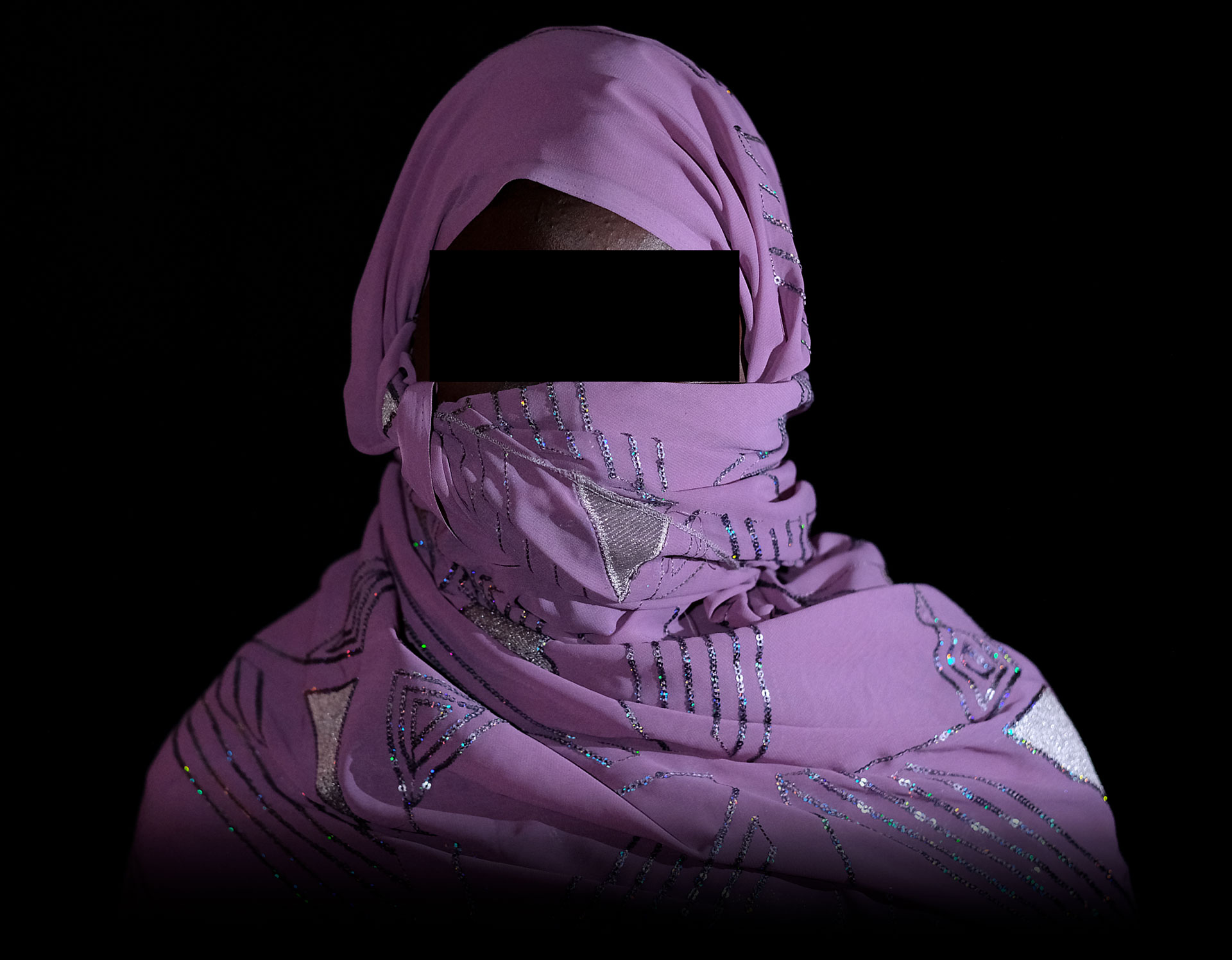
Since at least 2013, when it conducted a secret, illegal abduction programme for women and girls in the northeast, the Nigerian military has aborted at least 10,000 pregnancies.
According to Reuters, many of the women and girls were abducted and raped by Islamist militants.
Fati recounted her ordeal after being kidnapped by terrorists and later rescued by the military.
During an insurgent attack on Monguno, she lost contact with her family one night. She was later kidnapped by terrorists and thrown into one of two pickup trucks with the other women, she claimed. They drove through the night to the vast Lake Chad’s shores, where fighters loaded the women into canoes.
Captives were hauled out to the lake’s numerous islands as the sun rose.
Fati was four months pregnant when liberated from the insurgents. Soon after, she says, soldiers medically aborted the pregnancy without telling her. And she was warned: “If you share this with anyone, you will be seriously beaten.”
Fati said she was married off three times, forced to take a new husband whenever the previous one didn’t return from the war. The third, who impregnated her, “was the worst out of all of them,” she said. “He would hit me with the butt of his gun … He would beat me until I was sick.”
Now in her 20s, Fati said shortly after being rescued with four months of pregnancy, uniformed men gave her and five other women mysterious injections and pills in a dim room at a military barracks in Maiduguri, the Borno state capital.
After about four hours, Fati, who said she was about four months pregnant, felt a searing pain in her stomach and black blood seeped out of her. The other women were bleeding as well, and writhing on the floor. “The soldiers want to kill us,” she thought.
According to her, the soldiers aborted the pregnancies without telling them. And she was warned: “If you share this with anyone, you will be seriously beaten.”
The abortions mostly were carried out without the person’s consent – and often without their prior knowledge, according to the witness accounts. The women and girls ranged from a few weeks to eight months pregnant, and some were as young as 12 years old, interviews and records showed.
This investigation is based on interviews with 33 women and girls who say they underwent abortions while in the custody of the Nigerian Army. Just one said she freely gave consent. Reporters also interviewed five civilian healthcare workers and nine security personnel involved in the programme, including soldiers and other government employees such as armed guards engaged in escorting pregnant women to abortion sites. In addition, Reuters reviewed copies of military documents and civilian hospital records describing or tallying thousands of abortion procedures.
Three soldiers and a guard said they commonly assured women, who often were debilitated from captivity in the bush, that the pills and injections given to them were to restore their health and fight diseases such as malaria. In some instances, women who resisted were beaten, caned, held at gunpoint or drugged into compliance. Others were tied or pinned down, as abortion drugs were inserted inside them, said a guard and a health worker.
Bintu Ibrahim, now in her late 20s, recounted how soldiers gave her two injections without her consent after picking her up with a group of other women who fled the insurgents about three years ago. When the blood came, and the terrifying pain, she knew she and the others had undergone abortions. The women protested and demanded to know why, she said, until the soldiers threatened to kill them.
“If they had left me with the baby, I would have wanted it,” said Ibrahim, whose account was confirmed by a fellow former captive, Yagana Bukar.
At military facilities and in the field, some abortions proved fatal. Although Reuters could not determine the full scope of the deaths in nearly 10 years of the programme, four soldiers and two security officers said they witnessed women die from abortions, or saw their corpses afterward.
“That woman was more pregnant than the rest of us, almost six or seven months,” Ibrahim said. “She was crying, yelling, rolling around, and at long last she stopped rolling and shouting. She became so weak and traumatised, and then she stopped breathing.
“They just dug a hole, and they put sand over it and buried her.”
Reuters was unable to establish who created the abortion programme or determine who in the military or government ran it.
Nigerian military leaders denied the programme has ever existed and said Reuters reporting was part of a foreign effort to undermine the country’s fight against the insurgents.
“Not in Nigeria, not in Nigeria,” said Major General Christopher Musa, who heads the military’s counterinsurgency campaign in the northeast, in a November 24 interview with Reuters that addressed the abortion programme.
“Everybody respects life. We respect families. We respect women and children. We respect every living soul.”
General Lucky Irabor, Nigeria’s chief of defence staff, did not respond to requests for comment from Reuters. On December 2, a week after Reuters sought an interview with Irabor and shared detailed findings and questions with his office, the military’s director of defence information released a five-page statement to reporters, and later posted it on Facebook and Twitter. Major General Jimmy Akpor said Reuters was motivated by “wickedness” and a “bullying” mentality, according to the statement.
“The fictitious series of stories actually constitute a body of insults on the Nigerian peoples and culture,” Akpor added. “Nigerian military personnel have been raised, bred and further trained to protect lives, even at their own risk, especially when it concerns the lives of children, women and the elderly.”
Central to the abortion programme is a notion widely held within the military and among some civilians in the northeast: that the children of insurgents are predestined, by the blood in their veins, to one day take up arms against the Nigerian government and society. Four soldiers and one guard said they were told by superiors that the programme was needed to destroy insurgent fighters before they could be born.
“It’s just like sanitising the society,” said a civilian health worker, one of seven people who acknowledged performing abortions under army orders.
Four of the health workers interviewed by Reuters also said that the programme was for the good of the women and any children they might bear, who would face the stigma of being associated with an insurgent father.
The army-run abortion programme has been in place since at least 2013, and procedures were being performed through at least November of last year, according to accounts from soldiers.
The procedures have occurred in at least five military facilities and five civilian hospitals in the region, according to witness accounts and documentation reviewed by Reuters. Many occurred in Maiduguri, the largest city in Nigeria’s northeast and the command centre of the government’s war on Islamist extremists.
The Maiduguri sites include the detention centre at Giwa Barracks, where Fati said she was forced to have an abortion. Other sites include the Maimalari Barracks, which is the city’s main military base, and two civilian hospitals – State Specialist and Umaru Shehu. The two hospitals did not comment on this story.
Forced abortions may amount to war crimes and crimes against humanity, according to four legal experts briefed by Reuters on its findings. Although forced abortions are not specifically criminalised under the Rome Statute of the International Criminal Court, the experts said, they could be construed as torture or other inhumane treatment and be prosecuted as such.
The International Criminal Court’s prosecutor found in 2020 that grounds existed to investigate possible war crimes and crimes against humanity by both Nigerian security forces and insurgents. But the court has not opened a probe.
The ICC’s Office of the Prosecutor declined to comment on Reuters’ findings.
SaharaReporters had reported how in April 2014, Boko Haram terrorists kidnapped 276 schoolgirls in Chibok town in Borno, prompting the #BringBackOurGirls campaign. About 98 of the kidnapped girls are still missing.
Two young women, Felerin and Aisha, described undergoing abortions after being taken into custody by the Nigerian military.
Other women interviewed by Reuters offered similar accounts of captivity and rescue – including being raped by insurgents and escaping with the help of soldiers who took them into custody and transported them under armed guard to military facilities or civilian hospitals. Many said they were made to give urine or blood samples before receiving unspecified injections and pills.
Nigerian facilities often used misoprostol, which helps induce labour or contractions, according to the documentation reviewed by Reuters. The drug is also used to treat ulcers and post-partum hemorrhaging, and is widely available in Nigerian cities, including through unofficial abortion-drug distribution networks. Women sometimes were also given the progesterone-blocker called mifepristone, which in many countries is used in conjunction with misoprostol in medication abortions.
Also given was the drug oxytocin, which is widely used during labour to stimulate contractions and safe to use when under medical supervision. Though experts say it is not recommended for abortions, it was sometimes given at military bases to trigger terminations, said two soldiers who performed the procedures.
Using oxytocin to induce abortion is dangerous, several international medical experts told Reuters, particularly if it is injected intramuscularly, as soldiers involved in the Nigerian programme said it was. If the drug is administered too quickly, the results can be fatal, the experts said.
The medications misoprostol and mifepristone are considered safe for abortions when the standard medical protocol is used, according to the World Health Organization and other authorities.
Among those forced to undergo an abortion was a girl named Hafsat.
The soldier said he and other troops injected Hafsat and three others with oxytocin while they lay on the ground outside the army clinic.
Within an hour, the soldier said, he heard cries and turned to see Hafsat bleeding heavily from between her legs. He grabbed her a cloth to stanch the blood.
Hafsat began crying out for a man named Ali, and for her mother. “Half an hour later, maybe, she just went quiet,” he said. “She died.”
The soldier said he and his comrades wrapped her in her turquoise dress and buried her. The memory haunts him.
“I can’t forget her name,” he said.
The details of the soldier’s account were corroborated by a second soldier at the base, who said he also witnessed the girl’s abortion and death.
In all, eight sources, including four soldiers, said they witnessed deaths or saw corpses of women who died from abortions performed at military barracks or administered in the field.
An 18-year-old college student in the state of Arkansas has reportedly become the country’s youngest black mayor.
Jaylen Smith graduated from high school in May. On Tuesday, he was elected mayor of Earle, a rural town 30 miles (48 kilometres) west of Memphis, Tennessee.
His family is celebrating despite the fact that he is not the first 18-year-old mayor in US history.
Mr Smith told the Washington Post on Wednesday, “My mom can’t stop crying.”
He was a Democrat who won in the town of 1,800 people while most US political observers were focused on a Senate race in Georgia.
“It’s Time to Build a Better Chapter of Earle, Arkansas,” Mr Smith wrote on Facebook to celebrate his victory over the city’s street and sanitation superintendent.
“I would like to thank all my supporters for stepping up getting people to the polls. I am truly grateful for you all.”
The vote result was 235 to 185, according to a tally from the Crittenden County Clerk’s office.
The new mayor ran on a platform of improving the police force, repairing the city’s drainage system, addressing abandoned houses and improving community involvement.
As mayor, he also plans to bring a major grocery store to the community – the only one in town closed years ago.
While in high school, he served as president of the school’s student government association, and had leadership roles in school clubs.
“You have to start somewhere – you really do,” he told the Post. “I didn’t want to be 30 or 40 and become a mayor when I could be one right now.”
He received advice during his campaign from the mayor of the city of Little Rock, Arkansas, which has a population of over 200,000.
Little Rock’s city leader Frank Scott Jr, who also serves as president of the African American Mayors Association, praised the victory.
“I’m excited for Jaylen and the entire community in Earle as he becomes the youngest-ever African American mayor elected in the country,” he told CNN.
“I’m proud of his willingness to enter into public service at such a young age and his aspirational goals for the City.”
Mr Smith plans to continue his studies at Arkansas State University Mid-South as he juggles his mayoral duties, and hopes someday to become a prosecutor.
In 2005, 18-year-old Michael Sessions won a race to be mayor of the town of Hillsdale, Michigan – before he had even completed high school.
At the time, his school principal was quoted saying: “I told him that if he wins, he’ll still need to finish his homework. I’d hate to have to suspend a city official.”
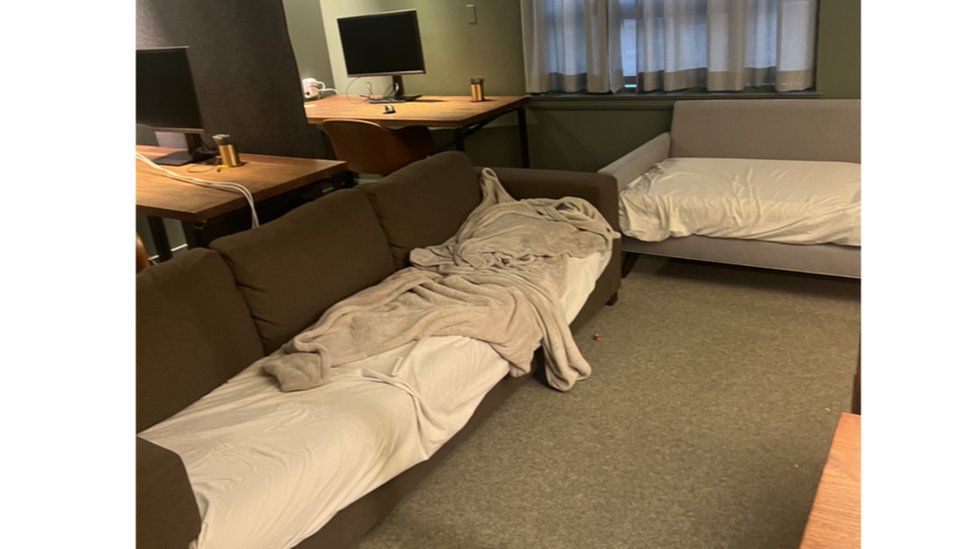
The BBC has obtained photos of Twitter office spacethat has been converted into bedrooms, which San Francisco authorities are investigating as a possible violation of building codes.
One image shows a room with a double bed, a wardrobe, and slippers.
According to an ex-employee, new Twitter CEO Elon Musk has been staying at the company’s headquarters since he purchased it.
He emailed all Twitter employees last month, saying they “will need to be extremely hardcore” to succeed.
San Francisco’s Department of Building Inspection has confirmed it is investigating potential violations following a complaint.
Mr Musk said the city was attacking companies for providing beds to “tired employees”.
In a now-deleted tweet, Mr Musk posted that he would work and sleep in the office “until the org is fixed”.
The BBC has also been given pictures of sofas at Twitter being used as beds.
Image caption, Former staff say wardrobes have been moved into Twitter’s HQ
“It looks like a hotel room,” said one former worker. They went on to say that Mr Musk regularly sleeps at the Twitter HQ in San Francisco.
Twitter did not immediately respond to a request for comment from the BBC.
Last month Mr Musk – who completed his Twitter takeover in October – emailed all staff at the company saying they would need to work “long hours at high intensity”.
California state senator Scott Wiener told the BBC on Wednesday: “He’s now making them [workers] sleep at Twitter.
“It’s clear that he doesn’t really care about people. He doesn’t care about the people who work for him.”
A Department of Building Inspection official told the BBC’s US partner CBS News: ‘We need to make sure the building is being used as intended.”
Image caption, Two sofas with bedding on them
In a reply to a journalist on Twitter, Mr Musk posted that the city should prioritise protecting children from the consequences of opioid drug misuse.
‘Office armchairs’
Forbes broke the story of “sad little conference-room sleeping quarters at the company’s recently depopulated headquarters”, noting it was an apparent improvement on the improvised sleeping-bag-on-the-floor arrangement posted on Twitter by one employee.
The bedrooms, Bloomberg reported, are also said to accommodate staff from Tesla and other Musk-owned businesses brought in to work at Twitter, “some of whom travel to Twitter for work meetings”, sources told the publication.
Department of Building Inspection official Patrick Hannan told the San Francisco Chronicle it investigated all complaints and there were different rules for residential buildings, even those used for short-term stays.
In May 2020, before Mr Musk’s takeover, Twitter told employees they could work from home “forever” if they so wished because its remote-working measures during Covid lockdowns had been a success.
In Iraq, an activist has been sentenced to three years in prison for allegedly insulting an Iran-backed paramilitary force in a tweet.
Haidar al-Zaidi, 20, was found guilty of “insulting state institutions” after making a post about Abu Mahdi al-Muhandis, the late deputy commander of the Popular Mobilisation Forces (PMF)
Zaidi denied writing the tweet and claimed that his account had been hacked.
Human Rights Watch termed Zaidi’s trial “”patently unfair.”
“Regardless of who posted the Twitter message, the Iraqi justice system should not be used to as a tool to suppress peaceful criticism of the authorities or armed actors,” said Adam Coogle, the campaign group’s deputy Middle East director.
“It is a sad reflection on the rule of law in Iraq that an activist like Zaidi gets three years in prison for a Twitter post he says he didn’t write while dozens of officials and armed groups enjoy impunity for killing activists and protesters.”
Zaidi was arrested in June in connection with a tweet that included a photograph of Abu Mahdi al-Muhandis and lamented how only in Iraq would a “spy” be given the label of “martyr”.
Muhandis was the leader of Kataib Hezbollah, a powerful Iran-backed Iraqi Shia Muslim militia designated by the US as a terrorist group.
He was also deputy commander of the PMF, an umbrella group of dozens of mainly Shia militias that is formally part of the Iraqi Security Forces but in practice operates independently and wields significant power.
In January 2020, Muhandis was killed in a US drone strike in Baghdad alongside top Iranian general Qasem Soleimani.
Many Iraqis mourned the two men as martyrs, but some celebrated their deaths.
Both Iran and its militia allies have been accused of being behind the killings of hundreds of protesters who took to Iraq’s streets in late 2019 to protest against deteriorating public services, high unemployment, and rampant corruption.
They have also been blamed for an assassination campaign against prominent activists critical of their influence.
Activists in Baghdad told Human Rights Watch that the PMF were responsible for Zaidi’s arrest and that a committee within the PMF filed the legal complaint against him.
Human rights activistSalman Khairallah said the sentence was a “clear message to activists that any criticism of authorities and the PMF will be punished”.
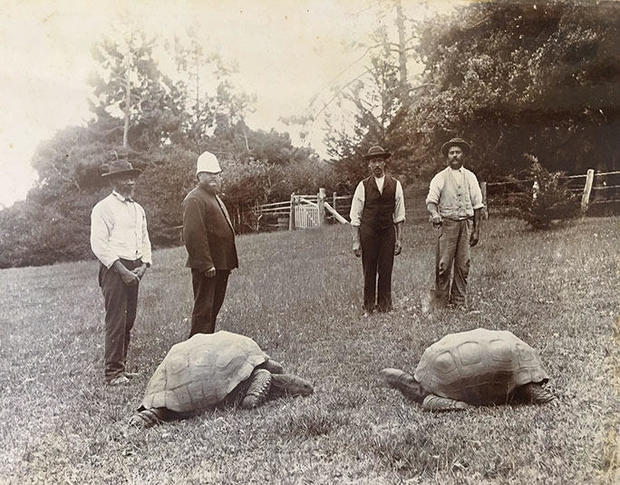
Jonathan the tortoisehas lived through both World Wars, seven British monarchs, 39 U.S. presidents, and is older than the Eiffel Tower – and now he is celebrating another year around the sun as he turns 190.
Jonathan, the world’s oldest known land animal, lives on Saint Helena, a British territory off the coasts of Angola and Namibia in the Atlantic Ocean. Over the weekend, the island celebrated the longest-living chelonian with an official birthday bash at the governor’s residence. Along with broadcasts about Jonathan’s significance, the island held a “main event” in his honour on Sunday, where visitors could get Jonathan stamps and other Jonathan-themed souvenirs.
The island’s tourism department posted images of the celebration on Sunday, showing the planet’s longest-living tortoise and “national treasure” enjoying a “cake” of some of his favorite garden vegetables.
Jonathan’s long life has earned him two Guinness World Records – one in 2019 for becoming the world’s oldest land animal and another this January for becoming the oldest living chelonian, a term encompassing turtles, terrapins and tortoises.
He is believed to have been born in 1832, but according to Guinness, could be even older, as he wasn’t found until he wound up in St. Helena until 1882 when he was already fully mature.
According to the record-keeping group, Jonathan has lived through some of humanity’s biggest milestones: the first telephone call in 1876, the completion of the Eiffel Tower in 1887, the Wright brothers’ first power-driven flight in 1903 and the first people to walk on the moon in 1969.
A photo dated to c. 1882–86 taken in the grounds of Plantation on St Helena – shortly after Jonathan arrived on the island (Jonathan is shown on the left)GUINNESS WORLD RECORDS
Through all of that, however, his vet told Guinness that Jonathan’s interests have stayed the same – sleeping, eating and mating.
“In spite of his age, Jonathan still has good libido and is seen frequently to mate with Emma and sometimes Fred – animals are often not particularly gender-sensitive!” the veterinarian, Joe, told Guinness earlier this year.
And the celebrations aren’t over. Saint Helena’s tourism site says that there is an application underway to make a national holiday in honor of the tortoise.
Taliban has carried out their very first public execution since assuming power in Afghanistan last year.
According to a Taliban government spokesperson, a man was killed after confessing to murder at a crowded sports stadium in south-western Farah province.
The hanging was attended by dozens of leaders, including the majority of their government’s top ministers.
It comes just weeks after judges were told to fully implement Sharia law.
Haibatullah Akhundzada, the Taliban’s supreme leader, issued the edict last month, ordering judges to impose punishments that could include public executions, amputations, and stoning.
However, the exact crimes and corresponding punishments have not been officially defined by the Taliban.
While several public floggings have been carried out recently – including that of a dozen people before a crowded football stadium in Logar province last month – it marks the first time the Taliban have publicly acknowledged carrying out an execution.
According to their spokesperson Zabihullah Mujahid, the execution was attended by several Supreme Court justices, military personnel and senior ministers – including the justice, foreign and interior ministers.
Mohammad Khaled Hanafi, charged with imposing the Taliban’s strict interpretation of Islamic law as minister for vice and virtue, was also present. However, Prime Minster Hasan Akhund did not attend, the statement said.
According to the Taliban, the executed man named Tajmir, a son of Ghulam Sarwar and a resident of Herat province, had stabbed a man named Mustafa about five years ago.
He was subsequently convicted by three Taliban courts and his sentence was approved by Mullah Akhundzada.
Before the execution, a public notice was issued publicising the event and “asking all citizens to join us in the sport field”.
The murdered man’s mother told the BBC that Taliban leaders had pleaded with her to forgive the man, but she had insisted upon his execution.
“Taliban came to me and begged me to forgive this infidel,” she said. “They insist me to forgive this man in sake of God, but I told them that this man must be executed and must be buried the same as he did to my son.”
“This could be a lesson to other people,” she added. “If you do not execute him he will commit other crimes in the future.”
During their rule from 1996-2001, the Taliban were condemned for regularly carrying out punishments in public, including executions at the national stadium in Kabul.
The Taliban vowed that they would not repeat the brutal repression of women. Since they seized power, women’s freedoms have been severely curbed and a number of women have been beaten for demanding rights.
At present, no country has recognised their new government and the World Bank has withheld around $600m (£458m), after the Taliban banned girls from returning to secondary schools.
The US has also frozen billions of dollars held by Afghanistan’s central bank in accounts around the world.
Ethiopia has restored power to Mekelle, the capital of the northern Tigray state. It should be recalled that during the two-year civil war that ended last month, Federal troops fought rebels there.
According to city sources, after being without electricity for more than a year, local residents are finally resuming full use of it.
“Electricity has been everywhere in the city since yesterday (Tuesday),” said a resident.
A spokesman for the government-owned Ethiopian Electric Electricity (EEP) was quoted by the state-affiliated Fana broadcast as saying that power had been restored following repair on a high-voltage line.
Ethiopia’s Minister of Energy Dr. Ing. Sultan Woli
Services in Shire town and the surrounding areas have also been restored by state-run telecommunications company Ethio Telecom.
Foreign-based families have revealed to newsmen how, after two years, they were finally able to call their loved ones.
After fighting broke out in the Tigray region in November 2020, power and telecommunications services were suspended. Meanwhile, a month after a truce was reached to put an end to the two-year fighting in the northern Tigray region, the rebels’ top commander reports that more than half of their fighters had left the frontlines in Ethiopia.
“We have accomplished 65% disengagement of our army,” Tadesse Wereda, commander-in-chief of the Tigray People’s Liberation Front said in a video posted on the TPLF’s Facebook page late on Saturday.
“Our army left the front lines and moved to the place prepared for them to camp,” he said.
Ethiopia has restored power to Mekelle, the capital of the northern Tigray state. It should be recalled that during the two-year civil war that ended last month, Federal troops fought rebels there.
According to city sources, after being without electricity for more than a year, local residents are finally resuming full use of it.
“Electricity has been everywhere in the city since yesterday (Tuesday),” said a resident.
A spokesman for the government-owned Ethiopian Electric Electricity (EEP) was quoted by the state-affiliated Fana broadcast as saying that power had been restored following repair on a high-voltage line.
Ethiopia’s Minister of Energy Dr. Ing. Sultan Woli
Services in Shire town and the surrounding areas have also been restored by state-run telecommunications company Ethio Telecom.
Foreign-based families have revealed to newsmen how, after two years, they were finally able to call their loved ones.
After fighting broke out in the Tigray region in November 2020, power and telecommunications services were suspended. Meanwhile, a month after a truce was reached to put an end to the two-year fighting in the northern Tigray region, the rebels’ top commander reports that more than half of their fighters had left the frontlines in Ethiopia.
“We have accomplished 65% disengagement of our army,” Tadesse Wereda, commander-in-chief of the Tigray People’s Liberation Front said in a video posted on the TPLF’s Facebook page late on Saturday.
“Our army left the front lines and moved to the place prepared for them to camp,” he said.
As a cold spell hits the UK, people are being advised to heat their living rooms during the day and their bedrooms before going to bed.
Health officials issued the advice to people who are unable to heat every room or are experiencing financial difficulties due to heating costs.
Northern Scotland is expected to have overnight lows of -10C (14F), with snow and ice warnings in place, as are Wales, Northern Ireland, and the east coast.
The level three cold weather warning for England goes into effect at 18:00 GMT.
It will be in effect until 09:00 on December 12th, according to the UK Health Security Agency (UKHSA), but it could be extended further if forecasts predict continued colder temperatures.
The alert is issued when severe cold weather is expected to have a significant impact on people’s health, particularly those with pre-existing medical conditions.
England’s east coast has a yellow warning, for ice, from 18:00 GMT until 12:00 GMT on Thursday – with temperatures set to drop as low as -3C (26.6F).
And a yellow weather warning also applies to Wales and most of Northern Ireland from midnight until 18:00 on Thursday.
While sub-zero temperatures may not be unexpected in parts of northern Scotland in winter, readings of -6C are predicted for parts of rural England from Thursday.
Large parts of Scotland are set to experience a prolonged “Arctic blast”, with freezing temperatures, snow and ice forecast on Wednesday and Thursday.
Meanwhile, the Severe Weather Emergency Protocol has been activated in London for the first time this winter, meaning homeless people will be given access to shelter.
BBC Weather’s Chris Fawkes said: “Frequent showers will turn to snow overnight and, during Wednesday in north Scotland, bringing the first snow of winter.
“Over coming days, cold weather will move south, with daytime temperatures around 5C below the December average – and probably not getting above freezing in places.
“Overnight frosts will be widespread and sharp, -2C to -6C commonly, but with much lower temperatures over snow cover in Scotland. Showers will increasingly turn to sleet and snow in parts of Northern Ireland, England and Wales.
“This abrupt change to cold winter weather will come as more of a shock to the system, given that this autumn has provisionally been the third warmest on record in the UK, in which frosts have been very rare.”
Rising cost concerns
The UKHSA said that, as well as heating rooms that are used the most to at least 18C, “several layers of thinner clothing will keep you warmer than one thicker layer”.
“Having plenty of hot food and drinks is also effective for keeping warm,” the agency added.
The rising cost of energy has prompted concerns that some people could resist using theirheating, even during the unseasonably cold temperatures expected this week.
Under the current energy price guarantee, a household using a typical amount of gas and electricity can expect to pay £2,500 annually. This rises to £3,000 a year for typical use from April.
Dr Agostinho Sousa of the UKHSA said: “Cold weather can have serious consequences for health, and older people and those with heart or lung conditions can be particularly at risk.
“If you have a pre-existing medical condition, you should heat your home to a temperature that is comfortable for you.”
Disability charity Scope said a survey of 1,000 disabled households suggested 43% had cut back on electricity and gas, with some saying they were switching off heating and using duvets to keep warm.
Additional support to help with energy costs is available for the most vulnerable, alongside a one-off £400 discount for all households.
Fuel poverty charity National Energy Action called on the government to “step in with more help for those at greatest peril this winter”.
Charities and councils have also set up so-called warm banks – heated buildings that members of the public can visit – to help this winter against the background of high energy costs.
The BBC visited one such facility in Cheltenham, which is open four days a week and has recently seen “more and more people coming through”.
Manchester United is offering the Red Cafe at Old Trafford as a free “warm hub” every Monday and Wednesday evening in December. Blackpool FC will be opening up a warm space at their Bloomfield Road ground later on Wednesday.
What does an unheated room do to your body?
Living in such low temperatures puts a considerable strain on the body, which has to work to warm up faster.
This can lead to an increase in blood pressure and a faster heartbeat – which in turn can exacerbate the risk of a stroke or heart attack.
At low temperatures, those who already have poor heart health and the elderly become even more susceptible to serious health issues.
Local authorities are also asking people to check on vulnerable family, friends and neighbours to see if they need extra help.
Cllr David Renard, transport spokesman for the Local Government Association (LGA), said: “During these cold spells, it is the elderly or those who have a respiratory disease who are more at risk of ill-health and in need of more support.
“As some people may choose to limit their heating use due to the impact of rising energy bills, it is all the more important that people check up on those that may need more help. It could help save lives.”
Councils in England and Wales have stockpiled 1.4 million tonnes of salt to grit roads this winter, but many told the LGA they were struggling to recruit and retain gritter drivers.
Yesterday, an NNPC tanker loaded with petroleum products exploded and caught fire in Abuja’s Central Area.
According to reports, the tanker was offloading products at the yet-to-be-completed headquarters of the National Library of Nigeria adjacent to the National Mosque in Abuja’s Central Area when the explosion occurred and the tanker caught fire.
Emergency personnel, particularly security personnel, including police, DSS officials, and the FRSC, rushed to the scene, fearing a bomb explosion.
Fire fighters from both the Federal Fire Service and FCT Fire Service arrived the scene with trucks to quench the fire, which later became difficult because the petroleum product gushed from different points.
The future of the UN mission in Mali(Minusma), according to Mali’s transition leader Col Assimi Goita, will rely heavily on a change in strategy and better relations with the country’s army.
Col Goita tweeted that he had met with UN Chief of Peacekeeping Operations Jean-Pierre Lacroix, who is on a two-day tour in Mali ahead of Minusma’s mandate renewal.
The state-linked L’Essor quoted Mr Lacroix as saying that this was about ensuring there was an agreement between Mali and the UN “so that when the time comes, the recommendations at the level of the [UN] Security Council are in line with the objectives of the Malian authorities”.
UN peacekeepers have been in the country since 2013, but relations with Bamako have recently deteriorated.
Several countries, including Germany and Cote D’Ivoire, have announced plans to withdraw from the mission or scale down their presence.
Former Spanish King Juan Carlos has won an appeal to block a portion of a case brought against him in the United Kingdom by his ex-lover.
Corinna zu Sayn-Wittgenstein, a businesswoman, has accused the former monarch of directing a harassment campaign against her since their relationship ended in 2012.
However, UK judges ruled that the former king was immune from prosecution for allegations relating to his time as monarch.
Juan Carlos, 84, stepped down in 2014. He claims he did nothing wrong.
Ms zu Sayn-lawyers Wittgenstein’s in the UK said the ruling did not affect the “overwhelming” chunk of her claim.
She is seeking damages and an injunction over allegations that the former king caused her “great mental pain” as a result of “a continuous and ongoing campaign of harassment” since 2012.
Tuesday’s Court of Appeal judgment overrules a previous one earlier this year. That one had ruled that Juan Carlos’s behaviour before 2014 had been “private conduct” and, therefore, could be prosecuted.
Following the appeals ruling, Ms zu Sayn-Wittgenstein’s lawyer, Michael Kim, insisted that the judgement “applies to a very narrow issue” concerning “only the period when Juan Carlos was the reigning king of Spain.
“The overwhelming part of Corinna’s claim, from 2014, remains unaffected and should proceed to trial,” Mr Kim said.
Juan Carlos was credited with overseeing Spain’s transition from dictatorship to democracy in 1975. But he abdicated following a series of scandals involving his family, including a corruption investigation involving his daughter’s husband, Inaki Urdangarin, who was later jailed.
The former king has spent more than two years in self-imposed exile in the United Arab Emirates, after leaving Spain over allegations of fraud which were eventually dropped. A Swiss investigation into a multi-million dollar payment from Saudi Arabia was closed because of insufficient evidence.
The Libyan Government of National Unity, centred in Tripoli, has encouraged foreign oil companies with contracts with the national oil company to begin operationsthere.
The country’s National Oil Corporation, NOC, stated that it would assist the companies’ return and provide a safe working environment “in cooperation with the civil and military authorities in Libya.”
NOC Chief Farhat Bengdara
Over the past ten years, armed groups and demonstrators have repeatedly invaded oil fields, leading to production halts.
The ongoing struggle between opposing governments in the country’s west and east for control of resources and power has increased tensions.
With the greatest crude oil reserves in Africa, Libya is desperately trying to boost output in order to finance much-needed improvements to the nation’s infrastructure for housing, transportation, and energy.
Your Friends Also Read:Business Edge | Ethiopia Continues Deregulation Drive
The National Unity Government also on said it had lifted the force majeure for oil and gas explorations. During the last major bout of conflict, groups affiliated with eastern commander Khalifa Haftar cut nearly all of Libya’s oil output for eight months.
“This call comes within the corporation’s efforts to lift force majeure after an objective follow-up and evaluation based on a realistic and logical analysis of the security situation, which has begun to improve dramatically,” NOC said.
It added that the improvement of the security situation has led to “the commencement of excavation work in sites where it was difficult to work in the recent past, in which there are now many global service companies.”
Your Friends Also Read:Ghana Owes Bretton Wood Institutions, Others $7.9bn
NOC Chief Farhat Bengdara said in November that oil output had risen to 1.2 million barrels per day (bpd) from 600,000 bpd three months agoand that NOC does not expect any disruption in production.
The Senate unanimously approved legislation to restrict private ownership of big cats such as lions and tigers in the United States.
The Big Cat Public Safety Act would prevent individuals from keeping the animals as pets and from exposing them to public petting and photographing.
Following the release of the Netflix documentary series Tiger King, efforts to limit private ownership have increased.
President Joe Biden must now sign the bill into law.
Democratic Congressman Mike Quigley, who introduced the bill into the House, said on social media that it will mean “a lot of big cats will live better lives”.
According to estimates from conservationists, as many as 7,000 tigers are living in the US either in zoos or privately owned – nearly double the estimated 3,890 tigers living in the wild worldwide.
Many in the US are on public display, where the hunt for profits in some privately-owned facilities are alleged to drive a ” relentless breeding cycle that floods the exotic pet trade with surplus tigers who have outgrown the cub stage”, according to the Animal Welfare Institute.
What’s more, the institute alleges facilities that offer cub petting have been known to kill tigers once they can no longer be used to make money.
Under the new bill, possession of lions, tigers, leopards, cheetahs, jaguars, cougars or any hybrid of these species would be limited to wildlife sanctuaries, universities and certified zoos.
Those on display would need to be kept at least 15 feet (4.5 metres) away from the public or behind a barrier to prevent contact.
However, current owners of big cats will be allowed to keep their animals – as long as they don’t allow direct contact between them and the public and register them with the US Fish and Wildlife Service.
Susan Millward, executive director of the Animal Welfare Institute,has said the Big Cat Public Safety Act “will end the horrific exploitation of big cats and bolster public safety”.
“These beautiful but powerful predators deserve to live in the wild, not be kept in captivity for people’s entertainment—even as cubs,” she added.
Carole Baskin, one of the stars of the Tiger King series and the founder of the Big Cat Rescue sanctuary, has become a champion of the bill and has said she is “thrilled” by the outcome.
Kwesi Arthur, a Ghanaian award-winning rapper, has just released visuals for his latest single ‘Animal.’ The street anthem, which features fellow Ghanaian singer Dayonthetrack, uses its lyrics to warn leaders whose actions limit the hopes of the society’s young generation.
Although the song is danceable, the music video depicts a group of seemingly upset young men grabbing a corrupt prime minister in the first scene. In the 3:18 video, both Ghanaian stars appear to be leading a vigilante movement.
Directed by David Duncan, the corrupt leader is accosted with loads of cash in his trunk as viewers are led from a shanty residence to a plush settlement where the politician is waylaid, showing the frustration of the growing population in the slums of GHANA.
The BET nominated 27 year old star uses his song ‘animal’ to show the condition of young people andperhaps a warning to what could happen if the needs of the youths are continually neglected. Recall that several Ghanaian stars have in the past months spoken up about the harsh standard of living within the country, with many like Actress Yvonne Nelson even calling out the president H.E Nana Akufo Addo.
“Humanity has become a weapon of mass extinction,” the head of the United Nations has warned at the start of a high-level nature summit in Canada.
Governments are meeting in Montreal to agree targets to reverse the loss of nature.
UN Secretary-General Antonio Guterres said we have a chance to stop the “orgy of destruction” which has put a million species at risk of extinction.
“It’s time to forge a peace pact with nature,” he added.
Biodiversity is the sum of all living things on the planet and the way they are connected in a complex web of life that we rely upon for food, clean air and water.
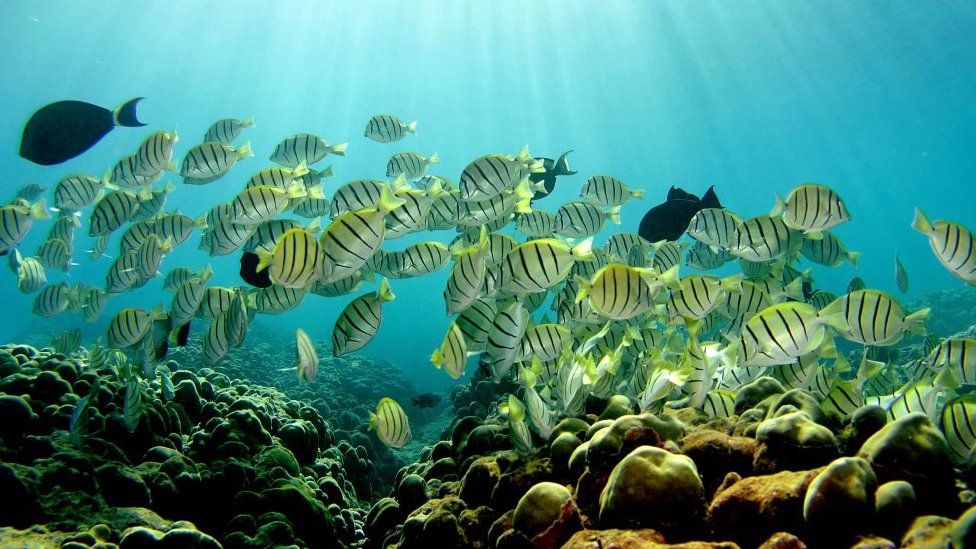
IMAGE SOURCE,GETTY IMAGES Image caption, Governments must commit to conserve coral reefs and other ecosystems
In Montreal nearly 200 countries will try to agree on a way to put the world on a path to restoring nature by the end of the decade.
The stakes are high with the COP15 UN summitseen as a chance to do for biodiversity what the Paris agreement has done for the fight against climate change.
The two issues are intertwined, with warnings that a failure to secure a good outcome on protecting nature will make it far harder to fight climate change.
“The idea of biodiversity can be quite complicated for people, but it’s basically about nature,” said Dr Abigail Entwistle of conservation charity Fauna and Flora International.
“We’ve not been as good at getting the message across about what’s at stake and how urgent the situation is and we need to have our 1.5 degree moment for biodiversity in the same way we have for climate change.”
Some of the key ambitions of the agreement include:
Reducing the extinction risk threatening more than one million species
Protecting 30% of land and sea
Eliminating billions of dollars of environmentally-damaging government subsidies
Restoring degraded ecosystems.
IMAGE SOURCE,GETTY IMAGES Image caption, An estimated 40% of amphibians face extinction
Several issues threaten to derail the talks including financing of the plans and debate over how to protect the natural world without risking creating “paper parks” or “ghost forests” that are protected only on paper and from which indigenous people and local communities are excluded.
Cambodia Country Director for Fauna and Flora International, Pablo Sinovas, pointed to the need for better protection of areas of the world with undiscovered biodiversity, such as in the country’s Virachey National Park.
“You could say this forest area is the equivalent of the Amazon of Asia,” he said.
“It is a very large forest with outstanding biodiversity – there is much to be explored and much to be discovered, yet unlike the Amazon, it hasn’t received that much attention.”
IMAGE SOURCE,GETTY IMAGES Image caption, The loss of natural habitat is one of the key drivers of biodiversity loss
The UK is among countries pushing for a key goal of protecting 30% of land and sea by 2030. It said it was continuing to push for an ambitious outcome at the talks and would work with countries around the globe to put the natural world back on the road to recovery.
However, UK wildlife charities have accused the government of missing its nature targets at home.
The UK is one of the most nature-depleted countries in the world and is “going backwards” in terms of its domestic agenda, with many species at risk of extinction and in decline, Nick Bruce-White, director for bird protection charity RSPB England, said.
“We have to by the end of 2030 at least halt biodiversity decline and ideally be on a trajectory to try and restore biodiversity,” he said. “This is the last chance saloon.”
The government has faced criticism from environmental groups for missing a deadline to set legally-binding targets on nature as required by the Environment Act but has said it will publish these soon.
The UK lost much of its nature long ago. The south western county of Somerset is at the heart of a drive to restore habitat for wildlife through a string of reserves across the country.
At Streart Marshes on the Somerset coast, important wetland sites for birds and other wildlife have been created by letting the sea flood in and reclaim intensive farmland.
Reserves manager for the Wildfowl and Wetlands Trust, Alys Laver, said nature has a fantastic ability to restore itself.
“I think what we’ve learnt here at Steart is providing space for nature on a landscape scale allows nature to take over and get those healthy ecosystems working and the rest just takes its course,” she said.
If elected in 2023, Nigeria‘s Labour Party (LP) presidential candidate Peter Obi and vice presidential candidate Yusuf Baba-Ahmed promised to end doctor and ASUU strikes.
Speaking to a large crowd of supporters in Owerri, the capital of Imo State, Obi promised that he and Baba-Ahmed would work to restore power to the people, particularly to youth and women.
Furthermore, he stated that the prime concern will be to prioritise exports, invest in agriculture, and create jobs.
Issues like the Academic Staff Union of Universities (ASUU) strike, deterioration in the health sector, and corruption will be a thing of the past for the LP presidential contender.
One of the front-runners for the general election in 2023 is Peter Obi. This is Obi’s first significant campaign event in Imo, and as the election year of 2023 approaches, the party in the state announced additional initiatives to lure voters.
This is coming after the Presidential candidate finally released his campaign manifesto.
The 72-page manifesto titled, ‘It’s POssible: Our Pact with Nigerians’, was released after a long wait, speculations and disagreements among members of the LP, opposition parties and other vested interests.
Announcing the release of the manifesto on his verified Twitter page Sunday morning,Obi wrote, “I have the honour to present our 72-page Manifesto, titled, ‘It’s Pssible: Our Pact with Nigerians.’ This Manifesto, its overarching and visionary policy planks, lays out our mission focus and mandate for securing, uniting and making Nigeria productive.
According to Paul Montague of the National Education Union, there is a “chronic ongoing recruitment issue.”
“It’s particularly bad right now, and something definitely needs to be done,” he said.
According to Liz Coffey, executive principal of the Secondary School Partnership, there is no “wholesale recruitment issue.”
Mr Montague spoke after a parent expressed concerns about staffing at St Sampson’s High School.
The parent, who requested anonymity, stated that the “system is broken” and that “they don’t have the staff.”
‘Progress blighted’
Mr Montague said: “I fully accept that people are working as hard as they possibly can to fill these gaps.
“We do have some very good agency staff but understandably agency staff are only here for one term.
“Sometimes we manage to extend that to a year, but it’s still not what’s required in terms of benefiting the youngsters in terms of their education.
“We have so many youngsters whose progress in a particular subject area has been blighted because they’ve had a massive turnover in staff and I just don’t think it’s acceptable.”
Mrs Coffey said there were currently three open teacher vacancies at St Sampson’s.
“We are in the process of making appointments and some new staff are due to start roles soon,” she said.
“While it is never ideal to have vacancies, we have taken steps to ensure the impact on students is minimal.
“Primarily, we have been using agency staff to continue the delivery of lessons, particularly in specialist subject areas where recruitment can be most difficult.”
A New Zealand court has directed that a child at the centre of a case involving blood transfusions from Covid-19-vaccinated donors be placed in temporary custody by health officials.
The four-month-old boy is being treated in an Auckland hospital for an urgent heart condition.
His parents had stopped the operation and asked a judge to order that he receive blood from unvaccinated donors.
The High Court, however, ruled that the operation was in the child’s “best interests.”
Justice Ian Gault ordered that the boy – identified as Baby W in court documents – be placed under the guardianship of the court “from the date of the order until completion of his surgery and post-operative recovery”.
He dismissed the parents’ request for unvaccinated blood, calling it unnecessary and impractical, and agreed with health authorities that the boy’s “survival [was] actually dependent on the application being granted”.
But he emphasised that the parents remained the boy’s primary guardians and said doctors must keep them informed at all times about his treatment and condition.
Justice Gault also rejected a request from the parents’ lawyer, Sue Grey, that a tailored donor service with blood from exclusively unvaccinated donors be established.
Ms Grey said the long-term effects of the vaccine were “untested” and accused doctors of refusing to provide an alternate donor service for ideological reasons.
Citing evidence from New Zealand’s chief medical officer, Justice Gault ruled that there was “no scientific evidence there is any Covid-19 vaccine-related risk from blood donated” by vaccinated donors.
The case has become a vector for anti-vaccine activists in New Zealand with demonstrators – many of whom carried placards – gathering outside the court before the ruling was delivered on Wednesday.
It also emerged during the case that during a meeting with doctors at the Starship hospital in Auckland, the parents had been accompanied by a “support person” who hijacked the conference.
They said the person presented a host of unfounded conspiracy theories, and went on to claim that children were dying from transfusions at the hospital.
Addressing the demonstrators outside the court house following the ruling, former TV host and leading anti-vaccine campaigner Liz Gunn said the decision was “wrong on every level”.
Te Whatu Ora (Health NZ) acknowledged that the case was a “difficult situation for all involved” but emphasised that its priority was the “the health and wellbeing” of all children in its care.
A BrewDog advertisement was banned for implying that its fruit-flavored beers counted as “one of your five-a-day.”
The brewer asserted the email was “tongue-in-cheek” but the advertising watchdog said it could mislead customers.
BrewDog’s advertisements frequently spark controversy, but some campaigns have backfired.
It was heavily chastised last month for launching a “anti-sponsorship” World Cup campaign while continuing to show matches in its bars.
To stay healthy, the government recommends that people eat five portions of fruit and vegetables per day; however, this does not include alcoholic beverages, even if they have a high fruit content.
The Advertising Standards Authority (ASA)said that many consumers would not have known that for sure when BrewDog sent them a marketing email in July with the five-a-day claim in the subject line.
BrewDog argued that the email was only sent to existing customers who had opted in to email alerts and would have been aware of its playful marketing style.
But the regulator said the advert cannot appear again in its current form and warned BrewDog not to repeat the claim.
A BrewDog spokesman said: “We respect the Advertising Standards Authority’s decision and are happy to confirm that beer is not a fruit or a vegetable. We hope that sorts it out”.
This is not BrewDog’s first run-in with the ASA.
Last year, the Scottish brewer offered shoppers the chance to find a gold can worth £15,000 hidden in cases sold from its online store.
But some winners complained to the ASA after they discovered the cans were not solid gold, but were gold-plated instead.
The regulator banned the adverts with BrewDog boss James Watt admitting the firm had got the campaign “wrong”.
World Cup backlash
Last month, the brand also faced a backlash after it said it would screen World Cup games at its bars while also running a marketing campaign criticising Qatar’s human rights record.
The pub and brewery chain promised that profits made from sales of one lager during the tournament would go to “causes fighting human rights abuses”.
But critics on Twitter accused it of a “PR stunt”, arguing it would still profit from all the other beers sold. Responding at the time, BrewDog said the campaign had “struck a nerve” and raised awareness of human rights abuses in Qatar.
The last few years have been stormy for the brewer, which built a loyal following for its independent craft beers before becoming a mainstream hit on supermarket shelves.
Last summer it faced a flood of allegations about its “toxic” workplace culture, which led to an independent review of the organisation.
Mr Watt apologised to former staff and said their complaints would help make him a better chief executive.
In June this year fresh claims about his conduct emerged in the US, with former staff accusing him of inappropriate behaviour.
After receiving an award for their work in racial justice and mental health, the Duke and Duchess of Sussex said, “we know a ripple of hope can turn into a wave of change.”
At a gala in New York, Prince Harry and Meghan received the Robert F Kennedy Human Rights (RFKHR) organization’s Ripple of Hope Award.
They also discussed their “belief in courage over fear and love over hate.”
The ceremony was hosted by actor Alec Baldwin.
The RFKHR is a human rights organisation that advocates for issues such as mass incarceration, racial justice, and gender-based violence.
It recognises those who have shown “unwavering commitment to social change and worked to protect and advance equity, justice, and human rights.”
During the ceremony, Harry and Meghan announced a new collaboration between their Archewell Foundation and the RFKHR – the Archewell Foundation Award for Gender Equity in Student Film.
“Our hope with this award is to inspire a new generation of leadership in the arts, where diverse up-and-coming talent have a platform to have their voices heard and their stories told,” the couple said in a statement.
“The values of RFK Foundation and the Archewell Foundation are aligned in our shared belief of courage over fear, and love over hate.
“Together we know that a ripple of hope can turn into a wave of change.”
The ceremony was hosted by actor Alec Baldwin, who last year was involved in a deadly shooting on the set of a Western movie when a gun that Baldwin was using during rehearsal killed cinematographer Halyna Hutchins. Last October, Baldwin reached a settlement with Hutchins’ family.
RFKHR President Kerry Kennedy said the royal couple had been “incredibly brave” in addressing the issues of mental illness and racial justice.
“For Meghan to get out there on national television and normalise discussion of mental health, at this point, is incredibly important and very brave,” Ms Kennedy, the daughter of the late Robert F Kennedy, told US outlet Extra.
Speaking on stage with Ms Kennedy during the event, Harry joked: “I’ll be honest with you, Kerry – I just thought we were just going on a date night, so I found it quite weird that we’re sharing the room with 1,500 people.
“We don’t get out much these days because our kids are so small and young, so this is completely unexpected.
“But it’s nice to share date night with all of you, so thank you for coming,” he added to laughter from the audience.
Harry and Meghan’s new show will be released on Netflix later this week.
In the second of two trailers, Prince Harry spoke of the “leaking” and “planting of stories” as part of a “dirty game”.
However, the trailers have been criticised for allegedly using footage and photos in misleading ways.
Meghan and Harry have long discussed their mental health struggles. Speaking in a TV interview with Oprah Winfrey in 2021, Meghan said she found life within the Royal Family so difficult that at times she “didn’t want to be alive anymore”.
In the revealing interview, Meghan also said Prince Harry was asked by an unnamed family member “how dark” their son Archie’s skin might be.
Last week, the outgoing Metropolitan Police assistant commissioner said the duchess received “disgusting and very real” threats while she was a working royal.
Prince Harry has also said he had to step back from royal duties to protect himself and his family from the “toxic” situation created by the UK press.
The duke told TV chat host James Corden that it was “destroying my mental health” add he “did what any husband[or] father would do”.
Emergency services have said, at least 150 people were injured when two trains collided in the Catalonia region of north-eastern Spain.
The crash happened around 07:50 (06:50 GMT) at a station on the outskirts of Barcelona.
According to local media, the trains were travelling in the same direction when they collided while one was parked at the station.
The cause of the accident is unknown, and officials have yet to comment.
The crash occurred at the Montcada I Reixac – Manresa station, about 12 kilometres (7 miles) from the city centre, according to emergency officials on Twitter.
Emergency services said on Twitter that 150 people were “in a mild condition” and five others were “in a less serious condition.”
They added that three people had been transferred to hospital.
Train traffic was briefly disrupted on several lines due to the accident, the national rail service Renfe said.
One passenger told RAC1, a local radio station, that “train was full and my carriage, which was the last one, was completelyfull” at the time of the collision.
Thousands of pupilsin Scotland will be absent from school on an unscheduled day as teachers continue their strike.
On Wednesday and Thursday, members of the SSTA and NASUWT unions will strike in their ongoing pay dispute.
It follows the EIS strike, which saw almost all schools close on November 24th, and the rejection of the most recent pay offer of 6.85%.
The Scottish government declared that the unions’ demands were “unaffordable.”
Shirley-Anne Somerville, Education Secretary, expressed her disappointment that the fourth offer made to the unions had been rejected.
On Wednesday, industrial action is taking place in: Argyll and Bute; Dumfries and Galloway; East Ayrshire; East Dunbartonshire; East Renfrewshire; Eilean Siar; City of Glasgow; Highland; Inverclyde; North Ayrshire; North Lanarkshire; Orkney; Renfrewshire; Shetland; South Ayrshire; South Lanarkshire; West Dunbartonshire.
The local authorities affected on Thursday are: City of Aberdeen; Angus; Aberdeenshire; Clackmannanshire; Dundee City; City of Edinburgh; East Lothian; Falkirk; Fife; Midlothian; Moray; Perth and Kinross; Scottish Borders; Stirling; West Lothian.
Disruption is expected in most areas through either partial or full closures of schools.
Although mainly limited to secondary schools, some primaries are affected. About a third of councils said they expected “significant” disruption.
IMAGE SOURCE,GETTY IMAGES Image caption, Education Secretary Shirley-Anne Somerville said the pay demands were not affordable
With prelim exams taking place in many schools, older pupils are being prioritised and younger pupils are being given the day off.
The latest pay offer from the Scottish government was formally rejected last Wednesday.
Unions were offered a rise of between 5% and 6.85% but the EIS is asking for 10%.
On Tuesday the NASUWT said it was seeking a fully funded rise of 12% for 2022/23.
It said that a typical teacher in Scotland is almost £50,000 worse off as a result of their pay failing to keep pace with inflation since 2010, a loss they say will be further compounded by the current below-inflation pay offer.
The union also confirmed that following this week’s strikes, members would begin a programme of ongoing action, including a refusal to cover for absent colleagues and attendance at only one meeting per week outside pupil sessions.
“The fact it has come to this is a reflection of the depth of anger and frustration they feel at being continually told by ministers and Cosla that there is no more money to increase their pay, while their workloads spiral and the expectations on them mount.
“They are sick of warm words telling them how much they are valued, while their pay dwindles each year in real terms.
“Talk is cheap but actions matter and they are tired of being taken for granted and expected to work harder and harder for less and less money.”
‘Willingness to resolve the dispute’
Seamus Searson, the SSTA’s general secretary, said employers Cosla had not contacted the union since 22 November to avert the strikes.
He said teachers were striking to send a hard message that teachers demand to be respected and receive a professional salary that will retain staff.
“Hopefully, the employers and the Scottish government will understand that all teacher unions in Scotland are united in seeking a fair and reasonable pay settlement and there needs to be a willingness to solve the pay dispute,” he said.
“The latest offer was quickly rejected by the teacher unions and was deliberately divisive and inadequate. This apparent show of contempt to teachers by this offer has hardened the resolve of members and forced the SSTA to take the strongest form of action”.
Mr Searson apologised to pupils and parents and said the teachers would rather be in school teaching.
He added that the SSTA was always willing to meet at any time with the employers and Scottish government to find a resolution.
‘Engage constructively’
Education Secretary Shirley-Anne Somerville said: “Strike action is in no-one’s interest, least of all learners, parents and carers. We remain committed to a fair, sustainable settlement for Scotland’s teachers and will continue to engage teaching unions and Cosla constructively.
“It is very disappointing that the teaching unions have rejected the latest offer – the fourth which has been put to unions – which mirrors the deal accepted by other local government workers.
“The request for a 10% increase for all teachers – even the highest paid – is not affordable within the Scottish government’s fixed budget.
“While councils are responsible for managing the impact of industrial action, I expect schools to remain open wherever possible, so that disruption can be minimised. Any closures would follow risk assessments made in individual areas.”
The pay offer made by employers before the EIS strike a fortnight ago has not been improved or amended.
So is this dispute now deadlocked? Or will a new offer be made in time to avert the next wave of strikes after Christmas?
The Scottish government has made it clear that a bigger pay rise would mean tougher cuts and savings elsewhere.
The other potential difficulty is that teachers – who are employed by councils – could end up with a bigger pay rise than other local authority staff, including those on significantly lower salaries.
The council unions would almost certainly consider this when they submit their next pay claim.
But the spectre of regular school strikes is something nobody wants.
The teachers’ unions will have noted how an improved pay offer was made to NHS staff amid the threat of strikes.
Solving industrial disputes usually involves compromising. It is rare for one side to get everything it wants. But one side usually has to blink first.
Meanwhile the EIS has said its members should not cover for striking colleagues in the two other unions.
It said: “The EIS position is that no member should engage in any duty which is normally carried out by members of another union who are on strike action.
“We are aware that some local authorities are attempting to exert pressure on teachers to provide cover, but the EIS believes that it is unreasonable for our members to be instructed to strike break for colleagues of another trade union carrying out official industrial action in a common dispute.
“The EIS will offer its full support to any member who is subjected to this type of intimidation by their employer.”
After two days of jury deliberation in New York, the Trump Organization was convicted on all counts on Tuesday.
The business is synonymous with the former president, but neither he nor his family members were personally prosecuted.
Mr Trump said he was “disappointed” with the verdict and called the investigation a “witch hunt.”
For more than a decade, the company was convicted of enriching its top executives with off-the-books benefits.
Prosecutors stated that untaxed perks included luxury cars and private school fees, which compensated for lower wages and thus reduced the amount of tax the company was required to pay.
The company is expected to face a fine of around $1.6m (£1.3m) and may also face difficulty in securing loans and financing in the future.
Mr Trump previously criticised the trial as being politically motivated. He also attacked his long-serving former chief financial executive Allen Weisselberg after he pleaded guilty in August and testified against the business.
In his most recent statement, attacking the verdict, the former Republican leader asked why the Trump Organization should be prosecuted for Mr Weisselberg’s “personal conduct” – accusing him of “committing tax fraud on his personal tax returns”.
“There was RELIANCE by us on a then highly respected and expensive accounting firm, and law firm, to do this work,” Mr Trump said in the statement issued by his office.
“This case is unprecedented and… is a continuation of the Greatest Political Witch Hunt in the History of our Country,” he said, adding that New York City was now a “hard place to be a Trump”.
They said it ran a scheme that allowed some executives to “understate their compensation” so that their taxes “were significantly less than the amounts that should have been paid”.
“The smorgasbord of benefits is designed to keep its top executives happy and loyal,” prosecutor Joshua Steinglass told the jury during closing arguments.
Two subsidiaries of the Trump Organization – Trump Corp and Trump Payroll Corp – were convicted on all 17 charges of tax fraud and falsifying business records.
Manhattan District Attorney Alvin Bragg praised the verdict on Tuesday, saying the case was “about greed and cheating”.
“For 13 years the Trump Corporation and the Trump Payroll Corporation got away with a scheme that awarded high-level executives with lavish perks and compensation while intentionally concealing the benefits from the taxing authorities,” he said.
IMAGE SOURCE,REUTERS Image caption, Allen Weisselberg, who worked for Donald Trump for decades, pleaded guilty to tax crimes in August (file image)
Mr Weisselberg, 75, testified against the company as part of a plea deal he struck with prosecutors that will mean he spends no more than five months in jail.
He will be jailed at the notorious Rikers Island prison and must pay back more than $1.7m (£1.4m) in concealed income.
Following the verdict, the judge set a sentencing date of 13 January.
Mr Trump and his three eldest children are facing a separate civil lawsuit which could see them banned from doing business in the state.
New York Attorney General Letitia James, who is leading that civil case, issued a statement hailing Tuesday’s verdict as a “big victory”.
“[It] shows that we will hold individuals and organisations accountable when they violateour laws to line their pockets,” she said.
San Francisco hasoverturned its decision to allow police to use lethal weapons-equipped robots.
The proposal, which was approved by the city’s legislators, the board of supervisors, last week, would have given police access to killing robots.
It had received harsh criticism from civil liberties organisations.
The board sent the proposal to committee for further review after unanimously voting to pause it on Tuesday.
The measure would have allowed the San Francisco Police Department (SFPD) to use robots to kill suspects in extreme circumstances.
The vote came following a new California law requiring city police forces to keep inventories of military-grade equipment and seek approval for their use.
Dr Catherine Connolly, from the group Stop Killer Robots, told the BBC the move was a “slippery slope” that could distance humans from killing.
Protesters and several dissenting board members gathered on the steps of city hall to call for the city to reverse its decision.
The original proposal will now be refined or entirely scrapped.
Police have argued that the robots would only be used in extreme circumstances.
A spokesperson for SFPD said “robots could potentially be equipped with explosive charges to breach fortified structures containing violent, armed, or dangerous subjects”.
They also said robots could be used to “incapacitate, or disorient violent, armed, or dangerous suspects who pose a risk of loss of life”.
This type of lethal robot is already in use in other parts of the US.
In 2016, police in Dallas, Texas, used a robot armed with C-4 explosive to kill a sniper who had killed five officers and injured several more.
In raids across Germany, 25 people were apprehended on suspicion of plotting to overthrow the government.
According to reports in Germany, a group of far-right and ex-military figures planned to storm the Reichstag and seize power.
A German man named Heinrich XIII, 71, is reported to have played a key role in their plans.
According to federal prosecutors, two alleged ringleaders were among those arrested in 11 German states.
The plotters are said to include members of the extremist Reichsbürger (Citizens of the Reich) movement, which has long been in the sights of German police over violent attacks and racist conspiracy theories. They also refuse to recognise the modern German state.
An estimated 50 men and women are alleged to have been part of the group who are said to have plotted to overthrow the republic and replace it with a new state modelled on the Germany of 1871.
The Somali army and allied militias have driven al-Shabab fighters out of a strategic town in the country’s centre that the Islamist militant group had held for six years.
The government has retaken control of dozens of villages and towns in recent months.
Al-Shabab is facing serious challenges as a result of American airstrikes, African Union troops, the Somali army, and an allied militia.
According to the mayor of Adan Yabal, the town was taken without incident.
The jihadist group had used it as a training base and a hub for its operations across central Somalia.
After President Hassan Sheikh Mohamud’s election in May, he declared all-out war against al-Shabab.
Now he says the effort to clear the group out of Hirshabelle and Galmudug states is in its final stages.
Despite losing territory the militant group has been carrying out frequent deadly bombing raids – especially in the capital, Mogadishu.
Kenya’s health ministry is set to launch a two-week measles vaccination campaign targeting 1.2 million children aged nine months to five years.
This comes after an outbreak in seven counties in which 90% of children under the age of five did not receive the two-dose vaccine.
Due to the movement of people from one location to another in search of food and water, health workers have found it difficult to administer this life-saving vaccine to children.
The ministry has not disclosed how many cases and deaths have been reported, but is urging parents and guardians to ensure their children get vaccinated to contain the outbreak.
Measles is a highly contagious disease characterised by a high fever and a rash. The vaccination coverage has steadily declined globally since the beginning of the Covid-19 pandemic.
Kenya intends to abolish boarding schools for students in grades one through nine (roughly 14-15 years old) beginning next year.
Belio Kipsang, Principal Secretary for Education, told a conference of head teachers that parents would have to take their children to day schools.
He stated that the government had decided to allow children to be cared for by their parents or guardians. Children from nomadic pastoralist communities, on the other hand, will be exempt from the rules.
According to him, Kenya has about 28% of its primary school children in boarding facilities, which is relatively high when compared to other countries.
He said it was the responsibility of parents to take care of their children, as first educators, saying “we can’t outsource parenting to teachers”.
“We need to start socialising ourselves that we need to be with our children, and the only way we shall be with these children is for them to be in a day school environment,” he said.
He spoke shortly after Moscow accused Kyiv of carrying out drone attacks on three Russian airfields, two of which were hundreds of miles away from Ukraine.
Ukraine has made no comment on the matter.
Russian President Vladimir Putin has repeatedly warned the United States and its allies not to cross “red lines” by supplying Ukraine with long-range weapons.
The US-led Nato military alliance has ruled out providing such arms to Kyiv, amid concerns that this could lead to a major escalation with a nuclear-armed Russia that invaded Ukraine on 24 February.
Two Russian airfield explosions were reported on Monday, in the Ryazan and Saratov regions. The sites house strategic bombers used to carrying out regular missile attacks on Ukraine’s critical energy infrastructure.
Russia said there was another attack was on Tuesday, in the Kursk region that borders Ukraine.
Russia’s latest missile attack on Ukraine was on Monday, when 70 rockets were fired on targets across the country. Four people were killed, local officials said.
Millions of people across the country are now without electricity and running water, raising fears people may die of hypothermia in sub-zero temperatures.
At a briefing on Tuesday, Mr Blinken accused Russia of “trying to take out the civilian infrastructure that is allowing people to have heat, to have water, to have electricity”.
He said Moscow was now “weaponising winter” and “that is the daily and nightly reality in Ukraine”.
“We have neither encouraged nor enabled the Ukrainians to strike inside of Russia, but the important thing is to understand what Ukrainians are living through every day with the ongoing Russian aggression against their country.
He said he was determined that Ukrainians have “the equipment that they need to defend themselves, to defend their territory, to defend their freedom.”
Speaking alongside him, US Defence Secretary Lloyd Austin stressed that the US would not prevent Ukraine from developing its own long-range strike capability.
“The short answer is no. We are absolutely not doing that,” Mr Austin said, adding that Washington had already given Ukraine more than $19bn (£16bn) in security assistance.
In other developments on Tuesday:
Ukrainian President Volodymyr Zelensky visited troops in the eastern Donetsk region where fierce fighting has been going for weeks
In the evening, one person was injured in Russian strikes in the central-eastern Dnipropetrovsk region, local officials said
Russian-installed officials in the city of Donetsk – controlled by Moscow since 2014 – said six people were killed in Ukrainian shelling
The South Sudan Opposition Alliance (SSOA), an umbrella group of ten opposition political parties, has urged the government to intervene immediately to deescalate the ongoing hostilities in the northern oil-producing state of Upper Nile.
On Tuesday, international ceasefire monitors based in the country who are assessing the implementation of the resurrected peace agreement reported “renewed fighting” between the national army and opposition forces in the Maiwut area.
According to the Ceasefire Transitional Security Arrangements Monitoring and Verification Mechanism (CTSAMVM), there has also been renewed fighting in the Fashoda area.
It did not provide details regarding casualties, but said “it was concerned that these incidents might pose a real threat to the implementation of the revitalised peace agreement”.
Local media reported that countless numbers were killed in the Fashoda clashes.
Brig-Gen Samuel Chan Mut, a senior representative of SSOA said, he feared that renewed fighting between the parties that are signatories to the revitalised peace agreement would impose “immense humanitarian challenges” and displacement of civilians.
It is unusual for Nigerian presidential candidate Bola Ahmed Tinubu to speak directly to the media.
Aides answered all of the press questions at a recent high-profile event in London.
Perhaps frustrating for those in attendance, but even more so for Nigerians eager for answers ahead of the February election, not just on the key policy concerns of insecurity and unemployment, but also on how Mr Tinubu amassed his personal wealth.
Finally, he has broken his silence and agreed to a BBC interview.
I asked him how a Tinubu presidency would differ from the current Buhari presidency, given that they both belong to the ruling All Progressives Congress (APC).
Mr Buhari has “done his best”, says Mr Tinubu.
“I am different. I am Bola Ahmed Tinubu. I have governed Lagos. I’ve built a modern state that could be a country on its own. I have led an administration that’s so prudent.”
Despite being credited with reshaping Lagos, Nigeria’s commercial hub, the question of his personal wealth – and the source of it – is a big point of contention for Nigerians.
If you’re visiting the wealthy suburb of Ikoyi in Lagos, you can’t fail to notice Mr Tinubu’s enormous mansion.
What’s being claimed is that he has benefitted from the state since leaving office as governor in 2007. He told me that those allegations are unproven.
“The West is yet to feel comfortable enough with a Buhari administration to sell us the arms and technology necessary. We have to look at alternatives – the mass recruitment of individuals in the volunteer army to really clean up the system.”
By that he means beefed-up military and security forces.
And if he had to choose one of the two other main candidates, former Vice-President Atiku Abubakar, who is standing for the main opposition Peoples Democratic Party (PDP), and the Labour Party’s Peter Obi, popular among young Nigerians, who would it be?
He makes it plain – he feels neither are up to the job.
“They are not as competent as any other person out there. They have no track record. None of them is qualified except me.”
The final decision, of course, will be up to Nigerians.
Meghan Markle and Prince Harry’sstory will be told on the small screen in an upcoming Netflix docuseries, which will air very soon. On December 1, the streamer released the first teaser trailer for “Harry & Meghan,” but did not reveal a release date. Four days later, on December 5, Netflix released a longer trailer and announced the first instalment will be released on December 8.
The first teaser features a series of intimate black and white photos taken throughout their relationship that flash across the screen as dramatic music plays. The documentary’s director, Liz Garbus, is heard asking, “Why did you want to make this documentary?”As a photo is shown, Harry responds, “No one knows what’s happening behind closed doors “as a photo of a visibly emotional Meghan appears. He continues, “I had to do everything I could to protect my family.”
Aside from the two trailers, not much has been shared about the project from the Duke and Duchess of Sussex since they forged their partnership with the streamer two years ago. However, Markle gave a rare update on it in her Variety cover story published on Oct. 19, just days after Deadline reported that Netflix delayed the documentary’s release until next year.”It’s nice to be able to trust someone with our story — a seasoned director whose workI’ve long admired — even if it means it may not be the way we would have told it. But that’s not why we’re telling it,” Markle shared of the docuseries. “We’re trusting our story to someone else, and that means it will go through their lens.”
Markle and Harry’s multiyear Netflix deal was announced in September 2020, which includes the production of documentaries, docuseries, feature films, scripted shows, and children’s programming. So far, the only other projects the couple has confirmed for the streamer are their other documentary centered on the Invictus Games and their since-canceled animated series titled “Pearl” (Netflix reportedly axed it due to a stock drop).
Harry and Markle’s documentary was rumored to be a reality TV series, but the couple previously slammed that idea in a statement provided to People. “The Duke and Duchess are not taking part in any reality shows,” a spokesman said.
Following said rumors, Markle stressed the difference between a “historical documentary” and a “reality docuseries” in her August profile for The Cut, though she didn’t specify which one her and Harry’s Netflix project is. “The piece of my life I haven’t been able to share, that people haven’t been able to see, is our love story,” she told the outlet of what it’ll cover.
In her profile, Markle said that, at the time, she wasn’t aware of what had and hadn’t been confirmed about the docuseries, but she did take time to praise its director and share what likely inspired the project. “I will tell you, the Liz Garbus is incredible,” she said. “. . . When the media has shaped the story around you, it’s really nice to be able to tell your own story.”
Read ahead for everything else we know about Harry and Markle’s upcoming documentary so far.
Netflix announced that Volume I will premiere Dec. 8 and Volume II will premiere Dec. 15. According to Deadline, Harry and Markle’s documentary has been unofficially slated to debut on Netflix for quite a while, though that date has been thrown into question for a variety of reasons. The outlet noted that the streamer was shaken up after “attacks” from former Prime Minister John Major were aimed at “The Crown” season five. Major, as per CNN, reportedly referred to the Netflix drama’s depiction of his time in office as “damaging and malicious fiction.” “They’re rattled at Netflix, and they blinked first and decided to postpone the documentary,” a source told Deadline. Now, however, the series will continue on as planned. Reps for Archewell did not immediately respond toPOPSUGAR’s request for comment.
A parliamentary debate on a damning report that suggested South African President Cyril Ramaphosa may have breached the constitution was scheduled for Tuesday but has been pushed back by a week.
Ramaphosa allegedly concealed a theft from his farm, according to the report. His spokesperson called the story “flawed,” and he denied any wrongdoing.
According to a decision made by the House of Representatives programming committee on Monday night, the discussion will take place on December 13 to allow lawmakers to travel to Cape Town, where parliament is located.
Although the ruling ANC party has stated it would vote against any attempt to impeach President Ramaphosa, the debate over the report may determine whether or not to do so.
A court ruling stating that any actions made by parliament in response to the publishing of the report are unconstitutional and unlawful was requested by the president on Monday.
If approved, the order would be applicable to the parliamentary vote on whether to begin impeachment proceedings.
This is coming days after President Cyril Ramaphosa’s spokesman said he will not resign over allegations that he kept large sums of cash on his property then covered up its theft.
“President Ramaphosa is not resigning based on a flawed report, neither is he stepping aside,” Vincent Magwenya said.
Bola Tinubu, a two-time governor of Lagos state who is running for the ruling All Progressives Congress (APC) in the February elections, has avoided the Nigerian media since winning the party’s ticket, instead delegating spokespeople to speak on his behalf.
In addition, in the run-up to the elections, he avoided presidential debates and town hall meetings with other candidates.
As a result, many people who tuned in to Mr Tinubu’s highly publicised appearance in London had high hopes of hearing him answer key policy questions.
How would he deal with widespread insecurity in Nigeria? How would he solve the country’s huge unemployment rate? How would he stop oil theft in the Niger Delta?
Thankfully, these questions were asked by journalists inside the packed hall but many were stunned as Mr Tinubu elected aides to respond on his behalf, a departure from the norm at the institute popular with those seeking elective offices in Nigeria.
A spokesman for the candidate of the main opposition Peoples Democratic Party (PDP) described it as “an abdication of responsibility” while many others said it confirmed Mr Tinubu’s lack of physical and mental rigour to lead Africa’s most populous country.
But Dele Alake, his media adviser – who answered a question on his behalf at the event – said those criticising Mr Tinubu “are ignorant of the nuance and dynamics of leadership”.
“He wanted to show the calibre of his team,” he said.
The APC candidate did take some questions though, speaking publicly for the first time on controversies surrounding his age and work profile.
He confirmed he was 70 sayinghe was born in March 1952 – there had previously been a lot of speculation about his age.
He also said that he had been schooled at Chicago State University and later worked at financial consultancy firm Deloitte, both facts have been greatly disputed in the past.
Mr Tinubu is one of three frontrunners seeking to lead Nigeria next year.
An eyewitness to the killing of a Palestinian by Israeli forces, the man was shot simply for punching a police officer.
Last Friday, Ammar Mefleh was killed at close range in the occupied West Bank.
He is the 10th Palestinian killed by Israeli forces in a week.
The video of the shooting sparked a massive online reaction, prompting Israel to issue a diplomatic rebuke to a top UN official who said he was “horrified” by the killing.
Israeli officials praised the officer involved, asserting that he reacted after a Palestinian stabbed a police officer in the face, preventing a “mass terror attack.”
Palestinian leaders described it as an execution “in cold blood”.
Mr Mefleh, 22, was killed in the Palestinian town of Huwara, which lies on a main road frequently used by Israeli settlers and has been the scene of growing violence in recent months.
Incident filmed
This year in the West Bank more than 150 Palestinians have been killed, nearly all by Israeli forces. The dead include unarmed civilians, militant gunmen and armed attackers.
Meanwhile a series of Palestinian attacks targeting Israelis, as well as militant gunfire at troops during arrest raids, have killed more than 30 people including civilians, police and soldiers.
The footage from Friday, shared extensively online, was rare in capturing in detail part of the event that led up to the shooting. The last 13 seconds are caught in a second video from another angle.
In the recording, the Israeli officer is seen holding Mr Mefleh in a headlock as the pair struggle. Two other Palestinians are in the melee at first, but then step back.
IMAGE SOURCE,HUWARA RESIDENT Image caption, Footage showed Ammar Mefleh trying to grab the police officer’s weapon during the struggle
After Mr Mefleh struggles out of the headlock, he tries to grab the policeman’s rifle. As they wrestle over the weapon the officer takes a hand off it – first to try to hit the Palestinian, who strikes him back – then to reach for his pistol.
Mr Mefleh for a split second has hold of the rifle but almost instantly throws it down or lets go of it, recoiling as he sees the officer raise his pistol. The policeman shoots him instantly, four times.
Following his killing, a popular Israeli news website reported that the officer had “eliminated the terrorist”. The footage was repeatedly circulated on Palestinian social media with people appalled at the killing.
The UN’s envoy to the region, Tor Wennesland, tweeted that he was “horrified by today’s killing of a Palestinian man, Ammar Mefleh, during a scuffle with an Israeli soldier,” calling for those responsible to be held accountable.
“The incident is a terror attack, in which an Israeli policeman was stabbed in his face and the life of another officer was threatened and consequently he shot his assailant,” Mr Nahshon added.
“This is NOT a ‘scuffle’ – this is a terror attack!”
Disputed account
The row drew increased focus on the precise events leading up to his killing.
On Friday evening, Israeli police said the incident began when a Palestinian armed with a knife picked up a rock and tried to break into an Israeli couple’s car. They said the driver, an off-duty soldier, shot the man leaving him injured – thought to be from the bullet or shrapnel glancing his head.
Police said the wounded Palestinian then approached two border police officers on patrol in their vehicle, stabbing one in the face, while the other – the policeman later seen in the video – got out and chased him, leading up to the events captured in the footage and the fatal shooting.
1/5 Terrorist Neutralized in the area of Huwara: Today at approximately 16:00, a Palestinian terrorist armed with a knife tried to break into a vehicle of an Israeli couple in the area of Huwara pic.twitter.com/MwMGAXGWfg
The BBC is not responsible for the content of external sites.View original tweet on Twitter
Police published an image of an officer with his identity obscured with a wound to his face and a close-up picture of a knife lying on a roadside (although one Israeli media report cited the police investigation as saying the knife fell into the police car after the officer was stabbed).
Over the weekend police released footage of the officer who killed Mr Mefleh describing the events: “Me and my team were on a mission patrolling the road [when] the terrorist came and stabbed my driver in the face. Immediately I knew it was a terrorist attack. I got out of the vehicle and went after the terrorist,” said the policeman who is not identified.
“I identified the terrorist and the Israeli civilian vehicle he tried to infiltrate while armed with a knife, and the terrorist immediately confronted me violently,” he said in a further statement.
“[He] tried to steal my weapon. I knew that if he took my weapon there would be a mass terror attack and I took out my pistol. I succeeded in pulling out my gun and shot the terrorist until he was neutralised,” he added.
However, the accounts of four eyewitnesses who spoke to the BBC in Huwara did not match the police version of events.
One said the incident appeared to begin with a confrontation in the street, possibly connected to a road accident that was blocking traffic.
“I was standing over there next to the butchers,” said Nader Allan, who had just left a nearby wedding.
“A settler’s car stopped. I’m not sure if he hit the [Palestinian] guy’s car, or if the guy was walking in the street. They started yelling at each other and I heard a shot. The settler shot the guy in the face. He was bleeding and he fell on the floor,” he said.
Like the other eyewitnesses, Mr Allan said this was the moment the Israeli police officer arrived. A short video taken by one witness shows an officer – who looks similar to the one in the fatal shooting footage – giving directions on a police radio and standing close to Mr Mefleh who is lying with a bloodied face in the street, as passers-by gather.
Another photo shows a similar scene, which appears fairly calm as locals speak on their phones. A witness said people tried to give Mr Mefleh first aid.
IMAGE SOURCE,HUWARA RESIDENT Image caption, Eyewitnesses say Mr Mefleh had been attacked prior to the shooting incident
Another witness, Mahmoud Abed, who works in a kebab restaurant, said he also rushed out when he heard Mr Mefleh being shot at by the Israeli driver.
“We found a guy on the floor with his face covered in blood. A policeman came from far away. He looked at him and kicked him, then the policeman said something on the radio,” he said.
Both Mr Abed and Mr Allan say the wounded Palestinian then got up and confronted the Israeli officer, trying to hit him. They say this is what triggered the confrontation that led to the officer getting him in a headlock, before fatally shooting him.
Another eyewitness, Bahaa Odeh who runs an ice-cream shop, said he heard a commotion and came out to see the policeman holding Mr Mefleh in a headlock, and then saw him kill him.
“Because of how upset I got from what I saw I started shouting at the soldier telling him ‘you’re despicable… there was no danger to your life, why did you kill him?’
“I told him ‘you are a coward… you killed him because he punched you. He has a right to defend himself,’” said Mr Odeh.
Knife claims
As the sense of anger grew in response to Mr Mefleh’s killing, confrontations later broke out between Israeli forces and residents. Mr Odeh was hit by a rubber bullet, leaving him with wounds to his chest and arm.
Image caption, Bahaa Odeh shows his injury from being hit by a rubber bullet
Asked whether Mr Mefleh had a knife, all four witnesses insisted he did not. No weapon is visible in Mr Mefleh’s hands or anywhere in the photo of him lying wounded after being shot by the Israeli driver.
To add to the discrepancy over the sequence of events, on Saturday Israeli police were quoted as saying they were “97% certain” that it was Mr Mefleh who had stabbed the police officer in the car; whereas on Friday their statement contained no doubt over this.
The Israeli newspaper Haaretz cited police as saying they had longer footage of the incident from several different cameras which “strengthens the assessment” that the Palestinian man who was killed was the one who stabbed the policeman.
Israeli police did not respond to questions about the eyewitness accounts compared to those of the officers.
The United States Supreme Court has heard arguments in the case of a graphic designer who declined to design wedding websites for same-sex couples.
It is the most recent case to reach the Supreme Court, and it pits free speech rights against anti-discrimination laws.
Lorie Smith of Colorado claims that her Christian faith prevents her from providing services to same-sex couples.
However, this may be a violation of a state law that prohibits businesses from refusing service based on sexual orientation.
Most US states have anti-discrimination legislation in place.
Ms Smith, 38, has argued Colorado’s public accommodation law violates her First Amendment right to free speech, as the state would be forcing her to express a message she does not agree with.
“If the government can censor and compel my speech, it can censor and compel anybody’s speech,” she told CBS News before arguments began on Monday. “We should all be free to live and work consistently with our deeply held beliefs.”
Her opponents, however, argue that a victory for Ms Smith could pave the way for businesses around the country to discriminate against customers for a variety of reasons such as religion, ethnicity or national origin.
The conservative-leaning court must now decide whether Colorado’s enforcement of the law violates the free speech clauses of the First Amendment.
And on Monday, its six conservative justices signalled sympathy for Ms Smith after more than two hours of arguments. The three liberal justices leaned towards the state.
Conservative Justice Samuel Alito asked if a business offering to write vows could ever refuse to write something. “Can they be forced to write vows or speeches that espouse things they loath?” he said.
But Justice Sonia Sotomayor, part of the court’s liberal minority, asked if ruling in favour of Ms Smith could lead to discrimination on other grounds such as race or disability. “Where’s the line?” she said.
In 2016, Ms Smith filed a lawsuit that sought to block the state’s public accommodation law. After two lower courts sided with Colorado, the case headed to the Supreme Court.
The case has highlighted a partisan rift in the US, with President Joe Biden’s administration and 20 largely Democratic states standing behind Colorado and arguing that a ruling in Ms Smith’s favour could have far-reaching consequences.
Another 20 Republican-leaning states, along with various religious groups, have voiced their support for Ms Smith.
The court has heard similar cases in the past involving a florist and a baker.
A case in 2018 centred on a Colorado-based baker, Jack Phillips, who argued that being legally required to create a cake for a same-sex wedding violated his rights to free speech and religious freedom.
The Supreme Court ruled narrowly in his favour, finding that Colorado failed to show tolerance for Mr Phillip’s beliefs.