The United Nations General Assemblyhas called for Russia to be held accountable for its invasion of Ukraine, approving a resolution recognising that Russia is responsible for reparation in the country.
The resolution, supported by 94 of the assembly’s 193 members, recognises that Russia must be held accountable for violations of international law in or against Ukraine and “must bear the legal consequences of all of its internationally wrongful acts, including making reparation for the injury, including any damage, caused by such acts”.
General Assembly resolutions are non-binding, but they carry political weight.
Nearly one week after the US midterm elections, the race for control of the lower chamber of Congress remains tight.
Republicans must win at least 218 seats to retake control of the House of Representatives, a task that has become increasingly difficult.
According to CBS News race projections, the party has currently won 214 seats, while Democrats have won 210.
Meanwhile, Democrats retained control of the Senate, the upper chamber of Congress.
The Biden administrationhad feared that a loss of power in Congress would bring the president’s agenda to a halt.
If the two parties split control of Washington, Democrats will “maintain our positions” but voters should not “expect much of anything”, President Biden said on Monday.
Speaking to reporters in Indonesia, where he is attending the G-20 summit, Mr Biden said the results had “sent a very strong message around the world that the United States is ready to play” and wants to remain “fully engaged in the world”.
He noted there was “a strong rejection” of election denialism, political violence and voter intimidation. But he warned that, without a majority in the House, Democrats would be unable to codify abortion rights through legislation, a key priority for liberal voters.
Out of the 11 House races that still remain to be called, most are in western and southwestern states, including California and Arizona.
The latter’s race for governor is also too close to call, with Republican Kari Lake – a chief proponent of false claims that the 2020 election was stolen from Donald Trump – trailing Democrat Katie Hobbs.
A loss for Ms Lake would see her join the ranks of pre-eminent Trump-backed election deniers who lost last week. But a BBC News tally of results found at least 125 election deniers have won races for the House, Senate and governorships.
Newly elected members of Congress, including the first lawmaker from Generation Z and the first openly gay Republican, have already begun arriving in Washington for orientation.
History suggests the party controlling the White House usually loses seats in a midterm election, and Democrats’ performance this year is considered the best for a sitting party in at least 20 years.
That has endangered leadership bids for the top Republicans in the Senate and House ahead of the party’s internal elections on Tuesday.
House Minority Leader Kevin McCarthy – who hopes to succeed Nancy Pelosi as Speaker in the next Congress – and Senate Minority Leader Mitch McConnell are both reportedly scrambling to garner support from their colleagues.
Divisions within the party have been on full display in recent days as former President Donald Trump,who has received some of the blame for a poor showing, prepares to launch another presidential run later this week.
Taliban leaderHaibatullah Akhundzada has directed Afghan judges to impose punishments for specific crimes, including public amputations and stoning.
According to his spokesman, crimes such as robbery, kidnapping, and sedition must be punished in accordance with the group’s interpretation of Islamic Sharia law.
The Taliban were condemned for such punishments, which included public executions, when they were in power in the 1990s.
When they retook power last year, they promised to govern more moderately.
But since then the militant Islamist group has steadily cracked down on freedoms. Women’s rights in particular have been severely restricted.
The Taliban’s supreme leader said judges must punish criminals according to Sharia, if the crime committed is a violation of those laws.
The Taliban’s spokesman Zabihullah Mujahid tweeted late on Sunday that the “obligatory” command came after Mullah Akhundzada met a group of judges.
“Carefully examine the files of thieves, kidnappers and seditionists,” Mujahid quoted Akhundzada as saying.
The exact crimes and punishments have not been defined by the Taliban, but one religious leader in Afghanistan told the BBC that under Sharia law, penalties could include amputations, public lashings and stoning.
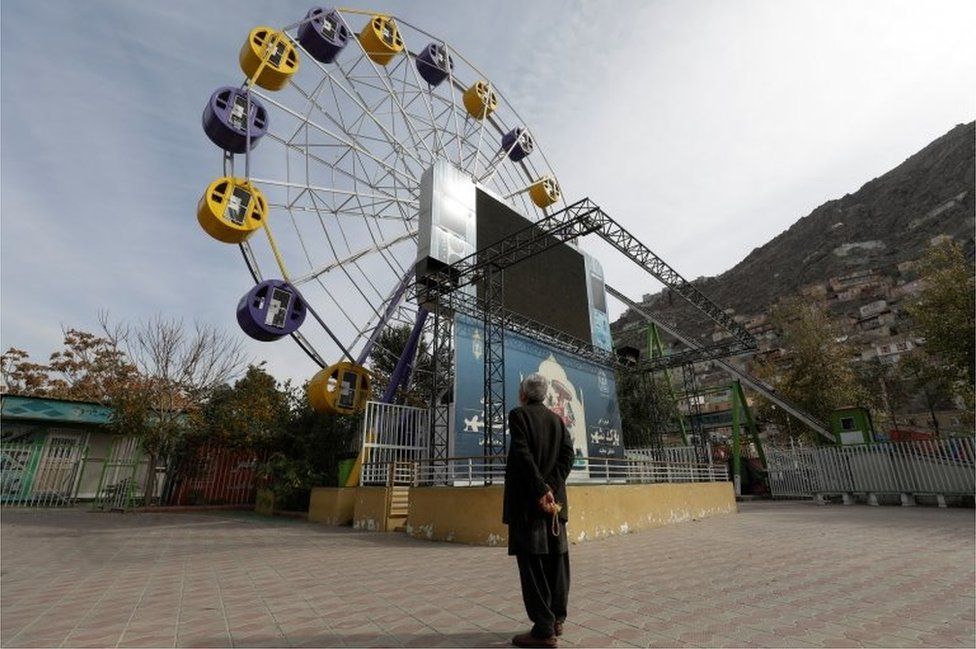
IMAGE SOURCE,REUTERS Image caption, Women were barred from all parks and funfairs in Kabul last week
Last week they banned women from visiting all parks in Kabul, excluding them still further from public life. It has since emerged the ban extends to women in the capital visiting public baths and gyms, although the latter attracted relatively few women.
Entry to parks, baths and gyms was already segregated under Taliban rules on segregating people by gender. The group claims Islamic laws were not being followed.
Levels of violence have fallen across Afghanistan since foreign troops pulled out after 20 years of war, in the face of the Taliban advance in the summer of 2021.
But the group has faced numerous allegations that it is abusing human rights, including of opponents, women and journalists.
It has vowed there will be no brutal repression of women as there was when it was in power from 1996-2001, but half the population face severe curbs on what they can do.
Women are barred from going on longer distance journeys without a male chaperone. Teenage girls have still not returned to school in most of the country, despite Taliban promises to allow them to do so.
While some women still work in sectors such as healthcare and education, most were told not to go to work after the Taliban swept back to power.
Billions of dollars in Afghan assets held abroad are frozen as the international community waits for the Taliban to honour promises still to be met on security, governance and human rights.
Zelenskyy triumphantly walked the streets of Kherson, hailing Russia’s withdrawal as the “beginning of the end of the war,” but also acknowledging the high cost Ukrainian troops are paying in their grinding effort to push back the Russians.
Zelenskyy awarded medals to soldiers and posed for selfies with them in Kherson, striking a defiant tone.
“This is the beginning of the end of the war,” he said. “We are step by step coming to all the temporarily occupied territories.”
But he also grimly noted that the fighting “took the best heroes of our country”.
Zelenskyy’s trip to Kherson was another is a series of unexpected visits to front-line areas at crucial moments of the war. This one was laden with both symbolism and the common touch — clearly aimed at boosting morale of soldiers and civilians alike.
The Equiano subsea internet cable that landed ashore in Melkbosstrand outside Cape Town earlier this year could cut South Africa’s internet costs by around 20%, according to Google.
Equiano arrived in South Africa in early August, its final destination after already having landed in Togo, Nigeria, and Namibia.
The submarine internet cable, stretching 15,000km from Portugal to South Africa along the west coast of the continent, features 12 fibre pairs and a design capacity of 150Tbps. Equiano has 20 times more network capacity than the last cable built to serve this region, according to Nitin Gajria, the managing director of Google in Sub-Saharan Africa.
“There’s a huge positive knock-on effect, in terms of digital economies, job generation… but, at the end of the day, for the end-user, the knock-on effect of this [Equiano] is faster internet and lower cost internet,” said Gajria on Wednesday at the AfricaTech festival held at the Cape Town International Convention Centre.
“So, depending on which country you’re in, what geography you’re in, and the various partnerships along the way, this would be somewhere in the range of 20% cheaper internet locally.”
Equiano will start feeding more network capacity through the west coast of Africa – and South Africa – in a phased approach, said Gajria, with the first phase expected to begin in December.
“What the cable does is it brings in a lot more network capacity to the continent. What we’re now doing is working with partners to bring this capacity further afield. This involves us working with ISPs, telcos, other infrastructure players in the ecosystem to bring this capacity further afield,” said Gajria.
“One of the objectives for us is to start driving more connectivity and getting more people online and getting faster, cheaper internet into more parts of Africa, including the rural areas.”
Of the approximately 1.1 billion people living in Sub-Saharan Africa, only 300 million are online,added Gajria. “And even those 300 million people, they don’t really have the full internet experience that many of us do.”
The problem in getting more people in Africa connected to the internet involves network availability, which is becoming less of an issue as telecommunication providers expand, said Gajria, access to an internet-enabled device, and access to fast, affordable data.
“So, think of it [Equiano] as bringing in a lot more supply of network capacity into the continent. What that will do is make [internet] speeds faster and make data cheaper, so it works on both sides of the equation,” said Gajria.
The landing of Equiano in South Africa coincides with the laying of the 2Africa cable, the longest subsea cable in the world, which recently touched down in Marseille, France. The 2Africa cable will connect 33 countries and the continents of Africa, Europe and Asia once live in 2023, further improving capacity in the regions it touches.
The United States has imposed new sanctions aimed at disrupting Russian military supply chains, targeting 14 people and 28 entities it claims are part of a transnational network that procures technology to support Moscow’s invasion of Ukraine.
The US Treasury also designated family members of Russian oligarch Suleiman Kerimov, as well as individuals who worked as financial intermediaries in Suleiman’s network.
“The United States will continue to disrupt Russia’s military supply chains and impose high costs on President Putin’s enablers, as well as all those who support Russia’s brutality against its neighbor,” Secretary of State Antony Blinken saidin a statement.
Defying political gravity, Democrats have avoided defeat in the Senate and could even score a victory.
President Joe Biden’s party flipped Pennsylvania and held on to every other seat (bar Georgia, where the Senate race is headed for a runoff on Dec. 6), a result that few other presidents have enjoyed in the past.
The Republicans are currently projected to win a slim majority in the House of Representatives, although 20 races remain too close to call. Still, Democrats’ losses in the lower chamber are fewer than forecast, scoring one of the best midterm results for the party in the last century.
Typically, the political party in the White House loses popularity, and therefore seats, in the midterm elections. There are a number of reasons for this: an overall lower voter turnout compared to presidential elections, those dissatisfied with the status quo being more likely to head to the ballots than those who support it, and swing voters switching their vote away from the ruling party depending on how economic and social conditions have fared.
Ahead of the Nov. 8 vote, Biden recorded low popularity rates in the polls as inflation touched 40-year highs. The odds appeared to be in Republicans’ favor, but the conservative party ultimately failed to get a leg up in the Senate races. Voters showed up for abortion rights, and against Donald Trump and candidates who doubted or rejected the outcome of the 2020 election .
Time Capsule: When presidents’ parties gained in Senate races
Only on three occasions since 1922 has the president’s party gained (or lost no) Senate seats.
On Saturday Nov. 12, Mark Kelly’s re-election in Arizona put the Democrats one vote away from clinching the Senate. Theformer NASA astronaut, who won a second term in a state that has historically voted red, has at times criticized Biden on issues such as immigration.
Later that day, the Nevada race results cemented the Democrats’ held of the Senate. When the tight race was called in Catherine Cortez Masto’s favor, Republicans’ 1994-like “red wave” talk fell flat on its head.
Now, Masto’s win over Trump-backed Adam Laxalt gives Democrats an opportunity to clinch an outright Senate majority if they win in Georgia’s December runoff.
All eyes on Georgia’s runoff election
Neither candidate in the Georgia Senate race won an outright majority, so the top two, Democrat Raphael Warnock and Republican Herschel Walker, will face off in a runoff election on Dec 6. (Ironically, two black contenders will face-off with a tradition that was originally designed to keep Black voters away from the polls.)
Independently, a Warnock win would make history considering there has never been a midterm where every incumbent who sought another term won their primary and general elections since the popular vote for US senators were established in 1913.
In the context of the Senate, Warnock’s win would give Democrats a clear majority, so vice president Kamala Harris wouldn’t have to be the tie-breaker.
Democrats are eyeing a Georgia win, president Biden says
“I’m incredibly pleased by the turnout. And I think it’s a reflection of the quality of our candidates. And they’re all running on the same program. There wasn’t anybody who wasn’t running on what we did. They’re all staying, sticking with it. And so, I feel good. I’m looking forward to the next couple years.” —President Joe Biden, speaking to reporters on Nov. 13
Person of interest: Mitch McConnell
Many members of the Republican party, including Trump and his former White House senior adviser Stephen Miller, are blaming Minority Leader of the US Senate Mitch McConnell for losing the Arizona election. The Senate Leadership Fund, led by McConnell, withdrew broadcast ad spending from Arizona candidate Blake Masters to the tune of $9 million, and instead gave it to Lisa Murkowski, who was up against another Republican-backed nominee in Alaska. McConnell also spent more on Colorado than he did on Arizona, to little avail.
As the tense Arizona race trotted on, Masters said: “The people who control the purse strings, Senate Leadership Fund, Mitch McConnell—McConnell decided to spend millions of dollars attacking a fellow Republican in Alaska instead of helping me defeat Senator Mark Kelly. Had he chosen to spend money in Arizona, this race would be over, we’d be celebrating a Senate Majority right now.”
Released on Monday, his 74th birthday, the photograph marks Charles’ appointment as Ranger.
The photo shows the monarch leaning against an ancient oak tree in Windsor Great Park, with the winter sun gleaming in the background.
The photo shows the monarch leaning against an ancient oak tree in Windsor Great Park, with the winter sun gleaming in the background.
Britain’s King Charles III speaks in the Throne Room at St James’s Palace during the Accession Council in London in September 2022. He was formally proclaimed as King. Joining him were his son Prince William and his wife Camilla, the Queen Consort. Credit: Jonathan Brady/Pool/AP
The post of Ranger was previously held by his father, Prince Philip, the late Duke of Edinburgh, for 70 years. Duties include offering guidance to the Deputy Ranger on the stewardship of one of the country’s oldest estates, Buckingham Palace said in a statement.
Festivities for the King’s birthday began Monday with a rendition of “Happy Birthday” by the band of the Household Cavalry at Buckingham Palace, where Charles was born in 1948. This performance was followed at midday by a 41-gun royal salute from the King’s Troop Royal Horse Artillery in Green Park.
Charles came to the throne on September 8, with the death of his mother, Queen Elizabeth II, at age 96.
Last month, the UK Royal Mint unveiled King Charles III’s coin portrait.
Canada will provide another $500 million in military assistance to Ukraine, in addition to sanctions against nearly two dozen Russians, Prime Minister Justin Trudeau’s office announced.
The additional funding, which will help fund military, surveillance and communications equipment, fuel, and medical supplies, will be added to the $3.4 billion in Canadian assistance to Kyiv for its defence against Russia’s invasion, according to Trudeau’s office.
Monday’s sanctions target 23 Russian individuals “involved in gross and systematic human rights violations against Russian opposition leaders,” including police officers, prosecutors, judges and prison officials, the statement added.
The Kremlin confirmed on Monday that talks between US and Russian officials took place in Ankara.
“Such negotiations really took place. It was the American side’s initiative,” Kremlin spokesman Dmitry Peskov was quoted as saying by Russia’s TASS news agency.
According to reports, US Central Intelligence Agency Director William Burns travelled to Turkey to meet with his Russian counterpart Sergey Naryshkin, the head of Russia’s Foreign Intelligence Service.
Burns reportedly warned Naryshkin of the consequences Russia would face in the event it used nuclear weapons in Ukraine.
The cost of Christmas has risen in price over the past 10 years, with the average cost of festive decorations and snacks up to £548 this year, new data suggests.
The Christmas Inflation Index, from personal insolvency provider Creditfix, looked at 25 items and found the traditional Christmas stocking has seen the biggest price rise.
The average cost of festive decorations and snacks such as advent calendars, cards, gift wrap, and a Christmas tree is now £130 more than it would have cost in 2012.
This is before Britons take into account the price of gifts, social events, and the full Christmas dinner shop.
While the average cost of a standard Christmas tree in 2022 is £88, it was £69 in 2012 – a jump of almost a third and 64% higher compared to 20 years ago.
Data was gathered on the average price of popular festive treats this year at popular department stores and supermarkets and then analysed using the Bank of England inflation calculator to show the difference over time.
Bauble prices have surged from an average of £7 in 2012 to almost £10 this year – a 32% increase.
Of the items analyzed, the Christmas tree topper was the least affected by inflation. Prices for angels and stars increased by only 15% over the past five years.
A supermarket-bought chocolate advent calendar, however, is now at record costs, setting people back £7 on average.
Separate data, commissioned by Park Christmas Savings, revealed Christmas will cost families more than £900 this year.
How the average price of festive favourites has risen in the last 10 years:
1. Stockings – from £3.12 to £4.25
2. Baubles – from £7.00 to £9.30
3. Christmas garlands – from £22.62 to £29.15
4. Inflatable Christmas decorations – from £39.00 to £50
NATO Secretary-General Jens Stoltenberg has said it is up to Ukraine to decide what terms are acceptable for negotiations with Russia to bring an end to the war.
“It is for Ukraine to decide what kind of terms are acceptable. It is for us to support them,” Stoltenberg said during a press conference with members of the Dutch government in The Hague.
“We should not make the mistake of underestimating Russia … They still control large parts ofUkraine … What we should do is strengthen Ukraine’s hand,” Stoltenberg added.
US Central Intelligence Agency DirectorWilliam Burns has travelled to Turkey to speak to his Russian counterpart and warn Moscow of the consequences of any use of nuclear weapons in Ukraine, according to several reports citing an unnamed White House official.
The Reuters news agency quoted the White House official as saying that Burns, a former US ambassador to Russia, was not conducting negotiations of any kind on Monday with Sergey Naryshkin, the head of Russia’s Foreign Intelligence Service.
Ukraine was briefed in advance about Burns’s trip to Turkey, the official added.
The official provided no details regarding the timing of Burns’s meeting, and it was not immediately clear whether his talks with Naryshkin had already concluded.
Turkey’s state-run Anadolu news agency also reported the meeting, citing unnamed intelligence sourcesas saying it was being hosted by Turkish intelligence officials.
During the 2019 mass protests, the slogan ‘Glory to Hong Kong’ was nearly banned in Chinese territory.
The Hong Kong government has condemned the organisers of a rugby tournament in South Korea after a democracy protest song was played before the territory’s team played a match instead of the Chinese national anthem.
The players appeared perplexed in a video shared on social media as the song Glory to Hong Kongwas played ahead of the Asia Rugby Sevens Series final instead of the Chinese national anthem.
The Hong Kong government “strongly deplores and opposes the playing of a song closely associated with violent protests and the ‘independence’ movement as the National Anthem of the People’s Republic of China,” it said in a statement.
“The National Anthem is a symbol of our country. The organiser of the tournament has a duty to ensure that the National Anthem receives the respect it warranted,” a government spokesperson said.
Glory to Hong Kong was written by an anonymous composer and became an anthem for the pro-democracy movement during protests in 2019, which attracted huge crowds but became increasingly violent as the months dragged on.
The organisers of the tournament in Incheon, South Korea, issued an apology and played the Chinese anthem after the match, which was won by the Hong Kong team.
Hong Kong authorities said they had ordered the city’s rugby union body to conduct an investigation and convey its “strong objection” to tournament organiser Asia Rugby.
In a separate statement, Hong Kong Rugby Union expressed its “extreme dissatisfaction” with what had happened.
The organisation’s preliminary investigation found that the Chinese anthem had been given to the organisers by the team’s coach, and the protest song had been played by mistake.
“Whilst we accept this was a case of human error, it was nevertheless not acceptable,” the HKRU said.
The Chinese national anthem, March of the Volunteers, has been played at international events where Hong Kong has competed since the British handed the territory back to China in 1997.
Playing Glory to Hong Kong in the territory is now all but illegal after Beijing imposed a national security law on Hong Kong that rights groups say has “decimated” dissent. It is also considered unlawful under Hong Kong’s sedition law, according to the South China Morning Post.
In September, a harmonica player who played the tune to a crowd commemorating Britain’s Queen Elizabeth II was arrested.
The G7-led plan aims to rapidly provide prearranged insurance and protection funding after devastating events occur.
A G7-led plan dubbed “Global Shield” to provide funding to countries suffering climate disasters has been launched at the United Nations COP27 summit, although some questioned the effectiveness of the planned scheme.
Coordinated by Group of Seven president Germanyand the Vulnerable Twenty (V20) group of climate-vulnerable countries, the plan launched on Monday aims to rapidly provide prearranged insurance and disaster protection funding after events such as floods, droughts and hurricanes hit.
Backed by 170 million euros ($175m) in funding from Germany and 40 million euros ($41m) from other donors including Denmark and Ireland, the Global Shield will in the next few months develop support to be deployed in countries including Pakistan, Ghana, Fiji and Senegal when events occur.
Some countries and campaigners were cautious, however, concerned that the plan risked damaging efforts to secure a substantive deal on financial help for so-called “loss and damage” – the UN jargon for irreparable damage wrought by global warming.
German Development Minister Svenja Schulze said the Global Shield aimed to complement, not replace, progress on loss and damage.
“It is not a kind of tactic to avoid formal negotiation on loss and damage funding arrangements here,” Schulze said. “Global Shield isn’t the one and only solution for loss and damage. Certainly not. We need a broad range of solutions.”
Some research suggests that by 2030, vulnerable countries could face $580bn per year in climate-linked “loss and damage”.
Ghana’s Finance Minister Ken Ofori-Atta, who chairs the V20 group of vulnerable countries, called the creation of the Global Shield “long overdue”.
“It has never been a question of who pays for loss and damage, because we are paying for it,” he said in recorded remarks at the summit in the Egyptian resort town of Sharm el-Sheikh.
“Our economies pay for it in lost growth prospects, our enterprises pay for it in business disruption, and our communities pay for it in lives and livelihoods lost.”
‘We are not yet persuaded’
Yet some vulnerable countries questioned the scheme’s focus on insurance, with insurance premiums adding another cost tocash-strapped countries that have low carbon emissions and contributed least to the causes of climate change.
“We are not yet persuaded, especially of the insurance elements,” Avinash Persaud, the special envoy on climate finance to Barbados Prime Minister Mia Mottley, told the Reuters news agency.
“Using insurance is a method in which the victim pays, just in installments in the beginning,” he said, adding that loss and damage finance should be grant-based.
It was not immediately clear how much of the Global Shield funding announced so far was in grant form.
Michai Robertson, a negotiator for the Alliance of Small Island States – which is championing calls for a new UN loss and damage fund in the talks this week – said even subsidised insurance premiums could enable insurance companies in wealthy countries to profit off poor and vulnerable nations’ suffering.
“There’s an inherent injustice about them profiting off of our loss and damage,” he said.
‘Life and death’
A formal loss and damage funding stream would likely go further, also covering longer-onset climate impacts such as sea level rise and threats to cultural heritage.
The V20 bloc, made up of 58 developing nations, released research this year that estimated countries had lost some $525bn to climate impacts since 2000.
Ninety-eight percent of the nearly 1.5 billion people in V20 countries do not have financial protection, it said.
“We’re talking about people living under the poverty line; they’re not going to be buying insurance,” Rachel Cleetus, lead economist at the Union of Concerned Scientists’ climate programme, told the AFP news agency.
“Insurance can help you up to a point but climate change is now creating conditions in many parts of the world that are beyond the bounds of what’s insurable,” she said, referring to sea level rise, desertification and the mass displacement of populations.
Teresa Anderson of ActionAid International said the scheme showed that the global community recognised the need to act on loss and damage, but said it was a “distraction” from negotiations on a dedicated funding mechanism for climate damages.
“Everyone knows that insurance companies, by their very nature, are either reluctant to provide coverage, or reluctant to payout,” she said.
“But when it comes to loss and damage, this is a matter of life and death.”
The announcement came as Congolese troopsclashed once more with the M23 in the volatile east, north of Goma.
East African leaders announced peace talks on Sunday in an effort to stabilise the eastern Democratic Republic of the Congo (DRC), where M23 rebels clashed with troops just north of Goma over the weekend.
The seven-nation East African Community (EAC) announced a “peace dialogue” on eastern DRC on November 21 in Nairobi, Kenya.
Officials said the announcement came as Congolese troops clashed again with the M23 north of the volatile region’s main city Goma.
Al Jazeera’s Malcolm Webb reporting from the region, said Congolese government forces, repelled M23’s attack on the town of Cuba with more than a day of heavy fighting before pushing them.
“The Congolese army North Congress army, says that they’re fighting soldiers from Rwanda and Uganda. The rebel group is widely understood to be a proxy of Rwanda, although Rwanda denies it. And so, people have fled…to try and get away from the fighting.”
“Meanwhile, community leaders on the other side of the frontline have told us that about 60,000 people are stuck behind the front line in the territory held by the M23 rebel group and that they want a humanitarian corridor to be created so they can leave that area before the fighting gets closer to them,” Webb said.
M23 rebels have recently surged across the DRC’s North Kivu province, winning a string of victories against the army and capturing swaths of territory.
On Saturday, the group accused the Congolese army of retaliating with “barbarian bombings” – killing 15 civilians, including two children. Al Jazeera was unable to independently confirm the death toll.
The latest violence comes one day after Kenyan troops were deployed to eastern DRC, as part of a peacekeeping operation from the EAC bloc.
A mostly Congolese Tutsi group, the M23 first leapt to prominence in 2012 when it briefly captured Goma before being driven out and going underground.
The group re-emerged in late 2021, taking up arms again on claims that the DRC had failed to honour a promise to integrate them into the army, among other grievances.
The M23’s resurgence has cratered relations between the DRC and its smaller neighbour Rwanda, which Kinshasa accuses of backing the militia.
Despite official denials from Kigali, an unpublished report for the United Nations seen by AFP in August pointed to Rwandan involvement with the M23.
Kinshasa expelled Rwanda’s ambassador at the end of last month, as the M23 captured more territory, while also recalling its envoy from Kigali.
The ratcheting tensions have spurred a bout of diplomatic efforts to resolve the crisis.
Angolan President Joao Lourenco met Congolese President Felix Tshisekedi in Kinshasa on Saturday, for example, after visiting Rwanda the previous day.
On Sunday, Kenya’s ex-President Uhuru Kenyatta, the EAC’s mediator for the situation, was also due in Kinshasa for talks.
The EAC on Sunday said it would hold talks aimed at bringing peace to eastern DRC in Nairobi this month. But it did not specify stakeholders in the talks nor how long they were scheduled to last.
The announcement comes just days after Kenyan troops began to arrive in Goma over the weekend as part of a regional peacekeeping force established by the EAC in April.
Kenya’s Parliament approved the deployment of about 900 soldiers for an initial period of six months. While the force will be under Kenyan command, its total size and scope remain unclear.
In August, Burundi also sent troops to join the regional force in DRC.
Earlier this month, the UN peacekeeping mission in the DRChas withdrawn troops from the eastern military base of Rumangabo, ceding ground in the battle against the M23.
Azerbaijan has arrested five of its nationals for spying for Iran after a rise in tensions between the neighbours, which regard each other with mutual suspicion.
The announcement of the arrests came on Monday after Baku and Tehran accused each other last week of hostile rhetoric.
Baku’s security services said the arrests were made as part of “measures aimed at countering intelligence-disruptive activities carried out by Iranian secret services against Azerbaijan”.
It said the five people had been gathering information about the military, including the procurement of Israeli and Turkish drones and the country’s energy infrastructure.
Earlier this month, the Baku authorities arrested 17 men they said belonged to an “illegal armed group set up by Iran on Azerbaijani territory”.
‘Threatening rhetoric’
On Friday, Azerbaijan summoned the Iranian ambassador to complain about “threatening rhetoric” coming from Tehran.
The day before, the Iranian foreign ministry had handed Azerbaijan’s envoy a note of protest over “anti-Iran” comments by Baku officials.
Baku has also been angered by its ambitions to set up a transport link along the Armenian-Iranian border, which would connect mainland Azerbaijan to its exclave of Nakhichevan and Turkey.
Baku wants to limit Armenian jurisdiction over the so-called Zangezur land corridor, a project that would end its dependence on Iran for access to the Nakhichevan exclave.
The exclave is separated from Azerbaijan by the Armenian region of Zangezur.
The issue has emerged as the primary sticking point between Azerbaijan and Armenia, who fought two wars – in the 1990s and in 2020 – over the contested Nagorno-Karabakh region to the east of Zangezur.
“Iran will not permit the blockage of its connection route with Armenia,” Iranian Foreign Minister Hossein Amir-Abdollahian said in October.
He said that “to secure that objective”, Iran had staged large-scale military drills in October on its border with Azerbaijan.
Relations between Baku and Tehran have been traditionally sour, as Turkic-speaking Azerbaijan is a close ally of Iran’s rival Turkey.
Iran is also suspicious of Azerbaijan’s military cooperation with Israel – a significant arms supplier to Baku – saying Tel-Aviv could potentially use Azerbaijani territory as a bridgehead against Iran.
Police say they are investigating the ‘suspected homicide’ of the students in the college town of Moscow.
Police in the US state of Idaho say they are investigating the deaths of four university students whose bodies were found in a home near the campus.
The deaths have been classified as suspected homicides, according to police in Moscow, acollege town in north-central Idaho.
The bodies of the students from the University of Idaho were discovered on Sunday after police responded to a report about an unconscious person, the city administration said in a statement.
No additional details were available, including the cause of death.
All classes for Monday were cancelled, the university said, and are set to resume on Tuesday.
“It is with deep sadness that I share with you that the university was notified today of the death of four University of Idaho students living off-campus believed to be victims of homicide,” the university’s president, Scott Green, said in a statement.
Soon after the bodies were found, the university alerted students to shelter in place for about an hour until police concluded that there was no threat to others in the area.
Police identified a student, Christopher Darnell Jones, as the suspect, and warned people to remain sheltered in place.
A shooting on the campus of the University of Virginiahas killed three people and wounded two others, police said in a tweet.
The university police identified a student, Christopher Darnell Jones, as the suspect, and said multiple agencies were engaged in an active search.
Police also warned everyone to remain sheltered in place.
PD AGENCIES ARE CONDUCTING A COMPLETE SEARCH ON AND AROUND UVA GROUNDS AT THIS TIME. EXPECT INCREASED LAW ENFORCEMENT PRESENCE. REMAIN SHELTERED IN PLACE.
“As of this writing, I am heartbroken to report that the shooting has resulted in three fatalities; two additional victims were injured and are receiving medical care,” university president James E Ryan wrote in a message to the community early on Monday morning.
“We are working closely with the families of the victims, and we will share additional detail as soon as we are able.
“Our University Police Department has joined forces with other law enforcement agencies to apprehend the suspect, and we will keep our community apprised of developments as the situation evolves.
“The second we all got that message that there was an active shooter, my phone flooded with messages,” she said. “You just don’t really think something could happen like this to your community until it does.”
This is not the first time that a university campus in Virginia has witnessed a shooting incident.
In February this year, two campus police officers were shot dead at Bridgewater College after reports of a suspicious man near a school building.
In 2007, Virginia Tech experienced one of the worst mass shootings in US history when an undergraduate student killed 32 people before shooting himself on April 16 of that year.
Sunday’s shooting is the latest in a wave of gun violence on US college and high school campuses in recent years. The bloodshed has fuelled a debate over tighter restrictions on access to guns in the country.
Turkey’s interior minister has rejected a message of condolence from the United States.
“We do not accept the US embassy’s message of condolences,” Interior Minister Suleyman Soylu said in a response designed to focus attention on US support for groups Ankara considers to be offshoots of the PKK, such as the Syrian Democratic Forces (SDF).
White House Press Secretary Karine Jean-Pierre issued a statement on Sunday, saying: “The United States strongly condemns the act of violence that took place today in Istanbul, Türkiye.”
Following the explosion,the suspect fled to Istanbul’s Esenyurt district, which is far from the Taksim area where the blast occurred, according to Al Jazeera’s Sinem Koseoglu, reporting from Istanbul.
Before she was arrested at 2:50 a.m., Istanbul police checked 1,200 security cameras and conducted raids at 21 different locations where the woman was linked.
“The Turkish interior minister said that the police had a voice recording of a talk among PKK members that said she should be killed before police captures her,” Koseoglu said.
“The minister said the next step for the perpetrators was to escape to Greece before being captured by Turkish police.”
Tension between Turkey and Greece has escalated over recent months, largely surrounding disputes over border issues.
Interior minister blames blast on Kurdish fighters, says those detained include ‘the person who left the bomb’ on Istiklal Avenue.
Turkish police have arrested 46 people over the explosion in central Istanbul that left at least six people dead and 81 others wounded, Istanbul police have said.
Interior minister Suleyman Soylu told reporters on Monday that the suspects included the “person who left the bomb that caused the explosion” on the busy Istiklal Avenue in Turkey’s largest city.
Al Jazeera’s Sinem Koseoglu, reporting from Istanbul, said a three-year-old girl and her father were among those killed.
#URGENT Person who left bomb that caused explosion Sunday on Istanbul’s Istiklal Avenue arrested by police, says Interior Minister Suleyman Soylu pic.twitter.com/I08OTC4rPb
Soylu blamed the outlawed Kurdistan Workers Party (PKK) for Sunday’s blast, in the popular shopping and tourism spot, saying: “Our assessment is that the order for the deadly terror attack came from Ain al-Arab [Kobane] in northern Syria,” where he said the group has its Syrian headquarters.
“We will retaliate against those who are responsible for this heinous terror attack,” he said, adding that 81 people had been wounded, two of them in critical condition.
Turkish authorities are not ruling out ISIL (ISIS) ties, a senior Turkish official said Monday.
The PKK has issued a statement in which it denied involvement in the attack, and expressed its condolences.
Turkish President Recep Tayyip Erdogan on Sunday described the explosion as “treacherous” and said it “smells like terrorism”.
In initial questioning, the woman said she was trained by Kurdish militants in Syria and entered Turkey through northwest Syria’s Afrin region, the police said.
Television news reports also showed images of a person, who appeared to be a woman, leaving a package below a raised flower bed on Istiklal, which has a tramline running the length of the street.
Al Jazeera’s Koseoglu said two more Syrian nationals were involved in the attack, according to security sources.
“The interior minister mentioned that these perpetrators are linked to the YPG, the Syrian Kurdish fighter group, which Turkey considers as an offshoot of the outlawed PKK,” Koseoglu said.
“We’re waiting for officials to give more details about the suspects… [including] how they crossed the Turkish-Syrian border as Turkey has been very strict about Syrians who are staying in big cities without residential permits or without being registered.”
She added that the woman seems to be in her late twenties or early thirties and “was captured by the police in the place where she was staying” at 2:50am.
According to Istanbul police, 1,200 security cameras have been checked near the site of the explosion. Police have conducted raids at 21 different addresses the female suspect has been identified to have links with.
Istanbul and other Turkish cities have been targeted in the past by Kurdish separatists, ISIL (ISIS), and other groups, including in a series of attacks in 2015 and 2016.
These include twin bombings outside an Istanbul football stadium in December 2016 that killed 38 people and wounded 155. The attack was claimed by an offshoot of the PKK, which has kept up a campaign for Kurdish self-rule in southeastern Turkey since the 1980s and is designated a terrorist group by Turkey, the European Union and the United States.
Regularly targeted by Turkish military operations, the PKK is also at the heart of a tussle between Sweden and Turkey, which has been blocking Stockholm’s entry into NATO since May, accusing it of leniency towards the Kurdish group.
Condemnations of Sunday’s attack and condolences for the victims rolled in from several countries, including Azerbaijan, Egypt, France, Greece, Italy, Pakistan, Ukraine, the United Kingdom, and the US.
Greece “unequivocally” denounced the blast and expressed condolences, while the US said it stood “shoulder-to-shoulder with our NATO ally in countering terrorism”.
French President Emmanuel Macron said in a message to the Turkish people: “We share your pain. We stand with you in the fight against terrorism”.
Ukrainian President Volodymyr Zelenskyy also tweeted in Turkish: “The pain of the friendly Turkish people is our pain.”
European Council President Charles Michel also sent condolences, tweeting: “My thoughts are with the victims and their families.”
Syrian statemedia has reported that , an attack has targeted the Shayrat Airbase in the central province of Homs.
Israeli air strikes in the central province of Homs killed two Syrian soldiers and injured three others.
Syrian air defences responded to “hostile targets over southeastern Homs province,” intercepting “several of them,” according to the state-run news agency SANA.
According to a military source, the strikes hit the Shayrat Airbase, causing casualties and damage. Syrian state television broadcast footage of air defences intercepting “Israeli aggression missiles.”
The Syrian Observatory for Human Rights, which is based in London, said strong explosions were heard when four Israeli missiles hit the Shayrat Airbase in Homs. It said the missile attack targeted the positions of Iran-backed fighters in the area.
The strikes occurred after Israeli warplanes were seen flying over neighbouring Lebanon, whose airspace Israel sometimes crosses to carry out attacks on Syria.
Israel has carried out hundreds of strikes on targets inside government-controlled parts of Syria in recent years but rarely acknowledges or discusses such operations.
Israel has acknowledged, however, that it targets bases of Iran-allied armed groups, such as Lebanon’s Hezbollah, which has sent thousands of fighters to support Syrian President Bashar al-Assad’s forces.
On Tuesday, air strikes in eastern Syria along the border with Iraq targeted Iran-backed fighters and inflicted casualties, Syrian opposition activists said. According to two paramilitary officers in Iraq, some of those killed in the attack were Iranian nationals. The US military said it was not behind the attack. Some Syrian opposition activists blamed Israel.
An Israeli strike on Damascus International Airport and nearby military posts outside the Syrian capital on September 17 killed five soldiers.
The father-of-three, who hosts Channel 4’s A Place In The Sun and the BBC’s Escape To The Country, was diagnosed with lung cancer in 2020 and given only six months to live.
Jonnie Irwin, a TV presenter, has revealed that he has terminal cancer and hopes to use his diagnosis to inspire others to “make the most of every day.”
The father-of-three, who hosts Channel 4’s A Place In The Sun and the BBC’s Escape To The Country, was diagnosed with lung cancer in 2020 and given only six months to live.
The 48-year-old has now shared that the disease has spread to his brain, telling Hello magazine: “I don’t know how long I have left.”
Irwin said the first warning sign of his illness came while he was filming in Italy in August 2020, when his vision became blurry.
“Within a week of flying back from filming, I was being given six months to live,” he said.
“I had to go home and tell my wife, who was looking after our babies, that she was on her own pretty much. That was devastating.
“All I could do was apologise to her. I felt so responsible.”
Irwin and his wife Jessica share a three-year-old son named Rex and two-year-old twins, Rafa and Cormac.
“It’s got to the point now where it feels like I’m carrying a dirty secret, it’s become a monkey on my back,” he said.
“I hope that by shaking that monkey off, I might inspire people who are living with life-limiting prospects to make the most of every day, to help them see that you can live a positive life, even though you are dying.”
He added: “One day, this is going to catch up with me, but I’m doing everything I can to hold that day off for as long as possible.
“I owe that to Jess and our boys, Some people in my position have bucket lists, but I just want us to do as much as we can as a family.”
Despite his diagnosis, Irwin is determined to work as much as possible, saying he is taking the attitude that he is “living with cancer, not dying from it”.
“I want to make memories and capture these moments with my family because the reality is, my boys are going to grow up not knowing their dad and that breaks my heart,” he said.
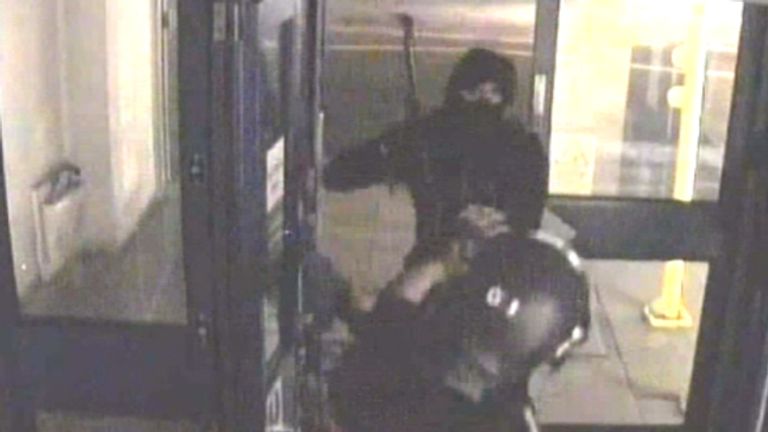
The gang used guns, knives, hammers and crowbars to terrorise staff before fleeing in a fleet of stolen vehicles and leaving few clues behind them.
When banknotes got stained by security dye, they laundered the cash through fixed-odds betting terminals in bookmakers’ shops.
They took advantage of a system that allowed punters to load a machine with up to £3,000 cash, make one small bet and then collect their unspent stake in fresh notes from the shop’s cash till.
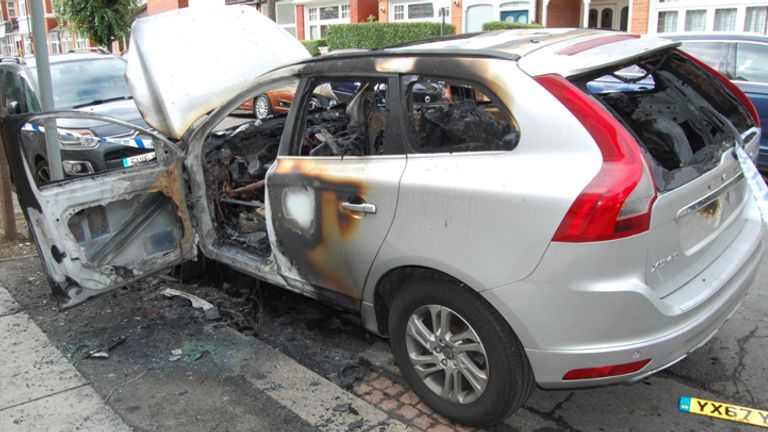
They burnt piles of stained banknotes and a car that got sprayed when they smashed open one cash box and triggered the dye security system.
Armed police ambushed two robbers – Abdi Omar and Brooklyn McFarlane – as they were about to attack security guards at a local Sainsbury’s in Wimbledon. Omar was caught quickly, while McFarlane ran and pulled a knife and was shot by police who believed he was carrying a gun. He was discharged from hospital the next day.
The gang were caught after an astonishing bit of detective work by the Metropolitan Police’s Flying Squad who, from poor quality CCTV footage, managed to identify and track one of their stolen cars and the first of the robbers who eventually led them to the rest.
‘The violence was extreme’
Detective Superintendent Simon Moring said: “They had a well-organised gang structure. They displayed a really good tradecraft, using stolen vehicles, cloned number plates, they knew a lot about police tactics, used good anti-surveillance techniques, so that they knew what they were doing. They were a forceful gang.
“The violence was extreme, security guards thrown around, hit with iron bars, guns held to their heads. Thankfully no one got seriously hurt. They would have just carried on committing robberies and who knows where and how it would have ended.”
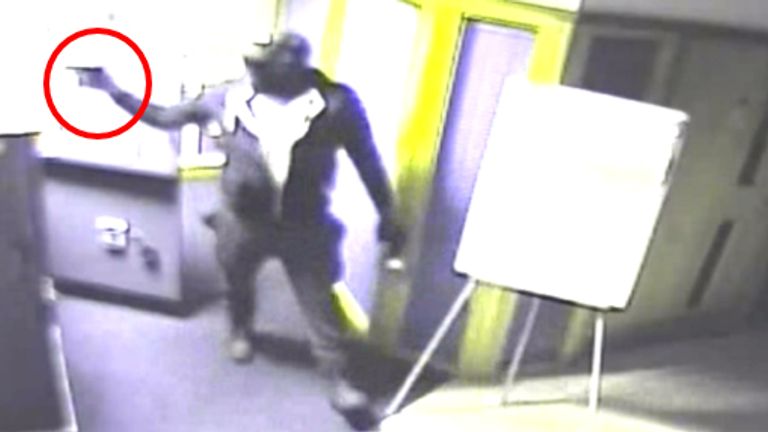
Image: The gang used weapons to terrorise staff
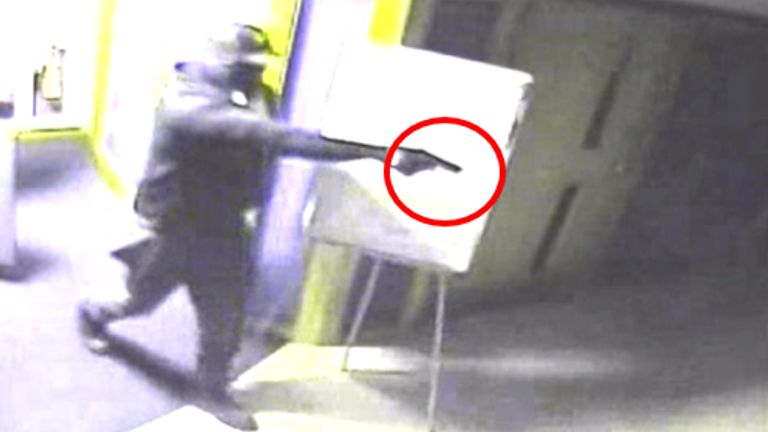
Image: A member of the gang brandishes a gun
The gang attacked guards at cash points in London, Oxford, Bedfordshire and Northamptonshire, usually congregating and travelling from an estate in South London. Armed with loaded handguns and other weapons they wore ballistic body armour and balaclavas. Over 18 months they stole more than £400,000.
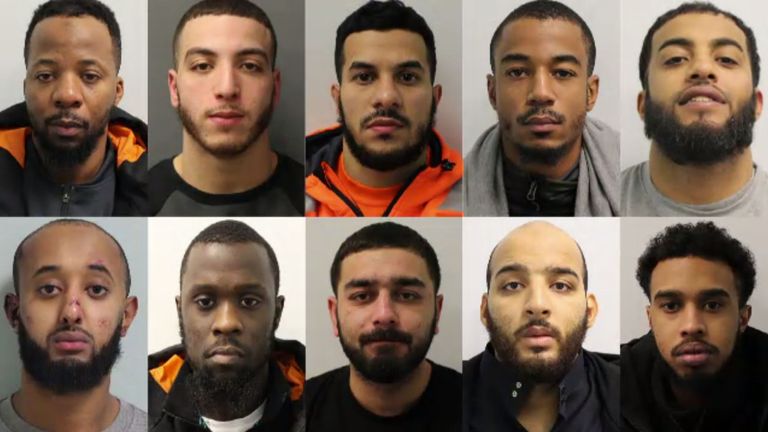
Image: Clockwise from top left: Ola Orulebaja, Ihab Ashaoui, Adam Salman, Brooklyn McFarlane, Abdi Omar, Mahdi Hashi, Basil Abdul-Latif, Noaman Amin, Ibrahim Lyazi, David Tesfaalem
Two robbers arrested after crashing into bus
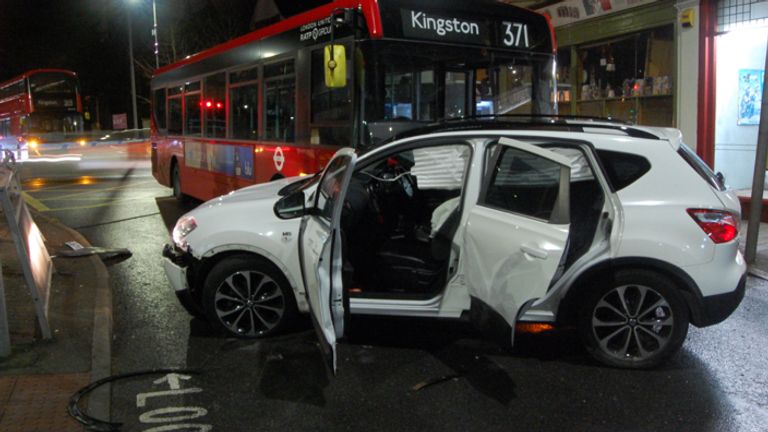
The first two robbers identified were arrested after jumping a red light and crashing into a bus. They ran off but were chased and caught by a team of detectives who were trailing them.
While awaiting trial the two shared a cell in Wandsworth prison and police later discovered they had a smuggled mobile phone and used it to coordinate more robberies committed by those yet to be caught.
Image:The first two robbers identified were arrested after jumping a red light and crashing into a bus
The sentences
In the first of two trials Basil Abdul-Latif, 36, from South London, the gang’s leader, was jailed for 22 years for conspiracies to rob, possess a firearm with intent to cause fear of violence and handle stolen goods and arson.
A second main gang member David Tesfaalem, 30, from South London, was jailed for 20 years for similar offences.
Ibrahim Lyazi, 29, from west London, got 18 years and two others, Ihab Ashaoui, 30, and Adam Salman, 32, were each jailed for 14 years. Ola Orulebaja was jailed for 13 years.
Image:The gang used guns in the robberies
Image: One of the burnt-out cars
Detective Constable Stephen O’Connell from the Flying Squad said: “This was an immensely complex investigation involving a huge amount of evidence. The group caused havoc in and outside London with buildings being severely damaged and high-value goods being stolen.
“These men have since discovered that crime does not pay and thanks to the complex investigative work by the Flying Squad they will instead be spending time behind bars. Investigations continue to track down and bring to justice outstanding suspects who are believed to be involved in these offences.”
Four other men, all from south London, were awaiting sentence today after being convicted for their roles in the robbery conspiracy. They were: Brooklyn McFarlane and Abdi Omar, both 27, Mahdi Hashi, 29, and Noaman Amin, 26.
Jeff Bezos has revealed plans to give away most of his $124bn (£110bn) fortune during his lifetime.
The Amazon founder, 58, is the world’s second-richest man after Elon Musk, the Tesla boss and new owner of Twitter, according to Forbes.
This is the first time he has said he plans to give away most of his money.
Mr Bezos has been criticised in the past for not signing the Giving Pledge, a campaign founded by Warren Buffett and Bill Gates to encourage the mega rich to contribute most of their wealth to charity.
Asked directly by CNN whether he planned to give most of his money away, Mr Bezos said: “Yeah, I do.”
Bezos told the US broadcaster that he and partner journalist-turned-philanthropist Lauren Sánchez were “building
the capacity to be able to give away this money”.
He said the money would go to causes that work to tackle climate change and to support people who can unify humanity.
It was announced a week ago at the start of the COP27 summit that his Bezos Earth Fund had pledged $1bn more by 2030 to help protect carbon reserves and biodiversity – building on $9bn of funds already committed to the climate cause.
Also last week it was revealed that country music star Dolly Parton had received a $100m (£85m) prize from Bezos.
The courage and civility award gives people the chance to donate cash to causes of their choice.
Parton, a long-time philanthropist herself, has already established a number of charities and put $1m towards the development of a COVID vaccine during the pandemic.
Bezos has more time on his hands to devote to his passions after stepping down as chief executive of Amazon last year.
He continues to own about 10% of the ecommerce-to-streaming giant.
His other business interests include ownership of the Washington Post and space tourism company Blue Origin.
As we’ve been reporting, one of the main items expected to be on the agenda for the Chinese and American leadersduring their ongoing talks is the thorny topic of Taiwan.
The key thing to understand here is that there’s a debate over the status of the island.
China views Taiwan as a renegade province which is destined to one day be reunited with the mainland – by force if needed.
However, Taiwan has many characteristics of an independent state. It’s a self-ruled democracy, and people there see themselves as being separate from Beijing – whether or not independence is ever officially declared.
The United States has long tried to walk a tightrope. Officially, it only recognises the government in Beijing. However, President Biden has repeatedly said the US would defend Taiwan if Beijing’s troops ever invaded. The White House has always looked to walk back his comments.
Tensions have been building recently – and peaked in August when Nancy Pelosi, the speaker of the US House of Representatives, visited Taiwan. China responded with large-scale military drills nearby.
As the sun sets in Bali, Xi and Biden remain ensconced in the Mulia hotel, their meeting approaching the two-hour mark.
Officials in the United States do not believe it will last much longer. However, with Biden’s press conference scheduled for 21:30 local time (13:30 GMT), it is clear that they are also prepared for talks to last longer if necessary.
The two are believed to be discussing Taiwan, global economic security, North Korea, and Russia’s invasion of Ukraine. The US also hopes that the meeting will ease tensions that have risen since US House Speaker Nancy Pelosi’s visit to Taiwan in August.
He says it was this method that “played an important role in diplomatic ice-breaking during the Cold War years” – a reference to tension between the US and its allies and the Soviet Union and its allies during the mid-20th Century.
As the sun sets in Bali, Xi and Biden remain ensconced in the Mulia hotel, their meeting approaching the two-hour mark.
Officials in the United States do not believe it will last much longer. However, with Biden’s press conference scheduled for 21:30 local time (13:30 GMT), it is clear that they are also prepared for talks to last longer if necessary.
The two are believed to be discussing Taiwan, global economic security, North Korea, and Russia’s invasion of Ukraine. The US also hopes that the meeting will ease tensions that have risen since US House Speaker Nancy Pelosi’s visit to Taiwan in August.
Biden and US officials have gone to great pains to clearly signal this aim of conciliation in recent days. Biden has stressed repeatedly that the US does not want conflict with Xi, and he told Xi earlier that the US and China must show they “can manage our differences, prevent competition from becoming anything ever near conflict, and to find ways to work together”.
Biden also said he was “committed to keeping the lines of communication open between you and me personally” as well as their governments across the board, and that the world expected their two countries to play a role in addressing climate challenges and food shortages.
Xi appears to be on the same page. He acknowledged the China-US relationship was in “such a situation” that it has caused concern, “and it is not what the international community expects of us”.
“We need to chart the right course for the China-US relationship,”he told Biden, given that “the world has come to a crossroads”.
Both leaders have basically acknowledged they know what’s fully at stake here, and signalled to the global community that they will act responsibly. We will soon find out what they’ve agreed on – and the path they have set for the rest of us.
Ronaldo, 37, promised in August he would give his version of life at Old Trafford after failing to secure a move to a club playing in the Champions League, as he had hoped.
He has now spoken out in an interview with Piers Morgan for TalkTV.
United have been asked for a response to the Portugal international’s claims.
In extracts from the wide-ranging interview – published in the Sun, Ronaldo said:
People at the club were trying to force him out.
There had been “no evolution” at the club since Sir Alex Ferguson’s departure in 2013, and the Scot agreed United were “not on the path they deserve to be”.
The club showed a lack of “empathy” when his young daughter was hospitalised in July.
He had “never heard” of previous manager Ralf Rangnick.
He did not know why former team-mate Wayne Rooney criticised him, adding: “Probably because he finished his career and I’m still playing”.
The interview will be shown over two nights on Wednesday and Thursday.
Asked by Morgan if United’s hierarchy were trying to force him out, Ronaldo said: “Yes, not only the coach, but another two or three guys around the club. I felt betrayed.”
Pushed as to whether senior club executives were trying to oust him, he added: “People should listen to the truth. Yes, I felt betrayed and I felt like some people don’t want me here, not only this year but last year too.”
The Red Devils, who beat Fulham 2-1 on Sunday, are fifth in the Premier League in Ten Hag’s first season as manager.
He was dropped for the Premier League game at Chelsea last month by Ten Hag after refusing to come on as a substitute against Tottenham three days earlier.
“I don’t have respect for him because he doesn’t show respect for me,” Ronaldo said. “If you don’t have respect for me, I’m never gonna have respect for you.”
Ronaldo also spoke about the loss of his baby son in April and how touched he was by a tribute paid to him by Liverpool fans at a game against United at Anfield in the days afterwards.
The whole interview is 90 minutes long but Morgan has written a version for the Sun in which it is clear the contempt Ronaldo has for how he has found United since he returned to the club amid huge fanfare in August 2021.
“I think the fans should know the truth,” he said. “I want the best for the club. This is why I come to Manchester United.”
Ronaldo said he had seen “no evolution” at the club since former manager Sir Alex Ferguson retired in 2013.
“Nothing had changed,” he said. “I love Manchester United. I love the fans, they’re always on my side. But if they want to do it different… they have to change many, many things.”
Ronaldo said his view of the club was shared by Ferguson, who was pivotal in his return to Old Trafford from Juventus when it appeared he might join Manchester City.
“He knows better than anybody that the club is not on the path they deserve to be,” added Ronaldo.
“He knows. Everyone knows. The people who don’t see that… it’s because they don’t want to see; they are blind.”
Ronaldo’s former team-mate Ole Gunnar Solskjaer was United manager when the Portuguese returned to the club before he was succeeded by Ralf Rangnick and then Ten Hag.
Rangnick left his role as head of sports and development at Lokomotiv Moscow to take up the job. He had previously built his reputation during his time in Germany, with Liverpool boss Jurgen Klopp and former Chelsea manager Thomas Tuchel speaking highly about their compatriot.
On Rangnick, Ronaldo said: “If you’re not even a coach, how are you going to be the boss of Manchester United? I’d never even heard of him.”
“I don’t know why he criticises me so badly… probably because he finished his career and I’m still playing at a high level,” said Ronaldo.
“I’m not going to say that I’m looking better than him. Which is true…”
‘An interview that is his version of the truth’ – reaction
Match of the Day 2 pundits Jermaine Jenas and Jermain Defoe both criticised Ronaldo for his comments.
“We have seen nothing but petulance throughout the season, with the walking down the tunnel,” Jenas said.
“He’s a frustrated player, whether he feels like he’s been lied to or what, today just doesn’t feel right to me. It’s not going to help him and he has to be done at the club.”
Defoe added: “I think it’s quite disappointing to be honest, he has nothing to prove so I can’t understand why he would want to put his point across. Maybe his ego is dented a little bit.”
Former England defender and Sky Sports pundit Jamie Carraghersaid the majority of United fans would side with Ten Hag.
“Ronaldo under ETH: Announced he wanted to leave, refused to come on as a substitute, walked off the bench and left before the game had finished,” he posted on Twitter.
“99% of United fans will be on the side of ETH, which shows how badly Ronaldo has handled this.”
Andy Mitten, editor of United We Stand magazine, told BBC Radio 5 Live: “He’s not been forced out. He wanted to leave in the summer and thought he was leaving, but there was a shortage of suitors.
“I think people who are in a position to help should put their money where their heart is. I will do my best to do good things with this money,” she added.
The award started in 2021, with prizes going to activist Van Jones and chef and humanitarian Jose Andres, who established World Central Kitchen, which provides food in disaster-stricken areas around the world.
Parton – a singer-songwriter, actress, businesswoman and philanthropist – was inducted into the Rock & Roll Hall of Fame earlier this month.
She has been a high-profile supporter of charities and founded the Dollywood Foundation, which has given books to children around the world.
Parton has also been a vocal advocate of vaccination against Covid-19.
She supported Moderna’s with a $1m donation for coronavirus research to the Vanderbilt University Medical Center in Nashville.
When Vladimir Kara-Murza announced he was returning to Moscowearlier this year, his wife Evgenia knew the risk but did not try to stop him.
Russia had invaded Ukraine and made it a crime to call it a war. Thousands of protesters had been arrested. Vladimir himself was a sworn opponent of President Vladimir Putin and an outspoken critic of atrocities committed by his military.
Still, the opposition activist insisted on being in Russia.
Now he has been locked up and charged with treason and Evgenia has not been allowed to speak to him since April.
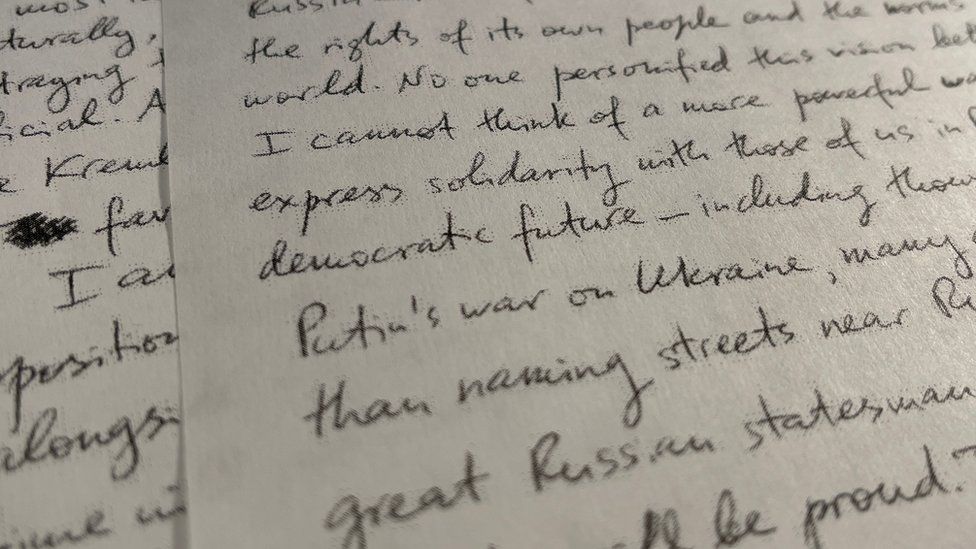
But in a series of letters to me from Detention Centre No. 5, Vladimir – who has twice been the victim of a mysterious poisoning – says he has no regrets, because the “price of silence is unacceptable”.
Opposing President Putin was dangerous even before the invasion, but since then the repression of dissent has intensified. Almost all prominent critics have either been arrested or left the country. Even so, the treatment of Vladimir is especially harsh.
All the charges against him are for speaking out against the war and against President Putin and yet his lawyer calculates he could spend 24 years behind bars.
“We all understand the risk of opposition activity in Russia. But I couldn’t stay silent in the face of what’s happening, because silence is a form of complicity,” Vladimir explains in a letter from his cell.
The first Evgenia heard of her husband’s arrest was a call from his lawyer, who had been tracking the activist’s phone as he always did when his client and friend was in town. On 11 April, the phone had come to a stop at a Moscow police station.
Vladimir was eventually allowed to call his wife, who lives in the US with their children for safety. There was just time to say: “Don’t worry!”
Evgenia smiles at the absurdity of that instruction.
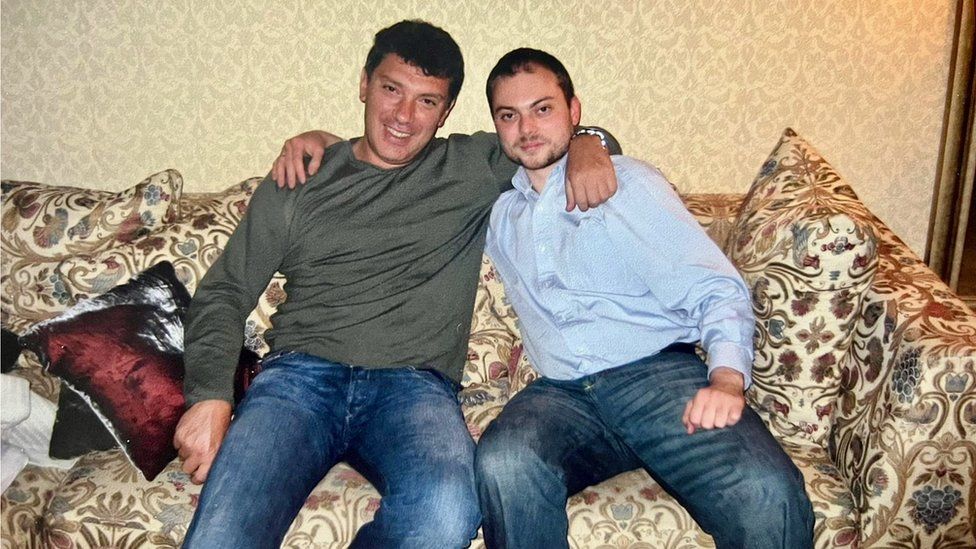
The couple were children of perestroika, growing up during Russia’s democratic awakening after the Soviet collapse. Vladimir then studied history at Cambridge, and simultaneously began a career in Russian politics as an adviser to the young reformer Boris Nemtsov.
This is the longest the pair have been apart since their marriage on Valentine’s Day in 2004 and the activist says not seeing his family is the hardest thing. “I think about them every minute of every day and cannot imagine what they’re going through,” he says.
“I love and hate this man for his incredible integrity,” Evgenia told me on a recent trip to London.
“He had to be there with those people who went out on the streets and were arrested,” she said, referring to the many Russians detained for opposing the war. “He wanted to show that you shouldn’t be afraid in the face of that evil and I deeply respect and admire him for that. And I could kill him!”
Image caption, Evgenia has not been allowed to speak to her husband since he was jailed
Vladimir was initially detained for disobeying a police officer, but once in custody the serious charges began raining down.
The activist was first accused of “spreading false information” about Russia’s military and “higher leadership”.
The rights group OVD-Info has recorded more than 100 prosecutions under that so-called “fake news” law since the war began: a local councillor, Alexei Gorinov, was sentenced to seven years in July and activist Ilya Yashin will go on trial soon after referring to the murder of civilians in Bucha.
Vladimir’s case is based on a speech in Arizona where he said Russia was committing war crimes in Ukraine with cluster bombs in residential areas and “the bombing of maternity hospitals and schools”.
That has all been independently documented, but according to the charge sheet I have seen, Russian investigators deem his statements to be false because the defence ministry “does not permit the use of banned means… of conducting war” and insists that Ukraine’s civilian population “is not a target”.
The facts on the ground are ignored.
Another charge stems from an event for political prisoners at which the activist referred to what investigators term Russia’s “supposedly repressive policies”.
Then last month he was charged with state treason.
The activist responded to that in his latest letter: “The Kremlin wants to portray Putin’s opponents as traitors… the real traitors are those who are destroying the well-being, the reputation, and the future of our country for the sake of their personal power, not those who are speaking out against it.”
Political persecution
The treason charge is based on three speeches abroad, including one in which Vladimir said that in Russia political opponents were persecuted.
Investigators maintain that he was speaking on behalf of the US-based Free Russia Foundation, which is banned in Russia, where any “consultancy” or “assistance” to a foreign organisation considered a security threat can now be classed as treason.
No secrets have to be divulged.
“State treason for public speeches? That’s just absurd. It’s quite simply persecution for free speech. For opinion. Not for any real crime,” Vladimir’s lawyer, Vadim Prokhorov, argues by phone from Moscow.
He says the activist had no link to the foundation at the time.
“This is a political case. They’re trying to stigmatise the absolutely normal, civilised Russian opposition.”
IMAGE SOURCE,EVGENIA Image caption, Vladimir has written to the BBC from his jail cell
Vladimir himself points out that the last person accused of treason for political opposition was the Nobel Prize-winning writer Alexander Solzhenitsyn in 1974. “All I can say is that I am honoured to be in such company.”
Evgenia finds it harder to sound so calm.
This is not the first time she has been scared for her husband. He nearly died, twice, in Moscow, and the cause of his poisoning has never been identified.
When he first collapsed in 2015 and slipped into a coma, Evgenia was told he had a 5% chance of survival, but he defied the odds.
She nursed him back to health, helping him learn to function again, even to hold a spoon. He would then insist on working on his laptop on their couch, despite being sick every half hour.
“The moment he could walk, he packed his bags and went to Russia. That fight is bigger than his fears.”
For Evgenia, that has meant seven years sleeping with her phone, ”afraid I will get that call from him, or from someone else because he can’t talk anymore”.
She gave up persuading her husband not to go to Moscow long ago: her only protest was to refuse to help pack his bags. But before his last visit, after the war started, Evgenia accompanied him first to France.
“I wanted to make the trip beautiful,” she remembers, forcing back tears as she recalls long strolls through the streets of Paris, talking endlessly. “Deep inside, I knew what was coming.”
Nemtsov’s Place
Since Vladimir’s arrest, Evgenia has taken on his advocacy work: speaking out about the war in Ukraine and political repression in Russia, as well as her husband’s case.
On Monday she will unveil the Boris Nemtsov Place in London, the result of a long campaign by Vladimir to honour his mentor and friend. The prominent opposition politician was shot beside the Kremlin in 2015 in a contract killing for which the contractor has never been caught.
The renamed London street, actually a roundabout, is close to the Russian trade delegation in Highgate.
IMAGE SOURCE,EVGENIA KARA-MURZA Image caption, Boris Nemtsov (left) was a friend and mentor to Vladimir (right)
“The idea was that every car that comes to the big gate will see the Boris Nemtsov plaque,” Evgenia explains. Her husband hopes a different Russia will one day be proud of that name.
For several years, the politician worked closely with Vladimir to lobby Western governments to sanction senior Russian officials for human rights violations. Their success infuriated a political elite that had enjoyed travelling abroad and channelling funds there.
In Moscow once, Vladimir told me he had concluded that those “Magnitsky” sanctions are why both he and Mr Nemtsov were targeted.
Standing-in for her husband is taking a heavy toll on Evgenia, but it is also kept her going.
“I am doing what I need to do so that he can be brought back to the kids and this hideous war stops and this murderous regime can be brought to justice.”
Vladimir is not staying silent, either.
His long, handwritten prison letters set out his convictions that Russia is not doomed to autocracy and its people are not all brainwashed Putin devotees.
He points to the large number of letters he gets from supporters who openly criticise the Ukraine invasion and the Kremlin, and to those who still protest publicly, despite the risk. He urges the West not to isolate that part of Russian society that “wants a different future for our country”.
“For Putin, compromise is a sign of weakness and an invitation to further aggression,” he says. “If he’s allowed a face-saving exit from the war, then in a year or two we will have another one.”
Vladimir tells me he is coping with imprisonment with a mixture of exercise and prayer, books and letters. As a historian, he has a particular interest in Soviet-era dissidents and has been reading more about them as he awaits trial.
“Their favourite toast back then was ‘To the success of our hopeless cause!’” he writes. “But as we know, it wasn’t so hopeless after all.”
The defendant, who was not named, was found guilty of “enmity against God” by the Revolutionary Court for setting fire to a government facility.
Another court sentenced five people to prison terms ranging from five to ten years on national security and public order charges.
A human rights organisation warned that authorities may be planning “hurried executions.”
According to official reports, at least 20 people are currently facing charges punishable by death, according to the Norway-based Iran Human Rights.
Its director, Mahmood Amiry-Moghaddam, called on the international community to take urgent action and “strongly warn the Islamic Republic of the consequences of executing protesters”.
Protests against Iran’s clerical establishment erupted two months ago after the death in custody of a young woman detained by morality police for allegedly breaking the strict hijab rules.
They are reported to have spread to 140 cities and towns and evolved into the most significant challenge to the Islamic Republic in over a decade.
At least 326 protesters, including 43 children and 25 women, have been killed in a violent crackdown by security forces, according to Iran Human Rights.
The Human Rights Activists News Agency (HRANA), which is also based outside the country, has put the death toll at 339 and said another 15,300 protesters have detained. It has also reported the deaths of 39 security personnel.
Iran’s leaders have portrayed the protests as “riots” instigated by the country’s foreign enemies.
Last week, judiciary chief Gholamhossein Mohseni Ejei declared that “key perpetrators” should be identified as soon as possible and handed sentences that would have a deterrent effect on others.
He warned that “rioters” could be charged with “moharebeh” (enmity against God), “efsad fil-arz” (corruption on Earth) and “baghy” (armed rebellion) – all of which can carry the death penalty in Iran’s Sharia-based legal system.
Those possessing and using a weapon or firearm, disrupting national security, or killing someone could receive “qisas” (retaliation in kind), he said, apparently responding to a call for retributive justice from 272 of the 290 members of Iran’s parliament.
More than 2,000 people have already been charged with participating in the “recent riots”, according to judiciary figures.
On Sunday, local media cited judiciary officials as saying that 164 had been charged in the southern province of Hormozgan, another 276 in the central province of Markazi, and 316 in neighbouring Isfahan province.
This year’s winner of South Africa‘s version of the talent show Idols, which is franchised around the world, is a police officer.
Warrant Officer Thapelo Molomo, 29, triumphed over ten other contestants in the season finale on Sunday night.
He collapsed to the floor and prayed onstage after being declared the winner.
“Thank you so much to everyone that has voted for me… I’m really grateful for what you have done for me. If it’s possible with me, it can be possible with you,” he later said.
The country’s police minister was at the show and congratulated the winner saying: “The officer serves as an inspiration to police officers across the country to believe in their talents as they serve and protect the nation”.
#sapsHQ#SAPS management congratulates Warrant Officer Thapelo Molomo for being crowned the @IdolsSA Season 18 winner. Minister of Police, General Bheki Cele, who attended the finale, has on behalf of the SAPS, congratulated the newly crowned winner. MEhttps://t.co/g8md95HRsbpic.twitter.com/PFKreNLj7e
On November 6, a passenger plane crashed into Lake Victoria while attempting to land in the lakeside town of Bukoba.
ATR technical advisers are already on the ground in town to investigate the crash.
French civil aviation safety investigation experts, as well as Tanzanian experts, have been deployed to the area to conduct an independent investigation into the crash.
Precision Air,Tanzania’s largest privately owned passenger airline, flew the plane. It has served the Dar es Salaam-Bukoba route since 1994.
But in the following weeks Ukraine began to make gains in the south of the country, advancing along Dnipro river towards Kherson and putting Russian forces under increasing pressure.
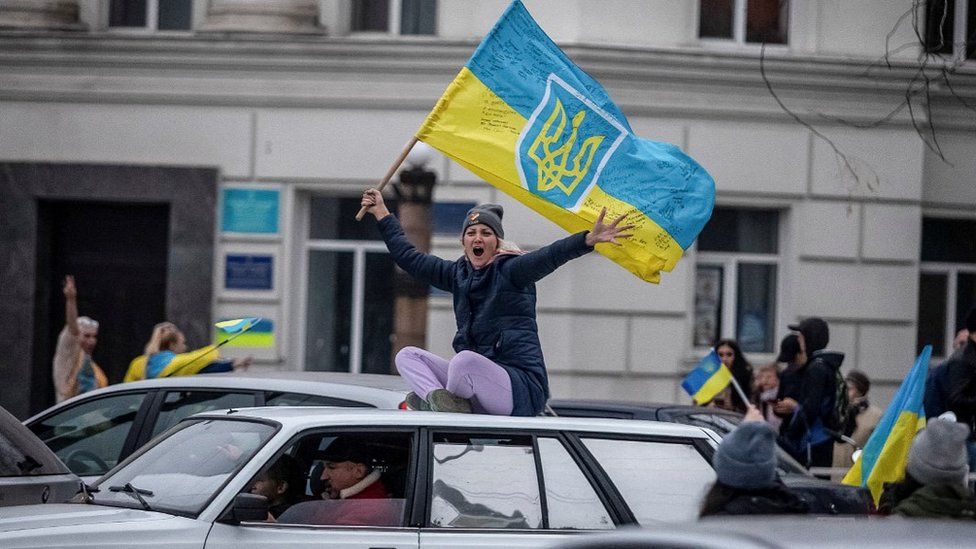
Finally, Russian forces withdrew and Ukrainian troops entered the city on Friday.
Locals were seen celebrating, some reuniting with loved ones they had not seen for months. The mood in the city was one of jubilation and relief, but also trepidation and fear of what may come next, the BBC’s Jeremy Bowen reported.
In his visit on Monday, Mr Zelensky told troops that Ukraine is “ready for peace, peace for all our country,” the Reuters news agency reported.
He thanked Nato and other allies for their support in the war against Russia, adding that high mobility artillery rocket systems (Himars) from the United States had made a big difference for Kyiv.
The president addressed a crowd gathered in Kherson’s main square, some of whom waved Ukrainian flags or wore them draped across their shoulders, a Reuters journalist in Kherson said.
Mr Zelensky said he is “really happy” about the liberation, as are the people of Ukraine.
Asked where Ukrainian forces might advance next, he said: “Not Moscow…We’re not interested in the territories of another country.”
Mr Zelensky had previously said that investigators have uncovered more than 400 war crimes in areas of Kherson abandoned by Russian forces as they retreated.
The BBC has been unable to verify these allegations, and Moscow denies that its troops intentionally target civilians.
The Democratic Republic of the Congo’s capital is hosting talks aimed at resolving a diplomatic row with Rwanda and putting an end to a violent conflict in the country’s east.
Former Kenyan leader Uhuru Kenyatta and Angola’s President Joo Lourenço are mediating between representatives of the two governments.
This follows a meeting with Rwandan President Paul Kagame on Friday.
He has denied backing the M23 rebel group that recently re-launched an offensive that has left tens of thousands of people displaced.
The mediators will also speak to victims of the conflict.
DR Congo’s government is due to meet representatives of various armed groupslater this month in the Kenyan capital Nairobi.
President Yoweri Museveniof Uganda has accused Western countries of reprehensible double standards when it comes to climate change commitments.
Mr Museveni highlighted the partial dismantling of a wind farm in Germany to make way for the expansion of a coal mine in a social media post.
He stated that the move made a mockery of Western climate commitments.
The Ugandan leader also said European countries were happy to take Africa’s resources for their own energy needs but were against the development of fossil fuel projects which were for the benefit of Africans.
Uganda is due to start exporting oil within three years.
Due to the global energy crisis, some European countries have recentlydecided to increase coal production – a move heavily criticized by climate change activists.
Following scenes of joy in newly liberated Kherson,Ukrainian authorities imposed a curfew and restricted travel in and out of the city, citing a tense security situation.
There are fears that Russian troops, who have retreated to the opposite bank of the Dnipro river, will resume shelling.
From November 13 to 19, Kherson officials have barred the use of river transportation.
Locals who fled have been warned not to return until their homes have been thoroughly inspected for mines or booby traps.
Russian explosives litter the region.
“The enemy mined all critical infrastructure objects,” said Kherson governor Yaroslav Yanushevych.
The overnight curfew runs from 17:00 to 08:00 (15:00 to 06:00 GMT). Officials have returned to run Kherson’s administration after the retreat of some 30,000 Russian occupation troops.
There are also fears that some Russian soldiers may have remained behind in disguise, while collaborators who helped the Russians during the occupation are now liable to be prosecuted.
In a reminder of the continuing threat, a volley of artillery fire hit the area of Kherson airport on Sunday.
President Volodymyr Zelensky said the Russians had destroyed all critical infrastructure in Kherson, depriving the city of heat, electricity, water, and communications.
IMAGE SOURCE, REUTERS Image caption, Kherson celebrations followed months of grim Russian occupation
Gradually essential supplies are arriving in Kherson, Ukrainian officials say.
Governor Yanushevych has announced a distribution of firewood to residents of Kherson and nearby areas, instructing them to request it with their ID and contact details. The city council also plans to hand out 6,000 small stoves to local residents.
“Most houses have no electricity, no water, and problems with gas supplies,” said Yuriy Sobolevskiy, a senior council official.
Kherson’s liberation on Friday was marked by crowds of flag-waving Ukrainians greeting Kyiv’s soldiers with hugs and kisses. The celebrations continued on Saturday.
Ukrainians see it as a major national victory and humiliation for the Kremlin, on a par with the Russian withdrawal from the Kyiv suburbs in March.
Ukrainian officials say there was widespread looting by the Russian army. The level of theft has triggered mockery by Ukrainians since a video clip surfaced showing a Russian soldier picking up a raccoon by its tail and throwing it into a cage inside an enclosure – reportedly in Kherson zoo.
The raccoon meme has gone viral on social media, with Ukrainians turning the raccoon – allegedly a prisoner of the Russians – into a war hero.
Ukrainians joked about a message on Telegram by a Russian blogger, Anna Dolgareva, which said: “I was begged to provide some good news about Kherson, but really the only good news is that my friend managed to steal a raccoon from Kherson zoo.”
According to Oleksandr Todorchuk, founder of the animal welfare charity UAnimals, “the raccoon from Kherson zoo was stolen not just by some stupid soldier, but by the Russian command”. In a Facebook post, he said: “They took most of the zoo’s collection to Crimea: from llamas and wolves to donkeys and squirrels.”
Kherson was the only regional capital to be captured by Russia since the February invasion of Ukraine.
The region, along with three others, was proclaimed by President Vladimir Putin to be part of Russia, at a ceremony in the Kremlin in September.
Chancellor Jeremy Huntsays, everyone will have to pay more tax under plans due to be announced on Thursday.
“I’ve been explicit that taxes are going up,” he told the BBC’s Laura Kuenssberg.
He also confirmed that he would provide more information about additional assistance for people struggling with energy bills, but warned that there would be constraints.
Labour accused the Conservatives of creating a “total mess” of the economy.
Shadow chancellor Rachel Reeves said Mr Hunt was choosing to tax working people while doing “little to close tax loopholes which mean some of the wealthiest don’t pay their fair share”.
Mr Hunt was speaking to the BBC just days before he is due to deliver his tax and spending plans in Parliament as part of the Autumn Statement.
The BBC has been told the chancellor is set to announce spending cuts of about £35bn and plans to raise £20bn in tax.
It comes as the UK faces major economic challenges, with soaring living costs and a warning from the Bank of England that the country is facing its longest recession since records began.
It also follows the mini-Budget of former Prime Minister Liz Truss and her then chancellor, Kwasi Kwarteng, which led to market turmoil and a jump in government borrowing costs. Many of those policies have since been reversed by Mr Hunt.
Independent forecasts are understood to have identified a gap of around £55bn in the public finances – although some economists have questioned the size of the ‘black hole’.
‘Unappetising announcements’
Laura Kuenssberg, Presenter, Sunday with Laura Kuenssberg
“Everyone is going to pay more tax” – not the kind of political message any minister would ever choose to say out loud.
But that is the clear statement from Chancellor Jeremy Hunt, preparing the ground for a pretty unappetising set of announcements he is going to make this Thursday.
As ever at this stage in the cycle, the occupants of No 11 are coy about giving any specifics. But alongside that bold and important statement that genuinely will affect everyone in one way or another, it is abundantly clear that public services are in for a hard time with no guarantee there’ll be extra cash to help them cope with the costs of inflation.
And if that wasn’t enough, the help that everyone has been receiving with their energy bills will come to an end for many.
These are important days for the new chancellor, and new Prime Minister Rishi Sunak, painting a grim scenario for the next few years.
It will take much political skill to be able to get the public on their side, and back these decisions. Money is short, but significantly behind in the polls, and political goodwill towards the government is too.
It also won’t have escaped people’s notice that the chancellor accepted Brexit had costs for the economy too. Wrapped up in suggestions that there were lots of opportunities still to come, it’s a rare acknowledgement from a Conservative politician.
Speaking to the BBC, Mr Hunt acknowledged his plans would “disappoint people” – but he promised to protect the “most vulnerable”.
“We have the plan to see us through choppy waters… we will make the recession we are in as short and shallow as possible.”
The BBC has been told Mr Hunt is planning to freeze tax thresholds – the levels of income at which people begin to pay more tax – until 2028.
While he did not confirm these plans when appearing on Sunday with Laura Kuenssberg, the chancellor said: “I think I’ve been completely explicit that taxes are going to go up, and that’s a very difficult thing for me to do because I came into politics to do the exact opposite.”
He did not spell out which taxes could go up, but increasing income tax, VAT or National Insurance would break a promise made in the Conservative’s 2019 manifesto.
Some Conservatives MPs have raised concern about increasing taxes, with former party leader Iain Duncan Smith telling Sky News it could lead to a “deeper” recession.
Addressing the concerns of his colleagues, Mr Hunt said the previous leadership had tried that approach, “in other words a plan that doesn’t show how, in the long run, we can afford it”.
“We have tried that, we saw it didn’t work.”
On energy costs, Mr Hunt praised his predecessor Mr Kwarteng for introducing a price cap on the typical household energy bill.
The energy price guarantee had been due to last for two years, but after taking over from Mr Kwarteng, Mr Hunt announced it would expire in April.
Speaking to the BBC, he said he would set out what further support would be given to those struggling on Thursday.
However, he emphasised that future help had to be “done on a sustainable basis” and there would have to be “some constraints”.
Asked if he was ditching the energy plan set out by former prime minister Boris Johnson, the chancellor said he admired Mr Johnson’s “big visions” but added there were elements of “cakeism” – a reference to the phrase: “Have your cake and eat it.”
He said he wanted to “deliver the exciting things he outlined” but that actions had to be credible and affordable.
On whether Brexit had damaged the economy, Mr Hunt said: “I don’t deny there are costs, but there are also opportunities.”
He said the coronavirus pandemic had prevented the UK from taking advantage of opportunities open to it after leaving the European Union.
Labour’s Rachel Reeves said she recognised there would be “constraints” on what the government could do, partly because of “mistakes the government has made”.
However, she added: “Just because you have to make difficult decisions it doesn’t mean you have to make the same decisions.”
She said Labour had “no plans” to raise the income tax or national insurance and would focus on closing “loopholes” in the tax system.
The Liberal Democrat’s Treasury spokespersonSarah Olney said: “Hardworking families look set to be clobbered with yet more unfair tax hikes because the Conservative party crashed the economy.”
Jailed British-Egyptian activist Alaa Abdel Fattah has stopped drinking water as he steps up his hunger strike to coincide with the start of the COP27 summit, his sister has said.
Calls for his release escalated after the climate summit opened in Sharm el-Sheikh in Egypt on Sunday.
The 40-year-old has consumed just 100 calories for more than 200 days to push Egypt to allow him UK consular access.
UK PM Rishi Sunak has said he will raise the issue at the COP summit.
Abdel Fattah, a key activist in the 2011 Arab Spring, is currently serving a five-year sentence for spreading false news.
His sister, Sanaa Seif, has warned that her brother’s hunger and water strike may mean he could die before the end of the summit.
Speaking to Sky News, she urged the British government to be “responsible for getting us proof of life”.
Mr Sunak wrote to Abdel Fattah’s family and said he would raise his imprisonment with the Egyptian government and reply again by the end of the summit.
He said the activist’s case is “a priority for the British government both as a human rights defender and as a British national”.
Ms Seif, a 28-year-old human rights activist who has served three prison sentences in Egypt herself on charges that fellow activists condemned as bogus, has been protesting outside the Foreign Office in London along with family members for her brother’s release.
She expressed concerns that Downing Street’s engagement with the Egyptian president Abdel Fattah El-Sisi would come too late.
Amnesty International Secretary General Agnes Callamard said Abdel Fattah “must be released” and warned that he may only have 72 hours to live.
“Let’s be very clear, we’re running out of time,” she said in Cairo on Sunday. “So if the authorities do not want to end up with a death they should have and could have prevented, they must act now.
“If they don’t, that death will be in every single discussion in this COP.”
IMAGE SOURCE,GETTY IMAGES
Abdel Fattah’s aunt, Ahdaf Soueif, told the BBC that the summit could be his last chance to be saved and to be released.
She urged Mr Sunak to secure her nephew’s release.
“It means we really only have a few days,” she said. “None of us have any reason to believe that the regime will ever let him go.”
“He has known for a while that he’s had enough, that he cannot live like this. And this is now his opportunity and all of ours really to bring matters to a head.
“He’s betting on us and on the community inside Egypt that wants him released and on the international community that’s making a noise for him.”
She said the UK government could use its influence to have him released.
“This is all in the hands of the British government to facilitate… it would be very difficult for the UK to do business as usual with Egypt unless this case is resolved.
“And I think if the British government is serious and if Rishi Sunak says this convincingly, Alaa will be on a plane to London.”
Abdel Fattah played a key role in the protests that toppled the former Egyptian leader, Hosni Mubarak, from power in 2011.
He has been in jail for nine years and was sentenced to a further five years in 2021 on charges of “broadcasting false news” – a charge human rights groups condemned as spurious.
He received British citizenship in December 2021 through his London-born mother.
Human rights groups have said he is one of an estimated 60,000 Egyptian political prisoners and have accused the government in Cairo of trying to “greenwash” its repressive reputation through its hosting of the climate summit.
The Egyptian government has insisted there are no political prisoners in the country.
At least two people were killed when two vintage World War II planes collided and crashed during an air show in the US state of Texas.
Footage shows the planes colliding at a low altitude, breaking one of them in half. As it hits the ground, a fireball can be seen.
The planes, including a Boeing B-17 Flying Fortress, were participating in a commemorative air show near Dallas.
It was unclear how many people were on board the two planes.
It was not immediately clear how many people were in the two aircraft.
The Allied Pilots Association, which represents American Airlines pilots, said Terry Barker and Len Root – two of its former members – were among the people who died in the collision.
Other media reports suggest as many as six people may have died in the collision.
Eyewitness Chris Kratovil – who was one of between 4,000 and 6,000 who had gathered to watch the Wings Over Dallas Airshow on Saturday – told the BBC he had “never seen a crowd grow quieter or more still in just a blink of an eye”.
“It went from being a fairly excited, energetic crowd… to complete silence and stillness, and a lot of people, including myself, turned their children towards them and away from the airfield because there was burning wreckage in the middle of the airfield.”
The Federal Aviation Administration said it will investigate the crash at the three-day event, which describes itself as the US’s premiere WW2 air show and was being held in honor of Veterans Day,
Dallas Mayor Eric Johnson called it a “terrible tragedy”.
“The videos are heart-breaking,” he tweeted. “Please, say a prayer for the souls who took to the sky to entertain and educate our families today.”
The number of casualties is not yet confirmed, he said but added that nobody on the ground had been reported injured.
The event’s website states that several planes had been scheduled to do a flyover demonstration on Saturday.
The B-17 bomber played a major role in winning the air war against Germany in WW2.
The second plane, a P-63 Kingcobra, was a fighter aircraft used in the same war but used in combat only by the Soviet Air Force.
The B-17 usually has a crew of about four to five people, while the P-63 has a single pilot, said Hank Coates, from the Commemorative Air Force which organized the event – but he could not confirm any fatalities.
“This was a WW2 flight demonstration type air show where we highlight the aircraft and their capabilities,” he told reporters.
Mehran Karimi Nasseri, caught in diplomatic limbo, made a small area of Roissy Charles de Gaulle airport his home in 1988.
His experience inspired Tom Hanks’ 2004 film The Terminal.
Mr Nasseri was eventually granted the right to reside in France, but he returned to the airport a few weeks ago, where he died of natural causes, according to an airport official.
Born in 1945 in the Iranian province of Khuzestan, Mr Nasseri first flew to Europe in search of his mother.
He spent some years living in Belgium, having been expelled from countries including the UK, the Netherlands, and Germany for not having the correct immigration documents. He then went to France, where he made the airport’s 2F Terminal his home.
Nestled on his bench surrounded by trolleys containing the possessions he had accumulated, he spent his days writing about his life in a notebook and reading books and newspapers.
His story attracted international media attention and caught the eye of Stephen Spielberg, who directed The Terminal, starring Hanks and Catherine Zeta-Jones.
After the film’s release, journalists flocked to speak with the man who had inspired a Hollywood movie. At one point, Mr Nazzeri, who called himself “Sir Alfred,” was giving up to six interviews a day, Le Parisien reports.
Despite being granted refugee status and the right to remain in France in 1999, he stayed at the airport until 2006, when he was taken to a hospital to be treated for an illness. He then spent time living in a hostel using the money he had received for the film, the French newspaper Libération reports.
Mr Nasseri returned to the airport a few weeks ago, where he lived until he died, an airport official said.
He was found with several thousand euros in his possession, the official added.
Ethiopia’s government and Tigrayan rebels have agreed to facilitate immediate humanitarian access to “all in need” in war-ravaged Tigray and neighbouring regions.
Saturday’s agreement followed talks in the Kenyan capital Nairobi this week on the full implementation of a deal signed between the warring sides 10 days ago in South Africa to end the brutal two-year conflict in northern Ethiopia
“The parties have agreed to facilitate unhindered humanitarian access to all in need of assistance in Tigray and neighbouring regions,” a joint statement said.
The agreement was signed by Field Marshal Berhanu Jula, chief of staff of the Ethiopian Armed Forces, and General Tadesse Werede, commander-in-chief of the Tigray rebel forces.
African Union mediator Olusegun Obasanjo said the deal would take “immediate effect”.
Ethiopian legislator Keiredin Tezera told Al Jazeera that aid was being sent to the areas in control of the army even before the agreement was reached on Saturday.
“This agreement may even further facilitate to deliver aid not only to the Tigray region but the neighbouring regions, which are also being affected by the conflict,” he said. “This is big news for us and not only for all of Ethiopia but also for Africa … It is significant beyond Ethiopia.”
The two sides also agreed to establish a joint committee to implement the disarming of Tigray People’s Liberation Front (TPLF) fighters, as stipulated in the ceasefire deal, the statement said.
Cessation of hostilities
After little more than a week of negotiations in the South African capital Pretoria, the government of Prime Minister Abiy Ahmed and the TPLF on November 2 signed a peace deal which has been hailed by the international community as a crucial first step in ending the bloodshed.
The deal notably calls for the cessation of hostilities, restoration of humanitarian aid, the re-establishment of federal authority over Tigray and the disarming of TPLF fighters.
Ethiopia’s northernmost region is in the grip of a severe humanitarian crisis due to a lack of food and medicine, and there is limited access to basic services including electricity, banking and communications.
Tigray regional government representative in North America, Yohannes Abraha, said there have been calls for unhindered humanitarian flow to Tigray for a long time.
“There has been a very long time, since August, that there has not been any humanitarian aid into Tigray,” he told Al Jazeera, adding that nothing had materialised yet after the November 2 peace deal.
Abraha said that, among other reasons, the dire situation on the ground contributed to reaching the Pretoria outcome.
A scene from the signing ceremony in Nairobi [Yasuyoshi Chiba/AFP]
The African Union Commission said it “applauds the parties on these significant confidence-building measures and encourages them to continue towards the full implementation of the Cessation of Hostilities Agreement, as part of overall efforts to end the conflict and restore peace,security and stability in Ethiopia”.
Weaponising starvation
The conflict between the TPLF and pro-Abiy forces, which include regional fighters and the Eritrean army, has caused an untold number of deaths, forced more than two million from their homes and led to reports of horrific abuses such as rape and massacres.
Estimates of casualties have varied widely, with the United States saying that as many as half a million people have died, while the European Union’s foreign envoy Josep Borrell said that more than 100,000 people may have been killed.
UN-backed investigators have accused all sides of committing abuses but also charged that Addis Ababa had been using starvation as a weapon of war – claims denied by the Ethiopian authorities.
Abiy declared last week that his government, whose forces had claimed considerable gains on the battlefield, had secured “100 per cent” of what it had sought in the peace negotiations.
On Friday, the government said its forces controlled 70 per cent of Tigray and that aid was being sent in – claims swiftly denied by Tigrayan rebels.
Abiy, a Nobel Peace Prize laureate, sent troops into Tigray in late 2020 to topple the TPLF, the region’s governing party, in response to what he said were attacks by the group on federal army camps.
The conflict capped months of simmering tensions between Abiy and the TPLF, which has dominated the national government for nearly 30 years until he took office in 2018.
It took fewer than eight days for Sam Bankman-Friedto go from being nicknamed the “King Of Crypto” to his company filing for bankruptcy and him stepping down as CEO, potentially facing federal investigations into how he handled the company’s finances.
Over the last few years, the internet has been flooded with long interviews with him, speaking over video chat from his office desk in the Bahamas.
In some of them, there’s a distracting clicking noise.
As his interviewees listen intently to his incredible story of how he became a multibillionaire in five years, the sound is persistent and clearly coming from the American entrepreneur’s mouse.
“Click, click, click,” it goes, in rapid, on-off bursts.
Meanwhile, Mr Bankman-Fried’s eyes dart around the screen.
It’s not clear from the videos what he’s doing on his computer but his tweets can give us a pretty good clue.
Mr Bankman-Fried – the former boss of embattled cryptocurrency exchange FTX – is an avid gamer. And in a series of tweets to his nearly one million followers, he explained why. Playing the team fantasy battle game was his way to get his mind to switch off from running two companies trading billions of dollars a day.
“Some people drink too much; some gamble. I play League,” he said.
IMAGE SOURCE,FTX Image caption, Sam Bankman-Fried also enjoyed playing a video game called Storybook Brawl so much he brought its maker in March 2022
Since the 30-year-old’s cryptocurrency empire collapsed this week in dramatic fashion another anecdote about his gaming has resurfaced online.
According to a blog post from venture capital giant Sequoia Capital, Mr Bankman-Fried played an intense League of Legends battle during a high-level video call with their investment team.
It didn’t seem to put them off at all though. The group proceeded to invest $210m in Mr Bankman-Fried’s company FTX.
This week Sequoia Capital deleted that gushing blog post and announced they are now writing off their FTX investment as a loss.
They’re not the only investors who have lost eyewatering amounts of money since Mr Bankman-Fried’s $32bn empire collapsed.
FTX had an estimated 1.2 million registered users who were using the exchange to buy cryptocurrency tokens like Bitcoin and thousands of others.
From large traders to everyday crypto fans, many are left wondering if they will ever get back their savings trapped in FTX’s digital wallets.
It’s a dizzying downfall and the rise of Mr Bankman-Fried is also its own dramatic story of risks, rewards, and beanbags.
But the young bright undergraduate says it was lessons learned in the student dorms that led him on his path to getting rich.
In a BBC radio interview last month he recalled being swept up in the “effective altruism” movement. Effective altruism is a community of people “trying to figure out what practical things you can do with your life to have as much positive impact as you can on the world,” he said.
So, as Bankman-Fried recalls, he decided to get into banking to make as much money as he could to give it back to good causes.
He learned to trade stocks during a short stint at the trading firm Jane Street in New York before he got bored and decided to experiment with Bitcoin.
He noticed the variations in the value of Bitcoin across different cryptocurrency exchanges and started arbitraging – buying Bitcoin from places selling it cheap and selling it to other places where it was trading for more.
After a month of making modest profits, he got together with some college friends and started a trading business called Alameda Research.
Mr Bankman-Fried says it wasn’t easy and took months of perfecting techniques about how to move money in and out of banks and across borders. But after around three months he and his small team hit the jackpot.
“We were super dogged,” he said to the Jax Jones and Martin Warner Show podcast a year ago. “We just kept going. If someone throws another roadblock we would be creative and if our system couldn’t handle that we would just build a new system to get us through that hoop.”
By January 2018 his team was making $1m every day.
A business reporter at CNBC asked him recently how that felt.
Intellectually and according to his methodology, he said “it made perfect” sense. “But viscerally, it surprised me every day,” he said.
Sam Bankman-Fried became an official billionaire in 2021 thanks to his secondary and more high-profile business – FTX. The crypto exchange grew to be the second largest in the world and a titan of the industry, seeing $10-$15bn traded a day.
In early 2022 FTX was valued at $32bn and a household name with an NBA stadium named after the company and endorsements from celebrity backers like the NFL’s Tom Brady.
All the while, Mr Bankman-Fried seemingly delighted in giving his Twitter followers an insight into his lifestyle. He mainly sleeps on a bean bag next to his desk in the office, he said, with a picture of him lying next to his staff at their trading terminals.
IMAGE SOURCE,TWITTER Image caption, “Mostly I sleep on a beanbag,” Mr Bankman-Fried told his Twitter followers
In another, he posted in the early hours of the morning. “Couldn’t sleep. Back to the office,” he wrote.
Mr Bankman-Fried’s dream of giving away vast amounts of money to charity was also well underway. In the BBC radio interview last month, he claimed he had given away “a few hundred million as of now”.
And his generosity didn’t just extend to charities. In the last six months the “King of Crypto” was given another nickname – “Crypto’s White Knight”.
With the price of cryptocurrencies falling in 2022, the so-called “Crypto Winter” is in full swing. While other companies in the industry faltered, Mr Bankman-Fried was handing out bailout cash in the hundreds of millions.
Asked why he was trying to prop up failing crypto firms, he told CNBC: “It’s not going to be good long term if we have real pain and real blow points. And it’s not fair to customers.”
He also claimed, in the same interview, to have $2bn in reserve that he could use to help to fail crypto companies.
But last week he was going around the same industry himself trying to raise money to save his own company and customers.
Questions about the real financial stability of FTX began swirling after an article on the CoinDesk website suggested that much of Mr Bankman-Fried’s trading giant Alameda Research rests on a foundation largely made up of a coin that a sister company of FTX invented, not an independent asset.
Further accusations that Alameda Research used FTX’s customer deposits as loans for trading were made in the Wall Street Journal.
The beginning of the end came though when FTX’s main competitor – Binance – publicly sold off all its crypto tokens linked to FTX a few days later.
Binance CEO Changpeng Zhao told his 7.5 million followers his company would be selling off the holdings “in light of recent revelations”.
It sparked a run on FTX with panicked customers withdrawing billions of dollars from the cryptocurrency exchange.
IMAGE SOURCE, GETTY IMAGES Image caption, Binance CEO Changpeng Zhao shared terse exchanges on Twitter with his rival Mr Bankman-Fried
Withdrawals were halted and Mr Bankman-Fried tried to get a bailout, with Binance at one stage publicly considering a buyout before walking away.
Binance said reports of “mishandled customer funds and alleged US agency investigations” had swayed its decision.
A day later FTX was declared bankrupt.
Mr Bankman-Fried apologized in a series of tweets saying “I’m really sorry, again, that we ended up here.”
“Hopefully things can find a way to recover. Hopefully, this can bring some amount of transparency, trust, and governance to them.”
So was, and is the crypto world. The price of Bitcoin has fallen to a two-year low and many are wondering – if FTX can go down along with its talismanic leader, what could fall next?
Jeremy Hunt previously told Laura Kuenssberg “this year we have the fastest growth in the G7. We’re catching up fast in that respect”.
The International Monetary Fund (IMF)predicts that the UK economy will grow by 3.6% in 2022. This is faster than any other country in the G7, a group of the world’s richest countries.
However, the latest figures show the UK economy shrunk by 0.2% between July and September and the Bank of England has forecast a “very challenging” two-year recession.
Despite stalling growth at the moment, the UK economy is bigger than it was in 2021 when the country was under lockdown for the first few months of the year.
Reeves is asked if she believes Labour can close all of the tax loopholes necessary to fund public services.
She asserts that “there’s an awful lot you can get,” including windfall taxes, the global minimum rate of corporation tax, and changes to non-dom status proposed by Labour.
She says: “The Tories keep coming back to working people and asking them to pay more and do little to close these loopholes that mean some of most wealthy people and businesses in society are still not paying their fair share.”
She adds: “That is the difference between what Jeremy Hunt will be doing on Thursday and what I would be doing if I was Chancellor of the Exchequer.”
Asked if that’s a guarantee that Labour would not put income taxes up, she says: “I’m not going to write my manifesto for the Labour Party on this programme but I’ve got no plans to increase income tax.”
Jeremy Hunt said UK unemployment is at a 40-year low, but 600,000 people have left the workforce since the pandemic, and he admitted that has put a strain on businesses as they struggle to recruit.
He said he will address this in Thursday’s Autumn Statement. Could it mean a change to immigration rules to allow companies to recruit more people from abroad?
He also acknowledged that Brexit has brought in more costs for businesses, but said the UK needs to embrace the opportunities.
His central message was that inflation is the biggest factor affecting household budgets. It “insidiously” eats away at people’s spending power, he said.
The chancellor promised to set out a balanced and fair approach to address short-term pressures like energy prices and the cost of food and household goods. But he also wants to give businesses the tools to help them grow.
Expect his plans to be vastly different from hispredecessor’s uncosted tax giveaways. “We need a plan that stands the test of time,” he concluded.
DISCLAIMER: Independentghana.com will not be liable for any inaccuracies contained in this article. The views expressed in the article are solely those of the author’s and do not reflect those of The Independent Ghana
The governor of Ukraine’s Donetsk region says two civilians have been killed and another wounded during Russian strikes in the eastern region.
“On November 12, Russians killed two civilians in the Donetsk region – in Bakhmut. In addition, law enforcement officers found the bodies of two died during the occupation: in Yampol and in Yarovaya,” Pavlo Kyrylenko said in a message on Telegram.