Rishi Sunak has promised to “call out Putin’s regime” at an international summit in Indonesia.
On Sunday afternoon, the prime minister will travel to Bali for a G20 summit of the world’s largest economies.
British officials had planned for this meeting assuming Russia‘s president would attend.
The prime minister was expected to join other world leaders in publicly condemning Vladimir Putin.
But Moscow said last week he wouldn’t be attending and the Kremlin would be sending Russia’s foreign minister, Sergei Lavrov, instead.
So the words of anger will be directed at him.
Speaking before setting off for Indonesia, the prime minister said: “Putin’s war has caused devastation around the world – destroying lives and plunging the international economy into turmoil.
“This G20 summit will not be business as usual. We will call out Putin’s regime, and lay bare their utter contempt for the kind of international cooperation and respect for sovereignty forums like the G20 represent.”
The G20 is a hotchpotch of countries with little in common beyond big economies.
IMAGE SOURCE, SHUTTERSTOCK Image caption, None of the other G20 leaders want to pose for a smiling photo with Russia amid its invasion of Ukraine
An economic forum whose members have been hammered, economically, by one of their own, Russia.
The other leaders refuse to be seen smiling in the presence of Russia.
Recent precedent suggests another usual staple of these affairs, what is known as a communique, a set of agreed conclusions published at the close of the summit, probably won’t happen either.
Almost three weeks into the job, this is Mr Sunak’s second overseas trip as prime minister, after last week’s dash to the COP27 climate summit in Egypt.
He managed to see a good number of fellow European leaders in Sharm el-Sheikh.
The trip to Bali will mean he can meet plenty from the Indo-Pacific region, a part of the world the government has been increasingly focused on since Brexit.
And, perhaps, a first chance to meet US President Joe Biden.
Meanwhile, back home, as Laura Kuenssberg writes, Chancellor Jeremy Huntwill continue preparing what is called the Autumn Statement, a budget in all but name, to be delivered on Thursday, just hours after the prime minister gets back home.
Downing Street is seeking to frame both the summit and the Autumn Statement as responses to the same shock: the consequences of the war in Ukraine.
A desperate global economic situation, as they describe it, with big domestic implications, that they seek to be trusted to grapple with, after the chaos of the Liz Truss administration.
But a fractious summit followed by what many will see as a bad news Budget won’t make for an easy week for Mr Sunak.
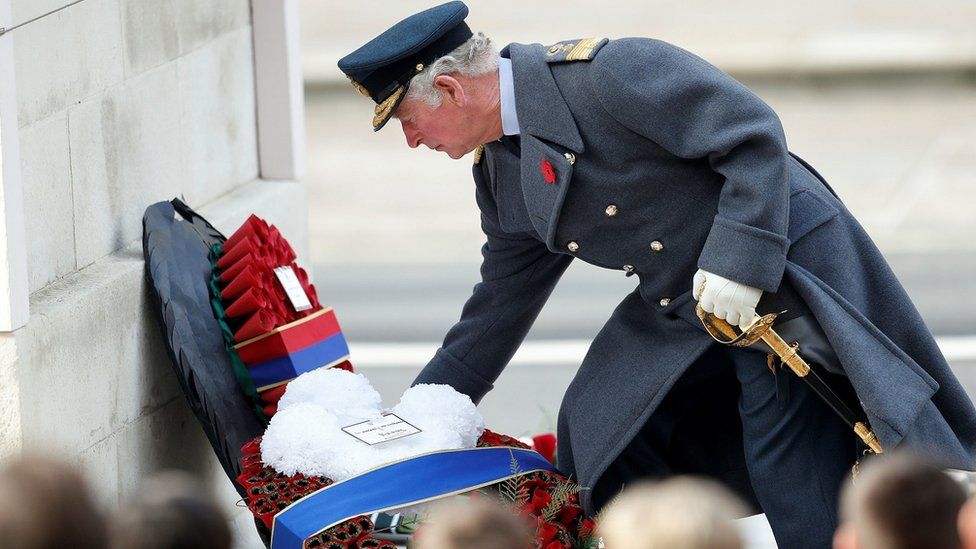
Following the death of his mother, Queen Elizabeth II, King Charles will lead the Remembrance Sunday service at the Cenotaph for the first time as monarch.
At 11:00 GMT, the United Kingdom will observe two minutes of silence to pay tribute to the war dead.
Remembrance Sunday was one of the most important royal engagements in the late Queen’s calendar.
The King, politicians, and religious leaders will lay wreaths at the central London memorial.
King Charles’ ring of poppies will incorporate a ribbon of racing colours in a tribute to the ones used by the late Queen and his grandfather King George VI.
During his time as Prince of Wales, King Charles represented the late Queen at the last five Cenotaph services and laid a wreath on her behalf, as she watched from the Foreign Office balcony that overlooks Whitehall.
The beginning of the silence will be marked by Big Ben striking 11 times at 11:00.
The bell has been largely silent for five years after it was dismantled and repaired in a renovation project. While it has run for events such as New Year’s Eve and the late Queen’s funeral, its tolling on Sunday will mark its official return to use.
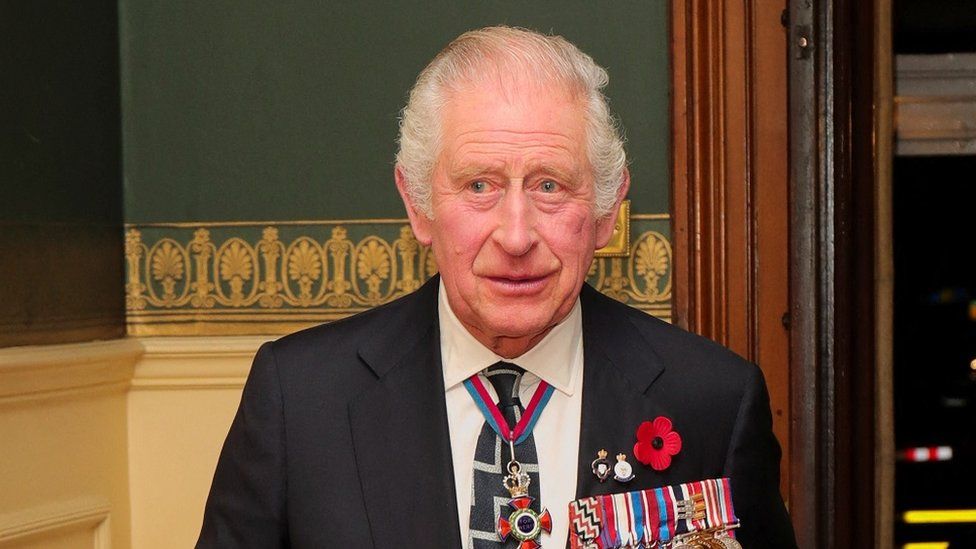
IMAGE SOURCE, PA MEDIA Image caption, King Charles III will lay a wreath for the first time as monarch
The service, led by the Bishop of London, will also feature a march past by 10,000 Royal British Legion veterans, representing 300 different Armed Forces and organisations between them.
Among those taking part will be World War Two veterans – fewer in number as each year goes by – and those who have served in more recent conflicts.
To commemorate 40 years since the Falklands War, 400 members of the South Atlantic Medal Association will also take part.
A further 10,000 members of the public will line Whitehall to watch the service.
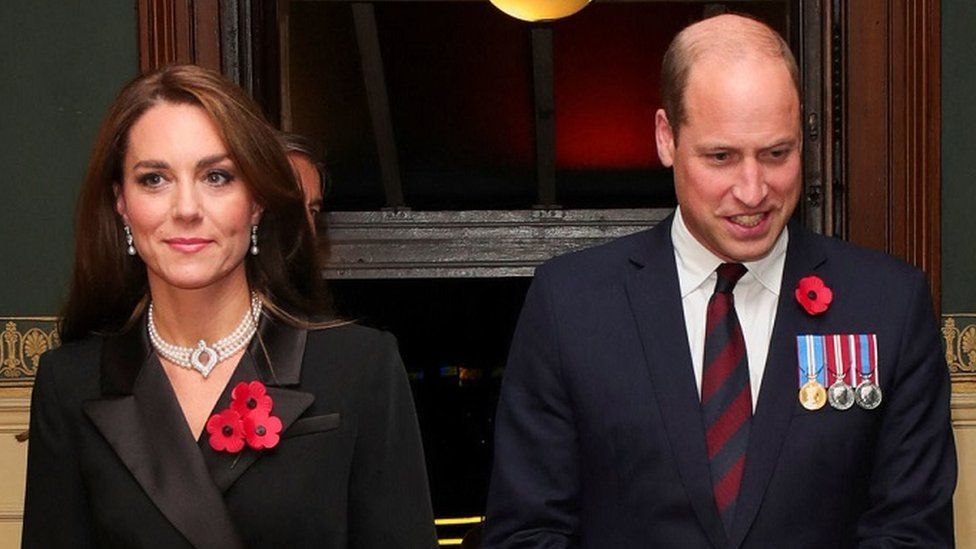
Along with King Charles, Camilla the Queen Consort, the Prince and Princess of Wales, the Earl and Countess of Wessex, Princess Anne and Vice Admiral Sir Tim Laurence, the Duke and Duchess of Gloucester, the Duke of Kent and Princess Alexandra, will attend the service.
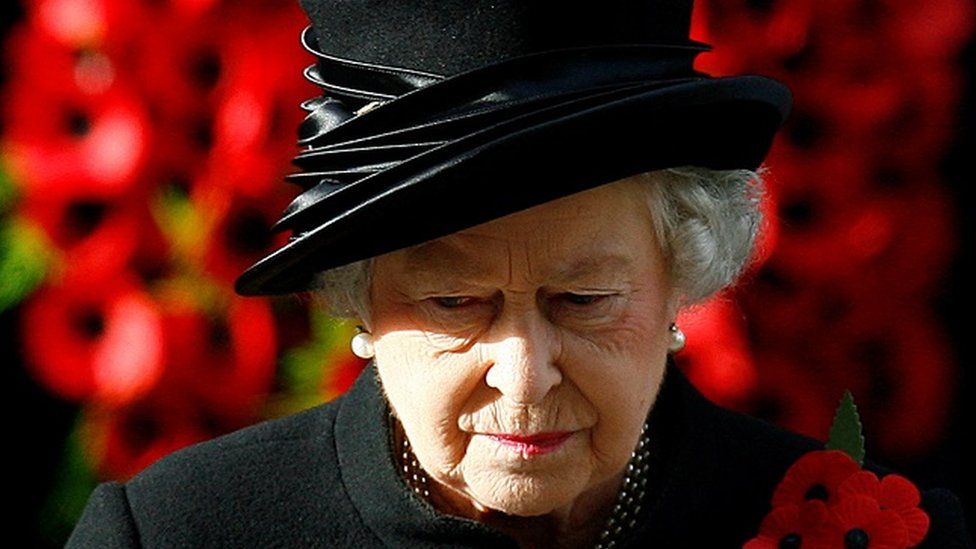
IMAGE SOURCE, REUTERS Image caption, Queen Elizabeth II saw Remembrance Sunday as one of her most important engagements of the year
The event will also be attended by senior members of the government.
Speaking ahead of the service, Prime Minister Rishi Sunak and Defence Secretary Ben Wallace commemorated the fallen and also paid tribute to those fighting for Ukrainians’ freedom.
Mr Sunak said: “This year more than ever, we are reminded of the huge debt of gratitude we owe those who lay down their lives to protect their country.
“As we fall silent together on Remembrance Sunday, we will honour the memories of the men and women we have lost and pay tribute to the brave soldiers of Ukraine as they continue their fight for freedom.”
His words were echoed by Mr Wallace, who said Remembrance Sunday was a time to reflect on the sacrifices made by our veterans and service personnel around the world.
“We must never forget those who gave their lives in defence of our values and our great nation,” he said.
“All of us will also be thinking of those brave Ukrainians who are fighting for their very own survival to defend freedom and democracy for all, just as the UK and Commonwealth soldiers did in both world wars.”
More than 100 Falklands War veterans and family members of those who died in the war will take part in a remembrance service and parade in the capital Stanley on Sunday.
They made the 8,000 miles (12,900km) journey via a special flight arranged by the Ministry of Defence, with many of the veterans making an emotional return to the Falklands for the first time since the war with Argentina broke out in 1982.
Over the past few days the veterans, along with mothers, wives and children of those who died, have visited the battlefields where British forces fought, with some shedding tears and placing crosses at cemeteries for fallen comrades and family members.
On Saturday, members of the Royal Family attended the annual Royal British Legion Festival of Remembrance at the Royal Albert Hall.
On Friday, the UK held another silence on Armistice Day to commemorate the end of World War One in 1918.
Two of the three sons—Andre Dede Ayew and Jordan Ayew—of one of the greatest players to have ever represented Ghana’s Black Stars, the maestro Abedi Ayew, seem to consistently incite conflict among Ghanaians whenever the Black Stars are involved in a match.
Some fans contend that they no longer play well enough to merit call-ups. These calls ought to go to fresh faces who are more capable and ready to compete. Others believe that since they are two of our most crucial players, their call-ups are merited.
There shouldn’t, in my opinion, be such a significant rift over the brothers’ selection for Ghana’s World Cup team. I’ll explain why.
Dede Ayew
The older of the two, Dede Ayew, made his international debut for Ghana in 2007 while still a teenager. He has now progressed to captain the Black stars. He has 109 caps and has scored 23 goals for his country. Nobody embodies commitment and passion more than Dede Ayew, the team’s current captain.
He is constantly willing to put in a lot of effort and sweat to ensure the success of the nation. A player’s call-up to his national team is always an honor, and Dede always gives his best effort when he receives that call-up. His leadership skills and drive to inspire his teammates to step up their game when they are struggling are excellent qualities to have on the team.
Many spectators mock him and label him “choirmaster” for his clapping and hand motions on the field, failing to recognize the psychological impact it may have on the players. As team captain, he also serves as the coach’s mouthpiece. When a player makes a mistake that costs the team a goal or wastes a significant scoring opportunity, he serves as the initial source of encouragement for the players.
Earning over 100 caps for Ghana is no small feat. He has played in two FIFA World Cups (2010 and 2014), as well as seven Africa Cup of Nations (2008, 2010, 2012, 2015, 2017, 2019, and 2021), helping them finish runners-up in 2010 and 2015, and was top goalscorer at the latter tournament.
This demonstrates the caliber of player he is and the range of experience he brings to the team. No other squad member has this much international tournament experience. Dede Ayew has played for teams who have won championships and teams that have faced relegation throughout his club career.
He worked hard for victory in relegation battles and scored several crucial goals when it mattered most. Although the Black Stars group includes opponents like Portugal, Uruguay, and South Korea, it is never impossible. He is a very good option off the bench when the stars are chasing the game, even if he is not named in the starting 11. His heading ability is very underrated. He can move well off the ball to attack the proper gaps for crosses and even tower over larger, taller defenders to score goals.
Jordan Ayew
The youngest of the three Ayew brothers, Jordan, made his senior debut for Ghana in a 2010 victory against Swaziland in an AFCON Qualification match. Since then, he has consistently played for the national side. He has 83 total caps for the Black Stars and has scored 19 goals, 4 less than his brother Dede. Jordan is a dependable player for Crystal Palace at the club level, starting 10 games and substituting in the other 3 this season.
This demonstrates his level of involvement. He plays a very tactical role in assisting players like Wilfried Zaha to succeed, as can be shown by looking at some of his games this season. When Jordan Ayew is played on the right wing, Zaha remains high and wide as the danger on the counterattack, therefore giving Jordan greater defensive responsibilities. When Palace decides to defend in a mid or low block, Jordan tucks into midfield as needed. He is a crucial member of Patrick Viera’s team thanks to his tactical prowess.
Jordan can be utilized similarly or more offensively for the national team because he can also play as a striker. When switching plays or struggling to build out of defense, his holdup play might make him a viable target for long balls. There is no truth to the many Ghanaians’ complaints that he is sluggish and lazy.
He is among the most diligent forwards you will come across. His dedication and perseverance make him a very special profile to have in front of the press. Whatever your personal opinion of the brothers may be, if they are not called up, their very specific profiles will be missed.
With so many new players on the team, Andre Dede Ayew’s leadership, wisdom, and passion are desperately needed. Players who have participated in international competitions before and have excelled should absolutely be included because more than half of the players will be making their debuts there.
Jordan Ayew also possesses the tactical adaptability to enable the coach to make specific tactical modifications throughout a game as needed.
All in all, you don’t just get rid of your captain, your most experienced players, and two of your top scorers when heading into a tournament. It is essential to gradually replace older players who aren’t providing their best while giving new players time and encouragement to step into those large shoes as the team continues to establish a solid foundation for the years to come. New and young players are frequently overwhelmed by too much pressure.
To sum up, the Ayew brothers always play with passion for the Black Stars because they love their country. Whatever the opinions of the supporters, if they are not included in the squad, they will be missed during the world cup.
Queen Elizabeth II‘s service and duty have been commemorated at the annual Festival of Remembrance in London.
The event at the Royal Albert Hall, part of a weekend of tributes to war dead, was attended by the Royal Family.
King Charles and his siblings, Princess Anne and the Earl of Wessex watched as a video of their mother was played.
The late Queen enlisted in the Auxiliary Territorial Service as a teenager towards the end of World War II.
This year’s event also marked 40 years since the Falklands war, with footage of contributions from those who served.
The Royal Family will also take part in a Remembrance Sunday service at the Cenotaph when a two-minute silence will be held at 11:00 GMT.
IMAGE SOURCE,PA MEDIA
IMAGE SOURCE,PA MEDIA
As tributes were paid to the late Queen, a clip of her was played in which she spoke of the “tremendous contribution” the Armed Forces had made to Britain’s “standing and reputation” throughout the world during her reign.
Hosting the annual Royal British Legion event, BBC newsreader Huw Edwards said Elizabeth II had symbolized “completely” service and duty – which he described as the “watchwords” of military life.
The late Queen was the longest-serving commander-in-chief of the British Armed Forces – a position held by the monarch – and was also the patron of the Royal British Legion, a charity that provides support to veterans and their families.
Elizabeth II considered Remembrance Sunday one of the most important engagements in her calendar.
The UK’s longest-reigning monarch lived through World War II as a teenager. At the age of 18, she enlisted in the Auxiliary Territorial Service – a branch of the Army for women – in February 1945 and trained to become a military truck driver and mechanic. The late Queen was the first female member of the Royal Family to serve in the Armed Forces. However, the war ended before she could be assigned to active duty.
Also in attendance on Saturday evening were Camilla, the Queen Consort, the Prince and Princess of Wales, the Countess of Wessex, Vice Admiral Sir Tim Laurence, the Duke and Duchess of Gloucester, the Duke of Kent and Princess Alexandra.
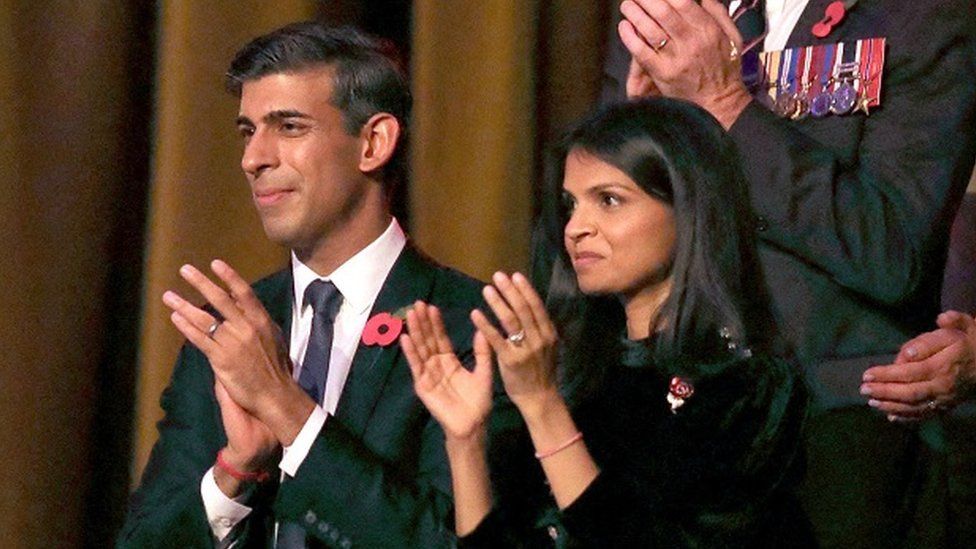
IMAGE SOURCE,PA MEDIA Image caption, Prime Minister Rishi Sunak was joined by his wife, Akshata Murthy, at the event
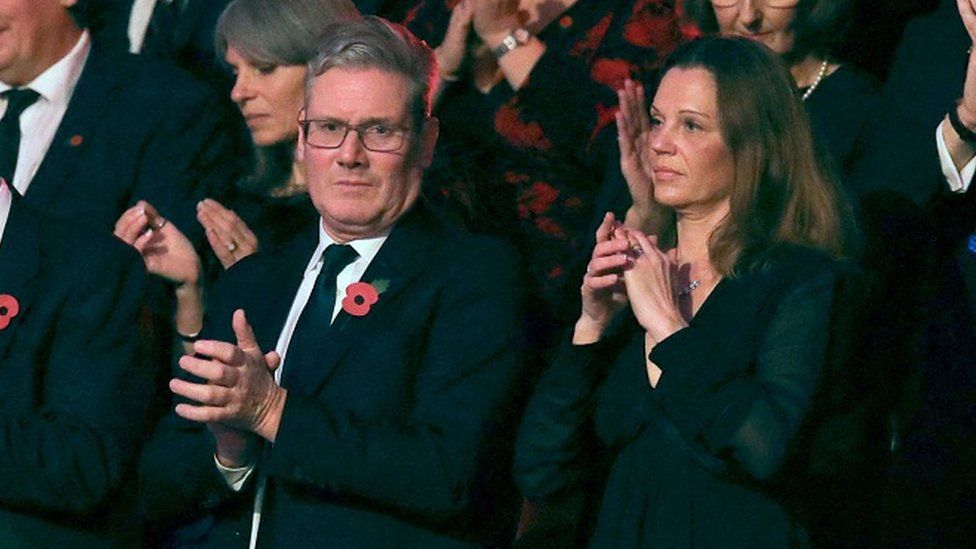
IMAGE SOURCE,PA MEDIA Image caption, Labour leader Sir Keir Starmer was joined by his wife Victoria at the festival
Prime Minister Rishi Sunak and Labour leader Sir Keir Starmer represented the two main political parties at the landmark London venue.
The evening was opened with a rendition of I Vow To Thee My Country by actor Luke Evans, and also saw performances by Andrea Bocelli and Hallelujah by EastEnders actress Shona McGarty.
The Chelsea Pensioners, among the oldest retired members of the Army, received applause as they took their seats.
The Royals joined the crowd to sing Jerusalem after the remembrance book, which contains the names of British war dead was brought into the venue. One of those who brought it into the hall was Captain Dmytro Donskoi, defence and air attache for Ukraine.
It ended with a rendition of God Save The King and three cheers, after which Charles waved to the crowd who applauded as the Royal Family left.
On Sunday, senior members of the Royal Family will pay tribute to the fallen when they take part in a service of remembrance in central London, where they will lay wreaths at the Cenotaph – along with senior politicians and faith leaders – and observe a march past by 10,000 veterans.
“The leaders discussed a number of current issues on the bilateral agenda with an emphasis on the continued building up of interaction in politics, trade, and the economy, including transport and logistics,” the Kremlin said in a statement.
The leaders agreed that the contacts between Russian and Iranian institutions will be increased, it added.
Kyiv and its Western allies have accused Moscow of using Iranian-made drones in recent weeks to carry out attacks in Ukraine, where it launched a “special military operation” in February.
Russian DeputyForeign Minister Sergey Vershinin says the fate of the grain deal after November 18 is unknown.
Vershinin stated that the agreement is divided into two parts, one of which calls for lifting sanctions on Russian food exports.
“It is impossible not to mention here the terrorist attacks that the Ukrainian side carried out on the Crimean Bridge. And the terrorist attack on Sevastopol, where ships are stationed that provide a humanitarian corridor through which dry cargo ships or other vessels go as part of the implementation of this Black Sea grain deal,” he said.
At a news conference following the Association of Southeast Asian Nations (ASEAN) summit in Phnom Penh, Lavrov chastised the US for its efforts in the region, which both Russia and the West consider as a possible strategic geopolitical struggle in the coming decades.
“The United States and its NATO allies are trying to master this space,” Lavrov told reporters.
He said Joe Biden’s Indo-Pacific strategy was an attempt to bypass “inclusive structures” for regional cooperation and would involve “the militarisation of this region with an obvious focus on containing China, and containing Russian interestsin the Asia-Pacific”.
Mr Brown woke up 17 days later in a Birmingham hospital to learn he had lost all sight in his left eye and had around 20% vision in his right eye. He also underwent several operations to reconstruct his face.
“When I found out that I’d lost my sight, my world fell apart,” he said.
“I’d lost my career; I’d lost my job and I’d lost my future. Blind Veterans UK gave me the training and support to move forward with my life.”
‘Sense of belonging’
The charity helped him learn practical skills, including using email again and cooking meals, he said.
“Being a member of Blind Veterans UK gave me back that sense of belonging that I had when I was in the Army, it’s this unwritten sense of understanding that comes from being in the military.”
He now coaches Physical Disability Rugby League and commentated on the recent World Cup final for the BBC.
Mr Brown also coaches a junior communityteam and said it is the “most rewarding” work he has ever done.
Tinashe Farawo had the grim task of delivering the mutilated body of a 30-year-old farmer who had been trampled to death by an elephant in northern Zimbabwe to his distraught family.
It is something that Zimbabwe Parks and Wildlife Management Authority (Zimparks) rangers have to do all too frequently as they police a battle between humans and encroaching wildlife. The farmer from Mbire district was one of 46 people killed by wild animals in Zimbabwe this year.
Hwange National Park, the country’s large nature reserve spanning 14,600 sq km (5,637 sq miles) in north-western Zimbabwe, has the capacity to sustain 15,000 elephants.
Yet officials say the population there now stands at around 55,000, with many straying into surrounding areas in search of food and water.
And the jumbos are greedy – a single elephant consumes up to 200 litres (44 gallons) of water a day and around 400kg (about 62st) of tree leaves and bark – causing great distress to already impoverished subsistence farmers.
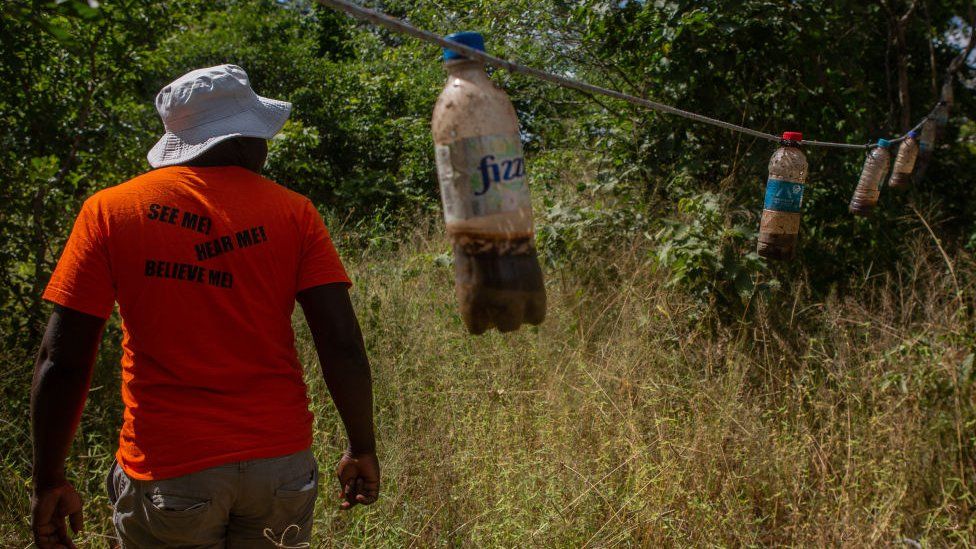
IMAGE SOURCE,GETTY IMAGES Image caption, Farmers near Hwange hang up bottles of a smelly concoction that repels elephants
As delegates from more than 180 countries gather in Panama for the two-week meeting of the Convention on International Trade in Endangered Species (Cites), Mr Farawo believes that communities who live on this frontline are being ignored.
“You cannot always come up with solutions in air-conditioned buildings,” the Zimparks spokesperson told the BBC.
Zimbabwe has proposed to Cites that certain provisions that restrict the trade of raw ivory and elephant leather be relaxed, arguing that the money raised from their sale could support conservation of the growing elephant population.
If those mulling the proposal have never been to Hwange, how can they understand the plight of communities there, Mr Farawo asks.
‘We don’t want aid’
In May, Zimbabwe convened an African Elephant Summitbut failed to unite countries on the continent to fight the ban on the global ivory trade, issued under Cites in 1989.
Only Zambia, Namibia and Botswana backed Zimbabwe’s push for permission sell off its ivory stockpiles, mostly from elephants that had died from natural causes and which would be worth hundreds of millions of dollars.
The same countries also support trophy hunting as a way to finance community projects for those who live close to game parks.
“We don’t want to need aid, we want the chance to trade so we can fund our programmes,” Mr Farawo said.
But Kenya, which opposes both hunting and the sale of ivory, did not attend the summit. The East African country symbolically burnt its ivory stockpile confiscated from poachers and illegal traders in 2016.
While Burkina Faso, Equatorial Guinea, Mali and Senegal have proposed to Cites that the elephants in southern Africa be upgraded to give them “threatened-with-extinction status”, further restricting any trade.
Jim Nyamu, who heads the Kenya-based Elephant Neighbours Centre, argues that lifting the trade in ivory in southern Africa would impact East Africa, where elephant numbers remain a concern.
He points to Cites’ decision to allow a one-off ivory sale from Botswana, Namibia and Zimbabwe to Japan and China in 1997 and 2008, saying it led to an increase in poaching.
“No country should be encouraged to work in insolation,” the anti-poaching campaigner told the BBC.
Mr Nyamu believes in alternatives like eco-tourism, which have the potential to bring in more money to communities than hunting.
Wild animals in towns
But there is little support for this on the ground in Botswana, which controversially resumed trophy hunting in 2019 as a way to reduce its burgeoning 130,000-strong elephant population.
In Botswana’s Chobe district, which borders Zimbabwe, elephants outnumber the population of 28,000 people. Like nearby Hwange, the area’s national park is unfenced.
Chieftainess Rebecca Banika, a Chobe traditional leader, told the BBC that her community received $560,000 from hunting proceeds last year, along with the meat of dead tuskers.
“We are suffering but even though we are angry, we don’t fight the animals because we derive some benefit from them,” she said.
Frank Limbo, a 64-year-old retired banker and now farmer, says sightings of wild animals were rare during his youth but now they are all over the town of Kasane in Chobe.
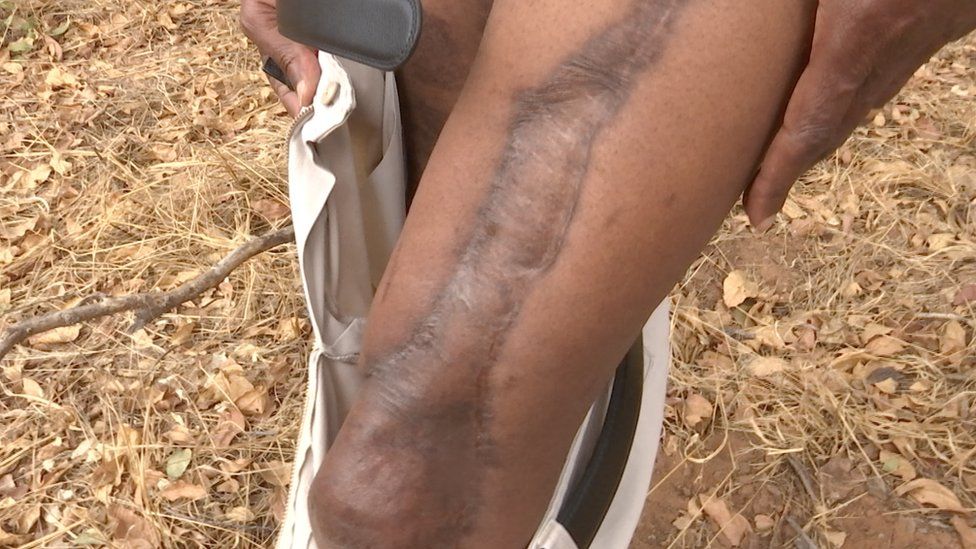
Image caption, Frank Limbo was charged by three elephants in 2015 – one gorged his thigh as he hid behind a tree
They wander into backyards and several of his relatives have been either killed or maimed and entire food harvests destroyed overnight.
He is also the unlikely survivor of two terrifying wildlife attacks.
In 2004 a lioness was chasing down his pet dog on his farm, when it turned on him – luckily for him an armed friend shot her dead.
Eleven years later, while preparing his fields for planting, a herd of elephants wandered past. Moments later three returned and charged him.
“They all came making those the noises they do when they attack – wailing – and I was also yelling and wailing.”
He was saved by running behind a tree: “They couldn’t get to me fully but one gorged me from my knee to my upper thigh. I thought I was dead.”
Some conservationists in southern Africa also question the figures on which decisions about elephants are made.
BBC
“We love them; we can’t do away with them; we have to live side-by-side. But it should be a win-win”
To this end the Kavango-Zambezi Transfrontier Conservation Area (Kaza TFCA), which spans reserves in Angola, Botswana, Namibia, Zambia and Zimbabwe, organised a joint aerial elephant census in August – the figures of which will be released next year.
It followed a decision last year by the International Union for the Conservation of Nature (IUCN), which keeps a “red list” of threatened species, to list the African savanna elephants as endangered.
It cited population decline – a 95% fall over the last century as a result of poaching, shrinking habitats and a growing human population.
Netsai Bollmann from Kaza TFCA says the data used was based on estimates.
The elephant census initiative shows that countries in southern Africa, where elephant populations are growing, want more sovereignty in determining what happens to their wildlife.
In Zimbabwe, which has just approved plans to set up a fund to help people attacked in wildlife attacks, Edson Gandiwa – a wildlife researcher who works at Zimparks – says the problem with the elephant conservation debate is that it is too emotionally charged.
“They are a keystone or flagship species. [But] it’s not only about elephants, it’s about biodiversity. We need all animals to be there,” he told the BBC.
Mr Limbo agrees, saying the 2.5 million people who live near Kaza TFCA wildlife areas deserve to be consulted by international groups before global policies are implemented.
He maintains the attack he suffered has not affected theway he feels about elephants: “It’s part of living in this area, we love them.
“They are our natural resources, we can’t do away with them – we have to live side-by-side. But it should be a win-win.”
Ukrainian officials have warned “the war is not over” after Russia’s withdrawal from Kherson, even as celebrations continue over the weekend.
Cheering crowds welcomed Ukrainian troops to the city – the only regional capital taken by Moscow since February – on Friday.
Similarly jubilant scenes were reported in other regions across Ukraine, including the capital, Kyiv, and Odesa.
But despite the blow to Moscow’s ambitions, officials remain cautious.
Yuriy Sak, an adviser to the Ukrainian defence minister, warned the BBC it was “too early to relax”.
“We always believed that we would liberate Kherson,” he told Radio 4’s Today programme. “And we are confident that now Russians are beginning to believe that they will never be able to win this war. We see the panic in their ranks. We see the panic in their propaganda machine.
“But of course, this is a very important moment, but… this war is far from over.”
Kherson lacks running water, medicines and food, but emergency supplies are starting to arrive from nearby Mykolaiv, an aide to the city’s mayor says.
The aide, Roman Golovnya, says 70-80,000 people live in Kherson now, out of a pre-war population of 320,000.
President Volodymyr Zelensky said that “before fleeing from Kherson, the occupiers destroyed all critical infrastructure – communications, supply of water, heat, electricity”.
It is not yet clear when electricity will be restored to the city – nearby areas are expected to get it back in a few days’ time. The power cuts prevented Kherson’s bakeries from making bread.
Ukrainian forces have begun the huge task of dismantling Russian mines and booby-traps in and around Kherson, Mr Zelensky said.
Meanwhile, Ukrainian TV has resumed broadcasts in the area – a key source of news for many Ukrainians.
Yuriy Sak warned of the continuing risk of missile attacks – as did Oleksiy Kuleba, head of the Kyiv region’s military administration. Russia has been firing missiles at Ukraine’s energy infrastructure in recent weeks, severely damaging the country’s output.
Mr Kuleba told the BBC: “Over the past month… we have seen massive shelling of peaceful settlements in Ukraine. Now I want to say that the threat of rocket attacks on the Kyiv region remains high.”
Meanwhile, the former head of Ukraine’s National Security Council, Oleksandr Danylyuk, has warned that the Russian troops who have retreated from Kherson will have crossed the Dnipro river to “go into deep defence on the left bank”, telling the BBC “it will put them [at an] advantageous position”.
Moscow said some 30,000 personnel had been taken out of the area – as well as around 5,000 pieces of military hardware, weaponry and other assets.
As BBC international editor Jeremy Bowen points out, the decision to pull out “has preserved the lives of soldiers who might have died fighting a battle they could not win” and allowed them to be deployed elsewhere in the country.
The UK’s Ministry of Defence noted on Saturday that it was “highly likely” Russian troops destroyed road and rail bridges over the Dnipro river as part of their retreat. Images emerged on Friday of the main river crossing – the Antonivsky Bridge – having partially collapsed. It remains unclear how the damage was caused.
On Saturday morning, other images emerged showing damage to the Nova Kakhovka dam, some 58km (36 miles) north-east of Kherson city.
US satellite imagery firm Maxar tweeted that “sections of the dam and sluice gates” had been destroyed. A road and railway line both run across the dam and Maxar’s photos show that they have been severed. It is not clear what caused the damage, which the BBC has not independently assessed.
New video footage, verified by the BBC, shows a huge explosion at one end of the dam.
Ukraine and Russia have accused each other of planning to breach the dam with explosives, raising the threat of flooding in the Kherson region.
The withdrawal – which the UK’s Ministry of Defence suggests could have started as early as 22 October under the cover of the civilian evacuation – means Russia has lost the administrative capital of one of the four regions it illegally annexed in September.
On Saturday, Moscow announced itstemporary replacement capitalwould be a port city called Henichesk, more than 200km (125 miles) south-east of Kherson, near Russian-occupied Crimea.
Russia’s Interfax news agency says the authorities evacuated all the regional offices, as well as “statues and historic artefacts”, from the west bank of the Dnipro river – that is, from Kherson city and its surroundings. More than 115,000 people were evacuated from that area, it reports.
The UK’s Defence Secretary, Ben Wallace, said the retreat from Kherson marked “another strategic failure” for Moscow.
“In February, Russia failed to take any of its major objectives except Kherson,” he said in a statement.
“Now with that also being surrendered, ordinary people of Russia must surely ask themselves: ‘What was it all for?’”
Senator Catherine Cortez Masto is projected to defeat Republican challenger Adam Laxalt, who was backed by former President Donald Trump.
The results amount to the best midterm performance for a sitting party in 20 years.
US President Joe Biden said he was incredibly pleased, and it was time for Republicans to decide “who they are”.
Democratic Senate Majority leader, Chuck Schumer, said the results showed the American people had rejected what he called the “violent rhetoric” of the Republican Party.
The Democrats will now have 50 Senate seats, with Republicans currently on 49.
The remaining seat, Georgia, is going to a run-off in December. In the event of the Senate being divided equally between the two parties, Vice-President Kamala Harris has the casting vote.
Republicans could still take control of the US House of Representatives as votes continue to be tallied from a handful of districts after Tuesday’s elections.
If the Republicans win the House they could still thwart much of Mr Biden’s agenda.
“I’m not surprised by the turnout. I’m incredibly pleased. And I think it’s a reflection of the quality of our candidates,” Mr Biden said in Cambodia, where he is attending a summit.
Mr Schumer said the country “showed that we believed in our democracy and that the roots are strong and it will prevail as long as we fight for it”.
Ms Cortez Masto was neck-and-neck with her challenger Adam Laxalt throughout the midterm elections.
The Republican gained notoriety two years ago for championing defeated former President Trump’s false claims of election fraud. One recent poll had Mr Laxalt making inroads with Latino voters, who make up one in five eligible voters in Nevada.
But Ms Cortez Masto managed to secure victory, and with it her party’s control of the Senate.
IMAGE SOURCE,GETTY IMAGES
Image caption,
Catherine Cortez Masto received a congratulatory call from President Biden after the result
The result is a big blow to the Republicans, who were hoping for a “red wave” – an electoral rout which would deliver a harsh rebuke of President Biden and his Democrats.
While the Republicans have made modest gains and remain favoured to win the House of Representatives, the Democrats have performed much better than expected.
Mr Trump – who continues to insist, falsely, that he won the 2020 presidential election – has been making unsubstantiated claims about the midterms.
“The Democrats are finding all sorts of votes in Nevada and Arizona. What a disgrace that this can be allowed to happen!” he posted on his Truth Social platform on Friday.
Mr Trump is expected to announce that he will run for president again in 2024, but candidates he backed received mixed results in the midterms.
Republican Senator Josh Hawley – who represents Missouri – said after the Senate result that the old party was “dead” and it was time for something new.
Result will bolster Biden’s standing in party
The Republican midterm flameout is now official. Democrats have retained control of the US Senate, which will pave the way for Joe Biden to spend two more years filling the federal courts with his nominees and staffing his administration largely the way he sees fit.
The Georgia Senate run-off is no longer a pivotal contest to determine control of the chamber, although a victory for Democrats there would make holding the majority in two years easier, when the party will have more at-risk seats to defend.
There is still a likelihood, although not certainty, that the Republicans will control a slim majority in the House of Representatives, bringing a variety of headaches for the president.
His legislative agenda is dead, and more aggressive Republican oversight is in store, but even that has a silver lining – if his political opponents are unable to effectively govern due to internal discord.
The consequences of this history-defying midterm election result are still being revealed.
Donald Trump’s political future has been damaged, although how enduringly remains to be seen. Joe Biden’s standing within his party has been bolstered. The political world in the US looks considerably different than it did just a week ago.
The midterm elections are for Congress, which is made up of two parts – the House of Representatives and the Senate.
Congress makes nationwide laws. The House decides which laws are voted on while the Senate can block or approve them, confirm appointments made by the president and, more rarely, conduct any investigations against him.
These votes are held every two years and when they fall in the middle of the president’s four-year term of office, they are called the midterm elections.
Each state has two senators who sit for six-year terms. Representatives serve for two years, and represent smaller districts.
All the seats in the House of Representatives were up for election in the midterms, alongside one-third of the Senate.
Several major states also have elections for their governor and local officials.
The Guardian stated that after his reappointment by Rishi Sunak, civil servants in his office were provided with a “route out.”
The paper was told Mr Raab acted in a “rude” and “aggressive” manner between September 2021 and September 2022.
His spokesman said he “always acts with the utmost professionalism”.
The Guardian said it had spoken to multiple sources who claimed Mr Raab had created a “culture of fear” at the Ministry of Justice (MoJ), and who alleged his behaviour with civil servants had been “demeaning” and “very rude and aggressive”.
The paper claimed several sources told it that about 15 members of staff from Mr Raab’s private office were taken into a room where MoJ officials acknowledged they may be anxious about his return and gave them the option of moving roles.
It added it had been told that Antonia Romeo, the most senior civil servant in the MoJ, had spoken to Mr Raab on his return to the department to warn him that he must treat staff professionally and with respect.
No formal complaints have been made against the cabinet minister.
Labour has described the allegations as “deeply troubling” and has called for them to be investigated “urgently and independently”.
The party’s deputy leader Angela Rayner said Prime Minister Rishi Sunak must “come clean” about whether he knew about the claims when he reappointed Mr Raab to the MoJ, and said it raised questions about the PM’s judgement.
Ms Rayner said: “He claimed zero tolerance for bullying,promised a government of integrity and pledged to urgently appoint an ethics adviser, yet is falling far short on every promise.
“Rishi Sunak is already showing he is not just failing to stop the rot but letting it fester.”
Liberal Democrat deputy leader Daisy Cooper said the Tory government did not have “a shred of integrity left”.
“These latest reports are deeply disturbing and must be investigated immediately by the Cabinet Office,” she said.
Mr Raab, who was also previously deputy prime minister, was removed from his post by Liz Truss when she became prime minister in September.
But he was re-instated as deputy prime minister and justice secretary by Mr Sunak in October.
‘Zero tolerance of bullying’
A source close to Dominic Raab did not deny the option of a transfer was given to staff on his return, but pushed back against any suggestion of bullying.
They said Mr Rabb could be direct with staff and had high standards, but stressed there had not been a significant turnover of employees.
A spokesman for Mr Raab said: “Dominic has high standards, works hard, and expects a lot from his team as well as himself.
“He has worked well with officials to drive the government’s agenda across Whitehall in multiple government departments and always acts with the utmost professionalism.”
A MoJ spokeswoman said: “There is zero tolerance for bullying across the civil service.
“The deputy prime minister leads a professional department, driving forward major reforms, where civil servants are valued and the level of ambition is high.”
It comes after cabinet minister Sir Gavin Williamson resigned this week over allegations of bullying.
He is accused of sending abusive messages to a fellow Tory MP last month and of bullying a senior civil servant as defence secretary.
Sir Gavin said he “refuted” how his conduct had been characterized.
US government has announced thatthe remains of a US soldier who was slain and declared missing during the Korean War have been identified 72 years later.
Army Cpl Tommie T Hanks, then 27, was killed in 1950 while attempting to escape from a site near Anju, North Korea.
Six years later, his body was ruled “unrecoverable.”
Nearly 7,600 of those killed in the war are still unaccounted for, according to the US defence department.
The Defense POW/MIA Accounting Agency (DPAA) said Cpl Hanks was reported missing in action on 26 November while his unit was attempting to withdraw from east of the Ch’ongch’on River near Anju.
“His remains could not be recovered, and there is no evidence that he was ever a prisoner of war,” said the DPAA in a statement.
Hanks’s identification became possible after North Korea turned over 55 boxes containing the remains of American service members killed during the Korean War.
It came after a summit between then-President Donald Trump and North Korean leader Kim Jong-un in June 2018.
To identify Hanks’s remains, scientists used anthropological and isotope analysis, as well as circumstantial evidence.
He will be buried at Arlington National Cemetery on a date yet to be determined.
Since 1982, the remains of over 450 Americans killed in the Korean War have been identified and returned to their families for burial with full military honours.
This number is in addition to the roughly 2,000 Americans whose remains were identified in the years following the end of hostilities when the North Korean government returned over 3,000 sets of remains to the US.
The DPAA says the remains of hundreds of service members still unaccounted for are classified as “non-recoverable”.
The Korean War is considered the deadliest conflict of the Cold War era, according to the DPAA, with the US suffering approximately 36,500 casualties.
Denmarkhead into the tournament buoyed by impressive performances at Euro 2020 and the Nations League.
Previous World Cup appearances: 1986, 1998, 2002, 2010, 2018 Titles: 0 Best finish: Quarter-finals (1998) World Cup record: W9 D5 L6 World Cup goals: 30 Biggest win: 6-1 vs Uruguay (1986) Player to watch: Christian Eriksen Ranking: 10 Group stage fixtures: Tunisia (November 22), France (November 26), Australia (November 30)
There is a distinct air of optimism surrounding the Danish team heading to Qatar.
Last year, it demonstrated remarkable tenacity in recovering from an opening-day defeat to Finland in the delayed 2020 European Championships, a game marred by the on-field cardiac arrest suffered by their star player, Christian Eriksen.
The same team would reach the semi-finals, where it would eventually be knocked out by a controversial extra-time Harry Kane penalty.
Paramedics attend to Christian Eriksen after he collapsed during a match against Finland in Copenhagen [Friedemann Vogel/POOL/AFP]
This year, the Danes have recorded impressive results in the Nations League, including two wins over current world champions France. FIFA currently ranks them 10th in the world.
‘Danish Dynamite’
For a country of fewer than six million people, Denmark’s men’s national football team has punched above its weight.
The team, and the nation, announced themselves on the world stage in the ’80s and ’90s, earning the nickname “Danish Dynamite” and picking up a bronze in the 1984 European Championships before eventually winning the tournament in 1992.
It was also during this period that several Danish players broke onto the international scene, including the Laudrup brothers, who between them won five La Liga titles and two Seria A titles, as well as Peter Schmeichel, widely considered one of the best goalkeepers of all time.
However, success at the European Championships failed to translate to the World Cup. The Danes first qualified for the tournament in 1984 but would only make it past the round of 16 once in 1998 when they were beaten by a star-studded Brazil team 3-2 in a scintillating quarter-final.
Combination of experience, new talent
The current Danish squad boasts a healthy balance of experience and exciting new talent.
In goal, they have the ever-reliable Kasper Schmeichel, who plays for Premier League side Leicester City and is the son of legend Peter.
Kasper Schmeichel saves a shot from England’s Harry Maguire in the Euro 2020 semi-final at Wembley Stadium on July 7, 2021 [File: REUTERS/Carl Recine]
At center-back, Denmark’s manager Kasper Hjulmand will likely pick the tried-and-tested duo of AC Milan’s Simon Kjaer and FC Barcelona’s Andreas Christensen. Joakim Mæhle, the Atalanta full-back who impressed during the 2020 European Championships with his trademark lung-bursting runs down the touchline and precise passing is also expected to make the starting XI.
In defensive midfield, Denmark can call on their stalwart Thomas Delaney,who currently plies his trade for Spanish side Sevilla. He will be joined by Tottenham Hotspur’s Pierre-Emile Kordt Højbjerg and Manchester United’s Eriksen.
Thomas Delaney celebrates after Denmark’s Euro 2020 quarter-final win over the Czech Republic in Baku, Azerbaijan, on July 3, 2021 [File: REUTERS/Naomi Baker]
Upfront Hjulmand has regularly fielded Kasper Dolberg, a 25-year-old forward currently on loan at Sevilla. Mikkel Damsgaard, who plays for Premier League side Brentford, will likely be deployed as a traditional winger on the left side. Veteran striker Martin Braithwaite, who recently moved from FC Barcelona to rivals Espanyol, is also likely to make an appearance.
They can draw confidence from recent victories over France and will fancy themselves against Australia.
Tunisia could prove formidable opposition depending on what team turns up on the day. The Eagles of Carthage have experienced an unpredictable form of late, reaching the 2021 Arab Cup Final but then crashing out of the African Cup of Nations quarter-finals to Burkina Faso a month later.
If Denmark progress as runners-up in Group D, they could face Argentina, one of the tournament’s favourites.
Ukrainian President Volodymyr Zelenskyy has sponsored a fundraising campaign to assist Ukraine in building a naval drone fleet to safeguard cities from Russian missiles launched from Black Sea warships.
United24, a charity effort founded by Zelenskyy in response to Russia’s invasion in February, stated that Ukraine needs 100 drones operating from the sea, each costing 10 million hryvnias (about $274,000).
“We must defend the waters of our seas and peaceful cities from Russian missiles launched from ships,” Zelenskyy wrote on the Telegram messaging app on Friday.
“Naval drones will also help unblock the corridor for civilian ships transporting grain for the world,” he said.
Since launching its full-scale invasion of Ukraine, Russia has carried out missile strikes from ships in the Black Sea and from Crimea, the peninsula Moscow seized from Ukraine in 2014 and which is home to the Russian navy’s Black Sea Fleet.
Russia has also used aerial drones, including Iranian-made so-called “kamikaze” models, to attack Kyiv and key infrastructure across the country.
Russia started blockading Ukraine’s Black Sea ports soon after the February invasion, including blocking the vital international export of grain. Three Ukrainian ports were unblocked under a deal brokered with Russia in July by the United Nations and Turkey to help ease a global food crisis.
Russia later suspended itsparticipation in the grain deal after what it said was a Ukrainian attack on three of its Black Sea Fleet vessels late last month from a combined force of aerial and naval drones. Moscow later returned to the deal, which is due to expire next week.
“I am sure that millions of people will support this important area of Ukraine’s defence,” Zelenskyy wrote of the naval drone fundraising campaign.
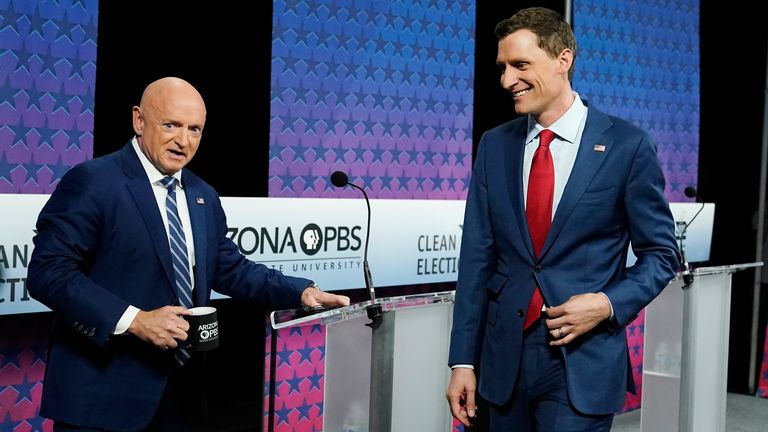
Former astronaut Mark Kelly has defeated his republican rival in Arizona’s senate race, with just two more seats left to be decided.
In a statement, the 58-year-old Mr Kelly, the incumbent senator, said: “Thank you to the people of Arizona for re-electing me to the United States Senate.
“From day one, this campaign has been about the many Arizonans – Democrats, Independents, and Republicans – who believe in working together to tackle the significant challenges we face.
“That’s exactly what I’ve done in my first two years in office and what I will continue to do for as long as I’m there.
“It’s been one of the great honors of my life to serve as Arizona’s senator.
“I’m humbled by the trust our state has placed in me to continue this work.”
Mr Kelly is a former US Navy captain and retired astronaut who made four trips into space, including missions delivering equipment, supplies, and crew to the International Space Station.
His Republican rival for the Arizona seat was Blake Masters,a 36-year-old venture capitalist.
mage:Mr Kelly and his Republican challenger Blake Masters. Pic: AP
I
If Mr Kelly’s victory leaves the senate tied at 49-49, with control hinging on contests in Nevada and Georgia.
The Democrats need one more seat, as Democrat Vice President Kamala Harris can cast a tie-breaking vote.
In Nevada, incumbent Democrat Catherine Cortez Masto is within 800 votes of the Republican state attorney general Adam Laxalt.
The outcome in Georgia could be weeks away, with Democrat incumbent Raphael Warnock to face Republican Herschel Walker in a 6 December run-off.
In the fight for control of the House of Representatives, Republicans are edging closer to taking the majority – a move that would end four years of Democrat rule.
Republicans had at least 211 of the 218 seats they needed on Thursday, according to Edison Research projections.
The Democrats had won 199, with many of the undecided races in Arizona, California, and Washington state.
If the Republicans do cement a House victory, they would be able to veto President Joe Biden’s agenda, severely limiting any progress he might have hoped to make between now and the 2024 election.
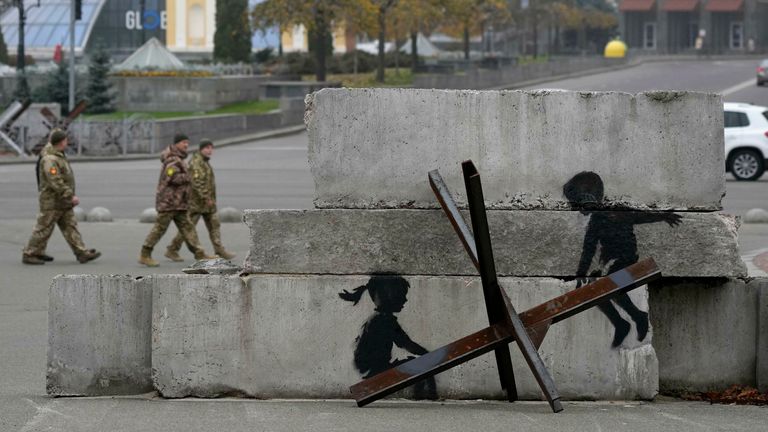
The mystery graffiti artistappears to be in Ukraine, where he is credited with three fresh murals.
After unveiling his latest artwork on Instagram, Banksy appears to have verified that he is in Ukraine.
The unidentified graffiti artist posted the painting, which depicts a female gymnast teetering on a destroyed building, late Friday night.
The location was labeled as Borodyanka, in Ukraine’s Kyiv area.
Two other murals were reportedly seen nearby – one depicting a man resembling Russian President Vladimir Putin being flipped during a judo match with a little boy, and another showing two children using a metal tank trap as a seesaw.
Image: The photo of this mural was taken earlier this month when its creator was still unverified. Pic: AP
Borodyanka, northwest of Ukraine’s capital Kyiv, was one of the towns hardest hit by Russia’s bombardment after the invasion began late in February.
It was liberated in April, but for weeks afterward, it was isolated – the power had been knocked out, shops were closed, transport links were not operating and humanitarian agencies and other volunteer groups were the only sources of food, clothes, and other necessities.
Ukraine’s President Volodymyr Zelenskyysaid later that the situation in occupied Borodyanka had been “much more horrific” than in Bucha, where hundreds of civilians were found dead in mass graves.
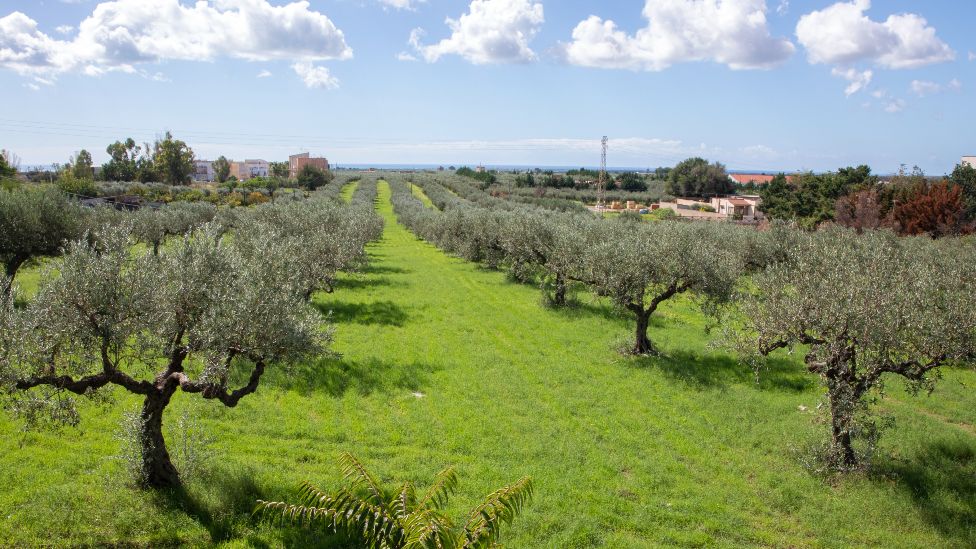
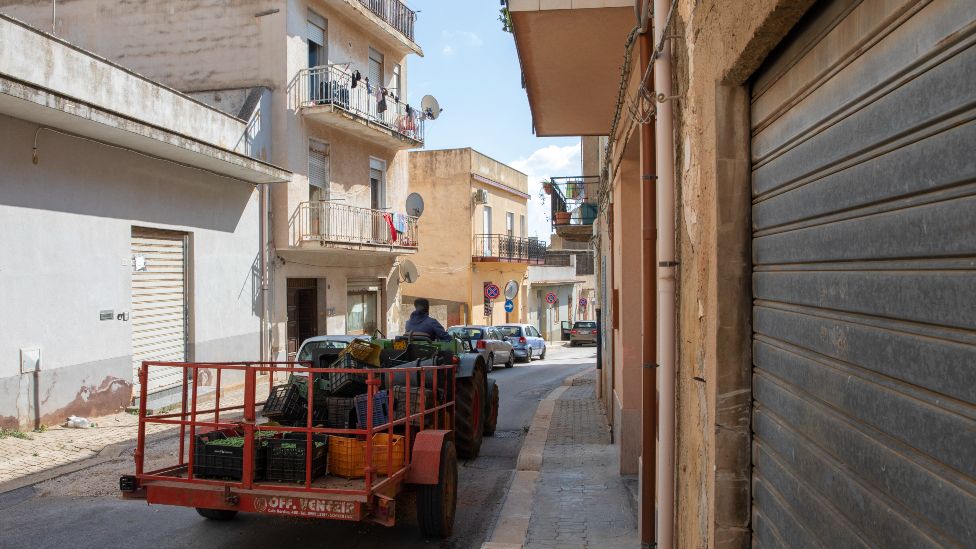
On the Italian island of Sicily, the village of Campobello di Mazara overlooks rows of olive trees blanketing beautiful fields – farm vehicles whizz by with crates full of plump green olives.
A short distance away from this gorgeous setting is something far darker: a filthy improvised encampment resembling a refugee camp.
IMAGE SOURCE,KATE STANWORTH Image caption, The olive groves of Campobello di Mazara produce the Nocellara del Belice variety, popular in Europe’s upmarket delis
Known as the “ghetto”, it is home to hundreds of African migrant farm workers, most of whom are from The Gambia, Senegal and Tunisia.
Such “ghettos” housing mainly African agricultural workers also exist in other parts of Italy like Puglia in the south. The UN estimates that between 450,000 to 500,000 irregular migrants are working in the country’s agricultural sector – about half of its total workforce.
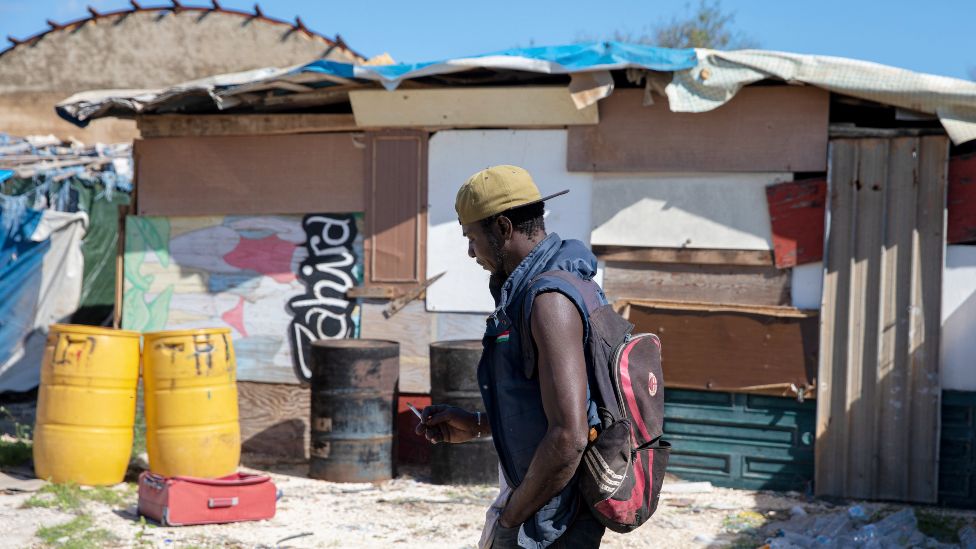
“Campobello” in Italian means beautiful countryside, yet looking out round the camp there is nothing here but squalor and one-room shacks built from discarded wooden doors, plastic and metal, like old olive tins.
Residents are distrustful of outsiders and few are willingto talk when we visit.
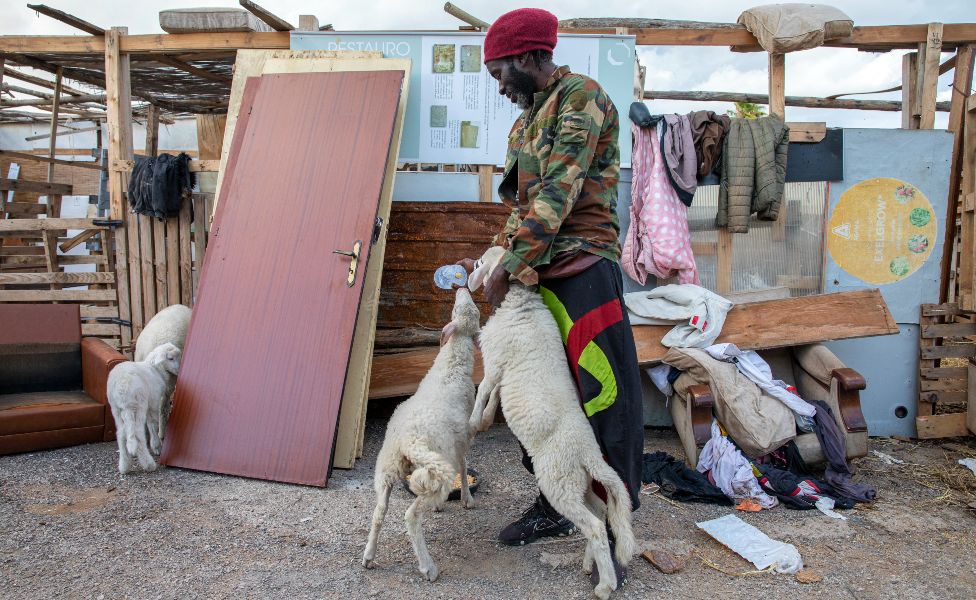
A Senegalese man washes some meat with his bare hands in a large pot filled with dirty water as he prepares lunch, another man butchers a sheep and a third man feeds lambs with milk from a plastic water bottle.
IMAGE SOURCE,KATE STANWORTH Image caption, Most residents of the ghetto are Muslim and raise lambs to slaughter for their halal meat
At the back of the camp is a large open area filled with piles of rubbish and a makeshift shower room which can be hired for $1 (£0.85) and a bucketful of water bought for $1.
The building was constructed by Boja, a Gambian migrant who would only give his first name and moved here in 2017. He initially came to work in the olive fields but since then has used his carpentry skills to become the camp builder.
He erects the shacks which are rented out to workers for $100 a month.
But the shack dwellers live in grim conditions: there is no running water, no sewage system and no electricity. Fires are lit to cook and keep away the night chill, says Boja.
Heatwave labour
Still every year up to more than 1,000 migrants – without official papers – fill this informal camp to work for black-market gangmasters to harvest olives from September to November.
Farmers here grow the Nocellara del Belice olive, considered one of the finest table olives in the world. They need to employ many people to pick them by hand to get them to the expensive delis and supermarkets worldwide.
IMAGE SOURCE,KATE STANWORTH Image caption, Boja has lived in Campobello di Mazara’s ghetto for four years and has become the camp builder
The gangmaster system, known as “caporalato”, means the migrants do not work directly for the farmers – and their illegal status means they are incredibly cheap for businesses, which pay them as little as $2 an hour.
Boja says the ghetto can be a dangerous place – drug dealing and sex workers are in evidence – and even the police do not venture into the camp, which partly burnt down last year, killing a young migrant called Omar Baldeh and leaving hundreds of others homeless.
Yet the nearby town of Campobello di Mazara is eerily empty of residents, its streets lined with boarded-up homes. Sicily has long been a place of emigration – its people leaving to find work opportunities in northern Italy and the rest of Europe.
At night the town whimpers to life with a couple of takeaway pizza placesand cafés where Tunisian and Senegalese migrants sit outside smoking cigarettes and drinking coffee.
IMAGE SOURCE,KATE STANWORTH Image caption, Campobello di Mazara is an eerie town full of empty and boarded-up homes
People do whatever it takes to survive in the ghetto, says Boja, who finds it too difficult to talk about the losses from the fire.
To commemorate the first anniversary of the fire, African migrants marched through Campobello di Mazara last month with Italian activists to call for better conditions for camp residents.
One of those who joined the protest was Issa, a Gambian migrant who also did not want to give his full name. He lives in Puglia, where he spent two years in the large Foggia ghetto, home to more than 1,500 migrants.
He also complained about how African migrants are treated by gangmasters – forced to work long hours in excessive heat.
Englandhas suffered heartbreak again after losing to New Zealand for the fifth time in the Rugby World Cup final.
Despite a strong start, the first-half sending off of winger Lydia Thompson proved crucial after a reckless tackle on Portia Woodman in the 18th minute.
A hat-trick from hooker Amy Cokayne off the rolling maul and tries from flanker Marlie Packer and fullback Ellie Kildunne had kept England ahead for all but 15 of the 80 minutes.
However. winger Ayesha Leti-l’iga scored a try nine minutes from time to give New Zealand a 34-31 victory.
It secured a sixth world title for the Black Ferns at a packed Eden Park.
England skipper Sarah Hunter said: “I’m gutted. I’m so proud of the team. We came out fighting.
“We had our backs against the wall for 60 minutes of that game but we never gave up, we kept coming out.
“One result doesn’t define the squad that we are, the people that we are and hopefully what we’ve created.”
Black Ferns captain Ruahei Demant: “I can’t even put it into words. All I can say is thank you – I am so proud of our team.
“It has been really challenging. Most people don’t even know that last year we went on a northern tour and got pumped. The way the players have turned themselves around – there’s a lot that is unseen.
“We’ve sacrificed so much to get one chance in a lifetime, to win a World Cup at home, and we did it.”
Earlier, France won the bronze medal after a 36-0 demolition of Canada, scoring five tries.
The 2023 Nations Cup wasoriginally scheduled for June and July next year but was moved to avoid the rainy season in Ivory Coast.
Qualifiers for the finals are underway but proposed fixtures in September were rescheduled to allow Africa’s five participants in the World Cup to arrange friendly matches.
Group fixtures will resume in the next international break in March, with the final two rounds of fixtures being held next September.
Ivory Coast are playing in Group H despite already being assured of a place at the tournament.
Meanwhile, Caf is also looking for new hosts of the 2025 Nations Cup after stripping Guinea of hosting rights last month because of a lack of suitably advancing infrastructure and facilities.
The continent’s governing body set Friday as a deadline for countries to declare interest in staging the tournament and, after receiving documents and touring bidding countries, is due to announce the successful country or co-hosts on 10 February.
A display of faith
Analysis – Piers Edwards, BBC Sport Africa
Friday’s signing is significant as it shows the faith that Caf has in Ivory Coast to successfully host the 24-team Nations Cup in early 2024.
Shortly after taking charge as Caf president in early 2021, Patrice Motsepe grew alarmed by the lack of leverage he had in regard to hurrying up Cameroonian preparations for this year’s Nations Cup, given the contract had already been signed prior to his arrival.
In February, he said the signing of such a legal document between host nation and Caf should be delayed until a point whereby the African football body no longer needed the threat of removing the tournament from a host nation in order to effect various requests.
Motsepe’s successful trip to Abidjan should not be underestimated in terms of its importance in stressing that Ivory Coast is fit to host, especially coming after the 2025 finals were removed from Guinea last month owing to Caf’s concerns over the country’s readiness.
A holiday cruise ship carrying approximately 800 people with Covid-19 stopped in Sydney, Australia.
After sailing from New Zealand, the Majestic Princess cruise liner arrived at Circular Quay.
When the ship docked, there were approximately 4,600 passengers and crew on board, which meant that approximately one in every five had Covid.
The outbreak is similar to the early 2020 Ruby Princess cruise liner Covid incident, in which at least 900 individuals tested positive and 28 perished.
Marguerite Fitzgerald, the president of the cruise operator Carnival Australia, said a large number of cases started to be detected about halfway through the 12-day voyage.
All cases were either asymptomatic or mildly symptomatic, she said.
Staff would be assisting all guests who have tested positive“with accessing private transport and accommodation to complete their isolation period”, she said. The ship will soon depart for Melbourne.
Asked about comparisons between the Majestic Princess and the Ruby Princess – which also belongs to the same operator – Ms Fitzgerald said: “Since then, we as a community have learnt a lot, a lot more about Covid.”
The outbreak comes as Covid cases rise across Australia.
In New South Wales, 19,800 new cases were detected in the seven days to Friday.
An idyllic paradise of palm trees and pineapples, sun, sand and serenity is what comes to mind when you think of Bali.
But this week the Indonesian island is hosting what could well be the most strained edition of the G20, or Group of 20 nations.
The annual summit – which includes 19 advanced and emerging economies and the EU – was created after the Asian financial crisis in 1999. And it considers itself something of a superpowers club that manages future crises.
And this time, there are plenty on the discussion block – the Russia-Ukraine war, brewing US-China tensions, soaring inflation, the ever-looming threat of a global recession, nuclear threats from North Korea, and perhaps most alarming of all, a rapidly warming earth.
Amid all this, host and Indonesian President Joko Widodo hopes to play chief dealmaker. Can he do it?
An era of living dangerously
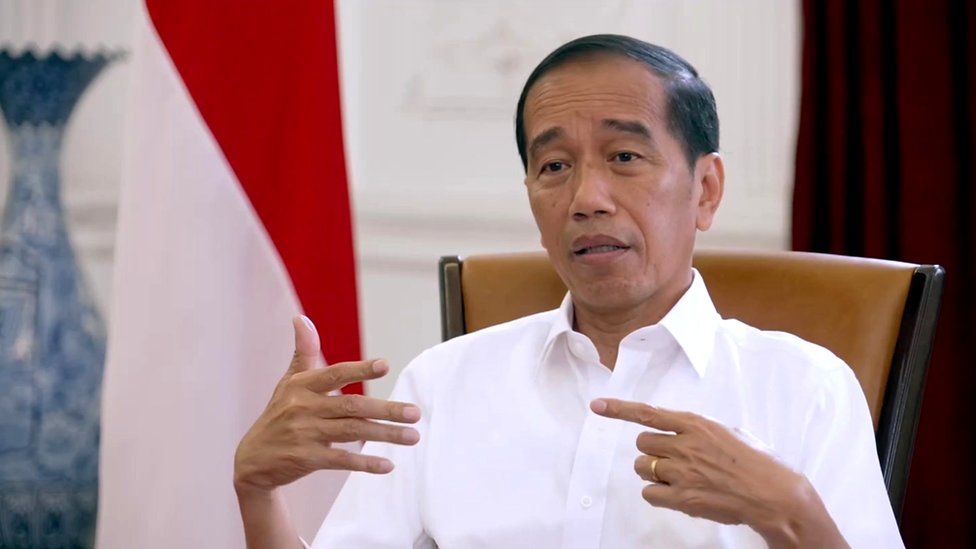
When we spoke ahead of the G20 meeting,Mr Widodo seemed sanguine about what has been described as the most diplomatically delicate and stressful G20 ever.
US President Joe Biden and China’s leader Xi Jinping are set to meet on Monday – and the clash of the world’s two largest economies has Mr Widodo worried.
“There can be no peace without dialogue,” he told me in an exclusive interview at the presidential palace in Jakarta.
“If President Xi Jinping and President Joe Biden can meet and talk, it would be very good for the world, especially if they are able to come to an agreement about how to help the world recover.”
Like many Asian countries, Indonesia has benefited from decades of free trade and multilateralism. The US has always been Indonesia’s most important global strategic partner, but over the last decade, China has consistently ranked as one of its top two foreign investors.
That’s made navigating the relationship between the two giants tricky, to say the least.
Image caption, “There can be no peace without dialogue,” says Joko Widodo – popularly known as Jokowi
An era in which China and the US aren’t getting along is a far more dangerous one than Indonesia and other Asian countries have been accustomed to.
Observers say that that growing tensions between Washington and Beijing increase the risk of conflict in the Indo-Pacific.
Meanwhile there are also fears of the possible use of nuclear weapons, either in Ukraine or on the Korean peninsula, where Pyongyang has fired a record number of missiles this year.
“The use of nuclear weapons for any reason, cannot betolerated,” Mr Widodo, also known as Jokowi, says. “The increasing potential for nuclear use is… very dangerous for peace and for world stability.”
Getting people to talk
A key issue for Mr Jokowi personally has been food security – particularly as the war in Ukraine has been responsible, in his view, for rising prices, something that directly impacts Indonesia’s 275 million people.
He politely termed Russia’s invasion of Ukraine a “headache”, something that has been “taking up his mind”.
Securing a steady and consistent resumption of grain exports is one of the reasons why – ahead of the meeting – he’s crisscrossed the globe, meeting with Presidents Vladimir Putin and Volodymyr Zelensky to convince them to come to the meeting.
He had hoped they could talk. “I think it would be great if they [Presidents Vladimir Putin and Volodymyr Zelensky] could sit at the same table – to solve the problems that exist, because the problems that we are dealing with now are on all fronts,” Mr Widodo said.
Mr Putin is not coming, Russian diplomats have since said, but Mr Zelensky could attend virtually.
Jokowi’s swansong
The G20 is as much Indonesia’s coming out party as it is Mr Widodo’s swansong – he is in the final stretch of his presidency, and in 2024 he will have to stand down after two terms in power.
When I first met him in 2012, as the then Jakarta governor he was a younger and more idealistic. Branded the first “outsider” to become president in Indonesia’s history, he was elected as a man of the people, a democrat’s democrat.
Since then he’s had to govern a vast archipelago of 17,000 islands, a country that from west to east stretches the distance between London and Baghdad, with hundreds of different languages and ethnicities in between.
IMAGE SOURCE,GETTY IMAGES Image caption, Mr Widodo wants to cement his economic legacy in Indonesia – but it may be out of his hands
It’s a challenge I’ve written about before and over the last few years I’ve seen Jokowi, man of the people, transform into Jokowi the president. Now a pragmatist, he’s become a coalition-builder; someone who knows he has to compromise to not just survive but also thrive. Critics say he is no longer the democrat he used to be. Human rights groups and environmental campaigners have both said that he has consistently put the economy ahead of democratic interests.
Although he remains extremely popular by international standards, his approval ratings have fallen recently, partly because of rising prices.
Yet the country has weathered the current economic slowdown better than others, described by the International Monetary Fund as a “good performer” among regional economies.
It is obvious Mr Widodo is keen to preserve and grow the economic legacy he is leaving behind for Indonesia.
“What we would like to see in 2045 is that Indonesia’s golden era will truly be realised,” he says towards the end of our conversation. “By 2030, we expect Indonesia to become the number seven economy in the world.”
It is a lofty ambition, and one that will resonate with many of his citizens. But it’s also one that may be out of his hands.
Indonesia’s future depends on a stable global economic environment – something Mr Widodo hopes to come closer to securing at next week’s G20 summit.
Two brothers have been charged in Sweden with spying for Russiaover a period of 10 years, prosecutors have announced.
Both are reported to have worked for Sweden’s security services, and one was a senior manager at a government agency when arrested last year.
Investigators have seized mobile phones, a smashed hard drive and notes detailing cash and gold transactions.
The suspects deny any wrongdoing, their defence lawyers have told local media.
Peyman Kia, 42, and Payam Kia, 35, are believed to have worked together to pass on information to Russia’s military intelligence service, the GRU.
The men were arrested in late 2021 and have been in custody ever since.
While both are accused of aggravated espionage, Peyman Kia has also been charged with the gross unauthorised handling of secret information.
The chief prosecutor of Sweden’s National Security Unit, Per Lindqvist, described the case as very difficult to investigate, adding the men were suspected of “highly serious criminality targeted at Sweden’s intelligence and security system”.
The secret information – which could result in “detriment to Sweden’s security” in the hands of a foreign power, according to Mr Lindqvist – was reportedly gathered while the older Mr Kia was employed at Sweden’s security services and army.
Newspaper Dagens Nyheter says the suspect also served in the Office for Special Acquisition (KSI), a top-secret organ of the country’s intelligence services.
During Peyman’s arrest, his younger brother Payam “dismantled and broke a hard drive that was later found in a bin”, according to the charges.
Payam is thought to have managed contact with Russia and the GRU including “matters of surrender of information and receipt of compensation”.
Much of the information from the preliminary investigation has not been released due to its sensitive nature.
The older Mr Kia’s defence lawyer, Anton Strand, told Sweden’s public broadcaster SVT the charges were imprecise and lacked “concrete” descriptions of his client’s alleged crimes.
Björn Sandin, defending the younger suspect, similarly suggested the charges demonstrated that prosecutors were “not entirely confident” about their claims, according to TV4.
If convicted, the brothers may be handed life sentences – generally a minimum of 20-25 years in prison in Sweden.
He had spent the past year insisting that he was Arthur Knight, an orphan from Ireland who had never been to the US.
He claimed that he had been given distinctive tattoos matching those on the arms of Rossi while he was lying unconscious in a Glasgow hospital in an attempt to frame him.
But after a three-day hearing, Sheriff Norman McFadyen said: “I am ultimately satisfied on the balance of probabilities that Mr Knight is indeed Nicholas Rossi, the person sought for extradition by the United States.”
Sheriff McFadyen rejected Rossi’s claims to have been the victim of mistaken identity as “implausible” and “fanciful” and said his repeated name changes were “highly suspicious” and “consistent with someone who was hiding from someone or something”.
He will now face an extradition hearing in March, when the Scottish courts will decide whether to send him back to the US to stand trial on the allegations against him.
Rossi was arrested by Police Scotland last year after staff at the Queen Elizabeth University Hospital recognised his tattoos – images of which had been circulated by Interpol – while he was being treated for Covid.
Fingerprint expert Lisa Davidson told the court that prints taken from the man claiming to be Arthur Knight after his arrest were identical to those of Rossi, which were included on a US extradition request and the Interpol red notice.
IMAGE SOURCE,PAWTUCKET POLICE DEPT Image caption, Medical staff at a Glasgow hospital recognised Rossi by the distinctive tattoos on his arms
But Rossi claimed the fingerprints had been meddled with and taken from him by an NHS worker called “Patrick” on behalf of David Leavitt, a Utah county lawyer.
Advocate depute Paul Harvey dismissed his claims as “entirely outlandish” and “bizarre”.
Rossi’s accent also changed several times while he was giving evidence.
A series of earlier hearings in the case had seen Rossi sack at least six lawyers and claim to have been tortured in prison.
His wife, Miranda Knight, 41, gave evidence to the court during the hearing and said her husband had given no indication that he was really Nicholas Rossi.
Rossi’s marriage certificate was shown to the court,which had been signed under the name Nicholas Brown.
IMAGE SOURCE,PA MEDIA Image caption, Miranda Knight told the court she did not believe her husband was really Nicholas Rossi
The court was told on Wednesday that US prosecutors submitted additional extradition requests over an allegation of rape in Salt Lake City and another over an allegation of sexual assault against Rossi.
Rossi, who appeared in court in a wheelchair, was already fighting an extradition request by authorities in Utah who allege he raped a 21-year-old woman in the state in 2008.
He had previously been convicted of sexually assaulting another woman, known as Mary, after meeting her online in 2008.
She told BBC Scotland that Rossi pinned her against a wall, forcefully kissed and groped her and masturbated in front of her at a college in Ohio.
Mary said she hoped Rossi would now face justice on the other allegations against him, adding: “He is trying to fool everybody and I’m glad so many people see through it”.
Who is Nicholas Rossi?
Image caption, Nicholas Rossi is wanted by authorities in Utah
Authorities in the US have said that Rossi was also known as Nicholas Alahverdian in the state of Rhode Island, where he was involved in local politics and was a critic of the state’s child welfare system.
Rossi told US media in December 2019 that he had late-stage non-Hodgkin lymphoma and had weeks to live. Several outlets reported that he had died in February 2020.
Court records showed that Utah officials were looking for him at the time in connection with an alleged rape.
He used several other aliases, including Nicholas Edward Rossi, Nicholas Alahverdian-Rossi, Nick Alan, Nicholas Brown, Arthur Brown and Arthur Knight.
The FBI also had a warrant for his arrest on charges of defrauding his foster father by taking out credit cards in his name and running up debts of more than $200,000.
The wording on the Swindon Borough Council plaque included a spelling mistake, errant capital letters and a full stop in the wrong place amongst other errors.
A council has been criticised for an error-strewn plaque that was supposed to pay tribute to key workers during the COVID pandemic.
The sign was installed on Monday at Coate Water, Swindon, next to a tulip tree to mark the “selflessness and dedication” of those who worked during the pandemic.
It read: “This tree has been planted in appreciation of Our Key Workers and Volunteers by the borough. to honor Their Selflessness and Dedication given to the residents and the vulnerable During the Covid Pandemic March 2019.”
But the wording on the Swindon Borough Council plaque included a spelling mistake, errant capital letters, and a full stop in the wrong place.
It also had the wrong date for the pandemic – a year before it was recognised in the UK.
After the gaffes were spotted, Labour parish councillor for Eldene in East Swindon Mike Davies tweeted: “Nice idea by Swindon Council, but very poorly executed.
Italy’s Prime Minister Giorgia Meloni described France’s government as “aggressive” and “incomprehensible” after it chastised Italy for refusing to dock a migrant ship.
Italy recently accepted three NGO boats rescuing migrants crossing from Libya after previously blocking them.
It also stated that France had agreed to accept another ship, the Ocean Viking.
That announcement drew applause from Italy’s Deputy Prime Minister Matteo Salvini, who declared that “the air has changed.”
Also Hungary’s far-right leader Viktor Orban thanked Ms Meloni for “protecting Europe’s borders”.
But reports suggest French authorities had not actually agreed to a deal.
In Paris, Italy’s public announcement is being seen as a way of forcing it into accepting the boat.
French Interior Minister Gérald Darmanin said France would exceptionally let the Ocean Viking dock – with the ship arriving in Toulon on Friday morning.
But he described Italy’s actions as reprehensible and selfish, warning of “very serious consequences”.
In a press conference on Friday, Ms Meloni said she was struck by France’s “aggressive reaction” which she also described as unjustified.
The comments come amid an increasingly explosive war of words between the two European Union members over migration, on which Italy’s new right-wing government has vowed to clamp down.
France has now suspended an agreement to take in 3,500 migrants relocated from Italy, urged other EU members to do the same and tightened controls on its borders with Italy.
Ms Meloni has warned it would not be “intelligent” for the EU to isolate Italy.
She stressed that her country had taken in almost 90,000 migrants this year, while Ocean Viking,with 234 on board, was the first NGO rescue boat that France had ever accepted.
“The situation cannot continue this way,” she added, saying that France’s reaction had betrayed a lack of European solidarity.
The unequal burden-sharing of migration has long caused friction within the EU, and Italy, Greece and Spain and have argued that they cannot be expected to shoulder the weight.
Domestic politics has also fed into the row – on both sides of the border.
Italy’s prime minister – the country’s first far-right leader since World War Two – campaigned on halting migrant boats and needs to please her electoral base.
In France, President Emmanuel Macron faces pressure from the far-right’s National Rally, whose leader Marine Le Pen has been quick to capitalise on the issue.
She accused Emmanuel Macron of “dramatic laxity” by accepting the ship, denouncing his failure to stop “massive and anarchic immigration”.
Whatever the motive, the result is now the worst crisis between France and Italy since 2019, when the then Italian deputy prime minister paid a solidarity visit to the anti-government gilets jaunes (yellow vest) protesters in France, prompting Paris to withdraw its ambassador to Rome.
It is rare for western EU members to criticise each other so openly – and does not bode well for relations between Italy’s new government and its traditional allies.
Former US President Donald Trump has lashed out at Florida Governor Ron DeSantis, escalating a simmering feud between the two top Republicans.
Mr Trump dismissed his former political aide as a “average” governor who lacked “loyalty.”
Mr. DeSantis, 44, was re-elected in a landslide in the midterm elections on Tuesday, cementing his position as the Republican Party’s brightest rising star.
He is widely expected to run for the Democratic nomination for President in 2024.
But Mr. Trump, 76, appears to be standing in his way.
The former president – who has a massive campaign war chest and remains hugely popular with the party’s base – would be a formidable opponent for Mr DeSantis, or any other Republican who dares challenge him.
In a lengthy statement on Thursday night, Mr Trump dismissed the Florida governor as a political lightweight who had come to him “in desperate shape” when running for his first term in office in 2017.
He went on to complain that Mr DeSantis – whom he is nicknaming “Ron DeSanctimonious” – was “playing games” by refusing to rule out a presidential bid.
“Well, in terms of loyalty and class, that’s really not the right answer,” Mr Trump added.
The former president is widely expected to announce his own plan for a White House comeback as soon as next week.
All this is a familiar strategy – conducted with familiar viciousness and drama.
In 2016, Mr Trump lashed out at prominent figures within his own party with no restraint – presidential rivals Jeb Bush, Ben Carson, Ted Cruz and Marco Rubio, as well as Arizona Senator John McCain. He didn’t need the respect or support of Republican leaders and wore their scorn as a badge.
At the time, those leaders feared Mr Trump would be a disastrous standard-bearer, that he would sink the party and doom them to defeat.
Mr Trump won the White House anyway, but after this week – and the Republican midterm rout in 2018 and Mr Trump’s 2020 re-election defeat – his party’s elders are once again getting skittish.
While Mr DeSantis is bathing in the glow of his re-election victory, Mr Trump has been blamed for the Republicans’ disappointing performance in the midterm elections.
The race for control of the House of Representatives and Senate went down to the wire. Two days after Americans went to the polls, it remains unclear which party will control the twin chambers of Congress.
Voters by and large rejected candidates who backed Mr Trump’s baseless claims of election fraud in 2020, and many of his high-profile picks for office struggled or lost outright.
Even close allies of the ex-president have called for him to reconsider what he has teased to be a big announcement on 15 November.
His margin of victory in Miami-Dade county – traditionally a Democratic stronghold – was the largest won by a Republican in four decades.
According to an October Ipsos poll, 72% of registered Republicans said Mr DeSantis should have a great deal or good amount of influence on the future of the party. Some 64% said the same of Mr Trump, 76.
The governor did not immediately respond to Mr Trump’s jibes on Thursday.
US President Joe Biden says, it is the duty and responsibility of every nation to act on climate change.
Mr. Biden spoke in Egypt following the president’s better-than-expected midterm election results in the United States.
He claimed that the United States is a global climate leader because it has passed comprehensive climate legislation.
The two-week meeting is attended by approximately 35,000 people in Sharm el-Sheikh.
“The climate crisis is about human security, economic security, environmental security, national security and the very life of the planet,” said Mr Biden.
He echoed UK Prime Minister Rishi Sunak’s comments on Monday that Russia’s war in Ukraine is a reason to act faster on climate.
Noting that the past eight years have been the warmest on record, he described the impacts of climate change on Africa nations, including a four-year drought in the Horn of Africa.
Mr Biden promised to tighten US rules on methane emissions from oil and gas companies. Methane is the most potent greenhouse gas and significantly contributes to the warming of Earth’s atmosphere.
“Today, thanks to the actions we have taken, I can stand here as president of the United States of America and say with confidence the US will meet our emissions targets by 2030,” he said.
He also pledged more money for poorer nations suffering from climate disasters, including drought and flooding. But the sums remain far short of what the US, along with other developed nations, have promised.
“Joe Biden comes to COP27 and makes new promises but his old promises have not even been fulfilled. I’d rather have one apple in my hand than the promise of five that never come,” said Mohamed Adow, Power Shift Africa director.
“The inconvenient truth is that the United States is grossly underperforming on its international climate finance commitments,” said president of World Resources Institute Ani Dasgupta.
IMAGE SOURCE,REUTERS Image caption, Activists, NGOs, politicians and negotiators from around the world are at COP27
In August the US passed legislation to tackle climate change that experts have called “radical” and “historic”. The Inflation Reduction Act could reduce US greenhouse gas emissions by 40% by 2030.
Mr Biden’s Democrat party feared that it would lose crucial seats in the mid-term elections on Tuesday, which could have weakened their climate agenda. But it performed better than expected.
“While control of Congress is still being determined, one thing is certain: the massive climate-friendly investments in the Inflation Reduction Act are here to stay,” says Dan Lashof, director of World Resources Institute United States.
Mr Biden also held talks with Egyptian President Abdul Fattah al-Sisi amid heightened concern over the fate of jailed British-Egyptian pro-democracy activist Alaa Abdel Fattah.
There’s been no independent confirmation about Mr Abdel Fattah’s condition since he is said to have received “medical intervention” on Thursday, days after he began refusing water as part of a long hunger strike.
It is the sixth day of the COP summit, which is focussed on implementing ambitious promises made at COP26 in Glasgow last year.
Vulnerable nations have called on richer countries to pay for the irreversible damage climate change wrecks on their homes.
“We will not give up… the alternative consigns us to a watery grave,” Bahamas Prime Minister Philip Davis said on Tuesday, urging nations to “get real”.
They say developed nations owe this money because they became rich off decades of using fossil fuels.
By contrast many less developed countries, particularly the small island nations most at risk, have contributed virtually nothing to total emissions.
Richer nations have historically avoided the question of compensation or reparations, but the issue – referred to as “loss and damage” – was put on the COP agenda this year for the first time since the summits began 30 years ago.
Human rights groups are highlighting the plight of an estimated 60,000 political prisoners in Egypt.
In a reminder of the danger the world faces, UN Secretary General Antonio Guterres told the summit “we are on a highway to climate hell with our foot on the accelerator”.
On Friday a report warned that emissions of carbon dioxide (CO2) are rising so quickly that there is a 50% chance the world will soon cross the crucial temperature threshold of 1.5C.
Scotland Yardis not prosecuting former London mayoral candidate Shaun Bailey or anyone else who attended a gathering at Conservative Party headquarters during a Covid lockdown.
While London was under restrictions in December 2020, Mr Bailey and Tory aides were seen posing for a photo, raising glasses beside buffet food.
Indoor socialising was prohibited.
However, the Met stated that there was “insufficient evidence to disprove the version of events provided by attendees.”
Fresh questions about the event at Conservative Campaign Headquarters in Westminster were raised after it was reported that former prime minister Boris Johnson had put Mr Bailey forward for a peerage in his resignation honours list.
After the Daily Mirror published a picture of the gathering in December 2021, the Metropolitan Police launched an investigation.
Mr Bailey, a former candidate to be London’s mayor, apologised “unreservedly” for the event organised by his campaign team and said it was a “serious error of judgment”.
Then-Transport Secretary, Grant Shapps, who is now business secretary, said “that scene is absolutely unacceptable”.
Before the photo was published, the Times had reported that a “raucous” party took place in the basement while Covid restrictions were in place.
The Met concluded the “photo by itself is not sufficient evidence on which to assess that an offence had been committed”.
Officers issued attendees with questionnaires to decide whether breaches of the rules were committed and fines should be issued.
“The investigation reviewed all the material thoroughly and after careful consideration, it was determined that there was insufficient evidence to disprove the version of events provided by attendees to a standard that would meet the threshold required,” the Met said.
Mr Bailey, who remains a London Assembly Member, resigned as chairman of the governing body’s Police and Crime Committee after the picture emerged.
Scotland Yard issued a total of 126 fines over rule breaches in Whitehall and Downing Street while Mr Johnson was prime minister, in a scandal that helped end his tenure in No 10.
Mr Johnson and his then-chancellor Rishi Sunak paid fixed-penalty notices over a gathering held for Mr Johnson’s 56th birthday
A man who placed a phonein a shopping basket to film schoolgirl skirts has been sentence of suspension.
Graham Smith, 62, of Christchurch, was apprehended in December after the strategically placed device was discovered in a Bournemouth Co-op store.
He pleaded guilty to taking an image beneath another person’s clothing to observe without their consent.
Smith was sentenced to 20 weeks in prison, suspended for 18 months, at Poole Magistrates’ Court.
Passing sentence, deputy district judge Kirsty Allman said he had “deliberately selected and targeted” girls in school uniform to film for sexual gratification.
“They were violated in a degrading manner as they went about their daily life.
She added it had been “humiliating” for the girls involved.
Prosecutors claimed David Smith, 58, intended to cause harm to the United Kingdom and the embassy where he had worked for eight years.
The British citizen was accused of gathering intelligence on the embassy and leaking classified documents.
Smith pleaded guilty to eight charges under the Official Secrets Act at the Old Bailey.
He is said to have wanted to live in Russia or Ukraine during the time he passed on classified information beginning in May 2020.
Prosecutors claimed he was motivated by a deep hatred for his homeland and enraged by the display of the Rainbow flag in support of the LGBT community.
He was arrested in August 2021 and 800 euros (£700) of cash was found in his home in Potsdam, Germany.
Smith, now of no fixed abode, pleaded guilty to the charges on 4 November, but reporting restrictions were initially put in place.
They were lifted on Friday after the prosecution indicated it would not seek a trial on a ninth charge that he had denied.
Smith will be sentenced at a later date and faces a maximum of 14 years in prison.
Extradited to UK
The charges laid against Smith stated he had communicated with General Major Sergey Chukhurov, the Russian military attache based out of the Russian Embassy in Berlin in 2020 – giving information about the addresses, phone numbers and activities of various British civil servants.
He collected intelligence on the operation and layout of the embassy, which was said to be useful to “an enemy, namely the Russian state”.
Some of this material was classified as “secret” and related to the activities of the British government and its German embassy.
But the material he has admitted passing on or collecting could still be very useful for the Russians.
It could potentially help identify undercover British intelligence officers at the Embassy and potentially even any agents they were meeting.
Things like details of CCTV could also potentially have helped Russian spies work out how to run their own operations against the embassy and collect its secrets.
Smith’s lawyers are understood to dispute the prosecution’s claims about his motivation but disgruntled employees historically have often been the most effective recruits for spy services.
The case may also raise questions about the checks carried out on staff, like Smith, that are recruited locally.
On the day of his arrest, Smith had left work early complaining he was feeling ill and was met by German police at his home.
A request was made for his extradition to the UK in November 2021, following a probe by British counter-terrorism police. Smith arrived back to the UK in April.
Footage from the embassy and a draft letter to a Russian military attache, dated 14 May 2020, were found after an examination of his electronic devices.
In the letter he confirmed he worked at the embassy and wanted anonymity as he offered a book classified as “official sensitive”.
There were also “secret” classified emails and documents, pictures of staff security passes and personal information as well as posters and whiteboards in the embassy.
Matthew Ryder KC said: “It is right to say there is significant difference as to the basis Mr Smith has pleaded guilty including him not having a negative intention towards the UK that the prosecution have alleged against him.”
Due to the strong dollar and the Russia-Ukraine conflict, global spending on food imports is expected to reach all-time highs in 2022.
According to the United Nations Food and Agriculture Organization (FAO), the global food import bill is expected to exceed $1.9 trillion in 2022, a 10% increase over last year’s record level.
The figure, released in a report (PDF) on Friday, represents a “all-time high” due to currency depreciation against the US dollar – the main currency of exchange on international markets – as well as Russia’s ongoing war in Ukraine.
“The bulk of the increase in the [global food import] bill is accounted for by high-income countries, due mostly to higher world prices, while volumes are also expected to rise,” the report said.
Consequences will be more dramatic for economically vulnerable countries, it added.
“For instance, the aggregate food import bill for the group of low-income countries is expected to remain almost unchanged even though it is predicted to shrink by 10 percent in volume terms, pointing to a growing accessibility issue for these countries,” the FAO said.
Sub-Saharan Africa, already hard-hit by malnutrition, is expected to spend $4.8bn more on food imports, despite a decrease in volumes.
“These are alarming signs from a food security perspective,” FAO said.
Russia and Ukraine together accounted for 30 percent of the world wheat trade and 78 percent of sunflower oil exports before Russia launched a full-scale invasion of its neighbour on February 24. The ongoing conflict has caused grain prices to spike.
The opening of a secure maritime corridor has allowed more than 10 million tonnes of agricultural products to leave Ukraine in recent months, leading to a cautious decline in market prices.
Another easing factor is that world wheat production “should reach a record level of 784 million tons in 2022/23”, the FAO said, driven in particular by the Russian and Canadian crops.
But other factors are weighing heavily on the balance of poor importing countries, warns the FAO, like the global import bill for agricultural inputs.
In particular, fertiliser imports are expected to reach $424bn in 2022, a nearly 50 percent increase compared with the previous year.
Russia is one of the world’s leading exporters of gas and nitrogen fertilisers, and prices have tripled in one year.
“As a result, some countries may be forced to reduce input applications, almost inevitably resulting in lower agricultural productivity and lower domestic food availability,” the FAO said.
It also warned of “negative repercussions for global agricultural output and food security” in 2023.
In the 2022-23 season, the agency sees wheat production jumping 0.6 percent year-on-year to a record 784 million tonnes, but notes increases are expected mostly in China and Russia, leaving inventories down 8 percent in the rest of the world.
Production of coarse grains like corn, barley and sorghum is meanwhile seen falling 2.8 percent in the season.
On the plus side, however, the FAO said oilseeds output is seen rebounding 4.2 percent to hit an all-time high, sugar output is seen rising 2.6 percent, while rice output is expected to remain at overall average levels, in part due to resilient plantings in Asia and recovering output in Africa.
The controversy around Twitter Blueunder Elon Musk has continued today. Citing Impersonation abuse from users, Twitter has suspended its Blue Subscription Service in an attempt to resolve the growing issue.
The option to sign up for the verification service has seemingly disappeared from the platform. A new update from an internal note has now identified misuse of the service as a reason for its suspension.
JUST IN: Twitter suspends Blue subscription paid verification services, citing impersonation abuse.
For as much change that occurred in Elon Musk’s first two weeks as head of the biggest social media platform in the world, the $8 Twitter Blue service has dominated much of the conversation.
Questions of verification, and just what is offered, have been a huge aspect of the dialogue. Subsequently, it seems as though the platform has suspended the utilization of the service until it can combat a growing impersonation problem.
Source: The Indian Express
An internal note to staff suggested that the subscription service be paused while efforts are made to deter impersonation. Moreover, the suspension seemingly only impacts potential new subscribers, as Twitter Blue users still have access to the features of the service.
The pause follows Musk’s admitting earlier this week that a paid verification model could be, “a dumb decision, we’ll see.” Additionally, the question surrounding how the platform would tackle impersonation was a massive one for potential subscribers.
Source: OpIndia
The new CEO has been outspoken about his desire to craft a Twitter that lessens the allure of verification. Conversely, the problem stands in a solution not yet being found for those who will abuse a verification that is easily accessible.
Twitter Blue has seemingly factored heavily into Musk’s plans to generate revenue for the platform. This issue will likely befairly vital for the new owner, and remaining staff, to combat.
Activists hope the treaty is the first step towards more protection in one of the most dangerous nations for environmentalists.
Sikuani Indigenous leader Benilde Carreno likens the destruction of her community’s native plants to “losing an arm or a leg”.
Her people, located in the Colombian Orinoquia, an eastern region on the border with Venezuela, have suffered not only from the rigours of 50 years of civil war and its aftermath, but also environmental damage from poorly planned reforestation projects and the opening of drug trafficking routes by illegal armed groups.
Carreno is now displaced from her reservation, living in exile in the capital, Bogota, due to threats against her life resulting from her activism. But she hopes Colombia’s ratification of the Escazu Agreement on the environment will usher in a new chapter.
The accord, she tells Al Jazeera, can be “a fundamental tool that will protect the leaders and caretakers of Mother Earth, of our environment, water and life”. It will also allow her to qualify for state protection so that she can return to her community.
“The protections set out in the Escazu Agreement are fundamental for us,” she says. “We fought for this agreement and we are going to push it forward because I believe that if it is not enforced, ongoing killings of the defenders of Mother Earth will continue.”
The agreement
The Escazu Agreement, adopted in Costa Rica in March 2018, is a legally binding international treaty that aims to promote transparency in environmental decision-making. The first of its kind in Latin America and the Caribbean, it also includes protections for environmentalists like Carreno — a welcome development in one of the most dangerous countries in the world for land defenders.
The agreement enshrined the rights of citizens to get information on industrial projects; ordered the creation of mechanisms for environmental justice and law enforcement, and required signatories to monitor socio-environmental conflicts and provide mitigation and resolution strategies for them.
“This law gives power to the citizens, in the function of the defence of nature, the defence of the planet, the defence of life,” Colombian President Gustavo Petro said during a signing ceremony on November 5.
Colombia’s Congress ratified the Escazu Agreement on October 11 – making it the 14th country in the region to do so – and Petro’s signature, pending a review by the Supreme Court, enshrines the treaty into Colombian law. His predecessor Ivan Duque signed the accord in 2019, but Duque’s administration never sought Congressional approval for formal ratification.
Claudia Vasquez, director of The Nature Conservancy, an NGO that advocates for the protection of biodiversity in Latin America, said the accord will be key to environmental protections in the country.
“The participation of our Indigenous peoples and local communities and the guarantee of their territorial rights must be an indispensable pillar of conservation efforts,” she told Al Jazeera. “The Escazu Agreement strengthens guarantees of the rights of these communities so that both participation and land rights are more effectively recognised.”
‘A step towards peace’
Aida Quilcue, a senator with the left-wing MAIS party, which is part of Petro’s “Historic Pact” coalition, and a Nasa Indigenous leader from the region of Cauca, hailed the agreement’s ratification. She said it is a crucial step towards protecting activists, as well as advancing real peacebuilding in regions long-neglected by the federal government.
For years, Colombia was ranked as the most dangerous country in the world for environmental activists. Global Witness, an environmental watchdog, said in a September report that 322 environmental activists were murdered in Colombia between 2011 and 2021.
And Cauca, where Quilcue is from, has emerged as one of the epicentres of such attacks, recording one of the highest rates of violence since a 2016 peace deal was signed by Bogota and Revolutionary Armed Forces of Colombia (FARC) rebels. On October 29, Quilcue was the victim of an attack herself when unidentified gunmen fired on the government car she was travelling in.
“I strongly welcome the ratification,” she told Al Jazeera. “If we do not protect Mother Earth, humanity will go extinct. We Indigenous people have been on the front lines of this struggle. But perhaps just as importantly, this is a step towards peace. Without real peace [in Colombia], we will not be able to achieve lasting solutions for saving the environment.”
Petro has promised to reign in surging violence in the country through dialogue with armed groups, provide protection for social leaders, and make long-promised investments in areas racked by conflict as part of what he dubbed a plan for “total peace”.
He also has promised to target deforestation, which rose considerably under the previous administration, and to find economic alternatives to oil and mineral extraction — both industries that will be subject to more oversight under Escazu.
Mayerly Lopez, an environmental leader and defender of the Santurban Paramo, an alpine wetland region in Santander, in eastern Colombia, described the new accord as a sharp departure from past policy.
“Under previous governments, the approval process [for extractive projects] was opaque and dominated by powerful industrial interests, and occurred with little public oversight,” she said. “The process for creating environmental protections has been top-down and haphazard, rather than democratic, and heavily favoured large companies.”
Challenges ahead
Both Lopez and Carreno believe the Escazu Agreement presents an opportunity for developmental projects to be carried out hand-in-hand with residents, rather than imposed upon communities, a dynamic that in the past has led to violent land conflicts, as well as the displacement of local residents and killings of activists.
Although hailed as a symbolic victory for Petro’s administration, implementation and enforcement of the new law may present significant challenges — especially in regions like Cauca and Choco where there is little state presence, illegal armed groups are fighting for territorial control, and land defenders continue to be killed.
It also is not yet clear how Colombia intends to enforce the agreement, including which state agencies will lead investigations or bring charges in the case of potential violations. While the process will be led by the Ministry of Environment, enforcement also seems to fall under the jurisdiction of other governmental departments, as well as the Colombian security forces.
Meanwhile, some business leaders and politicians have strongly criticised the accord. Maria Fernanda Cabal, a congresswoman with Centro Democratico, the right-wing party of former President Duque, has opposed ratification, claiming that the Escazu Agreement puts the country’s “national sovereignty as well as the business sector at risk”.
But for Lopez, the accord provides a sense of hope that she and other activists will face less persecution and violence.
“I have received death threats via social media as well as physical pamphlets,” she said. “I hope as part of the Escazu Agreement, the state creates mechanisms to provide protection for land defenders and to investigate these threats, which currently happen in an environment of total impunity.”
A raft of key executives then resigned from the platform.
“I’ve made the hard decision to leave Twitter,” tweeted chief security officer Lea Kissner, who reportedly stepped down with other key privacy or security executives.
Yoel Roth, the site’s head of trust and safety, then resigned just a day after staunchly defending Mr Musk’s content moderation policy to advertisers.
Late on Thursday, Mr Roth’s Twitter bio described him as “Former Head of Trust & Safety at @Twitter.”
Mr Roth had became the public face of Twitter’s content moderation after Mr Musk took over.
Mr Musk had praised him for defending Twitter’s ongoing efforts to fight harmful misinformation and hate speech.
I’ve heard Twitter in its current state described as an aeroplane, mid-flight, without pilots.
The sudden departure of the head of trust and safety, the chief information security officer, and both the chief privacy and compliance officers is a dramatic development. It’s not clear how soon they will be replaced, while the firm remains this unstable and sweeping job cuts have already been made.
From a security perspective, Twitter will, like all big platforms, be a constant target for hackers and bad actors around the world, meaning it cannot afford to take its eye off the ball and it must continue to ensure that its systems are robust, and threats are monitored.
As for users’ privacy, you don’t need me to tell you how important that is. And indeed, as we’ve seen, the US regulators are already keeping a very close eye on what’s going on.
Elon Musk, on the other hand, says engagement and user numbers are higher than ever. We only have his word for it – I have to say that anecdotally I’m seeing plenty of Twitter Blue subscribers who seem happy with their new “blue tick”. And however many of them there are, that’s all fresh income that the firm did not previously have.
But it’s also causing its own headache because now anybody can have a badge which until very recently was a symbol of authenticity – including fakes.
Musk has also said that bankruptcy is not out of the question. While it may feel like we are watching Twitter speeding towards the edge of a cliff, I think it’s too early to tell whether it will manage to put the brakes on in time. In the early days of Facebook, Mark Zuckerberg’s motto was “move fast and break things” – Elon Musk appears to have taken this to another level.
Official, or not?
The Twitter Blue subscription service allowed users to pay £6.99 ($7.99) per month for a blue tick. There would be a separate grey “official” badge for some high-profile accounts.
But on Wednesday Musk scrapped the new grey tick almost immediately, which added to the confusion.
However, on Friday new grey official badges for large organisations began reappearing on some Twitter profiles.
There has also been the emergence of fake accounts impersonating celebrities and politicians such as NBA star LeBron James and former UK prime minister Tony Blair.
US-based PR strategist Max Burns said he had seen fake accounts with the verified blue tick badge bought through Twitter Blue posing as support accounts for real airlines and asking customers who were trying to contact them on Twitter to direct message the fake accounts instead.
“How long until a prankster takes a real passenger’s ticket information and cancels their flight? Or takes their credit card info and goes on a spending spree?” he said.
“It will only take one major incident for every airline to bail on Twitter as a source of customer engagement.”
Aid to Ethiopia’s war-torn Tigray region has yet to resume, despite a recent truce, according to international humanitarian agencies, despite the US urging Addis Abeba to honour the agreement and allow assistance.
The federal government of Ethiopia and the Tigray People’s Liberation Front (TPLF), the party that controls Tigray, signed a ceasefire agreement on November 2 and pledged to work with humanitarian organisations to expedite the provision of aid.
But it did not commit to a specific timeline and it has denied blocking aid.
On Friday, Ethiopia’s chief negotiator said essential services were being restored and humanitarian aid was flowing into the region of some 5.5 million people, half of them in severe need of food after the two-year conflict.
The two sides are currently negotiating the implementation of that agreement, including the resumption of aid deliveries.
International aid agencies say they have been blocked from sending assistance into Tigray for much of the conflict.
Three officials at international humanitarian organisations said despite the truce, their convoys were still waiting for permission from authorities to cross into the area.
The US Department of State’s Bureau of African Affairs urged a swift resolution.
“Vulnerable Ethiopians in Tigray, Afar, and Amhara need aid now,” it said on Twitter, referring to the neighbouring regions affected by the war. “Waiting urgently for actions to respect and implement the agreement.”
It also quoted the Ethiopian government’s lead negotiator, Redwan Hussein, as saying during continuing talks in Nairobi that aid would flow unhindered “by week’s end”.
“Aid is flowing like no other times,” he said on Twitter, adding that 35 trucks with food and three trucks with medicine had arrived in the northern city of Shire and services were being reconnected.
Another official familiar with the humanitarian situation said, however, Redwan may have been talking about Ethiopian trucks, while international agencies could not move freely.
Redwan did not respond to a request for comment.
Ethiopia’s National Disaster Risk Management Commission, which coordinates Ethiopian aid, said it would provide an update later on Friday.
The UN’s Office for the Coordination of Humanitarian Affairs in Ethiopia did not respond to a request for comment.
Against this backdrop, the African Union-mediated talks between Ethiopia’s government and representatives from Tigray continued in Nairobi on Friday, with military commanders trying to work out details of the disarmament of Tigray forces. The resumption of aid deliveries was also on the agenda.
Observers have expressed concerns about when Eritrean and other forces that were not party to the ceasefire will withdraw. Eritrea’s government has said nothing about whether it would withdraw its troops and abide by the ceasefire agreement.
The Talibanhave prohibited women from entering all parks in Kabul, further excluding them from public life in Afghanistan.
According to a spokesman for the Vice and Virtue Ministry, those in charge of parks in the capital have been told not to allow women in.
According to the group, Islamic laws are not being followed in parks.
Since the militant Islamists took power in August 2021, women’s rights and freedoms have been severely restricted.
Under Taliban rules on segregating people by gender, women have been allowed to visit parks on three days every week – Sunday, Monday, Tuesday – and men on the remaining four.
Now women won’t be allowed even if accompanied by male relatives.
“We’ve done this because in the past 15 months, despite our efforts, people have been going to the park and not respecting Sharia laws,” Mohammed Akif, spokesman for the Ministry of Propagation of Virtue and Prevention of Vice, told the BBC.
“The restriction is for all women, whether they are with or without a mahram [male escort].”
IMAGE SOURCE,GETTY IMAGES Image caption, Taliban fighters – seen here in September 2021 – were spotted visiting a park soon after arriving in the capital
The ban on women extends to amusement parks that usually have rides like bumper cars or a ferris wheel, and where families visit together with their children.
It appears to be in force only in the capital for now, but in the past such rules have eventually applied across the country.
One woman who Reuters news agency caught up with at the entrance to a Kabul park was disappointed after being turned away.
“When a mother comes with their children, they must be allowed to enter the park, because these children haven’t seen anything good… they must play and be entertained,” said Masooma, who gave only her first name for security reasons.
Under the Taliban women in Afghanistan have been subjected to a series of curbs on their freedoms.
A number of women have been beaten for demanding their rights.
Women are barred from going on longer distance journeys without a male chaperone. Teenage girls have still not returned to school in most of the country, despite Taliban promises to allow them to do so.
While some women still work in sectors such as healthcare and education, most were told not to go to work after the Taliban swept back to power. In May a decree was passed ordering women to wear the Islamic face veil in public, although some in urban areas can still be seen failing to comply.
The Taliban have vowed there will be no brutal repression of women as there was when they were first in power in the 1990s.
They say they now respect women’s rights in line with Sharia law, and are not against women being educated or having jobs.
But Western diplomats have indicated to the Taliban that resuming development funding for a country in deep economic crisis depends on the treatment of women improving.
Six people convicted in the assassination of former Prime Minister Rajiv Gandhi in 1991 have been ordered released by the Indian Supreme Court.
The order was issued after two convicts, S Nalini and RP Ravichandran, requested early release from prison.
They filed their petition after the Supreme Courtreleased another convict in the case, AG Perarivalan, in May.
All seven convicts were serving life sentences and had been incarcerated for more than 30 years.
In its order on Friday, the Supreme Court said the conduct of the prisoners during this time had been “satisfactory”.
Gandhi’s murder in May 1991 was seen as retaliation by Sri Lanka’s Tamil Tiger rebel group for India’s involvement in the island nation’s civil war after Delhi sent peacekeepers there in 1987 when he was prime minister.
The Congress party, of which Gandhi was the leader, criticised the court’s decision to free the convicts.
“The decision of the Supreme Court to free the killers is totally unacceptable and completely erroneous. The Congress party finds it wholly untenable,” party spokesman Jairam Ramesh said in a statement.
“It is most unfortunate that the Supreme Court has not acted in consonance with the spirit of India on this issue,” he added.
The convicts, whose release was ordered on Friday, were among 25 people initially sentenced to death in 1998 by a trial court.
The top court upheld the conviction of only seven of them. Four of the convicts – Perarivalan, S Nalini, Santhan and Sriharan – received the death penalty while three others were awarded life sentences. The remaining were cleared of all charges and freed.
Nalini’s death sentence was commuted in 2000 following a clemency petition byGandhi’s widow Sonia Gandhi who had pointed out that the prisoner was pregnant at the time.
IMAGE SOURCE,GETTY IMAGES Image caption, Nalini’s death sentence was commuted in 2000
In 2014, the Supreme Court commuted the death sentences of Perarivalan, Santhan and Sriharan too, citing delays in deciding their mercy pleas.
Tamil Nadu state government then announced its decision to free the plotters, but the federal government launched a legal challenge to stop the state from freeing them.
“The assassination of Rajiv Gandhi was an attack on the soul of India. The release of the killers of a former prime minister of India and our great leader, as well as several other innocent Indians, would be contrary to all principles of justice,” Manmohan Singh, then the prime minister, said in a statement.
“No government or party should be soft in our fight against terrorism.”
Sixteen Indians who have been detained by Equatorial Guinea‘s navy for three months have petitioned the Indian government to assist them in returning home.
While India has assured their families that it is working hard to ensure their safe return, the sailors have continued to share messages and videos in which they say their situation is becoming desperate.
In mid-August, Equatorial Guinea detained the cargo ship MT Heroic Idun.
The Indians are part of a crew of 26 sailors from various countries.
The ship is managed by Norway’s OSM Maritime Group.
“The vessel and its 26 multinational crew members have now been detained in Equatorial Guinea for more than 80 days,” CEO Finn Amund Norbye said in a statement earlier this week.
“The seafarers have been treated as criminals, without any formal charges or legal process for close to three months,” he alleged. “It is nothing short of a shocking maritime injustice.”
The ship’s crew was en route to pick up crude oil from Equatorial Guinea and Nigeria before heading to deliver it in Rotterdam, Holland.
Sapna Trehan, wife of the ship’s master Tanuj Mehta, says at Nigeria’s AKPO terminal, the ship was told to leave after officials insisted they had no information about their arrival.
As the ship moved towards Equatorial Guinea, it was followed by a vessel claiming to be from the Nigerian navy which alerted Equatorial Guinea, Ms Trehan’s husband told her, adding that the ship was detained on arrival there.
Documents filed in the International Tribunal for the Law of the Sea say that the Equatorial Guinea navy followed a maritime code of conduct and detained the vessel on an alert sent by the Nigerian naval vessel.
Since then, the crew has recorded videos and made phone calls to their families, begging for help.
The government of Equatorial Guinea has not publicly commented on the crew’s detention yet. The BBC has reached out to them for comment.
“The Norwegian [ship] owners also paid €2m ($2.03m; £1.74m) because the ship had not put up the Equatorial Guinea flag when it was in its territorial waters,” Capt Sukhpal Singh, a mariner and friend of the ship master told BBC Hindi.
Ms Trehan said that in the last few days, members of the crew had been separated and her husband’s phone was taken away.
Image caption, The crew members say they are terrified of being taken to Nigeria
“Fifteen of them have been taken away on the Equatorial Guinea naval ship and the others remain on the MT Heroic Idun, all of them are being guarded by Naval officials,” she said.
Earlier this week, concerns grew after the Equatorial Guinea’s vice-president tweeted that the ship would be handed over to Nigeria.
“Everyone was under the impression that the crew and the ship would be released once the fine was paid to Equatorial Guinea on 28 September. But suddenly Equatorial Guinea decided to accept Nigeria’s request,” Capt Rajesh Trehan, a retired mariner and father-in-law of Capt Tanuj Mehta, told the BBC.
In videos shared by families of crew members – which also include sailors from Sri Lanka, Philippines and Poland – they are heard saying, “Please, please, please help. Let us not be taken to Nigeria.”
“One of the primary reasons why there is heightened apprehension among the crew members is because of the previous experiences of crews in Nigeria,” Capt Trehan said.
In 2021, Nigeria released a Swiss tanker three years after it had been first detained.
“These countries have a bad track record [with sailors],” says Capt Singh. “People have just given up their careers after their experience in such countries.”
In a video sent to his wife, Capt Mehta alleges that the sailors “will die” if they are taken to Nigeria and asks the Indian government to bring them home as soon as possible.
In another video, he alleges that the crew members on the ship would be forced to start the engines at gunpoint and taken to Nigeria. “We might never see our families again,” he says.
A video shared by the sailors also says that a crew member had been taken to hospital for poor health.
On Thursday, V Muraleedharan, India’s junior minister for external affairs, told media that several Indian embassies were holding discussions with authorities in Equatorial Guinea for the release of the sailors.
“The Minister for External Affairs [S Jaishankar] is regularly monitoring the situation, the families need not worry,” he said.
“Our efforts are aimed at getting our sailors back home safely,” he added.
The BBC reached out to Arindam Bagchi, Indian foreign ministry spokesman, but did not get a response.
Meanwhile, the sailors’ families remain concerned for their well-being.
Matilda, wife of Chief Officer Sanu Jose, said her husband was very tired and had started feeling weak.
The statue of Kempegowda, the 16th-century local leader who founded Bengaluru, was unveiled by Indian Prime Minister Narendra Modi (Bangalore).
The 33m (108ft) bronze statue weighs 220 tonnes and is located at the international airport in the southern Karnataka state’s capital city.
According to media reports, the statue cost 850 million rupees ($10.5 million; £8.9 million).
The state government set aside 1 billion rupees for the statue and a theme park in 2019.
According to a state minister, the statue will be called “the statue of prosperity” to reflect Bengaluru’s progress.
The city is known as “India’s Silicon Valley” because it is home to some of the country’s largest IT companies and start-ups.
The statue has been sculpted by Ram V Sutar, who also made the “statue of unity” in Gujarat, which commemorates independence leader Sardar Vallabhbhai Patel – the 600ft-high statue is the world’s tallest.
The inauguration of Kempegowda’s statue comes months ahead of assembly elections in the state.
Political analysts say the event is an attempt by the governing Bharatiya Janata Party (BJP) to woo the upper-caste Vokkaliga community, to which Kempegowda belonged.
The Vokkaligas are dominant in the state’s Old Mysore region – which covers eight districts, including Bengaluru. While the BJP has won elections from this area, opposition parties Congress and Janata Dal (Secular) still have an upper hand here.
Kempegowda is a hugely revered figure in Karnataka. He was part of the Vijayanagar empire, which ruled parts of southern India from the 14th Century to early 17th Century.
According to historian Suryanath Kamath, there is evidence of him ruling over areas that include present-day Bengaluru from 1513 to 1569.
But others say they have unearthed evidence that he was alive until 1608.
“Much about Kempegowda is known from folklore rather than epigraphy,” says Prof M Jamuna, former chair of history at Bangalore University.
Prof Jamuna said research had established that Kempegowda was “not the big moustachioed warrior with a sword and a shield as he is presented in statues nowadays”.
Critics say Biden’s plan, which would forgive up to $20,000 in student loan debt,goes too far.
A federal judge in Texas has blocked US President Joe Biden’s signature plan to forgive thousands of dollars in student debt.
The decision by District Court Judge Mark Pittman, an appointee of former President Donald Trump, comes on the heels of a separate federal lawsuit filed by six Republican-led states: Arkansas, Kansas, Iowa, Missouri, Nebraska, and South Carolina.
“In this country, we are not ruled by an all-powerful executive with a pen and a phone. Instead, we are ruled by a Constitution that provides for three distinct and independent branches of government,” Pittman wrote in his decision.
“The Court is not blind to the current political division in our country. But it is fundamental to the survival of our Republic that the separation of powers as outlined in our Constitution be preserved.”
White House Press Secretary Karine Jean-Pierre said the Democrat administration disagreed with the ruling and had filed an immediate appeal.
Biden’s plan, announced in August, would cancel $10,000 in student loan debt for those making less than $125,000 or households with less than $250,000 in income. Pell Grant recipients, a category reserved for students in significant financial need, would get an additional $10,000 in debt forgiven.
The programme was widely popular among young people, and was credited with energising the youth vote in the 2022 midterm elections.
“The President and this Administration are determined to help working and middle-class Americans get back on their feet, while our opponents — backed by extreme Republican special interests — sued to block millions of Americans from getting much-needed relief,” Jean-Pierre said in a statement.
The ruling stemmed from a lawsuit by two borrowers who were partially or fully ineligible for Biden’s loan forgiveness plan. The plaintiffs argued the programme did not follow proper rule-making processes and was unlawful.
They were backed by the Job Creators Network Foundation,a conservative advocacy group founded by Bernie Marcus, a co-founder of the building-supply chain Home Depot.
The legal challenges have created confusion about whether borrowers who expected to have debt cancelled will have to resume making payments come January 1, when a pause prompted by the COVID-19 pandemic is set to expire.
About 26 million people in the US have applied for student loan forgiveness, and the US Department of Education has already approved requests from 16 million, according to the White House.
While the stay that followed the legal challenge brought by the six states temporarily stopped the administration from actually clearing debt, the White House has encouraged borrowers to continue applying for relief, saying the court order did not prevent applications or the review of applications.
The Biden administration has argued the plan was legal under existing legislation that allowed the secretary of education to “waive or modify any statutory or regulatory provision applicable to the student financial assistance programs … as the Secretary deems necessary in connection with a war or other military operation or national emergency”.
In his 26-page ruling, Pittman said it was irrelevant if Biden’s plan was good public policy, calling it “one of the largest exercises of legislative power without congressional authority in the history of the United States”.
All Russian forces and equipment have been relocated to the Dnieper River’s eastern bank, according to the Russian defence ministry
Russia has completed its troop withdrawal from the western bank of the Dnieper River in Ukraine’s southern Kherson region, a major setback for Moscow in its nearly nine-month war in Ukraine.
According to Russian news agencies, the withdrawal was completed by 5 a.m. Moscow time (02:00 GMT) on Friday, and not a single military unit was left behind.
According to the ministry, all Russian forces and equipment have been transferred to the Dnieper’s eastern bank.
It was also stated that no personnel or equipment were lost during the withdrawal from the strategic city of Kherson.
Serhiy Khlan, a deputy for Kherson Regional Council, told a briefing many Russian soldiers had been unable to leave Kherson city after months of occupation, and had changed into civilian clothing.
Ukrainian officials were wary of the Russian pullback announced this week, fearing their soldiers could get drawn into an ambush in Kherson city, which had a pre-war population of 280,000. Military analysts also predicted it would take Russia’s military at least a week to complete the troop withdrawal.
Serhii Tamara removes debris from her son’s house, which was destroyed during a Russian attack [Valentyn Ogirenko/Reuters]
‘No regrets’
The Kremlin remained defiant on Friday, insisting the development in no way represented an embarrassment for President Vladimir Putin. Moscow continues to view the entire Kherson region as part of Russia, Kremlin spokesman Dmitry Peskov told reporters.
“This is a subject of the Russian Federation. There are no changes in this and there cannot be changes,” said Peskov, adding Moscow had “no regrets” about the move.
He added the Kremlin did not regret holding festivities just a month ago to celebrate the annexation of Kherson and three other occupied or partially occupied regions of Ukraine.
Russia ordered the withdrawal on Wednesday after it said attempts to maintain its position and supply troops were “futile” in the face of a mounting Ukrainian counteroffensive.
Putin proclaimed Kherson and three other regions of Ukraine as part of Russia in a triumphal ceremony at the Kremlin on September 30. Ukraine, its Western allies, and an overwhelming majority of countries at the United Nations General Assembly condemned the annexations as illegal.
Ukrainian troops reclaimed dozens of landmine-littered settlements abandoned by Russian forces in southern Ukraine and were advancing on Kherson on Friday. President Volodymyr Zelenskyy said in an overnight video address that Ukrainian forces had liberated 41 settlements.
Counteroffensive
Ukraine’s general staff said it was keeping its latest movements under wraps but listed 12 settlements it said had been freed as of Wednesday: one of them, Blagodatne, lies 30km (20 miles) from the centre of Kherson, a port at the mouth of the Dnieper River.
“Offensive actions in the specified direction continue,” it said. “Due to the safety of the operation, the official announcement of the results will be made later.”
Russia still has 40,000 soldiers in the region and intelligence showed its forces remained in and around the city, Ukraine’s Defence Minister Oleksii Reznikov said on Thursday.
Having previously warned the Russian retreat might be a trap, some quarters of the Ukrainian government barely disguised their glee at the pace of the withdrawal.
“The Russian army leaves the battlefields in a triathlon mode: steeplechase, broad jumping, swimming,” Andriy Yermak, a senior presidential adviser, tweeted.
Social media videos apparently filmed by soldiers on routes towards Kherson showed villagers hugging the Ukrainian troops.
Recapturing the city could provide Ukraine with a strong position from which to expand its southern counteroffensive to other Russian-occupied areas, potentially including Crimea, which Moscow seized in 2014.
From its forces’ new positions on the eastern bank, however, the Kremlin could try to escalate the war.
The state of the key Antonovsky Bridge that links the western and eastern banks of the Dnieper remained unclear.
Russian media reports suggested the bridge was blown up following the Russian withdrawal. Pro-Kremlin reporters posted footage of the bridge missing a large section.
But Sergey Yeliseyev, a Russian-installed official in Kherson, told the Interfax news agency “the Antonovsky Bridge hasn’t been blown up, it’s in the same condition”.
A South Korean police officer who was under investigation for the deadly Halloween crush in Seoul was discovered dead at his home, presumably by suicide.
The 55-year-old, identified as Inspector Jeong, was a local police intelligence officer.
Jeong was a suspect in an investigation into the police response to the crush, which tragically killed 156 people, mostly teenagers, and injured another 196.
On Wednesday, he was suspended for allegedly covering up police failings.
Jeong is accused of ordering coworkers to delete an intelligence report written ahead of the Halloween event that warned of the possibility of a serious incident occurring.
Local media reports say a family member found the officer at 12:45 local time at his home in northern Seoul on Friday. Police are investigating the circumstances of his death.
Most of those killed in the crush on 29 October were celebrating Halloween in the nightlife district of Itaewon for the first time since the Covid-19 pandemic.
Some accounts say more than 100,000 had descended on the area that evening.
The first call to police from Itaewon came at 18:34 local time, several hours before the deadly crush took place in an alley off the main road.
Authorities said they had 137 officers on the ground at Itaewon that night. But they were outmatched by the many thousands that had flocked to the area.
The entire local police department and fire service are currently being investigated for their role in failing to prevent and respond to the deadly crush.
The victims’ parents and loved ones have pushed for accountability over Seoul police’s response and preparation ahead of the large event in the nightlife district of Itaewon.
“I felt sad at first. But now I’m angry. I’m here because this incident could have been prevented. Those people were close to my age,” said 22-year-old university student Kang Hee-joo.
IMAGE SOURCE,GETTY IMAGES Image caption, Thousands of people gathered in Seoul to protest the authorities’ response to the Halloween crush disaster in Itaewon
On 5 November, thousands of people took to the streets for vigil-protests near Seoul City Hall Plaza.
On stage, speakers took turns to rail against the government in speeches interspersed with mournful song performances and prayers recited by Buddhist monks.
“Although the government clearly has responsibility, it is looking for perpetrators from irrelevant organisations… the incident occurred because the government did not play its very basic role,” said one speaker.
“Step down, Yoon Suk-yeol’s government! Step down, Yoon Suk-yeol’s government!” the crowd chanted, waving their candles and placards.
The Israeli presidenthas stated that he will officially hand over the formation of a new government to Benjamin Netanyahu on Sunday.
On Sunday, Israeli President Isaac Herzog said he has plans to give former Prime Minister Benjamin Netanyahu the mandate to form a new Israeli government.
Herzog made the announcement on Friday, following consultations with representatives from all parties represented in Israel’s 25th parliament (Knesset). According to a statement issued by the president’s office, 64 members of Israel’s 120-seat parliament recommended that Netanyahu form the new coalition.
Netanyahu’s right-wing coalition won the election last week. If he is able to form a government with his coalition partners, it could bring an end to an unprecedented Israeli political crisis that has resulted in five elections since 2019.
The four previous elections had been mostly referendums on Netanyahu’s ability to serve while facing charges of accepting bribes, fraud and breach of trust. Netanyahu has denied any wrongdoing.
Israel’s longest-serving premier, he will have 28 days from Sunday to form what is expected to be the most right-wing Israeli government in history.
He is likely to ally with far-right controversial figures and religious parties to achieve a stable parliamentary majority. His coalition partner, the Religious Zionism alliance, won 14 seats.
That is despite the far-right nature of the party’s leadership – one figure, Itamar Ben-Gvir, has called for Palestinians “disloyal” to Israel to be expelled and is a former member of the banned Kach party, which is considered a “terrorist” organisation in Israel.
On Wednesday, Herzog was caught saying “the whole world is worried” about the far-right positions of newly elected lawmaker Ben-Gvir, an ultranationalist set to become a minister in Netanyahu’s new cabinet.
The president was holding a consultation with other parties about the election when his comment about Ben-Gvir was caught by a microphone he apparently thought was off.
“You have a partner who the entire world around us is worried about. I have also said this to him,” Herzog was heard saying at the end of a meeting on Wednesday.
“You are going to have a problem with the Temple Mount. That is a critical issue,” Herzog said, referring to the Al-Aqsa Mosque compound, which Israelis, including settler groups, have repeatedly entered over the last few years under protection by Israeli forces in violation of long-agreed norms over access.
Meeting Ben-Gvir on Thursday, Herzog repeated his concerns, according to Israeli media.
“I said that your party has a certain image that raises concerns in many places, regarding the treatment of Arabs in our state and region,” Herzog told Ben-Gvir. “World leaders are asking me.”
“I am asked in the Muslim world about the Temple Mount.This subject is sensitive,” he added.
If Netanyahu requires an extension, he is entitled to an additional 14 days to form the government. If he fails, another party leader will be chosen for the task.
After being found liable for raping a woman, Oscar-winning filmmaker Paul Haggishas been ordered to pay at least $7.5 million (£6.42 million) in damages for suffering.
In a hearing on Monday, jurors may also award plaintiff Haleigh Breest punitive damages for the alleged 2013 assault.
Ms Breest hugged her lawyers after the civil trial in New York, saying she was “very grateful” for the verdict.
Mr Haggis, 69, denies the allegations and has promised to “fight to clear my name with my team.”
Warning: Some readers may find details of the case given below distressing.
As he left the courthouse accompanied by his three adult daughters, the writer of Million Dollar Baby and Crash said he was “very disappointed in the results”.
Ms Breest – one of five women who accused the Canadian screenwriter of unwanted advances dating back to 1996 – said she was thankful “that the jury chose to follow the facts – and believed me”. None of the other four took legal action.
In 2017, Ms Breest, a publicist, sued Mr Haggis, saying he had raped her at his home in the SoHo district of New York City four years before.
She alleged that he had pressured her to join him for a drink after offering her a lift home from a film premiere. He then allegedly compelled her to perform oral sex and allegedly raped her despite her entreaties to stop.
Ms Breest said she had suffered psychological and professional consequences from the attack.
The director said the publicist had been flirtatious and, though sometimes appearing “conflicted”, had initiated kisses and oral sex in an entirely consensual interaction. He said he could not remember if they had had intercourse.
It was suggested at the trial that the director had been incapable of carrying out an attack just eight weeks after he underwent back surgery.
The trial also focussed on the Church of Scientology, of which Mr Haggis was a member until 2009. His lawyers argued the Church was out to discredit him and might have been involved with the lawsuit.
In a statement, the Church said it had no involvement in the case, and accused Mr Haggis of trying to shame his accusers with an “absurd and patently false” claim. Ms Breest’s lawyers called it “a shameful and unsupported conspiracy theory”.
In June, Mr Haggis was arrested in southern Italy on suspicion of aggravated sexual assaultin a different case. Denying any wrongdoing, he spent 16 days under house arrest before the case was dismissed.
The ultimate outcome of the US midterms remainsunclear nearly two days after polls closed, with control of Congress still hanging in the balance.
Control of the Senate now hinges on the outcome of three states: Arizona, Nevada and Georgia, where a run-off election will be held on 6 December.
Meanwhile, the Republicans are inching closer to a 218-seat majority in the House of Representatives.
President Joe Biden has hailed the results as a “good day for America”.
Electoral officials have repeatedly described the delays announcing the final results as a normal, expected part of US elections due to thin margins between candidates, possible recounts and potentially contested elections. Additionally, rules differ by state for how mail-in ballots are counted, and when.
As of Thursday morning:
The House of Representatives
The House of Representatives is leaning towards the Republicans, according to projections from CBS News, the BBC’s partner in the US.
The Republicans have so far secured 211 seats, compared to 193 for the Democrats. A total of 218 seats are needed to gain a majority in the legislative body, which has 435 members.
The Senate
Control of the Senate remains a toss-up, with the Democrats having secured 48 seats to the Republicans’ 49. Three races – Arizona, Nevada and Georgia – have yet to be called.
CBS has projected that Arizona is leaning Democrat, while Nevada could go to either party.
Alaska- where three candidates were on the ballot in a ranked-choice voting system – has not been called, although CBS has projected it will remain Republican, with two Republicans – incumbent Senator Lisa Murkowski and challenger Kelly Tshibaka – in the lead.
In Georgia, the closely-watched Senate race between incumbent Democrat Raphael Warnock and Republican Herschel Walker will head to a run-off in December.
With a third-party candidate on the ballot in this week‘s election, neither candidate secured the 50% of the votes needed for a winner to be declared.
In Arizona, hundreds of thousands of ballots remained uncounted as of Wednesday night, including an estimated 400,000 in Maricopa County and approximately 159,000 in Pima County, where officials have said that a final count is unlikely until early next week.
In addition to a hotly contested Senate race between Democrat Mark Kelly and Republican Blake Masters, the state is host to a high-profile match-up for governor between Democrat Katie Hobbs and Donald Trump-backed Republican Kari Lake.
Votes are still also being tabulated inNevada,where thousands of ballots – nearly 60,000 – still needed to be processed.
Even with results still being calculated on Wednesday, US President Joe Biden said the election was a “good day” for US democracy. An expected ‘red wave’ of resounding Republican victories failed to materialise despite high inflation and relatively low approval ratings for the Biden administration.
Alex Jones, the conspiracy theorist, has been ordered to pay an additional $473 million (£405 million) for falsely claiming the Sandy Hook school shooting was a hoax.
The Connecticut judge’s order brings Jones’ total obligation to pay after the defamation trial to $1.44 billion.
Plaintiffs sought additional compensation, citing Jones’ “utter lack of repentance” and “historic” wrongdoing.
Jones now admits that the 14 December 2012 attack that killed 20 children and six adults was “100% real.”
The case in Connecticut is one of three Jones is facing over the claims that the massacre in Newtown, Connecticut, was a “staged” government plot to take guns from Americans and that “no-one died”.
He had called the parents of victims “crisis actors” and argued that some of them never actually existed.
In the Connecticut defamation trial, families of eight victims, and an FBI agent who responded to the attack, had sought at least $550m. They alleged the right-wing radio host’s misinformation led to a decade of harassment and death threats.
The trial follows a similar case in Texas in August that saw Jones ordered to pay $49.3m in damages to other Sandy Hook parents.
Judge Barbara Bellis imposed the extra punitive damages on the Infowars host and his company on Thursday.
In a separate order, the judge temporarily blocked Jones from moving any personal assets out of the US after the plaintiffs claimed Jones was trying to hide some.
A lawyer for the families, Chris Mattei, said the ruling served “to reinforce the message of this case: Those who profit from lies targeting the innocent will face justice”.
It is unclear how much money the families will actually receive, with Jones saying on Wednesday there “ain’t no money”.
He and his company have filed for bankruptcy protection in Texas, where a forensic economist has testified that he and his company are worth around $270m. Jones has disputed that figure.
Jones broadcast himself watching last month’s verdict and scoffing at the court proceedings.
His lawyer Norm Pattis has argued for a new trial.
Jones still faces a third defamation trial over the Sandy Hookshooting that begins in Texas later this year.
The two officers were stabbed near Brussels North railway station on Thursday evening and taken to the hospital.
Prosecutors claim the suspect had previously walked into a police station and requested psychological assistance.
The motive of the attacker is unknown, but anti-terrorist officials have taken over the investigation.
The two police officers were on patrol in the Schaerbeek area of northern Brussels on Thursday evening when they came under attack. The officer who was fatally stabbed in the neck was just 20 years old, Belgian media report.
Police say another patrol arrived at the scene and “neutralised” the attacker. He was shot in the legs and abdomen before being taken to hospital. Initial reports that he had died have since been denied.
One local resident told the BBC they had heard “five or six shots” fired shortly after the attack, which occurred at around 19:15 (18:15 GMT).
“I was coming from work and I was on the phone with my dad and then I heard five or six gunshots,” the witness, named Kremel, said.
“My father asked me ‘what’s going on?’ I said it’s probably fireworks. He told me, ‘No, these are gunshots’.”
The motive for the attack is unknown but the public prosecutor later said that the suspect had entered Evere police station in the Schaerbeek area on Thursday morning, making incoherent remarks and speaking of hatred of the police.
He was escorted to a psychiatric unit for treatment but when police contacted the hospital later he had apparently left the hospital, the prosecutor said.
The suspect was reportedly on a list of potentially violent extremists.
“My sincere hope is that his hospitalised colleague will be well,” he added.
Police tape, sealed-off streets and flashing blue lights bring back bad memories for Brussels.
It was six years ago, but Brussels still bears the marks of a co-ordinated terrorist attack – at the main airport and on the metro – that killed 32 people in 2016.
In the coming weeks, nine alleged members of a cell of the so-called Islamic State group are due to go on trial for their involvement in the attacks.
Separately, Mr Musk is said to have told Twitter employees that bankruptcy is not out of the question.
Since Mr Musk began firing thousands of employees last week, the company has been in disarray.
The ability for users to buy verified status as part of a new subscription has raised concerns that Twitter could be swamped with fake accounts.
On Thursday, Yoel Roth, who had been Twitter’s head of trust and safety, updated his profile on the social media platform to indicate that he was no longer in the role.
Chief privacy officer Damien Kieran and chief compliance officer Marianne Fogarty resigned, according to reports, and the company’s chief security officer Lea Kissner also quit.
The departures may increase the risk of Twitter violating regulatory orders. The firm was fined $150m (£119m) in May for selling users’ data, and had to agree to new privacy rules.
“We are tracking recent developments at Twitter with deep concern,” Douglas Farrar, the FTC’s director of public affairs, said.
“No chief executive or company is above the law, and companies must follow our consent decrees.”
Mr Farrer said the FTC had “new tools to ensure compliance, and we are prepared to use them”.
Twitter paid the fine in May to settle allegations it had illegally used users’ data to help sell targeted ads.
In addition to the fine, it had to agree to new rules, and put in place a beefed-up privacy and security programme – overseen by the executives reported to have quit.
Since taking charge, Mr Musk has fired former chief executive Parag Agrawal and other top management, and the company’s advertising and marketing chiefs have also left, adding to concerns that Twitter does not have enough people in place to oversee that it remains compliant with regulations.
Money concerns
In a separate development, Mr Musk reportedly told employees in a meeting that he was not certain about the future financial performance of the company, and that bankruptcy was a possibility.
“We just definitely need to bring in more cash than we spend. If we don’t do that and there’s a massive negative cash flow, then bankruptcy is not out of the question,” Mr Musk is understood to have said.
He also urged employees to work with a “maniacal sense of urgency,” according to reports.
Twitter was approached for comment. Technology website The Verge, which published a full transcript of Mr Musk’s address to employees, reported that Twitter no longer had a communications department.
A number of big advertisers have been spooked by the direction Mr Musk is taking the social media firm.
Twitter makes most of its money through advertising, but some large advertisers have paused spending while they take stock of the changes that Mr Musk is bringing in.
On Thursday, Chipotle Mexican Grill said it had pulled back its paid and owned content on Twitter “while we gain a better understanding on the direction of the platform under its new leadership”.
It joined other brands, including car firms General Motors, Volkswagen and Audi, drugs giant Pfizer, and food manufacturer General Mills, which owns brands including Cheerios and Lucky Charms.
Some brands aresaid to be concerned that Mr Musk will relax content moderation rules and reverse permanent Twitter bans given to controversial figures, including former US President Donald Trump.