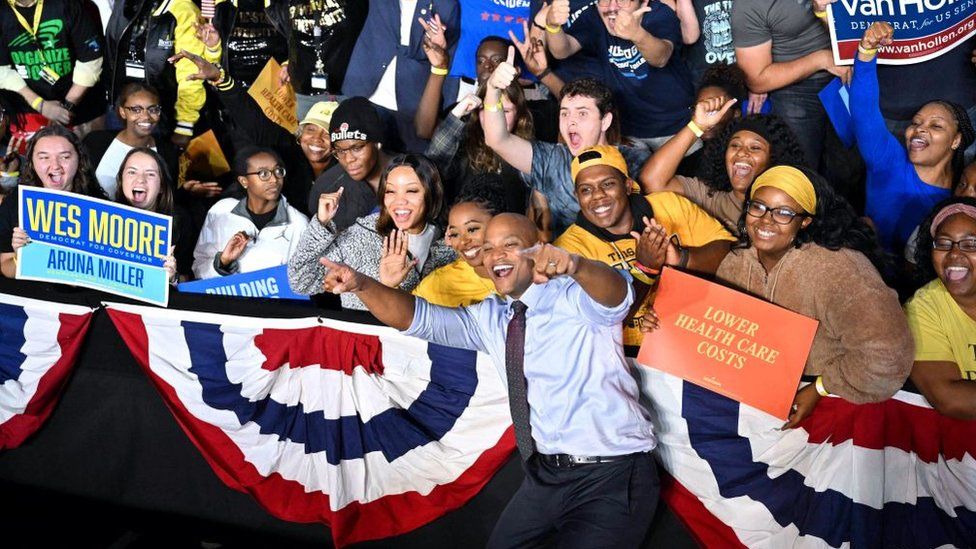
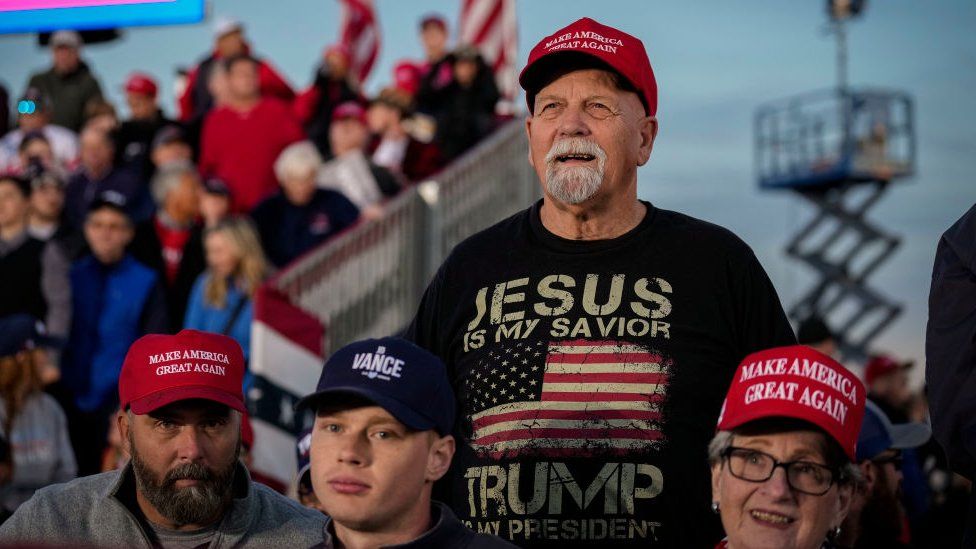
Representative Elissa Slotkin has won her US House race in Michigan, defeating Republican challenger Tom Barrett, a state senator who denies the results of the 2020 presidential election.
The race was considered a bellweather for Democrats, as Slotkin was running in a largely redrawn district.
It comes after Hillary Scholten, an immigration lawyer, bested Trump-backed candidate John Gibbs, a former official in the Department of Housing and Urban Development.
The victory flipped the seat for Democrats. In the primary, Gibbs had defeated Republican Congressman Peter Meijer, who had voted to impeach Trump.
I just received a call from Tom Barrett conceding the election. I’m so grateful to the people of mid-Michigan for their support. Tonight, voters here made clear that the politics of division are not what they want for our families or our state. 1/
Michigan voters approved a constitutional amendment to protect abortion rights.
The bill will effectively repeal a 1931 abortion ban. The ban was overturned by a state judge, but it could be reinstated by another court.
The initiative will overturn the ban and affirm the right to freely choose abortion and other reproductive services such as birth control during pregnancy. Similar legislation was passed in Vermont and California.
Meanwhile, a measure in Kentucky that would would amend the state constitution to explicitly say abortion is not a protected right remained too close to call on Wednesday.
The ballot measures came months after the Supreme Court overturned Roe v Wade and the constitutional right to abortion it guaranteed to women nationwide. The decision in June has led to near-total bans in a dozen states.
BREAKING: Voters in Michigan just voted to make abortion a right protected by their state constitution.
Abortion is our right — and safe, legal abortion care is here to stay in Michigan.
Despite Washington‘s denial, Iranian state television has accused the US of being behind the attacks.
According to a Syrian war monitor, Iranian state television, and Iraqi paramilitary officers, air attacks have hit eastern Syria along the Iraqi border, killing Iran-backed fighters.
The number of casualties has not been confirmed, but according to two Iraqi paramilitary officers, some of those killed in the attack late Tuesday were Iranian nationals. According to the Syrian Observatory for Human Rights, at least 14 people were killed in the raids, the majority of whom were fighters.
According to the Syrian Observatory, the attacks targeted a convoy of “fuel tankers and trucks loaded with weapons” for the fighters in Syria’s eastern province of Deir Az Zor.
It is not yet clear who was behind the raid but the United States military has carried out similar attacks in the past.
The US military has, however, so far denied involvement. Army Major Rachael L Jeffcoat said that “no US forces or US-led coalition (members) conducted an airstrike in al-Qaim, Iraq, on the border with Syria”.
The convoy of 22 tanker trucks was travelling from Iran to Lebanon, an official in the Iraqi border guard said. Ten trucks were hit, of which four were “completely burnt”, after entering Syrian territory through the Al-Qaim – Abu Kamal border crossing.
The Deir Ezzor 24, an activist collective, reported three air strikes targeting Iran-backed militias in the Syrian border town of Abu Kamal and nearby areas. It had no immediate word on casualties.
Earlier, members of Iraqi paramilitary groups operating in the area said an air attack on a convoy carrying fuel across the Iraqi border into Syria killed at least 10 people late on Tuesday.
Iranian state television Press TV claimed the convoy was carrying Iranian oil to Lebanon through Syria, but offered no casualty details. It also claimed that the convoy attack was carried out by US drones and helicopters, adding that the attack took place after eight of the trucks had crossed into Syria.
Iran is a major supporter of Syria’s President Bashar al-Assad, sending thousands of fighters to help Syrian government troops in the country’s 11-year war against the country’s opposition.
In August, the US military carried out air raids in Deir Az Zor targeting Iran-backed fighters after a rocket attack left several US soldiers lightly wounded. At least two fighters described by US Central Command as “suspected Iran-backed militants” were killed. The Pentagon said the strikes were a message to Iran.
The cause of the explosion at Onitsha market, one of West Africa’s largest outdoor markets, is unknown.
According to a witness and an official, at least four people were killed and a dozen others were injured in a blast at a popular market in Nigeria’s southeastern state of Anambra.
Emeka Umeagbalasi, the head of the civil society group Intersociety and a witness to the incident on Tuesday, said the blast occurred in a section of the market that sells chemicals, resulting in a fire that razed shops in the Onitsha market, one of West Africa’s largest outdoor markets.
“[F]our people died and scores (were) injured,” Umeagbalasi said.
Onitsha South local government area Chairman Emeka Orji confirmed the death toll to reporters, adding that at least 12 people were injured as they stampeded to leave the market.
The cause of the blast was not immediately known.
Anambra state police spokesman said the casualty figure was unknown but the situation was under control.
The state emergency management agency said it was investigating.
Anambra is one of the five states in the southeast of the country where violence, which authorities blame on separatist groups, is rising among youths who cite historicalmarginalisation.
The launch isthe latest in a record year of missile tests by North Korea, and it comes as the results of the US midterm elections are announced.
North Korea has launched a ballistic missile toward the sea off the country’s east coast, the first launch since last week’s barrage of missile launches and heavy artillery fire that saw more than 30 missiles land in the seas off the Korean peninsula, according to South Korea’s military.
The Joint Chiefs of Staff of South Korea said Wednesday that it detected the launch of a short-range ballistic missile from an area in or around North Korea’s Sukchon in South Pyongan Province at around 3:31 p.m. local time (06:30 GMT).
Fired towards the East Sea, which is also known as the Sea of Japan, the missile’s “flight distance was detected at about 290 kilometres (180 miles), an altitude of about 30 kilometres, and a speed of about Mach 6”, South Korea’s military reported.
Japan’s Kyodo news agency, citing a Japanese government source, said the missile landed outside Japan’s exclusive economic zone, which extends 200 nautical miles (370 kilometres) from the country’s coastline.
Japan’s Coast Guard also tracked the missile and said it appeared to have fallen into the sea minutes after the launch was first reported.
The launch is the latest in a record year of missile tests by Pyongyang, including an intercontinental ballistic missile (ICBM) last week, and comes at a time of growing concern that North Korea could be preparing for its first test detonation of a nuclear device since 2017.
The missile launch also comes as the United States – South Korea’s main military ally – counted votes in the country’s midterm elections, which will determine whether US President Joe Biden’s Democratic Party maintains control of the House of Representative and the Senate or loses one or both to the Republican Party.
Earlier on Wednesday, South Korea said it had identified debris from an earlier North Korean missile launch as part of a Soviet-era SA-5 surface-to-air missile.
A South Korean Navy ship used an underwater probe to recover the missile, which was the first time a North Korean ballistic missile had landed near South Korean waters.
North Korea’s military said the launches were simulated attacks on South Korea and the United States, criticising their exercises as an “dangerous, aggressive war drill.”
The SA-5 is an air defence missile originally designed by the Soviet Union, where it was designated the S-200, to shoot down strategic bombers and other high-altitude targets.
The missile was exported around the world, and is still in service in at least a dozen countries, according to the Center for Strategic and International Studies.
The UK government has paid out for at least four times the number of Afghan children killed than it previously admitted.
In addition to the 16 publicly acknowledged children, compensation payments have been made to 64 others.
Between 2006 and 2014, all were killed in fighting involving UK forces.
The new figures are the result of Freedom of Information Act requests made by the charity Action on Armed Violence (AOAV).
The most common causes of death listed were airstrikes and being caught in crossfire.
According to AOAV, the number of civilian deaths caused by British forces is likely to be underestimated.
Of those deaths that have been recorded, the actual number of children killed could actually be as high as 135, because some of the fatalities are described in Ministry of Defence (MoD) documents merely as sons and daughters – with ages and circumstances of deaths not always included.
AOAV says it is possible some of those 135 were adults, but the likelihood of them having been under 18 is high because of the very young average age in Afghanistan.
Most of the 881 fatality claims made to the British were rejected and only a quarter received compensation.
Among those which were successful was one for eight members of the same Afghan family, killed in a coalition airstrike on a village in the Nawa district of Helmand in May 2009.
A man asked for compensation for the deaths of his nephew, his nephew’s two wives and their five children.
It took 144 days to settle the claim, for which he was awarded £7,205 ($8,260 using current exchange rate).
In total, the MoD paid out £688,000 for 289 Afghan civilian deaths between 2006-14.
AOAV says claimants were often required to provide photos, birth certificates as well as supporting letters before being paid and many were formally interviewed by British personnel to confirm they had no Taliban affiliation.
Previous Freedom of Information requests show UK payments for deaths in Afghanistanhave varied widely. In some cases, individuals received more for the loss of property or livestock than family members.
In a statement, the MoD said: “Any civilian death during conflict is a tragedy, more so when children and family members are involved.”
It said although its forces try to minimise injury to civilians, “regrettably it can never be entirely eliminated”.
But Iain Overton, director of charity AOAV, criticised the lack of transparency over the deaths – with it having taken researchers years to obtain the information from the MoD.
He also said the lack of debate around the deaths raised questions as to whether lessons had been learned.
IMAGE SOURCE,PA MEDIA Image caption, UK soldier in southern Afghanistan, August 2007
Human rights groups and charities have repeatedly criticised both the US and UK over the way they investigate and report civilian casualties in military operations.
The MoD admits to just one civilian death caused by an RAF airstrike during its bombing campaign against the Islamic State group in Iraq and Syria.
In contrast, US Defence Secretary Lloyd Austin recently ordered a major review of the way the Pentagon investigates civilian casualties. It came after a US airstrike during the withdrawal from Kabul last year – which killed 10 civilians.
At first, the US claimed it had been targeting extremists, but journalists on the ground found evidence that all those killed were civilians.
The US Civilian Harm Mitigation and Response Action Plan includes hiring more than 150 military staff to focus on mitigating harm to civilians, as well as better reporting and data collection of such incidents.
The MoD said it was following the progress of the US review,but has not committed to any changes in the way it investigates or reports civilian deaths.
Democrats are concerned about Joe Biden’s record-low approval rating, as we’ve previously reported.
His approval rating is the lowest of any president ahead of their first midterm elections, at 40%.
While most presidents experience some loss of support in their first two years, his ratings have fallen lower than those of his recent predecessors; what is the cause of this?
It’s impossible to point to just one issue, but dissatisfaction with the economy seems to be among one of the biggest contributors.
Not all of this was in Mr Biden’s control, as countries are dealing with the aftermath of the pandemic and a spike in gas prices caused by the war in Ukraine.
Asked about this previously, former White House press secretary Jen Psaki offered a similar explanation.
“People are fatigued across the country. It’s impacting how they live, how they work. There are worries about their kids, their ability to experience joyful things in life like concerts and going to restaurants and seeing friends,” she said, describing the impact of the pandemic and rising costs.
But other factors are at play too.
Mr Biden has also seen slipping support among young voters angry about inaction on climate change, healthcare and student debt.
Meanwhile, black voters have been disappointed by a lack of progress on voting rights and police reform.
Although a majority of Americans supported withdrawing US troops, the desperate scenes in Kabul undercut Mr Biden’s authority as a foreign policy expert.
Voters in the United States are casting their ballots in key midterm elections, which will determine the makeup of the next Congress and set the tone for the remainder of President Joe Biden’s term in the White House.
The vote on Tuesday comes as Americans grapple with sky-high inflation and living costs, and the economy has emerged as the top concern among supporters of both the Democratic and Republican parties.
Democrats currently retain a slim majority in Congress, and they have focused much of the campaign on defending reproductive rights and strengthening democratic institutions, which they argue are under threat in the country.
But as the party in power, Democrats are expected to lose ground to Republicans, who have seized on immigration and economic issues in a bid to garner support at the ballot box.
“There are some countervailing pressures on the economy: unemployment remains relatively low at 3.5 percent, consumer confidence is still fairly high,” Thomas Gift, the director of the Centre on US Politics at University College London, told Al Jazeera, “but inflation hits everyone, and the majority [party] – fair or not – is going to get scapegoated.”
Polls are OPEN in Pennsylvania! The first voters in Feasterville, Bucks County are lining up as a new PA Senator will be elected, one of the most expensive races in the country — $133 Million spent by Oz and Fetterman @NBCPhiladelphia#PASen#ElectionDay#votepic.twitter.com/ZoQecO1js5
All 435 seats in the US House of Representatives are up for grabs, along with 34 in the Senate. Governorships, state legislatures, local councils and school boards are also being contested.
Reporting from Washington, DC, Al Jazeera’s Kimberly Halkett said that President Joe Biden acknowledged hours before polls opened that it was going to be “tough” for Democrats to hold the House.
“This is really a referendum on the last two years of his presidency. His legacy is at stake and right now his approval rating is hovering in the low 40 percent [range] – his disapproval rating is above 50 percent,” she said.
“And historically, when a president has an approval rating of above 50 percent, their party does not really hang onto the House in midterm congressional elections.”
More than 41 million Americans have already cast their votes across the country, either through mail-in ballots or early in-person polls, according to a tally by the US Elections Project at the University of Florida.
Polling firm Gallup said earlier this month that 41 percent of eligible US voters intended to cast their ballots early, up from 34 percent in 2018. Fifty-four percent of Democrats said they would vote ahead of Tuesday, compared with 32 percent of Republicans, the same poll found.
Vermont was the first US state to open polls on Tuesday at 5am ET (10:00 GMT). Voting sites were set to be open in all US states by 1pm ET (18:00 GMT).
Among the east coast states to first open for in-person voting early on Tuesday were Georgia, Pennsylvania, New Hampshire and Florida, home to closely-watched Senate races that could decide which party controls the Senate.
“It’s Election Day! Go vote,” tweeted Democratic Senator Raphael Warnock as polls opened in Georgia. Warnock is facing Republican challenger Herschel Walker in a race projected to be one of the country’s closest.
While turnout is typically lower for midterms than for presidential elections in the US, the last midterm contest in 2018 saw the “highest midterm turnout in four decades” at 53 percent, according to the US Census Bureau.
In addition to immigration, reproductive rights and the economy, US voters have said public safety, gun control and the climate crisis are among the top issues on their minds as they cast their ballots.
Arkansas, Maryland, Missouri, North and South Dakota voters will decide whether to approve recreational marijuana measures.
On election day, voters in five US states will decide whether to legalize recreational cannabis, a move that could signal a significant shift toward legalization in even the most conservative parts of the country.
The initiatives are on the ballot in Arkansas, Maryland, Missouri, North Dakota, and South Dakota, and they follow President Joe Biden’s efforts to decriminalize marijuana.
Last month, Biden announced that he would pardon thousands of Americans convicted of simple possession of cannabis under federal law.
Recreational marijuana is legal in 19 states, and polls have shown opposition to legalisation softening. All of the states with recreational marijuana on the ballot, except for Maryland, voted for Donald Trump in the 2020 presidential election.
The five states also currently have legal medical cannabis programmes.
That includes Arkansas, which in 2016 became the first Bible Belt state to approve medical cannabis. The state’s dispensaries opened in 2019, and more than 91,000 patients have cards to legally buy marijuana for medical conditions.
Criticism from opponents
The legalisation campaigns have raised about $23m in the five states, with the vast majority in Arkansas and Missouri. More than 85 percent of contributions in those two states have come from donors associated with companies holding medical cannabis licences, according to an Associated Press analysis of the most recent campaign finance reports.
In Arkansas, supporters have been running upbeat ads touting the thousands of jobs they say will be created by the measure. Opponents have run more ominous spots, warning voters to “protect Arkansas from big marijuana”.
The initiative has drawn the criticism of traditional legalisation opponents as well as some medical cannabis advocates, who said the Arkansas proposal places too many limits and would only benefit a handful of dispensaries.
Missouri’s proposal would legalise recreational cannabis for adults 21 and older and expunge records of past arrests and convictions for nonviolent marijuana offences, except for selling to minors or driving under the influence.
Maryland’s proposal would also make changes in criminal law and create automatic expungements of past marijuana possession convictions.
North Dakota’s measure would allow people 21 and older to legally use cannabis at home as well as possess and cultivate restricted amounts of cannabis. It also would establish policies to regulate retail stores, cultivators, and other types of marijuana businesses.
South Dakotans, including a sizable number of Republicans, voted to legalise marijuana possession in 2020, but that law was struck down by the state Supreme Court in part because the proposal was coupled with medical marijuana and hemp.
This year, recreational cannabis is standing by itself as it goes before voters.
In Colorado, where recreational cannabis has been legal for nearly a decade, voters on Tuesday are taking up a proposal that would allow the use of certain psychedelic substances. If approved, it would make Colorado the second state to take such a step.
India’s foreign ministersays purchasing oil from a “steady and time-tested partner” is economically advantageous.
Foreign Minister Subrahmanyam Jaishankar said during his first visit to Russia since it invaded Ukraine that India will continue to buy Russian oil because it is beneficial to the country, a move that runs counter to Western efforts to cripple Russia’s economy with sanctions.
On Tuesday, Jaishankar met with his Russian counterpart Sergey Lavrov in Moscow, accompanied by senior officials in charge of agriculture, petroleum and natural gas, ports and shipping, finance, chemicals and fertiliser, and trade, emphasizing the importance of relations with Russia.
“Russia has been a steady and time-tested partner. Any objective evaluation of our relationship over many decades would confirm that it has actually served both our countries very, very well,” Jaishankar said in a joint news conference.
“As the world’s third-largest consumer of oil and gas, a consumer where the levels of income are not very high, it is our fundamental obligation to ensure that the Indian consumer has the best possible access on the most advantageous terms to international markets,” he said.
“We have seen that the India-Russia relationship has worked to advantage. If it works to my advantage, I would like to keep that going,” the Indian foreign minister added.
India, which has not explicitly condemned what Russia calls its “special military operation in Ukraine”, has emerged as Russia’s largest oil customer after China following a boycott by Western buyers.
Russian Foreign Minister Sergei Lavrov and his Indian counterpart Subrahmanyam Jaishankar shake hands during a news conference in Moscow. [Maxim Shipenkov/Pool via Reuters]
Jaishankar’s announcement came ahead of United States Treasury Secretary Janet Yellen’s visit to New Delhi later this week, when she is expected to discuss a Group of Seven (G7) plan to cap the price of Russian oil with Indian officials.
US officials and G7 countries have been in intense negotiations in recent weeks over the unprecedented plan to put a price cap on sea-borne oil shipments, which is scheduled to take effect on December 5 to ensure European Union and US sanctions do not throttle the global oil market.
Both New Delhi and Beijing have so far refused to join Western sanctions against Russia.
Lavrov praised the position of Russia’s “Indian friends” on Ukraine and accused Western countries of trying to consolidate a “dominant role in world affairs” and prevent “the democratisation of international relations”.
Russia and India are also considering joint production of modern defence equipment, the foreign minister was quoted by TASS news agency as saying. Last year, the two countries inked a $677m deal to produce AK-203 assault rifles in India as part of New Delhi’s push for self-reliance in defence manufacturing. India is one of the world’s largest buyers of defence equipment.
Moscow has been New Delhi’s biggest supplier of military equipment for decades. India imported Russian defence equipment worth more than $20bn between 2011 and 2021.
According to Lavrov, Russia and India also want to cooperate more closely in the fields of nuclear energy and space travel.
Niloufar Mardani is the latest athlete to not follow Iran’s hijab ruleswhen competing abroad, in what has been interpreted as support for anti-government protests.
Iranian authorities have denounced a professional skater who competed abroad without adhering to the country’s mandatory hijab rules amid protests sparked by the death of Mahsa Amini.
Protests that erupted following 22-year-old Amini’s death in the custody of the country’s so-called morality police, after she was arrested for alleged non-compliance with a mandatory dress code, are approaching the end of their second month.
On Sunday, Niloufar Mardani, who has been a member of the national Iranian speed skating team for years, stepped on a podium in Turkey to receive her first-place award while not wearing a headscarf – as is mandatory for female athletes representing Iran even when competing outside of the country.
A picture circulating on social media of Mardani on the podium in Istanbul also showed her wearing a black shirt with the word “Iran” on it.
In a short statement, Iran’s sports ministry emphasised “maintaining Islamic values in sports competitions” and said Mardani had not competed in clothing approved by the ministry.
“This athlete has not been a member of the Iranian national team since last month and attended this competition as part of a personal trip without obtaining necessary permits,” the statement said, before adding that the Iranian team had not participated in the tournament.
Last month, professional rock climber Elnaz Rekabi represented the Iranian national team in an international tournament in South Korea while not wearing a headscarf, making headlines across the globe.
A crowd had gathered to welcome her in the early hours of the morning when her flight touched down in Tehran as some believed she had taken her veil off in an act of defiance. In an interview with state television at the airport, Rekabi apologised and said that there had been an “inadvertent” issue with her hijab as she had been quickly called to compete.
The issue of the hijab has featured prominently in the country’s ongoing protests, with videos online showing some women burning their veils or cutting their hair.
But male athletes have also made headlines in recent weeks as footballers have repeatedly refused to celebrate after scoring goals in the country’s league matches.
On Sunday, Saeed Piramoun, a member of the Iranian national beach football team, held up his hair and mimed cutting it off after scoring Iran’s winning goal in the final match against Brazil in an international tournament in the United Arab Emirates (UAE). The symbolic move was seemingly aimed at supporting the protests.
Piramoun and other members of the national team had refused to sing along with the national anthem at the start of the match, and at the end of it, they refused to celebrate as they lifted the world champions’ trophy.
A number of fans chanted anti-establishment slogans inside the stadium and proceeded to do the same outside following the match, prompting the official newspaper of the Iranian government to warn the UAE of “consequences for its hostile political action” of not stopping the crowd from chanting.
The Iranian beach football federation on Monday vowed action against “those who did not adhere to professional and sports ethics” in line with regulations. Reporters were barred from speaking with the members of the team at the airport upon their return.
Iran’s upcoming participation in the FIFA World Cup in Qatar has also caused controversy, with Ukraine and some others calling for the Iranian team’s removal, although it appears highly unlikely that would happen.
‘Teach an example’
The protests have persisted despite stringent internet restrictions and a crackdown by security forces.
More than 1,000 indictments have been issued for people identified as being leaders of what authorities have called “riots” in various provinces, according to the judiciary. Chief Justice Gholam-Hossein Mohseni-Ejei has ordered courts to fast-track cases.
Earlier this week, 227 of the 290 members of Iran’s parliament signed a statement read aloud at a public session that called for a response to people engaging in “moharebe” (literally meaning “waging war against God”) that would “teach an example”.
Several “rioters” were charged with moharebe in the first public court cases held earlier this month, which could potentially carry the death penalty.
Speaking to reporters on Tuesday, the judiciary’s spokesman, Masoud Setayeshi, also promised a response that would “teach an example and be deterring” to suspects.
Teenagers and young people have been arrested during the protests, but the exact number of the arrested – along with those who have been killed – is unclear. Setayeshi said a “handful” of school and university students and teachers have been arrested.
Setayeshi also said a “final decision” is near on the cases of Niloofar Hamedi and Elaheh Mohammadi, two women journalists working for local newspapers who were arrested after covering Amini’s death and her funeral.
They have been charged with “collusion with intent to act against national security” and “propaganda against the establishment” after Iran’s intelligence community earlier this month said they were trained by the CIA.
Earlier this week, the country’s tourism and culture minister, Ezatollah Zarghami, discussed the issue of teenagers’ arrest from the perspective of an interrogator whom he spoke with and who has interrogated people arrested during the “riots”.
“He [the interrogator] said I have interrogated major political people for a lifetime but my most difficult interrogations were of several hundred people arrested on the streets. Neither could I understand what they were saying, nor did they understand what I am saying,” he said.
Kyivdemands that Ukraine’s borders be restored as a precondition for talks, while ruling out any talks with Putin.
According to a senior security official, the return of all captured Ukrainian territory is Kyiv’s main precondition for entering into peace talks with Russia.
The secretary of Ukraine’s National Security and Defense Council, Oleksiy Danilov, stated on Tuesday that the Ukrainian side also required the “guarantee” of modern air defenses, aircraft, tanks, and long-range missiles.
Kyiv has repeatedly called for additional arms from its Western backers following Russia’s invasion in late February.
“Guarantee – modern air defence, aircraft, tanks, and long-range missiles. Strategy – proactive steps. Russian missiles must be destroyed before launch in the air, on land and at sea,” he said.
russia, negotiations. The main condition of the President of🇺🇦is restoration of🇺🇦territorial integrity. Guarantee – modern air defense, aircraft, tanks, and long-range missiles. Strategy – proactive steps.🇷🇺 missiles must be destroyed before launch in the air, on land and at sea.
Danilov’s remarks came after Ukrainian President Volodymyr Zelenskyy said in his overnight address on Monday that he was open to “genuine” negotiations with Russia that would restore Ukraine’s borders.
He also called for compensation following devastating Russian attacks, and demanded those responsible for alleged war crimes are punished.
Talk of a negotiated end to the conflict has risen in recent days, after the Washington Post newspaper reported that the United States has privately encouraged Ukrainian officials to signal an openness to talk with its neighbour.
US officials reportedly want Ukraine to take the moral high ground and appear more interested in negotiations, amid concerns Kyiv might soon lose international support if it remains resolutely against discussions.
After Russia announced the annexation of four partly occupied regions of Ukraine at the end of September, Zelenskyy said Kyiv will not hold talks with Moscow as long as President Vladimir Putin remains in power.
Government figures have restated this position in recent days, saying that Kyiv would however be willing to negotiate with a successor to Putin.
On Monday, Kremlin spokesman Dmitry Peskov said Moscow is open to talks but that Kyiv is refusing them. Russian officials have repeatedly said they will not negotiate over territory they claim to have annexed from Ukraine.
Apart from Russia-ally North Korea, no countries recognise the latest annexations. Most of the world also refuses to recognise Crimea, annexed in 2014, as Russian land.
Meanwhile, the US, Ukraine’s main backer, is holding mid-term elections for Congress on Tuesday.
Although most candidates from bothparties strongly support Kyiv, some right-wing Republican candidates have expressed doubt about the cost of US military aid while others on the left faced backlash after calling for “vigorous” diplomacy to end the war.
The White House says US support for Ukraine will be “unflinching and unwavering” regardless of the outcome of Tuesday’s votes.
UN agencies in Sri Lankasay they have raised $79 million in aid, but they need another $70 million to help the country’s growing poor.
According to the UN, the number of people in Sri Lanka who need immediate humanitarian assistance has more than doubled to 3.4 million, indicating a worsening food crisis in the south Asian island nation, which declared bankruptcy in July amid an unprecedented economic crisis.
UN agencies working in Sri Lanka said in a joint statement on Tuesday that they had raised $79 million to feed those in need, but that the growing number of poor people required an additional $70 million.
“Food insecurity in Sri Lanka has increased dramatically due to two consecutive seasonsof poor harvests, foreign exchange shortages, and reduced household purchasing power,” the statement said.
UN agencies had estimated in June that 1.7 million out of the 22 million population in Sri Lanka required help.
The UN said its revised plan aims at feeding 2.1 million people, including pregnant mothers and school children and providing livelihood support to 1.5 million farmers and fishermen.
Worst crisis
Sri Lanka is facing its worst economic crisis since its independence from the United Kingdom in 1948 and has been enduring soaring inflation, power blackouts, and fuel rationing since last year.
The country defaulted on its $51bn external debt in mid-April and is in talks with the IMF for a $2.9bn bailout.
Months of protests against high prices and shortages of food and medicines led to the toppling of President Gotabaya Rajapaksa in July.
The UN has said that the poverty rate in the South Asian nation has doubled to 25.6 percent this year, up from 13.1 percent last year.
Volker Turk, the UN High Commissioner for Human Rights, has urged Egypt to release hunger striker and popular activist Alaa Abd el-Fattah immediately.The life of hunger striker Alaa Abd el-Fattah is in grave danger, according to UN High Commissioner for Human Rights Volker Turk, who renewed his call for Egypt to release him immediately.
“I urge the Egyptian government to immediately release Abd el-Fattah from prison and provide him with the necessary medical treatment,” Turk said in a statement on Tuesday, warning that the activist “is in great danger.”
“His dry hunger strike puts his life at acute risk.”
Abd el-Fattah, a prominent activist and blogger who is a dual British and Egyptian citizen, was jailed in 2014 for five years on charges of participating in an unauthorised gathering. He was re-arrested in 2019, and in December 2021, was sentenced to another five years on charges of spreading false news.
The 40-year-old has been on a hunger strike for 220 days against his detention and prison conditions.
Abd el-Fattah informed his family that he would stop drinking water on Sunday in an escalation of his protest. His mother said she did not receive a letter she usually receives from him when she visited on Monday.
Without water, Abd el-Fattah’s health could rapidly deteriorate. The escalation of his protest has coincided with the COP27 climate summit, the UN’s annual gathering of world leaders to discuss global warming, being held this year in Egypt.
Ravina Shamdasani, Turk’s spokesperson, said that the official had personally spoken with Egyptian authorities to appeal for Abd el-Fattah’s release, most recently on Friday.
Asked whether there was a risk he may have already died, given the lack of communication, Shamdasani told a briefing in Geneva, “We are very concerned for his health and there is a lack of transparency, as well around his current condition”.
But he called “on the Egyptian authorities to fulfil their human rights obligations and immediately release all those arbitrarily detained, including those in pre-trial detention, as well as those unfairly convicted”.
“No one should be detained for exercising their basic human rights or defending those of others,” he said.
Prisoners of conscience
Abd el-Fattah’s detention has become a prominent issue at the COP27 summit in Sharm el-Sheikh, which his sister Sanaa Seif – herself a former political prisoner – is attending to campaign for his release.
Activists at COP27 have also been posting prolifically on Twitter under the hashtag #FreeAlaa, and several speakers have ended their speeches with the words “you have not yet been defeated” – the title of his book.
According to rights groups, Abd el-Fattah is among more than 60,000 prisoners of conscience in Egypt since President Abdel Fattah el-Sisi came to power, deposing former President Mohamed Morsi in 2013.
Asked about the case, Egyptian foreign minister and COP27 President Sameh Shoukry told CNBC that prison authorities would provide Abd el-Fattah with healthcare. Egyptian officials have said previously that he was receiving meals.
British Prime Minister Rishi Sunak and French President Emmanuel Macron both directly met Egyptian President el-Sisi on Monday and increased the pressure for his release, hours after three Egyptian journalists said they had begun their own hunger strikes over his fate.
The mother and grandparents of an eight-year-old girl are being investigated after German prosecutors claim she was imprisoned for seven years.
She was finally released from the house at the end of Septemberand is now being cared for in foster care.
According to welfare officials, she has difficulty with everyday tasks such as climbing the stairs. According to German reports, she had never seen a forest or a meadow.
Her mother lied to the authorities by claiming that they had relocated to Italy.
The house in Attendorn in the Sauerland area of western Germany is unremarkable. A short flight of steps leads to a brown front door.
But behind these white painted walls, prosecutors say, a mother and her parents kept the girl locked away from the world for seven years. During that time, they believe, she had no contact with another person, never went to school, never spent time outdoors.
They say there’s no evidence that she was physically abused or malnourished.
The head of the local child welfare department, Michael Färber, says she can read and do maths, but struggles with more day-to-day tasks: “We’ll have to see how that works out.”
She’s now under the care of child psychologists. An expert from the national Child Protection Association told German media: “The world is now upside down for the child. It will feel like being on another planet.”
Prosecutors are now trying to determine what happened – and how. They say the mother and grandparents have remained silent about the case and that they’ve not yet been able to establish a motive.
But it’s widely assumed that the mother may have been trying to keep the child away from her father, from whom she’d separated shortly before the girl was born.
She’d reportedly forbidden him from having contact with the child and when he turned to the family courts, they awarded joint custody in 2016.
By then, German authorities – and the father – believed the mother had left the country with her daughter.
In 2015, she officially notified them that she had moved to Italy. Prosecutors now believe that in reality, she never left and they were living with the girl’s maternal grandparents who, it appears, helped her to maintain the pretence.
There is widespread disbelief that a child could remain hidden, apparently unnoticed, for so long in a small town of 24,000 people.
It has emerged that the authorities received two tip-offs about the girl in recent years, but they say that when they investigated, there was no solid evidence that a child was being kept at the property.
It was in June this year that a couple reported having seen the little girl, triggering an investigation that established she and her mother had never lived in Italy, and that led to their discovery at the grandparents’ house.
The grandparents and the mother are beinginvestigated on suspicion of unlawful imprisonment and abuse. Prosecutors say the mother could face up to 10 years in jail, but to date, no charges have been brought.
After a week at sea, migrants from one of four rescue boats that Italy had barred from docking have been allowed to disembark, according to the charity that operates the vessel.
A total of 89 people on board the Rise Above were permitted to alight.
However, people continue to board three other rescue boats as Rome vows to stop irregular migrants from crossing the Mediterranean.
Prime MinisterGiorgiaMeloni has stated that she wants people traffickers to stop “deciding who enters Italy.”
Her right-wing government has been criticised for denying safe port to the rescue boats.
But Chiara Cardoletti, the UN refugee commissioner’s representative in Italy, said that Italy had been on the front line of the migrant crisis for too long and she called on the European Union to find a common strategy.
“We appreciate what Italy has done by allowing boats to enter territorial waters, allowing children, women and people with medical problems to disembark,” she told the BBC. “Italy cannot be left alone, the European Union must step forward and find appropriate and faster solutions.”
On Monday, three people leapt into the water from the Geo Barents after being refused permission to disembark in the Sicilian port of Catania. They were among about 250 migrants told to remain on two boats in Catania after officials deemed them “healthy”.
Mission Lifeline, a German charity that runs the Rise Above, said in a statement that it was “relieved that the rescued people are finally safe on land” at Reggio Calabria on the Italian mainland, a few kilometres from Sicily. Many of the 89 who disembarked were described as minors.
Authorities told Italian media that they had been allowed to leave because they had been picked up in a so-called save and rescue (SAR) incident in the Mediterranean, whereas those on the two boats docked in Sicily were not.
The charity condemned what it called an “undignified political game” that had kept them at sea. The crew of the Rise Above have not yet been able to leave the boat, according to Italian reports.
Mission Lifeline said the Rise Above was by far the smallest of the three vessels in port and its passengers had suffered badly in recent heavy seas.
Italy is one of the main entry points into Europe. Since the start of the year, 85,000 migrants have arrived on boats, according to the UN.
Migrants set sail in small, overcrowded boats from North Africa, often get into distress and are rescued by charity vessels.
Over the weekend, two boats docked in Sicily, carrying a large group of migrants.
Most were allowed to leave, but 35 men on the Humanity 1 and another 215 on the Geo Barents, which is run by Médecins Sans Frontières (MSF), were told they would have to stay on board.
A fourth boat, Ocean Viking, run by French charity SOS Mediterranée, remains off the coast of Sicily with some 234 migrants aboard. They were picked up from the sea off Libya 17 days ago and have repeatedly demanded access to an Italian port.
Both SOS Humanity, which runs Humanity 1, and MSF have argued that everyone on board their ships is vulnerable, as they were rescued from the sea.
SOS Humanity is also taking the Italian government to court, alleging that a decree by an Italian minister, allowing the migrants to be kept on the ships, breaks both Italian and international law.
The Times reports that, Mr Johnson has nominated two of his loyal advisers – Ross Kempsell, the Conservative Party‘s former political director, and Charlotte Owen, the former PM’s former assistant – to become the youngest life peers in history.
Labour has called on Rishi Sunak to block Boris Johnson’s “conveyer belt of cronies” resignation peerages.
Scotland Secretary Alister Jack, former culture secretary Nadine Dorries, former minister Nigel Adams and the outgoing COP26 President Alok Sharma are among those expected to be nominated by the former prime minister to be elevated to the House of Lords.
The Times newspaper also reports that Mr Johnson has nominated two of his loyal advisers – Ross Kempsell, the Conservative Party’s former political director and Charlotte Owen, a former assistant to the former PM – to become the youngest life peers in history.
A source close to Mr Johnson said: “We never comment on speculation about honours.”
Labour’s deputy leader Angela Rayner said the prime minister should “refuse to do Boris Johnson’s bidding” and reject his demands.
“This disgraced ex-prime minister’s plot to dodge democracy by trying to reward his MP lackeys with promised jobs for life in the House of Lords yet again puts the Tory Party’s interests before the public’s,” she said in a statement.
“These underhand attempts to game the system by installing a conveyor belt of cronies and skewing parliament in the Tories’ favour for decades to come should never see the light of day.
“Rishi Sunak should make it clear in no uncertain terms that he will refuse to do Boris Johnson’s bidding and reject his disreputable demands.”
Earlier today, a Conservative MP criticised those nominated by Mr Johnson for peerages.
“What a shameful list of bootlickers, bimbos and tropical island holiday facilitators who between them can be proud to have pushed trust in politics to an extreme low during their tenures and offered very little in return to the British people,” they told Sky News.
The politicians on the list are all understood to have agreed to delay heading to the Lords until the end of the current parliament to spare Mr Sunak the challenges of by-elections.
How the peerages for MPs would be delayed was unclear, but the suggestion was that the King would have to approve the arrangement, in a move appearing to be without precedent.
Shaun Bailey, the former London mayoral candidate who faced a backlash for attending a mid-lockdown Christmas party, was also said to be on the former prime minister’s list.
The prime minister’s resignation honours are distinctions granted by an outgoing prime minister.
A PM can request the reigning monarch to grant peerages, knighthoods, damehoods or other awards in the British honours system to any number of people.
Ramon Abbas flaunted a luxurious lifestyle on Instagram, but it was paid for by crime. According to prosecutors, the social media star is a prolific international fraudster who conspired to launder tens of millions of dollars stolen in various online scams.
An Instagram influencer was sentenced to more than 11 years in prison for his role in a multi-million dollar global scam that targeted a Premier League club.
Ramon Abbas, also known as Ray Hushpuppi among his followers, was sentenced to 135 months in prison and ordered to pay more than $1.7 million (£1.5 million) to two fraud victims by a California judge.
Abbas pleaded guilty to one count of conspiracy to engage in money laundering in April 2021, having targeted American and international victims with online scams.
Don Alway, the assistant director in charge of the FBI’s Los Angeles field office, described the 40-year-old online celebrity as “one of the most prolific money launderers in the world”.
He used his “considerable following” of around 2.8 million on Instagram to “brag about the immense wealth he acquired by conducting business email compromise scams, online bank heists, and other cyber-enabled fraud”.
Some victims were left “financially ruined” and his operation even provided assistance to the North Korean regime, according to Mr Alway.
The Premier League club
Abbas tried to steal £100m from an unidentified Premier League club in May 2019, prosecutors say.
He conspired with convicted Canadian money launderer, Ghaleb Alaumary, 37, during the operation, which also targeted another British company.
In connection with the scheme, Abbas provided his co-conspirator with details for a bank account in Mexico that “could handle millions and not block”.
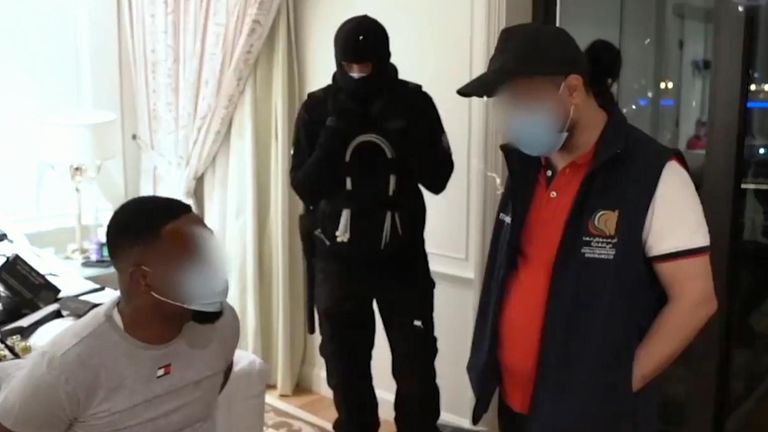
Image:Dubai Police released footage of the arrests
The North Korean regime
In January 2019, Abbas and Alaumary conspired to launder funds stolen from a bank in Malta by providing account information for other banks in Romania and Bulgaria.
The Malta cyber-heist would allegedly have seen the funds head for Pyongyang, and the US has also charged three North Korean hackers in connection with the crime.
Abbas admitted the intended loss was $14.7m (£12.8m), which would have been part of the total £1.2bn (£1bn) the hackers are accused of trying to steal from banks in a number of countries.
Operation Top Dog
Other schemes included Abbas fraudulently inducing a New York law firm to transfer more than $922,000 (£804,000) to a fellow conspirator’s account under someone else’s name, and attempting to defraud an individual in Qatar who wanted a $15m loan to build a school.
Among the luxuries Abbas spent his money on was a $230,000 (£200,000) Richard Mille RM11-03 watch, which he regularly showed off on his Instagram account.
His demise was the result of an FBI investigation called Operation Top Dog.
US attorney Martin Estrada said: “Abbas bragged on social media about his lavish lifestyle – a lifestyle funded by his involvement in transnational fraud and money laundering conspiracies targeting victims around the world.
“Money laundering and business email compromise scams are a massive international crime problem, and we will continue to work with our law enforcement and international partners to identify and prosecute those involved, wherever they may be.”
Alaumary is serving a 140-month prison sentenceand has been ordered to pay more than $30m (£26.2m) after admitting conspiracy to engage in money laundering in November 2020.
While vets have seen hermaphrodite cats with both male and female sex organs, Hope lacks both male and female sex organs. The 15-week-old kitten is described as a playful kitten who has won the hearts of staff and volunteers.
In what they believe is a veterinary first, vets at an animal charity have been caring for a homeless kitten who is neither male nor female.
Hope, the tabby-and-white cat, was initially thought to be female when it arrived at Cats Protection’s rescue center in Warrington, but vets discovered no external sex organs.
“This is so rare that there isn’t really a commonly used term for this condition, but it is effectively sexual organ agenesis – where agenesis is the lack or failure of development in relation to body organs.”
Ms Brockbank said: “This is not something we’ve come across before at Cats Protection.
“While this means we don’t have any previous cases to base our knowledge of how this will affect Hope in the future, we spent time monitoring this cat to ensure they can urinate and defecate appropriately before they were considered ready for rehoming.”
Hope is described as a playful kittenwho has endeared itself to staff and volunteers.
‘None of us have seen this before or are likely to again’
Tyneside Adoption Centre manager Beni Benstead said: “Discovering Hope’s special status has been an exciting time as none of us have seen this before or are likely to again.
“Hope has been a delight to care for and it is fantastic that they are now ready to be adopted.
“We know they will bring someone many years of fun and companionship. We would also be extremely grateful to hear updates on our Tyneside superstar.”
Hope was originally brought in with its mother and three siblingsby a busy family who did not think they would be able to give them the attention they needed, a Cats Protection spokeswoman said.
The kitten has been vaccinated and microchipped and insurer Petplan has confirmed it will not need any special coverage, she added.
Foxconn, which manufactures iPhones for Apple, says it is increasing its investment in a US electric pick-up truck company that could compete with Tesla’s Cybertruck.
The technology behemoth is investing up to $170 million (£147.8 million) in the loss-making start-up Lordstown Motors.
The large cash infusion comes as the company plans to increase production of its first model, the Endurance.
Lordstown recently began production of the vehicle at a former GM plant in the US state of Ohio.
The world’s largest contract manufacturer of electronics purchased a more than 18% stake in Lordstown, making it the company’s largest investor.
“Since announcing our first transaction with Foxconn more than a year ago, it has been our objective to develop a broad strategic partnership that leverages the capabilities of both companies,” Lordstown’s executive chairman Daniel Ninivaggi said.
The two companies also said they would jointly develop an electric vehicle together, although they did not give further details of the plan.
The tie-up came after the world’s biggest electric carmaker Tesla, which is owned by multi-billionaire Elon Musk, was earlier this month reported by the Reuters news agency to be planning to start mass production of its Cybertruck at the end of 2023.
That would be two years after the original target for the highly-anticipated pick-up truck that Mr Musk unveiled in 2019.
Taiwan-based Foxconn’s investment is the latest cash injection into Lordstown as it continues to run at a loss.
Separately on Monday, figures for the three months to the end of September showed a net loss of $154.4m, wider than the $95.8m loss the company reported for the same time last year.
Shares in Lordstown rose by almost 18% in extended trading in New York after the announcements.
Last week Foxconn agreed a deal with Saudi Arabia’s sovereign wealth fund to produce electric vehicles in the kingdom.
The joint venture will operate under the brand name Ceer, which sounds like the Arabic word for “drive”.
Ceer will license technology from Germany’s BMW and aims to start selling its electric vehicles from 2025.
The deal is part of Saudi Arabia’s push to move its economy away from its dependence on fossil fuels.
Last month Foxconn’s chairman Liu Young-way said he hopes the company will one day make cars for Tesla as it ramps up electric vehicle manufacturing operation.
Speaking at the company’s annual Tech Day, he said the firm aimed to replicate its success in manufacturing consumer devices as it expands into making electric vehicles for major motor industry brands.
Ten years ago when a 19-year-old Delhi woman was found gang raped and murdered in the fields of the neighbouring state of Haryana, it was described as a “rarest of rare” case.
Indians were shocked by news reports which detailed the brutality to which the teenager – named Anamika in court documents as her real name could not be revealed under Indian law – had been subjected.
Three men, arrested for the crime, were found guilty and given the death penalty by a trial court in 2014 and the Delhi High Court confirmed the sentences a few months later.
But on Monday, in a stunning reversal, the Indian Supreme Courtset the men free, saying there was no “cogent, clinching and clear evidence” that they had committed the crime.
The three-judge bench raised serious questions about the police investigation, criticised the sessions court for “glaring lapses” in the trial and said the judge had acted like a “passive umpire”.
The decision has angered the victim’s parents, shocked activists and lawyers and led to outrage on social media in a country where tens of thousands of rapes are reported every year.
“This is what justice looks like in India 2022,” one Twitter user wrote, sharing a photo of the woman’s dejected father.
Some compared the top court’s decision with a recent order by the Gujarat state government to release convicts who were serving life sentences for the gang rape of Bilkis Bano, a pregnant Muslim woman, and the murder of her relatives during 2002 religious riots in Gujarat state.
Anamika’s father told me that his “hopes of getting justice were dashed in minutes”.
“We had waited for 10 years for justice. We had faith in the judiciary, we believed that the Supreme Court will confirm the death penalty and my daughter’s killers would be finally hanged,” he said.
The 19-year-old lived in Chhawla, a lower middle-class rural area in south-west Delhi. In January 2012, she started a job at a call centre in Gurgaon, a suburb of the capital, and was the sole breadwinner for her family.
“She had just received her first salary and was thrilled,” says anti-rape activist Yogita Bhayana, who has been supporting the family in their fight for justice for the past eight years.
On the night of 9 February 2012, Anamika was returning home from work with three friends when she was abducted by men in a red car.
The gruesome crime made headlines in India after her partially burnt, horribly mutilated body with signs of torture was found four days later.
During trial, the prosecution argued that the case against the accused was watertight – they said they had found the wallet of one of the three men at the crime scene, that the suspects had confessed to the crime and had led the police to the body and helped recover the victim’s clothing.
DNA samples collected from blood stains, semen and hair found in the seized car proved that the accused and the victim had been in the vehicle, they added.
The trial court convicted the men and gave them the death penalty two years later. While confirming their death sentence, the high court described the accused as “predators”.
But Monday’s 40-page Supreme Court order, authored by Justice Bela Trivedi, questioned the evidence presented by the prosecution and said it was possible that it had been tampered with.
Pointing out a “number of inconsistencies and contradictions in the evidence of the police and in the testimonies of the formal witnesses”, the court said:
The accused were not identified in court by the victim’s friends or a male witness who had tried to fight the kidnappers.
The Delhi police claim about the “discovery of incriminating articles such as a piece of the car’s bumper and wallet containing documents of one of the accused” were not seen in the first pictures from the crime scene.
Haryana police, who had reached the scene first, did not mention these items in their report.
The items were not mentioned in the seizure memo of the investigation officer.
A phone the police recovered was never shown to the woman’s father to confirm whether it really belonged to his daughter.
It was not conclusively proved that the red car seized by the police was the same in which the crime had been committed.
The circumstances of the arrests were questionable.
Non-examination of some of the accused had “created a cloud of doubt”.
The court also said that the evidence taken from the car was sent for forensic examination on 27 February – almost two weeks after it was seized. “Under the circumstances, the possibility of tampering with the samples could not be ruled out,” she wrote.
Acknowledging that “if the accused in a heinous crime go unpunished, a kind of agony and frustration may be caused to the society in general and to the family of the victim in particular”, the order said that the “prosecution has failed to prove the charges beyond reasonable doubt and we have no alternative but to acquit the accused, though involved in a very heinous crime”.
The BBC has emailed top Delhi police officials for comment.
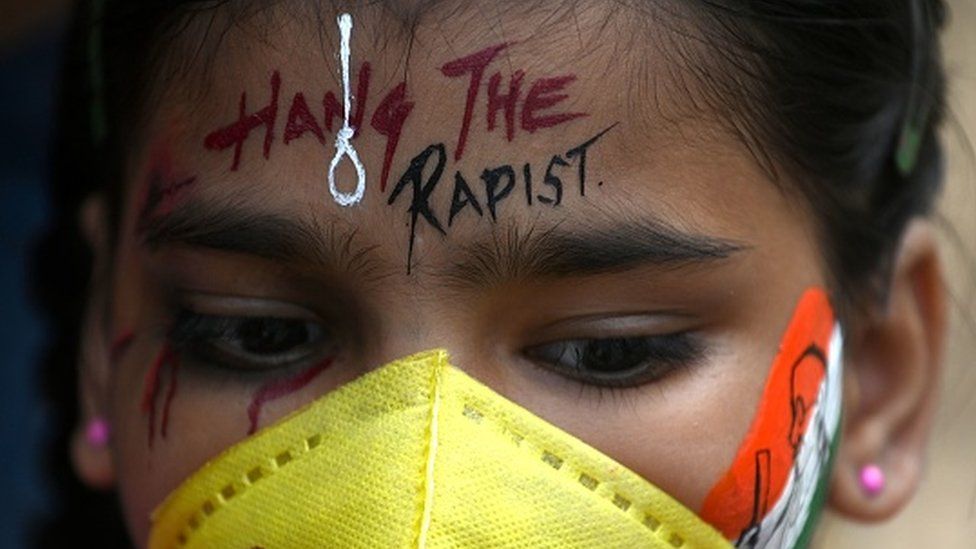
IMAGE SOURCE,GETTY IMAGES Image caption, Tens of thousands of rapes are reported in India every year
Charu Wali Khanna, the lawyer for Anamika’s family who assisted the prosecution, told me the order would be challenged in the Supreme Court with a review petition.
“This judgement is very vague and it raises these hyper-technical issues. It says the evidence could have been tampered with, but it does not indict the police,” she said.
“The order says there was no clinching evidence, but they disregarded a lot of evidence that was against the accused.”
Anamika’s father, who works as a security guard at a school, told me he had gone to the court straight from work on Monday after his night shift.
Ms Bhayana, who waited outside the court with the parents while the judgement was read out, spoke of the anger and disappointment they felt.
“I’m heartbroken, I don’t have the words to explain how I feel. So you can imagine how the parents must feel,” she told me.
Ms Bhayana said she “didn’t even have 1% apprehension” that something like this could happen and had been assuring the family that this was “the end of the road” in their fight for justice.
“But it’s all collapsed around us. When the lawyer messaged me informing about the order, my first reaction was of disbelief. I thought I must’ve misheard.”
Ms Bhayana says if the Supreme Court had concerns about the investigation, they could have reopened the case, ordered another investigation, or handed over the case to the federal police.
“The fact is that a young woman was gang raped and brutally murdered. The court must provide some kind of remedy to her family,” she says.
Anamika’s father, meanwhile, is bewildered.
“Mere upar to vajr gir gaya [I have been hit by the bolt from the sky],” he told me.
“What has the Supreme Court done? The courts did not have any doubts for 10 years. So how did everything suddenly become a lie?” he asks.
“Everyone says India is not safe for its girls. After this court order, no girl in India will be safe. This will embolden criminals further,” he says.
Police in the Philippines have accused the country’s prison service chief of ordering the assassination of a prominent radio journalist.
Percival Mabasa, 63, was shot dead as he drove to his radio studio in a Manila suburb last month.
According to officials, he had previously made allegations of corruption against Bureau of Corrections Director General Gerald Bantag.
Mabasa was also a vocal opponent of former President Rodrigo Duterte.
Mr Bantag, who is currently suspended from duty, will “probably be the highest official of [the] land ever charged with a case of this gravity”, said Justice Secretary Crispin Remulla, according to an AFP report.
Police have also filed a murder complaint against his deputy security officer Ricardo Zulueta. The alleged gunman, Joel Escorial, surrendered to authorities earlier in October after his face was captured from security footage.
Mr Bantag allegedly ordered Mabasa’s murder following “the continued expose by the latter against the former on his show”, Eugene Javier of the National Bureau of Investigation told reporters.
Earlier last month, Mr Bantag, who had been hired by former president Rodrigo Duterte, had reportedly told broadcaster DZRH that he had nothing to do with the killing.
It will be up to prosecutors at the justice department to decide if there is enough evidence to file charges in court.
Mabasa, who went by the name Percy Lapid on his radio show, was killed on 3 October – the second journalist to be killed since current President Ferdinand Marcos Jr took office.
“That the incident took place in Manila indicates how brazen the perpetrators were, and how authorities have failed to protect journalists as well as ordinary citizens from harm,” the National Union of Journalists of the Philippines had earlier said.
At least 187 journalists have been killed in the past three decades in the Philippines, according to international watchdog Reporters without Borders (RSF).
RSF ranks the Philippines 147 out of 180 countries on its Press Freedom Index, down nine places from 2021.
US National Security Adviser Jake Sullivan says, communication channels between Washington and Moscow remain open.
The announcement comes as the White House refuses to deny reports that Mr. Sullivan has been leading talks with Russia to avoid a nuclear escalation in Ukraine.
Mr Sullivan stated in New York that maintaining contact with the Kremlin was “in the interests” of the US.
He insisted, however, that officials were “clear-eyed about who we are dealing with.”
The Wall Street Journal reports that Mr Sullivan has held confidential discussions with his Russian counterpart, Security Council secretary Nikolai Patrushev, and senior Kremlin foreign policy aide Yuri Ushakov, over the past several months.
Senior officials told the paper the men had discussed ways to guard against the risk of nuclear escalation in the war in Ukraine, but had not engaged in any negotiations around ways to end the conflict.
Last month, Mr Sullivan said any use of nuclear weapons would have “catastrophic consequences for Russia”. He told the US broadcaster NBC that senior officials had “spelled out” the scope of the potential US response in private discussions with Russian officials.
US National Security Council spokeswoman Adrienne Watson refused to confirm the story, telling the paper that “people claim a lot of things”, while Kremlin spokesperson Dmitry Peskov accused Western newspapers of “publishing numerous hoaxes”.
But White House press secretary Karin Jean-Pierre said on Monday that the United States reserved the right to hold talks with Russia.
And Mr Sullivan – who is said to be one of the most senior advisers to US President Joe Biden still pushing for discussions with Russia – said maintaining contact with Moscow was in the “interests of every country who is affected by this conflict”.
Last week, the Washington Post reported that senior US officials were urging Kyivto signal an openness to hold negotiations with Russia and drop their public refusal to discuss an end to the war while President Vladimir Putin remained in power.
But Mr Sullivan told a public event in New York that the Biden administration had “an obligation to pursue accountability” and pledged to work with international partners to “hold the perpetrators of grave and grotesque war crimes in Ukraine responsible for what they have done”.
“I was just in Kyiv on Friday. and I had the opportunity to meet with President [Volodymyr] Zelensky and my counterpart Andriy Yermak, with the military leadership and also to get a briefing on just what level of death and devastation has been erupted by Putin’s war on that country,” Mr Sullivan said.
Concerns have been heightened in recent months that Russia could resort to using nuclear weapons in a desperate attempt to defend four regions of eastern and southern Ukraine that it illegally annexed.
Meanwhile, Ukraine has invoked its war-time martial laws to take control of the assets of five strategically important companies.
Some of the companies – which include two energy companies and firms that make engines, vehicles and transformers – are linked to oligarch Vyacheslav Bohuslayev, who was arrested on suspicion of collaborating with Russia.
Two British-Iranian journalistsworking for the UK-based Persian-language TV channel Iran International have been warned of a possible threat to their lives, according to a UK law enforcement source.
The Metropolitan Police informed the pair of a recent increase in “credible” threats from Iranian security forces, according to parent company Volant Media.
It condemned the “escalation of a state-sponsored campaign to intimidate Iranian journalists working in foreign countries.”
The Iranian government has not responded.
However, they announced sanctions against Iran International and BBC News Persian last month, accusing them of “incitement of riots” and “support of terrorism” over their coverage of the anti-government protests that have engulfed the country over the past two months.
The two UK-based channels are already banned from Iran, but a press freedom watchdog says they are among the main sources of news and information in a country where independent media and journalists are constantly persecuted.
Volant Media said in a statement that it was “shocked and deeply concerned” by the threats its journalists had received, which it attributed to Iran’s Islamic Revolution Guard Corps (IRGC), a powerful military force with close ties to the Supreme Leader, Ayatollah Ali Khamenei.
“The Metropolitan Police have now formally notified both journalists that these threats represent an imminent, credible and significant risk to their lives and those of their families. Other members of our staff have also been informed directly by the Metropolitan Police of separate threats.”
It added: “These lethal threats to British citizens on British soil come after several weeks of warnings from the IRGC and Iranian government about the work of a free and uncensored [Persian]-language media working in London.”
Volant Media warned that the IRGC “cannot be allowed to export their pernicious media crackdown to the UK” and called on the British government to “join us in condemning these horrific threats and continue to highlight the importance of media freedom”.
In a statement to the BBC, the Metropolitan Police said: “We do not comment on matters of protective security in relation to any specific individuals.”
BBC home affairs correspondent Daniel Sandford reports that the UK law enforcement source would not discuss the suggestion in the Daily Telegraph that a “hostile Iranian surveillance team” was spotted outside the homes and offices of the journalists.
Last year, United Nations experts expressed their “grave concern over the continuation of reported harassment and intimidation of the BBC News Persian staff and their family members, which appears to be aimed at preventing them from continuing their journalistic activities”.
It set out the pattern of harassment that BBC journalists have suffered over the past decade, including “the systematic attacks, including harassment, asset freezing, serious threats, and defamation campaigns implemented by the authorities against BBC News Persian journalists”.
The UN experts also raised concern about the surveillance of BBC journalists and the harassment of their sources in Iran, the interrogation of journalists’ family members, and the pressure placed on journalists “to leave their jobs” – all of which they said might have a “chilling effect” on journalism.
Iran’s response to the UN experts accused the BBC journalists of aiming to “overthrow the Islamic Republic” – a claim the BBC insisted was false.
US prosecutors also announced last year that four Iranian intelligence officialshad been charged with plotting to kidnap a New York-based journalist critical of Iran. The indictment did not name the target, but Masih Alinejad, an Iranian-American author and activist, said it was her.
Iran’s government said the allegations were “ridiculous and baseless”.
Sir Gavin Williamson has denied new allegations of bullying after an official made a claim.
When Sir Gavin was defence secretary, he allegedly told a senior civil servant to “slit your throat” and “jump out the window.”
Sir Gavin is also being investigated by Parliament’s bullying watchdog for sending expletive-laden messages to former chief whip Wendy Morton.
He has “strongly” rejected allegations of bullying.
An unnamed official told the Guardian Sir Gavin, who is now a Cabinet Office minister in Rishi Sunak’s government, “deliberately demeaned and intimidated” them.
The official said they raised concerns to the Ministry of Defence’s human resources department but made no formal complaint.
Sir Gavin was Defence Secretary between 2017 and 2019 under Theresa May, until he was forced to resign after detailsof Huawei’s potential involvement in the UK’s 5G network were leaked.
In a statement, Sir Gavin said: “I strongly reject this allegation and have enjoyed good working relationships with the many brilliant officials I have worked with across government.
“No specific allegations have ever been brought to my attention.”
Mr Williamson does not deny using the language.
IMAGE SOURCE,REUTERS Image caption, Wendy Morton was chief whip during Liz Truss’s turbulent and short-lived premiership
A government spokesperson said the Cabinet Office, where Mr Williamson now serves as a minister, had “not received notice of any formal complaints about Gavin Williamson’s behaviour from his time at the Ministry of Defence or any other department.”
Labour’s party chair Anneliese Dodds said the allegations were “extremely serious” adding they “speak to the toxic culture at the top of the Conservative Party”.
Sir Gavin reportedly sent a series of abusive WhatsApp messages to Ms Morton accusing the government of excluding certain MPs from the Queen’s funeral service at Westminster Abbey.
Last month, Ms Morton sent the messages to the Conservative Party after making a formal complaint about Sir Gavin’s behaviour.
On Tuesday, she referred Sir Gavin to Parliament’s Independent Complaints and Grievance Scheme. The independent body looks into claims of parliamentarians and staff who feel they have been bullied or harassed.
Gavin Williamson is not a universally popular figure. That’s being polite. Some of his colleagues don’t have much time for him at all.
But he has been a key ally of Rishi Sunak in recent months as the prime minister fought his way into Downing Street.
He was rewarded with a ministerial job and a seat around the cabinet table. It’s not completely clear yet what that job involves, but he’s based in the Cabinet Office with another key Sunak ally, Oliver Dowden.
Mr Sunak appears to be trying to ride this one out at the moment, waiting to see what happens with a complaint made by Wendy Morton.
But Sir Gavin has many critics who dislike his style and think his influence is exaggerated.
Prime Minister Rishi Sunak has said the language Sir Gavin used was “not acceptable”, but No 10 insisted he still has confidence in him.
In the messages to Ms Morton, published by the Sunday Times, Sir Gavin is said to have warned the former chief whip “not to push him about” and that “there is a price for everything”.
Sir Gavin told the paper: “I of course regret getting frustrated about the way colleagues and I felt we were being treated.”
Asked if it amounted to bullying, Mr Sunak said “an independent complaints process” was under way and it would be “right to let that process conclude”.
The former architectural design firm director, 46, had served as defence secretary under Theresa May and education secretary under Boris Johnson, and was sacked from both roles.
Mr Sunak, who replaced Liz Truss as prime minister last month, brought Sir Gavin back into government as Minister without Portfolio.
Sir Gavin’s current governmental responsibilities are not clear.
Work and Pensions Secretary Mel Stride said Sir Gavin’s role in government was “very important”.
Mr Stride told Times Radio: “I think Gavin is somebody who, as I say, has particular talents and a particular understanding of the parliamentary party.”
The deputy leader of the Liberal Democrats, Daisy Cooper, has said his return raised “yet more serious questions about Rishi Sunak’s judgement”.
“If the prime minister was serious about restoring integrity he would sack Gavin Williamson,” she said.
Zayn Malik has asked Prime Minister to “give all children living in poverty” a free school meal.
In a letter to Rishi Sunak, the ex-One Direction member admits that as a child in Bradford, he relied on free school lunches.
Children are stealing food from canteens “because they are so hungry but can’t afford to buy lunch,” he writes.
He is supporting a Food Foundation campaign to make free school meals available to all children in Universal Credit households.
The charity estimates 800,000 children in England live in poverty but do not qualify for free school meals.
Although Malik, now known simply as Zayn, is not an ambassador for the charity, he said he felt compelled to write to the prime minister and to share his own experiences.
He wrote: “These children are suffering from lack of concentration, some even resorting to stealing food from school canteens because they are so hungry but can’t afford to buy lunch.
“I know what that shame feels like, I have seen it first-hand, as growing up in Bradford, I relied on free school meals.”
He is the latest famous name to support wider access to free school meals, joining England football star Marcus Rashford and celebrity chef Jamie Oliver.
Oliver has previously said he believed investing in free school meals for children would help the economy.
He said: “The reality is, if you speak to the best minds in economics, in the country, in the world, they will tell you that if you output healthier kids, you’re going to have a more productive, more profitable country.”
Teaching organisations claiming to represent a million teaching staff, governors and school trustees across the UK have also backed the campaign.
They warned not expanding eligibility to all Universal Credit households “would undermine all the great efforts of the education workforce to tackle inequalities”.
Zayn hopes his letter convinces the government to include a free school meal for all children living in poverty as part of the Autumn statement on 17 November.
The government has previously said it has already expanded access to free school meals more than any other in recent decades.
It has warned that the Feed the Future campaign has under-estimated the cost of expanding the scheme.
The government has said that, during term time, the government “provides more than 1.6 million free school meals, providing pupils from the lowest-income families with a free, nutritious lunchtime meal”.
Who is eligible for free school meals in England?
About 1.9 million children in England are eligible for free school meals, the government says, 22.5% of all pupils.
All infant-school pupils are eligible but children in Year 3 and above must live in a household receiving income-related benefits, with an annual income – after tax and not including welfare payments – no higher than £7,400.
About 40% of people who claim universal credit already have jobs and may earn above this threshold.
In Northern Ireland, the threshold is £14,000.
Scotland and Waleshave recently committed to offering free school meals to all primary pupils.
On Tuesday, millions of Americanswill vote in the midterm elections, which will determine the balance of power in Congress.
The entire United States House of Representatives, roughly one-third of the United States Senate, and key state governorships are all up for grabs.
In opposing rallies, President Joe Biden, a Democrat, and ex-President Donald Trump, a Republican, made their closing arguments.
Mr. Biden’s ability to pass legislation will be hampered if Republicans win the House, as most projections predict.
Democrats currently control both chambers of Congress and the White House by razor-thin margins.
The party in power typically sheds an average of two dozen or so seats in the midterms, which fall midway through a president’s four years in office.
While Mr Biden himself is not up for re-election on Tuesday, midterms are often seen as a referendum on a president’s leadership.
Despite delivering on promises to lower prescription drug prices, expand clean energy and revamp US infrastructure, Mr Biden has seen his popularity suffer following the worst inflation in four decades, record illegal crossings at the US-Mexico border, and voter concerns about crime.
A political thumping for Democrats on Tuesday could embolden murmurs within the party about whether Mr Biden, who turns 80 this month, should run for re-election in 2024.
He went to Maryland on Monday night to campaign for Wes Moore, who is expected to make history as the third black governor ever elected in the US.
IMAGE SOURCE,GETTY IMAGES Image caption, Wes Moore (centre) looks set to become the third black governor ever elected in the US
“Today we face an inflection point,” Mr Biden told a cheering crowd at a historically black university outside Washington.
“We know in our bones that our democracy’s at risk and we know that this is your moment to defend it.”
According to a tally by the BBC’s US partner, CBS News, more than half of Republican midterms candidates have raised doubts about the integrity of the 2020 White House election, echoing Mr Trump’s false claims of widespread fraud.
Mr Trump spent the eve of election dayholding a final rally in Ohio alongside Republican Senate candidate JD Vance.
The former president, who has been teasing a 2024 White House comeback bid, said he would make a “very big announcement” at his Florida estate Mar-a-Lago on 15 November.
He told the crowd: “If you support the decline and fall of America, then you must, you absolutely must vote for the radical left, crazy people.
“If you want to stop the destruction of our country, then tomorrow you must vote Republican in a giant red wave.”
Mr Trump’s party needs to net only five seats to flip the House and a single seat to take over the evenly divided Senate.
Non-partisan election observers project the Republicans will pick up roughly 15-25 seats in the 435-seat House.
IMAGE SOURCE,GETTY IMAGES Image caption, Supporters of Donald Trump await his arrival for Monday’s rally in Vandalia, Ohio
But the battle for the upper chamber of Congress could go either way, according to most political forecasts, and is expected to come down to hotly fought races in Pennsylvania, Georgia, Nevada and Arizona.
Should Republicans win the House, they have vowed to shut down the Democratic-led inquiry into last year’s Capitol riot and launch investigations into the Biden administration.
Kevin McCarthy, who would probably become Republican speaker of the House– placing him second in line to the presidency – has refused to rule out impeachment proceedings.
Mr Biden’s power to appoint judges or administrative posts for the next two years would be severely curtailed if Republicans win the Senate.
More than 43.5m early votes have already been cast, according to the US Elections Project.
But it might be days or weeks before the outcome of the midterms is clear if races are close, as some states allow ballots to be posted on election day, and there could be recounts.
Prime Minister Justin Trudeau of Canada has accused China of attempting tomeddle in the country’s elections.
Mr. Trudeau accused China of engaging in “aggressive games” with democracies and targeting Canadian institutions.
It comes as local media reports that Canadian intelligence discovered a “secret network” of Beijing-backed candidates in recent elections.
China reportedly supported at least 11 candidates in the 2019 federal elections, according to officials who spoke with Mr Trudeau.
A Chinese foreign ministry spokesman said it has “no interest” in Canada’s internal affairs.
Citing unnamed intelligence officials, local broadcaster Global News reported that Beijing had directed funds to the candidates and that Chinese operatives had acted as campaign advisers to many candidates.
In one case, funding of C$250,000 (£160,000) was directed through the office of an Ontario-based provincial MP.
The operation, which was reportedly directed from China’s consulate in Toronto, also sought to place operatives within the offices of serving MPs in an attempt to influence policy, the outlet alleged.
And efforts were also made to “co-opt and corrupt” former Canadian officials in a bid to gain influence within political circles.
The attempted interference is believed to have targeted both major political parties – Mr Trudeau’s Liberal party and the opposition Conservative party. However, it is unclear whether the operation was successful.
“We have taken significant measures to strengthen the integrity of our elections processes and our systems, and will continue to invest in the fight against election interference, against foreign interference of our democracies and institutions,” Mr Trudeau told reporters on Monday.
“Unfortunately, we’re seeing countries, state actors from around the world, whether it’s China or others, are continuing to play aggressive games with our institutions, with our democracies,” he added.
Chinese foreign ministry spokesman Zhao Lijian said China has no interest in meddling in Canadian elections.
“State-to-state relations can only be built on mutual respect, equality and mutual benefit,” he told a press briefing.
“Canada should stop making remarks that hurt China-Canada relations,” he added.
The reports come after authorities said they were investigating accusations that China had opened unofficial “police” stations on Canadian soil.
Last month, Royal Canadian Mounted Police said they were investigating reports of “criminal activity in relation to so-called ‘police’ stations”, which have also been reported in a number of European countries.
Several EU states, including Ireland and the Netherlands, have already ordered China to close the police posts, which have reportedly been used to pressure opponents of the government to return to China and face criminal charges.
Dutch media found evidence that the so-called overseas service stations, which promise to provide diplomatic services, were being used to try to silence Chinese dissidents in Europe.
Jean-Pierre Ricard issued a statement admitting to the abuse, which he said occurred during his early days as a parish priest.
A French cardinal has admitted to sexually abusing a 14-year-old girl while serving as a parish priest in the 1980s.
Jean-Pierre Ricard, a cardinal since 2006, revealed the abuse in a letter on Monday and announced his resignation from his position.
“Thirty-five years ago, when I was a parish priest, I behaved in a reprehensible way with a young girl aged 14,” he said.
“My behaviour has inevitably led to grave and lasting consequences for this person.”
He went on to ask for forgivenessand said he would be available should the legal and church authorities wish to speak to him.
Cardinal Ricard, 78, was ordained as a priest in 1968. He became archbishop of Bordeaux in 2001 and retired three years ago.
He was also a member of the Vatican Council for the Economy, which oversees all the financial activities of the Holy See.
Eleven bishops or former bishops, including Michel Santier, a former bishop in Creteil, near Paris, are the focus of abuse investigations in France, Eric de Moulins-Beaufort, head of the French bishops’ conference, told a news conference on Monday, at which he also read out Cardinal Ricard’s statement.
The cardinal’s admission is the latest revelations to rock the Catholic Church, which has been embroiled in a global sexual abuse scandal, often involving children, for more than two decades.
In France last year, an independent investigation said French clergyhad sexually abused more than 200,000 children in the past 70 years, and its authors said the Catholic Church had turned a blind eye for too long.
Despite growing public dissatisfaction with the policy and its economic costs, the world’s most populous country has pledged to stick to its hardline zero-COVID policy.
Despite growing public dissatisfaction with the policy and its economic costs, the world’s most populous country has pledged to stick to its hardline zero-COVID policy.
China has reported the most new COVID-19 infections in six months, a day after health officials said they would maintain strict coronavirus controls.
The National Health Commission reported 4,420 new locally transmitted COVID-19 infections in China on Saturday, the most since May 6 and an increase from 3,659 new local cases the day before.
Despite having extremely low case numbers by global standards nearly three years into the pandemic, China has maintained a zero-COVID strategy that includes lockdowns, quarantines, frequent testing, and a drastic reduction in inbound travel.
Despite having extremely low case numbers by global standards nearly three years into the pandemic, China has maintained a zero-COVID strategy that includes lockdowns, quarantines, frequent testing, and a drastic reduction in inbound travel.
At a news conference on Saturday, health officials reiterated their commitment to the “dynamic clearing” approach to COVID cases as soon as they emerge.
Analysts say they do not expect a significant easing of restrictions to begin until after China’s annual parliamentary session in March [File: Thomas Peter/Reuteurs
China’s anti-COVID measures are “completely correct, as well as the most economical and effective”, said disease control official Hu Xiang. “We should adhere to the principle of putting people and lives first, and the broader strategy of preventing imports from outside and internal rebounds.”
The world’s most populous country has pledged to stick to its hardline zero-COVID policy despite growing public frustration with it and its toll on the economy.
President Xi Jinping has said little other than to reiterate the validity of his policy that has made China a global outlier as much of the world tries to coexist with the virus.
Chinese stocks soared last week on rumours of a possible easing of the COVID curbsand media reports that some tweaks to policy could be coming soon.
However, many analysts say they do not expect significant easing to begin until after China’s annual parliamentary session in March.
Goldman Sachs analysts said Saturday’s announcement showed “the government still needs to keep its zero-COVID policy until all preparations are done”.
This may take a few months, in our view,” they wrote, saying their “baseline” expectation was for a reopening in the April-June quarter.
Participants wait before the Beijing Marathon, the first in two years [Tingshu Wang/Reuters]
The southern city of Guangzhou continued to report rising infections, with 66 new locally transmitted symptomatic and 1,259 asymptomatic cases, compared with 111 symptomatic and 635 asymptomatic cases a day before, authorities in the city of nearly 19 million people said.
China’s capital Beijing reported 43 symptomatic and six asymptomatic cases, compared with 37 symptomatic and five asymptomatic cases the previous day.
Nevertheless, about 30,000 runners, some wearing face masks, took part on a chilly and smoggy Sunday in the first Beijing Marathon since 2019.
Runners went past Tiananmen Square as they completed the race through the streets and highways of the Chinese capital.
The mood appeared festive, with some participants wearing colourful wigs, carrying flags, or high-fiving youngsters on the sidelines.
It was the first major sporting event in the Chinese capital since the Winter Olympicsin February.
The European Commission and UK leaders have agreed to collaborate to address “very real problems” with the post-Brexit trade deal.
According to Sunak’s office, Britain’s Prime Minister Rishi Sunak and European Commission Chief Ursula von der Leyen have agreed to work together to resolve issues with the Northern Ireland Protocol – the post-Brexit trade deal.
The discussion at the COP27 conference in Egypt on Monday came as Britain renewed its call to Brussels to end a delay in granting access to European Union scientific research, as agreed in the post-Brexit trade deal.
Sunak inherited from his predecessors the problem of the Northern Ireland Protocol, which was designed to prevent a return to violence in Ireland by avoiding a hard border between Northern Ireland and the Republic of Ireland.
Thus, although Northern Ireland remains part of Britain, it remains part of the EU’s trade bloc. But that means curtailment in its trade with the rest of Britain, which is vocally opposed by unionists who claim it cuts off the region from the rest of Britain.
The post-Brexit solution is cited as the Democratic Unionist Party’s main reason for refusing to return to power-sharing.
The instability in Northern Ireland has raised concerns in Dublin, Brussels and Washington and the row between Britain and the EU shows few signs of coming to a rapid conclusion, despite indications of a more positive tone from the British side in recent weeks.
‘Good first meeting’
A Downing Street spokesperson said: “The prime minister reiterated the need to find solutions to the very real problems it had created on the ground in Northern Ireland. They agreed on the importance of working together to agree a resolution.”
Von der Leyen called it a “good first meeting”.
“We face many common challenges, from tackling climate change and the energy transition to Russia’s war against Ukraine,” she tweeted. She said she looked forward to “constructive cooperation” between the two countries.
This comes as Britain’s Europe minister, Leo Docherty, in an address to British and European parliamentarians at Westminster, is expected to say that, in continuing to deny access to research programmes such as Horizon, the EU is failing to fulfil its part of the agreement.
He will say that both sides stand to gain from cooperation on shared challenges, from climate change to global health and energy security.
“The UK’s participation would be a clear win-win for the UK and the EU, but the UK cannot wait much longer,” he will say, according to advance extracts of his address.
“The EU’s approach is causing intolerable uncertainty for our research and business communities.”
Working together
Although differences over the implementation of the Northern Ireland Protocol have dominated the recent dialogue between London and Brussels, Docherty’s comments underline that other sources of friction remain.
In his speech, he will, however, emphasise how the war in Ukraine has demonstrated the importance of the two sides working together.
“A clear lesson from the last nine months has been that, despite the challenges in our relationship, the UK and EU are effective allies where it matters most,” he will say.
“The Ukrainians have stood firm against Vladimir Putin, in part because of the actions of our government and those across the EU.
“That action has been stronger because it has been coordinated between us.
“I urge our European friends to continue to work with us in providing more weapons,imposing more sanctions, and backing Ukraine to push Russian forces out.”
The governmentclaims that the move is intended to ensure that its military has enough supplies to fight Russian forces.The Ukrainian government claims it has used wartime laws to seize control of stakes in several “strategically important” companies in order to ensure that its military has enough supplies to repel a Russian invasion.
Defence Minister Oleksii Reznikov announced on Monday the acquisition of a leading engine manufacturer as well as four other energy and manufacturing companies from some of the country’s wealthiest men.
He did not specify the size of the stakes acquired, but stated that the assets of the five companies would be managed by his ministry to meet “urgent” military needs.
“This is about providing fuel and lubricants, repairing military equipment and weapons,” Reznikov told a news conference, alongside Prime Minister Denys Shmyhal and Oleksiy Danilov, secretary of Ukraine’s national security and defence council.
There was no immediate comment by any of the five companies.
During the conference, Shmyhal said the companies being taken under state control make products or provide services that are “critical” for Ukraine’s defence and energy needs.
“These enterprises must operate 24 hours a day, seven days a week for the needs of the state’s defence,” he said.
The announcement comes as Russia unleashed a barrage of air raids on Ukrainian cities in recent weeks, damaging some 40 percent of Ukraine’s energy infrastructure.
It was the first time the government had used martial law for such a move since Russia invaded Ukraine in February. It is also the most dramatic wartime intervention into big business, affecting companies linked to tycoons whose political power Ukraine President Volodymyr Zelenskyy’s team has long sought to curb.
The enterprises include aircraft engine manufacturer Motor Sich working from the partially Russian-controlled region of Zaporizhia, Danilov told the news conference in the capital, Kyiv.
“After martial law is lifted, these assets may be returned to their owners or their value may be reimbursed,” Danilov added.
The other energy and manufacturing companies include Zaporozhtransformator, AvtoKrAZ and the oil and gas company UkrNafta.
The decision was taken at a meeting of top security officials chaired by Zelenskyy on Saturday and went into effect on Sunday.
The companies are partially owned by the state and are associated with powerful businessmen, including billionaires Ihor Kolomoisky and Kostiantyn Zhevaho, as well as businessman Vyacheslav Bohuslayev, who was arrested in October on suspicion of collaborating with Russia.
“This is not nationalisation,” Reznikov said. “This is a direct taking over of assets during wartime. These are totally different legal forms.”
Rishi Sunak promised “more details in the coming weeks” while promising to “grab this challenge” with his French counterpart.
A deal between the UK and France to deal with people crossing the Channel in small boats is in its “final stages,” according to Downing Street.
Rishi Sunak met with French President Emmanuel Macron earlier today at the COP27 climate talks in Egypt to discuss the issue, and the prime minister said he left “with renewed confidence and optimism.”
Mr Sunak said there would be “more details in the coming weeks”.
Pressed on those details later, his official spokesman revealed a deal was close to being done and talks on the specifics were taking place separately, indicating they would involve Home Office officials.
Mr Sunak reportedly wants to agree targets with Mr Macron for stopping boats, and a minimum number of French officers patrolling beaches, and to be able to deploy Border Force officers in France.
The prime minister said he was “determined to grip” the situation, but added there was “not one simple solution that’s going to solve it overnight”, pledging to work with other European leaders on the “shared challenge”.
Speaking after the meeting, the French president also said he wanted better coordination between the two countries to cope with the issue.
Earlier, Labour leader Sir Keir Starmer said he would “work upstream” with Mr Macron “to stop the smugglers in the first place” if he were prime minister, adding: “Before I was a politician, I was director of public prosecutions, I know how these cross-border operations work.
“That is the discussion I would have, I hope it is the discussion that our prime minister will have.”
‘Challenge far from over’
The migrant crisis was brought into focus last week by overcrowding at the Manston processing centre in Kent, where 4,000 people who had made the crossing were packed into a space designed to hold 1,600.
It led to growing pressure on Mr Sunak over his reappointment of Home Secretary Suella Braverman, with claims she ignored legal advice and blocked people being moved to hotels, accusations she denies.
Speaking in the Commons this afternoon, Sir Roger Gale, the veteran Tory MPwho had described the Manston situation as “a breach of humane conditions”, said: “We are now nearly back to where we need to be with the Manston processing centre operating efficiently.”
He asked for assurance from Robert Jenrick, the immigration minister, that “Manston is a processing centre and not an accommodation centre”.
Mr Jenrick said the numbers were now down to less than 1,600 and that it was not the government’s “intention that Manston is turned into a permanent site for housing migrants”.
He said: “The population is now back at an acceptable level and that is a considerable achievement. It’s essential that it remains so and he is right to say that the challenge is far from over… we have to be aware of that and to plan appropriately.”
Conservative MP for North Thanet Sir Roger Gale told Sky News last week that the situation in the Manston migrant centre was a ‘breach of humane conditions’.
During the debate Lee Anderson, a Tory MP in Nottinghamshire, said that sourcing accommodation for “illegal immigrants” left him a “bitter taste” in his throat.
“I’ve got 5,000 people in Ashfield who want to secure council housing and they cannot get one. Yet, we’re here debating this nonsense once again,” he said.
“The blame lies in this place right now – when are we going to go back and do the right thing and send them straight back the same day?”
Mr Jenrick said the government “should be guided by both our common desire for decency because those are our values, but also hard-headed common sense”.
Official KCNA media says recent spate of launches were designed to simulate attacks on air bases, aircraft and a major South Korean city.
North Koreahas released images of its recent spate of missile launches, including an intercontinental ballistic missile (ICBM), as it condemned recent military drills between South Korea and the United States as an “open provocation and dangerous war drill” against which it said it had to respond.
A statement from the General Staff of the Korean People’s Army said North Korea would continue to respond to military exercises by South Korea and the US with “sustained, resolute and overwhelming practical military measures”, the official Korean Central News Agency (KCNA) reported on Monday.
North Korea fired multiple missiles last week, including a possible failed ICBM, cruise missiles and hundreds of artillery shells, as its southern neighbour and the US conducted their Vigilant Storm air drills, which were extended from five days to six in response to Pyongyang’s tests.
The North Korean military said the exercises were an “open provocation aimed at intentionally escalating the tension” and “a dangerous war drill of very high aggressive nature,” according to the KCNA report.
Hundreds of US and South Korean warplanes, including B-1B bombers, took part in Vigilant Storm.
It was the first time B-1Bs have flown to the Korean peninsula since December 2017.
KCNA said the missiles launched included cruise missiles, tactical ballistic missiles and a ‘special functional warhead’ [KCNA via Reuters]
North Korea’s army said it had conducted activities simulating various attacks on air bases and aircraft, as well as a major South Korean city, to “smash the enemies’ persistent war hysteria”, KCNA said. It did not mention whether North Korean leader Kim Jong Un had overseen the exercises.
The report said North Korea had fired two apparently nuclear-capable “strategic” cruise missiles on November 2 towards the waters off Ulsan, a southeastern coastal city in South Korea; a claim that officials in Seoul said was “untrue” and that no missiles had been tracked near there.
North Korea carried out some 23 launches that day, with one of the missiles landing 26km (16 miles) south of the Northern Limit Line, which serves as an unofficial maritime border between the two Koreas; the first time that has happened since the Korean War ended in an armistice in 1953.
New ICBM or variant?
The operations also included a launch of two “tactical ballistic missiles loaded with dispersion warheads”, a test of a “special functional warhead paralysing the operation command system of the enemy”, and an “all-out combat sortie” involving 500 fighter jets.
Analyst Joseph Dempsey cast doubt on that claim, noting that such a deployment would involve nearly every dedicated combat aircraft in North Korea’s fleet even though many are decades old or not serviceable.
“[The] 500 figure seems exaggerated or at least misleading,” the research associate at the London-based International Institute for Strategic Studies said in a thread on Twitter.
NEW: North Korean state media has released photos of its recent missile launches and artillery drills, including what appears to be a long-range ballistic missile and a previously unreported launch of a cruise missile.
An official at South Korea’s Joint Chiefs of Staff said on Monday that a South Korean ship had recovered debris that was believed to have come from the missile that landed near its waters.
The South Korean Navyrescue vessel used an underwater probe to recover the parts, which are being analysed, the official said.
US-South Korea joint drills usually trigger strong reactions from North Korea, which sees them as rehearsals for an invasion.
Experts say Pyongyang is particularly sensitive about drills such as Vigilant Storm because its air force, which lacks high-tech jets and properly trained pilots, is one of the weakest parts of its military.
While some analysts questioned whether all of the images shared on KCNA were new, others noted that North Korea appeared to have tested either a new type of ICBM or a variant of an existing model.
“It’s not explicit in their statement, but the design doesn’t correspond to one we’ve seen before,” said Ankit Panda, a weapons expert at the Carnegie Endowment for International Peace.
He said the launch shown may have been a developmental platform for evaluating missile subsystems, including possibly a vehicle for multiple independently targetable reentry vehicles (MIRVs), which allow a single missile to drop nuclear warheads on different targets.
“This is definitely an ICBM-size missile,” Panda said.
Analysts said the images shared on Monday by KCNA suggested there might have been a new nose cone for the Hwasong-15, which was first tested in 2017 [File: KCNA via Reuters]
George William Herbert, an adjunct professor at the Center for Nonproliferation Studies and a missile consultant, said the images appeared to show a new nosecone on the Hwasong-15 ICBM, which was first tested in 2017.
The nosecone has a different shape and appears larger than necessary for the 200- to 300-kiloton nuclear device shown in state media and apparently tested in 2017, he said.
Herbert said the shape is more suited for a single large warhead than multiple smaller warheads such as a MIRV.
On the final day of campaigning, President Joe Bidenwill hold a rally in Maryland, while his predecessor, Donald Trump, will be in Ohio.
An election year that has unfolded against the backdrop of economic turmoil, the elimination of federal abortion rights, and widespread concerns about the future of democracy is coming to a close with a final full day of campaigning in which leaders from both parties will make urgent appeals to their supporters.
President Joe Biden is holding a Monday evening rally in Maryland, where Democrats have one of their best opportunities to reclaim a Republican-held governor’s seat. The appearance is in line with Biden’s late-campaign strategy of sticking largely to Democratic strongholds rather than stumping in more competitive territory, where control of Congress may ultimately be decided.
Biden’s predecessor Donald Trump will hold his final rally of the campaign in Ohio. As he readies another run for the White House, Ohio holds special meaning for the former president because it was one of the first places where he was able to prove his enduring power among Republican voters.
His backing of JD Vance was crucial in helping the author and venture capitalist – and one-time Trump critic – secure the GOP’s nomination for a Senate seat.
With more than 41 million ballots already cast, Monday’s focus will be ensuring that supporters either meet early voting deadlines or make plans to show up in person on Tuesday. The results will have a powerful effect on the final two years of Biden’s presidency, shaping policy on everything from government spending to military support for Ukraine.
In the first national election since the violent January 6 insurrection, the final days of the campaign focused on fundamental questions about the nation’s political values.
Campaigning in New York for Governor Kathy Hochul on Sunday, Biden said Republicans were willing to condone last year’s mob attack at the US Capitol and that, after the recent assault on Paul Pelosi, husband of House Speaker Nancy Pelosi, some in that party made “light of it” or were “making excuses”.
“There’s never been a time in my career where we’ve glorified violence based on a political preference,” the president said.
Meanwhile, during a Sunday evening Trump rally in Miami, a reference to Nancy Pelosi prompted chants of “Lock her up!” – a stark reminder of the nation’s deep political divide.
Trump speaks at a rally in support of the campaign for Florida Senator Marco Rubio on Sunday in Miami [Rebecca Blackwell/AP Photo]
Trump was campaigning for Florida Senator Marco Rubio’s re-election, but also focused on his own political future. After telling a crowd in Iowa last week that he is “very, very, very probably” going to run for president again, he again teased the possibility on Sunday and encouraged supporters to watch his Ohio rally.
“I will probably have to do it again, but stay tuned,” Trump said, teasing the Monday event. “We have a big, big rally. Stay tuned for tomorrow night.”
Not attending the Miami event was Florida’s Republican Governor Ron DeSantis, who is running for re-election against Democrat Charlie Crist and is widely considered Trump’s most formidable challenger if he also were to get into the White House race.
DeSantis held his own, separate events on Sunday in other parts of the state where he stuck to the centrepieces of his re-election campaign, including railing against COVID-19 vaccine mandates. The governor’s counter-political programming avoided antagonising Trump – meaning it did not deliver the duelling 2024 events that could be in his and Trump’s near future.
Trump said on Sunday that Florida would “re-elect Ron DeSantis as your governor”. But he was more confrontational during a Pennsylvania rally on Saturday, referring to Florida’s governor as “Ron DeSanctimonious”.
It is a rivalry that has been simmering for more than a year as DeSantis has taken increasingly bold steps to boost his national profile and build a deep fundraising network – even as Trump remains unquestionably the party’s most popular leader.
For national Democrats, meanwhile, the focus is on their narrow control of the House and the Senate, which could evaporate after Tuesday.
Voters may rebuke the party controlling the White House and Congress amid surging inflation, concerns about crime and pessimism about the direction of the country. History suggests the party in power will suffer significant losses in the midterms.
Biden has made the case that the nation’s very democracy is on the ballot and the first lady went to Texas on Sunday to sound a similar alarm. “So much is at stake in this election,” Jill Biden said in Houston. “We must speak up on justice and democracy.”
Travelling in Chicago, Vice President Kamala Harris said, “These attacks on our democracy will not only directly impact the people around our country, but arguably around the world.”
Trump has long falsely claimed he lost the 2020 election only because Democrats cheated and has even begun raising the possibility of election fraud this year. Federal intelligence agencies are warning of the possibility of political violence from far-right extremists.
Ronna McDaniel, the Republican National Committee chairwoman, said Democrats were “inflation deniers”, trying to deflect the other side’s branding of her party as anti-democratic for rejecting the results of 2020’s free and fair presidential election simply because Trump lost it.
“If we win back the House and the Senate, it’s the American people saying to Joe Biden, we want you to work on behalf of us and we want you to work across the aisle to solve the problems that we are dealing with,” McDaniel told CNN.
At the climate summit,Sanaa Seif said she will put pressure on leaders to release her activist brother Alaa Abd el-Fattah.As British Prime Minister Rishi Sunak and other world leaders kicked off the COP27 climate summit in Sharm el-Sheikh, the sister of Egyptian-British hunger striker Alaa Abd el-Fattah arrived to campaign for his release.
“I’m here to do my best to try and shed light on my brother’s case and to save him,” said Sanaa Seif, Abd el-Fattah’s sister, after arriving in Sharm el-Sheikh in the early hours of Monday.
“I’m really worried. I’m here to put pressure on all leaders coming, especially Prime Minister Rishi Sunak,” said Seif, who had recently been leading a sit-in outside the British Foreign Office in London.
Sunak has said he will raise Abd el-Fattah’s case with Egypt’s leadership. Abd el-Fattah had informed his family that he would stop drinking water on Sunday in an escalation of his protest.
The 40-year-old political activist rose to prominence with Egypt’s 2011 uprising but has been jailed for most of the period since. Sentenced most recently in December 2021 to five years on charges of spreading false news, he has been on hunger strike for 220 days against his detention and prison conditions.
Egyptian officials have not responded to calls for comment on Abd el-Fattah’s case, but have said previously that he was receiving meals and was moved to a prison with better conditions earlier this year.
Abd el-Fattah’s family said he was only consuming minimal calories and some fibre to sustain himself earlier in the year. After family visits in October, Seif said: “He looks very weak. He’s fading away slowly. He looks like a skeleton.”
Some rights campaigners have criticised the decision to allow Egypt to host COP27,citing a long crackdown on political dissent in which rights groups say tens of thousands have been imprisoned and raising concern over access and space for protests at the talks.
President Abdel Fattah el-Sisi has said security measures are needed to stabilise Egypt after the country’s 2011 revolution. Egypt is hoping to raise its diplomatic profile by hosting the United Nations climate talks.
Low expectations
More than 100 world leaders are preparing to discuss a worsening problem that climate scientists call Earth’s biggest challenge – greenhouse gas emissions – which leads to global warming.
The climate events are being held amid multiple global crises surrounding food, energy and rising inflation, and expectations for breakthroughs are seen to be low.
Dozens of heads of states or governments will take the stage on Monday, the first day of “high-level” international climate talks, in Egypt, with more to come in the following days.
“The fear is other priorities take precedence,” top UN climate change official Simon Stiell told a news conference.
The “fear is that we lose another day, another week, another month, another year – because we can’t”, he said.
In 2009, developed countries pledged to provide $100bn a year by 2020 for climate protection in poor countries. The pledge remained largely unfulfilled.
Only 29 of 194 countries have presented improved climate plans, as called for at the UN talks in Glasgow last year, Stiell noted.
French President Emmanuel Macron urged the United States, China and other non-European rich nations to “step up” their efforts to cut emissions and provide financial aid to other countries.
“Europeans are paying,” Macron told French and African climate campaigners on the sidelines of COP27. “We are the only ones paying.”
‘Loss and damage’
Fresh from his election victory, Brazil’s President Luiz Inacio Lula da Silva is expected to attend the summit later on, with hopes that he will protect the Amazon from deforestation after defeating climate-sceptic leader Jair Bolsonaro.
Sunak, another new leader, reversed a decision not to attend the talks and is due to urge countries to move “further and faster” in transitioning away from fossil fuels.
On Sunday, the heads of developing nations won a small victory when delegates agreed to put the controversial issue of money for “loss and damage” on the summit agenda.
Pakistan, which chairs the powerful G77+China negotiating bloc of more than 130 developing nations, has made the issue a priority.
“We definitely regard this as a success for the parties,” said Egypt’s Sameh Shoukry, who is chairing COP27.
The US and the European Union have dragged their feet on the issue for years, fearing it would create an open-ended reparations framework.
But European Commission Vice President Frans Timmermans welcomed the inclusion of loss and damage, tweeting that the “climate crisis has impacts beyond what vulnerable countries can shoulder alone”.
A fisherman who was one of the first responders at the site of Sunday’s plane crash in Tanzania’s Lake Victoria, which killed 19, has described how he tried to save the pilots trapped in the cockpit and nearly lost his life trying to save them.
Majaliwa Jackson has been recognized as a hero, receiving 1 million Tanzanian shillings ($430; £370) and being offered a job in the fire and rescue service for his efforts.
Before the government announcement, Mr Jackson told the BBC from his hospital bed in the lakeside town of Bukoba that he panicked when he saw the passenger plane approach from the wrong direction and crash into the lake.
He rushed to the scene with three fellow fishermen and helped to open the rear door by smashing it with a rowing oar which helped passengers seated towards the rear of the plane to be rescued.
Mr Jackson said he then moved to the front and dived into the water. He and one of the pilots then communicated with each other by making signs through the cockpit window.
“He directed me to break the window screen. I emerged from the water and asked airport security, who had arrived, if they have any tools that we can use to smash the screen.
“They gave me an axe, but I was stopped by a man with a public announcement speaker from going down and smashing the screen. He said they were already in communication with the pilots and there was no water leakage in the cockpit,” Mr Jackson said.
He added that after being stopped he “dived back and waved goodbye to the pilot”.
But the pilot then indicated that he still wanted to be rescued.
“He pointed out the cockpit emergency door to me. I swam back up and took a rope and tied it to the door and we tried to pull itwith other boats, but the rope broke and hit me in the face and knocked me unconscious. The next thing I know I was here at the hospital,” Mr Jackson said.
Both pilots are among the 19 confirmed fatalities after the plane – operated by Precision Air, Tanzania’s largest private airline – crashed near the shore of the lake.
IMAGE SOURCE,CHARLES MWEBEYA TBC Image caption, Ropes were used to pull the plane closer to the shore of Lake Victoria
Of the 43 people on board there were 24 survivors, according to Precision Air.
Mourners on Monday paid tribute to the 19 victims at a service held at the local football stadium in Bukoba.
Speaking at the service, Tanzania’s Prime Minister Kassim Majaliwa said the government would cover the cost of the funerals.
Earlier, he said an extensive investigation would be carried to establish the cause of the crash.
The plane left the commercial capital Dar es Salaam on Sunday and made a scheduled stop at Mwanza before it crashed at around 08.50 local time (05:50 GMT) as it was approaching Bukoba airport.
In a letter to the president, the former prime ministerquestions how military officials can hold press conferences aimed at a political leader.
Former Prime Minister Imran Khan has requested that President Arif Alvi launch an investigation into a news conference held by Pakistan’s powerful intelligence agency, which he accuses of orchestrating the attack on him.
Khan mentioned the event held last month by Lieutenant General Nadeem Anjum, chief of Inter-Services Intelligence, in a letter to the president (ISI).
“How can two military bureaucrats do a highly political press conference targeting the leader of the largest federal political party,” wrote Khan, the head of the Pakistan Tehreek-e-Insaf (PTI) party.
At the unprecedented news conference on October 27, Anjum was accompanied by Lieutenant General Babar Iftikhar, the chief of the military’s media wing, Inter-Services Public Relations (ISPR).
Khan is recovering at home in Lahore after he was discharged from hospital on Sunday.Last week, he was wounded in the leg in an apparent assassination attempt during a protest rally in Wazirabad in the eastern province of Punjab.
“I am requesting you to act now to stop the abuse of power and violations of our laws and constitutions,” he wrote, also asking that the president define ISPR’s role.
Khan has provided no evidence to back his accusations.
There has been no response so far to the letter from either the president, who is the supreme commander of the armed forces, or the military.
The two military officials talked to the media about the killing of Pakistani journalist Arshad Sharif in Kenya and responded to allegations made by Khan against the military establishment.
The PTI chief has claimed that senior intelligence official Major General Faisal Naseer, Prime Minister Shehbaz Sharif and Interior Minister Rana Sanaullah were involved in what he called the plot to kill him, and demanded they be sacked.
He repeated the allegations in his letter to the president.
Khan has previously accused military officials of torturing and harassing PTI officials, including a senator and his chief of staff.
On Friday, the military dismissed his allegations as “baseless and irresponsible”, adding that accusations against senior army officers are “unacceptable and uncalled for”.
Sharif called on the country’s top court to form a commission to investigate the attack.
“I don’t have the right to remain in office if there is any shred of evidence found regarding my involvement in this case,” the premier said on Saturday.
Khan, 70, was removed through a parliamentary vote of no confidence in April.
He alleged that a US-led foreign conspiracy colluded with Pakistan’s military establishment and his political rivals to remove him. Again, he did not provide any evidence. US and Pakistani authorities have denied these charges.
He has been conducting rallies across the country since his removal. PTI secured electoral victories in by-elections held in July and October.
The cricketer-turned-politician launched a long march on October 28 to Islamabad with the goal of holding early general elections. The term of Pakistan’s current National Assembly ends in October 2023.
In a video broadcast from the hospital on social media on Sunday, Khan announced his party will resume the long march on Tuesday from Wazirabad. He said he would join the march in Rawalpindi in the coming days.
Senior PTI leader Musarrat Jamshed Cheema told Al Jazeera that the march will be led by the party’s top leadership and will follow the original route, while Khan will make daily speeches.
“The plan is to have Imran Khan speak to the public every day at 4:30pm and we will try to wrap up the rally every day before [the] sun sets,” she said.
Cheema said the party plans to conclude the rally in Islamabad in “10 to 12 days”.
After refusing to consent to an operation at a London hospital, a 21-year-old man raised red flags.
A judge has announced that Nigeria’s former deputy Senate president will stand trial in the United Kingdom in January for alleged organ harvesting.
Ike Ekweremadu, 60, is accused of bringing a man from Nigeria to have a kidney removed with his wife, Beatrice, 56, their daughter, Sonia, 25, and a doctor.
The 21-year-old man is said to have raised the alarm after refusing to consent to the surgery after preliminary tests at London’s Royal Free Hospital.
The BBC reported that the Ekweremadu family allegedly treated the man like a slave before he ran away and went to Staines police station in Surrey.
Ekweremadu is a senator for the opposition Peoples Democratic Party for Enugu State in southeast Nigeria.
We have been bombarded, since childhood,with the truism that it is important to open dialogue with those with whom we disagree. We have been pressed – we are still pressed – by the news media, workplaces and academia to have conversations with “the other side”, with the promise that open and honest dialogue is the means to come about peace and change.
If this was ever true before, it is a lie now.
Those rebranding themselves as “Western chauvinists” shouting “West pride!” under the flag of a tradition that once held Man to be the rational animal, now believe in lizard people. Those who hold tight to their belief in the superiority of Western civilisation as proven by its “values” and traditions of Athenian (slaveowners’) democracy are caught on camera breaching voting machines.
For sensible dialogue to exist at all, parties must be committed to hearing and to speaking about the world as it is – however differing their interpretations of it. Today, dialogue is a shouted plea to be reasonable over the din of a side who replies by making obscene noises with their mouths while praising Benito Mussolini. Whether it is election outcomes, the reality of the pandemic, mass school shootings, police gosh-darn klutziness, or Barack Obama’s birthplace, conversation is attempted with a side that has simply decided to lie.
We are asked, nevertheless, to hear them out. We are told that a democratic society requires hearing out all voices; both sides must come to the table – even a table bolted onto colonised land. Both sides, of course, always means the inclusion of those in red baseball caps and confederate battle flag t-shirts. It means a conversation between the left and right sides of the unfinished American Civil War – never included are those in the tradition of the slave revolt.
Anti-Black people are always the sought-out and invited guests while their opposition, Black revolutionaries, are never a side to be included in the conversation. Those who have resisted the “deep state” of anti-Blackness in American policing institutions are marooned in exile or silenced as political prisoners languishing behind the soundproof walls of American prisons for decades, their writings removed from libraries and syllabi.
American conspiracy theory is not a set of odd perspectives. It is not even perfectly accurate to refer to it as the nonsense that generally plays sidecar to fascism. It is closer to a move away from thought itself – a slip off the premises and the bases for argument.
American conspiracy is the acceptable way to toll the bell of racial hatred while wearing gloves so as to leave no fingerprints. One can speak of Jewish lasers, “thugs” putting fentanyl in Halloween candy, or “gender identity radicals” with a secret mass agenda to groom preschoolers and be assured that the worst one would be called is wacky. With conspiracy, one can shout white power from the hilltops – targeting the same populations targeted by German Nazis with equally as outlandish claims – and be pitied as a victim of brainwashing.
And it is not their fault. We are told that this brainwashing is the work of unknown racists and social media echo chambers and far-right politicians. And yet, these susceptible, unfortunate conspiracy theorists only seem to be swept up in conspiracies that have the potential to harm people who are not white.
There can be no conspiracies that lead to its adherents fighting on the side of racial justice. None that inspire following NGO profits and Western conservationist land grabs in Africa, or poring over treaties and maps of ever-receding Indigenous land in North America and Palestine and wondering aloud if the colonised world is, at this very moment, being scammed. These naïve souls do not seem interested in picking up on talk of police officers being linked to racist organisations or police gangs within the Los Angeles Sheriff’s Department being linked to murders of men of colour or rumours that there are racists making laws in Los Angeles’ city council.
Those going on about “secret cabals” do not seem interested in what the infamous American secret society, the hooded Invisible Empire of the Ku Klux Klan, is up to. Those anxious about the “deep state” rarely mention the secretive Knights of the White Camelia who had its members of the upper classes of white society, including judges and politicians, swear an oath to maintain “the supremacy of the white race.”
There seems to be no healthy suspicion about whether certain current congressional caucuses swore a similar oath, despite members climbing onto stages and parroting the “great replacement theory” found in the manifestos of the white supremacists who massacred Black and Brown people in supermarkets, churches and mosques.
For these “theorists” it is “Jewish space lasers” and “Black crime” and “Antifa terrorist false flags” and never the open conspiracy of capitalism where lobbyists auction off what little remains of the world’s forests and where billions of snow crabs turn up dead, with fossil fuel money fleeing the scene; where NFL Hall of Famers divert money earmarked for the poor into their coffers and the water in majority-Black cities is brown.
Generations of Black, Indigenous and the colonised world’s people have cried out about the open conspiracy of white supremacy, settler-colonialism and neo-colonialism, telling everyone who would listen that American “freedom” is not what it appears to be. That the country is hiding something – and, in fact, that it is not a “country” at all but a colony. What’s more, smartphones and secret recordings have for over a decade confirmed the existence of widespread conspiracies from local police departments to the White House.
Still, those on treasure hunts for chemtrails and crisis actors at the sites of mass school shootings are apparently not intrigued. How quickly these gullible people we are asked to pity immediately become cynics and the epitome of discernment when the conspiracy does not offer any clear advantage to racist power.
Those spreading white supremacist conspiracy theories, as well as those who invent them, are not crackpots and kooks. They are the propagandists of white power. Their being treated as madmen reflects less their state of mind than it does the drive in liberal society to seek innocence in white supremacist compatriots and the ablest desire to pathologise clear-minded and sober racism.
American conspiracy theorists are not in the throes of delusion. They believe – that is they claim to believe– what they do because they do not like the vulnerable populations they tar and feather with shadowy misdeeds. They do not care that blood will be shed as a result of their hate speech.
The most powerful US white supremacist media platform of the 21st century repeatedly pushed the “great replacement theory” even after white supremacists explicitly referenced this conspiracy in their writings before they massacred African Americans in Buffalo, Latinos in El Paso, and Muslims in Christchurch.
They continue to push it today, broadcasting it from “news channels” more efficiently than last century’s Southern conservative editorialists did as they incited and organised lynch mobs after an alleged “Black Outrage!” They broadcast it with greater reach than European anti-Semites did through texts about “the international Jewish conspiracy” in the years building up to the Holocaust.
American conspiracy is not a tragedy of ignorance, it is a continuation of tradition. It expresses the very heart of white supremacy: the lie. It is the further desecration of its victims. It does not merely lead to racial violence, it is a racist act. On social media, it tars the traditionally hated in white supremacy in the same way the Black and biracial characters were presented as devilish in the novels and films of the last century. It expresses the anxiety over Black and colonised people’s liberation just as the feverish articles warning of “slave conspiracies” did two centuries ago.
The people who invent and spread racist conspiracies are not racist because they believe them but because they do not. They know this paints a larger target on people already marked for death and they do not care because, for them, these people are disposable. Those who entertain these white supremacists are, at best, collaborators.
All that is ignoble, all that is pernicious, all that is degenerative of the pensive mind, all that is a lie and the backside of truth and beauty is snorted up by white supremacist conspiracy. It is not where conversation has gone off of the rails, it is what lies beyond its last stop – a travelling past the endpoint of thinking beings. No reasoned speech is muscular enough to pull it back from the brink. It is, and has always been, the abyss.
It is a serious thing to commit one’s being to the bearing of false witness, a serious thing to give the human spirit over to lies in exchange for makeshift rationalisations of race hatred. It is a serious thing to wilfully join the cult of the ferociously and consciously incorrect. But that is their choice. We are under no obligation to pursue further talks.
DISCLAIMER: Independentghana.com will not be liable for any inaccuracies contained in this article. The views expressed in the article are solely those of the author’s, and do not reflect those of The Independent Ghana
The UN’s weather and climate body outlines ‘chronicle of climate chaos’ as COP27 talks get under way in Egypt.
The past eight years are on track to be the hottest ever recorded, a United Nations report has found, as UN chief Antonio Guterres warned that the planet was sending “a distress signal”.
The UN’s weather and climate body released its annual state of the global climate report on Sunday with another warning that the target to limit temperature increases to 1.5C (2.7F) was “barely within reach”.
The acceleration of heat waves, glacier melts and torrential rains has led to a rise in natural disasters, the World Meteorological Organization said as the UN’s COP27 climate summit opened in the Red Sea resort town of Sharm el-Sheikh, Egypt.
“As COP27 gets under way, our planet is sending a distress signal,” said Guterres, who described the report as “a chronicle of climate chaos”.
Representatives from nearly 200 states gathered in Egypt will discuss how to keep the rise in temperatures to 1.5C, as recommended by the Intergovernmental Panel on Climate Change (IPCC), a goal some scientists say is now unattainable.
Earth has warmed more than 1.1C since the late 19th century with roughly half of that increase occurring in the past 30 years, the report showed.
This year is on track to be the fifth or sixth warmest ever recorded despite the impact since 2020 of La Nina, a periodic and naturally occurring phenomenon in the Pacific that cools the atmosphere.
“All the climatic indications are negative,” World Meteorological Organization head Petteri Taalas told Al Jazeera from Sharm el-Sheikh. “We have broken records in main greenhouse gas concentrations, carbon dioxide, methane and nitrous oxide [levels].”
“I think the combination of the facts that we are bringing to the table and the fact that we have started seeing impacts of climate change worldwide … are wake-up calls, and that’s why we have this climate conference,” he said.
Surface water in the ocean hit record high temperatures in 2021 after warming especially fast during the past 20 years. Surface water is responsible for soaking up more than 90 percent of accumulated heat from human carbon emissions.
The report warned that more than 50 percent of the ocean surface experienced at least one marine heatwave in 2022.
Sea level rise has also doubled in the past 30 years as ice sheets and glaciers melted at a fast pace. The phenomenon threatens tens of millions of people living in low-lying coastal areas.
“The messages in this report could barely be bleaker,” said Mike Meredith, science leader at the British Antarctic Survey.
In March and April, a heatwave in South Asia was followed by floods in Pakistan, which left a third of the country underwater. At least 1,700 people died, and eight million were displaced.
In East Africa, rainfall has been below average in four consecutive wet seasons, the longest in 40 years, with 2022 set to deepen the drought.
China saw the longest and most intense heatwave on record and the second-driest summer. Similarly in Europe, repeated bouts of high temperatures caused many deaths.
‘Loss and damage’ talks
The UN warning was made as delegates at the summit agreed to hold discussions on compensation by rich nations to poorer ones most likely to be affected by climate change.
“This creates for the first time an institutionally stable space on the formal agenda of COP and the Paris Agreement to discuss the pressing issue of funding arrangements needed to deal with existing gaps, responding to loss and damage,” COP27 President Sameh Shoukry told the opening session.
Poorer nations least responsible for climate-warming emissions but most vulnerable to its impacts are suffering the most and are, therefore, asking for what has also been called “climate reparations”.
This item, added to the agenda in Egypt on Sunday, is expected to cause tension. At COP26 last year in Glasgow, high-income nations blocked a proposal for a loss and damage financing body and instead supported three years of funding discussions.
The loss and damage discussions now on the agenda at COP27 will not involve liability or binding compensation but they are intended to lead to a conclusive decision “no later than 2024”, Shoukry said.
The latest attack comes just days after al-Shabab carried out a suicide bombingnear a military base in Mogadishu, the capital.
According to the defense ministry, suspected al-Shabab fighters attacked a Somali military base in the central Galgaduud region on Monday, just days after the area was captured by government forces.
The army repelled an attack on a base housing national and local troops in Qayib, a village recaptured from al-Shabab last week, according to defense ministry spokesman Abdullahi Ali Anod, who spoke to the state-run news agency SONNA.
The attack began around 5 a.m. local time (02:00 GMT), followed by hours of heavy fighting, according to Ahmed Hassan, a military officer in the nearby town of Bahdo.
It was not immediately clear how many people had been killed in the raid, Hassan said.
In a statement, al-Shabab spokesman Abdiasis Abu Musab said the group launched the assault in Qayib using suicide car bombs before its fighters attacked from different directions. The fighters killed several soldiers and stole weapons and military vehicles, Abu Musab said.
Government forces, supported by clan militias, have made a number of battlefield gains against al-Shabab in the last three months, regaining territory long held by the group.
In response, al-Shabab killed at least 100 people in twin car bombings at the education ministry in the capital, Mogadishu, on October 29, the deadliest blasts in five years.
A suicide bomber also killed at least five people and wounded 11 others in an incident near a military training camp in Mogadishu on Saturday.
Al-Shabab, an al-Qaeda-allied armed group fighting in Somalia for more than a decade, is seeking to topple the country’s central government and establish its own rule based on a strict interpretation of Islamic law.
Its fighters were driven out of Mogadishu in 2011 by the African Union peacekeeping forces. But it still controls swaths of Somalia’s countryside and has stepped up attacks since President Hassan Sheikh Mohamud took office in May and pledged an “all-out war” against the group.
The president was speaking to a parliamentary committee formed to investigate the theft of $4 million in cash from his game farm.
President Cyril Ramaphosa of South Africa has denied wrongdoing in testimony to a parliamentary panel investigating whether he should face impeachment over an alleged cover-up of a heist at his farmhouse, according to his office.
Ramaphosa “categorically denies that he violated this oath in any way, and denies that he is guilty of any of the allegations made against him,” the presidency said on Monday in written responses provided to the independent panel on Sunday.
The scandal erupted in June after South Africa’s former national spy boss filed a complaint with the police alleging that robbers broke into Phala Phala, the president’s farm in the northeast of the country, and stole $4m in cash stashed in furniture.
The complaint alleged that Ramaphosa hid the robbery from the authorities and instead organised for the robbers to be kidnapped and bribed into silence.
The scandal risks derailing Ramaphosa’s bid for a second term as president of the African National Congress (ANC)as the ruling party heads to hotly contested internal polls in December.
Ramaphosa’s office said he has always made it a point “to abide by his oath of office and set an example in his respect for the constitution”.
The independent panel, which was appointed by the National Assembly speaker last month, includes an ex-chief justice, a former prominent high court judge, and a lawyer.
It was established after a motion tabled by a legislator from The African Transformation Movement, one of the country’s opposition parties, and is set to report its findings in mid-November.
Impeaching a president requires a two-thirds majority vote in South Africa’s National Assembly, where Ramaphosa’s ANC commands more than two-thirds of the seats. But in June, he was heckled in parliament by opposition legislators.
Activists throughout Asiaare concerned about the social media platform’s future under billionaire Tesla founder Elon Musk.
Singaporean activist and journalist Kirsten Han uses Twitter to discuss topics that the Singapore government would prefer to keep private.
Han’s outspoken posts draw attention to migrant workers’ rights, the government’s denial of racism, and, most frequently, the hundreds of executions of non-violent drug offenders carried out in the city-state over the last few decades.
Han has been condemned on the floor of Singapore’s parliament and targeted by the police for her work, which she also tweets about to her verified account’s 29,000 followers.
In June, Han was required to turn over access to her Twitter, Facebook Instagram accounts when she was investigated under Singapore’s Public Order Act for holding a four-person vigil against the death penalty. Police cited Han’s postings on her social media accounts, including Twitter, as evidence for launching the probe, which is ongoing.
Han has no plans to stop using Twitter, but how she uses it may change as the rules governing the platform face a radical shake-up under new owner Elon Musk.
Musk plans to scrap Twitter’s identity authentication system as soon as this week, offering the distinctive blue check mark, once reserved for verified high-profile users, to anyone willing to pay $8 a month.
While Han is still waiting for the details of the changes to unfold, she is concerned about the prospect of internet trolls impersonating her and sowing confusion among her followers.
“I assume I’m going to lose the blue tick at some point, but then it also seems – as the details come out – that the blue tick verification thing is just going to be available to whoever pays,” Han told Al Jazeera.
More fundamentally, Han worries that Musk does not understand the responsibility that is now on his shoulders.
“He’s a businessman who, just from observation, has a somewhat overinflated sense of how qualified he is to do things,” she said.
“He doesn’t seem qualified or really that knowledgeable about how communication and social media and tech platforms work, and the responsibilities that they have, which is quite worrying.”
Many live in countries where freedom of speech is severely curtailed by authorities. For such users, Twitter can be a vital window to the outside world, a rare platform for open debate – often from behind the veil of anonymity – or both.
For critics, the concerns range from questions about Musk’s ideological leanings and his business interests in countries like China to doubts about his understanding of the complexities of social media.
The Tesla founder, a self-described “free speech absolutist” who has accused Twitter of exhibiting left-wing bias, has pledged to reshape moderation policies on the platform to encourage the airing and debate of a wider spectrum of views.
On Friday, Musk set in motion a radical restructuring of the company by firing about half of Twitter’s 7,500 employees, including the entire human rights team, according to former legal counsel Shannon Raj Singh.
Al Jazeera did not receive a response to requests for comment sent to the Twitter accounts of the company’s communications teams or its head of safety and integrity, Yael Roth.
In countries like Myanmar, where Twitter has played an important role in sharing information since a military coup in 2021, Musk’s takeover has prompted anxiety and concern.
Despite a government crackdown on social media and both domestic and foreign media, anonymous accounts have continued to disseminate information about state-sponsored violence and anti-government protests.
Yadanar Maung, a spokesperson for Justice for Myanmar, an account with 165,000 followers, said Twitter had already been failing to counter psychological warfare and misinformation shared by Myanmar’s military administration on social media.
Now, things could take a turn for the worse as moderation becomes even more sparse and government-linked accounts proliferate, Maung said.
“We are concerned that changes will make Twitter more dangerous for Myanmar users who are under threat from an illegitimate military junta, and that Twitter under Elon Musk could provide greater space for the junta and its supporters to spread disinformation and hate speech,” Maung told Al Jazeera.
Tesla’s largest production facility is located in Shanghai, China [File: Aly Song/Reuters]
Activists are also worried about how Musk, the chief executive of Tesla,SpaceX and Neuralink, could be influenced by China, where he has major business interests.
Tesla has established its biggest production facility in Shanghai and earlier this year opened a showroom in Xinjiang, where Beijing has carried out a lengthy campaign of repression against the Uighurs and other ethnic minority Muslims, even as major Western brands publicly distanced themselves from the region.
“The worry is that if Elon Musk is potentially corrupt or trying to appease the Chinese government, he will be handing over data and he will be giving the Chinese government access to data,” Vicky Xu, an Australia-based researcher and journalist who has documented her harassment by pro-Beijing accounts on social media, told Al Jazeera.
“Twitter is such an important platform for advocacy and dissent. With Elon Musk, even if he’s never going to hand over any data to China, even if the Chinese government was not able to influence him, there’s still a psychological fear that a lot of dissidents or activists feel that this platform is just not as free as before and it is not as impartial as before or not as pro-democracy as before.”
While Twitter, like other Western social media platforms, is blocked in China, Beijing oversees a large number of state-sponsored “wolf warrior” accounts that project its messaging and monitor the social media activity of Chinese dissidents living abroad.
Many of these accounts also harass users who post about issues deemed sensitive to China, such as Taiwan’s political status or political repression in Hong Kong, Xinjiang, and Tibet.
Sandra, a Hong Kong-based Chinese-language Twitter account with more than 47,000 followers, said a concern for dissidents like her is the abuse of Twitter’s function for reporting inappropriate content by state-backed accounts and bots.
The Hong Kong democracy activist said she was suspended from Twitter for 6 months in 2019 after being targeted by pro-Beijing accounts for posting about the city’s anti-government protests.
Sandra said many Chinese dissident accounts have faced similar issues, with appeals taking months to reach a resolution.
It is unclear if the situation will get worse with fewer “guard rails” on the platform, she said, while there is also concern about whether Chinese state media will continue to be clearly labelled as such.
Sandra, who asked to remain anonymous due to the sweeping crackdown on dissent in Hong Kong, said she was still waiting to see how the changes would play out.
“I have not decided yet,” she told Al Jazeera.
Veteran Thai journalist Pravit Rojanaphruk says many Thais are worried about what will happen to their personal data after Musk’s takeover of Twitter [File: AP Photo]
In Thailand, Twitter is one of the few spaces where citizens can take advantage of anonymity to debate the future of the monarchy without risking jail under the country’s tough lèse-majesté laws.
Pravit Rojanaphruk, an award-winning journalist who was previously charged with sedition for criticising the military government, said many Thais are worried about what will happen to their personal data and whether military-backed accounts will proliferate.
“Twitter is one of the two premier or most popular social media apps when it comes to political discussion. It’s the least censored in Thailand, even compared to Facebook. Many of the Thai users are actually using a nom de plume,” Pravit told Al Jazeera.
“They aren’t using a real identity when it comes to sensitive discussions about the monarchy, and we don’t know [how] Elon Musk is going to interpret this debate about using anonymous accounts.”
A radio personality, Percival Mabasa , a who had criticized officials for corruption, was assassinated in October in Manila.
Philippine authorities have filed murder charges against the country’s prisons chief and others in connection with the assassination of a prominent radio journalist, which attracted international condemnation.
The charges were filed on Monday against suspended Bureau of Corrections chief Gerald Bantag, prisons security official Ricardo Zulueta, and other key suspects in the October 3 fatal shooting of Percival Mabasa.
The 63-year-old was killed by two assailants on a motorcycle at the gate of a residential compound in the Las Pinas area of suburban Manila. Mabasa had fiercely criticised Bantag and other officials for alleged corruption and other anomalies.
A joint statement read at a news conference by top justice, interior and police officials said three gang leaders locked up in the country’s largest prison under Bantag’s control were tapped to look for a gunman to kill Mabasa for a 550,000-peso ($9,400) contract.
Philippines Secretary of Interior Benjamin Abalos Jr, right, with Philippines’ Justice Secretary Jesus Remulla, left, during a press conference [Ted Aljibe/AFP]
After the killing, however, the gunman, who was identified by police as Joel Escorial, surrendered in fear after government officials raised a reward for his capture. He then publicly identified an inmate, Jun Villamor, who he said was assigned by detained gang leaders to call him and arrange Mabasa’s killing.
The gang leaders later killed Villamor inside the prison by suffocating him with a plastic bag allegedly on orders of Bantag and Zulueta, officials said.
Eugene Javier, a National Bureau of Investigation agent reading the statement said “Bantag had a clear motive to effect the murders … For Percy Lapid, it was the continued exposé by the latter of the issues against the former on his show, Lapid Fire.”
Bantag has denied any involvement in the killings. He and Zulueta have also been charged for the killing of Villamor. No warrants have been issued yet for their arrests, officials said.
Mabasa, who used the broadcast name Percy Lapid, is among the latest media workers killed in a Southeast Asian country regarded as among the most dangerous for journalists in the world.
‘Good development’
Jonathan De Santos, chairman of the National Union of Journalists of the Philippines, welcomed the “good development” in the case, but warned there was a long way to go.
“As we have seen it takes a decade or more to secure a conviction,” De Santos told AFP news agency.
Aside from Bantag, Mabasa had also strongly criticised former President Rodrigo Duterte, who oversaw a deadly crackdown on illegal drugs. Duterte ended his turbulent six-year term in June.
Duterte appointed Bantag as Bureau of Corrections chief in 2019 despite pending criminal cases. Bantag had faced charges for a 2016 clash that killed 10 inmates when he was the warden in another detention centre. A court later cleared him.
Nearly 200 journalists have been killed in the country since 1986, when dictator Ferdinand Marcos was overthrown, according to the journalists’ union. The group led a protest on Tuesday night and called on the government to do more to stop the killings.
A day before the US elections, Russian businessman Yevgeny Prigozhin says he will continue to meddle.A day before the midterm elections in the United States, the founder of Russia’s Wagner Group, a private mercenary force, admitted to meddling in US elections and promised to continue.
“We have interfered, we are interfering and we will continue to interfere – carefully, accurately, surgically and in our own way, as we know how to do,” Yevgeny Prigozhin said on Monday in comments posted by the press service of his Concord catering firm on Russian social media.
“During our pinpoint operations, we will remove both kidneys and the liver at once,” the Russian businessman wrote on VK, the Russian equivalent of Facebook.
He did not elaborate.
A 2018 US Justice Department indictment accused a Prigozhin-linked troll farm, the Internet Research Agency, of sowing divisions in the US electorate during the 2016 election campaign by using Facebook and Twitter.
Prigozhin usually keeps a low public profile but has become more outspoken in the course of the Ukraine war and has criticised Russian generals.
The Wagner Group, a private mercenary force, opened its first headquarters building on Friday in St Petersburg [Igor Russak/Reuters]
In September, after years of secrecy, he admitted to founding the Wagner Group, which has been active in Syria, African nations and now Ukraine.
On Friday, the Wagner Group opened a defence technology centre in St Petersburg, a further step by Prigozhin to highlight his military credentials and take a more public role in Russia’s defence policy.
Prigozhin owns a network of companies and is often referred to as “Putin’s chef” because his catering company has Kremlin contracts.
In July, the US State Department offered a reward of up to $10m for information on Prigozhin in connection with“engagement in US election interference.”
The Kremlin has refused to comment on media reports that high-level US-Russia talks have occurred.
The Kremlin has refused to comment on a Wall Street Journal report that the US held secret talks with top Russian officials about avoiding further escalation in the Ukraine war.
According to the report, US National Security Adviser Jake Sullivan met with President Vladimir Putin’saides in an attempt to reduce the risk of a larger war or nuclear conflict.
“We have nothing to say about this publication,” Kremlin spokesman Dmitry Peskov told reporters on Monday.
The newspaper reported that US officials said Sullivan has been in contact with Yuri Ushakov, a foreign policy adviser to Putin, and Security Council Secretary Nikolai Patrushev.
Peskov also declined to comment on a Washington Post report over the weekend that said the US had privately encouraged Ukraine to negotiate with Russia.
“We have nothing to say about this publication,” Peskov said.
“Once again, I repeat that there are some truthful reports, but for the most part, there are reports that are pure speculation,” he said, directing journalists to contact the White House or the newspaper itself.
Meanwhile, Ukrainian President Volodymyr Zelenskyy said he sees no room for negotiations with Russia, an option he officially ruled out after Russia held illegal referendums that resulted in the “annexation” of four Ukrainian regions in September.
Zelenskyy has said he may negotiate with a new Russian president, whenever one emerges.
The Ukrainian public, having suffered enormously over the past eight months of war, are often outraged whenever foreign figures suggest they accept the conflict’s current state and give in to Russia’s demands.
Recently, tech billionaire Elon Musk tweeted a plan to end the war that would give Crimea to Russia and hold United Nations-organised referendums in the four regions Moscow has annexed about whether Russia stays or goes.
Musk was blasted for it, but a lack of negotiations is causing concern among international powers.
“Ukraine fatigue is a real thing for some of our partners,” an anonymous US official reportedly told the Washington Post.
According to a Wall Street Journal poll, 48 percent of Republicans said the US was doing “too much” to support Ukraine.
With global inflation rates rising, new questions have been raised about the future of the US assistance, which has already reached $18.2bn.
Other nations that were already reluctant to outwardly support Ukraine could also push for more peace talks if the war continues.
Zelenskyy has refused to speak to Russia unless Ukraine regains all its captured territory, but according to the Washington Post, US officials believe the Ukrainian leader will probably be open to negotiations in the winter.
Screenshots acquired by The Sunday Times appear to show Sir Gavin Williamson sending expletive-laden messages, including a warning that “there is a price for everything.”
Downing Street has stated that Rishi Sunak has “full confidence” in Sir Gavin Williamson, despite the Cabinet Office minister being accused of bullying.
Sir Gavin allegedly sent abusive text messages to ex-chief whip Wendy Morton, complaining about being barred from attending the Queen’s funeral for political reasons.
However, Sir Gavin“expressed regret” about the messages sent to his colleague, according to the prime minister’s official spokesman.
He went on to say that the PM has a zero-tolerance policy for bullying within government.
“I think the prime minister has said that it’s right to let that process happen and he welcomes that Gavin Williamson has expressed regret about those comments, which as you say he doesn’t think are acceptable.”
The spokesman added that Mr Sunak believes Sir Gavin has an “important contribution” to make to government.
Mr Sunak is under pressure over bringing Sir Gavin back into the government.
The PM’s official spokesman said at the time Mr Sunak “knew there was a disagreement”, but was not aware of the “substance” of the messages.
Clarifying this on Sunday, Chancellor of the Duchy of Lancaster Oliver Dowden told Sky News’ Sophy Ridge on Sunday programme that the PM knew there was a “difficult relationship” between Sir Gavin and the-then chief whip, but “wasn’t aware” of “specific allegations” until Saturday evening.
Williamson ‘shouldn’t have sent’ texts
Mr Dowden added that Sir Gavin “regrets the language he used” and also suggested that a number of individuals had “a difficult relationship” with Ms Morton.
“These were sent in the heat of the moment expressing frustration. It was a difficult time for the party. He now accepts that he shouldn’t have done it and he regrets doing so. Thankfully, we are in a better place now as a party,” he said.
But Labour has called for an “urgent independent investigation” into the appointment of Sir Gavin, with shadow climate secretary Ed Miliband warning against a “cover-up” over the allegations.
Speaking on Sky News’ Sophy Ridge on Sundayprogramme, Mr Miliband said the matter “really calls into question Rishi Sunak’s judgement and the way he made decisions about his cabinet”, adding Sir Gavin’s reappointment was “not in the public interest”.
“There needs to be an urgent independent investigation into exactly what happened. We can’t have a cover-up, we can’t have a whitewash here,” he said.
“What did Rishi Sunak know? When did he know it? What did Gavin Williamson do and what are the implications of that?”
While Labour leader Sir Keir Starmer said Sir Gavin is “clearly not suitable” for the job, calling his appointment a sign of how “weak” Rishi Sunak is.
“I think that the prime minister has got people who are clearly not fit for the job around the cabinet table,” he told reporters.
Screenshots leaked to The Sunday Times appear to show expletive-laden messages from the South Staffordshire MP, including a warning that “there is a price for everything”.
Another message reads “think very poor how [Privy Councillors] who aren’t favoured have been excluded from the funeral”.
A source confirmed to Sky News that the contents of the messages were accurate.
Former chairman of the Conservative Party, Sir Jake Berry, has said he told Mr Sunak a bullying complaint had been made against Sir Gavin a day before he entered Number 10.
Sir Gavin has been approached for comment.
The Sunday Times quoted the Cabinet Office minister as saying: “I of course regret getting frustrated about the way colleagues and I felt we were being treated. I am happy to speak with Wendy and I hope to work positively with her in the future as I have in the past.”
Liberal Democrat deputy leader Daisy Cooper accused Mr Sunak of ignoring the complaint and called for Sir Gavin to be sacked.
But former environment secretary George Eustice described the matter as “a storm in a teacup”.
“I think Gavin’s apologised for this, he accepts it’s wrong to use that kind of language but equally he was very frustrated and I’m not quite sure why the chief whip referred this up the party instead of trying to resolve it between the two of them,” he told Sky News.
Mr Eustice continued: “It was wrong, he shouldn’t have used that sort of language – and the chief whip probably should have been talking to him instead of texting him – but it is a storm in a teacup in the context of the great challenges we face”.
At the weekend, a Tory party spokesman said: “The Conservative Party has a robust complaints process in place. This process is rightly a confidential one, so that complainants can come forward in confidence.”
Sir Gavin was sacked as defence secretary in 2019 following the leaking of confidential information from the National Security Council.
After being appointed education secretary by Boris Johnson, he was dismissed from cabinet again in 2021 following controversy around the grading of exams during the pandemic.
It marks the second major controversy to erupt over Mr Sunak’s cabinet appointments, with the PM already under fire for making Suella Braverman his home secretary days after she was sacked for security breaches.
Liverpool FC‘s owners have stated that they are open to offers, raising the possibility of the club being sold.
The club was purchased in 2010 by the Fenway Sports Group (FSG), which also owns the Boston Red Sox, and went on to win the Premier League and the Champions League.
In a statement FSG said: “There have been a number of recent changes of ownership and rumours of changes in ownership at EPL clubs and inevitably we are asked regularly about Fenway Sports Group’s ownership in Liverpool.
“FSG has frequently received expressions of interest from third parties seeking to become shareholders in Liverpool. FSG has said before that under the right terms and conditions we would consider new shareholders if it was in the best interests of Liverpool as a club.
“FSG remains fully committed to the success of Liverpool,both on and off the pitch.”
Researchers found a fall in confidence in nearly one in four participants since 2020, regardless of their age, gender, religious belief, education or ethnicity.
Confidence in vaccines has declined “significantly” since the start of the COVID pandemic, according to a new study.
Researchers from the University of Portsmouth carried out two anonymous surveys in the winters of 2019 and 2022 to gauge people’s attitudes to vaccinations and to look at what factors cause hesitancy and refusal.
After questioning more than 1,000 adults, they found that the post-pandemic group was considerably less confident in vaccines than the pre-pandemic group.
The paper, published in the medical journal Vaccine, showed a fall in confidence in nearly one in four participants since 2020, regardless of their age, gender, religious belief, education or ethnicity.
Dr Alessandro Siani, associate head of the School of Biological Sciences at the University of Portsmouth, said: “While vaccine hesitancy is not a new phenomenon, COVID-19 vaccines have been met with particular hostility despite the overwhelming scientific evidence of their safety and effectiveness.
Feb 2021: Why the vaccine hesitancy among BAME Britons?
“This isn’t just among conspiracy theorists though, but also those who don’t consider themselves ‘anti-vaxxers’ and had supported other vaccination campaigns in the past.”
Participants were asked how much they agreed with statements including “Vaccines are safe“, “I think vaccines should be a compulsory practice”, “I believe if I get vaccinated it would benefit the wellbeing of others” and “Vaccines are a necessity for our health and wellbeing”.
In both surveys participants who held religious beliefs were significantly more vaccine-hesitant than atheist and agnostic ones, and individuals from black and Asian backgrounds were more hesitant than those of white ethnicities.
However, the researchers say that gender showed no association with vaccine confidence.
Disparity between young and old
A university spokesman said: “While these overall trends remained largely similar between the two surveys, some noteworthy changes were observed in the post-pandemic survey.
“For example, the analysis revealed that while in 2019 middle-aged participants were considerably more apprehensive about getting vaccinated than younger groups, this was not the case in the 2022 survey.”
Dr Siani added: “This could be because COVID-19 infections notoriously lead to more severe outcomes in older patients.
“Young people who are infected rarely experience severe symptoms that lead to hospitalisation and death, so it’s possible that many have become complacent and don’t feel the need to get vaccinated.
“On the other hand, older people may have been more wary of the consequences of the infection, and more appreciative of the protection offered by the vaccine.”
Study limitations
Dr Siani said the analysis of the results was limited as different groups of people were sampled for the two surveys.
He said: “We didn’t expect a worldwide pandemic to break out only a few months after carrying out the 2019 survey.
“Because our findings don’t reflect the changing opinions of the same group of people over time, but rather a comparison of responses provided by two different cohorts, they should be interpreted with a grain of salt.
“However, the study is consistent with other observations suggesting thatvaccine confidence may be yet another victim of the COVID-19 pandemic.”