Former chancellor Kwasi Kwarteng has said he warned Liz Truss that her ill-fated economic plans were moving too quickly.
Mr Kwarteng told TalkTV in his first interview since being fired by the then-PM that he had warned her to “slow down” after the September mini-budget.
He claimed he told her she was “mad” to fire him and that if she did, she would only last “three or four weeks.”
“Little did I know it was only going to be six days,” he added.
Mr Kwarteng was dramatically fired by Ms Truss in October, two weeks after their tax-cutting mini-budget sparked turmoil on financial markets.
After abandoning almost all of the plan in a bid to stay in power, she announced her resignation a few days later after support from Tory MPs ebbed away.
Speaking to TalkTV Mr Kwarteng said that he had warned Ms Truss about going at a breakneck speed with economic measures after the mini-budget.
“She said, ‘Well, I’ve only got two years’ and I said, ‘You will have two months if you carry on like this’. And that is, I’m afraid, what happened.”
He also said: “I think the prime minister was very much of the view that we needed to move things fast. But I think it was too quick.”
In the interview he acknowledged he had to “bear some responsibility” for the pace of the changes, which were “too quick”.
He also revealed he found out he was going to be sacked when he saw a journalist tweeting about it while he was in the car going to Downing Street, after being summoned back from a trip to the US.
He said he had told her: “Prime ministers don’t get rid of chancellors.”
The former chancellor said he did not think the prime ministercould fire him “just for implementing what she campaigned on.”
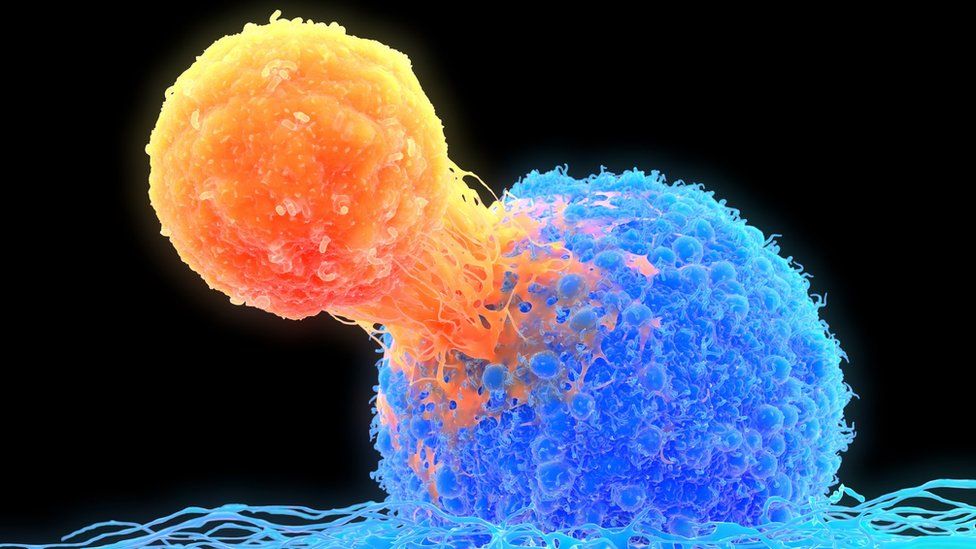
People with untreatable cancers have had their immune system redesigned to attack their own tumours.
The experimental study involved only 16 patients, but has been called a “leap forward” and a “powerful” demonstration of the potential of such technology.
Each person had a treatment developed just for them, which targeted the specific weak spots in their tumour.
It is too early to fully assess the therapy’s effectiveness and is expensive and time-consuming.
The work focuses on a part of the immune system called T-cells, which patrol the body and inspect other cells for problems.
They use proteins – called receptors – to effectively sniff out signs of infection or deviant cells that have become cancerous.
Cancers can be tricky for T-cells to spot. A virus is distinctly different to the human body, but cancers are more subtle because they are a corrupted version of our own cells.
The idea of the therapy is to boost levels of these cancer-spotting T-cells. It has to be tailored to each patient as each tumour is unique.
This is how it works:
The researchers scoured patient’s blood for rare T-cells that already had receptors which could sniff out their cancer
They then harvested other T-cells that could not find the cancer and redesigned them
Their original receptors, which may find other problems or infections, were replaced with those from the cancer-searching T-cells
Finally, these modified T-cells were then put back into the patient to seek out the tumour
Transforming T-cells into a form that can hunt cancer requiresconsiderable genetic manipulation to both remove the genetic instructions for building their old receptors, and give them the instructions for the new ones.
It was made possible by tremendous advances in the gene-editing technology Crispr, which acts like a pair of molecular scissors – allowing scientists to easily manipulate DNA. The researchers who developed Crispr won the Nobel Prize for Chemistry in 2020.
The trial involved people with colon, breast or lung cancers that had failed to respond to other treatments.
The study was designed to test the safety and feasibility of the technology, and showed the modified cells were finding their way into the tumour.
The disease continued to get worse in 11 patients, but stabilised in the other five. However, it will take larger studies to work out the correct dose and how effective it really is.
“This is a leap forward in developing a personalised treatment for cancer,” said Dr Antoni Ribas, one of the researchers at the University of California, Los Angeles, who tested the approach developed by the company Pact Pharma.
The results were presented at a meeting of the Society for Immunotherapy of Cancer and published simultaneously in the journal Nature.
Dr Manel Juan, head of the immunology service at Clinic Hospital in Barcelona, said it was “extraordinary work” and “undoubtedly one of the most advanced in the field”.
He added: “It opens the door to using this personalised [approach] in many types of cancer and potentially in many other diseases.”
Prof Waseem Qasim, who has given life-saving designer immune systems at Great Ormond Street Hospital, said it was a “powerful early demonstration of what might be possible with newer techniques”.
Dr Astero Klampatsa, from the Institute of Cancer Research, London, said the study was “important” but warned that the “time, labour and expense involved” were “huge”.
Share prices have risen as investors greet official data showing that the cost of living in the United States increased at a slower-than-expected rate last month.
Shares soared in the United States and Asia as traders reacted to the data, and stock markets in the United Kingdom and Europe rose on Friday morning.
According to the Labor Department, the US consumer price index increased 7.7% year on year in October.
Since the beginning of the year, this is the smallest annual increase.
The figure, which is down from 8.2% the previous month, means the US central bank may ease its aggressive approach to raising interest rates to tackle inflation.
On Friday Hong Kong’s Hang Seng index jumped by 7.7%, while the Nikkei in Japan ended the day 3% higher and South Korea’s Kospi gained 3.4%.
The Hang Seng was also boosted after Chinese state media reported that Covid-19 travel measures will be eased.
That came after the benchmark S&P 500 index in New York rose by more than 5.5%, while the Dow Jones Industrial Average gained 3.7%. At the same time the technology-heavy Nasdaq soared by 7.35%.
Shares in US technology companies saw some of the strongest gains with Amazon up by over 12%, while Apple and Microsoft rose more than 8%.
European share prices edged higher on Friday too, although they didn’t match the large gains seen in the US and Asia.
In London, the FTSE 100 index was up by 0.4% in early trading after official figures showed the UK appears to be heading into recession.
The economy contracted by 0.2% between July and September, according to the Office for National Statistics.
Meanwhile the US dollar, which has jumped in value this year, weakened against major currencies including the pound and the yen.
Earlier this month the US Federal Reserve raised its key interest rate to a fresh 14-year high.
The move took the central bank’s benchmark lending rate to 3.75%-4%, the highest since January 2008.
Also this month, the Bank of England lifted interest rates to 3% from 2.25%, the biggest jump since 1989, and warned that the UK is facing its longest recession since records began.
A recession is defined as when a country’s economy shrinks for two three-month periods – or quarters – in a row.
Higher interest rates make it less likely that people will spend on big ticket items, such as homes, cars or expanding their businesses. That fall in demand is, in turn, expected to curb price increases.
Food and energy prices have jumped, in part because of the Ukraine war, which has left many households around the world facing hardship and started to drag on the global economy.
Lauren Boebert rose to prominence as a “Maga” phenomenon during her first term in Congress.
The Trump-supporting Republican was expected to easily win re-election in conservative western Colorado. Instead, as the votes are tallied, she will face a formidable challenge from a centrist Democrat.
Boebert confronted Democratic presidential candidate Beto O’Rourke in Aurora, Colorado, in 2019, after he had made gun control a central campaign issue. It was the day he reiterated his call to outlaw semi-automatic weapons.
Three months later, Boebert announced her bid to represent Colorado’s third congressional district in Congress. Much like her run-in with O’Rourke, she arrived in Congress in January 2021 ready for a fight.
In one of her first days on the job, she voted to overturn the election results.
Keeping up her advocacy for gun rights, she vowed to bring her handgun to the Capitol and drew attention for a family holiday card picturing her four young sons wielding rifles.
Prominent state Republicans, including state Senator Don Coram, who ran against Boebert in the primary, called her an “embarrassment” and endorsed her opponent, Democrat Adam Frisch.
Price increases in the United States moderated last month, the latest sign that the nation’s inflationary pressures may be easing as the economy slows and consumers become more cautious.
According to the government, consumer inflation was 7.7 percent year on year in October and 0.4 percent month on month in September. The year-over-year increase was the smallest since January, slowing from 8.2 percent in September. Core inflation, which excludes volatile food and energy prices, rose 6.3 percent over the past year and 0.3 percent from September.
The numbers were all lower than economists had expected.
Helping drive the inflation slowdown from September to October was used car prices, which dropped for a fourth straight month. Also down were the prices of clothing and medical care. Food price increases slowed. By contrast, energy prices rebounded in October after having declined in August and September.
Even with last month’s tentative easing of inflation, the Federal Reserve is widely expected to keep raising interest rates to try to stem persistently high price increases. But Thursday’s better-than-expected data raised the possibility that the Fed could decide to slow its rate hikes, a prospect that sent stock prices jumping immediately after the government issued the figures.
“We expect this to mark the start of a much longer disinflationary trend that we think will convince the Fed to halt its [hikes] early next year,” said Paul Ashworth, chief North American economist at Capital Economics, a consulting firm. “With supply shortages normalising, deflationary pressure is now finally showing up.”
Recession fears
Many economists have warned that in continuing to tighten credit, the central bank is likely to cause a recession by next year. So far this year, the Fed has raised its benchmark interest rate six times in sizeable increments, heightening the risk that prohibitively high borrowing rates – for mortgages, auto purchases and other high-cost expenses – will tip the world’s largest economy into recession.
Some economists suggested that the latest inflation data shows that the hikes are beginning to achieve their goal, though the Fed needs to see further evidence.
“The data will be welcome news for the [Fed] finally showing some response in prices” to the rate increases, said Rubeela Farooqi, chief US economist at High Frequency Economics.
In the midterm elections that ended Tuesday, roughly half of voters cited inflation as the top factor in their decisions, according to VoteCast, an extensive survey of more than 94,000 voters nationwide conducted for The Associated Press by the National Opinion Research Center (NORC) at the University of Chicago.
Supply chain disruptions have largely eased up, and port backlogs have cleared [File: Qilai Shen/Bloomberg]
About 8 in 10 said the economy was in bad shape, and a slim majority blamed President Joe Biden’s policies for worsening inflation. Just less than half said factors beyond Biden’s control, such as Russia’s invasion of Ukraine, were to blame.
Those economic anxieties contributed to the loss of Democratic seats in the House of Representatives, though Republicans failed to score the huge political gains that many had expected.
Supply chains improve
Even before the release of Thursday’s figures, inflation by some measures had begun to ease and could continue to do so in coming months. Most gauges of workers’ wages, for example, show that the robust pay increases of the past 18 months have levelled off and have begun to fall. Though worker pay is not a primary driver of higher prices, it can compound inflationary pressures if companies offset their higher labour costs by charging their customers more.
Except for automakers, which are still struggling to acquire the computer chips they need, supply chain disruptions have largely unsnarled. Shipping costs have dropped back to pre-pandemic levels. The backup of cargo ships off the port of Los Angeles and Long Beach has been cleared.
And as declines in new rents that have emerged in real-time measures from such sources as ApartmentList and Zillow begin to be captured in the government’s forthcoming measures, that factor should also reduce inflation.
Even as many fear that the economy will fall into recession next year, the nation’s job market has remained resilient. Employers have added a healthy average of 407,000 jobs a month, and the unemployment rate is just 3.7 percent, close to a half-century low. Job openings are still at historically high levels.
But the Fed’s rate hikes have inflicted severe damage on the American housing market. The average rate on a 30-year fixed mortgage has more than doubled over the past year and topped 7 percent this week. As a result, investment in housing collapsed in the July-September quarter, falling at a 26 percent annual rate.
Higher mortgage rates have depressed sales. Home prices are slowing sharply compared with a year ago and have begun to fall on a monthly basis. The cost of a new apartment lease is also declining.
For TV personalities-turned-politicians, Pennsylvania delivered a stinging rebuke in this election. Not only for Mehmet Oz, the celebrity doctor who came to fame on The Oprah Winfrey Show, but for Donald Trump too, the – well, you know the back story.
Mr Trump lent Dr Oz his endorsement in April, saying that his chosen candidate for the crucial Senate race would help “stop the Radical Left maniacs from destroying our country”.
Instead, he’s gone down to a convincing defeat at the hands of his Democratic opponent John Fetterman, who successfully courted blue-collar Pennsylvanians with a traditionally left-wing raft of policies, including a promise to tackle corporate greed.
And – in a further twist that could be right out of a Hollywood script – the slick TV physician came up short against a candidate who’s been struggling to overcome the debilitating effects of a stroke on the campaign trail.
Dr Oz’s political demise arguably leaves Mr Trump’s role as Republican kingmaker on life-support, and the ex-president’s chance of a third tilt at the White House in 2024 now the subject of serious probing.
Even his staunchest of allies are advising that he puts on pause a widely anticipated announcement, earlier teased to come next week.
No wonder Pennsylvania is being so roundly cheered by Democrats.
It is the highlight of an election that looks to have been about rejecting the Trumpian alternative at least as much as any condemnation of President Joe Biden’s handling of the economy.
IMAGE SOURCE,REUTERS Image caption, Trump has said he will not take responsibility for those Republicans he supported but did not get elected
Livid Trump, triumphant Fetterman
And it is with no small degree of relish that insiders are sharing tweets – unconfirmed – suggesting that the former president is furious, with one claiming he has even begun blaming his wife Melania for the choice of Dr Oz.
Mr Biden took Pennsylvania in the 2020 presidential vote by a narrow margin after appealing to white working-class voters and winning them back from Mr Trump.
The hoodie-wearing, tattooed Mr Fetterman – once mayor of the former steel-town Braddock, and director of its youth programme – has used those credentials to do the same.
But the health setback introduced a huge note of uncertainty on the campaign trail, particularly after he was seen to be struggling to articulate fluently in last month’s TV debate.
How much would his stroke weigh on the minds of voters and raise questions about his fitness to govern?
When we caught up with Mr Fetterman before polls opened, his minders were working hard to keep reporters at bay as he posed for photos outside a United Steelworkers Union chapter in Coatesville, a suburb of Philadelphia.
“Are you feeling confident?” I shouted out over their heads, but there was no reply.
However, as votes were counted into the early hours of the morning, it was clear he had overcome the doubters, and the personal and the political came together in an emotional victory speech.
“I’m proud of what we ran on,” he told supporters.
“Protecting a woman’s right to choose, raising our minimum wage, fighting for the union way of life, healthcare as a fundamental human right. It saved my life and it should be there for you if you all ever need it.”
Did abortion help win it for Fetterman?
Pennsylvania also brought another key election issue into sharp focus – the central role that abortion is playing across the US political landscape.
Mr Fetterman referenced it in his victory speech, and it was something female voters we spoke to outside the polling stations mentioned, too.
One young woman told us it was the only issue she was voting on – turning out for Mr Fetterman for his pro-choice stance.
Another woman – an anti-abortion Republican mother – said she could no longer speak about politics to her voting-age daughter because they were so firmly in opposite camps.
In his televised debate, Dr Oz’s weakest moment was seen by many to come when he said that abortion was an issue for “women, doctors [and] local political leaders” to decide.
His strong anti-abortion stance was already known, but that formulation – seeming to conjure the image of lawmakers in the room alongside women and doctors – was considered a major blunder.
Democrats may be buoyed by the midterm results, but they would be wrong to be complacent.
Mr Trump still holds significant sway with a large swathe of the Republican base and still has a major financial war-chest at his disposal.
And even if he is now politically weakened, he may have to face bigger threats out there.
The triumph of Ron DeSantis in Florida – re-elected governor with a massively increased majority – is a victory for a culture warrior promising to make Florida a place where “woke comes to die”.
The result is seen as raising his chances of winning the Republican 2024 nomination for the presidency.
Some argue he may be a far more formidable rival for Democrats than Mr Trump – but harbouring the same anti-democratic instincts.
The former president is certainly treating Mr DeSantis as a threat, warning this week that he would reveal things about the governor that “won’t be very flattering” if he does launch a presidential bid of his own.
And perhaps more than anywhere else, it is the victory in Pennsylvania of a man who – just a few months ago suffered a stroke that nearly killed him – that has kept Democrat hopes alive.
Video shows the animal trying to regain its footing as the people recording urge the woman to pull over.
A dog has been seized by police after it was filmed being dragged along a road behind a mobility scooter.
Video posted on social media showed the animal sliding on its stomach and struggling to stand while its lead was connected to the vehicle.
At one point, the footage shows it hitting the kerb as the woman driving is challenged by onlookers who warn her “the dog’s gonna die” – but she appears oblivious and reluctant to stop.
The video is believed to have been recorded in the Erdington area of Birmingham.
West Midlands Police said the dog was located on Wednesday night in Stockland Green and was being cared for by the RSPCA.
Thepresident stated that he would decide whether to run for a second term early next year.
Joe Biden has called his party’s positive midterm results a “good day for America,” but the Senate race remains tight.
Democrats are expected to lose only seven seats, defying predictions of a “giant red wave” of Republican gains.
Though the Republicans would retake control of the House of Representatives, this would be a far better outcome for the US president than his recent predecessors.
Donald Trump lost 40 seats in the 2018 midterms, while Barack Obama suffered 63 losses in 2010.
With three states left to declare, the battle for control of the Senate remains in the balance.
The Republicans have picked up 49 seats to the Democrats’ 48. The Republicans need to win two more seats to win back the Senate from the Democrats.
Image: Former US president Donald Trump claimed the Republican results were a ‘very big victory’ for him personally
Speaking at the White House, President Biden described the midterm results so far as a “good day for democracy” and a “good day for America”.
Although many results are still unclear, he said they represent a “clear and unmistakable message to preserve our democracy”.
“The American people have spoken and shown that democracy is who we are,” he said.
But he added that “the voters were also clear that they’re still frustrated, I get it, it’s been a really tough few years for this country”.
In reference to Donald Trump‘s claims he “stole” the last elections, he said vote counters and officials “did their job and fulfilled their duty… without any interference”.
He also said he would make a decision on whether he would run for a second term early next year.
Although losing the House of Representatives would thwart the president’s legislative programme, it is a much smaller loss than some had predicted.
The race between Georgia’s incumbent Democrat senator and his Republican challenger is unlikely to be decided until 6 December, as strict state laws require a run-off if no candidate reaches 50%.
‘Democrats had strong night’
Mr Biden said the Democrats “had a strong night” despite losing seats.
“We don’t know all the results yet, but here’s what we do know, the press were predicting a giant red wave and it didn’t happen,” he said.
“You were somewhat miffed by my obsessive optimism, but I thought we were going to do fine.”
He said that the “future of America is too promising” for it to be “trapped in endless political warfare”.
While he would not compromise on healthcare or abortion, he said: “I’m going to do everything within my power to unite the country.
“I’m going to continue to work across the aisle to support the American people. Regardless of what the final tally of these elections show, I am prepared to work with my Republican colleagues.
According to a Kabul official, the Taliban have bannedwomen from using gyms in Afghanistan as part of their latest religious edict which restricts women’s rights and freedoms since taking power more than a year ago.
The Taliban took over the country last year and will take power in August 2021. Despite initial promises to the contrary, they have barred girls from middle and high school, restricted women from most fields of employment, and ordered them to wear head-to-toe clothing in public.
According to a spokesman for the Ministry of Virtue and Vice, the ban was implemented because people were disobeying gender segregation orders and women were not wearing the required headscarf, or hijab. Parks are also off-limits to women.
The ban on women using gyms and parks came into force this week, according to Mohammed Akef Mohajer, a Taliban-appointed spokesman for the Ministry of Virtue and Vice.
The group has “tried its best” over the past 15 months to avoid closing parks and gyms for women, ordering separate days of the week for male and female access or imposing gender segregation, he said.
“But, unfortunately, the orders were not obeyed and the rules were violated, and we had to close parks and gyms for women,” said Mohajer. “In most cases, we have seen both men and women together in parks and, unfortunately, the hijab was not observed. So we had to come up with another decision and for now we ordered all parks and gyms to be closed for women.”
Taliban teams will begin monitoring establishments to check if women are still using them, he said.
“The Taliban are lying,” she insisted, speaking on condition of anonymity, fearing reprisals. “We were training separately.
On Thursday, she said two men claiming to be from the Ministry of Virtue and Vice entered her gym and made all the women leave.
“The women wanted to protest about the gyms (closing) but the Taliban came and arrested them,” she added. “Now we don’t know if they’re alive or dead.”
Taliban-appointed Kabul police chief spokesman Khalid Zadran said he had no immediate information about women protesting gym closures or arrests.
The U.N. special representative in Afghanistan for women, Alison Davidian, condemned the ban. “This is yet another example of the Taliban’s continued and systematic erasure of women from public life,” she said. “We call on the Taliban to reinstate all rights and freedoms for women and girls.”
Hard-liners appear to hold sway in the Taliban-led administration, which struggles to govern and remains internationally isolated. An economic downturn has driven millions more Afghans into poverty and hunger as the flow of foreign aid has slowed to a trickle.
Kabul-based women’s rights activist Sodaba Nazhand said the bans on gyms, parks, work, and school would leave many women wondering what was left for them in Afghanistan.
“It is not just a restriction for women, but also for children,” she said. “Children go to a park with their mothers, now children are also prevented from going to the park. It’s so sad and unfair.”
Michelle Obama said she struggled with a “crushing sense of hopelessness” after the 2020 presidential election that was brought on by the death and isolation of the COVID-19 pandemic, a summer of political and racial unrest and the insurrection at the U.S. Capitol.
“I was in a low place,” she said. Then she got an idea.
“Everyone was searching for some answers of how to cope. And for some reason they were asking me, ‘What do you do?’ I had to start thinking about that,” the former first lady told People magazine in an interview pegged to Tuesday’s release of her second book, “The Light We Carry: Overcoming in Uncertain Times.” She is set to open a six-city book tour in Washington on that day.
In the book, former President Barack Obama’s wife, who is one of the world’s most famous women, tells how she steadies herself during these anxious times and how she works at overcoming her lifelong fear of change and doubts about herself.
“Over the 58 years that I’ve lived, I can look back and I can say, ‘This is how I deal with fear. These are the things I say to myself when I need to pick myself up. This is how I stay visible in a world that doesn’t necessarily see a tall Black woman,’” she said. “This is how I stay armored up when I’m attacked. The book is that offering.”
“I think people learn not through edict, but through stories,” she said. People posted a report on the interview on its website on Thursday, and it will appear in the magazine’s Nov. 21 issue, available nationwide on Friday.
Mrs. Obama, the mother of Sasha and Malia Obama, opens up in the book about everything from how awkward it is to make new friends to her experiences with racism, marriage, parenting and even menopause.
She also writes about leaning on a “kitchen table” of close girlfriends, led by her 85-year-old mother, Marian Robinson. The group includes Kathleen Buhle, a hiking and yoga pal who is the ex-wife of President Joe Biden’s son Hunter and the mother of Maisy Biden, Sasha Obama’s best friend.
In 2018, Mrs. Obama released her best-selling memoir, “Becoming,” and embarked on a U.S. and international book tour to promote it. The book has sold more than 17 million copies worldwide, surpassing the sales of any memoir by a previous first lady or modern president, including her husband.
In her new book, the former first lady describes looking in the mirror and only seeing her flaws, and how she practices being kind to herself.
She said she also copes by indulging in what her husband calls “lowbrow TV.”
“You name it, I watch it,” she said, naming HGTV, anything on the Food Channel and dating shows like “Married at First Sight” among her viewing choices.
The former first lady described herself as an informed citizen who reads the newspaper, gets briefs, sits with her husband every night and knows what’s happening in the world.
But she said that “when I’m by myself, I need to be able to turn my head off and think about wallpaper.”
Salto de Castro in northwestern Spain is on the market for €260,000 (£227,000; $259,000).
Salto de Castro, located on the border with Portugal in the province of Zamora and a three-hour drive from Madrid, has many of the buildings you’d expect to find in a small Spanish town.
They include 44 houses, a hotel, a church, a school, a municipal swimming pool, and even a civil guard barracks building.
But what it does not have are inhabitants. Salto de Castro has been abandoned for more than three decades.
The owner bought the village at the beginning of the 2000s, with the intention of converting it into a tourist spot. However, the eurozone crisis prevented the plan from flourishing.
“The owner had the dream of having a hotel here but it was all put on hold,” said Ronnie Rodríguez, of Royal Invest, the company representing the owner. “He would still like the project to come true.”
On the Idealista website on which the property is listed, the owner, who is in his 80s, states that “I am selling because I am an urban-dweller and cannot maintain the upkeep” of the village.
It has attracted interest, with more than 50,000 visits since it was listed a week ago at this price.
IMAGE SOURCE,ROYAL INVEST Image caption, Ronnie Rodríguez, holding a “for sale” sign, says the owner wanted to set up a hotel in the village
Mr Rodríguez said that 300 people have expressed an interest in buying, with inquiries from Russia, France,Belgium and the UK. One potential buyer has already put money down to reserve it, he said.
Salto de Castro was built by the electricity generation company Iberduero to house families of the workers who built the reservoir next door, from the early 1950s.
But the inhabitants moved away after its completion and the village was totally abandoned in the late 1980s.
The area surrounding it is part of what has become known as “emptied Spain” – sparsely populated rural areas which lack many of the services found in towns and cities.
Salto de Castro has been put up for sale previously, for as much as €6.5m. However, with no buyers and many of the buildings vandalised, the price has plummeted.
The asking price of €260,000 is enough only for a one-bedroom apartment in well-heeled areas of Madrid or Barcelona.
But the eventual buyer of Salto de Castrocould need deep pockets, at least in order to attract visitors.
According to Idealista: “The investment required in order to make the village 100% workable and to become profitable would not exceed €2m.”
The daughter of an Australian woman whose murder was the subject of a popular podcast has begged her father to reveal the location of the body.
The family of Chris Dawson addressed him in court on Thursday as part of his sentencing hearing.
It comes weeks after Dawson was found guilty of murdering his wife so he could be with their teenage babysitter.
He was charged in 2018 after the Teacher’s Pet podcast gained global fame, prompting a fresh investigation.
“Please tell us where she is,” daughter Shanelle Dawsonsaid, addressing her father directly in court.
Ms Dawson was just four when her mother, Lynette Dawson, disappeared from the family’s Sydney home in January 1982.
Police have never found any trace of the 33-year-old.
Fiercely staring at her 74-year-old father in court, Ms Dawson said there were not enough words in the English language to describe the impact of his crime.
Told her mother had left because “she didn’t love us anymore”, Ms Dawson through tears said she has struggled with abandonment issues, post-traumatic stress, anxiety and depression.
“The night you removed our mother from our lives was the night you destroyed my sense of safety and belonging in this world for many decades to come,” she said.
“Why didn’t you just divorce her, let those who love and needed her keep her?”
Lynette’s siblings also detailed their struggle to come to terms with her death.
In a statement, Greg Simms told how his family had accepted Dawson into the fold unconditionally.
“We trusted you. You repaid us by committing the ultimate betrayal,” he said.
“It was a brazen act of conniving monster, hell bent on one thing – getting what you wanted at any cost.”
Lynette’s sister, Pat Jenkins, in a statement read to the court, detailed how the absence of a body had for years cruelly kept her clinging on to a “modicum of hope”.
Dawson kept his head bowed for much of the hearing, as Lynette’s family pleaded with him to disclose where her body is.
“We ask you to do the decent thing… allow us to bring her home to a peaceful rest, finally giving her the dignity she deserves,” Mr Simms said.
Two separate inquiries into Mrs Dawson’s disappearance concluded that she was killed by a “known person”, but until the podcast explored the case, prosecutors had said there was not enough evidence to lay charges.
While handing down his verdict in August, Justice Ian Harrison said the evidence against Dawson was “persuasive and compelling”.
Dawson has flagged an intention to appeal the verdict, but will be sentenced on 2 December.
The attack took place on Wednesday night at the Lexuz bar in Apaseo del Alto, Guanajuato.
At least seven gunmen stormed into the venue at 21:20 local time, according to witnesses (03:20GMT).
The motive for the attack is unknown, but bar shootouts have become more common in Guanajuato, which has Mexico’s highest murder rate.
In Wednesday’s attack, the victims included five men and four women. One of the dead is reportedly the owner of the bar.
Two of the bodies were found in a car. It is not clear whether the two men were fleeing from the attack or whether they were hit by stray bullets.
Much of the violence is blamed on a turf war between the Jalisco New Generation cartel (CJNG) and its rivals from the Santa Rosa de Lima criminal gang.
The CJNG, which has its power base in the neighbouring state of Jalisco, has been making inroads into Guanajuato, where the Santa Rosa de Lima group controls much of the fuel theft and smuggling.
Last month, 12 people were killed while at a beer hall in the town of Irapuato and in September a shootout in a pool hall in Tarimoro left 10 people dead.
To show solidarity with anti-government protests, a prominent Iranian actressposted an image of herself without a headscarf on Instagram.
Taraneh Alidoosti, best known for her role in the Oscar-winning film The Salesman, also held a sign in Kurdish that read “Woman, Life, Freedom.”
Protesters have adopted the slogan as a rallying cry.
The protests sparked by Mahsa Amini’s death in police custody are now in their seventh week.
The 22-year-old died after being arrested by morality police in Tehran for allegedly breaking Iran’s strict rules requiring women to wear a hijab, or Islamic headscarf, to cover their hair.
Ms Alidoosti is one of Iran’s most successful actresses and has more than eight million followers on Instagram. She starred in The Salesman, which won an Academy Award in 2016 for the Best International Feature Film.
She has previously vowed to remain inside Iran at any price and has paused her career to support the families of those killed in the security forces’ clampdown on demonstrators.
Local human rights activists say least 328 people have been killed and 14,800 others have been detained.
The star’s post is the latest gesture of support by leading figures in the arts and sports of Iran.
Last month, Iranian star footballer Sardar Azmoun backed demonstrators amid increasing violence from the government. The Bayern Leverkusen forward condemned security forces in an Instagram story, saying: “Shame on you for easily killing the people and viva women of Iran. Long live Iranian women!”
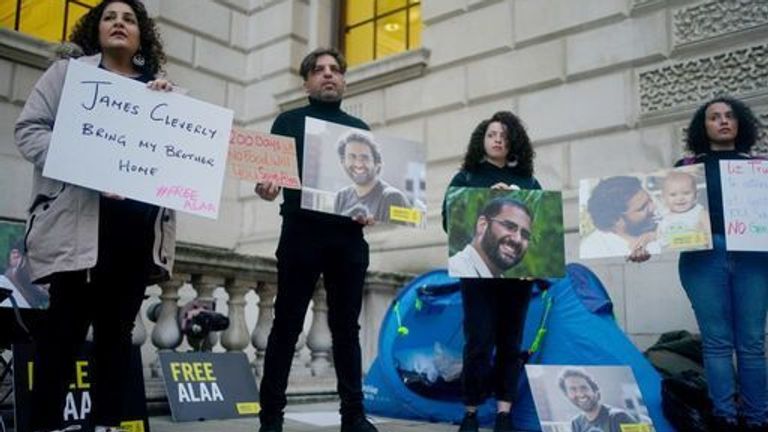
On Sunday, the first day of the COP27 climate summit in Sharm el-Sheikh, Egypt, Alaa Abd El-Fattah stopped eating and began refusing water.
According to his mother, Egyptian prison authorities intervened medically days after jailed British-Egyptian pro-democracy activist Alaa Abd El-Fattah escalated his hunger strike.
The nature of the intervention is unknown, but Mr Abd El-family Fattah’s is concerned that prison officials will force-feed him.
According to the family, this would be torture.
She told the Associated Press news agency she asked “if it was by force, and they said no” and told her “Alaa is good”.
Mr Abd El-Fattah had been on a partial hunger strike of 100 calories a day for the past six months.
He stopped all calorie intake and began refusing water on Sunday – the first day of the COP27 climate summit held in Sharm el-Sheikh in Egypt.
His hope was to get the attention of British Prime Minister Rishi Sunak, who attended the UN-led summit this week, and persuade him to take immediate action for his release.
Mr Abd El-Fattah is now in a prison hospital following the escalation in his hunger strike.
The activist said in an earlier letter that he was prepared to die in prison if not freed.
Ms Soueif has called for her son to be transferred to a civilian hospital rather than a prison facility.
“I need proof for this. I don’t trust them,” she said.
She has been waiting outside the prison every day this week, asking for proof her son is alive.
Mr Abd El-Fattah’s sister Mona Seif has said she has now been informed by prison officials that he is undergoing “medical intervention”.
The activist’s family have been increasingly worried for his health and continuously campaigned for his release ahead of COP27.
Image:Mona Seif (left), the sister of writer Alaa Abd el-Fattah, outside the Foreign Office in October
Mr Abd El-Fattah’s younger sister Sanaa Seif said last week in a public address to world leaders at COP27: “You are going to be in the same land as a British citizen dying.
“And if you don’t show that you care, it will be interpreted as a green light to kill him. My brother can be saved.”
“If you don’t save him, you have blood on your hands.”
Mr Abd El-Fattah rose to prominence during the pro-democracy uprisings in 2011 which took place throughout the Middle East and played a role in dismounting Egypt’s long-time president Hosni Mubarak.
World leaders and activists have repeatedly called for Egyptian authorities to release him.
At COP27, UK Prime Minister Rishi Sunak, French President Emmanuel Macron and German Chancellor Olaf Scholz raised the activist’s case in their talks with Mr el-Sissi.
Celebrities who have spoken out in support of Mr Abd El-Fattah include Dame Judi Dench, Dame Emma Thompson, Mark Ruffalo, Carey Mulligan andKhalid Abdalla.
KFC has apologised for sending a promotional message to German customers urging them to celebrate Kristallnacht with cheesy chicken.
In 1938, a series of Nazi-led attacks in the country killed more than 90 people and destroyed Jewish-owned businesses and places of worship.
It is widely regarded as the start of the Holocaust.
The message, which was widely panned for its insensitivity, was later attributed to “an error in our system.”
The fast food chain sent an app alert on Wednesday, saying: “It’s memorial day for Kristallnacht! Treat yourself with more tender cheese on your crispy chicken. Now at KFCheese!”
Around an hour later another message was sent with an apology, according to the Bild newspaper.
“We are very sorry, we will check our internal processes immediately so that this does not happen again. Please excuse this error,” the message is reported to have said.
Germany takes the 9 November anniversary of Kristallnacht (the night of broken glass) seriously, with numerous memorial events and discussions scheduled to reflect the Nazis’ murder of more than six million Jewish people.
Daniel Sugarman, Director of Public Affairs at the Board of Deputies of British Jews described the original KFC message as “absolutely hideous”.
Dalia Grinfeld, the associate director of European affairs at the Jewish NGO Anti-Defamation League, tweeted: “How wrong can you get on Kristallnacht KFC Germany. Shame on you!”
In a statement issued to Newsweek magazine, KFC Germany blamed the message on a bot.
The fast food chain said the “automated push notification” was “linked to calendars that include national observances”.
It added that it “sincerely” apologised for the “unplanned, insensitive and unacceptable message” and said app communications had been suspended while an examination of them takes place.
“We understand and respect the gravity and history of this day, and remain committed to equity, inclusion and belonging for all,” the company finished by saying.
US president Joe Bidensays the cooling inflation numbers are a sign of economic strength in America, and his administration is making progress on its efforts to bring costs down.
“My economic plan is showing results,” Biden says in a statement.
He says that with inflation slightly dropping, Americans are getting a “much-needed” break at the grocery store ahead of the Thanksgiving and Christmas holidays.
He also touts legislation his administration recently passed, which will soon bring down prescription drug prices and energy costs.
Looking ahead from the US midterm elections, Biden says he “will work with anyone – Democrat or Republican – on ideas to provide more breathing room to middle-class and working families”.
The world should confront climate change the way it does nuclear weapons, by agreeing to a non-proliferation treaty that stops further production of fossil fuels, a small island nation leader urged Tuesday.
The proposal by Tuvalu came as vulnerable nations pushed for more action and money at international climate talks in Egypt, while big polluters remained divided over who should pay for the damage industrial greenhouse gas emissions have done to the planet.
“We all know that the leading cause of climate crisis is fossil fuels,” Tuvalu Prime Minister Kausea Natano told his fellow leaders.
The Pacific country has “joined Vanuatu and other nations calling for a fossil fuels non-proliferation treaty,” Natano said. “It’s getting too hot and there is very (little) time to slow and reverse the increasing temperature. Therefore, it is essential to prioritize fast-acting strategies.”
Vanuatu and Tuvalu, along with other vulnerable nations, have been flexing their moral authority against the backdrop of recent climate-related disasters. The idea of a non-proliferation treaty for coal, oil and natural gas has previously been advanced by campaigners, religious authorities including the Vatican, and some scientists, but Natano’s speech gave it a boost in front of a global audience.
A year ago at climate talks in Glasgow, a proposal to call for a “phase out” of coal — the dirtiest of the fossil fuels — was changed at the last minute to “phase down” by a demand from India, earning the wrath of vulnerable countries.
Since then the global energy crunch triggered by the Russian invasion of Ukraine has prompted a scramble by some countries and companies seeking to tap fresh gas and oil sources.
Pushing back against that, vulnerable nations also called for a global tax on the profits of fossil fuel corporations that are making billions of dollars daily from sky-high energy prices.
“It is about time that these companies are made to pay a global carbon tax on their profits as a source of funding for loss and damage,” said Gaston Browne, prime minister of Antigua and Barbuda. “Profligate producers of fossil fuels have benefited from extortionate profits at the expense of human civilization.”
The idea of a windfall tax on carbon profits has gained traction in recent months amid sky-high earnings for oil and gas corporations even as consumers struggle to pay for heating their homes and filling their cars. For the first time, U.N. climate conference delegates are to discuss demands by developing nations that the richest, most polluting countries pay compensation for damage wreaked on them by climate change, which in climate negotiations is called “loss and damage.”
Barbados Prime Minister Mia Mottley said fossil fuel companies should contribute to those funds, which would provide vulnerable countries with financial aid for the climate-related losses they are suffering.
Other leaders rejected the idea.
“I think this is not the place now to develop tax rules, but rather to jointly develop measures to protect against the consequences of climate change,” German Chancellor Olaf Scholz told reporters.
If the small islands can’t get a global tax on fossil fuel profits, Antigua’s Browne suggested going to international courts to get polluters to pay. Scientists from Dartmouth College calculated specific damages for all the world’s countries and how much was caused by other nations, saying it would work well in international court cases.
Browne quoted William Shakespeare’s “Macbeth” in sharing his frustration with lack of action.
“Tomorrow and tomorrow and tomorrow creeps in this petty pace from day to day to the last syllable of recorded time. And all our yesterdays have lighted fools the way to dusty death,” Browne said.
Despite 27 climate summits “tomorrow has not come,” he said.
Speaking for a country that has suffered from the consequences of climate change recently, Somalia’s president said it faces “one of the worst droughts in modern history.”
President Hassan Sheikh Mohamud said more than 7 million Somalis, or about half the population, cannot meet their basic food needs as the Horn of Africa region has seen two years of failed rains.
“We are trying desperately to respond,” he said. The drought has killed thousands of people, many of them children. It is also reshaping Somalia’s landscape as the country struggles with one of the world’s fastest urbanization rates as many people flee parched areas.
Pakistani Prime Minister Shahbaz Sharif told fellow leaders how his country was struck by catastrophic floods in recent months that affected 33 million people and caused more than $30 billion in economic damage.
“This all happened despite our very low carbon footprints,” Sharif said, insisting: “Of course it was a manmade disaster.”
Sharif called for additional financial support for his country and others suffering from the effects of climate change, saying money to help Pakistan rebuild after the floods should be on top of other aid and not come in the form of loans. Further debts, he said “would be a financial death trap.”
The president of Malawi, meanwhile, praised those leaders present in Egypt for simply showing up.
“The temptation to abstain from COP this year was great,” President Lazarus Chakwera said, referring to the talks by their U.N. acronym, “because of the great and unprecedented economic hardships your citizens are suffering.”
“But you resisted this temptation and chose the path of courage,” he said.
Chakwerea said any agreements forged at the two-week meeting should recognize the different abilities of countries such as the United States and China, and developing nations like his own.
There is growing pressure on Beijing to step up its climate efforts given its massive economic clout.
So far, the world’s biggest polluter has insisted that it cannot be held to the same standards as developed economies like the United States or Europe because it is still lifting millions of its citizens out of poverty.
Beijing’s climate envoy said Tuesday that the meeting in Egypt should focus on “implementation” of existing pledges.
“The developed countries will take the lead in effectively scaling up their emission reduction targets and achieving carbon neutrality ahead of time,” Xie Zhenhua said, according to an official translation of the speech.
Xie said it was up to developed countries to “achieve substantive results” on measures for adapting to climate change and financial aid for the poor that are “of greatest concern to developing countries.”
The U.S. mid-term elections were hanging over the talks, with many environmental campaigners worried that defeat for the Democrats could make it harder for President Joe Biden to pursue his ambitious climate agenda.
Also hanging over the conference was the fateof one of Egypt’s most prominent jailed pro-democracy activists, Alaa Abdel-Fattah, who has been imprisoned for most of the past decade. He stopped even drinking water Sunday, the first day of the conference, vowing he is willing to die if not released, his family said.
Numerous world leaders raised his case in meetings with Egypt’s President Abdel Fattah el-Sissi, and the head of the U.N. human rights office called for his immediate release.
Egypt’s longtime history of suppressing dissent has raised controversy over its hosting the annual conference, with many climate activists complaining that restrictions by the host are quieting civil society.
The comments aboutcontestants are believed to have been made by Britain’s Got Talent judge David Walliams during commercial breaks.
David Walliams has apologised for making “disrespectful” comments about Britain’s Got Talent (BGT) contestants during filming.
“I would like to apologise to the people I made disrespectful comments about during breaks in filming for Britain’s Got Talent in 2020,” the 51-year-old comedian, actor, and children’s author said in a statement.
“These were private conversations and – like most conversations with friends – were never intended to be shared. Nevertheless, I am sorry.”
The remarks are understood to have been both derogatory and sexually explicit, referring to one contestant as a “c***” and saying of another: “She thinks you want to f*** her, but you don’t”.
Image: BGT judges Simon Cowell, Alesha Dixon, Amanda Holden and Walliams, with Ant & Dec in 2019
The comments were part of a leaked transcript, seen by The Guardian, which was from a recorded audition show at the London Palladium in January 2020.
Walliams has been a judge on the show since 2012, along with fellow judges Simon Cowell, Amanda Holden and Alesha Dixon.
There has been no implication that any of the other judges made inappropriate comments about contestants.
Walliams’ remarks were the only inappropriate comments seen by The Guardian within the leaked transcripts, which covered three episodes of the show.
They are understood to have been picked up by the microphones on the judges’ desk at the centre of the auditorium.
Responding to the comments, creator of BGT Simon Cowell and his company Syco Entertainment said they did not condone Walliams’ remarks and made clear that Cowell had not been aware of the remarks at the time.
Walliams, who has been named best judge at the National Television Awards three times during his 10-year stint on the show, has frequently been praised for his chemistry with Cowell.
Thames TV, the production company behind Britain’s Got Talent, said in a statement to Sky News: “Although relating to a private conversation almost three years ago, the language used was inappropriate.
“Even though it was private, those involved have been spoken to and reminded of their responsibilities and the show’s expectations as to future professional conduct.”
Thames are also understood to have provided training for their on-screen judges over the last few years, dealing with issues of language and respect around contestants and members of the public.
A spokesperson for ITV said: “We do not condone the language outlined in these allegations, and we have spoken to the producers of Britain’s Got Talent.
“Duty of care towards all participants on any of our programmes is always of paramount importance and we have protocols and guidelines in place for all our production partners.”
ITV has been under the spotlight in recent years, with questions asked over the channel’s duty of care to contestants following the death of Jeremy Kyle Show participant Steve Diamond a week after appearing on the talk show, and the deaths of two former Love Island contestants, Sophie Gradon and Mike Thalassitis, who both took their own lives.
The announcement of another train driverstrike comes on the same day that London Underground workers go on strike, rendering large sections of the Tube network inoperable.
Train drivers in England have declared a new strike in their long-running pay and conditions dispute.
After months of walkouts by various groups, members of the Aslef union will strike on Saturday, November 26th, causing even more disruption for passengers.
The 12 companies involved are Avanti West Coast; Chiltern Railways; CrossCountry; East Midlands Railway; Great Western Railway; Greater Anglia; London North Eastern Railway; London Overground; Northern Trains; Southeastern; Transpennine Express, and West Midlands Trains.
The rail network has been crippled by strikes as workers fight for inflation-busting pay rises amid the cost of living crisis.
Strikes on 5, 7 and 9 November were called off, but at too short notice to reinstate services, leaving Bonfire Night travellers stuck.
It means no services on large parts of the London Underground.
Only the Central, Northern, District, Elizabeth, Overground and DLR lines are running, but with reduced services.
Train companies with big profits should make ‘proper pay offer’
Aslef general secretary Mick Whelan said of the latest industrial action: “We don’t want to be taking this action.
“We have come to the table, as we always will, in good faith but while the industry continues to make no offer – due to the dodgy deal they signed with the Department for Transport – we have no choice but to take strike action again.
“They want drivers to take a real terms pay cut.
“With inflation now well into double figures, train drivers who kept Britain moving through the pandemic are now being expected to work just as hard this year as last year but for less. Most of these drivers have not had an increase in salary since 2019.
“We want the companies – which are making huge profits – to make a proper pay offer so that our members can keep up with the cost of living.”
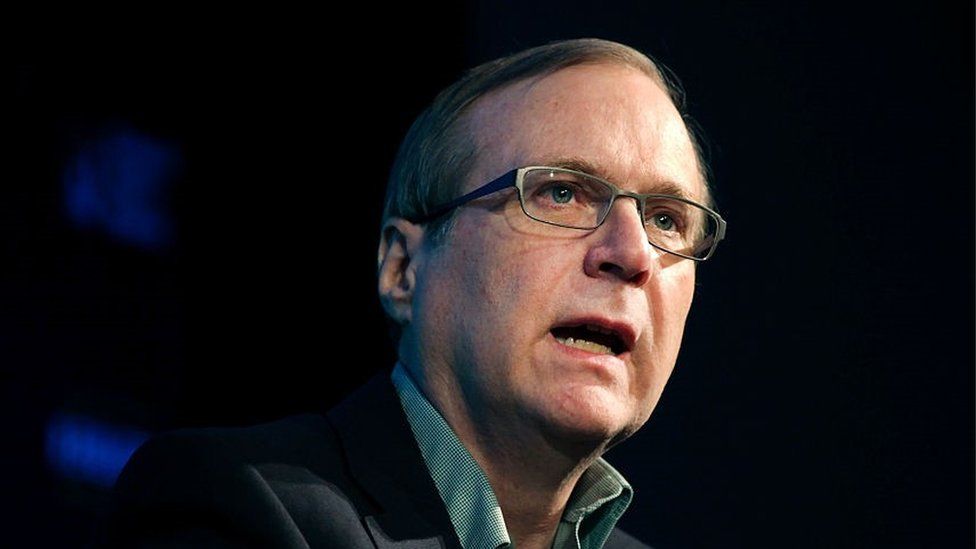
Paintings and sculptures owned by late Microsoft co-founder Paul Allenfetched a record $1.5 billion (£1.3 billion).
According to Christie’s, it was the largest art auction in history.
Works by Vincent van Gogh, Georges Seurat, Paul Gauguin, Paul Cezanne, and Gustav Klimt each sold for more than $100 million (£88 million), according to the auction house, breaking individual records for those artists.
The sale proceeds will be donated to charities that Allen supported before his death in 2018.
The most expensive piece of art bought was Seurat’s 1888 work Les Poseuses, Ensemble (small version), a renowned work of pointillism, which fetched $149.2m (£131m), including fees, Christie’s said.
IMAGE SOURCE,CHRISTIE’S IMAGES LTD 2022 Image caption, Paul Cezanne’s La Montagne Sainte-Victoire fetched $138m
Experts say the super wealthy are viewing art as a safe investment amid a tumultuous global economy and Russia’s warin Ukraine.
Other record-breaking works included Van Gogh’s Orchard with Cypresses, which fetched $117.2m (£103m); Gauguin’s Maternity II, which sold for $105.7m (£93m); and Klimt’s Birch Forest, which went under the hammer for $104.6m (£92m).
Paintings from Georgia O’Keefe, Claude Monet, David Hockney, Andrew Wyeth and Pablo Picasso were also sold, along with sculptures by Alexander Calder and Max Ernst.
IMAGE SOURCE,CHRISTIE’S IMAGES LTD 2022 Image caption, Gauguin’s Maternity II was sold for $106m
The total value of the collection has already beaten the record set earlier this year, for the Macklowe collection, owned by a wealthy New York couple – which sold for $922m (£810m).
IMAGE SOURCE,GETTY IMAGES Image caption, Paul Allen set up a foundation while he was alive, donating hundreds of millions
Mr Allen co-founded Microsoft in 1975 with his childhood friend Bill Gates.
He was treated for non-Hodgkin lymphoma in 2009, but it returned, and in 2018 he died from complications of the disease.
In 2010, he pledged to leave the majority of his fortune to charity after his death. At the time he was the 37th richest man in the world, according to Forbes magazine, with an estimated $13.5bn (then £8.8bn).
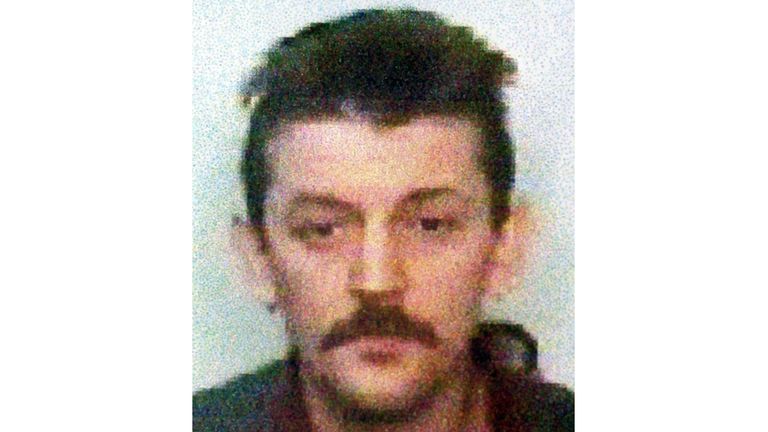
Craig, 58, covered Jacqueline Kirk in petrol and set her alight in a car park in Weston-super-Mare, Somerset in April 1998. She died due to medical complications in August 2019.
Steven Craig, 58, covered Jacqueline Kirk in petrol and set her alight in a car park in Weston-super-Mare, Somerset in April 1998.
He served more than 18 years in prison for the attack but following her death in August 2019 he was arrested again and charged with her murder. He was found guilty of that charge by a jury at Bristol Crown Court last month.
At sentencing on Thursday, Judge Mrs Justice Stacey described Craig’s conduct as “sadistic” and the attack as “planned and premeditated”, handing him a total minimum term of 34 years.
“Your conduct was sadistic – deliberately setting her head and chest on fire the way you did,” she told him.
“Anyone who uses petrol must be aware of the level of seriousness of their actions. It was just so callous and so brutal.”
She added: “You had no intention to kill Jacquie. But in your case this has reduced significance almost to vanishing point, because the risk of her dying from what you did to her was so obvious.”
Craig’s trial heard that the 1998 attack resulted in 35% burns to Ms Kirk’s body and left her needing 14 operations, including skin grafts and a tracheotomy.
She lived to the age of 61 and was able to see both of her children get married and become a grandmother.
But she died the day after she was admitted to the Royal Bath Hospital in 2019, with doctors refusing to operate on her due to her frailty.
Image:Jacqueline Kirk is pictured after her operations
Victim was ‘remarkable and impressive woman’
Mrs Justice Stacey paid tribute to Ms Kirk, who was only expected to live for 10 years due to her injuries, but “against the odds survived for more than twice of that”.
“With the help of her family, she was determined to lead as full a life as she could,” she said. “What a remarkable and impressive woman she must have been.”
But due to the extent of her injuries, it was a “demi-life”, that left her suicidal at times, she said.
“She was always in pain and suffered from depression and nightmares.
“Her injuries and disfigurement were horrific. Breathing was difficult, eating and drinking were hard.
“She suffered abuse in the street because of the extent of her facial scarring.”
Detailing the run-up to the 1998 attack, the judge said Ms Kirk had taken Craig into her home when he was homeless and struggling with drink and drugs.
After the pair entered into a relationship he was often violent, “cracking her cheekbone” on one occasion, and “frequently threatening to kill her”.
Three days before the petrol attack, he had locked her in a railway station toilet, leaving her trapped for hours before a cleaner let her go.
Craig often watched a torture scene from the film Reservoir Dogs, the judge said, adding: “You enjoyed acting like the characters in the film.”
The couple were travelling from Bath to Plymouth when they stopped in Weston-super-Mare, the court heard.
Image:Steven Craig in his police mugshot from 1998
During the car journey, Craig tortured Ms Kirk with a fake story that a hired assassin called “Charlie” from York was coming to kill her.
“She was very scared, because she knew your capacity for violence,” Mrs Stacey said.
“There is no doubt that you planned to engage in a monstrous attack on that road trip with whatever means at your disposal.”
After stopping at a petrol station to fill a coke bottle with fuel, Craig punched Ms Kirk in the face and poured the petrol over her head.
She got out of the car, believing it would be safer, and he taunted her by asking if she wanted a cigarette.
Ms Kirk was set alight by a lighter and dropped to the ground, the court heard.
When police became involved Craig “lied” to them, the judge said, and was more concerned for his own safety than his victim’s.
Previous convictions, including rape and GBH of another partner
After spending seven months in hospital and hearing he had committed rape and grievous bodily harm against another woman he was in a relationship with, Ms Kirk told police what happened, the court heard.
Craig, who will have to serve a minimum of 15 years before being considered for release by the parole board, had a string of previous convictions.
His trial was told he was addicted to drugs by the time he was 21 and despite expressing a “desire to practice abstinence” while in prison, had often blamed alcohol and sometimes his victims for his crimes.
Prosecutor Richard Smith KC had told the jury they did not need to find Ms Kirk’s injuries were the main cause of her death – just that the contribution made by them was “more than minimal”.
Craig admitted responsibility for the attack – but not her death.
If he is ever released he will be on licence for the rest of his life.
Centrica reveals more assistance for vulnerable households as it updates the market on its financial performance, predicting that the group as a whole will outperform many analysts’ expectations.
The parent company of British Gas has announced additional assistance for struggling customers while lowering profit expectations for its household supply division due to lower demand.
Centrica said: “Warmer than normal weather in October has contributed towards lower volumes and profits in British Gas Energy”.
It also pointed to “broader inflationary and economic pressures” hitting the cost base and customer numbers in British Gas Services & Solutions.
It added: “As a result, we expect adjusted operating profit in our retail division to be lower than current expectations.”
Centrica made the announcement as consumer groups and surveys report surging numbers of households leaving the heating off as temperatures drop because of record prices for gas and electricity.
While household energy bills have soared, the wider cost of living crisis is further squeezing spending power.
Inflation is running at a 40-year high of 10.1% and is tipped by the Bank of England to peak at around 11% – lower than it had initially thought.
That is largely because the government’s energy price guarantee covering wholesale prices will limit bill increases this winter.
However, it sees rising interest rates to tackle inflation resulting in the average household facing a £3,000 annual increase in their mortgage costs.
That more than outweighs any government help with energy bills.
‘I hope Sunak brings our energy prices right down’
Centrica said of British Gas: “With over 10 million customers, we are acutely aware of the difficult environment facing many people and we remain committed to doing what we can to support those who need our help most.
“Today, Centrica is announcing an additional £25m of help for our customers, taking the amount we have invested in voluntary customer support this year to £50m.
Its shares soared by up to 9% on its wider trading update, however, as it was intended to set the market straight on the group’s financial performance as a whole.
It indicated that many of the analysts who watch its performance might be making overly cautious predictions.
Centrica said group earnings per share were likely to be closer towards the 26p that the most optimistic experts expect than the 15.1p that the most pessimistic have forecast.
“Centrica has continued to deliver strong operational performance from its balanced portfolio since its interim results in July and now expects full-year adjusted earnings per share to be towards the top end of the range of more recent sell-side analyst expectations,” its statement said.
The parts of the business that generate electricity and extract gas from under the ground have performed well in recent months.
India fail to take a single wicket as England advance to Sunday’s final against Pakistan thanks to a magnificent innings by Jos Buttler and Alex Hales.
England advanced to the T20 World Cup final after defeating India by 10 wickets.
England made 170 runs without losing thanks to the highest partnership in tournament history between Jos Buttler (80) and Alex Hales (86).
The pair hunted down the 169 target in impressive fashion, securing a spot in the final on Sunday.
Hales got to half a century in 28 balls and ended up hitting seven sixes, while Buttler needed 36 deliveries to get to 50 and rounded off the win by smashing a maximum.
India’s innings at the Adelaide Oval saw Hardik Pandya score 63 off 33 balls (including five sixes) as they ended on 168/6. However, it proved too little to set up a game against fierce rivals Pakistan.
England only narrowly made the semi-final after beating Sri Lanka with two balls to spare.
Now though, they will head to Melbourne full of confidence as they hope to lift the trophy they last won in 2010.
Pakistan made the final after comfortably beating New Zealand on Wednesday.
It will be a double World Cup final for England this week as the women’s rugby union team play hosts and reigning champions New Zealand on Saturday.
There is an expected showdown inparliament on Thursday, November 10, 2022, as a vote of censure motion tabled by the National Democratic Congress (NDC) Members of Parliament is considered.
The vote of censure is against the Minister of Finance, Ken Ofori-Atta, on the grounds of mismanagement of the economy, alleged withdrawals from the Consolidated Fund, and illegal payment of oil revenues into offshore accounts, among other reasons.
But it has emerged that there is a mysterious coincidence between the day, November 10, 2022, and November 10, 1999.
According to the Minority Chief Whip in Parliament and Member of Parliament for Asawase, Mohammed-Mubarak Muntaka, the vote of censure to be undertaken on Thursday, 2022, will be a repetition of what happened on the same day in 1999.
He stated that in 1999, the vote of censure was against the Minister of Finance at the time, Kwame Peprah, although it was unsuccessful.
“I’m very hopeful that yes, in 1999, on the same date, November 10 1999, there was a vote of censure on Kwame Peprah even though it didn’t succeed because the then majority, which was our side, had a huge number, so they first amended the motion, and it didn’t succeed,”
He, however, expressed confidence in their planned motion on Thursday, November 10, 2022.
“I am confident although we were never able to elect a Speaker from the opposite, we were able to do it through secret ballot; I’m very confident we’ll make another history by using the secret ballot to remove a sitting minister,” he added.
The motion for a vote of censure by the NDC MPs was filed on October 25, 2022, to be debated upon and voted on 14 days after its receipt by the Speaker of Parliament.
Members of Parliament (MPs) from the New Patriotic Party (NPP) who have called for the resignation of Finance Minister have refused to join their minority colleagues in a vote of censure in this regard.
This announcement was made during a press conference in parliament on Thursday, November 11, 2022.
They insist that, while they will continue to call for the resignation of Finance Minister Ken Ofori-Atta, they will do so solely on their terms.
Addressing the media on November 11, 2022, the NPP MPs said their decision to refrain from supporting their colleagues on the other side of parliament is based on the premise of their calls for the sack of Mr. Ofori-Atta which they say is based on falsehood and propaganda.
“We are here to reiterate that, however much you heard us speaking that based on the intervention of the president, we will have to see the minister of finance do his work, read budget, see through appropriation and then the president will act.
“Over the days, we have heard the finance minister speaking and his speaking has influenced majority of us in the caucus, not only to state that we are back to the original position that we took, and that position is that the minister of finance must not be the one to read the budget, and must not be the one that would do the appropriation.
“We are here to tell you this morning that this will be very soon for you to see, the position of us and we are going to be positively defiant about that posture until that action is taken. However, we are not going to support the cause of the NDC in the chamber this morning.
“The cause of the NDC is premised on falsehood, propaganda and reasons that are not justifiable. Their position might look like ours but is not the same.”
This comes following a decision by some 80 MPs to call for the sacking of the Finance Minister.
The group of New Patriotic Party (NPP) Members of Parliamentpetitioned president Nana Addo Dankwa Akufo-Addo during a presser on Tuesday, October 25, 2022, to sack the Minister of Finance, Ken Ofori-Atta, and the Minister of State at the finance ministry, Adu Boahen, to restore public confidence in the economy.”
The group said it will not do business with government nor support the 2023 Budget if the president fails to heed their calls.
According to them, the move follows previous concerns sent to the government that have not yielded any positive results.
Akufo-Addo’s meeting with NPP MPs and Vote of censure:
A meeting with the president following the demands by the NPP MPs meant that they had to stand down their request on two conditions.
The conditions included that Ofori-Atta is allowed to conclude the current phase of financial support negotiations with the International Monetary Fund and also to present the 2023 budget and see to the passage of the appropriation bill before their removal request will be acted upon.
It was on the same day that the Minority Caucus filed a censure. Their leader, Haruna Iddrisu assured the House days ago that the Minority Caucus he leads in Parliament will fully pursue a censure vote initiated against Ofori-Atta.
Speaking on the floor of the House on Tuesday, November 1, 2022; Haruna reiterated having issued a nine-line whip for members of his caucus when the day of voting comes, affirming that he will move the motion before November 10.
Haruna Iddrisu, after confirming that the motion will be filed also called on MPs in the Majority to join them to remove Ofori-Atta.
“I will move the motion for the censure of the Minister for Finance, Hon. Ken Ofori-Atta. Those like-minded persons who will dance with us, Mr. Speaker, they will be welcomed in the secret ballots,” Haruna stressed.
Voting today:
Parliament will require a vote with 2/3rd of MPs to decide the fate of the Finance Minister, Ken Ofori-Atta.
With the current stance of the group from the Majority Caucus,it remains unclear what the outcome of this vote of censure will be.
A Pakistani journalist killed by police in Kenya last month was the victim of a “targeted killing,” according to a senior member of Pakistan’s government, who did not provide any evidence to back up his claim.
On October 23, television journalist Arshad Sharif, a vocal critic of the Pakistani military, was killed in a police shooting near Nairobi, Kenya.
Interior Minister Rana Sanaullah told reporters an initial assessment by a two-member fact finding team that traveled to Kenya on behalf of the Pakistani government was “that Arshad Sharif was killed in a case of targeted killing.” More evidence was needed “to confirm all this,” he said.
Sanaullah’s comments appear to contradict earlier accounts from Kenyan authorities that Sharif was shot dead by police responding to reports of a stolen vehicle in a case of mistaken identity.
The Pakistani interior ministeralso accused Kenyan police of “not cooperating” with the fact-finding team, saying “important data” about the case had not been handed over by Kenyan authorities. A formal request to obtain the information had been lodged, he added.
Kenyan police told CNN they were unaware Pakistani officials had made any allegations about non-cooperation. “We haven’t received any such complaints, which if any, will have to be made formally,” police spokesperson Isohi Shioso said.
Shioso said the case is being handled by police watchdog the Independent Policing Oversight Authority. CNN has reached out to the watchdog for comment.
Sharif fled Pakistan in August after sedition charges were leveled against him for allegedly criticizing state institutions and “abetting mutiny” within the military.
Those allegations followed Sharif’s interview with opposition politician Shahbaz Gill, a close ally of Imran Khan, the ousted former Prime Minister who was shot last week in murky circumstances during a protest rally in Pakistan’s Punjab province.
Following the interview, Pakistani police also charged Gill with sedition, claiming he had made “anti-state comments.”
Sharif’s television news channel ARY initially claimed it was “being hounded by the present regime,” but later cut its ties with the journalist after it was taken off air for about a month by Pakistani media regulators.
Earlier, a close friend of Sharif told CNN the journalist had to “flee Pakistan in August to save his life.” He had initially gone to Dubai but was forced to flee again due to “harassment by Pakistani officials,” the associate said.
The associate said Sharif then went to Kenya and had only been in the East African country for a few weeks before hisdeath.
Fans of slain rapper Takeoff, a member of the hip-hop trio Migos who was shot and killed a week ago, will gather on Friday to honour his life and musical contributions.
Takeoff, born Kirsnick Khari Ball, was killed in a shooting outside a Houston bowling alley on November 1. During the shooting, a woman and another man were also injured. There have been no arrests.
According to a news release from Quality Control Music and Motown Records, a celebration will take place at noon Friday in Atlanta’s State Farm Arena. Georgia residents will be able to get free tickets through Ticketmaster.
“Takeoff was one of the most influential names in modern music whose creativity left a profound impact on music and culture as we know it today,” read the release
Instead of flowers or gifts, the family is asking that people make donations to The Rocket Foundation, which aims to support programs using community-based solutions to stop gun violence, according to its website. The website says the foundation was established in honor of Takeoff.
The 28-year-old Takeoff formed one-third of the Grammy Award-nominated trio Migos along with his uncle Quavo and cousin Offset from suburban Atlanta. Migos broke out nearly a decade ago with the 2013 hit “Versace,” which hit even greater heights in popularity though a Drake remix.
Takeoff was the youngest of the Migos trio and often considered to be its most laidback member. Despite being more reserved, he did a lot of his talking through his rhymes. He had hoped to gain more respect for his lyrical ability through “Only Built for Infinity Links,” an album he released with Quavo just last month.
Adidas cut its earnings forecast for the year on Wednesday to account for losses from the termination of its partnership with the rapper formerly known as Kanye West due to antisemitic remarks.
In its third-quarter earnings report, the German shoe and sportswear maker cut its sales and profit forecast for the year, even as the company’s chief financial officer said the profitability of the Yeezy shoe collaboration with Ye had been “overstated.”
According to CFO Harm Ohlmeyer, the company will largely offset the impact of the split next year by no longer having to pay royalties and marketing fees for the brand.
The Oct. 25 split with Ye, with production of all Yeezy products halted and royalty payments ended, will leave Adidas searching for another star to help it compete with ever-larger rival Nike. Adidas also is facing internal upheaval, with its CEO Kasper Rorsted stepping down Friday. He was previously expected to hand over next year, but the company announced the quicker change on Tuesday as it named Puma CEO Bjørn Gulden as his replacement.
Adidas faced pressure to split with Ye as other brands did earlier over the rapper’s antisemitic comments in interviews and social media, including a Twitter post earlier this month that he would soon go “death con 3 on JEWISH PEOPLE,” an apparent reference to the U.S. defense readiness condition scale known as DEFCON. He was suspended from both Twitter and Instagram.
Adidas owns the rights to product designs except for the Yeezy name and is developing plans for what to do with existing inventory.
Ohlmeyer said on a conference call with reporters that the profitability of the Yeezy business had been overstated because its costs only included expenses directly related to the products and not central overhead costs borne by the company.
“In other words, it does not include any further central cost allocation for sourcing, digital, retail, or any other services that this part of our business has been benefitting from and that were essential for its success,” Ohlmeyer said.
“At the same time, we will save around 300 million euros related to royalties and marketing fees; in combination, this will help us to compensate the majority of the top and bottom line impact in 2023,” he said.
The Yeezy brand accounted for up to 15% of Adidas’ net income, Morningstar analyst David Swartz said in a note Oct. 26.
The company had already cut its full-year earnings forecasts five days before announcing its split with Ye. The earlier outlook revision cited slowing activity in China, where severe restrictions aimed at limiting the spread of COVID-19 have held back the economy, and clearance of elevated inventory levels.
Net income for the third quarter from continuing operations was 66 million euros, down from 479 million euros in the same quarter a year ago.
Haiti’s health ministry has announced that, a deadly resurgence of cholera has claimed 136 lives so far.
According to the Haitian Health Ministry’s statement, 89 of those infected died in hospitals or cholera treatment centres, while 47 died at home.
To address the crisis, the Haitian government is collaborating with international health organisations.
“We have been receiving 250 people a day lately. There’s a surge in cases in most parts of the metropolitan area. This is very concerning for us as we have a limited capacity with around 350 beds in our cholera treatment centers,” said Alexandre Marcou, a communications officer for medical NGO Médecins Sans Frontières, speaking to CNN on Wednesday.
A worker disinfects around a clinic run by Doctors Without Borders in Cité Soleil, Port-au-Prince, Haiti, October 7, 2022. Richard Pierrin/AFP/Getty Images
People who live in areas with shortages of safe drinking wateror inadequate sanitation are vulnerable to cholera, which can result from consuming bacteria-contaminated food or water.
Although vaccines exist and symptoms can be “easily treated,” according to the World Health Organization, cholera remains an insidious killer through dehydration in the developing world.
Just one month ago, the Health Ministry had documented only eight cholera deaths, all in the densely populated capital Port-au-Prince.
Critical Haiti gas terminal freed after weeks of talks with G9 gang leader
Now, according to Marcou, the virus is spreading in remote areas of the country, which health services struggle to access and monitor.
“These places are harder to know what is going on there in real time due to the current crisis. It is clear the situation is getting worse and worse every day,” he said.
Until this year, the disease appeared to have been largely stamped out of the country, after a nationwide public health effort.
The last outbreak began in 2010, when cholera spread from a camp of United Nations peacekeepers into the population.
That outbreak ultimately reached 800,000 cases and claimed at least 10,000 lives. Though the UN has acknowledged its involvement in the outbreak, it has not accepted legal responsibility. Rights organizations have not stopped calling for financial compensation for victims.
Data from England’s NHS shows that, a record number of people waited at least four hours from the decision to admit to A&E.
In October, the number of people waiting reached a high of 150,922, up from 131,861 the previous month.
In October, more than 30% of people had to wait more than four hours to be seen in A&E, with 45% attending Major A&Es (excluding minor injuries units and specialist centres).
The operational standard requires that at least 95% of A&E patients be admitted, transferred, or discharged within four hours, but this has not been met nationally since 2015.
The number of people waiting more than 12 hours in A&E departments in England from a decision to admit to actually being admitted has also risen to a new record high.
New NHS England data shows that 43,792 people waited longer than 12 hours in October, up 34% from 32,776 in September and the highest number in records going back to August 2010.
It comes as the number of people in England waiting to start routine hospital treatment has risen to a new record high.
A total of 7.1 million people were waiting to start treatment at the end of September, NHS England said.
This is up from 7.0 million in August and is the highest number since records began in August 2007.
Meanwhile, 401,537 people have been waiting longer than a year to start hospital treatment, up from 387,257 at the end of August and equivalent to around one in 18 people on the entire waiting list.
Very long waits of more than two years have fallen slightly, while the number of people waiting 18 months for treatment hasdropped by almost 60% in one year, NHS England said.
It’s a first symbolic stepin a homecoming that will long outlast the 10-year Odyssey of ancient myth.
For decades, an important part of Greece’s cultural heritage sparkled only for the very few in a U.S. billionaire’s private collection, until a groundbreaking deal for its gradual return to Athens. Now 15 of the prehistoric masterpieces have gone on public view for the first time in a temporary display in Athens, ahead of their final return, together with the remaining 146 works, by the year 2048.
But Greek opposition politicians, and some archaeologists, say that’s too long. They say the government should have fought in court to recoup the entire collection quicker, arguing it was looted from ancient sites on Greek islands and smuggled away.
Culture Minister Lina Mendoni said the August deal — which also involved New York’s Metropolitan Museum of Art — was the best possible one it could get.
“A court process is a very arduous affair that requires very strong documentation which, in most cases, we lack,” she said Tuesday at a presentation of the exhibition, which opened last week and will run for a year at the Athens Museum of Cycladic Art — itself based on a private Greek collection.
“It is an unfortunate fact that finds from illegal excavations exist all over the world,” she added. “So, whichever of these belong to Greece, our policy is to bring them back.”
Dating from 5300-2200 B.C., the artifacts were acquired by Leonard N. Stern, an 84-year-old pet supplies and real estate businessman. Most belong to the Cycladic civilization that flourished in the Cyclades islands between 3,200-2000 B.C., whose elegantly abstract but enigmatic white marble figurines inspired leading 20th century artists.
The 15 works on display in Athens are striking. One 86-centimeter (34-inch) female figurine retains eyes and eyebrows in low relief. A diminutive female figure standing on the head of a larger one is one of only three known in existence. A marble head bears traces of painted red dots on its cheeks and neck as — like later ancient Greek sculpture — many of the Cycladic figurines were initially colored.
Little is known of their original function, largely because so many of the survivingCycladic artifacts were hastily unearthed by looters. This cheats archaeologists of the clues that a proper excavation could provide.
“When an artifact, from a broken piece of pottery to a statue, is removed from its context, the environment in which it is found, it ceases to be a piece of historic evidence and simply becomes an artwork,” Mendoni said. “The loss is immense.”
“If we accept that our past is part of our identity, objects that come from illegal excavations deprive us of a smaller or larger part of that identity,” she added.
Mendoni said Greece has increased efforts — working with other countries — to discourage the trade in looted antiquities and has observed a decline in antiquities collecting.
The 15 works will be sent to the Met, to be displayed with the rest from 2023 to 2048. The returns to Greece will start in 2033 and continue through 2048.
According to an article published Wednesday, Israeli archaeologists discovered an ancient comb dating back some 3,700 years and bearing what is likely the oldest known full sentence in Canaanite alphabetical script.
The inscription encourages people to comb their hair and beards to get rid of lice. “May this tusk root out the lice of the hair and beard,” the sentence begins with 17 letters.
Experts say the discovery sheds new light on some of humanity’s earliest uses of the Canaanite alphabet, which was invented around 1800 B.C. and served as the foundation for all subsequent alphabetic systems such as Hebrew, Arabic, Greek, Latin, and Cyrillic.
The mundane topic indicates that people had trouble with lice in everyday life during the time — and archaeologists say they have even found microscopic evidence of head lice on the comb.
The comb was first excavated in 2016 at Tel Lachish, an archaeological site in southern Israel, but it was only late last year when a professor at Israel’s Hebrew University noticed the tiny words inscribed on it. Details of the find were published Wednesday in an article in the Jerusalem Journal of Archaeology.
The lead researcher, Hebrew University archaeologist Yosef Garfinkel, told The Associated Press that while many artefacts bearing the Canaanite script have been found over the years, this is the first complete sentence to be discovered.
Garfinkel said previous findings of just a few letters, maybe a word here and there, did not leave much room for further research on the lives on the Canaanites. “We didn’t have enough material,” he said.
The find also opens up room for debate about the ancient era, Garfinkel added. The fact that the sentence was found on an ivory comb in the ancient city’s palace and temple district, coupled with the mentioning of the beard, could indicate that only wealthy men were able to read and write.
“It is a very human text,” Garfinkel said. “It shows us that people didn’t really change, and lice didn’t really change.”
Canaanites spoke an ancient Semitic language — related to modern Hebrew, Arabic and Aramaic — and resided in the lands abutting the eastern Mediterranean. They are believed to have developed the first known alphabetic system of writing.
Finding a complete sentence would further indicate that Canaanites stood out among early civilizations in their use of the written word. “It shows that even in the most ancient phase there were full sentences” Garfinkel added.
He said experts dated the script to 1700 B.C. by comparing it to the archaic Canaanite alphabet previously found in Egypt’s Sinai desert, dating back to between 1900 B.C. and 1700 B.C.
But the Tel Lachish comb was found in a much later archaeological context, and carbon dating failed to determine its exact age, the article notes.
Austrian archaeologist Felix Höflmayer, an expert on the period who was not part of the publication, said this method of dating was not definitive.
“There are just not enough securely dated early alphabetic inscriptions currently known,” he said. Nonetheless, he added the discovery was highly significant, and will help solidify Tel Lachish as a center of the early alphabet development.
“Seventeen letters preserved on a single object is definitely remarkable,” Höflmayer said.
Samantha Power, USAID Administrator, made the announcement during a visit to Lebanon ahead of a trip to Egypt for the United Nations Climate Conference (COP27).
During his visit, Power plans to meet with Lebanese political leaders to press for a resolution to the country’s political vacuum and for leaders to implement a series of political and economic reforms mandated by the International Monetary Fund in order to secure a $3 billion aid package.
The visit comes at a time when Lebanon is experiencing its worst economic and financial crisis in modern history.
Power declined to say, however, whether any U.S. assistance would be contingent on Lebanon taking these measures.
“We are not focused on what happens if those reforms don’t happen. The reforms have to happen,” she told The Associated Press.
The prospect of an IMF deal “should be enough to end the infighting and bickering and do what is needed for the sake of the country,” Power said.
USAID has provided about $260 million to Lebanon in 2022 to date. On Wednesday, Power announced an additional $72 million for food assistance to some 650,000 people over five months as part of a $2 billion global food security initiative.
Lebanon, which relies heavily on imported food and has historically imported the majority of its wheat from Ukraine and Russia, has faced increased food security anxieties in the wake of the Russian war in Ukraine.
Power also announced $8.5 million to fund 22 new solar-powered pumping stations. Lebanon has been dealing with a crippling electricity crisis that has also led to water shortages due to lack of power at pumping stations.
The shortages in public water supply are fueling a cholera outbreak, the first Lebanon has seen in three decades. Most Lebanese now rely on water trucked in by private suppliers, which is often not tested for safety.
But as the lesbian couple learned more about laws on same-sex relations in the conservative Gulf country, the plans no longer sounded like a good idea. Instead, Niño de Rivera proposed at an Amsterdam stadium this summer and opted to skip the World Cup altogether.
“As a lesbian woman, it’s really hard for me to feel and think that we are going to a country where we don’t know what could happen and how we could be safe,” she said. “It was a really hard decision.”
Niño de Rivera’s concerns are shared by many LGBTQ soccer fans and their allies worldwide. Some have been mulling whether to attend the tournament, or even watch it on television.
Qatar’s laws against gay sex and treatment of LGBTQ people are flashpoints in the run-up to the first World Cup to be held in the Middle East, or in any Arab or Muslim country. Qatar has said all are welcome, including LGBTQ fans, but that visitors should respect the nation’s culture, in which public displays of affection by anyone are frowned on. With his country facing criticism over a number of issues, Qatar’s emir, Sheikh Tamim bin Hamad Al Thani, recently argued it “has been subjected to an unprecedented campaign” that no host country has ever faced.
An ambassador for the World Cup in Qatar, however, has described homosexuality as a “damage in the mind” in an interview with German public broadcaster ZDF. Aired this week, the comments by former Qatari national team player Khalid Salman highlighted concerns about the conservative country’s treatment of gays and lesbians.
Some LGBTQ rights activists are seizing the moment to draw attention, with a heightened sense of urgency, to the conditions of LGBTQ citizens and residents in Qatar. They want to raise concerns about how these people may be treated after the tournament ends and the international spotlight fades.
Dario Minden, who is from Germany, said he’s keen on soccer but won’t watch a single minute of the tournament as a show of solidarity with LGBTQ people in Qatar. Recently, he jumped at the opportunity to lobby for change.
At a human rights congress hosted by the German soccer federation in Frankfurt, Minden told the Qatari ambassador to Germany that Qatar should abolish its penalties for homosexuality.
“I happen to be a gay football fan and I thought that this is a great opportunity to … speak in front of such a high representative, to connect the topic with a face,” Minden said in an interview.
Rasha Younes, LGBTQ rights senior researcher in the Middle East and North Africa at Human Rights Watch, said that while Qatari officials have offered some reassurances for LGBTQ fans, the possibility of stigma and discrimination remained in housing, access to health care and safely reporting potential sexual violence.
At the same time, she argued, “suggestions that Qatar should make an exception for outsiders are implicit reminders that Qatari authorities do not believe that its LGBT residents deserve basic rights or exist,” adding her organization was concerned about conditions for local LGBTQ people, including after the tournament.
Qatari law calls for a prison sentence of one to three years for whoever is “instigating” or “seducing” a male to “commit sodomy,” as well as for “inducing or seducing a male or a female in any way to commit illegal or immoral actions.”
In the run-up to the World Cup, Qatari security forces have been accused of mistreating LGBTQ people. In a statement, the Qatari government has denied those allegations: “Qatar does not tolerate discrimination against anyone, and our policies and procedures are underpinned by a commitment to human rights for all.”
Dr. Nasser Mohamed, an openly gay Qatari activist who now lives in the United States, is among those saying that international attention is disproportionately focused on visitors and not enough on LGBTQ people in Qatar. He publicly came out and has been lobbying to expand the conversation before the World Cup.
“Being in a country that has no LGBT visibility, no conversations about what it’s like to be an LGBT person, made me feel like there’s something wrong with me,” he said in an interview. With the current intense public debates, “I feel like there is a moment of urgency to…put something out there now to actually let people know that we’re not OK.”
Josie Nixon of the You Can Play Project, which advocates for LGBTQ people in sports, said the group was part of a coalition of LGBTQ rights organizations that made demands of FIFA and the Qatari organizers. These included repealing laws targeting LGBTQ people, providing “explicit safety guarantees” against harassment, arrest or detention, and working to ensure the long-term safety of LGBTQ people in the region.
“FIFA and Qatar have taken steps to make sure that LGBTQ fans are safe, but is that enough to change the way Qatar views LGBTQ citizens?” said Nixon, who lives in Colorado. “My answer is no.”
Even before the tournament kicks off, questions about what legacy it would leave behind loomed large amid intense international scrutiny over Qatar’s human rights record, including treatment of migrant workers. As the World Cup neared, Qatari officials sounded increasingly frustrated, saying their country’s achievements and progress were being overlooked and that the attacks raise questions about the motive behind them.
“Qatar believes strongly in the power of sport to bring people together and build bridges of cultural understanding,” the Qatari government said in a statement to The Associated Press in response to questions. “The World Cup can help change misconceptions, and we want fans to travel home with a better understanding of our country, culture and region. We believe this tournament … can show that people of different nationalities, religions and backgrounds in fact have more in common than they think.”
The statement added that Qatar is a country of “warm hospitality” and will continue to ensure the safety of all “regardless of background.”
FIFA’s top officials have recently urged the teams preparing for the World Cup to focus on soccer and avoid letting the game be dragged into ideological or political battles. The officials did not address or identify any specific issue in their message, which angered some human rights activists.
In soccer-crazy Argentina, Juan Pablo Morino, president of the group Gays Passionate About Soccer said he was dismayed by FIFA’s decision to organize the World Cup in Qatar.
“In the election of a host, basic parameters of coexistence should be met. It cannot be that any country is a candidate,” he said.
In Mexico, Niño de Rivera said she would be supporting her fiancée, who will attend the tournament for work, from afar. That makes her sad.
The decision to sit out the World Cup “has to do with being true to your own values and bringing a lot of money to a country where you’re not welcome because of your sexual orientation,” she said. She was scared that if they went as a couple, they might have been harassed or worse while having dinner or walking back to the hotel.
“The World Cup is normally an event that brings people together, where it doesn’t matter what part of the world you’re from… what religion you have; It doesn’t matter what community you belong to,” she said. “We all speak the same language. We all speak football.”
A Texas inmatewith a history of mental illness, according to his lawyers, is scheduled to be executed on Wednesday for killing his mother and burying her body in her backyard nearly 20 years ago.
Tracy Beatty, 61, is scheduled to be executed by lethal injection at the state penitentiary in Huntsville on Wednesday evening. He was sentenced to death for strangling his mother, Carolyn Click, in her East Texas home in November 2003, after they argued.
Beatty is accused of burying his 62-year-old mother’s body beside her mobile home in Whitehouse, about 115 miles (180 kilometers) southeast of Dallas, and then spending her money on drugs and alcohol.
The U.S. Supreme Court on Wednesday morning declined an appeal from Beatty’s lawyers to halt the execution. On Monday, the Texas Board of Pardons and Paroles unanimously declined to commute Beatty’s death sentence to a lesser penalty or to grant a six-month reprieve. Beatty has had three prior execution dates.
His attorneys had argued he was being prevented from receiving a full examination to determine if he is intellectually disabled and possibly ineligible to be put to death. They had requested that state prison officials allow Beatty to be uncuffed during mental health evaluations by experts. The experts argue that having Beatty uncuffed during neurological and other tests is crucial to making an informed decision about intellectual disability and evaluating his mental health.
In their Supreme Court petition, Beatty’s lawyers said one expert who examined the inmate determined that he was “clearly psychotic and has a complex paranoid delusional belief system” and that he lives in a “complex delusional world” where he believes there is a “vast conspiracy of correctional officers who … ‘torture’ him via a device in his ear so he can hear their menacing voices.”
Citing security and liability concerns, the Texas Department of Criminal Justice put in place an informal policy last year that would require a court order to allow an inmate to be unshackled during an expert evaluation.
Federal judges in East Texas and Houston and the 5th U.S. Circuit Court of Appeals in New Orleans previously ruled against Beatty’s request for an evaluation without handcuffs. The federal appeals court called Beatty’s request a “delay tactic.”
U.S. District Judge Charles Eskridge in Houston last week questioned why Beatty’s lawyers had not raised any claim relating to his mental health during years of appeals, and said requiring handcuffs during such an evaluation is “quite simply, a rational security concern.”
While the U.S. Supreme Court has prohibited the death penalty for individuals who are intellectually disabled, it has not barred such punishment for those with serious mental illness, according to the Death Penalty Information Center, a Washington, D.C.-based nonprofit that provides analysis and information on capital punishment.
The Texas Legislature considered but did not pass a bill in 2019 that would have prohibited the death penalty for someone with severe mental illness.
Beatty had a “volatile and combative relationship” with his mother, according to prosecutors. One neighbor, Lieanna Wilkerson, testified that Click told her Beatty had assaulted her several times before, including once when he had “beaten her so severely that he had left her for dead.” But Wilkerson said Click had still been excited to have Beatty move back in with her in October 2003 so they could mend their relationship.
Mother and son argued daily, however, and Click asked Beatty twice to move out, including just before she was killed, according to testimony from Beatty’s 2004 trial.
“Several times (Beatty) had said he just wanted to shut her up, that he just wanted to choke her and shut her up,” Wilkerson testified.
If Beatty is executed, he would be the fourth inmate put to death this year in Texas and the 13th in the U.S. Texas’ last execution for this year is scheduled to take place next week.
Abortion rights supporters triumphed in the four states where access was on the ballot Tuesday, with voters enshrining it in the state constitutions of battleground Michigan, blue California, and Vermont, while an anti-abortion measure was defeated in deep-red Kentucky.
Overall, it was a dramatic demonstration of how the June decision by the United States Supreme Court to eliminate the nationwide right to abortion has galvanized voters who support women’s right to choose. The court’s decision in June resulted in near-total bans in a dozen Republican-controlled states.
The Kentucky outcome repudiated the state’s Republican-led legislature, which had imposed a near-total ban on abortion and had placed the proposed state constitutional amendment on the ballot.
The outcome echoed what happened in another red state, Kansas, where voters in August rejected changing that state’s constitution to let lawmakers tighten restrictions or ban abortions.
“As we saw in Kansas earlier this year, and in many other states last night, this is not a partisan issue,” said Nancy Northup, president the Center for Reproductive Rights, in a statement. “People are energized and they do not want politicians controlling their bodies and futures.”
Nationally, about two-thirds of voters say abortion should be legal in most or all cases, according to AP VoteCast, an expansive survey of over 90,000 voters across the country. Only about 1 in 10 say abortion should be illegal in all cases.
About 6 in 10 also say the Supreme Court’s abortion decision made them dissatisfied or angry, compared with fewer who say they were happy or satisfied.
Early returns in Kentucky showed thousands of voters who cast their ballots for Republican Sen. Rand Paul split with the GOP on the abortion ballot measure.
At a elementary school in Simpsonville, a small town outside of Louisville, 71-year-old voter Jim Stewart is a registered Republican who said he voted for Paul, but voted no on the amendment, even though he’s opposed to abortion.
“You got to have a little choice there,” he said.
Some originally thought the Kentucky ballot measure would drive more conservative voters to the polls. But after the Roe decision, abortion-rights supporters raised nearly $1.5 million to fight it.
In Michigan, supporters of the push to protect abortion rights collected more signatures than any other ballot initiative in state history to get it before the voters. It puts a definitive end to a 1931 ban on abortion that had been blocked in court but could have been revived.
On Michigan State University’s campus, junior Devin Roberts said students seemed “fired up” and that he had seen lines of voters spilling out of the school’s polling places throughout the day. The ballot measure was one of the main drivers of the high turnout, he said.
“I think students want to have the same rights that their parents had when they were younger,” Robert said.
Christen Pollo, spokeswoman for Citizens Supporting MI Women & Children, blamed the Michigan measure’s success on out-of-state donors who supported it, and predicted an “inevitable flood of litigation” over issues of parental consent.
Kentucky’s election outcome doesn’t lift its ban, which does not include exceptions for rape and incest, but it means a legal battle over the law will keep playing out. The ban faces a legal challenge presently before the state Supreme Court, and the amendment’s rejection leaves open the possibility that the court could declare abortion a state right.
Anti-abortion groups in Kentucky said they were disappointed in the results but the executive director of the Family Foundation pointed out that abortion bans remain in place and voters again backed “pro-life legislative majorities” in state government.
The reproductive-rights question in Vermont came after Legislature passed a law in 2019 guaranteeing reproductive rights, including becoming pregnant and having access to birth control. Supporters with the Reproductive Liberty Ballot Committee said the overturning of Roe meant “state-level protections are vital to safeguarding access to reproductive health care.”
California already had passed several measures aimed at easing access to abortion and set aside millions of taxpayer dollars to help pay for some out-of-state abortion travel. On Tuesday, voters approved language that would explicitly guarantee access to abortion and contraception in the state constitution.
In Montana, meanwhile, it was too early to determine the result of a ballot measure to create criminal penalties for health care providers unless they do everything “medically appropriate and reasonable” to save the life of a baby after birth, including the rare possibility of birth after an attempted abortion.
Associated Press writer Tammy Webber in Flint, Michigan, Joey Cappelletti in Lansing, Michigan, and Rebecca Reynolds in Simpsonville, Kentucky, contributed to this report.
Kate Green had announced her intention to resign at the next general election, but this has been brought forward after she accepted Manchester mayor Andy Burnham’s nomination to become his deputy mayor.
A by-election is expected in Greater Manchesterafter the city’s deputy mayor announced she was stepping down and is set to be replaced by Labour MP Kate Green.
Ms Green, who is the MP for Stretford and Urmston, had previously announced she would be standing down as an MP at the next general election, which is due in January 2025.
But it has now been announced she will replace Baroness Bev Hughes, who has been Greater Manchester’s deputy mayor for policing, crime, criminal justice and fire since 2017.
Baroness Hughes, who was MP for Stretford and Urmston from 1997 to 2010, said on Wednesday she will step down from the role “early in the new year” and will support her predecessor “in a transitional period”.
Greater Manchester Mayor Andy Burnham put forward Ms Green to succeed her, and the Labour MP has accepted the nomination.
If Ms Green is approved as deputy mayor by the police, fire and crime panel as expected, it will trigger a by-election in Stretford and Urmston.
The seat, in the southwest of Greater Manchester, is a Labour stronghold that Ms Green won with 60.3% of the vote in 2019.
A Labour Party source confirmed to Sky News there will be a by-election but timings have not yet been confirmed.
Baroness Hughes said it had been a “privilege” to work with the mayoral team and Mr Burnham, and said two weeks after she started the Manchester Arena terror attack happened, which has been her main focus.
She said she has been proud to have helped bring in a new chief fire officer andhelp improve problems at Greater Manchester Police after the Kerslake Review into the emergency response to the attack exposed “major failings in the emergency services at the time”.
Manchester terror attack: Response ‘inadequate’
Mr Burnham said he is confident Ms Green has the “calibre, character and values” to follow in Baroness Hughes’ footsteps, after he said the deputy mayor had given “an incredible career of service” to Greater Manchester.
When Ms Green announced she would not be standing again as an MP, she said it was “the right time for me to move on to new experiences and opportunities”.
Labour leader Sir Keir Starmer threw his support behind Ms Green in her new role.
“Kate Green has been a tireless advocate for the people of Stretford and Urmston for 12 years,” he said.
“As the next deputy mayor of Greater Manchester, she will continue to deliver for her local community.
Virginia Gov.Glenn Youngkin sent a handwritten note of apology to House Speaker Nancy Pelosi for comments he made following her husband Paul Pelosi’s assault, according to her spokesperson.
According to the spokesperson, the speaker has accepted the apology.
The letter, dated November 1, came after the Virginia Republican claimed late last month that “Speaker Pelosi’s husband had a break-in last night in their house, and he was assaulted. There’s no room for violence anywhere, but we’re gonna send her back to be with him in California. That’s what we’re going to go do.”
Youngkin at the time was stumping for congressional candidate Yesli Vega just hours after the assault.
Punchbowl was first to report about the letter.
Youngkin, who drew criticism for the initial swipe at Pelosi, later expressed regret for making the comments.
“At the end of the day, I really wanted to express the fact that what happened to Speaker Pelosi’s husband was atrocious. And I didn’t do a great job,” he told Punchbowl News.
Paul Pelosi was attacked with a hammer at the couple’s home in San Francisco by a male assailant at the end of last month, authorities have said. The assailant was searching for the speaker of the House, according to court documents.
The violent attack on Paul Pelosi raised concerns over threats of political violence driven by partisan animosity and increasingly hostile political rhetoric, and highlighted the potential vulnerability of lawmakers and their families in the current political climate.
Sir Keir Starmer referred to Sir Gavin as “a sad middle manager getting off on intimidating those beneath him” and a “cartoon bully with a pet spider”.
Rishi Sunak has said it is “absolutely right” that Sir Gavin Williamson resigned and admitted he has “regret” over appointing him as a cabinet minister in light of the allegations he is facing.
The prime minister insisted he “did not know about any of the specific concerns” relating to Sir Gavin’s alleged “unacceptable” behaviour in his former positions.
“How does the prime minister think the victim of that bullying felt when he expressed great sadness at his resignation?” the Labour leader asked.
Mr Sunak replied: “Unequivocally, the behaviour complained of was unacceptable and it is absolutely right, it is absolutely right, that the right honourable gentleman has resigned.
“For the record, I did not know about any of the specific concerns relating to his conduct as secretary of state or chief whip, which date back some years.
“I believe that people in public life should treat others with consideration and respect, and those are the principles that this government will stand by.”
Sir Keir later referred to Sir Gavin as “a sad middle manager getting off on intimidating those beneath him” and a “cartoon bully with a pet spider”.
Calling the prime minister “so weak” for not removing Sir Gavin from his post, the Labour leader continued: “What message does he think it sends when rather than take on the bullies, he lines up alongside and thanks them for their loyalty?” Sir Keir said.
Mr Sunak replied: “I obviously regret appointing someone who has had to resign in these circumstances but I think what the British people would like to know is that when situations like this arise that they will be dealt with properly.
“And that’s why it is absolutely right that he resigned and it’s why it is absolutely right that there is an investigation to look into these matters properly. I said my government will be characterised by integrity, professionalism, and accountability and it will.”
‘Do you regret appointing Gavin Williamson?’
Sir Gavin’s departure on Tuesday evening came shortly after an ex-civil servant – who claimed the MP told them to “slit your throat” – made a formal complaint.
A Number 10 source told Sky News it was Sir Gavin’s decision to resign following further allegations being made against him.
He is understood to have spoken to the PM in the early evening to offer his resignation.
In his resignation letter, the former cabinet minister vowed to clear his name of wrongdoing – and said he “refutes the characterisation of these claims”.
“I recognise these are becoming a distraction for the good work this government is doing,” Sir Gavin wrote to Mr Sunak.
Accepting the resignation “with great sadness”, Mr Sunak told Sir Gavin: “I would like to thank you for your personal support and loyalty.”
Sir Gavin – who had already been sacked by Theresa May and Boris Johnson – has also been accused of sending expletive-laden messages to former chief whip Wendy Morton where he complained about being refused an invitation to the Queen’s funeral.
He was also the subject of claims he bullied a former official at the Ministry of Defence and engaged in “unethical and immoral” behaviour while he was chief whip.
Late last night, Sir Gavin said he would not be taking severance pay, tweeting: “This is taxpayers’ money and it should go instead toward the government’s priorities like reducing the NHS’s waiting lists.”
Williamson vows to clear his name
Senior Tory MPs have alleged to Sky News that Sir Gavin “has been bullying for most of his career” and that his behaviour has “always been well known”.
One senior Tory MP, who was in cabinet with Sir Gavin, told Sky News: “He’s a bully, no two ways about it, it’s well known, it’s always been well known.
“His only talent is bullying. It was a mistake for Rishi to give him a job.”
The senior MP also claimed Sir Gavin, who was chief whip under Mrs May, “modelled his whipping style” on US drama House of Cards.
Another senior Tory MP was even more disparaging of Sir Gavin, calling him “an absolute little sh***” who “should never have been allowed in government”.
The MP called his appointment to Mr Sunak’s cabinet “beyond the pale”, adding: “I’d be surprised if the Cabinet Office didn’t warn the PM there would be a dim view taken if he was given a job.
“I have no idea on earth why anyone would employ him, he’s been bullying for most of his career.
“The spider in the box, the idea he’s got something over somebody… it astonished us all when he got into cabinet.”
Williamson ‘did right thing’ in resigning
The MP went on: “Thoroughly incompetent, thoroughly pathetic. He’s a nasty piece of work, who adds no value whatsoever. Rishi thinks he owes him, he doesn’t. If Gavin Williamson is the answer I don’t know what the hell the question is.”
Sky News has approached Sir Gavin for comment.
The PM’s press secretary said it would be a question for the Forfeiture Committee whether Sir Gavin should be stripped of his knighthood.
Sir Gavin’s third stint in the cabinet was by far his shortest, having made his return to the government only two weeks ago, when Mr Sunak appointed him as a minister without portfolio in the Cabinet Office.
Simon Lingard’s family says,the Ukrainian military has offered to transport his body back to the UK. He is thought to be the third British national to be killed in Ukraine.
“My Dad was an inspiration to all who knew him, a real life hero who died fighting for what he believed in,” they wrote on a fundraising page for him.
“He was loved and adored by so many a true representation of what a soldier should be.
“The Ukrainian Military have offered to bring him home to England but we need help to show him the respect and adoration he deserves by giving him THE greatest well deserved send off.”
He is believed to be the third British national to die so far in the conflict.
Jordan Gatley, 24, died in June after leaving the British Army in March. Scott Sibley, 36, died in late April, and was also a former member of the Armed Forces.
A further five Britons were released from Russian detention in Ukraine after a successful prisoner swap in September.
The Foreign and Commonwealth Office confirmed Shaun Pinner, Aiden Aslin, John Harding, Dylan Healy and Andrew Hill had arrived safely back on UK soil.
Image:Jordan Gatley died in June. Pic: Dean Gatley/Facebook
Image:Scott Sibley was reported dead in late April
Tributes to ‘warrior’ and ‘top bloke’
Paying tribute to Mr Lingard on Facebook, friends described him as a “warrior” and a “real man”
Another posted: “Ohh it’s with a very heavy heart I write this but Si Lingard you were a top bloke.”
It comes after Russian troops announced they are withdrawing from the annexed region of Kherson.
Defence Minister Sergei Shoigu ordered his troops to withdraw from the west bank of the Dnipro River in the face of Ukrainian attacks near the southwestern city of the same name.
In televised comments, the general said it was no longer possible to supply Kherson city and proposed taking up defensive lines on the eastern bank of the river.
It marks one of Russia’s most significant retreats and a potential turning point in the war, now nearing the end of its ninth month.
Kherson was annexed along with three other regions – Luhansk, Donetsk and Zaporizhzhia – in September.
General Sergei Surovikin stated on television that it is no longer possible to supply Kherson and other parts of the Dnipro River’s west bank.
He said: “We will save the lives of our soldiers and fighting capacity of our units.
“Keeping them on the right (western) bank is futile.
“Some of them can be used on other fronts.”
Russia’s defence minister Sergei Shoigu responded by saying: “I agree with your conclusions and proposals.
“Proceed with the withdrawal of troops and take all measures to transfer forces across the river.”
The announcement marks one of Russia’s most significant retreats – Kherson city was seized by Russia early in the war and is the only regional capital the country has taken during the conflict, which is almost nine months old.
Mikhailo Podolyak, an adviser to Ukraine’s president Volodymyr Zelenskyy, said: “Ukraine does not pay attention to Russian statements – words and actions differ.”
Kherson region was annexed in September, along with three other parts of Ukraine – Luhansk, Donetsk and Zaporizhzhia.
The RCN had requested that its members be paid 5% more than the RPI inflation rate, which is currently above 12%.
A nursing union representing hundreds of thousands of nurses in the United Kingdom has voted to go on strike for the first time in the union’s 106-year history.
According to the Royal College of Nursing (RCN), the strike will affect the majority of NHS employers in the UK, as nurses protest pay levels and patient safety concerns.
The union stated that many of England’s largest hospitals would go on strike, but that others “narrowly missed” the legal turnout thresholds required for action.
All NHS employers in Northern Ireland and Scotland would be included and all bar one in Wales met the threshold, they added.
RCN general secretary and chief executive Pat Cullen said: “Anger has become action – our members are saying enough is enough.
“The voice of nursing in the UK is strong and I will make sure it is heard. Our members will no longer tolerate a financial knife edge at home and a raw deal at work.
“Ministers must look in the mirror and ask how long they will put nursing staff through this.
“While we plan our strike action, next week’s budget is the UK government’s opportunity to signal a new direction with serious investment. Across the country, politicians have the power to stop this now and at any point.
Education Secretary Gillian Keegan: ‘No point’ for nurses to strike
“This action will be as much for patients as it is for nurses.
“Standards are falling too low and we have strong public backing for our campaign to raise them. This winter, we are asking the public to show nursing staff you are with us.”
The union had urged more than 300,000 of its members to vote for industrial action over pay in the first statutory ballot on industrial action across the UK in the 106-year history of the Royal College of Nursing.
It had called for its members to receive a pay rise of 5% above the RPI inflation rate, which currently stands at above 12%.
This request has not been met by any UK nation.
Recent analysis showed an experienced nurse’s salary has fallen by 20% in real terms since 2010, the RCN said, adding that nurses are working the equivalent of one day a week for nothing.
Patient confronts PM on pay for nurses
‘Deep regret’ and ‘challenging times’ – health minister’s response
Health and Social Care Secretary Steve Barclay said: “We are all hugely grateful for the hard work and dedication of NHS staff, including nurses, and deeply regret that some union members have voted for industrial action.
“These are challenging times, which is why we accepted the recommendations of the independent NHS Pay Review Body in full and have given over one million NHS workers a pay rise of at least £1,400 this year.
“This is on top of a 3% pay increase last year when public sector pay was frozen and wider government support with the cost of living.
“Our priority is keeping patients safe during any strikes. The NHS has tried and tested plans in place to minimise disruption and ensure emergency services continue to operate.”
‘A strike across the NHS this winter isn’t inevitable’
Wes Streeting MP, Labour’s shadow health secretary, said: “There were no strikes in the NHS during 13 years when Labour was last in government.
“If we were in office today, we would be talking with the RCN and doing everything we can to prevent these strikes going ahead.”
The British Medical Association, which represents doctors, offered “support and solidarity” to nurses, with deputy chair Dr Emma Runswick adding: “It is still within the government’s gift to pay healthcare staff fairly for the vital, often lifesaving work that they do.
“We urge government to listen to the concerns of frontline health staff and deliver the investment that the NHS and its workforce so desperately need.”
Meanwhile, health workers in other unions, including ambulance staff, hospital porters and cleaners, are also voting on industrial action over pay.
UNISON head of health Sara Gorton said: “A strike across the NHS this winter isn’t inevitable.
“Unions want to work with ministers to solve the NHS staffing crisis and its impact on patient care. But that must start with another pay rise for health workers. Otherwise, delays and waits for patients won’t reduce.”
Houses on the Adriatic coast shook for several seconds, and there were reports of minor damage but no casualties.
Schools were closed in parts of the central Marche region, and trains were halted near Ancona due to suspected track damage.
According to Italian officials, the quake was 8 kilometers (5 miles) deep.
It was felt in Rome in the west and Bologna in the north-east as well as across the Adriatic in Slovenia, Croatia and Bosnia and Herzegovina.
The first and strongest tremor at 07:07 (06:07 GMT) was followed by a number of smaller shocks.
IMAGE SOURCE,EPA Image caption, There was minor damage to the station at Ancona
Fallen masonry was seen in the centre of Ancona and at the station, and residents rushed into the streets in panic. Italian reports said trains were suspended on several lines including between Ancona and the capital, Rome.
A resident in Fano, a coastal town between Rimini and Ancona, told Ansa news agency that the streetlights began swaying like twigs: “Everything was shaking violently, a dreadful feeling, and people poured into the street.”
Local Fano TV presenter Massimo Foghetti was doing a press review when the studio began to shake.
#Terremoto in diretta durante la rassegna stampa dell’emittente Fano Tv 19. Massimo Foghetti cerca di capire, poi arriva un’altra scossa e fugge. La trasmissione viene interrotta pic.twitter.com/ZkyACR6T5E
Central Italy is one of Europe’s most active earthquake regions. A 6.2-magnitude earthquake in 2016 killed 299 people, most of them in the picturesque mountain village of Amatrice.
Brittney Griner, a convicted US basketball player, is being transferred from a Russian prison to a penal colony.
She was arrested in February at an airport near Moscow after cannabis oil vapes were discovered in her bags.
In August, the two-time Olympic gold medalist was convicted of smuggling and possessing cannabis oil and sentenced to nine years in a penal colony.
While the use of cannabis is illegal in Russia, Moscow has been accused of using Griner “as a political pawn”.
On Wednesday, the 32-year-old’s legal team said the transfer began last week and Griner was on her way to a penal colony, but they added that they had not been told where she currently is or where she is being sent to.
The US embassy is normally informed of where international prisoners are held. Griner’s team believe they may not be told for two weeks.
Penal colonies are the descendants of Soviet-era enforced labour camps, otherwise known as gulags.
In them, prisoners are housed in barracks and perform labour. Penal colonies are also a source of income, with some containing factoriesthat produce items such as food or clothing, while some inmates undertake construction work.
IMAGE SOURCE,GETTY IMAGES Image caption, Griner is the first woman in the league to consistently dunk
At the time of her trial, Griner pleaded guilty, but said she had made an “honest mistake” and had not meant to break the law.
Last month, Griner – who is seen by many as the greatest female basketball player of all time – and her legal team appealed against her nine-year sentence, but a court near Moscow upheld it, with the state prosecutor calling it “fair”.
The double Olympic winner apologised for her “honest mistake” in the appeal hearing via video link, saying her imprisonment had been “very, very stressful” and “traumatic”.
Speaking afterwards, the WNBA star’s lawyer, Alexander Boykov, said his team hoped that a prisoner exchange would be possible.
Mr Boykov has also criticised Griner’s sentence for being unduly harsh: “No judge, hand on heart, will honestly say that Griner’s nine-year sentence is in line with Russian criminal law,” he said after her appeal was rejected.
In Russia, possession of less than 6g of cannabis is normally punishable by a fine or 15 days in detention. Griner is thought to have had less than 1g when she entered Russia to play basketball during the US off-season.
Following the rejection of her appeal, Griner’s wife, Cherelle Griner, told the CBS Mornings programme that the basketball star was a “hostage” of the Russian government.
She said she did not know if her spouse “has anything left in her tank to continue to wake up every day and be in a place where she has no-one”.
IMAGE SOURCE,GETTY IMAGES Image caption, The basketball star has remained dominant in WNBA since her rookie year
Speaking after Griner’s transfer to the undisclosed penal colony, White House press secretary Karine Jean-Pierre said that the US was “unwavering” in attempts to free her and other detained Americans.
She added that US President Joe Biden had ordered his administration to swiftly “prevail on her Russian captors to improve her treatment and the conditions she may be forced to endure in a penal colony”.
Secretary of State Antony Blinken said the US expected Russian authoritiesto provide its embassy officials with access to Brittney and other Americans detained in Russia.
In late July, the Biden administration proposed a prisoner swap with Russia to secure Griner’s release, as well as ex-marine Paul Whelan, who Moscow accuses of spying. Officials said Russia had yet to respond positively to the suggestion and said diplomacy should not be conducted in public.
Russia’s invasion of Ukraine a week after Griner’s arrest and the US’s backing of Kyiv have further inflamed tensions between the two countries.
Voters cast ballots to decide the makeup of the US legislature, states, and local officials, with results still rolling in.
Hours after polls closed in the US midterms elections, the outcome of consequential segments of Tuesday’s vote, including which party will control the House of Representatives and Senate, were far from clear.
What was clear early on Wednesday was that an expected “red wave” predicted by Republicans did not materialise.
Instead, with 372 of the House’s 435 seats and 95 of the Senates 100 seats called, control of both chambers remained in the balance.
Democrats’ hopes were buoyed by the victory of John Fetterman in Pennsylvania, who defeated Republican challenger Mehmet Oz in the only Senate race so far to flip a seat.
Meanwhile, top House Republican Kevin McCarthy declared it was “clear” his party would take control of the House, despite the outcome remaining unclear.
The US midterm elections are held every four years at the midpoint of each presidential term [File: Michael Reynolds/EPA]
President Joe Biden’s party would need to win two out of three seats in question in those states to maintain control of the chamber.
In Georgia, neither Democratic incumbent Senator Raphael Warnock or Republican Challenger Herschel Walker are expected to break the 50 percent threshold needed to win outright.
The challengers were most likely headed for a run-off race, meaning it could potentially be weeks until control of the chamber is decided.
When it comes to House races, Democrats have so far fared better than expected against Trump-backed opponents.
That was particularly clear in Michigan, where Hillary Scholten, an immigration lawyer, beat her Republican challenger John Gibbs. In the primary, Gibbs had defeated Republican Congressman Peter Meijer, one of a handful of Republicans who had voted to impeach former President Donald Trump.
Election day is over as polls close in critical midterm elections that will decide the next makeup of Congress.
Democratic incumbent governors have so-far fared well in states where Republican-controlled legislatures have sought to pass restrictions on voting in the wake of Trump’s unfounded claims of fraud following his 2020 presidential loss. Democrats in Wisconsin, Pennsylvania and Michigan all survived Republican challenges.
Michigan on Tuesday also voted in favour of abortion protections in its state constitution, a possible indicator of sentiment in other swing states where reproductive rights are under threat in the wake of the repeal of Roe v Wade. Vermont and California also shored up state constitutional protections for abortion rights. Meanwhile, the results of a measure that would explicitly say abortion is not a right in Kentucky have not yet been called.
Incumbent Republicans governors in Texas, Georgia and Florida, meanwhile, weathered challenges from several Democrats with national profiles.
Maryland and Missouri also became the latest US states to legalise recreational marijuana after voters on Tuesday backed the measure, with similar measures failing in North Dakota and Arkansas.
Indonesia’s capital, Jakarta, faces such challenges due to climate change that the plan is to build a new capital city more than 1,000 kilometres away.
Jakarta is sinking.
Notorious for traffic gridlock and poor air quality, Indonesia’s sprawling capital faces such a perfect storm of climate and environmental challenges that the government has decided to move it somewhere safer.
Increasingly severe rainfall and flooding, rising sea levels, and land subsidence have conspired to make the Southeast Asian megacity a challenging place for its more than 10.5 million people to live.
A quarter of the city — located on the western tip of the densely populated island of Java — could be underwater by 2050.
So, the Indonesian government is bidding farewell to Jakarta and plans to relocate to a new capital: Nusantara — a purpose-built city more than 1,000km (620 miles) away in Borneo island’s East Kalimantan province.
As world leaders gather for the COP27 summit in Egypt and thrash out ways and timeframes to avert what UN Secretary-General Antonio Guterres told them was the “collective suicide” of climate change, Jakarta’s fate vividly demonstrates how people in the developing world are already suffering from, and adapting to, a climatically-changed reality.
Indonesian national police rescue residents from flooding that inundated Jakarta in February 2021 [Bagus Indahono/EPA]
Relocating a capital city is a daunting task although plans appear to be advanced, according to the official ibu kota negara (the nation’s capital) website.
President Joko Widodo plans to host Indonesia’s 79th independence day celebrations in Nusantara in August 2024, where core infrastructure for an initial 500,000 residents will have been completed, according to the website.
Bambang Susantono, a former Indonesian transport minister who is leading the new capital city development project, is upbeat about the gargantuan task.
Creating a new city from “scratch” was an advantage, Susantono wrote on his LinkedIn page recently, as it allowed control over the master plan, quality of engineering work, and the application of the latest technology.
“In Nusantara, we do climate change adaptation at scale,” he wrote, pointing out that 65 percent of the city will remain tropical forest.
“Given these facts, I believe Nusantara will be a prime example of how cities and countries can respond to climate change,” he wrote.
Critics are not so sure.
Goodbye, Jakarta. Welcome to Nusantara
Indonesian President Joko Widodo gestures with Governor of East Kalimantan Isran Noor during their visit to the planned location of Indonesia’s new capital [File: Akbar Nugroho Gumay/Antara Foto via Reuters]
Climate change did not cause Jakarta to sink — that is due to unsustainable groundwater depletion that has resulted in subsidence — but the city is being swamped by rising sea levels, which have been caused by planet-warming greenhouse gases.
Whether to move or not is “a big question for many”, said Edvin Aldrian, professor of meteorology and climatology at the Agency for Assessment and Application of Technology BPPT Indonesia.
Building a new capital might also amount to “only moving the problem”, said Aldrian, who also teaches at the University of Indonesia, Bogor Agricultural Institute and Udayana University in Bali.
Moving will not stop the increasingly extreme rainfall and flooding, which is “getting heavier and heavier” either in Jakarta or, in the future, in Nusantara, he adds.
“I’m afraid that there are many floods already in Kalimantan.”
Aldrian has warned that about 40 percent of Jakarta lies below sea level and the northern part of the city is sinking at a rate of 4.9cm (almost 2 inches) each year.
Subsidence is due mainly to the city’s use of groundwater sucked up through water wells. Although heavy rains should replenish underground aquifers and shore up Jakarta’s foundations, urban sprawl creates a concrete boundary that prevents the aquifers from being replenished, while the streets often flood.
And “while the capital’s land surface is sinking, the sea is rising,” he added.
Below, groundwater is being depleted, but three bodies of water above ground threaten the city, as he explains:
Torrential rain over the city has become more common, causing an increase in severe floods. Added to that, heavy rain in higher terrain nearby flows down into Jakarta, flooding the city’s canals and waterways. And then there is the sea, where rising waters threaten the city, particularly at high tide.
The New Year’s Eve storm of 2020 that turned Jakarta into a mucky swimming pool in just a few hours demonstrates for Aldrian the challenges posed by climate change.
Rain clouds were estimated to have formed for many kilometres above the city, whereas a normal height for cloud cover would be about 3 to 4km, he says. When the rain fell, it was like nothing he had ever seen.
Some areas saw rainfall at an intensity of 377mm (almost 15 inches) in a day, inflicting some of the worst flooding ever to hit Jakarta.
“You can’t do anything. You are isolated in your home…. Cars can’t move, electricity and communications are down, and drinkable water supplies have become contaminated by overflowing drains and sewers,” he told Al Jazeera.
“The problem is not during the flood it is afterwards”, he adds, explaining that all the costs are in cleaning up the mess.
Asia’s sinking megacities
What has occurred in Jakarta is also affecting other megacities in South and Southeast Asia, where, according to a recent study led by Singapore’s Nanyang Technological University, coastal cities are sinking faster than in other parts of the world.
Indonesian youths play in flood water in a neighbourhood in Jakarta after overnight rains caused rivers to burst their banks, inundating thousands of homes and paralysing parts of the city’s transport networks [File: Achmad Ibrahim/Reuters]
Vietnam’s economic hub Ho Chi Minh City, Myanmar’s Yangon, Bangladesh’s port city of Chittagong, China’s Tianjin, and the Indian city of Ahmedabad are among the cities most steadily subsiding under the weight of their populations and the effect of urbanisation.
Like Jakarta, they too are contending with rising sea levels.
Learning from Jakarta’s challenges, Nusantara’s city planners want to create a green city that can cope with and mitigate the effects of climate change.
Widodo announced the plan to relocate the capital from flood-prone Java to a 2,560-square-kilometre (almost 990 square miles) site on the forested island of Borneo in 2019.
Work is already underway and a completion date of 2024 has been set for the first of four phases of development: the relocation of key administrative elements, including the president’s office, according to a report on the move by scholars Anuar Nugroho and Dimas Wisnu Adrianto.
The second phase is a decade-long process, from 2025-35, to develop a foundational capital city area, followed by a third phase, from 2035-45, to develop the overall infrastructure — physical and socioeconomic.
The final phase is to establish Nusantara’s reputation globally as a “World City for All”, according to Nugroho and Adrianto, and an “economic Super Hub driving the economy of the nation” with the creation of 4.8 million jobs by 2045.
Plans for the city available on the ibu kota negara (the nation’s capital) website look and sound impressive: Eco-friendly construction of all high-rise buildings; 80 percent of travel in the city will involve public transport or “active mobility”, such as walking and cycling; and all important facilities will be located within 10 minutes of a public transport hub.
Residents will also have access to recreational green space as well as social and community services within 10 minutes of their homes. Zero poverty is to be achieved by 2035, and there will also be 100 percent digital connectivity for all residents and businesses.
A computer-generated image released in 2022 showing the design illustration for Indonesia’s future presidential palace in East Kalimantan [Nyoman Nuarta/handout via AFP]
Renewable energy will provide all energy needs, and the city will achieve net zero emissions by 2045. Ten percent of the city’s area will be devoted to food production, 60 percent of the city’s waste will be recycled by 2045, and 100 percent of wastewater will be treated by the city’s water management system by 2035.
With such a list of envy-inducing initiatives, the city also aims to be among the top 10 cities on the Global Liveability Index by 2045.
Computer-generated images depict the future city as covered in trees with water features, wide pedestrian avenues, electric vehicles on carless roads, and futuristic buildings that appear to borrow a virtual world aesthetic.
Such a green city does not come cheap.
The cost of building the new capital is estimated to be more than $34bn and three international firms — United States-based engineers AECOM, global consulting firm McKinsey and Japanese architects and engineers Nikken Sekkei — have been brought in to help design its high-tech and environmentally-friendly elements, according to news reports.
Indonesia will build the new city with state funds and is seeking investors.
But the issue of who should pay for the damage created by the climate crisis – such as the inundation of megacities like Jakarta due to rising sea levels – has emerged as a key issue at COP27.
People in the most vulnerable countries in the world have done little to contribute to the change in their climates, but are suffering the effects earlier and more severely than countries whose industries and consumption patterns are responsible for the lion’s share.
“It evokes the question,” Bethany Tietjen of the Climate Policy Lab at Tufts University wrote last week in The Conversation.
“Why should countries that have done little to cause global warming be responsible for the damage resulting from the emissions of wealthy countries?”
Jakarta is still sinking
Critics point out that the new city is being built on an island with vast tracts of rainforest that are a crucial carbon sink and there are fears the new capital might eventually face some of the same issues as the old capital.
Building a state-of-the-art capital on Borneo also does not solve the crises faced by the millions who will remain in Jakarta.
“It’s a very ambitious plan,” said Tiza Mafira, head of Climate Policy Initiative (CPI) Indonesia.
Mafira says while she is in favour of the country’s administrative and political centre being separated from its business hub, moving away will not solve the issues facing Jakarta, which still must be tackled.
Improved spatial planning, safeguarding groundwater, and, basically, re-thinking Jakarta as a city, is the no small task that is required, Mafira said.
“In order to solve that root of the problem, you would need to rethink, re-green Jakarta,” she told Al Jazeera.
“It is possible to re-green Jakarta,” she added.
“It would take some transition. You would not only have to re-green whatever area is left to re-green, but you would also need to reassess the function of some areas,” she adds.
“Some areas would need some hard decisions. If a mall was built that wasn’t supposed to be built, then it would have to go … and be replaced with a park, for example.”
What also might need re-thinking is the decision to build in Kalimantan.
“It’s literally a forest … you would have to cut down an existing forest in order to build this capital city,” Mafira said.
There is also the real possibility that Nusantara turns out to be more of a white elephant in Borneo than a green-city alternative to Jakarta.
Mafira speaks of capital cities that end up being “a seat of administration, but nobody really wants to live there”.
Myanmar’s capital, Naypyidaw, comes easily to mind.
“There has to be a whole cultural and social shift that will make it actually a comfortable place to live, that people would want to move to,” Mafira said.
Otherwise, “they end up moving back and forth between their home and that capital city”, she said, noting the possible effect on climate through increased air traffic as people commute between their homes in Jakarta and their jobs in the new capital.
‘We have to be hopeful’
Chisa Umemiya, research manager at the Institute for Global Environmental Strategies in Japan, emphasises community involvement as the essential ingredient in the success of decision-making around climate change.
Umemiya wonders about the extent of the Indonesian government’s consultation with local communities on the project.
“My point is that from a community inclusion point of view, it’s really essential to have such a discussion,” she told Al Jazeera, drawing parallels with earlier research she conducted on forest preservation in Thailand.
On an international level too, Umemiya says, solutions to climate change need to include the input of local communities.
Particularly communities in the developing world, she says, as the climate change debate has too often and or too long been “framed around the needs or interests of developed countries”.
“Of course, reducing emissions is the solution. But who does that? To me, responsibility lies mostly in developed country and not developing country,” she said.
“I really see a gap there, to involve more views coming from the community level and especially from developing countries, and especially from Southeast Asia, where climate impact is enormous.”
Tiza Mafira, of the CPI, echoes that sentiment, noting that climate change has long affected people in the developing world — Jakarta’s problems have been evident for years — but the crisis is just now being acknowledged because richer countries are also beginning to experience the effects.
“We’re only now starting to see a larger level of ambition because it now has begun to affect, glaringly, the industrialised and developed countries,” she said.
“I can’t remember who said it, but I’m echoing the sentiment that we’ll see accelerated ambitions at COP [the UN’s climate change Conference of the Parties] once the industrialised countries are truly suffering the consequences of the climate crisis,” she added
“And it’s unfortunate that it has to come to that, because we could have prevented this sooner.”
On Jakarta’s future and successfully mitigating the effect of climate change, Aldrian says: “Of course, we have to be hopeful.”
Facebook’s parent company, whose stock has lost more than two-thirds of its value, also announced plans to cut discretionary spending and extend its hiring freeze into the first quarter.On Wednesday, Meta Platforms Inc announced the layoff of 13% of its workforce, or more than 11,000 employees, in one of the largest technology layoffs this year as the Facebook parent company battles rising costs and a weak advertising market.
The massive layoffs, the first in Meta’s 18-year history, come on the heels of thousands of layoffs at other leading technology companies such as Elon Musk’s Twitter and Microsoft Corp.
The pandemic boom that boosted tech companies and their valuations has turned into a bust this year in the face of decades-high inflation and rapidly rising interest rates.
Meta, whose shares have lost more than two-thirds of their value, said it also plans to cut discretionary spending and extend its hiring freeze through the first quarter.
“Today I’m sharing some of the most difficult changes we’ve made in Meta’s history,” the company’s founder Mark Zuckerberg said in a message to employees announcing the layoffs.
“I want to take accountability for these decisions and for how we got here. I know this is tough for everyone, and I’m especially sorry to those impacted.”
Potential recession
An economic slowdown and a grim outlook for online advertising – by far Meta’s biggest revenue source – have contributed to the company’s woes. This summer, Meta posted its first quarterly revenue decline in history, followed by another, bigger decline in the fall.
Some of the pain is company-specific, while some is tied to broader economic and technological forces.
Last week, Twitter laid off about half of its 7,500 employees, part of a chaotic overhaul as Musk took the helm. He tweeted there was no choice but to cut the jobs “when the company is losing more than $4M/day”, though did not provide details about the losses.
Meta has worried investors by pouring more than $10bn a year into the “metaverse” as it shifts its focus away from social media.
Zuckerberg predicts the metaverse, an immersive digital universe, will eventually replace smartphones as the primary way people use technology.
Meta and its advertisers are bracing for a potential recession. There is also the challenge of Apple’s privacy tools, which make it more difficult for social media platforms such as Facebook, Instagram and Snap to track people without their consent and show them specially tailored advertisements.
Competition from TikTok is also an a growing threat as younger people flock to the video sharing app over Instagram, which Meta also owns.
Meta’s profits fell to $4.4bn in the last quarter, a 52 percent decrease year-on-year.
“Fundamentally, we’re making all these changes for two reasons: our revenue outlook is lower than we expected at the beginning of this year, and we want to make sure we’re operating efficiently,” wrote Zuckerberg.
Hundreds of Australians’ personal information has been leaked online after being stolen from the country’s largest health insurer, Medibank.
Some health claims data, including medical procedure history, as well as names, addresses, birthdates, and government ID numbers, were made public.
PM Anthony Albanese stated that as a Medibank customer, he is concerned that their data may become public.
“This is really tough for people,” he said on Wednesday.
The data of 9.7 million Medibank customers was stolen last month. A sample was released on Wednesday after the insurer refused to pay a ransom.
It comes amid a string of high-profile data breaches in Australia.
The release of private health information can be “distressing and embarrassing”, Australian Federal Police said, warning those whose data is yet to be released are at risk of blackmail.
“Please do not be embarrassed to contact police… if a person contacts you online, by phone or by SMS threatening to release your data unless payment is made,” Assistant Commissioner Justine Gough said.
All customers affected – whether their information has been publicly released or not – are also at risk of phishing scams, she said.
Medibank has apologised for what it has called the “malicious weaponisation” of private information, and promised to work “around the clock” to inform customers whose information has been published.
But Home Affairs Minister Clare O’Neil – who has previously said Australia is “a decade behind” in cybersecurity – has defended Medibank, saying the company followed government advice in not paying the ransom.
The group responsible are “scumbags” and “disgraceful human beings”, she said.
The stolen Medibank data was posted on a blog linked to Russian ransomware group REvil, local media report. More data will be posted soon, the blogpost says.
Medibank says the information was obtained after login details allowing access to all its customer data was stolen.
The “criminal” also obtained access to data from its subsidiaries, including ahm insurance. Ahm is a smaller health insurance brand owned by Medibank.
While millions have been affected, the most serious breach was for around 500,000 customers who have had private health information stolen, Medibank said.
But the company has stressed that no credit card or banking details were accessed.
In September Australian telecommunications giant Optus was also targeted for extortion, after the personal data of about 10 million customers was stolen in what the company called a cyber-attack.