Author: Abigail Ampofo

  • Boris Johnson blasts net zero ‘naysayers’ who want to ‘frack the hell out of the British countryside’ in appearance at COP27

    Boris Johnson referred to himself as “the spirit of Glasgow COP26,” calling for the legacy of last year’s climate summit, which was held in the UK, to be “taken forward” as a “joint global endeavor.”

    In his first appearance at the COP27 climate summit in Egypt, Boris Johnson slammed net zero “naysayers” who want to “frack the hell out of the British countryside.”

    On the first day of the summit in Sharm el-Sheikh, the former prime minister said the fight against climate change had become a “collateral victim” of the Ukraine war, causing “naysayers to adopt a corrosive cynicism about net zero.”

    In a swipe at other Conservatives – including his successor Liz Truss who had planned to lift the ban on fracking in England – Mr Johnson declared that it is “not the moment to ban the campaign for net zero” despite the ongoing energy crisis.

    Returning to the international stage, he also warned that countries “should not be lurching back to an addiction or a dependence on hydrocarbons” if they wish to keep global warming to 1.5C, adding: “The solution is to move ahead with a green approach.”

    Mr Johnson said nations must join together to “tackle this nonsense head on”.

    “This is not the moment to give in to Putin’s energy blackmail,” the former PM told the audience.

    “Yes, of course, we do need to use hydrocarbons in the transitional period and, yes, in the UK there is more that we can do with our own domestic resources.

    “However, this is not the moment to abandon the campaign for net zero, this is not the moment to turn our backs on renewable technology.”

    Mr Johnson also seemed to reject calls for climate reparations – sometimes referred to as “loss and damage” payments – which is a policy widely expected to dominate talks in Egypt.

    “Let’s look to the future, to trigger private sector involvement, I’d much rather look at what we can do now to help countries going forward,” he said.

    ‘I am here as a footsoldier’

    Describing himself as “the spirit of Glasgow COP26”, the former prime minister called for the legacy of last year’s climate summit hosted in the UK to be “taken forward” as a “joint global endeavour”.

    “Glasgow was a big moment, I want to see that legacy, it’s crucial the steering wheel is yanked back a bit to tackling climate change, clean green solutions to achieve net zero, that’s what I’m here to do,” he said.

    “We have got to end the defeatism, end Putin’s energy blackmail, keep up our campaign to end global dependence on hydrocarbons and keep 1.5C alive.”

    Probed on why he confirmed his attendance at COP27 before Prime Minister Rishi Sunak had, Mr Johnson replied: “I am here as a footsoldier and a spear carrier of the Conservatives… I am here in a purely supportive role and to remind people of the work we did in Glasgow which I think was fantastic.”

    Last week, Mr Sunak reversed his decision to skip the COP27 climate, bowing to pressure from environmental campaigners and MPs.
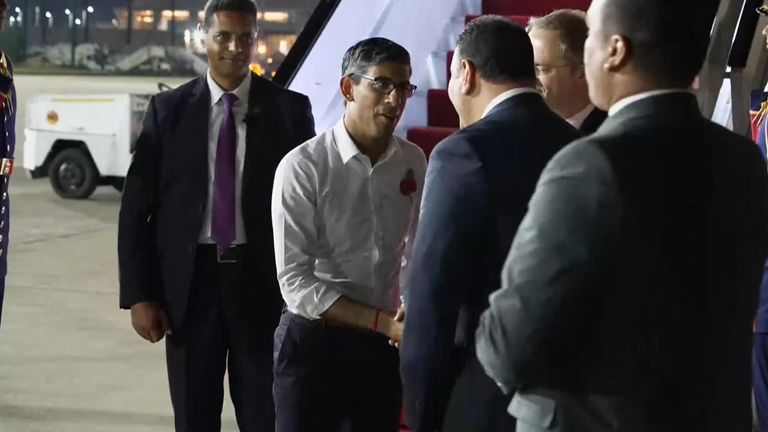
    PM arrives for COP27 in Egypt

    ‘Glad PM is here’

    Having originally said he would not attend due to “other pressing domestic commitments” back home – including preparing for the autumn statement on November 17 – Mr Sunak changed his position on Thursday, saying there is “no long-term prosperity without action on climate change”.

    Asked if he was concerned when Mr Sunak’s position was not to attend the climate conference, Mr Johnson added: “Look, the PM is here and I am glad he is here. He has made an outstanding speech the other day and I think he is on the right line.”

    Mr Johnson added that he supports what the government is doing back in the UK to help people facing rising bills.

    “In the short term of course you have to abate the cost, the impact for those who are feeling it – and that is why I support what the government is doing, what Rishi is doing, to help people through tough times,” he said.

    ‘People are struggling’

    But he reiterated his view that now is not the time for people to “go weak and wobbly on net zero”

    “People are struggling, people are hurting, they can feel the impact of the spike in energy prices. The answer is not to renew our addition to hydrocarbons, it’s to accelerate the adoption of green solutions,” Mr Johnson said.

    Ahead of the US midterm elections this week, Mr Johnson also noted that “it is very important for the rest of the world that America stays with the programme on climate change”.

    ather around the world, the former PM suggested that soaring temperatures back in July in the UK may have influenced the “unexpected political turmoil” in Westminster which saw him being ousted from Number 10.

    “Temperatures in London reached 40 degrees, which is unprecedented and unbearable, perhaps even contributing who knows to unexpected political turmoil that we saw in Westminster at that time,” he said.

    World leaders are attending the latest UN climate talks in Egypt amid tensions over who will pay for the damage caused by global warming.

    US President Joe Biden and French President Emmanuel Macron are among those others at the event.

    The climate summit will end on Friday 18 November.
  • Commonwealth head: ‘115 people dying every day as a result of climate change’

    Baroness Scotland, Secretary General of the Commonwealth, has told Sky News that “armageddon” is beckoning and 115 people are dying each day from the effects of climate change.

    She told Sky News that if we do not act, “we will not have a planet worth living on”.

    She said: “Just look at what’s happened in the last few months to countries like Bangladesh – 60% of the country under water.

    “Antonio Guterres (UN secretary general) talked about it as ‘monsoons on steroids’.

    “This was Armageddon. More than $40bn of damage. And you’ve got thousands of people affected and millions of people who are going to be now put in a position of real devastation and hunger.”

    Baroness Scotland went on: “All of us, all of humanity, has to be focused on this.

    “And if we have to drive everybody else to do that, which they must do, then we will.

    “But those of us who understand it have to speak out. We have to be able to say to everybody, this is everybody’s business and you can’t run away from it, because if you do, our whole humanity is at risk. This is about saving the planet.

    “We’ve got 115 people dying every single day as a result of climate change.

    “That is our reality.”

  • Just Stop Oil protesters scale motorway gantries, forcing parts of the M25 to close

    It comes after the Metropolitan Police “proactively” arrested Just Stop Oil protesters suspected of plotting an attack on UK highways.

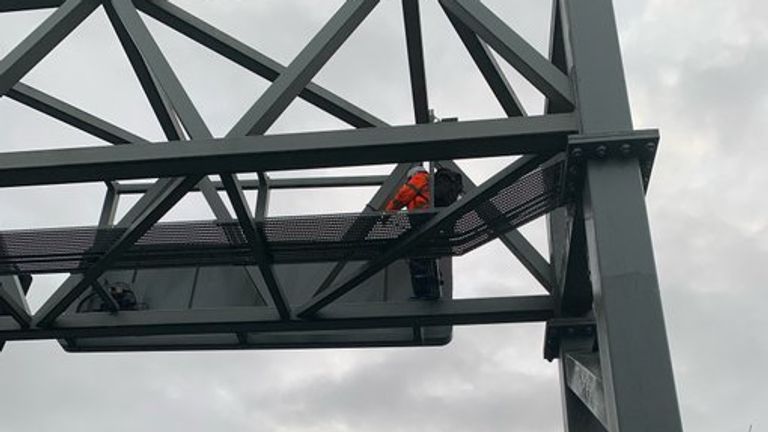
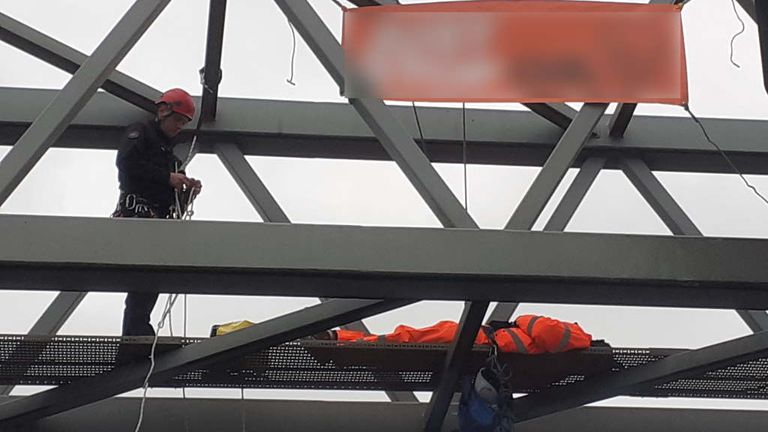
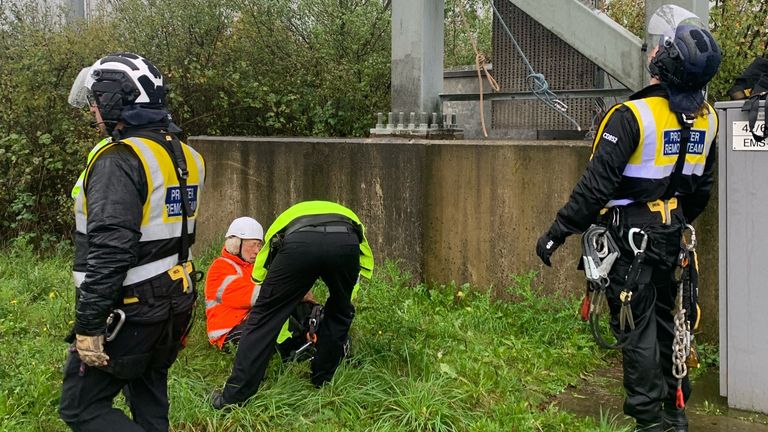
    Parts of the M25 were temporarily closed after Just Stop Oil protesters climbed overhead gantries and disrupted traffic on the major ring road that circles London.

    It comes after the Metropolitan Police “proactively” arrested campaigners suspected of plotting an attack on UK highways last night.

    Surrey Police stated that sections of the M25 were closed during the morning rush hour on Monday “for the safety of everyone” while officers removed activists.

    A protester is removed from an overhead gantry at J6 of the M25 motorway, London. Pic: Surrey Police
    Image: A protester is removed from an overhead gantry at J6 of the M25. Pics: Surrey Police
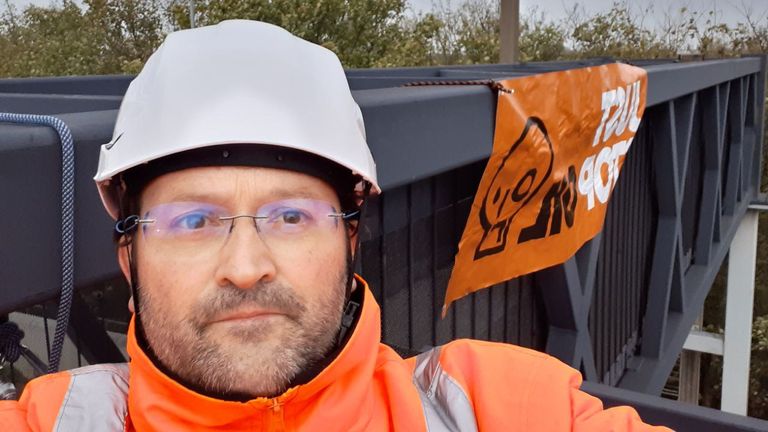
    Handout photo taken with permission from the twitter account @SurreyPolice of a Just Stop Oil protester who has climbed a gantry on the M25 between junctions six and seven in Surrey, leading to the closure of the motorway. Surrey Police said the decision was made to close the road "for the safety of everyone" while officers attempt to remove the activist. Picture date: Monday November 7, 2022.

    The force said it had received reports of protesters scaling gantries at several junctions along the M25 – including between junctions 6 and 7, and junctions 8 and 9.

    “We are here and dealing and will get this resolved as soon as possible,” it tweeted, adding activists had been removed from those sections of the motorway with traffic resuming.

    Officers were also attempting to remove an activist between junctions 9 and 10, with lanes reopening as soon as possible, it added.

    Handout photo issued by Just Stop Oil of a protester who has climbed a gantry on the M25 between junctions six and seven in Surrey, leading to the closure of the motorway. Surrey Police said the decision was made to close the road "for the safety of everyone" while officers attempt to remove the activist. Picture date: Monday November 7, 2022.
    Image: A protester on the M25 between junctions 6 and 7. Pic: Just Stop Oil

    A protester also targeted junction 30 of the motorway, with Essex Police urging the public “not to intervene”.

    “We are continuing to work to resolve the situation on the #M25 as quickly and safely as possible. Officers responded quickly this morning and have already made arrests,” the force tweeted.

    Meanwhile, Hertfordshire Police said it was dealing with similar action on the M25 at junctions 22 and 23.

    “Officers intercepted a group of protestors at junction 22, and several people were arrested,” it tweeted.

    “We remain at the scene, alongside specially trained Protest Removal Team officers, and a road closure has been put in place to allow them to deal with the incident as swiftly and safely as possible. Please avoid the area and seek an alternate route where possible.”

    A Just Stop Oil protester on an overhead gantry at J30 of the M25. Pic: Essex Police
    Image:A Just Stop Oil protester at J30 of the M25. Pic: Essex Police

    The Met had earlier said its “significant” operation had resulted in at least three people being detained, who the force had “strong reason to believe are intent on causing reckless and serious disruption to the public”.

    In a statement released late on Sunday, Assistant Commissioner Matt Twist said: “Acting on intelligence, this operation is fast-moving and will continue this evening and overnight with multiple arrest inquiries under way.

    “So far this evening we have made three arrests linked to this activity.

    “This is an evolving situation and we suspect the intent of these individuals is disproportionate to any legitimate right to protest and clearly crosses the line into unlawful activity.

    “Our investigation has strong reason to suspect the Just Stop Oil group intend to disrupt major motorway road networks which would risk serious harm to the public, with reckless action to obstruct the public on a large scale.”

    The suspects were arrested for allegedly conspiring to cause public nuisance, according to the Met Police.

    Mr Twist warned there “remains a possibility” that other suspects are “still intent on causing unlawful disruption to the public”.

    The Met has mobilised specialist teams and drawn police officers from across London to respond, he added.

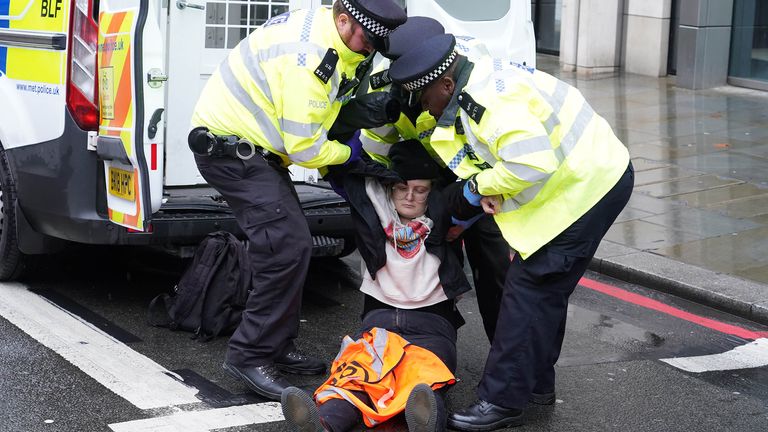
    Police officers deal with activists from Just Stop Oil during their protest outside Harrods department store in Knightbridge, London. Picture date: Thursday October 20, 2022.
    Image: File pic

    ‘Unreasonable disruption’

    “We are calling on the public to assist us,” Mr Twist said. “Remain vigilant – if you see something suspicious or witness an attempt to cause disruption call 999 immediately.

    “Operations like these come at a cost. Since the start of October we have used more than 10,000 officer shifts to police Just Stop Oil protests.

    “These are officers who would otherwise be dealing with issues that matter to local communities, such as knife crime, safeguarding and responding to burglaries.

    “We are determined to bring to justice all of those who conspire to cause significant and unreasonable disruption to London, or cause damage to buildings, property or valuables.

    “It’s what the public expects, and we’ll work closely with the Crown Prosecution Service and courts to make sure this happens.”

    Who are Just Stop Oil?

    National Highways has secured a High Court injunction to prevent Just Stop Oil protesters disrupting England’s busiest motorway.

    The court has granted a further injunction which aims to stop unlawful demonstrations on the M25, which encircles Greater London, in an attempt to end disruption to the busy road by the environmental group.

    It means that anyone entering the motorway and fixing themselves to any object or structure on it, and anyone assisting in such an act, can be held in contempt of court.

    They could face imprisonment, an unlimited fine, and the seizure of assets.

    Just Stop Oil have attracted widespread attention, and fierce criticism, in recent weeks for their stunts which have involved spraying orange paint on buildings and scaling a bridge to force the closure of the M25 Dartford Crossing.

    The climate change activists staged 32 days of disruption from the end of September and throughout October, which the Met said resulted in 677 arrests with 111 people charged.

    The protesters have been calling on the government to abandon plans to licence more than 100 new oil and gas projects by 2025, and to do more to help people with their skyrocketing energy bills.

  • The agony of not knowing, as Mariupol mass burial sites grow

    More than 1,500 new graves have been dug at a mass burial site near the southern Ukrainian city of Mariupol, according to an analysis of new satellite images carried out for the BBC.

    The site north-west of the city consists of a large field of graves that Ukrainian officials and witnesses say contains thousands of bodies.

    Mariupol, a port city close to the border with Russia, was a major strategic target for the Russians. From the start of the war it was pounded relentlessly from the air and from the ground. By the time it fell to the Russians in May, thousands of civilians had died and much of the city had been destroyed.

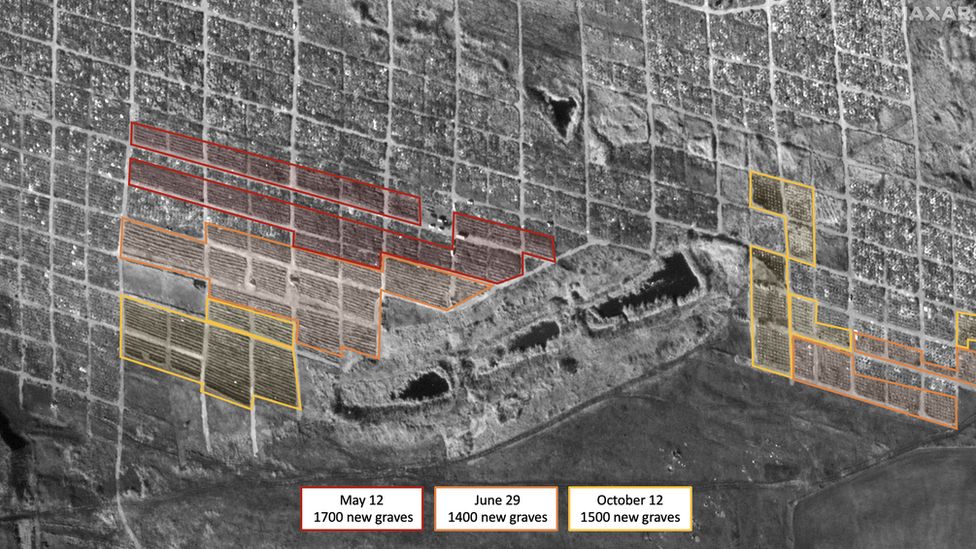
    Recent satellite images from Maxar show that three mass burial sites near Mariupol located at Staryi Krym, Manhush and Vynohradne, have been steadily growing since the Spring.

    The Centre for Information Resilience analysed the images of Staryi Krym for the BBC’s Panorama programme and concluded that 1,500 new graves had been dug there since it last analysed images at the site in June. It now estimates that more than 4,600 graves have been dug there since the beginning of the war, although it says it cannot know how many bodies are buried at the site.

    Ukrainian officials now believe that at least 25,000 people were killed in the fighting in Mariupol, and that 5,000-7,000 of them died under the rubble after their homes were bombed.

    Witnesses in Mariupol have told the BBC that they have seen the Russian authorities removing bodies from the rubble of destroyed buildings in the city over recent months and taking them away for burial.

    Stari Krym
    IMAGE SOURCE,MAXAR/CIR Image caption, Analysis of the mass burial site shows how it has grown since May

    Olga Sagirova’s harrowing story is a glimpse into what so many in Mariupol went through. She was the only person inside her house to survive when it was bombed by the Russians. Her husband and parents were killed, and like many who have now escaped the city, she doesn’t know where their bodies are.

    The 48-year-old accountant lived with her husband Valery in a two-storey house with a landscaped garden, in a residential neighbourhood of Mariupol. Her two adult children lived elsewhere.

    It had been fairly quiet in her area in early March, despite the intense shelling in other parts of the city. Nonetheless, each night she and her husband would sleep in the cellar. “I used to cry all the time, my husband tried to reassure me,” said Olga. “He said I shouldn’t worry, that we’d get through this.”

    On the evening of 10 March, the 15th day of the Russian bombardment, there was a knock at the door. Olga’s parents, who were in their 80s, were standing there looking very shaken.

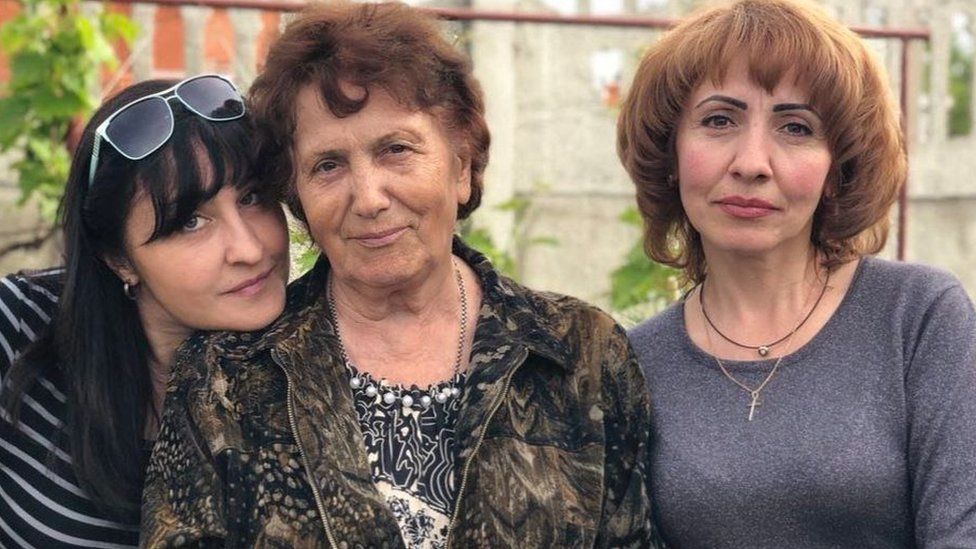
    Olga with her mother and sister
    Image caption, Olga Sagirova (L) with her mother and sister, whose bodies – like thousands in Mariupol – are unaccounted for

    Their house had just been shelled and was on fire. Olga brought them in and urged them to sleep down in her cellar with her. But they didn’t want to, so she gave them a bedroom in the main house.

    At about 22:30 Valery went upstairs from the cellar because the shelling had quietened down and he wanted to get some rest. But he reassured Olga, saying he would return if anything happened.

    At 03:30 she woke up and heard the sound of a plane. Suddenly the entire house came down on top of her.

    “It just all happened in a split second. Everything was falling down on me,” she said.

    “My legs were half-buried, so I couldn’t even move. When my hearing slowly returned, I could hear my husband’s voice somewhere: ‘Olga, help me, dig me out,’ he said. ‘I’m near the stairs’.”

    Olga could see Valery only six feet away but she could not reach him. He was buried more deeply than her.

    All she could do was to keep talking with him. “After a while, I heard him wheezing,” she said. “Then he was silent.”

    Alone in the darkness, Olga tried to scream but no-one heard her. Eventually, she saw a torch moving towards her. It was her neighbours, who tried to free her from the rubble. Unable to do so, they said they would return at sunrise.

    Olga was alone again, with her husband, who had spoken his last words, buried in the rubble near her.

    Hours under the rubble

    As dawn broke, Olga began to make out her surroundings. When she looked up she saw a concrete slab – tilted and threatening to fall on her.

    “I knew that nothing mattered any more. I was dying,” she says. At that point, she says, she tried to take her own life.

    Eventually her neighbours came back with others and they tried to dig her out. They managed to dislodge one of Olga’s legs. But one of the concrete slabs was pressing down on the other one.

    For six more agonising hours they tried to free her right leg. Finally they decided to wrap a cable around Olga’s leg and pull it hard.

    “I was really scared that they couldn’t get my leg out and I would be left without a leg,” she says.

    After three attempts, Olga was freed. Both of her legs were broken in multiple places and she was unable to walk for almost five months. “My right leg was totally smashed,” she said.

    That night Olga lost not only her husband, but her parents, who had been sleeping in the main area of the house when it was pulverised.

    But her ordeal was not over yet.

    While Olga was being cared for in a nearby cellar in Mariupol she received more devastating news.

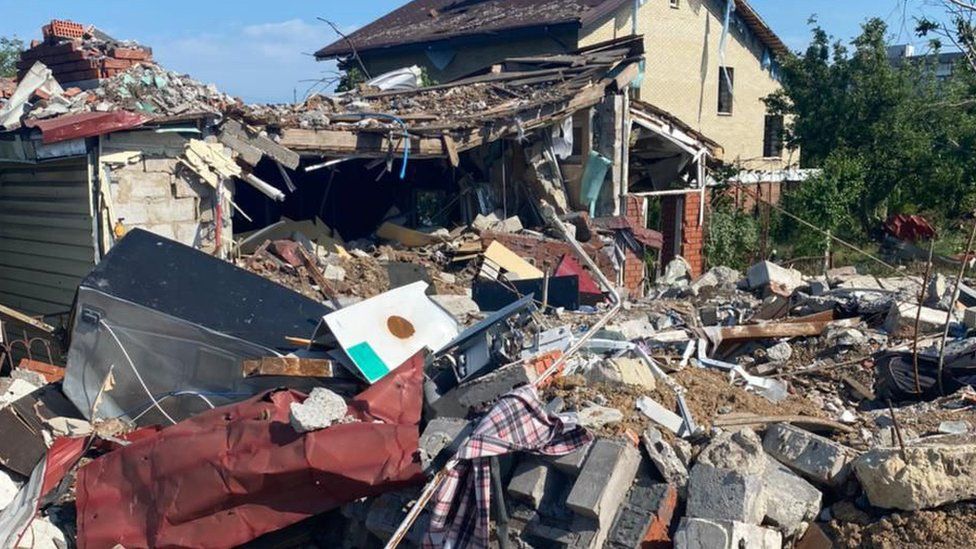
    Destroyed homes
    Image caption, An estimated 90% of the buildings destroyed were residential

    Her sister and brother-in-law had also been killed in their home three days earlier.

    “They were sitting in their garden drinking coffee when the bomb struck,” Olga said.

    “I lost five of my closest people in a few days.”

    When I met Olga, she was living in Huizen near Amsterdam, safe with her two grown-up children. She can now walk again, after months of needing to use a wheelchair.

    She is learning English and loves to walk and look at the flowers and gardens that remind her of home.

    She is a warm, elegant and softly spoken woman with a deeply friendly smile. Olga told me she is glad to be alive and believes she was fated to live.

    When I texted her the other day to wish her a happy birthday, she replied: “No matter what, life goes on and I have an understanding that I must live!”

    She had spent much of the day in tears.

    Until mid-summer she had forced herself to stay awake until the early hours of the morning to stave off the nightmares in which she relived the horror. She scrolls endlessly through pictures of her former life and says she has not yet fully absorbed what has happened to her.

    In her two adult children she sees her husband. She misses Valery so deeply that she can hardly bear it. They used to swim together, have parties once a week, and now Olga lives in a small flat in a foreign country.

    Olga has been unable to get information about the bodies of her family, but suspects they are still buried beneath the rubble of her house.

    Russians are in control of the city now, but Olga was told this summer that one body could be seen stuck in the ruins of her old home.

    The gravedigger

    Olga is just one of many people from Mariupol who cannot find the bodies of their missing relatives.

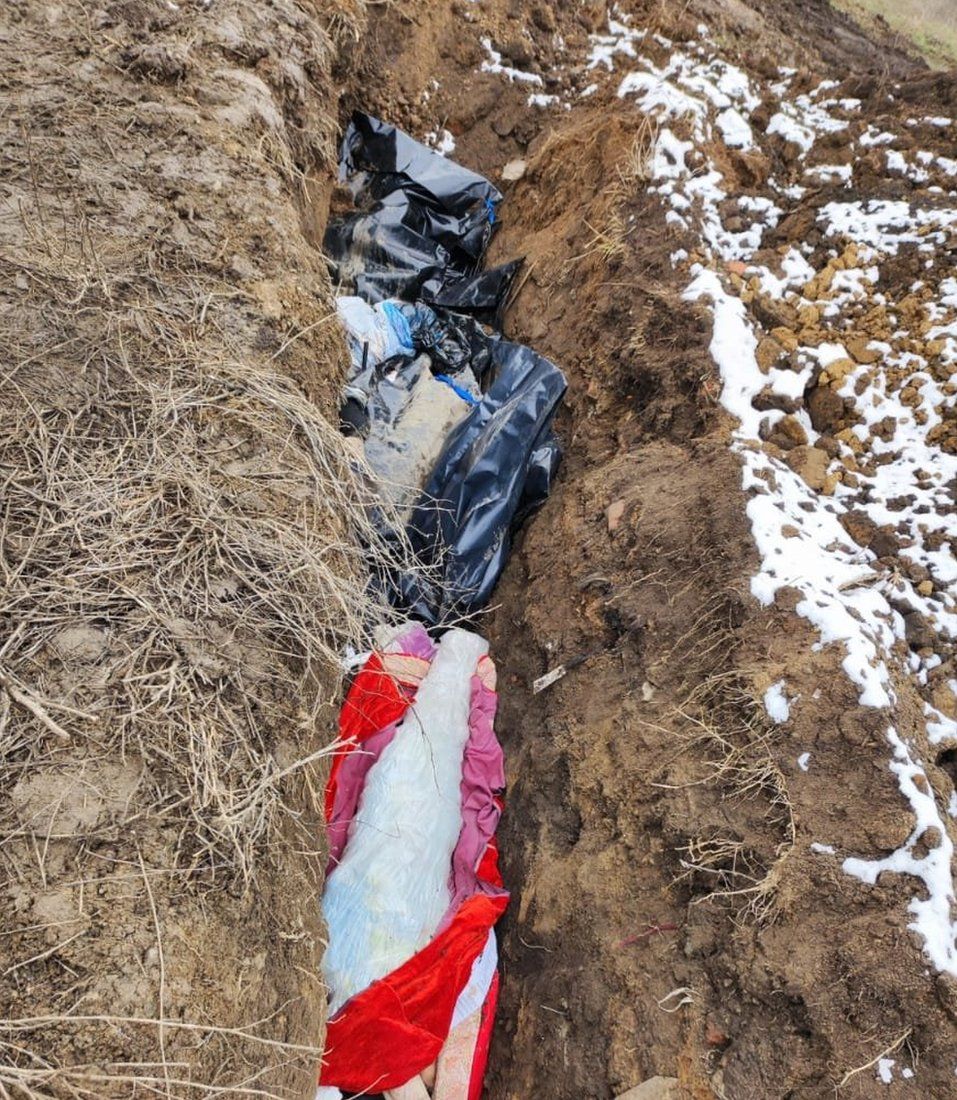
    Some were buried in mass graves in the centre of Mariupol, dug by Ukrainians who braved the shelling to retrieve corpses that were lying in the streets and in homes.

    In early March, Vaagn Mnatsakanian, a local ecologist, had been trying to find a place to bury his father who had been killed in the fighting. Vaagn found to his disgust that the mortuaries were full.

    He went to the local authorities to ask where he could bury his father and – realising how many others were in the same situation – volunteered to start organising emergency burials.

    He began to arrange teams of other locals to dig three mass grave sites in the centre of the city for the Ukrainian municipal authorities. For five days in March he and his team collected bodies from around Mariupol, under intense shelling.

    Old central cemetery in March 2022
    Image caption, Vaagan’s team dug mass graves at a site known as Old Cemetery in March

    The bodies were hurriedly slid into the trenches, often without body bags. “On some terrible days we were told there were over 100 bodies – sometimes 150 bodies – that needed collecting that day,” he said. “There were so many that we couldn’t collect them all.

    “One day a shell flew towards me and I had to jump into the mass grave for cover. I found myself near the corpses, but I was glad to be alive,” said Vaagn.

    Searching for my son

    Tatyana, who lost her son in the fighting, had been desperate to find him and this summer visited a mass burial site at Vynohradne near Mariupol looking for him.

    She says she doesn’t know what happened to 26-year-old Yaroslav, who loved cars and dreamed of owning his own business.

    But she says she was told that he was killed by a sniper.

    “If he is not alive, we want to bury him humanely,” she said.

    “We counted over 800 fresh graves [at Vynohradne],” said Tatyana, who prefers not to use her surname. Many people from the Russian-controlled city do not want to speak openly about mass burials, for fear of reprisals by the new authorities.

    She took a photograph of the site at Vynohradne. Many graves at the site are marked with small placards bearing numbers and gender, but not names. “Most of the bodies are unidentified,” she said.

    Others the BBC spoke to visited makeshift mortuaries in Mariupol to try to find their loved ones this summer, and had to look through scores of bodies lying outside on the ground unrefrigerated.

    “People should know the truth about these horrors,” said Tatyana, “so that it will never happen again”.

    Source: BBC.com

  • Elon Musk: Twitter will ban unlabelled parody accounts

    Elon Musk has stated that Twitter users who engage in impersonation without clearly identifying themselves as a parody account will be permanently suspended.

    Twitter had previously issued a warning before suspending accounts, but he announced that there would now be no warning.

    A number of accounts that changed their names to Elon Musk and mocked the billionaire have already been suspended or blocked.

    Late last month, Twitter’s new billionaire owner took over the company.

    He laid off roughly half of the company’s employees at the end of last week.

    He has also confirmed plans to allow users to buy blue-tick, verified status.

    Detailing the new policy on parody accounts, Mr Musk tweeted: “Previously, we issued a warning before suspension, but now that we are rolling out widespread verification, there will be no warning.”

    He added that “any name change at all will cause temporary loss of verified checkmark”.

    The BBC is not responsible for the content of external sites. View original tweet on Twitter

    Several accounts that had changed their name to the new Twitter owner have been suspended or placed behind a warning sign, including those of US comedian Kathy Griffin and former NFL player Chris Kluwe.

    Other accounts, including one parodying former US President Donald Trump by comedian Tim Heidecker, are yet to be suspended.

    Mr Musk has previously said he opposed permanent bans on Twitter, including that of Mr Trump’s official account. Mr Musk said last week that banned accounts would not be reinstated until there was “a clear process for doing so”. He pointed out that he was not banning an account that followed his private plane.

    The New York Times reported on Sunday that Twitter was delaying the rollout of verification check marks to subscribers of its new service until after Tuesday’s US midterm elections. At the weekend, the social media site’s website app began offering an update that will charge $8 (£7) a month for its blue, verified checkmark.

    On Friday, the billionaire said Twitter was losing more than $4m per day, insisting that this gave him “no choice” over culling around half the company’s 7,500-strong workforce.

    The cuts – as well as Mr Musk’s fierce advocacy of free speech – have caused speculation that Twitter could water down its efforts on content moderation.

    However, Mr Musk has insisted that the firm’s stance towards harmful material remains “absolutely unchanged”. UN human rights chief Volker Turk wrote him an open letter, warning that Twitter had a responsibility to avoid amplifying harmful content.

  • Apple: iPhone shipments delayed due to China Covid lockdown

    Do you want to buy the new iPhone 14 Pro or iPhone Pro Max? Apple says you can expect longer wait times for new products.

    The tech behemoth announced that its Chinese assembly plant is now operating at a significantly reduced capacity.

    On November 2, officials shut down a district that houses Foxconn’s iPhone factory, the world’s largest, for seven days.

    Apple’s announcement comes as China reaffirms its commitment to zero Covid.

    “As we have done throughout the COVID-19 pandemic, we are prioritising the health and safety of the workers in our supply chain,” said a statement from Apple, which launched its new iPhone line in September.

    “We continue to see strong demand for iPhone 14 Pro and iPhone 14 Pro Max models. However, we now expect lower iPhone 14 Pro and iPhone 14 Pro Max shipments than we previously anticipated and customers will experience longer wait times to receive their new products.”


    The announcement will likely disappoint investors who were hoping China would lift its Covid restrictions in the near future. Chinese stock markets rose sharply on Friday on the back of rumours of an end to Covid lockdowns.

    Beijing’s unyielding approach to arresting the spread of the virus has come at a huge economic cost. But the country’s leader Xi Jinping, who has personally endorsed the policy, has given no indication that it will ease soon.

    The latest figures show the world’s second-largest economy struggling to cope with prolonged challenges posed by persistent Covid restrictions, a property slump and the risk of a global recession.

    China trade figures released on Monday showed its imports and exports contracted unexpectedly in October. It is the first slump since May 2020. Outbound shipments for the month dropped 0.3% from a year earlier which is in stark contrast to a 5.7% gain in September. It was the worst performance since May 2020.

    The country reported 5,643 new Covid infections on Sunday, its highest daily tally in six months. Zhengzhou, where the Foxconn factory is located, is the capital of Henan province in central China and is home to about 10 million people. It recorded 3,683 cases and 22 deaths on Monday.

    Cases were also detected inside the factory, prompting a sudden shutdown that led to workers fleeing the premises. On Monday, the company started a recruitment drive at its Zhengzhou plant. It is offering workers who left the plant between 10 October and 5 November a one-time bonus of 500 yuan (US$69; GBP£60.88) if they return to work.

    It is also offering a pay increase of 30 yuan an hour, according to a statement posted on its recruitment WeChat account.

    Foxconn, the world’s largest contract electronic maker, has revised down its fourth quarter outlook due to China’s Covid control measures. The fourth quarter is usually a busy time for the tech company as demand for electronics rises ahead of the year-end holiday season in the West.

    The Taiwan-based company said they are working with the Henan provincial government “to stamp out the pandemic and resume production to its full capacity as quickly as possible”.

    Foxconn, formally known as Hon Hai Precision Industry, accounts for 70% of iPhone shipments globally.

  • Kenya Airways warns pilots as strike continues

    Kenya’s national carrier, Kenya Airways, has threatened to start disciplinary action against its pilots whose strike has entered its third day.

    The airline has maintained that the strike is unlawful, a position that has been backed by government officials who say the actions of the 400 pilots amount to economic sabotage.

    The national carrier says it cancelled 56 flights over the weekend, affecting some 12,000 passengers.

    Export and importation of cargo such as fresh produce and pharmaceutical products has also been affected.

    The airline now warns that the window for negotiation is closing, and the pilots involved in the strike could face dismissal or legal proceedings.

    The labour ministry on Sunday said the airline was at liberty to take necessary lawful measures against its pilots.

    The government, which is the biggest shareholder at Kenya Airways, said it had invested nearly $500m (£442m) to keep the carrier afloat in the last three years.

    The pilots say the strike is still in full force until their demands are met.

    The want the airline to reinstate contributions to their retirement fund, as well as top managers including the CEO to be fired with immediate effect among other grievances.

    The parties are due to appear in court on Tuesday after the airline acquired an injunction days to the strike.

    Source: BBC

  • Bank of Ghana could not provide importers nearly $80m to import goods – MP alleges

    The Member of Parliament (MP) for Bolgatanga Central, Dr. Isaac Adongo, has alleged that the Bank of Ghana (BoG) could not provide all the foreign exchange needs of importers at the October 2022 forex auction.

    According to him, the importers needed more than $104 million to be able to import goods into the country, but the BoG could only provide $25 million.

    In a statement he issued, which was sighted by GhanaWeb, the MP said that the country has to now rely on the black market (Abochi), which the government has barred from operating.

    He added that because ‘Abochi’ are now in hiding they are now going to sell the dollar at far higher exchange rates.

    “BoG Notice number: NO.BG/FMD/2022/86, dated, 18th day of October 2022, the market required a whopping amount of $104,750,000 for their imports. Unfortunately, BoG could only provide $25m at the auction.

    “There is a shortfall of nearly $80m. It is therefore obvious that Abochi, the strategic partner, will have to step in to provide the bulk of the dollars ($80m) to make the system work.

    “Yet Dr Bawumia has set the security to chase this his partner into hiding. Guess what, Abochi, the strategic partner is smart. He is adding ‘hiding fees’ and ‘running away from security cost’ to the existing rate,” parts of the statement read.

    Source: Ghanaweb

  • Akufo-Addo interacting with NUGS president Dennis Appiah Larbi-Ampofo (third from left)

    The leadership of the National Union of Ghana Students(NUGS) has appealed to President Nana Akufo-Addo to increase the National Service Allowance from GHS 559 to GH¢800, especially in the face of the rising cost of transportation and general expenses.

    The student body has also requested the President to direct that the increment of all School and Accommodation fees by Public Tertiary Institutions should be halted for 2022/2023 academic year, as a way of cushioning the Tertiary students in these hard times.

    NUGS believes this is a bold and practical step towards mitigating the challenges of our students.

    These appeals were made when NUGS led by its President Dennis Appiah Larbi-Ampofo met the President at the Jubilee House on the 3rd of November, 2022, in line with the President’s engagement and consultation over the country’s current economic situation.

    The meeting was aimed at taking input from the union in the management of the current economic crisis and also rallying the student front to understand the issues that confront the country.

    NUGS in a statement issued after the meeting said: “We believe that the Student Loan Trust Fund should as a matter of urgency receive funding and right budgetary support to ensure that vulnerable students receive their loan disbursement as soon as possible. The fund has arrears from the first semester and non-payment for the whole of the second semester.

    “We also indicated to the President the pressing nature of the unpaid scholarships to students. In general, we requested that more room should be afforded to the union in further discussions throughout these times and towards the Economic Management’s work, the team at the secretariat will be developing a comprehensive input to be submitted in that regard,”

    The statement added: “It is the sincere belief of the leadership of the union that these times deserve the support of all young people and we are willing to support our country but just as we mentioned to His Excellency the President, the call and rallying of young people to support should be met with some commitments from the government as that indicates the will to support young people.”

    Source: Ghanaweb

  • Iran’s security forces and state media cover up the death of a protester – source

    BBC Persian has announced that , Iranian security forces are collaborating with state media to falsely claim that a killed protester was a loyalist Basij militiaman.

    Milad Ostad-Hashem, 37, was shot in the back with a live round on September 25 in Tehran, according to his death certificate.

    According to a close source, his family claimed that security forces fired it.

    However, security officials pressed them to believe state media reports that he was a Basij member killed by “rioters,” according to the source.

    “Security forces threatened to kill their [Milad’s parents] two other sons and bury Milad’s body secretly in a remote place if they did not co-operate,” the source said.

    The family finally agreed to the officials’ demands because of Milad’s eight-year-old daughter.

    “They wanted her to know where her father’s grave is,” the source said, adding that she still thought Milad would come back.

    The family were also forced to pay almost $700 (£630) for the cost of the bullet that was used to kill their son, according to the source.

    Milad was shot as he rode a motorbike after taking part in protests in the capital.

    CCTV footage obtained by BBC Persian shows the immediate moments after he was hit. He is seen pulling over and vomiting blood before falling down.

    Another video recorded by eyewitnesses shows passers-by checking Milad for signs of life but then saying that he has already passed away. His body is seen covered in blood.

    “The bullet entered his lungs,” the source said.

    However, state TV offered a very different narrative.

    It described Milad as a member of the Basij, a notoriousmilitia that has been involved in the deadly crackdown by authorities aimed at suppressing the anti-government protests that have swept the country.

    The government’s official newspaper and news agencies linked to Revolutionary Guards, which controls the Basij, published a picture of Milad performing religious rituals and described him as a “martyr”.

    Photo showing Milad Ostad-Hashem taking part in a religious ritual
    Image caption, Milad took part in religious rituals, loved hip-hop and hated the regime, a source said

    The source said: “He took part in religious rituals, but he also loved hip-hop music and hated this regime.”

    On the day of Milad’s funeral, the source added, the cemetery was packed with members of the Basij in order to help state TV keep up the pretence that he had been one of them.

    BBC Persian has found authorities put similar pressure on the families of other slain protesters.

    Security forces killed Abolfazl Adinezadeh, 17, by firing a shotgun at him at point-blank range in the city of Mashhad on 8 October, a source close to his family said.

    The source said the family was pressured to say he was a Basij member, but that they refused to do so.

    The family of Erfan Rezai, 21, who security forces allegedly shot with a pistol at close range in Amol on 21 September, was meanwhile pressured to say he was a bystander killed by “rioters”, sources close to them told BBC Persian.

    Shortly before his death, he had been filmed tearing down a government poster showing the supreme leader, a source said.

  • Minister: Kenya’s drought killed 205 elephants in 10 months

    East Africa is experiencing its worst drought in 40 years, and Kenyan wildlife is suffering as well.Drought killed 205 elephants and numerous other wildlife in Kenya between February and October, according to tourism minister Peninah Malonza, as much of East Africa experiences its worst drought in 40 years.

    Although sporadic rain has begun in the region, Kenya’s meteorological department predicts below-average rainfall for much of the country in the coming months, raising concerns that the threat to Kenya’s wildlife is not over.

    “The drought has caused mortality of wildlife … because of the depletion of food resources as well as water shortages,” Malonza, the cabinet secretary for the Ministry of Tourism, Wildlife and Heritage, told a news conference.

    Fourteen species have been affected by the drought, she said.

    In addition to the dead elephants, 512 wildebeest, 381 common zebra, 12 giraffes, and 51 buffalo have also succumbed to the drought over the same period – some in the national parks that are a major tourist draw for the country.

    There have also been 49 deaths of the rare and endangered Grevy’s zebra.

    In September, conservation group Grevy’s Zebra Trust said that 40 Grevy’s had died in just a three-month period because of the drought, representing nearly 2 percent of the species’ population.

    The figures released on Friday are likely far from comprehensive, the ministry warned in a report, saying carnivores could have devoured some carcasses.

    “Thus, there is a possibility of higher mortality,” the report said.

    News of the toll on wildlife in Kenya, where tourism contributes about 10 percent of economic output and employs over 2 million people, comes just days before the start of the UN climate conference, COP27.

    Egypt, the conference host, has made the issue of “loss and damage”, compensation for losses from climate-related disasters, a focus of the talks. The issue has never been part of the UN talks’ formal agenda, despite being debated for years, as wealthy countries have resisted creating a funding mechanism that could suggest liability for historic climate damages.

    The areas most affected by the drought are to the north and south of Kenya, home to the bulk of Kenya’s elephant population.

    Last month, the charity Save the Elephants said one famed calf, well-known for being a twin, a rarity for elephants, died during the drought.

    The ministry recommended providing vulnerable wildlife groups with water, salt licks, and food and to increase monitoring and data collection.

  • Far-right France MP De Fournas suspended for yelling “Back to Africa!”

    Grégoire de Fournas will be suspended in addition to losing half of his parliamentary allowance for two months.

    The National Assembly of France has banned a far-right MP for 15 days for yelling “they should go back to Africa” as a black colleague discussed immigration.

    According to Grégoire de Fournas of National Rally (RN), his remark was not directed at Carlos Martens Bilongo, but rather at migrants attempting to reach Europe by sea.

    Mr. Bilongo stated that he was born in France and that the remark was “shameful.”

    MPs voted on Friday to suspend him and dock half his allowance.

    The decision is described as the harshest sanction available to the Assembly.

    Mr Bilongo had been questioning the government about a request by the SOS Méditerranée non-governmental organisation for help in finding a port for 234 migrants rescued at sea in recent days.

    The exact meaning of the National Rally MP’s remark is disputed, because theoretically he could have referred to more than one person. The official account of the session recorded his off-microphone remark as Qu’il retourne en Afrique – “he should go back to Africa” – but the plural Qu’ils retournent en Afrique sounds exactly the same.

    When Mr de Fournas made his remark, the Speaker, Yaël Braun-Pivet, demanded to know who had spoken. Then, as MPs chanted “Out! Out! Out!”, she suspended the session, declaring, “This is not possible.”

    Mr Bilongo, an MP from the the left-wing party France Unbowed (LFI), said: “Today it’s come back to the colour of my skin. I was born in France, I am a French MP.” Prime Minister Elisabeth Borne said there was “no room for racism” and Interior Minister Gérald Darmanin said the MP should resign.

    Mr de Fournas was adamant he had been referring to the “boat transporting migrants to Europe”, and party leader Marine Le Pen accused her political opponents of fabricating a vulgar outcry.

    He later apologised to Mr Bilongo for “the misunderstanding” his comments had caused and if he had been hurt by them.

    LFI leader Jean-Luc Mélenchon tweeted that the MP’s comments were “beyond intolerable” and he should be kicked out of the National Assembly.

    Immigration featured prominently in the RN’s presidential and parliamentary election campaigns this year, with party leader Marine Le Pen proposing a referendum on major reductions in immigration if she became president.

    In the parliamentary election in June, the party increased its presence in the National Assembly tenfold, winning 89 seats.

  • United States has announced an additional $400 million in aid for Ukraine

    The United States has announced an additional $400m of military aid for Ukraine, including paying for the refurbishment of 45 Czech T-72 tanks to be sent to Kyiv.

    Deputy Pentagon Press Secretary Sabrina Singh said she did not have an exact timeline for the supply of the tanks but expected the first units to be delivered before the end of the year.

    She acknowledged that T-72s are “Soviet-era tanks” and were chosen because the Ukrainians had already been trained on them, rather than sending other, more modern tank systems.

    Source: Aljazeera.com 

  • Will Ferrell plays Buddy the Elf in Asda’s Christmas commercial

    Will Ferrell brings Christmas to Asda with a remastered version of his classic 2003 Elf performance, while Lidl’s deadpan teddy bear encourages us all to think about what truly matters this Christmas and donate toys to children in need.

    It’s that time of year again, and as the Christmas commercials begin to air, Asda has landed a big Hollywood star for their festive offering.

    Will Ferrell plays Buddy the Elf, a trial day in the store in the run-up to Christmas, using classic footage from the 2003 film.

    The 90-second commercial features Buddy dodging trolley disasters, gobbling pigs in blankets, and singing over the store tannoy system, with plenty of nods to the original film.

     Will Ferrell appears in the Asda advertPic:Asda
    Image:The first mince pie of the season. Pic: Asda

    Despite decorating the supermarket in fairly lights, renaming the self-checkout “elf-checkout” and falling into a Christmas tree, Buddy gets the job.

    The ad ends with the tag line, “Have your Elf a Merry Christmas”.

    If you’re wondering, Farrell didn’t actually prance his way around the store in real life – instead a process called rotoscoping was used to take Buddy out of the original film and place him into newly filmed scenes in the supermarket.

    The advert was shot by multi-award-winning director Danny Kleinman who has designed every

    title sequence for the James Bond movies since GoldenEye in 1995, except for Quantum of Solace.

    He’s also directed music videos for stars including Madonna, Fleetwood Mac, and Adam Ant.

    Asda’s advert premieres on Friday 4 November at 8.45pm on ITV during Coronation Street and has already been released online.

    An expression-less bear who delivers a message about what is actually important at Christmas. Pic: Lidl
    Image:An expression-less bear who delivers a message about what is actually important at Christmas. Pic: Lidl

    Lidl will also be premiering their Xmas advert in the same break, featuring a deadpan teddy bear who becomes an unlikely global celebrity.

    Refreshingly, the supermarket won’t be selling the Lidl Bear in their stores, instead using it as the inspiration for their Christmas charitable drive – Lidl Bear’s Toy Bank – which encourages customers to donate unwrapped toys and games which will be given to children across the UK through the Neighbourly community network.

    Sainsbury's launches Christmas advert starring Alison Hammond. Pic: Sainsbury's
    Image:Sainsbury’s launches Christmas advert starring Alison Hammond. Pic: Sainsbury’s


    Meanwhile, Sainsbury’s too will be squeezing into the same Coronation Street slot, with This Morning presenter Alison Hammond starring as a medieval countess who doesn’t like Christmas puddings.

    And M&S reunites comedians Dawn French and Jennifer Saunders, playing Fairy and her new pal Duckie in their advert, which reimagines the fairy at the top of the Christmas tree.

    The long-awaited John Lewis Christmas advert – which has become something of a national obsession in recent years – is expected to come out next week, although formal timings are yet to be released.

  • Moscow-installed authorities in Kherson appear to backtrack on curfew announcement

    Moscow-installed authorities in occupied Kherson appear to have backtracked shortly after declaring a “round-the-clock curfew” as a Ukrainian counteroffensive nears the southern city.

    “In the city of Kherson there are absolutely no restrictions that would limit the life of the city,” Kirill Stremousov, the Russia-backed deputy governor of the Kherson region, said on Telegram.

    Stremousov’s remarks came about an hour after he posted a video announcing the curfew on the same channel.

    Source: Aljazeera.com

  • Imran Khan: Former Pakistan Prime Minister says he was shot four times and reveals the extent of his injuries

    A doctor in the room described his injuries as being hit “on the right thigh [with] two bullets” and “on the left thigh two bullets,” adding that his “left tibia was fractured.”

    In an address to the nation, former Pakistan Prime Minister Imran Khan revealed details of his attack after being shot during a rally.

    Mr Khan claimed he was shot four times during a protest march in Pakistan on Thursday, with two bullets striking each of his legs.

    A doctor in the room described his injuries as being hit “on the right thigh [with] two bullets” and “on the left thigh two bullets,” adding that his “left tibia was fractured.”

    The doctor said there was a fracture on Mr Khan’s right leg and near the main artery there were some bullet fragments.

    “If it was hit there, there would have been a lot of bleeding,” he said.

    “We took these four bullet fragments out but they did not touch any major structures.”

    He added: “Once I recover, I will once again come onto the streets.”

    Mr Khan said two shooters tried to assassinate him and they killed one person and injured 11 others.
    He said three people had devised the plan to assassinate him, but gave no names and provided no evidence for his allegations.

    The former prime minister gave an interview to Sky News two hours before he was shot in which he said he was hopeful there would not be violence during his march across the country.

    Asked if the prospect of violence worried him, he said: “I’ve been on the road for six months now, what I’ve seen I’m confident that I will be able to direct it through elections. I will be able to direct this through elections and bring about a change. But the other possibility is, you would not want it to go the other way.”

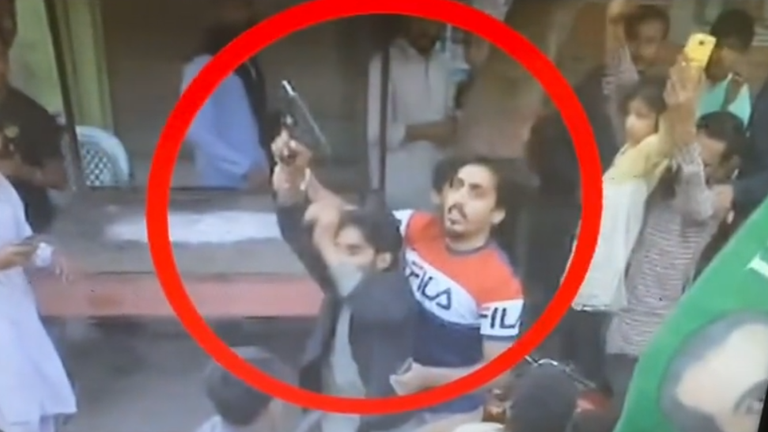
    Footage from the scene captured what local media is citing as the gunman, who appeared to escape as members of the public tried to take the weapon off him.

    Police are questioning the alleged attacker, who appeared in a video saying he carried out the shooting and acted alone.

    Image:Local media is citing the man pictured (C) as the suspected gunman

    The cricketing hero-turned-politician – who has been calling for new elections since he was ousted from power in April – has been delivering impassioned speeches at gatherings across the country.

    He was six days into a march from Lahore to Islamabad in his push for radical change when the shooting took place.

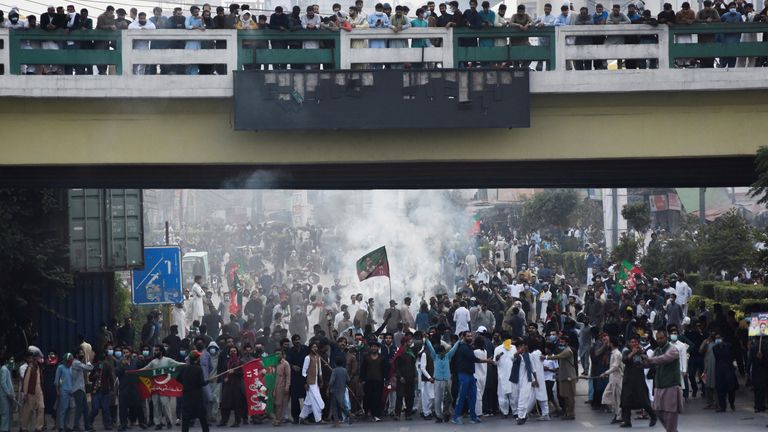
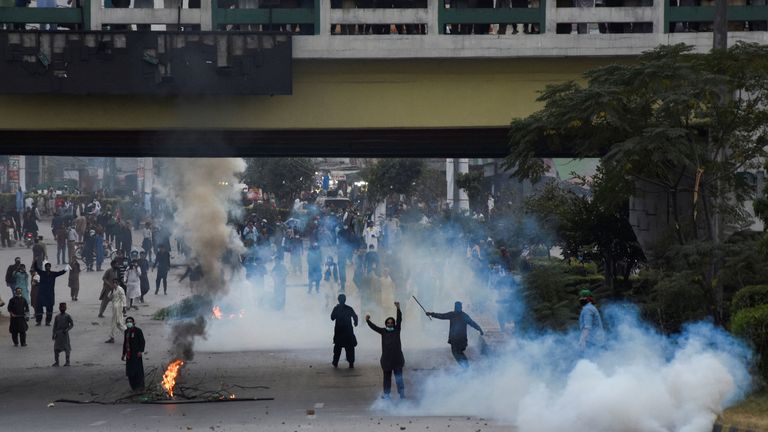
    Following the shooting, Mr Khan’s supporters staged nationwide protests, blocking key roads in major cities and sometimes clashing with police.

    His party has called for the protests to continue until its demand for political change in Pakistan is met.

    “Today, after Friday prayers, there will be protests across the country, which will continue until Imran Khan’s demand is met,” Asad Umar, a close aide of Mr Khan, tweeted.

    People react as they protest amid tear gas smokes used to disperse them during a protest to condemn the shooting incident on a long march held by Pakistan's former Prime Minister Imran Khan in Wazirabad, in Rawalpindi, Pakistan November 4, 2022. REUTERS/Waseem Khan NO RESALES. NO ARCHIVES.
    People react as police use tear gas to disperse them during a protest to condemn the shooting incident on a long march held by Pakistan's former Prime Minister Imran Khan in Wazirabad, in Rawalpindi, Pakistan November 4, 2022. REUTERS/Waseem Khan NO RESALES. NO ARCHIVES.

    Prime Minister Shehbaz Sharif, Mr Khan’s successor, condemned the shooting and has ordered an immediate investigation.

  • Train strikes set to start this weekend suspended

    A series of strikes due to take place from Saturday have been suspended, the RMT union has said.

    In a potential breakthrough, RMT said it would enter a “period of intensive negotiations” with Network Rail and rail operators.

    Three days of industrial action had been set to start, with strikes also planned for Monday and Wednesday.

    It follows months of back-and-forth between the two sides in a row over jobs, pay and conditions.

  • South Korea scrambles warplanes after detecting 180 North Korean aircraft

    South Korea mobilized 80 military aircraft in response to the large presence of North Korean fighters and bombers.

    South Korea scrambled 80 military aircraft, including advanced F-35 fighter jets, after detecting 180 North Korean warplanes flying within North Korean territory – the nuclear-armed country’s latest defiant show of military strength.

    The Joint Chiefs of Staff (JCS) of South Korea said on Friday that North Korean warplanes were detected in various areas inland as well as along the country’s eastern and western coasts, but they did not fly particularly close to the inter-Korean border.

    None of those planes breached the South Korean military’s virtual “tactical action” line, which is designated to be located 20-50km (12-31 miles) north of the two countries’ land and sea boundaries. The action line is for monitoring purposes to give the South enough time to respond to provocations or attacks.

    The South scrambled 80 of its warplanes, including an unspecified number of F35 fighters, but there were no immediate reports of incidents involving the two air forces.

    The JCS said South Korean forces were “maintaining a firm readiness posture for further provocations” and monitoring the situation in coordination with the United States.

    Al Jazeera’s Rob McBride, reporting from the South Korean capital, Seoul, said some of the North Korean aircraft movements had been close enough to the Demilitarized Zone (DMZ) that separates the two Koreas to trigger the scrambling of South Korean jets in response.

    “The South Korean military has announced that during the day – from late morning local time through to mid-afternoon here – they have been detecting flight by around 180 military aircraft of different types in North Korea – right across the breadth of the North Korean part of the peninsula,” he said.

    The Korean People's Airforce holding a military drill in an undisclosed location in this photo released in 2013 by North Korea's official Korean Central News Agency (KCNA) [File: KCNA/AFP]
    The Korean People’s Army Air Force holding a military drill in an undisclosed location in this photo released in 2013 by North Korea’s official Korean Central News Agency [File: KCNA/AFP]

    Months of tension between North Korea and allies South Korea and the US appears to be reaching a new level as Pyongyang moves to demonstrate its opposition to ongoing military exercises south of its borders, while also showcasing its new military firepower.

    ‘Uncontrollable phase’

    North Korea had warned Seoul and Washington that their decision this week to hold the “Vigilant Storm” joint military air drills would receive a response.

    When South Korea and the US announced on Thursday they were extending the Vigilant Storm exercises by a day in response to North Korea’s earlier missile launches, an official in Pyongyang warned that the situation had entered a dangerous phase.

    “It is a very dangerous and false choice,” Pak Jong-chon, secretary of the Central Committee of North Korea’s ruling Workers’ Party, said of the decision to extend the drills.

    “The irresponsible decision of the US and South Korea is shoving the present situation, caused by provocative military acts of the allied forces, to an uncontrollable phase,” he said, according to South Korea’s Yonhap News Agency.

    The Vigilant Storm drills – which began on Monday and are now scheduled to end on Saturday – involve some 240 fighter jets and other military aircraft conducting about 1,600 joint missions. The air drills followed after the South Korean military wrapped up the 12-day Hoguk 22 field exercises, in which an undisclosed number of US military personnel had participated.

    North Korea is vehemently opposed to such training exercises, saying the military drills are preparing for an eventual attack on its territory.

    In a visit described as “highly choreographed” amid the tension on the Korean Peninsula, South Korea’s Minister of Defence Lee Jong-sup toured a US airbase on Thursday with US Secretary of Defense Lloyd Austin, Yonhap reported.

    US Secretary of Defence Lloyd Austin and South Korea's Minister of National Defence Lee Jong-sup talk in front of a B-1 bomber during a visit to Andrews Air Force Base on November 3, 2022 [Mandel Ngan/pool/AP]
    Austin and South Korea’s Defence Minister Lee Jong-sup talk in front of a B-1 bomber during a visit to Andrews Air Force Base on November 3, 2022 [Mandel Ngan/Pool via AP]

    The tour by the defence chiefs of the US Air Force’s Joint Base Andrews in Maryland, which is home to nuclear-capable B-1B and B-52 bombers, was an opportunity to “highlight America’s military might amid evolving North Korean threats”, Yonhap reported.

    During the visit, the US defence secretary “underscored Washington’s ‘ironclad’ security commitment to the defence of the South”, Yonhap said.

  • Erdogan says he and Putin ‘agreed’ to send grains to poor African countries for free

    Turkey’s president has said that he and Putin agreed that Russian grains sent under the Black Sea export deal should go to poor African countries for free.

    “In my phone call with Vladimir Putin, he said ‘Let’s send this grain to countries such as Djibouti, Somalia and Sudan for free’ – and we agreed,” Recep Tayyip Erdogan said in a speech to businesspeople in Istanbul.

    His remarks on Friday came two days after Moscow resumed its participation in the UN and Turkish-brokered grain agreement, ending four days of non-cooperation that still saw exports continue from Ukrainian ports.

    Putin has said that even if Russia withdraws from the deal again, it will substitute the entire volume of grain destined for the “poorest countries” for free from its own stocks.

    Source: Aljazeera.com

  • Pope blasts the ‘childlike’ whims of powers that start wars

    Pope Francis told an interfaith summit that religion should never be used to justify violence and urged faith leaders to oppose war leaders’ “childish” whims.

    Speaking at an East-West dialogue conference in Bahrain, the head of the Catholic Church warned that the world was on the “brink of a delicate precipice” and warned of a new race to rearm that was redesigning Cold War-era spheres of influence.

    Apparently referring to Ukraine, Francis condemned a situation where “a few potentates are caught up in a resolute struggle for partisan interests, reviving obsolete rhetoric, redesigning spheres of influence and opposing blocs”.

    “We appear to be witnessing a dramatic and childlike scenario: In the garden of humanity, instead of cultivating our surroundings, we are playing instead with fire, missiles and bombs, weapons that bring sorrow and death, covering our common home with ashes and hatred,” he said.

    The Russian Orthodox Church, which sent an envoy to the conference, has strongly supported the Kremlin in its war and justified it on religious grounds.


  • Moscow-installed official announces 24 hour curfew in Ukraine’s Kherson city

    A 24-hour curfew has been imposed in the Russian-controlled city of Kherson, a local Moscow-installed official has said.

    Kirill Stremousov, the Russia-backed deputy governor of the Kherson region, said in a video message posted on Telegram that the measure was necessary “in order to defend our city of Kherson” from what he referred to as “terrorist attacks”.

    Stremousov repeated earlier calls for civilians to leave Kherson city, saying that columns of Ukrainian vehicles had been spotted on areas of the frontline and that an attack was possible.

    Ukrainian forces have in recent weeks drawn closer to the city, the only regional capital to fall to Moscow since it launched its invasion on February 24.

    Source: Aljazeera.com 


  • Could European support for Ukraine dwindle as inflation rises?

    Analysts believe that the European Union’s solidarity and commitment to Kyiv will be tested this winter, and that the US midterm elections may also have an impact.

    Since Russian troops entered Ukraine in late February, European leaders have presented a united front against President Vladimir Putin.

    But more than 250 days later, as winter sets in and inflation rises, their resolve stands to be tested as public anxiety over the effects of a prolonged wA van drives past a crater in the road caused by a missile raid, as Russia’s invasion of Ukraine continues, in the eastern Donbas region of Bakhmut

    At the same time, analysts warn a potential victory of critical voices in next week’s American midterm elections could fracture the West’s staunch support for Kyiv.

    Ukraine
    A van drives past a crater in the road caused by a missile raid, as Russia’s invasion of Ukraine continues, in the eastern Donbas region of Bakhmut [Clodagh Kilcoyne/Reuters]

    Moscow has weaponised its energy resources, on which Europe’s heavily relies.

    As they attempt to wean off Russian gas, European nations are rushing to find alternatives and energy-savings strategies.

    Germany postponed the closure of its power plants, the Czech government swapped old lightbulbs in its offices to less-consuming LED sources.

    Italians have lowered thermostats to 19 Celsius (66 Fahrenheit) and were advised to cook pasta at a lower heat.

    Louis Vuitton’s parent company, LVMH, said lights at its stores would be turned off earlier, a move followed by Valentino and other luxury brands.

    European countries have also reached, and exceeded, a November target to fill at least 80 percent of natural gas storages.

    Yet the cold months ahead could offer the right conditions for Putin to indirectly foment unrest and test Europe’s support for Ukraine.

    In September, the Russian leader threatened to deprive the European Union of energy, saying at an energy forum in Vladivostok: “We will not supply anything at all if it contradicts our interests, in this case, economic [interests]. No gas, no coal, no oil, nothing.”

    Despite storage levels, Europe still needs the steady, even if fractioned, flow of natural gas from Russia running through pipelines beneath Ukraine, Rafael Loss, an EU security expert at the European Council on Foreign Relations, told Al Jazeera.

    “If these are disrupted, for example through sabotage, energy rationing with significant consequences for households and industries could become necessary,” Loss said.

    Next year’s winter is expected to be even tougher as new supplies from North America, the Gulf and Norway cannot fully compensate Russian imports and are slow to come online.

    Putin hopes that Ukrainian refugees will flood neighbouring countries to escape what is going to be an extremely cold winter in the war-torn country, Loss said

    Since mid-October, Russia has renewed its war effort, barraging Ukraine with waves of air raids and damaging 30 percent of its energy facilities.

    “If Russia succeeds in fomenting social unrest through the energy war, a migration crisis and its disinformation campaign … these could translate in the European support diminishing, which is Russia’s goal,” Loss said, adding though that so far, backing Ukraine remains a priority across the bloc.

    Former Italian Prime Minister Mario Draghi sounded the alarm in September.

    “The increasing cost of energy threatens the economic recovery, limits families purchasing power, damages our industries’ production capacities and can wear down our countries’ commitment towards Ukraine,” he said at the UN General Assembly in September.


    As European governments pledge more military and financial aid to Ukraine while their citizens’ savings vanish in the face of life’s spiralling costs, anger is growing.

    On Monday, inflation peaked to a new record, reaching 10.7 percent. In October last year it was 4.1 percent.

    In the past two weeks, protests have erupted from France to Romania, with workers demanding better salaries to keep pace with rising costs.

    In Germany, demonstrators urged their government for a U-turn in fiscal policy as the costs of fuel and food become unaffordable for many.

    The worst may be yet to come.

    “We expect unrest to grow as inflation is projected to stay high” said Capucine May, a Europe analyst at Verisk Maplecroft.

    Her risk intelligence company reported in September that civil unrest was growing in 101 countries, due to rising living costs.

    But while discontent simmers in countries supporting Ukraine, aid for Kyiv “is not currently a primary driver of unrest”, said May.

    Even so, support for further aid for Ukraine is fragile, said Niklas Balbon, a research associate at the Global Public Policy Institute (GPPi).

    “Unless European governments effectively tackle war-induced inflation and socioeconomic hardship, public opposition to further assisting Ukraine is likely to increase,” Balbon wrote for the Carnegie Europe think-thank.

    Russian Foreign Minister Sergey Lavrov, right, and British Foreign Secretary Liz Truss
    In this handout photo released by Russian Foreign Ministry Press Service, Russian Foreign Minister Sergey Lavrov, (right), and then-British Foreign Secretary Liz Truss pose for a photo prior to their talks in Moscow, Russia, Thursday, February 10, 2022 [Russian Foreign Ministry Press Service via AP]

    In recent weeks, Europe has witnessed the dizzying effects of economic volatility.

    Liz Truss’s government in the United Kingdom lasted for 44 days – the shortest cabinet in British history – after her disastrous budget plans roiled financial markets and plunged the British pound to a record low.

    And in the EU, cracks among the public are emerging.

    An October report from IFOP, an international pollster, shows that French public support for anti-Russia sanctions dropped to 67 percent in October from 71 percent in March, while in Germany, it lowered to 66 percent from 80.

    In Italy, a recent survey conducted by the IPSOS pollster suggests that support for Ukraine has decreased to 43 percent to 57 percent.

    While Nathalie Tocci, the director of the Rome-based think-tank Institute of International Affairs (IAI), believes that a sense of war fatigue is exacerbated by the economic crisis, the trend is inconsequential in policy terms.

    “There could be a reduction in military support, but even then the real country making the difference is the US, not the Europeans,” she said.


    The US has so far promised 27.6 billion euro ($27bn) in military aid to Ukraine. By comparison, the pledges of UK, Germany and Poland – the three-largest military donors after the US – combined together reach 6.76, four times lower than Washington.

    Tocci argued that looking ahead, the results of the midterm elections for the US Congress on November 8, could affect the EU’s approach towards Ukraine.

    While the race for the Senate is tight, the Republican Party is heavily favoured to win at the House of Representatives.

    If such a scenario materialises, the Republicans would have enough power to make it harder for President Joe Biden’s administration to pass additional military or financial aid for Ukraine. This is because Congress must approve federal budgets, which support for Ukraine.

    “They wouldn’t take so much issue with Ukraine, but rather make everything impossible for the Biden administration, including delaying aid for Ukraine,” Tocci said, noting that Republicans projected to win the House include supporters of former President Donald Trump, whose aim is to undermine the Biden agenda as ahead of the 2024 presidential election.

    A Eurasia Group report in October found strong support among Democrat and Republican voters for the current US approach to Ukraine. However, Kevin McCarthy, the highest-ranking Republican poised to lead the House has suggested a policy change could emerge.

    “I think people are going to be sitting in a recession and they’re not going to write a blank cheque to Ukraine,” he said.

    If US support for Kyiv diminishes, Tocci said, Ukraine’s fight against Russia could stall within a few months.

    US weaponry and financial aid has been vital for Ukraine’s counteroffensive, which has allowed Kyiv to recapture large swaths.

    In case of a standstill, “a realpolitik mode of thinking among Europeans would prevail with them favouring to stabilise things as they are, because they wouldn’t be able to make the difference,” Tocci said.


  • UN General Assembly rebukes US embargo on Cuba

    The UN General Assembly votes 185-2 to condemn the US embargo on Cuba, marking the 30th time the UN has condemned the decades-old US policy.

    The United Nations General Assembly (UNGA) has strongly condemned the United States embargo on Cuba, which Havana has demanded be lifted amid the Caribbean island’s economic crisis.

    On Thursday, 185 countries overwhelmingly supported a non-binding resolution condemning the embargo, with the United States and Israel voting against and Brazil and Ukraine abstaining.

    It was the UN’s 30th vote condemning the US policy, which has been in place for decades.

    “The United States opposes this resolution, but we stand with the Cuban people and will continue to seek ways to provide meaningful support to them,” US Political Coordinator, John Kelley, told the UNGA on Thursday.

    “If the United States government was really interested in the welfare, human rights and self-determination of Cubans, it could lift the blockade,” countered Yuri Gala, Cuba’s deputy representative at the UN.

    The US imposed the embargo in 1960, following the Cuban revolution led by Fidel Castro and the nationalisation of properties belonging to US citizens and corporations.

    Two years later the measure – which prohibits trade between the two countries, among other restrictions – was strengthened.

    US President Barack Obama took considerable steps to ease tensions with Cuba during his time in office, including formally restoring US-Cuba relations and making a “historic” visit to Havana in 2016.

    That year, the US also abstained for the first time during a UN vote condemning the embargo.

    Former US President Donald Trump, however, scrapped such efforts and took a more hardline approach, stepping up sanctions and rolling back steps towards normalisation.

    Current President Joe Biden’s administration has not deviated substantially from Trump’s policies but has taken a handful of steps to relax restrictions on remittances and flights to Cuba.

    Tensions between Havana and Washington also have escalated over issues such as migration, security, and regional relations in recent months.

    Ahead of Thursday’s UN vote, Cuban Foreign Minister Bruno Rodriguez accused the Biden administration of continuing down a path of “maximum pressure”. Rodriguez said that during Biden’s 14 months in office, the embargo had cost the Cuban economy about $6.35bn.

    US representatives countered that economic penalties were a response to human rights abuses by the Cuban government, which cracked down on protests in July 2021 demanding political freedom and better economic conditions.

    Cuba has sanctioned nearly 400 people for participation in the protests, giving many lengthy prison sentences.

    The crackdown prompted condemnation from rights groups as well as new sanctions from the US.

    Havana has pushed back against criticism of its human rights record. “Cuba does not need lessons on democracy and human rights, much less from the United States,” Gala said on Thursday.

  • Turnout low, and Palestinians divided, after Israel elections

    Some 55 percent of eligible Palestinian voters in Israel participated in parliamentary elections.

    Surrounded by family and friends in her home on the winding slopes of Umm al-Fahm – one of the largest Palestinian towns in Israel – the 51-year-old said she does not believe in voting in Israeli elections.

    “I’ve never voted, and I didn’t vote this time,” she told Al Jazeera from her home earlier in the week, as the country voted for parliament on Tuesday. “Arab members of the Knesset [the Israeli parliament] are merely a cosmetic face for Israeli dominance and racism.”

    The problems faced by the majority of the 1.8 million Palestinians inside Israel, she said, such as crime and overcrowding, are “a result of systematic policies practised against us by the state of Israel. They will remain as long as it remains in existence.”

    Whether for political reasons, or a mere lack of interest, Jabareen was one of many Palestinians in Israel who chose not to vote in this year’s elections, which are Israel’s fifth in under four years due to a protracted political crisis since 2019.

    The final results came in on Thursday, with former Prime Minister Benjamin Netanyahu of the Likud – Israel’s largest party – set to return after being unseated in 2021 after 12 years in power.

    This year, Netanyahu ran alongside far-right controversial figures who openly call for violence against Palestinians, including Itamar Ben-Gvir – notorious for his harassment of families in the Jerusalem neighbourhood of Sheikh Jarrah and leading raids into the Al-Aqsa Mosque compound.

    “I feel bad about the results,” said Kamila Tayyoun, a media officer for the Palestinian political bloc led by Ayman Odeh. The alliance, which ran in the elections and won five seats, is made up of the Arab Movement for Change party and the Democratic Front for Peace and Equality, known in Hebrew as the Hadash-Ta’al list.

    A Netanyahu government, Tayyoun told Al Jazeera, “Will be very bad on the Palestinian level,” describing it as “racist” and “having a campaign by political parties largely built on the hatred and demonisation of Arabs”.

    “The situation is not comforting,” added Tayyoun, who hails from Shaab on the outskirts of Akka (Acre) in the north.

    A woman sits on an armchair
    Omayya Jabareen says Palestinian members in the Knesset are just a ‘cosmetic face for “Israeli racism’ [Zena Al Tahhan/Al Jazeera]

    A breakdown of Palestinian voter turnout

    Voter turnout among Palestinians in Israel has historically ranged between 40-50 percent, and the majority of those who vote do so for parties led by Arab politicians.

    In Tuesday’s election, Palestinian voter turnout stood at approximately 55 percent, which, according to analysts, was higher than what was expected, but represented a drop from previous years when Arab parties ran together under the Joint List alliance.

    “The Arab lists were divided and ran separately. Campaigning and competition over the last few days before elections, and the fear of Ben-Gvir and his party, increased the level of voting, but not by a high degree,” Saeed Zidani, a political analyst from the town of Tamra on the northwestern outskirts of Haifa, told Al Jazeera.

    This year, three Palestinian blocs ran for elections, with two passing the national electoral threshold of 3.25 percent, equivalent to four seats in Israel’s 120-member Knesset. The parties running had to obtain about 157,000 votes to get the four seats.

    In terms of the number of votes, Mansour Abbas’s United Arab List (UAL), which was criticised for joining former Prime Minister Naftali Bennett’s coalition government last year, garnered the most with 190,000 votes. The majority of those votes came from Palestinian Bedouins living in the Naqab (Negev) desert.

    “The UAL got the most votes but it lost the most in terms of the influence it was hoping to have,” said Zidani. “Neither Netanyahu nor the other camp needs it any more. Netanyahu can form a government without it, and the opposition cannot form a government neither with it nor without it.”

    The third Palestinian slate that ran, Tajamu (also known as Balad in Hebrew), did enjoy increased support and popularity this election, but did not translate that to seats.

    The party leader, Sami Abu Shehadeh, who hails from al-Lydd (Lod), had a key role in connecting with the Palestinian street during the May 2021 Palestinian uprising inside Israel, during which widespread confrontations broke out with Israeli forces as a result of forced displacement in the occupied East Jerusalem neighbourhood of Sheikh Jarrah and a war on the besieged Gaza Strip.

    “The Tajamu party gathered their strength and there was increased popular regard for them among Palestinians in this election, despite their loss,” Zidani said, noting that they had needed only 18,000 more votes to pass the national election threshold.

    Do Palestinians believe in the Knesset?

    Jewish Israeli turnout is believed to have surpassed 70 percent, a significant gap in comparison with Palestinian voter turnout.

    Zidani noted that Palestinians have no problem voting – in municipal elections, turnout is regularly higher than 90 percent – but the feeling is different when it comes to the parliament, and turnout is always much lower.

    Palestinians make up about 20 percent of the population in Israel and carry Israeli passports. They became an involuntary minority during the violent ethnic cleansing of Palestine from 1947 to 1949 to create a “Jewish state”.

    The policies practised against them, described as “discriminatory” by human rights groups, have led to Palestinian areas in Israel suffering from a myriad number of problems, such as restrictions on land ownership, high crime rates, and home demolitions.

    Umm al-Fahm, which lies in the northern Triangle area, is the third largest concentration of Palestinians inside Israel – home to 60,000 residents – after Nazareth city in the north, and Rahat city in the Naqab.

    It is known for being the home of the now-outlawed northern branch of the Islamic Movement, which split in 1996 from the southern branch – now the UAL – over the decision to participate in Israeli elections.

    Considerably less than half of the almost 40,000 eligible voters in Umm al-Fahm participated in elections on Tuesday, according to the results, with participation at the lowest of the three largest Palestinian areas.

    Ahmad Khalifa is the head of the popular committee in Umm al-Fahm, and a member of Abnaa el-Balad’s political office – another Palestinian party that boycotted the elections.

    Khalifa told Al Jazeera that he believed voter turnout among Palestinians, along with Netanyahu’s return, showed that many Palestinians believed that politics is more than just the parliament.

    “Palestinians have understood that the Knesset is not the place we go to solve our larger problems, or where we go to build a national project, and it is not the place where you can prevent fascism or right-wing parties,” Khalifa said.

    Khalifa added that, for Abnaa el-Balad, and for the Palestinians who think like them, the events of May 2021, cannot simply be pacified by participation in elections.

    “Our political context goes against the project of cornering us into Israeli politics and into the Israeli public as citizens.

    “The two-state solution has failed. Israel forced it to fail by increasing settlement building, by taking over Jerusalem, by preventing the return of refugees,” Khalifa continued.

    Those who did vote in Umm al-Fahm are not necessarily opposed to Abnaa el-Balad’s reading of the situation – however, they feel that there may be some improvements in day-to-day life, as well as crime and overcrowding.

    And on top of that, some feel that the representation of Palestinians in Israel’s highest legislative body is important.

    “To me, it’s enough that our candidates … will merely bring up the issue of the Palestinian people and put forth Palestinian national and civil issues here,” Hussein Mustafa Mahameed, a dentist, said.

    “[But] as Palestinians in this state, I believe to the utmost extent, that our civil problems will not be solved without solving the wider issue of the Palestinian people,” said Mahameed. “Any government that comes will fight the Palestinian people, and we are part of the Palestinian people.”

    DISCLAIMER: Independentghana.com will not be liable for any inaccuracies contained in this article. The views expressed in the article are solely those of the author’s, and do not reflect those of The Independent Ghana

    Source: Aljazeera.com 

  • Canada adds  large number of jobs in October, while the unemployment rate remains unchanged

    In October, Canada added ten times the number of jobs expected, as the government set aside millions to assist low-income workers.

    Official data show that the Canadian economy posted a bumper job gain in October, coming in 10 times higher than forecasts, with the jobless rate holding steady, with the big beat upping market calls for another oversized interest rate hike.

    According to data released on Friday, the economy added a net 108,300 jobs last month, easily exceeding forecasts of 10,000 new jobs, while the unemployment rate remained unchanged at 5.2 percent. The entire blowout gain was in full-time work, and it was spread across both the goods and services sectors.

    “It seems Bank of Canada Governor [Tiff] Macklem zigged when he should have zagged, judging by these numbers. They’re very strong. I’m surprised actually,” said Derek Holt, vice president of capital markets economics at Scotiabank.

    While other data will be coming before the next Bank of Canada (BoC) rate meeting in December, the jobs surge suggests another 50 basis points increase may be coming, he added.

    The BoC raised its policy rate by 50 basis points to 3.75 percent last week and said while more increases would still be needed, it was nearing the end of its tightening campaign.

    The employment report bolstered money market bets of another outsized hike in December, with a nearly 70 percent chance of a 50-basis-point increase and the policy rate now seen peaking at 4.5 percent early next year.

    The average hourly wage for permanent employees rose 5.5 percent in October on a year-over-year basis, up from 5.2 percent in September. Total employment edged just above May 2022 levels.

    Canada’s core-age workers continued to lead gains. The core-age unemployment rate stands at 4.2 percent, slightly above July’s record low, but in a historically tight range last seen in the 1970s.

    Prime Minister Justin Trudeau’s government on Thursday set out billions in new spending to support low-income workers among other things.

    The Canadian dollar was trading 1.6 percent higher at 1.3525 to the greenback, or 73.94 US cents.

  • Sunak and his chancellor have a series of difficult decisions to take on tax and spending

    It’s sort of discombobulated because we’ve been just running 100 miles an hour.

    It has calmed down a bit, but I would describe it as the calm before the storm – because of what we’ve seen in terms of the Bank of England‘s decision on lifting interest rates.

    But inflation is going to peak, quite soon, and lower than perhaps expected.

    They are also talking about a recession – a very long, potentially quite long recession – potentially the longest recession since records began.

    So that’s all worrying for the government at a time when there is this black hole in the public finances, exacerbated by the decisions that Liz Truss took… and Jeremy Hunt, the new chancellor, has now reversed.

    So Rishi Sunak and his chancellor have got a series of very difficult decisions to take on tax and spending.

    How are you going to get that through the party? There are so many different views about what he should do.

    Source: Skynews.com

  • Boris Johnson had the numbers to challenge Sunak says Sir Graham Brady

    Sir Graham Brady appears to have confirmed Boris Johnson’s claim that he had enough MPs to challenge Rishi Sunak in the leadership election last month.

    Mr Johnson dropped out of the Tory leadership race, claiming he had the necessary nominations but was unable to unite the party.

    Sir Graham, chair of the Tory party’s 1922 Committee, told the BBC that “two candidates” had reached the threshold, and “one of them decided not to then submit his nomination.”

    Sir Graham also spoke about his experiences meeting with former PMs Liz Truss and Mr Johnson at separate stages this year to tell them they no longer commanded majority support from their MPs.

    “I was reaching for my phone when I got a message saying the prime minister had asked to see me,” the Altrincham and Sale West MP told  BBC North West Tonight.

    “When I went in to see her with her chief of staff Mark Fullbrook, she asked me the question – she said ‘it’s pretty bad, isn’t it?’ To which I replied ‘yes, it is pretty bad’”.

    “She asked the second question, ‘do you think it’s retrievable?’. And I said ‘no, I don’t think it is’. And she replied that she didn’t either.”

    He said Mr Johnson had insisted he was “still determined to go on”,  but changed his mind overnight.

    After Mr Sunak was made PM uncontested, Mr Johnson tweeted: “Congratulations to Rishi Sunak on this historic day, this is the moment for every Conservative to give our new PM their full and wholehearted support.”

    The former premier offered his congratulations a day later than messages from outgoing PM Ms Truss and Mr Sunak’s fellow leadership hopeful, Penny Mordaunt

  • Beth Rigby: Sunak may be happy for Braverman to take responsibility for ‘intractable’ migrant crisis

    She was given the job back. That was already controversial.

    There was a view amongst some that Rishi Sunak had done that in order to bring the right of the party, because Suella Braverman is considered a figurehead on the right, to bind the right of the party into his government, because he doesn’t want all these divisions.

    But at the same time, there’s no sense that Rishi Sunak in the way that Boris Johnson stood firmly behind Priti Patel, who is the former home secretary, so there’s not a sense that Rishi Sunak is necessarily standing behind Suella Braverman.

    And one source said to me, one ally of Rishi Sunak said to me this week, that actually there’s a view that perhaps the migrant crisis, the small boat crisis, is such an intractable, difficult problem.

    Maybe he is happy for her to own that, to take responsibility for that problem.

    And if she falls on her sword because of that problem, maybe for Rishi Sunak, that’s quite useful because he can say to the right of the party, Well, I gave her the opportunity.

    Source: Skynews.com 

  • Norma Girolami: Remains of a missing 70-year-old Highgate man discovered in a churchyard in north London

    Norma Girolami, of Highgate, north London, was last seen alive on August 19, 2021, the same day she visited Leigh-on-Sea, Essex. She took the train from Barking to the seaside town, returning to London later that day – and had not been heard from since.

    Detectives looking into the murder of a 70-year-old woman have discovered her remains in a churchyard in north London, nearly 15 months after she went missing.

    Norma Girolami, of Highgate, north London, was last seen alive on August 19, 2021, the same day she visited Leigh-on-Sea, Essex.

    She travelled by train to the seaside town from Barking, returning to London later that same day – and had not been heard from since.

    A murder investigation was launched in October last year.

    On Friday, the Metropolitan Police said detectives investigating her murder recovered human remains at Friern Barnet Lane in North Finchley, Barnet, on Tuesday.

    The remains have been formally identified as being that of Norma Girolami, the force said.

    Detective Chief Inspector Kate Blackburn said the investigation into her disappearance is ongoing and urged anyone with information to contact police.

    “Despite accepting that Norma was no longer alive, I know that her family are deeply affected by the news that her remains have been found. Our thoughts are very much with them,” she said.

    “My team has spent more than a year searching for Norma and there is a sense of relief that we have found her remains which will undergo forensic examination in due course.

    “Despite this discovery, I would still be very keen to hear from anyone who knew Norma, either in London or at Leigh-on-Sea who can provide information on anything that was happening in her life in August last year.

    “I am also appealing for anyone who saw any activity around the churchyard in Friern Barnet Lane, N20, between August and October last year.”

    She added: “Norma’s family and friends have endured a year of not knowing what had happened to her and our investigation remains ongoing. If you have any information, no matter how small a detail it may seem, please do get in touch.”


  • Government backs Sizewell C after reports nuclear power plant could be scrapped

    Rishi Sunak’s spokesperson says claims they are ditching the £20bn project are not accurate and the government hopes to get a deal over the line as soon as possible.

    But the site’s future was cast into doubt overnight after reports claimed it was being reviewed ahead of the chancellor’s autumn statement in just under two weeks – with Treasury sources telling Sky News “all options are on the table” to fill the fiscal black hole in government finances.

    Now, Rishi Sunak’s official spokesperson says the reports are “not accurate” and “our position remains the same”, adding negotiations are “ongoing and constructive”.

    The £20bn Sizewell C project aims to generate enough low-carbon electricity to supply six million homes and help protect the UK from energy market volatility.

    The plant is a joint endeavour with French energy giant EDF and is expected to take a decade to build.

    While it has the backing of the Labour Party and unions, critics say the plans are too expensive and the new power source will take too long to come online.

    Source: Skynews.com

  • Imran Khan: Shock and condemnation over the attack on Pakistan’s ex-prime minister

    An attack on Pakistan’s former Prime Minister Imran Khan, whose supporters claim was an assassination attempt, has sparked international outrage.

    Mr Khan, 70, is recovering in hospital after being shot in the leg during a protest march in Wazirabad, Pakistan’s north-east.

    The attack on his convoy killed one person and injured at least ten others.

    However, according to his team, Mr Khan is in stable condition and could be discharged in the coming days.

    The attack on Mr Khan has electrified the country, which the cricketer-turned-politician led until April, when he was ousted by a parliamentary vote of no confidence.

    Schools were closed in the capital, Islamabad, after his party – the Pakistan Tehreek-e-Insaf (PTI) – called for nationwide protests following Friday prayers. President Arif Alvi – a founding member of the PTI – called it a “heinous assassination attempt”.

    Mr Khan’s political opponents have also been quick to condemn the attack, with Prime Minister Shehbaz Sharif ordering an immediate investigation.

    Meanwhile, US Secretary of State Antony Blinken called for calm, saying: “Violence has no place in politics, and we call on all parties to refrain from violence, harassment and intimidation.”

    Pakistan – which is reeling from an ongoing economic crisis and devastating floods – has a record of political violence, with former Prime Minister Benazir Bhutto assassinated in 2007. Many evoked her killing in the wake of the attack on Mr Khan.

    How the attack unfolded

    Mr Khan – who has been fighting to return to office since he was ousted earlier this year – had been leading a “long march” of protests calling for early elections to facilitate his comeback.

    By Thursday, his convoy had reached Wazirabad, where crowds had gathered to hear him speak.

    He was stood on top of an open truck-bed surrounded by aides and his other party members when the shots rang out.

    “It was so sudden that it took me a while to understand what was going on,” one party staffer, Mueezuddin, told the BBC.

    However, from their vantage point they were able to pick out the attacker.

    “We saw the attacker had emptied a whole magazine,” Mueezuddin said, “[and he had] loaded another magazine when he was grabbed by a boy from behind.”

    Unverified videos on social media show an assailant in the crowd pointing his pistol at Mr Khan’s convoy before being overpowered by Mr Khan’s supporters.

    Footage of the incident and witness accounts suggested a security guard was also seen firing from the container.

    Mueezuddin said Mr Khan and those around him ducked quickly after the first shots, and when he was hit he remained calm while he was given first aid by his bodyguards.

    He was then moved into a bulletproof car and rushed away to hospital in Lahore.

    Punjab Chief Minister Pervez Elahi has suggested there may have been more than one attacker, saying Mr Khan had been “shot in the leg from the front while the alleged attacker who was caught on the spot was on the right side”.

    Dispute over possible motive

    Immediately after the shooting, some of his allies told media that Mr Khan believed the current political leaders – including Prime Minister Sharif, the interior minister and a military general – were behind the attack.

    One spokesman, Raoof Hasan, told the BBC’s Newshour programme the government was “attempting to eliminate [Imran Khan] physically”.

    But in a press conference on Friday, Interior Minister Rana Sanaullah rejected the allegations, saying that the Punjab government was to blame for any security lapses in the state. “We see Imran Khan as a political opponent, not an enemy,” he added.

    Mr Khan, who remains popular, has previously characterised his removal as prime minister as a political conspiracy and been loudly critical for months of the current government and military leaders. Courts have convicted him in recent corruption cases but he has disputed the verdicts as politically motivated.

    Police on Tuesday night released a video confession of the man who they said had attempted to kill Mr Khan.

    It’s unclear the conditions under which the interview was carried out. But, in response to police asking him why he had opened fire, he said: “He was misguiding the people. I wanted to kill him. I tried to kill him.”

    The video has been dismissed by Mr Khan’s allies as a “cover-up”.

    One suspect remains in custody but no charges have been laid.

  • World Cup 2022: Fifa tells all competing nations to ‘focus on football’ in Qatar

    Fifa has written to all 32 teams competing at the World Cup telling them to “now focus on the football” following a controversial build-up.

    Host Qatar has been criticised for its stance on same-sex relationships, its human rights record and its treatment of migrant workers.

    The tournament starts on 20 November.

    The letter urges that football should not be “dragged” into ideological or political “battles” and it should not be “handing out moral lessons”.

    Peaceful protests have been planned by some players.

    England’s Harry Kane and nine other captains of European teams will be wearing ‘One Love’ armbands.

    ‘Whatever we do, it won’t be enough’ – Jordan Henderson speaks to 5 Live Breakfast about Qatar World Cup concerns

    Denmark will wear “toned-down” shirts to protest against Qatar, with kit provider Hummel saying it “does not wish to be visible” in a tournament it claims “has cost thousands of lives”.

    Australia’s squad have released a video urging Qatar to abolish its laws on same-sex relationships.

    Paris, and other French cities, are refusing to screen matches in public areas, despite France being the defending champions.

    The letter, signed by Fifa president Gianni Infantino and secretary general Fatma Samoura and seen by the BBC, reads: “We know football does not live in a vacuum and we are equally aware that there are many challenges and difficulties of a political nature all around the world.

    “But please do not allow football to be dragged into every ideological or political battle that exists.

    It adds: “At Fifa, we try to respect all opinions and beliefs, without handing out moral lessons to the rest of the world. No one people or culture or nation is “better” than any other. This principle is the very foundation stone of mutual respect and non-discrimination.

    “And this is also one of the core values of football. So, please let’s all remember that and let football take centre stage.

    “We have the unique occasion and opportunity to welcome and embrace everyone, regardless of origin, background, religion, gender, sexual orientation or nationality.”

    MPs call on Southgate and Kane to act over Iran

    The England team has been asked to consider making a “display or gesture of solidarity with Iranian women fighting for their civil liberties” when the two countries meet in their opening match at the World Cup on 21 November.

    Layla Moran, the Liberal Democrats’ foreign affairs spokesperson, has written to coach Gareth Southgate and captain Harry Kane telling them such a move would be “hugely meaningful in raising awareness about the Iranian government’s condemnable actions”.

    In a letter also signed by Lib Dems sport spokesman Jamie Stone and seen by the BBC, it states that such an action would also “likely be seen by those who are putting their lives on the line in protest, which could be invaluable”.

    Protests and unrest in Iran have been sparked by the death on 16 September of Mahsa Amini, a 22-year-old woman who fell into a coma after being arrested by morality police in Tehran for allegedly violating Iran’s strict rules requiring women to cover their hair with a hijab, or headscarf.

    There were reports that officers beat her head with a baton. The police said she suffered a heart attack.

    Iranian football and sports personalities and human rights group Open Stadiums have previously requested that Fifa ban the Iranian national team.

    The BBC has contacted the Football Association for comment.

    We try to help as much as we can – Henderson

    Speaking this week, Liverpool manager Jurgen Klopp said it was “not fair” to expect players to make political statements or protests at the tournament.

    England midfielder Jordan Henderson said on BBC Radio 5 Live Breakfast: “A lot gets put on players on ‘should the World Cup be played there?’ and everything that goes with that, but the players don’t decide where the World Cup is played.

    “Fifa decides that and that is a question for them to answer. For us as players we just play football and try to have a voice in certain ways to help as much as we can.”

    He added: “We do little things like that to try and show people we are all one, we are all inclusive and that is why that campaign [Kane’s armband] was brought to light.

    “If you do the right things, that is most important. Unless everyone is just not going to turn up, then no matter what people say it is never going to be enough.”

    England’s Beth Mead said on Thursday it is “disappointing” the tournament is being held in Qatar. Mead, who is openly gay, does not think the Gulf state is the “right place” for the tournament to be staged.

    A controversial build-up

    Other off-the-field issues include Russia being banned by Fifa after the country’s invasion of Ukraine. In addition, the Ukrainian FA has called for Iran to be banned from the World Cup for “systematic human rights violations”. It believes a crackdown on protests in the country “may violate the principles and norms” of Fifa.

    The World Cup has been moved to the northern hemisphere winter for the first time in its 92-year history. Qatar initially proposed to host the finals during the summer in air-conditioned enclosed stadiums, but the plan was rejected.

    Qatar’s World Cup organisers state “everyone is welcome” to visit the country to watch the football, and that no-one will be discriminated against.

    ll as an airport, roads and about 100 hotels. Qatar’s government says 30,000 foreign labourers have been hired just to build the stadiums, with most coming from Bangladesh, India, Nepal and the Philippines.

    Human rights groups have complained about the treatment of foreign labourers in Qatar, and the number who have died there.

    In February 2021, the Guardian said 6,500 migrant workers from India, Pakistan, Nepal, Bangladesh and Sri Lanka had died in Qatar since it won its World Cup bid in 2010.

    The number is based on figures provided by the countries’ embassies in Qatar.

    However, the Qatar government said the total was misleading, because not all the deaths recorded were of people working on World Cup-related projects.

    The government said its accident records showed that between 2014 and 2020, there were 37 deaths among labourers at World Cup stadium construction sites, only three of which were “work-related”.

    BBC Arabic has gathered evidence which suggests Qatar’s government has under-reported deaths among foreign labourers.

    England’s Football Association has backed calls for compensation to be awarded for “any injury or death related to any construction project” for the World Cup.

    Yasmine Ahmed, UK director of Human Rights Watch, called the Fifa letter “nothing short of appalling”, while Amnesty International’s Felix Jakens told BBC Radio 5 Live: “There’s never been a right time to talk about human rights issues in Qatar as far as they [Fifa] are concerned.

    “Now is the time to apply pressure on these issues. Once the World Cup rolls out of town, are we still going to be having conversations about Qatar? I don’t think we are.”

  • Money-off energy scheme launches to avoid blackouts

    As part of National Grid’s efforts to avoid blackouts, households will be offered discounts on their electricity bills if they reduce peak-time use on a few days during the winter.

    The network operator has released information about the scheme, which it claims could save households up to £100.

    Between November and March, there will be 12 “test” days to see how customers respond.

    However, only homes with smart meters will be able to participate.

    Only 14 million, less than half, of households in England, Scotland and Wales, where the scheme is being tested, have a smart electricity meter installed.

    Customers taking part will be given 24 hours’ notice of a “test” day where they will be asked to reduce their peak-time electricity use if they can during a one-hour period identified by National Grid, likely to be between 16:00 and 19:00.

    That could include delaying use of a tumble-dryer or washing machine, or cooking dinner in the microwave rather than the oven.

    National Grid said it will pay energy suppliers, which will be required to sign up to the scheme to operate it for customers for a smart meter, £3 for every kilowatt-hour during the test periods.

    What is a smart meter?

    Smart meters replace your existing gas and electricity meters and measure the energy you use at home. The big difference is that they send this information directly to your supplier over wireless networks in real-time.

    Suppliers say that this means you pay only for what you use, so bills are more accurate than estimated ones. It also means you can monitor your usage more closely and adjust your habits if you’re looking to save money.

    But if you live in an area with weak signal, your meters might struggle to communicate with your supplier effectively.

    Individual suppliers will decide how much customers will receive and whether the money is taken off bills, credited to accounts, or if there’s an option to withdraw the cash.

    National Grid is testing the idea, which it calls its “Demand Flexibility Service”, at scale for the first time, to establish a system that can serve as an “insurance policy” if it needs to ease demand on the grid this winter.

    Households have been warned of power cuts lasting up to three hours at a time if gas supplies run extremely low, and National Grid is hoping the new scheme can, along with other measures, prevent that happening.

    The electricity network operator said the service had been approved by the UK’s energy regulator Ofgem, which meant electricity suppliers and providers could sign up and then advertise the scheme to customers.

    It is understood many of the UK’s larger energy firms are looking to take part in the trial, after being consulted in recent months on how it would work.

    The scheme is also open to businesses which could, for example, change production schedules or switch to batteries or generators at peak times.

    Jake Rigg, director of corporate affairs at National Grid ESO, said by signing up people could “back Britain” as well as saving money and reducing carbon emissions.

    “It’s not a big thing or a difficult thing to do, just remembering to do it 12 times this winter and get that money back, when we are all really struggling with energy bills and the cost of living generally,” he told the BBC.

    “We can all do our little bit, we can shift demand out of that peak and help maintain security of supply throughout the winter.”

    Smart meter
    IMAGE SOURCE,GETTY IMAGES Image caption, The scheme only applies to homes with smart meters.

    Octopus Energy has already announced it will participate. It operated a trial scheme with 100,000 customers earlier this year, offering a much smaller discount for people who shifted their energy use away from peak times.

    It believes there will be more days on offer – 25 in total compared to 12 planned so far – for households to be given the chance to cut down on energy use as the UK goes through the winter.

    National Grid said Russia’s invasion of Ukraine had created “unprecedented turmoil and volatility” in the energy markets in recent months.

    Gas flows from Russia to Europe have been disrupted since its invasion of Ukraine, leaving countries scrambling for alternative supplies, which could have a knock-on effect on Britain.

    The UK is heavily reliant on gas to produce electricity, with gas-fired power stations generating more than 40% of the country’s electricity.

    The UK also imports electricity from continental Europe.

    National Grid’s central view remains that there will be enough energy to provide Britain with similar levels of electricity to previous winters.

    It said its service is aiming to save two gigawatts of electricity, which is enough to power about one million homes.

    The company has also put coal-fired power stations on standby in case they are required to boost energy generation.

  • Trump makes a strong hint about running for President in 2024

    Donald Trump has dropped one of his most powerful hints yet that he may run for President again.

    Former US President George H.W. Bush told a crowd in Iowa that he will “very, very, very likely do it again” in 2024.

    Mr Trump was speaking at the first of four rallies he will hold in the next five days to campaign for Republican candidates in next week’s midterm elections.

    US Vice President Joe Biden is also touring the country to encourage people to vote.

    On Thursday night, Mr Trump, a Republican, repeated his unfounded claim that he lost in 2020 because of widespread election fraud.

    “I ran twice,” he said. “I won twice, and did much better the second time than I did the first, getting millions more votes in 2020 than I got in 2016.

    “And likewise, getting more votes than any sitting president in the history of our country by far.

    “And now in order to make our country successful, and safe and glorious. I will very, very, very probably do it again.”

    “Very soon,” he told the cheering crowd. “Get ready.”

    Mr Trump did win the most votes ever – 72 million – for a sitting president in 2020, but still lost to the challenger, Mr Biden, a Democrat, who pulled in 81 million.

    Mr Biden – who campaigned on Thursday in New Mexico and California – has reportedly been meeting senior advisers to plan his potential 2024 re-election campaign, setting up a possible rematch with Mr Trump.

    For his part, Mr Trump has teased for months about a potential third campaign for the White House.

    In October, he told a rally in Texas: “I will probably have to do it again.” In Pennsylvania in September, he said: “I may just have to do it again.”

    Mr Trump’s former senior counsellor, Kellyanne Conway, said earlier on Thursday at an event in Washington DC that her former boss would “announce soon” about his possible presidential plans.

    She said she gave Mr Trump credit for resisting the temptation to declare a White House run already this year, as it would have distracted from Republican candidates in the midterms.

    If he does run in 2024, he may not go unchallenged within his party.

    Potential Republican rivals include Mr Trump‘s former Vice-President Mike Pence and Florida Governor Ron DeSantis, among others.

  • Itaewon crush: ‘It could have been me’

    When Jessica Yeto visited South Korea for a two-week trip with her friends, it was supposed to be the holiday they’d dreamed of for four years.

    But the 29-year-old was caught up in the deadly Halloween crush, in capital city Seoul, which claimed the lives of 156 people.

    “The moment that it hit home was when my mum called me,” she says.

    “And I could hear the relief in her voice that she heard my voice and I was OK.”

    “I just thought the idea that if I’d gone on holiday and not made it back, just what that would have done?”

    Jessica, who spoke to BBC Newsbeat after returning home to London, was among thousands of young people who converged in Itaewon on Saturday.

    She and a group of friends could see “many people in their costumes” in the centre of Seoul, she says.

    “Everybody was excited, having fun ready to go out. And the trains were packed.”

    Jessica describes being one of the hundreds leaving the station with “quite a delay getting up and out into the streets”.

    “But once we did, you could just see everybody having fun, screaming and laughing.”

    Jessica’s group briefly pulled away from the crowds so her friend could use the toilet.

    “We’re excited, admiring everyone’s costumes, and then slowly you could sort of see everything started to escalate quite quickly,” she says.

    “From it being very calm and happy to seeing a person being pulled away in a gurney.

    “And that’s when we started to realise something might have happened.”

    ‘We could have been involved’

    Jessica and her friends thought it was “maybe someone drunk or passed out” but not that there was “imminent danger or that lots of people were hurt”.

    About 10 minutes later, she saw “CPR being performed” on people.

    “There were maybe five or 10 people on the floor. And people were starting to crowd around.”

    In the chaos, Jessica received alerts on her phone, but in Korean, so couldn’t understand what it was about.

    Things “suddenly went full speed”, she says, into people being pulled onto the floor.

    “And you can see people crying. My friend said she spotted someone who had left the toilet, in the group of people on the floor.”

    “If she hadn’t had gone to the toilet, we would have been further along in the street, and could have been involved in the crush.”

    Jessica feels authorities could have better anticipated crowds “because the streets are quite steep”.

    Police chief Yoon Hee-keun says he feels a “heavy responsibility” following the disaster

    As a “frequent concert and festival goer”, Jessica says she will be more cautious when attending big events in future.

    “I think this has shown me not to take for granted some of the precautions that are in place,” she says.

    “You just go out sometimes and you forget that things have to be prepared. And they’re done in the background, so you don’t really pay attention to it. But they are done for your safety,” she says.

    “It’s definitely going to teach me to be more aware and vigilant, and maybe not so relaxed with such large crowds.”

    But despite being caught up in a terrible tragedy, Jessica is not put off from going back.

    “It happened at the end of my trip. So there are definitely lots of parts that I really enjoyed, and parts of the country that I think are really beautiful,” she adds.

    Source: BBC.com

  • Scholz in China advocates for economic ties ‘as equals’

    During Chancellor Olaf Scholz’s visit to China, China’s Xi Jinping urged deeper economic cooperation with Germany.

    Following the Chinese leader’s consolidation of power, the trip has sparked controversy in Germany and concern throughout Europe.

    Mr Scholz mentioned “economic ties as equals, with reciprocity.”

    President Xi stated that the two countries should collaborate during “times of change and turmoil.”

    The chancellor’s visit – the first by a G7 leader since the coronavirus pandemic – follows an extraordinary and bitter row within the Berlin government.

    It had emerged that a Chinese company was poised to buy a significant stake in a part of the port of Hamburg. No fewer than six government ministers reacted furiously.

    The deal, they argued, would give China significant influence over critical German infrastructure. Germany’s security services also urged caution.

    But the German chancellor appeared insistent the deal should go ahead. He reportedly pushed through an agreement, albeit one that limited the size and influence of the stake, reducing it to 24.9%.

    No-one is quite sure why he seemed so determined. A former mayor of Hamburg, Mr Scholz remains close to the city authorities who argued that the deal represented vital investment.

    But plenty of other commentators suspect an ulterior motive; that Olaf Scholz did not want to turn up in Beijing without a “gift” for Xi Jinping.

    That has raised both eyebrows and concerns.

    Olaf Scholz

    Reuters
    We will seek co-operation where it lies in our mutual interest, but we will not ignore controversies… When I travel to Beijing as German chancellor, I do so also as a European
    Chancellor Olaf Scholz
    In Frankfurter Allgemeine Zeitung
    1px transparent line

    As has the chancellor’s decision to take with him a delegation of German business executives. That was standard practice for his predecessor, Angela Merkel, who pursued a policy of “Change through Trade”, believing that economic ties could influence political relations with countries like China and Russia.

    The chancellor’s visit comes hard on the heels of the National Congress of the Chinese Communist Party, at which President Xi tightened his grip on power and raised concerns in the West about his intentions towards Taiwan.

    “The signal that’s being sent is that we want to extend and intensify our economic co-operation – that must be questioned,” says Felix Banazsak, a politician from the Green Party, a partner in Mr Scholz’s coalition government.

    The Greens have long sought a tougher line on China. Just a few days ago the party’s foreign minister, Annalena Baerbock, sternly and publicly reminded him that his government came to power promising to readjust its China strategy.

    Mr Banazsak says his country must learn from its previous dependence on Russian energy: “We must make ourselves as independent as possible from individual states, particularly if these are states which do not share our values.”

    But Olaf Scholz will be painfully aware of the complexity and depth of his country’s ties with China, which remains Germany’s largest trading partner, although Germany imports more than it exports.

    More than a million German jobs depend on that relationship. Take as an example car giant Daimler, which sells more than a third of its vehicles in China.

    A quality inspector makes the final inspection of a Daimler axle housing before packing it for export at the Daimler axle housing production plant in Qingdao, Shandong Province, China, January 20, 2022
    IMAGE SOURCE,GETTY IMAGES Image caption, German company Daimler is expanding its resources in China

    In the first half of this year, German businesses invested more in China than ever before. Chemical company BASF has just opened a new plant in south China and expects to invest €10bn (£8.6bn; $9.9bn) in the site by the end of this decade.

    On the eve of the visit, the head of the German Automotive Industry Association pointed to Germany’s reliance on China for raw materials and warned that “de-coupling” would be an economic and geo-strategic mistake.

    Her counterpart at the Association of Small and Medium Businesses also advised against a sudden change in course, saying “the advice can only be not to smash any Chinese porcelain now”.

    Chancellor Scholz is spending less than 12 hours in Beijing. His aim, he said ahead of his journey, was to find out how much co-operation was still possible – because “the world needs China” in the fight against the global pandemic and climate change.

    “If China is changing, then our approach to China must change,” he said.

    Many in Berlin and beyond will be looking for evidence of that Mr Scholz’s response to a shifting China may yet come to be the defining test of his chancellorship.

    Scholz trip ruffles feathers in Europe

    Germany is the EU’s most powerful economy and arguably most influential member, so what it says and does matters.

    I once suggested former Angela Merkel could be viewed at times like a European Donald Trump for the way she tended to put Germany first.

    Wider EU concerns were ignored in favour of lucrative German energy and trade contracts with Russia and China. She demanded EU austerity measures for Mediterranean member states during the eurozone crisis to protect German taxpayers from incurring shared debt.

    Olaf Scholz is Mrs Merkel’s successor in far more than just name, in the minds of many EU leaders.

    His massive aid package to help German businesses with high energy prices is viewed as giving them an unfair competitive advantage on the European single market.

    And his trip to China, announced but not co-ordinated with others in the EU, has ruffled feathers Europe-wide. France’s Emmanuel Macron recently warned Mr Scholz he risked becoming isolated.

    As Europe, and Germany first and foremost, weans itself off its dependency on Russian gas, the question is this: Is Berlin, blinded by the prospect of business deals, binding itself too close to China?

    French President Emmanuel Macron has been pushing for years for the EU to become less beholden to Beijing. Critics accused him of protectionism.

    But after global supply-chain breakdowns during the Covid-19 pandemic, the “weaponisation” of energy imports/exports after Russia’s invasion of Ukraine and Donald Trump’s presidency, it became clear Europe should no longer rely so heavily on the US in terms of security.

    With Mr Macron’s insistence on the continent becoming more cohesive and self-reliant, diversifying its trade partners began to seem sensible to Brussels. Olaf Scholz is viewed as worryingly out of step.

  • Netanyahu and his far-right allies win election in Israel

    As Lapid concedes defeat, former Prime Minister Benjamin Netanyahu is set to form a government and seal a dramatic return to power.

    A coalition led by right-wing former Israeli Prime Minister Benjamin Netanyahu has won a majority of Knesset seats, allowing the controversial figure to return to power.

    According to the final election results announced on Thursday, Netanyahu and his ultranationalist allies – many of whom were considered outside the pale in Israeli politics only a few years ago – won 64 seats in the 120-seat parliament, with 32 of those seats going to Netanyahu’s party, Likud.

    On Wednesday, when roughly 85 percent of the votes had been counted, Netanyahu had told supporters that they were “on the brink of a very big victory”, and promised to form a “stable, national government”.

    His opponents in the current coalition, led by Yair Lapid, the centrist current prime minister, won 51 seats, with the remainder held by a small unaffiliated Arab party.

    Lapid congratulated Netanyahu and instructed his staff to prepare an organised transition of power, his office said on Thursday.

    “The State of Israel comes before any political consideration,” Lapid said. “I wish Netanyahu success, for the sake of the people of Israel and the State of Israel.”

    The results mean that Netanyahu, who is on trial for corruption, will be invited by Israeli President Isaac Herzog to form a government, a process that is likely to begin next week.

    Netanyahu will have 28 days to form what is expected to be the most right-wing Israeli government in history.

    His coalition partners, the Religious Zionism party, won 14 seats.

    The party’s leaders will now attempt to translate that strong showing into senior government posts for its members, including positions responsible for security.

    Ben-Gvir was also previously convicted of racist incitement and had a picture in his office of Baruch Goldstein, an Israeli-American who killed 29 Palestinians in the Ibrahimi Mosque massacre in Hebron in 1994.

    However, Netanyahu, who was prime minister for 12 years between 2009 and 2021, owes the Religious Zionism party for its support, after he was abandoned by former allies, such as Naftali Bennett.

    Bennett, a fellow right winger who was once seen as Netanyahu’s protege, formed a coalition with politicians from across the Israeli spectrum, as well as a party representing Palestinians in Israel, to keep Netanyahu out of power in March 2021.

    That alliance, centred on opposition to Netanyahu, proved impossible to keep together, and eventually broke down in June, prompting the latest elections, Israel’s fifth since 2019, which were held on Monday.

    The victory represents a reversal of fortunes for Netanyahu, who was also prime minister between 1996 and 1999.

    One of the main reasons for the opposition to him was his legal troubles – he faces corruption and fraud charges, allegations he denies.

    The Religious Zionism party has said that, if it comes into government, it will work to remove the offence of “fraud and breach of trust”, which is among the crimes Netanyahu has been charged with.

    While it is unclear whether this could then retroactively be applied to Netanyahu’s own trial, the plans indicate an upcoming battle with Israel’s judiciary, which has been increasingly painted as an enemy by Netanyahu’s bloc.

  • Russian ambassador has ‘evidence’ UK special forces involved in attack on Black Sea fleet

    “The nuclear war cannot be won and it should never be fought. And we stick strongly to this statement,” Moscow’s ambassador to the UK, Andrey Kelin, told Sky News.

    The Russian ambassador to the UK has claimed Britain played a role in an attack on its warships – warning the country is “too deep” in the Ukraine war.

    In an interview with Sky’s Mark Austin, diplomat Andrei Kelin claimed he had ‘proof’ that UK special forces were involved in a Ukrainian drone assault on Russia’s Black Sea fleet in Crimea and had handed evidence to the British ambassador.

    Asked to provide evidence of Russia’s claims, Mr Kelin said: “We perfectly know about [the] participation of British specialists in [the] training, preparation and execution of violence against the Russian infrastructure and the Russian fleet in the Black Sea. We know that it has been done.”

    Russia's ambassador to the UK, Andrey Kelin
    Image:Russia’s ambassador to the UK, Andrei Kelin

    Pressed to give evidence to the public on Moscow’s accusation the attack on the Russian fleet in the Black Sea was carried out under the guidance and leadership of British Navy specialists, Mr Kelin said it had been handed to the British ambassador and added that “it will become public pretty soon,” perhaps today, perhaps tomorrow.

    He added: “It is dangerous because it escalates the situation. It can bring us up to the line of I would say no return, return is always possible. But anyway, we should avoid escalation.

    “And this is a warning actually that Britain is too deep in this conflict. It means the situation is becoming more and more dangerous.”

    The UK government has said such claims are false and are designed to distract from Russia’s military failures in Ukraine.

    A spokesperson said: “In recent days, Russia has made a range of allegations against the UK, clearly designed to distract attention from Russia’s illegal invasion of Ukraine; Russia’s losses on the battlefield and its bombing of civilian populations and energy infrastructure without any regard for international law and the loss of innocent life.

    “We do not plan to give a running commentary on these allegations; it is no secret that the United Kingdom has taken a public lead in our support to Ukraine – this has been enduring since Russia’s illegal annexation of Crimea in 2014.”

    Moscow has cast Britain as a particularly insidious Western foil to Russia. President Vladimir Putin has said the UK is plotting to destroy Russia and carve up its vast natural resources.

    A still image from video, released by the Russian Defence Ministry, shows what it said to be Russia's Yars intercontinental ballistic missile launched during exercises held by the country's strategic nuclear forces at the Plesetsk Cosmodrome, Russia
    Image: A Russian Yars intercontinental ballistic missile launched during nuclear exercises

    Ambassador denies Moscow would use nuclear weapons

    Speaking after Russia accused the West of “encouraging provocations with weapons of mass destruction”, Mr Kelin denied Moscow would use nuclear weapons in Ukraine.

    Mr Kelin said: “The nuclear war cannot be won and it should never be fought. And we stick strongly to this statement.”

    A still image from video, released by the Russian Defence Ministry, shows what it said to be Russia's Tu-95MS strategic bomber landing during exercises held by the country's strategic nuclear forces at an unknown locatio
    Image: A Russian Tu-95MS strategic bomber landing during exercises held by the country’s strategic nuclear forces

    Asked if Moscow could use a tactical nuclear weapon in the conflict, Mr Kelin replied: “No. The world has every assurance that Russia is not going to use [a] tactical nuclear weapon in [the] Ukrainian conflict.”

    Moscow has been ramping up its nuclear rhetoric since it invaded Ukraine, most recently by accusing Kyiv of planning to use a “dirty bomb,” though it did not offer evidence. Kyiv has denied it has any such plan.

    The Russian Foreign Ministry said it feared the five declared nuclear powers were teetering “on the brink of a direct armed conflict”.

    It added: “We are strongly convinced that in the current complicated and turbulent situation, caused by irresponsible and impudent actions aimed at undermining our national security, the most immediate task is to avoid any military clash of nuclear powers.”

  • Albania’s Prime Minister accuses the UK of ‘discrimination’ following migrant remarks

    The criticism comes after a senior British official singles out Albanians for their role in facilitating illegal migration to the UK.

    Albanian Prime Minister Edi Rama has accused the British government of “discriminating” against Albanians after a top UK official singled out the nationality for its role in illegal migration to the country.


    Small-boat crossings of the English Channel from mainland Europe have become a political headache for UK ministers, who promised that Brexit would lead to tighter immigration controls.

    Official statistics in the UK have said that Albanians are now the largest single group making small-boat crossings of the Channel.

    ‘Targeting Albanians’

    In a series of messages posted on his personal Twitter account on Wednesday, Rama said UK officials have been actively “discriminating” against Albanians.

    “Targeting Albanians (as some shamefully did when fighting for Brexit) as the cause of Britain’s crime and border problems makes for easy rhetoric but ignores hard fact,” Rama tweeted.

    “Albanians in the UK work hard and pay tax. UK should fight the crime gangs of all nationalities and stop discriminating … to excuse policy failures,” he added.

    Britain’s Home Secretary Suella Braverman was recently criticised for her choice of language during a heated Commons debate, when she alleged that there is an “invasion” of England by migrants.

    Braverman has also pointed the finger at Albanian asylum seekers, saying that many Albanian adult males who seek asylum in the UK have posed as children, a practice she intended to “clamp down” on.

    Albanian arrivals

    British MPs were told recently that 12,000 Albanians had arrived in the country after crossing the Channel so far this year, compared with only 50 in 2020.

    The number of migrant arrivals have reached record levels, causing delays in asylum applications and increasing costs in terms of housing and other social services.

    Albanian organised crime gang groups are believed to be among the main players in smuggling migrants across the Channel to Britain from northern Europe.

    Earlier this week, British and Belgian law enforcement officers said they had arrested three people suspected of being part of an Albanian people-smuggling ring.


  • 15-year-old girl falls to her death from a rooftop while taking a selfie

    A teenager from Turkey plunged to her death while she was outside taking selfies on a rooftop.

    Melike Gun Kanavuzlar died after falling off the top of a four-storey building, as she attempted to grab the phone she dropped during a selfie.

    She was on a building in a town called Ortaca in Mugla Province, Western Turkey, on October 12, when she lost her balance and fell four stories onto the pavement below.

    Turkish teen Melike Gun Kanavuzlar falls to her death-1

    The distressing 11-second clip, captured via security cameras on neighboring buildings, starts off with a bystander strolling the sidewalk outside the building.

    All of a sudden, they venture out from under the building’s awning and Kanavuzlar’s body hits the concrete next to them with a sickening thud.

    The teen was subsequently rushed to a state hospital in critical condition, before being transferred to an Intensive Care Unit in the city of Mugla in southwestern Turkey, Newsflash reported.

    She hung on for 18 days before succumbing to her injuries.

    Kanavuzlar was buried on October 30.

  • Ex-Pakistan Prime Minister Imran Khan was shot in the leg during a protest march

    Party official, has confirmed that  the former prime minister was shot in the leg but is not in danger.

    After shots were fired at a rally in Gujranwala, Pakistan’s former prime minister, Imran Khan, was hit in the leg.

    Azhar Mashwani, a Pakistan Tehreek-e-Insaf official, confirmed to Al Jazeera that Khan was shot in the leg but was not in danger.

    Khan, who has been leading a protest march to the capital, Islamabad, demanding snap elections, was taken to a hospital in Lahore.

    The identity of the shooter who opened fire at a container truck carrying Khan was not immediately clear. No group has claimed responsibility for the attack.

  • United States, South Korea extend air drills following North Korea missile launch

    Washington and Seoul will extend the Vigilant Storm air drills that prompted North Korea to issue a warning.

    In response to North Korea‘s latest missile launch, including a suspected intercontinental ballistic missile, South Korea and the United States have agreed to extend their largest-ever military air drills (ICBM).

    Hundreds of South Korean and US warplanes, including F-35 stealth fighters, have been staging round-the-clock simulated missions as part of one of the largest air exercises in history.

    In a statement on Thursday, the South Korean military said the US had agreed to extend the Vigilant Storm air exercises – which were due to end on Friday – owing to North Korea’s “recent provocations”.

    Chairman of South Korea’s Joint Chiefs of Staff Kim Seung-kyum and the head of US Forces Korea Paul LaCamera held a virtual meeting and reaffirmed their commitment to “a stronger combined defence posture”, according to the statement.

    The Vigilant Storm drills – which began on Monday – involved some 240 fighter jets and other aircraft conducting about 1,600 joint missions. The air drills followed just days after the South Korean military wrapped up their 12-day Hoguk 22 field exercises, and in which an undisclosed number of US troops had participated.

    North Korean has condemned joint military drills between the US and South Korea as a rehearsal for invasion and had warned of “powerful follow-up measures” should air warfare exercises go ahead.

    On Thursday, North Korea launched three ballistic missiles, including a suspected ICBM. The launch followed after Wednesday’s firing of 20 missiles, the most in a single day by North Korea, including one that landed off South Korea’s coast for the first time.

    Seoul responded by sending fighter jets to fire air-to-ground missiles into water north of its border.

    Alongside its missile launches, Pyongyang has adopted an escalatory nuclear doctrine that authorises preemptive nuclear attacks over a variety of loosely defined crisis situations.

    South Korea and the US condemned Thursday’s launches, with Washington urging all nations to enforce sanctions on North Korea for violating United Nations Security Council resolutions that bar missiles and nuclear tests.

    Ned Price, a spokesman for the US State Department, said North Korea had demonstrated that it was a threat to “its neighbours, the region, international peace and security, and the global non-proliferation regime”.

    South Korean Vice Foreign Minister Cho Hyun-dong and US Deputy Secretary of State Wendy Sherman strongly condemned North Korea’s series of missile launches as “deplorable, immoral” during a phone call on Thursday, Seoul’s foreign ministry said.

    US President Joe Biden and his national security team was “assessing the situation,” National Security Council spokeswoman Adrienne Watson said in a statement, which added that the United States would take “all necessary measures” to ensure security.

    In brief comments to reporters a few minutes later, Prime Minister Fumio Kishida said, “North Korea’s repeated missile launches are an outrage and absolutely cannot be forgiven”.

    Kishida called for greater trilateral security cooperation between the US, Japan and South Korea.

    Nuclear talks between the US and North Korea broke down in early 2019 over disagreements over denuclearisation steps and have remained stalled since.

    North Korea has so far ignored Biden’s calls for open-ended discussions, insisting that Washington should first discard its “hostile” policy, a term it mainly uses to describe sanctions and the joint US-South Korea military exercises.

  • Climate change: Major glaciers around the world are expected to vanish by 2050

    The most important safeguard against major glacier retreat would be to drastically reduce carbon emissions globally.

    According to a UNESCO report, some of the world’s most famous glaciers, including those in the Dolomites in Italy, the Yosemite and Yellowstone parks in the United States, and Mount Kilimanjaro in Tanzania, will vanish by 2050 due to global warming, regardless of the temperature rise scenario.

    According to UNESCO, which monitors 18,600 glaciers across 50 World Heritage Sites, one-third of those are expected to disappear by 2050.

    While the rest can be saved by keeping global temperature rise below 1.5 degrees Celsius (2.7 degrees Fahrenheit) relative to pre-industrial levels, in a business-as-usual emissions scenario, about 50 percent of these World Heritage glaciers could almost entirely disappear by 2100.

    The study “shows these glaciers have been retreating at an accelerated rate since 2000 due to CO2 emissions, which are warming temperatures”, UNESCO said.

    World Heritage glaciers, as defined by UNESCO, represent about 10 percent of the world’s glacier areas and include some of the world’s best-known ones, whose loss is highly visible as they are focal points for global tourism.

    Inevitable shrinking

    The report’s lead author, Tales Carvalho, said World Heritage glaciers lose on average some 58 billion tonnes of ice every year – equivalent to the annual volume of water used in France and Spain together – and contribute to almost 5 percent of global observed sea level rise.

    Carvalho said the most important protective measure to prevent major glacier retreat worldwide would be drastically reducing carbon emissions.

    UNESCO recommends that given the inevitable further shrinking of many of these glaciers in the near future, local authorities should make glaciers a focus of policy by improving monitoring and research and by implementing disaster risk-reduction measures.

    “As glacier lakes fill up, they can burst and can cause catastrophic floods downstream,” Carvalho noted.

    Countries have pledged to keep global warming to 1.5C above pre-industrial levels – a goal the world is set to miss on current emission trends.

    “This report is a call to action,” said UNESCO head Audrey Azoulay in advance of the COP27 climate summit in Egypt starting on Monday.

    “Only a rapid reduction in our CO2 emissions levels can save glaciers and the exceptional biodiversity that depends on them. COP27 will have a crucial role to help find solutions to this issue.”

  • Is Putin currently battling two life-threatening diseases? Leaked document suggests so

    Disclaimer: A number of claims and counterclaims are being made on the Ukraine-Russia conflict on the ground and online. While WION takes utmost care to accurately report this developing news story, we cannot independently verify the authenticity of all statements, photos and videos. 

    Is Russian President Vladimir Putin seriously unwell? In the past few months, several claims and counterclaims have been made over the alleged deteriorating health of Putin.

    Now, a recent report suggests that the Russian president is apparently battling Parkinson’s disease and pancreatic cancer. Citing leaked Kremlin documents, the British tabloid newspaper The Sun reported that Putin is currently under medication.

    The report, which has also been published by several media outlets, states that the Russian president is “regularly stuffed with all kinds of heavy steroids” in order to ease his battle with his disease.

    The report also attached videos and photos of the 70-year-old Russian leader, who has been routinely seen twitching and unsteady during several public appearances.

    Putin’s health has been a matter of speculation, especially, during the ongoing Russia-Ukraine war, which led to massive food and fuel crisis across the world.

    The Sun claimed it has seen emails from a Russian intelligence source, which can reveal that Putin is suffering from both early-stage Parkinson’s besides pancreatic cancer. The report also mentioned that the cancer is now spreading to other parts of his body.

    The bombshell email from an insider claimed: “I can confirm he has been diagnosed with early stage Parkinson’s disease, but it’s already progressing.

    The source said that “this fact will be denied in every possible way and hidden.”

    It further added: “Putin is regularly stuffed with all kinds of heavy steroids and innovative painkilling injections to stop the spread of pancreatic cancer he was recently diagnosed with.”

    “It not only causes a lot of pain, Putin has a state of puffiness of the face and other side effects – including memory lapses. In his close circle, there are rumours that in addition to pancreatic cancer, which is gradually spreading, Putin also has prostate cancer,” the intelligence source added.

    Similar claims have been made previously also, but Kremlin officials always deny the reports and say that there is nothing wrong with their leader.

    Disclaimer: WION cannot independently verify the authenticity of photos and videos shared on social media. 

    These reports emerged after some pictures went viral on social media platforms recently showing the Russian leader’s hand with track marks from possible IV treatment.

    Recently, reports also claimed that Putin’s relatives were concerned about his “coughing fits, constant nausea and a lack of appetite”. This happened after he underwent an undisclosed medical examination.

    Source: WION

  • American horror: POTUS after POTUS wronged this old Pakistani man

    Saifullah Paracha was released recently after 19 years in Guantanamo Bay for no crime. He won’t even get an apology.

    I find it infuriating when a scarred life is reduced to a quirky curiosity.

    That is what has happened to Saifullah Paracha, a 75-year-old Pakistani entrepreneur who was finally released in late October from the United States-run dungeons in Guantanamo Bay, Cuba.

    In reporting on Paracha’s belated liberation, several news organisations noted that he was the oldest captive there without, of course, admitting that, like so many others, he should not have spent a moment in jail given his US captors never came even remotely close to finding him guilty of a crime.

    Paracha was locked up for 19 years at what one New York Times correspondent called a “seafront compound“. Sounds almost like a sun-kissed tourist resort rather than a brutish, remote prison featuring barbed wire fencing, guard dogs and armed US soldiers manning lookout posts.

    In any event, that Paracha was an anomaly at Guantanamo Bay – where most of the other captives were much younger men – is what made him newsworthy.

    Not the fact that Paracha wasted nearly two decades of his life in a dungeon as part of a covert, worldwide abduction racket. Nor the fact that Paracha was never charged by his American abductors and jailers during his long imprisonment.

    But journalists, ultimately, aren’t the villains here.

    The responsibility for this horror is shared by a succession of unrepentant US presidents who will likely never experience even a minute measure of regret or discomfort for what they did to an ageing, frail man and his family.

    Paracha was “accused” of being an al-Qaeda sympathiser and “suspected” of bankrolling the group. That sentence, which quotes the BBC, contains two of the three most popular weasel words governments use to “link” – that’s the third – anyone to terrorism without proof.

    In July 2003, a suspicious FBI lured Paracha to Thailand where they abducted him and flew him – bound, shackled and hooded – to Afghanistan, in an obscene affront to international law.

    While being held incommunicado at a US military prison at Bagram, Paracha suffered the first of a series of heart attacks. Fourteen months later, he was taken – bound, shackled and hooded again – to Guantanamo Bay where, without a scintilla of evidence that he helped finance or promote al-Qaeda’s interests, he remained until a few days ago.

    In 2005, Paracha’s son, Uzair, who was living in New York, was convicted and sentenced to 30 years in prison for allegedly “providing material support to terrorism”. Thirteen years later, in 2018, a US federal court judge ordered his release after exculpatory information was discovered that raised doubts about his conviction.

    Justice Sydney Stein said he was granting Uzair a new trial because permitting the original judgement to stand would be “a manifest injustice”. Two years later, prosecutors dropped the case against Uzair.

    The Paracha family has indeed been the victim of a “manifest injustice”, perpetrated by powerful men who, today, are being rehabilitated and feted as “elder statesmen”.

    American presidents are not only immune to accountability; they are also immune to shame.

    I doubt that George W Bush, Barack Obama and Donald Trump remember who Paracha is or care a whit about his fate since one of the principal qualifications to become commander-in-chief is to be prepared to deploy American force to harm and kill people in defence of the “national interest”.

    And this, at least, Paracha has over those who have presidential libraries built as monuments to their importance: There is no basis to claim that he has ever harmed or killed another soul.

    In particular, the conduct of that smug liberal darling, Obama, in connection with Paracha’s ordeal is shameful.

    A “task force” established on inauguration day by the then-new president reported to him in 2010 that there was “no evidence” to justify laying charges against some of the Guantanamo “detainees” but added that they were “too dangerous” to be set free. In April 2013 it emerged that Paracha was one of 71 captives who were innocent.

    Still, politics trumped integrity. And Obama allowed a sick, honest man to remain captive rather than release him into the care of his loving family in Pakistan.

    What makes Paracha’s lengthy incarceration in America’s gulag all the more egregious is that the businessman had lived and worked in the US since the 1970s and throughout his inhumane odyssey professed not only his innocence but love and gratitude for his adopted country.

    None of that history mattered.

    The US – spurred on by revenge-thirsty columnists who told Iraqis to “suck on this” – was hunting “terrorists” in Kabul, Baghdad and beyond.

    Paracha was merely disposable, forgettable fodder to be used to show how ruthless both Republicans and Democrats could be in shielding their “homeland” from future attacks.

    The rule of law didn’t matter. International law didn’t matter. The US Constitution’s rights and guarantees didn’t matter. Fairness didn’t matter. Due process didn’t matter.

    And of course, Saifullah Paracha didn’t matter.

    The prime years of his life didn’t matter. He was a nobody. Not a husband. Not a father. Not a brother. Not a son. Just another Muslim that a sham, illegal apparatus run by soldiers at the behest of presidents got what he deserved.

    But what Paracha and his family deserve, at the very least, is an apology. That won’t happen. It should, but it won’t. Presidents don’t apologise to men like Saifullah Paracha. It would be beneath them and the office of the presidency to apologise. They’re important. He’s not.

    But a recent photo of Paracha reveals that, through it all, he held tight to his humanity and perhaps his sense of humour. Arms crossed, wearing a white t-shirt and a wry smile, he sits at a table in a McDonald’s restaurant in Karachi.

    I suppose that after this burst of attention, Paracha will slip back into anonymity and try, as best he can, to recover and enjoy the sunset of his life. He will do that in the quiet knowledge that he is a better man than the preening presidents who will always carry the blot of the indecency they visited on a decent human being.

    DISCLAIMER: Independentghana.com will not be liable for any inaccuracies contained in this article. The views expressed in the article are solely those of the author’s, and do not reflect those of The Independent Ghana

  • Bolsonaro heightened Brazil’s gun culture. Can Lula keep it under control?

    The number of privately owned guns in Brazil has nearly doubled in the last four years, to nearly 2 million.

    After winning the Brazilian election, Luiz Inacio Lula da Silva will be re-elected President of Brazil in January, more than a decade after he last held the position. Despite his narrow victory, current President Jair Bolsonaro received more than 49 percent of the vote.

    Lula, as he is known, will now attempt to roll back many of Bolsonaro’s right-wing policies – including the loosening of Brazil’s gun-control measures, which led to the number of guns in private hands doubling since 2018. But how easy will that be?

  • Russia will send $100 million in food and fuel to Mali, according to a minister

    As anti-French sentiments rise in Bamako, Mali’s military government has been strengthening ties with Russia.

    Mali’s economy minister, Alousseini Sanou, says the West African country expects Russia to send shipments of fuel, fertilizer, and food worth around $100 million in the coming weeks.

    Russian President Vladimir Putin discussed providing the supplies with his Malian counterpart in August, a sign of deepening ties as Mali’s relationship has soured with its longtime ally and former colonial ruler, France.

    Speaking on national television from Moscow, Sanou said on Wednesday that Russia was going to send 60,000 tonnes of petroleum products, 30,000 tonnes of fertiliser and 25,000 tonnes of wheat.

    Mali’s ruling military government came to power in a 2020 coup and has sparred repeatedly with neighbouring countries and Western powers over election delays, alleged army abuses and cooperation with Russian mercenaries in its fight against an uprising that has raged in Mali since 2012.

    Fighters from the Wagner Group, a Kremlin-linked private military company, have been supporting the Malian army since late last year in its fight against groups linked to al-Qaeda and ISIL (ISIS).

    In October, Putin told Mali’s interim president, Assimi Goita, that Moscow was committed to strengthening cooperation to help root out “terrorist groups” in Mali.

    France intervened militarily in Mali in 2013, leading an effort to remove armed groups that had seized control of towns in northern Mali.

    The departure of French troops in August raised new concerns about whether those fighters would regain territory as security responsibilities have now fallen on the Malian military and United Nations peacekeepers.

  • At least five workers killed in a methane explosion at a coal mine in Kazakhstan

    Officials say the accident in the Karaganda mine was caused by a sudden release of methane gas.

    A sudden release of gas during the drilling of a drainage well led to the deaths of five workers” on Thursday in the Lenin coal mine belonging to ArcelorMittal, Ruslan Imankulov, a spokesman for the country’s emergency ministry, told the AFP news agency.

    Imankulov added that “four people were hospitalised and 106 were evacuated”.

    The mine is located in the town of Shakhtinsk in the resource-rich region of Karaganda, whose governor said the accident had been caused by an “explosion of methane” – a gas that, when combined with a certain amount of oxygen, can combust.

    An investigation into potential violations of safety rules has been opened by a government commission.

    In a statement, Kazakh President Kassym-Jomart Tokayev offered his “condolences to the families and friends of the deceased workers”, and wished a “speedy recovery to the injured”.

    Kazakhstan, a former Soviet republic and Central Asia’s leading economy, has significant deposits of oil, gas and coal, as well as uranium, manganese, iron and chromium.

    Mining accidents are frequent in the countries of the former Soviet Union due to the dilapidation of facilities and a lax approach to safety.


  • Police in South Africa discover 21 bodies at the Krugersdorp mine

    Police in South Africa are investigating the discovery of at least 21 bodies of suspected illegal miners near an active mine in Krugersdorp, west of Johannesburg.

    Police say 19 bodies were discovered on Wednesday afternoon, with two more discovered on Thursday morning. Police believe the bodies were moved to the location where they were discovered, which is a privately owned mine.

    “We can confirm that this morning our search and rescue team went back to the scene and, as they were searching, they discovered two more bodies,” police spokeswoman Brenda Muridili said Thursday. “They retrieved them from an open (mine) shaft.”

    The discovery is the latest in a series of incidents related to illegal mining in the Krugersdorp area. In July, eight female members of a film crew were raped and robbed at an abandoned mine in the area, where they were working on a music video shoot. The incident sparked violent protests against illegal miners in surrounding communities.

    Last week, rape and robbery charges against 14 men, who are also suspected of being illegal miners, were withdrawn after police couldn’t link them to the rapes through DNA evidence. The men were among more than 80 people arrested during police raids on the abandoned mine where the rapes took place.

    Illegal mining is rife in South Africa, with miners known locally as “zama zamas” searching for gold at the many disused and abandoned mines in and around the Johannesburg region. Krugersdorp is a mining town on the western edges of Johannesburg.

    Illegal mining gangs, usually armed, are considered dangerous by the police and are known to fight violent turf battles with rival groups. The trade is believed to be dominated by immigrants who enter illegally from neighboring countries Lesotho, Zimbabwe, and Mozambique.

    The 14 men who had rape and robbery charges against them dropped are accused of being in South Africa illegally and have been charged with immigration offenses.

  • Interest rates in the United States have risen to a new 14-year high

    The US Federal Reserve has approved another sharp increase in interest rates as it struggles to contain rapidly rising prices.

    The Federal Reserve announced a 0.75 percentage point increase in its key interest rate, bringing it to its highest level since early 2008.

    The bank believes that raising borrowing costs will cool the economy and reduce price inflation.

    However, critics are concerned that the moves will precipitate a severe downturn.

    The latest increase takes the bank’s benchmark lending rate to 3.75% – 4%, a range which is the highest since January 2008.

    Many other countries are moving along with the US to raise borrowing costs, as they grapple with their own inflation problems.

    In the UK, the Bank of England started raising rates last year but has so far opted for smaller hikes than the Fed. The Bank of England is expected to announce its own 0.75 percentage point hike on Thursday – the biggest such move since 1989.

    The sharp rise in borrowing costs has already started to cool some parts of the economy, such as housing.

    But economists say more economic slowdown is necessary if inflation is to return to the 2% level considered healthy.

    “There is always the hope of painless, immaculate disinflation,” said economist Willem Buiter, a former member of the Monetary Policy Committee of the Bank of England who is now an independent economic advisor. “Unfortunately there are very few historical episodes that fit that picture”.

    “This is not going to be a pleasant year,” he added.

    The Fed has been raising interest rates since March, steering borrowing costs higher at the fastest pace in decades.

    Federal Reserve chairman Jerome Powell warned that rates were likely to move up again.

    “We still have some ways to go and incoming data since our last meeting suggest that the ultimate level of interest rates will be higher than previously expected,” he said at a press conference following the announcement.

    “We will stay the course until the job is done,” Mr Powell added.

    Inflation – the rate at which prices rise – hit 8.2% in the US last month, continuing to fall after reaching 9.1% in June – the highest rate since 1981.

    A decline in energy prices has helped ease the pressures, but the cost of groceries, medical bills, and many other items is still rising.