Author: Abigail Ampofo

  • US midterm elections: What are the key issues?

    ‘Don’t let Russia starve the world’: Ukraine responds to Russia’s suspension of grain agreements

    As US politicians make their final appeals to voters ahead of critical midterm elections, a wide-reaching and varied set of issues has dominated discussions across the United States.

    Republicans, who are seeking to retake control of Congress from their Democratic Party rivals, are lamenting the state of the economy amid a global financial downturn and a steady rise in the cost of living.

    And Democrats are focusing on abortion rights after the US Supreme Court revoked the constitutional right to the procedure while raising concerns about the future of democracy and fair elections in the country.

    The November 8 election, which will see all the seats in the House of Representatives and more than a third of the Senate up for grabs, will have an enormous influence on the rest of President Joe Biden’s term.

    Here, Al Jazeera examines the major issues at play in this election cycle.

    The economy

    “It’s the economy, stupid.”

    That was the de facto motto of Bill Clinton’s 1992 campaign against incumbent President George HW Bush, who had rallied dozens of countries across the world to beat back Saddam Hussein’s invasion of Kuwait. As Bush tried to tout the triumph of the first Gulf War, Clinton shifted the focus to an economic recession at that time and won the presidency.

    Taking a page out of Clinton’s book, this year Republicans have been pushing to make the economy a central issue in the midterm elections, often accusing Biden of seeking to distract from soaring inflation.

    Despite a dip in petrol costs in August, consumer prices went up 8.3 percent compared to the same month last year. While Democrats argue that inflation is linked to global events, such as the war in Ukraine, and coronavirus pandemic-related supply chain issues, Republicans say government spending, which has accelerated under Biden, is to blame.

    “Inflation is crushing Americans, and it’s disproportionately hurting the most vulnerable,” Mehmet Oz, a Republican Senate candidate running in the swing state of Pennsylvania, wrote on Twitter on September 20. “It’s making everyday necessities like groceries cost more. Hurting small businesses. And hitting seniors, many of whom rely on Social Security, when they need every last penny.’

    Abortion

    In contests across the country, Democrats are prioritising abortion rights in their pitch to voters, portraying the elections as a referendum on reproductive rights.

    Since the overturning of the Supreme Court’s 1973 Roe v Wade ruling in June, many conservative US states passed restrictive abortion laws, including near-total bans.

    In response, Democrats have been trying to pass a federal law to protect the right to abortion, but currently, they do not have the numbers in the Senate, where a legislative procedure known as the filibuster requires 60 votes in the 100-member chamber to pass major legislation.

    With the election looming, Biden and other top Democrats have promised to carve out a filibuster exception if they retain the House and expand their majority in the Senate.

    Most Republican officials argue that abortion regulations should be handled by US states. But Senator Lindsey Graham – who is not up for re-election – recently introduced a federal bill to ban abortions at 15 weeks of pregnancy.

    “This November: Abortion access will be on the ballot. A woman’s freedom will be on the ballot. The future of women’s reproductive rights will be on the ballot,” Democratic Senator Maggie Hassan, who is seeking re-election in New Hampshire, wrote on Twitter on September 17.

    Protesters chant in favour of abortion rights in the US
    Abortion rights became a major campaign issue for Democrats after the US Supreme Court in June revoked the right to the procedure [File: Alyssa Pointer/Reuters]

    Immigration

    With a record number of migrants and asylum seekers crossing the southern border this year, Republicans are turning opposition to Biden’s immigration policies into a political rallying cry ahead of the elections.

    Republicans blame Biden – who reversed some of his predecessors Donald Trump’s anti-immigration policies but has failed to revoke others – for the arrivals, saying his administration is failing to secure the border.

    Most recently, Republican governors in Texas, Arizona, and Florida have captured national headlines by paying to transport migrants to liberal-leaning northern cities in what they say is an effort to share the burden.

    Migrant rights groups, Democratic lawmakers, and the White House have denounced the push as “cruel political theater” meant to curry votes at the expense of asylum seekers. But the Republican governors are sticking by it, while others have pledged to continue some of Trump’s most hardline strategies if elected.

    For example, on his campaign website, Adam Laxalt, a Republican Senate candidate trying to unseat a Democratic incumbent in Nevada, has vowed to “finish the wall” at the southern border.

    Democracy

    Democrats have been sounding the alarm that Trump’s Republican base is growing increasingly authoritarian – or as Biden put it, “semi-fascist” – as the former president is still contesting the 2020 presidential elections based on false allegations of voter fraud.

    Democratic candidates are now arguing that a Republican return to power could fundamentally harm the governing system in the country, especially with the GOP having nominated election deniers to offices up and down the ballot across the country.

    Trump had pressured state legislatures, the US Department of Justice, and his own vice president to overturn the 2020 vote, and as recently as last month, he called to be reinstated as president.

    With Trump likely to seek the White House again in 2024, Democrats say blocking a Republican return to power is needed to safeguard American democracy.

    Earlier this month, Biden warned that Trump’s far-right supporters “represent an extremism that threatens the very foundations of our republic”.

    “As I stand here tonight, equality and democracy are under assault. We do ourselves no favour to pretend otherwise,” he said.


    Other issues
    • Education: Republicans – wary of discussions about race, sexuality, and gender identity in schools – want more parental control over what children are taught. In his platform, House Minority Leader Kevin McCarthy vows to “recover lost learning from school closures, and expand parental choice so over a million more students can receive the education their parents know is best”. Democrats dismiss the Republican rhetoric as a push for censorship that especially harms LGBT students.
    • Climate: Democrats, especially those in the progressive wing of the party, say mitigating the climate crisis is one of their most pressing priorities. They are looking to keep control of Congress to expand on recent legislation signed by Biden that incentivises a push towards green energy and electric cars.
    • Public safety: The US saw an uptick in homicides and violent crime in 2020 and 2021 – a trend that conservatives blame on liberals and progressives. Biden had rejected calls to “defund the police” that rose in the wake of the George Floyd racial justice protests in 2020. Still, many Republicans are trying to paint their rivals as enabling crime. “In the US Senate I’ll fight every day to make life in Arizona safe again,” Republican Senate Candidate Blake Masters says on his website.
    • Gun control: With the country regularly witnessing mass shootings, Democrats are pushing for tighter gun restrictions, including an assault weapons ban. At the same time, Republicans are vowing to protect gun access and the Second Amendment of the US Constitution, which grants the right to bear arms.

    Source: Aljazeera.com
     

  • ‘Don’t let Russia starve the world’: Ukraine responds to Russia’s suspension of grain agreements

    A Ukrainian official has reacted strongly to Russia’s decision to withdraw from the Black Sea grain deal.

    Government official Oleg Nikolenko said: “Don’t let Russia starve the world”.

    It comes as wheat and other wholesale food costs have risen sharply after Russia withdrew from the export deal which is designed to ensure crucial supplies flow from Ukraine.

    Ukraine and Russia account for 30% of global wheat supplies.

    A deal with Vladimir Putin’s government had been struck, brokered by the UN, in July to allow shipments from Ukraine.


  • ‘We were prepared for days without heat but not running water,’ Ukrainian MP says

    A Ukrainian MP has said recent Russian attacks on energy infrastructure are making it “harder” for Ukrainians, but added that “no one is complaining”.

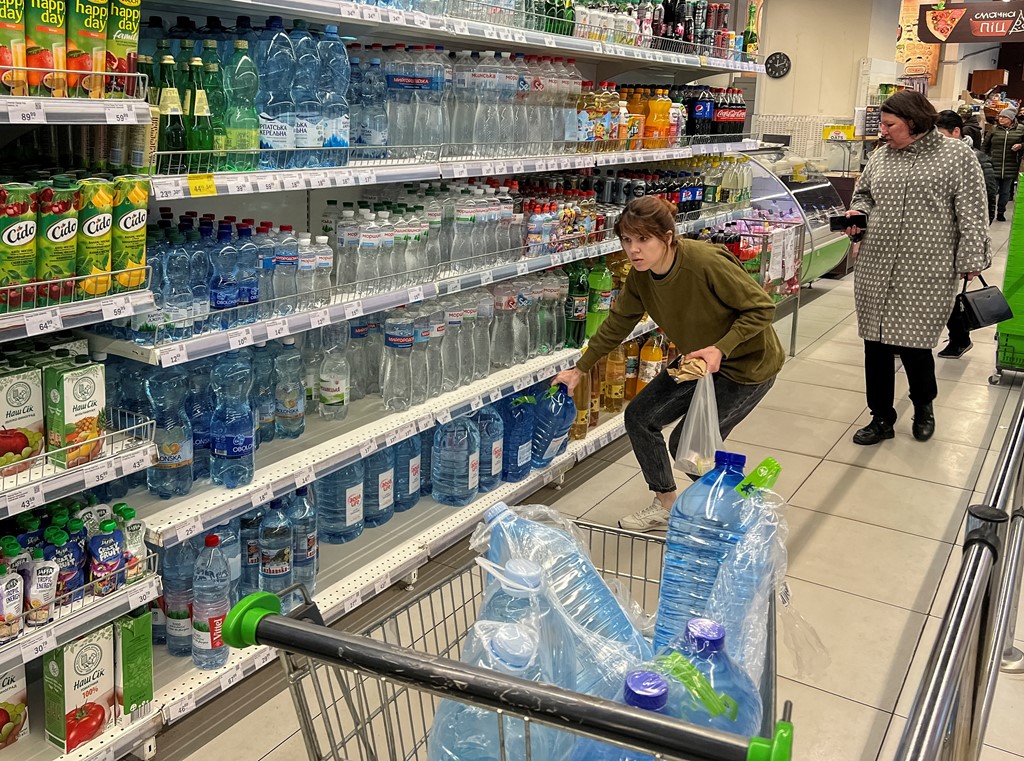
    Kira Rudik told Sky News: “There are no military targets in these objects Russia is attacking, Putin is attacking them just to make sure it is harder for us to survive winter. Today, people are figuring out how to get water for themselves and their families.

    “We were ready for spending a couple of days without electricity and heat, but we were not ready to spend days without running water and this is what may happen.”

    She added that while Ukrainians are working to restore damaged sites, she claimed Russia waits for them to be restored and targets them again.

    Ms Rudik added that people are preparing to supply water for themselves and using local sources.

    “People are supporting each other, but it’s getting harder and harder in Kyiv and other major cities in Ukraine.”

    Earlier, we reported that 80% of residents in the Ukrainian capital are without water, according to the city’s mayor.


  • West urges Russia to undo Ukraine grain deal suspension

    Moscow withdrew from the Black Sea agreement after accusing Ukraine of carrying out a drone attack in Crimea.

    Western governments are urging Russia to reverse its decision to withdraw from an UN-brokered grain deal, which undermines efforts to alleviate the global food crisis, with Ukraine claiming Moscow planned the move well in advance.

    In July, Russia and Ukraine signed a deal brokered by Turkey and the United Nations under which Moscow allowed grain ships to leave Ukrainian Black Sea ports. The agreement, which had already allowed the export of over 9 million tonnes of Ukrainian grain, was set to be renewed on November 19.

    UN Secretary-General Antonio Guterres on Sunday expressed “deep concern” as Ukraine’s maritime grain exports were halted.

    “The Secretary-General continues to engage in intense contacts aiming at the end of the Russian suspension of its participation in the Black Sea Grain Initiative,” Guterres’ spokesman said.

    “The same engagement also aims at the renewal and full implementation of the initiative to facilitate exports of food and fertilizer from Ukraine, as well as removing the remaining obstacles to the exports of Russian food and fertilizer.”

    Moscow suspended its participation in the deal on Saturday, effectively blocking shipments from Ukraine, one of the world’s top grain exporters, in response to what it called a major Ukrainian drone attack earlier in the day on its Black Sea Fleet headquarters near the port of Sevastopol in Russian-annexed Crimea.

    “Russia’s decision to suspend participation in the Black Sea deal puts at risk the main export route of much-needed grain and fertilisers to address the global food crisis caused by its war against Ukraine,” European Union foreign policy chief Josep Borrell said on Twitter on Sunday.

    “The EU urges Russia to [reverse] its decision.”


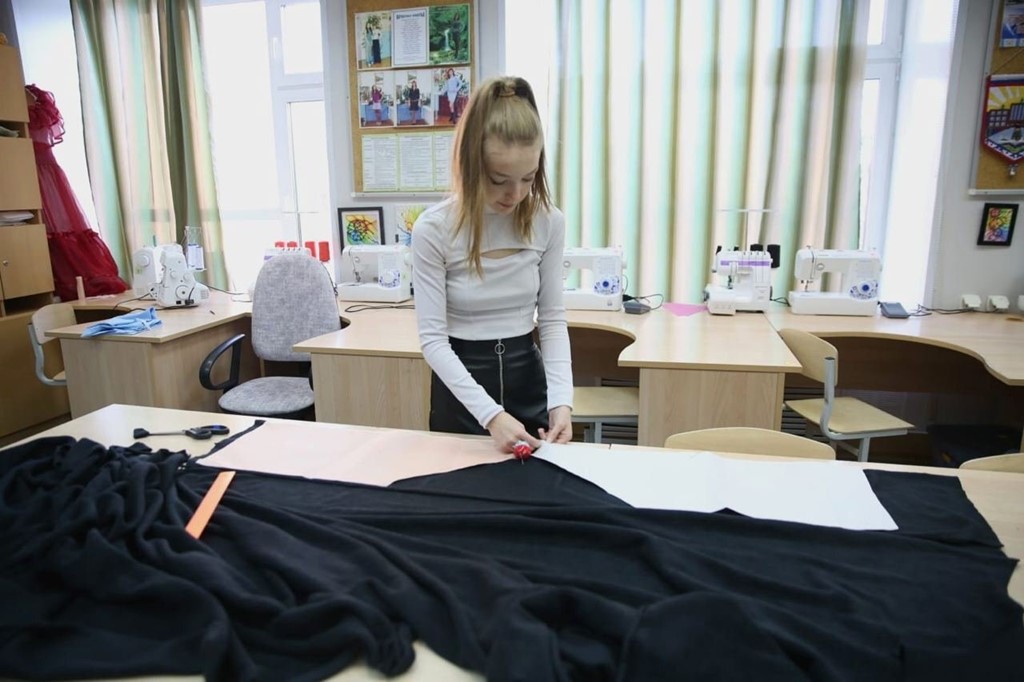
  • Russian mayor: School children ‘sew clothes for soldiers’ fighting in Ukraine

    The Russian mayor of Labytnangi has shared photos of local schoolchildren who appear to be sewing clothes for soldiers fighting in Ukraine.

    Marina Treskova said on the Russian social network VK: “Our compatriots continue to demonstrate their readiness to help not in words, but in reality”.

    She added that the school students were sewing clothes for “military personnel who are in the special operations zone” – the term Russia uses to describe its invasion of Ukraine.

    VK


  •  Debris of Russian missile shot down by Ukraine lands in a Moldovan village

    Missile debris landed in the northern Moldovan village of Naslavcea on Monday morning after a Russian fusillade was intercepted by air defences in neighbouring Ukraine, according to a statement from Moldova’s interior ministry.

    No one was hurt, but the windows of several homes in Naslavcea, which borders Ukraine, were shattered, according to the ministry.

    Nicu Popescu, Moldova’s foreign minister, said the Russian attack had targeted a Ukrainian dam on the Nistru River that runs through the two countries.

    “Attacks on water infrastructure and ensuing stress on the river could put the entire region in danger of floods,” he tweeted, condemning Russian aggression against Ukraine “in the strongest possible terms”.


  • Erdogan: Turkey poised to press forward with Black Sea grain deal

    President Recep Tayyip Erdogan says Turkey is determined to “serve humanity” and move forward with the UN-brokered Black Sea grain export deal after Moscow withdrew from the initiative over the weekend.

    “Even if Russia behaves hesitantly because it didn’t receive the same benefits, we will continue decisively our efforts to serve humanity,” Erdogan said in a televised address.

    “Our effort to deliver this wheat to countries facing the threat of starvation is evident. With the joint mechanism that we established in Istanbul, we contributed to the relief of a global food crisis,” the Turkish leader added, noting the deal had already provided 9.3 million tonnes of food to world markets.

    Source:


  • Braverman admits to mailing government information to personal email six times

    Suella Braverman has written to the House of Commons’ Home Affairs Select Committee to explain how she sent government information to a backbench MP.

    This action prompted Ms Braverman to resign as home secretary, only to be reappointed six days later (last week, upon Rishi Sunak, becoming PM).

    Ms Braverman also admitted to sending work emails to her personal address on six occasions, in violation of the ministerial code.

    In the letter, Ms Braverman says the information related to a written ministerial statement outlining immigration policy.

    She says the information would “outline the government’s position” – and allow the OBR to incorporate the position into their forecasts.

    The information was sent to Tory MP Sir John Hayes, with Ms Braverman saying she “intended to copy his secretary’s parliamentary email address” but she put the wrong email in. The information instead went to the secretary of a different MP.

    According to Ms Braverman,

    Suella Braverman has written to the House of Commons’ Home Affairs Select Committee to explain how she sent government information to a backbench MP.

    This action prompted Ms Braverman to resign as home secretary, only to be reappointed six days later (last week, upon Rishi Sunak becoming PM).

    Ms Braverman also admitted to sending work emails to her personal address on six occasions, in violation of the ministerial code.

    had “specifically requested” that the policy be discussed with “parliamentary colleagues”.

    The home secretary also gave her a timeline of events as she saw them on the day in question.

    She said it started with getting up at 4 am to go on a police raid, before travelling two hours by car to the Home Office.

    It was during this journey that Ms Braverman sent the email in question from her personal phone as she did not have her work phone with her.

    Following a morning of meetings, Ms Braverman says when she realised she had sent the email to a staffer of MP Andrew Percy by accident, she “decided to inform my officials as soon as practicable”.

    But before informing the civil service, Ms Braverman bumped into the chief whip and Mr Percy – a meeting during which Mr Percy raised his concerns.

    After this meeting, Ms Braverman asked a special adviser to tell the private secretary what happened.


  • Braverman scheduled to speak in the House of Commons this afternoon

    Suella Braverman, the Home Secretary, is expected to give a speech in the House of Commons this afternoon.

    It comes as she faces mounting scrutiny for her handling of government information and decisions to postpone the transfer of migrants from overcrowded detention centres to hotels.

    In a letter to the Home Affairs Select Committee published in the last hour, Ms Braverman admitted to breaching rules around using her personal email address for government business on six occasions.

    The home secretary has been urged to get a “grip” of the situation with migrants in the south of England.

    Some 4,000 people have been held at Manston in Kent, a facility designed to hold fewer than 2,000 people.

    It is believed her statement today will be on the situation in Manston.

    Almost 500 people crossed the Channel in small boats yesterday, and a person threw incendiary devices at a facility in Dover.

    Source: Skynews.com

  • Russia says Black Sea grain shipments ‘risky’ after its withdrawal from export deal

    Russia has warned that it would be “risky” for Ukraine to continue exporting grain via the Black Sea after Moscow suspended its participation in an initiative to facilitate shipments.

    “In conditions when Russia is talking about the impossibility of guaranteeing the safety of shipping in these areas, such a deal is hardly feasible, and it takes on a different character – much more risky, dangerous and unguaranteed,” Kremlin spokesman Dmitry Peskov told reporters.

    Peskov said Russian contacts with Turkey and the United Nations, who brokered the grain export deal in July, were continuing. He declined to comment when asked what needed to happen, from Russia’s point of view, for the deal to be resumed.

    Source: Aljazeera.com


  • Questions are stacking up for Suella Braverman – when will she answer them?

    There are two potential political scandals to address today, and both are on the home secretarys desk.

    First is the deteriorating situation at Manston processing centre in Kent, described by the chief inspector of prisons as “dangerous” and inhumane.

    It’s expected a minister will have to answer questions about it in Parliament this afternoon. Immigration Minister Robert Jenrick, who visited the site for three hours yesterday, may be asked to step in for Suellla Braverman to explain why the processing facility is almost three times over capacity and families were reportedly left sleeping in tents for weeks.

    If the Home Office does not offer up a statement from him, then they are likely to be forced to answer an urgent question.

    A government minister, Mark Spencer, appeared to confirm on Sky News this morning that failure to procure other accommodation was deliberate policy, saying that Ms Braverman had prevented people from being moved out of the site so they could be processed more quickly.

    But answers have been demanded by Labour, campaigners, and by Conservative MP Roger Gale, whose constituency in North Thanet includes the facility. He gave the home secretary and her predecessor both barrels on Sky News this morning.

    He said it was “clearly Home Office policy” not to book hotel accommodation for those held there for the past few years. He said this was a mistake, which has led to significant overcrowding, and that Mr Jenrick was in the process of moving people out.

    “I do believe that whoever is responsible, that is either the previous home secretary or this one, has to be held to account because a bad decision was taken and it has led to what I would regard as a breach of humane conditions,” he said. He added that the migrant issue should be addressed “in a grown-up fashion, not by dog whistle politics.”

    The home secretary – who the weekend papers reported has been nicknamed “Cruella” by officials – has been tasked with tackling the issue of migrants crossing the Channel in flimsy boats, with the numbers reaching a record 38,000 this year.

    MPs were told last week that just 4% of those who arrived last year have had their claims processed. Senior Conservatives are privately concerned that the home secretary – returned to her post by Rishi Sunak six days after she resigned over a security breach – is not the right person to sort out this complex issue.

    She may also need to answer questions today, or the next time she appears publicly, about the circumstances surrounding her resignation. She admitted a security breach and said she had reported it “rapidly” as soon as she realised.

    But Labour’s Yvette Cooper predicted that Ms Braverman would dodge questions on Manston today after revelations over the weekend that after sending the email from her personal account and realising it was to the wrong recipient, she told them – in an email seen by the BBC – to “delete the message and ignore.”

    Having been forced to resign once already, there are already questions about how long she can survive in the post.

    DISCLAIMER: Independentghana.com will not be liable for any inaccuracies contained in this article. The views expressed in the article are solely those of the author and do not reflect those of Independent Ghana

    Source: Skynews.com 


  • What are Qatar’s COVID, travel requirements for World Cup 2022?

    Visitors no longer need a negative COVID test or download the Ehteraz app.

    Football fans traveling to Qatar for the World Cup will no longer need to present negative COVID tests and preregister on a government app to enter the country.

    The Qatari government has cancelled the majority of travel restrictions related to COVID-19 ahead of the start of the World Cup that kicks off on November 20.

    From November 1, travellers no longer need to present a negative COVID-19 PCR or Rapid Antigen tests to enter the country.

    Visitors entering Qatar are not required to preregister on the government’s Ehteraz health application before their arrival.

    A green health status on Ehteraz is now required only to access the country’s health facilities.

    A COVID vaccination certificate is also no longer required to enter Qatar.

    The arriving fans, players, officials, staff, and media are by far the biggest influx of visitors seen in Qatar, which has a population of approximately 2.9 million.

    Qatari citizens and residents also no longer need to take a PCR or rapid antigen test within 24 hours of returning from abroad, the Ministry of Public Health (MoPH) said.

    The measures cover all visitors arriving from November 1, when Qatar will be closed to anyone without a Hayya card – the mandatory document issued to players, officials, staff, media and ticket holders, and their guests.

    Qatari organisers and football’s governing body, FIFA, have said they want the event to be a sign the world is getting over the devastating pandemic.

    But MoPH has previously warned that special measures would be ordered “in the event of a worsening pandemic situation in the country”, such as the emergence of a threatening new variant.

    Players and match officials may be forced into a secure “bio-bubble” if COVID cases take off again, with the threat of expulsion from the tournament for those who breach the secure environment, the ministry said last month.

    A requirement to wear masks on public transport was scrapped in October and masks are also not compulsory inside the eight World Cup stadiums.

    Source: Aljazeera.com
     

  • What is ailing South African football?

    South Africa’s football team offered hope to a divided nation but has struggled to make an impact internationally.

    In the early 1990s, the South African men’s football team carried the hopes of millions, that it would bring together a divided nation at the end of apartheid.

    In July 1992, the team was readmitted to FIFA after a nearly 30-year ban.

    However, Bafana Bafana has failed to make a lasting impact, and observers are divided on the reasons.

    Some former national team greats say its problems come from a lack of consistency, others point to the absence of South Africans in top European leagues as an indicator of player quality.

    Others say the players, and the team, need to develop their own footballing identity instead of imitating the way teams develop in Europe.

    From rising force to flunking out of the group stage

    Following the country’s first democratic elections in 1994, the national team looked like a rising force in African football.

    It won the 1996 African Cup of Nations (AFCON), lifting the trophy on home soil on its tournament debut, reaching an all-time high FIFA ranking of 16 in August that year.

    Things looked promising for Bafana Bafana until the mid-2000s, boasting players such as Benni McCarthy, Steven Pienaar, Quinton Fortune, Lucas Radebe and Fish – all of whom played in the English Premier League. Then the team started to decline.

    In the years to follow, Thulani Serero, Kermit Erasmus, Keagan Dolly, Phakamani Mahlambi, and Luther Singh were hailed as potential saviours of South African football but have not achieved consistency.

    South Africa has not qualified competitively for a World Cup since 2002. The team’s failure to qualify for the 2022 World Cup in Qatar meant it will not feature in a third consecutive World Cup since hosting the 2010 edition where it finished third in Group A.

    That early exit gave them the ignominious title of being the only host nation in World Cup history not to progress beyond the group stage.

    Since 2010, the team has also missed out on qualifying for four of seven AFCON tournaments – most recently the delayed 2021 event held in Cameroon earlier this year.

    Even when Bafana Bafana did qualify for the continental event, the team has not advanced beyond the quarter-finals since 2000.

    Former Charlton Athletic defender Mark Fish, who played for South Africa in the 1998 World Cup and in three AFCON events, believes a major change in the mindset is needed, and not just among the players and coaches, but also fans and the media.

    Katlego Mphela
    Katlego Mphela during the game against Mexico in the World Cup 2010 group stages. South Africa is out of a third consecutive World Cup since hosting the 2010 edition [Jason Cairnduff/Action Images/Reuters]

    “Sometimes we hear about players playing well in three or four games, and then being talked about as though they are the next best player. Even when I coach youngsters, I find that a player is quickly nicknamed Messi. I tell them they need to earn a nickname like that,” Fish told Al Jazeera.

    Strong leagues make better players

    Hans Vonk, who was part of Bafana Bafana’s 1998 and 2002 World Cup squads, believes the lack of South African players in Europe’s top five leagues – England, France, Germany, Italy, and Spain – impacts the national team’s performance.

    “What we are lacking now is players who play in strong leagues,” said Vonk. “The experience makes them better players internationally.”

    Current national team coach Hugo Broos, a Belgian, recently stirred controversy by saying the DSTV Premiership, South Africa’s top league, was not strong enough to equip players for the international stage, and Vonk agrees that the league is well-organized and marketed, but does not meet global standards.

    “There is no good reason why a country of 50 million people is not producing good players regularly,” he said. “The clubs are not focused on youth players but are instead focused first on making money. There is also no structure because the coaches are not educated enough.”

    Vonk spent most of his career playing in the Dutch Eredivisie before ending it in South Africa with the now-defunct Ajax Cape Town in 2011.

    At the 1998 World Cup, where Vonk started all three group matches, South Africa were outplayed by France in their opening game but went on to draw against Denmark and Saudi Arabia, finishing third in Group C.

    In 2002, South Africa started their campaign with a 2-2 draw against Paraguay before claiming their first World Cup win with a 1-0 victory over Slovenia.

    Needing only a draw against Spain, an Andre Arendse goalkeeping error meant South Africa crashed out.

    “In 2002, we could have reached the last 16 if there was more focus,” said Vonk. “I felt like some of the players did not really feel like they were at a World Cup.”

    ‘Must do things our way’

    Masilo Modubi, another former South Africa international, believes the domestic league harms the progress of aspiring players by trying to emulate systems in Europe instead of forming its own unique football identity.

    A former Chelsea youth player, Modubi spent his career in Belgium with Westerlo and Dessel Sport. He currently works as a coach with KESK Leopoldsburg in Belgium.

    Modubi said the age limits in the leagues work in Europe because players start their development from the age of six or seven. In South Africa, however, that development doesn’t start until about the age of 21, he said.

    “Because of the age limits, the development of players is harmed. We can pick out certain things from Europe but we must still do things our own way. Top former players in South Africa like Teko Modise and Siphiwe Tshabalala only peaked in their late 20s,” said Modubi, adding that many of the best players cannot afford to attend academies.

    Hugo Broos, manager of South Africa's national football team
    Former Belgian international Hugo Broos became coach of South Africa’s national team in 2021 [Siphiwe Sibeko/Reuters]

    In addition, South Africa has had 20 different coaches in the 30 years since its readmission to international football in 1992.

    “There is no consistency in the South African national team. We change coaches like we change underwear,” Modubi said.

    “For the public, progress is about winning things. For a coach, progress is taking the team in the direction that he wants. The public in South Africa is less patient than other countries when it comes to coaches.”

    Modubi also said the country was losing out on “many talented players who will prefer to watch TV and play on their gaming console instead of playing the sport”.

    “There are quite a few players who are good but they are too casual and don’t really focus on developing themselves,” he added.

    The South African Football Association (SAFA) refused to comment on what ails the national team.

    Neil Tovey, a former Bafana Bafana captain and SAFA technical director – who led the team to AFCON success in 1996 – believes a lack of leadership “and poor mentality” from players may be a key factor behind the inconsistency and a fall in performance.

    “They have the talent but they do not have leadership as we had in 1996. When things went wrong, we changed it with our own ability. We did not wait until half-time for instruction or for post-match analysis,” said Tovey.

    While many have praised Broos for slamming the state of South African football, Tovey thinks the Belgian “must stop looking for scapegoats and try to find something that will make the team better”, and believes South Africa can qualify for the expanded 48-team World Cup that takes place in 2026.

    Source: Aljazeera.com


  • ‘Our king’: Ramaphosa acknowledges South Africa’s new Zulu ruler

    After a legal battle over succession, South Africa’s president officially recognised King Misuzulu.

    President Cyril Ramaphosa has officially recognised South Africa’s new Zulu king, Misuzulu kaZwelithini, as the head of the country’s most powerful traditional monarchy in the first Zulu coronation since 1971.

    The ceremony recognising the new king, who has promised to unite his country and uphold tradition, brings an end to the legal squabble over his succession to the throne.

    “Our king is indeed officially the king of the Zulu nation and the only king of the Zulu nation,” said Ramaphosa on Saturday.

    The head of South Africa’s largest ethnic group was crowned in August but needed official recognition from Ramaphosa to fully access and use government resources and support.

    In March 2021, former King Zwelithini, Misuzulu’s father, died after reigning since 1971. The coronation was to recognise Misuzulu, 48, as the rightful heir after his late father.

    “This historic moment only comes once in a lifetime, many of us will never see this historic moment again,” said Ramaphosa.

    “You have picked up the mighty spear that has fallen. May your steady hand guide and bring stability to the kingship of AmaZulu,” Ramaphosa said, adding that his government was committed to working with the new king to help transform rural areas into places of prosperity.

    Although the title of king does not bestow executive power, the monarchs wield great moral influence over more than 11 million Zulus, who make up nearly a fifth of South Africa’s population of 60 million.

    King Misuzulu reigns over a divided royal family, with another faction, that includes some of his late father’s wives and some of his siblings from the other palaces, recognising King Zwelithini’s first-born son Prince Simakade as king.

    Misuzulu was chosen as the rightful heir through the will of his mother, the late Queen Mantfombi Dlamini Zulu, who became interim leader after the death of her husband King Zwelithini. The queen passed away almost two months after Zwelithini.

    “I commit to developing the country and the economy and promoting peace and reconciliation first among the Zulus and also among the South Africans and Africans,” King Misuzulu said after taking his oath.

    The king controls vast swaths of land, estimated at about 3 million hectares (7.4 million acres), in KwaZulu-Natal under an entity called the Ingonyama Trust.

    Khaya Ndwandwe, a Zulu historian, said at the stadium that recognition of the new king by the government as “the real king of the Zulu people” means “now the king will be more than protected”.

    “It’s a great day for the Zulu nation. It’s a day of great joy for the Zulu people, for every


  • At least 100 people killed and 300 injured in ‘heinous’ Mogadishu car bombings

    The death toll in Somalia is expected to rise further following Saturday’s twin bombings targeting the education ministry.

    According to Somali President Hassan Sheikh Mohamud, at least 100 people were killed and 300 were injured in two car bomb explosions in Mogadishu.

    Mohamud told reporters on Sunday that he expected the death toll from the twin blasts to rise further, blaming the al-Shabab armed group for the attacks.

    “Our people who were massacred … included mothers with their children in their arms, fathers who had medical conditions, students who were sent to study, businessmen who were struggling with the lives of their families,” the Somali leader said after visiting the site of the blast.

    Authorities said the attack at the busy Sobe intersection on Saturday targeted the Somali education ministry and a school.

    Sadiq Doodishe, a police spokesperson, told reporters that women, children, and the elderly had been killed in the attack.

    State news agency SONNA said independent journalist Mohamed Isse Kona was also killed.

    The first explosion hit the ministry; then the second blast occurred as ambulances arrived and people gathered to help the victims, police officer Nur Farah told the Reuters news agency.

    “I was 100 meters away when the second blast occurred,” witness Abdirazak Hassan told The Associated Press news agency. “I couldn’t count the bodies on the ground due to the [number of] fatalities.” He said the first blast hit the perimeter wall of the education ministry, where street vendors and money changers plied their trade.

    A Reuters journalist near the blast site said the two explosions occurred within minutes of each other and smashed windows in the vicinity. Blood from victims of the blasts covered the tarmac just outside the building, he said.

    Moments after the blasts, a large plume of smoke rose over the site.

    The Aamin ambulance service said on Saturday that they had collected at least 35 wounded people. One ambulance responding to the first attack was destroyed by the second blast, director Abdulkadir Adan added in a tweet.

    A driver and a first aid worker were wounded, he said.

    The United Nations Mission in Somalia condemned Saturday’s “vicious attack” and extended its condolences to the families of the victims. Turkey condemned the “heinous” attack, while Qatar – firmly rejecting violence and “terrorism” – expressed its condolences and wished the wounded a speedy recovery.

    The explosions occurred in the same location as Somalia’s largest bombing in October 2017, which killed more than 500 people. In that bombing, a truck bomb exploded outside a busy hotel at the K5 intersection, which is lined with government offices, restaurants, and kiosks.

    Al-Qaeda-allied al-Shabab, which has been fighting in Somalia for more than a decade, is seeking to topple the central government and establish its own rule based on a strict interpretation of Islamic law.

    The group uses a campaign of bombings both in Somalia and elsewhere, and targets have included military installations as well as hotels, shopping centres, and busy traffic areas.

    In August, at least 20 people were killed and dozens wounded when al-Shabab fighters stormed the Hayat Hotel in Mogadishu, triggering a 30-hour standoff with security forces before the siege was finally ended.

    Mohamud, with support from the United States and allied local militias, has launched an offensive against the group, although results have been limited.


  • Minister chastised for remarks about the “little man in China”

    Environment Minister Mark Spencer has come under fire for implying that “some little man in China” was listening in on his phone calls.

    It comes on the heels of reports that Liz Truss’s phone was hacked while she was Foreign Secretary.

    Speaking to Sky News, Mr Spencer said: “We all talk on personal phones, don’t we?

    “You know, I ring my wife.

    “Maybe there’s some little man in China listening to my conversations between me and my wife.”

    Labour MP Sarah Owen, who is of Chinese descent and is chair of East and South-East Asians for Labour, said: “Mark Spencer once again showing his ignorance, on many levels.

    Another Labour MP, Chris Bryan, tweeted: “‘Little man’? Honestly?”

    Catherine West, the shadow minister for Asia and the Pacific, said: “More casual racism from the Tories.”


  • After a fatal crowd crush, South Korea guarantees a ‘thorough’ investigation

    Mourners pay their respects as 154 people are confirmed dead in the Seoul disaster, which occurred during Halloween celebrations.

    South Korean Prime Minister Han Duck-soo has promised a thorough investigation into the weekend Halloween crush in Seoul, which killed more than 150 people and plunged the country into mourning.

    Officials announced on Monday that the death toll had risen to 154, with 149 people injured, 33 of whom were in critical condition.

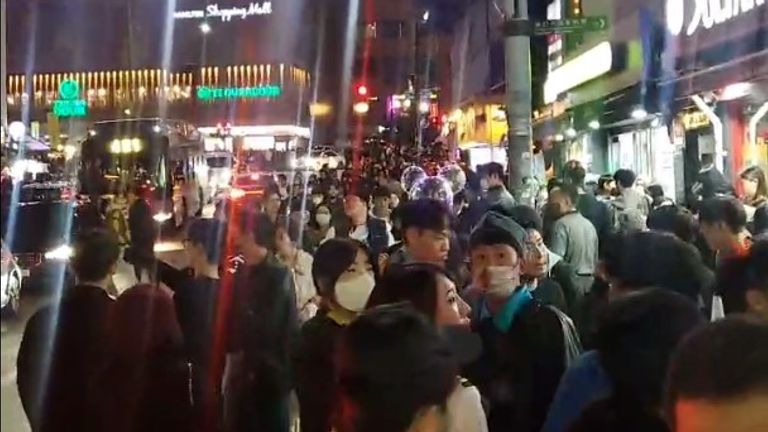
    Tens of thousands of people crowded into the narrow streets and alleyways of Seoul’s popular Itaewon district on Saturday for the first major Halloween festivities since the COVID-19 pandemic struck three years ago.

    Many of the revellers were in their teens and dressed in Halloween costumes.

    But chaos erupted when people poured into one particularly narrow and sloping alley, even after it was already packed, witnesses said.

    On Monday morning, people laid white chrysanthemums, drinks, and candles outside an exit of the Itaewon metro station, a few steps away from the site of the crush.

    “It doesn’t matter how they died, or why they died. Those poor people, all at similar ages to my grandchildren, they died anyway,” said Jung Si-hoon, a retiree and a church elder, who placed an old wooden cross at the makeshift altar.

    “What more should we say? We should pray for them and wish them to rest in peace.”

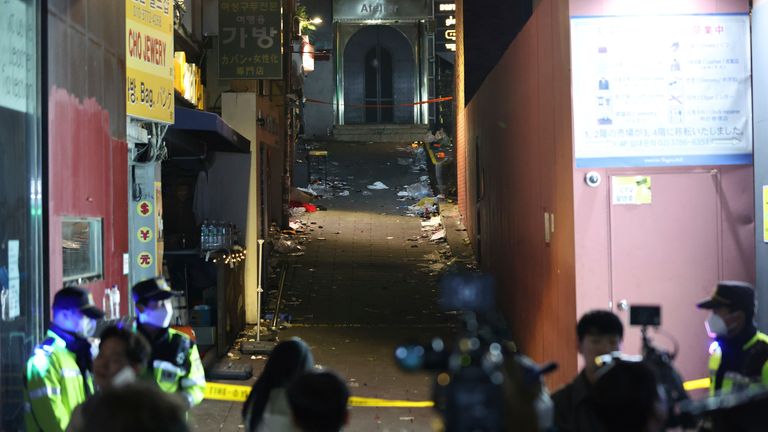
    Shops and cafés nearby were closed, and police cordoned off the site of the tragedy as they continued their investigations.

    Schools, kindergartens, and companies around the country scrapped planned Halloween events. K-pop concerts and government briefings were also cancelled.

    “The government will undertake a thorough investigation into what caused this accident and do its best to make necessary institutional changes so that such an accident is not repeated,” Prime Minister Han said as government officials met on the disaster.

    “Identification has been completed for all of the 154 deceased except one, and I believe it is time for follow-up measures such as funeral procedures to be carried out in earnest,” Han said. “We will do our best to provide necessary support by reflecting the opinions of the bereaved families as much as possible.”

    In black suits with white gloves, South Korean President Yoon Suk-yeol and his wife Kim Keon-hee hold white flowers as they visit a memorial altar for victims of the Itaewon crush in Seoul, South Korea.
    South Korean President Yoon Suk-yeol and his wife, Kim Keon-hee, were among those paying their respects at a memorial altar set up outside Seoul city hall [Yonhap via Reuters]

    President Yoon Suk-yeol, who has declared a period of national mourning and designated Itaewon a disaster zone, visited a memorial altar outside the Seoul city hall with his wife on Monday to pay his respects to those who died. Former United Nations Secretary-General Ban Ki-moon was also among those expressing their condolences.

    The crush of partygoers came as Itaewon, a symbol of freewheeling nightlife in the South Korean capital for decades, was beginning to recover from prolonged pandemic restrictions with new restaurants and shops opening.

    The disaster is the worst in South Korea since the Sewol ferry sank in 2014, killing 304 people, most of them high school students.

    The sinking of the Sewol and criticism of the official response sent shockwaves across South Korea, prompting widespread soul-searching over safety measures that are likely to be renewed in the wake of Saturday’s crush.


  • Elon Musk posts a conspiracy theory about the Pelosi attack on Twitter

    Before deleting his post, Tesla CEO Elon Musk linked to an unsubstantiated article about Nancy Pelosi’s husband.

    Elon Musk, the new owner of Twitter, tweeted an article containing a conspiracy theory about the attack on Nancy Pelosi’s husband before deleting the post hours later.

    Musk’s tweet on Sunday linked to an article making unsubstantiated claims about Paul Pelosi’s personal life and the role it may have played in last week’s attack at his and his wife’s home in San Francisco.

    Musk tweeted the article by the Santa Monica Observer, a website with a history of publishing misinformation, after Hillary Clinton posted an LA Times article about the suspected attacker, David DePape, and criticised Republicans for spreading “hate and deranged conspiracy theories”.

    In response to Clinton’s tweet, Musk posted the article while adding there was a “tiny possibility there might be more to this story than meets the eye”.

    US media outlets have linked DePape, who is accused of attacking Pelosi with a hammer, to blog posts espousing far-right and extreme views online, including the QAnon conspiracy theory.

    Musk, who has described himself as a “free-speech absolutist”, appeared to have deleted his tweet several hours after posting it without explanation.

    The Tesla CEO’s controversial tweet comes as his $44bn purchase of the social media platform is at the centre of a heated debate about the limits of free speech in the digital age.

    Musk, the world’s richest man, has criticised Twitter’s moderation policies and accused the social media giant of having a left-wing bias.

    The billionaire has stressed the need for a “common digital town square” where a wide range of beliefs can be debated while insisting he does not favour a “free-for-all hellscape”.

    Critics have expressed fears that Musk’s ownership of the platform could result in a surge in hate speech and misinformation, while conservatives have heralded the takeover as a corrective to Big Tech censorship.


  • Bodies pulled from water as rescue operations continue

    The BBC’s Roxy Gadekar, who is at the scene, reports that rescue teams are still trying to recover bodies from the river. Most of the bodies being recovered are of women and children.

    Prasanna Kumar, the commander of the National Disaster Response Force, told the BBC that they would continue the operation until everyone has been accounted for.

    “It was difficult at night since the water is stagnant and there is sewage in the river. The visibility was low, so it was difficult to spot bodies,” he said.

    With daybreak, rescue teams were able to look under the wreckage of the broken bridge and found more bodies.

    “We will search the whole river and leave no room for doubt,” he said.

    “Search will continue and we will not rest.”

    Meanwhile, a few stretchers lie on the bank of the river as bodies are pulled by rescue teams from the murky water and brought to shore.

    Parts of a small dam, which is around 500m downstream from the wreckage of the bridge, have been broken to reduce the water level in the river to help rescuers.

    Source: BBC.com


  • Bridge collapse tragedy painful: PM Modi

    Prime Minister Narendra Modi has said that the tragedy was painful. He added that his thoughts were with the families of the victims.

    “Rarely in my life, would I have experienced such pain. On one hand, there is a pain-riddled heart and on the other hand, there is the path to duty,” he said.

    Expressing his condolences, he pledged the government’s full support to the families of those who died in the accident.

    “All alertness is being observed even in the hospital where the injured are under treatment,” he said.

    Source: BBC.com


  • Collapsed bridge opened ‘without fitness certificate’

    The suspension bridge over the Machchhu river was more than a century old.

    “In March this year, it was closed to the public for renovation,” Sandeep Jhala, the chief of the local Morbi municipality, told reporters.

    Mr Jhala says the bridge was reopened to the public after repairs only on 26 October.

    “But the local municipality had not yet issued a fitness certificate (after the renovation work),” he says.

    Mr Jhala told local media that the municipality didn’t know yet “how the bridge collapsed, what was its capacity, whether they had taken any fitness certificate or not, what kind of material was used in it“.

    What happened?

    Reports said several hundred people were on the bridge at the time of the collapse on Sunday.

    A major tourist attraction, the century-old narrow cable bridge, built over the Machchu river, draws tourists in big numbers.

    The bridge was particularly busy this weekend as the Hindu festival season of Diwali and Chhath Puja drew a large number of visitors to the tourist spot, which was reopened to the public only last week.

    Reports say hundreds of families were on the bridge when it collapsed.

    Victims mostly include children, women, and elderly people.

    Videos on social media showed dozens clinging onto the floating wreckage as emergency teams attempted to rescue them. Many children and women, who were stuck, could be heard crying for help.

    Some managed to swim to the river banks.

    At least 141 died and several dozens have been injured.

    Source: BBC.com


  • Dover migrant centre: Man discovered dead near the scene of a fire attack

    A man was discovered dead after incendiary devices were thrown at a Home Office migrant centre in Dover.

    The suspect threw two or three devices, which a witness described as petrol bombs, and was later discovered dead at a nearby gas station.

    Another device discovered in the man’s car was later rendered safe by the Explosive Ordnance Disposal Unit.

    The attack injured two people who were inside the centre.

    Kent Police, which is leading the investigation, is not currently treating the incident as terrorism.

    Home Secretary Suella Braverman described the attack as “distressing”.

    A photographer with Reuters news agency who witnessed the incident reported a man had thrown petrol bombs with fireworks attached before taking his own life.

    Dover MP Nathalie Elphicke also said she understood the suspect had killed himself.

    Police had been called at 11.22 GMT on Sunday to The Viaduct, Dover, where the devices thrown by the suspect had started a fire.

    Speaking to LBC radio, Ms Elphicke said the motivation of the perpetrator was so far unknown, but the centre is “a well-known facility” where small boats arrive before people are taken 20 miles away to the Manston asylum processing centre in Kent.

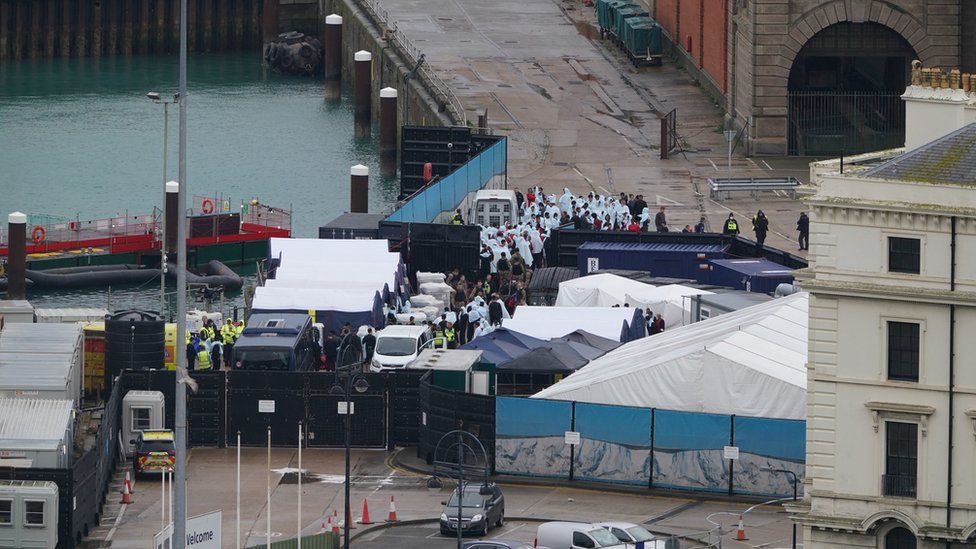
    The Dover site remained open but around 700 suspected migrants were moved to Manston – about 15 miles (24 km) away – for their safety during the initial stages of the police investigation.

    A group of migrants at the centre following the incident
    IMAGE SOURCE, PA MEDIA Image caption, Migrants were at the immigration centre following the incident in Dover

    Posting to Twitter earlier, Ms Braverman said: “I am receiving regular updates on the situation.

    “My thoughts are with those affected, the tireless Home Office staff and police responding. We must now support those officers as they carry out their investigation.”

    Conservative Dover MP, Ms Elphicke, said she was “absolutely shocked and appalled” by the incident and that “tensions have been rising” over the numbers of migrants arriving in the town.

    “I have expressed my concerns over the security of the centre in Dover,” she said. “I don’t think this is the appropriate place for a migrant-receiving centre. Dover is an extremely busy and open port.”

    Immigration Minister Robert Jenrick – who visited the Manston facility on Sunday – said he was being updated on the incident by Kent Police.

  • Ukraine war: ‘Massive’ wave of strikes hits major cities, including Kyiv

    Ukrainian officials have reported that Russia has launched massive missile strikes across Ukraine, including the capital Kyiv, causing power and water outages.

    At least two explosions have been reported in Kyiv. One resident told the BBC that his neighbourhood was now without power.

    According to local authorities, critical infrastructure facilities in the northeastern city of Kharkiv were hit.

    The strikes follow Russia’s accusation that Ukraine was responsible for a drone attack on its Black Sea Fleet in annexed Crimea.

    On Monday morning, missile strikes were also reported in the central Vinnytsia region, as well as Dnipropetrovsk and Zaporizhzhia in the southeast, and Lviv in western Ukraine.

    A facility at the Dnipro hydroelectric power plant in the Zaporizhzhia region was also reportedly hit.

    In Kyiv, a facility that powers 350,000 apartments was damaged, with engineers urgently deployed to restore the supply.

    Residents in the regions under attack were urged to remain in shelters, amid fears more strikes could follow.

    Ukraine’s Air Force spokesman Yuriy Ihnat told Ukrainian TV that Russia had used its strategic bombers to carry out its “massive” strikes.

    Andriy Yermak, the head of President Volodymyr Zelensky’s office, said that “Russian losers are continuing to fight against peaceful objects”.

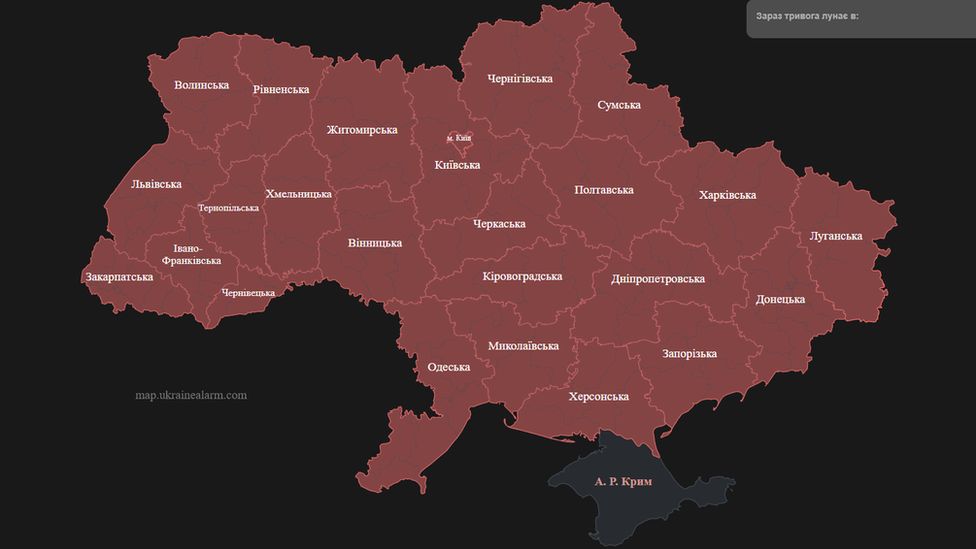
    All of Ukraine's regions - except for the annexed Crimea in the south - were marked in red as being under air attack on Monday morning
    IMAGE SOURCE, UKRAINE’S DIGITALISATION MINISTRY Image caption, All of Ukraine’s regions – except for the annexed Crimea in the south – were marked in red as being under air attack on Monday morning

    Russia has so far made no public comments on the reported latest strikes.

    On Saturday, one Russian warship was damaged in the port city of Sevastopol in a drone attack, the Russian defence ministry said. It also accused British specialists of having trained the Ukrainian soldiers who then carried out the strikes in Crimea – Ukraine’s southern peninsula, annexed by Russia in 2014.

    Moscow provided no evidence to back its claims.

    Ukraine has not commented on the issue, while the UK defence ministry said Russia was “peddling false claims on an epic scale“.


  • Suella Braverman: Backlash shows scars of six months of turmoil run deep in Tory party

    One issue has stood out like a sore thumb amid the relative political calm that has washed over Westminster in the last five days.

    Suella Braverman’s reappointment as home secretary a week after she resigned over security breaches has perplexed and befuddled Conservative MPs and officials.

    Given Rishi Sunak’s commitment to integrity, the perception that a great office of state was traded away for support in the race for Number 10 has riled some.

    A former cabinet minister said: “Rishi has screwed up and done a grubby deal to get support… he comes out and says ‘I am the savior, I’m whiter than white’ but he’s grey when push comes to shove.”

    Another former minister said Mr Sunak was “desperate for her not to back Boris as they were terrified of an election. He needed a coronation as he’s frightened of any electorate.”

    Downing Street denied any deal was done.

    But there are also live questions about Mrs Braverman’s suitability for the role.

    Her resignation just 11 days ago came after she sent a sensitive government document from her personal email account.

    One of the recipients was a veteran Conservative MP who is said to be a regular confidante of the home secretary.

    But she also accidentally copied in a parliamentary staffer who works for another Tory MP.


  • Scabies and overcrowding at immigration center: 100 charities call on home secretary to act

    More than 100 charities have signed an open letter to Home Secretary Suella Braverman, urging her to create a “kind and effective system” for asylum seekers in the UK.

    It comes amid growing concern about the Manston immigration detention centre in Kent, which was discovered to be housing more than twice the number of people it was supposed to.

    This problem has been exacerbated by this weekend’s petrol bomb attack on the Dover Tug Haven asylum site, which has resulted in the transfer of hundreds of people to the Manston processing centre.

    The facility was overwhelmed on Sunday night, with a reported 4,000 being housed there – it was initially intended to house 1,600 to be moved on and processed within 24 hours.

    Home Office minister Robert Jenrick visited Manston yesterday and admitted the situation there was “intolerable“.

    Mrs Braverman has been accused of failing to help solve Manston’s overcrowding problem. It was reported by The Times this weekend that she refused to approve new hotels where asylum seekers could be sent. It was said she ignored legal advice people should be moved.

    On conditions at the site, the Refugee Council said one boy had contracted scabies having stayed at the Manston facility for 19 days in “inhumane” conditions.

    The Home Office confirmed a small outbreak of diphtheria, a contagious bacterial infection that can prove fatal if it goes untreated, at the Kent site earlier in October.

    The letter from charities reads: “Home secretary when you talk of ‘safe and legal routes’, you must be aware that it is impossible to ask refugees to come exclusively through such a path when even Afghan interpreters who are eligible for one of our few existing schemes remain in hiding from the Taliban.

    “When you talk of ‘illegal migrants’, you must be aware that the top nationalities of people making dangerous journeys include Afghanistan, Eritrea, and Syria, and that at least 97% of asylum claims made by people from these countries are successful.

    “When you question the existence of ‘modern slavery’, you must be aware that you are dismantling your own party’s proud and internationally-recognized achievement in protecting the survivors of trafficking.

    “And when you complain about the cost of housing asylum seekers, you must be aware that, while people seeking safety did not choose to leave their homelands, they are willing to work and keen to contribute, if only the law permitted them.

    “You have referred to this country’s proud history of offering sanctuary, so we ask you to make this happen with a fair, kind, and effective system for refugees.

    “Deal with the backlog in asylum cases, create safe routes, respect international law, and the UN convention on refugees, and give refugees a fair hearing, however they get here. Then you would have really done something worth dreaming about.”

    The letter, co-ordinated by charity IMIX and coalition campaign Together With Refugees, was signed by groups such as Choose Love, Christian Aid, City of Sanctuary UK, Doctors of the World, English National Opera, Freedom from Torture, Good Chance Theatre, JCORE, Jesuit Refugee Service, Rainbow Migration, Refugee Action, Refugee Council, Scottish Refugee Council, Safe Passage and Save the Children.


  • Home Secretary barred migrants from being placed in hotels ‘to speed up the process’

    The government says Home Secretary Suella Braverman prevented migrants from being transferred from short-term holding centres to hotel rooms in order to “speed up” their applications.

    According to Environment Minister Mark Spencer, the government is facing “huge challenges” in managing the migrant situation.

    Over the weekend, petrol bombs were thrown at a migrant centre in Dover, while MRSA and diphtheria were reported at another one (Manston, see the previous post) amid overcrowding.

    Asked about reports Ms Braverman blocked migrants being moved from short-term holding centres to hotels, Mr Spencer said this was done because the home secretary “wants to process them quickly” and make sure only “genuine” asylum seekers are admitted to the UK.

    He added that the way to cut down on migrants crossing the channel is to “break the model” of people traffickers.

    Meanwhile, Mr Spencer said that Rishi Sunak would go to COP27 “if he’s got time” and that the prime minister has “an inbox which is full to the brim“.


  • Rishi Sunak congratulates Lula da Silva for winning election in Brazil

    Rishi Sunak has congratulated Lula da Silva for winning the election in Brazil, beating out incumbent Jair Bolsonaro.

    Mr Sunak said this morning on Twitter: “Congratulations to Lula da Silva on his victory in Brazil’s election.

    “I look forward to working together on the issues that matter to the UK and Brazil, from growing the global economy to protecting the planet’s natural resources and promoting democratic values.”

    Labour Leader Sir Keir Starmer also congratulated Mr da Silva, saying: “This win must also be the start of a new era of global cooperation and action in the fight against climate change.”

    Source: Skynews.com

  • How did Seoul Halloween celebration turn into a deadly crush?

    Live streams and videos from social media provide extra detail as to how a Halloween celebration turned disastrous in the South Korean capital.

    Packed into narrow alleyways lined with bars and clubs, thousands of people travelled to Itaewon, an area of Seoul, for the city’s first Halloween festival since the COVID-19 pandemic.

    But as the crowds grew throughout the night to unmanageable levels, the celebration turned disastrous as a crush in one alleyway left at least 154 dead.

    Sky News has analysed videos from social media to show how it took just 30 minutes for the situation to spiral out of control.

    They also confirm an apparent lack of police or security presence in the build-up to the crush.

    Halloween celebrations

    The revellers turning up for the celebrations were predominantly young, with many travelling to the area via Itaewon train station.

    Some live-streamed videos of their evening on Facebook. The screenshot below, taken from one of these livestreams, shows crowds beginning to form on the main road by the station at 8.10 pm.

    ...

    The main road is busy, but cars are still able to drive freely and there is still space between people.

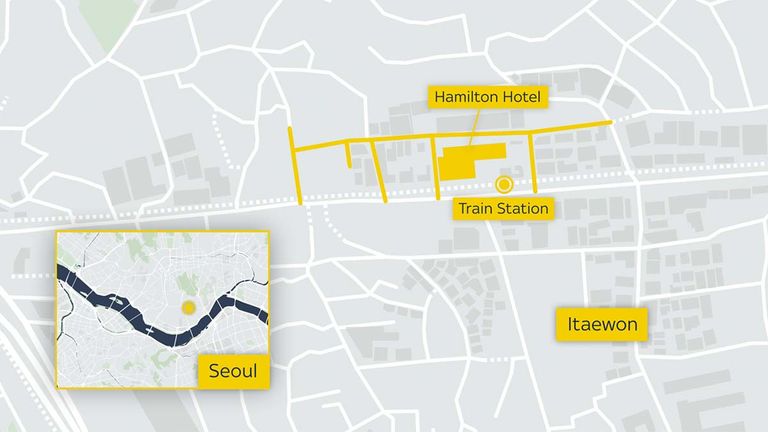
    Over the following hours, the crowds grow in size. They funnel into a series of small side streets behind the main road around the Hamilton Hotel, highlighted in yellow on the map below. These streets are small and those running north to south slope steeply.

    The alleyways, highlighted in yellow, are where the crowds began to build.
    Image:The alleyways, highlighted in yellow, are where the crowds began to build

    At 10.06 pm, people can be seen in the main alleyway running east to the west still freely moving but slowly. Some people are holding each other to avoid being split up by the crowd as they pass an Irish bar in the background.

    Later, 150 metres east of where the footage above was shot, a denser crowd grew on one of the steep and narrow side alleys. People were so close to each other that any small movement rippled through the crowd.

    In the footage below pop music is heard blasting out amongst cries of anguish as the packed-in crowd sense danger.

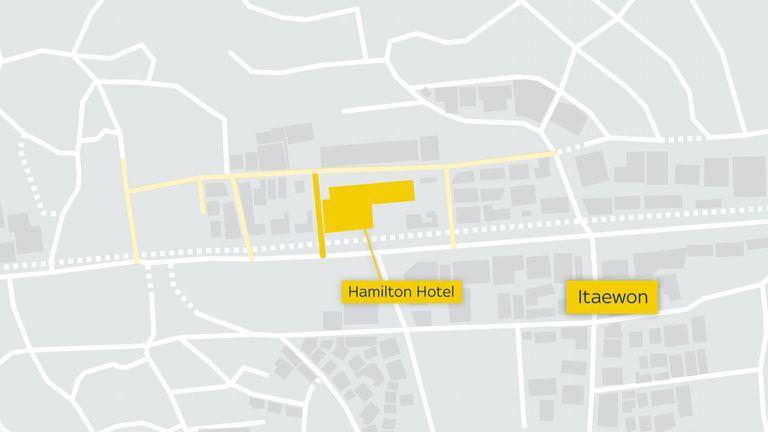
    People in this street narrowly avoided disaster. It would be another steep alleyway on the other side of the Hamilton Hotel where the deadly crush would occur, highlighted in dark yellow below.

    The alleyway west of the Hamilton Hotel, highlighted here, was where the crush occurred.
    Image:The alleyway west of the Hamilton Hotel, highlighted here, was where the crush occurred

    This short video shows this alleyway west of the hotel earlier in the evening. The crowd is spread wall to wall across the narrow passageway – which sits on a 20% gradient – with no escape routes.

    Around the corner, Janelle Story, an eyewitness who spoke to Sky News, filmed her view as the crowd surged. This video was captured at 10.34 pm.

    The story told Sky News: “Very suddenly this wave of people just came rushing towards us with this incredible force and urgency, and at the moment I stopped filming because it got really serious and scary.”

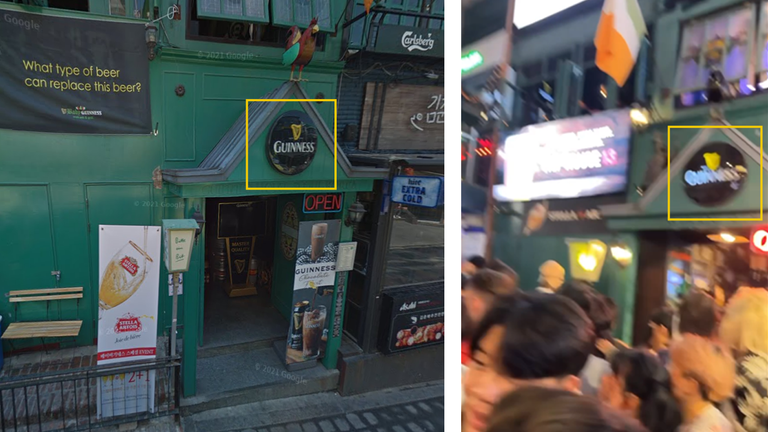
    She was 40 metres from the western alleyway by the Hamilton Hotel where a crush was occurring. By matching the building exterior with existing imagery from Google Streetview, Sky News confirmed the footage was taken outside the Irish bar seen in the earlier video at 10.06 pm.

    In less than half an hour, a busy but free-flowing crowd had turned dangerous.

    The video (right) can be located by matching the front of the bar with existing imagery from Google Maps (left).
    Image:The eyewitness video (right) can be located by matching the front of the bar with existing imagery from Google Maps (left)

    By 10.45 pm it became clear something was very wrong. Livestreams from the main road show ambulances and emergency personnel heading toward the Hamilton Hotel.

    In the surrounding crowds, it also began to dawn on people a serious incident had occurred. One young man had been live-streaming the party on the street with his friends having fun. As they moved towards the Hamilton Hotel, the mood changed.

    At 11.15 pm he filmed the crowd parting the way as paramedics moved through with patients on stretchers.

    ..
    Image:A stretcher-bearer carries an injured person through the crowd on the main east-west alleyway

    The video below shows the scene that the emergency services were heading from. A surge had forced the crowd to fall over, likely made worse by the steepness of the alleyway.

    Emergency workers can be seen trying to free those caught in the crush. People try climbing the walls in an attempt to escape, whilst those on a small set of stairs leading to a side door into the hotel try to lift people to safety.

    Reports suggested some people were trapped for over an hour. Other videos posted online show paramedics and members of the public attempting CPR in the moments after the surge. These videos are too distressing to share.

    In the immediate build-up to the crush, few police officers or security personnel can be seen in the busy alleys on the livestreams analysed by Sky News. Questions are now being asked of the authorities’ management of the situation.

    A photo shows a scene of crowd surge accident where lots of people fell at Itaewon area in Seoul, South Korea on October 30, 2022. While lots of people were gathering prior to Halloween, 151 people died due to falling down one upon another.( The Yomiuri Shimbun via AP Images )
    Source: Skynews.com


  • Lula da Silva narrowly defeats Jair Bolsonaro in the Brazilian presidential election

    Mr da Silva, a veteran leftist, received 50.8% of the vote, while Mr Bolsonaro, the far-right incumbent, received 49.2%.

    Official results show that Luiz Inacio Lula da Silva narrowly defeated Jair Bolsonaro in the Brazilian election.

    Brazil’s election has been the most divisive in recent memory, pitting far-right incumbent President Bolsonaro against leftist former President Lula da Silva.

    On his victory, Mr da Silva tweeted a simple picture of his hand over the Brazilian flag and the word: “Democracy.”

    It is a stunning return to power for Mr da Silva, 77, whose 2018 imprisonment over a corruption scandal sidelined him from that year’s election, paving the way for then-candidate Mr Bolsonaro’s win and four years of far-right politics.

    Mr da Silva’s convictions were annulled, but he faced an uphill battle when he decided to re-run for president, with many millions of Brazilians continuing to believe he was corrupt.

    After his victory was announced, he said: “They tried to bury me alive, and I’m here!”

    And in his first speech to the nation as president-elect, he vowed his most urgent commitment would be to “end hunger” in Brazil.

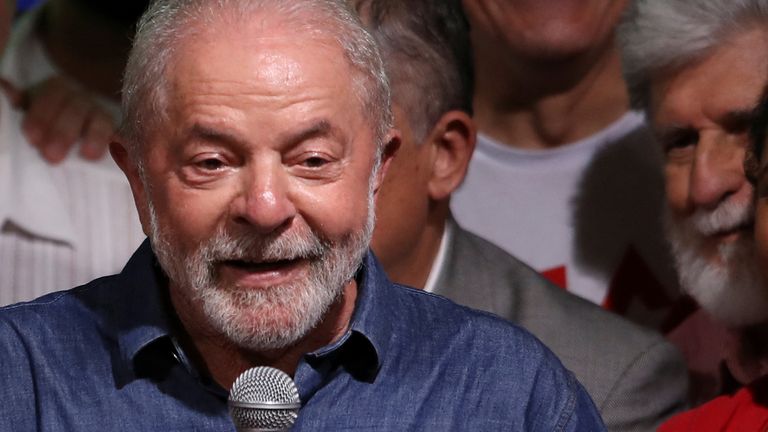
    Brazil's former President and presidential candidate Luiz Inacio Lula da Silva speaks at an election night gathering on the day of the Brazilian presidential election run-off, in Sao Paulo, Brazil October 30, 2022. REUTERS/Carla Carniel

    His victory marks the first time since Brazil’s 1985 return to democracy that the sitting president has failed to win reelection.

    ‘Time of hope and future’

    Colombian president Gustavo Petro wrote: “Viva Lula,” while Argentina’s leader Alberto Fernandez said the victory ushered in a new era “for the history of Latin America”.

    He added: “A time of hope and future begins today.”

    Brazil’s Supreme Electoral Court’s count showed it was a close contest – Mr da Silva polled 50.9% of votes compared with 49.1% for Mr Bolsonaro, with all of the voting machines counted.

    The election, in the world’s fourth-largest democracy, served as a referendum on two starkly different – and vehemently opposed – visions for Brazil’s future.

    Mr Bolsonaro vowed to consolidate a sharp rightward turn in Brazilian politics after a presidency that witnessed one of the world’s deadliest outbreaks of COVID-19 and widespread deforestation in the Amazon basin.

    Jair Bolsonaro
    Image:Jair Bolsonaro

    Mr da Silva promised more social and environmental responsibility, evoking the rising prosperity of his 2003-2010 presidency before corruption scandals tarnished his Workers’ Party.

    More than 120 million Brazilians were expected to cast ballots, with the vote conducted electronically.

    There are also fears Mr Bolsonaro could challenge the election results should he lose – much like former US President Donald Trump.

    For months, he claimed the nation’s electronic voting machines are prone to fraud, though he never presented evidence.

    As Mr da Silva prepared to give a speech at a hotel in São Paulo on Sunday evening, Mr Bolsonaro had yet to concede the election.

    It was the country’s closest poll in more than three decades. Just over two million votes separated the two candidates, with 99.5% of the vote counted. The previous closest race, in 2014, was decided by a margin of 3.46 million votes.

    The new president, known universally as Lula, will be sworn in on 1 January 2023.


  • Petrol bombs thrown at Border Force immigration centre in Dover

    Petrol bombs have reportedly been thrown at a Border Force migrant centre in Dover.

    Kent Fire and Rescue Service was called at 11:22 am to The Viaduct in Dover, where crews put out fires.

    Reuters news agency – who had a photographer at the scene – reported a man threw petrol bombs attached to fireworks at the center.

    The photographer captured the moment the man threw the homemade bomb from the car window. The man can be seen with a lighter in his hand as he throws the container toward the center.

    He then took his own life following the incident, the agency said.

    Police arrived minutes afterward and cordoned off the area.

    Kent Police said: “Officers established that two to three incendiary devices had been thrown into a Home Office immigration premises.

    “One minor injury has been reported.

    “The suspect has been identified and located. Inquiries into the incident remain ongoing.”

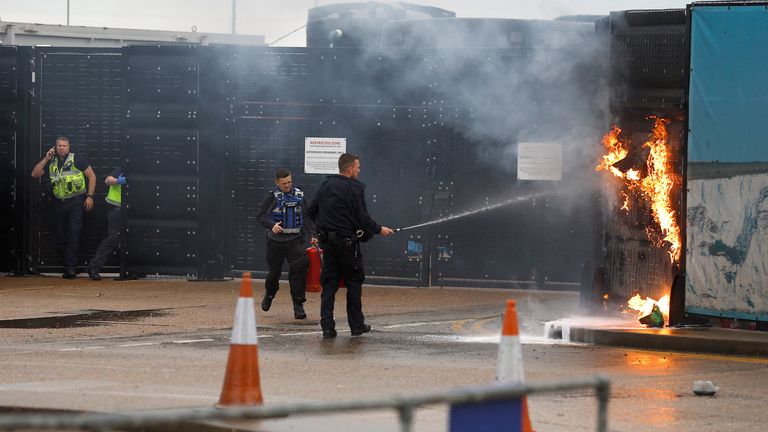
    Members of the military and UK Border Force extinguish a fire from a petrol bomb, targeting the Border Force centre in Dover, Britain, October 30, 2022. REUTERS/Peter Nicholls

    A Home Office spokesperson said: “We are aware of an incident at Western Jet Foil, Dover and police are in attendance.

    “It would not be appropriate to comment further at this stage.”

    It comes as almost a thousand migrants arrived in the UK yesterday, making the treacherous journey across the world’s busiest shipping lane and landing at Dover.

    Emergency services near the migrant processing centre in Dover, Kent, following an incident. Picture date: Sunday October 30, 2022.
    Image: Emergency services near the migrant processing centre

    Nathalie Elphicke, the Conservative MP for Dover, said she was “deeply shocked”.

    Source: Skynews.com


  • Seoul Halloween: Almost everyone who died in the Seoul crush has been identified, police says

    The identities of nearly all those killed in an apparent crowd surge in Seoul’s popular nightclub district Itaewon on Saturday have been confirmed, according to Seoul Metropolitan Police.

    Police confirmed the identities of 150 people killed on Sunday, according to CNN.

    The disaster claimed the lives of 153 people.

    The three unidentified bodies are all young women whose nationalities have yet to be confirmed, they added.

    The Seoul Metropolitan Government had said they had received 4,024 missing person reports as of 5 p.m. local time (4 a.m. ET), though some of these reports could relate to the same people.

    Police said there is no active search for those reported missing as they believe no one went missing from the scene. They said thousands of missing person reports have been used to help identify those killed in the incident.


  • Lula is no more than a Brazilian Biden

    If elected president, Lula would likely be unable to lead a transformational, leftist agenda.

    The theme of “return” has dominated the presidential election campaign in Brazil. Many think the country is either going to see the comeback of Luiz Inacio Lula da Silva, marking a second pink tide of progressive South American governments, or the return of the Workers’ Party (PT), removed from power after President Dilma Rousseff’s impeachment in 2016.

    Or it is going to face a government takeover by forces associated with the military dictatorship (1964-1985) – right-wing defenders of family, tradition, and property and apologists for political violence and torture of political opponents.

    There may be an element of truth to this interpretation, but sometimes turning to the past to make sense of the present can make it more difficult to discern the major differences between them. Indeed, if Lula were to win the presidential race, Brazil would not go back to the 2000s; nor is a military takeover led by his opponent, incumbent President Jair Bolsonaro, that likely.

    The vote: The poor vs the poorer

    While many saw the results of the October 2 elections as a clear victory for Lula and the Brazilian left, a closer look reveals a different reality. Lula obtained 57 million or 48 percent of the valid votes – less than what many polls predicted – which sent him to a run-off with Bolsonaro.

    The incumbent president obtained 51 million votes, two million more than in the first round of the 2018 presidential election. This is despite the fact that his government failed in its economic policies, the management of the pandemic, the fight against corruption, and the climate change agenda, especially with regard to curbing Amazon deforestation.

    In the parliamentary and governor elections, which also took place on October 2, the right-wing parties and, in particular, the far right, performed much better than forecasts showed. They won more representatives in the two houses of parliament than PT and its allies.

    Among those elected to parliament were former Judge Sergio Moro, who led the anti-corruption probe that saw Lula jailed; Damares Alves, the loudest proponent of the “gender ideology” conspiracy theory, which claims family values are under threat; and former health minister Eduardo Pazuello, who mismanaged the pandemic response. They were all ministers in Bolsonaro’s government.

    The elections did not see a massive migration of the votes from the poor to Lula and his party, as was expected in light of the pro-poor policies in his first two terms (2003-2010). In that period, the country experienced extraordinary economic growth combined with successful income distribution measures, which generated massive support among impoverished Brazilians for Lula in his bid for re-election in 2006. He ended his second term with an 80 percent popularity rating and a GDP growth of 7.5 percent.

    Part of the reason why Lula was unable to rally all of his former electorates may be that financial aid programmes for disadvantaged families introduced by Bolsonaro to address the economic downturn during the pandemic were extended.

    According to Giuseppe Cocco, a political science professor at the Federal University of Rio de Janeiro, another reason may be that the effect of anti-Bolsonarism was to some extent mitigated by anti-Lulism – the negative sentiment triggered by corruption cases against Lula and the PT that contributed to bringing Bolsonaro to power in the first place.

    Furthermore, Cocco’s research shows that the incumbent attracted more votes than Lula from the “precariat” – Brazilians who are above the poverty line but, nevertheless, face constant economic insecurity. These are people who are microentrepreneurs, who have gig jobs, small businesses or who are self-employed. They struggle economically and seek the stability that the far-right promises.

    The right-wing tendencies of this layer of Brazilian society became apparent ahead of the 2018 election when a truck drivers’ strike took place. The protest started over rising fuel prices but ended with calls by some participants for the army to intervene and “solve the problems” of the state. Bolsonaro backed the strike, which boosted his popularity ahead of the vote.

    Lula, on the other hand, draws support from the poorest strata, those who are on the threshold of subsistence. They have been the beneficiaries of his signature social programme, the Bolsa Familia, which distributed conditional cash transfers.

    The line between the two groups is blurred, but the tension between them over income and economic opportunity seems to provide a better explanation of the electoral results than a more simplistic analysis that paints Lula as the candidate of the poor and Bolsonaro – as the choice of the elites and the well-off.

    A Brazilian Biden

    The campaign rhetoric Lula adopted was also quite different from previous elections. Unlike in the past, when he openly clashed with the elites, this time around, the PT candidate presented himself as the candidate of the system, as a “Brazilian Biden”, so to speak, putting an end to a Trumpist interlude.

    He gathered an extraordinarily broad front, which included almost the entire left opposition, but also the main representatives of economic power from various sectors, social democrats, conservative liberals, the leftist environmentalist Marina Silva, former officials, such as the social-democratic liberal Fernando Henrique Cardoso, and others.

    His campaign was also not dominated by street mobilisation or sharp factionalism. On the contrary, there were explicit guidelines to supporters not to confront the voters of the other candidate, and even to deemphasise the PT’s traditional colour red at campaign events.

    Although his coalition had prepared a leftist political programme, Lula ignored it in the debates, sidestepped it in speeches to voters and the media, and stressed on several occasions that he would not take divisive positions, especially when it comes to his plans for the economy. Throughout the campaign, he built an image as the promoter of peace, indicating the need to resolve the conflicts that are multiplying in and between different social segments.

    Bolsonaro and the Bolsonarist forces, on the other hand, fully occupied the anti-systemic political space. The incumbent spent the election campaign making verbal attacks against the corporate media – especially against the biggest TV network, Globo – the Brazilian Supreme Court and universities.

    In a country that has traditionally seen intimidation, blackmail, and the murder of electoral opponents in urban peripheries and in the hinterland, Bolsonaro’s rhetoric put Brazil at risk of widespread politically motivated violence. A number of murders were attributed to feuds between sympathisers of the two candidates, while a video of a Bolsonaro supporter licking the barrel of a shotgun went viral.

    Diminished appetite for a coup

    Despite Bolsonaro’s incitement and heightened fears of violence, it is unlikely that a victory for Lula in the run-off would be challenged by the military. Even the prospect of an invasion of the Congress building in Brasilia – like the one that happened in January 2021 in the US – seems less likely.

    The army’s top generals have given clear signals that whoever wins at the polls will assume the presidency. Furthermore, foreign powers, such as the Biden administration, have indicated that they would not support anti-democratic ventures.

    Bolsonaro has been ambiguous about accepting the results. However, the fact that right-wing parties and far-right politicians won the majority of seats in parliament has diminished the appetite for coup talk.

    Whatever the outcome of the election, the struggle for safeguarding minority rights, improving public services, expanding social programmes, protecting the environment, and embracing a security paradigm that is not guided by state violence against underserved populations will remain difficult. A victory for Bolsonaro, which is quite unlikely, would consolidate the far-right takeover of the state, leading to more policies aimed at dismantling public services, destroying the environment, and systematically sabotaging minority protections and academic institutions.

    A win for Lula, which seems more likely, would also pose great challenges. Given the dominance of the right in parliament, it would be difficult to push through progressive policies. Social movements, collectives, and activists would have to focus on the defence of the government, which would take away energy and resources from ongoing struggles, as happened during the 2016 impeachment process against Dilma. The PT and its supporters would face a radicalised and armed opposition on the ground committed to defending “true Christianity”, “family values” and traditional gender roles. In this context, a Lula victory would not mean a return to the “happy Brazil” of the 2000s, as his campaign suggested.

    The way out of the deep crisis that Brazil has plunged into in the last decade could be a Brazilian New Deal that pushes through much-needed structural changes in labour law and market, supports the creative role of minorities, and embraces the centrality of the global environmental agenda, something that Lula seems far from being able to lead, as corruption scandals and worn-off populist rhetoric have broken his spell.

    But his election could at least provide an opportunity to seek reconciliation and rebuild bridges between polarised segments of society. His return could set the ground for the construction of much-needed political alternatives.

    DISCLAIMER: Independentghana.com will not be liable for any inaccuracies contained in this article. The views expressed in the article are solely those of the author and do not reflect those of The Independent Ghana


  • Mahsa Amini protests: Iran and US set for UN confrontation

    A rare Iranian joint intelligence report reveals that the arrested journalists who reported on Mahsa Amini’s death were trained abroad by the US.

    Tehran and Washington are clashing again over weeks-long protests in Iran, as the US prepares to convene the United Nations Security Council to discuss the unrest sparked by the death of 22-year-old Mahsa Amini in the custody of morality police last month.

    According to Reuters and Iranian state media, the US and Albania, another major critic of the Iranian government, will hold an informal UN Security Council meeting on Wednesday.

    Iranian Nobel Peace Prize laureate Shirin Ebadi and Iranian-born actress and activist Nazanin Boniadi – whom the Iranian state considers to be anti-establishment – will speak at the meeting, along with UN investigator on human rights in Iran, Javaid Rehman, according to Reuters. Other UN member states and rights groups can reportedly attend the meeting as well.

    But while the outlet cited a note outlining the event as saying the meeting will “highlight the ongoing repression of women and girls and members of religious and ethnic groups in Iran”, Tehran has offered a different account.

    The Iranian government’s website, IRNA, on Saturday, cited unnamed “diplomatic sources” as saying Washington is organising the meeting in response to a rare joint report by the Iranian intelligence ministry and the intelligence division of the Islamic Revolutionary Guard Corps (IRGC) late on Friday that blamed the US as the main culprit behind the protests.

    “Instead of responding to the points raised in the Iranian intelligence community, the US is fleeing forward and exhibiting selective support for human rights with specific political goals,” the source was quoted as saying.

    Iran’s mission to the UN made the same point in a statement referring to the US as the “prime suspect of the riots” in Iran.

    “The US and its allies have consistently taken advantage of such a platform (the UN) to advance their political agendas, even at the expense of violating international rules and the UN Charter,” it said, accusing Washington of double standards in supporting Iranians.

    Women and ethnic Kurd and Baluch populations have featured prominently in the protests.

    The commander of the elite IRGC warned protesters on Saturday against taking to the streets. “Do not come to the streets! Today is the last day of the riots,” Hossein Salami said, according to Reuters.

    Iran’s top authorities, including Supreme Leader Ali Hosseini Khamenei, have publicly blamed the US, Israel and others as being the orchestrators of unrest across the country, during which many dozens are thought to have been killed, with more injured or arrested.

    UN spokesman Stephane Dujarric on Friday voiced concern and urged the Iranian authorities to address the “legitimate grievances of the population” while condemning “all incidents that have resulted in death or serious injury to protesters”.

    What’s in the Iranian intelligence report?

    The lengthy joint intelligence report that Tehran claims has motivated the upcoming UNSC meeting paints a picture of accounts that inform Iranian authorities’ stance on the protests.

    According to the report, the US and some of its allies had planned – and delayed – unrest similar to what is happening across Iran right now for a long time, and had designs for different stages prior to, during, and following such unrest.

    The Central Intelligence Agency (CIA) has been at the forefront of the US efforts and has been aided by the intelligence services of Israel, Saudi Arabia, the United Kingdom and other countries, it asserted, citing “completely credible” information.

    The Iranian intelligence community claimed the US has spent billions of dollars over the years to create a network of sympathetic organisations and individuals, holding many gatherings and courses to teach “hybrid wars and soft overthrow” of the Iranian establishment.

    These all-paid courses, it said, have been held in Italy, South Africa, Turkey, and the United Arab Emirates among others, with or without the knowledge of those countries’ governments.

    The report uses the initials of two female Iranian journalists, whom it says were “trained by the courses of the US mafia regime in foreign countries” and “played the role of being the first sources to manufacture news for foreign media” on developments concerning Amini that led to the protests.

    The reporters accused by Iranian intelligence are Niloofar Hamedi and Elaheh Mohammadi, who were arrested shortly after protests broke out last month and remain imprisoned in Evin prison in Tehran. Hamedi was among the first to report on Amini’s death at the hospital, while Mohammadi travelled to Amini’s hometown of Saqqez to report on her funeral.

    The intelligence report also alleges that CIA officials met with Kurdish separatist groups in neighbouring Iraq’s northern Erbil region in late September to ask them to amplify their role in Iran’s unrest. The IRGC in late September and early October repeatedly pounded positions in Iraq’s semi-autonomous Kurdish region to punish the “terrorist groups” it said were based there.

    Foreign-based Persian-language television channels, which Tehran blacklisted this week, and social media platforms like Twitter and Instagram, which have been banned, were also featured in the intelligence report as being influenced and manipulated by Washington in its efforts to counter the Iranian state.


  • West Bank: Palestinian attacker was shot dead after killing an Israeli

    The occupied West Bank has seen an increase in violence as a result of daily Israeli raids, including in Nablus and Jenin.

    According to medics and local media reports, a Palestinian man who shot dead an Israeli settler at a checkpoint in the occupied West Bank city of Hebron was killed by a security guard.

    The shooting at the checkpoint near the Kiryat Arba settlement, where a group of predominantly right-wing Israeli settlers lives, comes days before Israel holds its fifth election in less than four years and as violence surges in the occupied West Bank.

    Israeli newspaper Haaretz identified the Israeli victim as 49-year-old Ronen Hanania while Palestinian media reported that Mohammad al-Jaabari, a 35-year-old Hebron resident, was killed in the fatal shooting.

    The Hamas group, which rules the Gaza Strip, claimed the slain Hebron gunman as its member.

    Israel’s Magen David Adom (MDA) emergency response service initially reported five wounded, including a 49-year-old Israeli man left “unconscious with an injury to his upper body”.

    A spokesperson for Jerusalem’s Hadassah Medical Center told the AFP news agency that the man later died of his wounds.

    The other Israelis suffered less severe injuries, the MDA said. A man Palestinian, who was also wounded in the shooting, was being treated at a Hebron area hospital, the Palestinian Red Crescent said.

    Israel’s army said “a terrorist shot live fire” near a checkpoint in Hebron, an occupied West Bank city where a community of hardline Jewish settlers lives.

    “Soldiers are conducting searches in the area” for additional suspects, the army said.

    At least three Palestinians, including al-Jaabari’s brother, were arrested from Hebron, according to the Maan news agency.

    Far-right Israeli MP Itamar Ben-Gvir, whose Religious Zionism alliance is eyeing major gains in elections on Tuesday, claimed on Twitter that his Hebron home was the target.

    Israel’s security forces have not confirmed the allegation and Israeli media, citing security sources, reported that Ben-Gvir’s home in a Hebron settlement was not targeted.

    ‘Spiral’ of bloodshed

    The United Nations envoy for Middle East peace, Tor Wennesland, warned on Friday that the occupied West Bank was “caught in a downward spiral” of bloodshed. This year is on track to be the deadliest in the territory in more than a decade.

    More than 100 Palestinians, including fighters and attackers but also civilians, have been killed across the occupied West Bank as Israel has conducted near-daily raids.

    The raids intensified following a spate of attacks on Israelis that began in March.

    Israeli operations have primarily been concentrated in the northern occupied West Bank, while Hebron in the south has seen less unrest.

    Prime Minister Yair Lapid tweeted on Saturday that he was “praying” for those wounded in Kiryat Arba.

    “Terrorism will not defeat us,” said Lapid, who is currently serving as caretaker premier but is hoping to secure an independent mandate in Tuesday’s vote.

    About 475,000 Jewish settlers currently live in the occupied West Bank, in settlements considered illegal by international law, alongside some 2.9 million Palestinians.


  • A gas tanker explosion in Baghdad kills nine people and injures many more

    Security forces have announced that at least nine people were killed and 13 were injured when a gas tanker exploded in the Iraqi capital.

    A gas tanker exploded in Baghdad, Iraq’s capital, killing at least nine people and injuring several others, according to security forces.

    On Saturday night, an explosion was heard across much of Baghdad near a football field in the city’s east, sending shrapnel into residential buildings and into the pitch.

    “Nine civilians were killed and 13 injured” when the tanker exploded, the commander of security forces in Baghdad, Ahmad Salim, said in a statement.

    “The explosion is an accident and not an act of terrorism,” he added.

    Most of the victims were amateurs playing football in their neighbourhood stadium, the Reuters news agency reported.

    Medical sources gave a higher casualty toll to the AFP news agency, with one saying 12 people had been killed.

    An AFP correspondent said the windows of nearby buildings were blown out and vehicles in the area were damaged.

    “We were at home and felt a very strong blast and a smell of gas,” resident Mohammed Aziz, who lives just 100 metres (330 feet) from the blast site, told AFP.

    “It felt like we were suffocating,” he added. “Our doors and windows were blown out.”

    Iraq’s recently-elected president, Abdul Latif Rashid, promised there would be an investigation to identify those responsible for the accident.

    Safety standards in the transport and construction sector are frequently flouted in Iraq, and accidents are a common occurrence.

    In April 2021, more than 80 people died in a hospital fire in Baghdad, after badly stored oxygen bottles exploded.


  • DR Congo expels Rwandan ambassador as M23 rebels seize towns

    Kinshasa orders Ambassador Vincent Karega to leave the country within 48 hours after accusing Kigali of supporting M23 rebels.

    The Democratic Republic of the Congo’s government has ordered Rwandan Ambassador Vincent Karega to leave the country within 48 hours after accusing Kigali of supporting M23 rebels, who have seized two towns in the DRC’s east, raising tensions between the two countries.

    Saturday’s announcement by government spokesman Patrick Muyaya came after a meeting of the defence council, presided over by President Felix Tshisekedi, in the wake of rebels seizing control of Kiwanja and Rutshuru in the province of North Kivu.

    DR Congo has repeatedly accused Rwanda of backing the rebels, an allegation Rwanda has repeatedly denied. The decision to expel Karega is expected to further ratchet up tensions between the two countries whose relations have been fraught for decades.

    Muyaya said that in recent days “a massive arrival of elements of the Rwandan element to support the M23 terrorists” against DR Congo’s troops had been observed.

    “This criminal and terrorist adventure” had forced thousands of people to flee their homes, he added.

    Rebel advance

    The latest advance by rebel fighters prompted the UN peacekeeping mission, known as MONUSCO, to increase its “troop alert level” and boost support for the army.

    Fierce fighting erupted on Saturday morning between the Congolese army and M23 rebels in Kiwanja, which is 70km (43 miles) from the North Kivu capital, Goma.

    John Banyene, a local civil society leader, later told The Associated Press that the rebels now controlled both Kiwanja and Rutshuru Centre. AFP, quoting unnamed officials, said the rebels had seized control of the towns.

    “As we speak, we confirm that the M23 rebels and their allies control the town of Kiwanja, but the armed forces of the Democratic Republic of Congo are not giving up,” Banyene told journalists in Goma.

    There was no immediate confirmation from Congolese authorities or the military on the reported seizure of the two towns.

    Ongoing fighting

    The M23 was formed in 2012, claiming to defend the interests of Congolese Tutsis, a group sharing the ethnicity of Rwanda’s President Paul Kagame, against Hutu armed groups, seizing Goma, the largest city in DR Congo’s east, the same year. After a peace deal in 2013, many M23 fighters were integrated into the national military.

    The group resumed fighting in late 2021 after lying dormant for years, accusing the government of having failed to honour an agreement over the demobilisation of its fighters.

    It has since captured swathes of territory in North Kivu, including the key town of Bunagana on the Ugandan border in June.

    Since May, M23 has waged its most sustained offensive in years, killing dozens and forcing at least 40,000 people to flee in only a week’s time. Nearly 200,000 people had already been displaced over the past year even before the latest surge in violence.

    The M23’s resurgence has inflamed regional tensions and spurred deadly protests against the UN peacekeeping mission in DRC, which civilians accuse of failing to protect them.

    Rwanda denies the charges and counters that DR Congo works with the Forces for the Liberation of Rwanda (FDLR), a notorious Hutu rebel movement involved in the 1994 genocide of Tutsis, which Kinshasa also denies.

    In August, a report by UN experts said they had “solid evidence” that members of Rwanda’s armed forces were conducting operations in eastern DR Congo in support of the M23 rebel group.

    Rwanda, though, has repeatedly denied the allegations and has accused Congolese forces of injuring several civilians in cross-border shelling.

    Source: Aljazeera.com
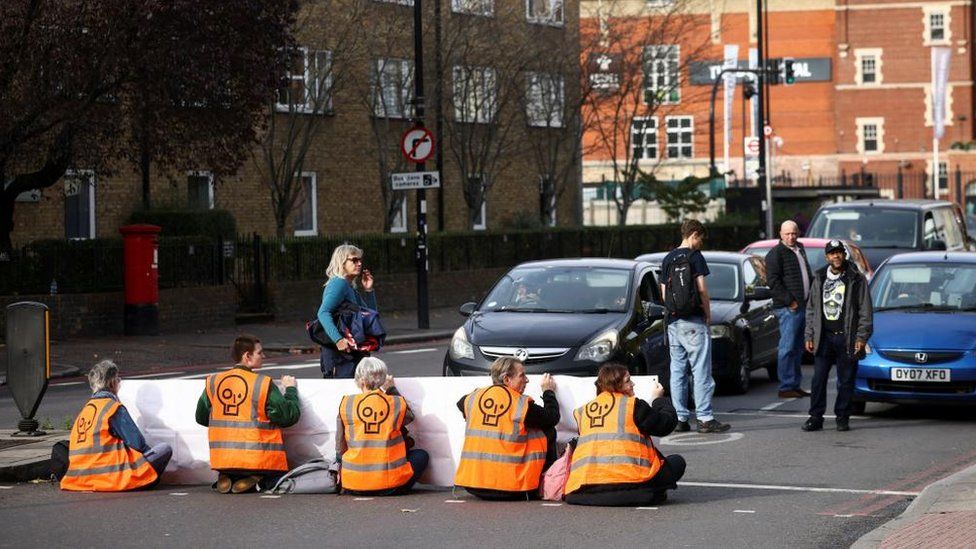
     

  • Russia says it will supply up to 500,000 tonnes of grain to poorest countries

    Moscow has said it will supply hundreds of thousands of tonnes of grain to poor countries over the next four months, with assistance from Turkey. 

    TASS news agency, citing agriculture minister Dmitry Patrushev, said only 3% of food exported under an UN-brokered deal had gone to the poorest countries and that Western nations accounted for half of all shipments.

    The agreement was signed back in July to release several million tonnes of grain from blockaded Ukrainian ports.

    The World Food Programme said the war in Ukraine has exacerbated a global hunger crisis as the conflict has pushed up the costs of food, fuel, and fertilizers.

    Source: Skynews.com 


  • Russia has cancelled a grain export agreement with Ukraine

     TASS has indicated that Russia has suspended its participation in a grain export deal following overnight attacks on ships in Crimea.

    The UN-mediated agreement, signed in July, allowed shipments of Ukrainian grain to be exported from blockaded ports.

    “Taking into account… the terrorist act by the Kyiv regime with the participation of British experts against the ships of the Black Sea Fleet and civilian vessels involved in ensuring the security of the “grain corridor”, the Russian side suspends participation in the implementation of agreements on the export of agricultural products from Ukrainian ports,” the ministry said in a statement.

    It earlier said the drone attacks were mostly repelled, although a ship received minor damage.

    Social media videos purport to show fires and black smoke in the Bay of Sevastopol.

    A UN spokesperson has said they are in touch with Russian authorities and that all sides should refrain from doing anything to imperil the deal.

    In the last few minutes, Russia’s agriculture minister Dmitry Patrushev said only 3% of the food exported under the UN-brokered deal had gone to the poorest countries – and that Moscow intends to supply 500,000 tonnes of grain to these nations over the next few months.

    On Wednesday, UN aid chief Martin Griffiths said he was “relatively optimistic” the deal would be extended beyond mid-November. 


  • US President: Russia’s decision to halt a grain deal is ‘outrageous

    The US president has called Russia’s decision to withdraw from an UN-brokered grain deal “utterly outrageous,” claiming that it will increase hunger.

    On Saturday evening, Joe Biden made the remarks while speaking to reporters.

    Following attacks on a number of ships in occupied Crimea, Moscow announced it would withdraw from the grain export deal.

    The agreement was signed in July and was allowing shipments of Ukrainian grain to be exported from blockaded ports.

    A UN spokesperson has said they are in touch with Russian authorities and that all sides should refrain from doing anything to imperil the deal.


  • Putin’s ‘private army’ recruiting Russian convicts ‘with HIV and hepatitis C’

    The Wagner Group – dubbed by some as Putin’s private army – is apparently lowering its standards and recruiting Russian convicts suffering from serious diseases including HIV and hepatitis C for the Ukraine war, according to UK intelligence, citing the organisation’s head, Yevgeny Prigozhin.

    The Ministry of Defence says that in earlier conflicts the Wagner Group has maintained “relatively high recruitment standards” with many of its operators previously serving as professional soldiers.

    But the MoD added on Twitter that the admission of prisoners with serious medical concerns highlights “an approach which now priorities numbers over experience or quality”.

    Source: Skynews.com


  • Russia blasts the United States for remarks about grain deals

    Russia has slammed the United States for making false claims about Moscow’s decision to withdraw from a grain export deal mediated by the United Nations.

    Russia’s defence ministry said Ukraine used 16 drones to attack its Black Sea Fleet near Sevastopol on the Russian-annexed Crimean peninsula early Saturday, and that British navy “specialists” assisted in coordinating the “terrorist” attack.

    Anatoly Antonov, the Russian ambassador to the US, said on Telegram: “Washington’s reaction to the terrorist attack on the port of Sevastopol is truly outrageous.

    “We have not seen any signs of condemnation of the reckless actions by the Kyiv regime.”

    Mr Antonov added: “All the indications that the British military specialists were involved in organising the massive strike with the use of drones, are disregarded.”

    The UK has dismissed Russia’s claims as false, while US President Joe Biden denounced Russia’s decision on the grain deal as “purely outrageous” and said it would increase starvation.


  • A woman, 46, was killed in a two-car accident near Ayr

    A 46-year-old woman was killed in a two-car crash near Ayr.

    Shona McKinlay, of Dreghorn, was driving a Renault Kangoo van on the A70 near the Holmston Roundabout just before 06:00 on Friday when it collided with an Audi TT.

    A 44-year-old female passenger in the van and Audi’s 23-year-old driver were both taken to the hospital.

    Police Scotland said both have injuries that are serious but not life-threatening.

    The A70 was closed for about 11 hours to allow for a police investigation.

    Sgt Stewart Taylor said: “We are continuing with enquiries to establish the full circumstances and anyone with information or who may have dashcam or CCTV footage from the area is asked to get in touch.”


  • Angry motorists drive Just Stop Oil protesters off London streets

    On Saturday, angry motorists removed Just Stop Oil protesters from central London’s blocked roads.

    Campaigners gathered in Charing Cross Road, Kensington High Street, Harleyford Street, and Blackfriars Road, demanding that the government halt the issuance of new oil licences.

    Drivers abandoned their vehicles in Harleyford Street to remove demonstrators, who returned repeatedly to reclaim their positions on the road.

    Met Police said 33 protesters were arrested and the roads later reopened.

    One motorist said during the protest: “We’ve asked you nicely, you are doing the wrong thing by blocking innocent people going about their business.

    “Can you please move before we pick you up and move you?

    “You are stopping the wrong people, I’ve got to go pick my kids up, I’ve got to get my lorry back to work. We can’t help you, go to Westminster.”

    Just Stop Oil protesters in central London
    IMAGE SOURCE, REUTERS Image caption, Just Stop Oil protesters blocked four roads in central London

    Labour councillor Theresa Norton, 64, from Scarborough, attended to support the protest, saying: “Half an hour’s disruption is not a massive sacrifice.

    “It’s these people that are making the biggest sacrifice. They’ll be arrested, go to a police cell, go to court on Monday.”

    Just Stop Oil said the blockages follow four weeks of civil resistance, during which the police have made 626 arrests.

    Protester arrested by police
    IMAGE SOURCE, REUTERS Image caption, Police made 33 arrests on Saturday

    Speaking after the protest, Met Police Assistant Commissioner Matt Twist said Just Stop Oil protests had “caused a significant amount of disruption and frustration among the public in London”.

    He added: “We will always provide a proportionate policing response to protest and try to work with organisers so that protests can go ahead safely.

    “However, the public rightly expects us to respond quickly and effectively where protest crosses the line into criminality.”


  • Labour: Prime Minister should explain the Suella Braverman breach

    Labour is demanding that Rishi Sunak “come clean” about Suella Braverman’s security breach.

    Ms Braverman resigned as home secretary under Liz Truss last week after violating the ministerial code by sending an official document from a personal email account. Rishi Sunak reappointed her on Wednesday.

    Her reappointment has been criticized.

    Labour’s Shadow Home Secretary Yvette Cooper said her party will try to “force the government to come clean”.

    A number of sources have disputed Ms Braverman’s account of events.

    So far new Prime Minister Mr Sunak has resisted demands to launch an inquiry into Ms Braverman’s security breach, despite Labour and the Liberal Democrats raising “national security” concerns and calling for a Cabinet Office probe.

    Ms Braverman has also refused to appear before MPs to explain what happened.

    Labour wants ministers to share risk assessments of this and other alleged leaks, as well as the information given to the prime minister before he put her back in the Home Office.

    Shadow Home Secretary Yvette Cooper said Ms Braverman’s appointment “raises serious doubts” about the prime minister’s judgment and that the pair could not continue to hide from questions.

    She continued: “People need to know they can trust the home secretary with highly sensitive information and our national security.

    “Rishi Sunak’s decision to reappoint Suella Braverman was deeply irresponsible.

    “Labour will use every parliamentary mechanism open to force the government to come clean over her reappointment, to get answers, and to require detailed documents to be released to the Intelligence and Security Committee.”

    Sources dispute events

    BBC News has spoken to several people with knowledge of the events surrounding Ms Braverman’s resignation.

    A number of them dispute Ms Braverman’s claim to have reported her mistake to the cabinet secretary – the head of the civil service – as soon as she realised.

    When confronted about her transgression she attempted to play down and explain away what had happened, sources suggested.

    Ms Braverman had emailed a draft written ministerial statement on immigration policy to her close political ally, Conservative MP Sir John Hayes, using her personal email instead of her official government account.

    Speaking to reporters on Friday, Labour leader Sir Keir Starmer demanded the home secretary was fired, accusing Mr Sunak of brokering a “grubby deal trading security for support” in the Conservative leadership contest.

    But the prime minister insisted Ms Braverman had “learned from her mistake” and that he does not regret the appointment despite some Tory MPs adding also expressing concern.

    Backbench MP Caroline Nokes backed opposition calls for an inquiry and former Tory chairman Sir Jake Berry described the breach as “really serious”.


  • Museums in the United Kingdom are willing to return skulls to Zimbabwe

    The Natural History Museum in London and Cambridge University have stated their willingness to work with Zimbabwe to return human remains taken during the colonial era.

    The new statements come after a Zimbabwean delegation met with officials from both institutions.

    Zimbabweans are looking for the skulls of late-nineteenth-century anti-colonial heroes, which they believe are in the United Kingdom.

    But these have not yet been found.

    The authorities in Zimbabwe have long suspected that the remains of some of the leaders of an uprising against British rule in the 1890s – known as the First Chimurenga – were taken to the UK as trophies.

    The most significant among them was a woman who became known as Mbuya Nehanda. She was executed in what is now the capital, Harare, and is revered as a national heroine.

    In doing a search of its archive, the Natural History Museum did uncover 11 remains “that appear to be originally from Zimbabwe” – but its records do not connect them with Nehanda. These include three skulls taken in 1893, thought to be from Zimbabwe’s second city, Bulawayo, as well as remains uncovered in mineshafts and archaeological digs and later donated.

    Cambridge University’s Duckworth Laboratory has not been so specific, simply saying it has “a small number of human remains from Zimbabwe”, but in a statement sent to the BBC, it said it had not identified any of these as belonging to First Chimurenga figures.

    The Natural History Museum, with 25,000 human remains, and the Duckworth Laboratory, with 18,000, have some of the largest such archives in the world.

    These have come from a variety of sources including archaeological excavations of ancient sites, but for many, the exact origins have been obscured by time.

    During the colonial era, body parts were sometimes removed from battlefields or dug up from graves either as trophies or for research into a now-discredited scientific field.

    In the 19th Century, phrenology, which investigated the idea that human characteristics could be determined by the shape of the skull, was very popular in the UK and other parts of Europe. Phrenological societies would collect skulls to help develop the theory, which for some extended to racial classification.

    Some researchers set out to show that skull shape indicated that people from different parts of the world were inherently inferior.

    Some of the archives that now exist in the UK are amalgamations of what had been amassed by defunct phrenological societies as well as private collectors.

    Zimbabwe’s government believes that somehow the skulls of the country’s heroes ended up in the archives of a British museum.

    Chief among them were spiritual leaders, including Charwe Nyakasikana, who became known as Mbuya (Grandmother) Nehanda as she was the medium of the revered ancestral spirit Nehanda. She was arrested after being accused of murdering a British official.

    Nehanda was then hanged and her body decapitated, it is believed. What happened next is not clear, but in recent years, Zimbabwean officials have made several public statements saying it ended up in the Natural History Museum.

    With a death cry of “my bones will surely rise”, Nehanda became an increasingly potent symbol for those fighting against white-minority rule in what was then known as Rhodesia in the late 1960s.

    Zimbabwe gained independence in 1980.

    Statue of Mbuya Nehanda
    IMAGE SOURCE, SHUTTERSTOCK Image caption, The Mbuya Nehanda statue in Harare was put up in 2021

    A three-meter statue of Nehanda now stands over a major road in the centre of Harare. At its unveiling in 2021, President Emmerson Mnangagwa pledged to continue to call for the return of her skull and others from the Natural History Museum.

    For Zimbabweans, the removal of the head “means that you have literally punished the person beyond the grave”, Godfrey Mahachi, who led the delegation to the UK, told the BBC in 2020 when the visit was being planned.

    “If the head is separated, that means that the spirit of that person will forever linger and never settle.”

    Despite not finding what the Zimbabwean delegation was looking for, both the Natural History Museum and Cambridge University say they are committed to working with the Zimbabwean government to repatriate what was found.

    As part of its policy of repatriation, earlier this year, the Natural History Museum returned ancestral Moriori and Maori remains.

    In a press statement following a recent cabinet meeting, Zimbabwe’s government said that the delegation that went to the UK was satisfied that “there are indeed human remains of Zimbabwean origin in the UK”.

    “Government will spare no effort to ensure the repatriation of our ancestors,” it added.

    The Zimbabwean delegation also held talks with the British Museum, Oxford University’s Pitt Rivers Museum, the University of Manchester Museum, and the UK’s National Archives. But no details are given about what was discussed.

    Despite the lack of success in this trip to the UK, the historical significance to Zimbabwe of the remains of Nehanda and others means that the search will continue.


  • Nancy Pelosi: The hammer attack has traumatised us

    Nancy Pelosi has stated that the violent attack on her husband has left her “heartbroken and traumatised.”

    The speaker of the United States House of Representatives said her family was “grateful for the quick response of law enforcement” and for his medical care.

    A male assailant struck Paul Pelosi with a hammer at the couple’s San Francisco home on Friday.

    The 82-year-old’s condition “continues to improve” after the attack, Mrs Pelosi said.

    He suffered a fractured skull and injuries to his right arm and hands, and remains in hospital receiving “life-saving” care, she said.

    The suspect, David Depape, 42, is said to have demanded to see Mrs Pelosi – stoking fears about political violence in the run-up to the 8 November midterm elections.

    The speaker – who was on the other side of the country in Washington DC at the time of the assault – flew back to see her husband in hospital.

    In her statement, she said prayers and warm-wishers were comfort and were helping Mr Pelosi’s recovery.

    Police officers responded to a call at around 02:27 local time (09:27 GMT) on Friday.

    They found Mr Pelosi and the suspect struggling over a hammer, but it was wrested from Mr Pelosi by the intruder, who violently assaulted him with it.

    The suspect was tackled and disarmed by officers. He had attempted to tie up Mr Pelosi “until Nancy got home”, law enforcement sources told CBS News. He reportedly shouted “where’s Nancy?” during the incident.

    He is also facing charges of assault with a deadly weapon, burglary, and several other felonies.

    Mrs Pelosi, also 82, is one of the most powerful politicians in the country. She was re-elected to a fourth term as Speaker of the House of Representatives in 2021, making her second in line to the presidency, after Vice-President Kamala Harris.

    The Baltimore native has represented the San Francisco area in Congress since 1987 and typically splits her time between California and Washington DC.

    She is currently fundraising and campaigning with Democrats around the country ahead of the midterm elections.

    Paul Pelosi is the multimillionaire founder of a venture capital firm and lives primarily in San Francisco, where he was born and raised.

    The couple has been married since 1963 and have five children.

    Members of Congress have been on high alert over security threats since the riot at the US Capitol in January 2021.

    Mrs Pelosi’s office in the building was ransacked by supporters of then-President Donald Trump during the riot.

    US President Joe Biden has condemned the attack on Paul Pelosi and said “enough is enough” when it comes to violence in politics.


  • Liz Truss phone hack claim prompts calls for investigation

    The government has been urged to investigate the claims that former prime minister Liz Truss’s phone was hacked while she was foreign secretary.

    The Mail on Sunday reported private messages between Ms Truss and foreign officials, including about the Ukraine war, fell into foreign hands.

    The hack was discovered during the summer Tory leadership campaign but the news was suppressed, the paper said.

    The government said it had “robust” cyber-threat protection in place.

    The spokesperson added that the government “did not comment on individuals’ security arrangements”.

    Details about the hack were suppressed by then-prime minister Boris Johnson and Cabinet Secretary Simon Case, The Mail on Sunday claimed, citing what it said amounted to a “news blackout” imposed by Mr Case.

    The newspaper also said private messages exchanged between Ms Truss and Kwasi Kwarteng, her close friend whom she made chancellor when she became prime minister, were also uncovered by the alleged hack.

    It is not clear how any hack happened, but opposition parties have seized on the issue.

    “There are immensely important national security issues raised by an attack like this by a hostile state which will have been taken extremely seriously by our intelligence and security agencies,” said shadow home secretary Yvette Cooper.

    “There are also serious security questions around why and how this information has been leaked or released right now which must also be urgently investigated.”

    The Mail on Sunday reported agents suspected of working for Russia had been responsible for the alleged hacking, citing unnamed sources, but the BBC has not been able to verify this.

    The Liberal Democrat’s foreign affairs spokesperson Layla Moran MP raised concerns about why the alleged hack had not been made public earlier.

    “We need an urgent independent investigation to uncover the truth,” Ms Moran said. “If it turns out this information was withheld from the public to protect Liz Truss’s leadership bid, that would be unforgivable.”

    The government has refused to comment on any of the details reported by the Mail on Sunday.

    “The government has robust systems to protect against cyber threats,” a spokesman said. “That includes regular security briefings for ministers and advice on protecting their personal data and mitigating cyber threats.”

    Source: BBB.com 

  • Slough bus station fire spread across whole roof

    Firefighters have contained a large fire that spread through a bus station.

    At 01:52 BST on Saturday, Royal Berkshire Fire and Rescue Service (RBFRS) was called to a blaze across the whole roof of Slough bus station.

    The cause of the fire is unknown but Tim Readings, group manager for RBFRS, said the blaze is “mostly out”.

    He said the fire was 20m by 40m in scale and six engines were there to manage the damage.

    Mr Readings added that bus companies have looked at alternative temporary bus stops.

    Thames Valley Bus has said Route 15 would be suspended for all of Saturday and Services 2 and 5 would serve Brunel Way stops.

    Service 703 towards Bracknell will also serve Queensmere Stop G instead of Slough Bus Station’s Bay 10.

    Thames Valley Police have said: “Cordons and road closures are in place, members of the public are advised to avoid the area.”

    Roads are shut on the A4 on Wellington Street in both directions, the A332 to Queensmere Road and the B416 Stoke road.

    Source: BBC.com


  • Guantanamo Bay: US has released oldest detainee, Saifullah Paracha

    After nearly two decades in detention at Guantanamo Bay, Pakistan’s oldest prisoner has been released.

    Saifullah Paracha, 75, was arrested two years after the 9/11 attacks on the United States and charged with being an al-Qaeda sympathiser.

    Mr. Paracha was suspected of financing a jihadist organisation, but he maintained his innocence and was never charged.

    The US military prison in Cuba once housed hundreds of suspected militants captured following the attacks.

    “Mr Saif Ullah Paracha, a Pakistani national, who was detained in Guantanamo Bay, has been released and reached Pakistan on Saturday, 29 October 2022,” Pakistan’s foreign ministry said.

    “We are glad that a Pakistani citizen detained abroad is finally reunited with his family,” the statement added.

    Clive Stafford-Smith, Mr Paracha’s lawyer, questioned why it had taken so long for his client to be released.

    “He’s been cleared for release [for] well over a year… he used to hum to me The Eagles song Hotel California, where you can [according to the lyrics] check out ‘but you can never leave’,” Mr Stafford-Smith told the BBC’s Newshour programme.

    Mr Paracha was captured in July 2003 in Thailand following a sting operation by the American FBI [Federal Bureau of Investigations].

    Mr Paracha, who studied in the US, was accused by US authorities of having contact with some of the group’s most senior figures, including its leader Osama bin Laden and Khalid Sheikh Mohammed.

    After 14 months at a US military prison in Bagram, Afghanistan, he was transferred to Guantanamo.

    The secretive US military prison has been used to hold what America describes as captured unlawful combatants during its “war on terror”.

    US President Joe Biden is under pressure to clear out uncharged prisoners and move ahead with the trials of those accused of having direct ties to al-Qaeda.

    His administration approved Mr Paracha’s release last year, along with that of another Pakistani national, 55-year-old Abdul Rabbani, and Yemen native Uthman Abdul al-Rahim Uthman, 41.

    The statement from the Pakistani foreign ministry did not mention Rabbani.

    There are still 35 people being held at Guantanamo – including Khalid Mohammed, named as “the principal architect of the 9/11 attacks” in the 9/11 Commission Report.

    The lawyer of Mr Paracha said he expected more detainees to be freed over the coming months.

    “I’ve still got four clients there [at Guantanamo], all of whom are cleared for release,” he told the BBC, adding it was an “embarrassment to the US”.

  • Paul Pelosi attack: Violent extremism warning ahead of US election

    The violent attack on Speaker of the House Nancy Pelosi’s husband comes with just over a week to go before the US midterm elections – a moment when political tensions are coming to a boil.

    As if to emphasise this point, just a few hours after news of the assault on Paul Pelosi on Friday, the US government distributed a bulletin to law enforcement across the nation. It warned of a “heightened threat” of domestic violent extremism against candidates and election workers driven by individuals with “ideological grievances”.

    Also on Friday, the US Department of Justice announced that a man from Pennsylvania had pleaded guilty to making multiple phoned death threats against an unnamed congressman – reported to be Democrat Eric Swalwell of California. The threats included telling a staff member in the congressman’s Washington office that he was going to come to the US Capitol with a firearm.

    These wailing klaxons of a political system in peril come as Republicans and Democrats frame the upcoming midterm voting, which will determine which party controls Congress next year, as a pivotal moment in American history.

    Republicans warn this is the last chance to put a check on Democrat Joe Biden’s presidency. Democrats say American democracy itself is at stake because of the numerous Republican candidates who have refused to accept the results of the 2020 presidential election.

    And the rhetoric comes at the culmination of what has been a steady drumbeat of violence – and violent threats – that has been building all year.

    Death threats

    In Arizona, there have been multiple reports of masked individuals with firearms staking out ballot drop boxes, ostensibly to monitor the sites for election fraud. They’ve posted photographs of individuals casting their ballots on right-wing social media sites and encouraged others to join their efforts.

    In June, a man was arrested near the home of Supreme Court Justice Brett Kavanaugh. He had travelled to the Washington suburb from California and called police after he arrived to tell them he had a firearm and intended to kill the conservative justice.

    The following month, the Republican candidate for governor, Lee Zeldin, was attacked while on stage during a campaign rally. Congresswoman Pramila Jayapal, a liberal leader in the Democratic Party, was threatened by a man with a handgun outside her Seattle home. He was subsequently charged with felony stalking.

    Marjorie Taylor Greene waves to supporters at a Donald Trump rally.
    IMAGE SOURCE,GETTY IMAGES Image caption, Marjorie Taylor Greene waves to supporters at a Donald Trump rally.

    Republican congresswoman Marjorie Taylor Greene has had police respond to her home six times based on anonymous hoax calls. The practice, called “swatting”, is used to try to provoke a confrontation between the target and law enforcement. She has also been the target of numerous death threats.

    Partisan violence – and the threat of it – is nothing new in American politics, of course. The bloodiest recent attack occurred five years ago, when a man with multiple weapons opened fire on Republican politicians playing baseball at a city park. Five were injured, including one critically – second-ranking Republican in the House of Representatives, Steve Scalise of Louisiana. That, however, was an isolated incident.

    Keeping politicians safe

    Data provided by the US Capitol Police suggests a violent wave is building. The number of cases involving threats against members of Congress has increased every year since 2017. In the first three months of 2022, the department has documented more than 1,800 incidents.

    In response, Capitol Police announced in July that it would cover up to $10,000 for security upgrades in the homes of congressional legislators.

    There are 435 members of Congress, however. They regularly travel to and from their homes around Washington and from the nation’s capital to their homes across the nation. A motivated individual fixated on violence will be able to find a way to strike against a targeted politician – or their family.

    With Mrs Pelosi thousands of miles away in Washington, there was no police security provided for Mr Pelosi at their San Francisco home. He was not the intended target, but he became the victim.

    Before the attack, the suspect is said to have asked, “Where is Nancy?” – the phrase harkening back to the 6 January assault on the US Capitol, when a man roamed the halls of the Capitol, calling out: “Where are you, Nancy? We’re looking for you.”

    Politicians on both sides of the nation’s partisan divide have expressed their sympathy for Mr Pelosi and called for a cooling of the rhetoric. It is a task that is easier said than done, however.

    With a population encased in political bubbles of social media and news outlets that reinforce their existing political beliefs and fears, individuals will continue to be tempted by extremism and violence. And when they go looking for the politicians they read about and see on television – ones they are told are enemies of the nation and threats to democracy – they will be able to find them.

    Source: BBC.com