Author: Abigail Ampofo

  • Apostle Safo Kantanka’s body was never at Transitions Funeral Home – Adwoa Safo Spokesperson

    Apostle Safo Kantanka’s body was never at Transitions Funeral Home – Adwoa Safo Spokesperson

    Spokesperson for Sarah Adwoa Safo, has denied claims that, the body of late Apostle Kwadwo Safo Kantanka, was never kept at Transitions Funeral Home.

    Although he failed to disclose where the body of the late Kristi Asafo church founder was kept, he insisted that, the body was held at a different place 

    His comments come on the back of videos and reports which circulated on social media claiming police had intercepted a hearse carrying the Apostle’s body as it was leaving Transitions Funeral Home.

    However speaking on  Neat FM the day after the burial, Friday July, 31 Safo’s spokesperson, Seth Kofi Kissi, indicated that he was  personally assigned by the former MP to collect the body from where it was actually being held before it was taken to the funeral grounds.

    “Apostle Kwadwo Safo Kantanka’s body was never at Transitions. I was honoured when Adwoa Safo personally entrusted me with the responsibility of bringing the body from where it had been kept,” Kissi said.

    He revealed that Adwoa Safo arranged for a brand-new, previously unused vehicle to transport her father’s remains, and had the casket packaged and disguised to look like building materials.

    Also in a separate interview on Okay FM, Kissi went further, revealing just how convincing the disguise was.

    “Those who took the casket out of the car didn’t even know it was a casket they were carrying. The package looked like building materials. It was a complete, polished pallet in disguise with the casket well-parcelled inside,” he said.

    “It was when the burial rites were about to begin that those around realised it was the body that had been carried out of the car,” he added.

    Meanwhile, many believe Sarah Adwoa Safo’s team appears to have outwitted both police and rival family members to ensure her father, the late Apostle Kwadwo Safo Kantanka, was buried as planned, despite a court injunction and confusion over which vehicle actually carried his body.

    The former Dome-Kwabenya MP has been locked in a bitter dispute with her brother, Nana Kwadwo Safo Akofena I, over control of their father’s funeral. The Accra High Court granted a 10-day interim injunction on July 29, 2026, restraining Adwoa Safo from proceeding with the burial while a substantive case over the arrangements remained before the court.

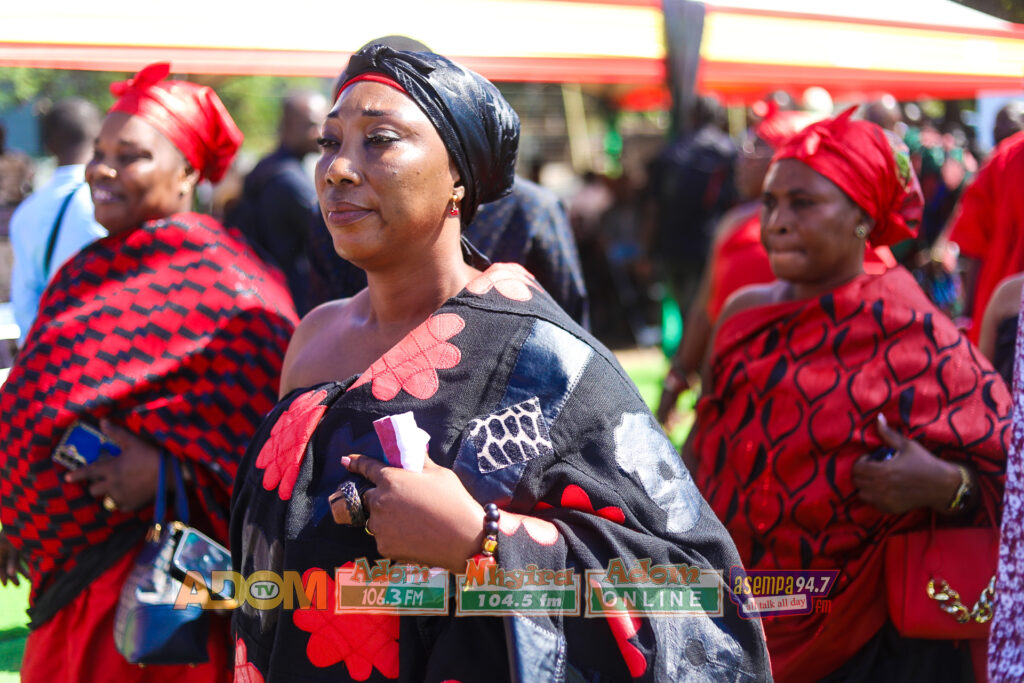
    Despite the order, thousands of mourners gathered at Gomoa Mpota in the Central Region on July 30 for the funeral.

  • FFE: FIFA drops commercial arm proposal, cites divisions

    FFE: FIFA drops commercial arm proposal, cites divisions

    FIFA has backed down from its proposed FIFA Forward Enterprise, a commercial arm valued at $20 billion, which will manage revenue-generating activities linked to the World Cup and other major competitions.

    Under the proposal, FIFA intends to sell up to a 20% minority stake in the new entity to private investors, targeting $4.2 billion in funding. The investor group is expected to be led by Thrive Capital, founded by Joshua Kushner.

    The proposal attracted several backlash from stakeholders including UEFA who criticized FIFA for having crossed the line with the proposal citing accountability loops and attempts by FIFA to sell football. 

    Responding in a formal  statement, FIFA explained that its goal as a global football governing body has always been to unite all parties concerned with the sport however the proposal of the commercial arm has created disparities which it didn’t intend following deliberations with stakeholders whose approval would have been the only basis for the establishment of the FFE.

    “And more so, as we said from the outset, to do this only if a majority of the FIFA Member Associations were in support and always subject to a consultation process with them, the FIFA Council, the Confederations and wider stakeholders”, parts of the statement said. 

    Consequently, “…this proposal will not proceed”.

    It continued that “Having listened carefully to all the views, it has become clear that the project has created divisions of a nature that, regardless of the level of support, are no longer in the interest of the objective set out in the first place.Our purpose has always been – and will always be – to unite and improve”.

    Mr Infantino said he would engage interested parties in the coming days and weeks to rebuild consensus and continue efforts to grow football worldwide, especially in countries that require greater support.

    “My intent is to bring all interested parties back together in the spirit of shared interest in our game, and with the objective to continue growing football everywhere, particularly in those countries that mostly need our support,” he said.

  • Parliament adjourns sine die without reconsidering anti-LGBTQ bill despite Speaker’s assurance earlier

    Parliament adjourns sine die without reconsidering anti-LGBTQ bill despite Speaker’s assurance earlier

    Speaker of Parliament, Alban Bagbin assured that the controversial Human Sexual Rights and Family Values Bill, 2026, widely referred to as the anti-LGBTQ bill will be considered and likely be passed by the House before they go on recess sine die ending the second meeting of the second session of the Ninth Parliament which began on May 21, 2026.

    The Speaker Alban Bagbin indicated that the House will  likely rescind its decision on the passage of the bill to allow for the review of three key clauses aimed at strengthening the sentencing regime before its re-passage.

    Although a motion to rescind the earlier decision was listed on the Order Paper for Friday, July 31, 2026, the House was unable to adopt it before adjournment.

    Although the House couldn’t consider the anti-LGBTQ Bill , it passed other bills during the sitting on Friday. 

    Among these include the Ghana Cocoa Board Bill, 2026, which guarantees cocoa farmers not less than 70 per cent of the Free on Board (FOB) export price through the Ghana Cocoa Board (COCOBOD).

    Lawmakers also passed the Excise Bill, 2026, abolishing excise taxes on locally manufactured fruit juices to lower consumer prices, encourage healthier consumption and support local agro-processing industries.

    The House further approved the Customs Bill, 2026, establishing a modern legal framework for customs administration to consolidate existing customs laws, facilitate international trade, strengthen border security and improve domestic revenue mobilisation.

    Parliament also passed the Tribunals Bill, which provides for the establishment of Regional and District Tribunals to help reduce the backlog of cases in the courts.

    Other key legislation approved includes the National Defence University Ghana Bill and the Community Service Bill, which introduces community service as an alternative to custodial sentences for persons convicted of specified categories of offences.

    The House adjourned after concluding debate on the 2026 Mid-Year Budget Review presented by the Finance Minister, Dr. Cassiel Ato Forson, marking the end of its business for the meeting before the parliamentary recess.

    About the Anti-LGBTQ Bill

    It was first introduced in 2021 in Parliament on 2 August 2021 as a Private Members’ Bill sponsored by a bipartisan group of eight MPs, seven from the opposition NDC and one from the ruling NPP at the time. The lead sponsor was Samuel Nartey George, Member of Parliament for Ningo‑Prampram and Ghana’s Minister for Communication, Digital Technology and Innovations.

    The MPs at the time included Emmanuel Kwasi Bedzrah, MP for Ho West (NDC). Rockson‑Nelson Dafeamekpor, MP for South Dayi (NDC), Helen Adjoa Ntoso, MP for Krachi East (NDC), Rita Naa Odoley Sowah, MP for La Dadekotopon (NDC), Della Sowah, MP for Kpando (NDC), Alhassan Suhuyini, MP for Tamale North (NDC), John Ntim Fordjour, MP for Assin South (NPP).

    It was initially passed in February 2024; however, it could not become a law as President Akufo-Addo did not assent to it.

    Fast forward to after the NDC government assumed power; the bill was reintroduced in Parliament on February 17, 2026 and later passed on May 29, awaiting presidential assent.

    However, President John Dramani Mahama raised concern over the Bill during a question-and-answer session at Chatham House in the United Kingdom (UK) on Monday, June 1. President Mahama indicated that he can only assent to the bill once those lapses are rectified.

    According to him, the bill is marred by procedural and legal issues which were not addressed by Parliament before its passage. He emphasised that, given the domestic and international attention surrounding the bill, Ghana must ensure the right thing is done.

    “The Human Sexual Rights and Family Values Bill has probably been the bill that has evoked the most interest in Ghana. It shows how important issues of family values are. There have been a few issues raised. One, that there wasn’t a quorum when it was passed. That’s an issue that has come up, and then two, there were some procedural lapses in terms of its passage,” he stated.

    The President further added that the legal counsel in the Presidency and the Attorney General would sit on it and make sure that everything is in order before the before he gives his approval.

    “The president has another option. If there are some things that he thinks are a problem, he can refer it to the Council of State for advice. If substantial issues are raised, the president would return the bill to Parliament indicating exactly what the issues are. So there’s still quite a while to go before that bill becomes law,” he added.

    The bill

    The bill was designed to criminalise LGBTQ+ activities, advocacy, and funding, with penalties ranging from 3 to 10 years’ imprisonment depending on the offence.

    The bill sought to criminalise identifying as LGBTQ+, with offenders facing up to three years’ imprisonment.

    It also proposed sanctions against individuals accused of promoting LGBTQ+ rights, including teachers, journalists, doctors, parents and advocates.

    Under the bill, LGBTQ+ organisations would have been outlawed, while donors and partner organisations risked prosecution.

    The legislation further proposed restrictions on media content, making digital or broadcast promotion of LGBTQ+ activities punishable by up to 10 years’ imprisonment.

    It also sought to render same-sex marriages void and prohibit gender transition procedures.

    Additionally, the bill proposed mandatory reporting requirements, compelling family members, educators, religious leaders and community members to report suspected LGBTQ+ activities.

  • Importation of over-10-year-old, submerged, burnt vehicles banned effective October 1 – GSA

    Importation of over-10-year-old, submerged, burnt vehicles banned effective October 1 – GSA

    The Ghana Standards Authority (GSA) has announced October 1, 2026, as the enforcement date for the Pre-Export Verification of Conformity (PVoC) programme for vehicle imports.

    The programme is aimed at ensuring that all used vehicles imported into Ghana comply with GS 4510, the national standard governing the importation of used vehicles, before they are shipped from their country of origin.

    The PVoC programme is expected to prevent the importation of substandard and unsafe vehicles, ensure compliance with Ghana’s safety and environmental standards, improve the traceability of imported vehicles, and protect consumers as well as the environment.

    Under the programme, inspections will be carried out based on the requirements of GS 4510. Vehicles with major damage will not be allowed into the country.

    These include vehicles that have been submerged in water or damaged by floods, burnt or consumed by fire, as well as those with damaged chassis or safety cages, including broken, cracked, bent or twisted structures.

    The standard also prohibits the importation of originally manufactured right-hand-drive vehicles, vehicles assembled from spare parts, vehicles without speedometer readings in kilometres per hour (km/h), and over-aged vehicles that are more than 10 years old.

    The implementation of the PVoC programme is expected to improve the quality and safety of vehicles imported into Ghana, provide better value for money for consumers, and strengthen regulation within the country’s automotive market.

    The GSA also believes the programme will support the formalisation of the domestic used-vehicle industry, improve access to vehicle financing, and boost investor confidence in the sector.

    Deputy Director-General in charge of General Services at the GSA, Samuel Abdulai Jabanyite, speaking on Thursday, July 30, during a stakeholder engagement session with journalists, mentioned that the initiative now has the support of stakeholders who had previously opposed its implementation.

    Speaking to journalists after a stakeholder engagement, he said the measure is also intended to help reduce road crashes.

    “We are trying to plug a major loophole that all the waste, especially when it comes to the automotive industry, coming into our country as a dumping ground and that will be killing our people and causing environmental hazards to us, will now be a thing of the past.”

    He further explained that the inspection process would focus on identifying vehicles that pose significant safety risks while allowing those that can be repaired to meet roadworthiness standards.

    “We will not compromise on that. When cars are flooded, when they are burnt, these are things that we have set aside. But those things that can be replaced and make it road-worthy when they come to Ghana, we allow that. So the third-party inspectors who will be doing this job on our behalf have all these things, and they have the capacity to undertake this.”

    Meanwhile, the GSA will also roll out the Vehicle Dealer Information System (VEDIS) to help curb the importation and registration of stolen vehicles.

    According to Mr Jabanyite, the system will integrate data from key state institutions, enabling real-time information sharing to strengthen vehicle verification and regulation.

    “What it simply means is that we are going to let systems speak with one another. Like DVLA, GSA has it standard. It is sitting somewhere in a component. DVLA has information or data seated somewhere. Insurance has its data seated somewhere. Interpol has its data. National Security has its data.

    “VEDIS is going to build a network that will connect all these systems and be able to provide information to the user in real-time situations. So basically, when we develop this system and it is working, it is going to ensure that vehicle theft and vehicles that are road-worthy are those that can come into the country.”

    Provisions of GS 4510

    Under GS 4510, Ghana’s national standard for imported used vehicles, several important requirements must be met before cars are shipped into the country.

    Every used vehicle must first undergo inspection in its country of origin and obtain a Certificate of Conformance. This ensures that the vehicle complies with Ghana’s safety and emissions standards before shipment.

    The standard also sets a strict vehicle age limit. Cars older than ten years from the date of manufacture are prohibited from importation. In addition, vehicles with cracked, bent, or twisted chassis are not allowed, as they pose serious safety risks.

    Another provision is the ban on right‑hand drive vehicles. Such vehicles cannot be imported unless they are properly converted to left‑hand drive and certified.

    On environmental grounds, GS 4510 requires all imported vehicles to meet at least the Euro II exhaust emissions standard, reducing harmful pollutants.

    Finally, the standard mandates that all vehicles must have speedometers calibrated in kilometres per hour, ensuring consistency with Ghana’s road system.

  • The Sedinam Tamakloe judgment without tears: a breakdown of Court of Appeal’s ruling by Prof Kwaku Asare

    The Sedinam Tamakloe judgment without tears: a breakdown of Court of Appeal’s ruling by Prof Kwaku Asare

    A three-member panel of the Court of Appeal unanimously allowed Sedinam Tamakloe’s appeal, quashed her convictions and sentences, and acquitted and discharged her. The 94-page judgment was delivered by Justice E. Ankamah, with Justices S. Diawuo and E. S. Amedahe concurring.

    The judgment can be reduced to the following questions and answers. As always, the Without Tears series is offered without opinion or commentary.

    1. What was the case about?

    Sedinam Tamakloe, a former CEO of MASLOC, and Daniel Axim, its former Operations Manager, were prosecuted over several MASLOC transactions. The prosecution alleged, among other things, that:

    • Obaatanpa Microfinance delivered a GH¢500,000 cash refund directly to Sedinam, which she dishonestly appropriated;
    • Sedinam and Daniel Axim misappropriated money released for nationwide sensitisation, monitoring, training and financial-literacy programmes;
    • Sedinam misappropriated GH¢579,800 intended for victims of the Kantamanto market fire;
    • Sedinam executed a contract for the procurement of 350 vehicles without obtaining the required approval from the Public Procurement Authority;
    • the prices quoted for those vehicles were substantially higher than the vendor’s alleged retail prices, even though tax waivers had been obtained;
    • MASLOC paid GH¢93,412 for 200 mobile phones allegedly worth GH¢24,400 on the open market; and
    • improper ex gratia and leave payments were made to Sedinam and her deputy.

    Sedinam and Daniel Axim faced 78 counts involving stealing, conspiracy, wilfully causing financial loss to the State, causing loss to public property, money laundering, improper payment of public funds, unauthorised financial commitments and breaches of the Public Procurement Act.

    The prosecution called seven witnesses to make their case. Sedinam attended the greater part of the trial. On 30 July 2021, she obtained the release of her passport to travel abroad for medical review, on condition that she would return to court on 10 October 2021. She did not return.

    On 18 January 2022, the High Court held that she had absconded in breach of her bail conditions. Her sureties were directed to produce her, failing which their recognisances would be forfeited. Their bonds were eventually forfeited on 24 January 2023.

    The trial continued in Sedinam’s absence. On 16 April 2024, the High Court convicted her on all the counts against her and imposed several concurrent sentences. The effective prison term was 10 years.

    On 9th May, 2024, she appealed.

    1. What did Sedinam argue on appeal?

    Her notice of appeal contained nine grounds. Ground (a) was the broad complaint that her convictions were unreasonable and could not be supported by the evidence. Grounds (b) to (h) each simply stated that the trial court had erred in convicting her of a particular category of offences. Ground (i) complained that the sentence was harsh and excessive.

    Her arguments were essentially that:

    • several charges were defectively drafted and did not adequately identify the acts or omissions attributed to her;
    • the prosecution failed to prove the essential ingredients of the offences beyond reasonable doubt;
    • the trial judge wrongly shifted the burden to her to prove that she had authority, followed the proper procedures or used the money for its intended purposes;
    • the evidence did not support the individual convictions; and
    • the sentence was harsh and excessive.
    1. Could she appeal while she was outside Ghana?

    The Republic argued that, because Sedinam was a fugitive when she filed the appeal, she should not be permitted to challenge her convictions.

    The Court rejected that objection. It held that neither the Constitution nor any Ghanaian authority cited by the Republic deprived a person convicted in absentia of the right to appeal.

    Sedinam had filed her appeal within time and in the manner required by law. Her absence from Ghana therefore did not deprive the Court of Appeal of jurisdiction to hear her case.

    1. What happened to seven of her grounds of appeal?

    The Court struck out grounds (b) to (h) because they merely stated that the trial court had “erred” in convicting Sedinam without explaining the alleged errors.

    In simple language, it is not enough to tell an appellate court: “The judge was wrong.” The appellant must also explain: “This is precisely what the judge did wrong, and this is why it was legally wrong.”

    However, striking out those seven grounds did not end the appeal. The Court still considered ground (a): the broad complaint that the convictions were unreasonable and unsupported by the evidence.

    1. Were the charges defective?

    The Court held that several charges were manifestly defective because they did not provide sufficient particulars of the acts, omissions or transactions said to constitute the offences.

    This was not simply a complaint about poor grammar or the incorrect numbering of the counts. In a criminal trial, an accused person must be told with reasonable clarity what she allegedly did. A charge should not merely name an offence; it must provide enough factual detail to enable the accused to understand and answer the allegation.

    However, the Court did not decide the appeal solely because some charges were defective. It independently examined whether the prosecution’s evidence proved the offences.

    1. What was the central error made by the trial judge?

    The Court held that the trial judge repeatedly reversed the burden of proof. Several charges alleged that Sedinam acted:

    • “without authority”; “without approval”; or “without due process.”

    The trial judge reasoned that, because the prosecution had alleged the absence of authority or approval, Sedinam had to prove that she possessed the necessary authority or had followed the required procedure.

    The Court of Appeal held that this was wrong. A prosecutor cannot shift the burden of proof merely by framing an allegation negatively.

    Unless a statute expressly provides otherwise, it remains the prosecution’s duty to prove every ingredient of the offence, including the alleged absence of authority, approval or due process.

    An accused person’s failure to testify, return to the country or offer an explanation cannot be used to complete an otherwise deficient prosecution case.

    1. What did the Court decide about the GH¢500,000 Obaatanpa refund?

    The prosecution’s case was that Obaatanpa returned GH¢500,000 in cash directly to Sedinam and that she acknowledged receiving it in a letter.

    The Court found serious evidential problems. The original acknowledgment letter was not produced. The document tendered was a copy obtained from Obaatanpa. No corresponding MASLOC copy was produced, even though the reference number on the letter suggested that MASLOC should have retained one.

    The MASLOC officials who testified had not seen an original MASLOC copy against which the document could be compared.

    The Chairman of Obaatanpa also claimed that he had exchanged WhatsApp messages with Sedinam concerning the refund. Those messages were not produced.

    Moreover, after the alleged cash refund, Sedinam continued signing letters demanding interest from Obaatanpa on the GH¢500,000 investment. The Court considered that conduct difficult to reconcile with the claim that she had already received the money in cash.

    The Court held that the prosecution had not proved beyond reasonable doubt that Sedinam received the GH¢500,000.

    Without proof of receipt, dishonest appropriation could not be established. The conviction and sentence relating to that money were therefore set aside.

    1. What did the Court decide about the sensitisation, monitoring and training funds?

    The prosecution alleged that Sedinam and Daniel Axim stole GH¢1,816,000 released for sensitisation and monitoring programmes, even though the MASLOC Board had approved GH¢1,706,000. Sedinam was also accused of appropriating other amounts intended for training, sensitisation and financial literacy.

    The prosecution’s case was that the programmes either did not occur or occurred only on a very limited scale.

    The Court held that the prosecution did not prove beyond reasonable doubt that Sedinam stole the money. The prosecution did not call the relevant regional officers or beneficiaries who could give direct evidence about whether the programmes took place.

    Instead, the trial judge expected Sedinam to prove that the funds had been properly used. The Court held that this again wrongly transferred the prosecution’s burden to the accused.

    1. What about the Kantamanto fire-victim funds?

    The prosecution alleged that Sedinam dishonestly appropriated GH¢579,800 intended for victims of the Kantamanto market fire.

    However, one prosecution witness admitted that enquiries had established that the funds had been distributed to the victims. Another witness had confirmed this to him, although that information was omitted from the report tendered in evidence.

    The Court held that this admission struck at the foundation of the stealing charge. If the funds had been distributed to the intended victims, the allegation of dishonest appropriation could not be sustained. The conviction and sentence relating to the Kantamanto funds were therefore set aside.

    1. What happened to the money-laundering convictions?

    They were set aside. The alleged stealing offences were the underlying or “predicate” offences supporting the money-laundering charges. In simple terms, the prosecution first had to prove that the money was the proceeds of an unlawful activity.

    Once the prosecution failed to prove the relevant stealing offences, it could not establish that the money was the proceeds of crime. The legal foundation of the money-laundering convictions therefore disappeared.

    1. What did the Court decide about the ex gratia and leave payments?

    The Court set aside the convictions for improper payment of public funds. MASLOC’s Head of Finance testified that his office processed and authorised the payments based on appointment documents issued by the Chief of Staff at the Office of the President.

    He said that he found nothing wrong with the documents and authorised the payments on that basis.

    There was no evidence that Sedinam personally authorised an improper payment; deceived the Finance Department; made a misrepresentation; presented false documentation; or caused a payment to be made contrary to an identified verification procedure.

    The prosecution therefore failed to prove the offence beyond reasonable doubt.

    1. What about the GH¢61.7 million vehicle commitment?

    The conviction for making an unauthorised commitment resulting in a financial obligation for the Government was also set aside. The prosecution alleged that Sedinam made commitments amounting to approximately GH¢61.7 million without authority and without following the proper procedures.

    The Court held that the prosecution did not identify the applicable verification procedure or demonstrate precisely how Sedinam breached it.

    The evidence also showed that the Ministry of Finance had written to the Public Procurement Authority confirming that the financing arrangements for the vehicles were under consideration.

    It was not Sedinam’s responsibility to prove that she had authority. It was the prosecution’s responsibility to prove beyond reasonable doubt that she did not.

    1. What did the Court decide about the procurement charges?

    The procurement convictions were set aside. The Court found that the prosecution did not prove beyond reasonable doubt that the required approval had been withheld.

    It also noted that Sedinam did not authorise payment for the 350 vehicles during her tenure. Her successor renegotiated the prices and authorised payments in 2017 and 2018, after Sedinam had left office. The Court therefore held that the prosecution failed to prove the procurement offences charged against her.

    1. Did the Court merely reduce the 10-year sentence?

    No. It went much further. The Court held that all Sedinam’s convictions had to be quashed. A sentence is the legal consequence of a valid conviction. Once the convictions were set aside, there was no lawful sentence left to reduce.

    The complaint that the sentence was harsh or excessive therefore became moot, meaning there was no longer any need for the Court to decide it.

    1. What was the final result?

    The Court of Appeal held that:

    • the prosecution’s evidence fell short of proof beyond reasonable doubt;
    • the trial judge wrongly required Sedinam to prove authority, approval, proper procedure and proper use of funds;
    • the manner in which an offence is drafted cannot relocate the burden of proof;
    • an accused person’s absence or failure to testify cannot be used to fill gaps in the prosecution’s evidence; and
    • the convictions and sentences on all the charges against Sedinam could not stand.

    Accordingly, all her convictions and sentences were quashed, and she was acquitted and discharged.

    1. Does the judgment say that nothing went wrong at MASLOC?

    No. An acquittal or the quashing of a conviction does not necessarily mean that every transaction was proper, prudent or administratively defensible. It only means that the specific criminal offences charged against Sedinam were not proved beyond reasonable doubt according to law.

    Criminal suspicion, unanswered questions, administrative failures and even financial irregularities are not substitutes for proof of every ingredient of a criminal offence.

    1. What is the judgment’s central lesson?

    The burden of proving guilt belongs to the prosecution. It cannot be shifted merely because an allegation is expressed negatively; information may be more readily available to the accused; the accused does not testify; the accused is tried in absentia; or the accused does not explain.

    As Justice Ankamah explained, requiring otherwise would mean asking an accused person to complete the prosecution’s unfinished work and then convicting her for declining the invitation.

    DISCLAIMER: Independentghana.com will not be liable for any inaccuracies contained in this article. The views expressed in the article are solely those of the author’s, and do not reflect those of The Independent

  • Gov’t to cover medical bills of all children injured in Dzorwulu crash – Gender Minister assures

    Gov’t to cover medical bills of all children injured in Dzorwulu crash – Gender Minister assures

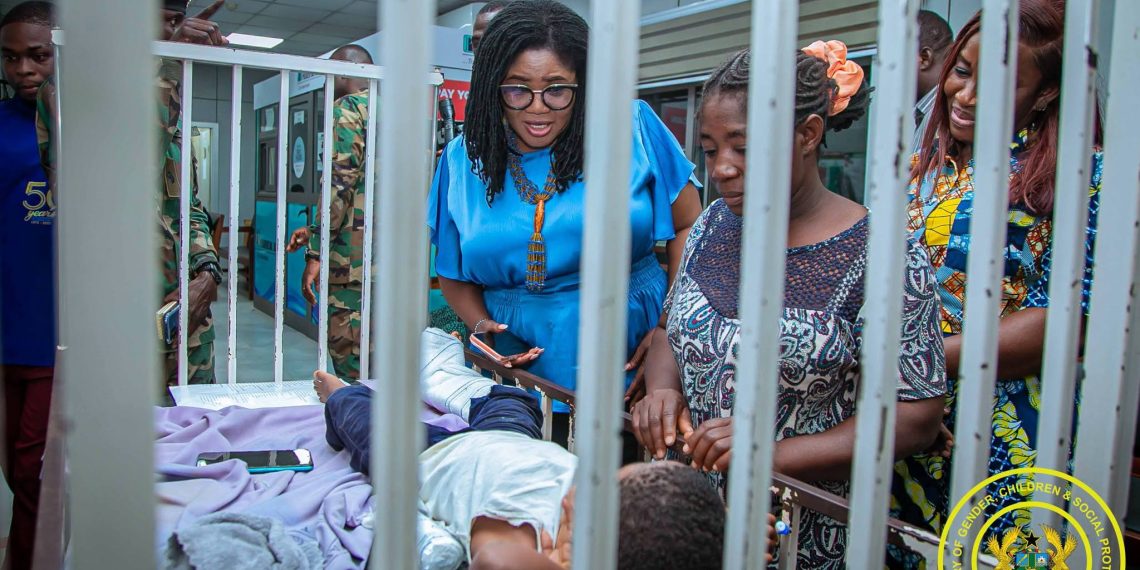
    The government is set to foot the bills for the eleven (11) pupils who have suffered injuries from the road crash which occurred between their bus and a tipper truck at the Dzorwulu-Accra Mall stretch, the Minister for Gender, Children and Social Protection, Dr Agnes Naa Momo Lartey, has assured.

    Not only will the government pay their medical bills, but will also support their full recovery.

    Dr Naa Momo gave this assurance to families of the affected pupils when she paid a visit to them today, Friday, July 31, at the 37 Military Hospital where they are currently receiving treatment.

     Describing the incident as heartbreaking, Dr Lartey expressed sympathy to the injured children and their families and reaffirmed the government’s commitment to their welfare.

    “As the Minister responsible for children’s welfare, I want to assure the families of the government’s commitment and support, especially that of President John Dramani Mahama, in ensuring the full recovery of the children,” she said.

    She further assured parents that they would not bear the financial burden of their children’s medical care.

    “The families will not be burdened with the cost of the children’s medical treatment, allowing them to concentrate on providing the emotional care and support their children need,” the Minister added.

    She further went on to assure families of the injured children that the circumstances that led to the fatal crash that claimed the life of one of the students, a six-year-old girl who suffered serious injuries. She died in the early hours of Friday, July 31.

    Meanwhile, one child reportedly died in the early hours of Friday from the impact of the accident.

  • Dzorwulu school bus accident: 6-year-old girl dies from injuries

    Dzorwulu school bus accident: 6-year-old girl dies from injuries

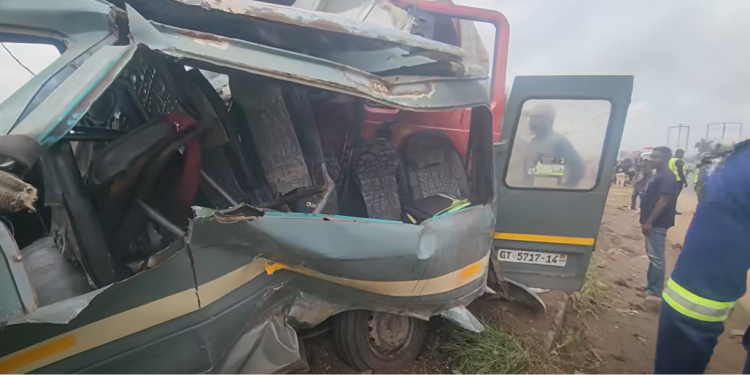
    One of the pupils who was among the 11 students in a Mercedes-Benz Sprinter involved in a crash with a tipper truck has been confirmed dead.

    The crash happened yesterday at Airport Junction on the Accra Mall–Dzorwulu stretch in Accra.

    Following the crash, it was reported that none of the students had died but had suffered minimal to serious injuries. However, barely 24 hours after the incident, one of them, a six-year-old girl who suffered severe injuries in the collision, succumbed to her injuries at about 8:00 p.m. on Thursday, July 30, while receiving treatment at the Police Hospital.

    About the crash

    The crash occurred yesterday at around 2:00 p.m. when a tipper truck with registration number GN 9673-25 rammed into a school bus reportedly belonging to Ask God Preparatory School in Ashaiman.

    Speaking to Citi News, the Assistant Divisional Officer I (ADO I) of the Ghana National Fire Service (GNFS), King Alex Nartey, said the other children injured in the crash are receiving treatment at various health facilities.

    Personnel from the GNFS and the National Ambulance Service responded swiftly to the scene, rescuing the victims before conveying them to hospital for medical attention.

    Authorities are expected to continue investigations into the circumstances that led to the fatal crash.

  • ECG unable to pay 2025 dividend to government despite 16.2% revenue growth – Board Chairman

    ECG unable to pay 2025 dividend to government despite 16.2% revenue growth – Board Chairman

    The national power producer, the Electricity Company of Ghana (ECG), failed to pay dividends to its sole shareholder, the government, in 2025.

    Despite ECG’s improved finances that year, the company was unable to break even to pay its shareholder, the ECG Board of Directors have said.

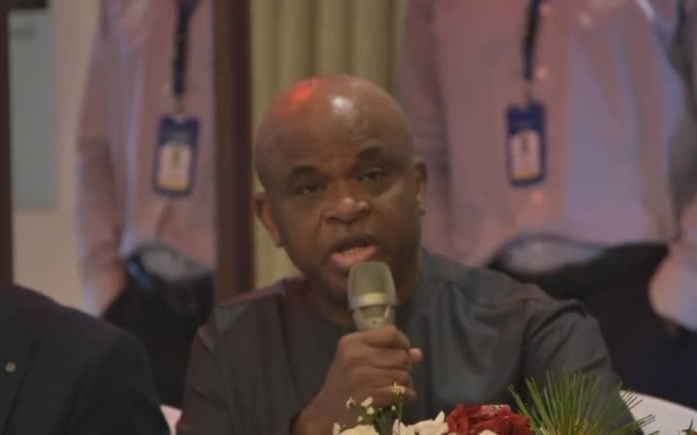
    Speaking at the 18th Annual General Meeting  (AGM) of the company in Accra on Thursday (July 30), the Board Chairman, William Amuna, said ECG saw a revenue increase by 16.2% to GH¢22,109 million from its previous GHC 19,020 million. 

    Liabilities resulted in a loss after tax of GH¢2,521.20 million in 2025, which was a significant improvement compared to the GH¢8,255.80 million recorded in 2024. This represents a 69.4% reduction in losses year‑on‑year, highlighting a major turnaround in the company’s financial performance.

    “In view of the financial outcome for the year and the company’s retained losses position, the Directors do not recommend the payment of dividend,” Mr Amuna told the meeting.

    While acknowledging the need for his outfit to improve its financial position, the Director assured government of its efforts to implement its proposed measures to improve revenue.

    Mr Amuna said the board acknowledged the need to restore the company’s financial position and had thus supervised the implementation of government’s proposed reforms, which were already yielding results while stressing ECG’s commitment to implementing measures to strengthen ECG’s long-term financial sustainability.

    “The Board is working with management and engaging Government and the regulatory stakeholders on a sustainable long-term financing framework for the distribution sector,” he stated.

    Mr Amuna further said the board has endorsed a four-channel strategy for debt reduction, tariff full cost recovery, loss reduction, improved collections and the growth of other income streams.

    “This strategy has been endorsed by the Board and is being actively pursued by management,” the ECG board chairman told the AGM.

    Meanwhile, the AGM, the first in over eight years, was attended by the sole shareholder, the state, represented by the Ministry of Finance and the State Interest Governance Authority ( SIGA).

    Also in attendance were members of the board, ECG management and other stakeholders such as the Public Utilities Regulatory Authority (PURC), GRIDCo, the Volta River Authority (VRA) and independent power producers.

    Auditor General on ECG unpaid tax

    In early July, the Auditor-General (A-G) unveiled new findings in the audit of the public accounts of government ministries, departments, and agencies (MDAs).

    According to the Auditor-General’s latest report, ten state institutions, including the power distribution company Electricity Company of Ghana (ECG), contributed to the financial irregularities worth about GH¢5.2 billion in 2024.

    The statement added that the power distribution company had the largest unpaid tax bill among all the state institutions mentioned in the audit, with GH¢1.4 billion.

    The report stated that tax-related irregularities amounted to GH¢4.8 billion, making them the largest category of irregularities identified during the audit. Of that amount, more than GH¢3 billion comprised outstanding tax obligations owed by ECG and the other nine state institutions in 2024.

    Meanwhile, last year, ECG launched the “Operation All Must Pay” initiative to facilitate the retrieval of outstanding debts owed by customers across the nation as well as prosecute offenders involved in illegal connection.

    The exercise came to a close on September 30 after it began on September 9, targeting residential, commercial, industrial, and government institutions such as Ministries, Departments, and Agencies (MDAs).

    A statement released by the Electricity Company of Ghana states, “The exercise will include Bill distribution, streetlights & SHEP meter capturing & reporting. This exercise will be monitored by special teams who will apprehend and prosecute customers who have connected electricity illegally, or attempt to interfere with the exercise, or undertake illegal self-reconnection after disconnection.”

    ECG further advised customers with arrears to pay their bills immediately to avoid disconnection and payment of reconnection fees.

    The government, on the other hand, has implemented measures to revive Ghana’s energy sector. Last year, the President John Dramani Mahama-led government implemented a GH¢1 fuel levy on petroleum products.

    This move falls under the Energy Sector Levies (Amendment) Act, 2025 (Act 1141), which was assented to by the President on June 5 to address energy-sector shortfalls, reduce legacy debts, and stabilise power supply across the country, following parliamentary approval.

    “We were told that the GH¢1 levy will allow the government to keep the lights on, and so now the question is, why are our lights not on? We were told that we were paying the GH¢1 to use it to buy fuel, but when the NPP was leaving, we handed fuel to them, and so the question is why Ghanaians must continue to sleep in darkness, and businesses are collapsing.

  • August 6 helicopter crash: See government’s 9-day programme for one-year commemoration

    August 6 helicopter crash: See government’s 9-day programme for one-year commemoration

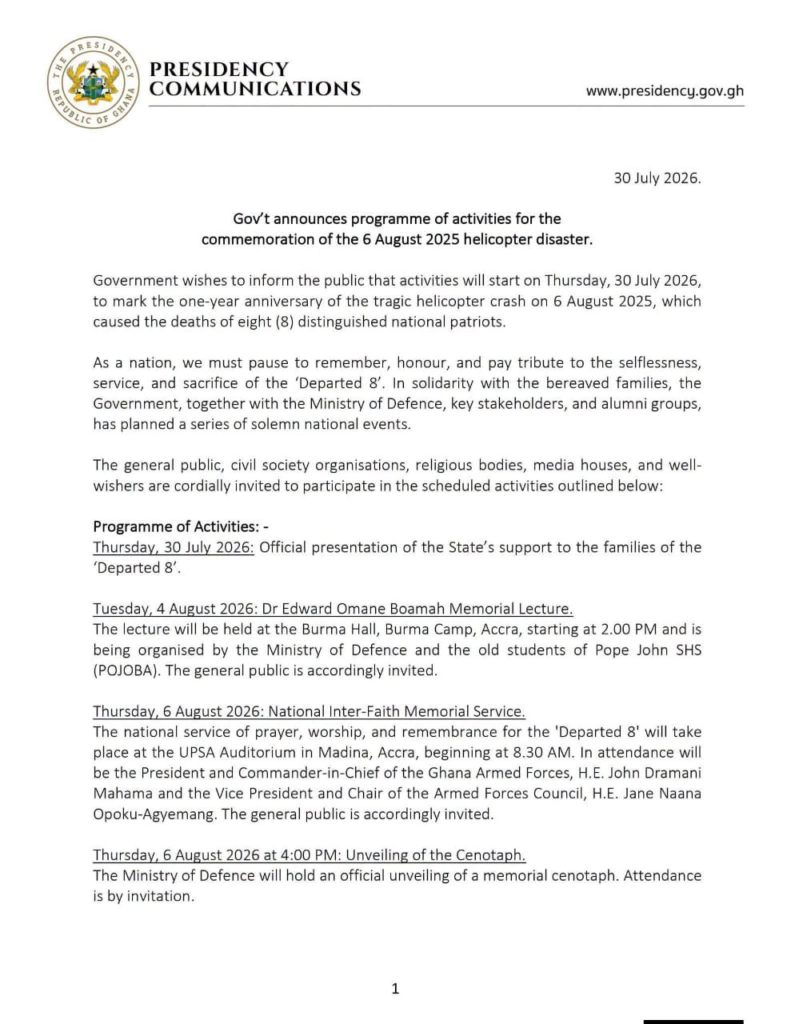
    Government has announced a nine-day commemorative programme, from Thursday, July 30 to Saturday, August 7, 2026, to honour the eight distinguished national patriots who lost their lives in the Adansi  helicopter crash on August 6, 2025, while on a state assignment.

    In a statement shared by the Presidency on July 30, detailing the activities for the ceremony, indicated that,  the programe is intended to help the nation, “pause to remember, honour, and pay tribute to the selflessness, service, and sacrifice of the ‘Departed 8’. In solidarity with the bereaved families, the Government, together with the Ministry of Defence, key stakeholders, and alumni groups, has planned a series of solemn national events”.

    The programme is opened to the general public and all interested parties.

    “The general public, civil society organisations, religious bodies, media houses, and well-wishers are cordially invited to participate in the scheduled activities”, the statement said.

    Programme of Activities: 

    On Thursday, 30 July , an Official presentation of the State’s support to the families of the ‘Departed 8’ will be held and on Tuesday, 4 August, a Memorial Lecture will be held in honour of Dr Edward Omane Boamah at the Burma Hall, Burma Camp, Accra, starting at 2.00 PM and is being organised by the Ministry of Defence and the old students of Pope John SHS (POJOBA). 

    National Inter-Faith Memorial Service

    Also, on Thursday, 6 August a national service of prayer, worship, and remembrance for the ‘Departed 8’ will take place at the UPSA Auditorium in Madina, Accra, beginning at 8.30 AM. In attendance will be the President and Commander-in-Chief of the Ghana Armed Forces, H.E. John Dramani Mahama and the Vice President and Chair of the Armed Forces Council, H.E. Jane Naana Opoku-Agyemang. Thursday, 6 August 2026 at 4:00 PM: Unveiling of the Cenotaph.

    While the first three days activities are open to the public, the Ministry of Defence will hold an official unveiling of a memorial cenotaph which is strictly by invitation.

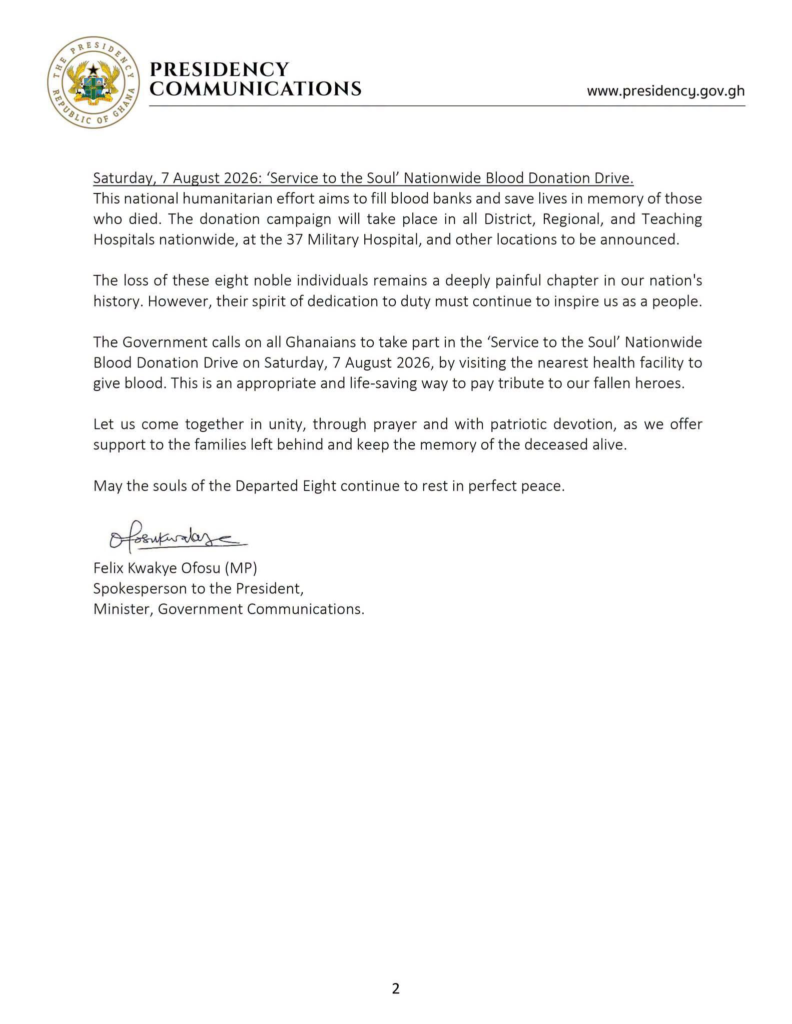
    On Saturday, 7 August  a Nationwide Blood Donation Drive will be held  under the theme ‘Service to the Soul’ to fill blood banks and save lives in memory of those who died. The donation campaign will take place in all District, Regional, and Teaching Hospitals nationwide, at the 37 Military Hospital, and other locations to be announced.

    Government urges all citizens to partake in  the nationwide blood donation  to save lives.

    “The Government calls on all Ghanaians to take part in the ‘Service to the Soul’ Nationwide Blood Donation Drive on Saturday, 7 August 2026, by visiting the nearest health facility to give blood. This is an appropriate and life-saving way to pay tribute to our fallen heroes”, the statement said.

    The loss of these eight noble individuals remains a deeply painful chapter in our nation’s history. However, their spirit of dedication to duty must continue to inspire us as a people.

    The statement ended with a call to all Ghanaians to support the families of the fallen August 6 heroes.

    “Let us come together in unity, through prayer and with patriotic devotion, as we offer support to the families left behind and keep the memory of the deceased alive.May the souls of the Departed Eight continue to rest in perfect peace”, it noted.

  • Attorney-General files appeal against Court of Appeal’s acquittal of Sedinam Tamakloe

    Attorney-General files appeal against Court of Appeal’s acquittal of Sedinam Tamakloe

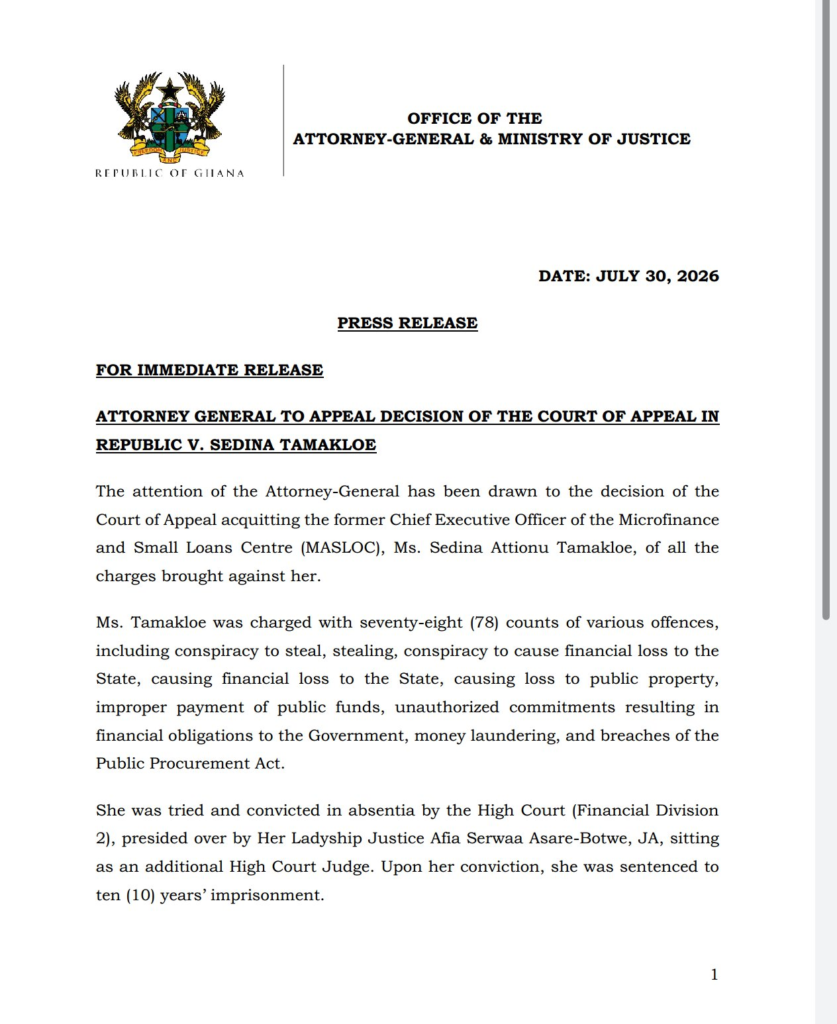
    The Attorney-General (AG) has begun an appeal seeking to overturn the Appeal Court ruling on the incarcerated former Chief Executive Officer of the Microfinance and Small Loans Centre (MASLOC), Ms Sedina Attionu Tamakloe, and quash all the charges brought against her.

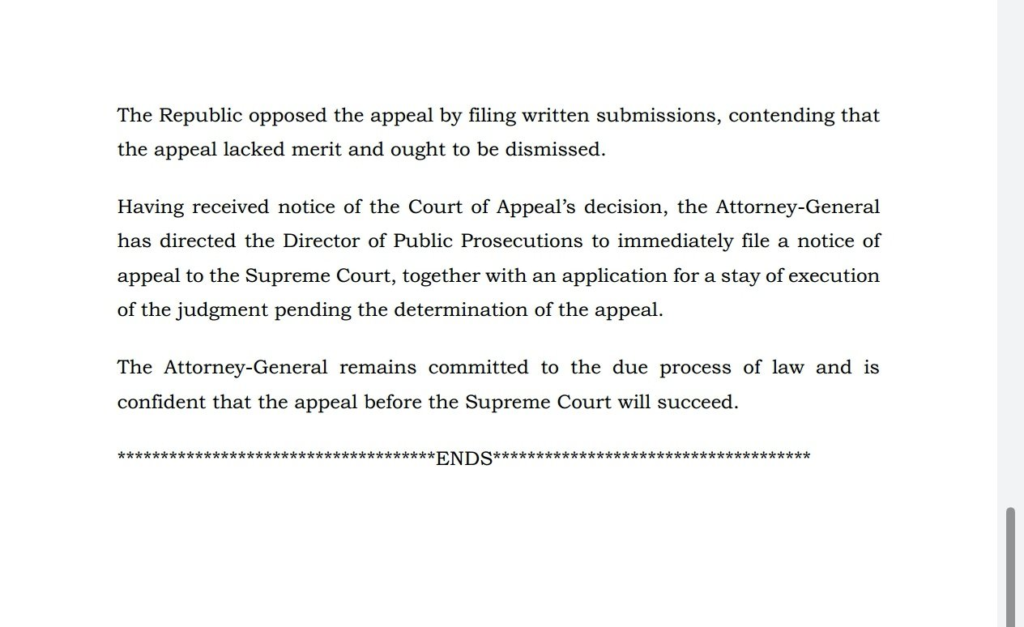
    In a two-page statement released on Thursday, July 30, Minister for Government Communications, Felix Kwakye Fosu, indicated that the “Republic opposed the appeal by filing written submissions, contending that the appeal lacked merit and ought to be dismissed”.

    It continued that the AG has ordered the Director of Public Prosecutions to file a stay of execution to prevent the Court of Appeal’s acquittal from taking effect while the Supreme Court considers the appeal.

    “Having received notice of the Court of Appeal’s decision, the Attorney-General has directed the Director of Public Prosecutions to immediately file a notice of appeal to the Supreme Court, together with an application for a stay of execution of the judgment pending the determination of the appeal”, parts of the statement indicated while assuring the public of government’s commitment to upholding the law.

    “The Attorney-General remains committed to the due process of law and is confident that the appeal before the Supreme Court will succeed”, it added.

    Background

    In 2017, the Economic and Organised Crime Office (EOCO) launched an investigation into MASLOC’s operations under Madam Tamakloe Attionu’s leadership. The investigation uncovered alleged financial irregularities and embezzlement involving officials of the institution.

    Findings

    EOCO alleged that its investigations uncovered fraudulent disbursements of MASLOC funds, inflated procurement of vehicles and mobile phones without approval from the Public Procurement Authority, misappropriation of funds intended for victims of the 2013 Kantamanto Market fire, and questionable ex gratia payments made to Madam Tamakloe Attionu and her deputy.

    Consequently, in January 2019, she was arraigned before the High Court on 78 counts, including stealing, conspiracy to steal, causing financial loss to the state, money laundering and procurement breaches.

    After about two years of legal proceedings, she sought and obtained permission to travel to the United States for medical treatment. However, she failed to return to Ghana to continue participating in the trial and was subsequently tried in absentia.

    In 2024, the Accra High Court sentenced Madam Tamakloe Attionu to 10 years’ imprisonment in absentia after finding her guilty of multiple offences, including causing financial loss to the state and theft. The court held that her actions as MASLOC Chief Executive between 2013 and 2016 resulted in a financial loss of nearly GH¢90 million to the state.

    Following her conviction, Ghanaian authorities intensified efforts to secure her return, with the government formally requesting her extradition from the United States in 2025.

    A United States District Court in Nevada subsequently considered the extradition request and, after reviewing the application and supporting legal documentation submitted by Ghanaian authorities, certified the request, paving the way for her return to Ghana.

    Tamakloe arrives in Ghana

    In a Facebook post, the Minister of State in charge of Government Communications and Presidential Spokesperson, Felix Kwakye Fosu, indicated that Sedinam has returned to Ghana from the USA, two years and two months after the Accra High Court sentenced her to 10 years in prison for over 70 corruption-related charges. The charges include the alleged embezzlement of more than $6 million in public funds.

    He noted that she arrived at the Accra International Airport at approximately 7:18 a.m. on Tuesday, June 9, aboard United Airlines flight UA 996 from Washington Dulles International Airport in the United States.

    “In April, 2024, the High Court convicted and sentenced SEDINA TAMAKLOE-ATTIONU in absentia. In July 2024, the Government of Ghana submitted an extradition request to the United States for her surrender to Ghana to serve her sentence. After over two years of court proceedings, the United States authorities notified the Government of her surrender in January this year. She arrived in Accra on Tuesday, June 9, 2026.

    “Officials of the Ghana Police Service and the Ghana Prisons Service have taken her into custody and are making the necessary preparations for her to begin her sentence. Meanwhile, the Attorney-General is scheduled to meet his counterparts at the United States Department of Justice for a bilateral discussion on all pending extradition requests between the two countries”, Kwakye Fosu said in the post.

    The U.S Embassy in Ghana confirmed the extradition of Sedina Tamakloe Attionu on Tuesday, June 9, in a Facebook post.

    “Justice has no borders. The United States has extradited Sedina Tamakloe Attionu to Ghana, following her conviction on 70+ corruption-related charges, including embezzling more than $6M equivalent in Ghanaian taxpayer funds. This is our strong U.S.-Ghana law enforcement partnership in action, demonstrating a shared commitment to accountability and the first extradition from the United States to Ghana since 2009”, the US Embassy indicated.

    Upon her arrival, she was received by security personnel and immediately taken into custody for debriefing and medical examinations as part of standard procedures before being transferred to begin serving her sentence.

    Her return follows a protracted extradition process initiated by the Government of Ghana after she failed to return to the country following a medical trip to the United States.

    Meanwhile, Sedinam’s deputy was tried alongside his boss but received a lighter sentence of 5 years, with main charges tied to conspiracy and abetting, thus aiding his boss to conduct fraudulent schemes.

  • Anti-LGBTQ bill to be passed today

    Anti-LGBTQ bill to be passed today

    Ghana’s popular controversial bill, the Human Sexual Rights and Family Values Bill, popularly known as the anti-LGBTQ Bill, is set to be passed by the end of the month before Parliament proceeds to recess, the Speaker of Parliament, Alban Bagbin Sumana, has said.

    Parliament is set to go on recess today, Friday, July 31, and according to the Speaker, the bill will be considered and passed before the House proceeds for the recess Sine die, marking the end of the Second Meeting of the Second Session of the Ninth Parliament, which began on May 21, 2026. 

    Mr Bagbin said the bill, in its current form, requires further review, particularly three key clauses relating to sentencing provisions.

    According to him, the reconsideration is necessary to address concerns over the punishment regime outlined in the legislation before it is brought back before the House for final consideration, urging that the whole conversation about the bill should not be politicised.

    “Our intention is to do it before we go on recess. We are likely to do so even by tomorrow so that it assures you that the members you elected to Parliament are doing what you have asked them to do. There is no politics at all. Anybody who wants to take political advantage, just disregard it. Both Muslims and Christians agree; even the unbelievers know that if we don’t pass it, we are acting against the decree of God,” Mr Bagbin said.

    About the Anti-LGBTQ Bill

    It was first introduced in 2021 in Parliament on 2 August 2021 as a Private Members’ Bill sponsored by a bipartisan group of eight MPs, seven from the opposition NDC and one from the ruling NPP at the time. The lead sponsor was Samuel Nartey George, Member of Parliament for Ningo‑Prampram and Ghana’s Minister for Communication, Digital Technology and Innovations.

    The MPs at the time included Emmanuel Kwasi Bedzrah, MP for Ho West (NDC). Rockson‑Nelson Dafeamekpor, MP for South Dayi (NDC), Helen Adjoa Ntoso, MP for Krachi East (NDC), Rita Naa Odoley Sowah, MP for La Dadekotopon (NDC), Della Sowah, MP for Kpando (NDC), Alhassan Suhuyini, MP for Tamale North (NDC), John Ntim Fordjour, MP for Assin South (NPP).

    It was initially passed in February 2024; however, it could not become a law as President Akufo-Addo did not assent to it.

    Fast forward to after the NDC government assumed power; the bill was reintroduced in Parliament on February 17, 2026 and later passed on May 29, awaiting presidential assent.

    However, President John Dramani Mahama raised concern over the Bill during a question-and-answer session at Chatham House in the United Kingdom (UK) on Monday, June 1. President Mahama indicated that he can only assent to the bill once those lapses are rectified.

    According to him, the bill is marred by procedural and legal issues which were not addressed by Parliament before its passage. He emphasised that, given the domestic and international attention surrounding the bill, Ghana must ensure the right thing is done.

    “The Human Sexual Rights and Family Values Bill has probably been the bill that has evoked the most interest in Ghana. It shows how important issues of family values are. There have been a few issues raised. One, that there wasn’t a quorum when it was passed. That’s an issue that has come up, and then two, there were some procedural lapses in terms of its passage,” he stated.

    The President further added that the legal counsel in the Presidency and the Attorney General would sit on it and make sure that everything is in order before the before he gives his approval.

    “The president has another option. If there are some things that he thinks are a problem, he can refer it to the Council of State for advice. If substantial issues are raised, the president would return the bill to Parliament indicating exactly what the issues are. So there’s still quite a while to go before that bill becomes law,” he added.

    The bill

    The bill was designed to criminalise LGBTQ+ activities, advocacy, and funding, with penalties ranging from 3 to 10 years’ imprisonment depending on the offence.

    The bill sought to criminalise identifying as LGBTQ+, with offenders facing up to three years’ imprisonment.

    It also proposed sanctions against individuals accused of promoting LGBTQ+ rights, including teachers, journalists, doctors, parents and advocates.

    Under the bill, LGBTQ+ organisations would have been outlawed, while donors and partner organisations risked prosecution.

    The legislation further proposed restrictions on media content, making digital or broadcast promotion of LGBTQ+ activities punishable by up to 10 years’ imprisonment.

    It also sought to render same-sex marriages void and prohibit gender transition procedures.

    Additionally, the bill proposed mandatory reporting requirements, compelling family members, educators, religious leaders and community members to report suspected LGBTQ+ activities.

  • Gov’t backs CRC proposal to lower presidential age limit to 35 from 40

    Gov’t backs CRC proposal to lower presidential age limit to 35 from 40

    The government has endorsed a proposal by the Constitutional Review Committee (CRC) to lower the minimum age for presidential candidates from 40 to 35 years, describing it as part of broader constitutional reforms aimed at strengthening Ghana’s democracy.

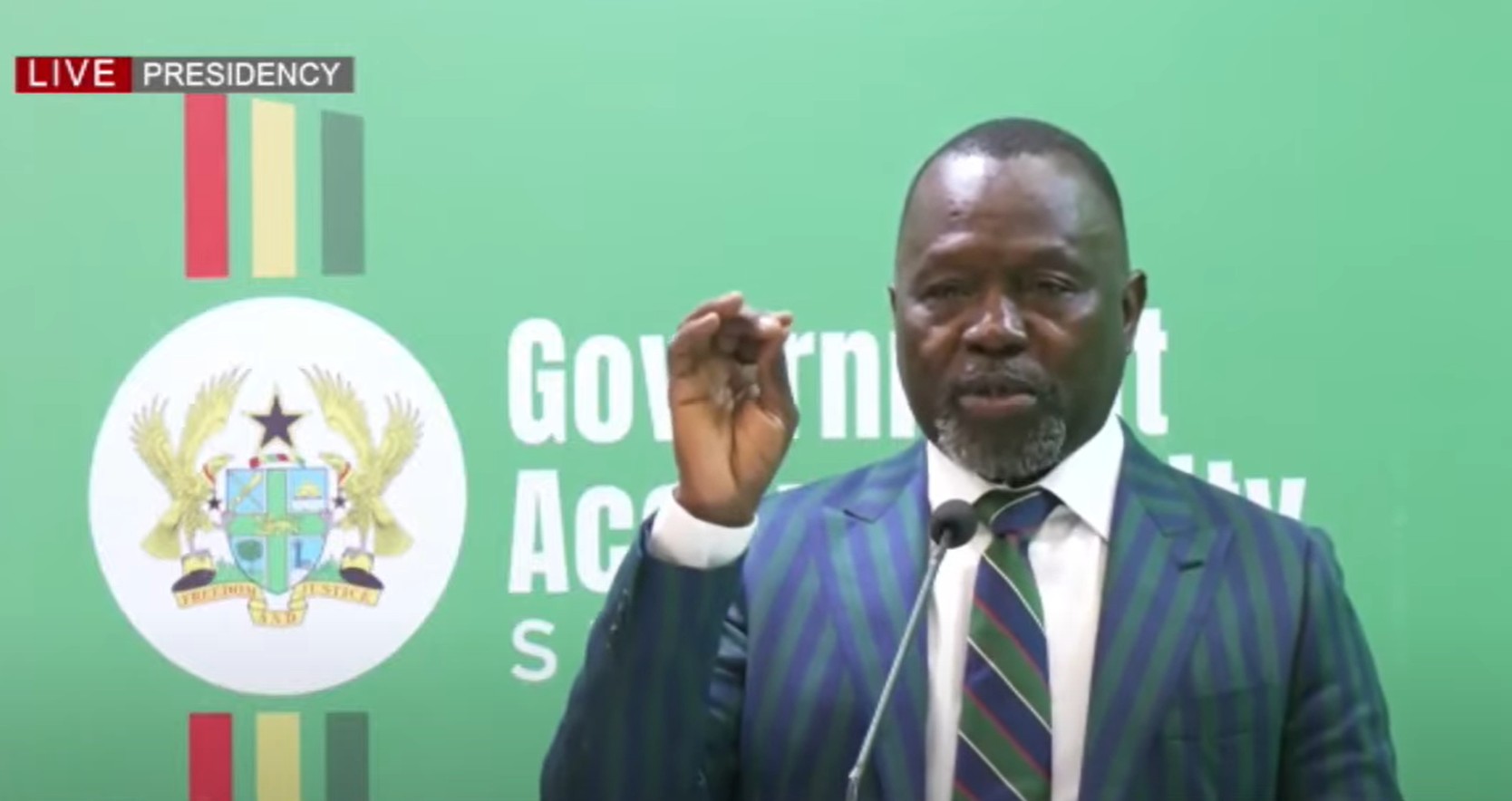
    Presenting the government’s response to the Constitutional Review Committee’s recommendations at a press conference at the Jubilee House in Accra on Thursday, July 30, the Attorney-General and Minister for Justice, Dr Dominic Ayine, announced that the government had accepted the recommendation in principle, but with a modification.

    While the committee proposed reducing the eligibility age from the current 40 years to 30 years, the government opted for a minimum age of 35 years.

    “Still under the presidency, the committee recommended that the minimum age of eligibility for election as president be reduced from 40 years, currently in the Constitution, to 30 years. The government has accepted this recommendation in principle, subject to one modification.

    “The minimum age will be 35 years, not 30 years. And of course, the details of this will be fashioned out by the Constitutional Review,” Dr Ayine said.

    According to the Attorney-General, the proposal forms part of a broader package of constitutional amendments that were extensively reviewed by Cabinet before the government announced its position.

    He explained that the committee’s recommendations had been thoroughly considered by Cabinet on three occasions, stressing that the review process was deliberate, constitutional and transparent.

    “The recommendations of the CRC were carefully considered by Cabinet on three occasions, including the dedication of an entire weekend retreat presided over by the President of the Republic.

    “Government examined each of the committee’s 206 proposed constitutional amendments against the provisions of the 1992 Constitution to determine their scope, implications and whether the objectives could be achieved through constitutional amendments or through ordinary legislation and administrative action,” he stated.

    Dr Ayine further clarified that the document presented by the government should not be regarded as a white paper but rather as the government’s official position on the committee’s recommendations.

    “This is not a government white paper. The government’s response represents its considered position on the recommendations submitted by the Constitutional Review Committee,” he explained.

    The recommendation to lower the presidential age requirement forms part of the Constitutional Review Committee’s proposals aimed at amending aspects of the 1992 Constitution. Although the government has accepted the proposal in principle, it will still have to go through the constitutional amendment process before it can take effect.

    Constitutional Review process

    Ghana’s constitutional review process began in January 2010 under President John Evans Atta Mills, when a nine-member Constitutional Review Commission chaired by Professor Albert Fiadjoe was inaugurated to examine the 1992 Constitution and recommend reforms.

    The commission submitted its report in 2011, after which the government issued a white paper in June 2012, accepting some recommendations, rejecting others and deferring several for further consideration.

    The review process later stalled before being revived in January 2025, when President John Mahama appointed a new eight-member Constitutional Review Committee chaired by Professor H. Kwasi Prempeh to continue the exercise.

    The committee submitted its report to the President and, on February 10, 2026, presented its final report titled Transforming Ghana – From Electoral Democracy to Developmental Democracy, containing 206 proposed constitutional amendments, including the recommendation to reduce the minimum age for presidential candidates.

  • Gov’t accepts CRC’s five-year presidential term recommendation – AG

    Gov’t accepts CRC’s five-year presidential term recommendation – AG

    Future presidents may serve five-year terms instead of four after the government announced its acceptance of the Constitutional Review Committee’s (CRC) recommendation to extend the tenure of the President and Parliament.

    Presenting the government’s response to the Constitutional Review Committee’s recommendations at a press conference at the Jubilee House in Accra on Thursday, July 30, the Attorney-General and Minister for Justice, Dr Dominic Ayine, explained that the proposal is intended to provide administrations with more time to implement and evaluate their policies before returning to the electorate.

    “The government has accepted a recommendation to extend the term of office of the president from four years to five years, with the term of Parliament extended to correspond with this,” he said.

    However, he explained that the document represents the government’s considered position on the committee’s proposals, but is not legally a white paper.

    “This is not a government white paper. The government’s response represents its considered position on the recommendations submitted by the Constitutional Review Committee,” he continued.

    He argued that the current four-year term is insufficient for governments to fully implement and deliver on their campaign promises, noting that the first year is largely spent settling into office while the fourth is often dominated by election-related activities. According to him, extending the tenure to five years would provide governments with a more realistic timeframe to implement most, if not all, of their policies.

    “Our thinking is practical. Under the current four-year cycle, the early months of every administration are consumed by transition matters, and the final year is largely consumed by elections. A five-year term provides a more realistic time frame for the formulation, implementation and assessment of government policy,” the Attorney-General added.

    The Attorney-General also announced that the government had accepted, in principle, the committee’s recommendation to lower the minimum age for presidential candidates, but with a modification.

    While the Constitutional Review Committee proposed reducing the eligibility age from the current 40 years to 30 years, the government has opted for a minimum age of 35 years.

    “Still under the presidency, the committee recommended that the minimum age of eligibility for election as president be reduced from 40 years, currently in the Constitution, to 30 years. The government has accepted this recommendation in principle, subject to one modification.

    “The minimum age will be 35 years, not 30 years. And of course, the details of this will be fashioned out by the Constitutional Review,” he stressed.

    The Attorney-General explained that the committee’s recommendations had been thoroughly reviewed by Cabinet, stressing that the process was deliberate, constitutional and transparent. He said this was to counter any claims that the reforms were hastily adopted or politically motivated, emphasising that they were the product of extensive Cabinet deliberations.

    “The recommendations of the CRC were carefully considered by Cabinet on three occasions, including the dedication of an entire weekend retreat presided over by the President of the Republic.

    “Government examined each of the committee’s 206 proposed constitutional amendments against the provisions of the 1992 Constitution to determine their scope, implications and whether the objectives could be achieved through constitutional amendments or through ordinary legislation and administrative action,” he highlighted.

    The Constitutional Review process and timeline

    Ghana’s constitutional review process began in January 2010 under President John Evans Atta Mills, when a nine-member Constitutional Review Commission (CRC), chaired by Professor Albert Fiadjoe, Emeritus Professor of Law at the University of the West Indies, was inaugurated in Accra to examine the 1992 Constitution.

    The committee was mandated not only to examine the 1992 Fourth Republican Constitution but also to gather public views and recommend amendments.

    The other members included traditional leaders, legal practitioners, academics and civil society representatives such as Osabarima Kwesi Atta II, Akenten Appiah-Menka, Sabina Ofori-Boateng, Rev. Prof. Samuel Kwasi Adjepong, Dr Nicholas Amponsah, Gabriel Pwamang and Jean Mensa.

    The CRC submitted its report to the government in 2011, and in the government’s white paper, issued in June 2012, some proposals were accepted, others rejected and many deferred for further consideration.

    However, implementation stalled soon after. The process lost momentum following the death of President John Evans Atta Mills in July 2012. During President John Mahama’s first term (2012–2016), constitutional reform was not prioritised, and the recommendations were left largely untouched.

    Following the transfer of power from the NDC government to the NPP under the leadership of President Akufo-Addo (2017–2024), the review process was effectively dormant. The CRC’s recommendations were not implemented, and no new committee was established to continue the work until January 19, 2025, when President John Mahama appointed a new eight-member Constitutional Review Committee under the leadership of Professor H. Kwasi Prempeh to continue the review process.

    On January 30, 2025, the committee was inaugurated and began work. About 10 months later, the committee presented a report to the President on its recommendations and, later, on February 10, 2026, delivered its full report, Transforming Ghana – From Electoral Democracy to Developmental Democracy, containing 206 proposed constitutional amendments.

  • Too young for sugar sickness: The rise of diabetes among children in Ghana 

    Too young for sugar sickness: The rise of diabetes among children in Ghana 

    In today’s competitive job market, many parents have to wake up early to prepare their children for school while also getting ready for work. After school, these children often have to wait for their parents, who may return home late, making it a tiring cycle for the young ones.

    Unfortunately, the eating habits of these families, especially for children, raise significant concerns. Processed snacks, sugary drinks, sweetened milk, and “grab-and-go” foods have replaced traditional meals in many households. Items like biscuits, meat pies, boxed juice, and sugary cereals are now common, while healthier options like beans, kontomire, fish, and tubers are often overlooked.

    With parents working long hours, leaving home before dawn and returning late, cooking can feel impossible on busy mornings. This leads to lunch bags filled with packaged snacks instead of home-cooked meals.

    Additionally, in our digital age, children are spending more time in front of screens and engaging in less physical activity. Fewer children walk to school, play outside, or do household chores; they often stay indoors due to safety concerns, traffic, and the allure of screen time.

    The combination of less physical activity and poor eating habits contributes to weight gain, which increases the risk of diabetes. Unfortunately, by the time a blood test is conducted, blood sugar levels may be dangerously high. Untreated diabetes in childhood can lead to long-term complications affecting the eyes, kidneys, nerves and heart as well as negatively impacting school performance and mental health. This alarming trend should be a significant concern, particularly as Type 2 diabetes cases among children continue to surge.

    While Ghana does not currently have a national count of child diabetes cases, hospital and research data from the Ghana Health Service indicate an upward trend, especially for Type 2 diabetes among children. A study conducted in Kumasi by the Ghana Health Service involving 106 children and adolescents with newly diagnosed diabetes showed that 84.9% had Type 1 diabetes and 15.1% had Type 2. Notably, Type 2 cases were predominantly female, aged 9 to 19 years, and Type 1 cases peaked at ages 12 to 13. The Diabetes, Endocrine and Metabolic Society of Ghana has reported a rising number of Type 2 diabetes cases among children, yet diagnoses often come late, usually when severe complications occur.

    The broader issue here is that childhood diabetes is increasingly challenging because it is often unexpected. If your child experiences constant thirst, frequent urination, unexplained tiredness, or weight loss, it is essential to consult a clinic for a blood sugar test. Early detection significantly simplifies management.

    We must also reconsider our lifestyles and make adjustments. It is not necessary to send your children to a school close to your workplace if it is far away. Waking children up too early can lead to fatigue. This accumulated tiredness, combined with unhealthy eating habits such as increased consumption of processed snacks, sugary drinks, and sweetened milk, contributes to the rise in diabetes among children. Parents need to prioritise cooking healthy meals and regularly incorporating fruits and vegetables into their diets.

    Additionally, children should be encouraged to participate in outdoor activities instead of spending all their time on devices or in front of the television. The health of our children should be treated with urgency.

    Our children are not meant to carry the weight of our busy schedules in their lunch bags, or in their blood sugar levels. The rise of diabetes among Ghanaian children is not about bad parenting. It is about a fast-paced life, easy snacks and habits we adopted without realising the cost.

    Sources: Ghana Health Service, Diabetes, Endocrine Metabolism Society of Ghana.

  • Minimum price for petrol pegged at GHC14.53, diesel at GHC16.97 – NPA

    Minimum price for petrol pegged at GHC14.53, diesel at GHC16.97 – NPA

    Motorists and businesses should prepare to pay more for fuel after the National Petroleum Authority (NPA) has announced an increase in the minimum prices for petrol, diesel and liquefied petroleum gas (LPG) for the first pricing window of August.

    The latest price adjustments indicate that fuel prices will continue to face upward pressure, with diesel recording the highest increase among the three petroleum products.

    According to figures released by the NPA, the minimum price for petrol has been increased from GH¢13.28 per litre during the second pricing window of July to GH¢14.53 per litre for the first pricing window of August, representing an increase of GH¢1.25, or 9.4 percent.

    Diesel recorded the biggest jump, with its minimum price rising from GH¢14.35 to GH¢16.97 per litre, an increase of GH¢2.62, marking 18.3 percent rise.

    Liquefied petroleum gas (LPG) also saw an increase, with the minimum price moving from GH¢10.19 to GH¢11.06 per kilogram, representing an increase of GH¢0.87, or 8.5 percent.

    The NPA explained that the approved prices represent the minimum amounts Oil Marketing Companies (OMCs) and LPG Marketing Companies (LPGMCs) are allowed to charge during the pricing window.

    However, consumers could pay more at the pumps because the prices do not include other industry charges, including marketers’ margins and international trading premiums.

    The latest adjustments come amid rising global crude oil prices and the continued depreciation of the cedi against the US dollar.

    According to the Bank of Ghana’s July 2026 Summary of Economic and Financial Data, the cedi had depreciated by 9.5 percent against the US dollar by the end of July, while Brent crude prices have also increased following renewed geopolitical tensions involving the United States and Iran.

    The increase is expected to raise operating costs for businesses, particularly those in the transport, mining, construction, manufacturing and agricultural sectors that rely heavily on diesel.

    With fuel prices expected to remain high, consumers may also experience increases in transport fares and the prices of goods and services as businesses pass on the additional cost to customers.

    Recently, transport operators proposed a 30% increase in fares citing rising fuel prices, cost of maintenance fees and spare parts following the recent hike in the last pricing window.

    However, following a meeting with government, the Deputy Public Relations Officer of the Ghana Private Road Transport Union (GPRTU), Samuel Amoah, said the unions are willing to engage the government further if no immediate measures are announced to cushion transport operators against the rising cost of petroleum products.

    “The meeting was about the proposed transport fare increment before the increment of petroleum products and other components that we use to run our businesses. We explained things to the ministry, and they also gave us their word.Urban Transit

    “Our proposal was for the government to try to see to it that fuel prices will come down, and they told us that they have heard us and are working to ensure fuel prices will drop.

    “So there was a long deliberation, but we finally agreed that we will hold off on the increase, but then our own investigation proved that we will likely see another fuel price increase in the next pricing window.

    “If it happens that the fuel price goes up again, we will still approach them because if it goes up again, it will be difficult for the drivers to contain the pressure.”

    Meanwhile, the Chamber of Petroleum Consumers (COPEC) has urged the government to consider reinstating the fuel price intervention introduced during the peak of the Middle East crisis, saying the measure helped cushion consumers and businesses against rising petroleum prices.

    According to COPEC, the intervention provided relief to transport operators, motorists and businesses by reducing fuel costs.

    The Chamber warned that with diesel prices approaching GH¢18 per litre again, any further increase could place additional pressure on transport operators and commuters.

  • Sedina Tamakloe-Attionu acquitted and discharged, set to be released from jail

    Sedina Tamakloe-Attionu acquitted and discharged, set to be released from jail

    Former Chief Executive Officer of the Microfinance and Small Loans Centre (MASLOC), Sedina Tamakloe Attionu, is set to be released from jail after the Court of Appeal acquitted and discharged her on Thursday, July 30.

    The decision was delivered by a three-member panel of the Court of Appeal in Accra, comprising Justices Emmanuel Ankamah, Emmanuel Senyo Amedahe and Samuel Obeng-Diawuo.

    The court held that the prosecution had failed to prove its case beyond a reasonable doubt, ruling that the evidence presented was insufficient to establish the alleged offences.

    Madam Tamakloe Attionu was facing multiple charges, including causing financial loss to the state, theft, unauthorised commitments resulting in financial obligations for the government, and money laundering.

    She was tried alongside former MASLOC Board Chairman Daniel Axim, who also faced charges related to the institution’s operations.

    The prosecution alleged that between 2013 and 2016, during Madam Tamakloe Attionu’s tenure as CEO, MASLOC funds were misapplied through various transactions, resulting in financial loss to the state.

    Background

    In 2017, the Economic and Organised Crime Office (EOCO) launched an investigation into MASLOC’s operations under Madam Tamakloe Attionu’s leadership. The investigation uncovered alleged financial irregularities and embezzlement involving officials of the institution.

    Findings

    EOCO alleged that its investigations uncovered fraudulent disbursements of MASLOC funds, inflated procurement of vehicles and mobile phones without approval from the Public Procurement Authority, misappropriation of funds intended for victims of the 2013 Kantamanto Market fire, and questionable ex gratia payments made to Madam Tamakloe Attionu and her deputy.

    Consequently, in January 2019, she was arraigned before the High Court on 78 counts, including stealing, conspiracy to steal, causing financial loss to the state, money laundering and procurement breaches.

    After about two years of legal proceedings, she sought and obtained permission to travel to the United States for medical treatment. However, she failed to return to Ghana to continue participating in the trial and was subsequently tried in absentia.

    In 2024, the Accra High Court sentenced Madam Tamakloe Attionu to 10 years’ imprisonment in absentia after finding her guilty of multiple offences, including causing financial loss to the state and theft. The court held that her actions as MASLOC Chief Executive between 2013 and 2016 resulted in a financial loss of nearly GH¢90 million to the state.

    Following her conviction, Ghanaian authorities intensified efforts to secure her return, with the government formally requesting her extradition from the United States in 2025.

    A United States District Court in Nevada subsequently considered the extradition request and, after reviewing the application and supporting legal documentation submitted by Ghanaian authorities, certified the request, paving the way for her return to Ghana.

    Tamakloe arrives in Ghana

    In a Facebook post, the Minister of State in charge of Government Communications and Presidential Spokesperson, Felix Kwakye Fosu, indicated that Sedinam has returned to Ghana from the USA, two years and two months after the Accra High Court sentenced her to 10 years in prison for over 70 corruption-related charges. The charges include the alleged embezzlement of more than $6 million in public funds.

    He noted that she arrived at the Accra International Airport at approximately 7:18 a.m. on Tuesday, June 9, aboard United Airlines flight UA 996 from Washington Dulles International Airport in the United States.

    “In April, 2024, the High Court convicted and sentenced SEDINA TAMAKLOE-ATTIONU in absentia. In July 2024, the Government of Ghana submitted an extradition request to the United States for her surrender to Ghana to serve her sentence. After over two years of court proceedings, the United States authorities notified the Government of her surrender in January this year. She arrived in Accra on Tuesday, June 9, 2026.

    “Officials of the Ghana Police Service and the Ghana Prisons Service have taken her into custody and are making the necessary preparations for her to begin her sentence. Meanwhile, the Attorney-General is scheduled to meet his counterparts at the United States Department of Justice for a bilateral discussion on all pending extradition requests between the two countries”, Kwakye Fosu said in the post.

    The U.S Embassy in Ghana confirmed the extradition of Sedina Tamakloe Attionu on Tuesday, June 9, in a Facebook post.

    “Justice has no borders. The United States has extradited Sedina Tamakloe Attionu to Ghana, following her conviction on 70+ corruption-related charges, including embezzling more than $6M equivalent in Ghanaian taxpayer funds. This is our strong U.S.-Ghana law enforcement partnership in action, demonstrating a shared commitment to accountability and the first extradition from the United States to Ghana since 2009”, the US Embassy indicated.

    Upon her arrival, she was received by security personnel and immediately taken into custody for debriefing and medical examinations as part of standard procedures before being transferred to begin serving her sentence.

    Her return follows a protracted extradition process initiated by the Government of Ghana after she failed to return to the country following a medical trip to the United States.

    Meanwhile, Sedinam’s deputy was tried alongside his boss but received a lighter sentence of 5 years, with main charges tied to conspiracy and abetting, thus aiding his boss to conduct fraudulent schemes.

  • “Football is not FIFA’s to sell” – UEFA slams proposed $20bn commercial arm

    “Football is not FIFA’s to sell” – UEFA slams proposed $20bn commercial arm

    European football’s governing body, UEFA, has criticised FIFA’s plan to establish a $20 billion commercial arm, warning that the move threatens the future governance of the sport and lacks transparency over who stands to benefit financially.

    UEFA said the proposal to create FIFA Forward Enterprise (FFE), which would oversee the commercial operations of the FIFA World Cup and other major tournaments, “crosses a line that football’s governing institutions should never cross.”

    “None of us is the owner of football. It is not FIFA’s to sell,” UEFA said in a strongly worded statement.

    The governing body argued that football’s identity and governance should not become commercial assets, especially when there are concerns over the financial beneficiaries of the proposed venture.

    “UEFA takes it extremely seriously. So should every national football association. So should every stakeholder: leagues, clubs, players, supporters, governments and everyone who cares about the future of the game,” it said.

    The criticism comes after FIFA unveiled plans to establish FFE, a commercial arm valued at $20 billion, which will manage revenue-generating activities linked to the World Cup and other major competitions.

    Under the proposal, FIFA intends to sell up to a 20% minority stake in the new entity to private investors, targeting $4.2 billion in funding. The investor group is expected to be led by Thrive Capital, founded by Joshua Kushner.

    Despite UEFA’s concerns, FIFA has insisted it will retain full control over football governance, competition formats, the international match calendar and all sporting and regulatory decisions.

    FIFA president Gianni Infantino defended the proposal, saying the objective is not to sell football but to generate additional revenue from the sport’s global popularity and reinvest it into football development.

    “Football is the world’s most popular sport. Parts of the game have turned that popularity into remarkable commercial value, and we celebrate that success because it lifts the whole game,” Infantino said.

    FIFA said profits generated through FFE would be reinvested into football development programmes worldwide, with member associations expected to receive increased funding if the proposal is approved.

    The proposal remains subject to approval by FIFA’s 211 member associations, with no timetable yet announced for discussions or a final decision.

  • FIFA proposes $20bn commercial arm, opens door for private investors

    FIFA proposes $20bn commercial arm, opens door for private investors

    FIFA has proposed the establishment of a $20 billion commercial arm, called FIFA Forward Enterprise (FFE), to manage the FIFA World Cup and other major tournaments.

    The global football governing body announced its plans on Tuesday, July 28, in Geneva, Switzerland, with details first shared during meetings in Manhattan on July 18, 2026, ahead of the World Cup final.

    Under the FFE, FIFA seeks to sell up to a 20% minority stake to private investors, targeting $4.2 billion in funding. The investor group is expected to be led by Thrive Capital, founded by Joshua Kushner, the brother of U.S. President Donald Trump’s son-in-law, Jared Kushner.

    “FIFA would retain sole control of FFE and exclusive authority over football governance, competitions, the international match calendar, and all regulatory and sporting decisions,” the football governing body said.

    Defending the proposed commercial arm, FIFA president Gianni Infantino said the goal is not to sell football but to generate additional revenue from the sport’s popularity and reinvest it in football’s development.

    “Football is the world’s most popular sport. Parts of the game have turned that popularity into remarkable commercial value, and we celebrate that success because it lifts the whole game. Our job is to make sure the rest of football grows with it. FIFA exists to support sustainable, inclusive development in every corner of the world,” he said.

    FIFA said FFE would raise up to $4.2 billion later this year to help fund football development programmes, based on an initial equity valuation of $20 billion by carefully selecting long-term investors who will purchase minority, non-controlling interests.

    Instead of the currently promised $8 million for each member association in development funding during the 2027–30 World Cup commercial cycle, FIFA said the amount would increase to $20 million, then $22 million and $24 million in the following cycles.

    “This is about the democratisation of football worldwide,” Infantino said in a FIFA statement.

    Meanwhile, the proposal remains subject to approval by FIFA’s 211 member associations. If approved, each member association will receive a one-off $20 million capital grant.

    UEFA, other stakeholders react to proposal

    In response to FIFA’s proposal, the Union of European Football Associations (UEFA), in a formal statement shared on its website and social media platforms, said FIFA had “crossed the line,” arguing that the soul of football is not for anyone to sell, not even FIFA.

    “This crosses a line that football’s governing institutions should never cross. None of us is the owner of football. It is not FIFA’s to sell,” UEFA said.

    UEFA argued that the move should be treated as a serious concern, as the proposal does not explicitly state who stands to gain financially.

    “UEFA takes it extremely seriously. So should every national football association. So should every stakeholder: leagues, clubs, players, supporters, governments and everyone who cares about the future of the game. The soul and governance of football are not assets to trade, especially with zero transparency as to who gains financially,” part of the statement read.

    The latest development comes just weeks after FIFA staged its first-ever 48-team World Cup across the United States, Canada and Mexico, the largest edition in the tournament’s history.

    No timetable has yet been announced for discussions or decisions by FIFA, its ruling Council chaired by Infantino, or its 211 member associations.

    FIFA is scheduled to hold an online Congress on Nov. 23 to confirm the hosts of the 2031 and 2035 FIFA Women’s World Cups.

  • Photos: Cucurella fulfils promise, tattoos Spain coach’s face on his body after World Cup win

    Photos: Cucurella fulfils promise, tattoos Spain coach’s face on his body after World Cup win

    Ahead of the 2026 FIFA World Cup, former Chelsea defender Marc Cucurella, before boarding Spain’s flight to North America, told Luis de la Fuente and teammates that if Spain won the tournament, he would tattoo the coach’s face on his arm.

    He repeated this vow to reporters during the World Cup final in New Jersey on July 19.

    Following Spain’s win of the trophy, the current Real Madrid forward has fulfilled his promise and has tattooed his coach’s face on his arm.

    https://www.instagram.com/p/DbVz3caCq0W/?utm_source=ig_web_copy_link&igsh=NTc4MTIwNjQ2YQ==

    He shared images and videos of himself with the tattoo artist on his official Instagram page, which captured several pictures and tattoo stencils of the coach ready to be inked on his body.

    Beating Argentina to lift this year’s World Cup marked the latest title win for Spain under De La Fuente, who has guided Spain to win the 2023 UEFA Nations League and 2024 European Championship.

    Cucurella featured in all eight games in Spain’s run to win the 2026 World Cup and registered two assists in the process.

    The 28-year-old is set to compete in his first season for Real Madrid after sealing a six-year contract worth 55 million euros with five million euros in add-ons.

  • Power outage hits major parts of Ghana; GRIDCo explains cause

    Power outage hits major parts of Ghana; GRIDCo explains cause

    Residents in several parts of the country woke up to power cuts on the dawn of Wednesday, July 29, plunged in darkness and forcing several to resume work in crumpled clothes and businesses to come to a standstill.

    Some of the affected communities in Accra include Oyarifa, Adenta, Madina, Legon and Nungua, where residents reported losing electricity at dawn.

    Communities in western Accra, including Tesano, Adabraka, Weija and Dansoman, also experienced outages. Residents in Kumasi in the Ashanti Region, Aburi in the Eastern Region, as well as parts of the Central and Northern regions, also reported power outages from about 3:00 a.m. on Wednesday.

    However, in a formal statement shared by the nation’s power production company, the Electricity Company of Ghana (ECG) and the Ghana Grid Company (GRIDCo) addressed the unexpected power cuts.

    According to the statement, the nation’s transmission system was disrupted around 3 am on Wednesday, causing a tripping of some plants leading to the power cuts.

    “The Ghana Grid Company LTD. (GRIDCo) wishes to inform the general public that the National Interconnected Transmission System experienced a power system disturbance at approximately 3:11 am on Wednesday, 29th July 2026. The disturbance resulted in the simultaneous tripping of some generating plants across the national power system, leading to interruption of electricity supply”, parts of the statement read.

    Consequently, “GRIDCo has activated its established system restoration procedures. Our engineers and system operators are working continuously, in close collaboration with power sector stakeholders, to restore power within the shortest time possible without compromising safety”.

    However, it also noted that a technical investigation is currently underway to find the precise cause of the power cut, while apologising for the inconvenience the power cuts may have caused.

    “At the same time, a comprehensive technical investigation has commenced to determine the precise cause of this system event. GRIDCO sincerely apologises for the inconvenience and appreciates the patience and understanding of the public during this period. 

    We remain fully committed to restoring supply to all affected customers as quickly and safely as possible and will provide further updates as more information becomes available”.

  • US hands over $4million worth of equipment to the Ghana Armed Forces

    US hands over $4million worth of equipment to the Ghana Armed Forces

    The Ghana Armed Forces (GAF) is set for a major boost as the United States donates $4 million worth of military equipment to enhance the country’s defence capabilities. 

    The $4 million equipment includes protective gear, radar systems, radios, drones, and training materials.

    In a ceremony held at Wajir Barracks (48 Engineer Regiment, Teshie–Accra), U.S. Chargé d’Affaires Rolf Olson emphasised the enduring U.S.–Ghana security partnership, citing that “This shipment of 84 pallets of equipment, valued at about $4 million, supports three critical pillars of Ghana’s defence establishments: the Army, the Navy, and the Intelligence Service.”

    “The equipment is not a one-size-fits-all package. Each item was intended to meet specific needs and to build lasting capability for the Ghana Armed Forces.” 

    He further went on to taunt Ghana, describing it as a model of democratic governance in the continent and pledged continued collaboration to tackle regional security threats.

    “Ghana has long been a model of democratic governance and security cooperation on this continent, and the United States is proud to stand with you. Security cooperation is never just about hardware. It is about countries coming together against shared threats, from transnational terrorism to maritime insecurity, and working side by side to build a safer West Africa,” he stated.

    In response to Rolf Olson’s remarks, Ghana’s Chief of Naval Staff, Rear Admiral Godwin Livinus, who received the equipment, highlighted the equipment’s critical role in boosting operations and enhancing security in the country and on its borders.

    “The equipment will not only improve our operational capabilities but also support our efforts to combat terrorism, protect our territorial integrity and contribute to regional peace and security. On behalf of the President of the Republic of Ghana and Commander-in-Chief of the Ghana Armed Forces, His Excellency John Dramani Mahama, and the Military High Command, I express profound appreciation for this generous and strategic gesture,” he noted .

    He also added that “The assorted equipment will enhance the capabilities of the Ghana Armed Forces in the areas of border security, intelligence, training development, reconnaissance, and maritime security within Ghana, across the West African sub-region and the continent at large.”

    The latest support forms part of ongoing defence cooperation between Ghana and the United States aimed at improving the readiness and effectiveness of the Ghana Armed Forces in responding to evolving security threats within the sub-region.

    Meanwhile, this donation marks the US’ second donation to the GAF this year, with the first happening on June 4. The United States donated three Freightliner heavy-duty trucks (valued at over $600,000) to the Ghana Armed Forces at the Engineers Training School in Teshie, Accra. The trucks were handed over by U.S. Chargé d’Affaires Rolf Olson under the African Crisis Response Initiative (ACRI) to strengthen GAF’s engineering, construction, and humanitarian response capacity.

    The United States reaffirmed its commitment to strengthening defence cooperation with Ghana following the donation of military transport vehicles under the African Crisis Response Initiative (ACRI).

    Speaking at the ceremony, the Chargé d’Affaires at the United States Embassy in Ghana, Mr Rolf Olson, said the donation reflected the enduring partnership between the two countries, which is founded on mutual trust, cooperation and shared democratic values.

    According to him, each truck, valued at approximately US$214,000, is designed to transport heavy engineering machinery such as road graders, backhoes and front-end loaders to project locations across the country.

    He noted that the vehicles would support the Ghana Armed Forces in carrying out critical national assignments, including infrastructure development, peacekeeping missions and humanitarian operations.

    Mr Olson highlighted major projects expected to benefit from the equipment, including the Accra-Kumasi Expressway, the ongoing regeneration of Burma Camp and the construction of forward operating bases.

    “The relationship between the United States and Ghana is built on decades of collaboration, trust and shared values,” he said.

    He also praised the professionalism of the Ghana Armed Forces, recalling the deployment of Ghanaian military engineers to Jamaica in 2025 for post-hurricane reconstruction efforts with support from a United States Air Force C-17 aircraft.

    Mr Olson added that the donation forms part of broader defence cooperation between Ghana and the United States, which includes joint military exercises, infrastructure support, capacity-building initiatives and educational exchange programmes.

  • ‘Drugged noodles’: Psychiatrist reveals new trend in substance abuse

    ‘Drugged noodles’: Psychiatrist reveals new trend in substance abuse

    A psychiatrist has warned that some individuals battling substance abuse are increasingly using everyday meals as a means of consuming narcotic substances, raising fresh concerns about the evolving nature of Ghana’s drug crisis.

    Speaking on JoyNews’ Hotline documentary, Deadly Doses II: Ghana’s Growing Drug Crisis, Dr Ruth Owusu Antwi disclosed that some patients undergoing treatment had confessed to mixing drugs into common foods, including instant noodles, stews and baked products.

    “Now they prepare Indomie with this. They prepare their stews with it [drugs],” she said.

    Dr Owusu Antwi clarified that her remarks were not intended to cast any aspersions on the instant noodle brand, but rather to highlight how some users exploit ordinary food to consume illicit substances.

    “I mean, not to destroy anybody’s Indomie business,” she added.

    She explained that the information was obtained directly from patients receiving treatment, many of whom had voluntarily described the methods they use to ingest drugs.

    “These are some of the foods they have come admitting and opening up about how they have mixed it with some of these substances,” she explained.

    According to the psychiatrist, the practice extends beyond noodles, with drug users reportedly incorporating narcotic substances into a variety of meals and snacks.

    “They use it to cook, to bake,” she said.

    Warning of the potential risks, Dr Owusu Antwi urged the public to remain vigilant, noting that some homemade foods could be laced with drugs without consumers’ knowledge.

    “You go to eat any woman’s shito, and you are not sure. Be careful. It may be mixed with all sorts of weed or other substances,” she cautioned.

    She further revealed that some users prepare baked products containing narcotic substances.

    “They prepare ‘cakes, doughnuts, and all of that’ using narcotic substances,” she said.

  • Ignore date fixed for Apostle Kwadwo Safo Kantanka’s funeral – Family

    Ignore date fixed for Apostle Kwadwo Safo Kantanka’s funeral – Family

    Some Kantanka family members, led by Nana Akofena Nana Kwadwo Safo Akofena I, Head of the Kantanka Family and Leader of the Kristo Asafo Mission of Ghana (KAMOG), have urged the public to disregard the reported July 30th as the funeral and burial arrangements of Apostle Kwadwo Safo Kantanka.

    Addressing the media in a press conference in Accra on Monday, July 27, at the Kristo Asafo Mission headquarters in Achimota, Accra, Nana Akofena stressed that until the dispute over his father’s will is resolved, there will be no burial.

    He said, “Whatever is going on and the date that has been announced for my dad’s funeral, I urge the nation and the members of Kristo Asafo to disregard it. Because the Asante Kotoko family has not announced any date for my dad’s funeral, you see my uncles here, the clan head, and behind me are seated members of the church, the council of elders and some members of the church; regional council members are all here, and we say no date has been announced for my dad’s funeral,” he said in Twi.

    According to him, “Despite numerous interventions and goodwill efforts, the desired reconciliation has not been achieved”.

    He explained that the family remains divided over aspects of the funeral arrangements, alleging that some provisions contained in the late Apostle’s will, particularly those relating to the custody of his remains, have not been respected.

    Nana Kwadwo Safo Akofena said the family has therefore instructed its legal representatives to take steps to ensure that the wishes expressed in the late Apostle’s will are upheld.

    “Our family has instructed our solicitors to commence the necessary legal proceedings to ensure that the wishes expressed in our late father’s will are given full legal effect,” he said.

    Responding to her brother’s remarks on the funeral date, Sarah Adwoa Safo, speaking during media interviews in Accra, notably on Angel FM and Angel TV, stated that the funeral of Apostle Kwadwo Safo Kantanka would proceed on Thursday, July 30, at Gomoa Mpota, followed by the Independence Square service on July 31 and thanksgiving in Kumasi on August 8.

    “I am stating categorically that on the 30th, we are going to Gomoa to bury my late father. On the 31st of July, we will come to the Independence Square to hold the funeral service.

    “It is not the behaviour my brother is putting up that will make me not give my dad a befitting burial,” she stressed.

  • Here’s what the IMF expects Ghana to do after its $3bn bailout

    Here’s what the IMF expects Ghana to do after its $3bn bailout

    The International Monetary Fund (IMF) Executive Board has approved the sixth and final review of Ghana’s US$3 billion Extended Credit Facility (ECF) programme, unlocking a final disbursement of approximately US$371 million.

    The approval brings Ghana’s three-year bailout programme to a successful close, marking the end of the IMF-supported arrangement launched in May 2023 to restore macroeconomic stability following the country’s 2022 economic crisis.

    With the programme now concluded, Ghana will transition to a new 36-month Policy Coordination Instrument (PCI). Unlike the ECF, the PCI does not provide financing but is designed to help sustain reforms, reinforce policy credibility and strengthen investor confidence.

    However, the IMF has stressed that the end of the bailout does not mark the end of reforms. Instead, it has outlined a series of policy priorities aimed at consolidating Ghana’s economic recovery, safeguarding debt sustainability and strengthening long-term economic resilience.

    Here are the key areas the IMF wants Ghana to focus on in the post-bailout period.

    Sustain investor confidence through the PCI.

    The IMF wants Ghana to use the new Policy Coordination Instrument as the anchor for its post-bailout reform agenda. Although the PCI does not provide financial support, it serves as an important signal to investors, development partners and credit rating agencies that Ghana remains committed to prudent macroeconomic management and structural reforms.

    Intensify domestic revenue mobilisation

    The Fund describes stronger domestic revenue mobilisation as essential to Ghana’s long-term fiscal sustainability. It wants the government to broaden the tax base, improve tax administration and increase domestic revenue collection to finance development while reducing dependence on borrowing.

    Protect the independence of the Bank of Ghana

    According to the IMF, preserving the credibility of monetary policy requires maintaining the operational independence of the Bank of Ghana (BoG). It wants the central bank to permanently discontinue quasi-fiscal operations and complete the transfer of the domestic gold purchase programme to GoldBod.

    Recapitalise the Bank of Ghana by 2032

    While acknowledging the significant decline in inflation under the programme, the IMF says Ghana must honour its commitment to recapitalise the Bank of Ghana by 2032. A stronger central bank balance sheet, it says, is vital to maintaining long-term financial stability.

    Complete external debt restructuring

    Although Ghana has reached agreements with official creditors and most commercial creditors, negotiations with a small group of external commercial creditors remain unresolved. The IMF wants these discussions concluded through good-faith negotiations to complete the country’s debt restructuring process.

    Reform state-owned enterprises

    The IMF continues to identify state-owned enterprises in the energy and cocoa sectors as major fiscal risks. It is urging the government to strengthen governance, improve financial oversight and implement reforms to prevent these entities from creating future debt burdens.

    Keep public debt on a sustainable path

    The Fund wants fiscal policy to remain firmly focused on Ghana’s objective of reducing public debt to 45 per cent of GDP by 2034. Even as fiscal pressures ease, government expenditure should remain consistent with long-term debt sustainability.

    Strengthen the financial sector

    Despite improvements in the resilience of Ghana’s financial sector, the IMF says vulnerabilities persist in some state-owned and private banks, as well as specialised deposit-taking institutions. It recommends stronger supervision, timely corrective measures, and the completion of the country’s financial sector crisis management and resolution framework.

    Expand social protection

    The IMF believes fiscal consolidation should be balanced with stronger social protection. It wants the government to channel improved fiscal performance into programmes that support vulnerable households while ensuring economic recovery remains inclusive and private sector-led.

    Advance governance and anti-corruption reforms

    Finally, the IMF says stronger governance will be crucial to sustaining investor confidence and public trust. It is calling for the effective implementation of the reformed asset declaration framework and the timely passage of the Conduct of Public Officials Bill, which is currently before Parliament.

    DISCLAIMER: Independentghana.com will not be liable for any inaccuracies contained in this article. The views expressed in the article are solely those of the author’s, and do not reflect those of The Independent
  • Govt increases relief package for Ghanaian evacuees from South Africa by GHC 500

    Govt increases relief package for Ghanaian evacuees from South Africa by GHC 500

    Government has announced a GHC 500 increase in the relief packages for Ghanaian evacuees from South Africa.

    In a formal notice shared by the Ministry of Foreign Affairs (MoFA) on its official X (formerly Twitter) handle on Wednesday, May 20, the Minister of the sector, Okudzeto Ablakwa, announced in a five-itemised infographic notice that evacuees will  be entitled to a “Welcome home financial package, transportation assistance to their various destinations across Ghana and a reintegration allowance…”

    The May evacuees received the reintegration package of GHC 5000 but that included their transportation allowance, unlike the July evacuees, who are set to receive an extra GHC 500 transport allowance in addition to the GHC5k.

    The package also includes relief items from the National Disaster Management Organisation (NADMO), and free registration under the National Health Insurance Scheme (NHIS).

    Addressing a news conference at the Ministry of Foreign Affairs (MFA) in Accra, Foreign Affairs Minister Samuel Okudzeto Ablakwa said the support was designed to help the returnees rebuild their lives after returning under difficult circumstances. 

    “The packages provided include a reintegration grant of GH¢5,000 each, covering every single Ghanaian evacuated home, whether child, youth or elderly. Everybody receives GH¢5,000 each, and every one of them receives an additional transport allowance from the Accra International Airport to wherever their homes may be of GH¢500.”

    Mr Ablakwa also commended corporate organisations and philanthropists, including business mogul Ibrahim Mahama, who contributed to the process alongside government’s efforts, stressing that his outfit would give a full account of all expenditure of the exercise.

    The two-phase evacuation exercise is expected to bring home nearly 2,000 Ghanaians.

    The first phase saw 926 returnees arrive in the country, while the second phase is expected to facilitate the return of about 1,000 more.

    Other relief support

    According to the North Tongu Member of Parliament, government has already secured about  200 job opportunities through partnerships with private sector organisations.

    Engineers and Planners Limited has committed 100 positions, while Telecel Ghana, AirtelTigo and other companies have also offered employment opportunities. Ghana-focusedNews

    “Government believes strongly that no Ghanaian returning home under distressing circumstances should feel abandoned or excluded from national support systems,” Mr Ablakwa stated.

    To provide psychosocial support, social workers will conduct follow-up visits with the returnees for six months, while a dedicated helpline has been established to assist them.

    Government will also launch a public awareness campaign to reduce stigma against returnees.

    The minister further disclosed that a register of claims was being established to support legal and diplomatic efforts aimed at seeking compensation for returnees who lost businesses and property during xenophobic attacks.

    He added that telecommunications companies AirtelTigo and Telecel provided SIM registration services, voice and data packages for all returnees.

    Also, the Minister mentioned that all evacuees are set to be enrolled on a special national database to connect them with employment opportunities, skills development programmes, entrepreneurship initiatives and start-up support with the help of the newly establishhed multi-agency Presidential Task Force on Reintegration has also been established, involving the ministries of Employment and Labour Relations, Education, Trade and Industry, Gender and Social Protection, and Local Government to coordinate the process.

    The minister said the task force had commenced skills mapping through interviews to assess the professional backgrounds, experiences and aspirations of adult returnees.

  • GPRTU to meet govt today over proposed 30% fare hike

    GPRTU to meet govt today over proposed 30% fare hike

    Transport operators are set to hold talks with the Ministry of Transport today, Tuesday, July 28, to discuss a proposed 30% increase in transport fares amid rising fuel prices and the increasing cost of vehicle spare parts.

    The last time transport operators formally proposed a fare hike before this July 2026 meeting was in March 2025, when the Ghana Private Road Transport Union (GPRTU) and the Ghana Road Transport Coordinating Council (GRTCC) announced a 20% increase in fares.

    Their reasons for the hike remain the same; however, this time around they are proposing a 10% increase in addition to their earlier proposal.

    The proposed 30% increase in fare was announced by the Ghana Private Road Transport Union’s (GPRTU) Deputy Public Relations Officer, Samuel Amoah, in an interview with Citi FM on Monday, July 27, ahead of the scheduled meeting with the Ministry of Transport today.

    He explained that if the government is unable to introduce immediate measures to address the rising cost of petroleum products, the unions will present their proposed fare increase for discussion.

    “If they believe there is nothing they can do about the high cost of petroleum products, we will lay our proposed percentage on the table for negotiation. Whatever agreement we reach, we will communicate to our members,” he said.

    The unions are expected to present their concerns to the government and explore possible measures to ease the financial pressure on transport operators.

    Meanwhile, the Chamber of Petroleum Consumers (COPEC) has urged the government to consider reinstating the fuel price intervention introduced during the peak of the Middle East crisis, saying the measure helped cushion consumers and businesses against rising petroleum prices.

    According to COPEC, the intervention provided relief to transport operators, motorists and businesses by reducing fuel costs.

    The Chamber warned that with diesel prices approaching GH¢18 per litre again, any further increase could place additional pressure on transport operators and commuters.

  • Chairman Wontumi apologises to President Mahama, pleads for presidential pardon

    Chairman Wontumi apologises to President Mahama, pleads for presidential pardon

    The imprisoned Ashanti Regional Chairman of the New Patriotic Party (NPP), Bernard Antwi-Boasiako, popularly known as Chairman Wontumi, has apologised to President John Mahama and First Lady Lordina Mahama.

    Ahead of the 2024 elections, Chairman Wontumi, during campaigns and radio interviews, made some disparaging remarks about incumbent President Mahama, including accusations that he slept with his house help and other offensive remarks targeting First Lady Lordina Mahama.

    Months after his incarceration, he has sent an apology through his spokesperson, Boakye-Danquah Palgrave, to the President and his family, appealing to the President to exercise his prerogative of mercy following his conviction for illegal mining and the transfer of a concession without legal authorisation.

    Speaking during an interview with Accra-based media house Boakye-Danquah, indicated that the apology was offered as a gesture of goodwill and formed part of an appeal for the President to consider exercising his prerogative of mercy.

    “The first call is to render an apology, and I think that is important. Former Chairman renders an apology to him if, at some stage, the conversations went overboard, which was never intended,” Boakye-Danquah said.

    He, however, insisted that the apology should not be interpreted as an admission that political differences between Wontumi and President Mahama influenced the legal process that led to his conviction.

    “Not at all. We are aware that there are influences in this country. If you can identify those influences and begin making amends, I think we build a better society for all of us to live in,” he said, adding that the appeal for forgiveness was intended to promote reconciliation rather than suggest political interference in the prosecution.


    About Wontumi’s sentence, charges 

    Chairman Wontumi was sentenced to 20 years in prison on each of the two counts after the High Court in Accra found him guilty in the Akonta Mining illegal mining case on Monday, July 20.

    The two prison terms will run concurrently. Justice Audrey Kocuvie-Tay convicted Wontumi on Counts One and Four, while Akonta Mining Limited was convicted on Counts Three and Six.

    Additionally, he was fined 10,000 penalty units on each count. Before the verdict, the defence filed a last-minute application seeking to delay the judgment and refer constitutional questions to the Supreme Court.

    In April, his bid to halt the ongoing criminal proceedings in the alleged Samreboi illegal mining case was dismissed by the Court of Appeal. Justice Audrey Kocuvie-Tay delivered the ruling on Tuesday, April 21.

    Last year, the court adjourned two related cases involving Wontumi. In the first case, which concerns allegations that he permitted mining activities on his concession at Samreboi without the required approval, proceedings were adjourned to November 12.

    The second case, in which he is accused of conducting mining operations in the Tano Nimire Forest Reserve without authorisation, was also adjourned to December 4 because the presiding judge was on leave.

    The adjournment followed a request by the prosecution to serve the defence with the required disclosures.

    Wontumi has been accused of facilitating illegal mining by allowing individuals to operate on the Samreboi concession without the required licence. His lawyer has maintained that there is no evidence to support the illegal mining charges brought against his client.

    NPP responds to Wontumi’s sentence 

    The New Patriotic Party (NPP) strongly criticised the government following the 20-year jail sentence handed to its Ashanti Regional Chairman, Bernard Antwi-Boasiako, popularly known as Chairman Wontumi, describing the conviction as a “travesty of justice” and insisting that it will challenge the ruling through the appellate process.

    In a statement issued after the High Court’s judgment, the party said it respected the authority of the judiciary but could not remain silent in the face of what it believes is a fundamentally flawed decision.

    According to the NPP, the prosecution failed to provide evidence to support the offence for which Chairman Wontumi was convicted, arguing that his acquisition of the mineral concession in question was lawful and never disputed during the trial.

    The party claimed that the Mahama administration may seek to portray the conviction as evidence of its commitment to the fight against illegal mining but rejected such a narrative.

    “This is no trophy,” the NPP declared, arguing that Ghanaians would question why similar urgency had not been demonstrated in addressing allegations involving individuals linked to the governing party.

  • Xenophobic attacks: Body of Ghanaian arrives in Ghana; second body expected soon from South Africa

    Xenophobic attacks: Body of Ghanaian arrives in Ghana; second body expected soon from South Africa

    The body of one of the two Ghanaians who lost their lives in the recent violent xenophobic attacks in South Africa has been brought home, with efforts still underway to repatriate the remains of the second victim, the Minister for Foreign Affairs and Regional Integration, Samuel Okudzeto Ablakwa, has announced.

    The Minister revealed this in a press briefing on Monday, July 27, when he went to the Kotoka International Airport alongside officials from the ministry and security agencies to welcome the evacuees from South Africa.

    “We have received the body of one of our compatriots who tragically lost his life in the xenophobic violence in South Africa. The government is fully engaged with the South African authorities to ensure that the second body is returned to Ghana as quickly as possible,” the Minister said.

    The minister assured the families of the deceased that the government remains fully engaged with South African authorities to ensure the second body is returned to Ghana as soon as possible.

    “Let me assure the families of the deceased that you are not alone. The state stands with you, and we are pursuing all diplomatic and legal avenues to bring closure and justice,” he added.

    He assured the public of the government’s commitment to bringing perpetrators to book, adding that the government remains in talks with the South African government to find solutions to the acts as it puts Africa in a bad light on the global level.

    “Beyond the repatriation of our citizens and the deceased, accountability for these attacks will remain a priority for government. We will continue to hold talks with the South African authorities to ease tension. We also hope that they will do better to remedy the situation. These xenophobic attacks cast a very bad image of our continent.”

    A minute’s silence was observed for Ghanaians who lost their lives due to the attacks.

    Government has described the evacuation as part of its commitment to protecting the welfare of Ghanaians abroad while continuing diplomatic engagements with South African authorities over the attacks and the safety of Ghanaian nationals living in the country.

    Meanwhile, for the first time, South Africa’s President Cyril Ramaphosa has explicitly expressed deep regret over the violent xenophobic attacks on foreign nationals by his country’s citizens.

    His comments come at a time when Ghana has resumed the evacuation of its citizens after suspending the exercise a few months ago.

    Speaking at the Pan-African Parliament on Monday, July 27, 2026, President Ramaphosa described the incidents as “sad and abhorrent” and extended condolences to the victims and their families.

    “There have been incidents that have been quite sad and abhorrent, where people have been injured, and some people have died and lost their lives, which we as South Africa deeply, deeply regret and mourn,” he said.

    The South African leader acknowledged that the attacks had been fuelled partly by misinformation and prejudice, while also pointing to concerns among some citizens about the impact of illegal migration.

    “This is fuelled in part by misinformation and prejudice, but it draws on a genuine concern among some South Africans about the social and economic burden that is brought upon them by illegal migration,” he said.

    He emphasised that his government would not tolerate violence or intimidation against foreign nationals.

    “As the South African government, I want to make it clear we have taken a firm stance against any form of intimidation, vigilantism, or violence directed at people from other countries or other nations,” he said.

    He added that the government had also rejected xenophobia and Afrophobia and was strengthening the enforcement of laws to protect everyone living within the country’s borders.

    “We have taken a firm stand against hatred for people from other countries, xenophobia or Afrophobia. We have taken steps to strengthen and enforce our laws to defuse tension and to ensure that all persons within our borders respect the rights of all and that the rights of people from outside South Africa are respected and upheld,” President Ramaphosa said.

  • We deeply regret and mourn – Ramaphosa on South Africa’s xenophobic attacks on foreigners

    We deeply regret and mourn – Ramaphosa on South Africa’s xenophobic attacks on foreigners

    For the first time, South Africa’s President Cyril Ramaphosa has explicitly expressed deep regret over the violent xenophobic attacks on foreign nationals by his country’s citizens.

    His comments come at a time when Ghana has resumed the evacuation of its citizens after suspending the exercise a few months ago.

    Speaking at the Pan-African Parliament on Monday, July 27, 2026, President Ramaphosa described the incidents as “sad and abhorrent” and extended condolences to the victims and their families.

    “There have been incidents that have been quite sad and abhorrent, where people have been injured, and some people have died and lost their lives, which we as South Africa deeply, deeply regret and mourn,” he said.

    The South African leader acknowledged that the attacks had been fuelled partly by misinformation and prejudice, while also pointing to concerns among some citizens about the impact of illegal migration.

    “This is fuelled in part by misinformation and prejudice, but it draws on a genuine concern among some South Africans about the social and economic burden that is brought upon them by illegal migration,” he said.

    He emphasised that his government would not tolerate violence or intimidation against foreign nationals.

    “As the South African government, I want to make it clear we have taken a firm stance against any form of intimidation, vigilantism, or violence directed at people from other countries or other nations,” he said.

    He added that the government had also rejected xenophobia and Afrophobia and was strengthening the enforcement of laws to protect everyone living within the country’s borders.

    “We have taken a firm stand against hatred for people from other countries, xenophobia or Afrophobia. We have taken steps to strengthen and enforce our laws to defuse tension and to ensure that all persons within our borders respect the rights of all and that the rights of people from outside South Africa are respected and upheld,” President Ramaphosa said.

    1,000 Ghanaians expected to arrive

    About 1,000 Ghanaians are expected to return home following renewed xenophobic attacks targeting migrants in South Africa.

    The first group was scheduled to arrive in Accra on Sunday, July 26, and Monday, July 27.

    According to the Ministry of Foreign Affairs, the evacuation exercise will only cover Ghanaians who have already registered with the Ghana High Commission in Pretoria and have voluntarily expressed their willingness to return home.

    According to the ministry, women, children, the elderly, persons with underlying medical conditions and students will be given priority.

    It added, “Government assures that we shall leave no Ghanaian behind in harm’s way.”

    Meanwhile, South Africa’s Minister of International Relations and Cooperation, Ronald Lamola, has stated that the current migration-related challenges will not stand in the way of South Africa-Ghana bilateral relations.

    During a meeting with President John Dramani Mahama, Lamola acknowledged concerns raised by Ghana over reports of the harsh treatment of migrants.

    However, he noted that the two countries share a long-standing relationship and that parting ways is not the answer.

    “There was an agreement between Ghana and ourselves that the current migration-related challenges will not stand in the way of South Africa-Ghana bilateral relations. It does not impact Ghana-South Africa bilateral relations because South Africa and Ghana have long enjoyed enduring friendship and relations.

    “All countries have the right to enforce immigration laws. It is within the rights of a sovereign state to enforce immigration laws, but immigration must be regular and orderly, in line with the protocols of the AU and our own SADC. It should not be disorderly immigration,” he said.

    When did the attacks start in SA, and why?

    News of the xenophobic attacks surfaced after videos of nationals were captured attacking foreign nationals, showing harassment and intimidation of foreign nationals, including Ghanaians, over economic strain, including the over 40% unemployment, housing pressures, and misinformation, including reports of foreign nationals taking over SA markets while groups like Operation Dudula and “Put South Africa First” campaigns openly demand foreigners leave, documented or not.

    Is this the first time xenophobic attacks are happening in SA?

    The recent xenophobic attacks on foreigners by South African nationals aren’t the first. SA has a history of violent xenophobic attacks dating as far back as 1998.

    In 1998, three foreign nationals were killed in Johannesburg. Two years later, seven more were killed in Cape Town.

    After a long quiet in the attacks, the worst in SA’s history happened in 2008 when sixty-two (62) people lost their lives, 1,700 were injured, and about 100,000 were displaced nationwide, cementing xenophobia as a recurring national crisis.

    In 2015, violence flared again after inflammatory remarks by the Zulu King. The unrest spread across the country, forcing the government to deploy the military to restore order.

    By 2019, riots erupted in Durban and Johannesburg, with Nigerian‑owned businesses being specifically targeted.

    More recently, between 2022 and 2025, smaller but persistent flare‑ups were linked to vigilante movements such as Operation Dudula. These included blocking foreigners from accessing health facilities in Gauteng and KwaZulu‑Natal, reflecting how xenophobia had become embedded in everyday life.

  • Richard Kingson now Hearts of Oak’s goalkeepers’ coach

    Richard Kingson now Hearts of Oak’s goalkeepers’ coach

    Former Black Stars goalkeeper Richard Kingson has been named as the new Hearts of Oak goalkeeper coach as they rebuild under a new technical direction and prepare for the pre-season for the 2026/27 campaign at the Pobiman Training Complex.

    In a formal notice shared on Monday, July 27, the club announced his appointment, saying, “A legend returns. From guarding the post to grooming the next generation. Welcome home, Richard Kingson, our new goalkeepers’ coach. Some journeys always lead back home.

    “Today, we proudly welcome one of Ghana’s finest goalkeepers, Richard Kingson, as our new goalkeepers’ coach,” the statement said.

    About Kingston
    Kingson’s appointment adds vast experience to Hearts of Oak’s technical bench, with the former Black Stars goalkeeper bringing decades of knowledge from both international and club football.

    The 47-year-old enjoyed a distinguished playing career, making over 90 appearances for Ghana and representing the country at the 2006 and 2010 FIFA World Cups. He played a key role in Ghana’s memorable run to the quarter-finals at the 2010 tournament in South Africa and was also a regular member of the Black Stars squad at multiple Africa Cup of Nations competitions.

    Beyond the national team, Kingson built an impressive club career across Europe, featuring for teams in Turkey, Sweden, England and Cyprus, where he earned a reputation as one of Ghana’s finest goalkeepers of his generation.

    He now joins head coach Didi Dramani Kapor’s backroom staff as Hearts of Oak seek to bounce back from two difficult campaigns and restore their status as one of the country’s leading clubs.

    Meanwhile, Hearts of Oak finished the 2025/26 Ghana Premier League season in third place with 54 points, boasting the best defensive record in the league (24 clean sheets, only 15 goals conceded), but missing out on the title and CAF competition spots.

  • Adamus Resources wins 2026 Inter-Mine First Aid and Safety competition

    Adamus Resources wins 2026 Inter-Mine First Aid and Safety competition

    Adamus Resources secured first place in the 2026 Inter-Mine First Aid and Safety Competition Zone II Oral Contest, held at GBC Studios in Accra on Sunday, 26 July 2026.

    The competition, launched in 1985, aims to promote safety awareness and first-aid preparedness among mining companies. The 2026 edition was launched on 22 May 2026 in Accra.

    The company competed against four other mining firms, including Zijin Golden Ridge, Newmont Ahafo North, Golden Star Wassa, and Damang Gold Mine, and finished first with 85 points.

    Format of the competition

    The contest is structured as zonal competitions before the national grand finale, which is typically held in October-November. Mining companies in a region compete in three main categories: practical drills, community contests, and oral quiz sessions.

    The practical sessions test teams’ ability to prove their expertise in responding to simulated emergencies such as accidents, injuries, or workplace hazards.

    After that, a community contest follows. In this, host community teams showcase their knowledge and application of first aid in everyday scenarios, and then finally, the oral quiz, which is usually held in studios such as GBC Studios in Accra, where mining companies answer safety-related questions live on television. This phase tests their depth of knowledge, teamwork, and ability to think quickly under pressure.

    Adamus wins

    In the Practical Contest held on 18 July 2026, Zijin Golden Ridge Mine emerged as the winner with 55 points. Adamus Resources followed closely with 53 points. Golden Star Wassa placed third with 48 points, Damang Gold Mine came fourth with 46 points, and Newmont Ahafo North finished fifth with 44 points.

    The Community Contest was dominated by Newmont Ahafo North, which scored an impressive 96 points. Golden Star Wassa secured second place with 80 points, while Zijin Golden Ridge came third with 72 points. Damang Gold Mine placed fourth with 60 points, and Adamus Resources struggled in this category, finishing last with 32 points.

    Finally, in the Oral Quiz Contest held at GBC Studios in Accra on 26 July 2026, Adamus Resources rose to the occasion and secured victory with 85 points. Zijin Golden Ridge followed with 78 points, Golden Star Wassa scored 70 points, Damang Gold Mine earned 65 points, and Newmont Ahafo North finished with 62 points.

    Scores from all three categories are combined to determine the zonal winners, who then qualify for the grand finale. The finale brings together the best-performing mines from each zone to compete for the national championship.

  • Photos: Ghana marks 14 years since death of former President Atta Mills with wreath-laying ceremony

    Photos: Ghana marks 14 years since death of former President Atta Mills with wreath-laying ceremony

    A wreath-laying ceremony was held at Asomdwe Park in Accra on Friday, July 24, to mark 14 years since the death of former President Professor John Evans Atta Mills.

    The annual remembrance brought together President John Dramani Mahama, Speaker of Parliament Alban Sumana Kingsford Bagbin, Ministers of State, Members of Parliament, members of the Council of State, the NDC Council of Elders, representatives of the Ga Traditional Council, family members of the late President, and members of the public.

    Speaking at the ceremony, President Mahama described the memorial as more than a yearly tradition, saying it serves as a reminder of the principles and leadership values that Professor Mills stood for. He urged Ghanaians to use the occasion to reflect on the former president’s legacy and commitment to national service.

    Six wreaths were laid in honour of the late president during the ceremony.

    A wreath on behalf of Mrs Ernestina Naadu Mills was laid by the Member of Parliament for Krowor, Agnes Naa Momo Lartey, with support from the Minister for Fisheries and Aquaculture, Emelia Arthur.

    President Mahama also paid his respects by laying a wreath, while Speaker Bagbin and members of the Majority Caucus in Parliament honoured the late president with another.

    The National Democratic Congress (NDC), represented by its General Secretary, Fifi Fiavi Kwetey, also laid a wreath. Members of the John Evans Atta Mills Memorial Heritage (JEAMMH) joined the tribute with a commemorative wreath of their own.

    Professor Mills passed away on July 24, 2012, while serving as president of Ghana. Since then, the annual ceremony has been observed to honour his life, leadership, and contributions to the country’s democratic development.

  • Pep Guardiola not open to Italy coaching offers

    Pep Guardiola not open to Italy coaching offers

    The Italian Football Federation (FIGC) announced a few days ago that it was prepared to make salary exceptions to appoint Pep Guardiola as head coach.

    However, comments by the federation’s technical director, Paolo Maldini, on Thursday, July 23, revealed that the former Manchester City manager remains committed to taking a sabbatical from coaching.

    According to Maldini, the federation was willing to allow Guardiola to rebuild the national team in his own way and offered him a lucrative financial package as Italy sought to convince one of football’s most decorated managers to lead the Azzurri’s revival.

    However, Guardiola has opted to spend time with his family and travel, turning down the opportunity to take charge of the four-time world champions.

    Italy are now searching for a new direction after failing to qualify for three consecutive FIFA World Cups.

    With Guardiola out of the picture, former Italy midfielder Andrea Pirlo has emerged as the leading candidate for the position.

    In addition to Guardiola, former Real Madrid manager Carlo Ancelotti was also approached. However, he declined the offer, choosing instead to remain in charge of Brazil, prompting Italy to intensify its search for a new head coach.

    Pirlo, who is currently in charge of Dubai-based United FC, is expected to be among the leading contenders for the role as the Azzurri prepare for a UEFA Nations League campaign against France, Belgium and Turkey before turning their attention to qualifying for UEFA Euro 2028.

    The four-time world champions have failed to qualify for the FIFA World Cup in the past three editions, including the 2026 tournament. The team’s coach, Gennaro Gattuso, stepped down after the World Cup.

    Pep Guardiola played in the Italian Serie A for Brescia during his playing career.

    About Pep Guardiola and his managerial journey, achievements

    Pep Guardiola began his managerial career at Barcelona in 2008 after being promoted from the B team. In just four years, he won 14 trophies, including two Champions League titles in 2009 and 2011. His crowning achievement was the historic treble in 2009, when Barcelona claimed La Liga, the Copa del Rey, and the Champions League. Guardiola’s tiki-taka philosophy, built around Xavi, Iniesta, Busquets, and Messi, transformed the game and set new standards for possession-based football.

    After about a 4-year break, Guardiola took charge of Bayern Munich in 2013. Over three seasons, he won three consecutive Bundesliga titles, two German Cups, and added a UEFA Super Cup.

    In 2016, Guardiola moved to Manchester City, where he stayed for a decade. He guided City to six Premier League titles, five League Cups, and three FA Cups. His greatest triumph came in 2023 when he led City to their first-ever Champions League title, completing a treble of Premier League, FA Cup, and Champions League.

    In May 2026, he parted ways with Man City with 20 trophies to his name

    Across his career, Guardiola’s trophy haul includes 14 titles with Barcelona, 7 with Bayern Munich, and 20 with Manchester City, making him the only manager to win trebles with two different clubs.

    So far, he has mentored managers like Mikel Arteta, Xavi, and Enzo Maresca, and earned recognition as a three-time World’s Best Club Coach and multiple UEFA Manager of the Year award winner.

  • Untreated fibroids linked to kidney injuries, disease – Doctors warn in new study

    Untreated fibroids linked to kidney injuries, disease – Doctors warn in new study

    Untreated uterine fibroids may cause serious kidney damage, according to the African Rural Doctors Association.

    The doctors revealed this in a detailed medical explainer, which says large fibroids can block the normal flow of urine, leading to kidney injury and even chronic kidney disease in the long term if left untreated.

    How it happens

    According to the doctors, although fibroids begin in the uterus and although small growths are not stated to cause kidney injuries, it is mentioned that very large fibroids can affect nearby organs, including the urinary system, by pressing on the ureters. This can trigger hydronephrosis.

    “Hydronephrosis is an abnormal backup of urine into the kidneys due to a pathological blockage of the urine outflow pathway into the bladder for storage and excretion.

    “Conditions such as kidney stones and strictures/scars along the intrinsic pathway often prevent urine outflow, causing dilated and tortuous engorgement of ureters and enlargement of the kidneys with destruction of the functional units of the kidneys (Nephrons). Both neoplastic and benign tumours outside the kidneys can apply external pressure that prevents urine drainage, with consequent backups that stretch, enlarge and destroy the functional units of the kidneys….”

    Case study

    To illustrate the dangers of delayed treatment, the African Rural Doctors Association, led by Senior Medical Director / Co-founder: Dr Mark Adjetey Abban MD, MBChB, cited the case of a 36-year-old woman who sought medical attention after waking with severe pain in her right side.

    According to the doctors, she had previously experienced similar episodes that were initially thought to be appendicitis. Further assessment, however, revealed symptoms including heavy menstrual bleeding, painful menstruation, urinary frequency, bladder pressure and infertility.

    An emergency ultrasound later revealed multiple uterine fibroids and hydronephrosis affecting both kidneys, with significant damage to the outer layer of her right kidney.

    Diagnosis

    Doctors diagnosed her with right renal cortical atrophy, shrinkage of part of the kidney caused by prolonged hydronephrosis after the fibroids obstructed urine flow.

    She underwent emergency treatment to drain urine from the affected kidney before later having surgery to remove her uterus while preserving her ovaries. According to the doctors, the procedure significantly improved her kidney function.

    Dr Mark Adjetey Abban urged women of childbearing age to undergo regular gynaecological assessments for early detection and treatment of fibroids to prevent complications affecting the kidneys, fertility and overall health.

    “Fibroids themselves do not kill, but associated comorbid complications can seriously affect quality of life and disease outcomes,” he said.

  • Disputed AFCON trophy hearing scheduled for October 8 – CAS

    Disputed AFCON trophy hearing scheduled for October 8 – CAS

    The hearing over the disputed 2025 Africa Cup of Nations (AFCON) trophy will take place on October 8, 2026, the Court of Arbitration for Sport (CAS) has confirmed in a statement issued on July 24.

    The AFCON 2025 final was played on January 18, 2026, at the Prince Moulay Abdellah Stadium in Rabat, Morocco, between Senegal and hosts Morocco, with Senegal winning 1-0.

    The match was marred by several incidents, including disputed refereeing decisions, VAR controversies, Senegal players walking off the pitch in protest, and crowd disturbances. Morocco subsequently appealed the result, and CAF’s Appeals Committee controversially overturned the outcome, awarding Morocco a 3-0 victory and the continental title.

    The decision sparked widespread criticism, with many questioning CAF’s credibility and describing the ruling as “a disgrace for Africa.” Senegalese authorities also openly defied the decision by displaying the AFCON trophy in Paris.

    “The Court of Arbitration for Sport (CAS) confirms a hearing has been scheduled for the procedure between the Senegalese Football Federation (FSF, in French) against the Confederation of African Football (CAF) and the Royal Moroccan Football Federation (FRMF, in French) (“The Parties”) concerning the final of the Africa Cup of Nations Morocco 2025 (AFCON 2025). The hearing will take place on 8 October 2026, at CAS headquarters in Lausanne, Switzerland,” part of the statement said.

    CAS said the case will proceed under its standard procedure after the parties failed to reach an agreement on an expedited hearing. It added that the proceedings would be held behind closed doors.

    “After the hearing, the Panel will start its deliberations,” CAS said, adding that it could not provide a timeline for its final decision.

    The tribunal also cautioned against misinformation surrounding the case, urging the parties and the public to rely only on official updates issued by CAS.

    The dispute stems from the AFCON 2025 final, after CAF ruled that Senegal had forfeited the match and awarded Morocco a 3-0 victory. The CAS ruling will determine whether CAF’s decision stands or whether the outcome will be overturned.

    Aftermath of the game

    The President of the Confederation of African Football (CAF), Patrice Motsepe, visited Senegal to meet the president and football authorities over the disputed AFCON title.

    Meanwhile, CAF’s statement, which announced the new AFCON title winners, indicated that the reversal was on procedural grounds, with the governing body noting that Morocco’s right to be heard had not been respected during the initial proceedings.

    What exactly happened at the AFCON final, detailed chronologically

    The final of the 2025 Africa Cup of Nations (AFCON) was nothing short of controversial, chaotic and tense; however, the side widely alleged to be at the centre of it all was Senegal.

    This followed Morocco being awarded a penalty after their player, Ayoub El Kaabi, tumbled in the box following contact with Senegal defender Abdou Diallo. The referee initially waved play on, but later intervened after a VAR review.

    Following the check, Morocco were awarded a penalty, which clearly upset Senegal’s players, who believed the contact was minimal and that El Kaabi had gone down too easily.

    Consequently, they staged a walk-off in protest on the pitch. During this time, some Senegalese supporters attempted to storm the pitch, with some captured throwing objects onto the field, including a chair.

  • Full text : 2026 Mid-Year Budget Review

    Full text : 2026 Mid-Year Budget Review

    The Finance Minister, Dr Cassiel Ato Forson, appeared before Parliament yesterday, Thursday, July 23, to present the 2026 Mid-Year Budget Review.

    The Mid-Year Budget Review in Ghana is a statutory requirement under Section 28 of the Public Financial Management Act, 2016 (Act 921). It is expected to be presented to Parliament by July 31 each year and serves as an accountability mechanism to assess fiscal performance and adjust policy.

    It is anchored in the constitutional principles of transparency and accountability under Articles 179 and 187 of the 1992 Constitution.

    This year’s Mid-Year Budget Review was framed around macroeconomic recovery, fiscal discipline, and debt sustainability. The Finance Minister stressed that Ghana would not introduce new taxes or a supplementary budget, instead focusing on consolidating gains from revenue reforms, stabilizing inflation, and strengthening fiscal rules.

    Read full text below :

  • 2026 FIFA World Cup campaign cost govt GHC 58 million

    The 2026 FIFA World Cup has come to an end, and the Finance Minister, Ato Forson, says the government spent GH¢58 million.

    Addressing concerns suggesting that this Government is not spending enough. Admitting to the concerns, Dr Cassiel Ato Forson listed some of the expenditure the government has made so far in support of Government programmes and sectors approved in the 2026 Budget.

    Among the expenditure is the GHC 58 million spent on the World Cup

    “To support Ghana’s participation in the 2026 FIFA World Cup, an amount of GH¢58 million has been paid”, the Finance Minister stated.

    Admitting to the suggestions of government barely spending, he noted that “Nothing could be farther from the truth. Far from standing still, we have been steadily and responsibly deploying resources guided by the simple but firm principle that we spend only what we have, and we spend it wisely, with the future of our nation firmly in view”, he continued.

    Other govt spending

    Government has also settled GH¢5.3 billion in legacy arrears. Per reports, before today’s GH¢5.3 billion clearance, Ghana’s legacy arrears burden stood at about GH¢29.3 billion across energy, cocoa, pensions, and other ministries and agencies.

    Ghana’s outstanding arrears were significantly higher, with major obligations in the energy sector, cocoa payments, and pensions. For example, COCOBOD alone reported over GH¢6 billion owed to farmers and Licensed Buying Companies earlier this year, while SSNIT arrears of GH¢1.05 billion were cleared in 2025.

    Dr Forson indicated that the GH¢5.3 billion payment forms part of government’s efforts to clear the outstanding debt and promote economic activity and growth.

    “To clear legacy government arrears, an amount of GH¢5.3 billion has been paid,” he told Parliament.

    Dr Forson also disclosed that GH¢459 million had been paid to the Youth Employment Agency to support job creation opportunities for young people.

    He added that the government had released GH¢485 million to beneficiaries of the Livelihood Empowerment Against Poverty (LEAP) programme to support vulnerable groups across the country.

    Mid-Year Fiscal Policy Review, arguing that the statement offered little in terms of practical solutions despite what he described as polished language.

    Addressing Parliament on Thursday after Finance Minister Dr Cassiel Ato Forson’s presentation, the Effutu MP challenged several aspects of the review, particularly the government’s spending figures, which he said were inconsistent.

    He cited conflicting disclosures regarding funding released to the Ministry of Roads, recalling that the Deputy Roads Minister had previously announced that GH¢1.6 billion had been made available, whereas the Finance Minister now put the amount at GH¢1.1 billion.

    “You see, you are suffering and you’ve been redundant in your various ministries. His Deputy Minister told the nation that GH¢1.6 billion was released to the Roads Minister. Today, he says only GH¢1.1 billion,” Afenyo-Markin said.

    According to the Minority Leader, the performance of a Finance Minister should be assessed by the effectiveness of government policies and the impact they have on citizens rather than by the amount of money spent.

    “The true measure of a Finance Minister is not how much he spends,” he stated.

  • GoldBod generated $15 bn in foreign exchange inflows – Ato Forson

    GoldBod generated $15 bn in foreign exchange inflows – Ato Forson

    Finance Minister Dr Cassiel Ato Forson has highlighted the impact and role of the Ghana Gold Board (BOD) in the country’s fiscal growth, citing it as a major complementary fiscal policy reform which has boosted foreign exchange inflows, strengthened reserves and complemented inflation-targeting efforts.

    He announced this while presenting the 2026 Mid-Year Budget Review in Parliament on Thursday, July 23, noting that the initiative generated an additional $15 billion in foreign exchange inflows.

    The policy, he stated, has helped curb gold smuggling, formalise the gold trade and ensure that a greater share of the country’s mineral wealth benefits the Ghanaian economy.

    Presenting the 2026 Mid-Year Budget Review in Parliament on Thursday, July 23, he said the GoldBod was introduced as part of broader fiscal reforms aimed at supporting inflation targeting, ensuring exchange rate stability and strengthening Ghana’s external reserves.

    He argues that the government’s GoldBod policy is not merely a mining-sector initiative but a macroeconomic reform with broader economic benefits.

    “Central to this reform was the establishment of the Ghana Gold Board (GoldBod) to curb gold smuggling, formalise the gold trade and ensure that a greater share of Ghana’s mineral wealth benefits the Ghanaian people. 90. Through this intervention, Ghana generated an additional US$15 billion in foreign exchange inflows from gold, significantly strengthening reserve accumulation and supporting exchange rate stability,” he told Parliament.

    According to him, the policy also contributed to a marked improvement in the country’s current account balance, which increased from a surplus of 1.9% in 2024 to 8.3% in 2025.

    “This single policy measure improved Ghana’s current account balance by 6.4 percentage points, from a surplus of 1.9 percent of GDP in 2024 to 8.3 percent of GDP in 2025. 92. This represents a fourfold increase in the current account surplus in just one year,” he stated.

    He went on to laud the programme as “macroeconomic stabilisation policy designed to strengthen the cedi, build external buffers and restore confidence in the Ghanaian economy”.

    To sustain the gains, he said government has developed the Ghana Accelerated National Reserve Accumulation Policy (GANRAP), which seeks to increase Ghana’s international reserves to the equivalent of 15 months of import cover by the end of 2028.

    “The Finance Minister also disclosed that government has amended the Bank of Ghana Act to make inflation targeting a shared responsibility between the Ministry of Finance and the central bank, a measure he said would strengthen coordination between fiscal and monetary policies and consolidate macroeconomic stability”, Dr Forson added.

    He further announced that government has reached an agreement with large-scale mining companies to purchase 30% of their annual gold production for refining by local refineries, a move aimed at boosting domestic value addition while supporting reserve accumulation.

    “In a landmark initiative, Government has also reached agreement with large-scale mining companies to purchase 30 percent of their annual gold production for refining by local refineries, strengthening domestic value addition and supporting reserve accumulation” he continued.

  • Govt settles GHC5.3 billion in legacy arrears – Finance Minister

    Govt settles GHC5.3 billion in legacy arrears – Finance Minister

    Government has settled GH¢5.3 billion in legacy arrears, the Finance Minister, Cassiel Ato Forson, has announced. Per reports, before today’s GH¢5.3 billion clearance, Ghana’s legacy arrears burden stood at about GH¢29.3 billion across energy, cocoa, pensions, and other ministries and agencies.

    Ghana’s outstanding arrears were significantly higher, with major obligations in the energy sector, cocoa payments, and pensions. For example, COCOBOD alone reported over GH¢6 billion owed to farmers and Licensed Buying Companies earlier this year, while SSNIT arrears of GH¢1.05 billion were cleared in 2025.

    Speaking during the 2026 Mid-Year Budget Review in Parliament on Thursday, July 24, Dr Forson indicated that the GH¢5.3 billion payment forms part of government’s efforts to clear the outstanding debt and promote economic activity and growth.

    “To clear legacy government arrears, an amount of GH¢5.3 billion has been paid,” he told Parliament.

    Dr Forson also disclosed that GH¢459 million had been paid to the Youth Employment Agency to support job creation opportunities for young people.

    He added that the government had released GH¢485 million to beneficiaries of the Livelihood Empowerment Against Poverty (LEAP) programme to support vulnerable groups across the country.

    Minority remarks on government’s 2026 Mid-Year Fiscal Policy Review

    Minority Leader Alexander Afenyo-Markin has taken aim at the government’s 2026 Mid-Year Fiscal Policy Review, arguing that the statement offered little in terms of practical solutions despite what he described as polished language.

    Addressing Parliament on Thursday after Finance Minister Dr Cassiel Ato Forson’s presentation, the Effutu MP challenged several aspects of the review, particularly the government’s spending figures, which he said were inconsistent.

    He cited conflicting disclosures regarding funding released to the Ministry of Roads, recalling that the Deputy Roads Minister had previously announced that GH¢1.6 billion had been made available, whereas the Finance Minister now put the amount at GH¢1.1 billion.

    “You see, you are suffering and you’ve been redundant in your various ministries. His Deputy Minister told the nation that GH¢1.6 billion was released to the Roads Minister. Today, he says only GH¢1.1 billion,” Afenyo-Markin said.

    According to the Minority Leader, the performance of a Finance Minister should be assessed by the effectiveness of government policies and the impact they have on citizens rather than by the amount of money spent.

    “The true measure of a Finance Minister is not how much he spends,” he stated.

    Turning to the cocoa sector, Afenyo-Markin faulted the government for failing to announce any new measures to support cocoa farmers, insisting that the industry’s challenges had been overlooked.

    He argued that despite Dr Forson serving as the supervising minister responsible for cocoa, producers continue to face hardship without meaningful intervention.

    “Throughout his review, there was no policy announcement for the cocoa sector. The four million cocoa farmers are suffering. This Finance Minister, since he took over as the supervising minister responsible for cocoa, we have seen suffering and wailing, and he comes here to lament,” he said.

    The Effutu MP also revisited the government’s Gold for Reserves programme, claiming the Minority had earlier advised against aspects of the policy but was ignored.

    “What he has forgotten is that he refused good counsel from the Minority. When GoldBod and Bank of Ghana charges on the Gold for Reserves policy were at 15%, we cautioned him. He didn’t listen,” he said.

    Afenyo-Markin further contended that the International Monetary Fund (IMF) later pushed the government to reduce the charges from 15% to 9%. He also pointed to the Bank of Ghana’s recent decision to withdraw from the programme, arguing that the move came after substantial losses had already been incurred.

    “Later, the IMF forced them to reduce it to 9%. Three days ago, the Governor announced that he was no longer going to participate in this Gold for Reserves. It’s too late today. You’ve already incurred losses of GH¢9.6 billion. That is what the IMF told you. And you come here saying prudent management of the economy. Really?” he questioned.

    Concluding his remarks, the Minority Leader dismissed the Finance Minister’s mid-year review as lacking substance.

    “Mr Speaker, this review is full of English with empty promises,” Afenyo-Markin said.

  • Ghana’s economy surpasses $100 billion for first time, becomes Africa’s 8th largest – Ato Forson

    Ghana’s economy surpasses $100 billion for first time, becomes Africa’s 8th largest – Ato Forson

    Ghana’s economy has recorded significant growth for the first time in decades, crossing the $100 billion mark, Finance Minister Dr Cassiel Ato Forson has revealed.

    He made the announcement while presenting the 2026 Mid-Year Fiscal Policy Review in Parliament on Thursday, July 23, attributing the milestone to sustained economic growth since 2025.

    The Finance Minister said Ghana’s economy grew by 6% in 2025 because the country produced more goods and services than it did in 2024. This was the strongest economic growth Ghana has recorded since 2019.

    In 2019, Ghana’s economy recorded a real GDP growth rate of 6.5%, which was slightly higher than the 6.3% achieved in 2018. This made 2019 one of the strongest years of economic growth before the COVID-19 pandemic.

    The services sector was the largest contributor, expanding by 7.6% and accounting for 47.2% of GDP. The industry sector also grew by 6.4%, driven mainly by mining and quarrying, which recorded a 12.6% increase.

    Meanwhile, the agriculture sector grew by 4.6%, a slight decline from the 4.8% growth recorded in 2018.

    According to him, real Gross Domestic Product (GDP) expanded by 6.0% in 2025, representing the fastest economic growth recorded since 2019.

    Ghana’s economy did not grow because of oil alone. Other sectors, including agriculture, manufacturing, trade, banking, telecommunications, and services, also performed strongly, helping the economy achieve its highest non-oil growth in 14 years.

    “This demonstrates that Ghana’s recovery extends well beyond favourable commodity prices,” Dr Forson told Parliament.

    The Finance Minister said the country’s economic momentum has continued into 2026, with real GDP growth reaching 6.4% in the first half of the year, exceeding the government’s expectations.

    “For the first time in our nation’s history, the size of Ghana’s economy exceeded 100 billion dollars, firmly establishing Ghana as a major emerging market economy,” he said.

    Given the current growth recorded, Dr Forson said Ghana is now recognised as the eighth-largest economy in Africa.

    Between 2024 and 2025, Ghana’s average income per person increased by US$858, representing a 34% rise, one of the strongest single-year improvements in recent times.

    “These are not mere statistics. They represent higher incomes, stronger businesses, greater opportunities, and an economy with an enhanced capacity to invest in its people,” he added.

    The figures form part of the government’s broader argument that economic reforms implemented since President John Dramani Mahama assumed office in January 2025 have contributed to improved macroeconomic performance.

    In a related development, Ghana’s economic growth slowed to 4.7% in April 2026, down from 7.4% recorded during the same period last year, according to the Ghana Statistical Service (GSS).

    This was contained in the latest Monthly Indicator of Economic Growth (MIEG) released by the GSS.

    According to the report, although the pace of growth has eased due to slower activity across key sectors of the economy, Ghana’s economy continues to expand.

    The report showed that the Monthly Indicator of Economic Growth (MIEG) rose to 113.3 in April 2026 from 108.2 in April 2025, extending the economy’s upward trajectory over the past three years.

    Key drivers of growth

    A major driver of the moderate growth was the services sector, which remained the largest contributor, recording a 6.0% year-on-year expansion and accounting for 61.7% of overall economic growth during the month. The sector’s performance was driven largely by activities in the information and communication subsector.

    Industry also posted stronger growth, expanding by 4.0% in April 2026 compared with 1.1% during the corresponding period in 2025, representing an increase of about 264%. The improvement was attributed mainly to increased mining activity, with the sector contributing 29.9% of the month’s overall growth.

    Meanwhile, the agriculture sector returned to positive territory after contracting a year earlier. The sector grew by 1.7%, recovering from a 6.9% decline in April 2025, supported primarily by the crops and livestock subsectors. Agriculture accounted for 4.5% of overall economic growth during the month.

    According to the Ghana Statistical Service, growth remained broad-based across the economy, with all three major sectors—services, industry, and agriculture, recording positive growth in April 2026.

    The Monthly Indicator of Economic Growth is a high-frequency index used to provide an early indication of quarterly Gross Domestic Product (GDP) performance by tracking monthly economic activity across the agriculture, industry, and services sectors.

    The GSS noted that the April 2026 estimates are provisional and may be revised as additional data become available.

  • A life-changing project for my career – Bambam on ‘Love in Every Word’

    A life-changing project for my career – Bambam on ‘Love in Every Word’

    Nigerian actress Bambam Olawunmi has reiterated how Omoni Oboli-produced movie, Love in Every Word, has transformed her career, propelling her onto the global stage.

    During an appearance on Channel One TV’s Breakfast Daily on Thursday, July 23, ahead of the staging of No Man of God: The Musical, the mother of two described the movie as a blessing.

    “None of us thought it would be that film. It’s been a blessing. Shout out to Omoni Oboli TV, the writer, and everyone who came together to make it happen. Thank God for the opportunity,” she said.

    The actress revealed that neither she nor the rest of the production team expected the movie to achieve the extraordinary success it has enjoyed. Instead, what began as just another project has become a global phenomenon, earning her international recognition and a rapidly growing fan base.

    She said the popularity of her character, Achalugo, has taken on a life of its own, making her instantly recognisable wherever she goes.

    “There is nowhere in the world where someone doesn’t know Achalugo,” she remarked.

    For Bambam, the film’s success is rooted not only in opportunity but also in the commitment to excellence that has defined her approach to acting.

    “I don’t care if my audience is one person or one thousand. I do not compromise the quality of my performance. Whether it’s a Netflix project or a one-man show, I always give my all.”

    “I believe what happened is exactly what the Bible says: that a diligent person will stand before kings. I think that’s what happened, and God chose that for me,” Bambam stated.

    Written by Mfon-Abasi Michael Inyang, Love in Every Word has become one of the biggest Nigerian productions on YouTube, attracting more than 25 million views for its first part and over 33 million views for its second.

    The film tells the story of two people from different backgrounds whose lives become intertwined as they navigate love, cultural differences, and personal growth amid societal expectations.

  • CSA warns of rising online restaurant scam as losses reach GHC296,083, cases up by 84%

    CSA warns of rising online restaurant scam as losses reach GHC296,083, cases up by 84%

    Cyber Security Authority (CSA) has raised an alarm over a rapid rise in online restaurant scam cases recorded in the first half of the year.

    The Authority, in a public advisory dated July 16, warned that “cybercriminals create and, in some cases, alter the contact details of legitimate restaurants and food vendors on Google Search, Google Maps, and other online platforms to trick unsuspecting customers”

    Consequently, several Ghanaians have lost millions of cedis in the last 6 months of the year.

    CSA said, between January and June 2026, it recorded almost double the cases (up 84%) and triple the financial losses (up 250%) compared to the same period in 2025.

    In the same period last year, the CSA had recorded 61 cases and counted a financial loss of GHS 84,592.00; however, this year, “between January and June this year, the CSA recorded 112 cases from vendors and customers, up from 61 over the same period last year, with financial losses rising from GHS 84,592.00 to GHS 296,083.68”.

    How fraudsters get their victims

    These scammers replace genuine contact details of food vendors and restaurants with their numbers and other contact details. And also, these criminals sometimes “…purchase sponsored search advertisements to make the fraudulent details appear at the top of search results”.

    Fraudsters create or alter the contact details of legitimate restaurants and food vendors on Google Search and Google Maps, typically by abusing the “suggest an edit” feature, claiming “unclaimed business profiles”, or creating duplicate fraudulent listings by replacing genuine phone numbers with fake ones”, CSA said.

    Following these alterations, customers fall victim after contacting these numbers and, unbeknownst to them, make payment and never hear from the supposed vendors again.

    “Customers unknowingly contact the fraudsters, believing they are communicating with the legitimate restaurant or vendor. After receiving customers’ food orders, the fraudsters instruct them to make payment to a specified mobile money number. Once payment is made, the fraudsters discontinue communication, and the food is never delivered.

    “Customers may also be instructed to pay through a fraudulent link, purportedly for order confirmation or payment processing. The malicious payment page requests information such as the customer’s name, delivery address, and mobile money number”, the advisory added.

    How customers lose money

    Once the victim submits the requested information, the fraudsters use the credentials to perform unauthorised transactions, resulting in financial losses.

    CSA’s recommendations for the public

    CSA advised the public to verify restaurant and food vendor contact details through their official websites, verified social media pages, or trusted food delivery platforms before placing an order.

    Also, customers are advised to be cautious of payment requests through unfamiliar links and insist on payment after delivery and inspection.

    To prevent scammers accessing your bank and Mobile Money accounts, CSA advised customers to never share your mobile money PIN, OTP, banking credentials or other personal information on any website or with any individual and desist from approving any payment prompts they did not initiate.

    Also, customers are to confirm payment instructions directly with the restaurant or vendor using independently verified contact details and regularly monitor their mobile money account for unauthorised transactions and report any suspicious activity immediately to their mobile network operator.

    Recommendations for restaurants, food vendors, and other online businesses

    CSA advised that online vendors and restaurants should claim and verify your Google Business Profile at https://business.google.com to take control of your listing. If an unverified profile of your business already exists, search for your business on Google Maps and select “Claim this business”, then “Manage now”, and complete the verification process.

    “It is also advised to display your official registered contact numbers and approved payment channels (prominently on your verified website and social media pages), advise customers that you will never request their PIN or OTP, regularly review your listed phone numbers and business details, enable profile notifications, and check for suggested edits or duplicate listings of your business”, CSA continued.

    Online businesses are also advised to “Report fraudulent listings, duplicate profiles, or unauthorised changes to your business information to Google through the Business Redressal Complaint Form: 

    https://support.google.com/business/contact/business redressal form.

    “The CSA has a 24-hour Cybersecurity/Cybercrime Incident Reporting Point of Contact (POC) for reporting cybercrimes and for seeking guidance and assistance on online activities. Call or Text-292, WhatsApp 0501603111, Email-report@csa.gov.gh.”

  • We can make salary exceptions to sign Pep Guardiola- Italy FA President

    We can make salary exceptions to sign Pep Guardiola- Italy FA President

    Former manager of Manchester City, Pep Guardiola, is on the radar of Italy’s Football Association (FA).

    Due to his impressive record throughout his coaching career, Italy is willing to make financial exceptions for him despite budgetary limitations, President of the Italian Football Federation (FIGC), Giovanni Malago, has said.

    The four-time world champions have failed to qualify for the FIFA World Cup in the past three editions, including the 2026 tournament. Currently, the FIGC is eyeing several coaches, including Pep Guardiola and former Juventus head coach Andrea Pirlo, to replace Gennaro Gattuso as head coach and help improve the team’s form ahead of the next global football tournament.

    He went on to admit that Italian football is at its “lowest point in nearly 40 years.”

    Speaking on the Cronache di Spogliatoio podcast, Giovanni Malago added that the Federation was in talks with other coaches for the vacant role, including Guardiola.

    “This [talks with Guardiola] is by no means a lack of respect towards other candidates, with whom discussions have already begun.”

    “There are also financial and budgetary considerations. In the short to medium term, to say that we’ll have to tighten our belts is an understatement. However, some exceptions have been made,” he said.

    When asked whether such “exception” candidates included Pep Guardiola, Malago replied, “Yes.”

    “Exceptions have been made… exceptions that may concern the name that is so dominant at the moment: Pep Guardiola.”

    Pep Guardiola played in the Italian Serie A for Brescia during his playing career.

    About Pep Guardiola and his managerial journey, achievements

    Pep Guardiola began his managerial career at Barcelona in 2008 after being promoted from the B team. In just four years, he won 14 trophies, including two Champions League titles in 2009 and 2011. His crowning achievement was the historic treble in 2009, when Barcelona claimed La Liga, the Copa del Rey, and the Champions League. Guardiola’s tiki-taka philosophy, built around Xavi, Iniesta, Busquets, and Messi, transformed the game and set new standards for possession-based football.

    After about a 4-year break, Guardiola took charge of Bayern Munich in 2013. Over three seasons, he won three consecutive Bundesliga titles, two German Cups, and added a UEFA Super Cup.

    In 2016, Guardiola moved to Manchester City, where he stayed for a decade. He guided City to six Premier League titles, five League Cups, and three FA Cups. His greatest triumph came in 2023 when he led City to their first-ever Champions League title, completing a treble of Premier League, FA Cup, and Champions League.

    In May 2026, he parted ways with Man City with 20 trophies to his name

    Across his career, Guardiola’s trophy haul includes 14 titles with Barcelona, 7 with Bayern Munich, and 20 with Manchester City, making him the only manager to win trebles with two different clubs.

    So far, he has mentored managers like Mikel Arteta, Xavi, and Enzo Maresca, and earned recognition as a three-time World’s Best Club Coach and multiple UEFA Manager of the Year award winner.

  • Ghana-England match ranks 4th among games with most fouls at 2026 World Cup

    Ghana-England match ranks 4th among games with most fouls at 2026 World Cup

    One of the most talked-about World Cup fixtures was the Ghana-England clash. Despite all predictions going in favour of the Three Lions for a win, the game ended in a goalless draw.

    However, in a report published by CitiSports, citing official FIFA match statistics, it indicated that 38 fouls were also recorded in the contest, making it the fourth joint-highest count in a game played at the 2026 World Cup.

    About the game

    In the first half, England controlled the tempo from the start, stringing together 343 passes compared to Ghana’s 99. Declan Rice came closest early on, curling a free‑kick over the bar in the 14th minute. Despite the pressure, Ghana’s compact defensive shape kept England from creating clear‑cut chances.

    The Black Stars sat deep, absorbing wave after wave of attacks, and went into the break level at 0–0.

    The Black Stars came with a different energy in the second half, securing their first shot in the 50th minute. Six minutes later, Anthony Gordon tested goalkeeper Benjamin Asare, who produced a sharp save to keep the scoreline intact.

    The Black Stars nearly stunned England in the 80th minute when Abdul Fatawu broke through the defence, but his effort was inadvertently blocked on the line by teammate Antoine Semenyo.

    England responded with late pressure, and in the 87th minute Nico O’Reilly’s header rattled the crossbar. The rebound fell to Harry Kane, but the captain blasted over from close range, summing up England’s frustrating evening.

    Tuchel on Ghana-England clash

    England manager Thomas Tuchel applauded the Black Stars’ stellar performance during his side’s Group L encounter on Tuesday night.

    The Three Lions were held to a goalless draw against the Black Stars despite controlling 78% of possession; the highest possession ever recorded by a team that failed to score in a World Cup match in over six decades. This marks a historic statistic that underscores Ghana’s disciplined defensive setup that neutralised England’s dominance.

    Speaking in the post-match conference, Thomas Tuchel admitted his side’s struggle to penetrate Ghana’s well built defensiv obstacle throughout the contest.

    Tuchel said, “Credit to them. I rarely saw a physical performance like that from a team. They defended with 10 players in a deep, deep block, so it made it difficult for us because they were very disciplined and very physical in every position, so it took us a while to break this block down, to find this rhythm”.

    However, he believes it’s his side’s responsibility to find their balance to score.

    “Everything was our responsibility was to find our footing. At the same time, you need to be careful not to concede counterattacks,” he added.

    England controlled 79 per cent of possession, the highest recorded by a side that failed to score in a World Cup match in more than 60 years, but were repeatedly denied by Ghana’s organised backline.

  • Ati-Zigi named World Cup’s best shot-stopper

    Ati-Zigi named World Cup’s best shot-stopper

    FIFA’s official statistical data, processed through analytics platforms such as Sofascore and FIFA’s Training Centre, has identified Ghana goalkeeper Lawrence Ati-Zigi as the most effective shot-stopper at the recently concluded 2026 FIFA World Cup.

    According to the report, the St. Gallen goalkeeper ended the tournament having prevented approximately 2.35 goals more than would normally be expected, based on the quality of shots he faced.

    He was also the highest-rated player among those who played at least 100 minutes, recording an average rating of 7.21.

    The 29-year-old featured for only 135 minutes after starting Ghana’s opening group-stage match before an injury forced him off during the team’s second game. Benjamin Asare subsequently replaced Ati-Zigi and featured in the remaining matches until Ghana’s Round of 32 clash with Colombia.

    The Black Stars reached the Round of 32 before their campaign came to an end with a narrow defeat to Colombia.

    In a related development, Ghana has climbed eight places to 65th in the latest FIFA rankings following its appearance at the 2026 World Cup.

    According to the latest rankings, the Black Stars have moved from 73rd to 65th, marking one of the country’s highest positions in recent years.

    Ghana currently occupies 14th place among African nations following its World Cup campaign. The Black Stars recorded the second-highest rise in the rankings after Norway, which climbed 12 places from 31st in the previous rankings following its impressive run to the quarter-finals.

    World champions Spain have reclaimed the top spot, overtaking Argentina after their 1-0 extra-time victory in the World Cup final at New York New Jersey Stadium. France and England remain third and fourth respectively, while Brazil and Morocco have each moved up one place to fifth and sixth.

    Morocco, which reached the quarter-finals, remains Africa’s highest-ranked nation at a record sixth position, followed by Senegal (18th), Egypt (24th), Nigeria (26th), and Algeria (29th).

    At the other end of the rankings, Tunisia recorded the biggest drop, falling 12 places to 57th after failing to advance beyond the group stage.

    The maiden 48-team World Cup featured a record 104 matches and saw four nations — Cape Verde, Curaçao, Jordan, and Uzbekistan — make their tournament debuts.

    Following an impressive campaign, Mexico climbed four places to 10th in the latest rankings, returning to the top ten for the first time since March 2022.

  • Ghana climb 8 places, up from  73rd to 65th position in latest FIFA rankings

    Ghana climb 8 places, up from 73rd to 65th position in latest FIFA rankings

    Ghana currently ranks 65th, climbing eight (8) places after their appearance at the 2026 World Cup.

    This is according to the latest FIFA rankings; the Black Stars’ current position marks one of the highest rankings in recent years, moving from 73rd to 65th position.

    The Black Stars currently occupy 14th place following their 1-0 defeat to Colombia in the Round of 32. Ghana’s climb is the second highest after Norway, who went 12 places up from ranking 31st globally in the June 31st rankings after their stunning quarter-final run. 

    World champions Spain have reclaimed the top spot, overtaking Argentina after their 1-0 extra-time victory in the World Cup final at the New York New Jersey Stadium. France and England remain third and fourth respectively, while Brazil and Morocco both climbed one place to fifth and sixth.

    Morocco, who reached the quarter-finals, remain Africa’s highest-ranked team at a record sixth position, followed by Senegal (18th), Egypt (24th), Nigeria (26th), and Algeria (29th).

    At the other end of the table, Tunisia suffered the steepest decline among all teams, dropping 12 places to 57th after failing to progress beyond the group stage.

    The maiden 48-nation World Cup featured a record-breaking 104 matches, with four countries, Cape Verde, Curaçao, Jordan and Uzbekistan participating in the tournament for the first time.

    Following an impressive campaign, Mexico moved up four spots to 10th in the latest rankings, marking their return to the top ten for the first time since March 2022.

    Meanwhile, UEFA President Aleksander Ceferin stirred discontent among a group of 13 World Cup teams following his comments regarding the expansion of the global football tournament from 32 teams in 2022 to 48 teams this year.

    As quoted in a Slovenian newspaper Delo, he questioned the quality of the tournament. Saying “We have a lot of matches that are completely uninteresting” however adding that in a separate interview that “On the other hand even small countries can participate and feel the pulse of the World Cup, which is a big thing.”

    Responding to his remarks, 13 football associations including World Cup debutants Cape Verde, Curacao and Uzbekistan, said they “respectfully but firmly reject” Ceferin’s comments”

    “For our countries, there is no such thing as an unimportant World Cup match, “To suggest that these matches are somehow less important is deeply disappointing and fails to recognise the efforts, sacrifices and aspirations of players, coaches, clubs, football leaders and supporters across the world.”

    According to them, the joint statement by the 13 teams said all nations participating at the World Cup “deserve respect.”

    “Every team has earned its place on merit. Every supporter has the right to dream. Every match carries meaning for millions of people around the world,” the statement said.

    “We therefore reject the UEFA President’s comments,” it added.

    Other signatories to the statement included the football federations of the Democratic Republic of Congo, Haiti, Algeria, Tunisia, Morocco, Egypt, Ghana, Senegal, Ivory Coast and South Africa.

    When contacted by AFP for comment, a UEFA spokesperson did not explicitly issue a denial of Ceferin’s comments but referred reporters to an interview the European football chief gave last week, where he made no mention of the expansion of the World Cup.

  • 3 dead, 11 injured in Ajumako Kokoben road crash

    3 dead, 11 injured in Ajumako Kokoben road crash

    An accident that occurred on Monday, July 20, has claimed the lives of three people and left eleven others injured.

    The accident involved a head-on collision between a Toyota Isuzu pickup truck with registration number GE 1361-25 and a Toyota Voxy with registration number CN 478-26 at Ajumako Kokoben in the Central Region.

    Preliminary investigations by the Ghana National Fire Service (GNFS) indicate that the Toyota Voxy was allegedly overtaking another vehicle at high speed when poor visibility caused by dust resulted in a collision with the oncoming Toyota Isuzu pickup truck.

    Bystanders rescued seven victims before firefighters arrived at the scene and rescued four others who had been trapped in one of the vehicles. The injured persons were handed over to a medical team for treatment.

    The Ghana Police Service has commenced investigations to determine the full circumstances that led to the crash.

    The latest accident comes barely four days after another road crash involving two cargo trucks at Asuboi on the Accra–Kumasi Highway in the Eastern Region, which claimed two lives and left two others injured.

    The crash involved a Hyundai truck with registration number GX 7359-14 and a KIA Rhino with registration number GX 857-16.

    In a related incident last week, thirteen people were feared dead and several others injured following a collision involving three vehicles at Odumase, near Konongo, on the Kumasi–Accra Highway in the Ashanti Region. The vehicles involved were a tomato-laden cargo truck, a passenger bus, and a fuel tanker.

    According to eyewitnesses, the collision occurred after one of the vehicles attempted to overtake another vehicle. The injured victims were subsequently transported to nearby health facilities for medical attention.

    In another incident, a fatal road accident involving a Toyota Voxy on the Sefwi Wiawso–Asawinso Highway in the Western North Region left one person dead and several others critically injured on Thursday, July 9.

    According to eyewitnesses, the accident occurred after the commercial Toyota Voxy attempted to swerve potholes on the highway. Ghana has reported a surge in road crash fatalities this year.

    In June, six people were confirmed dead and 34 others injured in multiple road traffic accidents across the Volta Region on Sunday, June 21.

    The first set of incidents occurred along the Todome stretch near Kpeve on the Peki–Kpeve Road and involved two simultaneous crashes. One of the crashes involved a MAN Diesel TGS truck with registration number GT 9993-18 and a Toyota Camry with registration number GE 735-14.

    The second incident involved a Metro Mass Transit bus with registration number AS 4984-09, which was travelling from Accra to Dambai.

    A few weeks earlier, a road crash on the Peki–Asikuma Highway in the Volta Region claimed 15 lives and left 25 others injured on Tuesday, June 2.

    The two commercial vehicles, which were carrying a total of 40 passengers, collided, resulting in multiple fatalities and injuries.

    “When they got there, they realised that the two vehicles had been involved in a head-on collision. Preliminary investigations at the scene suggest that there were 40 occupants in the two vehicles,” he told Citi News.

  • Govt clarifies $300m World Bank loan not intended to fund Free SHS but expand secondary education in Ghana

    Govt clarifies $300m World Bank loan not intended to fund Free SHS but expand secondary education in Ghana

    Chairman of Parliament’s Finance Committee and Member of Parliament for Bolgatanga Central, Isaac Adongo, has clarified that government’s proposed $300 million World Bank loan facility is targeted at expanding senior high school infrastructure nationwide to improve access and grant equality and not to fund Free Senior High School.

    This rebuffs claims made by the Minority on th floor of Parliament during a debate on Tuesday, July 22.

    MP for Ofoase-Ayirebi, Ranking Member on the Economy and Development Committee, Kojo Oppong Nkrumah questioned government’s priorities, stating that “Resources are not being directed to essential obligations. This facility is being disguised as infrastructure support but in reality is meant to sustain Free SHS.”

    Also, MP for Tano North, Deputy Ranking Member on the Finance Committee, Dr Gideon Boako added that, “This proposed borrowing reflects weak revenue mobilisation. Government is returning to borrowing for critical investments less than a year after exiting the IMF programme.”

    He cited first-quarter 2026 figures for VAT, NHIS levy, and crude-oil receipts to argue that the loan was evidence of fiscal weakness.

    In response to these claims, the MP Adongo indicated that the loan has been designed to address longstanding challenges within Ghana’s secondary education sector, including eliminating the double-track system, upgrading existing schools, improving the quality of education and expanding access for more students.

    “Mr Speaker, it is important to indicate that there is no loan agreement before this House to finance Free SHS. Mr Speaker, what we are considering is a loan agreement that is meant to improve access to free secondary education, to ensure that we eliminate the double-track, provide more opportunities for Grade C schools to be upgraded to Grade B and for Grade B to be upgraded to Grade A.”

    Defending the proposed financing arrangement, Mr. Adongo laid out a detailed allocation plan for Parliament, highlighting how the funds would be utilised across different aspects of the project.

    “An amount of $257.7 million has been allocated to component one, which focuses on increasing equitable access to secondary education. Component two, which is improving the quality and relevance of secondary education, has been allocated $33.8 million.

    “Mr Speaker, Component 3 strengthens systems, communication and evidence-based decision-making, and Mr Speaker, $8.5 million has been allocated for this purpose. Mr Speaker, the Government of Ghana will be providing $23 million counterpart funding to fully implement this project.”

    About Free SHS

    The Free Senior High School policy was introduced in 2017 by the Akufo-Addo-led government to make secondary education accessible to all eligible students without financial barriers.

    The policy was aimed at helping students who struggled to pay tuition, boarding, and other school-related expenses. However, the policy came with its challenges, such as overcrowding and congestion in schools, pressure on infrastructure and facilities, and increased pressure on teachers.

    This increased the number of enrollments in the senior high schools that were listed under the Free SHS policy. About 3.5 million students have benefited from the Free Senior High School (Free SHS) program since its launch.

    The immediate-past government revealed that it had spent over GH¢12 billion on the implementation of the Free SHS policy since its inception. Meanwhile, Asantehene Otumfuo Osei Tutu II has urged a reassessment of Ghana’s Free SHS initiative, recommending that households with sufficient means contribute financially so that government support can be directed toward students in real need.

    During a meeting with Education Minister Haruna Iddrisu, the Asantehene suggested a shared funding model, akin to previous arrangements where financial aid was granted to bright but disadvantaged students, while those with the ability to pay covered their own expenses.

    “Those who can afford to pay, let’s have a second look at the policy. If someone can afford it, let’s allow them to pay. In the old times, when you passed, the bursary would look for good but needy students and award them scholarships, and those who could afford to pay did so.”

    Otumfuo Osei Tutu II has recognised the positive impact of the Free SHS policy but stressed the importance of a national discussion to tackle its shortcomings and secure its future.

    “This Free SHS we are talking about, although we have implemented it, if we have a dialogue and find out that it will result in students coming home now and then because there is no food, then it is not fit for purpose.”

    He also pointed out several pressing concerns affecting secondary schools, including overcrowded dormitories, a lack of well-equipped science and ICT laboratories, irregular food supplies, and insufficient school buses.

    “Our dormitories are overcrowded and lack science and ICT labs. Sometimes, PTA makes contributions to support. The lack of school buses and the shortage of food should all be looked at. Let us implement it well so that students will stay in school and have enough to eat.”

  • Your fibroids can become Tombstones that drown your kidneys to death

    Your fibroids can become Tombstones that drown your kidneys to death

    This is an in-depth address on how fibroids have resulted in Acute Kidney Injuries from hydronephrosis in many people of color. Leiomyoma Uteri-colloquially referred to as uterine fibroids have been with us from time indefinite, it affects 80% of women by age fifty and clinically more prevalent in people of color.

    As co-founder of the African Rural Doctors Association, an organization set to fill medical gaps in underserved communities of Ghana, fibroids remain among the top five surgical clinical presentations in our patient caseloads.

    A recent analytical cross-sectional study at the Korle-Bu Teaching Hospital in Accra, Ghana estimated 36.9% fibroids in women undergoing pelvic scans, 26.7% of all gynecological ward admissions and 40% of major gynecological surgeries (2025, Nov. National Institute of Health, pmc.ncbl.nlm.nIh.gov)

    BACKGROUND

    Fibroid is a benign (non-cancerous) tumor that is often confined to the uterus. The pathophysiology of growth and development of a uterine fibroid is not fully understood.

    However, there is a strong correlation between natural female hormone surge (estrogen and progesterone) as seen in premenopausal women and the exponential growth of the tumor when compared to the direct regression of the tumor after menopause when levels of these hormones have greatly reduced.

    Genetic predispositions have not only been a contributing factor but immensely supports the data of the disproportionate prevalence of the disease in black people as compared to Caucasians.

    Genetic mutations in uterine myocytes (muscle cells) have led to monoclonal whorl proliferation of the same cell occurring in different segments of the organ giving three distinct types of the disease based on location such as submucosal, subserosa and intramural fibroids. 

    PRESENTING SYMPTOMS

    Asymptomatic presentation of uterine fibroids has caused most diagnosis to be incidental, with majority presenting with late symptoms.

    Common presenting symptoms are pelvic pressure and discomfort, menorrhagia (excessive menstrual bleeding), dysmenorrhea (menstrual pain), inter-menstrual bleeding, frequent urination, constipation, painful intercourse and most significantly infertility.

    In our geographical region late presentation may be due to lack of access to basic health screening, affordability, lack of education, awareness as well as traditional beliefs and superstitions surrounding surgical management of the disease.

    FIBROIDS AND HYDRONEPHROSIS

    Hydronephrosis is an abnormal backup of urine into the kidneys due to a pathological blockage of urine outflow pathway into the bladder for storage and excretion. Pathologies that result in hydronephrosis may be categorized into intrinsic and extrinsic pathway obstructions.

    Most intrinsic obstructions occur along the renal pelvis and ureters where already made urine drains into the bladder. Conditions such as kidney stones and strictures/scars along the intrinsic pathway often prevent urine outflow causing dilated and tortuous engorgement of ureters and enlargement of the kidneys with destruction of the functional units of the kidneys (Nephrons).

    Both neoplastic and benign tumors outside the kidneys can apply external pressure that prevents urine drainage with consequent backups that stretch, enlarge and destroy the functional units of the kidneys. 

    Fibroid is the most common benign tumor in women under age fifty. Some fibroids form firm and calcified masses that exert external pressure and obstruction of urine outflow pathways causing toxic urine ammonia backup that floods the kidneys in this process called hydronephrosis.

    Over time, toxic urine exposure from external fibroid obstruction saturates and damages the renal architecture and parenchyma to cause renal parenchymal disease which in turn leads to acute and chronic kidney disease and eventual demise of the organ from prolonged hydronephrosis. 

    CASE PRESENTATION

    This article is supported by a case presentation of a thirty-six-year-old woman who presented with a six-hour history of severe right flank pain that awoken her from sleep at dawn. She has had previous episodes of the pain that was suggested to be from an appendicitis that was previously managed conservatively. 

    Gynecological assessment was positive for menorrhagia, intermenstrual bleeding, dysmenorrhea as well as pressure symptoms of urinary frequency, bladder fullness and also infertility.

    Pelvic examination revealed an irregularly shaped uterus with multiple palpable masses of different sizes in various poles of the uterus as well as severe right kidney area tenderness. Urinary catheterization for analysis yielded 600mls of urine, negative for leucocyte esterase and nitrites. Microproteins, RBCs (red blood cells) and urine culture were all negative.

    Bladder emptying did not subside right flank pain and kidney area tenderness. Client was managed with IV Tylenol and was scheduled for an emergency abdomino-pelvic ultrasound which revealed multiple uterine fibroids of varying sizes and bilateral hydronephrosis with significant cortical blunting and thinning of the right renal cortex.

    DISEASE BURDEN AND DIAGNOSIS

    A diagnosis of right renal cortical atrophy secondary to prolonged hydronephrosis due to persistent overgrowth of a leiomyoma was made.

    This diagnosis represents one of the severe-most complications of uterine fibroids suggesting an obstructive uropathy that prevents urine outflow into bladder through the ureters due to an obstructive overgrowth of a uterine fibroid.

    An emergency nephrostomy tube was passed into the renal pelvis for drainage and pain relief and definitive management for a total abdominal hysterectomy without oophorectomy (ovary sparing) was considered for this patient’s fibroid courtesy of the African Rural Doctors.

    She survived the surgery with significant improvement of her kidney function. However, a major setback of this surgery is the fact that she will never be able to bare children of her own, and on the bright side sparing the ovaries helps regulate normal hypothalamo-pituitary ovarian axis hormones as well as be able to harvest ova for surrogate childbearing.

    CONCLUSION

    It is imperative for women of childbearing age to undergo frequent gynecological assessment for early detection and conservative management with myomectomies (uterus sparing fibroid removal) to avoid multi-organ complications, ectopic gestations and the detrimental effects on fertility.

    Most cases of fibroids have coexisted with growing fetuses and carried pregnancies to term with some fibroids shrinking in size due to competition between the tumor and the growing fetus for influential hormones.

    In other cases, fibroids such as pedunculated submucosal fibroids have interfered with placenta attachment and placental migration leading to placental abruption, insufficiency and pregnancy related bleeding.

    In a nutshell, fibroids cannot be cured and there is no guarantee that another will not grow when surgically removed. However, it is clear that fibroids themselves do not kill but associated comorbid complications can seriously affect quality of life and disease outcomes.

    Studies have also shown that early detection and conservative management of the condition play a major role in family planning that meets reproductive needs, improving quality of life as well as avoiding complications such as infertility, anemia, chronic pain syndrome and acute kidney injury. Do not participate in erecting tombstones to drown your own kidneys.

    Author: Dr. Mark Adjetey Abban MD, MBChB

    Senior Medical Director / Co-founder African Rural Doctors Association

    DISCLAIMER: Independentghana.com will not be liable for any inaccuracies contained in this article. The views expressed in the article are solely those of the author’s, and do not reflect those of The Independent
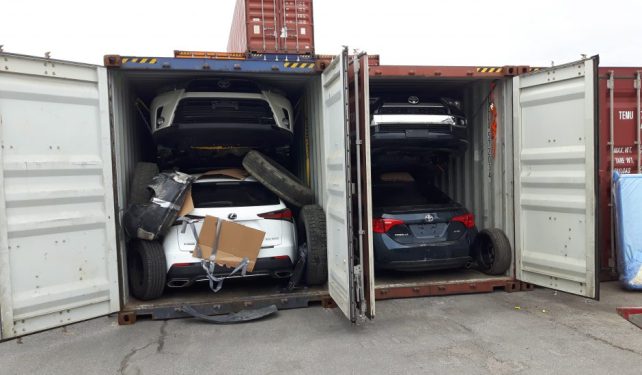
  • BoG expects inflation to stay within 6–10% target range

    BoG expects inflation to stay within 6–10% target range

    The Bank of Ghana (BoG) is optimistic that inflation will gradually move back within its medium-term target range of 8 percent, plus or minus 2 percentage points, provided there are no major economic disruptions.

    The central bank, however, cautioned that ongoing geopolitical developments, particularly tensions in the Middle East, continue to pose risks to the inflation outlook and could influence future price stability.

    Details contained in the Bank’s May 2026 Monetary Policy Report show that inflation recorded a slight increase in April 2026 after several months of consistent decline. The report noted that this was the first rise in the inflation rate since the downward trend began in December 2024.

    According to the BoG, the increase was largely linked to higher prices within the non-food segment of the Consumer Price Index (CPI), while food prices continued to moderate.

    Food inflation eased from 2.3 percent in March to 2.2 percent in April, supported by improved agricultural output and favourable harvests. In contrast, non-food inflation rose to 4.2 percent from 3.9 percent over the same period, mainly due to increases in utility-related costs.

    Despite the modest rise in headline inflation, the Bank indicated that underlying inflationary pressures remained contained. Measures of core inflation, which remove the impact of volatile items such as energy and utilities, continued to trend downward, suggesting that price increases were not widespread across the economy.

    The report further noted that alternative core inflation indicators that exclude food items remained above the headline inflation rate, standing at 4.2 percent and 4.7 percent, respectively, in April 2026.

    The Bank maintained that sustaining prudent monetary policy measures would be essential in keeping inflation on a downward path and achieving its medium-term objective.
    Ghana’s current inflation rate stands at 3.7 percent (May 2026), up from 3.4 percent in April, and Finance Minister Dr Cassiel Ato Forson says he is hopeful that the rate will not exceed 5 percent by the end of the year.
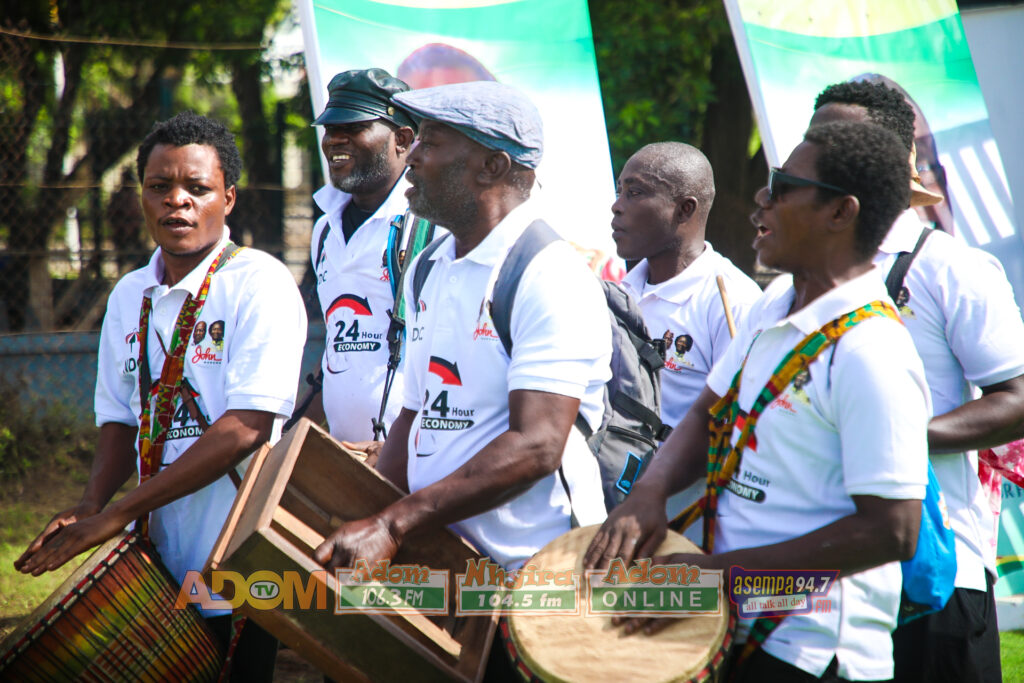
    On his part, the Finance Minister said the main factor that could push inflation higher is the rising tension in the Middle East.

    He made the statement on Tuesday, June 3, during an interview with Bloomberg in London, saying, “We don’t see inflation increasing above five percent by December 2026. Inflation may rise further in the coming months from the current 3.4 percent due to developments in the Middle East and rising crude prices.”

    According to him, the government has implemented measures to stabilise the economy and, so far, the country has managed those shocks well.

    He was, however, worried about rising fuel prices and their impact on the country’s balance of payments, as the country would have to use more foreign exchange from its reserves to support the cedi.

    “We are also worried about the impact on fertiliser and how that could also affect farming,” the minister noted.

    Dr Cassiel also noted that the earlier growth rate projection of 4.8 percent may be revised upward by the end of the year, considering the economy’s current performance. This estimate was included in the national budget.

    “We have seen some interesting developments in the oil and gas sector; that will impact the GDP [Gross Domestic Product] numbers at the end of this year,” he added.

    The minister further stated that he would revise the figures when he presents the Mid-Year Budget Review in July 2026.

    On the government’s decision to request a Policy Coordination Instrument (PCI) after the completion of the Extended Credit Facility (ECF) programme with the International Monetary Fund (IMF), Dr Forson said the aim is to sustain the recent gains and assure investors of the government’s fiscal discipline going forward.

    The minister also anticipated an improved investment grade after the completion of the Policy Coordination Instrument.

    “Our investment grade has been improving over the past years, and we should look forward to hitting BBB after this initiative,” the Finance Minister added.

    The Finance Minister also disclosed that the government will use the Mid-Year Budget Review to announce its New Economic Policy Programme, aimed at stabilising recent gains while pressing ahead with the needed reforms.