Author: Abigail Ampofo

  • High Court rejects Gifty Oware’s application for Supreme Court referral 

    High Court rejects Gifty Oware’s application for Supreme Court referral 

    Embattled former Deputy Executive Director of the National Service Authority (NSA), Gifty Oware-Mensah’s request seeking a halt and transfer of her trial to the Supreme Court has been rejected by the Accra High Court.

    This comes after she filed for a case transfer to the Supreme Court in early February, challenging the Practice Direction on Disclosure and Case Management Proceedings, 2018, contending that provisions requiring an accused person to disclose the names and addresses of witnesses at the case management stage violated the presumption of innocence under Article 19 of the 1992 Constitution.

    The application, filed by her lawyers led by Gary Nimako Marfo, was opposed by the prosecution, led by Director of Public Prosecutions, Yvonne Attakora Obuobisa, who maintained that the Practice Direction was consistent with the Constitution and designed to promote fair and expeditious trials.

    The court presided over by Justice Audrey Kocuvie-Tay ruled on Tuesday, February 10, that the accused had not shown that “a genuine question has arisen for the matter to be referred to the Supreme Court for interpretation,” labelling her request as lacking merit.

    In reaction, the defence layer, Mr Nimako, mentioned that the defence would apply for the full reasons and advise their client on the next steps.

    “About the application for a referral having been dismissed, we will apply for the full copy of the reasons for the dismissal and advise the client as to the way forward,” revealing that a notice of appeal had already been filed in objection to an order forcing the accused to file her witness list, and a motion for stay of proceedings had also been filed.

    Justice Kocuvie-Tay consequently stayed proceedings and adjourned the case to February 18, 2026, to consider the application for stay.

    Ms Oware-Mensah has pleaded not guilty to charges including stealing, willfully causing financial loss to the state, using public office for profit and money laundering, in relation to the alleged GH¢38 million National Service ghost names scandal, and is currently on GH¢10 million bail.

    In December last year, Gifty Oware was fingered in fresh trouble alongside her former boss, Osei Assibey.

    This was after the Auditor-General’s (AG) office surcharged them to recover a whopping GH¢2.4 billion unlawfully paid from state coffers.

    According to the AG, the move was necessitated after a Technical and Forensic Audit of the National Service Authority (NSA) systems, which the office describes as a “well-orchestrated conspiracy”  with the Director-General, Osei Assibey Antwi, and his deputy, Gifty Oware-Mensah, being the masterminds behind the scheme.

    Consequently, the Auditor-General, Johnson Akuamoah Asiedu, has written to the officers involved to pay back the GH¢2.4 billion instead of justification.

    Speaking during an exclusive interview with Graphic Newspaper, Mr Akuamoah Asiedu revealed that, following investigations, “The evidence points to a deliberate and coordinated effort to create channels for the illegal siphoning of funds meant for National Service Personnel (NSP)”

    Consequently, he emphatically stated that “We are duty-bound to use every power under the law, particularly Article 187(7) of the 1992 Constitution, to recover every pesewa for the state”, stressing that the article empowers his surchanre process to be independent of any criminal court proceedings.

    According to the article,  “The Auditor-General may disallow any item of expenditure which is contrary to law and surcharge – (a) the amount of any expenditure disallowed upon the person responsible for incurring or authorising the expenditure; or (b) the amount of any loss or deficiency upon any person by whose negligence or misconduct the loss or deficiency has been incurred.”

    It will, therefore, run concurrently with the Attorney-General’s prosecution of the same persons in the court of law.

    Among the fraudulent schemes was a virtual marketplace created to allow NSPs to purchase goods on credit and pay with deductions from their allowances.

    The forensic audit found that the platform was nothing but a sophisticated engine for generating ghost payments.

    “Our forensic analysis reveals that all the supposed NSPs who bought from this marketplace and had their allowances paid to the vendors did not exist. It was a complete fiction,” Mr Akuamoah Asiedu disclosed.

    AG on NSA scandal

    A couple of months ago, Attorney-General (A-G) and Minister for Justice, Dr. Dominic Ayine, revealed that eight individuals, including three former officers of the National Service Authority (NSA), had admitted to their involvement in the misappropriation of funds at the National Service Scheme (NSS).

    Providing an update on the case as part of the Government Accountability Series on Monday, July 28, Dr. Ayine disclosed that eight individuals want to plead guilty in exchange for lighter punishment in this regard.

    He explained that the office intended to file formal charges last week; however, it has been postponed following new revelations regarding the ongoing case.

    The new evidence, he noted, is tied to a Bank of Ghana account linked to former NSA Director-General, Mr. Osei Assibey, suggesting potential embezzlement involving public funds.

    According to him, a total of GH¢189 million was deposited into the account of Mr. Osei Assibey; however, GH¢80 million can not be accounted for.

    Furthermore, nearly GH¢2 million was allegedly withdrawn using two cheques that carried Mr. Assibey’s name and account information.

    The A-G has stated that the office has reached out to the Bank of Ghana, the Ministry of Finance, and the Controller and Accountant-General’s Department for further information and documentation.“The National Service Authority scandal case was due to be filed last week. However, we stumbled upon evidence of malfeasance involving an account at the Bank of Ghana.“Out of the GH¢189 million transferred, GH¢80 million cannot be traced. Two cheques linked to the former Director-General were used to withdraw just under GH¢2 million,” Dr. Ayine stated.

    He added that some of the accused have shown readiness to provide testimony against their fellow accused, with several vendors and service providers also reportedly willing to support the prosecution as witnesses.Earlier this year, a non-profit investigative body, The Fourth Estate, released a report into the payroll records from 2017 to 2023 and the 2024 National Service Year.

    The finding revealed serious irregularities within the NSA, uncovering how a 72-year-old Kenyan, Kwame Donkor, was wrongly listed as a beneficiary. Mr Donkor was enlisted on the payroll with a photo and not an official ID card, which is unusual.

    However, the photo belonged to Emmanuel Mutio, a Human Resource Manager at a private IT company in Kenya. The 72-year-old Kenyan had his name appear on the payroll 226 times as a registered beneficiary.

    The Fourth Estate initially uncovered the issue in November 2024, but the NSA obtained a court order preventing them from publishing the findings.

  • Ghana’s corruption score improves slightly to 43%, ranks 76th globally

    Ghana’s corruption score improves slightly to 43%, ranks 76th globally

    Ghana has seen a marginal decline in corruption, ranking 43 out of 100 in the 2025 Corruption Perceptions Index.

    This was contained in a report shared by Transparency International on Tuesday, February 10, 2026. According to the report, out of the 182 nations assessed, Ghana ranked 76th globally, but this, according to experts, indicates little to no improvement in Ghana’s fight against corruption.

    The 43% marks a one-point increase from the 42 recorded in 2024. However, according to the organisation’s methodology, this does not constitute a significant change.

    The organisation’s Board Chair, François Valérian, highlighted the need for local and international collaboration in tackling corruption.

    “In an interconnected world, we need both national action and multilateral cooperation to protect the public interest and tackle shared challenges like corruption. At a time when we’re seeing a dangerous disregard for international norms from some states, we need to protect a rules-based global order that is grounded in transparency, accountability to citizens and respect for human rights,” he said.

    Ghana has remained stuck at a CPI score of 43 since 2020, except for the dip to 42 last year. The country’s highest score was 48 in 2014, after which it experienced a downward trajectory until 2018.

    The assessment comes at a time when many still raise concerns about Ghana’s politicised judicial system and law enforcement agencies.

    The dismissal of the former Chief Justice, petitions for the removal of heads of independent institutions, and the discontinuation of corruption cases through a controversial 60:40 settlement arrangement have raised questions about executive interference.

    The “60:40 corruption case settlement arrangement” in Ghana refers to a controversial practice where corruption-related prosecutions were reportedly discontinued if the accused agreed to return 60% of the misappropriated funds while retaining 40%.

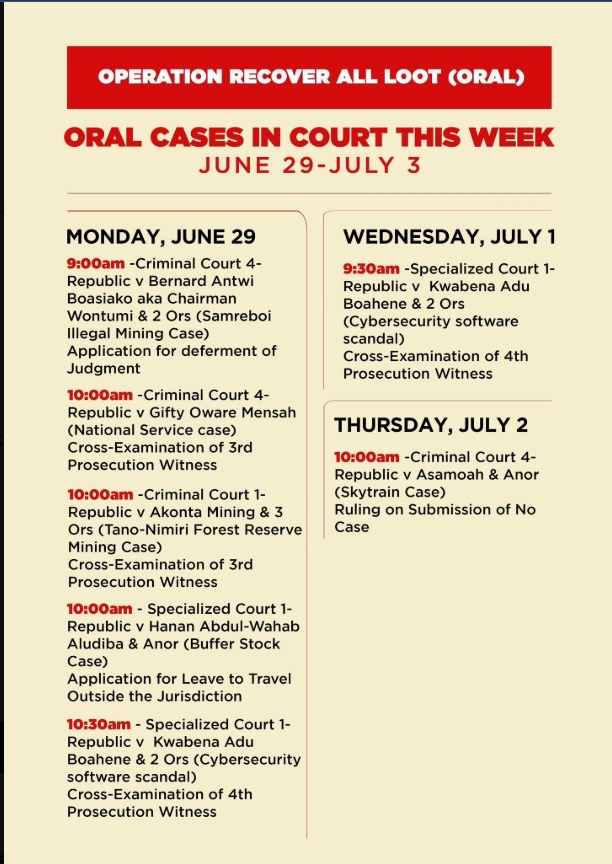
    This has created a decline in confidence in the government and the judicial system following a well-sold launch of Operation Recover All Loot (ORAL).

    Despite efforts by the Office of the Special Prosecutor to increase transparency in corruption investigations and prosecutions, the Ghana Integrity Initiative (GII), Transparency International’s local chapter, says these measures have not made a significant impact.

    Global and regional context
    The report shows that corruption is increasing on a global scale, as countries that were ranked as having

    Globally, corruption is worsening even in mature democracies. The report indicates that about 12 countries that used to score over 80% over a decade ago have now seen a decline to just five countries this year, with the global average standing at 42 out of 100.

    Sub-Saharan Africa continues to rank lowest on the index with an average score of 32 out of 100. Ten of the region’s 49 countries have significantly deteriorated since 2012, while only seven have improved.

    To improve in the fight against corruption, Transparency International (TI)-Ghana has recommended expedite process be adopted to create anti-corruption courts, ensure the utmost independence of the Judicial system, free from Executive or Legislative interference, as well as expeditiously adopt the National Ethics and Anti-Corruption Plan (NEACAP).

    TI also recommends that Parliament ensure the swift passage of the Community Tribunal Bill, review rules regulating political financial regulations and protect civic space and media freedom.

    The Community Tribunal Bill was part of Ghana’s judicial framework that established local tribunals for minor cases. These were later abolished in 2002 and replaced with District Courts, as part of reforms to strengthen and streamline the justice system.

    Other recommendations include cultural reorientation focused on ethics, promoting transparency in state regulatory agencies, and strengthening awareness among Designated Non-Financial Businesses and Professions of their anti-money laundering obligations.

    TI-Ghana stressed that the CPI serves as a warning signal, not a verdict, adding that defensive responses will not change perceptions.

    “With sustained political will and measurable reforms, Ghana can rebuild public trust and improve its anti-corruption outcomes over time,” the organisation stated.

    Meanwhile, a total of 280 corruption and corruption-related cases are currently under investigation, according to the Minister for Government Communications, Felix Kwakye Ofosu.

    He disclosed this during an interview on JoyNews on Monday, January 26, explaining that the National Democratic Congress (NDC) introduced Operation Uncover All Roots (ORAL) as a key initiative to promote accountability among public office holders.

    “The NDC tabled Operation Uncover All Roots as a proposition to the people as a main tool through which we will ensure that accountability is demanded from public office holders,” he said.

    According to him, since the government took office, significant steps have been taken to act on allegations of corruption. He disclosed that the Oral Preparatory Committee compiled information on 280 alleged cases and submitted a report to the Attorney General.

    “They presented a report with the 280 cases, and I can tell you that the Attorney General has commissioned investigations into each of them,” Mr Kwakye Ofosu stated.

    However, he said that the report itself could not be used to prosecute anyone without proper investigations.

    “The report itself could not have formed the basis for any legal action against anybody because they were just reports. I cannot simply say that because you have said something, then I hold someone and throw him into jail. It would not make sense.”

    Assessing Ghana’s fight against corruption, he said the scale of waste and abuse of public resources under the previous administration made a change in government unavoidable. “I think that it was obvious that there was simply too much waste, corruption, and theft of public resources,” he said.

    “You in the media were the ones who used to bombard us with corruption scandal after corruption scandal, and it got to a point where we simply became fatigued and came to the conclusion that there was a need to change government.”

    Mr Kwakye Ofosu revealed that progress has already been made on several of the cases. “I can tell you that more than 100 people have been held for questioning. Some have been arrested. Some were detained for some time. Some have been granted bail, and others, too, are in court,” he said.

    He added that more than 20 cases have reached an advanced stage. “There are over 20 cases whose dockets are almost done and will be going to court. The Attorney General has already proceeded to court on a number of those cases,” he noted.

    While acknowledging public impatience for quick results, the minister urged Ghanaians to respect due process.

  • Woman arrested after attempting to set Alpha Hour auditorium on fire

    Woman arrested after attempting to set Alpha Hour auditorium on fire

    A woman has been arrested after attempting to burn down the Alpha Hour church auditorium at Ofankor Barrier in Accra.

    The woman was captured on CCTV footage pouring a liquid believed to be petrol on chairs near the church’s altar and the one-way entry point to the office of the church’s founder and leader, Pastor Elvis Agyemang.

    According to reports, she joined congregants in the church during a prayer session and pretended to be praying.

    Personnel monitoring the CCTV cameras spotted her suspicious act and quickly alerted the church’s security team. Before security personnel could arrest the woman, she had already set fire to the chairs, which were burnt alongside a standing air conditioner and about four wooden offering boxes.

    However, their swift intervention prevented the fire from spreading to the pastor’s office, averting potential risk to lives.

    In reaction to the incident, Alpha Hour convener Pastor Elvis Agyemang announced an indefinite suspension of all physical prayer meetings at the auditorium.

    He assured congregants that steps would be taken to restore the facility, stressing that the incident would not derail the ministry’s spiritual activities.

    “This will not stop us. We will fix the place, and prayers will continue,” Pastor Agyemang said, adding that the auditorium had suffered several attacks in recent times.

    He further disclosed that last year, individuals were captured on CCTV allegedly spreading powders, strange substances and bringing idols into the auditorium.

    Police are expected to investigate the matter further as the suspect remains in custody.

    See video below:

    About Alpha Hour

    Alpha Hour started on February 8 2022, by Pastor Elvis Agyemang, head of Grace Mountain Ministries in Accra.

    According to him, the prayer movement was birthed after he saw vision of people sleeping during a meeting , prompting an urge for a wake upfelt called to “wake them up.”

    The name “Alpha” was chosen to signify the beginning, and the prayers were set at 12:00 a.m. GMT to symbolize starting the day with God.

    Their first meeting was held on Zoom with a few hundred participants joining, to other social media platforms such as Instagram, Facebook and YouTube to reach a wider audience as they particpants grew. From that small start, the prayer movement has expanded to an estimated 80,000 devices globally.

    By July 2023, Alpha Hour had gained so much popularity that, about 30 radio and TV stations across Ghana were broadcasting, making it purely accessible to people without internet access to connect. Currently, Alpha Hour has a dedicated TV station to provide a 24/7 platform for Alpha Hour prayers, sermons, and Christian content.

    Meanwhile, not only does the Alpha Hour lead people to Christ he is also involved in philantropic activities.

    In 2023, he built three school blocks for two underprivileged communities in the country. These communities, Aglakope and Korlekope, located in the Oti Region, received the much-needed infrastructure to support education.

    The move by the renowned televangelist, was targeted at uplifting the lives of school children who previously studied in deteriorating structures.

    In addition to the completed projects, it was revealed that the pastor is currently involved in the construction of another school block in Ablekuma. Netizens showered praise on the pastor for his philanthropic endeavours, applauding his commitment to making a tangible difference in these communities.

  • Joan Laporta steps down as Barca president

    Joan Laporta steps down as Barca president

    Joan Laporta has stepped down as Barcelona’s president. His resignation is in line with the club’s statutes, which require that the incumbent president and any board members who wish to re-contest in elections must first resign from their positions.

    Article 42.f of the club’s statutes is intended to ensure that the electoral process is fair, preventing sitting officials from using their current authority or resources to gain an advantage.

    The club is set to hold its election on March 15, and with Laporta’s resignation, a management commission will oversee the day-to-day running of the club in the meantime.

    That commission will be led by Rafa Yuste, who has been one of Laporta’s vice presidents since his election in 2021.

    Laporta will contest the presidency with Víctor Font, Marc Ciria, Xavier Vilajoana, and Joan Camprubí, all of whom have announced their candidacies.

    As part of the requirements to qualify as a candidate for the presidency, all aspirants are expected to secure 2,321 signatures from club members as a testament to support for their candidacy.

    The campaign trail will now begin in earnest, with some of the issues which may sway votes likely to include potential summer signings, the club’s finances, the redevelopment of Spotify Camp Nou, which is now in the final stages, and any future role for Lionel Messi at the club.

    Laporta was elected in 2021 for a second spell as Barça president, having previously held the role between 2003 and 2010, courtesy of election wins in 2003 and 2006.

    He finished ahead of Font five years ago after obtaining 30,184 votes to Font’s 16,679, with Toni Freixa, who is not running this time, finishing third with 4,769 votes.

  • AFCON final: Senegalese nationals detained in Morocco embark on hunger strike

    AFCON final: Senegalese nationals detained in Morocco embark on hunger strike

    Some eighteen (18) Senegalese nationals in police custody in Morocco have embarked on a hunger strike ahead of their trial next week.

    They were arrested during the AFCON final, which was held in Rabat on January 18, for acts of hooliganism.

    According to Lawyer Patrick Kabou, counsel for one of the detainees, his client informed him that they have been held in custody for over 21 days since their arrest and have yet to be formally informed of the charges against them. The detainees were arrested on January 18, following a heated AFCON final in which Senegal beat Morocco in Rabat.

    Mr Kabou, during an engagement with the news agency AFP, mentioned that his clients andother detainees have complained that, since their detention, they have only been questioned in French and Arabic, whereas they “only speak Wolof”, their native language.

    The group said they were being denied their “right to justice” and pledged to continue the strike “until Moroccan justice gives us the chance to be heard”, Kabou added.

    A first court hearing in late January had been adjourned by the judge, and the second hearing on Thursday was also put off amid an ongoing lawyers’ strike in Morocco. The trial is set to resume next week.

    The final of the 2025 Africa Cup of Nations (AFCON) was nothing short of controversial, chaotic and tense; however, the side widely alleged to be at the centre of it all was Senegal.

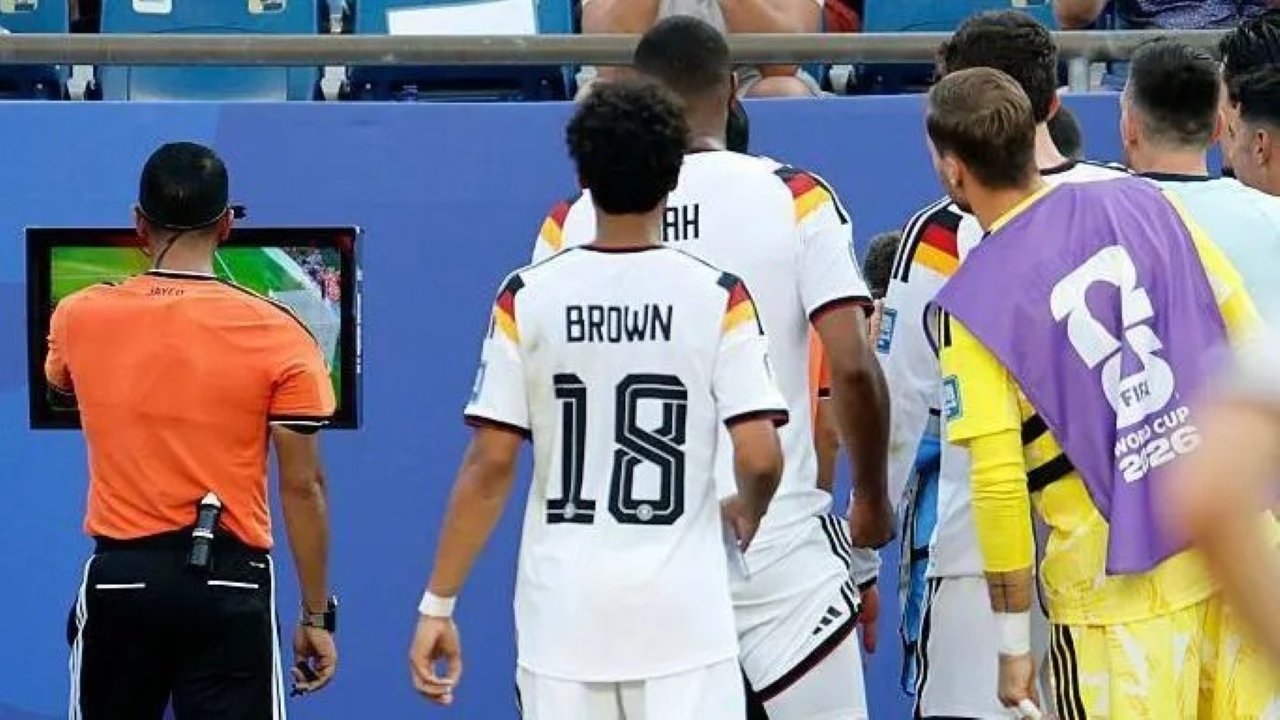
    This followed Morocco being awarded a penalty after their player, Ayoub El Kaabi, tumbled in the box following contact with Senegal defender Abdou Diallo. The referee initially waved play on, but later intervened after a VAR review.

    Following the check, Morocco were awarded a penalty, which clearly upset Senegal’s players, who believed the contact was minimal and that El Kaabi had gone down too easily.

    Consequently, they staged a walk-off in protest on the pitch. During this time, some Senegalese supporters attempted to storm the pitch, with some captured throwing objects onto the field, including a chair.

    Sadio Mane’s role in calming chaos

    Meanwhile, during the walk-off, the intervention of their captain, former Liverpool forward Sadio Mané, persuaded them to return and continue the game. However, many believe their return was not solely due to Mané’s intervention but also influenced by Morocco missing the penalty.

    Diaz missed the resulting penalty as he bizarrely clipped a Panenka effort down the middle and straight at Edouard Mendy.

    In an interesting turn of events, Pape Gueye notched a goal in stoppage time, giving Senegal a lead in the 94th-minute securing the team their second AFCON title.

    Sadio explains the motive behind his actionFollowing their victory over Morocco, Mane, during an interview with the media, explained that even though the referee’s decision might have been wrong, the most important thing is to respect the game and keep playing, hence his decision to call his teammates back o the pitch to play as football is widely love globally and it will have been unfair to the people watching to see the game called off over one disputed call.

    He said, “When they decided to go out and not play, I stayed and asked some people, ‘What do you think about this? Is it a good idea or not?’ Then I decided to go and bring everyone back to the pitch. I think it is the best thing to do.

    “Because this is just football, I think the referee sometimes can make mistakes. People around the world are watching. It could be a penalty or not, but that is not the most important thing. What matters is respecting the game. It is not fair to stop a match like this.”

    Mané went on to reflect on the incident that generated headlines around the world, saying: “Football is something special. The world was watching, and the world loves football. I believe football is about enjoyment, so we must give the game a good image.”

    “I think it would be crazy not play this game because what, the referee gave a penalty and we go out of the game? I think that would be the worst thing, especially in African football. I’d rather lose than have this kind of thing happen to our football.

    “I think it’s really bad. Football should not stop for even ten minutes, but what can we do? We have to accept that we did, but the good thing is that we came back and we played the game and what happened, happened.”

    Thiaw stated on the part that he played in proceedings: “I didn’t appreciate at all that I told my players to leave the field. I apologise for football. After reflection, I had them come back. Sometimes, you can react in the heat of the moment. But we accept the referee’s mistakes. We offer our apologies to football.”

  • You remain one of our best players – GFA to Partey after Villareal coach’s remarks about form

    You remain one of our best players – GFA to Partey after Villareal coach’s remarks about form

    The Ghana Football Association (GFA) has risen to the defence of Ghanaian footballer and former Arsenal midfielder, Thomas Partey, following remarks by Villarreal’s coach on his contrasting form since joining the club in August last year.

    Speaking during a post-match conference after Villarreal’s Champions League defeat to Bayern Leverkusen in February 2026, Marcelino García Toral said Partey is mentally affected and struggling to meet expected standards since joining the club.

    He said, “Thomas, I think there’s a world of difference between the Thomas we know at Arsenal and this one. It’s very difficult to play at this pace in today’s football.”

    According to him, six months is enough for Partey to have adapted to the rhythm and playing style of the club, adding that the midfielder has not been in his best form.

    “So, I think it’s been six months now, and that’s enough time for this player to show us what he was capable of, or what he’s showing us now,” the coach added.

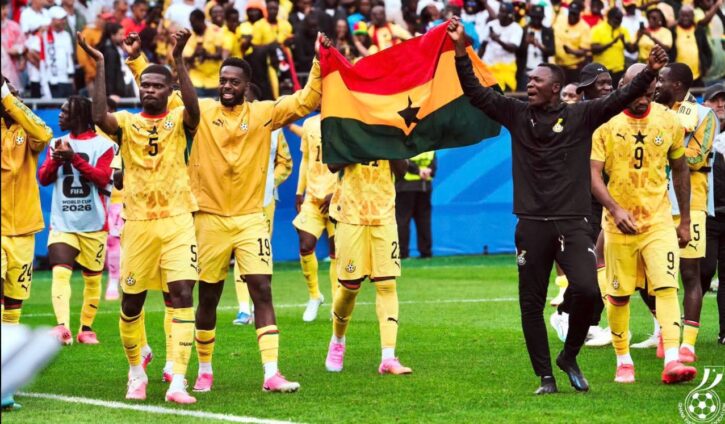
    Reacting to the remarks, GFA Communications Director, Henry Asante Twum, backed Partey, praising him as one of Ghana’s best and dismissing the coach’s comments as harsh on a central figure for Ghana ahead of the 2026 FIFA World Cup.

    “We believe in the quality of Partey, and we do not believe one game defines him as a player. At the FA, we do not share the coach’s view on this matter. Partey remains a top player, and we have a strong belief in his qualities,” Asante Twum said.

    Partey, 32, joined Villarreal on a free transfer after his contract with Arsenal expired. His start at the Spanish club has been disrupted by injuries, with reports suggesting he has been playing through physical issues.

    The Ghana international and former Arsenal player already started training with Villarreal ahead of the 2025/26 season.

    He joined the La Liga side on Thursday, August 7, as a free agent after finalising his move from Arsenal on June 30, 2025, following the expiration of his contract.

    His move to the Yellow Submarine marks a return to Spain after leaving Atlético Madrid in 2020.

    Less than 24 hours after completing his transfer, the Black Stars midfielder began training with his new teammates.

    This development comes amid the Ghanaian international’s legal challenges, after facing rape charges just four days after his departure from Arsenal.

    While concerns have been raised about Villarreal’s decision to sign Partey due to the pending case, the club issued a statement reiterating its respect for the player’s insistence on his innocence.

    The club stated that while it awaits the final verdict, it remains a strong advocate against all forms of violence, including gender-based violence, discrimination, racism, xenophobia, or any behaviour that undermines human dignity.

    “The club is aware that the player is currently involved in legal proceedings in England. The player firmly maintains his innocence and denies all charges against him. Villarreal CF respects the fundamental principle of the presumption of innocence and will await the outcome of the judicial process, which will be responsible for clarifying the facts of the case.

    “Due to the law in England in relation to ongoing proceedings, the club is unable to comment further. Villarreal wishes to reiterate its strong commitment to respect and diversity and firmly condemns any acts of violence in all its forms, including gender-based violence, discrimination, racism, xenophobia, or any behaviour that undermines the dignity of individuals.”

    The club also praised Partey for his football abilities, describing him as a “complete midfielder with great stamina and exceptional physical attributes”.

    They highlighted his successful spells with Arsenal, Atlético Madrid, and the Ghana national team, where he has earned over 50 caps.

  • FA Cup: See full list of clubs that qualified for the quarterfinals

    FA Cup: See full list of clubs that qualified for the quarterfinals

    Eight teams have secured their tickets to the quarterfinals of the FA Cup following the conclusion of the Round of 16 matches played nationwide across the country.

    The list of qualifiers was rounded off after Attram De Visser thumbed Premier League side Eleven Wonders 4-0 on Friday 6, 6 February at the Nii Adjei Kraku II Sports Complex in Tema New Town.

    The competition continued on Saturday at the TNA Park, where Medeama SC beat top-flight outfit FC Samartex in a tense encounter. By the time regulation time had ended, both sides hadn’t found the back of the net.

    But Medeama claimed the victory in a 4-2 penalty shoot-out. Nations FC also advanced on the day, grinding out a hard-fought 2-1 win over Swedru All Blacks.

    Action continued on Sunday with Kotoko suffering a 2-4 penalty shoot-out defeat to Aduana FC at the Baba Yara Stadium. Techiman Liberty Youth progressed with a narrow 1-0 victory over Real Tamale United, while Berekum Chelsea also needed just a single goal to overcome lower-tier side Tamale City FC.

    On the other hand, True Life FC delivered impressively in their home; however, they ended the home game with a 2-3 defeat to Heart of Lions. Dreams FC rounded off the Round of 16 in style, producing an entertaining display to beat Inter Allies 4-2.

    See below the list of clubs that qualified for the FA Cup quarterfinals:
    Attram De Visser, Medeama SC, Nations FC, Techiman Liberty Youth, Berekum Chelsea, Heart of Lions, Dreams FC, Aduana FC.

    Around the same time last year, Berekum Chelsea earned their spot in the quarterfinals with a commanding 4-1 victory over Northern City.

    Karela United narrowly defeated Young Apostles 1-0 to advance to the next round.

    Bechem United also moved forward, winning 4-3 in a penalty shootout against Techiman Liberty Youth following a goalless match.

    True Democracy progressed with a dramatic 5-4 penalty shootout win over Nania FC.

    However, the match between Asante Kotoko and Eleven Wise has been postponed, as the Porcupine Warriors have not yet returned to competitive play.

    In addition, Specialized cameras were installed under the roofs of all 20 Premier League stadiums to capture precise data on player positioning during close offside calls.

    Premier League clubs unanimously agreed to implement this semi-automated offside technology for the 2024-25 season, initially targeting an October 2024 launch. However, the rollout was postponed to allow for additional testing and refinement.

    The system follows UEFA’s lead, as European football’s governing body introduced a similar technology in the Champions League at the start of the 2022-23 season.

    The FA said: “Semi-automated offside technology will provide more efficient placement of the virtual offside line, based on optical player tracking, and produce virtual graphics to ensure an enhanced in-stadium and broadcast experience for supporters.

    “The operation of semi-automated offside technology does not change the accuracy of the decision-making but enhances the speed and efficiency of the process.”

    Video Assistant Referees (VAR) will be utilised in all eight FA Cup fifth-round matches, including the game at Championship side Preston. During these matches, referees will make in-stadium VAR announcements.

    The fifth round fixtures are slated for the weekend of Saturday, March 1.

  • EC sets February 11 for IPAC meeting with political parties ahead of Ayawaso East by-election

    EC sets February 11 for IPAC meeting with political parties ahead of Ayawaso East by-election

    The Electoral Commission (EC) has announced an Inter-Party Advisory Committee (IPAC) meeting with political parties ahead of the upcoming Ayawaso East parliamentary by-election.

    In a letter dated February 6, 2026, and addressed to political party General Secretaries, and signed by Dr Bossman Eric Asare, Deputy Chairman in charge of Corporate Services, on behalf of the EC Chairpers on the EC said the meeting will be held on Wednesday, February 11, 2026, at 11:00 am at the Commission’s Corporate Head Office in Accra, with the agenda being discussions about the Ayawaso East By-election.

    “Each Political Party is to be represented by two (2) persons only,” the Commission directed.

    The Ayawaso East by-election has attracted heightened attention in recent days amid internal developments within the National Democratic Congress (NDC), including allegations of vote-buying during its parliamentary primary.

    The by-election follows the death of the constituency’s Member of Parliament, Naser Toure Mahama, leaving the seat unrepresented.

    Mr Baba Jamal Mohammed Ahmed won the Ayawaso East Constituency primary and is set to represent the National Democratic Congress (NDC) as its parliamentary candidate ahead of the March 3 by-election, following the party’s internal primary held on February 7, 2026.

    After the close of polls, the provisional results showed that Baba Jamal pulled 431 of the total votes cast, followed by the widow (Hajia Amina Adam) of the late Ayawaso MP, Naser Toure, who also won 399 votes. Mr Mohammed Ramne, the Ayawaso East NDC Constituency Chairman, placed third with 88 votes. Dr Yakubu Azindow obtained 45 votes, while Mr Najib Mohammed Sani recorded one vote.

    The closely contested primary attracted more than 1,100 accredited delegates from across the constituency, reflecting the high stakes involved in selecting a candidate for the by-election in a seat widely regarded as a stronghold of the governing NDC.

    Five aspirants contested the race. They were Hajia Amina Adam, Mr Baba Jamal, Dr Yakubu Azindow, who had previously contested the late MP in the 2023 primary, Mr Mohammed Ramne and Mr Mohammed Sani.

    Although the race was initially considered open, it later narrowed into a tight contest among Mr Jamal, Hajia Amina Adam and Dr Azindow.

    Even though the election was peaceful on Saturday, reports of vote-buying emerged on the eve of the election and on election day, involving some candidates, including Baba Jamal, who, at the time, was Ghana’s High Commissioner to Nigeria and allegedly offered television sets and other items to delegates.

    Videos circulating on social media showed some delegates leaving polling centres carrying television sets and other items.

    Reacting to the vote-buying allegations, the NDC, in a statement signed by its Secretary, Fiifi Kwetey, announced that it will investigate the allegations. It noted that it has set up a three-member committee to probe the allegations.

    In a statement issued on the same day, the NDC said its national executives had taken note of what it described as widespread incidents of inducement and vote buying allegedly perpetrated by some aspirants.

    The party condemned the acts, describing them as an affront to its values and principles, and announced that it had launched investigations into the matter.

    “In line with the Party’s commitment to internal democracy, transparency, and ethical political conduct, the Committee will investigate the allegations and make appropriate recommendations, including sanctions where necessary,” the statement said.

    The Presidency has announced a recall of Ghana’s High Commissioner to Nigeria, Baba Jamal, over voter inducement during the just-ended Ayawaso East primaries on Saturday, February 7.

    In a statement titled “President recalls Ghana’s High Commissioner to Nigeria and shared by Spokesperson to the President, Felix Kwakye Ofosu, dated February 7, it noted that

    “President John Dramani Mahama has directed the immediate recall of Mohammed Baba Jamal Ahmed (Baba Jamal) from his position as Ghana’s High Commissioner to the Federal Republic of Nigeria. The decision follows allegations of voter inducement during today’s National Democratic Congress (NDC) primaries in the Ayawaso East Constituency, in which Mr Baba Jamal, a candidate, participated.”

    The President stressed that reports of vote-buying were made against several candidates seeking to win the Ayawaso seats, but Baba Jamal stood out because he was the only person who was a serving public officer at the time, making his case a peculiar one.

    “In his directive to the Minister for Foreign Affairs recalling Mr Baba Jamal as High Commissioner, the President noted that while allegations of vote-buying were made against multiple candidates who contested the primaries, Baba Jamal was the only serving public officer among them.”

    Consequently, to protect the integrity of public office and to avoid any public suspicion of misconduct or violation of the Government’s Code of Conduct for Political Appointees, the President,

    “Without prejudice to the ongoing internal party processes, and strictly in view of the standards of conduct expected of public officers, the President considers it necessary to act decisively to preserve the integrity of public office and to avoid any perception of impropriety or conflict with the Government’s Code of Conduct for Political Appointees.”

    The statement continued that, “the recall takes effect immediately, and the Minister for Foreign Affairs has been directed to take the necessary administrative and diplomatic steps to give effect to this directive.”

  • Abossey Okai spare parts dealers threaten one-week strike over new VAT, say consumers face GH¢80 price hike

    Abossey Okai spare parts dealers threaten one-week strike over new VAT, say consumers face GH¢80 price hike

    Abossey Okai spare parts dealers have threatened a one-week strike over the new Value Added Tax (VAT) regime under the Value Added Tax Act, 2025 (Act 1151), citing concerns about increased financial burden on consumers, pricing disparities among dealers, and compliance challenges within the sector.

    Consequently, the dealers, in a statement shared on Friday, February 8, and signed by the Head of Communications, Takyi Addo, called for a review of the new VAT rate of 20 percent or risk embarking on a strike in protest against the new tax regime.

    The spare parts dealers highlighted that, before the implementation of the new tax regime by the incumbent government, spare parts attracted only 4% VAT, allowing dealers to maintain competitive prices.

    They said that an item previously sold for GH¢500 with GH¢20 VAT now attracts GH¢100 in tax, pushing the total cost to GH¢600, an additional GH¢80 burden on consumers for the same product.

    They also mentioned that some dealers are currently being treated unfairly due to their VAT registration status. Under the new tax regime, dealers who record an annual turnover of over GH¢750,000 are required to register for VAT and charge 20% at the point of sale, while those below the threshold can sell at lower prices despite sourcing from the same importer.

    This trend, they said, “This imbalance penalises growth, efficiency, and compliance, while unintentionally rewarding fragmentation and informality.” They said that when they purchase spare parts or items locally, they are unable to claim the VAT they paid on those items.

    In light of this, they are forced to sell their goods at higher prices in order to make profits and record no losses, making their items more expensive than others and harder to compete with cheaper alternatives.

    Even though they acknowledged the government’s efforts to expand the tax net to accrue revenue for national development and economic growth, the Association proposed either a reduced VAT rate of 5–8 percent for spare parts or a simplified sector-specific VAT scheme at a flat rate of 3 percent, applied uniformly regardless of whether goods are imported or sourced locally.

    The group argued that such measures would restore price competitiveness, encourage voluntary compliance, protect formal businesses, and ultimately increase net revenue by reducing tax leakage through informality.

    The Association concluded by urging the government to review the VAT rate and structure for the spare parts sector, emphasising that larger, compliant businesses should not be disadvantaged.

    “We respectfully request a review of the VAT rate and structure as applied to the spare parts sector and remain open to further engagement on this matter,” the statement said.

    The government is scheduled to launch a mobile application soon, the Minister of Transport, Joseph Bukari Nikpe, has revealed.

    According to him, the app, which is currently being developed, is intended to ensure transparent pricing and easy nationwide access to spare parts, following consistent complaints from drivers about disparities in spare parts prices, which have hindered transport fare reductions despite a drop in fuel prices.

    Mr. Nikpe announced this in an appearance on Accra-based radio station Asempa FM’s Ekosii Sen show on Thursday, February 5.

    He revealed that the government lobbied for a 15% reduction in transport fares last year. However, many drivers initially resisted further reductions, citing high spare parts prices driven by dollar instability.

    He said, “The Trade Ministry plays a crucial role because drivers need access to spare parts for repairs. Last year, we achieved one of the highest reductions in transport fares in the country, negotiating a 15% decrease with our transport unions.

    “However, drivers were initially reluctant to lower their fares due to the high cost of spare parts, which were affected by the rising dollar. Now that the dollar has stabilised, we expect this to reduce spare parts prices. Fuel prices have also shown some stability recently.”

    He added that, together with efforts to retool state transport agencies such as Metro Mass Transit and STC, the initiative will help sanitise and decongest cities while improving traffic flow.

    The minister also highlighted collaboration with the National Road Safety Authority to implement a nationwide road-safety campaign aimed at enhancing safety for both commuters and drivers.

    It will be recalled that the Ghana Union of Traders Association (GUTA), the Association of Ghana Industries (AGI), the Spare Parts Dealers Association, and others were scheduled to appear before Parliament to justify their decisions not to reduce prices of their goods and services despite the cedi’s gains in May 2025.

    This was at a time when pressure was mounting on traders to reduce prices as a result of the local currency’s stability against major trading currencies, particularly the dollar. In that same month, the Abossey Okai Spare Parts Dealers Association in the Greater Accra Region directed its members to reduce prices of spare parts owing to the appreciation of the cedi.

    However, they argued that significant reductions in the prices of goods and services could not occur immediately.

    A section explained that they were yet to sell off old stock that had been bought at higher exchange rates.

    “For now, maybe it can’t be possible because we ordered the goods at a certain rate, which is higher than what we are seeing now. At that price, we have to sell, and when the goods finish and you order another one at a reduced exchange rate, then definitely the prices will come down.”

    Another vendor, Yaw Ansong, echoed this, saying, “Unless I sell what I already ordered and finish before I can reduce the price of the goods, I haven’t ordered a new one, so I can’t reduce the price. If I reduce the price, I am going to lose my job,” he stated.

    Eric Osei Danso also explained, “For others, price reductions may come, but only if the cedi’s performance remains stable over time.”

  • Ayawaso East: Baba Jamal wins NDC primary, set to contest March 3 election

    Ayawaso East: Baba Jamal wins NDC primary, set to contest March 3 election

    Mr Baba Jamal Mohammed Ahmed has won the Ayawaso East Constituency primary and is set to represent the National Democratic Congress (NDC) as its parliamentary candidate ahead of the March 3 by-election, following the party’s internal primary held on February 7, 2026.

    After the close of polls, the provisional results showed that Baba Jamal pulled 431 of the total votes cast, followed by the widow (Hajia Amina Adam) of the late Ayawaso MP, Naser Toure, who also won 399 votes. Mr Mohammed Ramne, the Ayawaso East NDC Constituency Chairman, placed third with 88 votes. Dr Yakubu Azindow obtained 45 votes, while Mr Najib Mohammed Sani recorded one vote.

    The closely contested primary attracted more than 1,100 accredited delegates from across the constituency, reflecting the high stakes involved in selecting a candidate for the by-election in a seat widely regarded as a stronghold of the governing NDC.

    Five aspirants contested the race. They were Hajia Amina Adam, Mr Baba Jamal, Dr Yakubu Azindow, who had previously contested the late MP in the 2023 primary, Mr Mohammed Ramne and Mr Mohammed Sani.

    Although the race was initially considered open, it later narrowed into a tight contest among Mr Jamal, Hajia Amina Adam and Dr Azindow. 

    Even though the election was peaceful on Saturday, reports of vote-buying emerged on the eve of the election and on election day, involving some candidates, including Baba Jamal, who, at the time, was Ghana’s High Commissioner to Nigeria and allegedly offered television sets and other items to delegates.

    Videos circulating on social media showed some delegates leaving polling centres carrying television sets and other items.

    Reacting to the vote-buying allegations, the NDC, in a statement signed by its Secretary, Fiifi Kwetey, announced that it will investigate the allegations. It noted that it has set up a three-member committee to probe the allegations.

    In a statement issued on the same day, the NDC said its national executives had taken note of what it described as widespread incidents of inducement and vote buying allegedly perpetrated by some aspirants.

    The party condemned the acts, describing them as an affront to its values and principles, and announced that it had launched investigations into the matter.

    “In line with the Party’s commitment to internal democracy, transparency, and ethical political conduct, the Committee will investigate the allegations and make appropriate recommendations, including sanctions where necessary,” the statement said.

    The Presidency has announced a recall of Ghana’s High Commissioner to Nigeria, Baba Jamal, over voter inducement during the just-ended Ayawaso East primaries on Saturday, February 7.

    In a statement titled “President recalls Ghana’s High Commissioner to Nigeria and shared by Spokesperson to the President, Felix Kwakye Ofosu, dated February 7, it noted that

    “President John Dramani Mahama has directed the immediate recall of Mohammed Baba Jamal Ahmed (Baba Jamal) from his position as Ghana’s High Commissioner to the Federal Republic of Nigeria. The decision follows allegations of voter inducement during today’s National Democratic Congress (NDC) primaries in the Ayawaso East Constituency, in which Mr Baba Jamal, a candidate, participated.”

    The President stressed that reports of vote-buying were made against several candidates seeking to win the Ayawaso seats, but Baba Jamal stood out because he was the only person who was a serving public officer at the time, making his case a peculiar one.

    “In his directive to the Minister for Foreign Affairs recalling Mr Baba Jamal as High Commissioner, the President noted that while allegations of vote-buying were made against multiple candidates who contested the primaries, Baba Jamal was the only serving public officer among them.”

    Consequently, to protect the integrity of public office and to avoid any public suspicion of misconduct or violation of the Government’s Code of Conduct for Political Appointees, the President,

    “Without prejudice to the ongoing internal party processes, and strictly in view of the standards of conduct expected of public officers, the President considers it necessary to act decisively to preserve the integrity of public office and to avoid any perception of impropriety or conflict with the Government’s Code of Conduct for Political Appointees.”

    The statement continued that, “the recall takes effect immediately, and the Minister for Foreign Affairs has been directed to take the necessary administrative and diplomatic steps to give effect to this directive.”

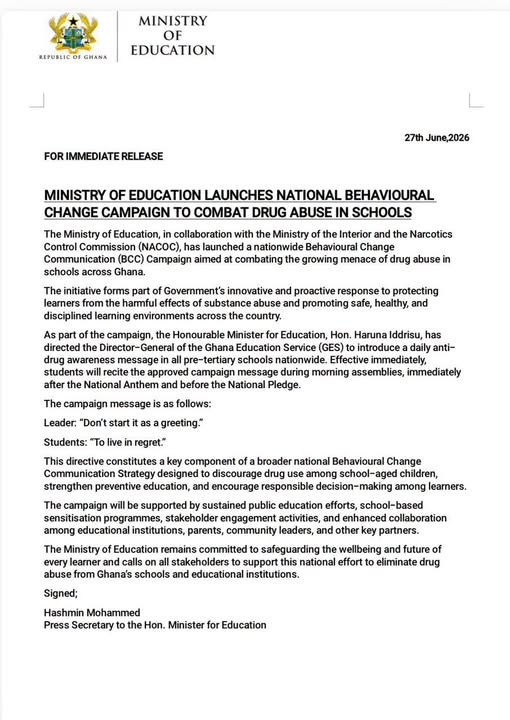
  • About GHS2.5m worth  of tramadol, other drugs destroyed in Northern Region – NACOC

    About GHS2.5m worth of tramadol, other drugs destroyed in Northern Region – NACOC

    Narcotics worth about GH₵2.5 million have been destroyed by the Northern Regional Command of the Narcotics Control Commission.

    This, according to the Substance Control Authority, forms part of the government’s intensified efforts to promote public safety and check the infiltration of unauthorised drugs in the region.

    The drugs were held at the Registry of the Circuit Court in Tamale and later destroyed after the prosecution of the persons involved in the trafficking of the drugs, following a court order issued by His Honour Francis Ayamwuni Asobayire, Circuit Court Judge.

    NACOC destroyed boxes of Tafrado 120mg, blisters of Tramadol, boxes of Royal 225mg, as well as quantities of marijuana at the Gbalahi Landfill site near Tamale, which was witnessed by representatives of various state agencies, including the Ghana Police Service, and members of the media.

    Mr Issahaque Bakuri, Northern Regional Commander of the Narcotics Control Commission, said the disposal formed part of measures to curb the smuggling and abuse of illicit drugs in the country.

    “We are taking frantic measures to combat drug abuse and promote a healthier society in the region and the country at large,” he said.

    To prevent further smuggling of such prohibited drugs into the country, Mr. Bakuri indicated that security officers had been stationed at entry points across the region, and intensified efforts have been made to enhance security surveillance at both approved and unapproved entry routes to address the drug menace.

    Mr. Bakuri urged individuals battling drug addiction to seek counselling and rehabilitation services.

    More than 11 nationwide intelligence-led swoops have been conducted between March and December this year by the Narcotics Control Commission (NACOC), aimed at cracking down on illicit drug activities.

    Speaking to the media on Friday, December 19, the Acting Director of Public Affairs and International Relations at NACOC, PNCO Francis Opoku Amoah, indicated that during that period, the swoops were carried out in areas such as:

    “From March till now, we have conducted more than 11 swoops, which, in our line of work, is a good number because investigations take time. For us to have achieved this means we are doing well.

    “This year, we have carried out swoops in Fadama, Effiakuma in the Western Region, Atinkpoko, parts of the Ashanti Region, and other areas. It all depends on where the intelligence is coming from and the type of intelligence we receive,” he said.

    In September, 1,195 boxes of Tramadol Hydrochloride 120mg, locally known as ‘Red,’ were confiscated, with six individuals arrested following a joint operation by the Ghana Police Service and NACOC. The seizure took place at Gbintri, near Nalerigu in the North East Region, on Thursday, September 18.

    This information was contained in a statement signed by Deputy Superintendent of Police (DSP) Robert Anabiik Anmain of the Public Affairs Unit and issued by the North East Regional Police Command on September 21.

    The trucks, with registration numbers GR 1712-16 and AW 4417-14, were loaded with Tramadol en route to Gbintri from Sankase in the Republic of Togo.

    The suspects have been identified as Alhassan Braimah, Yakubu Muntaka, Abdulai Shakur, Mumuni Iddrisu, Mumuni Yakubu, and Moses Ayorik.

    “The North East Regional Police Command, in collaboration with the Narcotics Control Commission (NACOC) in Nalerigu, has intercepted 1,195 boxes of Tramadol Hydrochloride 120mg, popularly known as ‘Red,’ a restricted drug concealed in a truck, and arrested six suspects at Gbintri near Nalerigu in the North East Region.

    “A search of the trucks uncovered the 1,195 boxes of Tramadol Hydrochloride 120mg, popularly known as ‘Red,’ concealed among other goods in the truck with registration number GR 1712-16. The exhibits have since been secured for evidential purposes.

    During interrogation, the suspects admitted that the consignment was destined for Moses Ayorik at Gbintri for onward delivery to another individual at Gushegu,” part of the statement read.

    According to the statement, the apprehended individuals are in police custody, assisting with investigations. In addition, efforts are underway to trace and arrest other individuals connected to the case.

    Officials of the Ghana Revenue Authority (GRA) at the Transit Terminal, on Thursday, June 19, intercepted a shipment disguised as general merchandise and headed for Niger. The officials uncovered 100 cartons of Tramadol (50 of 250mg and 50 of 120mg), also known on the streets as “Red.”

    The operation, led by CRO William Kpodo and the monitoring team, has now been escalated to the Tema Collection’s Investigation Unit, in collaboration with the Narcotics Board, Port Security, and the Joint Port Control Unit (JPCU).

    In March, the Ghana Revenue Authority (GRA) Customs Division intercepted contraband goods at Tema Port. Boxes containing opioids were confiscated before noon.

    There were 26 cartons of Rahol Tapentadol 250mg, 160 cartons of Tafradol Tapentadol 120mg, 40 cartons of Timaking Tapentadol 120mg, four cartons of Timaking Tapentadol 250mg, 190 cartons of Diazole Loperamide 2mg, and 320 cartons of Chlorpheniramine Maleate.

    The drugs were worth approximately GH₵20 million. The shipment was en route to Niger, its final destination. Engaging the media, Health Minister Mintah Akandoh condemned the use of land borders to smuggle drugs, and announced that the impounded consignment would remain in the safe custody of the Authority.

    “There are only two designated areas for the import and export of medication: Tema Port and Kotoka International Airport. Drugs are not imported through our land borders,” he said.

  • President Mahama recalls Baba Jamal from Nigeria as High Commissioner over vote-buying allegations

    President Mahama recalls Baba Jamal from Nigeria as High Commissioner over vote-buying allegations

    The Presidency has announced a recall of Ghana’s High Commissioner to Nigeria, Baba Jamal, over voter inducement during the just-ended Ayawaso East primaries on Saturday, February 7.

    In a statement titled “President recalls Ghana’s High Commissioner to Nigeria and shared by Spokesperson to the President, Felix Kwakye Ofosu, dated February 7, it noted that

    “President John Dramani Mahama has directed the immediate recall of Mohammed Baba Jamal Ahmed (Baba Jamal) from his position as Ghana’s High Commissioner to the Federal Republic of Nigeria. The decision follows allegations of voter inducement during today’s National Democratic Congress (NDC) primaries in the Ayawaso East Constituency, in which Mr Baba Jamal, a candidate, participated.”

    The President stressed that reports of vote-buying were made against several candidates seeking to win the Ayawaso seats, but Baba Jamal stood out because he was the only person who was a serving public officer at the time, making his case a peculiar one.

    “In his directive to the Minister for Foreign Affairs recalling Mr Baba Jamal as High Commissioner, the President noted that while allegations of vote-buying were made against multiple candidates who contested the primaries, Baba Jamal was the only serving public officer among them.”

    Consequently, to protect the integrity of public office and to avoid any public suspicion of misconduct or violation of the Government’s Code of Conduct for Political Appointees, the President, 

    “Without prejudice to the ongoing internal party processes, and strictly in view of the standards of conduct expected of public officers, the President considers it necessary to act decisively to preserve the integrity of public office and to avoid any perception of impropriety or conflict with the Government’s Code of Conduct for Political Appointees.”

    The statement continued that, “the recall takes effect immediately, and the Minister for Foreign Affairs has been directed to take the necessary administrative and diplomatic steps to give effect to this directive.”

    Meanwhile, Baba Jamal won the party’s internal primary held ahead of the by-election scheduled for March 3.

    After the close of polls, the provisional results showed that Baba Jamal pulled 431 of the total votes cast, followed by the widow (Hajia Amina Adam) of the late Ayawaso MP, Naser Toure, who also won 399 votes. Mr Mohammed Ramne, the Ayawaso East NDC Constituency Chairman, placed third with 88 votes.

    Dr Yakubu Azindow obtained 45 votes, while Mr Najib Mohammed Sani recorded one vote.

    Ahead of the elections, a survey conducted by the research and data analytics company Global InfoAnalytics predicted that 58% of members of the ruling NDC support the widow of the late Mahama Naser Toure, former Member of Parliament (MP) for Ayawaso East Constituency.

    This was announced by the Executive Director of the research company, Mussa Dankwah, in Accra on Thursday, February 5.

    According to the poll, the widow, Hajia Amina Adam, is the frontrunner among the others in the ongoing Ayawaso East Parliamentary Primary.

    The polling data show that 66% of party members disagree with the claim that she should be barred from contesting. The numbers suggest that narratives questioning her eligibility are failing to gain traction within the party.

    The poll also revealed that the public’s empathy towards her may boost her campaign and influence her chances of winning. About 43% of general voters indicated they would support Hajia Amina Adam because of the way she has been treated during the contest, while 15% of delegates cited the same factor as influencing their vote.

    The analysis basically presents Hajia Adam as securing roughly 54% of the total votes, while Mohammed Baba Jamal, Ghana’s High Commissioner to Nigeria and her main rival, could reach a maximum of 38%.

    He noted a 3.2% margin of error in the prediction, which still preserves her lead.

    “We asked NDC members in our polls whether it was wrong for Hajia to contest, and 66% of NDC voters disagreed. This means they do not think she should be prevented from contesting. When we asked the delegates, 58% of them also disagreed.

    “So both the delegates and the party faithful disagree with that call, which suggests that some people are pushing a narrative that is not selling, yet they keep promoting it,” he said.

    Meanwhile, the filing closed with the wife of the late MP being the last to pick up the forms. He said, “At the close of nominations today, six persons picked nomination forms to contest the upcoming primaries. The wife of the late MP was the last person to pick nominations today. It is going to be a very interesting contest.”

    Explaining her decision in a statement issued on Thursday, January 22, Hajia Adam indicated that she is heeding calls from constituents, party grassroots members, and traditional elders, adding that these individuals want her to carry on the work of her late husband.

    “There has been a clarion call from many quarters in my constituency and beyond for me to step into the shoes of my late husband. After deep reflection and consultations, particularly with elders and grassroots members, I have accepted the call to serve my people,” she stated.

    According to her, after reflecting on the calls, she has decided to heed them, emphasising, “I want to assure them that I will not disappoint them.”

    In addition, individuals who sought to contest the Ayawaso East parliamentary primary in the Greater Accra Region were required to pay a filing fee of GH₵40,000.

  • The worrying culture of Political Prophecies and the true practice of Christianity

    The worrying culture of Political Prophecies and the true practice of Christianity

    European and Northern American countries, there’s, on the other hand, an explosive growth in the Christian witness in African countries. This expansion in the population of Christians in the countries on the African continent, who have been traditionally Christian, goes to reinforce Kenyan theologian John Mbiti’s famous 1969 assertion that “The African is notoriously religious.”

    This predisposition of the African to religion makes the ordinary African person of faith easily susceptible to professed men of God who propagate “any wind of doctrine” that may not necessarily be a reflection of the true word of God.

    The recent controversy about the unrealised prophecy of a “prophet” about the victory of one particular candidate in the just concluded Presidential Primaries of Ghana’s largest opposition party, the New Patriotic Party (NPP), and matters arising, again bring up several issues about who speaks for God to His flock, and the responsiveness or gullibility of the people to such messages.

    At the crux of this age-old question is who qualifies to be a true prophet anointed and sent by God, or, otherwise, what could then be the case of the opposite – a false prophet.

    Not all ministers of the gospel – rightly called – are prophets.  Ephesians 4:11-12 lists the five-fold ministries, of which the office of the prophet is but one: “And He Himself gave some to be apostles, some prophets, some evangelists, and some pastors and teachers, for the equipping of the saints for the work of ministry, for the edifying of the body of Christ.”

    So, biblically speaking, not every minister of the gospel is given the office of prophet.

    Furthermore, God Himself makes known how He chooses specific people to be His prophets. Speaking to a young Jeremiah upon his call to the prophetic ministry, God says in Jeremiah 1:5, “Before I formed you in the womb I knew you;

    Before you were born, I sanctified you; I ordained you a prophet to the nations.”

    So from this seminal biblical passage, it is God Himself who predestines, who sanctifies and who ordains His chosen as prophets. This scenario runs through the Old Testament, where God mainly chose and spoke through the prophets.

    Thus, the situation where anyone assumes the role of prophet without an evident divine sanctification validated by consistent signs and wonders that follow may only be a recipe for confusion, and God is not an author of confusion.

    Most importantly, Amos 3:7 states, “Surely the Lord God does nothing, unless He reveals His secret to His servants the prophets.” This verse emphasises that God, in His sovereignty, discloses His plans and intentions to His prophets before executing judgment or action.

    Combined with two other verses, namely Psalm 119:89 and Numbers 23:19, the certainty of God’s word spoken to and through His prophets is established without any iota of confusion.

    Psalm 119:89, which states, “Forever, O Lord, Your word is settled in heaven”, is a profound declaration of the eternal, unchangeable nature of God’s Word. It signifies that divine truth is established, secure, and permanently fixed, surpassing the limitations of time and the temporary nature of earthly existence or affairs.

    Significantly, Numbers 23:19 states that: “God is not a man, that He should lie, nor a son of man, that He should repent. Has He said, and will He not do? Or has He spoken, and will He not make it good?”

    In essence, any prophet, so-called or worth his salt, cannot claim to have legitimately heard from God, declare that word of prophecy and then turn round to say he made a mistake when the “prophecy” fails. Or worse still, to say “God changed His mind” as in the prophecy to King Hezekiah, as some ministers of the Gospel are saying in brashly and arrogantly holding brief for Prophet Bernard ElBernard Nelson-Eshun, whose recent “prophecy” that one particular candidate in the recently-held NPP Presidential Primaries would win, failed.

    The case of Prophet Bernard ElBernard Nelson-Eshun is not isolated. In a culture where many professed Christians cede their personal responsibility in their walk with God to predatory pastors and other “men of God”, many lives have been wrecked and destinies compromised. This is contrary to the exemplary life of personal Christian biblical study firmly established by the Berean Christians in Acts 17:11.

    In this end time era, when Satan and his cohorts, knowing that they have but a short time, have the Church of Jesus Christ under all kinds of assault, who’ll defend the Gospel when those who are supposed to be leading God’s flock give His enemies more ammunition to attack the Church?

    Christianity, more than being an organised religion, is in essence a personal relationship with God through the finished work of Jesus on the cross.

    Thus, it is high time Christians in Africa, and Ghana in particular, appreciate the true requirements of Christian discipleship and submit first and foremost, not to the questionable activities and pronouncements of predatory pastors and some religious leaders but to the unerring guidance of God’s Word and the Holy Spirit – the Paraclete, the Comforter, the Intercessor and the Advocate.

    Author: Henry Quarshie

    DISCLAIMER: Independentghana.com will not be liable for any inaccuracies contained in this article. The views expressed in the article are solely those of the author, and do not reflect those of The Independent Ghana
  • Ayawaso East primary: 66% of NDC members support widow’s bid – Global InfoAnalytics

    Ayawaso East primary: 66% of NDC members support widow’s bid – Global InfoAnalytics

    Research and data analytics company Global InfoAnalytics has predicted that 58% of members of the ruling NDC support the widow of the late Mahama Naser Toure, former Member of Parliament (MP) for Ayawaso East Constituency.

    This was announced by the Executive Director of the research company, Mussa Dankwah, in Accra on Thursday, February 5.

    The widow, Hajia Amina Adam, according to the poll, is the frontrunner among the others in the ongoing Ayawaso East Parliamentary Primary. 

    The polling data shows that 66% of party members disagree with claims that she should be barred from contesting. The numbers suggest that narratives questioning her eligibility are failing to gain traction within the party.

    The poll also revealed that the public’s empathy towards her may boost her campaign and influence her chances of winning. About 43% of general voters indicated they would support Hajia Amina Adam because of the way she has been treated during the contest, while 15% of delegates cited the same factor as influencing their vote.

    The analysis basically presents Hajia Adam as securing roughly 54% of the total votes, while Mohammed Baba Jamal, Ghana’s High Commissioner to Nigeria and her main rival, could reach a maximum of 38%.

    He noted a 3.2% margin of error in the prediction, which still preserves her lead.

    “We asked NDC members in our polls whether it was wrong for Hajia to contest, and 66% of NDC voters disagreed. This means they do not think she should be prevented from contesting. When we asked the delegates, 58% of them also disagreed.

    “So both the delegates and the party faithful disagree with that call, which suggests that some people are pushing a narrative that is not selling, yet they keep promoting it,” he said.

    Meanwhile, the filing closed with the wife of the late MP being the last to pick up the forms. He said, “At the close of nominations today, six persons picked nomination forms to contest the upcoming primaries. The wife of the late MP was the last person to pick nominations today. It is going to be a very interesting contest.”

    Explaining her decision in a statement issued on Thursday, January 22, Hajia Adam indicated that she is heeding calls from constituents, party grassroots members, and traditional elders, adding that these individuals want her to carry on the work of her late husband.

    “There has been a clarion call from many quarters in my constituency and beyond for me to step into the shoes of my late husband. After deep reflection and consultations, particularly with elders and grassroots members, I have accepted the call to serve my people,” she stated.

    According to her, after reflecting on the calls, she has decided to heed them, emphasising, “I want to assure them that I will not disappoint them.”

    Meanwhile, individuals seeking to contest the Ayawaso East parliamentary primary in the Greater Accra Region are required to pay a filing fee of GH₵40,000.

    The amount is intended to help the party cover the cost of organising the primaries, including administrative and logistical expenses. This was disclosed in a press release issued by the party on January 20, 2026.

    Aspirants are also required to purchase nomination forms at a cost of GH₵5,000 and submit the completed forms to the party’s Greater Accra Regional Office. Meanwhile, female aspirants and persons living with disabilities (PLWDs) will benefit from a 50 per cent reduction in the filing fee.

    This will be the third time the country has had a rerun of elections after the 2024 general polls. Ablekuma North had remained the only constituency in Ghana without a sitting MP due to unresolved disagreements over the outcome of the parliamentary vote.

    In a statement dated January 16, 2026, and signed by the EC’s Deputy Chairman for Operations, Samuel Tettey, the Commission explained how interested persons can contest the election.

    Nominations will be accepted at the EC’s Ayawaso East Municipal Office in North Ridge from Monday, February 9, to Wednesday, February 11, 2026. Submissions will be taken between 9:00 a.m. and 12:00 p.m., and from 2:00 p.m. to 5:00 p.m. each day.

    Aspiring candidates can download nomination forms from the EC’s website, www.ec.gov.gh/forms, starting Friday, January 16, 2026. Completed forms must be submitted in four copies and can be presented by the candidate, or by their proposer or seconder, during the nomination period.

    Each candidate must be supported by a proposer and a seconder who are registered voters in Ayawaso East, along with eighteen other registered voters from the constituency. Candidates are also required to submit two recent passport-size photographs with a red background.

    A filing fee must be paid as part of the process. General candidates are to pay GH¢10,000, while female candidates and persons with disabilities will pay a reduced fee of GH¢7,500. The fee is non-refundable.

    The EC stated that the by-election is being held in accordance with Article 112(5) of the 1992 Constitution, which mandates an election to be conducted when a parliamentary seat becomes vacant. The Commission has called on the public to take note of the information as it works to ensure a free, fair, and transparent by-election.

  • NDC holds Ayawaso East parliamentary primary currently underway

    NDC holds Ayawaso East parliamentary primary currently underway

    Primaries to elect a candidate for the upcoming by-election in Ayawaso East Constituency are currently underway today, Saturday, February 7.

    The primary is currently underway amid a high deployment of police officers at the Nima Cluster of schools to ensure the maintenance of public order and ensure a free, transparent electoral process. 

    A total of 1,039 delegates are expected to vote between two polling centres, A and B. Centre A has 544 registered voters, while Centre B has 495.

    This has become necessary following the death of the Constituency Member of Parliament, Mahama Naser Toure who gave up the ghost after a short illness on January 4, at the Korle-Bu Teaching Hospital.

    Process before the primary today

    The primary follows a successful vetting process that cleared all five aspirants who filed nominations to contest the seat. The vetting exercise was conducted at the party’s Greater Accra Regional Office.

    After the vetting, the aspirants were balloted for their positions on the ballot paper ahead of today’s vote.

    The cleared candidates, in the order of balloting, are Mohammed Ramme, the NDC Constituency Chairman; Amina Adam, widow of the late Member of Parliament; Baba Jamal Mohammed Ahmed, Ghana’s High Commissioner to Nigeria; Yakubu Azindow; and Najib Mohammed.

    During a media engagement, the Greater Accra Regional Secretary of the NDC, Theophilus Tetteh Chaie, lauded the aspirants for their cooperation and compliance throughout the process, adding that the party had urged all contenders to conduct their respective campaigns respectfully and responsibly

    He said the party had encouraged all contenders to campaign peacefully and responsibly to ensure a successful outcome to the primary.

    Widow of late MP part of seat contenders

    The filing closed with the wife of the late MP being the last to pick the forms. He said, “At the close of nominations today, six persons picked nomination forms to contest the upcoming primaries. The wife of the late MP was the last person to pick nominations today. It is going to be a very interesting contest.”

    Explaining her decision in a statement issued on Thursday, January 22, Hajia Adam indicated that she is heeding calls from constituents, party grassroots members, and traditional elders, adding that these individuals want her to carry on the work of her late husband.

    “There has been a clarion call from many quarters in my constituency and beyond for me to step into the shoes of my late husband. After deep reflection and consultations, particularly with elders and grassroots members, I have accepted the call to serve my people,” she stated.

    According to her, after reflecting on the calls, she has decided to heed them, emphasising, “I want to assure them that I will not disappoint them.”

    Meanwhile, individuals seeking to contest the Ayawaso East parliamentary primary in the Greater Accra Region are required to pay a filing fee of GH₵40,000.

    The amount is intended to help the party cover the cost of organising the primaries, including administrative and logistical expenses. This was disclosed in a press release issued by the party on January 20, 2026.

    Aspirants are also required to purchase nomination forms at a cost of GH₵5,000 and submit the completed forms to the party’s Greater Accra Regional Office. Meanwhile, female aspirants and persons living with disabilities (PLWDs) will benefit from a 50 per cent reduction in the filing fee.

    This will be the third time the country has had a rerun of elections after the 2024 general polls. Ablekuma North had remained the only constituency in Ghana without a sitting MP due to unresolved disagreements over the outcome of the parliamentary vote.

    In a statement dated January 16, 2026, and signed by the EC’s Deputy Chairman for Operations, Samuel Tettey, the Commission explained how interested persons can contest the election.

    Nominations will be accepted at the EC’s Ayawaso East Municipal Office in North Ridge from Monday, February 9, to Wednesday, February 11, 2026. Submissions will be taken between 9:00 a.m. and 12:00 p.m., and from 2:00 p.m. to 5:00 p.m. each day.

    Aspiring candidates can download nomination forms from the EC’s website, www.ec.gov.gh/forms, starting Friday, January 16, 2026. Completed forms must be submitted in four copies and can be presented by the candidate, or by their proposer or seconder, during the nomination period.

    Each candidate must be supported by a proposer and a seconder who are registered voters in Ayawaso East, along with eighteen other registered voters from the constituency. Candidates are also required to submit two recent passport-size photographs with a red background.

    A filing fee must be paid as part of the process. General candidates are to pay GH¢10,000, while female candidates and persons with disabilities will pay a reduced fee of GH¢7,500. The fee is non-refundable.

    The EC stated that the by-election is being held in accordance with Article 112(5) of the 1992 Constitution, which mandates an election to be conducted when a parliamentary seat becomes vacant. The Commission has called on the public to take note of the information as it works to ensure a free, fair, and transparent by-election.

  • Fierce fire ravages seven containers at Spintex

    Fierce fire ravages seven containers at Spintex

    A fierce fire has ravaged seven container shops at Spintex, Accra, around the Marina, in the early hours of Saturday, February 7.

    According to the Ghana National Fire Service (GNFS), it received a distress call at about 12:01 a.m. But was unable to respond immediately due to a faulty fire engine at the Kasapreko Fire Station, which is closest to the scene. As a result, the Tema Motorway Fire Engine was dispatched as the base pump.

    In a Facebook post, the GNFS explained that it had to deploy three fire tenders from the Motorway, Tema Metro, and Tema Industrial Area Fire Stations to bring the blaze under control.

    The firefighting team, led by ADO I Derrick Sarkodie, arrived at the scene at 12:19 a.m. to find the fire already at an advanced stage and spreading rapidly. However, a coordinated and tactical operation by the firefighters brought the fire under control, and by 4:32 a.m., it had been completely extinguished.

    The affected shops included seven container shops housing furniture, tailoring, and grocery businesses, along with their contents. No casualties were recorded.

    Firefighters also reported that they prevented the fire from spreading to nearby structures, including Marina Mall, and successfully protected a car garage containing more than 35 vehicles, as well as several adjoining shops and nearby residential buildings.

    The GNFS said investigations are underway to determine the cause of the fire.

    Per reports, Greater Accra has recorded about five fire incidents, with the Spintex fire being the latest. The Ashanti Region, on the other hand, has seen an alarming number of fire incidents since January 1, recording about 132 cases, a decline from the 187 cases reported during the same period in 2025.

    A fire outbreak on Monday evening, February 2, partially destroyed the girls’ dormitory at Pong Tamale Senior High School in northern Ghana.

    According to reports, the fire originated from the washrooms and later spread through other parts, triggering panic among students.

    Firefighters from the Ghana National Fire Service (GNFS) worked tirelessly to bring the fire under control. Pong Tamale Senior High School has become the latest second-cycle institution in northern Ghana to record a fire outbreak.

    A fire broke out at Tolon Senior High School in the Northern Region on Monday, February 2, destroying parts of a dormitory. Nearly 900 female students were displaced following a fire at Tolon Senior High School in the region.

    The recurring of fire incidents have raised concerns, Ghana recorded over 3,595 fire incidents nationwide in the first half of 2025, with regional breakdowns showing hundreds of cases across the Greater Accra, Ashanti, and Central Regions.

    Barely a week into the New Year, some Kasoa residents had their stalls completely burnt after a fire ravaged stalls in a major outbreak at the Kasoa New Market on Sunday, January 4, 2026.

    According to the Ghana National Fire Service (GNFS), a distress call was received around 4:50 p.m., after which the Kasoa Fire Station swiftly reached the scene, only to find the fire at a very advanced stage.

    The fire was spreading so rapidly that fire tenders had to immediately call for reinforcement from Weija, Anyaa, Dansoman, Industrial Area, Flagstaff House, Madina, and Swedru fire stations.

    After about two hours of firefighting, the tenders managed to extinguish the flames at 6:52 p.m., brought the fire under control at 7:52 p.m., and fully extinguished it by 10:00 p.m.

    Although several metallic shops and wooden stalls were destroyed—along with food items such as maize, beans, shea butter, spices, and other merchandise—the swift response by firefighters prevented the blaze from consuming the entire market.

    Fire control officers explained that, despite the losses incurred, several stalls were salvaged. Among the challenges listed by the GNFS during the operation were poor accessibility within the market, long distances to reliable water sources, and interference from members of the public at various points during the operation.

    This fire marks the second major outbreak at the market in the last two years.

    Fire tenders from Kasoa and Swedru have been left on standby to prevent any possible re-ignition, while investigations into the cause of the fire are ongoing.

    A fire incident at Abuakwa Manhyia in the Atwima Nwabiagya South Municipality of the Ashanti Region claimed the lives of a three-month-old baby and six others.

    The fire outbreak, which occurred at about 12:30 a.m. on Monday, December 22, swept through an apartment. This information was disclosed by the Assembly Member for Abuakwa Manhyia, Evans Opoku. Meanwhile, the cause of the incident is yet to be established. Ghana has recorded several fire incidents from January to November this year.

    Recently, a fire outbreak at Tsito–Awudome Gborkorpe in the Volta Region destroyed a two-bedroom self-contained apartment. No casualties were reported from the incident, which occurred on Monday, December 8.

    Several students at Kedjebi-Asato Senior High School (SHS) in the Oti Region were left unconscious after a fire gutted one of the boys’ dormitories on Tuesday morning, December 2.

  • A visa-free Africa, open skies and one biometric passport – Majority leader to African leaders

    A visa-free Africa, open skies and one biometric passport – Majority leader to African leaders

    Ghana’s Majority Leader of Parliament, Mahama Ayariga, has reiterated calls for a visa-free open skies and single biometric passport in Africa.

    He made these calls during a speech at the 2026 Africa Prosperity Dialogue, held under the theme “Empowering SMEs, Women and Youth in Africa’s Single Market: Innovate, Collaborate, Trade,” Mr Ayariga urged African leaders present to expedite processes to adopt the African free movement agenda to boost jobs, business, and regional economic growth at large.

    He stressed the benefits and impact the implementation of the borderless Africa policy is having in the sub-region, West Africa, and the need to extend it across the continent.

    He said, “We want a visa-free Africa. I have seen how a visa-free West Africa has been enormously supportive”.

    The Majority Leader also called for improved air connectivity across the continent, advocating for open skies policies.

    “We want open African skies,” Mr. Ayariga said, adding that Africa should move towards “one African biometric passport” to facilitate easier travel for citizens.

    Highlighting on policies to promote development among the youth in Africa, Mr Ayariga called for improved modern infrastructure to support young people and small and medium-sized enterprises operating across borders.

    “Let’s build infrastructure that will enable our youth to trade digitally across borders and allow mobile money to operate seamlessly across countries,” he said.

    Mr. Ayariga further noted that young Africans are demanding recognition of their academic qualifications across the continent.

    “Our youth want their degrees recognised across Africa,” he stated.

    According to him, Africa has made considerable progress at the regional level, particularly in West Africa.

    “A lot of progress has been made, especially in West Africa,” he said, noting that his nearly decade-long service in the ECOWAS Parliament gave him first-hand experience of these achievements.

    “Many of the demands being raised here are issues we worked on diligently, and in West Africa, we already enjoy many of those benefits,” he added.

    He said these calls are not foreign to other continents like Europe, including North, East, Southern and Central Africa, as well as across Francophone, Lusophone, Arab and Anglophone regions, hence the need for the proposed regional integration.

    Mr Ayariga said similar arrangements exist in other parts of the continent. He noted that the next step is to integrate these regional gains so that all Africans can benefit simultaneously.

    “What is needed now is for the various blocs to integrate the facilities they have granted to their citizens and allow all Africans to enjoy them,” he said.

    He mentioned that Ghana is ready to do its part to support the initiative for Africa’s growth and development.

    “Our Parliament stands ready to walk the talk. We are prepared to pass all the agreements required to grant visa-free status to every African,” he added.

    In a related development, Ghana and Zambia no longer require visas for travel between the two countries following a historic visa waiver agreement.

    The move, announced by Minister for Foreign Affairs, Samuel Okudzeto Ablakwa, during President John Dramani Mahama’s three-day state visit to Zambia, is aimed at strengthening diplomatic, economic, and people-to-people relations between the two African countries.

    Narrating the events that preceded the agreement, Mr Ablakwa explained that he was in contact with the Chief Director, who was chairing a technical committee meeting.

    He reminded her of the presidential directive, but there was initially some confusion because Ghana has three types of passports, diplomatic, service, and ordinary, while they only had two, Diplomatic and then the ordinary passports.

    Ablakwa said he stressed that the directive came from the president, leaving the Zambian government with no choice but to agree to the deal.

    “If you want our president to be here and you want his wishes to be granted, then you have to make sure that we reach this deal. And at 11: 30pm last night, they reached out to their president, and he said if it is my brother’s wish, I am going to grant you. So we have the visa-waver agreement,” Ablakwa announced.

    Adding that, “this will bring the number to fifteen visa waiver agreements since President Mahama was sworn into office.”

  • Juaben SHS students stab Koforidua SECTECH student at inter-schools festival

    Juaben SHS students stab Koforidua SECTECH student at inter-schools festival

    A student of Koforidua Senior High Technical School (SECTECH) is receiving medical care after a violent attack by some Form Two students of New Juaben Senior High School during a clash at the Eastern Regional Inter-Schools Sports Festival in Koforidua.

    According to the reports, the victim, identified as Jerome Appiah, was eating waakye on his way to campus when the Juaben students attacked him with a machete, leaving him with a deep wound to the shoulder and bleeding profusely.

     This has prompted fears of reprisal attacks and heightened security concerns. Police intervened and quickly ushered Jerome to the Eastern Regional Hospital, where he is currently receiving treatment and is said to be in stable condition.

    To prevent an escalation, the Headmaster of Koforidua SECTECH, Emmanuel Frimpong Benjabeng, joined by other teachers, rushed to the Koforidua Youth Resource Centre, where the inter-schools sports festival was being held.

    However, while the headmaster was in an engagement with the New Juaben South Municipal Education Director, Mustapha Haruna Appiah, he was informed that further disturbances had broken out, forcing him to leave the meeting abruptly. 

    Later, it emerged that a teacher of SECTECH, Henry Kudiabor, had also sustained a head injury after being struck by a flying stone during clashes involving students of Nsutam Senior High Technical School, who were allegedly pelting stones.

    The New Juaben South Municipal Education Director, Mustapha Haruna Appiah, has expressed concern over the recurring violence and has called on the police and event organisers to investigate the incident thoroughly and tighten security to prevent further attacks.

    This adds to a worrying trend of rising indiscipline and violent confrontations among students in Ghanaian schools, particularly second-cycle schools nationwide.

    Last year was marked by at least five major violent incidents recorded between January and July 2025; from Kinbu’s teacher assault to Nalerigu’s fatal shootings.

    Students stabbed at T.I Ahmadiyah by colleague

    A fisticuff between two final-year students of Wa T.I. Ahmadiyya Senior High School (Wa Amass) left one hospitalised and another in a critical condition, according to reports.

    It was reported that Iddrisu Ibrahim, also known as Lincoln, an agricultural science student, and his colleague Hafis, who is also known as Baayaawa, a general arts student, engaged in an argument over a video that was recorded.

    It is said that Lincoln filmed Hafis without his consent, an action that left the latter displeased. He requested Lincoln to delete the said video, but Lincoln reportedly refused. When matters escalated, Hafis pulled out a knife and stabbed his colleague in the stomach and ribs.

    Sources say a group of students mobilised to attack Hafis when he sought to escape. The intervention of the Police averted further casualties. According to reports, Hafis has been apprehended and is aiding investigations into the incident.

    Lincoln is said to be admitted to the Wa Regional Hospital. The school authorities are yet to release an official statement on the matter.

    Fatal stabbing at Kinbu SHS

    A student of Kinbu Senior High School (SHS)was arrested for stabbing another student to death on July 31.

    Addib Alhassan, a 15-year-old first-year student, was fatally stabbed during an altercation allegedly sparked by a heated argument. The exact cause of the confrontation remains unclear. After sustaining injuries, Alhassan was initially rushed to the Adabraka Polyclinic and later transferred to the Ridge Hospital due to the severity of his injuries. He was later pronounced dead.

    More cases of violence, attacks in SHS 

    Kumasi Technical Institute (KTI) and Kumasi Anglican Senior High School clashed after returning from an inter-school competition. One student sustained severe injuries as a result of the event; school properties and private cars belonging to teachers were also damaged.

    Salaga Senior High School in the Savannah Region observed the most violent clashes. The confrontation left a student with multiple stab wounds, with the police retrieving a locally-produced pistol and ammunition from the scene. Students of Islamic Senior High School (ISSEC) also faced off with local youth, causing injuries and damage to multiple vehicles.

    Months ago, a 16-year-old form two student of Osei Kyeretwie Senior High School (OKESS) was arrested by the Tafo Pankrono Divisional Police Command for illegally possessing a locally manufactured firearm.

    The police arrested the suspect following a routine dormitory search by school authorities on Wednesday, May 14. According to the accused, the weapon belonged to his stepfather, Mr Daniel Owusu Baafi, who has been apprehended.

    This was disclosed by the Deputy Superintendent of Police Godwin Ahianyo, Head of Public Affairs for the Ashanti Regional Police Command, on Sunday, May 18. Following their arrest, both individuals were granted bail and are to report to the police on Monday, May 19, as investigations continue.

    These trends forced a comprehensive review of security arrangements in schools nationwide to be ordered by the Ministry of Education.  The Education Minister, Haruna Iddrisu, who was addressing the media on Thursday, August 7, 2025, fumed about the chaos in SHSs, describing them as “deeply troubling and unacceptable.”

    “We must work more closely with our security agencies and law enforcement to ensure our schools remain safe spaces for learning. Even our concept of a ‘watchman’ in educational institutions needs to be revisited.

    “Do we just pick anyone and label them school security? With no training in policing or even basic security practices?. We need to review this so we can foster a safer school environment for both students and teachers,” he added.

    The Ministry of Education granted school heads at Senior High Schools across the country the mandate to conduct searches on students. This was revealed by the Deputy Minister for Education, Clement Apaak, on Saturday, May 24.

    Speaking to Citi News, Clement Apaak noted that the action is a part of the government’s series of strategies to eradicate indiscipline in schools, specifically SHSs. The new development was ruled out under the previous New Patriotic Party (NPP) government.

  • A star that wore the shirt with pride – Black Stars remember Atsu, 3 years on

    A star that wore the shirt with pride – Black Stars remember Atsu, 3 years on

    Ghana’s national team has paid tribute to late Black Stars player, Christian Atsu, marking three years after his passing.

    Taking to their official X formerly (Twitter) handle today, February 6,  the Black Stars praised Atsu as one who represented the national team wth pride.
    The X post read, “In loving memory of Christian Atsu 🖤, 3 years on, we honour a Black Star who wore the shirt with pride and represented Ghana with humility. His legacy lives on. Rest well, Twasam.”

    Atsu, affectionately known as “Twasam,” remains fondly remembered not only for his exploits on the field but also for his quiet generosity and selfless service to others.

    He played for Porto, Chelsea, Newcastle United, and Hatayspor before his untimely demise in 2023 following a 7.8 magnitude earthquake in Turkey and Syria, which claimed the lives of thousands, wrecking properties as well.

    He earned several caps for Ghana, playing at major tournaments including the Africa Cup of Nations and the FIFA World Cup, where he consistently gave his all for the Black Stars.

    About his death and how his body was discovered

    The wife, sister, and agent of the late Ghanaian footballer, Christian Atsu, in a heartfelt interview with UK-based The Athletic, shared their experiences coping with the loss, a year after the tragic incidents in Turkey that led to his untimely death.

    Christiana Twasam, Nana Sechere, and Marie Claire-Rupio, Christian Atsu’s surviving spouse, opened up about the challenges they faced in dealing with the demise of their beloved family member.

    Recalling the traumatic moments surrounding his disappearance and death, Christiana Twasam expressed her devastation upon arriving at the collapsed Renaissance Residence five-star block where Christian was trapped.

    “When I got there, I was devastated because I thought no one was going to survive in that building,” says Christiana, recalling the sight.

    She vividly described the anguish of waiting for rescuers, hoping to hear her brother’s name among the survivors, only to face the heartbreak of identifying bodies.

    “We would call out his name,” Christiana said. “The rescuers would alert us if they sensed a life, then bring out the body, and you’d be asked to verify if it was someone you knew. It broke my heart when you saw a body bag coming; it was going to be your own relative or not. We were like a family around the fire in the evening. When someone verified their relative and broke down, it reminded you that one day you would too,” she said in reflection.

    Nana Sechere, Christian Atsu’s agent, shared a glimmer of hope during the search, recounting the discovery of a shoe that resembled Christian’s Yeezy trainers. This find provided a crucial clue, affirming that they were on the right track in their efforts to locate him.

    “I spotted a shoe that looked very much like Christian’s through the legs of one of the search team. He threw it over to me and it was one of his Yeezy trainers. We found the other one from the pair soon after, and it told us we were looking in the right place.”

    Despite moments of hope, the family’s quest to find Christian ended tragically when, after days of searching, they received the heartbreaking news that his lifeless body had been located.

    “Two officials took us to a body bag lying on the floor,” he says. “We had seen so many, that even before they were opened (we knew they) weren’t the right shape or size for Christian. But I could tell by the shape of it that it was Christian. We saw him and we broke down.” he narrated.

    It has been a year since the missing of Christian Atsu was announced following an earthquake in Turkey. The former Black Stars player was trapped under the rubble for about three days before he was found lifeless on February 8, 2023.

    The family continues to grapple with the profound loss of a man known not only for his prowess on the field but also for his philanthropic endeavors.Read the full interview on theathletic.com

  • I hope he replicates his club form with the Black Stars – Vanderpuye on Man City’s Semenyo

    I hope he replicates his club form with the Black Stars – Vanderpuye on Man City’s Semenyo

    Ghanaian prodigy Antoine Semenyo is making strides at his new club, Manchester City. He scored in his debut and assisted during his side’s game against Exeter City.

    According to statistics, he has notched 12 Premier League goals this season and 14 for Man City, with a recent one in a clash against Wolves.

    With his impressive form at his new club, Ghana’s former Sports Minister Edwin Nii Lantey Vanderpuye says he is hopeful that Semenyo can replicate his club form for the Black Stars as the 2026 FIFA World Cup approaches.

    Speaking during an interview with Citi Sports on Thursday, February 5, the National Coordinator for the District Road Improvement Programme (DRIP) stated that the striker still has more to prove in national colours.

    “I would just pray that he’s able to transfer whatever he’s doing with Manchester City to the Black Stars… up to now, he’s not been able to convince Ghanaians so much about his prolific performance when it comes to the Black Stars.”

    Since making his Ghana debut in 2022, Semenyo has featured at the 2022 World Cup and the 2023 AFCON, earning 32 caps and scoring three goals.

    He continued that Semenyo’s roots in England could be a big motivation for him to outdo himself during England’s game with Ghana Black Stars.

    “You know he was born in England, and I think it is good… that is enough motivation for him to perform better when he plays the English,” he added

    With the World Cup drawing closer, attention is steadily turning to Semenyo and his Black Stars teammates as Ghana looks to make a strong impression on the global stage.

    In a related development, Ghana’s head coach Otto Addo is expected to release the final squad list for the 2026 World Cup in June next year.

    This was confirmed by the Communications Director of the Ghana Football Association (GFA), Henry Asante Twum, in an interview with Accra-based radio station Asempa FM on December 15. He stated that ahead of the official squad announcement, a provisional list is expected to be released by all qualified nations on May 11, with the final squad to be released on June 1.

    “All qualified teams, including the Black Stars of Ghana, are mandated by FIFA to announce their provisional squad on April 11, 2026. The final squads for the tournament must be announced before midnight on June 1, 2026,” he said.

    He added that Ghanaian players performing well domestically or abroad will all be considered for selection.

    “Every Ghanaian player with a strong performance is closely monitored by the technical team, and regardless of where they play, they will be given a call-up,” Asante Twum noted.

    Drawn in Group L alongside Panama, England, and Croatia, Ghana will be looking to improve on previous campaigns at the global tournament, which will be co-hosted by the USA, Canada, and Mexico.

    The Black Stars will open their World Cup campaign against Panama on June 17 in Toronto, before facing England in Boston on June 23. Their final group match against Croatia is scheduled for June 27 in Philadelphia.

    Next year’s tournament will mark Ghana’s fifth appearance at football’s biggest stage, having previously competed in 2006, 2010, 2014, and 2022. The team’s most memorable run came in 2010, when they reached the quarter-finals in South Africa.

    Ghana’s World Cup campaign will begin against Panama on June 17 in Toronto, followed by a clash with England in Boston on June 23, before concluding the group stage against Croatia in Philadelphia on June 27.

    Ghana’s participation in the 2026 FIFA World Cup represents its 5th appearance at the global tournament, having previously competed in 2006, 2010, 2014, and 2022. The Black Stars’ most memorable run came in 2010, when they reached the quarter-finals in South Africa.

    They will open the tournament with a clash with Panama on 17 June, take on England on 23 June, and conclude the group stage against Croatia with their matches scheduled to be held in Toronto, Foxborough, and Philadelphia.

    The Black Stars are set to play against England, Croatia, and Panama. This was revealed after the group draw was conducted on Friday at the John F. Kennedy Centre for the Performing Arts in Washington, D.C, The high-profile ceremony attended by notable attendees, including President Donald, entertainers like Kevin Hart, Heidi Klum, and sports icons like Tom Brady, Shaquille O’Neal, Rio Ferdinand and Ghana’s legendary footballer, Asamoah Gyan.

    Speaking during a media engagement, the former Ghanaian footballer expressed optimism about the team’s chances in the group. He acknowledged that although it is a bit tricky, he is confident Ghana will make it through successfully.

    Meanwhile, Sports Minister, Kofi Adams, has announced a new twist in supporters’ sponsorship by the government for the 2026 FIFA World Cup.

    Ghana sealed their place at the 2026 World Cup with a hard-fought 1-0 victory over Comoros in their final Group I qualifier at the Accra Sports Stadium on Sunday, October 12, marking the country’s fifth appearance at football’s biggest tournament, which will be hosted in the United States, Mexico, and Canada.

    Past governments have mostly offered some form of financial support, be it full or partial, for supporters who travel to attend the World Cup. However, it has become a challenge over the years due to financial constraints.

    Consequently, in early November last year, Kofi Adams noted that, although it has been a long-standing practice, he “doesn’t recommend” it.

    However, in a recent radio interview on Asempa FM’s Ultimate Sports Show in Accra on February 5, he acknowledged the tradition of sponsoring fans to support the Black Stars, adding that it is for that reason that his outfit has set up a fundraising committee.

    “The policy that we should take for fans is clear. It is clear that we should work at it, and that is why we have set up a fundraising committee. The number we would take ultimately will depend on how much we raise,” he stated.

    He explained that the government seeks to sponsor some Ghanaian fans for the 2026 World Cup so Ghana will have strong support at the tournament.

  • Nobody makes decisions for other clubs; we operate independently – SPL to CR7

    Nobody makes decisions for other clubs; we operate independently – SPL to CR7

    The Saudi Pro League has reacted to an alleged “professional misconduct” by the Al-Nassr captain, Cristiano Ronaldo.

    According to reports, the eight-time Ballon d’Or winner boycotted a game against Al-Riyadh and intends to do the same with Al-Nassr’s game against Al-Ittihad tonight.

    This is allegedly a move to protest regarding Al-Nassr’s non-signings in the January transfer window.

    Ronaldo is reportedly unhappy over the Public Investment Fund (PIF)’s investment in the other clubs it owns compared to Al-Nassr.

    The PIF owns clubs like Al-Hilal, Al-Ittihad and Al-Nassr in the Saudi Pro League. Al-Hilal recently signed Karim Benzema from Al-Ittihad.

    Benzema scored a hat-trick and added an assist in his debut game; in the lead-up to Al-Nassr’s game tonight.

    Saudi Pro League spokesperson, in a strongly worded statement via a spokesperson, according to ESPN, in Ronaldo’s direction, noted that,

    “The Saudi Pro League is structured around a simple principle: Every club operates independently under the same rules.”

    The spokesperson acknowledged Ronaldo’s role in his club and his contribution at large to the Saudi League. He said, “Cristiano has been fully engaged with Al Nassr since his arrival and has played an important role in the club’s growth and ambition.”

    However, he warned that, “…no individual, however significant, determines decisions beyond their own club. Recent transfer activity demonstrates that independence clearly. One club strengthened in a particular way. Another chose a different approach. Those were club decisions, taken within approved financial parameters.”

    Cristiano Ronaldo penned a two-year contract extension with his Saudi club, Al-Nassr.

    The Portugese’s contract was set for expiry on June 30.

    This left many speculate a new journey elsewhere or an extension with the Saudi club espcially after the five time Ballon d’Or winner about a month ago, posted on social media “the chapter is over”.

    However, the 40 year-old player will stay with the Saudi Pro League club until beyond his 42nd birthday.

    The Portugal captain, joined the Riyadh-based team in December 2022 after leaving Manchester United following a fall-out with then manager Erik-ten Hag and having criticised the club durinhg an interview with Piers Morgan.

    In an X post on June 26, he confirmed another stint with Al-Nassr saying , “A new chapter begins. Same passion, same dream. Let’s make history together.”

    The club also confirmed his stay on X in a post which reads, ” Cristiano Ronaldo is staying at

    @AlNassrFC until 2027.”

    Although Al-Nassr have not added to their nine domestic titles during Ronaldo’s time at the club, CR 7 has added to the club a barrage of goals.

    Ronaldo has scored 99 goals in 111 appearances for Al-Nassr,also winning bagged two Golden Boot awards during his time there, including a record-breaking 35-goal season in 2023–24.

    Ronaldo scored 35 times in 41 matches across all competitions last term and was the league’s top scorer for a second consecutive season.

    Having helped Portugal win the Uefa Nations League a little over two weeks ago, the former Manchester United, Real Madrid, Sporting and Juventus forward will almost certainly now be targeting a sixth World Cup appearance next summer.

    Fifa president Gianni Infantino raised the prospect of Ronaldo joining a team involved in the Club World Cup after Al-Nassr failed to qualify for the extended tournament which is being held in the United States.

    Meanwhile, Ronaldo said he had received offers from participating teams but turned them down because hebelieves he would be a champion in Saudi Arabia.

    “My goal, it’s always to win something important for Al Nassr. And of course I still believe in that. This is why I renewed the two years more because I believe that I will be a champion in Saudi Arabia,” he noted.

    He also lauded the Saudi Pro League’s over the years saying, “Of course, we are still improving but I believe that at this moment we are in the top five [leagues in the world] already. I still believe that we will continue to improve… I am happy because I know that the league is very competitive” he concluded.

    The decision to stay until at least 2027, which is certain to be highly lucrative, appears to rule out any future prospect of Ronaldo returning to play at the highest level in Europe.

    It remains to be seen who will be leading the first team at Al-Nassr going forward, after former AC Milan head coach Stefano Pioli left the club this week.

  • Ghana to exit IMF by April 2026 – President Mahama

    Ghana to exit IMF by April 2026 – President Mahama

    President John Dramani Mahama has reaffirmed that Ghana will exit the IMF by the first quarter of the year.

    This comes after he hinted at an exit in January in his New Year’s message. President Mahama said the government is preparing to exit the IMF programme while safeguarding Ghana’s economic credibility, highlighting that the reforms over the past year have strengthened macroeconomic indicators enough to support a gradual withdrawal.

    He said, “We are beginning the process of exiting the IMF programme with dignity, not as supplicants, but as partners.”

    Speaking at the Ghana-Zambia Business Dialogue in Lusaka on Friday, February 6, President Mahama confirmed that Ghana is on course to complete its International Monetary Fund (IMF) programme by April 2026, citing improvements in key economic indicators.

    Mahama stressed that the stabilising economy positions Ghana to expand trade and investment, particularly under the African Continental Free Trade Area.

    “These gains provide a solid foundation for Ghana’s development agenda, which focuses on five strategic pillars: industrialisation and value addition; export-led growth; modern infrastructure development; strong support for MSMEs, women, and youth entrepreneurs; and a predictable, transparent, investor-friendly business environment,” he said.

    Meanwhile, in late December 2025, it was announced that the Extended Credit Facility (ECF) with the International Monetary Fund (IMF) risks an extension from its initial end date.

    This follows a recent proposal from the IMF Board, which requested a three-month continuation before the programme concludes. Defending its proposal, the IMF Board noted that the extension would provide sufficient time for the implementation of reforms underpinning the sixth and final review of the programme.

    Ghana’s programme with the global lender is scheduled to end in May 2026, following a final review slated for April 2026. However, should the IMF’s recommendations be approved, the programme would be extended through August 2026.

    Part of the IMF report reads, “The extension through August 16, 2026, would help reach an understanding on the policies supporting completion of the 6th review, while allowing sufficient time to prepare and circulate Board documents.”

    So far, Ghana has secured about US$2.8 billion following the successful completion of the fifth programme review. The new development is expected to trigger the release of a sixth tranche of US$380 million. Reacting to the approval, the Minister for Finance, Dr Cassiel Ato Forson, noted that the approval represents meaningful progress in the country’s broader economic recovery agenda.

    IMF’s Resident Representative in Ghana, Dr Adrian Alter, has declared Ghana’s programme “solid and on track”.

    His comments come nearly a month after the IMF Executive Board completed the fifth review of Ghana’s Extended Credit Facility (ECF) arrangement on 18 December 2025.

    During an appearance on Joy News’ PM Express Business Edition on Thursday, January 15, Dr Alter mentioned disbursements and affirmed confidence in Ghana’s economic recovery path.

    “Ghana’s program remains solid and on track, with the fifth review completed and the disbursement made at the end of December,” he said.

    According to him, following a board meeting at which Ghana’s performance was assessed, it was concluded that “the IMF Board has met and approved the programme on December 17 and categorised the overall performance of Ghana as generally satisfactory,” with all indicative and performance criteria targets met and most of the reform agenda implemented.

    He disclosed that total disbursements under the ECF programme had now reached about $2.8 billion.

    “All indicative and performance criteria targets have been met,” Dr Alter said. “Most of the reform agenda has been concluded and implemented.”

    His comments come amid public debate over whether Ghana’s performance under the programme reflects real economic progress or favourable treatment by the IMF.

    Responding to that concern, Dr Alter said the assessment was grounded in measurable outcomes and recent policy actions by the authorities.

    “The authorities implemented strong corrective actions in the aftermath of the 2024 fiscal slippages,” he said, adding that “the 2025 macroeconomic outcomes have been better than expected.”

    He pointed to improvements across key economic indicators.

    “Inflation came down faster than expected,” he said. “Growth exceeded expectations. Reserves have improved. The currency appreciated and stabilised.”

    Dr Alter said the gains were occurring alongside progress on debt restructuring.

    “There are many, many macroeconomic indicators that perform very well at the same time the debt restructuring progress has been advanced,” he said.

  • Govt to launch spare parts price app soon – Transport Minister

    Govt to launch spare parts price app soon – Transport Minister

    The government is scheduled to launch a mobile application soon, the Minister of Transport, Joseph Bukari Nikpe, has revealed.

    According to him, the app, which is currently being developed, is intended to ensure transparent pricing and easy nationwide access to spare parts, following consistent complaints from drivers about disparities in spare parts prices, which have hindered transport fare reductions despite a drop in fuel prices.

    Mr Nikpe made the announcement during an appearance on Accra-based radio station Asempa FM’s Ekosii Sen show on Thursday, February 5.

    He revealed that the government lobbied for a 15% reduction in transport fares last year. However, many drivers initially resisted further reductions, citing high spare-parts prices driven by dollar instability.

    He said, “The Trade Ministry plays a crucial role because drivers need access to spare parts for repairs. Last year, we achieved one of the highest reductions in transport fares in the country, negotiating a 15% decrease with our transport unions.

    “However, drivers were initially reluctant to lower their fares due to the high cost of spare parts, which were affected by the rising dollar. Now that the dollar has stabilised, we expect this to reduce spare parts prices. Fuel prices have also shown some stability recently.”

    He added that, together with efforts to retool state transport agencies such as Metro Mass Transit and STC, the initiative will help sanitise and decongest cities while improving traffic flow.

    The minister also highlighted collaboration with the National Road Safety Authority to implement a nationwide road-safety campaign aimed at enhancing safety for both commuters and drivers.

    It will be recalled that the Ghana Union of Traders Association (GUTA), the Association of Ghana Industries (AGI), the Spare Parts Dealers Association, and others were scheduled to appear before Parliament to justify their decisions not to reduce prices of their goods and services despite the cedi’s gains in May 2025.

    This was at a time when pressure was mounting on traders to reduce prices as a result of the local currency’s stability against major trading currencies, particularly the dollar. In that same month, the Abossey Okai Spare Parts Dealers Association in the Greater Accra Region directed its members to reduce prices of spare parts owing to the appreciation of the cedi.

    However, they argued that significant reductions in the prices of goods and services could not occur immediately.

    A section explained that they were yet to sell off old stock that had been bought at higher exchange rates.

    “For now, maybe it can’t be possible because we ordered the goods at a certain rate, which is higher than what we are seeing now. At that price, we have to sell, and when the goods finish and you order another one at a reduced exchange rate, then definitely the prices will come down.”

    Another vendor, Yaw Ansong, echoed this, saying, “Unless I sell what I already ordered and finish before I can reduce the price of the goods, I haven’t ordered a new one, so I can’t reduce the price. If I reduce the price, I am going to lose my job,” he stated.

    Eric Osei Danso also explained, “For others, price reductions may come, but only if the cedi’s performance remains stable over time.”

    The Ghana Union of Traders Association (GUTA) also directed its members to slash their prices in response to the local currency’s gains.

    Committee Chairman Alexander Gabby Hottor-Dze noted that relevant stakeholders must assist the committee in deliberating on the matter.

    “We have come to understand that the dollar is down and the cedi is also going up, so we are going to do what they say, but not now. We will go down on prices when we see the dollar is still stable where it is.”

    “There have been price reductions in some quarters, but these are not commensurate with the impact of the appreciation of the cedi.”

    “The Committee on Trade, Industry and Tourism had called for this meeting to inquire into why businesses and service providers are reluctant to reduce their prices, the impact on the economy, and the way forward.”

    “We have assembled here most of the relevant stakeholders who would assist the committee to deliberate on the matter,” he added.

  • Govt to sponsor fans to 2026 World Cup – Sports Minister

    Govt to sponsor fans to 2026 World Cup – Sports Minister

    Sports Minister, Kofi Adams, has announced a new twist in supporters’ sponsorship by the government for the 2026 FIFA World Cup.

    Ghana sealed their place at the 2026 World Cup with a hard-fought 1-0 victory over Comoros in their final Group I qualifier at the Accra Sports Stadium on Sunday, October 12, marking the country’s fifth appearance at football’s biggest tournament, which will be hosted in the United States, Mexico, and Canada.

    Past governments have mostly offered some form of financial support, be it full or partial, for supporters who travel to attend the World Cup. However, it has become a challenge over the years due to financial constraints.

    Consequently, in early November last year, Kofi Adams noted that, although it has been a long-standing practice, he “doesn’t recommend” it.

    However, in a recent radio interview on Asempa FM’s Ultimate Sports Show in Accra on February 5, he acknowledged the tradition of sponsoring fans to support the Black Stars, adding that it is for that reason that his outfit has set up a fundraising committee.

    “The policy that we should take for fans is clear. It is clear that we should work at it, and that is why we have set up a fundraising committee. The number we would take ultimately will depend on how much we raise,” he stated.

    He explained that the government seeks to sponsor some Ghanaian fans for the 2026 World Cup so Ghana will have strong support at the tournament.

    The government believes Ghana should not only be represented by its team but also by its fans. However, he detailed that the number of supporters will be heavily dependent on the funds available to the government.

    He continued that, as part of the fundraising committee’s task, is to raise resources to cover travel and accommodation for supporters who will journey to back the Black Stars at the tournament.

    He acknowledged, however, that the plan requires significant financial backing, prompting the government to appeal to the private sector and the general public for support.

    “This is why we are appealing to corporate bodies, companies, mining firms and well-meaning individuals to come on board and support this initiative,” he said.

    Earlier, Mr Adams explained his objection to the government funding supporters to the World Cup, citing the need for the government to prioritise investment in the country’s sports infrastructure instead of spending it on fan sponsorship.

    “We are in a period of austerity. We need money to build sports infrastructure in Ghana. If we are going to spend money to transport supporters all the way to America, that same amount can build five multipurpose parks in some communities,” he stated.

    While confirming that government funding is off the table, Mr Adams encouraged individuals and corporate organisations to step in.

    “I believe there are a lot of Ghanaians in those areas. Anyone who wants to go should find their own resources; we can facilitate their travel documents. Or we can mobilise support from corporate bodies — both private and public, to assist the fans.

    “Government can collaborate with corporations to support, which would be a good idea, but putting government money into the budget to take supporters, I don’t think so,” he added.

    In a related development, reviewing and rationalising the Black Stars’ budget has saved the country about $700,000, the Sports and Recreation Minister, Kofi Adams, has said.

    According to him, the savings come after a directive from President Mahama that the budget for the national team be made public ahead of the resumption of the 2026 FIFA World Cup qualifiers.

    In compliance, the Buem Constituency Member of Parliament (MP) made it public after the Black Stars’ recent doubleheader against Chad.

    The decision by the Buem Member of Parliament drew criticism from sections of the football fraternity, who questioned the disclosure of the team’s financial details.

    However, speaking to the media after Vice President Jane Naana Opoku Agyemang paid a working visit to the Ministry of Sports and Recreation, Mr Adams defended the policy, describing it as prudent and beneficial.

    “We worked closely with the FA to rationalise the budgeting and disbursement processes, and this has saved close to $700,000 across two Black Stars matches,” he said.

    Mr Adams stressed that the cost-cutting measures did not negatively affect the team, noting that players and the technical staff received all their entitlements.

    “These measures have gone a long way to build confidence. The players did not suffer, and the technical team did not suffer. They continued to receive what was due them, even with the savings,” he added.

    The Vice President’s visit saw the presence of Ghana Football Association (GFA) President Kurt Okraku, Deputy Directors of the National Sports Authority, Veronica Commey and Gideon Hammond, as well as Sports Ministry Chief Director Wilhelmina Asamoah.

    Meanwhile, the Black Stars are expected to regroup in March for international friendlies against Austria and Germany.

    Budget allocation for Black Stars earlier

    Ghana Black Stars have booked their place in the 2026 FIFA World Cup set to be hosted in the US, Mexico and Canada.

    Consequently, the government announced a (GHS 150million) hundred and fifty million ($13m) to fund the team’s preparations for the World’s biggest football tournament.

    During the presentation of the 2026 Budget Statement by the Finance Minister, Dr Cassiel Ato Forson, on the floor of Parliament yesterday, he explained that,

    “The government’s sustained investment in sports yielded impressive results, with the Black Stars qualifying for the 2026 FIFA World Cup. An amount of GH¢150 million has been allocated for the Black Stars to participate in the World Cup,” he stated.

    Dr Forson explained that the funding underscores the government’s wider strategy to support national teams competing on the global stage and to strengthen sports development nationwide.

    He added that the government remains committed to improving sports infrastructure and nurturing talent across the country, noting that plans are underway to build new stadiums in selected regions.

    The Minister went on to commend the Black Stars for their hard work, which has led Ghana to secure its fifth qualification, cementing their place among Africa’s most consistent footballing nations.

    “Mr Speaker. We also take this opportunity to acknowledge the resilience and commitment of our Black Stars, whose qualification for the World Cup continues to inspire the nation”, Dr Forson noted.

    According to him, government commitment to the Sports sector has yielded what he describes as “impressive results”.

  • GTEC freezes accreditation of new General Nursing programmes

    GTEC freezes accreditation of new General Nursing programmes

    The Ghana Tertiary Education Commission has announced a freeze on the accreditation of new programmes in General Nursing at both diploma and bachelor’s degree levels.

    The tertiary regulator revealed this in a statement on Thursday, Feb 6, explaining that the move is aimed at aligning training with national health-sector needs before allowing more institutions to add programmes.

    “The Ghana Tertiary Education Commission, acting in accordance with its regulatory and accreditation mandates under the Education Regulatory Bodies Act, 2020 (Act 1023), and guided by national human resource development priorities, hereby announces a suspension of the accreditation of new General Nursing programmes at both diploma and bachelor’s degree levels,” parts of the statement read.

    The Education Regulatory Bodies Act, 2020 (Act 1023), is the law that restructured Ghana’s education regulatory framework. It merged the National Council for Tertiary Education (NCTE) and the National Accreditation Board (NAB) into the Ghana Tertiary Education Commission (GTEC) and also established the Commission for Technical and Vocational Education and Training (CTVET). Its purpose is to regulate, coordinate, and ensure quality in tertiary and technical education.

    It continued that, “Accordingly, all tertiary education institutions are hereby notified that GTEC will not receive, process, or consider any new application for General Nursing (diploma or bachelor’s degree) programmes until further notice.”

    The statement, addressed to heads of tertiary education institutions, was copied to the Minister of Education, the Minister of Health, the Registrar, Nursing and Midwifery Council, the Director of Accreditation, GTEC, Heads of traditional public universities, GTEC, Heads of technical universities and colleges, GTEC, and the Head of Compliance, GTEC.

    However, GTEC, in the statement, indicated that institutions seeking to expand their health-related programme offerings should explore and develop proposals in specialised and undersubscribed areas of nursing.

    According to the tertiary education regulator, there are not enough students training in certain important nursing fields, such as Psychiatric and Mental Health Nursing, Anaesthesia Nursing, Critical Care and Emergency Nursing, Paediatric Nursing, Oncology Nursing, Geriatric Nursing, and Nephrology Nursing, among others; hence, more attention should be given to training people in those areas.

    “These specialised fields align with national workforce gaps and are therefore more likely to receive favourable regulatory consideration,” the statement added.

    Meanwhile, in October last year, a list of 50 tertiary institutions was made public by the Ghana Tertiary Education Commission (GTEC) for operating against approved standards. The Commission’s Director-General, Prof. Ahmed Jinapor Abdulai, through a statement dated October 20, cautioned the public against engaging with these institutions.

    “The Ghana Tertiary Education Commission (GTEC) wishes to formally notify all Heads of Tertiary Institutions that the institutions listed below are currently not recognised by the Commission due to various accreditation and quality assurance breaches. Treat this caution with the seriousness it deserves,” part of the statement read.

    Among the institutions are University Azteca, Mexico; Indian School of Management and Studies, India; Breyer State Theology University, USA; Debest College of Science, Arts and Business, Ghana; Osiri University, USA; Atlantic International University, USA; Faith University Seminary (FUS), Ghana; Christian University College, Monrovia, Liberia; Rhema Bible Training College (RBTC), USA; Universidad Empresarial de Costa Rica, Costa Rica; and Selinus University of Science and Literature, Italy.

    In September, the Ghana Tertiary Education Commission closed down some 149 institutions running open distance learning across the country without accreditation. According to the Director-General of GTEC, Professor Ahmed Abdulai Jinapor, the centres of such institutions are “unfit for purpose.”

    At a two-day workshop in Accra last week on implementing Ghana’s Open and Distance Learning (ODL) policy for quality assurance and tertiary education stakeholders, he noted that the operations of several institutions fall short of being recognised as legitimate distance learning.

    “Unfortunately, distance education seems to be replaced with distancing education. Distancing education, manifesting in institutions moving across this country to replicate what is happening in traditional classrooms, cannot be deemed as distance education.”

    “In fact, as we speak, the Ghana Tertiary Education Commission has flagged some 149 distance learning centres that we think are not fit for purpose. These centres are found in second-cycle institutions, institutions that are overstretched as a result of the double track. We have centres being organised in churches, public services, public works departments, and electricity companies. In fact, we cannot allow this to happen,” he stated.

    He further emphasised that distance learning is not merely an alternative to conventional education but a central pillar for expanding access, promoting equity, and fostering innovation in tertiary education. Consequently, the Commission gave institutions a grace period to follow the proper procedures and secure authorisation to run these programmes in approved facilities.

    “As a commission, we’ve issued a moratorium to all these institutions to teach our students in these centres and to seek accreditation for facilities that are fit for purpose. Today, we are launching this particular policy involving quality assurance.”

    “What we’ve realised as a commission is that quality assurance in most of these institutions becomes overly transactional. Institutions do what they are supposed to do to please us, and once we leave, then it’s business as usual. We cannot allow that,” he noted.

  • Renaming KIA: You can’t hate coup d’état and love Kotoka

    Renaming KIA: You can’t hate coup d’état and love Kotoka

    History isn’t a dusty archive. It lives in the names we place on roads, schools, airports and monuments.

    These markers aren’t just labels; they broadcast values to citizens, visitors, and especially to our children growing up trying to understand who we are.

    That’s why the debate over renaming Kotoka International Airport matters so much.

    We celebrate Kwame Nkrumah as Ghana’s greatest president, a leader of independence, a visionary for African unity.

    Across the continent, he’s lauded as one of the most influential Africans of the last millennium.

    Yet at the same time, we honour Emmanuel Kotoka, a key figure in the military coup that overthrew Nkrumah in 1966, by naming our main international gateway after him.

    Ask yourself: How does that square with our professed love of democracy?

    How can we teach young Ghanaians that democratic governance is our core value when one of the first things visitors see on arrival is a celebration of someone who helped dismantle our first constitutional government?

    Monuments and names are chosen for effect. They tell a story about what we admire, what we want others to know about us.

    Naming our airport for someone associated with a coup is not a neutral historical footnote: it is a statement. And that statement clashes with the narrative we claim to hold dear.

    Is Kotoka a hero? If he is, why? By what measure of heroism – strategic, moral, democratic – do we elevate him above others?

    If he is not a hero, then why should everyone who enters Ghana be greeted with his name, prompting the inevitable question: “Who is Kotoka?” Only for the answer to be, “He overthrew Nkrumah”?

    And here’s where it gets deeper: our own cultural logic already tells us that names carry weight.

    In many Ghanaian traditions, children are named after ancestors, events, virtues, or aspirations.

    A name is a blessing, a memory, a legacy. We don’t give a child a name that honours someone dishonourable — that could bring confusion or bad omen into the family.

    Public monuments should follow the same logic. If we wouldn’t name a child after someone whose actions we regret, then why name a national asset after them?

    We are teaching the next generation and, signalling to the world, something contradictory: that we hate coups, yet we are comfortable celebrating a coup maker in one of the most prominent ways conceivable.

    That confusion isn’t just intellectual, it’s moral and symbolic.

    This isn’t about erasing history. It’s about choosing which parts of history we elevate and why.

    History can be taught without enshrining every actor in our physical landscape.

    We can remember Kotoka in history books, in academic discourse, in balanced curricula, without making his name the banner under which visitors and returning citizens enter our nation.

    If we truly value democracy and the legacy of leaders like Nkrumah, as we say we do, then it’s time to align our symbols with those values.

    Renaming Kotoka International Airport isn’t an erasure of history; it’s an affirmation of the Ghana we want to be: democratic, consistent, purposeful, and clear about who we honour and why.

    If we can’t commit to that, then perhaps the confusion is real. And perhaps that’s the problem we need to confront.

    DISCLAIMER: Independentghana.com will not be liable for any inaccuracies contained in this article. The views expressed in the article are solely those of the author, and do not reflect those of The Independent Ghana
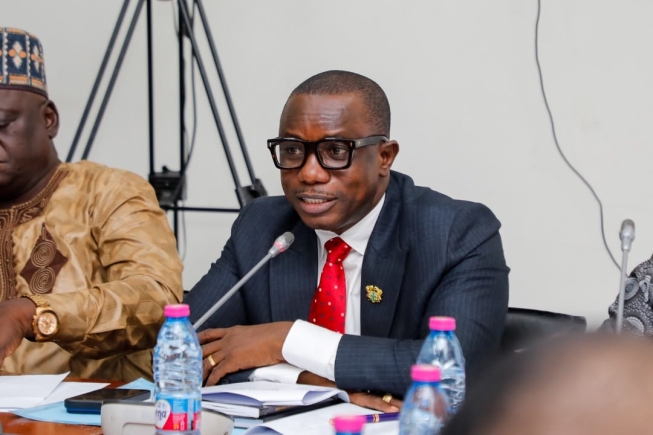
  • Ghana experiencing traffic congestion due to reduced fuel prices – Pres Mahama

    Ghana experiencing traffic congestion due to reduced fuel prices – Pres Mahama

    Traffic congestion ranks among the top three urban challenges in Ghana. While past governments over the years have made efforts to resolve it, it remains a challenge.

    Per reports, when petrol prices rose by approximately 150% and diesel by nearly 200% from 2020 to 2024, moving from below GHS 5/litre to above GHS 13/litre, traffic congestion reduced in some parts of Ghana, as discretionary trips for some households and businesses were reduced.

    However, while addressing Ghanaians living in Zambia during an official engagement on Wednesday, February 4, President Mahama mentioned that Ghana is currently experiencing congestion due to reduced fuel prices.

    The recent drops in fuel prices have created a new dynamic: more vehicles on the road, leading to heavier traffic volumes.

    According to him, the prices of fuel under the erstwhile government had limited people who wanted to travel to places in their own cars; things are different now, stressing that the congestion is a sign of a growing economy.

    “We have also seen improved economic activity. Business is booming, and one sign of booming economic activity is traffic congestion. More people are using their cars because, previously, people could not buy fuel and would not drive unnecessarily.

    “But now that fuel is more affordable, people are using their cars more and going to places they would not have gone before,” President Mahama said, while warning Chief Executive Officers (CEOs) of State-Owned Enterprises (SOEs) to submit their annual and audit reports by April or face sanctions.

    “I said we will take action against any chief executive of a state-owned enterprise who, by the end of April, which is the target date, has not completed their audits and presented their annual reports.

    Meanwhile, the recent report from the Ghana Statistical Service (GSS) indicates that petrol prices fell by 20.1% year-on-year, while diesel prices also fell by 18.7% year-on-year, driving down transport costs and contributing to lower inflation.

    Consequently, motorists started the New Year on a good note with less pressure on their pockets as several  Oil Marketing Companies (OMCs)  effected a reduction in fuel prices at their respective pumps across the country in the January pricing window.

    The price cuts, which took effect in the early hours of the New Year, signified a continued downward trend in petroleum costs, offering much-needed breathing room for both commercial and private transport users.

    Among the first OMCs that effected the reduction was market leader Star Oil. It set the pace and a benchmark for other OMCs as it adjusted its digital displays. A marginal dip from previous prices.

    Petrol is now selling at GH¢10.86 per litre, diesel is priced at GH¢11.96 per litre, and RON 95 is selling at GH¢13.56 per litre.

    According to the Star Oil management, the reduction in oil prices is a result of a “favourable domestic and external cost environment,” citing the cedi appreciation and a dip in international refined product prices.

    It said the current reductions may only be the tip of the iceberg for January. The Chamber of Oil Marketing Companies (COMAC) projected a robust outlook for the month, suggesting that competitive pressures will force more OMCs to follow suit in the coming days.

    In its January pricing outlook, COMAC provided a breakdown of the expected percentage declines. It was projected that petrol would fall by up to 4.80%, and diesel was also estimated to drop by approximately 3.77%. LPG, on the other hand, was expected to see a reduction of roughly 2.19%.

    Industry analysts believe that if the cedi maintains its current trajectory and international crude prices remain below $80 per barrel, Ghanaians could see even more substantial relief by the second pricing window in mid-January.

    While the prices of fuel are dropping, Ghanaians have had to brace themselves for an increase in utility tariffs, which took effect on January 1, 2026.

    Following the announcement of the increase, there was widespread disapproval, particularly from stakeholders and the general public.

    On December 2, 2025, the Public Utilities Regulatory Commission (PURC) announced an imminent increase in tariffs, with the new rates set to take effect from January 1, 2026. The Commission said the increases, 9.86% for electricity and 15.92% for water, had become necessary to meet utility investment needs, respond to macroeconomic pressures, and ensure the long-term stability of the sector.

    Consequently, the Trades Union Congress (TUC), the labour umbrella body that represents workers’ interests and coordinates labour unions, engaged the Commission on two different occasions, first, about a week after the increase was announced, and later in a subsequent meeting nearing the end of December.

    Following these engagements, a joint statement released by the institutions revealed efforts to balance consumer concerns with the financial sustainability of utilities; however, the PURC’s stance remained unchanged.

    The Commission contended that any reversal of its 2026–2030 Multi-Year Tariff Order (MYTO) could have serious consequences for the stability of Ghana’s energy and water sectors, as well as the broader economy.

    The Multi-Year Tariff Order (MYTO) is a regulatory framework used by the Public Utilities Regulatory Commission (PURC) to set electricity and water tariffs over a fixed period, 2026 to 2030, in this case. It is intended to ensure predictable pricing, financial stability for utilities, and protection for consumers.

    The Commission reaffirmed this position during meetings with the Trades Union Congress (TUC) held on December 11 and 30, 2025, during which the new tariff schedule, which took effect on Thursday, January 1, 2026, was discussed.

    “…The PURC reaffirmed its position that any reversal of the tariff decision would have significant implications, not only for the Commission’s independence but, crucially, for the stability of the energy and water sectors and the broader Ghanaian economy,” parts of the statement said.

    According to the joint statement, discussions focused particularly on the implications of the tariff adjustments on the living conditions of workers, as well as on electricity stability and investments in the power and water sectors. The discussions also explored avenues for collaboration between the two institutions.

  • Court slashes Agradaa’s 15-year jail term to one year

    Court slashes Agradaa’s 15-year jail term to one year

    Ghanaian fetish turned evangelist, Patricia Asiedua Asiamah, popularly known as Nana Agradaa, is set to be freed by July 3, 2026, after a successful appeal of her 15-year jail sentence with hard labour by her legal team.

    Originally scheduled for release on July 3, 2040, the Amasaman High Court on Thursday, February 5, reduced her sentence to one year.

    The court insists that the founder of Heaven Way Champions International Ministry was not afforded a fair trial and that her sentence was harsh.

    Consequently, it has been heavily slashed by 14 years.

    Agradaa was sentenced to 15 years’ imprisonment each on two counts of defrauding by false pretence, with the court ordering her to serve the two sentences concurrently and fined GH¢300 for charlatanic advertisement on her TV station, Today’s TV.

    Agradaa was officially transferred to the Nsawam Female Prison on Saturday, July 5, just two days after she was sentenced by Judge Evelyn E. Asamoah at the Accra Circuit Court ‘10’ on Thursday, July 3, 2025.

    The Circuit Court in Accra delivered its sentence after confirming that she is not pregnant.

    In 2022, she was accused of luring her victims through claims that she possessed spiritual powers to double their money.

    Initially admitting guilt to charges including fraudulent advertising and obtaining money under false pretences, she spent two weeks in remand before being granted bail of GH₵150,000 with three sureties, one requiring justification.

    Why was she sentenced?

    She tricked members of her church into handing over their cash during a night vigil service in Weija, Accra, on October 7.

    According to the prosecution, Assistant Superintendent of Police (ASP) Emmanuel Haligah, it was confirmed that Agradaa, on October 5, advertised on her TV station that she was organising a night vigil on October 7, intended to share GH¢300,000 with all participants who needed money for business or to pay rent. According to the prosecution, the former priestess displayed large sums of money during the advert while encouraging the public to turn up in their numbers for support.

    Consequently, many came from far and near in attendance for the service. During the service, she directed the congregation to form groups of 20 members, and each member was to pay monies starting from GH¢1,000 and above, after which some groups would be given GH¢50,000 to share, while other groups would receive GH¢40,000, and GH¢25,000.

    The prosecution said some of the groups gave Agradaa 25,000 cedis, while other people parted with various sums of money.

    Agradaa, after obtaining those monies, left the service and ordered her bouncers to block any access to her. She failed her promise, resulting in the complainants getting stranded at the church premises, the prosecution said.

    Her husband’s remarks on wife’s sentence
    In a statement made after the verdict, Pastor Asiamah claimed that the allegations of fraud stemmed from the offertory collected during that service.

    On the other hand, her legal team described her sentence as “excessive,” noting that the amount in question was only GH¢540, vowing to file an appeal on Monday, claiming the punishment is more about who Agradaa is than what she is alleged to have done.

    The Circuit Court in Accra delivered its sentence after confirming that she is not pregnant.

    Also on January 20, this year, the Tema High Court directed Nana Agradaa to pay GH¢100,000 in damages to gospel musician Empress Gifty Adorye following a defamation action.

    The decision concludes a legal battle that started in May 2025, when Empress Gifty instituted a GH¢20 million lawsuit, accusing Nana Agradaa of making defamatory remarks about her.

    The matter was determined at the Tema High Court “A”, with Justice Janet Marfo presiding, after both parties reached an agreement to resolve the case outside the courtroom.

    As part of the settlement, the court further ordered Nana Agradaa to withdraw all claims made against Empress Gifty and render an unreserved public apology.

    According to Adom News reporter Mike Two, the ruling effectively brings the dispute between the two personalities to an end.

    Nonetheless, Nana Agradaa has been slapped with a fine of GHS12,000 for displaying nude photos of fellow pastor Emmanuel Appiah Fumum, also known as Osofo Biblical.

    She has been further ordered to pay GHS50,000 as compensation to the complainant. Agradaa’s conviction resulted from a plea bargain agreement with the State, concluding a legal battle that had dragged on for nearly three years.

    The case stems from claims that Nana Agradaa, a former fetish priestess turned evangelist, aired nude images of Pastor Emmanuel Appiah Fumum (widely known as Osofo Biblical) on her television channel and social media pages without his permission.

    Prosecutors say the images were broadcast during a live programme where panellists mocked the complainant—conduct they argue violates the Cybersecurity Act, 2020 (Act 1038), which prohibits the sharing of intimate images without consent.

  • NPP’s Chairman Wontumi formally declares bid to contest for National Chairman

    NPP’s Chairman Wontumi formally declares bid to contest for National Chairman

    Embattled Ashanti Regional Chairman of the New Patriotic Party (NPP), Bernard Antwi-Boasiako, popularly known as Chairman Wontumi, has officially announced his intention to contest the position of National Chairman of the party.

    He made his declaration in a statement dated February 4 and signed by the chairman. According to him, his bid to contest comes after consultations with party elders and his “maker” as he seeks to serve the interest of the party, ensure unity and harmony.

    “I, Bernard Antwi-Boasiako (Chairman Wontumi), having consulted my Maker and sought the counsel of party elders, hereby declare my intention to serve as National Chairman of the New Patriotic Party, not for personal ambition, but to strengthen, rebuild, and unify our great party,” parts of the statement read.

    Describing the current state of the party as at a critical juncture, Chairman Wontumi highlighted the need for a leader who understands and relates well with the grassroots, which underlines his candidacy.

    He stated, “Our party has faced challenges and learned hard lessons along the way. At this critical moment, the NPP demands leadership that is steady, principled, and committed to unity.
    A leader who is grassroots personified, who values every member from our elders to the youth allies, and who is willing to make the ultimate sacrifices for the party.”

    He emphasised the need for courageous and decisive leadership, noting that the road ahead would require vision, sacrifice and unwavering determination.

    “The road ahead will demand vision, courage, and unwavering determination. Leadership at this moment requires bravery, the courage to stand firm, make difficult decisions, and the willingness to lose all if necessary for the NPP,” the statement said.

    He described himself as a grassroots-oriented leader who values every member of the party, from elders to the youngest supporters, and pledged to work towards unity and organisational strength.

    Chairman Wontumi expressed confidence in the party’s readiness for the future, declaring, “We are ready. We are organised. We are built for the battle ahead,” while charging them to come together and “restore confidence, empower our grassroots, and position the NPP to win decisively in 2028.

    He concluded by calling on party members to rally together, saying the NPP would “rise again, together,” and ended the statement with prayers for the party, Ghana’s democracy and the nation.

    Chairman Wontumi currently serves as the Ashanti Regional Chairman of the New Patriotic Party and is expected to formally file his nomination when the party opens the contest for the National Chairmanship position.

    Meanwhile, the NPP elected its flagbearer on Saturday, January 31.

    The former Vice President, Dr Mahamudu Bawumia, was declared the winner of the NPP presidential election, securing 57% of the votes.

    Out of the total valid votes cast, Dr. Bawumia secured 110,643 votes (56.48%), followed by Kennedy Agyapong with 46,554 votes (23.76%), Bryan Acheampong earned 36,303 (18.53%), Dr. Yaw Osei Adutwum and Ing. Kwabena Agyepong trailed with 1,999 votes (1.02%) and 402 votes (0.21%) respectively.

    More than 211,000 delegates took part in the polls which were conducted at 333 voting centres spanning all 275 constituencies nationwide.

    Throughout the process, heightened security arrangements were put in place, while party officials closely monitored proceedings to guarantee orderliness.

    Across several constituencies, the sorting and compilation of votes are currently in progress, and preliminary results have started filtering in from parts of the country. Party leaders have assured stakeholders of openness and fairness as the process moves forward.

    Prior to the election, the Executive Director of Global InfoAnalytics, Mussa Dankwah predicted the Former Vice President, Dr. Mahamudu Bawumia, to win 14 out of the 16 regions.

    Speaking to the media on Wednesday, January 28, he noted that Dr. Bawumia would sweep massive votes in the party’s stronghold, the Ashanti Region.

    He added, “Yes, [Bawumia will win in 14 regions out of 16 regions].“All the areas we have looked at are pointing in one direction, and that direction is that Bawumia will win this Saturday’s election one-touch.

    According to him, “Based on our model, his lowest score will be 54 percent, which is the 57 percent we are giving him minus the three percent margin of error, or he could get up to 60 percent”.The Executive Director of Global InfoAnalytics emphasised that the data is consistent across all regions. “I am very confident in Bawumia’s numbers because they are more stable in terms of variability. There is no noise in the data,” he added.

    Last year, the National Tracking Poll by Global InfoAnalytics disclosed that 56 per cent of voters and 72 per cent of committed NPP delegates want former Vice President Dr Mahamudu Bawumia as their flagbearer for the 2028 general elections.

  • Presidency launches probe into alleged  ‘sale’ of govt-sponsored overseas scholarship

    Presidency launches probe into alleged ‘sale’ of govt-sponsored overseas scholarship

    The Presidency has announced a probe into allegations of bought scholarships made by a former public official during a radio discussion on Sompa FM on February 2.

    During the discussion, former Chief Executive Officer (CEO) of the National Entrepreneurship and Innovation Programme (NEIP), Kofi Ofosu Nkansah, claimed that someone paid a bribe to secure a government-sponsored overseas scholarship.

    Reacting to the allegations, President John Mahama has ordered the National Investigation Bureau (NIB) to investigate alleged improprieties in the award of overseas scholarships.

    This comes after the former public official’s allegations garnered widespread concern and reactions from the public.

    According to the Minister of State for Government Communication, Mr Felix Ofosu Kwakye, the President views such an allegation as a serious matter of grave public concern, particularly given the government’s commitment to transparency, integrity, and equal access to educational opportunities.

    In the President’s directive to the NIB, he ordered an immediate probe into the matter to establish the factual basis of the claim, identify any persons involved, and determine the veracity of the allegations.

    “The Bureau has also been directed to submit its findings to the President for consideration and any appropriate action that may arise,” the letter added.

    The directive was contained in a letter dated February 3, 2026, signed by Callistus Mahama, Secretary to the President, and addressed to the Director-General of the National Investigation Bureau.

    Meanwhile, allegations of bribery and corruption in Ghana’s scholarship awards are not new. The current claims by the former NEIP CEO have reignited scrutiny, but similar narratives have surfaced in the past, including petitions and investigations into the Scholarship Secretariat.

    The cases of purchased scholarships in Ghana is a long-standing issue.In September last year, a group called Positive Transparency and Accountability Movement-Ghana (PTAAM-GH) petitioned the OSP to begin investigating alleged corruption at the Ghana Scholarship Secretariat, which the anti-corruption institution launched the probe.

    The petitioners claimed that scholarships were being awarded based on political connections, favouritism, and payments, rather than merit.

    This probe followed earlier complaints dating back to 2024.

    Meanwhile, in July last year, Ghanaian students on the Ghana government scholarship were reported to be in distress following various threats of eviction, revocation of visas, and potential deportation over unpaid tuition and other fees.

    Earlier that month, it emerged that Ghanaian students in Memphis faced a housing eviction deadline of August 9, 2025, if they failed to pay a $3.6 million scholarship debt owed by Ghana’s Scholarship Secretariat.

    The eviction threat was formally communicated to students in a circular dated July 14, 2025.

    President of Memphis, Dr. Bill Hardgrave, during an interview on Action News 5’s Better on Wednesday, July 16, publicly validated the situation and the current condition of Ghanaian students facing eviction due to unpaid scholarship funds.

    “The students are sponsored by the government of (sic) Ghana, which has not paid the students’ tuition for some time. I think there was a regime change in Ghana, and that affected the budget, but we’re hopeful that gets corrected because we’d love to keep those students on campus,” he confirmed.

    In reaction to this, the Minister of Youth Development and Empowerment, George Opare Addo, during an appearance on Joy News’ PM Express on Tuesday, July 23, revealed that the debt owed in terms of scholarship is owed to several schools across the world and not just one or two.

    He said that an audit is underway to investigate the circumstances surrounding the scholarship debt crisis; however, the acting Registrar of the Ghana Scholarship Secretariat, Alex Kwaku Asafo-Agyei, has been on trips in the past few months to countries where students face threats of eviction, among other repercussions of the government’s failure to settle their fees.

    This, he revealed, is to negotiate and to help mitigate the pressure coming from these authorities on the affected students.

    “There is a debt of fees that we have across the world. And so my registrar now has to go around the world and negotiate with schools, and that is what we’ve been undertaking in the last four, five months. I keep sending him, go here, go there, because you keep getting threats all over the world: ‘We are going to sack your students.’”

    The former government left a startling GHC 700 million in unpaid scholarship debt, according to the Minister. He described the current situation as a “bad, bad, bad mess” that threatens the future of Ghanaian students abroad and the country’s international reputation.

    “The current bill that I have is over ¢700 million in debt that we have to find money to pay,” he said.

    Given the current state of our economy and the ballooning debt crisis, the Minister was asked whether the government had enough to pay, or was even willing to pay,the GH¢700 million.

    In an empathetic response, he said, “It involves Ghanaian students; it involves lives. It involves our citizens. And so we must find the money to pay.”

    While admitting that Ghana currently doesn’t have this money in cash, he said negotiations are ongoing. He also commended the Chief of Staff for his input while they negotiated the terms of the debt.

    “The Chief of Staff has been very helpful. With the Finance Minister and the Chief of Staff, we are working closely to offset the debt… So yes, we will pay, but we have to negotiate.”

    Some schools, Mr. Opare said, have shown a positive response, understanding that the debt was inherited from the erstwhile government.

    “They know that we are a new government that has come in. We inherited these problems, and so we are aligning and fixing them gradually.”

    He also responded to reports of students receiving threats of eviction from their schools.

    “You can’t blame this government for the mess we inherited. And most of these things have been outstanding for a year or two,” he continued.

  • Minority kicks against KIA renaming, calls it an indictment on the NDC

    Minority kicks against KIA renaming, calls it an indictment on the NDC

    The government has proposed a renaming of Kotoka International Airport (KIA) to Accra International Airport.

    The announcement was made on February 3 by Majority Leader Mahama Ayariga during a parliamentary leadership briefing, noting that the Minister for Transport, Joseph Nikpe will present a bill in Parliament to legally effect the name change.

    The proposed name change is intended to honour the Ga people, reclaim Ghana’s historical identity, and reflect democratic values instead of glorifying a coup leader, Lt. Gen. Emmanuel Kwasi Kotoka, a military officer who played a central role in the 1966 coup d’état that overthrew Ghana’s first president, Dr Kwame Nkrumah.

    He explained that the airport was originally called Accra International Airport, but its name was later changed.

    “It is not fair to the people of Accra that they gave out their land for the construction of an airport that was named after them, and the one who received the land changed it and named it with his name,” he said.

    “To honour the people who gave the land, government is going back to using it,” he added.

    A bill to formalise the change will be introduced in Parliament by the Transport Minister.

    “Government intends to rename Kotoka International Airport to Accra International Airport,” the Majority Leader said, noting that the bill would be presented in line with established procedures.

    However, some members of the Minority Caucus in Parliament, including its leader, Afenyo-Markin. Speaking during a media engagement yesterday, February 3, he defended the current name of the airport and criticised the decision to rename it.

    On his part, the name “Kotoka” is among the very few names on national monuments, such as the airport, that celebrate the heroism of Voltarians; therefore, renaming it would deny the people of the Volta Region the recognition they deserve.

    He said, “All these years, we’ve had General Kotoka’s name on the airport, and suddenly it’s being changed. The name Kotoka International Airport, Accra, is already there, so you don’t need to remove Kotoka’s name.

    “How many prominent Voltarians have their names on national assets or monuments? This is the only thing the people of Volta can also see as something that recognises heroism from the Volta Region, and they’re being denied.”

    He added that successive governments had retained the name and accused current NDC leaders from the Volta Region of remaining silent on the issue.

    He described the move as an indictment of the National Democratic Congress (NDC) and urged key figures within the party, particularly those from the Volta Region, to oppose the proposal.

    “Majority Chief Whip Rockson-Nelson Dafeamekpor, NDC General Secretary Fifi Kwetey, Foreign Affairs Minister Okudzeto Ablakwa, First Deputy Speaker Bernard Ahiafor, they’re from Volta, they’re in government and are watching Volta lose its pride. It’s up to them,” he said.

    In February last year, the Democracy Hub, in partnership with the Convention People’s Party (CPP), took legal action at the Supreme Court to push for a change in the name of Ghana’s international airport, Kotoka.

    They asserted that associating the facility with Emmanuel Kwasi Kotoka goes against the country’s democratic values, as he was instrumental in the 1966 government takeover.

    “For 59 years, Ghana has lived with the contradiction of denouncing coups while honouring one of the architects of the first military overthrow of an elected government,” the group stated.

    The CPP and advocacy group Democracy Hub contended that the continued use of Kotoka’s name for the country’s main airport represents an official approval of military takeovers. They argue that renaming the facility would reinforce Ghana’s dedication to democratic governance.

    “It is time for Ghana to make a clear statement that it stands against unconstitutional rule, not just in rhetoric but in practice,” the statement added.

    This court case, initiated with the support of legal professionals from Merton & Everett LLP, follows in-depth historical and legal examinations.

    Democracy Hub appealed to civic organizations, youth movements, and champions of democracy to endorse the lawsuit, describing it as “more than a legal battle—this is about confronting our history.”

    Lieutenant General Emmanuel Kwasi Kotoka (26 September 1926 – 17 April 1967) played a key role in the National Liberation Council, the military administration that ousted Dr. Kwame Nkrumah’s government through a coup on 24 February 1966.

    Prominent among those calling for the airport’s name to be changed back is Samia Yaba Christina Nkrumah, daughter of Ghana’s first President, Osagyefo Dr Kwame Nkrumah. She has repeatedly suggested that the facility should return to its original name, Accra International Airport.

    The airport originally served as a military base for the British Royal Air Force during World War II before being handed over to civilian authorities. In 1956, under President Kwame Nkrumah, a project was launched to convert the site into a passenger terminal.

    The project was completed in 1958, transforming the former military installation into a civilian airport capable of handling about 500,000 passengers a year. It was initially called Accra International Airport.

    However, in 1969, the airport was renamed Kotoka International Airport in honor of Lieutenant General Emmanuel Kwasi Kotoka (1926–1967), a member of the National Liberation Council who was killed during a failed coup attempt at what is now the airport’s forecourt.

  • Full text: President Mahama’s speech at World Governments Summit in Dubai

    Full text: President Mahama’s speech at World Governments Summit in Dubai

    President John Mahama has called on global leaders to ensure a world where cooperation triumphs over division.

    He made the call at the World Governments Summit which opened in Dubai, United Arab Emirates on February 3.

    “The future of global alliances is ultimately not about treaties alone. It is about the kind of world we choose to build. A world where cooperation triumphs over division, partnerships serve development and where nations rise together, not apart,” President stated.

    The summit is under the theme, “The future of Global alliances.”

    Please read the full speech below:
    ADDRESS – BY H.E. JOHN DRAMANI MAHAMA, PRESIDENT OF THE REPUBLIC OF GHANA AT THE WORLD GOVERNMENTS SUMMIT 2026 ON THE THEME “THE FUTURE OF GLOBAL ALLIANCES” – 3RD TO 5TH FEBRUARY, 2026

    Your Highnesses,
    Dear Colleagues
    Leaders of international organisations,
    Ladies and Gentlemen,

    I am deeply honoured to join you here at the World Governments Summit.

    I extend my sincere gratitude to our gracious hosts for convening this timely platform for dialogue, reflection, and collective action. We gather here at a pivotal juncture in global affairs, an era marked by rapid transformation, shifting geopolitical realities, and unprecedented interconnectedness.

    The international system is evolving, and with it, the alliances that have long shaped relations among our nations. The central question before us today is not whether global alliances will endure, but how they must be reimagined and renewed to remain effective, inclusive, and responsive to the demands of our time.

    Excellencies,

    The alliances of previous generations were largely forged in response to geopolitical rivalries, military confrontations, and economic competition.
    They were often shaped by blocs and spheres of influence. Today, however, humanity faces challenges that transcend borders and defy unilateral
    solutions such as the accelerating threat of climate change, growing food and energy insecurity, global health emergencies, violent extremism and
    terrorism, technological disruption, fragile supply chains, and widening inequality.

    Distinguished Guests,

    These challenges demand cooperation not as a matter of choice but as an imperative. The alliances of the future must therefore be rooted in shared
    responsibility and based on our common destiny. The partnerships of tomorrow must extend beyond traditional diplomacy. They must become
    alliances of solidarity, anchored in mutual respect, shared aspirations, and collective advancement.

    For us in Ghana, this vision is deeply familiar. Our nation was founded on enduring principles of freedom, dignity, and international cooperation. From the Pan-African ideals championed by Osagyefo Dr. Kwame Nkrumah to Ghana’s contemporary role as a bridge-builder in global diplomacy, we have consistently stood for unity over fragmentation.

    Indeed, Ghana has long shown that principled alliances can advance peace, prosperity, and stability beyond our borders.

    Ladies and Gentlemen,

    The future of global alliances cannot be meaningfully imagined without Africa. Africa is not merely a space of competition; it is a continent of
    solutions, opportunities, and rising influence.

    With the world’s youngest population, vast natural endowments, dynamic innovation, and expanding
    market of 1.3 billion people, Africa will play a decisive role in shaping the global economy of the twenty-first century.

    Partnerships of tomorrow must advance shared prosperity. We must work together to invest in renewable and clean energy, modern infrastructure,
    resilient food systems, digital transformation, and, above all, human capital development.

    Africa welcomes global partners not merely to trade with, but to transform with through investments that builds industries, strengthens supply chains, and creates shared opportunity.

    Africa deserves a seat at the table in the reshaping of a new global order. This is why the Accra Reset which convened in Accra, New York, Davos and soon Addis offers a road map for the transition from aid and dependence to trade, investment and global partnerships.

    To achieve the right alliances, Africa must reset itself. Accountable and transparent governance, respect for human rights, strong institutions and
    selfless leadership are essential.

    New alliances with Africa must aim at adding value to Africa’s natural resources. They must aim at granting Africa greater sovereignty and control
    of its natural resources. That is why in Ghana we have established the Goldbod that has yielded more than $10 billion in less than a year.

    Our medium to long term goal is to process and add value to our mineral ores and agricultural products; gold manganese, bauxite, lithium, petroleum, cocoa, oil palm, cashew, fruits, soya, cassava and other raw materials.

    I am happy to note that Ghana/UAE and Africa/Gulf partnerships are helping to shape a more connected and prosperous future and are becoming an important pillar of the emerging global order.

    Excellencies,

    Remarkably, peace remains the essential foundation on which development is built. In West Africa, the growing threat of terrorism and instability in parts of the Sahel reminds us that security is indivisible.

    Ghana, through ECOWAS, remains committed to regional peace, preventive diplomacy, and democratic stability. As part of efforts to rebuild and strengthen sub-regional cooperation across key sectors to enhance resilience, restore confidence, and address the structural drivers of instability, Ghana convened a High-Level Consultative Conference on Regional Cooperation and Security from 29th to 30th January, 2026.

    The conference, which brought together Heads of State and Government and key regional institutions to confront shared threats, forged a renewed consensus on collective security, counter-terrorism, border cooperation, humanitarian response, and human-centred governance as the
    foundations of lasting stability in West Africa.

    It also reaffirmed our collective resolve to translate regional solidarity into concrete action, measurable outcomes, and sustained peace for our peoples.

    Excellencies,

    Undoubtedly, the world is entering a new era in which artificial intelligence, biotechnology, and digital systems will redefine economies and societies. Yet governance has not kept pace with innovation.

    Ghana is making steady progress in digital transformation, from mobile financial inclusion to national identification systems and e-governance reforms. But the digital future must not be the privilege of a few nations.

    Future alliances must therefore ensure ethical governance of artificial intelligence, cybersecurity cooperation, technology transfer, and inclusive digital capacity-building. We must ensure that innovation becomes a shared global good, not a source of new inequality.

    Distinguished participants,

    No alliance of the future can ignore the climate crisis. While Africa contributes the least to global emissions, it suffers disproportionately from climate impacts. Climate action must therefore be matched by climate justice, and the global community must honour its commitments on climate finance, adaptation support, and equitable energy transitions.

    The Ghana-UAE partnership stands as a clear example of future-oriented global alliances, mobilizing a USD 30 million grant to advance climate action, biodiversity protection and inclusive development.

    Ladies and Gentlemen,

    At the heart of global alliances lies multilateralism. While the post war multilateral order and rules-based system have come under severe pressure
    because of unilateral actions of some members of the global family, there remains enough healthy tissue that we can culture to restore it back to good health.

    International institutions must become more representative, more responsive, and more equitable. Developing nations must have a stronger
    voice in shaping the rules governing trade, finance, climate action, and peacekeeping. Indeed, the legitimacy of global governance depends on fairness, and fairness remains the cornerstone of trust.

    Ghana remains steadfastly committed to an international order based on dialogue rather than confrontation, cooperation rather than isolation, rules
    rather than coercion, and shared progress rather than zero-sum rivalry.

    Our partnerships with the nations represented here, including those in the Gulf region, reflect our belief in economic diplomacy that delivers
    development, investment, and opportunity for our people.

    Ladies and Gentlemen,

    The future of global alliances is ultimately not about treaties alone. It is about the kind of world we choose to build. A world where cooperation triumphs over division, partnerships serve development and where nations rise together, not apart.

    I thank you for your kind attention.

  • Ghana’s petroleum revenue drops to $399.6m in second half of 2025 – BoG

    Ghana’s petroleum revenue drops to $399.6m in second half of 2025 – BoG

    Ghana’s petroleum sector recorded a decline in the second half of 2025, according to new data from the Bank of Ghana (BoG).

    The data, contained in the Central Bank’s Semi-Annual Report on the Petroleum Holding Fund (PHF) and shared on Tuesday, February 3, shows total receipts of US$399.65 million, significantly lower than returns recorded during the same period in 2024.

    The report explains that the amount represents combined inflows from crude oil liftings and petroleum-related taxes. However, it fell below the US$369.25 million realised from crude oil liftings alone in the second half of 2024, pointing to weaker overall performance in the sector.

    “The total amount received into the PHF account for H2 2025 was US$399.65 million (crude oil lifting total of US$198.25 million and other total income of US$201.40 million),” the report indicated.

    The report further indicates that revenue between July 1 and December 31, 2025, was drawn from two main sources. Crude oil liftings from the Jubilee and Sankofa Gye Nyame (SGN) fields generated US$198.25 million, following the lifting of two Jubilee cargoes and one SGN cargo by the Ghana Group, represented by the Ghana National Petroleum Corporation (GNPC).

    Ghana earned US$201.40 million from petroleum-related taxes and interest during the period. The bulk of this amount, US$198.09 million, came from corporate income taxes, while US$3.31 million was earned as interest on the Petroleum Holding Fund.

    The BoG also explained that revenue from the 25th cargo from the TEN field, valued at US$60.79 million, was not included in the report because the funds had not been received by the end of 2025, even though they were expected in November.

    Even though Ghana received less new money from oil during the period, it still spent and distributed a total of US$493.40 million. The spending was cushioned by savings accumulated by the government from previous years to cover the shortfall.

    According to the report, the government used about 57.8% of the total US$493.40 million, amounting to US$285.06 million, to fund its projects and programmes through the national budget. About 23.5%, representing US$115.99 million, was saved to stabilise the economy during difficult times, while US$49.71 million was saved for future generations. Another US$42.63 million was given to the Ghana National Petroleum Corporation to help cover its operational and investment costs.

    The report further showed positive investment performance for Ghana’s petroleum savings. The Ghana Petroleum Funds recorded a net realised income of US$28.11 million, with returns of 2.28 per cent for the Heritage Fund and 2.51 per cent for the Stabilisation Fund.

    As of December 31, 2025, total petroleum reserves stood at US$1.55 billion, with the Heritage Fund accounting for US$1.38 billion.

    Looking ahead, the Bank of Ghana adopted a cautious outlook for 2026, noting that Brent crude prices declined from US$66.61 to US$60.81 per barrel by the end of 2025.

    While the International Monetary Fund projects global growth of 3.3 per cent, the report warned that Ghana’s petroleum revenues remain exposed to geopolitical developments in the Middle East and OPEC+ production decisions, with oil prices expected to average about US$62.13 per barrel in 2026.

    Meanwhile, in a related development, motorists have started the New Year on a good note, with less pressure on their pockets, as several Oil Marketing Companies (OMCs) have effected a reduction in fuel prices at their respective pumps across the country in the January pricing window.

    The price cuts, which took effect in the early hours of the New Year, signify a continued downward trend in petroleum costs, offering much-needed breathing room for both commercial and private transport users.

    Among the first OMCs to effect the reduction was market leader Star Oil. It set the pace and a benchmark for other OMCs as it adjusted its digital displays, reflecting a marginal dip from previous prices.

    Petrol is now selling at GH¢10.86 per litre, diesel is priced at GH¢11.96 per litre, and RON 95 is selling at GH¢13.56 per litre.

    According to Star Oil management, the reduction in oil prices is a result of a “favourable domestic and external cost environment,” citing the cedi’s appreciation and a dip in international refined product prices.

    It said the current reductions may only be the tip of the iceberg for January. The Chamber of Oil Marketing Companies (COMAC) projected a robust outlook for the month, suggesting that competitive pressures will force more OMCs to follow suit in the coming days.

    In its January pricing outlook, COMAC provided a breakdown of the expected percentage declines. It projected that petrol would fall by up to 4.80 per cent, while diesel was also estimated to drop by approximately 3.77 per cent. LPG, on the other hand, was expected to see a reduction of roughly 2.19 per cent.

    Industry analysts believe that if the cedi maintains its current trajectory and international crude prices remain below US$80 per barrel, Ghanaians could see even more substantial relief by the second pricing window in mid-January.

    While fuel prices are dropping, Ghanaians have had to brace themselves for an increase in utility tariffs, which took effect on January 1, 2026.

    Following the announcement, there was widespread disapproval, particularly from stakeholders and the general public.

    On December 2, 2025, the Public Utilities Regulatory Commission (PURC) announced an imminent increase in tariffs, with the new rates set to take effect from January 1, 2026. The Commission said the increases—9.86 per cent for electricity and 15.92 per cent for water—had become necessary to meet utility investment needs, respond to macroeconomic pressures, and ensure the long-term stability of the sector.

  • IGP reshuffles top police command, assigns new roles to strengthen leadership, operations

    IGP reshuffles top police command, assigns new roles to strengthen leadership, operations

    A major reshuffle intended to enhance efficiency and improve police operations nationwide has been carried out in the top command of the Ghana Police Service.

    The reshuffle, carried out on the orders of the IGP, was announced in a formal statement dated February 2 by the law enforcement agency and publicly released on February 3.

    In the statement, the IGP reassigned several senior officers to various roles, ordering that the new roles take effect immediately.

    The reshuffle affects Directors-General, Deputy Commissioners of Police (DCOPs), and regional commanders, to strengthen operations and improve service delivery nationwide.

    Under the new arrangement:

    COP Dr Sayibu Pabi Gariba moves from Director-General in charge of Technology to head the National Administration and Professional Development (NAPD) directorate.

    COP Iddi Lansah Seidu has been reassigned from Welfare to serve as Director-General for Technology.

    COP Dr Vance Baba Gariba shifts from Operations to become Director-General for Research and Planning.

    COP Emmanuel Teye-Cudjoe moves from the Police Professional Standards Bureau (PPSB) to head Operations.

    DCOP Darko Offei Lomotey leaves Research and Planning to take charge of the PPSB.

    DCOP Eric Ken Winful moves from NAPD to oversee Welfare.
    The reshuffle also affected regional and technical commands:

    DCOP Charles K. Adu appointed Eastern Sector Regional Commander.

    DCOP Isaac Asante transferred from the Eastern Region to the National Headquarters.

    DCOP George B. Ohene Boadi now serves as Central Regional Commander.

    DCOP George Ankomah moves from Central MTTD/Ashanti Region to become Eastern North Regional Commander.

    DCOP Alex Kodjo Wowolo, formerly Director of ICT at the National Headquarters, now heads Central MTTD/Ashanti Region.

    This top-rank reshuffle marks the first since his appointment on March 13 last year by President Mahama.

    However, about a month after his appointment, he carried out a major reshuffle of police commanders stationed in areas notorious for illegal mining, commonly known as galamsey, as part of the Ghana Police Service’s intensified campaign against the destructive activity.

    The reshuffle, which primarily affected Divisional and District Commanders in the Eastern South, Western, and Western North regions, marked the first phase of a larger strategy aimed at revitalising the police response to illegal mining.

    According to a police statement, “This reshuffle is part of a broader effort to ensure more effective policing in areas plagued by illegal mining,” adding that further changes are anticipated in the coming weeks.

    In a statement issued by the Ghana Police Service titled Police Reshuffle Commanders in Galamsey Areas as It Intensifies Its War on Illegal Mining Activities, the Service reaffirmed the IGP’s commitment to fighting galamsey with renewed determination.

    “The Inspector-General of Police, Mr. Christian Tetteh Yohuno, in keeping with his promise to wage a relentless war on illegal mining activities (galamsey), has reshuffled police commanders in galamsey-prone areas,” the statement read.

    “This is said to be the first phase of the reshuffle exercise, as many more are expected to follow to inject fresh energy into the fight against illegal mining activities in the country,” it added.

    Meanwhile, the police have made significant gains in their anti-galamsey operations. A special intelligence-led operation conducted over four consecutive days, beginning on April 17, 2025, in the Samreboi enclave in the Western Region, led to the arrest of 47 individuals involved in illegal mining activities.

    The suspects, arrested along the Tano River and in the Aboi, Subri, and Nimiri forests, include 39 Ghanaians and eight Chinese nationals, among them four women.

    Exhibits retrieved during the operation include seventeen excavators, one bulldozer, four motorbikes, two Toyota Hilux vehicles, one RAV4 vehicle, four pump-action guns, one single-barrel gun, 54 live BB cartridges, and eight pumping machines.

    Below is the full statement by the police:

    POLICE RESHUFFLE COMMANDERS IN GALAMSEY AREAS AS IT INTENSIFIES ITS WAR ON ILLEGAL MINING ACTIVITIES

    The Inspector-General of Police, Mr. Christian Tetteh Yohuno, in keeping with his promise to wage a relentless war on illegal mining activities (galamsey), has reshuffled police commanders in galamsey-prone areas.

    This is said to be the first phase of the reshuffle exercise, as many more are expected to follow to inject fresh energy into the fight against illegal mining activities in the country.

    Police commands affected include some Divisional and District Commanders, mainly in the Eastern South, Western, and Western North Police Regions.

    In a related development, the Ghana Police Service has made a major breakthrough in its war against illegal mining (galamsey).

    A special four-day continuous intelligence-led anti-galamsey operation, which started on April 17, 2025, within the Samreboi enclave in the Western Region, resulted in the arrest of 47 people for illegal mining activities along the Tano River and in the Aboi, Subri, and Nimiri forests of the Western Region.

    The suspects comprise 39 Ghanaians and eight Chinese nationals, including four women.

  • Police arrest two drivers with Indian hemp after attempted escape

    Police arrest two drivers with Indian hemp after attempted escape

    Two drivers suspected of transporting Indian hemp to the Volta Region have been apprehended by the region’s police command, as reported by the Ghana News Agency.

    In a statement shared by the Volta North Regional Public Relations Officer, Inspector Felix Kwao, with the GNA, it listed the identities of the suspects as Akyereme George, 43, and Benjamin Akpado, 23, who were arrested on Thursday, January 29.

    According to the statement, the suspects were pursued and arrested after attempting to escape upon sighting a police patrol vehicle by speeding into a nearby bush but were later arrested.

    A search carried out by the police on their vehicles, with registration numbers GE-8254-13 and AW-4321-14, heading toward Kpando, revealed 20 sacks containing 680 pieces of dried leaves in white rubber bags, which are believed to be Indian hemp.

    He said the suspects were currently in police custody, assisting with investigations, while efforts were underway to arrest the owners of the substance to face the full rigours of the law.

    Inspector Kwao assured the public of the Command’s continuous efforts to eradicate drug trafficking activities in the region.

    In a related development, seven suspects were arrested in an intelligence-led swoop targeting narcotic drug peddling networks within the Cape Coast Metropolis on Saturday, December 13. The suspects have been identified as Robert Kobbina, Abu Issifu, Janet Mensah, Emmanuel Quarshie, Osei Boateng, Animful Emmanuel, and Charity Nkrumah.

    Led by the Central Regional Police Command, the operation raided hotspots believed to be hubs for the sale and use of prohibited substances. Meanwhile, the police also seized large quantities of cigarettes, tobacco products, lighters, and three jackpot gaming machines.

    This information comes at a time when more than 11 nationwide intelligence-led swoops have been conducted between March and December this year by the Narcotics Control Commission (NACOC), aimed at cracking down on illicit drug activities.

    Speaking to the media on Friday, December 19, the Acting Director of Public Affairs and International Relations at NACOC, PNCO Francis Opoku Amoah, indicated that during that period, the swoops were carried out in areas such as:

    “From March till now, we have conducted more than 11 swoops, which, in our line of work, is a good number because investigations take time. For us to have achieved this means we are doing well.

    “This year, we have carried out swoops in Fadama, Effiakuma in the Western Region, Atinkpoko, parts of the Ashanti Region, and other areas. It all depends on where the intelligence is coming from and the type of intelligence we receive,” he said.

    In September, 1,195 boxes of Tramadol Hydrochloride 120mg, locally known as ‘Red’, were confiscated, with six individuals arrested following a joint operation by the Ghana Police Service and NACOC. The seizure took place at Gbintri, near Nalerigu, in the North East Region on Thursday, September 18.

    This information was contained in a statement signed by Deputy Superintendent of Police (DSP) Robert Anabiik Anmain of the Public Affairs Unit and issued by the North East Regional Police Command on September 21.

    The trucks, with registration numbers GR 1712-16 and AW 4417-14, were loaded with Tramadol en route to Gbintri from Sankase in the Republic of Togo.

    The suspects have been identified as Alhassan Braimah, Yakubu Muntaka, Abdulai Shakur, Mumuni Iddrisu, Mumuni Yakubu, and Moses Ayorik.

    “The North East Regional Police Command, in collaboration with the Narcotics Control Commission (NACOC) in Nalerigu, has intercepted 1,195 boxes of Tramadol Hydrochloride 120mg, popularly known as ‘Red’, a restricted drug concealed in a truck, and arrested six suspects at Gbintri near Nalerigu in the North East Region.

    “A search of the trucks uncovered the 1,195 boxes of Tramadol Hydrochloride 120mg, popularly known as ‘Red’, concealed among other goods in the truck with registration number GR 1712-16. The exhibits have since been secured for evidential purposes.

    “During interrogation, the suspects admitted that the consignment was destined for Moses Ayorik at Gbintri for onward delivery to another individual at Gushegu,” part of the statement read.

    According to the statement, the apprehended individuals are in police custody, assisting with investigations. In addition, efforts are underway to trace and arrest other individuals connected to the case.

    Officials of the Ghana Revenue Authority (GRA) at the Transit Terminal on Thursday, June 19, intercepted a shipment disguised as general merchandise and headed for Niger. The officials uncovered 100 cartons of Tramadol (50 of 250mg and 50 of 120mg), also known on the streets as “Red”.

    The operation, led by CRO William Kpodo and the monitoring team, has now been escalated to the Tema Collection’s Investigation Unit in collaboration with the Narcotics Board, Port Security, and the Joint Port Control Unit (JPCU).

    In March, the Ghana Revenue Authority (GRA) Customs Division intercepted contraband goods at Tema Port. Boxes containing opioids were confiscated before noon.

    There were 26 cartons of Rahol Tapentadol 250mg, 160 cartons of Tafradol Tapentadol 120mg, 40 cartons of Timaking Tapentadol 120mg, four cartons of Timaking Tapentadol 250mg, 190 cartons of Diazole Loperamide 2mg, and 320 cartons of Chlorpheniramine Maleate.

    The drugs were worth approximately GH₵20 million. The shipment was en route to Niger, its final destination. Engaging the media, Health Minister Mintah Akandoh condemned the use of land borders to smuggle drugs and announced that the impounded consignment would remain in the safe custody of the Authority.

    “There are only two designated areas for the import and export of medication—Tema Port and Kotoka International Airport. Drugs are not imported through our land borders,” he said.

    He called on stakeholders and security agencies to confiscate any drugs brought in through the land borders. The Health Minister indicated that authorities would swiftly seek a court order for the proper disposal of the consignment. Following the court order, the consignment was disposed of.

  • Fisherfolk Sustainability Network (FSN) donate life jackets to coastal communities

    Fisherfolk Sustainability Network (FSN) donate life jackets to coastal communities

    Coastal communities across the Volta Region have received a major boost to safety and resilience following the official launch of the fisherfolk Sustainability Network (FSN) in Keta. The ceremony, brought together traditional leaders, government officials, fisherfolk groups, landing beach committees, women in the fisheries value chain, partner organizations, and civil society actors.

    Speaking at the launch, Christabel Ewedji, founder of the fisherfolk Sustainability Network described the occasion as “a significant milestone, not just for the organization, but for every coastal community whose livelihoods depend on safe, sustainable, and resilient fishing practices”.

    FSN was established to confront the growing challenges faced by coastal fishing communities which includes rising safety risks at sea, environmental degradation, inadequate access to training and the worsening effects of climate change.

    According to Christabel Ewedji, the Network’s vision is “to encourage safety practices during fishing expeditions, and to promote the safe handling, processing, and distribution of fish products”. She emphasized that FSN’s work is anchored in internationally recognized safety standards, including Chapter 3, Section 2 of the 2005 Code of Safety for Fishermen and Fishing Vessels.

    “These pillars define who we are and what we aim to accomplish”, Christabel Ewedji said. “They reflect our commitment to empowering communities, safeguarding our oceans, and ensuring that every fishing activity, from the moment a canoe leaves shore to the point fish products reach the consumer, is grounded in knowledge, responsibility, and care”.

    A key highlight of the event was the donation of 60 certified life jackets to fisherfolk in Keta-Vodza, one of Volta region’s busiest landing communities. The intervention comes at a time when safety concerns at sea continue to rise due to unpredictable weather patterns and operational accidents.

    “This donation is more than an item presentation; it is a commitment to saving lives”, Christabel Ewedji noted during the handover ceremony. The presentation coincided with activities marking World Fisheries Day 2025, drawing loud applause from community members who described the gesture as timely and life-saving.

    FSN also conducted intensive cardiopulmonary resuscitation (CPR) and First Aid training for landing beach committee members drawn from Keta, Ketu South, and Anloga. Participants were trained in CPR, drowning prevention, wound management, and safe rescue techniques. Skills that are essential for communities that frequently respond to emergencies at sea.

    Throughout the ceremony, FSN was celebrated as more than just a new organization. The network was heralded as the beginning of a transformative movement within the fisheries sector.

    FSN executives with a representative from Naval Training Command

    Christabel Ewedji ended the event with a call for broad collaboration and partnership: “As we begin this journey, we reaffirm our commitment to transparency, accountability, and meaningful impact. The FSN is calling for collaboration and partnership to make this vision a reality”.

    CPR and basic first aid training

    The launch marks the start of what many hope will be a long-term, community-driven effort toward safer seas, environmental stewardship, and strengthened coastal livelihoods across the Volta Region.

    Participants at the NGO launch

  • Bawumia factor: The experience, setbacks and a fresh NPP fight

    Bawumia factor: The experience, setbacks and a fresh NPP fight

    NPP race: Bawumia’s political journey of resilience and vision
    Tamale-born economist and banker Dr Mahamudu Bawumia has become one of Ghana’s most prominent political figures over the past two decades.

    The former Vice President is blending academic rigour with a technocratic approach to governance as he vies again for the New Patriotic Party’s (NPP) presidential nomination on January 31, 2026.

    Roots and Education

    He was born on October 7, 1963, in Tamale, Northern Region, to Alhaji Mumuni Bawumia, a teacher, lawyer and traditional leader, and Hajia Mariama Bawumia.

    His educational journey began locally at Sakasaka Primary School and Tamale Secondary School, before he pursued economics abroad.


    He earned a First-Class BSc in Economics from the University of Buckingham, an MSc from Oxford’s Lincoln College and a PhD in Economics from Simon Fraser University in Canada, a foundation that would shape his professional and political identity.

    From Central Banking to National Politics

    Before entering formal politics, Bawumia built a distinguished career in economics: lecturing in the UK and the United States, working with the International Monetary Fund, and serving as Deputy Governor of the Bank of Ghana, a role he held until his nomination as a running mate in 2008.

    His selection as vice-presidential candidate alongside Nana Akufo-Addo in the 2008 and 2012 elections, although unsuccessful, solidified his status as a trusted and data-driven leader within the New Patriotic Party.


    In 2012 he also served as the NPP’s lead witness at the Supreme Court election petition, a high-profile moment that amplified his national profile.

    This action has been hailed as a courageous step, reflecting his loyalty at a time when many NPP stalwarts chose to step back.

    Vice Presidency: Digital Transformation and Economic Stewardship

    In 2016, after years building party and policy credentials, Bawumia’s persistence paid off. He was sworn in as Vice President of Ghana, serving two terms from 2017 to 2025 under President Nana Akufo-Addo.

    As vice president, he became the architect of the Digital Ghana Agenda — championing innovations such as the Ghana Card national ID system, mobile money interoperability, and digital public service platforms aimed at modernising governance.


    His leadership of the Economic Management Team reflected his economic expertise, though his tenure coincided with significant fiscal challenges, including a debt restructuring and an IMF programme, realities that will likely shape campaign debates in the weeks ahead.

    2024 Presidential Bid and Comeback Campaign

    On November 3, 2023, Bawumia won the NPP presidential primaries, paving the way for him as the candidate in the December 7, 2024 general election.

    However, expectations were cut short when he garnered 41.75% of the total votes, according to the official results gazetted by the Electoral Commission (EC), falling short of victory against John Mahama, despite earlier claims suggesting he had only 38%.

    He publicly conceded and congratulated his Mr. Mahama, underscoring his commitment to democratic norms.


    Now, as a seasoned contender in the 2026 NPP presidential race, Bawumia is framing his campaign around economic renewal, unity, and forward-looking leadership.

    He seeks to convince delegates that his blend of technocratic experience and transformative vision makes him best positioned to lead the party into the 2028 general elections.

    Legacy and Stakes Ahead

    Dr Bawumia’s political arc, from economist and central banker to vice president and twice-contested presidential candidate reflects resilience and evolution.

    His story resonates not just because of his credentials, but because it mirrors the complex demands of Ghana’s political economy: balancing expertise with mass appeal, continuity with change, and technocratic insight with political stewardship.


    As the NPP prepares for its primary on January 31, 2026, his journey will be pivotal not only for his career but for the party’s future direction.

    DISCLAIMER: Independentghana.com will not be liable for any inaccuracies contained in this article. The views expressed in the article are solely those of the author’s, and do not reflect those of The Independent Ghana

  • We will give no chance to any point – Semenyo after City’s draw with Spurs

    We will give no chance to any point – Semenyo after City’s draw with Spurs

    Manchester City, in their last few matches, have shown a mixed run of form, recording a draw, two wins, and two losses.

    In their most recent match against Spurs, which ended in a stalemate, Ghanaian prodigy and Manchester City newcomer, Antoine Semenyo, expressed optimism about his side’s ability to secure every point they deserve as the competition approaches its decisive stage.

    City started well, ending the first half with a 2–0 lead over Spurs; however, they lost dominance in the second half. Rayan Cherki and Semenyo put City in the lead with their strikes, but a second-half brace from Dominic Solanke inspired Spurs’ comeback, forcing the visitors to settle for a share of the spoils.

    The draw leaves City second in the Premier League, six points behind leaders Arsenal. Despite the gap, Semenyo is confident the title race is far from over.

    “We’ve got 14 games to go. We are six points behind, but it’s not the end. We have to keep going. Anything can happen. They might lose a couple of games, and we might win. The dynamic changes, and we have to see what happens. Everyone is visibly frustrated, and we go again,” he said.

    He went on to praise his side’s form in the first half but admitted Spurs were better in the second half.

    “First half, we played really well, keeping the ball and drawing them out. We did that really well and had a few chances. The mentality was to do the same things again. Second half, that didn’t happen, and they dominated. I couldn’t tell you why, if I’m honest. They started picking up momentum and had a couple of chances. Getting the crowd into it helped. They were behind them, and it definitely helps,” he continued.

    Semenyo will look to maintain his form when City host Newcastle United in the second leg of their Carabao Cup semi-final before turning their attention to a challenging league trip to Liverpool at Anfield on Sunday.

    Meanwhile, as often happens, players transferred to new clubs take some time to adjust to the style of play or settle in. Semenyo has carved a new story for himself by setting a record at the Etihad.

    Despite his impressive stint with Bournemouth, Man City activated his £65 million release clause from his former club, signing him on a half-decade contract. The investment has so far paid off with an impressive 3-in-3 start.

    In his debut appearance, he notched a goal and provided an assist during Man City’s FA Cup clash with Exeter City on January 10. He scored again in his second appearance on January 21 in the Premier League clash against Newcastle United. His latest goal came on January 24 in a Premier League clash with Wolves in the 45+2 minute, making his mark at his new club.

    After scoring his first Premier League goal for City in a 2–0 win over Wolverhampton Wanderers on Saturday, he earned praise from former England striker Jermain Defoe, who described him as “unplayable”.

    His goal cemented City’s lead against Wolves, as his side had already taken control of the match with Omar Marmoush’s early opener in the sixth minute. Semenyo showed excellent awareness, drifting into space inside the penalty area as City pressed for a second goal before the interval.

    Speaking on Premier League Productions, Defoe described the 26-year-old’s performance as “unplayable” and highlighted his all-round contribution.

    “We have seen him do that a lot of times, but to do that, it was special. He scores goals and assists as well. He is just unplayable. He is dynamic,” Defoe said.

    Reacting to his display, Guardiola, following the Wolves game, praised the Ghanaian forward for his energy and productivity since joining the club.

    “Absolutely. They are set-up players. Last season, it was young players [who we brought in] except Omar. Semenyo made an incredible impact at Bournemouth. Antoine came with incredible energy, and strikers are about numbers. Since he arrived, he has been unbelievable. [It was an] incredible goal,” Pep said.

    Semenyo will be hoping to sustain his strong start in City colours when they face Galatasaray in the UEFA Champions League on Wednesday.

    Before his move to Man City, he had attracted the attention of several European clubs, including Manchester United, Liverpool, and Real Madrid. However, little to no news emerged about his move to Man City, and he eventually completed the switch.

    Addressing these links during an interview with Sky Sports, which aired on October 30, Semenyo said he had seen the reports but denied the purported links, adding that he was enjoying his stay at Bournemouth.

    “I don’t think about it too much,” he said. “I try to stay present as much as I can. You see the news all the time; I see it as well. I’m not oblivious, but I try to keep focused. I’m enjoying my football here. If I’m not scoring goals, all of that goes away. I try to stay present, do the best I can for the team, score goals, and whatever happens in the future happens.”

    Semenyo explained that he was convinced to stay after being encouraged by the club’s vision and summer recruitment.

    “When they all left in the summer, there was a lot of interest and back and forth with the club. But I knew in my head that the manager had something up his sleeve this year.

    “How we finished off the season last year was so good, and we could continue, especially with the players we’ve brought in as well. I wasn’t too sure at the start, but we’ve kicked on like a house on fire. I’m glad I committed to staying here because I’m enjoying every moment,” he added.

  • Jude Bellingham sidelined for four weeks with hamstring injury

    Jude Bellingham sidelined for four weeks with hamstring injury

    Real Madrid has announced a month’s sideline for their English midfielder, Jude Bellingham. In a statement shared by the club’s management on Sunday, February 1.

    They made the announcement immediately after their La Liga match against Rayo Vallecano at the Santiago Bernabéu. 

    Real Madrid detailed that the club’s medical team has confirmed a month’s sideline for Jude after they had diagnosed him with a muscle injury in his left leg.

    “Following tests carried out today on our player Jude Bellingham by Real Madrid’s medical services, he has been diagnosed with an injury to the semitendinosus muscle in his left leg,” said Los Blancos in a statement, without specifying the length of his expected absence.

    The 22-year-old left Real Madrid’s game against Rayo Vallecano on February 1, in the 10th minute, after pulling up with pain in his left thigh. He was substituted immediately and left the pitch in tears.

    As well as the play-off games against Jose Mourinho’s Benfica on February 17 and 25, Bellingham is likely to miss league matches against Valencia, Real Sociedad and Osasuna.

    Real Madrid coach Alvaro Arbeloa said a potential Bellingham absence would be a “big absence” but that he has an “extraordinary squad” to help fill in for the midfielder.

    This sideline comes just about 4 months after he returned from injury. He had to undergo a shoulder surgery following months of  after months of managing the injury.

    The surgery had become necessary due to a recurrent dislocation of his left shoulder.

    Jude also expressed his Real Madrid’s 3–1 victory over Pachuca on Sunday, June 22, 2025. The match was part of the FIFA Club World Cup Group H and took place at the Bank of America Stadium in Charlotte, North Carolina

    This was confirmed by the Spanish club in an official statement yesterday, Wednesday, July 16.

    “Our player Jude Bellingham has successfully undergone surgery for a recurrent dislocation of his left shoulder. The operation was performed by Drs. Manuel Leyes and Andrew Wallace, under the supervision of the Real Madrid Medical Services,” the statement noted.

    The 22-year-old is expected to miss the whole of Real’s pre-season and at least the first six weeks of the campaign, which would include England’s World Cup qualifiers against Andorra and Serbia in September.

    Bellingham has struggled with the problem since 2023, when he dislocated his shoulder in a game against Rayo Vallecano.

    Real said he will now undergo a period of rehabilitation before returning to training.

    The Spanish club, under new manager Xabi Alonso, start their La Liga season at home to Osasuna on 19 August.

    Bellingham has worn strapping on his shoulder, but told reporters in June he was “tired of playing with the sling”.

    Real scheduled his surgery for after the Club World Cup in the United States, where they were beaten in the semi-finals by Paris St-Germain last week.

    Bellingham joined Real from Borussia Dortmund for £115m two years ago and won the La Liga title and Champions League in his first season, scoring 23 goals in 43 appearances.

    He scored 15 goals in 58 games last season, with Real losing the league title to Barcelona and knocked out of the Champions League in the quarter-finals by Arsenal.

    As a result, he failed to make a full recovery. Bellingham, who started in all of Madrid’s Club World Cup games, explained his decision to undergo an operation following the 3-1 win over Pachuca last month.

    “I’ll have the surgery done after the tournament,” he said. “I’m sick of playing with the brace, especially in the heat. It will be nice to have my old shoulder back, so I’m looking forward to it.”

    Bellingham, who joined Madrid from Borussia Dortmund in the summer of 2023, helped the Spanish giants win the LaLiga and Champions League double in his first season at the club.

    He scored 15 goals and delivered 15 assists in 58 games across all competitions for Los Blancos last season.

    Madrid, under new coach Xabi Alonso, begin LaLiga at home to Osasuna on Aug. 19.

    Bellingham is expected to return in early October but will miss up to eight league games and the start of the Champions League group phase.

  • A life cut short by mindless hooliganism — Asante Kotoko marks a year after Nana Pooley’s death

    A life cut short by mindless hooliganism — Asante Kotoko marks a year after Nana Pooley’s death

    Exactly, a year today, Asante Kotoko lost an ardent follower, Francis Frimpong, known as “Nana Pooley” during a Premier League clash.

    And today, February 2, marks exactly a year since his demise. Kotoko, in an official statement, marked the first anniversary of Nana Pooley, who was stabbed during a match between the Porcupines and Nsoatreman in Nsoatre, in Week 19 of Ghana’s Premier League. 

    He was spotted lying on the ground with blood oozing from his stomach.

    In the statement, Kotoko attributed Pooley’s death to what they described as one “mindless hooliganism”, citing that even though his life was cut short, his memories dwell with them forever.

    “We stand together to remember a fallen supporter whose life was cut short by mindless hooliganism; a tragedy that should never happen again

    “The pain of his absence is still felt every day. Pooley lived for the beautiful game, and while some hooligans took his life, they can never take away his memories, the joy, and the love he brought to the stands.”

    The tragic event led to seven arrests, including that of Nsoatreman FC financier Ignatius Baffour-Awuah.

    However, to date, none of the arrested have been found guilty or prosecuted yet. The case still lingers.

    “Today, we call for continued justice and recommit ourselves to ensuring our game centres remain a place of safety and unity, free from violence,” the club added.

    The incident marred last season’s Premier League, with the competition halted for over a month to allow stakeholder discussions and the introduction of enhanced safety and security protocols.

    Following the acts of hooliganism, Nsoatreman FC withdrew from the competition.

    Otumfuo’s remarks after Pooley’s death

    In a video shared on social media, Otumfuo Osei Tutu II, who is the owner and life patron of Asante Kotoko, called for the swift apprehension of Pooley’s killer.

    “It is unfortunate that somebody was killed because of a football match. He was intentionally stabbed to death, this is unacceptable. So, I urge you to conduct a thorough investigation into the incident. Nobody can take the law into their own hands and kill another person. This death was needless, and the law must take its course.

    “Whoever was responsible for the murder must be arrested and prosecuted. We live in a country governed by the rule of law. It is completely unacceptable that someone is killed just because of a football match. The person must be arrested immediately.

    Whether it happened inside or outside the stadium, a human being has been killed, and the law must deal with the perpetrator.

    A family has lost their loved one, who was the breadwinner. A thorough investigation must be carried out to get to the bottom of the case and ensure the culprit faces the full rigours of the law,” the Asantehene stated.

    GFA presidenton Pooley’s death

    In his first meeting with Kotoko’s management since the tragedy, Mr. Okraku urged anyone with information to comeforward and assist in the investigation.

    “When that tragic act occurred in Nsoatre, there was someone present with the person who took Nana Pooley’s life. That person must be honest with football and reveal the killer’s identity. It’s a painful moment, but also an opportunity to make a positive impact on our game,” he said.

    Acknowledging the current difficulties facing Ghanaian football, Okraku expressed confidence in overcoming the challenges.

    “I have always said that the journey to transform our football is tough and rough, and right now, we are facing one of our toughest moments. But we will get through it,” he added.

    Also, FIFA held a mournful minute of silence in honour of Nana Pooley during the 75th FIFA Congress in Asunción, Paraguay, on May 15.

    In a solidarity move, Bechem United, on the other hand, offered a GHC100,000 reward for information about the suspect who killed Asante Kotoko fan Francis Yaw Frimpong, also known as “Nana Pooley.”

    In an official statement, it stated that,

    “Bechem United FC takes bold stand against hooliganism, offers GHC100,000 reward for information leading to the arrest of the murderer of late Asante Kotoko fan Francis Yaw Frimpong (Nana Pooley),” the club stated.

  • AMA begins decongestion in Accra

    AMA begins decongestion in Accra

    A major decongestion exercise began yesterday, Sunday, February 1, in the Central Business District (CBD) in Accra by the Accra Metropolitan Assembly (AMA) as part of efforts to restore order, protect pedestrian safety, and regulate street trading.

    The exercise, which began around 4:00 a.m., targeted particular zones, starting with the re-demarcation of approved areas under the Red Line Policy.

    The Red Line Policy is a city management rule used by the Accra Metropolitan Assembly (AMA) to control street trading and pedestrian movement in the Central Business District.

    Under the policy, a red line is drawn to create boundaries between permissible trading zones and no-trading areas on pavements and roads.

    AMA officials marked sections around the Liberty House branch of GCB Bank PLC at Kantamanto, extending along the pavement toward the Greater Accra Regional Police Command, as no-trading zones.

    The authorities also embarked on a cleaning exercise, during which gutters were cleared, stones and other obstructions on roads and walkways were removed, and piled-up trash at various points was cleared.

    During a media engagement, the Mayor of Greater Accra, Michael Kpakpo Allotey, stated that his outfit had earlier engaged traders extensively ahead of the exercise.

    He noted that although a decongestion exercise was carried out months before the current one, with demarcated areas set aside for traders, authorities allowed them to trade in unauthorised zones, including pavements, during the festive season to enable them to make the most of the period. However, now that the festivities are over, order has to be restored.

    He explained that the city could no longer permit the sale of goods on roads and certain pavements, describing the situation as a major contributor to congestion and disorder in the business district.

    “With the festive season over, we must restore order and ensure trading takes place in appropriate locations,” he said.

    A major concern expressed by the Mayor was traders’ refusal to use spaces within designated market areas in the business centre, opting instead to move onto streets and walkways to sell their goods, which causes congestion and disorderliness in Accra.

    “The Assembly has engaged traders extensively ahead of this exercise and has allocated approved spaces for them to operate. Unfortunately, many have refused to use these designated market spaces and have instead moved onto streets and walkways to sell their goods, which causes congestion and disorderliness in Accra’s Central Business District,” he expressed.

    Mr Allotey stressed that the decongestion exercise was not a one-day operation but a sustained programme that would run throughout the year as part of efforts to make Accra cleaner and better organised.

    The exercise follows the Mayor’s announcement on January 22, at a press conference in Accra and later affirmed by the Greater Accra Regional Minister, Linda Ocloo on January 27, followed by further warnings and demolitions on January 30, 2026.

    This exercise marks about the third decongeation exercise conducted by the current Mayor and other stakeholders.

    On May 20, 2025, the AMA launched a city-wide operation at 4:00 a.m. to clear unauthorised trading from pavements and streets in Accra’s CBD. Areas included Kinbu Street, Makola, CMB, Circle, and Kaneshie. Mayor Allotey stressed it was necessary to restore order and sanitation.

    It followed through with a reintroduction of the Rd Line Policy a day after, that is, May 21, redrawing boundaries on pavements to restrict trading to designated areas, citing fairness, pedestrian safety, and sanitation.

    The decongestion also happened in Kumasi within that same period, as announced by the Mayor of Kumasi.

    Mayor Richard Ofori Agyeman made the announcement, emphasizing the importance of restoring order and accessibility to public spaces.

    In a press briefing, Mayor Agyeman revealed that the operation will initially target key areas, including the Kejetia Roundabout, also known as the Otumfuo Roundabout, and the Adehyeman area near the Kumasi Zoo.

    He assured the public that the Assembly would not tolerate any further occupation of these spaces.

    “We will ensure that everyone occupying those spaces is removed. Any metallic object placed on the street will be cleared,” Mayor Agyeman said.

    The Mayor also made it clear that previous announcements had been made regarding the exercise, and he stressed that the KMA would no longer entertain unauthorised activities in these areas.

    “I will not make any more announcements. Everyone knows we will not entertain them there,” he stated firmly.

    It is worth recalling that upon assuming office, Mayor Agyeman had issued a stern warning to traders operating on pavements within Kumasi’s central business district, urging them to vacate or risk facing sanctions, including the confiscation of goods.

    However, the mayor acknowledged that the previous methods of dealing with the issue, such as confiscating goods and making arrests, had not been effective, as traders continued to return.

    The mayor explained that these acts of indiscipline had contributed significantly to congestion in the city, further complicating the situation.

    As a result, the mayor has warned that more severe measures, including lashing, may be used as a deterrent for traders who persist in selling on the pavements.

  • 3 goals in 3 appearances! The Antione Semenyo story

    3 goals in 3 appearances! The Antione Semenyo story

    As often happens, players transferred to new clubs take some time to adjust to the style of play or settle in at their new clubs. Ghanaian prodigy Antione Semenyo has carved himself a new story by setting a record at Etihad.

    Despite his impressive stint with Bournemouth, Man City activated his £65 million release clause from his former club, signing over half a half-decade contract with him. The money so far has paid off with an impressive 3-in-3 start.

    In his debut appearance, he notched a goal and provided an assist during Man City’s  FA Cup clash with  Exeter City on January 10. He scored again in his second appearance on 21 Jan in the Premier League clash against Newcastle United. And his latest goal was on 24 January Premier League clash with Wolves at the 45+2 minute, making his mark in his new club.

    After scoring his first Premier League goal for City in a 2-0 win over Wolverhampton Wanderers on Saturday, he earned the praise of Former England striker Jermain Defo, who described him as “unplayable”.

    His goal cemented City’s lead against Wolves as his side had already taken control of the match with Omar Marmoush’s early opener in the 6th minute. Semenyo showed excellent awareness, drifting into space inside the penalty area as City pressed for a second goal before the interval.

    Speaking on Premier League Productions, Defoe described the 26-year-old’s performance as “unplayable” and highlighted his all-round contribution.

    “We have seen him do that a lot of times, but to do that, it was special. He scores goals and assists as well. He is just unplayable. He is dynamic,” Defoe said.

    Reacting to his display, Guardiola, following the Wolves game, praised the Ghanaian forward for his energy and productivity since joining the club.

    “Absolutely. They are set-up players. Last season, it was young players [who we brought in] except Omar. Semenyo made an incredible impact at Bournemouth. Antoine came with incredible energy, and strikers are about numbers. Since he arrived, he has been unbelievable. [It was an] incredible goal,” Pep said. 

    Semenyo will be hoping to sustain his strong start in City colours when they face Galatasaray in the UEFA Champions League on Wednesday.

    Before his move to Man City, he had attracted the attention of several European clubs, including Man Utd, Liverpool and Real Madrid, whereas little to no news emerged about his move to Man City, he in the end moved there.

    However, addressing these links during an interview with Sky Sports, which was aired on October 30, Antione mentioned that he has seen the reports but denied the purported links, saying he is enjoying his stay at Bournemouth.

    “I don’t think about it too much,” he said. “I try to stay present as much as I can. You see the news all the time, I see it as well, I’m not oblivious, but I try to keep focused. I’m enjoying my football here. If I’m not scoring goals, all of that goes away. I try to stay present, do the best I can for the team, score goals, and whatever happens in the future happens,” he noted.

    Semenyo explained that he was convinced to stay after being encouraged by the club’s vision and summer recruitment.

    “When they all left in the summer, there was a lot of interest and back and forth with the club. But I knew in my head that the manager’s got something up his sleeve this year.

    “How we finished off the season last year was so good, and we could continue, especially with the players we’ve brought in as well. I wasn’t too sure at the start, but we’ve kicked on like a house on fire. I’m glad I committed to staying here because I’m enjoying every moment,” he added.

    Semenyo has scored six goals and provided three assists in just 10 Premier League matches. According to The Telegraph, AFC Bournemouth reportedly rejected £50 million offers from both clubs, Man Utd and Spurs, for Semenyo during the summer transfer window.

    Antoine’s form has been consistent even during international games. Last season, he scored six goals in nine appearances and provided three assists. His only contender this season has been Man City’s Erling Haaland, who has a higher goal record ahead of Semenyo.

    Despite interest from top clubs in Europe, he decided to stay at the Vitality Stadium, signing a new long-term contract that included a pay rise. His contract with Bournemouth’s expiry was set for 2026; however, in July, he extended his contract until 2030.

    Meanwhile, the Ghana international was subjected to racism during a clash on Friday, August 15, against Liverpool.

    During the first half of the Premier League opener, Semenyo was preparing to take a throw-in when a 47-year-old man passed some offensive comment at him. According to reports, Semenyo asked that the man repeat what he said; he did and even threw a gum at him.

    He immediately reported it to referee Anthony Taylor, who paused the match in the 28th minute. Subsequently, he was seen leaving the stadium by the police and held in custody for a racially aggravated public order offence, according to the Merseyside Police on Monday.

    He has, however, been granted bail on the following conditions that he not attend any regulated football match in the UK and be prohibited from going within one mile of any designated football stadium. A police investigation into the incident is ongoing.

  • Pep Guardiola gushes over Semenyo, hails him as incredible

    Pep Guardiola gushes over Semenyo, hails him as incredible

    Semenyo has won the hearts of City fans and management, including Manchester City manager Pep Guardiola. Antoine Semenyo joined Manchester City on 9 January 2026 from Bournemouth and has been in good form since.

    In his debut appearance, he notched a goal and provided an assist during Man City’s FA Cup clash with Exeter City on January 10. He scored again in his second appearance on January 21 in the Premier League clash against Newcastle United. His latest goal came on January 24 in the Premier League clash with Wolves, scoring in the 45+2 minute to make his mark at his new club.

    Reacting to his display, Guardiola, following the Wolves game, praised the Ghanaian forward for his energy and productivity since joining the club.

    “Absolutely. They are set-up players. Last season, it was young players [who we brought in] except Omar. Semenyo made an incredible impact at Bournemouth. Antoine came with incredible energy, and strikers are about numbers. Since he arrived, he has been unbelievable. [It was an] incredible goal,” Pep said.

    Semenyo will be hoping to sustain his strong start in City colours when they face Galatasaray in the UEFA Champions League on Wednesday.

    Before his move to Man City, he had attracted the attention of several European clubs, including Man Utd, Liverpool and Real Madrid. However, little to no news emerged about his move to Man City, and he eventually moved there.

    Addressing these links during an interview with Sky Sports, which aired on October 30, Antoine mentioned that he had seen the reports but denied the purported links, saying he was enjoying his stay at Bournemouth.

    “I don’t think about it too much,” he said. “I try to stay present as much as I can. You see the news all the time; I see it as well. I’m not oblivious, but I try to keep focused. I’m enjoying my football here. If I’m not scoring goals, all of that goes away. I try to stay present, do the best I can for the team, score goals, and whatever happens in the future happens,” he noted.

    Semenyo explained that he was convinced to stay after being encouraged by the club’s vision and summer recruitment.

    “When they all left in the summer, there was a lot of interest and back and forth with the club. But I knew in my head that the manager had something up his sleeve this year.

    “How we finished off the season last year was so good, and we could continue, especially with the players we brought in as well. I wasn’t too sure at the start, but we’ve kicked on like a house on fire. I’m glad I committed to staying here because I’m enjoying every moment,” he added.

    Semenyo has scored six goals and provided three assists in just 10 Premier League matches. According to The Telegraph, AFC Bournemouth reportedly rejected £50 million offers from both Man Utd and Spurs for Semenyo during the summer transfer window.

    Antoine’s form has been consistent even during international games. Last season, he scored six goals in nine appearances and provided three assists. His only contender this season has been Man City’s Erling Haaland, who has a higher goal tally than Semenyo.

    Despite interest from top European clubs, he decided to stay at the Vitality Stadium, signing a new long-term contract that included a pay rise. His contract with Bournemouth was set to expire in 2026; however, in July, he extended it until 2030.

    Meanwhile, the Ghana international was subjected to racist abuse during a clash on Friday, August 15, against Liverpool.

    During the first half of the Premier League opener, Semenyo was preparing to take a throw-in when a 47-year-old man made an offensive comment at him. According to reports, Semenyo asked the man to repeat what he said; he did and even threw gum at him.

    Semenyo immediately reported the incident to referee Anthony Taylor, who paused the match in the 28th minute. The suspect was subsequently seen leaving the stadium with police and was later held in custody for a racially aggravated public order offence, according to Merseyside Police on Monday.

    He was, however, granted bail on the condition that he does not attend any regulated football match in the UK and is prohibited from going within one mile of any designated football stadium. A police investigation into the incident is ongoing.

    Reacting to the incident, FIFA President Gianni Infantino, in an official statement issued on Sunday, August 17, said the sport has zero tolerance for discrimination and any form of abuse, praising Antoine’s resilience and strong display despite the emotional distress.

    “It is absolutely unacceptable to see the racist abuse aimed at AFC Bournemouth’s Antoine Semenyo, which led to a stoppage of their Premier League match against Liverpool FC at Anfield last night. Football has no place for racism or any form of discrimination. Antoine’s courage and performance on the pitch, despite such adversity, is a powerful example of strength and dignity for players worldwide,” parts of the statement read.

  • 2026: Kwame Nkrumah Park targets 600,000 visitors after 25% revenue rise in 2025

    2026: Kwame Nkrumah Park targets 600,000 visitors after 25% revenue rise in 2025

    Acting Executive Director of Kwame Nkrumah Memorial Park (KNMP), Dr Collins Nunyonameh, says the facility has targeted over 600,000 visitors this year, 2026.

    He made this known during a media engagement on 24 January 2026. According to him, KNMP aimed to attract 600,000 visitors this year, saying, “We believe that with support from the public and the media, we can pull this off fairly easily”.

    KNMP remains one of Ghana’s most visited tourist sites, making it a major source of government revenue. In 2025 Revenue from the site shot up by a significant 25%, marking approximately GHC 2 million in monetary value compared to 2023 and 2024, according to the acting Executive Director of the facility, Dr Collins Nunyonameh.

    Mr Nunyonameh revealed that about 266,000 domestic and international tourists visited the Kwame Nkrumah Memorial Park in 2025.

    Out of the over 26,000, local visitors make up seventy-five percent (75%) while foreigners account for the remaining twenty-five (25 %). This, he said, led to the generation of a total revenue of approximately GH¢10 million.

    In 2023 and 2024, he said the total estimated visitor number for each year was 333,000, with the total revenue being slightly under GH¢8 million.

    The acting Executive Director said the number indicated a steady increase in visitor numbers since the park reopened in July 2023.

    He revealed that, even though they recorded fewer visits to the park in 2025 than they did in the previous year, they generated more revenue in 2025, citing the increase in revenue to foreigners visit to the site.

    The Executive Director explained that this is because “the international tourists pay four times what the regular Ghanaian will pay. The distinction between domestic tourists and international tourists in this park is the price they pay.

    “Even though we had fewer numbers in 2025 than we did in 2024, our revenue was approximately GH₵2 million more in 2025. We do not have 100 per cent retention of our internally generated funds. So, whatever we make, the government keeps 34 percent and we keep 66 percent”.

    He stressed that KNMP will continue to highlight the enduring legacy of Ghana’s first President, emphasising his ideals while cementing its status as a key tourist destination in the country.

    “The mission of the Kwame Nkrumah Memorial Park includes promoting the legacy of Dr Kwame Nkrumah and his ideals, which remain particularly relevant in the context of current global issues. The Park will continue to stand as the central pillar of tourist attraction sites in the country,” he stated.

    Given the park’s relevance and the impact made by the former president of Ghana, Dr Nkrumah, Mr Nunyonameh revealed that a huge number of high-profile visitors sought to learn the ideals of a role model, citing a visitor from “Congo Brazzaville. He said he was a presidential candidate and looked up to Kwame Nkrumah for inspiration, which has helped in promoting the legacy and ideals of Dr Nkrumah, so he wanted to make it a point that to be fully ready for the election, he has to be here”.

    Also, other high-profile visitors included the “Indian Prime Minister, Narendra Modi; the German President, Frank-Walter Steinmeier; the Prime Minister of Grenada, Dickon Mitchell; the Vice President of Colombia, Francia Márquez, and the Duke of Edinburgh, Prince Edward, ” he added.

    Dr Nunyonameh pointed out that the KNMP aimed to attract 600,000 visitors this year, saying, “We believe that with support from the public and the media, we can pull this off fairly easily”.

    To preserve Nkrumah’s heritage and consolidate a significant source of income for the government, the acting Executive Director said, the management of the facility has upped its game in terms of modernising payment systems, enhancing visitor amenities, and improving the park’s landscaping and attractions.

    “We have introduced free Wi-Fi at the reception area, with plans to extend it to the entire park. In addition, there have been landscaping improvements, making the park one of the best-kept sites in the country. To add to the aesthetic beauty and improve the ambience, the musical fountain has also been restored, ”the Executive Director said, adding that the park now had a restaurant and a souvenir shop, which were expected to contribute significantly to its revenue.

    He taunted his outfit’s efforts in improving the beauty of the site, saying,ying “We’ve tried to upgrade the park significantly. I think this is probably the best-kept place in the whole country,”

    The acting Executive Director said it was important to maintain the park’s facilities to the highest standards, especially the mausoleum, where Dr Nkrumah’s body lay.

    Security

    Dr Nunyonameh said management was working to improve security at the park to protect its resources and relics, adding that the recruitment of a new security team for the park was underway.

    He indicated plans to open a library by the end of the year, even if it was only partially equipped through a collaboration with foundations and interested parties from America, India and Europe.

    The acting Executive Director called on corporate organisations and associations to organise their events at the Park, as it boasts a serene environment and a beautiful ambience.

  • T-bills: investor confidence rises as govt exceeds auction target by 61%

    T-bills: investor confidence rises as govt exceeds auction target by 61%

    Investor interest and confidence in government treasuries remain high as the treasury bill auction exceeds the target by over 60%.

    In auction results posted by the Bank of Ghana, the government accepted GH¢12.8 billion in bids at the latest auction, above its GH¢9.8 billion target, although investors submitted bids worth GH¢15.9 billion.

    The reports also show that the majority of investors preferred the 364-day (one-year) treasury bill, for which they offered about GH¢7.4 billion, making up nearly half of all the money investors offered.

    Out of this amount, the government accepted just over GH¢5.0 billion.

    Also, for the 182-day (six-month) treasury bill, investors offered about GH¢4.29 billion, and the government accepted almost all of it, around GH¢4.28 billion.

    For the 91-day (three-month) bill, investors offered about GH¢4.1 billion, of which the government accepted about GH¢3.4 billion.

    On the other hand, interest rates continued to rise at the longer end of the yield curve.

    The yield on the 91-day bill remained at 11.19%.

    That of the 182-day bill, however, went up to 12.66% from 12.64% the previous week.

    Additionally, the yield on the 364-day bill increased by eight basis points to 13.06%.

    Meanwhile, the iversubscription has been a trend in the last few months.
    Government saw another significant oversubscription in its primary T-bill auction, the Bank of Ghana (BoG) announced, following its  August 1 auction last year.

    This comes after demand surged 42.07 percent above the target.

    Reports from the Bank of Ghana indicated that the latest figures showed the government had planned to raise GHS 3.86 billion through Treasury bills, but it, however, accepted a total of GHS 5.48 billion. This was a result of investor interest exceeding expectations.

    Specifically, GHS 4.32 billion was taken from GHS 4.86 billion in bids for the 91-day bill, GHS 823 million from GHS 1.15 billion for the 182-day bill, and GHS 343 million out of GHS 774 million for the 364-day bill.

    Experts say the high demand happened because big investors, like banks and companies, wanted to buy Treasury bills then, while the interest rates were still high. They believe that interest rates and inflation might go down soon, so they want to secure the good returns before that happens.

    Interest rates on short-term government securities are still going down. The interest on the 91-day bill fell to 10.29%, which is 0.54% lower than before. The 182-day bill dropped from 13.22% to 12.35%, and the 364-day bill also went down by 1.06% to 13.24%.

    According to reports, the Ghanaian government announced plans to borrow GHS 8.58 billion through treasury bills that month. This figure was cited in a Bank of Ghana issuance calendar for August 2025, which outlined the government’s short-term borrowing strategy.

    This oversubscription adds to the recent oversubscription spree the government has recorded in the last three months consecutively.

     T-bill auction on Friday, July 25, recorded a massive 160% oversubscription.

    How was t-bill auction earlier in 2025?

    In early 2025, when the government assumed office, T-bill auctions were struggling, with eight consecutive weeks of undersubscription. Among some of the reasons for the undersubscription were investor liquidity constraints, where financial institutions and investors faced cash flow challenges, diminishing their interest in investing in government securities.

    Another reason for the undersubscription was other attractive competing investment options, such as the Bank of Ghana’s OMO bills, which were offering higher interest in comparison to T-bills and influencing institutions’ and the public’s preferences. The Bank of Ghana’s OMO bills were short-term debt instruments used in Open Market Operations (OMO), a key tool for managing money supply and interest rates in the economy.

    Market uncertainty was another undersubscription challenge. Due to the previous government’s Domestic Debt Exchange Programme (DDEP) and other concerns about inflation and fiscal discipline, investors treaded cautiously, closely monitoring fiscal decisions by the new government.

    Tight monetary conditions, with less money circulating in the system, also caused demand for short-term debt instruments to drop, accounting for the undersubscription.

    In April, the government failed to meet its Treasury bill target for the third week in a row. It fell short by GH¢2.69 billion after rejecting GH¢2.37 billion worth of bids, likely because the interest rates offered by investors did not meet the government’s expectations.

    According to Bank of Ghana data, the government aimed to raise GH¢4.39 billion through short-term borrowing but received only GH¢1.69 billion in bids. This represented a shortfall of 61.46%.

    For the 91-day bill, the government received GH¢3.38 billion in bids but accepted only GH¢1.45 billion. For the 182-day bill, GH¢501.17 million was tendered, but only GH¢81.09 million was accepted.

    The 364-day bill saw GH¢176.26 million in bids, with GH¢161.26 million accepted.

  • NPP, peace pacts, and electoral integrity

    NPP, peace pacts, and electoral integrity

    In less than 10 days, the New Patriotic Party (NPP) and its search for a candidate to lead it into the 2028 general elections will be over.

    As D-Day gets closer, I don’t expect the intense rivalry and sharpened rhetoric to change.

    In fact, I worry it may take a turn for the worse. In observing the cringeworthy moments of this primary season, I sometimes wonder if my judgments of the conduct of rival supporters are too harsh.

    Perhaps since the advent of the Fourth Republic, all contests for party flag bearer have been this intense and sometimes the descent into unchartered waters using unfortunate rhetoric is just the nature of the game.

    Maybe the era of the smartphone and its twin social media, where every word uttered and action taken goes viral within seconds, is only amplifying it.

    Who knows, political observers may be worrying about inconsequential things.

    I have been saying to myself that once a winner is declared, come January 31, “who said what to whom, when, and how” will all be forgotten. I hope so.

    Before then, just as we witnessed during general elections where presidential candidates sign peace pacts, on January 22nd, the party convened a meeting at which all the flagbearer aspirants signed a peace pact.

    The purpose of peace pacts during elections

    Elections produce difficult moments and intense rivalry.

    Candidates have a strong desire to win, and their supporters commit to ensuring that victory does not elude their preferred person.

    However, our political passions can sometimes overtake the angels in us, leading to not just verbal altercations but also physical ones, including the use of violence.

    When such incidents occur, it taints the contest and raises questions about its integrity.

    This is where peace pacts prior to an election come in.

    In my view, it serves four purposes.

    First, it is a symbolic act for each aspirant to commit to the highest level of peace possible as an election draws closer.

    It may come across as irony when the very contestants pledging to peace have sometimes engaged in rhetoric that is not necessarily peace advancing in nature.

    However, to witness each contestant sign the pact forces them to publicly acknowledge that what is at stake is bigger than each of their own political ambitions and aspirations.

    Second, it is an instrument of accountability.

    The peace pact becomes the lens through which the actions of each candidate between now and January 31 will be evaluated.

    Whatever a candidate says or does must be weighed against the dictates of the peace pact which they signed.

    It should be easy to say to candidates, “This statement or action of yours betrays your commitment to the peace pact which you just signed.”

    Adhering to peace pacts may not yield political dividends in terms of votes.

    Alternatively, violating peace pacts may not hurt the political dividends of an aspirant.

    However, it is my fervent hope that the extent to which a candidate upholds or violates the pact will have some political impact when delegates are weighing the crucial decision of which candidate best embodies the leadership values of the party.

    But peace pacts are not for candidates alone. It places responsibilities on others in the political space too, which leads me to my third and final point.

    Third, the signing of these peace pacts places a responsibility on the teeming supporters of candidates to make the same commitment.

    Although they are not direct signatories of the peace pact, their preferred candidate’s commitment indirectly commits them too.

    God forbid, but any acts that may mar the peace of election day will not be carried out by the candidate but by supporters on their behalf. I therefore hope their actions and inactions are shaped by this knowledge that they have also made a commitment to peace.

    Finally, peace pacts are not only for candidates.

    They are also for the institution, asking candidates to sign and commit to the terms of the pact.

    In essence, the New Patriotic Party as a political organisation, through its leadership, has two critical responsibilities – a) if the terms of the pact are to be enforced, then it must be done without fear or favour to any of the candidates; and b) all decisions and actions between now and especially election day must reflect fairness, impartiality, and transparency.

    The peace being demanded of the candidates is not a one-way street.

    It equally demands that the party leadership take steps to ensure that candidates remain committed to peace.

    Electoral integrity

    When all is said and done, a free and fair election without any disturbances is what everyone hopes for.

    And this is what I hope happens on January 31.

    In the end, only one candidate can and will win this race.

  • Improper waste management cost KMA GHS 300-320k daily – Kumasi Mayor

    Improper waste management cost KMA GHS 300-320k daily – Kumasi Mayor

    The Kumasi Metropolitan Assembly (KMA) has decried the huge sums of money it spends daily on waste management, citing deficits in the cost of running the landfill site.

    According to officials, the high cost of operating the landfill site does not match the revenue collected from waste management activities.

    Speaking during an interview on Kumasi-based radio station Luv FM, the Head of Waste Management at the KMA, Prosper Kotoka, revealed that the city manages approximately 2,000 tonnes of refuse daily at a cost of between GHS 300,000 and GHS 320,000.

    He noted that an amount of GHS 83 is required per tonne for waste management in the city.

    “The GHS 83 per tonne is not the total cost of managing the waste. After collecting and transporting the waste to the landfill, that is the landfill cost alone,” Mr Kotoka explained.

    He highlighted the intensive operations involved at the landfill site, including the deployment of two bulldozers, an excavator, a payloader, and a shift push constructor, all of which are fuelled daily.

    These machines are responsible for compacting waste, transporting laterite to cover compacted refuse, and creating access roads for subsequent operations.

    He continued that some of the measures taken by his outfit include odour control and the management of flies and rodents at the site. He emphasised that all these operations cost about GHS 150 to GHS 160 per tonne.

    “On average, KMA spends GHS 150 to GHS 160 per tonne per day just on operations and maintenance, excluding capital costs such as cell construction,” he stated.

    How KMA funds waste management

    Among the ways KMA funds waste management, Mr Kotoka indicated that this is done through the collection of fees, property rates, and licences. He added that KMA is responsible for 50 per cent of the waste delivered to the site, while the remaining 50 per cent falls under the jurisdiction of another assembly.

    Speaking on some of the challenges currently blocking effective sanitation, Mr Kotoka blamed public attitude.

    “I would attribute it to attitudinal problems. We have done a lot of education and sensitisation,” he noted.

    To address this, he announced the planned deployment of a dedicated task force, accompanied by military personnel, to enforce proper waste disposal and curb indiscriminate dumping.

    “The Mayor plans to put a task force and a military escort to accompany the task force. They will be ensuring that the right things are done,” Mr Kotoka stated.

    He acknowledged the challenges ahead but expressed optimism about the outcome.

    “It’s not going to be very easy or quick, but we believe we will get there,” he assured.

    A report shared by the Ghana Statistical Service (GSS) last year revealed a worrying statistic: about two million two hundred thousand households in the country face poor sanitation, overcrowding, and unsafe housing conditions.

    Speaking at the launch of the report, the New Slums and Informal Settlements Thematic Report, on Monday, June 30, the Government Statistician, Dr Alhassan Iddrisu, noted that these individuals have established their homes in slums and informal settlements.

    According to him, nearly one in three city dwellers in Ghana, representing about 4.8 million people, live in slums. He emphasised that other countries experience even higher rates of slum habitation, particularly within the sub-Saharan African region.

    “Roughly 30.8 per cent of the urban population, or 4.8 million people, are living in slums, a ratio that exceeds the global average of 24.7 per cent but is lower than the sub-Saharan Africa average of 53.9 per cent,” he said.

    “Additionally, 46.1 per cent of urban households, or over 2.2 million households, are living in slum conditions. That means nearly one in every two urban households is facing one or more of the four deprivations,” he added.

    He indicated that many households in urban areas are living in environments that do not support proper housing and urban development.

    The data revealed that the Greater Accra and Ashanti regions are heavily challenged by slum conditions, with Greater Accra recording 52.5 per cent and Ashanti Region 51.8 per cent. The report noted that most of these dwellers live in rented accommodation.

    The other regions reported significantly lower proportions, highlighting a stark regional disparity.

    “The Northern Region (4.2 per cent), followed by Savannah (3.6 per cent) and Oti (1.1 per cent), recorded the highest extreme slum intensities. By extreme slum intensity, we mean the proportion of neighbourhoods that exhibit all four slum characteristics in the region.

    “But even in more developed regions like Greater Accra and Ashanti, over half of slum households live in rented accommodation,” parts of the report read.

    The Service described the findings as alarming and called for a collaborative national effort to address the growing housing and sanitation challenges.

    To check the rise in slum communities, the GSS called on local government authorities to implement targeted strategies within districts and municipalities.

    In February this year, the Member of Parliament for Ahanta West, Mavis Kuukua Bissue, noted that sanitation issues, homelessness, and the proliferation of slums remain critical challenges undermining the health, dignity, and economic potential of citizens, particularly the youth.

    She cited inadequate housing, economic hardship, unemployment, poverty, and rapid rural-urban migration as contributory factors to the expansion of slums, homelessness, and streetism. These challenges, she said, have also given rise to improper and indiscriminate waste disposal practices and the poor sanitation situation in the country.

    “We cannot continue to downplay the severity of this challenge, seeing the very danger it poses to our survival as a people,” she noted.

    Honourable Bissue proposed a national dialogue on rural-urban migration and economic empowerment, deliberations on housing and urbanisation strategies for rural communities, a national drive on proper waste segregation and disposal, public-private partnerships, the provision of labelled litter bins in designated areas and public spaces, and the strict enforcement of sanitation laws, among others.

  • Nkrumah Memorial Park earned GH¢10m in 2025, a 25% rise from 2023 and 2024

    Nkrumah Memorial Park earned GH¢10m in 2025, a 25% rise from 2023 and 2024

    Kwame Nkrumah Memorial Park (KNMP) remains one of Ghana’s most visited tourist sites, making it a major source of government revenue. Revenue from the site shot up by a significant 25% in 2025, marking approximately GHC 2 million in monetary value compared to 2023 and 2024, according to the acting Executive Director of the facility, Dr Collins Nunyonameh.

    During a media engagement, Mr Nunyonameh revealed that about 266,000 domestic and international tourists visited the Kwame Nkrumah Memorial Park in 2025.

    Out of the over 26,000, local visitors make up seventy-five percent  (75%) while foreigners account for the remaining twenty-five (25 %). This, he said, led to the generation of a total revenue of approximately GH¢10 million.

    In 2023 and 2024, he said the total estimated visitor number for each year was 333,000, with the total revenue being slightly under GH¢8 million.

    The acting Executive Director said the number indicated a steady increase in visitor numbers since the park reopened in July 2023.

    He revealed that, even though they recorded fewer visits to the park in 2025 than they did in the previous year, they generated more revenue in 2025 citing the increase in revenue to foreigners visit to the site.

    The Executive Director explained that this is because “the international tourists pay four times what the regular Ghanaian will pay. The distinction between domestic tourists and international tourists in this park is the price they pay.

    “Even though we had fewer numbers in 2025 than we did in 2024, our revenue was approximately GH₵2 million more in 2025. We do not have 100 per cent retention of our internally generated funds. So, whatever we make, the government keeps 34 percent and we keep 66 percent”.

    He stressed that KNMP will continue to highlight the enduring legacy of Ghana’s first President, emphasising his ideals while cementing its status as a key tourist destination in the country.

    “The mission of the Kwame Nkrumah Memorial Park includes promoting the legacy of Dr Kwame Nkrumah and his ideals, which remain particularly relevant in the context of current global issues. The Park will continue to stand as the central pillar of tourist attraction sites in the country,” he stated.

    Given the park’s relevance and the impact made by the former president of Ghana, Dr Nkrumah, Mr Nunyonameh revealed that a huge number of high-profile visitors sought to learn the ideals of a role model, citing a visitor from “Congo Brazzaville. He said he was a presidential candidate and looked up to Kwame Nkrumah for inspiration, which has helped in promoting the legacy and ideals of Dr Nkrumah, so he wanted to make it a point that to be fully ready for the election, he has to be here”.

    Also, other high-profile visitors included the “Indian Prime Minister, Narendra Modi; the German President, Frank-Walter Steinmeier; the Prime Minister of Grenada, Dickon Mitchell; the Vice President of Colombia, Francia Márquez, and the Duke of Edinburgh, Prince Edward, ” he added.

    Dr Nunyonameh pointed out that the KNMP aimed to attract 600,000 visitors this year, saying, “We believe that with support from the public and the media, we can pull this off fairly easily”.

    To preserve Nkrumah’s heritage and consolidate a significant source of income for the government, the acting Executive Director said, the management of the facility has upped its game in terms of modernising payment systems, enhancing visitor amenities, and improving the park’s landscaping and attractions.

    “We have introduced free Wi-Fi at the reception area, with plans to extend it to the entire park. In addition, there have been landscaping improvements, making the park one of the best-kept sites in the country. To add to the aesthetic beauty and improve the ambience, the musical fountain has also been restored, ”the Executive Director said, adding that the park now had a restaurant and a souvenir shop, which were expected to contribute significantly to its revenue.

    He taunted his outfit’s efforts in improving the beauty of the site, saying “We’ve tried to upgrade the park significantly. I think this is probably the best-kept place in the whole country,”

    The acting Executive Director said it was important to maintain the park’s facilities to the highest standards, especially the mausoleum, where Dr Nkrumah’s body lay.

    Security

    Dr Nunyonameh said management was working to improve security at the park to protect its resources and relics, adding that the recruitment of a new security team for the park was underway.

    He indicated plans to open a library by the end of the year, even if it was only partially equipped through a collaboration with foundations and interested parties from America, India and Europe.

    The acting Executive Director called on corporate organisations and associations to organise their events at the Park, as it boasts a serene environment and a beautiful ambience.

    In a related development, data released by the Ghana Statistical Service (GSS) indicated that Ghana generated an estimated GH₵6.6 billion in 2023 from more than 15 million domestic trips.
    In a press statement, Government Statistician Dr. Alhassan Iddrisu disclosed that the revenue was generated mainly from domestic travel by adults aged 25 to 44, who are economically active and account for the majority of both same-day and overnight trips within the country.

    He added, “This momentum has brought a powerful reminder that tourism is not only about international arrivals. It is also about Ghanaians discovering Ghana, investing in local experiences, and breathing economic life into the communities and sites they visit.”

    In September, Ghana’s tourism industry embarked on a growth path, generating a whopping GH₵15.2 billion in revenue from inbound tourists between October 2022 and September 2023, marking a triple of the revenue generated during the pandemic era.

    These statistics were contained in a recent report by the Ghana Statistical Service, titled “Ghana International Travellers’ Survey (GITS).” The report revealed that Q3 2023 alone saw a 61.6% surge in arrivals compared to Q4 2022.
    Per the report, a total of 901,448 international visitors travelled to Ghana, with 888,584 of them being inbound overnight visitors.

  • Ayawaso East primary: Wife of late MP, Baba Jamal and four others pick nomination forms

    Ayawaso East primary: Wife of late MP, Baba Jamal and four others pick nomination forms

    The National Democratic Congress (NDC) has confirmed that six aspirants have picked up nomination forms to contest the Ayawaso East seat ahead of the March 3 by-election.

    Speaking during an appearance on Citi News Digest over the weekend, NDC’s Deputy Director of Elections and IT, Rashid Tanko Computer, detailed the activities leading up to the February 7 primary.

    The filing closed with the wife of the late MP being the last to pick the forms, Mr. Tanko noted.

    He said, “At the close of nominations today, six persons picked nomination forms to contest the upcoming primaries. The wife of the late MP was the last person to pick nominations today. It is going to be a very interesting contest.”

    Mr. Tanko also revealed, “The filing will be on January 27, which is Tuesday. We are waiting to see how many of them will bring their forms.”

    The people who have picked the forms include the party’s constituency chairman, Mohammed Ramme; Hajia Amina Adam, wife of the late Member of Parliament; Ghana’s High Commissioner to Nigeria, Baba Jamal; and Dr. Yakubu Azindow. The others are Najib Mohammed Sani and Salam Daru.

    Why a by-election in Ayawaso East

    The Ayawaso by-election comes after the demise of the Member of Parliament, Mahama Naser Toure, who passed away after a short illness on January 4, leaving the parliamentary seat vacant.

    Subsequently, Parliament declared the seat vacant, prompting the Electoral Commission (EC) to set a parliamentary by-election for Tuesday, March 3, 2026, to fill the vacancy in accordance with the Constitution.

    Late MP’s widow on seat contest

    Explaining her decision in a statement issued on Thursday, January 22, Hajia Adam indicated that she is heeding calls from constituents, party grassroots members, and traditional elders, adding that these individuals want her to carry on the work of her late husband.

    “There has been a clarion call from many quarters in my constituency and beyond for me to step into the shoes of my late husband. After deep reflection and consultations, particularly with elders and grassroots members, I have accepted the call to serve my people,” she stated.

    According to her, after reflecting on the calls, she has decided to heed them, emphasising, “I want to assure them that I will not disappoint them.”

    Meanwhile, individuals seeking to contest the Ayawaso East parliamentary primary in the Greater Accra Region are required to pay a filing fee of GH₵40,000.

    The amount is intended to help the party cover the cost of organising the primaries, including administrative and logistical expenses. This was disclosed in a press release issued by the party on January 20, 2026.

    Aspirants are also required to purchase nomination forms at a cost of GH₵5,000 and submit the completed forms to the party’s Greater Accra Regional Office. Meanwhile, female aspirants and persons living with disabilities (PLWDs) will benefit from a 50 per cent reduction in the filing fee.

    This will be the third time the country has had a rerun of elections after the 2024 general polls. Ablekuma North had remained the only constituency in Ghana without a sitting MP due to unresolved disagreements over the outcome of the parliamentary vote.
    In a statement dated January 16, 2026, and signed by the EC’s Deputy Chairman for Operations, Samuel Tettey, the Commission explained how interested persons can contest the election.

    Nominations will be accepted at the EC’s Ayawaso East Municipal Office in North Ridge from Monday, February 9, to Wednesday, February 11, 2026. Submissions will be taken between 9:00 a.m. and 12:00 p.m., and from 2:00 p.m. to 5:00 p.m. each day.

    Aspiring candidates can download nomination forms from the EC’s website, www.ec.gov.gh/forms, starting Friday, January 16, 2026. Completed forms must be submitted in four copies and can be presented by the candidate, or by their proposer or seconder, during the nomination period.

    Each candidate must be supported by a proposer and a seconder who are registered voters in Ayawaso East, along with eighteen other registered voters from the constituency. Candidates are also required to submit two recent passport-size photographs with a red background.

    A filing fee must be paid as part of the process. General candidates are to pay GH¢10,000, while female candidates and persons with disabilities will pay a reduced fee of GH¢7,500. The fee is non-refundable.

    The EC stated that the by-election is being held in accordance with Article 112(5) of the 1992 Constitution, which mandates an election to be conducted when a parliamentary seat becomes vacant.

    The Commission has called on the public to take note of the information as it works to ensure a free, fair, and transparent by-election.

    Meanwhile, controversies surrounding the Kpandai parliamentary seat have received a reaction from the Supreme Court. On Tuesday, December 16, the Supreme Court ordered that the parliamentary rerun election in the area, scheduled for Tuesday, December 30, be suspended until further notice.

    The legal team of New Patriotic Party (NPP) parliamentary candidate, Matthew Nyindam, has also been directed by the Supreme Court to follow due process in serving the National Democratic Congress (NDC) candidate, Daniel Nsala Wakpal. Meanwhile, the next hearing is scheduled for Tuesday, January 13, 2026.

    A couple of months ago, the Member of Parliament (MP) for the Kpandai constituency, Mathew Nyindam, filed an application challenging the recent High Court ruling on the 2024 parliamentary elections in the area.

    Earlier this year, the former Member of Parliament and NDC parliamentary candidate for Kpandai, Daniel Nsala Wakpal, submitted a petition to the Tamale High Court challenging the results of the 2024 parliamentary election in the constituency.

    According to the petitioner, the Kpandai parliamentary election was marred by irregularities in the voting and collation processes. He argued that Pink Sheets from many polling stations were not accurate or consistent.

    He stated: “The parliamentary election held in the Kpandai constituency on 7th December 2024 was not conducted in compliance with Regulations 39 of the Public Elections Regulations, 2020 (CI 127), and the principles laid down by Regulations 39, and that the said non-compliance affected the results of the elections.

    “The declaration and publication of the parliamentary election results held in the Kpandai constituency on 7th December 2024 were not made in compliance with Regulations 43 of the Public Elections Regulations, 2020 (C.I 127), and the principles laid down by Regulations 43, and that the said non-compliance affected the entire results of the parliamentary elections in the Kpandai constituency.”

    However, Mathew Nyindam has argued that, “The Parliamentary Election Petition filed by the 1st Interested Party on 25th January 2025, in respect of the Parliamentary Election held at the Kpandai Constituency on 7th December 2024, was invalid and could not have properly invoked the jurisdiction of the High Court, Commercial Division, Tamale.”

  • Gabby Otchere-Darko says  Ofori-Atta doing well and intends to come to Ghana
    Gabby Otchere-Darko says Ofori-Atta doing well and intends to come to Ghana
    Stalwart of the New Patriotic Party (NPP), Gabby Asare Otchere-Darko, has hinted that embattled former Finance Minister, Mr Ken Ofori-Atta, will return to Ghana and is willing to return.
    His expression of his hopeful return came amid protests demanding his extradition from the US by the authorities, as well as speculations of his intention not to return to Ghana to face prosecution for the charges levelled against him.

    Speaking in response to these claims, Mr Otchere said, “Why would he not return to Ghana? I believe Ken will come to Ghana, and I know he wants to come to Ghana.” He made this known during an interview with GHOne on Friday, January 23.

    Asked about his last conversation with the former minister and how Mr Ofori-Atta was faring in terms of health, he replied, “Not so long ago. He is doing well, from what I heard, because I haven’t spoken to him since his detention, but I am sure he is doing well”.

    He continued by eulogising the former minister’s strong personality and mental resilience as he goes through his trial in the US, noting that, “He is a strong man mentally, so I am sure that will protect him.”

    Meanwhile, the former minister’s bond hearing for his bail application will take place on February 19.

    The US judge who presided over the immigration hearing of Ghana’s former Finance Minister has declined his bail application, citing an extradition request from Ghanaian authorities.

    Mr Ofori-Atta was tried on Tuesday, January 20, in a private hearing following a request for privacy by his lawyers.

    He has remained in detention since his arrest on 6 January by the U.S. Immigration and Customs Enforcement (ICE).

    Consequently, his lawyers requested bail so that he could be released while his case is pending. However, this was rejected by the government lawyers over his extradition links, though the judge, David A. Gardey, didn’t make any final decision on the extradition but noted that no documents were shown in court to prove that an extradition request had actually been submitted.

    “The court cannot act on assertions without proof,” the judge indicated, directing the federal government to file any evidence of an extradition request on or before February 19, 2026.

    The case has been adjourned to Thursday, April 27, at 1 pm, when the tribunal is expected to hear both the bail application and any documents the government may submit. Until then, Mr Ofori-Atta will remain in ICE detention.

    His detention was first announced on January 7 by his Ghanaian legal representatives, Minkah-Premo, Osei-Bonsu, Bruce-Cathline & Partners (MPOBB), who said he had been taken into custody a day earlier over concerns about his immigration status.

    “The United States Immigration and Customs Enforcement (ICE), as of January 6, 2026, detained the former Minister for Finance, Mr Ken Ofori-Atta, regarding the status of his current stay in the United States,” the firm said in a public notice signed by Justice Kusi-Minkah Premo, Esq.

    According to the lawyers, Mr Ofori-Atta has a pending petition for adjustment of status, a legal process that allows individuals to remain in the US beyond the validity of their visa.

    “Under US law, a change of status by this method is common,” the statement added, stressing that the former minister is “a law-abiding person” and is fully cooperating with ICE.

    Official records from the US Department of Homeland Security indicate that Mr Ofori-Atta is currently being held at the Caroline Detention Facility in Bowling Green, Virginia.

    The development has attracted attention in Ghana, especially given Mr Ofori-Atta’s recent legal and medical history.

    On January 7, Ken Ofori-Atta’s lawyers, Menka-Premo, Osei-Bonsu, Bruce-Cathline and Partners issued a statement confirming their client’s arrest by US Immigration and Customs Enforcement (ICE) over his immigration status.

    While it was widely reported that he had been detained for overstaying his visa term, the Attorney General’s Department has clarified that his visa was revoked in June last year and he was given up to November 29 to leave the USA; however, he ignored the order, leading to his detention by ICE.

    “ICE will not come for you unless you have visa issues; that is what has happened. In June 2025, his visa was revoked; it’s not an expiration of the Visa. The information we have is that his visa was revoked. So he has been living in America without a visa,” he said on the KeyPoints on TV3 Saturday, January 10.

    According to reports, a US visa can be revoked if the holder becomes ineligible for it. This can happen if they violate their status, commit fraud, or otherwise fall under a ground of inadmissibility.

    Dr Srem-Sai also mentioned that Ghanaian authorities collaborated with the US law enforcement agencies on Ken’s arrest.

    “We are keenly involved in this matter. We collaborate with law enforcement agencies in this matter,” he said on the Key Points on TV3 Saturday, January 10.

    Mr Ofori-Atta has been on Ghana’s wanted list for months now, and all efforts to bring him down to Ghana appear to have proven futile.

    Ofori-Atta continues to be a central figure in a legal battle, despite his current health condition. He appeared on Interpol’s website for “using public office for profit” after being declared wanted by the Office of the Special Prosecutor (OSP). This followed his failure to appear before the OSP on Monday, June 2.

    His lawyers are said to have formally communicated the development to the OSP and the Human Rights Court, submitting medical reports that detail his current condition and outline scheduled surgical procedures. The OSP, during an engagement with the press on Tuesday, June 3, noted the failure of the former minister to inform the OSP of changes in medical procedures that were to have happened in March of this year.

    “He has failed to show any medical report that shows he is a medical risk. We want him physically, and we insist on it,” the OSP said, while noting that Mr Ofori-Atta cannot indicate the mode of investigation. “His conduct is totally unacceptable. We will no longer tolerate him,” the OSP noted.

    Later, the legal representatives of the former finance minister informed the OSP that their client is currently undergoing medical treatment in the United States and is unable to honour an invitation for questioning. Ofori-Atta then assured the OSP of his commitment to appearing for questioning on a fixed date, which influenced the OSP’s decision to temporarily take his name off the wanted list in March.

    However, the office stressed that he is legally obligated to show up on June 2. Failure to do so would result in an Interpol Red Notice being issued and extradition proceedings being initiated in any country where he may be located.

    Ken Ofori-Atta then took legal steps to block the OSP from re-declaring him wanted. His lawsuit argues that the agency’s actions are baseless and unjustified. Ofori-Atta has dismissed allegations of financial misconduct and corruption, insisting that he has been cooperating with investigators through his legal representatives.

    In his court filing, he contends that the OSP’s actions have inflicted serious harm on his reputation and personal life. He is seeking a legal injunction to prevent further declarations against him until the case is fully resolved.

    The Human Rights Court adjourned to June 18 for a ruling on the motion filed by the former finance minister, seeking to restrain the OSP from declaring him wanted, among other reliefs. In February, the OSP declared Ofori-Atta wanted for causing financial loss to the state in several dealings.

    These dealings include contractual arrangements between Strategic Mobilisation Ghana Limited (SML) and the Ghana Revenue Authority, aimed at enhancing revenue assurance in the downstream petroleum sector, upstream petroleum production, and the minerals and metals resource value chain.

    They also include the termination of a distribution, loss reduction, and associated network improvement project contract between the Electricity Company of Ghana Limited and Beijing Xiao Chen Technology BXC. Other issues involve the procurement of contractors, materials, and activities, as well as payments related to the National Cathedral project.