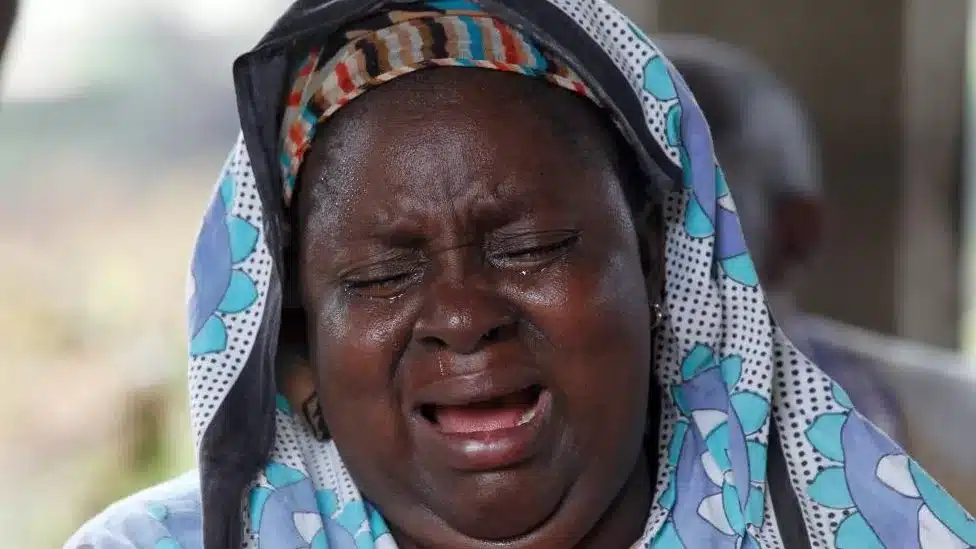
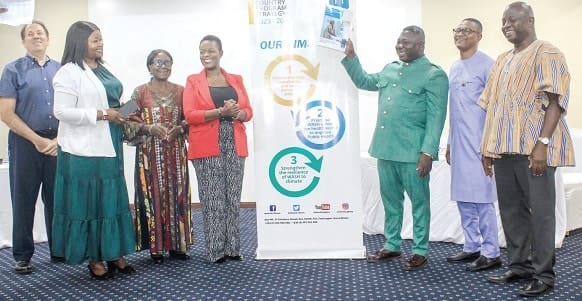
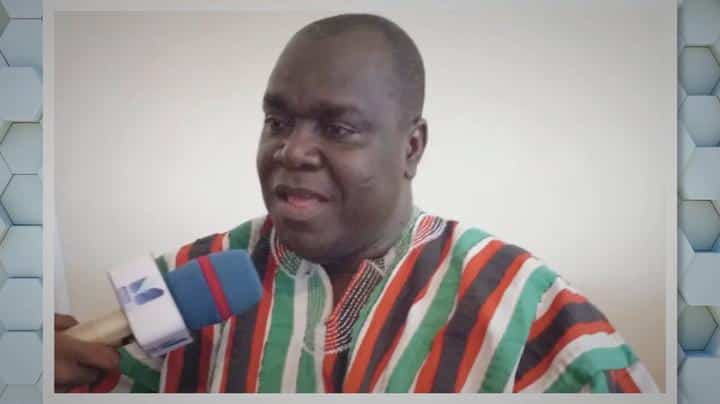
The implementation of 20 and 10 percent taxes on businesses under the “Gross Gaming Revenue” hasn’t gotten the support of lottery and wagering players.
They said the taxes on gross revenue of lottery companies and the staking public would undermine the sales, revenue, profits and growth of lottery industry.
A statement copied to the Ghana News Agency in Accra said “The 10 per cent Withholding Tax on Winnings will prevent thousands of players from staking the lottery products both in the kiosks and online.
“Already, a lot of Lotto Marketing Companies are dying out because of huge debts as a result of higher wins by the staking public, coupled with huge amounts of money paid to the National Lottery Authority as a license fee.
“The inability of the National Lottery Authority too to pay winning tickets to the staking public promptly as well as the 20 per cent commissions to the Lotto Marketing Companies have already negatively affected the lottery business leading to decline in sales and revenuez.
They called on the Ministry of Finance to have a second look at the 20 per cent and 10 per cent taxes on the gross sales of Lotto Marketing and Betting Companies, and winnings respectively.
They also appealed for the suspension of the implementation of the Taxes on the lottery companies and players of the staking public and broaden consultations with the National Lottery Authority, Private Sector Lotto Operators, Lotto Marketing Companies, Sports Betting Companies and all other relevant stakeholders to reach a consensus on the best way forward to address the concerns of the lottery industry.
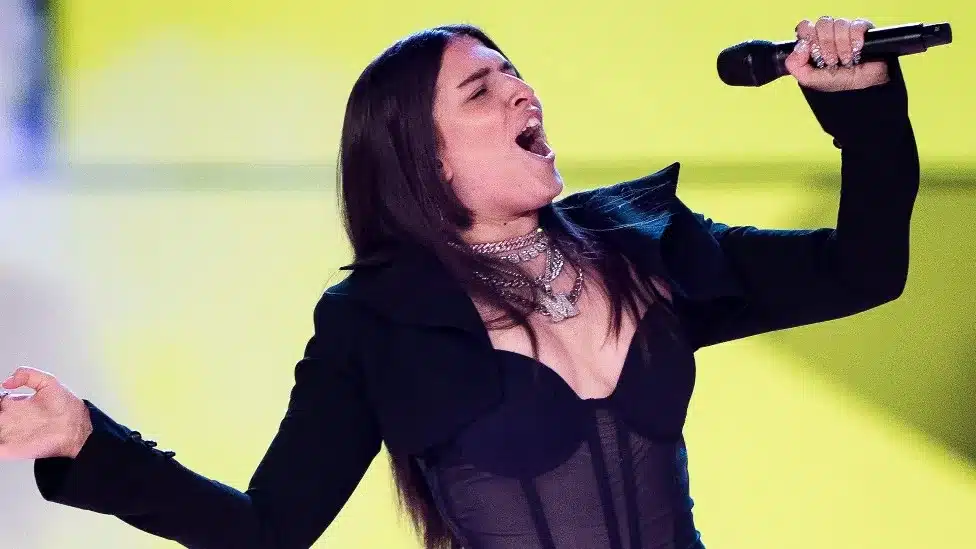
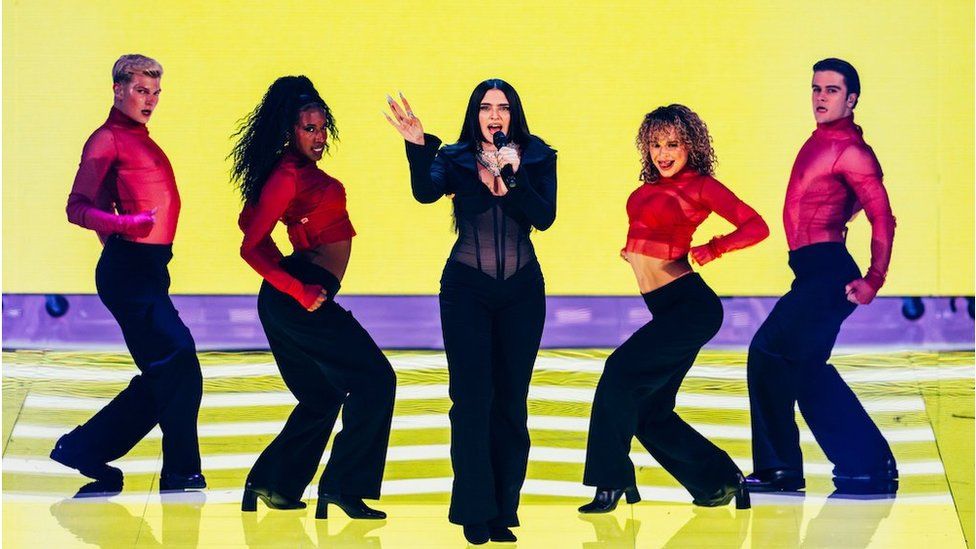
Mae Muller entered the Eurovision Song Contest riding a wave of goodwill.
Last year, Sam Ryder did the unthinkable in Turin by entering a respectable song, breaking the UK’s losing trend, and people wondered, “Why not do that again?”
Mae obliged with a slick, sassy pop song that echoed recent chart trends. I Wrote A Song had the disco undercurrents of Dua Lipa, the lyrics were memorable, and it was eminently shareable on TikTok.
The public seemed to agree. Mae’s song picked up tons of airplay, and more than 8 million streams on Spotify. Bookmakers predicted she’d finish in the top 10. Everyone from Ringo Starr to Lana Del Rey offered their support.
In the run-up to Eurovision, there was negative chatter about Mae’s rehearsals. Her vocals were flat, insiders said, and the choreography was wooden.
But on the night, she brought out the big guns. Mae sang better than she’d done all week. Her dance moves were snappy and confident. The audience at the Liverpool Arena were ecstatic…
And then it all went wrong.
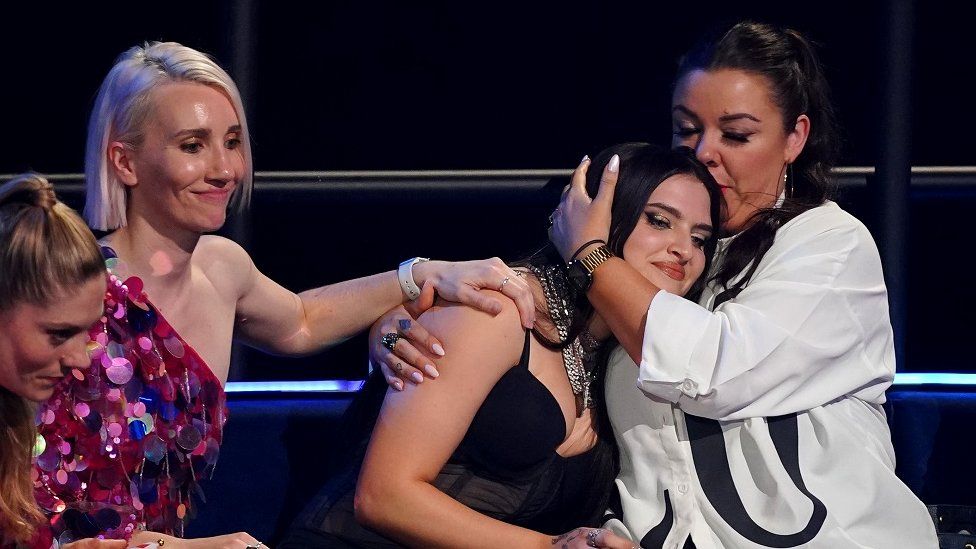
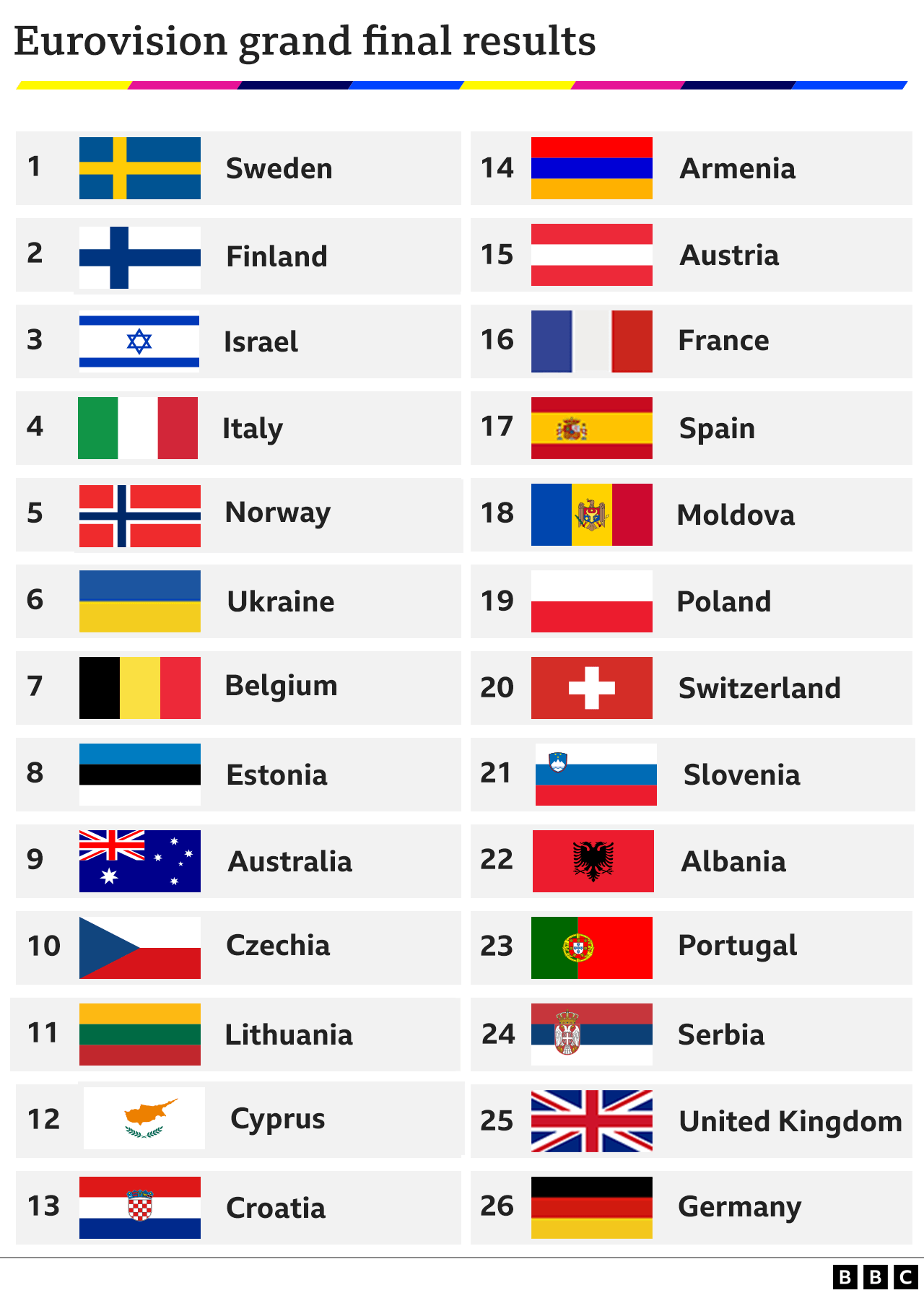
Eurovision juries gave the song 15 points. The public awarded her nine. She ended the night in 25th place, out of 26.
Image caption,Mae Muller reacts to the UK’s low score in the Eurovision green room
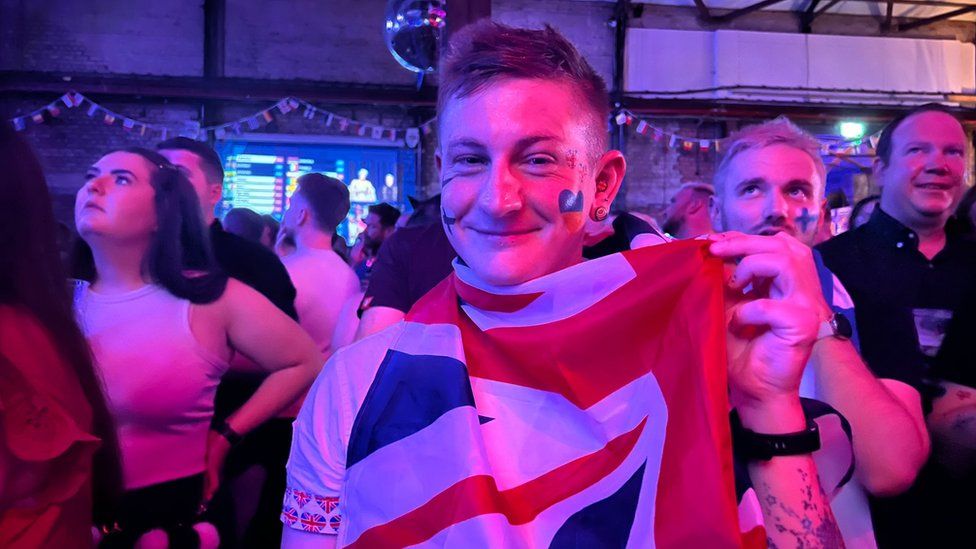
“Undeserved. Very undeserved,” said Eurovision fan Craig Andrew, who watched the horror unfold at Liverpool’s Euroclub.
“I thought her vocal was flawless. She was so good on the night, but what can you do?”
“I think it was much better than that, genuinely,” agreed fellow fan Gaja Gazdic. “In this crowd, it was very well received.”
Image caption,Gaja Gazdic travelled to Liverpool to support Mae in the contest
The first thing to remember is that no-one votes against you at Eurovision, they vote for the songs they like. And if your vibe is hyper-catchy, female-fronted pop, you were spoiled for choice.
Sweden’s Loreen won the contest with the supersonic club anthem Tattoo – even though Norway’s Alessandra beat her in the public vote with Queen Of Kings, a thunderous pop anthem that was equal parts Lady Gaga and Nordic folklore.
Both of them were stronger singers, with stronger songs, than Mae, and they soaked up a lot of her potential votes.
In retrospect, there’s also a peculiar Britishness to I Wrote A Song that might not have translated outside the UK.
It’s a pithy, sarcastic track about taking revenge on an ex-boyfriend – not by trashing their car or burning their house down, but by writing an excoriating song about how rubbish they are.
In a contest where the top songs all featured sincere, straightforward messages about overcoming adversity and standing up for love, Mae’s post-modern, meta-textual lyrics failed to find an audience.
Austria’s hotly tipped Who The Hell Is Edgar? took a similar approach and met a similar fate, coming 15th.
Complexity simply isn’t your friend when you’ve only got three minutes to make an impression.
Staging problems?
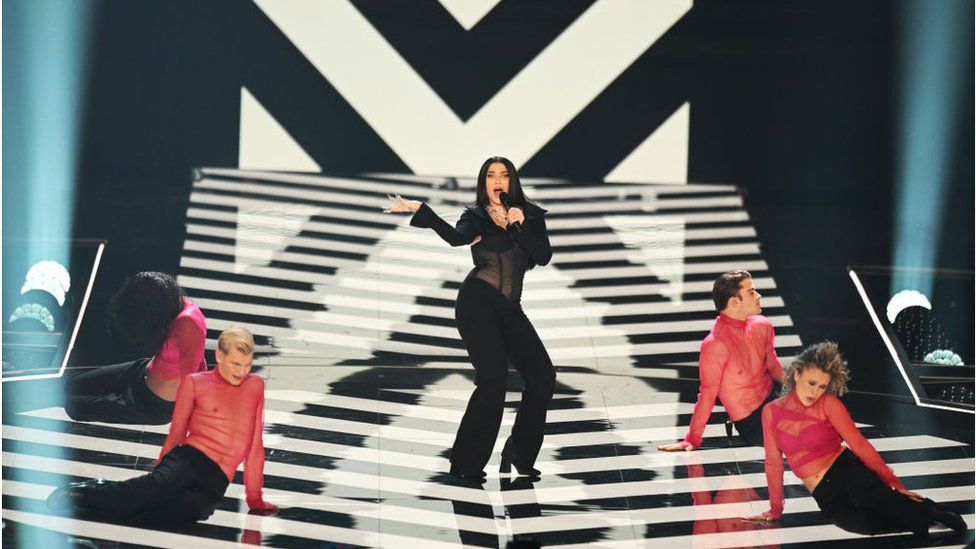
In the press room, questions were also raised about the concept underlying Mae’s performance. In particular, the liberal use of wide shots and Pop Art video installations meant TV audiences couldn’t always appreciate the singer’s cheeky charisma.
“I think it’s an excellent song, but the staging wasn’t great,” said Ken Olausson of Sweden’s QX magazine.
“The whole feeling of female power that’s in the song when you hear it on the radio, it wasn’t on stage.
“I don’t know if they lost her in a lot of props, but the power didn’t come through.”
This YouTube post cannot be displayed in your browser. Please enable Javascript or try a different browser.View original content on YouTube
The BBC is not responsible for the content of external sites. YouTube content may contain adverts.
On social media, TV viewers complained that Mae’s vocals had been too low in the mix.
“You could barely hear her over her music,” wrote one. “Something sounded off with the sound production for Mae Muller,” agreed another.
“She can obviously sing, but it all sounded quiet.”
“The question you have to ask yourself is this: Was the UK performance in your top 10 tonight out of the 26 that took part?” asks Eurovisioncast’s Daniel Rosney.
“If it was, then great because you would have given Mae Muller some points. But if it only just made your top 10, that’s not how you win Eurovision.”
Image caption,The singer’s staging was called into question
After the results were announced, Mae took to Twitter to share her thoughts.
“I know I joke a lot, but we really put our all into the last few months,” she said, “Not the result we hoped for but so proud of everyone and what we achieved.
“Congrats to all the countries, I’ll never forget this journey and I love you all.”
You could feel her pain. She’s been a great ambassador for Eurovision; and she kept up the UK’s momentum of sending non-terrible songs to the contest. Some of the acts that placed ahead of her were objectively worse.
So what’s next for the UK? Earlier this week, Radio 2’s Eurovision commentators Scott Mills and Rylan Clark offered some perspective on the UK’s Eurovision journey.
“It’s impossible to repeat what happened last year, because it just doesn’t happen,” said Mills.
“But what we need to do is show Europe that we care and that we’re taking it seriously. Mae is is great, and while Europe used to say, ‘Hang on a minute, why aren’t the UK any good at this?’ they’re not saying that now.”
Image caption,Swedish star Loreen became the first woman ever to win Eurovision twice, with her song Tattoo
“For reasons I’ve never been clear on, the host country tends to struggle with points after it’s success the previous year,” observes Daniel Rosney.
That’s especially true for Portugal: In 2017, in their 49th appearance at the contest, the country won for the first time, with Salvador Sobral’s Amar Pelos Dois. The following year, they finished last.
“Things like that have always been a bit of an enigma,” says Ricardo Duarte, who’s been covering Eurovision for Portuguese queer website Dezanove.
“But we persevered. We continued. We did not qualify the year after – but we got 12th place in 2021 and ninth place in 2022.
“We’ve had our ups and downs, and so will every other country.”
And that’s the message Mae and the team behind the BBC’s Eurovision bid will need to bear in mind today. Outside the bubble of the contest, Mae’s song has been a hit. She’s a ready-made pop star, who just performed to a global TV audience of more than 160 million people.
In response to the ongoing drought that is putting pressure on communities in northern Tanzania that maintain cattle, a group of Maasai women have begun making honey in order to supplement their income, secure the future of their children, and support the regrowth of the forest.
“I have benefited a lot from beekeeping. I bought five goats which are producing milk for us, I have also bought a bed and educated my children. This year, my plan is to build a house,” says beekeeper Maria Shinini.
It has taken some time. Maria began with five hives and equipment, but today her business is flourishing.
Together with the other women, they now have 76 hives on a communal plot on the outskirts of the Monduli district in the Arusha region.
They receive training from an umbrella network of smallholders, farmers, and pastoralists, supported by the Forest and Farm Facility, a partnership between the Food and Agriculture Organization, the International Union for Conservation of Nature, as well as the International Institute for Environment and Development and AgriCord.
Decades of recurring drought due to climate change have degraded the landscape and reduced the pasture available for livestock. Introducing bees is one initiative to regenerate the landscape.
In their training, Maria and the other women have learnt that taking care of the vegetation is a crucial element in the care and management of their bees
“It is of great importance that our environment is taken care of, right from the water catchments. So, our training goes hand in hand with these aspects of the environment, taking care of the vegetation so that the bees can get their food. Because there is no other source of food,” says trainer Majaliwa Mwashuve.
The new beekeepers have also received training on how to be smart businesspeople, producing, labelling, and branding their own products to maximize their value.
“Previously their thought was that they harvest honey, then sit and wait for customers during a season. But things are different now because they can do business all through the year as a result of the value chain. They harvest the honey, then engage in other honey product businesses across the year through value addition,” says Mwashuve.
They have also learnt to combine forces with other beekeepers to access new markets. As a result of this collaboration, one new product they are considering is “garlic honey”.
Honey is big business in Tanzania, but traditionally it is only Maasai men who do the job. Maria and her fellow women beekeepers say that, as they go from strength to strength, keeping bees and producing honey has resulted in greater respect for them in the community.
“People now know that even Maasai women can do big things,” she says.
Recent reports has revealed that children were the first to starve to death during the final days of a Christian doomsday cult in Kenya.
Police investigating an apparent mass suicide have so far exhumed 201 bodies in a forest in the nation’s southeast.
A former deputy preacher of the cult told the New York Times that children were killed first, ordered “to fast in the sun so they would die faster.”
Women and men were next to follow the suicide plan, Titus Katana said.
Mr Katana – who is helping police with the investigation – also described to the Sunday Times the alleged brutal treatment of the children, saying they were shut in huts for five days without food or water.
“Then they wrapped them in blankets and buried them, even the ones still breathing,” he was quoted as saying.
It is alleged that the cult followers were told they would reach heaven faster if they starved to death.
Official autopsies of some of the bodies in the expansive Shakahola farm, near the coastal town of Malindi, found signs of starvation, suffocation and beatings.
More than 600 people who are reported to be members of the doomsday cult allegedly led by Pastor Paul Mackenzie are still missing.
Pastor Mackenzie, who is currently in police custody, said he closed down his Good News International Church four years ago after nearly two decades of operation.
But the BBC had uncovered hundreds of his sermons still available online, some of which appeared to have been recorded after this date.
In an interview with Kenya’s Daily Nation newspaper a few weeks ago, Pastor Mackenzie also denied he had forced his followers to starve themselves.
But Pastor Mackenzie preached against education, saying that it was satanic, after receiving a “revelation from God”, Mr Katana told the New York Times.
Explaining his reasoning for leaving the cult, Mr Katana, who is also assisting in a police investigation against the pastor, said his teachings had become too “strange”.
Pastor Mackenzie also encouraged mothers to avoid seeking medical attention during childbirth and not to vaccinate their children.
Much of Pastor Mackenzie’s preaching relates to the fulfilment of Biblical prophecies about Judgement Day.
The church’s online content also features posts about the end of the world, impending doom and the supposed dangers of science.
And there are frequent warnings of an omnipotent satanic force that has supposedly infiltrated the highest echelons of power around the world.
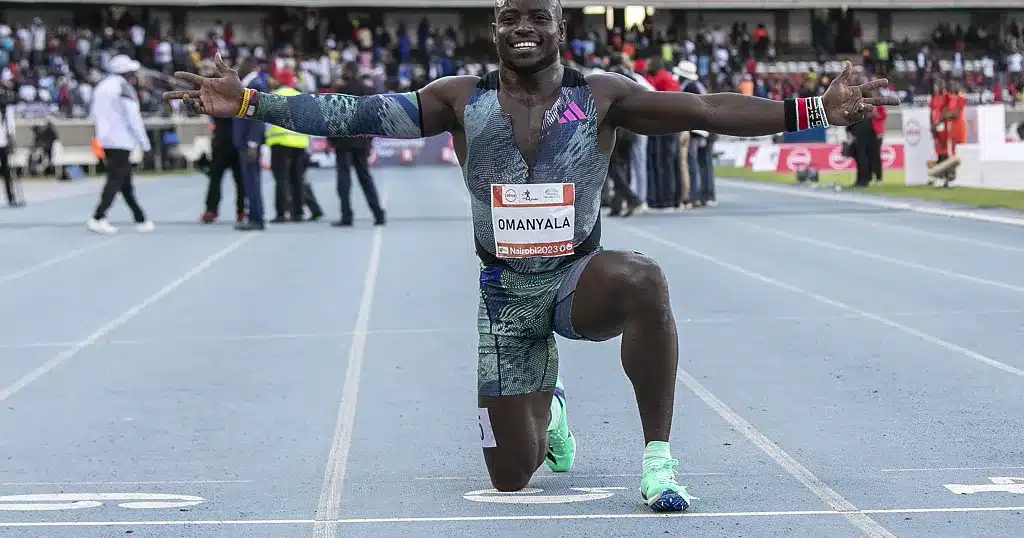
At the Kip Keino Classic, an international competition conducted in Nairobi on Saturday, Kenyan runner Ferdinand Omanyala easily won the 100-meter race.
Although he failed to top his African record, he beat off rivals in a time of 9.84 seconds, the best in the world this season.
“I’m happy that I got a very good race and the time is nice because it’s a world lead, so we’re just hoping that we break it down as we go on through the season,” he said.
“The main aim is to win the World Championships in Budapest this year and the Diamond League trophy back in Oregon, where I did not have a good competition there.”
He said his target for the season is to cut his African record of 9.77 seconds, set at the same event in 2021, to under 9.70.
US Olympic and world 200m silver medallist, Kenny Bednarek, was second in 9.98 and world 100m silver medallist Marvin Bracy-Williams was third in 10.03.
Meanwhile, US star sprinter, Sha’Carri Richardson, took an easy win in the 200 metres signalling her return to form.
Already the fastest woman in the world this year in the 100m, the American obliterated the field to win in a new meet time of 22.07 seconds.
“I’m glad to hear from you guys (the media, ed) and from the fans that I’m a fan favourite because I wasn’t treated like that coming into this meet. So I’m just grateful that I had a good race nevertheless of the circumstances,” she said.
But it was local sensation Omanyala, who thrilled the home crowd. He has remained unbeaten this season.
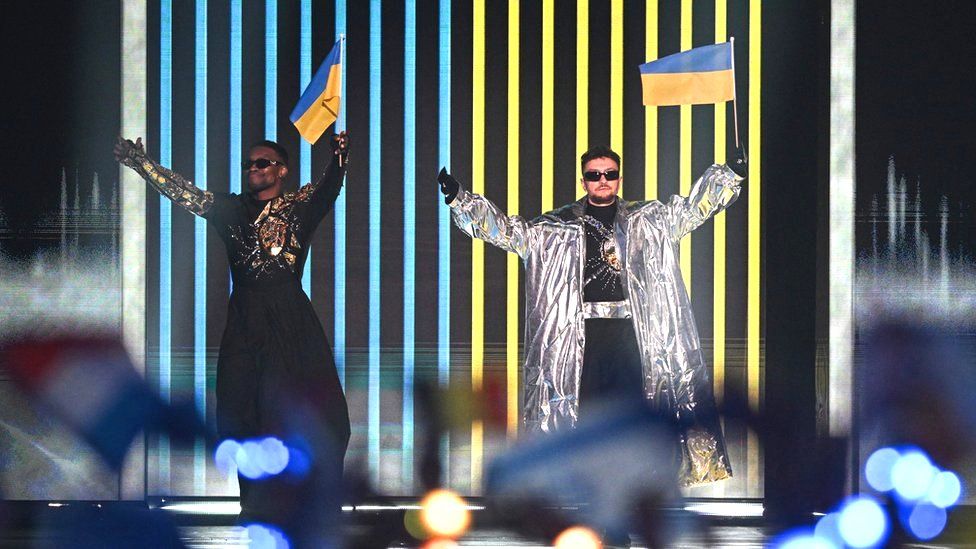
Russian missiles reportedly attacked the Ukrainian act’s hometown just before they took the stage in Liverpool, according to officials.
The head of Ternopil regional state administration, Volodymyr Trush, confirmed two people had been injured.
Ternopil mayor Serhiy Nadal said warehouses were damaged.
Ukraine’s foreign ministry accused Russia of attacking Kyiv and Ternopil regions before and during Tvorchi’s Eurovision performance.
Ten minutes before taking to the stage at the Liverpool Arena, Tvorchi posted on Instagram citing reports of Ternopil in western Ukraine being attacked.
After performing, they added: “Ternopil is the name of our hometown, which was bombed by Russia while we sang on the Eurovision stage about our steel hearts, indomitability and will.
“This is a message for all cities of Ukraine that are shelled every day. Kharkiv, Dnipro, Khmelnytsky, Kyiv, Zaporizhzhia, Uman, Sumy, Poltava, Vinnytsia, Odesa, Mykolaiv, Chernihiv, Kherson and all others.
“Europe, unite against evil for the sake of peace!”
Image caption,Tvorchi posted on Instagram saying Russia was bombing their native city of Ternopil
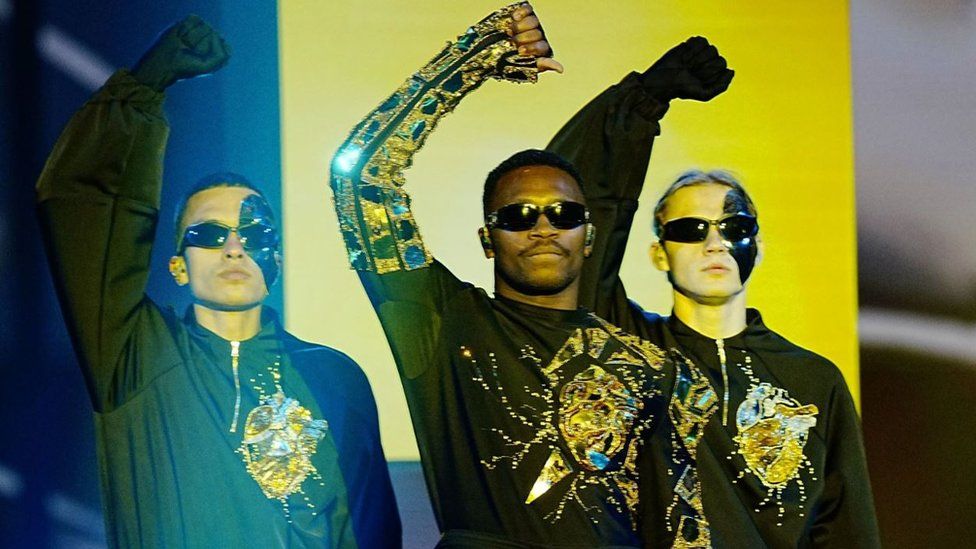
Tvorchi, made up of producer Andrii Hutsuliak and Nigeria-born vocalist Jeffery Kenny, hoped to defend the Eurovision title after Kalush Orchestra won last year in Turin.
They performed “Heart of Steel” – a song about troops who led an ultimately unsuccessful resistance against Russian forces at the Azovstal plant in Mariupol.
Liverpool is hosting the contest on behalf of Ukraine due to the ongoing conflict.
At the end of their performance, Tvorchi held their fists in the air as acts from other nations were also seen waving the blue and yellow flag of Ukraine.
Image caption,Tvorchi are made up of producer Andrii Hutsuliak and Nigeria-raised vocalist Jeffery Kenny
The UK’s ambassador to Ukraine Dame Melinda Simmons described Tvorchi’s Eurovision performance as “poignant”.
Writing on Twitter, she added: “Reminder that the reason why Ukraine could not host this event is because Russia continues to invade and the people of Ukraine live in continuing danger.”
Though Swedish act Loreen took the Eurovision crown after a nail-biting finish, there was praise for Tvorchi from Ternopil’s mayor who thanked the band for supporting the city during their performance.
Posting on Facebook in Ukrainian, Mayor Nadal wrote: “It was at this time that our city was attacked by Russian missiles.
“Thank you, because your speech has become a symbol of not only the unity of the country, but of the whole world.”
He told the BBC the fire at the warehouse in Ternopil had been brought under control.
“Firefighters worked all night and continue to work,” he said, adding that the two people who were wounded suffered minor injuries and were in hospital.
Russia has not yet made any official comment.
Earlier in the day, President Volodymyr Zelensky visited Pope Francis at the Vatican and Italian Prime Minister Giorgia Meloni in Rome.
He has since flown to Germany, arriving in Berlin just before 01:00 local time.
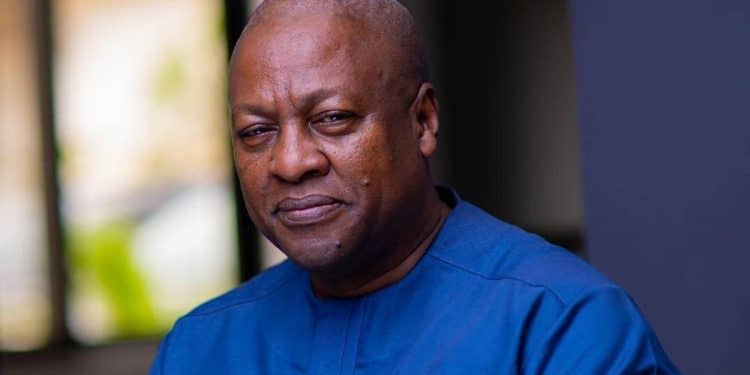
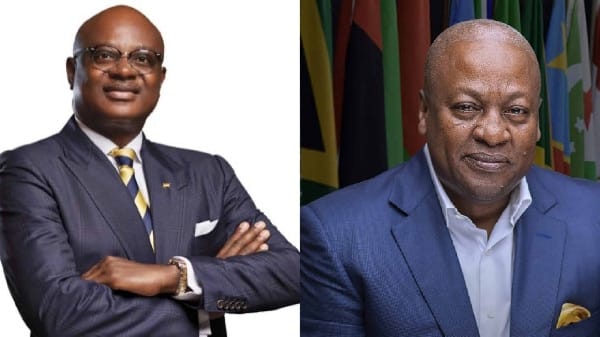
The National Democratic Congress (NDC) delegates have once more chosen former president John Mahama to lead the party into the 2024 presidential election.
Certified results by the Electoral Commission (EC) show Mr Mahama polled an overwhelming 297,603 votes representing 98.9% of the total valid votes cast at the end of the NDC primaries on Saturday.
His closest contender, the former Kumasi Mayor Kojo Bonsu, polled a paltry 3,181 representing 1.1%.
The other contender in the NDC flagbearership race, former Finance Minister in the Mills regime, Kwabena Duffour, pulled out on Friday.
This is the fourth time John Mahama will be leading the NDC into an election.
Then Vice President John Mahama who took over from President John Evans Mills when the latter died while in office in July 2012, went on to win the election later that year.
As an incumbent, he first lost to then New Patriotic Party (NPP) presidential candidate Nana Akufo-Addo in 2016, becoming the first President to serve only one full term.
He won the flagbearership race in February 2019 with an overwhelming endorsement of 95% votes to represent the NDC in the 2020 election but he lost to incumbent President Nana Akufo-Addo who was declared the winner of the Dec. 7, vote with 51.59%, ahead of the DNC candidate who received 47.37%.
Mr Mahama challenged the outcome at the Supreme Court, arguing that Akufo-Addo’s votes in some polling stations were padded, pushing him above the 50% threshold needed to avoid a runoff.
He lost the court challenge.
Once again, delegates of the opposition party in a decisive outcome in 2019 gave the former President the go-ahead to lead the party as its flagbearer into the 2020 polls. Once again he lost.
In many recent interviews, Mr Mahama has said that with the benefit of hindsight, he has realised his mistakes and wants another opportunity to better lead the country.
Mr Mahama told journalists after casting his vote on Saturday that, “his [Duffour’s] withdrawal at the last minute does not change anything, I just voted, there are many delegates going to vote, the result will still be what it is and I expect it to be a landslide.”
He continued, “There is no disunity in the party, absolutely not. One contender was dissatisfied with the process, it doesn’t mean there is disunity in the party.
“NDC is a family and all of them are part of that family, as long as they are willing to come together and let us work toward 2024 I don’t think there is any problem, the party will make overtures.”
On Friday, May 12, Dr Kwabena Duffour formally pulled out from the NDC flagbearership contest.
Addressing a presser, the former governor of the Bank of Ghana stated that his decision was based on his grievances with the processes, especially the voters register, which he thought did not guarantee free and fair elections.
He explained that the exercise was marred by a lot of irregularities; a situation that was not resolved by the leadership of the party.
Last four years, Kojo Bonsu similarly pulled out during the race.
Prior to the elections in 2024, the National Democratic Congress (NDC) held its presidential and parliamentary primaries on Saturday, May 13, 2023.
The contests saw some incumbent Members of Parliament lose their bid to once again represent their constituencies and the party at the 2024 general elections.
Among the incumbents who lost was the MP for Sagnarigu, A.B.A Fuseini. He lost to a newcomer, Attah Issah who polled 801 votes as against A.B.A Fuseini’s 330 votes.
Also, South Tongu MP, Wisdom Kobena Woyome lost to Maxwell Kwame Lukutor. Mr Woyome polled 562 while Mr Lukutor had 597 votes.
Dela Sowah, MP for Kpando, lost to Sebastian Fred Deh with 281 votes. Mr Deh won the candidacy with 332 votes..
Pru East MP, Dr Kwabena Donkor has also lost his bid. Emmanuel Kwaku Boam beat the incumbent MP with 474 votes.
In Bia West, the incumbent MP Augustine Tawiah lost to Mustapha Amadu Tanko. Mr Tanko won with 935 votes, while Mr Tawiah polled 452 votes.
Edward Bawa, MP for Bongo also lost his bid to represent the party in the 2024 elections. He lost to Charles Bawaduah with 509 votes. Mr Bawaduah polled 535 votes.
Also, Dr. Alex Adomako Mensah, MP for Sekyere Afram Plains lost to a newcomer, Hajia Nasira Afrah.
In Krachie East, the incumbent MP, Wisdom Gidisu lost with 257 votes. The main contender, Nelson Kofi Djabab, won with 441 votes.
MP for Navrongo, Sampson Tangombu Chiragia also lost his bid to contest again in 2024. He lost with 447 votes to Simon Akibange Aworigo, who won with 475 votes.
Also, the MP for Afadzato South, Angela Alorwu-Tay, also lost her bid to retain her candidacy.
She polled 225 votes, losing to her contender, Frank Afriyie who won with 631 votes.
In the ongoing NDC primary, Kojo Bonsu, a candidate for the party’s flagbearer position, has conceded defeat to former President John Dramani Mahama.
Voting has long ended but counting of ballots and collation in the presidential race is yet to end. Election officials expect to conclude the entire exercise by 10pm.
In a Facebook post, the former Mayor of Kumasi, Kojo Bonsu said he has called John Mahama to congratulate him on his landslide victory in the presidential primaries.
While the party is yet to officially announce polling results, John Mahama’s side is predicting at least a 98% win in the election.
“I have placed a call to H.E. John Dramani Mahama to congratulate him for the landslide victory. Just as I’ve indicated throughout my campaign, regardless of the outcome of this election I’ll continue to serve the NDC party,” he said in a Facebook post.
Kojo Bonsu was John Mahama’s only contender in the NDC presidential primary following former Finance Minister, Dr. Kwabena Duffour’s abrupt withdrawal from the race on Friday citing electoral irregularities.
Provisional results so far point a lopsided contest, with former President John Mahama sweeping virtually every constituency votes.
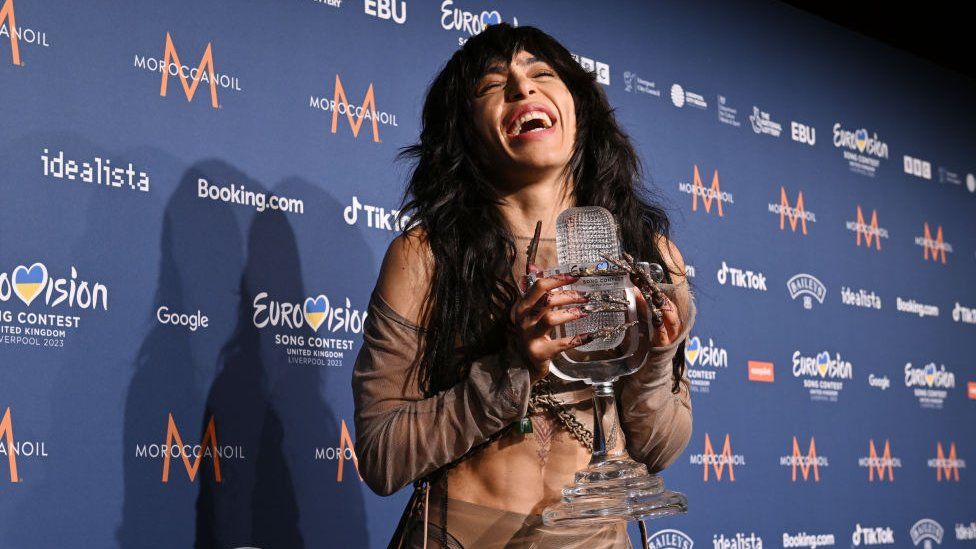
For the second time Sweden’s Loreen wins the Eurovision Song Contest with her soaring pop hit Tattoo.
In a close vote, the celebrity, who last won the contest in 2012, defeated Finland’s Käärijä.
Mae Muller of the UK fell short of Sam Ryder’s achievement from the previous year, finishing in 25th place, one place above the bottom.
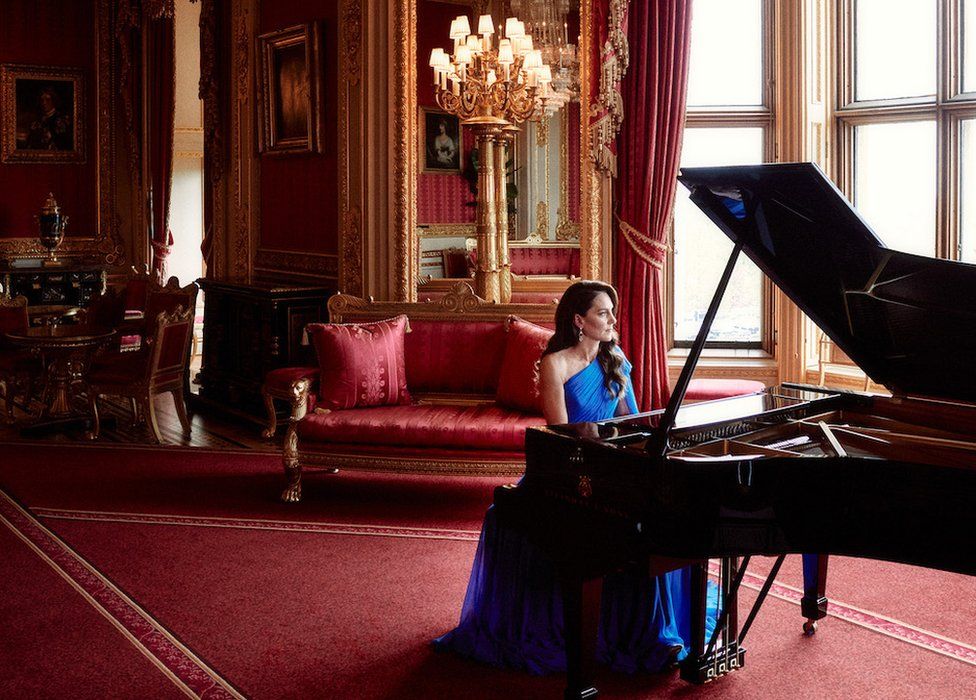
And the Princess of Wales made a surprise cameo, playing the piano with last year’s winners Kalush Orchestra.
Loreen is the only the second person – and the first woman – to win Eurovision twice, following Ireland’s Johnny Logan.
“This is so overwhelming,” she said as she collected the trophy. “I’m so grateful. I’m so thankful.”
“In my wildest dreams, I didn’t think this would happen.”
Sweden’s victory means it will host next year’s competition – on what will be the 50th anniversary of Abba’s historic victory with Waterloo in 1974.
But Ireland crashed out of this year’s contest at the semi-final stage for the fifth year in a row – a result their head of delegation described as “devastating”.
This year’s top three acts were:
Sweden: Loreen – Tattoo (583 points)
Finland: Käärijä – Cha Cha Cha (526 points)
Israel: Noa Kirel – Unicorn (362 points)
Image caption,Kaarija’s song won the public vote, but faltered with juries
Mae Muller only picked up 24 points, leaving the UK near the bottom of the leaderboard. It was “not the result we hoped for,” she tweeted after the show.
“I know I joke a lot but we really put our all into the last few months,” she said. “Congrats to all the countries, I’ll never forget this journey and I love you all.”
Liverpool hosted this year’s contest on behalf of war-torn Ukraine, which won in 2022.
Appropriately, the show began with last year’s winners, Kalush Orchestra, playing an extended version of their song Stefania in a pre-taped segment from Kyiv.
Stars including Joss Stone, Sam Ryder and Andrew Lloyd Webber added a British flavour to the song, as the band boarded a train from Kyiv’s iconic Maidan Nezalezhnosti metro station and arrived on the stage of the Liverpool Arena.
The Princess of Wales accompanied on piano, in a brief segment recorded in the crimson drawing room of Windsor Castle earlier this month.
Image caption,Catherine briefly joined Kalush Orchestra on piano
Back in the arena, Kalush performed their new single Changes, delivering a message of defiance to Russia: “Give my all down to the wire / Set me free.”
It was the first of many references to the war, in a show that took a more political tone than most editions of Eurovision.
Croatia’s Let 3! performed a song that referred to Russia’s Vladimir Putin as a “crocodile psychopath”, while the Czech band Vesna sang in Ukrainian, “We’re with you in our hearts”.
Ukraine’s own entry, Tvorchi, played a powerful song inspired by the siege of Mariupol.
The duo’s hometown of Ternopil was hit by Russian missiles moments before the band took to the stage in Liverpool, officials said.
They eventually took sixth place, with a total of 243 points.
Russia has been suspended from the contest due to the invasion, but organisers refused to allow a speech from Ukraine’s President Volodomyr Zelensky during the show.
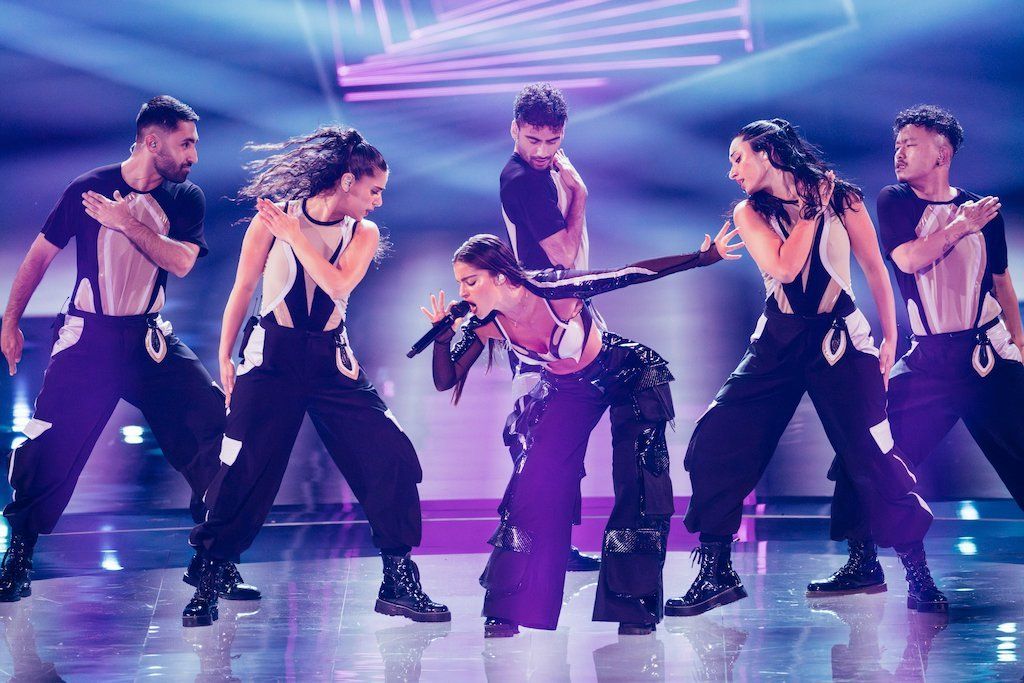
Image caption,Israel’s Noa Kirel gave one of the night’s most athletic performances
Elsewhere, Eurovision was Eurovision. There were 80s-inspired tributes to Miami Vice, a ghost story about Edgar Allen Poe and, naturally, a tear-away dress.
But the musical component of the contest continues to improve.
Spain’s Blanca Paloma combined traditional flamenco rhythms with a throbbing electro pulse on the vibrant, urgent EAEA; and France’s La Zarra tied together decades of Gallic music history in the Piaf-meets-Daft-Punk Évidemment.
Acts from Armenia, Poland and Israel – especially Israel – threw slick dance breaks into their performances; while Italy’s Marco Mengoni was accompanied by two gymnasts on trampolines.
There was also the usual surfeit of tortured ballads, both good (Lithuania) and drab (Albania); and a never-ending parade of lyrics about coming together and being nice to your neighbours (Belgium, Switzerland, Australia).
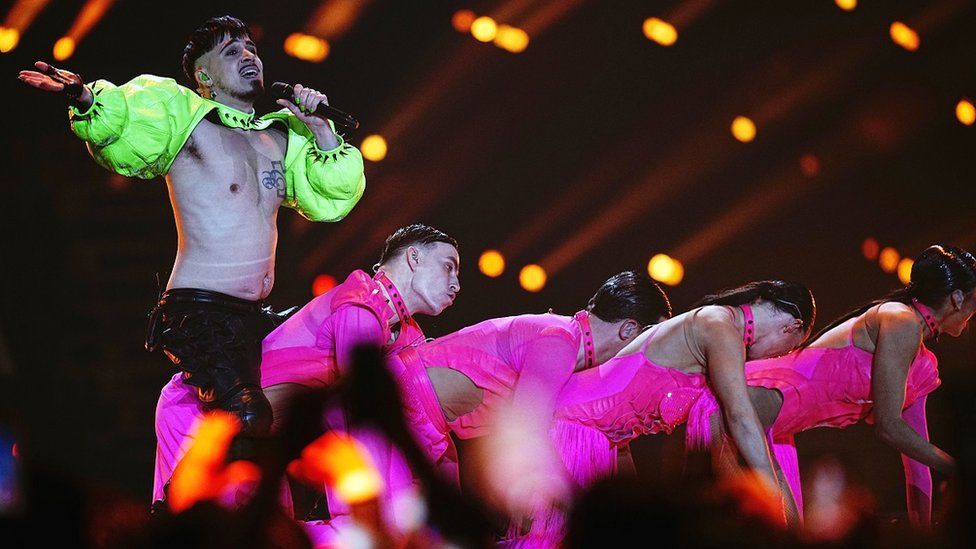
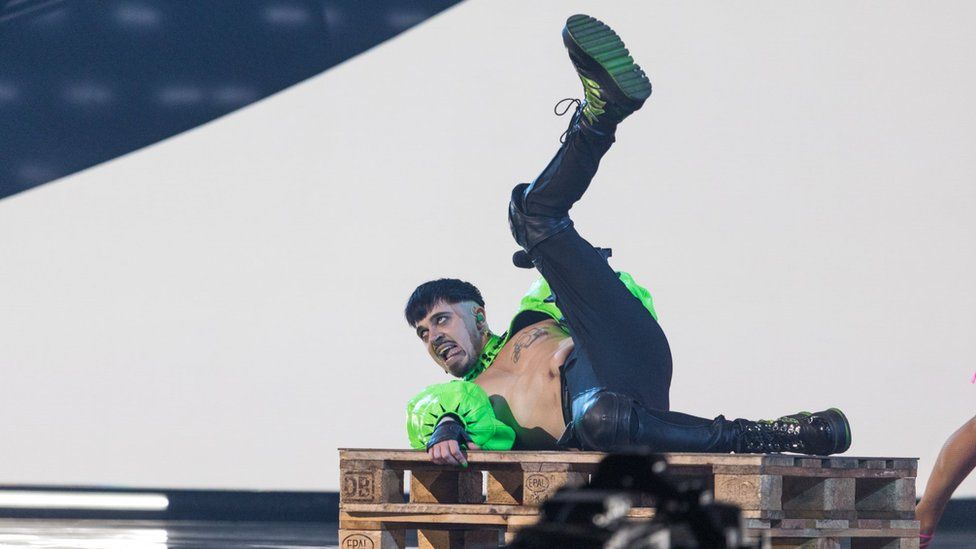
Finnish rapper Käärijä was the runaway public favourite: He received more than double Loreen’s tally in the phone vote. But his chaotic mix of thrash metal, hardcore techno and K-pop melodies failed to impress the juries, who are comprised of music experts.
Image caption,Finland’s Kaarija gave one of the night’s most memorable performances
In a post-modern twist, the competition was bookended by two songs about the process of songwriting.
Austrian duo Teya & Salena kicked off the show with the quirky pop anthem Who The Hell Is Edgar, in which they are possessed by the spirit of US poet Edgar Allen Poe, who compels them to write a song.
An hour-and-a-half later, Mae Muller closed the competition with I Wrote A Song – in which she gets revenge on her ex-boyfriend by writing a song that catalogues his misdemeanours.
It meant the contest opened with the lyric, “Oh my God, you’re such a good writer”, and ended with Muller singing, “Instead, I wrote a song”.
And if that’s not synchronicity, I don’t know what is.
Image caption,The UK’s Mae Muller failed to replicate Sam Ryder’s success last year
The contest was presented by Alesha Dixon, Hannah Waddingham and Ukrainian singer Julia Sanina, with Graham Norton joining them during the voting stage.
The interval showcased the “Liverpool songbook” with tracks by John Lennon, Melanie C and Gerry and the Pacemakers performed by former Eurovision contestants.
And Sam Ryder, who came second for the UK last year, performed an emotional version of his new single, Mountains, with Queen’s Roger Taylor on drums.
Ryder, whose song is about overcoming adversity, was accompanied on stage by dancers who had lost limbs.
How the votes came in
Loreen easily won the jury vote, picking up the maximum 12 points from Ireland, Estonia, Spain, Albania, Cyprus and Ukraine, among others.
She ended the jury sequence with a score of 340, giving her a comfortable 163-point lead over Italy’s Marco Mengoni.
The public preferred Finnish rapper Käärijä, giving him 526 points, temporarily putting him in the lead.
After a tense pause, Loreen reclaimed the crown at the last minute, receiving a public score of 243 that put her back on top.
The UK languished at the bottom of the table, picking up just nine points from the public and 15 from the juries.
Only Germany fared worse. Their glam-rock song Blood And Glitter gained a mere 18 points.
Commiserations came from the BBC, who organised the contest in partnership with the European Broadcasting Union.
The broadcaster’s official Twitter account posted: “Mae, we’re so proud of you and everything you’ve achieved at this year’s Eurovision Song Contest.”
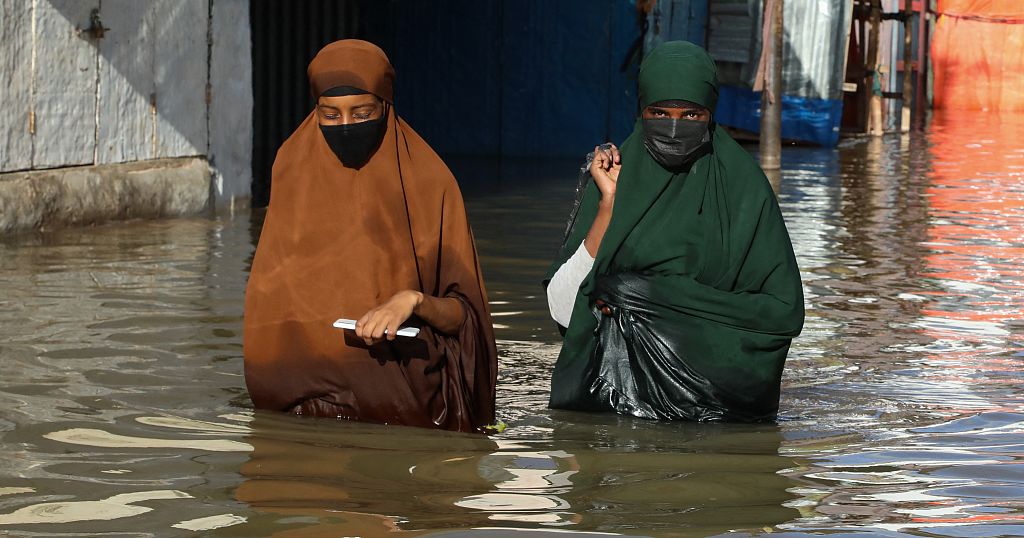
As a result of the River Shabelle’s breaching its banks in Beledweyne, thousands of people in central Somalia have been forced to abandon their homes.
Heavy rain has led to flooding in the area, causing damage to towns and villages and the UN’s humanitarian response agency (OCHA) warned of an increase in diseases such as cholera as local infrastructures are affected
Local resident, Abdihafid Mohamed Yusuf, shared his experience:
“We fled from the flash floods that submerged the city like so many others,” he said.
“People ran out of the city to safety. For four days, the floods poured massively into the city.”
Shopkeeper, Nur Abdulle Hassan, added that the heavy rains had impacted on trade.
“Our businesses have been badly affected by the massive flooding in Beledweyne and the movement of people. This has resulted in a reduction in the presence of our customers.”
The flooding comes as international figures show a record number of internally displaced people worldwide with natural disasters accounting for 32.6 million such movements last year.
Deputy Governor of the Hiran Region, Hassan Ibrahim Abdulle, said almost the entire population of some regions have had to move out.
“Most of the inhabitants of the four districts of the town of Beledweyne are displaced because of the flash floods,” he explained.
“90 per cent of the local towns have fled. 10 per cent are still in the town because they have been stranded or they live in the highlands.”
The flooding comes in sharp contrast to months of drought which has killed tens of thousands of people and wiped out crops and livestock.
It is feared the rains could force many families into destitution.
In order to address the root causes of the region’s instability, the UK struck a deal with Kenya, Ethiopia, and Somalia.
Speaking to the BBC, UK Security Minister Tom Tugendhat said the agreement – worth some $12.5m (£9.9m) – will support the three countries to come up with policies in their fight against terrorism.
This is the first time high-level officials from Ethiopia, Kenya and Somalia have accepted international support to address a common problem along their borders.
These borderlands are usually isolated and insecure, which makes it difficult for countries to monitor threats.
Mr Tugendhat believes that al-Shabab militants conduct terror activities in these areas because there is no governing authority.
The militants have carried out a series of attacks within the region in recent months and the group remains a threat.
The funding from the UK is also aimed at empowering local communities to effectively report suspected terror-related incidents.
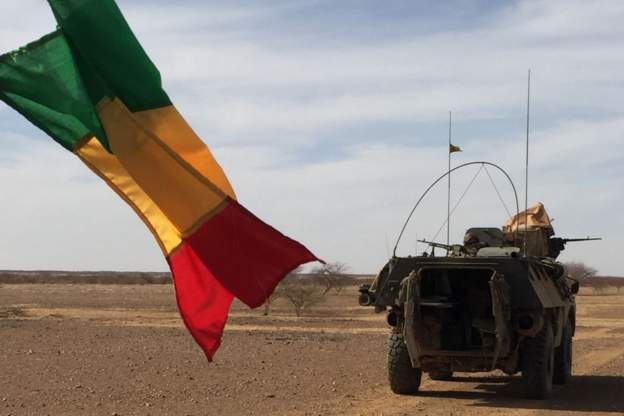
UN human rights investigators have indicated that Malian troops and foreign military personnel killed more than 500 people in a village in central Mali last year.
A new report says the killings in the village of Moura happened during an operation against a jihadist group.
After an exchange of gunfire, the villagers were rounded up and killed. Dozens of women were raped.
The foreign troops were described as white men speaking an unfamiliar language.
They’re widely believed to have been members of the Russian mercenary group, Wagner, which is active in Mali.
The UN Human Rights Commissioner Volker Turk said the killings could amount to war crimes and crimes against humanity.
International media outlet Al Jazeera has stated that it would not render an apology to President Akufo-Addofor claims made in its recent investigative program, “Gold Mafia,” because it did not make the claims cited in a letter from the president’s office to Jubilee House requesting an apology.
The government’s letter claimed, among other things, that the documentary made baseless claims that Akufo-Addo acted as a lawyer for Alistair Mathias and implied that he personally benefited unlawfully from a $100 million state infrastructure contract purportedly awarded to Mr Mathias.
At least eight African leaders were mentioned in the Al Jazeera ‘gold mafia’ documentary, including Ghana’s President, Nana Akufo-Addo. The mafias mentioned in the exposé were often associated with at least one African leader, and Alistair Mathias, one of the alleged money launderers, associated himself with Ghana’s leader.
Mr Mathias is one of the alleged money launderers who uses gold to move and clean large amounts of illicit money. He acts as a bank for corrupt leaders, and he holds, moves and distributes commissions of dirty money for politicians. In a country deep in the throes of election horse-trading, the documentary ignited a torrent of criticism.
The opposition National Democratic Congress (NDC) berated Mr Akufo-Addo for not categorically denying the allegations by Mr Mathias (the President’s office tepidly told the broadcaster that he had no recollection of Mathias) and former special prosecutor, Martin Amidu, punched holes in Mr Akufo-Addo’s letter to Al Jazeera. Although the President has challenged claims made in the documentary, the Minority is demanding an investigation into the allegations, petitioning the Office of the Special Prosecutor to investigate the matter.
Minority Leader Dr Ato Forson, in a recent Facebook post, said that “the revelation that $40 million worth of gold is smuggled out of Ghana every month is deeply concerning” and insisted that the country is being exploited by collaborators who benefit from illegal gold mining and smuggling. According to the Minority caucus, the number of corruption allegations in which the president and his deputy, Dr Mahamudu Bawumia, have been named has reached alarming proportions. The most recent is an allegation that a Minister of State at the Finance Ministry, Charles Adu Boahen, took bribes from artisanal mining investors and used the presidency to peddle influence. Just a month ago, OriginalAll, in a global report on illicit trade, cited Ghana as a major transit point for illegal gold shipments.
Gold Mafia: Revealing the shadows, routes and methods
The report identified Ethiopia, Ghana, Sudan and Uganda as major illegal gold trading routes, with prime destinations being India, Switzerland and the United Arab Emirates. The analysis of trade data in the report showed that from 2013 to 2016, more than $6 billion in outbound gold shipments from Ghana to its three biggest trading partners went unreported. If all of Ghana’s gold trade partners’ export and import statistics were to be evaluated, the figure is predicted to increase dramatically. For instance, the difference in gold imports and exports between Ghana and Switzerland from 2013 to 2016 was more than $3 billion. According to the report, Switzerland purchased about $7 billion worth of gold from Ghana.
Officially, only about $3 billion worth of gold is on the books. According to the Ministry of Lands and Natural Resources, Ghana loses a further $2 billion annually in unpaid royalties and taxes on smuggled gold. There are also important national security implications, with the report saying that illicit gold mining “is becoming a rising source of income for cartels, criminal gangs and non-state armed groups.” The millions of dollars lost due to such activities could close the huge deficit gap created due to poor revenue mobilisation.
The seven-day ultimatum issued by Jubilee House to Al Jazeera to retract and apologise for the alleged misrepresentation of the President in the documentary has long passed, and noises about a suit at the International Court of Justice are just that, noises. Even if the authorities proceed with the lawsuit, Ghana’s larger fight against illicit gold trade can only be successful if the government shows a greater commitment to legal enforcement and mustering the political will to regularise large parts of the industry. Instead, it appears content to peddle excuses and threats. With election season almost in full swing, this circus will continue for some time.
Former national team captains Adjoa Bayor and Stephen Appiah made a special appearance at the Women’s Premier League final, which caused a flurry of excitement among the Ghanaian football community.
The match, which took place between Ampen Darkoa Ladies and Hasaacas Ladies at Dr. Kwame Kyei Sports Complex in Abrankese on Friday, was a highly anticipated event that drew a large crowd of fans and supporters.
With Bayor and Appiah in attendance, the final took on an even greater significance, as the two legendary players lent their support to the women’s game and helped to raise the profile of the league.
After a dramatic 120-minute extravaganza finished 1-1, Ampem Darkoa Ladies fought from behind to force the game into penalty shootouts.
Doris Boaduwaa opened the scoring for Hasaacas Ladies in the 60th minute before Ophelia Serwaaa Amponsah equalized for Ampem Darkoa Ladies in the 83rd minute to force extra time.
Ampem Darkoa Ladies retained their championship after winning 5-3 on penalties. Ampen Darkoa Ladies will represent Ghana at the CAF Women’s Champions League next season.
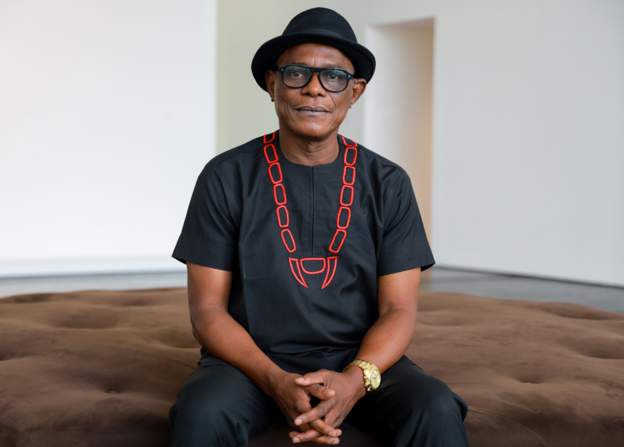
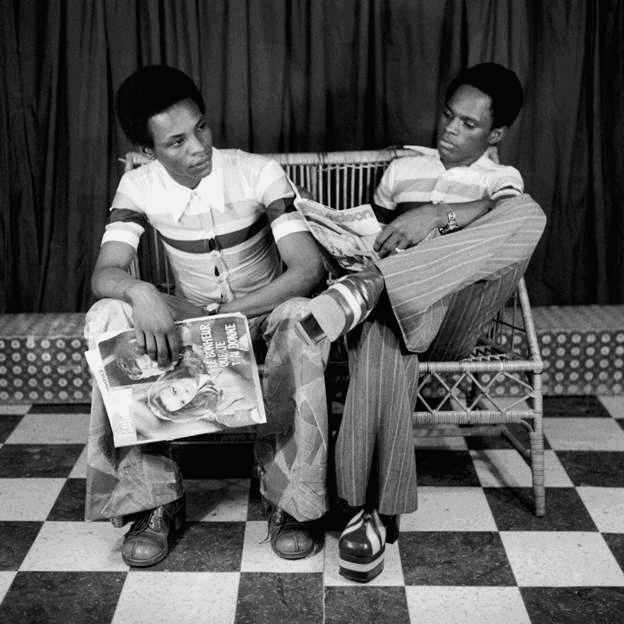
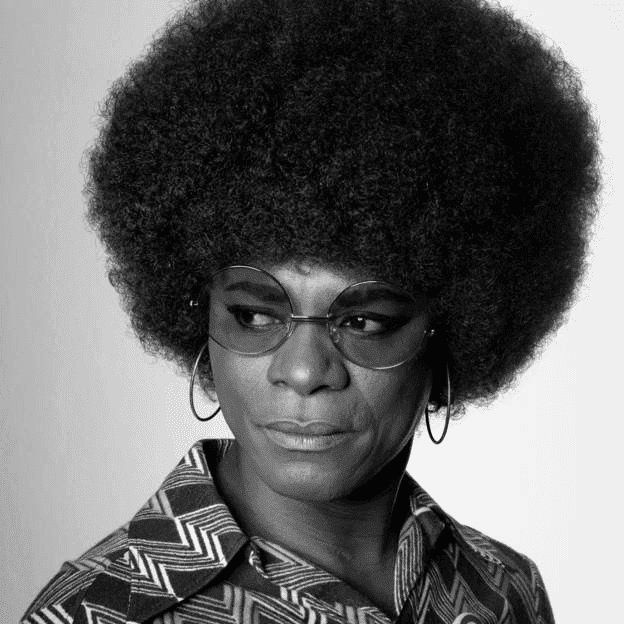
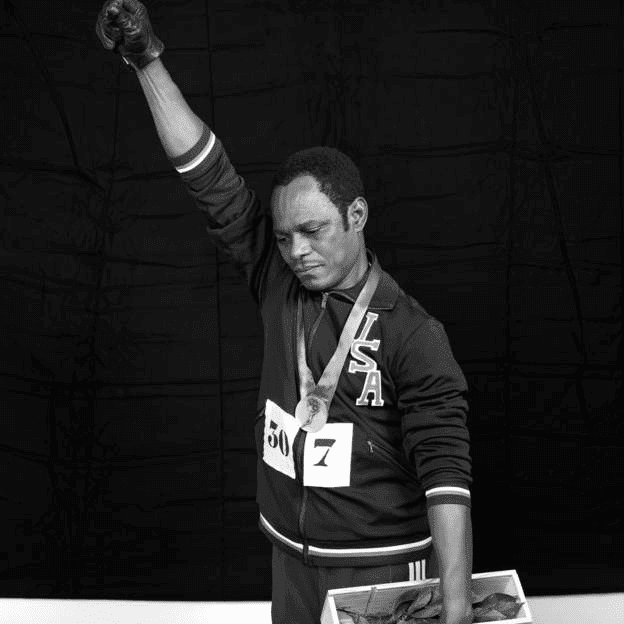
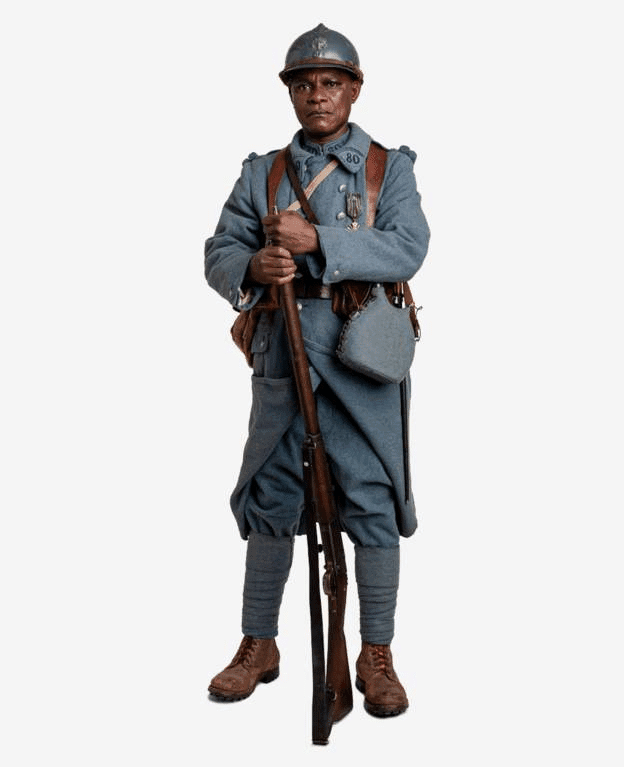
At a special ceremony in London, Samuel Fosso, one of Africa’s most accomplished photographers, was awarded the esteemed Deutsche Börse Photography Foundation Prize for 2023.
Described as “a man of 1,000 faces”, the Cameroonian-born artist has specialised in self-portraiture and performative photography since starting out in the 1970s – and his works now appear in renowned galleries all over the world.
The Deutsche Börse award recognises photographers whose work have “made the most significant contribution to international contemporary photography over the past 12 months”, according to a press release.
Fosso, now 60, was raised in Nigeria, but fled during the Biafran war when his mother died and later settled with his uncle in the Central Africa Republic (CAR), where he began an apprenticeship at a local photographic studio.
At the age of 13 in 1975, he branched out on his own opening his Studio Photo Nationale in the capital, Bangui. He started taking self-portraits using up exposures on his films to send to his grandmother in Nigeria.
His initial aim was to show he was alive and well, but his interest in exploring the genre grew – and he experimented with new techniques and poses.
“Winning this prestigious prize, recognised as one of the most important in the field of photography, means that my work is recognised by the artistic community,” Fosso said.
“This recognition is very important to me. I feel a lot of joy and pride.”
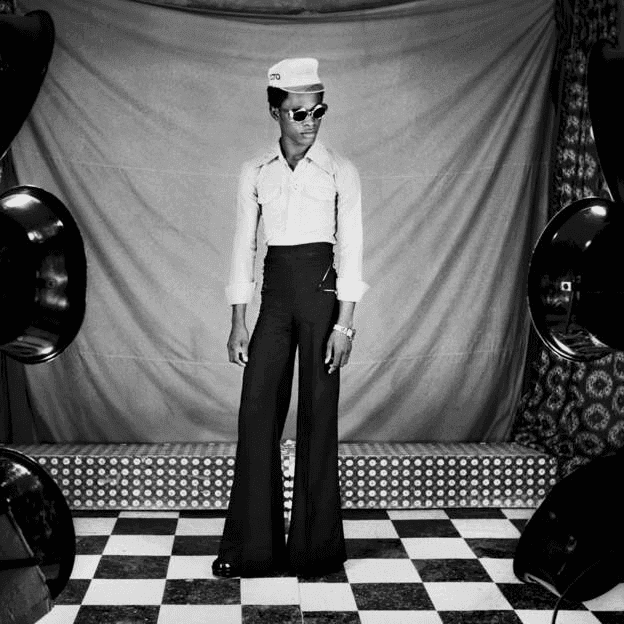
One of his most famous images, from his series from the 1970s, is of him sporting bell bottom trousers inspired by West African fashion and images seen in American magazines:
Samuel Fosso, Autoportrait, from the series 70s Lifestyle, 1976Image caption: Samuel Fosso, Autoportrait, from the series 70s Lifestyle, 1976Samuel Fosso, from the series 70s Lifestyle, 1975-78Image caption: Samuel Fosso, from the series 70s Lifestyle, 1975-78
In his series African Spirits from 2008, Fosso posed as 14 iconic figures of the US Civil Rights Movement:
Samuel Fosso, Self-Portrait (Angela Davis) from the series African Spirits, 2008Image caption: Samuel Fosso, Self-Portrait (Angela Davis) from the series African Spirits, 2008
In his Allonzenfans series from 2013, he reflected on how France conscripted men from its West African colonies to fight in World War One and World War Two:
“I want to show the black man’s relationship to the power that oppresses him,” Samuel FossoImage caption: “I want to show the black man’s relationship to the power that oppresses him,” Samuel Fosso
Twitter has long been one of the friendliest, or perhaps just least hostile, social media platforms for sex work. As it launches into a slow death spiral, many sex workers are still paying for the platform. And that’s created a new kind of friction — as prominent accounts like Dril have urged fellow Twitter users to “Block the Blue” by mass-blocking subscribers. “I feel like my interactions have been dipping as Twitter gets less good overall but also have no choice but to attempt to keep the account verified,” says porn performer Vanniall.
It’s hard to say precisely how many sex workers are signed up for Twitter Blue, but it’s a sizable number — and to anyone familiar with the dynamics of modern sex work, it makes perfect sense. Where many professionals once worked for an agency or porn studio, a vast contingent are now independent. That leaves them a great deal of freedom but also new responsibilities. Whether you’re doing in-person work or modeling on OnlyFans, you — and pretty much you alone — are responsible for attracting clients to your metaphorical storefront. And while people have experienced a similar shift across the creator economy, sex workers’ options for social media are far more limited than most.
Many users began classifying the final “blue checks” as of April 20, when Twitter finally carried out its long-promised elimination of legacy verified accounts.
There were the Elon fanboys, who angrily badgered formerly verified users about their unwillingness to pay $8 a month for a new checkmark. There were sheepish Twitter Blue subscribers who appreciated its extra features. There were celebrities puzzled to find they’d retained their verification despite (or, sometimes, because) of their vocal unwillingness to pay for Twitter Blue.
But there was also another, far less discussed group. When I clicked the Verified tab in my mentions, I’d once been greeted with a variety of journalist friends, activists, and the odd celebrity. Now there was only one kind of user populating the tab: sex workers.
Past sex workers had a number of options for advertising, from the literal back pages of alt weeklies to the now-shuttered Backpage.com. But the current alternatives are fairly sparse. “The entire world has changed,” says Michael Stabile, director of public affairs for the adult industry trade group the Free Speech Coalition. Print publications aren’t a feasible advertising option anymore, and most online ad markets (including Google and Facebook ads) explicitly ban advertising for even legal adult services. Laws like FOSTA-SESTA have made mainstream platforms less tolerant of sexual content. Even big-name adult platforms like OnlyFans and Pornhub don’t do much to promote individual performers.
Twitter has long been one of the most XXX-friendly, or perhaps just least hostile, social networks
That leaves social media — and social media is not particularly XXX-friendly. Meta’s properties have hardline policies against nudity and explicit content, though many porn performers still use Instagram, hoping to fly under moderators’ radar and avoid a ban. While the buzzy platform Bluesky is currently quite notorious for its nudes, it’s tiny, and its future remains unpredictable. And as for TikTok — well, a site where users have to say “le$beans” instead of “lesbians” to get around content filtering isn’t likely to be a haven for sex workers.
But since its inception, Twitter has had a relatively hands-off attitude toward adult content. Posting porn clips may not be encouraged, but unlike nearly all other big platforms, it’s not explicitly banned. As a result, sex workers have flocked to it. “Most of my marketing is done on Twitter, Instagram, and several of the free porn channels,” says JW Ties, a longtime southwest Florida-based performer and producer. Lyrik Allure, who’s been using Twitter for sex work for 11 years, estimates that about 60 percent of traffic to their various pages (including a Fansly page and a Premium.Chat account) comes from Twitter. “It’s my main platform because a lot of platforms don’t support sex work,” says Allure.
Marketing isn’t the only benefit that Twitter brings to the table. Twitter also offers the chance to build community, organize political initiatives around anti-sex work laws, and connect with journalists (who, Stabile points out, are a group that’s equally dependent on Twitter). It’s hard to overstate how crucial the site is. Twitter, Stabile explains, is “almost universal in its adoption [among sex workers]. You can’t say that about any other platform. It just is the place, one of the first stops you make in terms of setting up a business.”
Which brings me back to Twitter Blue.
A number of Twitter Blue perks have obvious appeal for sex workers. Some of these aren’t unique to their industry, like getting prioritized in ranking, being able to upload longer and higher-quality videos, and being able to include more links in their bios. But Twitter Blue offers an aura of legitimacy that’s particularly valuable to people who are used to a precarious existence online. For one thing, paying for a service should theoretically make its staff less inclined to boot you off — an obvious boon for sex workers, who live in constant fear of their social media accounts getting shuttered without warning. “I haven’t had one violation since I signed up,” says Allure, who received frequent policy violation notices and believes their account’s visibility was limited before signing up.
“I feel like my interactions have been dipping as Twitter gets less good overall but also have no choice but to attempt to keep the account verified.”
Likewise, while Twitter Blue hasn’t stopped people from impersonating high-profile celebrities and politicians, it does add an extra barrier for catfishing and impersonation, problems that sex workers are particularly vulnerable to. Vanniall told me that she’s long been plagued by scammers using fake accounts to trick her fans out of money and even blackmail her. Before Twitter Blue, very few sex workers were deemed eligible for verification. After its introduction, she says “some fans have told me specifically they realized this was the real account” — though sadly, the main thing preventing impersonator accounts from signing up for Twitter Blue as well is a scammer’s own willingness to shell out $8.
Some sex workers feel confident that the Twitter Blue signup process has enough safeguards to prevent someone from impersonating them. During our phone call, Allure told me that they feel like the Twitter team is doing their best to stop fraudsters from using the service to run scams, noting that there is at least a nominal attempt to confirm that no one is using Twitter Blue for impersonation purposes.
But determined scammers have impersonated people in other fields where it’s worth the cost. And notably, when I recently searched for a sex worker friend on Twitter, her Twitter Blue-verified account was still completely absent from Twitter’s search results. Instead, I saw a bunch of imposter accounts pretending to be my friend — although so far, none of them were subscribed to Twitter Blue.
Twitter isn’t the only website offering paid verification. Meta recently announced a similar system for its sites, and some sex workers I spoke with are definitely considering signing up. But Instagram remains a much riskier bet for anyone talking about sex. At the end of the day, “Twitter is the biggest adult-friendly platform out there,” explains Ties.
Of course, there’s a trap here, too. Part of Twitter’s appeal is that it’s a mainstream platform that happens to be sex work friendly. If it’s no longer appealing for anybody else, that cuts off a huge amount of the audience sex workers are trying to reach. There’s a reason why porn-focused social media sites like Xdigg, a XXX Digg clone, never actually took off.
But for now, sex workers are drawn to Twitter Blue for the same reason they’re on Twitter in the first place: in a precarious industry, any potential leg up is well worth trying. $8 a month is a minimal price to pay if it helps sex workers maintain a constant flow of traffic — or, like Vanniall, helps them beat back scammers and catfishing. “Sex workers have always been incredibly resourceful,” says Stabile. “If they see a tool that’s going to be useful, they’re going to use it.”
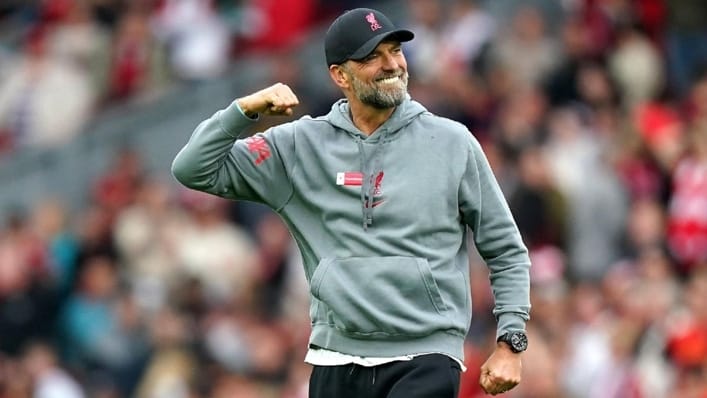
Liverpool manager, Jurgen Klopp is happy that his team has now had a chance to display some of their best performance before the season is out.
An inconsistent campaign has left the Reds with only an outside chance of qualifying for the Champions League and only a run of six successive victories – their best sequence in over a year – has put them in that position.
“We play a really bad season, I think everyone in this room agrees, and now we have 62 points. It is strange,” said Klopp ahead of Monday’s trip to Leicester.
“There is still quality in the boys. I am really happy we could show up a little bit. Where it will end up it’s really not about that.
“I know everyone wants to go to Champions League, I understand that 100 per cent as that’s what I want, it is just not really likely, that is the situation we created.
“But to show up and show again we are able to do special things I am really happy about.
“Winning six games in a row is special and if it was easy we would have done it much more often, other teams would have done it much more often.
“Adding the seventh is even more difficult but eight and nine really difficult because it is football and other teams prepare well for the games and they have their own targets but this part of the season gave us a clear sign we are still there.
“Not everything is bad about us and around us. We had a bad season but let’s see what we can make of it.”
Part of Liverpool’s problem has been their woeful away record, which is only the ninth-best heading into the weekend.
It has been boosted by recent wins at Leeds and West Ham which has given Klopp’s side the opportunity to win a third in a row away from home for the first time this season at Leicester.
“Our away record is still not brilliant. This season I think we are third or fourth (they are second before this weekend) in the home table and ‘somewhere’ in the away table so it is still not great,” added Klopp.
“But we had that discussion years ago, early when I came here, that at home we created something like a fortress but away we were not a top-six or top-four team at that time and we realised it is not that difficult, the difference is not as big as we might think.
“But there is a difference and we have to make sure we are ready for that. We just were not consistent enough, we needed too much help from the outside in moments this season and didn’t use it then always. That’s why we are in the position we are in.”
While the lack of Champions League football will be financially damaging next season Klopp is confident it will not impact his transfer plans.
“It is not about that. When I talk to a player – if I am allowed, which is rarely the case – but you realise in his eye that he has already clarified (the situation),” he said.
“We can’t tell anyone in the moment that we will definitely be in the Champions League next year so if we are talking to him then he already knows.
“It is obvious that we have to fight for being part of the Champions League and trophies and if you want to be part of that you are more than welcome.
“There is only one thing we can’t guarantee this year and that is Champions League football but all the rest is still the same, it is a fantastic football club.
“It is still Liverpool, we are really attractive for a lot of players and we should not forget that and that’s why I’m not concerned about that factor.
“Everything is more difficult without the Champions League, that is how it is especially in the long term, so we should not do these kind of things more often but apart from that it is absolutely OK the situation we are in.”
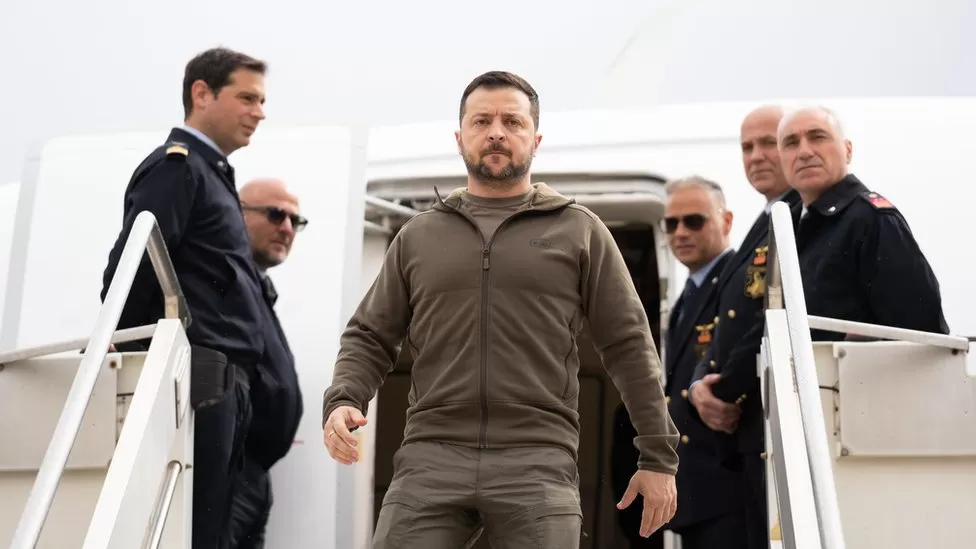
The president of Ukraine, Volodymyr Zelensky, is in Rome for a trip where he will meet with dignitaries and see Pope Francis.
“An important visit for approaching victory of Ukraine!” Zelensky tweeted as he landed in the Italian capital.
He will meet Italian PM Giorgia Meloni, President Sergio Mattarella and travel to the Vatican later on Saturday.
A huge security operation has been launched, with over 1,000 police deployed and a no-fly zone over Rome.
Pope Francis has often said that the Vatican stands ready to act as a mediator in the conflict between Russia and Ukraine.
Earlier this month, he stated that the Vatican was working on a peace plan to end the war, saying that the mission was “not yet public. When it is public, I will talk about it.”
But the relationship between Ukraine and the Vatican has sometimes been uneasy.
Last August, Ukraine’s ambassador to the Vatican took the unusual step of criticising the Pope after the pontiff referred to Darya Dugina, the daughter of a Russian ultra-nationalist figure, who was killed by a car bomb, as an “innocent” victim of war.
Saturday will be the first time President Zelensky and Pope Francis have met since Russia invaded Ukraine. The pair did meet in 2020.
The visit comes after Russia carried out a new wave of air strikes on Kyiv and other Ukrainian cities overnight.
Three people were injured in the southern city of Mykolaiv and in the western city of Khmelnytsky. Critical infrastructure as well as homes and government buildings were also hit.
Explosions were reported on Friday in the Russian-occupied city of Luhansk, about 90km (55.9 miles) behind the front line in eastern Ukraine. Russian-backed separatist forces in the region accused Kyiv of using Storm Shadow missiles, which the UK said it had supplied Ukraine with earlier this week.
There were also more reports of blasts in Luhansk on Saturday.
Meanwhile, Ukrainian forces say they have made progress near the eastern city of Bakhmut.
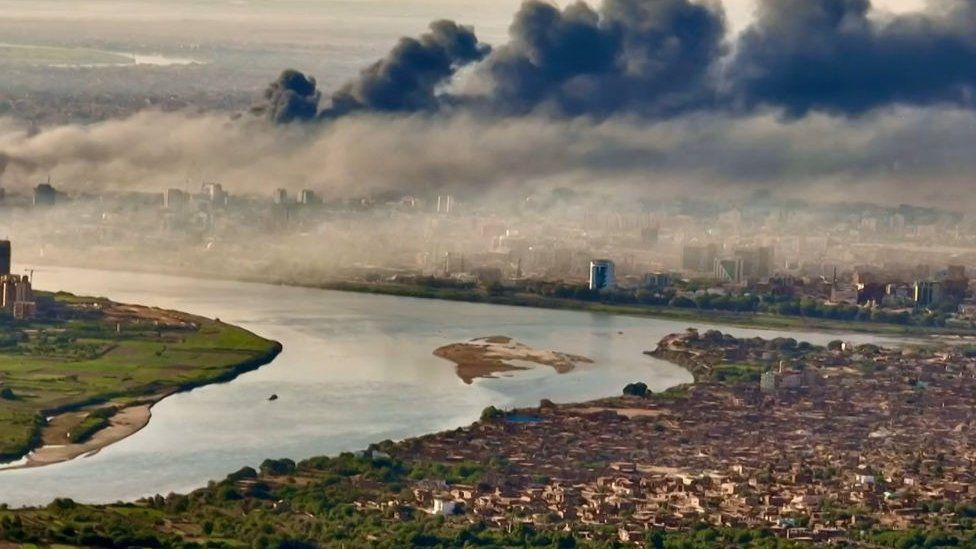
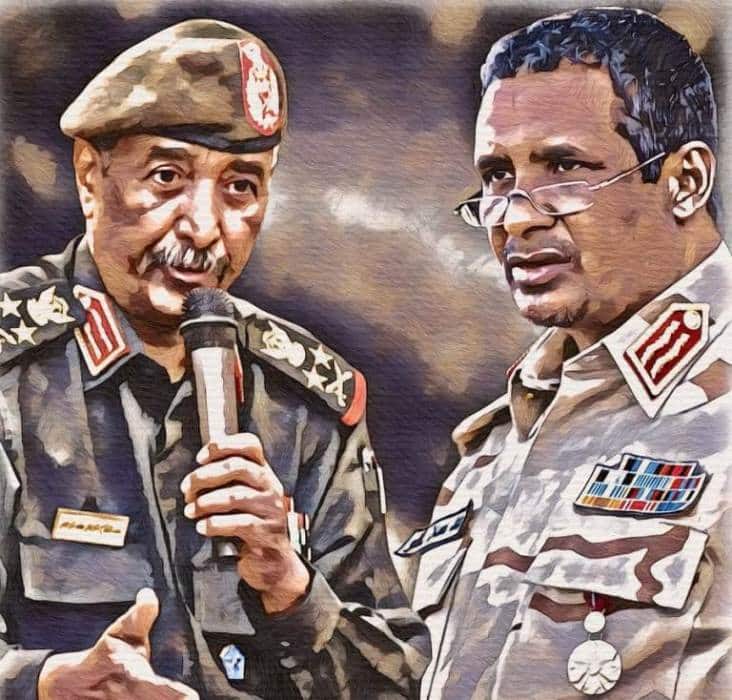
The horrific conflict between Sudan’s two warring generals confined her inside her home in Khartoum, where she passed away all by herself but no one knows how many days the old woman had been deceased.
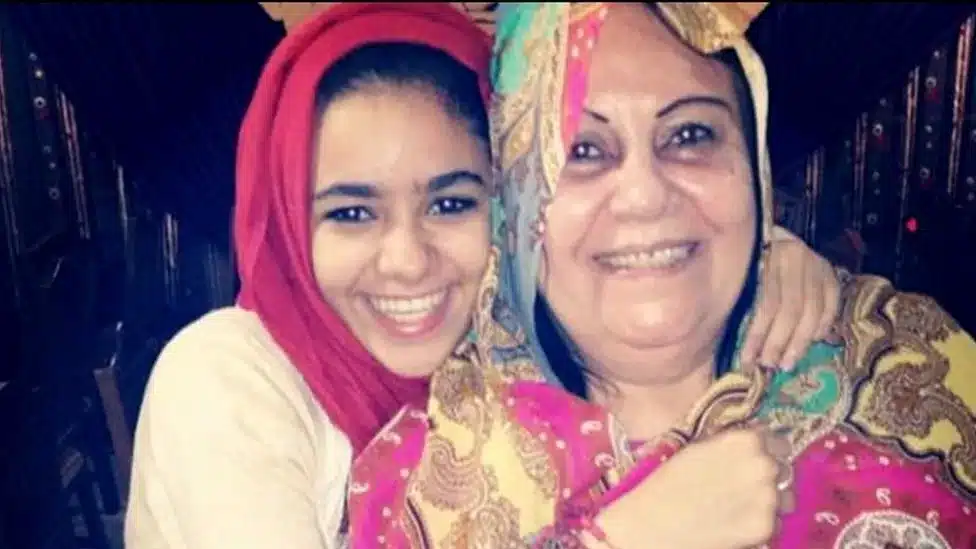
Azhaar had been watching from New York, desperately trying to save her. Now, she is desperately trying to recover her body.
She’s not alone. Intense fighting has made it dangerous to gather the dead in parts of Sudan’s capital.
The humanitarian agreement reached by the two sides in Jeddah on Friday specifically commits to helping aid workers collect, register and bury those killed in the fighting.
“We keep on seeing dead bodies on the street, and hospitals that are out of service,” says Patrick Youssef, the Africa Regional Director for the International Committee of the Red Cross. “I hope the new declaration of humanitarian principles can truly allow for humanitarian corridors.”
So far it hasn’t, because the parties have yet to secure a truce to turn their promises on paper into reality.
Azhaar’s grandparents, Abdalla Sholgami and Alaweya Reshwan, got stuck in the heat of the fighting. They lived in Baladiya street in Khartoum, next to the military headquarters and the British embassy. It became a battlefield for the two warring parties – Sudan’s army, and the paramilitary Rapid Support Forces (RSF).
Image caption,Azhaar’s 85-year-old grandfather Abdalla Sholgami was a British citizen. He was shot three times in Khartoum
Mr Sholgami, a British citizen, was shot three times, leaving his disabled wife alone at home. He somehow survived, and his family are now trying to evacuate him from Sudan.
But there was no word about his wife and Azhaar’s grandmother, Alaweya. Weeks of Azhaar’s frantic phone calls to the British embassy failed to get help.
Her grandparents couldn’t make their way to the airfield for the evacuation of British citizens, so they were left stuck in Khartoum.
Three days ago she got a call from the Turkish embassy, also located next to the house, saying her grandmother was dead.
Azhaar didn’t want to believe it.
“I called back again and said, ‘Maybe she’s in a coma, did you check her pulse? Did you check her body, see if her heart is beating?’ And then he tells me that her body’s been decaying,” she says.
“It’s quite painful to think that she was alone, with no electricity in the midst of the heat – it’s really hot in Sudan right now – waking up to bomb sounds.”
Another woman we spoke to had an uncle, Ahmad, who lived in a nearby neighbourhood. She didn’t want us to reveal her name because she fears she might be targeted, but told us this story.
Ahmad’s family was gathering at the home of a relative so they could evacuate together. He realised he’d forgotten his paperwork, so he returned to his home in the Riyadh neighbourhood and never came back.
Image caption,Khartoum remains gripped by violence
Six days later his brother got a call from someone trying to identify a body lying in front of Ahmad’s house.
The person said Ahmad had found RSF fighters in his home. The situation escalated, they killed him, looted the place, and left.
Neighbours wrapped Ahmad in plastic bags until aid workers were able to arrive. They wanted to bury him right there because there’s no garden, but the family refused to have him laid to rest virtually in the street. So his body still lies there, encased in the plastic.
Azhaar is still trying to arrange for someone to pick up her grandmother’s remains. An organisation that tried on the day the Jeddah Declaration was announced had to turn back because they got caught in a gunfight.
“I was very close to my grandmother,” she says. “And in our last conversation before I left for New York she said, I’m scared you’re going to leave me alone.”
“I laughed at her. I said, I’ll never leave you alone, no matter what, I’ll always be there… I feel I let her down.”
A cyclone that could be very dangerous is forcing about 500,000 people to flee to safer locations in south-east Bangladesh.
Cyclone Mocha is predicted to make landfall on Sunday, with 170kph winds and storm surges of up to 12 feet.
There are concerns the cyclone could impact the world’s largest refugee camp, Cox’s Bazar, where close to a million people live in makeshift homes.
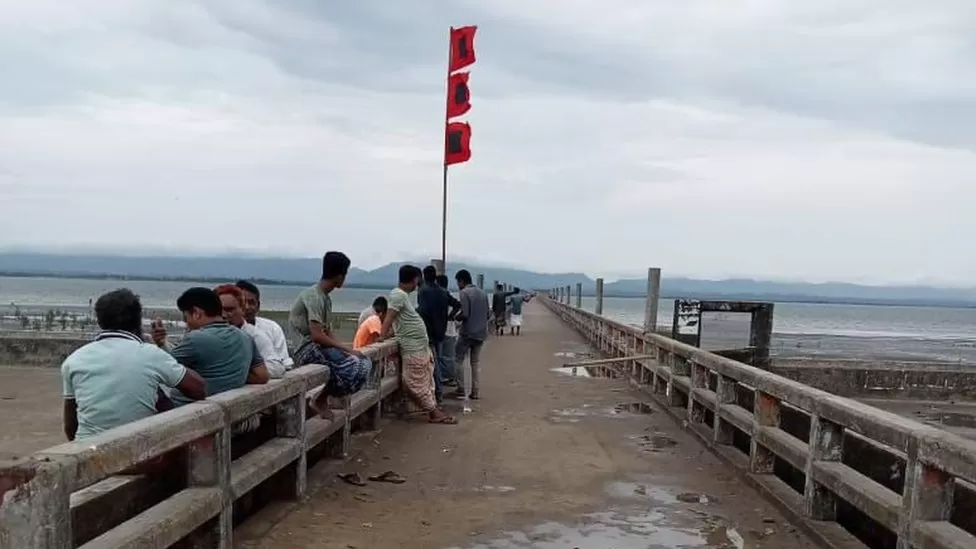
Rains are already falling on the camp and red warning flags have been raised.
Cyclone Mocha could be the most powerful cyclone seen in Bangladesh in nearly two decades.
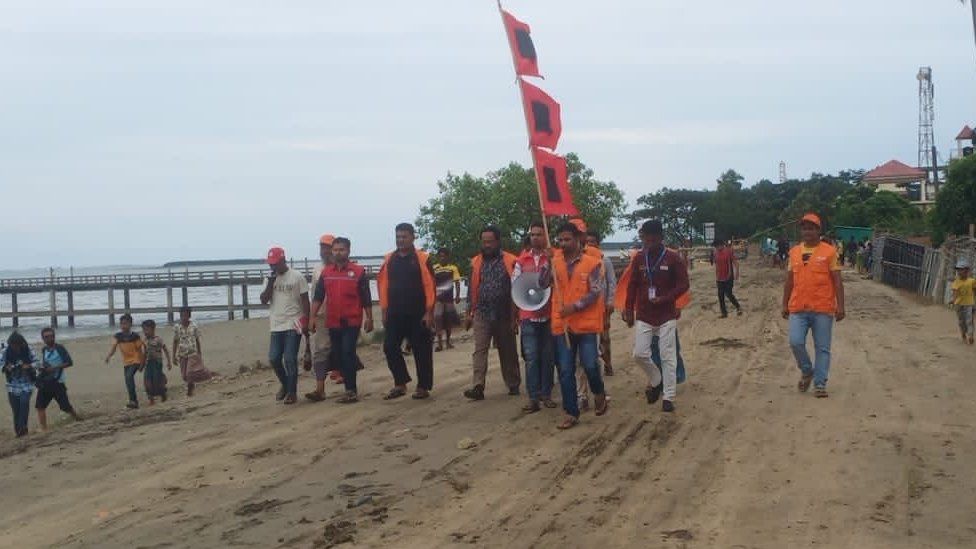
As the weather system heads towards the Bangladesh-Myanmar coast, nearby airports have been shut, fishermen have been told to suspend their work, and 1,500 shelters have been set up, as the process of moving people from vulnerable areas begins.
Officials in Cox’s Bazar said 1,000 people had already been evacuated from one area, with plans to move a further 8,000 people from a ward near the beach if the situation worsens.
“We are ready to face any hazards… we don’t want to lose a single life,” Vibhushan Kanti Das, additional deputy commissioner at Cox’s Bazar told the BBC.
Tourists staying in beach side hotels will be safe, so emergency workers will move locals like fishermen and families who live in more vulnerable homes, the official said.
Image caption,Officials with megaphones have been out warning people of the need to shelter or evacuate
Close to a million Rohingya refugees who have fled neighbouring Myanmar remain at risk, living in flimsy bamboo shelters with tarpaulin covers. The UN says it’s doing what it can to protect these areas.
Bangladesh’s government doesn’t allow refugees to leave their camps, so many say they’re frightened and unsure of what will happen if their shelters are hit by the storm.
Forecasters expect the cyclone to bring a deluge of rain, which can trigger landslides – a serious danger for those who reside in hillside camps, where landslips are a regular phenomenon.
MD Shamsul Douza, from the Bangladeshi government office which oversees the refugees and the camps, told the BBC that they were working with NGOs to ensure the camps were as prepared as possible for the cyclone.
But he said moving refugees out of the camps was not an easy task.
“Moving a million refugees is very difficult, the implementation of the movement is difficult. We have to be practical,” the official said.
“Our plan is to save lives. We are also focused on the days after. There may be heavy rains leading to flash floods and landslides, which would also pose a risk.”
In Myanmar- the rain started on Friday night in Sittwe City, the capital of Rakhine state. The streets emptied out as people took shelter, with many seeking to find safety in cyclone shelters on high ground.
There are almost no lifejackets to be found, and the remaining stock is being sold at a higher price. Gas stations also closed on Saturday, making it difficult for people to drive out of the city.
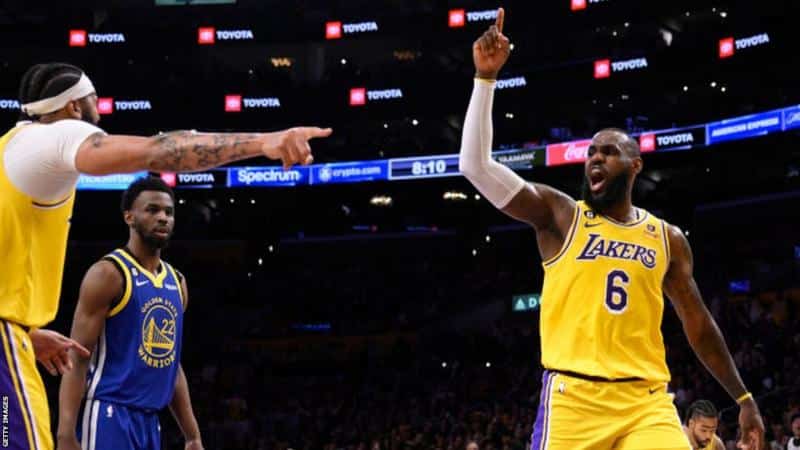
The Golden State Warriors were defeated by an energized LeBron James, who also advanced the Los Angeles Lakers to the Western Conference finals.
The 38-year-old scored 30 points as the Lakers won 122-101 in Los Angeles to clinch the best-of-seven series 4-2.
The Lakers, who finished seventh in the regular season, will play top seeds the Denver Nuggets in the series to decide who plays in the NBA Finals.
The Miami Heat beat the New York Knicks to reach the Eastern Conference finals.
Jimmy Buttler scored 24 points and eight rebounds as the Heat won 96-92 in Florida to take the series 4-2 and become the first eighth seed in 24 years to reach the Conference finals.
They will play the Boston Celtics or the Philadelphia 76ers, who are tied at 3-3 and play their decisive seventh game on Sunday.
Lakers extend season that started slowly
The Lakers made their worst start to a regular season for 65 years but remain in contention for a 20th Conference title and 18th championship win after closing out a big win over a Golden State Warriors side that has won four of the past eight NBA titles.
They were undone by James’ masterful performance in California, with the NBA’s leading all-time points scorer and four-time NBA champion making nine assists and nine rebounds to go with his 30 points.
Anthony Davis, playing despite a head injury from game five, chalked up 17 points and 20 rebounds, as the Lakers romped to victory.
After the game James embraced Warriors star Stephen Curry, who scored 32 points in defeat.
“Not many of our team have been in close-out games,” James said.
“So after game five up [a 121-106 defeat on Wednesday], I knew I had to come in with a lot of aggression but be efficient and strategic in how I played this game.”
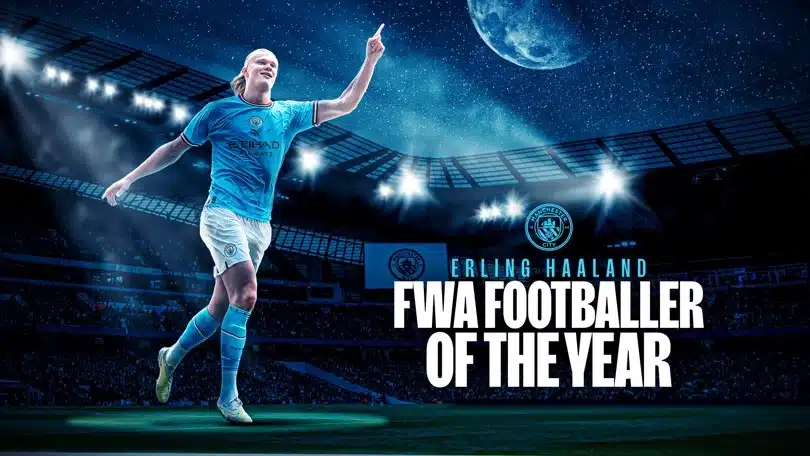
Footballer of the Year for 2023 has been awarded to Erling Haaland by the Football Writers’ Association following his outstanding, record-breaking debut season with Manchester City.
The City centre forward overwhelmingly topped the prestigious poll of more than 800 FWA Members, garnering more than 80 per cent of all the votes cast, in the wake of what has been a sensational maiden campaign at the Etihad.
Haaland follows in the illustrious footsteps of Club colleague Ruben Dias who won the coveted prize in 2021 and former City star Raheem Sterling who took the award in 2019.
The Norwegian international also becomes only the fourth player to receive the FWA award in their first season playing in England, following Dias (2021), Gianfranco Zola (1997) and Jurgen Klinsmann (1995).
And, in gratefully accepting the award, Erling was typically quick to highlight and praise the major role played by his team-mates along with Pep and his coaching staff in helping him so seamlessly adapt to life at City.
“To win the Football Writers’ Award in my first season in English football is an honour,” Haaland said. “I try every single day to be the best I can be, and to be recognised like this means a lot to me.
“I have loved my time at City so far – my teammates are incredible, and they provide me with the chances to score goals. I want to thank all of them, because I could not have won this award without them.
“I also owe so much to Pep and the team behind the team here at City. Everybody has been so good to me since I joined and I have never worked with such top professionals.
“Thank you to everyone who voted for me. It’s a real honour to have won this award. I am now focused on ensuring I finish the season as strongly as possible and helping City win trophies.”
It’s impossible to overstate the seismic impact made by Haaland since joining City from Borussia Dortmund last summer.
Haaland has emerged as one of the central focal points of a supremely talented City squad that is seeking to claim a third successive Premier League title, is through to a historic all-Manchester FA Cup final and set to lock horns with Real Madrid in next Wednesday’s UEFA Champions League semi-final second leg.
Along the way, Haaland has cemented a special rapport with the Etihad fans while establishing a host of quite extraordinary goal-scoring records that have seen him constantly rewrite the history books.
To date, Erling has plundered a haul of 35 goals from 34 league appearances seeing him break the long-standing record of 34 previously held by Alan Shearer and Andrew Cole for most goals scored in a single Premier League campaign.
With 51 goals overall, Haaland has also broken the record for most strikes in one season in all competitions by a Premier League player, surpassing Mo Salah in 2017/18 and Ruud van Nistelrooy in 2002/03 who both claimed 44.
Earlier on this season, Haaland also became City’s all-time top scorer in a single season, breaking the long-standing record of 38 goals established by Tommy Johnson way back in the 1928-29 campaign.
Haaland also became both the quickest and youngest player to reach 30 career goals in the UEFA Champions League in the course of our last-16 second leg 7-0 win against RB Leipzig where he plundered five goals – registering what was his sixth hat-trick of the campaign.
A commanding, athletic figure on the pitch, armed with supreme skill, prodigious strength and superb vision to boot, Haaland has also epitomised the collective hunger and desire that has characterised Pep Guardiola’s squad in what is shaping up to be another quite extraordinary campaign.
Erdogan, the all-powerful president of Turkey, is engaged in the battle of his life with a unified opposition ahead of elections on Sunday.
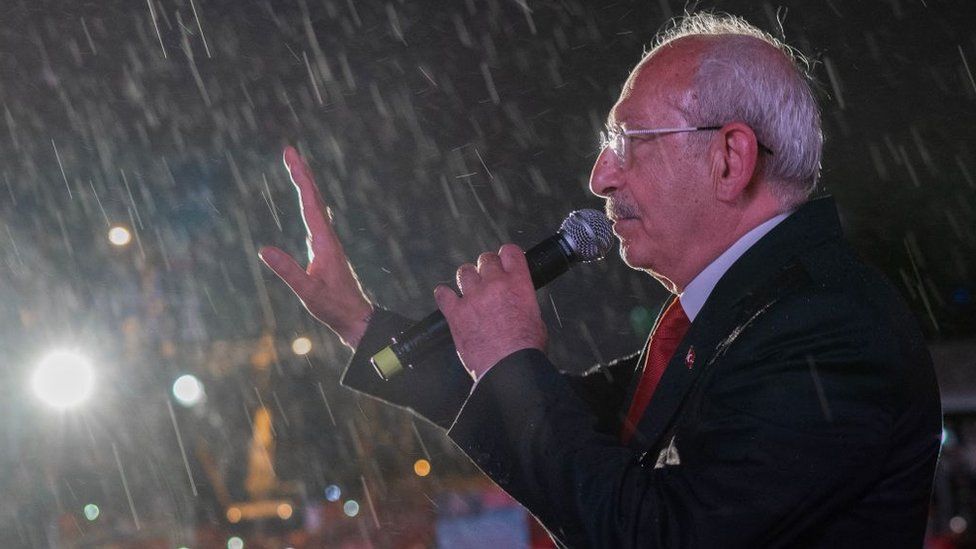
His main rival Kemal Kilicdaroglu appeared before a throng of supporters on Friday, flanked by allies from across the political spectrum who have come together as never before.
As the rain beat down in Ankara, he vowed to restore “peace and democracy”.
The man he wants voters to oust after 20 years – Recep Tayyip Erdogan – said he had kept Turkey standing tall despite many challenges, including the economy with its rampant inflation and February’s catastrophic double earthquakes.
Both issues have dominated this febrile campaign for both the presidency and parliament.
At 74, the opposition leader is often described as soft-spoken, but he gave a powerful speech to an audience that believes this is their best hope so far of reclaiming power from a president who has dramatically increased his own at the expense of parliament.
Image caption,Kemal Kilicdaroglu told supporters in the pouring rain he was ready to become president
Mr Kilicdaroglu is slightly ahead in the opinion polls and his supporters have dared to dream he might win outright on Sunday, with more than 50% of the vote, rather than face a run-off two weeks later.
Firat, one of five million first-time voters, said he was delighted at conservatives and nationalists appearing on the same platform as the head of the centre-left Republican People’s Party (CHP).
Here was nationalist Meral Aksener, the only female leader in the six-strong alliance, and there was Temel Karamollaoglu, who fronts the pro-Islamist Felicity party.
Mr Kilicdaroglu’s party is secular to the core, but he has worked hard to reach out to women who wear the headscarf. The six parties have rallied under the slogan Haydi (Come on!) and a campaign song of the same name.
Image caption,Firat (R), with his sister and mother at the opposition rally, praised the opposition’s unity
Tensions are running so high ahead of the vote that he wore a bullet-proof vest on stage in Ankara for his final rally and at another event earlier on.
The race has become as tense as it is pivotal. One of the four candidates for the presidency, Muharrem Ince, pulled out on Thursday, complaining that he had been targeted on social media with deepfake sex videos that had “manipulated the electorate”.
When the main opposition challenger blamed Russia, the Kremlin denied having anything to do with the videos or seeking to interfere in the vote.
Mr Erdogan, who has maintained ties with Vladimir Putin, warned his rival: “If you attack Putin, I will not be ok with that.”
The president was addressing party loyalists in Istanbul, but the night before he was just outside the capital in a city of half a million people that seemed in full support of his AK Party.
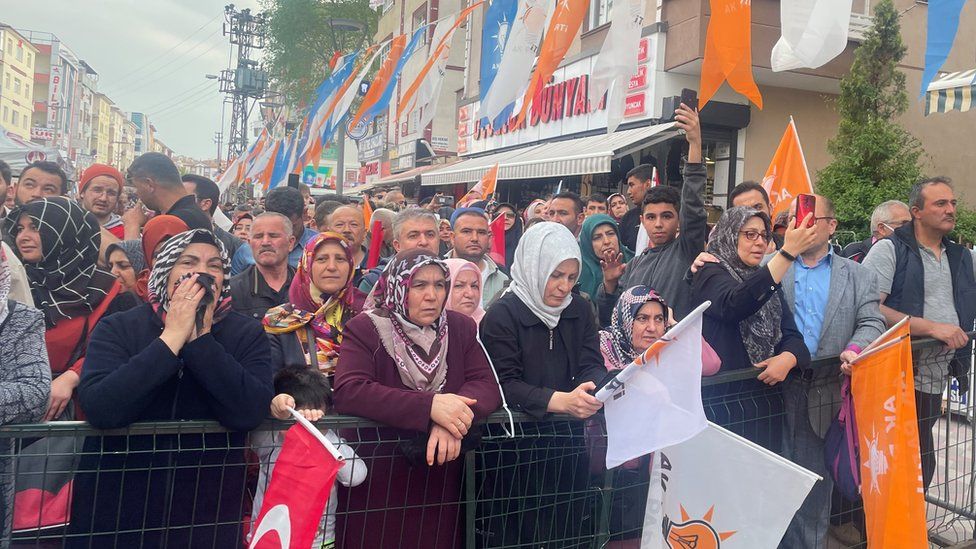
Orange, blue and white party AKP flags fluttered throughout the centre of Sincan, as locals filled the streets in the hope of catching a glimpse of Mr Erdogan.
Image caption,Streets around the Erdogan rally in Sincan were filled with supporters
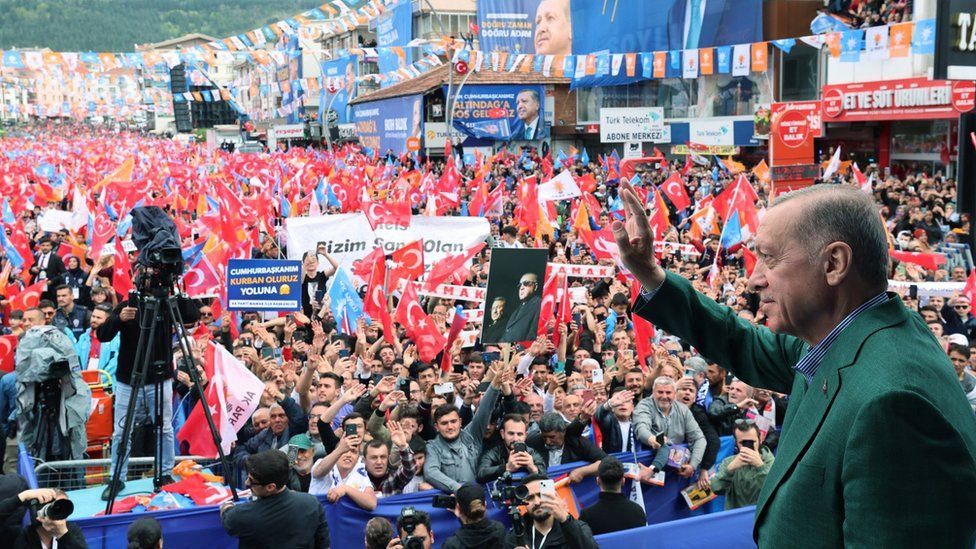
Supporters chanted party songs as they waited for the president to show on stage in a green jacket. One chorus rang out repeatedly Re-cep Tay-yip Er-do-gaaaan.
“We built schools, universities and hospitals… we changed the face of our cities. We extracted our own natural gas and oil,” Erdogan told thousands of cheering supporters.
His strategy, first as prime minister but then as president, has been to build growth, often through big-ticket construction projects that are visible in many of the big cities, but not so obvious in Sincan.
Image caption,President Erdogan was greeted by a mass of adoring supporters in Sincan
Although his party still commands strong support, he relies on the backing of the nationalist MHP and other smaller groups in his People’s Alliance.
His greatest support comes mainly from conservative or nationalist Turks, and he has aimed his rhetoric not just at the West, which he accuses of going against him, but at the LGBT community too.
“The AK Party does not allow LGBT people into its neighbourhood, and the MHP does not allow them into the People’s Alliance, because we believe in the sanctity of a family.”
These political alliances have become essential under Turkey’s political system as a party needs 7% of the national vote to get into parliament, or be part of an alliance that does.
Whoever wins the presidency will need to have sufficient support in parliament to back their plans.
On the campaign trail in Ankara, centre-left candidate Aysun Palali Koktas said that while the economy and the aftermath of the earthquake were the top two issues of the election, the future of Turkey’s democracy and people’s rights were just as important.
“When we tweet, we don’t want to be frightened, and that’s the case especially for young people,” she said.
But, AK Party candidate Zehranur Aydemir, 25, believes young voters are very well treated by the government. “You can see young people at every level in our party.”
More than 64 million people are expected vote at home and abroad on Sunday.
To win outright a candidate will have to secure more than half the vote.
If no candidate gets at least 50% plus one vote in the first round, the presidential election will go to a second round on 28 May between the two who received the most votes.
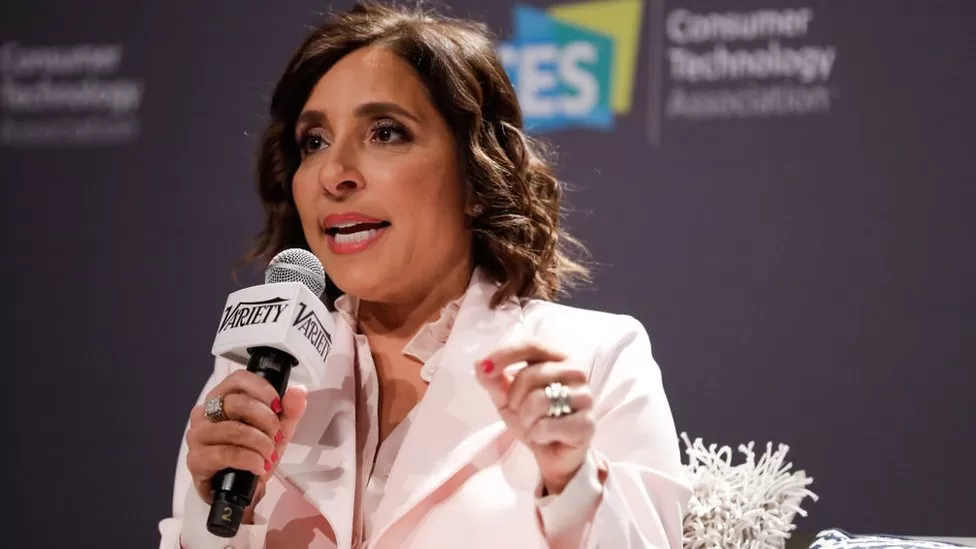
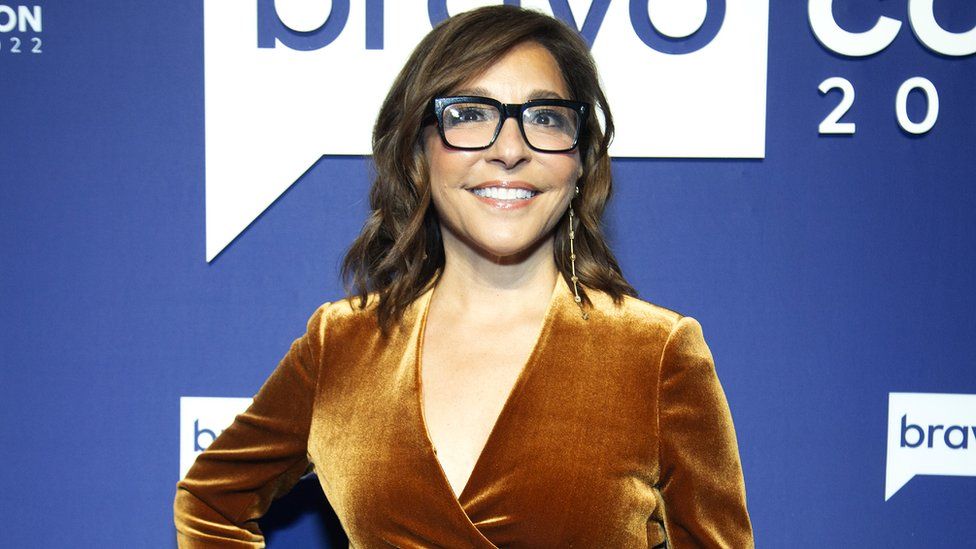
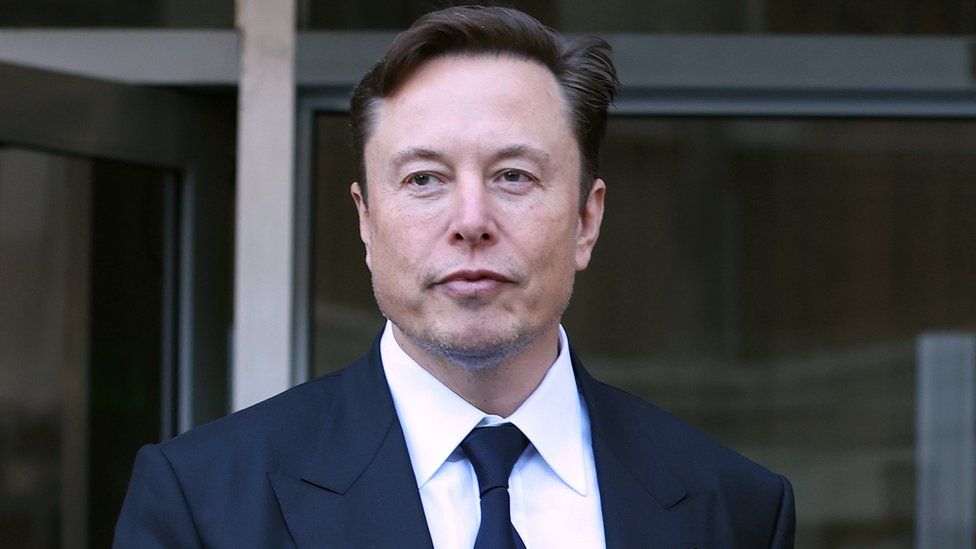
Exactly six months after his contentious takeover of the social media business, Elon Musk has selected a new CEO of Twitter.
The billionaire said Linda Yaccarino, the former head of advertising at NBCUniversal, would oversee business operations at the site, which has been struggling to make money.
He said she would start in six weeks.
Mr Musk will remain involved as executive chairman and chief technology officer.
“Looking forward to working with Linda to transform this platform into X, the everything app,” he wrote on Twitter, confirming the decision a day after he had stoked speculation by writing that he had found a new boss without revealing their identity.
Mr Musk – who bought the social media platform last year for $44bn – had been under pressure to find someone else to lead the company and refocus his attention on his other businesses, which include electric carmaker Tesla and rocket firm SpaceX.
With fewer than 10% of Fortune 500 tech companies headed by women, Ms Yaccarino will become that rare example of a woman at the top of a major tech firm, after rising steadily through the ranks of some of America’s biggest media companies.
Ms Yaccarino was raised in an Italian-American family, with a father who was a police officer and a mother who never went to college.
After graduating from Penn State, she worked at Turner Entertainment for 15 years before joining NBCUniversal, where she oversaw roughly 2,000 people, and was involved with the launch of its streaming service.
Her work has been marked by close collaborations with big brands, finding opportunities for product placement and convincing them to advertise alongside television shows – even ones with a reputation for edgy content, such as Sex and the City when it first launched.
She has also built relationships in new media with the likes of Apple News, Snapchat and YouTube.
A 2005 profile in an industry publication portrayed her as a busy, married mother-of-two children, then aged 13 and 9.
“I have absolutely no hobbies,” she said at the time.
Business Insider’s Claire Atkinson has followed Ms Yaccarino’s career for two decades and said her background in advertising could help Twitter, which has seen its ad sales drop sharply since Mr Musk’s takeover.
“If Twitter are looking to monetise better than they have been, then that would be the place to start and Linda would be the ideal person to make that happen,” the chief media correspondent said.
“She’s the kind of person that I can imagine Elon Musk needs,” Ms Atkinson added. “She won’t be rolled over.”
Indeed, her negotiating style within the industry earned her the nickname the “velvet hammer”, according to the Wall Street Journal in 2012.
Ms Yaccarino will face the challenge of running a business that has struggled to be profitable, while facing intense scrutiny over how Twitter handles the spread of misinformation and manages hate speech.
When Mr Musk first started discussing his plans for Twitter last year, he said he wanted to reduce the platform’s reliance on advertising and make changes to the way it moderated content.
He also said he wanted to expand the site’s functions to include payments, encrypted messaging and phone calls, turning it into something he called X.
But Mr Musk courted controversy when he fired thousands of staff upon his takeover, including people who had been tasked with dealing with abusive posts.
He also overhauled the way the service authenticates accounts, charging for blue ticks in a move critics said would facilitate the spread of misinformation.
Some of the changes raised concerns among advertisers, worried about risks to their brands, who subsequently halted spending on the site.
Mr Musk has acknowledged “massive” declines in revenue, though he told the BBC last month that companies were returning.
At an advertising conference last month Ms Yaccarino interviewed Mr Musk and pressed him on what he was doing to reassure firms that their brands would not be exposed to risk.
“The people in this room are your accelerated path to profitability,” she said. “But there’s a decent bit of sceptics in the room.”
There has also been some instant scepticism at Ms Yaccarino’s appointment on social media, where many were looking for clues to her politics, which reportedly lean conservative.
Her work for the World Economic Forum, an organisation viewed negatively as “globalist” by those on the right, has not been well-received in some quarters along with her role in a coronavirus vaccination campaign featuring Pope Francis.
Others on the left have questioned her political involvement in a White House sports, fitness and nutrition council under former President Donald Trump.
Mr Musk, who has also put women in senior positions at SpaceX and Tesla, is known to be a notoriously unpredictable and demanding boss.
Even the announcement unfolded in an unusual manner, after media reports sparked by Mr Musk’s post that identified Ms Yaccarino appeared to catch her bosses at NBCUniversal off guard.
As of mid-Friday in the US, Ms Yaccarino had still not commented publicly on the move.
Industry watchers will be curious to see how the relationship develops between the New Yorker and the until now hands-on Mr Musk.
Ms Atkinson said the two Twitter executives would be facing “difficult conversations” about how to handle moderation, especially with the 2024 presidential election approaching in the US.
“How long Linda can last under these tricky management situations is anyone’s guess,” Ms Atkinson said.
The manager of Everton,Sean Dyche, asserted that his team has regained its “edge” at the perfect time.
A surprise 5-1 win at Brighton on Monday has raised hopes of escaping relegation and he knows that ability to find something extra will be crucial as they host Premier League leaders and treble-chasers Manchester City.
Dyche took over a side at the end of January that had lost eight of nine matches but after the initial bounce a new manager occasionally brings, beating Arsenal and Leeds in his first three games, results tailed off again.
The team had registered just one win in 11 before victory over the Seagulls but Dyche thinks that result – after encouraging signs in their previous outing in a 2-2 draw at Leicester – shows that much sought-after X-factor is returning.
“I looked at some of the performances, the body language, intent and meaning behind the performance and in some way, I thought some things were lacking,” he said.
“We’ve adjusted that side of it, the purposefulness of the side, some of the quality moments, some of the defensive side but the actual feel of the performance and mentality of the performance has grown.
“Watching the intent, body language and desire of a team, it’s hard to explain, but I know it when I see it, I’ve been in the game all my life.
“You get stats – our team and their team – and it can look like there’s nothing in it, but there’s a big difference in body language intent and desire from those stats.
“Compared to some of the performances since I got here, that kind of edge has improved.”
Everton’s win over Brighton was a huge morale boost but facing City, even at Goodison Park, is a daunting task for a side who probably require at least one more win from their remaining three games to extend their top-flight status into a 70th successive season.
And while time is running out to save themselves, as they did on the penultimate game of last season, Dyche is keen to change the view on the significance which has been placed on coming good when it is needed at the end of a campaign.
“The thing I’m trying to get to here is that every single game should matter. Every single game should be the most important one. We are trying to build that momentum,” he added.
“I’ve never believed in ‘the business end of the season’. The first game should be the business end of the season because that might be the one that wins you a title, gets you promoted or keeps you in a division.
“If you take big games along the way then fantastic – it’s great for you, great for the team, great for the prowess of the club and the badge, great for everything.
“But that should be the mentality on day one, not just because you’re playing Man City and it’s near the end of a season.
“We are trying to adjust that, it is a longer-term thing, but that is my belief. Of course it is a fantastic occasion to take on one of the biggest teams in terms of winning trophies, but that doesn’t make it easier.”
Elon Musk claims to have hired a new CEO to lead Twitter.
On the social media site, which he had just purchased for $44 billion (£35 billion), he made the announcement.
Mr Musk did not name the site’s new boss but said “she” would start in six weeks, and he would become executive chairman and chief technology officer.
Reports said the incoming leader would be Linda Yaccarino, head of advertising sales at media giant NBCUniversal, which later confirmed her departure.
Mr Musk has been under pressure to name someone else to lead the company and focus on his other businesses.
Last year, after Twitter users voted for him to step down in an online poll, he said: “No one wants the job who can actually keep Twitter alive.”
However, although Mr Musk had said he would hand over the reins, it was by no means clear when or even if it would happen.
Skip twitter post by Elon Musk
Allow Twitter content?
This article contains content provided by Twitter. We ask for your permission before anything is loaded, as they may be using cookies and other technologies. You may want to read Twitter’s cookie policy, external and privacy policy, external before accepting. To view this content choose ‘accept and continue’.Accept and continue
The BBC is not responsible for the content of external sites.
End of twitter post by Elon Musk
Tesla shares rose after the announcement. Mr Musk has previously been accused by shareholders of abandoning Tesla after his takeover of Twitter and damaging the car company’s brand.
“We ultimately view this as a major step forward with Musk finally reading the room that has been around this Twitter nightmare,” said Dan Ives from investment firm Wedbush Securities.
“Trying to balance Twitter, Tesla and SpaceX as CEOs [is] an impossible task that needed to change.”
According to the Wall Street Journal and Variety, NBCUniversal’s Ms Yaccarino was in talks to become Twitter’s chief executive. The speculation surrounding Ms Yaccarino intensified on Friday when NBCUniversal announced she had left the firm.
Twitter did not comment on the reports.
It is sometimes difficult to know when the billionaire and owner of Twitter is being serious.
Last month, when the BBC asked Mr Musk who was going to succeed him as chief executive of the social media company, he said he had made a dog Twitter’s leader.
Watch: Elon Musk says his ‘dog is the CEO of Twitter’
But if Mr Musk has indeed appointed a female executive, it would make her one of the few women to reach the top of a major technology company.
Women accounted for fewer than 10% of chief executives of tech firms included in America’s 500 biggest companies last year.
Although Mr Musk has talked about paid subscribers to Twitter Blue, it is advertising that brings in the vast majority of revenue at Twitter.
The new boss will no doubt seek to improve relationships with advertisers, and smooth their fears over content moderation.
Mr Musk, a self-proclaimed free speech absolutist, has said he took over Twitter to protect free speech. However, advertisers do not want their content next to misinformation or extremist content.
He purchased Twitter in October only after a lawsuit forced him to go through with the deal. Upon taking charge, Mr Musk controversially fired thousands of staff in a bid to cut costs at the firm, which has struggled to be profitable.
In March, Mr Musk said those efforts had paid off and the platform’s finances were improving.
And last month he told the BBC that most of the advertisers that had abandoned Twitter immediately after the acquisition had returned.
The US ambassador to South Africa has “unreservedly apologized,” according to South Africa’s foreign ministry, for saying that the nation sold weapons to Russia.
On Thursday Reuben Brigety alleged a Russian ship was loaded with ammunition and weapons in Cape Town last December.
South Africa says it has no record of an arms sale and President Cyril Ramaphosa has ordered an inquiry.
On Friday the White House national security spokesman would not be drawn on details of the allegations.
But John Kirby said it was a “serious issue” and the US had consistently urged countries not to provide support for Russia’s war in Ukraine.
Writing on social media after meeting the foreign ministry, Mr Brigety said he was “grateful for the opportunity to… correct any misimpressions left by my public remarks”.
He said in the conversation he “re-affirmed the strong partnership between our two countries and the important agenda our presidents have given us”.
Meanwhile a South African cabinet minister hit out at such “megaphone diplomacy”, saying South Africa could not be “bullied by the US”.
“It is the US which has sanctions against Russia… they must not drag us into their issues with Russia,” Khumbudzo Ntshavheni, a minister in the presidency, told public broadcaster SABC.
Her bullish comments followed a Kremlin statement saying President Vladmir Putin had spoken to his South African counterpart by phone and the two had agreed to deepen “mutually beneficial ties”.
There is no dispute that a Russian ship, known as Lady R, docked at a naval base near Cape Town last December – prompting questions from local politicians at the time. Whether the ship was supplied with arms before returning to Russia still needs to be established.
If the accusations are true, South Africa will have violated its own Arms Control Act, which commits to “not trade in conventional arms with states engaged in repression, aggression or terrorism”.
In the same act, South Africa describes itself as a “responsible member of the international community”.
South Africa is one of a handful of countries that has abstained from a number of UN votes on the conflict and has refused to publicly condemn Russia, insisting it is non-aligned on the matter.
For months the regional superpower has been saying it instead supports a mediated settlement to the conflict.
Supplying arms while claiming to be neutral would not only rubbish that stance but would leave South Africa with a lot to answer both to its citizens and the international community.
Some in the governing African National Congress (ANC) appear to have a lingering affection for Russia because of the then-USSR’s support for their fight against white-minority rule. But in present-day South Africa, many have been asking questions about whether this love affair truly serves South Africa’s interests.
Experts say the country has more in common and a much bigger trade relationship with the West. Some are worried about a possible economic impact if ties with the US strain further.
The country’s currency, the rand, which has been struggling for weeks as a result of months of rolling power cuts, weakened even further following the US ambassador’s accusations.
It is an additional problem that South African citizens can scarcely afford.
The investigation into claims that South Africa sent weapons to Russia during the continuing conflict with Ukraine has been welcomed by the country’s defense ministry, according to President Cyril Ramaphosa.
“The inquiry will offer the department an opportunity to ventilate its side of the story with concrete evidence,” a spokesperson from the department said.
This comes as South Africa’s Head of Diplomacy, Clayson Monyela, said the country’s foreign minister will speak to her US counterpart, Anthony Blinken later on Friday.
On Thursday, the US ambassador to South Africa, Reuben Brigety, claimed that a Russian ship was loaded with ammunition and arms in Cape Town last December.
President Ramaphosa’s office said it was disappointed by the claims and said no evidence had been provided to support them.
The country has maintained claims of neutrality over Russia’s invasion of Ukraine.
An assistant inspector general of police, Garba Umar, has been appointed by Nigerian President Muhammadu Buhari as a top security advisor on counterterrorism.
Mr Umar is the vice-president of the International Criminal Police Organisation (Interpol) for Africa and also the head of the agency’s national central bureau (NCB) in Nigeria.
He was elected as a member of the executive committee of Interpol in 2021 and his tenure is ending next year, local media said.
In a statement on Thursday, Garba Shehu, the presidential spokesperson said President Buhari took note of Mr Umar’s service at Interpol and hoped he would assist Nigeria in counter-terrorism efforts.
The president also hoped that Mr Umar’s appointment would “get more Nigerians into important positions in the Interpol”.
The appointment takes effect next week and Mr Umar’s role is stationed in the office of the minister of police affairs, according to Mr Shehu.
Mr Buhari is expected to hand over power to President-elect Bola Tinubu on 29 May.
In an effort to lower the price of food amid a new cost-of-living crisis, Zimbabwe has eliminatedtaxesand the requirement for import licenses for basic food items.
The measures followed the setting up of a government taskforce to investigate spiralling food prices.
According to the Famine Early Warning Systems Network (Fews Net), a global network of partners reporting on food insecurity, bread, sugar, and wheat flour prices increased by about 40% in Zimbabwe between February and April.
It said maize meal prices shot up by nearly 60% and rice and vegetable oil prices increased by about 20%.
Using the official exchange rate, the Zimbabwe dollar has dropped 32% in value against the US dollar since the beginning of April, however on the black market it’s fallen by almost double that.
The government blames businesses for using the black market rate to price their goods.
In the midst of a diplomatic dispute over allegations of arm sales to Russia, South Africa is attempting to mend fences with the US.
US ambassador Reuben Brigety has claimed a Russian ship was loaded with ammunition and weapons in Cape Town last December.
The allegation created a diplomatic storm and South Africa has said it has no record of an approved arms sale.
But the government also said it valued a “cordial, strong, and mutually beneficial” relationship with the US.
An inquiry looking into the claims has been set up, President Cyril Ramaphosa confirmed on Thursday.
South African authorities have expressed disappointment over what one official describes as “megaphone” politics by the US ambassador, referring to Mr Brigety’s news conference on Thursday where he made the scathing accusations.
The BBC understands that behind the scenes the government is more than disappointed – they have been angered by what some see as the US trying to strong-arm South Africa into aligning with it over Russia’s invasion of Ukraine “by any means necessary”.
Officially, the department of international relations has said Foreign Minister Naledi Pandor will be speaking to her US counterpart Antony Blinken on Friday afternoon.
They’ve also said they will be officially issuing a complaint against Mr Brigety through diplomatic channels – a reprimand of sorts.
While the US has provided no evidence of the accusations yet, South Africa’s presidency on Thursday said it would set-up an enquiry which would be chaired by a retired judge to investigate the alleged incident.
The presidency told the BBC that the terms of that inquiry, as well as when it would begin its investigation, would be communicated in due course.
There is no dispute that a Russian ship, known as Lady R, docked off the Cape Town coast last December – prompting questions from local politicians at the time. Whether the ship was supplied with arms before returning to Russia still needs to be established.
But it’s about more than a diplomatic row between old trade partners.
If the accusations are true, South Africa will have violated its own Arms Control Act, which commits to “not trade in conventional arms with states engaged in repression, aggression or terrorism”.
In the same act, South Africa describes itself as a “responsible member of the international community”.
The government said on Friday that they had no record of arms being sold to Russia – and that if this happened – it was done covertly.
Even this possibility does not bode well for South Africa, at best it would speak to a government that does not have a handle of the country’s affairs and at worst, would suggest something far more sinister – complicity in Russia’s aggression against Ukraine.
South Africa is one of a handful of countries that has abstained from a number of UN votes on the conflict and has refused to publicly condemn Russia, insisting it is non-aligned on the matter.
For months the regional super-power has been saying it instead supports a mediated settlement to the conflict.
Supplying arms while claiming to be neutral would not only rubbish that stance but will leave South Africa with a lot to answer both to its citizens and the international community.
Russia seems to stir feelings of nostalgia for some in the governing African National Congress, for the then USSR’s support for their fight against apartheid. But in present day South Africa, many have been asking questions about whether this love affair truly serves South Africa’s interests.
International relations experts have pointed out that South Africa has more in common with some in the West, including the US, on matters of democracy and international law, and a far greater trade relationship with the West than with Russia.
They’ve said it’s a relationship that may have been useful at a time in history for ANC activists, but in a world where Russia is increasingly being viewed as an aggressor and human rights violator following its invasion of Ukraine – are these really the friends South Africa needs?
Some are worried about possible economic implications for South Africa, if relations with the US strain further.
The country’s currency, the rand, which has been struggling for weeks as a result of months of rolling power cuts leaving homes and industries in the dark for up to 12 hours at times, crippling the economy, weakened even further following the US ambassador’s accusations.
It’s an additional problem that South African citizens can scarcely afford.
One of Kenya’s oldest lions has died at age 19 according to reports.
The male lion, named Loonkiito, was speared by local herders in Olkelunyiet village on Wednesday night after preying on livestock. The village borders Amboseli National Park – on the outskirts of the capital, Nairobi.
Kenya Wildlife Service (KWS) spokesperson Paul Jinaro told the BBC that the lion was old and frail and wandered into the village from the park in search of food.
Mr Jinaro could not confirm if it was the oldest lion in the country but noted it was “very old”.
Lion Guardians, a conservation organisation, said Loonkiito was the oldest male lion in its ecosystem and possibly in Africa.
“He was a symbol of resilience and coexistence,” the organisation said in a statement.
Paula Kahumbu, a wildlife conservationist and chief executive officer of WildlifeDirect, said she was pained by the killing of the lion and called for measures to protect wildlife in the country.
“This is the breaking point for human-wildlife conflict and we need to do more as a country to preserve lions, which are facing extinction,” Ms Kahumbu told the BBC.
Volker Türk, the head of the UN Human Rights Division, claims that both sides in the fighting in Sudan have violated international humanitarian law.
Opening an emergency session of the UN Human Rights Council in Geneva, Mr Türk urged countries “with influence in Africa” to help end the violence.
Fighting has been continuing in the capital, Khartoum, and in the city of Omdurman.
On Wednesday, witnesses in Khartoum reported air raids and counter-fire from anti-aircraft guns.
This is the fourth week of fighting between army chief Abdel Fattah al-Burhan and his former deputy Mohamed Hamdan Daglo, who commands the paramilitary Rapid Support Forces, RSF.
In order to provide sustainable and inclusive water, sanitation, and hygiene (WASH) services throughout the nation, a new WaterAid Ghana Country Programme Strategy was unveiled in Accra.
Under the five-year strategy (2023-2028), priority will be placed on WASH across the health sector, strengthening the resilience of WASH to climate change, and achieving universal, sustainable and safe access to WASH.
The strategy aims at reaching one million people directly and four million indirectly with sustainable, safe and inclusive WASH behaviour in 10 focused districts of the Upper West and Upper East regions, with a particular focus on Bongo District.
It will also focus on securing and normalising clean water, decent toilets and good hygiene for everyone everywhere in Ghana.
The approaches adopted include strategic partnership and alliance building, advocacy and influencing, peace and security and gender equality and gender responsive WASH.
At the launch in Accra yesterday, the Country Director of WaterAid Ghana, Ewurabena Yanyi-Akofur, explained that the new strategy, known as the WaterAid Ghana’s Country Programme Strategy 7, was the result of months of consultation, research, and collaboration with its partners, stakeholders, and communities.
She expressed their desire to continuously partner the government, Civil Society Organisations, communities and other stakeholders to advocate WASH services for everyone.
She also expressed the hope that the team would work collaboratively to raise at least £12 million to implement the strategy over the next five years.
Mrs Yanyi-Akofur added that the new strategy embodied their commitment to strengthening the capacity of local authorities to expand and deliver water and sanitation services that were sustainable and equitable.
The Deputy Minister of Sanitation and Water Resources, Amidu Chinnia Issahaku, said the strategy provided a framework for concerted effort to secure and sustain the provision of WASH for everyone.
He said WaterAid Ghana CPS also aligned with Ghana’s national vision and commitments to the Sustainable Development Goals.
“Our vision for the WASH Sector should extend beyond the launch of strategies and programmes and rather envision a future where every person, regardless of their background, must have access to clean sources of water.
Collaboration
The Chief Executive Officer of Water Aid UK , Tim Wainwright, called for all hand to be desk to achieve a universal, sustainable and safe access to WASH.
The Regional Director for Water Aid West Africa, Dr Abdul-Nashiru Mohammed also expressed the hope for a time when WAG services would no longer be needed in the target communities.
Nine pupils died after the canoe carrying them from school collapsed in a canal last Wednesday afternoon in Faanaa-Bortianor in the Ga South Municipality.
Eight of the bodies of the children aged between one-and-half and 12 years were recovered at about 6 p.m. that same day of the incident, while the last one, a female named only as Victoria, was retrieved yesterday at about 11:30 a.m.
The deceased — three males and six females — were part of a group of 12 children who were on board the canoe when it capsized.
However, the remaining three, including the paddler of the canoe, survived the disaster.
Residency
The children, who lived with their parents and guardians at Faanaa, Bortianor (in Ga South), are pupils of a private school at Wiaboman behind Pambros (in Weija-Gbawe).
The children were crossing a canal which separates Faanaa from Wiaboman, after school when the incident occurred.
The Weija-Gbawe Municipal Director of the National Disaster Management Organisation (NADMO), Emmanuel Adu-Boahen, who confirmed the incident to the Daily Graphic yesterday, said the victims had been identified and the bodies had been deposited at the Korle Bu Teaching Hospital Morgue for further investigations.
Identification, devastation
Mr Adu-Boahen also indicated that the Weija-Gbawe Municipal Chief Executive, Patrick Kumor; the Member of Parliament for Weija-Gbawe, Tina Mensah; the Ga South Municipal Chief Executive, Joseph Yarni Stephen; the Weija Polie Commander, Freeman Kumashie, and NADMO officials had also gone to the scene of the disaster and visited the affected families to commiserate with them.
“We just returned from the scene and so we are waiting for the next line of action from the MCE,” he said.
The Assemblyman for the Bortianor Electoral Area, Dan Bright Abayateye, described the situation as devastating and heartbreaking, adding that the incident was something that had never happened in the area.
Following the incident, he said, the people in the community were devastated.
Survivor
One of the three survivors, Enyonam Ekpe, among other things, alleged that the paddler, a 12-year-old, ignored suggestions for the number of persons on board the canoe to be divided since it was overloaded.
She said they did not have a choice but to join it since that was the only one available.
She explained that shortly after the canoe had moved, they were hit by a tidal wave causing it to capsize.
The police have since commenced investigations into the matter.
Afropop singer-songwriter Wiyaala from Ghana, has made claims that only performers from Accra are recognized and promoted by the annual Vodafone Ghana Music Awards (VGMAs), which are run by Charterhouse.
In a recent interview on The North Podcast with Prince Hamdan Banang, she revealed that the popular scheme had spelt out criteria for the selection of nominees which she thinks she doesn’t qualify and so has stopped filing nominations.
According to her, the criteria involves having one’s songs played on all radio stations in the capital, which is not possible for her because of her choice of language.
“Let’s not tickle and make a fool of ourselves, it’s very obvious and glaring what VGMA is all about”- Wiyaala
“In my heart I believe VGMA is trying to get all of us involved. But let’s not tickle and make and make a fool of ourselves, it’s very obvious and glaring what VGMA is all about. You have to be in Accra and your songs have to be popular in Accra. There are songs that were never popular in the North but they made it and the criteria keeps changing. It’s their rules and regulations if you cannot follow them, you shouldn’t enter,” she said.
Wiyaala pointed out that deliberate efforts to highlight acts from other regions whose songs are not widely known due to language barriers have not been made, a situation she said contradicts the definition of the VGMA as an award scheme to honour musicians in Ghana because it only focuses on specific groups of musicians in certain regions of the country.
“I will be as popular as anything in the North but because it’s an Accra-based programme and most of the radio stations are Accra-based, it is normal that they only hear Accra songs. Most of the DJs don’t understand our songs and a lot of people are not willing to understand our songs,” she said.
The University of Oxford’s Exeter College has honored the late former president John Agyekum Kufuor by exhibiting two pieces of art with his likeness.
The two commissioned works of art—a photographic portrait and an oil painting – will decorate the hall of an 18th century building, Cohen Quad, and the medieval 1600s dining hall of the college.
The art works by the British photographer Fran Monks and the Tunisian-Belgian oil painter Naima Aouni were inaugurated and unveiled by the historian and Rector of the College, Sir Rick Trainor last Tuesday.
The event was attended by a galaxy of patrons that included the Asantehene, Otumfuo Osei Tutu II, and his wife Lady Julia, as well as Lord Boateng of the British House of Lords, Ghana’s High Commissioner to the UK, Papa Owusu-Ankomah, Ghanaian and other African Ambassadors in Europe and family members of President Kufuor.
Sir Trainor said the over 700-year college and the university was proud of Mr Kufuor as one of its best-known alumni.
He said the former President had also joined the founders and distinguished individuals through the hanging of his portraits.
The Rector said Mr Kufuor had become a rare individual to have received such honours after his Honorary Fellowship under Rector Frances Cairncross.
He also praised the commissioned planning team that over the last two years worked on the event.
The team included the Director of Development and Alumni Relations at the College, Yvonne Rainy; Historian and Mr Kufuor’s biographer, Ivor Agyeman-Duah, and the Alumni Relations and Events Officer, Amelia Crosse.
Humility
Later at a Fidelity Bank-hosted dinner, the Asantehene said Mr Kufuor humbled himself to the service of the country as President and that the pride Ghanaians had of him and the recognition he had received at the college, the university and around the world was squarely to do with his humility.
“He never changed before he became president, never changed during his presidency and remains the same after his presidency, “he stated.
Gratitude
Former President Kufuor said he never expected such an honour over half a century after he left Oxford where he had met his wife who, he regretted, could not be present because of ill health.
Placement value
Mr Agyeman-Duah, whose book, “Art and the Power of Goodness- A Collection of John Agyekum Kufuor,” with a foreword by former UK Prime Minister Gordon Brown, was later autographed by former President Kufuor for the Asantehene and other VIPs of the day, explained that the significance of “art in the University’s ancient traditions dated to its founding .
He said the commissioning of Mr Kufuor’s portraits in the almost sacred dining hall of the college amid the pantheon of intellectual gods of 700 years ago showed its placement value on the alumnus, Kufuor.
“For centuries to come, that portrait will resonate among the million who will see it,” he added.
A billionaire from Nigeria, Femi Otedola, has claimed that his choice to purchase Transcorp shares was only motivated by his desire to uncover the true value of a firm that was grossly undervalued by the Nigerian investing public and the company’s top shareholders.
Otedola, 60, explained this in a written statement he issued to selected media outlets. It is his first commentary on the saga that shook the Nigerian stock market to its foundations weeks ago
In his statement, Femi Otedola explained that he offered to acquire Transcorp Plc for N250 billion ($543 million), but Tony Elumelu, the company’s chairman, rejected his offer.
Otedola recently sold off his entire shares in Transcorp to Elumelu, the company’s chairman and largest shareholder, two weeks after he had amassed up to a 6.3-percent stake in the company, thereby ending the race for the group’s top ownership. Elumelu had previously increased his stake from 2.07 to 25.9 percent within days after news of Otedola’s acquisition of Transcorp shares had been made public.
According to sources familiar with the situation, Femi Otedola’s move to take the top seat in the conglomerate’s ownership upset the Transcorp chairman, causing him to initiate negotiations. According to accounts, he eventually agreed to compensate the businessman with millions of dollars and pay Otedola off for the value of his shares.
In his statement, Otedola revealed for the first time that in 2005, he backed Tony Elumelu’s acquisition of a controlling stake in the United Bank for Africa from Nigerian businessman Hakeem Belo-Osagie. Otedola says he provided Elumelu with $20 million, N2 billion then. Hakeem Belo-Osagie sold his controlling stake to Elumelu for $100 million, but Elumelu struggled to raise the money. Otedola and other wealthy Nigerians rallied around and supported Elumelu.
Despite this generous act of friendship, Otedola says Elumelu would go on to stab him in the back.
Otedola noted that when he informed Elumelu of his interest in acquiring the Ughelli Power Plant in 2012, the Transcorp chairman “quietly went ahead” to outbid him.
Otedola further claimed that the UBA chairman had previously taken advantage of his (Otedola’s) business difficulties and eventual bankruptcy to purchase interests in several firms, including Transcorp Hotel.
Full Statement by Mr. Femi Otedola, Chairman of Geregu Power PLC
In 2005, while Tony was the Managing Director of Standard Trust Bank he approached me to get funds to acquire UBA. I enthusiastically gave him $20million, which was N2 billion at that time to buy the necessary shares in UBA for the acquisition. After a short period of time the share price moved up and I decided it is was a good moment to sell and get out of the bank. However, Tony appealed to me to hold on to the shares as he was convinced that there were future prospects – so I kept the shares.
I became Chairman of Transcorp Hotel in 2007 with a shareholding of 5% and unknowingly Tony gradually started buying shares quietly.
By the following year in 2008 I went bankrupt in Nigeria. Tony proceeded to take my shares in UBA to service the interest on my loans and he also took over my shares in Africa Finance Corporation, where I was the largest shareholder.
Shortly after, Albert Okumagba informed me that an American firm wanted to acquire my shares in Transcorp, which I then agreed to sell. However, this supposed American firm turned out to be Tony Elumelu. The revelation of this prompted me to resign as Chairman of the hotel.
Years later in 2012 Tony said he wanted to see me so we met in my office where I had previously had a meeting with foreign investors who had not yet departed the premises. Curious to know, he asked what sort of meeting I had had and I disclosed that I wanted to go into the power business, specifically Ughelli Power Plant. Tony quietly went ahead to bid for Ughelli and he outbidded me by offering to buy the plant for $300million.
And as a some would say: the rest is history.
Fast forward to the present…
I offered to buy Transcorp Plc for N250 billion, but unfortunately, my offer was rejected. My goal was to maximize the company’s potential as a Nigerian conglomerate with a market cap of at least N2 trillion instead of the current N40 billion, but it seems some shareholders have a different vision.
As a businessman, I believe in healthy competition and market dynamics. Two captains cannot man a ship, and I respect the majority shareholder’s decision to buy me out. This is the nature of the game.
But let me be clear: my offer was made with the best intentions for Transcorp Plc and its shareholders. I saw an opportunity to unlock the company’s full potential and create value for everyone involved.
It’s important for investors to understand that free entry and free exit are crucial to healthy markets. The scramble for shares after my acquisition is a testament to the value that Transcorp Plc can offer, and I hope the company continues to thrive under new leadership.
My message to Transcorp Plc and its shareholders is this: I remain committed to the growth and success of Nigerian businesses, and I will always be looking for ways to create value for all stakeholders. Stakeholders are unfortunately always shortchanged by getting stipends while the owners and managers of the business live a jet set lifestyle, which is detrimental to the stakeholders. Thank you for the opportunity to engage in this exciting chapter of Transcorp’s history.
A lawyer for the National Democratic Congress (NDC), Edudzi Kudzo Tamekloe, has accused the Electoral Commission (EC) of being hypocritical for refusing to supervise the party’s presidential and parliamentary primaries on May 13.
The EC said on Wednesday that they will not participate in the exercise because of a lawsuit filed by a flagbearer aspirant, Kwabena Duffuor.
Mr Tamekloe, a member of the NDC legal team, said the EC was being inconsistent and unfair. He recalled how in 2020, the EC ignored a court injunction and went ahead to register Senior High School students for the general elections.
He expressed his views in a Facebook post on May 11, where he called the EC “Hypocrites.”
Edudzi wrote: “In the 2020 registration of voters, my senior, David Ametefe issued processes with injunction application against the Electoral Commission with Jean Mensah as the Chairperson for a restraining order against them from going ahead with the registration of shs students.
“Despite being served with the injunction application, they decided to go ahead with the registration.
“Today, the EC says they want to respect the processes of the court. Maybe they have had a change of heart. We are in this country. People can’t even hide their true motives. But can you blame them? The gods are not to blame.”
‘With a heavy heart, Management expresses its deepest condolences to the bereaved families, and assure them that our hearts and prayers are with them in these trying moments.”
Asante Kotoko CEO, Nana Yaw Amponsah has revealed that the least amount of money the club pays a player is GHC 2,500 regardless of how less they were paid in their previous clubs.
His comment was in response to claims of salary arrears which people suggested was the cause of the team’s recent dismal performances in the Ghana Premier League.
Nana Yaw Amponsah who did not rule out the salary arrears however said it would be unfair for any player to drop their commitment level because the salary they receive at the club is way higher than they previously got elsewhere.
According to him, if the team plays poorly because of salary arrears, the results cannot be corrected but the salaries are always guaranteed irrespective of the delay in payment.
“Just imagine a player who was previously on a 500 cedis salary in a Division One team joining Kotoko and getting paid 3,000 or 4,000 cedis. The lowest-paid player is the SHS student [Rocky Dwamena] who earns 2,500 monthly.
“So I find it intriguing if you start agitating and decide not to play well just because your salary has been delayed a little. Because when we took office there were players who were on a 600 cedis a month salary which is about 7,200 cedis annually. Now you would be earning approximately what you got annually in just a month.
“The salary always comes even if it delays but the same cannot be said about the results if you refuse to play well and you base on that not to play your heart?” he told Oyerapa FM as quoted by 3news.com.
Kotoko are currently winless in the last three games and are hoping to bounce back to winning ways with a trip to Dawu Park as they engage Kotoku Royals on Sunday.
Attorney General and Minister for Justice, Godfred Yeboah Dame, has made claims that he has received death threats due to several cases pursued by his office.
Speaking on Upfront on JoyNews, he mentioned that that many of those threatening his life have also attempted to influence his work through bribery.
“We get such representations all the time, such offers of inducements, and even threats on our life – I can show you many on my phone. It is not just on galamsey [illegal mining] or financial offences, and even murder. I am the kind that has the tendency not to rely on security, but on certain occasions, I have had to have a review of my security. We get such threats and offers all the time,” Mr Dame said.
The Attorney General indicated that despite such threats, his office continues to work by resisting all forms of intimidation.
“We resist them because some of us have to act in accordance to the mandate given us under the law and the constitution of Ghana,” he told Kojo Yankson, host of the show.
The young lawyer said in spite of these challenges, he has been able to protect the interest of the state by effectively defending judgment debt cases, implementing reforms and also prosecuting crime effectively.
He said he would like to leave a zealous legacy stating “I would want to be an Attorney General who inspired the staff and the staff attorneys to conduct matters ably in court both locally and abroad, and I think that is what is most important.”
“I would want an office of Attorney General whose capacity has been effectively built and well harnessed to defend the interest of the state in all matters both home and abroad. People should see the office of AG as the best department in the country. We ought to be an institution which is a star example of success and excellence in the republic,” Mr Dame added.
Attorney General, Godfred Dame, has suggested that Professor Kwabena Frimpong-Boateng’s report on illegal mining should be disregarded or not given much significance.
According to him, the former Chairman of the Inter-Ministerial Committee on Illegal Mining’s reports were his opinion and must be investigated to justify their authenticity.
“I realise that even if the report made reference to Heritage Imperial, which you just brought up but significantly, it omitted reference to the judgment that has been set aside and all that, I think that these are very important matters and all that.
“Preliminarily, I indicate or suggest that it is not the full perspective of issues that were addressed by the respected Professor, and it’s just his view on certain matters. It is being put through the processes and I understand that there are some petitions at CHRAJ and Special Prosecutor’s office, and that is the process that we all have to subscribe to,” he said in a yet-to-be-aired interview on JoyNews.
Responding to questions on whether it was fair to describe Professor Boatengs’s report as his view, he said, “Yes, because even an as Attorney General, when I take a matter to court, it’s my view on the matter, and many a time, the court does not subscribe to our view.”
He continued, “The galamsey matters that we have just discussed there were some convictions in the Eastern Region. Two persons were sentenced to terms of at least 18 years. This morning, I confirmed with my Eastern regional head that one of them the conviction was set aside on appeal, and the convictions relating to one of them were affirmed.
“So really a report or a statement by the Attorney General does not constitute evidence against any person. The evidence would have to be adduced before the proper forum. So the statement set out in a report, emanating from a person respected, yes in my view has to be tested. There is no basis for a person to accord any sanctity to such a report,” he added.
On April,20, the former Minister of Environment, Science, Technology and Innovation, named some top government officials as being complicit in the illegal mining menace.
The renowned heart surgeon indicated that the rot goes as high as the seat of government, the Jubilee House.
Prof. Boateng stressed that the allegations of some 500 missing excavators from illegal miners in 2020 were fabrications of some persons in government to get him out of the way.
Following the claim, there were calls from a cross-section of Ghanaians for state security agencies to look into it.
Subsequently, the President asked the Ghana Police Service to probe the matter.
This, the former Minister has written to the presidency, naming the specific individuals he referred to in his claim.
Former president John Dramani Mahama has received strong support from influential party members in the run-up to the National Democratic Congress’ (NDC) presidential primaries set for May 13, 2023.
With aspirations to lead the NDC into the 2024 general elections, Mahama’s campaign has gained momentum as prominent party members rally behind him.
The media complies six influential NDC members who have declared their unwavering support for Mahama, citing his experience and economic expertise as key factors.
1. Stan Xoese Dogbe
One of Mahama’s staunchest supporters is Stan Xoese Dogbe, his special aide and lead on media affairs. Dogbe, a one-time journalist with Joy FM has been an ally of Mahama since way back.
He was a presidential staffer under Mahama’s presidency. He also runs the Woezor TV station which has been televising most party activities and Mahama’s campaigns across the country.
2. Professor Joshua Alabi
Joshua Alabi was the Campaign Manager for Mahama in the 2020 general elections, he led a team that submitted Mahama’s 2024 nomination forms. He was a one-time competitor against Mahama when he run in 2019 against Mahama to become flagbearer.
He finished a distant second and was appointed campaign lead. This gesture underscores the collective confidence Mahama and the party have in the abilities of the former university Vice-Chancellor.
3. Professor Jane Naana Opoku-Agyemang
Naana Opoku-Agyemeng gained national prominence as an education minister and then in 2019 as Mahama’s running mate. She has since become an influential figure in the Central Region of Ghana.
She is usually seen with the former president with talk that she will be retained as running mate if Mahama emerges as flagbearer.
4. Dr. Valerie Esther Sawyer,
Dr. Valerie Ester Sawyer a former Deputy Chief of Staff, has emerged as a strong advocate for Mahama’s candidacy.
She was among those responsible for submitting his nomination forms, highlighting her belief in his ability to lead the NDC.
6. Julius Debrah, Julius Debrah, a former Chief of Staff of Ghana, is another prominent supporter of Mahama. Having worked closely with the former President during his tenure, Debrah’s endorsement further reinforces the strength of Mahama’s campaign.
As the NDC gears up for its highly anticipated presidential primaries, Mahama’s growing support base places him in a favorable position. With a united front and the backing of influential party figures, he aims to lead the party’s charge into the 2024 general elections.
The National Democratic Congress (NDC) will host its sixth elective delegates congress on May 13 since it was founded in 1992.
The party unanimously settled on Jerry John Rawlings as its candidate in the processes leading to the 1992 and 1996 elections.
JJ went on to handpick his then vice, John Evans Atta Mills as candidate for the party’s 2000 election in the famous Swedru Declaration. Mills lost the 2000 election.
Mills will go on to contest for three primaries, winning each by a landslide even though the third victory did not lead to an election because he died before the 2012 polls were held.
When Mills died, his Vice President at the time, John Dramani Mahama was elected by the party with months to the 2012 elections. Mahama pulled over 95% of the votes and went on to win the presidential elections.
As an incumbent in the lead up to the 2016 elections, Mahama was not contested instead the party opted for a system where all registered members of the party participated in an acclamation that returned over 93% ‘YES.’
Mahama’s biggest test in a flagbearer race was in 2019 in the run up to the 2020 elections.
He came up against five party stalwarts and one outsider in the race to be on the ballot paper. In the end, Mahama prevailed with a landslide 95% win as the others scrambled with less than 5% of total votes cast.
President Nana Akufo-Addo has indicated Ghana’s domestic gold purchase program has raised the nation’s bullion holdings from eight to fourteen tonnes.
Speaking at the official opening of the Graphic Natural Resources Stakeholders Dialogue in Accra on Thursday, 11 May 2023, the president said: “For well over the century that we have been mining gold, our gold reserves between the 1980s and June 2021, were just eight tonnes.”
“Under the domestic gold purchase programme, our gold reserves have increased from eight to 14 tonnes as of the end of 2022. That is just under 18 months of the implementation of this programme,” the president noted.
The president also hinted at banning the exportation of certain natural minerals in their raw state.
“We cannot forget lithium and the other green minerals which have been described as the minerals of the future due to the importance of the green energy transition,” he remarked.
“Fortunately,” he noted, “we have discovered lithium in commercial quantities, in occurrence with cobalt, nickel, copper, lead, and zinc in the country.”
“We should not do with these minerals what we have done with our gold resources over the years,” he cautioned.
Mr Akufo-Addo announced: “The ministry of lands and natural resources, under the leadership of Abu Jinapor, is finalising a policy document for the exploitation and utilisation and management of these crucial minerals for the consideration of cabinet in the next few years.”
The president added: “By section 28 of GIDEC law, in section 30 of the GIFTECH law, the minister of lands and natural resources is empowered to make regulations to ensure that no bauxite or iron ore, in their raw state, is exported out of the country after five years of coming into force of these laws.”
President-elect, Bola Ahmed Tinubu has congratulated Davido’s uncle and Governor of Osun State, Ademola Adeleke on his victory at the Supreme Court, encouraging him to swiftly unite the state and settle down to work for the advancement of the state.
Tinubu, who will be sworn in as president has encouraged all affected parties to respect the verdict of the Apex court
Adegboyega Oyetola of the All Progressives Congress (APC) had gone to court to challenge the victory of Adeleke of the Peoples Democratic Party (PDP) but while the Tribunal sacked Adeleke, the Appeal Court and the Supreme Court affirmed the senator as the authentic winner of the July 16, 2022 poll.
In a statement by his office, the President-Elect said, “I congratulate Mr. Ademola Adeleke over his declaration by the Supreme Court as the winner of Osun Governorship election.
“The apex court in the land has spoken and all of us must obey its verdict. It is the right thing to do for democracy and the rule of law to continue to thrive in the land.
“I must also commend the immediate-past governor of the state, Alhaji Adegboyega Oyetola, for exercising his democratic rights as the constitution allows him to do.
“Governor Oyetola discharged himself creditably in office. He lost the office but did not lose his integrity and reputation as the governor who brought efficiency, transparency and accountability to the business of governance.
“Now that the matter of the July 16, 2022, Osun State Governorship Election has been brought to a close, I urge Governor Adeleke to immediately settle down to work and continue from where the former governor left it. He should now move to unite the state.
“I also urge all the people of Osun to work for peace and progress in the state.”
The banking industry’s stakeholders have been reassured by the Central Bank’s second deputy governor, Elsie Addo Awadzi, that the industry is still strong, liquid, and solvent despite the current economic challenges and debt restructuring measures.
According to her, prior to the onset of the Coronavirus pandemic, banking sector clean-up exercise and recapitalisation of banks ensured that the industry had the required capital and liquidity to contain macroeconomic shocks.
“Indeed, our banking sector remains solvent and liquid even after the pandemic, in the face of recent macroeconomic challenges, and in particular the Government debt restructuring efforts.
It is worth mentioning that the banking sector clean-up and recapitalisation efforts before the onset of the pandemic, provided the industry with the necessary capital and liquidity buffers to withstand the pandemic and the recent macroeconomic challenges.”
She made this known at an event to launch the ABSA SME Loan at 10% proposition to Small and Medium Enterprises operating in the country.
Despite the ongoing challenges, the Second Deputy BoG Governor noted the banking sector must not become complacent and therefore called for stringent measures by banks aimed at rebuilding buffers to secure long-term resilience.
She however maintained that SMEs in the country continue to play a vital role in the economic development which requires inclusive financial systems to support their growth and resilience.
“While regulating and supervising banks to promote their safety and soundness, the Bank of Ghana expects banks to be more inclusive in their product and service offerings to ensure that all economic actors in Ghana are able to access much-needed finance to grow their businesses and contribute to the growth of our economy”
“We also expect banks to deploy the funding available to them into more lending to the private sector especially to SMEs, within the framework of robust credit underwriting and risk management,” she concluded.
Vice President Dr. Mahamudu Bawumia is the most qualified candidate to represent the New Patriotic Party in the 2024 elections, according to District Chief Executive (DCE) for Talensi Thomas Duanab Wuni.
According to him, the party cannot pretend over the fact that Dr Bawumia is already the presidential candidate of the party though a presidential primaries is yet to be held.
Mr Wuni in an interview on Dreamz Fm in Bolgatanga monitored by Mynewsgh.com argued that all factors, demographics and analysis point to the Vice President as the leader who will not only consolidate the gains of the ruling party to break the 8 but will also significantly increase the votes of the party in certain areas.
“We’re in a democracy and in every democracy you would have people belonging or supporting other people. I cannot hide as an educated person who has been reading trends and I looked at my trend analysis and I put all of them [Aspirants] along the line and I do analysis on each person. While I did it I could see clearly that this is a very tough election that we are going into. Who can add extra votes to our votes? This is what we’re looking at. So in doing the analysis from 2016 till date, the goodwill that the Vice President has developed is a chunk market took to develop this party,” he said.
The Talensi DCE dismissed assertions that Dr Bawumia’s pronouncements on economic issues as against the prevailing economic conditions in the country makes him a difficult candidate to be marketed.
He noted that Ghana is a victim of a global economic crisis, hence Vice President Dr Mahamudu Bawumia cannot be held responsible for the economic challenges Ghana is experiencing.
“It’s obvious and I see him as the best bet. We cannot pretend about it. I’ve just one vote and there are several others and so we cannot pretend. I would not be voting for any other person but certainly for the Vice President,” he added.
Ahead of the presidential primaries of the New Patriotic Party, Dr Bawumia has been widely tipped to win massively to lead the party in the next election.