Thirteen years to the day after the 2009 massacre at a stadium in the Guinean capital, Conakry, the trial of dozen of suspects will get underway later this week.
Among the accused is the country’s former military coup leader, Moussa Dadis Camara, who returned to Guinea on Sunday to attend the proceedings.
‘He always wanted to be there. And now that this trial has been scheduled, Camara will be there to deliver his part of the truth.
We can reassure you that he is not guilty of anything, rather he has claimed his innocence and we will prove it during this trial,’ said the former president’s lawyer, Almamy Samory Traoré.
On 28 September 2009, a group of NGOs and opposition parties organised a pro-democracy rally at a stadium in Conakry.
Thousands of people gathered to protest against the possible candidacy of Camara in the presidential polls.
He had seized power during a December 2008 coup, just hours after the death of the country’s first leader, Ahmed Sekou Toure.
But when Camara reneged on promises to step down, angry Guineans arranged the protests.
Camara is accused of instigating the violence at the stadium 13 years ago, during which over 150 people died and more than 100 women were raped when security forces stormed the stadium during a pro-democracy rally.
A judicial inquiry that ended in December 2017 referred dozens of people to the courts.
Despite repeated commitments by the regime of former president Alpha Conde, victims and relatives are still waiting for the alleged perpetrators to appear in court.
Victims and families still waiting for justice
Asmaou Diallo, is president of the NGO Association of Victims, Parents and Friends of the September 28 Massacre (AVIPA).
‘We really want the truth, we want reparations, we want recognition on a national level for all the victims of the events of September 28. And we’re hoping for justice to be delivered clearly and transparently, not just a mock trial,’ she said.
The events of 28 September 2009 will forever be etched into the memories of Guineans, but it is hoped that something positive will come out of the trial.
Justice Minister Alphonse Charles Wright, speaking at a press conference last week, said the proceedings would ‘revisit our history and ensure that ‘we all come out of this trial with a new vision of Guinea, where impunity will no longer have its place.
Mali’s interim prime minister poured damning criticism on France at the UN on Saturday, saying they were “stabbed in the back” when the French militarywithdrew from the country.
Abdoulaye Idrissa Maïga said Mali felt abandoned in its fight against terrorism.
“The world will remember that, after being abandoned in mid-air on 10 June 2021 by France’s unilateral decision to withdraw the Barkhane force from Mali, my country was then stabbed in the back by the French authorities,” said Maïga.
“In view of the seriousness of the acts committed by the French junta, Mali, in its letter dated 15 August 2022, requested an emergency meeting of the United Nations Security Council.
“The purpose of this meeting is to allow Mali to present the evidence in its possession, demonstrating that the French army has repeatedly attacked my country.”
France intervened militarily in 2013, leading an effort to oust Islamic extremists from control of the northern Malian towns they had overtaken.
Over the past nine years, France had continued its presence in a bid to stabilise the country amid repeated attacks by insurgents.
But the PM said the fight is now in the hands of citizens.
“I would like to say that the Malian people have decided to take their destiny into their own hands. They fully support the government in rebuilding Mali and in returning to a peaceful and secure constitutional order in March 2024, following free, transparent and credible elections.”
Maïga also directly criticised U.N. Secretary-General Secretary-General Antonio Guterres. But praised the influence of Russian mercenaries and the “exemplary and fruitful cooperation between Mali and Russia.”
Russian fighter from the Wagner Group have been accused of carrying out human rights abuses.
Two-time Olympic winner, Kenyan Eliud Kipchoge, has beaten his personal best and set a new world record in Sunday’s Berlin marathon.
Crossing the line in just two hours, one minute and nine seconds he shaved 30 seconds off his previous best and after the race said he was in it to win.
“I was planning to go to the 60.50, 60.40, but all in all my legs were running very fast and I thought, ‘Oh let me just try to run two hours flat.’ But all in all, I’m happy with the performance,” he said
The 37-year-old from Nandi County in Kenyaran the first half of the race in 59 minutes, 51 seconds prompting speculation he may be the first person officially to break the two-hour barrier.
In an interview, he said: “There’s still more in my legs, there’s still more, and I hope the future is still great.”
When asked if he still felt young he replied: “Absolutely, my mind’s still ok thinking-wise. Still moving, the body is ok, still absorbing the training and racing.”
Conditions in the German capital were ideal for a fast race with temperatures around 11 degrees Celsius and no rain or wind.
Follow Kenyan Mark Korir came in second, nearly five minutes behind.
They were followed by Ethiopian runner Tadu Abate.
Ethiopia’s Tigist Assefa won the women’s race in two hours, fifteen minutes and thirty-seven seconds.
At least 11 people, including eight police officers and a local chief, were killed on Saturday by cattle rustlers they were chasing in drought-stricken northern Kenya, Kenyan police said Sunday.
Cattle rustling or disputes over water sources or grazing land are common in the pastoral areas of northern Kenya, which border Ethiopia and South Sudan.
The Kenyan police denounced on Twitter a “criminal and cowardly ambush by cattle rustlers against the public and police officers” in Turkana County, which it said left 11 people dead: 8 police officers, 2 civilians and a local chief.
The police officers killed were in pursuit of members of the Pokot ethnic group who had attacked a village and fled with cattle.
The authorities announced that additional reinforcements would be sent to the area.
In November 2012, 42 police officers were killed in an unprecedented ambush in the north, in the Baragoi region.
In August 2019, also in the north, at least 12 people were killed by cattle rustlers suspected to be Ethiopians of Borana ethnicity.
Kenya, the economic powerhouse of East Africa, is experiencing a drought of unprecedented severity for 40 years, with hunger affecting at least 4 million of its more than 50 million people.
Four consecutive seasons of insufficient rainfall have created the driest conditions since the early 1980s.
Rivers and wells have dried up, pastures have turned to dust, causing the death of more than 1.5 million livestock in Kenya alone.
The National Meteorological Organization has warned of a possible increase in “human and human-wildlife conflicts”.
-Hunt for cattle rustlers-
Kenya has launched an operation to arrest cattle rustlers who killed 11 people in an ambush on Saturday.
Kenya’s police say the operation aims to arrest the perpetrators, recover the stolen animals and firearms and return normalcy to the area.
It urged people to offer information that may lead to the arrest of the gang and recovery of the stolen animals.
South Africa’s President Cyril Ramaphosa, who has cut short foreign visits as the country’s electricity crisis worsens, warned on Monday that there was no prospect of improvement “in the short term”.
“Given the uncertain performance of (state-owned Eskom’s) coal-fired power plant fleet, we will not be able to stop load shedding in the short term. This is the sad reality of a long-standing situation,” he wrote in his weekly letter to the nation.
After several weeks of intense load shedding between June and July, in the middle of the southern winter, Africa’s leading industrial powerhouse is plagued by further drastic power cuts, as the national grid is unable to produce enough power after years of mismanagement and corruption.
This has meant several hours of power cuts for individuals and businesses every day for almost two weeks now. This system of load shedding has been in place for the past 15 years.
Mr Ramaphosa, who was on a trip to the United States and London, announced an early return to the system last week in response to the crisis.
“These last two weeks of load shedding have been extremely frustrating and difficult. The public’s anger is justified,” he said, adding that the power shortage was “jeopardising” the economy.
“In the immediate term, our aim is to reduce the frequency and severity of load shedding by addressing the failures at the power stations,” he continued.
The rise in temperatures with the arrival of spring usually leads to a drop in consumption and reduces the pressure on ageing and poorly maintained power stations.
But a high number of outages has led to a dramatic drop in production, which is also suffering from coal supply problems.
South Africa gets 80% of its electricity from coal, creating severe pollution that environmentalists have denounced.
Calling on South Africans to “use electricity sparingly”, the president assured that measures to create new production capacity are progressing “even if the effects are not immediately felt”.
Cyril Ramaphosa announced in July that the sector would be opened up to the private sector. The country, which obtained €7.7 billion for its energy transition at COP26, signed the first agreements for wind energy production last week.
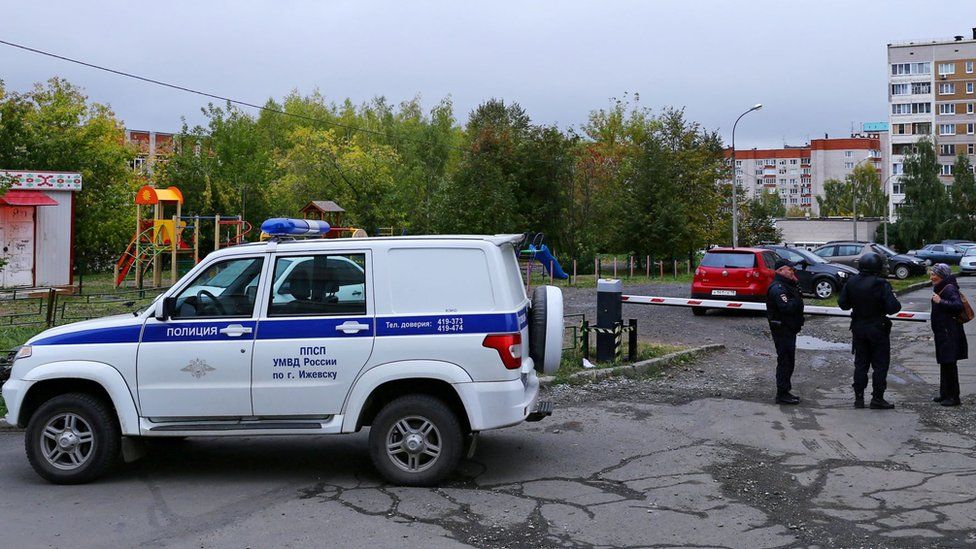
A gunman has opened fire at a school in central Russia, killing at least 13 people and injuring 21, Russian officials say.
Victims include seven children at the school of about 1,000 pupils in the city of Izhevsk.
The gunman killed himself at the scene. He was a former pupil of the school.
Russian media have posted videos which appear to show panic inside the building where the shooting took place.
Some footage shows blood on a classroom floor and a bullet hole in a window, with children crouching down underneath desks.
Seven children and six adults were killed, including two security guards and two teachers, according to Russian officials. Staff and pupils have been evacuated from the school buildings.
One local MP said the attacker – named as Artem Kazantsev- had been armed with two pistols.
A video posted online by the investigative committee shows the gunman lying dead on the floor wearing a T-shirt with a Nazi symbol and a balaclava. Investigators are searching his place of residence.
A mourning period until 29 September has been announced by the head of the region. Russian President Vladimir Putin’s spokesperson said he is “deeply mourning” the attack.
The school is in the centre of Izhevsk, a city of about 650,000 residents, close to central government buildings.
Security services arrive at the scene of the shooting.
About two-thirds of the population voted to approve reforms in a new Family Code, which will also allow surrogate pregnancies and give gay couples the right to adopt children.
It marks a big moment for Cuba, which saw gay people persecuted and sent to work camps in the 1960s and 70s.
However, there was significant opposition to the reforms among religious groups and conservatives.
The referendum on Sunday was for a new Family Code – a 100-page document which went through more than two dozen drafts and hours of debate in community-level meetings.
Cuba’s government had backed the law change and ran a nationwide campaign urging people to approve it.
Speaking as he voted on Sunday, the country’s President, Miguel Díaz-Canel, said he expected most of the population would vote yes and that the new code reflected the diversity of people, families and beliefs.
On Monday, preliminary results indicated an “irreversible trend”, with 66% of votes counted so far in favour of the reform, electoral council president Alina Balseiro said on state television, according to AFP news agency. The law required 50% of voters’ approval to be adopted.
The reforms were the culmination of efforts by gay rights activists in Cuba.
Official attitudes towards homosexuality on the Communist-run island have changed over the past decades, partly thanks to the efforts of former leader Raúl Castro’s daughter Mariela.
In the early part of communist leader Fidel Castro’s rule after the 1959 revolution, homosexual men and women were sent to work camps for supposed “re-education”.
However, many in Cuba still oppose the step, including evangelical churches and other non-religious conservatives.
Parts of the opposition also campaigned for a “no” vote, urging Cubans to seize a unique opportunity to hand the country’s communist government a defeat in the polls.
Cuba’s first ever LGBTQ hotel opens
Some anti-government activists consider the referendum an effort by the state to improve its human rights image following a brutal crackdown on all forms of dissent in recent years.
The referendum also comes during a serious energy crisis, which has led to daily power cuts affecting millions of people across the island.
Actress Nia Long was apparently blindsided by news of fiancé Ime Udoka’s affair. Udoka, who was gearing up for his second season as the head coach of the Boston Celtics, reportedly had a consensual relationship with a female member of the team staff.
The womanallegedly accused Udoka of making unwanted comments toward her, which led to an investigation and his subsequent suspension.
“The outpouring of love and support from family, friends and the community during this difficult time means so much to me,” Long tells TMZ in a statement. “I ask that my privacy be respected as I process the recent events. Above all, I am a mother and will continue to focus on my children.”
Long and Udoka share a 10-year-old son and have been engaged since 2015. (She also has a 21-year-old son from a prior relationship.) A source tells TMZ that while Udoka learned in July the team would be taking action over his improper relationship, he left the NCIS: Los Angeles star in the dark. They’ve even been house hunting in Boston in recent weeks. Long purportedly only learned about the affair in recent days before the scandal was made public.
The Rush: Celtics mum on details of season-long suspension of head coach Udoka
After nearly 24 hours of speculation on social media, the Boston Celtics announced that head coach Ime Udoka will serve a season-long suspension for “violations of team policies.” Aaron Judge is stuck at 60 home runs after being walked three times against the Red Sox on Thursday night in a Yankees extra innings win, Steelers rookie George Pickens submits himself as a ‘catch of the year’ candidate in Pittsburgh’s loss to the Browns on Thursday Night Football and Kyle Kuzma is getting the athlete bobblehead treatment in a surprising and unexpected way. Plus, it seems like the Red Sox want no part of Aaron Judge’s quest for history, but even if the Yankee slugger does log HR no. 61 against Boston, millions of fans might not see it.
Video Not Available
Unfortunately, this video is not available in your region.
100-202
“I want to apologize to our players, fans, the entire Celtics organization, and my family for letting them down,” Udoka said in a statement.. “I am sorry for putting the team in this difficult situation, and I accept the team’s decision. Out of respect for everyone involved, I will have no further comment.”
Long has been trending all morning with social media overwhelmingly in support of the actress… some tweets more amusing than others.
Three people have died and scores injured after a six-storey building collapsed in Kiambu, central Kenya.
Rescue efforts are under way and emergency workers have managed to pull a child from the rubble.
Several others have also been rescued but “sadly, some are feared to have succumbed to their injuries”, Kiambu county Governor Kimani Wamatangi said.
Building collapses in Kenya have in the past been blamed on poor structural design or sloppy construction.
The cause of this collapse is unclear but the building was under construction when it came down.
Eyewitnesses said it fell on to an adjacent building. It is not known how many people are still under the debris.
The child who was rescued is now being treated in hospital, national broadcaster KBC reports.
Rescue and search efforts undergoing at Kirigiti collapsed six-storeyed building. Several people have already been pulled out of the rubble, and rushed to the hospital. Sadly, some are feared to have succumbed to their injuries. pic.twitter.com/CMbwncbCLE
Soldiers, workers from the Kenya Red Cross and National Youth Service personnel as well as local volunteers are all at the scene in Kiambu town, which is about 20km (12 miles) north of the capital, Nairobi.
Photos from the site show a mechanical digger and rescue workers trying to find survivors.
Drinking black, green or oolong tea might have more benefits than a little energy boost — a certain amount could reduce risk of developing type 2 diabetes, new research has found.
Drinking at least four cups of any of these teas per day has been linked with a 17% lower risk of developing type 2 diabetes over an average period of 10 years, according to research published Saturday. The research, which hasn’t yet been published in a scientific journal, will be presented at the European Association for the Study of Diabetes Annual Meeting in Stockholm this week.
The relationship between drinking tea and type 2 diabetes risk has been previously studied, but results have been inconsistent, said Xiaying Li, the research’s first author and a postgraduate student at the Wuhan University of Science and Technologyin China.
“Our study showed that the association between tea consumption and (type 2 diabetes) depended on the amount of tea consumed. Only sufficient tea consumption can show clinical effects,” said Li via email. “Based on our findings, I would advise the public to consume more tea in their daily lives, if appropriate.”
The abstract authors first studied 5,199 adults with no history of type 2 diabetes who had participated in the China Health and Nutrition Survey (CHNS). The CHNS is a prospective study examining the economics, sociological issues and health of residents from nine Chinese provinces. They were recruited in 1997 and followed until 2009. At the beginning of the study, participants provided information about lifestyle factors such as food and drink habits, exercise, smoking and alcohol consumption.
Initially, researchers found that tea drinkers and non-drinkers in their study had a similar risk of getting type 2 diabetes.
But when researchers decided to look into whether the amount consumed among tea drinkers made a difference by undertaking a systematic review of 19 cohort studies involving more than 1 million adults from eight countries, the results were different — the more cups of green, oolong or black tea participants drank daily, the lower their risk of developing type 2 diabetes was. The measures tracked across these studies were whether participants drank less than one cup of tea per day, one to three cups per day, or four or more.)
The authors cautioned that their research doesn’t prove that drinking tea reduced type 2 diabetes risk, but does suggest tea-drinking likely contributes, according to a news release. They also noted that they relied on participants’ own assessments of their tea consumption and couldn’t rule out the possibility that unmeasured lifestyle and physiological factors could have affected the results.
Experts who weren’t involved in the research have agreed with the authors’ acknowledgment of the current research’s shortcomings.
“It could be that people who drink more tea avoid or less often drink more harmful sugary drinks or equivalent, or that they have other health behaviors that lead them to have lower risks of type 2 diabetes,” Naveed Sattar, a professor of metabolic medicine at the University of Glasgow, said in a statement.
“The findings need to be taken with a very large pinch of salt (or cup of tea),” Kevin McConway, an emeritus professor of applied statistics at The Open University in the United Kingdom, said in a statement. “The trouble with meta-analysis findings is that the devil is always in the detail, and we don’t have the detail. Which studies were included? What was their quality? Which people, from which countries, were studied?”
More research needs to be done to determine exactly how green, black or oolong tea — and the amount consumed — could affect type 2 diabetes risk, Li said in a news release.
“Particular components in tea, such as polyphenols, may reduce blood glucose concentration by inhibiting the activity of α-glucosidase and/or inhibiting the activity of other enzymes, but a sufficient amount of the bioactive substance is required to be effective,” Li said.
Polyphenols are substances found in many plants and give some flowers, fruits and vegetables their color, according to the National Cancer Institute. Polyphenols have antioxidant properties, which can help prevent or delay cell damage in the body. Bioactive substances are nutrients or non-nutrients in foods that affect how the body functions.
The take-home message is that lifestyle choices are important for managing type 2 diabetes risk, Duane Mellor, a registered dietitian and senior teaching fellow at Aston University in Birmingham in the United Kingdom, said in a statement. Mellor was not involved in the research.
In addition to keeping your tea kettle boiling, regular exercise, eating enough fruits, vegetables and grains and using alternative sweeteners have also been associated with both a lower risk of developing type 2 diabetes or with better managing the disease.
Many people eat the bulk of their calories at night, limiting breakfast due to busy workdays and school mornings, and experts have long thought eating late added to weight gain or hindered weight loss.
You should eat light at night and make breakfast your biggest meal, earlier research has shown, to give your body time to burn off excess calories throughout the day.
The prevailing argument is that eating more calories earlier “shifts metabolism” in ways that favor greater weight loss, said Dr. David Katz, founder and former director of Yale University’s Yale-Griffin Prevention Research Center, via email.
Yet eating a big breakfast instead of a larger meal later in the day did not impact weight loss, according to a new clinical trial that compared people eating most of their daily calories at breakfast with those eating the most at dinner.
“With calories either morning-loaded or evening-loaded, the researchers found nearly identical weight loss,” said Katz, who was not involved in the study. In addition, “any magical effects” of early eating on the body’s metabolism were debunked, he said, describing the research as “extremely rigorous.”
“Thus, this study belies the contention that eating early alters metabolism in a way that favors greater weight loss.” said Katz.
The study, published Friday in the journal Cell Metabolism, was a randomized “crossover” trial. Thirty overweight or obese yet otherwise healthy people spent four weeks eating 45% of their assigned calories in the morning meal, 35% at lunch and 20% at dinner. The same group then switched to four weeks when the evening meal was highest in calories: 20% in the morning, 35% at lunch and 45% for dinner.
“Participants were provided with all their meals for eight weeks,” study co-author Alexandra Johnstone, a professor of medicine at the Rowett Institute at the University of Aberdeen in Scotland, said in a statement, “and their energy expenditure and body composition monitored for changes.”
Conflicting research
There was some good news for hearty breakfast eaters, however. If being hungry all the time is your downfall, eating big in the morning could help curb your appetite, the study found.
“We know that appetite control is important to achieve weight loss, and our study suggests that those consuming the most calories in the morning felt less hungry, in contrast to when they consumed more calories in the evening period,” said Johnstone.
“While disputing the claims for ‘metabolic’ advantages of early-in-the-day-calories, this paper does establish a plausible alternative: a potential weight loss advantage … via enhanced satiety and less hunger,” Katz said.
A body’s metabolic rate is determined by how quickly (or slowly) it turns calories into energy. To lose weight, the body must expend more energy than the calories consumed. “The more active you are, the more calories you burn,” according to the Mayo Clinic.
Aerobic exercise is the most efficient way to burn calories, but strength training is also important, experts say. That’s because muscle burns more calories than fat, both at rest and while exercising.
Earlier research, conducted with larger groups of people over longer periods of time, has found people who load up on calories in the morning do lose weight. It’s possible that eight weeks was not long enough for weight loss to be seen in the new research, the study’s authors said, or that other studies may not have measured body composition and energy expenditure in the same way.
Regardless, the new research results should not be used to “refute the importance of breakfast for the hungry, nor does it address the role of ‘having’ versus ‘skipping’ breakfast on weight,” Katz said.
It simply suggests that eating more calories at breakfast and fewer at dinner “may favor less hunger, more satiety during weight loss,” he said, assuming the meals are nutritionally the same.
Want to reduce your risk for dementia? Slap on a step counter and start tallying your steps — you’ll need between 3,800 and 9,800 each day to reduce your risk of mental decline, according to a new study.
People between the ages of 40 and 79 who took 9,826 steps per day were 50% less likely to develop dementia within seven years, the study found. Furthermore, peoplewho walked with “purpose” — at a pace over 40 steps a minute — were able to cut their risk of dementia by 57% with just 6,315 steps a day.
“It is a brisk walking activity, like a power walk,” said study coauthor Borja del Pozo Cruz, an adjunct associate professor at the University of Southern Denmark in Odense, Denmark, and senior researcher in health sciences for the University of Cadiz in Spain.
Even people who walked approximately 3,800 steps a day at any speed cut their risk of dementia by 25%, the study found.
“That would be enough, at first, for sedentary individuals,” said del Pozo Cruz in an email.
“In fact, it is a message that doctors could use to motivate very sedentary older adults — 4k steps is very doable by many, even those that are less fit or do not feel very motivated,” he added. “Perhaps, more active and fitter individuals should aim for 10k, where we see maximum effects.”
But there was a even more interesting result buried in the study, according to an editorial entitled “Is 112 the New 10,000?” published Tuesday in JAMA Neurology.
The largest reduction in dementia risk — 62% — was achieved by people who walked at a very brisk pace of 112 steps per minute for 30 minutes a day, the study found. Prior research has labeled 100 steps a minute (2.7 miles per hour) as a “brisk” or moderate level of intensity.
The editorial argued that individuals looking to reduce their risk of dementia focus on their walking pace over their walked distance.
“While 112 steps/min is a rather brisk cadence, ‘112’ is conceivably a much more tractable and less intimidating number for most individuals than ‘10,000,’ especially if they have been physically inactive or underactive,” wrote Alzheimer’s researchers Ozioma Okonkwo and Elizabeth Planalp in the editorial. Okonkwo is an associate professor in the department of medicine at the Wisconsin Alzheimer’s Disease Research Center at the University of Wisconsin–Madison; Planalp is a research scientist in Okonkwo’s lab.
“We do agree this is a very interesting finding,” said del Pozo Cruz via email. “Our take is that intensity of stepping matters! Over and above volume. Technologycould be use to track not only number of steps but also pace and so these types of metrics can also be incorporated in commercial watches. More research is needed on this.”
Don’t have a step counter? You can count the number of steps you take in 10 seconds and then multiply it by six — or the number of steps you take in six seconds and multiply it by 10. Either way works. But remember, not everyone’s steps are the same length, nor are their fitness levels. What might be a brisk pace for a 40-year-old may not be sustainable for a 70-year-old.
Editor’s Note: Before beginning any new exercise program, consult your doctor. Stop immediately if you experience pain.
Inside the study
The study, also published Tuesday in JAMA Neurology, analyzed data from over 78,000 people between the ages of 40 and 79 who wore wrist accelerometers. Researchers counted each person’s total number of steps per day, and then placed them into two categories: Fewer than 40 steps per minute — which is more of an amble, like when you’re walking from room to room — and more than 40 steps per minute, or so-called “purposeful” walking. The researchers also analyzed peak performers — those who took the most steps within 30 minutes over the course of a day (although those 30 minutes did not have to occur on the same walk).
Researchers then compared that person’s steps against their diagnosis of dementia of any type seven years later. After controlling for age, ethnicity, education, sex, socio-emotional status and how many days they wore an accelerometer, researchers also factored out such lifestyle variables as poor diet, smoking, alcohol use, medication use, sleep issues and a history of cardiovascular disease.
The study did have some limitations, its authors point out — it was only observational, so it cannot establish a direct cause and effect between walking and a lower risk of dementia. In addition, “the age range of participants may have resulted in limited dementia cases, meaning our results may not be generalizable to older populations,” the study said.
“Because there are often considerable delays in dementia diagnosis, and this study did not include formal clinical and cognitive assessments of dementia, it is possible that the prevalence of dementia in the community was much higher,” the authors added.
While agreeing that the findings cannot be interpreted as a direct cause and effect, “the mounting evidence in support of the benefits of physical activity for maintaining optimal brain health can no longer be disregarded,” wrote Okonkwo and Planalp.
“It is time for the management of physical inactivity to be considered an intrinsic part of routine primary care visits for older adults,” they added.
Research adds up
Indeed, recent research published in July has found many leisure activities, such as household chores, exercise, adult education classes and visiting with family and friends, affected dementia risk in middle-aged people.
Adults who were highly engaged in physical activity such as frequent exercise had a 35% lower risk of developing dementia compared with people who were the least engaged in these activities, researchers found.
Regularly doing household chores lowered risk by 21% while daily visits with family and friends lowered the risk of dementia by 15%, when compared with people who were less engaged.
Everyone in the study benefited from the protective effect of physical and mental activities, whether or not they had a family history of dementia, researchers found.
Another study published in January found that exercise may slow dementia in active older people whose brains already showed signs of plaques, tangles and other hallmarks of Alzheimer’s and other cognitive diseases.
That study found exercise boosts levels of a protein known to strengthen communication between brain cells via synapses, which may be a key factor in keeping dementia at bay.
“Dementia is preventable to a great extent,” said del Pozo Cruz. “Physical activity as well as other lifestyle behaviors such lack of alcohol and smoking, maintaining a healthy diet and weight and sleep can put you on the right track to avoid dementia.”
The President of Ethiopia, Sahle-Work Zewde, was the only President who stood her grounds and refused to be “denigrated” by getting on a bus to the funeral of Queen Elizabeth II.
According to the Africa Archive, she refused to succumb to the unprecedented occurrence despite several requests.
She said; “I’m not going to give up now. Like everyone else, I deserve to be treated with dignity and respect. The ramifications of this are numerous. For protocol purposes, I have access to my own Embassy’s vehicles.”
Because she was so undecided, the British government had to give in and allowed her use her own Embassy cars to go to and from Queen Elizabeth II’s burial.
This past week, the entire continent of Africa felt degraded after watching its leaders ride a bus to Westminster Abbey for the funeral of Queen Elizabeth II.
When Britain’s longest reigning monarch died, world leaders from all over came to pay their respects. Among them were several heads of state from Africa.
Foreign, Commonwealth, and Development Office (FCDO) preparations called for world leaders to give up their diplomatic cars and instead share transport with their fellow Presidents, Prime Ministers, Kings, and Sheikhs to ensure their safe arrival for the Queen’s funeral.
Infuriating many Africans online, Vice President Joe Biden was allowed to show up in his armored “Beast” at the funeral. Racist feelings were stoked when internet users agreed that African leaders were being treated poorly.
Trees begin to sway, the sky darkens and suddenly you hear it — the distant sound of thunder.That’s your cue that potential danger is on the way. In fact, it’s likely within 10 miles of you, according to the National Weather Service.
Don’t ignore that sound, because where there is thunder there is lightning, and lightning can kill or maim in ways you would least expect it. That includes when you are in the shower, tub or even washing dishes.
Since lightning can travel through plumbing, “it is best to avoid all water during a thunderstorm. Do not shower, bathe, wash dishes, or wash your hands,” the US Centers for Disease Control and Prevention noted.
“The risk of lightning traveling through plumbing might be less with plastic pipes than with metal pipes. However, it is best to avoid any contact with plumbing and running water during a lightning storm to reduce your risk of being struck,” the CDC added.
That’s not the only danger when you’re inside. Stay off porches and balconies, don’t go near windows and doors, and do “NOT lie down on concrete floors or lean against concrete walls,” the agency said.
Also, do “NOT use anything connected to an electrical outlet, such as computers or other electronic equipment,” the CDC said. “Stay off corded phones. Cell phones and cordless phones are safe … if they are not connected to an outlet through a charger.”
Hotter than the surface of the sun
A thunderclap happens when lightning strikes, heating the air around the bolt to as high “as 50,000 degrees Fahrenheit, 5 times hotter than the surface of the sun,” the National Weather Service said. “Immediately after the flash, the air cools and contracts quickly. This rapid expansion and contraction (create) the sound wave that we hear as thunder.”
Lightning can kill in many ways. A direct strike is most often fatal, the CDC said, but injuries such as blunt trauma, skin lesions and burns as well as brain, muscle and eye injuries can occur from touching a car or metal object struck by lightning. The current can also travel through the ground, bounce off a person or object, or even stream up from objects near the ground.
You can calculate the distance between you and the lightning, but do it from a safe place so you won’t be struck, the weather service advised.
“Count the number of seconds between the flash of lightning and the sound of thunder, and then divide by 5,” with five seconds equaling 1 mile, 15 seconds equaling 3 miles, and zero seconds very close, the service said.
Most deaths and injuries occur when people are outside, especially during summer months in the afternoon and evening, according to the CDC. About 180 people per year are injured by lightning, and 10% of people struck by lightning die each year. Those who work outside, especially in the Southeast, are at highest risk. Florida and Texas have the largest number of lightning-related deaths, the CDC added.
If you are caught outside, do “NOT lie on the ground. Lightning causes electric currents along the top of the ground that can be deadly more than 100 feet away. Get inside a safe location; no place outside is safe,” the CDC said.
“Avoid anything that will increase your risk of being struck by lightning, such as being near or under tall trees. If there are no safe shelters in sight, crouch down in a ball-like position: put your feet together, squat low, tuck your head, and cover your ears. But remember, this is a last resort. Seek safe shelter first.”
Source: CNN
DISCLAIMER: Independentghana.com will not be liable for any inaccuracies contained in this article. The views expressed in the article are solely those of the author’s, and do not reflect those of The Independent Ghana
When someone you love dies, the world as you’ve known it is totally upended.
One way people cope, added psychologistSherry Cormier, is by trying to find some sort of certainty. This need for structure is probably one factor behind the popularity that latched onto the “five stages of grief” over 50 years ago and hasn’t yet let up, said David Kessler, who founded grief.com, a resource aiming to help people deal with uncharted territory related to grief. Kessler coauthored “On Grief and Grieving” with the late Dr. Elisabeth Kübler-Ross.
A Swiss American psychiatrist and pioneer of studies on dying people, Kübler-Ross wrote “On Death and Dying,” the 1969 book in which she proposed the patient-focused, death-adjustment pattern, the “Five Stages of Grief.” Those stages are denial, anger, bargaining, depression and acceptance.
“In the actual book, she talked about more than five stages,” Kessler said. “Think about the context of 1969 — doctors and hospital personnel were not talking about the end-of-life process. … Elisabeth really hoped ‘On Death and Dying’ would start the conversation.”
Since then, there has been extensive media coverage of the five stages; use in television shows including “Grey’s Anatomy” and “House”; clinician support; and criticism. Those five stages are what people clung to, Kessler said.
Grief and psychology experts and academics have criticized the framework for not being thoroughly supported by research, suggesting that the bereaved move through grief sequentially or implying one correct way to grieve. But these suggestions weren’t Kübler-Ross’ intentions, and she stated these caveats on the first page of the book, Kessler said.
While there’s debate among experts about the stages of grief, “people who are in the pain of grief are just saying, ‘Help me,’” Kessler said. Here’s what the five stages of grief are, and how you can consider and process them in whichever order you experience them.
1. Denial
In denial there is grace, in that we can’t fully register the total pain, shock and disbelief over our loss in one moment or day, so the pain is spread over time, Kessler said.
While denial in a literal and dysfunctional sense would be trying to convince yourself your loved one isn’t dead, an inability to comprehend the loss for a while is healthy — not something you need to quickly snap out of, he added.
If you’re struggling with overwhelming denial, you can try to stop fighting the reality you’ve been presented with, said Cormier, who is also a bereavement trauma specialist and consultant.
2. Anger
Anger is another natural reaction to loss, whether it’s anger at the cause of death, the deceased, the god of your religion, yourself or the randomness of the universe, Kessler said.
“Anger is pain’s bodyguard. It’s how we express pain,” he said. “That stage gives people permission to be angry in healthy ways, and to know it’s not bad.”
Anger “can be an anchor, giving temporary structure to the nothingness of loss. At first grief feels like being lost at sea: no connection to anything,” according to Kessler’s website. “Then you get angry at someone, maybe a person who didn’t attend the funeral, maybe a person who isn’t around, maybe a person who is different now that your loved one has died. Suddenly you have a structure — your anger toward them.”
Beneath anger can be feelings of hopelessness or powerlessness, Cormier said, sometimes prompting guilt and blame that some people use to maintain an illusion of control or express frustration.
“Our minds would always rather feel guilty than helpless,” Kessler said.
Depending on how your loved one died, one way to overcome guilt- and blame-related anger is by realizing that as horrific as your loss is, it wasn’t personally done to you, Kessler said.
“The reality is the death rate in families is 100%,” he said. “Everyone is going to die eventually, but our minds just can’t fathom that.”
Allow yourself to express anger in healthy ways, Kessler advised, whether it’s “grief yoga,” screaming in your car, using a punching bag, running or other forms of exercise.
3. Bargaining
Often also stemming from guilt, bargaining after a loss typically involves “if only” statements, focused on regrets about what you did or didn’t do before the person died, Kessler said.
“We may even bargain with the pain. We will do anything not to feel the pain of this loss,” Kessler’s site says. “People often think of the stages as lasting weeks or months. They forget that the stages are responses to feelings that can last for minutes or hours as we flip in and out of one and then another.”
Remember that we live in a world where sometimes bad things happen despite our best efforts, Kessler said.
4. Depression
Depression, or an acute sadness, is when the great loss begins more deeply affecting your life. Maybe the sadness feels as if it will last forever, or you’ve withdrawn from life or are wondering if life is worth living alone.
Sadness hits people at different times, Cormier said. She has known people who aren’t distraught in the first year after loss, but by year three are consumed with sadness. Why? Because for a time, some can maintain the illusion that their loved one is away on vacation and may be returning, she said.
Often, the eventual, deep sadness “is really an expression of, ‘my loved one is gone and not coming back,’” Cormier said.
But those feelings shouldn’t always be labeled as clinical depression, Kessler said. If you think you’re depressed around a death, see a psychiatrist for an evaluation, he advised.
To cope with sadness, you can also seek support from friends, family or grief support groups, and regularly practice self-care, Cormier suggested.
5. Acceptance
Acceptance doesn’t mean you’re OK with your loved one being gone. “It just means that I now accept the new reality of my life. I’m a widow, I live alone. I don’t have siblings to call up anymore. I don’t have parents to call up anymore,” said Cormier, who wrote “Sweet Sorrow: Finding Enduring Wholeness After Grief and Loss” after losing her husband and immediate family.
Acceptance isn’t grief’s end, either. You might have many little moments of acceptance over time, Kessler said, such as when you plan and attend the funeral.
“One of the questions I get asked most is, ‘When will this grief be over?’” Kessler added. “Very gently, I’ll ask, ‘How long is the person going to be dead? Because if the person is going to be dead for a long time, you’re going to grieve for a long time. It doesn’t mean you will always grieve with pain. To me, the goal of grief work is to eventually remember the person with more love than pain.”
Arriving at acceptance means you’re healing, Cormier said. But if you can’t get there, you need to seek professional help. Intense and persistent grief that causes problems and interferes with everyday functioning, in a way that typical grief doesn’t after some time has passed, is known as prolonged grief disorder, according to the American Psychiatric Association. The disorder is the newest disorder to be added to the revised Diagnostic and Statistical Manual of Mental Disorders released in March.
To be diagnosed with prolonged grief disorder, a loved one’s death had to have occurred at least a year prior for adults, and at least six months ago for children and adolescents, according to the association, which publishes the DSM. One symptom is difficulty with reintegration, such as pursuing interests or interacting with friends.
Cormier doesn’t think we ever “get over” grief. Our task is different than moving on — it’s learning to integrate the loss into our lives so that we can move forward with a new reality, she added. “It’s sort of offensive to grievers to say, ‘Oh, you’ve really moved on.’ No, I don’t think grievers move on. We move forward.”
The new sixth stage: Finding meaning
After Kessler’s son died at age 21 nearly five years ago, Kessler wanted something beyond acceptance. He had studied late neurologist, psychiatrist and philosopher Dr. Viktor Frankl’s work on meaning, and wondered how meaning related to grief — which inspired his book “Finding Meaning: The Sixth Stage of Grief.”
Meaning didn’t eliminate Kessler’s pain, but it did cushion it, he said.
Meaning is in what we later do or realize as the bereaved people, Kessler explained. Maybe you recognize the fragility of life, try to change a law or donate money to research so no one dies the way your loved one did, or make a change in your life.
Source: CNN
DISCLAIMER: Independentghana.com will not be liable for any inaccuracies contained in this article. The views expressed in the article are solely those of the author’s, and do not reflect those of The Independent Ghana
Whether it’s pursuing a demanding career, eating better or maintaining friendships, accomplishing the feats we most desire requires a healthy foundation.
Living life to the fullest starts with paying attention to your body and mind.
“The long-term effects of good and bad health habits are cumulative. Simply stated, you cannot outrun your past,” said Dr. William Roberts, a professor in the department of family medicine and community health at the University of Minnesota, via email.
Getting enough physical activity and seeing your doctor regularly is a good place to start, CNN Medical Analyst Dr. Leana Wen said.
“There’s a lot of evidence about the things we can do proactively that can improve our longevity as well as the quality,” said Wen, an emergency physician and visiting professor of health policy and management at the George Washington University Milken Institute School of Public Health.
Here are some habits worth implementing to give yourself the best chance at a longer, happier life.
1. Regular screenings
Young people tend to have fewer chronic illnesses than older ones, but prevention is key, Wen said. “If you screen positive for prediabetes, for example, there are steps that you can take to prevent progressing to diabetes.”
Annual checkups also enable you and your doctor to get to know each other, she added. “The best time to see your physician is not when you already have symptoms and need help — it’s on a regular basis to build and establish that relationship so that your physician can get a baseline of your health.”
2. Consistent physical activity
Getting enough physical activity can lower your risk of developing chronic conditions such as diabetes, obesity, hypertension, heart disease and stroke, Wen said.
“There’s an overwhelming body of research that supports regular aerobic exercise for not only living longer but also to maintain cognitive function longer,” said Dr. Nieca Goldberg, medical director of Atria New York City and clinical associate professor of medicine at New York University’s Grossman School of Medicine.
The World Health Organization has recommended that adults get at least 150 minutes (2 ½ hours) of moderate-to-vigorous physical activity weekly, while pregnant people should do at least 150 minutes of moderate aerobic and strengthening per week.
3. A healthy BMI
Body mass index is a measurement of body fat that assesses a person’s weight category and potential risk for health issues, according to the US Centers for Disease Control and Prevention.
Maintaining a healthy BMI can lengthen your life by more than a decade, a 2018 study found, and has been linked with a lower risk of dying from cardiovascular disease and cancer. Regular physical activity and eating healthy foods can help you with this goal.
4. Proper nutrition
Eating more plant-based foods provides a great source of antioxidants, Goldberg said. “Oxidation is a sign of stress in our system and can lead to changes in the buildup of plaque in the arteries and such,” she said. “And this oxidation is also associated with aging.”
You could extend your life by eating fewer red and processed meats and more fruits, vegetables, legumes, whole grains and nuts, according to a February study published in the journal PLOS Medicine. The potential benefits are especially strong if you start young — women who began eating optimally at age 20 could increase life span by a little over 10 years, while men who start at the same age could add 13 years.
At mealtime, at least half your plate should consist of fruits and vegetables, Goldberg said. Also, what’s important is “not only what’s on the food, but how you prepare it,” she added. “So baking and broiling is better than frying.”
5. Pay attention to mental wellness
Mental health is often “such a neglected part of our overall health, but actually contributes a huge amount to overall health and well-being,” Wen said.
The past few years have brought about stress and anxiety, which can affect blood pressure, sleep, dietary choices, alcohol intake or attempts to quit smoking, Goldberg said.
Carving out just 15 minutes for a bit of mental health hygiene can make your life easier, experts have said. Try taking deep breaths upon waking, being present with your morning coffee instead of being distracted, going for a walk, journaling and taking breaks from screens.
The benefits of these mindfulness practices come from lowering levels of cortisol, the stress hormone linked with health complications. Being able to regulate your emotions better — which can be achieved with meditation — has been associated with health resilience in older age.
6. Plenty of sleep
People who sleep less than seven hours nightly tend to have higher levels of stress hormones, blood sugar and blood pressure, Goldberg said.
You can improve the quality and quantity of your sleep by getting regular exercise and having good sleep hygiene. Keep your bedroom dark, quiet and cold at night, and only use it for sleep and sex.
7. Drinking less
“For a long time, people have been associating alcohol with a healthier heart,” Goldberg said. But “heavy alcohol intake can actually be a direct toxin to the heart muscle and result in heart failure. And it also raises (blood sugar levels) and causes weight gain.”
Avoiding too much alcohol can add at least several years to your life by lowering your risk for diabetes, cardiovascular disease, cancer and other chronic diseases, a 2020 study found.
8. Not smoking
“Smoking is a major risk factor that increases the likelihood of multiple cancers — not just lung cancer but also things like breast cancer,” Wen said. It also “increases the risk of heart disease, stroke and other conditions that shorten people’s lives.”
If you’re a habitual smoker, it’s not too late to quit to lengthen your life, Wen added.
9. Build strong relationships
Having close, positive relationships adds happiness and comfort to our lives and reduces stress, experts have said. Studies have shown that people who have satisfying relationships with family, friends and community have fewer health problems, live longer and experience less depression and cognitive decline later in life, according to Harvard Health.
If implementing all these habits feels like a lot, think of them as a gradual build, Wen said. “We may not be perfect on everything all the time,” she said, “but (there are) things that we can do to improve in one or multiple dimensions, and we could commit to that kind of lifestyle improvement.”
After two years of a pandemic, ever-changing travel restrictions and mandated Covid-19 tests, the summer of 2022 signaled vacations would finally be back in vogue.
With most Covid-19 restrictions lifted, planning a vacation became easier and many trips that had previously been delayed for pandemic-related reasons were finally able to take place. But in practice, flight cancellations, worker shortages and general travel chaos have robbed many travelers of their long anticipated stress-free bliss.
And for those lucky enough to have managed a smooth getaway, the return to reality is hitting even harder than usual.
Whatever your vacation story, here are five tips from the experts to help you deal with a case of the post-vacation blues.
1. Plan a buffer for when you come back
We often overload ourselves with a long list of household chores as soon as we get back home or jump straight into work at lightning speed which emphasizes the contrast between vacation and reality.
Instead, if possible, take a day to transition before returning to work and minimize household chores by doing what you can before you go away, advises Dr. Andrea Bonior, licensed clinical psychologist and author of “Detox Your Thoughts.”
“I often see people having a really hard time with the post-vacation blues when it’s like whiplash — so last night I was on a beach and now I’m in the office — instead if possible try to plan a buffer day so you can exhale and have some time to just be able to readjust,” she says.
“Give yourself a little self-compassion,” adds Dr. Laurie Santos, Professor of Psychology at Yale University and host of The Happiness Lab podcast. “You don’t need to answer all the emails immediately. It’s okay to ease back into the grind, and the evidence suggests that people will be more understanding than you predict.”
2. Try to maintain a vacation mindset
“Remember that ending the vacation doesn’t mean ending the fun,” says Santos. “We can find ways to get a bit more of that travel feeling in if we continue that tourist mindset into life back home. Maybe try a new restaurant or take a walk through a new neighborhood.”
Dr. Tracy Thomas, a psychologist and emotional scientist, says it’s important to identify what it is that makes you feel good when you’re away or in your “vacation mentality” and try to make it part of your daily reality.
“It’s fascinating that what people will do on vacation they won’t do at home — if you’re getting a massage when you’re away, waking up to see the sunrise or walking around a town, try to do some of that when you come home.”
Thomas also suggests cooking some of the dishes you enjoyed while you were away to keep the experience going. “When I go to Italy and eat pasta pomodoro, probably for a good month after that when I get home, I keep making it or ordering it instead of letting that process fade out.”
3. Practice gratitude
“Take some time to replay your positive travel memories back,” Santos advises. You could make an album, journal or just remind yourself of all the good experiences you were able to have if you were lucky enough to get away.
“You may have heard the advice that you should invest in experiences not things. Turns out one of the reasons that’s the case is that experiences make for fonder memories than our materials purchases — we can get a happiness boost not just from experiencing a vacation, but from remembering it,” Santos adds.
As well as being grateful for what you had, try and practice gratitude in your daily life says Bonior, explaining that while gratitude is good for us, many people misunderstand what it means.
“People tend to think gratitude means you need to count your blessings for everything, you can’t be upset about anything, somebody else has it worse than you do so you should be grateful, but gratitude in reality means leaning into everything — being able to truly engage and recognize that we’re lucky but also not being afraid to acknowledge the dark spots.”
“True gratitude doesn’t mean you have to be happy and feel blessed all the time, it means to realize the whole life experience is something pretty amazing and I’m here for it,” she adds.
4. Exercise
Numerous scientific studies have shown moderate to vigorous aerobic exercise is good for combating anxiety and depression.
In fact, a study published in April in the journal JAMA Psychiatry, showed adults who did activities equivalent to 1.25 hours of brisk walking per week had an 18% lower risk of depression compared with those who did not exercise.
“Exercising doesn’t mean you won’t be depressed but it does helps mitigate it,” Bonior says, adding that exercise doesn’t have to be intense or look a certain way — even a walk can be a boost for your physical and mental health or dancing in your room she explains.
In addition, exercise is widely known to improve sleep, lower blood pressure, reduces stress and boost your mood — so although you may feel like moping around the house post-vacation, it’s a good idea to force yourself out and about for a mood inducing boost.
5. Acknowledge your feelings
Talk to others about how you feel, commiserate with other travelers or journal — it’s important to stay connected with friends and loved ones and not withdraw.
“The research shows that for us to be able to just articulate that we have a certain emotion, that makes that emotion feel less scary so we feel more in control. It also helps us avoid black and white thinking,” Bonior says, explaining that we can have multiple emotions at the same time like being sad but excited.
Of course if you’re feeling an overwhelming sense of dread about your routine or your job, it may signal a need for change or a revaluation of where you want to be. If the symptoms persist or get worse you may also want to seek out some professional help to address other underlying causes.
“If your vacation didn’t go so well, you can get a happiness boost here by trying to figure out what you learned,” says Santos. “The act of expressively journaling about what went wrong can help you figure out what insights you’ve gotten or how you’ve grown.
At the very least, even the worst holidays can turn into funny stories that we can share with friends for a boost of social connection.”
Source: CNN
DISCLAIMER: Independentghana.com will not be liable for any inaccuracies contained in this article. The views expressed in the article are solely those of the author’s, and do not reflect those of The Independent Ghana
Clashes over livestock and water are common in the area, which is also facing a worsening climate.
In a statement, Jeremiah Lomorukai, the Governor of Turkana, said security forces in the region needed better support from the government to end cattle rustling.
Police in Nigeriahave arrested a suspected notorious kidnapper known for flaunting his wealth on social media.
Many knew John Lyon as a banker whose posts always advised people to work hard and to stay safe, local media report.
A spokesperson for the police in the southern Bayelsa state told the BBC that Mr Lyon was in their custody.
The suspect was transferred to the state after being arrested in the capital, Abuja, said Asimi Butswat.
“When they get the money they go to Abuja to live lavishly,” Mr Butswat told the BBC.
At least ten kidnappings for ransom in Bayelsa state had been traced to his gang, the authorities say. But he is not the the group’s leader.
Many Nigerians have expressed dismay over the development with some describing the suspect as a generous person who was fond of giving gifts.
Mr Lyon has not yet commented publicly.
But a video reportedly of him while in police custody has surfaced on social media. In the short clip, the detained man is seen asking for forgiveness after his arrest.
The police are expected to give further updates on Monday afternoon.
Amateur clips are being shared on social media showing people taking bales of maize flour off a lorry that overturned on a major highway in Kenya’s capital, Nairobi.
The crowd of looters include motorists, motorbike taxi operators and pedestrians.
The cause of the accident is unclear and there were no police officers on sight, according to the footage.
A local journalist is among those who has tweeted footage from the scene:
The prices of basic food commodities like maize flour and wheat flour, potatoes, vegetables and fruits have been rising in the country – attributed to a combination of external and domestic factors.
Last week the government scrapped a subsidy on petrol which has increased the retail price to an all-time high.
Crystal Palace forward Wilfried Zaha has revealed how Brazil great Ronaldinho made him fall love with football.
WHAT HAPPENED? During an impromptu Q&A with fans on Twitter on Sunday, Zaha revealed how the former Barcelona playmaker, known for for his technical skills, flair and creativity, as well as his exceptional first touch, got him to love the game due to the way he played with a smile on his face.
WHAT DID ZAHA SAY? One fan asked Zaha; “Which player do you wish you’d played with, can be current or past?” to which he responded: “Ronaldinho, because he made me fall in love with the game by just making it so enjoyable to watch… he played with flair and happiness.”
THE BIGGER PICTURE: Zaha, who also likes to play with flair given his trickery and stepovers down the wing for Crystal Palace has been a mainstay in the Eagles team, making over 400 appearances for the side and become the first player to score 50 top-flight goals for the club in a 2-0 win at Manchester City in October 2021.
Zaha was linked with a move away from Palace in the summer transfer window once again but stayed on for what will be his ninth straight season at the club and already has four Premier League goals from five matches.
The Ivory Coast forward has previously rated Arsenal great Thierry Henry as his Premier League player of all-time with Manchester United forward Cristiano Ronaldo and Chelsea legend Didier Drogba the others that he idolizes.
WHAT NEXT FOR ZAHA? Zaha is currently on international duty with Ivory Coast and after he starred in Saturday’s 2-1 win over Togo, he will hope to lead the Elephants’ attack on Tuesday when they face Guinea.
After the international break, Zaha will link up with Palace, who host Chelsea in the Premier League at Selhurst Park on October 1 when he will hope to get back on the scoring charts with his last top-flight goal being a stunner in the 1-1 draw against Brentford on August 30.
Some supporters of Asante Kotoko are urging the Ghana Referees Association to ban referee Selorm Yao Bless from officiating the Super Clash after awarding an ‘offside goal’ to Accra Hearts of Oak at the Baba Yara Sports Stadium.
Asante Kotoko drew 1-1 with Accra Hearts of Oak in their first game of the 2021/22 Ghana Premier League season.
Caleb Amankwa scored an offside goal from a set piece to get a late equalizer for Hearts Oak in the matchday three encounter.
Kotoko were denied some penalties in the match as their striker Mukwala was brought down in the box on several occasions with the referee allowing play to continue.
After the game, some disappointed Kotoko fans berated referee Selorm Yao Bless for failing to make bold decisions in the game.
While some called for stiffer punishment for referee Yao Bless just like referee Kenny Paddy who officiated a similar match last season, others also called for his ban.
Here are some comments on social media
@ghanafaofficial we are waiting to see you ban or suspend referee selorm Yao bless
Hypocrites
An improved @AsanteKotoko_SC performance, still needs time for our players to jell. But truth be told; Ref. Selorm Yao Bless had an agenda. How could he deny us 3 clear penalties and accept an offside goal by @HeartsOfOakGH ? @ghanafaofficial should ban this ref ASAP.
@AsanteKotoko_SC vs @HeartsOfOakGH …
The man of the match is Referee Selorm Yao Bless.!!
He blessed hearts with an offside goal and denied kotoko clear penalties. @HeartsOfOakGH Please sign him.fantastic performance !!!
The Ho based referee Selorm Yao Bless wasn’t just biased against Asante Kotote but unprofessional as well. Referee Bless, please put your tribal sentiments aside and officiate professionally. Ghana needs good and well trained referees. Still Kum Apem a, Apem bɛba. Asante yɛ Ɔman. pic.twitter.com/5h3G5VUF8g
A much better spectacle in the second half as Asante Kotoko and Hearts of Oak share the spoils. Looks like the biggest talking point from the game will be referee Selorm Yao Bless 😬
Selorm Yaw Bless continued… Hopefully the Match review committee of the @ghanafaofficial will see the need to look into these bad calls and call him to order.. This s shameful especially on the bavk that a referee in this same fixture last sesson got suspended for 1 call pic.twitter.com/67QWiMJEuF
The Black Stars are on a poor run in 2022 despite managing to secure a World Cup spot within the period.
Since the start of the year, Ghana have played a total of eleven matches and have managed just a single win. In the remaining 10 matches, the team lost five and drew five.
Ghana’s only win so far this year came against Madagascar during the 2023 African Cup of Nations qualifiers in May.
Since beating Madagascar to end an initial six-match winless run, Ghana have gone four games without recording a victory, losing two of those games.
Ghana’s poor record in 2022 started in January when the Black Stars lost 3-0 to Algeria in a pre-AFCON friendly.
On Friday, September 23, Brazil handed Ghana their fifth defeat of the year, hammering the West African powerhouse 3-0 in an international friendly in France.
Head coach Otto Addo and his chargers will be looking to end their current four games winless run when they come up against Nicaragua, who are ranked 139th ranked by FIFA.
The match comes off on Tuesday, September 27, 2022, at 18:00 GMT kick-off time.
“New invention gives hope to all those suffering from chronic joint pain, headaches and back pain…”
Imagine owning a device that diminishes pain whenever you need it.
You can use it whenever you want – even all the time. It’s completely safe.
It doesn’t use chemicals, medicine, or drugs, nor does it change anything about your mind or body. In fact, it doesn’t even go past your skin.
“I have severe Arthritis in both knees and other conditions which make knee replacement not possible – leaving me in a considerable amount of pain. I’ve gone to countless chiropractor, massage therapist, and doctor’s appointments, yet I still had to deal with constant pain. To say I have tried every kind of treatment would be an understatement.
So when my friend showed me the pain relief heating patches, I was of course sceptical. I have been promised pain relief too many times to count, but none of them came through for me.
Now, this patch sounded straight out of a sci-fi movie. There’s no way something like that could exist, or so I thought.
Luckily, I listened to my good friend’s advice and tried PainPatch.
I can confidently say for the first time I truly experienced: instant, long-lasting pain relief without drugs or surgery.”
PainPatch is a non-invasive patch that’s embedded with billions of tiny nanocapacitors. These nanocapacitors work together like a bio-antenna (more on that later) to naturally relieve pain in seconds.
Since this patch uses your body’s natural ability to fight pain, it’s safe, especially for those older than 50
All you do is place the patch on your body when you feel pain, wait a few seconds and get relief.
Some describe a warming sensation, others say the pain gets “quiet”, but for many (including me), the pain just… stops.
Whether your pain is caused by a pinched nerve, a pulled muscle or a chronic condition, PainPatch helps relieve your pain.
Pain relief when you need it
Simply place it on your neck, shoulder, back, knee, hand, foot, or elsewhere and feel the pain quickly dissipate.
Here’s Why I Love PainPatch
✔️ It provides 100% Natural & Safe Pain Relief
This patch doesn’t use medicine or drugs, so nothing foreign or toxic enters your body. The nanocapacitors are completely safe to use all day, every day – with zero side effects.
✔️ Feel Relief In Less Than 60 Seconds
Just place PainPatch wherever you feel pain and watch it disappear almost immediately – just like it was in my case.
✔️ Waterproof and always ready to relieve you
PainPatch has no battery and does not need to be charged. It’s always ready when you need it. Can be used in the shower and in the pool or ocean without losing its grip or coming off
✔️ PainPatch lasts between 8 and 12 hours
PainPatch can be worn for 8 to 12 hours for proper use without drying out the skin or coming off
The results are in and they are fabulous
Who can benefit from these patches
It helps more than just back pain, in fact it has been shown to effectively relieve almost all types of chronic pain.
You can benefit from Kailo if you suffer from: ✔️ Headache ✔️ Knee pain ✔️ Elbow pain ✔️ Back pain ✔️ Hand or foot pain ✔️ And more…
Here’s why our customers love it…
“I suffer from fibromyalgia and… PainPatch gives me relief in minutes!”
I received my patches last week. I am amazed at how quickly the patch relieved my pain. I suffer from fibromyalgia and when I overdo it, my back hurts so much that I can’t sleep. The patch provides relief in minutes!
“PainPatch has helped my daily pain tremendously.”
I received your product yesterday and immediately started using it. It took me 2-3 minutes to find the right spot on my upper back. The pain disappeared within seconds. I was suffering a lot every day from muscle spasms and contractions. It happened every day after walking for more than two minutes and when I went to bed at night. I suffered for 4 years. MRIs, X-rays, chiropractic, massage, orthopaedics, I tried everything, without success. I know that your product cannot solve the problem, but it has, so far, helped my daily pain tremendously. I have told several people about it and I am sure they will order it from you. Thank you very much for developing this amazing technology and for offering it to us at a reasonable price!
“It works! It’s weird, I know.”
I know the pain. When I was 17, I was hit by a drunk driver. It changed my life. I have had many broken bones, serious injuries and years of pain. And now fibromyalgia! All of this leading to a LOT of pain! And, when my daughter told me about the PainPatch, I was skeptical. Intrigued, but skeptical. A pain patch WITHOUT MEDICATION.
But I was able to try PainPatch before I bought it thanks to a friend. Great! At first I was hoping to get some relief from my pain, but in the back of my mind I thought I was going to have to say that this patch didn’t work. It’s always better to be honest. * But guess what? * IT WORKED! My shoulder, neck, hand, arm, hip and back pain are so far relieved. Not cured, but relieved. I now wake up in the morning without pain or stiffness. It has improved my quality of life.
PainPatch is currently on sale, you can order it with 50% discount and delivery is FREE
Stock may be unstable (they are so popular). Click the button below to check stock and secure your 50% off offer
Where can I get PainPatch™ ?
Frequently asked questions :
How long can I wear a patch?
You can wear a patch for 8 to 12 hours. Some clients take it off as soon as the pain starts to subside, others wear it all day, every day.
Do patches relieve back pain?
Quite simply, YES! You can finally get relief from your back pain. The patch uses your body’s natural system to lower the pain receptors, so you can feel good again and smile at life. You won’t believe the back pain relief you’ll feel from the patch until you try it.
How long does the adhesive remain effective?
Each adhesive can remain effective for up to 12 hours depending on location on the body and skin type.
Can patches reduce menstrual pain?
Most women suffer from menstrual pain at some point in their lives – and for many, the pain is very severe.
The patches can provide immediate relief from your period pain. As well as back and stomach pain, and the migraines or headaches typical of that time of the month.
Fast and Effective Relief
Copyright Well-Being Review™ 2021, all rights reserved.
This is a sponsored article and not a real news article, or blog. This story is based on the results that some people have achieved using this product. Results may vary from person to person and you may not achieve the same results as the photos or videos. This page may receive compensation for each click or sale made through this site.
Kunle Adeyanju is a self-confessed daredevil who has climbed Mount Kilimanjaro twice and cycled from Lagosto Accra over three days.
But it is his latest adventure that is creating a buzz after he successfully completed a motorcycle ride from London to Lagos.
The journey took 41 days as he traveled 13,000 kilometers (8,080 miles) through 11 countries and 31 cities.
Adeyanju embarked on the trip partly to raise money for polio, in conjunction with the Rotary Club of Ikoyi Metro, Nigeria, where he is president-elect. He says he chose the cause because of a childhood friend who suffered from the debilitating illness.
“Polio is a personal thing for me… as a boy, my best friend had polio and when we go swimming or play football, he could do none of those things.. Sadly, my friend passed away some years back. If he hadn’t had polio, he probably will still be alive today.”
The World Health Organization declared Nigeria free of wild polio virus in 2020, but there are still some vaccine-derived cases in the country.
“The experience of riding the Tizi n’Tichka pass, that’s the path that take you to the summit of the Atlas mountain. It’s regarded as the most dangerous road in Africa. It’s packed with adrenaline and it’s a road where you take your eyes off the road for one second or you can go into the ravine…
“It takes about an hour 30 minutes to ride a mountain pass. And I can tell you, it is one of the most difficult one hour 30 minutes of my life.”
“But you know, after going through all that pressure, when you get to the peak of the Atlas mountain… the reward of the view is more than all the pressure you’ve gone through to get there.”
“The experience of riding the Tizi n’Tichka pass, that’s the path that take you to the summit of the Atlas mountain. It’s regarded as the most dangerous road in Africa. It’s packed with adrenaline and it’s a road where you take your eyes off the road for one second or you can go into the ravine…
“It takes about an hour 30 minutes to ride a mountain pass. And I can tell you, it is one of the most difficult one hour 30 minutes of my life.”
“But you know, after going through all that pressure, when you get to the peak of the Atlas mountain… the reward of the view is more than all the pressure you’ve gone through to get there.””The experience of riding the Tizi n’Tichka pass, that’s the path that take you to the summit of the Atlas mountain. It’s regarded as the most dangerous road in Africa. It’s packed with adrenaline and it’s a road where you take your eyes off the road for one second or you can go into the ravine…
“It takes about an hour 30 minutes to ride a mountain pass. And I can tell you, it is one of the most difficult one hour 30 minutes of my life.”
“But you know, after going through all that pressure, when you get to the peak of the Atlas mountain… the reward of the view is more than all the pressure you’ve gone through to get there.”
<“The experience of riding the Tizi n’Tichka pass, that’s the path that take you to the summit of the Atlas mountain. It’s regarded as the most dangerous road in Africa. It’s packed with adrenaline and it’s a road where you take your eyes off the road for one second or you can go into the ravine… “It takes about an hour 30 minutes to ride a mountain pass. And I can tell you, it is one of the most difficult one hour 30 minutes of my life.” “But you know, after going through all that pressure, when you get to the peak of the Atlas mountain… the reward of the view is more than all the pressure you’ve gone through to get there.”
So great to meet and interview @lionheart1759 on Sunday. He had a true hero’s welcome as he should. What he did is remarkable and all for a great cause.
I also got the full gist on the lovely Zeynab 😂😂
Soon come on @cnni
Remember to donate. https://t.co/MxMUcs1jlhpic.twitter.com/lwjdaWmGlo
— Stephanie Busari (@StephanieBusari) May 31, 2022
After the thrill of riding through the mountains, Adeyanju headed for the Sahara Desert, an experience he says he was dreading because of the extreme heat.
“There was a time I checked the temperature when I was on the Mauritanian side of the Sahara and the tarmac was 53 degrees Celsius (127 F). I was pushing my bike at 150 kph and it was an accident waiting to happen,” he said.
Riding 1,000 kilometers per day, it took him seven days to cross the desert.
“The Sahara is an unfriendly environment,” he said. “It’s not designed to support life. The Sahara is there to kill you. It doesn’t forgive. You make a mistake and you may not come back.”
During what was the toughest stretch of the journey he experienced two sandstorms and nearly ran out of water, Adeyanju said.
“The Sahara on the Moroccan side is totally different from the Sahara in Mauritania. On the Moroccan side it is extremely windy. I experienced a sandstorm twice which lasted for about 30 to 40 minutes. I had to lay the bike down and lie face down for 30 minutes until the storm passed,” he recalled.
After surviving the storms, he said he nearly didn’t make it out alive because he ran out of water.
“I got carried away and I was drinking as I was tired and by the time I realized I had only one liter left in my hydration pack and I had around 450 kilometers still to go.”
Dehydrated, disorientated and forced to ride slowly, he suddenly saw a Land Rover parked in the desert.
“Nature spoke for me,” he said. “Some guys were doing a desert Safari. I drove to them and I couldn’t speak… my speech was slurred… The guy just said ‘don’t talk, don’t talk’. Then he went into his car and gave me two 1.5 liter bottles of water. If I didn’t see those guys, I don’t know whether I will be here today.”
Adeyanju also experienced a few spooky moments in the desert, when he suddenly started hearing voices, even though no one was around him — a phenomenon in which atmospheric conditions in the arid terrain can carry sound over long distances.
“It brings the voice sound waves clearly to you… and you hear voices all around,” he said. “Many people think it is spirits but it’s just science,” he added.
Rethinking Africa
Documenting his travels on social media, Adeyanju attracted many fans and well-wishers including Rotary club members and others from the biking community. He also picked up a few high-profile fans, including the prime minister of Mali, Choguel Kokalla Maiga, who requested to have a meeting with him, he said.
Adeyanju, who has visited 75 countries, says the most surprising thing about his adventures was making an unexpected discovery about Africa.
“Before going on this ride, I read a lot about the CIA World factbook on the countries I was going to travel to. For example I knocked Burkina Faso off my trip because of what I read about Burkina Faso, but the moment I stepped my foot on the African continent… I can tell you everything I read about the African people or the African country is false, he said.
“Africa is beautiful. It is a land of diversity. It’s a land of hospitality and people are friendly and nice… It was a big eye-opener for me to say that we have been underselling Africa… and we’ve been we’ve not been saying the right things about ourselves. That’s why I have launched a campaign called ‘Think Africa.’ My next vacation, all the things I want to do is in Africa. There’s so much to discover on this continent.”
A single moment can change the trajectory of our lives. For Nigerian Iyeneobong “Iyene” Essien, that moment came when she was just five years old. She remembers the day her dad took her to a golf course in Abuja, where she saw a boy teeing off. Intrigued by the sight, she asked her dad if she could pursue the sport.
“(My father) was pretty surprised by my question,” she said. “He asked me if I really wanted to play this sport and I said, ‘yes,’ and he got me a coach and I started playing golf.”
The rest was history.
Essien entered her first competitionthe same year and proved to be a natural, placing first in her age group. “I found that really cool,” she said.
By age 11, the golfer was representing Nigeria at international competitions across the US, UK, and Africa including Morocco, Botswana, and South Africa. Now 16, she is the No.1 ranked junior girls’ golfer in Nigeria and has won more than a dozen trophies after placing in various competitions.
“I’m really proud of representing my country because I’m making a name for myself and for my country,” she said.
In late July, Essien clinched second place in the Under 19 Girls division at the Champion of Champions World Championship in Northern Ireland. “It was a really good experience for me,” she said. Finishing five strokes behind first, Essein says she is proud of how she played.
“Everything happens for a reason — even though you come second or third, it means that you’re getting closer and closer to first,” she said, noting the experience of playing on a world-renowned course was a win in itself. “The fact that I could play on the same course as Rory Mcllroy played on and be in the same vicinity of all that history was really very important to me.”
As she continues to make a name for herself and her country, Nigerian president Muhammadu Buhari is taking notice. Following the tournament, the president’s adviser released a statement saying Buhari, “joins all Nigerians in celebrating this great teenager who is doing so much for the country.”
“It was really unexpected, and I appreciate it,” Essien told CNN in response.
Following her dreams
Time and time again, Essien has proven she isn’t afraid of a challenge. While she often finds herself competing against older players, she says it actually “gives me even more motivation just to do better.”
She says her positivity and drive is inspired by one of her greatest role models, Tiger Woods.
“He has shown a lot of resilience in the game,” she said, noting his efforts to push through a series of injuries and career setbacks. “He just keeps playing golf and he really loves the sport, even though he’s not winning.”
Essien is not the first Nigerian golfer to have to look elsewhere for role models. Georgia Ohoh, the first Nigerian to play in the Ladies European Tour, previously told CNN she had to turn to tennis to find inspirational athletes.
That’s in part because golf is far from the most popular sport in Nigeria. According to the Nigerian Golf Federation, there are only 58 courses in the country. In 2012, it was estimated there were only about 200,000 golfers out of a population of than 200 million people (by comparison, more than 25 million Americans played golf that same year).
Essien says the absence of a more established golfing program has been challenging, particularly when it comes to financing.
She says her family has been “instrumental” in funding her career, but it’s been a “struggle” and believes, “if I had a huge pot to work with, I would have done more competitions over the years than I did and won more trophies.”
Wanting to pursue more opportunities, Essien, who was born in the state of New York but raised in Nigeria, moved back to the US in 2021 to enroll in the Taft School in Watertown, Connecticut.
“The competition is high (in the US),” Essien said. On an average day, the teenager says she typically practices for three hours after class, and it can be difficult to navigate the delicate dance between pursuing a professional career and being an “average” teen.
“Sometimes I actually really want to go hang out my friends and just relax and be a teenager basically. But there are also priorities. I have to remember that if I want to be in a higher place in golf or in school then I have to put in the time in the work,” she said.
Inspiring the next generation
In addition to becoming a golf pro, Essien wants to pursue a degree in engineering with a specialization in artificial intelligence.
“I hope to get a golf scholarship to a (top) university… and if it becomes possible, I hope to play in the LPGA,” she said.
With a budding career ahead, she also hopes to pave the way for other Nigerians for follow in her footsteps.
“I hope my achievements and where I am right now in golf can actually motivate Nigerians who want to play golf,” she said, leaving aspiring golfers with this piece of advice: “work hard and keep a good mentality because everything happens for a reason and in due time, everything will go your way.”
The image below, shared by a Reuters news agency reporter, allegedly shows those who have been drafted for the war in Ukraine fighting with local police in Omsk, Siberia.
There is a significant amount of opposition to Vladimir Putin’s decision to partially mobilise – which will see another 300,000 troops enter Ukraine.
It is alleged that in Omsk, people called on the police to “come and die with them in the trenches”.
Sky News has not independently verified this screengrab.
Four-star Russian general Dmitry Bulgakov – the deputy defence minister in charge of logistics in the war – has been replaced and will be transferred to another role, the defence ministry said.
The move was widely seen as a punishmentfor the flaws in supporting operations in Ukraine. His new role has not been announced.
Some analysts believe logistics are the weak link in the Russian army, causing difficulties since the launch of the offensive in February.
He will be replaced by Colonel General Mikhail Mizintsev, who is under UK sanctions over his role in the siege of Mariupol.
The Ukrainian port city was seized by Russian troops in May.
Mizintsev, 60, has been dubbed ‘the Butcher of Mariupol’.
The UK government said he is known for using reprehensible tactics, including shelling civilian centres in both Aleppo, Syria, in 2015-16 and later in Mariupol – where atrocities were perpetuated against Ukrainians.
Hundreds of Russians, including some children, have reportedly been detained as police moved quickly to disperse peaceful protests in several cities against President Putin’s military mobilisation order over Ukraine.
Officers held more than 700 people, including over 300 in Moscow and nearly 150 in St Petersburg, according to OVD-Info, an independent website which monitors political arrests in Russia.
The demonstrations followed protests on Wednesday after Mr Putin announced a call-up of experienced and skilled army reservists, in a move to beef up his volunteer forces fighting in Ukraine.
The defence ministry said about 300,000 people would be summoned to active duty, but the order left the door open to many more getting called into service.
Most Russian men aged 18-65 are automatically counted as reservists.
Russia’s lower house of parliament, known as the Duma, may debatebills incorporating Russian-occupied parts of Ukraine into Russia on Thursday, according to the state-run TASS news agency, citing an unnamed source.
Yesterday, Moscow launched referendums in the eastern Luhansk and Donetsk regions and Kherson and Zaporizhzhia in the south on joining Russia. The voting is set to end on Tuesday.
The move has been condemnation by Kyiv and Western nations, who dismissed the votes as a sham and pledged not to recognise their results.
President Putin said Moscow will heed the residents’ will – a clear indication the Kremlin is poised to quickly annex the regions once the voting is over.
As Finland looks set to ban Russian tourists from crossing the border to escape being drafted into Vladimir Putin’s arm, Estonia has warned residents they will be banned from the EU if they too join up.
In Estonia, some 20,000 residents with Russian citizenship that could be called up have been warned against answering the draft.
“We will not stop anyone to follow the orders but participation in a crime against peace is a criminal offense under Estonian law,” said Eerik-Niiles Kross, an Estonian politician, diplomat, and former chief of intelligence.
“An Estonian resident joining the Russian military in war against Ukraine will lose the residency permit and will be banned from the EU. There is no return for those who go.
“However, if a Russian living in Estonia receives a mobilisation order from Russia and decides not to go, Estonia gives him all legal protection and will not let Russia to force anyone.
“All legal residents with Russian citizenship in Estonia have the constitutional protection and same rights as all other residents.”
Russia does not have jurisdiction to prosecute anyone in Estonia who does not follow draft orders, he added.
Vladimir Putin’s foreign minister Sergei Lavrov has said the four Russian-occupied regions in Ukraine where referendums are under way would be under Moscow’s “full protection” if they are annexed by Russia.
Voting is taking place until Tuesday in the eastern Luhansk and Donetsk regions and Kherson and Zaporizhzhia in the south on whether they should join Russia.
Mr Lavrov was speaking in a news conference after addressing the United Nations General Assembly.
Asked if Russia would have grounds for using nuclear weapons to defend annexed regions of Ukraine, Mr Lavrov said Russian territory, including territory “further enshrined” in Russia’s constitution in the future, “is under the full protection of the state”.
“All of the laws, doctrines, concepts and strategies of the Russian Federation apply to all of its territory,” he said, also referring specifically to Russia’s doctrine on the use of nuclear weapons.
Ukraine and western nations have said they will not recognise the results of the votes.
Ukraine’s foreign minister, Dmytro Kuleba, said Russia’s statements on the possible use of nuclear weapons were “absolutely unacceptable” and Kyiv would not give into them.
“We call on all nuclear powers to speak out now and make it clear to Russia that such rhetoric puts the world at risk and will not be tolerated,” Mr Kuleba said.
Ukraine has requested an urgent UN Security Council meeting over the referendums, accusing Russia of violating the UN Charter by attempting to change Ukraine’s borders, foreign affairs ministry spokesperson Oleg Nikolenko said on Twitter.
Ukraine and Russia have traded blame for missile strikes and shelling in various parts of the south and east, according to Reuters.
Ukraine’s military said Russian forces had launched dozens of missile attacks and air strikes on military and civilian targets, including 35 settlements, in the past 24 hours.
Russia also used drones to attack the centre of the southern city of Odesa, Ukraine’s military said. No casualties were reported.
Russia denies targeting civilians.
Its RIA state news agency reported Ukrainian forces bombed a hotel in the city of Kherson, killing two people. Russian forces have occupied the southern city since the early days of the invasion.
RIA also said Ukrainian forces shelled a granary and fertiliser warehouses in Ukraine’s Zaporizhzhia region.
Neither side’s claims have been verified by Reuters.
British military intelligence reports Russian nationalist politician Aleksandr Khinstein has called for the partial mobilisation of the country’s military to be extended to the National Guard (Rosgvardia), in what appeared to be a new indication of the pressure that Russian forces are facing.
“With a requirement to quell growing domestic dissent in Russia, as well as operational taskings in Ukraine, Rosgvardia is highly likely under particular strain,” the UK’s Ministry of Defence said on Twitter.
“There is a realistic possibility that mobilisation will be used to reinforce Rosgvardia units with additional manpower.”
The National Guard answers directly to President Vladimir Putin and was created in 2016 to fight terrorism and organised crime.
There have been reports that people with no military service have been issued draft papers for Russia’s partial mobilisation.
This is despite defence minister Sergei Shoigu’s guarantee that only those with special military skills or combat experience would be called up to support the campaign in Ukraine.
Now Russia’s two most senior lawmakers, both close Putin allies, have addressed complaints about the Kremlin’s mobilisation drive, ordering regional officials to get a handle on the situation and quickly solve the “excesses” that have sparked public anger.
Valentina Matviyenko, the chairwoman of Russia’s upper house, the Federation Council, said she was aware of reports of men who should be ineligible for the draft being called up.
“Such excesses are absolutely unacceptable. And, I consider it absolutely right that they are triggering a sharp reaction in society,” she said in a post on the Telegrammessaging app.
In a direct message to Russia’s regional governors – who she claimed had “full responsibility” for implementing the call-up – she wrote: “Ensure the implementation of partial mobilisation is carried out in full and absolute compliance with the outlined criteria. Without a single mistake.”
Meanwhile, Vyacheslav Volodin, who is the speaker of Russia’s lower chamber, the State Duma, also expressed concern in a separate post. “Complaints are being received,” he said.
“If a mistake is made, it is necessary to correct it… Authorities at every level should understand their responsibilities.”
Some 300,000 Russians will called up to serve in the mobilisation campaign, say officials. The Kremlin has twice denied it plans to draft more than one million, following two separate reports in independent Russian media outlets.
The UK will increase the size of its spending on the armed forces by at least £52bn in response to Russianaggression, the defence secretary has said.
Ben Wallace also confirmed new prime minister Liz Truss is sticking to her campaign promise of raising defence spending by 3%.
In his first interview since Ms Truss entered No 10, Mr Wallace told The Sunday Telegraph that the military is “actually going to grow” as a result of the spending increase which he said has come after decades of “defending against cuts or reconciling cuts with modern fighting”.
He added the pledge amounted to an annual defence budget of about £100bn by 2030 – an increase of £52bn on the current sum which the defence secretary called “huge”.
Mr Wallace went on to praise Ms Truss for the funding boost and also hit out at ex-chancellor Rishi Sunak and the Treasury over its “corporate raid” of the armed forces since the 1990s.
As Russia steps up its conscription of citizens, Ukraine’s president Volodymyr Zelenskyy urged troops to surrender to his country’s forces.In his nightly address, he said: “What is Russia fighting for? Every citizen of Russia knows – even if many do not admit it, they know for sure – that it is Russiathat brings evil.”Ukraine guarantees every Russian soldier who surrenders three things. First, you will be treated in a civilized manner, in accordance with all conventions.
“Second, no one will know the circumstances of your surrender, no one in Russia will know that your surrender was voluntary.
“And third, if you are afraid to return to Russia and do not want an exchange, we will find a way to ensure this as well.”
On Instagram, he wrote: “Russian commanders do not care about the lives of Russians – they just need to replenish the empty spaces left by the dead, wounded, those who fled or the Russian soldiers that were captured.
“Your government does not care who will take these places. Either young IT specialists who did not serve at all, or pensioners who served only in the Soviet army.”
He added: “It is better to run away from criminal mobilisation than to be crippled and then bear responsibility in the court for participating in the war of aggression. It is better to surrender to Ukrainian captivity than to be killed by the strikes of our weapons.”
Kyiv has been asking for air defence systems and other arms from Israel since shortly after the war started in February.
Ukrainian President Volodymyr Zelenskyy says he is “in shock” at Israel’s failure to give Kyiv anti-missile systems to help counter Russian attacks.
The president has been asking for the weapons since shortly after the war started in February. Zelenskyy mentioned Israel’s Iron Dome system, often used to intercept rockets fired by Palestinian fighters in Gaza.
“I don’t know what happened to Israel. I’m honestly, frankly – I am in shock because I don’t understand why they couldn’t give us air defences,” he said.
Zelenskyy’s comments were stronger than those he made in March when he chided Israel for its reluctance to send weapons. At the time, Israel was non-committal, saying it would help Ukraine as much as it could.
Zelenskyy made the latest remarks in an interview with French reporters on Wednesday and his office released a recording on Saturday.
‘Stating the facts’
Israel, which has condemned the Russian invasion, is wary of straining ties with Moscow, a powerbroker in neighbouring Syria where Israeli forces frequently launch attacks on what they say are pro-Iranian fighters.
In the same light, Israel sent humanitarian aid to Ukraine and expressed support for its people, but the government did not join international sanctions against Russia.
Russia in the past accused Israel of supporting “neo-Nazis” in Ukraine.
“I understand – they have a difficult situation, regarding the situation with Syria and Russia,” Zelenskyy said, adding he was not making accusations.
“I am stating the facts. My conversations with the Israeli leadership have done nothing to help Ukraine.”
In a phone call with Zelenskyy on September 1, Israeli Prime Minister Yair Lapid said he and his counterpart “talked about the fighting situation in Ukraine”, and he expressed his “condolences for the dead and injured in the war”.
Lapid said he has called for “a diplomatic solution to end the fighting” in Ukraine.
Even before Russian troops invaded Ukraine, U.S. officials warned global peace would be endangered if Russian President Vladimir Putin were allowed to brazenly seize another sovereign country.
At the same time, analysts have warned that if he faced no option but defeat in that bid, the outcome could prove to be even more dangerous — a so-called “cornered Putin.”
Ukrainian successes on the battlefield have not only pushed Russian troops back but now have pushed Putin further into a corner — forcing him to take a series of dramatic steps to reinvigorate his brutal campaign: a sweeping military draft, labeled as a “partial mobilization,” to surge thousands of soldiers to the fight, and orchestrating what the West has called “sham” referenda in occupied territories in Ukraine — intended to pave the way for them to be “annexed” — considered, in Putin’s view, to be part of Russia.
MORE: Blinken says UN must tell Putin to stop ‘reckless nuclear threats’ over Ukraine
Most alarming, in a rare televised address, Putin also issued a new round of thinly-veiled nuclear threats — warning that Russia will use “all available means” to protect what he now portrays as Russian people and territory.
While some of his rhetoric isn’t new, the changed circumstances in the conflict are. ABC News spoke to experts and former U.S. officials about why Putin’s latest saber-rattling escalates risks — for both Putin and the world.
PHOTO: Vladimir Putin gestures as he addresses the nation in Moscow, Russia, Sept. 21, 2022. (Russian Presidential Press Service via AP)
PHOTO: Vladimir Putin gestures as he addresses the nation in Moscow, Russia, Sept. 21, 2022. (Russian Presidential Press Service via AP)
MORE: Russia-Ukraine live updates: US privately warns Russia against using nuclear weapons
Losing the home crowd
Putin’s “partial mobilization” to send Russians who have gone through military training to serve in Ukraine is broadly seen as a tacit acknowledgement that his military is failing to accomplish Moscow’s goals in Ukraine.
But Max Bergmann, a former State Department official and the director of the Europe Program at the Center for Strategic and International Studies, says it also puts Putin’s control over his own country in question.
“What is clearly happening here is that the Russian military position in Ukraine is collapsing,” he said. “Forcing people to go and fight in Ukraine is an extremely risky political decision. This is one of the most incredibly disruptive things that can be done to a society.”
Although economic penalties for the invasion continue to have a mounting impact, Bergmann says the move will bring the war home to many Russians for the first time. And what’s worse, he adds, is that Putin hasn’t even officially called his invasion of Ukraine a war — still describing it as a “special military operation.”
“There’s a total disconnect between the Russian government messaging that this is just some sort of tactical military effort in Ukraine, versus the need to suddenly rip men that have maybe at one time in their life served in the military for a year away from their families — many with children — and from their jobs, off to a battlefield where tens of thousands of people are dying,” he said.
Despite the Kremlin’s efforts to silence protest, Bergmann says if enough discontent builds, Putin risks losing public support, and with it, his grasp on power.
“He is gambling his entire regime over Ukraine,” he said.
A powerful tool in Putin’s arsenal is the state propaganda machine, but Bergmann believes Putin still has a steep hill to climb in portraying the war as defending the motherland.
“Putin hopes he can harken back to Russia’s past of repelling invaders, whether it’s Napoleon’s army or Hitler’s. But then, Russia was being invaded. It was an existential war. This is a war of imperial ambition,” he said. “He’s going to have to work incredibly hard to convince the Russian public that it’s worth it to lose their husbands, fathers and sons in an oblast in Ukraine.”
While the Russian president still appears to wield uncompromising control, Bergmann warns the tide can shift quickly.
“Autocratic regimes look incredibly stable until they’re not,” he said.
PHOTO: A Ukrainian fighter stands on the top of a tank in Kharkiv on Sept. 9, 2022, amid Russian invasion of Ukraine. (Juan Barreto/AFP via Getty Images)
PHOTO: A Ukrainian fighter stands on the top of a tank in Kharkiv on Sept. 9, 2022, amid Russian invasion of Ukraine. (Juan Barreto/AFP via Getty Images)
MORE: Putin ‘on the ropes’ as Ukrainians continue counteroffensive
Buying time
Ukraine’s President Volodymyr Zelensky, in his speech this week to the United Nations General Assembly, warned Moscow was trying to wait his fighters out.
“Russia wants to spend the winter on the occupied territory of Ukraine and prepare forces to attempt a new offensive,” he said in a recorded address.
Analysts also say buying time to move newly conscripted troops to the front might be the motivator behind other elements of Putin’s strategy.
“Those troops will take a while to get to the battlefield,” said John Hardie, deputy director of the Foundation for Defense of Democracies’ Russia Program. “It’s definitely a game on his part.”
Putin’s latest efforts towards annexation, coupled with promises to defend its land, are likely aimed at giving Ukraine second thoughts about pursuing its counteroffensive — and giving the West second thoughts about supporting it, Hardie and Bergmann said. But they say it’s unlikely to prove effective.
“Putin’s hope is that this causes Ukraine and the West to freak out to give some pause about further advances,” Bergmann said. “But I think support for Ukraine will remain strong. And that Ukraine is going to advance militarily as it sees fit.”
One senior administration official called the referenda a “crass and desperate” maneuver that would not alter the U.S. outlook on the conflict, and predicted that other powers around the world — even those more closely aligned with Russia — would not be significantly swayed.
Still farther to fall
If Putin’s attempts to delay Ukraine’s military progress fail, the most pressing question becomes whether he will make good on his threats to go nuclear — and what the U.S. and its allies might do in response.
“It’s something that you have to take very seriously. Russia has the world’s largest nuclear arsenal,” said Bergmann. “And when the Russian president starts making nuclear threats, it’s something everyone has to pay attention to.”
While both Hardie and Bergmann agree Putin doesn’t appear ready to resort to the nuclear option, they say deterrence must be the priority. American officials have publicly and privately warned Moscow against using nuclear weapons, and Hardie said they should also press countries the Kremlin might be more receptive to listening to — such as China and India — to send the same messages.
But the consequences Russia could expect to face are less clear.
“Are we actually ready to do something more than sanctions? I tend to think we are probably not. I think the administration rightly wants to avoid World War III,” said Hardie.
Because of this, the Biden administration’s “strategic ambiguity” on repercussions is the best available avenue, he argues.
“If offers the benefit of leaving doubt in Putin’s mind,” Hardie said.
While Putin could ultimately disregard any doubts, Hardie says it will likely require Putin to grow considerably more desperate.
“I think this would be very much a last resort,” he said, noting the Kremlin might test the waters first with demonstrations before hitting critical infrastructure or troop concentrations. “But I think we’re a long way from that point.”
But Hardie said a significant incursion into Crimea — the peninsula annexed by Russia from Ukraine in 2014 — would likely move the needle much more, and that it’s possible Putin will decide to protect any newly annexed territory with the same ferocity.
“We’re in uncharted waters,” he said.
New nuclear threats raise risk from a ‘cornered Putin’: Experts originally appeared on abcnews.go.com
Israeli soldiers shot and killed a suspected Palestinian gunman during an arrest raid overnight in the northern West Bank, according to Israeli and Palestinian reports.
The army said it spotted a group of armed men traveling in a car and on a motorcycle during an operation near the city of Nablus and opened fire. The Den of Lions, a local militant group, said one of its members, Sayid al-Kuni, was killed in a “clash with the occupation forces.”
Israel has been conducting nightly arrest raids in the northern West Bank since a series of deadly Palestinian attacks inside Israel last spring. Some of the attackers came from the area.
Dozens of Palestinians have been killed, making 2022 the deadliest year in the occupied territory since 2016. Most of the Palestinians killed have been wanted militants or young men and teenagers who throw stones or firebombs at soldiers invading their towns. But some civilians, including an Al Jazeera journalist and a lawyer who inadvertently drove into a battle zone, have also been killed in the violence.
Last week, members of the Den of Lions briefly clashed with Palestinian security forces in Nablus. The group views the Palestinian Authority as a vehicle of corruption and collaboration with Israel.
The African Court on Human and Peoples’ Rights Judges will undertake a five-day peer-to-peer visit to the European Court of Human Rights, the International Court of Justice, and the International Criminal Court.
The visit which is fixed for September 26 – 30, 2022 is aimed at exchanging experiences, and enhancing cooperation among the continental judicial fraternity, a statement signed by Dr. Robert Eno, African Court Registrar and copied to the Ghana News Agency, stated.
The African Court statement explained that the purpose of the visit was also to generally engage with global judicial institutions, whose mandates stood at the intersection between public international law, and human rights justice.
The African Court’s delegation which includes seven Judges, Legal Officers, and Registry Staff, would be led by its President Lady Justice Imani Daud Aboud.
According to the statement, the visit is part of the African Court’s long-standing endeavour to pursue cooperation with peer institutions involved in human rights adjudication in a bid to reinforce judicial dialogue and exchange practices pertinent to international justice.
The African Continental Court is composed of eleven Judges, nationals of Member States of the African Union elected in their individual capacity.
The African Court was established by pursuant to Article one of the Protocol to the African Charter on Human and Peoples’ Rights on the Establishment of an African Court on Human and Peoples’ Rights, (the Protocol) which was adopted by Member States of the then Organisation of African Unity in Ouagadougou, Burkina Faso, in June 1998. The Protocol came into force on 25 January 2004.
Namibia, AfricaRelatives of Ndikuhoole Johanna Nakamhela began noticing the changes eight years ago when she struggled to recall significant moments in her life. She also seemed anxious when mingling with members of her church, something she’d done easily in her decades as a minister’s wife. These changes weren’t typical of the normal aging process, her doctor said, and a brain scan confirmed as much.
Now, when the 77-year-old Nakamhela potters in her kitchen at home in Kalkfeld, a small town just north of the Namibian capital, a caregiver hovers nearby to ensure that she doesn’t leave a pot unattended on the stove or get into trouble with an open gas flame. Her changing brain state often seems to trap her in a private inner world. But other times, her body language indicates she’s content, even when words fail her.
Nakamhela is one of almost 7,700 Namibians living with dementia in a population of 2.5 million. Across southern Africa, nearly 300,000 people were estimated to suffer from dementia in 2019, according to the The Lancet Public Health journal. As this population grows, and as gains in healthcare enable people to live longer, dementia in the region is expected to rise by 185 percent by mid-century, reaching around 830,000 cases by 2050.
Care for older people in Africa usually falls to families, with informal kinship networks serving as one of the primary ways to look after the aging population. But these traditional care and support systems are unraveling, even as people live longer and the number of older people with degenerative brain diseases swells. This raises questions about how communities will properly care for their elders if state social services don’t step in.
“Modern life has eroded that [traditional care],” says Phazisa Mbilini, a social worker from the South Africa-based non-profit Dementia SA. “With people getting more westernized, they think they’re living for themselves and not for other people.”
The Nakamhela family remains tight-knit, despite experiencing some of the same shifts reshaping the social geology of the subcontinent: urbanization, modernization, migration. The couple’s children—two lawyers, a chef-turned-journalist, and a tour guide—are now supporting their mother in her dotage.
By early 2021, she needed a daytime caregiver at home. Her husband Ngeno-Zacharias, also 77, a retired pastor, couldn’t stretch his pension far enough to cover this cost, so two of their sons are paying for the extra care. Another returned from South Africa to live with his parents to help with their needs.
The Nakamhela family is doing what many dementia experts recommend: When possible, rather than move their loved one into a private or state-run facility, allow the person to live in the familiarity and security of their own home or community.
Degenerative brain diseases
Dementia is the catch-all term for a range of slow-burning brain diseases that have similar symptoms: the incremental fading of a person’s memories and their ability to think and reason; changes in personality or behavior; and sometimes a loss of language or analytical skills. Alzheimer’s is the most common form of dementia, according to the Alzeihmer’s Association, based in Chicago, Illinois. Other degenerative brain diseases include vascular dementia, Lewy Body dementia, and frontotemporal dementia.
One of the hurdles to detecting these diseases early and starting treatment is that many doctors and nurses might misread these symptoms as signs of normal aging, says Karen Borochowitz, founder and director of Dementia SA. A 2019 Alzheimer’s Disease International report confirms this, finding that 62 percent of healthcare practitioners globally see dementia symptoms as run-of-the-mill aging.
Another factor that slows detection in Africa is the shortage of skilled medical specialists such as geriatricians, and the inaccessibility of expensive diagnostic brain scan technology, according to Borochowitz.
Kahimbi Mushanana is one of the many southern Africans who has not received a formal dementia diagnosis for these very reasons. The 82-year-old lives in a village 620 miles northeast of the Nakamhela home.
Mushanana’s son, Irvine, first noticed something was amiss in 2017 when his mother began repeating herself, looping through the same morning greetings or asking questions about things she should have known. Once, when she didn’t return from a routine trip to town, he found her lost on its once-familiar streets.
Doctors dismissed her faltering memory and disorientation as ordinary aging, but her son had an instinct that there was more to it than the simple misfiring of an octogenarian brain. Researching the symptoms online, he narrowed things down to descriptions of dementia. Even without a formal diagnosis, this knowledge has allowed the Mushanana family to understand the progression of the suspected disease, how to manage the 82-year-old’s changing behaviors, and adapt the home environment to keep her safe while also remaining socially connected.
Living with dementia
One spring morning in 2021, Nakamhela pored over an old photograph with her husband at her side. Whether her brain made connections to what she was seeing was unclear: Did she recall that the younger man in the picture is the pastor she married half a century earlier? Did she know that the child in the monochrome photograph, wearing a shirt and suspenders, is one of her four now-adult sons?
Living with dementia can be bewildering, both for the person living with the condition, as well as those close to them. Many of the person’s behaviors might be seen as “problematic,” explains Allen Power, a geriatrician with Canada’s University of Waterloo Research Institute for Aging. This highlights the need for education and outreach for family members like those of Nakamhela and Mushanana, he says.
Those closest to a person with dementia report struggling with how to communicate when a loved one can no longer find words to express themselves. Some may need to accept that their loved ones can’t recognize a spouse of 50 years or their grown children. How do they protect someone if they wander off into once-familiar territory and can’t find their way home again? They may need to manage distressing departures from reality or fantastical, aggressive rants or volcanic language from someone who seldom cursed. They might need to restructure their lives to keep someone safe when ordinary kitchen activities become dangerously unfamiliar. They have to learn to cope with physical aggression or lapses in hygiene.
Power explains that each individual’s experience of dementia will be unique, shaped by their own abilities, environment, and the progression of their degenerative disease. Viewing these symptoms as a disability rather than a disease can help home caregivers work around the sometimes confounding reactions.
“Many of the problem behaviors might be an attempt to communicate,” says Power.
“If someone starts hitting in the shower, they might be trying to tell you that the water is too cold. What in the environment needs to change, in response to the person’s attempt to communicate when they no longer have language?”
Since Getrud Kangandi began caring for Nakamhela early in 2021, the 35-year-old has grown to know her client well. Even though Nakamhela can’t express her needs, Kangandi knows she likes to wander through the family vegetable garden, and will stroll along with her to help her find the way. Allowing a person to keep doing what has always given them joy is important to their well-being, says Power.
Consistency of care is also key as a person’s dementia progresses, explains Power. The better a caregiver knows the person in their charge, the more they will understand their non-verbal communications.
Educating the public, families, and caregivers
Education can help destigmatize symptoms tied to dementia, as well as change how society views what is often seen as a “slow motion disaster,” according to mental health experts. Even the most sympathetic voices tend to use demeaning terminology in dementia narratives, describing someone as “lost” to their family, and their dementia as a “long death” while a person “fades away.”
“This may feel true for those nearest to the person,” Power says, “but this assumes that a person living with dementia is a passive recipient of care, forgetting that they are still active agents in their own lives and can still participate in the world around them.”
Burnout is one of the biggest difficulties facing at-home caregivers, according to Dementia SA’s Phazisa Mbilini, particularly when the burden falls on a single individual, usually a spouse, sibling, or adult child.
“Caring for someone living with dementia is a 24-7 thing,” she says. “Often, a person with dementia won’t sleep, or they might wake up during the night and want to wash curtains, or go to town.”
When engaged with education and outreach, Mbilini often encounters caregivers who believe they can’t leave the house or do anything else, because they need to stay with their loved one at all times.
“We try to advise the carer that they must allow other people to help them and give themselves time to go out and engage with others,” she says. “They mustn’t be ashamed to say they’re exhausted.”
One family’s care circle
As Mushanana’s dementia advances, the world around her remains relatively constant and her family has adapted to her changing needs. She lives with her extended family in a cluster of rustic wattle-and-daub homes, deep in the dry Namibian countryside, with no running water or electricity. The family cooks over an open outdoor fire. Her daughter Eunice is her primary day-to-day caregiver. Her son Irvine, who lives and works in nearby Katima Mulila, provides financial support and visits regularly.
As she ages, Mushanana requires help with bathing, dressing, and other basic needs. She can’t tend the cooking fire anymore and needs supervision during the day, since she loves to wander off into the nearby croplands where the family grows some of their food. Three of her granddaughters sleep in her two-room home so they can keep an eye on her at night.
The family lives far from the better-resourced cities, which might have care agencies that supply skilled or semi-skilled care staff. But these options are too expensive for most families, explains Borochowitz of Dementia SA. Most of those providing care in the region are domestic workers who may have rudimentary training in caring for the aging. Few have formal training for working with a person living with dementia, according to Dementia SA.
With the lack of trained caregivers or access to private or state-run outpatient support or residential care facilities, non-profit organizations have become critical to help families and communities access information and support, says Mbilini, who offers much of Dementia SA’s training and outreach programs in South Africa. These are particularly important forms of support for single-caregiver situations.
Around the world, the burden of caring for children and the elderly—the so-called “second shift”—falls largely to women who are often unpaid. The World Health Organization’s 2021 Global Status Report on the Public Health Response to Dementia estimates that 70 percent of this kind of dementia care is done by women.
“In 2019, informal dementia carers spent over 89 billion hours providing support with activities of daily living (ADLs)—about 5 hours per day per person with dementia. Informal care provision… is particularly high in countries with low resources where there is a scarcity or lack of formal support services for dementia,” says the report.
Civil society organizations such as the social justice-focused think tank Institute for Economic Justice in South Africa suggest that extending social welfare grants or even instituting a universal basic income grant can support family members who do this kind of unpaid care work.
But in a setting as rural and traditional as Mushanana’s, her changing state of mind does not seem to disrupt the family’s normal day. One morning she took a seat on the sandy ground amid the cluster of thatched family homes. She chattered away contentedly, to no one in particular, and chuckled, clapping her hands in mirth. Then maternal instincts kicked in as a toddler nearby cried in distress. Mushanana reached for the child, drawing the whimpering girl onto her lap for comfort.
Grandmother and great-granddaughter sat in wordless communion while the rest of the family went about their day.
Showing love and acceptance to their aging matriarch is central to her wellbeing, says Irvine: “We must understand and accept that this is how she is now.”
Lee-Ann Olwage is a visual storyteller from South Africa who uses collaborative storytelling to explore themes relating to gender and identity.
South African science writer Leonie Joubert’s books include Scorched, Boiling Point, and The Hungry Season.
Dusk was falling when we drove into the forested expanse of Lopé National Park in central Gabon, leaving the town of Lopé—the last outpost on the way to the reserve—far behind.
In the distance, the hills were changing color from blue to gray. On either side of the dirt road, a mosaic of savanna and thick tropical rainforest stretched to the horizon. The landscape looked so primeval that it was possible, in the moment, to think of humancivilization as an illusion. Then, just as we were about to enter a dense patch of forest, our driver, Loïc Makaga, who manages the park’s research station, slammed on the brakes.
“Elephants!” he said in a low, excited voice, pointing ahead. He turned off the engine.
A few hundred yards in front of us, a procession of elephants emerged from the forest. In the moonlight I counted six, including a calf nudged along, presumably by its mother. They lumbered across the road at a leisurely pace, gliding into the foliage on the other side with an assuredness that suggested they’d been here many times before. Watching them from so close, I felt like a stranger who had ventured, uninvited, into some family’s ancestral home. Nevertheless, I pulled out my phone to capture the moment, but as I fumbled around with it, hoping to fulfill this trivial, human wish, a huge bull elephant standing less than a hundred feet to our right trumpeted aggressively, its trunk raised in the air.
The rainforests of Gabon are one of the last strongholds for forest elephants, whose numbers in Central Africa have suffered a dramatic decline in recent decades because of poaching. Smaller than African savanna elephants, forest elephants are enigmatic beasts that roam trails they have traversed for generations, feeding on grass and leaves and fruit. They tread softly, moving quietly among the trees, like ghosts in the night. They appear to plan their search for food, much like humans once planned their food gathering around seasons, returning to the same trees when the fruit is most likely to be ripe.
Just as the elephants depend on the forest to survive, many of Lopé’s trees rely on elephants to disperse their seeds through the animals’ dung. Some even produce fruit that cannot be digested by any other animal, suggesting a fragile interdependence with origins deep in evolutionary history.
Despite being remote and relatively untouched by people, Lopé National Park and its elephants appear to be in trouble. Researchers have discovered that Earth’s warming temperatures could be lowering the fruit yield of many species of trees at the park, which in turn seems to be causing forest elephants to go hungry. Some are so undernourished that their bones poke into their thick hides. Because certain tree species depend on the animals to survive, the struggles of the elephant population could jeopardize the long-term sustainability of the forest.
“Even in a place like Lopé National Park, where we have very little human pressure and very low density of population, wildlife cannot escape the impact of human activities—that being climate change,” says Robin Whytock, an environmental scientist at the University of Stirling in Scotland and one of the authors of a 2020 paper describing these findings in Science magazine.
On a sunny, humid morning, I joined Edmond Dimoto, a field researcher with Gabon’s national park agency, on a hike through a lush forest on the slopes of a mountain called Le Chameau, since it’s shaped like a double-humped camel.
Dimoto, a man of muscular build, had swapped his shoes for knee-high rubber boots. Treading carefully on a trail still damp and slippery from the previous night’s rain, he snipped tendrils and vines in his path with a pair of pruning shears. The forest hummed with the sounds of insects and trilled with birdsong.
Stopping by a tree, Dimoto pointed out ants crawling on the trunk. Their bites were horribly painful, he told me: “Your arm will swell up like a balloon for a day.” We decided to move along, stepping over branches and fallen logs as we climbed. He showed me an elephant’s footprints. Still fresh, the markings showed that the animal had slipped in the mud.
Dimoto came to a halt in front of a tree known as an Omphalocarpum procerum, which was dotted with doughnut-shaped fruit sprouting out of its trunk. The fruit has a tough shell that makes it unpalatable for every animal species except elephants. They use their head like a battering ram against the tree to shake off the fruits. Then, with stunning dexterity, they pick one up with the tip of their trunk, cradle it in a crook of the trunk, bring the fruit close to their mouth, and finally pop it in with a deft push from the tip.
Sweat trickling down his neck, Dimoto peered through binoculars at the canopy above. He gazed up and down, doing a quick count of the number of fruits. After a couple of minutes, he took out a notebook and jotted down his observations about the abundance of leaves, flowers, and fruits. He rates each of the trees he surveys on a scale of one (sparse) to four (abundant).
Dimoto’s observations are the continuation of a study that a primatologist named Caroline Tutin began in 1984, when she and her colleagues established a research station that’s still operating inside the park. They wanted to understand how seasonal variations in the amount of fruit affected gorillas and chimpanzees. Tutin’s research ended in the early 2000s, but the monthly monitoring of hundreds of trees marked with metal tags bearing unique numbers went on, making it the longest continuous study of its kind in Africa.
Examining Lopé’s weather data for the previous three decades, Bush and her colleagues found that the average nighttime temperature had gone up by about 1.5 degrees. The amount of rainfall also had decreased significantly. Climate change was making Lopé hotter and drier.
“We think this is the most credible theory as to why fruit has been declining,” Bush says.
After Bush shared her results with Whytock, the two discussed how to figure out whether this was affecting the park’s wildlife. Whytock had just started a project to assess biodiversity in Lopé using hundreds of camera traps. He also had seen recent images of elephants from camera traps that Anabelle Cardoso of Oxford University had set up for her research.
Looking for old images of elephants, Whytock turned to Lee White, a biologist who is Gabon’s minister of water, forests, the sea, and the environment. In the late 1990s, while doing research at Lopé, White had recorded hundreds of videos of elephants on his camcorder. “And he had kept all the tapes—literally hundreds of tapes,” Whytock says. “I was handed this enormous case of tiny digital camera tapes. I had no way to play them.”
Whytock’s mother found a camcorder in her attic. From White’s tapes and other sources, Whytock was able to compile a database of thousands of elephant photos. He found that, on average, the body condition of forest elephants—scored by such criteria as how bony the animals looked—had declined by a pronounced 11 percent from 2008 to 2018. The scarcity of fruit in Lopé was the likeliest explanation. “Fruits and seeds are the highest calorie food in the elephant diet,” Bush says.
One way Lopé’s elephants try to make up for the fruit shortage is by raiding people’s gardens in the middle of the night. Jean-Charles Adigou, whose house was on the edge of the park in a settlement of a few dozen homes, told me he often was woken up by elephants visiting his backyard, where bananas and plantains grew. To scare them away, Adigou and his neighbors would make as much noise as they could. But frequently it was too late, he said. A herd of six elephants can destroy a backyard plantation in minutes. “When I was young, this didn’t happen,” he said. “Elephants stayed far away from the village.”
Another resident in the settlement, a fisherman named Vincent Bossissi, was expecting the worst. I talked to him as he sat on a plastic chair under a mango tree in his backyard, where he also grows corn. When I asked him about elephants, he turned grim and looked away. Mangoes were especially attractive to the animals, he said. He fully expected them to visit one of these nights and strip his mango tree of all its fruit. This explained the row of ripe mangoes on a table beside him. As the conversation went on, I watched him eat one after another, apparently to preempt any losses from a nighttime raid.
Though Bossissi wasn’t enthused about elephants, Brigitte Moussavou, one of his neighbors, told me that many in the community were aware that elephants enable the regeneration of certain tree species, including the greatly valued moabi tree, whose seeds are used for cooking oil.
“We want to protect our crops,” she said, “but we are not against elephants.”
At Lopé National Park, scientists now are investigating whether climate change is altering the elephants’ diet. One morning, I accompanied two field researchers in search of elephant dung. We didn’t have to drive far before coming upon a fresh brownish-green, bucket-size pile beside the road. After slipping on rubber gloves, one of the researchers counted the number of lumps and then determined the circumference of each with a tape measure.
The reason behind collecting such detail, he explained somewhat abashedly, was to document how much dung the elephants were producing—over time, these data would reveal how much they were eating.
After collecting the dung in a plastic bag, we drove to a stream. The researchers emptied the contents onto a rectangular wire mesh and lowered it into the water, letting the finer poo wash away while leaving behind seeds, stems, and branches. From the seeds, Whytock explains, scientists hope to discover which fruits—and how much of them—the elephants are eating and then compare that with the dung studies White and others did three decades earlier. “This is a more direct way to measure if the forest elephant’s diet has been affected,” he says.
On the drive out of Lopé early one morning, not far from where I’d seen the elephants, we saw a buffalo in the road, blocking our path. We stared at it, and it stared at us, standing its ground. A mist hung over the shrubs and trees. In the hushed silence, I found myself wondering about a world being reshaped by warming temperatures. The buffalo finally sauntered away, and we drove on. As the hills and forests receded, I was left with a troubling thought: Could the fraying of the ancient bond between trees and elephants in a place as pristine as Lopé be a forewarning? Was it the case that other seemingly untouched forests, with no Edmond Dimoto to observe their trees, already were being harmed in as yet unnoticed ways?
Yudhijit Bhattacharjee is a contributing writer. Dutch photographer Jasper Doest documented the life of Flamingo Bob, a tame bird popular with children in Curaçao, in the February 2020 issue.
This story appears in the May 2022 issue of National Geographic magazine.
Learn more about National Geographic Explorer Paula Kahumbu.
The National Geographic Society, committed to illuminating and protecting the wonder of our world, funds the work of Explorers around the globe. Learn more about the Society’s support of Explorers highlighting and protecting critical species.
There is “no chance” the contract for a proposed all-British heavyweight world title fight between Tyson Fury and Anthony Joshua will be signed on Monday, says promoter Eddie Hearn.
Monday is the deadline set by WBC champion Fury’s promoter, Frank Warren.
On Friday, Fury said Joshua “does not want to fight” him, with 3 December being mooted as the date for the bout.
“If he [Fury] really wants to fight, he’ll let the teams deal with it,” said Joshua’s promoter Hearn on Seconds Out.
Fury, 34, offered Joshua the fight despite the 32-year-old suffering a second successive defeat by Oleksandr Usyk in August and failing to regain the WBA (Super), WBO and IBF belts he lost to the Ukrainian in September 2021.
Joshua’s team said they have “accepted all terms” to the offer.
Warren said “there shouldn’t be a reason” why the contract could not be signed on Monday.
“I am hoping on Monday we’ll be able to get it over the line. I don’t think there’s a lot of issues and the only thing I think can hold it up at the minute is the broadcasters,” he told BBC Sport on Saturday.
“AJ said he wanted the fight. We’ve agreed the financial terms and we’ve told them they can be involved in all the contracts, setting the budgets for the undercard, everything.”
However, Hearn said his team was getting the contract checked, claiming it was “all over the place” after waiting nine days to receive it.
“If he doesn’t [want to fight Joshua], and I guess he doesn’t, then he’ll do what he’ll do and the fans might even fall for it,” Hearn said.
“But what I am seeing, the fans aren’t falling for it.
“We have a meeting on Monday, with DAZN, with BT, with everybody but it’s going to take time. If he wants to put a time frame of Monday on it then it’s clear to the whole public he doesn’t want the fight.
“It’s not getting signed on Monday so if he is walking away on Monday the fight is off.”
Dusk was falling when we drove into the forested expanse of Lopé National Parkin central Gabon, leaving the town of Lopé—the last outpost on the way to the reserve—far behind.
In the distance, the hills were changing color from blue to gray. On either side of the dirt road, a mosaic of savanna and thick tropical rainforest stretched to the horizon. The landscape looked so primeval that it was possible, in the moment, to think of human civilization as an illusion. Then, just as we were about to enter a dense patch of forest, our driver, Loïc Makaga, who manages the park’s research station, slammed on the brakes.
“Elephants!” he said in a low, excited voice, pointing ahead. He turned off the engine.
A few hundred yards in front of us, a procession of elephantsemerged from the forest. In the moonlight I counted six, including a calf nudged along, presumably by its mother. They lumbered across the road at a leisurely pace, gliding into the foliage on the other side with an assuredness that suggested they’d been here many times before. Watching them from so close, I felt like a stranger who had ventured, uninvited, into some family’s ancestral home. Nevertheless, I pulled out my phone to capture the moment, but as I fumbled around with it, hoping to fulfill this trivial, human wish, a huge bull elephant standing less than a hundred feet to our right trumpeted aggressively, its trunk raised in the air.
The rainforests of Gabon are one of the last strongholds for forest elephants, whose numbers in Central Africa have suffered a dramatic decline in recent decades because of poaching. Smaller than African savanna elephants, forest elephants are enigmatic beasts that roam trails they have traversed for generations, feeding on grass and leaves and fruit. They tread softly, moving quietly among the trees, like ghosts in the night. They appear to plan their search for food, much like humans once planned their food gathering around seasons, returning to the same trees when the fruit is most likely to be ripe.
Just as the elephants depend on the forest to survive, many of Lopé’s trees rely on elephants to disperse their seeds through the animals’ dung. Some even produce fruit that cannot be digested by any other animal, suggesting a fragile interdependence with origins deep in evolutionary history.
Despite being remote and relatively untouched by people, Lopé National Park and its elephants appear to be in trouble. Researchers have discovered that Earth’s warming temperatures could be lowering the fruit yield of many species of trees at the park, which in turn seems to be causing forest elephants to go hungry. Some are so undernourished that their bones poke into their thick hides. Because certain tree species depend on the animals to survive, the struggles of the elephant population could jeopardize the long-term sustainability of the forest.
“Even in a place like Lopé National Park, where we have very little human pressure and very low density of population, wildlife cannot escape the impact of human activities—that being climate change,” says Robin Whytock, an environmental scientist at the University of Stirling in Scotland and one of the authors of a 2020 paper describing these findings in Science magazine.
On a sunny, humid morning, I joined Edmond Dimoto, a field researcher with Gabon’s national park agency, on a hike through a lush forest on the slopes of a mountain called Le Chameau, since it’s shaped like a double-humped camel.
Dimoto, a man of muscular build, had swapped his shoes for knee-high rubber boots. Treading carefully on a trail still damp and slippery from the previous night’s rain, he snipped tendrils and vines in his path with a pair of pruning shears. The forest hummed with the sounds of insects and trilled with birdsong.
Stopping by a tree, Dimoto pointed out ants crawling on the trunk. Their bites were horribly painful, he told me: “Your arm will swell up like a balloon for a day.” We decided to move along, stepping over branches and fallen logs as we climbed. He showed me an elephant’s footprints. Still fresh, the markings showed that the animal had slipped in the mud.
Dimoto came to a halt in front of a tree known as an Omphalocarpum procerum, which was dotted with doughnut-shaped fruit sprouting out of its trunk. The fruit has a tough shell that makes it unpalatable for every animal species except elephants. They use their head like a battering ram against the tree to shake off the fruits. Then, with stunning dexterity, they pick one up with the tip of their trunk, cradle it in a crook of the trunk, bring the fruit close to their mouth, and finally pop it in with a deft push from the tip.
Sweat trickling down his neck, Dimoto peered through binoculars at the canopy above. He gazed up and down, doing a quick count of the number of fruits. After a couple of minutes, he took out a notebook and jotted down his observations about the abundance of leaves, flowers, and fruits. He rates each of the trees he surveys on a scale of one (sparse) to four (abundant).
Dimoto’s observations are the continuation of a study that a primatologist named Caroline Tutin began in 1984, when she and her colleagues established a research station that’s still operating inside the park. They wanted to understand how seasonal variations in the amount of fruit affected gorillas and chimpanzees. Tutin’s research ended in the early 2000s, but the monthly monitoring of hundreds of trees marked with metal tags bearing unique numbers went on, making it the longest continuous study of its kind in Africa.
Examining Lopé’s weather data for the previous three decades, Bush and her colleagues found that the average nighttime temperature had gone up by about 1.5 degrees. The amount of rainfall also had decreased significantly. Climate change was making Lopé hotter and drier.
“We think this is the most credible theory as to why fruit has been declining,” Bush says.
After Bush shared her results with Whytock, the two discussed how to figure out whether this was affecting the park’s wildlife. Whytock had just started a project to assess biodiversity in Lopé using hundreds of camera traps. He also had seen recent images of elephants from camera traps that Anabelle Cardoso of Oxford University had set up for her research.
Looking for old images of elephants, Whytock turned to Lee White, a biologist who is Gabon’s minister of water, forests, the sea, and the environment. In the late 1990s, while doing research at Lopé, White had recorded hundreds of videos of elephants on his camcorder. “And he had kept all the tapes—literally hundreds of tapes,” Whytock says. “I was handed this enormous case of tiny digital camera tapes. I had no way to play them.”
Whytock’s mother found a camcorder in her attic. From White’s tapes and other sources, Whytock was able to compile a database of thousands of elephant photos. He found that, on average, the body condition of forest elephants—scored by such criteria as how bony the animals looked—had declined by a pronounced 11 percent from 2008 to 2018. The scarcity of fruit in Lopé was the likeliest explanation. “Fruits and seeds are the highest calorie food in the elephant diet,” Bush says.
One way Lopé’s elephants try to make up for the fruit shortage is by raiding people’s gardens in the middle of the night. Jean-Charles Adigou, whose house was on the edge of the park in a settlement of a few dozen homes, told me he often was woken up by elephants visiting his backyard, where bananas and plantains grew. To scare them away, Adigou and his neighbors would make as much noise as they could. But frequently it was too late, he said. A herd of six elephants can destroy a backyard plantation in minutes. “When I was young, this didn’t happen,” he said. “Elephants stayed far away from the village.”
Another resident in the settlement, a fisherman named Vincent Bossissi, was expecting the worst. I talked to him as he sat on a plastic chair under a mango tree in his backyard, where he also grows corn. When I asked him about elephants, he turned grim and looked away. Mangoes were especially attractive to the animals, he said. He fully expected them to visit one of these nights and strip his mango tree of all its fruit. This explained the row of ripe mangoes on a table beside him. As the conversation went on, I watched him eat one after another, apparently to preempt any losses from a nighttime raid.
Though Bossissi wasn’t enthused about elephants, Brigitte Moussavou, one of his neighbors, told me that many in the community were aware that elephants enable the regeneration of certain tree species, including the greatly valued moabi tree, whose seeds are used for cooking oil.
“We want to protect our crops,” she said, “but we are not against elephants.”
At Lopé National Park, scientists now are investigating whether climate change is altering the elephants’ diet. One morning, I accompanied two field researchers in search of elephant dung. We didn’t have to drive far before coming upon a fresh brownish-green, bucket-size pile beside the road. After slipping on rubber gloves, one of the researchers counted the number of lumps and then determined the circumference of each with a tape measure.
The reason behind collecting such detail, he explained somewhat abashedly, was to document how much dung the elephants were producing—over time, these data would reveal how much they were eating.
After collecting the dung in a plastic bag, we drove to a stream. The researchers emptied the contents onto a rectangular wire mesh and lowered it into the water, letting the finer poo wash away while leaving behind seeds, stems, and branches. From the seeds, Whytock explains, scientists hope to discover which fruits—and how much of them—the elephants are eating and then compare that with the dung studies White and others did three decades earlier. “This is a more direct way to measure if the forest elephant’s diet has been affected,” he says.
On the drive out of Lopé early one morning, not far from where I’d seen the elephants, we saw a buffalo in the road, blocking our path. We stared at it, and it stared at us, standing its ground. A mist hung over the shrubs and trees. In the hushed silence, I found myself wondering about a world being reshaped by warming temperatures. The buffalo finally sauntered away, and we drove on. As the hills and forests receded, I was left with a troubling thought: Could the fraying of the ancient bond between trees and elephants in a place as pristine as Lopé be a forewarning? Was it the case that other seemingly untouched forests, with no Edmond Dimoto to observe their trees, already were being harmed in as yet unnoticed ways?
Yudhijit Bhattacharjee is a contributing writer. Dutch photographer Jasper Doest documented the life of Flamingo Bob, a tame bird popular with children in Curaçao, in the February 2020 issue.
This story appears in the May 2022 issue of National Geographic magazine.
Learn more about National Geographic Explorer Paula Kahumbu.
The National Geographic Society, committed to illuminating and protecting the wonder of our world, funds the work of Explorers around the globe. Learn more about the Society’s support of Explorers highlighting and protecting critical species.
“We are happy to see that after five years, we are continuing to augment support for African changemakers and help scale their work and impact on the continent. Congratulations to the 2022 Builders of Africa’s Future!” – Almaz Negash, Founder and Executive Director of ADN
For the fifth consecutive year, the African Diaspora Network (ADN) announces the 2022 cohort of the Builders of Africa’s Future (BAF) award comprising 11 African startups, in partnership with the Conrad N. Hilton Foundation, the United States African Development Foundation (USADF), and the African Management Institute of Kenya.
The 11 BAF entrepreneurs were selected from African-led and owned organizations across the continent, covering sectors such as healthcare, education, agriculture, renewable energy, and menstrual health. The BAF entrepreneurs are spearheading local and innovative solutions to Africa’s and the world’s complex problems. Past recipients of the BAF award include Flutterwave, Aella Credit, FundiBots, and Deaftronics, among others. Through BAF, African Diaspora Network has supported the growth of over 40 African entrepreneurs across the continent by providing funding, access to strategic partnerships, mentorship, and frontline access to investment opportunities in Silicon Valley. Past BAFs have gone on to receive additional funding from investors,increased visibility and recognition from international organizations including Nigeria’s First Digital Startup Accelerator Program hosted by Forbes.
“We began Builders of Africa’s Future in 2018 to ensure that grassroots African entrepreneurs have access to training, mentorship, and funding opportunities,” said Almaz Negash, Founder and Executive Director of ADN. “We are happy to see that after five years, we are continuing to augment support for African changemakers and help scale their work and impact on the continent. Congratulations to the 2022 Builders of Africa’s Future!”
“We are proud to support the African Diaspora Network, offering a robust network and platform to help Catholic sisters in Africa transform their programs into social enterprises and raise the visibility of innovative solutions,” shares Sr. Jane Wakahiu, Associate Vice President of Program Operations and Head of Catholic Sisters at the Conrad N. Hilton Foundation. “Our founder was an avid supporter of Catholic sisters, and the Hilton Foundation continues this legacy by partnering with organizations like the African Diaspora Network, honoring sisters and their fellow changemakers through the Builders of Africa’s Future award.”
The 2022 Builders of Africa’s Future awardees will receive access to two mentors each, enterprise training from the African Management Institute, and an opportunity to pitch to potential investors during the June 23 African Diaspora Investment Symposium (ADIS). Additionally, entrepreneurs who meet funding criteria will have an opportunity to receive up to $25,000 upon completion of the program.
“The African diaspora plays an important role in the economic development of the continent by promoting trade and foreign direct investment, creating businesses, spurring entrepreneurship, and transferring new knowledge and skills,” said USADF President and CEO Travis Adkins. “USADF first partnered with ADN on the BAF program in 2021 to provide catalytic funding to African enterprises with potential to make significant social impact in their communities. We’re proud to continue supporting ADN – one of the United States’ preeminent diaspora organizations – while increasing the financial resources from the US$5,000 we provided to the 2021 BAF awardees to the US$25,000 we’re providing to the 2022 BAF cohort of community changemakers.”
The 11 entrepreneurs who make up the fifth BAF cohort are: Justine Abuga, CEO and Founder, Ecobora (Kenya); George Akilimali, CEO and Co-Founder, Smartcore Enterprise Limited (Tanzania); Victor Boafo, Co-Founder, Entofarms (Ghana); Dr. Hanane Chaibainou, CEO and Co-Founder, Biotessia (Morocco); Caleb Edwards, Co-Founder and CEO, Wami Agro Limited (Ghana); Sr. Jane Frances Kabagaaju, In-Charge Clinical Officer, Nkuruba Health Centre (Uganda); Jamila Mayanja, CEO, Smart Girls Uganda (Uganda); Sr. Christabel Juunza Mwangani, Emerging Farmers Initiative (Zambia); Hyasintha Ntuyeko, CEO, Kasole Secrets (Tanzania); Dr. Ahimbisibwe Prosper, Co-Founder, mSCAN (Uganda); and Sr. Rose Thumitho, LSOSF, Co-Founder, Mother Kevin Providence Social Enterprise (Uganda).
The government is set to purchase a new special cargo aircraft, with plans to use the Kilimanjaro International Airport (KIA) as a strategic airport for cargo landing.
According to the Deputy Minister for Work and Transport, Mr Atupele Mwakibete, plans are aligned for the special cargo aircraft- Boeing 767-300F to arrive in the country in June 2023, to boost the cargo business.
Mr Mwakibete was responding to a question asked in Parliament by Hai lawmaker, Saasisha Mafuwe who wanted to know why the government has not declared the KIA as a special airport to boost the country’s agribusiness by allowing cargo aircraft to land and takeoff without paying the fees.
In his answer, Mr Mwakibete said in an effort to attract cargo business, the government was ready to review landing fees for all cargo aircraft as it had been proposed by the Hai representative.
“Currently we do not have special cargo aircraft which have specific schedules to land at KIA,” he said.
He, however, insisted that the cargo coming to KIA was being transported by passenger aircraft.
Zambian presidentHakainde Hichilema attended is back home after attending the 77th United Nations General Assembly session during the week.
He arrived back in the capital, Lusaka, aboard an Emirates Airlnes flight along with his wife and members of his delegation.
A red carpet was rolled for the First Couple as they disembarked and were greeted by officials at the airport.
“We’ve arrived safely from New York, where we attended the 77th Session of #UNGA. Used the opportunity to meet captains of industry & other development partners to showcase why #Zambia should be their top investment destination. It’s good to be home,” the President captioned three photos posted on his Twitter handle.
During his time in the US, the Hichilemas were among a handful of presidential couples who were invited to a reception hosted by the US president Joe Biden at the America Museum for Natural History, AMNH, in New York.
Mrs. Hichilema posted a photo with the Bidens with the caption: “It was an honour to meet President Joe Biden @POTUS and First Lady Dr. Jill Biden @FLOTUS.
Last year, the president, who was barely two months in office, attracted praise in social media for his style of transport and his delegation.
Hichelima boarded a Qatar Airways commercial flight to New York and took along with him two ministers as part of austerity measures.
In a Facebook post, the President said his focus areas during the engagements in New York will be on economic development, jobs, business opportunities, education and quality health care services for the people of Zambia.
“Just like we promised before taking office, we will ensure prudent management of public resources and have therefore travelled with a lean team that is composed of Ministers of Foreign Affairs and Finance, Honourables Stanley Kakubo and Dr Situmbeko Musokotwane respectively,” he wrote.
Students from Serwaa Kesse Girls’ Senior High School (SHS) in Duayaw Nkwanta in the Ahafo Region have emerged winners of this year’s National Business Pitch Competition (NBPC).
The NBPC is a platform dedicated to grow entrepreneurial ideas among the youth through innovative ideas and use of technology.
Held in Accra, the Serwaa Kesse Girls’ SHS beat 14 other schools in the highly competitive contest and won GH₵10,000 as start-up money.
Northern Business School and Accra Academycame second and third, respectively
The Competition
The competition brought together investors, technology gurus, representatives of banks, telecommunications, non-governmental agencies and the Ministry of Education represented by its deputy, Rev. John Ntim Fordjour.
Themed: “Fueling Change Makers”, the students presented solutions to challenges facing agriculture, solar energy, sanitation and hygiene.
The solutions were in the form of mobile applications, appliances, products and services.
Winning team
The ladies from Serwaa Kesse Girls’ SHS pitched on a product they had manufactured called Seksolin.
Seksolin is a device that would convert solar energy into electrical energy to power electrical appliances and also be used for clean cooking.
The confidence, innovation, and business acumen of the team set them apart from the other competitors.
The Northern Business School took home the Academic City Excellence in Teamwork Award and the Aburi Girls SHS picked the Tomorrow Foundation Award (Tech – Innovation Award) while PRESEC, Legon, also took home the Project Management Institute Educational Fund Award (Project Management Award).
Additionally, the Gold Fields Ghana Foundation Award (Entrepreneurial Spirit Award) went to Archbishop Porter’s Girls; Northern Business School won the Primetime Limited Award (Excellence in Marketing Award) and Peter Gbedemah won the Public Choice Award.
Rev. Fordjour urged schools to take advantage of such competitions, stressing that he was amazed at the level of knowledge the competing students had exhibited.
“Initially, we all thought money was the only thing needed to change the world, but what I have seen today clearly shows that ideas are also vital. I am really impressed,“ he said.
The Executive Director of JA Ghana, organisers of the competition, Abeiku Greene, expressed his gratitude to all the participants.