Author: Phoebe Martekie Doku

  • Two arrested as police probe Ablekuma North violence

    Two arrested as police probe Ablekuma North violence

    The Ghana Police Service has apprehended two individuals for their alleged involvement in the violence that marred the parliamentary elections in the Ablekuma North constituency on Friday, July 11.

    The suspects are a 46-year-old station manager at State Transport Corporation (STC), Musah Muntari, and a 43-year-old businessman, Ali Saeed alias Mboma.

    This information was contained in a statement issued by the police’s Regional Public Affairs Unit on Wednesday, July 23.

    “Accra Regional Police Command has arrested two suspects in connection with the ongoing investigation into the violent incidents and assaults recorded during the Ablekuma North parliamentary re-run held on Friday, 11th July 2025.

    The suspects have been identified as Musah Muntari, a 46-year-old Station Manager at STC and Ali Saeed alias Mborna, a 43-year-old businessman. Both suspects are assisting with investigations,” parts of the statement read.

    The public has been urged to assist the police with any necessary information regarding the incident to ensure swift prosecution of those involved.

    “The Accra Regional Police assures the public of its commitment to ensuring that all persons responsible for acts of violence, intimidation, or misconduct during the elections are brought to justice. The public is encouraged to continue cooperating with the Police and to share credible information by calling our emergency numbers 18555 or 191.”

    Electoral violence in Ghana has since been a recurring challenge for years despite calls for an end and actions taken by successive governments to nip the canker in the bud. 

    On Friday, July 11, the Electoral Commission (EC) held an election in 19 polling stations of the Ablekuma North to provide its constituents with a representative after the 2024 parliamentary elections.

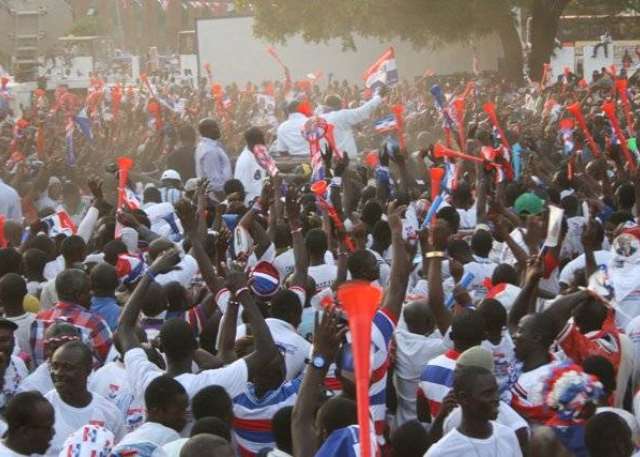
    However, the election, which was intended to be peaceful, turned chaotic a few hours in. At the Odorkor Methodist 1 polling station in the Ablekuma North constituency, some individuals engaged in a fisticuff with the police personnel. Also, a JoyNews journalist was slapped by an unknown individual.

    Former Minister of Fisheries and Aquaculture Development and Member of Parliament for Ewutu Senya East Constituency, Hawa Koomson, was also assaulted by a group of men. A journalist with GH One Television, Banahene Agyekum, was also slapped by a police officer.

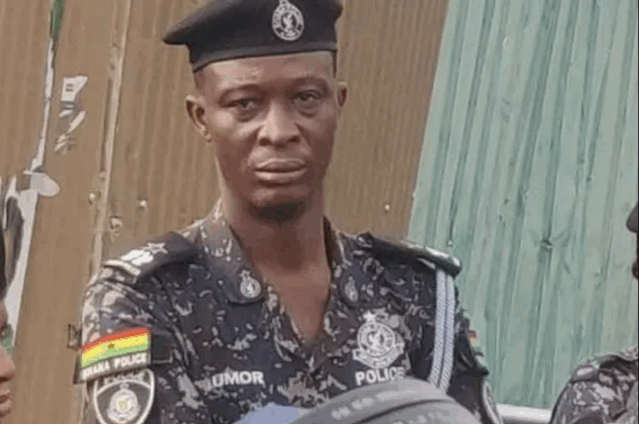
    A police officer captured on video assaulting a journalist during the Ablekuma North parliamentary re-run has been formally charged with assault, according to the Accra Regional Police Command.

    The officer, who was interdicted shortly after the incident, is now facing criminal charges following a review of video evidence by the police.

    In a statement issued by Superintendent Juliana Obeng, Head of Public Affairs, the police said they are analyzing multiple videos from the July 11 poll to identify all individuals involved in the violent incidents that marred the election.

    “In line with due process, the Police Officer captured in one of the videos assaulting a journalist who was interdicted has been held for criminal charges of assault,” the statement indicated.

    It adds that statements have been taken from complainants and witnesses, and victims have been issued Police Medical Report Forms as part of ongoing investigations.

    The Command noted that it has gathered vital leads and assured the public that arrests will follow soon.

    The police also emphasized their commitment to holding accountable anyone found culpable of violence, intimidation, or electoral misconduct.

    They encouraged the public to share credible information via emergency lines 18555 or 191.

    Deputy Minister for Government Communications, Shamima Muslim, in reaction to the said incident, commended the police for its swift action to reprimand its officer for such unlawful acts and condemned the recent attacks against civilians and journalists during the Ablekuma North election rerun.

    “What we are happy about is the swift action that the Ghana Police itself has taken in interdicting the officer in question. It is completely unwarranted. Government itself takes a very serious stance, especially on security agencies meting out unwarranted attacks to civilians under any circumstances,” she added.

    President of the Ghana Journalist Association (GJA) Albert Kwabena Dwumfuor also condemned the attack on journalists. Due to the chaos that erupted, Inspector General of Police Christian Tetteh Yohuno visited some polling stations in the constituency.

    The Minority in Parliament has also condemned the violence that took place during the just-ended Ablekuma North rerun election, accusing members of the ruling National Democratic Congress (NDC) of instigating violent activities. In a statement signed by Minority Leader Alexander Afenyo-Markin, the caucus said:

    “The most disturbing aspect of today’s violence is not just the brutality itself, but the deliberate endorsement and celebration of these attacks by senior government officials. For example, Dr. Hanna Louisa Bissiw, National Women’s Organiser of the NDC and CEO of the Minerals Development Fund, provided perhaps the most damaging response with her statement that “violence begets violence” and her suggestion that the brutal attacks were somehow justified.”

    “Even more shocking is the Facebook post by Malik Basintale, Acting Chief Executive Officer of the Youth Employment Agency (YEA) and Deputy National Communications Officer of the NDC, who apparently celebrated the man who attacked Hon. Mavis Hawa Koomson with the disturbing declaration, “From today, I name him the Flying Python.

    He shall be in charge of the 5k Airforce!” This grotesque celebration of violence against a former Member of Parliament represents a new low in Ghana’s political discourse,” the statement added.

    The Minority has registered its displeasure with the operation of the Ghana Police Service at the polling stations.

    “The Ghana Police Service’s response raises serious questions about their preparedness and commitment to protecting our electoral process. Security personnel were overwhelmed by the perpetrators, failing to prevent these attacks on political figures, party agents, and journalists.

    More concerning are allegations surrounding Chief Superintendent Lumor Frederick Senanu and his potential role in facilitating these disruptions.”

    The caucus stressed the need for increased protection for voters, electoral officers, journalists, and candidates. It also called on the international community, civil society, and media to monitor developments closely.

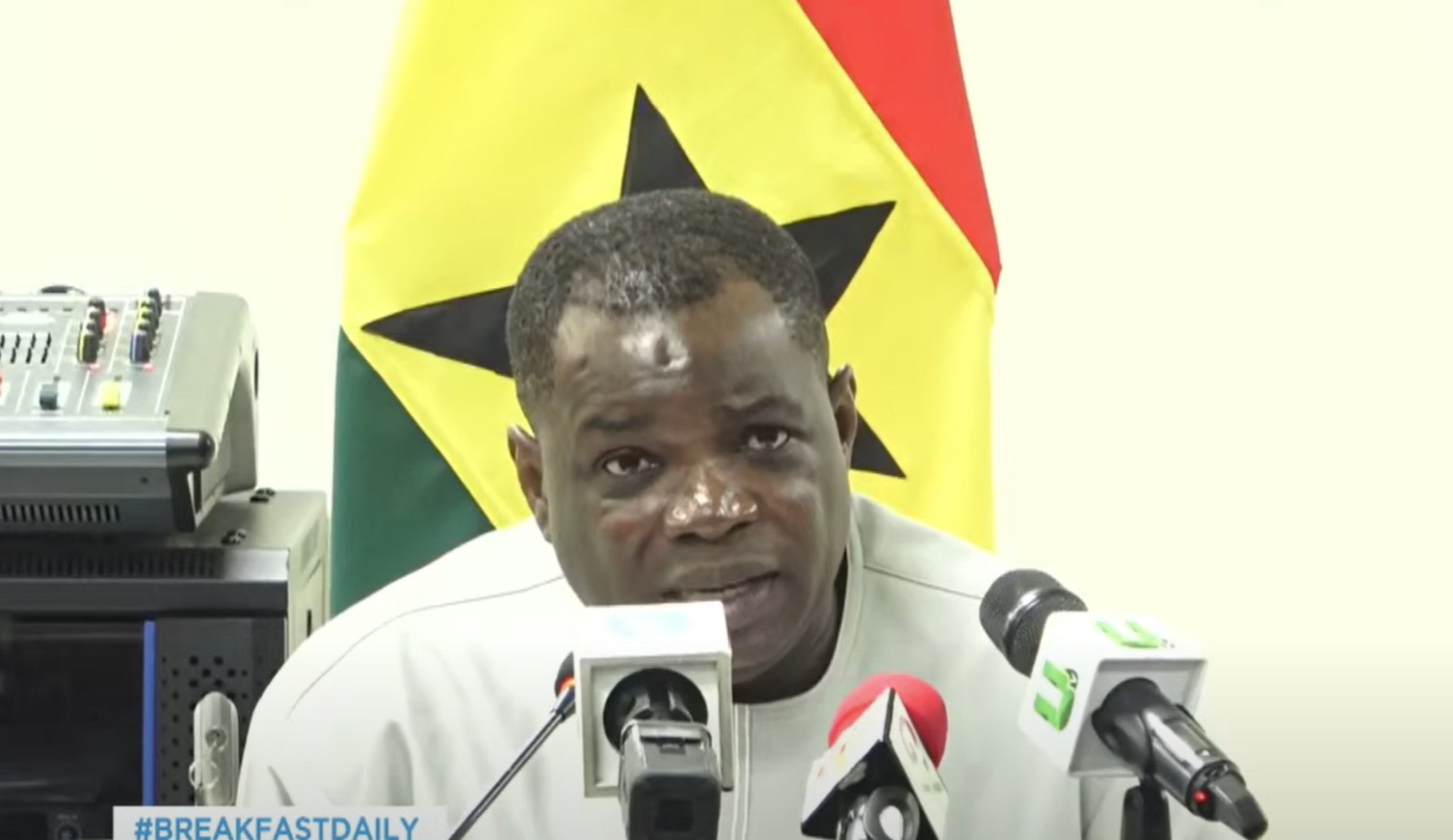
    Meanwhile, the Minister for the Interior, Mubarak Muntaka, has vowed to go after individuals who contributed to chaos during the Parliamentary rerun in the Ablekuma North constituency.

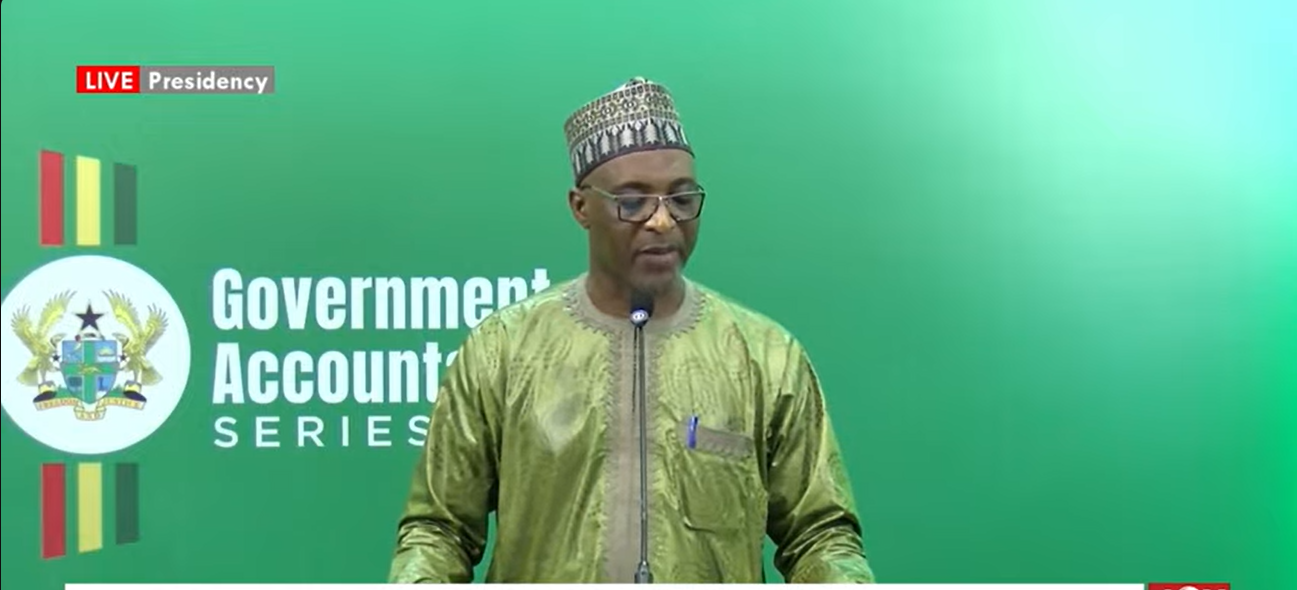
    According to him, justice will be served regardless of the perpetrators’ political affiliation. He pledged while addressing the media on Monday, July 14, as part of the ‘Government Accountability Series’ programme.

    “I can assure you that not my party, not any group, will we sit and allow to see the resurgence of vigilantism. I have spoken to the IGP firmly about the happenings in Ablekuma North. Videos have been forwarded to him, and we have instructed him to act swiftly to bring the perpetrators to book.

    “We’re not going to condone any actions by individuals within or outside our party going around to do the untoward. I can assure the public that we will ensure that under the leadership of H.E. John Dramani Mahama, no such group will be allowed to form,” he assured.

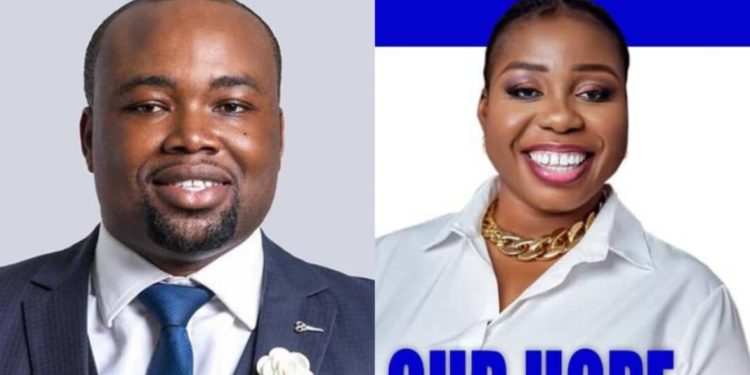
    The National Democratic Congress’ (NDC) Ewurabena Aubynn polled 34,090 votes to beat the New Patriotic Party’s (NPP) Akua Afriyie, who secured 33,881 votes.

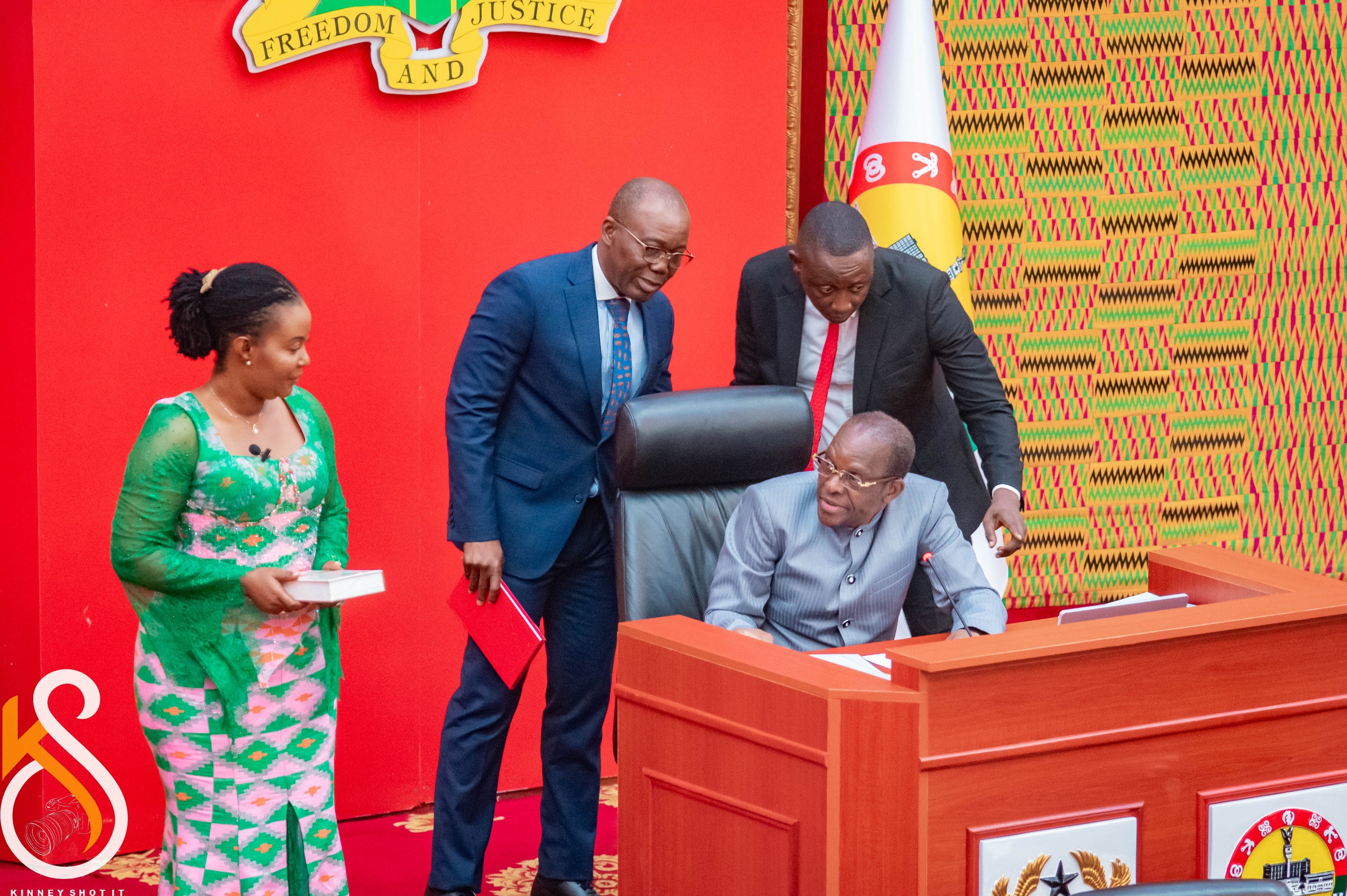
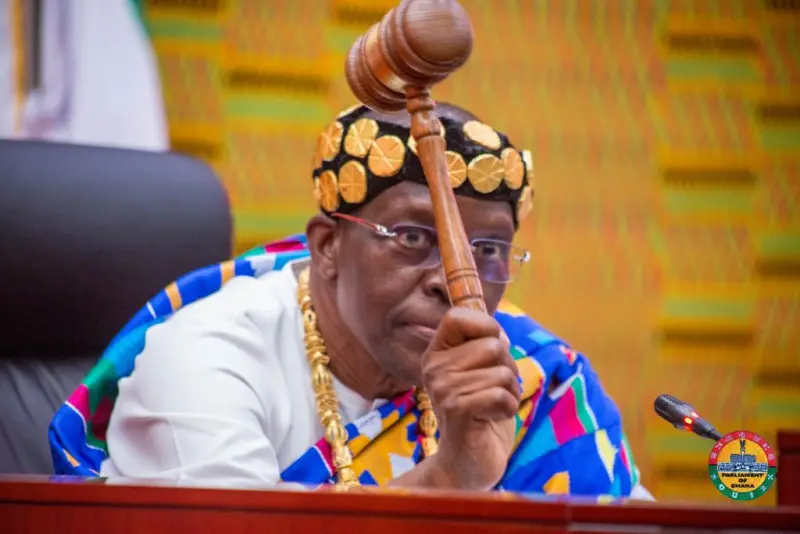
    On July 22, Speaker of Parliament Alban Bagbin swore in Ewurabena Aubynn despite a walkout staged by the Minority in Parliament.

    Speaking on the floor of the House, the Speaker reminded the legislator that she would account for her works to her constituents at the end of a four-year term, hence the need for her to improve their lives while in office. 

     “You are now the hope of the people of the constituency. They are looking up to you to do something to improve their lives. It is a trust, and this, I pray, you don’t abuse. Four years is just a day—you will go back to them, and they will assess you this time based on your performance.

    “And so don’t allow any person to change who you are. They voted for you, even though it was on a party ticket, but there are many members in the party in that constituency. They voted for you, so please commit yourself to them,” he added.

    Meanwhile, the Interior Minister has urged security personnel who will be deployed to oversee the upcoming by-election in the Akwatia constituency, Eastern Region, following the demise of Ernest Kumi, the constituent’s representative, to remain alert while executing their duties.

    The Minister for the Interior advised that they reflect on the recent violence that occurred during the parliamentary election rerun in the Ablekuma North constituency and work proactively to prevent a recurrence.

    According to him, the government will work to ensure that such dramatic events do not repeat themselves in future elections.

    “This is also a wake-up call for our security agencies to know that probably what happened [in Ablekuma North]…gives our security agencies the opportunity to even plan better towards Akwatia. All I can assure the people of Akwatia is that we will use Ablekuma North as a case study to review how we operate in Akwatia—to make sure that the citizens are free to cast their votes and express their will without fear or favour,” Muntaka added.

    In a related development, Attorney General (AG), Dr. Dominic Ayine, has received a detailed report on violent incidents that occurred during the 2020 and 2024 general elections for examination and possible sanctions from President John Dramani Mahama.

    The report was made available by the Inspector General of Police (IGP), Dr. Christian Tetteh Yohuno, on the occurrences during the period.

    The 2020 and 2024 general elections were marred by shootings and clashes between political party supporters and security forces, leading to multiple fatalities and injuries.

    The 2020 and 2024 polls claimed the lives of eight and three, respectively. In response, President Mahama tasked the IGP to follow up on these events for accountability and transparency. Justice is expected to be served on perpetrators whose activities resulted in chaos during this period.

  • Affo-Toffey, Gyakye Quayson among four to be vetted by Parliament on Friday

    Affo-Toffey, Gyakye Quayson among four to be vetted by Parliament on Friday

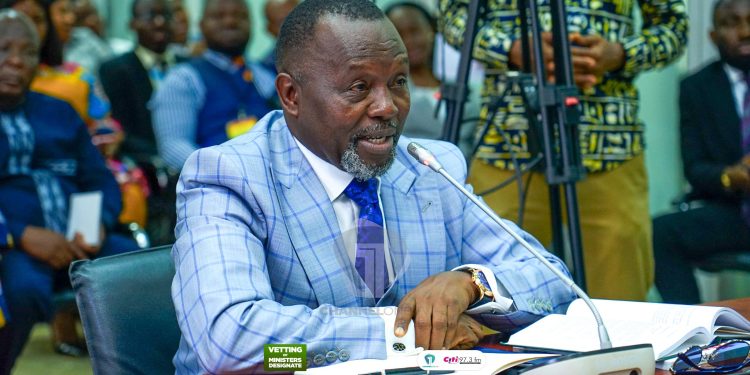
    The final batch of President John Dramani Mahama’s deputy ministerial nominees will be vetted by the Parliament’s Appointments Committee today, Friday, July 25.

    The nominees include Dorcas Affo-Toffey as Deputy Minister for Transport, James Gyakye Quayson for the Ministry of Foreign Affairs, Mohammed Adam Sukparu for Communication, Digital Technology, and Innovation, and Grace Ayensu-Danquah as Deputy Minister of Health.

    Dorcas Toffey has been nominated to serve at the Ministry of Transport; James G. Quayson will work at the Ministry of Foreign Affairs; Mohammed Adams Sukparu will work at the Ministry of Communication, Digital Technology, and Innovations; and Grace Ayensu-Danquah will serve at the Ministry of Health.

    Their appointment is in accordance with Articles 78(1) and 79(1) of the 1992 Constitution, which empower him to appoint ministers and deputy ministers with the prior approval of Parliament.

    Their appointment was made known in a statement issued by the Presidency dated Wednesday, July 9.

    “The nominees have distinguished themselves in public service and possess the requisite publications, experience, and integrity to support the respective sector ministers in effectively discharging their duties.

    “Their curriculum vitae and supporting documents are attached to facilitate the vetting process. I trust that Parliament will consider and approve the nominations expeditiously,” Speaker Bagbin stated in Parliament on Thursday, July 17.

    If appointed, the 4 individuals will bring the total number of ministers and deputies in his administration to 60.

    This follows the earlier approval and swearing-in of over 50 ministers and deputies in March 2025, who underwent vetting by the same committee.

    President Mahama committed to appointing no more than 60 ministers during his 2024 campaign, a promise aimed at demonstrating fiscal discipline and improving governance efficiency.

    “I am committed to operating an effective government with not more than sixty (60) ministers. These Ministers, together with other appointees of the government, will not be entitled to ex gratia payments after their tenure, as they will commit to that undertaking even before the necessary constitutional amendments, including a review of the controversial Article 71,” President Mahama stated.

    As a result, President Mahama scrapped and merged certain ministries; the Ministry of Information has been merged under the Ministry of Communication.

    The Ministry of Water and Sanitation has been merged with the Ministry of Works and Housing. The Ministry of Railways and the Ministry of National Security have both been scrapped.

    The Ministry of Sports and Youth now operates as the Ministry of Youth Development and Empowerment and the Ministry of Sports and Recreation.

    Additionally, the responsibilities of the Ministry of Chieftaincy have been added to the Ministry of Local Government. The Minority in Parliament argued that President Mahama’s decision to reduce his ministers will undermine the government’s ability to manage the country effectively.

    The substantive ministers are Dr. Cassiel Ato Forson (MP), who heads the Ministry of Finance, while John Abdulai Jinapor (MP) oversees Energy and Green Transition. The Attorney-General and Minister of Justice is Dominic Akuritinga Ayine (MP), with Kwame Governs Agbodza (MP) in charge of Roads and Highways.

    Eric Opoku (MP) leads the Ministry of Food and Agriculture; Agnes Naa Momo Lartey (MP) serves as Minister for Gender, Children, and Social Protection; and Abla Dzifa Gomashie (MP) is responsible for Tourism, Culture, and Creative Arts.

    Emelia Arthur (MP) has been appointed Minister for Fisheries and Aquaculture, and George Opare-Addo takes charge of Youth and Empowerment. Haruna Iddrisu (MP) oversees Education, Ahmed Ibrahim (MP) handles Local Government, Chieftaincy, and Religious Affairs, and Elizabeth Ofosu Adjare (MP) manages Trade, Agribusiness, and Industry.

    Dr. Edward Omane Boamah serves as Minister for Defence, with Samuel Nartey George (MP) at the helm of Communication, Digital Technology, and Innovations.

    Other key ministers include Emmanuel Armah-Kofi Buah (MP) for Lands and Natural Resources, Kofi Iddie Adams (MP) for Sports and Recreation, and Abdul-Rashid H. Pelpuo (MP) for Labour, Jobs, and Employment. Kwabena Mintah Akandoh (MP) handles the Health Ministry, while Ibrahim Murtala Muhammed (MP) is responsible for Environment, Science, and Technology.

    Joseph Bukari Nikpe (MP) serves as Transport Minister, and Muntaka Mohammed-Mubarak (MP) oversees Interior and National Security. Samuel Okudzeto Ablakwa (MP) leads the Ministry of Foreign Affairs, and Gilbert Kenneth Adjei takes charge of Works, Housing, and Water Resources.

    Additional ministerial appointments include Emmanuel Kwadwo Agyekum (MP) as Minister of State for Special Initiatives, Felix Kwakye Ofosu (MP) as Minister for Government Communications, Issifu Seidu (MP) as Minister of State for Climate Change and Sustainability, and Lydia Lamisi Akanvariba as Minister of State for Public Sector Reforms.

    Regional Ministers—Puozuing Charles Lwanga has been appointed as the Upper West Regional Minister, with Joseph Addae Akwaboa for the Bono Region and Francis Owusu Antwi for the Bono East Region.

    Wilbert Petty Brentum leads the Western North Region, Ekow Panyin Okyere Eduamoah oversees the Central Region, and Joseph Nelson manages the Western Region.

    Ali Adolf John has been named Northern Regional Minister, John Kwadwo Gyapong serves as the Oti Regional Minister, and James Gunu leads the Volta Region. Mrs. Rita Akosua Adjei Awatey has been appointed to the Eastern Region, while Ibrahim Tia takes charge of the North East Region. 

    Dr. Frank Amoakohene serves as the Ashanti Regional Minister, and Donatus Akamugri Atanga is in charge of the Upper East Region.

    Charity Gardiner serves as the Ahafo Regional Minister, Salisu Bi-Awuribe is responsible for the Savannah Region, and Linda Obenewaa Akweley Ocloo (MP) leads the Greater Accra Region. Supporting the work of the substantive ministers are 14 deputy ministers.

    Dr. Clement Apaak serves as Deputy Minister of Education, Richard Gyan Mensah as Deputy Minister of Energy, and John Dumelo as Deputy Minister of Food and Agriculture.

    Alhassan Suhuyini takes up the role of Deputy Minister of Roads and Highways, while Justice Sai serves as Deputy Attorney-General and Minister of Justice.

    Yusif Sulemana supports the Ministry of Lands and Natural Resources, and Yusif Isaka Jajah handles Tourism, Culture, and Creative Arts as deputy. 

    Rita Naa Odorley Sowah serves in the Local Government, Chieftaincy, and Religious Affairs portfolio, while Gizella Tetteh is Deputy Minister of Works, Housing, and Water Resources.

    Other appointees include Ernest Brogya Genfi as Deputy Minister of Defence, Ebenezer Okletey Terlabi as Deputy Minister of Interior, and Thomas Ampem Nyarko as Deputy Minister of Finance.

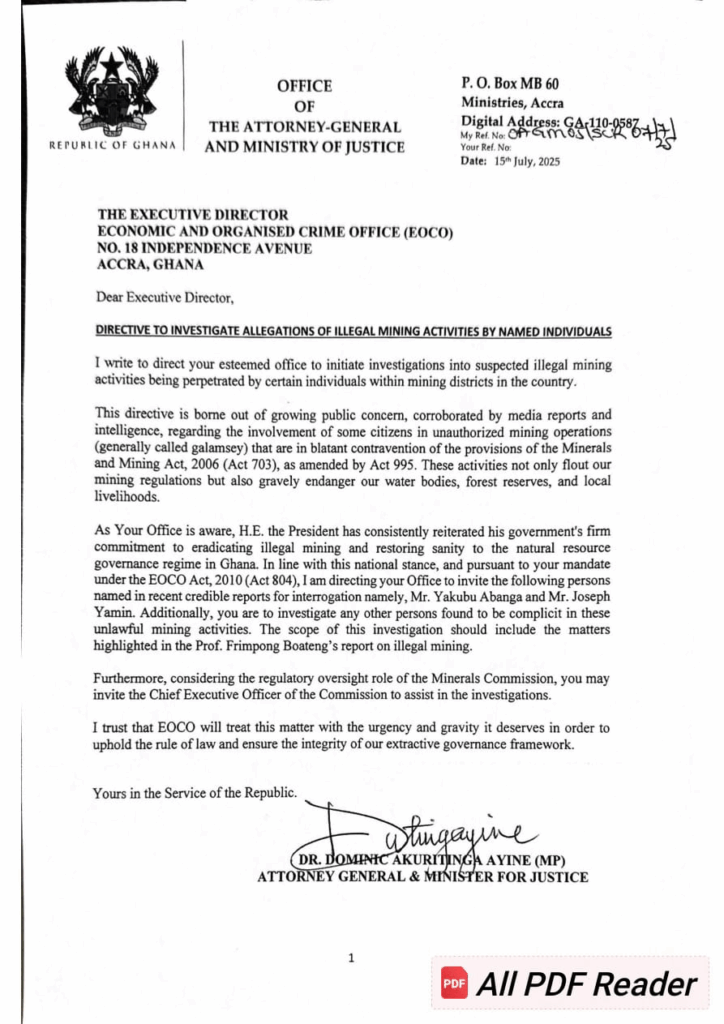
  • Govt unveils National Anti-Illegal Mining Operations Secretariat to combat ‘galamsey’

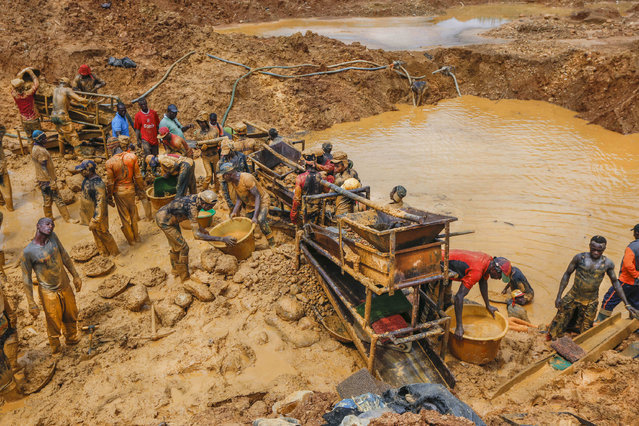
    Govt unveils National Anti-Illegal Mining Operations Secretariat to combat ‘galamsey’

    The government has set up the National Anti-Illegal Mining Operations Secretariat (NAIMOS) in efforts to curb illegal mining activities (galamsey) in the country.

    Speaking during an update on Wednesday, July 23, the Minister for Lands and Natural Resources, Emmanuel Armah-Kofi Buah, disclosed that the newly established Secretariat will act as the brain of Ghana’s anti-illegal mining operations.

    “To coordinate the efforts of the military, police, and other security agencies, the ministry has established the National Anti-Illegal Mining Operations Secretariat (NAIMOS) as the operational nerve-centre for Ghana’s fight against illegal small-scale mining,” he stated.

    The Secretariat is expected to collaborate with other key institutions, such as the Ministry of Transport, the Ministry of Finance (GRA-Customs Division), and the Ghana Ports and Harbours Authority as part of their mandate.

    Their collaboration will ensure that excavators and other earth-moving equipment that enter the country are not diverted to illegal mining activities.

    “In collaboration with the Ministry of Transport and the Ministry of Finance (GRA-Customs Division), and the Ports and Harbours Authority, we have initiated a proactive tracking of all imports of excavators and earth-moving equipment from the point of entry,” he added.

    Illegal mining activities continue to pose a major challenge for the country. Several Chinese individuals have been involved in illegal activities, leading to their arrest.

    The then Akufo-Addo-led government was criticized for failing to confront the issue. Before taking office, President Mahama expressed confidence in implementing lasting solutions to restore Ghana’s environment and protect future generations.

    As such, President Mahama assured to repeal L.I. 2462, which he argued has been shielding the operations of illegal miners. The L.I. 2462 has yet to be accomplished.

    To him, the first step toward collapsing illegal trade is to provide alternative livelihoods for those involved, such as a cooperative mining scheme.

    “You are currently the president of Ghana, and it is your responsibility to deal with galamsey now. After January 7, 2025, when Ghanaians have elected me, I will take responsibility and sort out illegal mining.

    It looks like he doesn’t live in this country because I have commented on galamsey extensively. The University of Energy and Natural Resources gave leaders a platform to outline their small-scale mining policy. I outlined NDC’s policy and answered questions for two hours,” he stated.

    The president also revealed plans to introduce the ‘Tree for Life’ and ‘Blue Water Initiative’ to restore eroded environments as well as water bodies caused by illegal activities.

    On 17 March this year, 460 Blue Water Guards were deployed to galamsey-prone areas, like the Tano River, Wassa Dunkwa, Tigarikrom, and the others.

    According to the Ghana Police Service, a total of 208 individuals have been apprehended and 99 excavators seized as part of the government’s anti-galamsey operation.

    These arrests and confiscation of mining equipment were undertaken between March and May in hotspots, particularly the Western Region, according to reports.

    According to President Mahama, eight out of nine forest reserves known as no-go zones and controlled by illegal miners have been repossessed by the government.

    A few months ago, the Lands and Natural Resources Minister Emmanuel Armah-Kofi Buah announced the rollout of a system to monitor excavator imports and usage, involving port tagging and digital tracking in partnership with several state agencies.

    The third most valuable item imported into this country is excavators, and it is worth GHC6.2 billion, according to the sector minister.

    The joint Military-Forestry Commission task force that conducted targeted operations in high-risk districts across the Ashanti, Western, and Western North Regions led to the seizure of 100 excavators, three bulldozers, and four vehicles.

    On the other hand, excavator owners and operators who have failed to register their machines with the Driver and Vehicle Licensing Authority (DVLA) risk losing them to the state, as the government intensifies efforts to clamp down on illegal mining activities.

    The Chief Executive Officer (CEO) of the DVLA, Julius Neequaye Kotey, issued the directive in Accra, warning that effective June 1, any excavator not registered with the DVLA will be confiscated.

    Meanwhile, President Mahama has declared galamsey a national emergency, requiring collaborative efforts to end the canker. He has also reiterated the government’s commitment to winning the fight against galamsey activities.

    “We are alarmed by the environmental destruction that is reported across Awaso, Dadieso, and Sefwi-Anhwiaso, mainly due to illegal mining. I must be honest, this is a national emergency. The national task force will continue its efforts to halt illegal mining in our forest reserves and on our water bodies,” he added.

    In the meantime, the National Executive Council (NEC) of the University of Teachers Association Ghana (UTAG) has threatened to strike in the coming days should the government fail to make significant ‘progress’ in its fight against galamsey.

    The Association has argued that despite several key promises made, the government is yet to make headway. In a press statement released on Sunday, July 20, the Council demanded that President John Dramani Mahama fulfill his pledge to eradicate the menace.

    “President Mahama’s assumption of office has not yet yielded the concrete actions required to match the gravity of his pledge. We are yet to see this pledge materialize in a way that can halt and reverse the wanton destruction of our forest reserves, water bodies, and arable lands. We are yet to see any coherent, practically relevant, and workable policies from the President and his government to address the galamsey menace permanently,” parts of the statement read.


  • 5,000 youth to be recruited as Prison Support Assistants

    5,000 youth to be recruited as Prison Support Assistants

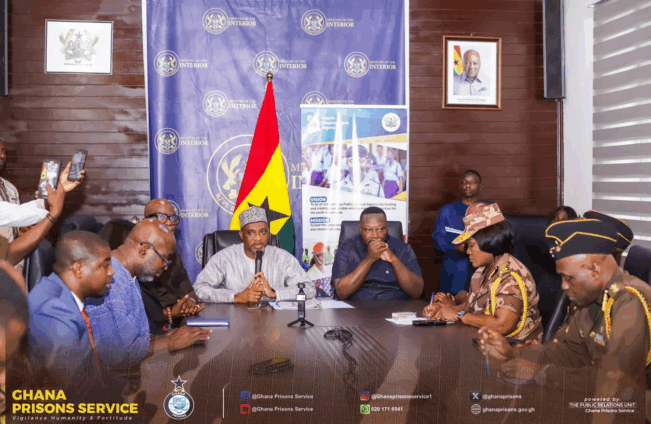
    The Ghana Prisons Service is expected to train and recruit five thousand (5,000) young Ghanaians as Prison Service Assistants across the country in the coming days.

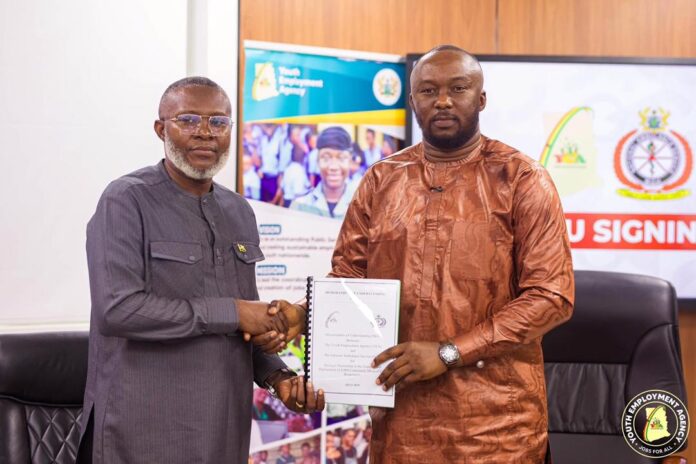
    This follows a Memorandum of Understanding (MoU) signed between the Youth Employment Agency (YEA) and the Ghana Prisons Service on Monday, July 21.


    Individuals present at the signing ceremony were the Minister for the Interior and the Minister for Youth Development and Empowerment.

    In a Facebook post, the YEA noted that the move aligns with President John Mahama’s efforts to decrease the unemployment rate in the country.

    “This bold step marks another milestone in our mission to create sustainable job opportunities for the youth while strengthening key state institutions with skilled manpower,” it wrote.

    YEA is a Ghanaian government agency established under the Youth Employment Act, 2015 (Act 887) to provide young adults with skills training, internship opportunities, and job placement assistance.


    This is not the first initiative being taken by YEA; just last week it signed a two-year Memorandum of Understanding (MoU) with the National Ambulance Service (NAS) in efforts to support the operations of NAS.

    About 6,000 young Ghanaians will be recruited as community medical first responders across the country.


    In April this year, the Youth Employment Agency entered a one-year agreement with SoccaBet Ghana to create 500 job placements.

    Also, the Agency, in partnership with the Ghana Fire Service, will recruit 5,000 young Ghanaians as fire assistants across the country.


    In May, YEA announced government’s plan to recruit 12,000 young individuals across the country to serve as Community Police Assistants (CPAs).

    Unemployment in Ghana has been on the rise despite numerous government interventions. A report from the Ghana Statistical Service (GSS) reports that youth unemployment rose to 14.7 percent in the first three quarters of 2023.


    But according to a UK-based firm, Fitch Solutions, “Over 2024, we forecast unemployment to hold at 4.0%, and if accompanied by easing inflation, will see a rise in real wages for many households.”


    The YEA’s initiative is expected to grant young Ghanaian skilled workers and graduates who have been left without job opportunities.

    The government has launched the Work Abroad Programme, which is structured to equip Ghanaian youth with the essential skills, guidance, and support needed to secure overseas employment.


    Speaking at the launch, YEA CEO Malik Basintale noted, “This initiative is about creating opportunities, building brighter futures, and ensuring that our young people can thrive both locally and internationally.”

    The launch featured engaging discussions on the programme’s implementation strategy, expected benefits, and long-term sustainability.

    Collaboration with GIZ Ghana is expected to strengthen the initiative by leveraging global networks and expertise in workforce development.


    As the programme rolls out, young Ghanaians aspiring to gain international work experience are encouraged to explore the opportunities available.

    The government has reiterated its commitment to supporting participants throughout the process, reinforcing its vision of empowering youth and driving economic growth through global employment avenues.

    Meanwhile, the Minister for Labour, Jobs and Employment Hon. Dr. Abdul Rashid Hassan Pelpuo has signed a Memorandum of Understanding (MoU) on Monday, July 21, with esteemed partners, including the BFW Group, RETOG and the Dominion Leaders Foundation.


    Speaking at the signing ceremony, Minister Dr. Hassan Pelpuo indicated that the MoU is aimed at equipping Ghanaian youth with practical, demand-driven skills essential for the modern workforce.


    “We must train ourselves again to provide the necessary skills for our development. This partnership is not merely aspirational; it is imperative. A skilled workforce is a pillar of national prosperity,” he stated.


    He disclosed that the MOU strengthens skills training between Ghana and Germany, especially for construction and similar jobs.

    According to him, Ghana frequently relies on Togo for technical labour due to its German-influenced vocational training system.


    He mentioned that it is about time Ghana trained individuals with the right skills to support the country’s planned development projects.

    Also, the government has rolled out the ROSET initiative, targeted at individuals for promising careers in construction.


    It will feature a three-part strategy: enhanced career guidance, practical apprenticeship schemes in collaboration with Germany, and vocational training designed to match labour market demands.

  • President Mahama hands over election violence report to AG for legal review

    President Mahama hands over election violence report to AG for legal review

    Attorney General, Dr. Dominic Ayine, has received a detailed report on violent incidents that occurred during the 2020 and 2024 general elections for examination and possible sanctions from President John Dramani Mahama.

    The report was made available by the Inspector General of Police (IGP), Dr. Christian Tetteh Yohuno on the occurrences during the period.

    The 2020 and 2024 general elections were marred by shootings and clashes between political party supporters and security forces, leading to multiple fatalities and injuries.

    2020 and 2024 polls reportedly claimed the lives of eight and three, respectively.

    In response, President Mahama tasked the IGP earlier this year, to follow up on these events for accountability and transparency.

    Justice is expected to be served on perpetrators whose activities resulted in chaos during this period.

    Electoral violence in Ghana has since been a challenge to the country. On Friday, July, the Electoral Commission (EC) held an election in 19 polling stations of the Ablekuma North to provide its constituents with a representative after the 2024 parliamentary elections.

    However, the election, which was intended to be peaceful, turned chaotic a few hours in.

    In a viral video, it is unknown what exactly transpired between the reporter and a group of police officers that led to him being slapped.

    In line with internal disciplinary procedures, he was interdicted and referred to the Police Professional Standards Bureau (PPSB) for investigation.

    The Police officer’s action has been condemned by all, including the mayor of Accra, Michael Kpakpo Allotey, who witnessed the unfortunate incident.

    Engaging the media after the assault, Banahene Agyekum expressed distress and pain.

    “Yes, (I won’t be able to continue work today) because my right eye is shaking and I don’t know what happened to my forehead. I have to go for a medical checkup,” he stated.

    In line with internal disciplinary procedures, he was interdicted and referred to the Police Professional Standards Bureau (PPSB) for investigation.

    The officer concerned has been withdrawn from the ongoing election duty at Ablekuma North.

    The Police have assured the public that a thorough investigation will be conducted into the matter and further updates will be communicated.

    It is unknown what exactly transpired between the reporter and a group of police officers that led to him being slapped.

    The Police officer’s action has been condemned by all, including the mayor of Accra, Michael Kpakpo Allotey, who witnessed the unfortunate incident.

    Engaging the media after the assault, Banahene Agyekum expressed distress and pain.

    “Yes, (I won’t be able to continue work today) because my right eye is shaking and I don’t know what happened to my forehead. I have to go for a medical checkup,” he stated.

    After the 2024 polls, Ablekuma North remained the only constituency in Ghana without a sitting MP, due to unresolved disagreements over the outcome of the parliamentary vote.

    On December 10, 2024, three days after the national polls, the EC declared Ewurabena Aubynn of the NDC the winner of the Ablekuma North parliamentary seat, defeating the New Patriotic Party’s (NPP) Nana Akua Owusu Afriyieh.

    However, the EC later revoked the announcement, revealing that results from 62 of the 281 polling stations had not been included in the initial collation.

    Efforts to restart the collation in January 2025 were disrupted by multiple challenges.

    These included interruptions due to the submission of unverified pink sheets and a violent intrusion at the collation centre that heightened security concerns.

    The Electoral Commission (EC), after extensive deliberations, in July noted that it will hold the rerun election because the 19 scanned polling station results used for the collation, though approved by agents of both political parties, were not verified by the presiding officers responsible for those polling stations.

    The EC arrived at this decision after it met with the representatives of the National Democratic Congress (NDC) and New Patriotic Party (NPP) on Tuesday, July 1.

    Ahead of today’s election, the EC called on the Ghana Police Service to provide the needed security to ensure a safe environment for the conduct of the election.

    Meanwhile, the Minister for the Interior, Mubarak Muntaka, has vowed to go after individuals who contributed to chaos during the Parliamentary rerun in the Ablekuma North constituency.

    According to him, justice will be served regardless of the perpetrators’ political affiliation. He pledged while addressing the media on Monday, July 14, as part of the ‘Government Accountability Series’ programme.

    “I can assure you that not my party, not any group, will we sit and allow to see the resurgence of vigilantism. I have spoken to the IGP firmly about the happenings in the Ablekuma North. Videos have been forwarded to him, and we have instructed him to act swiftly to bring the perpetrators to book.

    “We’re not going to condone any actions by individuals within or outside our party going around to do the untoward. I can assure the public that we will ensure that under the leadership of H.E. John Dramani Mahama, no such group will be allowed to form,” he assured.

    He urged security personnel who will be deployed to oversee the upcoming by-election in Akwatia constituency, Eastern Region, to remain alert while executing their duties.

    The Minister for the Interior advised that they reflect on the recent violence that occurred during the parliamentary election rerun in the Ablekuma North constituency and work proactively to prevent a recurrence.

    According to him, the government will work to ensure that such dramatic events do not repeat themselves in future elections.

    “This is also a wake-up call for our security agencies to know that probably what happened [in Ablekuma North]…gives our security agencies the opportunity to even plan better towards Akwatia.

    “All I can assure the people of Akwatia is that we will use Ablekuma North as a case study to review how we operate in Akwatia—to make sure that the citizens are free to cast their votes and express their will without fear or favour,” Muntaka added.

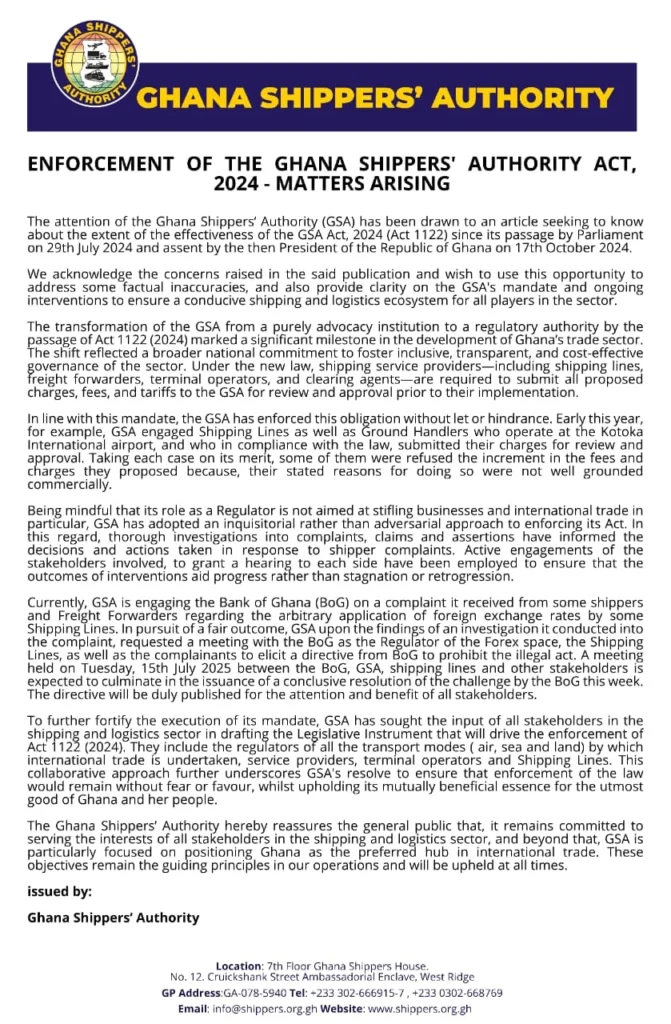
  • Ewurabena Aubynn joins Ghana Shippers Authority Board

    Ewurabena Aubynn joins Ghana Shippers Authority Board

    Member of Parliament (MP) for Ablekuma North, Ewurabena Aubynn, has joined the Governing Board of the Ghana Shippers Authority.

    Ewurabena Aubynn who contested as MP under the National Democratic Congress’ (NDC) has held philanthropic works aside her political achievement, she is the mastermind behind a nonprofit organisation , Awula Foundation launched in February 2023.

    The foundation focuses on vulnerable groups within the Ablekuma North Constituency.

    Ewurabena Aubynn’s addition to the Authority is expected to assist the Authority in its policies and enhancing its engagement with key stakeholders in the trade and logistics sector.

    The Speaker of Parliament, Rt. Hon. Alban Bagbin on Tuesday, July 22, sworn in Ewurabena Aubynn as MP for the Ablekuma North constituency, amid the Minority in Parliament’s boycott.


    The Minority staged a walkout after the Speaker declined to allow Minority Chief Whip, Frank Annoh-Dompreh, to give a preliminary statement before the swearing-in ceremony.


    The Speaker explained that he could only allow statements after the swearing-in had taken place.


    In response, Annoh-Dompreh stated that under those conditions, the Minority could not participate in the process.


    The Electoral Commission (EC) held a rerun election on Friday, July 11, in 19 polling stations of Ablekuma North to provide its constituents with a representative after the 2024 parliamentary elections.


    Ewurabena Aubynn polled 34,090 votes to beat the New Patriotic Party’s (NPP) Akua Afriyie, who secured 33,881 votes.


    Ablekuma North remained the only constituency in Ghana without a sitting MP, due to unresolved disagreements over the outcome of the parliamentary vote after the 2024 polls.


    On December 10, 2024, three days after the national polls, the EC declared Ewurabena Aubynn of the NDC the winner of the Ablekuma North parliamentary seat, defeating the New Patriotic Party’s (NPP) Nana Akua Owusu Afriyieh.


    However, the EC later revoked the announcement, revealing that results from 62 of the 281 polling stations had not been included in the initial collation.


    Multiple challenges disrupted efforts to restart the collation in January 2025.


    These included interruptions due to the submission of unverified pink sheets and a violent intrusion at the collation centre that heightened security concerns.


    The Electoral Commission (EC), after extensive deliberations, noted in July that it would hold a rerun election because the 19 scanned polling station results used for collation, although approved by agents of both political parties, had not been verified by the presiding officers responsible for those polling stations.


    The EC arrived at this decision after it met with the representatives of the National Democratic Congress (NDC) and New Patriotic Party (NPP) on Tuesday, July 1.


    The NDC now has 184 seats in Parliament with Aubynn’s victory, where has the NPP has 87 seats.


    In the Fourth Republic, the New Patriotic Party (NPP) has won the Ablekuma North parliamentary election seven times, whereas the National Democratic Congress (NDC) has claimed the seat twice.


    Violence mars Ablekuma North rerun election


    At the Odorkor Methodist 1 polling station in the Ablekuma North constituency, some individuals engaged in a fisticuff with the police personnel. Also, a JoyNews journalist was slapped by an unknown individual.


    Former Minister of Fisheries and Aquaculture Development and Member of Parliament for Ewutu Senya East Constituency, Hawa Koomson, was also assaulted by a group of men.

    A journalist with GH One Television, Banahene Agyekum, was also slapped by a police officer.


    A police officer captured on video assaulting a journalist during the Ablekuma North parliamentary re-run has been formally charged with assault, according to the Accra Regional Police Command.


    The officer, who was interdicted shortly after the incident, is now facing criminal charges following a review of video evidence by the police.


    In a statement issued by Superintendent Juliana Obeng, Head of Public Affairs, the police said they are analyzing multiple videos from the July 11 poll to identify all individuals involved in the violent incidents that marred the election.


    “In line with due process, the Police Officer captured in one of the videos, assaulting a journalist who was interdicted, has been held for criminal charges of assault,” the statement indicated.


    It adds that statements have been taken from complainants and witnesses, and victims have been issued Police Medical Report Forms as part of ongoing investigations.


    The Command noted that it has gathered vital leads and assured the public that arrests will follow soon.


    The police also emphasized their commitment to holding accountable anyone found culpable of violence, intimidation, or electoral misconduct. They encouraged the public to share credible information via emergency lines 18555 or 191.


    Deputy Minister for Government Communications, Shamima Muslim, in reaction to the said incident, commended the police for its swift action to reprimand its officer for such unlawful acts and condemned the recent attacks against civilians and journalists during the Ablekuma North election rerun.


    “What we are happy about is the swift action that the Ghana Police itself has taken in interdicting the officer in question. It is completely unwarranted. Government itself takes a very serious stance, especially on security agencies meting out unwarranted attacks to civilians under any circumstances,” she added.


    President of the Ghana Journalist Association (GJA) Albert Kwabena Dwumfuor also condemned the attack on journalists.

    Due to the chaos that erupted, Inspector General of Police Christian Tetteh Yohuno visited some polling stations in the constituency.


    The Minority in Parliament has also condemned the violence that took place during the just-ended Ablekuma North rerun election, accusing members of the ruling National Democratic Congress (NDC) of instigating violent activities.


    In a statement signed by Minority Leader Alexander Afenyo-Markin, the caucus said:


    “The most disturbing aspect of today’s violence is not just the brutality itself, but the deliberate endorsement and celebration of these attacks by senior government officials.

    For example, Dr. Hanna Louisa Bissiw, National Women’s Organiser of the NDC and CEO of the Minerals Development Fund, provided perhaps the most damaging response with her statement that “violence begets violence” and her suggestion that the brutal attacks were somehow justified.”


    “Even more shocking is the Facebook post by Malik Basintale, Acting Chief Executive Officer of the Youth Employment Agency (YEA) and Deputy National Communications Officer of the NDC,
    who apparently celebrated the man who attacked Hon.

    Mavis Hawa Koomson with the disturbing declaration, “From today, I name him the Flying Python. He shall be in charge of the 5k Airforce!” This grotesque celebration of violence against a former Member of Parliament represents a new low in Ghana’s political discourse,” the statement added.


    The Minority has registered its displeasure with the operation of the Ghana Police Service at the polling stations.

    “The Ghana Police Service’s response raises serious questions about their preparedness and commitment to protecting our electoral process. Security personnel were overwhelmed by the
    perpetrators, failing to prevent these attacks on political figures, party agents, and journalists. More concerning are allegations surrounding Chief Superintendent Lumor Frederick Senanu and his potential role in facilitating these disruptions.”


    The caucus stressed the need for increased protection for voters, electoral officers, journalists, and candidates. It also called on the international community, civil society, and media to monitor developments closely.


    Meanwhile, the Minister for the Interior, Mubarak Muntaka, has vowed to go after individuals who contributed to chaos during the Parliamentary rerun in the Ablekuma North constituency.


    According to him, justice will be served regardless of the perpetrators’ political affiliation. He pledged while addressing the media on Monday, July 14, as part of the ‘Government Accountability Series’ programme.


    “I can assure you that not my party, not any group, will we sit and allow to see the resurgence of vigilantism. I have spoken to the IGP firmly about the happenings in the Ablekuma North. Videos have been forwarded to him, and we have instructed him to act swiftly to bring the perpetrators to book.


    “We’re not going to condone any actions by individuals within or outside our party going around to do the untoward. I can assure the public that we will ensure that under the leadership of H.E. John Dramani Mahama, no such group will be allowed to form,” he assured.


    He urged security personnel who will be deployed to oversee the upcoming by-election in Akwatia constituency, Eastern Region, to remain alert while executing their duties.


    The Minister for the Interior advised that they reflect on the recent violence that occurred during the parliamentary election rerun in the Ablekuma North constituency and work proactively to prevent a recurrence.


    According to him, the government will work to ensure that such dramatic events do not repeat themselves in future elections.
    “This is also a wake-up call for our security agencies to know that probably what happened [in Ablekuma North]… allows our security agencies to even plan better towards Akwatia.


    “All I can assure the people of Akwatia is that we will use Ablekuma North as a case study to review how we operate in Akwatia—to make sure that the citizens are free to cast their votes and express their will without fear or favour,” Muntaka added.

  • ‘MahamaCares’ Bill passed by Parliament

    ‘MahamaCares’ Bill passed by Parliament

    The Ghana Medical Trust Fund Bill, 2025, also known as MahamaCares, has been passed by Parliament.

    The Bill, which was laid before Parliament on Monday, July 21, was opposed by the Minority; the caucus warned that it could put a strain on the National Health Insurance Scheme (NHIS) budget and its operations.

    The Mahama Cares fund is expected to play a pivotal role in enhancing healthcare access for many Ghanaians, particularly those battling chronic diseases and unable to afford the necessary medical treatment.

    In the month of April, the government unveiled the Ghana Medical Trust Fund, to provide financial aid to those battling with chronic conditions like kidney failure, cancer, and heart diseases.

    The fund is designed to alleviate the financial burden faced by patients in need of life-saving medical care.

    The launch event took place at the University of Ghana Medical Centre (UGMC) in Accra on Tuesday, April 29, 2025. The ceremony saw the attendance of key stakeholders from the healthcare sector and the corporate world.

    President John Dramani Mahama, who officially introduced the fund, called on the private sector to support Mahama Cares as part of their corporate social responsibility.

    “I want to encourage corporate Ghana, businesses, the mines, the banks, and all the other companies, that this Ghana Medical Trust Fund, is coming to your clients who save their monies in your banks or do business with you. Some of them are even your own staff.

    “So, as part of your Corporate Social Responsibility (CSR), if you give anything, consider that you are giving to your own staff or customers. So, I would like to encourage all corporations in Ghana, both private and public, to at the end of the year, donate some portion of their annual CSR to Ghana Medical Fund because it is going to do a lot of good to the country,” he stated.

    At the launch, President Mahama committed to donating the first six months of his salary to the Fund.

    Health Minister Mintah Akandoh has also followed suit, announcing a three-month salary donation to back the initiative. He further disclosed that several cabinet colleagues had joined the cause, including Trade, Agribusiness and Industry Minister Elizabeth Ofosu-Agyare and Gender Minister Naa Momo Lartey, who have both pledged one month’s salary each.

    To ensure broad-based participation, the President has directed all government appointees to contribute the equivalent of at least one month’s salary to the Fund.

    The Minister for Health, Kwabena Mintah Akandoh, expressed his support for the initiative, describing it as long overdue. He emphasized that the fund would ensure equitable access to healthcare, particularly for individuals facing financial barriers to treatment.

    “The draft bill for the Mahama Care is ready and will be submitted immediately Parliament resumes,” he confirmed.

    Akandoh also announced a significant policy change to strengthen the programme, revealing that the government has removed the capping of the national health insurance firm. This, he explained, will unlock substantial resources for the fund.

    “Most importantly, the uncapping of the capping of the national health insurance firm has been removed. This move has unlocked substantial resources to ensure that a dedicated allocation of funds will now support the Mahama Care Programme,” he added.

    Vice President Professor Naana Jane Opoku-Agyemang has pledged four months of her salary to support the fund.

    In addition, the general public has been encouraged to make contributions through the short code *255#, accessible on all mobile networks.

    The initiative has recently received a boost with GHC2.2million worth of medicines donated by Pharmaceutical Manufacturers Association of Ghana (PMAG) last week.

    Items donated by the organization includes pain medication, blood tonics, anti-malaria drugs, cardiovascular and anti-diabetic medicines, as well as asthma management treatments.

    During the presentation of the items by PMAG President Dr Samuel Tobbin, he stated that, “This donation is not just about medicine; it’s about restoring hope and dignity to the thousands of Ghanaians who rely on public health support.”

    “We believe that the MahamaCares Initiative presents a timely opportunity to demonstrate the power of local industry in driving national development.”

    Telecel Ghana, Alive Industries, East Cantonment Pharmacy, and KMI Energies have joined the list of benefactors that have assisted the initiative with their donation.

    Telecel Ghana has pledged to support the initiative by equipping three (3) healthcare centers with HPV testing kits, digital colposcopes, and biopsy instruments.

    The donation, which will also cover operational costs for these facilities over two years, is expected to enable the screening of at least 5,000 women in the first year, offering free diagnostic services to underserved communities.

    Additionally, Alive Industries has donated ₵500,000.00, East Cantonment Pharmacy has contributed ₵50,000.00, and KMI Energies has supported the initiative with ₵5,000.00.

    On Friday, May 16, service commanders of the Ghana Armed Forces (GAF) donated one month’s basic salary to support the initiative.

    Some 11 agencies under the Ministry of the Interior have collectively donated GH¢1 million to the Ghana Medical Trust Fund at a short ceremony at Jubilee House in Accra.

    The breakdown of the contributions made by the agencies is as follows: Ghana Police Service (GH¢580,000), Ghana Immigration Service (GH¢100,000), Ghana National Fire Service (GH¢50,000), National Disaster Management Organization (NADMO) (GH¢50,000), and the Ghana Prisons Service (GH¢50,000).

    Others include the Narcotics Control Commission (NACOC) (GH¢10,000), National Identification Authority (NIA) (GH¢50,000), Gaming Commission (GH¢50,000), Ghana Refugees Board (GH¢5,000), National Peace Council (GH¢5,000) and the Small Arms and Light Weapons Commission (GH¢10,000).

    The Minister for the Interior and National Security, Alhaji Mohammed Mubarak Muntaka, also made a personal contribution of GH¢50,000, while the Deputy Minister for the Interior, Mr. Ebenezer Okletey Terlabi, also donated GH¢30,000.

  • Ewurabena Aubynn sworn in as Ablekuma North MP amid Minority boycott

    Ewurabena Aubynn sworn in as Ablekuma North MP amid Minority boycott

    The Speaker of Parliament, Rt. Hon. Alban Bagbin has sworn in the National Democratic Congress’ (NDC) Ewurabena Aubynn as the Member of Parliament (MP) for the Ablekuma North constituency, amid the Minority in Parliament’s boycott.

    The Minority staged a walkout after the Speaker declined to allow Minority Chief Whip, Frank Annoh-Dompreh, to give a preliminary statement before the swearing-in ceremony.

    The Speaker explained that he could only allow statements after the swearing-in had taken place.

    In response, Annoh-Dompreh stated that under those conditions, the Minority could not participate in the process.

    The Electoral Commission (EC) on Friday, July 11, held a rerun election in 19 polling stations of the Ablekuma North to provide its constituents a representative after the 2024 parliamentary elections.

    Ewurabena Aubynn polled 34,090 votes to beat the New Patriotic Party’s (NPP) Akua Afriyie, who secured 33,881 votes.

    Ablekuma North remained the only constituency in Ghana without a sitting MP, due to unresolved disagreements over the outcome of the parliamentary vote after the 2024 polls.

    On December 10, 2024, three days after the national polls, the EC declared Ewurabena Aubynn of the NDC the winner of the Ablekuma North parliamentary seat, defeating the New Patriotic Party’s (NPP) Nana Akua Owusu Afriyieh.

    However, the EC later revoked the announcement, revealing that results from 62 of the 281 polling stations had not been included in the initial collation.

    Efforts to restart the collation in January 2025 were disrupted by multiple challenges.

    These included interruptions due to the submission of unverified pink sheets and a violent intrusion at the collation centre that heightened security concerns.

    The Electoral Commission (EC), after extensive deliberations, in July noted that it will hold the rerun election because the 19 scanned polling station results used for the collation, though approved by agents of both political parties, were not verified by the presiding officers responsible for those polling stations.

    The EC arrived at this decision after it met with the representatives of the National Democratic Congress (NDC) and New Patriotic Party (NPP) on Tuesday, July 1.

    The NDC now has 184 seats in Parliament with Aubynn’s victory, where has the NPP has 87 seats.

    In the Fourth Republic, the New Patriotic Party (NPP) has won the Ablekuma North parliamentary election seven times, whereas the National Democratic Congress (NDC) has claimed the seat twice.

    Violence mars Ablekuma North rerun election

    At the Odorkor Methodist 1 polling station in the Ablekuma North constituency, some individuals engaged in a fisticuff with the police personnel. Also, a JoyNews journalist was slapped by an unknown individual.

    Former Minister of Fisheries and Aquaculture Development and Member of Parliament for Ewutu Senya East Constituency, Hawa Koomson, was also assaulted by a group of men. A journalist with GH One Television, Banahene Agyekum, was also slapped by a police officer.

    A police officer captured on video assaulting a journalist during the Ablekuma North parliamentary re-run has been formally charged with assault, according to the Accra Regional Police Command.

    The officer, who was interdicted shortly after the incident, is now facing criminal charges following a review of video evidence by the police.

    In a statement issued by Superintendent Juliana Obeng, Head of Public Affairs, the police said they are analyzing multiple videos from the July 11 poll to identify all individuals involved in the violent incidents that marred the election.

    “In line with due process, the Police Officer captured in one of the videos, assaulting a journalist who was interdicted, has been held for criminal charges of assault.” the statement indicated.

    It adds that statements have been taken from complainants and witnesses, and victims have been issued Police Medical Report Forms as part of ongoing investigations. 

    The Command noted that it has gathered vital leads and assured the public that arrests will follow soon.

    The police also emphasized their commitment to holding accountable anyone found culpable of violence, intimidation, or electoral misconduct. They encouraged the public to share credible information via emergency lines 18555 or 191.

    Deputy Minister for Government Communications, Shamima Muslim, in reaction to the said incident, commended the police for its swift action to reprimand its officer for such unlawful acts and condemned the recent attacks against civilians and journalists during the Ablekuma North election rerun.

    “What we are happy about is the swift action that the Ghana Police itself has taken in interdicting the officer in question,” she said.

    “It is completely unwarranted. Government itself takes a very serious stance, especially on security agencies meting out unwarranted attacks to civilians under any circumstances,” she added.

    President of the Ghana Journalist Association (GJA) Albert Kwabena Dwumfuor also condemned the attack on journalists. Due to the chaos that erupted, Inspector General of Police Christian Tetteh Yohuno visited some polling stations in the constituency.

    The Minority in Parliament has also condemned the violence that took place during the just-ended Ablekuma North rerun election, accusing members of the ruling National Democratic Congress (NDC) of instigating violent activities.

    In a statement signed by Minority Leader Alexander Afenyo-Markin, the caucus said:

    “The most disturbing aspect of today’s violence is not just the brutality itself, but the deliberate endorsement and celebration of these attacks by senior government officials. For example, Dr.

    Hanna Louisa Bissiw, National Women’s Organiser of the NDC and CEO of the Minerals Development Fund, provided perhaps the most damaging response with her statement that “violence begets violence” and her suggestion that the brutal attacks were somehow justified.”

    “Even more shocking is the Facebook post by Malik Basintale, Acting Chief Executive Officer of the Youth Employment Agency (YEA) and Deputy National Communications Officer of the NDC,

    who apparently celebrated the man who attacked Hon. Mavis Hawa Koomson with the disturbing declaration, “From today, I name him the Flying Python. He shall be in charge of the 5k Airforce!” This grotesque celebration of violence against a former Member of Parliament represents a new low in Ghana’s political discourse,” the statement added.

    The Minority has registered its displeasure with the operation of the Ghana Police Service at the polling stations.

    “The Ghana Police Service’s response raises serious questions about their preparedness and commitment to protecting our electoral process. Security personnel were overwhelmed by the

    perpetrators, failing to prevent these attacks on political figures, party agents, and journalists. More concerning are allegations surrounding Chief Superintendent Lumor Frederick Senanu and his potential role in facilitating these disruptions.”

    The caucus stressed the need for increased protection for voters, electoral officers, journalists, and candidates. It also called on the international community, civil society, and media to monitor developments closely.

    Meanwhile, the Minister for the Interior, Mubarak Muntaka, has vowed to go after individuals who contributed to chaos during the Parliamentary rerun in the Ablekuma North constituency.

    According to him, justice will be served regardless of the perpetrators’ political affiliation. He pledged while addressing the media on Monday, July 14, as part of the ‘Government Accountability Series’ programme.

    “I can assure you that not my party, not any group, will we sit and allow to see the resurgence of vigilantism. I have spoken to the IGP firmly about the happenings in the Ablekuma North. Videos have been forwarded to him, and we have instructed him to act swiftly to bring the perpetrators to book.

    “We’re not going to condone any actions by individuals within or outside our party going around to do the untoward. I can assure the public that we will ensure that under the leadership of H.E. John Dramani Mahama, no such group will be allowed to form,” he assured.

    He urged security personnel who will be deployed to oversee the upcoming by-election in Akwatia constituency, Eastern Region, to remain alert while executing their duties.

    The Minister for the Interior advised that they reflect on the recent violence that occurred during the parliamentary election rerun in the Ablekuma North constituency and work proactively to prevent a recurrence.

    According to him, the government will work to ensure that such dramatic events do not repeat themselves in future elections.

    “This is also a wake-up call for our security agencies to know that probably what happened [in Ablekuma North]…gives our security agencies the opportunity to even plan better towards Akwatia.

    “All I can assure the people of Akwatia is that we will use Ablekuma North as a case study to review how we operate in Akwatia—to make sure that the citizens are free to cast their votes and express their will without fear or favour,” Muntaka added.

  • LIVESTREAMING: Speaker Bagbin swears in Ablekuma North MP-elect, Ewurabena Aubynn

    LIVESTREAMING: Speaker Bagbin swears in Ablekuma North MP-elect, Ewurabena Aubynn

    The National Democratic Congress’ (NDC) Ewurabena Aubynn is being sworn in as the Member of Parliament (MP) for Ablekuma North by the Speaker of Parliament, Rt. Hon. Alban Bagbin.

    Her swearing-in follows her massive victory in the recent parliamentary rerun election in the constituency. She polled 34,090 votes to beat the New Patriotic Party’s (NPP) Akua Afriyie, who secured 33,881 votes.

    Ahead of the swearing-in, the Minority in Parliament has staged a walk-out.

    Watch the livestream below:


  • Ablekuma North MP-elect, Ewurabena Aubynn, to be inducted today

    Ablekuma North MP-elect, Ewurabena Aubynn, to be inducted today

    The National Democratic Congress’ (NDC) Ewurabena Aubynn is expected to be officially sworn in as the Member of Parliament (MP) for Ablekuma North by the Speaker of Parliament, Rt. Hon. Alban Bagbin, today, Tuesday, July 22.

    Her swearing-in follows her massive victory in the recent parliamentary rerun election in the constituency. She polled 34,090 votes to beat the New Patriotic Party’s (NPP) Akua Afriyie, who secured 33,881 votes.

    The Electoral Commission (EC) held a rerun election in 19 polling stations of the Ablekuma North to provide its constituents a representative after the 2024 parliamentary elections on Friday, July 11.

    For months, the constituency remained without a sitting MP, due to unresolved disagreements over the outcome of the parliamentary vote in 2024.

    After the 2024 polls, Ablekuma North remained the only constituency in Ghana without a sitting MP, due to unresolved disagreements over the outcome of the parliamentary vote.


    On December 10, 2024, three days after the national polls, the EC declared Ewurabena Aubynn of the NDC the winner of the Ablekuma North parliamentary seat, defeating the New Patriotic Party’s (NPP) Nana Akua Owusu Afriyieh.


    However, the EC later revoked the announcement, revealing that results from 62 of the 281 polling stations had not been included in the initial collation.


    Multiple challenges disrupted efforts to restart the collation in January 2025. These included interruptions due to the submission of unverified pink sheets and a violent intrusion at the collation centre that heightened security concerns.


    The EC, after extensive deliberations, in July noted that it will hold the rerun election because the 19 scanned polling station results used for the collation, though approved by agents of both political parties, were not verified by the presiding officers responsible for those polling stations.
    The EC arrived at this decision after it met with the representatives of the National Democratic Congress (NDC) and New Patriotic Party (NPP) on Tuesday, July 1.
    The NDC now has 184 seats in Parliament with Aubynn’s victory, whereas the NPP has 87 seats.
    In the Fourth Republic, the New Patriotic Party (NPP) has won the Ablekuma North parliamentary election seven times, whereas the National Democratic Congress (NDC) has claimed the seat twice.
    Violence mars Ablekuma North rerun election
    Deputy Minister for Government Communications, Shamima Muslim, has condemned the recent attacks against civilians and journalists during the Ablekuma North election rerun today.
    Engaging the media over the matter, she said, “It is completely unwarranted.”
    “Government itself takes a very serious stance, especially on security agencies meting out unwarranted attacks to civilians under any circumstances,” she added.


    President of the Ghana Journalist Association (GJA) Albert  Kwabena  Dwumfuor has also condemned the attack on journalists during the Ablekuma North rerun election.


    At the Odorkor Methodist 1 polling station in the Ablekuma North constituency, some individuals engaged in a fistfight with the police personnel.


    Also, a JoyNews journalist was slapped by an unknown individual. A journalist with GH One Television, Banahene Agyekum, was also slapped by a police officer.


    The Ghana Police Service has interdicted one of its officers, Banahene Agyekum, who was caught on camera slapping a journalist from GH One Television during the rerun election at Ablekuma North.


    In line with internal disciplinary procedures, he has been referred to the Police Professional Standards Bureau (PPSB) for investigation.


    The officer concerned has been withdrawn from the ongoing election duty at Ablekuma North. The Police have assured the public that a thorough investigation will be conducted into the matter and further updates will be communicated.

    The EC noted in July that it will hold a rerun election because the 19 scanned polling station results used for collation, although
    It is unknown what exactly transpired between the reporter and a group of police officers that led to him being slapped.


    The Police officer’s action has been condemned by all, including the mayor of Accra, Michael Kpakpo Allotey, who witnessed the unfortunate incident.


    In reaction to this incident, Shamima Muslim commended the police for its swift action to reprimand its officer for such unlawful acts.


    “What we are happy about is the swift action that the Ghana Police itself has taken in interdicting the officer in question,” she said.


    Engaging the media after the assault, Banahene Agyekum expressed distress and pain.


    “Yes, (I won’t be able to continue work today) because my right eye is shaking and I don’t know what happened to my forehead. I have to go for a medical checkup,” he stated.


    Former Minister of Fisheries and Aquaculture Development and Member of Parliament for Ewutu Senya East Constituency, Hawa Koomson, was also assaulted by a group of men at the Ablekuma North rerun election.


    Inspector General of Police Christian Tetteh Yohuno has visited some polling stations in the constituency following the chaos.


    The Minister for the Interior, Mubarak Muntaka, has vowed to go after individuals who contributed to chaos during the Parliamentary rerun in the Ablekuma North constituency.


    According to him, justice will be served regardless of the perpetrators’ political affiliation.


    He pledged while addressing the media on Monday, July 14, as part of the ‘Government Accountability Series’ programme.


    “I can assure you that not my party, not any group, will we sit and allow to see the resurgence of vigilantism. I have spoken to the IGP firmly about the happenings in the Ablekuma North.

    Videos have been forwarded to him, and we have instructed him to act swiftly to bring the perpetrators to book.


    “We’re not going to condone any actions by individuals within or outside our party going around to do the untoward. I can assure the public that we will ensure that under the leadership of H.E. John Dramani Mahama, no such group will be allowed to form,” he assured.


    He urged security personnel who will be deployed to oversee the upcoming by-election in Akwatia constituency, Eastern Region, to remain alert while executing their duties.


    The Minister for the Interior advised that they reflect on the recent violence that occurred during the parliamentary election rerun in the Ablekuma North constituency and work proactively to prevent a recurrence.


    According to him, the government will work to ensure that such dramatic events do not repeat themselves in future elections.


    “This is also a wake-up call for our security agencies to know that probably what happened [in Ablekuma North]…gives our security agencies the opportunity to even plan better towards Akwatia.


    “All I can assure the people of Akwatia is that we will use Ablekuma North as a case study to review how we operate in Akwatia—to make sure that the citizens are free to cast their votes and express their will without fear or favour,” Muntaka added.


    Reacting to the Ablekuma-North chaos, the Coalition of Domestic Election Observers (CODEO) has rated the Ghana Police Service’s performance at the just-ended Parliamentary election at the Ablekuma North Constituency as unsatisfactory.


    The organization believes the police failed to execute their mandate despite their numbers.

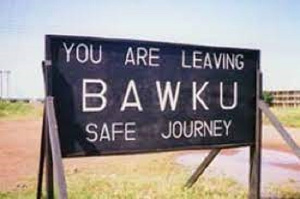
  • Armed forces fully alert in Bawku – Minister of Defence

    Armed forces fully alert in Bawku – Minister of Defence

    Minister of Defence, Dr. Edward Omane Boamah, has indicated that the Ghana Armed Forces (GAF) is fully prepared to contain any form of escalation in Bawku and surrounding areas, such as in the Upper East region.

    Providing an update on the state of his sector on Monday, July 21, he acknowledged the tense situation in Bawku but assured that the military has implemented strong and effective security measures to respond to any threats and maintain stability.

    “We acknowledge that the situation in Bawku and Alavanyo and their immediate surroundings remains volatile. The Ghana Armed Forces is actively monitoring and has put in place robust mechanisms to ensure any potential escalation is swiftly contained in the interest of the people and long-lasting resolution of the conflict through dialogue,” he said.

    He warned that any individuals or groups who take advantage of the conflict to commit crimes will face strict action from the authorities.

    “In doing so, we shall always separate crimes from traditional matters, enabling us to deal appropriately and legally with criminals who foment trouble in the name of chieftaincy conflict,” he said.

    The Minister’s remarks come a few weeks after a recent altercation in Bawku, where a confrontation between some members of the Ghana Armed Forces (GAF) and locals resulted in the death of five civilians and the destruction of a statue of the Bawku Naba, Naba Asigri Abugrago Azoka II.

    The reconstruction of the statue is expected to begin in the coming days, following a directive from His Excellency, President John Dramani Mahama.

    The statue, which was erected in 2024, in honour of the Zugraan (Overlord) of the Kusaug Traditional Area, Asigri Abugrago Azoka II, a culturally revered figure in Bawku. It served as a strong emblem of tradition and communal pride.

    The reconstruction of the statue is expected to begin in the coming days, following a directive from His Excellency, President John Dramani Mahama.

    The Minister of Defence, Dr. Edward Omane Boamah, in collaboration with other security agencies, has been tasked with overseeing the process as well as restoring calm in the area.

    “To assure that His Excellency President John Dramani Mahama the Commander in Chief of the Ghana Armed Forces (GAF), remains committed to bringing an end to decades-old conflict.

    “To address, the recent happenings the National Security Coordinator, myself, the Minister for the Interior, the Chief of the Defence Staff and the IGP have all been tasked to play coordinated but differentiated roles to ensure that peace and calm is restored immediately and this includes restoration of the statue of the Zugran of the Kusasis traditional area,” he added.

    According to him, the government is working with security to contain the situation and protect lives and property.

    “I have directed thorough investigations into the recent matter and promised to take swift action based on recommendations,” he said.

    On Tuesday, July 15, some Members of Parliament in the Upper East area called for the prosecution of the soldiers involved and compensation for the victims.

    Bawku, which had remained relatively peaceful for a period, saw conflict erupt once more in late 2024.

    The resurgence of violence was largely sparked by the return of Alhaji Seidu Abagre, a Mamprusi chief who had been enskinned in 2022, only to be exiled later when his enskinment was ruled illegal.

    His return to Bawku followed the withdrawal of an arrest warrant against him by a Kumasi High Court in October 2024, reigniting tensions between the Kusasi and Mamprusi communities.

    The renewed violence has resulted in deadly confrontations, including attacks on both civilians and security forces.

    In May, the government renewed the curfew in Bawku Municipality and it’s surrounding areas in the Upper East Region through an Executive Instrument.

    The Minister in a statement urged chiefs, elders, opinion leaders, youth, and residents to remain calm and use peaceful, non-violent means to address the challenges facing the area and work towards lasting peace.

    The government also reminded the public that there is a total ban on the possession of arms, ammunition, or any offensive weapons in the area. Anyone found in violation will be arrested and prosecuted.

    On April 15, Otumfuo formally announced that the critical mediation sessions would take place from April 28 to May 1 at the Manhyia Palace in Kumasi.

    However, it was postponed due to the complexity of the dispute in the locality.

    Otumfuo Osei Tutu II’s involvement in the peace process has been met with widespread approval, with many hopeful that his leadership will play a critical role in restoring peace and stability to the troubled Bawku region.

    Colonel Festus Aboagye (Retired), a distinguished security expert, has called for greater support for Otumfuo’s initiative, stressing the importance of embracing multi-track diplomacy to strengthen the peace process.

    Colonel Aboagye urged a more inclusive approach to the mediation, calling for the involvement of various national stakeholders such as diaspora leaders, youth advocates, and women’s peacebuilding networks.

    He believes that a broader, multi-dimensional strategy will result in a more sustainable and inclusive solution to the conflict.

    “Support Otumfuo Osei Tutu II’s mediation through multi-track diplomacy, incorporating diaspora leaders, youth influencers, and women’s peacebuilding networks,” he proposed.

    He also cautioned that traditional diplomatic efforts alone might not be enough to resolve the deep divisions that have fueled the protracted conflict.

    Meanwhile, GAF has called on residents and the wider public to cooperate with ongoing security operations, as efforts to restore normalcy in the region.

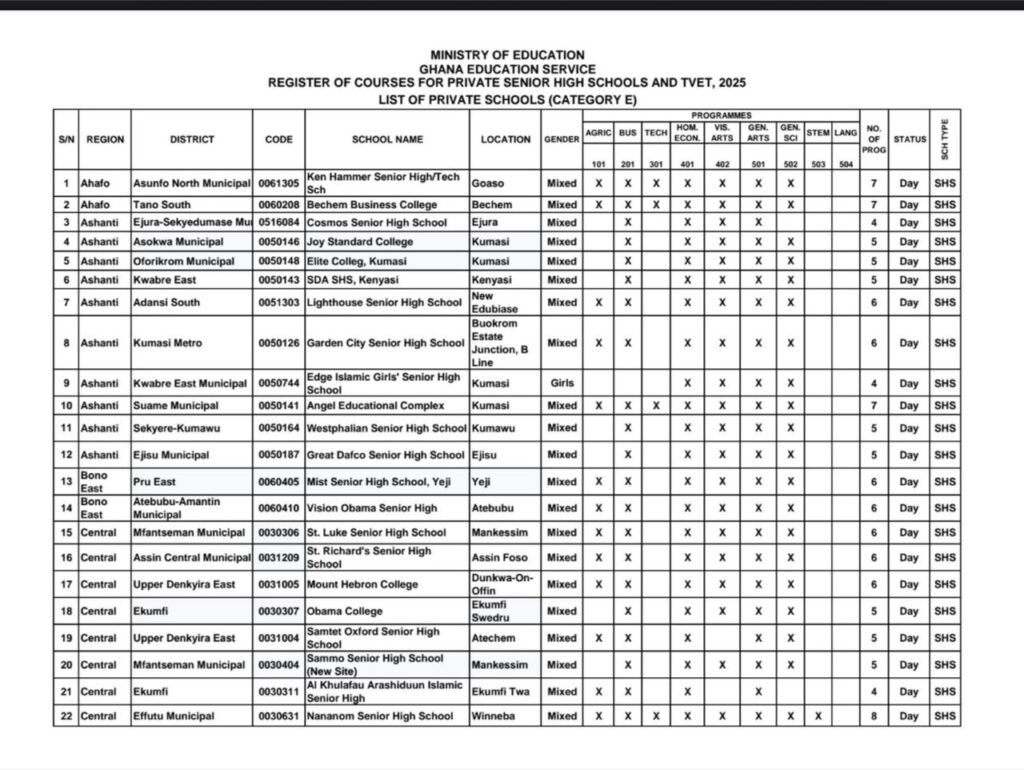
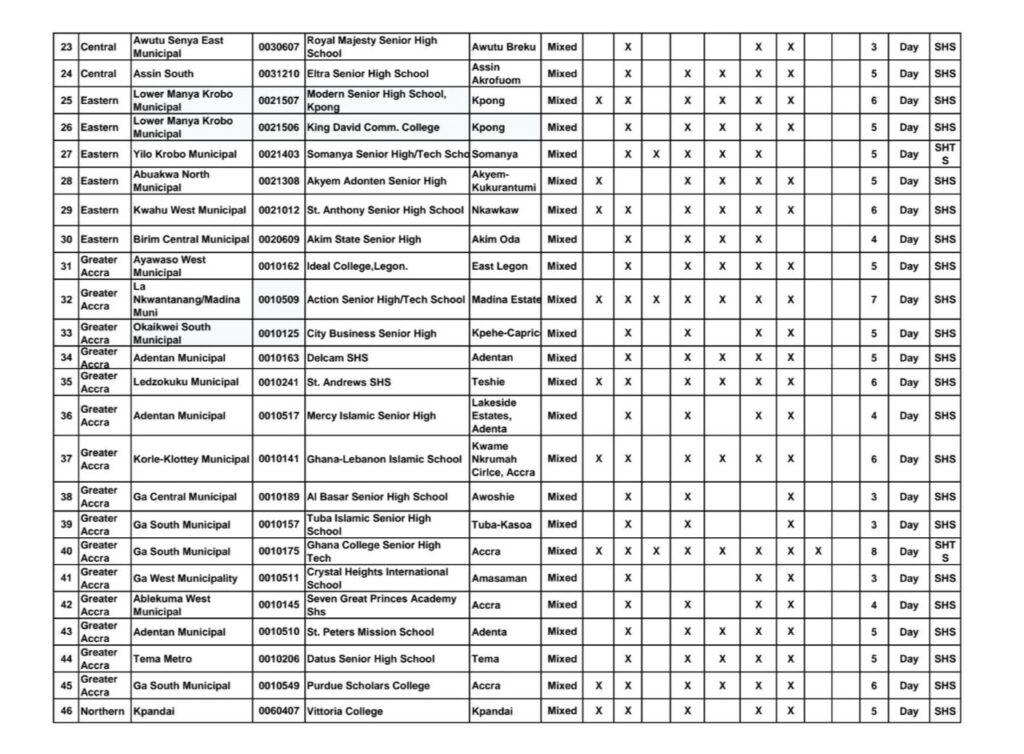
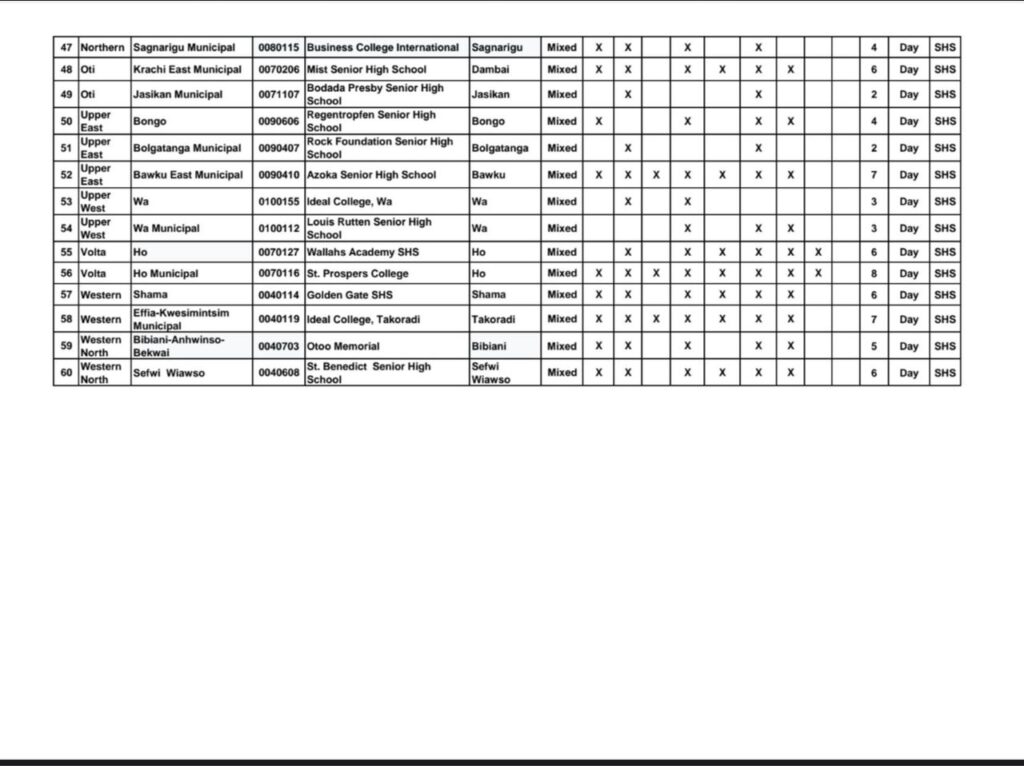
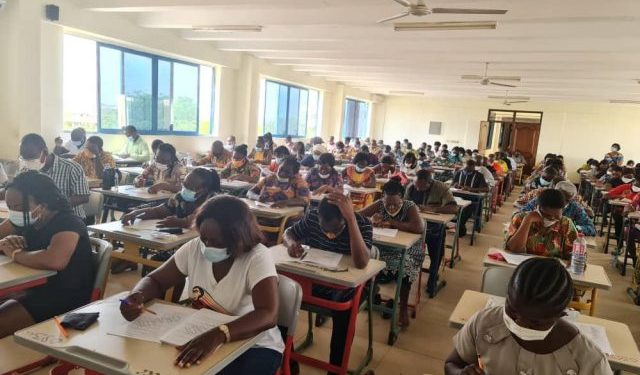
  • 60 category E private schools enlisted under Free SHS

    60 category E private schools enlisted under Free SHS

    Sixty (60) private schools have been featured under the Free Senior High School (SHS) policy.

    Junior High School (JHS) graduates will be admitted into these private schools that fall in category E in the school selection process.

    These schools will be accepting applications starting from the 2025/2026 academic year.

    The new development aligns with the government’s efforts in easing congestion in public SHSs as well as promoting quality education across the country.

    In a press release issued on Sunday, July 20, by Ghana National Council of Private Schools (GNACOPS) and signed by its National Executive Director, Oberto Nana Kwasi Gyetuah, the council has described the initiative as a historic and progressive move.

    “This progressive move marks a significant milestone in Ghana’s educational transformation journey. It underscores the Government’s commitment to inclusive, collaborative education delivery and reaffirms the important role of private schools in advancing national development goals,” part of the release read.

    The council further called on other private schools that are yet to be listed to remain patient, prepared, and compliant with regulatory standards.

    In May, Deputy Minister of Education Dr. Clement Apaak announced that the inclusion forms part of a broader plan to scale up capacity and gradually end the double-track system.

    “As part of our campaign promise, we have been working diligently to bring on board private senior high schools in the delivery of the Free SHS programme. Meetings have been held, engagements have been done, and we are very certain that with the diligence we expect from our side…” he noted.

    The double-track system was introduced in 2018 by the erstwhile government to accommodate the surge in student enrollment due to the Free SHS policy, addressing overcrowding in public schools.

    Under this system, students were divided into two groups—Green Track and Gold Track—attending school in shifts, with one track in session while the other was on break.

    The anticipated extension of the Free SHS policy, according to the Education Minister, Haruna Iddrisu, is a fulfillment of the government’s manifesto promise, adding that it is a step to ensure eligible students gain admission without delays.

    “We believe strongly that in fulfilling this manifesto campaign promise, this is going to serve as an artery in helping us bring an end to the double-track system,” the deputy minister said.

    According to him, the Education Ministry has received encouraging feedback from private schools, many of which have expressed readiness to meet the standards and requirements of the Free SHS framework.

    “… and the eagerness of the private schools to participate, the private schools will deliver in their participation,” he assured.

    He added that this collaboration would not only help expand capacity but also ensure a more equitable distribution of educational opportunities across the country.

    About the Free SHS policy

    The Free Senior High School (Free SHS) policy was introduced in 2017 by the Akufo-Addo-led government to make secondary education accessible to all eligible students without financial barriers.

    The policy was aimed at helping students who struggled to pay tuition, boarding, and other school-related expenses. However, the policy came with its challenges, such as overcrowding and congestion in schools, pressure on infrastructure and facilities, and increased pressure on teachers.

    This increased the number of enrollments in the senior high schools that were listed under the Free SHS policy. About 3.5 million students have benefited from the Free Senior High School (Free SHS) program since its launch.

    The immediate-past government revealed that it had spent over GH¢12 billion on the implementation of the Free SHS policy since its inception.

    Meanwhile, Asantehene Otumfuo Osei Tutu II has urged a reassessment of Ghana’s Free SHS initiative, recommending that households with sufficient means contribute financially so that government support can be directed toward students in real need.

    During a meeting with Education Minister Haruna Iddrisu, the Asantehene suggested a shared funding model, akin to previous arrangements where financial aid was granted to bright but disadvantaged students, while those with the ability to pay covered their own expenses.

    “Those who can afford to pay, let’s have a second look at the policy. If someone can afford it, let’s allow them to pay.

    “In the old times, when you passed, the bursary would look for good but needy students and award them scholarships, and those who could afford to pay did so.”

    Otumfuo Osei Tutu II has recognized the positive impact of the Free SHS policy but stressed the importance of a national discussion to tackle its shortcomings and secure its future.

    “This Free SHS we are talking about, although we have implemented it, if we have a dialogue and find out that it will result in students coming home every now and then because there is no food, then it is not fit for purpose.”

    He also pointed out several pressing concerns affecting secondary schools, including overcrowded dormitories, a lack of well-equipped science and ICT laboratories, irregular food supplies, and insufficient school buses.

    “Our dormitories are overcrowded and lack science and ICT labs. Sometimes PTA makes contributions to support. The lack of school buses and the shortage of food should all be looked at. Let us implement it well so that students will stay in school and have enough to eat.”

  • Audit findings by Deloitte false and incomplete –  National Cathedral Secretariat fires back

    Audit findings by Deloitte false and incomplete – National Cathedral Secretariat fires back

    The National Cathedral Secretariat has responded to a recent report by an audit firm, Deloitte Touche, revealing the misappropriation of funds within its operations.

    According to an internal memo to staff dated July 21, Executive Director of the Secretariat, Dr. Paul Opoku-Mensah, branded the report as false and incomplete.

    “While the government press conference made reference to audit findings, what was presented was not the actual audit report but rather audit queries that had been responded to in detail.

    “This audit report does not exonerate anyone. However, it confirms that there has been no misuse of state funds. All payments made were supported by contracts and guided by legal and financial protocols,” the memo noted.

    Deloitte Touche was tasked by President John Dramani Mahama earlier this year to conduct an independent audit on the National Cathedral project.

    The report, which covered activities from December 2021 and December 2023, accused the Secretariat of procurement breaches, unsupported expenditures, and governance lapses.

    During a press briefing on Friday, July 18, Felix Kwakye Ofosu disclosed that the Secretariat spent 18,500 Ghana cedis on the expenses of one Kharis Psalmist; however, it failed to document the full cost rendered in its records.

    “A key example involves academic payment for Mr Kharis Psalmist who was lodged at the Movenpick Hotel from 16th to 28th February 2022 at a cost of 18,500 Ghana cedis.

    “However, only 4,976.00 Ghana Cedis was recorded in the books with no documentation accounting for the remaining 13,524.00 Ghana Cedis, which reportedly a refund issued by the hotel but not traceable in the financial records,” he stated.

    As a result, the Attorney General (AG) has been instructed by President John Dramani Mahama to ensure all legal processes are initiated for the revocation of the board’s mandate.

    “The National Cathedral Ghana was registered limited by guarantee. In view of that, the Attorney General has been directed to take legal steps… and we expect that to be done in the coming days.

    The report further explained that, contrary to the $58 million claimed by the former NPP government spent on the National Cathedral project, an outstanding $39 million owed to the contractor brings the total cost to $97 million.

    The National Cathedral, originally proposed under the administration of former President Nana Addo Dankwa Akufo-Addo, was envisioned as a monumental Christian worship centre in Ghana.

    But the project progressed at a snail’s pace, spiralling costs and the use of public funds in a secular state. According to reports, a total amount of $58 million was spent on the project deemed to be Ghana’s most expensive bit.

    Over a year ago, Member of Parliament for North Tongu, Samuel Okudzeto Ablakwa, raised concerns with the Commission on Human Rights and Administrative Justice (CHRAJ), alleging irregularities in the project’s construction and the operations of the National Cathedral Secretariat.

    After investigating the case for several months, the Commission recommended that the Office of the Auditor-General intervene and conduct a forensic audit to ascertain whether funds allocated for the project were used for their intended purposes.

    The Commission highlighted that GHS225.9 million in “seed money” had been spent on activities including site preparation, contractor mobilization, and consultancy services as of May 31, 2022.

    CHRAJ’s detailed report recommended the potential prosecution of the board of trustees overseeing the National Cathedral project, citing their role in awarding the contract to Ribade Company Limited.

    The report highlighted multiple violations of procurement regulations and warned that the failure of those involved to address the issues could tarnish Ghana’s reputation both locally and internationally.

    The government, in April this year, dissolved the National Cathedral Secretariat after noting that it would no longer provide funding for the abandoned project.

    Meanwhile, the government has revealed its plans to repurpose the stalled National Cathedral project into a National Cultural Convention Centre (NCCC) to become a central hub for Ghana’s creative economy and cultural diplomacy.

    Under the new “SH0W24” plan, part of the 24-hour economy for the creative sector, the NCCC will be developed with support from the African Continental Free Trade Area (AfCFTA) Secretariat and host exhibitions, film festivals, trade expos, and major summits.

    The project, the government notes, offers a smart solution to infrastructure challenges without clashing with religious or national values.

    “At the national level, a bold flagship intervention is proposed: converting the National Cathedral site into the National Cultural Convention Centre (NCCC), in partnership with the AfCFTA Secretariat. This venue will serve as Africa’s premier cultural diplomacy and creative economy forum, hosting international exhibitions, film festivals, trade shows, and summits-filling a critical infrastructure gap without conflicting with national values or faith institutions,” the document stated.

    The National Cultural Convention Centre (NCCC) is a key component of a wider strategy to revitalise Ghana’s creative arts, culture, and tourism sectors as major drivers of economic transformation.

    Its development marks a major policy shift regarding the use of the contested National Cathedral site, which has faced public criticism due to delays, rising costs, and questions about its necessity.

    Under the SH0W24 initiative, the NCCC is expected to become the flagship infrastructure project for the creative economy, with the capacity to host global exhibitions, festivals, and large-scale cultural events.

    The first phase of SH0W24 (2025–2026) will focus on feasibility studies, while the centre is expected to be fully operational in Phase 3 (2028–2030). Phase 2 will see the rollout of the Ghana Cultural Passport, regional programmes, and creative districts aimed at energising local economies. Phase 3 will take things further, focusing on exports and cross-border cultural partnerships.

    In addition, the SH0W24 strategy includes the creation of a National Creators Academy, which will train young people in fields such as music, film, fashion, digital media, and cultural performance, using modern tools like AI and virtual reality, along with business and cultural education.

  • End galamsey now or we will  strike – UTAG to President Mahama

    End galamsey now or we will strike – UTAG to President Mahama

    There’s a looming strike in the coming days, should the government fail to make significant ‘progress’ in its fight against illegal mining (galamsey), despite several key promises made.


    In a press statement released on Sunday, July 20, the National Executive Council (NEC) of UTAG demanded that President John Dramani Mahama fulfill his pledge in eradicating the menace.


    “President Mahama’s assumption of office has not yet yielded the concrete actions required to match the gravity of his pledge.

    “We are yet to see this pledge materialised in a way that can halt and reverse the wanton destruction of our forest reserves, waterbodies and arable lands.

    “We are yet to see any coherent, practically relevant and workable policies from the President and his government to address the galamsey menace permanently,” parts of the statement read.

    Illegal mining activities continue to pose a major challenge for the country.

    Several Chinese individuals have been involved in illegal activities, leading to their arrest.

    The then Akufo-Addo-led government was criticized for failing to confront the issue.

    Before taking office, President Mahama expressed confidence in implementing lasting solutions to restore Ghana’s environment and protect future generations.

    As such, President Mahama assured to repeal L.I. 2462, which he argued has been shielding the operations of illegal miners. The L.I. 2462 has yet to be accomplished.

    To him, the first step toward collapse that illegal trade is to provide alternative livelihoods for those involved, such as a cooperative mining scheme.

    “You are currently the president of Ghana, and it is your responsibility to deal with galamsey now. After January 7, 2025, when Ghanaians have elected me, I will take responsibility and sort out illegal mining.

    “It looks like he doesn’t live in this country because I have commented on galamsey extensively. The University of Energy and Natural Resources gave leaders a platform to outline their small-scale mining policy. I outlined NDC’s policy and answered questions for two hours,” he stated.

    The President also revealed plans to introduce the‘Tree for Life’ and ‘Blue Water Initiative’, to restore eroded environments as well as water bodies caused by illegal activities.

    However, on 17 March this year, 460 Blue Water Guards were deployed to galamsey-prone areas; like the Tano River, Wassa Dunkwa, Tigarikrom and the others.

    According to the Ghana Police Service, a total of 208 individuals have been apprehended and 99 excavators seizedas part of the government’s anti-galamsey operation.

    These arrests and confiscation of mining equipment were undertaken between March and May in hotspots, particularly the Western Region, according to reports.

    According to President Mahama, eight out of nine forest reserves known as no-go zones and controlled by illegal miners have been repossessed by the government.

    A few months ago, the Lands and Natural Resources Minister Emmanuel Armah-Kofi Buah announced the rollout of a system to monitor excavator imports and usage, involving port tagging and digital tracking in partnership with several state agencies.

    The third most valuable item imported into this country is excavators, and it is worth GHC6.2 billion, according to the sector minister.

    The joint Military-Forestry Commission task force that conducted targeted operations in high-risk districts across the Ashanti, Western, and Western North Regions led to the seizure of 100 excavators, three bulldozers, and four vehicles.

    On the other hand, excavator owners and operators who have failed to register their machines with the Driver and Vehicle Licensing Authority (DVLA) risk losing them to the state, as the government intensifies efforts to clamp down on illegal mining activities.

    The Chief Executive Officer (CEO) of the DVLA, Julius Neequaye Kotey, issued the directive in Accra, warning that effective June 1, any excavator not registered with the DVLA will be confiscated.

    Meanwhile, President Mahama activities a national emergency, requiring collaborative efforts to end the canker.

    He has also reiterated the government’s commitment to winning the fight against galamsey activities.

    “We are alarmed by the environmental destruction that is reported across Awaso, Dadieso, and Sefwi-Anhwiaso, mainly due to illegal mining. I must be honest, this is a national emergency.

    “The national taskforce will continue its efforts to halt illegal mining in our forest reserves and on our water bodies.

  • SSNIT pays GHS521.96m to over 257k pensioners in July 

    SSNIT pays GHS521.96m to over 257k pensioners in July 

    The Social Security and National Insurance Trust (SSNIT) has paid a total of GHS521.96 million to over 257,000 pensioners for July 2025.

    In a Facebook post, the Trust noted that the disbursement forms part of its commitment to ensuring the timely payment of pensions to retirees under the national scheme. Pensioners are expected to receive their next payment on August 21. 

    Earlier this year, SSNIT announced a 12% adjustment in pensions for 2025, starting in January, with payments scheduled for the third Thursday of every month.

    This revision was made in coordination with the National Pensions Regulatory Authority (NPRA) and complies with Section 80 of the National Pensions Act, 2008 (Act 766).

    As per SSNIT, all retirees receiving benefits as of December 31, 2024, will see an average increase of 12% in their monthly payments.

    The adjustment includes a fixed increment of 8% along with an additional GH¢72.58, which accounts for 4% redistributed to assist lower-income pensioners.

    “Redistribution is a mechanism applied to the indexation rate to cushion low-earning pensioners in conformity with the solidarity principle of social security.

    As a result, pensioners will have an effective increment between 32.19% at the bottom end and 8.04% at the top end. Redistribution ensures that the minimum monthly pension of GH¢300 in 2024 will increase to GH¢396.58 in 2025, an effective increase of 32.19%,” a statement from SSNIT said.

    This redistribution policy aims to provide extra relief for pensioners with lower earnings, following the social security solidarity principle.

    Consequently, those receiving the least will experience a 32.19% boost, while those at the highest level will see an 8.04% rise.

    With this revision, the minimum monthly pension will increase from GH¢300 in 2024 to GH¢396.58 in 2025. For retirees under PNDC Law 247, the highest monthly benefit will now stand at GH¢201,792.37, marking an 8.04% growth.

    Meanwhile, the average pension will move from GH¢1,776.81 in 2024 to GH¢1,990.03 in 2025. SSNIT further disclosed that 63% of pensioners, particularly those earning GH¢1,814.50 or less per month, will benefit from increases ranging from 12% to 32.19%, ensuring their income keeps pace with inflation

    SSNIT is set to launch a fully digital virtual branch by the end of September. This is to improve compliance, enhance service delivery, and deepen engagement with contributors.

    The virtual branch will operate through multiple digital platforms, including phone, USSD, and internet, and will feature real-time staffing to offer uninterrupted, 24/7 support to employers and contributors.

    “We are confident that by the end of September this year, a fully digital virtual branch will be available for members to engage,” said Kwasi Afreh Biney, Director-General of SSNIT, during the 2025 Employers’ Breakfast Meeting. “It will sit at the head office, but because it’s virtual, you can dial in from anywhere. We will be there to serve you 24/7.”

  • NPP delegates endorse proposal to replace party executives in public office

    NPP delegates endorse proposal to replace party executives in public office

    Delegates of the New Patriotic Party (NPP) have endorsed a motion that seeks to require party executives who have accepted public appointments to step down from party roles.

    Motion ten states “amend articles 7(10) & 9(7) of the Constitution to prevent Party Officers who get appointed into government from continuing to hold their offices”.

    The motion includes fifty-four out of fifty-six motions approved on Saturday, July 19, during the National Delegates Conference held at the University of Ghana Stadium.

    The Motions presented by the National Council of Elders focus on several proposed amendments to the party’s constitution aimed at addressing the root causes of its 2024 electoral defeat.

    Motions 17 and 54 were rejected; 17 proposed taking election supervision rights from constituency officers to regional leaders, thus allowing them to appoint neutral supervisors instead.

    While Motion 54 recommended a youth role be given to individuals aged 35 years or younger, rather than 40 years.

    The NPP’s defeat in the December 2024 polls saw its flagbearer, Dr. Mahamudu Bawumia, lose to former president John Dramani Mahama of the opposition National Democratic Congress (NDC).

    The NDC secured 56.55% of the popular vote and a commanding 184 out of 276 parliamentary seats, marking the NPP’s most significant loss in the Fourth Republic and ending their two terms in office.

    This heavy defeat has prompted widespread calls for introspection and fundamental reforms within the party, as it looks towards the 2028 elections.

    The submission by the National Council of the Elders forms part of a 59-point proposal to revise the party’s constitution.

    Typically, the Council of Elders plays an advisory and mediating role within the party, often stepping in during times of crisis to guide the party back to its core principles.

    The Council’s proposals focus on enhancing internal party democracy, fostering unity, and strengthening grassroots structures – themes that emerged strongly in post-election analyses of the NPP’s performance.

  • CSA Director-General suspended for breaching military escort directive

    CSA Director-General suspended for breaching military escort directive

    The government, through the Office of the President, has temporarily suspended the Director-General of the National Cyber Security Authority (NCSA), Divine Selasi Agbeti, for breaching security protocols.

    The two-week suspension follows a viral video on social media platforms where a military officer acted as a personal bodyguard to Divine Selasi Agbeti during an event organized by the Member of Parliament (MP) for Ho West, Emmanuel Bedzrah.

    In an official letter issued by the Office of the President and signed by the Secretary to the President, Dr. Callistus Mahama, the Ministry of Communication, Digital Technology and Innovations has been tasked to investigate the matter.

    Also, the Ministry is to review the Director-General’s conduct and take any necessary disciplinary action in line with established protocols.

    According to the Presidency, “this development suggests a troubling lapse in judgment and a disregard for established security protocols governing the interaction between civilian institutions and the armed forces.”

    Divine Selasi Agbeti’s interdiction comes a few days after the government withdrew military protection for all civilians who are not legally entitled, including public officials, former ministers, and businesspeople.

    The Defence Minister, Dr. Edward Omane Boamah, has explained the move as the government’s efforts to curb the misuse of military personnel for private purposes.

    According to him, the exploitation of military personnel undermines the professional standards of the armed forces. “This decision aims to STOP the misuse of military personnel for personal gain,” he wrote.

    The withdrawal of the military began during the ex-president, Akufo-Addo’s tenure. Some four military officers assigned to the office of the Speaker of Parliament, Alban Bagbin, were withdrawn by the Ghana Armed Forces, citing improper procedure.

    The action prompted national debate on whether security services should be involved in non-military roles. Also, the Electoral Commission (EC) Chairperson, Jean Mensa, was denied military protection in 2021; however, she has now been placed under the protection of the Ghana Police Service this year.

    Meanwhile, the Road Traffic Legislative Instrument (L.I.) excludes the Speaker of Parliament and the Chief Justice from the list of high-ranking public officials permitted to use a siren and motorcade in their official vehicles.

    The L.I. was laid before Parliament in 2024 for amendment. It had been previously withdrawn following public backlash over a proposal to grant Members of Parliament (MPs) similar privileges. Critics argued that such privileges for MPs would create inequality on the roads and undermine road safety measures.

  • NPP delegates endorse proposal to replace party executives in public office, reject lowering youth age limit to 35

    NPP delegates endorse proposal to replace party executives in public office, reject lowering youth age limit to 35

    Delegates of the New Patriotic Party (NPP) have endorsed a motion that seeks to require party executives who accept public appointments to step down from party roles.

    This motion, the tenth among 56 others, seeks to amend articles 7(10) & 9(7) of the constitution of the party.

    During the National Delegates Conference held at the University of Ghana Stadium on July 19, the  motion to limit the age range for a youth in the party to 35 instead of 40 was rejected. Also, the motion to take election supervision rights from constituency officers to regional leaders, thus allowing them to appoint neutral supervisors instead, got declined.

    The proposals presented by the National Council of Elders focus on several proposed amendments to the party’s constitution aimed at addressing the root causes of its 2024 electoral defeat.

    The NPP’s defeat in the December 2024 polls saw its flagbearer, Dr. Mahamudu Bawumia, lose to former president John Dramani Mahama of the opposition National Democratic Congress (NDC). The NDC secured 56.55% of the popular vote and a commanding 184 out of 276 parliamentary seats, marking the NPP’s most significant loss in the Fourth Republic and ending their two terms in office.

    This heavy defeat has prompted widespread calls for introspection and fundamental reforms within the party as it looks towards the 2028 elections.

    Below is the full list of motions:

    • MOTION ONE

    Article 1

    Amend article 1 of the Constitution to include the Party’s Motto, Symbol and Colours.

    [The absence of the Party’s Motto, Symbol and Colours in the Constitution is an obvious omission and ought to be rectified. The Party’s Motto, Symbol and Colours must find expression in the Party’s Constitution.]

    • MOTION TWO

    Article 3(7)

    Amend article 3(7)of the Constitution to give the power to recommend suspension of a Member or an office holder pending disciplinary action against him to the appropriate Disciplinary Committee rather than the Executive Committee.

    [The amendment is necessary to ensure justified suspension of party executives (elected and appointed) by Executive Committees, only upon recommendation by the Disciplinary Committee,  pending disciplinary proceedings against such Officers. It is the Disciplinary Committee that shall recommend suspension, having regard to its preliminary findings.]

    • MOTION THREE

    Article 4(3)(7)

    Amend article 4(3)(7) of the Constitution to allow for a complaint against any Constituency or Regional Officer, whether elected or appointed, to be filed at;  (i) in the case of the Constituency Officer, the Regional Executive Committee and (ii) in the case of the Regional Officer, the National Executive Committee.

    [The amendment seeks to achieve fair and equal treatment or handling of disciplinary matters involving ‘elected officers’ and ‘appointed officers’ who are at the same level of the Party by providing that they should be dealt with by the same Disciplinary Committee.]

    • MOTION FOUR

    Article 5(6)

    Amend article 5(6) of the Constitution to adopt the Electoral Commission of Ghana’s demarcation/cluster of Electoral Areas.

    [The EC’s Electoral Area systems are pre-determined, bereft of controversies and involve more polling stations than the party’s demarcations of Electoral Area. The current provision in the Party’s constitution is that where polling stations under an Electoral Area exceed ten(10), an additional Electoral Area may be created. This lack of certainty and exactitude has triggered misunderstandings in the creation of some Electoral Areas. The adoption of the EC’s Electoral Area system cures any such misunderstanding or perceived mischief.] 

    • MOTION FIVE

    Article 6 –  new provision

    Amend article 6 of the Constitution to provide for an Electoral Area Executive Committee structure made up of five (5) members who shall all be elected, comprising the Electoral Area Chairperson, Secretary, Organiser, Communications Officer and Electoral Affairs Officer.

    [The current system requires limited expansion to allow for increased participation and support in the management of the electoral areas. A 5-member Committee enhances operational capacity and ensures a more inclusive and structured approach to supervising polling station activities.]  

    • MOTION SIX

    Article 6(1)

    Amend article 6(1) of the Constitution to increase the Polling Station Executives from five (5) to seven (7), who are all to be elected, comprising the Chairperson, Secretary, Organiser, Women’s Organiser, Youth Organiser, Communications Officer and Electoral Affairs Officer.

    [The Committee recommends a one-man one-vote (OMOV) system as a long-term electoral framework for the Party. In the absence of the foundational structures for the OMOV electoral system, the proposed limited expansion (representing 40% rise) at the polling station level is more realistic and manageable. It has the effect of increasing the electoral college considerably while the Party works on the recommended OMOV system.]

    • MOTION SEVEN

    Articles 6(1); 7(2); 9(1); 10(7)(3)

    Amend article 6(1), 7(2), 9(1) & 10(7)(3) of the Constitution to split/decouple the position of Research and Electoral Affairs Officer at the Constituency, Regional and National levels of the Party.

    [The amendment brings the needed focus and attention to each of the two responsibilities. Also, it is not every researcher who understands electoral matters and vice versa. Therefore, separating the positions and appointing people with the requisite expertise to occupy the respective positions will inure to the Party’s benefit.] 

    • MOTION EIGHT

    Article 7(2)

    Amend article 7(2) of the Constitution to include the Constituency Research Officer, Electoral Affairs Officer and PWD Coordinator on the Constituency Executive Committee.  

    [This represents a limited expansion of the Constituency Executive Committee and seeks to promote inclusivity and broader participation in Party activities at the Constituency level.]

    • MOTION NINE

    Articles 7(5); 9(2); 10(7)(3)

    Amend articles 7(5), 9(2) & 10(7)(3) of the Constitution to make Communication Officers at all levels of the Party elected from the Polling Station, Electoral Area, Constituency, Regional and at the National level. At the National level, the Communication Officer shall be the Director of Communications. 

    [The appointment of Communication Officers has, in many instances, been fraught with a lot of challenges occasioned by perceptions of favouritism and lack of candour. Making the positions elective will afford the Party delegates to select persons they think can best communicate for the Party. For the avoidance of doubt, the Deputy Directors of Communications shall remain appointed.]

    • MOTION TEN

    Articles 7(10); 9(7)

    Amend articles 7(10) & 9(7) of the Constitution to prevent Party Officers who get appointed into government from continuing to hold their offices.

    [Party officers who are appointed into government should not be allowed to hold dual positions. So long as they have accepted the appointment to serve in government, they should focus on their mandate in government and give opportunity for other competent Party members to occupy their positions in the Party. It is also in line with the provisions in clause 10 of article 7 & clause 7 of article 9, which are intended to ensure that government appointees do not hold Constituency, Regional and National Executive offices.]

    • MOTION ELEVEN

    Articles  7(26); 9(24)

    Amend articles 7(26) & 9(24) of the Constitution to provide that any vacancy that may occur for whatever reason in the case of the Constituency Secretary and Regional Secretary shall automatically be filled by the Deputy Constituency and Deputy Regional Secretary, respectively.

    [The Deputy Constituency and Deputy Regional Secretaries, just like the substantive Constituency and Regional Secretaries, are also elected by the same delegates at the same Conference. The Deputy Secretaries should be able to occupy the positions of the substantive Secretaries in the absence of the latter.]

    • MOTION TWELVE

    Article 7(27)

    Amend article 7(27) of the Constitution to give voting rights to National and Regional Officers at the Constituency Delegates Conference at the Constituency they hail from.

    [This amendment strengthens the connections between these Officers and the respective Constituencies they hail from, where they may also serve as Patrons and source of logistical support.  This amendment is also geared towards the proposed limited expansion of the electoral college pending the OMOV system.]

    • MOTION THIRTEEN

    Articles 7(27); 9(25); 10(2)

    Amend articles 7(27), 9(25) & 10(2) of the Constitution to provide that the Party shall hold Constituency/Regional/ National Delegates Conferences every two years (i.e. biennially) instead of annually.

    [This amendment looks at holding timely but necessary Conferences across all levels of the Party. There shall also be sufficient time to hold other equally important Conferences within the period before the biennial conference. Where it becomes necessary, an Extraordinary Delegates Conference may be called.]

    • MOTION FOURTEEN

    Article 7(27)(b)

    Amend article 7(27)(b) of the Constitution to give voting rights to the Electoral Area Executives at the Constituency Biennial Delegates Conference. 

    [Currently, Electoral Area Coordinators and all Polling Station Executives have voting rights at the Constituency Delegates Conference. The proposed Electoral Area Executives (made up of the Electoral Area Coordinator to be now called Electoral Area Chairperson and four (4) other executives) should have voting rights at the Constituency Delegates Conference.]

    • MOTION FIFTEEN

    Articles 7(29); 9(27)

    Amend articles 7(29) & 9(27) of the Constitution to allow Constituency and Regional Secretaries to present reports on the state of the Party at the Constituency and Regional Delegates Conference, with the prior approval of the Constituency and Regional  Executive Committee as the case may be.

    [Constituency and Regional Secretaries are the administrative heads of the Constituency and Regional Secretariats of the Party and it is appropriate that they present a report on the state of the party to the Constituency and Regional Party, respectively to the Delegates  Conference with prior approval of the Constituency and Regional Executive Committee, as the case may be.]

    • MOTION SIXTEEN

    Articles 7(29); 9(27)

    Amend articles 7(29) & 9(27) of the Constitution to require the statement of account to be presented by the Constituency and Regional Treasurers at the Constituency and Regional Delegates Conference to have received prior approval of the Constituency and Regional Executive Committee as the case may be.

    [This allows the Constituency and Regional Executive Committee to scrutinise and give a stamp of approval to the statements before they are presented at the Delegates Conference.]

    • MOTION SEVENTEEN

    Article 7(30)

    Amend article 7(30) of the Constitution to provide that the Regional Executive Committee shall appoint persons, other than Polling Station, Electoral Area and Constituency Officers,  to supervise Polling Station and Electoral Area elections.  

    [Constituencies are directly involved in the compilation of the album for organising Polling Station and Constituency elections. It is therefore prudent that supervision of these elections should be taken to the Regional level to absolve it from any conflict of interest.]

    • MOTION EIGHTEEN

    Article 8; Article 8(5)

    Amend article 8 of the Constitution to specifically provide that the External Branches shall have three (3) representatives on the National Executive Committee and five(5) representatives on the National Council.

    [The Party Constitution under article 8(5) grants the External Branches representation at the National Executive Committee and the National Council, but does not indicate the number of representatives they should appoint to serve on these bodies. This amendment brings clarity to the number of representatives the External Branches shall have on the National Executive Committee and National Council.] 

    • MOTION NINETEEN

    Articles 8; 13(11)

    Amend articles 8 & 13(11) of the Constitution to specifically provide that all former and current executives of the External Branches shall have voting rights at the Presidential Primaries.

    [The amendment seeks to expand the electoral college for the Presidential Primaries to promote inclusivity and broader participation. This is in line with the proposed limited expansion.]

    • MOTION TWENTY

    Articles 8; 10(2)(f)

    Amend articles 8 & 10(2)(f) of the Constitution to specifically provide that ALL current executives of the External Branches shall have voting rights at the National Delegates Conference.

    [Previously, only twelve (12) Executives of the External Branches were allowed to vote at the National Delegates Conference. This amendment, allowing all of them to vote,  promotes inclusivity and broader participation. The amendment is also in line with the proposed limited expansion.]

    • MOTION TWENTY-ONE

    Article 9

    Amend article 9 of the Constitution to include Regional Electoral Affairs Officer, Regional Research Officer (note: the decoupling of the two), Regional Legal Officer, Regional PWD Coordinator, and a Special Duties Officer as part of the Regional Executive Committee.

    [This represents a limited expansion of the Regional Executive Committee.]

    • MOTION TWENTY-TWO

    Article 9(1)

    Amend article 9(1) of the Constitution to expand the composition of the Regional Executive Committee members to include Constituency Secretaries.

    [Constituency Secretaries are responsible for all administrative matters at the Constituency level and it is only proper that they are part of the Regional Executive Committees.]

    • MOTION TWENTY-THREE

    Article 9(1) new provision

    Amend the Constitution by inserting a new provision to create a Regional Steering Committee composed of the Regional Officers, the Chairman of the Regional Council of Elders and the Regional Parliamentary Caucus Chair.

    [The proposed amendment aligns with what pertains at the national level, where we have a National Steering Committee, which is the body in charge of the day-to-day administration of the Party at the National level. The Regional Steering Committee shall also be responsible for the day-to-day administration of the Party in the Regions. The Regional Steering Committee system shall facilitate decision-making at the Regional level.]

    • MOTION TWENTY-FOUR

    Articles 9; 10(2); 13

    Amend articles 9, 10(2) & 13 of the Constitution to grant voting rights to the Regional & National TESCON Coordinators and the TESCON President from each recognised tertiary institution in the country at the Regional and National Delegates Conference, respectively.

    [The Regional TESCON Coordinators are in charge of coordinating all the activities of TESCON in the various tertiary institutions within the Region. It is only proper to grant them voting rights at Conferences, just like the Executives whose activities they coordinate. The same principle applies to the National TESCON Coordinators. The specificity on the TESCON President and not just any representative of TESCON avoids the usual challenge with validation of the representative from TESCON.]

    • MOTION TWENTY-FIVE

    Articles 9(25); 10(2); article 13(11)

    Amend article 10(2) & 13(11) of the Constitution to grant voting rights to the TESCON President (and NOT a representative from TESCON) from each recognised tertiary institution in the country at the Regional and National Delegates Conference.

    [The specificity on the TESCON President and not just any representative of TESCON avoids the usual challenge with validation of the representative from TESCON.]

    • MOTION TWENTY-SIX

    Article 10;  new provision

    Amend article 10 of the Constitution by inserting a new provision to include the consideration of Position Papers from Sector Committees of the Party on key developments since the last National Delegates Conference at National Delegates Conference.

    [The proposed amendment allows the National Delegates Conference to not only focus on speeches and election of national officers (where necessary), but to also consider and debate the Reports submitted by the Party’s Sector Committees on key national issues and to pass appropriate resolutions on same.]

    • MOTION TWENTY-SEVEN

    Article 10; new provision

    Amend article 10 of the Constitution by inserting a new provision to modify the composition of the Sector Committees under the National Executive Committee to include both Members of Parliament and non-Members of Parliament as well as their functions.

    [This allows the Party to marshal its available best brains to serve on the various Sector Committees whether or not they are Members of Parliament.]

    • MOTION TWENTY-EIGHT

    Articles 10(2)(3)(e); 13(11); 16

    Amend articles 10(2)(3)(e) & 13 of the Constitution to make all Members of the National Council of Elders delegates at the National Delegates Conference and the Presidential Primaries.

    [Considering the indispensable roles played by the National Council of Elders, they deserve more representation at the party’s highest decision-making body. In any case, per Article 16, the membership of the National Council of Elders shall not exceed 30, out of which, 15 are already members/delegates to the National Annual Delegates Conference.] 

    • MOTION TWENTY-NINE

    Article 10(3)

    Amend article 10(3) of the Constitution to increase the representation of the National Council of Elders on the National Council from one(1) to five (5) members, including the Chairman of the National Council of Elders.

    [The National Council of Elders is the foremost advisory body of the Party and therefore ought to be adequately represented at the second-highest decision-making body of the Party.]

    • MOTION THIRTY

    Article 10(3)

    Amend article 10(3) of the Constitution to provide for four (4) additional Standing Committees and enable the National Council to create new Standing Committees as and when the Council deem fit. The new four (4) Standing Committees shall be the Electoral Affairs Committee, Communications Committee, Political Strategy & Policy Committee and Security & Intelligence Committee.

    [The proposed additional Standing Committees to be created are indispensable and crucial in supporting the National Council and by extension the Party to function more effectively.  The amendment also grants the National Council the mandate to create additional Standing Committees as and when necessary.]

    • MOTION THIRTY-ONE

    Article 10(3)A

    Amend article 10(3)(A) of the Constitution to expand the composition of the Finance Committee from six (6) to ten (10) Members in addition to the National Treasurer.

    [This amendment expands the composition of the Finance Committee in order to enhance  the effectiveness of the Committee.]

    • MOTION THIRTY-TWO

    Article 10(3)(2)(d)

    Amend article 10(3)(2)(d) of the Constitution to expressly provide that Chairpersons of Standing Committees and Directors at the Party Headquarters shall have voting rights at the National Council and consequently vote in the Presidential Primaries.

    [This amendment admits Chairmen of Standing Committees and Directors at the Party Headquarters into membership at the National Council with voting rights.]

    • MOTION THIRTY-THREE

    Article 10(3)(4)

    Amend article 10(3)(4) of the Constitution to include former Majority and former Minority Leaders to the composition of the National Executive Committee and National Council.

    [The National Executive Committee stands to benefit immensely from the experiences ofpersons who have once led the Party’s Parliamentary Group as Majority or Minority Leaders.]

    • MOTION THIRTY-FOUR

    Article 10(4) new provision

    Amend article 10 of the Constitution by inserting a new provision to provide that the National Executive Committee shall, in consultation with the Presidential Candidate, develop the campaign structure and establish a Campaign Advisory Committee to oversee the Campaign Team.

    [The Presidential Campaign should be a collaboration between the Party and the Presidential Candidate.]

    • MOTION THIRTY-FIVE

    Article 10; new provision

    Amend article 10 of the Constitution by inserting a new provision to specifically provide that the National Chairperson shall be the Leader of the Party.

    [The proposed amendment affirms the position of the National Chairperson as the Leader of the Party.]

    • MOTION THIRTY-SIX

    Article 10(5)

    Amend article 10(5) of the Constitution to specifically provide that the National Chairperson shall chair the Party’s Campaign Advisory Committee.

    [The National Chairperson, as the Leader of the Party, should chair the Party’s Campaign Advisory Committee to enhance collaborative work between the Party and the Campaign.]

    • MOTION THIRTY-SEVEN

    Article 10(4)(2)

    Amend article 10(4)(2) of the Constitution to increase the representation of the Parliamentary Group on the National Executive Committee from one (1) to three(3), comprising the Leader and two (2) others, one of whom shall be a woman.

    [The Parliamentary Group is a critical organ of the party. It is the Group that champions the Party’s policies and agenda in the Legislative arm. The amendment seeks to increase the representation of the Parliamentary Group on the National Executive Committee.]  

    • MOTION THIRTY-EIGHT

    Article 10(7)(3); 10(8)

    Amend articles 10(7)(3) & 10(8) of the Constitution to provide that the National Treasurer shall report to the General Secretary.

    [The General Secretary is the Party’s chief administrator, and the Chief Executive Officer (CEO) of the Party and all Officers except the National Chairperson and Vice Chairpersons report to him. The amendment aligns with the administrative structure of the Party.]

    • MOTION THIRTY-NINE

    Article 10(10)

    Amend article 10(10) of the Constitution to remove the President from the composition of the National Steering Committee of the National Executive Committee.

    [The Steering Committee is in charge of the day-to-day administration of the Party and should comprise only the ten(10) Elected Officers, the Presidential candidate, Parliamentary Leader and Chairman of the National Council of Elders.] 

    • MOTION FORTY

    Article 11

    Amend article 11 of the Constitution to specifically include a provision that allows the Constituency Executive Committee to remove a Polling Station or Electoral Area Officer from office with the prior approval of the Regional Executive Committee, upon receipt of a Petition from a Member.  

    [The Constitution has no provision on how Polling Station and Electoral Area Officers may be removed from office.]

    • MOTION FORTY-ONE

    Article 11

    Amend article 11 of the Constitution to include a provision requiring the need for the body to be constituted by the Executive Committee, to recommend removal before the summoning of an Extraordinary Delegates Conference for the purpose of removing an Elected Officer from office, and for specified timelines for the removal process of such Elected Officer.

    [The amendment brings clarity in the removal of Officers and avoids the convening of an Extraordinary Delegates Conference without recommendation from the body constituted by the Executive Committee.]

    • MOTION FORTY-TWO

    Article 11(7)

    Amend article 11(7) of the Constitution to explicitly provide guidelines/procedure for the removal from office of an appointed Officer/Executive to be done by the relevant Executive Committee with prior approval of the immediately higher Executive Committee.   

    [The amendment clarifies the process for the removal of appointed Officers.]

    • MOTION FORTY-THREE

    Article 12; new provision

    Amend the Constitution by inserting a new provision to provide that National Officers, Ministers, Deputy Ministers, CEOs and other government appointees who file to contest to become a Parliamentary Candidate of the Party in a Constituency with a sitting Member of Parliament, shall resign their positions at least twelve (12) months to the National General Elections.

    [This is to ensure fair competition and level playing field to all prospective aspirants for the position of Parliamentary Candidate.]

    • MOTION FORTY-FOUR

    New provision; articles 12 &13

    Amend articles 12 &13 of the Constitution and insert a new provision to grant voting rights to former Members of Parliament, former Parliamentary Candidates, former Metropolitan, Municipal and District Chief Executives (MMDCEs), former Ministers, former Deputy Ministers who are card-bearing members of the Party at the Parliamentary and Presidential Primaries.

    [The amendment seeks to expand the electoral college for the Presidential Primaries to promote inclusivity and broader participation. This is in line with the proposed limited expansion.]

    • MOTION FORTY-FIVE

     New provision; articles 12 &13

    Amend articles 12 & 13 of the Constitution and insert a new provision to grant voting rights to former Constituency Executives, former Regional Executives at the Parliamentary and Presidential Primaries.

    [The amendment seeks to expand the electoral college for the Presidential Primaries to promote inclusivity and broader participation. This is in line with the proposed limited expansion.]

    • MOTION FORTY-SIX

    Article 13 (1)(6)

    Amend article 13(1)(6) of the Constitution to provide that National Officers, Ministers, Deputy Ministers, CEOs and other government appointees who file to become the Presidential Candidate of the Party, shall resign their positions at least twenty-four(24) months to the National General Elections.

    [This is to ensure fair competition and level playing field to all prospective aspirants for the flagbearership.]

    • MOTION FORTY-SEVEN

    Article 13(1)(9)

    Amend article 13(1)(9) of the Constitution to completely abolish the Special Electoral College/Super Delegates System.

    [The Special Electoral College system which was introduced in the 2009 constitutional amendments to shortlist aspiring Presidential Candidates, has outlived its usefulness.]

    • MOTION FORTY-EIGHT

    Article 13(4)

    Amend article 13(4) of the Constitution to provide for the election of a Presidential Candidate when the Party is in government to a date not later than eighteen (18) months instead of eleven (11) months before the National General Elections.

    [This amendment gives the party’s presidential candidate an extra seven(7) months to campaign before the general elections.]

    • MOTION FORTY-NINE

    Article 13(11)

    Amend article 13(11) to grant voting rights to five(5) members of the Constituency Council of Elders and ten(10) members of the Regional Council of Elders at the Presidential Primaries.

    [These Constituency and Regional Elders are members of the Constituency and Regional Delegates Conference, respectively. Polling Station and Electoral Area Executives, who form part of the delegates to the Constituency Conference, have been given voting rights at the Presidential Primaries. The exclusion of the Elders is an omission which should be rectified.]

    • MOTION FIFTY

    Article 13(11)

    Amend article 13(11) of the Constitution to include thirty (30) National Patrons and all Members of the National Council of Elders to be part of the Presidential Primaries.

    [The National Council of Elders is the foremost advisory body of the Party and therefore ought to be adequately represented at the second-highest decision-making body of the Party. National Patrons also occupy an important position in the Party structure. The expansion of their numbers in the Presidential Primaries is appropriate.]

    • MOTION FIFTY-ONE

    Article 13(11)

    Amend article 13(11) to grant voting rights to five(5) Constituency Patrons and ten(10) Regional Patrons at the Presidential Primaries.

    [These Constituency and Regional Patrons are members of the Constituency and Regional Delegates Conference, respectively. Polling Station and Electoral Area executives, who form part of the delegates to the Constituency Conference, have been given voting rights at the Presidential Primaries. The exclusion of the Patrons is an omission which should be rectified.]

    • MOTION FIFTY-TWO

    Amend article 13(11) to grant voting rights to one (1) TESCON Patron from every recognised tertiary institution at the Presidential Primaries.

    [This amendment allows for inclusivity and broader participation. This is in line with proposed limited expansion.]

    • MOTION FIFTY-THREE

    Article 15(3)

    Amend article 15(3) of the Constitution to make all female delegates at the National Delegates Conference eligible to vote for the position of National Women’s Organiser.

    [The current regulations on the election of the National Women Organiser is not inclusive. This amendment allows all female delegates to participate in the election of the National Women’s Organiser.]

    • MOTION FIFTY-FOUR

    Article 15(4)

    Amend article 15(4) of the Constitution by defining ‘Youth’ in the Constitution to refer to a Member of the Party who is not above the age of 35 years.

    [The age limit for ‘Youth’ per all the International Conventions and National Laws shows that the highest age limit is 35 years. The UN puts the age bracket between 15 -24 years; WHO: 15-29; UNICEF: 15-24; ILO: 15-24; African Youth Charter: 15-35. In Ghana, the National Youth Authority Act, 2016 (Act 939) defines a ‘Youth’ as a person between 15 -35 years.]

    • MOTION FIFTY-FIVE

    Article 15(4)

    Amend article 15(4) of the Constitution to make all youth delegates at the National Delegates Conference eligible to vote for the position of National Youth Organiser.

    [The current regulations on the election of the National Youth Organiser is not inclusive. This amendment allows all youth delegates to participate in the election of the National Youth Organiser.]

    • MOTION FIFTY-SIX

    Article 15(5)(d) (e) and related provisions that refer to the Nasara Coordinator at all relevant levels

    Amend article 15(5)(d)(e) and related provisions of the Constitution to refer to Nasara Coordinators as Nasara Organisers.

    [By the nature of their functions, Nasara Coordinators should be referred to as Nasara Organisers, just as is done with Women and Youth Organisers.]

  • 6,000 youth to be recruited as community medical first responders

    6,000 youth to be recruited as community medical first responders

    6,000 young Ghanaians will be recruited as community medical first responders across the country to support the operations of the National Ambulance Service (NAS).

    Their recruitment has become possible due to a two-year Memorandum of Understanding (MoU) signed between NAS and the Youth Employment Agency (YEA) on Friday, July 18.

    Speaking during the ceremony in Accra, acting YEA Chief Executive Officer, Malik Basintale, noted that the move aligns with President John Mahama’s efforts in ensuring every Ghanaian has access to healthcare services.

    He acknowledged the medical challenges many Ghanaians, particularly rural dwellers, adding that the recruits will serve as frontline responders, providing essential first aid before patients are referred to health facilities.

    “Looking through, we realized that people still die from snake bites, and there are people who still die from heart attacks immediately, simply because they were unable to get to the hospital early enough as a result of something, or first aid.

    “And the solution to this is by putting in place a method where we will have first aid to some of these people. Within the zonal areas anytime there is a critical medical situation the first person the community will call upon is usually the assemblyman man.

    “And so we felt that we should create an opportunity where we attach the first medical to these assembly members so that when there is an attack this person will go there, salvage the situation before we call for backup,” he noted.

    While lauding the government’s initiative, the acting CEO of NAS, Dr. George Kojo Owusu, indicated that measures have been put in place to ensure a successful rollout of the programme.

    He revealed that the medical first responders will undergo a training programme that “will feature 10 modules, including Introduction to Emergency Medical Services, Airway Management and Breathing, Circulation and Bleeding Control, and Mass Casualty Incidents and Triage”.

    Meanwhile, Minister of Health, Kwabena Mintah Akandoh, has assured that the backlog of unemployed health professionals across the country has come to an end, as the government seeks to recruit 70,000 qualified health workers.

    “We recognise the challenge of over 70,000 qualified health workers currently awaiting employment, but I want to assure you that we are working tirelessly to clear this backlog,” he said.

    Mr. Akandoh further revealed the government’s recent achievement in recruiting 10,000 nurses and midwives nationwide.

    He added that the government has already begun the process to ensure the payment of salary arrears owed to 321 Pharmacist House Officers who completed training in 2024.

    “While 1,621 qualified pharmacists await permanent employment, we are prioritising their recruitment as part of strengthening our health workforce.

    “This is just one example of our broader commitment to clearing the backlog across all health worker cadres, ensuring every qualified professional has the chance to serve and strengthen Ghana’s health system,” he said.

    The government has disbursed an amount of GHS 462 million to settle training allowances owed to 120,000 nursing students nationwide.

    The six-month payment is part of the government’s wider effort to assist students in Nursing Training Colleges financially.

    In 2024, President Mahama encouraged trainee nurses to prioritize securing stable employment over relying on allowances. He highlighted the need for sustainable job opportunities in Ghana’s healthcare sector.

    Speaking to trainee nurses, Mahama acknowledged their financial difficulties but emphasized that long-term job security is more beneficial than temporary financial support.

    He assured them that his administration would focus on job creation within the healthcare industry, ensuring stable and rewarding careers for nurses and other health professionals.

    “We know the problems with trainee nurses and that is why when we were in government, we said we were going to substitute your allowance with the students’ loan because we wanted to create more employment for you. What is important for you is not the allowance it is to get a job when you finish school,” he stated.

    Adding that “But somebody came and said he will pay the allowances. Unfortunately, it was 419…Come and pay the nurses you owe them almost 30 months of arrears. Some of them have left school without receiving their allowances and some of them are going to leave school again without receiving their allowances.

    “…I make you a commitment when I come to the hospitals, we were building that have been abandoned by this government we will continue them.

    “When I come to the agenda 111 hospitals, they are building I will continue and finish them so that we can create more space to be able to absorb all of you when you finish school. This election is between Ghana and NPP.”


  • National Cathedral Board of Trustees to be dissolved – Felix Kwakye

    National Cathedral Board of Trustees to be dissolved – Felix Kwakye

    The Board of Trustees of the National Cathedral of Ghana is expected to be dissolved in the coming days.

    This was made known by the Government Spokesperson, Felix Kwakye Ofosu, during a press briefing on Friday, July 18.

    According to him, the Attorney General (AG) has been instructed by President John Dramani Mahama to ensure all legal processes are initiated for the revocation of the board’s mandate.

    The decision to dissolve the board was prompted by a recent audit report from Deloitte and Touche on the National project.

    “The above audit findings rock the very foundation of the project and the work of the Secretariat and raise serious questions about the use of public funds.

    “The National Cathedral Ghana was registered limited by guarantee. In view of that, the Attorney General has been directed to take legal steps… and we expect that to be done in the coming days.

    “The audit report for the 2022 financial year uncovers a troubling pattern of poor accounting practices, unsupported expenditures and lapses in financial oversight at the National Cathedral Secretariat, ” he revealed.

    He added that the Secretariat spent 18,500 Ghana cedis on the expenses of one Kharis Psalmist; however, it failed to document the full cost rendered in its records.

    “A key example involves academic payment for Mr Kharis Psalmist who was lodged at the Movenpick Hotel from 16th to 28th February 2022 at a cost of 18,500 Ghana cedis.

    “However, only 4,976.00 Ghana Cedis was recorded in the books with no documentation accounting for the remaining 13,524.00 Ghana Cedis, which reportedly a refund issued by the hotel but not traceable in the financial records,” he stated.

    The report further explained that, contrary to the $58 million claimed by the former NPP government spent on the National Cathedral project, an outstanding $39 million owed to the contractor brings the total cost to $97 million.

    The National Cathedral, originally proposed under the administration of former President Nana Addo Dankwa Akufo-Addo, was envisioned as a monumental Christian worship centre in Ghana.

    But the project progressed at a snail’s pace, spiralling costs and the use of public funds in a secular state. According to reports, a total amount of $58 million was spent on the project deemed to be Ghana’s most expensive bit.

    Over a year ago, Member of Parliament for North Tongu, Samuel Okudzeto Ablakwa, raised concerns with the Commission on Human Rights and Administrative Justice (CHRAJ), alleging irregularities in the project’s construction and the operations of the National Cathedral Secretariat.

    After investigating the case for several months, the Commission recommended that the Office of the Auditor-General intervene and conduct a forensic audit to ascertain whether funds allocated for the project were used for their intended purposes.

    The Commission highlighted that GHS225.9 million in “seed money” had been spent on activities including site preparation, contractor mobilization, and consultancy services as of May 31, 2022.

    CHRAJ’s detailed report recommended the potential prosecution of the board of trustees overseeing the National Cathedral project, citing their role in awarding the contract to Ribade Company Limited.

    The report highlighted multiple violations of procurement regulations and warned that the failure of those involved to address the issues could tarnish Ghana’s reputation both locally and internationally.

    The government, in April this year, dissolved the National Cathedral Secretariat after noting that it would no longer provide funding for the abandoned project.

    Read full Deloitte audit report below:

  • ECOWAS, Sahel states open to rapprochement – President Mahama

    ECOWAS, Sahel states open to rapprochement – President Mahama


    President John Dramani Mahama has shared exciting developments following his efforts to resolve tensions between the Sahel countries and the Economic Community of West African States (ECOWAS) regional bloc.

    Addressing journalists on Friday, July 18, he disclosed that the three countries, Mali, Burkina Faso, and Niger, together with ECOWAS, have expressed willingness to rebuild their relationship. 

    “We held an ECOWAS meeting barely three weeks ago, and happily, the whole mood has changed, and there is now an appetite for rapprochement between ECOWAS and the three countries,” the president said.

    In January 2025, Burkina Faso, Mali, and Niger formally broke away from the community due to diplomatic tensions after military takeovers due to economic and social failures by past governments. The military juntas of these countries are led by Captain Ibrahim Traoré, General Assimi Goïta, and General Abdourahmane Tchiani, respectively.

    The trio accused the ECOWAS of failing to safeguard member states and deviating from founding principles and Pan-African spirit. 

    In response to these claims, ECOWAS revealed that it did not receive formal notice before their withdrawal; therefore, it called for a dialogue to address their concerns. “The ECOWAS Commission remains seized with the development and shall make further pronouncements as the situation evolves,” it added.

    President John Dramani Mahama extended invitations to the military leaders of Mali, Burkina Faso, and Niger to participate in the official launch of ECOWAS’s 50th anniversary celebrations, which took place in Accra on April 22.

    The invitation to the Sahelian states was part of Ghana’s broader efforts to rebuild relations and enhance cooperation for a stable and united West African region.

    International Relations Analyst Dr. Yaw Gebe endorsed President John Dramani Mahama’s decision, describing the gesture as a positive step toward regional reconciliation.

    He, however, advised the ECOWAS to critically reflect on the underlying reasons behind the exit of the Sahel nations and emphasised the need for the bloc to adopt a more inclusive and problem-solving approach going forward.

    “My prayer and longing is that whatever the Nigerian President, Bola Tinubu or President John Mahama are doing, they should be conscious of the problems or challenges these countries are facing. The ECOWAS must be willing and ready to tackle those problems collectively. And that is a major shortcoming on the part of ECOWAS,” he said.

    Despite the formal withdrawal of Burkina Faso, Mali, and Niger from the Economic Community of West African States (ECOWAS) on January 29, citizens from these countries will still be able to use their national passports and identity cards bearing the ECOWAS logo for travel within the region.

    ECOWAS has assured that in the interest of regional cooperation and to prevent unnecessary disruptions, all relevant authorities within and outside the bloc’s member states should continue to recognize these travel documents until further notice.

    Additionally, trade and economic activities involving these three nations will not face immediate restrictions. Goods and services from Burkina Faso, Mali, and Niger will continue to receive the same treatment under the ECOWAS Trade Liberalization Scheme (ETLS) and investment policy.

    Citizens from the affected countries will also retain their right to visa-free movement, residence, and establishment across ECOWAS states, ensuring that travel and cross-border activities remain unhindered. Furthermore, officials from Burkina Faso, Mali, and Niger working within ECOWAS will be given full support and cooperation in carrying out their assignments.

    These measures will remain in place as ECOWAS leaders work on defining the future relationship between the bloc and the three nations. A special structure has been put in place to facilitate discussions on the next steps.

    The regional body emphasized that these transitional arrangements aim to maintain stability, minimize confusion, and support the people and businesses affected by the withdrawal.

  • Deloitte’s full audit report on National Cathedral project

    Deloitte’s full audit report on National Cathedral project

    The National Cathedral project, initiated under the previous Akufo-Addo government, has sparked recent debate, following a report by an audit firm Deloitte and Touche.

    The firm was tasked by President John Dramani Mahama earlier this year to conduct an independent audit on the National Cathedral project.

    According to the report, the country incurred $97 million loss on the National Cathedral project.

    The report explained that, contrary to the $58 million claimed by the former NPP government, an outstanding $39 million owed to the contractor brings the total cost to $97 million.

    The National Cathedral, originally proposed under the administration of former President Nana Addo Dankwa Akufo-Addo, was envisioned as a monumental Christian worship centre in Ghana.

    But the project progressed at a snail’s pace, spiralling costs and the use of public funds in a secular state. According to reports, a total amount of $58 million was spent on the project deemed to be Ghana’s most expensive bit.

    Over a year ago, Member of Parliament for North Tongu, Samuel Okudzeto Ablakwa, raised concerns with the Commission on Human Rights and Administrative Justice (CHRAJ), alleging irregularities in the project’s construction and the operations of the National Cathedral Secretariat.

    After investigating the case for several months, the Commission recommended that the Office of the Auditor-General intervene and conduct a forensic audit to ascertain whether funds allocated for the project were used for their intended purposes.

    The Commission highlighted that GHS225.9 million in “seed money” had been spent on activities including site preparation, contractor mobilization, and consultancy services as of May 31, 2022.

    CHRAJ’s detailed report recommended the potential prosecution of the board of trustees overseeing the National Cathedral project, citing their role in awarding the contract to Ribade Company Limited.

    The report highlighted multiple violations of procurement regulations and warned that the failure of those involved to address the issues could tarnish Ghana’s reputation both locally and internationally.

    The government, in April this year, dissolved the National Cathedral Secretariat after noting that it would no longer provide funding for the abandoned project.

    Read full Deloitte audit report below: 

  • Ghana has lost $97m to stalled National Cathedral project – Felix Ofosu

    Ghana has lost $97m to stalled National Cathedral project – Felix Ofosu

    A new revelation has emerged regarding the amount of funds allocated to the National Cathedral project, initiated under the previous Akufo-Addo government.

    Addressing journalists on Friday, July 18, the Minister of Government Communication, Felix Kwakye Ofosu, disclosed that Ghana has lost $97 million to the National Cathedral project.

    He explained that, contrary to the $58 million claimed by the former NPP government, an outstanding $39 million owed to the contractor brings the total cost to $97 million.

    According to him, the new cost was made known in a report submitted by Deloitte and Touche after its audit on the project.

    “Equally troubling is the failure of management to produce documents to support several transactions, including office costs, board expenses, and accommodation for the symposium hosted by the Biblical Museum of Africa.”

    “It bears noting that documentation available indicates that contrary to the widely held view that total payments and commitments to the National Cathedral Project amount to $58 million so far, there is an additional outstanding $39 million payment due the contractor. This will bring the total cost incurred for the hole at the site of the project to $97 million,” he disclosed.

    The National Cathedral, originally proposed under the administration of former President Nana Addo Dankwa Akufo-Addo, was envisioned as a monumental Christian worship centre in Ghana.

    But the project progressed at a snail’s pace, spiralling costs and the use of public funds in a secular state. According to reports, a total amount of $58 million was spent on the project deemed to be Ghana’s most expensive bit.

    Over a year ago, Member of Parliament for North Tongu, Samuel Okudzeto Ablakwa, raised concerns with the Commission on Human Rights and Administrative Justice (CHRAJ), alleging irregularities in the project’s construction and the operations of the National Cathedral Secretariat.

    After investigating the case for several months, the Commission recommended that the Office of the Auditor-General intervene and conduct a forensic audit to ascertain whether funds allocated for the project were used for their intended purposes.

    The Commission highlighted that GHS225.9 million in “seed money” had been spent on activities including site preparation, contractor mobilization, and consultancy services as of May 31, 2022.

    CHRAJ’s detailed report recommended the potential prosecution of the board of trustees overseeing the National Cathedral project, citing their role in awarding the contract to Ribade Company Limited.

    The report highlighted multiple violations of procurement regulations and warned that the failure of those involved to address the issues could tarnish Ghana’s reputation both locally and internationally.

    The government in April this year dissolved the National Cathedral Secretariat after noting that it would no longer provide funding for the abandoned project.

  • NPP’s National Delegates Conference is today

    NPP’s National Delegates Conference is today

    The New Patriotic Party (NPP) will conduct its highly anticipated National Delegates Conference today, Saturday, July 19.

    Over 5,500 delegates are expected to participate in this crucial gathering at the University of Ghana Stadium.

    The conference theme, “Rebuilding Together with our Values,” will focus on reviewing and possibly approving 59 changes to its internal rules following its defeat in the 2024 general elections.

    Meanwhile, the National Council of Elders has presented several proposed amendments to the party’s constitution aimed at addressing the root causes of its 2024 electoral defeat.

    The changes, aimed at deepening internal democracy and revitalizing the party’s structures, are expected to take centre stage at the National Delegates Conference, which opens today, July 19 at the University of Ghana

    The NPP’s defeat in the December 2024 polls saw its flagbearer, Dr. Mahamudu Bawumia, lose to former president John Dramani Mahama of the opposition National Democratic Congress (NDC).

    The NDC secured 56.55% of the popular vote and a commanding 184 out of 276 parliamentary seats, marking the NPP’s most significant loss in the Fourth Republic and ending their two terms in office.

    This heavy defeat has prompted widespread calls for introspection and fundamental reforms within the party, as it looks towards the 2028 elections.

    The submission by the National Council of the Elders forms part of a 59-point proposal to revise the party’s constitution.

    Typically, the Council of Elders plays an advisory and mediating role within the party, often stepping in during times of crisis to guide the party back to its core principles.

    The Council’s proposals focus on enhancing internal party democracy, fostering unity, and strengthening grassroots structures – themes that emerged strongly in post-election analyses of the NPP’s performance.

    Below are the suggestions of the National Council of the Elders:

    AMENDMENT PROPOSAL SUBMITTED BY THE NPP NATIONAL COUNCIL OF ELDERS

    All members of the NCOE shall vote in ALL National Elections.

    In addition to the Regional Representatives on the NCOE, the Council is allowed to nominate five (5) members for appointment to the Council based on distinguished service, support, and exemplary commitment to the advancement of the Party. This will be done from time to time.

    All past Presidents, past Vice Presidents, and past National Chairmen will be inducted to NCOE at the end of their service to ensure the harnessing of their experiences to the Council.

    The NCOE must not support or be seen to favour any candidate.

    When in power, there shall be a mandatory quarterly meeting with the President where issues of concern will be discussed. This meeting will offer the President or the Presidential Candidate to give account of his/her stewardship for appropriate political counsel.

    The NCOE shall be represented by five (5) of its members (Chairman, Vice Chairman, plus three others) on the National Council of the Party.

    The NCOE shall be given an operational budget to carry out its functions.

    The NCOE shall institute an annual nationwide conference to review the Party’s activities at all levels to secure the foundation upon which the party’s stability and strategic direction can be anchored.

    The NCOE shall establish a Judicial Committee consisting of both lawyers and non-lawyers which shall act as the final appeal body within the party. The Committee shall apply wisdom to the law, ADR and no bias to resolve controversies and disputes.

    The NCOE shall also be advisory to the National Council of the Party at all levels including the Flagbearer.40Circulated by the General Secretary, Justin Kodua Frimpong

    Upon election, the Flagbearer shall appear before the NCOE for advice and input into the campaign strategy and direction. Principles regarding the selection of Running Mate (gender, regional balance, religion, etc.)

    The Flagbearer, upon selection/ election, shall be introduced to the NCOE by the National Chairman before the official outdooring.

    The NCOE must be kept informed of the contents of the Flagbearer’s maiden speech.

    The elected President must select ministers, chief executives, MMDCEs in consultation with the NCOE.

  • GHS1.38bn disbursed to NHIS from Jan -June – Health Minister

    GHS1.38bn disbursed to NHIS from Jan -June – Health Minister

    The government has disbursed over GH¢1.38 billion to healthcare providers from Jan to June this year.

    This was disclosed by the Minister of Health, Kwabena Mintah Akandoh at the second edition of the Government Accountability Series on Friday, July 18.

    According to him, the recent disbursement is part of broader efforts to ensure timely support for service providers.

    “I’m proud to announce a total of GH¢603 million as of December 2024, have been fully settled. This milestone demonstrates our commitment, government’s steadfast dedication to timely payments and fulfilling our obligations to healthcare providers.

    “In the first half of the 2025 alone, The National Health Insurance Authority disbursed over GH¢1.38 billion to providers reflecting a system that is stronger, more responsive and more reliable than ever before,” he stated.

    Last month, the National Health Insurance Authority (NHIA) announced the disbursement of an amount of GH¢267.67 million as claims to health facilities across the country.

    The disbursement was possible following approval by Chief Executive Dr. Victor Asare-Bampoe. The total payments made by the NHIA in the past seven months stand at over GH¢1.5 billion.

    Out of the total amount, public health facilities received GH¢120,700,932.62, which constitutes 45 percent of the total.

    Private health facilities have been paid GH¢100,210,906.44, representing 37 percent of the total amount, while mission health facilities have been allotted GH¢446,761,808.96, which makes up 17 percent of the total funds.

    For the authority, its significant disbursement demonstrates its unwavering commitment to sustaining the National Health Insurance Scheme (NHIS) and ensuring that healthcare providers are resourced and motivated to deliver quality services to our cherished members.

    “The NHIA remains focused on improving efficiency, enhancing provider relations, and delivering on its mandate to ensure financial access to quality healthcare for all residents of Ghana. We thank our stakeholders for their continued support and assure the public of our dedication to transparency, accountability, and timely payments,” the NHIA said in a statement.

    The Authority has stated that it is firstly committed to strengthening internal controls and operational efficiencies to ensure the long-term sustainability of the National Health Insurance Scheme (NHIS).

    Two months ago, the Private Health Facilities Association of Ghana (PHFAoG) suspended health insurance services for National Health Insurance Scheme (NHIS) cardholders at all its member facilities, citing the National Health Insurance Authority’s (NHIA) failure to settle outstanding claims.

    In a statement signed by its President, Dr. Kwame Buabeng-Frimpong, on Friday, April 4, the association disclosed that the NHIA owed service providers for claims dating as far back as September and October 2024, despite multiple assurances.

    The PHFAoG highlighted the severe financial strain the delays have placed on member facilities, making it increasingly difficult for them to deliver quality healthcare to NHIS beneficiaries.

    The group also expressed disappointment that the NHIA had failed to honour its recent commitment to settle claims by the end of March, as outlined in a March 25, 2025, press release from the Authority.

    The association has called for urgent intervention to resolve the impasse to ensure the continuity of health services for Ghanaians enrolled in the scheme.

    Following the suspension, NHIA paid GH¢834 million to various healthcare providers across the country.

    Presently, it is the aim of the Authority to restore public trust and confidence by reducing out-of-pocket payments through frequent tariff reviews, enhanced monitoring and public education, effective provider engagement, and stricter enforcement of NHIS policies.

  • 70,000 health workers to gain employment soon – Health Minister assures

    70,000 health workers to gain employment soon – Health Minister assures

    The Minister of Health, Kwabena Mintah Akandoh, has bemoaned the challenges within the health sector, specifically in the health sector.

    Speaking at the Government Accountability Series on Friday, July 18, he indicated that President John Dramani Mahama’s administration is working to ensure a reduction in the country’s unemployment rate.

    He assured that the days of the backlog of unemployed health professionals across the country has come to an end, as the government seeks to recruit 70,000 qualified health workers.

    “We recognise the challenge of over 70,000 qualified health workers currently awaiting employment, but I want to assure you that we are working tirelessly to clear this backlog,” he said.

    Mr. Akandoh further revealed the government’s recent achievement in recruiting 10,000 nurses and midwives nationwide.

    He added that the government has already begun the process to ensure the payment of salary arrears owed to 321 Pharmacist House Officers who completed training in 2024.

    “While 1,621 qualified pharmacists await permanent employment, we are prioritising their recruitment as part of strengthening our health workforce.

    “This is just one example of our broader commitment to clearing the backlog across all health worker cadres, ensuring every qualified professional has the chance to serve and strengthen Ghana’s health system,” he said.

    Meanwhile, the government has disbursed an amount of GHS 462 million to settle training allowances owed to 120,000 nursing students nationwide.

    The six-month payment is part of the government’s wider effort to assist students in Nursing Training Colleges financially.

    In 2024, President Mahama encouraged trainee nurses to prioritize securing stable employment over relying on allowances. He highlighted the need for sustainable job opportunities in Ghana’s healthcare sector.

    Speaking to trainee nurses, Mahama acknowledged their financial difficulties but emphasized that long-term job security is more beneficial than temporary financial support.

    He assured them that his administration would focus on job creation within the healthcare industry, ensuring stable and rewarding careers for nurses and other health professionals.

    “We know the problems with trainee nurses and that is why when we were in government, we said we were going to substitute your allowance with the students’ loan because we wanted to create more employment for you. What is important for you is not the allowance it is to get a job when you finish school,” he stated.

    Adding that “But somebody came and said he will pay the allowances. Unfortunately, it was 419…Come and pay the nurses you owe them almost 30 months of arrears. Some of them have left school without receiving their allowances and some of them are going to leave school again without receiving their allowances.

    “…I make you a commitment when I come to the hospitals, we were building that have been abandoned by this government we will continue them.

    “When I come to the agenda 111 hospitals, they are building I will continue and finish them so that we can create more space to be able to absorb all of you when you finish school. This election is between Ghana and NPP.”

  • 21 new cases push Ghana’s total Mpox cases to 218 – GHS

    21 new cases push Ghana’s total Mpox cases to 218 – GHS

    Ghana’s confirmed monkeypox (Mpox) cases have risen to 218 following the detection of 21 new infections as of July 14, according to the Ghana Health Service (GHS).

    In its previous update, the Ghana Health Service reported 197 confirmed cases following the detection of 11 new infections as of July 11. 

    The Service while revealing this information, described the trend as a gradual yet manageable increase and called for sustained public vigilance.

    The country has seen a slight uptick in infections. Health officials, however, maintain that the overall situation remains under control. No hospitalisations or deaths have occurred in the Health Service’s latest update.

    Mpox, formerly known as monkeypox, spreads primarily through close physical contact. Common symptoms include fever, tiredness, swollen lymph nodes, and a noticeable rash. Although many cases are mild, early medical care is crucial to avoid complications.

    In light of the growing Mpox cases, the GHS is boosting nationwide information campaigns to ensure citizens remain aware and careful.

    Preventive actions such as avoiding direct contact with sick individuals, practicing proper hygiene, and promptly seeking care when symptoms show are being emphasized.

    Officials stress the importance of swift case detection and notification, with field teams and community health workers diligently monitoring developments.

    The public is being encouraged to stay watchful, adhere to health precautions, and contribute to collective efforts to stop the virus from spreading.

    The government is engaging international organizations for assistance in procuring vaccines to be able to curb the surging number of cases being reported.

    The World Health Organization (WHO) Ghana has provided laboratory PCR reagents to enhance the country’s diagnostic capacity. The donation was officially handed over to the Ghana Health Service (GHS) at the National Public Health Reference Laboratory.

    Receiving the supplies on behalf of the GHS, Acting Deputy Director General Dr. Caroline Reindorf Amissah expressed gratitude for WHO’s ongoing logistical and technical support.

    “We promise from our end to do our bit, collaborate, go out there, and look for the cases to make sure that this is really brought under control,” she stated.

    WHO Country Representative Dr. Fiona Braka emphasized that the organization hopes the reagents will enable rapid diagnosis and prompt public health responses.

    The supplies are capable of testing 3,400 suspected Mpox samples, and additional kits provided will allow clade determination for 625 confirmed positive cases.

  • Ablekuma rerun: Police officer who assaulted journalist to be prosecuted

    Ablekuma rerun: Police officer who assaulted journalist to be prosecuted

    Police officer who was caught on camera slapping a journalist with GH One Television, Banahene Agyekum, during the rerun election at Ablekuma North has been charged with criminal assault.

    This was known in a statement by the Head of Public Affairs for the Accra Region, Superintendent Juliana Obeng, on Friday, July 11.

    According to her, investigations have been launched to identify perpetrators behind violent incidents that disrupted the parliamentary re-run election in Ablekuma North, Accra.

    She added that Police Medical Report Forms have been issued to victims involved in the reported assaults to support their medical expenses.

    “We encourage the public to cooperate with the Police and share any credible information by contacting us on emergency numbers 18555 or 191.

    “The Command has progressed to obtain statements from complainants and witnesses to aid in the ongoing investigations,” the statement noted.

    On Friday, July, the Electoral Commission (EC) held an election in 19 polling stations of the Ablekuma North to provide its constituents with a representative after the 2024 parliamentary elections.

    However, the election, which was intended to be peaceful, turned chaotic a few hours in.

    In a viral video, it is unknown what exactly transpired between the reporter and a group of police officers that led to him being slapped.

    In line with internal disciplinary procedures, he was interdicted and referred to the Police Professional Standards Bureau (PPSB) for investigation.

    The Police officer’s action has been condemned by all, including the mayor of Accra, Michael Kpakpo Allotey, who witnessed the unfortunate incident.

    Engaging the media after the assault, Banahene Agyekum expressed distress and pain.

    “Yes, (I won’t be able to continue work today) because my right eye is shaking and I don’t know what happened to my forehead. I have to go for a medical checkup,” he stated.

    In line with internal disciplinary procedures, he was interdicted and referred to the Police Professional Standards Bureau (PPSB) for investigation.

    The officer concerned has been withdrawn from the ongoing election duty at Ablekuma North.

    The Police have assured the public that a thorough investigation will be conducted into the matter and further updates will be communicated.

    It is unknown what exactly transpired between the reporter and a group of police officers that led to him being slapped.

    The Police officer’s action has been condemned by all, including the mayor of Accra, Michael Kpakpo Allotey, who witnessed the unfortunate incident.

    Engaging the media after the assault, Banahene Agyekum expressed distress and pain.

    Yes, (I won’t be able to continue work today) because my right eye is shaking and I don’t know what happened to my forehead. I have to go for a medical checkup,” he stated.

    After the 2024 polls, Ablekuma North remained the only constituency in Ghana without a sitting MP, due to unresolved disagreements over the outcome of the parliamentary vote.

    On December 10, 2024, three days after the national polls, the EC declared Ewurabena Aubynn of the NDC the winner of the Ablekuma North parliamentary seat, defeating the New Patriotic Party’s (NPP) Nana Akua Owusu Afriyieh.

    However, the EC later revoked the announcement, revealing that results from 62 of the 281 polling stations had not been included in the initial collation.

    Efforts to restart the collation in January 2025 were disrupted by multiple challenges.

    These included interruptions due to the submission of unverified pink sheets and a violent intrusion at the collation centre that heightened security concerns.

    The Electoral Commission (EC), after extensive deliberations, in July noted that it will hold the rerun election because the 19 scanned polling station results used for the collation, though approved by agents of both political parties, were not verified by the presiding officers responsible for those polling stations.

    The EC arrived at this decision after it met with the representatives of the National Democratic Congress (NDC) and New Patriotic Party (NPP) on Tuesday, July 1.

    Ahead of today’s election, the EC called on the Ghana Police Service to provide the needed security to ensure a safe environment for the conduct of the election.

  • Gov’t pays six-month allowances to 120,000 nursing trainees – Health Ministry

    Gov’t pays six-month allowances to 120,000 nursing trainees – Health Ministry

    The government has disbursed an amount of GHS 462 million to settle training allowances owed to 120,000 nursing students nationwide.

    The six-month payment is part of the government’s wider effort to assist students in Nursing Training Colleges financially.

    A statement released by the Ministry of Health on Thursday, July 17, indicated that the new development aligns with President John Dramani Mahama’s campaign promise in 2024.

    “The Ministry views this development as a significant step in improving the welfare of nursing trainees and sustaining the motivation of future health professionals. It further aligns with ongoing efforts to strengthen the health sector by ensuring that critical human resources receive the needed support throughout their training,” parts of the statement read.

    The Ministry extended its appreciation to President Mahama for facilitating the timely release and distribution of the funds.

    It pledged to strengthen its collaboration with nursing schools to uphold the quality of healthcare education countrywide.

    “The Ministry extends its appreciation to the president of the Republic of Ghana, His Excellency John Dramani Mahama for fulfilling his promise to the nurses, as well as all other stakeholders involved in facilitating the timely release and distribution of the funds.”

    In 2024, President Mahama encouraged trainee nurses to prioritize securing stable employment over relying on allowances. He highlighted the need for sustainable job opportunities in Ghana’s healthcare sector.

    Speaking to trainee nurses on Saturday, Mahama acknowledged their financial difficulties but emphasized that long-term job security is more beneficial than temporary financial support.

    He assured them that his administration would focus on job creation within the healthcare industry, ensuring stable and rewarding careers for nurses and other health professionals.

    “We know the problems with trainee nurses and that is why when we were in government, we said we were going to substitute your allowance with the students’ loan because we wanted to create more employment for you. What is important for you is not the allowance it is to get a job when you finish school,” he stated.

    Adding that “But somebody came and said he will pay the allowances. Unfortunately, it was 419…Come and pay the nurses you owe them almost 30 months of arrears. Some of them have left school without receiving their allowances and some of them are going to leave school again without receiving their allowances.

    “…I make you a commitment when I come to the hospitals, we were building that have been abandoned by this government we will continue them.

    “When I come to the agenda 111 hospitals, they are building I will continue and finish them so that we can create more space to be able to absorb all of you when you finish school. This election is between Ghana and NPP.”

  • 2025 Teacher Licensure Examination begins today

    2025 Teacher Licensure Examination begins today

    Candidates who have just completed the teacher education programmes will participate in the 2025 Ghana Teacher Licensure Examination (GTLE) commencing today, Friday, July 18, through Sunday, July 20.

    This was revealed by the National Teaching Council (NTC) on Wednesday, July 16, on Facebook after the Minister for Education Haruna Iddrisu issued a firm directive to the NTC to conclude all pending processes related to the Teacher Licensure Examinations by August 30.

    “The minister’s statement in this video does not in any way affect the upcoming GTLE scheduled for Friday to Sunday.

    The new form of GTLE shall strictly commence with candidates who are about completing their academic courses. All 2025 registered candidates should take note and adhere to this notice,” the Council noted.


    Speaking at the swearing-in of the new board of the NTC, the sector minister noted the time is ripe to halt the teacher licensing exams, which many have complained about, as part of bigger changes to how teachers are assessed and qualified.


    “There is still the vexed matter of teacher licensure exams. The last of it must be concluded not later than August 30,” he stated.


    The directive includes a final resit window for candidates who previously failed, after which the licensure exam regime will be officially scrapped.


    “If there is a last opportunity for those who sat and could not make it, that process should not travel beyond 30th August,” Honourable Iddrisu added.


    This move aligns with the government’s plan to replace standardized testing with a new framework that prioritizes academic training and practical fieldwork over written exams.


    The Ghana Teacher Licensure Examination (GTLE) was officially introduced in September 2018 by the National Teaching Council (NTC). The NTC is mandated by the Education Regulatory Bodies Act, 2020 (Act 1023) to conduct these exams as part of its licensing process.


    Over the years, several candidates have expressed displeasure over the exam due to a significant number failing to succeed.


    According to statistics released by the National Teaching Council (NTC), 47.4% of the candidates, totaling 9,556 teachers, failed the examination in 2023.


    Out of the 20,181 candidates who participated, only 52.6% successfully met the licensure standards. The detailed breakdown of the results indicated that 10,625 teachers passed the exam.

    On the other hand, 892 candidates, constituting 4.4%, did not pass in any of the subjects.


    Further analysis of the results showed that 2,641 candidates (13.1%) passed in only one subject, while 6,023 candidates (29.8%) achieved success in two subjects.


    As a result, Deputy Education Minister Dr. Clement Abas Apaak expressed his support for President Mahama’s decision to review the nationwide teacher licensure examination.


    But the former Deputy Minister of Education, Dr. John Ntim Fordjour, was among those who strongly opposed former President John Mahama’s plan, describing him as a major threat to Ghana’s progress for making such a proposal.


    In response, Dr. Clement Apaak dismissed Dr Fordjour’s comments, arguing that he and the former NPP government either fail to grasp the public’s concerns or are disconnected from reality.


    According to the Member of Parliament for Builsa South, various stakeholders in Ghana’s education sector are in favor of discontinuing the teacher licensure examination.


    “JM is not opposed to examining teachers as a basis of certifying them as professionals. However, like teacher trainees and stakeholders in teacher training, JM is opposed to the current arrangement towards certification. His reasonable alternative is to make the examination towards professional certification a final-year compulsory course to be written alongside other final-year courses.”


    “In JM’s variant, when a teacher trainee passes all final year courses, including the course tailored to certify a trainee as a professional teacher, the trainee is given a licence. If the trainee passes all courses but fails the certification course, he/she doesn’t get a licence and would have to re-register the course and write it in his/her college as is the case with final-year compulsory courses,” he added.


    In May this year, President of Teacher Trainees’ Association of Ghana (TTAG), Soale Razak, praised government’s decision to review the teacher licensure examination in its current form.

  • Speaker Bagbin refers additional 4 Deputy ministers-designate to Appointments Committee 

    Speaker Bagbin refers additional 4 Deputy ministers-designate to Appointments Committee 

    Speaker of Parliament Alban Bagbin on Thursday, July 17, referred four of President John Mahama’s Deputy Ministers-designate to the Appointments Committee for vetting in the coming days.

    The nominees include Dorcas Affo-Toffey as Deputy Minister for Transport, James Gyakye Quayson for the Ministry of Foreign Affairs, Mohammed Adam Sukparu for Communication, Digital Technology, and Innovation, and Grace Ayensu-Danquah as Deputy Minister of Health.

    Dorcas Toffey has been nominated to serve at the Ministry of Transport; James G. Quayson will work at the Ministry of Foreign Affairs; Mohammed Adams Sukparu will work at the Ministry of Communication, Digital Technology, and Innovations; and Grace Ayensu-Danquah will serve at the Ministry of Health.

    Their appointment is in accordance with Articles 78(1) and 79(1) of the 1992 Constitution, which empower him to appoint ministers and deputy ministers with the prior approval of Parliament. Their appointment was made known in a statement issued by the Presidency dated Wednesday, July 9.

    “The nominees have distinguished themselves in public service and possess the requisite publications, experience, and integrity to support the respective sector ministers in effectively discharging their duties.


    “Their curriculum vitae and supporting documents are attached to facilitate the vetting process. I trust that Parliament will consider and approve the nominations expeditiously,” Speaker Bagbin stated in Parliament on Thursday, July 17.


    If appointed, the 4 individuals will bring the total number of ministers and deputies in his administration to 60.

    This follows the earlier approval and swearing-in of over 50 ministers and deputies in March 2025, who underwent vetting by the same committee.


    President Mahama made the commitment to appoint not more than 60 ministers during his campaign in 2024, a promise aimed at demonstrating fiscal discipline and improving governance efficiency.


    “I am committed to operating an effective government with not more than sixty (60) ministers. These Ministers together with other appointees of the government will not be entitled to ex-gratia payments after their tenure, as they will commit to that undertaking even before the necessary constitutional amendments, including a review of the controversial Article 71,” President Mahama stated.


    As a result, President Mahama scrapped and merged certain ministries; the Ministry of Information has been merged under the Ministry of Communication. The Ministry of Water and Sanitation has been merged with the Ministry of Works and Housing.


    The Ministry of Railways and the Ministry of National Security have both been scrapped. The Ministry of Sports and Youth now operates as the Ministry of Youth Development and Empowerment and the Ministry of Sports and Recreation.

    Additionally, the responsibilities of the Ministry of Chieftaincy have been added to the Ministry of Local Government.


    The Minority in Parliament argued that President Mahama’s decision to reduce his ministers will undermine the government’s ability to manage the country effectively.


    The substantive ministers are Dr. Cassiel Ato Forson (MP), who heads the Ministry of Finance, while John Abdulai Jinapor (MP) oversees Energy and Green Transition.

    The Attorney-General and Minister of Justice is Dominic Akuritinga Ayine (MP), with Kwame Governs Agbodza (MP) in charge of Roads and Highways. Eric Opoku (MP) leads the Ministry of Food and Agriculture; Agnes Naa Momo Lartey (MP) serves as Minister for Gender, Children, and Social Protection; and Abla Dzifa Gomashie (MP) is responsible for Tourism, Culture, and Creative Arts.


    Emelia Arthur (MP) has been appointed Minister for Fisheries and Aquaculture, and George Opare-Addo takes charge of Youth and Empowerment. Haruna Iddrisu (MP) oversees Education, Ahmed Ibrahim (MP) handles Local Government, Chieftaincy, and Religious Affairs, and Elizabeth Ofosu Adjare (MP) manages Trade, Agribusiness, and Industry.

    Dr. Edward Omane Boamah serves as Minister for Defence, with Samuel Nartey George (MP) at the helm of Communication, Digital Technology, and Innovations.


    Other key ministers include Emmanuel Armah-Kofi Buah (MP) for Lands and Natural Resources, Kofi Iddie Adams (MP) for Sports and Recreation, and Abdul-Rashid H. Pelpuo (MP) for Labour, Jobs, and Employment. Kwabena Mintah Akandoh (MP) handles the Health Ministry, while Ibrahim Murtala Muhammed (MP) is responsible for Environment, Science, and Technology.

    Joseph Bukari Nikpe (MP) serves as Transport Minister, and Muntaka Mohammed-Mubarak (MP) oversees Interior and National Security. Samuel Okudzeto Ablakwa (MP) leads the Ministry of Foreign Affairs, and Gilbert Kenneth Adjei takes charge of Works, Housing, and Water Resources.


    Additional ministerial appointments include Emmanuel Kwadwo Agyekum (MP) as Minister of State for Special Initiatives, Felix Kwakye Ofosu (MP) as Minister for Government Communications, Issifu Seidu (MP) as Minister of State for Climate Change and Sustainability, and Lydia Lamisi Akanvariba as Minister of State for Public Sector Reforms.


    Regional Ministers—Puozuing Charles Lwanga has been appointed as the Upper West Regional Minister, with Joseph Addae Akwaboa for the Bono Region and Francis Owusu Antwi for the Bono East Region.

    Wilbert Petty Brentum leads the Western North Region, Ekow Panyin Okyere Eduamoah oversees the Central Region, and Joseph Nelson manages the Western Region.

    Ali Adolf John has been named Northern Regional Minister, John Kwadwo Gyapong serves as the Oti Regional Minister, and James Gunu leads the Volta Region.

    Mrs. Rita Akosua Adjei Awatey has been appointed to the Eastern Region, while Ibrahim Tia takes charge of the North East Region. Dr. Frank Amoakohene serves as the Ashanti Regional Minister, and Donatus Akamugri Atanga is in charge of the Upper East Region.


    Charity Gardiner serves as the Ahafo Regional Minister, Salisu Bi-Awuribe is responsible for the Savannah Region, and Linda Obenewaa Akweley Ocloo (MP) leads the Greater Accra Region.


    Supporting the work of the substantive ministers are 14 deputy ministers. Dr. Clement Apaak serves as Deputy Minister of Education, Richard Gyan Mensah as Deputy Minister of Energy, and John Dumelo as Deputy Minister of Food and Agriculture.

    Alhassan Suhuyini takes up the role of Deputy Minister of Roads and Highways, while Justice Sai serves as Deputy Attorney-General and Minister of Justice.


    Yusif Sulemana supports the Ministry of Lands and Natural Resources, and Yusif Isaka Jajah handles Tourism, Culture, and Creative Arts as deputy. Rita Naa Odorley Sowah serves in the Local Government, Chieftaincy, and Religious Affairs portfolio, while Gizella Tetteh is Deputy Minister of Works, Housing, and Water Resources.


    Other appointees include Ernest Brogya Genfi as Deputy Minister of Defence, Ebenezer Okletey Terlabi as Deputy Minister of Interior, and Thomas Ampem Nyarko as Deputy Minister of Finance.

  • Ghana and UK record £1.5bn in bilateral trade at the end of 2024 – Report

    Ghana and UK record £1.5bn in bilateral trade at the end of 2024 – Report

    A report by the UK’s Department for Business & Trade released in June this year reveals that the total trade in goods and services (exports plus imports) between the UK and Ghana was £1.5 billion in 2024, a decrease of 6.5%, or £107 million in current prices, from the four quarters to the end of Q4 2023.

    At the end of 2024, total UK exports to Ghana amounted to £747 million (an increase of 4.9% or £35 million in current prices, compared to the four quarters to the end of Q4 2023).

    Of all UK exports to Ghana in the four quarters to the end of Q4 2024, £435 million (58.2%) were goods and £312 million (41.8%) were services. 

    UK exports of goods to Ghana increased by 11.8% or £46 million in current prices, compared to the four quarters to the end of Q4 2023 while UK exports of services to Ghana decreased by 3.4% or £11 million in current prices, compared to the four quarters to the end of Q4 2023.

    Total UK imports from Ghana were £793 million (a decrease of 15.2% or £142 million in current prices, compared to the four quarters to the end of Q4 2023).

    Of all UK imports from Ghana in the four quarters to the end of Q4 2024, £196 million (24.7%) were goods and £597 million (75.3%) were services. 

    In the same period, UK imports of goods from Ghana decreased by 32.2% or £93 million in current prices, compared to the four quarters to the end of Q4 2023, while UK imports of services from Ghana decreased by 7.6% or £49 million in current prices, compared to the four quarters to the end of Q4 2023.

    This means the UK reported a total trade deficit of £46 million with Ghana, compared to a trade deficit of £223 million in the four quarters to the end of Q4 2023. 

    The UK had a trade in goods surplus of £239 million with Ghana, compared to a trade in goods surplus of £100 million in the four quarters to the end of Q4 2023.

    Meanwhile, the UK reported a trade in services deficit of £285 million with Ghana, compared to a trade in services deficit of £323 million in the four quarters to the end of Q4 2023.

    Ghana ranked as the United Kingdom’s 80th largest trading partner, accounting for 0.1% of total UK trade. It was the UK’s 78th largest goods trading partner and the 71st largest services trading partner, both also representing 0.1% of trade in their respective categories.

    Ghana was the UK’s 78th largest export market, contributing 0.1% of total UK exports. Specifically, it ranked 64th for goods exports and 83rd for services exports, both making up 0.1% of their respective totals.

    On the import side, Ghana was the UK’s 79th largest import market, also accounting for 0.1% of total imports. It was joint 83rd for goods imports, with a share of less than 0.1%, and 62nd for services imports, which made up 0.2% of UK services imports.

    Outgoing United Kingdom (UK) High Commissioner to Ghana, Harriet Thompson, has emphasized the UK’s commitment to strengthening a lasting relationship with Ghana. 

    “Our ambition is to increase the UK-Ghana economic partnership. So partly that is about trade, and it’s very much in two directions. I’m very pleased to say that even after the difficult economic issues we have all seen around the world since the pandemic, the UK-Ghana trade partnership has grown, and that stands at £1.5 billion,” she said during a media engagement on July 16.


  • Zugran statue destroyed amid Bawku conflict to be rebuilt

    Zugran statue destroyed amid Bawku conflict to be rebuilt

    The statue of the Bawku Naba, Naba Asigri Abugrago Azoka II, which was allegedly destroyed by some members of the Ghana Armed Forces (GAF) during a confrontation with locals last week in Bawku, Upper East Region, will be rebuilt by the government.

    The statue, which was erected in 2024, in honour of the Zugraan (Overlord) of the Kusaug Traditional Area, Asigri Abugrago Azoka II, a culturally revered figure in Bawku. It served as a strong emblem of tradition and communal pride.

    The reconstruction of the statue is expected to begin in the coming days, following a directive from His Excellency, President John Dramani Mahama.

    The Minister of Defence, Dr. Edward Omane Boamah, in collaboration with other security agencies, has been tasked with overseeing the process as well as restoring calm in the area.

    This information was made known by the Minister of Defence, Dr Edward Omane Boamah a durbar with all ranks of the Ghana Armed Forces (GAF) at the Burma Camp on Wednesday, July 17.

    “To assure that His Excellency President John Dramani Mahama the Commander in Chief of the Ghana Armed Forces (GAF), remains committed to bringing an end to decades-old conflict.

    “To address, the recent happenings the National Security Coordinator, myself, the Minister for the Interior, the Chief of the Defence Staff and the IGP have all been tasked to play coordinated but differentiated roles to ensure that peace and calm is restored immediately and this includes restoration of the statue of the Zugran of the Kusasis traditional area,” he added.

    The recent altercation in Bawku has reportedly led to the deaths of five locals.

    On Tuesday, July 15, some Members of Parliament in the Upper East area called for the prosecution of the soldiers involved and a compensation for the victims.

    Bawku, which had remained relatively peaceful for a period, saw conflict erupt once more in late 2024. The resurgence of violence was largely sparked by the return of Alhaji Seidu Abagre, a Mamprusi chief who had been enskinned in 2022, only to be exiled later when his enskinment was ruled illegal.

    His return to Bawku followed the withdrawal of an arrest warrant against him by a Kumasi High Court in October 2024, reigniting tensions between the Kusasi and Mamprusi communities.

    The renewed violence has resulted in deadly confrontations, including attacks on both civilians and security forces.

    On April 15, Otumfuo formally announced that the critical mediation sessions would take place from April 28 to May 1 at the Manhyia Palace in Kumasi.

    However, it was postponed due to the complexity of the dispute in the locality.

    Otumfuo Osei Tutu II’s involvement in the peace process has been met with widespread approval, with many hopeful that his leadership will play a critical role in restoring peace and stability to the troubled Bawku region.

    Colonel Festus Aboagye (Retired), a distinguished security expert, has called for greater support for Otumfuo’s initiative, stressing the importance of embracing multi-track diplomacy to strengthen the peace process.

    Colonel Aboagye urged a more inclusive approach to the mediation, calling for the involvement of various national stakeholders such as diaspora leaders, youth advocates, and women’s peacebuilding networks.

    He believes that a broader, multi-dimensional strategy will result in a more sustainable and inclusive solution to the conflict.

    “Support Otumfuo Osei Tutu II’s mediation through multi-track diplomacy, incorporating diaspora leaders, youth influencers, and women’s peacebuilding networks,” he proposed.

    He also cautioned that traditional diplomatic efforts alone might not be enough to resolve the deep divisions that have fueled the protracted conflict.

  • Govt reinstates PTA in pre-tertiary schools

    Govt reinstates PTA in pre-tertiary schools

    A directive from President John Dramani Mahama has necessitated the reinstatement of Parent-Teacher Associations (PTAs) in pre-tertiary schools across the country.

    This was disclosed by the Head of Public Relations at Ghana Education Service (GES), Daniel Fenyi, on Thursday, July 17.

    The move, he explained, will ensure effective collaboration between parents and teachers for quality education for students.

    “All heads of public senior high schools, technical, and STEM schools are to operationalise the reinstatement with immediate effect.

    “This move is aimed at strengthening the collaboration and involvement of parents, communities and teachers in the delivery of quality education to Ghanaian learners,” parts of the statement added.

    Under the Akufo-Addo-led administration, public second-cycle institutions observed a limited influence of PTAs in school management, particularly regarding financial assistance to augment the government’s efforts under the Free Senior High School (SHS) policy.


    In 2019, the GES ordered the suspension of PTA levies after reports emerged that some school heads were abusing the collection of dues and levies, undermining the administration’s objective of eliminating cost as a barrier to secondary education in Ghana.


    Consequently, teachers were exempted from the Parent-Teacher Association, and the organization was rebranded as the Parent Association (PA).

    According to the GES, the decision to rename PTA as PA aimed to create a more welcoming and inclusive environment for parents and guardians.


    This change, however, limited teachers’ roles in school management, as the PA lacked the level of engagement and decision-making authority that PTAs traditionally held.


    The decision to scrap PTAs faced criticism from various education stakeholders, with many citing reduced teacher involvement and a weakened support system for students.

    Although the GES clarified that teachers had not been excluded from Parent Associations, many argued that the shift rendered the association ineffective.

  • 2025 Teacher Licensure Examinations begin tomorrow

    2025 Teacher Licensure Examinations begin tomorrow

    Teachers who have completed teacher education programmes for 2025 will undertake the Ghana Teacher Licensure Examination (GTLE) beginning tomorrow, Friday, July 18, to Sunday, July 20.

    This was revealed on Facebook by the National Teaching Council (NTC) on Wednesday, July 16.

    Before this, the Minister of Education had issued a firm directive to conclude all pending processes related to the Teacher Licensure Examinations by August 30.

    Speaking at the swearing-in of the new board of the National Teaching Council, the Minister said it’s time to gradually halt the teacher licensing exams, which many have complained about, as part of bigger changes to how teachers are assessed and qualified.

    “There is still the vexed matter of teacher licensure exams. The last of it must be concluded not later than August 30,” he stated.

    However, the NTC has explained that it will be conducted despite the Minister for Education announcement.

    In a Facebook post, the NTC wrote, “The Minister’s statement in this video does not in anyway affect the upcoming GTLE scheduled for Friday to Sunday.The new form of GTLE shall strictly commence with candidates who are about completing their academic courses. All 2025 registered candidates should take note and adhere to this notice”.

    The GTLE was officially introduced in September 2018 by the NTC. The NTC is mandated by the Education Regulatory Bodies Act, 2020 (Act 1023) to conduct these exams as part of its licensing process

    But the outcomes of the 2023 GTLE revealed that a significant portion of candidates did not meet the required standards for licensure.

    According to statistics released by the NTC, 47.4% of the candidates, totaling 9,556 teachers, failed the examination.

    Out of the 20,181 candidates who participated, only 52.6% successfully met the licensure standards. The detailed breakdown of the results indicates that 10,625 teachers passed the exam. On the other hand, 892 candidates, constituting 4.4%, did not pass in any of the subjects.

    Further analysis of the results shows that 2,641 candidates (13.1%) passed in only one subject, while 6,023 candidates (29.8%) achieved success in two subjects.

    “The National Teaching Council (NTC) is set to release the results of the 2023 Ghana Teacher Licensure Examination (GTLE) 2&3 on Thursday, December 21, 2023.

    “Number of candidates: 20181, total pass: 10625 (52.6%), total fail: 9556 (47.4%), pass none: 892 (4.4%), Pass 1: 2641(13.1), Pass 2: 6023 (29.8%).”

    As a result Deputy Education Minister, Dr Clement Abas Apaak expressed his support for the President Mahama’s decision to review the nationwide teacher licensure examination.

    But the former Deputy Minister of Education, Dr. John Ntim Fordjour, was among those who strongly opposed former President John Mahama’s plan, describing him as a major threat to Ghana’s progress for making such a proposal.

    In response, Dr. Clement Apaak dismissed Fordjour’s comments, arguing that he and the former NPP government either fail to grasp the public’s concerns or are disconnected from reality.

    According to the Member of Parliament for Builsa South, various stakeholders in Ghana’s education sector are in favor of discontinuing the teacher licensure examination.

    Despite resistance from the government at the time, Dr. Apaak believed that the promises made by Mr Mahama were sensible, justified, and would be implemented.

    “JM is not opposed to examining teachers as a basis of certifying them as professionals. However, like teacher trainees and stakeholders in teacher training, JM is opposed to the current arrangement towards certification. His reasonable alternative is to make the examination towards professional certification a final-year compulsory course to be written alongside other final-year courses.”

    “In JM’s variant, when a teacher trainee passes all final year courses, including the course tailored to certify a trainee as a professional teacher, the trainee is given a licence. If the trainee passes all courses but fails the certification course, he/she doesn’t get a licence and would have to re-register the course and write it in his/her college as is the case with final year compulsory courses,” he added.

  • Upcoming licensure exams  not affected by Education Minister’s statement – NTC tells candidates

    Upcoming licensure exams not affected by Education Minister’s statement – NTC tells candidates

    The National Teaching Council (NTC) has emphasized upcoming Ghana Teacher Licensure Examination (GTLE) will be conducted despite the Minister for Education, Haruna Iddrisu’s recent announcement.

    However, NTC has insisted that GTLE is scheduled for Friday, July 18, to Sunday, July 20, will be held.

    In a Facebook post, the NTC wrote, “The Minister’s statement in this video does not in anyway affect the upcoming GTLE scheduled for Friday to Sunday.The new form of GTLE shall strictly commence with candidates who are about completing their academic courses. All 2025 registered candidates should take note and adhere to this notice”.

    The Minister of Education had issued a firm directive to conclude all pending processes related to the Teacher Licensure Examinations by August 30.

    Speaking at the swearing-in of the new board of the National Teaching Council, the Minister said it’s time to gradually halt the teacher licensing exams, which many have complained about, as part of bigger changes to how teachers are assessed and qualified.

    “There is still the vexed matter of teacher licensure exams. The last of it must be concluded not later than August 30,” he stated.

    This action, he noted, aligns with a promise made by the National Democratic Congress (NDC) during the presidential election campaign in 2024.

    The directive includes a final resit window for candidates who previously failed, after which the licensure exam regime will be officially scrapped.

    “If there is a last opportunity for those who sat and could not make it, that process should not travel beyond 30th August,” Honourable Idrisu added.

    The Ministry is working with the NTC registrar to set a firm date for this final round.

    The GTLE was officially introduced in September 2018 by the NTC. The NTC is mandated by the Education Regulatory Bodies Act, 2020 (Act 1023) to conduct these exams as part of its licensing process

    But the outcomes of the 2023 GTLE revealed that a significant portion of candidates did not meet the required standards for licensure.

    According to statistics released by the NTC, 47.4% of the candidates, totaling 9,556 teachers, failed the examination.

    Out of the 20,181 candidates who participated, only 52.6% successfully met the licensure standards. The detailed breakdown of the results indicates that 10,625 teachers passed the exam. On the other hand, 892 candidates, constituting 4.4%, did not pass in any of the subjects.

    Further analysis of the results shows that 2,641 candidates (13.1%) passed in only one subject, while 6,023 candidates (29.8%) achieved success in two subjects.

    “The National Teaching Council (NTC) is set to release the results of the 2023 Ghana Teacher Licensure Examination (GTLE) 2&3 on Thursday, December 21, 2023.

    “Number of candidates: 20181, total pass: 10625 (52.6%), total fail: 9556 (47.4%), pass none: 892 (4.4%), Pass 1: 2641(13.1), Pass 2: 6023 (29.8%).”

    As a result Deputy Education Minister, Dr Clement Abas Apaak expressed his support for the President Mahama’s decision to review the nationwide teacher licensure examination.

    But the former Deputy Minister of Education, Dr. John Ntim Fordjour, was among those who strongly opposed former President John Mahama’s plan, describing him as a major threat to Ghana’s progress for making such a proposal.

    In response, Dr. Clement Apaak dismissed Fordjour’s comments, arguing that he and the former NPP government either fail to grasp the public’s concerns or are disconnected from reality.

    According to the Member of Parliament for Builsa South, various stakeholders in Ghana’s education sector are in favor of discontinuing the teacher licensure examination.

    Despite resistance from the government at the time, Dr. Apaak believed that the promises made by Mr Mahama were sensible, justified, and would be implemented.

    “JM is not opposed to examining teachers as a basis of certifying them as professionals. However, like teacher trainees and stakeholders in teacher training, JM is opposed to the current arrangement towards certification. His reasonable alternative is to make the examination towards professional certification a final-year compulsory course to be written alongside other final-year courses.”

    “In JM’s variant, when a teacher trainee passes all final year courses, including the course tailored to certify a trainee as a professional teacher, the trainee is given a licence. If the trainee passes all courses but fails the certification course, he/she doesn’t get a licence and would have to re-register the course and write it in his/her college as is the case with final year compulsory courses,” he added.

  • Greedy individuals collapsed PDS deal – Energy Minister

    Greedy individuals collapsed PDS deal – Energy Minister

    The Minister for Energy and Green Transition, John Abdulai Jinapor, has indicated that greed and political interference led to the collapse of the Power Distribution Services (PDS) deal.

    Speaking at the Government Accountability Series in Accra on Wednesday, July 16, Mr. Jinapor noted that private companies becoming a third party in the country’s electricity distribution services was not the issue.

    However, the selfish decision by certain individuals corrupted the whole process.

    “We are not going to use the PDS approach in bringing in the private sector. PDS was not a bad approach in terms of private sector involvement. The only bad thing was that a few greedy individuals decided to cannibalise the process and to sell the shares among themselves,” he said.

    The PDS scandal traces back to October 2019 when the Government of Ghana abruptly terminated a concession agreement with Power Distribution Services (PDS) Limited. This agreement had involved the takeover of the Electricity Company of Ghana’s (ECG) assets for electricity distribution across southern Ghana.

    The termination followed a forensic audit by the Millennium Challenge Corporation (MCC), which revealed serious breaches of contract and concerns over the integrity of the process.

    In 2014, the Government of Ghana signed a Millennium Challenge Compact with the MCC, aiming to stimulate private-sector investment in the power distribution sector. Meralco, a company based in the Philippines, was selected as the concessionaire through an international tender process.

    To meet Ghana’s local content laws, Power Distribution Services (PDS) Limited was established, with Meralco holding a 30% stake and various Ghanaian and Angolan entities holding the remaining shares.

    As part of the agreement, PDS was required to meet 41 conditions precedent, five of which were critical for ensuring transparency and protecting Ghanaian taxpayers. Among these, Conditions Precedent 24 and 31 mandated that PDS provide payment securities in the form of a Demand Guarantee or a Letter of Credit issued by a qualified bank.

    However, the audit revealed that PDS secured an insurance guarantee instead—allegedly facilitated by a meeting chaired by ex-Vice President Dr Mahamudu Bawumia.

    A group of concerned Ghanaian citizens formally petitioned the Office of the Special Prosecutor (OSP) to investigate Dr Bawumia

    The petitioners’ request to the Special Prosecutor highlights a key meeting, reportedly chaired by Dr. Bawumia, where the decision was made to accept a downgrade of the required bank guarantee to an insurance guarantee.

    This meeting was also reportedly attended by the Chief of Staff, the Minister of Finance, and the Minister of Energy.

    The petition alleges that this decision led to the eventual transfer of ECG’s assets to PDS under questionable circumstances.

    The insurance guarantee in question was purportedly issued by Al Koot Insurance and Reinsurance, a Qatari firm.

    However, subsequent investigations revealed that the guarantee was fraudulent, with the signatory, Yahaya Al Nouri, lacking the authority to bind the company to the deal. Despite this, the transfer of ECG’s assets proceeded, violating the agreement’s terms and international best practices.

    The petition further outlines the financial losses Ghana suffered due to the botched PDS deal. The audit report revealed that PDS’s local shareholders spent approximately $12.25 million to procure the fraudulent insurance guarantee, with $4.25 million allegedly taken from ECG’s operating accounts after the illegal takeover of its assets.

    The termination of the PDS agreement also resulted in Ghana losing $190 million in funding from the Millennium Challenge Corporation, which was intended for critical infrastructure and financial recovery in the energy sector.

    In their petition, the citizens call on the Special Prosecutor to investigate Dr. Bawumia’s involvement in the decision to downgrade the payment security requirements, which they argue directly led to the fraudulent acquisition of ECG’s assets by PDS.

    They also demand an investigation into the circumstances surrounding the entire PDS deal, including the misuse of $4.25 million from ECG’s accounts and the overall cost to Ghanaian taxpayers.

    The petitioners argue that under the 1992 Constitution of Ghana and the Office of Special Prosecutor Act, they have the right to request such an investigation. They emphasize the importance of holding those responsible accountable to prevent similar occurrences in the future.

  • Gov’t scraps underperforming power contracts worth over $227m

    Gov’t scraps underperforming power contracts worth over $227m

    Over two hundred (202) supply contracts worth more than $227 million have been nullified by the government.

    The value of the cancelled deals stands at $227.6 million, £1.17 million, and €4.08 million.

    This was disclosed by the Minister for Energy and Green Transition, John Jinapor, while speaking at the Government Accountability Series in Accra on Wednesday, July 16.

    He explained that the termination forms part of the government’s efforts to improve efficiency while avoiding losses within the energy sector.

    “To reduce ECG’s contingent liabilities and streamline inventory control and cost savings, the government initiated a comprehensive review of all ECG contracts.

    “The review identified 347 supply contracts in which the suppliers had failed to deliver the contracted goods within the specified delivery periods,” he added.

    According to him, the contracts include new supplies that have yet to be shipped and don’t cover those stuck at the Tema port.

    He noted that aside from the 202 contracts, an additional 145 are pending risk to be terminated pending further assessment.

    “This action is in line with our commitment to clean up the energy sector, improve value for money, and ensure that procurement processes are strictly adhered to,” Mr. Jinapor said.

    Meanwhile, Finance Minister, Dr. Cassiel Ato Forson, has cautioned that without immediate reforms, the energy sector risks collapsing under the weight of growing debt.

    According to Dr. Forson, ECG successfully collects only 62% of the electricity it supplies, leaving nearly 40% unaccounted for—either lost due to technical faults or unpaid.

    This shortfall has forced the government to provide continuous financial support, with budgetary transfers reaching $2.1 billion over the past two years.

    Dr. Forson emphasized that these inefficiencies are severely impacting the economy, as government support for the energy sector has reached unsustainable levels while ECG continues to struggle with operational and revenue challenges.

    ECG managed to raise GH¢1.6 billion in revenue in the first half of 2025, against a projected target of GH¢2.5 billion.

    Three months ago, a committee commissioned on January 30 to examine procurement irregularities and the prolonged detention of ECG’s equipment at the Tema Port revealed detailed severe procurement violations and found that approximately 1,328 containers remain unaccounted for.

    In March, the Energy Minister disclosed that 40 of the 1,328 missing containers belonging to the Electricity Company of Ghana (ECG) have been located in a warehouse at Kpone, near Tema. The facility is reportedly owned by an Indian national.

    The minister further revealed that the warehouse owner claimed to have legally purchased the containers last year. However, he emphasized that the matter remains under active investigation, with authorities determined to hold those responsible accountable.

    Mr. Jinapor commended the collaborative efforts of national security and law enforcement agencies in recovering the containers.

    Former Managing Director of the Electricity Company of Ghana (ECG), Samuel Dubik Mahama, earlier pledged his full cooperation with any investigative body seeking to uncover the circumstances surrounding the disappearance of the ECG containers at the Tema Port.

    Addressing the matter on the Citi Breakfast Show on Thursday, April 3, Dubik Mahama expressed shock and disappointment over the controversy but affirmed his readiness to engage with any official probe into the missing shipments.

    “The containers were never in the custody of the ECG. If they were in ECG’s custody, then you can hold ECG responsible but this is the case that they were still under the port authorities and so I am all for whatever investigations there will be and I am ready to sit with whoever to give my side of the story,” he stated.

    Key findings from the investigative report by the committee include:

    Prior to 2022, ECG maintained a dedicated fund that received weekly allocations to facilitate the clearance of shipments. However, this funding mechanism was discontinued due to financial constraints cited by the ECG board.

    Despite limited resources, ECG awarded contracts to two firms to clear the shipments, one of which was pre-financed by ECG.

    One of these companies reportedly lacked the necessary licensing to handle the contract, raising concerns over procurement violations.

    ECG’s procurement directorate was merged with its Housing and Estate unit, further complicating oversight mechanisms.

    The Director of Procurement had no prior experience in procurement and was not a registered member of any professional procurement body.

  • Ghana to save 300mw with 23,500 solar streetlight rollout – Energy Minister

    Ghana to save 300mw with 23,500 solar streetlight rollout – Energy Minister

    The government has rolled out 23,500 solar streetlights nationwide to save 300 megawatts of the country’s national electricity grid.

    This is a major transition toward sustainable energy solutions aimed at improving efficiency, reducing grid dependency.

    Speaking during the Government Accountability Series on Wednesday, July 16, the Minister for Energy and Green Transition, John Jinapor, revealed that the installation of solar streetlights has already commenced on various streets across the country.

    According to him, streetlights account for more than 200 megawatts with regard to electricity consumption.

    “As part of our streetlighting project, I’m happy to announce that we’ve commenced the installation of all-in-one solar streetlights. We intend to do 23,500 Units covering a distance of 700km, so that gradually we can take solar as the main focus and move our streetlights away from the grid.

    “The streetlights depend largely on the grid and unfortunately these streetlights come on during the peak period. The difference between the peak period and the off-peak period can range around 400-600 megawatts. And these streetlights alone accounts for more than 200 megawatts,” he noted.

    Street lighting is a crucial part of infrastructure in Ghana, enhancing road safety, reducing crime, and improving the overall quality of life in cities and towns.

    Recognizing its importance, the Government of Ghana has established various programs to ensure the deployment and upkeep of street lighting systems nationwide.

    However, resolving issues with malfunctioning streetlights involves navigating a complex framework of responsibilities and procedures.

    Meanwhile, the Greater Accra Regional Minister, Linda Akweley Ocloo, has announced the successful restoration of 126 streetlights across the region, marking a significant step toward improving visibility and safety in the capital.

    During an assessment tour on March 25, Ocloo revealed the streets and highways that had benefited from the restoration, which includes key areas like the George Walker Bush Highway, ACP to Pokuase, Independence Avenue (Jubilee House), and the New Town Junction to Ashaiman road.

    However, she acknowledged that the restoration of streetlights along the Tema Motorway and the Accra-Tema Beach Road has not yet been completed due to ongoing construction works in those areas.

  • GSA rejects proposed tariff hikes by shipping lines

    GSA rejects proposed tariff hikes by shipping lines

    The Ghana Shippers’ Authority (GSA) has disclosed that it refused proposals from some shipping lines and cargo service companies operating at Kotoka International Airport requesting increases in their service charges.

    Per a statement, the GSA indicated that the petitioners failed to justify the basis for their proposal.

    In response, the GSA emphasized that its role as a regulator will be carried out in a manner that is collaborative, investigative, and not authoritative.

    “Being mindful that its role as a Regulator is not aimed at stifling businesses and international trade in particular, GSA has adopted an inquisitorial rather than adversarial approach,” the statement noted.

    Earlier, the CEO of GSA, Professor Ransford Gyampo, had accused some members of the group of inflating the prices of their services without approval.

    He alleged that some were quoting charges using their unofficial exchange rates instead of the official rate set by the Bank of Ghana (BoG).

    Prof Gyampo indicated that the Authority has submitted findings following a thorough investigation into the exchange rate practices of some shipping lines.

    “Some shipping lines are using their own arbitrary exchange rate; we have done all the investigations and given our findings to the Bank of Ghana. Hopefully, we will all meet and look at this,” he added.

    In 2024, the Ghana Shippers’ Authority Act, 2024, a pivotal step forward for the nation’s shipping and logistics sector, was signed into law by the then Akufo-Addo government..

    Passed by Parliament in July and signed by the President on October 18, 2024, the Act grants the Ghana Shippers’ Authority (GSA) enhanced regulatory powers over sea, air, and land transportation.

    The goal is to establish a more competitive and balanced framework for commercial shipping within Ghana.

    In a statement released on October 31, 2024, the GSA highlighted its strengthened capacity to promote transparent pricing, uphold service standards, and position Ghana as a key hub for global trade.

    This legislative milestone coincides with the GSA’s 50th anniversary, emphasizing its long-standing commitment to promoting fair trade practices.

    Originally established in 1974 as the Ghana Shippers’ Council, the organization rebranded in 1998 to the Ghana Shippers’ Authority, aligning with its expanded mission to support a thriving trade environment in Ghana.

  • Galamsey is a national emergency – Mahama

    Galamsey is a national emergency – Mahama

    President John Dramani Mahama has declared illegal mining (galamsey) activities a national emergency, requiring collaborative efforts to end the canker.

    Addressing a durbar during his ‘Thank You Tour’ at the Western North Region on Tuesday, July 15, President Mahama lamented the poor state of the Awaso, Dadieso, and Sefwi Anhwiaso forest reserves.

    He reiterated the government’s commitment to curbing galamsey activities and protecting the country’s natural resources.

    “We are alarmed by the environmental destruction that is reported across Awaso, Dadieso, and Sefwi-Anhwiaso, mainly due to illegal mining. I must be honest, this is a national emergency.

    “The national taskforce will continue its efforts to halt illegal mining in our forest reserves and on our water bodies.

    “I have also noticed the activities of the illegal anti-galamsey taskforces that go round extorting money from legitimate small-scale mining companies.

    “I have requested the authorities to arrest and prosecute any individuals involved in this illegal anti-galamsey activity,” he added.

    Meanwhile, two executives of the National Democratic Congress (NDC) are expected to be investigated by the Economic and Organised Crime Office (EOCO) in the coming days.

    Mr. Yakubu Abanga and Mr. Joseph Yamin will be interrogated for their alleged involvement in illegal mining activities (galamsey).

    As such, the Attorney-General and Minister for Justice have mandated EOCO to investigate the matter thoroughly to ensure accountability.

    This was revealed in a letter by both authorities on Tuesday, July 15.

    “I am directing your office to invite the following persons named in recent credible reports for interrogation, namely, Mr. Yakubu Abanga and Mr. Joseph Yamin.

    “The scope of this investigation should include the matters highlighted in Prof Frimpong Boateng’s report on illegal mining,” parts of the letter read.

    Joseph Yamin and Yakubu Abanga have been mentioned as alleged collaborators of a rogue anti-galamsey taskforce said to be targeting and harassing licensed miners.

    The Ghana National Association of Small Scale Miners (GNASSM) reported persistent intimidation and extortion by an alleged task force.

    Speaking to the media on Monday, June 30, the Ashanti Regional Secretary of the Association, Michael Adu-Gyamfi, said these individuals act in the guise of working with the National Anti-Illegal Mining Operation Secretariat.

    “I have five zones under my jurisdiction. Each zone is a full district, and on some days, you can have three or four different teams showing up at a site, all claiming to be there for inspections”.

    “Some say they’re from the national level, others from the region or district. This unregulated situation has led to intimidation and extortion of our members,” he added.

    The government set up the National Anti-Galamsey Taskforce to tackle the menace of illegal mining.

    Efforts by the task force are aimed at regulating the mining industry to ensure operations are both responsible and environmentally sustainable.

    The Ministry of Lands and Natural Resources, Emmanuel Armah-Kofi Buah, has revealed that over 500 arrests have been made from January to May this year in response to efforts to combat illegal mining, locally known as galamsey.

    He attributed the achievement to the government’s renewed efforts.

    According to him, the previous government faced challenges due to its inability to convict the suspects.

    “From 2022 to 2024, out of 845 arrests we made, we couldn’t even prosecute. Only 35 were prosecuted, and that is 4%, and that is really the challenge we had to face,” he noted.

    The government recently announced that it has reclaimed eight out of nine forest reserves that are known as no-go zones and controlled by illegal miners (galamseyers).

    Speaking at the Global Mining Summit on Monday, June 2, President Mahama noted that the recent development marks a significant milestone in Ghana’s ongoing efforts to rehabilitate mined lands and foster sustainable mining practices.

    “Let me be clear at this juncture: artisanal miners are not enemies of the state. If properly trained and supported, they can be allies in our development. Working together with the small-scale mining sector, we will reclaim our forest reserves and restore the purity of our water bodies,” the President said.

    According to President John Dramani Mahama, the government plans to reclaim 10,000 hectares of mined-out lands from illegal mining activities.

    The Ghana Police Service, in recent times, has embarked on several operations to crack down on illegal mining activities.

    Its special Anti-Galamsey Taskforce seized more than 100 excavators, along with weapons, chanfang machines, bulldozers, and other illegal mining equipment.

    The police’s efforts have also resulted in the arrest of numerous individuals who are undergoing legal proceedings.

    Meanwhile, President John Dramani Mahama has announced that the government, in the coming days, will approve the importation of excavators except through a valid permit.

    “We will track excavators to know whether they are being used for illegal mining. Ghana currently has more excavators than the rest of Africa combined. The new permitting regime will not allow you to import any excavator unless you have a valid permit to do so,” President Mahama stated.

    A few months ago, the Lands and Natural Resources Minister, Emmanuel Armah-Kofi Buah, announced the rollout of a system to monitor excavator imports and usage, involving port tagging and digital tracking in partnership with several state agencies.

    The third most valuable item imported into this country is excavators, and it is worth GHC6.2 billion, according to the sector minister.

    The joint Military-Forestry Commission task force that conducted targeted operations in high-risk districts across the Ashanti, Western, and Western North Regions led to the seizure of 100 excavators, three bulldozers, and four vehicles.

    Excavator owners and operators who have failed to register their machines with the Driver and Vehicle Licensing Authority (DVLA) risk losing them to the state, as the government intensifies efforts to clamp down on illegal mining activities.

    The Chief Executive Officer (CEO) of the DVLA, Julius Neequaye Kotey, issued the directive in Accra, warning that effective June 1, any excavator not registered with the DVLA will be confiscated.

    Speaking at a press briefing, Mr. Kotey announced that the Ghana Police Service and the DVLA’s operational team will begin nationwide enforcement after the deadline, arresting and impounding excavators being used at mining sites or for commercial purposes without proper documentation.

    “This exercise will help identify every excavator that enters the country and trace how it is being used. The goal is to ensure we can monitor and hold people accountable,” Mr. Kotey said.

    The directive falls in line with Section 38 of the Road Traffic Act, 2004 (Act 683), which mandates the registration of all motor vehicles and trailers, including farm and heavy-duty equipment. Despite the law, the DVLA has found many unregistered excavators operating in mining areas, some of which have been used in illegal activities.

    Mr. Kotey emphasized that the DVLA, with its 34 offices nationwide, has the capacity to register all excavators and farm machinery within the two-week period and is ready to strictly enforce the directive.

    He stressed the environmental toll caused by unregulated excavator use in illegal mining, saying, “Excavators in the hands of illegal miners have worsened the destruction of our environment. This is why we must act.”

    To further control the situation, the DVLA, in collaboration with key agencies like the Minerals Commission, National Security, the Ghana Ports and Harbours Authority (GPHA), and the Customs Division of the Ghana Revenue Authority (GRA), has started tagging all newly imported excavators.

    In addition to tagging new imports, the Minerals Commission has been tasked to lead a team that will tag all excavators already in the country. Legal small-scale mining sites have also been geo-fenced, with their site coordinates integrated into the Ghana Mine Repository and Tracking software for better oversight.

  • NDC’s Yakubu Abanga,  Joseph Yamin to be investigated by EOCO over alleged galamsey involvement

    NDC’s Yakubu Abanga, Joseph Yamin to be investigated by EOCO over alleged galamsey involvement

    Two executives of the National Democratic Congress (NDC) are expected to be investigated by the Economic and Organised Crime Office (EOCO) in the coming days.

    Mr. Yakubu Abanga and Mr. Joseph Yamin will be interrogated for their alleged involvement in illegal mining activities (galamsey).

    As such, the Attorney-General and Minister for Justice have mandated EOCO to investigate the matter thoroughly to ensure accountability.

    This was revealed in a letter by both authorities on Tuesday, July 15.

    “I am directing your office to invite the following persons named in recent credible reports for interrogation, namely, Mr. Yakubu Abanga and Mr. Joseph Yamin.

    “The scope of this investigation should include the matters highlighted in Prof Frimpong Boateng’s report on illegal mining,” parts of the letter read.

    Joseph Yamin and Yakubu Abanga have been mentioned as alleged collaborators of a rogue anti-galamsey taskforce said to be targeting and harassing licensed miners.

    The Ghana National Association of Small Scale Miners (GNASSM) reported persistent intimidation and extortion by an alleged task force.

    Speaking to the media on Monday, June 30, the Ashanti Regional Secretary of the Association, Michael Adu-Gyamfi, said these individuals act in the guise of working with the National Anti-Illegal Mining Operation Secretariat.

    “I have five zones under my jurisdiction. Each zone is a full district, and on some days, you can have three or four different teams showing up at a site, all claiming to be there for inspections”.

    “Some say they’re from the national level, others from the region or district. This unregulated situation has led to intimidation and extortion of our members,” he added.

    The government set up the National Anti-Galamsey Taskforce to tackle the menace of illegal mining.

    Efforts by the task force are aimed at regulating the mining industry to ensure operations are both responsible and environmentally sustainable.

    The Ministry of Lands and Natural Resources, Emmanuel Armah-Kofi Buah, has revealed that over 500 arrests have been made from January to May this year in response to efforts to combat illegal mining, locally known as galamsey.

    He attributed the achievement to the government’s renewed efforts.

    According to him, the previous government faced challenges due to its inability to convict the suspects.

    “From 2022 to 2024, out of 845 arrests we made, we couldn’t even prosecute. Only 35 were prosecuted, and that is 4%, and that is really the challenge we had to face,” he noted.

    The government recently announced that it has reclaimed eight out of nine forest reserves that are known as no-go zones and controlled by illegal miners (galamseyers).

    Speaking at the Global Mining Summit on Monday, June 2, President Mahama noted that the recent development marks a significant milestone in Ghana’s ongoing efforts to rehabilitate mined lands and foster sustainable mining practices.

    “Let me be clear at this juncture: artisanal miners are not enemies of the state. If properly trained and supported, they can be allies in our development. Working together with the small-scale mining sector, we will reclaim our forest reserves and restore the purity of our water bodies,” the President said.

    According to President John Dramani Mahama, the government plans to reclaim 10,000 hectares of mined-out lands from illegal mining activities.

    The Ghana Police Service, in recent times, has embarked on several operations to crack down on illegal mining activities.

    Its special Anti-Galamsey Taskforce seized more than 100 excavators, along with weapons, chanfang machines, bulldozers, and other illegal mining equipment.

    The police’s efforts have also resulted in the arrest of numerous individuals who are undergoing legal proceedings.

    Meanwhile, President John Dramani Mahama has announced that the government, in the coming days, will approve the importation of excavators except through a valid permit.

    “We will track excavators to know whether they are being used for illegal mining. Ghana currently has more excavators than the rest of Africa combined. The new permitting regime will not allow you to import any excavator unless you have a valid permit to do so,” President Mahama stated.

    A few months ago, the Lands and Natural Resources Minister, Emmanuel Armah-Kofi Buah, announced the rollout of a system to monitor excavator imports and usage, involving port tagging and digital tracking in partnership with several state agencies.

    The third most valuable item imported into this country is excavators, and it is worth GHC6.2 billion, according to the sector minister.

    The joint Military-Forestry Commission task force that conducted targeted operations in high-risk districts across the Ashanti, Western, and Western North Regions led to the seizure of 100 excavators, three bulldozers, and four vehicles.

    Excavator owners and operators who have failed to register their machines with the Driver and Vehicle Licensing Authority (DVLA) risk losing them to the state, as the government intensifies efforts to clamp down on illegal mining activities.

    The Chief Executive Officer (CEO) of the DVLA, Julius Neequaye Kotey, issued the directive in Accra, warning that effective June 1, any excavator not registered with the DVLA will be confiscated.

    Speaking at a press briefing, Mr. Kotey announced that the Ghana Police Service and the DVLA’s operational team will begin nationwide enforcement after the deadline, arresting and impounding excavators being used at mining sites or for commercial purposes without proper documentation.

    “This exercise will help identify every excavator that enters the country and trace how it is being used. The goal is to ensure we can monitor and hold people accountable,” Mr. Kotey said.

    The directive falls in line with Section 38 of the Road Traffic Act, 2004 (Act 683), which mandates the registration of all motor vehicles and trailers, including farm and heavy-duty equipment. Despite the law, the DVLA has found many unregistered excavators operating in mining areas, some of which have been used in illegal activities.

    Mr. Kotey emphasized that the DVLA, with its 34 offices nationwide, has the capacity to register all excavators and farm machinery within the two-week period and is ready to strictly enforce the directive.

    He stressed the environmental toll caused by unregulated excavator use in illegal mining, saying, “Excavators in the hands of illegal miners have worsened the destruction of our environment. This is why we must act.”

    To further control the situation, the DVLA, in collaboration with key agencies like the Minerals Commission, National Security, the Ghana Ports and Harbours Authority (GPHA), and the Customs Division of the Ghana Revenue Authority (GRA), has started tagging all newly imported excavators.

    In addition to tagging new imports, the Minerals Commission has been tasked to lead a team that will tag all excavators already in the country. Legal small-scale mining sites have also been geo-fenced, with their site coordinates integrated into the Ghana Mine Repository and Tracking software for better oversight.

  • Fire outbreak wipes out wooden structures at Madina Ritz Junction

    Fire outbreak wipes out wooden structures at Madina Ritz Junction

    A devastating fire has swept through multiple wooden structures at Madina Ritz Junction in Accra.

    This was disclosed by the Ghana National Fire Service (GNFS) through a Facebook post on Tuesday, July 15.

    According to GNFS, three fire engines from the Madina, Legon, and Abelemkpe were present at the scene to douse the fire.

    “Rigorous firefighting operations are currently underway. Trust your gallant firefighters to swiftly work hard to bring the situation under control,” parts of the post read.

    The victims have been left with nothing to recover; they have therefore appealed to the government to come to their aid.

    Meanwhile, the cause of the fire outbreak has yet to be ascertained, and no casualties have been reported.

    The Ghana National Fire Service (GNFS) has provided statistics on fire outbreaks so far this year. There has been a slight increase in fire cases nationwide in the first half of 2025.

    A comparison of data from January to June last year and that of this year’s first six months indicates that Ghana recorded 3,595 fire cases.

    According to the Ghana National Fire Service, that is about 19 more cases than the 3,576 cases recorded during the same time in 2024, a sharp increase in cases representing a 0.53% rise.

    The monthly breakdown of fire cases reported this year is as follows: January (964), February (678), March (619), April (483), May (457), and June (394).

    The Greater Accra Region recorded the highest number of fire incidents, with 628 cases, followed by the Ashanti Region with 581 cases and the Central Region with 408. The North East Region reported the lowest number of incidents—just 10

    During an interview on Tuesday, July 8, the Head of Public Relations at the Ghana National Fire Service (GNFS), Desmond Ackah, revealed that due to their improved and swift response to fire cases, they have been able to save over GHC203 million worth of property in the last two quarters of 2025.

    Below are the top causes of fire incidents, according to the Ghana National Fire Service.

    Electrical faults from illegal connections, poor wiring, and overloading of circuits. Improper use of electrical appliances, such as overused extension cords and unattended devices.

    Unattended cooking, especially with gas, electric, or coal-based stoves. Careless use of naked flames like candles, mosquito coils, lighters, and matches.

    Gas leakages and poor handling of LPG cylinders. Bush and vegetation burning, particularly during the dry season. Vehicle fires are due to poor maintenance and road accidents. Unsafe welding and other hot-work practices. Deliberate acts of arson.

    Meanwhile, GNFS has reported a significant improvement in the fight against prank calls. The Service recorded a dramatic 34.77% reduction in prank calls, having recorded about 364,020 prank calls in the first half of 2024, as against 237,470 in 2025.

    The Service attributed the reduction in prank calls to consistent public education campaigns and increased awareness of the legal consequences of misusing emergency lines.

  • Claims of Mavis Kumi contesting Akwatia seat are false – NPP

    Claims of Mavis Kumi contesting Akwatia seat are false – NPP

    Reports suggesting that Mrs. Mavis Kumi, widow of the late Member of Parliament for Akwatia, Ernest Kumi, will contest the vacant parliamentary seat have been debunked by the Eastern Regional Executive Committee of the New Patriotic Party (NPP).

    According to a press release by Eastern Regional NPP Chairman Jeff Konadu Addo on Tuesday, July 15, he emphasized that campaign flyers purporting such claims are false and must be ignored.

    “We wish to categorically state that this information is false, misleading, and should be treated with the utmost contempt it deserves,” parts of the statement said.

    It added that Mrs. Mavis Kumi is not interested in the said position, but is focused on mourning the passing of her husband.

    “She has unequivocally communicated that she has no interest in contesting the seat or participating in active politics at this time. Her current focus… is to mourn her husband with dignity and in peace,” the release added.

    A by-election is expected to be conducted in the coming days for the Akwatia constituency, following the death of its Member of Parliament (MP), Ernest Yaw Kumi.

    The Akwatia MP was reported dead on Monday, July 7. Last month, the apex court overturned a ruling by the Koforidua High Court that convicted Mr Kumi of contempt of court.

    The court, on Wednesday, June 11, by a 4–1 majority, granted the legislator’s application to overturn the High Court’s ruling.

    On January 3, the Koforidua High Court issued an interim injunction restraining Ernest Yaw Kumi from being sworn in as the Member of Parliament for Akwatia.

    The injunction stemmed from a legal challenge by Henry Boakye-Yiadom, the National Democratic Congress (NDC) parliamentary candidate and former MP, who contested the election results.

    Boakye-Yiadom had filed a lawsuit against the Electoral Commission (EC), Kumi, and the Clerk to Parliament, disputing the outcome of the polls. Official results had declared Kumi victorious with 19,269 votes, while Boakye-Yiadom secured 17,206 votes.

    Despite the court’s order, Kumi went ahead with his swearing-in on January 7, 2025. His legal team, led by Lawyer Gary Nimako, later sought to overturn the injunction, but the court dismissed their application.

    On February 19, 2025, the Koforidua High Court issued a bench warrant for Kumi’s arrest, citing his absence from contempt proceedings and his failure to comply with the earlier injunction.

    Reacting to the development, the Minority in Parliament has condemned the court’s decision, arguing that it was excessive. Speaking to the media, Second Deputy Minority Whip Jerry Ahmed Shaib expressed strong disagreement with the ruling.

    In Parliament, Mr Kumi who was a first-time member in the 9th Parliament, served on both the Lands and Natural Resources Committee and the House Committee.

  • GRA implements GHS1 levy on fuel products today

    GRA implements GHS1 levy on fuel products today

    Government’s new GHS1 Energy Sector Shortfall and Debt Repayment Levy on petroleum products will be implemented by the Ghana Revenue Authority (GRA) today, Wednesday, July 16.

    This move is to settle energy sector shortfalls, reduce legacy debts, and stabilize power supply across the country, following parliamentary approval.

    President John Dramani Mahama assented to the levy on June 5, under the Energy Sector Levies (Amendment) Act, 2025 (Act 1141). GRA had announced earlier implementation of the levy; however, it was postponed after strong opposition from oil marketing companies and transport operators.


    Initially set to take effect on Monday, June 9, it was rescheduled to start on Monday, June 16. It was then rescheduled again due to the tensions between Iran and Israel.


    According to Tariff Interpretation Order (TIO) No. 2025/003, issued by the GRA, the new levy affects several key fuel products. The levy on petrol (motor spirit, super) and diesel (gas oil) will rise from GHS0.95 and GHS0.93, respectively, to GHS1.95 and GHS1.93 per litre.


    Marine gas oil (local) will increase from 0.3 to 0.23, marine gas oil (foreign) from 0.93 to 1.93, and heavy fuel oil by 0.04. However, all cash-and-carry transactions where products are lifted on or after the effective date will attract the revised levies.


    Chief Executive Officer of the Association of Oil Marketing Companies (AOMCs), Dr. Riverson Oppong Peprah, has warned that the implementation of the levy could drive fuel prices higher, adding further strain on consumers and the downstream sector.


    “When fuel prices began to fall, it wasn’t because the cedi gained stability; rather, it was due to a drop in plant prices caused by the decline in West Texas Intermediate (WTI) crude oil prices. Only after that did the cedi stabilise and support the downward trend.”

    “As we speak today, plant prices are already rising again. So, I urge the government to reconsider this levy since there are other options,” he counselled.


    Also, Executive Director of the Centre for Environment and Sustainable Energy Benjamin Nsiah has raised similar concerns, calling the introduction of the levy “unfair.”


    “This approach is not only tired but unfair,” Nsiah said. “We’ve seen this playbook before. The Energy Sector Levies Act (ESLA), and the Energy Sector Recovery Levy have provided a lasting solution to the underlying issues. It’s not about collecting more. It’s about managing what’s already collected.”


    The Coalition of Commercial Transport Operators has described the levy as “reckless and retrogressive,” intended to derail their business.


    Speaking to the media on Monday, July 14, the chairman of the Ghana Committed Drivers Association, Charles Danso, revealed the association’s plans of sharing the cost of the tax between drivers and commuters.

    As such, transport fares will be increased by 30% should the government proceed with its GH¢1.00 per litre fuel levy.


    “This is not just a GH¢1 tax. We are already paying a 17.2% tax component on electricity, which includes drivers. Now the government wants to impose another levy on fuel—it’s unbearable.


    “If the government refuses to listen to us, we will have no option but to pass the cost onto commuters by increasing fares by 30%,” he said.


    Meanwhile, the Chamber of Oil Marketing Companies (COMAC) has hinted that fuel prices are likely to increase regardless of the GHC1 tax.


    Engaging the media, Chief Executive Officer (CEO) of COMAC, Dr. Riverson Oppong, on Tuesday, July 15, noted that the next pricing window will see petrol and diesel prices rise by 8% to 10%.

  • Agradaa’s bail request thrown out by High Court

    Agradaa’s bail request thrown out by High Court

    A bail application filed by the lawyers of former chief priestess turned evangelist, Patricia Asiedua Asiamah (Nana Agradaa), has been thrown out by the High Court in Amasaman.

    Instead, the court has ordered that the Circuit Court submit all necessary documents related to the ongoing appeal.

    This information was made known by a member of her legal team, Dr. Bernard Kofi Asamoah, on Tuesday, July 15.

    “We wanted bail pending appeal, and the court did not grant it. The court has given an order that the Circuit Court furnish the court with all the processes needed for the appeal. We will continue the appeal process,” Dr. Asamoah stated.

    Lawyers for former chief priestess turned evangelist, Patricia Asiedua Asiamah (Nana Agradaa), have filed an appeal challenging the 15-year jail sentence handed down by the Circuit Court.

    This information was revealed by the lead counsel, Richard Asare Baffour, on Monday, July 7.

    Nana Agradaa is going to spend 15 years in prison for charlatanic advertisement and defrauding by false pretence.

    The Circuit Court in Accra delivered its sentence after it confirmed that she is not pregnant.

    Nana Agradaa, is going to spend 15 years in prison for charlatanic advertisement and defrauding by false pretence.

    Agradaa’s counsel has described her sentence as “so unreasonable”, adding that “the evidence on record does not support it”.

    In 2022, she was accused of luring her victims through claims that she possessed spiritual powers to double their money.

    Initially admitting guilt to charges including fraudulent advertising and obtaining money under false pretenses, she spent two weeks in remand before being granted bail of GH₵150,000 with three sureties, one requiring justification.

    She tricked members of the Godsway International Heaven Church into handing over their cash during a night vigil service at her church in Weija, Accra.

    Meanwhile, Ghanaian gospel musician Gifty Oppong Adorye, known in showbiz as Empress Gifty, has dragged Evangelist Mama Pat, popularly known as Agradaa, to court for defaming her.

    In a video targeting Empress Gifty’s husband, Hopeson Adorye, Agradaa extended her attacks to the singer, accusing her of engaging in bestiality and unfaithful activities.

    According to Gifty, other bloggers have leveraged Agradaa’s statement to spread false narratives about her.

    This has affected the “Watch Me” singer and her family, as their children are being ridiculed by friends in school.

    In addition to the negative impact of Agradaa’s conduct, lawyers of Empress Gifty say her trip abroad slated for August has been jeopardized.

    The words used by Agradaa are interpreted to mean the following:

    a) The plaintiff is promiscuous and a prostitute.

    b) The plaintiff is a zoophile who flirts with dogs to earn her money to cater for her husband.

    c) The plaintiff is an adulterous or an unchaste wife who has extramarital affairs with other men, and most of her paramours are pastors.

    d) Pastors who invite the Plaintiff to their programs have sexual intercourse with her in their offices before the Plaintiff mounts the pulpit to sing.

    e) The plaintiff is an imbecile.

    Consequently, Empress Gifty is claiming the sum of twenty million Ghana Cedis for damages for slander.

    She is also seeking a perpetual injunction to prevent the defendant, along with associates, agents, and anyone acting on her behalf, from making further publications of the same or similar defamatory statements.

    https://www.instagram.com/reel/DMITQp4oyB6/?utm_source=ig_web_copy_link&igsh=MzRlODBiNWFlZA==

  • Don’t expect compensation if you erect structures after road approvals – Agbodza warns

    Don’t expect compensation if you erect structures after road approvals – Agbodza warns

    Minister for Roads and Highways, Kwame Governs Agbodza, has emphasized that henceforth, the government will not provide compensation to individuals who deliberately erect structures on lands earmarked for public infrastructure.

    During a working visit to the project site in Asutsuare-Volivo-Aveyime on Tuesday, July 15, the Minister noted that only existing structures are factored in when planning and budgeting for government projects.

    Therefore, any new buildings that are put up after the budget has been finalized will not qualify for compensation.

    “When the project is being put together in terms of cost, and then there is no structure there, the cost does not include the new structures after the cost has been settled.

    “Because it is becoming a habit of some people that immediately, when they know the government intends to build a road along a certain corridor, people take advantage to go and build in the right of way, hoping that they will be compensated, and that must not be encouraged.

    “Of course, if the project was approved and the right of way established before anybody goes to build in the right of way, we are under no obligation to honour it,” he said.

    His remarks follow the delay of the Asutsuare-Volivo-Aveyime road project due to delayed compensation to affected residents.

    Over 200 farmers have had their farms destroyed as a result of the ongoing construction work.

    At present, 71 of the victims have been settled, while the rest remain hopeful that their compensation will be settled soon.

    The Roads Minister has, however, stressed the importance of keeping precise and comprehensive records of compensation-related claims.

    According to him, a detailed record will expedite the execution of the road project.

    The $53 million project, a part of the Eastern Corridor Roads Development Project, is expected to enhance connectivity and improve access.

    The 23.9-kilometre road is aimed at improving transportation and boosting economic activities in the region.

    It’s funded by the African Development Bank, commenced in December last year, with China Jiangxi International Economic and Technical Cooperation Company as the main contractor.

    When completed, it will shorten travel time and open up better access to trade centers for residents.

    https://www.facebook.com/share/v/1CyqT6Fa2E

  • ACP Agordzo acquitted over treason charges reinstated, promoted 

    ACP Agordzo acquitted over treason charges reinstated, promoted 

    Ghana Police Service has reinstated Assistant Commissioner of Police (ACP), Dr Benjamin Agordzo (Retired), who was acquitted after he was charged for a supposed plot to overthrow the then Akufo-Addo government.

    His reinstatement was announced during the rank decoration ceremony for Deputy Commissioners, held by the Police on Friday, July 11.

    Not only has Dr Benjamin Agordzo returned to duty, but he has also been promoted to the rank of Deputy Commissioner of Police (DCOP).

    Other police officers promoted to DCOP include God-Act Dodzi Hlordzi; Wisdom Korli; Joseph Owusu Ansah; Joshua Copson; Obed Dzikunu; Phyllis Ama Tebuah Osei.

    Others are: William Wowolo; William Kofi Donkor; Wisdom Lavoe; Francis Christopher Abaka; and Benjamin K Agordzo (Rtd).

    Per reports, Dr Benjamin Agordzo was demoted from the Service for flouting the orders of a senior police officer.

    In 2021, ACP Agordzo faced serious allegations related to a supposed plot to destabilize the nation, resulting in charges of conspiracy to commit high treason, abetment to high treason, and high treason itself.

    The trial, which began on June 8, 2021, captured the nation’s attention due to its high-profile nature.

    The prosecution, under the leadership of Attorney General Godfred Yeboah Dame, presented a compelling case bolstered by testimonies from seven soldiers.

    In contrast, the defense team, which included notable lawyers like Rita Akukunti Ali and Victor Kodjogah Adawudu, vigorously defended Mr Agordzo throughout the legal proceedings.

    In a significant development in 2024, the High Court in Accra acquitted ACP Agordzo, ruling him not guilty on all charges.

    However, ACP Dr Benjamin Agordzo has revealed that he received threats from a Minister of State following his candid views on civil unrest expressed in a WhatsApp discussion.

    Mr Agordzo further stated that he challenged the Minister, asserting that if he disagreed with his opinion, he should proceed with his plan to sue him.

    “I have mentioned after the judgement in certain interviews that I had been threatened by a Minister of State. I don’t need to mention his name again but I had been threatened on a platform that I as with him and I wasn’t surprised when I as invited.

    “I have mentioned his name earlier, and I have decided not to mention it again. And I had dared him to sue me if he thinks it is not true. The fact remains he had threatened me for sharing my opinion on a WhatApp platform,” he added.

    https://www.facebook.com/share/v/1CyqT6Fa2E
  • Gov’t rolls out youth internship scheme in police, other security agencies

    Gov’t rolls out youth internship scheme in police, other security agencies

    A new Youth Internship Scheme has been launched by the government, following an agreement between the Ministry of the Interior and the Ministry of Youth Development.

    In the coming days, interns will be deployed across key institutions, including the Ghana Police Service, Ghana Prisons Service, and Ghana National Fire Service.

    These agencies are expected to receive the first batch of the selected interns on Wednesday, July 16.

    This was disclosed by the Minister of Interior, Mr. Mohammed-Mubarak, at the maiden edition of the Government Accountability Series in Accra on Monday, July 14.

    “We have signed a memorandum of understanding with the Ministry of Youth Development for security agencies internship, enhancing youth employability.

    “The first batch of these interns will commence on the 16th of this month,” he added.

    The initiative, aside from decreasing the unemployment rate, is expected to provide selected Ghanaian youth with the opportunity to acquire hands-on experience.

    In April, the government through the Youth Employment Agency (YEA) entered a one-year agreement with SoccaBet Ghana to create 500 job placements. Also, the Agency, in partnership with the Ghana Fire Service, will recruit 5,000 young Ghanaians as Fire Assistants across the country.

    Speaking at the signing ceremony on Monday, May 19, at the Ministry of Interior, the Chief Executive Officer (CEO) of YEA, Malik Basintale, noted that the government’s priority is not solely about creating job opportunities but “involving our youth in building safer communities.”

    “We are here today because we have found some 12,000 jobs within the Ghana Police Service. Every day and anytime I wake up, the first thing that comes to mind is where I can find jobs for young people out there,” he added.

    In May, the Agency and the Police Service signed a Memorandum of Understanding (MoU) to recruit 12,000 young individuals across the country to serve as Community Police Assistants (CPAs).

    Unemployment in Ghana has been on the rise despite numerous government interventions.A report from the Ghana Statistical Service (GSS) reports that youth unemployment rose to 14.7 percent in the first three quarters of 2023.

    But according to a UK-based firm, Fitch Solutions, “Over 2024, we forecast unemployment to hold at 4.0%, and if accompanied by easing inflation, will see a rise in real wages for many households”.

  • CHPS compounds, polyclinics to operate 24/7 – GHS announces

    CHPS compounds, polyclinics to operate 24/7 – GHS announces

    Community-based Health Planning and Services (CHPS) compounds and polyclinics will now operate for 24 hours.

    This was revealed by the Director-General of the Ghana Health Service (GHS), Dr. Samuel Kaba Akoriyea, on Monday, July 14.

    Speaking at a press conference in Accra, he noted that the move is in alignment with the government’s 24-hour economic policy, while strengthening primary healthcare.

    “The reason is to align with the 24-Hour Economy Model. The other reason is to take advantage of this opportunity to improve our services. Currently, many CHPS facilities do not run 24-hour operations, and at night, people often struggle to access care,” he said.

    His remarks follow a recent update by the government announcing plans to construct approximately 600 new CHPS compounds across all districts.

    The project is estimated to be completed by the end of 2025.

    According to the Minister of State in Charge of Government Communications, Felix Kwakye Ofosu, each district will receive two new CHPS.

    He added that the government plans to build more than 2,000 CHPS before the end of President John Dramani Mahama’s tenure.

    “Each district is required to construct two new CHPS compounds this year. Altogether, that amounts to about 600 CHPS compounds in 2025 alone. If we sustain this momentum, we could exceed 2,000 CHPS compounds over the next four years,” he stated.

    Earlier in June, a collaboration with the Ghanaian U.S. Embassy and technical support from a nonprofit organization for international health, Jhpiego, resulted in the commissioning of a 10,000-litre capacity oxygen plant at LEKMA Hospital in the Greater Accra Region.

    The newly launched plant adds to the ten oxygen plants to be installed in strategic health facilities across the country.

    Director of the Health Administration and Support Services Division, Dr. Ebo Hammond, at GHS, who was speaking at the commissioning event, lauded the government for its timely and impactful intervention.

    The US Embassy’s Chargé d’affaires, Rolf Olson, also commended the United States Government’s long-standing commitment to enhancing health systems in Ghana, particularly in maternal and neonatal care.

    He also revealed the US government’s plans to supply the plant with liquid oxygen for a year to ensure its continued operation.

    Also, the Country Director at Jhpiego, Dr. Pearl Nanka Bruce, noted that biomedical engineers and fire service personnel have undergone specialized training to ensure the plant’s proper maintenance.

    Recently, the LEKMA Hospital received medical equipment, consumables, and pharmaceuticals from the 14th Chinese Medical Team to Ghana.

    The items were donated to support two critical initiatives: the minimally invasive surgery project (laparoscopic surgeries) and the Beautiful World Charity project.

    Health Minister Mintah Akandoh urged the leadership of LEKMA Hospital, under the capable direction of Dr. Akua Gyimah Asante, to ensure that this equipment is used effectively, maintained diligently, and serves its intended purpose, providing better health outcomes for the people of Ghana.

    This donation represents another tangible demonstration of support from the Chinese government to both the government of Ghana and the Ghanaian people.

    The U.S. Embassy has expressed commitment to strengthening health services through collaboration, innovation, and sustained investment in primary healthcare.

    As such, the embassy, under its Ghana Integrated Health Program (IHP) donated some 104 motorbikes to the Ghana Health Service (GHS) and the Christian Health Association of Ghana (CHAG).

    The donation is meant to strengthen primary healthcare, improve disease surveillance, and enhance maternal and child health outreach by equipping frontline workers with reliable means of transport.

    Of the total, 90 bikes were allocated to GHS and 14 to CHAG. Receiving the motorbikes on behalf of the Director-General of the Service, Director for Health Administration and Support Services at GHS, Dr. Ebo Hammond, expressed profound appreciation for the support and described the motorbikes as vital mobility tools that will boost frontline health workers’ ability to reach hard-to-access areas.

    Dr. Hammond highlighted that motorbikes form 90% of GHS’s transport fleet, making them especially effective when visiting hard-to-reach areas, and assured the U.S. Embassy of the effective use and maintenance of the donated items.

    He commended the US embassy for past interventions, especially during the COVID-19 pandemic. Delivering remarks on behalf of the U.S. Embassy, Ms. Kimberley Rosen emphasized the strong partnership between Ghana and the U.S. in healthcare delivery.

    She noted that the handover reflects America’s continued investment in Ghana’s health system, praising healthcare workers for their dedication.