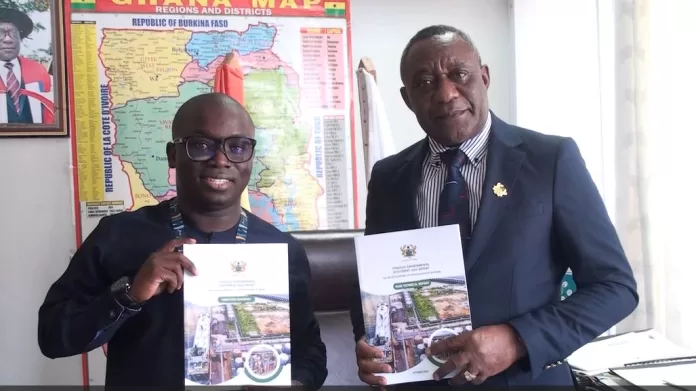
A Strategic Environmental Assessment(SEA), on the creation of a petroleum hub inGhana has been released by the Environmental Protection Agency (EPA).
The findings and recommendations in the report will be incorporated into the strategic decision-making process and guide the establishment of the hub.
To ensure that the establishment of the Petroleum Hub does not destroy the Fauna and Flora of the area which is close to the Ankasa forest reserve the Environmental Protection Agency, EPA launched a Strategic Environmental Assessment report to sensitize decision-makers about the environmental impacts of the facility.
Speaking at the SEA Report Launch the Chief Executive of EPA Mr. Henry Kwabena Kokofu explains the need for the report saying that this will serve as a roadmap to ensure that PHDC’s activities do not affect the environment.
Deputy Executive Director of EPA, Dr. Christine Asare said the Petroleum Hub will be a high monitoring and evaluation area to ensure that the necessary steps are taken to secure the environment.
Chief Executive of PHDC Charles Owusu said the Report is timely as the PHDC is engaging stakeholders and the community in decision-making during the plan preparation process.
PETROLEUM HUB
The Petroleum Hub Development Corporation, PHDC is a megaproject in the Jomoro Municipality of the Western Nzema Traditional Council in the Western Region.
The hub is expected to be a leading integrated petroleum complex that will add value to the upstream and downstream oil and gas value chain in Africa.
The petrochemical facility will cover 20, thousand acres of land and will house a complex web of onshore, offshore and ancillary assets. It will comprise three refineries, five Petrochemical Plants, Shared Storage Interconnected and Jetties with Port infrastructure.
The development of the Petroleum Hub in Jomoro will accelerate the growth of the petroleum downstream sub-sector and make it a major player in the economy.
The Petroleum Hub development will increase the presence of major international oil trading and storage companies, create regional trading champions, and encourage joint ventures between local and international companies for knowledge transfer and wealth creation.
It will also provide the country with Liquefied Natural Gas (LNG) facilities for power production and drive the growth of various industries including petrochemicals.
The development of the Petroleum Hub is expected to transform Ghana’s economy and is projected to create more than 780,000 direct and indirect jobs by 2030.
RECOMMENDATIONS
PHDC must develop and implement an Integrated Biodiversity Management Plan, IBMP with consideration for Gender, the Vulnerable and Excluded/Marginalised.
The Riparian Buffer Zone Policy for the management of water bodies and wetlands within the Petroleum Hub must be implemented.
Compliance with industrial pollution control limits must be ensured by the necessary collaborators.
Operations of the Hub are likely to negatively impact the health and safety of the workers and the people living in the nearby communities, including climate change impacts. The Factories Offices and Shops Act, 1970 (Act 328) enjoins factories, offices, and shops to indicate welfare facilities provided, notification of operational accidents and illnesses, health and welfare standards, safety measures, complaints related to dangerous conditions and practices and related matters in Ghana.
The Monitoring and evaluating emission levels. Resettlement and compensation which must be adequate and timely including land ownership, acquisition and conflicts.
Alternative Livelihood and Support Schemes such as the Livelihood Empowerment Against Poverty (LEAP) must be extended to cover affected groups and individuals who cannot be trained in alternative livelihood schemes especially the aged, women, the vulnerable and the excluded/marginalized.
Inadequate capacity of locals to participate in the development and implementation of the Petroleum Hub activities. The establishment of the Petroleum Hub will have significant economic benefits for Ghana. The key issues identified under the economic pillar include the inadequate capacity of locals to participate in the development of the Petroleum Hub and the creation of jobs and the prevention of job losses.
Develop and implement capacity-building programmes including relevant technical and vocational skills for the locals, CSOs, academia, Traditional Authorities (TAs), and Association of Ghana Industries (AGI), among others with consideration for women, the vulnerable and the excluded/marginalized.
Establish an integrated waste management system within the JMA and the Petroleum Hub under a framework for zero impact philosophy and maximizing local content.
Ensure continuous transboundary dialogue to prevent any potential security threats and conflicts.
Cultural heritage issues are held in high esteem within the communities and could lead to conflicts if not properly managed. It is advised that the PHDC should work with TAs and local communities to develop unambiguous guidelines on cultural heritage issues to inform potential investors.
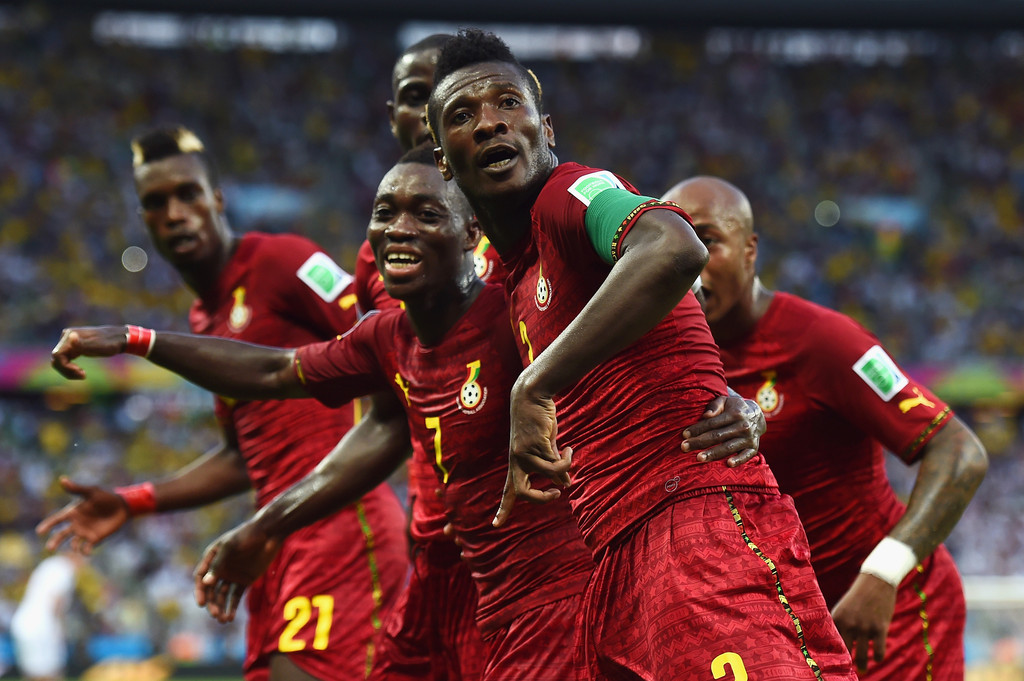
Ever since Christian Atsu’s demise was announced testimonies about his selfless being keep pouring in.
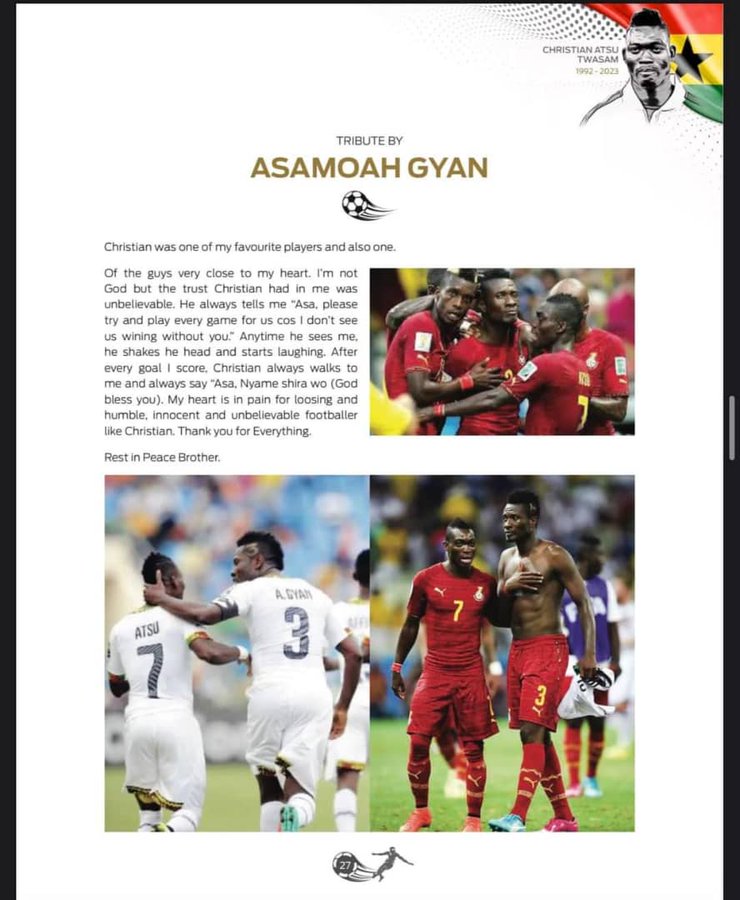
Asamoah Gyan, former captain of the Black Stars, has joined the others in penning down a heartfelt homage to the late Ghanaian international.
According to him, Atsu was one of his favorites as he derived support and encouragement from him.
He commended Christian for remaining humble despite reaching the height of his career.
The former captain added that Ghana and the world at large has lost a great soul, as Atsu is irreplaceable.
Find Asamoah Gyan’s tribute:
Christian was one of my favourite players and also one of the guys very close to my heart.
I’m not God but the trust Christian had in me was unbelievable. He always tells me “ Asa, please try and play every game for us cos I don’t see us winning without you”.
Anytime he sees me, he shakes he head and starts laughing. After every goal I score, Christian always walks to me and always say “ Asa, Nyame shira wo (God bless you). My heart is in pain for loosing humble, innocent and unbelievable footballer like Christian. Thank you for everything. Rest in Peace Brother.
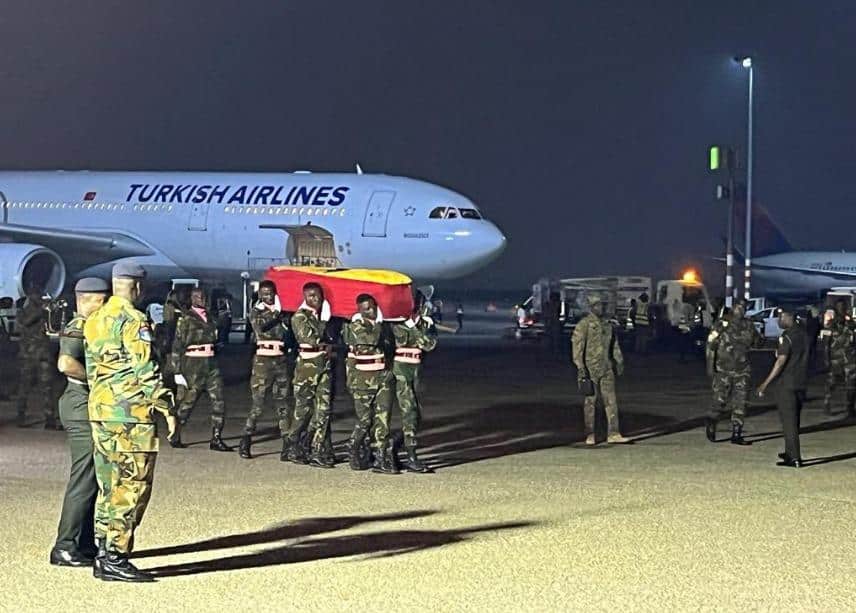
Today, Friday, March 17 the late Christian Atsu’s family, friends, football players, and prominent figures, includingPresident Akufo-Addo, have gathered to pay their final respects.
Atsu was discovered dead on Saturday, having spent the previous 12 days trapped beneath wreckage after the terrible earthquake that devastated Turkey and Ukraine.
Ghana’s move to restructure its local currency and overseas debt is weighing on banks from Africa to the UK.
Four of Africa’s biggest lenders — Standard Bank Group Ltd., FirstRand Ltd., Absa Group Ltd., and Nedbank Group Ltd. — collectively set aside 4.87 billion rand ($267 million) to account for the losses, impairing as much as 57% of local and onshore dollar-denominated debt holdings. Meanwhile, Standard Chartered Plc set aside $160 million.
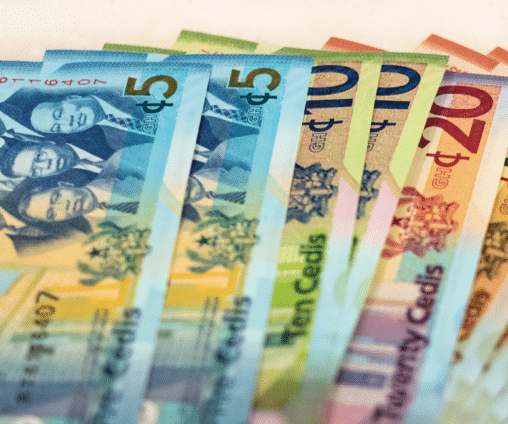
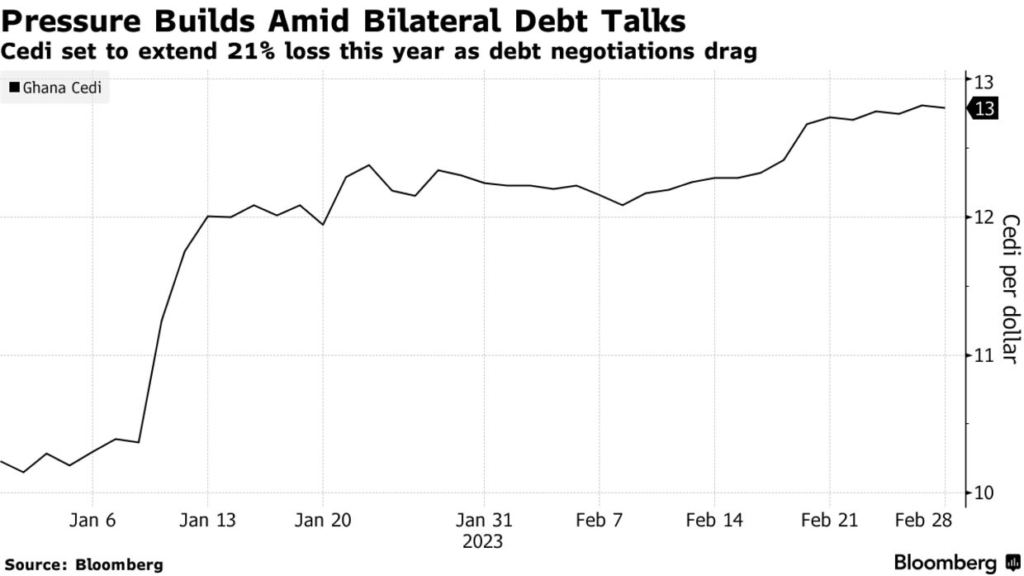
A rare move to restructure local debt — bondholders exchanged 87.8 billion cedis ($7.1 billion) of notes that paid an average of 19%, with bonds returning as little as 8.35% — have resulted in losses for financial institutions. Ghana is restructuring most of its public debt, estimated at 576 billion cedis, to finalize a $3 billion bailout from the International Monetary Fund.
“We dealt with the risk, because as we see it, while there’s a potential for a better outcome, there’s also potential for a worse outcome,” Absa Chief Financial Officer Jason Quinn said in an interview. “So that’s why we took a position to impair those extensively.”
Absa’s unit in Ghana, its third-largest lender by assets, booked 2.7 billion rand as impairment, including 2.2 billion rand for sovereign bonds, and another 500 million rand to cater for other government-related exposures. The lender maintains that its unit remains well capitalized.
Standard Bank, which runs the fourth-biggest lender in Ghana by assets, said it’s ready to re-capitalize the business should they need to, even though the Ghanaian unit’s balance sheet is a “fortress.” The lender holds as much as 2.6 billion rand in Ghanaian bonds.
“It is unfortunate where they find themselves,” FirstRand CEO Alan Pullinger said in an interview earlier this month. “The debt sustainability just wasn’t there and when you are over-geared, you eventually run out of cash and you have to call a default.”
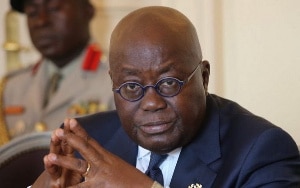
President Nana Akufo-Addo’s government plans to start “substantive” discussions with international bondholders and their advisers in coming weeks, Finance Minister Ken Ofori-Atta said on Feb. 16. The nation targets cutting its liabilities from an estimated 105% of gross domestic product in 2022 to 55% by 2028.
The costs to local lenders will only be known later given the stock exchange allowed them to delay releasing financials.
A pioneer of private media in Ghana, Dr Charles Wereko Brobbey, has stated that Ghana’s growth has not been remarkable since it attained independence to take charge of its own activities.
Speaking to the media, he said “In our 66 years of independence and 32 years of the Fourth Republic and we need to ask ourselves since we became independent how far have we travelled down the road of managing our own affairs?
“I don’t think we’ve made much progress and we seem to be going back and if we’re not careful we shall become neo-colonies of the so-called developed countries.
“And I feel that after 30 years of the Fourth Republic and two turns of the two main political parties, what I see happening is that this country is going nowhere, in fact, we’re retrogressing,” he said on Thursday.
According to him, matters will be worse should this trend continue for two more decades.
Dr Wereko-Brobbey said his projection comes after he diligently observed the system of governance in the Fourth Republic.
“So we should look at what democracy and independence actually mean to us going forward because I fear that if we keep going down the same route in 20 years, we’ll have nothing to talk of.
“All the best talents in this country would have left and many people would be in a state of apathy,” he said.
Meanwhile, a former UN Advisor, Prof Baafuor Agyemang-Duah said it was not too late to salvage the situation of Ghana.
He concurred with previous views that Ghana needed union governance to reconcile factions so that there will be a unified approach to development.
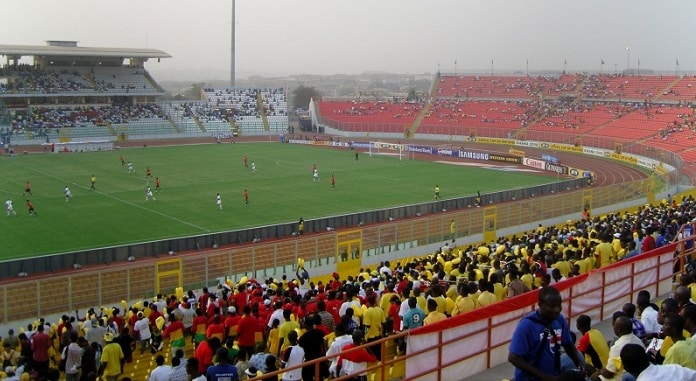
Baba Yara Sports Stadium is ready to host Ghana’s match against Angola on March 23, according to Peter Twumasi, Director General of the National Sports Authority.
The Black Stars will be back at the location for the first time in a year following their 2022 World Cup play-off match against Nigeria.
The Black Stars will play host to Palancras Negras on March 23 at the Baba Yara Sports stadium before travelling to Luanda for the rematch on March 27, 2023.
In an interview with Accra-based radio station Peace FM, the NSA boss discussed whether the venue was ready to host the senior national team.
“Yes by the grace of God…I left the place and got to Accra yesterday. I was also there throughout last week work went on smoothly and everything is ready. What we are looking forward to is God will grant us 23rd then we kick off,”
Ghana is joint top of the Group E table with 4 points from two games following a 3-0 win over Madagascar and a 1-1 draw withCentral African Republic in June last year.
An oversight investigation into the events leading up to the death of a young man at theWest Hills mallin Accra has been demanded by members of parliament (MPs).
Video footage showed some people abusing 32-year-old Shadrack Arloo while he was tied on the floor of the mall and was later confirmed dead at a hospital.
A police investigation into the matter revealed that the suspect died of asphyxiation and obstruction of his airway by a foreign body suspected to be marijuana.
In a statement on the floor of Parliament, the Member of Parliament for Jomoro, Dorcas Affo-Toffey together with some Members of Parliament urged the house to constitute an independent commission to investigate the matter.
“I call on this August House to invoke its legislative authority to set up an independent police commission and grant it the powers to investigate, for example, instances where the police stand accused of unlawful killing. Such a response will help curb actual or potential cover-ups in the future”.
“Mr. Speaker kindly permit me to state that I have petitioned the Commission on Human Rights and Administrative Justice (CHRAJ) to investigate the horrifying human rights violation meted out to against Shadrack. Let me also use this opportunity to urge the Commission to quicken its investigation into the matter to give the grieving family closure. I humbly pray that the statement be referred to the Committee on Defence and Interior to conduct an independent parliamentary probe into the true circumstances leading to the death of Shadrack,” she said.
The police pathologist found eight zipped packets of dry leaves that were likely drug-related in the deceased’s throat, tied with a piece of black polythene.
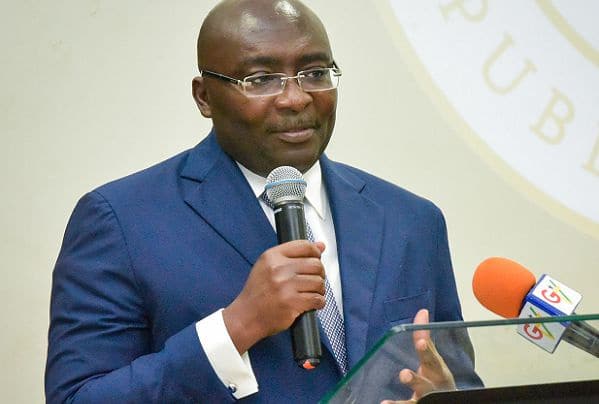
The ‘Gold for Oil‘ policy, which began this year, is expected to save the country $4.8 billion per year, according to Vice President Dr Mahamudu Bawumia.
The Vice President noted that the ‘Gold for Oil’ policy, which is now in its third month, is already having a positive impact and is expected to result in lower gasoline prices beginning March 16, 2023.
Dr Bawumia made this known while speaking at the commissioning of a new head office for the Bulk Oil Storage and Transportation Company in Accra.
”The savings in foreign exchange when we do this will be an annual savings of $4.8 billion every year and that means the oil importing companies will not be going to the Bank of Ghana looking for $4.8 billion to buy oil”, he said.
BOST is mandated to build a strategic reserve of stocks of petroleum products to meet a minimum of six weeks of national consumption from the Gold for Oil policy.
The Vice President stated that the policy is on track to achieve its overall goal of lowering fuel prices and relieving pressure on the country’s forex reserves.
He also stated that the government’s goal for this year is to reduce oil imports by 50%. Ghana has since received two consignments under the Gold for Oil policy.
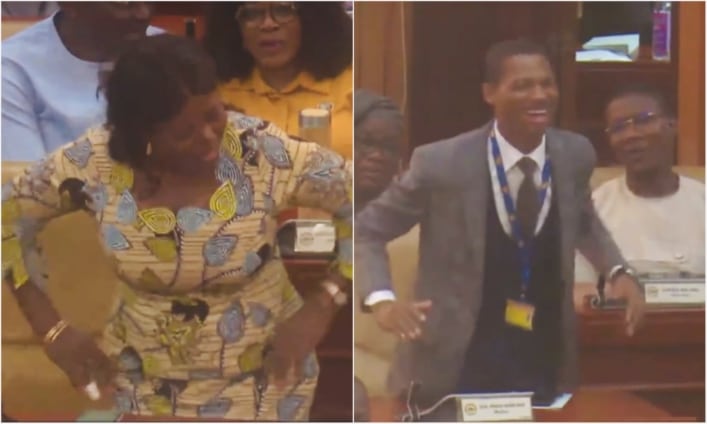
Alexander Afenyo-Markin, theDeputy Majority Leader, has suggested that the 275-seat in Parliament be decreased to 200 seats.
According to the member of parliament from the Effutu seat, this will reduce the strain on the public coffers.
“I must say that one critical thing to look at is to put an upper limit on the number of MPs that we must elect each year. It is unpalatable that a small country like Ghana with its many financial problems has 275 MPs. In contrast with all its financial muscle, Australia has 151 and 76 senators. We need a change in the law to stop the unnecessary expansion in the number of seats in our Parliament.”
The Effutu legislator made the comments at this year’s GIMPA Law Conference on Wednesday, March 15.
He added thatGhananeeds an Upper chamber which will be known as the House of Elders. To this end, he has proposed that the Council of State be converted to serve this purpose.
“I hold the view that Ghana needs an upper chamber, it should be known as the House of Elders whose election shall remain non-partisan and whose primary role shall be to moderate the current parliamentary excesses and extreme partisanship.
“Thus the Council of State should be converted into the Upper Chamber of Parliament…I am not suggesting that the current Council of State is not helpful.”
Mr. Afenyo-Markin also lamented challenges regarding the role of MPs stating that they have become development agents contrary to their lawmaking and representation of electorate functions.
This he said has made some MPs retire as paupers and live miserable lives. He added that claims that some MPs are corrupt are completely untrue if one looks at the life of some MPs after they leave the House.
“Although lawmakers are not strictly speaking development agents, many MPs have had to dig so deep into their private pockets to provide public infrastructure to benefit underserved communities in their constituencies. In the process, many MPs have retired as paupers and have to deal with the pain of paying for private loans they contracted in their time in office to provide for the needs of their constituents.”
Former President of the Chartered Institute of Marketing- Ghana (CIMG), Professor Stephen Adei, has noted that for Ghana to see economic growth, citizens must consume what they locally produce.
According to him, economic growth is hinged on consumption, the reason developed countries have maintained their growth since they consume what they produce.
“The wealth of nations is ultimately determined by its consumption pattern. You can see that in developed countries, they consume what they produce and export to us. Why developing countries tend to be near consumers and not producers of manufactured goods and modern services.
If we consume what we produce, we are creating wealth for ourselves and employment. Consumption is the pivot of economic progress,” he said.
Professor Stephen Adei made the remarks while commemorating World Consumer Rights Day on March 15, 2023.
Since time memorial, Ghanaians have been entreated to consume what they produce and move away from their taste for foreign goods. This is the main reason Ghana’s economy is heavily-import dependent.
Also, Prof Adei noted it has been the practice for producers to exploit consumers – an action he frowned upon. He noted that the rights of consumers must be protected.
“There is often the emphasis on production of services and of goods but the consumer is the king. The consumer is not only the king but queen, president and the chief. It is unfortunate that oftentimes, consumers become the victim of unscrupulous producers.”
For Prof Adei, everyone must be interested in the rights and protection of consumers, as every business and individual at a point, becomes a consumer.
“The reality is that oftentimes, most of the consumers don’t have the capacity or wherewithal to protect themselves,” he added.
He therefore urged Chartered Institute of Marketing, Ghana (CIMG) which was granted a Parliamentary Act 1021 to regulate the standard in marketing practice and the training of marketing professionals in Ghana
The theme for this year’s celebration is “Empowering consumers through clean energy transitions.”
TheDomestic Debt Exchange Programme (DDEP), which has undergone recent improvements, may present certain problems to Ghana’s economy, according to Mr. Joe Jackson, Director of Business Operations at Dalex Finance.
The scaling down to the DDEP and the manner of negotiations with external creditors, in his opinion, have had an impact on the attainment of debt sustainability, which was the most crucial problem for an agreement to be reached.
He fears foreign exchange crisis is in the offing for the country.
Speaking to Starr News, Mr. Jackson mentioned the reduction of the government’s expected 130 billion that has come down to 83 billion is a worry to the government meeting its targets.
“Each time there was an exemption, each time the rate was adjusted it increased the complexity of our debt sustainability challenges. So, scaling down the DDEP from what it was initially set at a 130 billion cedis to a final figure of 83 billion cedis meant that it will complicate our issues. That led us to now realize that there is a new haircut that we are expecting from the foreign bondholders that obviously complicates matters.
“And obviously, the rapid accumulation of the T. Bills debt which has now slowed dramatically was going to put us at risk. What really constitutes the issue is the deadline we have. I believe that the deadline was not imposed in a vacuum. The government realizes that it was only for so long that he can continue defaulting and have the market forgive them as long as they have.
He continued: “We haven’t paid a dime of our external debt since December. If we don’t get an IMF program soon, we are going to see shortages of foreign exchange. It will have an impact all across because we are a nation who imports everything.”
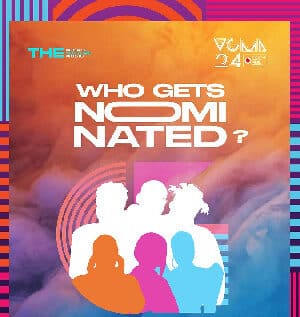
The last 10 years have seen the Vodafone Ghana Music Awards give relatively unknown artistes the rare opportunity to share the same stage with the biggest names in the music scene and afford them the avenue to showcase their art and craft to the world.
The opportunity has become a springboard for many artistes to step into stardom, whether winning the ultimate prize or not. MzVee, Kuami Eugene, Kelvynboy, Adomaa, Eno Barony, Epixode, Strongman, Gyakie, Kofi Jamar, Mr Drew, Dope Nation, Cina Soul and many more; these names have become synonymous with music in Ghana, speaking to the level of impact associated with this all-important initiative. And come Wednesday, the 15th of March, a crop super talented artistes will be announced. Who makes the list?
The journey to becoming the ultimate winner of the VGMA Unsung initiative is in three phases; social media application, nomination, and voting. Phases 1 saw an incredible list of unsung acts being tagged for this unique opportunity. Indeed, this phase is done, and organisers are ready to announce the nominees for the 10th Anniversary of the Unsung, selecting the top acts from several thousands of tags #24thVGMAUnsung.
Are you ready to meet your nominees? Make a date this Wednesday 15th of March at 12noon sharp, as organisers unveil the nominees on all VGMA socials, selected radio and TV stations on Media General, VGMA affiliate stations, entertainment-focused Social Media handles, entertainment websites, and blog portals. Who gets nominated?
For on-the-go information on VGMA kindly visit our social media handles, or our website: www.ghanamusicawards.com. The 24th VGMA Unsung is a Charterhouse initiative with sponsorship from Closeup Complete Fresh Protection.
Although the idea of a United States of Africa has been present in African intellectual history for almost a century, it was Kwame Nkrumah, Ghana’s first president, who launched an aggressive drive to realize the ideal.
He contended that the achievement was “meaningless unless it is tied up to the whole freedom of the African continent” after guiding Ghana to independence in 1957.
It is very necessary to point out that this famous quote was uttered on the eve of Ghana’s independence to a jubilant crowd who had not turned up for a lecture on Pan-African philosophy. But Nkrumah, the first leader of a free sub-Saharan African country, could not help himself but state one condition under which Ghana’s independence would be more fulfilled – be a lightning rod for other independence struggles on the continent.
Soon after Ghana, Guinea defied French colonial expectations in another intriguing story in 1958 to become only the second country in sub-Sahara to declare independence. Mali too, led by Modibo Keita, left the France Federation two years after Guinea, and the newly-independent African nation joined the Union of African States (UAS), previously Union of Independent African States (UAIS), comprising its two West African neighbors Ghana and Guinea.
The UAS was historically the first move towards a post-colonial Pan-African organization in Africa. It was formed pragmatically as a strong bilateral relationship between Ghana and Guinea in 1958 but in 1959, the two countries entered into another alliance with the never-before-colonized Liberia to enact the Union of Independent African States.
Liberia’s interests in this stead and the UAIS were rather short-lived. And so when Mali joined Ghana and Guinea’s UAS in 1960, the West African trio became the near-crystallization of a political and economic union in the form of what Nkrumah had always preached.
The UAS was, for its time and place, a dream equally beautiful and scary. Juxtapose the Union with, for instance, the European Commission (EC), which was founded by historically free European states in 1958 as a Pan-European effort at political, social, and economic integration, and you will come to the conclusion that UAS was somewhat too heavy for the shoulders of three infant nations in exploited Africa.
The idealism, however, needs to be applauded. In the founding charter, the UAS promised to establish a single currency and common central reserve bank for members as well as develop shared citizenship for peoples of member states.
None of these things were anywhere close to fruition, sadly. While the threat of neocolonialism lingered, much of the UAS’ problems were due to foundational deficiencies.
First, the UAS seemed worryingly like Nkrumah’s passion project rather than voluntary cooperation between equal partners. In 1958, it was Ghana that lent about $300 million in today’s money, £10 million at the time, to cash-strapped Guinea after the French threw a tantrum and left Guinea with nothing after independence.
This loan was the grounds upon which a bond between Ghana and Guinea was built.
Secondly, in spite of successful national propaganda that taught Ghanaians, Guineans and Malians that they would soon be “one country”, independence governments paid lip service to this vision. The strains of putting one’s house in order or quite literally, building one’s nation, before venturing into marriage, was a heavier cross than the founders of the UAS could bear.
Despite also being a cooperative effort between former British and French colonies, the UAS was never attractive even as a multicultural association to other former colonial territories who had been under the French or the British. This staggering fact was not lost on Nkrumah who took the chance at every continental podium to admonish independent African states about the need to unite under one tent.
We may also speak of the fact even as the UAS was established, contemporaneous Pan-African conferences and corollaries were in effect, with Ghana curiously in leadership roles. The Conference of Independent African States as well as the All-African People’s Conference were much bigger instrumental umbrellas of Nkrumah’s philosophy of continental liberation.
By 1963 when the Organization of African Unity (OAU), the precursor to the African Union (AU), was founded, there was no longer a UAS. The organization had withered and died, leaving in its wake historic cordiality between visionary states as well as some sort of blueprint for future relationships between free African states.
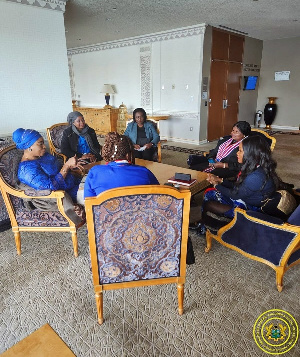
In order to improve their close cooperation in promoting gender equality and women’s empowerment in each of their individual countries, Ghana, Liberia, and Burundi have held bilateral meetings.
The meeting also discussed gender and violence issues across the African Continent.
It was held between the Minister for Gender, Children and Social Protection, Madam Hajia Lariba Abuduand her colleague Gender Ministers from Liberia and Burundi at the sidelines of the ongoing 67th session of the United Nations Commission on the Status of Women(CSW) in New York.
Also, High-Level Panel discussions were held on issues and challenges of financing socio-economic development programmes for women and girls through the Geo-Extractive Sector in West Africa as part of the event.
Every year, representatives of Member States gather at United Nations Headquarters in New York to evaluate progress made concerning gender equality, identify challenges, set global standards and formulate concrete policies to promote gender equality and the advancement of women worldwide.
The National Sports Authority’s Director General, Prof. Peter Twumasi, has stated that supporters will receive rewards for buying tickets ahead of the Black Stars‘ match against Angola later this month.
Ahead of the game, NSA has introduced what it calls ‘Early Bird Buyers’ in Ghana’s game against Angola in Kumasi to reduce the pressure on networks and demand for online tickets on the matchday.
“We are introducing some reforms such that, the people can really have advanced ticket purchasing and that’s something that had not been done,” Prof Twumasi told Kumasi-based LUV FM.
“Probably we need to motivate those who want to buy the tickets far in advance. Now, we are bringing out variations in pricing so people who will buy the tickets before the match will have discounts, very huge.”
“So those who will be buying the tickets before the matchday will have a huge discount and then on the match day, the price will go up a little bit. So we are encouraging more people to take advantage of this and buy their tickets before the game. The problem comes when they are there buying and we are also using the system for scanning so we want to reduce that,’’ he said.
The third matchday of the 2023 Africa Cup of Nations [AFCON] qualifications will include matches between Ghana and Angola at the Baba Yara Stadium on March 23.
The NSA also introduced the electronic ticketing system. Initial difficulties existed, but they have been resolved.
Following a 3-0 victory over Madagascar and a 1-1 draw with the Central African Republic in June of last year, Ghana and Angola are tied for first place in Group E with 4 points each.
In four days in Luanda, the Black Stars will honor the reverse match.
Son of Aisha Huang, Huang Lei, has been deported from Ghana after being found guilty by the Accra High Court.
On September 2, 2022, the felon was taken into custody after eight packs of Eley shotgun cartridges, containing about two 250 pieces of ammunition were seized from him.
He was before the court charged with one count of remaining in Ghana after the expiration of his passport and one count of possessing 250 rounds of ammunition without authority.
He had pleaded not guilty before the court presided over by Justice Lydia Osei Marfo, but later changed his plea to guilty before a relieving judge, Justice Comfort Tasiame, as result of the substantive judge being on her annual leave.
Huang Lei, was subsequently convicted on his own plea of guilty and was sentenced to a fine of GH¢10,800.
The court ordered the Ghana Immigration Service to deport the convict, and he has since been deported to his home country of China.
Meanwhile, two of his accomplices who are standing trial for similar offences are before the court, which has set a date to conduct case management which paves way for the trial.
His counterpart, Huang Haihua, has also been charged with one count of possessing a forged document – a fake residence permit, while Shi Yang, who was initially standing trial with his mother and stepfather has now been charged with one count of possessing a forged residence permit and four counts of possessing ammunition without authority.
He has been charged for being in the possession of 114 rounds of ammunition – 83 live rounds of 9mm ammunition, three live rounds of 8mm ammunition and another 22 live rounds of BB ammunition without authority.
Lucy Ekeleba Blay, counsel for the two, told the court yesterday that she had filed another application for bail on behalf of the accused, who had been remanded into prison custody.
The court, however, said it will not be able to hear the application yesterday and subsequently adjourned the case to March 22, 2023, for the application to be moved.
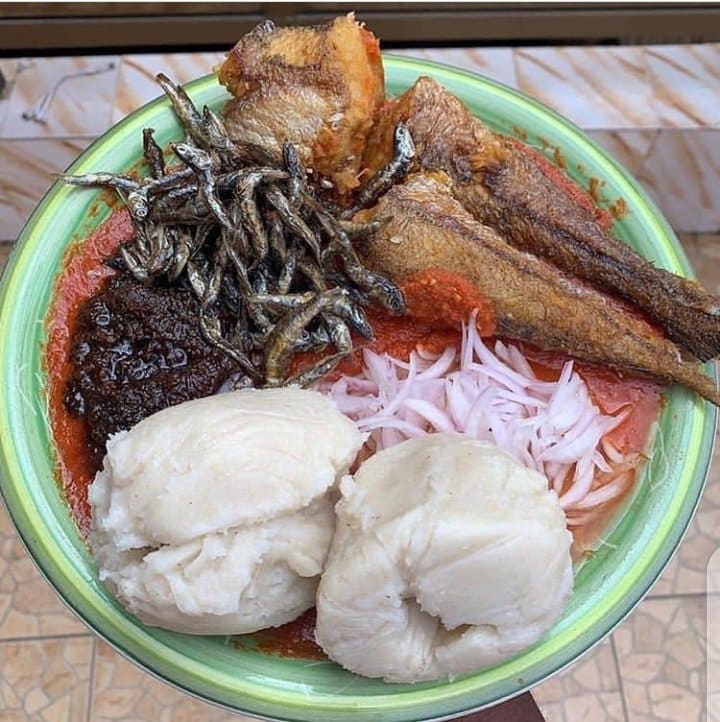
Hey there! Are you ready to embark on a journey of flavor and culture? Let’s explore one of Ghana‘s most loved delicacies, Kenkey!
This mouth-watering dish is a staple in Ghanaian cuisine and is particularly beloved by the Ga Adangbe ethnic group.
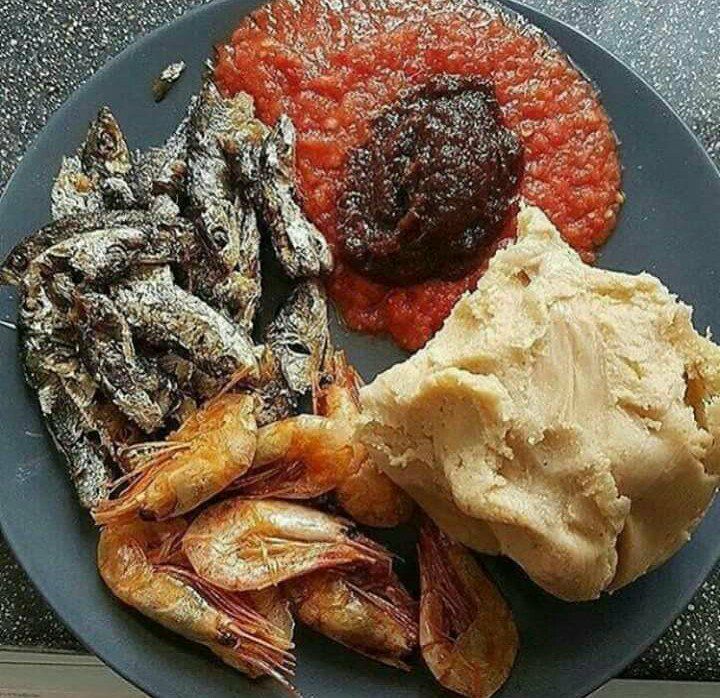
Imagine a ball of cornmeal, perfectly complemented with spicy chili pepper and a flavorful black sauce called “shito”.
Kenkey is usually served with fish, eggs, shrimp, or any other soup or stew of your choice.
It is not only delicious but also a significant source of nourishment for many Ghanaians.
Kenkey with pepper,onions and fishes
So, how is this delicious dish made? First, the maize grains are soaked in water for three days to soften and ferment them. Next, the maize grains are cleaned, crushed into flour, and worked into dough. Half of the fermented dough is cooked before being combined with the uncooked half to create a perfect blend of texture and taste.
The dough is then wrapped tightly in maize husks and cooked in water for one to three hours, depending on the size and thickness of the dough. Once it is ready, you are in for a treat!
Did you know that the water used to boil Kenkey can be used to make a nutritious beverage called “otinshi nu”? Additionally, you can also make a sweet dessert known as ice Kenkey by blending Kenkey with water, sugar, powdered milk, and ice.
Kenkey is not only a delicious dish but also a healthy one! It is rich in protein, vitamins, and fiber, which help prevent constipation and aid in digestion.
It is also a good source of Vitamin C and B6, which boost your immunity and help repair and grow tissues. Furthermore, Kenkey provides energy and lowers cholesterol levels.
As we commemorate Ghana’s 66th Independence Anniversary, let us delve into the origins of the name Ghana.
The name “Ghana” has deep historical roots that date back to the powerful Gana Empire that once existed in West Africa. The term “Ghana” was the title given to the kings who ruled the empire, which spanned across present-dayMauritania and Mali.
Muslim historians and researchers who studied the empire have documented that it reached its pinnacle around the year 300 before it experienced a rapid decline and eventually disappeared by the year 1100.
The Sonike residents called the empire “Wagadou,” and its capital was situated in Koumbi Saleh on the edge of the Sahara Desert.
The Kingdom of Wagadou
The Portuguese were the first Europeans to discover Ghana, formerly known as the Gold Coast.
They gave it the name “La Mina,” meaning mine, due to its significant gold deposits and as a trading post. Although the name was not legally accepted and widely used until 1471, it eventually became the name used by the European powers.
In 1867, the British took control and established the British Gold Coast colony. After years of fighting for independence, Dr. Kwame Nkrumah and Dr. J.B. Danquah successfully transformed Ghana from the Gold Coast to Ghana after the country gained its freedom in 1957.
Dr. Kwame Nkrumah (L) and Dr. J.B. Danquah (R)
It is widely believed that the name Ghana was chosen because several of the Gold Coast’s ethnic groups could trace their roots back to those who lived in the Gana Empire.
However, some people dispute this assertion and believe that G.H.A.N.A stands for “God Has Appointed Nkrumah Already” or “for Africa.”
In his speech officially launching the name Ghana, Dr. Nkrumah stated, “We take pride in the name Ghana, not out of romanticism, but as an inspiration for the future.” This illustrates the significance of the name Ghana as it represents the country’s rich cultural heritage and symbolizes a bright future for the people.
The big six
Today, Ghana is known for its diverse cultural history, kente, delicious cuisine, warm hospitality, pioneering citizens, and vast natural resources, including gold, cocoa, diamonds, timber, and more. The country is home to six significant ethnic groups that coexist peacefully, highlighting Ghana’s cultural diversity and inclusivity.
Ghana has a rich history that is deeply rooted in the country’s past. It symbolizes the country’s heritage, resilience, and future aspirations. As we celebrate Ghana’s 66th Independence Anniversary, let us take pride in our country’s name and strive towards building a better future for all Ghanaians.
The procedures to reinforce the border between Ghana and Burkina Faso, as well as to repair the pillars that make up the boundary to their prior condition, have begun.
This is being led by the Ghana Boundary Commission and its counterparts in Burkina Faso.
According to a report by myjoyonline.com, there are concerns that activities of gold miners, as well as other human activities, have affected the 30-year-old boundary pillars.
As part of the processes, the two parties held a first meeting at Paga, in July 2021.
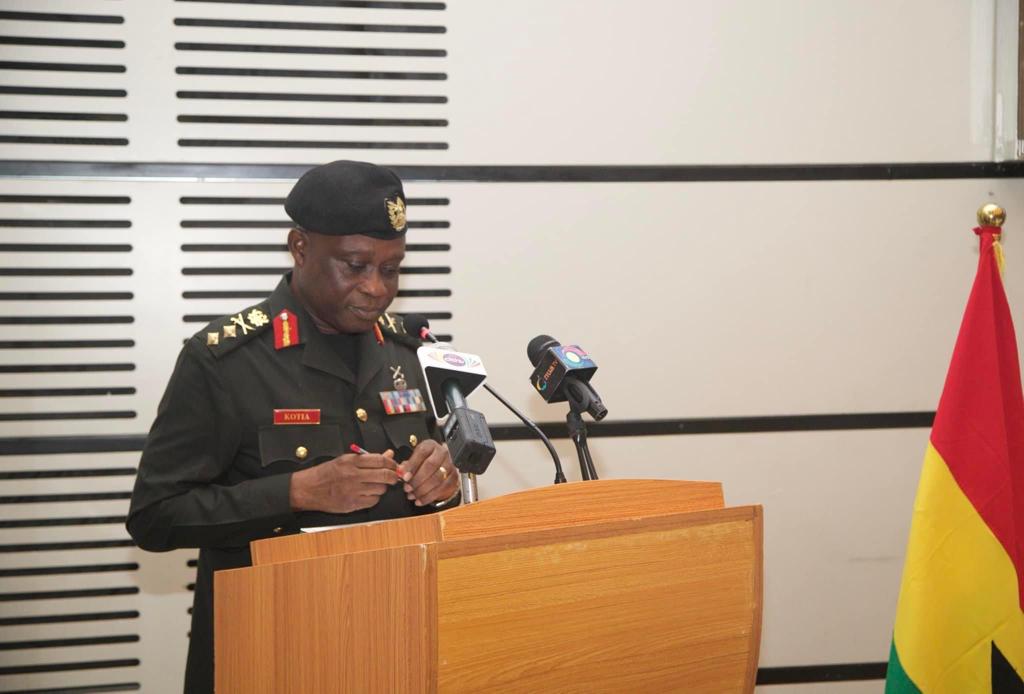
The report indicated that the National Coordinator of the Ghana Boundary Commission, Major General Emmanuel Kotia, speaking at the opening ceremony of the second meeting of the Boundary Commissions of Ghana and Burkina Faso at Ouagadougou, stated that works will get off the grounds soon.
“We will jointly seek funding for the construction of new boundary pillars including intermediary boundary pillars and border post pillars and a monument at a location that we will agree on around the border crossing.
“We will use this opportunity to urge GIZ to seek funding for us to start this project this year. It’s important for us to begin work as soon as possible so our land boundary will not become areas of dispute between border communities,” he said.
On her part, the Permanent Secretary for the Boundary Commission for Burkina Faso, Salimata Dabal, expressed great hopes about the meeting.
Adagbila Boniface Gambila, the Ambassador of Ghana to Burkina Faso, explained that he hopes the longstanding relationship between the two West African countries will help the process.
It is still considered to be one of Ghana’s most historic cities and is well-known for its involvement in the transatlantic slave trade.
Cape Coast, historically known as Carbo Corso (a misspelling of “Corsican Cape”), was the initial capital of theGold Coastand was situated on the Gulf of Guinea coast.
Beginning in the 16th century, numerous European nations established themselves in Cape Coast, using the area as a base of operations and a trading hub for commodities like gold and slaves.
There were the Dutch, Portugese, Swedish and then later the British.
The architectural structure of Cape Coast was one that could be boasted of because these European inhabitants established lodges, forts and other buildings.
Cape Coast served as an important seat of Asante traders, a roadstead port and the British commercial and administrative capital.
The Cape Coast Castle which was built by the Swedish and later taken over by the British in 1663, became the government administrative seat for the Gold Coast Colony.
It also became an educational centre, with some of the first schools including the Philip Quaque Boys’ school being established there.
Cape Coast however lost its position as the first capital of the Gold Coast in 1877 when Accra became the administrative capital of the British colonial government in the Gold Coast.
During their time in Cape Coast, the British Colonial government introduced the window tax. This was a property tax suggested by the British to raise money from the indigenes.
Per the tax, every household head was supposed to pay for the number of windows in their house. It was assumed that any household that has many windows was wealthy and therefore could pay more.
This was however met by stiff opposition by the indigenes who disagreed with the basis for the tax.
After this, they moved away to create a centre of power in Accra. The seat of government was moved from Cape Coast and established in Accra.
Accra became the formal colonial administration with the Christianbourg Castle serving as the seat of government.
Accra became the economic centre of Ghana. Railways were built from Sekondi and Accra inland to Kumasi.
A municipal council was formed subsequently, to improve the town.
Accra developed into a prosperous trading hub; today it serves as the commercial and educational centre of the country.
Accra subsequently was declared a city on 29 June 1961 by Ghana’s first President Dr Kwame Nkrumah. Accra has been one of the fastest-growing cities in Africa since the pre-colonial era.
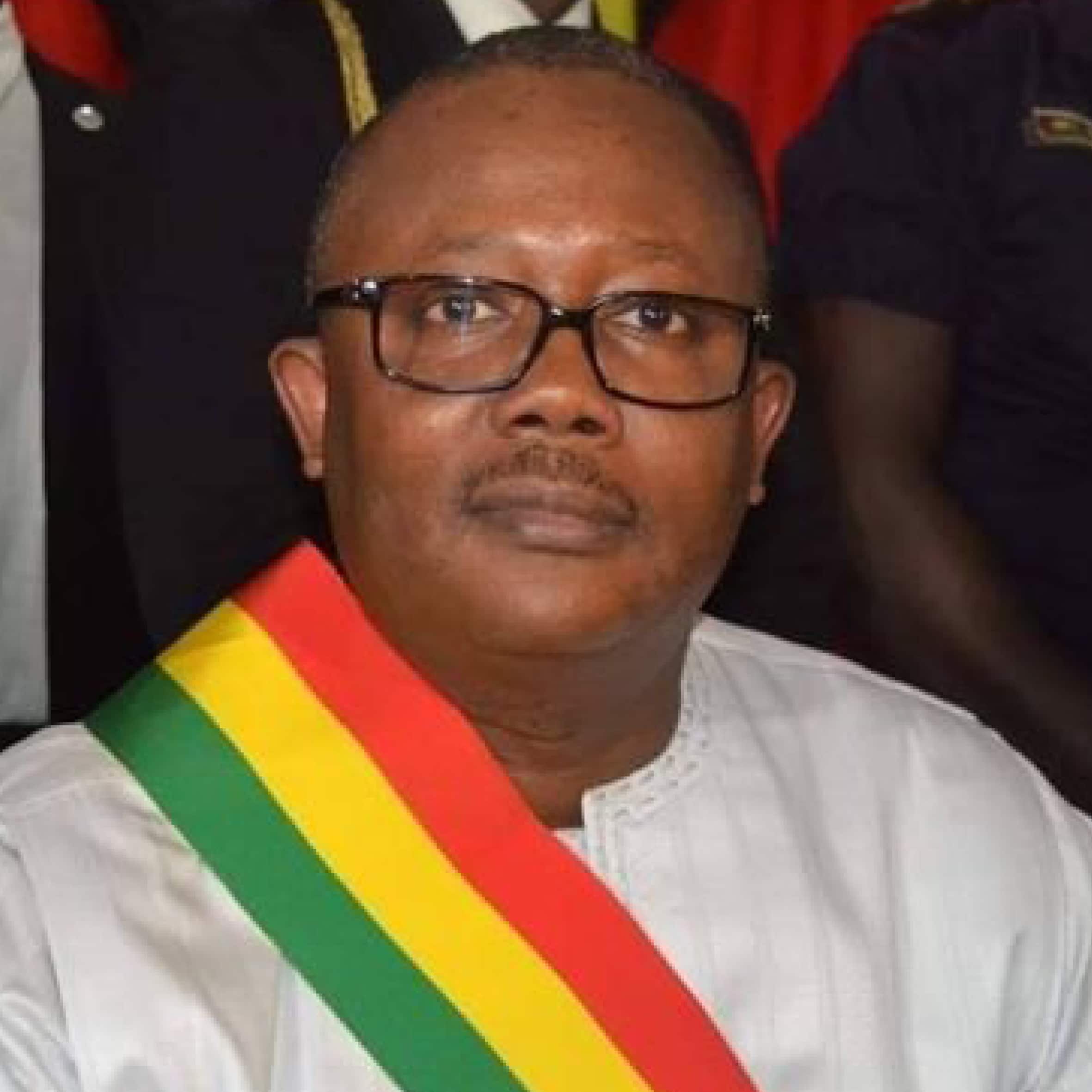
Ghana has earned accolades from Guinea-president, Bissau’s Umaru Sissoco Embalo, for taking the lead in the continent’s quest forindependence.
According to him, Dr. Kwame Nkrumah, Ghana’s first president, inspired numerous African nations to continue their fight for independence because of his outstanding leadership qualities.
Mr. Embalo, who is also the Chairperson of the Economic Community of West African States (ECOWAS) said that Ghana remained a powerful force that Africa looked to for democratic administration.
He said this when he was giving a speech during Ghana’s 66th Independence Day celebration at Adaklu Tsrefe.
“Nkrumah’s legacy is still valid for the whole of Africa,” President Embalo, the special guest at the event said.
He added that the people of Guinea-Bissau remained grateful to Ghana for supporting that country’s democratic journey.
Bilateral cooperation
President Embalo said his country looked forward to greater bilateral corporation with Ghana towards improving the welfare of their peoples and social development in both countries.
The celebration was on the theme: “Our unity, our strength, our purpose”.
The special guest said he was highly honoured to take part in the Independence Day celebration as Ghana still stood tall with gallantry for the liberation of the African continent.
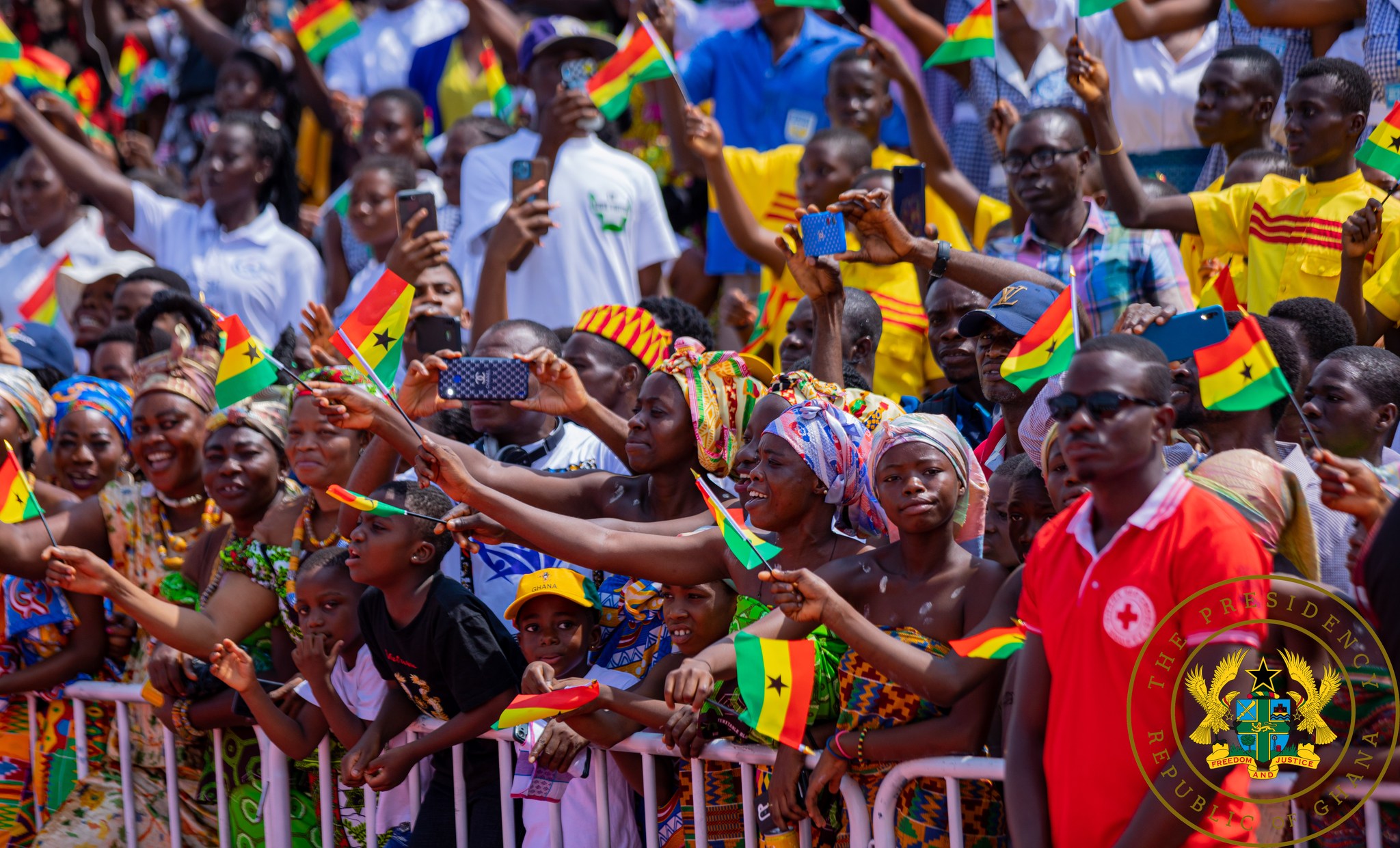
The celebration took part on a carnival note with a large number of people from all works of life turning up at the venue long before sunrise.
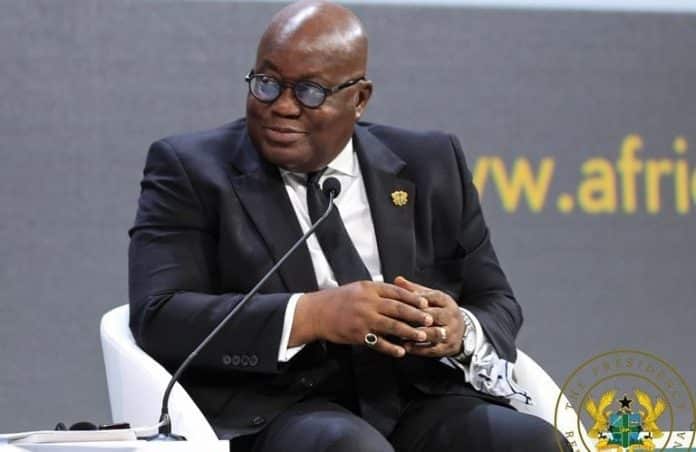
When President Nana Addo Dankwa Akufo-Addo turned up at the venue soon after 10 a.m., the crowd burst into a state of euphoria with loud applause as he lit the perpetual flame.
The day also featured thrilling cultural displays, with chiefs from more than 50 paramountcies in the region and others present.
Among them were the Chairman of the Council of State and Omanhene of the Juaben Traditional Area, Nana Otuo Siriboe II; the President of the Volta Region House of Chiefs and Paramount Chief of Anfoega, Togbe Tepre Hodo IV; the Agbogbomefia of the Asogli State, Togbe Afede XIV, the Awomefia of Anlo, Torgbui Sri II; the Paramount Chief of Adaklu, Togbe Gbogbi Atsa V; the Paramount Chief of Ziavi, Togbe Kwaku Ayim IV, and the Paramount Chief of Klefe, Togbe Kwaku Dzaga.
Activities on the ground
The Youth Resource Centre at Adaklu Tsrefe, near Ho, the Volta regional capital, was a sight to behold as the security agencies treated members of the public who converged there for Ghana’s 66th Independence anniversary to artistic display of skills and drills.
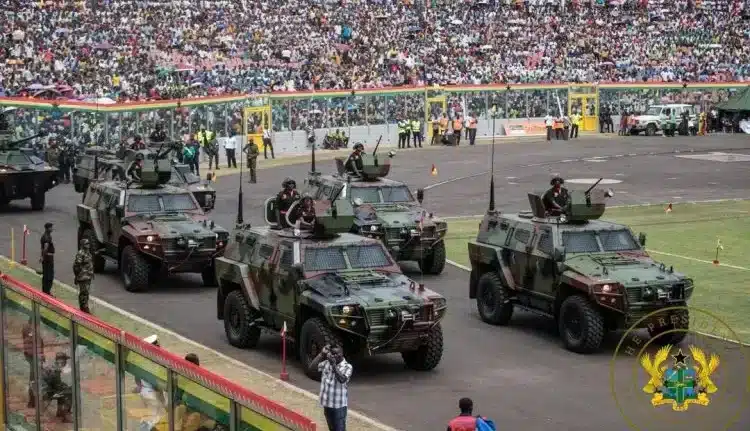
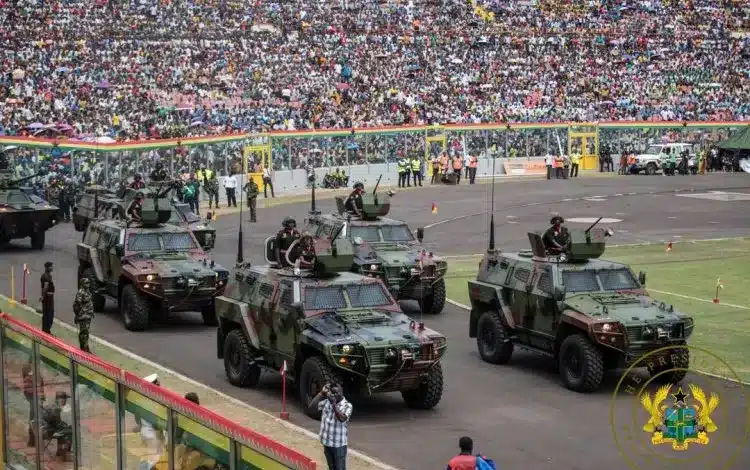
The 20 contingents drawn from the various security agencies, namely the Ghana Armed Forces (GAF), Customs Division of the Ghana Revenue Authority (GRA), the Ghana Prisons Service, the Ghana Police Service, the Ghana Immigration Service (GIS), the Ghana National Fire Service (GNFS), as well as the National Ambulance Service (NAS) engaged in a quick match past, after performing various drills.
The GAF, in particular, performed more drills and displayed essential skills, including risky rescue operations and gymnastic displays to the admiration of spectators.
Displays
The displays by the security commenced with soldiers from the physical training school of the GAF, based at the El-Wak Barracks.
They engaged in physical fitness displays and rescue exercises.
Led by Lt Paa Kwesi Owusu of the 66 Regiment, the officers engaged in a series of ground operations, including forehead springs, dive and roll in pairs, running hand springs in pairs, staggered dive and roll, front somersault in pairs as well as individual skills.
The breath-taking moment for the gathering was when the soldiers took a dive and somersaulted through the loop with flames of fire around it.
The team also engaged in gymnastic displays including the pyramid formation.
As if that was not enough, the Special Force Unit of theGAF took the display to another level with deployments of ground troops to support an air assault team on a mock risky mission to rescue a government appointee from terrorists who are demanding hefty ransom.
About 10 rescuers, with a Belgian trained dog, Hazy, rappelled down a helicopter that hung about 70 metres from the ground to conduct the rescue exercise.
Equipment
Aside from the gymnastics, the security agencies also demonstrated their capacity to execute their mandate with the showcasing of sophisticated weapons, armored vehicles, fire-fighting equipment, helicopters, motorbikes for improved visibility and other resources.
The Ghana Police Service also showcased some equipment and new units such as the Canine Unit and the Formed Police Unit, alongside crowd control vehicles and three helicopters.
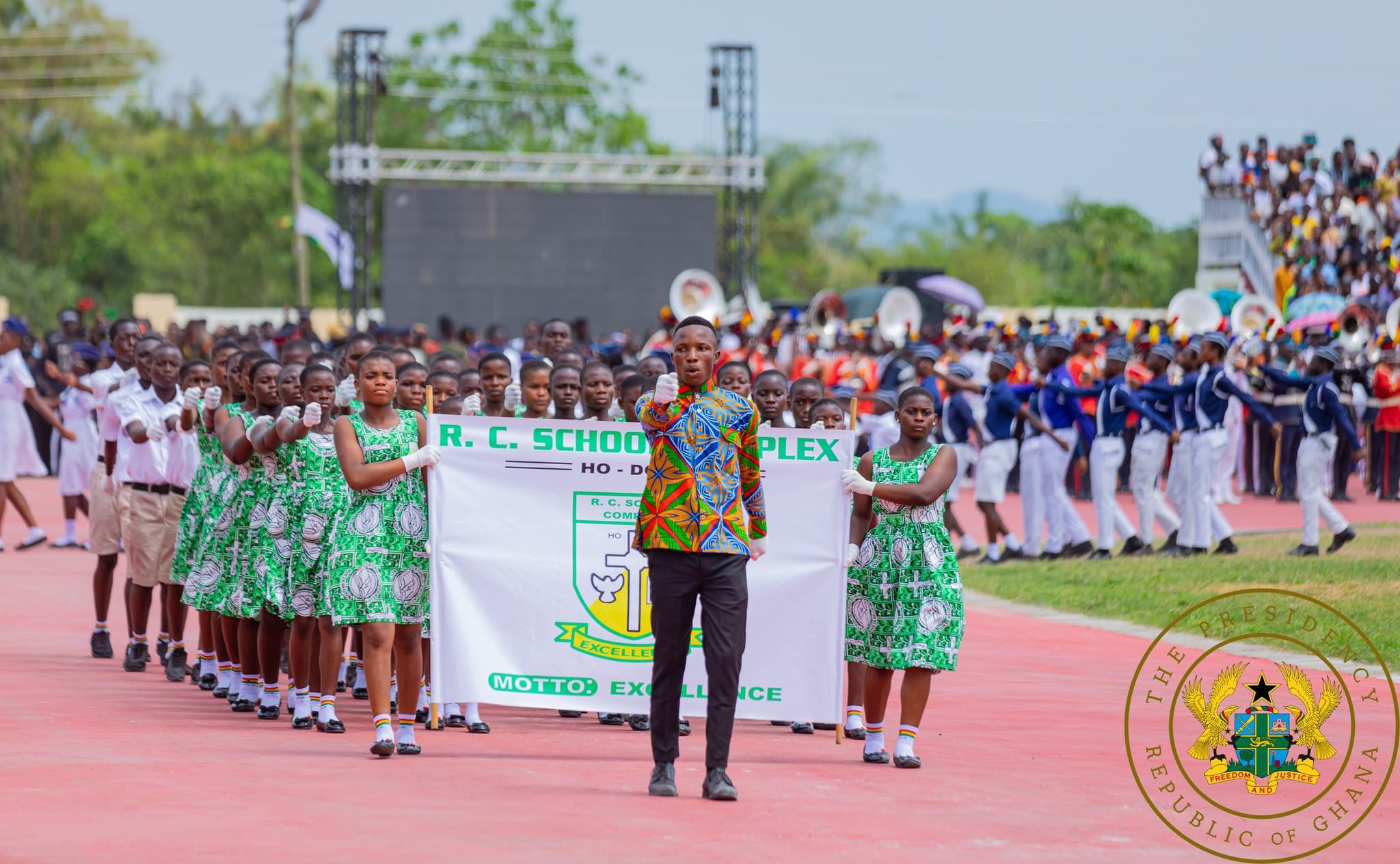
Besides the security services, 14 selected senior high and basic schools also took part in the march past at the centre.
A 21-gun salute by the GAF was flooded by fly pasts by a fighter jet, heralding the end of the parade and an invitation to the President to deliver the anniversary speech.
With patriotic songs in a background, the gun salute was sounded amid cheers from the crowd.
Cars and human beings competed for space at the venue, giving security personnel a hectic time controlling the crowd at the celebration which witnessed no untoward incident.
The Ghana Education Service(GES) has declared today, Tuesday, March 7, 2023, a holiday for all students across the country.
This comes after the nationwide celebration of Independence Day that took place on Monday.
On Monday, March 6, 2023, thousands of students from all over the country gathered in Adaklu in the Volta Region to commemorate Ghana’s 66th anniversary of independence.
Various Metropolitan, Municipal and District Assemblies also celebrated the event at the local level giving students the opportunity to take part in the 6th March parade.
“It is announced for the information of all schools and the general public that Tuesday 7th March has been declared a holiday for all school children in Ghana,” GES said in its statement.
GES further explained, “this is to enable them have some rest after preparing vigorously for the Independence Day anniversary Parade”.
Schools, according to the GES will fully resume on Wednesday, March 8, 2023.
I must, first of all, welcome our Special Guest of Honour, the President of the Republic of Guinea-Bissau and current Chair of the Authority of Heads of State and Government of the Economic Community of West African States (ECOWAS), His Excellency Umaro Sissoco Embaló, and members of his delegation to Ho, capital of the Volta Region, and to Adaklu, the venue for this ceremony. Senhor Presidente, você é bem-vindo ao Gana.
Ghana is proud of the strong ties of cooperation and friendship that exist between our two countries, and I am also happy that President Embaló succeeded me as Chairperson of the Authority of Heads of State and Government of ECOWAS. It is my hope that our two nations will continue to work together to build a sustainable future of progress and prosperity for our respective countries and populations, and to maintain healthy relations between our two nations.
Your Excellency, we are very glad that you accepted our invitation to share this special day with us. Even though you have been to our country on many occasions, your stay has largely been in Accra, our nation’s capital. Today, you are in Adaklu and, I dare say, in one of the most beautiful, and serene parts of our country, and you are amongst people who pride themselves on their sense of hospitality. I hope that, by the end of the visit, you will agree with this claim.
I extend the appreciation of the nation to the children from all across the nation who took part in the march, and I commend the cultural groups for their spectacular performances, which exemplified the greatest aspects of Ghanaian culture. It is always a delight also to watch personnel from our security services on parade, putting up spectacular drills. This year’s parade and display of drills are no exception, and, have become eagerly awaited aspects of our independence day celebration. Kudos to them!!
Ladies and Gentlemen, this is the part of Ghana that has produced, arguably, the nation’s two greatest composers, Ephraim Amu, composer of that great anthem, Mia denyigba lorlor la (Yen ara asase ni), who taught us to take pride in our culture, and Phillip Gbeho, composer of Ghana’s vibrant and much loved national anthem; Daniel Chapman Nyaho, one of Ghana’s most eminent administrators who, at independence, helped ensure a seamless transition when the British left; the Reverend Ametorwobla, that powerful orator who proved you could be both a priest and a politician; and Esther Ocloo, née Nkulenu, trail-blazer and industrialist extraordinaire, whose entrepreneurial spirit lives on. This is part of Ghana that also gave us Komla Agbeli Gbedemah, Ghana’s first Minister for Finance and one of the founding fathers of our nation, and the charismatic Jerry John Rawlings, first president of the Fourth Republic and Ghana’s longest-serving head of state.
The greatest achievement of our independence is the fact that we have welded different ethnic entities into one nation. Although the Gold Coast was the precursor to our independent Ghana, it was a collection of disparate groups. It was the attainment of independence that gave us our common identity as Ghanaians.
An important historical fact is that, of all the different peoples that have formed our modern nation, it was only the people of the Volta, Oti and part of the current Northern Regions who had the unique opportunity to choose to join the territory that became Ghana at independence. I am referring, of course, to the 1956 plebiscite in which, on May 9th of that year, the people of the then British Togoland voted to join the Gold Coast on the attainment of her independence a year later. Without that significant historical event, we would not have Ghana as we know it today.
Today, we celebrate the anniversary of the day we achieved the enviable status of becoming the first country in sub-Saharan Africa to be free of colonial rule, and, with this, came the weighty obligation to serve permanently as a barometer of the continent’s progress.
Sixty-six (66) years down the line, we have worked hard to live up to this responsibility, even though we acknowledge that we have not fully realised our potential and the dreams and aspirations of our forebears, who fought for the independent Ghana we have today.
For well over a century, our forebears fought to liberate our nation from the chains of colonialism and imperialism. The several wars fought against the British by the Ashantis, the last of which featured the celebrated Yaa Asantewa; the successful mobilisation of public opinion by the Aborigines Rights Protection Society, whose leading spirits were Jacob Sey, Joseph Casely-Hayford, John Mensah Sarbah, Kobina Sekyi, against the sequestration of our lands by the British; the formation, in 1947, of the nation’s first political party, the United Gold Coast Convention, UGCC of blessed memory; the triggering of mass resistance by Nii Kwabena Bonney (Boycott Hene) through the boycott of goods of European traders; the riots that consumed the nation following the senseless shootings of unarmed ex-service men at the Christiansborg Crossroads on 28th February 1948 and the killings of Sergeant Adjetey, Corporal Attipoe and Private Odartey Lamptey, which enraged the people and sparked riots across the country; the subsequent arrest of the UGCC leaders, who have gone down in history as the legendary “Big Six”, JB Danquah, Emmanuel Obetsebi-Lamptey, Edward Akufo-Addo, Ebenezer Ako Adjei, William Ofori-Atta, Kwame Nkrumah, by the colonial authorities, who held them responsible for the disturbances; the establishment of the Watson Commission, which helped design the path towards independence in 1957; and the formation, in 1949, of the Convention Peoples’ Party by Kwame Nkrumah, together with K.A Gbedemah and Kojo Botsio, which, thereafter, became the principal organ for the prosecution of the nationalist agenda.
Our forebears were united and strengthened in realising one common purpose – the attainment of independence. It did not matter where they came from; it did not matter which tribe they belonged to; it did not matter which religious persuasion they subscribed to; and their standing in society certainly did not matter. They recognised the fact that colonialism did not inure to our nation’s collective benefit, and they were determined to end it. And, indeed, they did.
On that historic night of 6th March 1957, after decades of agitation by the pioneers and members of the nationalist movement, Kwame Nkrumah, our nation’s first leader, made the momentous proclamation of Ghanaian independence at the Old Polo Grounds in Accra, which we celebrate with joy every year.
The theme for this year’s celebration, “Our Unity, Our Strength, Our Purpose”, should imbue in us the constant desire to seek the progress, prosperity and development of Ghana, no matter the circumstances confronting us.
The 4th Republic represents the longest period of stable constitutional governance in our history. We should be united in the goal of protecting it, for it is only its free, democratic form of governance and the intelligent management of the economy that will bring the upliftment Ghanaians to want and deserve.
We should continue to strive to ensure that no Ghanaian child is denied access to quality education, hence the groundbreaking and transformative Free SHS policy. We should continue to guarantee access to affordable healthcare for all in every part of our country, by continuously improving the National Health Insurance Scheme, expanding healthcare infrastructure and enhancing general health delivery; we should continue to work towards achieving food security, and the modernisation of our agriculture; we should continue to work to become a value-added, industrialised economy, which no longer depends on the production and export of raw materials, but on the things we make; we should continue to work to open up all parts of our country through the construction of roads, rail, ports and airports; we should continue to work to improve accountability, efficiency and transparency in the delivery of public services; we should continue with the process of digitalisation; we should continue the difficult but necessary task of ridding our environment of the menace of galamsey; and we should continue to pay our taxes, and demand that our leaders put them to good use.
Above all, we should continue to guard and protect jealously the security and integrity of our nation against dangers from outside and within our borders.
We cannot allow those who seek to divide us along the lines of ethnicity or religion to succeed. Let us deepen the cohesion that exists amongst us, and let us wear, with pride, the badge of being called Ghanaian. There is no better homage we can pay to the memories of all those who fought to free us from the shackles of colonialism and imperialism than to dedicate this 66th independence anniversary to working even harder for the unity, strength and purpose of our dear Ghana.
Fellow Ghanaians, I am very much aware of the current difficulties confronting our nation, and we are working hard to resolve them. But, maybe, we should also count our blessings on how, together, we are managing the difficulties. We all see the images around the world. Here in Ghana, we have not had any fuel queues, we have not suffered shortages of food and essential items, nor the catastrophe of dumsor. Undoubtedly, major global developments have had a negative impact on our domestic economic performance. We have witnessed historic highs in global inflation and food prices; rising global interest rates triggered by the tightening of monetary policy of central banks across several advanced economies to tame rising inflation; an energy crisis with crude oil prices reaching unprecedented highs, at one point, above one hundred and twenty dollars (US$120) per barrel; the strengthening of the US dollar against all other currencies; the tightening of global financing conditions especially for emerging markets and developing economies; and the largescale disruption of the global supply chain.
These phenomena have manifested in Ghana in the form of the depreciation of our currency, the decline in gross international reserves, high inflation, elevated debt burden, significant fiscal stress, constrained domestic and external financing, and reduced GDP growth. It is these that have brought hardships upon our people. Government has deployed a number of fiscal interventions to help bring relief to Ghanaians, and, I am confident that, sooner rather than later, we will see significant results of relief and recovery. In two days, on Wednesday, 8th March, I will, in the Chamber of Parliament, deliver a Message on the State of the Nation, where I will delve into much greater detail the entirety of the package of policies Government is implementing to bring back the days of rapid growth.
Fellow Ghanaians, there is one thing I want all of us to remember, and that is that, when I assumed office on 7th January 2017, I inherited a severely-challenged economy, whose rate of growth, at the time, was the lowest in over two decades. By dint of hard work, prudence and creativity, we managed to turn things around, creating an economy which, for the years 2017, 2018, and 2019, the years before the onset of COVID-19, was amongst the fastest growing economies not only in Africa but also in the world, recording an annual GDP growth rate of seven per cent. We were the best place to do business in West Africa, and, in 2021, we were described as the most attractive destination for investment in West Africa. The next 22 months of my mandate will be focused on restoring the economy we had before COVID and the Russian invasion of Ukraine to a period of rapid growth. It is a solemn pledge I am making to you, my fellow Ghanaians, and one which I am determined to fulfil.
Before I take my seat, I want to inform you that, in fulfilment of the announcement I made at last year’s Founders’ Day Celebration, I will, on Tuesday, 14th March 2023, confer national honours on some citizens of our country, who distinguished themselves in the fight against the pandemic of COVID-19. Through their actions, they helped protect and preserve our population and won global acclaim for Mother Ghana. I will, also, on that day, express the nation’s gratitude to the legal team of men and women who were charged with ensuring that the maritime boundary dispute with Ghana’s immediate, western neighbour, the Republic of Côte d’Ivoire, ended favourably for Ghana, thus ensuring that our western maritime resources, including their potential oil and gas reserves, remained legitimately in our possession.
I am sure we all saw the three (3) helicopters belonging to the Police Service joining this morning’s celebration. It is the first time in our nation’s history that the Police Service is employing the use of helicopters to improve its operational efficiency. The acquisition of these helicopters is to honour the pledge I made at the 2019 end-of-year Police WASSA, and I assure the officers, men and women of the Service of Government’s continued support in helping them to discharge effectively their mandate.
Ladies and gentlemen, in choosing to celebrate this year’s Independence Day in the Volta Region, I hope it affords all of us the opportunity to enjoy the beauty and breathtaking scenery that abounds here. This is the Region that has the highest mountain in Ghana, and other spectacular peaks from which to gaze at the surrounding splendour. This is the Region that has marvellous waterfalls and naturally occurring landscapes and historic monuments on its coast. It is the Region of spellbinding and beautiful music and intricate dances. It is a Region with interesting cuisine. It is a tourist destination without comparison. I urge you all to explore its unique attractions.
In conclusion, fellow Ghanaians, I want to assure you that my devotion to the Ghana Project is unwavering. The enemy we face is not each other. We can only win this battle if we stick together, and pull in the same direction, regardless of our divergent viewpoints. I am confident that we are on the right path, and I ask for your support so that we can continue the transformation of Ghana in peace.
Once again, on behalf of all of us, I thank President Embalo and his entourage for coming to join us on our special day. Happy 66th Independence Anniversary Celebration to us all, and may God Almighty bless us all, and our homeland Ghana, and make her great and strong.
President Akufo-Addo has entreated Ghanaians to desist from immensely dwelling on the challenges the country is facing.
According to the president, the people of Ghana should also make it a point reflect on some of the achievements Ghana has chalked over the years.
Addressing Ghanaians while commemorating the 66th Independence Day celebration, he said “Fellow Ghanaians, I’m very much aware of the current difficulties confronting our nation and we are working hard to resolve them. And maybe, we should also count our blessings in how together we are managing the difficulty.
We all see the images around the world. Here in Ghana, we have not had any fuel queues, we have not suffered shortage of food and essential items. All the catastrophe of ‘dumsor’. Undoubtedly, major global developments have had a negative impact on our domestic economic performance.”
He mentioned that historic highs in global inflation and food prices, rising global interest rates triggered by tightened monetary policy of central banks across several advanced economies to take rising inflation have had a negative impact on the local currency and elevated the country’s debt burden.
President Akufo-Addo has however assured that his government has been working hard to restore an indebted and challenged economy it inherited in 2017.
This year’s celebration was held at Ho in the Volta Region for the very first time under the theme “Our Unity, Our Strength, Our Purpose.”
The Special Guest of Honour for the celebration was President Umaro Sissoco Embalóof Guinea Bissau, who is also the Chairman of the Economic Community of West African States (ECOWAS)
It is Ghana month, but most importantly, Ghana is celebrating its 66th Independence anniversary after breaking free from British rule on March 6, 1957.
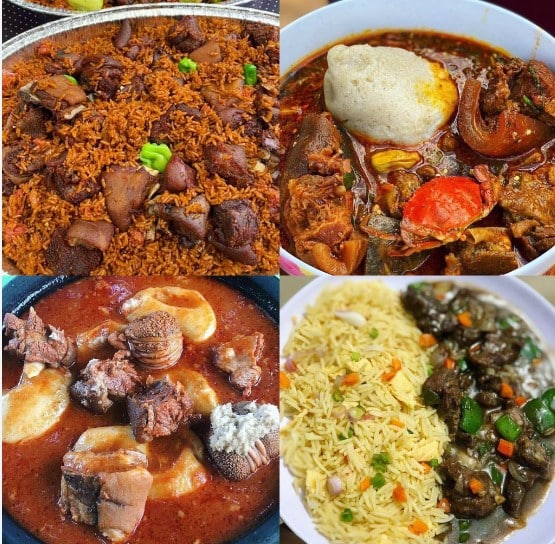
Today, many across the country put aside their difference and ethnicity to come together to celebrate. Do you know what brings Ghanaians together aside from the national event? Food. Yes, palatable delicacies ensure people set aside what ever disagreement they have to enjoy a well prepared meal.
Since Ghana is 66 years today, let us look at some 66 Ghanaian meals you should try out today.
Check the list below:
Jollof rice
Waakye
Banku
Fufu
Ga kenkey
Fante kenkey
Cabbage Stew with Rice
Abomu
Red red (black-eyed peas stew)
Kelewele (spicy fried plantains)
Tuo Zaafi (TZ)
Okro soup
Groundnut soup
Kontomire stew
Aboboi (rice and beans)
Yam and Palava sauce
Light soup
Peanut butter soup
Goat stew
Shito (spicy black pepper sauce)
Grilled tilapia
Eto (mashed yam and boiled eggs)
Akple and Fetri detsi
Boiled yam with garden egg stew
Garden egg stew
Fried yam
Fante kenkey and fish
Omo tuo (rice balls)
Nkatie cake (peanut cake)
Red red with fried plantains
Koko and koose (porridge and bean cakes)
Gari foto (gari with beans and vegetables)
Banku with okro soup
Ayibe biscuit
Palm nut soup
Cube toffee (Coconut toffee)
Ampesi (Boiled cocoyam, plantain)
Mpotor mpotor
Aboboi with fried fish
Waakye with shito
Tea bread
Brukina
Wagashi
Pinkaso
Aburo ni nkateɛ (Mixed roasted corn and groundnuts)
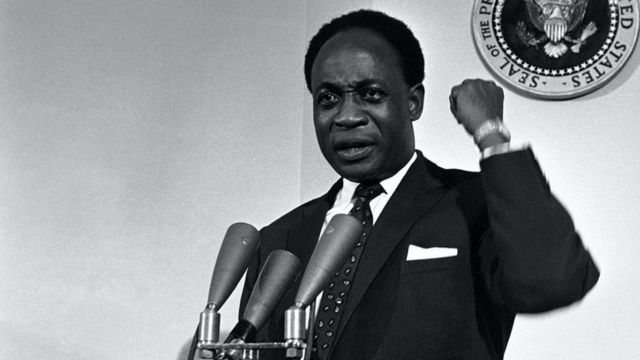
In 1966, Colonel Emmanuel Kwesi Kotoka and Major Akwasi Amankwa Afrifa staged a coup d’état against Ghana’s first President, Kwame Nkrumah.
Nkrumah was out of the country during the ousting. As Ghana celebrates its 66th Independence Day today, we take a look at Nkrumah’s reaction to his overthrow.
“I left Accra on 21st February 1966. I was seen off at the airport by most of the leading government and Party officials, and by service chiefs.
I recall the handshakes and the expressions of good wishes from Harlley, Deku, Yakubu, and others.
These men, smiling and ingratiating, had all the time treason and treachery in their minds.
They had even planned my assassination on that day, though they later abandoned the idea.
I remember shaking hands with Major-General Barwah—to be murdered in cold blood three days later when he refused to surrender to the rebel army soldiers.
I little thought then that I would never see him again, or that Zanerigu, Commander of the Presidential Guard Regiment, Kojo Botsio, Kofi Baako and other ministers who were there at the airport, would be shortly seized by renegade soldiers and policemen and thrown into prison.
After a week of so-called “manoeuvres,” the operation began early in the morning of Wednesday, 23rd February 1966 when the garrison at Kumasi, numbering 600 men, was ordered to move southwards to Accra.
On the way, the convoy of some 35 vehicles was met and halted by the two arch-traitors Colonel Emmanuel Kwesi Kotoka, Commander of the Second Infantry Brigade Group, and Major Akwasi Amankwa Afrifa of the Second Brigade.
Kotoka had only recently been put in charge of the Kumasi garrison, and I had not yet confirmed his appointment.
Kotoka, Commander of the Second Infantry Brigade Group, and Major Akwasi Amankwa Afrifa of the Second Brigade.
Kotoka had only recently been put in charge of the Kumasi garrison, and I had not yet confirmed his appointment.
Afrifa was left in command while Kotoka went to Accra to report progress to Commissioner of Police, John Willie Kofi Harlley and to find some soldier better known than himself to be the nominal head of the revolt.
The man chosen was Major-General Ankrah even though the conspirators had thought so little of his abilities than they had not previously troubled to consult him?
He was, however, one of the few officers who had held even the rank of major in colonial days and had seen service in the world war if only as a quartermaster.
In the Congo he had shown some bravery and, at least, routine ability and I had decorated him for his services but essentially he was of mediocre calibre.
He held the post of second in command in the armed forces after independence through seniority, not ability.
He would not have been appointed even to this post but for the death shortly before of another senior officer.
In 1965, I retired him. Undoubtedly, it was his lack of understanding of what was going on around him which recommended him as a figure-head to those manipulating the ‘coup’.
The troops were then told that I intended sending them to fight in Vietnam and in Rhodesia, and that I had deserted Ghana taking with me £8 million.
There was, they were told, no government left in Ghana, and it was their duty to assume control of the country to maintain law and order.
Already, it was said, Russian planes were landing on a secret airs rip in northern Ghana.
Furthermore a secret tunnel had been made from Flagstaff House, the presidential residence, to Accra airport, and for days Russians had been arriving.
The only way to save Ghana, and to avoid being sent to fight in Vietnam, the troops were told, was to take Flagstaff House.
Several days after the military seizure of power, Kotoka and Afrifa appeared on Ghana TV congratulating themselves on their easy success.
One remark stood out unmistakable and clear: “And you know, we didn’t find any Russians at all— not one! Nor could we find any trace of that tunnel.” This was followed by peals of laughter at the poor soldiers who had believed their story.
The first object of the military operation was to force the surrender of Major-General Barwah, Army Chief of Staff and Deputy Chief of Defence Staff, who was in command of the Ghana Army in the absence from the country of the Chief of Defence Staff. General Aferi.
At the same time, Brigadier Hasan, Head of Military Intelligence, and Colonel Zanerigu. Commander of the Presidential Guard Regiment, and Owusu-Sekyere, former head of the C.I.D. and in charge of the Special Branch, were to be arrested.
This stage of the operation was badly bungled. Hasan was arrested, but Zanerigu, when confronted, escaped through a window of his house and drove to Flagstaff House to warn the Presidential Guard Regiment.
Barwah could not be intimidated. Woken from his sleep in the early hours of the morning of the 24th by the arrival of Kotoka and some 25 men, he courageously refused either to join the traitors or to surrender.
Thereupon, Kotoka shot him dead at point-black range in cold blood in the presence of his wife and children.
The seven security officers who were stationed at Barwah’s house were also murdered on the spot on Kotoka’s orders.
Kotoka subsequently boasted of his killing of Barwah but said because he was protected by a “juju” he was able to catch the bullets which Barwah fired in his defence and to throw them back at him.
When the counter coup of April 1967 took place Kotoka’s “magic” could not save him.
Unlike Barwah, he surrendered without protest or struggle to those who had captured him at his headquarters.
His “juju” did not prevent him being shot in his turn. Barwah’s murder was one of the most disgraceful and ghastly crimes ever committed in Ghana’s history.
In an attempt to wipe the blood from their hands the so-called N.L.C.‘ gave Barwah and the security officers a military burial a few days later.
What a mockery, and what hypocrisy! Yet these terrible, cold-blooded murders were only the first of many which occurred on 24th February and during subsequent days.
They set the tone, as it were, of the whole operation which was characterised throughout by cowardice, bloodshed and criminal stupidity.
By 6 a.m. on the 24th, the Accra police, acting on Harlley’s orders, had rounded up most of the ministers and other key political figures, and fighting had broken out at Flagstaff House between members of the Presidential Guard Regiment and rebel army units.
There were about thirty members of the Guard Regiment at Flagstaff House when the alarm was raised.
These were soon joined by others who managed to slip in by a back entrance to reinforce their comrades.
Although heavily outnumbered they successfully held up the rebel detachment sent to seize the Ghana radio station a short distance from Flagstaff House.
Only eight of the 124 detailed for this operation managed to get through.
These captured the radio station, apparently without incident, and at 6 a.m. Kotoka arrived to broadcast that the army and police had taken over the government of Ghana.
The announcement was premature. At 7 a.m. resistance was actually increasing at Flagstaff House, as the defenders, less than a hundred of them, fought fiercely back against some 600 rebel troops.
By this time a battalion in Accra under Ocran had joined them, not knowing what the fighting was all about.
Thus the rebels were able to gain control of the airport, cable office, radio station, and all the approach roads to Accra.
Kotoka had established a combined H.Q. with the police at Police Headquarters, and from there the order was given for the 2nd Battalion to go into action at Flagstaff House.
The Guard Regiment fought on, though their position was now-hopeless.
The outside walls of Flagstaff House had been open, and the defenders had retreated behind the second gate. Still they refused to surrender.
It was only after the rebels threatened to blow up the family residence at Flagstaff House in which my wife and three young children were sheltering that they finally gave in.
The fierce fighting at Flagstaff House at this time was in striking contrast to the failure at the time of the April 1967 counter-coup of Kotoka’s bodyguard to defend his headquarters.
He had made Flagstaff House into a strong point from which he commanded the army.
Yet when it was attacked by a small detachment of some 25 men the garrison immediately surrendered as did that of the Broadcasting Station which was also only attacked by a force of similar size.
Again a small group of soldiers, not more than 50 in all, were sufficient to capture the Castle at Osu from which the “N.L.C.” conducted their government.
Ankrah the Chairman’ of the “N.L.C.” was the first of its defenders to run away, jumping over the Castle wall, plunging into the sea and wading down the shore.”
Excerpt from “Dark Days in Ghana”, originally published by Zed Books in 1968.
The Ghana Boundary Commission and its colleagues in Burkina Faso have begun the process of reaffirming the border between the two nations, among other steps restoring the condition of eroding boundary pillars.
There are worries the boundary pillars, which were fixed more than 30 years ago, have been harmed by artisanal gold mining operations and other human activity. In July 2021, the two nations met for the first time at Paga.
Major General Emmanuel Kotia, the National Coordinator of the Ghana Boundary Commission, stated the two nations will start working as soon as possible during the opening ceremony of the second meeting of the Boundary Commissions of Ghana and Burkina Faso in Ouagadougou.
“We will jointly seek funding for the construction of new boundary pillars including intermediary boundary pillars and border post pillars and a monument at a location that we will agree on around the border crossing,” he explained.
Major General Emmanuel Kotia
He said “We will use this opportunity to urge GIZ to seek for funding for us to start this project this year. It’s important for us to begin work as soon as possible so our land boundary will not become areas of dispute between border communities.”
Permanent Secretary for the Boundary Commission for Burkina Faso said she was excited about the second meeting of the two countries. Ghana’s Ambassador to Burkina Faso, Adagbila Boniface Gambila said Ghana has a longstanding relationship with Burkina Faso and he is happy to see the second meeting of the two boundary commissions in Ouagadougou.
GIZ provided funding for the programme. ECOWAS component Manager, GIZ / African Union Border Programme Dr. Sanou Bakary says reaffirmation of boundaries of countries is a good way to prevent conflicts between countries.
“GIZ is supporting this programme by bringing in technical and financial support for the reaffirmation process. This programme was established in 2007 as a structural means to prevent conflicts across the African continent”.
Speaking on the sidelines of a stakeholder discussion on how to address the plastic waste menace in Ghana, an initiative by Blue Skies Limited and the University of Northampton to find circular economic solutions to plastics, a researcher and a senior lecturer at the University of Northampton, Dr. Ebenezer Laryea called on the government to “spearhead a massive behavioural change drive to help reduce the use of plastics and their related pollution of the environment.”
Kwaku Annan, a well-known Ghanaian political analyst, has stressed the need for citizens to be informed and actively involved in the political process.
Mr Annan said this when he joined host Fiifi Pratt on the Afro Joint Show to share his insights on the state of politics in Ghana today.
Annan also called out Ghanaian politicians, stating that they are able to behave recklessly because thecitizensof Ghana are not sufficiently informed and do not hold them accountable for their actions. This highlights the crucial role that education and civic engagement play in shaping the political landscape of any nation.
Imagine a world without any animal species – no birds in the air, no fishes in the sea, no mammals on land, reptiles, amphibians, mollusks, or crustaceans – in fact, imagine a world without wildlife. Life indeed would be tough.
It is an open secret that humans and wildlife depend on each other. There are a lot of benefits derived from wildlife; from food supply to medicinal purposes, pest control, and other socio-economic benefits, and that’s why countries like Ghana and others cannot risk losing its wildlife.
In line with protecting wildlife, Ghana has an established Forestry Commission which is responsible for the regulation of utilisation of forest and wildlife resources, the conservation and management of those resources and the coordination of policies related to them.
As Ghana joins the world to mark World Wildlife day on March 3, 2023, the Independent Ghana, will take a dive into what the Wildlife Division of the Ghana Forestry Commission is all about and what its functions are.
What’s Ghana’s Forestry Commission?
The Forestry Commission (FC), a public service institution, was set up subject to the provisions of the 1992 Constitution, Chapter 21, Article 269, sub-section 1. It has two divisions; the Forest Services Division and the Wildlife Division.
What is the Wildlife Division of the Forestry Commission?
The Wildlife Division of the Forestry Commission is the Government Agency mandated to protect and manage Ghana’s wildlife resources.
It is one of the three divisions of the reconstituted Forestry Commission.
The Wildlife Division (Forestry Commission), currently managed by Daniel Amankwa, started as an arm of the Forestry Department of the Ministry of Agriculture superintending over wildlife issues in Ghana. In 1965, it became a full-fledged line agency of the Ministry of Forestry known as the Department of Game and Wildlife, which later changed to Wildlife Department after the adoption of the Forestry and Wildlife Policy of 1994.
The Division currently, is in charge of 7 National Parks, 6 Resource Reserves, 2 Wildlife Sanctuaries, 1 strict nature reserve, 5 coastal Ramsar sites and 2 National zoos.
To ensure that wildlife is protected the Wildlife Division of the Forestry Commission performs the following functions:
Promote management and development of wildlife outside wildlife-Protected Areas.
Develop Eco- tourism potentials of the PAs.
Promote the development of wildlife – based enterprises.
Develop linkages with other agencies and NGOs whose activities impact on wildlife.
Assist local communities to develop and manage their own reserves e.g. Boabeng Fiema and Agumatsa Wildlife Sanctuaries.
Foster closer collaboration with communities closer to PAs through the promotion of community resource management areas (CREMA).
Promote public awareness and education on wildlife management issues.
The Wildlife Division of the Forestry Commission has ensured the ban of trade on grey parrots and provided models for community conservation actions. In addition, the Division manages 5 coastal Ramsar Sites, 2 Zoos in Accra and Kumasi, working assiduously to ensure that these valuable resources are in good shape.
Additionally, Ghana is currently working on a sustainable ecotourism development plan as part of solutions to combat climate change and its ramifications on the environment, according to Dr Richard Gyimah, the Director, Stakeholder and Ecotourism at the Wildlife Division of the Forestry Commission.
The ecotourism agenda would be an avenue to generate income and contribute significantly to the economy. Ghana has significantly benefited from its ecotourism sector, it contributed about $1.2 billion, representing some 5.5 per cent of the Gross Domestic Product (GDP) in 2020.
In 2021, the travel and tourism sector contributed around $3.1 billion to the country’s GDP.
The Division has also rescued and assisted in the rescue of many animals, including a fully grown male black bellied pangolin, two days after the celebration of World Pangolin Day.
After independence in 1957, the West African pound, shillings, and pence remained the units of currency.
In July 1958, the Bank of Ghana issued the Ghana Pound (£G). In 1965, Ghana used the decimal system for its new currency issue, named the ‘cedi’.
The word ‘cedi’ was derived from the Akan word “sedie” meaning cowry shell which was one of the commodities widely used as a medium of exchange (currency) for transactions prior to the colonial era.
The third and fourth currency reforms in 1967 and 1972 respectively, were all undertaken after a military coup d’etat.
In 1979 another currency reform took effect, where the cedi was rediscounted mainly as a tool to control liquidity.
The new facility will be a gathering place for fans of sports betting and provide a distinctive and engaging gaming experience. It is situated at No. 9 Adjoate RD. in Osu behind the Koala Shopping Mall on Oxford Street.
The centre, which is open seven days a week, will give customers access to a variety of sports betting and gaming options, including the creation of new accounts, insider knowledge about special promotions, customer support, and live streaming of sporting events.
Magnus Rex Danquah Jr., Country Manager, Operations for Betway Ghana, claimed that the new experience centre was created to provide sports betting enthusiasts with a top-notch gaming experience.
“We are delighted to be opening our new customer experience centre in Osu. This new facility will serve our patrons in the Greater Accra Region and offer them a world-class online betting and gaming experience. We are open to everyone, and we invite patrons to visit us to experience the new customer experience centre.”
During the launch event, Samuel James Nii Adjei Tawiah, the Municipal Chief Executive of the Korle Klottey Municipal Assembly, extended a warm welcome to Betway in Osu and urged them to actively participate in the development of the local community. He emphasized the significance of businesses in fostering sustainable economic and social growth in the area.
The launch of this new experience centre is a major milestone in the brand’s expansion within Ghana and brings the total number of centres in the country to three, with the other two located in Takoradi and Kumasi.
The Deputy Minority leader, Hon. Emmanuel Armah-Kofi Buah, in an interaction with his colleagues in parliament alleged that Ghana’s first president, Osagyefo Dr. Kwame Nkrumah, had warned the West African country against the “begging bowl”.
According to him, Dr Nkrumah predicted that if the nation turned a blind eye to his warning, it would one day collapse.
Alas, 57 years down the line after his overthrow, Dr. Nkrumah’s prediction has come to pass with Ghana now classified as a high-risk debt distress country which needed an external help to salvage it from crashing.
“The Great Osagyefo Dr. Kwame Nkrumah predicted that the begging bowl will only lead us into indebtedness-well we now know”, the deputy Minority Leader noted while eulogizing Dr. Kwame Nkrumah on the 57th anniversary of his overthrow on February 24, 1966.
A begging bowl is a term used in reference to an earnest appeal for financial help. The Collins Dictionary also explains that, “if a country or organization approaches other countries or organizations with a begging bowl, it asks them for money”.
To Hon. Buah, if Dr. Nkrumah’s predecessors had heeded to the advice of the former Ghanaian leader and also continued to build on his vision or policies and initiatives, Ghana and the rest of the African continent would have been a better place to live in.
As at September 2022, Ghana’s public debt was GHS67.4billion. Out of this amount, 42% was domestic debt while 58% was external debt, according to records by the Bank of Ghana.
This represents more than 100% of the country’s gross domestic product (GDP). The Finance Minister, Ken Ofori-Atta is hoping to bring the ratio down to 55% by 2028 should the country get the external support that it is seeking for.
Ghana is currently before the International Monetary Fund (IMF) seeking for a three-year bailout program worth US$3billion.
To Hon. Buah who is also the NDC MP for Ellembelle, the hard lesson Ghanaians must learn from the Osagyefo Dr. Nkrumah’s overthrow is “never to allow themselves to be deceived into discarding great leaders”, stressing that without the leadership of Dr. Nkrumah, Ghana lost its vision as a country and has since been roaming around for 57 years for the answers to her developmental agenda.
“We never appreciate the value of water, until the well runs dry”, he quoted the American writer, scientist and statesman, Benjamin Franklin, in support of his advice to Ghanaians.
He said it was through the leadership of Osagyefo Dr. Nkrumah that the Tema Harbour and Tema Motorway were constructed. That notwithstanding, it was through the policies and initiatives of the former Ghanaian leader that the Ghanaian currency, the Ghanaian Industrial Holdings Corporation (GIHOC), and the Volta River Project were all established.
John Dramani Mahama has been under fire from the New Patriotic Party (NPP), claiming that he is unfit to lead Ghana once more.
The NPP charged that the former President wrecked the economy during his administration.
On March 2, 2023, Mr. Mahama announced his candidacy for president at the University of Health and Allied Sciences in Ho, in the Volta Region, and attacked the Akufo-Addo-led administration for its poor handling of the economy.
The situation the former President said has led to the majority of Ghanaians fleeing the country in search of greener pastures.
“With the limited fiscal space, we are likely to inherit because of the mismanagement of the economy under NPP. There are many who say that my words, just before leaving office in 2016, that posterity will be my judge, have proven prophetic in the face of the disastrous performance of the NPP government and their harrowing dismantling of our country’s prospects. This government has been clueless and, in many ways, callous. We are saddled with debt, and we have been downgraded by every rating agency and inflation has gone off the roof, sending people into abject poverty,” Mr. Mahama indicated.
He added, “it should worry us deeply that the average young Ghanaian would grasp any opportunity to flee the despondent climate under which they live in favour of even the most menial jobs in other countries. We have always had our people going in search of greener pastures abroad, but the current mass exodus of active workers and professionals is profoundly worrying”.
Responding to this on Eyewitness News, the Communications Director of the NPP, Richard Ahiagbah said the former President cannot reverse the situation if given a second chance to rule the country.
He rubbished the former President’s claims saying, “people will always sojourn out of this country, when people go, they will come back. If he’s making that as a basis to show that he has the capacity to reverse it, nothing in his records shows that he can. There’s no proof to substantiate what he’s saying”.
“The statistics show that he has no capacity that he claims he has to make this economy work. He never grew the economy 1 inch when he had the chance to be President. He cannot talk about the economy, he cannot talk about people leaving this country. Now he wants to come again, we have to let him know that we kicked him out, and he’s no longer eligible by his performance”.
The NPP’s Communications Director said the former President has never managed an economy in a difficult time, hence his assertion.
“He [Mahama] has never managed an economy in a difficult time before, he has not managed an economy in COVID-19 before. What was the situation under his government?” he asked.
According to Felix Kwakye Ofosu, a former deputy minister of communications and spokesperson for John Mahama’s 2024 presidential campaign, the former president is the best choice to free Ghana from all the issues caused by the National Patriotic Party(NPP) administration.
Mr. Ofosu said the mismanagement of the Akufo-Addo-led government has derailed Ghana from the course of prosperity and growth that the country was charting before the NPP came into power in 2016.
“The NPP has destroyed the Ghanaian economy and taken Ghana back to centuries ago, and we must do everything we can to chase them away because of the damage that they have done to this country. We need to get control of the administration and steer the affairs of this country in a manner that gets us out of the mess and reposition us on the trajectory of growth and sheer prosperity for all.”
Mr. Kwakye Ofosu also admonished Ghanaians saying: “The point is that when the time comes for Ghanaians to choose their leaders, they must examine the performance of the people they kept in charge of their country, and we have all seen what the NPP has done with the power given them, and you don’t even need a soothsayer to tell you that they have caused so much damage to this country.”
He further intimated that, unlike the NPP which has taken Ghanaians for granted and has caused so much destruction, a Mahama-led government will ensure development is evenly distributed to every part of the country upon assuming office.
“The party of choice which is the NDC will not take Ghanaians for granted and that is why former president John Dramani Mahama announced his intention and the objective is to demonstrate to the people of Ghana that he has what it takes to rescue the country from the economic mess.”
I thank you, sincerely, for answering my invitation to attend this campaign launch. I am delighted by this opportunity to engage with you, the good people of Ghana, once again.
I am greatly humbled to be addressing all of you present here, the millions glued to your television and radio sets, and those tuning in via the internet in Ghana and across the world. Thank you for sharing your morning with me. I do not take this for granted. Thank you.
As I drove onto the campus of the University of Health and Allied Sciences, built during the tenure of our Great Party, I could not help but feel a sense of fulfilment that the dream and vision of our late President, Professor John Evans Atta Mills, has been actualized in a most beautiful way.
The Volta Region retains a towering significance in the history of our great party the NDC. Our founder and former President Flt Lt Jerry John Rawlings of blessed memory, whose courage and vision inspired the formation of the NDC, hailed from this region.
Other stalwarts, dead and living, like Security Chief, Captain Kojo Tsikata, Literature Icon and former Chairman of the Council of State Professor Kofi Nyidevu Awoonor, Former Speaker Edward Doe Adjaho, Ambassador Dan Abodakpi, former Transport Minister, the late Dzifa Aku Attivor, and many others too numerous to mention, are all natives of this region, and have toiled tirelessly to build our great party the NDC and our beloved nation, Ghana. It is no coincidence that we are holding this launch here as a tribute to the many illustrious sons and daughters of the Volta Region who have toiled and continue to work tirelessly for our great party.
The English Romantic poet Percy Bysshe Shelley in 1817 wrote a famous poem titled “Ozymandias”. This was a cautionary tale about a ruler who was so full of pomp, arrogance, and a deluded sense of self-importance. One is struck by the poet’s description of the clueless ruler as he goes on to boast: “My name is Ozymandias; King of Kings; Look on my Works, ye Mighty, and despair!” Tragically, according to the poem, when one looked around for these so-called works, one saw nothing except the decay. This poem mirrors our present national circumstance in a most uncanny way.
Fellow country men and women; my brothers and sisters, I thank Professor Joshua Alabi, the Convenor of my Campaign Committee, a formerVice Chancellorof the University of Professional Studies, Accra, and an aspirant in the 2019 Presidential primaries for picking my nomination forms last week. I also wish to thank the hundreds of party supporters who accompanied Professor Alabi to perform that task on my behalf. By that action, I have officially joined the race to contest for the flagbearer slot of the National Democratic Congress (NDC) for the 2024 elections, which I consider to be the most important and defining poll of our time. I have not taken this step lightly.
It has been the product of months of prayer, broad consultations, and sober reflection. I have searched my soul and paid close attention to your voices, to your daily struggles, to our present predicament. At this stage, Ghana demands experience, not experiments! 4 Ghana demands togetherness, not divisiveness! Now is the time for bravery of heart and clarity of purpose. Six years ago, despite our best efforts, the people of Ghana entrusted the management and administration of this country into the hands of the NPP.
They did so in the hope that the many mouth-watering promises made to them would translate into meaningful action that would mark an improvement in their living conditions and the general wellbeing of our country. Six years on, those hopes have been dashed. Instead of the prosperity and progress that was promised, the last six years have been, perhaps, the most difficult and challenging period in our history. This government has been clueless and, in many cases, callous. The unthinkable has happened and our country is broken on all fronts.
Ghana is bankrupt. We are saddled with debt we simply cannot pay, and we have suffered the global humiliation of defaulting on our debts and being downgraded by credit rating agencies to the lowest levels in our history. Our economy is in its worst ever shape, with suffering and pain on an unprecedented scale. Hyperinflation and an ever-increasing price of basic items including food have all combined to inflict unbearable pain on millions of Ghanaian households. Parents are being forced to make hard choices between seeking prompt health care for their sick children and providing meals with their meagre resources for families. 5 Our middle class stands the real risk of being wiped out on the back of an obnoxious debt restructuring programme.
The poor who depend on the middle class for employment and sustenance are on their own and uncertain of their fate. Our aged pensioners have not been spared either. In the past few weeks they have been compelled to stage public manifestations in defense of their livelihoods even in their elderly state.
Who would have thought that Ghana would come to a juncture where a government would mete out such shabby treatment to our senior citizens whose only crime is that they put their life savings in what is considered the safest financial instruments in the world – Government Bonds. We are at this most depressing phase in our history where our economy has been destroyed because of the systematic mismanagement, misguided and clueless policy choices, and incompetence of President Akufo-Addo and Vice President Bawumia.
While our people struggle to keep their heads above water, government officials continue to exhibit high levels of greed, corruption, arrogance of power, dishonesty, blatant state capture and conflict of interest. Unsurprisingly, no one in this NPP government wants to take responsibility for anything, including their flagbearer hopefuls, most of whom were part of their Economic Management Team. They continue to lay blame for their economic disaster on external factors whose relationship with our present sorry circumstances are at most tenuous.
We all know that this economic collapse has been years in the making just as we know it was entirely avoidable. Amid all the suffering, the government remains obstinate and refuses to back down from the costly missteps that led us here in the first place.
They continue to waste the precious little we have on dodgy and misguided projects, programmes and on a bloated government. As they tighten the noose on the helpless citizenry by piling on more taxes and expropriating our money through measures like the domestic debt exchange, government offers no semblance of genuine sacrifice on its part. The national decay of the last six years has not been limited to the economy. It extends to all aspects of our lives. Our hitherto trusted state institutions today stand as pale shadows of themselves, undermined, and politicized to the point that they consider themselves an extension of the governing New Patriotic Party.
The youth see no future in their country of birth. They see no silver lining at the edge of the clouds, which often appears dark and gloomy, with no ray of sunshine seeping through. Who is to blame them when after years of struggling to earn an education, they are condemned to unemployment and acute lack of opportunities? 7 If not remedied, through my agenda to Build The Ghana We Want Together from 2025, some graduates and post-graduate degree holders may hit the pension age and never employed in their entire lives, save for national service. It should worry us deeply that the average young Ghanaian would grasp any opportunity to flee the despondent climate under which they live in favour of even the most menial jobs in other countries.
We have always had our people going in search of greener pastures abroad, but the current mass exodus of active workers and professionals is profoundly worrying. The loss of all hope that anything good can come out of this country or that any available opportunities will be equitably shared among our people has accounted for this. For some sections of our population, the unravelling of our national fabric and the collapse of our economy under this government forms sufficient basis to dismiss all public office holders and politicians, both in government and out of government, as the same.
Some have lost all hope in the democratic experiment and believe it is no better than other forms of governance. These are the predictable effects of the betrayal of the people’s trust by the President, his Vice and crop of officials. I wish I could say this in a more pleasant way, but you are the better judges. Our present state and its effects on our people trouble me a lot. 8 This is why, as you have observed, at every significant wrong turn taken by government, I have, with the benefit of experience, provided alternative solutions and even offered the expertise and knowledge of some of my party’s members to help get us out of the challenges.
This is because there is an increasing gap right now between the Ghanaian society and Ghana’s political system. And it is one of the reasons why a change has become absolutely necessary. Off course, I know how to deliver that badly needed change because, during the last three to four years, I have studied our problems, I have continued to listen to each and every one of you, and to a variety of scholars and experts – I can say with full confidence that I learned a lot during the period and I am ready to be the President Ghanaians are looking for.
In our present state, it is no longer sufficient to sit on the sidelines and offer suggestions, which are most likely to be ignored. I am therefore coming before you, in all humility, and in response to calls from my party and the generality of the people of Ghana, to offer myself, to serve this country and its people that I love so dearly, by first putting myself up for election in the NDC Presidential Primaries.
There are many who say that my words, just before leaving office in 2016, that posterity will be my judge, have proven prophetic in the face of the disastrous performance of the NPP government and their harrowing dismantling of our country’s prospects. I am not the kind of leader who derives pleasure from or who can smile at our failings — even the failings of my political opponents. 9 As noted by Otto Von Bismarck, a wise man learns from the mistakes of others.
As far as I am concerned, there is no vindication to be derived from the sufferings of the Ghanaian people. I am offering myself for public office at this time because I appreciate the enormity of the task ahead owing to the level of damage done to our country by this government.
And I also know that such a mountainous task requires a steady, unifying, and experienced hand to build the Ghana we want together. This is no time for experimentation. Ghana at this time does not need a “try me too” leader. Our country urgently needs a leader with an unwavering desire to get things done in a no-frills, no thrills, business-like manner. Not one enamored with sloganeering, excessive partisanship, personal comfort, and shallow populism. Ghana’s next leader should exercise sound judgement and be able to make the right calls and at the right time. A leader who accepts responsibility and works to fix the problem and not shift blame onto others.
The leader should be one whose heart is filled with compassion for the people and who has the humility to connect with and understand the needs of the people he serves. Our country requires a visionary leader who would build a prosperous and progressive Ghana for all Ghanaians and not a few. We, in the NDC, will not run a government of slogans; instead, we will run a government of action. 10 A leader should be held accountable for his promises to the people. Your word should always be your bond. Ghana’s next leader should exercise sound judgement and be able to make the right calls and at the right time.
Such a leader must have the humility and presence of mind to take responsibility for what has gone wrong and be willing to act timeously to get the numerous problems resolved. He should be a leader whose heart is filled with compassion for the people and who has the humility to connect with and understand the needs of the people he serves.
He should not be a leader who views the public purse as a family heirloom or even the mandate given him to govern as the manifestation of a birthright. A leader who has his sights on leaving a legacy for posterity. With all the humility I can muster, I believe I possess these qualities and that I am uniquely placed, having sat back the past few years to take stock of our country’s path. I am aware of the extent of work that awaits the next government.
There is so much to fix; there is so much to repair; and there is so much to heal. But I am set and ready! Very ready, to Build The Ghana We Want Together with you. Our mission is to get out of the current nightmare. And to get out of it together, reaching to one another, listening to one another, providing hope for all.
Working with a pool of experienced, talented, and passionate men and women, and with many others from non-political backgrounds including the private sector and civil society who simply want the best for Ghana and who desire to transform our country and its people, it can and will be done. The first order of business will be to reset our country to its default settings as envisioned by the founders of the 4th Republic.
A nation of peace and prosperity, built on the principle of integrity, justice and equity, respect for human rights and personal freedoms, a leadership of modesty and humility that forges consensus and carries the people along in the implementation of its policies and programmes. At the top of our priorities as the new government in 2025, God willing (Insha Allah), is to restore stability and inclusive growth to the economy.
This we will do by bringing the various indicators under control to relieve Ghanaians of their suffering. We will strictly enforce prudence and responsibility in the management of public finances by cutting out waste and ostentation, which have become common place under this administration. Together, we will build the Ghana we want. We shall restore faith in our almost collapsed financial system and embark on sweeping reforms at the Bank of Ghana. We shall actively pursue policies to ensure robust local participation in our banking, financial, telecommunications, mining, agriculture, agribusiness and manufacturing sectors. 12 This will be anchored on our plan to grow the economy and create sustainable employment for our youth.
We will make investments in productive sectors of the economy like agriculture, industry, technology, digitilisation and tourism to spur growth and generate jobs for the teeming youth who continue to lose hope by the day. With the limited fiscal space, we are likely to inherit because of the mismanagement of the economy under NPP, a new NDC Government will give priority to continuing and completing abandoned and ongoing projects rather than rushing to commence new ones. I shall assemble and operate the leanest but most efficient government under our fourth republic. We will reduce, significantly, the size of government.
As I announced in my Ghana We Want address at UPSA late last year, I will form a government of less than sixty (60) ministers and deputy ministers of state. I will initiate and undertake the most far-reaching constitutional, political and governance reforms under the fourth republic aimed at restoring confidence in our democracy and governance systems while making life easier and better for our people. In response to the concerns and calls from many of you, I will initiate and undertake the most far-reaching constitutional, political and governance reforms aimed at restoring confidence in our democracy.
We will continue and bring to conclusion the constitution review process began by President Atta Mills including a review of the controversial article 71 to reduce the number of office holders, and remove the disparities in privileges and emoluments vis a vis the public and civil service. The payment of ex-gratia to members of the executive under Article 71 will be scrapped.
The necessary constitutional steps to abolish that payment will start in earnest in 2025. I will also begin the process to persuade other arms of government to accept same. Issues pertaining to the excessive powers of the President, proper separation of powers, strengthening of parliament, restoring true independence to the judiciary, independent and quasi-independent state institutions and depoliticizing them will take centre stage.
With renewed vigor, we will work to restore confidence in all institutions of state, so that our people will see their institutions working for them as they should with utmost professionalism and non-interference from political actors. We must, for instance, end the chaos that now characterizes the Computerized School Selection and Placement System for BECE graduates. As a first step, we should allow students to only complete their applications for SHS after they receive their BECE results.
They will be in a better position to know their actual grades and match them with the cut-off grades and raw scores of the senior high schools they wish to be admitted to. 14 This will moderate expectation, ensure effective demand based on real results and address uninformed demand. It will also root out corruption and blatant discrimination from the process.
Fellow country men and women, the time has come for Ghanaians to receive proper accountability from those they elect to political office. This accountability can only be achieved by a new party in government. I promise Ghanaians, that I shall investigate how public funds were expended and this includes the Covid-19 Audit and the findings from the Auditor-General’s reports over years.
We must clean the Augean stables and rid them of the filth and corruption. The anti-corruption will be given unfettered space to do their work. The days of the infamous ‘clearing agent’ will be well and truly over. But to ensure efficiency and professionalism at this endeavor, institutions of state would be empowered to be independent in their work. State owned enterprises will not be a gravy train for political apparatchiki. We shall re-introduce the hallmark of my previous administration – tolerance for criticism and the creation of a conducive atmosphere for the media to do its work without the fear of threats, harassment, and possible assassination. I have heard many of my party supporters say that the next NDC government must also exact its pound of flesh. My brothers and sisters, I daresay, there is no use fighting for political power, if it is only to come and repeat the same mistakes of the NPP administration that have brought our dear nation to this sorry state.
We must therefore engage our grassroots to work together with us to build the Ghana we want. To be able to achieve all the above, we must see different personalities and backgrounds. We must not see NDC and NPP. We must not see Ga, or Ewe or Akan or Dagomba. We must not look to religious differences. We must look to ourselves. We must look to Ghana. One united people.
You and I, hand in hand and working together. In Building The Ghana We Want Together, it will take grit. It will take determination. But we have what we did not have before – the benefit of hindsight and reflection from afar, and the benefit of experience – to improve upon our successes and avoid our mistakes. As I roll out my campaign for the flagbearer slot of the NDC and subsequently during the national elections, I will engage as many of you in the public as possible and interface with various interest groups to tap into your views on how to fashion the Ghana we want. As observed by Aldous Huxley “experience is not what happens to you; it is what you do with what happens to you.” In the coming days, we will be having conversations about our country.
But more important, we must put into action the plans that we would conceive together. It will not be easy. It will take grit. It will take determination. It will take tears. It will take sacrifice. I promise you I will share that pain and sacrifice with you. And above all I promise you hard work. I want to assure you, my fellow Akatamansonians that I have heard your concerns on how to further strengthen our party. I will certainly make you proud by addressing your needs, as we work to position the party to be more responsive to your needs. We shall build the most formidable political party that every Ghanaian will be happy and proud to associate with. Remember it was the NDC that provided the most road and water projects, educational, health and telecommunications infrastructure for you, across the country. Remember it was the NDC that considered it prudent to build an airport in the Volta Region when the naysayers opposed and ridiculed it. Too much has happened to us as a people. But we have a duty to ourselves to learn from history and chart a path accordingly.
“The greatest leader is not necessarily the one who does the greatest things. He is the one that gets the people to do the greatest things” are the wise words of Ronald Reagan that I subscribe to. The next government would not be about me. It would not be about forming a cadre of family and friends to enrich themselves at the expense of our people. It would be about you. In all humility, with a rekindled spirit, renewed energy, and sharpened vision to help save our dear country, Ghana, I formally announce my candidacy and launch my campaign. I am proud and honoured that our NDC family, young and old, men and women, from all over the country is supporting me.
I am humbled by your love, and I hope you know I love you all! I must also thank the diverse group of individuals who continue to voluntarily donate towards my campaign. Some of you – students, professionals, traders, okada riders among others – voluntarily set up platforms to mobilise funds to support my campaign. Thank you very much.
I am John Dramani Mahama, your proven servant leader. I ask you to bless me massively with your trust, and your votes on May 13 and subsequently on 7th December 2024 and I will return your generosity with hard work.
Ghana needs experience, not experiments! Ghana used to be the shining light on the continent. I am of the strongest conviction that we can attain those heights again. I believe it. We will lead by example. As I conclude, I wish to thank my wife, Lordina, who has been my dependable partner on my political journey. Thank you all. Akpe ka ka ka!! Let’s win this together!!!
The Volta Regional capital is witnessing an influx of troops of the various security agencies as the days inch closer for the 66th Independence Day celebrations.
The Region would host the national parade for the first time in the country’s 66-year history, and the city has been thrown into series of activity since the announcement some months ago.
Hundreds of security officers have been sighted in the city weeks ahead for the historic event, to ensure utmost security for the smooth organisation of the event.
The revered warriors looking men are seen commuting to the 5,000-capacity stadium, venue for the parade, lies about two kilometres out of the heart of town, and its unpopulated vicinity grants privacy for the warriors to prepare for the spectacular show of force.
Aircraft and other restricted activities are on the increase, and the unused Ho Airport is seeing some action, prepping for the thousands of dignitaries who would attend the parade by air.
Residents around security facilities such as the Regional Police Training School and the Ho jubilee are witnessing an influx of personnel rehearsing, and the Ho jubilee park, main area of convergence in the Region, has been closed to all activity and dedicated solely to security personnel.
Roads in and around the Municipality are being fixed along with highways connecting the national capital, and over 2,000 streetlights have been installed or replaced.
The Region’s hospitality sector is all out, with even dormant businesses pulsing up to reap the occasion, while all hotels have long been oversubscribed.
The lineup of activities for the 12-day celebration made ample space for the promotion of the Region’s tourism exports, and Regional Coordinating Council and the Ho Municipal Assembly is helping create the typical Volta experience with a week-long food bazaar, and full night of music from artistes from the Region.
An Anniversary debate comes off at the OLA Senior High School Hall on Thursday, and the popular “What do You Know” quiz competition, will be held at the UHAS Cedi Auditorium on Sunday.
The logo of the Anniversary, unveiled at the launch in Ho, imbibes the national colours and it is themed around the tourism acclaim of the Volta; the figure “66” rests on Mountain Afadzato, Ghana’s tallest and the main attraction in the Region.
Tour operators are poised to give visitors a taste of the tourism treat, and with Independence Day falling on a Monday, a joint-racking tour around would be rewarded with the ultimate live parade in all its pomp and splendor.
A round trip by tourism ambassadors from the Region just concluded, whetting the appetite of visitors, and the Saturday offers a ‘Tour Volta Day’ event that would take visitors to popular sites including the canopy walkway-under-waterfall, the Ote Falls, and the well-known monkey sanctuary, the Tafi Atome.
A cycling, photo walk and a hike up the Adaklu Mountain has also been scheduled for Sunday.
The Environmental Health Department is leading a series of cleanup exercises in and around the Municipality and has just completed an intensive Hotel Inspection exercise.
The Department is currently undertaking screening of food vendors, hundreds of whom are expected to serve at the parade venue on Independence Day.
Mr Divine Bosson, Ho Municipal Chief Executive (MCE), told the GNA that the local economy of Ho was projected to grow by several millions cedis in the period around the celebration.
He said aside short-term benefits, the regional capital had received a significant facelift, and the essence of the new stadium project and the coming celebration surpassed popular perception.
“The economic impact of the project should not be overlooked. We should commend the government for the March 6 project. It has added to the expansion of roads and the extension of water for the region.
Following persistent negotiations with Chinese authorities for debt cancellation, President Akufo-Addo is sure Ghana will achieve a final agreement with the International Monetary Fund for a bailout by the end of this month.
He claims that a meeting with the Chinese Exim Bank is going well and suggests that the nation may close a deal with the Paris club.
At the annual gathering of ambassadors and high commissioners yesterday night at the Peduase lodge, he made this statement in a speech.
“Just as we managed to get the staff level agreement in recorded time in December last year, whose terms we’re systematically fulfilling including the difficult but ultimately highly successful process of the domestic debt exchange programme, I’m confident that with the cooperation that we’re receiving from the Paris Club and the People’s Republic of China which has sent a delegation from China’s EXIM Bank to Accra over the weekend to meet with officials of the Ministry of Finance, we shall be able to go to the board of the Fund to conclude finally the agreement by the end of March. This will set the stage for the strong recovery of Ghana’s economy,” he said.
His assurance follows his appeal to Germany to “encourage” China, an ad hoc member of the Paris Club, to support Ghana’s debt restructuring efforts.
In order to support the initiatives that would enable Ghana to resume economic growth, he said it is imperative that the Paris Club quickly creates a creditors committee with the participation of other official creditors.
When the German Finance Minister, Christian Lindner, visited the President at Jubilee House in Accra, the President made the call.
Ghana’s local currency, cedi, the second-worst performing currency in the world this year, is doomed to further suffering after the nation missed a deadline it set for itself to restructure its bilateral debt and go closer to receiving international aid.
In order to be eligible for a $3 billion International Monetary Fund program, Finance Minister Ken Ofori-Atta wanted to negotiate a restructuring agreement with bilateral creditors by the end of February.
Ghana has only partially finished the exchange program’s domestic debt component so far.
After the Lebanese pound, the cedi has underperformed among the more than 100 currencies tracked by Bloomberg, falling 21% versus the dollar in 2023.
Still, the missed deadline doesn’t automatically derail the talks.
Rather, it highlights the difficulties Ghana faces as it tries to reduce its debt load and contend with critics ranging from international bondholders to local trade unions.
“For the foreseeable future the cedi will continue to be volatile until we are able to make substantial progress on the external debt restructuring front,” Kweku Arkoh-Koomson, an economist at Databank Group, said by phone.
“The IMF deal is what will cause a clear stability in the cedi.”
Local bondholders have been asked to voluntarily exchange ¢130 billion of debt for new bonds that will pay between 8.35% and 15% interest, compared with an average of 19% on old bonds.
Ghana stands to ask external creditors to write off as much as 50% of the debt it owes them — far higher than the 30% the government initially considered, S&P Global Ratings said in a report Tuesday.
“Uncertainty on when the rest of the restructuring will be completed” is influencing cedi volatility, said Courage Boti, an economist at Accra-based GCB Capital Ltd.
“To the extent that those things are hanging in the balance now — in that timelines are not very certain — the volatility of the cedi will continue.”
To date, local investors have exchanged ¢87.8 billion, or 67.5% of bonds under restructuring, for new securities, against an overall target of 80%.
The country will have to reorganize obligations owed to local pension funds to complete the domestic exchange, a move that’s running into criticism from trade unions.
The government aims to start “substantive” discussions with international bondholders and their advisers in the coming weeks, Ofori-Atta said last month, offering eurobond holders some losses while seeking to reschedule payments on bilateral obligations.
Ghana’s High Commissioner to Nigeria, Rashid Bawa, has said that his office will take steps to safeguard the safety of Ghanaians living in the country of West Africa.
Currently, polls have officially ended in the country, with collation underway.
Despite what has been generally described as a relatively peaceful election, there have been some pockets of disturbances in some polling units across the country.
But speaking on JoyNews‘ The Probe/Nigeria Decides on Sunday, Mr Bawa said Ghanaians in that country will be shielded from harm.
“So far there’s no incident involving a Ghanaian. But we’re still monitoring because it’s quite fluid. Until the elections is declared and situations return to normal, we are not resting on our oars.
“We’re in touch with almost all the associations across the federation; from Maiduguri down to River States. Hopefully, we can go through this period and there’ll be no incidents”, he told host, Emefa Apawu.
He continued, “We want to assure Ghanaians who have got their relatives here that all things are being done to ensure the safety of Ghanaians during this period”.
Meanwhile, Rashid Bawa, says he is not surprised by the results compiled so far by the country’s electoral management body.
Earlier, the Independent Electoral Commission (INEC), announced results from Ekiti state with Bola Tinubu of the All Progressives Congress (APC) leading in that regard.
Reacting to the trickling results on JoyNews, Mr Bawa said with hesitation that, he is not surprised at the present outcome.
“I hardly, would want to talk about it but I’m not too surprised. It’s expected. If you look at where the results is coming from”, he said.
“Nigeria is actually divided into geographical zones. We have the North, we have the South-South and we have the South-West. The South-South are largely the Igbo’s.
“The South-West are the Youba’s. And the North are the Hausa’s, the Hausa’s Fulani. Now these major tribes have got three leading candidates. Each candidate wherever he’s coming from, has his strength”, he explained.
Mr Bawa continued, “So when you look at most of the results, if it’s the North that is dropping in, you’ll realise that the candidate from the North gets most of the votes.”
Friday, February 24, 2023 marked exactly 57 years since the first brutal maiming of a Ghana under construction on Friday, February 24, 1966. It was a brutal and reckless maiming without much thinking because its sponsors, architects and supporters failed to look at in its real terms as the;
Overthrow of the 1st Republican Constitution, 1960 as amended in 1964.
Closure of the 1st Republican Parliament and suspension of parliamentary practice.
Overthrow of the Executive Sovereign Will of the People under the barrel of the gun.
Usurpation of the Sovereign Will of the People to choose who to govern and how to be governed.
As it were, and unfortunately still thought of by a stubbornly unrelenting few, it was about the overthrow of Kwame Nkrumah and his indomitable CPP. Period! Yes, Kwame Nkrumah was the problem and he was gone! However, only less than six years after the excuse of a disaster, on exactly January 13, 1972, another act of impunity followed the terrible example sadly set.
The major beneficiary of the cruel coup visited on Ghanaians six years before, Prof. K. A. Busia and the Second Republican Constitution, 1969 were ousted on 13th January, 1972. Traitor Acheampong exclaimed; “The malpractices which existed before 1966 are still with us and there was no prospect of seeing an end of them” as the cause of the military takeover.
Some 27 years after the 1966 overthrow and its justification by persons of the UP tradition including late Prof K.A Busia, its successor party, NPP in 1993 went to the Supreme Court to describe the overthrow as wrong, “illegal”, unconstitutional and a dangerous precedence. The Malawian proverb; “cows are trapped by their horns, men, by the words” was in display.
In 1978, there was the military shakeup which ousted Colonel Acheampong and replaced him with General Akuffo. His regime was also violently ousted on June 4, 1979 in the counter coup d’etat that reluctantly handed over power on 24th September. Crime knows no law or ends. So came the ousting of Dr. Hilla Limann and the 3rd Republic on December 31, 1981.
For nearly 11 years, the PNDC ruled this country with iron fists, impunity, murder, thievery and a lazy appreciation of power as a position of privilege instead of responsibility. There was no accountability from those who had stolen the word ‘accountability’ as a mantra. They acted as they pleased only to yield to international pressure and a reawakened national consciousness.
From December 31, 1981 to January 6, 1993 for about 11 years, the claimant apostles of probity, accountability and transparency aggravated, without shame or honour, the dark days in Ghana. The PNDC maimed, disempowered and brutally assaulted every fabric of society to deceptively metamorphose into the monstrous election machine, NDC to perpetuate its unruliness.
Congenial sycophancy
The Constitution, 1992 turned 30 years on January 7, 2023. For the period we have had 8 presidential and parliamentary elections producing 5 Presidents but 8 Parliaments. Largely, these elections have been dominated and won by the two dominant parties, NDC and NPP. From the beginnings, there was a marked difference between the two. However, congenial sycophancy has blurred any difference there was, and now it appears for both, it is just about power or position.
As Kwame Nkrumah, himself, observed, one positive lesson of 24th February, 1966 was the exposure of the sycophancy and hypocrisy of the many a member of the CPP. He had “for long the gravest doubts about many of those in leading positions” in the Party. He argued that they “failed to understand the political and social purposes of the State” rendering it defective.
Today, there are many in both NDC and NPP or other political groupings no matter how insignificant who have no idea of any political, social, economic and spiritual purpose. For such group of persons, it is enough to belong to the “Party in Power” as if we elect parties rather than candidates sponsored by parties. Worse of all is the unreadiness of political parties to change and act right.
Disloyalty and treachery
Attendant to the congenial sycophancy is the barbaric disloyalty and treachery to the parties and the State. Nkrumah observed here too; “they had no loyalty to the state or the understanding of the social purpose which we were attempting to achieve.” It was therefore “absolutely impossible to utilise a machine which had shown itself so defective of understanding.”
Most a member of the two political parties that have dominated the 4th Republic, NDC and NPP would say would say; “Me nnya hwee” (I have got nothing). When you probe further, it is about money unworked for. There is no loyalty to any development purpose of the State or the Party vision espoused by its leaders. Sadly, disloyalty is entrenched by its twin, patronage, in impunity.
Corruption and placating
Corruption was once aptly described by a former President as “mass murder.” I strongly believe that succinct description was a revelation. Three of the gang of mutineers who maimed Ghana eternally, Deku, Harlley, and Ankrah were to be dealt with for various corrupt acts. Thus, the coup saved them from being pursued. In turn, they justified the mutiny with corruption.
It is noteworthy that Nkrumah acknowledged the prevalence of corruption in the country but added attempts to identify, arrest and curb it. He “personally supervised the direction of criminal investigations against ministers and prominent Party members” which eventually led to the prosecution of a former Minister of Agriculture, F. Y. Asare and Kojo Djaba as accomplice.
Under the 4th Republic, we have always had a denial of corruption in government circles while it is at same time trumpeted in opposition enclaves. It is denied and when the denial fails, it is defied by cheap rationalisations, and/or equalisations. All these happen amidst scientifically established studies, locally and internationally. It is the case that no one wants to ‘bell the cat.’
Distortions with Intolerance
Our politics right from the foundations have been shrouded in distortions. It is a fact that most of the leaders of the nation’s struggle to self-govern meant well. The degree of variation or difference of how well, I cannot tell. However, they differed strongly in the approach to the colonial question. Yet, they allowed their difference to obscure any common interest.
Perhaps, the most effective of them all was the man who had a broader, deeper and better understanding of the colonial question – Kwame Nkrumah. It was his experience from varied backgrounds more than anything that made it possible. This was the one line of departure. However, lies were heaped on each side from the opposite end just win the favour of the people.
A cursory look at the newspaper cuttings of from the very early days of our nation’s history and what pervades today are essentially the same. We slander and justify or rationalise the lies with additional falsehoods. So, for some 66 years, in the words of Most Rev. Dr. J. S. A. Stephens, a past President of the Methodist Church; we have had the period of:
“… misinformation and malicious rumour mongering that have earned us a generation who do not know how to appreciate their own greatness and their own achievements. People with weak morals and backward disposition do not read for truth. The monger, and with their mouth, they tear themselves and beloved nation apart, throwing their nation’s legacies to the wind only to gasp for death in poverty.”
We can rise together. We can recreate ourselves. We can refocus the energies of Ghana. We can rally every citizen into a formidable and indomitable national force that will crush the evils within. It will require a total commitment to TRUE CONSENSUS BUILDING THROUGH TOLERANCE AND SINCERITY IN THE FEAR OF GOD. May God be our Help as in ages past and bless Ghana.
Source: James Kwabena Bomfeh Jnr
*He is a Student-Researcher into Leadership and Disability from Gonja and Asante Cultural Perspectives in Ghana at the School for Development Studies, the University of Cape Coast.
DISCLAIMER: Independentghana.com will not be liable for any inaccuracies contained in this article. The views expressed in the article are solely those of the author’s, and do not reflect those of The Independent Ghana
A reassessment of Senior High School(SHS) classification in Ghana has been demanded by the Ghana National Association of Teachers (GNAT).
According to the teacher union, the current placement challenge is due to the grading of the schools into various categories.
Currently, Senior High Schools inGhana are placed into categories ranging from A to D, depending on their academic performance.
However, GNAT believes the categorization must be reviewed to prevent associated challenges.
The General Secretary of the Ghana National Association of Teachers, Thomas Musah speaking to Citi News said the classification creates the impression that some schools are not good enough.
“If you classify one school as A, another as B and another as C, it creates the impression that the C schools are not good, and I think we must do away with the grades A, B, C and D [categorization].”
Meanwhile, the Free SHS Secretariat has disclosed that it has resolved 99% of school placement issues at the GNAT resolution centre in Accra.
The secretariat, following the release of the schools for SHS 1 students set up resolution centres across the country to address outstanding challenges.
Some students have since brought to the attention of the secretariat issues of no placement, change of schools, residential status and gender issues.
Giving an update on work done so far, the Deputy Coordinator of the Free SHS secretariat, Nana Afrah Sika Mensah said the resolution centres will be open for six weeks to have all concerns addressed.
President Nana Addo Dankwa Akufo-Addo has clarified why Ghana took a stance against Russia in a United Nations General Assembly resolution in October 2022.
The vote was to condemn Russia’s annexation of three Ukrainian regions months after Moscow launched an onslaught on Kiev.
“This is something I need to put on record,” President Akufo-Addo stated whiles speaking with a German delegation led by Svenja Schulze, German Federal Minister for Economic Cooperation and Development.
Akufo-Addo added that Ghana, for good reason led the independence fight in Africa, because of a historic position of being against great power domination of the affairs of the world.
That was the basis on which Ghana joined over 140 other nations to vote against Russia, “and it is a position we will continue to hold. Great powers trampling on small nations is not something that we welcome. Within our modest means we will register our disapproval of that.”
The war on Ukraine clocks a year today (February 24) with allies of Ukraine especially the United States promising to stand by them in the fight to resist Russia.
Ghana votes against Russia
Ghana voted in favour of a United Nations General Assembly resolution condemning Russian aggression on Ukraine by way of the recent annexation of four regions after a controversial referendum.
Ghana was one of 143 nations that voted ‘YES’ with 35 ‘ABSTENTIONS’ and five ‘NO’ votes.
A UN statement on the vote read: “The results were 143 Member States in favour, with five voting against, and 35 abstentions. The countries who voted against were Belarus, the Democratic People’s Republic of Korea, Nicaragua, Russia and Syria.
“A majority of those countries abstaining were African nations, alongside China and India.
“The resolution “defending the principles” of the UN Charter, notes that the regions of Donetsk, Kherson, Luhansk and Zaporizhzhia are temporarily occupied by Russia as a result of aggression, violating Ukraine’s territorial integrity, sovereignty and political independence,” it added.
The YES vote is consistent with Ghana’s position that Russia must end the war it started on February 24, 2022 and to respect all territorial arrangements that existed prior to the commencement of hostilities.
It was the second pro-Ukraine resolution Ghana has backed. The earlier one was in March, weeks after the war started, with Ghana voting to condemn Russian aggression on Ukraine.
For introducing Science, Technology, Engineering, and Math (STEM) education to Ghana, Dr. Yaw Osei Adutwum, minister of education, has received accolades.
In a statement on Thursday, February 23, People’s National Convention (PNC) Youth Organiser, Mark Ewusi Arkoh stressed that STEM is the only way Ghana can survive in the 21st century.
“Ghana’s development into the future requires rapid and scientific progress through education reform and the use of advanced technologies,” the statement opened.
It pointed out that the 21st century is the 4th Industrial Revolution of the world.
“The fourth Industrial Revolution when given the needed attention will not only help to improve productivity but also improve economic growth and economic stability through interconnection,information transparency,technical assistance and decentralized decision giving the ability of cyber physical systems to make decisions on their own and to perform their tasks as autonomously as possible and improve on digitization of products and services.
“Our current generation is required to perform tasks in a manner that requires less or no human interaction, therefore government must as a matter of urgency ensure it continues its effort to increasing infrastructure and provide the needed resources to improve the quality of education especially in the area of STEM as the Hon. Minister of education Osei Yaw Adutwum leads the pathway.”
Mr Ewusi Arkoh urged all stakeholders, particularly parents, to help the Education Ministry “as the way to survive the 4th industrial revolution”.
The depreciation of the Ghana Cedi has been blamed by theGhana Health Service (GHS) for a lack of several vaccinations required for routine infant immunization.
The shortage ofvaccineshas the potential to increase the vulnerability of children to the diseases the vaccines seek to protect them against.
Under the routine vaccination programme, Bacille Calmette-Guérin (BCG), a vaccine for tuberculosis (TB) disease; oral polio vaccine 0 (OPV); Measles-Rubella; Meningitis and Diphtheria, tetanus, pertussis (whooping cough) are administered.
Vaccines against polio, hepatitis B and Haemophilus influenza type B (DPT/Hep B/ Hib 1) and six infectious diseases that are particularly dangerous to babies are also among those administered.
Speaking on the Citi Breakfast Show on Thursday, February 23, the Director-General of the Ghana Health Service said, Dr Patrick Kuma-Aboagye said only three key vaccines are not available but all other vaccines are available.
“There are three key traditional vaccines that we had run out towards the end of the year, the poliovirus vaccine, the BCG vaccine and the measles-rubella vaccine. We were to procure in the fourth quarter of the year for 2023 but due to the currency fluctuations, the funds available in cedis could not meet up, so orders are being made now and in the next two weeks we will be able to catch up.”
Following a successful Domestic Debt Exchange Programme (DDEP), Ghana has advanced to the next level of managing the government’s international debts and has started discussions with China about Ghana’s debt.
Because China owns the majority of the external bonds, negotiations with China are crucial, according to Finance Minister Ken Ofori-Atta to Citi News.
According to Mr. Ofori-Atta, he will head a mission to China to make a case for debt forgiveness.
“The big elephant in the room is China, we will be visiting China by the end of the week to really discuss how they come into the envelope as quickly as possible. So we are looking at that support from them. China represents about a third of the $5.7 billion loan and so it is important that we engage them,” he said.
In January 2023, the International Monetary Fund (IMF) says it is working towards a debt cancellation programme for Ghana and other countries amid a global economic recession scare this year.
The other countries are Ethiopia, Zambia, Chad, Lebanon, Surinam, and Sri Lanka.
The move, Madam Kristalina Georgieva, the IMF Managing Director, said was to avert any “bad surprise” on the global economy, out of which 25 percent had its trade in emerging markets territories.
“We’re working hard to press for debt resolution for these countries, and we’ve engaged with the traditional creditors, the Paris Club, the non-traditional creditors, China, India, and Saudi Arabia. Our call is very simple: Urgently we have to act,” she said in an interview.
Ghana and the UK have reaffirmed their dedication to preserving and protecting biodiversity.
This was revealed at the Nature Action – Private Sector Mobilisation Event, which was held in London on Friday, February 17, 2023.
The event was organised by the Government of the United Kingdom to catalyse and show the implementation of the Kunming-Montreal Global Biodiversity Framework.
Speaking at the event, Minister for Lands and Natural Resources, Samuel Abu Jinapor, said the Government of Ghana is fully committed to biodiversity protection and preservation for a healthy planet.
This, he said is because biodiversity provides many benefits, including food, medicine, energy, clean air and water, security from natural disasters, as well as recreation and cultural inspiration.
He noted that Ghana endorses the ten-point Plan of the Global Biodiversity Framework, and is committed to working with other governments and partners to protect and conserve biodiversity.
The Kunming-Montreal Global Biodiversity Framework is a landmark international agreement adopted by the fifteenth (15th) session of the Conference of Parties of the Convention on Biological Diversity (CBD COP15.2), held in Montreal, Canada.
The Framework seeks to galvanize urgent and transformative action by governments, subnational and local governments, and with the involvement of all of society, to halt and reverse biodiversity loss, and contribute to the objectives of the Convention on Biological Diversity and its Protocols.
Mr Abu Jinapor, therefore, called on the developed countries to work with developing countries to protect the world’s forests and biodiversity.
“The duty to protect biodiversity is a collective one, and we must all work together to ensure a safe and healthy planet for current and future generations,” the Minister said.
To empower developing countries to continue with their work on biodiversity protection, Mr. Jinapor said developed countries should not adopt policies that will continuously impoverish developing countries.
He stated that although the value of the chocolate industry is over US$130 billion, Ghana and Ivory Coast, which produce over 60% of the cocoa used in the chocolate industry, get less than 5% of the value of the chocolate market.
The world’s biodiversity is deteriorating at unprecedented rates, thereby posing a serious threat to the survival of the human race.
To tackle this, the Nature Action – Private Sector Mobilisation Event, therefore, brought together governments, indigenous peoples, private sector and civil society to support the delivery of the Framework’s ten-point Plan for financing biodiversity and shift towards a nature and climate-positive economy.
The event held at the Lancaster House in London followed a working reception hosted by the British Monarch, King Charles III, at the Buckingham Palace.
The country’s public debt, expressed in present value terms, was 103% of GDP in 2022, according to Mr. Ken Ofori-Atta, the Minister of Finance, as opposed to the debt sustainability ceiling of 55% for nations like Ghana with a medium level of debt-carrying capacity.
The Minister made the disclosure on the floor of Parliament when he briefed the House on Ghana’s Domestic Debt Exchange Programme (DDEP).
The Minister also informed the House that tax to GDP ratio for the same period was “just about 12.6%, woefully below the Sub-Saharan Africa average of 18% and insufficient enough to meet pressures on the public purse.”