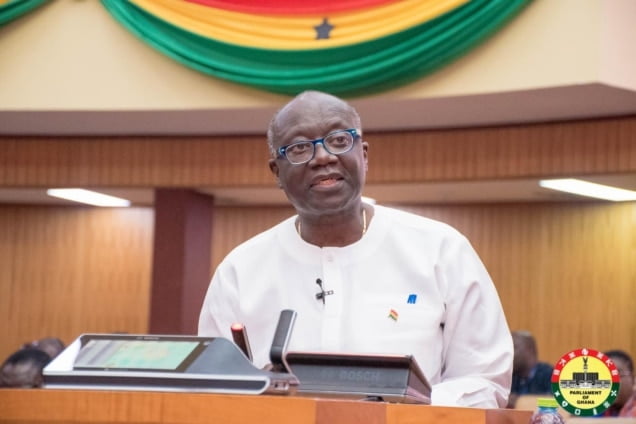
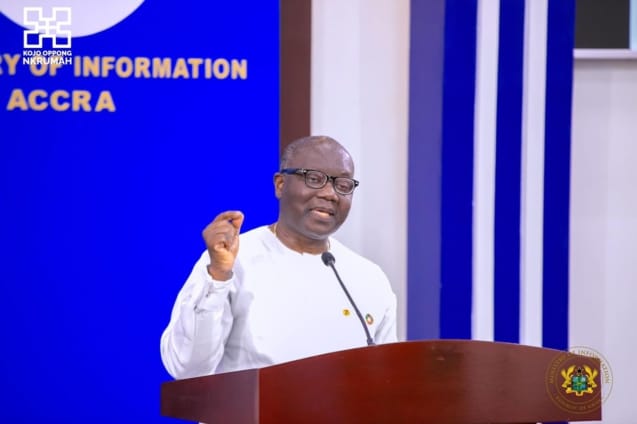
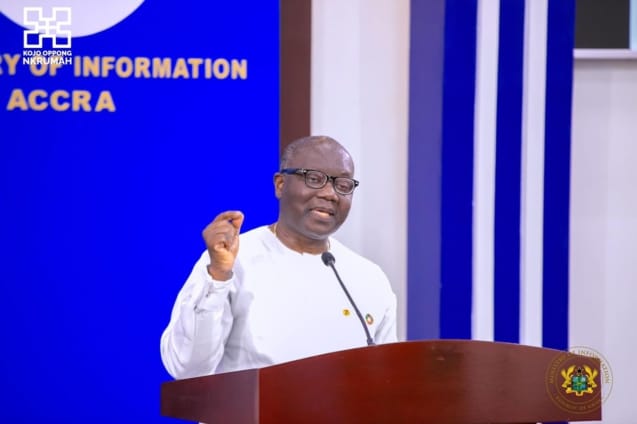
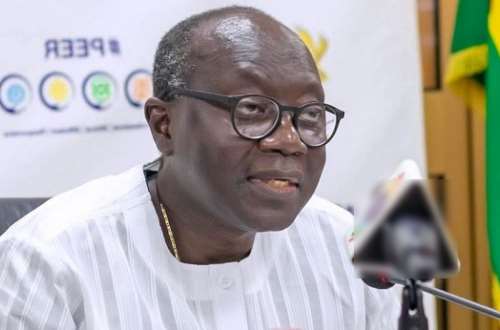
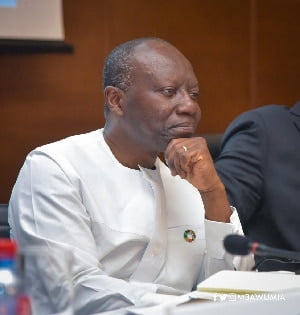
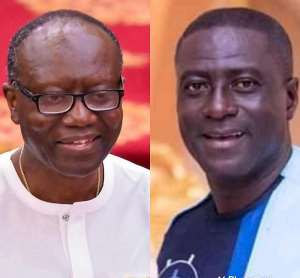
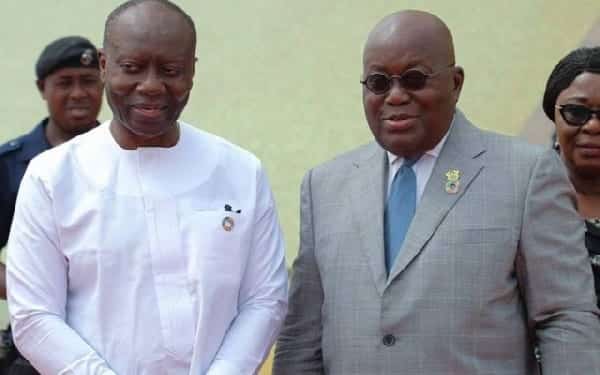
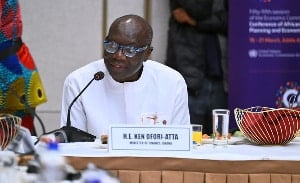
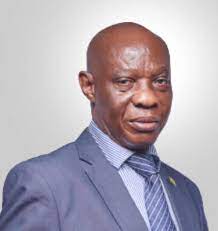
On Friday, July 28, 2023, Finance Minister Ken Ofori Atta will participate in an extensive meeting with Members of Parliament.
This meeting serves as a preliminary discussion ahead of the forthcoming 2023 mid-year review and the potential presentation of a supplementary budget, which is scheduled for Monday.
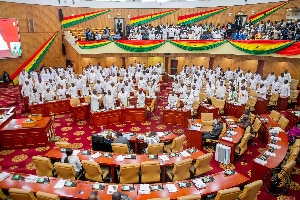
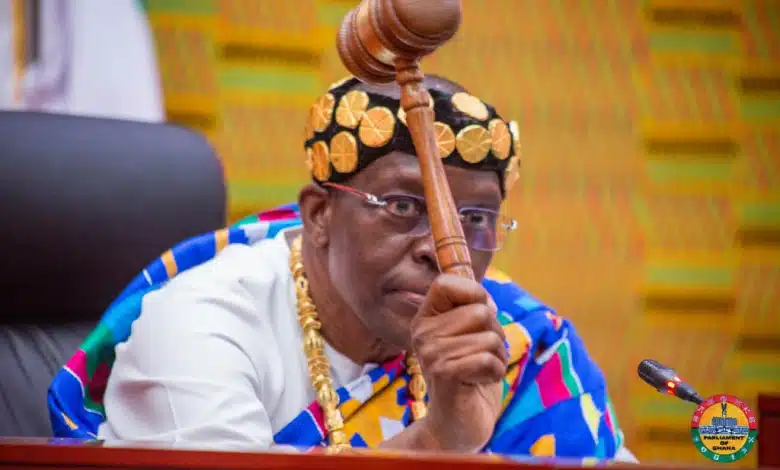
Before the house, Speaker Alban Bagbin disclosed the meeting’s aim to be that,
“On Friday, the Minister of Finance will be available to hold an intensive meeting with Members of Parliament. This is an agreement entered into between leadership and the Ministry of Finance as a prelude to the presentation of the mid-year review and possibly a supplementary budget on Monday.”
An extensive meeting with MPs is expected to serve as a platform for in-depth discussions and consultations regarding the upcoming mid-year review and any potential supplementary budget proposals.
In the latest update, Parliament has officially confirmed a new date for Finance Minister Ken Ofori-Atta to present the highly anticipated 2023 Mid-Year Budget Review. Originally scheduled for July 25, 2023, the presentation had to be rescheduled and will now take place on Monday, July 31, 2023.
The Mid-Year Budget Review, mandated by Article 179 of the 1992 Constitution and the Public Financial Management Act 921, provides a crucial opportunity to reassess macroeconomic targets and present a comprehensive economic outlook for the remaining fiscal year.
This budget review holds significant importance as it marks the first major financial statement of the government since Ghana secured a substantial $3 billion International Monetary Fund (IMF) extended credit facility.
During the session, Finance Minister Ken Ofori-Atta is expected to provide Parliament with updates on the measures taken by the government to stabilize the economy in the aftermath of the IMF deal.
Second Deputy Majority Chief Whip, Habib Iddrisu, says it is presently irrelevant for Members of Parliament to demand the sacking of Finance Minister Ken Ofori-Atta.
In October 2022, some New Patriotic Party (NPP) Members of Parliament and the Minority called for the removal of the Finance Minister.
While NPP MPs said having Mr Ofori-Atta as the head of the Finance Ministry would not augur well for investment, the Minority accused the Finance Minister of illegal payment of oil revenues into offshore accounts in flagrant violation of Article 176 of the 1992 Constitution among others.
President Akufo-Addo intervened and urged that the Finance Minister conclude the country’s negotiations with the International Monetary Fund (IMF).
The opposition Members of Parliament on Tuesday, October 25, 2022 filed the motion to trigger a process to revoke the minister’s appointment citing severe economic challenges.
The vote of censure motion filed by the Minority against the Finance Minister, Ken Ofori-Atta failed.
This is because only 136 legislators on the Minority side voted to demand the removal of Mr Ofori-Atta thus falling short of the two-thirds constitutional requirement for the motion to pass through.
The proponents of the motion needed the votes of 183 legislators to have the motion passed against Mr. Ofori-Atta.
Ghana in May successfully secured a $3 billion deal from the IMF and since then there have been mild calls for the minister’s resignation.
In an interview with host of 3FM Sunrise Morning Show, Johnnie Hughes, the Member of Parliament of Tolon, Habib Iddrisu, noted that such calls can no longer hold as the economy has fared better under Mr Ofori-Atta’s leadership.
“This is not something that I don’t think we need to comment on. It has been abandoned. As at December last year, inflation was around 54% which has been brought down to 42%, and trying to stabilize the cedi that was about GHS 14 to GHS 15 to a dollar as at December last year which has now come to GHS 11 and GHS 12 cedis over the past three months. That is what we are looking at. What you are talking about now is definitely irrelevant” Mr. Habib Iddrisu said.
The much-anticipated Mid-Year Budget Review, which was initially scheduled for July 27, 2023, and later rescheduled to July 25, 2023, has been postponed once again.
The new date for the presentation is Monday, July 31.
The unexpected and last-minute cancellation of the budget review has sparked curiosity among Members of Parliament (MPs) and the public, leading to various speculations about the reasons behind the delay.
Engaging MPs in parliament, the Speaker of Parliament, Alban Bagbin, announced that the Finance Minister, Ken Ofori-Atta, will now engage in an intensive meeting with the MPs on Friday, July 28, 2023, ahead of the newly rescheduled presentation.
In the face of rising criticism and calls to rescind the Free Senior High School (FSHS) policy, the Finance Minister, Ken Ofori-Atta has moved forth to defend the program, emphasizing the moral responsibility to ensuring every Ghanaian child has access to education.
The idea has come under fire as a result of concerns with school nutrition and infrastructure.
During a discussion with the business community before of the 2023 Mid-year Budget Review, the Finance Minister acknowledged concerns over the Free SHS policy and agreed that means testing could be a feasible solution.
However, he highlighted that being a Ghanaian citizen rights all children to the fundamental human right of education.
He contended that, while some parents may be unable or unwilling to finance their children’s education, it is the nation’s collective responsibility to find a means for those children to acquire an education.
“There is the issue of Free Senior High School, people talk about us doing the means testing, which I agree, but we should also consider that that child is Ghanaian so the fact that the parent may not want to do it does not mean that as a Ghanaian citizen, I should not find a way for that child to go through Senior high.”
”In terms of the genuineness in placing this country where it should be, I can assure you that President Akufo-Addo and what he thinks about is the strength of the human capital at whatever cost. Get people educated, and it’s limitless what they can do,” the Finance Minister stated.
The Free SHS program, which was implemented to give free secondary education to all Ghanaian students, has recently met obstacles.
One of the significant concerns is that some schools are unable to offer adequate meals for their children owing to financing and supply constraints.
As a result, there have been concerns that some schools may be forced to close if these issues persist.
The situation has aroused controversy among individuals and legislators alike, with some believing that the policy should be reevaluated and possibly repealed in order to effectively address the rising challenges.
Despite these calls for reform, President Akufo-Addo has stated unequivocally that the Free Secondary Education Policy will be maintained.
It was highlighted that, even in the context of seeking IMF assistance, the government is determined to maintaining the policy and its essential purpose of delivering accessible education for all Ghanaian pupils.
The Finance Minister, Ken Ofori-Atta, is scheduled to present the Mid-Year Review of the Budget Statement and Economic Policy of Government and supplementary estimates for the 2023 Financial Year on Thursday, July 27 instead of the earlier announced date of Tuesday, July 25.
The disclosure was made by Mr. Habib Iddrisu, the Second Deputy Majority Whip, on the floor of Parliament while presenting the Business Statement of the House for the week ending Friday, July 28.
He emphasized the limited time left for the House to adjourn sine die and urged all Committees with referral Bills to expedite their consideration for the attention of the House.
The Bills include the Grains Development Authority Bill, 2022, Ghana Industrial Property Office Bill, 2023, Rent Bill, 2023, Budget Bill, 2023, and the National Petroleum Authority (Amendment) Bill, 2023.
The Business Committee recommended commencing sittings each day at 10:00 hours and extending sittings to ensure that business scheduled for the eighth week, mainly the Bills, are considered and passed promptly.
These measures aim to facilitate the consideration of other parliamentary matters requiring the House’s attention.
In the upcoming week, four Ministers will attend the House to address 26 questions – one urgent and 25 orals.
The Ministries include Chieftaincy and Religious Affairs, Lands and Natural Resources, Sanitation and Water Resources, and Roads and Highways.
There is a frenzy on social media platform, Twitter, after news broke that Sanitation Minister, Cecilia Dapaah, managed to have over a million dollars in her home, which was subsequently “cleaned up” by her house helps.
It has emerged that two house helps;18-year-old Patience Botwe and 30-year-old Sarah Agyei are currently facing charges before an Accra Circuit Court for their alleged involvement in a series of thefts that occurred at the minister’s home in Abelemkpe, Accra, between July and October 2022.
Patience and Sarah are charged with one count of conspiracy to commit a crime and five counts of stealing, which include amounts of US$1 million, €300,000, and millions of Ghana Cedis per a report from The Chronicle.
The accused are said to have also stolen personal belongings of Madam Cecilia Abena Dapaah, including clothes valued at GH¢95,000, handbags, perfumes, and jewelry worth US$95,000.
Patience has been accused of going solo in stealing six pieces of Kente cloth worth GH¢90,000 and six sets of men’s suits valued at US$3,000, belonging to Daniel Osei Kuffour.
The amounts stolen have left social media users shell-shocked with many now interrogating whether the Sanitation Minister is the only government official who has stashed such amount of money in her home.
The first public officer in the minds of tweeps is Ghana’s very own Finance Minister, Ken Ofori-Atta, who not long risked losing his position over the current state of the economy.
Why Ofori-Atta
The Finance Minister has been accused by the opposition National Democratic Congress (NDC) of unethically and unlawfully benefiting from his position to siphon Ghana’s money.
The opposition Members of Parliament on Tuesday, October 25, 2022 filed the motion to trigger a process to revoke the minister’s appointment citing severe economic challenges.
The MPs cited the following reasons as justification to revoke Ken Ofori-Atta’s appointment:
Despicable conflict of Interest ensuring that he directly benefits from Ghana’s economic woes as his companies receive commissions and other unethical contractual advantage. particularly from Ghana’s debt overhang.
Unconstitutional withdrawals from the Consolidated Fund in blatant contravention of Article 178 of the 1992 Constitution supposedly for the construction of the President’s Cathedral;
Illegal payment of oil revenues into offshore accounts in flagrant violation of Article 176 of the 1992 Constitution;
Deliberate and dishonest misreporting of economic data to Parliament
Fiscal recklessness leading to the crash of the Ghana Cedi which is currently the worst performing currency in the world;
Alarming incompetence and frightening ineptitude resulting in the collapse of the Ghanaian economy and on excruciating cost of living crisis;
Gross mismanagement of the economy which has occasioned untold and unprecedented hardship.
Ofori-Atta stays
The vote of censure motion filed by the Minority against the Finance Minister, Ken Ofori-Atta failed.
This is because only 136 legislators on the Minority side voted to demand the removal of Mr Ofori-Atta thus falling short of the two-thirds constitutional requirement for the motion to pass through.
The proponents of the motion needed the votes of 183 legislators to have the motion passed against Mr. Ofori-Atta.
Prior to the vote, the New Patriotic Party MPs staged a walkout and decided not to support the motion of their colleagues from the opposition side of the House.
Minister of Food and Agriculture, Bryan Acheampong, has announced that GHS100 million out of the owed GHS203 million to food suppliers has been transferred.
He assured that the first part of the arrears will be paid by Tuesday, July 18, with the remaining amount settled by 17th August.
The Minister made this statement in Parliament after being summoned by the Speaker, along with the Ministers of Finance, Ken Ofori-Atta, and Education, Dr. Yaw Osei Adutwum, to address the issue with the food suppliers.
“We still owe suppliers a little above GHS203 million. Last week we received GHS100 million which is 50 percent of what is due the suppliers, we have transferred same through the processes to buffer stock. We are hoping that by midweek this week that 50 percent will be sent to the suppliers.
“I have also assured the suppliers that as we commence the payment of the 50 percent on the 17th of July, by the 17th of August the remaining 50 percent will be paid.”
The Agriculture Minister’s comments come amidst a stand-off with the National Food Suppliers Association, represented by spokesperson Koku Amedume, who expressed their refusal to accept partial payments and demanded the government stick to the original payment schedule.
The Ministry of Food and Agriculture assured that the necessary funds for full payment had been released, and the settlement would be made by Wednesday, July 19.
Addressing the press on Monday, July 17, the spokesperson stated that the suppliers are seeking complete settlement of their long-overdue funds. Interest has accumulated, and they are facing pressure from banks to take their properties, while members suffer from severe financial hardships.
Finance Minister Ken Ofori-Atta is anticipated to deliver the Mid-Year Review of the Government’s Budget Statement and Economic Policy for the 2023 Financial Year to Parliament on Tuesday, July 25, 2023.
Mr. Ofori-Atta’s presentation will be in accordance with the provisions of the Public Financial Management Act, 2016 (Act 921).
Deputy Majority Whip Lydia Seyram Alhassan announced the scheduled presentation on the Floor of Parliament, on Friday, in Accra, when she presented the Business Statement for the Seventh Week Ending Friday, July 21, 2023.
Presenting the Business Statement to the House, Madam Alhassan, also Member of Parliament (MP), for Ayawaso West Wuogon Constituency, entreated her colleague MPs to take note of the day and avail themselves for the presentation.
She told the House that pursuant to a directive of Speaker Alban Bagbin to the Business Committee to programme the Finance, Education and Food and Agriculture Ministers to appraise the House on the challenges confronting the National Food Company, the Committee had accordingly programmed the Ministers to attend upon the House on Tuesday July 18, 2023 to brief the MPs on the matter.
“Mr Speaker, a joint Caucus meeting is proposed to be held on Wednesday July 19, 2023, after adjournment to discuss pertinent matters. In this regard, all Members of Parliament are encouraged to avail themselves at the meeting,” she said.
Madam Alhassan further recommended that the House commenced sitting each day at 1000 hours with extended sittings that would ensure that business scheduled for the seventh week, particularly the Bills programmed were considered by the House and same passed expeditiously.
“Mr Speaker, it is hoped that this recommendation, if adopted, will also facilitate the consideration of other parliamentary business that will require the attention of the House,” she said.
Madam Alhassan reiterated earlier calls on the Committees with referrals to expedite work on same for the attention of the House.
She urged the Committees with pending Bills, including the Grains Development Authority Bill, 2022; Ghana Industrial Property Office Bill, 2023; ill, 2022; Ghana Industrial Property Office Bill, 2023; Rent Bill, 2023 and National Petroleum Authority (Amendment) Bill, 2023 to expedite work on same for the consideration of the House.
In the seventh week, seven Ministers are scheduled to attend upon the House in the ensuing week, to respond to 50 questions, of which 48 would be oral and two urgent.
The Ayawaso West Wuogon MP said the Minister for Education, Minister for Health, Minister for Lands and Natural Resources and Minister for Communications and Digitalisation would be some of the Ministers to attend upon the House.
The others would be the Minister for Tourism, Arts and Culture, Minister for Trade and Industry and the Minister for Roads and Highways.
In a significant development, the World Bank has concluded an agreement to provide Ghana with $900 million in support of the country’s ongoing reforms. This substantial financial commitment highlights the bank’s commitment to assist Ghana in its pursuit of comprehensive reforms aimed at fostering sustainable development and economic growth.
The support, which is under the Development Policy Operations (DPO) for the period 2023 to 2025, is expected to front-load the first tranche to the country by November if Ghana is able to meet prior actions and present the final document to the World Bank Executive Board by the end of October this year.
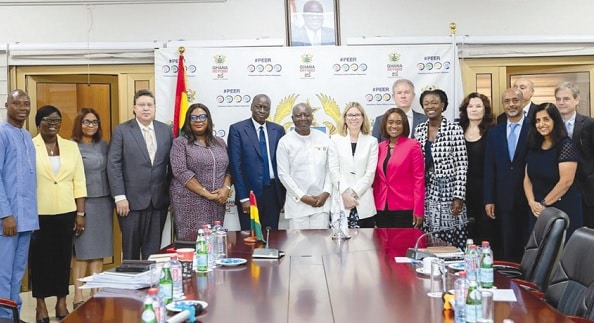
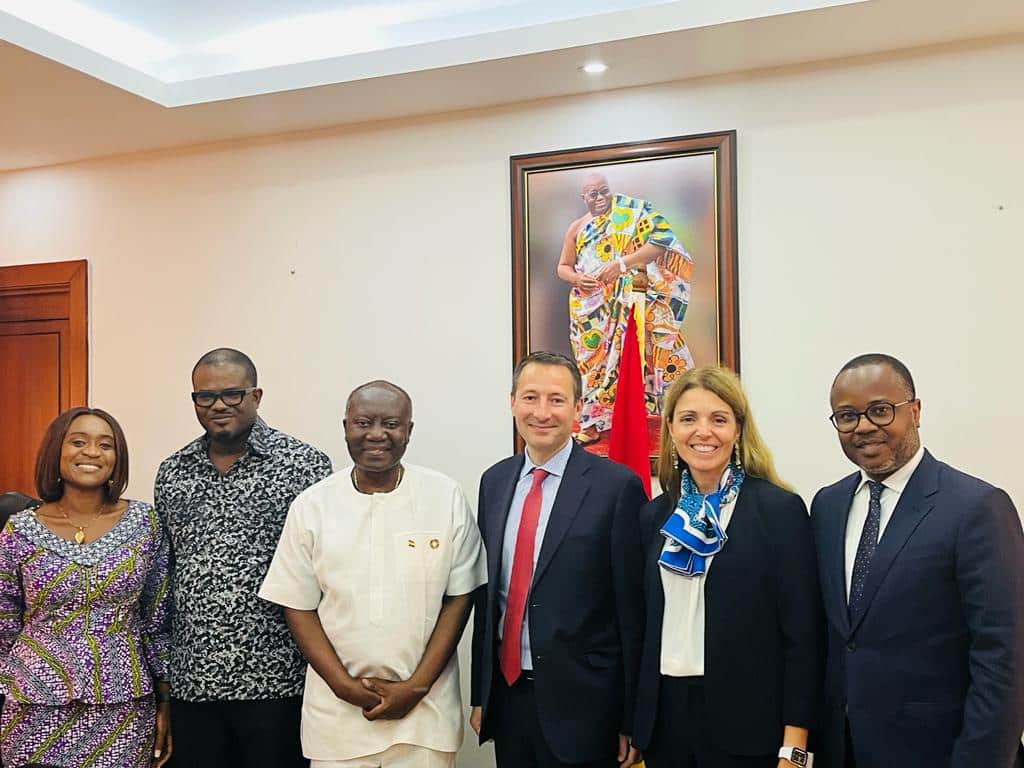
At a meeting with the World Bank Managing Director for Operations, Anna Bjerde, in Accra yesterday, the Minister of Finance, Ken Ofori-Atta, stated that the government was committed to completing all prior actions by October this year.
“I would like to personally assure you that the government has prioritised the completion of all prior actions by end of August, 2023, to ensure the first DPO in the series is presented to the World Bank Board in early October,” the Finance Minister said, adding, “we count on your support for this to happen”.
During discussions in his office and at a banquet held in her honour, Mr Ofori-Atta appealed to the World Bank to front-load the DPO amount for 2023 to $500 million.
A World Bank Mission which visited the country between June 19-23 reached the agreement on the reforms to be presented to the board in October this year.
Critical
“This is critical for the International Monetary Fund (IMF)-Supported PC-PEG, for the continuous stability of the cedi and broader macroeconomic stability,” Mr Ofori-Atta said.
He added that it was the belief of the government that with the requisite resources, the country could become “the poster child for a robust, sustainable and green post-COVID economic build-back on the continent.”
The Finance Minister stressed that given the DPO’s strong emphasis on fostering resilience to economic and climate shocks, the government was being intentional about building a low carbon and climate resilient economy.
Again, he said, the focus was to protect the poor and vulnerable against the impact of “the front-loaded fiscal consolidation under the IMF-supported PC-PEG.”
The minister said the government had also developed a strategy to strengthen the financial sector and rebuild financial institutions’ buffers as one of the policy actions under the DPO.
Improvements
Mr Ofori-Atta said the World Bank had played a critical role in Ghana’s journey to achieve macroeconomic and financial stability as well as setting the economy on a path of strong sustainable growth.
Given the significant sacrifices and strong commitment demonstrated by the government and people of Ghana to ensuring macroeconomic stability and debt sustainability, the minister said the World Bank should leverage Ghana’s example and use it as a demonstration effect by scaling up its support and interventions in the country.
For its part, the government was implementing various revenue reforms and measures targeted at increasing domestic revenue from the current tax to GDP ratio of 13 per cent to between 18 per cent and 20 per cent over the medium term.
Mr Ofori-Atta cited the completion of the domestic debt restructuring three months after the launch of the programme in December 2022; securing financing assurances from the Paris Club Official Creditor Committee (OCC) on May 12, 2022 under the G20 Common Framework and securing the approval of the three-year $3 billion PC-PEG-backed IMF Programme.
Rebound
He observed that there were clear indications that the country was coming out of its economic woes as the economic indicators were beginning to improve.
For instance, Mr Ofori-Atta said the first quarter 2023 growth rebounded to 4.2 per cent, up from three per cent in quarter one of 2022, mainly on the back of 10.1 per cent growth in services and 4.8 per cent growth in agriculture.
Again, he said, inflation had declined to 42.5 per cent in June 2023 after peaking at 54.1 per cent in December 2022.
Mr Ofori-Atta said the cedi had remained relatively stable, depreciating cumulatively by about 22 per cent year-to-date compared to a depreciation of 50 per cent in November 2022. He also said the 91-day treasury bill rate had declined to around 20 per cent, down from 35.5 per cent at the end of 2022.
Climate finance
He stated that the country was focused on taking advantage of the Just Energy Transition Partnerships (JETP) to accelerate its transition to a low carbon economy.
“This would require non-debt financing support to decommission some of our legacy fossil fueled energy installations to make room for more investments in renewable energy,” he said.
He said in terms of enhancing social protection, the 2023 budget had already made specific provisions for doubling the Livelihood Empowerment against Poverty (LEAP) payment per beneficiary household from GH¢45 per month to GH¢90, with a progressive increase in the number of beneficiary households from the current 344,185 households.
“Coverage will be expanded to all 2.5 million extremely poor individuals by 2024.
We plan that by end September 2023, an indexation mechanism will be introduced in the LEAP Programme to prevent erosion of value over time,” he added.
He also said there had been increases in the budgetary allocation for the School Feeding Programme (SFP) to compensate for higher cost of meals and to ensure efficient management of the programme.
The Finance Minister also said more would be done to increase the school capitation grants and further expand the National Health Insurance Scheme (NHIS).
Achieving stability commendable
For her part, Ms Bjerde commended Ghana’s effort to restore macroeconomic stability, comparing the gloom on Ghana’s outlook a year ago and the progress thecountry had made since to get an IMF Board approval for the $3 billion facility.
The performance is seen in the indicators recorded in recent publications and the efforts towards the IMF Board’s review in November.
Ms Bjerde also acknowledged Mr Ofori-Atta’s strong voice in shaping the World Bank evolution, which she said, would continue to be significant to help the course of Ghana and Africa in general.
The Minister of Finance, Ken Ofori-Atta, will present the Mid-year budget review to Parliament on Tuesday, July 25, 2023.
The announcement was made by the First Deputy Majority Whip, Lydia Seyram Alhassan, during the presentation of the business statement for the upcoming week in Parliament.
“In pursuant to the Public Financial Management Act 2016, At 921 the Minister for Finance is expected to present the mid-year review of the budget statement on Economy Policy of the Government of Ghana for the year 2023 financial to this house on Tuesday, July 26 2023,” she stated.
The Ministers of Finance, Education, and Food and Agriculture are scheduled to appear before Parliament on Tuesday, July 18, 2023, to provide a briefing on the issues faced by the National Food Buffer Stock Company.
The directive comes from the Speaker in response to the picketing at the company by the National Food Suppliers Association, who are owed debts by the government. The Ministers will address the challenges and concerns raised by the association during the session.
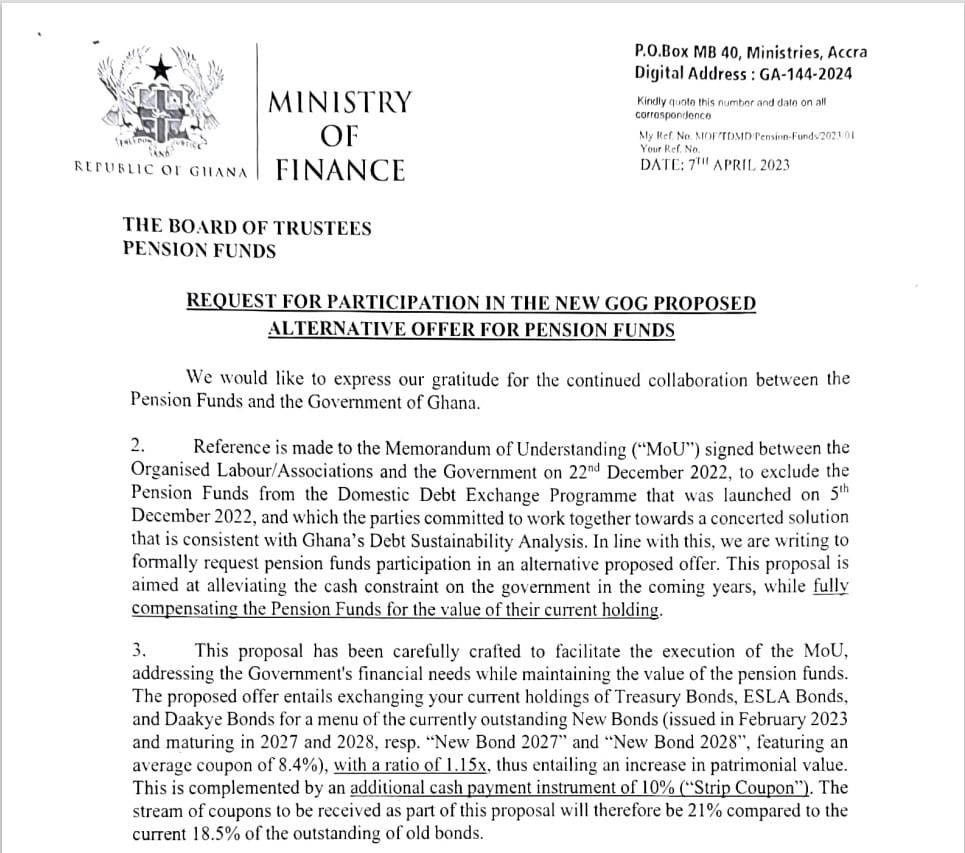
In a statement released by the Finance Ministry, confirms that the government has completed the settlement of all outstanding arrears to members of the Individual Bondholders’ Forum.
The payment includes all coupons and principals that were due up to June 19, and instructions for the payment of coupons until July 10, 2023, have been dispatched.
The government also expressed its commitment to maintaining continuous and constructive engagement with the leadership of the Coalition of Individual Bondholders Groups (CIBG).
They emphasized their dedication to implementing the terms outlined in the Memorandum of Understanding (MOU).
Previously, the CIBG, consisting of the Ghana Individual Bondholders Forum and the Individual Bondholders Association of Ghana, had threatened to stage a protest at the Finance Ministry, demanding the payment of outstanding principals and coupons.
They expressed disappointment in the government’s failure to uphold the agreed payment plan specified in the MOU.
However, the government has fulfilled its commitment by paying all arrears on coupons for bonds maturing by May 31, 2023, as well as coupons falling due from June 1, 2023, in accordance with the terms of the MOU.
“The Ministry of Finance takes this opportunity to thank all bondholders for their continuous support during this period of tight liquidity. Government is confident that in working with all stakeholders, we shall restore macroeconomic stability, achieve inclusive economic growth, and transform the Republic”, the statement added.
Speaker Alban Bagbin has called on Finance Minister Ken Ofori-Atta to present the Mid-Year Review of the Budget Statement and Economic Policy of the Government and Supplementary Estimates for the 2023 Financial Year before July 27, 2023.
According to the Speaker, government’s decision to deliver the mid-year budget on the said date will keep the House occupied after August 8, thereby affecting its other important commitments.
“The House has to rise before August 9 because there are commitments that the House cannot ignore which we will have to be part of”, Mr Bagbin announced in parliament.
He therefore wants the Minister of Finance to submit the mid-year budget and supplementary budget review earlier to enable Parliament approve it before August 10.”
“And, so, the last day we could get to convene and sit here could be only August 3, and we cannot go beyond that because even with the August 3, we would have been late to attending the Commonwealth Parliamentary Association [programme].”
The Mid-Year Fiscal Policy complies with both the Public Financial Management Act of 2016 (Act 921) and Article 179 of the 1992 Constitution.
The Act requires that the Finance Minister or any other minister designated by the President in the absence of the Finance Minister present a Mid-Year Budget Review to Parliament six months after the presentation of the main budget for that fiscal year.
Meanwhile, industry players have already made requests to the government, urging them to utilize this chance to eliminate certain taxes, such as the levy on sanitary pads, among others.
The Speaker of Parliament, Alban Bagbin, has summoned the Ministers of Education, Agriculture, and Finance; Dr. Yaw Osei Adutwum, Bryan Acheampong, and Ken Ofori-Atta.
They are required to appear before the House and provide an explanation regarding the government’s indebtedness to the National Food Suppliers Association (NAFSA).
This directive comes in response to a plea made by Samuel Okudzeto Ablakwa, the Member of Parliament for North Tongu.
Ablakwa urged the House to invite the ministers to brief them on the government’s plans for settling a debt of over GH¢270 million owed to the food suppliers.
In light of the situation, the food suppliers have resorted to picketing outside the office of the Buffer Stock Company, demanding payment for their services.
“As the leader of this House, it is important that I keep drawing your attention as the representatives of the people so that you can properly represent the interests of your constituents,” Bagbin said.
“Now this is where we are. So I agree that the Business Committee should schedule for the three ministers to appear before the House. The three ministers are the Ministers of Finance, Food and Agriculture, and Education. They will tell us why the challenge,” Bagbin said.
The Speaker said this would enable the House to assist the Executive in addressing such challenges, adding that “that is why we are establishing a committee on ways and means.”
To meet their climate pledges, countries must raise $4.2 billion (34%) domestically and $8.29 billion (66%) from international sources, as outlined in their Nationally Determined Contributions (NDCs) under the Paris Agreement.
The Minister of Finance, Ken Ofori-Atta, highlighted the need for innovative climate financing mechanisms to implement adaptation plans within the specified timeframe.
The Minister of Finance, made these statements at the inaugural workshop on the Global Shield against Climate Risks and Global Risk Modelling Alliance held in Accra yesterday.
A workshop was held to engage key stakeholders on climate change issues, informing them about the Global Shield initiative and the Global Risk Modelling Alliance, which aim to provide increased protection and financing against climate risks.
Africa has suffered significant economic losses of over $200 billion due to climate change, underscoring the importance of reliable data for informed decision-making towards a climate-resilient economy and low-carbon development.
Ghana’s Finance Minister emphasized the benefits of joining the Global Shield (GS) and Global Risk Modelling Alliance (GRMA), stating that it would enhance the country’s understanding of climate risks, assess vulnerabilities, and provide access to crucial data and expertise for informed decision-making.
The minister highlighted that participating in these initiatives demonstrated Ghana’s proactive approach in protecting the environment, economy, and the well-being of its people.
He stressed the importance of establishing mechanisms for pre-arranged and trigger-based financing to swiftly respond to climate-related emergencies.
Additionally, the minister emphasized the need to strengthen social protection programs to assist those most affected by climate change, including vulnerable communities, smallholder farmers, and informal sector workers.
The Minister of Environment, Science, Technology, and Innovation urged developed countries to fulfill their commitment to mobilize $100 billion annually in climate finance for developing countries.
Without the necessary resources, Ghana would struggle to reduce emissions, build resilience in priority sectors, and address challenges in water, agriculture, biodiversity restoration, and health.
The German Ambassador, the Development Director of the British High Commission, and the Head of Cooperation of the European Union Delegation all expressed their commitment to support Ghana in implementing its climate change plans.
The importance of tourism and its potential effects on the domestic economy as well as its role in job creation have been highlighted by Finance Minister Ken Ofori-Atta.
He claims that the government wants to increase the country’s gross domestic product by around 35% through tourism in order to spur regional economic growth.
On July 4, the finance minister stated, “The building is expected to contribute significantly with approximately 1.2 million anticipated tourism arrivals into Ghana for 2023 and an estimated corresponding revenue of $3.4 billion.”
He was speaking at a ceremony to commission the renovated Kwame Nkrumah Memorial Park in Accra.
“The evidence of the vital role of tourism for economic development is clear. For instance, in 2022, tourists spent 660 billion in emerging and developing countries which is about 3 times the amount of official development assistance for that year,” he noted.
“Tourism contributes about 5 percent of Ghana’s GDP and in Jamaica its about 35 percent of their GDP and that is where we [Ghana] want to achieve,” Ken Ofori-Atta.
According to him, the tourism industry offers a distinct opportunity to generate employment and income for people of all genders, ages, and skill levels, thereby providing a way out of poverty for millions.
The finance minister expressed appreciation to the Ministry of Tourism for their diligent efforts in prioritizing and enhancing the sector’s contribution to national development and cultural progress.
Furthermore, he extended gratitude to the World Bank for their unwavering financial support of $3.5 million, dedicated to the revitalization of the Kwame Nkrumah Memorial Park.
Meanwhile, President Nana Addo Dankwa Akufo-Addo emphasized that the 5.4-acre facility, established in 1992 to commemorate, promote, and preserve the legacy of Ghana’s first president, Dr. Kwame Nkrumah, had not undergone any significant improvements until now.
He highlighted that the renovated park now reflects the extraordinary stature of Dr. Kwame Nkrumah, a renowned Pan-Africanist who played a prominent role in the struggle for Ghana’s and Africa’s liberation.
The park’s renovation, estimated at $3.5 million, is part of the Ghana Tourism Development Project (GTDP), a $40 million initiative supported by the World Bank. The project aims to enhance tourism performance in selected destinations across the country.
Speaker of Parliament, Alban Bagbin has accused finance minister Ken Ofori-Atta of refusing to listen to his alternative suggestions for raising revenue without imposing the controversial e-levy.
The e-levy bill, which was passed by parliament on Tuesday, March 29, 2022, will introduce a 1.5 percent tax on electronic money transfers and transactions. The government has said the move will help address problems from unemployment to Ghana’s high public debt.
However, the bill faced significant opposition, with seven out of ten people expressing their disapproval of the levy, according to the Afrobarometer Survey.
The minority group in parliament also staged a walkout before the bill was passed, claiming it would hurt the poor and undermine the digital economy.
Mr Bagbin said he had suggested several ways for the finance minister to generate revenue by including more people in the informal sector in the tax net. He said a large proportion of individuals in the informal sector of the economy are not captured in the tax system due to a lack of documentation, so the government is unable to tax them.
During a meeting with the management of Media General in Accra on Thursday, June 29, Mr Bagbin said “I made it known to the finance minister long ago that there are so many areas where we can raise revenue, not e-levy. But if you wanted to use e-levy, let us start from zero point something percent and then go up. You have an informal economy where a large percentage of the people are outside the tax net. Because of no documentation, you will never know their income. There are things that you have to do to bring them into the formal sector. I suggested to him the lottery tax.”
Lottery tax, compulsory health insurance for people flying into the country, and taxing the use of narcotics, particularly “weed”, were among the sources of revenue suggested by Mr Bagbin.
He explained “The lottery tax is very simple; you use tax receipt numbers to play the lotto, and every week, one tax receipt number will win, and you can give a pickup to the person. So everybody now comes in because the person wants to win a pickup, and so they start issuing receipts.”
He added “Look at insurance; there are countries that have moved on now and said any person flying into their country has to take medical insurance, and that is factored into your ticket. So in case you land and there is a problem, they just rush you to the hospital and treat you because you are insured. Nigeria and the rest have taken that; that is another way of raising revenue.”
He also pointed out “Look at the gaming commission; there is a lot of money in the gaming sector, but you are not taxing them; many countries are taxing it, and they are getting a lot of revenue.”
Another source of revenue Mr Bagbin suggested was taxing the use of narcotics; “weed”, which has become a major component in pharmaceutical products recently. He said “One of the areas is narcotics, weed because they use it in pharmaceuticals. Now you go for a surgical operation, and most of the things they inject you with are from weed; the place becomes numb so when they cut you don’t feel anything at all.”
He maintained that these suggestions have been implemented in countries such as Malaysia among others where they have recorded over 500 percent increase in revenue. He claimed that he discussed these ideas with Mr Ofori-Atta but Mr Ofori-Atta did not listen.
He said “We tried to get the finance minister to understand this thing but he would not understand it. We are looking more outside than inside [for revenue].”
Source: The Independent Ghana | Abigail Twumwaa Ampofo
The Finance Minister, The Finance Minister, Ken Ofori-Atta, is scheduled to present the 2023 Mid-Year Budget Review on Thursday, July 27.
The presentation is in accordance with Section (28) of the Public Financial Management Act, 2016 (PFMA) Act 921.
The Act requires that the Finance Minister or any other minister designated by the President in the absence of the Finance Minister presents a Mid-Year Review to Parliament six months after the presentation of the main budget for that fiscal year.
The Majority Leader of Parliament, Osei Kyei Mensah-Bonsu, announced the date for the presentation on Friday, June 30, on the floor of Parliament.
Ahead of that, industry players have already asked the government to use the opportunity to remove some tax handles.
The taxes include the tax on sanitary pads amongst others.
Chairman of Mines and Energy Committee in Parliament, Samuel Atta-Akyea, has stated that the government is taking steps to prevent power plant shutdowns by Independent Power Producers (IPPs) on July 1.
According to him, the government is taking the necessary precautions to avoid the disastrous effects of the IPPs cutting power.
Speaking to the media in Parliament, Samuel Atta Akyea refuted allegations that the GH1.7 billion debt owed to the IPPs was paid in part.
“The independent power producers are concerned about the necessity that they should be paid and if you pay one, and you don’t pay the other and the power is withdrawn, what will be the consequences, and so I don’t think that the Minister of Finance will do that kind of thing of paying some and not paying others.”
“The government is acutely aware of the implication of withdrawing power from the system and so the government is doing everything to ensure that it doesn’t come to that.”
He also called on the Minister of Finance, Ken Ofori-Atta to engage with the IPPs to clear outstanding arrears owed to the IPPs.
“It is a financial matter and the Finance Minister must find a way to ensure that even if they will be met in some reasonable terms, they should do it. If you don’t have the money, but there is goodwill to pay some of the money, it will urge them to give you the power and so that is the whole point of the matter but when you take a stand against you not paying them at all, then you are trying to dare them to cut the power.”
This provision requires the finance minister to present a Mid-Year Review to parliament six months after the main budget is presented for the fiscal year.
The Majority Leader of Parliament, Osei Kyei Mensah Bonsu, made this announcement on the floor of parliament.
The Mid-Year Budget Review has been marked for Thursday, July 27, 2023, which coincides with the last Thursday of July.
This review provides an opportunity to assess the government’s fiscal performance and make necessary adjustments to the budget.
The finance minister’s presentation will shed light on the country’s economic progress and outline any revisions to revenue targets, expenditures, and policy measures.
In anticipation of the Mid-Year Budget Review, some industry players have expressed concerns and called on the government to withdraw certain tax measures.
They argue that these measures are contributing to excessive hardship on companies.
Their concerns are heightened by the recent passage of crucial bills in Parliament, including the Excise Duty Amendment Bill 2022, the Growth and Sustainability Levy Bill 2022, the Ghana Revenue Authority Bill 2022, and the Income Tax Amendment Bill 2022.
These bills are significant components of Ghana’s $3 billion bailout from the International Monetary Fund (IMF).
However, the government has defended these tax measures, asserting that they are aimed at enhancing revenue mobilization for the country.
The government maintains that these measures are crucial for sustainable economic growth and development. T
he Mid-Year Budget Review will provide an opportunity for the finance minister to address these concerns and clarify the government’s stance on tax policies.
As the date for the Mid-Year Budget Review approaches, stakeholders, including businesses and citizens, will eagerly await the finance minister’s presentation.
They will be keen to understand the government’s plans to stimulate economic growth, manage fiscal challenges, and alleviate the burden on companies.
The review will also offer insights into the government’s broader economic vision and its commitment to addressing the country’s financial needs effectively.
As the Chair of the Vulnerable Twenty (V20) Group, which consists of Finance Ministers from the Climate Vulnerable Forum, Ghana has urged world leaders to establish an effective financial framework tailored to climate challenges.
This initiative aims to enhance the implementation of climate adaptation and mitigation measures in countries facing vulnerability.
Additionally, it seeks to transform the approach to addressing climate-related debt issues and provide support to nations in need of funding for resilience-building and climate adaptation endeavors.
“We must develop powerful coalitions to fight for humanity as we coordinate our efforts to respond positively to the need for the development of a fit-for-climate global financial system,” Ghana’s Finance Minister, Ken Ofori-Atta said.
Ofori-Atta was speaking at the two-day New Global Financing Pact summit, organised by the French government.
“It’s critical that we scale up the innovative climate financing mechanisms and speed up climate action to ensure that we maintain the 1.5-degree Celsius temperature limit,” he said.
The Chair of the V20 also called for improved country responsibility in addressing the issues of climate change for global benefit.
The finance minister noted that the world needed, “the kind of leadership the world saw that led to the abolishment of apartheid, the drive behind the civil rights movement, and the development of the Breton Woods institutions.”
He also reiterated President Nana Addo Dankwa Akufo-Addo’s call for support for global financial system reforms as advanced by the V20 Group of Finance Ministers of the CVF through the recently launched Accra-to-Marrakech Agenda (the A2M).
The Accra-to-Marrakech Agenda is a roadmap by the V20 to work to cement an international coalition behind a fit-for-climate global financial system, culminating at the Marrakech International Monetary Fund (IMF) and World Bank Annual Meetings in Marrakech later this year.
The New Global Financing Pact summit is to reconsider the global financial architecture and ways to mobilise financial support for developing and low-income countries facing challenges, including global warming, loss of biodiversity, debt, and pandemics.
It is centred on addressing the financing required to meet the global challenges, and build solidarity amongst countries and all the critical stakeholders, as governments worked collectively towards a just green transition.
The summit brought together Heads of State and government, leaders of major international organisations, representatives of global financial institutions, and private sector and civil society representatives.
At the end of the summit, there was a call for a collective global effort to mobilise additional financial resources from the private sector, including multilateral development banks to support vulnerable countries.
The call for transitioning into a net-zero economy by protecting the planet through shared goods and ensuring clean air, forests, and oceans through systematic transformation was also accentuated.
It was noted that there was the need to stand united in international solidarity and win the battle against poverty by alleviating the debt burden of vulnerable countries through adequate renegotiations, restructuring and repayment.
The government anticipates receiving around $6.2 billion from its multilateral partners between 2023 and 2026, according to minister of finance Ken Ofori-Atta.
While briefing the nation on the economy at the Ministry of Finance on Sunday, June 18, the Minister disclosed the government has come up with Ghana’s Post-COVID-19 Programme for Economic Growth (PC-PEG) which is backed by the International Monetary Fund and encompasses all the needed reforms to revive the economy.
Mr. Ofori-Atta indicated that the government is committed to following through with the reforms and expects a total of $2 billion from multilateral partners by the year ending 2023.
“Our commitment to these reforms is matched by our relentless pursuit of innovation and strengthened partnerships. Backed by the renewed drive for reforms, the government is working towards securing significant support from our multilateral partners.
“Altogether, and including the IMF funds, World Bank and AfDB support, we expect multilateral support of about US$2.0 billion for 2023 and US$6.2 billion between 2023 and 2026. We expect the World Bank to provide a total support of US$1.6 billion whilst the AfDB provides a total support of US$200 million over the programme period.”
The Minister further disclosed “we expect to mobilize catalytic funding of US$30 million in 2023 and US$330 million between 2023 and 2026 from bilateral creditors.”
During a press conference in Accra on Sunday, June 18, Finance Minister Ken Ofori-Atta stated that several structural reforms are currently in progress regarding the $3 billion International Monetary Fund (IMF) deal.
He explained that these reforms align with the government’s Public Financial Management Strategy, which aims to shift operations from Central Government to General Government.
This shift, he said, is critical as it facilitates clear oversight over key state institutions including Metropolitan, Municipal and District Assemblies (MMDAs), State Owned Enterprises (SOEs) especially Cocobod and Electricity Company of Ghana ECG, and others in the energy sector- and other quasi-State Institutions, whose operations have a significant and direct fiscal impact on Ghana’s economy.
To put it in perspective, he said “about 25% of our assessed debt burden emanates from noncentral Government operations, mainly from State Owned Enterprises (SOEs) such as COCOBOD and those in the Energy Sector.
“Our ability to institute better governance standards of these institutions to address their liabilities and promote their growth will be significantly improved, especially in this period of collective reform.
“Crucially, we must all remain committed to the agreed wide-ranging and strong structural reforms designed to address structural weaknesses and build resilience in key areas including tax policy and tax administration, expenditure commitment control and arrears clearance, financial stability, financial sector plans, review of statutory funds, governance and corruption, debt management, fiscal credibility, and energy sector/cocoa sector SOEs reformation.”
Mr Ofori-Ofori-Atta further indicated that “with legacy debt in the Energy Sector reaching about US$2 billion as at the end of May 2023, and an estimated shortfall of US$5.9 billion between 2023 and 2025, due to the current conditions of SOEs and Independent Power Producers (IPPs) in the value chain in the sector, the sector has been prioritised for comprehensive reforms.
“It is expected that structural reforms in the sector should reduce the shortfall by at least US$2.95 billion over the period.”
It is recalled that Fitch Ratings earlier said that the energy sector in Ghana represented the largest driver of Ghana’s national debt, with the country owing independent power producers a staggering $1.58 billion.
Fitch Ratings also revealed that while Ghana initially approached the IPPs to restructure their debts as part of the External and Domestic Debt Restructuring, the companies objected to the proposal.
The fate of finance minister, Ken Ofori-Attawould be decided by the members of parliament (MPs) belonging to the New Patriotic Party (NPP) , according to Majority Leader in Parliament Osei Kyei-Mensah-Bonsu.
The Member of Parliament for the Suame constituency was reacting to the #KenMustGo uprising being championed by several NPP MPs.
Osei Kyei-Mensah-Bonsu during a media engagement, added that the condition given by President Akufo-Addo was to allow the finance minister to conclude the IMF negotiations, and that seems to have been successful and therefore, the party will have to take a stand if becomes necessary.
“KenMustGo uprising must be left with the caucus. The entire caucus will have to engage to see what can be done going forward.
“…we will meet the president if it becomes necessary. Sometimes it’s good to allow sleeping dogs lie.
“But you should also consider that having finished with our engagement with the IMF, the president said ‘let him conclude our engagement with IMF’. Have we finished our engagement with IMF? We will take it up when it becomes necessary,” the MP said.
In 2022, over 100 NPP MPs petitioned the president to sack finance minister Ken Ofori-Atta over the mismanagement of Ghana’s economy.
The president, however, pleaded to have Ken Ofori-Atta finish up impending IMF negotiations to secure a $3 billion bailout from the Fund.
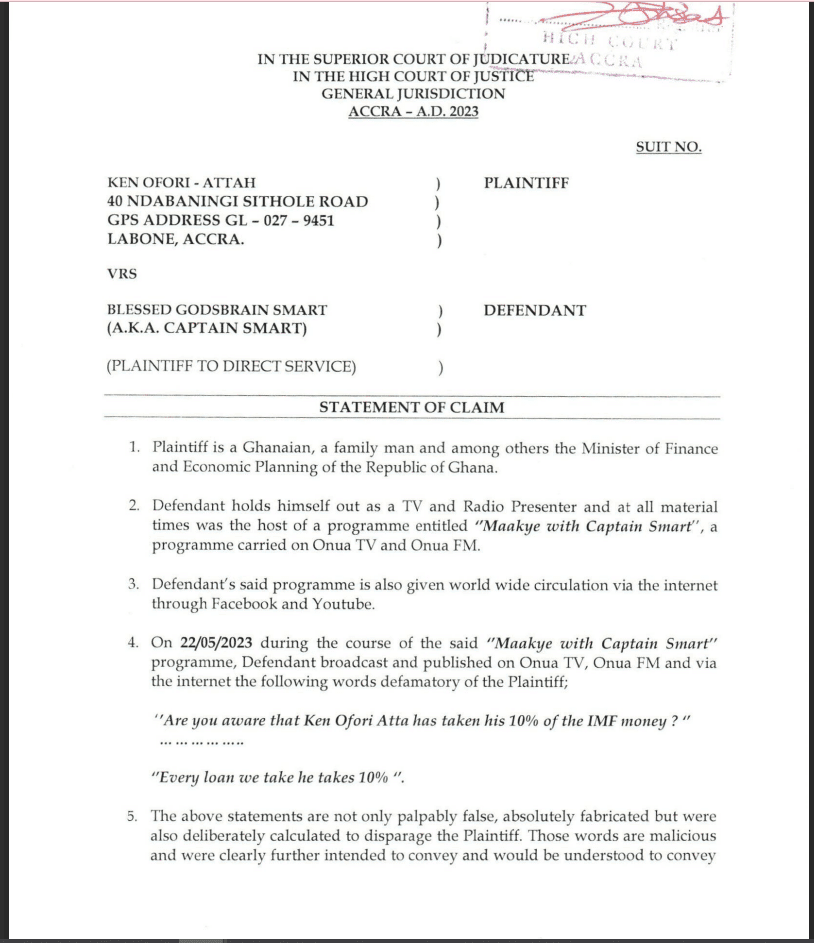
Finance Minister Ken Ofori-Atta has reviewed his earlier defamation suit against Media General Ghana Ltd’s presenter, Blessed Godsbrain Smart (Captain Smart).
Captain Smart has been dragged to court for alleging on one of his editions that Mr Ofori-Atta got 10 per cent of the IMF’s recently-approved US$3 billion bailout facility for Ghana.
In his amended statement of case filed on Monday, 5 June 2023, Mr Ofori-Atta stated that Media General Ghana Ltd (the second defendant), by its actions and inactions, looked on, permitted and/or encouraged the first defendant, Blessed Godsbrain Smart (aka Captain Smart), by the use of its platform and resources, to defame him, the plaintiff, unjustifiably.
Mr Ofori-Atta is praying the court to award him GHC10 million in general damages, including aggravated and or exemplary damages for defamation for the libel uttered by the two defendants (Media General Ghana Ltd, the operator of Onua TV and Onua FM, in addition to Blessed Godsbrain/Captain Smart).
Staff from the International Monetary Fund (IMF) are scheduled to arrive in Accra this week for a mission visit aimed at monitoring the progress of Ghana’s Economic Recovery Programme.
During the visit, the IMF team will engage with various stakeholders involved in the implementation of Ghana’s programme.
This visit holds significance as it marks the first review since Ghana entered into a programme with the IMF on May 17, 2023.
However, it is important to note that this mission visit “ is not a review of Ghana’s Programme, but a regular Mission Visit to track progress of the country’s programme,” a source told Joy Business.
The mission visit to Ghana will be led by Stephane Roudet, the Mission Chief for Ghana from the Fund. As part of their visit, the team will hold meetings with key figures such as Vice President Dr. Mahamudu Bawumia, Finance Minister Ken Ofori-Atta, and representatives from the Bank of Ghana.
Furthermore, the IMF team will engage with the Finance Committee of Parliament and various interest groups. These meetings aim to ensure the participation and collaboration of all relevant parties in the implementation of the programme.
The IMF team will assess the government’s advancement in meeting the targets set for the end of June 2023. Their visit is expected to conclude by June 16, 2023.
Ghana has been grappling with a severe economic and financial crisis, characterized by an unsustainable debt burden.
The country has been significantly impacted by a combination of pre-existing vulnerabilities and external shocks, including the COVID-19 pandemic and the conflict in Ukraine.
These factors have contributed to mounting financing pressures, a devaluation of the national currency (cedi), diminishing international reserves, a slowdown in economic activity, and high levels of inflation. In view of this, the government ran to the IMF for assistance.
On May 17, 2023, the IMF Executive Board granted approval for a 36-month Extended Credit Facility (ECF) arrangement for Ghana, amounting to SDR 2.242 billion (approximately US$3 billion).
This decision paved the way for an initial disbursement of SDR 451.4 million (about US$600 million), with the remaining funds set to be disbursed in subsequent tranches every six months, subject to program reviews endorsed by the IMF Executive Board.
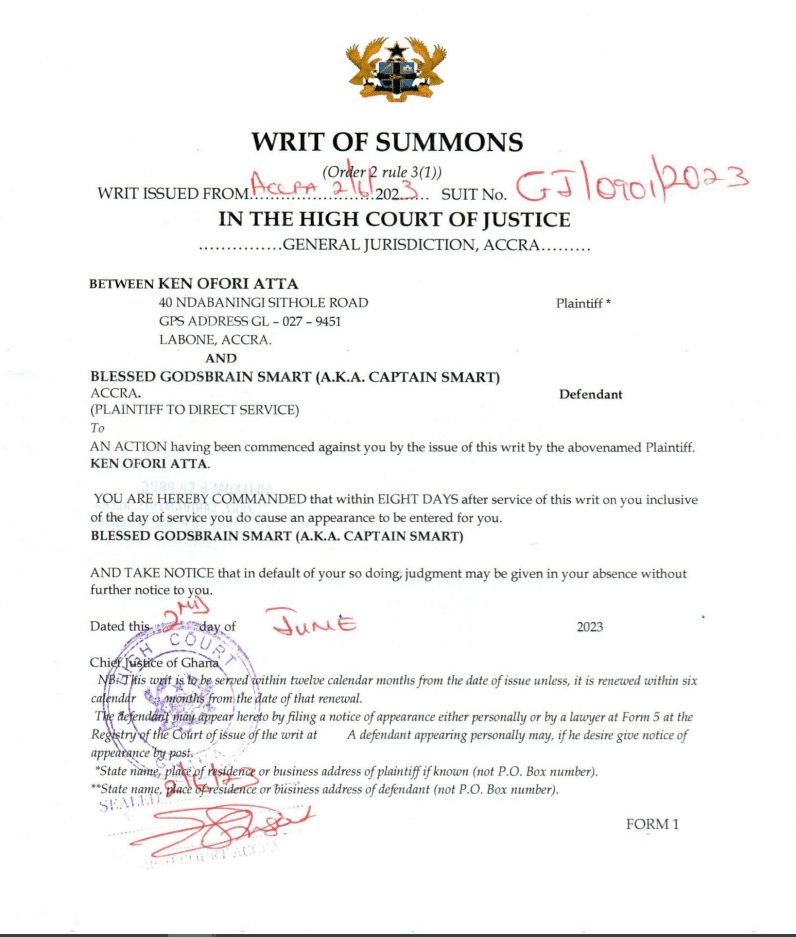
Minister of Finance Ken Ofori-Atta has instituted legal action against radio and TV show host Captain Smart for recent comments that the minister was a direct beneficiary of recently released bailout funds from a global lender.
In a High Court writ dated Friday, June 2, 2023 and sighted by GhanaWeb, the minister’s lawyer holds that comments by Captain Smart on his Onua Maakye programme late last month were defamatory.
He is seeking GH¢10 million in damages.
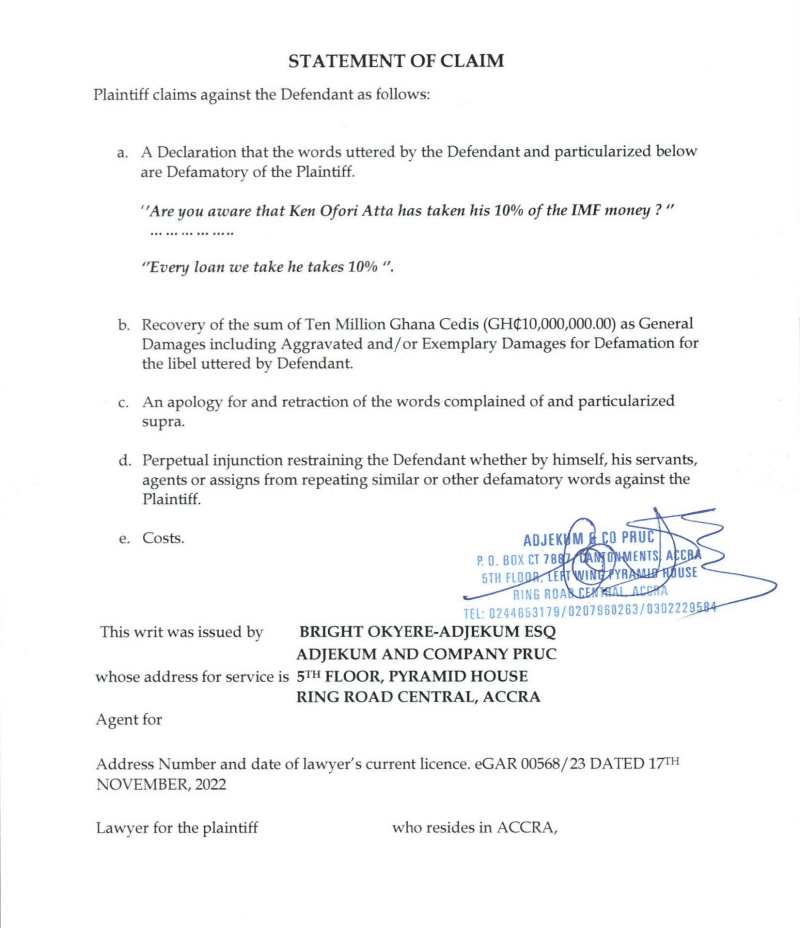
The court papers noted that on 22 May 2023, in the course of Captain Smart’s programme, the defendant used the following defamatory claims: “Are you aware that Ken Ofori Atta has taken his 10% of the IMF money? Every loan we take, he takes 10%.”
“The above statements are not only palpably false [and] absolutely fabricated, but were also deliberately calculated to disparage the plaintiff. Those words are malicious and were clearly further intended to convey and would be understood to convey meanings that diminish the plaintiff in the minds of right-thinking members of society,” the statement of case filed by Ofori-Atta’s lawyer read.
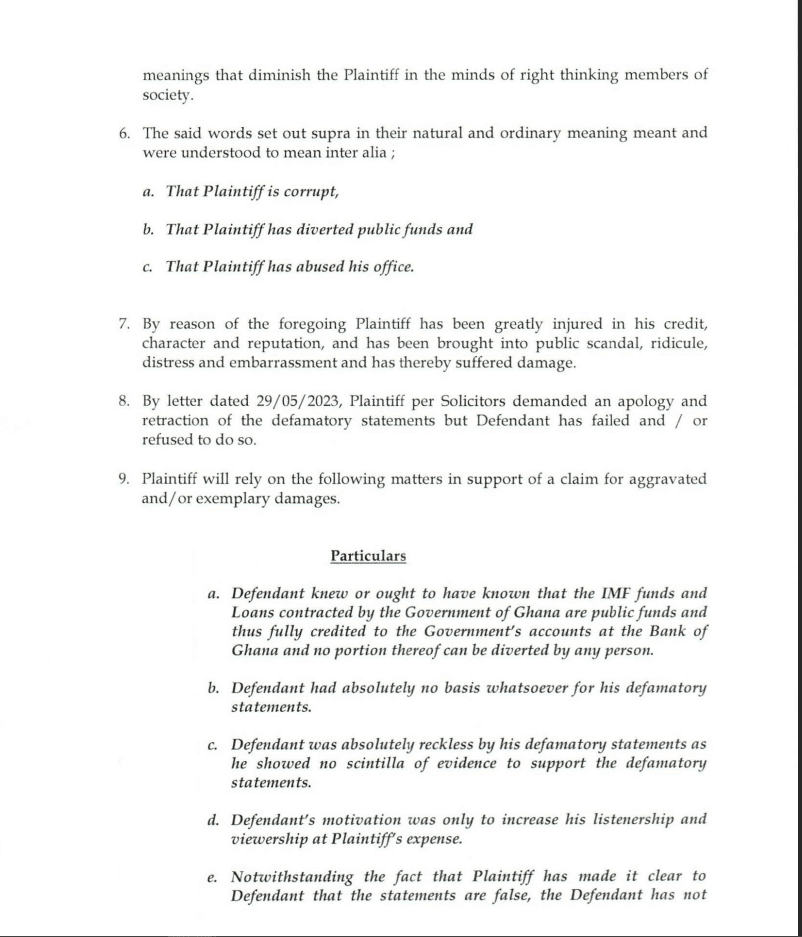
“The said words, set out in their natural and ordinary meaning, meant and were understood to mean, inter alia, that the plaintiff is corrupt, that the plaintiff has diverted public funds and that the plaintiff has abused his office.
“By reason of the foregoing, Plaintiff has been greatly injured in his credit, character and reputation, and has been brought into public scandal, ridicule, distress and embarrassment and has thereby suffered damage,” the statement of case further read.
Reliefs
Ken Ofori-Atta is praying for “a declaration that the words uttered by the defendant, ‘Are you aware that Ken Ofori Atta has taken his 10% of the IMF money? Every loan we take he [Ken Ofori-Atta] takes 10%’ are defamatory of the plaintiff” (Ofori-Atta).
Second, “recovery of the sum of ten million Ghana cedis (GHC10,000,000) as general damages, including aggravated and/or exemplary damages for defamation, for the libel uttered by defendant”.
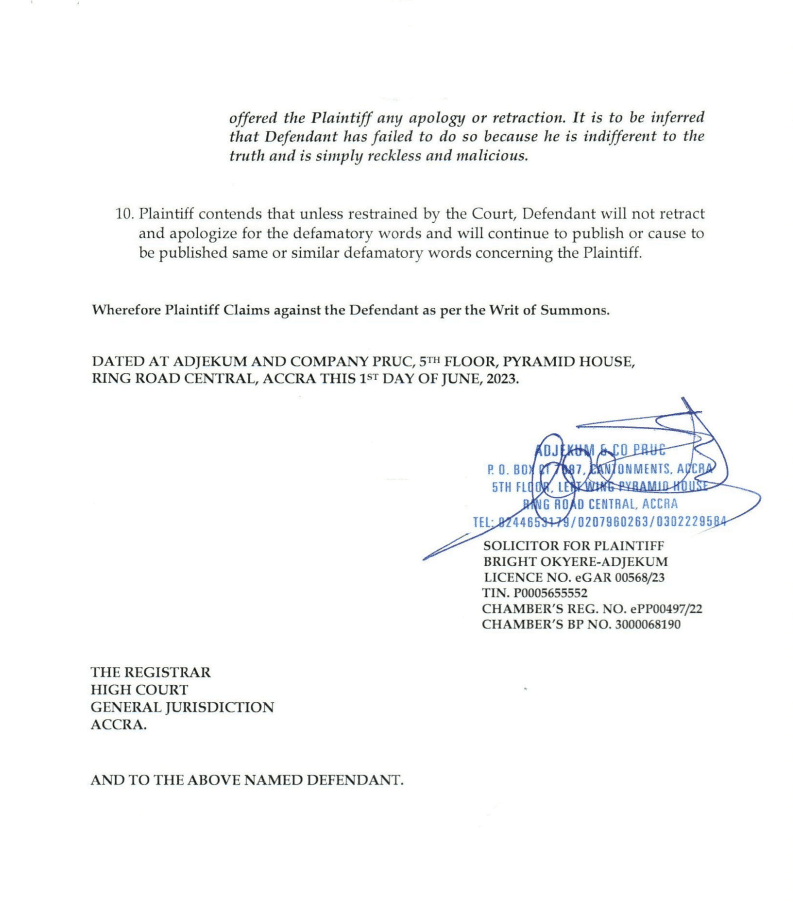
Third, Ofori-Atta is demanding “an apology for and retraction of the words complained of and particularised.”
Fourth, a “perpetual injunction restraining the defendant, whether by himself, his servants, agents or assigns, from repeating similar or other defamatory words against the plaintiff”.
Final prayer is for the court to award costs against Captain Smart.
Finance Minister Ken Ofori-Atta has filed a GHS10 million defamation suit against Captain Smart, a popular TV host.
Captain Smart, the host of ‘Maakye’ on Onua TV has been sued for alleging that the Minister of Finance is earning a 10% commission on the $3 billion Extended Credit Facility secured by government from the International Monetary Fund.
In the writ filed by Bright Okyere Adjekum who is Lawyer for Ken Ofori-Atta, at the High Court on Friday, June 2, it indicated that during the course of the said “Maakye with Captain Smart” program on May 22, the Defendant, broadcasted and published on Onua TV, Onua FM and via the internet the following words; “Are you aware that Ken Ofori Atta has taken his 10% of the IMF money”? “Every loan we take he takes 10%.”
The lawyer of Ken Ofori-Atta as instructed by the Minister insists that the above statements are not only palpably false, absolutely fabricated but were also deliberately calculated to disparage the Plaintiff.
“Those words are malicious and were clearly further intended to convey and would be understood to convey meanings that diminish the Plaintiff in the minds of right thinking members of society,” part of the Writ said.
To make up for the injury suffered by the reputation of Ken Ofori-Atta, the Plaintiff through his Lawyer is praying to the court for five reliefs:
First, Ofori-Atta is praying for “a declaration that the words uttered by the Defendant “are you aware that Ken Ofori Atta has taken his 10% of the IMF money? Every loan we take he (Ken Ofori-Atta) takes 10%” are Defamatory of the Plaintiff (Ken Ofori-Atta).
Second, “recovery of the sum of Ten Million Ghana Cedis (GHSI0,000,000.00) as general damages including aggravated and/or exemplary damages for defamation for the libel uttered by Defendant”.
In addition, the Plaintiff is also demanding “an apology for and retraction of the words complained of and particularized and fourth, a “perpetual injunction restraining the Defendant whether by himself, his servants, agents or assigns from repeating similar or other defamatory words against the Plaintiff.”
In a contradiction of Finance Minister Ken Ofori-Atta‘s recent statement that Ghana should not hastily approach the capital market after securing a $3 billion credit facility from the IMF, President Addo Dankwa Akufo-Addo has expressed a different perspective during the Qatar-African Economic forum in Doha.
To Economist and Financial Risk Analyst Dr Theo Acheampong, the President and the Finance minister’s contrasting public pronouncements came as a result of “policy incoherence and inconsistencies” that has characterised the government.
He says over the years, “when government officials say something, then there is some contradictory statements from another government official.”
He, however, sided with Ken Ofori-Atta whose stance indicated Ghana needed not to rush to the capital market after securing a deal from the International Monetary Fund (IMF).
“On this very issue, I think the Finance minister is right and the President was wrong and we just need to be frank about these conversation because many of the market players and the people that I interact, the priority now they’re looking at is, how is Ghana going to implement this IMF programme and where would be the trade offs in terms of labour, cost of living, the utilities that have to go up, for business, what kind of new taxes, if any, should they expect. So their market expectation is for the government to show commitment as to how they are going to implement the IMF programme,” he explained.
Speaking about the sentiments in the market, Dr. Theo Acheampong said it is to “show us what you’ve done so far and show us what you’re going to do in this programme to ensure that; a. Your debt is sustainable or on a sustainable path b. You’ll be able to grow the economy c. You’ll be allowed to allow that the offshoot of that growth would be felt at the micro level where you reduce poverty, you reduce inequality. That’s the sentiment on the market not the idea that you’ll be going back to the market to borrow should conditions improve.”
According to him, such utterances such as the President’s just sends the signal that Ghana hasn’t learnt from the mistakes that took the state into the economic quagmire the country finds itself.
The Executive Board of the International Monetary Fund (IMF) unanimously approved the $3 billion bailout for Ghana at a meeting held on Wednesday, May 17, 2023, in Washington, United States of America.
$600 million out of the $3 billion loan was disbursed on the day of the approval of the bailout and $350 million would be disbursed every six months for the three-year programme.
Two days after the approval of the IMF programme, the Nana Addo Dankwa Akufo-Addo government is being criticised for the deal it got for the $3 billion bailout.
The Minister for Finance, Ken Ofori-Atta, and other parties who negotiated on behalf of the government of Ghana for the bailout have been described as wicked because of the agreement they settled on.
Experts including University of Ghana don, Prof Godfred Bokpin, have stated that the deal will worsen the hardships ordinary Ghanaians are currently going through.
Here are some of the conditions supposedly enshrined in the $3 billion bailout agreement:
1. Removal of Value Added Tax (Vat) exemptions.
2. Reformation of the Corporate Income Tax (CIT) by phasing out tax holidays and exemptions.
3. Reducing Customs exemptions.
4. Increasing progressivity in personal income taxes – income taxes will be going up.
5. Automatically adjusting fuel levies by exchange rate movement and inflation.
6. Quarterly tariff adjustment including electricity and water tariffs.
7. Government can employ only 0.5 per cent of the current labour force.
8. A limit to the rate at which the government can increase the salaries of public sector workers.
9. A tax-to-GDP ratio of 18 per cent before the end of the three IMF programme.
10. A second debt restructuring exercise – Domestic Debt Exchange Programme “Part II”.
Following the IMF agreement to release the $3 billion debt bailout fund for Ghana, Central University lecturer Dr. Benjamin Otchere-Ankrah has demanded that Finance Minister Ken Ofori-Atta resign from his position.
To help Ghana deal with its economic crisis, the executive board of the International Monetary Fund (IMF) has approved the long-awaited $3 billion bailout.
The arrangement will allow for the immediate release of $600 million with the remaining funds to be made available over the course of the next three years, the IMF said in a statement Wednesday.
“Congratulations to President @NAkufoAddo & his team on the $3 billion IMF-supported program approved by our Executive Board. We stand with Ghana as it implements reforms to address the current economic and financial crisis and help build a better future for all Ghanaians,” the IMF Boss, Kristalina Georgieva, tweeted on Wednesday, May 17.
Dr. Otchere-Ankrah is therefore asking the President of the Republic, Nana Addo Dankwa Akufo-Addo, to fulfil his promise to let the Finance Minister go after the end of the IMF deal.
“Long ago, we heard some MPs saying the Finance Minister should resign and the President pleaded that we should wait for him to finish with the budget arrangements and IMF deal and when he is done, he will allow him to go. So, if he has finished, we are waiting for the President to know whether he will let him go or he will exit by himself,” he reminded the President.
He called for a send-off to be organized for Mr. Ken Ofori-Atta and offered himself to be the Master of Ceremony (MC) for the event.
“By God’s grace, we are done with the IMF, Ken is tired. He should go and rest . . . we should organize a send-off for him. I will attend it; in fact I will be the MC for his send-off,” he told Kwami Sefa Kayi on Peace FM’s ‘Kokrokoo’ show.
The International Monetary Fund (IMF) has proposed the scrapping of tax exemptions, adjustment of levies on fuel, and an increase in income tax as some measures the Ghanaian government could implement to boost revenue mobilization under its $3 billion support programme.
This is contained in IMF’s May 2023 country report on Ghana’s request for the $3 billion support programme.
Managing Director of the Fund, Kristalina Georgieva says the programme is only the first step towards restoring Ghana’s economic stability.
“Today’s decision is also a major milestone for the G-20 common framework. The commitment by the Official Creditors Committee to help make Ghana’s debt sustainable was essential for the approval of the Funds program and it signals important progress.
“The decision our board has taken is the beginning of the work we will do together with the authorities of Ghana for the implementation of the programme for the benefit of the people of Ghana.”
But the CEO of the Chamber of Commerce, Mark Badu-Aboagye, has raised concerns about the suggestions raised by the IMF.
According to Mr Badu- Aboagye, businesses in the country are already suffering, therefore should the conditionalities by the IMF be executed, it will worsen the struggles of businesses.
“When you introduce externalities like taxes, like high-interest rates, like levies, then you go to the bottom line and you realize that all of them are making losses, which means that this component needs to be managed.
“And that is where my concern is because these conditionalities will or may worsen that aspect of support that we need to give to businesses,” he emphasised.
Eventually, Mr Badu-Aboagye advised that, in the interest of both the country and businesses, Ghanaians should work together towards making the IMF deal a success.
Speaking on the same topic, an Economist, Professor Godfred Bokpin cautioned Ghanaians about a possible increase in taxes following the approval of Ghana’s bailout request by the IMF.
“It may not immediately take the form of new tax handles, but there’s going to be a lot of revisions to the existing tax measures that may result in you paying more taxes and a combination of that because the goal we have set for ourselves is to increase tax to GDP ratio,” he cautioned.
Meanwhile, the Finance Minister, Ken Ofori-Atta is pleading for support from Ghanaians to make the IMF programme implementation a success.
“I take this opportunity to call on all Ghanaians, investors, bilateral development partners to take up the course of Ghana and support the government in the implementation of the PC-PEG [Post-COVID-19 Program for Economic Growth] backed IMF ECF programme.”
Ghana’s Finance Minister, Ken Ofori-Atta, stated exactly two years ago that the country was putting up a lot of effort to bring Amazon to Ghana.
He claimed that the action was taken to strengthen the entrepreneurial technological ecosystem for Ghanaian businesspeople.
Read the full story originally published on May 15, 2021 by Ghanaiantimes.
The Ghana Investment Promotion Centre (GIPC) is working assiduously to attract Amazon to Ghana, Finance Minister, Ken Ofori-Atta, has said.
According to the Finance Minister, the move was to deepen the technological entrepreneurial ecosystem for Ghanaian entrepreneurs.
Addressing the country on the measures being introduced by the government to prop up the economy and create jobs for the youth in line with social media campaign protest dubbed “FixTheCountry”, Mr Ofori-Atta said aside Google setting up its regional Artificial Intelligence Centre in Accra, Twitter recently announced to establish its Africa Headquarters in Accra.
He said the decision of such global tech giants to come to Ghana demonstrated the confidence investors had in the Ghanaian economy.
Mr Ofori-Atta said the presence of Amazon in Ghana would help create jobs for the youth and prop up the Ghanaian economy.
He said since assuming office, the government had worked hard to put the economy on a better footing and positioned it to be hub of trade in Africa.
Mr Ofori-Atta indicated that the country won the bid to host the Secretariat of the African Continental Free Trade Area (AfCFTA), positioning Ghana and Ghanaian businesses as the gateway partner and spearhead Ghana as a hub for the Africa region.
“Until we were hit by the COVID-19 pandemic in March 2020, we were on course to achieving the objective to stabilise and grow the economy, create jobs especially for the Youth, modernise, digitise and formalise the economy, provide social protection for the vulnerable and create a safe and secure environment for citizens and businesses to thrive,” the Finance Minister said.
Mr Ofori-Atta opined that the government implemented flagship initiatives such as 1 District 1 Factory, 1 Village 1 Dam, Planting for Food & Jobs, and IPEP in the Real Sector to accelerate economic activities and help create jobs.
The Finance Minister said the government as part of measures to transform the economy, implemented several initiatives to digitalize the economy.
“We implemented several digitalisation programmes to transform the economy, formalise the informal sector, and increase efficiency in public service delivery,” Mr Ofori-Atta stressed.
Finance Minister mentioned some of the initiatives as the issuance of over 15 million National ID Cards, the digital addressing system for over seven million homes, mobile money payment interoperability system, and the introduction of the paperless port system.
The others, Mr Ofori-Atta stated were the automation of driver’s license and vehicle registration, renewal of National Health Insurance Scheme registration, land records digitisation with block-chain technology, and automation of passport application,” Mr Ofori-Atta said.
“After four years of implementing these prudent measures, the Ghanaian economy witnessed a turnaround. Between 2017 and 2019, the economy grew by seven per cent on average in response to Government’s prudent management of the economy and implementation of government flagship programmes, being one of the highest and sustained growth periods,” the Finance Minister stressed.
That Mr Ofori-Atta observed culminated in a single-digit inflation of 7.9 percent, reduced fiscal deficits with three consecutive years of primary surpluses, relatively stable exchange rate, significant improvement in the current account with three successive years of trade surpluses, strong foreign exchange reserve buffers covering 4 months of import cover.
The Finance Minister pledged that government would continue to work to put the economy on a better footing and bring relief to the citizens.
Former National Chairman of the People’s National Convention (PNC) Bernard Mornah, has said that the pensioner bondholders are partly to be blame for their current state.
He said he warned them about the Finance Minister but the pensioners ignored his warning and rather heeded to a meeting with Ken Ofori-Atta.
“[They] put a hold at that time when we were telling them Ken Ofori-Atta should not be believed.”
Mr Mornah said this on Tuesday, May 9, when sharing his thoughts on the recent picketting by the pensioner bondholders.
The retirees who decided not to subscribe to the Domestic Debt Exchange Programme (DDEP) returned to the Ministry on Monday, May 8 to demand payment of their mature coupons and principals.
According to them, government and, for that matter, the Finance Ministry has failed in payment on almost all the timelines given.
Convenor Dr Adu Anana Atwi on Monday told journalists that until they are paid they will continue to hang around the premises of the Ministry
Speaking about the action and plight of the pensioner bondholders, Mr Mornah said when they staged the first picketting in February, Arise Ghana Movement, the group he is Convenor for, joined forces with #FixTheGhana Movement to back the pensioner bondholders.
But he said the pensioner bondholders ignored their advice to speak with Mr Ofori-Atta when the minister called for a meeting with the protesting retirees.
Mr Ofori-Atta, according to the former National Chairman of the PNC, wanted the pensioners out of his premises in order to make a good case to the International Monetary Fund (IMF).
“Because Ken Ofori-Atta needed their absence at the Ministry to go and say my people have accepted.”
He expressed sympathies with the pensioner bondholders but said Mr Ofori-Atta cannot be trusted to pay their mature coupons and principals.
Customers of the defunct Gold Coast Fund Management Companypicketed at the Securities and Exchange Commission (SEC) today, Wednesday, May 5, 2023 in order to seek the release of their frozen funds.
The collapsed financial institution under the name BlackShield Capital Limitedhad about 55,000 customers whose funds were locked up shortly before the regulator revoked its license.
Addressing the media on the Day 2 of the picketing, the convener of the aggrieved customers, Charles Nyame alleged that the Finance Minister, Ken Ofori-Atta, and Rev. Ogbamey Tetteh of the Securities and Exchange Commission have deliberately withheld the funds reported to have been released by the government.
“Yesterday, we were here, and we were expecting to hear something good from the government after yesterday’s picketing but up till now, we haven’t received any official information or message from the government; either the Ministry of Finance or the Securities and Exchange Commission. But there is a new development where after the picketing we had a call from a key official trying to console us and told us that the monies have been released just as the president had advised and that the money is with Ofori-Atta and Rev. Ogbamey Tetteh.”
The aggrieved customers also called on the International Monetary Fund to investigate the delays in paying the monies owed them because the government in its official documents to the Fund told it that it had used over GH¢25 billion to settle the debts of customers of collapsed fund management companies.
Private attorney Martin Kpebu has vowed to file a lawsuit against Databank, a business owned by Ghana’s Finance Minister, Ken Ofori-Atta, should the New Patriotic Party fail to retain power in the upcoming elections.
Finance Minister Ken Ofori-Atta, the president’s cousin, is accused of advising the government on loans that benefit his own company (Data Bank).
Minister for Finance, Ken Ofori-Atta
Mr Kpebu has threatened to take legal action to ensure that the state is repaid for these funds.
“Less than 20 months or thereabout, President Akufo-Addo will be going with Ofori-Atta. They’re going to be out of government, then we’ll go to court. They will vomit it. We’ll take this money back. The money Databank made from the bonds, we’ll take it back. Not here in Ghana. Are we fools?” he said.
“You come and promise that you’re the philosopher king, incorruptible, “I’m not corrupt” then we vote for you and then clearly, so blazingly, very nauseating, broad daylight then you put Databank there and they’re making hundreds of millions of dollars from our bonds,” he lamented on last Saturday’s edition of Key Point on TV3.
He also criticized the Akufo-Addo government for causing hardship for Ghanaians while enriching themselves and called for the NPP to be voted out of government.
“Today our people are dying; today people can’t buy drugs; today people are starving; today people can’t pay rent; and you have become richer. We’ll take that money back as long as we live,” he added.
Ghana is currently going through severe economic hardship, which has had a serious impact on the cost of living for its citizens.
The government is seeking to remedy the situation through a $3 billion credit facility from the International Monetary Fund (IMF).
However, critics of the finance minister say the minister and, in extension, the government bear responsibility for the economic challenges arising from what they say is reckless borrowing since assuming office.
Any attempt by the Bank of Ghana to sign a Memorandum of Understanding (MoU) with the Finance Ministry for zero financing for the government will be opposed by the Minority in Parliament.
Former Minority leader, Haruna Iddrisu, who represents the people of Tamale South disclosed this information to the media.
According to him, the MoU between the Bank of Ghana and the Ministry of Finance is “laughable”.
“A serious country must be run seriously and run guided by a legal framework that protects the State and protects its institution. The Bank of Ghana is in breach for having to overdraft and lend government beyond the stipulated legislation within the amended Bank of Ghana Act.
“But MoU, what is the weight of MoU within the parameters of the Ghanaian constitution and Ghanaian law?” he questioned.
Former Minority leader and Member of Parliament for the Tamale South, Haruna Iddrisu
Speaking with Joy News, the legislator said the Finance Minister must be present before Parliament for legislation on zero per cent financing of government by the Bank of Ghana.
As a result, he noted that anything short of legislation passed by parliament will not be accepted.
The International Monetary Fund is, among other things, demanding that government enters into a binding agreement with the Bank of Ghana for zero financing of government programmes.
The bank is said to have provided over GH₵40 billion in support to government in 2021 and according to the central bank, the funding saved the economy from collapse.
Finance Minister, Ken Ofori-Atta on the sidelines of the IMF/World Bank meetings told JoyNews that government has signed a Memorandum of Understanding (MoU) in compliance with the IMF order.
Meanwhile, the Ghana Association of Banks says its members will henceforth grant loans to only productive projects as it defends its decision to participate in the domestic debt exchange programme.
This is despite the participation resulting in severe impairment of the assets of the institutions with some nearing insolvency.
Former President John Mahama has blamed Ghana’s high debt on the Finance Minister, Ken Ofori-Atta’s alleged taste for loans.
According to the former statesman, the Finance Minister is unable to stay away from acquiring loans for the country due to the commissions he reportedly receives from every transaction.
“On every loan, he has a commission. That’s why he likes loans,” Mr Mahama said during a meeting at the Obogu Lorry Station as part of his campaign tour ahead of the 2024 general elections on Friday.
He also asserted since the entire Akufo-Addo-led government benefit from the deals, the president is unable to relieve the Finance Minister of his responsibilities despite calls from the opposition and some Ghanaians.
Mr Mahama observed, insisting that is the reason why the Finance Minister continues to stay in office even when NPP MPs have called for his resignation.
The presumptive Presidential Candidate of the NDC also alleged that Mr Ofori-Atta pockets commissions from the loan agreements.
“They benefit from the loans,” he said on Friday.
Per reports, over GH¢450 billion of loans contracted by the ruling party since assuming office in 2017.
Due to the continuous presence of Mr Ofori-Atta at the Finance Ministry, Mr John Mahama is of the notion that the government is running a ‘family and friends’ business with the state coffers.
Meanwhile, government is working on restructuring its debt to win a credit facility worth $3 billion from the International Monetary Fund (IMF) in order the economy currently in crisis.
Ghana is not on the schedule of meetings for the Board of the International Monetary Fund (IMF) for the rest of April 2023.
This comes after the government missed an initial March 2023 deadline to present Ghana’s $3 billion bailout programme to the IMF board announced by President Nana Addo Dankwa Akufo-Addo and the Minister for Finance Ken Ofori-Atta.
The schedule of meetings for the board, on the IMF website, shows that it will meet five countries including Moldova, Central African Republic, Nepal, Eswatini and Lao People’s Democratic Republic between April 26, 2023 and May 3, 2023.
The IMF, however, indicated that its schedule is subject to change and “the agenda for each meeting is typically finalized the day before the meeting”.
Ghana missing out on the IMF board’s meeting for April casts doubt as to whether Ghana will be getting the $3 billion bailout in mid-May as some proponents of the government have indicated.
This is because the IMF board might take weeks to approve Ghana’s bailout even if it receives the country’s programme in the first week of May 2023.
The Fund is expected to assess whether the country’s policies are consistent with debt sustainability when it receives the programme from the government of Ghana.
“This assessment is based on a Debt Sustainability Assessment (DSA) conducted jointly by the IMF and World Bank to determine whether the government is able to meet all its current and future payment obligations.
“It is a forward-looking exercise that needs to take into account the authorities’ policies. In the case of Ghana, the DSA document will be presented to the Board at the same time as the program request,” a statement on the IMF website read.
Meanwhile, the Minister for Finance, Ken Ofori-Atta has indicated that Ghana has met all the pre-conditions, hence government will get a programme with the IMF.
“What the IMF is looking forward to before it can go to its board for Ghana’s programme approval is the assurance from the Paris Club of Bilateral Creditors that that group is committed to extending the needed financing support,” Ofori-Atta said.
View the schedule of the IMF for the rest of April 2023 and the 1st Week in May below:
The IMF Africa Department Director, Abebe Selassie has revealed that Ghana has taken the tough economic decisions needed to win a rescue package from the International Monetary Fund.
He noted that Ghana has increased taxes and imposed losses on domestic investors, as authorities attempt to meet IMF demands for the $3 billion loan. However, informal talks with bilateral lenders have dragged on.
Ghana has “done all of the prior actions that were expected of them for the program,” Selassie said in an interview. “They’ve done a really, really difficult domestic debt restructuring exercise. The country now needs to get the resources required to support reserves.”
Bilateral lenders, including China, are now expected to set up a committee to start formal negotiations with Ghana in the next few days. First on the committee’s agenda will be a written commitment to provide relief to the West African nation, paving the way for the loan from the IMF.
“Provided we have the financing assurances, we would go to the board very quickly after that,” Selassie said. “So within the next three, four weeks. That’s the key hurdle for us.”
The talks are taking place under the Group of 20’s so-called Common Framework, which expands the Paris Club of sovereign creditors to include China and other nations. Just under a third of Ghana’s bilateral debt, $1.9 billion, is owed to China. That is just a fraction of the nation’s 575.7 billion cedis ($50 billion) of public debt at the end of November.
Social Cost
Five days after a surprise interest rate hike to a record 29.5% on March 27, parliament passed a bill to raise an additional 4 billion cedis ($353 million) in revenue this year. That was after a previous 250 basis points increase in value added tax to 15%.
The fiscal measures and restructuring of cedi-denominated liabilities will help the West African economy lower its public debt to 71% of gross domestic product by 2028, Finance Minister Ken Ofori-Atta said in a presentation Thursday. The IMF has said it needs be on track to drop to 55% by that year to qualify for support. Before the government’s interventions, it had been projected to reach 109%.
“There’ll be burden-sharing all around,” Ofori-Atta said. “If you join us in this, you really will help us build a robust economy and come back and be able to resume our partnership with you and the markets.”
The adjustments and latest tax increases are taking a heavy toll on Ghanaians. Millions, like Esther Annan, a street vendor in the capital, Accra, have seen their living standards drop as inflation soars.
The mother of six took out a micro loan to fund her cloth and bed-linen business in January but has now missed weekly payments after local demand dried up and interest rates soared.
“I play cat-and-mouse games with the lenders because there is no money to pay them,” she said. “The interest on the loans has become so high.”
Getting Worse
Local lenders, which were the most exposed to the domestic debt, are now expected to skew credit to sectors that can readily pay while those needing it most miss out, said Richmond Atuahene, an analyst at Salman Partners and Financial Consult Ltd. in Accra.
The latest tax increases are “an additional cost and if industry can no longer bear it, it will be compelled to cut costs, including labor and output,” said Humphrey Kwesi Ayim-Darke, president of the Association of Ghana Industries. “Small and medium-sized companies, manufacturing and agriculture are going to be hardest hit because of their high risk premium historically.”
A slowdown in credit growth and an expected drop in consumer spending could decelerate economic expansion this year, according to three economists surveyed by Bloomberg.
“The downside risks to the government’s 2.8% real GDP growth target for this year have increased on the back of the tightened monetary policy stance,” Mark Bohlund, a senior credit research analyst with REDD Intelligence, said.
Obenfo Addo Agyekum (I), the regent of Amanase, a town close to Suhum in the Eastern region, has issued a clarification stating that Okyenhene had no involvement in the selling of the local royal cemetery.
He claims that Okyenhene only arbitrated a case that included the cemetery’s sale to an investor eleven years prior.
On Thursday, April 21, 2023, Suhum District Police Command seized the unearthed human remains kept at Amanase Chiefs Palace in order to collect their skeletons.
The community’s royal cemetery apparently sold to an investor for the purpose of building a gasoline station, which prompted the exhumation of the graves from there.
The bodies exhumed include late chiefs and royals. Two of the exhumed bodies were freshly buried.
While one of the fresh corpses have been reburied, the other has been kept at the Suhum Government Hospital morgue.
However, the Gyaasehene of Amanase Obenfo Addo Agyekum who doubles as Acting Chief of the community decided to keep the exhumed skeletons of late chiefs of the in a room at the palace.
This created uproar in recent times among some royal family members and residents.
Obenfo Addo Agyekum earlier told Starr News, “the cemetery has been sold to an investor as a result we have to exhume the bodies. So Okyenhene Osagyefuo Amoatia Ofori Panin himself ordered that the bodies be exhumed to enable the investor develop the land so we held a community durbar, invited everybody including pastors, opinion leaders to discuss the matter”.
He continued that “So after exhuming the bodies we realized we have to create a new royal cemetery to rebury skeletons of the late Chiefs .We tried several times to get earmarked land for that purpose but were unsuccessful so we decide to keep the skeletons in a room here at the palace until we get cemetery to rebury them. We had two fresh bodies which we sent to Suhum government hospital but we managed to bury one, the other body is still at the
Addressing the media subsequently on Friday April 21, 2022 Obenfo Addo Agyekum however explained that the cemetery was rather sold to an investor by late chief Nana Asamoah Darkwaa under the witness of Osabarima Asamoah Asare Ampofo, Abena Asamabea and one teacher Offei in 2012.
However there was a push back which the investor petitioned the Judicial Committee of Akyem Abuakwa traditional council chaired by Okyenhene Osagyefuo Amoatia Ofori who ruled in favour of the investor with consequential order for exhumation.
“Base on this evidence, I want to categorically state that Okyenhene Osagyefuo Amoatia Ofori Panin has no hand in the sale of the old Amanase cemetery which was sold by our predecessors(Nananom) so it is not true what is circulating in the media that Okyenhene is behind the sale of Amanase old cemetery land”.
He added “because of the ruling, we decided to exhume the bodies especially those who are royals to rebury them. We sent the fresh bodies to Suhum government mortuary and we did mass burial for others.
“There was an issue at Suhum government mortuary so we kept some of the skeletal parts of our late royals and chiefs in the palace so that we immediately acquire a land which will solely be for the burial of the skeletal remains of our royal chiefs and elders but delay in acquiring the land accounted to the keeping of the skeletal remains in the palace but now that we have acquired the land we will perform the necessary rite and burry them and have a good rest,” he said.
Member of Parliament for Ningo-Prampram Sam Nartey George has bemoaned the current state of the economy.
He said Ghana’s economy is gone beyond being broke to bankruptcy.
According to him, Ken Ofori-Atta has taken the country to a stage where the government cannot be bailed out and that’s the difference between being broke and bankrupt.
Speaking on Good Morning Ghana show, he reiterated that Ghana could not be called broke but bankrupt. “…we are not even qualified to be called broke to be borrowed money, we are bankrupt. There is a difference between being broke and be bankrupt. If you are bankrupt, we can’t bail you out and that’s is where this delusional person has taken us to with the management of his economy. He still thinks that management of the economy is about wearing white and quoting the bible.”
He said the finance minister should not be taken seriously as anything he says is not exactly what he does which includes his statement that there won’t be a haircut, yet implemented it.
“Whatever Ken Ofori-Atta tells you; he means the opposite. He told Ghanaian people there will be no haircut and IMF. E are not just at the IMF, we are begging China, begging the Paris Club and begging everybody. That’s how messed up we are,” he added.
Ghana’s Finance Minister, Ken Ofori-Atta has announced that it would take a while for the country to return to the international capital market. According to him, it may take at least three or more years.
Ken Ofori-Atta explained that, although this new development may look like a challenge, it presents the country with a viable opportunity to attain its self-sufficiency agenda.
“In terms of returning to the international capital market, I suspect it will take some two-three years or so if not more for us to get back to it. I think in the interim we should be able to generate local resources to do that. But I think what is also significant about the programme if you look at the Ghana Cares programme it is our policy to be self-sufficient in poultry, rice, tomatoes etc. which we’ve begun to do so that will reduce your foreign exchange demands and actually hopefully begin to export those products,” Ken Ofori-Atta made this known in an engagement with the media on the sideline of theInternational Monetary Fund (IMF) Spring meeting in Washington DC.
Reacting to assurance from the Fund on the higher possibility of Ghana securing the $3 billion loan bailout,Ken Ofori-Atta explained that, these assurances give evidence of the hard work and efforts by the government to ensure that there is a positive closure to the IMF deal as soon as possible.
He explained that “We have worked hard as a country to get here and we have stuck to it through the difficult times as you know, especially through the debt exchange programme and I think the world recognizes that we are prepared to take responsibility and share in the burden of what we have to do. But still, clearly, I believe God’s favour is on the country and it’s really up to us to work hard so that we can get through this programme”.
Ghana is likely to receive theInternational Monetary Fund‘s (IMF) Board approval for a $3 billion bailout by the close of May 2023.
The Health and Finance Ministers are to blame for the National Health Insurance Scheme’s (NHIS) failure, according to the Executive Director of the Africa Centre for Health Policy Research and Analysis.
According to Dr. Thomas Anaba, both ministers co-piloted the program into a heavily indebted position that prevented it from carrying out its mandate in an efficient manner.
He explained on JoyNews that before the appointment of both ministers, the program had never fared this poorly.
He emphasized that the plan should have been able to function properly and without any hiccups at this point.
Touching on Kwaku Agyeman Manu’s role in the schemes predicament, he said the Health Minister had misappropriated the little funds in the coffers of the Authority by paying nursing trainees and employing more than necessary staff.
“The first thing he did was to appoint more Deputy Directors to the Authority [NHIA] drawing salaries and other things.
“The other thing was to apportion some of the NHIA money to pay nursing trainee allowance. You don’t take money from service providers or patients to pay nurses in school.
“They took some of the money to give to parliamentarians to act as PROs for the National Health Insurance. We kicked against it everybody was quiet, it continued,” he said.
Dr Anaba emphasised that during the appointment of the Health Minister, the President touted him as the most qualified person to occupy the space but his performance proves otherwise.
His comments come on the back of concerns by the health minister that he pays cash for healthcare because of extortion by some service providers under NHIS.
“I pay when I go to Ridge Hospital. I pay when I go to UGMC. I don’t even present my insurance card…,” he said on Tuesday, April 18.
Whilst speaking on Mr Ofori-Atta’s contribution, he added “the most important thing that has made the NHIS not to be functioning well is the refusal of the Finance Minister to transfer monies collected in the name of National Health Insurance as taxes to the Authority.”
He stressed that despite the law which mandates the Minister to make payments, he failed to adhere.
“The law says that the Minister must transfer monies collected in the name of NHIA to them one month after that and report to the parliament about how the money has been disbursed,” however he added the minister had failed to do so.
The Executive Director continued; “We have called several times for this to be done but all fall on deaf ears. characteristic of this government not paying heed to any calls from CSO, concerned Ghanaians, and listening to the plight of Ghanaians.”
Paul Andoh has been proposed as the new chief executive for the Bibiani-Anhwiaso-Bekwai Municipal Assembly in the Western North Region by President Akufo-Addo.
He is set to replace Alfred Amoah, who died in a motor accident in July, last year.
Mr Amoah was returning to his municipality after an official meeting of all metropolitan, municipal and district chief executives (MMDCEs) at the Jubilee House.
The notice of the nominee was given to the Western North Minister by the Minister of Local Government, Decentralisation and Rural Development, Dan Botwe.
President Akufo-Addo nominated Mr Andoh in accordance with Article 243(1) of the 1992 Constitution and Section 20(1) of theLocal Governance Act, 2016 (Act 936).
“In view of this nomination, a special meeting would soon be held to confirm the nominee,” Western North Region Minister Joojo Rocky Obeng wrote to the Assembly on Tuesday, April 18.
Finance Minister Ken Ofori-Atta has come under fire from US Professor of Economics, Steve Hanke for what he describes as assigning blame for Ghana’s current economic distress.
According to Prof Steve Hanke, Mr Ofori-Atta is denouncing the role he has played in Ghana’s debt worsening.
Ghana is yet to receive a $3 billion credit facility from the International Monetary Fund (IMF) due to delay in receiving assurance from its external creditors.
Responding to the issue, Prof Hanke said “Ghana’s Finance Minister, Ken Ofori-Atta is disappointed that foreign lenders had been ‘slow to act’”.
As 33 African countries suffer from record debt burdens, Ghana’s finance minister, Ken Ofori-Atta, is disappointed that foreign lenders had been 'slow to act.' Instead of recognizing MISMANAGEMENT, he's blaming the CREDITORS for Ghana's debt burden. https://t.co/j1BT2zmNvC
According to the Minister for Finance, Ken Ofori-Atta, the World Bank has committed $250 million to Ghana Financial Stability Fund (GSFS).
While engaging the press in Washington DC, the minister noted that the said amount would hit the country’s account by the third quarter.
“The World Bank has committed $250 million,” he is quoted to have said by JoyNews.
He explained that the stability fund is being established to ensure that government can intervene in the event of any solvency and liquidity issues.
The Finance Minister noted that currently, talks are underway for donor partners such as the African Development Bank for further resources into the fund.
He added that government will also deposit some money into the fund, and further encouraged other multilateral development banks and bilateral partners to assist the Government of Ghana to secure the stability of the country’s financial sector.
The International Monetary Fund (IMF) has stated that Ghana has completed all prior actions in order to be supported for its economic recovery program.
According to IMF Director for Africa, Abebe Selassie, the only outstanding issue was the confirmation of financing assurances from external creditors.
He, however, noted that expecting a resolution to the matter are expectant when the Paris Club meets again this week.
Speaking at a press briefing on the sidelines of the April IMF Spring Meeting, he said all the measures required to present Ghana’s programme to the IMF Executive Board were complete.
“On the status of the programme with Ghana, we had reached staff-level agreement, as you know, last December. And we are now comfortable that all of the measures required for us to present the programme to our Executive Board are complete, except for the required financing assurances from external creditors.
“We are very comfortable with all the steps that Ghana has done, and that is why we are also urging creditors to step forward and provide the financing assurances needed for us to present the programme to the Board as soon as possible.
“We are very optimistic and keeping fingers crossed this will happen in the next few weeks,” Mr Selassie stated.
The IMF, he noted, is encouraged by the steps that the Ghana government had taken over the last several months since the programme request.
“It’s been a very difficult time of course, very difficult, very significant, measures that have had to be taken, and the initial steps that the government has taken are very encouraging,” he added.
Meanwhile, the Managing Director of IMF, Kristalina Georgieva, has commended Ghana for taking the bold actions necessary to enable it get support from the world for its economic recovery programme.
She further commended the Minister of Finance, Ken Ofori-Atta as being proactive in engaging bilateral partners.
In an interview, Mr Ofori-Atta said “we have had a very positive and successful mission at the World Bank/IMF Spring Meetings, with a lot of goodwill and support for our economic programme.”
He said the government was expectant of good news about financing assurances very soon, to enable the country present its programme to the IMF Board for approval.
Ghana’s participation in the spring meetings also saw the formal unveiling of the roadmap of the Accra- Marrakech Agenda which would culminate at the World Bank/ IMF Annual Meetings in Marrakech, Morocco in October this year.
On the sides of the Spring Meetings, the Ghanaian government delegation also met with officials of the United States of America (US) treasury, private sector investors, the International Finance Corporation (IFC), the USDFA and the US EximBank, as part of efforts to strengthen the ties of friendship and economic cooperation between the two nations.
Member of Parliament for Ningo-Prampram, Sam Nartey George, has demanded that government excludes pension funds from its latest planned debt restructuring deal.
Finance Minister Ken Ofori-Atta has formally written to the Board of Trustees of Pension Funds.
He noted that the revised proposal is expected to adequately compensate pension funds for the value of their current holdings while easing the government’s cash flow concerns in the years to come.
Reacting to this, Mr Nartey George stated that it is unacceptable that government seeks to torment Ghanaians, particularly when it has already subjected them to torture while undertaking its Domestic Debt Exchange Programme (DDEP).
Speaking on TV3 on Monday, he also accused the “wicked” government of stealing from the public purse.
“They have raped the public purse. They have stolen the purse, people lost money in financial clean up, debt exchange and now you are going for pensions funds and you say we shouldn’t talk,” he said.
“This is a wicked, clueless and incompetent government,” the Ningo-Prampram MP added.
The proposed offer entails exchanging current Treasury Bond, ESLA Bond, and Daakye Bond holdings for a selection of the currently outstanding new bonds. These bonds, issued in February 2023, mature in 2027 and 2028, respectively, and feature an average coupon of 8.4% with a ratio of 1.15x, thus entailing an increase in patrimonial value.
The proposal also includes an additional cash payment of 10% (strip coupon). The stream of coupons to be received as part of this proposal will, therefore, be 21% compared to the current 18.5% of the outstanding old bonds.
The Akufo-Addo administration has been characterized as wicked and incompetent by Samuel Nartey George, member of parliament representing Ningo Prampram.
His comment follows the invitation to pensioners by the Finance Minister Ken Ofori-Atta to partake in a new debt restructuring he is proposing.
Speaking on the Big Issue on TV3 Monday April 17, he said “They have raped the public purse. They have stolen the purse, people lost money in financial clean up, debt exchange and now you are going for pensions funds and you say we shouldn’t talk.”
“This is a wicked, clueless and incompetent government,” he added.
But the Member of Parliament for Ngleshie-Amanfrom, Sylvester Tetteh said the Finance Minister is not forcing pensioners to take part in the proposal for new debt restructuring,
He says the Minister is only inviting the Pensioners.
(The Finance Minister) is only making a proposal and inviting people into it,” he said.
“He is not putting gun on the neck of the people,” he added.
Mr Ofori-Atta has proposed a new debt restructuring.
He is invitting Board of Trustees of pensions funds to permit pension funds to be added in the new proposal.
He explained that the proposal has been “crafted to facilitate the execution of the MoU, addressing the Government financial needs while maintaining the value of the pension funds.”
The proposed offer entails exchanging your current holdings of Treasury Bonds, ESLA bonds and Daakye Bonds for a menu of the currently outstanding New Bonds (issued in February 2023 and maturing in 2027 and 2028 respectively. New Bond 2027 and New Bond 2028 featuring an average coupon of 8.4 % with a ratio of 1.15x, thus entailing an increase in patrimonial value.
This complemented by an additional cash payment of 10% (strip coupon). The stream of coupons to be received as part of this proposal will therefore be 21% compared to the current 18.5% of the outstanding of old bonds.”
He further indicated that “in 2023 and 2024, both instruments will pay 5% coupon in cash and the remainder will be capitalized into the nominal amount of the two bonds in order to comply with the cash constraints and the macro-framework defined under the programme with International Monetary Fund (IMF).”
Thepensioners bondholders have vowed to picket again should government fail to pay outstanding coupons by April 28, 2023 as promised by goverment.
The forum in a statement signed by its Convener, Dr. Adu Anane Antwiexpressed disappointment over the government’s inconsistency regarding assurances to pay all pensioners their outstanding coupons and principals of bond investments.
The Convener of the Forum expressed the pain and financial hardships members have had to go through as a result of the delay and requested that the payments be made as demanded in the Forum’s letter of March 30, 2023, to the Finance Minister, Ken Ofori-Atta.
“We wish to state that we have granted the Ministry a one-week extension to the 21st of April 2023 deadline in our letter of 30th March 2023 for the payment of all outstanding coupons and principles, bringing the deadline now to 28th April 2023.”
“We wish to state finally that if the payments of all outstanding coupons and principals are not made by April 28, 2023, we shall be left with no other option than to resume our picketing at the premises of the Ministry to further press home our demand for the payment of all coupons and principals in arrears, and an end to payment delays.”
The Pensioners also commented on a press release from the Ministry of Finance dated April 14, 2023, that suggested that the leadership of Coalition of Individual Bondholders groups and the Pensioners Bondholders Forum agreed that the Joint Technical Committee constituted on January 18, 2023, reconvenes and agrees on a pathway, towards the settlement of the outstanding debt obligations by April 28, 2023.
The Pensioners said no such agreement was reached.