Author: Abigail Ampofo

  • Fauci ends 50 years in government marked by response to AIDS, COVID-19

    Dr. Anthony Fauci, the president’s chief medical adviser, will step down in December, just weeks before his 82nd birthday and after a five-decade career in public service.

    Last Tuesday, Fauci gave his final news conference from the White House, in front of reporters and members of the public who had grown to know him while delivering updates during the COVID-19 pandemic.

    “What I would like people to remember about what I’ve done is that every day for all of those years, I’ve given it everything that I have and I’ve never left anything on the field,” Fauci said during his last public appearance, as he also urged Americans to get COVID-19 booster shots.

    “So, if they want to remember me, whether they judge rightly or wrongly what I’ve done, I gave it all I got for many decades.”

    Fauci officially leaves office in December, after a five-decade career in public health, where he served as director of the National Institute of Allergy and Infectious Diseases. He led the agency’s response to AIDS, Ebola, swine flu, Zika and West Nile viruses and anthrax attacks over the years.

    Fauci was born Dec. 24, 1940, in Brooklyn, N.Y. The youngest of two siblings, Fauci graduated first in his class from Cornell Medical School in 1966. He then began his career in public service as a physician, joining the National Institutes of Health in 1968.

    He has published over 1,100 papers over his career, his first on Celiac Disease came in 1965.

    He acted as an adviser to a total of seven presidents, beginning with former President Ronald Reagan.

    During the Reagan administration, then Vice President George H. W. Bush publicly called a mostly-unknown Fauci a “hero.”

    Former President George W. Bush awarded Fauci the Presidential Medal of Freedom in 2008 for his work in fighting AIDS.

    In August, President Joe Biden hailed Fauci as a national hero.

    “I came to know him as a dedicated public servant, and a steady hand with wisdom and insight,” Biden said.

    Just a few months before that, in June, the College of the Holy Cross in Worcester, Mass., named its science complex after Fauci, an alumnus of its class of 1962.

    Before he shot to fame, with his photo and video clips splashed across nightly newscasts, Fauci inspired the main character in author Sally Quinn’s 1991 bestselling romance novel Happy Endings.

    “I had not met him before. I knew who he was, because he was the famous AIDS doctor,” she told CNN in a 2020 interview.

    “We just sort of immediately got into a very intense conversation, and I just found him riveting, and unbelievably attractive, and charismatic. I thought he was brilliant. I thought he was really sexy.”

    But things didn’t always go as smoothly when the public spotlight quickly shifted to Fauci as the COVID-19 pandemic set in across the United States.

    As an adviser to former President Donald Trump, Fauci faced great criticism and even threats from Trump and some of his supporters, like former White House adviser Steve Bannon.

    The criticism extended beyond the realm of politics. Fauci, his wife of nearly 40 years Christine Grady and their three daughters faced death threats at timesy7h8ujn Grady works as the head of the Department of Bioethics at the National Institutes of Health and met Fauci while the two worked together treating a patient.

    Thomas Connally, 56, was handed 37 months in prison after saying in one email that Fauci and his family would be “dragged into the street, beaten to death, and set on fire.”

    Fauci, who often clashed with Trump, said last year that it felt “liberating” having Biden in the White House.

    “It has been the honor of a lifetime to have led the NIAID…for so many years and through so many scientific and public health challenges,” Fauci said this past August, when he first announced he would step down.

    Looking back at his time under Trump, Fauci said he “developed an interesting relationship” with the former president.

    “Two guys from New York, different in their opinions and their ideology, but still, two guys who grew up in the same environments of this city. I think that we are related to each other in that regard,” Fauci said in July.

    Despite the difficulty, often magnified by the public spotlight and even calls to resign, Fauci persevered.

    “It was clear that if we walked away from telling the truth in an environment of untruths, then there would be nobody there telling the truth,” he said earlier this month.

    “When you’re dealing with an outbreak involving the country and the world, you generally think of the country as your patient. And when things get tough, you don’t walk away from it.”

    It’s the same mentality he had in the 1980s, battling the newly-emerged HIV despite it being ignored politically.

    “Indeed, politics did step in the way of science back in the 1980s, but it was a different kind of politics,” Fauci said during a 2020 interview.

    Looking back, he said he’s most proud of how health officials were able to respond to COVID-19.

    “We made major investments in science for decades prior to COVID, and within 11 months [to] have a vaccine that went through massive clinical trials, that is beyond unprecedented,” he said earlier this month.

    “We will never be able to prevent the emergence of a new infection. What you can do is prevent that emergence from becoming a pandemic.”
  • Adani Port: Protests have turned violent over billionaire’s Kerala project

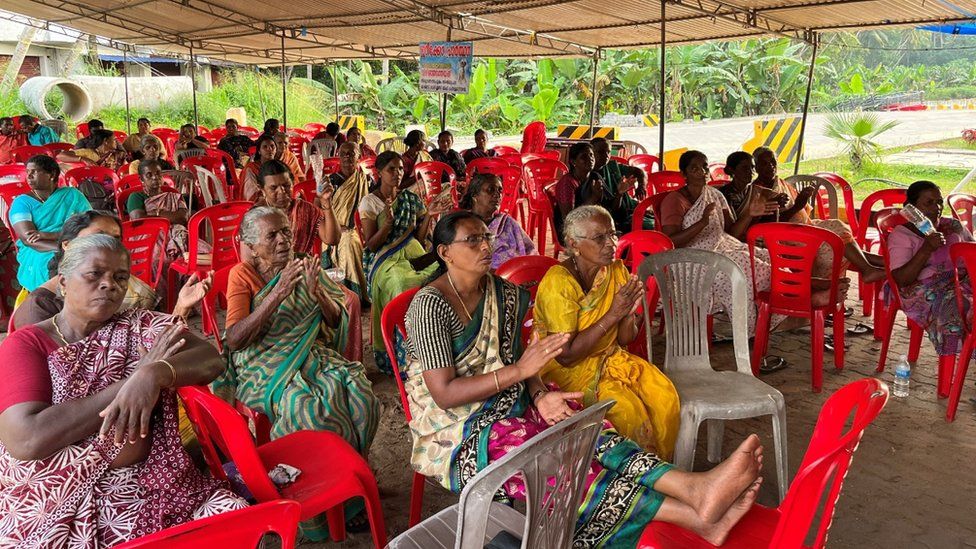
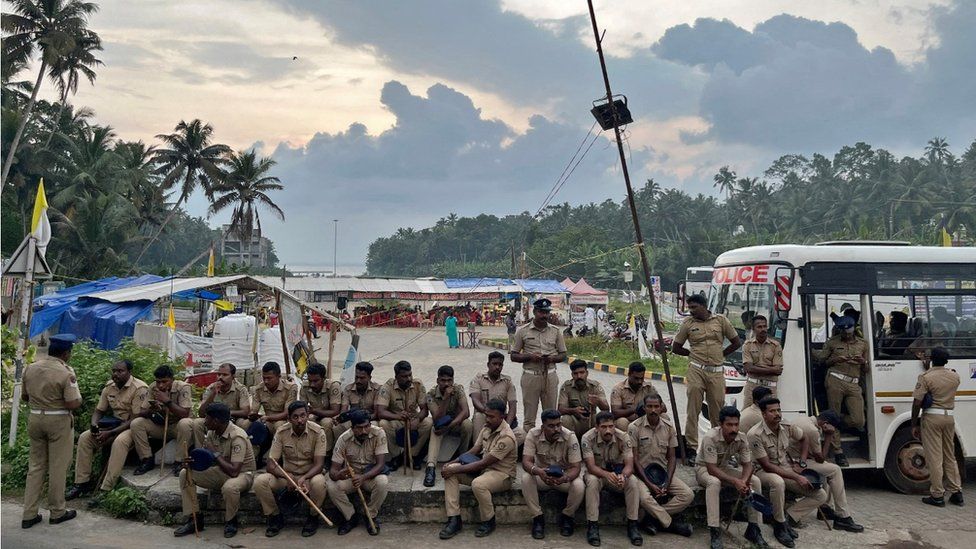
    On Sunday night, a mob stormed a police station in the southern Indian state of Kerala, injuring 36 officers as months of protests against a port project turned violent.

    Adani Ports and SEZ Ltd, owned by Asia’s richest man, Gautam Adani, is building the port.

    Protesters, primarily local fishermen, claim that the $900 million (£744 million) project is causing coastal erosion and destroying their livelihoods.

    The allegations have been denied by the company.

    Protests have been ongoing for more than 100 days, but have been mostly peaceful up until now. Many of the protesters claim that coastal erosion has destroyed their homes, forcing them to live in makeshift shelters.

    The company, however, has said that the project complies with environmental laws and that sea erosion is occurring due to climate change.

    Last week, the Kerala high court had said that the protesters must comply with its earlier order to allow “unhindered ingress and egress” to the project site.

    Women from the fishing community seen at a protest site in Vizhinjam
    IMAGE SOURCE,REUTERS Image caption, Locals have been protesting for months against the project

    But over the weekend, protesters blocked the company’s vehicles from entering the construction site, prompting police to arrest some of them.

    On Sunday night, hundreds of protesters stormed the local police station, leading to clashes with the police.

    “A mob gathered at the police station in the evening and demanded the release of a few persons who were arrested in another case,” a senior state police official told reporters, adding that they had deployed around 900 police personnel in the area.

    Several protesters were also injured, and some police vehicles were damaged. Around 3,000 people have been charged by police in connection with the violence.

    But Eugene H Pereira, a vicar general who was one of the convenors of the protest, blamed the police for provoking the protesters who, he said “were ready to leave the area without creating any trouble”.

    “The state government is responsible for the violence. They were doing it to prepare the ground for forcible eviction of the protesters,” he alleged.

    A state minister denied this, and accused the protesters of stalling the project even after the government had agreed to meet their demands.

    “They want the port project – which is in an advanced stage of construction – to be abandoned entirely. But that’s not going to benefit them at all,” he told the BBC.

    After the violence, the Adani Group approached the state’s high court, which on Monday asked the government to file a report.

    An Adani official told the BBC on condition of anonymity that the company had suffered damages of around 800m rupees ($9.8m; £8.1m) so far due to the blockade, which has gone on for more than 104 days.

    Police seen guarding the port area in Vizhinjam
    IMAGE SOURCE,REUTERS Image caption, Adani Group says the project is in compliance with all laws

    Adani Ports, India’s largest port operator, signed the deal in 2015 to build the port at Vizhinjam in Thiruvananthapuram, Kerala’s capital city.

    The company operates nine feeder ports across India and the Vizhinjam port is expected to meet all its transhipment requirements once ready.

    It has said that the port, once completed, would be “India’s gateway to international transhipment” due to its proximity to international shipping routes.

    The port was initially scheduled to be opened in 2019 but work was delayed after a deadly cyclone hit the state in 2017, and due to a shortage in construction material. It is now set to open in September 2023.

    The opposition Congress party, which was in power when the deal was signed, alleged that the current government had “ignored” a rehabilitation package for displaced people which was originally part of the agreement.

    “I have visited these shelters and they are living in the most pathetic situation that I have ever seen in my life,” said party leader VD Satheesan.

  • Thai monks fail drug tests, leaving the temple desolate

    Local officials have reported that , a small Buddhist temple in Thailand has been left without any monks after they were all dismissed for failing drug tests.

    An official told AFP that four monks, including the abbot, tested positive for methamphetamine in the northern province of Phetchabun.

    According to Boonlert Thintapthai, the monks were then sent to a health clinic for drug rehabilitation.

    The raid coincides with a national campaign to combat drug trafficking.

    The monks were reportedly removed from the temple on Monday after police administered urine tests, which all four men failed. Officials did not specify what drew police attention to the temple.

    Mr Thintapthai told AFP that the “temple is now empty of monks and nearby villagers are concerned they cannot do any merit-making”.

    Merit-making is an important Buddhist practice where worshippers gain a protective force through good deeds – in this case by giving food to monks.

    But Mr Thintapthai said that regional officials had sought the assistance of the local monastic chief, who had promised to assign some new monks to the temple in the Bung Sam Phan district in a bid to address the concerns of worshippers.

    In recent years, methamphetamine has become a major issue in Thailand, with seizures of the drug reaching an all time high in 2021, according to the UN’s Office on Drugs and Crime.

    The country is a major transit point for methamphetamine. The drugs flood into the country from Myanmar – the world’s biggest producer of methamphetamine – via Laos.

    The pills are then sold on the streets with a value of around 50 Baht (£0.47).

    Last month, Thai Prime Minister Prayuth Chan-ocha ordered a clampdown on drugs after a former police officer who had been dismissed from the force for methamphetamine possession killed 37 people during a shooting at a nursery.

  • Rishi Sunak: Golden era of UK-China relations is over

    Rishi Sunak has declared that the so-called “golden era” of relations with China is over, vowing to “evolve” the UK’s approach to the country.

    Mr Sunak said in his first foreign policy speech that the previous decade’s closer economic ties were “naive.”

    The prime minister stated that the UK must replace wishful thinking with “robust pragmatism” in dealing with competitors.

    However, he cautioned against “Cold War rhetoric,” adding that China’s global importance could not be overlooked.

    Since taking office last month, Mr Sunak has faced pressure from Tory backbenchers to toughen the UK’s stance on China.

    His speech, at the Lord Mayor’s Banquet in London, comes after protests in China over the weekend against the country’s strict Covid lockdown laws.

    Police have made several arrests, and a BBC journalist was detained while covering a protest in Shanghai on Sunday. He was beaten and kicked by the police during his arrest and held for several hours before being released.

    Mr Sunak told the audience of business leaders and foreign policy experts that, in the face of the protests, China had “chosen to crack down further, including by assaulting a BBC journalist”.

    “We recognise China poses a systemic challenge to our values and interests, a challenge that grows more acute as it moves towards even greater authoritarianism,” he said.

    He added that the “golden era” of UK-China relations was “over”, along with the “naïve idea” that more trade with the West would lead to Chinese political reform.

    The phrase “golden era” is associated with closer economic ties under former Prime Minister David Cameron – but relations between London and Beijing have since deteriorated.

    However, Mr Sunak stressed that “we cannot simply ignore China’s significance in world affairs – to global economic stability or issues like climate change”.

    He added that the UK would work with allies including the US, Canada, Australia, and Japan to “manage this sharpening competition, including with diplomacy and engagement”.

    “It means standing up to our competitors, not with grand rhetoric but with robust pragmatism,” he added.

    Mr Sunak and Chinese President Xi Jinping were set to meet for the first time at the G20 summit in Indonesia earlier this month, but the encounter was cancelled following a missile blast in Poland.

    Mr Sunak’s predecessor Liz Truss was reportedly planning to re-categorise China as a “threat” to the UK as part of a review of its foreign policy.

    In his speech, Mr Sunak echoed the phrase used in the review – that China is a “systemic challenge”. He said there would be more details of the review in the new year.

    The truth is, right now, we don’t know in practical terms what this new approach will actually amount to.

    Mr Sunak is promising more detail in what is known as the Integrated Review – which will set out the UK’s national security and foreign policy – in the new year.

    But we know already how China is now described: a “systemic challenge”.

    The government hopes that people will understand that international relations, like any human relations, are complex and nuanced; that a binary approach, as they see it, would not be in the UK’s interests.

    But for the prime minister’s critics, failing to describe Beijing as a “threat” is a big mistake.

    But the “robust pragmatism” line in the speech was criticised by former Conservative Party leader Iain Duncan Smith, who is one of a number of backbenchers pushing for a tougher line.

    Reacting to a preview of the speech, he wrote in the Daily Express that China had become a “clear and present threat to us and our allies”.

    “I wonder if robust pragmatism now sounds more and more like appeasement,” he added.

    Labour’s shadow foreign secretary David Lammy called the speech “thin as gruel”, accusing the government of “flip-flopping its rhetoric on China”.

    Nigel Inkster, senior China advisor at foreign affairs think tank the International Institute for Strategic Studies, told BBC Radio 4’s Today programme he did not think the China-UK golden age “was ever real and substantial”.

    He said: “It attempted to focus on economic relations with China while putting geopolitics to one side, and experience shows you simply can’t do that.

    “China in its present form is here to stay for the foreseeable future, and I think the Marxist-Leninist dialogue is only going to increase so we are going to have to learn to get used to this.”

    Elsewhere in his speech, Mr Sunak promised to continue support for Ukraine, adding: “We will stand with Ukraine for as long as it takes.”

    He promised to “maintain or increase” British military aid to the country next year, and provide new air support to protect civilians and critical infrastructure.

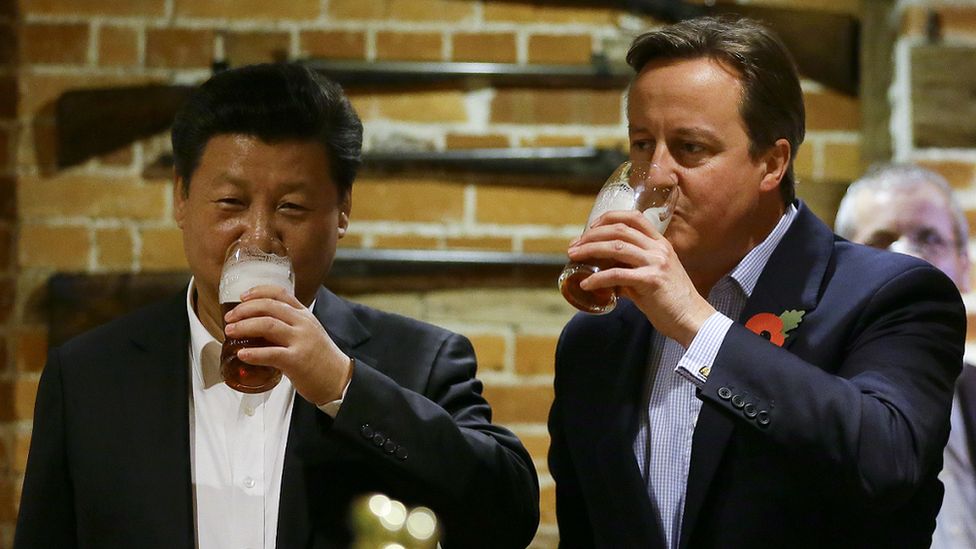
    China's President Xi Jinping and former prime minister David Cameron drink a pint of beer during his state visit to the UK in 2015
    IMAGE SOURCE,GETTY IMAGES Image caption, China’s President Xi Jinping and former prime minister David Cameron drink a beer together during his state visit to the UK in 2015

    Mr Sunak visited Ukrainian President Volodymyr Zelensky earlier this month, in his first visit to Kyiv since entering Downing Street.

    During the visit, he announced the UK would supply Ukraine with additional anti-aircraft guns and radars, and increase the training offer to Ukraine’s armed forces.

    President Zelensky’s wife, Olena Zelenska, made her own visit to London on Monday where she spoke about sexual violence allegedly being perpetrated by Russian troops in Ukraine.

  • Will Smith says bottled rage led him to slap Chris Rock at the Oscars

    Will Smith has said his “bottled” rage led him to slap comedian Chris Rock on stage at the Oscars in March.

    The actor has been interviewed for the first time since the incident, which he described as “a horrific night”.

    Appearing on The Daily Show with Trevor Noah, he said: “I was going through something that night, you know?

    “Not that that justifies my behaviour at all.” Smith added that there were “many nuances and complexities to it”, but added: “I just – I lost it.”

    Smith stormed the stage at the Hollywood award ceremony after Rock made a joke about Smith’s wife’s shaved head. Jada Pinkett Smith has the hair loss condition alopecia.

    ‘I understand how shocking that was’

    He had previously said his wife did not ask him to confront Rock.

    “I guess what I would say is that you just never know what somebody’s going through,” he said, without elaborating on what he was referring to.

    The interview on the late-night US TV talk show was the first time Smith had been publicly challenged about the attack.

    “I understand how shocking that was for people… I was gone. That was a rage that had been bottled for a really long time,” he told Noah.

    “That was a horrific night, as you can imagine.”

    In July he posted a video on YouTube, answering questions that appeared to be written by fans about the Academy Awards. Prior to that, he had only issued written statements about the altercation.

    He appeared on Monday evening’s episode of The Daily Show to promote his upcoming film Emancipation, to be released next week, making it eligible for next year’s Oscars.

    Smith, who received this year’s best actor award after the slap, said the idea that his new the film would be “tainted” during the upcoming awards season by his actions was “killing me dead”.

    The 54-year-old has been banned from attending the Oscars for 10 years, and has also resigned from the Academy, which organises the ceremony.

    Asked in a separate interview what he would say to critics claiming it was too soon for him to be promoting his work, he replied: “I completely understand that if you know someone is not ready.

    “I would absolutely respect that and allow them their space to not be ready.

    “My deepest concern is my team. The people on this team have done some of the best work their entire careers, and my deepest hope is that my actions don’t penalise my team.”


  • EOCO recovers GHC27 million for state in 10 months

    The amount is a record high for EOCO compared to an average of about five million Ghana cedis in previous years

    The executive director of the Economic and Organised Crime Office (EOCO) COP Maame Yaa Tiwaa Addo-Danquah has said her outfit will step up its effort in recovering monies due the state from next year.

    The assurance comes after Finance Minister Ken Ofori-Atta announced that EOCO retrieved GHC27.55 million from proceeds of crime; monies that would have been lost to the state in 10 months. 

    The amount is a record high for EOCO compared to an average of about five million Ghana cedis in previous years.

    Speaking on the achievement, the EOCO boss said she was grateful to her management team and all officers of EOCO who made this great feat possible.

    COP Addo-Danquah said EOCO will also improve on its recoveries, sensitisation programmes on cybercrimes, gaming and its outreach programmes to markets, communities and religious institutions in the coming days.

    Source: Asaaseradio.com 

  • Omanhene, MP vow to prevent mining in Asante Mampong

    The chiefs and people of the Asante Mampong Traditional Area in the Ashanti Region have decided not to allow any mining activity on their lands.

    This is to prevent the destruction of farmlands and water bodies in the area.

    It follows the issuance of a license to Eriant Company, an entity that deals in woods and registered in 2019 by the Minerals Commission for prospecting gold in Mampong.

    They also gave another company, Active Target Minerals Resource, registered in September 2022, a similar license to do the same prospecting on November 1, 2022.

    But speaking on Adom TV’s Badwem morning show on Friday, Member of Parliament for Asante Mampong, Kwaku Ampratwum Sarpong, said, “Daasebre Osei Bonsu has asked me to caution all those who want to come and mine gold in Asante Mampong not to come there because he cannot protect them should anything happen to them.”

    That, he said, was because they could not sit and allow their lands, farms, and water bodies to be destroyed, as had happened in many parts of the country.

    The MP, who is also the Deputy Minister of Foreign Affairs and Regional Integration, therefore, cautioned that “if anyone comes there for mining, I will organise the youth to restrict such people.”

    “We don’t need anyone there for mining purposes. If you’re looking for gold, go elsewhere, not Asante Mampong,” he warned.

    He stressed his readiness to do whatever it took to protect his people and the lands bequeathed to them by their forefathers.

    “I am ready to lead my constituents to use every means possible to prevent and stop any prospecting or mining company that ventures into the Mampong Municipality. Mampong is a no-go area for gold mining,” he stressed.

    He indicated that “we are forming a task force in the town so anyone who comes there to do mining would have us to contend with it. Daasebre (Osei Bonsu) has also stated that no mining prospecting would be allowed in Mampong, for he would not allow some people to pollute his lands and water bodies.”

    Meanwhile, the youth of the town are said to be gearing up for a massive demonstration through the principal streets of the town next Wednesday to drum home their point.

    This is expected to be followed by a press conference to reiterate their resolve not to allow mining activities in the town.

    Meanwhile, the Mamponghene, Daasebre Osei Bonsu, and the Member of Parliament have cautioned the Minerals Commission to stop issuing licenses to companies to come and do prospecting in the area since they would not allow any mining activities in the area.

    Source: Ghanaweb.com 

  • Aburi: Passengers accuse GPRTU of unreasonable fare increases

    Passengers in Aburi, in the Eastern region’s Akuapem South district, are at odds with transport operators over exorbitant road transport fares.

    They  are blaming the Ghana Private Road Transport Union (GPRTU) for absurd increases in transportation costs.

    Speaking to the media, some concerned youth in Aburi expressed their displeasure that transportation fares from Aburi to any part of the nearby areas are exorbitant in comparison to other places, despite the city’s good roads.

    A 23-kilometer road from Aburi to Madina now costs Ghc13.60, while a 26.9-kilometer road from Madina to Dodowa costs Ghc10.

    The youth argued that transport fares from Aburi to Madina shot up during the reconstruction of the Tetteh Quarshie to Mamfe road two decades ago due to the diversion of the road through Kitase-Brekuso to Kwabenya.

    However, drivers failed to reverse the GHC2 additional increment agreed upon with passengers after the road’s construction, instead unfairly raising the fares.

    This, they say, is worsening the plight of the people and also affecting businesses and tourism.

    Fred Odei Addo Duodu, Secretary to the youth group demanded immediate reduction in transport fares else the youth will rise.

    He further stated that “it is our fervent prayer that our demands today on paper must translate into a renewed action by the transport unions to expose those unscrupulous drivers who charge exorbitantly based on their own discretion, push for bolder policies to flush out drivers who disregard the approved general pricing principle by the transport unions”.

    Some opinion leaders in the community said they have made several efforts to petition the Greater Accra Regional GPRTU executives and Akuapem South District Chief Executive, but the GPRTU has failed to act on their grievances.

    Residents have given a one-week ultimatum for the fares to be reduced or else they will stage a massive demonstration, and subsequently expulse recalcitrant drivers from plying into Aburi township.

    However, some of the drivers told Starr News, they can’t not be blamed because they only implement fares approved by GPRTU.


  • Spanish coastguard finds a clandestine on the ship’s rudder

    Three stowaways were discovered on the rudder of a ship after it completed an 11-day voyage from Nigeria, according to Spanish authorities.

    The coastguard shared a photo of the men sitting on the rudder at the oil tanker’s helm, their feet less than a metre from the water.

    They were taken to a hospital in Gran Canaria, where they were treated for moderate dehydration.

    It’s unclear if they sat on the rudder the entire journey.

    According to data collected by maritime tracking websites, the Maltese-flagged Althini II arrived in Las Palmas, Gran Canaria, after a journey of more than 2,700 nautical miles from Nigeria’s largest city, Lagos.

    The men were seen by medics at the dock where they were found, and were taken to hospital soon after, the Spanish news agency EFE said.

    This isn’t the first time stowaways have been found on rudders, which are large blade-like fins found under ships and used for steering.

    A 14 year-old boy who also travelled from Lagos to Gran Canaria in 2020 told the paper El Pais that he spent the entire 15 day journey on the rudder of a huge fuel tanker. He was hospitalised upon arrival, after surviving on salt water and taking turns sleeping in a hole above the rudder with the other men he was travelling with.

    “We were very weak. I never imagined it could be this hard.” he said.

    In another incident the same year, four men were found on the rudder of the Norwegian oil tanker, Champion Pula, after it had travelled from Lagos to Las Palmas. Reports at the time said the men hid in a room behind the rudder during its 10 days at sea.

    The number of migrants crossing on boats from west Africa to the Spanish-owned Canary Islands has risen significantly in recent years.

    The journeys are long, hazardous and deadly. In 2021, the UN’s International Organization for Migration (IOM) recorded 1,532 deaths on the route.


  • ‘I’m 23 and my boyfriend is 71 – people say I’m wasting my life but I want to marry him’

    A young woman says she’s now facing a dilemma after her much older boyfriend brought up the topic of marriage, casually asking her whether this would be something she’d be open to. According to the 23-year-old woman, she’s been with her ‘wonderful’ 71-year-old boyfriend for two years, and loves and cares for him very much.

    At the moment, he’s in relatively good health and lives an active lifestyle. The longevity of his parents, who both lived until their nineties, has further reassured her that would have plenty of time together as a married couple. The potential bride-to-be doesn’t want children and feels as though their marriage could very well work out, however, she does have a few concerns about the caring role she may one day have to take on.

    Taking to Reddit, where she goes by the username u/cinnamonpenguinss, the conflicted girlfriend wrote: “His mum does have Alzheimer’s or dementia, and is very frail. This leads me to believe that there will be a point in his life when he will need extra care.

    “His dad did not have memory issues but did have a stroke. He doesn’t have any children, so I would be taking care of him as he gets older. What does it look like to care for an aging partner, especially if you have a job/career?

    “It’s a little strange planning for an end of a marriage, but I fully believe that a decade or two of happiness with him is better than not. I just want to make sure that I am the right one to take care of him and love him.”

    Opinions were mixed as to whether she should go ahead and marry her other half, with some even arguing she’d be ‘wasting the best years’ of her life.

    One person urged: “You are signing up to be his nurse, not his wife. Don’t sabotage yourself like this! You deserve better. Don’t waste your young years being a servant. This is a horrible idea.

    “This will damage you and set you back for the rest of your life, you must listen to the women who made the same mistake and are regretting it because of how the stress of being a 24/7 nurse and servant made them sick for the rest of their lives, to the point of needing but not affording someone to help them.”

    Others however were more encouraging, with one sympathetic person, who sadly lost their much older husband to cancer, commenting: “I adored my husband. If I had the time again knowing I was going to lose him and there was nothing I could do about it. I would still do it all again.

    “Even if you were with someone your own age there would still be a likelihood of one of you acting for the other further down the line anyway so take your happiness if you love them then it won’t be a barrier. It certainly wasn’t for me.”

    Source: Mirror.uk

  • Diphtheria diagnosed in 50 newly arrived migrants in the UK

    Following a significant increase in diphtheria cases this month, a vaccine programme has been expanded in migrant processing centres. According to the immigration minister, public health is the government’s top priority, and they are going above and beyond to keep cases from spreading.

    Fifty recent arrivals in the UK have been diagnosed with diphtheria, according to the immigration minister.

    Robert Jenrick told MPs that the number of cases has risen from four on November 1st, when he first provided an update, to 50 on November 25th.

    He said the UK Health Security Agency (UKHSA) found the cases, which were across different asylum accommodations, had developed before the migrants had entered the UK, either in their country of origin or on their journey through Europe.

    “It’s important to emphasise that the UKHSA has been clear that the risk to the wider UK population from onward transmission of diphtheria is very low, thanks in no small part to our excellent childhood immunisation programme,” he told the Commons.

    He said “public health is paramount” and the government will take all steps necessary to ensure that the public are protected”.

    The UKHSA said of the 50 cases, two were severe and required hospital admission and treatment with diphtheria anti-toxin and antibiotics.

    Earlier today the Home Office revealed 500 migrants at the Manston processing centre in Kent had been vaccinated against diphtheria before they were moved to further accommodation.

    At the beginning of November, the centre was suffering from severe overcrowding, which is when reports of diphtheria cases were first made.

    Sky News also revealed today a man who died after staying at Manston had the disease.

    Mr Jenrick said initial tests on the man were negative but a subsequent PCR test showed he had diphtheria, however his cause of death is pending as the post-mortem results have not come through yet.

    500 migrants vaccinated for diphtheria

    The minister said migrants are being tested upon arrival in the UK and those with diphtheria are being isolated in a designated area.

    People with symptoms are being tested, and also their close contacts, he said.

    Mr Jenrick added that the measures “go beyond the baseline advice of the UKHSA because we want to take precautionary measures”.

    All migrants who arrived at Manston this weekend took up the offer of the vaccine, which is voluntary, Mr Jenrick said.

    When the government initially started offering the vaccine there was only around a 45% uptake but he said it is now 100%.

    Mr Jenrick said the government will be liaising with the French to assess the diphtheria status in the migrant camps in northern France, where most stay before making the dangerous Channel crossing to the UK.

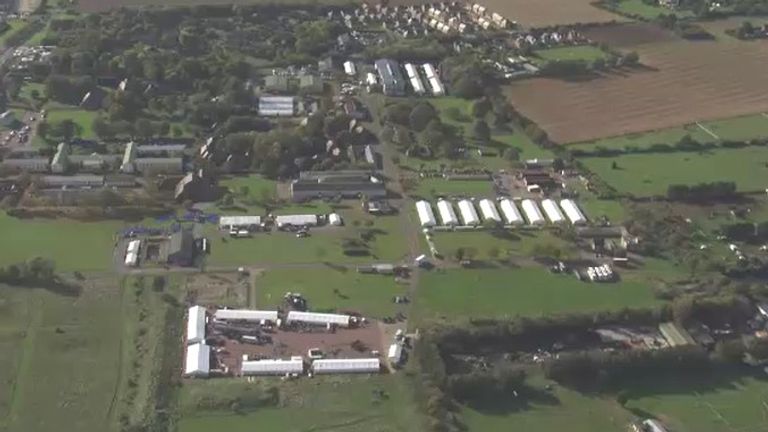
    Marquees housing migrants in Manston, processing centre,Thanet, Kent
    Image:The Manston processing centre in Kent was opened in February this year

    Labour’s shadow home secretary Yvette Cooper asked what is happening with the “other several thousand” who have been moved on from Manston over the past month.

    She raised concerns not enough has been done to stop diphtheria potentially spreading from those who have not been vaccinated as she said the public health recommendation to screen and vaccinate was made nearly three weeks ago “and that was already late”.

    Ms Cooper also called on ministers to make sure all those with symptoms are given “precautionary antibiotics” to fight the disease”.

    Mr Jenrick said the Home Office and the UKHSA are going to work with public health directors in areas where migrants are being sent to make they have the guidance to protect people from the disease.

    Migrants who have been moved on and have diphtheria will be required to “isolate in their rooms within those hotels or other forms of accommodation”, he added.

    They will get their food and laundry brought to their door until they are well again and if further measures are needed they will be implemented, he said.

  • Ex-Comoros president given life sentence over passport fraud

    The former president, who had already been imprisoned for four years before his trial, is a rival to the country’s current leader.

    According to regional media reports and the AFP news agency, a court in Comoros sentenced ex-President Ahmed Abdallah Sambi to life in prison for “high treason.”

    Tanzania Daily News reports that, Sambi, a political rival of incumbent President Azali Assoumani, was sentenced by the State Security Court, a special judicial body whose rulings cannot be appealed, for selling passports to stateless people living in the Gulf.

    “He betrayed the mission entrusted to him by the Comorians,” public prosecutor Ali Mohamed Djounaid accused in the court as he requested for a life sentence.

    Sambi, 64, who led the tiny Indian Ocean archipelago nation between 2006 and 2011, enacted a law in 2008 allowing the sale of passports for high fees.

    The controversial scheme was aimed to give nationality to the so-called Bidoon – an Arab minority numbering in the tens of thousands who cannot obtain citizenship.

    According to Djounaid, the former president embezzled $1.8bn under the fraudulent scheme – more than the gross domestic product of the impoverished nation.

    Local media quoted Emmanuel Sossa, a lawyer for civilian plaintiffs, as saying: “They gave thugs the right to sell Comorian nationality as if they were selling peanut.”

    Sambi’s lawyer Jean- Gilles Halimi, however, refuted the accusations, saying no evidence had been provided for the missing monies and no bank accounts had been put forward to suggest a crime.

    Sambi refused to attend the trial on the grounds that there were no guarantees he would be judged fairly. He briefly appeared once with his defence asking the judge to recuse himself since he had previously sat on the panel that decided to indict him.

    The former leader, who was originally charged with corruption, had already spent four years in prison before he faced a trial. He was previously placed under house arrest for allegedly disturbing public order.

    Three months later he was put under pre-trial detention for embezzlement, corruption and forgery, in the so-called “economic citizenship” scandal, before being slapped with high treason charges.

    Among the defendants was French-Syrian businessman Bashar Kiwan, who accused the government of seeking to pressure him into testifying against the former president in exchange for a pardon.

    The Comoros presidency has formally denied these accusations.

    The Comoros islands – Anjouan, Grande Comore and Moheli – have endured years of grinding poverty and political turmoil, including about 20 coups or attempted coups, since independence from France in 1975.


  • Britain backs down on declaring a grid emergency

    Rationing will not be implemented due to an increase in gas-fired power capacity.

    The operator of the electricity grid in the United Kingdom postponed plans to activate emergency measures on Monday after power supplies were deemed adequate.

    Earlier on Monday, the National Grid Electricity System Operator announced that it was considering using its Demand Flexibility Service for the first time in order to avoid blackouts the following day.

    ESO launched the flexibility program in early November. By design, it’s meant to offer consumers and businesses incentives for cutting back on the amount of electricity they use during certain periods throughout the day.

    High prices and concerns over supplies have put much of the region on edge as winter descends on the Northern Hemisphere. Natural gas prices jumped on Monday amid reports of a cold spell for the British isles.

    But the grid regulator eventually backed off plans to impose the Demand Flexibility Service in response to industry sources reporting that gas-fired power facilities brought extra capacity online to avoid service disruptions, The Guardian reported.

    Data from Gas Infrastructure Europe, meanwhile, show that regional gas supplies — including those in Britain — are at an all-time high for this time of year, suggesting early-year concerns of major supply-side problems won’t materialize.

    The sidelining of Russian natural gas as punishment for the February invasion of Ukraine has been more of a concern for members of the European Union, however, as the British economy relies on domestic natural gas and imports from Norway to keep the lights on.

    Nevertheless, the Bank of England had pinned much of the blame on Russia, which created heightened volatility in the wholesale energy markets. For natural gas alone, the bank said prices have been changing by more than 15% a day at the most extreme.

    Tony Jordan, a senior partner at the consultancy Auxilione, told The Guardian that warnings from the ESO should serve as a reminder of the importance of conserving power, but consumers shouldn’t be overly concerned.

    “Spot prices (for natural gas) are rising on the back of the cold weather … but this is how the system works, it will convince people to cut back on their usage and balance out supply and demand,” he said. “There will be some scaremongering but it looks like we should be fine.”

    The Met Office, Britain’s weather reporting agency, shows heavy rains and cool weather for London on Monday, with temperatures hovering around 50 degrees Fahrenheit. Cloudy skies with lows in the 40s are expected for the weekend.


  • Video emerges as neighbours carry old man’s house to a new location to keep him close to his kids 

    Netizens have hailed some neighbours in a Philippine village for putting a smile on an old man’s face by relocating him closer to his children. Footage shared on Instagram by @worthfeed showed the neighbours numbering about 20 heaving the 7ft-high structure on a dirt road in Zamboanga del Norte in the Philippines.

    According to @worthfeed, the men stopped every ten minutes to take rests as the house is quite heavy. Why the elderly man had to be relocated YEN.com.gh gathered that the elderly man lost his wife and consequently had no one to care for him as his children lived far away.

    His children wanted him to live nearby, and the house was too heavy for only his relatives to carry, hence the help from neighbours. “The grandfather didn’t have anyone to take care of him because his wife was already dead so his children wanted him to live nearby. However, his house was too heavy for his relatives so some of our neighbours volunteered to help,” a local named Rhezelle Araniuez explained.


    View this post on Instagram


    A post shared by Worth Feed (@worthfeed)

    Source: Yen.com 

  • Gunman in Buffalo supermarket shooting, pleads guilty to murder, hate-motivated terrorism charges

    Before carrying out the attack, the 19-year-old posted a racist manifesto online. Three people were also injured.

    An avowed white supremacist who killed ten black shoppers and employees at a Buffalo supermarket has pleaded guilty to murder and hate-motivated terrorism charges.

    Payton Gendron, 19, drove three hours from his home near Binghamton, New York, to the Buffalo Tops Friendly Markets store.

    Gendron, who was dressed in military gear, opened fire with an AR-15 style semi-automatic assault-style rifle after arriving at the supermarket.

    In the attack, which occurred in May of this year, he killed ten people and injured three others.

    Police say Gendron left a racist manifesto online before the attack in which he admitted to targeting the town due to it being a predominately black neighbourhood, a court heard.

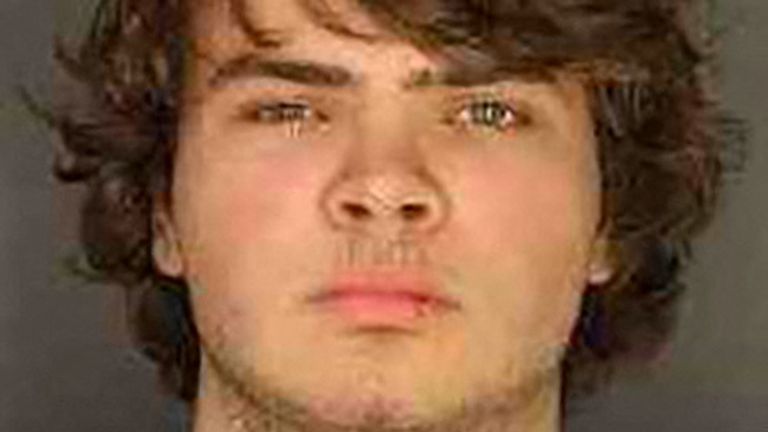
    Payton Gendron in a police mugshot
    Image: Payton Gendron in a police mugshot
    Those killed ranged in age from 32 to 86 and included an armed security guard who died trying to protect customers, a church deacon and the mother of a former Buffalo fire commissioner.

    In court, Gendron admitted all the charges against him, including murder, murder as a hate crime and hate-motivated domestic terrorism, which carries an automatic sentence of life without parole.

    Gendron also admitted wounding three people who survived the attack, which happened in May this year.

    The teenager, who was handcuffed and wore an orange jumpsuit, showed little emotion through the 45-minute proceedings, which took place in a courthouse just two miles from the scene of the shooting.

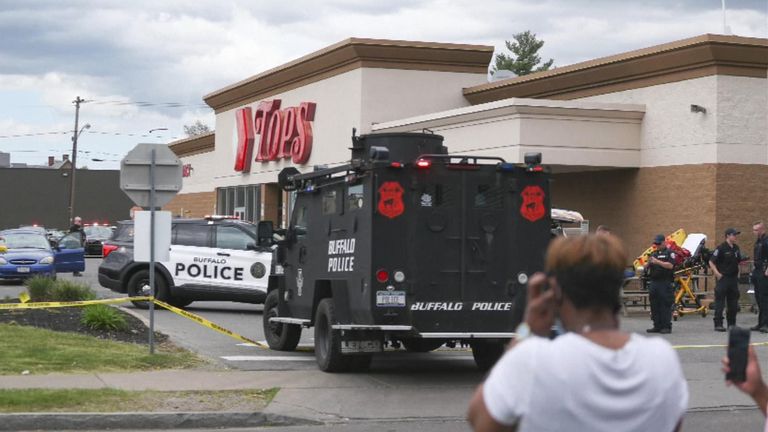
    Picture from the scene of a mass shooting in Buffalo, NY. Pic: AP
    Image: Police at the scene of the attack in May this year. Pic: AP

    Gendron will spend the rest of his life behind bars, as he faces a sentence of life in prison without parole. The state of New York does not have a death penalty.

    A sentencing hearing is expected at a later date.

    A separate indictment returned in U.S District Court in July charged Gendron with 27 federal hate crimes and firearms offences, for which he could face the death penalty if convicted.

    Following the attack, police were praised for responding less than two minutes after the incident started.

    Buffalo mayor Byron Brown said more lives probably would have been lost if it was not for their “swift response” and “courageous actions”.


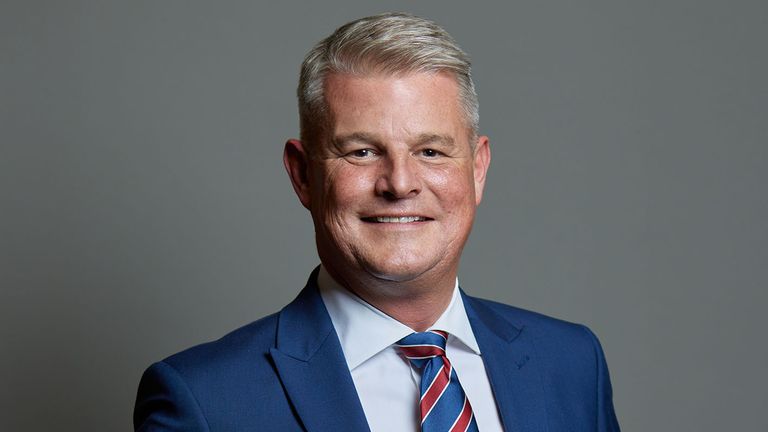
  • OneLove armband: Sports minister Stuart Andrew to wear to England v Wales match in Qatar

    The UK’s first openly gay sports minister said he was determined to make the gesture even though the world’s football governing body has warned players they could be booked for making political protests.

    Stuart Andrew, the sports minister, has said he will wear the OneLove armband at the England v Wales World Cup match in Qatar tomorrow.

    Mr Andrew, himself a member of the LGBTQ+ community, said he is “not going to shy away from who I am

    The UK’s first openly gay sports minister said he was determined to make the gesture even though the world’s football governing body FIFA has warned players they could be booked for making political protests.

    Asked whether he would wear the armband and risk upsetting the World Cup host, Mr Andrew told the Evening Standard: “I absolutely will be doing so.

    “I’m not going to shy away from who I am.

    “Our message very much is that no one should have to hide who they are.”

    Mr Andrew, who is also an equalities minister, said that as a gay man he is in a “unique position” to send a message of solidarity to those LGBTQ+ fans who did not feel comfortable travelling to Qatar for the event.

    He also criticised FIFA for putting players in an “impossible position” by barring them from showing their support by wearing the armband.

    Some football teams – including England and Wales – were preparing to wear the armband during matches in a show of solidarity with the LGBTQ+ community.

    But FIFA warned players they could face sporting sanctions if they went ahead.

    Football associations subsequently backed down.

    The football body defended its decision to threaten to issue yellow cards to players wearing the armband by saying that its rules do not allow “political, religious or personal messages or slogans”.

    FIFA offered team captains the chance to wear an armband that said “no discrimination” instead.

    Discussing the players who wanted to wear the armbands but could not, the sports minister said: “It means a lot to me personally, means a lot to me as a minister and more broadly, means a lot to fans out there.

    “It is pretty appalling that at the eleventh hour they were put in a position where they were told there would be sanctions against them. That’s put them in an impossible position.”

    He added: “This is an incredibly important tournament for international football… of course they want to progress as far as they can. For them to be silenced is deeply unfair.”

    Stuart Andrew is the Conservative MP for Pudsey, and has been an MP continuously since 6 May 2010Credit:UK Parliament
    Image:Stuart Andrew has been sports minister since September

    Speaking about FIFA, Mr Andrew continued: “Two weeks ago they wrote to everybody to say just concentrate on the football and don’t do the politics.

    “Then they say you can’t wear the armband, but you can wear ours.

    “Well I’m sorry, that is just not an acceptable position. It’s not sustainable. And I think there are serious questions for FIFA to answer.”

    The Conservative MP for Pudsey in Leeds also disclosed that he considered boycotting the World Cup because of Qatar’s rules on same-sex relationships.

    “This has been a decision I’ve thought long and hard about because it is a very deeply personal decision,” he said.

    “I have done a lot of work before this tournament started. I met with the Qatari ambassador and had a very frank conversation about what does ‘everyone is welcome’ actually mean.

    “I have a responsibility to go there and see for myself that is actually what has been delivered on the ground. And if it isn’t in any way then to challenge that.”

    He added: “There is a spotlight on Qatar now and that is a spotlight that we should not let go out as soon as the tournament is over.

    “I really hope that FIFA will have a long hard look at the criteria that are needed for host nations to host such tournaments because clearly, I would have thought their ambition would be for everybody to want to enjoy the games and make them the most successful ever.”

  • Pakistan Taliban end ceasefire with the government and threaten new attacks

    The armed group calls off a truce agreed with the government in June and orders fighters to ‘carry out attacks in the entire country’.

    The Pakistani Taliban, also known as Tehreek-e-Taliban Pakistan (TTP), has ended an indefinite ceasefire in June and issued orders for its fighters to continue attacks nationwide.

    “As military operations are ongoing against mujahideen in different areas, … so it is imperative for you to carry out attacks wherever you can in the entire country,” the group said in a statement on Monday.

    The group, which is ideologically aligned with the Afghan Taliban, said it is facing a rising number of attacks by the Pakistani military, particularly in the Lakki Marwat district of Pakistan’s northwestern province of Khyber Pakhtunkhwa.

    “We submit to the people of Pakistan that we have repeatedly warned you and continued to be patient so that the negotiation process is not sabotaged at least by us, but the army and intelligence agencies do not stop and continue the attacks, so now our retaliatory attacks will also start across the country,” the statement said.

    Al Jazeera reached out to the Pakistani military for comment but did not receive a response.

    The TTP has been waging a rebellion against the state of Pakistan for more than a decade. The group demands the imposition of hardline Islamic law law, release of key members arrested by the government and a reversal of the merger of Pakistan’s tribal areas with Khyber Pakhtunkhwa province.

    On November 16, the TTP claimed responsibility for an attack on a police patrol in Lakki Marwat, about 200km (125 miles) southwest of the provincial capital, Peshawar. Six policemen were killed.

    After the attack, Prime Minister Shehbaz Sharif said “terrorism” continues to be one of Pakistan’s foremost problems.

    The TTP made its declaration hours after the government said the state minister for foreign affairs, Hina Rabbani Khar, will visit Afghanistan on Tuesday.

    According to the foreign ministry, Khar will hold talks on regional security with the Taliban government in Kabul.

    Security specialist Asfandyar Mir of the United States Institute of Peace told Al Jazeera that while the TTP has been escalating its violence recently, it has also exercised restraint by not carrying out attacks outside tribal areas.

    “I have inferred the targeting as a function of Afghan Taliban pressure on the TTP to calibrate their escalation,” he saId. “Now if the TTP follows through in its declaration of countrywide attacks, the key question is how will the Taliban respond.”

    The government and the TTP have held multiple rounds of talks facilitated by the Afghan Taliban, the last of which took place in June. The talks began weeks after the Taliban took control of Kabul last year.

    Despite the ceasefire, the TTP continued its attacks this year, saying they were defensive in nature and only in retaliation for operations carried out by Pakistan’s military.

    According to data compiled by the Pakistan Institute for Peace Studies, an Islamabad-based research organisation, at least 65 such attacks took place in Khyber Pakhtunkhwa through the end of October. They killed at least 98 people and wounded 75, it said.


  • Hawaii: World’s largest volcano, erupts for the first time in decades

    Mauna Loa on the archipelago’s Big Island began erupting late Sunday, putting emergency crews on high alert.

    Authorities say Mauna Loa, Hawaii’s largest active volcano, has erupted for the first time in nearly four decades, causing volcanic ash and debris to fall nearby.

    Lava flows remained contained within Mauna Loa’s summit caldera in the US island state, but the eruption could pose a threat to nearby residents if conditions change, the US Geological Survey reported at 11:45 p.m. Sunday (09:45 a.m. Monday), about 15 minutes after the eruption in Hawaii Volcanoes National Park.

    “At this time, lava flows are contained within the summit area and are not threatening downslope communities,” the Geological Survey said on its website, noting that locals on the Big Island of Hawaii should review preparedness procedures.

    While the eruption on the main island of the Pacific state remains confined within the basin at the top of the volcano, “if the eruptive vents migrate outside its walls, lava flows may move rapidly downslope,” according to the Geological Survey.

    Hours later on Monday morning, the survey’s volcano monitoring office tweeted: “Lava does seem to have flowed outside the caldera, but for now the eruptive vents remain confined to the caldera.”

    “However, lava flows in the summit region are visible from Kona,” the Hawaiian Volcano Observatory said in a statement. “There is currently no indication of any migration of the eruption into a rift zone.”

    A rift zone is where the mountain splits apart. The rock is cracked and relatively weak, and it’s easier for magma to emerge.

    How long the volcano erupts and whether it could cause lava to flow to populated areas is impossible to predict, said Miel Corbett, a Geological Survey spokeswoman.

    “But I can tell you, we’re in constant communication right now with Hawaii Civil Defense, and they’re providing updates to community members,” she said.

    The Geological Survey said the Hawaiian Volcano Observatory was in consultation with emergency management personnel and its staff would conduct an aerial reconnaissance over the 4,168-metre (13,674-foot) volcano as soon as possible.

    Hawaii authorities said no evacuation orders have been given although the summit area and several roads in the region have been closed.

    A Geological Survey webcam on the Mauna Loa summit’s north rim showed long, bright eruptive fissures within the crater.

    Portions of the Big Island were under an ashfall advisory issued by the National Weather Service in Honolulu, which said up to 0.6 centimeters (a quarter-inch) of ash could accumulate in some areas.

    The Hawaiian islands are home to six active volcanoes. Mauna Loa, the largest on Earth, has erupted 33 times since 1843, according to the Geological Survey.

    The most recent eruption, in 1984, lasted 22 days and produced lava flows that came within seven kilometres (four miles) of Hilo, a city with a population of 44,000 people today.

    Last month, scientists said Mauna Loa was in “a state of heightened unrest” after a series of earthquakes were felt in the area.

    Mauna Loa is the much larger neighbour of the Kilauea volcano, which erupted in 2018 and destroyed 700 homes. Some of Mauna Loa’s slopes are much steeper than Kilauea’s, so when it erupts, its lava can flow much faster.

    During a 1950 eruption, the mountain’s lava travelled 24 kilometres (15 miles) to the ocean in less than three hours.

    Lava from Mauna Loa in 1984
    The effects of the eruption of the  Mauna Loa volcano on the island of Hawaii is shown in this March 25, 1984, handout photo provided by the US Geological Survey [File: US Geological Survey/Handout via Reuters]
  • India in a ‘good position’ to help end Russia-Ukraine war

    New Delhi’s unique position on the world stage could see PM Narendra Modi become a key peacemaker, say experts.

    India’s balancing act on the war in Ukraine is becoming more difficult, but New Delhi’s unique position – as a friend of both Russia and the West – could see it emerge as a key mediator, experts have told Al Jazeera.

    When war began on February 24, New Delhi was quick to support Ukraine’s humanitarian needs.

    But India has abstained from condemning Moscow’s actions at the United Nations – a consistent position that the administration of Prime Minister Narendra Modi says is in line with India’s foreign and defence policies.

    In a November interview with Times Now, an Indian media outlet, India’s Foreign Minister Subrahmanyam Jaishankar argued that he is not trying to cater to the demands of “other people”.

    “Sometimes, I have lived with things that you [the West] did. Now, live with it [India’s foreign policy],” he said.

    But as the war intensifies, global energy and food shortages are prompting India to re-evaluate its restrictive stance towards Russia.

    On the sidelines of September’s Shanghai Cooperation Organisation (SCO) summit in Samarkand, Uzbekistan, Modi told Russian President Vladimir Putin: “I know that today’s era is not an era of war, and I have spoken to you on the phone about this.”

    India was among the nations that abstained from a recent UN vote condemning Russia [Al Jazeera]

    The premier reiterated this sentiment weeks ago at the Group of 20 (G20) summit in Bali.

    “We have to find a way to return to the path of ceasefire and diplomacy in Ukraine,” he said.

    Vivek Mishra, a fellow at the Observer Research Foundation (ORF) in New Delhi, told Al Jazeera that India’s stance is in a state of transition.

    “Over the past 10 months, we’ve seen India’s spectrum of mediation in the war increase. This became evident with New Delhi indirectly telling Moscow that it is time to end the war. Moreover, over the next year, India leading the G20 will mean that New Delhi’s role in mediating the end of the war will gain more prominence,” he said, highlighting that the role of mediator signifies leadership.

    ‘Upgraded form of non-alignment’

    New Delhi is set to take on the G20 presidency from Indonesia from December 1 and will host the next G20 meeting in 2023.

    John-Joseph Wilkins, an associate fellow at the German Council on Foreign Relations, said that with its new responsibilities, India is likely to focus on protecting its strategic autonomy.

    “India has always had a tradition of balancing world powers, but this year we’ve seen the country’s foreign policy establishment possibly embrace an upgraded form of non-alignment. This has the potential to increase New Delhi’s global influence going forward,” he told Al Jazeera.

    Will India’s evolving position impact ongoing trade with Russia?

    Russian President Vladimir Putin has acknowledged India’s recent concerns about the war and reassured Modi at their meeting in Uzbekistan that Moscow would do everything to stop the war “as soon as possible”.

    Typically, he blamed Ukraine for prolonging the conflict.

    Increasingly isolated by Western powers, Putin has been keen to forge closer ties to India by boosting trade relations.

    “Our trade is growing, thanks to your additional supplies of Russian fertilisers to the Indian markets, which have grown more than eightfold. I am hopeful that this is going to be of huge help to the agricultural sector of India,” Putin told Modi.

    Ahead of the Uzbekistan talks, Russia’s Ambassador to India Denis Alipov had hailed growing economic cooperation, telling Moscow’s TASS news agency: “In the first half of 2022, we saw an unprecedented growth in trade – by July it reached more than $11bn, and was $13.6bn for the entire 2021. This is a solid figure, which allows us to discuss the likelihood of achieving the goal of bringing the level of mutual trade to $30bn by 2025.”

    Activists of Hindu Sena, a Hindu right-wing group, hold placards and flags as they take part in a march in support of Russia, as the invasion of Ukraine continues, in Connaught Place, in New Delhi, India, March 6, 2022. REUTERS/Anushree Fadnavis
    Activists of Hindu Sena, a Hindu right-wing group, hold placards and flags as they take part in a march in support of Russia on March 6, 2022 [Anushree Fadnavis/Reuters]

    India and Russia have shared a special relationship since the Cold War, and Moscow remains the Asian nation’s biggest arms and crude oil supplier.

    According to the Stockholm Peace Research Institute (SIPRI), between 2011 and 2021, Russia accounted for 60 percent of weapons imports in India.

    Meanwhile, Moscow supplied 22 percent of New Delhi’s total crude needs in October 2022.

    According to the ORF’s Mishra, New Delhi’s evolving stance is unlikely to impact trade relations.

    “In the case of oil imports, for example, India’s petroleum and natural gas minister Hardeep Singh Puri recently clarified that there is no moral conflict in buying oil from Russia because as a responsible nation, India also has to cater to domestic needs and on the global stage, oil has to be bought in order to ensure global prices are low. So this trade is bound to continue,” he said.

    But Wilkins said India has been trying to diversify in areas such as hydrocarbons.

    “The country has been slowly shifting its general position on Russia for some time now,” he said.

    “The conflict in Ukraine really highlighted for the country’s policymakers the need to reduce their dependence on Moscow, especially in the hydrocarbons sector,” he said.

    “India has a National Hydrogen Mission and it is quite clear that it eventually wants to and could become an exporter of ‘green hydrogen’, which essentially means establishing solid solar and hydro power infrastructure and diversifying supply chains. In that sense, reducing dependency on Russian hydrocarbons, which the country is heavily reliant on, aligns with its overall national mission,” he added.

    India’s prominence to make it a peacemaker?

    At the same time, the European Union has also been pushing for stronger ties with India, as the bloc’s relations with Russia and China cool.

    The EU held its first round of trade talks with India in July this year, and the discussions are set to resume on Monday.

    New Delhi aims to establish comprehensive free trade agreements not only with the EU, but also with the United Kingdom and Canada next year. Similar trade deals have already been signed with Australia and the United Arab Emirates this year.

    Meanwhile, the United States has also fostered its defence partnership with India, after recognising New Delhi as a central figure in maintaining security in the  Indo-Pacific – a sentiment shared by the Association of Southeast Asian Nations (ASEAN), which has also broadened its security ties with India.

    Some geopolitical analysts say the Ukraine war has played a role in increasing India’s prominence on the global stage.

    Ukrainian citizens hold their national flag in solidarity with their compatriots after Russia's invasion of Ukraine, at Lodhi Garden in New Delhi, India, April 1, 2022. REUTERS/Adnan Abidi
    Ukrainian citizens hold their national flag in solidarity with their compatriots after Russia’s invasion of Ukraine, at Lodhi Garden in New Delhi, India on April 1, 2022 [Adnan Abidi/Reuters]

    But Mishra argued that this theory undermines India’s achievements.

    India’s potential as a stable market, he said, is what prompted the push.

    “India’s economy recently surpassed the British economy, with India becoming the fifth largest economy in the world. This was scripted before the war,” he said.

    He acknowledged, however, that the war brought India into the spotlight, because of New Delhi’s unique position as an ally of the West and Russia.

    “So I think in this aspect, the spectrum of the role that India is playing has increased,” he added.

    While Russia’s war in Ukraine has no end in sight, talk of negotiating a peaceful conclusion to the conflict has increased.

    With India at the helm of the G20 from December, Mishra said the West might lobby New Delhi to play a bigger role.

    “If this initiative for peace is really pushed and Ukraine agrees to come to the negotiation table, the West could ask India to convince Russia to do the same due to India’s G20 role and special relationship with Moscow,” Mishra told Al Jazeera.

    “Overall, India will continue being the bridge between the two sides,” he said, “but is also going to be in a good position to bring this war to an end.”

    Source: Aljazeera.com 


  • UN panel accuses South Sudanese officials of letting gang rapes occur

    UN experts have urged South Sudanese authorities to look into officials accused of supervising systematic gang rapes, some of which involved girls as young as nine.

    On Monday, the South Sudan Commission on Human Rights stated that it had reasonable grounds to believe that a county commissioner in the northern oil-rich state of Unity orchestrated gang rapes at a military camp.

    The UN experts said in a statement that the documented abuses included beheadings, rape victims being forced to carry severed heads, victims being burned alive, and days of brutal sexual assaults.

    “Conflict-related rape and sexual violence in Unity State has become so systematic and is a direct result of impunity,” commission member Barney Afako said.

    Investigators say sexual abuse has been used as a weapon by all sides in South Sudan’s civil conflict, which erupted in 2013 and triggered Africa’s biggest refugee crisis since the 1994 Rwandan genocide.

    In the abuses outlined in Unity, multiple witnesses said the state official planned and ordered the attacks, which were led by his deputy and followed strikingly similar patterns in different areas, according to the UN statement.

    In response, Michael Makuei, South Sudan’s information minister and government spokesman, dismissed the commission’s statement as a fabrication.

    “They come and sit in hotels here in Juba and fabricate these false reports on South Sudan to make a living,” he told the Reuters news agency. “… I am saying these are false reports fabricated against the government.”

    The commission said the abuses cut across all political affiliations. It said one governor in the opposition in the state of Western Equatoria was appointed to his post despite being responsible for the 2018 abduction, rape, torture and sexual slavery of more than 400 women and girls.

    Lam Paul Gabriel, military spokesman for Vice President Riek Machar’s Sudan People’s Liberation Movement/Army in Opposition (SPLM/A-IO), said it had had no hand in the reported crimes.

    “This report is misplaced because they do not know who is fighting who in those areas where these accusations are made,” Lam said.

    Attempts to reach officials from Unity and Western Equatoria to comment were unsuccessful.

    South Sudan gained independence from Sudan in 2011 but two years later descended into a spiral of brutal ethnic violence and revenge killings.

    A peace agreement was signed in 2018, but 9.4 million people will require humanitarian aid next year, representing more than three-quarters of the population, according to UN figures.

    The UN Human Rights Council set up the Commission on Human Rights in South Sudan in 2016 to monitor rights and make recommendations on accountability.


  • Train workers in Austria go on strike for pay, disrupting 8,000 connections

    The 24-hour walkout follows the failure of a fifth round of negotiations, affecting rail transportation at all levels.

    Austrian rail traffic has halted, affecting approximately 8,000 connections and approximately one million passengers, as workers go on strike for 24 hours after another round of pay negotiations fell through.

    The strike on Monday affected all modes of transportation, from public transportation to regional services and long-distance night trains, as well as rail freight lines.

    The main rail union had demanded a 400 euro ($417) monthly pay increase for the sector’s 50,000 employees. Instead, they were offered 208 euros ($217) plus a one-time payment of 1,000 euros ($1,042).

    The union called Monday’s “warning strike” after a fifth round of negotiations fell through on Sunday.

    Empty tracks are seen at the central station as Austria's rail workers stage a strike that shuts down all train traffic throughout the country after last minute pay negotiations fell through in Vienna
    Empty tracks are seen at the central station in Vienna [Lisa Leutner/Reuters]

    The head of the nation’s rail network said services would be more or less back to normal by the following day.

    “I don’t want to rule out the possibility of irregularities on one train or the other, but in general I expect that we will be back to serving our customers with the usual quality as of Tuesday,” OeBB chief Andreas Matthae told the ORF radio broadcaster.

    Wedged between eight countries, including the Czech Republic, Germany, Hungary, Italy, and Switzerland, Austria is an important hub for European rail travel.

  • What demands are circulating on social media?

    Alongside the people gathering in the streets, a major element of protest in China inevitably takes place on social media – which is heavily censored.

    But the “Great Firewall” – as the vast regime of automated and human censors is called by some – is by no means flawless, and protest posts do make it through and circulate before being restricted.

    BBC News has seen examples of some images with lists of demands being sent around social media. Some of the demands include calls to:

    • Abolish pandemic monitoring measures such as mandatory mass testing and digital health codes for work and travel
    • Reverse the policy of closing schools, restaurants, shops or other businesses in the name of preventing Covid spreading
    • Correctly publicize the danger of the virus “without exaggeration or alarmist talk”
    • Apologise for “unreasonable” and “unscientific” epidemic prevention strategies
    • Investigate and prosecute local government officials, testing companies and others involved in Covid restrictions over allegations of corruption, negligence and abuse of power


    Source: BBC.com 

  • The beauty shop catering to Qatar’s African community

    Inside a bustling Doha neighbourhood is a popular beauty and fashion store, which was started by a former taxi driver.

    In the heart of the lively Doha neighbourhood of Al Mansoura is a beauty and fashion shop which has gained a strong following among Africans living in the Qatari capital ever since the store opened about two years ago.

    Butterfly Beauty Shop is located along Al Mansoura’s crowded main street and is nestled among grocery stores – known locally by the Arabic word baqaala, restaurants, tea and snack spots and a smattering of hardware supply shops.

    The shelves and aisles of Butterfly Beauty Shop are packed with beauty products, hair extensions, fashion accessories, clothes, shoes, and seemingly every possible fashion item from Africa.

    “This is the only shop catering to the fashion needs of Africans in Qatar,” boasts the Kenyan shop owner Bernard Wanjiku, 32.

    Qatar is home to a diverse foreign community that makes up 90 percent of the country’s population.

    The sub-Saharan African community accounts for roughly 6 percent of the total population in Qatar, with foreign nationals coming from countries such as Sudan, Kenya, Ethiopia, Uganda, Nigeria, South Africa, Somalia and Ghana.

    Wanjiku arrived in Doha from Kenya in 2013 to work as a driver for a local organisation, but switched jobs to become a taxi driver five years later. It was through conversations with his clients that he got the idea to start his own business.

    “Every time someone from Africa sat in my cab, they would ask me if I knew of someone coming from home who could bring some beauty products,” he tells Al Jazeera.

    “It would happen so frequently that I realised this was a business opportunity waiting to be grabbed.”

    A photo of a shop with various shirts and hair extensions and a man standing in front holding a Cameroon flag.
    Shop owner Bernard Wanjiku started his operations small, selling beauty products to people he met while he worked as a taxi driver [Hafsa Adil/Al Jazeera]

    Testing the waters

    Wanjiku’s operations started small. In the beginning, he would arrange for friends travelling from Kenya to bring skincare and hair products in small batches, and then he would sell them to Africans who he met on taxi rides. Those customers would keep coming back for his products.

    “I wanted to test the waters before investing all my savings in one place. For four years, I ran this business as a side hustle on [a] demand-and-supply basis while having a cab as my main source of income,” explains Wanjiku, whose beauty business spread by word of mouth.

    Since opening the shop in February 2021, Wanjiku has already established a significant clientele, most of whom have followed his journey from the taxi to his brick-and-mortar store in a bustling neighbourhood.

    But Wanjiku admits he has social media to thank for the rapid growth of his business.

    “Soon after the opening, African people living in Mansoura posted photos and videos from inside the shop,” he explains. “They would try on some wigs, hair extensions or rave about finally having access to skin products from back home.”

    Some of these posts led to social media buzz among Qatar’s African community.

    “A group of Sudanese shoppers once posted something from here, and it went viral within their community, leading to queues and traffic jams outside my shop in the following days,” he recalls, laughing.

    At the time, the shop had recently opened and the Sudanese shoppers had posted pictures of themselves on social media trying on hair extensions and clothes. Wanjiku himself uses WhatsApp, YouTube and Instagram to promote his business.

    Jessie, one of the shop assistants, shows some face creams and hair products to a couple from Kenya. He tells them which product would work better for them, and assures them of its authenticity.

    “Jessie is from Kenya as well,” Wanjiku says. “It is important to have people who understand the products and connect with the shoppers to make them feel like they are back home.”

    Mehrab, who is from Uganda, is browsing in the shop. He says he first visited the store a few months ago after some of his Kenyan friends shared a YouTube video about it.

    He says he often stops by to chat about news from “back home” and to see if there are any new products to try.

    “Not all hair products work on African hair,” he says, running his hand over his head. “I have lost so much hair since moving to Qatar but now that I know about this place, I come here to get hair products from home.”

    A photo of shirts being sold.
    Wanjiku brings African fashion and beauty trends to Qatar [Hafsa Adil/Al Jazeera]

    Satin dresses, World Cup flags

    Colourful printed shirts called dashikis hang from a rail high above the shelves. Jessie says they are among the best-selling items as Filipinos and Arabs like to buy them as well.

    He points at a rack of sparkly satin dresses and says Kenyan women love them because they are on trend.

    “Kenyan women love following fashion from the rich and influential people back home, so we try to cater to their demands and bring them [fashion trends] here,” Jessie says.

    “Sometimes, they just hold up their phones to show us exactly which trendy outfit they want and if we have it, they will put it on and post about it on their social media accounts right away.”

    Some Nigerian men and women, visiting Qatar for the World Cup, enter the shop and browse the clothes on display. They want to see if the country has any African fan paraphernalia to offer.

    “We are here to support the African teams,” says Steve, one of the tourists.

    Wanjiku pulls out a few African flags from a box and unfurls them for the shoppers.

    He says he changed the look of his shop front in the weeks leading up to the World Cup to match the occasion. The display is now adorned with large flags and the football shirts of Argentina, Brazil, Mexico, Ghana and other participating teams.

    “Ghana, Senegal and Cameroon flags are very popular. In fact, I have had to restock on Ghanaian flags as they have been selling out quickly.”

    A photo of hair extensions being sold in a shop.
    Butterfly Beauty Shop has become a go-to shop for people from sub-Saharan African countries [Hafsa Adil/Al Jazeera]

    Looking for the next trend

    An Indian fan of the Argentinian football team beckons Jessie from the door.

    “Brother, do you have a Messi shirt? Number 10?” he asks. He walks away disappointed when Jessie shakes his head.

    Wanjiku says the South Asians and Filipinos of Al Mansoura are interested in supporting only Argentina, Brazil and Qatar.

    Wanjiku has already started planning for life after the World Cup.

    “There is a trend of Kenyan, African-style placemats that is picking up back home. I want to bring them here for the local Africans. I know they will ask for them as soon as they see it on social media.”

    Jessie nods and chimes in, “You see that yellow T-shirt up there?” He points to a bright T-shirt emblazoned with a photo of George Wajackoyah, a losing candidate in this year’s general elections in Kenya.

    “We got it because this man was popular among the youth back home, and the young Kenyan people here wanted to be a part of the trend,” he explains. “Anything that’s popular in Kenya, we bring it to Qatar.”

    DISCLAIMER: Independentghana.com will not be liable for any inaccuracies contained in this article. The views expressed in the article are solely those of the author’s, and do not reflect those of The Independent Ghana

    Source: Aljazeera.com 

  • Europol dismantles a cocaine “super-cartel” in Dubai

    In the massive international operation, police arrested at least 49 people across several countries and seized 30 tonnes of drugs.

    According to Europol, police have dismantled a massive drugs “super-cartel” that controlled a third of Europe’s cocaine trade, arresting 49 people in various countries, including six key suspects in Dubai.

    The massive international operation seized 30 tonnes of the drug and resulted in arrests in Belgium, France, the Netherlands, and Spain, according to a statement issued by the European Union’s police agency on Monday.

    The crackdown, which included one “extremely big fish” from the Netherlands based in Dubai, primarily targeted cocaine entering the country from South America via the ports of Rotterdam and Antwerp.

    “The drugpins, considered as high-value targets by Europol, had come together to form what was known as a ‘super cartel’ which controlled around one-third of the cocaine trade in Europe,” Europol said.

    “The scale of cocaine importation into Europe under the suspects’ control and command was massive and over 30 tonnes of drugs were seized by law enforcement over the course of the investigations.”

    ‘High-value’ suspects

    Europol said Dubai had arrested two “high-value” suspects linked to France, two connected to the Netherlands and another two linked to Spain.

    Ten people were arrested in Belgium, six in France and 13 in Spain. Another 14 people were arrested in 2021 in the Netherlands as part of the same operation, the Hague-based organisation said.

    The arrests were the latest in a series that followed a police hack of sophisticated encrypted telephones used by organised crime networks last year, Europol said.

    Police took down the SKY ECC phone platform last year after secretly using it to listen in on what were supposed to be secure communications between drug traffickers.

    Dutch prosecutors said they would request the extradition of the suspects from the United Arab Emirates (UAE).

    One of the suspects is a 37-year-old man with dual Dutch and Moroccan nationality, who was held for allegedly importing thousands of kilogrammes of cocaine into the Netherlands in 2020 and 2021.

    “These are serious criminal offences pertaining to international drug trafficking, mainly from South America via the ports of Antwerp and Rotterdam,” the Dutch public prosecution service said in a statement.

    ‘Extremely big fish’

    The other was a 40-year-old dual Dutch Bosnian national, it said.

    “One of the Dutch suspects is an extremely big fish,” a Europol source told the AFP news agency on condition of anonymity.

    The Dutch suspects were allegedly linked to Ridouan Taghi, who was arrested in Dubai in 2019 and is now on trial in the Netherlands, the source said.

    Taghi is accused of running a huge Amsterdam-based cocaine smuggling group and faces charges including murder.

    Spain’s Guardia Civil said a total of 13 people had been arrested in Barcelona, Madrid and Malaga on November 8 after 698 kilogrammes (1,539 pounds) of cocaine were found in a container in the port of Valencia.

    The head of the smuggling operation, a British national, fled to Dubai after an attempted arrest in Spain and was continuing to direct operations from there, it said in a statement.

    The cocaine was imported from Panama in Central America and his Panamanian supplier also lived in Dubai, it said.

  • Iran lodges protest with FIFA over US Soccer flag post

    Iranian football federation slams ‘unprofessional act’ as US football body uses modified flag in social media posts.

    Iran’s football federation says it has lodged a complaint to FIFA over the removal of the word “Allah” from the Islamic Republic’s flag on social media posts by its counterpart in the United States, ahead of an upcoming World Cup game between the two countries.

    “In an unprofessional act, the Instagram page of the US football federation removed the Allah symbol from the Iranian flag,” state news agency IRNA reported on Sunday.

    “The Iran Football Federation sent an email to FIFA to demand it issue a serious warning to the US federation,” it added.

    There was no immediate public response from world football’s governing body to the reported complaint, which came as the US prepares to face Iran in a decisive World Cup match on Tuesday — a fixture already burdened by the decades of enmity between the countries.

    The US and Iran cut diplomatic relations in 1980.

    Show of ‘support’ for Iran protests

    The United States Soccer Federation (USSF) said in a statement on Sunday morning it had decided to forego the official flag on social media accounts in a show of solidarity with the “women in Iran fighting for basic human rights” in the wake of the death of 22-year-old Iranian woman Mahsa Amini in police custody.
    The Islamic Republic’s flag consists of three horizontal bands in red, white and green with the word “Allah” appearing in stylised script in the middle.

    The Twitter account of the US men’s team displayed a banner with the squad’s matches in the group stage, with the Iranian flag only bearing its green, white and red colours. The same was seen in a post on its Facebook and Instagram accounts laying out the point totals so far in its group.

    By Sunday afternoon, the normal flag with the emblem had been restored in the Twitter banner, and the Facebook and Instagram posts with the altered flag had been removed.

    “We wanted to show our support for the women in Iran with our graphic for 24 hours,” the federation said.

    The United Nations says more than 300 people have been killed amid a crackdown on the protests which erupted in the wake of Amini’s death in September, and some 14,000 have been arrested, including children. Iran has accused the US and other foreign states of fomenting the demonstrations, without providing evidence.


    Eagerly awaited rematch

    Iran’s Tasnim news agency said on Twitter that the US team had “breached the FIFA charter, for which a 10-game suspension is the appropriate penalty”.

    The US team “should be kicked out” of the World Cup, it added.

    It is not expected that FIFA will take any such action.

    Meanwhile, the two nations’ prospects on the pitch at the World Cup remain finely posed.

    Iran’s dramatic 2-0 win over Wales and the US team’s tense goalless stalemate against England on Friday set up a tantalising final round of Group B matches.

    England, sitting top with four points, face the bottom side Wales, meaning the Iran-United States contest will decide which team goes through to the round of 16.

    The eagerly awaited meeting is a rematch of the 1998 World Cup group stage contest, dubbed the “mother of all games”, which Iran won 2-1. In a symbolic moment before that match at Lyon’s Stade Gerland, the Iranian players gave white roses, a symbol of peace in the country, to their American opponents.

    Source: Aljazeera.com 


  • Russia-Ukraine war: As arms supplies dwindle, the US considers long-range rockets for Ukraine

    The Russian invasion of Ukraine has increased demand for American-made weapons and ammunition, while US allies in Eastern Europe are ordering a variety of arms to supply Kyiv.

    As the West struggles to meet the demand for more weapons, the Pentagon is considering supplying Ukraine with cheap, small precision bombs mounted on readily available rockets, allowing Kyiv to strike far behind Russian lines.

    As the war drags on, US and allied military inventories are dwindling, and Ukraine’s need for more sophisticated weapons grows.

    According to industry sources, Boeing’s proposed system, dubbed Ground-Launched Small Diameter Bomb (GLSDB), is one of about a half-dozen plans for putting new munitions into production for Ukraine and the US’s Eastern European allies.

    GLSDB could be delivered as early as spring 2023, according to a document reviewed by Reuters news agency and three people familiar with the plan. It combines the GBU-39 Small Diameter Bomb (SDB) with the M26 rocket motor, both of which are common in US inventories.

    Doug Bush, the US Army’s chief weapons buyer, told reporters at the Pentagon last week the military was also looking at accelerating production of 155mm artillery shells – currently manufactured only at government facilities – by allowing defence contractors to build them.

    The invasion of Ukraine drove up demand for American-made weapons and ammunition, while US allies in Eastern Europe are “putting a lot of orders” in for a range of arms as they supply Ukraine, Bush added.

    “It’s about getting quantity at a cheap cost,” said Tom Karako, a weapons and security expert at the Center for Strategic and International Studies.

    He said falling US inventories help explain the rush to get more arms now, saying stockpiles are “getting low relative to the levels we like to keep on hand and certainly to the levels we’re going to need to deter a China conflict”.

    Karako also noted the US exit from Afghanistan left lots of air-dropped bombs available. They cannot be easily used with Ukrainian aircraft, but “in today’s context we should be looking for innovative ways to convert them to standoff capability”.

    ‘Most appropriate systems’

    Although a handful of GLSDB units have already been made, there are many logistical obstacles to formal procurement.

    The Boeing plan requires a price discovery waiver, exempting the contractor from an in-depth review that ensures the Pentagon is getting the best deal possible. Any arrangement would also require at least six suppliers to expedite shipments of their parts and services to produce the weapon quickly.

    A Boeing spokesperson declined to comment. Pentagon spokesman Lieutenant-Commander Tim Gorman declined to comment on providing any “specific capability” to Ukraine, but said the US and its allies “identify and consider the most appropriate systems” that would help Kyiv.

    Although the United States has rebuffed requests for the 297km (185-mile) range ATACMS missile, the GLSDB’s 150km (94-mile) range would allow Ukraine to hit valuable military targets that have been out of reach, and help it continue pressing its counterattacks by disrupting Russian rear areas.

    GLSDB is made jointly by Saab AB and Boeing Co and has been in development since 2019, well before the invasion, which Russia calls a “special military operation”. In October, SAAB Chief Executive Micael Johansson said of the GLSDB: “We are imminently shortly expecting contracts on that.”

    $40,000 each

    According to the document – a Boeing proposal to US European Command (EUCOM), which is overseeing weapons headed to Ukraine – the main components of the GLSDB would come from current US stores.

    The M26 rocket motor is relatively abundant, and the GBU-39 costs about $40,000 each, making the completed GLSDB inexpensive and its main components readily available. Although arms manufacturers are struggling with demand, those factors make it possible to yield weapons by early 2023, albeit at a low rate of production.

    GLSDB is GPS-guided, can defeat some electronic jamming, is usable in all weather conditions, and can be used against armoured vehicles, according to SAAB’s website. The GBU-39 – which would function as the GLSDB’s warhead – has small, folding wings that allow it to glide more than 100km if dropped from an aircraft and targets as small as 1 metre (3 feet) in diameter.

    At a production plant in rural Arkansas, Lockheed Martin is redoubling efforts to meet surging demand for mobile rocket launchers known as HIMARS, which have been successful in hitting Russian supply lines, command posts, and even individual tanks. The number one US defence contractor is working through supply chain issues and labour shortages to double the production to 96 launchers a year.

    HIMARS fires Guided Multiple Rocket Launch System missiles (GMLRS), which are GPS-guided rounds with 90kg (200-pound) warheads. Lockheed Martin makes about 4,600 of the missiles per year; more than 5,000 have been sent to Ukraine so far. The US has not disclosed how many GMLRS rounds have been supplied to Ukraine.

    Repurposing weapons for regular military use is not a new tactic. The NASAMS anti-aircraft system, developed by Kongsberg Defence and Aerospace and Raytheon, uses AIM-120 missiles – originally meant to be fired from fighter jets at other aircraft. Another weapon, the Joint-Direct Attack Munition (JDAM), ubiquitous in US inventories, is a standard unguided bomb that has been fitted with fins and a GPS guidance system.

  • Iran refuse UN probe into  protests

    As he decried the UN enquiry, Iran’s foreign ministry spokesman wore a gas mask, a reference to Germany’s alleged supply of chemical weapons during the Iran-Iraq war.

    Iran has stated that it will not cooperate with a United Nations fact-finding mission investigating its response to ongoing anti-government demonstrations because the investigation is “political.”

    During a news conference on Monday, foreign ministry spokesman Nasser Kanani told reporters that Tehran will have “no form of cooperation with this political committee that has been framed as a fact-finding committee.”

    Last week, Iran announced it had formed a local fact-finding mission, comprised of representatives from the government, the judiciary, the parliament and others, to investigate “events, riots and unrest” during the past few weeks.

    According to Kanani, this constituted a “responsible” act by the Iranian state and refuted any need for a UN investigation.

    “[The UN investigation was] taking advantage of human rights mechanisms to exert political pressure on independent countries,” Kanani said.

    The UN Human Rights Council last week voted to establish a fact-finding mission to investigate potential abuses in Iran’s handling of anti-government demonstrations that have erupted across the country.

    The protests began after the death in custody of 22-year-old Mahsa Amini in September, following her arrest by morality police for allegedly not adhering to the country’s mandatory dress code.

    Of the 47-member council, 25 voted in favour of a resolution that demands Tehran cooperate with the council’s special rapporteur on Iran, including by granting access to areas inside Iranian territory, such as locations where people have been arrested.

    There were 16 abstentions and six nations – Armenia, China, Cuba, Eritrea, Pakistan and Venezuela – voted against the measure.

    The UN has said more than 300 people have died during the protests and nearly 14,000 arrested. Other human rights organisations have provided higher figures, but Iran has not released any official tallies, apart from saying that more than 50 security personnel have been killed.

    Several people have received preliminary death sentences for participating in “riots”, according to the Iranian judiciary, while an official said the Iranian Supreme Court has begun hearing appeals for those sentenced to execution.

    In the past two weeks, protests have been most intense in Iran’s Kurdish-majority northwestern provinces, with the Islamic Revolutionary Guard Corps (IRGC) confirming it is “strengthening” its presence there.

    The elite forces also renewed its missile and drone attacks in neighbouring Iraq’s northern regions last week, which it has threatened to continue if Kurdish groups [can we name them?] based there are not disarmed.

    New Iraqi Prime Minister Mohammed Shia al-Sudani is expected in Tehran on Tuesday to meet with President Ebrahim Raisi and discuss the issue.

    Focus on Germany’s role

    Top Iranian officials have repeatedly accused the United States, Israel, the United Kingdom, France, Germany and Saudi Arabia of being behind the country’s unrest.

    In the past few weeks, Iran has particularly ramped up its rhetoric against Germany, as the European power has expressed repeated support for the protests in Iran.

    Along with Iceland, Germany presented the formal call for the formation of the special UN council meeting on Iran that led to the passage of the resolution.

    Iran’s foreign ministry on Monday summoned the German ambassador to Tehran for the second time since the start of the protests to condemn “interventionist and baseless” remarks by German officials and to denounce the UN meeting.

    During his news conference on Monday, the Iranian foreign ministry spokesman carried a black gas mask and held the session with the mask on his podium.

    It was meant as a reminder of the use of chemical weapons by Saddam Hussein during the eight-year Iran-Iraq war in the 1980s.

    Tehran has long accused Germany of supplying Hussein with chemical weapons. Kanani said up to 80 percent of the chemical weapons used during the war were supplied by German companies.

    In its blacklisting of European individuals and entities in response to European Union sanctions last month, Tehran imposed sanctions on two German companies that it said were responsible for “delivering chemical gases and weapons” to Iraq during the war.


  • A year of zero-Covid tragedies

    The deadly fire in Urumqi – a city on the western Xinjiang region that has been under Covid restrictions since August – was the trigger for the weekend’s protests. Although state media has insisted people in the block of flats where the fire broke out were able to leave their apartments, many people believe Covid measures may have contributed to the deaths.

    But anger at the consequences of zero-Covid had already been building for many months, following other deaths and incidences of suffering that people say could have been avoided:

    • Earlier this month, a family in Zhengzhou said their baby died because her ambulance was delayed by Covid restrictions
    • In September, Chengdu residents were barred from fleeing their homes during a 6.6 magnitude earthquake which killed 65 people
    • Also that month in Guizhou, a bus ferrying residents to a mandatory quarantine centre crashed, killing 27 passengers
    • In October, a 14-year-old girl in Henan forced into quarantine died after she developed a fever and couldn’t get treatment in the centre, her father said
    • During Shanghai’s lockdown in April, people complained about the lack of food and difficult conditions faced by elderly people who were forcibly taken to quarantine centres

    Chinese leader Xi Jinping has insisted zero-Covid is about saving lives and China has officially recorded just over 5,200 deaths from the virus – far fewer than in other countries.

    Source: BBC.com 

  • State media silent on protests

    State media, a mouthpiece for the ruling Chinese Communist Party – has made no mention of the protests.

    However, the English-language edition of the Global Times has published an article taking aim at Western media for allegedly fanning discontent around China’s zero-Covid policy.

    Quoting an academic at Fudan University, it writes: “Due to ideological differences, it has become almost an instinct of Western countries and media to criticize communist governments with an aim to subvert the latter with color revolutions”.

    But in what some may interpret as an indirect response to the protests, it also writes that the country’s Covid measures “are never static” and “are under constant adjustment”.

    Xinhua news agency also emphasizes the need to prioritise the welfare of the people when implementing Covid policies, while the China Daily says local administrations are being urged to “rectify Covid control malpractices”.

    Source: BBC.com 

  • Asian stocks fall as China’s covid cases rise

    Angry protests across China have compounded the financial sector’s fears of rising Covid cases and the continuation of Beijing’s strict “zero-Covid” policy.

    Stocks: Hong Kong’s Hang Seng shed 4% as markets opened on Monday. China’s CSI 300 index is down more than 2%. Stocks in Australia, South Korea and Japan were also experiencing losses.

    Oil: Oil suffered its lowest level of the year. Benchmark brent crude is down 2% at $81.70 per barrel. West Texas Intermediate was down 2.5% at $74.36 per barrel.

    Futures: The Nasdaq and S&P 500 futures were also down, a hint that US markets could follow Asia’s lead later in the trading day.

    Currency: China’s onshore yuan weakens to 7.23 against the US dollar in early trading, the weakest level since 10 November.

    As we’ve reported, China is seeing record case numbers at the moment, and many analysts are concerned about China’s shrinking economy.

    China’s National Bureau of Statistics reported profits fell 3.0% in the first 10 months of 2022 compared to the previous year.

    Source: BBC.com 

  • The EU bases its work on emotions, lacks professionalism: Kremlin

    The European Parliament bases its work on emotions, the Kremlin spokesperson Dmitry Peskov told Russian media as reported by TASS news agency, adding that Moscow takes its resolve into little consideration.

    His remarks came after the EU institution labelled Russia a state sponsor of terrorism, a move that is not legally binding but rather symbolic.

    “It’s no secret to us that in the recent years the European Parliament has had little love for us. In return, we have had little desire to take into account what’s going on there,” Peskov was quoted as saying.

    “And emotions is such a changeable thing. Today they are Russophobic, tomorrow there will be something else. And then, maybe a moment of clarity will come,” he said, adding that Russia belived the European parliament lacked a professional approach.

    Source: Aljazeera.com 


  • ‘Intense combat’ in Donetsk: UK defence ministry

    The UK’s Ministry of Defence has said heavy fighting is taking place in Pavlivka and Vuhledar, two towns in eastern Donetsk province. There has been intense combat in the area over the last two weeks, it said.

    “This area remains heavily contested, likely partially because Russia assesses the area has potential as a launch point for a future major advance north to capture the remainder of Ukrainian-held Donetsk Oblast,” the ministry said.

    “However, Russia is unlikely to be able to concentrate sufficient quality forces to achieve an operational breakthrough.

    Source: Aljazeera.com 


  • White House blasts Trump for meeting with white supremacist

    White House Deputy Press Secretary Andrew Bates said bigotry, hate, and anti-Semitism have no place in the United States.

    The White House has condemned former President Donald Trump for meeting at his Florida estate with a prominent white supremacist and rapper Kanye West, who is embroiled in a storm over anti-Jewish remarks.

    Trump acknowledged having dinner with West, who legally changed his name to Ye, on Tuesday night at Mar-a-Lago and said he brought along friends, one of whom was Nick Fuentes, an outspoken anti-Semite and racist.

    “I didn’t know Nick Fuentes,” Trump posted on his Truth Social account late Friday.

    White House Deputy Press Secretary Andrew Bates condemned Trump’s meeting with Fuentes.

    “Bigotry, hate, and anti-Semitism have absolutely no place in America – including at Mar-a-Lago. Holocaust denial is repugnant and dangerous, and it must be forcefully condemned,” Bates told CNN on Saturday.

    President Joe Biden, who is spending the holiday weekend in Nantucket, dodged a question about Trump’s dinner by saying: “You don’t wanna hear what I think.”

    Fuentes is a Holocaust denier whose YouTube channel was permanently suspended in early 2020 for violating the platform’s hate speech policy.

    Trump announced his plans in mid-November to seek reelection in 2024, and his embrace of a white nationalist unsettled some of his onetime administration officials.

    David Friedman, who was Trump’s former ambassador to Israel, blasted the dinner at Mar-a-Lago.

    “Even a social visit from an anti-Semite like Kanye West and human scum like Nick Fuentes is unacceptable,” Friedman said in one of several tweets.

    “Anti-Semites deserve no quarter among American leaders, right or left,” he said.

    Axios, a news website, cited what it said was a source familiar with the dinner as saying Trump “seemed very taken” with Fuentes, even though he didn’t seem to know anything about his background.

    Ye has lost major brand partnerships with the German sportswear company Adidas and US retailer Gap over recent anti-Jewish statements and associations with hardliners.

    Source: Aljazeera.com 

  • Food aid to Ethiopia’s Tigray is ‘not meeting needs,’ according to the UN

    Even though all four road corridors are now open, access to some parts of Tigray remains restricted, according to the World Food Programme.

    Even as a ceasefire takes hold in war-torn northern Ethiopia, aid deliveries into Tigray are “not matching the needs” of the region, according to the UN food agency.

    The World Food Programme (WFP) and its partners “need access to all parts of the region to deliver food and nutrition assistance to 2.3 million vulnerable people,” according to a statement issued by the WFP on Friday.

    Restoring intervention deliveries to Tigray was a key component of a November 2 agreement to end a two-year war that has killed untold numbers of people and triggered a humanitarian crisis.

    The WFP said all four road corridors into Tigray had reopened since the ceasefire and humanitarian flights were flying into main cities, allowing a significant increase in aid supplies to reach the region.

    However, it added that “access into some parts of eastern and central zones of Tigray remain constrained – affecting up to 170,000 mothers and children in need of food assistance.”

    Aid into the region ground to a halt in late August when fighting resumed between the Ethiopian government and its allies, and fighters loyal to Tigray’s rebellious authorities.

    Even before the suspension of aid, the UN had warned many in Tigray already faced starvation, with some 90 percent of its six million people dependent on food assistance.

    The region was isolated from the world for more than a year and faced severe shortages of medicines and limited access to electricity, banking and communications.

    Since November 15 when road access improved, WFP said nearly 100 trucks had transported 2,400 metric tonnes of food and 100,000 litres (26,417 gallons) of fuel into the region.

    Humanitarian flights carrying passengers to Mekele, the regional capital, have resumed for the first time since August, after receiving government approval. Aid charters into Shire, a northern city, also commenced for the first time ever.

    It said an estimated 13.6 million people across Tigray and its neighbouring regions of Amhara and Afar were dependent on humanitarian aid as a result of the war, which broke out in November 2020.

    Tigray’s authorities had been resisting central rule for months when Ethiopian Prime Minister Abiy Ahmed accused their leadership of attacking federal army camps and sent troops into the region.

    The two parties signed a peace deal in South Africa on November 2 that agreed to unfettered aid into Tigray.

  • Anti-apartheid activists remembered by families at ceremony

    The families of some anti-apartheid activists who were killed during the height of political violence in the 1980s in Umgababa, south of Durban have come together at a rememberance ceremony.

    A wreath has also been laid at a memorial site in the area.

    Human rights lawyer Linda Zama explains what the day means to her.

    “As a veteran, it is a celebration for lives that were well lived, the lives of great sacrifice. As a veteran lawyer, this day is very important because it is a reminder and a challenge that what the people who died here fought for, has not been achieved.

    There is a lot of work to be done, however there has been progress. Therefore, as a Human Rights lawyer,  it is a re-dedication that on the ground – we need to work that the rights of people need to be enhanced,” says Zama.

    Meanwhile, Zama also spoke to the outcry regarding the Constitutional Court decision to grant Janusz Walus parole. She says the law acts without emotion.

    “First of all, the law is blind and that is where the challenge lies. Another thing, the law doesn’t come with emotions, there are certain things that we as ordinary people will not understand by the law since the law is blind. The Janusz Walus case is a case in point, but people are angry because Chris Hani was their hero. They seem to miss the point that when it comes to procedures,  the procedure in granting parole the law is blind,” says Zama.

    Source: SABCnews.com 

  • President Uganda extends 21-day quarantine for Ebola epicentre

    President Yoweri Museveni of Uganda has extended a quarantine imposed on two districts at the epicentre of the country’s Ebola outbreak by 21 days, saying his government’s response to the disease was successful.

    The presidency announced late Saturday that movement into and out of Mubende and Kassanda districts in central Uganda will be restricted until December 17. It was imposed for 21 days on October 15, then extended for another 21 days on November 5.

    The purpose of the extension was to “further sustain the gains in Ebola control that we have made, and to protect the rest of the country from further exposure.”

    The government’s anti-Ebola efforts were bearing fruit, with two districts now going nearly two weeks without new cases, according to the president.

    “It may be too early to celebrate any successes, but overall, I have been briefed that the picture is good,” he said in a statement.

    The East African nation has so far recorded 141 infections. Fifty-five people have died since the outbreak of the deadly haemorrhagic fever was declared on September 20th.

    Although the outbreak was gradually being brought under control, the “situation is still fragile,” Museveni said, adding that the country’s weak health system and circulation of misinformation about the disease were still a challenge.

    The Ebola virus circulating in Uganda is the Sudan strain, for which there is no proven vaccine, unlike the more common Zaire strain, which spread during recent outbreaks in neighbouring Democratic Republic of Congo.

  • Nigerian man sentenced for stealing 101 permanent voting cards

    Nasiru Idris  has been sentenced to one year in prison by a magistrate court in Sokoto, Nigeria, after being caught with 101 Permanent Voter Cards (PVCs), a violation of Sections 117 and 145 of the Electoral Act of 2002.

    Barr. Festus Okoye, National Commissioner in Charge of the Information and Voter Education Committee at the Independent National Electoral Commission INEC, announced this in a statement issued on Sunday in Abuja.

    Man Gets One Year Jail Term For Stealing 101 PVCs (News Central TV)
    Over 60,000 Permanent Voter Cards were recently destroyed by hoodlums in Ogun state

    INEC further stated that it has begun the prosecution of another man who was found in possession of 367 PVCs in Kano State.

    According to him, the Commission convened over the weekend and deliberated on a variety of matters, including the date and procedure for collecting Permanent Voter Cards (PVCs), as well as the prosecution of individuals caught for illegally possessing PVCs.

    Okoye stated that the Commission is resolved to make the collection of PVCs as seamless as possible following the end of the statutory period for the presentation of the register of voters for claims and objections.

    Okoye stated that a Standard Operating Procedure SOP has been developed and that this will be one of the issues discussed and finalised at a retreat scheduled to hold in Lagos from November 28th to December 2nd, 2022, involving all Resident Electoral Commissioners RECs from the 36 states of the Federation and the Federal Capital Territory FCT).

  • Republic of Benin troops nullify four terrorists near the border

    Troops in the Benin Republic clashed with armed men suspected of being terrorists near the country’s northern border with Burkina Faso, killing four attackers, according to the army.

    Insurgents across their northern borders pose a growing threat to the Gulf of Guinea states of Benin, Togo, Ghana, and Ivory Coast.

    According to the army, a dozen armed men attacked a military post near the border in Kaobagou early Friday, but troops resisted and pushed them back in a counter-offensive.

    “After fleeing, the enemy left behind four bodies, and a large amount of weapons and ammunition,” the army’s statement said.

    Republic of Benin Troops Neutralise Four Terrorists Near Border (News Central TV)

    The axis is has also witnessed a rise in smuggling gangs and cross-border crimes.  Benin forces say they have faced more than 20 invasions since 2021 while neighbouring Togo has suffered at least five attacks within the same time.

    The insurgency which started in Mali in 2012 has since spread to Burkina Faso and Niger.

    The affected states met in Ghana’s capital Accra earlier this week to deliberate on strengthening cooperation with European partners to contain the spillover from conflicts in Burkina Faso and Niger Republic.

    Thousands of people have been killed across the Sahel and more than two million persons have been displaced with devastating destruction inflicted on hapless members of mostly agrarian or trading communities.

  • South African court sentenced a Kruger Park poacher to 11 years in prison

    Isaac Sithlangu, 42, was sentenced to 11 years in prison by the Skukuza regional court on Thursday for poaching-related offences.

    Sithlangu was sentenced for unlawful entry into the Kruger National Park, conspiracy to commit an offence, ammunition possession, firearm possession, and dangerous weapon possession.

    According to National Prosecuting Authority spokesperson Monica Nyuswa, he was initially charged with co-conspirator Abel Manyike, who previously pleaded guilty and was sentenced in October this year.

    She claimed Sithlangu escaped after being granted bail in 2019 but was later apprehended.

    South African Court Sentences Kruger Park Poacher to 11 Years (News Central TV)

    In August 2019, park rangers spotted the accused while doing their daily routine in Stolznek section using a helicopter.

    They were found in possession of a firearm, ammunition and hunting weapons and were arrested.

    In aggravation of sentence, prosecutor Lot Mgiba handed in a ballistics report which revealed the firearm that was found in his possession was meant to poach rhinos.

    Though Sithlangu was sentenced to 14 years for these offences, the court ordered that the terms run concurrently, resulting in an effective 11-year jail term.

  • Atiku Abubakar promises to expose and prosecute Nigerian oil thieves

    If elected president in 2023, Atiku Abubakar, the Peoples Democratic Party’s presidential candidate, has promised to name and shame oil thieves in the country.

    This pledge was made by Atiku Abubakar on Saturday during an interactive session with the Business Dialogue Stakeholders Forum at the Eko hotel in Lagos. Atiku attended the session alongside his running mate, Delta State Governor Ifeanyi Okowa.

    The PDP presidential candidate also promised to seize any oil blocks assigned to Nigerians who have yet to put them into operation.

    Nigeria- I Will Name And Shame Oil Thieves, If Elected - Atiku Abubakar (News Central TV)
    Atiku Abubakar, Nigeria’s Presidential Candidate for the Peoples’ Democratic Party

    “If you are not going to develop oil blocs given to you, we will take it away and give it to those who will develop it.” he stated, adding that We will also assemble the names of those involved in oil theft, publish same and prosecute them.”

    He reiterated his resolve to privatising the refineries in Kaduna, Port Harcourt, and Warri in order to boost production.

    The Chairman and Director General of the Atiku/Okowa presidential campaign team, governors Udom Emmanuel and Aminu Waziri Tambuwal of Akwa Ibom and Sokoto states, respectively, spoke at the gathering and asked stakeholders to support their presidential flagbearer, for a better Nigeria.

  • Russia to outlaw women from acting as surrogates for foreigners

    According to a lawmaker, approximately 45,000 babies born by surrogate Russian mothers have been taken abroad in the last few years.

    Russia will soon pass legislation prohibiting foreigners from hiring Russian women as surrogate mothers.

    Vyacheslav Volodin, speaker of Russia’s lower house of parliament, made the announcement on Mother’s Day.

    Paid surrogacy is legal in Russia, but religious groups have criticised the practise for commercialising childbirth.

    “Everything must be done to protect children by prohibiting foreigners from using the surrogacy service,” Volodin said on the Telegram messaging app. “We will make this decision at the beginning of December.”

    He said about 45,000 babies born by surrogate mothers have been taken abroad in the past few years. “Child trafficking is unacceptable,” he added.

    Russian lawmakers passed the bill nearly unanimously in its first reading in May.

    If passed in the final, third, reading, it will be reviewed by the upper house of parliament and signed into law by President Vladimir Putin.


  • Diphtheria cases rising among asylum seekers as migrants ‘moved from Manston with suspected infection’

    Some officials have voiced concerns that the Home Office is being reckless in allowing the migrants to be sent around the country without being properly screened.

    Health officials have raised concerns that some migrants have been moved from a processing centre in Kent to other parts of the country while suffering from suspected diphtheria.

    There have been dozens of suspected cases of diphtheria among those who have left the Manston processing centre in recent weeks, according to The Sunday Times.

    It comes after Sky News revealed a man who died after staying in the Manston centre had diphtheria, with a government spokesperson saying initial local hospital tests had been false negatives.

    Post-mortem examinations are continuing, however, meaning the official cause of death cannot yet be confirmed.

    Some officials have now voiced concerns that the Home Office is being reckless in allowing the migrants to be sent around the country without being properly screened.

    Professor Jim McManus, head of the Association of Directors of Public Health, told Sky News: “We learned with Afghan refugees that the Home Office and directors of public health can work together very constructively to address the health issues of refugees.

    “Sadly, that hasn’t been the case this time and as a result we’ve seen preventable diseases spread across the country, harming refugees and costing us much more than preventing them would have done. To say this is regrettable is an understatement.”

    Transport Secretary Mark Harper told Sophy Ridge on Sunday he believes diphtheria cases now present in the UK were contracted before they arrived in the country and stressed that there is a “low risk in the wider community”.

    It is understood that there has been an increase in the number of asylum seekers with diphtheria across Europe, with the situation worsening since October.

    And many come from countries where diphtheria vaccination is not routine, as it is in the UK.

    Officials fear screening arrangements at Manston have broken down, and that regional health chiefs are not informed before migrants are moved into their areas, with no record of whether they have been screened, infected, exposed, or are being treated.

    As of 10 November, the UK Health Security Agency (UKHSA) had identified 39 diphtheria cases in asylum seekers in England in 2022. But it is understood cases had risen to about 50 in an update on Friday.

    Officials could not rule out the number of cases suspected by medics as being higher.

    Diphtheria is a highly contagious infection that affects the nose and throat, and sometimes the skin.

    It can be a serious illness and sometimes fatal, especially in children, if it is not treated quickly but vaccination can prevent it, according to the NHS.

    The UKHSA said: “The risk of diphtheria to the wider public remains very low, due to high uptake of the diphtheria vaccine in this country, and because the infection is typically passed on through close prolonged contact with a case.

    “In order to limit the risk of diphtheria being passed on within asylum seeker settings, UKHSA continues to recommend that individuals arriving at reception centres, and who have moved on recently, are offered a diphtheria vaccine and preventative treatment.”

    Diphtheria cases are usually expected to isolate, along with any contacts.

    The Home Office said last week there were no longer any people at the Manston centre after it experienced severe overcrowding earlier this month.

    A Home Office spokesperson said: “We work closely with a range of partners within the community including local authorities and health leads to make sure information is shared in a timely way and that everyone leaving Manston is given access to appropriate treatment.

    “As the UK Health Security Agency have made clear, the risk of diphtheria to the public is very low, due to high uptake of the diphtheria vaccine in this country and because the infection is typically passed on through close prolonged contact with a case.

    “We take both the welfare of those in our care and our wider public health responsibilities extremely seriously. As such, we continue to work closely with the NHS and UKHSA to support the individuals affected and limit the transmission of infection.”

    Source: Skynews.com 

  • Just Stop Oil protesters plan to cause havoc in the run-up to Christmas, police warn

    In the face of growing frustration and anger at the tactics of climate activists, the Metropolitan Police urges people not to take matters into their own hands.

    Just Stop Oil protesters are threatening more disruption in the run-up to Christmas, according to Scotland Yard.

    In the face of growing frustration and anger at their tactics, the Metropolitan Police has moved to reassure the public that the force is “fully prepared” to deal with the climate activists and has urged people not to take matters into their own hands.

    Just Stop Oil protesters have been taking direct action to prevent future gas and oil projects from being built, including blocking roads, defacing famous artworks, and spraying orange paint on buildings.

    Met Police commander Karen Findlay said: “Just Stop Oil has already caused significant disruption to London’s general public and people travelling on the M25.

    “We understand they are now set to cause further disruption in London in the run-up to Christmas, from 28 November to 14 December. However, we are again fully prepared.

    “We have a very experienced team with robust policing measures in place to respond quickly and effectively to any incidents of serious disruption to London.

    “We also have specialist officers available to deal with a range of tactics, including sophisticated lock-on devices.

    “We will always try to work with organisers so that protests can go ahead safely.

    “However, Just Stop Oil do not engage with police in advance to share where they may protest or how many may be involved.”

    Ms Findlay added: “As their actions are spontaneous and could take place anywhere across the capital, we are having to use more officers to respond, regardless of whether any action takes place or not.”

    This had meant diverting police from dealing with pressing frontline duties including tackling knife crime and responding to burglaries, she said.

    Ms Findlay added: “I completely understand the frustration and anger felt by the public, who are seriously disrupted by a relatively small number of protesters and their deliberate tactics.

    “Activists are affecting people’s businesses, their lives, whether they are on their way to a doctor, a long-awaited hospital appointment, on their way to work, to interviews, or to collect children.”

    Pledging a “proportionate policing response”, she said: “We will arrive quickly, deal with the situation efficiently, remove and arrest activists as appropriate and return things to normal as soon as possible.

    “Please do not take matters into your own hands.”

    The force arrested 755 Just Stop Oil activists, and charged 182, in October and November.

    “We are determined to bring to justice all those activists who cause disruption or damage to London,” Ms Findlay added.

    “We’re working closely with the Crown Prosecution Service and the courts to ensure this happens.”

  • Kim Jong Un’s daughter appears in public for second time – raising speculation of a successor in the making

    The unexpected second appearance of the North Korean leader’s daughter has raised speculation that she could be a successor in the making or be trained for a leadership position.

    North Korean leader Kim Jong Un has appeared in public with his daughter for the second time, as the two posed for photos with soldiers, scientists and others involved in this month’s Hwasong-17 missile launch.

    State media outlet KCNA reported that Mr Kim and his daughter found the crowd “filled with boundless passion and happiness” as they expressed “the highest glory and ardent reverence for him”.

    Mr Kim was quoted as saying: “It is the truth taught by history that only when we become the strongest – not the weak – in the present world where the strength in showdown just decides victory, can we defend the present and future of the country and nation”.

    He also said that scientists and technicians should “make a do-or-die struggle… and thus expand and bolster up the nuclear war deterrent of the country at an exceptionally rapid speed”.

    North Korean leader Kim Jong Un and his daughter attend a photo session with the scientists, engineers, military officials and others

    KCNA said that the workers “hardened their resolve” to carry out the task, “burning their hearts with a single mind to repay the privileges and trust shown by him at any cost”.

    The photos were not dated but were released by the North Korean government late on Saturday.

    Independent journalists were not given access to the event, which was described by KCNA as a “photo session”.

    North Korean leader Kim Jong Un and his daughter attend a photo session with the scientists, engineers, military officials and others

    The Hwasong-17 is North Korea’s most powerful intercontinental ballistic missile, and it was tested earlier this month, with some experts saying it has the potential to strike anywhere on the US mainland.

    Mr Kim had boasted that the ICBM was a “reliable and maximum-capacity” weapon to contain US military threats.

    North Korean leader Kim Jong Un and his daughter
    His daughter had watched the test with him – her first appearance in public.


    Her second appearance has raised speculation that she could be a successor in the making, but analysts say it would be an unprecedented uphill struggle in North Korea’s male-dominated dynasty.

    KCNA has not identified her, calling her “beloved daughter”, but experts believe she is Ju Ae, estimated to be aged between 12 and 13, although some think she could be as young as nine.

    Mr Kim is believed to have as many as three children – two girls and a boy – but in showing Ju Ae to the world twice in a matter of days, he has indicated that she could be a successor in the making or be trained for a leadership position.

    Source: Skynews.com 

  • Kenyans being duped into becoming unwitting ‘love’ fraudsters

    Waihiga Mwaura of Kenya’s Citizen TV looks at how trafficking cartels posing as job recruitment agents scam Kenyans in our series of letters from African journalists.

    If something appears to be too good to be true, it most likely is. That was the message issued by Kenya’s foreign affairs ministry to job seekers enticed by the promise of greener pastures in Southeast Asia.

    It comes on the heels of the recent rescue of more than 60 Kenyans from Myanmar and Laos, where the sales and customer service jobs they applied for in Thailand turned out to be a cover for cybercrime, prostitution, and even organ theft.

    “Already one young Kenyan has died as a result of a botched operation by quack doctors operating in the Chinese-run factories in Myanmar,” the ministry said last week.

    I spoke to two women about their recent experiences. Requesting anonymity, a 31-year-old, who has a a diploma in hotel management, and a 35-year-old high school graduate told me how they had left for jobs in Thailand in August with a promise of a monthly salary of $800 (£675).

    A month before their departure they each had borrowed nearly $2,000 to pay their agents for the trip and underwent a short training session.

    Yet upon arrival in Thailand their handlers took them on a long journey by road, eventually crossing a river into neighbouring Laos.

    They ended up in a 15-storey building, which became their full-time residence – although they did not know in which town or city they were located.

    It was here they learnt that instead of customer service roles, they were there to engage in cyber-crime activities – namely to target Americans by creating enticing profiles on Tinder, Instagram and Facebook.

    Waihiga Mwaura

    Waihiga Mwaura
    It is young and educated Africans who were being targeted by the cartels as they are considered best to able to undertake the cybercrime work”
    Waihiga Mwaura
    Kenyan journalist
    1px transparent line

    “They fall in love with you and you can tell them about crypto-currency. You start stealing from them,” the 31-year-old woman said, describing in Swahili how they were both forced to work in a vast call centre-like hall with hundreds of others made up of a variety of nationalities.

    Neither of them received their promised salary and instead were threatened with sex work or organ harvesting if they failed to lure enough victims online.

    “As a woman you may be forced into sex trafficking. If that does not work they may harvest your organs and sell them to refund their costs,” she explained, her companion assenting as she spoke.

    “They told us: ‘You must pay 1.2m Kenyan shillings ($10,000) to buy your freedom because we own you.”

    ‘Fraud factories’

    Luckily the pair managed to make online contact with Awareness Against Human Trafficking (Haart), a Kenyan charity that helps migrants in trouble, and they were eventually rescued and flown home with the help of UN and Kenyan authorities.

    Their story matches that of other Kenyans held in what the foreign ministry has called “fraud factories” and “forced labour camps” where “their passports are normally confiscated and remain under the custody of the criminal gang”.

    It said even though many of the recruitment agents were wanted by the police, they were still advertising non-existent jobs in Thailand and Kenyans continued to fall prey to the scams.

    Some of those rescued had returned home on crutches with broken limbs “after being severely beaten by up to 20 gang members operating in the factories”.

    According to the latest foreign ministry statement, some of the Kenyans in Myanmar appear to be in Kachin state, where rebel separatists are fighting the military – something that was hampering rescue efforts.”Recent army operations killed over 60 people in the area controlled by rebel groups, who provide protection to the Chinese cartels,” the ministry warned.

    In total 76 victims, including 10 Ugandans and one Burundian, have been repatriated since August with the help of officials at Kenya’s embassy in Thailand.

    It is young and educated Africans who were being targeted by the cartels as they are considered best to able to undertake the cybercrime work.

    This points to the dire lack of employment opportunities on the continent and how successive governments promise jobs to their people but fail to deliver.

    The African Development Bank estimates that while more than 12 million young people enter the workforce in Africa each year, only three million formal jobs are created annually.

    According to research by the Mo Ibrahim Foundation, 80% of Africans who leave the continent – especially those heading towards Europe – do so looking for work.

    Those who are lucky enough to find jobs are able to send money home to support family members.

    Yet all too frequently they end up in difficult situations. The revelations of the south-east Asia job scams follow continuing reports of the mistreatment of African migrants in the Middle East.

    The two young women I spoke to are now left with huge debts – and are in a worse situation than they were five months ago.

    The 35-year-old has found work in a hair salon, but her companion has yet to find another job.

  • Charles Blé Goudé, an ex-‘street general,’ returns to Ivory Coast

    After being acquitted by the International Criminal Court, Ivory Coast politician Charles Blé Goudé has returned home.

    His charisma and fiery rhetoric earned him the moniker “street general.”

    However, as a close ally of former President Laurent Gbagbo, he was accused of orchestrating some of the post-election violence a decade ago.

    A brief civil war that followed the disputed 2010 presidential election killed around 3,000 people.

    Mr Blé Goudé, 50, arrived in Abidjan, the capital of Ivory Coast, on a commercial flight from neighbouring Ghana on Saturday afternoon.

    There was heavy security at the airport and his supporters were advised not to go there to show respect for all the victims of the 2010 conflict.

    But thousands of them gathered in the suburb of Youpougon – a former stronghold of Mr Blé Goudé’s – where he was expected to make a statement, according to his entourage.

    In 2010, Mr Blé Goudé was head of the pro-Gbagbo Young Patriots movement.

    Mr Gbagbo had declared himself the victor of that year’s election, which the electoral commission said had been won by his main rival, and current President, Alassane Ouattara.

    Fighting broke out and eventually ended when Mr Gbagbo was captured in April 2011. He was later arrested and taken to the International Criminal Court (ICC) in The Hague.

    Mr Blé Goudé fled Ivory Coast the day before Mr Gbagbo’s capture, going to Ghana by road where he lived in hiding for almost two years.

    He was then arrested and transferred to the ICC where he first appeared in 2014 charged with committing crimes against humanity, including accusations that he led a militia.

    But both Mr Gbagbo and Mr Blé Goudé were acquitted in 2019 after the judges said that the prosecution had failed to prove its case. The decision was confirmed by the ICC’s Appeals Chamber last year.

    The former president returned to Ivory Coast in June 2021, where he has since tried to play the role of a peacemaker urging reconciliation.

    Mr Blé Goudé obtained a passport from the Ivorian authorities in May and shortly after got the green light to go home.

  • Equatorial Guinea: World’s longest-serving president to continue 43-year-rule

    The world’s longest-serving president has won re-election in Equatorial Guinea to continue presiding over his authoritarian regime.

    Teodoro Obiang Nguema Mbasogo, 80, secured almost 95% of votes, officials announced six days after the vote.

    “The results prove us right again,” Vice-President Teodoro Nguema Obiang Mangue, the president’s son, said. “We continue to be a great party.”

    Some opposition candidates stood, but none were expected to win.

    President Obiang has a strong grip on the oil-rich central African nation, with family members in key government roles.

    He seized power in 1979 after a military takeover and has survived several coup attempts.


    Upon gaining office from his predecessor and uncle, Francisco Macias Nguema, he made some reforms but retained Nguema’s absolute control over the nation.

    Political opposition is barely tolerated and severely hampered by the lack of a free press, as all broadcast media is either owned outright by the government or controlled by its allies.

    It is thought that President Obiang, who has previously denied accusations of human rights abuses and election rigging, intends to use his sixth term to clean up his international reputation.

    In September, the government abolished the death penalty, in a move which was praised by the United Nations.

    Equatorial Guinea has a history of what critics call fraudulent election results.1px transparent line

    What you need to know about Equatorial Guinea

    In 1968, Spanish Guinea gained independence and became the Republic of Equatorial Guinea with Francisco Macias Nguema as president.

    Rights groups have labelled the country’s two presidents – Francisco Macias Nguema and Teodoro Obiang Nguema – as some of the worst rights abusers in Africa.

    The Spanish, French and Portuguese-speaking country discovered vast oil reserves in 1996, but much of the 1.4 million population has not benefitted from this, with poverty still rampant.

    Source: BBC.com 

  • South Africans protest the release of Hani’s murderer

    Members of South Africa’s ruling African National Congress (ANC) and its allied Communist Party protested outside Johannesburg’s Constitutional Court to express their outrage over the decision to free the man who murdered anti-apartheid activist Chris Hani.

    Janusz Walus, a Polish immigrant, murdered Hani in 1993 to sabotage the transition from white minority rule to democracy.

    On Monday, Chief Justice Ray Zondo directed the country’s corrections minister to grant Walus parole.

    Panyaza Lesufi, a senior ANC member, said more protests were planned to coincide with his expected release next week.

    Walus killed Hani as he picked up the newspapers outside his home in April 1993 by shooting him at point-blank range in the chin, behind the ear and in the chest.

    He was arrested and sentenced to death. The sentence was commuted to life after South Africa abolished the death penalty at the end of apartheid, a legalised system of racial discrimination, in 1994.

    Hani’s murder still evokes deep emotions in South Africa. He was regarded as the most popular politician after South Africa’s first black President Nelson Mandela, and his death caused much shock and anger.

  • South Africa pit bull attacks: ‘We can’t live in a world where dogs eat children’

    Residents of Phomolong township in South Africa woke up to horrific screams last Sunday morning.

    They came from a three-year-old boy as he was attacked and then mauled to death by two American pit bull terriers.

    The toddler had been outside with friends in a neighbour’s gated front yard, where the two pit bulls were usually tied up in a cage. But that morning they were loose and roaming around.

    It was as the children were playing that the dogs pounced on Keketso Saule.

    His devastated family say the savage attack lasted for several minutes.

    “Had someone not pulled him away the dogs would have finished [eating] him,” his distraught aunt, Nthabeleng Saule, told the BBC.

    “One side his face was gone and you could see his brain.”

    A video taken during the attack shows horrified relatives and neighbours shouting in shock and looking on at the vicious dogs unsure of what to do and how to intervene.

    It was only when someone poured hot water on the dogs that people were able to drag Keketso’s lifeless body away from them.

    Nthabeleng Saule

    BBC
    Even the child’s mother, grandmother and grandfather witnessed what happened. It’s going to take time for them to understand why they [the dogs] ate the child”
    Nthabeleng Saule, Keketso’s aunt
    1px transparent line

    In a groundswell of anger, the crowd, who had rushed to the scene, turned on the dogs and began throwing things at them.

    They managed to stun and catch one, setting it alight.

    The police then arrived as the community bayed for revenge, and the 21-year-old owner of the dogs, Lebohang Pali, was arrested and charged with keeping dangerous dogs and could face a fine or a jail term of up to two years or both.

    The second dog was taken away and euthanised by the animal welfare group SPCA.

    Mr Pali has since been granted bail – set at 300 rand ($18, £15). It is unclear if he will return to the house that he was renting.

    When we visited the neighbourhood in Free State province, about 250km (155 miles) south-west of Johannesburg, the charred remains on the street outside the Saule family home told of the grisly weekend scenes.

    Rocks, sticks and a burnt-out tyre littered the area where the dog had been burnt. Residents came out to speak of their shock and anger about what they witnessed on Sunday.

    “This incident has broken our hearts,” said Emily Moerane, a young mother carrying her toddler.

    “We don’t want pit bulls any more,” she said, adding that if the owner of the dog did not face justice they would “take the law into our hands”.

    Inside the Saule home, Kekesto’s aunt showed us a photo of the smiling bright-eyed little boy on her phone.

    Battling to hold back the tears, she spoke of the family’s trauma.

    “Things are just not right, not right at all. Even the child’s mother, grandmother and grandfather witnessed what happened,” she said.

    “It’s going to take time for them to understand why they [the dogs] ate the child.”

    Surrendering pit bulls

    One of the onlookers outside told me that there was another pit bull on the street, pointing to a house directly opposite the Saule home.

    The dog’s owner, Mokete Selebano, welcomed me and took me out to his back yard, his brown pit bull playfully jumping on him and his wife.

    Mokete Selebano, his wife and dog in Phomolong, South Africa
    Image caption, Mokete Selebano, who lives in Phomolong, has decided to give up his pit bull Junior

    “This is Junior – he’s like my son,” he said.

    But fearful of the community’s animosity towards pit bulls, Mr Selebano said he was going to give up his pet.

    “We can’t live like this in a world where dogs eat children. If the community is angry then there’s nothing that I can do. But seeing him go is very painful to me and my wife.”

    Following a recent spate of deadly pit bull attacks, many people like Mr Selebano have been voluntarily surrendering their dogs.

    Three days after Kekesto’s death, a 15-month-old toddler died in hospital after being attacked by a pit bull in the Eastern Cape province.

    In Bloemfontein, 49 pit pulls were handed over to the SPCA after eight-year-old boy Olebogeng Mosime was killed by one the week before.

    On the same day Kekesto died, a girl was attacked by three pit bulls in Cape Town. She was injured and rushed to hospital, and the community turned on the animals, stoning them and setting them alight.

    The dogs handed over to the SPCA will all be individually assessed and the organisation has appealed to the government for help in dealing with the influx.

    The non-profit group Animals 24-7 has a log of fatal dog attacks reported in the South African media since 2004. With the two deaths this week, which are yet to be included in its list, it will bring its total number of deaths by pit bulls to 37 over the last 18 years.

    Eighteen of the victims were children – five of whom have been killed this year, making it the worst on record for child deaths.

    Four child deaths were reported in 2017, the worst recorded year since 2004 with eight fatalities in total – and since 2016 at least one death by a pit bull has been reported every year.

    According to law firm DSC Attorneys, which handles personal injury cases, incidents involving dogs are on the rise.

    “We have had over 70 dog bite-related queries this year to date – so an average of six per month – and in October alone we had 50% more enquiries than the preceding month,” the firm’s director Kirstie Halsam told the BBC.

    The killing of 10-year-old Storm Nuku by his family’s two pet pit bulls in September prompted the Sizwe Kupelo Foundation to start an online petition calling for the dogs to be banned as pets in South Africa.

    “The defence by pit bull lovers that it is how you raise the dog does not hold water. So many people, including joggers have been attacked and killed by pit bulls,” says the petition, which has more than 129,000 signatures so far.

    “It is time that the South African government takes decisive steps and impose a complete ban on the ownership of pit bulls as domestic animals.”

    Dog-fighting rings

    Fear of crime is felt to be a major factor in training animals like pit bulls to be guard dogs. Mr Selebano, who got Junior as protection for his wife when she was alone at home, says there are many pit bulls in Phomolong township.

    Pit bull owners walking their dogs on a street in Soweto, South Africa - 2009
    IMAGE SOURCE,GETTY IMAGES Image caption, Pit bulls are popular as guard dogs in South Africa – and can often be seen in townships

    The increase in pit bull ownership, particularly in townships, is not only for protection, but for illegal dog fighting.

    The animals are trained to be aggressive, kept in tight enclosures on chains for the sole purpose of fighting and killing each other. Often organised by syndicates, people pay to watch and gamble on the fights.

    In July, the SPCA busted a dog-fighting ring in Cape Town’s Grassy Park, rescuing seven dogs, including three pit bull puppies, after authorities became aware of a video of dogs being encouraged to fight.

    Dog fighting carries a penalty of a $4,700-fine or imprisonment of up to two years or both.

    “Backyard breeding” has also become a problem – with owners cross breeding pit bulls with other breeds like Boerboels for illegal dog fights.

    Lins Rautenbach and her American pit bull terrier
    Image caption, Lins Rautenbach, Pitbull Federation of South Africa, says a dog’s behaviour comes down to its owners

    This means the dogs may look like American pit bull terriers but are more aggressive and more prone to bite people, particularly children.

    Critics of an outright ban on pit bulls say it will not solve the problem of irresponsible ownership.

    “These maulings are nothing short of tragic,” Lins Rautenbach, spokesperson for the Pitbull Federation of South Africa, told the BBC.

    But she put the blame squarely with the dogs’ owners – saying laws need to be put in place to deal with them.

    “Banning the breed means people in South Africa who want to feel safe will move from this to another breed.

    “So we’ll maybe see a drop in pit bull maulings, but we’ll see an increase in say Rottweiler or German Shepherd maulings,” she said.

    Source: BBC.com 

  • Head of the Royal Navy defends handling of rape allegations

    The head of the Royal Navy has defended the way the service handles allegations of rape and sexual abuse.

    Adm Sir Ben Key told BBC Radio 4’s Broadcasting House the Navy had changed how it investigates complaints.

    The First Sea Lord insisted independent investigations would be slower and “lead to less good outcomes”.

    The Navy has launched an inquiry following allegations made last month of bullying and sexual harassment against women in the Submarine Service.

    Earlier this month, a woman – known as ‘Catherine’ – told Woman’s Hour she had been raped and fallen pregnant while serving at sea.

    She told the programme she did not report the rape at the time because she was worried about being labelled a troublemaker: “There is no complaints system that is completely separate to the people that are serving.”

    Catherine said her rape was the most serious incident, but that she was also sexually assaulted and regularly experienced harassment.

    Speaking to Broadcasting House on Sunday, Adm Sir Ben described Catherine’s testimony as “heart-breaking”, calling her treatment “abhorrent”.

    “It is absolutely true that for a long time, our investigation processes were too closely aligned with the chain of command, which could then on occasion be seen as presenting a conflict,” he said.

    “We have changed it now so that anyone who wishes to raise a formal complaint, the admissibility and the handling of that complaint is immediately taken away from the unit they’re serving in and assessed at the headquarters, and will then be independently investigated.”

    But Adm Sir Ben said those examining allegations of abuse or rape on board a Navy vessel needed to understand how life at sea works and consider “the context” in which the alleged offences took place.

    He suggested the best place to examine the complaints was from inside the service, so lessons could be learned going forward.

    “I know that there are a number of people claiming at the moment that when they talk about independent investigation, that should be completely outside of the Navy altogether,” he said.

    “But one of my challenges, or concerns, about that is that, actually, that’s just going to add time – and one of the things we really need to do is to investigate these things much more quickly.”

    He suggested outside investigators may not understand naval life and lack the context of pressures felt by servicemen and women “on a day-to-day basis”.

    “I would be really worried that if we were setting ourselves in a completely independent process, we would both slow it down, and and actually lead to less good outcomes,” he said.

    In October, several female whistleblowers who served in the Submarine Service told the Daily Mail how they faced mistreatment from all ranks.

    One reported allegation claimed male crew members had compiled a list setting out the order in which women would be assaulted in the event of a catastrophic event, a so-called “crush depth rape list”.

    Adm Sir Ben described those allegations as “appalling”. “I just find it astonishing,” he said.

    He added: “I know at the moment, the stories are about dreadful treatment of women but what our investigations are uncovering is also men who felt really badly affected by the treatment they’ve received.”

    Information and support for anyone affected by sexual abuse (current or historic) can be found at BBC Action Line.

    Source: BBC.com