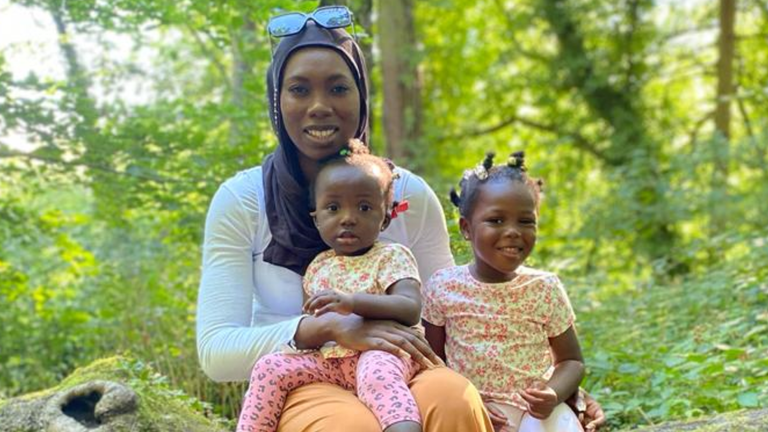
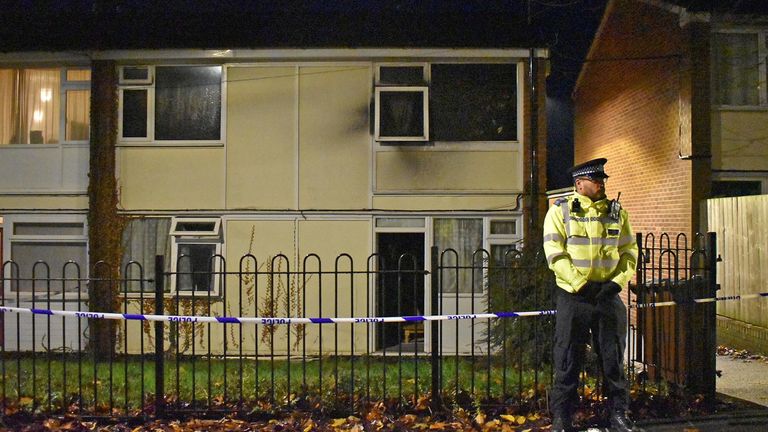
A Canadian paramedic unknowingly treated her own daughter in a fatal car accident.
Jayme Erickson was first to attend the Nov. 15 crash north of Calgary in which the passenger was trapped inside the vehicle with severe injuries. She then sat in the car and tended to the trapped woman until further medical teams arrived.
Tragically, the paramedic was not aware that the passenger involved was her 17-year-old daughter Montana — who was unrecognizable because of the severity of her injuries.
“Jayme unknowingly was keeping her own daughter alive,” Richard Reed, a paramedic and friend of Erickson, explained in a press conference Wednesday. He added that Erickson administered the medical treatment to buy the victim’s family time to say goodbye.
It wasn’t until Erickson returned home that she was met by Canadian police — and the devastating news of her daughter’s death.
“She was a fighter and she fought until the day that she died and she was beautiful,” Erickson said during the conference. “She was so beautiful. If she ever put an effort into anything she would always succeed at it.”
“We are overwhelmed with grief and absolutely gutted,” Erickson added in a GoFundMe page set up by family friend Lindsay Sandalack. “The pain I am feeling is like no pain I have ever felt, it is indescribable.”
JEFF MCINTOSH/THE CANADIAN PRESS VIA AP
“The critically injured patient I had just attended to, was my own flesh and blood. My only child. My mini-me. My daughter, Montana,” she continued. “Her injures [sic] were so horrific I did not even recognize her. I was taken to FMC to see my baby girl, and was informed her injuries were not compatible with life.”
Erickson added that she “cannot help but be angry for the short amount of time I was given with her.” Her emotional post questioned where Montana would be in adulthood — graduated, married, and living a happy life.
“I will cherish the memories we made and the time we had together,” she added. “I am shattered. I am broken. I am missing a piece of me. I am left to pick up the pieces and expected to carry on.”
The head of the International Energy Agency has said that Europe will be able to cope with the current crunch on natural gas supply because of the reserves it has, however, the situation doesn’t look too promising for next winter.
Speaking at an energy symposium in Berlin hosted by the German government, Fatih Birol said that, barring unforeseen events, “Europe will go through this winter with some economic and social headaches, bruises here and there” as a result of efforts to wean itself off Russian gas and the wider increase in energy costs resulting from the war in Ukraine.
Birol said that by next year, Russian gas supplies to Europe may end completely and emphasised that the European nations need to unite and start immediately preparing for next year’s situation.
With 75 percent of Russia’s gas exports and 55 percent of its oil going to Europe before the war, Moscow will also need to find new markets for its output, he said.
NHS Scotland health workers threatened with strike have received an improved pay offer averaging 7.5%.
Unions will now consider the Scottish government’s £515 million deal.
Before this latest proposal, First Minister Nicola Sturgeon and Health Secretary Humza Yousaf held “extensive” talks.
Unite and GMB have suspended ambulance workers’ strike and confirmed that the offer will be put to a vote among members.
Unite members from the Scottish Ambulance Service planned a work-to-rule on Friday, while 1,700 GMB members planned a 26-hour strike on Monday.
The Royal College of Nursing (RCN),the Chartered Society of Physiotherapy (CSP) and Unison had also backed strike action in the ongoing pay dispute.
The RCN, which had delayed a formal announcement on strikes while negotiations took place this week, confirmed that its board members would consider the detail of the latest offer.
Unison has recommended that members accept the deal.
The Scottish government said it was a “record high pay offer” for front line workers.
Annual pay rises under the latest deal would range from a flat rate payment of £2,205 for staff in Bands 1 to 4 and up to £2,660 for staff in Bands 5 to 7, backdated to April.
This represents an increase of 11.3% for the lowest paid workers and delivers an average uplift of 7.5%, a government spokesperson said.
The new offer also included a review into reducing the working week from 37.5 hours to 36 hours with no loss of pay.
Mr Yousaf said no stone had been left unturned to reach its “best and final pay offer”.
He said: “We have made the best offer possible to get money into the pockets of hard working staff and to avoid industrial action, in what is already going to be an incredibly challenging winter.”
Wilma Brown, from Unison, said she recognised that the new package was the best that could have been negotiated.
She told the BBC: “The new package demonstrates that we are concerned about everybody’s take-home pay these days and the professional groups have lost out a lot of money over the years during austerity and various other reasons and that this goes some way to starting to make that up.
“Is it enough? No, we would have wanted more, but we believe that this is the best deal that we will get through negotiation.”
Keir Greenaway, GMB Scotland senior organiser, said staff needed to be valued to “tackle the chronic understaffing crisis across NHS frontline services” after a decade of cuts and the Covid pandemic.
According to the state news agency, an Algerian court sentenced 49 people to death after they were found guilty of lynching a man wrongfullysuspected of starting forest fires last year.
Because there is a moratorium on executions, the sentences are likely to be reduced to life in prison.
Algeria experienced the worst fires in its history in 2021, with multiple blazes killing 90 people.
Djamel Ben Ismail, the lynching victim, had gone to help fight the fires.
After the fires broke out in August last year, the 38-year-old tweeted saying he would travel over 320km (200 miles) from his home to “give a hand to our friends” fighting the blazes in the Kabylie region, east of the capital Algiers, which was the worst-hit area.
Soon after he arrived, locals falsely accused him of starting fires himself.
On 11 August, graphic footage began circulating purportedly showing Ben Ismail being attacked. People tortured and burned him before taking his body to the village square.
The videos caused national outrage.
Mr Ben Ismail’s brother urged social media users to delete the footage of the attack. His mother, he said, still did not know how her son had died.
His father, Noureddine Ben Ismail, said he was “devastated”. “My son left to help his brothers from Kabylie, a region he loves. They burned him alive,” he said.
The AFP news agency reports that the father’s calls for calm and “brotherhood” were praised by Algerians.
The fires took place amid dry conditions and very high temperatures, but authorities also blamed “criminals” for the blazes.
The court sentenced 28 others to between two and 10 years for other offences related to the lynching, the AFP quotes the state news agency as reporting.
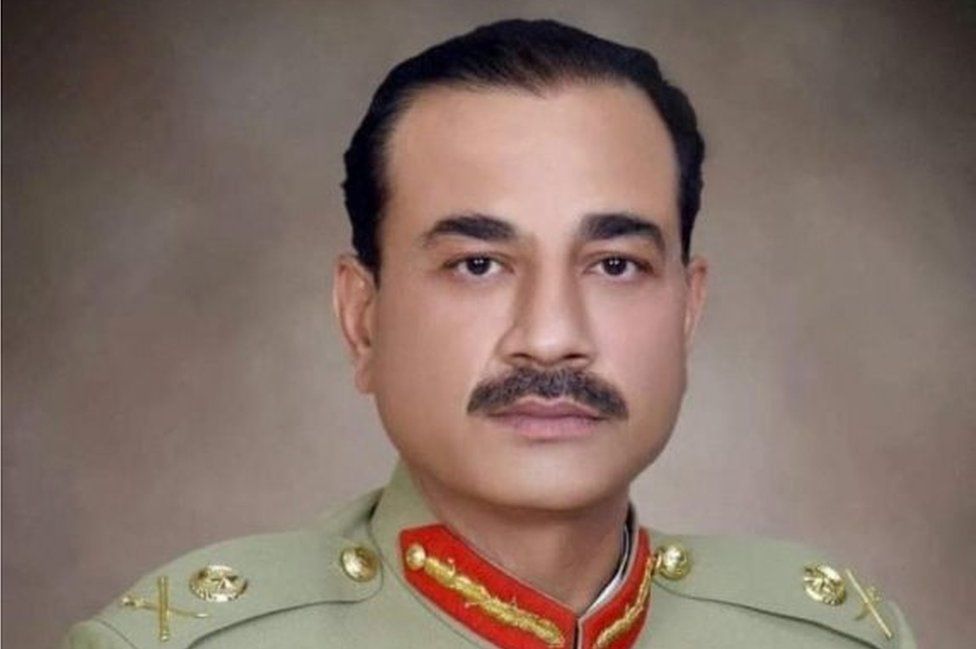
Pakistan’s government has named a new army chief ending months of speculation over who would land what many see as the country’s most powerful job.
General Asim Munir, a former spy chief, replaces General Qamar Javed Bajwa, who retires on 29 November.
Gen Munir, the army’s most senior general, is considered a close ally.
The appointment comes at a precarious time for a country where the military has always wielded great influence in politics and foreign policy.
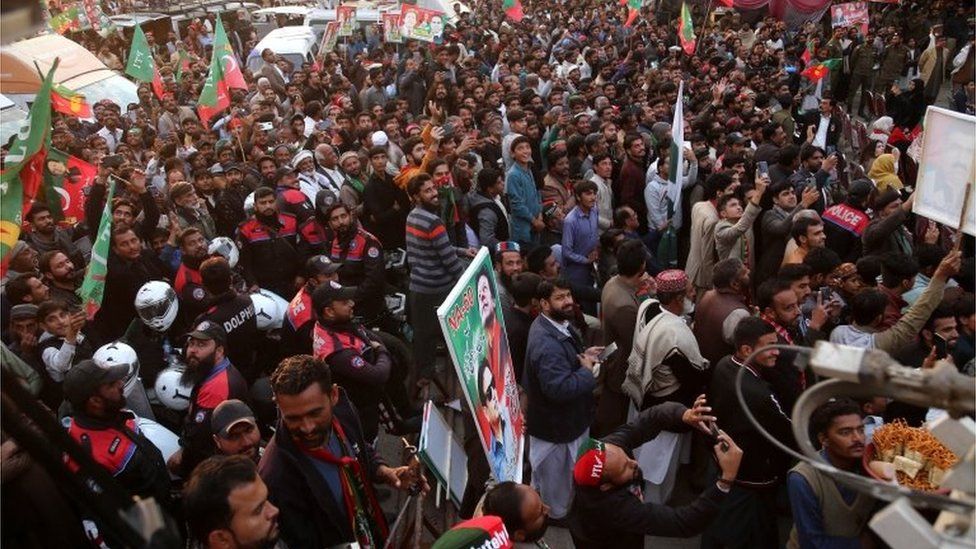
Former Prime Minister Imran Khan, who was ousted by his opponents in April, has been at loggerheads with the new government and the military over the appointment of the army chief.
Pakistan is also facing an economic crisis: exports are falling, while the cost of food is soaring. It’s also trying to recover from devastating floods earlier this year.
When Lt Gen Munir takes up his position at the end of the month, he will direct future relations with nuclear-armed rival India on one side, and the new Taliban government in Afghanistan on the other.
IMAGE SOURCE,REUTERS Image caption, Asim Munir has served as a former spymaster and is the army’s most senior general
“It’s not a political position but if you look at the post, this position has had a political role,” says Fahd Husain, special adviser to the prime minister.
Since Pakistan was created 75 years ago, the army has seized power three times and directly ruled the country for almost four decades.
Lt Gen Munir’s name was selected from a list of six potential candidates. The final decision on who becomes the next army chief is normally for the prime minister to make alone.
But the process often becomes a tussle between the outgoing army chief and the prime minister, as both try to push for someone sympathetic to their interests.
This time around, it was even more fractured. Current Prime Minister Shehbaz Sharif sought the counsel of his older brother, former Prime Minister Nawaz Sharif, who is believed to be preparing a political comeback.
Mr Khan, their political rival, spoke publicly about the appointment, saying the current leadership is corrupt and should not be allowed to make the decision.
It is widely acknowledged that Mr Khan came to power in elections in 2018 with the help of Pakistan’s army and intelligence services, despite denials from the former PM and the military.
He was then pushed out of the job in April this year after allegedly falling out with the military.
Since then, Mr Khan has publicly condemned the army and its outsized role in the country’s politics, even accusing members of the military of playing a role in an attack earlier this month when he was shot in the leg.
Those allegations are denied but Mr Khan has built a narrative among his many supporters that the army has directly inflicted harm on him and those that back him.
IMAGE SOURCE,EPA Image caption, Imran Khan supporters want him reinstated and many accuse the army of orchestrating his downfall
This week Gen Bajwa, who served two three-year terms as army chief, acknowledged the military’s role in politics over the last 70 years.
Speaking at a ceremony for those who have died in the line of duty, Gen Bajwa said that would change.
“That’s why, after a lot of thinking, the army decided not to meddle in any political affairs,” he said, adding: “I can assure you that we will strictly adhere to this and will continue to in the future.”
Fahd Hussain says under Gen Bajwa’s leadership, the army became more deeply involved in politics.
“The government and opposition parties cannot sit in the same room. There is no sign of any political dialogue. There is no move to find a political solution.”
Given this, Mr Hussain thinks the army will end up seizing control again.
Mr Masood is more hopeful, believing this could be the moment when Pakistan can strike a better balance between military and civilian rule.
“It’s a great opportunity for the next chief to really transform the very character of the military in the sense of not interfering in politics and confining itself to professional matters only,” he says.
The head of Slovakia’s central bank, Peter Kazimir, is facing bribery charges for a second time.
Prosecutors had earlier dropped charges over the alleged bribe, which goes back to when he was a finance minister.
He has condemned the allegation and denies any wrongdoing.
Mr Kazimir sits on the European Central Bank’s governing council and was Slovak finance minister from 2012 until 2019 under the centre-left government of the Smer party.
“The accusation that I should have bribed a senior [tax] official is an absolute lie,” he said in a statement from the National Bank of Slovakia. “I have not committed any crime.”
In June, the special prosecutor’s office dropped the charge, and asked prosecutors to review the case. The central bank governor’s lawyer said the National Criminal Agency’s decision to resurrect the charges disrespected the prosecutors’ decision.
Corruption has dogged Slovakia for years. When the centre left came to power in 2012 they replaced a party plagued by financial scandal and then they too were thrown out by voters who backed a new government that made tackling corruption a top issue.
Since then, dozens of public officials have been accused of corruption.
Among them is Frantisek Imrecze, a former head of the tax administration who is being prosecuted in several cases and is co-operating with the police.
Mr Kazimir was initially charged last year with corruption. According to Slovak media, he was alleged to have acted as an intermediary in giving Mr Imrecze a bribe of nearly €50,000 (£43,000).
But the case was dropped, reportedly because it was based solely on the evidence of Mr Imrecze.
Mr Imrecze has now asked for police protection after a tracking device was found under his car. Slovak media said he feared for his life.
The National Criminal Agency has charged several people, including Mr Imrecze, as part of its so-called Mytnik operation into allegations of corruption in the procurement of large IT systems for the financial administration.
Mr Imrecze resigned from his post as head of Slovakia’s financial administration in 2018 after the EU’s anti-fraud office, Olaf, uncovered alleged fraud involving undervalued textile imports entering the EU from China.
The losses are thought to have cost the EU millions of euros in underpaid customs fees and sales tax.
In 2018, a young investigative journalist who wrote about corrupt businessmen was murdered.
The killing of Jan Kuciak and his fiancée, Martina Kusnirova, triggered protests that triggered the downfall of Slovakia’s prime minister, Robert Fico, and the chief of police.
Brazil‘s electoral court has rejected a challenge against the presidential election result made by the far-right party of President Jair Bolsonaro.
He narrowly lost to the leftist former leader, Luiz Inacio Lula da Silva, and his Liberal Party (PL) claimed without evidence that voting machines were compromised.
The court said the complaint was made “in bad faith” and fined the party 22.9m reais (£3.5m; $4.3m).
Lula takes office on 1 January.
Superior Electoral Court (TSE) President Alexandre de Moraes said the PL complaint was “offensive to democratic norms” and had sought to “encourage criminal and anti-democratic movements”.
Lula’s victory – with 50.9% to Mr Bolsonaro’s 49.1% – has been ratified by the TSE.
Mr Bolsonaro has previously claimed that Brazil’s electronic voting system is not fraud-proof.
He has still not conceded defeat, but has given the go-ahead for a presidential transition. He stepped away from the public gaze after losing the election on 30 October.
Immediately after Lula’s win was declared, many lorry drivers supporting Mr Bolsonaro erected roadblocks and there were scuffles with police. But Mr Bolsonaro later told them that blocking roads was not a part of “legitimate” protests.
Some of his followers have continued demonstrating outside military barracks, urging a military intervention to prevent Lula taking office.
Lula, who previously served as president from 2003 to 2010, is now 77 and will become the oldest person to assume the post.
His victory was a stunning comeback for a politician who could not run in the last presidential election in 2018 because he was in jail and barred from public office. But his conviction for corruption was later annulled.
Mr Bolsonaro, a former army captain, drew much support from evangelical Christians and other conservatives anxious to protect family values. But his tenure also saw accelerated deforestation of the Amazon and growing inequality.
There’s growing evidence that French rescue services failed to respond adequately to a migrant boat that sank in the Channel last November, with at least 33 people on board.
Only two of the passengers survived the disaster.
Transcripts of emergency calls made to the French coastguard, seen by the BBC, suggest that desperate passengers were repeatedly told to call UK emergency services, despite being in French waters when they first requested help.
And a French police investigation, leaked to the newspaper Le Monde, appears to suggest that the French coastguard never sent help to the scene, despite a specific UK request to do so.
The BBC also heard evidence that another migrant boat was passed back and forth between the two nations’ rescue centres, just a few days before the Channel disaster.
One year on, the grey waters of the Channel still hold many secrets.
Beneath the cliffs at Cap Gris-Nez, the waves continue to slosh against the rocks; the coastline worn to a fine point, jutting out into the sea.
It’s from this clifftop that the French coastguard monitor the Channel for boats in distress, and send rescuers to help.
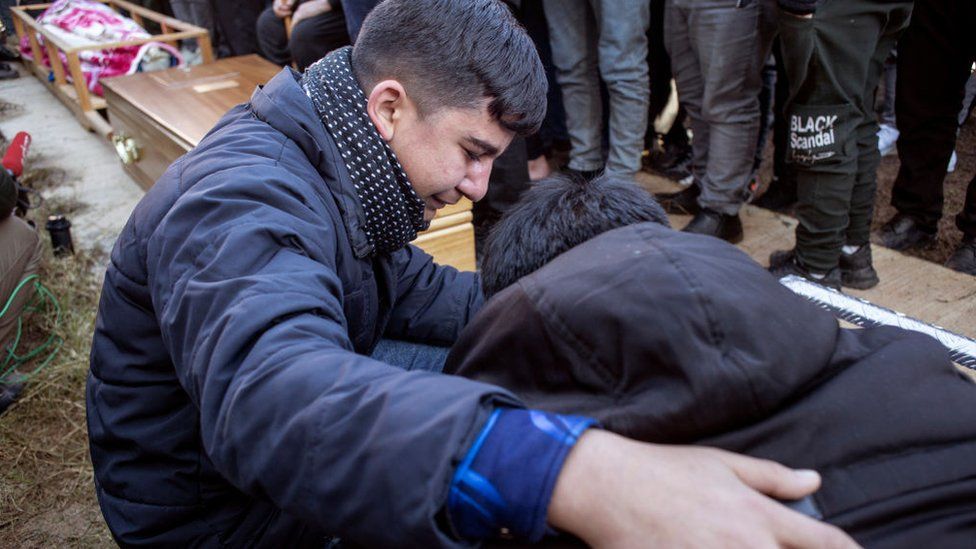
IMAGE SOURCE,GETTY IMAGES Image caption, Many of those who died were from Iraqi Kurdistan, and their bodies were repatriated there for burial
At 01:48 on 24 November last year, according to documents seen by the BBC, operators in the control room at Cap Gris-Nez received the first call from the stricken migrant boat.
The passengers were asked to send their exact location from their mobile phones. When it arrived, some fifteen minutes later, it positioned the boat more than half a mile inside French waters.
French operators alerted the UK coastguard in Dover, according to the documents. Twenty minutes later, after receiving an updated location from the boat, they sent Dover the co-ordinates, saying it was now in British waters.
Shortly afterwards, the UK sent a message saying the dial tones of mobile phones on the boat appeared to locate it in France.
But French operators continued – for more than two hours – to urge passengers to call the UK for help, documents suggest, even when a French patrol reported that the boat was still in French waters.
The newspaper, Le Monde, quoting a leaked French police report, says the UK authorities sent a rescue vessel to the scene – but that they also asked France to send its patrol boat, Le Flamant, because it was closer.
Le Flamant was never sent, the paper says.
The UK’s Maritime Accident Investigation Branch, which is leading the British inquiry, confirmed in an interim report that some of the events leading to the disaster did take place in British waters.
It said the Dover control room “dispatched UK surface and air assets to search the area where the distressed migrants were assessed to be. However, nothing was found”.
‘You won’t be saved’
One account of testimony from a French operator on duty that night, seen by the BBC, says that Le Flamant was already helping another boat in difficulty. Le Monde says the police report disputes this.
Transcripts of conversations from the night show French operators repeatedly assuring those clinging to the sinking wreckage that help was on its way, as passengers screamed in the background.
In one exchange, an operator appears to mock the caller after the line is cut, saying, “Oh well, you can’t hear me, you won’t be saved. ‘My feet are in the water’ – I didn’t ask you to leave.”
Material seen by the BBC also suggests that another boat passing close to the scene that night was turned away by French operators, after it offered to intervene.
The two survivors were eventually rescued by a fishing vessel the following afternoon.
“If these people were in French waters and if at any moment there was negligence, an error, there will be sanctions,” France’s Minister for the Sea, Hervé Berville, told parliament.
The BBC requested an interview with Mr Berville last week. His team refused the request and refused to give a comment, instead referring the BBC to the minister’s comments in parliament and adding that there is an “ongoing investigation” into the incident.
The BBC then made a request for an interview with the French Interior Minister Gérald Darmanin. His team did not respond.
But sources within the French judiciary have told the BBC they are currently considering whether to focus the investigation more closely on the role of French rescue services.
Maria Thomas, a UK lawyer representing one survivor and more than a dozen victims’ families, says there is a lack of urgency or answers from the British side. “The families want a full public inquiry, with full transparency,” she told us.
“We have concerns about the adequacy of the search and rescue operation carried out when [UK] border force assets were deployed, both in terms of the search patterns used and communication with the boat.”
‘They are laughing at us’
The question of who should take the lead in rescue operations in the Channel depends to some degree on where the incident takes place, but also where the first distress call is made from, and which nation’s resources are best placed to assist.
Those resources are increasingly stretched, as the number of small boat crossings rise. Rescue teams on both sides of the Channel can be called to save hundreds of lives in a single night. Some in France had warned this was a disaster waiting to happen.
But the apparent passing of responsibility across the Channel was not unique to this tragedy, the BBC has learned.
Another boat, full of people trying to cross to the UK, found itself in a similar position just four days before the tragedy last year.
Audio messages sent to a migrant helpline in Dunkirk on 20 November describe stranded passengers struggling to get help.
“We’ve called all the numbers,” the caller says. “When I call 999, they say to call France; and the French say call to United Kingdom. And both of them are laughing at us.”
And later: “Sir, we are still waiting and no one is coming. Really scared that no one is coming. Please, try to send someone.”
The BBC approached the UK and French coastguards for comment about these allegations too. A Maritime and Coastguard Agency spokesperson said the coastguard’s fundamental role was to “save lives at sea by responding to any person in distress”.
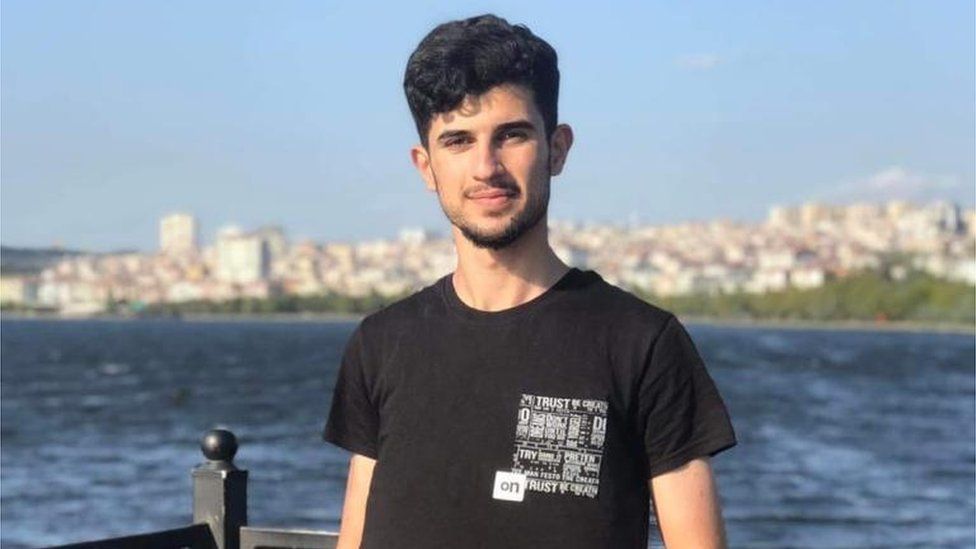
IMAGE SOURCE,BBC/COURTESY OF ZANA MAMAND MOHAMMAD Image caption, Twana was one of the dozens who died last November after their boat sank in the Channel
Rafael Cuzin was the call-handler on duty that day at the helpline, run by the charity Utopia56.
“The location of the boat was really close to the UK waters,” he said. “I called the French coastguard. They said that the UK coastguard had let the boat drift into French waters.”
A French lifeboat was sent to rescue them. “[But] it could have ended badly,” says Rafael. “That situation really echoed what happened on 24th.”
Zana Mamand Mohammad’s brother Twana was one of those who never returned from the Channel. Last week, Zana retraced his brother’s journey from Iraqi Kurdistan to France, to testify in the investigation here.
“I told him a hundred times: your life is more important than anything else,” Zana told me. “These people were not seen as human beings.”
“You can see [from the transcripts] how awful it is,” said Zana’s lawyer Thomas Ricard.
“We need to understand exactly how this articulation between the two coastguards functions: whether there is a logistical issue, whether there is a resources issue, whether there is a human side of things. If anyone is liable, that needs to be investigated.”
Twana’s body has never been found; another part of this story held by the waters of the Channel.
In the year since the tragedy some 40,000 people have crossed from France to the UK in small boats; the waters still lap at the French coastline beneath Cap Gris-Nez, whispering their fickle promise to carry small boats from shore to shore.
Polish leaders say that the air-defence system which Germany offered Polandwould be best given to Ukraine to help it protect itself against Russian strikes.
Earlier this week, Germany offered Warsaw Eurofighter planes and Patriot defence systems to help defend Poland’s airspace after a stray missile exploded in a border village.
Poland’s Defense Minister Mariusz Blaszczak initially said he received Germany’s offer with “satisfaction.”
However, following Wednesday’s air strikes the Polish leader said it would be better if the defence systems were placed in western Ukraine.
The head of Poland’s ruling party, Jaroslaw Kaczynski, called Germany’s offer “interesting,” but said he believed “it would be best for Poland’s security if Germany handed the equipment to the Ukrainians, trained Ukrainian teams, with the caveat that the batteries would be placed in Ukraine’s west.”
Marriyum Aurangzeb, the Minister of Information, announced the appointment on Twitter, putting an end to weeks of speculation about the powerful position. Lieutenant General Asim Munir has been named as Pakistan’s new army chief by Prime Minister Shehbaz Sharif.
Marriyum Aurangzeb, the information minister, announced the appointment on Twitter on Thursday, putting an end to weeks of speculation about what some call the most powerful position in the South Asian nation.
For nearly half of Pakistan’s 75-year history, the military has directly ruled the country of 220 million people.
Lieutenant General Sahir Shamshad will take charge as the chairman of the Joint Chiefs of Staff Committee, Aurangzeb added in her tweet.
Munir will replace General Qamar Javed Bajwa who will end his six-year tenure as army chief on November 29.
PM Sharif held a cabinet meeting earlier on Thursday where he selected Munir from a list of six nominees for the top military post.
Munir is currently posted at the army headquarters in Rawalpindi. He has served briefly as chief of the country’s premier intelligence agency, the Inter-Services Intelligence (ISI).
Will president approve?
Defence minister Khawaja Asif said the names of Munir and Shamshad have been sent for approval to President Arif Alvi, who is also the supreme commander of Pakistan’s armed forces.
Alvi belongs to the opposition Pakistan Tehreek-e-Insaf (PTI) party, headed by former Prime Minister Imran Khan, who earlier accused the government of trying to pick a favourite as the army chief.
In a tweet, defence minister Asif wondered if Alvi “will pay heed to political advice or to the constitutional and legal advice”.
“Now this is Imran Khan’s test if he wants to strengthen the institution which defends the country or make it controversial. It is also a test for President Alvi,” Asif wrote.
Soon after Aurangzeb’s announcement on Twitter, the official handle of Khan’s PTI quoted its chief as saying both him and Alvi “will act according to constitution and law”.
Former defence secretary and retired army officer, Asif Yasin Malik, told Al Jazeera Munir has an “impeccable reputation” in the military.
“In the military, your reputation matters a great deal and Asim Munir is very well regarded for his competence and capabilities. So far, his career has been without any controversy and I think he can be a very good chief,” he said, hoping the presidential approval of the nomination goes smoothly.
Islamabad-based security analyst Muhammed Faisal said the new army chief will take charge at a time when the country is in crisis.
“The new chief has to navigate complex political, internal and external challenges, with the economic crisis being the most urgent, as was acknowledged even by the outgoing army chief,” he told Al Jazeera.
After days of haggling and the intervention of the monarch, a veteran politician finally secures the top position after an inconclusive election.Anwar Ibrahim has been sworn in as Malaysia’s 10th prime minister, capping an incredible comeback for a man who was initially groomed for the job in the 1990s before being abruptly fired and imprisoned.
The 75-year-old veteran politician took the oath of office in front of King Sultan Abdullah Sultan Ahmad Shah at the palace in Kuala Lumpur shortly after 5 p.m. (09:00 GMT) on Thursday afternoon, just hours after the monarch appointed him to the top job.
PH and the rival conservative Malay-Muslim Perikatan Nasional (PN) coalition under former Prime Minister Muhyiddin Yassin, which had the second-highest number of seats, both began negotiations to form a government, wooing smaller coalitions in the Borneo states of Sabah and Sarawak as well as Barisan Nasional (BN), the alliance that dominated Malaysia for some 60 years before its historic defeat in the last elections in 2018.
With neither able to make a breakthrough, the king met Anwar and Muhyiddin, as well as newly elected members of parliament to canvas their views on who should lead the new government.
After a meeting of the royal households on Thursday, Anwar was announced as the leader because the king was convinced he had the support of the majority of Malaysia’s 222 members of parliament.
There are “no absolute winners and no absolute losers,” King Sultan Abdullah said in the statement, urging all politicians to work together for the benefit of the country.
Following his inauguration, Anwar said he would shoulder the duties entrusted to him with “utmost humility”.
“With my team, I will carry out this heavy responsibility based on the people’s aspirations,” he said in a Twitter post.
Amanah akan digalas dengan penuh tawaduk dan bertanggungjawab.
“It is a long time coming for Anwar,” Asrul Hadi Abdullah Sani, the deputy managing director at consultancy BGA Malaysia, told Al Jazeera. “All his struggles and campaigns for reform are now vindicated.”
Sodomy charges
Anwar Ibrahim started his political career as a student activist, founding the Muslim Youth Movement of Malaysia, known by its Malay acronym ABIM, in 1971 and later leading protests against rural poverty and on other socioeconomic causes.
His activism caught the eye of then-Prime Minister Mahathir Mohamad who persuaded him to join the United Malays National Organisation (UMNO), the dominant party in BN, which had ruled Malaysia since independence in 1957.
Anwar rose rapidly through the ranks to become finance minister and deputy prime minister, earning a reputation as a charismatic, ambitious and reform-minded politician.
But as the Asian financial crisis deepened, Mahathir turned on the man he had chosen as his successor.
In September 1998, Anwar was sacked and accused of corruption and sodomy, a crime in Malaysia.
Thousands took to the streets of Kuala Lumpur and Anwar, who maintained the charges were politically motivated, was arrested.
His trial veered from the shocking – a black eye later confirmed to be inflicted by the then-police chief while Anwar was in custody – to the absurd – a stained mattress hauled into court as evidence.
Anwar Ibrahim’s sacking in 1998 and then trial on charges of corruption and sodomy kickstarted Malaysia’s reform movement [File: Andy Wong/AP Photo]
After being found guilty, Anwar was released in 2004 and a second sodomy trial followed as the reform movement that had begun with his 1998 downfall gathered momentum.
In all, Anwar spent some 10 years in prison before he was finally pardoned and released in 2018.
By that time he had once again joined forces with Mahathir – under the PH banner – in a bid to ensure BN was punished at the ballot box for the multibillion dollar scandal at state fund 1MDB.
But Anwar’s route to the top was again thwarted when Mahathir wavered on his promise to hand over power and the PH government collapsed amid infighting and pressure from Malay-Muslim conservatives.
Reform agenda
Chants of “reformasi” or reform continued to reverberate around PH rallies in the campaign leading up to Saturday’s election, with PH supporters looking for a government that would tackle corruption, defend democratic freedoms and ensure the independence of key institutions such as parliament and the judiciary.
In the face of a probable economic slowdown, Anwar told supporters that his government would also reduce the size of the cabinet, and cut ministerial salaries and allowances.
Still, any moves to reform could still be stymied by more conservative factions.
Malaysia is a multi-ethnic, multi-religious country where most people are ethnic Malay Muslim, but there are significant numbers of people of Chinese and Indian origin as well as Indigenous communities.
The previous PH government was partly undone by a reform agenda that Malay nationalists feared would undermine the privileges granted to them under the constitution.
Such pressures could also affect the new government, given the surge in support for PAS, Malaysia’s religiously conservative Muslim party, which emerged from the election with the most seats of any single party.
It is also the dominant player in PN.
Wong Chin Huat, a political expert and professor at Sunway University outside Kuala Lumpur, says Anwar needs “to get the politics right” to be able to fix the economy.
“He needs to be PM for 100 percent of Malaysians, not just the 38 percent PH voters and 22 percent BN voters,” Wong explained to Al Jazeera. “He needs to especially assure the 30 percent of voters who support PN that their voices will be heard.”
Official figures from Saturday’s election showed a record number of Malaysians casting their ballots, with PH securing 5.81 million votes, PN 4.67 million and BN 3.43 million.
The electoral roll had been enlarged after a constitutional change to give 18-year-olds the right to vote and for automatic voter registration, which further increased uncertainty over the outcome.
Nine in every 10 people can catch it if they are unvaccinated and exposed.
As well as causing a distinctive rash, measles can lead to severe complications such as pneumonia and brain inflammation, and can sometimes be fatal.
Vaccination can remove almost all of these risks.
Two doses of the MMR vaccine give 99% protection against measles and rubella and about 88% protection against mumps.
When a high percentage of the population is protected through vaccination, it becomes harder for the disease to pass between people.
But since the start of the Covid pandemic, there has been a concerning drop in the number of children receiving these vaccines on time.
In 2020, 23 million children missed out on all basic childhood vaccines. That’s the highest number seen since 2009 and 3.7 million more than in 2019, according to Unicef.
Authorities in Mumbai say that around 20,000 children did not get their measles vaccine on time because of the pandemic.
“Now, we are tracking all these children and holding vaccination camps on priority,” Dr Mangala Gomare, Mumbai’s executive health officer, told The Indian Express newspaper.
Health officials say other issues such as vaccine hesitancy are also hobbling the drive.
“After vaccination, some children develop mild fever and pain in the injected area, so parents don’t let them get vaccinated,” Shreya Salvi, a health volunteer, told the newspaper.
Afghansare giving their hungry children medicines to sedate them – others have sold their daughters and organs to survive. In the second winter since the Taliban took over and foreign funds were frozen, millions are a step away from famine.
“Our children keep crying, and they don’t sleep. We have no food,” Abdul Wahab said.
“So we go to the pharmacy, get tablets and give them to our children so that they feel drowsy.”
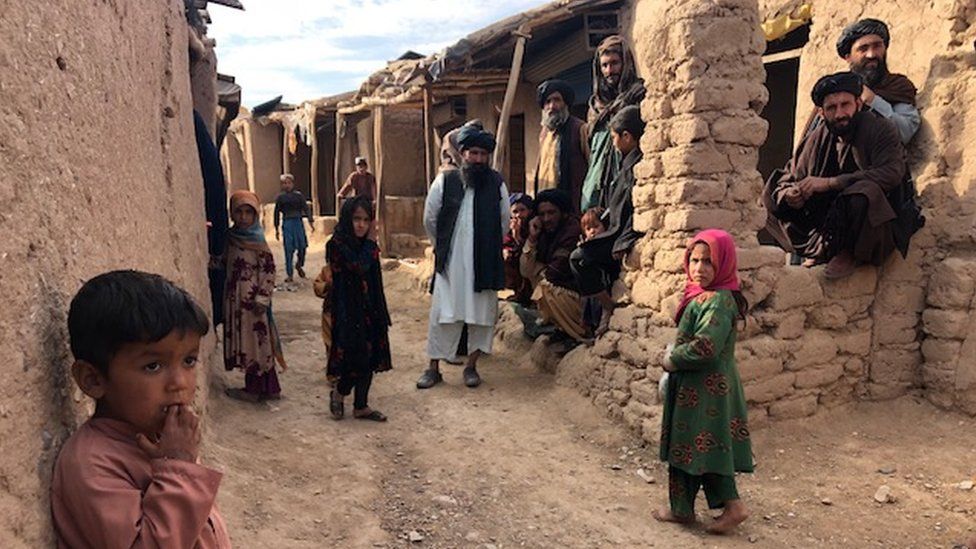
He lives just outside Herat, the country’s third largest city, in a settlement of thousands of little mud houses that has grown over decades, filled with people displaced and battered by war and natural disasters.
Abdul is among a group of nearly a dozen men who gathered around us. We asked, how many were giving drugs to their children to sedate them?
“A lot of us, all of us,” they replied.
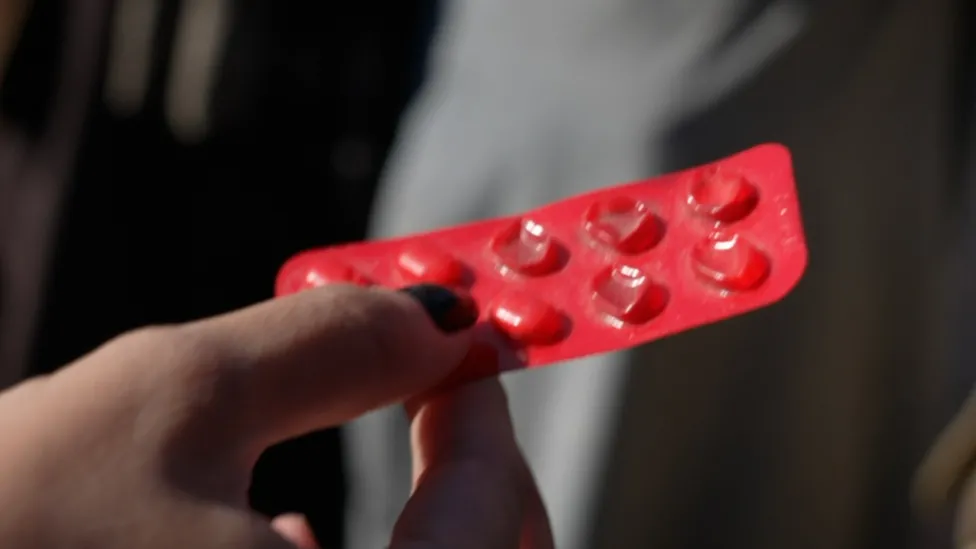
Ghulam Hazrat felt in the pocket of his tunic and pulled out a strip of tablets. They were alprazolam – tranquilisers usually prescribed to treat anxiety disorders.
Ghulam has six children, the youngest a year old. “I even give it to him,” he said.
Others showed us strips of escitalopram and sertraline tablets they said they were giving their children. They are usually prescribed to treat depression and anxiety.
Doctors say that when given to young children who do not get adequate nutrition, drugs such as these can cause liver damage, along with a host of other problems like chronic fatigue, sleep and behaviour disorders.
Image caption, The men in this area outside Herat are struggling to find work
At a local pharmacy, we found that you can buy five tablets of the drugs being used for 10 Afghanis (about 10 US cents), or the price of a piece of bread.
Most families we met were sharing a few pieces of bread between them each day. One woman told us they ate dry bread in the morning, and at night they dipped it in water to make it moist.
The UN has said a humanitarian “catastrophe” is now unfolding in Afghanistan.
A majority of the men in the area outside Herat work as daily wage labourers. They have been leading difficult lives for years.
But when the Taliban took over last August, with no international recognition for the new de-facto government, foreign funds flowing into Afghanistan were frozen, triggering an economic collapse which left the men with no work on most days.
On the rare day they do find work, they make roughly 100 Afghanis, or just over $1 (£0.83).
Everywhere we went, we found people being forced to take extreme steps to save their families from hunger.
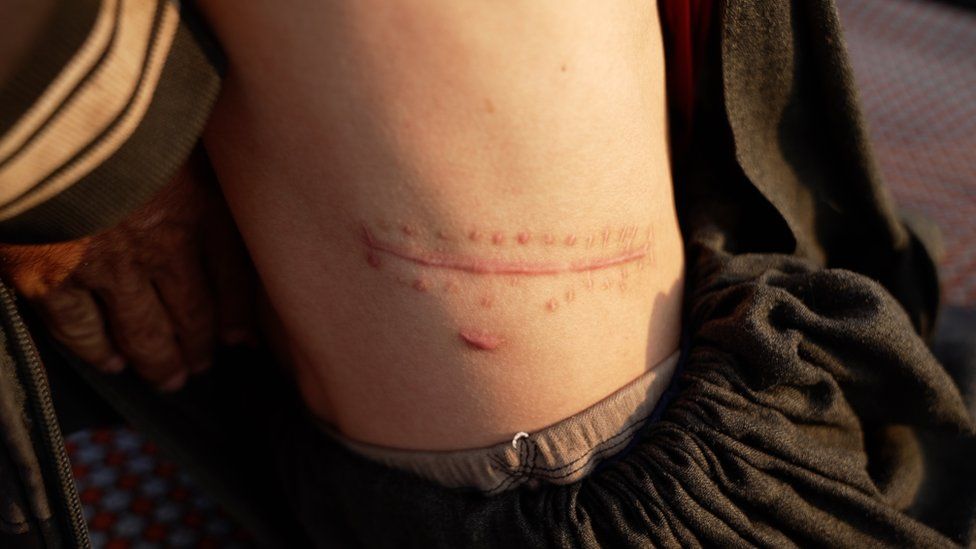
Ammar (not his real name) said he had surgery to remove his kidney three months ago and showed us a nine-inch scar – stitch marks still a bit pink – running across his abdomen from the front of his body to the back.
He’s in his twenties, in what should have been the prime of his life. We’re hiding his identity to protect him.
“There was no way out. I had heard you could sell a kidney at a local hospital. I went there and told them I wanted to. Some weeks later I got a phone call asking me to come to the hospital,” he said.
“They did some tests, then they injected me with something that made me unconscious. I was scared but I had no option.”
Image caption, Ammar said he had his kidney removed for payment three months ago
Ammar was paid about 270,000 Afghanis ($3,100) for it, most of which went into repaying money he had borrowed to buy food for his family.
“If we eat one night, we don’t the next. After selling my kidney, I feel like I’m half a person. I feel hopeless. If life continues like this, I feel I might die,” he said.
Selling organs for money is not unheard of in Afghanistan. It used to happen even before the Taliban takeover. But now, even after making such a painful choice, people are finding that they still cannot find the means to survive.
In a bare, cold home we met a young mother who said she sold her kidney seven months ago. They also had to repay debt – money they had borrowed to buy a flock of sheep. The animals died in a flood a few years ago and they lost their means of earning a living.
The 240,000 Afghanis ($2,700) she got for the kidney are not enough.
“Now we are being forced to sell our two-year-old daughter. The people we have borrowed from harass us every day, saying give us your daughter if you can’t repay us,” she said.
“I feel so ashamed of our situation. Sometimes I feel it’s better to die than to live like this,” her husband said.
Over and over again, we heard of people selling their daughters.
“I sold my five-year-old daughter for 100,000 Afghanis,” Nizamuddin said. That’s less than half what a kidney goes for, according to what we found on the ground. He bit his lip, and his eyes welled up.
The dignity that people here led their lives with has been broken by hunger.
“We understand it’s against Islamic laws, and that we’re putting our children’s lives in danger, but there’s no other way,” Abdul Ghafar, one of the heads of the community, said.
Image caption, Nazia is still living with her family but has been sold to be married when she is 14
In one home we met four-year-old Nazia, a cheerful little girl who made funny faces as she played with her 18-month-old brother Shamshullah.
“We have no money to buy food, so I announced at the local mosque that I want to sell my daughter,” her father Hazratullah said.
Nazia has been sold to be married to a boy from a family in the southern province of Kandahar. At 14, she will be sent away. So far Hazratullah has received two payments for her.
“I used most of it to buy food, and some for medicine for my younger son. Look at him, he’s malnourished,” Hazratullah said, pulling up Shamsullah’s shirt to show us his bloated belly.
The staggering rise in malnutrition rates is evidence of the impact that hunger is already having on children under the age of five in Afghanistan.
Médecins Sans Frontières (MSF) has seen the rate of admissions at their facilities treating malnutrition across the country increase by as much as 47% this year over the last.
MSF’s feeding centre in Herat is the only well-equipped malnutrition facility catering not just to Herat, but also to the neighbouring provinces of Ghor and Badghis, where malnutrition rates have gone up by 55% over the last year.
Since last year, they’ve increased the number of beds they have to cope with the number of sick children they’re having to admit. But even so, the facility is almost always more than full. Increasingly the children arriving have to be treated for more than one disease.
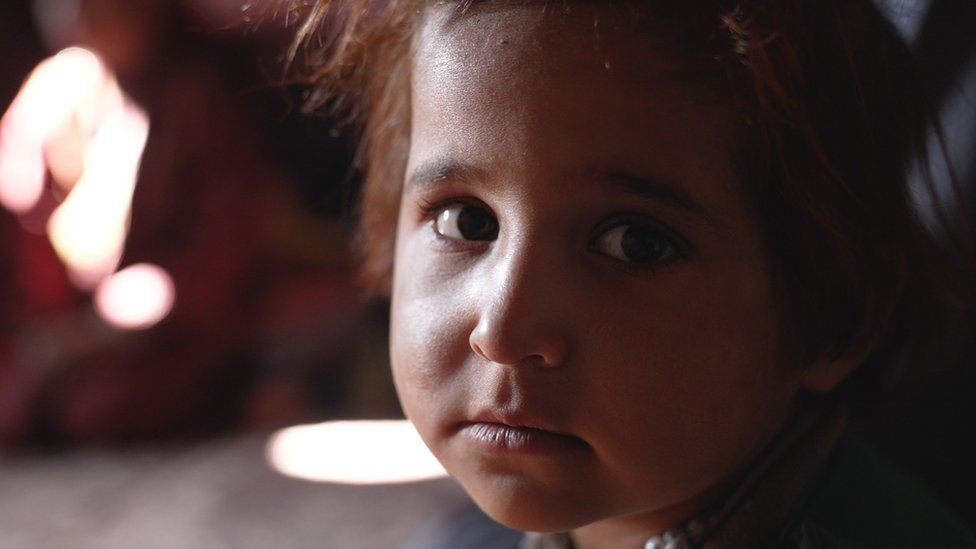
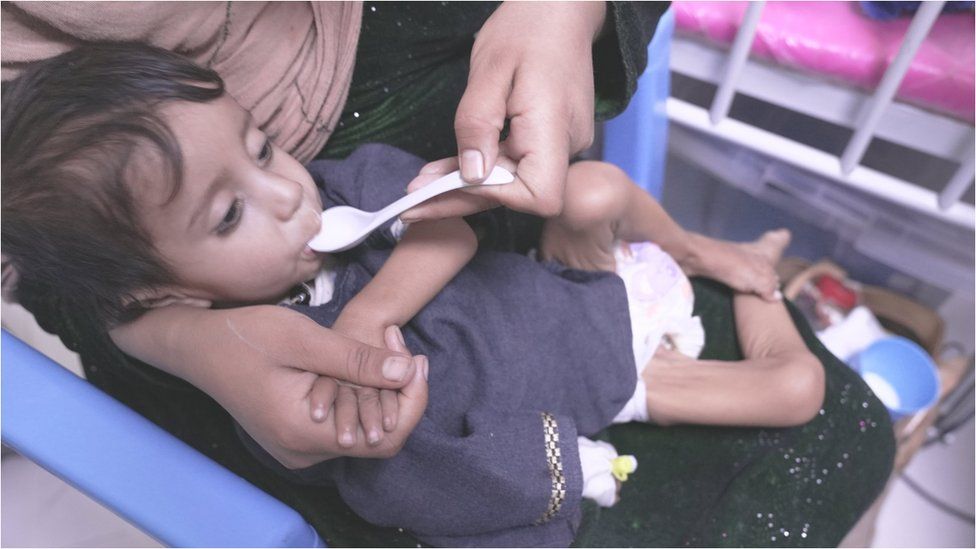
Omid is malnourished, and has hernia and sepsis. At 14 months, he weighs just 4kg (9lb). Doctors told us a normal baby at that age would weigh at least 6.6kg. His mother Aamna had to borrow money to make the journey to the hospital when he began to vomit profusely.
Image caption, Omid is 14 months old but weighs much the same as a newborn baby
We asked Hameedullah Motawakil, spokesman of the Taliban’s provincial government in Herat, what they were doing to tackle hunger.
“The situation is a result of international sanctions on Afghanistan and the freezing of Afghan assets. Our government is trying to identify how many are in need. Many are lying about their conditions because they think they can get help,” he said. It’s a stance he persisted with despite being told that we have seen overwhelming evidence of how bad the situation is.
He also said the Taliban were trying to create jobs. “We are looking to open iron ore mines and a gas pipeline project.”
It’s unlikely that will happen soon.
People told us they felt abandoned, by the Taliban governmentand the international community.
Hunger is a slow and silent killer, its effects not always immediately visible.
Away from the attention of the world, the scale of the crisis in Afghanistan might never truly come to light, because no one is counting.
Rats were blamed by police in India for destroying nearly 200kg (440lb) of cannabis seized from dealers and kept in police stations.
“Rats are tiny animals and they have no fear of the police. It’s difficult to protect the drug from them,”according to a court in the state of Uttar Pradesh.
The court had ordered the police to produce the stash as evidence in drug-trafficking cases.
The judge cited three instances in which rodents destroyed marijuana.
According to an order issued by Judge Sanjay Chaudhary, when the court asked the police to produce the seized drug as evidence, it was told that 195kg of cannabis had been “destroyed” by rats.
In another case involving 386kg of the drug, the police filed a report saying “some” of the cannabis was “eaten up by the rats”.
Judge Chaudhary said some 700kg of marijuana seized by the police was lying in police stations in Mathura district and that “all of it was under danger of infestation by rats”.
He said the police had no expertise in dealing with the matter as the rats were “too small”. The only way to protect the seized goods from “such fearless mice”, he added, was to auction the drugs to research labs and medicine firms, with the proceeds going to the government.
MP Singh, a senior police official of Mathura district, told reporters that some of the marijuana stored in police stations under his vicinity had been “damaged due to heavy rains” and not destroyed by rats.
In 2018, eight Argentinian police officers were fired after they blamed mice for the disappearance of half a ton of cannabis from a police warehouse. But experts disputed the claim, saying that the animals were unlikely to confuse the drug for food and “if a large group of mice had eaten it, a lot of corpses would have been found in the warehouse”.
A study published in 2019 found that when laboratory rats were given cannabis-laced dough, they “tended to become less active and their body temperature also was lowered”.
In 2017, police in the eastern Indian state of Bihar had blamed rats for consuming thousands of litres of confiscated alcohol, a year after the state banned the sale and consumption of alcohol.
In 2018, technicians who arrived to fix a malfunctioning cash machine in the state of Assam found that currency notes worth more than 1.2m rupees ($14,691; £12,143) had been shredded – and the suspected culprits were rats.
A day after its iPhone factory in China was rocked by angry protests, Apple supplier Foxconn apologised for a “technical error” in its payment systems.
Hundreds of workers were seen marching at the world’s largest iPhone factory in Zhengzhou, with complaints about Covid restrictions and claims of unpaid wages.
Workers were beaten by police, according to those who were livestreaming the protests.
According to one Foxconn employee, the situation has since been resolved.
The factory was locked down last month due to rising Covid cases, prompting some workers to break out and go home. The company then hired new employees with the promise of large bonuses.
But one worker said these contracts were changed so they “could not get the subsidy promised“, adding that they were quarantined without food.
On Thursday, Foxconn released a statement saying a “technical error occurred during the onboarding process”, adding that the pay of new recruits was “the same as agreed [in the] official recruitment posters”.
The firm said it was in constant communication with the affected employees about the the pay and bonuses and was doing its best “to actively solve the concerns and reasonable demands of employees”.
A worker also told the BBC on Thursday that he had since received 8,000 yuan ($1,120; £926) and was set to receive another 2,000 yuan. He added that there were no more protesters and that he and his colleagues would return to the Foxconn factory.
The Zhengzhou plant employs more than 200,000 people, making Apple devices including the iPhone 14 Pro and Pro Max.
Separately on Thursday, authorities ordered the city to go into lockdown, saying people would not be able to leave the area unless they had a negative Covid test – affecting more than six million people in the city.
It came as China recorded its highest number of daily Covid cases since the pandemic began, with the country seeing a wave of outbreaks with several major cities like Beijing and Guangzhou affected.
The International Monetary Fund (IMF) has called on China to recalibrate its zero-Covid strategy as its economic growth shrinks.
The world’s second largest economy has seen its gross domestic product (GDP) fall by 2.6% in the three months to the end of June from the previous quarter.
“Although the zero-Covid strategy has become nimbler over time, the combination of more contagious Covid variants and persistent gaps in vaccinations have led to the need for more frequent lockdowns, weighing on consumption and private investment, including in housing,” the IMF said.
The global financial organisation also called on Beijing to vaccinate more people and offer further relief to its crisis-hit property sector.
However, some analysts believe the IMF’s guidance will not convince China to change its policies.
“Given that China is unlikely to be going to the IMF for help, it doesn’t really matter whether they pay attention to this statement or not,” Simon Baptist, global chief economist of The Economist Intelligence Unit, told the BBC.
The World Cup has received a lot of attention in Chinese state media this week, but the matches are fueling frustrations that people in the country are being left out of the festivities.
Aside from China’s men’s national team failing to qualify, scenes of maskless celebrations and raucous gatherings in Qatar have irritated viewers, who have been discouraged from gathering to watch the games.
Many people have used the World Cup to express their displeasure with China’s current policies. To prevent the virus from spreading, the country maintains a zero-Covid policy, in which entire communities are shut down over single cases of the virus.
China is currently experiencing its worst outbreak in six months, and localised lockdowns have surged over the last couple of weeks. In the past 24 hours, China has recorded more than 28,000 new cases; these are in every single provincial-level region.
Football is very popular in China. President Xi Jinping is known for being a lover of the sport, and he has spoken previously of it being a dream for the country to win the World Cup .
As a result, matches are being shown on national broadcaster CCTV, and state media have sought to amplify China’s “presence”. The Global Times has reported on how China-made products “ranging from buses to the [Lusail] stadium, and even air conditioning units are well represented at the event”.
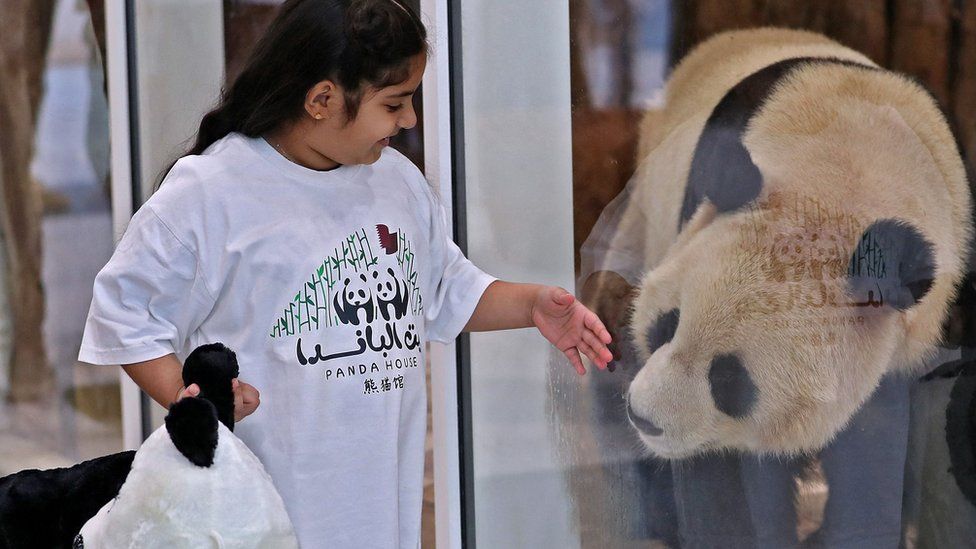
Leading outlets such as CCTV have also promoted the presence of Chinese flagbearers at the opening ceremony, and how two giant pandas arrived in Qatar to “meet” visitors arriving for the event.
IMAGE SOURCE,GETTY IMAGES Image caption, A child plays with one of the Chinese giant pandas given to Qatar to mark the start of the World Cup
But it is evident that Covid-19 has put a damper on the celebrations. In major cities, outbreaks have resulted in non-essential businesses once again closing, and people being urged to limit their movements.
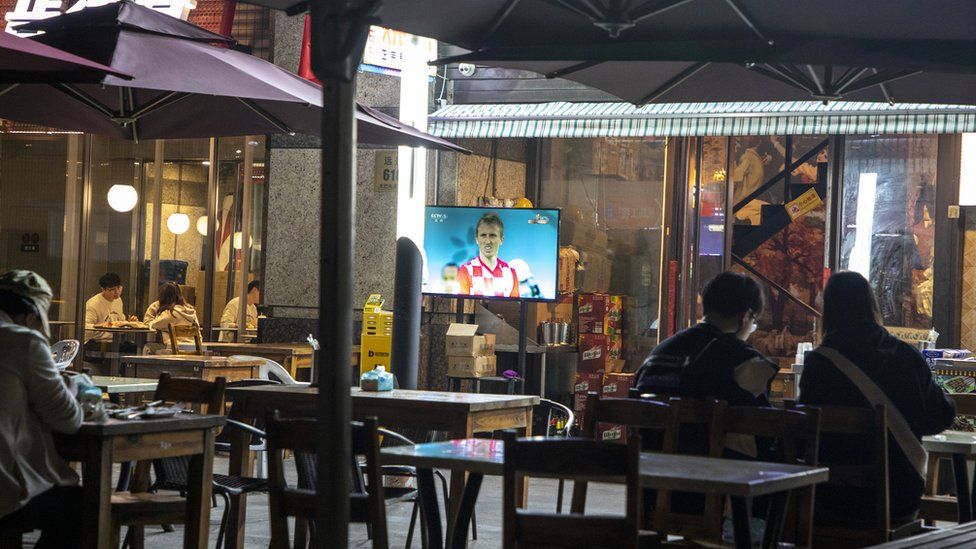
With no bars to go to, the Global Times newspaper says some fans are “choosing to watch the games at home with their families”. Others have also reportedly taken to camping sites.
IMAGE SOURCE,GETTY IMAGES Image caption, This was the scene in a sparsely filled pub in Shanghai while the World Cup was being shown
Many are feeling acute isolation watching this year’s event.
An open letter questioning the country’s continued zero-Covid policies and asking if China was “on the same planet” as Qatar quickly spread on mobile messenger WeChat on Tuesday, before being censored.
Comments on the Twitter-like Weibo social network are rife from viewers who speak about how watching this year’s matches is making them feel divided from the rest of the world.
Some speak of their perception that it is “weird” to see hundreds of thousands of people gathering, without wearing masks or needing to show evidence of a recent Covid-19 test. “There are no separate seats so people can maintain social distance, and there is nobody dressed in white and blue [medical] garb on the sidelines. This planet has become really divided.”
“On one side of the world, there is the carnival that is the World Cup, on the other are rules not to visit public places for five days,” one says.
Some say they have had difficulty explaining to their children why the scenes from the World Cup are so different to those people face at home.
There are many in China, though, who have been critical of countries overseas opening up while the World Health Organization still calls the Covid-19 virus an “acute global emergency”.
However, there is no end in sight to China’s existing measures. This week, the National Health Commission spokesman “warned against any slacking in epidemic prevention and control” and urged “more resolute and decisive measures” to bring cases under control.
Local governments in major cities have reintroduced mass testing and travel restrictions and ultimately delivered a message that people should try to stay at home.
But after three years of such measures, people are frustrated, resulting in protests in the last month in both the cities of Guangzhou and Zhengzhou.
Due to high-tech 3D scanners, security restrictions on liquids and laptops in airport hand luggagecould be eliminated in the UK within two years.
The government is considering deploying more advanced scanners by mid-2024, according to a source, though no final decision has been made.
The equipment, which is similar to CT scanners used in hospitals, provides a clearer picture of the contents of a bag.
Due to the pandemic, an earlier installation deadline was pushed back.
According to the Times, ministers have been conducting a review, and an announcement is expected before Christmas, with the hope of reducing queues at UK airports.
Currently, passengers taking liquid in their cabin baggage are restricted to clear plastic bags holding no more than 100ml, which must be shown to security staff in a single, transparent, resealable plastic bag of about 20cm (8in) x 20cm.
Those limits have been in place since November 2006. Their introduction ended a ban on liquids in the cabin imposed three months earlier, when British police said they had foiled a plot to blow up as many as 10 planes using explosives hidden in drinks bottles.
But the new technology enables staff to zoom in on a bag’s contents and rotate the images for inspection.
The 3D scanners have been trialled at London Heathrow Airport, starting in 2017.
Its chief executive, John Holland-Kaye, told The Times newspaper: “We are slowly rolling them out.
“We have just started the expansion of the security area in Terminal 3 which will have more CT scanners and have a deadline of mid-2024 from the [Department for Transport]. By then the normal passenger experience will be that liquids stay in bags.”
The technology has already been in use by US airports, such as Atlanta’s Hartsfield-Jackson and Chicago’s O’Hare, for a number of years.
Former Prime Minister Boris Johnson made a pledge to use the scanning technology to speed up pre-boarding checks and improve security, giving UK airports a deadline of the end of 2022.
But passenger numbers were dented during the pandemic with travel restrictions in place across much of the globe.
The latest figures from the International Air Transport Association for September show that passenger traffic levels have only reached 73% of pre-Covid levels.
A spokeswoman for the Department for Transport said: “Passengers at UK airports must not carry liquid containers larger than 100ml through security, and both liquids and electronics should be taken out of cabin bags at airport security checkpoints.”
Ghana, ranked 61st in the world, are the tournament’s lowest-ranked team and that is partly because of their poor showing at the Africa Cup of Nations (Afcon), where the Black Stars failed to win a game and finished bottom of their group.
Since that failure coach, Otto Addo has recruited from the diaspora and Belgium-born Odoi, who plays for Club Bruges, is one of the newcomers who helped the squad qualify for Qatar ahead of fierce West African rivals Nigeria.
“The journey has been positive,” Odoi, 34, told the BBC World Service.
“I think sometimes you have to be deep to grow from that and learn from that. I think that’s what these these experiences brought.
“Obviously, Afcon was a very bad performance – one of the worst in the last few years and decades. We managed to grow and learn from that process.”
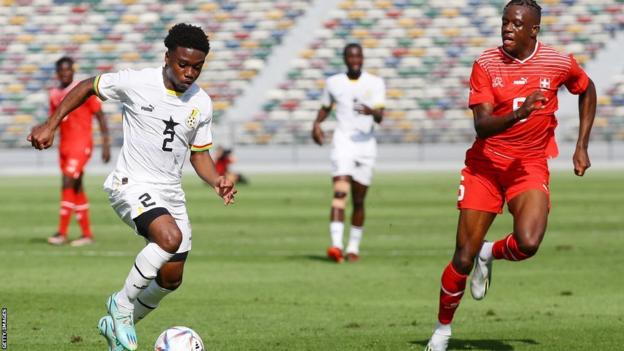
Addo won only one of his first seven games in charge of Ghana but the side have recorded victories in their past two friendlies against Nicaragua and Switzerland.
The latter was an impressive 2-0 triumph in Abu Dhabi last week, and Odoi says fellow new recruits, including Athletic Bilbao forward Inaki Williams, are settling in well.
“We’ve used this last week to fit everybody in and to get used to the system and practice the defensive and offensive battles,” the former Fulham full-back said.
“And everybody gets to know each other a little bit better on the pitch.”
Despite their low ranking, Odoi believes Ghana are capable of upsetting Portugal, who were European champions in 2016.
“Everyone knows Portugal players are of a high level,” he said.
“We still have to play the game. It is not like Portugal has won this game. I am sure they are aware of that.
“If you look at the performances of other African counties, and Saudi Arabia[against Argentina], you still have to play the game.”
Lamptey ‘settling in quickly’
Tariq Lamptey’s first two caps for Ghana have come in friendlies against Brazil and Switzerland
Meanwhile, Brighton & Hove Albion wing-back Tariq Lamptey is among those poised to make his competitive debut for Ghana.
The former England Under-21 international has featured in two friendly matches since switching allegiance in July – a decision his parents supported.
“They always said to me that they’re proud of whoever I represent,” Lamptey, 22, told the BBC’s World Football podcast.
“Ultimately, I was born in England, and they’re from Ghanaian background. Making my debut against Brazil was a really proud moment for both me and my family. It was a surreal feeling against some of the best players in the world.
“It’s every little boy’s dream to play football at the highest level. If I’m selected, then I will try and do my best.”
Lamptey joined Ghana for friendlies against Brazil and Nicaragua in France in September, and says he settled into the squad quickly.
“They were very welcoming and I was just able to get on the training pitch and get to work,” he said,
“Off the pitch, I knew a few of the boys before but it was really good to get to know everyone. It’s a good group.”
The reaction of the Black Stars fans, both on social media and from the stands, has also been important to Lamptey.
“I just want to say a massive thank you to the fans, because their love and support has definitely been received well,” the former Chelsea youngster said.
“I’m really grateful to have great fans like that.”
The country is facing blackouts as rockets rain down on several cities, with at least four people killed in Kyiv.
A Russian barrage on Ukrainian infrastructure has knocked out power in large areas of the war-torn country, as well as parts of neighbouring Moldova.
When a rocket struck a two-story building in Kyiv on Wednesday, at least four civilians were killed and nine were injured, according to authorities.
As Moscow continues its campaign to cripple Ukraine’s essential services ahead of the impending winter, multiple regions have reported attacks in quick succession.
President Volodymyr Zelenskyy had previously stated that Russian strikes had already damaged roughly half of Ukraine’s infrastructure.
Ukrainian officials say they believe Russian President Vladimir Putin is hoping that the misery of unheated and unlit homes in the cold and dark of winter will turn public opinion against a continuation of the war, but they say it is having the opposite effect and is strengthening Ukrainian resolve.
Kyiv Mayor Vitali Klitschko said Wednesday that “one of the capital’s infrastructure facilities has been hit” and there were “several more explosions in different districts” of the city.
Power outages also affected the northern city of Kharkiv, the western city of Lviv, the Chernihiv region in northern Ukraine and the Odesa region in the south.
Anton Gerashchenko, a Ukrainian ministerial adviser, noted that the attacks came moments after the European Parliament declared Russia a “state sponsor of terrorism”.
Rockets hit Kyiv right after European Parliament recognized Russia as a state sponsor of terrorism.
In Moldova, Infrastructure Minister Andrei Spinu said, “We have massive power outages across the country.” Its Soviet-era energy systems remain interconnected with Ukraine’s.
There was a similar outage in the country of 2.6 million people on November 15.
“Russia left Moldova in the dark,” its pro-Western president, Maia Sandu, said, adding that her nation “must remain toward the free world”.
Power also was out in most parts of western Ukraine’s Khmelnytskyi region, Governor Serhii Hamalii said on Telegram. He added that a nuclear power plant in the region was disconnected from the Ukrainian electricity grid.
“This was the latest of several rounds of similar waves of missile strikes, basically designed to cripple Ukraine’s power infrastructure to plunge the country into darkness,” said Al Jazeera Rory Challands, reporting from Kyiv. “There may be more to come.”
He added that “there’s no evidence” of Russia breaking the will of the Ukrainian people, according to the many people he has interviewed in recent weeks.
The latest onslaught came hours after Ukrainian authorities said a rocket attack destroyed a hospital maternity ward in southern Ukraine, killing a two-day-old baby boy.
After the overnight strike in Vilniansk, close to the city of Zaporizhzhia, the baby’s mother and a doctor were pulled alive from the rubble.
The region’s governor said the rockets were Russian. The strike adds to the gruesome toll suffered by hospitals and other medical facilities – and their patients and staff – in the Russian invasion, which will enter its 10th month this week.
First lady Olena Zelenska wrote on Twitter: “Horrible pain. We will never forget and never forgive.”
‘The chaos of the war’
The situation is also concerning in the southern city of Kherson, from which Russia retreated nearly two weeks ago after occupying it for months.
Many doctors there are working in the dark, unable to use elevators to transport patients to surgeries and operating with headlamps, cell phones and flashlights. In some hospitals, key equipment no longer works.
“Breathing machines don’t work, X-ray machines don’t work,” said Volodymyr Malishchuk, the head of surgery at a children’s hospital in Kherson. “There is only one portable ultrasound machine, and we carry it constantly.”
Meanwhile, Save the Children raised the alarm on Wednesday as freezing weather sets in.
“An average of about 900 children a day are being born into a life of uncertainty,” said Sonia Khush, the charity’s director in Ukraine. “The chaos of the war poses a serious threat to these mothers and newborns. We’re hearing accounts of women who’ve gone into labour early because of their constant state of stress and fear.
“At the start of the war, many pregnant women were forced to give birth in basements or bunkers,” she said. “Now, we’re seeing women give birth in overwhelmed hospitals, away from family members, and in countries hosting refugees from Ukraine.Even though there are fewer women giving birth in bunkers compared to earlier this year, their pregnancies are still just as stressful.”
Journalists Megan Twohey and Jodi Kantor helped expose Harvey Weinstein as asexualpredator,propelling the #MeToo movement into the global consciousness, and emboldening women around the world to speak out about sexual abuse.
Carey Mulligan says meeting one of the New York Times’ reporters whose article brought down Harvey Weinstein “was rockstar crush stuff”.
The film She Said shows the efforts that went into Megan Twohey and Jodi Kantor’s Pulitzer-prize winning journalism in 2017 which exposed Harvey Weinstein, then one of Hollywood’s most influential producers, as a sexual predator.
Their work brought about a global reckoning on the sexual abuse of women with the #MeToo movement.
Image: Jodi Kantor and Megan Twohey won a Pulitzer prize for their work helping to expose Weinstein
Mulligan – who plays Twohey to Zoe Kazan’s Kantor – told Sky News she was “hugely intimidated” meeting the writers.
“It was rockstar crush stuff…Zoe was in New York and met [them] in person originally, I was still in the UK and so my first meeting was on Zoom, but I was hugely intimidated.
“Not that they’re intimidating people,” Mulligan laughs, “they couldn’t be more lovely, but they are just so impressive, I think we just both wanted them to be happy!”
Shot in the actual New York Times newsroomand with the pace unfolding like a thriller, the film follows the efforts of the journalists to persuade scared sources to go on the record.
Kantor says she and Twohey were “just flabbergasted” to see their investigation turned into a film.
“We started out by investigating a Hollywood producer, so we’re still a little confused about how likenesses of ourselves ended up on the big screen but listen, we’re really moved by it.
“One of the messages of this story, especially as time recedes, is that the number of people who really gave us publishable information about Harvey Weinstein was so small. In the end, we’re talking about like a conference room worth of people and yet look at the impact they had worldwide.”
Mulligan – who’s widely tipped to be Oscar-nominated for the role – says few “could have anticipated what the impact would be” but, in terms of the film industry she says she’s seen “lots of concrete changes” as a result.
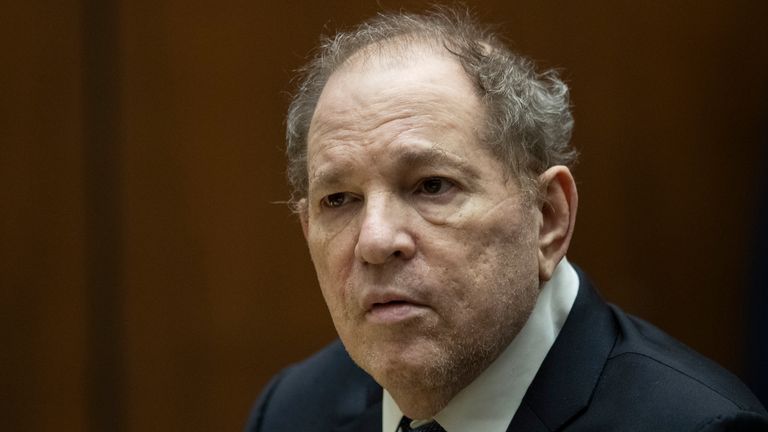
Image: Harvey Weinstein is currently serving 23 years in jail
“Codes of conduct, workshops that are for the whole cast and crew that talk about what is expected on set in terms of behaviour – that never existed before,” she explains.
Speaking of how intimacy coordinators are now considered “crucial”, the actress says “we did this for a long time before that was a thing and it’s still sort of shocking to look back and think that was never in place before, it just seems like such an obvious need on a film set.”
Mulligan says the movement the article triggered has even influenced how scripts are written nowadays.
“The way the female characters are described in screenplays now, it’s not perfect but there’s definitely there’s a big shift from, you know, ‘Gorgeous girl in a bikini, beautiful but she doesn’t know it…’ you’re seeing markedly less of that, which I think is very welcome.”
The 41-year-old, from Frimley in Surrey, lost his right leg in a motorcycle accident when he was 19 and went on to compete for Great Britain at the Paralympic Games.
John McFall, from Frimley in Surrey, was selected by the ESA to join its training programme and could be the first disabled person to go into space.
The 41-year-old lost his right leg in a motorcycle accident when he was 19 and went on to compete for Great Britain and Northern Ireland at the Paralympic Games.
No major Western space agency has ever put a “para-astronaut” into space, according to the ESA.
Mr McFall will join the space training corps to see if he can be the first disabled person to go into space.
He said the opportunity was “inspiring and exhilarating”.
He added: “With my broad scientific background and a vast range of experiences, I felt compelled to try and help ESA answer this question: Can we get someone with a physical disability to do meaningful work in space?”
British astronomer Rosemary Coogan has also been named as a member of the new cohort.
Ms Coogan has two master’s degrees from the University of Durham and a doctorate in astronomy from the University of Sussex.
She is among six career astronauts to join the ESA workforce as permanent staff members.
The career astronauts also include Sophie Adenot from France, Pablo Alvarez Fernandez from Spain, Raphael Liegeois from Belgium and Marco Sieber from Switzerland.
Image: Rosemary Coogan
Meganne Christian, who was born in the UK and studied in Australia,successfully completed the astronaut selection process and will become a member of the ESA’s astronaut reserve.
The reserve team consists of candidates who were successful throughout the entire selection process and were not recruited.
Image:Sophie Adenot
They were among over 22,500 candidates who applied, a list which included more women than ever and some 200 people with disabilities.
Some 1,361 were invited to phase two of ESA’s astronaut selection following a comprehensive screening phase. The pool was narrowed to just over 400 candidates during phase three.
During the ESA’s last call for astronauts in 2008, 8,413 provided a medical certificate and finalised their online application.
Among them was Tim Peake, who became the first British astronaut to be part of the ESA corps.
The finalist candidates have undergone intensive screening over the past year.
Dr Paul Bate, chief executive of the UK Space Agency, said: “This is a momentous day for the UK Space Agency, our space sector and the country as a whole.
“Through our investment in the European Space Agency, the UK is playing a leading role in space exploration and collaborating with international partners to use the unique vantage point of space to benefit life on Earth.”
“Space has an incredible power to inspire and I am sure Rosemary, John and Meganne will become heroes for many young people and inspire them to shoot for the stars.
“It’s also important to remember that, behind every astronaut, there is a dedicated team of people, including in the UK, working behind the scenes to achieve the incredible.”
Matt Hancockhas been heavily chastised for appearing on the reality show, and his Tory whip has been suspended for joining at a time when parliament is in session.
Matt Hancock violated the government’s post-ministerial job rules by failing to consult parliament’s anti-corruption watchdog before appearing on I’m A Celebrity… Get Me Out of Here!, according to the body’s Tory chairman.
“I am writing to you in my capacity as chair of the Advisory Committee on Business Appointments (Acoba) to bring to your attention a breach of the government’s business appointment rules,” Lord Pickles said in a letter to Cabinet Office Minister Oliver Dowden.
“Mr Hancock did not seek Acoba’s advice before signing up to two television series, ITV’s I’m A Celebrity…Get Me Out of Here! and Channel 4’s SAS Who Dares Wins.”
Under the rules, Mr Hancock should seek clearance from Acoba for any new employment or appointments he takes on within two years of leaving office.
Lord Pickles said it was up to Mr Dowden to decide “what appropriate action to take”.
However, he recommended that no further action should be taken.
He said “given the transparent nature of Mr Hancock’s role which is limited to appearing on these shows… I believe it would be disproportionate to take any further actionin this case”.
Image:Pic: ITV/Shuttershock
In a letter to Lord Pickles earlier this month, Mr Hancock claimed he did not believe he needed to ask the body’s permission for either show “as the guidelines state that one-off media appearances such as these do not count as an appointment or employment”.
But, writing to Mr Hancock, Lord Pickles said: “The rules are clear that an application is required where individuals plan a series of media activities and it is for Acoba to assess the associated risks.
“As such, failing to seek and await advice before these roles were announced or taken up in this case is a breach of the government’s rules and the requirements set out in the ministerial code.”
Image:Pic: ITV/Shuttershock
A spokesperson for Mr Hancock said: “The Acoba website clearly states that it does not regard media appearances as an appointment or employment. The guidance on the website was followed in good faith.”
Mr Hancock has faced strong criticism for appearing on the reality show and had the Tory whip suspended for joining at a time when parliament is sitting.
The West Suffolk MP has previously stressed the first thing he will do after leaving the jungle will be to return to Suffolk and hold a surgery with his constituents.
Russian air attacks have destroyed much of Ukraine’s power infrastructure, leaving people unable to light or heat their homes.
Ukraine’s government has promised to set up shelters to provide heat and water after relentless Russian air attacks that have left its power structure in tatters as temperatures drop and snow falls.
Special “invincibility centres” will be set up around the country to provide citizens with electricity, heat, water, internet, mobile phone connections and a pharmacy, President Volodymyr Zelenskyy said in his nightly video address on Tuesday. The centres will be free of charge and operate 24 hours a day.
Russian attacks have led to prolonged power cuts for as many as 10 million residents at a time. Ukraine has urged people to conserve energy, and the national power grid operator said on Tuesday that the damage had been colossal.
“If massive Russian strikes happen again and it’s clear power will not be restored for hours, the ‘invincibility centres’ will go into action with all key services,” Zelenskyy said.
Ukraine’s Prime Minister Denys Shmyhal said this week that some 8,500 power generator sets were being imported into Ukraine every day.
Much of Ukraine saw its first snow of the winter over the past week.
Authorities have warned of power cuts that could affect millions of people until the end of March – the latest fallout from Russia’s nine-month invasion that has already killed tens of thousands, uprooted millions and pummelled the global economy.
Russia’s attacks on Ukrainian energy facilities follow a series of battlefield setbacks that have included a retreat of its forces from the southern city of Kherson.
A week after being retaken by Ukrainian forces, residents in Kherson were tearing down Russian propaganda billboards and replacing them with pro-Ukrainian signs.
“The moment our soldiers entered, these posters were printed and handed over to us. We found workers to install the posters, and we clean up the advertisement off as quickly as possible,” said Antonina Dobrozhenska, who works at the government’s communications department.
Russian missiles hit a maternity hospital in the Zaporizhzhia region killing a baby, regional governor Oleksandr Starukhsaid on the Telegram messaging service early on Wednesday.
The Reuters news agency was not able to independently verify the report. Russia denies launching attacks on civilians.
Battles also continue to rage in the east, where Russia is pressing an offensive along a stretch of front line west of the city of Donetsk, which has been held by its proxies since 2014. The Donetsk region was the scene of fierce attacks and constant shelling over the past 24 hours, Zelenskyy said.
In Crimea, the Black Sea peninsula that Russia annexed from Ukraine in 2014, Russian air defences were activated and two drone attacks were repelled on Tuesday, including one launched on a power station near Sevastopol, the regional governor said. Sevastopol is the home port of Russia’s Black Sea fleet.
Russian-installed Governor Mikhail Razvozhaev called for calm and said no damage had been caused.
‘Stock up on warm clothes’
The World Health Organization warned this week that hundreds of Ukrainian hospitals and healthcare facilities lacked fuel, water and electricity, and that residents faced a life-threatening winter.
“Ukraine’s health system is facing its darkest days in the war so far. Having endured more than 700 attacks, it is now also a victim of the energy crisis,” Dr Hans Kluge, the WHO regional director for Europe, said in a statement after visiting Ukraine.
Sergey Kovalenko, the head of YASNO, which provides energy for Kyiv, advised citizens to “stock up on warm clothes, blankets … think about options that will help you get through a long outage.”
Russia’s attacks on energy infrastructure are a consequence of Kyiv being unwilling to negotiate, Russia’s state news agency TASS quoted Kremlin spokesman Dmitry Peskov as saying last week.
Russia invaded Ukraine on February 24 claiming it was carrying out a “special military operation” to protect Russian-speaking communities.
Ukraine and its allies say Russia’s actions constitute an unprovoked, imperialist land grab in a neighbouring state that it dominated when the two countries were part of the former Soviet Union.
Western responses have included financial and military aid for Kyiv – it received 2.5 billion euros ($2.57bn) from the EU on Tuesday and is expecting $4.5bn in US aid in coming weeks – and waves of sanctions on Russia.
The school served 22 students from four different villages in the southern occupied West Bank region, where Palestinian residents face forcible displacement.
Israeli forces demolished a newly constructed Palestinian primary school in the southern occupied West Bank’s Masafer Yatta region, where residents facethe ongoing threat of forced displacement.
According to locals and officials, the Israeli army raided the area on Wednesday morning and demolished the school in the village of Isfey al-Fauqa.
“The Israeli occupation forces demolished a school while it was in session and students were inside,” said Nidal Younis, the head of Masafer Yatta’s local council.
“They used sound bombs to scare the children and get them out of the school,” he explained.
The Israeli High Court of Justice revoked on Wednesday an interim injunction freezing a demolition order against the school, according to the Norwegian Refugee Council.
The Coordinator of Government Activities in the Territories – COGAT, the Israeli military body responsible for administrative affairs in the occupied West Bank – said it demolished a building built illegally in an area designated as a closed firing zone.
The institution was built about a month ago and had been operating for less than two weeks. It served 22 students from four different villages in Masafer Yatta, up to the fifth grade.
It is one of more than a dozen schools built across the occupied West Bank under a programme by the Palestinian Authority’s Ministry of Education with funding from the European Union, Fadi al-Umour, an activist from Masafer Yatta, told Al Jazeera.
All the schools built as part of this project are located in Area C – the 60 percent of the occupied West Bank under full Israeli military control – and are intended to challenge Israeli restrictions on Palestinian development there.
The European Union Delegation to the Palestinians said that it was “appalled by the news” of the demolition.
The Palestinian Ministry of Education condemned the demolition in a statement on Wednesday morning and described it as a “heinous crime”.
“It is an addition to the series of ongoing crimes by the occupation against the educational sector, and its targeting of children, students, educational cadres, and institutions [is] without regard for international charters and laws,” the statement continued, adding that such practices are “a flagrant violation of students’ right to safe and free education”.
The ministry said it had organised, just a day prior to the demolition, a visit by a delegation of diplomats and United Nations officials to the Isfey al-Fauqa school.
#MasaferYatta residents welcomed us today at the Isfey Al Fauqa school, which is under imminent threat of demolition, along with 4 other schools. Hampering access to education pressures these Palestinian communities to leave their homes #SaveMasaferYatta#stopdemolitionspic.twitter.com/nrFUDifUtH
The school demolition comes days after an 18-year-old Palestinian student was shot dead by Israeli forces while he was on his way to school just outside of the Jenin refugee camp in the northern Israeli-occupied West Bank.
Al-Umour, who is the coordinator of Masafer Yatta’s protection and resilience committee, explained that “the construction of the Isfey school had not yet been completed when it was demolished, but the school was already operating”.
He added that the army also confiscated furniture from the school, including the students’ chairs, and said the school serves the four villages of Tuba, Isfey al-Fauqa, Isfey al-Tahta, and Mughayyer al-Adeed.
The nearest other school to the villages is about four kilometres away.
“This occupation targets everything – it targets our homes, education, our water, solar panels,” said Younis, the council head. “They think this will pressure people to leave so that they can displace them, so that they can ethnically cleanse Masafer Yatta.”
Masafer Yatta, which falls in Area C, is a region south of Hebron, where some eight villages, home to more than 1,200 Palestinians, including 500 children, are facing imminent forced displacement by Israeli authorities based on a May 2022 ruling by Israel’s High Court of Justice.
The ruling concluded a more than two-decade legal battle waged by the residents against their displacement. The Israeli army now has the green light to demolish their homes and force them out at any moment under the pretext that they live in an Israeli army “firing zone”.
Many families in this region lived there prior to Israel’s occupation of the West Bank in 1967. They make their living as shepherds and farmers, but face a myriad of oppressive Israeli military policies including restrictions on maintaining and developing their homes, and barriers to accessing the electricity grid and water network.
They are also surrounded by a belt of illegal Israeli settlements and live under systematic Israeli police, army and settler violence.
An international digital campaign has been launched by activists and action groups in Palestine and abroad, under the hashtag #SaveMasaferYatta, in the hope of drawing attention to the imminent risk facing the residents and pressuring Israel to cease its displacement efforts.
Boris Johnson’s claim that Germanywanted Ukraine to “fold” in its war with Russia is “utter nonsense”, a German government spokesman has said.Earlier today, the former prime minister claimed other European nations took very different views on the war in Ukraine, with Germany allegedly preferring a quick Ukrainian defeat over a long conflict.
He told CNN Portugal: “This thing was a huge shock… we could see the Russian battalion tactical groups amassing, but different countries had very different perspectives.
“The German view was at one stage that if it were going to happen, which would be a disaster, then it would be better for the whole thing to be over quickly, and for Ukraine to fold.”
The ex-PM also said France was in denial “right up until the last moment” when Russian forces crossed the border.
However, Chancellor Olaf Scholz’s spokesman, Steffen Hebestrei, has refuted the claims and said Berlin had swiftly decided to send arms to Ukraine after Moscow launched its invasion.
“We know that the very entertaining former prime minister always has a unique relationship with the truth; this case is no exception,” he said.
Gareth Johnsonaccused the group of causing “misery and mayhem” and asked the prime minister to take the extreme measure.
Just Stop Oil should be labelled a terrorist organisation, a Tory MP has said.
Gareth Johnson urged Rishi Sunak to make the environmental group a “proscribed” organisation, a term for groups involved in terrorism, at Prime Minister’s Questions this afternoon.
“These people are not protesters, they are criminals,” he said.
“Will the prime minister therefore consider making Just Stop Oil a proscribed organisation so that they can be treated as the criminal organisation they actually are?”
Mr Sunak agreed the protests had caused “mass misery for the public” and claimed they “put people in danger”.
But he did not go as far as agreeing with the MP’s suggestion, saying: “The police have our full support in their efforts to minimise this disruption and tackle reckless and illegal activity.
“The Public Order Bill will give them the powers they need.”
Proscribing an organisation is a measure available to the home secretary under the Terrorism Act 2000 if they think a group commits, participates, prepares, promotes or encourages terrorism.
It makes being a member of the group illegal, as well as “expressing an opinion or belief that is supportive of a proscribed organisation”, and can result in up to 14 years in prison and a fine.
There are 78 groups on the government’s list, including Islamic and far right extremists.
Just Stop Oil wants the government to commit to ending all new licenses and consents for the exploration, development and production of fossil fuels in the UK.
The group’s recent actions have attracted a lot of attention, after they staged four days of protests on the M25.
In all 63 people were arrested during the protest, with 58 later being charged.
A spokesperson from the group said: “Gareth Johnson is right to be cross about the disruption caused by supporters of Just Stop Oil – but as we saw in the floods, days after the M25 actions were halted, the terror and mayhem from extreme weather events cannot be arrested, injuncted or proscribed.
“But the government can end the disruption today, by following the advice of the United Nations, the International Energy Agency and the world’s scientists and ending new oil and gas.”
The spokesperson also said the members were “ordinary people who use all possible peaceful means to protect all they love”, adding: “Gareth Johnson needs to read some climate science, to face up to reality and then seek to protect his constituents by calling for the end to new oil and gas.”
Malawian police arrested former President Peter Mutharika’s stepson as part of an investigation into the discovery of an unmarked mass grave in the northern Mzimba district last month.
Malawian authorities said the 30 bodies found were most likely Ethiopian immigrants.
According to police, their investigations led to the arrest of Tadikira Mafubza as well as the impoundment of a vehicle suspected of transporting the deceased men.
A pathologist who is part of the team performing autopsies on the bodies said that preliminary results have been presented to Malawi police and that a full report will be submitted at the end of the month.
Malawi is grappling with the problem of human trafficking in which organised syndicates traffic men, women and children from East African countries including Ethiopia and Somalia. From Malawi they are further trafficked to South Africa, Europe and the United States.
Syndicates are thought to involve influential Malawians.
In 2020, the Malawi High Court sentenced former Home Affairs Minister Uladi Mussa and an immigration officer to five years imprisonment for helping non-Malawians obtain Malawi passports.
Mr Tadikira has not made any public comments, but the former governing Democratic Progressive Party have described the arrest as part of a political witchhunt against Mr Mutharika’s family and his supporters.
Israeli police says, a 16-year-old boy was killed and 14 others were injured in two suspected bomb attacks at Jerusalem bus stops.
The explosions occurred as people were leaving for work in two busy areas on the city’s outskirts.
According to Israeli media, the teen who died was Aryeh Shtsupak, an Israeli-Canadian religious student.
At one point, Israel’s internal security minister stated that this was “an attack we haven’t seen in a long time.”
In a year of increasing violence, the city’s atmosphere feels volatile: Palestinian gun and knife attacks have targeted Israelis, and Israeli military raids have killed Palestinian gunmen and civilians in the occupied West Bank.
A return to the use of explosives in Jerusalem makes it one of the most significant attacks of its kind in years.
No group has so far said it was behind the blasts. However, the Palestinian militant groups Hamas and Islamic Jihad both praised the perpetrators of what they referred to as the “operation”.
The first explosion happened in Givat Shaul, close to the main entrance to Jerusalem, just after 07:00 (05:00 GMT) on Wednesday.
Israeli medics said the blast wounded 12 people, including the teenage boy who died later at the Shaare Zedek Medical Center.
About 30 minutes later, there was a second blast in Ramot Junction, another entrance to the city. It left three people with minor injuries.
At the scene of the first explosion, the pavement was scattered with debris. Masked Israeli security forces sealed off the site, while the pieces of a badly damaged bicycle were put into forensics bags.
One man from a Jewish ultra-Orthodox neighbourhood opposite told the BBC that he was woken as his building shook. Many of those waiting for buses were apparently from the community.
A small protest was also taking place with a sign held by young Israeli men calling for “revenge”.
IMAGE SOURCE,EPA Image caption, A bus in Ramot Junction was pocked with what appeared to be shrapnel from the blast
The head of the Israeli police’s operations division, Deputy Commissioner Sigal Bar Zvi, said the bombs were made with “high quality” explosives and that they were placed in a bush and behind a wall at the bus stops.
Given the nature of the attacks, she added, investigators suspect they were masterminded by an organised cell.
Israeli media cited security sources as saying that both devices contained nails and were likely to have been detonated remotely.
Earlier, Police Commissioner Kobi Shabtai said the attacks were unlike any seen in recent times.
Officers were scanning “all possibly hazardous areas, whether at bus stations, buses or crowded areas” for more bombs and were “making an effort to get our hands on whoever committed this terror attack”.
Bombings were a feature of the second Palestinian intifada, or uprising, which began two decades ago. But Jerusalem has not seen one since 2016.
Outgoing Prime Minister Yair Lapid convened a special meeting with the country’s security chiefs.
In an address at a ceremony in Jerusalem, Israeli President Isaac Herzog said: “This terror attack will not weaken us, will not make us doubt our belief in our ways, or in our right to a peaceful and safe life in Israel, including in our eternal capital of Jerusalem.”
The attacks come as Prime Minister-designate Benjamin Netanyahu and his Likud party continue negotiations to form a new coalition government with allied far-right and religious parties. They won a majority in parliament in an election that centred on security.
“We still have a fight with cruel terror, which raise its head again,” Mr Netanyahu warned as he visited survivors of the attacks in hospital. “We will do anything to bring back the security for the citizens of all Israel as soon as possible.”
Ultra-nationalist Otzma Yehudit (Jewish Power) party leader Itamar Ben-Gvir, who is set to become Mr Netanyahu’s internal security minister and oversee the police force, visited the scene of the first explosion and declared that Israel had to take action to deter Palestinian attacks.
“Even if it’s in the West Bank, lay siege to them and go from house to house in search of guns and restore our deterrence power,” he said.
Canada’s ambassador to Israel, Lisa Stadelbauer, said she was “heartbroken to confirm that a young Canadian lost his life in this morning’s reprehensible terror attack in Jerusalem”.
“Our sincere condolences to his family and friends, and to others wounded in this attack. Canada continues to condemn all forms of terror.”
The US ambassador to Israel, Tom Nides, tweeted that an 18-year-old Israeli-American named Naomi Pilichowski was among those wounded in what he called the “heinous terrorist attack”. Her father, the educator and author Rabbi Uri Pilichowski, said she had suffered a small cut.
White House spokeswoman Karine Jean-Pierre said the US condemned “unequivocally the acts of terror” in Jerusalem and that it had “offered all appropriate assistance to the government of Israel as it investigates the attack and works to being the perpetrators to justice”.
We reported earlier that a senior lawyer has been appointed by Rishi Sunak to look into complaints of bullying behaviour by Deputy Prime Minister Dominic Raab.
Commercial and employment law specialist Adam Tolley KC will look into the claims made against Mr Raab after two formal complaints were submitted about his conduct.
Mr Raab requested the independent investigation after the formal complaints about his actions.
However, Downing Street said Mr Sunak will not have to act on any findings made by the investigation because as prime minister he remains the ultimate arbiter of the ministerial code.
Now, Liberal Democrat chief whip Wendy Chamberlain has said the prime minister must “commit” to sacking Mr Raab if the official investigation confirms the allegations of bullying made against him.
“The prime minister must commit now to sacking Dominic Raab if complaints about his bullying are upheld. Anything less would make a mockery of his promise to bring back integrity,” the MP for North East Fife said in a statement.
“It’s only been four weeks, and already Rishi Sunak has repeatedly turned a blind eye to allegations of inappropriate behaviour by Conservative ministers.
“This can’t be yet another case of one rule for Conservative MPs and another rule for everyone else.
“Every day brings yet more sleaze and scandal, while families round the country pay the price for this endless Conservative chaos.”
The Liberal Democrats have also called on Mr Sunak to publish the report in full within 24 hours of receiving it.
Jeremy Hunthas told the Treasury Select Committee why he kept the HS2 line going to Manchester instead of listening to a Policy Exchange report saying it would be better value to have it going from West London to Birmingham.
Despite massive overspending and delays, Mr Hunt committed in the autumn statement to keeping the longer route.
“We’ve long had infrastructure that’s inferior to peer countries and if we want to be the most prosperous economy in Europe we need to fix these problems,” the chancellor said.
He added that there is a problem with how the British government implements large infrastructure projects and said the failure to have good national infrastructure is the key reason why regional imbalances in wealth exist.
Putting in good transport links will mean people can take benefit of a better way of living without having to move to London or the southeast, he said.
The company’s under-fire chief executive urges the CWU to accept its terms as retailers brace for disruption over the core Christmas shopping season.
Royal Mail says it has delivered a “best and final” offer to the union representing its frontline workers, in a bid to avert a 48-hour strike to begin on Thursday and covering the Black Friday shopping spree.
The company, which claimed earlier this month that a series of walkouts in a row over pay and modernisation had cost it £100m, said a number of “extensive improvements” were on the table to resolve the dispute with the Communication Workers Union (CWU).
The central offer was a pay deal of up to 9% over 18 months.
Royal Mail said its measures also included a new profit share scheme for employees and making voluntary redundancy terms more generous.
The CWU responded swiftly with a tweet.
“We have today met with Royal Mail Group. CEO Simon Thompson did not even attend the meeting. The strikes tomorrow and Friday go ahead.”
It later released a statement to say that the company’s terms would turn Royal Mail into a “gig economy-style parcel courier, reliant on casual labour.”
Loss-making Royal Mail has argued that it must move with the times to survive.
It has sought to be excused its requirement for letter deliveries on Saturdays and wants to be able to deliver more profitable parcels seven days a week – on Sundays, for the first time, under its plans.
Image: Royal Mail staff on a picket line in Southampton
Royal Mail said last month it was to consult on 6,000 redundancies but promised on Wednesday there would be no job losses before the end of March next year under its offer to the CWU.
Its parent firm IDS has threatened to carve Royal Mail from the wider group unless it can establish a path back to profitability which, Royal Mail has argued, is impossible with costly industrial action.
The union conducted a vote of no confidence in Mr Thompson among its 115,000 Royal Mail members earlier this week.
He said of the deal now on the table: “Talks have lasted for seven months and we have made numerous improvements and two pay offers, which would now see up to a 9% pay increase over 18 months alongside a host of other enhancements. This is our best and final offer.
“Negotiations involve give and take, but it appears that the CWU’s approach is to just take. We want to reach a deal, but time is running out for the CWU to change their position and avoid further damaging strike action tomorrow.
“The strikes have already added £100m to Royal Mail’s losses so far this year. In a materially loss-making company, with every additional day of strike action we are facing the difficult choice of about whether we spend our money on pay and protecting jobs, or on the cost of strikes.”
CWU general secretary Dave Ward responded: “We are disappointed that instead of reaching a compromise to avoid major disruption, Royal Mail have chosen to pursue such an aggressive strategy.
“We will not accept that 115,000 Royal Mail workers – the people who kept us connected during the pandemic, and made millions in profit for bosses and shareholders – take such a devastating blow to their livelihoods.
“These proposals spell the end of Royal Mail as we know it, and its degradation from a national institution into an unreliable, Uber-style gig economy company.
“Make no mistake about it: British postal workers are facing an Armageddon moment.
“We urge every member of the public to stand with their postie, and back them like never before.”
According to emergency services, a newborn baby was killed in a Russian missile strike on a maternity unit in Ukraine’s southern Zaporizhzhia region.
The only woman in the facility at the time, the baby’s mother, and a doctor were rescued from the rubble.
Ukraine’s President, Volodymyr Zelensky, has accused Russia of instilling “terror and murder” in his country.
The Zaporizhzhia region, which contains a critical nuclear plant, has been the target of repeated Russian attacks.
Russian missiles struck the maternity ward of a hospital in the Ukraine-held town of Vilnyansk, close to the frontline, according to Ukrainian emergency services.
Although the area is held by Ukraine, the whole Zaporizhzhia region is claimed by Russia after self-styled referendums in September.
Elsewhere on Wednesday, Ukrainian officials said two people were killed in shelling on a residential building in Kupiansk – a town in the Kharkiv region which was retaken by Ukrainian forces in September.
Speaking after both attacks, President Zelensky accused Russia of trying “to achieve with terror and murder what it wasn’t able to achieve for nine months” on the battlefield.
Several medical facilities have come under Russian attack during the nine-month war, including a strike on a maternity hospital in Mariupol in March which left three dead, including a child.
Russia at the time said the attack had been staged.
The World Health Organization has documented 703 attacks on health infrastructure since Russia’s invasion began on 24 February – it defines an attack as involving violence as well as threatened violence against hospitals, ambulances and medical supplies.
The UK Ministry of Defence said on Wednesday that Russian commanders were likely using Iranian-made unmanned aerial vehicles (UAV) to “prioritise medical facilities as targets of opportunity and strike them with guided munitions if identified”.
Parts of the wider Zaporizhzhia region are occupied by Russia, including the nuclear plant, which was overrun by Russian forces weeks after the invasion began.
Russia annexed Zaporizhzhia and other Ukrainian territory in September but has been pushed back on the battlefield in the south, notably in Kherson region. The two armies face each other across the River Dnipro.
A Danish reporter refused to remove his OneLove armband when ordered to do so by a Qatari official.
John Pagh was doing a piece to camera when a man in uniform told him to take off the LGBT rights symbol.
But Pagh, a journalist for TV2, stood his ground and refused to remove the armband.
The officials could be heard telling the Dane in English that the symbol was “not allowed”.
When Pagh asked if it would be okay if he held it in his hand because he needed to show the armband in his TV piece, the man repeated that it was “not allowed”.
Pagh said: “I respect that you’re telling me that, but I can’t take it off. Is it because of the colours?”
The official confirmed that it was due to the rainbow colours on the armband and again asked Pagh to take it off.
He refused again and then the official appeared to walk off and leave the journalist alone.
Cristiano Ronaldo has been suspended for two matches and fined £50,000 by the Football Association.
Ronaldo, who was recently let go by Manchester United, was being investigated for breaking a fan’s phone last season.
The striker, who sparked outrage with a recent interview in which he harshly criticised the club, is currently in Qatar, awaiting Portugal’s opening match against Ghana tomorrow.
A statement form the FA said: “Cristiano Ronaldo has been suspended for two matches, fined £50,000 and warned as to his future conduct for a breach of FA Rule E3.
“The forward admitted that his conduct after the final whistle of the Premier League game between Manchester United FC and Everton FC on Saturday 9 April 2022 was improper.
“An independent Regulatory Commission found that his conduct was both improper and violent during a subsequent hearing, and imposed thesesanctions.”
The decision from the UK‘s top judges was unanimous, but Nicola Sturgeon vows to fight on for “the basic democratic right” to chose Scotland’s future.
The Scottish Parliament does not have the power to call a second independence referendum in the country, the Supreme Court has said.
The unanimous ruling from the UK’s top judges said, despite demands from the SNP for a fresh vote, the country’s government would need approval from the government in Westminster before going ahead.
First Minister Nicola Sturgeon had proposed a second referendum – dubbed Indyref2 – for 19 October 2023.
But she had also warned she would use the next general election as an informal referendum if the court ruled against her plan.
Speaking from Edinburgh in the hours after the ruling, Ms Sturgeon said she accepted the judgement, and the issue was not with judges interpreting it, but the law itself.
“Until now it has been understood by opponents of independence, as well as by its supporters, that the UK is a voluntary partnership of nations,” she said.
“[But] let us be blunt. A so-called partnership in which one partner is denied the right to choose a different future, or even to ask itself question cannot be described in any way as voluntary or even partnership at all.
“So this ruling confirms that the notion of the UK, a voluntary partnership of nations, if it ever was a reality, is no longer a reality, and that it exposes a situation that is quite simply unsustainable.”
The first minister said the option “remains open” to the UK government to “accept democracy and reach an agreement” over how to hold a second referendum.
But if not, she pledged “not to give up on democracy” and use the next general election to ask the question, with a special party conference in the new year to agree the detail.
“This is no longer justabout whether or not Scotland becomes independent, vital though that decision is,” said Ms Sturgeon. It is more fundamental.
“It is now about whether or not we even have the basic democratic right to choose own future. Indeed, from today, the independence movement is as much democracy as it is about independence.”
However, Speaking in the Commons, Scotland Secretary Alister Jack said the government welcomed the ruling, and called on the Scottish government “to set aside these divisive constitutional issues so that we can work together, focusing all of our attention and resources on the key issues that matter the people of Scotland”.
He added: “When we work together as one United Kingdom, we are safer, stronger and more prosperous.”
‘Political consequences’
Scotland held an independence referendum in 2014 and just over 55% voted to remain part of the UK.
But the pro-independence SNP, which has led the country since 2007, believes it has a mandate to hold a fresh vote because of its continued success in elections – the majority of members in the Scottish Parliament back independence – and because of the change in circumstances since Brexit.
Ms Sturgeon began her attempts to get approval for a new referendumin 2017 by asking then-prime minister Theresa May for a Section 30 order, which is used to increase or restrict, permanently or temporarily, the Scottish Parliament’s legislative authority – and was used to temporarily legislate for the first referendum.
But she and subsequent UK PMs have refused, leading to today’s court case on whether the Scottish Parliament could pass a bill to hold a referendum without the nod from Westminster.
Announcing the ruling, the court’s president, Lord Reed, said legislation for a second vote would relate to “reserved matters”, making it outside the powers of Holyrood.
“A lawfully-held referendum would have important political consequences in relation to the Union and the United Kingdom Parliament,” he said.
“It would either strengthen or weaken the democratic legitimacy of the Union and of the United Kingdom Parliament’s sovereignty over Scotland, depending on which view prevailed, and would either support or undermine the democratic credentials of the independence movement.
“It is therefore clear that the proposed bill has more than a loose or consequential connection with the reserved matters of the Union of Scotland and England, and the sovereignty of the United Kingdom Parliament.”
Police say a seventh person who died is the suspected gunman. Officers were called to the store in Chesapeake just after 10pm on Tuesday after the shooting took place inside the large store.
Six people have been killed after a Walmart manager allegedly opened fire at a store in Virginia, witnesses have said.
Police said a seventh person who died is believed to have been the gunman.
It happened in the city of Chesapeake, with police called shortly after 10pm local time, spokesman officer Leo Kosinski said.
“Chesapeake Police confirm an active shooter incident with fatalities at the Walmart on Sam’s Circle. The shooter is deceased,” the City of Chesapeake tweeted.
Several dead at Walmart shooting
A witness in a Walmart uniform, called Kevin Harper, claimed he left a staffroom which the suspect, who he said was a manager at the store, then entered and opened fire in.
“It was wild. It was a manager – one of the managers,” he said in a Facebook Live from the scene.
“Sadly, though, we lost a few of our associates, I don’t know how many.”
One woman told WAVY-TV that her brother, a 20-year-old employee, was shot just 10 minutes after arriving at work.
Senator Louise Lucas tweeted: “I am absolutely heartbroken that America’s latest mass shooting took place in a Walmart in my district in Chesapeake, Virginia tonight.
“I will not rest until we find the solutions to end this gun violence epidemic in our country that has taken so many lives.”
A number of people were also injured and Sentara Norfolk General Hospital, in the nearby city of Norfolk, was reported to be treating five victims.
Mr Kosinski said police believe the shooting happened inside the store but one person was found dead outside the building.
Mr Kosinski added that no shots were fired by police “to his knowledge”.
He added that the store was very large and that there were lots of places for people to hide from a shooter.
The City of Chesapeake Twitter account tweeted: “A family reunification site is set up at the Chesapeake Conference Center (700 Conference Center Drive). This site is only for immediate family members or the emergency contact of those who may have been in the building.”
Image: Pic: Kendall Warner/The Virginian-Pilot via AP
Senator Mark Warner tweeted: “Sickened by reports of yet another mass shooting, this time at a Walmart in Chesapeake. I’ll be monitoring developments closely.”
Walmart Inc said it was “shocked” at the events in its store.
The company tweeted: “We are shocked at this tragic event at our Chesapeake, Virginia store. We’re praying for those impacted, the community and our associates.”
We are shocked at this tragic event at our Chesapeake, Virginia store. We’re praying for those impacted, the community and our associates. We’re working closely with law enforcement, and we are focused on supporting our associates.
The Walmart in Chesapeake is a “supercenter”, which means it sells groceries and other products. There are more than 3,500 Walmart supercenters in the US.
The Virginia shooting comes three days after a person opened fire at a gay nightclub in Colorado, killing five people and wounding 17.
The alleged attacker, who is nonbinary, was arrested after patrons at the club tackled and beat them.
Burkina Faso has launched a drive to recruit 50,000 civilian defense volunteers. Among them, volunteers for the defense of the homeland. The men and women are on a mission to protect, the people and property of their localities of origin alongside the defense and security forces.
Jihadi violence has killed thousands of people since 2015. The last elected president was deposed after he faced a wave of anger over the insurgency. According to professor Zakaria Soré, the army is adjusting tactics to swell its ranks.
Burkina Faso has been grappling with a jihadist insurgency which has continually extended its deadly grip, called for civilian backup in October.
Captain Ibrahim Traore has been appointed as president of Burkina Faso after Paul-Henri Damiba was removed in the West African country’s second coup in less than nine months.
Enlistment officially ended on November 18 and more than 30,000 people registered aged 18 to 77 according to government data.
The volunteers will receive 14 days of civic and military training before being armed and provided with means of communication.
Aboubacarr Drammeh’s wife Fatoumatta Hydara and their two young daughters – Fatimah, three, and one-year-old Naeemah – died in hospital following a blaze at theirClifton home on Sunday.
A man whose wife and two young children died in a flat fire in Nottingham has said it is “inconceivable” to think who might have “committed this cruel crime against my family”.
Aboubacarr Drammeh’s wife Fatoumatta Hydara and their two young daughters – Fatimah, three, and one-year-old Naeemah – died in hospital following a blaze at their Clifton home on Sunday.
Paying tribute, 40-year-old Mr Drammeh – who flew back from America following the fire, said: “It is with great sadness that we have lost Fatoumatta and our two daughters in such a tragic way.
“Fatoumatta had lived a short but a very beautiful and fulfilling life. A former voluntary worker, Fatoumatta was a very happy, bubbly woman who wouldn’t have the heart to hurt a fly. It is therefore inconceivable to think who might have committed this cruel crime against my family.
“We thank the Ahmadi Muslim community in Nottinghamshire, the Gambian community, the local neighbours and all those well-wishers for their continuous support in this difficult time.
“I and my in-laws are left without any daughters, grandchildren and nieces. I will deeply miss my family.”
Image:Naeemah Drammeh and Fatimah Drammeh
The sisters were pronounced dead at the hospital shortly after the fire broke out just after 3am on Sunday.
Nottinghamshire Police said their mother, aged 28, had been placed on a life support machine, but died on Tuesday morning.
Detective Chief Inspector Mark Sinski, who is leading the investigation, said: “No words can describe the pain the family of the victims are all feeling right now and we are doing everything possible to get them the justice they deserve.”
He thanked everyone who has already come forward with information for aiding the active investigation and encouraged anyone who has footage from the surrounding area or information that could assist police inquiries to “get in touch.”
Image:Police at the scene in Nottingham on Sunday
“Every piece of evidence we can gather will get us closer to achieving that goal – so please get in touch with us if you know anything or were in or around Fairisle Close between between 12am and 4.30am on Sunday morning”, he added.
Anyone with information that could assist the investigation is asked to submit it to the Public Portal (mipp.police.uk). If you would prefer to speak to police, please call 101 and ask for Nottinghamshire Police quoting incident 0110_20112022.
Kevin Johnson is scheduled to be executed on November 29 for the 2005 murder of a police officer.
The 37-year-old, who has been in prison since his daughter Khorry Ramey was two years old, has asked that his daughter, who is now 19 years old, attend the execution – and she has stated that she wants to be there.
A 19-year-old girl has petitioned a federal court in Missouri to allow her to witness her father’s execution by lethal injection.
Kevin Johnson is scheduled to be executed on November 29 for the 2005 murder of a police officer.
The 37-year-old, who has been in prison since his daughter Khorry Ramey was two years old, has requested that she attend the execution – and she has stated that she wishes to do so.
However, Missouri law bars anyone under 21 from witnessing an execution.
On Monday, the American Civil Liberties Union filed an emergency motion with a federal court in Kansas City, arguing the law serves no safety purpose and violates Ms Ramey’s constitutional rights.
She called her father in a court declaration “the most important person in my life”.
“If my father were dying in the hospital, I would sit by his bed holding his hand and praying for him until his death, both as a source of support for him, and as a support for me as a necessary part of my grieving process and for my peace of mind,” she said.
Court papers said the two have been able to build a bond through visits, phone calls, emails and letters – and last month, she took her newborn son to prison to meet his grandfather.
Meanwhile, Johnson’s lawyers have filed appeals seeking to halt the execution.
They don’t challenge his guilt but claim racism played a role in the decision to seek the death penalty, and in the jury’s decision to sentence him to die. Johnson is black and his victim was white.
His lawyers also argued he has a history of mental illness – and that he was 19 at the time of the crime.
The Supreme Court in 2005 banned the execution of offenders who were younger than 18 at the time of their crime.
However, in a court filing last week to the court, the Missouri Attorney General’s Office said there were no grounds for court intervention.
“The surviving victims of Johnson’s crimes have waited long enough for justice, and every day longer that they must wait is a day they are denied the chance to finally make peace with their loss,” it said.
William McEntee, a married father-of-three, was among several police officers sent to Johnson’s home on July 5, 2005, to serve a warrant for his arrest for an alleged probation violation.
Johnson’s 12-year-old brother, who suffered from a congenital heart defect, collapsed and began having a seizure. He later died in hospital.
When the police officer later returned to the neighbourhood to investigate unrelated reports of fireworks being set off, Johnson shot him several times.
The singer-songwriter and guitarist was a member of rock band Dr Feelgood in the 1970s and also had a successful career with his group The Wilko Johnson Band.
Musician Wilko Johnson has died aged 75, a statement on official social media accounts has confirmed.
The singer-songwriter and guitarist was a member of rock band Dr Feelgood in the 1970s and also had a successful career with his group The Wilko Johnson Band.
In the 1980s, he joined Ian Dury’s band The Blockheads, and he also collaborated with The Who’s Roger Daltrey on an album called Going Back Home, which went to number three in the UK charts, in 2014.
Game Of Thrones fans may also known him from his appearance as the mute Lannister executioner Ser Ilyn Payne in the hit series.
Johnson died at home on Monday.
A statement shared on social media said: “This is the announcement we never wanted to make, and we do so, on behalf of Wilko’s family and the band, with a very heavy heart: Wilko Johnson has died. He passed away at home on Monday evening, 21 November 2022.
“Thank you for respecting Wilko’s family’s privacy at this very sad time, and thank you all for having been such a tremendous support throughout Wilko’s incredible life. RIP Wilko Johnson.”
Johnson had previously been diagnosed with pancreatic cancer but said in an interview with The Northern Echo in 2019: “It seems very unjust but I’m in the clear and feeling pretty healthy other than I’m missing a pancreas but apart from that I’m really fit.”
He had recorded an interview with the Blues In the Night podcast which was released just days before his death.
Officials in Nigeria have announced that , at least 54 people were killed and scores more were injured in two separate road accidents on Tuesday.
Women and children were among the victims.
At least 37 people were killed in one of the crashes when two buses collided head-on and burst into flames on a highway connecting the north-eastern cities of Maiduguri and Damaturu.
According to a regional official of Nigeria’s Federal Road Safety Commission, some passengers were burned beyond recognition inside the buses.
The other accident on the outskirts of the capital, Abuja, killed 17 people when a passenger bus had a head-on-collision with a truck.
US Secretary of State Antony Blinkenhas spoken to Ethiopia’s Prime Minister Abiy Ahmed about the implementation of the ceasefire deal between government troops and Tigray forces in the north.
“[The] Ethiopian Prime Minister and I discussed the urgent need to implement the cessation of hostilities agreement and to secure lasting peace in northern Ethiopia,” Mr Blinken said in a tweet.
In a readout of his phone call to the Ethiopian leader, Mr Blinken stressed the need to immediately implement the deal “including withdrawal of all foreign forces and concurrent disarmament of the Tigrayan forces”.
Mr Abiy has already reiterated his government’s commitment to the peace deal.
The secretary of state said the US was committed to support the African Union-led process including its monitoring and verification mechanism of the peace agreement
Mr Blinken recognised ongoing efforts by the Ethiopian government “to work towards unhindered humanitarian assistance and restoration of basic services” in Tigray and neighbouring Afar and Amhara regions.
Amhara and Afar regional forces, as well as Eritrean troops, have been fighting alongside the federal forces war against the Tigrayan fighters.
On 2 November the Ethiopia’s government and Tigrayan fighters agreed, in a surprise move, to halt their two-year conflict.
As fighting intensifies in eastern Democratic Republic of Congo, hundreds of cargo trucks are stuck on the Ugandan side of the Ishasha border crossing.
Sostine Buregyeya, a local leader and businessman in Ishasha, told the BBC that some of the trucks had been stuck at the border for three weeks due to security concerns in the Democratic Republic of the Congo.
Ugandan exports to the DR Congo are worth more than $300 million (£252 million), and Ishasha is one of the main crossing points between the two countries.
“We used to go to the [DR Congo] twice a month, but now there is no business,” Geoffrey Opiyo, a Ugandan fish exporter told the BBC.
Mr Opiyo said that he was forced to sell some of his dried fish cargo locally at throw away prices and is still stuck with some 40 tonnes in a store at the border.
He brought the cargo to the border in late October after sourcing it from Uganda’s Lake Kyoga in the east, .
“Some of the trucks which had already crossed have returned to Uganda,” Mr Opiyo added.
Fighting between the Congolese government and the M23 rebels has intensified in recent weeks, with the rebels capturing more territory.
The M23 are said to be advancing on several fronts and have been sighted about 35km (22 miles) from Ishasha border.
The rebels have also been advancing towards the strategic city of Goma.
The fighting has displaced thousands of people in the region.
Efforts to bring peace to eastern DR Congo are beingchampioned by East African Community leaders, as well as Angolan President João Lourenço, who is hosting a summit in the capital, Luanda, on Wednesday.
Gauteng province health department has indicated that , a South African mob attacked and killed a patient in an ambulance on suspicion of committing a crime.
The mob also assaulted paramedics who were treating the patient in the Atteridgeville area, causing damage to the ambulance.
After the man was injured in a mob attack, paramedics responded to calls for help. They began treatment on the scene and prepared to transport the patient to the nearest hospital.
“As the ambulance was getting ready to leave the scene, community members started throwing stones and barricaded the road to prevent the ambulance leaving… they demanded justice on the spot,” the health department said in a statement.
It added: “Unfortunately the patient was further fatally assaulted while on an ambulance stretcher. The ambulance was extensively damaged and medical equipment was stolen.”
The Democratic Republic of Congo has denied claims that a French military plane that landed on Friday at the Kisangani airport was loaded with weapons.
Government spokesperson Patrick Muyaya said the plane landed “in distress” and that it was “searched”.
He said the plane had departed from Reunion Island and was headed to the Chadian capital, Ndjamena, through Bujumbura in Burundi but had requested to land at the nearest airport as “one of its engines could catch fire”.
Photos of the plane at Kisangani airport were widely shared on social media, with many claiming it was delivering arms and ammunitions to a rebel group operating in eastern DR Congo.
Mr Muyaya said the plane had nine staff on board and there was “nothing to worry about”. It is waiting for an “intervention from Paris” to be able to continue its journey, he added.
Recent clashes between the army and M23 rebels have resulted in a rise of misinformation on social media .
Kinshasa accuses neighbouring Rwanda of supporting the M23 group, but Kigali has continuously denied the claim.
Presidents Felix Tshisekedi and Paul Kagame are on Wednesday expected to hold talks in Angolan capital, Luanda, to find a solution to thecrisis.
After a successful petition, the statue of a controversial German colonial officerin Namibia’s capital Windhoek was removed.
It was erected in 1965 in front of what is now the municipal building to honour Curt von François, the city’s founder.
Between 1889 and 1894, Von François served as a senior officer in the German colony of South West Africa (modern-day Namibia).
In 1892, he was the commanding officer during the massacre of Hoornkrans, an operation against a rising Nama rebellion in which at least 80 people, mostly women and children, were killed.
On Wednesday, local artists performed rituals to reclaim the land where the statue stood before workers took it down from its pedestal.
Activist Hildegard Titus, who led the petition to take down the statue, told news site Namibian that she was “very excited”.
She said Von François had “wrongly been called the founder of Windhoek” and that he was a symbol of “colonial oppression”.
A crowd that had gathered to witness the event applauded as the statue was removed.
DOWN WITH THE LIE: Alderman Job Amupanda says the statue of Curt von François represented a lie. The removal of the statue has begun. UPDATE: JEMIMA BEUKES pic.twitter.com/C4mkMr5vOA
The city of Windhoek spokesperson Harold Akwenye said the statue will be kept in the museum but will be “re-erected” once a new spot has beenagreed on.
A magnitude 5.9 earthquake struck western Turkey near the townof Duzce, approximately 210 kilometres (130 miles) east of Turkey’s largest city, Istanbul.
The tremors were strong enough to be felt in Istanbul and Ankara, Turkey’s capital. According to officials, at least 50 people were injured.
The depth of the quake has been estimated to be between 2 and 10 kilometres.
The region’s power was out, and one resident was injured after jumping from their balcony.
A second 4.7 magnitude earthquake was reported 20 minutes after the first.
Turkish Interior Minister Suleyman Soylu told broadcaster TRT Haber there was no severe damage caused by the quake, “only some barns were wrecked in these places”.
Authorities are working to restore power to the area.
Turkey’s disaster agency said 37 had been injured in Duzce, one in Istanbul, six in Zonguldak and one in Sakarya on the Black Sea coast, and one in Bolu, to the southeast.
Photos from Duzce at night show many people huddled outdoors, wrapped in blankets and using makeshift fires to keep warm.
Security camera footage of the earthquake has been posted on social media.
Footage of the moment 5,9 magnitude #quake hit Düzce in northern Turkey. Tremors also felt across Istanbul and Ankara. 18 aftershocks recorded. No casualties or major damage reported so far. In Nov 99 in a 7,2 quake that hit Düzce over 800 ppl were killed pic.twitter.com/PUkZxGjl9N
It followed an even larger quake months earlier in the city of Izmit, 100km to the west, which killed more than 17,000 and left buildings in the region in a weakened state.
Some 80% of Duzce’s buildings have been rebuilt since the 1999 earthquakes, the city’s mayor toldlocal media.
A footage widely circulating online, protests have erupted at the world’s largest iPhone factory in the Chinese city of Zhengzhou.
Hundreds of workers are seen marching in videos, with some being confronted by people wearing hazmat suits and riot police.
Workers were beaten by police, according to those who were livestreaming the protests. Clashes were also captured on video.
Last month, Foxconn locked down the Covid cases, prompting some workers to flee and return home.
The company then recruited new workers with the promise of generous bonuses. Foxconn has not yet commented on the latest disturbances.
Footage shared on a livestreaming site showed workers shouting: “Defend our rights! Defend our rights!” Other workers were seen smashing surveillance cameras and windows with sticks.
Several clips also showed workers complaining about food they had been given and saying they had not received bonuses as promised.
“They changed the contract so that we could not get the subsidy as they had promised. They quarantine us but don’t provide food,” said one Foxconn worker during his live stream.
“If they do not address our needs, we will keep fighting.”
He also claimed to have seen a man “severely injured and [who] might die” after a beating from police.
One employee who recently started working at the Zhengzhou plant also told the BBC workers were protesting because Foxconn had “changed the contract they promised”.
He said some newly recruited workers also feared getting Covid from staff who had been there during the earlier outbreak.
“Those workers who are protesting are wanting to get a subsidy and return home,” the staff member said.
There was a heavy police deployment to the plant on Wednesday morning,he said.
Other livestreamed videos also showed crowds of armed police at the site.
Another newly recruited employee told the BBC he visited the protest scene on Wednesday where he saw “one man with blood over his head lying on the ground”.
“I didn’t know the exact reason why people are protesting but they are mixing us new workers with old workers who were [Covid] positive,” he told the BBC.
Foxconn, a Taiwanese firm, is Apple’s main subcontractor and its Zhengzhou plant assembles more iPhones than anywhere else in the world.
In late October many workers fled the plant amid rising Covid cases and allegations of poor treatment of staff, their escape captured on social media as they rode lorries back to their hometowns elsewhere in the central Chinese province.
Foxconn then attempted to convince workers to stay and to recruit new staff by offering higher salaries and bonuses.
The firm has since enacted so-called closed loop operations at the plant – keeping it isolated from the wider city of Zhengzhou because of a Covid outbreak there.
Earlier this month Apple said it expected lower shipments of iPhone 14 models because of the disruption to production in Zhengzhou.
The US Supreme Court has cleared the way for ex-President Donald Trump‘s tax forms to be released to a Democratic-controlled congressional committee.
The justices rejected Mr Trump’s bid in October to block a lower court’s ruling that granted the panel’s request for his financial records.
The move is a blow to Mr Trump, who has for years kept his returns sealed.
Mr Trump became the first president in 40 years not to release his taxes after announcing his first presidential run.
The House of Representatives Ways and Means Committee has been seeking access to his records since 2019.
Mr Trump, who launched his third campaign for the White House last week, is facing several investigations related to his business practices. He denies any wrongdoing.
The Supreme Court’s brief response on Tuesday did not note dissent from any of the judges.
The decision means the US treasury department can deliver the tax returns from 2015-20 for Mr Trump and some of his businesses to the Democratic-controlled committee.
It comes just before the Republicans take control of the House after this month’s midterm elections.
Donald Trump was almost able to run out the clock on the congressional request to view his tax returns.
Almost.
With just over a month left of Democratic control of the House of Representatives, the Supreme Court has given the green light for the treasury department to provide the documents to the Ways and Means Committee.
Given that the treasury department is run by the Biden administration, the process of handing over the documents should proceed expeditiously.
Democrats won’t have long to review them before Republicans take over on 3 January, however.
And coming up with any proposed changes to federal law regarding presidential tax returns – the stated purpose of the congressional request – seems a pointless effort with the little time remaining before congressional adjournment.
But a few weeks may be long enough to unearth evidence of any unusual or potentially improper accounting by Mr Trump – and for those details to leak to the public.
And that, many assume, was the real motive behind the request.
Mr Trump has notched two other defeats this year from the conservative-dominated Supreme Court, three of whose justices he appointed.
In October, the court refused to weigh in on the legal fight over the FBI search of Mr Trump’s Mar-a-Lago home. Agents served a warrant at the estate in August on suspicion that the former president improperly handled classified documents.
In January, the court refused to act to stop the National Archives from handing over documents to the committee investigating the 6 January 2021 riot by Trump supporters at the US Capitol.
Mr Trump has rejected the Ways and Means Committee’s hunt for his taxes as politically motivated.
The chairman of the committee, Congressman Richard Neal, said in a statement that lawmakers “will now conduct the oversight that we’ve sought for the last three and a half years”. He did not say whether the committee plans to publicly release Mr Trump’s tax statements.
Last year, a Trump-appointed judge on the court of appeals in Washington DCruled that the House did have a legitimate need to review the forms.
The committee argued it needed to see Mr Trump’s records to determine if tax officials were properly auditing presidential candidates, and whether any new legislation was necessary.
They had argued to the lower court that Mr Trump’s refusal blocked Congress from conducting oversight of the executive and judicial branches.
Nigeria’s Kolmani River range spanning Bauchi and Gombe states may fetch fresh 1-billion-barrel oil reserve generating over N32 trillion when developed.
The development is historic for Nigeria, with the country now boasting crude oil reserves in both its southern and northern parts. The Nigerian National Petroleum Company Ltd (NNPC) stated that President Muhammadu Buhari will on Tuesday supervise the first oil drilling in the North.
The oil finding activity would be the first major oil exploration since NNPC transformed into a commercially viable entity.
Drilling on the Kolmani Oil Prospecting Licence (OPL) 809 and 810 at the Kolmani field sites in Bauchi and Gombe will be the first oil drilling in Northern Nigeria after oil discovery in commercial volume was announced nearly two years ago.
The newly commercialised state-owned oil company, and the New Nigeria Development Company (NNDC), a conglomerate owned by the 19 Northern States of Nigeria. It was learnt that NNDC had won the OPL 809 and 810 since 2007 and had agreed with NNPC on developing the oilfields and getting proceeds in a Production Sharing Contract (PSC) which NNPC already operates with some International Oil Companies (IOCs) and National Oil Companies (NOCs) exploring oil in the Southern Niger Delta.
NNPC is said to have expended N34Billion on oil exploration in the region. With an estimated 1 billion barrels of crude oil reserve from the new northern oil wells, Nigeria is expected to gain nearly $73 billion or N32.3 trillion at an average global crude oil price of $73 per barrel benchmark used for the 2023 budget proposal. This earning could be realised over a period of 10 years; depending on when commercial production starts.
The oil field in Bauchi and Gombe axis will be developed by Sterling Global Oil on behalf of NNDC and NNPC Ltd.
The practical drilling and exploration at the Kolmai oil field begin and this is what President Muhammadu Buhari will be kickstarting according to NNPC officials familiar with the oil fields’ development stages. The process also entails the actual production of oil and associated gas at the oil wells.
:max_bytes(150000):strip_icc():focal(749x0:751x2):format(webp)/jayme-erickson-daughter-montana-112422-1-684bdd3e8c0249c5bd39d57096903dd3.jpg)
:max_bytes(150000):strip_icc():focal(749x0:751x2):format(webp)/paramedic-jayme-erickson-112422-2-d071223267b7462facb917d3729d8b58.jpg)