Domestic abusers are being targeted by Sussex Police in the run-up to and during the men’s football World Cup in Qatar.
As part of the force’s “proactive” response, 49 suspects were arrested the week before the event, on November 15, 16, and 17.
Domestic violence is more common during football tournaments, according to research.
Visits to high-risk individuals would also be carried out.
Domestic abuse, according to Det Supt Miles Ockwell, has “no excuse.”
“While figures may show that domestic abuse increases during football tournaments, there should be no suggestion that this could be used as a defence, or a reason, for perpetrators,” he said.
Officers will conduct safeguarding visits with specialist support workers to people known to be at high risk of domestic abuse, particularly around England games when tensions may be increased.
As we cheer for our teams, there are many women & children who need support too. Football doesn’t cause domestic abuse but abuse can become more severe during the #WorldCup. Stand with survivors 👉 share this post. If you need support 👉 https://t.co/YsX33xQR31pic.twitter.com/NG1MbSeRH0
The Venezuelan government and opposition have reached a preliminary agreement to resolve the country’s political crisis.
During talks in Mexico, the two issued a joint statement asking for the release of billions of dollars frozen abroad to help fund social projects.
It comes after years of failed attempts to break the political impasse.
In response, the United States announced that it would allow the American oil company Chevron to resume some operations in Venezuela.
President Nicolás Maduro has become increasingly authoritarian since his election in 2013.
His crackdown on opposition activists ultimately led to the US imposing sanctions on his regime and recognising opposition leader Juan Guaidó as interim president in 2019 after a contested election.
Since then, several rounds of talks aimed at finding a way out of the political deadlock have gone nowhere – with the last negotiations failing just over a year ago.
But now, the government and the opposition – with the help of Norway as mediator – have drawn up an agreement that aims to ensure that billions of dollars frozen abroad will be gradually released by a UN-managed fund, to be put towards healthcare, education and food aid.
The funds were blocked by foreign banks over the alleged irregularities in the 2018 elections.
The progress made on Saturday has been welcomed by the US, who described it as a step in the right direction.
It also said oil company Chevron would be able to resume some activity in Venezuela, including importing Venezuelan crude in the US.
The agreement represents “hope for all of Latin America,” Mexican Foreign Minister Marcelo Ebrard said in comments cited by AFP.
The BBC’s South America correspondent Katy Watson warns, however, that it is still early days for the talks.
No progress has been made so far on one critical issue – the 2024 presidential election.
The Venezuelan opposition is calling for free elections, while President Maduro is seeking full recognition of his rule from the US and European countries.
Venezuela has been caughtin a downward spiral for years with growing political discontent further fuelled by skyrocketing hyperinflation, power cuts, and shortages of food and medicine.
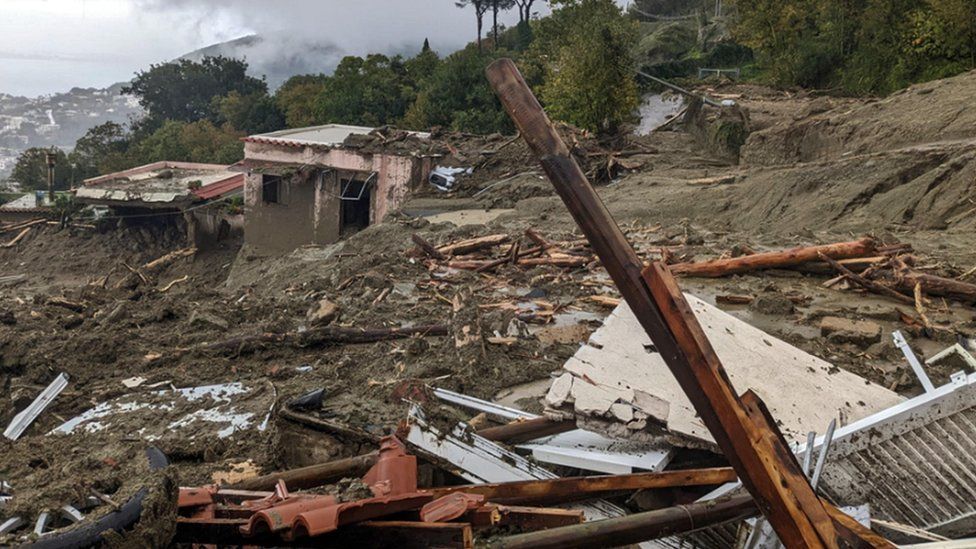
A number of people are believed to have died after a mudslide triggeredby heavy rains swept away homes on the Italian island of Ischia.
As it approached the coast early Saturday, the torrent of mud and debris uprooted trees, engulfed buildings, and dragged cars into the sea.
A woman’s body was discovered beneath the mud, and several other people are still missing.
Dozens of homes are cut off, and rescuers are hampered by bad weather.
Resident Lisa Mocciaro told Ansa news agency: “We started hearing loud thunder at about 03:00 (02:00 GMT), then the first landslide came down, followed by a second one around 05:00. It was horrifying.”
Interior Minister Matteo Piantedosi told reporters the situation was “very complicated” and that the people missing were believed to be trapped under the mud. Up to 155mm (6.1in) of rain fell over the course of six hours.
IMAGE SOURCE,EPA Image caption, The mudslide dragged debris and trees down the mountains towards the coast of the island of Ischia
Heavy rains have been battering Campania, the region surrounding Naples and Ischia, for several days. A weather warning for rainfall and strong winds is in place until Sunday.
On Thursday, two people were killed due to bad weather in the region. An Argentine tourist drowned after being swept into the sea during a coastal storm, while a man was struck by lightning on a beach.
Earlier, Infrastructure Minister Matteo Salvini said eight people had died in the landslide, adding: “From north to south, this country needs to be protected because it is the most beautiful country in the world.”
But the interior minister later said that no deaths had yet been confirmed.
Like nearby Capri, Ischia, in the Tyrrhenian Sea, is a popular holiday destination for tourists and Italians alike. Ischia featured in the popular book series Neapolitan Novels by Elena Ferrante and was the backdrop to the 1999 film The Talented Mr Ripley.
Protests in China against Covidrestrictions appear to have accelerated in the aftermath of a fire that killed ten people in an apartment building in Urumqi.
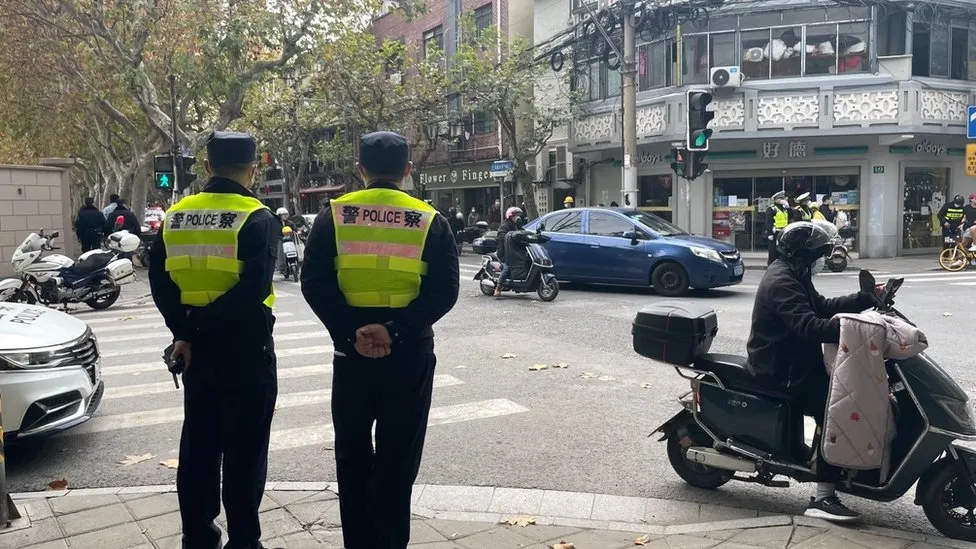
Thousands of people marched through Shanghai’s streets to remember the victims and protest the restrictions. Many people were heard calling for President Xi Jinping’s resignation.
At least three people were seen being bundled into police cars, according to the BBC.
The lockdown of apartment buildings has been blamed for the deaths in the fire.
While Chinese authorities deny it was the cause, officials in Urumqi did issue an unusual apology late on Friday, and pledged to “restore order” by phasing out restrictions.
‘Xi Jinping, step down’
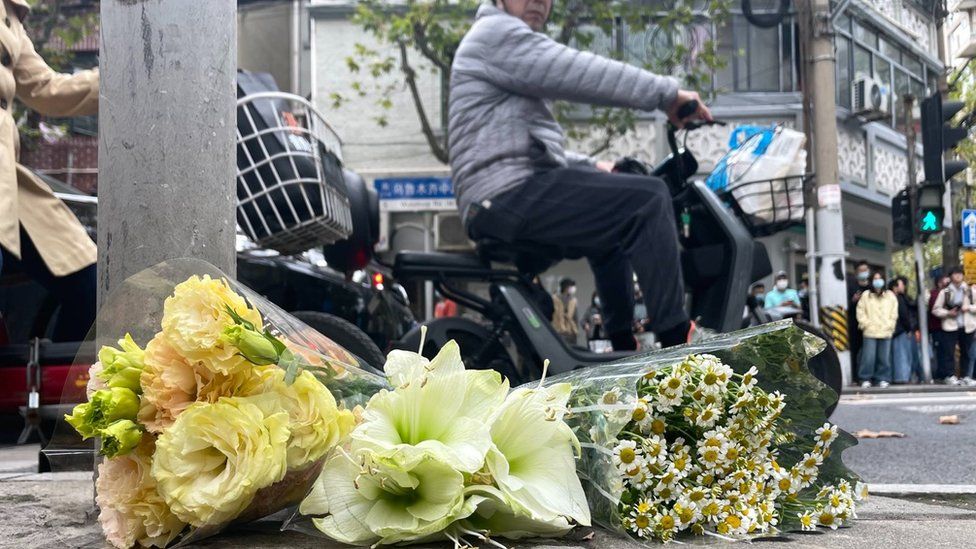
At the protest in Shanghai – China’s biggest city and a global financial hub – some people were seen lighting candles and laying flowers for the victims.
Others were heard shouting slogans such as “Xi Jinping, step down” and “Communist party, step down”. Some also held blank white banners.
Such demands are an unusual sight within China, where any direct criticism of the government and the president can result in harsh penalties.
One protester told the BBC that he felt “shocked and a bit excited” to see people out on the streets, calling it the first time he’d seen such large-scale dissent in China.
He said lockdowns made him feel “sad, angry and hopeless”, and had left him unable to see his unwell mother, who was undergoing cancer treatment.
A female demonstrator told the BBC police officers were asked how they felt about the protests, and the answer was “the same as you”. But, she said, “they wear their uniforms so they’re doing their job.”
Others gave accounts of violence, with one protester telling the Associated Press news agencyone of his friends had been beaten by police at the scene, while two others had been pepper sprayed.
Image caption, People have been leaving flowers beneath the street sign for Urumqi Road – but police have been gathering them up
Though the situation in the area had calmed by Sunday morning, the BBC saw a heightened police presence in the area of the protest, with several dozen police officers, private security guards and plain-clothed police officers on the streets.
Elsewhere, photos and videos emerged online of students holding vigils for the Urumqi fire victims and launching protests at universities in Beijing and Nanjing.
Hundreds of people took part in one such demonstration in Tsinghua University in the capital, one student told the AFP news agency.
Videos of the protests are difficult to independently verify, but many of them show an unusually explicit and outspoken criticism of the government and its leader.
Camilla, the Queen Consort, is discontinuing the practise of having ladies-in-waiting and will instead be assisted by “Queen’s companions.”
In addition to modernising the title, the six female assistants will be required to attend less frequently than the previous role required.
Honorary positions entail assisting the Queen Consort at public events.
Unlike the ladies-in-waiting, this role will not require any correspondence or administration.
Replacing the role of lady-in-waiting will bring an end to a feature of court life that dates back to the Middle Ages, with such close personal helpers to a Queen often coming from aristocratic families and, over the centuries, becoming embroiled in court intrigue.
The new “companions” will be a more occasional and informal position, supporting the Queen Consort at official engagements and not involved in replying to letters or day-to-day planning.
They don’t receive a salary but their expenses will be covered.
This symbolic change of direction will be put into practice next week, when the Queen Consort hosts a reception for campaigners against domestic violence and violence against women.
Figures published by the Office for National Statistics on Friday showed that 2.4 million adults in England and Wales, 1.7m women and 700,000 men, had suffered from domestic abuse in the previous year.
Queen Camilla has campaigned to raise awareness about domestic violence and for the first time her Queen’s companions will be with her at the Violence Against Women Girls reception at Buckingham Palace, rather than ladies-in-waiting.
The first companions include some longstanding personal friends – the Marchioness of Lansdowne, Jane von Westenholz, Lady Katharine Brooke, Sarah Troughton, Lady Sarah Keswick and Baroness Chisholm, a former Conservative whip and Cabinet Office spokeswoman in the House of Lords.
A palace source says that Baroness Chisholm, who has been sitting on two select committees as a Conservative, has become a non-affiliated peer.
The Queen Consort, aged 75, has also appointed Major Ollie Plunket as her equerry, who acts as a personal assistant.
The former ladies-in-waiting who served the late Queen Elizabeth IIwill now help King Charles to host events at Buckingham Palace and will be known as “ladies of the household”.
Taiwan’s President Tsai Ing-wen has resigned as head of the governing Democratic People’s Party (DPP) after its poor showing in local elections.
The opposition Kuomintang (KMT) won several major races on Saturday, including in the capital Taipei.
The vote has drawn global attention as Taiwan becomes a bigger geopolitical flashpoint between China and the US.
President Tsai had framed the election as a vote for democracy amid rising tensions with China.
“The election results were not as expected… I should shoulder all the responsibility and I resign as DPP chairwoman immediately,” Ms Tsai, who will continue as president of the self-ruled island, told reporters.
The elections for local councils and city mayors theoretically have a domestic focus, covering issues such as crime, housing, and social welfare, and those elected will not have a direct say on Taiwan’s policy regarding China.
However, Ms Tsai and government officials urged voters to use the election to send a message about standing up for democracy, as Beijing increases pressure on the island.
Voters also rejected lowering the voting age from 20 to 18, in a referendum that was run alongside the local elections.
The Chinese government sees Taiwan as a breakaway province that will, eventually, be part of the country.
But many Taiwanese people consider their self-ruled island – with its own form of government and a democratic system – to be distinct.
Tensions reached a peak in August when Beijing staged huge military drills around Taiwan in a protest against US House Speaker Nancy Pelosi’s visit to the island.
The US has long walked a tightrope over Taiwan. Officially, it has no formal ties with Taiwan, but has also pledged to supply the island with defensive weapons and stressed that any attack by China would cause “grave concern”.
Two parties, two views
There are two main political parties in Taiwan and they have different approaches to China.
The Kuomintang (KMT), a party of conservative business champions, are traditionally seen as pro-China “doves”.
They have advocated economic engagement with China and have appeared to be in favour of unification, though they strongly deny being pro-China.
Their main rival is Ms Tsai’s governing Democratic People’s Party (DPP). Ms Tsai won by a landslide in the 2020 national election.
She has taken a strong stance towards China, saying Beijing needed to show Taiwan respect and that Taipei would not bow to pressure.
She was re-elected on a promise to stand up to Beijing. Locals told the BBC at the time that protests in Hong Kong and Beijing’s subsequent crackdown on civil rights had raised concerns in Taiwan.
The United States Federal Communications Commission (FCC)has announced it is banning telecommunications and video surveillance equipment from prominent Chinese brands, including Huawei and ZTE, citing an “unacceptable risk to national security”.
The five-member FCC said on Friday it had voted unanimously to adopt new rules that will block the importation or sale of the targeted products.
“Our unanimous decision represents the first time in the FCC’s history that we have voted to prohibit the authorization of communications and electronic equipment based on national security considerations,” FCC Commissioner Brendan Carr said in a statement on Friday.
He added that the move had “broad, bipartisan backing” among the US congressional leadership.
US security officials have warned that equipment from Chinese brands such as Huawei could be used to interfere with fifth-generation (5G) wireless networks and collect sensitive information.
The ban is the latest move in a years-long push “to keep US networks secure” by identifying and prohibiting devices deemed to be security threats, the FCC said.
Friday’s initiative also includes a ban on Hytera Communications, the Hangzhou Hikvision Digital Technology Company, and the Dahua Technology Company.
Huawei declined to provide comment to the Reuters news agency. ZTE, Dahua, Hikvision, and Hytera did not immediately respond to requests for comment.
Huawei and the Chinese government have long denied allegations of espionage and denounced US sanctions against Chinese technologies.
But in 2019, then-US President Donald Trump signed into law the Secure and Trusted Communications Networks Act, which established criteria to identify communications services Washington deemed could pose a risk to national security.
The services that were designated threats under that law were then subject to the Secure Equipment Act of 2021, signed by President Joe Biden.
That act created the groundwork for Friday’s announcement. It directed the FCC to “adopt rules clarifying that it will no longer review or issue new equipment licenses” to those companies.
At the time, Florida Senator Marco Rubio hailed Biden’s decision.
“The Chinese Communist Party will stop at nothing to exploit our laws and undermine our national security,” he said in a statement. “This legislation fixes a dangerous loophole in our law, curtailing their efforts to worm their way into our telecommunications networks.”
One of the largest manufacturers of telecommunications equipment in the world, Huawei has had an embattled relationship with the US and its allies, facing some of the heaviest sanctions ever placed on a single company in the US.
Huawei executive Meng Wanzhou was arrested and detained for nearly three years in Canada following allegations by the US Justice Department that she attempted to violate sanctions by trying to conduct business dealings with Iran.
She was indicted on bank and wire fraud charges and faced US extradition proceedings in a Canadian court, sparking a diplomatic crisis between Canada, the US, and China. Meng was released and returned to China in 2021.
Earlier this year, Canada joined the US in banning Huawei from 5G wireless networks.
Another FCC commissioner, Geoffrey Starks, described Friday’s ban as a preventive measure that would pay dividends in the future.
“By stopping equipment identified as a threat to the United States from entering our markets, we significantly decrease the risk that it can be used against us,” Starks said in a statement. “We also lower the possibility that we’ll need to rip and replace that equipment in the future. Ultimately, if it can’t get authorized, it can’t be deployed.”
One of six campaigners, including singer Denise Ho, was Senior Catholic, 90, who received punishment for failing to register the fund.
Cardinal Joseph Zenand five other Hong Kong activists were found guilty of violating the law by failing to register a multimillion-dollar support fund they set up to provide legal assistance to those detained during 2019’s pro-democracy rallies.
As well as Zen, 90, the others convicted included popular singer Denise Ho, and veteran human rights lawyer Margaret Ng.
All had pleaded not guilty, setting up a two-month trial. They are among thousands arrested in connection with the 2019 protests, which began with mass marches against a government plan to allow extradition to mainland China but evolved into sometimes violent protests calling for more democracy in the former British colony.
Under Hong Kong’s Societies Ordinance, a society must apply for registration or an exemption from registration within one month of being set up.
The defence questioned whether the law even applied to the 612 Humanitarian Relief Fund, which helped pay legal and medical costs for people arrested during the 2019 unrest, but Magistrate Ada Yim found that it did.
Yim said, “the only and irresistible inference” from the trial was that the fund was a “local society” and so subject to the rules.
“Considering the social and political events in recent years, if a society has connections with political groups … the society’s operations may affect public order, public peace, and national security,” Yim added.
The six were arrested in May under sweeping national security legislation that Beijing imposed on the territory in 2020. The group has yet to face charges under that law, which can carry a sentence of up to life in jail.
Speaking outside the court, Ng said it was the first time anyone had been convicted for failing to register a society, adding that it was “extremely important in relation to the freedom of association in Hong Kong”.
Also outside the court, Zen told reporters not to place too much emphasis on his religious identity. “I am a Hong Kong citizen who supported this humanitarian work,” he said. “Hong Kong has not seen any damage to its religious freedom,” he stressed.
The group acted as the fund’s trustees. Secretary Sze Ching-wee was also charged and fined 2,500 Hong Kong dollars ($320).
The fund disbanded last October after national security police demanded it hands over operational details, including information about its donors and beneficiaries.
Prosecutors revealed during the trial the fund had raised as much as 270 million Hong Kong dollars ($34.6m) in more than 100,000 separate donations.
People share wartime survival techniques as Russian missile attacksplunge the nation’s capital into darkness.
If you have no electricity, but don’t want your frozen foods to melt, Anastasiya Zasyadko has a useful life hack for you.
“Put a bottle of water in the freezer when the electricity is on,” the 79-year-old retiree told Al Jazeera.
The ice will take many hours to melt – and keep the freezer, well, frozen.
“The bottle has to be plastic because the glass will crack” when the water freezes, Zasyadko, a former physics teacher, said expertly.
Her experience is first-hand.
She lives in a two-bedroom apartment in a northern Kyiv district of drab concrete buildings surrounded by potholed roads, leafless trees and melting snow.
It had no electricity for more than 24 hours after Wednesday’s shelling of the capital and other Ukrainian cities by Russian cruise missiles.
A Ukrainian woman buys a power bank in the capital, Kyiv [Mansur Mirovalev/Al Jazeera]
Low-tech response
But Zasyadko was ready – and saved several kilogrammes of frozen pork, minced meat and vareniki, the Ukrainian ravioli she cannot live without and made weeks earlier.
On October 10, Russian President Vladimir Putin ordered a string of attacks to destroy power transmission and heating stations, and damage key infrastructure throughout Ukraine.
Zasyadko was already used to the hours-long blackouts – she, her son and her daughter-in-law have plenty of batteries, two power banks, and flashlights you can attach to your head with elastic bands.
“They make you look like a coal miner and ruin your hairdo,” she pouted.
She also can advise you on how to extend the lifetime of a candle and make it heat your bedroom.
Just put it in a glass jar and fill it with vegetable oil. The light will not die out for 12 hours – as long as you make sure that the jar doesn’t fall and start a fire.
You can also combine the contraption with a “flower pot heater” – an ultimate, low-tech response to the lack of central heating.
Take three ceramic flower pots of different sizes, connect them with a long steel bolt so there are a couple of centimetres between them, and put the structure above the burning candle.
The candle-warmed air will not rise to the ceiling but will heat the pots and raise the temperature by several degrees.
Most of the apartment buildings in Ukraine are heated by Soviet-era power stations that have been largely destroyed by the Russian shelling.
A motorcycle is used as a flashlight at a Kyiv mall [Mansur Mirovalev/Al Jazeera]
The cold has been debilitating.
“I went to bed in a flannel gown, put the hood and two pairs of socks on,” Zasyadko said.
Wednesday’s attack was especially devastating for Kyivans because it damaged the water supply in the entire capital and made people buy bottled water, ration it and collect porous snow.
The lack of water is worse than any blackout, Zasyadko said, especially when your family members need to flush the toilet.
Kyiv, howhow to extend the lifetime of a candleever, is already covered with several centimetres of snow, and her son Konstantin collected some in tin buckets and melted it on a gas stove.
“Otherwise it will take hours to melt,” she said.
‘I weep every time’
With the news reports about the deaths of civilians, including a newborn killed by a Russian missile in the eastern town of Vilniansk on Wednesday, Zasyadko has not been feeling well.
That is why she took a seat on a bench in a shopping mall in northern Kyiv, waiting for her daughter-in-law to come back from a grocery shop.
The daughter-in-law, Maryana, showed up with two heavy bags – and offered the ultimate advice on patience.
“As long as everyone in our family is alive, we keep thanking God,” the 45-year-old cook said.
“I weep every time I hear about those little kids killed by the bloody Rashists,” she said, using a derogatory term that combines “Russian” and “fascist”.
Just a few metres away, a wartime generation of Ukrainian mall rats is glued to their mobile phone screens. The mall has its own power generator – and offers a chance to reload batteries free of charge.
Dozens of people sit or stand next to power sockets – and many are teenagers with more than one gadget.
Most of the sockets are in drafty, barely lit halls, but there are some in the warmer corridors leading to public toilets.
Denys Kyrilenko, 19, was standing close to a ladies’ room, but paid no attention to the women passing by. The university student was typing a text message to his girlfriend who fled to Poland with her family in early March.
He cannot join her because Ukrainian men aged 18 to 60 are not allowed to leave the country. But the eight-months-long separation only made their feelings stronger, he said.
“War makes you see things better,” he said.
Denys Kyrilenko texts his girlfriend from a mall in Kyiv [Mansur Mirovalev/Al Jazeera]
The mall is an oasis of carefree consumerism. And it offers things that have become essential and life-saving.
A small crowd stood around a kiosk with power banks, connecting cables and USB-powered flashlights.
The salesman, Andriy Shevchenko, patiently explained why even the largest power bank in his kiosk cannot be used to power a laptop.
The customers, two women in their early 20s, nodded and bought one anyway – even though the price was almost $80.
That’s not Shevshenko’s fault.
“I hate when suppliers raise prices,” he said. “It ruins my reputation.”
‘We can withstand anything’
Kyiv residents living in private houses with firewood-fuelled stoves feel safe and privileged.
Many stockpiled hundreds of kilogrammes of firewood – and use the stoves to slow-cook their food in metal containers or pots.
And one house owner shared his observation on the resilience of fellow Ukrainians around him.
On Wednesday, Mykhailo Gorshenin, who lives in a two-storey house in northeastern Kyiv, saw how a Russian cruise missile hit a transmission station.
“People came out of a store to take a look,” he said.
Within seconds, another missile hit the same spot.
“They started filming the fire and the smoke with their cell phones,” he said.
Kim receives a message from Xi as North Korea conducts an unprecedented number of missile launches.
According to the official Korean Central News Agency, Chinese President Xi Jinping has informed North Korean leader Kim Jong Un that Beijing is eager to cooperate with Pyongyang for world peace and stability (KCNA).
The revelation on Saturday came days after North Korea conducted one of its most powerful ICBM tests, saying it would use its own nuclear weapons to counter any perceived nuclear threats from the United States.
North Korea has conducted a record-breaking blitz of missile launches in recent weeks and fears have grown that it is building up to a seventh nuclear test, its first since 2017.
In his message to Kim, Xi said Beijing was ready to work together for “peace, stability, development, and prosperity of the region and the world”, KCNA reported.
Xi said he was willing to collaborate with Pyongyang as “changes in the world, times, and history are taking place in unprecedented ways”, KCNA said, quoting from the message it said was received in response to congratulations from Kim after the Chinese Communist Party Congress last month handed Xi a third term.
Days before North Korea’s ICBM launch, Xi met on the sidelines of a G20 summit in Bali with US President Joe Biden, who voiced confidence that Beijing does not want to see a further escalation by Pyongyang.
Washington has said it wants China, Pyongyang’s most important ally and economic benefactor, to use its influence to help rein in North Korea.
The November 18 missile launch appeared to be Pyongyang’s newest ICBM with the potential range to hit the US mainland.
The United Nations Security Council convened an open meeting over the launch, with the US, the United Kingdom, France, and India among 14 nations to “strongly condemn” Pyongyang’s actions.
But a Western diplomat told the AFP news agency that China and Russia had chosen not to put their names to Monday’s statement.
In May, China and Russia vetoed a US-led effort to tighten sanctions on North Korea in response to earlier launches.
Pyongyang is already under multiple sets of international sanctions over its nuclear and ballistic missile programmes, and China accounts for more than 90 percent of the impoverished country’s bilateral trade.
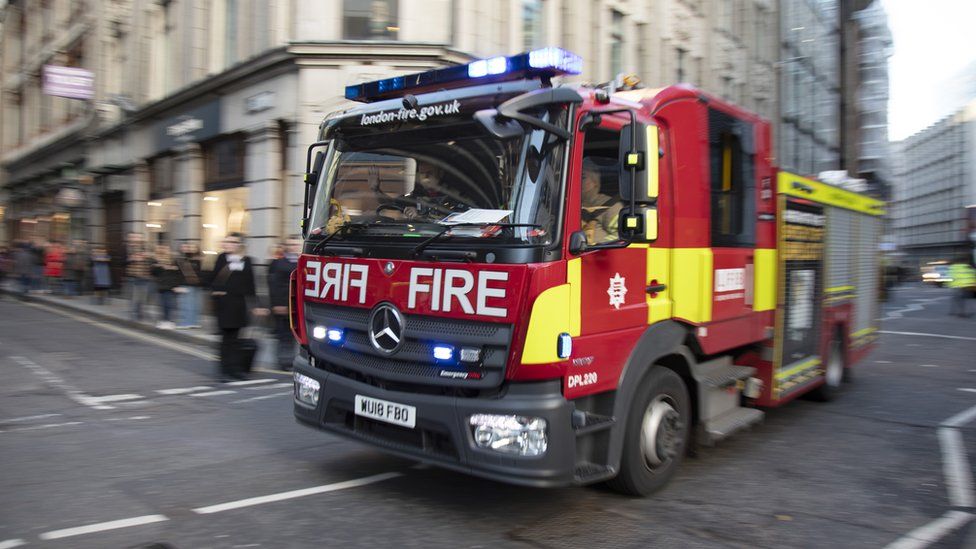
London Fire Brigade is “institutionally misogynist and racist”, according to a damning review of its culture.
A black firefighter had a noose put by his locker, while a female one received a video of a colleague exposing himself.
The independent review was established by the London Fire Commissioner after a trainee firefighter took his own life in August 2020.
Commissioner Andy Roe said there was no place for discrimination, harassment and bullying in the brigade.
“From today it will be completely clear to all staff what behaviour isn’t acceptable and what the consequences will be,” he added.
‘Grim reading’
The review, conducted by the former Chief Crown Prosecutor for north-west England, Nazir Afzal, concludes that unless the “toxic culture” is tackled then other firefighters will take their own lives.
It lists a number of instances of abuse and poor behaviour at almost all levels of London Fire Brigade (LFB), including:
Multiple cases of bullying “and the targeting of ethnic minorities and women” with some complaints not investigated
Women “sexually taunted”, including one who received video calls from a man exposing his genitalia
Men “huddled around a screen watching porn” at some fire stations
Talking to the BBC, Mr Afzal said the report made for “grim reading”.
“We’ve heard example after example about women who were harassed or sexually assaulted – constant sexual taunting to the point that I am now saying that the London Fire Brigade is institutionally misogynist,” Mr Afzal said.
“In addition to the misogyny, there is an enormous amount of racism. One black man had a noose put up above his locker, another Muslim officer had bacon rolled on his plate before he ate.
“Women told us they were told [by male firefighters]: ‘We want to get you out of here, we don’t want you to be a fire officer.’ It goes back to the whole fireman concept.
“I sat with a very senior female officerwho said to me, through tears, that whenever she goes through a dangerous incident, she’s always thinking: ‘Will the men have my back? Will the men around me protect me given how they have treated me back at the station?
“If they feel they can’t trust the men around them because of their behaviour or misbehaviour and worse, then they aren’t safe and neither are we.”
IMAGE SOURCE,GETTY IMAGES Image caption, The behaviour of some staff “left a clear trail of psychological harm”, the report found
The report also found that while there was often “considerable sensitivity” in the brigade around issues of race, there appeared to be “a worrying blind spot” concerning misogyny and sexism.
One firefighter told the review that she advised her female friends not to let male firefighters in the house to give safety advice because “they go through women’s drawers looking for underwear and sex toys”.
The review recommends firefighters now wear body-worn videos for home visits.
The behaviour of some brigade staff “left a clear trail of psychological harm”, the report said.
Mr Afzal said the racism, misogyny and bullying identified within the LFB were far more widespread.
Speaking to the BBC Radio 4’s Today programme, he said he was approached by other fire brigades and organisations as he undertook the review.
“People telling me please, please come and have a look at my culture.
“I ask anyone who’s rushing to judgement on London Fire Brigade to look in the mirror and look at themselves because they will see similar things happening.
“Their staff need the same support and protection that London Fire Brigade need to provide to theirs.”
The Fire Brigades Union (FBU) said in a statement the report confirmed concerns it had raised over many years.
Image caption, The review, written by Nazir Afzal, concludes that unless the “toxic culture” is tackled then other firefighters will take their lives
Gareth Cook, FBU’s regional organiser for London, said morale and engagement at LFB was low.
He said 40% said they were frustrated in their job with staff shortages, no leave availability and poor work-life balance.
He added: “We have raised concerns about many of the issues contained within this report historically and as a consequence we remain sceptical about the changes senior leaders will implement with regards to their own behaviours.”
LFB Commissioner Mr Roe told BBC Radio 4’s Today programme he was “horrified” and “heartbroken” to read the report.
‘Change starts now’
Asked if he agreed with the review’s finding the organisation was institutionally misogynist and racist, he said: “I think when 2,000 of your staff have written that story you can’t deny any of it. I accept the report in full, I accept all the recommendations.
“There will be change and the change starts now.”
“From Monday we are putting externally into the hands of independent experts all of our complaint, harassment, bullying investigations,” he added.
Mr Roe said he hoped employees would have the confidence to raise concerns and the organisation would “take action against people who let the service down.”
Even seniority appears not to have insulated some women from abuse: former Commissioner Dany Cotton, who became the first woman to lead LFB, said she had received death threats following an anti-sexism campaign she was promoting.
Despite a series of failings, the review found most participants thought their workplace was “supportive and friendly”.
It also found examples of “good leadership” including people who “went out of their way to build inclusive environments and operate a zero-tolerance policy around discrimination” but described it as “uneven and patchy” across the brigade.
‘Watershed moment’
Black, Asian and minority ethnic staff felt they “must work twice as hard to be seen and heard”, the report said, adding that non-white staff were more likely to be disciplined and less likely to be promoted.
In one instance a Muslim firefighter was spoken to in an Indian accent by his colleagues and had a piece of bacon put in his sandwich.
When he transferred to another watch, his colleagues put a pork sausage in his pocket, the report said. He subsequently had a terrorism hotline sticker placed on his locker, but his complaints were dismissed. He eventually collapsed at work and was admitted to the hospital, and has since been diagnosed with PTSD and has had suicidal thoughts.
The Grenfell Tower fire was described as having a “seismic impact on the culture of LFB”, particularly on the mental health of staff.
North Kensington fire station, which is less than a mile from the tower, was “widely recognised as a supportive station with a strong and diverse culture”.
Mayor of London Sadiq Khan said the details of misogyny and racism were “abhorrent” and said the findings of Mr Afzal’s review “must be nothing short of a watershed moment for the London Fire Brigade.”
There was an incident, according to Portugal’s head coach Fernando Santos, thus the American referee Ismail Elfath did not need to consult the Video Assistant Referee (VAR).
In their Group H opener on Thursday, Portugal overcame Ghana 3-2. Ronaldo’s controversial dive for the opening goal was controversial.
Since the American referee purchased the dive that Cristiano Ronaldo offered him without checking the VAR, the Black Stars felt tricked.
Cristiano Ronaldo scored the opening goal from the penalty spot, hammering in after the referee awarded a highly contentious penalty for Portugal after an apparent dive from the former Manchester United forward following a close incident with Mohammed Salisu.
The American referee immediately pointed to the spot resisting all attempts to have a second look at the incident on the video assistant referee despite protestation from the Ghanaian players.
“I think if the VAR team had felt the referee should consult the VAR, they would have prompted him. I also think Joao Felix was fouled at a point and I expected the referee to check the VAR but he didn’t. So I don’t think there was a call the VAR would have been necessary for the referee.”
The Black Stars improved in the second half as Mohammed Kudus’ shot went wide of the post after a decent build-up from midfield.
Ghana captain Andre Ayew equalized from close range as he tapped in a cross from Baba Abdul Rahman after the Portugal defense failed to deal with it.
A few minutes later, Portugal responded with two goals in two minutes to close the contest as Joao Felix converted a delightfully clipped finish and substitute Rafael Leao coolly stroked in just seconds after coming on.
With the heading to an end, Osman Bukhari headed in a late consolation for the lack of Stars and there could have been real drama in the ninth minute of stoppage time as Inaki Williams intercepted a ball from Diogo Costa but the Athletic Bilbao forward slipped at the crucial moment and a feeble shot was cleared off the line.
2022 FIFA World Cup is currently taking place in Qatar, and retired Ghanaian referee Joseph Wellington has criticized American referee Ismail Elfath’s choice to award a questionable penalty to Portugal against Ghana.
After refusing to take a second look at the VAR monitor to assess Mohammed Salisu’s challenge on Cristiano Ronaldo, the 40-year-old American of Moroccan descent found himself in the center of the controversy.
Portugal defeated the opponent 3-2.
In an interview with the media, Referee Wellington said the decision made by the American referee was unfortunate and called on authorities to have a look at it again.
He said, “It wasn’t the right decision. Refereeing today has been made easy following the introduction of VAR. So, if you are not very sure of it, just go for a consultation,” he added.
He also commended the Black Stars for their splendid performance against the Portuguese.
“The Black Stars did very well, though they were a bit nervous in the early stages of the game, they came up stronger in the game,” he said.
Ghana would take on South Korea on Monday, November 28, in their search for a qualification slot to the next stage of the competition.
Ghanaian Olympian Skeleton, Akwasi Frimpong, has expressed his desire to record improved results for the West African nation in upcoming competitions.
He said this in the aftermath of recording fifth and sixth-place finishes at the just-ended IBSF North American Cup Skeleton races in Park City, Utah.
Prior to competing at Park City, the 36-year-old who was born in Kumasi finished in ninth and 12th place respectively in the IBSF NAC races.
Per a press release issued by Ghana’s Bobsled and Skeleton Federation, Frimpong is hungry to record higher finishes in future competitions.
“I’m making great progress in my sliding with the help of my sponsors and support team. I’m excited to continue to represent Ghana and the continent of Africa. I’m so hungry for more big results this season” the release stated.
Competing at Park City marks a return to the location where Frimpong became the first African athlete in the discipline to win a skeleton race in the elite division sanctioned by the USA’s Bobsled and Skeleton Federation.
He achieved the historic mark in 2020 on the back of grabbing Africa’s representation spot to compete at the 2018 Winter Olympics in Sochi, Russia.
Below is the full statement from Ghana’s Bobsled and Skeleton Federation:
Fights broke out between protesters and pro-regime Iranians at the country’s second World Cup game on Friday in Qatar.
Others reported they were screamed at and harassed, while several demonstrating supporters claimed their flags were taken away.
Additionally, stadium security officers confiscated items including anti-government T-shirts and other items.
Iran has had widespread protests since the passing of Mahsa Amini,22, in September.
Ms Amini was arrested in Tehran by the morality police for allegedly not covering her hair properly and died in police custody three days later. The demonstrations spread across the country with people demanding changes such as more freedoms or an overthrow of the state, and the government has responded with a deadly crackdown.
On Friday – at Iran’s World Cup game against Wales – some protesters had Persian pre-revolutionary flags snatched from them by pro-government fans at the Ahmad Bin Ali Stadium.
Insults were also reportedly hurled at some people wearing T-shirts emblazoned with the words “woman, life, freedom” – a phrase that has become a rallying cry among protesters against Iran’s authorities.
One Iranian spectator alleged that Qatari policeordered her to wash off the names of protesters killed by Iran’s security forces from her arms and chest after pro-government fans complained.
Another woman said she was prevented from wearing a T-shirt with Ms Amini’s face in the stadium.
Women giving interviews to foreign press about the protests were also seen being harried by at least one group of men.
Some used their mobiles to film the women who were also subjected to verbal attacks and the men loudly chanting: “The Islamic Republic of Iran”.
The match itself, which Iran won 2-0 against Wales, saw Iranian players booed and whistled at as they sang the country’s national anthem before kick-off.
At their earlier game against England on Monday, the players remained silent during the anthem in an apparent expression of support for anti-government protests.
Some fans in the stadium wore hats with the name of a former Iranian football player, Voria Ghafouri, written on them.
A critic of Iran’s government, he was arrested in Iran on Thursday and reportedly taken away by authorities after being accused of spreading propaganda.
Capped 28 times for his country, Mr Ghafouri was part of Iran’s 2018 World Cup team and his absence from the 2022 squad surprised many.
The Iranian-Kurdish player has been a high-profile voice defending Iranian Kurds within the country.
Earlier this week, the UN Human Rights Council voted to set up a fact-finding mission to investigate the crackdown on the anti-government protests in Iran.
The UN said Iran was in a “full-fledged” crisis and more than 300 people had been killed and 14,000 others arrested over the past nine weeks.
The US Coastguard reports that a passenger who went missing from a cruise ship in the Gulf of Mexico has been found after spending more than 15 hours at sea.
On Wednesday night, the 28-year-old guy and his sister had been at a bar on the Carnival Valor ship, but he left to use the restroom and never came back.
The man was finally found on Thursday night, around 20 miles (30 km) off the coast of Louisiana, after numerous rescue teams searched the area.
The BBC is not responsible for the content of external sites.View original tweet on Twitter
Lieutenant Seth Gross of the US Coast Guard said the man could have been in the water for more than 15 hours – the “absolute longest that I’ve heard about – and just one of those Thanksgiving miracles”.
Gross told CNN that the case was unlike anything he had seen in his 17-year career and that the happy outcome “shows the will to live is something that you need to account for in every search-and-rescue case”.
It is unclear how the man came to plunge into the water from the ship which was en route to Cotumel in Mexico.
In 2018, a 46-year-old British woman was rescued 10 hours after falling into the Adriatic Sea from her cruise ship.
At the time, she was reported to have told one rescuer it had helped that she was fit from doing yoga and that she sang to stop her feeling cold overnight.
A man is scheduled to be executed by lethal injection in Missouri on Tuesday without his daughter present due to her age, NBC News reported.
Kevin Johnson was sentenced to death for the 2005 killing of a Kirkwood, MO police officer. Johnson was 19 at the time he committed the crime, the same age his daughter, Khorry Ramey, is now.
“I’m heartbroken that I won’t be able to be with my dad in his last moments,” Ramey told NBC News. She said that her father “has worked very hard to rehabilitate himself in prison. I pray that [Gov. Mike] Parson will give my dad clemency.”
Missouri law prevents individuals under the age of 21 from attending executions. And, on behalf the Ramey, the American Civil Liberties Union filed a lawsuit urging the state to allow Ramey to attend her father’s execution.
The plaintiffs argue that prohibiting Ramey from attending the execution is unconstitutional and “illustrates the irrationality” of sentencing, someone, to death prior to their 21st birthday but preventing those under 21 from attending executions.
“I am my dad’s closest living relative and he is mine, other than my baby son,” Ramey told the outlet. “If my dad were dying in the hospital, I would stick by his side and hold his hand, praying until his death.”
But the judge argued that the plaintiffs did not prove the law was unconstitutional, therefore blocking Ramey from attending the execution of her last living parent.
“It’s ironic that Kevin was 19 years old when he committed this crime and they still want to move forward with this execution, but they won’t allow his daughter who’s 19 at this time in because she’s too young,” Johnsons’ lawyer, Shawn Nolan, told reporters Friday.
The Missouri Attorney General’s Office argues that the execution should proceed because “the surviving victims of Johnson’s crimes have waited long enough for justice,” according to NBC News.
Johnson’s execution is set to occur on Tuesday. But because a special prosecutor is arguing that there was “unconstitutional racial discrimination” in Johnson’s conviction, a hearing is scheduled for Monday that could possibly prevent the execution.
An attorney for Ramey, an attorney for Johnson, the Missouri Attorney General, and a Missouri special prosecutor did not immediately respond to Insider’s request for comment.
It has been a travel year from hell for airline customers wrought with delays, cancellations, and lost bags.
Claims of lost luggage have spiked in 2022, increasing by 30% compared to 2019 claims over the same period, Insider previously reported. In August alone — the most recent data — US airlines lost, delayed, or damaged 254,502 bags, according to a report from The Department of Transportation.
Here’s what you should do if an airline loses your luggage, as well as a few tips on how to minimize the damage ahead of time.
Report missing luggage ASAP
Report missing luggage immediately. Hinterhaus Productions via Getty Images
Some airlines allow you to track your checked luggage from the airline’s app, which can be a great way to keep tabs on your bags while you travel. But what happens when you go to baggage claim and your checked bag never comes around the carousel?
Experts recommend reporting your missing luggage as soon as you realize it did not reach its destination. Find your airline’s baggage desk, file a claim, and ask for a copy or a receipt for your records.
Ask for reimbursements and free delivery of lost luggage
When you check in for a flight, the fees for checked bags can be anywhere from $30 to $100-plus, depending on the number of bags, the weight, and whether the destination is domestic or international. If you paid a fee for your bag to be checked and the airline lost it in travel, try asking for a refund.
Once you file a missing bag claim, most airlines will deliver your lost luggage to your specified address for free. If they don’t specify at the outset, make sure you ask for your missing items to be delivered free of charge.
It’s important to note that airlines differentiate between luggage that is delayed (which is sometimes colloquially called “lost”) and luggage that is officially lost. If it’s been 5-14 days since the flight and there’s still no sight of your bag, most airlines will declare that bag lost. At that point, the airline is required to issue a refund for checked bag fees, according to the Department of Transportation.
Keep track of incurred expenses for replacement items
If your bag is delayed, keep the receipts for any replacement items you purchase. Dmitry Marchenko/EyeEm via Getty Images
If your checked bag contained clothes, toiletries,or other valuables and necessities, keep the receipts for any replacements you purchase during your travels.
Airlines have to compensate you for “reasonable, verifiable, and actual incidental expenses” that you incur while your luggage is delayed, according to the DOT.
Check your luggage for damage
When the airline sends your delayed luggage to your specified address, check the bag and its contents for damage.
While there are liability limits, airlines are responsible for any damage that happens to your bag or its contents while the bag is in their care, per the DOT. If the bag gets damaged beyond repair, airlines are required to compensate you.
Prepare for air travel by packing smart in your carry-on
Carry-on bags in an overhead compartment. Susan Sheldon/EyeEm via Getty Images
Try to pack the necessities with you in your carry-on bag, especially medications and valuables.
While there’s no way to predict whether an airline will lose your checked luggage, you can minimize the future headache it would cause you by making sure you have the irreplaceable items in your carry-on or on your person.
Book direct flights whenever possible
Booking direct flights can help lower the chance that an airline loses your bag, according to CNBC and The New York Times. With fewer stops, there are fewer opportunities for your bag to get misplaced or end up on the wrong flight.
If you have to book a flight with stops, make sure you have adequate time during your connection so that potential delays don’t cause you to miss your second flight. Deviations from your scheduled itinerary can widen the likelihood of your bag getting misplaced.
Consider travel insurance before flying
A passenger on a plane. Susumu Yoshioka/Getty Images
To prevent travel headaches from delayed or lost bags, consider purchasing travel insurance ahead of your flight. It may seem like a superfluous expense, but it covers damages, delays, or lost luggage, as well as overall travel delays and cancellations.
Experts suggest reading the fine print to make sure your concerns are covered as policies vary. Some airline credit cards or travel credit cards come with travel and luggage insurance built-in, so check to see if you already have coverage.
Invest in a Bluetooth luggage tracker.
An Apple AirTag. Dave Johnson
While some airlines offer their own tracking services for your luggage in their apps, travel experts have started to recommend coming prepared with your own Bluetooth trackers. That way, you can track your luggage in real time, even if the airline claims they can’t find your lost bag.
The New York Times recommends the Apple AirTag for iPhone users and the Tile Mate for Android users, noting that the Apple tag performed better because it connects to the Find My network, along with about a billion other Apple devices worldwide.
“Those devices are passively pinging the network and each other in the background, and they can be found when they’re not connected to the internet or when they’re powered off,” Caitlin McGarry wrote for the Times. “As soon as your missing AirTag comes within Bluetooth range of one of those devices, like someone’s iPhone at the airport, that iPhone pings the Find My network that an AirTag is in range. Find My then reports its location to you, the AirTag owner.”
Nigerians have challenged the centralbank’s proposal to “redesign” the local currency of the nation in order to stop money laundering and large-scale hoarding outside of the banking system.
The new 200, 500, and 1,000 naira notes were unveiled by President Muhammadu Buhari on Wednesday. He said that “the new Naira banknotes have been fortified with security elements that make them harder to counterfeit.”
The new notes resemble the ones that are already in use quite a bit. The Central Bank of Nigeria’s headquarters and the nation’s coat of arms are still prominently displayed on the highest-value 1,000-naira note’s design. The color has changed from a primarily brown underprint to blue, which is the only discernible difference.
The Central Bank of Nigeria (CBN) says that the redesigned notes will replace notes currently in circulation by Jan. 2023.
But many locals are not impressed, describing the supposedly redesigned banknotes as a mere color revamp, given their similarities to the old notes.
“Snapchat filter, a waste of time and resources, so a whole CBN cannot employ experts to redesign the naira notes. This is a revamp not a redesign,” one Nigerian tweeted.
“What a waste of time and resources … what is the difference?” another questioned.
CNN has asked the CBN for comment.
Leading economist Bismarck Rewane tells CNN that changing the currency’s look adds nothing to its value and is insignificant in curbing counterfeiting.
The government says new security features were added to the new notes, but Rewane says the changes to the currency are not significant enough to curb counterfeiting.
Nigerian naira has been in a decline in recent years, falling to a record low on the black market where it traded at nearly 800 to the US dollar as of Friday.
“It doesn’t change anything,” Rewane says of the redesigning of the naira. “It doesn’t increase the value,” he also says, adding: “There was no redesign. The color of the currency changed that’s all. The change is not significant enough to stop counterfeiting.”
Nigeria’s 1000- and 500-naira denominations are the most counterfeited, according to the CBN’s annual report last year.
News of redesigning the naira — first announced last month — generated mixed feelings among Nigerians, some of whom questioned the cost of printing new banknotes at a time the country is grappling with dwindling oil revenues, its main source of income.
Central Bank Governor Godwin Emefiele expects the introduction of the new banknotes to help control inflation, which recently rose to its highest level in 17 years, and also fight corruption.
These goals, Rewane says, may not be achieved.
“It’s just a change in color. I cannot see the correlation between the color of the currency and the desired goals. If the goal is to reduce inflation, it will not achieve that. [Changing the look of the currency] has no macroeconomic impact whatsoever,” he tells CNN.
‘Overdue for a new look’
At the unveiling of the new notes on Wednesday President Buhari said it had beennearly 20 years since the country did a major redesign of its banknotes.
The Nigerian leader added that replacing the current currency with the redesigned notes will help to combat the hoarding of funds outside of the banking system.
“It is on this basis that I gave my approval for the redesign of the 200, 500, and 1,000 banknotes,” he said.
Old naira notes will be completely phased away by the end of January next year, the CBN says, as locals scramble to deposit their old notes at commercial banks.
Brig. Gen. Mohamed Marwa (retired), Chairman and Chief Executive Officer of the National Drug Law Enforcement Agency,has stated that Nigeria is the world’s most popular cannabis-using nation, with 10.6 million residents abusing the drug.
Marwa stated that Nigeria has a significant drug usage problem when speaking at the second Vanguard Mental Health Summit, which was sponsored by 9mobile and Guaranty Trust Bank Ltd.
He pointed out that before the 2018 National Survey on Drug Use and Health, which was funded by the UNODC and revealed alarming results, the seriousness of the situation was unclear.
“Before then, the drug use profile of Nigeria was sketchy. The survey gave us facts for the first time and we got to know that Nigeria, as of 2018, had a 14.4 percent drug use prevalence.
“The average global drug use prevalence was 5.5 percent, at 14.4 percent. Nigeria has almost three times the global prevalence. “Without any doubt, the country has a serious substance abuse problem.
“The biggest revelation was that 10.6 million Nigerians abused cannabis. Again, this is a mere figure until you begin to figure it out in terms of the human impact. The ramification is that we have a cannabis-using population that is bigger than countries like Portugal and the United Arab Emirates.”
Marwa who was represented at the event by Zonal Commander, NDLEA, Lagos, Dr. Segun Oke, said: “In 22 months, the agency has arrested 20, 000 offenders and convicted 3,111 in court. We have seized 5.5 million kg of illicit drugs, destroyed 900 hectares of cannabis farms, and dismantled two illicit methamphetamine laboratories.”
He assured that next year will be tougher as a result of the amended NDLEA Act that will pave way for convicted traffickers to spend long years in jail without the option of a fine.
“We are also trying to present a counter-narrative to the wrong messages out there that brainwash young people to believe that illicit substances are harmless.”
In his keynote address, the Head, of the Department of Psychiatry, College of Medicine, University of Lagos/ Lagos University Teaching Hospital, Idi-Araba, Lagos, Prof. Olatunji Aina, said the current economic situation of the country had worsened the mental health of Nigerians.
“A number of factors, namely poor planning, fiscal indiscipline, and policy somersault, could be ascribed to why Nigeria gradually walked her way into a distressed economy.
“The health of any given population is shaped by socio-economic context, employment, public policies, socio-demographic characteristics, and social welfare system of the country.
“There are strong research findings to show that changes in these key socio-economic determinants may be reflected in the mental health of the populace.
“Thus, the mental health of the people is vulnerable during economic distress or recession.
“In other words, economic recession and its associated problems such as unemployment, income decline and huge debts are significantly associated with poor mental health, increased rates of common mental disorders (anxiety and depression), psycho-active substance use disorders and suicidal behaviours.”
He explained that in the face of security and socio-economic challenges facing the country, prevalent mental health, complications include anxiety disorders, depression, sleep disorders, and suicide, among others.
Corroborating his views, the President of the World Medical Association, WMA, Dr. Osahon Enabulele, appealed to the Federal Government to assent to the Mental Health Bill to address the challenges of mental health in Nigeria.
Enabulele said about a billion people in the world, and one in every four Commonwealth citizens, particularly in the low and middle-income (LMICs) countries and pre-eminently among women and the younger age group 20-24 years, were known to be affected by one form of a mental health problem or the other.
“This is with about 80 percent of people unable to receive any form of treatment, a situation that leads to the loss of a trillion dollars annually.
“Unfortunately, during the COVID-19 pandemic, this burden of mental health is estimated to have increased by 25 percent.
“This was due to an interplay of factors, including economic fortunes and worsening poverty, increased resort to substance use, and the disruption of mental health services, including emergency psychiatric services.”
Spain manager Luis Enrique has admitted that he doesn’t have a problem with players having sex the night before matches.
The former Barcelona coach made the statement while speaking on Twitch, fulfilling his promise to fans to keep streaming for as long as Spain is in the World Cup.
When he was also asked if players should be told not to have sex before games he said: ‘It’s ridiculous (to ban it). It’s something I consider totally normal.
‘If you’re at an orgy the night before a match then obviously that’s not ideal, but when I’m a club coach the players are at home the night before a game and it’s not something that worries me at all.
‘If it’s something they do then it’s because they need to and want to. But I repeat with common sense! Each one with their partner. It’s normal. When I was a player if I was at home before a game, with my wife, well we did what we had to do.’
Enrique’s star man in his Spain squad, Ferran Torres is currently dating his daughter and recently joked that she would ‘chop his head off if he failed to start him in a game.
When asked who, in the Spain squad might be the most similar player to Enrique, the manager said: ‘That’s very easy – It’s Mr Ferran Torres – otherwise my daughter will come after me and chop off my head.’
Later on in the stream, Enrique was asked what country he wishes he had played in, and he said: ‘England definitely. The Italian league was very strong in my era but playing in England would have helped me with my level of English and I would have been able to experience the more physical, more intense football that they have there, and experience a different culture.’
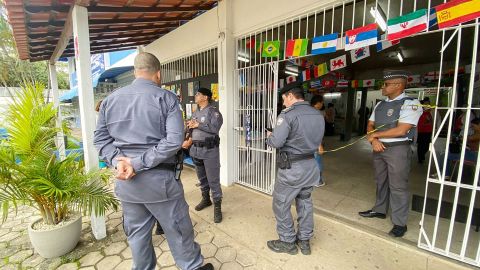
Local authorities in the Brazilianstate of Espirito Santo said that a shooter opened fire at two schools on Friday, leaving at least three people dead and 11 others hurt.
The attacks happened in the little town of Aracruz, which is located 50 miles north of Vitoria, the state seat.
Police have detained the alleged shooter, who was shown on security tape with a semi-automatic pistol, dressing in uniform, and hiding his face. Authorities have not yet named the culprit, but the 16-year-old has been recognized by local media, including CNN affiliate CNN Brasil.
The governor said the attacks took place at the Primo Bitti school and the Praia de Coqueiral Educational Center.
Police officers on the scene at the Primo Bitti school on Friday. Kadija Fernandes/AFP/Getty Images
Speaking to the media, Public Safety minister Marcio Celante said police believe the suspect acted alone based on security video but acknowledged that further investigation was needed to ascertain more details on the incidents.
Celante also revealed some of what the security video showed.
“The first criminal action was to access the school by breaking the padlock. He had access to the teachers’ room,” Celante said, adding that “afterward, he moved to another school, where he made more victims.”
“It’s with sadness that I was informed about the attacks at the Aracruz schools in Espirito Santo. My solidarity goes to the family of the victims in this absurd tragedy,” Lula tweeted.
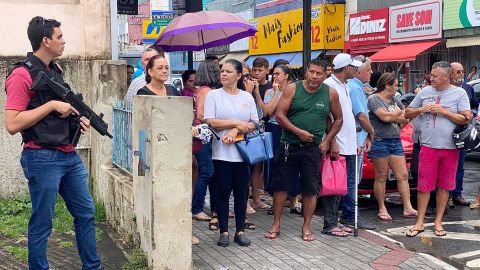
Local residents gather outside the police station where the alleged perpetrator of two school shootings is being held in Aracruz. Kadija Fernandes/AFP/Getty Images
“My support goes out to Governor Casagrande in investigating the case and comforting the communities surrounding the two affected schools,” he added.
Brazilian minister Victor Godoy also joined his government peers in expressing his sympathies.
“My condolences to the parents, relatives, and employees of the Primo Bitti State Elementary and Middle School and the Praia de Coqueiral Educational Center, in Aracruz. I submit for the record my repudiation of this manifestation of violence,” Godoy wrote on Twitter.
Prime Minister Justin Trudeauhas said that invoking never-before-used emergency powers to end last winter’s truck protests, he “absolutely made the right choice.”
Mr Trudeau made the remarks during a Friday appearance before an inquiry into Canada’s use of the Emergencies Act.
He stated that he did not believe police had a proper plan in place to put an end to the anti-vaccine mandate protests.
For weeks, protests had paralysed Ottawa and shut down key border crossings.
The Act, in place between 14 February and 23 February, helped bring an end to three weeks of “Freedom Convoy” protests in Ottawa and elsewhere in Canada.
It allowed the government to impose bans on public assembly, to prohibit travel to protest zones, and gave it the ability to freeze bank accounts, among other measures.
Critics say Mr Trudeau’s invocation of the Emergencies Act was an overreach of government power and could set a precedent for its use to quell future protests.
The Public Order Emergency Commission, which is examining whether the Trudeau government was justified in invoking those powers, has been hearing from a series of witnesses, including police, intelligence officials and protesters, for the last six weeks.
Mr Trudeau is the final person to testify.
He told the inquiry he was concerned the protests posed a threat of violence, and his goal was to keep both protesters and the public safe.
As the Ottawa protests continued into February, and grew to include blockades at the Ambassador Bridge and Coutts border crossings, he said it became clear events were not “dissipating”.
In a mid-February raid, police found a cache of weapons among a small organised group within the larger Coutts protest, among the things Mr Trudeau cited as a specific concern.
“We were seeing things escalate, not things get under control,” he said.
The inquiry also heard that Mr Trudeau spoke with President Joe Biden during the protests, seeking to reassure his US counterpart that Canada remained a “reliable partner” and a “safe neighbour” in spite of the blockades.
On Thursday, Canadian Finance Minister Chrystia Freeland told the inquiry that the White House had expressed alarm when protesters blocked the Ambassador Bridge, a border point vital to North America automakers.
An independent inquiry after the Act’s use is required under the law, and a final report on the findings will be tabled next February.
JP Morgan Chase and Deutsche Bank have been sued by two women who have accused Jeffrey Epstein of sexual abuse.
They accuse the banks of ignoring “red flags” about their client and profiting from his alleged sex-trafficking activities.
While awaiting trial on sex-trafficking charges, the disgraced financier committed suicide in a prison cell.
Both lawsuits were filed as class action suits in New York on Thursday.
They were brought by lawyers who have represented dozens of the deceased billionaire’s accusers.
The women, who are also seeking financial damages, are not named in the filings, which were first reported by the Wall Street Journal newspaper and have been seen by the BBC.
According to claims in the lawsuit filed against JP Morgan Chase, one woman, described as a former ballet dancer, was abused by Epstein and his associates between 2006 and 2013.
It alleges that JP Morgan knew that its accounts were being used for trafficking because of the identity of the individuals withdrawing large sums of cash, as well as “Epstein’s well-documented criminal history”.
JP Morgan Chase declined to comment when contacted by BBC News.
In a separate lawsuit against Deutsche Bank, another woman claims she was trafficked for sex by Epstein for 15 years, starting in 2003 when she first moved to New York.
It claims that in some instances Epstein would pay the woman directly in cash for sex acts.
The lawsuit suggests that the wealthy Epstein turned to Deutsche Bank when ties were severed with JP Morgan around 2013.
It also refers to previous findings by New York banking regulators about Deutsche Bank’s business with Epstein.
They concluded that “although the bank properly classified Epstein as high-risk, [it] failed to scrutinise the activity in the accounts for the kinds of activity that were obviously implicated by Epstein’s past”.
Deutsche Bank previously admitted that it made a “critical mistake” when taking on Epstein as a client.
But a spokesman for the investment bank said on Thursday: “We believe this claim lacks merit and will present our arguments in court.”
One of the lawyers, Bradley Edwards, said in a written statement: “Epstein and his co-conspirators could not have victimised without assistance from wealthy individuals and financial institutions. We will not stop fighting for the survivors until everyone is held responsible. This is a big step but not the end.
He added: “The time has come for the real enablers to be held responsible, especially his wealthy friends and the financial institutions that played an integral role.”
E Jean Carroll, a writer, has filed a lawsuit against Donald Trump in the US state of New York for allegedly raping her in the 1990s.
Ms Carroll, 78, is one of the first people to file a lawsuit under the Adult Survivors Act, which went into effect on Thursday.
The state law provides victims with a one-year period in which to file sexual assault lawsuits in New York for claims that would otherwise have exceeded statute limitations.
The allegations against the former president have been denied.
Ms Carroll alleges the attack took place in a New York luxury department store dressing room 27 years ago.
The Adult Survivors Act allows victims to come forward if the sexual assault occurred when they were over the age of 18 and took place on a date that exceeds time limits that exists on most felonies.
It is modelled after the state’s recent Child Abuse Act, which applied to victims who were abused as minors.
The Child Abuse Act, which came into effect in 2019, allowed a two-year period for victims to come forward. Around 11,000 lawsuits were filed in New York against churches, hospitals, schools, camps and other institutions under that law.
Ms Carroll has also sued former President Trump for defamation after he accused her of lying when she first made her allegations public in 2019. Mr Trump has called Ms Carroll’s claims “fiction”. A civil trial for that case is scheduled for 6 February.
In a statement, Ms Carroll’s attorney, Roberta Kaplan, said the new lawsuit filed on Thursday is intended to hold Mr Trump accountable for the alleged assault.
Alina Habba, a lawyer for Mr Trump, told US media that, while she respects and admires individuals that come forward “this case is unfortunately an abuse of the purpose of this Act” and “runs the risk of delegitimising the credibility of actual victims”.
Others are also planning to file lawsuits under the new law.
This includes a planned class action lawsuit against Robert Hadden, a former gynaecologist at hospitals tied to New York-Presbyterian and Columbia University, who has been accused by dozens of patients of sexual abuse.
Mr Hadden was convicted in 2016 on sex-related charges in state court,but has pleaded not guilty to federal charges of abusing female patients over two decades.
Advocates for survivors of sex abuse believe the legislation provides an opportunity for people to come forward who may not have done so previously due to trauma or fear of retaliation.
Several other states have also extended or temporarily eliminated their statues of limitation on sex crimes in the wake of the #MeToo movement in 2018, including New Jersey, California, Arizona and Montana.
In Korea, award-winning “Squid Game” star O Yeong-su has been charged with sexual misconduct.
According to AFP, the 78-year-old was released without charge after being accused of inappropriately touching a woman’s body in 2017.
In December 2021, the woman filed a complaint against Yeong-su. The case was closed by police in April, but it was reopened after the alleged victim requested that it be investigated further.
According to the local Yonhap news agency, Yeong-su denied the allegations when questioned by authorities.
The actor — who won a Best Supporting Actor Golden Globe for his breakout role as Oh Il-nam in the Netflix hit — has released a statement about the allegations.
“I just held her hand to guide the way around the lake,” O told Korean news broadcaster JTBC. “I apologized because [the person] said she wouldn’t make a fuss about it but it doesn’t mean that I admit the charges.”
O Yeong-su won a Golden Globe for his role on the Netflix smash megahit. Los Angeles Times via Getty Image
“Squid Game” stars Lee Jung-jae, Park Hae-soo and Oh Yeong-soo in a scene from the Korean Netflix series. AP
An official from the Suwon District Prosecutor’s Office told AFP that everything reported by local media about the veteran actor of more than 50 years “is not factually incorrect.”
The Korean ministry of culture also recently pulled a government TV commercial featuring Yeong-su off air after the indictment.
Meanwhile, the streamer’s highly popular survival drama is coming back for season two in the future.
On December 2, BTS‘s RM will release his highly-anticipated solo album, Indigo. As the big day draws near, Big Hit Music is revealing exciting, new details about the project.
Indigo | @BIGHIT_MUSIC/Twitter
Today, Indigo‘s official tracklist, which features a host of collaborations with talented musicians, went public. The lineup includes American rapper Anderson .Paak, American singer-songwriter Erykah Badu, and more.
Given how much Tablo and RM admire each other, this collaboration wasn’t a question of “if” but “when.” Epik High and BTS have been cheering each other on for years and have worked together in the past. Suga collaborated with Epik High for their EP Sleepless In__________, writing the song “Eternal Sunshine”.
BTS meeting Epik High as rookies. | @bts_twt/Twitter
Now, fans of both groups can’t wait to add “All Day” (and every other Indigo track) to their playlists!
TABLO AND NAMJOON ON A TRACK TOGETHER… WE’RE GETTING POETRY… WE’RE GETTING WISDOM… WE’RE GETTING BARS… WE ARE GOING TO TRANSFORM OURSELVES
erykah badu, anderson paak, tablo, colde, eaeon, mahalia, paul blanco, cho yujin from cherry filter, park jiyoon, kim sawol, pdogg and docskim with NAMJOON like is this not an insane line up how are we supposed to survive
Armed police officersare stationed in a tree-lined business park in Chiswick, West London. Jankels, black, multi-role armoured vehicles, are stationed at regular intervals alongside Met Police armed response vehicles, which are fully crewed with armed officers inside.
They are stationed at every entrance to the plate-glass structure that houses the offices of Iran International, an independent Farsi-language news channel that has enraged Iran’s regime.
“This has to be the biggest armed police operation around a commercial building in this country that I can think of,” says a spokesman for Iran International.
It is certainly reminiscent of Tony Blair’s deployment of armoured vehicles to Heathrow in February 2003 in response to a perceived terror threat.
Founded in 2017 by a former BBC Persian journalist, Iran International broadcasts into Iran by satellite. It has been providing 24-hour rolling news coverage of the huge street protests that have engulfed Iran since the death in police custody of 22-year old Mahsa Amini, allegedly arrested for not wearing her hijab head covering correctly.
Many of the protests have been calling for an end to the oppressive rule of the Islamic Republic.
But instead of listening to people’s demands, the authorities in Iran have arrested thousands and accused Western nations and the free media they host of stirring up the protests and provoking unrest.
So far, so familiar. That has been the refrain each time protests in Iran have erupted, but this time it’s different.
Not only are the protests significantly more widespread, but the Iranian Revolutionary Guards Corps, the real power behind the regime, has been targeting Iranian opposition journalists based in Britain.
“Iran projects threat to the UK directly, through its aggressive intelligence services,” says Ken McCallum, the director-general of MI5, the UK security service.
“At its sharpest, this includes ambitions to kidnap or even kill British or UK-based individuals perceived as enemies of the regime. We have seen at least 10 such potential threats since January alone.”
The Foreign Secretary James Cleverly has called on Iran to stop its intimidation of UK-based journalists. Iran has called the accusations “ridiculous”.
Working closely with MI5, the Metropolitan Police has responded to the threats with a large show of force to protect the 100 or so employees of Iran International in Chiswick, some of whom have personally received death threats.
“The Met Police have been outstanding”, the Iran International spokesman tells me as we sit in an office next to their newsroom. “Their response has been swift and effective.”
So what form do these threats take exactly?
Initially they were just text messages, sent to the mobile phones of journalists, often warning them that if they don’t stop their critical coverage of the regime then their families and relatives in Iran will suffer.
That apparently has been going on for years, targeting not just Iran International but BBC Persian as well, to the point where Iran’s behaviour has been raised at the UN.
But this year Iran has gone further.
It seems that planning discussions of actual attacks have been intercepted by UK intelligence. There has also been hostile surveillance spotted outside both the offices of Iran International and the homes of some of its staff.
“We’re talking here about low-grade Tier 3 operatives being hired and directed by Tier 1 operatives,” says the Iran International spokesman.
“They are easily recruited from drug gangs or from the fringes of an Islamic centre.”
The hostile surveillance has not always been that sophisticated, he says. One example he gives is of two men and a woman wheeling a pram up and down outside the building on a cold evening while taking photographs – at 11pm.
“Who takes a baby in a pram for a walk at that time of night?”
There have also been attempts to interfere, unsuccessfully, with Iran International’s satellite broadcasts, as well as the usual cyber activity.
He shows me a text from an employee who has just been alerted to attempts to hack into his Twitter account. Then, abruptly, our meeting ends.
“I’ve got two CTSAs (counter terrorism security advisers) coming in from the Met to discuss what more still needs to be done,” he tells me.
“We share your pain,” Russian President Vladimir Putin has told a group of mothers of Russian soldiers who have been fighting – and some of whom have been killed – in Ukraine.
“Nothing can replace the loss of a son”, he said in his opening remarks, before the footage on state TV was cut.
The Kremlin has not commented on reports that the mothers were carefully chosen for the meeting.
Opposition has been growing to Mr Putin’s decision to invade Ukraine.
Across Russia, groups of mothers of serving soldiers have been openly complaining that their sons are being sent into battle poorly trained and without adequate weapons and clothing, especially as the winter sets in.
Some have also accused the Russian military of turning those forcefully mobilised into “cannon fodder”, following a string of heavy military defeats in recent months.
In a rare admission, the Kremlin said in September that mistakes had been made in its drive to mobilise army reservists.
Earlier this month, Mark Milley, the most senior US general, estimated that about 100,000 Russian and 100,000 Ukrainian soldiers had been killed or injured since the war began on 24 February.
“I want you to know that I personally, and all the leadership of the country, we share this pain,” the president said.
“We’ll be doing everything so you won’t be feeling forgotten,” he added, urging them not to believe “fakes” and “lies” about the raging war showing on TV or the internet.
Soon after Mr Putin launched the full-scale invasion, Russian authorities brought in tough censorship laws against the media, criminalising “dissemination of false information” about its armed forces.
Media outlets face fines or even closure for calling it a war – the Kremlin describes the invasion as a “special military operation”.
That means balanced news can be difficult to get in Russia, leading some people to use virtual private networks (VPNs) to bypass the biased state-run media coverage.
On Friday, President Putin also said he had wanted to meet the mothers to hear from them first-hand about the situation on the ground.
And he revealed that from time to time he was speaking directly to Russian soldiers on the battlefield, describing them as “heroes”.
In recent weeks mothers and wives of Russians drafted into the army have been posting collective video messages complaining about how their sons and husbands have been sent off to war untrained and ill-equipped. Some women have been appealing directly to President Putin, the commander-in-chief, to sort things out.
The “Putin meets mothers” event seems to be an attempt by the Kremlin to convince Russians that their president cares about the soldiers he’s sending into battle, as well as their families.
“We understand nothing can replace the loss of a son, a child,” Mr Putin said. “Especially for a mother, to whom we are all indebted for bringing this child into the world.”
Considering the scale of death and destruction in Ukraine from Russia’s invasion, these words are certain to infuriate Ukrainians.
Mr Putin tried to come across as a caring Kremlin leader. But keep in mind: it was his decision to invade Ukraine. The “special military operation” is his idea.
And in public at least he has no regrets.
He told one mother: “Some people die of vodka, and their lives go unnoticed. But your son really lived and achieved his goal. He didn’t die in vain.”
On Friday, President Putin declared that “life is more complicated than what they show on TV or even on the internet”.
I’d agree with him, about television in Russia,which continues to portray the Kremlin’s parallel reality of events in Ukraine.
IMAGE SOURCE,REUTERS Image caption, In September, President Putin ordered the mobilisation of 300,000 reservists, triggering public outcry in Russia
Malawi’s Vice-President Saulos Chilima has been arrested on suspicion of accepting bribes in exchange for government contracts,according to the country’s anti-corruption agency.
According to the statement, he is accused of receiving $280,000 (£230,000) from a British businessman “and other items.”
On Friday, Dr. Chilima pleaded not guilty to the corruption charges.
He had already been stripped of his authority when he was first charged by the Anti-Corruption Bureau in June.
It had accused him and 83 other Malawian officials of having corrupt dealings with a British businessman named Zuneth Sattar.
Dr Chilima, who is now out on bail, is facing six charges, the first time a sitting vice-president has been in this position in Malawi.
He was questioned by anti-corruption officials on Friday morning in offices that had been cordoned off by security officials. Previous attempts to question him had been disrupted by his supporters.
His backers appeared to clash with police as he entered the court in the capital, Lilongwe, on Friday afternoon, the Reuters news agency reports video from local media as showing.
While some Malawians see the arrest as a serious move in the fight against corruption, Dr Chilima’s backers say that it is part of a political witch hunt.
Mr Sattar, who was born in Malawi, was arrested in the UK in October last year and is out on bail.
He is accused of using connections with senior Malawi government officials and politicians to fraudulently obtain contracts to supply goods and services.
The contracts related to armoured personnel carriers, food rations and water cannons, the Financial Times reported in May.
Mr Sattar has denied all wrong doing.
Dr Chilima came to power in 2020 as the running mate of President Lazarus Chakwera. They are from different political parties but entered a coalition to defeat the incumbent Peter Mutharika.
The vice-president had previously campaigned on an anti-corruption platform, promising to end decades of sleaze in government and ending poverty in one of the world’s poorest countries.
“Corruption has the power to rupture a country and its people beyond repair. Corruption has the power to make a government lose its legitimacy over its people,” the vice-president is quoted in a 2021 Anti-Corruption Bureau newsletter as saying.
Many on the far right and some on the left were outraged by the symbolic declaration of Moscow as a terrorist regime.
The European Parliament voted on Wednesday to label Russia a “state sponsor of terrorism” for its involvement in the Ukraine conflict.
“The deliberate attacks and atrocities carried out by Russian forces and their proxies against civilians in Ukraine, as well as the destruction of civilian infrastructure and other serious violations of international and humanitarian law, amount to acts of terror and constitute war crimes,” the European Parliament stated.
In total, 494 European Parliament (MEPS) voted in favour of the resolution, 58 opposed it, and 44 abstained.
The largely symbolic move is unlikely to make an impact, because the European Union – unlike the United States – does not have the legal framework to designate countries. Across the Atlantic, on the US list are North Korea, Syria, Cuba and Iran.
The EU established its terror list in 2001, following the September 11 attacks in New York.
It includes people, groups and entities and is reviewed at least every six months.
ISIL (ISIS) and al-Qaeda armed groups are among those currently on the list.
Which members voted against the resolution?
Russia is the first country to be declared a state sponsor of terrorism by the European Parliament.
However, members were not unanimous in their voting, with a larger proportion of the right-wing bloc of the Parliament against the association of Russia with terrorism.
Twenty-six members of the far-right political group Identity and Democracy voted against designating Russia as a sponsor of terrorism.
Here is a breakdown of votes by country, home country party, and member:
These French politicians who voted against the resolution are all members of the National Rally or Rassemblement National, which is led by Marine Le Pen.
Mathilde Androuët
Jordan Bardella
Aurélia Beigneux
Dominique Bilde
Annika Bruna
Patricia Chagnon
Marie Dauchy
Jean-Paul Garraud
Catherine Griset
Jean-François Jalkh
France Jamet
Virginie Joron
Jean-Lin Lacapelle
Gilles Lebreton
Thierry Mariani
Philippe Olivier
André Rougé
The following German politicians who voted against the resolution are all members of the far-right Alternative for Germany or Alternative für Deutschland party (AfD).
Christine Anderson
Gunnar Beck
Nicolaus Fest
Maximilian Krah
Joachim Kuhs
Guido Reil
Bernhard Zimniok
Czech MEPs, who are members of the populist Freedom and Direct Democracy party, or Svoboda a přímá demokracie:
Hynek Blaško
Ivan David
One member of the centre-right European Conservatives and Reformist Group voted against the resolution:
Emmanouil Fragkos, whose party in Greece is Greek Solution, or Elliniki Lusi-Greek Solution
Twelve members from the centre-left Progressive Alliance of the Socialists and Democrats voted against the resolution.
From Bulgaria – all with the centre-left Bulgarian Socialist Party:
Ivo Hristov
Tsvetelina Penkova
Sergei Stanishev
Petar Vitanov
Elena Yoncheva
From Germany – all with the Social Democratic Party of Germany or Sozialdemokratische Partei Deutschlands (SPD), which is the party of Chancellor Olaf Scholz:
Joachim Schuster
Dietmar Köster
From Italy – these three politicians belong to Partito Democratico or the Democratic Party:
Pietro Bartolo
Andrea Cozzolino
Massimiliano Smeriglio
From Slovakia:
Monika Beňová (SMER-Sociálna demokracia, or Direction – Slovak Social Democracy)
Robert Hajšel (Independent)
Ten members of the Left group in the European Parliament voted against the resolution:
From Belgium:
Marc Botenga (Parti du Travail de Belgique or Workers’ Party of Belgium – which is a Marxist party)
From Cyprus:
Niyazi Kizilyürek (Progressive Party of Working People – Left – New Forces)
From Czech Republic:
Kateřina Konečná (Komunistická strana Čech a Moravy, or Communist Party of Bohemia and Moravia)
From Germany (DIE LINKE. party, or The Left party):
Özlem Demirel
Martin Schirdewan
From Portugal (Partido Comunista Português, or Portuguese Communist Party – a Marxist-Leninist group)
Nicolas Bay (France – Reconquête!, or Reconquest – a nationalist party)
Francesca Donato (Italy – now an independent but formerly with the far-right Lega Nord, or Northern league headed by Matteo Salvini)
Marcel De Graaff (Netherlands – Forum voor Democratie, or Forum for Democracy, a right-wing populist party)
Lefteris Nikolaou-Alavanos (Greece – Communist Party of Greece)
Kostas Papadakis (Greece – Communist Party of Greece)
Miroslav Radačovský (Slovakia – Slovak PATRIOT, which is a right-wing party)
Milan Uhrík (Slovakia – Hnutie Republika or Republic – a far-right party)
Martin Sonneborn (Germany – Die Partei or The Party, which is a satirical party)
Tatjana Ždanoka (Latvia – Latvijas Krievu savienība or the Latvian Russian Union, which is backed by ethnic Russians and other Russian-speaking minorities)
Kenya’s police watchdog, the Independent Police Oversight Authority (IPOA), says it has obtained a summons against Corporal Ahmed Rashidfor extrajudicial killing in broad daylight in Eastleigh suburb in the capital Nairobi in March 2017.
He gained notoriety after phone footage showed him gunning down two men in 2017.
Corporal Rashid is known to have used social media platforms to warn individuals he claimed had broken the law.
The decision to charge him follows months of investigations by the IPOA. Corporal Rashid was believed to be among a group of police officers known as the Pangani Six who drew both praise and condemnation from Kenyans for how they handled criminal gangs in the city.
The move to charge him comes weeks after thegovernmentannounced the disbandment of an elite squad accused of killings, torture, extortion and abductions of dozens of Kenyans.
Eleven officers from the unit are facing multiple charges in court, including over the disappearance of two Indian nationals and their driver in July.
Despite several scandals surrounding his recent behaviour, rapper Kanye Westhas stated his intention to run for President of the United States in 2024.
The actor, who has legally changed his name to Ye, shared a video of his campaign logo with the caption Ye 24 on social media.
He also claimed to have approached Donald Trump about becoming his running mate.
West previously ran for president in 2020, but his campaign was a flop, garnering only 70,000 votes.
His latest claims were made in a video posted after West was spotted at Trump’s Mar-A-Lago golf club earlier this week, accompanied by prominent white nationalist Nick Fuentes.
West said his request for a running mate left the former president, who recently launched his own re-election campaign, “most perturbed”.
In a video titled Mar-A-Lago Debrief, West claimed: “Trump started basically screaming at me at the table, telling me I’m going to lose. Has that ever worked for anyone in history?”
IMAGE SOURCE,AFP Image caption, West previously appeared to be on good terms with Trump
He provoked a storm of criticism after attending Paris Fashion Week in a T-shirt bearing the slogan “White Lives Matter” – a phrase adopted by white supremacists, who began using it in 2015 as a response to the Black Lives Matter movement.
West then claimed his critics were being paid by a secret cabal of Jewish people, a common trope of antisemitism.
As he continued to make antisemitic comments online and in television interviews, the 45-year-old was dropped by his talent agency, while fashion companies including Gap, Adidas and Balenciaga said they would no longer work with him.
The musician later commented that he had lost “two billion dollars in one day”.
Earlier this week, Rolling Stone magazine reported claims that West had used “porn, bullying and mind games” to create a “toxic environment” among Adidas employees working on his Yeezy brand shoes.
The company said on Thursday it had launched an independent investigation into the claims.
When West ran for president in 2020, he announced his campaign too late to appear on the ballot in at least six states.
He held only one rally, in which he broke down in tears as he discussed abortion, and funded two television adverts. In the end, he was only listed as a candidate in 12 states.
For his 2024 bid, the rapper suggested he had enlisted alt-right commentator Milo Yiannopoulos as his campaign manager.
A former editor at the right wing publication Breitbart, Mr Yiannopoulos was largely shunned by mainstream conservatives after a video emerged in 2017 of him appearing to condone paedophilia. He said the comments were “gallows humour” and stated his “disgust” at the sexual abuse of minors.
Most recently, Mr Yiannopolous worked as an intern for Republican congresswoman Marjorie Taylor Greene.
A woman with Down’s syndrome has lost her appeal against a law that permits abortion for a foetus with the condition up until birth.
Heidi Crowter, 27, of Coventry, stated that she was “angry that the judges say my feelings don’t matter.”
The Court of Appeal ruled that the Abortion Act did not violate the rights of the living disabled.
Heidi and her team intend to “keep fighting” and take the case to the Supreme Court to “fight there.”
Under current legislation for England, Wales and Scotland, there is a 24-week time limit for abortion, unless “there is a substantial risk that if the child were born it would suffer from such physical or mental abnormalities as to be seriously handicapped”, which includes Down’s syndrome.
Heidi Crowter, who has the condition, argued that the rules were discriminatory to people with Down’s. She said the legislation “doesn’t respect my life” and brought a case against the government at the High Court in July 2021.
The case was brought by Ms Crowter and Maire Lea-Wilson, 33, from west London, whose son Aidan has Down’s syndrome.
‘Keep on fighting’
In a summary of the decision, by Lord Justice Underhill, Lady Justice Thirlwall and Lord Justice Peter Jackson, the judges said: “The court recognises that many people with Down’s Syndrome and other disabilities will be upset and offended by the fact that a diagnosis of serious disability during pregnancy is treated by the law as a justification for termination, and that they may regard it as implying that their own lives are of lesser value.
“But it holds that a perception that that is what the law implies is not by itself enough to give rise to an interference with article 8 rights (to private and family life, enshrined in the European Convention on Human Rights),” the judges said.
Speaking outside the Court of Appeal, Heidi was visibly upset as she told family members “we lost”.
She told reporters she felt “not as valuable” as a person without Down’s syndrome, and that she “felt like crying”.
Comforted by her husband James, who also has Down’s syndrome, and mum Liz, Heidi said: “I will keep on fighting because we have already informed and changed hearts and minds and changed people’s opinions about the law.”
Solicitor Paul Conrathe called the judgement “disappointing and perplexing”, and said that the Court had “further diminished a fragile voice for equal value“.
A Department of Health and Social Care spokesperson said abortion was an issue on which the government adopted “a neutral stance”.
“It is for Parliament to decide the circumstances under which abortions should take place, allowing members to vote according to their moral, ethical or religious beliefs.”
Kris Wu, a Chinese-Canadian pop star, has been sentenced to 13 years in prison for sex crimes.
A Beijing court found the 32-year-old singer and actor guilty of raping three women and assembling a crowd to perform an orgy.
He was arrested last year after a student accused him of date-rape, before 24 more victims came forward.
The court said he’d be deported, though in China, deportations usually happen after sentences are served.
Beijing’s Chaoyang district court said on Friday that Wu would serve 11 years and six months for raping three women at his home in 2020 “when they were drunk and did not know or not able to resist”.
He also received a sentence of one yearand 10 months for “gathering people to commit adultery”, the court added.
The first to accuse him was student Du Meizhu, who last year posted on social media that she had met Mr Wu two years earlier, when she was 17.
She said she had been invited to a party at his home, where she was pressured to drink alcohol and woke up in his bed the next day.
Mr Wu denied the claims, but at least 24 more victims accusing him of predatory behaviour. He was accused of inviting women to alcohol-fuelled karaoke parties.
The singer also faces a 600m yuan (£69m) tax evasion fine. State news agency Xinhua said he used a fictitious business to make false declarations about his worldwide income.
Mr Wu, who was born in China but has Canadian nationality, shot to fame as a member of the K-pop boyband EXO in the 2010s.
He became one of China’s biggest celebrities after carving a solo career as a singer,actor, model and variety show judge.
However, brands including Louis Vuitton, Bulgari, L’Oreal Men and Porsche have suspended their partnerships with Mr Wu over the case.
Although nurses will continue to provide emergency care, routine services will be impacted.
The RCN claimed it had no choice after ministers refused to reopen talks, but the government claimed the 19% pay increase demanded was unaffordable.
“Ministers have chosen strike action,” RCN general secretary Pat Cullen said.
“Nursing staff have had enough of being taken for granted, enough of low pay and unsafe staffing levels, enough of not being able to give our patients the care they deserve.”
Under trade union laws, the RCN has to ensure life-preserving care is provided during the strikes, which will last from 08:00 to 20:00 GMT.
This is likely to mean some urgent cancer services, urgent tests and scans and ongoing care for vulnerable patients will be protected alongside A&E and intensive care – although it will be up to local health bosses and union leaders to negotiate exact staffing levels on strike days.
But it seems almost certain the walkout will increase the backlog in non-urgent hospital treatment – a record seven million people are already on the waiting list in England.
Louise Ansari, from the Healthwatch England patient watchdog, said she was “concerned” about the impact on this group of patients.
He said the thought of striking makes him sad, but he is prepared to do it.
“I am sorry we are having to do this.
“But we are doing it for the right reasons, we are doing it for patient safety.
“You are running on reserves most days. We do not have enough staff and because of the lack of nurses, patients are at risk.
“Unless we pay nurses more we are not going to attract people or keep people.”
And he says unless the situation changes he may even quit nursing.
GP services, however, will be unaffected as nurses working in practices were not entitled to take part in the ballot.
And because a series of individual ballots were held at NHS trusts and boards rather than one national ballot, nurses at more than 40% of England’s hospitals, mental health and community services are not entitled to strike because the turnout was too low in those votes.
However, walkouts can happen at all of Northern Ireland’s health boards and in all-but-one in Wales, the Aneurin Bevan.
Staggered action
What is not clear yet is just how many of the services where strike actioncan take place will see walkouts.
It is possible the RCN could stagger the action so some services go on strike in December, with others to follow suit next year if the industrial action continues.
It is seen by the union as a way of limiting the disruption to patients, while keeping the pressure on the government.
Individual NHS trusts and boards will not find out until next week whether they will see walkouts on the two dates, because that is when the formal notices will go out.
The RCN has called for a rise of 5% above the RPI inflation rate, which currently stands at above 14%, but no UK nation has offered close to that.
In England and Wales, NHS staff, including nurses, have been given a rise of at least £1,400 – worth about 4% on average for nurses.
In Northern Ireland, nurses are yet to receive a pay award because there is no working government.
Strike action has been suspended in Scotland however after the government there made a fresh offer worth more than 8% for a newly-qualified nurse. More senior nurses are being offered less. The RCN said it was considering the offer.
‘Strike last thing patients need’
During the ballot, the results of which were announced two weeks ago, the RCN had argued this year’s below-inflation pay award came after years of squeezes on nurse’s salaries.
But England Health Secretary Steve Barclay said the RCN’s demands were not affordable, adding he “deeply regretted” union members would be taking action.
He pointed out the government had met the recommendations of the independent NHS Pay Review Body in giving its award.
And it followed a 3% pay rise last year, in recognition of work during the pandemic, despite a public-sector pay freeze.
“Our priority is keeping patients safe. The NHS has tried and tested plans in place to minimise disruption,” he added.
The Welsh government said it was unable to enter pay talks without extra funding from the UK government.
Labour shadow health secretary Wes Streeting said talks should restart – although he would not commit to paying the above-inflation pay rise the RCN was seeking.
“Why on earth is the health secretary refusing to negotiate with nurses? Patients will never forgive the Conservatives for this negligence.”
This will only be the second time RCN members have been on strike.
In 2019, nurses in Northern Ireland walked out over pay, while nurses who are members of Unison in England walked out in 2014 over pay.
A host of other major health unions, including Unison, the Royal College of Midwives,GMB and Unite, have all started balloting members.
UN has reported that , women and girls in Africa are more likely than anywhere else in the world to be killed by intimate partners or other family members.
According to the report, the continent has the highest level of violence against women in relation to its female population.
In 2021, approximately 45,000 women and girls worldwide will have been murdered by intimate partners or other family members.
When broken down, this means that more than five women or girls are killed by someone in their own family every hour.
The report released jointly by the UN Office on Drugs and Crime (UNODC)and UN Women, says that even as the numbers are shocking, the true scale of femicide may be much higher.
By absolute numbers, Africa had the second-highest cases of female intimate partner/family-related killings, at 17,200, with Asia leading at 17,800. The Americas had 7,500 cases and 2,500 in Europe.
“Data on gender-related killings committed in the public sphere are particularly scarce, making it difficult to inform prevention policies for these types of killings,” it says.
The UN is calling for the strengthening of protection mechanisms for women human rights defenders and women’s rights activists.
“I call upon governments and partners across the world to increase long-term funding and support to women’s rights organisations,” UN Women executive director Sima Bahous said.
The UN report comes as the global commemoration of 16 days of activism against gender-based violence begins on Friday.
An appeal court in southern White Nile state in Sudan has invalidated a court decision that a young woman convicted of adultery be stoned to death, her lawyer said.
In June, a court in Kosti town found Maryam Tiraab guilty under a Sudanese law that states that a married person, male or female, be stoned to death if he/she commits adultery.
Intisaar Abdullah, her defence lawyer, told the Sudan Tribune news website, on Thursday that a court of appeal “invalidated the court ruling concerning Tiraab”.
Ms Abdullah said that the court of appeal decided to return the case to the trial court, and ordered it to reconsider the ruling, saying that it had not “taken into consideration the guidelines of a fair trial”.
She said that the court of appeal also ordered the trial court to restart the litigation process afresh, in accordance with “instructions it had issued”, without giving more details.
Ms Tiraab’s defence lawyers said that the previous ruling was “illegal” since their client had no “legal representation”.
Ms Tiraab, 20, who separated from her husband in 2020, was accused of adultery by her husband a year later.
The trial court’s decision had angered many Sudanese lawyers, who sympathised with Ms Tiraab, and vowed to appeal against the decision.
Its leader, Itamar Ben-Gvir, will become national security minister as part of the agreement.
The ultra-nationalist politician is well-known for his anti-Arab remarks and has a history of racism convictions.
It comes after Likud and its religious and far-right allies won a majority in an election earlier this month, completing Mr Netanyahu’s dramatic comeback.
“We took a big step tonight toward a full coalition agreement, toward forming a fully, fully right-wing government,” Mr Ben-Gvir said in a statement after the deal was agreed.
Negotiations with other potential coalition partners are continuing.
Mr Ben-Gvir is a controversial figure in Israel. He was a follower of the late, explicitly racist, ultra-nationalist Meir Kahane, whose organisation was banned in Israel and designated as a terrorist group by the United States.
In the past, he has called for the deportation of citizens considered “disloyal”.
While he has attempted rebrand himself as a more conventional politician, he still takes an extremely hard line on security issues.
This year has seen increased tension between Israelis and Palestinians, with gun and knife attacks targeting Israelis, and Israeli military raids killing Palestinian gunmen and civilians in the occupied West Bank.
On Wednesday, a teenager was killed and 14 people were injured in two suspected bomb attacksat Jerusalem bus stops. Mr Ben-Gvir visited the site of the first explosion.
“Even if it’s in the West Bank, lay siege to them and go from house to house in search of guns and restore our deterrence power,” he said during the visit.
IMAGE SOURCE,EPA Image caption, Benjamin Netanyahu (L) has made a remarkable political comeback
The election ended an unprecedented period of political deadlock in Israel that began in 2019, when Mr Netanyahu – who was prime minister at the time – was charged with bribery, fraud and breach of trust, which he denies.
He was eventually ousted from power in 2021 after 12 straight years leading the government, promising at the time: “We’ll be back!”
He appears to have made good on the promise, winning a clear majority with his political allies just over a year later.
However, with coalition talks still ongoing, the final make-up of his government is not yet clear.
The National Assembly of Francehas backed a proposal to enshrine the right to abortion in the country’s constitution, prompted largely by increased restrictions elsewhere.
A large majority of lawmakers voted to include a clause guaranteeing “the effectiveness and equal access to the right to end pregnancy voluntarily.”
The change, according to left-wing MP Mathilde Panot, is intended to protect against the “backsliding” seen in the United States and Poland.
However, the bill’s passage will be difficult.
Last month the upper house, the Senate, rejected a similar proposal and is thought unlikely to back the new amendment. Right-wing parties – which dominate the Senate – argue that abortion rights are not under threat in France.
A change of constitution would also have to go to a referendum, although opinion polls suggest more than 80% of French voters are behind it.
Ms Panot’s amendment went through after securing the support of MPs in Emmanuel Macron’s ruling Renaissance party, but a reference to the right to contraception was scrapped.
Macron MP Aurore Bergé had been due to present her own abortion amendment next week but withdrew it, telling MPs how her mother had endured an abortion without anaesthetic before it was legalised in 1974.
“The question of access to abortion and of protecting it isn’t a whim; it shouldn’t be politicised; it’s not a matter of party politics,” she said.
Justice Minister Eric Dupond-Moretti also backed changing the constitution and praised the “historic” vote.
Last February, the French parliament voted to extend the legal timeframe for abortion from 12 to 14 weeks, similar to neighbouring Spain. It is lower than other European countries, including Sweden, the Netherlands, England, Wales and Scotland.
Ms Panot dedicated Thursday’s vote to women in the US, Poland and Hungary. Her push to change constitution was triggered by a vote in the US Supreme Court to end the national guarantee to abortion access, overturning the landmark Roe v Wade ruling in 1973.
Thirteen US states have since begun enforcing abortion bans, while voters in states including California backed proposals this month to enshrine the right to abortion in their constitution.
Poland has a near-total abortion ban and this year began enforcing a ruling that terminating pregnancies with foetal defects was unconstitutional.
Meanwhile, Hungary’s nationalist government recently tightened restrictions on abortion to require pregnant women to prove a foetus’s sign of life before requesting a termination.
Mercedes-Benz is set launch an online subscription service in the United States to help its electric vehicles accelerate faster.
The company will allow some of its vehicles to accelerate from 0-60mph in less than a second for an annual cost of $1,200 (£991) excluding tax.
It comes after rival manufacturer BMW introduced a subscription feature for heated seats earlier this year.
Mercedes has confirmed to BBC News that it does not intend to introduce “Acceleration Increase” in the UK at this time.
It will be available in the United States on the Mercedes-EQ EQE 350 and EQS 450, as well as their SUV counterparts.
According to the Mercedes US online store, the feature “electronically increases” the output of the car’s motor, as well as the torque.
All told, it estimates this amounts to a 20-24% increase in output, allowing a Mercedes-EQ 350 SUV to accelerate from0-60mph in about 5.2 seconds, as opposed to 6.2 seconds without the subscription.
‘Consumer backlash’
Jack McKeown, Association of Scottish Motoring Writers president and motoring editor of the Courier newspaper, in Dundee, said Mercedes’s new feature was “unsurprising but dispiriting”.
“When you pay a monthly subscription for a phone or for broadband, you’re paying for the company to supply and maintain a data network,” he said.
“Mercedes is asking you to pay for hardware it has already installed in the car – and which it presumably already made a profit margin on when you bought the car.
“Trying to leverage even more profit out of subscription services is a worrying trend and I hope there is a consumer backlash against it.”
‘Coming soon’
In July, BMW faced a backlash when it announced customers could pay £25 per month to unlock heated seats and steering wheels in their cars.
And in December 2021, Toyota announced it would charge some drivers $8 per month to remotely start their cars using a key fob.
In 2019, Tesla introduced “Acceleration Boost”, which makes its Model 3 vehicles accelerate from 0-60mph half a second faster for a one-time fee of $2,000.
The Acceleration Increase subscription is listed as “coming soon” on the US Mercedes storefront, with no exact date given for its release.
Ukrainian first lady Olena Zelenska tells the BBC that Ukraine will endure this coming winter despite the cold and the blackouts caused by Russian missiles, and will keep fighting what she describes as a war of world views, because “without victory there can be no peace”.
We meet in a storied city where a winter’s chill is biting, where charming street lamps are dimmed, where buildings are going dark and cold in the midst of blackouts as Russia keeps striking Ukraine’s energy grid. The Ukrainian people have won plaudits for standing their ground against Russia’s blistering assault. But this is yet another painful test of fortitude.
“We are ready to endure this,” Olena Zelenska asserts when we sit down in a heavily secured compound tucked inside a sandbagged labyrinth of buildings in Kyiv.
“We’ve had so many terrible challenges, seen so many victims, so much destruction, that blackouts are not the worst thing to happen to us.” She cites a recent poll where 90 % of Ukrainians said they were ready to live with electricity shortages for two to three years if they could see the prospect of joining the European Union.
That seems like an awfully long cold road, and she knows it.
“You know, it is easy to run a marathon when you know how many kilometres there are,” she says. In this case, though, Ukrainians don’t know the distance they have to run. “Sometimes it can be very difficult,” she says. “But there are some new emotions that help us to hold on.”
All Ukrainians will become stronger because of this war, Ukraine’s first lady stoically predicts.
IMAGE SOURCE,GETTY IMAGES Image caption, President Zelensky now lives at 10 Bankova Street (left), opposite the House of Chimaeras (right)
Our wide-ranging almost hour-long interview, recorded for the BBC’s annual 100 Women season, takes place in the iconic House of Chimaeras, adorned with elephant-head gargoyles and sculptures of mythical creatures, facing 10 Bankova Street – Ukraine’s version of 10 Downing Street. The building formed the backdrop for President Zelensky’s famous 26 February speech to rally Ukrainians, filmed on his phone two days after Russian tanks rolled across the border. “I’m here. We won’t lay down our arms,” he declared.
The night before, in one of what became nightly addresses, he had announced in another selfie video that Russia “has designated me as target number one, and my family as target number two”.
“And so it was from the first day and it continues now,” Olena Zelenska recalls, her words barely hiding the enormous strain that her family, like all Ukrainian families now ripped apart, are going through.
A few walls of sandbags and circles of security checks away, President Zelensky carries on, around the clock. So close and yet so far. She won’t give an exact date for when they last had dinner together with their children, 18-year-old Oleksandra and nine-year-old Kyrylo. “It’s very rare nowadays. Very rare,” she says.
“I live separately with my children and my husband lives at work,” she explains. “Most of all, we miss simple things – to sit, not looking at the time, as long as we want.”
Every Ukrainian’s life has been turned inside out – from engineers to ballerinas now fighting on front lines, to some eight million,mainly women and children, forced to flee into new lives across the border.
The president and first lady’s lives have long been entwined. High school sweethearts, they went on to work together in a comedy troupe and TV studio, he a comic actor and she, backstage, a scriptwriter. When he ran for president three years ago, she made it clear this wasn’t a life she wanted. But this war has thrust her into the spotlight, on a global stage.
IMAGE SOURCE,GETTY IMAGES Image caption, Olena Zelenska advised her husband not to run for president
After Russia missiles started whistling into Kyiv in the early hours of 24 February, Olena Zelenska spent months in hiding in secret locations with her children. She emerged on 8 May – Mothers’ Day this year in Ukraine, and many other countries – when she joined the US First Lady Jill Biden at a shelter for the displaced in the relatively safe western Ukrainian city of Lviv.
Now she keeps popping up in speeches on zoom, or at times in person, with her smartly styled hair and classic shirts or jackets, with a shy smile which gives way to strongly worded speeches which come from “a mother, a daughter, a first lady”.
When the US Congress gave a standing ovation, twice, for a Ukrainian leader in July, it wasn’t President Zelensky at the podium – he hasn’t travelled since Russia invaded – it was his wife. And the first foreign first lady granted the privilege of addressing the US legislature never liked public speaking.
In an exclusive interview in Kyiv, Ukraine’s first lady talks to the BBC’s Lyse Doucet about the impact of war on mental health, the new roles Ukrainian women are taking on, and what victory would look like.
“I was scared,” she admits. “But I understood this mission… it was impossible to miss this chance.”
She emphasised, as she always does, the profound suffering of Ukrainian children, condemning what she called Russia’s “hunger games”. Then, she went much further, asking the US Congress to send weapons.
Had a first lady, without official powers, crossed a line? “It was not politics, it was what I had to say,” she says. “I asked for weapons, not to attack, but to prevent our children from being killed in their homes.”
IMAGE SOURCE,GETTY IMAGES Image caption, Olena Zelenska – pictured with House speaker Nancy Pelosi – never liked public speaking
The year before these momentous months, Olena Zelenska had already established a Summit of First Ladies and Gentlemen. Now it’s a powerful global network which has helped evacuate Ukrainian children needing cancer treatment and provide opportunities for education. It has arranged access to Ukrainian books in the countries that have welcomed millions of Ukrainian women and children forced to flee – without their husbands, who are barred from leaving in a time of war.
I ask whether she now senses a certain “fatigue” in other capitals, as this crisis pushes up energy and food prices beyond the borders. “I don’t feel they are tired of us. They all understand that this is not just a war in Ukraine. It is a war of world views.”
Her prominent role makes her the most visible face of a shattered society where women are taking up new roles everywhere, from fighting on front lines to taking charge as single parents. Check any UN document about Ukrainian society pre-war and it uses language like “patriarchal”, “traditional”, with women’s roles limited by gender.
Olena Zelenska is adamant that Ukrainian society was changing even before war overwhelmed everything, and that this change is now accelerating. “Kitchen, children, church – this is not for our society any more. A woman who has lived through this will not take a step back.”
Her newly formed Olena Zelenska Foundation deals with the toughest of challenges including mental health and domestic violence. As much as war can toughen individuals, it can also tear them apart.
In a reflection of the hardening public view as allegations and evidence of Russian war crimes keep emerging, as entire cities and towns are pummelled to the ground, she insists, “We cannot betray those who are now in occupied territories. We cannot leave people who are waiting for liberation.”
She hastens to add: “This is not a political position of the president or the government. This is the position of Ukrainians.”
Heart breaking photo. Missile destroyed this couple’s home. It took away their happy carefree future. But there is something Russia could not take away from them. Each other. I am often asked about where do I find strength to fight daily. There is only one answer: in our people. pic.twitter.com/LY04J06V1p
Carefully stepping through this political minefield, the first lady is categorical. “We all understand that without victory, there will be no peace. It would be a false peace and wouldn’t last long.”
And what does “victory” mean to her?
She answers without hesitation. “A return to a normal life… sometimes it seems we have put everything on pause.” That includes a different kind of life with her husband. “We’re not just spouses. I can safely say we are best friends,” she says.
My first question to the first lady had been, “How are you?” She replied that, for all Ukrainians, their answer was, “We are holding on.”
But, for how long? It’s a question no-one can answer.
This year marks the 50th anniversary of the release of Suavecito, by the band Malo, which became a mainstream hit at a time when Latinx people were just a small percentage of the US population. The love song became a powerful symbol for Latinx-Americans, writes Diane Bernard.
n Cinco de Mayo, 1980, Latino-American singer and songwriter Richard Bean joined Jorge Santana, Carlos Santana’s younger brother, on stage at an outdoor concert in Los Angeles. Years before, Bean had written a song called Suavecito, and he never realised how iconic it had become until the two began playing it. As its slow groove flowed over the loudspeakers, the 20,000-person crowd in the city’s Lincoln Park erupted in a roar.
“As I was singing to the crowd, four huge Chicano (Mexican-American) guys marched behind the band on stage and unfurled a giant green, white and red Mexican flag,” Bean tells BBC Culture. The flag was so large it took all four men to hold it, he explains. “Get them off the stage,” the roadies began shouting, according to Bean. “Get them off.” But the four stood proud. “No, not until the song is over,” they said. “Not until Suavecito is done.” When he looked behind him at the huge flag, and looked out at the all-Latinx audience, Bean began to tear up. It wasn’t until that moment, he said, that he knew Suavecito, informally called the “Chicano National Anthem” by some, lived up to that name as a true symbol of America’s Mexican-Americans and Latinx people.
This year marks the 50th anniversary of the release of Suavecito, by the band Malo, which became a mainstream hit at a time when Latinxs were just a small percentage of the US population. Played for half a century at weddings, funerals, quinceañeras, and low-rider car events, Suavecito made history as one of the most enduring classics of the Chicano rock era, symbolising Latinx pride and progress at a time when Mexican-Americans and other Latinx people were fighting for equal rights in the US.
Yet, despite the love song’s widespread success, not many people know Bean, who wrote the song and sang lead vocals, but never gained national prominence and missed a chance at stardom. Bean wrote the song when he was in a high school algebra class at Mission High School in San Francisco. Influenced by 1960s R&B acts like Smokey Robinson, Sam and Dave, and Sam Cooke, he was striving for a soul classic. “That music had a huge influence on my life,” he says. It was the late 1960s and he thought he was in love. “I actually flunked algebra class because I was writing poems to her,” Bean says with a laugh.
Competition was fierce in Latino rock bands because they threw just bits and pieces for opportunity within the Latin rock world – Ruben Amaro
Things didn’t work out with the girl, but his adoration spawned a hit song for Malo, reaching number 18 on the Billboard charts in 1972. Santana had opened the doors to the mainstream for Chicano musicians by appearing at Woodstock and having major hits like Oye Como Va and Everybody’s Everything, which reached numbers 13 and 12 respectively in 1970 and 1971. With Suavecito, Malo was announcing Chicano rock was here to stay.
Over the past 20 years major Latino acts like Bad Bunny, Pitbull and before them, Gloria Estefan and Los Lobos, have packed arenas and sold enormous amounts of records. But back in 1972, Santana was the only Latinx band to chart in the US, despite the large worldwide population of Spanish-speaking people. “It seemed like the industry could only handle one Latino act at the time,” Los Angeles-based musician Ruben Amaro tells BBC Culture. “Competition was fierce in Latino rock bands because they threw just bits and pieces for opportunity within the Latin rock world.”
Malo included Bean, who wrote, sang and played timbales, and singer Arcelio Garcia, who died in 2020, a few months after Jorge Santana, who later joined the group in 1971. The band also featured Abel Zarate on guitar, Pablo Tellez on bass, jazz trumpeter Luis Gasca and trombone player Roy Murray, who died in October 2022. Malo was an outgrowth of The Malibus, a late 1960s San Francisco Mission District band that included Bean, Garcia and Santana. Heavily focused on R&B and soul, Bean played saxophone and sang lead vocals for The Malibus with Garcia, while Santana licked out riffs on guitar.
‘A modern bolero’
From the moment Suavecito starts, with its dreamy electric guitar chords easing into an ethereal trombone solo, you’re propelled into a smooth, steady groove of congas, timbales and soul rhythms. “It’s a delicious song,” Latinx rock king Carlos Santana tells BBC Culture. Carlos’s younger brother, Jorge, shared guitar duty on the song with Abel Zarate, sprinkling it with airy, lilting notes. “Laaaah, aah-aah,” Bean croons.”Never, no, no, yeah, I never met a girl like you in my life.” Bean’s voice gives the single its romantic aura, with sentimental lyrics that actually add to its charm.
It’s reminiscent of the Young Rascals’ 1967 hit Groovin’, which features an Afro-Cuban beat. But Suavecito has a particularly Chicano-American sound, mixing San Francisco rock with Mexican flourishes and intricate horn arrangements, according to Felix Contreras, co-host of NPR’s Alt.Latino show, which celebrates Latin music and culture. “Suavecito is a modern bolero for our generation,” Contreras tells BBC Culture, explaining that boleros are a kind of passionate love song that originated in Cuba in the 1800s and spread throughout Mexico and Latin America.
Suavecito is from the Mexican Mission district in San Francisco and is part and parcel of piñatas and low-riders and cruising – Carlos Santana
Carlos Santana, who played the song live with his brother on tour, appreciates that passion and the song’s romantic story. “It’s a certain moment between a lover and his beloved, kind of like Tony and Maria in West Side Story, but it’s not Irish, it’s not New York Puerto Rican,” Santana says.”It’s from the Mexican Mission district in San Francisco and is part and parcel of piñatas and low-riders and cruising.”
It’s also a reflection of the Chicano movement, led by farmworker union organizerCesar Chavez and Dolores Huertes in California at the time, according to another Suavecito fan, Louis Perez, singer and songwriter for renowned Latino rock band Los Lobos, which formed in Los Angeles just a year after Suavecito’s release. “You didn’t have to go on a picket line to absorb the impact of the Chicano Movement of the 60s and 70s,” he tells BBC Culture.
“The Chicano crusade, from 1965 to 1975, fought to establish a union for farm workers not just for higher wages but also for a sense of dignity,” says Mario Garcia, professor of Chicano Studies at the University of California at Santa Barbara and author of The Chicano Movement: Perspectives from the 21st Century. The farmworkers’ struggle “had a very significant impact, especially on the younger generation in the cities,” he says.
Singer-songwriter Richard Bean (pictured on saxophone) wrote Suavecito while at high school in San Francisco (Credit: Courtesy of Richard Bean)
In 1968, Chicano students in East Los Angeles followed the farm workers’ lead and led a city-wide boycott of public schools to combat the misperception by teachers that Mexican-American kids were physically and mentally inferior to white children. In 1970, the Chicano movement even led the largest anti-Vietnam War protest by any US minority in the nation, including black Americans. About 25,000 Latinx people gathered in East Los Angeles to protest against the war and were viciously attacked by LA County deputies. These actions spawned a resurgence in Latinx representation in art, music and literature, and Suavecito was the ultimate symbol of that growth. “We kind of climbed out of a melting pot and took pride in everything that was Mexican,” Perez tells BBC Culture.
Suddenly, by 1970, West Coast bands like Malo, Tierra and Azteca looked back to their Mexican heritage for inspiration and began incorporating Latin-American instruments and style into their US rock music. After Suavecito rose in the charts to become a true classic, Malo toured across the nation, appearing on TV shows including American Bandstand, building up a following throughout 1972.
“The band was musically more sophisticated than some of the other Latino bands that were out there at the time,” says Contreras. “The interplay between the rock and Afro-Caribbean music was more organic, less clumsy. And the horn arrangements reflected some of the music that was going on with bands like Chicago and Tower of Power, forming their own Latino funk sound.”
‘We’re not a niche’
The song’s success helped bring Chicano pride into the mainstream. But Richard Bean, who wrote the song and recordedit as the lead singer, never shared the limelight with Malo. The day after he recorded Suavecito, he was kicked out of the band by the manager. “I was shocked, totally shocked,” Malo guitarist Abel Zarate tells BBC Culture.”Because after we recorded the song, I said, ‘This is really good’. And the next day, he was gone.” Bean thinks he was axed because his percussion playing wasn’t top notch. “They knew a better percussionist and I really only wanted to be a singer, that could have played a part”, he says. “To get kicked out of the band, yeah, it hurt me,” Bean continues. “It was hard but it didn’t break me.”
Malo didn’t follow Suavecito with more hit songs, according to Alan Hernandez, retired Bay Area professor and co-author with Jim McCarthy of the book Voices of Latino Rock. He says the costs of a large band and a traveling crew made it almost impossible for Malo to stay on the road, plus a constant change of musicians didn’t help. In addition, the rock music industry wasn’t willing to promote many Latinx bands outside of Santana, he points out. “I think if Bean had stayed in the group, they would have had more success,” Hernandez tells BBC Culture. “He was a hitmaker.” Bean went on to form the band Sapo with his brother, which gained popularity on the West Coast. When Jorge Santana left Malo, Bean worked on the guitarist’s self-named 1978 solo album and toured with him from 1978 to the early 1980s. Then Bean continued with Sapo, which for a time in the 1980s also included Mike Judge of Beavis and Butthead fame on bass.
Richard Bean has been playing with Malo again since 1990; he still performs Suavecito live (Credit: Courtesy of Richard Bean)
In 1990, egos were put aside and Garcia reached out to Bean asking him to rejoin Malo, which still performed on the West Coast. “It was a nice gesture,” Bean says. So he agreed and has been playing with Malo and Sapo for the past 30 years. Bean still sings Suavecito in most concerts he performs for both bands. He has never revealed the girl’s name Suavecito was written for. “I’ll carry it to my grave,” he tells BBC Culture. Finally, in 1998 Bean got a glint of national recognition. The late-night TV talk show Vibe, hosted by comedian Sinbad and produced by music giant Quincy Jones, invited Bean to Los Angeles to appear on the show and sing Suavecito. Ruben Amaro accompanied the house band and harmonised with Bean on the song. He says Bean may have missed out on playing his national treasure on American Bandstand but finally had his moment 26 years later.
“The sound in the studio was incredible and when we harmonised on that beautiful song, it felt transcendent,” Amaro says. For Contreras, the love song is important today because it reminds people about Latinxs’ place in mainstream society. “It shows that we’ve always been here,” he tells BBC Culture. “We’re not a sidebar, we’re not a niche.”
“What was really cool about Suavecito was, it wasn’t a protest song,” Perez says. “It was more about Chicano pride. It was a big, warm Mexican hug to all these young people, which made it a beautiful moment for us. It sounded like a song that had been around forever.”
DISCLAIMER: Independentghana.com will not be liable for any inaccuracies contained in this article. The views expressed in the article are solely those of the author’s, and do not reflect those of The Independent Ghana
Former German Chancellor Angela Merkel has defended her policy toward Russia prior to the February invasion of Ukraine,claiming she had exhausted her diplomatic options with Vladimir Putin.
She stated that she attempted to organise European talks with Russian President Vladimir Putin and French President Emmanuel Macron in the summer of 2021.
“But I didn’t have the power to get my way,” she explained to Spiegel News.
“really everyone knew in autumn she’ll be gone,” she explained.
Mrs. Merkel stepped down as chancellor in December after four terms in office. She made her final trip to Moscow in August 2021, telling a German news magazine that “the feeling was very clear: ‘In terms of power politics, you’re finished.’”
She added that “for Putin, only power counts”.
It was significant that, for their final meeting, Mr Putin brought Foreign Minister Sergei Lavrov with him, she said. Previously they had met one-to-one, she noted.
In light of President Putin’s invasion – preceded by weeks of massive military build-up on Ukraine’s borders – many have argued that Mrs Merkel and other EU leaders should have adopted a tougher approach to the Kremlin.
A foreign policy expert in her Christian Democrat (CDU) party, MP Roderich Kiesewetter, is among those who say she knew that Mr Putin was trying to split and weaken Europe, but she believed “soft power” was the right approach. He argued before the invasion that Germany was too dependent on Russian gas.
In the Spiegel interview, Mrs Merkel said her stance on Ukraine in the Minsk peace talks had bought Kyiv time to defend itself better against the Russian military.
A ceasefire deal was reached in Minsk after Russia’s 2014 annexation of Ukraine’s Crimea peninsula and during its proxy war in the Donbas region. But key points, including disarmament and international supervision, were not implemented.
Mrs Merkel said she did not regret leaving office in December, because she felt her government was failing to make progress not only on the Ukraine crisis, but also on the conflicts in Moldova, Georgia, Syria, and Libya, all of which involved Russia.
She and Mr Putin both had direct experience of life in communist East Germany – she grew up there, and he served there as a Soviet KGB officer, doing secret intelligence work. Mr Putin speaks fluent German, and Mrs Merkel speaks some Russian.
Aftab Poonawala, a young man from Delhi, has been arrested on suspicion of murdering his three-year live-in partner.
They claim Mr Poonawala murdered 27-year-old Shraddha Walkar in May, chopped up her body into dozens of pieces, stored them in his home fridge, and then went around disposing of them – a piece at a time – in various parts of the city over the next few months.
Mr Poonawala is still in custody and has not made any public statements, but he told a court on Tuesday that “the information being spread against me is not correct” and that he was “fully cooperating with the authorities.”
The death came to light only last week after Ms Walkar was reported missing by her father.
Since then, lurid details of the alleged murder have made daily headlines in India, with nuggets of unverified information being fed by unnamed policemen to local journalists.
The crime has been dubbed “the fridge murder” and the huge interest in the case has seen news websites running live pages on the investigation that are being updated every few minutes.
And anger has spilled over onto the streets – protesters have burnt Mr Poonawala’s effigies, demanding strict punishment for him.
Lawyers, activists and former police officials have expressed concern at the intense media coverage.
Vikram Singh, who retired as director general of police in the state of Uttar Pradesh, called it “extremely irresponsible”.
“A ball-by-ball commentary is detrimental to the cause of the investigation and disrespects the deceased,” he told the BBC.
The breathless coverage has also made it hard to separate the grain from the chaff – reports are mired ininconsistencies with little clarity on the facts of the case, including on how the couple met.
The relationship
Though Ms Walkar and Mr Poonawala lived in the same area in Mumbai city, police say they met on Bumble, a dating app.
But in the missing complaint to the Mumbai police in early October, her father says they met in 2018 at a call centre where they both worked.
Ms Walkar’s relations with her family were strained as they disapproved of her relationship with Mr Poonawala.
In his police complaint, her father said he had tried to dissuade her from moving in with Mr Poonawala since “we are Hindus and Aftab is Muslim and we don’t marry outside of our caste or religion”.
But the couple started living together in 2019 and moved to Delhi earlier this year and rented an apartment in Chhatarpur Pahadi area.
IMAGE SOURCE,ANI Image caption, Police allege that Aftab Poonawala killed his live-in partner
The couple’s friends and the police say the two quarrelled frequently and accuse Mr Poonawala of abusing her.
Senior police official Ankit Chauhan told ANI that Shraddha started putting pressure on Mr Poonawala to marry her and that “on 18 May, he lost his temper and strangled her”.
Ms Walkar’s father approached Mumbai police after being alerted by her friends that they had not heard from her for a few months and that her phone had been switched off.
On Wednesday, a handwritten note surfaced that Delhi police said was written by Ms Walkar in 2020 in which she had complained to the Mumbai police that he had beaten her up and “was threatening to kill her and cut her up into pieces” – exactly what police allege happened two year later.
Following criticism, Mumbai police responded that the case had been investigated, but “it was closed after she gave a written statement that it had been resolved and there was no dispute”.
What we know so far?
On Tuesday, when Mr Poonawala was asked by a court if he knew what he had done, he replied that “whatever happened took place in the heat of the moment and was not deliberate”.
His statement was interpreted by some as a confession, but his lawyer Abinash Kumar rejected that Mr Poonawala had confessed to murder and said that he was “fully cooperating with the investigation”.
Soon after his arrest, police had said that Mr Poonawala had confessed to his crime and given them some leads to find evidence.
Thereafter, they searched his apartment and took him to a nearby forest where – they said – “he had disposed of body parts”.
IMAGE SOURCE,GETTY IMAGES
Police say they have recovered some bones and body parts which have been sent for forensic analysis and will be matched against the DNA samples of her father to find out if they are indeed Ms Walkar’s.
Armed with metal detectors, police have also been combing bushes in Gurgaon, a Delhi suburb, for knives that were allegedly used to hack the body and after divers fished out some bones from a pond in Delhi’s Maidan Garhi area, it was emptied to find more evidence.
On Thursday, the accused underwent a polygraph and is later expected to be put through a narco-analysis test – in which a drug known as “truth serum” is injected into the person before they are asked questions.
Even though they are not admissible in court, a judge ordered the tests after police said that Mr Poonawala was misleading them by giving contradictory statements.
The missing links
On Tuesday, police told a court that 80% of their investigation was complete,but reports say that they are still looking for crucial evidence that would help them build a watertight case.
No belongings of Ms Walkar have been recovered from the apartment where the couple lived and some of the evidence may have been compromised as it’s been months since the alleged murder.
Police say they believe that a “heavy, sharp weapon” like a hack saw or a butcher’s knife was used to dismember the body but they are yet to recover it.
It is also not yet established if the bones they have recovered are really of the victim and some reports say their quality may be compromised since the remains have been found months after the alleged murder.
IMAGE SOURCE,GETTY IMAGES Image caption, After divers fished out some bones from a pond in Delhi’s Maidan Garhi area, it was emptied to find more evidence
There has been criticism of Delhi police that they have little concrete evidence and that their case is entirely built on circumstantial evidence that would not stand scrutiny in court.
The BBC reached out to Delhi police but officials said they were “busy with the investigation”.
But retired police official Vikram Singh says there is “abundant evidence and a skilful investigator will be able to get a conviction”.
“Sometimes it takes time to recover a weapon used in the crime but if you’ve got a drop of blood or spit or a shred of meat, you can build a watertight case.”
Besides, he says, there is “enough circumstantial evidence” against Mr Poonawala – “they were living together, there are accounts of neighbours and CCTV footage that shows Shraddha regularly coming in and leaving the house, so he has few escape routes available”.
Talking to a Hindi newspaper, Mr Kumar, Poonawala’s lawyer, said he understood that it was a “challenging” case.
“But unless I know the full charges against him, I’m unable to say how easy or difficultit would be to defend him,” he added.
UN hasreported that, thirteen people were killed and 12 others were reported missing after fierce fighting between two rival factions of the rebel Sudanese Liberation Movement-Nur (SLM-Nur) group in Central Darfur state, western Sudan.
The UN humanitarian agency (OCHA) in Sudan said in a statement issued on Thursday that the clashes began on November 19 in the Umu and Arshin areas of the Shamal Jebel Marra locality.
According to the privately owned Al-Intibaha news site, six people were abducted and four others were injured.
The fighting later spread to the nearby villages of Daya, Wara, and Kia, with an estimated 5,600 people fleeing their homes and moving to displaced people’s camps, according to OCHA.
The situation remains tense as there are reports that both parties are mobilising their forces for fresh attacks, according to the UN.
In October, similar clashes between the two groups left at least 13 people killed and 15 others wounded.
SLM-Nur is one of the few rebel groups that did not sign the 2020 Juba peace agreement, which the government signed with former rebel groups in Darfur and southern regions.
There has been division within SLM-Nur in recent months, as some factions have defected.
A five-year-old Australian boy survived being bitten, constricted, and dragged into a swimming pool by a three-foot-long python.
Beau Blake was swimming at home when the 3m (10ft) reptile struck, according to his father, who told a local radio station.
Beau’s elderly grandfather dragged the entangled pair from the pool, and his father Ben freed the boy from the animal.
Beau, on the other hand, is in good spirits and has only minor injuries.
“Once we cleaned up the blood and told him that he wasn’t going to die because it wasn’t a poisonous snake… he was pretty good actually,” his father Ben told Melbourne radio station 3AW on Friday about the incident that happened a day earlier.
“He’s an absolute trooper,” Ben added, saying the family – who are based in the coastal town of Byron Bay in New South Wales – would monitor the bite wounds for signs of infection.
Despite the lucky escape, the dramatic saga was still quite “an ordeal”, he said.
“[Beau] was just walking around the edge [of the pool]… and I believe the python was sort of sitting there waiting for a victim to come along… and Beau was it.”
“I saw a big black shadow come out of the bush and before they hit the bottom, it was completely wrapped around his leg.”
With “no self-preservation whatsoever”, Beau’s 76-year-old grandfather Allan jumped in the pool and passed the boy and snake to Ben.
“I’m not a little lad… [so] I had him released within 15-20 seconds,” Ben said.
Ben then held on to the python for about 10 minutes as he desperately tried to calm his children and his father, before releasing the snake back into the vegetation.
“He went back to the scene of the crime, the naughty thing.”
Ben told the radio station pythonswere a fact of life in the area, about 8 hours north of Sydney, saying “look…it is Australia”.
After a report slammed the former prime minister for giving himself secret roles, Australia is setto enact new laws to increase transparency.
Scott Morrison, who was defeated in this year’s election, has defended his appointments to various ministries as “necessary” in “extraordinary times.”
However, a former High Court justice’s investigation concluded that his actions were “corrosive of trust in government.”
And current Prime Minister Anthony Albanese calls it “unprecedented and inexcusable.”
Mr Morrison became joint minister for health, finance, treasury, home affairs, and resources in the two years before he lost power in May, it was revealed in August this year.
Most ministers were reportedly unaware they were sharing portfolios with Mr Morrison and he has been widely criticised, including by close colleagues.
Mr Morrison only used his extra powers once, to overrule the resources minister in a matter unrelated to the pandemic.
An investigation by the solicitor-general early this year found Mr Morrison had acted legally but had “fundamentally undermined” responsible government.
After a three-month inquiry, Virginia Bell came to a similar conclusion.
She ultimately found the appointments were “unnecessary” and three of five had “little if any connection to the pandemic”.
Mr Morrison’s rationale for swearing himself in to the ministries was “not easy to understand and difficult to reconcile,” she added.
The report also revealed that Mr Morrison also instructed his department to plan for his appointment to administer a sixth additional role, but ultimately decided not to proceed with it.
The report does not criticise Australia’s governor general who oversaw the secret appointments, saying he was acting on the advice of the government of the day.
Mr Morrison on Friday repeated his defence of his actions, in a statement posted on social media.
“These decisions were taken during an extremely challenging period, where there was a need for considerable urgency,” he said, noting critics were speaking with the “benefit” of hindsight.
He questioned the ability for “third parties” to draw “definitive conclusions” on the matter.
But Mr Albanese said report showed that the actions of the former prime minister were “extraordinary” and “wrong”, adding the previous government had operated under a culture of secrecy.
Mr Albanese accepted the report’s suggestions for reform, including new legislation that would require any appointments be publicly disclosed.
Earlier on Friday morning, former Treasurer Josh Frydenberg spoke out for the first time, saying Mr Morrison’s secret ministries were “extreme overreach”.
Mr Morrison was a close political ally and still hasn’t apologised for secretly swearing himself into the treasury portfolio, Mr Frydenberg – who lost his seat at the election – has told columnist and author Niki Savva.
Victims of sexual abuse in the US state of New York can now sue over allegations dating back decades.
The Adult Survivors Act, which went into effect on Thursday, gives victims a one-year window to file lawsuits that would have otherwise expired under the statute of limitations.
E Jean Carroll, a writer, was among the first to sue under the act, accusing Donald Trump of raping her in the 1990s.
Mr. Trump has denied her claims.
Ms Carroll, a writer, claims the attack occurred in a luxury department store dressing room in New York 27 years ago.
New York’s Adult Survivors Act allows victims to come forward if the sexual assault occurred when they were over the age of 18 and took place on a date that exceeds time limit that exists on most felonies.
The Child Abuse Act, which came into effect in 2019, allowed a two-year period for victims to come forward. Around 11,000 lawsuits were filed in New York against churches, hospitals, schools, camps and other institutions under that act.
Ms Carroll has also sued former president Trump for defamation after he accused her of lying when she first made her allegations public in 2019. Mr Trump has called Ms Carroll’s claims “fiction”. A civil trial for that case is scheduled for 6 February.
In a statement to media, Ms Carroll’s attorney, Roberta Kaplan, said the new lawsuit filed on Thursday is intended to hold Mr Trump accountable for the alleged assault.
Others are also planning to file lawsuits under the new Adult Survivors Act.
This includes a planned class action lawsuit against Robert Hadden, a former gynaecologist at hospitals tied to New York-Presbyterian and Columbia University, who has been accused by dozens of patients of sexual abuse.
Mr Hadden was convicted in 2016 on sex-related charges in state court but has pleaded not guilty to federal charges of abusing female patients over two decades.
Advocates for survivors of sex abuse believe the legislation provides an opportunity for people to come forward who may not have done so previously due to trauma or fear of retaliation.
Several other states have also extended or temporarily eliminated their statues of limitation on sex crimes in the wake of the #MeToo in 2018, including New Jersey, California, Arizona and Montana.